POPULAR TALES
OFTHE WEST HIGHLANDS
ORALLY COLLECTED WITH A TRANSLATIONBY THE LATE J. F. CAMPBELL
NEW EDITION
VOLUME IV
POSTSCRIPT. OSSIANIC CONTROVERSY--BRITISH TRADITION, PROSE, AND POETRY--MYTHOLOGY--HIGHLAND DRESS CELTIC ORNAMENT, ETC. ETC.ALEXANDER GARDNER OF PAISLEY AND LONDON
[1890]
CONTENTS.
|
|
|
PAGE |
|
|
POSTSCRIPT |
1 |
|
I. |
OSSIAN, 5. Points for Argument, 6. Statement of the case, 7. Current Opinions--English, 8; Scotch, 9; Irish, 10; Irish Argument considered, 12; Lowland Scotch |
24 |
|
|
AUTHORITIES--Heroes of Ossian, 25. References to Fenian and other Traditions, and to Ossianic Heroes and Poems in Old Writings, chronologically arranged. |
35 |
|
|
PUBLISHED EVIDENCE and Books |
96 |
|
|
POPULAR BALLADS |
114 |
|
|
CURRENT GAELIC TRADITIONS, etc. |
119 |
|
|
INTERNAL EVIDENCE, etc., 131. Published Gaelic Ossian, 132. Opinion of MacNair |
131 |
|
|
ESSAY ON GAELIC POETRY by H. MacLean |
147 |
|
|
LETTER from John Dewar |
197 |
|
|
LETTER from D. K. Torrie |
198 |
|
|
LETTER from Archibald Sinclair |
202 |
|
|
LETTER from Alexander Carmichael. |
209 |
|
|
CONCLUSION |
227 |
|
|
Ossianic Proverbs and Family History |
231 |
|
|
p. vi. |
|
|
II. |
TRADITIONS--British Traditions |
237 |
|
|
Welsh Stories, etc., compared with Gaelic |
246 |
|
III. |
MYTHOLOGY--Aryan Theory, etc. |
274 |
|
|
West Highland Stories |
286 |
|
|
SUPERNATURAL HISTORY--Water-bulls and Water-Horses, Boobries, Dragons, Fairies, etc. |
299 |
|
|
Icelandic Sagas |
314 |
|
IV. |
A PLEA FOR GAELIC |
315 |
|
|
List of Sanscrit Words, 317. Topography, 320. Some words common to Gaelic and English, 323. Other Languages, 325. Old Saxon |
325 |
|
V. |
HIGHLAND DRESS |
333 |
|
VI. |
CELTIC ART and its probable origin |
348 |
|
VII. |
MUSIC |
369 |
|
|
Conclusion |
370 |
|
|
List of Ballads orally collected |
373 |
|
|
References to written and Printed Ballads |
374 |
|
|
List of Stories collected |
379 |
|
|
Index |
429 |
LIST OF ILLUSTRATIONS.
VOLUME IV.
|
|
|
PAGE |
|
|
Frontispiece. J. F. C. |
|
|
1. |
An ancient stand-up Dog-Fight, from a Cross at Dupplin |
24 |
|
2. |
Belted Plaid. Ancient Highland Dress, from a Stone at St. Andrews |
36 |
|
3. |
Figures from Grave-stones at Kilberry and Skipnish, in Argyleshire |
45 |
|
4. |
Grotesque Figure |
53 |
|
5. |
Dancing to Pipe Music. Highland Dress, 1829 |
54 |
|
6. |
Figure from Holbein's Dance of Death |
55 |
|
7. |
The Elk, from "Pontoppidan" |
155 |
|
8. |
Sketch from Nature, made on the Tana River, Russia, 1850. J. F. C. |
259 |
|
9. |
Direach ghlinn Eiti, or Fachan, as described |
298 |
|
10. |
Highland Family Party returning from the Fair, 1829 |
face 304 |
|
11. |
"The Great Sea-Serpent," "The Walrus," and "The Sea-Horse" |
309 |
|
12. |
Grave-stones in Islay and at Skipnish |
330-331 |
|
13. |
Highland Dress in 1560. From a Picture |
333 |
|
14. |
"Irländers" (?) Mackay's Regiment, 1631. From a Print |
340 |
|
|
p. viii. |
|
|
15. |
Highland Dress in 1742. From a Book of Uniforms |
344 |
|
16. |
Pipers and Peasant Boy. Highland Dress in 1848, from Nature |
345 |
|
17. |
Bosses from St. Sebald, Nuremburg. Grammar of Ornament |
348 |
|
18. |
Design from a Stone at Gavr Innis. J. F. C. |
349 |
|
19. |
Interlaced Pattern from an Eastern Bronze |
351 |
|
20. |
Design from a Hindu Bronze Vessel |
353 |
|
21. |
Figure dressed in the Belted Plaid. From a Stone at St. Andrews |
356 |
|
22. |
Figure, from a Hindu Bronze |
357 |
|
23. |
A bit of Carnac, sketched in 1855. J. F. C. |
364 |
|
24. |
From a Stone, found about 1830 under ruins in Loch Fionnlagain, Islay |
366 |
|
25. |
Design from a Norse Powder-Horn |
366 |
|
26. |
The Tail-piece. From an ancient Gaelic MS. |
372 |
I take this opportunity of thanking Mr. J. Stuart for permission to copy from his valuable work called "The Sculptured Stones of Scotland." The stones themselves are valuable records of the past, but liable to injury, and Mr. Stuart's work is carefully executed from drawings made from stones in particular districts. It is to be hoped that the work may be continued, for there are still great numbers of sculptured stones in Scotland which have not been drawn, and which are works of art. Many of these have been buried by sand drifts, broken through carelessness or mischief, or defaced and spoilt within the last twenty years. One ancient chapel was made a piggery, and some of the thin gravestones were rooted up and broken by these fat successors of the Culdees.
POSTSCRIPT.
A WORKMAN has reason to be grateful to any one who will give him an honest opinion of his work; and he is fortunate if he has many able advisers, for when a number of independent opinions are brought to bear upon any one subject, a new light is thrown upon it. One critic may be a kindly, good-natured man, who wishes well to the work and its author, but knows little of the subject. Such a man will praise the work, and agree with the conclusions and arguments contained in it, and there is not much to be learned directly from him: but every man has a subject of which he knows more than his neighbours, and is apt to bring his special knowledge to bear upon other things, so it is a marvel if something is not learned from the criticism of any clever man.
Another may be more skilful, though new to the subject. He will take the arguments and make them his own, and use the information which he acquires, and draw his own conclusions; such a man sheds a new light on the matter, and there is much to be learned from him.
A third may have a theory of his own, by the light of which he peeps about, and pokes into holes and
corners to pick out that which suits his own purpose, and nothing else. From new materials so gathered, such a man will build up a structure of his own, and there is much to be learned from one who so treats another's work.
Then comes one with more extended views, who has studied the question, and knows a great deal about it, and is conscious of power, and who views the new work all round and round, and turns it upside down and inside out, and throws a new light upon it--the electric light of superior knowledge. But the eyes of such men are apt to be dazzled by excess of light; they have looked at so many large objects that they overlook the small; their vision is telescopic, they can see microscopic details; and a short-sighted theorist, with his dim lamp, will poke out many things which he of the great light and the strong eyes will never see. But whoever reviews a book fairly, teaches something to its author, and he who knows most about the subject teaches most.
Then come friends--one with pleasant praise, which, if he be a wise man, is a valued reward and a wholesome cordial; then one with unpleasant dispraise, which, if wisely administered and well taken, may be a useful tonic; then one who picks out the worst bit, for which no one has a good word, and says it is the very thing which he should have expected, and he shakes hands and departs radiant with the consciousness of a compliment well turned. One says the work is learned, perhaps because he has not tried to understand it; another more truly says that it is not. One says that it is too long, another that it is too short; one, that it should all be written over again, another, that it
never should have been written at all; and so by degrees the workman gets to know his errors.
But at last there may come a great giant of a critic, armed with a brilliant intellectual sword of light, which makes smaller men quake; an author in his clutches feels that be is a small mortal in the presence of a very big one, that he must resign himself to his fate, and prepare for the worst. He may be cut up into little bits or eaten alive, and, if so, he is quite sure to disagree with the great man, but he must submit. He may hope to be as indigestible as Tom Thumb, who survived being eaten many times; but he may also hope to be raised up on the giant's shoulder, thence to see the world, or to be placed in the rim of his great hat, like Grimm's tailor, there to walk about in the sunshine, and admire the prospect. He may be crushed under the giant's great splay feet, or helped on his journey by his long legs, but unless some other giant interferes, or a dwarf shews him a mouse-hole to creep into, he cannot escape.
But when all is done, giants and great men, purblind and keen-sighted, Grudgeon, Strongback, Bolagum Mor, and the rest of the gifted men and genii, friends and foes, are all working for good, and bringing stores of knowledge. If they are friendly, the mortal has need of friends; if unfriendly, be will, at all events, learn to keep out of their way; and if by any chance they should happen to go by the ears, and fight over his contemptible little body, he is not worthy to be the cause of such a fight who cannot pick up something worth having on the field of battle when the fight is done.
It would be ungracious not to thank those who have done me good service, so I thank my reviewers
here for much valuable information. My work has been treated as an honest attempt to place what I found amongst Highland peasants within the reach of English readers; and if I have got an occasional buffet, such pain does but enhance the pleasure of being patted on the back. Some have added praise which I can hardly think my due, and of which I would willingly transfer a large share to those who have really earned it. The real workmen are the old Highland bodies, with their extraordinary power of memory, who told Gaelic stories, and the men who wrote them down--men who have shown an amount of industry, talent, and fidelity, in carrying out their work, of which I cannot speak too highly, and whose genuine, kindly, generous, clannish nature, has made it a real pleasure to work with them. "Sir," said one of them, "I send you the story of ------, which I wrote from the dictation of ------. I am paid enough already." And yet these are the people of whom one of a different stamp lately said that they were barbarians to be civilized, a people whose language should be rooted out as the worst of all the jargons inflicted upon the human race as a curse at the tower of Babel.
I. OSSIAN. 1 II. TRADITIONS, &c. III. MYTHOLOGY.
I have learned from my reviewers that the Ossianic controversy survives, and that the vigorous centenarian is studied with interest; that these Highland stories which bear upon Celtic mythology are most valued by those who know most about popular lore, and that I am blamed for not holding opinions as to the origin of such stories. At the risk, then, of floundering out of my depth, I will endeavour to tell what I know, and what I think about these three subjects.
I. OSSIAN.
In 1760, and during some following years, certain English compositions, the work of James MacPherson, were published. There is no dispute so far; he composed the English Ossian, but he described his works as "translations," and it was asserted that they were his "original compositions."
It is well to define these two expressions here, for their meaning has been obscured in the controversy.
1. By a "close literal translation," I mean that every word, phrase, and sentence in a composition in one language, has its proper equivalent in another.
2. By a "free literal translation," that every phrase
and sentence, but not necessarily every word, is rendered.
3. By a "close translation," the expression in one language of the very same ideas which are expressed in another--such as the metrical translations of the Psalms; but prose may be verse, or verse prose.
4. By a "free translation," I understand the same thing less accurately done--such works as "Pope's Homer."
In the strictest rendering, a "translator" has the choice of many words, and may thus lean towards the one language or the other. These volumes, for example, generally aim at a "close literal translation," with a leaning towards the Gaelic idiom, but the loosest "translator" has no right to add one idea of his own, or omit anything.
5. The next step is not easy to define. The first "Scripture paraphrase" is not an "original composition," yet it is hardly a "translation." It is a "paraphrase." If compared with its model, it gives the general sense, but it also gives something which belongs to the author of the paraphrase. There is no authority for "smiling ray," "ancient night," and a great deal is left out.
6. The next step where original composition begins is still harder to define. The "Idylls of the King" are original compositions, but only a step removed from paraphrases, for they are founded on, and contain whole lines taken from old poems and stories: and so there are endless gradations. English and Scotch popular ballads, for example, owe something to Percy, Ramsay, Burns, Scott, and others, but they are old nevertheless. Some have equivalents in Danish, Koempe Visar, of great antiquity, and part of the story of the Heir of Linne is in Grimm's Eastern Tales. It would be hard to discover
any one composition of any modern author in which something apparently borrowed from some other cannot be traced. Gray's poems, for example, are full of lines which are traced to the classics, and pointed out as beauties, the originals are quoted to enhance the poet's fame, and yet these are original compositions.
7. There are compositions which seem to have scarcely any relation to any that have gone before, such as "Vathek," and one question for argument is, to which of these seven classes do the "Poems of Ossian" belong?
Another question, and an important one is, "Wherein does the authority consist?" In the story or in the words; in the rhythm or metre of poetry, or its theme, or its ornaments and illustrations? Who, for example, will be the author of "Morte Arthur " when Tennyson's poem is completed?
In 1807, after MacPherson's death, the Highland Society of London published certain Gaelic manuscripts which were all in MacPherson's handwriting. These contained Gaelic poems, and are the equivalents of nearly the whole of his English prose; the one is in fact a free translation of the other. The argument is concerning these. Were they composed by Ossian in the third century as MacPherson "surmises?" Or by some other ancient or modern Gaelic poet? Or by MacPherson himself?
Were they translated from the published English prose, or the English prose from the Gaelic verse?
Were they compounded by any collector or collectors of other men's works, or were they original Gaelic compositions of the man in whose handwriting they were found
If they were compounded, from what originals
If they be original compositions, how far are the ideas contained in them and their language borrowed from older known compositions in Gaelic, or in any other language? Are they to be classed No. I or No. 7? for they must be classed somewhere. These are some of the questions for argument; the prevailing opinions differ as widely.
1st, The commonest English opinion is, that the "poems of Ossian" were composed in English prose by James MacPherson about 1760; that he was the inventor of the character and incidents, and that the poems had no previous existence in any shape.
To support this it must be shown that throughout all known Gaelic literature there is no mention of these names and incidents previous to 1760, and that no Gaelic poems concerning them existed previous to 1807.
To refute this it is only necessary to quote some earlier mention of the characters, and some one early Gaelic poem, Irish or Scotch, concerning their exploits.
This sweeping English theory, which ranks the poems in the seventh class, is quite untenable. The groundwork of much which is in Ossian certainly existed in Gaelic in Scotland long before MacPherson was born. There are many passages in ancient works written in some dialect of English, which prove beyond dispute that the chief characters figured in Gaelic compositions centuries ago, and Gaelic songs by well-known ancient bards, allude so constantly to Fionn, the Feinne, Oisein, etc., that there is no standing ground left for this theory. The West of Scotland Magazine for 1858 gives much information on this point, in a series of
able articles on the poetry and traditions of the Highland clans.
2d, An opinion still prevails amongst a limited number of Scotchmen, that Ossian's poems are historical; that the Gaelic is genuine old poetry composed by a bard of the third century, who witnessed many of the exploits recorded; and that those passages which are said to resemble passages in Milton, may be the sources whence Milton borrowed ideas.
To support this opinion, it is necessary to produce some proof, some early manuscript containing the poems, or one of them, or some early account of them, or it must at least be shewn that their language resembles in some sort the earliest attainable specimens of Gaelic as written by rule or by ear; or that these very poems, or parts of them, are still, or were at some time, commonly known to some class of the population, and that they agree with all that is known of the history of these times.
It is not now easy to support or refute this opinion, or prove a negative. The language of traditional poems alters, manuscripts get lost, manners change, and men die; but it might be shewn that, so far as anything is known of early Gaelic literature, there were no such poems, and that their language is not that of some one period between the third and the eighteenth centuries, or that some one event which is mentioned happened later than the supposed date of the poet; and so argue on probabilities.
I could quote modern books which assert that the works of Milton and Shakspeare were composed by Scotchmen, while Ossian's poetry is a genuine work of the third century; and MacPherson tried to persuade the world that the poems were of that date. He maintained
that they had been traditionally preserved in the Highlands, and written in ancient manuscripts which be had discovered there; that according to Irish history, Fingal died 283, and Osgur 296, and that these were the King of Morven and his grandson; that Caracul was the Roman Caracalla; and that Ossian, the son of Fingal, survived his father, and disputed with a Culdee concerning the Christian religion towards the latter end of the third or beginning of the fourth century; that Fingal in his youth, about 210, performed exploits against the son of the Roman Emperor Severus; that Oscar, the son of Ossian and grandson of Fingal, fought the Roman usurper Carausius at the winding Carron, which runs in the neighbourhood of Agricola's wall; and that Ossian sang of these deeds--all of which it is extremely difficult to disprove or believe.
3d, There is an Irish opinion, ably set forth in the fifth volume of the Transactions of the Ossianic Society of Dublin, and probably held by many, though it is not held by some of the best Irish scholars. It may be thus stated.
MacPherson stole the well-known poems of Oisin, who was an Irish bard of the third century, the son of Fionn and father of Osgur, and who shared in their exploits and survived them, and disputed with St. Patrick concerning the Christian religion, and boasted of his youthful deeds in his old age. These Irish poems were translated into English prose, and subsequently into Scotch Gaelic verse, and the Gaelic published in 1807 is the result of this double process, and of numerous forgeries, falsifications, and alterations, done and committed by James MacPherson to discredit Ireland.
To support this sweeping claim it is necessary to produce the Irish poems in question, and prove that they are genuine, old, and Irish--the work of Oisin and no one else; and then to point out the passages which are translations, and shew that they are not paraphrases, or the original compositions of MacPherson, or of some other ancient or modern bard.
To upset this claim it is necessary to produce old Scotch versions of the Gaelic poems claimed, and to shew that they were known in Scotland, or published there, before they were published in Ireland.
I hold that all these current theories are erroneous and as the Irish is the most modern, the best supported, and the most opposed to the common English view, which is furthest from the truth, I will endeavour to shew how far I agree with its supporters, and wherein they seem to me to err. I would willingly add all that I can to the larger stock of knowledge possessed by others, and I would gladly discover the truth if I could.
The arguments now used by the supporters of the Scotch and Irish controversy will be found in the publications of the Ossianic Society of Dublin, and in the West of Scotland Magazine, which works are well worth the attention of all who care for Celtic literature, and admire Celtic combativeness. Valuable information is given, but valuable space is occupied by suicidal. attacks on Celts, their language and their literature; old rusty taunts, which great men hurled at each other in their rage nearly a century ago, are picked up by smaller men, and thrown freely about still, though they have lost their point and fall harmless. Irish writers attack writers on the Scotch side, who retaliate, and the others retort, and so the cause of Celtic literature is damaged
by both; for each is intent on injuring the other, on pulling down rather than building up. The only writer who has attacked me is a brother Celt, who uses a borrowed weapon which owed its sting to its owner's fame, and says, that I am so intensely Scotch as to "love Scotland better than truth," whereas I simply stated my opinion about the controversy which generated the taunt. I am ready to admit that Ossian or Oisin was an Irishman, when it is proved. I know that traditional and manuscript poems attributed to him have been known in Ireland for centuries. It is true that most of the old Gaelic manuscripts are written in the so-called Irish character; but nevertheless, I hold that the Irish scholar who writes the following passages does not succeed in proving that MacPherson stole his materials from Ireland:--
"It has also been shewn, on unquestionable authorities, that the Gael of Caledonia were colonies from Ireland, and spoke and wrote in the language of their mother country. From the continued intercourse carried on between the two nations from the third to the sixteenth century, it is evident that the same manners and customs, the same traditions, legends, historical compositions, poems, songs, and music, were common to both." [Page 227, Vol. V., Transactions of the Ossianic Society.]
In the first place, it is not clear that all the Gael in Caledonia emigrated from Ireland. It seems probable that a Gaelic-speaking population of Celtic tribes once pervaded the greater part of Europe and the whole of Great Britain; and some of these surely travelled north overland, if others crossed the sea from Ireland to Scotland. There are plenty of cases in which whole tribes have passed from Scotland to Ireland, for example, the MacLeans migrated from Islay. But be that as it
may, if it be true, as it is asserted, that "many of the poems of Oisin, the Irish bard, and other Fenian poets, are still preserved in Irish manuscripts," some "as old as the eleventh and twelfth centuries;" if "these poems made their way to Scotland at an. early period," and if "there cannot be a stronger proof of their great antiquity than their preservation in that country for so many centuries by oral tradition, although with dialectic changes: "if all this be true, and. I neither admit nor deny the statement here, it does not prove the writer's case, though it supports mine.
He asserts that MacPherson stole Ossian from Irish originals; I hold that he did not; and he shews that the very poems on which he founds his case have been known for ages where MacPherson asserts that he found his originals, and that they existed in a traditional vernacular Scotch costume.
He proves, mayhap, that the muse who, for any thing I know, wears gilded vellum in Ireland, is a barefooted lassie dressed in ordinary homespun in Scotland; but who is to say which is nearest to the Poems of Oisin, the language of the people, or that of cultivated scribes? Who is to decide whether these were popular ballads or courtly poems at first? MacPherson has enough to answer for without making him worse than he is; and it seems unjust to accuse him of stealing things which he found at home.
Ossian resembles those ancient Irish poems which I have seen, less than it does the traditional ballads collected and printed in Scotland at the end of last century, many of which were again collected from the people last year.
But this Irish "Introduction to the poems of Ossian by MacPherson" will astonish an English reader unacquainted
with the Celtic side of this curious controversy. The arguments fight amongst themselves, and the authorities quoted contradict each other, while the writer contends with friends, and allies himself with foes. We, children of the Gael, walk "shoulder to shoulder," but we are apt to dig our elbows into each other's ribs. Thus it is argued that--
"If Ossian wrote his poems in North Britain in the third century, he must have been either an Irishman, or the descendant of an Irishman, who had recently come from ancient Scotia (Ireland) to settle in that country (Scotland); and his language must have been pure Irish, undefiled, of that period, and not the corrupt patois ascribed to him by MacPherson."
But at page 199 it is said that "the language of the poems, if properly spelled, and read by an Irish scholar, would be intelligible to the most illiterate peasant in Ireland."
But if Ossian's Gaelic is Scotch, modern, and a corrupt patois, and comprehensible in Ireland, so is the Gaelic of the traditional poems claimed, and Irish must be a corrupt patois also.
Further on, at page 227, the preservation in Scotland of certain poems in this Gaelic patois, common to modern Irish and Scotch Gael, is quoted to prove their Irish origin and their antiquity.
But if the preservation of poems in patois traditionally on one side of the water be proof of their antiquity and origin on the other, ancient Gaelic manuscripts, wherever found, should at least be common property, and count for both sides, for there are no manuscripts in the Gaelic of the third century, and one of the earliest known is attributed to Columbkill, the founder of Iona.
At page 179 Martin is quoted as mentioning the existence of Irish manuscripts in the Western Islands in 1716; and at page, 190 it is stated that the Bishop of Clonfert, in 1784, found Gaelic manuscript poems there, on which MacPherson had founded some of his English; but it is said--"It is now pretty certain that he (MacPherson) had no originals and Dr. Johnson's authority is used to show that "the poems of Ossian never existed in any other form than that in which we have seen them," that is, in English. These authorities disagree sadly. It is asserted, p. 178, that
"Fragments of the compositions of the Irish bard Oisin were conveyed to the Highlands of Scotland from time to time by the Irish Shanachies. They were there committed to memory by story-tellers, and recited as they had been in Ireland."
But a Shanachie means a teller of old tales and traditions, and some must surely have gone to Eirinn from Scotland since the supposed date of Ossian.
Martin, Johnson, the Bishop of Clonfert, and the writer who quotes them, cannot all be right. It is argued that Irish and Scotch Gael and Gaelic were identical in the third century, and are almost the same still; Gaelic manuscripts found in Scotland are quoted and claimed for Ireland, while it is said that the people bad all things in common, and are the same. MacPherson, it is said, had no originals--and stole them from Ireland. Johnson says there was nothing but English; Martin that there were old Irish MSS.; the Bishop that there were, and that they contained poems which were the foundations of the English: but if MacPherson had access to "Shanachies" in the Western Islands, and there found old manuscripts which contained poems
which he used, then he had originals; and the Doctor and the essayist who quotes him are in error. If he had none of these things the Doctor is right; but the essayist errs again, for in that case the English Ossian was the original composition, and Ireland has no claim at all, unless she will accept of MacPherson, who certainly was an original, whether he was a poet or not.
So, whether MacPherson mistranslated Irish originals, or invented the English of Ossian's poems, the charge of theft is unjust, for a Scotch Celt had a right to use common Celtic property found in Scotland, and an author has a right to use his own ideas.
If the story told in Drummond's Ancient Irish Minstrelsy, page 11, be true, MacPherson could not have used ancient Irish MSS. if he had found them in Scotland. He was shewn some in the Bodleian Library, and was forced to acknowledge that he could neither read nor translate them. If so, he must have worked from Scotch traditions, or manuscripts more easily read, or from his own head.
Again, the essayist, having made out that ancient and modern "Irish" and "Earse" were and are the same, at page 180, quotes Johnson--"There are not in the Gaelic language five hundred lines that can be proved to be one hundred years old." He quotes the venerable Charles O'Connor of Balingare, who, in 1775, said the same on the great Doctor's authority; and Dr. Young, afterwards Bishop of Clonfert, who, in 1784, held that "Earse" was not a written language till within a few years of the time when he was in the Highlands.
But at page 219, an account is given of an ancient "Irish" vellum manuscript, compiled in the twelfth
century, which "contained two poems by Oisin, who lived in the third," and it is added--
"We have no reason to doubt their genuineness as being originally the compositions of Oisin, when we remember the many liberties of modernizing the language usually taken by the scribes, through whom they have been handed down to us. One of these poems by Oisin relates to the battle of Gaura, and has appeared in one of the volumes of the Ossianic Society."
If the poem meant be that on the "Battle of Gabhra," the first book of Temora is founded upon the same incidents; and a traditional version, of 1860, is at page 304 of this volume, and that is almost the same as the traditional version printed at Perth in 1786, and got in Scotland. So the argument is all for MacPherson and against the authorities, for it proves that Temora is founded on incidents which were made the subject of Gaelic poems in the Twelfth century. A man cannot eat his cake and have his cake; he cannot claim property as common, and deny the right of a joint tenant; he cannot claim tradition, and withhold manuscripts; assert, and in the same breath deny the identity of Scotch and Irish Celts. Johnson, who knew neither Earse nor Irish, might err, but a writer who knows both should not use his authority, point out, and then adopt his error.
At page 190 it is said--"It is notorious that the poems of Ossian are not mentioned in any Scotch history a hundred years old;" but at 186 is a quotation from Bishop Carswell's Gaelic Prayer Book, printed in Scotland in 1567, nearly three hundred years ago:--
"They (the Scotch Celts) for whom the book was printed, desire and accustom themselves more to compose, maintain, and cultivate idle, turbulent, lying, worldly stories concerning the
Tuath Dedanans, the sons of Milesius, the heroes, and concerning Fioun MacCumhaill and na Fhianaibh ."
This seems to dispose of a good deal of the argument; it proves that Gaelic was not only written, but printed for Scotchmen to read at a very early date, and that Scotch Gael then composed and delighted in compositions relative to the same heroes who figure in Ossian, in ancient Gaelic MSS., and in modern traditional poems, Scotch and Irish. But Dean MacGregor's Gaelic MS. was written in 1530, in Scotland, and is mentioned in books which are quoted by the essayist; so those who held that Gaelic was an unwritten language till the eighteenth century clearly erred; and he who knows the error should not use their authority.
Again, it has been said that MacPherson had no originals, but at page 190 the Bishop of Clonfert is quoted to prove that he had. The bishop made a tour of the Highlands in 1784 to collect ancient Gaelic poems, and he there found several of the "Irish" poems on which, as he surmised, MacPherson had founded some of his English. These were contained in manuscripts which the bishop copied, and he points out how these supposed originals had been altered by the translator. He says (191)--
"Till the poems themselves be published, it will certainly be impossible to distinguish the ancient from the modern, the real from the fictitious, and therefore, however we may admire them as beautiful compositions, we can never rely on their authenticity in any question of history, antiquity, or criticism.
"When MacPherson professed to be merely a translator, he was not justified to omit what appeared to him to be modern fabrications, and in their stead to add passages of his own, as acknowledged by his advocates; he should have neither added nor
mutilated his originals, but ought to have permitted the world to judge in these cases for themselves."
Against such reasonable arguments there is nothing to be said, but the Introduction to the Poems of Ossian aims at a great deal more. Its argument seems to amount to this--
The Gael of Scotland were an Irish colony who crossed from Ireland to Scotland before the third century, and placed about sixteen miles of sea between themselves and the mother country; they have been in constant communication with her ever since; they wrote Irish, and spoke Irish, and still speak a corrupt dialect of that language. Scotch lowlanders called it Earse, meaning thereby Irish; Celts call it Gaelic, and mean the same. Scotland means the land of an Irish tribe, from whom Ireland should be called Scotia; the Celts on both sides have gone on repeating the same poems and legends for centuries; they have all things in common, and are the same people; but the people on one side have no claim to anything.
Irishmen took over the Scone stone, and founded the dynasty which has been crowned upon it ever since. Ireland sent Columbkill to Iona, where a series of Irish, English, Scandinavian, and Scotch kings and chiefs were buried; and yet during all that long period of time, which includes nearly the whole history of England, and a large portion of that of the world--whilst the Norsemen, who possessed the islands of Scotland and a large part of Ireland, and migrated thence to people Iceland, were sailing about from Labrador to Constantinople, conquering Normandy and England, and making themselves a mighty name, and whilst Irish churchmen, some of whom reached Iceland
before the Norsemen, wandered over great part of Europe, and Iona was a refuge for learning--the small strait between Ireland and Kintyre allowed no reflux. Whatever is Celtic is Irish.
I hold that this is claiming too much, and that MacPherson was scarcely more unjust when be threw discredit upon Irish antiquities. He made himself and a particular class of Gaelic poetry famous; but what be found was common property derelict--old Celtic poetry, little noticed before his day. When he claimed the whole, for Scotland, or altered what he got, he was unfair; but to maintain the identity of a people from the third century till now, and deny the right of Celts to Celtic literature, is unreasonable.
Whatever may be said, the poems of Ossian are printed in the Scotch dialect, in modern orthography, and Roman type, and some Gaelic poet must have composed them before 1807; they are poems, not prose translations from English prose; and their existence refutes this Irish theory, whose supporters refute each other. For example, at page 193 is the story of Colonel Shaw, secretary to the Marquess of Wellesley, who, when a boy, went to London and astonished an old lady there, who read him some of MacPherson's Ossian in English, by saying, "I have heard all these stories before from my nurse in Ireland, who related them in the original Irish."
Then, were they genuine, and composed by some Irishman? No, for at p. 195 is the other story that MacPherson, who was not Irish, acknowledged to a private friend "the imposition of this English publication, with the attempt of translating it into modern Earse."
Both these cannot be true, so it is best to believe
neither, and follow the advice of O'Flanagan, who is quoted, p. 194:--
Let us both, modern Scotch and Irish, pursue the more honourable end of preserving the valuable remains of our own ancient literature, which was of yore, and may again be our common property."
So say I also; but common property does not mean, "What's your's is mine, what's mine's my own," as it seems to do in the "Introduction to the poems of Ossian." Let Ireland take her fair share of all the fame and all the blame that belongs to James MacPherson, for he was a Celt, and let her sons cease to run down poems which have gained a world-wide celebrity, because incidents recorded in old Irish manuscript poems can be traced in them, and Celtic worthies and real Irish wars are clearly referred to. Let Irish nurses, shanachies, and scribes, take their fair share of credit for preserving what is old and genuine, but without refusing the credit due to old Scotch Highlanders who have done the same. Above all, let us search for the truth rather than seek out faults, for Ossian is perhaps the most famous publication of modern times, and it is Gaelic now, and was founded upon genuine old Gaelic poems and traditions, all argument and authority notwithstanding.
While MacPherson's misdeeds meet their reward, let it be remembered that others similarly tempted have fallen and failed. Chatterton had no foundation for his attempt, and failed. MacPherson had a wide foundation, and built upon it, and succeeded, and made a fortune and a name; but honest Welsh Owen Jones, who followed them both, and whose work is all solid foundation, dug out of old manuscripts, is still almost unknown,
though his patient industry commands the respect of all who know his history. 1
I hold, then, that an unprejudiced man who has read this Irish argument, must attribute much of the groundwork of the poems of Ossian to unknown bards far older than MacPherson, but not one line as it now stands to Ossian, Oisein, or Oisin, if that bard lived in the third century. I doubt if any one old popular traditional ballad now exists anywhere in the same words in which it was originally composed, and I think that this national squabble between England, Wales, Scotland, and Ireland, Highlands and Lowlands, about poems which belong to the literature of the whole United Kingdom, should now cease. It is as if a man should fall out with himself, rap his own knuckles, tread on his own toes, punch his own head, bite off his nose to spite his face, and use his brains and his tongue to persuade and summon the rest of the world to help him to extinguish himself.
The common opinion amongst Lowland Scots is expressed at the fourth page of Irving's History of Scottish Poetry, a work of great research, published in 1861; in which it is shewn that lowland authors, of all ages, have had a fling at Celts and their literature.
"It is no longer pretended that any Gaelic poetry has been preserved in early manuscripts, and indeed the period when Gaelic can be traced as a written language is comparatively modem."
But the next sentence admits that ancient poems were preserved in the Highlands of Scotland, and the notes flatly contradict the text. The Bishop of Clonfert and
the report of the Highland Society are quoted. The discoveries of the one in 1784 are mentioned above, the other gives an account of many ancient Gaelic manuscripts which contain poems, including Dean MacGregor's, which is some forty years older than the MS. of George Bannatyne, and contains 11,000 lines of poetry, at least as old as 1530.
Welsh writers who have taken part in the Ossianic, controversy have generally taken a similar view.
And now, having said this much as to opinions and arguments from which I differ, let me give the facts which I have been able to gather during the last two years, and state my own opinions, so that others may judge for themselves, and give their verdict.
Footnotes
5:1 The names in the following pages are variously spelt on principle according to the authority referred to. Oisean is probably the correct modern orthography, but the sound has been expressed in many ways and I prefer to preserve them. Osin is perhaps the oldest form extant.
22:1 Relies of Welsh Bards, by E. Jones, 3 vols. 4to.
AUTHORITIES.
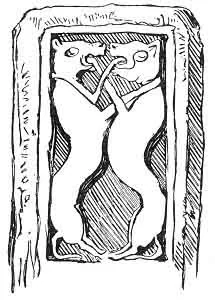
An ancient stand-up dog-fight, from a sculptured cross in Scotland, at Dupplin.
The first question for enquiry is, who and what were the heroes of Ossian?
According to Professor O'Curry's Lectures, 1 the following dates rest upon ancient authority--
Finn's pedigree begins. Finn son of Cumhall, son
| B.C. 110. |
Finn slain, in the reign of Cairbré Lifeachair.
| A.D. 288. |
Battle of Gabhra. Death of Oscar and Cairbré (p.
| 284. |
| A.D. 432. |
In a matter of such antiquity it is of small importance that Oisin, who had a grown up son in 284, must have been about 180 years old in 432, and more than 200 before St. Patrick could have built the monasteries in which the poor old blind Irish bard was so grieved, starved, and tormented by jangling bells, droning psalms, and howling clerics; it is proved that the names of the old Fenian heroes were known when very ancient manuscripts were written, and that is enough. So, taking the third century as a starting point, let us take a rapid voyage of discovery down the stream of time, carrying with us the published Gaelic Ossian, and noticing anything old that bears upon Gaelic traditions at its proper place. If Scotchmen and Irishmen will not pull in the same boat, let there be no bumping, or jostling, or fouling, but a fair race for what may be left of the poems when the voyage ends; if any one is bored by such races he need not follow the boats, he may skip over a short cut to the winning-post, but if he does he must not give an opinion about the line of country which he is too lazy to travel.
First, then, let it be granted that FINN lived in Ireland at the end of the third century, an that the first book of Temora is founded upon an event which took place in Ireland before the book of Leinster was written, if not in 284; but it must be granted, on the Irish side, that Hector Boyce made Finn a Scot and a
giant in 1526, when the Scotch historian published his work. 1
The passage is partly quoted in the Highland Society's Report on Ossian, and p. 170, Hist. of Scotch Poetry, and part of it is as follows:--"Conjiciunt quidam in haec tempora. Finanum filium Cœli (Fyn MakCoul vulgari vocabulo) virum uti ferunt immani statura septenum enim cubitorum hominem fuisse narrant."
So, in the sixteenth century, Fyn was the son of heaven, and the historian then ranked him with King Arthur; and tales and other compositions concerning Fyn with the Arthurian fables. It must also be granted that numerous Celtic worthies bore Ossianic names,. besides the Irish heroes. Engenius I., son of Fin-Cormach-us, was a king of Scotland slain in battle with the Romans, A.D. 357. Ferg-us (Wrath-us) was the name of a Scotch king who was lost in the Irish sea, B.C. 330, and many historical personages have borne that name: besides the Irish bard Fergus, the son of Finn MacCumhal of A.D. 280. Cumhal, again, is like many Celtic names; it sounds like Coil-us, who was a king of the Britons, and if he be the hero of the English ballad, his was a rough age:--
"Old King Cole, unsophisticated soul,
Neither read nor write could he,
To read and to write he thought useless quite,
For he kept a secretarie."
Congall-us was a Scotch king in 501 or thereabouts. There were many Scotch kings called Donald, if we can
believe Scotch history, and the men who wrote these names were generally of the race which now says "garsong, ung ver du vang, et ung morceau du pang." The sound of the French and Gaelic nasal o and u are identical, and a man who would write garsong because he seemed to hear that sound, would also write MacDonald, as it is now pronounced in Gaelic, Macongil, and one sound of MacCumhal would be Maccungil and another Macooil. Now, if this erroneous ng, which expresses the Saxon value of the French and Gaelic nasal o and u, and the word Mac be struck out, there remains a nasal o-il or u-il, and so, instead of Cumhal, Coil-us, Cole, Cowl, Cool, Congall-us, Donald-us, and Dugald-us, we come very nearly to Hoel, whose son would be ap Hoel, O'Hoel, or Mac-Hoel, and thus Fionn may be made the son of the mythical Welsh Howel, or of some great man who bore the same name before the flood. By a like easy process, Fionn becomes a Macdougald, and as Campbell is not an ancient Gaelic name, I may point out that Camul was the "Celtic Mars," and that Camel-ot, Camel-odunum, and other such names, all savour of Cumhal, though that word now means handmaid, or subjection, according to dictionaries.
Fenian names also appear in the Milesian story (p. 447 of O'Curry's Lectures.) Beginning with Japhet and Magog, the race is traced through Scythia, Egypt, Scythia again, Greece, and Spain, whence a colony came to Erinn in the year of the world 3500, at which time Ireland was governed by the three sons of Cermna Milbheoil (honey-mouth), Ethur, Cethur, and Fether; "mythologically known as MacCuill, MacCeacht, and MacGréiné; "who were Tuatha dé Danann, and reigned at Tara. Scota, the mother of the Milesian leaders,
was shortly afterwards slain in a battle, and one of her sons was Eber Finn. So Finn was a mythological Milesian long before the Finn of the third century, and MacCuil Finn's patronymic was also that of the mythological head of the race which the Milesians found in Ireland.
Finn is also one of the commonest names in Scandinavia, and so is Köl, so we get Finnr Kölsen, the equivalent of Fin MacCowl. Oscar is also common, and is interpreted to mean As-gair the spear of the gods, and Oske is one of Odin's numerous names.
In the twelfth century Geoffrey of Monmouth names Coillas, and Coel, and Conan, as British heroes, and according to the chronicle Conan was made king of Armorica. Sir Gawain is probably the same personage as Gow or Gol, the son of Morna, so they may be Welshmen or Bretons. Phinn, MacPhunn, Fin-lay, and scores of other names common in England, Scotland, and Ireland, also resemble the Ossianic names. But the Finns or Lapps inhabit Finmark at this day, and have all along been magical people in the north, so the Celtic heroes may be Lapps. In the story of Gunnhillda (Njal Saga, vol. ii., 378), we learn how, in the tenth century, a beautiful maiden was sent to Finnark to learn magic from the Finns, and "some believed that MATTUL the FINNISH king himself was her master in magic," but Gunnhillda's story is mixed up with that of the whole of the west of Europe, in that she was a Viking's bride, and mother of Scandinavian kings, so her master in magic may be MacCoul himself in disguise.
Feinne may be Phœnician or Egyptian, if there be any truth in the old legend about Pharaoh's daughter.
In like manner "Art" is the Gaelic now commonly
used for the Christian name "Art-hur," or Art is not to be appropriated to any one Irish king, though there may have been an early Cormac Mae Art, for there was an early British Arthur, of whose deeds romance is full. So Bran and Conan were early Welsh kings, though Brian and Conan may have flourished in Ireland. Brenn-us sacked Rome about 930 B.C., if Bran was Fionn's magic black hound, A.D. 280; and generally it must be granted on all sides that the early history of Great Britain and Ireland must be Celtic history, and that the best place to get at it is Ireland, where the Celts were not much disturbed till a comparatively late period. But Irish, Scotch, Welsh, Manx, and Cornish, and Clyde Celtic history, and all the early romance of Europe, is so tangled and twisted together, that it will be no easy matter to unravel the skein. Without some knowledge of Gaelic it is hopeless to begin upon this dark history. Let me give one example. There is a Lord Mayor in London, and in every town in England. Monsieur le Maire is a French official in every village in France; the mayors of the palace played their part in French history; the Maormors were anciently Scotch great men; but very few know that maor, pronounced nearly like the French word, is still the Highland constable and ground officer, and civil officer, though Inverness has a provost.
But I have now to do with the heroes of "Ossian's poems."
In Professor O'Curry's book, a vast amount of curious information is given relative to Irish writings. It appears that many hundreds of these are preserved in various libraries and collections at home and abroad. They contain histories, genealogies, codes of law, historical tales, and tales of all kinds; romances, legends,
and poems of various sorts, and "numerous Ossianic poems relating to the Fenian heroes, some of them of great antiquity." The earliest writing is Latin, and attributed to the time of St. Patrick, about 480; others are attributed to St. Colum Cillé and the sixth century, others to the tenth, eleventh, twelfth, and following centuries, and these are generally assumed to be Irish, not Scotch, because of their language and the character in which they are written. Most of them probably were written in Ireland, but such documents must be judged by their contents. I received a letter this year from a Scotch highlander in Glasgow, part of which was written in the old hand. A song composed by Duncan Macintyre, the Breadalbane bard, was written in the old character in 1768. It was commonly, though not always, used before that time; inscriptions on the cross at Inverary and other old stones in Scotland are in old letters and in obsolete language. St. Colum Cillé founded Iona; and if St Patrick's churchmen used old letters, the saint is accused of having been born in Scotland. Those who only understand modern Irish or Scotch Gaelic cannot, without study, read or understand the old written language, which is and always has called itself Gaelic. So Scotchmen and Irishmen would do well to make peace, and help each other to use these old records, and call their language Gaelic, instead of Irish or Earse, which words are only used in speaking English, and produce discord.
Now these ancient Irish documents and those which are preserved in Scotland, like Scotch and Irish traditions, are pervaded by the variously spelt names of Fionn or Finn and his worthies. There is hardly a grown highlander who is not familiar with their names-they are household words at the firesides,
of Irish peasants; and the characters and relationships of these mythical warriors are almost invariably the same. They are the heroes of Ossian.
Professor O'Curry, who probably knows more about Irish lore than any man now living, and has spent great part of his life in reading and transcribing old manuscripts, holds that the "Fenians," who answer to the "Fingalians" of English readers, were historical Irish personages who flourished in the third century, but he shews, p. 10, that Fer Féne was written in the book of Ballymote in 1391, in a poem composed in 1021, and be translates it "Féne men, these were farmers." Still, Finn's genealogy is traced to 110 B.C., and it rests upon ancient authority that Diarmaid O'Duibhne ran away with Grainne, the bride of Finn, and daughter of Cormac Mae Art, and that Finn's son Oisin was a warrior poet.
Poems attributed to Finn Mac Cumhail, his sons Oisin and Fergus Finnbheoil, and his kinsman Caelté, do exist in Gaelic MSS. seven hundred years old. Five of these poems are attributed to Finn himself, and exist in the book of Leinster, which is said to have been compiled from older books in the latter part of the twelfth century; and in the book of Leacan, compiled 1416. Two poems attributed to Oisin are in the book of Leinster. One consists of seven quatrains, and records the deaths of Oscar the son of Oisin, and Cairbré Lifeachair, monarch of Eirinn, who fell by each other's hands at the battle of Gabhra, "fought A.D. 284." The second is longer, and records early races on the Curragh of Kildare, wherein Oisin, Caelté, and Finn were gentlemen riders, and magical personages acted the part of modern sharpers, and tempted the heroes into unhallowed dens near Killarney, where they spent a wild night after the
races. Another Gaelic poem of undoubted antiquity is attributed to Fergus, and tells how Oisin his brother was enticed into a fairy cave, and discovered himself to Finn by letting chips cut from his spear-shaft float down a stream; as Diarmaid betrayed his retreat to Fionn in the tradition (page 43, vol. iii.) Another is a love story, which Caelté is supposed to have recited to St. Patrick.
Professor O'Curry nowhere says that the "poems of Ossian," as published in 1760 and 1807, or anything like them from which they could have been translated, exist in ancient Irish manuscript, and gives no support to the argument of his countryman; but be also says, "Of MacPherson's translations, in no single instance has a genuine Scottish original been found, and that none will ever be found I am very certain." If he means that the Gaelic of 1807 never can be found in an ancient manuscript, he is certainly right, for the language must have obeyed the common law of change incident to all languages; but he has pointed out some of the incidents on which the first book of Temora is founded, in one of the two ancient poems which were attributed to Oisin in the tenth century; and it is beyond question that endless stories and poems about Fionn and his people have been for centuries, and still are traditionally preserved in Scotland, as well as in Ireland. According to Irish authorities, then, Gaelic poems are preserved in ancient manuscript, and some relate to the Ossianic heroes, but they were Irishmen, who lived, and loved, and fought in the third century, and not Scotchmen; but according to other Irish authorities, these men flourished much later. Scotch and British Fenians are mentioned, and Scotch Oscars appear in Irish poems, even Danish Oscars are named in Irish books;
and the feats attributed to the ancient heroes who bore these Ossianic names, and whose chief was FINN, are often the exploits of giants and demigods.
According to MacPherson and "Ossian's poems," FINGAL was king of Morven, and lived about the same time; according to tradition, which scorns dates (see No. LXXXII), FIONN was the son of a Scotch king who came from Ireland, and of a Scandinavian princess, and drove the Scandinavians from Scotland, having first passed through many adventures in Ireland. Assuming that he lived in the third century, he may have been a leader of Celts in their early fights with the Northmen, Danes, or Anglo-Saxons, who followed the Romans; before any authentic account of their raids was compiled, and before men thought of distinguishing between Ireland and Scotland. But no tradition now current, and no ancient manuscript of which I have heard, makes any mention of the kingdom of Morven or its king Fingal. I believe that the kingdom is an invention of the compounder of Ossian's poems, whoever he may have been.
The name Fionnaghal is, however, no modern invention; Barbour knew it as "Fyngal" about the days of Bruce. It occurs in a Gaelic song printed by Gillies, 1786, and composed by lain Lom, a bard who sang about the time of Montrose, and died 1710 at a great age. It is in an elegy on Glengarry composed in the seventeenth century, in which the poet MacMathain or Mathieson, Seaforth's bard, calls the MacDonalds Sliochd righ Fionnaghail, the race of King Fingal (Beauties of Gaelic Poetry, Mackenzie); and the name also occurs in a traditional story now current in Islay. Righ Fionnaghal according to this was a MacDonald, and "king of the Isles," and lived in the island in Loch
Fionn-lagan in Islay, where are the ruins of the habitation of the lords of the Isles. A family of Mac-in-tyres (sons of the carpenter) claim to be descended from an illegitimate son of this King Fingal; and Flora Macintyre, one of my peasant contributors claims to be one of them. The story goes, that the king and his son were at sea in a boat, when the peg in the bottom came out and was lost, and the water rushed in. The young man, who had never gained the notice of his father, thrust his thumb into the hole and chopped it off with an axe. "Mo laochan air saor na h-òrdaig!" "My fine lad, the thumb carpenter," said the king; and from this MacDonald, son of Fingal, came the family of the Thumb Carpenters, who are still called Macintyres in Islay; or in Gaelic, "Mac an t-saoir na h-òrdaig." MacDonald is often so pronounced as to make the name resemble MacCumhal. This story is well known about Arisaig.
As for the poet, to whom nearly all the old poetry in the Highlands is now attributed, his date and origin are as uncertain as his father's. If he was Fionn's son he could not have survived to converse with St. Patrick, and he could not have lived with a fairy lady in the land of youth; he is in Gaelic popular tradition and old Gaelic lore the counterpart of Thomas the Rymour, who was a living man in 1280, and yet went to fairy land, and has the credit of being a prophet, a magician, and a poet--the author of Sir Tristrem. That ancient Scotch poem "Sir Tristrem," and the oldest Scotch poems known, treat mainly of Celtic worthies and their adventures, and include the incident of the good knight who slays a dragon, and the false servant who claims the honour and the princess, which is in the Gaelic "Sea-maiden;" and in a tale told
to me by an Irish fiddler; in German, Norse, and other popular tales.
There is a popular saying still current in Islay, which joins true Thomas to a common Celtic British legend. He is supposed to be still living, enchanted in Dumbuck (Dun-a-bhuic, the buck's hill), near Dumbarton (Dunbreaton, Mount Breaton); and he appears occasionally in search of horses of a peculiar kind and colour. He pays for them when they are brought to the hill; and the vendor sees enchanted steeds and armed men within the rock. It is said--
Nuair a thig Tomas an riom 1 's a chuid each,
Bidh latha nan creach an Cluaidh.
When Thomas of power and his horses shall come,
The day of plunderings will be in Clyde.
The date of Fionn and his family may be the third century; but unless there were many who bore the same names, or the names were titles, the exploits of a series of men, and the fabulous deeds of mythological characters, must have gathered about the names of this single family. I am still inclined to believe that these heroes of popular romance were ancient Celtic gods.
Be that as it may, I will endeavour to shew that their names have been current for a very long time, and that Ireland has not an exclusive right to them.
_________
According to a Scottish legend given by Fordun, etc.,
| 203. |
reign of King Donald, consequently sculptured stones, even with Christian symbols, may be of very ancient, date in Scotland.
| 360. |
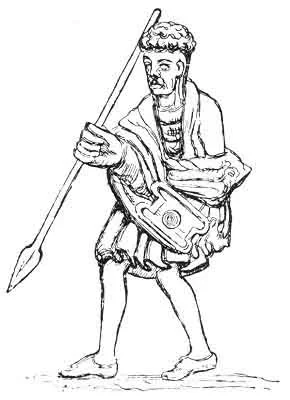
Figure dressed in the Belted Plaid, copied from an ancient sculptured stone found at St. Andrews, supposed to represent a Pictish hunting party. Date unknown, No Christian symbols.
| 432. |
| 503. |
Fergus was succeeded by Domangart, Comgal, and
CONAL, by whom the Island of Iona was bestowed upon St. Columba. The saint is supposed to have been born in Donegal, A.D. 521.
St. Columba landed at Iona, and shortly afterwards
| 563. |
The only Gaelic traditional reference to a people with Pt name like that of "the Picts " is an occasional, but very rare, mention of PIOCATCH, as a kind of men. The word, pronounced Pyuchk-aich, is common all over the west, but it means a cole-fish at a particular stage of its growth. Other sizes of the same fish are called CUDAINN, which, as "cuddy," is immortalized by Johnson as caught by Boswell. A larger size is CEIT-EAN-ACH, derived from Ce, the world, tein, fire = ceit-ean (part of April), the spring, directly after which came the festival of Beal-tainn and its symbolical fires. So "Ceit-ean-ach" means a "spring-fish," and something very like the fish meant is sculptured on a Pictish stone in Scotland (see vol. iii., page 356, left hand, upper corner), and these stones date from Pagan times, and probably have to do with Pagan observances.
The same fish, when grown very large, is called "UGSA," pr. oox-e, which is the Norse for a bull, and the whole tribe is called GLAS-IASG, grey or green fish. As every clan has some fish, beast, bird, and plant for a badge, perhaps the PICTS adopted this fish, or fish in general, as their badge, and thus the modern name of the fish may be the ancient name of a tribe. At all events, there are plenty of Lowland traditions about Picts as a different race, but there are scarcely any in
the Highlands. The Irish call them "cruithnich," for which word all manner of meanings have been found, including "cruinn-ich," Round-ites. Some Irish writers hold that the Picts migrated from Ireland to Scotland before the Scots.
There is also good reason for the continual reference to the island with fire about it, and the Scandinavians, for the churchmen of Iona or men of their class visited and settled in Iceland before the Norsemen.
| 783. |
| 871. |
| 880 to 900 |
700 to 800: A manuscript, supposed (for reasons given in the Appendix to the Report of the Highland Society on the poems of Ossian) to be of the eighth century, is believed to be somewhere in Edinburgh. It contains a version of "The Tain"--a poem relative to which the Ossianic Society of Dublin have lately published a volume of very curious matter, and which is also mentioned by Professor O'Curry. Whatever may be the real date of this ancient MS. it throws the date of Osin, or Ossin, or Ossian, and Finn, and of incidents in surviving traditions, both prose and poetry, very far back;
but, so far as I am informed, it does not contain any of the Gaelic poems published in 1807. 1 So we may pass on.
An ancient Gaelic MS. has been lately discovered in,
| 900 to 1000: |
The following sentence appears in the Saturday Review of December 8, 1860, as Gaelic taken from this MS.:--
FORCHUBUS CAICHDUINI IMBIA ARRATH INLEBRÁN COLLI ARATARDDA BENDACHT FORANMAIN INTRUAGAIN RODSICRIBAL
The translation given is--
Be it on the conscience of every one in whom shall be the grace of the booklet with splendour that he gave a blessing on the soul of the misellus who wrote it.
In this form I can make nothing whatever of the Gaelic, and not much of the English. There is not one word, except bendacht, which even looks like modern Gaelic, but the following sentence conveys as little meaning at first--
IAMY OURO BED IENTHUM BLESER VANTTO COMND.
The Gaelic, otherwise divided, looks better; the reader may puzzle out the other language for himself. Taking this to be phonetic spelling, it is not unlike modern Gaelic with one Latinised word, and would seem to be a formal gift of a wood on a hilltop, and a blessing on somebody mentioned before.
|
Forcubus |
caich |
duini |
im bi a |
|
ar rath |
in |
le |
brán |
colli |
ar |
|
at |
ard |
da |
bendacht |
for |
anmain |
|
in |
truagain |
rod |
sbribai |
"To the Forchi (? the Farquhars). To every man to whom it may be said. The half of the wood on the high place to them. A blessing on the little soul of the poor little fellow before written."
It is difficult to know where a word begins or ends in old writings, and perhaps this arrangement of the letters may be as good as the other. I know nothing further of this manuscript, and very little of old manuscripts of any kind, so this is a mere guess at a puzzle.
| 1000 to 1100. |
| 1014. |
live there now will point it out, and the narrative there appears probable, for it accords with the locality. It is told that Gunnar stood on a height, and thence shot a number of men with arrows, and the nearest peasant mounted the only block of lava in the place that seemed to suit the description, and posed as Gunnar. Close to the spot, he pointed out a number of human bones, skulls, and teeth, which had been laid bare by a strong wind which had lately driven the black sand away from a small rising ground. Unless these were the bones of the men slain there by Gunnar, eight hundred years ago, it is not easy to make out how they came there, amongst the bare lava and sand near "the springs." They bear every mark of great age, there is no burying ground near, and it was no one's interest to play a trick upon travellers. Though I cannot believe that Odin appeared at Brian's battle, or his corse-choosers before it, or that ravens, and swords, and showers of blood, fell upon and attacked the pagan Norseman, I can readily believe that such stories were told, and believed, and written down in Iceland as true, and that the smaller incidents of Brian's battle were truly recorded nevertheless. It appears that king Brian's army had banners, and in a traditional Gaelic ballad, at least as old as 1784, and now current, is a description of the banners of the Feinne. The Celts had swords, and spears, and shields, and mail, like the traditional Feinne. Kerthialfad is mentioned as a leader of the Celtic army, and in the song of the Muilearteach, page 136, vol. iii., occurs the name Cearbhal as a leader in some great battle between Celts and Lochlanners, in which the Celts won, and where they displayed banners, one of which was the banner of Fionn, which is described in another
poem. They used spears, and shields, and swords, and elsewhere it appears that they wore mail. A magic raven was the standard on the Norse side, and according to the Saga, ravens attacked Brodir's men; a raven plays his part in the Lay of Osgar. One of the Saga heroes, on the Celtic side, was Ospak; one of the traditional heroes was Osgar, and they performed similar feats. "Ospak had gone through all the battle on his wing, he had been sore wounded, and lost both his sons, before king Sigtrygg fled before him." Osgar, according to the Gaelic poem, broke his way through the battle to the king of Lochlann, whose name is not given, and slew him, and an Orkney Earl was really slain, if the king was not. Osgar, like Ospak, was sore wounded, if sickles or herons could go through his waist after the battle. "Ospak was a heathen Viking," but he would not fight against the good Celtic king Brian. Osgar was a heathen Celt, and according to part of his traditional history, he went to Lochlann as a boy, carried there by a scaly monster, who ate men, and came in a ship; a Viking might be remembered as such a being. If the man on the apple gray horse be meant for Odin by the Norse Saga writer, it is quite fair that a Celtic bard should bring down his Olympus, and Fionn at the head, and so this lay of the Muilearteach may mean Brian's battle, and be a tolerably true ballad account of that fight. It may also mean something much older, or more modern, but points of resemblance between a saga and a ballad are worth remark. Miss Brooke, in 1789, attributed the Lay of Magnus to the twelfth or thirteenth century, and assumed that the Norse invader meant, was the Magnus who worked so much ill in Ireland about the latter end of the eleventh century. This tells for the
antiquity of traditional Gaelic poetry, and for the groundwork of "Fingal," but not for the Gaelic of 1807.
In a charter of lands in Morayshire, the words
| 1220. |
A MS. in the Advocates' Library contains, amongst
| 1238. |
About this time the halls of barons, and even the
| 1250. |
and in the romances of the period they are constantly mentioned.
The Northmen were accompanied by their skalds in their warlike expeditions, and the accounts which these men wrote were in verse and prose. The verse is quite different in spirit and metre from Gaelic verse; but "sgeulachd," pr. skale-ach (tales), are often partly verse well.
In the history of the Norwegian expedition against Scotland, A. D. 1263, 1 is an account of the expedition of Haco, represented as the most formidable that ever left the ports of Norway. The prize disputed with Alexander, son of William, king of Scotland, was the possession of the Hebrides.
In the manuscript, as described by the translator, are pictures, some of which represent a man killing a boar, and another fighting with a mermaid, both of which subjects form the groundwork of stories now told in the Highlands. Most of the figures are in armour. Their helmets are sometimes conical; so are the helmets sculptured on many of the Hebridian tombstones. The whole course of the expedition is minutely described. They sailed as far south as Loch Long, drew their boats over the isthmus now called Tarbert or draw-boat, harried the islands in Loch Lomond, and fought a great battle with the Scotch near the Kumrey (Cumbraes), after which Haco sailed by Botar; (Bute, Gaelic Bòt); (Hersey) Arran Ar fhinn, Fionn's land, according to some), Sa-tir-is-mula (the Mull of Kintyre, maol-cheann-tire, bluff of Land's end); Gudey (Gigha Giugha); Il (Islay, Ile), where he levied a contribution
of cattle, meal, and cheese; Myl (Mull, Mul-e); Rauney (Rona, Rona, seal isle); Skidi (Skye, Eilan sgiathnach, the winged island), and thence by Harf (Cape Wrath), to Orkney, where the king sickened and died.
In this early account by an eye witness of a Norwegian expedition, mention is made of "Kiarnakr
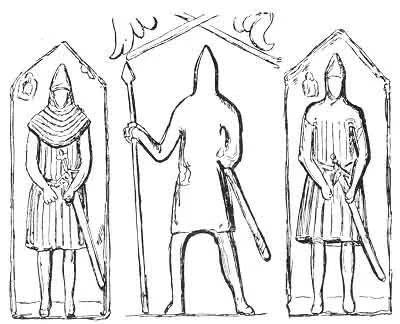
From grave-stones at Kilberry and Skipnish, in Argyleshire. Two are life size, and such stones are common.
son makamals," a Scot who harried the Isle of Skye, and whose men "had even taken small children, and raising them on the points of their spears, shook them till they fell down to their hands," and in the story abstracted, vol. iii., p. 1841, and got in Islay, Fionn MacChumhail goes from Islay to Skye to fight the Scandinavians. There is no mention of burnings and murders,
but as such proceedings were then common amongst Vikings, according to Norwegian accounts, probably both sides were equally cruel. The translator suggests in a note, that as Makamal is elsewhere written Niachamal, it may be a mistake for "Nial Camal," a lord of Lochaw. The name was probably written from ear, and the name of the lords of Lochawe is not pronounced Kamal now-a-days in Gaelic. It seems possible that the name may be Ceathearnach (warrior), Mac (son of) Cumhail; but it might be a corruption of several other Gaelic names, as now pronounced, including the big Macaulay, of whose deeds there are so many traditions current in the Long Islands. Be that as it may, petty rulers throughout these islands were then styled kings, as they are in Gaelic stories. Ships were generally small enough to be drawn overland, as described in Barbour's Bruce, and in traditions; and there are many other traits which appear in popular tales still repeated in the places mentioned. This seems to give a vague reference to something like an Ossianic name. I have several Gaelic stories which clearly describe a Scandinavian descent upon the country about the Clyde, in which Fionn is made to play a part. So this tells for the antiquity of these traditions; and shows how old records may have been destroyed, for there were religious houses on the islands in Loch Lomond.
| 1314. |
The ferd battale the nobill king
Tuk till himself in governing,
And had intill his company
The men of Argile and of Kintyr
And of Carrik all halely
And of the Ilis quharof was Syr
Angus of Ile and But all tha;
He of the plane land had alsua
Of armit men ane mekill rout
His battale stalwart was and stout.
It is strange to trace an ante-celtic feeling in the bard who wrote this passage, and it is equally strange to find so little about Bruce in Highland tradition now.
Barbour, Archdeacon of Aberdeen, compiled his
| 1375. |
"The Lord of Lorne," enraged at his men who durst not follow the "Brus," sets them an "ensampill,"
He said methink Marthokis sone,
Richt as Glomakmorn was wone
To haf fra Fingal his memyhe,
Richt sa all his fra us has he.
The lowland poet here remarks that he might "mar manerlik" have "liknit" him to Gaudifer de Larys, and narrates an exploit performed. by that hero of romance, which he knew, and thought a better illustration of Bruce's valour; so he probably gave the words of the Lord of Lorne as he had heard them, honestly, though he did not see their force. The passage refers to the strife which, according to tradition, was constantly going on between Goll Macmorna and Fionn; and the Lord of Lorne (MacCowl) spoke according to his lights, to men who understood what he meant.
Irish history claims a real existence for Fionn and Goll, and modern lowland stories have added supernatural incidents to the real history of the Bruce and Wallace:
With respect to the various readings; "hym all" makes no sense, Fingal does not accord with tradition, but fynn all would remove all difficulties, and mayhap the scribe wrote hym for fynn, not knowing what was meant. Spelling and writing were not fettered by rules in the olden time, and the letter y might well express the existing vowel sound of Fionn.
MacDougald of Dunolly (Maccowle as anciently written) now owns a brooch which was won in fight with the Bruce in Lorne, near Morven, the supposed kingdom of Fingal. It is clear that Barbour then expected lowland readers to understand this allusion to two Ossianic heroes.--(Highland Society's Report, p. 21. Hist. of Scotch Poetry, 275. Barbour's Brus.)
| 1391. |
| 1408. |
The Book of Leacain, above referred to, was written.
| 1416. |
Sir Colin of Glenurchy, ancestor of the Breadalbane
| 1432. |
Here then is a foundation for some passages in the tale of Conall Gulban, got in Cowal. Highland worthies went to the East and fought the Paynim. Amongst the movables at Taymouth, and the jewels of the house, mention is made "of ane stone of the quantitye of half a hen's eg set in silver, being flatte at the ane end and round at the other end lyke a peir, whilk Sir Coline Campbell, first laird of Glenurchy, woir when he fought in battle at the Rhodes against the Turks, he being one of the knychtis of Rhodes." This amulet appears to have been subsequently used as a charm for more homely purposes, and one like its description is still at Taymouth. 2 I have seen many such amulets in the Highlands, and they are still used as charms,--so here is foundation for the amulet in Conall Gulban.
Printing invented by Koster.
| 1438. |
Guttenburg.
| 1442. |
Guttenburg's bible completed.
| 1460. |
About this time Blind Harry composed "Wallace;"
| 1450. |
It seems that there were Celtic bards then wandering about as well as the lowland minstrels, who were all classed with sturdy beggars by an Act of 1457.
Holland, in a stanza (quoted page 181, Hist. of Scotch Poetry), abuses a bard out of Ireland, and mimics his language. It is bad Gaelic, written by ear by one who did not understand more than its general meaning. "Banachadee" is clearly Beannachadh Dhia, God's blessing, which is a common Highland salutation on entering a house; and equivalent to the Irish salutation "God save all here." Other two lines mean--Said--Black Knee give us a drink--come, me drink. Sow of Mary's son, ach! great son! me dry lake. The last lines quoted are--
O'Deremyne, O'Donall, O'Dochardy droch,
Thir are his Ireland kingis of the Irischerye;
O'Krewlyn, O'Conocher, O'Gregre, Makgrane,
The Schenachy, the Clarschach,
The Benschene, the ballach, The Crekery, the Corach,
Scho kennis them ilk ane.
This is a list of names and certain words which mean "The reciter of old tales," "The singing woman" (or the fairy woman); "The boy;" "The spoiling;" "The battle;" and these I take to be a list of current songs or poems which such hungry, thirsting, black-kneed, and therefore barelegged, wandering minstrels recited, together with the genealogies; of kings and nobles. So here is a glimpse of Celtic dress and poetry, and it confirms the accounts given of bardic recitations.
William Dunbar, who flourished in the reign of James the Fourth, and was a churchman who satirized
the church in the "Interlude of the Droichis" (Evergreen, p. 259), says--
My fair grandsyr hecht Fyn Makowll,
That dang the diel and gart him yowll.
My fader meikle Gow Max Macmorn,
Out of his moderis wame was shorne.
And hence it is evident that tales about the Feinne were then commonly known to those for whom the poet composed, that is to say, the lowlanders of Scotland.
In one of his satires, "The Daunce," Dunbar introduced the seven deadly sins performing a mummery in the dress of the period, before Mahoun and his infernal court, together with troops of those at whom the satires were aimed--nuns, loose livers, and above all, shaven priests and celts.
The fiend of the Lowland bard concludes his entertainment thus:--
"Than cry'd Mahoun for a Heleand padyane,
Sy ran a feynd to fetch Makfadyne,
Far northwart in a nuke:
Be he the correnoch had done schout,
Erische men so gadderit him about,
In hell grit rume they tuke;
Thae tarmegantis with tag and tatter,
Full loud in Ersche begouth to clatter,
And roup lyk revin and ruke,
The devill sa devit was with thair yell,
That in the deepest pit of hell,
He smorit them with smuke."
From this curious composition a great deal is to be learned about the manners and customs of these rough times, and we get another distant glimpse of Highland ways long ago. There was a fierce war of words between Highland and Lowland nationalities then, as there was between Celt and Saxon in the days of MacPherson, Johnson, and Boswell, and as there is in our own day when Bon Gaultier writes his famous Celtic ballad--
"Fhairshon swore a feud
Against the clan MacTavish."
It also appears that lowland bards, then as now, did not know much about the Gaelic language, and made no distinction between Irish and Erische; but they knew the customs of the race. MakFadyane shouted a lament for the dead, so that was a "Highland pageant," and all the Ersche gathered about him and began to "clatter," so the custom of crying the coronach, like that of keening in Ireland, was a Highland custom in the fifteenth century. This custom is clearly referred to in the traditional poem on the death of Osgur, and funeral processions are still followed by the bagpipes, and martial music accompanies a soldier to his last home. It also appears that these "Ersche" were a fierce race of termagants, dressed in "tag and tatter," some fluttering outlandish costume, wholly different from the fine lowland bonnet and flowing gown of " Pride," who leads the procession in the infernal mummery which Dunbar imagined and described. From the former quotation it appeared that they were bare-kneed "black-knees," and it seems that the poet hated the whole race and their language, and satirized
them, with other objects of his aversion, with all his might.
It may be new to most English readers to learn that MacMhurich, Clanranald's bard, long afterwards composed a Gaelic satire on national music. In this the "coronach of women" (no longer that of men, be it observed), and "Pìob gleadhair," the pipe of clamour,
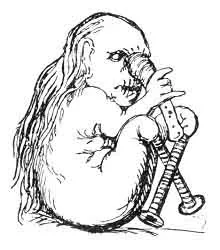 Highland sculptors also made stone satires upon the pipes: Above the door of ''Dundarav,'' a ruined castle near Inverary, there used to be a figure playing a tune upon his nose, which suggested the above design of the Spirit of the Pipes. Lowland view. |
are called the two ear sweethearts of the black fiend--a noise fit to arouse the imps; and other epithets are used fully as bitter and coarse as anything in Dunbar's "Daunce."
Dancing to pipe music is a Scotch custom at least as old as the days of James the Fourth. It is a custom which still prevails in Italy, Spain, Ireland, and Scotland.
Dunbar in his Testament of Kennedy throws some light upon the manners and customs of Carrick, a Celtic district of Ayrshire. He makes a brother churchman, with whom he held poetic jousts, desire that no priests may sing over his grave.
"Bot a bag-pyp to play a spring,
Et unum alewisp ante me;
Insteid of torchis, for to bring
Quatuor lagenas cervisiæ,
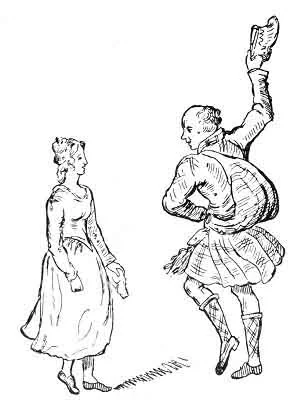
August 1829. Dancing to pipe music. Highland dress with belted plaid.
"Within the graif to set sic thing,
In modum crucis juxta me,
To fle the feyndis than hardely sing
De terra plasmasti me."
So the poet knew the sound of the bag-pyp, and thought it an instrument fit to fle the feyndis, as many
lowlanders do still, but it was the music which a beer-drinking churchman would delight to bear "playing a spring."
It seems that beer, not whisky, was old Scotch drink.
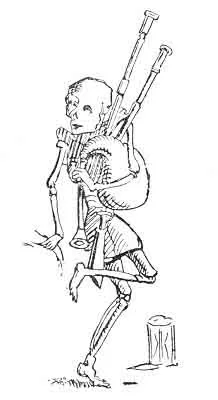 |
Caxton's press set up at Westminster.
| 1471. |
First book printed in England.
| 1471. |
About this time, the beginning of the sixteenth
| 1501. |
"I saw Raf Coilyear with his thrawin brow,
Craibit Johne the Reif and auld Cowkellpis sow,
And how the wran came out of Ailysay,
And Peirs Plewman that made his workmen few
Greit Gowmacmorne and Fyn MaCoul, and how
They suld be goddis in Ireland as they say.
Their saw I Maitland upon auld Beird Grey,
Robene Hude and Gilbert with the quhite hand,
How Hay of Nauchtan flew in Madin land."
The verse is quoted in the Report on Ossian, and p. 170, Hist. of Scottish Poetry. It is part of "the Palis of Honour," an allegorical composition, in which the poet introduces every famous personage of ancient or modern times, sacred or profane, of whom he knew anything; all the classical poets--Brutus of Albyon, Friar Bacon, Chaucer, and a mob of poets and their heroes. So here are two of the heroes of Ossian in good company at this court of honour, but even then their history was known to the author only by hearsay.
There is consequently a good deal to be found about Fionn in old times in the Lowlands, but nothing, so far, of the poems which are referred to. It so happens that some older than that period have been preserved. While polished bards, Highland and Lowland, were exercising their wit on such compositions as are found in old manuscripts, the "savage" Celtic people were repeating their own old ballads, and these were simple and free from the smallest tinge of coarseness. So far as I know anything of old Gaelic poetry, there is nothing to be likened to the satires above referred to.
| 1527. |
Dean MacGregor's MS. was written at Lismore; in
| 1512 to 1529 |
wrote; and it seems highly improbable that a long and well-known traditional poem should have escaped the Dean's notice, while a short one on the same subject was written down. Lorne is close to Morven, but there is no mention of Fingal or his kingdom. It is thus proved that Fionn and his heroes are not simply creatures of MacPherson's brain, or worthies who belong exclusively to Irish romance; and it seems probable that some one has added a "gal " to Fionn, and given him a kingdom, in the same way that the Gaelic name Temair has been expanded to Temora and contracted to Tara since 1391.
It is proved that "Earse" was a written language three centuries ago, and has altered but little since, and that Johnson and his followers erred in many things. It is proved that old materials existed in Scotland from which some one might have concocted at least one book of Temora without stealing from Ireland. And the out-and-out supporters of the antiquity of the Gaelic of 1807 are bound to produce something like Temora as it now stands in some manuscript, equally old, though it has been ingeniously suggested that the great traditional poems were then so notorious and so well preserved that no one would take the trouble to write them down or multiply copies. The Gaelic, then, of the poems of Temora, as published, was probably put together by some Gaelic bard who lived between 1530 and 1763, when the Gaelic of the 7th book of Temora was printed, though Oisein lived and sung long before the twelfth century. It remains to be seen whether the probable date of the published poems of 1807 cannot be more accurately determined.
Dean MacGregor's MS. was partly written in
Argyleshire, and some of the Gaelic poetry contained in it is attributed to Duncan MacCallein an dygriddir (Duncan, son of Colin the good knight), who fell at Flodden, and some to two ancestresses of the family of Argyll.
The following is a translation of six lines, which Mr. MacLauchlan was good enough to copy and spell for me from the Lismore MSS., and which are there attributed to "Ysboll ne Vc. Kellan" (Isabel, daughter of Colin's son):--
Woe worth! whose ailment's love,
Why-so-èèr,
I utter it.
’Tis hard from a partner to part;
Sad is the case
in which I am.
That love which is given unknown,
Since it's my wonted
Garden for lays (light-ray in rhyming)
Unless I plant passion betimes,
my flower will be
blighted and thin.
That man to whom love is given,
and must not be told
from on high (out aloud)
For him was I put into pain.
Heigh ho! for me ("gymi")
’Tis a hundred woes.
woes.
The rhythm indicates the division, and so do the assonances.
Mairg dha 'n galar an GRADH
G bith fath
fa'n abrain E
Deacair sgarachdain r' a PHÀIRT
truagh an cás
’s a bheileam FHEIN.
Several lines contain words whose sound, now-a-days, would admit of a double or treble meaning, and some of these might be distorted by one who was led to expect something wrong, but there is no coarseness in this quaint little ditty; and if this be all her poetical sin, the poor lady's character has been sadly maligned.
This class is amorous, moral and satirical, not Ossianic poetry; but if the nobility of those days who spoke Gaelic, composed in Gaelic, and wrote poems similar in spirit to those which were current at court, there were Ossianic poems of a different stamp then current amongst the people. If it can be shewn that nobles continued to use the language at a later date, it becomes not only possible but probable that some species of Gaelic poetry, different from popular ballads, but founded on Celtic traditions, might have sprung up in Scotland before the times when Shakspeare and Milton flourished in England, or even later, and yet before MacPherson's time. If it can be shewn what were the manners and customs of the district in which lords and ladies wrote Gaelic poetry about these times, the kind that would be apt to please may be surmised. From the genealogy of the Argylls, from which I have quoted in the text, I copy the following passage relative to Lady MacLean, sister of Dean MacGregor's poetess:--"She, according to common report, was exposed by her husband, the laird of MacLean, upon a bare rock in the sea, called
p. 61.
Lersker, near the Island of Lismore, in view of the castle of Duart, that she might perish by the return of the tide, but people from on board a boat providentially passing that way, upon hearing the cries and shouts of the lady in distress, took her on board, and restored her to her friends, although, at the same time, these very men who were employed to expose the lady to the mercy of the sea returned to Duart Castle, where John Gorm, the first of the family of Lochnell, a boy of three or four years of age, was with his aunt, the Lady MacLean, whom they had left upon the naked rock. And as soon as they had entered the castle of Duart they kindled a great fire on the middle of the hall floor, and formed themselves into a circle around the fire, and caused strip the boy John Gorm naked, and placed him between them and the fire, when the boy, by reason of the heat, was forced to run round the fire, while each of them, as he passed within the circle, rubbed his naked skin with an hot roasted apple, which occasioned blue spots on the boy's skin ever after, for which be was called John Gorm, or blue John. His nurse, though she ran into the hall in a furious manner, could not enter into the circle to preserve the child's life, until by means of one M'Gilvra of Glencannell, who had more humanity than the rest, and who, as they stood in a circle with their feet close, opened his legs a little (for he durst do no more for fear of suspicion), she rushed through the man's legs, and, entering the circle, snatched up the boy, and carried him off straight to the shore, which is hard by the walls of the castle, where, finding a boat at hand, they made their escape, and Providence so ordered matters that John Gorm and his nurse were out of danger before their enemy had full room to reflect upon their flight,
for which cause the laird of MacLean was killed at Edinburgh by John Campbell, the first of the family of Calder, brother to Lady MacLean, and uncle to John Gorm, the first of the family of Lochnell, who, as soon as he saw the laird of MacLean, he thrust the sword, sheath and all, through his body. These things gave rise to a song composed in these days (take up MacLean and prick him in a blanket)."
The main incidents of this story were all told to me by an old woman in September 1861. She speaks hardly any English, and is very old, and, like many of her class, speaks oracular predictions now and then. It is to be hoped that she knows the future as well as she remembers the past.
"Earl Archibald was slain at Flodden." So says the Argyll genealogy, whence this story is taken, of the days when Dean MacGregor wrote, and Henry VIII. reigned, and Lady Casselis composed amorous Gaelic poetry, if she be the lady meant by the family history. There was a lady called "Magrate nan oran" (or something which looks like it), "for her inclination to rhyming," who was a younger daughter of "the, last Lord Lorn of the name of Stewart," and married Colin Earl of Argyll, Glenurchy's pupil, about 1460. But whoever the composer of these songs may have been, the fact remains, that before the times of Shakspeare, lords and ladies composed Gaelic poetry, and Dean MacGregor wrote some down as theirs; and they were people of a class likely to be affected by the court literature of their day and country, some of which was rude enough.
Now "Ossian's poems" are distinguished by a peculiar vein of sentimental grandeur and melancholy, and the popular manners and customs of the east and west
in these days do not accord with such a spirit. Short, stirring, wild martial songs, like the current Ossianic poems, or political, or controversial, or amorous ballads, might suit the taste of the grim soldiers who roasted a boy, but a long epic would surely set them fast asleep; so unless the gentry or clergy wrote "Ossian," we must abandon the sixteenth century, and, as the builder of Taymouth said, "birz yont." But it must not be forgotten that, amidst all the ribaldry of ballads of that time, there is much beauty of feeling and sentiment in the lowland Scotch poetry of the clergy; and Shakspeare wrote as he did, although the amusement of roasting men had been pushed to the extreme about his time in England.
Sir David Lindsay composed satires against the,
| 1535. |
"Heir is ane relict lang and braid,
Of Fyn MacCoull the richt chaft blaid,
With teith and al togidder;
Of Collins cow heir is ane horne
For eating of Mak connals corne,
Was slane into Balquihidder."
In one of his interludes he says--
"But dowt my deid yone man hes sworne,
I trow yone be grit Gow Makmorne."
In another composition the poet says--
"Stewart of Lorne will carpe richt curiouslie."
And hence it appears that he knew something of west country traditions, and mayhap alluded to the Stewarts, of whose works some are preserved. Fyn MacCoull and Gol MacMorne were clearly known to the poet and his audience, if "Fingal" was not mentioned by this author. Colin and MakConnal and their cow might be a reference to some well known story about a feud; but a horn that was a "relic" must have been that of a famous cow, and there are plenty of such animals in the old stories mentioned by Professor O'Curry, in one of which ("The tain" above mentioned) MacCumhal plays a part. But, however he got there, Fyn went to court about 1535, and was presented by Sir David Lindsay in a dress of motley for the second time. (Hist. of Scotch Poetry, 376, 425).
| 1530. |
| 1549. |
The first book was printed in Ireland--the liturgy by
| 1550. |
In Lemoine's history of printing, it is stated that an
| 1565. |
| 1567. |
George Bannatyne collected Scotch poetry, and his 1568. manuscript is the chief source whence a knowledge of old Scotch poetry has been gleaned. MacGregor's far earlier Gaelic collection has been well known for a century, but such has been the neglect of everything genuine and Gaelic, that till now its contents have hardly been thought worth attention.
From Bannatyne, Ramsay drew his materials for the Evergreen, published 1724; and he "altered, added to," and "retrenched" his originals "with extreme licentiousness." (Hist. of Scotch Poetry, 416.)
It seems hard then to blame MacPherson as if he were the only man of his time who mangled old poetry to make new, and never to look at old authorities to see what was the truth. The fault has been as much on
the Gaelic side as the other; but that fault is about to be amended.
| 1571. |
| 1579 to 1582. |
| 1594. |
So here is another Fyn mixed up with Druids and Culdees, Paganism and Christianity, and located in that stronghold of the Fairies, Man.
No. 161 is the "Pigmies' Ile," in which the Dean had found "in a small kirk" the small round heads of small
men. So here were the fairies themselves. The houses of a small race still exist in the Islands.
Martin also mentions these small bones (page 19) as these of "Lusbirdean," and I have many Lewes stories about pigmies.
Dean Monro gives very little about the manners and customs of the people of the islands, but he tells that they used to catch seals with certain "great doggis" in Loch Gruinart in Islay, which must have been a curious scene.
About this time the Black Book of Taymouth was
| 1598. |
New Testament printed in Irish, and dedicated to
| 1603. |
In this year a manuscript was finished by Ewan MacPhail, at Dunstaffnage, in Lorne; it contains a prose tale "concerning a King of Lochlin, and the Heroes of Fingal;" and a poem which seems, from the lines quoted, to be part of No. LXXIX., which is still traditionally preserved, and was written down by Dean MacGregor in 1530. I have seen this Dunstaffnage MS. and can hardly read a word of the old writing.
Sir Duncan of Glenurchay died; and in that year
| 1631. |
About this time, a correspondence took place which
| 1633. |
are--Sir Colin Campbell of Glenurchy, Juliane Campbell, his wife, daughter of Hew Lord Loudon, the Marquis, and Earl of Argyle, who were both subsequently beheaded, and Margaret Douglas, Argyle's wife. It is a curious measure of the fee of the writer of the Argyle genealogy, that he omitted all mention of this death on the scaffold, with which, as Mr. Innes remarks, these "were subsequently honoured."
The spelling of the letters is obsolete; they give a curious picture of the times, and they are well worth perusal, but the reason of the correspondence is what concerns me. Argyle and his wife Margaret Douglas are anxious that their son Lorne should have a thorough knowledge of what they called "Erise," which Irish and Scotch Gael call Gaelic; and they send the young chief of the Clan Campbell to his relative to Balloch, now Taymouth, where his foster father, writing of his tutor, considers it--"requisit he be ane discreite man that is ane scollar, and that can speik both Inglis and Erise, quharof I think thair may be had in Argyll."
Accordingly, Lorne and Maister Jhone Makleine set off with "Duncan Archibald, and tuey horse with him, on to Mr. Johen, and on for my cariage;" soon after the "thretie day of September" when "Archibald Campbell of Lorne" wrote to his "louing foster-father" from "Inderaray," and Mr. Johen having misbehaved himself, some one else wss procured to superintend his studies. His mother, Margaret Douglas, writes 14th December 1637--"I heair my sone begines to wearye of the Irishe langwadge. I entreat yow to cause holde hime to the speakeing of itt, for since he has bestowed so long tyme and paines in the getting of itt, I sould be sory he lost it now with leasines in not speaking of it."
On the 14th Junii 1639, Margaret Douglas wrote to "Glenurchy" to Balloch for her son, and he came by the house in Glenurchy to Inverary with a sufficient company, if his mother's letter was attended to. It does not appear from his accounts that he wore the Highland dress; his tutor did.
"Item, given to Mr. Johnne M‘Len, pedagogue to my Lord Lorne's sone, in September 1633, ane hewit plaid, pryce xii. lib." Item, the 18th of Junii, to be coat and brekis to him (my Lorde's sone), x. quarteris of fyne skarlet, xviii. lib. the ell, xlv. lib. Item, ane pair of silk stockings, "and there are 'French bever hats, orange ribband points, and a Spanish pistolet' for the young lord."
Now, from all this gossip about historical personages of Western Argyle, it would seem that Gaelic was still the language of the Highlands, the language which one who was to command its people ought to know, but that some of the nobility now had to learn it, and wore "brekis."
This then would seem to be a time, for collecting all that could be got together, and modelling it into some connected shape, a period when Gaelic was a studied language, and when noblemen who spoke it delighted in the romance of Alexander, and all this took place in the immediate vicinity of "the woody Morven" where "Fingal" was supposed to reign, and in the district where discreet persons could be found acquainted with Gaelic and English.
There is no trace of the Ossian of 1807 to be found amongst any known writings of this time; but if the Bannatyne MSS. and some others had been destroyed, most early Scotch poetry would have been lost. Tradition has not preserved. the "Palice of
Honour," or "The Daunce," though it has retained far older ballads.
| 1645. |
| 1655. |
| 1659. |
| 1681. |
One man, quoth he, oft-times hath stood,
And put to flight a multitude;
Like Sampson, Wallace, and Sir Bewis,
And Finmacowl, beside the Lewis,
Who in a bucking time of year,
Did rout, and chase a herd of deer,
Till he behind, and they before,
Did run a hundred miles and more,
Which, questionless, prejudg'd his toes,
For Red-shanks then did wear no shoes,
For to this day they wear but calf ones,
Or if older, leather half-ones.
He chased them so furiouslie,
That they were forced to take the sea,
And swam from Cowel into Arran,
In which soil, though it be but barren,
As learned antiquaries say,
Their offspring lives unto this day.
I may add, that at this day men still point out Dun Finn, in Arran, and explain "Ar-ainn" to mean Ar-fhinn, Fin's land; and that Cowal, which sounds like MacCowl, is still brimful of Fenian traditions. On West Loch Tarbet are places called "Leaba Dhiarmaid," the bed of Diarmaid; "Dùn 'a choin duibh," the fort of the Black Dog, which is a curious old fort in a wood, and is said to be the place where Bran killed the black dog, as is told in the well-known ballad. Near that is "Tor an tuirc," the boar's heap, where, according to tradition the boar was killed by Diarmaid; and all these places are below "Sliabhghaoil," to which "Diarmaid," or, according to others, "an old hunter," addressed these lines when he was dying. They are known to many about Tarbert:--
Sliabh mo chridhe 's an sliabh ghaoil,
Innis nan crodh laoigh 's nan each.
Esan cha tearn a nuas,
Mise cha d' theid suas am feisd.
Mount of my heart and the mount of love,
Isle of the calving cows and the horses.
It will never descend,
I will not mount up for ever.
Another place in the district is called "Leum na muice," the swine's leap; and other similar names abound, which, together with Colville's verses, shew that Fingalian legends have been localized in the west for a long time. 1
Kirk's edition of the Psalms has four lines of poetry
| 1684. |
which are quoted, page 21 of the report of the Highland Society on Ossian, and which may be thus closely translated:--
"Go leaflet boldly forth
With God's pure songs arouse them yonder;
Hail the generous land of Fionn,
The rough bounds and isles of the stranger."
Inseabh-Gall, the Hebrides were so called from their Norse masters. This then proves that Scotland was considered to be the land of Fionn eighty years before MacPherson published anything.
| 1690. |
| 1691. |
This MS. is described is the Highland Society's report. So Gaelic continued to be written during the seventeenth century by Scotchmen in Scotland, they used it in legal documents, wrote tales about the ancient heroes, and poetry of various kinds; but the poems of 1807 are not yet found.
This was written (apparently) in the Scotch dialect, so it would appear that there was a popular and a cultivated dialect, both of which were supposed to pass current in Scotland.
1103. Martin, a Lewes doctor, wrote an account of the Western Isles, which gives a great deal of information about the ways of the people. At page 217 he speaks of the traditions of Fin MacCoul's, a great giant, whom he mentions as a well-known personage who had exercised
his valour on the inhabitants of Ar-Fyn or Fin's stronghold, which is the derivation given for Arran.
The standing stones are mentioned as confirmation of this story.
It so happens that the ground about many of these stones was lately searched, and it seems that they really do mark burial places of the stone period. Human bones, charcoal, and flint implements, were found about the centres of circles, in whose circumference four large stones or more are placed.
In one case the bones were much broken, and placed in a small grave about two feet long, scooped out of the rock. The bones were of the ordinary size, and did not appear to have been burned; so, unless the body was cut to pieces, it is not easy to make out how it was buried close to this grave, in a place called Dun Finn, Fin's fort. This seems to place Fionn in the "stone period," when iron was rare, and elk survived in Britain, according to antiquaries. Popular tales and songs appear to do the same.
Clanranald's bard wrote in the "Irish" hand in the
| 1720. |
First Gaelic vocabulary printed. Macdonald's.
| 1740. |
First work published in the then Scottish dialect of Gaelic--Baxter's Call to the Unconverted, translated by an Argyleshire minister. (Celtic Gleanings, p. 138.) So far, then, the printing press had been employed solely in the cause of religion, and anything in the nature of profane Gaelic literature had been condemned in the first book printed in Scotland.
Or thereabouts, a Mr. Farquharson made a Gaelic
| 1740. |
| 1751. |
1756. Jerome Stone's translation of Fraoch, of which the original Gaelic was recovered from his papers after his death, and is given in the report of the Highland Society (Appendix, p. 99). It still survives in fragments, in 1860, in Scotland, amongst the most unlearned classes. Stone was an Englishman, and his translation is a paraphrase, but faithful.
It was first published in the Scots Magazine, and is an indication of the taste of the period. Attention had been called to Gaelic poetry and the Gael by the battles of 1715 and 1745. The first who translated made a paraphrase, and thought more of himself than of his original; and almost every attempt since made to translate Gaelic into English, or English into Gaelic, has been of this kind.
| 1756. |
| 1763. |
the first time in English, I should in like manner recognise my traditional version of the "death of Osgur," though it is not the Gaelic of 1807, nor Gaelic from which the English of 1760 could have been translated.
It seems, then, that during the eighteenth century, and before MacPherson's time, attention had been drawn to the manners and customs, poetry and amusements of the Highlanders, who, in 1715 and 1745, had startled England and the Lowlands out of their propriety; and the first bit of direct evidence which tells strictly for the authenticity of MacPherson's translation dates from about a period when some collector might be expected to cater for the public taste, as Stone did. I think it highly probable that some one before MacPherson may have done that which Dr. Smith tells us he did after him, namely, gather all he could get, and tinker it according to his own notions of what an old Gaelic poet ought to have written in the third century, but, with the exception of the Farquharson manuscript, I have found no mention of any thing to support MacPherson's publications, so far, either in manuscript or print, though MacPherson's heroes pervade a whole series of early documents and Gaelic literature of all ages, Scotch and Irish, and his poems include bits which are clearly old.
My theory then is, that about the beginning of the eighteenth century, or the end of the seventeenth, or earlier, Highland bards may have fused floating popular traditions into more complete forms, engrafting their own ideas on what they found; and that MacPherson found their works, translated, and altered them; published the translation in 1760; made the Gaelic ready for the press; published some of it in 1763, and made
away with the evidence of what he had done when he found that his conduct was blamed. I can see no other way out of the maze of testimony.
If the statement of Mr. MacGilvray, given at page 50 of the dissertation prefixed to the large edition of Ossian, 1807, is not a deliberate falsehood, there is an end of the argument which makes MacPherson the author, though no early copy of the entire poems is known. It is said that the very poems which were translated and published, "Fingal; Temora," and many others, were collected, in Gaelic, in Scotland, from the people, long before 1760, and these were subsequently compared with MacPherson's published translations at Douay by the collector of the Gaelic, Mr. Farquharson, who did not know MacPherson; and the translations were found by Mr. Farquharson to be inferior to his Gaelic originals, inaccurate, but, in the main, translations so far as they went.
Mr. Farquharson's manuscript was afterwards torn, and leaves were used by the Douay students to light their fires, and if any part of it now exists, it is lost; but it was not written in the third century but in the eighteenth, chiefly in Strathglas. At page 75 of the dissertation is a statement which carries conviction with it, if such evidence has any weight; and, assuming the evidence to be admissible, and placing it beside what has been said above, there may have been some learned unknown Gaelic poet or poets who had collected, and arranged, and altered, the floating traditions of the country, between MacPherson and Dean MacGregor.
It is at least certain that MacPherson was a Highlander, and that some Gaelic bard wrote the Gaelic of 1763 and 1807, whatever his merits may have been.
MacPherson's first publication appeared, "The Fragments;"
| 1760. |
A Mr. Ewen MacPherson, a schoolmaster, accompanied James MacPherson to Skye and the Long Islands, and gives an account of their journey in his affidavit (p. 95, H. S. Report). The schoolmaster wrote down a great many poems attributed to Ossian from dictation, and his companion took the manuscript away with him, as also a small manuscript belonging to Clanranald, and an order for a larger manuscript which was in Edinburgh. The schoolmaster declares his own conviction that the poems of Ossian are genuine, and that he had heard them. commonly repeated everywhere; but as there was no Gaelic Fingal. published when the affidavit was made, this does not apply to the publication of 1807. He had read Fingal in English, and thought, so well as he could remember, "the substance of the original," that the translation was "well executed." Another MacPherson, a residenter at Portree, deponed that his brother, a smith, had given his namesake a Gaelic quarto manuscript, which contained poems which the smith could then repeat, and which he had no doubt were the works of Ossian. But this does not prove that these were the originals of the translations; for as this witness could not write, it is not probable that he could read English.
The evidence of Mr. Hugh. MacDonald, given in Gaelic, and confirmed by a number of gentlemen of the Long Island, is also subject to this objection. They all knew something of Ossian's poems, and believed them to be genuine, of very great antiquity, distinct from and superior to all other Gaelic compositions; but there was only some published Gaelic, for the poems of Ossian
which the English public knew, and the Celts seem to mean one thing, while the Saxons meant another. These collections have disappeared.
| 1762. |
| 1763. |
This edition is commonly bound with that of 1762, and the selling price for the large quarto is now 5s.
The following are specimens of the Gaelic, as printed by MacPherson in 1763, in Roman type. He says it is "stripped of its own proper characters," that "a copy of the originals of the former collection lay for many months in the bookseller's hands for the inspection of the curious;" and that the "erroneous spelling of the bards is departed from in many instances."
Published Gaelic and English, divided according to the rhythm:--
O Linna doir-choille na Leigo,
From the wood-skirted waters of Lego,
Air uair, eri ceo taobh-ghórm nan tón;
ascend, at times, gray-bosomed mists;
Nuair dhunas dorsa na h' oicha
when the gates of the west are closed,
Air iulluir-shuil greina nan speur.
on the suns's eagle-eye.
Tomhail mo Lara nan-sruth
Wide over Lara's stream
Thaomas du'-nial as doricha cruaim:
is poured the vapour dark and deep:
Mar ghlas-scia, roi taoma nan nial,
the moon, like a dim shield,
Snamh seachad tu Gellach na h' oicha.
is swimming thro' its folds.
Close translation of the Gaelic, so far as it is understood by the translator.
From the pool of the dark woods of Leigo,
The blue-sided wave-mist rises at times;
When the doors of night are closed
On th' eagle-eyed sun of the skies.
Thick about Lara of the streams,
Black clouds of darkest frown are poured out;
As a gray shield, through the pouring of the clouds
Swimming past, is the moon of the night.
This is not like the style or the spirit ol popular songs and ballads. It is not modern vernacular Gaelic; it is not the old written language, so far as I know it, nor is it Irish; but it is not a translation of the English given with it, for it has metre, and assonance, and a meaning of its own. It bears a resemblance to "Mordubh;" and as it was published in 1763, it is a Gaelic composition at least 98 years old.
The following four lines have the metre and assonances of some current ballads:--
An taobh oitaig gu palin nan SEOID
Taornas iad
Ceäch nan SPEUR
Gorm-thalla do thannais nach BEO
Gu ám eri' fón
Marbh rán nan TEUD.
In the side of a blast, to the heroes' tent,
they pour out
the mists of the skies;
a blue hall for shades not alive,
till the rising time of the sound
of the strings' death-moan.
In this case the Gaelic, though it is not such Gaelic as men speak now-a-days, expresses more, and seems to me better than its published English equivalent, which is not a true rendering of it.
"Often blended with the gale,
"to some warrior's grave,
"they roll the mist, a gray dwelling to his ghost,
"until the songs arise."
There is a second metre, which also has its equivalent in popular ballads, and in "Fingal"--
Ta torman a machair nan CRAN
Se Conar ri Erin at' AN
a taoma' ceo-tanais gu DLU'
Air Faolan aig Lubhair nan SRU.
The translation given is--
"A sound came from the desart
"it was Conar, King of Innisfail.
"He poured his mist
"on the grave of Fillan, at the blue-winding Lubar."
The meaning, as I understand it, is--
"There's a moan from the outland of stems;
It is Conar, Erin's king,
pouring out ghostly-mist closely
upon Faolan at Lubhair of the streams."
And here again the Gaelic, with all its grammatical peculiarities, seems to have the best of it, and it is no translation. And so it is throughout the specimen.
The Gaelic and English do not, quite fit each other, and the Gaelic seems to me to have been originally better than the English, though many words are used in strange ways, and the whole is spelt without any fixed rule. The Gaelic has most ideas, the English most words.
The orthography is, of course, the scribe's. It is such as comes to me from men who have not studied Gaelic writing. It is like my own spelling when I, who never learned to write Gaelic, try to take down a story rapidly from dictation; it is like the spelling of Dean MacGregor's MS. or the Manx system in a transition state; it is, in short, something between phonetic writing and old Gaelic, and that of 1807. As some one wrote in the Gaelic at the end of one of these ghostly passages--
’S doilleir so!
"This is dim!"
As MacPherson says in his rendering of the line, which I strongly suspect was a comment, which the translator mistook for a line of poetry--
"It is night!"
But through this dimness and night it may be discerned that the writer of the English was not the writer of the Gaelic. No forger could have written "’S DOILLEIR" SO for "IT IS NIGHT."
Strathmashie did not write Gaelic of this kind when he wrote in his own name; but, on the other hand, Chatterton afterwards spelt Rowly's poems according
to his notion of ancient English spelling, and so tried to make his language appear old, and succeeded for a time; and so Strathmashie, MacPherson, or some one else, may have done the same: but guessing is vain.
| 1768. |
"My friendship is as firm as the white rock when the black waves roar around it, and the waters burst on its hoary top, when the driving wind ploughs the sable sea, and the rising waves aspire to the clouds, turning with the rattling hail." So much for heroics, etc.
It is supposed that "Fingal" suggested the idea of Rowley's poems "to that wonderful imitator and original genius, the author of the Rowley controversy, who poisoned himself at the age of eighteen.
| 1771. |
This seems to be the work of a truthful, unsuspecting, prejudiced, wrongheaded, worthy man, who had a talent for English poetry. He believed implicitly in MacPherson' translation; he tells the exact truth so far as he knew it; he never appears to have suspected that any one could deceive him; he had a standard, and forthwith set to work to improve it, by "translating" MacPherson's English prose into good English verse of his own; while he was surrounded by people who were constantly repeating Gaelic poems,
which they attributed to Oisein; and which he neglected to translate, or preserve. There is a perverse simplicity in thus openly and obstinately going wrong in the wrong way; in sticking to supposed truth against all evidence, that would have made the worthy minister die a martyr for the false religion if he had been instructed in its tenets.
The book begins thus--
"To entertain any doubt of the antiquity or authenticity of the poems of Ossian, as some pretend to do, can only flow from an affected singularity of thinking, or from mere wantonness of prejudice."
The grounds for this opinion follow:--
"As to their authenticity, it was never so much as called in question in Scotland; over all the Highlands and isles, it is universally acknowledged. It is well known that the most illiterate old people there, can still repeat great parts of many of the poems. Unhappily, indeed, they are often found much interpolated and blended with the wild chimeras and absurdities of the bards of degenerate days."
Of MacPherson's translation he says:--
"His translation is faithful, accurate, elegant, and masterly." . . . "And it must be evident to many that be often falls short of his original."
And having said so much, and some more on his own account, the minister gives an abstract of Blair's criticism on the English Ossian, which, just as it is, was not that of a man who knew Gaelic. Then at page xc comes the evidence of the Islay minister himself, which is more valuable.
"For my own part, I frankly confess that I am not possessed of any of the originals; they are to be met with at greater length, and in greater purity, in those parts of the Highlands and isles most remote from Ireland, and furthest north. (But when we get
something traditional from the north this is found to be an error, unless Mordubh be a fair specimen). "Yet in the southern parts of Argyleshire, I remember from my infancy to have been in use to bear fragments of them repeated by old illiterate people, and as soon as I could judge of anything, to have been much struck and astonished by particular passages. I now live in an island not half a day's sailing distant from the north of Ireland, the very scene of action in the poem of Fingal; yet I could find but few that could rehearse any considerable portion of any of the poems, and that neither complete nor consistent with itself. What I have thus heard, commonly began and set out well in the pure and dignified style of Ossian, but soon fell off in mean conceits, disgusting absurdities, and ended inconclusively. The traditional stories, however, of these heroes are well known and abundantly familiar to all ranks in these parts. I have only mentioned this as an adminicle in support of Mr. MacPherson's position, that they are Scots and not Irish poems." . . . "There is scarce a hill, a heath, or vale where some large stones erected, or other monuments, are not to be met with, which tradition always refers to the time of Fingal; and the vulgar bestow names upon them, alluding to him or some one of his heroes."
These are facts from which I would draw conclusions different from those of Mr. Wodrow; but he tells us more; he remembered to have heard of a class of historians inferior to bards, called "SCELLACHA, or narrators of facts." (Tellers of tales is the real meaning, and the word is clearly the same as the Norse SKALD) The BARD, as the minister says, used to sing to the harp; and the SCELLACHA to fill up the pauses by telling prose history. He says, p. xcvii:--
"I have met with some old people among the vulgar Highlanders, who, as a winter evening's entertainment, have rehearsed fictions, or tales of a very ancient cast; much in the same manner. The gallant or heroic parts were in rhyme or measure, and sung to an air; the ludicrous incidents, and such as were little interesting, were only told." . . . "Such as are acquainted in the Highlands must know that ballad singers of this sort are yet to be met with."
And having told us what there really was, the minister leaves it with contempt, and gives his reasons for translating the English Ossian into English verse; and gives us "Fingal" in a measure which has no sort of resemblance to that of any Gaelic composition which I know; still it is a very readable poem.
In the arguments we got some traces of Gaelic. The old superstition of corpse lights is given as derived from Ossian's ghosts. It seems that a ghost came mounted on a meteor, and surrounded twice or thrice the place destined for the person to die; and then went along the road through which the funeral was to pass, shrieking at intervals, though with a feeble voice, till it came to the place of burial and disappeared. The superstition survives; the telling of tales and singing of ballads goes on; but the poem is so far forgotten, that I suppose I am the only member of the family of the man to whom it was dedicated, who knows the book; even I never saw it till November 1861, though I have always heard that an Islay minister had collected the poems of Ossian in Islay.
The minister gives two specimens of his collection, but translations only, and they are not like the current traditional poems. I may as well say here, once for all, that I have been brought up in the belief that "The Poems of Ossian" were something familiarly known to the people of the Highlands at some former period. and that I have been told the fact by a great many trust-worthy witnesses. But I am now considering the "poems of 1807," and I can only regret that I have not got Wodrow's opportunity of forming an opinion.
Dr. Johnson arrived on the 14th of August at
| 1773. |
afterwards made his famous tour, of which he and Boswell both published accounts. From these dates, it seems that Johnson might have seen part of Ossian in the Strand, printed in Gaelic, if he had been so minded, ten years before he went to the Highlands; and a lot of manuscripts at the publishers' in London before that.
| 1774. to 1783. |
The other volume is better written, and the arguments are in better English. A great many of the poems are versions of ballads still traditionally preserved. These are in the usual traditional metre, and consist of smooth regular quatrains with assonances. Two words at the end of the second and fourth lines are similar in sound and quantity, and two somewhere in the middle of the second and fourth lines agree with the terminations of the preceding lines; the second with the first, and the fourth with the third. Thus, in the version of "Manus," on which poem "Fingal" is supposed to be founded, Oisein says--
1. A chlerich a chanas na sailm,
2. Air leam fein
Gur baobh do CHIAL
3. Nach eisteadh tu tamul sgeala
4. Air an ffhein
Nach cual thu RIAMH.
The poet is speaking to a churchman, "Padrac," and his exordium might have been addressed to Bishop Carswell, and those who have followed him in striving to extirpate Gaelic lore.
Thou clerk that utterest psalms,
To me it seems
Thy wits are bad,
Wouldst thou not hearken to a story
Of the Feine
Thou hast never heard.
Some of these are in the form of dialogues between Oisein and his father-in-law "Peter MacAlpain," and sometimes Oisein represents the Fein as warriors of Eirinn. Some one appears to have thought this anti-Scotch, and has improved upon the original by importing from another poem; for example, the following line is struck out in ink--
"Nur thional Fiann Eireann gu trai,"
When gathered the Fiann of Eirinn to the strand, and a line is written in the margin, in a more modern hand, which means--
"Our heads are bent in the strife."
"Padruig" has been struck out, and other words suggested, which make the passages which follow apply to the Feine, and not to the saint, of Kennedy's authority. The stanza is given at the bottom of the 248th page of the H. S. Appendix, and is there made up from passages taken from two other versions, in which Padruig
was not mentioned. The original lines are not erased, so these are only suggestions, but this gives a curious indication of the unfair spirit which pervaded the Ossianic controversy.
The poems which I can trace as still current, differ from other versions, and from the marginal notes it appears that some portions of them were claimed by Kennedy as his own compositions. The bulk of the poetry is plain narrative converted into quatrains of smooth musical verse, which could easily be sung and remembered, and I believe that it was written down from dictation, as Kennedy said. Some of the passages claimed by the collector as his own are more sentimental, with more similes, different in rhythm, and as I think, far inferior. Other parts claimed by the scribe as his own, have been found in much older manuscripts, and it is quite possible that a man who had learned so much poetry by heart, might confound the old with the new, unintentionally. I hold Kennedy's to be a valuable collection of the traditional poems of 1774 and 1783, and the Fianaibh were then considered to be Irish warriors by the people about Loch Awe, where Kennedy made part of his collection. About the same time a certain Fletcher learned a number of Ossianic pieces, chiefly in Argyleshire, which he had written down from his own dictation. He could hardly write at all, and could not read the manuscript which he sold to the Highland Society; but, nevertheless, be repeated to a justice of the peace, who knew Gaelic, one poem which is in the manuscript, the death of the children of "Usno," which is the foundation of, but is not "Darthula."
This bears strongly upon the controversy. Appendix B to the Report of the Highland Society, extends from
page 190 to page 260, and gives part of Fingal in English at the foot of the pages, and a Gaelic composition, and an English translation by Dr. Donald Smith, and these three coincide tolerably well. But the Gaelic is not good poetry, for it is made up of a number of separate lines taken from a great many different collections of traditional poetry, to which references are given. Each line is genuine, and in Kennedy's collection, and the rest formed part of a poem which bore some likeness to the story of Fingal, or to parts of it. Some stanzas are left almost entire, but the new composition is not a genuine work, and it is spoiled. The lines detached from their fellows lose all the rhythm and assonance which gave them a musical cadence, and stanzas so broken and mended, and displaced, lose their original meaning. "Fingal" is like this.
The composition is no deception, but it is avowedly a mosaic constructed from several old works of high merit spoiled for the purpose. The makers took Fingal for a still older work, and pounded genuine old materials to make work like their model. As Dr. Smith did, so probably did the compounder of Fingal.
Ramsay had done something of the kind with Scotch ballads, and Percy had done the same as Ramsay. Burns and others did the same; it was the fashion of these times.
The Rev. Donald MacNicol, M.A., minister of Lismore
| 1779. |
tour and the minister's reply, gives a view of three sides of the question; and when the statements are picked out of the mass of opinions, there is as little reason for Johnson's famous attack on Scotch veracity as there is for MacNicol's quotation, "old men and travellers LIE by authority."
It seems as if the combatants, blinded by national prejudice, spent their energy in fighting shadows. The books are brimful of national prejudice--English and Scotch, Lowland and Highland; but they contain facts which can be authenticated, and statements which I believe, because the rest are true.
It rests on Johnson's authority that there were plenty of Gaelic songs. Boswell gives the chorus of one by ear, and it still survives. It also rests on the Doctor's authority, that people made statements about Gaelic matters, and that be did not believe them, which proves nothing; and that he heard of Gaelic manuscripts which he believed to be Irish, but which be could not have read if he had seen them.
The minister, on the other hand, who understood Gaelic, says, p. 350--
"Every man of inquiry; every person of the least taste for the poetry or turn for the antiquities of his country, has heard often repeated some part or other of the poems published by Mr. MacPherson. Hundreds still alive have heard portions of them recited long before Mr. MacPherson was born; so that he cannot possibly be deemed the author of compositions which existed before he had any existence himself." "It is true that there is no man now living, and perhaps there never has existed any one person who either can or could repeat the whole of the poems of Ossian." . . . "Mr. MacPherson's great merit has been in collecting the disjecta membra poetæ; and his fitting the parts so well together as to form a complete figure."
This statement is supported by the Irish claim to the
poems; and if it be remembered what people meant by translations in those days, it seems that the minister spoke the truth according to his lights, and the doctor according to his. MacNicol mentions a great many Gaelic MSS., and many of these are quoted above, and exist; and he also mentions a number of other manuscripts which probably did exist then, wherever they are now.
At page 360, MacNicol, in speaking of the forthcoming Gaelic Ossian, says--"It would be impossible for any person, let his talents be ever so great, to impose a translation for an original on any critic in the Gaelic language."
So the minister, knowing that there were Ossianic poems current, and recognising them in the English, believed in the forthcoming Gaelic; and Johnson, who knew nothing but the English, held that MacPherson was the father of Ossian; and neither of them, as it seems, had looked at the Gaelic of the seventh book of Temora, which might have prevented them from using such strong language. This seems to have been the prevailing spirit of the Ossianic controversy. Men have argued as partisans without first defining the points on which they would agree to differ; and like partisans, they have belaboured each other unjustly. Boswell states that a certain Mr. Macqueen told Johnson, as to "Fingal," "that he could repeat some passages in the original; that he heard his grandfather had a copy of it; but that be could not affirm that Ossian composed all that poem as it is now published." Johnson had contended that "it is no better than such an epic poem as he could make from the song of Robin Hood" (p. 127, Boswell, Routledge, 1860). Boswell held that Mr. Macqueen's statement amounted to what
his hero Johnson had maintained; but Johnson called MacPherson "the father of Ossian," and he would not have called himself the father of Robin Hood if he had composed an epic about that half mythical hero; so be was scarcely fair even if he was right.
| 1780. |
| 1780. |
| 1760. |
and which, from the description given of it, appears to be Moira Borb, or Fainesolis, of which I have several versions, and which is an episode in "Ossian," and these gentlemen heard, and heard tell of many other poems which seen) to be the same as those still current, though now far rarer. They met an old lady who had herself repeated one such poem to Dr. Johnson.
By this time MacPherson had risen in the world.
| 1785. |
"The bard, as I was about to tell you, is as great a favourite of fortune as of fame, and has got more by the old harp of Ossian than most of his predecessors could draw out of the silver strings of Apollo. He has bought three small estates in this country within two years, given a ball to the ladies, and made other exhibitions of wealth and liberality. He now keeps a hall at Bellville, his newly-purchased seat, where there are as many shells as were in Selma, filled, I doubt not, with much better liquor." . . .
John Gillies, a Perth bookseller, who did not understand
| 1786 |
The Gaelic of Smith's collection appeared; it was
| 1787. |
have abandoned the old tongue; or these are popular songs mercilessly improved, till they have lost their character. I would rank them near Mordubh, but they are nearer to the ballads than "Ossian."
So far, then, all the collectors found something which had some relation to "Ossian's Poems," but no one except Farquharson had found the poems themselves; and every one who translated, had written paraphrases of what he found. Stone, and MacPherson, and Smith, all took liberties alike.
In this year Edmund Baron de Harold, gentleman of the bedchamber to the Elector Palatine, published an Irish Ossian, of which he says--"These poems, though founded on tradition, are entirely of my composition." Still, they were called poems "discovered" by the Baron, and purported to be taken from Irish originals. The book was dedicated to Grattan. Whatever can be said against MacPherson's Ossian applies to this, and it wants the merit of originality.
| 1789. |
to everything, Gaelic and old, though it is a genuine work.
In this year MacPherson died Mrs. Grant of
| 1796. |
A collection was made by MacDonald of
| 1803. |
A collection of the works of the Highland bards,
| 1804. |
Poems of Ossian were also collected by J. MacDonald in. the western parishes of Strathnaver, Ross, and Inverness-shire. These are of the usual traditional class.
There are many versions of well known ballads, but no epic poetry.
Now, all these were written while there was but little published Gaelic for "Ossian;" if there had been any epics then current, they would surely have been found; if there had been any inclination to make false translations there was ample opportunity.
| 1805. |
Footnotes
24:1 Lectures on the MS. Materials of Ancient Irish History, by Professor O'Curry, 8vo, Dublin, 1861.
26:1 Scotorum Historia, f. cxxxiii. Paris, 1527.
35:1 Riomball (circle of power) is used for the circle within which the "inn's" stand at the game of rounders. The Irish Osin has much in common with Thomas the Rymour, according to old legends.
39:1 Report of the Highland Society, p. 293. This MS. is now missing from the Advocates' Library, where the collection of the Highland Society was deposited.
44:1 Translated 1780 from the Icelandic by the Rev. James Johnson, chaplain to the embassy at Copenhagen.
49:1 Sketches of Early Scotch History, p. 343. Black Book of Taymouth.
49:2 Sketches of Early Scotch History, p. 344.
57:1 Proceedings of the Society of Antiquaries of Scotland, 1856, p. 35; 1831, p. 317, Papers by Donald Gregory, Esq., and the Rev. Thomas MacLauchlan. Report of the Highland Society on the poems of Ossian, etc., passim, 1805.
65:1 See page 17.
71:1 Hist of Scotch Poetry, p. 276.
89:1 London, printed for T. Cadell in the Strand, 1779.
OSSIAN. PUBLISHED EVIDENCE.
If anything could be ascertained relative to the authenticity of the poems, it was to be done by going direct to the oldest surviving inhabitants of the districts where they were said to be found. That was done, and collections were printed and written, of which very little is known. I have gone over the same ground myself once more with able assistants, and I have gone through great part of the work of my predecessors, and I will endeavour to give the result as briefly as I can.
It has been proved that there were old Gaelic traditional poems, collectors of them, and men who made English paraphrases from them under the name of translations, long before MacPherson's time; and be, according to the evidence in the report of 1805, spoke with men who had written collections. The affidavit of Archibald Fletcher, January 1801, No. xvi. of the Appendix, gives a list of poems collected by Fletcher himself, filling 194 pages, and deposited with the Society; and he names men with whom MacPherson spoke, and who knew such poems.
No. xv. of the same Appendix gives 70 pages of
comparisons between manuscripts in the possession of the Society and MacPherson's translation of Fingal; and these prove to demonstration that the poem in some form was known to the people, and that the published poem is not the popular version, though like it.
Captain Morrison's evidence, No. XIII., is conclusive on this point, and proves that MacPherson had in his possession a great many such poems orally collected in Scotland, and that they appear in his English works.
Kennedy gives a list of seventeen persons from whose dictation be procured Gaelic poems, which he sold to the Highland Society, and which he collected between 1774 and 1783. It is therefore beyond all dispute that there were traditional poems in plenty, written and unwritten, attributed to Oisein, current in the Highlands, and accessible to MacPherson; many of which can still be traced in "Ossian."
The letters of Mr. Andrew Gallie, published by the committee, and dated Kincardine, March 12, 1779, and March 4, 1801, shew that MacPherson had old authorities also, and had little respect for them. The letters raise the curtain, and shew the "translator" at his work so vividly, that I give the following quotations:--"I remember Mr. MacPherson reading the MS. found in Clanronald's (which was illuminated, and therefore old, and which is believed to be somewhere in Edinburgh now), execrating the bard who dictated to the amanuensis, saying) d---n the scoundrel, it is he himself that now speaks, and not Ossian." This took place in my house in two or three instances.
He goes on to say that it is well known that the poems as handed down got corrupted, and suggests that MacPherson had suppressed his old MSS., and he concludes thus--"I think great credit is due in such a case,
to him who restores a work of merit to its original purity."
That is, great credit is due to MacPherson for distinguishing the work of a man who composed in the third century from all intervening additions and alterations; and certainly great credit would be due to the workman if such work could be done.
In 1799, Mrs. Gallie confirms her husband's statement, saying--"Not any one thing is more in my remembrance than seeing with Mr. MacPherson, when he returned from his tour, the Gaelic MSS. as described by my husband; I remember Mr. MacPherson most busy at the translation, and he and Mr. Gallie differing as to the meaning of some Gaelic words," etc.
When such were the prevailing notions about "translating," what becomes of authenticity?
The report also gives a short history of MacPherson's start, and the evidence of those who placed him before the public, and it is not without interest.
MacPherson's first publication 1 was made at the suggestion of Dr. Hugh Blair, who published the work, wrote the preface, eight pages, and suggested a mission to the Highlands to collect more. The fragments are believed to be perfectly genuine, though very free translations, and include a bit of Fingal. The fight is about the next and following publications; and the evidence given by the men who set MacPherson to work is so strongly in favour of their general authenticity, so far as MacPherson is concerned, that it is hard to believe
him to have been a mere forger; he must have had something more than we now know anything about. Dr. Blair saw his papers; Professor Adam Fergusson, who understood Gaelic, looked at them and compared them with the translations as they were made; and these appeared to be exact and faithful in any parts which were so read and compared. When this work was done, MacPherson went to London and published it; it was famous from the beginning, and soon after the grand battle began. It was a battle of giants, in which the burly figure of Johnson stalks in the first rank, with his shadow Boswell at his heels. David Hume, "Burke, a very ingenious Irish gentleman, the author of a tract on the Sublime and Beautiful," who told Hume that he had "heard his countrymen cry out as soon as MacPherson's book was published--we know all these poems; we have always heard them from our infancy;" but who, on particular inquiry, "could never learn that any one had ever heard, or could repeat the original of any one paragraph of the pretended translation." John Home, Mackenzie, Laing, and nearly every man of mark of that time, down to Humboldt and Lamartine of our own times, have all held opinions one way or the other, but the facts are the most important.
Dr. BLAIR, in his letter, describes MacPherson as irritable, obstinate, and affrontable; he avows the probability of a combination of several pieces, the omission of some parts, and the insertion of others, which MacPherson did not then deny. In December 1797, Dr. Blair wrote--"That his work as it stands, exhibits a genuine authentic view of ancient Gaelic poetry, I am as firmly persuaded as I can be of anything." The letter, which is too long for quotation, seems to establish beyond cavil, that the Gaelic was written before
the English, and that the published English was a fair representation of the Gaelic as collected and brought to Edinburgh in 1761.
Dr. ADAM FERGUSSON, in 1798, writes--"The fragments I afterwards saw in Mr. MacPherson's hands, by no means appeared of recent writing; the paper was much stained with smoke, and daubed with Scots snuff;" and the Doctor had himself, in his youth, heard poems repeated by an old tailor, of which he quotes two lines, which, though strangely spelt, are versions of two lines in "Fingal."
The Rev. Dr. CARLYLE, the same whose memoirs have lately been published, who was at Prestonpans as a young man, and lived far on into this century, gives his account of the first starting of MacPherson, in which he had a large share, and of his intimacy with him in London in 1769 and 1770, when he saw him daily and lived in intimacy with him; and when he never was able to discover that he was any other than the translator.
And Mr. HOME states that MacPherson was an exceedingly good classical scholar; that he himself, in 1758 or 1759, met him with his pupil (Graham of Balgowan, afterwards Lord Lynedoch) at Moffat; that he had heard from Dr. Fergusson, who understood Gaelic, that there were remains of ancient Gaelic poetry in the Highlands, particularly one which he had himself heard repeated, and thought very beautiful. That he questioned MacPherson concerning this ancient Gaelic poetry, found that he bad some pieces written down, and persuaded him to translate one--"the poem on the death of Oscar,"--which he brought in a day or two. In a few days he brought two or three more, which Home took to Edinburgh and shewed to Drs. Blair,
Fergusson, and Robertson, and to Lord Elibank; and he subsequently, in the course of the year, carried them to London, and they were admired everywhere. Thus, in October 17,59, and in a few days, MacPherson must have composed a great English work, if he was the author of "The Fragments." A bit of his own original English composition may help to form an opinion of his merits as an original English writer--
"Oh discord! gnashing fury! rav'nous fiend!
Hell's sharpest torment! nauseous qualm of life,
You bathe the poniard oft in friendship's breast:
Peace, virtue, friendship, harmony, and love,
Delightful train of graces shrink from thee."
And so on.
Another publication gives some measure of his knowledge of the Gaelic language. In 1771 he published, at Dublin, an introduction to the history of Great Britain and Ireland, and at pp. 176-177, he quotes eleven lines of Gaelic and gives a translation. The poem is said to be older than Christianity, but it is not said where it was got. If he wrote it himself, of course he knew what he meant; but in any case he seems to have made a mistake, whereon he founded a theory, and this was eleven years after the poems appeared.
The Gaelic given is--
Marsin air Tón frioghach fa noir,
Nuar Shuanas GRIAN-AISE na nial fein,
Thic reoda air itta gu tean,
’Sé spairn ’Sé sguarta gu geur.
It seems to mean--
Thus on bristling wanton wave,
When sleeps "Grian-Aise" in her own cloud,
Comes ice upon feather, tightly (or wing, or fin, or down ?spray),
And he striving and keenly splashing (or roaring).
MacPherson translates it--
"Thus hovering over the bleak waves in the North,
When GRIAN-AIS sleeps, wrapt in his cloud,
A sudden frost comes on all his wings
He struggles, he loudly roars."
There are no words for "hovering," "wrapped," "sudden," or "all;" and tón is singular. It is not the sun who is frozen, but the wave, for Grian is feminine; but MacPherson argues that this sun, who could not resist a frosty evening but had his wings frozen, could not have been a Celtic god. But if the poet meant a wave, the argument is bad; and if he was MacPherson, and meant the sun, the Gaelic is not a good translation of the English, and it becomes highly improbable that MacPherson was capable of imagining the English Ossian, or turning it into the Gaelic of 1807. So it is argued.
But direct evidence is better than argument.
Mr. Home goes on to say, that "in travelling through the Highlands"(which he did with MacPherson), he has met with several common people who repeated to him many hundred lines of the rhymes, as they called them. Mr. Home having usually with him one or more who understood the Gaelic language, made the rhymes be repeated again, which the person who understood both languages translated, so as to leave no room
to doubt that the tales and songs sang by the boatmen and herds in the Highlands are the poems of Ossian."
But the question is, were these the Gaelic poems of 1807? and of that Mr. Home could not judge. Having read one "translation" he heard another like it; but he should have had the written Gaelic, and some one to compare it with the Gaelic which he had heard; and so far as I can find out, no one ever thought of trying that simple experiment on the street porters of Edinburgh, who are men of the class described, and could solve the problem. But four of the gentlemen who started, MacPherson gave valid reasons for their belief in the genuineness of the Gaelic materials collected by him, and in the general correctness of the translations; while they admit that which no reasonable man can now doubt, that he worked up these materials, and that the long poems never existed in the form which they now bear, before MacPherson's time. They held that Gaelic for nearly the whole of the translations had existed as detached fragments well known, and constantly repeated in the Highlands; but they did not maintain that "Fingal" and "Temora" ever had been repeated from beginning to end.
The report of the whole committee was in accordance with this evidence--1st, That there had existed an abundance of impressive, striking, eloquent, tender and sublime Gaelic poetry.
2d, That the translations often contained the substance, and sometimes almost the literal expression of passages in poems, and fragments of poems, which the committee bad been able to procure; but they had not been able to obtain one poem the same in title and tenor with the poems as published. They believed that they bad begun too late; that MacPherson had far better
opportunities of collecting and collating, and rejecting, and putting together "what might fairly enough be called an original whole." They point out modernisms in the later publications, such as Temora, and generally the committee having good opportunities, made a report, which seems to settle the question, as well as such a question could be settled.
But while all this argument and criticism and paper war was disturbing the non-Gaelic world, the Highlanders of the poorer class knew very little about the fight, and went on singing their own ballads, though people who sought for old poetry after MacPherson had set the world by the ears, found no epics.
It is useless to argue that the Highlands changed after the battle of Culloden. It is true that whole clans have been displaced since then, and that the whole population of Great Britain is now rapidly assimilating; but I have spoken with men who remembered the "forty-five," and with one who had not left his native island during his life, 108 years. Men and women of seventy and eighty are to be found all over the Highlands, and many of these trace their descent for many generations, and occupy the old holdings of their ancestors. From such people traditions can now be got, and they were got before, and almost immediately after MacPherson's first publication, and they were and are nearly the same still. I have already mentioned Stone, Farquharson, Pope, Kennedy, Fletcher, Hill, etc., as collectors; they found ballads, but "Ossian" is a collection of epics and they found none.
| 1807. |
| 1908. |
and revival of ancient Irish literature, published a volume which contains, amongst other matter, a story from the Irish, which is said to be "the foundation of Mr. James MacPherson's Darthula." It is the story of "Deirdri," and the sons of "Usnach," partly taken from Keating. In this occurs the following passage:--
"It happened then on a snowy day that her tutor killed a calf to prepare food for her; and on his spilling the calf's blood in the snow, a raven came to drink of it; and as Deirdri noticed this, she said to Lavarcam (her nurse chatter-awry), that she would be glad herself to have a husband possessed of the three colours which she saw; that is, his hair of the colour of the raven, his cheek of the colour of the calf's blood, and his skin of the colour of the snow. 'There is such a man, named Naisi, son of Usnach, of Conor's household,' said Lavarcam." (See vol. iii., 200.)
This incident seems to belong to the whole Celtic race. The story is followed by a version of the poem, with a translation, mixed with a prose story, which, as is usual in Gaelic recitations, helps out the poem. Most of the places named in the poem are in Argyleshire: Vale of Masan, Vale of Urchay, Vale of Eiti, Glenn dá Ruadh, translated "vale of the two roes;" Innis in Droighin, translated, "dear is Drayno," etc. The scene of the prose story is generally in Ireland, but nearly all the poetry relates to Scotland. The editor says that the tragic tale has been written since the sixth century, and if so, it is no wonder that it should be known both in Ireland and in Scotland in various shapes. The Irish version makes the children of Usnoth cousins of Cuchullin; MacPherson made them his nephews. The Irish story make them Ultonian nobles, "reared with Aifi in the military school of Skye," "where Cuchullin was also educated." The
volume also includes an historic tale of the sons of Usnoth; a song to the blackbird; a hymn of Columcille; and a version of the ballad of Tale, the son of Trone, which is like "Fainesolis." The editor says, with reference to Irish Fenian poems and stories (page 211):--
"With every one of these, and all other stories in the Irish language, Mr. MacPherson appears to have been perfectly conversant; nor has he omitted one of their beautiful expressions or interesting episodes. In the execution of his scheme, however, he has been totally regardless of epochs, and with fastidious insolence he rejects the very sources of his reputation."
This is surely strong testimony in favour of the general authenticity of MacPherson's publication, from so keen an adversary and so good a scholar as the editor of this volume.
The Gaelic of 1807 he condemns; he points out the Irish metre, of which he says it is a bad imitation; and asserts that "Mr. "MACFARLAN" was a very incorrect Gaelic pretender, who did not know the original Irish, which MacPherson knew well, and so erred " in base modern corrupt Erse."
One Irish line mentioned, means--
"My heart leaping as a blackbird."
MacPherson gave it "pathetic expression," thus--
"The heart of the aged beats over thee."
Temora has it, as--
"Tha cridhe na h' aoise fo spairn."
The heart of age is under woe.
And this is said to be what "Mr. Macfarlan aped to translate in his corrupt irregular dialect."
To me it seems that this publication tells very strongly for the general authenticity of MacPherson's Ossian. If it be true that he lived for some years in the county of Limerick, with a cousin who kept a school there; and if he told the Bishop of Limerick that "Fingal was an original, but that the characters were Irish;" it surely is not advancing Gaelic literature to abuse the man who rescued it from obscurity.
Turner's collection contains, amongst a number of
| 1813. |
A version was printed in Glasgow in 1800, in a collection without a name, 12mo, 12 pages, price twopence. I have not seen it, but it is mentioned by "Reid."
In the 6th volume of the Transactions of the Ossianic Society of Dublin for 1858, published November 1861, there is a version of the same poem, 158 quatrains. On applying to Mr. O'Daly, the secretary to the society, I learn that this is taken from a manuscript made in Kilrush, county Clare, by a blacksmith named Martin Griffin, in 1844; that the poem is very popular in Ireland, and that there are older versions in the library of the Royal Irish Academy, as the secretary remembers to have seen a copy there made in 1737. Mr. O'Daly thinks that it must be a Leinster composition, because of the localities named; I cannot see the force of this argument, for it would make "Hamlet" a Danish composition, and "Macbeth" a Scotch one. I can only say that it proves the poem to be old, Gaelic, and genuine, to find it current from Stornoway, Gairloch, and Glasgow, to Kilrush and Dublin, amongst paupers, cottars, and blacksmiths, in Scotland and Ireland; and it seems
to make the Scotch and Irish quarrel about old ballads which belong to both sufficiently absurd.
The Irish version, Turner's, and mine, all vary from each other; but they were evidently the same composition at some period; I have much which the long Irish version has not; and it has a great deal which is not in my version or in Turner's. There is an episode and a sequel, and it looks more like a fragment of a popular romance made up from ballads.
| 1816. |
It is proved, then, that before 1760, when MacPherson made his tour, there were plenty of manuscript and traditional poems current in the Highlands, and that he collected and used them; Mrs. Gallie, Lord Lynedoch, Dr. Fergusson, and others saw him engaged upon these materials, and he had no respect for his authorities, new or old. When he died, none of these materials were forthcoming; but those who know anything of Gaelic, know what some of them must have been. The Irish writer, to whom I have referred above, quotes an essay by O'Reilly, in which the "Irish poems" are
named, from which "MacPherson stole his materials for Ossian."
"Carthon" is founded on the Lay of "Conlaoch;" his Fingal is partly taken from "the Lay of Magnus the Great;" his Episode of "Borbar and Fainasollis," in the third book of his Fingal, is taken from "Moira Borb." (Why not "Tate MacTrone?")
"The fourth book of Fingal is founded on the War ode of Goll." The combat between "Osgar and Iollan" seems to be a bad imitation of "Moira Borb." "The death of the children of Usnagh" is the poem on which he framed his "Darthula."
The original of "the Battle of Lara" is not given by the Gaelic Society in their printed Gaelic originals; but a poem in Gillies's collection of Gaelic poems, printed at Perth in 1786, called "Erragon," is the poem on which the Battle of Lara is founded.
(224.) "The death of Osgar," in "the first book of Temora," is grounded on "the Battle of Gaura," and many passages of it are indeed literally translated. But great liberties, as usual, have been taken with "the original;" and the writer again refers to "p. 313 of the Perth edition."
But this "Perth edition" is Gillies's, published in 1786, before Miss Brookes' work, and purports to be a collection, not of Irish poems, but of poems collected by gentlemen in the Highlands of Scotland; one of whom, Sir James Foulis of Colinton, Bart., procured and carefully revised many of them; so Gillies lands us in the Highlands of Scotland once more, and it is rather cool to quote him as an Irish authority, and ignore the collections of the Highland Society altogether. The book is now very rare; there is a copy in the Advocates' Library, but none in the British Museum. I have seen but two other imperfect copies, and never heard of it till 1861. When I read it first, I thought that my peasant reciters must have learned from the book, for it seemed to contain the very ballads which had come to me; but on looking closer at it, I was satisfied that tradition
had borrowed nothing from this rare book, for there are endless variations. My collectors I can trust, and they are satisfied that Gillies' was taken from tradition, and that the book is unknown to the men who recited poems which they wrote. On procuring a very dirty, torn, thumbled copy from Glasgow, with many names scribbled over it, and a perfume of fragrant peat emanating from every page, I set myself to consider whether dirt might not be an index to the modern reader's taste; and by sight and smell it soon appeared that the heroic age had passed from the Firth of Clyde, where I bad found none of the old poems. Most of the names and occupations of the former owners savour of ships and Argyleshire lochs, of a life of industry, trade, and commerce, salt herrings, revenue laws, peace and plenty. The poetry which had delighted such men was not "The death of Osgar," which is still commonly sung in Uist and Barra, and used to be sung about Lochawe; and was sung in Lorne about the time that John Gorm was roasted, and which is the ground-work of Temora; that is nearly clean. Mordubh, the big black sentimental warrior, is nearly white, and so are most of the heroic pieces which treat of wars of the Lochlaners and the Feine; those which are old, and speak of a past age, and are claimed for Ireland. But "Braigh Loch Iall," a love song with a capital chorus, is nearly worn out; so is "The praise of a young man to his sweetheart;" and most of the love songs are in bad case; so is a lamentable ditty about an old deer hunter of "Adhoil," who used a gun; and one about a gentleman who was drowned. "Iseabail nic Aoidh," Isobel Mackay, milking the kye all alone, whom I have known all my life, is as black as the Hottentot Venus, and fairly torn to shreds by her numerous
admirers. In short, it seemed that those who had read the book did not cultivate the class of poetry which prevails amongst the poorest class who cannot read at all, who recite these poems, and trace them to their ancestors, and believe in them. It seems that the thoughts of men of work and action, and some education, are of the present rather than the past; and that the heroic age is rapidly fading from the minds of people who rub shoulders with the rest of the world.
The copy in the Advocates' Library looks as if it never had been read at all. The copy of Ossian, presented to the parish of Dunoon, is almost perfectly clean; I firmly believe that it never had been read till it was put into the hands of an old shoemaker friend of mine to extract his opinion of the work.
How strange it is that poetry, which certainly is the germ of that Ossian which is still admired in palaces, should still be the fireside pastime of men described as savages, burrowing in middens, and furnishing good specimens of the "ape idiot;" while a "thriving peasantry" gets decorously drunk in its fine new house, and has no taste for pastimes which the palace and the hovel share, and utilitarians despise.
It seemed then that I might safely take Gillies as a standard to which to refer anything I might pick up from the people, or find in other books, and it seems evident that there are several different epochs of wholly distinct poetry there represented.
1st, Poems which might be divided into stanzas of four lines each, and which are so divided generally; which in spirit, in incident, in names, in rhythm, and in every respect resemble one another, and often refer to each other; many which are still recited and sung by the people of the remoter districts of the Highlands.
These are always attributed to Oisein by the people now; and Oisein generally appears as an actor in the incidents described. They relate to the wars of Lochlann and Eirinn. They are simple; they are like stories versified; there is no mention of Morven; Fingal is not once named; but Fionn, and the rest of his family and friends, are the heroes of nearly all these poems, and they invariably bear the characters now attributed to them by the people in the prose tales and traditions of Scotland and Ireland, so far as I know them.
These I believe to be popular ballads, many at least as old as 1530, probably very much older, and to be specimens of the poetry on which the Gaelic poems of Ossian were founded.
Fionn and Manus of Norway fight a battle in one of these; and it is worth considering whether the events can be reconciled with Norse history, and whether the real composer's date cannot thus be ascertained.
2d, There are comparatively modern poems by known authors, which differ from the first in every particular.
They are on different subjects, in different metre, and the ideas which they contain are those of a wholly different class of men; they are essentially modern, though some are as early as Charles the Second.
They are to the first class of songs what "The last Rose of Summer" is to "Sir Lancelot," modern poetry to an old ballad.
3d, There are two specimens of compositions which resemble in some degree the Ossian best known to the world.
These are to the ballads what Thomson's "Seasons
are to "Chevy Chase;" they seem to me, when I read them, to want the stamp of antiquity, to be more polished, to be poetry of a different class and time.
They are like the popular ballads in incident, and in rhythm, but they have a dash of sentimentalism about them which seems foreign to popular taste. They are more refined and less quaint. It is hard to define an almost instinctive feeling, but the poet seems to have thought in English.
These I take to be more modern, but still old; specimens of poems such as MacPherson might have found ready made to his hand, by some previous educated collector, infected with the vice of mending what he found. One of these is the "Mordubh," above mentioned.
Now, the average length of these pieces, which I believe to be genuine old poetry, all of which were printed twenty years before the Gaelic of Ossian, is from 100 to 200 lines; and there is nothing unreasonable in supposing that such compositions have been handed down from generation to generation, learned by sons from fathers, gradually altered, and so preserved. Gray's Elegy has 128 lines, and I suppose there are thousands in England who can repeat it. "John Gilpin," "My name is Norval," and scores of other pieces might be taken down from dictation amongst certain classes of the community, who might be puzzled to say who composed them, or when; and if all books in England were now to be destroyed, a diligent collector might still recover whole volumes of prose and poetry in England. I know English students who think they could repeat about a thousand lines of various compositions; I have heard of one who repeated a
book of the Georgics under the influence of champagne, and I know scraps of scores of songs myself.
It is surely not too much to assume that a peasantry who have few books, and who live apart from the world, a people who have been famous from the dawn of history for rhymes, should have preserved a few remnants of very ancient poetry to this day.
Footnotes
98:1 Now a rare book, "Fragments of Ancient Poetry," collected in the Highlands of Scotland, and translated from the Gaelic or Erse language. Edinburgh: Printed for G. Hamilton and J. Balfour, MDCCLX., 70 pages.
POPULAR BALLADS.
It may be well here to attempt, a definition of the word "ballad." I understand it to mean a bit of popular history, or a popular tale, or romance, turned into verse, which will fit some popular air. It is not something definite, like a printed song by a known author, but something which is continually undergoing change.
Chevy Chase is a familiar example of popular history versified. There are sixty-eight stanzas (generally of four lines) in the version in Percy's Reliques, the story is simply told, and the whole is exceedingly dramatic, there is not a bit of sentiment or natural history in it, but there is something which has made it popular for centuries. Many versions of the ballad exist, and the original composer is unknown. The battle of Otterbourne is another example, it has seventy stanzas of four lines, it is like the other, and it has a foundation in fact, so that it cannot be older than a certain date.
An instance of a popular tale versified is "The Frolicksome Duke, or the Tinker's Good Fortune," (Percy's Reliques, vol. i., 255). The story is the same as that of "The Sleeper awakened," told in the Arabian Nights, but the whole machinery of the English ballad is English, not Arabic.
A similar instance is "The Heir of Linne," the groundwork of which is in an Eastern tale, though the ballad is Scotch.
Another is "The King and the Miller of Mansfield." The story of that ballad is very widely spread. Sir Walter Scott tells it as Scotch history in the "Tales of a Grandfather." I have something very like it in Gaelic. The adventure savours of Haroun of Raschid wandering in disguise, and Percy gives a whole list of similar songs and stories, in which some king converses with a poor man, is entertained by him, and afterwards discovers his rank, and rewards his entertainer. The style of this English ballad is humorous, rough, and popular; its length, forty stanzas, is not such as to make it difficult to remember, and the rhythm is that of a jolly tune. The story and the ballad might suit the subjects of a whole dynasty by altering a few words, and a few changes would make them suit any place where there are kings and countrymen.
Thus even popular history has a vague date, but the popular tale has none.
An instance of a popular romance in the form of a ballad is "Sir Lancelot," and another gives the story of "Morte Arthur." Another old ballad contains the whole story of King Lear and his daughters, and there are many such. A good example of the changes which ballads undergo is to be found in the versions of one which is still current in Scotch drawing-rooms.
In the minstrelsy of the Scottish Border is a ballad whose chorus is--
"Binnorie, O Binnorie,
By the bonny mill dams o' Binnorie."
The story told in dialogue is that of two sisters, the
eldest of whom, in a fit of jealousy, pushes the youngest into a river, where she is drowned. All versions agree so far, and their metre has a general resemblance, but the details, the language, the tune, and the metre, vary according to the district where the ballad is found. A version is given in "The scouring of the White Horse," and is essentially English; there are many border versions, and a Tweedside antiquary might fairly claim the ballad, but another old version has the chorus of--
Edinburgh, Edinburgh,
Stirling for aye,
Bonny St. Johnstone stands upon Tay."
Another version which I have has this chorus--
Oh ochone, ochone a rie,
On the banks of the Banna, ochone a rie."
Of which one line is Gaelic. Another has--
"Bo down, bo down,
And I'll be true unto my love,
If he'll be true unto me."
Miss Brookes transcribed a version which S. C. Walker, historian of the Irish bards, sent to Sir Walter Scott; the chorus is--
"Hey ho my Nanny O,
While the swan swims bonny O."
And the lady got it from an old woman who sang it from memory. Drawing-room versions now current are generally traced to some old nurse, who sang them to the young ladies, and these vary more than some Gaelic ballads which are separated from each other by centuries,
and about which Scotch and Irish Gael quarrel heartily.
Some verses are highly poetical, and savour of antiquity, others of modern times; some are almost absurd.
"He courted the eldest wi' brooch and wi' knife,
But he loved the youngest as his life,"
is pretty, but another is quaint--
"I did not put you in with the design,
Just for to pull you out again."
One verse is picturesque, and another is almost ridiculous.
"They could na see her yellow hair,
For the pearls and jewels that were there."
"Then up and spake her ghaist sae green,
Do ye no ken the king's daughter Jean?"
In another version it was no ghost, but the lady herself who spoke.
"Oh, miller, I'll give you guineas ten,
If you'll send me back to my father again."
"The miller he took her guineas ten,
And then he popped her in again."
In one version, a harper made a harp of the drowned lady's "breast bane," and yellow hair; and it played magic tunes; another tells us that
"The sister she sailed over the sea,
And died an old maid of a hundred and three.
The lover became a beggar man,
And he drank out of a rusty tin can."
A ballad then bears the stamp of originality, and the traces of many minds; it may be of generations of singers of all classes of society, and of many districts; it may even be found in several different dialects, or even languages, and yet be the same ballad nevertheless. To strike out any bit of a genuine ballad is to mutilate it; to add anything to it is to disfigure it; but it is quite legitimate to fuse as many versions as can be got, so as to complete the story, and to select the best of several lines, if the fact be stated. The banging of the miller, for instance, is a new incident, and should be added; and so should the verse--
"The miller's daughter was at the door,
As sweet as any gilly flower."
To sift out all the pretty bits of these ballads, strike out all that is quaint, compose a lot of similar poetry, and then attribute the whole to Thomas the Rhymour, would not be fair treatment of popular ballads; and yet something of the kind was done even by Percy in his Reliques, for he added verses of his own.
An event or incident must first be remembered as a tradition; therefore a popular tale is the oldest form. A popular ballad which can easily be sung, and remembered, is the next growth; and a romance or play, such as "Morte Arthur," "King Lear," "Fingal," or the "Idyls of the King," is the next and last.
Besides these old world ballads there are several other classes; sentimental songs which have no story; political ballads which are forgotten almost as soon as made; and ballads which never take hold of the popular mind, because
their interest is local or temporary. Of these there is a crop every year, which springs up, and dies, like the undergrowth of flowers and grass, which springs up and decays under the branches of an old forest or a young plantation, and is mingled with its withered leaves.
CURRENT GAELIC TRADITIONS--OSSIAN AND BALLADS.
In 1859, 1860, and 1861, I collected Gaelic stories and latterly such ballads as came in my way. Mr. Hector MacLean searched the Islands of Islay, North and South Uist, Benbecula, Barra, Minglay, Mull, and other places, for stories. Mr. Torrie, a native of Benbecula, tried some of the outer Hebrides and Skye. Mr. Carmichael visited Lismore, his native island, walked through part of Sutherland, and the main land of Lorne, and searched the districts where he was stationed in Harris, Skye and Islay. John Dewar and MacNair sent me what they had been able to learn about the traditions of Cowal. Hector Urquhart what be had collected about Inverary. Mr. Osgood Mackenzie searched the neighbourhood of Gairloch, in Ross-shire. Mr. Fraser of Mauld sent contributions from the eastern Highlands about Beauly. Mr. Hugh MacLean tried the district about West Loch, Tarbert; Mr. Pattieson and Mr. Taylor tried Islay, Glasgow, and Paisley; Mr. MacLauchlan sent something from Edinburgh, and I myself visited nearly all these places, and corresponded with a great number of friends in these and other parts of the Highlands, who corresponded with their friends. In short, though the search is incomplete, and I have often gleaned more than my collectors had reaped, it was sufficiently extensive to make certain of finding any
widely spread class of poetry now current, and latterly we looked for it. In only one case have I been able to find any part of the poetry of 1807 in its present form known to reciters, nor have I been able to discover that any of the poems printed by Dr. Smith are ever recited in their published form. We have occasionally found copies of "Ossian," and Dr. Smith's work; but no one seemed to have read them. The Ossian presented to the parish of Dunoon and all the copies which I have seen or heard of are in good condition. I have a tattered "Seann Dana," but it is not thumbed. I may fairly say that the Gaelic Ossian of 1807, and Seann Dana of 1787, are almost unknown to the class who recite Gaelic poems which they attribute to Oisein.
It is argued that the day for collecting Ossian is gone; and it is true, but something still remains amongst those who can neither read nor write, nor speak English, as I shall endeavour to prove.
__________________
In 1786, that is, twenty-six years after MacPherson's first publication, and twenty-one years before the Gaelic Ossian was printed, and about the time that Dr. Smith's Seann Dana appeared, the publication of John Gillies appeared also. It is a very rare book; it has made no stir in the world, and it never was distributed gratis; it is hardly noticed by the Highland Society in their report; and MacPherson only refers to it in a note. There is every reason to suppose that "Ossian" and "Seann Dana" ought to be known, and "Gillies' poems" unknown to the people; but the reverse is true. Many of the poems collected in 1860 are versions of those collected about eighty years before by Gillies.
On looking through the books and manuscripts referred to above, I found the very same poems preserved in collections made in the Highlands long ago, together with other similar poems; but the "Seann Dana" and the "Gaelic Ossian" are nowhere to be found in any of these collections made from the people.
In 1530 Dean MacGregor's collection was written, and it contains versions of poems which are now current; and one of these is the Lay of Diarmaid; so I take it as an example. When my version was printed, I asked and obtained permission to compare it with that of 1530; and I subsequently obtained another version, written at Gairloch for Sir Kenneth Mackenzie in 1850, from the dictation of John MacPherson, then eighty-eight years old. I am indebted to Mr. Nicholson for this. Other versions were written by Kennedy in 1774 or 1783, and printed by Gillies in 1786, and by MacCallum 1816; and I believe that there are many other versions. All which I have read vary from each other in length, in language, in arrangement of verses, and of lines. Kennedy's traditional version has 86 quatrains, but some of them are repeated several times mine has 125 lines, 33 verses incomplete; the Gairloch version has 21 verses, and of these 19 correspond with mine, though not exactly. Two verses I had not got, they are as follows:--
"Bu mhath mise dhuit Fhinn,
’S bu math mi dhuit gu beachd;
Bu mhath mi latha na tath bhrindhne,
’S bha mi 'n ceardach Lon mhic Libhionn.
"Tri righrean thanaig o'n tuinn,
Mo lamhsa dh' fhag iad gun chinn
’S a dh' fhuasgail thusa le fuil,
C' uime an treigeadh tu. mi dh aonfhear?"
"Good was I to thee, Fionn,
Surely to thee was I good
I was good on the day of the ford dwelling,
And I was in Lon MacLibhion's smithy.
"Three kings came from the waves,
My hand it was left them headless;
And it was I loosed thee with blood,
Why shouldst thou leave me of all men?"
On looking through Kennedy's version I find something like these in it, and they join in with three other Fenian traditions. For the Ford dwelling, see page 169, vol. ii.; for the blood which loosed Fionn, p. 179; and for old manuscript authority for a similar story, p. 187 of the same volume; for the Smithy story, see Nos. LXVIII. and LXXXV. in vol. iii. Neither of these verses are in the version of 1530, and I have several others which are not there. The variations in all these are remarkable, the lines vary more in sense than in sound, and the main story hardly varies at all; it seems as if successive reciters or scribes had caught up the story, and the assonance and rhythm, and substituted words, and transposed lines and stanzas from time to time; for example--"Righrean," kings in the Gairloch poem, is "nigheanan," girls or daughters in the story--reeran and njeenan being the sounds. "Coisinn, naire," earn, shame, is "toir taire," give disgrace, in which the sounds oi and ai are preserved, and the general idea is given, though the words are altered.
"An sgiath urla," the expert shield, becomes "sgiath shuthairle," the shield of Sutharle; the sounds are--
sgeea oorla, sgeea hooarle; "o'n taigh," from home, becomes "a' t' aghaidh," against thee; on-tai, at-ai-e, and so on in many instances.
The verses also are differently arranged. In the Gairloch version and in mine, 1 and 2 agree, but 3 in the one is 10 in the other; 5 is 3; 4 and 6 are transposed; 16 is 30; 18 is 21, and so on. In short, this comparison of a number of versions of the same ballad, written down at various periods between 1530 and 1860, in different districts, is a very interesting study for a philologist, and for any one who takes an interest in traditional lore.
In the first place, there is a measure of popular memory; and it appears that tradition will not preserve a poem entire for 330 years, so it could not have so preserved much longer poems for 1600.
It appears also that the language spoken in the Highlands has changed, though far less than English that time; but the change is sufficient to prove that Gaelic of the nineteenth century cannot be the language of a poet who lived in the third.
It is also plain that the orthography of the poems of 1807, which is that of the Highland Society's dictionary and the modern Bible, is not the orthography of the scribes who wrote Gaelic at earlier periods; and, consequently, "the poems of Ossian" are not a standard for language or spelling.
Again, the rhythm and assonance of this traditional poem are such, that when I, on my own judgment, had separated lines written consecutively, into quatrains, I found, on inquiry, that previous collectors had done the same with similar passages; and our divisions correspond, and fit the music to which the pieces are still sung. Much of the Gaelic of Ossian and Seann Dana can be so
divided, but a great deal of it will not break up into musical quatrains; and from this I would argue that it is not now in its original shape.
Now, a poem of Diarmaid was published by Dr. Smith in 1787, and the Doctor had then in his possession the version collected by Kennedy, but though the stories agree, the published poem and Kennedy's manuscript differ entirely.
Dr. Smith says of himself (Smith's Gaelic Antiquities, p. 128. 1780. Edinburgh)--
"When the materials were collected, his next labour was to compare the different editions; to strike off several parts that were manifestly spurious; to bring together some episodes," etc.,
and he tells us, that he pieced in lines and half lines, and sometimes threw in a few lines and sentences of his own. The result is, that there is no trace of Smith's Diarmaid to be found as an entire composition either in old MSS. or modern tradition; the poetry will not easily break up into quatrains, and but for occasional passages which can be recognised elsewhere, Smith's Diarmaid might almost rank with Ossian itself. But that was formerly considered to be the proper treatment of an original work of the third century, and the work so treated was translated and published, and the whole process was openly described by the able scholar who did it.
I have taken this poem as an illustration, because it has nothing to do with MacPherson's Ossian, and its history seems to indicate how the Gaelic of Ossian was put together, and from what materials it was made.
The value of the materials will best appear by comparing the versions of 1530 and 1860 with intervening versions. There are forty-two lines in the first which
are clearly the same as lines in the last, and about twelve more which can be recognised; but no two lines are exactly the same, and those which resemble each other are scattered broadcast throughout the compositions; but the stories are almost the same.
The old version was attributed to an unknown Allan MacRoyre; tradition now attributes the Lay of Diarmaid to Oisein, and Irish scholars assure us that the main incidents are historically true, as this is but a part of the story of Diarmaid and Grainne, who lived about the third century. Few ballads have a better pedigree, or have met with worse treatment than this Lay of Diarmaid, 1530, Dean MacGregor, 104 lines--Kennedy, 1774, 314--Smith, 1787, 193--MacCallum, 1816, 161--MacPherson, 1850, 84--MacLean, 1860 (104). I have other versions, got from Mr. Torrie, etc., since the sheet was printed, and plenty more may yet be got, as the ballad is common enough in the Hebrides, and the story is known everywhere, and often contains lines of the ballad.
This then is a Gaelic "ballad," a story made into verse, and sung by the people time out of mind. It was easy to build up a new structure with such excellent materials, and so give a tolerable idea of the poetry of the country, partly true and partly false, and I have no doubt that the poems of Ossian were so made.
Take one instance. What is true of Smith's "Diarmaid" is true of "Temora." I know no instance in which that poem can be repeated by any one, and no peasant of my acquaintance knows it. I got MacNair, a shoemaker, to read the Gaelic Ossian, and he said plainly and decidedly, "This is not the old stuff." "Cha n' e so an seann stugh." Hector MacLean entirely agrees, having read the book with the view of forming
an opinion, and though many persons talk freely of Ossian, and give very decided opinions thereon, very few, indeed, have read the Gaelic. Now, if MacPherson's English Temora be compared with No. LXXXI., it will be found that the story of the first book and of the traditional poem is very simple, and that both agree generally. Moreover, stanzas 13, 14, 24, 15, 16, 39, 40, 46, 55, 56, 62, 57, 58, of the Gaelic, repeated in 1860, are represented by passages which follow each other in this order, about the middle of the first book; but the magic opening of the ballad, the talking raven, and the soothsaying, all which savours of a past age, is replaced in the epic by a vague but beautiful and masterly word-picture of a landscape, through which stalk the half-described indistinct figures of gloomy warriors whose dress and arms are barely sketched, but whose peculiarities agree with the traditional accounts of them so far as they go. Thus, Cairbre has a spear, and his eye is red, if his hair is not. In the epic, the opening scene is shifted to Cairbre's camp, and then back to Fingal's side, and the whole is pervaded by a general resemblance to the opening of Fingal, but the first book ends with something which I have not yet been able to trace elsewhere. The ballad, on the contrary, begins with Osgar, follows him to the house of Cairbre, and through his quarrel, and back to his own camp, and through the fight till he dies, and then it accompanies his friends in their lament, and procession, to his burial. The whole ends with a natural account of the grief of Fionn, by Fionn's son, the poet Oisein, who is supposed to be narrating the end of his own darling son, Osgar. The ballad is simple and natural; the epic is laboured and artificial, and it is no "translation," according to my definition of the word, but it is like something elaborated
and built up out of the materials of one or more ballads. A few well-known Gaelic lines are scattered about in an English dress, such as "the sword was at his side that gave no second wound," and a man who read Temora for the first time, and held loose views of translation, and knew the traditional Gaelic ballads, might well say that the one was a translation of the other, but very inaccurate, and inferior to the original.
MacPherson knew of this ballad, and in his edition of 1790 quotes two stanzas of it, which were taken, as he says, from an Irish poem on the battle of Gabhra. These stanzas were printed by Gillies, and were found in Scotland at least fourteen years before, in 1786.
Versions of this ballad are very commonly repeated in the islands now, and No. LXXXI. might be considerably extended by further search in Islay, Barra, Uist, etc. I know that it was formerly recited about Loch Awe, and there is a man there still, who is said to know many such. In 1816, MacCallum got it from a Mr. Donald MacInnes, and published it, page 151 of his book. Gillies gives two versions in 1786, at page 167 and 313. Kennedy gives it in his collection of 1783, and got it in Argyleshire. MacPherson made it the groundwork of Temora, and of his first publication in 1760, and Dean Macgregor gives it in 1530. On the other side of the water, a similar poem was published in 1853 by the Dublin Ossianic Society, and in the twelfth century a short ballad, attributed to Oisin, was written down in Ireland, and the best Irish scholars believe that the leading events recorded in the ballad, and found in Temora, the battle and the deaths of Oscar and Cairbre, are historically true, and happened A.D. 284, in Ireland, where the scene is laid in every one of the compositions named above.
This seems a respectable pedigree for a tradition, worked into an epic poem at least a hundred years ago, and one that excites regret for the neglected state of Gaelic literature of all kinds.
What has been said of "Diarmid" is true of "Laoidh Oscair." No two version are identical; the language and orthography vary with the age and the scribe; rhythm and assonance are preserved, stanzas are broken, parts found in one version are not to be found in another; and there is ample room for honestly mending, with its own fragments, that which has gone to decay, without playing such tricks as Temora. There is not one line of the Gaelic of the traditional ballad in the Gaelic of 1807, and the first Gaelic book of Temora, as then published, has still to be accounted for.
It seems by no means a difficult task to make another sham epic out of genuine Gaelic materials. I have enough to make a goodly frame work, and here is a specimen of the kind of "translation," which might be founded on, several measured prose passages, which are to be found in these volumes, and elsewhere. It is the sort of translation which some of my critics seem to have expected, instead of the "bald literal translation" which I prefer.
A few specimens of former work will shew, that if I have fallen into Charybdis, it was in avoiding Scylla.
Page 190. Smith's Gaelic Antiquities.
"GRAINA, dost thou not remember the moans of the crane, as we wandered early on the hill of our love?"
With pity, thou didst ask the aged son of the rock, why so sad was the voice of the crane? "Too long," he replied, "he hath stood in the fen; and the ice hath bound his lazy foot."
A similar passage will be found at pages 42 and 47, vol. iii., and from the Gaelic quoted by Smith. His original seems to have been almost the same as mine. His Gaelic lines mean--
Early the Heron cries
On the meadow that is in Love's hill (sliabh gaoil).
The same author translates--
"As it were a bulrush on a slender reed of Lego. He grinds the hard tough spear of Dermid."
A similar traditional passage is given in vol. iii., 54 and 58.
Smith's Gaelic is given by him at page 193--
Chagnadh e a shleaghan readh ruadh'
Mar chuilc na Leige no mar luachar.
And it means,--
He would crunch his tough brown darts
As reeds of Leige or as rushes.
Another passage is given by the same author at page 198, and whenever the Gaelic is placed beside the English, the spirit of the original poetry gives way to a prose imitation of MacPherson's peculiar English. Though the Gaelic is in a metre which clearly indicates a division into quatrains, of which each line is a separate portion of a sentence, and makes sense alone, the English is all heaped together. The result is, fine English and something new.
I have striven to express, in the plainest words, the plain meaning of the old Gaelic as I got it. If my predecessors had been less free in their translations, and their critics less hard, I might have steered a middle course. As it was, my chief aim was to give a true rendering, without caring for my own "style" or that of "Ossian."--FALSE TRANSLATION OF GENUINE GAELIC.
They hoisted the lumbering yards, and the three great flappering
| Vol. ii. 454. |
There was a gentle little breeze, such as sailors like at sea, a sighing, singing, whistling, rushing wind, that threshed up the heather on the hill sides, stripped off the rustling leaves from the willow trees, and tossed the thatch of the houses on the ridges and furrows of the fields. The sides of the vessel creaked as they set the sails.
Then the ship went slipping swiftly along through the sheltered sound, while the rippling little blue wavelets came lipping gently
against her bow, till she rounded the point with a whirr, and went into the surging broken water outside with a plunge.
Then the lumbering great ocean swell came thundering up against the dark rocks, and struck the ship's side with a heavy thud, as she bounded along. Their music then was made by splashing whales, and screeching sea-gulls, and silvery little fishes leaping through the waves before them.
She could almost catch the swift March wind before her, but
| Vol. i. 4. |
| Vol. li. 458. |
| 463. |
| MSS. 463. |
| Vol. iii. 380. |
The chief difficulty would be to find an audience now-a-days. A century ago it was different. The world was agape after the Highlanders who had raised such a stir. "The rebellion" had been put down; there was a kind of satisfaction in discovering noble qualities in the "unvanquished Scots," who had just been got to
help to vanquish each other. Men believed in epics, and opened their mouths and shut their eyes, and swallowed what James MacPherson sent them, but when they had tasted the gift and opened their eyes, and began to suspect that they had been sold a bargain, men, like children, refused to take the nicest of jam, for fear of another dose.
So far then, current tradition gives no support to the entire authenticity of the "poems of Ossian," English or Gaelic, but it joins on to manuscript evidence and proves beyond dispute that there has been a mass of Gaelic poetry current in the Highlands of Scotland for a long time, that it is "Ossianic," the germ of Ossian, but not "Ossian," as known to the world. It seems as if stories had produced a crop of ballads, and some one had reaped the crop and sold it in the sheaf.
The list of poems placed at the end of this volume will give some idea of the amount of Gaelic poetry of this kind which still exists, and where it may be found. The list has no claim to be complete, but will serve as a foundation for other inquirers, if such be found.
GAELIC OSSIAN--INTERNAL EVIDENCE, ETC.
The list will shew that the Irish claim to all genuine old Gaelic poetry is unfounded; but I have little doubt that versions of anything which has ever been extensively known amongst the Scotch Gael has been equally well known to their Irish brethren. The best course is to make peace; share this common Celtic property; make the best possible use of it; and preserve what is left.
But this long race was for "Ossian's poems," and the prize is not yet awarded. There is no direct evidence
as to who compounded the famous work; and unless the poems will tell us, I know not where to seek for a reply to the questions which remain. Who wrote the Gaelic of 1807? and which was the first written, that Gaelic or the English?
The first question I cannot answer; but it seems highly improbable that MacPherson wrote it himself. Ewan MacLachlan, one of the best of modern scholars, wrote to MacCallum (see page 224 of the Gaelic book)--
"If the works of Ossian are a forgery, we have sufficient grounds to believe that the imposition cannot be charged on modern times." "Antiquity has ascribed the contents of your work to Ossian."
But MacCallum's work consists of traditional ballads, not of the large poems, so the sentence of Ewan MacLachlan, which at first seems all for the Gaelic of 1807, is really for the Gaelic of 1813. As he truly says, most of that Gaelic rests upon manuscripts and traditions.
I am not aware that any Scotch Highlander of this day has given his opinion of the published Ossian. So it may be of some interest to read what men, who have studied it, really think of it; and, first, I will give the opinion which I bad formed for myself from reading the controversy, and from a knowledge of vernacular Gaelic, which passes unquestioned everywhere, and was acquired in childhood, but which does not include any critical knowledge of the niceties of the written language.
When the Gaelic Fingal, published in 1807, is compared with any one of the translations which purport to have been made from it, it seems to me incomparably superior. It is far simpler in diction. It has a peculiar rhythm and assonance which seem to repel the notion of a mere translation from English as something almost
absurd. It is impossible that it can be a translation from MacPherson's English, unless there was some clever Gaelic poet then alive, able and willing to write what Eton school-boys call "full sense verses."
It is scarcely credible that such a man would conceal his name, unless he were both poet and translator; and all who have written on the subject deny that MacPherson had any great knowledge of Gaelic or power of versification.
Great part of Fingal might, with propriety, be divided into stanzas of four lines, having much of the peculiar assonance of poems of undoubted authenticity, which are still recited; the whole clinks and hangs together in such a way that no one but a poet could have so jointed words to express ideas.
The words also are often chosen for their appropriate sound, as well as for their meaning and rhythm--
"Fhreagair an sonn mar thonn air carraig,"
"Answered the brave like wave on a crag,"
has two long deep vowel sounds, something like MOAN, TONE, combined with other broad vowels; suggestive of the deep thunder of dashing waves, and of a grand deep voice, as the famous line in Milton is of the harsh grating of the Gates of Hell (Paradise Lost, book ii.)--
"------And on a sudden, open fly,
With impetuous recoil and jarring sound,
The infernal doors, and on their hinges grate
Harsh thunder."
Nothing is more probable than that a poet should choose the Gaelic words if his ears were familiar with the loud deep roar of the Atlantic on a still evening; nothing more improbable than that they should happen
to be chosen by one who was not a poet, who was translating prose ideas from another language. It is probable that the Gaelic in this case was first composed, though it can-not be proved.
Again, a mere translator would surely have taken the model before him, or some other; he would have written prose like MacPherson's, or he would have copied some known metre. The Gaelic is wholly unlike the English, and is not prose, and to the best of my knowledge the irregular metre has no exact counterpart, while the nearest resemblance to it is in the genuine Gaelic traditional ballads, which treat of the same people, and often describe the same incidents--
I saw the chieftain, said Moran,
Like to a crag was the NOBLE;
His spear like a pine on the steep hill,
Like the moon in its rising his SHIELD--
Is the metre and meaning without the assonance of four lines in "Fingal" of 1807, and the passage savours of originality, or a genuine model.
MacPherson's fragments, published 1760, which are the least suspected of all his works, contain the following as a translation (page 60)--"I saw their chief, says Morven, tall as a rock of ice. His spear is like that fir; his shield is like the rising moon."
There is nothing about ice in the Gaelic of 1807.
In the same page is the English equivalent for the Gaelic line, quoted above--
"He answered like a wave on the rock."
Now either the word "sonn," the hero which gives the assonance, was loosely translated by the pronoun "he,"
or some one in translating the English prose, changed "he" into "the hero."
Kennedy gives a traditional equivalent for the line,
"Bha neart a ghair mar bhar tuinne,"
which means--
The might of his shout was as billow's crest,"
and this was rendered by the reporters of the Highland Society "literally," thus--
"He spoke with the force of a breaking wave."
But if this English line were translated back into Gaelic, it would lose all its force.
"Labhair e le neart thuinn a bristeadh"
is English Gaelic, and prosaic prose, and so would be a similar translation of MacPherson's English line.
And so we must assume that two able Gaelic poets had freely translated one English line in two different ways so as to please the ear; or that the line in the fragments was translated from a line in Gaelic older than 1760, and different from that of 1807.
Again, the metre in this book of Fingal often varies to suit the meaning, and that is another argument for the originality of the Gaelic.
When the warriors are running together, the rhythm is rapid, and names are strung together in the same fashion as they are in ballads and similar compositions.
It is slow when the meaning requires it, while every here and there a single line stands alone, and seems to end a passage.
Some passages, such as the famous description of Cuchullin in his Car, are not in the same metre as the
rest, and resemble the measured prose of the tales. Similar passages are in old MSS.
Other passages seem to be made up. Take, for example, the address to the sun in Carricthura.
It is given in "Leabhar nan cnoc," by Dr. MacLeod in 1834, by MacCallum in 1816, published in part by the Highland Society in their report, 1805; by Stewart, 1804, got by the Rev. Mr. MacDiarmaid from the dictation of an old man in Glen Lyon, about 30 years before 1801, say 1770. The old man had learned this and other poems in his youth from people in the same glen, so that this, at least, must be far older than MacPherson's first publications, 1760. It was repeated to my grand aunts when they were girls, with other Ossianic pieces, by people who lived in cottages far up in the hills above Loch Tarbert, and these were translated for them by a clergyman, as they could not speak Gaelic to the people themselves. It is still repeated in Skye.
As got from the people by MacCallum, in 1816, the first ten lines are connected in meaning. The sun sets and sinks down to his resting place, the waves come slowly about him, and timidly raise their heads to gaze on the beautiful sleeping sun of the skies, with his golden hair, as waves might seem to do when the setting sun was watched by a poet from a west country hill. The words follow each other harmoniously, they have the clink or "assonance" of Gaelic poetry, they make two and a half stanzas, and each line is complete in sense, which accords with other Gaelic poetry. So far the poem might be sung, and so far it is like other traditional poetry still extant, and so far MacPherson's translation agrees closely with the Gaelic.
The eleventh line is of a different length, and does
not clink with the others, and stands alone. It joins the next two lines which belong to each other, and make up another stanza. This stanza (the fifth) is weak where it compares the sun to a sunbeam, but it would be a noble metaphor if it likened a warrior to a sunbeam rushing over a level sward, and I suspect that it was originally composed with that intention.
The last eight lines make two complete stanzas, but the last is in a different metre.
The main idea, again, is different from that of the first ten lines, for the last twelve are not applicable to the quiet summer evening, whose picture was so well drawn in the first ten.
These describe a winter day, not a summer evening.
On the whole, I should argue that the first ten lines were composed in Gaelic by some one who had great command of the language and poetical feeling, and who meant to describe a summer sunset; the last twelve by the same or by some other Gaelic poet, whose head was then full of the picture of a winter's day; and that the eleventh line is cement, composed to join these two fragments, or picked up and thrust in between them, or the final line of a piece. It is the final line of the passage in Carricthura. I am convinced that these twenty-three lines never were composed by any one poet at one and the same time, but I am satisfied that the poet or poets who made the Gaelic verses composed poetry of no mean order, and MacCallum got them all together from a certain Mr. J. Mae-an-t-saoir in Ari-Chasteal.
I do not assert that the poet's name was Ossian. I deny on good grounds that it was James MacPherson. I maintain that a poet, and a Scotch Highlander, composed all those Gaelic lines separately, if not together;
and judging from my own knowledge of the people, and their ways, it is possible that these may be fragments of sentimental poetry different from the popular ballads, more modern, but certainly older than 1730.
"Grian" is feminine, but the sun is here addressed as a male. The confusion is something like "Sa Majesté le Roi elle," etc.
The following translation is almost literal, and gives the musical rhythm without the assonance.
The Song of Ullin, in Carricthura, arranged in lines.
1
Hast thou left thy blue course in heaven,
Golden haired son of the sky!
The west has opened its gates;
The bed of thy repose is there.
2
The waves come
To behold thy beauty,
They lift their trembling heads;
They see thee lovely in thy sleep.
3
They shrink away with fear;
Rest in thy shadowy cave, O sun!
4
Let thy return be in joy.
OSSIAN TO THE SETTING SUN.
Close translation of Gaelic, assumed to be older than 1730.
1
Hast left the blue distance of heaven?
Sorrowless son of the gold yellow hair
Night's doorways are ready for thee,
Thy pavilion of peace in the west.
2
The billows came slowly around,
To behold him of brightest hair;
Timidly raising their heads
To gaze on thee, beauteous asleep.
3
They witless have fled from thy side.
10. Take thy sleep within thy cave,
4
11. Oh sun, and come back from sleep rejoicing.
5--Assumed to be joined to the first.
Like a sun-gleam in the winter tide,
Rushing with might down the plain greensward;
Such like were the days of the Feen,
As a sun between shower squalls fading,
6
Burst the dusky black clouds of the skies,
And snatched the loved beam from the hunter;
The forests' bare twigs are mourning,
And the moorland's soft plants are withering.
7
But the sun will return again,
To the beautiful woods of the fresh buds
And in the spring each stem will smile,
23. Gazing aloft to the son of the skies.
Take another example. At page 226, Appendix to the H. S. Report, is a Gaelic passage collected by Macdonald of Staffa about the end of last century. It is
not in the language, or style, or metre of popular ballads generally, but it is good Gaelic, and a sort of cantering blank verse. The following is a "close translation," and imitates the metre:--
Oscar, quell the strong armed;
Give help to the weak-handed needful;
Be as spring-tide winter flood-stream,
To combat the foes of the Feinne;
But as summer mild still weak wind,
Be to those that seek thine aiding.
Such like was Treunmor of Victories,
Such Trathal of routs was after him,
And Fionn was a prop to the weak,
To shield him from tyrant's power.
For his succour stretched my hand,
With welcome I'd go to meet him;
And he'd find shelter and kindness,
Under shade of the gleam of my blade.
It will be seen that each of these lines is complete in sense. The passage might be finished at the end of each line, without making the rest nonsense, which is peculiarity of Gaelic poetry. Whatever the merits or demerits of this passage may be, its imagery is taken from nature, as seen on the tide-washed shores of the western coast; and the words of art are those used by boatmen. "Buinn sruth" is gaining tide the flood stream, when it begins to make strongly; "reabhairt" is the height of springs, when the tides are strongest; and to any one who has danced over the "spring-tide flood stream" in a fishing-boat on a winter's day, off the west of Scotland, near the whirlpool of Corriebhreacan, the line conveys the idea of irresistible
power, which it is intended to give. MacPherson's English loses all this, and he was a Badenoch man, who was not familiar with such scenes.
O Oscar! bend the strong in arm;
but spare the feeble hand.
Be thou a stream of many tides
against the foes of thy people;
but like the gale that moves the grass
to those who ask thine aid.
So Treunmor lived;
such Trathal was;
and such has Fingal been.
My arm was the support of the injured;
* * * *
the weak rested
behind the lightning of my steel.
(Fingal, book iii., 1763.)
The Gaelic of 1807 is something quite different from either of these passages. (Pp. 148, 149, gratis edition 1818.) Three versions therefore exist-two printed in Gaelic, and MacPherson's English; and of these I prefer Staffa's west country Gaelic, with which MacPherson had nothing to do, and which is not a translation of the published English, but a far better version of a similar passage. The Gaelic must surely be the original in this case.
Again, passages composed on the following principle must belong to the language in which the assonance exists, rather than to that which gives the meaning less forcibly, and nothing more:--
Then out sprang the warrior's BLADE,
and gaily
he waved
the flashing SWORD.
Let us meet the foeman, he CRIED;
let us ride
and decide
the AWARD.
There are numerous passages in Gaelic which have a structure as complicated as the above "nonsense verse;" for example:--
Dh' eirich gu SPAirneach na suiNN
Bu truime
no tuinn
cuilg an COS
Sroinich an cuim chluinte CIAN
’s an FhIAnn
gu CIAN-
-AIL fui SPROCHD. (Bas Choirail.)
Here surely the Gaelic was the original.
Such a passage as Fingal, Duan I., line 413 to 437, the most difficult of critics must admit to be very fine Gaelic, infinitely better than its English equivalent, though that passage will not scan at all.
In short, when I read parts of Ossian in Gaelic, I often feel that this is poetry of high order, of which no translation can give any just idea. Some poet might express the same ideas as well in another language, but no faithful translator can render the meaning and imitate the original.
When I read Fingal in the "original" I feel that
this is poetry, that these are grand ideas clothed in magnificent sonorous language; on reading it in English, I often feel that there is something in it akin to bombast. In the one case I am drawn to the side of those who maintain that these are genuine ancient poems, in the other I feel driven to admit that they are not; and when all is done, I return to my first opinion, that, Fingal is a fiction founded upon a broad basis of fact; a book of Gaelic poetry of high order, but not poetry composed by Ossian about the time of the Romans.
I hold that it is manifest, from a consideration of the Gaelic poems themselves, that they were the work of one or of many able Gaelic poets. The question now is--when did they live? and who were they?
It has been argued that the language is modern, and, therefore, that the poems are modern; and to hold that the language spoken in the days of Caracalla was the language of the last version of the modern Gaelic Bible appears sufficiently absurd. The modern air of the language may, however, be accounted for.
Traditional poems alter with the age; I have already shewn how rapidly they alter, and in what manner. At page 92 of Sir John Sinclair's Dissertation, it is stated that the Rev. Mr. Thos. Ross, of Edinburgh, was employed to transcribe the whole work as left by MacPherson at his death in 1796, agreeably to the orthography of the Gaelic Bible, that is, to modern orthography. Mr. Ross found fault with the English translation, but he had no quarrel with the Gaelic.
MacPherson had tried to simplify Gaelic spelling, and having found some classical authority for the use of the Greek character by ancient Celts, he had begun to print Gaelic in Greek letters. Sir Roderick Murchison tells me that he has meteorological registers
written in Gaelic, and in the Greek character, by his father.
When a man, whose standard of orthography was the modern Gaelic Bible, got hold of such a work as MacPherson's Gaelic MS., he would have small scruple in making it suit his standard; and so, between popular changes, MacPherson's interpolations, simplifications, and restorations, and Greek letters, and his successor's modern standard, the ancient form of the language, if it was ancient, could hardly survive.
What would become of Chaucer so maltreated, and finally spelt according to modern rules of grammar and orthography? I have found by experience that an alteration in "spelling" may mean an entire change of construction and meaning, and a substitution of whole words. I know that a change in the pronunciation of a single vowel sound will suggest such a change as this--
The geese would swim through thy waist.
The winds might float through thy breast.
The passage refers to a man thrust through with a spear. The first is the translation of the line as repeated now and in 1786, and has no meaning, unless it be a ludicrous measure of the size of the wound.
The second conveys the image of the breath swimming painfully through the blood of a wounded man, whose breast and lungs had been pierced, and the only change necessary to suggest these opposite ideas is from "GEOIDH," geese, to GAOITHE, winds; the dh and the being silent letters. MacPherson would have made the change: I did not, though I believe it ought to be made.
I have compared versions of the same poem lately
written down by different men, from different reciters, in different districts, at long intervals of time, with each other, with older MS., and with still older printed versions; and I find all manner of strange variations, in which rhythm and sounds often remain, while sense and words are altered; and I find that even the printed Gaelic of 1807 varies from that of 1763.
It has also been argued that because there is no mythology in Ossian, therefore it is a forgery; but it has been shewn, that the collectors of former days carefully weeded out all the mythology, because it was not quite reasonable. I have left all that I found, and it savours of Pagan sun worship.
To me, therefore, the modern language and English idioms of the Gaelic of the edition of 1807 appear to be no valid argument against the general antiquity of the poems.
Take one example from Smith's "Sean Dana," and the same thing appears; the Gaelic is better than the English. In "Tiomna Ghuill," page 57, is this line--
"Sgaoth eunlaith air steuda sàile;"
and it is translated by the English line--
"A flight of birds on the briny billows."
As it seems to me, the beauty of the line is thus lost by a free translation, whereas a close rendering would preserve its meaning better--
"A skiff of birds upon steeds of brine."
The passage describes a "play of fish," and the Gaelic line conveys to me the idea of a mass of sea birds clustered together, and riding over the long smooth waves of the salt ocean.
It is a true picture in five short words, which every one must recognize who has ever watched a clump of dark razor-bills huddled together under a cliff on a summer's day. As each long Atlantic wave comes rolling in, the birds rise on the crest, and sink into the hollow trough, and the wave slips under and curls over, and thunders in against the rocks beyond--a mass of broken white water; but the clump of birds are on their "briny steeds," and they know how to ride them. A stroke or two, and they paddle out into the glassy water at the edge of the surf, and tuck their heads under their wings once more, and sleep. And there they will rest on the waves for hours, beneath a cliff, riding like skiffs (sgoth) at anchor till fishing time comes again; and then they are up and off, to ride their steeds to battle with the herring king.
Then comes a sight which must be seen to be appreciated. The birds gather on the surface in masses; great whales dash up, and spout, and turn over, and dive down again, leaving the sea all glittering with scales, and foaming and surging about their sides. The diving birds scatter and flap along the surface, and scream as they go; great green cole-fish leap high into the air; gulls and terns hang over head, and clatter and yell, and dart down, and the whole do their best to gobble up the king of the seas as fast as they can. And all this was in the mind of the man who composed the passage, in which the rushing of Goll to battle is compared to the rushing of the whale, and his foes to the scattered birds. And to my mind the Gaelic tells the story infinitely better than the English, though this is not the most popular ballad poetry now most commonly recited.
This is my own opinion, but no one is fit to judge
whose earliest thoughts were not framed and expressed in Gaelic. One who has been accustomed to hear and speak, and to read all sorts of jargons, and jump at meaning without regard to grammar or spelling, is no fair judge of a written language, in which he does not think; so I prefer the opinion of a shoemaker who reads his Gaelic Bible, and has a multitude of Gaelic stories in his head, and knows very little about anything else beyond his last. He says--
"This is not the old stuff."
I also prefer the opinion of a man who began life in a Highland cottage, and lives near the place where he was born, who has worked at Gaelic books and traditions, and studied that language, and has taught himself to read half a dozen more, in which he reads poetry; besides acquiring the whole of Euclid, and the Differential calculus, and a good many "ologies" to boot--a man who thinks for himself, and is free from national prejudice at all events.
ON THE GAELIC POETRY OF KNOWN AND UNKNOWN BARDS, PUBLISHED AND TRADITIONAL. (H. MACLEAN.)
"The Gaelic poems which were published in 1807, from a manuscript in the handwriting of James MacPherson, differ very widely indeed from those which are handed down by tradition; very widely indeed from all known traditions about the Fenian heroes current in the Highlands. The kingdom of Morven is unknown either in traditional poems or stories. These do not represent the Fenian heroes drinking on all occasions out of shells, they frequently drink out of vessels of gold or silver, as the case may be. The traditional
Fionn is not that grave, stately, Solemn, ostentatious, old monarch which he is in the Ossian published by MacPherson; but a being of more human sympathies, possessed of strong feelings and passions-a hero that might have been a brave, generous, chieftain, who was not entirely free from the frailties that flesh is heir to. Popular poetry or tradition never describes him as a venerable old monarch, with hoary locks, nor does it allude to his being aged, or weakened by old age. The death of all the other Fenian heroes is recorded, but there is not the least hint given of Fionn's death.
He is said to have been occasionally seen in Eilean na h-oige, the island of youth, also called An t-Eilean uaine, the green isle--an island which Hebrideans believe to be located somewhere west, and which many of them believe to have seen. The people of Islay believe it to be situated west of Islay of course; the people of Barra, west of Barra; the people of Uist, west of Uist; and the people of Harris, west of Harris; many are they who have had the good fortune to see this blessed island. I conversed in youth myself with old people. who did see it off from Portnahaven, in Islay, on a fine evening; but I have never yet had the good fortune to see it myself, though I have often seen the evening clouds piled up like hills on the horizon.
It is told that a Jura man, who owned a small vessel, once met a man on the pier at Greenock, who engaged the ship at a certain freight, to carry him and a cargo to the westward of Islay. The bargain was struck, and the cargo put on board, and they sailed round the Mull of Cantire, and through the Sound of Islay, where a thick fog came on. They got through the Sound and bore away to the westward, and, after a few days, they
found themselves one morning close to land. They cast anchor and went to sleep, and when they awoke the man and his cargo were gone. The Jura skipper did not like to lose his freight, landed, and walked up to a large house, where he found "sean duine mor cròsgach"--a large, big-boned old man-seated in an arm-chair, who offered him a drink. The drinking vessels were so large that the skipper could not lift them, so the big man called his daughter to give him a draught, and a girl came in and raised the vessel ("soitheach"), and he took a long drink of beer. He told his story, and the big man asked him if he could recognise the man who had engaged the ship. He said he could, and a number of people were sent for, and passed in review before him. At last the delinquent appeared, and was recognised, and made to pay the freight, upon which he thrust his finger into the skipper's eye, and put it out, saying, "If I had done that to thee before, thou wouldst not have known me." 1
The inhabitants then made the Jura men brush every particle of the dust of the island from their feet, and sent them away with their money; and when they sailed, the island seemed to disappear in a mist. This Jura man, it is said, was well known afterwards, and was blind of an eye, and the big man is supposed to be "FIONN."
In Berneray, near Harris, a similar story is told of men still alive, but it wants much of the marvellous element. The men, as it is said, took a cargo from
Stornoway to an island, supposed to be Eilean uaine, the green isle. They sailed westwards, and left the cargo, part of which was salt, got their money, and returned, after being required by the inhabitants to shake off every particle of the dust of the island which stuck to them.
There are many other stories current relative to these islands, "Eilean na h-oige," and "An t-Eilean uaine," the island of youth, and the green island, wherein Fionn is supposed still to dwell with his warriors. 1
Blessed were they who could get to this Celtic paradise; for were they to land they would become as young as they were at twenty; fresh and blooming, and without gray hairs, or wrinkles, or ailments. A more comfortable and cheery habitation certainly this would be than the MacPherson "Ossian's" cloud palaces and mist promenades; his railways of moonshine rivalling Mahomet's narrow bridge across the gulf to
paradise, which, though not broader than a needle, the faithful trip over safely. Although the ancient Hebrideans, subsequent to Norwegian sway, were very good sailors, and sometimes very good pirates also, as ransacked towns and villages on the mainland could well testify, they do not seem to have been over fond of aerial voyages; but preferred to stick to salt-water sailing, and chose rather to hope for a retreat in some pretty green mythical western island than for lofty habitations in the cold frosty regions of the upper air.
The traditional Fenian poems consist of pieces of various length, interspersed through prose narration; both poems and narration constituting what is usually Called "Eachdraidh na Feinne," the history of the Feinne. The prose narrative is varied, and consists, at one time, of common conversational language, at another of measured prose, a species of composition midway between prose and verse. Explanations and genealogies are given in ordinary conversational language, as well as other minor details; exciting circumstances are delineated in a more rhetorical style, while the most momentous events, such as are mainly connected with a great and important action, are given in verse. The verse itself varies widely, and as the subject is more elevated, it becomes more musical and metrical. The terms "duan," "dan," and "laoidh," are employed to distinguish the various kinds from each other. The laoidh (lay) is the most musical, and is generally sung to a simple, plaintive air. In the greatest number of cases it describes a tragic event, the death of a hero, or some other serious calamity. These poems are connected with each other by prose narrative, and stories, so as to make something like one united whole of the Fenian traditions. All these poems are of a narrative character, dwelling almost entirely either on
human or superhuman action, and never referring either to animal or inanimate nature further than it is connected with human passion, sympathy, or interest. There are no long addresses to inanimate objects of nature; neither are there any refined speculations on human life and existence; there are no sentimental speeches on fame or glory. The men of the ballads fight not for glory, but in defence of some disputed right, or to avenge an insult, or to resist oppression, or to protect a woman in distress.
In these lays, similes and metaphors are very sparingly used; but this appears to result more from the intensity of interest belonging to the subject, than the want of power on the part of the poet; as similes and metaphors are very plentiful in these long epic tales which treat of like subjects. This will appear readily on looking over "The Knight of the Red Shield," No. LII., and "The Slim Swarthy Champion," No. XVII. C, in the West Highland Tales. The language of the old ballads is exceeding choice Gaelic, pure, idiomatic, chaste. There is no trace of Anglicism, or of classic idiom; it is the Gaelic of the people, but still purer and more elevated than that of common conversation, and with obsolete words interspersed. Clearness and conciseness distinguish these from the great mass of published Gaelic poems and songs; which bear evident marks of belonging to more modern periods, both in language and matter, and whose authors are known; very few of the more modern poems being at all comparable to the ballads in these qualities. These later compositions are frequently tautological, and profuse in epithets, abounding sometimes in long tedious lists of adjectives or adverbs, which make them look more like a vocabulary than a regular poem This is the case with regard to the war song of
the battle of Harlaw, composed about 1411; much of Coire an easain, composed by the Piobaire dall, or blind piper; some of MacDonald's Song to Summer; a large portion of his Moladh Moraig; much of Coire Cheathaich by MacIntyre, and a large portion of his Beinn Dorain. In these poems there are scarcely any words to be found borrowed from English, and in this respect they form a strong contrast to all that has been published of the works of Scoto-Gaelic poets who flourished from the fifteenth century down to the present day. We find the word puthar, power, in the songs of MacMhuirich, Clanranald's bard, who lived in the seventeenth century. In the songs of Mari, nighean Alastair Ruaidh (Mary, daughter of Alexander Roy) MacLeod of MacLeod's bard, we find the English corruptions, purpas, purpose; subsaint, substance; and yet her songs are, and justly, allowed to be written in very pure Gaelic. The peacock figures as a simile also in one of her songs. In the poems of John MacDonald, usually styled Iain lom (bare-faced John, from his beardless face and impudence), who lived in the time of Montrose in the seventeenth century, we meet with the words Lieutenant, Lady Murray, Whitehall, adbhansa, advance; geard, guard. In the songs of MacMhaighstir Alastair, who took an active part on the side of Prince Charles in 1745, we find the words standard--moision, motion; canain, cannon. In MacIntyre, who lived at the same time with MacDonald, we meet with the words coitseachan, coaches; deasput, dispute; phairti, party. Such words are not to be found in the traditional poems ascribed to Ossian, or in those other pieces which belong to the same class. But yet in every-day conversation nowadays, we find such words as chorner, corner; ghig, gig; dhisturbadh, disturbing; phortmnanteau, trunk,
steamboat, railroad, story, confoundadh, drainadh, chaidsigeadh, catching, and hundreds of other distorted English words which hardly ever find their way into the old ballads, though constantly used by the people who repeat them. Here then is a strong contrast between these ancient poems, and the works of those who have been considered the best bards of the Highlands for the last three centuries. 1
In comparing these ballads with the compositions of the more modern bards, the dignified simplicity of the language of the former becomes quickly apparent. Although their language, so far as regards inflection and structure, is modern, yet there are words and phrases which appear to be more ancient, and which are now obsolete, and these, as well as the absence of English corruptions, distinguish them from all other Scoto-Gaelic poetry; and with regard to peculiar phrases, and curious antiquated words and expressions, they strongly resemble the popular Gaelic tales.
The offensive weapons described are spears, "cranntabhaill" swords, and darts; there is hardly an allusion to bows and arrows; few to agriculture, to bread, corn, or to any kind of food, connected with an agricultural life. The food described is the produce of the chase. Deer and boars, and some species of deer which does not now exist, and which is supposed to be the elk, "Lon," are the animals generally hunted; and dogs are the only domestic animals frequently mentioned. 2
These are mentioned with as much affection as Byron's dog--that animal, so faithful and so true to man, which has never been convicted either of treachery, insincerity, or ingratitude. Byron, Campbell, and the traditional Ossian agree in this. The events related are at times probable, at others improbable or impossible;
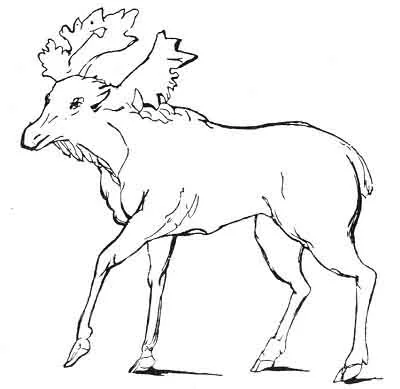 The ELK (Norse, ELG; Lapp, SARV), copied from ''The Natural History of Norway,'' by Pontoppidan, Bishop of Bergen. Gaelic, according to Armstrong, LON. EILID, according to translators of the Bible, ''Ossian,'' and modern poets, means a hind or roe. |
at times superhuman, at others human, which evidently tends to shew that these poems unite many periods, and that probably they have embodied the substance of more ancient poems. At times huge giants and weapons are mentioned, such as--
Bha seachd troidhean arm air liad,
’S ochd troidhe diag air fad ann.
Seven feet was he in breadth,
And in length he was eighteen feet.
A remarkable feature in these poems is the magnanimity and gallantry which distinguish their heroes, though mixed with much barbarism and fierceness. There is fair play given to the enemy; and when he is not fighting with them, he is invited to their feast; if he falls in battle he is honourably buried, and receives credit for his bravery; his memory is cherished, esteemed, and loved, for his valorous deeds. Women are always protected and treated with courtesy; nor is there the least hint given that they were either kept in bondage, or doomed to slavery; on the contrary, their wishes seem to have been considered as something to be gratified, but never to be contradicted; and yet some of the women who repeat such poems work hard as field labourers, and the men are of the poorest classes.
In their ballads the incidents are few, but elevated, and the narration flows along in an easy, simple, but dignified strain. No tedious verbosity mars or interrupts the vigorous character of the poetic stream. Rapidity seems to have been the chief aim of the ancient bards, and the action rolls along like the impetuous torrents of their own mountain country. There is no vagueness, no mistiness, no obscurity; the action is as vividly clear to the mind's eye as the landscape is to the eye itself on a bright summer day. The introduction is always abrupt and simple, and this is the character of mostly all Scoto-Gaelic poetry; for in this manner all known Gaelic bards, learned and unlearned,
begin their songs and lays. They invoke neither spirits or muses, but begin at once. If these ballads do not abound in long sentimental speeches, still genuine touches of true feeling are to be found most exquisitely and tersely expressed. In a warlike age the passions are strong, and not often under proper restraint. Strong attachments and resentments belong to the men of such an age. They are by turns fiercely cruel and nobly generous, but both their cruelty and their generosity are manifested in acts rather than in words. That sentimentalism which is rich in words and poor in deeds was but little known in those days. There is a sentimentalism which is after all but a poor shadowy substitute for genuine feeling. It showers oceans of tears on distress, but will not move a hand to relieve it; it gives soft and commiserating words to the needful, but clings firmly to its gold and silver; it pities in sighs, but not in sovereigns. Sterne wrote the Sentimental Journey, and lamented in dolorous strain over a dead ass, but he allowed his poor old mother to pine away in prison, and advanced not a stiver to procure her liberty. Though these lays are void of this tinsel, they possess what is really more valuable--truthful delineation of human nature, of lofty bravery, and of true and real feeling. Popular poetry has no morbid sentiment, and the people are kind to each other.
Besides the ballads, which form part of what is usually called "Eachdraidh na Féinne," the, history of the Feinn, there are numerous traditional ballads and scraps of poetry similar to them in character, which treat of giants, enchantments, and supernatural deeds; some which treat of fairies, and fairy lovers; some of the loves of men and women. Short passages, stanzas,
and lines of poetry, ascribed to Ossian, are even still recited through a great many parts of the Highlands, and tales about the Feinn, interspersed with verse, are yet to be heard in many districts from old men. There are very few old Highlanders that cannot even now say something about Fionn and his heroes; how they fought and died. Proverbs, old sayings, and puzzles, are connected with their names. A proverb, which is heard at almost all convivial Highland meetings, is "Cha do dhi-chuimhnich Fionn fear a dheas laimh riamh," Fionn never forgot his right hand man. Rocks, hills, streams, and places are called after the Feinne. Surnames are derived from them; such as MacDhiarmaid, the son of Diarmaid; MacGhill Fhaolan, the son of the servant of Faolan (MacLellan); MacGhill Earragain, the son of the servant of Earragan (MacLergan); MacOisean, the son of Oisean; MacCuinn, the son of Conn (MacQueen); and generally the Feinne and their exploits pervade all Celtic Scotland and all Gaelic tradition.
If these poems be not ancient in substance, how is it that they differ so widely from the works of the best of the modern Scoto-Gaelic bards? How is it that they have not mixed up with other songs and poems? How is it that guns, powder, and modern dresses have not crept in? How is it that we have no lieutenants, captains, and colonels, dukes, marquises, and earls amongst the Feinn? How is it that we have none of the scriptural allusions and quotations which are scattered so plentifully through the works of Gaelic poets in general? How is it that we have nothing new in the ballads, while prose tales have altered with the age? We might expect that modern poets would have armed Fionn with a musket, or culverin; or even have made
him and his followers use cannon. I heard a story told of Fergus the First, king of Scotland, in Barra, in which that ancient monarch was armed with a gun; strange that the Barra people never thought of arming Fionn and Diarmaid with one a-piece, more especially as these warriors are much more popular in that island than Fergus the First.
Much of the groundwork of these ballads, as well as the substance of many Fenian tales and traditions, are embodied in the Gaelic Ossian published from MacPherson's manuscript, but there everything has undergone an entire change. We have no longer the simplicity of the traditional poems; smoothness of versification is almost entirely wanting, and the idiom of the language is every now and then violated. Inversions abound, such as we find in learned English poetry, and words are so wrenched out of their general meaning, as to be unintelligible to the generality of Highlanders; but while this is the case, there are but few ancient or obsolete words. In this respect this Gaelic contrasts with that of traditional ballads. The difficulty of understanding the epic poems does not lie in ancient forms of speech, or in old obsolete words, but in the strange liberty that is taken with words by using them in quite a new way, and in arranging them in a manner that is incomprehensible to those whose native language the Gaelic is, unless they happen to know English, or some classical tongue. In many lines the words only are Gaelic; the structure has nothing to do with that language. The sentences may be English, or Latin, or Greek, may, in fact, be specimens of a new universal language, but they are not Gaelic. Vagueness and obscurity abound everywhere, and like the darkness of night which makes hills and dales appear
like lofty mountains and deep ravines, these poems impress a person, before he has examined what he has been reading, with something akin to sublimity. Some lines prove to be nonsense when closely examined. Bad grammar and violated idiom abound everywhere. Adjectives of more than one syllable are placed before substantives, which is much the same as if we were to say in English, "There is a horse beautiful; O what a house elegant!"
Heroes always drink out of shells, lead a hunting life, and address one another more like modern sages than barbarians. A teacher of ethics could not be more sententious or moralizing than they are.
"Màile" for mail is a frequent term, but it is a mere English corruption; luireach is the Gaelic word. On reading a line, containing this word, to an acquaintance, he understood it to mean màl, the bag of the bagpipes. This word does not occur in the popular poems, and is hardly known to Highlanders in general, in the sense in which it is used here. Endless passages might be quoted to illustrate the preceding statements.
In Carthonn, page 55, occurs the line--
"Tri giubhais ag aomadh o'n torr."
This is exactly what might occur to a person translating the English expression "three firs," but no name of any species of wood is ever used in Gaelic to designate a tree; we must say--
"Tri craobha giubhais," three fir trees, and so with other trees. It is bad Gaelic to say--
"An cluaran glas air chrom. nan càrn."
The green thistle on the bend of the cairns; for "crom" is never used as a substantive, and means "bent."
"Mall ag aomadh mu uaigh an t-seòid."
(Slow inclining about the grave of the hero) is bad Gaelic. "Mall" in this line would require "gu" before it to make it an adverb, and good Gaelic.
"Tha mo chlaidheamh crith mhosgladh gu cheann."
My sword is shaking waking to its hilt. This line, as printed, is nonsense, but the idea of a sword quivering and awaking is good, and a small change would make the line Gaelic.
In "Gaol nan daoine," page 75, the following line occurs:--
"Gu Selma nan lan-bhroilleach òigh."
"Lan-bhroilleach" is here placed before the substantive, which is incorrect, and very bad Gaelic; the term is altogether very awkward, for were we to say, "nan òigh làn-bhroilleach," it might convey the meaning of a maiden full of breasts, instead of full-breasted; but there is a Gaelic expression commonly used to convey the idea intended.
"Dh' aom a shleagh ri carraig nan cos" is bad.
"Aom" implies motion into an inclined position, and this line means "his spear toppled towards the rock of crannies," not "his spear leant against a mossy rock," which the context shews was the intended meaning.
In p. 108 of Fingal occurs the line--
"Cuchullin nan gorm-bhallach sgiath."
Cuchullin of the shields blue spotted, which arrangement of words violates Gaelic idiom.
Duan 4th, p. 264 of Tighmora--
"Thainig i le suilibh caoin,
A measg chiabh a bha taomadh gu trom."
"She came with mild eyes among locks that were pouring out heavily." These lines make no sense either in English or in Gaelic, but they are intended to describe mild eyes amongst flowing locks.
Tighmora Duan 7, p. 507-
"Tha 'n speur an losgadh nan reul," means--
"The sky is in the burning of the stars," but is probably intended to mean that the sky is in a blaze with stars.
Carthonn, p. 63.
"Chunnaic oigh Dan uchd glana na tréin," means--
"The maiden of the clean chests saw the heroes."
"Thaom iadsa' chéile 's a' bhlàr," means, to a modern Highland ear, "They poured themselves out into each other in the battle."
These are a few examples of passages which seem to me obscure, improper, or nonsensical; they might be multiplied considerably.
The language of the printed Ossian of 1807 differs entirely from that of the traditional ballads now ascribed to Ossian; it differs entirely from that of other published Scoto-Gaelic poetry, except Dr. Smith's Sean Dana, Mordubh, and a few other pieces published by Gillies, Stewart, MacCallum, etc., and the language appears to be more tinged with foreign idioms even than Sean Dana, or any other Gaelic publication which I have read, Mordubh and some modern translations from English only excepted; it differs entirely from Gaelic as spoken at present in the Highlands; and it differs entirely from that of the Irish Ossianic poems
which have been published by the Irish Ossianic Society. All these have a common bond, a common idiom, a common structure, though they differ in minutiae, and the common general idiom is seldom violated by any of these.
Lastly, the Gaelic of 1807 differs from any specimens of ancient Gaelic which I have seen, but, there are some passages in it which strike me as good specimens of Gaelic and of poetry.
On examining other Gaelic poetry which has been published, it will be observed that it undergoes a gradual change in character from the more modern to the more ancient. The style and language alter as poems recede from the present day, and as it may be of some interest to the English reader to know something of this class of Gaelic poetry, it may not be out of place to give a short account of some few of the best known bards, and of a few of their works which bear upon Ossian.
We have Gaelic bards even in our. own day, and these describe the life and manners which they observe around them-the dress, arms, food, drink and habits of the day. Peasant bards are by no means extinct in the Highlands, and if their composition be not poetry of any great merit, they generally contain good sense and sprightly humour couched in pretty smooth verse. Almost every Highland district has even yet a bard who enjoys a fair amount of renown in his own neighbourhood, and among his own class. Hector Boyd, who narrated to me so many tales, is reputed a bard in Barra; in North Uist, Christian Macdonald, of whom I received several tales, is highly esteemed as a poetess. I was recommended to call on a man near Stornoway who is rather famous in Lewis, and whose
name reached me even in Barra, a hundred miles away I know some even in my own neighbourhood in Islay though I have been told somewhere that Islay never produced a bard. To this I replied, that probably that was because the calling was not now respected there; as a proverb current in the island would lead us to infer:--
"Bàrd, a's ceàrd, a's filidh."
A bard, a tinker, and a musician, which is the meaning of these words in Islay now.
In examining the works of modern Gaelic bards, we find that figures and phrases, nay entire verses, have been, considered common property. The same similes and phrases are used by all; and sometimes a new song is but an old one with new names and a few alterations. An old song seems to have been considered good material for a new one, exactly as the stones of an old house are taken to erect another, and Druidical circles are broken up to make farm-steadings.
It was quite a custom in the Highlands, and that not long ago, to meet for the purpose of composing, verses. These were often satirical, and any one who, happened not to be popular, was fixed upon for a subject. Each was to contribute his stanza, and whoever failed to do his part was fined. Whenever a verse happened to be composed that was pretty smooth and smart, it took well, as might be expected, and spread far and wide like ill-natured satire elsewhere. An exact counterpart of this custom prevailed among the ancient Icelanders, many of whom were descended from men: who emigrated from the islands where the custom still survives. The Burning of "Njal," whose name is now a common one in the Highlands, and is pronounced
nearly according to the English value of these letters, took place in 1011, and many of the tragical events recorded in the "Njal Saga" grew out of a ballad composed and sung at a meeting of neighbours in the house of Gunnar of Litherende. 1
Stanzas were at times added to old songs, and others were altered, but such alterations were not often successful, as old men and knowing critics objected. It was only when they possessed superior merit that they passed current; but as the Highlanders have a great veneration for their old ballads, any alterations made upon them gave offence, and were rejected with indignation. This spirit must have helped to preserve these.
Recent Gaelic songs describe the manners of our own times, the dresses, arms, and professions of the day, but allude to past ages, and often mention the Feinne as well-known heroes.
Among the latest bards, some of whose work have been published in the "Beauties of Gaelic Poetry," is DONALD MACDONALD, who was born in Strathmore, Ross-shire, in the year 1780, and who died of cholera in 1832. Two of his songs only are published, one to Napoleon Buonaparte, and another to his sweetheart. In the song to his sweetheart, figure the words parson and seisoin. It is full of amorous sentiment; he must die without his sweetheart; the silver of Europe and the gold of Egypt would not avail without her.
The song to Buonaparte begins in rather a lofty strain; the bard stands on the pavement of Edinburgh and sees the banners flaming in the sun; he hears the guns, and he stays listening to them; he hears the echo of the rocks replying to them with joy; he hears music
in every house; he sees bonfires on the hills. It is heard from the gasaidean (gazettes), read everywhere, that Buonaparte had to fly. Righ Deorsa, Cæsar and his legions, the most of the Highland clans, the ten plagues of Egypt, Fontenoi, Morair Hundaidh, Diuc Earraghael, Diuc Mhontrose, Hanobher, chomannda (command), retreat, are names and words that embellish this modern Gaelic lay.
ALEXANDER MACKINNON is another bard that was nearly contemporary with the preceding. He was born in Morar, Arisaig, in the year 1770, served in the 92d regiment, and fought in the battle of Alexandria, where he received three severe wounds, which disabled him for any future service. He died at Fort-William in 1814, at the age of 44. His songs are composed on the army, and on the battles fought between the French and British. He is extremely fluent in language, and his verse is very smooth. He seems to have been desirous of writing pure Gaelic, and avoiding English words; for Sydney Smith is called Mac a Ghobha, Smith's son; but for all that we have comisari. He compares Abercrombie to Fionn--not Fingal:
"Mar Fhionn a' mosgladh sluaigh,"
Like Fionn arousing hosts.
The names Alexandria, Aboukir, Abercrombie, occur. Sasunn, England, is mentioned as a place,
"Far am faigh sin leann am pailteas."
Where we shall get ale in plenty.
The poet describes the shock of battle with graphic vividness, and speaks like an eye-witness.
The style of EWAN MACLACHLIN, though he was classically educated, and composed in four languages,
does not differ much from that of the other Gaelic bards; whom he seems to imitate closely. Though he helped to prepare the Gaelic Ossian for the press, and transcribed many old manuscripts into the Roman hand, he has taken very good care, not to imitate the Gaelic of the Ossian of 1807, in the least, in his songs. These are composed in pure and beautiful Gaelic; though, like the most of the Gaelic bards, he indulges in excess of epithets, many of his lines consisting of strings of adjectives or adverbs. Phœbus, Bhenus and Eolus lent their aid to the well-instructed classical Gaelic bards, as they do to the classical bards of other countries. Though the poet apparently has endeavoured to keep English out as much as possible, still he has failed, for a few English words have entered, such as pacar, will be packed; sign, for one of the signs of the Zodiac.
JOHN SHAW, Loch Nell's bard, was born 1758, and died 1828. Among his songs is one to Fionnla Marsanta, Finlay the merchant, who seems to have had some antiquarian taste and who dug up some old Druidical burying places, Carn nan Druidhneach, the Druid's Cairn. Of this act the poet expresses his disapprobation, and denounces Finlay for his conduct in very bitter words. There is a song to Buonaparte, whom the bard defies in strong language, enumerating the brave soldiers that were to meet him on British ground, and telling the hero of Marengo how he was to be treated; by--
"Na shracas t-eanchainn agus t-fheoil,"
Those who will rend thy brain and thy flesh.
A very pretty love song is also amongst his compositions.
We have in the song of Finlay a description of blasting
rocks with gunpowder, which seems to have a double meaning.
"Bhi cuir fudair anns na creagan,
Chuireadh e eagal air bòcain
Bhi gan tolladh leis an tora,
’S bhi gan sparradh leis na h-òrdan."
"Putting powder into rocks,
It would terrify the bogles
To bore them with the jumper,
To be driving them with hammers."
Tobacco comes in also--
"Tha Dughall trom air an tombaca."
Dugald is heavy on the tobacco.
The narrators of stories and reciters of verses in the Highlands are generally fond of the weed; one storyteller makes a raven chew tobacco; but no reciter of Fenian poetry ever makes Fionn, Diarmaid, or Goll use the weed in any shape. The following English corruptions occur in the songs of this bard--bhaigeir (beggar); bhlastidh (blasting), fudair (powder), reisimeid (regiment), volunteers; and the dress of the volunteers of that period is concisely and graphically described. Boinneidean, bonnets; cotaichean sgarlaid, scarlet coats; suaicheantas an righ, the king's arms; cocard de dh' ite 'n eoin, cockade of the bird's feather; and this is a true description of the dress of that period.
There is an allusion to a well-known weapon of a preceding age which had fallen into disuse, to the poet's regret;--for he says--
"’S na 'm biodh againn mar bu dual duinn,
Lann chinn Ilich air ar cruachain,
A sgoltadh an ceann gan guaillean,
Ga 'm bualadh le smuais nan dorn."
O had we as we ought to have
Islay-hilted blades upon our thighs,
Could cleave their heads down to the chin,
To smite them with the pith of fists.
ALLAN MACDOUGALL, Ailean dall, was born 1750, and died 1829. One of his songs is to Glengary, "Luchd bhreacan an fheilidh." Those of the tartan dresses (now called belted plaids) are mentioned as those that would rise with Glengary their chief. "Fuaim fheadan," the sound of chanters, and "binneas theud," the melody of strings, are mentioned as pleasing to the chief, who therefore enjoyed pipe music, and that of stringed instruments. In his songs to the shepherds, who were not favourites with the poet, he says of them that they have a Lowland screech in their throats crying after their dogs, and earnestly desires to keep them out, and not let their nose in, the reason being given in the following lines:--
Bho nach cluinnear aca stori,
Ach craicinn agus cloimh ga reic,
Cunntadh na h-aimsir, 's gach uair
Ceannach nan uan mu 'n teid am breith."
Since no tale is heard with them,
But of skins and wool to sell,
Telling the seasons and every weather,
Buying the lambs before they are born.
This, then, was not an age of pastoral Gaelic poetry, and the poet seems to have foreseen what has happened.
The poet has a song to whisky also, in which he
dwells on the wonderful virtues of that drink like a man who likes it. "It is delightful music to hear its murmur coming out of the stoup, heaping the cuach; excellent to excite to dancing in the winter time; it would make an old man hold up his head; it will make a soldier of the coward; it will bring out conversation at meeting and assembling; it is an unblundering physician; the children of the Gael have no disease or ailment that it will not heal." But there is another song composed to drunkenness, in which the serious effects of the favourite cordial are very feelingly expressed. The whole drinking bout is delineated with great animation. The man loses his strength; his sight fails; coming home in the dark he falls on his back in the midden. Morning brings disgrace; his breast is in flames, the rest carrying him home, believing all the time he was strong; till at last he had lost his wits. After this come reflections on the folly of drinking and of emptying the purse. So modern Gaelic bards have been given to moralizing, and jollity, war, and love-making, but so far there is nothing in their compositions like the Fenian ballads, or the sentimental poems concerning their heroes whose authors are unknown.
WILLIAM ROSS was born in- Broadford, parish of Strath, Isle of Skye, 1762; and died in 1790. He was grandson, by the mother's side, to another celebrated bard, known as the blind piper. At school he studied the classical languages, and in his songs the polish of the man of education may be traced, as his style is refined and cultivated, though remarkably natural and easy. The reader may perceive, without much difficulty, that he exerted his utmost endeavour to write his native language with purity and elegance. In his poetry we trace something like the gay, amorous strain of Moore,
though not his richness of fancy; the spirit of the classical poets may be readily traced in his verses. Some passages in his love songs are real gems, the force of the following lines could not easily be rendered in translation:--
Tha deirge 's gile,
Co-mhire gleachdanaich,
Na gnùis ghil éibhinn
Rinn ceudan airtneulach."
The following gives the idea, but the spirit is gone:--
"In her fair blythesome face, which has made hundreds long and grieve for love, the red and white are sporting with each other, and gently struggling for mastery."
The Gaelic diminutives, which make this verse so pretty, have no English equivalents.
He composed an elegy on the death of Prince Charles, whom he calls "An suaithneas bàn," the white badge. This elegy shows how deep the feeling of attachment to that unfortunate scion of an unfortunate house, had sunk into the hearts of the poet and his countrymen. The following are a couple of stanzas from this pathetic poem:--
Nis cromaidh na cruitearan grinn
Am barraibh dhos fo sprochd an cinn;
Gach beò bhiodh ann an strath na 'm beinn
A’ caoidh an co'-dhosgainn leinn.
Tha gach beinn gach cnoc, 's gach sliabh,
Air am faca sinn thu triall,
Nis air call an dreach 's am fiamh,
O nach tig thu chaoidh nan cian."
Now the sweet lyrists will bow
Their heads on the tree-tops in woe;
All that live on hill or plain
Their common loss with us bewail.
Every hill, and mount, and moor,
Upon which we saw thee move,
Now have lost their sheen and beauty,
For thou wilt not come back for aye.
This differs widely from the spirit and metre of Ossian, both traditional and published.
The Highland dress is a favourite theme with Ross, as with other Gaelic bards. In a song, which fits the music of a reel, he rejoices over the Act of Parliament which repealed the Act forbidding the national costume, and gives a glimpse of Highland manufactures, which still survive in spite of spinning jennies. He says-
Thainig fasan anns an Achd
A dh' ordaich pailt am féileadh;
Tha éridh air na breacanan
Le farum treun neo-lapanach.
Bidh oighean thapaidh sniomh 's a dath,
Gu h-éibhinn ait le uaill;
Gach aon diu 'g eideadh a gaoil fein
Mar 's réidh le' anns gach uair."
A fashion has come with the Act
That ordered kilts in plenty;
There's raising of the tartan plaid
With dexterous busy noise.
Smart maidens now will spin and dye,
With mirth and fun and pride;
Each one adorning her own true love
As always is her joy.
This bard has also a song to whisky, and another to "Macnabracha," the son of malt. Whisky is drink, par excellence, which would raise the mind to politeness; and not "druaib na Frainge," the trash of France, by which he means wine; it will make the maidens speak, however modest; it will put gentleness in the boy; it will make the carl amorous. An t-Olla MacIain, Dr. Johnson, according to the bard, took a glass of it himself, notwithstanding his Greek and Latin, and thereby impaired the power of his tongue.
"Dh' fhàg mac na bracha e gun lide,
Na amadan liotach dall."
Mac malt has made him speechless,
A thick-speaking blinded fool.
Classical names are interspersed through all his compositions, while Greek and Roman deities are favourites. Phœbus gilds the mountains, Flora covers each hill and dale with flowers; his sweethearts have all the qualities of Diana; Cupid throws his arrows with a lavish hand, the flames excited by the love-god are to be quenched only by yielding to Venus and Apollo; and the nine play their part. But English corruptions are not to be found, and the Gaelic is very pure and correct. Ross is not so profuse in epithets as the other poets, but he has enough to be in character with them.
DUNCAN MACINTYRE was born in Glenorchy 1724, and died in Edinburgh in 1812. The first of his ballads is composed to the battle of Falkirk, fought between the royal forces and the Highlanders who joined Prince Charles. The battle is described with very great graphic power; and though the bard fought upon the royal side,
it is evident, from his song, that the Prince, and those who followed him, had a warm corner in his heart. His own flight, and that of his party, is told so as to lead us to think that he was not at all displeased with the result. "As a dog," he tells us, "chases sheep while they are running down the face of a glen, 1 so were they scattered on our side;" the horse of the enemy were well shod, well bridled, and marked out for murder. Moreover, be tells us also--
"Bha ratreud air luchd na Beurla;
’S ann daibh fein a b' éiginn teicheadh."
The outlandish speakers retreated;
It was they who had to flee.
Another song of his is composed to the musket, in which he personifies that weapon, calling it his sweetheart, and enumerating all its good qualities. "Seonaid" (Janet) is her name, and "George" is her grandfather. In Gaelic there are but two genders, so that every inanimate object is personified in ordinary speech, hence formal personification is seldom found in the poetry of the language. The poet tells that he scours his musket himself, and puts oil on it; that he puts it to his eye, and that it will not miss fire; it will keep him in drink in the alehouses, and it will pay each stoup that he buys; it will keep him in clothes and linen; so that he may lay the cares of the world aside.
One of the longest of his pieces is "Beinn Dorain," which is very much admired. It imitates a pibroch, and the stanzas vary exactly as the pibroch does; some of them being in a slow, and others in a quick
measure. The poet is very happy in his verse, which is exceedingly smooth and fluent. This poem is entirely descriptive. Whatever is interesting about this mountain, which gained so much of his admiration, is given with great minuteness. The wood, the deer, the hunt, the wild flowers, and herbs, are portrayed with great vividness; still there is an excess of epithets, which is tedious. MacDonald composed a piece of the same kind previous to this, which Macintyre has imitated; but, in fact, the measure is but a mere extension of the poetical parts of the long heroic tales which were in those days, and still are, so abundant in every district of the Highlands. The measured prose of those tales resembles a pibroch, as may be seen by glancing at the tale of "The Slim Swarthy Champion," W. H. Tales, vol. i. "Coire cheathaich" is a beautiful descriptive poem, full and circumstantial, but less tedious than Beinn Dorain.
The following specimen will give an idea of this species of poetry, though translation cannot convey the original vigour of the reader:--
"Tha bradan tarra-gheal 's a' choire gharbhlaich,
Tha tigh'n o'n fhairge bu ghailbheach tonn;
Le luinneis mheamnach a' ceapadh mheanbh-chuileag,
Gu neo-chearbach le cham-ghob crom;
Air bhuinne borb, is e leum gu foirmeil;
'Na eideadh colgail bu ghorm-glas druim;
Le shoillsean airgid, gu h-iteach, meana-bhreac
Gu lannach, dearg-bhallach, earr-gheal sliom."
There's a white-bellied salmon in the rough grassy corry,
Coming from the sea of the wild raging waves;
With stalwart leapings catching the little flies,
Unfailingly, with his bent crook'd nose.
In the raging current as he leaps so cheerily,
In his gallant array of the blue-gray back,
With his silvery spangles well finned, and fine spotted,
Scale-i-ly, red-spotted, white-tailed, and slim.
This is genuine Gaelic poetry of a man who could read nature, though he could not read books; and his countrymen have done well to erect a monument to Duncan Macintyre near his favourite glens, at the head of Loch Awe.
In one of his love songs is the expression "Deud gheal iobhraidh," white ivory teeth; while his own occupation of huntsman is portrayed for us in the following lines:--
"Mharbhainn duit geòidh,
A's ròin, a's eala,
’S na h-eòin air bharraibh nan geug."
I'd kill for thee geese,
And seals, and the swan,
And the birds on the tops of the twigs.
In his song to the Black Highland Watch, in which the bard beautifully delineates the exploits of that regiment, they are mentioned as dressed-
"Le 'n osanan breaca
’S le 'm breacana 'n fhéil,"
with chequered hose and with belted plaids; armed with "glas lann," gray blade; "’s an dag," and the pistol,
"Gan tearmunn nan sgéith,"
Without protection of shields,
"Le 'n gunnacha glana,"
With their glancing guns,
"Spoir ur air an teannadh
Gu daingeann nan gleus,"
new flints tightened firmly in their locks; biodagach, daggered; fudarach, supplied with powder; adharcach, supplied with powder-horns; 1 so he describes the dresses which he saw; but, yet, in a song composed in praise of the Marquis of Breadalbane, occur the lines--
"’S tu thog na ciadan
A shliochd nam Fianntan;"
It is thou who hast raised hundreds
Of the offspring of the Fenians;
from which it appears that the poet considered his countrymen to be the descendants of the Ossianic heroes.
He has a song to breeches, in which he complains sadly of being obliged to wear them; the tightness about the knees he considers extremely inconvenient.
"Putanan na glùinean,
As bucalan gan dùnadh,"
Buttons in its knees,
And buckles enclosing them.
Like Ross, Macintyre rejoiced at having the dress of his country restored, and at being no longer obliged to wear-
Cota ruigeadh an t-sàil,
Cha tigeadh e daicheil duinn."
A coat that would reach the heel
It would not become us well.
Chuir sinn a' bhrigis air làr,
’S cha d' thig i gu bràth a cùil."
We have laid down the "breegis" on earth,
She will never come out of the nook.
Then comes something more agreeable--
"Osan nach ceangail ar ceum,
’S nach ruigeadh mar reis an glùn."
Hose that bind not our stride,
That reach not the knee by a span.
The Highland dress is a principal theme with all the bards that flourished at the same period with Macintyre. They grieve deeply for being deprived of it; praise it as the finest, the most becoming, and the most convenient of all garbs. Breeches, black hats, and long coats, are made the subjects of keen satire; and the bard taxes all his wits to make the lowland dress the most ludicrous and the most contemptible that can be conceived. Like other poets of the same period Macintyre composed bacchanalian songs, mostly in praise of whisky, but there is one to brandy, from which it appears that the Gaelic poet by no means coincided with Burns in his opinion of this drink, for he does not call it burning trash, but praises it.
In his "Moladh Dhun-Eideann," the praise of Edinburgh, the appearance of the city, and the dress of the period, are described by the poet in his happiest manner,--
"’S iomadh fleasgach nasal ann
A bha gu suairce, grinn:
Fudar air an gruagan," etc.
Of the ladies he says--
"Stoise air na h-ainnirean
Gan teannachadh gu h-ard."
"Buill mhais air eudainn bhoidheach."
"Brog bhiorach, dhionach, chothromach,
’S bu chorrach leam a sàil."
Many a gentle youth was there
That was polite and kind,
Powder upon their hair, etc.
_____
Stays upon the demoiselles,
To tighten them above.
_____
Beauty spots on pretty faces.
_____
Shoe pointed, tight and elegant,
And tottering seemed the heel.
There is no gas mentioned, for there was none; but what there was the bard tells--
"Bidh lochrainn ann de ghloineachan,
A 's coinneal anns gach ait."
There will be lanterns of glasses there,
And a candle in every place.
"Clous na Parlamaid"--the Parliament Close--occurs.
So Macintyre described what he saw, in good Gaelic verse, which fits the music of his time, and alluded to
the Ossianic heroes as to something well known to everything, though of a past age.
ROBERT MACKAY, a native of Sutherland, usually called Rob donn, Brown-haired Robert, was born in the year 1714, and died 1778. His Gaelic is full of English words, but there is no trace of English idiom. Among his songs is one in praise of Prince Charles, in which the prince is compared to Solomon in wisdom, to Samson in strength of hands, and to Absalom in beauty. There is a song, but not one of praise, to long black coats, "Oran nan casagan dubha." Mackay is one of the keenest of Gaelic satirical poets. The following English corruptions are found in his songs--line, parlamaid (parliament), pension, sergent, chomision (commission), choilair (collar), gabharment (government), prise (prize), strainsearan (strangers), tric (trick), ranc (rank), fhine (fine), bhataillean (battalion), election, chomrad (comrade). While all these English words have crept into this bard's composition, his Gaelic is, at the same time, strictly grammatical and idiomatic. The only allusion to the Feinn in his songs, is in the case of a servant whom he has nick-named Faolan, but that is enough to shew that he knew about the Feinne.
LACHLAN MACPHERSON of STRATHMASIE, was born in the year 1723, and died in the latter end of the eighteenth century. Four songs of his are published in the "Beauties of Gaelic Poetry," and some are in Gillies. One is a lament for Hugh MacPherson of Cluny; one is a coarse satire on drunkenness; another, called "A' Bhanais Bhàn, " the white wedding, is a very humorous song, in which a newly-married couple, well advanced in years, are the subject; another to breeches, is rather indelicate. The language of MacPherson is entirely free from English words or corruptions; it is
pure, grammatical, and idiomatic, whatever the ideas may be. The character of his poetry is that of the other popular bards, and bears not the least resemblance to that of the Ossian of 1807. In his lament, to Cluny he introduces the nine muses. The following is a specimen of his verse, from the White Wedding--
Labhair fear na bainse féin,
Tha dath airgeid oirnn gu léir;
Ciod an cron tha oirnn fo'n ghréin
Mar dean fear beurra rann oirnn?"
The bridegroom he spoke up himself,
We are all of a silvery hue;
What ails us beneath the sun,
Unless a ribald rhyme us?
It is said that a copy of the seventh book of Temora, in Gaelic, still exists in the handwriting of this bard, with all manner of corrections written in. The Gaelic of the seventh book, as published, is very different indeed from Strathmashie's songs, and it is hard to believe that he was the author of Ossian. There is no peculiarity in the idiom of the songs to countenance this theory, which has been adopted by many.
JOHN MACCODRUM was noted in his day for his knowledge of the Fenian poems. Sir James MacDonald of Sleat, in a letter to Dr. Blair of Edinburgh, dated Isle of Skye, 10th October 1763, says of him., "I have heard him repeat, for hours together, poems which seemed to me to be the same with MacPherson's translations."
MacPherson met him on his way to Benbecula, and asked him, "Am bheil dad agad air an Fheinn?" This mode of putting the question is fully as ambiguous as
many passages of the Gaelic Ossian of 1807, for it may mean either, Do the Feinn owe thee anything? or, Dost thou know anything about them? The bard considered. it a fit subject for his humour, and replied, "Cha'n 'eil, is ged do bhitheadh cha ruiginn a leas iarraidh nis." "No; and though they did (owe me anything) it would be vain to ask it now." The poet's banter rather wounded MacPherson's dignity, so he cut short the conversation and proceeded. If the people of Uist were the same race then that they are now, a collector of MacPherson's temper would have very little chance of obtaining either poems or stories, though they were as, "plentiful as blackberries in August;" for whoever expects to be, successful in getting stories there, must cultivate patience and good humour, take a joke and make one; and, if he does that, he may be assured that he can get plenty of fun, as well as wit as brilliant and sparkling as he could meet with in Green Erin, provided he understands Gaelic. There is a lampoon composed by this bard to the bagpipe of one Domhnull bàn, Fair-haired Donald, which is exceedingly humorous, and in which he says--
"Shearg i le tabhunn
Seachd cathan nam Fiantan."
It withered with yelping
The seven Fenian battalions.
But he says, that the Gael loved the pipes as Edinburgh people ti (tea), though this old and execrable pipe had weakened for the first time--
"Neart Dhiarmaid a's Ghuill."
The strength of Diarmaid and of Goll.
Turcaich, Turks, Gearmailtich, Germans, Frangaich,
Frenchmen, figure in this bard's verses. Scripture names are frequent. The names, Righ Phrussia, King of Prussia; Troidhe, Troy; Roimhe, Rome, are also found.
So this bard noticed the small circumstances which mark the manners of his own time, such as the tea-drinking of Edinburgh, and referred to the national music of the Highlands; and to the old heroes as equally well known.
ALEXANDER MACDONALD was born in the beginning of the eighteenth century. He joined Prince Charles in 1745, and many of his songs are composed in praise of the prince and of his cause. His language is exceedingly vigorous, and his poetry is impassioned. Classical names, as well as English words, are freely used, but there is not the least trace of classical imitation in his style, which is as characteristically Gaelic as can be. His songs begin in the same abrupt, simple manner, as those of the most illiterate bards do; and, like the most illiterate of them, he is guilty of an excess of epithets. His pieces composed to nature are purely descriptive. There is one long poem, composed to a ship, remarkable for the manner in which it brings out the power of the poet, and the conspicuousness of the language. Much of this bears a strong resemblance to the description of the sailing of boats in Gaelic tales. The bagpipe he prefers to the harp, which he calls Ceol nionag, maiden's music. Whisky and the national garb have received his greatest attention.
Phœbus does good work for the bard, Eolus will send good strong winds, and Neptune will smooth the ocean. Mars is also busy. Venus and Dido are equalled by his beauties. Telesgop (telescope), sign Chancer, sign Thaurus, Thropic, Chapricorn, Gemini, Mars, puimp (pomp), are terms that occur. Bacchus does not pass
without notice either, for mention is made of "Altair Bhachuis," the altar of Bacchus. Scripture names are frequent. In this respect this bard differs from those who composed the Ossianic poems.
JOHN MACKAY, usually called "Am Piobaire dall, "the Blind Piper, native of Gairloch, Ross-shire, was born in the year 1666, and died in 1754. His versification differs considerably from that of the bards of the eighteenth century being a good shade nearer to that of the Fenian poems. The language also seems to be a good deal older than that of MacDonald or his contemporaries. He makes several allusions to the Ossianic heroes
"Mar Oisian an deigh nam Fiann,"
Like Oisian after the Fiann.
"Mac righ Sorcha, sgiath nan arm,
Gur h-e b' ainm dha Maighre borb."
King of Sorcha's son, shield of the arms,
That his name was Maighre borb--
which-is a quotation from an old ballad which is still repeated.
"’S dh' imich o Fhionn a bhean fhéin; "
And his own wife went off from Fhionn;
which alludes to the story of Graidhne.
Scripture words abound, such as "Gu'm beannaiche Dia," may God bless; "beannachd Dhé," the blessing of God.
The Gaelic of this bard is idiomatic, and not a single English word is to be found in his poems. In his "Coire an Easain," are strings of epithets, which peculiarity, as has been already observed, pervades the compositions of all the known modern Gaelic bards,
The drinking vessel mentioned is corn, a horn, and the drink, wine, not whisky.
RODERICK MORISON, commonly called "An Clarsair dall," the Blind Harper, a native of Lewis, was born in the year 1646, and died at an advanced age. His Gaelic is altogether free from English words and idioms, but is less ancient in structure than that of Mackay, the blind piper. Drinking is mentioned, but the kind of drink is not named. The word stóp, stoup, occurs. The following terms relating to the Christian religion are found:--La Caisge, Easter Day; "Seachduin na Ceusda," the week of the Crucifixion; "Dhireadh a' Charbhais," the end of Lent; and these mark the existence of Catholicism.
LACHLAN MACKINNON, native of Skye, flourished in the middle of the seventeenth century. His language is remarkably pure, and without the least trace of foreign idiom; nor is there an English word to be met with in his verses. In a song composed in praise of a young lady, "Diarmaid" is alluded to--
"Fhuair thu 'n iosad buaidh o Dhiarmaid,
Tha cuir ciad an geall ort."
Thou gotst in loan a gift from Diarmaid,
That puts a hundred in pledge to thee.
This alludes to the beauty spot on Diarmaid's brow, which no woman could see without loving him.
In a satirical song on a certain dagger, the following reference is made to the enchantment of the Feen, W. H. Tales (XXXVI.):--
"Bu mhath 's a' bhruthainn chaorainn i,
'S an coannag nam, fear mor;
'S e Fionn thug dh' i an latha sin,
At t-ath-bualadh na dhorn."
Good was it in the Rowan burg,
And in the big men's strife;
It was Fionn who gave it on that day,
The next stroke in his fist.
The next stanza tells how many men Fionn slew on the occasion; so the poet implies that the dirk in question was a weapon of the time of the Feinne. "Breacan" and "Feíle," tartan plaid and kilt, are mentioned as the dress worn by the Highland chiefs of the poet's time.
NEIL CURRIE, native of South Uist, was born in the beginning of the seventeenth century, and was an old man in the year 1717. In the few pieces of his which are published, we have an insight into the manners of the time. There is the word "puthar," from the English word power. Brandy, French wines, and wax candles, are spoken of as luxuries with which the bard was familiar at the house of his chief. Among the musical instruments mentioned, are the bagpipes and the fiddle. No allusion is made to beer or whisky.
JOHN MACDONALD, usually called Iain Lom, lived in the reigns of Charles I. and II. and died at an advanced age, about the year 1710. His language is full of English corruptions, but is fairly grammatical; yet, upon the whole, in smoothness and elegance of expression be falls far short of a great number of the other bards. As a satirist he has no rival. Scripture names are very frequent in his pieces.
MARY MACLEOD, native of Harris, was born in the year 1569, and died at the advanced age of 105. Her language and verse are remarkably fluent and easy. English words abound, but the idiom is very pure. The harp, chess, and the tales of the Feinne, are mentioned as amusements common in MacLeod's castle. The bow
is spoken of as an offensive weapon then in use, while fire-arms, targets, and swords, meet with their due meed of praise. Scripture names abound.
Many old songs, by known and unknown authors, describe battle-axes and bows, and these may be referred to a period later than the Fenian period, and earlier than that of the bow. Bows and spears are mentioned together in some ballads; spears drop out, and bows are named along with battle-axes; in others, and further on, bows, battle-axes, and firearms, are mixed up together.
The following are lines recited in Islay, and assigned by tradition to the time of the battle of Traigh Ghruineart, fought between MacLean and MacDonald in the reign of James the Sixth:--
Fhir na feusaige ruaidhe,
Gur trom do bhuille 's gur cruaidh e
Bhris thu leithcheannach mo thuaighe
’S gad rinn thu sin 's math leam buan thu."
Man of the russet beard,
Heavy is thy blow and hard;
Thou hast broken the broad side of my axe;
And though thou hast, long mayst thou live.
How the old Highlanders fought with axes we learn from Barbour's Bruce, book second, in which the following expressive lines occur:--
"But the folk of the other party
Fought with axes fellyly;
For thai on fute war ever ilkane,
Thait feile off their horss has slain,
And till some guiff they wounds wid."
An old war song exists, styled, "Prosnacha catha Chloinn Domhnuill le Lachunn, mor MacMhuirich Albanaich, la Catha Harla," "Battle incitement of the MacDonalds, by big Lachunn, son of Albanian Muireach." MacMhuirich or Currie was Clanranald's bard, and this song is said to have been sung by him at the battle of Harlaw. It consists of seventeen stanzas of unequal length, and every word in each stanza begins with the same letter of the Gaelic alphabet, which has but seventeen letters. The particle gu is prefixed to every word, which makes them all adverbs, and so every line of the song begins with g. The Roman order of the letters is followed; that is, a, b, c, etc., which is not the same as the Oghum, or old Gaelic alphabet. The whole is a list of adverbs, excepting two lines at the beginning, and eleven at the end, expressive of various military virtues, all set to a lively quick measure. 1 The number of lines is 336.
The following is the last stanza of this curious old song:--
Gu urlamhach, gu urmhaiseach,
Gu urranta, gu uraluinn,
Gu urchleasach, gu uaibhreach,
Gu uilfheargach, gu uaillfheartach,
Gu urchoideach, gu uabhasach,
Gu urrasach, gu urramach,
Gu urloisgeach, gu uaimhshlochdach,
Gu uachdarach, gu uallach,
Gu ullamh, gu usgarach,
Gu urmhailleach, gu uchdardach,
Gu uidhirnichte, gu ughdarach,
Gu upagach, gu uilefhradharcach,
Gu upairneach, gu urghleusach,
Gu urbhuilleach, gu urspealach,
Gu urlabhrach, urlamhach, urneartmhor,
Gu coisneadh na cathlarach,
Ri bruidh'ne ur biughi,
A Chlanna Chuinn cheudchathaich,
’Si nis uair ur n' aithneacha,
A chuileanan confhadhach,
A bheirichean bunanta,
A leoghuinan langhasda,
Onnchonaibh iorghuileach,
Do laochraidh chrodha, churanta,
Do chlannaibh Chuinn cheudchathaich,
A chlannaibh Chuinn cuimhnichibh,
Cruas an am na h-iorghuil."
So dexterously, so gracefully,
Intrepidly, audaciously,
So actively, so haughtily,
All-wrathfully, so yellingly,
So hurtfully, so dreadfully,
Trustworthily, honourably,
So zealously, so grave-pit-ly,
Superiorly, cheerfully,
So readily, so jewelled,
Well-mailed-ly, high-breasted-ly,
Preparedly, authoritatively,
Pushingly, all-seeing-ly,
Bustlingly, right trimmed-ly,
Well-striking-ly, well-mowing-ly,
Eloquently, dexterously, all-powerfully,
To win the field of battle,
For the telling of your glory,
Children of Conn of a hundred fights,
This now is the hour to know you,
Ye furious whelps,
Ye stout dragons,
Ye splendid lions,
Ye standards of stout battle
Of brave gallant warriors,
Of the children of Conn of the hundred fights,
Children of Conn remember
In the time of battle hardihood.
The arms used at the battle are indicated in various lines throughout the piece. It is worth remark that no fire-arms are mentioned in the Owl, which is supposed to be still older than the Battle Ode.
"Gu cuilbhaireach, gu cruaidhlannach,
Gu sgabullach, gu srolbhratach,
Gu reimeil, gu ughfheinneach,
Gu suilfhurachair, gu saighid gheur,
Gu scianach, gu spionach,
Gu scaiteach, gu sciathach,
Gu tuadhbhuilleach gu tarbhach."
So culverined, so steel bladed,
So scabbarded, so silk bannered,
So powerfully, so Feinne king like,
So knife armed, so pullingly,
So choppingly, so shieldly,
So axe blow-ly, so bull-like,
So eye-watchingly, so arrow sharp-ly.
A "CHOMHACHAG," the Owl, is an ancient piece, published in Gillies, and also in the "Beauties of Gaelic Poetry." It is attributed to one DONALD MACDONALD,
a celebrated hunter, who lived before the invention of fire-arms. This piece approaches nearer to the Fenian poems in character than anything to be found in the compositions of the above-mentioned bards. In one of the stanzas, there is an allusion to the confessional
"Deansa t-fhaosaid ris an t-shagart."
Make thy confession to the priest.
The erection of a mill is spoken of as something notable:--
"’S rinn e muillean air Allt-Larach."
And he made a mill on Allt-Larach.
The hunting life is delineated with glowing enthusiasm, and the various animals of the chase, as well as domestic animals, are enumerated--"eilid," the hind; "feidh," deer; laogh, calf; meann, kid; earb, roe; lach, duck; gadhair, hounds. Bogha, bow, is frequently named, but no other offensive weapon. The Fenians are introduced in one line--
"Chi mi Strath-Oisein nam Fiann."
I see the Strath of Oisean of the Fiann.
Though there is a reference to drinking, no special drink is named. Among the animals, there is no mention of "lon," which so frequently occurs in the Fenian ballads, and which is supposed to be the elk.
In this poem we meet with much of the poetry of nature, but it is very different from that which is found in the Ossian of 1807, or in Dr. Smith's "Seann Dana" (old poems), but it is similar in kind to that which is found in the compositions of the bards already quoted, to that of the Blind Piper, of MacDonald, and of Macintyre. It is descriptive, but neither philosophical nor
contemplative. Natural objects are not so much matter of speculation as of feeling. The poet speaks of them as something that he strongly loves; something to which he is strongly attached; and which he praises as he does his friends, his home, or his country. When this Gaelic bard speaks of inanimate objects, he does it like those above named, he speaks as if they were his familiar friends-we think they live, and that they are in his mind by the fireside along with him. He enumerates every beauty and excellency connected with them; not so much because he admires the beauties that he finds in them, but because he loves them. This is the species of poetry which proceeds from the Celt's strong attachment to home and country-from that feeling which makes him sigh for his native home in a foreign land, though successful in life, and surrounded with comforts-that feeling which inclines him to prefer the barren heaths, foaming cataracts, and rugged mountains of the Highlands to the fairest lands on which the sun shines.
In following the long list of Scoto-Gaelic bards from the present day to the author of "A Chomhachag" (The Owl), we find the spirit of this poetry uniform and unaltered. From Macintyre's "Coire cheathaich" (the Corrie of Mist), to "A Chomhachag" (The Owl), it is very much the same in character. The following quotation from "The Owl" will illustrate what has been said:--
"Creag mo chridhe 's a' chreag ghuanach,
Chreag an d' fhuair mi greis de m' àrach;
Creag nan aighean 's nan damh siubhlach;
A' chreag urail, aighearach, ianach.
Chreag mu'n iathadh an fhaoghait;
Bu mhiann leam a bhi ga taghal,
Nuair bu bhinn guth gallain gaodbair
A' cur gràidh gu gabhail chumhainn.
’S binn na h-iolairean mu 'bruachan;
’S binn a cuachan, 's binn a h-eala;
A's binne na sin am blaoghan
Ni an laoghan meana-bhreac, ballach."
Crag of my heart, the lightsome rock,
The rock where I was partly reared;
Rock of the hinds and roving stags;
Rock that is verdant, and gay with birds.
The rock which the hunting shout encircles
To haunt it would be my joy,
When the voice of the baying hounds was sweet,
Urging the herds to a narrow pass.
Sweet sound the eagles in its braes;
Sweet are its cuckoos, and sweet its swan
Sweeter than all is the bleating
Of the spotted, fine-speckled fawn.
How different is this from the address to the sun and similar poetry in Ossian; yet it will be found to be the same in character with MacDonald's, Macintyre's, and all other modern Gaelic bards. The germ of it is to be found in the Fenian ballads, as, for instance, that line in the Lay of Diarmaid-
"’S gur truagh m' aghaidh ri Beinn Ghulbann."
From the traces of this style to be found in these old poems, it has expanded into its more modern form.
In the works of all these bards, which extend over a period of several centuries; for one piece, composed as a war-song for the Highlanders who fought at Harlaw,
is referred to the same date, 1411, the manners of each age are delineated. There is a difference in the language corresponding to each period, but that difference is inconsiderable. The bards belong to different parts of the Highlands, but no marked difference of dialect appears in their compositions, and this agrees with the prevalent opinion among Highlanders that good Gaelic is something definite, though they are not unanimous with regard to the district where good Gaelic is to be found. The difference in spoken dialects is more in pronunciation, accent, and the use of certain words in one place rather than another, than in grammatical structure or idiom. In reviewing the compositions of these known bards, we observe that, as a rule, the earlier the period the purer is the language, and the freer from English words. The idiom of the language found in this poetry is very far removed from English, and, on that account, it is very difficult to transfer the meaning of a passage accurately into English, and much more so to give its force and spirit. Though the works of these modern bards differ in language from the Fenian ballads, they vary in words rather than in idiom. The versification differs, but the songs approach the ballads nearer, the older they are; almost all these modern poems contain allusions to Christianity and scripture names. No superhuman deeds are mentioned, nor anything out of the range of probability; but when we look at "Mordubh," and the other poems of the same class, we perceive a style that stands far apart from all these, and from the Fenian ballads. Between the language of the Fenian poems, that of the works of the known bards, and that of spoken Gaelic, there is a common bond of union that is easily discovered; the others are something apart.
The preservation of these Fenian ballads for many ages may, at first sight, appear incredible, more especially when successive generations of poetry relating to historical events have died out, and when we have so little concerning the chiefs and warriors that flourished in Scotland during the seventh, eighth, ninth, and successive centuries, down to the fifteenth. We have no traditional ballads that refer to the wars of Wallace and Bruce, hardly a tradition relating to them. All these great men have passed away from the Highland popular mind as if they had no existence, and yet these prehistoric traditions remain. How is it that no succeeding poetry, no national history, has been able to supplant them? If they kept their ground in the midst of the compositions of successive ages, we must surely admit that they possessed a peculiar merit suiting those times, that they were superior to anything new that was produced, or at least that they were more fitted to take hold of the feelings of all periods. It may be asked were they not the compositions of modern bards? Those bards, so far as we know their history, quote them as something older than their own times. Granting that they are not the compositions of any known bard, may they not have been the compositions of bards previous to those, but still of a period not very remote--of the monks of a certain period? Had they been the compositions and inventions of such men, was it likely that there should be so little reference to religion, and to known general history, in the ballads which give the history of the Feinne, as told by Oisein amongst his dialogues with St. Patrick on religious matters, or as they are more commonly now sung, without these pagan polemics. In monkish compositions, Greek and Roman history are often present, and there is much in these
poems which we can hardly think monks would be inclined to encourage. When then was this poetry composed? Was it in the tenth century? If so, what was the poetry of the Gael previous to that century? Had they any? Roman writers answer--"The Caledonians went to fight the Romans singing war songs;" but we are not informed what they sang, though we may surmise. Did Fenians or Fenian traditions exist in the time of the Caledonians? If so, probably there were Fenian ballads then also, and these may be the old ballads of the Caledonians modified, developed, and altered, but preserved from undergoing any radical change by popular veneration down to our own day.
Why these have been so well preserved, and have outlived so many historical periods, may be accounted for by their universality. Highland chiefs were at war with each other, and lasting animosities subsisted between them. A song in praise of a certain chief was not likely to be acceptable to an inimical clan. A ballad in praise of clan Chattan would not please the clan Kay. A poem that extolled the exploits of Robert Bruce, would meet with but a cold reception among the Macdougalls of Lorn, or among the dependants of the Comyns of Badenoch. The bard that would run the risk of praising the merits of James the First among the Grahams, or among the dependents of those relatives of his own whom he had so cruelly executed, might risk having his tongue cut out, but the Fenian ballads could be sung anywhere. They were not likely to excite any feud, or awaken any old grudge, or recall any former disgrace. They were not calculated to wound either a reigning dynasty, or the partizans of a fallen one; and, indeed, during those wild times, when every man's hand was against his brother, what better code of honour
could have existed among such fiery elements. When chiefs violated the principles of chivalry, and honour, and fair play, what better check could we conceive as a moral restraint upon their wild passions from the traditions of the Feinne, whose name is still the watchword for fair play. "COTHROM NA FEINNE," "Fenian's advantage," a fair field and no favour.
______________
To the list of modern bards who refer to the Feinne, may be added the name of Evan MacColl, the Lochfine-side bard, who published a volume of very creditable English and Gaelic Poetry in 1836. At page 94 is a Gaelic stanza, which may be thus closely translated:--
And thou there standing all lonely,
As Oisian after the Feinne;
Small time, and thou followest kindred,
Oh Dun! death's strong hand is upon thee.
The Dun meant is "Castail Donnain," in Loch Dubhaich in Ross-shire. Other references also occur, and it may be generally said that there is hardly a Gaelic book that does not contain such references. William Livingstone, the Islay bard, who published clever poems in 1858, often mentions the Feinne.--J. F. C.
To this let me add the letter of a labourer, who has a good head and small learning, but knows his own language well.
Douchlais, 28th October 1861.
Sir,--I received your letter of the 24th Saturday last.
There is a good many words in Ossian's poems that is not common in modern Gaelic. I have Dr. Smith's Gaelic book, and I got it from a man because that there was so many words in it which he did not know the meaning of, and I understand them.
Them (the poem) that I heard repeated corresponds with those that is in the book.
I am quite convinced that the English was taken from the Gaelic, and not the Gaelic from the English.
It would be quite absurd to think that a man would spend his time studying old Gaelic for to translate English prose, and put it in Gaelic verse, and choose the words as they were spoken about seventeen hundred years ago: it would be a very laborious task; and if the publication was printed, the publisher would be a great loser by it, as so few would buy it, because they did not understand it; and none would be able to do it, unless he was a first-class Gaelic scholar, and a good poet; and also he would have to read some other poems, as old as Ossian's for to find the measure of the metre, as some of them is composed to a measure that is not used in modern poetry. I understand the Gaelic of the published books. I understand the words separately.--
Yours truly,
JOHN DEWAR. 1
To this let me add a letter from Mr. Torrie, now a student at Edinburgh College, who has collected stories for me, and lives in Benbecula.
BENBECULA, SOUTH UIST,
19th October 1861.
MY DEAR SIR,--As I have conversed with almost all those from whom POEMS have been collected in this quarter, I flatter myself that I am now in a position to furnish you with my quota of information on this interesting subject.
Besides these POEMS which have been collected, the proof sheets of which I have perused, a great variety of other poems, which go under the name of "Ossian's Poems," are commonly recited by the people. A few of these I have already sent you; and I have still in my possession two long ones, called respectively--"Teanntachd mhor na Feinne," and "Cath mac Righ na Sorcha." "Laoidh Dhiarmid," "Laoidh Fhraoich," "Laoidh an Amadain Mhoir," "Mhuileartach Bhuidhe," and "Laoidh a Choin duibh," are, however, the most common. Fragmentary pieces of these I have heard recited by some of our highest class; but those who have them most entire, are, comparatively speaking, the poorest and most illiterate in the land--those from whom they might be the least expected--so circumstanced that they have had no access to books, and even should they have, the most of them could not make any use of them. Neither were they in a position to mingle among those who could read, and had books. Books, however, which contain collections of Ossian's Poems, are not so common here as might be expected. None of the reciters that I have met, ever heard of Gillies', MacCallum's, or Stewart's. I have never seen any of these in the islands; and if they are to be found at all, it is with those who prize them too much to lend to such of the poorer classes as could read, to run the risk of being disfigured with black drops, and sure to have the not very agreeable odour of peat-reek. Donald Macintyre, Aird, Benbecula, the best reciter of poems that I have met, and who can read Gaelic well, never saw any book of the kind until I shewed him Dr. Smith's collection. I have traced out another copy of Dr. Smith's at Iochdar, which was presented to one Peter M‘Pherson, a bit of a poet, by the Reverend Duncan M‘Lean, now Free Church
Minister at Glenorchy, when missionary here about thirty-five years ago. Every person with whom I have conversed about Ossian's Poems, and who knows anything about them, admires them very much, and believes them to be the genuine composition of Ossian, as pure as might be expected, considering that they were handed down by tradition, and consequently lost a great deal of their pristine splendour; and received additions which, instead of adding, detracted considerably from their original merit. I believe there are very few in the Highlands, especially adults, but know something of Ossian's Poems. Like the "Popular Tales," which are universally found throughout the Highlands, Ossian's Poems have formed a very important part of the Highlanders' pastime through the long winter nights. When on my way home from Edinburgh last spring, I read "Laoidh Dhiarmid" to a few in Skye. They remembered to have heard it before; and some old men remarked that, when they were young, tales and poems were very common, and regretted very much that they were so much out of vogue with the present generation. I never met with any of Ossian books there but one, the Rev. Mr. MacLauchlan's "Gleanings," presented to a "guide" by an English tourist. I never heard of any Irish book containing these pieces in the islands, nor have I ever seen any myself. As I have not MacPherson's, which is the best known of them all, nor Gillies', nor Stewart's, I cannot say whether those who repeat, recite passages a la MacPherson, a la Stewart, or a la Gillies. Donald Macintyre recited to me a poem entitled "Cath MacRigh na Sorcha," which I find in Dr. Smith's collection, note page 176. They resemble each other very much; in some passages the language is the same; Macintyre's version, however, is longer, though Dr. Smith's, upon the whole,
is more beautiful. In the course of a conversation lately with a gentleman of no mean authority, on the Ossianic controversy, be expressed his surprise that the anti-Ossianics would use such futile arguments as that MacPherson was the author of these poems, or that the people get them from books, while he himself had a distinct recollection of bearing one Rory M‘Queen, commonly called Ruairi Ruadh, who was a catechist in this parish, recite poems which can be found in MacPherson's. This M'Queen died about thirty years ago at the advanced age of eighty. He had a great many of Ossian's poems which he learned when a boy by hearsay, and with which he afterwards used to entertain his hosts when travelling from village to village on his catechetical visits. A niece of his, who now resides at Paible, North Uist, has the same hereditary talent which procured her uncle more celebrity than his catechetical acumen. This MacQueen was no less than fifty years of age when MacPherson's Gaelic was published, and fifty-seven before Stewart's, or M‘Callum's appeared. In whatever way, therefore, people came to have these poems, it is a well-known fact that they never got them from books, for nothing can be more patent than the fact that these poems existed long before MacPherson's, or Stewart's, or M‘Callum's, or Gillies', or Miss Brookes' came into existence. Nor is it consistent to suppose that MacPherson, were he really the author of the poems, would give them unto the world as the composition of Ossian, while they were of themselves sufficient to raise him to the pinnacle of fame, and establish his name as the greatest poet that Scotland ever produced. I do not believe, however, that these minor pieces are the composition of Ossian. They differ as much from them a school-boy's attempts at painting do from the
sublime efforts of Raphael or Michael Angelo. As to the question whether these are Irish or Scotch, I cannot give a definite answer. After some reflection, however, my opinion preponderates to the latter, for though there are some words and phrases which to me were unintelligible until the reciters explained them, and which they considered Irish, still I would not be justified in calling such ballads as contain them Irish, on the slender ground of this more "ipse dixit," for they may have retained that much of the language in which they were originally composed, and which may have been the dialect common in Scotland at that time. They are apparently very old, and it is possible at the time they were composed the language of both countries was the same, considering they had one common origin. By whom they were composed, or at what time they were composed, cannot, with any decree of certainty be determined, They stretch back into a period of whose history I know very little, and, consequently I am precluded from adding more.--Meanwhile, I remain, yours very faithfully,
D. K. TORRIE.
J. F. Campbell, Esq., etc., etc.
To this let me add the opinion of a Highlander, who had had much to do with the publication of Gaelic books, and lives in a city.
62 ARGYLE STREET, GLASGOW,
November, 9, 1861.
My DEAR SIR,--In compliance with your request, I will now proceed briefly to give you my opinion of the poems attributed to Ossian and other ancient Celtic bards. Although a doubt never crossed my mind regarding
the genuineness of these productions, yet after a careful investigation of the subject, I have now a more definite and satisfactory impression of the matter than I had heretofore. I believe that, "Fingal fought, and that Ossian sang," as firmly as I believe any other historical fact. I have now the same opinion of them that I had thirty years ago, when I first began to take an interest in these matters, namely, that such individuals lived many centuries ago, and composed poems that have been handed down from generation to generation by oral recitation, and that many of these fragments have been collected and translated into English, and published by Mr. James MacPherson of Badenoch, exactly a hundred years ago, and by others since, such as Dr. John Smith of Campbeltown, Duncan Kennedy, Hugh and John M‘Callum, etc. I believe all that is truly poetical and ennobling in MacPherson's translation are the productions of Ossian and other great bards of the same era; but while I believe and maintain all this, I gave it as my humble conviction that MacPherson used unwarrantable liberties with his originals. Ossian never composed "Fingal " and "Temora" as they are given by him, and it would be much more to the credit of our country had he given these fragments just as he collected them, without linking them together as he has done, and called them "Epic Poems." I also complain of MacPherson for excluding passages which accorded not with the theory which he wished to establish, and thus endeavoured to fix the Fingalian era according to his own fancy; but this is not the worst--I have a graver charge than any of these to bring against him. I have no hesitation in affirming that a considerable portion of the Gaelic which is published as the original of his translation is actually translated back from the English. I
have discovered this by the aid of fragments (no doubt genuine) published in the Highland Society's Report. These fragments begin at page 192, and end at page 260. A literal translation is inserted on opposite pages, with MacPherson's translation in foot-notes. MacPherson's translation is pretty faithful, with the exception of omitted passages, which under other circumstances might be supposed to have been translated from a different version; but when we are presented with the Gaelic, purporting to be the original, the deception is too transparent to pass undetected. I am aware that this assertion is detrimental to the honesty and veracity of Mr. MacPherson, and perhaps to the character of those who superintended the publishing of the Gaelic after his death, but I affirm this as my honest conviction of the matter; and any Highlander of ordinary intelligence may satisfy himself on this point by comparing the Report and MacPherson's Gaelic. From this, and other circumstances, it is evident that MacPherson determined to appropriate to himself the literary glory of these productions. If not, why bequeath in his "last will and testament" £1000 to defray the expenses of publishing Ossian's poems in Gaelic, English, and Latin? This fact, I think, ought to exonerate those superintending the Gaelic, as they were merely carrying out his request as his executors.
But, notwithstanding all I have mentioned, we are indebted to Mr. MacPherson for what he had done. He was the first to draw the attention of foreigners to those wonderful compositions, and others following his example, matter has been collected and preserved that would have been for ever lost. Mr. MacPherson's translation, in my opinion, is superior to the paraphrase of Dr. Smith; but the Gaelic of Dr. Smith is genuine,
with the exception of his emendations and occasional interpolations, where he thought the sense required it, and which he candidly acknowledged. Dr. Smith being a ready poet, and a thorough Gaelic scholar, spared no pains in making his "Seann Dàna" worthy of the patronage of his countrymen; and no wonder although he was disappointed when his labours were not sufficiently appreciated.
There are other parties who have done some harm, alleging that they were the authors of some of the compositions which passed as Ossian's. Mr. Kennedy claimed some of his collection as his own. Mr. M'Callum of Arisaig published a volume of Gaelic poems and songs in 1821, in which he gives a "Seann Dàn" under the designation of "Collath," which in course of time was honoured by a place in "The Beauties of Gaelic Poetry," the editor endorsing it as an ancient poem; but in 1840 Mr. M‘Callum published a new edition of his poems, and very coolly "removes the deception," using his own words, and avows himself the author of "Collath," and very modestly retains the fulsome notes which he himself appended to it on its first appearance. It is doubtful if the author would have been so ready to remove the deception had "Collath" not been so highly honoured by the editor of the "Beauties." Mr. M‘Callum added a third part to "Mordubh," and 259 lines to the second part more than is given in Gillies' collection. He does not say that the supplement to "Mordubh" is his, neither do I charge him with imposing on the reader by this; but I am not satisfied that either the first, or last, or any part of "Mordubh" is genuine.
I have mentioned these circumstances in order to remove, so far as I can, all that has the appearance of suspicion or doubt about the matter; but all the deceptions
that have been practised do not affect the sterling worth of the poems of Ossian any more than the base coin affects the value of the real one. It will only make those into whose hands it may come try it and make sure that it is genuine.
It may be objected, "How could so much matter be preserved on the memories of the people without the aid of letters?" Those who have lived in the Highlands for any length of time know well how these productions have been preserved. In former times Highlanders bad very little else to remember; or, rather, they did not remember much else. Socially disposed, they spent much time together; on the long winter evenings they assembled in a certain house, rehearsed and listened to these records of Fingalian achievements which were thus interwoven with their mental development. Hence the continual opposition manifested by the religious instructors of the Highlanders to "Sgeulachdan" and Ossianic poetry. These teachers had serious difficulties in getting the attention of the people, in consequence of their minds being pre-occupied and absorbed by this ancient lore.
Bishop Carswell, in 1567, complains of those who spent their time and intellect in perpetuating the records "concerning Tuath de dannan, Fionn MacCumhail and his heroes, rather than write and teach and maintain the faithful words of God, and of the perfect way of truth." But Mr. Robert Kirk, of Balquhidder, who published the first metrical Gaelic version of the Psalms in 1684, is more charitably disposed towards the Fingalians. (See page 71.)
The assertions of Bishop Carswell are fully borne out by the well-known Christian poet, Peter Grant of Strathspey,
who composed about forty years ago. He says in Gearan nan Gaidheal:"--
"An t-Sàbaid ghlòrmhor bu chòir a naomhadh,
’S tric chaith sinn faoin i o cheann gu ceann,
Le cainnt ro dhiomhain mu thiomchioll Fhianntaibh,
’S gach gnothach tiomal a bhiodh 'n ar ceann ;
Air cnuic 's air sléibhtean, 's na tighean céilidh
Bhiodh-mid le chéile a' tional ann,
Ach cha b'e 'm Bìobal a bhiodh 'ga leughadh
Ach faoin sgeul air nach tigeadh ceann."
The glorious Sabbath that should be hallowed,
Oft spent we in trifling from end to end
With useless chattering about the Feeantain,
And each timely matter that was in our mind.
On knolls or hillsides, or in visiting houses,
We would be together all gathering there;
But 'twas not the Bible that was read there,
But a silly tale told without an end.
I think these quotations prove two things; first, that Ossian's Poems are older than James MacPherson; and second, that it is not a matter of astonishment that Highlanders could preserve so much of the poetry of former ages, seeing that they applied all their mental powers in remembering and perpetuating it. I cannot, indeed, wonder at the clergy, teachers, and catechists opposing the "conventicles" (to use an ecclesiastical term) for rehearsing and hearing Fingalian lore, as the practice interfered so much with their usefulness. But these traditions served a purpose, and accomplished their mission; and like other dispensations of antiquity they passed away. They were the "elementary schoolbooks" of the Celts in bygone ages; they helped to
strengthen and expand their memories, and to sharpen their intellects; and the morals inculcated by them were generally sound. Those who are familiar with our national proverbs and maxims, must acknowledge that the men who first uttered them, and those who gave them currency, studied human nature deeply. The Highlanders had also many, problems and riddles, as you are well aware, that required much ingenuity and application to solve. I will refer you to one of these as a specimen; it goes under the designation of "Aireamh Fir Dhubhain." You will find it, I think, in Stewart's collection. There is much truth in what Dr. M‘Leod of St. Columba, Glasgow, uttered on one occasion, although he was laughed and sneered at by some for it:--"Even the superstition of the Highlanders, dark and wild as it may appear, had a happy tendency in forming the character of the Gael." Undoubtedly it had; and while I am anxious that my countrymen should possess knowledge that will be more serviceable to them in time, and shall make them happy in eternity, I am ready to pay my tribute of gratitude to the memories of the teachers of former generations, for inculcating a sense of the instability of everything in this world, and the folly of expecting much from creature comforts--for the love of country and kindred, and for the noble, generous, and hospitable spirit they infused into society--the fruit of which I, in common with my countrymen, am reaping in the latter half of the nineteenth century.
It is evident that the learned pride of many of our Anglo-Saxon neighbours was roused on the appearance of the Ossianic fragments. They could not conceive how an unlettered people could produce such poetry; but they ought to have remembered that the knowledge of letters is but one avenue for conveying knowledge to
the human mind. I have met and associated with individuals who had "book knowledge" in abundance, but yet had neither the sense or the wit of some who knew not the letters of the alphabet, and could not be consulted with equal advantage in a case of emergency. A knowledge of letters, and of the English language, is the essence of all knowledge and wisdom in the estimation of the "Gall." These two items are certainly requisites in our education; but it is doing the Celt great injustice to conclude that because he is ignorant of these he must be very stupid and ignorant of everything. Highlanders have serious difficulties to contend with, which require indomitable courage and perseverance to overcome. A young Celt leaves his native hills with scarcely a word of English "in his head," and comes to the Lowlands. In course of time he masters the language of the "Gall," competes with him, and often beats him on his own soil. There is no evidence of inferiority of intellect in this.
Fearing that I have done more than what you wished me to do, I remain, my dear Sir, yours faithfully,
ARCHIBALD SINCLAIR.
___________
To this let me add the opinion of a Highlander who has been stationed in many districts of the country as an excise officer; a gentleman of good education, and well able to write Gaelic and English, who has been kind enough to collect stories, etc. for me.
"It is well known that, in the absence of literature, men supply the deficiency by tales, which may be of their own creation, or that of ages long gone by. It were strange if the imaginative, the sensitive, the enthusiastic
Gael were without his. Strange it were if the children of the mist themselves were without this poetic element in their constitution. But it is not so. In all ages the Celtic tribes have been noted for their tales, poetry, and music, and all these are characteristic. They breathe the same melancholy sadness, the same enthusiastic wildness, and the same daring chivalry. Their tales are pure and simple, their poetry is assuredly that of nature. It is wild and romantic, sensitive and sad, affectionate and kind. Their music is known and admired all over the world.
There are all sorts of Highland tales--fabulous, and romantic; fairy tales, and tales of superstition, family tales, tales of gallant deeds, and, I regret to say, tales of deadly feud.
The Highlanders distinguish between all these. To the fabulous tales they give no credence, but merely repeat them because they are curious. The romantic tales they do not exactly believe, but think they might possibly be true. Fairy and superstitious tales are not now generally believed. But family tales, feudal tales, and tales of other years form the history of the Highlanders. These they believe, and repeat with pride. A Highlander always takes pride and pleasure in the noble actions and gallant deeds of his country. His own clan is a special pride to him. It is his standard of honour, and he would as soon tell of anything disreputable to his own family as he would to his clan. His clan may be few now, its members may be scattered to all ends of the earth, but he speaks of it when it was a clan, and he recounts its fall with sorrow and regret. These tales are generally to be found amongst the poor and unlettered people. They cherish the memory of their fathers; they tell their tales, recite their poems, and
sing their songs; they have the pride and generosity of their fathers, and, alas! the penury consequent on their fathers' misfortunes. These tales are to be found amongst the old. For obvious reasons, the young do not take the same interest in them. Consequently these relies of antiquity must necessarily be lost, and scarce a trace of them be found in another generation or two.
These old men and women are, indeed, generally poor, but they have generally seen more comfortable circumstances. Their houses may not be perfect specimens of architecture, but they are of kindness and hospitality. Their furniture may not be comfortable, according to the modern acceptation of the term, but it suffices for their use, and every article is endeared by family associations. Their dress may be humble, but it can boast of having been teazed, carded, and spun by a wife or a daughter. It may not be fine, but it is comfortable, and it is, notwithstanding, pleasant enough to look upon. Their fare may not be over plentiful, but the stranger is always welcome to a share of it.
They are never rude, boorish, or vulgar, uncivil, disrespectful, or insolent. On the contrary, they are naturally civil and deferential, but they are naturally reserved. This I have experienced. I have often gone to old men, and although I was told they had the greatest stock of old lore of any in the place, yet they would either equivocate, or maintain the most provoking silence. They would much rather know who I was, if they did not know me, and why I was so desirous to get sgeulachdan faoin sheana bhan--old wives' silly tales. I had always to wait till I had gained their confidence. To shew them that I was interested in their tales, I have often told them one myself--perhaps one I had got a few days before? If they knew of any expressions
belonging to the tale which I had not, they would repeat them at my request. Thus I have often got many valuable additions.
Fabulous tales are the most difficult to get, not because they are the rarest, but because they are unwilling to tell them to strangers. Historical tales are the easiest to get. They are known everywhere, and, more or less, by every person. "Sgeulachdan na Feinn," or the Fingalian tales, are very common. Clan or historical tales, and those of the Fingalians, are the most admired. These are believed in, and consequently talked of seriously. Many of these correspond to a nicety with Ossian's poems. But many more have no coincidence with them.
I met an English tourist in summer, and we had occasion to speak of Fingal's Cave in Staffa. He said very authoritatively that Fingal, Ossian, and his compeers must have been all fiction--in short, mere creations of MacPherson's own fancy; that no person ever heard of Ossian till MacPherson's days; that no MSS. of Ossian's poems were ever seen; and, finally, that they were never known to exist amongst the people. This was certainly a new theory to me, but, like many others, I saw that the gentleman who felt himself at liberty to speak thus freely of Ossian's poems, did not take the trouble to examine for himself. That he heard or read of this, and believed it. I told him that hundreds of years before MacPherson existed, the poems of Ossian were well known, and alluded to in writing; that MacPherson stood exactly in the same relation to Ossian as Pope did to Homer, or Dryden to Virgil; that MSS. of Ossian's poems were well known to exist in the Highlands long before MacPherson's time. That some of those MSS. were to be seen at an eminent London publisher's
at the very time Dr. Samuel Johnson was declaiming against the authenticity of Ossian's poems; and, lastly, I told him that, so far from it being at all true that Ossian's poems were not known amongst the people, if he would have the goodness to accompany me, and in less than five minutes' time I would bring him to a man who could repeat hundreds of lines of Ossian's poems.
While speaking of MacPherson, I may state that many Gaelic scholars think he might have done greater justice to their darling Ossian. Without averring that MacPherson might not have rendered Ossian much more effective, I think he has done remarkably well. He has deserved the gratitude of every Highland heart, and of every man of taste.
Ever since I remember myself I remember hearing of the Fingalians. Who that has lived in the Highlands but must necessarily have heard the same. Their exploits, bravery, and battles have been the theme and admiration of Highland seanachaidhean from time immemorial. That these may have been exaggerated is possible, that they had a foundation in fact is unquestionable.
I have frequently questioned old men concerning the Fingalians in almost all parts of the Highlands, from Cape Wrath to the Mull of Cantyre. If they had heard of them--what they heard of them--and if they believed in them? I have never in one single instance met a negative. All had heard of them, and all firmly believed in their existence. Some could give me anecdotes of them, some tales, some their poems, and all could give me something. I could mention scores, but I must necessarily confine myself to a few examples.
1. Dugald Bàn Mac a Chombaich, i.e., Colquhoun, Port-Appin, is, I should think, somewhat over seventy
years of age. He is a most decent old man. He could tell me lots about the Feinn. He heard much about them when a boy. They were believed in, and their memory honoured by his fathers, and he could see no reason why he should not do the same. I took down a few tales from him. One of them I had taken down previously from a decent old man in Islay, who lives at Cultorsay. Another was about Diarmad, how he killed the wild boar, and how he was killed in turn.
Diarmad was a nephew of Fingal, and one of the handsomest men amongst the Fingalians. He had a "Ballseirc," or a "Gràdh-seirc"--a beauty-spot on his forehead. To conceal this he was obliged to wear a vizer. Otherwise be was in danger of committing sad havoc amongst the tender hearts of the Fingalian fair. This is alluded to by one of our Gaelic poets. The passage may be thus translated--
Thou hast from Diarmad got a charm,
And beauty rare, divine;
A hundred souls are bound to thee--
A hundred hearts are thine.
This is a very common tradition that the Campbells are descended from Diarmad, and hence their crest--the wild boar's bead.
2. Alexander Macdonald, Portrigh, Skye, is eighty-four years old. Heard a great deal about the Feinn when young. Ossian's poems were quite common in his day. Had lots of them himself, and even yet can repeat a good deal. I took down some from him. Amongst other things, part of "Laoidh na Nighin." This old man was serving with the Rev. Mr. Stewart, who kept, he said (if I remember right), two clerks employed collecting the poems of Ossian throughout the country.
3. Donald Stewart, Ardfhraic, Skye, is ninety-two years of age. He is still hale and cheerful, and his faculties quite unimpaired. He is a quiet unassuming man, and is altogether a fine specimen of a fine old Highlander. He remembers well the days of his youth. Great and sad changes have come over the country since then. He heard much about the Feinn. Heard often the poems of Ossian. They were quite common in his day. Every person knew them, most could recite them, and all admired them. As long ago as he can remember anything, he remembers distinctly how the people used to collect to each other's houses in the long winter nights. They used to tell tales of all descriptions, sing the songs of their fathers, and recite the poetry . of Ossian. The old men recited while the young listened. Those who were the best recited, and all endeavoured to excel. They took a special pleasure in this, and in impressing the memory of the young with what they were reciting. Some of the men were very old. They said they got them from their fathers when they were young. That their fathers--that is, the old men of their day--told them they had those tales, traditions, and poems, from their own fathers. That Ossian's poems were then as well known and as much admired as anything at all could possibly be.
Assuming, then, that some of these men were as old as Donald Stewart is to-day, when he was a boy, we have thus direct and truthful evidence of the authenticity of the Poems of Ossian for the last one hundred and eighty-four years. What more need be said!
From Donald Stewart, of whom I have often heard, but whom I have only once seen, I got some curious old things. I shall endeavour to see him again ere
long, when I have no doubt I shall get extracts from him of Ossian, in all his purity.
4. Kenneth Morrison, Trithean, Skye, is old and blind. I need scarcely mention that he heard much of Ossian in his young days. A very decent old man, John Macdonald, lain MacIain Eoghain, Talamhsgeir, Skye, used to come to Kenneth Morrison's house. This John Macdonald died more than twenty years ago. He was about eighty when he died. He was a very good poet, as were his fathers before him, and so are his sons. One of his sons, who composed some very popular songs, died some years ago.
4 a. John Macdonald was a passionate admirer of Ossian. He had a great many of his poems, and could recite them most beautifully. Wherever he went he was welcome, and every person was delighted to get hold of him. He was a very pleasant old man, but his recitals of his darling Ossian fascinated all. His own house was full every night, and whenever he visited any of his friends he was literally besieged. He oftentimes came to see Kenneth Morrison, and when he did, Kenneth Morrison's house was sure to be crowded--literally crammed. From him he learned the most of what he has of Ossian's. He has forgotten the most, but he has a good many pieces yet. Amongst other pieces, I have got from him "The Death of Oscar," "Ossian's Address to the Sun," "Fingal," the beginning of Duan iv. Also, "The Arms," and "Laoidh an Amadain mhoir," as in Smith's "Sean Dana." I have got another piece from him, entitled "Bàs Chaoiril"--Caorreal's death. Caorreal was a son of Fingal and brother of Ossian. He and Gaul, the son of Morni, disputed. They fought, and Caorreal fell. 1
5. An old man, whose name I cannot just now recollect, and who is now dead, lived at Toat, opposite Airdeilbh, Lochalsh; he was very old, and died some years ago; he had known almost incredible quantities of Ossianic poetry. I have been assured by more than one who knew him intimately, that this old man had as much Ossianic poetry as would take him whole days in the recital; yet he could recite for whole nights together without the slightest hesitation, with as much ease as he could pronounce his own name. Like all the rest of his class, he used to say that he heard Ossian's poems from old men when he was a boy; that they were perfectly common, and much admired in his day; that every person knew them; that most recited, and many sung them. This old man is understood to have given a great deal of Ossianic poetry to MacPherson's followers.
6. I have the pleasure of knowing a much respected, enthusiastic Highlander, a member of the Glasgow Ossianic Society, and a clergyman, who has many Fingallian airs; he is himself an accomplished musician, and a fond admirer of the airs and poems of Ossian.
Although I have frequently heard the poems of Ossian half-recited, half-sung, I never heard them before set to music. I can, however, assure those who have not had this privilege of hearing them, that the Ossianic airs are wild, melodious, and altogether most beautiful; they are typical of the poems.
7. Mr. Donald Nicolson, parochial schoolmaster, Kilmuir, Skye, had a great deal of Ossian's poems; his father, he assured me, had more Ossianic poetry than all ever MacPherson translated; and even he himself, when a boy, could repeat what would form a tolerable sized volume. These he heard from old men in the long winter nights; he personally was acquainted with
many old men who could repeat lots of Ossian's poetry. These old men declared that Ossian's poems, in their day, were known by every person, and by every person admired. Mr. Nicolson says that much, and deservedly, as Ossian's poems, as given to the world, are admired, they are much inferior to the versions he was in the habit of hearing in boyhood; that he is of opinion MacPherson must have got his versions, generally speaking, from different reciters; I have heard others say the same. I believe those collected by Smith and some others, are generally thought to be purer versions than those collected by MacPherson.
Thus I have given the names of many unquestionable witnesses to the authenticity of Ossian's poems. Did necessity require it, I could easily give ten, aye, twenty times more. 1
If the ancient Highlanders had not their gods and goddesses like the Greeks of old, they had what was much more natural, their heroes and heroines. If they had not an invulnerable Achilles, they bad their magnanimous Fingal; if not their bewitching Juno, they bad their Dearsagrena, whose resplendent beauty was like that of the sun. If they had not their Apollo, they had their venerable Ossian, "the sweet voice of Cona," the darling of Highland hearts.
If it should be said that Ossian exaggerates the gallantry, the bravery, the magnanimity of his heroes, why, Homer does the same. If there is poetic license, why should it be denied to those who knew no restraint but that of nature. "Saul slew his thousands, and David his tens of thousands;" and why should not their enemies fall before Ossian's heroes, "like reeds of the lake of Lego," and their strength be terrible.
We have not only their names accurately handed down to us, but the names of many places were derived from those of the Fingalian heroes. There is Gleann Chonnain, Connan's vale; and Amhain Chonnain, Connan's river, in Ross-shire; and even Gleann Bhrain, Bran's-vale, in honour of Fingal's celebrated dog Bran. There is a Dun-Fionn, Fingal's height or hill, on Lochlomond. There is Sliabh nam ban Fionn, the Fingalian fair women's hill, in Liosmor.
Liosmor, it is said, was a favourite hunting place of the Fingalians; and there is even a tradition amongst the people, that here they had some of the very best sport they ever had. There is nothing improbable in this. Game must have been once very abundant in Liosmor; there are traces still to be found; antlers of the deer, the bison, and the elk, have been found in the bogs; these were of immense size. There is in Liosmor a place called Larach tigh nam Fiann, the site of the Fingalian's house; it is a large circular mound, of perhaps eighty yards diameter, and surrounded by a deep foss. There is a deep well inside, possibly it may have been used for the purpose of entrapping game. Dr. Livingstone, Gordon-Cumming, MacKenzie, all Highlanders by the by; and, if I remember right, Park, give a description of similarly constructed places amongst the Africans. Perthshire is replete with
reminiscences of the Fingalians; there is Cill Fhinn, pronounced in Gaelic and written in English, Killin, "Fingal's tomb", here, tradition says, Fingal is buried. In the neighbourhood is Sornach-coir-Fhinn, "the concavity for Fingal's boiler." Sornach means thin oblong stones raised on end in the form of a triangle; a fire is placed between, and here the culinary operations are carried on.
In Strathearn is the village of Fianntach, of or belonging to the Fingalians; in the neighbourhood are numberless cairns raised to the memory of Fingalian heroes. These cairns are the "gray mossy stones" of Ossian.
"Carn Chumhail," CUVAL'S cairn, was opened some years ago and found to contain an immense stone coffin; near this was "Ossian's tomb." In 1746, when General Wade formed the road through the county, it came across this spot. A deputation waited on the General, asking if he would take the road to a side so as not to disturb the last repose of "the first bard of antiquity." The General, however, did not find it convenient to comply with this very reasonable desire. Perhaps the engineering would not admit of it; and perhaps he had a secret desire to put the merit of the tradition to the test. Certain it is that the inhabitants of the surrounding country collected; they opened the grave, and there, sure enough, found the mortal remains of their loved Ossian. The coffin was composed of four large flag stones set on edge, covered over by another large massy stone. They lifted all with religious care and veneration, and with pipers playing the wail of the coranich they marched in solemn silence to the top of a neighbouring hill. There, on the top of that green heathery hill, they dug a grave, and there laid the last
mortal remains of Ossian, the sweet voice of Cona, the first bard of antiquity; and there they are likely to rest! no rude hand will touch them, no desecration reach them there.
There is a place in Glenelg called "Iomaire nam-fearmor," the tall or big men's ridge. Tradition says that two of the Fingalians were drowned whilst crossing Caol-reathain, and that they are interred here. A gentleman, an English gentleman I believe, who was travelling in the Highlands, heard of this tradition; he hinted that the tradition had no foundation, and, it is said, made many gratuitous remarks on Highland traditions in general, and those of the Fingalians in particular. To refute their "idle tradition," as he chose to term it, he insisted that one of the supposed graves should be opened. The people have a religious veneration for the dead, and perhaps a latent superstition against disturbing the grave, and consequently they were very much averse to opening the mound. Rather, however, than that their venerated tradition should be termed a fable, they agreed to open one of the graves, and the grave was opened. It was very deep; first there was the gravelly soil common to the place, and then a thick layer of moss; after that the gravelly soil, when they came upon another bed of moss, in which was a skeleton. Moss preserves, and it was for that purpose the body was placed in it. The bones were found to be quite fresh and of an extraordinary size. No person ever saw anything to compare with them before, and it is said no person could at all credit or even imagine the size of them but those who saw them. One gentleman who was present, the late excellent Rev. Mr. MacIver of Glenelg, and father of the much respected present minister of Kilmuir, Skye, stood six
feet two inches high; he was very Stout ill proportion, and was altogether allowed to be one of the handsomest men of his day. Every one was wonder-struck at the immensity of the bones; he took the lower jaw-bone and easily put his head through it.
It is added that it was a beautiful day; but all of a sudden there came on thunder and lightning, wind, and deluging rain, the like of which no man ever heard or saw. The people thought judgment had come upon them for desecrating the bones of the dead, and interfering with what they had no right, so they closed the grave and desisted. Possibly some may think this bordering on the marvellous; but let no one gainsay the truth of it. There are many yet living who were present, all of whom declare that they "shall never forget the day and the scene till the day of their death." There were a number of people present, gentlemen from Skye, and many from the mainland.
I have never heard who the gentleman was whose scepticism caused the opening of the grave, but the incident took place about sixty years ago. 1
Gleann-comhan--Glencoe, that is, the narrow glen--is said by tradition to be the birth-place of Ossian.
If there is in Scotland one spot more than another from which such magnificent creations as Ossian's poems could be expected to emanate, that Spot is Glencoe. Nothing can be more terrifically sublime than Glencoe during a storm. "Their sound was like a thousand streams that meet in Cona's vale, when after a stormy night they turn their dark eddies beneath the pale light of the morning." . . . "The gloomy ranks of Lochlin fell like banks of the roaring Cona." "If he overcomes, I shall rush in my strength like the roaring stream of Cona."
Ossian himself is frequently called "the voice of Cona." "Why bends the bard of Cona," said Fingal, "over his secret stream? Is this a time for sorrow, father of low-laid Oscar?" . . . "Such were the words of the bards in the days of song; when the king heard the music of harps-the tales of other times! The chiefs gathered from all the hills and heard the lovely sound. They heard and praised the voice of Cona, the first among a thousand bards!"
In Eadarloch--"’twixt lochs "--Benderloch is the Selma of Ossian. It is still called Selma. It is also called Bail-an-righ--the king's house or town; and Dun-MacSntheachain--MacSniachain's hill. Here also is the Beregonium of ancient writers. There are yet many traces that Selma was once the residence of regal splendour. There is a vitrified fort, in which are found "swimming-stones." There were found, some years ago, in a moss close by, some pieces of a wooden pipe. This pipe is supposed to have been used for the purpose of bringing water to the fort or castle from the hill hard by. It is said that Garbh-MacStairn set Fingal's castle on fire, after which Fingal left the place, and resided at Fianntach, already alluded to. This tradition seems
very probable. The marks of some great calamity are yet to be seen.
In the neighbourhood of Selma are a great number of those stones that are supposed by some to have been Druidical temples. I think they are more likely to be stones erected to the memory of fallen warriors--"the dark gray stones" of Ossian. The Fall of Connel--Ossian's "roaring Lora"--is only about three miles from Selma. Not far from Connel is the "Luath," one of Ossian's streams. "Dwells there no joy in song, with hand of the harp of Luath?" Opposite Selma, on the other side of Loch-Etive, is Dunstaffnage Castle, the residence of Sir Angus Campbell, Bart., and the Dun-Lora of Ossian. The Lora-Loch-Etive-washes its base. The Gaelic name for it is Dun-sta-innis, but more properly Dun da-innis, from two islands near by. The noise of the roaring Lora is certainly awful during flood-tides. In a calm summer evening it is heard in the island of Liosmor, distant at least ten or twelve miles. 1
After what has been said, I do not think it is necessary to say more. That there was a race of people called the Feinn or Fingalians, I think no unprejudiced mind can question. That these Fingalians were traditionally remembered through-out the Highlands is perfectly certain, and that much of their poetry has been plentifully scattered and is well known there still, is equally true.
I have given the names of some from whom I myself have got Ossianic poetry, and I could give the
names of ten times more from whom I could get it. I know where and with whom it is to be got in abundance, and, did necessity require it, I could easily procure it. Some, I believe, imagine, in the simplicity of their heart, that MacPherson, the translator, was the author of Ossian's poems. Perhaps it was MacPherson that also composed the thousand and one Fingalian tales that are floating throughout the Highlands? and all the anecdotes of the Fingalians? Well, if so, I can only say that MacPherson must have been very busy in his day.
Why should not Ossian's poetry be handed down from generation to generation like the rest of the Fingalian tales? I do not think that any can be found bold enough to question the authenticity of the tales. I do not believe that any person doubts the antiquity of the Celtic fables and romances. It is more than probable they were composed at least three thousand years ago, and brought by the Celtic nations in their migrations from the East. If, therefore, the Celtae have preserved their fabulous tales and romances for the long period of three thousand years or more, and repeat them still, why not, on the same principle, preserve amongst them the magnificent creations of Ossian for, at least, half the time?
Homer flourished more than nine hundred years B.C., and his poems floated amongst the Greeks for more than five hundred years, till the Greek historian collected them. Yet their authenticity was never questioned. Were the ancient Greeks more addicted to poetry, and consequently more capable of preserving the creations of Homer than the Celtae those of Ossian? I can hardly believe so. There is a very strong resemblance betwixt Homer and Ossian. Both flourished in a primitive state of society, and both are equally
the poets of nature and of nature's laws. If there is an analogy betwixt Homer and Ossian, why not betwixt the preservation of their works?
That poetry of the most magnificent description has been common throughout the Highlands from ages immemorial is unquestionable; that much of that poetry has always been ascribed to Ossian is equally certain; and that he was the author of much of it is more than probable. The ancient Highlanders never for a single moment doubted the authenticity of Ossian's poems. The modern Highlanders believe in those which they know and repeat as certainly and as implicitly as they do in the Song of Solomon or the Psalms of David. This I can testify to from personal observation. I believe in them myself-fully believe. I am literally convinced that Fingal lived and that Ossian sang.
ALEXANDER A. CARMICHAEL.
SKYE, 28th November 1861.
Mr. Carmichael has also referred to many of the printed authorities quoted by me above, to prove that, shortly before MacPherson's time, collections of poetry attributed to Ossian had been made in the Highlands of Scotland.
In a letter dated December 9th, the writer of the above able paper gives an amusing account of a walk through rain and storm to visit an old dame, Catrina nic Mhathain, who is seventy-six, and fully confirms what has been said above. She is a capital singer of Ossianic lays, and praises the singing of a certain catechist, Donald MacIain ic Eoghain, of whom frequent mention is made, and who died many years ago. It was his wont to gather crowds of people by chanting these old lays. I have heard the same account of a
Sutherland reciter. It seems that preachers and missionaries did not formerly condemn Gaelic poetry, and the minority who do so now are not of the best educated, so far as my experience goes.
The old dame was asked if she had ever heard tell of Osein. "Who, my dear?" she said in surprise. "Osein and the Fein; did you ever hear tell of them?" "Lord bless us!" said the old lady, "who has not heard tell of Osein! gentle Osein, the son of Fionn--Osein after the Feinne?"
I agree with Mr. Carmichael that this exclamation is worth volumes of argument.
And now, having given all the evidence which I have, let me give my own opinion on this much vexed question.
I hold that there is nothing to prove that MacPherson, Ossian, or any other individual, composed the Gaelic poems of 1807--or that they are older than MacPherson's time as a whole--but there is a mass of evidence to prove that he had genuine materials, some of which we also have got for ourselves, and there is a strong presumption that he had something which we have not. Nothing was forthcoming after MacPherson's death except his manuscript which was published; so that is one "fact," at all events.
When it is considered how much old poetry rests upon the existence of single manuscripts in other languages, and that MacPherson certainly had a mass of materials, it is possible that there may have been some compounder of poems far older than the man who gets the credit and discredit of "Ossian;" still there is nothing but "Ossian's Poems" to prove that their composer lived anywhere at any time. It is certain
that the heroes have been Celtic worthies for centuries, and that their exploits have been celebrated in Gaelic verse ever since the ninth century, if not the seventh: but of the published Gaelic Ossian as an entire work there is not a trace before MacPherson's time. I have no doubt that the work is founded upon genuine old popular materials, and I would rank it for originality with Tennyson's "Idylls of the King," or "Homer," if the Greek poems were floating ballads before they were made into epic poems. But till the author is discovered, MacPherson's name must be associated with his publication. That must rank as a Scoto-Gaelic work at least a hundred years old, and till the contrary is proved, Ireland has not a ghost of a claim to it.
"MacPherson's Ossian" is, as I conceive, without doubt a composite work, to be ranked in the class which I have numbered 5th or 6th; poetry made up of various materials, ancient and modern, like houses which I have seen in ancient Greece. There, an old Corinthian capital is placed upside down in one corner, its graceful acanthus leaves drooping upwards, and beside it lies a fluted shaft, with boulders and turf resting upon it,--sculptured white marble is mingled with ordinary stones of the roughest description, and the whole is bound together with lime and cement, overgrown with weeds, and, it may be, daubed with ignoble mud; but MacPherson's Ossian, like the Greek hut, is, in the main, composed of genuine materials, and a clever antiquary, or a good critic, might yet pick out all the old fragments, and mayhap arrange them more scientifically. To do so would be loss of labour, for we have a mass of similar materials, Scotch and Irish. The Greek hut, with all its incongruities, dirt, and discomfort, with its dress of shrubs and lichens, and utter
disregard of the rules of architecture, is more likely to attract a painter's eye than the most symmetrical museum of antiquities, geology, and botany, or the most luxurious brick palace in London; and so Ossian has attracted the notice and the admiration of famous men, who would not have bestowed a thought upon popular tales and ballads separately arranged, and classed in due order, as I have striven to do with my stores.
Ossian is a fiction, but a structure founded upon facts, a work built mainly of Scotch materials, worked by Scotch minds long ago--a very famous work a century old, which is known far and wide, while that of honest John Gillies is almost quite unknown. But the fame of the architect is not to be coveted, for the stigma of dishonesty rests upon his name. MacPherson undoubtedly tried to deceive, and especially when he denied to Ireland all share in the heroes of Ossian, or seemed to claim the entire work as his own invention.
If this be correct; if such was the real nature of the work; when the author held his peace and refused any explanation; when party spirit ran high, and Scotch were rebels, there was room for controversy. Antiquaries might fall upon the traditional and genuine, because it seemed modern, and deny the antiquity of the whole. Irishmen might recognise bits of their property, and claim the entire work. Indignant Scotchmen, knowing their own, might fret and fume and plead possession, and defend the right and the wrong; and the "Gall," the stranger, knowing nothing of the case, hearing the din, and called on to accept the whole as historically true, and a genuine work, complete, and completely preserved by tradition alone, for some fifteen centuries, might well indignantly reject the
whole as a set of impudent forgeries and fictions. John Bull is "not going to be gulled," and "he will not believe anything of a man who tries to do him once," and so everything Gaelic is suspected to this day. In this battle of the inky plumes all sides might well lose their tempers, or spoil them. But, for all that, truth may now be found amongst the relies of the strife, amongst wasted ink and spoilt paper; and the truth, as I imagine, lies as usual somewhere in the middle. She may be enticed out of her well by coaxing, patience, and perseverance, but she is only driven deeper, and far out of sight, by wrangling critics, who fight for her favours as men have fought, and are still fighting, for the truth of this Ossianic controversy.
When "Flosi (in the Njal Saga) undertook to tell the story of the burning, he was fair to all; and therefore what he said was believed." I have tried to tell my story fairly, and if any one holds a different opinion, let him not quarrel with mine.
"Cogadh na sith," strife or peace, is an old Gaelic watchword, We have tried the first for a century, and made very little by it, except bad blood; let Celts try a turn on the other road, and, at all events, let us give up fighting amongst ourselves.
There is an old monkey of my acquaintance whose wont it is to hoist his hind leg over his shoulder, and lean his head confidingly on the sole of his foot, and caress his cars with his toes, till his toes, in some strange unaccountable manner, excite his wrath; then he seizes the offending foot in both hands, and grins defiance at it, and cuffs it and bites it, till a new freak comes over him, and he sits down upon his heels, and goes to sleep again, at peace with himself and the rest of the world.
I never see this venerable pug without thinking that he must be the embodied spirit of the Ossianic controversy, which it is my ambition to lull fast asleep for good and all.
Footnotes
149:1 There is a popular tale known all over Europe, in which a mortal acquires the power of seeing immortals, betrays the power by speaking to one, and is deprived of one eye. I have got the story in many shapes from the Highlands--J. F. C.
150:1 This legend is very like that of Arthur, who, when he was sore wounded, sailed of in a boat to the "Island of Avalon" (Gaelic, "avlan," apples), where he is supposed still to live.
The curious ceremonies performed by the Hebrideans when they visited the Flannen islands, according to Martin, probably have to do with this old world belief. Flath-innis is one of the words still used for heaven. It means the hero's island, and Flath-innis-ean might easily be contracted to Flannen. There is a chapel on these uninhabited, westernmost of western islands which is of great and unknown antiquity; and there is a chapel on nearly every western island in Scotland and Ireland; and it may be that the first Christian missionaries planted their churches in these remote corners as the very strongholds of Paganism. There is a chapel in the Shiant islands, which I take to be a corruption of Eileanan nan sithichean, the islands of the fairies or peaceful people, and almost every small island to which a legend is attached, such as the haunted island, of the Rhinns of Islay, has its Christian chapel as well.--J. F. C.
154:1 It is to be remarked that the published Ossian, and the whole of the suspected class, are also entirely free from any such words, though the construction of the language is different from that of the ballads.--J. F. C.
154:2 In this, the suspected Ossian resembles the traditional ballads from which it is supposed to have been taken.--J. F. C.
165:1 Story of Burnt Njal, vol. i., 136.
174:1 This idea also occurs in measured prose in the tale of Murdoch MacBrian.
177:1 These words made into English of the same construction, do not convey the meaning. "Daggery, powdery, horny," would be absurd in English poetry, but they are the words in Gaelic.--J. F. C.
188:1 The measure is exactly that of the quick part of a piobaireachd, or pipering, called "pibroch" in English. The conclusion fits the slow ending of such pieces.
198:1 It is to be observed that this witness says nothing of the Gaelic Ossian of 1807.
216:1 The poems in question have been sent to me, and are preserved with the rest. See list at the end.--J. F. C.
218:1 January 1862. Mr. Carmichael has sent me the names of several other persons who can repeat traditional Ossianic lays, and specimens of these compositions, taken down from dictation. Many of these closely resemble ballads which I had got elsewhere, and prove to demonstration that these are very commonly known in all parts of the Highlands. Others resemble parts of the Ossian of 1807-such as "Cuchullin in his Car"--which I believe to be an old passage, and which has been found in Ireland also.--J. F. C.
222:1 I cannot answer for these facts, but I can vouch for the currency of this story in the district; it is fully believed there. Unless the people stumbled upon the grave of a real giant, they must have got hold of the bones of some antediluvian creature. A grave marked by two large stones, some ten feet apart, was once opened by a relation of mine elsewhere, and was found to contain large bones and coarse hair "like horse hair." It is asserted that the skeleton of a fossil man has lately been found, and that several "fossil" skeletons were found in France some time ago, and buried by order of a priest, The learned are engaged upon the discovery. One skull is said to be small, and of a low type; but there are giant Lapps now.-J. F. C.
224:1 All this is very strong internal evidence that the poems published by MacPherson were composed by some bard well acquainted with the west of Scotland.--J. F. C.
PROVERBS.
Gaelic proverbs mention the Feinne, and do not indicate the existence of a petty quarrelsome spirit in former days amongst them.
396. 1 CLANNA NAN GAEL AN GUAILLIN A CHEILE.
Gaelic clans at each other's shoulders.
Shews at least an appreciation of the blessings of concord, and it is a great pity that they will not now act up to this, their favourite sentiment.
379. CHA B' IONAN O'BRIAN IS NA GAEL.
O'Brian and the Gael were unlike.
They certainly were once unlike those of the present day who quarrel with each other. These are rather like another worthy.
77. IS OLC DO BEATHA CHONAIN!
Bad's thy being Conan.
148. CHA D' FHUAIR CONAN RIAMH DORN GUN DORN A THOIRT G'A CHEANN.
Conan never got cuff without giving cuff back.
Their treatment of each other is ???.
154. CAIRDEAS CHONAIN RIS NA DEONABH.
Conan's kindness to the demons, i.e., "cuff for cuff," or "claw for claw." 1
This quarrelsome spirit was not that of the Druids.
5. GA FOGASG CLACH DO LAR IS FOISGE NO SIN COBHAIR CHOIBHIDH.
Though a stone be near earth, nearer than that is Coivi's aid.
(The arch Druid Coivi or Cefaeus. See Bede.)
147. CHO TEOMADH RI COIBHI DRUIDH.
As clever as Coivi Druid.
This was a wise helpful character.
24. DEAS-AIL AIR GACH NI.
Sunwise (ready able) for everything.
Fionn was like him.
113. CHA D' CHUM FIONN RIAMH BLAR GUN CHUMH-ACHD (OR (?) CHUMHA).
Fionn never joined fight without might (or (?) wailing).
229. CHA DO THREIG FIONN RIAMH CARAID A LAIMH DHEAS.
Fionn never forsook his right hand friend.
His was the character of a sagacious, successful military leader, who agreed with his friends, though he did not forgive one great injury till too late, and avenged it by subtlety.
178. CHO COMASACH LAMH RI CONLOCH.
As powerful-handed as Conloch.
There is a story which I have not yet got, about Conan going to the Isle of Cold and holding combat with its ghostly inhabitants.
336. CHO LAIDIR RI CUCHULLIN.
As strong as Cuchullin.
Are the characteristics of brave soldiers.
101. COTHRAM NA FEINNE DHOIBH.
Be theirs the Feine's advantage.
"Clean pith and fair play" (Kelly's Prov.) is a soldier-like motto, but it is not quarrelsome. It does not indicate the life which modern writers have led each other on this subject.
32. BEATHA 'CHONAIN A MEASG NAN DEAMHAN, MA 'S OLC DHOMH CHA 'N FHEARR DHAIBH.
Conan's life amongst the demons. If bad for me no better for them. A sort of dog's life.
46. MAR E BRAN IS E BHRATHAIR.
If not Bran, his brother.
A life of strife which destroyed the Fenians long ago, when they took to it, and fought till there was but one left.
66. MAR BHA OSSIAN AN DEIGH NA FIANNABH.
As Ossian was after the Fians.
A miserable old man in the house of a stranger to his race.
213. CHA 'N FHIACH SGEUL GUN URRAIN.
A tale without warrant is worthless.
2. MAS BREUG UAM E IS BREUG THUGAM E.
If lie from me it is, lie to me it was.
The Gael fell out amongst themselves, and thereby lost the plain long ago, according to the proverbs.
105. AN LON DUBH, AN LON DUBH SPAGACH! THUG MISE DHA CHOILLE FHASGA FHEURACH; 'S THUG ESAN DOMHSA AM MONADH DUBH FASAICH.
The black elk, the shambling black elk, I gave him
the sheltered grassy wood, and he gave me the black desert mountain.
For whether the word means Elk or Ousel, and the proverb applies to Romans or Scandinavians, or to something else, it is applicable to the present time. The Gael have fought till they have been driven to find other fields. Many an American back-woodsman may turn his thoughts to the old country and think of the old battle cry.
26. IS FAD AN EIGH GU LOCHODHA, IS COBHAIR O CHLANN O'DUIBHNE.
'Tis a far cry to Lochawe, and aid from the clan of O'Duibhne.
Whether the Fenians were Scotch or Irish it is the same. The most of their Gaelic descendants have left the hills and plains for which they fought, chiefly because they fought amongst themselves.
Footnotes
231:1 The numbers refer to Macintosh's Collection. The first edition was published in 1785; second edition, 1819. A much enlarged and improved edition, edited by Alex. Nicolson, M.A., LL.D., advocate, was published in 1881.
232:1 It is probably something like the story of the Master Smith in the Norse Tales.
FAMILY HISTORY.
About 1706, Mr. Alexander Campbell, second son of Campbell of Craignish, was employed by John Duke of Argyll to examine and sort his archives and charters, and he left what is called the "Craignish manuscript." He mentions old manuscripts in the Irish character then extant, genealogical and historical, and tells that Irish historians had traced the "clan Duin" from the Dalruadinian colonists of Argyll.
"The Craignish manuscript" is quoted in a history of the Campbells which was written about the beginning of this century, and is now in my possession in MS. The following passages bear upon the Ossianic controversy:--
"When but a boy, I listened with a greedy ear to the traditions and poems of my country, of which there are
very many; ornate, flowery, and elegant as those of the ancient Greeks and Romans, and had they but as much art, might, for natural invention, stand in the roll of fame, and vie with the most celebrated poems of these ancient nations, which have been handed down to our times!"
It is thus proved that in the youth of a man who wrote more than fifty years before "the fragments" appeared, poems existed in the West Highlands, which a well-educated gentleman considered to be comparable to the works of the classical poets, and these could scarcely be the popular ballads now recited. But they were not the poems of 1807, whatever they may have been.
"With regard to the Fingalians," he says, "they were an Irish militia, raised in the ninth century, under the command of Fion MacCouill, who was appointed by the provincial kings of Ireland General-in-Chief, with several inferior commanders, one of the most eminent of whom was Diarmid. This force consisted of 7000 men in time of peace, and 21,000 in time of war, and was levied and maintained for the purpose of repelling the Danes and Norwegians, whose frequent incursions and bloody invasions had desolated that country for many years before."
To this quotation the writer of the history, who was an implicit believer in MacPherson's Ossian, adds this note:--
"This mistaken idea, that Diarmid was an Irishman by birth, misled the ancient genealogists, of the family of Argyll and those of some of their kinsmen, as will appear afterwards; and they sought in Ireland for what was to be found in Argyll."
Hence it appears that m late as 1707, the author of the Craignish MSS., like the early genealogists of one
of the West country clans to whose records he had access, claimed a descent from Diarmid O'Duin, and believed his clan to be of Irish extraction.
About forty years later, the existence of this belief was referred to by Duncan Forbes in his "Memorial on the Clans," drawn up for Government in 1745, when he wrote--
"The Campbells are called in Gaelic Clan Guin or O'Duine. The Duke of Argyll is their chief; he, is called in the Highlands MacCalain Mor."
It is thus made evident that Fingal's kingdom of Morven had not been heard of in Argyll in 1707, for those who claimed to be descended from Fionn's nephew would surely have mentioned Fingal's misty dominions. The man who admired the poems which were current in his day would never have claimed a descent from the Fenians of Ireland if he had known of a Scotch historical epic about "Fingal" and "Diarmaid" and the ancient poets, and family bards and genealogists whom he quoted, must have heard of these poems, if they had existed in their day.
Several clan genealogists (e.g., the MacGregor's) claim a descent from Arthur, "Art," and Irish kings, but I have never heard of one that mentions "the King of Morven," though it has been common to speak of the Highlanders as the descendants of the Feinne. Thus family history agrees with tradition. There probably were Fenians, whose chief was Fionn, but in the lapse of time these have acquired a fictitious history, in which the traces of a pagan mythology appear.
Note.--On referring again to MacNicol's book, mentioned above under 1779, I find that he had read the Gaelic of the seventh book of Temora, and held that it was not composed by MacPherson.
II.--TRADITIONS.
BRITISH TRADITIONS.
In the preceding pages I have endeavoured to separate the "Poems of Ossian" from the popular traditions on which they are partly founded, and to shew that many of these are of great antiquity, whatever may be the real date of Gaelic poems, popular ballads, or their common heroes. It is now thought probable that old British traditions were the materials of which the romances of the middle ages were made; so it may be of interest to point out that Gaelic popular romances now current have some relation to ancient romance.
In 1805 three volumes were published by George Ellis, Esq., which gave specimens of "Early English Metrical Romances, chiefly written during the early part of the fourteenth century." Amongst these an account is given of "Marie's Lays," which are twelve in number, and were offered by the authoress to the king "probably Henry the Third," she says--
"Li Breton ont fait les lais,"
which she translated, "which she had heard, and had carefully treasured in her memory;" and which she knows to be true. This lady was the Armorican MacPherson of the thirteenth century.
Her heroes and heroines are all Celtic, and current Gaelic popular tales and Breton ballads can still be traced in her lays. No. 4, "Bisclaveret," is the well known "Loup Garow" which the Normans call "Garwolf," and which is well known to the peasants of
France at this day, and was known to ancient authors. I have no story like that of the old lay, but a glance at these volumes will shew that the notion of men and women and supernaturals, who assumed the forms of animals, and resumed their own by putting off a "cochal," a husk, or dress, is one of the commonest incidents in Gaelic popular tales; so this wolf is only one of a class.
We have transformed deer, seals, a hen, horses, ravens, crows, little dogs, grim hounds, and all manner of creatures; and in this, Gaelic tales do but resemble those of other countries, including those of India, which are full of talking creatures. No. 7, "Ywonec," is very like the well-known story of "the blue bird," and has relations in Gaelic. It is a story of a fair lady who was visited by a lover, a great personage, in the form of a bird, and had children by him, who lost him by a fault of her own, followed him to his distant country, where he was a chief ruler, living in splendour, and brought him back. No. 3 is a specimen of this legend; so is the story of beauty and the beast; so is No. 12; so is the legend of Cupid and Psyche; and the story in various shapes will be found in nearly every modern collection of popular tales. Marie's lays varies from the usual ending of the story, for her great falcon prince dies. The characters go to "Caer-leon," and I have no doubt this was a popular English story. No. 9, "Milun," is about a knight of South Wales, whose reputation spread to Ireland, Norway, Gothland, Loegria (England), and Albany (Scotland); and his name is like Gaelic "Milidh," a hero (Latin, miles). The story is something like that of the son of Cuchulin, of which MacPherson has made an episode. A knight has a son by a beautiful lady, and gives her a gold ring,
which she ties about the child's neck, and then they send it away to be brought up secretly. The son grows up, sets off in search of adventures, and finally has a fight with his own father, whom he does not know at first, but whom he afterwards recognises. The tradition varies considerably from the frame-work of the old lay, but it has been worked up into a vast number of shapes in tales preserved in Irish manuscripts. An abstract of a traditional version will be found at page 198, vol. iii. The scene of the legend is laid in Skye, Scythia, England. Brittany and Cornwall; but I strongly suspect that it was originally laid somewhere in the far East. All these ancient lays are dressed by their authoress in the costumes and manners of the court of that day. There are knights, and noble ladies, tournaments, and churchmen; they are not true, for men do not assume the forms of animals, but they were surely founded on popular traditions, as their authoress said, and some of them are still popular tales in the West Highlands.
A glance at O'Curry's lectures will shew that the Gael have delighted for ages in dressing up their own traditions in a romantic dress of their own contrivance, and that they did not copy the decorations of such court bards as Marie.
"Sir Tristrem" is attributed to Thomas the Rymour and the thirteenth century; and Chrestian de Troyes, a French poet, is said to have composed a romance about the same hero in the twelfth; the incidents of the romance were very widely known and used in Europe. The hero is supposed to have been a chieftain of the sixth century, and one of Arthur's knights, therefore a Briton. The scene is laid in Cornwall, Wales, and other parts of Britain, by all the authors who made poems out of the story. The whole romance
turns upon the attachment of a knight for his uncle's wife. It is said that "Mark," king of Cornwall, is not a Celtic name, but one derived from "Marcus," but it is a Celtic word, and means a horse. The whole story of the poem, as given in the history of Scottish Poetry, is like a building made of an old red sandstone, full of pebbles of popular tales. Tristrem disguised is like the story of the Great Fool, which is like the boyish exploits of Fin in old Irish. The sailing about in ships with the Norwegians, the landing in unknown countries, the travels through "the seven kingdoms," the chess playing, the "Croude" (harp), "Seyn Patricke," "Carlionn," the "Queen of Ireland," the ladies tending the sick knight, the dragon and the story of its death, the false steward and his punishment, the rash promise to give something before asking what is required-the names, which have a Gaelic meaning, and the ground work of the whole story, all point to a Celtic origin. It is but a phase of the story which Irish and Scotch Gael have worked into so many forms, the story of Diarmaid and Graidhne. But the language of the old ballad has nothing to do with Gaelic idioms, the metre is different from any Gaelic poetry which I have read, and above all, the spirit and sentiment are -wholly different from the Gaelic of "Ossian," "Mordubh," and "Seann Dana." It seems from Sir Tristrem that Celtic traditions were worked into poems in Scotland in the thirteenth century, and that they are now attributed to the mythical "Ossian" in the Highlands. But the Irish assure us that the elopement of Finn's wife was a real event, though the story is like that of Venus and Adonis, and is probably as old as Sanscrit mythology.
But of all these ancient romances the story of "Morte Arthur" and that of Sir Lancelot most resemble
current Highland traditions. The story, when stripped to the bones, is almost identical with the love story of the history of the Feinne. Arthur, a king of the Britons, not in the prime of life, courts a fair maiden, Guenever, whom he afterwards makes his queen, and who was distinguished for cleverness as well as beauty. Fionn, the king of the Feinne, courts Grainne, daughter of Cormac, who was the wisest as well as the handsomest of women. Lancelot du lac, on his first appearance at court, inspires Guenever or Ganore with love.
Diarmaid, Fionn's nephew, at his first meeting with Grainne, inadvertently shews a spot on his forehead which no woman can see without loving him.
Arthur marries Guenever, Fionn marries Grainne. Guenever the queen is sent to a distant province, and Lancelot follows willingly. Diarmaid runs away from Grainne, and is pursued by her, and she by clever artifices obliges him to run away with her.
Guenever is carried off from Arthur by a felon knight. Grainne runs away from Diarmaid with a wild man. Sir Lancelot recovers the queen. Diarmaid rejoins Grainne. Sir Lancelot throughout the story is the queen's paramour. Diarmaid yields to temptation at last, or as the story is often told, does not yield at all. At last Arthur's eyes are opened, and he seeks revenge with perseverance, and determination, and rancour. Fionn, when be is convinced of his wife's infidelity, plots the death of his nephew, and pursues him to the death. Arthur pursues Lancelot with knights and armies, and besieges him in castles, but always within Celtic bounds. Fionn pursues Diarmaid all over Gaelic countries, and at last devises a treacherous hunting party for his destruction. In Irish versions of the story the castles are replaced by magic trees. In the Highlands
they are simply eaves and deep glens. Lancelot is never overthrown, and is a full armed, peerless knight. Diarmaid is a peerless "Fenian," "the expert shield," armed with sword and dart and helmet, invulnerable save in the sole of his foot; and neither the Breton nor the Gael will do any hurt to his king and uncle when they meet in fight. Sir Gawain is Lancelot's foe; the name is Gaelic, for "Smith " now spelt Gobhainn or Gobha. Gow (or Goll) Macmorn was the rival of Fionn and his clan, and here the parallel fails, for the Gaelic hero was killed by a magic boar, by Fionn's contrivance, and the British hero survived Arthur, and there is no boar-hunt in the romance; but the parallel holds good with another story, which is also part of the history of the Feinne. Arthur loses his army, and destroys that of his foe in the great battle of Barrendown. When the fight was over, and no one left but the leaders and two of Arthur's knights, he rushed at Sir Modred, pierced him with a spear, and received a mortal wound from his expiring foe. So died Oscar and Cairbre. Arthur is led to the strand, where he is taken on board a ship, and carried to the isle of Avilion to be healed. Fionn is not killed in any tradition that I have collected, but Irishmen kill him before the battle of Gabhra, where there was a general slaughter of all the Fenians but two. He is supposed, by tradition, to live in the "Green Island," and the chief products of that Celtic paradise are "Avlan" apples. The body of Arthur is brought by ladies to a bishop, and buried, and Guenever, Sir Bedwer, and Sir Lancelot, all take refuge in convents, where they die devoutly. According to endless traditions Arthur is yet alive; according to popular tradition, James the Fourth survived Flodden; and in France, Napoleon the Great is supposed yet to live.
Men voted for him in the west of France in 1849; and Fionn like these survives.
Ossian, the last of the Feinne, is always represented as the last of his race, living with a churchman or his father-in-law; and in Irish versions, he, like Lancelot, dies a good Christian. So here are the same traditions worked up into wholly different stories, and differently put upon the stage, according to the manners of the age in which romances are written, but the people go on telling their own story in their own way. The author of Morte Arthur dressed up his story according to his ideas, and made a connected story; the people of the Highlands tell their story in broken bits, but they also sing the fragments, and the music fits the Gaelic ballad, and would also fit the poem of Morte Arthur.
GAELIC BALLAD METRE AND ASSONANCE.
Hearken a space, if ye wish a LAY;
Of the days that from us have GONE;
Of MacCoaill, and of the FEINNE;
And of Mac o' Duine, a woeful SONG.
MORTE ARTHUR.
Lancelot wist what was her will,
Well he knew, by other mo;
Her brother cleped he him till;
And to her chamber gonne they go."
The rhythm is nearly that of the old Irish air "The Groves of Blarney," and probably the whole series of traditions, English, Scotch, Welsh, Breton, German, and Irish, have been sung by wandering minstrels, in various shapes and to various tunes, time out of mind. The story is at least as old as the time of Geoffrey of
Monmouth, who relates that after the battle of Camblan, Arthur was transported by his bard and prophet Merlin to "The Fortunate Island, or Island of Apples."
"Sir Guy of Warwick" is also like Gaelic stories. Like Manus he was attended by a faithful lion, and the story of Raymond, Sir Guy's son, has much in common with one of Marie's lays and the story of Cuchulin's son above mentioned.
"Sir Bevis of Hamptown" is also very Celtic in character. The hero, like "the great fool," loses his father, is nursed in secret, becomes a herd boy, and, as a child, performs the feats of a great warrior. When wounded he is cured with a wonderful balsam. One of his adventures is the slaughter of a boar which devoured men, which no spear would pierce nor sword bite--like the magic boar slain by Diarmaid. His sword is called MOR GLAY, which is evidently Gaelic, and two lines of the romance are in Shakespere--
"Rats and mice and such small deer,
Was his meat that seven year."
Sir Bevis, like the man in Murdoch MacBrian, and other heroes, comes disguised as a poor man, and is recognised by his love. Lions are like Conall's lions, they kill and devour a man and his horse, but lay their heads in the lap of a king's daughter--
"For it is the lion's kind y wis,
A king's daughter that maid is,
Hurt nor barm none to do,
Therefore lay these lions so."
There is also the magic healing well which is in so many Gaelic stories.
The romances which treat of Charlemagne also bear
a strong resemblance to the rest. "Roland and FERRAGUS" introduces a Gaelic name, though it is that of the pagan villain of the piece, who is sent by the Soudan from Babylon to fight Charlemagne. He is a giant, black, and a great deal bigger than Fergus the son of Fionn--
"He had twenty men's strength,
And forty feet of length,
And four feet in the face,
And fifteen in brede."
"His nose was a foot and more.
His browe as bristles wore."
Nevertheless, after a severe fight with Roland the Christian warrior, he is overcome, but first he sits down and argues against the true faith, exactly as Oisein does with St. Patrick in Irish Fenian tales.
The romance of "Cœur de Lion" makes that chivalrous monarch dine upon boiled Saracens more than once, and is as wild and impossible as any of its predecessors, though it treats of real events in the life of a real king.
And so, throughout these mediæval romances, and the history of the Feinne, the same stories and characters can be traced. There is always a leading king and a knight who is more valiant than his leader; a Fionn and a Diarmaid, a Charlemagne and Roland, an Arthur and Lancelot, a Mark and Tristrem, and a bard who is a chief actor in the piece, which generally ends in a great battle and general slaughter, such as Roncevalles, Barrendown, Camblan, Gabhra, and, shall I add, the battle of Mons Grampius. 1
There are, of course, two ways of accounting for this resemblance. Those who believe in creations of the human brain will look on the traditions as fragments of a ruined romance. Those who think that creations of the brain are very rare, will look on traditions as the quarry whence materials have been taken by a succession of romancers, who said nothing about their mine of wealth. The difference between the two may help to turn the scale. There is not a single mediaeval battle, or armed knight, such as Sir Lancelot and his fights, to be found in modern Gaelic tradition. There is not a trace of the Gaelic Diarmaid, as he is described by tradition, or of the battle of Gabhra, as described by the Irish, to be found in any mediaeval romance that I know of. But they have this common want: I know of no single description of a battle on the sea in any British tradition, romance, or popular tale, old or new, though people are always sailing about, and fighting battles on the strand. But the moment a saga is taken up, a sea-fight is a prominent object amongst the endless plunderings and battles on shores. The sagas are the history of the Northmen, and bear the stamp of matter-of-fact narratives. The romances in which the Northmen delighted, when they had taken root in France and England, were, as I believe, made from the Celtic histories, traditions, popular tales, and pagan mythology of the newly-converted half-pagan tribes of the now united kingdom of Great Britain and Ireland, and of ancient Gaul.
Footnotes
245:1 On this battle William Livingstone has published a Gaelic prize poem, called "Cath Monadh Bhraca." Glasgow, 1858.
WELSH STORIES.
Now let me try to make peace with our Welsh cousins, for they have dealt hard blows at British
literature. If they were provoked thereto by MacPherson, he did them good, for the work of Owen Jones, which is a standard work still, was not begun till long after MacPherson had set the world upon the study of Celtic literature, and Chatterton to invent African odes and Rowly's poetry.
As an example to be followed, let me point to the work of Hersart de la Villemarqué. 1
The first thing which must strike the reader, is the contrast between the language of this distinguished foreigner in speaking of Welsh antiquities, and the spirit of most writers on the Ossianic controversy.
One aims at discovering truth, the others at proving their own case. Villemarqué is a Celt, but he upholds Celtic antiquities; he is no Welshman, but he upholds Welsh literature, instead of running it down; he can refer to hundreds of ancient Welsh manuscripts, but he does not therefore insist that all Welsh manuscript poems of great age are far more ancient than the manuscripts in which they are found; he can quote French versions of old romances, but he does not therefore claim them for France. Finding a poem attributed to Taliesen, written in a vellum manuscript of great antiquity, he does not therefore assume it to be Taliesen's composition; but working steadily onwards, he compares manuscript with manuscript, till he finally sifts out a residuum which seems to bear the stamp of age and originality, he assumes that this may have been the work of the ancient bard; he does not, like MacPherson, assert it; and he gives the original, and quotes his authorities; he alters the orthography, but he states the fact; and he translates the result of this process into
the plainest of French, without aiming at anything but an honest rendering of what he believes to be genuine old poetry. He collected the traditional songs of the Bretons, and their prose tales; but he does not claim for Bretons all the traditions which he found in their country. In short, he is a man of sense, learning, and liberality; and the fame which be has acquired is well earned. He does not even stand up for the Celtic dialect of his native country, to the injury of all others; but in his difficulties he has recourse of all surviving Celtic dialects alike; and he seeks, and finds aid in translating old Welsh, in Irish, Gaelic, Cornish, and Breton, and thereby he arrives at a valuable result, instead of maintaining a contemptible squabble; and he can point to Owen Jones of Myvyr, a Welsh peasant, who devoted his life to the publication of Welsh poems from ancient manuscripts. He was the MacPherson of Wales, in that he drew attention to the literature of his country; but warned, perhaps, by the errors of his predecessors in the field of Celtic literature, his work was the very opposite of MacPherson's, for it was all Welsh, instead of all English, and all founded upon ancient documents which still exist. The work was published in 1801 and 1807--that is, at the same time as the Gaelic of Ossian. For the one there is old authority, for the other there is none.
Now, in this work of Mons de Villemarqué, I find traits which recal Gaelic traditions and Ossianic poems, as published by Gillies, Stewart, and MacCallum, in Scotland; and by Miss Brooke and the Ossianic society of Dublin in Ireland. For example, there are three chief Welsh bards, and all of these, like Oisein, join in battles, and sing of their own exploits. Two of them, like Oisein, live to a great age, and survive the friends
of their youth. Liwarch Henn, Aneurin, Taliesen, and Oisein, have much in common in their story, if not in their poems. Taliesen ends his days with St. Gildas in Armorica; Aneurin laments the loss of all his friends and comrades; Liwarch Henn holds parley with an angel in the form of a churchman, and is urged to repentance in his old age; and Oisein holds parley with St. Patrick, and closes his life with him in the practice of forced austerities, in constant regret for the departed glories of his race. Even in Protestant Scotland the old blind bard is sometimes represented as singing his songs, and telling his stories to Padraig or Paul. If this religious element has been weeded from the Ossian of MacPherson, the bard is still an old man, singing of the past; he is always miserable and worn out, blind and deserted, but with the mind of a warrior still fresh within him, and the spirit of an old pagan to argue with Malvina, if she had been a Christian angel. So much there is in common, and it would seem to point to a struggle between the old religion and the new faith, Paganism and bards against Christianity and Church men. One poem, the song of Urien, is like the "Lay of the heads" published by MacCallum in 1816, and repeated to me by a man in Uist in 1860. Cuchullin had been slain by numbers, and Conall, his "oide," heard of it. The messenger told that Cuchullin had got a new house; when he lay down, his nose touched the roof, and the back of his head was on the floor; and when he stretched himself, his feet were at the lower end, and his head at the upper, and so the messenger saved his life, for Conall had sworn to slay any one who brought tidings of Cuchullin's death. Then Conall and another swore that they would not stop till they had filled a withy with the heads of king's sons, as eric for Cuchullin.
They did so, and let the knot at the end slip thrice, and the song is a dialogue between a lady and Conall, who tells the history of the heads, and the exploits of their former owners. The traditional version of the song, as written down for me, gives the name of the comrade "Laoghaire," says that they filled seven withies with heads, and adds a great many details which are not in MacCallum. There are sixty-two lines instead of sixty, but there is little difference in the versions, except in arrangement and substitution of words. The song of Urien is in like manner a dialogue, and one of the speakers is returning from battle with a head, and he describes the prowess of the man who owned it.
But the Welsh poetry quoted differs entirely from the Gaelic. The stanzas consist of three lines instead of four; the whole system of assonance and rhyme, so far as I can make it. out, seems utterly different; there is hardly anything in common, except that both treat of heroic actions, war, and slaughter.
There is not much resemblance, then, between the poems of these two branches of the Celtic stock, and it would be strange if there were, for the languages, though Celtic, differ widely. But fortunately a distinguished lady of high rank has enabled us to judge of another class of popular lore, as it existed long ago in Wales--the popular tales of the fifteenth century-and in these I should expect to find the remains of something far older than Oisein ox Taliesen; the old myths which wandered westward with the Celtic race, which are embodied in Gaelic tales, written and unwritten, Scotch and Irish, and which seem to be common to most of the Aryan languages, of which the Celtic is one of the oldest. The poor despised popular tales, which are branded as wicked lies in the West Highlands, and
which such men as Grimm and De la Villemarqué believe to be some of the oldest known products of the human mind. Let me shew, so far as I can, wherein Scotch and Welsh popular tales agree, and wherein they differ.
The Mabinogion, by Lady Charlotte Guest, is a collection of ancient Welsh popular tales, taken from a MS. supposed to have been written about the close of the fifteenth century. These contain the frame-work of many of the romances of chivalry which pervaded all Europe at a far earlier date.
For instance, "The Chevalier au Lion," is the same story in the main as "The Lady of the Fountain"; and the romance is attributed to "Crestien de Troyes" at the close of the twelfth century.
These romances "are found in England, France, Germany, and even Iceland." They are in various metres, but the same stories can be traced in all; the heroes are still British worthies, and their exploits are traced back to Welsh popular tales and to Celtic traditions.
It is impossible to read the text of the Mabinogion, and the notes, without seeing the strong resemblance which these traditions bear to modern Gaelic popular tales.
The resemblance is not that of one entire story to another; were it so, it would be less striking; but it is a pervading resemblance interwoven throughout, and which pervades in a less degree the whole system of popular tales, so far as I am acquainted with it. The Welsh and Gaelic stories are, in fact, often founded on, and consist of the same incidents variously worked up, and differently told, to fit the various manners and
customs of different ages, different people, and different ranks of society.
Take, for instance, "The Lady of the Fountain," strip it of all that is local, and makes it specially Welsh, and fixes a date, the names, the dresses, the decorations, the manners and customs, which were, without doubt, those of the people who delighted in the Mabinogion when it was popular in Wales, and there will remain a bare skeleton of incidents, many of which will be found in these volumes. These I take to be Celtic, to have travelled West with Celtic tribes, and to be founded on still older traditions--the common stock from which the popular tales of Germany, and of that whole family of nations were also drawn.
First, the frame-work is the same; one man tells a story, which starts another, as is the case in Conall, Nos. V. VI. and VII.; and in Conall Gulban, No. LXXVI.; in Murdoch MacBrian, No. XXXVIII.; and in many others which I have in manuscript. The knight comes to a castle, where he finds maidens who shew him the way, and entertain him, as happens in popular tales of all lands; for there is always some one who provides the adventurer with a bowl, or a clue, which shews him the road to his place of trial, or with some other means of conveyance, as in the story of the Calenders; but in this case the number is 24, as in the Gaelic story of Magnus, No. LXXXIV.; and the dress is yellow, as is the dress of the mysterious people in the Lay of the Great Fool, and generally in the Gaelic and Welsh tales, and yellow was the colour of dresses of honour in the west long ago. The first person he meets is a great black giant with a club, who appears in the Breton tale of Peronek the Idiot, and in the Rider of Grianaig, No. LVIII., and in a great many other Gaelic
tales. He comes next to a mystic fountain; and mystic fountains are the scene of wonders in endless Gaelic stories--for instance, Nos. XLVI. and LVIII., where the transformations occur at a fountain. Then there is the arrival of a man on a black horse in a shower, who insults the warrior; which incident occurs in Nos. I., LII., LXXVI., and is common to many others, and is especially distinctive of Gaelic tales. There is the healing vessel of balsam in the keeping of a female, which is continually turning up in every possible shape in Gaelic. There is the fight between a snake and a creature of another kind, which opens the story of the Battle of the Birds, No. ii.; and there is the animal who helps his deliverer, as the raven helped the prince; and as the lion, wolf, and falcon, help the fisherman's son in the Sea Maiden; and in Straparola's Italian version of that old tale, which is at least as old as 1567.
There is the knight who wanders about with his rescued lion, conquering giants and monsters, like Magnus, in No. LXXXIV.; and like the boy in the Norse tale of the Blue Belt; and like heroes in plenty of other tales besides.
In short, through these old Welsh tales of chivalry, there shines an older system of popular tales, as clearly as the Welsh tales shine through the French and English romances; and the remnants of these very traditions exist in fragments at this day amongst the other branches of the Celtic race.
I do not mean that Gaelic-speaking tribes have a peculiar claim to them, rather than the Welsh, or that Celtic tribes invented them; I mean that these traditions are Celtic, and probably were Eastern; and that the popular tales now current amongst the poorest and least instructed of the Gaelic population, dwelling in
the far west, throw light upon the subject so ably treated in the Mabinogion by a distinguished lady, aided by Welsh scholars.
Compare the Breton traditions and popular ballads, founded on these same traditions of Arthur and his knights, with the next story in the Mabinogion, "Peredur, the son of Errawc," and with the story of the Great Fool, No. LXXIV.; and the general Celtic resemblance for which I am contending will appear in strong relief.
Peredur is the last of seven sons of the "Earl of the North," and he is brought up by a wise mother, in a distant country, so that he should not be a warrior, and perish as his father and brothers had done.
One day he sees some hinds, and not knowing what they are, he drives them in with the goats. So the great fool sees deer, and not knowing what they are, catches them by speed of foot.
On another day, Peredur sees knights on horseback, and knows as little what they are; but having found out, he gets him a horse, and goes to the king's palace, and there he begins by slaying a warrior. So the great fool catches a horse, and rides to the king's palace, and slays a man; and so Peronek, the Breton idiot, is a fool, and becomes a hero; catches a horse, and rides to Kerglas; and there are numerous other traits in Breton ballads which represent similar incidents, though in a wholly different dress.
Where the parallel fails with one story, it holds elsewhere. Peredur is recognised, and is saluted by two captive dwarfs, who had been his father's dwarfs. Conall Gulban is recognised, and is saluted by Duanach, who had been his father's "draodh."
Peredur, when he sets off in quest of adventures, comes to old men, brothers, who instruct him, and forward
him on his way, as happens in the story of Black, White, and Red, in a story told me by tinker MacDonald, in Norse Tales, and in endless popular tales besides. The old men replace the maidens, and the old man who entertains the knight in the Lady of the Fountain. And through all the magnificence of knightly pageantry, there peep forth such traits of popular manners as the scarcity of food.
When it comes to battles, the principle on which they are conducted is to be traced in Gaelic tales. There is the arrival of knights of increasing rank, and their overthrow by the hero; and further on, Peredur overthrows three hundred warriors exactly as Conall Gulban and other Gaelic warriors do; but these are not the mailed knights of the romances.
There is the incident of the bird of prey, the blood and the snow, which suggest love to Conall Gulban, and remind Peredur of the lady of his love; and that one incident joins the whole Celtic family, for it is all over the Highlands now. See page 201. It was in Wales in the fifteenth century. It is in a manuscript in the Advocates' Library, where "Darthula," in the story of the children of Usnoth, is joined to it. This is "Hiberno-Celtic," "intelligible to a Gaelic scholar," according to the account which I have of it; and the same incident is a Breton tale.
Kai, the counterpart of Conan, "ever in scrapes, ever ready for a fight," appears in his usual character.
Caerleon is the dwelling of King Arthur. Turleon is that of the King of Lochlann in "The witch," No. LXXIII.
There is the lady in the dwelling, of the wild heathen people who befriends the wanderers--the character who appears so often, for example, in Nos. I., V., VI., VII.,
XLIV., LII., LVIII., LXXX., and still oftener in Norse and German stories.
There are even such little touches of resemblance, as "Bald swarthy youths" in Gaelic "Maol Carrach;" and such strong bonds of kindred as the three wounded men, who are always fighting Addank, a monster, and mystic armies; who always conquer, but never win; who are wounded, and healed with precious balsam; exactly like the youths in the Knight of the Red Shield, who appear in many other Gaelic tales in other shapes.
There is even the Talisman, the stone of mystic virtues, which occurs in Conal Gulban, and elsewhere, and which is actually used at this day as an amulet to cure sick cattle.
There is the warrior who comes to a trial of arms disguised, who borrows money and clothes from a craftsman, wins, and will not come for his reward; who resists force by force, but comes at last for fair words; like the "Gille carrach dubh" in No. IV., vol. I., and the Smith's Apprentice in No. XVI.; and like Boots in many Norse tales, a character who appears in German also.
There is the hideous woman with the enormous teeth, who appears so often in Gaelic tales. There am sorceresses who, like the big women of Jura in No. XLVI., have to do with feats of arms, and generally, if this story of Peredur were modern, and the subject of adverse criticism, it might be said that it was composed of the incidents of half a dozen popular tales, disjointed, separated, shaken together, reunited, and polished; but as it is older than Straparola, an illiberal Welsh critic, if such there be, might claim all collections of later date as borrowed from Welsh ideas.
Now, this story of Peredur has been worked into romances, and exists in many of the languages of
Europe, including Icelandic. The question for argument is, Did the old fishermen of the Hebrides, the old wives of Norway, the old nurses of Germany, the people of Brittany, and the writers of "Hiberno-Celtic" manuscripts, all learn their incidents, which they have in common with "Peredur," from their ancestors, the ancestors from wandering minstrels, the minstrels from manuscripts, and the authors of the manuscripts from Welsh bards? or, Have the peasantry of Europe preserved the traditions from which writers and reciters made books and romances? and, in particular, have the Highlanders of Scotland preserved the Celtic traditions, which were also written in "the Welsh Red Book," in another guise, in the end of the fifteenth century? I hold the latter as the more probable, if only, because I have found no trace of some romances which as are widely spread. The story of Geraint, the son of Erbin, is in as many languages, including Icelandic, as the Lady of the Fountain, and I have not yet found a single incident in Gaelic common to it, unless it be the old knight and the dwarf encouraging their friends in the combat with the knight of the Sparrow-hawk, as Duanach encouraged Conall in his battles; and the magic mist which was dispersed by the hero, which occurs in the lay of the Great Fool, which is in a Manx tradition, and which occurs in several Irish stories-for example, "The Chase," in Miss Brooke's collection of Irish poems.
Take the story of Kilwich and Olwen, in the second volume, as another example. It opens like many Gaelic stories. A king has a son, and marries a second time. He conceals his son with a swineherd, and the stepmother finds him out and brings him to court, and he is sent off to encounter great perils, and seek objects difficult of attainment--adventures suggested by the
stepmother. So the son goes off in the "Knight of Riddles," and one of his adventures is to obtain the hand of a lady, and so a whole system of popular tales is founded on a stepmother's dislike for her stepchildren. The manner of telling the story agrees closely with the manner of telling Gaelic stories; many of the names could be explained by Gaelic--for example, Lychlin is surely Lochlann; Mil du, Maol dhu; Kilhwich, son of the king of Kellydon, is surely Gil mhuic, the swine lad; and the Welsh word has the same meaning, for the king's son was so called because he was hidden in a swine's barrow.
The whole principle of the story is popular, in that the hero rises to a palace from a stye.
The first thing he asks from King Arthur, when he gets to court, is to have his hair cut, and though this is said to have been an ancient ceremony, I am inclined to think it is nothing but the common incident in all popular tales, which the following sketch from nature, made on the Tana river, on the Russian bank, in 1850, may save me from explaining in words.
Here is a quotation from the Norse tale of Soria Moria Castle.
De satte sig da der, og da de havde siddet en stund sagde den yngste Prindsessen: "Yeg faaer vel lyske dig lidt jeg Halvor," ya Halvor lugde hovodet i hendes havn, saa lyskede hun ham, og det varede ikke længe forend Halvor sov; etc. (page 153, Norske folke eventyr. 1852).
In the list of Arthur's warriors, too, there are many old familiar friends, the gifted men of Fortunio, who appear in many languages, and who have counterparts in Gaelic, see vol. i., p. 250. In another story, Bolagam Mor, I have LURAGA LUATH, nimble shanks, who
catches deer by speed. CLARSNEACHD MHAITH, who hears the grass grow. TOIN CHRUAIDH, who is found clearing a field of stones by sitting on them. CUIMSE DIREACH, the marksman who is found with a gun at his eye aiming at a bird in Eirinn; and BOLAGAM MOR Great Gulp, who is found swilling a lake, and spouting
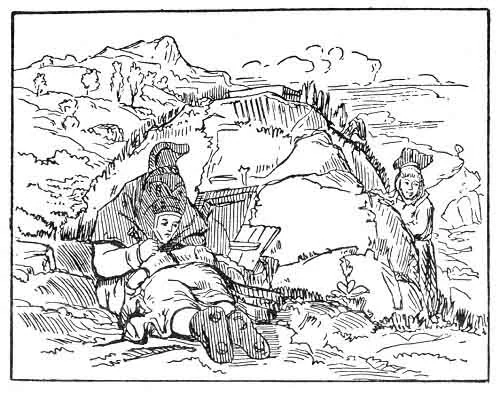
''And he laid his head on her lap, and she dressed his hair.''
it out again. They all join "the widow's son," and sail in a ship which could go over mountain or sea, Muir Da Monadh, which is like Arthur's ship, and they go to win a king's daughter, and do win her by feats. Nimble shanks runs a race with "nighean dubh na luideag," the black girl of the clouts, to try who could first take a bottle of water from the green well that was about the heaps of the deep. "Tobar uaine thu 'n iomal torra domhain," the keen eared man, hears all the plans, the swift man is enticed into falling asleep, and
his head is laid on a horse's skull by the black girl who runs off with the water, but the marksman shoots the head away, and he awakens and wins.
The next feat is to bring "Torc Neamha," a deadly boar that is in a forest, alive to the king's house. Nimble shanks goes to catch him, and Hard haunches to ride him borne, and home they come with him, and here is manifestly the same boar with the deadly spikes in his back which appears in the story of Diarmaid and elsewhere.
The third feat is to sit at meat with the king in a chair with a deadly spike in it, and this Good bearing finds out, and Hard haunches performs.
And the fourth is to bring a loch from the hill top to a hollow near the king's house, which Great Gulp accomplishes by swallowing it, and spouting it out again till the people were nearly drowned, and then the lady was married and won, and she is the daughter of the king Of the island of women. This was written in 1859 by Hector Urquhart, from the telling of old John Mackenzie, and I know that I have not got half the story yet. There is a man who made a bridge of his foot, and another who shot arrows into the moon, of whom I have heard, and there is the man who produced intense cold by moving his hat, who is in Grimm, and who appears in a story which I got from Gairloch.
Now, all these and more are in stories collected in modern times elsewhere, and they are all in this Welsh story at the court of Arthur.
There is the man of sharp sight. "When the gnat arose in the morning with the sun, he could see it from Gelli wic, in Cornwall, as far as Pen Blathaon in North Britain," explained to be from the Land's End to the Ord of Caithness.
There is the "marksman," Gelli wic, "he could in a twinkling shoot the wren through the two legs upon Esgeir Oervel, in Ireland."
There is the man of hard feet who cleared the way for King Arthur, and struck sparks of fire from hard things with the soles of his feet.
There is Gilla coos Hydd, the chief leaper of Ireland was he.
There is the nimble man who could run over the tops of the trees.
There is Clust Reinad (? cluas an ear), "though he were buried seven cubits beneath the earth he could hear the ant fifty miles off rise from her nest in the morning."
There is the man who made a bridge of his dagger, like a lady who came to visit Fionn in a story which I have.
There is the man who could suck up the sea.
And there are many others of the same stamp, some familiar, some who, so far as I know, do not appear elsewhere in popular tales, but every one of whom is intensely popular, and mythological, and might be, and probably was the hero of a separate myth.
Kai, in particular, is here an epitome of much which is told of several gifted men in Grimm and elsewhere, and therein he agrees with Conan, who in a story about the Feinne (I think Irish) is invisible and able to fly, and blinds the Lochlanners with a sting.
Now, to leave the region of popular tales for a moment, and turn to mythology. In Gylfis mocking Thor, the Norse god goes to the land of giants, where he is cheated most ignominiously; but be plays the part of "Great Gulp," for he swills at a horn whose end is in the sea, and makes the sea sink down many feet by his
mighty draught, but he cannot empty the horn. Loki plays the part of the great eater (vol. i. p. 138), but he is beaten, for his adversary is fire. Thor is the strong man who appears in Fortunio, but he is beaten again, for he cannot lift up the great serpent, which appears to him as a great gray cat, though it goes round the world; and Thor's companion plays the part of the swift man and is beaten, for his adversary is thought, and no one can run a race with thought; and, as it seems to me, the same thing may be meant by the Gaelic "black daughter of the clouts." Anything which is invisible, and hidden, and incorporeal, is called "black." As--"Each dubh 's each donn, bonn ri bonn 's luaithe 'n t-each dubh na 'n t-each donn." A black horse and a brown horse sole to sole, swifter is the black horse (the wind) than the brown (water). And lastly, Thor is the wrestler, but he is beaten, for his adversary is old age; and this seems to indicate that Thor, though a divinity, had once been a mortal.
Here then is King Arthur placed on the same level with Thor, and the same incidents associated with both, the one in a Welsh MS. collection of popular tales, the other in a very early Icelandic manuscript, which gives nearly all that is known of the pagan creed of the Northmen, and tha very same characters and incidents are found to pervade the popular tales of the greater part of Europe, including those of the West Highlands.
The only possible deduction from these facts seems to be, that these are traces of a mythology once common to Celts, Scandinavians, Italians, Germans, and mayhap ancient Greeks, Romans, Egyptians, and Aryans. And so with the rest of the story of this Welsh prince of Kellydon. When he goes out with his gifted comrades,
they meet with a mythical herdsman, a captive, with a (log as mythical as they are themselves, and he plays the part of the herdsman in the Slim-waisted Giant, as told me in Uist, and in the Red Etin of Ireland, printed by Chambers in broad Scotch in 1858. The herdsman, like the maidens in the Lady of the Fountain, shews the way, and tells what is to be met with in this land of wonders, and he entertains the adventurers; and when they are set tasks by the king whose daughter they have come to win, it is like reading a list of tasks picked out of a library of popular tales, with scraps of Norse mythology, and classical mythology all jumbled up with other tasks which I have not found elsewhere.
Here is list of similar tasks from the tale mentioned above, as preserved in the Advocates' Library, which I assume to be written in Irish. I quote from an abstract of an abstract.
Tale I. The fate of the sons of Tuireann. In the reign of Nuadh the silver-handed, the Foghmhairs, a Scandinavian race (I should say the giants), had the Tuatha de Dannans under tribute. The officers come to a king seated on a hill; Lughaidh Lamhfada comes in splendid attire, rushes on the Foghmairs and kills them all but nine, whom he sends back. They tell, and an expedition is decided on. Cian meets Uar, Ichuar, and Ichuarba, three sons of Tuireann Beagruin. Cian transforms himself into a swine. The sons transform themselves into swift hounds. Iuar kills him, and buries him under a heap of stones. As compensation for the crime, they are required to procure for Lughraich--
1. The apples that grew in the garden of the King of Hisbheirna. 2. A sow's skin that belonged to the
King of Greece. 3. A Persian spear. 4. The horses and chariot of Doghoir innsefidhe. 5. The seven swine of Easol, King of Colchos. 6. A whelp in the possession of the King of Toruath. 7. Some magic rods from an island in the Tyrrhene sea, and seven other articles of magic properties, which are not given in the abstract. They were also to utter three cries on the summit of the hill of Miodachan. After sixteen quarto pages of adventures, they return with the articles, but have not uttered the three cries, so they ask for a magic curach and go. The eldest brother, in a cover of glass, explores the sea for fifteen days. They get a magic rod, utter the three cries on the top of the hill, after a severe battle return to Ireland, die, and are buried.
This manuscript is supposed to have been written about say 1750. "It is evidently a transcript." The language bespeaks high antiquity. The man in a glass case occurs in a story mentioned to me in Uist in 1859, and the tale of the sons of Tuireann is one of those mentioned by Professor O'Curry as probably composed before A.D. 1000.
Now let these Irish tasks be compared with the Welsh tasks, and they will be found to resemble each other in nature, though they are not the same; and they also resemble, in the same general way, the labours of Hercules and the tasks in the Battle of the Birds, in the Master Maid, in Straparolas' Fortunio, and in many of Grimm's German stories.
When the Welsh heroes set off to accomplish their tasks it is the same thing. They go to the beasts, birds, and fishes for information, as men go to the winds in the Norse tale of East o' the Sun and West o' the Moon; and the three old men who herd the beasts, and the birds, and the fishes in the Three Princesses of White-
land, characters who appear continually in Gaelic tales in various shapes, Sometimes they are old men, sometimes three old women, sometimes herds. These generally provide the wanderer with a cup, or a boat, or a pair of old shoes, which carry him on his journey, and come home. But the Welsh creatures are especially old and mythical; one is an eagle, which has sat on a rock and pecked at the stars for some extraordinary number of ages; another is a stag, who is as old; and the third is a salmon, who takes Kai on his back and carries him to his destination.
And when the grand climax is approaching, it appears in the shape of a magic boar, who is a transformed king, and behind whose ears are scissors, a comb, and a razor, which, like Gaelic combs and iron instruments, are the keys to the whole magic. King Arthur rouses the boar, and hunts him from Ireland to Wales, and over the Welsh mountains, and he is finally slain; and surely this magic boar and boar hunt by the mythical British king and his gifted warriors, is the same as the magic boar of Gaelic tales; and the hunt by Fionn, the mythical king of the Feine; and the hunt of Adonis, and must be some old myth as old as the races who have worked up the common stock into so many shapes.
When I first read this Welsh story, it was like a confused dream, made up of fragments from all that I had read and collected during the last two years, and vet though thus interwoven with the general mass of Gaelic, Norse, German, French, and Italian tales, the justice of the observation in the first note is undeniable. It is "purely British," in that it has no parallel or exact counterpart in any other language.
The dream of Rhonabwy has few incidents that I can recognize. There is a horse who, like the giant in
Conall, drew men towards him when he drew in his breath, and blew them away when he breathed out. It is a strange tale of chivalry, and Owen's army of ravens are peculiarly mythological. I have a great deal about ravens, as, for instance, in the battle of the birds; but I have no army of ravens, and I know of no such army in any other popular tale; but in a note at page 436, is the outline of a story of which I have given an abstract at page xcv., Introduction. That story was repeated to me by an old tinker at Inveraray, and it is in the metrical and prose versions of Perceval de Galles, according to the note.
The story of Pwyll, prince of Dyved, has a great many incidents which I recognise. The opening is like the lay of the Great Fool. The prince goes alone to hunt, and falls in with hounds whose like he had never seen, "white with red ears." They catch a stag, and he drives them away, and sets his own bounds on the deer; and there comes a man clad in garments of gray woollen, the owner of the hounds, who accuses him of discourtesy. He is Arawn, a king of the Annwoyn.
The next adventure is like the opening of Murdoch MacBrian, No. XXVIII., and an incident in Conall. The king sits on a mound, and there comes a maiden on a steed, whom no one can overtake, which again has a relation to the opening of Boighre Borb, and the Irish story of the chase. Then comes the incident of a king disguised as a beggar, which is in the end of Murdoch MacBrian, in the Odyssey, and in many stories in Gaelic, Norse, and German.
And then there is the man enticed into a bag and beaten; as the giant's mother was enticed by Maol a' bhoibean, and beaten to death.
Then comes the woman who is mysteriously robbed
of her children, and accused of eating them, which is in many stories; for example, in the French story of Princess Fair Star; in the Norse story of the Lassie and her God-mother; in the Hoodie, No. 3, and in No. 12 in Gaelic, and in endless stories besides. For example, in one called, "An t-urisgeal aig na righre, Righ na thuirabhinn agus righ nan Ailp," The king of the Ailp quarrelled with the Druids, and was killed, leaving a single daughter and a son. She was educated by the Druids till she was able to do many of their tricks, but they coloured her skin as green as grass. But the son fled up a mountain, called Beinn ghloine, because it was always covered with glass (or ice) in the winter, and he took his father's sword and sceptre. Then came a Druid and smote him as he slept, and turned him into a gray dog. Then he returned to the palace, leaving his sword and sceptre, and his sister got leave to come and see him, and there they staid; the green woman and the greyhound, and there they were to stay till some one would marry the greyhound of her own accord, and till the king's daughter should nurse three children, and get a kiss from the king's son. And no one was to bury the bones of those who fell in the Druid's battle till their grandchildren should do it. Then the king of the Urbhin went off with his men through the hills to fight with another king, and lost his way in a mist, and he cried out "keep with me;" and there answered him but a hundred. Then the mist was so thick that he could not see the end of his sword, and he shouted again, and there answered him but a score; and he cried out again, and there answered but three; and next time he cried, none answered at all; and so he wandered alone till he came to the palace, where he found nothing but a greyhound. He wandered about, found food and a
bed, and ate and slept. Next day he wandered about and found a lot of bones, and began to kick the skulls idly, when the gray dog sprang upon him, and threw him down, and spoke, and abused him for kicking his father's skull, and then comes the story of beauty and the beast. The king had three daughters and a son, and he promised that a daughter should come in his stead, and the green girl went to carry the news. She put on "a’ chaisbhairt shiubhal," her travelling foot-gear, and a face cloth, and went and returned with the three daughters in a trice, for she had travelling foot gear for them also. The youngest staid as hostage for the king, and the rest went home, and she slept in the same room with the dog and the green sister till the year ran out, and the king came back. Then, to save her father's life, the youngest sister agreed to marry the hound, and the green girl got a priest, and they were married. In the morning when she woke, of course it was a fine young man who was beside her; and she asked where was the gray dog. Then the two elder sisters were furious; and the king fell in love with the green girl after be had taken a draught of the "mheadair Bhuidhe," yellow mead, from her hand. The two sisters concoct a scheme with a Druid to become queens instead of the brother and sister; and the first step is to get hold of their sister's child, and give it to the Druids. They carry her off, and when the child was born, "there came a green hand in at a window, and it took away the child." So in Welsh there came a great claw, and so a lake fairy took away Lancelot in the romance. And so it happened thrice, but a drop fell from the eyes of the children, and the mother gathered the drops, and treasured them.
Then the king who had been twice deceived, and who
did not know that he had seen his wife, determined to marry again, but he would marry none but she who could fetch his sceptre and sword of victory from the top of the glass mountains. Many tried, but failed; and the wicked sisters who had made the youngest lose the strength of her feet, cured her, and when she succeeded, stole the prize, and claimed the reward. Then they were set to wash the bloody shirts of those who had been slain in the great battle of the Druids; the sister washed them all but one, and before she would wash that one, she must sleep three nights in the king's room, but he had his sleepy drink, and she sang--
Rug mi do thriùir cloinne dhuit,
’S dhirich mi a' Bheinn ghloine dhuit,
’S nigh mi do léintean fala dhuit,
’S tha mi nam laidhe maille ruit,
’S ciom' a gaoil nach teann thu rium.
I bore thy three babes for thee,
And I climbed the glass peaks for thee,
And I washed thy bloody shirts for thee,
And I am laid beside thee here,
And why my love not turn to me.
On the third night he heard. And in so far the story is like many others, but it has many adventures which I have found nowhere else.
The king, and his wife, and his green sister, go back to the palace of the Ailp, and hold a feast; Dubhmalurraidh the wicked Druid comes, and a wicked sister is transformed into the likeness of the queen, and when the true queen came her rival was in her place, and no one could make out which was the right queen. Then came the green sister, and produced a garter with
which the queen had tied the sword and sceptre when she brought them from the glass hill, and the true queen had the other on.
Then the green sister brought in the three children, which she said she had carried off from the uirabhinn to save their lives, and they all three squinted for want of the drops that had fallen from their eyes, and the true mother had the drops, and put them back, and they saw straight.
Then the green girl marked the sham queen with a black spot, and put salt into the Druid's food, and a sleepy drink into his cup, and when he slept she put him amongst the bones, where he could work no more spells. The Druid, to get free, told her to wash in the water of the well that was at the foot of the blue rock, in the Island of Deer, in a high hill, and the young prince of the uirabhinn fetched it and she was cured, and they married.
The wicked sisters try to burn the house, and put magic draughts into their sister's drink, but they fail. The Druid is made drunk and beheaded; the sisters drink their own draught, lose the power of their legs, and fall into poverty and disgrace, and the young sister and the king of the Ailp who had been a gray dog, and his sister who had been green, and the young king of the Uira Bhinn, lived happily thenceforth, and their grandchildren buried the bones.
Now this was a nursery story told to John Dewar, by a servant maid, about 1812; and this rough outline will shew that it is a version of the same popular tale which was written in Wales about 400 years before, which was in the Golden Ass of Apuleius 1600 years ago, and has to do with Cupid and Psyche, and is in the Arabian Nights. I have other Gaelic versions of the
same incidents, including a detailed account of the manner of climbing the mountains, and the accusation of eating the children; but my object here is to shew the relationship between Gaelic and Welsh stories, and this must suffice for the present.
In the next story, Branwen, the daughter of Llyr, which, if Gaelic, might mean black and white daughter of the sea, there is little which I can recognise. There is a great deal about ships which come from Ireland; and the caldron which brings warriors to life when they are slain is like the vessel of balsam. The origin of the "five-fifths of Eirinn" is given, and, as I have not found the myth elsewhere, and as the term is common in Gaelic stories, I quote it. After a great battle there were left alive but five women, and they bore five sons, and these, when they grew up, took each other's mothers to wife, and they peopled Ireland and divided it.
The name of the smith is like Gaelic. Llasar Llaesgywdd might be kindled flame.
I have nothing in common with the next story except a magic white boar, nor with the next, nor with the dream of Maxen Wledig, nor with the story of Lludd. Some of these I should class with popular history.
But the next, "Taliesen," begins with the well-known incident of the man who mysteriously acquires knowledge by tasting unwittingly drops of magic liquor from a caldron. The man's name is Gwion Bach; and the story is now told of Fionn MacCumhail. This seems to join Fionn and Gwion, and to this I have referred elsewhere.
The pursuit, in various forms, by the witch lady, has an exact counterpart in a story of which I have many versions, and which I had intended to give if I had room. It is called "The Fuller's Son," "The Collier's Son," and other names, and it bears a strong resemblance
to the end of the Norse tale "Farmer Weathersky." That belongs to the Arabian Nights also, and so carries us eastwards as usual.
The incident of sending a man to try the fidelity of a wife, and his deceit with a ring token, has a counterpart in No. XVIII. which leads to Shakespeare and Boccaccio, and proves what I bad suspected, that there actually was a British popular tale current before the time of Shakespeare, from which be might have taken some. of his ideas. The very same idea will be found in a Breton tale (Invention des Ballins Foyer Breton, vol. i., p. 180), where a Breton gentleman goes to court, boasts of his wife's beauty and fidelity, and a French courtier goes to test his words. He gets a ring and other tokens, and sends them to Paris, and when the enraged husband comes home to take vengeance on his lady, he finds that she is innocent. The gallant is found weaving sacking in a room where he had been enticed by the lady, and where she had starved him into submission, and taught him to weave, after his own fashion, a new kind of cloth of his own invention. Here, then, one incident joins Gaelic, Welsh, and Breton, and joins them to English, French, and Italian tales, and brings them into contact with famous names, and carries them back a long way.
But while this is true of incidents, the groundwork of the Welsh story and the poetry of Taliesen have little in common with any popular tale of which I know anything. Taliesen, according to the notes, was a Welsh bard of the sixth century, his history is mixed with Irish adventures, he was a knight of the round table, with Arthur at Caerleon, upon Usk, in Glamorgan; but if so, the Taliesen of the story is a very different personage; he is a kind of demigod, and in likelihood ancient
myths about the spirit of song have clustered round a famous name.
The names Taliesen, the offspring of GWION, and Oisein, the son of FIONN, suggest that these mythical bards may once have been the same.
In a note, I find that Cardigan Bay was once the site of a submerged country; the same, no doubt, which can be traced in Breton, in Irish, in Manks, and Gaelic; in Norse, and in Italian, a country submerged for wickedness, and whose houses can be seen under water, and occasionally rise to the surface; a tradition common to many nations which bears upon that of the mysterious western land hidden in the mist, which once was the Isle of Man, and is now to the westward of Man.
So far, then, I have endeavoured to shew that Welsh popular tales of the fifteenth century, and Gaelic popular tales of the nineteenth, have a strong relationship to each other, that they are both intimately connected with mediaeval romances, and with modern Norse tales, and with old Norse mythology; with the oldest known collections of popular tales made in Europe, and with the last; with Irish traditions in the Far West, and with the Arabian Nights in the East. My opinion is, that these are all founded upon incidents which have been woven into popular tales almost ever since men began to speak; that they are all Celtic only because Celts are men, and only peculiarly Celtic because Celts are admitted by all to be a very ancient offshoot from the common root. They are peculiarly Cymric or Gaelic, because each fresh branch has a separate growth, and different tribes have varied their stories, as they have altered their language.
Footnotes
247:1 Poems des Bardes Breton, Paris 1850.
III.--MYTHOLOGY.
ORIGIN OF SUCH STORIES.
As to the origin of popular tales there are three current opinions.
First, it is said the minds of men are similarly constituted in all parts of the world, and when they are similarly placed will produce similar results, therefore similar stories have sprung up simultaneously all over the world, and though they resemble each other, they have really nothing in common. They are weeds of the human understanding which should be rooted out, but which spring up wherever there is a proper soil, and climate, and sufficient ignorance, idleness, and neglect.
Secondly, it is said "These were the work of wise men in the East, whose writings we know; we know when and where these writings first appeared in Europe, and these have spread all over the world." For example, "Cupid and Psyche," and all stories like it, originated with the author of the "Golden Ass."
Thirdly, it is held that these ideas were originally the offspring of the minds of men in the East, at a period when great part of the earth was waiting for men to own it; when language itself was young, before the ancestors of those who now dwell in India and in Barra set off on their travels, before Sanscrit grew to be a language. In short, it is held that these despised stories are the fragments of the early myths and beliefs, moral tales, and heroic pastimes of the early ages of the world, and that Cupid and Psyche is but one phase of an Aryan myth. I have been drawn to all these in turn.
When I sit in a room surrounded by printed books, and trace one through them for centuries; when I read an English translation of Apuleius, printed in 1566, and my own translation of a Gaelic story, like one of those told by "Lucius," that most amusing of asses, I am all for books; but when I sit in a cloud of peat reek beside an old Highlander, with white hair and a skin like crumpled parchment, who cannot speak English or read a word; and listen to the same incidents told in a language which is not in any such book, and in a style which is the narrator's own, I am driven from my paper entrenchments, and all theories, which are founded on books and writings, are scattered to the winds.
I am driven to remember that libraries are but museums, in which collections of ideas are stowed away in paper, like herbariums of dried plants, and that such mental plants grow in men's minds, and are propagated there, from seeds, like other plants. I feel that as every blade of springing corn is not a separate creation or a full grown plant, so ideas may spring and grow and come to maturity, and sow themselves, and spread far and wide, as plants do, without artificial culture. And so, after two years, I hold the third opinion, having tried the other two.
To make the first theory probable, it is necessary to shew some case in which two men similarly situated have composed the same speech, sermon, or novel, with some twenty or thirty common ideas, following each other in the same order; with the same end in view, and the same plot; and without any previous common knowledge of any historical fact or incident in every-day life from which to set out. We must have two separate creations of the mind.
We must have two "Waverleys," or two "Hamlets," without any historical foundation, the pure offspring of man's invention. It is not only possible, but exceedingly probable, that two men should each contrive a story, which should begin with the birth of its hero, go on with his adventures up to his marriage, and either end with his death, or leave that conclusion to the imagination. Take almost any modern novel whose author is known, and strip it to the bones, and the skeleton will be found to consist of ideas about the birth, education, and marriage of one or more couples of human beings, and in so far popular tales do certainly resemble novels, and might spring up independently without a model, but that is not the resemblance with which we have to deal.
We have not simply a back-bone, but a whole skeleton. We have to deal with such a resemblance as exists between a Turbot and a John Dory. Both are fish, both are flat, both are good; their skeletons are made on the same plan, and consist of the same bones; they are creatures of the very same kind, though the one looks as if he had been crushed vertically, and the other as if his sides had been squeezed together; and a superficial observer sees no resemblance at all.
In order to maintain the second theory, it is necessary to shew how it is possible that uneducated men who never stir from the far west, the most unlikely to have any acquaintance with anything inside a book, should come to know that which is only to be found in rare Italian or Latin books, while a few of those who most cultivate books have the same knowledge. It must be shewn how Donald MacPhie, cottar in South Uist, and his class, came to be acquainted with the incidents of the story of Fortunio, in Straparola, and Cupid and
Psyche in the "Golden Ass," and, when that is shewn, how Grimm's old German women got hold of the same incidents, and when that is done, how they got to Norway: and, when all that is done, it remains to be discovered how all the stories which resemble Fortunio have something which none of the rest have got, some incident which might be added without interfering in any way with the symmetry of the general plan, and which the oldest books want; some detail which helps out the plot.
Is it possible that a Minglay peasant and Straparola, neither of whom can have seen a giant, or a flying-horse, or a dragon, or a mermaid, or a talking animal, or a transformed man, could separately imagine all these impossible things, and, having imagined them, simultaneously invent the incidents of the story, and arrange so many of them in the same order?
Is it, on the other hand, possible that all these barefooted, bareheaded, simple men, who cannot read, should yet learn the contents of one class of rare books and of no others? I cannot think so.
I have gone through the whole sea-maiden story, and all its Gaelic versions, and marked and numbered each separate incident, and divided the whole into its parts, and then set the result beside the fruit of a similar dissection of Straparola's Fortunio, and I find nearly the whole of the bones of the Italian story, and a great many bones which seem to belong to some original antediluvian Aryan tale. The Scotch version is far wilder and more mythical than the Italian; the one savours of tournaments, king's palaces, and the manners of Italy long ago; the other of flocks and herd, fishermen, and pastoral life; but the Highland imaginary beings are further from reality, and nearer to creatures
of the brain. The horses of Straparola are very material, and walk the earth; those of old John MacPhie are closely related to Pegasus and the horses of the Veda, and fly and soar through grimy peat reek to the clouds.
Fortunio used his magic power to become a bird, and fly to the chamber of a princess, who provided him with arms and armour; but the son of the fisherman won his fortune and his princess by hard blows, and by doing his duty faithfully. If it were possible that the rough Highlander had got knowledge of the work of the polished Italian, it is certain that he did not copy its morals. And what is true of the Italian and Gaelic versions is equally true of all others which I know. Shortshanks in Norse, Fortunio in French (Contes des Fees, vol. v., p. 49, the nix of the millpond, the ball of crystal in German, and any other versions, if examined, will be found to consist of a bare tree of branching incidents common to all, and so elaborate that no minds could possibly have invented that whole seven or eight times over, without some common model, and yet no one of these is the model, for the tree is defective in all, and its foliage has something peculiar to each country in which it grows. They are specimens of the same plant, but their common stock is nowhere to be found.
MYTHOLOGY--ARYAN THEORY.
I lately had the advantage of hearing the modern science of language explained by a master of that art. Its principles, as I gathered them, appear to be these. Men are different from brutes in that they are gifted with reason, and having reason they are also gifted with
speech. Parrots have organs of speech, and speak, but they have no language, because they have no reasonable ideas to express. Such ideas as they have, they express in their own way, by tones, not words. Men then being gifted with reason and the faculty of speech, began to speak; and expressed their ideas by sounds, which are the roots of language. Languages pass through stages of growth and decay, and so far as has been ascertained, there are three stages, of which examples exist.
Languages whose words are all roots, which have neither verbs nor adjectives, not terminations, such as Chinese, which, as it would seem, has never grown, though much cultivated.
Languages in which one word is glued to another and becomes a termination, and loses its independent meaning.
And languages which have passed through these two stages, where the roots and terminations have become so intimately joined and altered by time and use that it requires a practised workman to distinguish them, and hunt them back to their sources.
All languages, it is assumed, have passed, or will pass, through these three stages of growth and decay; and the modern languages of the great Aryan family are in the third stage. Of the Aryan family of languages, the Sanscrit, is the oldest known, and this system of roots and growths, the principle on which letters change, and the framework of the whole science, existed centuries ago amongst the sages of the East, where writings have been discovered, read, and adopted, by modern philosophers.
A philologist, then, with sacred and profane history pointing eastwards, with Sanscrit books, and eastern learning at his command, with a stock of roots gathered
in the East centuries ago, begins at some leaf or twig, some word, in the West, and works backwards to find the root; or he starts at the root, and works upwards fo the modern word, and so by patient grubbing, and bold leaps, by force of intellect and power of speech, men strive to reach the truth in this, as in other sciences. They use the faculties which have been given them to solve this problem, as other men have used the same implements to solve problems as hard. As geologists have dug into the history of the world, and astronomers have scaled the stars, so a philologist hops like a squirrel from bough to bough, and strives to understand the growth of the great tree of human language.
Now, surely if it be a study worthy of philosophers to trace out the sounds which are the seeds from which speech grew; it is at least as interesting to trace the growth of untutored thoughts which words express; and so this study of popular tales must come to take its place beside the science of language, if that is to be admitted to a high place in the mystic circle.
If men began to express ideas by language, they must have had ideas to express, and if ever these early ideas, the growth of unaided minds, are to be discovered, it will be by a process of patient inquiry, and bold speculation, like that which has raised up the sciences of Philology, Geology, and Astronomy.
When we hold a tradition, we have something like a modern word, or a leaf; when we have ancient writings we have something like a Sanscrit root, and as time goes on and knowledge increases, the connection between the peasant's nursery tale and some old world belief will become clearer and clearer. And when that has been done, and when many old pagan beliefs have been
hunted out, the truth will certainly appear beyond it all by following this road as well as another.
The science of philology has not yet proved, but it points to a single common language, and an eastern origin for the human race; comparative mythology points the same way, and this wonderful community of popular tales throughout the world joins with them in pointing to a common eastern origin for mankind.
And that origin certainly cannot be a gorilla, for in all their researches men find no trace of primæval gorilla roots, languages, myths, or tales.
Men are distinguished from gorillas, for they have intellects and tales; birds still differ from men in that they cannot learn the use of their organs of speech, though there was once a magpie who told tales of her mistress, and was taken in by her superior cunning, and unjustly put to death. On fine days the whole neighbourhood of a certain square in London echoes to the most lamentable sounds of human woe--heart-rending shrieks and wailings fill the air. It is a green parrot expressing his delight at the bright sun and the fresh air, by repeating what he must have learned in a very cross nursery.
Now if "storyology" be a science, it is worthy of a system and systematic study, and the process might be somewhat like this;--Begin anywhere; and read any collection, and there will appear a certain number of incidents which are repeated over and over again. They are never expressed twice in the same words, but they are clearly the same nevertheless, and they are easily recognised.
Take, for example, the idea of a giant whose life is not in his body, but stowed away elsewhere (No. IV., vol. i.), and wherever that idea turns up hereafter, compare
it with the first mention of it; and so by degrees it will appear that the notion of a man with his life elsewhere is very commonly associated with certain other ideas which have to do with a hostile dragon, beasts, birds, fish, and trees, earth, air, water, supernatural powers, and the loves of a man and woman. When this cluster of ideas is commonly found in one country, it becomes an incident belonging to the people of that country, and all that specially belongs to that people and no other may be removed, and then with a fossil incident picked out of the stratum in which it was first found, the "storyologist" may proceed to pick out other notions in the same way. When he has subjected any one collection to this sifting, there will certainly remain a number of primæval fossil incidents, and a lot of historical debris which may be left, in the meantime, for historians to sift in their turn. With such a collection of incidents stored and arranged, it is easy to recognise similar specimens elsewhere, and it is startling to find them in some of their resting places. No doubt hereafter a scientific nomenclature will be devised. The incident which I have taken as an example might be called the hieroglyphic incident, for it occurs, as I am told, in an Egyptian papyrus, and the Norse giant with no heart in his body, and the Arabic djinn who kept his life at the bottom of the circumambient ocean might be called the Norse and Arabic varieties. And so when many collections have been made and explored, it will be found out who has, and who has not got this and that idea, and what ideas are common to all. I have little doubt that this particular notion will be discovered to belong to some ancient system of mythology, like that of Egypt, and to relate to a deluge and a creation. It would seem to be very old, and it is very widely
spread. The question is, who were the people who held this notion of a common terminable life for all nature, and a man and a woman who overcame the natural powers by the help of a superior intelligence, and when and where did they live, if they lived before the Egyptians.
I have formed no theory on the subject, but it seems worth inquiry, and this is one way to puzzle out some parts of the ancient history of the human race, from the traces of the human mind. Let a sufficient number of incidents be gathered together, and treated as roots, wherever they may be found; exactly as AR and TRA are hunted through forests of Aryan words, and storyology will become a science like any other ology, and it is fully as amusing as most of that dusty tribe. It is more amusing to read faces than it is to read books; it is quite as satisfactory to catch a new idea as it is to land a fresh salmon, bag a pheasant, run a fox to ground, or draw a badger, and the pursuit may best be carried on in the open air, amongst the wildest of glens, and mountains, and mountaineers.
And what were these first efforts of reason left to itself? Surely to find out the reason of things.
In early youth, I was taught a definition which I have never been able to forget.
Q. "What is a river?"
A. "A river is a stream of water running through the lowest accessible levels of a country into the sea, and returning to it the water which having evaporated had formed clouds and fallen over the land in rain."
A simple man in search of knowledge, who had found all that out for himself, might well think he had got the two ends of his chain of reasoning fast linked
together, and describe a circle in the sand, to express the discovery completed.
The river runs because the rain falls; the rain falls because the rivers runs, so the chain is endless and unbroken, and the river something everlasting. Men having a tendency to admire the fruit of their own brains might well sit down content, and mayhap fall down and worship the river itself, or set up a circle, or a symbolical serpent with his tail in his mouth, to express eternity, and exclaim--"how beautiful is this great everlasting river, which is older than my grandfather, which flows down from his lofty clouds in the air to water my fields, and return to his native skies." And so the river might become a god, and acquire a name, and a history, and temples, and priests, and a religious system, and a form, mayhap that of a fish's tail tacked on to a human body.
But some other thinker might feel cramped within this water circle flowing about the earth, and seek to know why the river was material, and ran down northwards, and flew up and southwards, and suspect that the water god had more to do than water fields. If he thought hard, he might find out that water rose up when it was heated by fire, that the sun was hot, and that the river flew through the air because the sun shone; that the fields gave their increase, not because of the water god, whose own watery regions produced nothing but weeds and fish, but because the sun compelled the water to work, and then warmed the fields into fertility. And so a new astronomical circle, and a larger symbolical serpent, with his tail in his mouth, new priests, images and ceremonies, might be set up in honour of the bountiful Sun God, who rose and set to watch over the fields of his faithful worshippers. And then the dethroned
river god, with his scaly tail, would sink in public estimation, and might become "Abdallah of the sea," and his wife a mermaid, and then all the history of the past religion would gradually sink into a nursery tale.
Another thinker might upset the worship of fire, and point out that the air in which the sun, and moon, and stars had their lofty being was something greater than fire, for no animal, or man, or fire could live without it, and a good blast of it would extinguish the best candle.
A fourth might discover, that without the earth all else was nought, and that everything grew and had its being from the earth, and returns to it. And so a whole host of elemental divinities might spring up from a study of nature, flourish and decay, and so become the spirits of the earth, and the air; the djinns of fire, and air, and water; Peris and earthly ghouls dressed in their idol forms, and retaining shreds of their former grandeur.
But as each new circle became too narrow for reason, one set of despairing philosophers might come to think the whole world of nature a fortuitous concurrence of atoms, and worship nothing at all; while a second worshipped their own passions; and a third still pressed onwards, and sought to know whence the atoms came, and why they concurred and how the particular concurrence of atoms, of which they were composed, managed to think about such things, or to think at all. Such thinkers must be driven at last to say, "We cannot explain this; but we believe that there is a reason greater than ours, which we cannot attain to, beyond it all."
So nursery tales are often the debris of natural
religions, which are all fading away before the light of revealed religion, but subsisted along with it before the flood. Plain men and women are found dealing with heroes and heroines, mermaids, dragons, great birds, and subterranean powers; the powers of water, fire, air, and earth, who were once gods and goddesses; the elements personified, worshipped, dethroned, and now degraded to be demons and hobgoblins, fiends and fairies, ghosts and bogles, and monsters of land and sea. But above and beyond all these there is always some dimly seen power greater and more powerful than they; the hidden reason and cause towards which every train of just reasoning must certainly tend, though it never can reach it without its aid.
Jupiter was subject to the Fates; the world and its supporters stood upon a tortoise, or rested upon the shoulders of Atlas, but what they stood upon no one knew. Fairies are more powerful than mortal men, but they are but "fallen angels," and the wise man who advised the fisherman's son in the "Sea-maiden" was a greater power than he, or any of the monsters which he destroyed, or the magic creatures of air, earth, and water which aided him and his wife to overcome the evil powers of the sea.
WEST HIGHLAND STORIES.
Assuming that stories do really contain the debris of ancient beliefs, this particular collection should contain fragments of the ancient Celtic creed. They seem to me to point to an astronomical pantheon at war with meteorological, aqueous, and terrestrial powers.
The early religion of the Vedas seems to have been mixed up with solar worship; so was that of Egypt,
Greece, and Rome. In the second century, in the days of Apuleius, who was a native of Northern Africa and manifestly a collector of North African popular tales, it was necessary, in order to propitiate the good powers, to "put the best foot foremost," as we say; to start with the right foot, not the left, as Apuleius explains, and in these days men still swore by the divinity of the Sun.
Irishmen will have it that they are of Milesian descent, and came from the Mediterranean. Scotchmen will have it that they, too, have a like origin-from Pharaoh's daughter--and Apuleius calls his "Milesian" tales, whatever he means thereby. It seems pretty certain, at all events, that Phoenician traders visited Britain at a very early date, whether the Celtic Britons first came overland or by sea. To secure a prosperous result in the days of Martin, in the Western Isles in 1703, it was requisite to take a turn sunwise at starting. A boat was rowed round sunwise; an old Islay woman marched sunwise about the worthy doctor, to bring him good luck; the fowlers, when they went to the Flannen Islands, walked sunwise thrice about the chapel, saying prayers. Sometimes fire was carried round some object, sometimes they rode in procession. They made forced fire for mystical purposes by rubbing planks together. In short, there were then a number of superstitious observances connected with fire, and with moving in a circle from left to right if the back is to the centre, from right to left if the centre is faced; sunwise, east, south, west, north, and so thrice. Every English sailor coils a rope sunwise; but I have never been able to find out that he alters the direction of his coil when he crosses the line, and ought to coil it the other way. When a sailor faces about, he goes right
about face; when boys play at rounders, so far as I can remember, they always run first to the stance on the left of the circle within which they stand. Girls dance in a circle, and all England commonly dances in a circle about the mistletoe when we dance the old year out and the new year in; and, so far as I can remember, the dancers face the centre, and move to the left, which is sunwise, and planetwise, if the earth be the centre intended. Long ago, when in Greece, I came upon a lot of peasants dressed in their white kilts, performing their dances. Men and women held hands in a circle, advanced and retreated, and moved slowly round to a very monotonous music, while every now and then one of them broke out into a fit of violent twirlings and eccentric whirlings in the midst, which, if originally astronomical, must have symbolized a comet.
This summer I saw the national dance of the Faroe islanders. A great number of men and women, boys and girls, joined hands and walked round a room singing old heroic ballads in their old Norse tongue. They walked sunwise. When we waltz we go sunwise round the ball-room, when we go round in a reel we do the same, and start with the right foot. The wine bottle and the whisky noggin both circulate sunwise about the table. Lawyers in their revels used to hold hands and dance thrice round the seacoal fire in the Inner Temple Hall, according to ancient usage. Boys hold hands and dance round bonfires. Men and maidens still dance round the Maypole in some benighted parishes in England. In short, this system of dancing, and doing things in circles, sunwise, is almost universal in the north.
Mons. de la Villemarqué tells us of a game which he saw played by children in Brittany. A small boy was
seated on an isolated stone, and a circle of small Breton peasants revolved about him thrice, prostrating themselves thrice with their faces to the earth, and singing--
Roue Arzur me ho salud,
Me ho salud Roue a Vrud;
O! Roi Arthur, je vous salue
Jo vous salue, Roi de renom.
The hill known as the "Cobbler," in Argyllshire, is called "Aite suidhe Artair." The seat of Arthur, the hill above Edinburgh, is called Arthur's Seat, and Art is one Gaelic word for a god. Art adhair would mean god of the air, which would be a fit name for the sun.
There is a childish game played in the Highlands called "uinneagan àrda," high windows, in which a circle of children dance round one who tries to escape.
Another amusement is to whirl a lighted stick so as to produce a circle of fire, but that is forbidden by old dames, who say, "Tha e air a chrosadh," "It is crossed," or forbidden. There are plenty of crosses on stones which seem to have pagan symbols on them.
There are several "knocking-out games," which are played in circles, or a half circle, round the peat fire in the middle of the floor.
A string of words is repeated by a performer with a stick in his hand, who strikes a foot of one of the players as he says each word, and at the end of the performance he says, "Cuir stochd a staigh," and the last player sticks his right foot into the circle. The game goes on sunwise till all the right feet are in, and then all the left, and the last has either to take three mouthfuls of ashes, or go out and repeat certain quaint disagreeable phrases, one of which is--
"My own mother burned her nails scraping the sowen's pot."
"Loisg mo mhathair fhéin a h-ìnean a sgrìobadh na poite cabhraich."
Another is, to light a stick and pass it quickly round while it is red. The player who has the stick says--
"Gill' ite gochd." The next to the left replies--
"Cha 'n fhìor dhuit e;" and the fire holder repeats as fast as ever he can--
"Cha 'n 'eil clach na crann.
’San tigh, mhor 'ud thall,
Nach tuit mu d' cheann'
Ma leigeas tu ás Gill' ite gochd,"
and when that is said he passes the stick to his left-hand neighbour as fast as he can. When the fire goes out the holder of the stick pays some forfeit. I have played this game myself as a child. The words mean--
"Servant of ite gochd."
Untrue for thee.
There's neither stock nor stone
In yonder great house,
But will fall on thy head,
If thou lettest out the servant of ite gochd."
What the last word may mean I cannot say.
Now, if a man anywhere north of the equator will face the sun all day, and the place where he is all night, he will revolve right-about-face in twenty-four hours, and meet the rising sun in the morning with his
right hand to the south, his back to the west, his left hand to the north, and his face towards his object of worship, if he worships the sun. If he walks round the gnomon of a dial on the sunny side, seeking light and avoiding shade, he will describe a portion of a circle from left to right, and if he crosses the arctic circle he may so perform a whole circle in a summer's day; but if an Asian or European walks continually towards the sun at an even pace, whenever he can see him, he will necessarily walk westwards and southwards, in the direction in which Western Aryans are supposed to have migrated.
The Gaelic language points the same way. Deas means, south, and right, and ready, dexterous, well-proportioned, ready-witted, eloquent. Consequently to go south, and to go to the right; to coil a rope dexterously, or southwards; to be dexterous, southern, and to be prepared to set out are all expressed by the same Gaelic words--"Deas," "Gu deiseal," etc. Now all this surely points to a journey from east to west with the sun for a leader; to a camp awakening at sunrise and facing the great leader in the morning, watching his progress till noon, and setting off westwards when "DIA," 1 god of day, was south;--Deas, ready to lead them westwards on their pilgrimage. Surely all these northern games, dances, and ceremonies, and thoughtless acts, point to astronomical worship, and an imitation of the march of the stars round the world, or round the sun, if men had got so far in their astronomy.
A short ballad, taken down from the recitation of an old tailor in South Uist, who is utterly illiterate, and has hardly ever worn a shoe or a bonnet, begins thus
Gun d' dhùbhradh an Ràth soluis;
Fuamhair mor anns an iadh-dhorus;
Fuamhair mor a' tighinn o'n tràigh,
B' fhear an t-eug na 'dhol 'na dhàil.
Seachainn mi gu direach deas
’S nach ann air do thì a thainig.
The light circle was shadowed;
A great giant in the wheeling door;
A great giant coming from the strand,
Better were death than to go to meet him.
Pass me bye straight and south (right readily,)
For it was not on thy track I came.
So here is poetry, which is not to be found in any book that I know, and which is highly mythological. Caoilte, one of the Fenians, sees the circle of light (pronounced RA, spelt RATH; English RAY; Egyptian, according to Sir Gardiner Wilkinson, RA or RE, the sun god) shadowed by a great giant with five heads, who was in the wheeling door, that is, I presume, the sun, the door in the Zodiac, whence light emerged: and the giant desires him to pass him straight, south, and avoid him; but Caoilte will do nothing of the sort; they fight, and he slays the giant with a "brodan," a short spear, according to the reciter; but Caoilte was sore wounded in the fight; and Graidhne, the daughter of the King of Connachdaidh (Connaught) carries his shield to "Dun Til."
"Cha lotadh i 'm feur fo 'cois,
’S cha mhò a lùbadh i meangan."
She would not hurt the grass under foot,
No more would she bend a sprig.
The following is an air to which a song about Caoilte used to be sung. I have not got the old tailor's air, but it was very pretty and wild. I have but three lines of the other version.
DAN CHAOILTE, from Mrs. MACTAVISH.
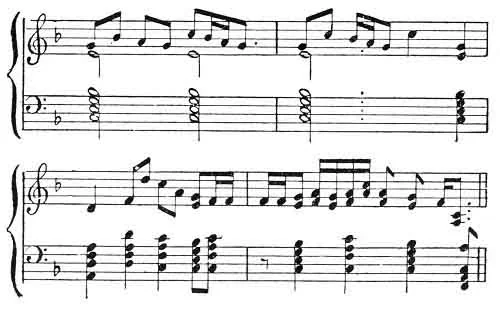
A Chaoilte laoich a teannragan
Annir og an or-fhuilt reidh
Cireadh a cinn le cir airgiod.
. . . . .
Caoilte hero from battle.
Young maiden of smooth golden hair
Combing her head with a silver comb.
. . . . .
Villemarqué holds that Arthur and his knights are but Celtic gods in disguise. Surely the Fenians are but another phase of the same astronomical worship of f be host of heaven.
Again it appears in many ways that the dead were supposed to live; but far away to the westward, where the Sun God seemed to go to his rest. Ossian Fionn, The heroes innumerable, were gone before towards the
setting sun, and dwelt in a green island, where all the mysterious objects in Gaelic popular tales abound. The mystic fountain, which in the story of Cupid and Psyche is the river Styx, and flowed from a lofty mountain; the mystic apples which changed men into animals, and cured them; (in the Golden Ass a rose did the same); the mighty smiths who forged "Dure Entaille," for Arthur. "Avalon," the earthly paradise, and "Eilean iomallach an domhain," "Island uttermost of the lower earth," were surely the same mysterious country over which the Sun God was supposed to preside. 1
All these strange matter of fact stories which pervade the whole of the western islands, from north Ronaldshay to the South of Ireland, about seals which turned out to be men and women, who came from their home in the west to visit the world; all these strange semi-heathen practices of taking the sick to the shore; all these accounts of strange islands occasionally seen in the far west, are surely traces of the ancient Celtic notions of a future state; and the chapels perched upon the most distant western rocks on the coast of Europe, were surely set up to counteract and take advantage of this ancient heathen Celtic tendency to western worship, and the belief in an earthly paradise. Surely the same idea is expressed in the African fable of the hyæna and the weasel.
The one, who was a priest in other stories, pointed to the setting sun, and said, "there is fire, go and fetch it." The other went as fast as he could towards the sun, till it set, and then it came back, for the hyæna was a fool, and be lost his food and his tail; but
the weasel was the wisest of all creatures, he was the philosopher, and got the prize.
But beyond the Green Island beneath the western waves, there was still something unknown and unexplored. When Diarmid had found his princess under the waves, he had to cross a great strait to get the cup of the king who ruled over the dead. And there was more beyond.
"They believe," says Giraldus Cambrensis, 1 "that the spirits of the dead pass into the company of the illustrious, as Fin MacCoul, Oskir MacOshin, and the likes, of whom they preserve tales and traditionary songs." Beyond the Green Isle and the land of the dead was the Island of Youth, which was further off, and harder to get to, according to a story got from Skye.
It would be tedious to point out all the mythology which is scattered through Gaelic stories, and it is impossible to unravel the details of the system without a thorough knowledge of the oldest Irish mythical tales, but this much appears--there is more foundation in Gaelic mythology for the Mediterranean, Phoenician, Trojan, Egyptian, and Milesian stories than is, generally supposed.
Taking Sir Gardiner Wilkinson's names of Egyptian gods, and his account of their attributes to be correct, a great many of the names have a resemblance to Gaelic words of appropriate meaning.
Thus, NEPH is the equivalent to Jupiter, and father of all gods. Neùmh-(nêv) means heaven; and naomh, often pronounced nêv, means holy.
AMUN was a name of the god who presided over inundations. Amhain, avon, etc., are words which mean river, and can be traced over great part of Europe.
AMUN RE was the ramheaded god, who was also the sun. Reith, pronounced răy, means a ram. Rath, pronounced rA, means a circle, and is applied to the sun in the ballad above quoted. Ré means the moon; roth, pronounced răw, means a wheel or circle.
PASHT was Diana Lucina. Paisde means a child.
RA or RE, was the sun god of Egypt, and represented as a hawk; he was supported by lions "which are solar animals," and he is the equivalent of BAAL. Beul means the mouth, the front, the opening, the dawn of day, the mouth of night, the beginning. Every one has heard of bealltainn, the 1st of May, old style, and "belten-fires," when branches of the tree which bears red rowan berries were very lately placed over the cow-house doors in the west, and when all sorts of curious ceremonies were performed about the cattle. Birch branches, primroses, and other flowers, were placed upon the dresser, tar was put upon the cattle, snails were put upon a table under a dish, and were expected to write the first letter of a lover's name, holes were dug in the ground and fortunes foretold from the kind of animals which were found in them. People used to get up early on the morning of Easter Sunday and go to the tops of hills before sunrise, in the full belief that they would "see the sun take three leaps, and whirl round like a mill wheel" for joy, which seems to be a mixture of Paganism and Christianity. The ram, the hawk, the lion of Manus, and all that tribe of mythological beings may be derived from astronomical symbols, and those of Egypt and the far East may perhaps explain those on the sculptured stones of Scotland.
ATHOR presided over Egyptian night. Adhar means the sky. Athair means father, and night according to the ancients was the mother of all things.
OSIRI was the greatest of Egyptian gods. O-shiorrigh, king from everlasting, would be something like the sound.
Arabic popular mythology, as given by Lane (Arabian Nights, vol. i., p. 37), also bears upon that of the west.
GHOOL is a species of demon, and DELKAN is another. Djeeoul is the sound of the Gaelic for a demon, though the modern spelling rather points to a Latin derivation for the word.
SEALAH is a species of demon which haunts an island in the China sea; the Gaelic name for a seal is Ròn, but the seals are supposed to be uncanny everywhere.
GHADDAR is another demon of hideous aspect; Gadhar is a hound; Gobhar a goat; and there are plenty of stories of demons appearing as goats and dogs; Boc is a buck goat, and Bòcain are bogles.
SHIKK is a demoniacal creature, having the form of half a human being, like a man divided longitudinally.
THE NESNAS is described as having half a head, half a body, one arm, and one leg, with which it hops with much agility. No such creatures appear in German or Norse tales, but the smith, in the Lay of the Smithy, had one leg and one eye. In a very wild version of No. XXXVIII., got from old MacPhie, the DIREACH GHLINN EITIDH MHICCALAIN, the desert creature of Glen Eiti, of the son of Colin, is thus described:--"With one hand out of his chest, one leg out of his haunch, and one eye out of the front of his face." He was a giant, and a wood-cutter, and went at a great pace before the Irish king Murdoch MacBrian, who had lost sight of his red-eared hound, and his deer, and Ireland.
In the same story a "FACHAN" is thus described:--"Ugly was the make of the Fachin; there was one hand out of the ridge of his chest, and one tuft out of the top of his head, it were easier to take a mountain from the root than to bend that tuft."
DJINNEE is a term for all sorts of magical creatures; Djeeanan is the sound of the Gaelic for "Gods."
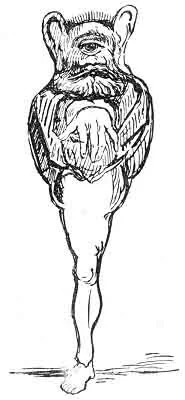
Direach Ghlinn Eiti, or Fachan (as described).
And, on the other hand, no sort of Gaelic meaning can be extracted from names in other mythologies; for instance, from that of the nearest race, the Norsemen. HAR and OSKEE, which resemble Athair, father, and Oscar, are almost the only names in the Edda which seem to bear any likeness to a Gaelic word. When so many old fables point towards the eastern shores of the
Mediterranean as the cradle of the Celtic race, it is surely worth considering such resemblances as are pointed out above, however far-fetched they may seem to be. The Scotch pleaded a descent from Scota, Pharaoh's daughter, against Edward's claim, founded on his descent from Brutus of Troy; the Pope was umpire, and Bannockburn the final action in the case, so this is no new idea.
If Celts be Aryans, and these followed the sun from central Asia, some of them would reach the shore about TYRE, if others made their way to Scotland, and called it "Tir nam Beann," the shore of hills.
It is at least certain that the groundwork of several popular tales now current amongst the peasantry of the West Highlands, were written by Apuleius in the second century, and it is probable that these were current about Carthage some seventeen hundred years ago. Nearly the whole of the story of Cupid and Psyche, as told by Apuleius, will be formed in these volumes, though in a very rough dress, Nos. II., III., XII., XXXIII., XXXIX, and the story abstracted above. It is all over Europe in all sorts of shapes, and it was in India as a tale of the love of the sun for an earthly maiden, who was also the dawn. It was part of classical mythology, though Venus had surely begun to lose her power when Apuleius made her a scolding mother-in-law. It seems hopeless to speculate on the origin of the story anywhere short of the dawn of time; but if there be any truth in the "eastern origin of Celtic nations," it is reasonable to look eastwards for the germ of Celtic mythology.
__________
On the other hand, the bodily forms, which the
creatures of Gaelic mythology bear, often seem to have a foundation in fact.
The WATER-BULL is like a common bull, though he is amphibious and supernatural, and has the power of assuming other shapes. He may have been a buffalo, or bison, or bos primogenious long ago; or even a walrus, though mythology may have furnished his attributes. There were human-headed bulls at Nineveh, and sacred bulls in Egypt, which had to do with inundations. Bulls are sculptured on ancient Scotch stones; and there is a water-bull in nearly every Scotch loch of any note. Loch Ness is full of them, "but they never go up to the Fall of Foyers."
Here are some conversations which took place on the hill-side and elsewhere.
D. "Water bulls! Did not the uncle of that man see him!"
C. "Well, what was he like?"
D. "Well, my father's brother was a herd, and he was herding at the end of that loch, and he saw the water-bull coming out of the water; he was close to him. He was a little ugly beast, not much more than the size of a stirk, and rough, and 'gorm-ghlas'--blue gray, * * * and my uncle marked down the day, and the hour, and all about it." (Here some details omitted.) "Now, my uncle was not a man to think he saw a thing when he did not see it; he was a quiet, steady man, and he told his master all about it."
E. Oh, yes; that's true enough."
D. I would not give a snuff for what a man sees in the night; he might go wrong. Many a time have I gone to look at a thing which I saw in the night, and it was but a stone or a tree. But what a man sees in the bright, clear white day-light, that is another thing.
There's my brother, he was working one day at the end of that loch. I remember the day chosen well. It was a choice fine day; I was working myself, at the end of Loch -, and it was so calm, and still, and quiet, not a breath of wind moving. Well, my brother saw that loch with great waves breaking all round it, from the middle on the shores, and that is certain sure; a thing which a man sees by the white light of day, in the light of the sun, is not like what a man sees in night. Well do I mind that day."
C. "And did you ever hear that the bull did harm to any body?"
D. "No, never; but it cannot be a good thing, or, in a small loch like that it would be seen oftener. It could not keep hid."
C takes a mental note of the narrator's earnest poetical figurative language and features, which tell of firm belief in the mystic bull, and proceeds to ask questions of other inhabitants.
Boy, "Oh, yes, they see water-bulls often about that loch. My father has been herd there for fourteen years and he has never seen anything, but there was a woman one evening coming across Loch ------ in a boat, and she heard him blowing and snorting, and she turned back, and left the boat, and stretched out home. That was the water-horse, not the bull."
C thinks of the rules of evidence and the blowing of an angry otter, and smokes gravely.
Boy No. 2, carrying knapsack along a road distant some twenty miles from boy 1. "There are no waterbulls down here (the sea), but up at the small loch which is in that glen there are plenty of water-horses. Men have seen him walking about the shore of the lake. He is just like another horse, but much wilder
like. He is gray. There was an old soldier up at that loch last summer; he was living in a booth with his wife, fishing trout, and getting small white things out of shells that he finds there. He says he gets eighteen shillings and a pound for them; they will be setting them in rings."
"One night he heard the water-horse blowing and splashing in the loch, and he got such a fright that he stretched out and left the place, and he would not go there again."
C smokes, and sees a vision of a pearl fishery guarded by the water-horse-guards, of a knowing old genius whom he had met on the road, moving his camp to the south.
Man, a hundred miles away in another island, declares "that he has often seen bulls feeding about the lake sides with the cattle, and the cows often had calves. They are 'corcach,' short-eared, a cross between the water-bull and a land-cow. They are easily known. No one has ever seen a water-cow."
"Loch Aird na h-uamh is famous for water-horses. They have been ridden to market. Some men who mounted them have been drowned, others had very narrow escapes. The other water-horses sometimes tore the one that had been ridden to pieces. They are just like other horses, but live tinder water."
Boy in another island. "There are no water-bulls here, but in a loch near B------, where I come from, they are seen very often. I saw a man that saw one in that loch. He saw nothing but his back, but the loch was all in waves, though it was a calm day. That has been seen not once or twice, but various times.
Audience suddenly remembers that Scotland was shaken by a slight earthquake some years ago.
Boy in another island. "That is not the lake where the water-horse was seen. It was down south. It is a large lake where there might be many a thing that a man might not know; but the man saw, as it were, the likeness of a man rising up out of the water, and that must have been a bad spirit."
As this was a place where the telling of stories, and music ar interdicted, and the poor, mild water-bull had now become a bad spirit, it seemed worth finding out what change had followed in the popular manners.
C. "Will there be many people at the market?"
B. "There will be a great many."
"Do they all come to buy and sell?"
"Oh! no; they just come."
"Will there be music there?"
"There will not."
"Or dancing?"
"No."
"Will there be drinking?"
"Oh! that there will indeed."
L. "They will be so wild after the market that I cannot let you take the gig, unless a big man goes with it; they would kill the boy and the horse."
C meets a most quiet, orderly, decorous set of polite, civil men and women going to market with their beasts, and wonders. He remembers the old fun and frolic of a Highland fair. the dancing, the games, the shinny, the processions, the races, the happy faces, the sober family parties returning home; and if he does remember to have heard of a drunken riot now and then amongst the wilder spirits, that was not the prominent feature of a Highland fair thirty years ago. At night
he is told that if he persists in asking a man to play the fiddle, the neighbours will certainly "commit a breach of the peace." Wonders still more. A few days after he is overtaken by some very noisy, drunken, uncivil, riotous, quarrelsome creatures, who have not enough brains left to whistle a tune or to tell a story withal, and therefore the suppression of innocent amusement does not appear to him to have done much good. Here are men naturally polite, full of fun, wit, imagination, and poetry, forced to let off all the steam at once, and making beasts of themselves in consequence.
Within a few miles, men who had not been to market were sober, pleasant, and amusing, repeating good poetry to a pleased audience, but they too were very glad to have a dram. More's the pity.
Why should not the uneducated be taught with a liberal spirit?
But to return to the water-bull. The following story shews him as the friend of man, and the foe of the savage water-horse, and that is his usual character in popular mythology.
No. 383--In one of the islands here (Islay), on the northern side, there lived before now a great farmer, and he had a large stock of cattle. It happened one day that a calf was born amongst them, and an old woman who lived in the place, as soon as ever she saw it, ordered that it should be put in a house by itself, and kept there for seven years, and fed on the milk of three cows. And as every thing which this old woman advised was always done in the "baile," this also was done. (It is to be remarked that the progeny of the water-bull can be recognised by an expert by the shape of the ears.)
A long time after these things a servant girl went
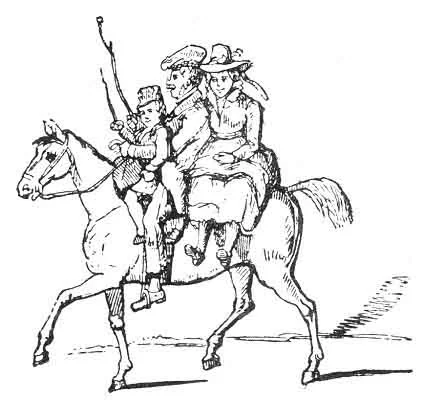
Highland Family Party returning from the Fair after a Dance. From a sketch from nature, 1829.--Page 303.
with the farmer's herd of cattle to graze them at the side of a loch, and she sat herself down near the bank. There, in a little while, what should she see walking towards her but a man (no description of him given in this version), who asked her to "fàsg" his hair. She said she was willing enough to do him that service, and so he laid his head on her knee, and she began to arrange his locks, as Neapolitan damsels also do by their swains. But soon she got a great fright, for, growing amongst the man's hair, she found a great quantity of "Liobhagach an locha," a certain slimy green weed that abounds in such lochs, fresh, salt, and brackish. (In another version it was sand.) The girl knew that if she screamed there was an end of her, so she kept her terror to herself, and worked away till the man fell asleep, as he was with his head on her knee. Then she untied her apron strings, and slid the apron quietly on to the ground with its burden upon it, and then she took her feet home as fast as it was in her heart. (This incident I have heard told in the Isle of Man and elsewhere, of a girl and a supernatural.) Now when she was getting near the houses she gave a glance behind her, and there she saw her "caraid" (friend) coming after her in the likeness of a horse.
He had nearly reached her, when the old woman who saw what was going on called out to open the door of the wild bull's house, and in a moment out sprang the bull.
He gave an eye all round about him, and then rushed off to meet the horse, and when they met they fought, and they never stopped fighting till they drove each other out into the sea, and no one could tell which of them was best. Next day the body of the bull was
found on the shore all torn and spoilt, but the horse was never more seen at all.
The narrator prefaced this story by remarking that it was "perfectly true," for he had it from a lobster fisher, who heard it from an old man who witnessed the whole scene. It was suggested to him that the "old woman" was a witch, but he would have his story told in his own way, and said, "Well, I suppose she was a witch, but I did not hear it."
Mr. Pattison, who wrote down this version, regrets that he did not get a fuller description of the animals. I have a fuller description of them, and of the girl, with all the names of the people, and the places, fully set forth. The bull was large and black, be was found groaning in a peat hag, and was helped by the girl's lover, who brought him food, though he suspected him to be the water-bull. The girl was dark-haired and brown-eyed, and the farmer's daughter. Her lover was an active Highland lad, and a drover, who went by the name of "Eachan còir nan òrd," "Gentle Hector of the hammers," and he was fair-haired.
There was a rejected rival suitor who takes the place of the water-horse, who threw his plaid over the girl's bead when she is at a shieling, and carried her off, but the black water-bull rushed in just at the nick of time, crushed the wicked wooer to the earth, invited the lady to mount on his back, and carried her safely home, when he disappeared, singing--
Chaidh conadh rium le òigear caomh,
’S ri òigh rinn mise bàigh
Déigh tri cheud bliadhna do dh' aosa chruaidh
Thoir fuasgladh dhomh gun dàil.
Aid came to me by a gentle youth,
And to a maiden I brought aid;
After three hundred years of my hard age,
Give me my freedom without delay.
This clearly then is as mythical a bull as the "black bull o' Norroway," and Mr. Peter Buchan's bull in Rashencoatie, and the dun bull in Katie Woodencloak, the Candlemas bull which was looked for in the sky, and the sign Taurus; and perhaps the "Tarbh uisge," is of the same breed as that famous Egyptian bull who was the god of the land of Scota, Pharoah's daughter.
The WATER-HORSE is generally but a vicious, amphibious, supernatural horse; and there is a real sea-creature whose bead may have suggested that there were real horses in the sea. But there were sacred horses every where in the East, so the attributes of water-horses are probably mythological. But the water-horse assumes many shapes; he often appears as a man, and sometimes as a large bird. In this last form he was "seen" by a certain man, who described him. The narrator waded up to his shoulders one cold day in February, in a certain muir loch, to get a shot at him; but when he got within "eighty-five yards" of him, the animal dived, and the sportsman, after waiting for "three quarters of an hour," returned to shore. There he remained for more than "five hours and a half," but the creature never rose. In form and colour he was very like the Great Northern Diver, with the exception of the white on his neck and breast; the wings were of the same proportion, the neck was "two feet eleven inches long," and "twenty-three in circumference;" bill about "seventeen inches long," and hooked like an eagle's at the end; legs very short, black, and powerful; feet webbed till within five inches of the toes, with tremendous claws. Footprints, as measured in
the mud at the north end of the lake, cover a space equal to that contained within the span of a pair of large antlers; voice like the roar of an angry bull lives on calves, sheep, lambs, and otters," etc. If that "eyewitness" had only taken his long bow with him instead of his gun, I have no doubt he might have secured a specimen of the "Boobrie." Nevertheless, I have heard of the Boobrie from several people who were beyond the reach of this "eye-witness;" so he has a real existence in the popular mind.
The dragon which haunts Highland sea lochs and Gaelic stories surely had the same origin as the Norse sea-serpent, figured in the wood-cut, and the great sea-snake of the Edda, which encircled the whole world. The bodily shape might have been that of a survivor of an extinct species, the attributes those of a sea-god. The creature figured by Pontippidan has relations at the Crystal Palace, and in geological museums; and yet the bishop knew nothing of geology a hundred years ago.
Even the FAIRIES seem to have a foundation in fact. If the Dean of the Isles told the truth in his book of statistics, quoted above, the bones of pigmies have been found; and the ancient habitations of a diminutive race are still found occasionally in the sand hills of South Uist, and elsewhere. In a "Sithchean," near Sligechean in Skye, piping used to be commonly heard, according to some of my informants. One of my acquaintance is commonly reported to fly with the fairies. They take him to certain churchyards, and bring him back again. A lout of a boy, who informed me that stories were very wicked, nevertheless added--
"That fairies are, is certain. I know two sisters--
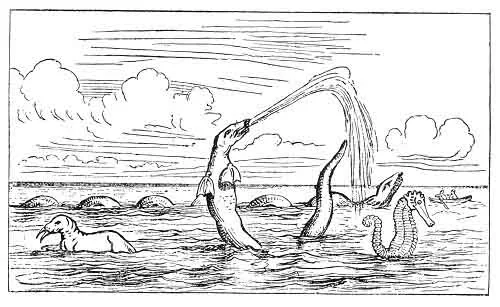
The Great Sea-Serpent, according to different descriptions. ''The Walrus,'' and ''The Sea-Horse,'' Copied from ''The Natural History of Norway,'' by Pontippidan, Bishop of Bergen.
one of them is a little deaf--and they heard a sound in a hill, and they followed the sound; and did they not sit and listen to the piping there till they were seven times tired! There is no question about that."
A worthy antiquary shewed me, amongst a lot of curious gear, a stone arrow head, and said--
"That is a fairy dart, which a man brought me a few days ago. He said he heard a whistling in the air, and that it fell at his feet in the road, and he picked it up, and brought it away with him."
A tinker assured me, with evident belief, that a man had taken such an arrow from an ash-tree, where he had heard it strike.
A doctor told this anecdote--
"Do you see that kind of shoulder on the hill? Well, a man told me that he was walking along there with another who used to "go with the fairies," and he said to him--
"'I know that they are coming for me this night. If they come, I must go with them; and I shall see them come, and the first that come will make a bow to me, and pass on; and so I shall know that they are going to take me with them."
"'Well,' said the man, 'we had not gone far when the man called out, 'Tha iad so air tighin.' These are come. I see a number of 'sluagh' the people; and now they are making bows to me. And now they are gone.' And then he was quiet for a while. Then he began again; and at last he began to cry out to hold him, or that he would be off.
"Well," said the doctor, "the man was a bold fellow, and be held on by the other, and he began to run, and leap, and at last (as the man told me) be was fairly lifted up by the 'sluagh,' and taken away from him,
and he found him about a couple of miles further on, laid on the ground. He told him that they had carried him through the air, and dropped him there. And," said the doctor, "that is a story that was told me as a fact, a very short time ago, by the man whom I was attending."
Not far off I was told this in a house full of people, all of whom knew the story, and seemed to believe it implicitly.
"There was a piper in this island, and he had three sons. The two eldest learned the pipes, and they were coming on famously; but the youngest could not learn at all. At last, one day, he was going about in the evening, very sorrowfully, when he saw 'bruth,' a fairy hillock, laid open." (There was one close to the house, which had been exactly like the rest of its class. It was levelled, and human bones were found in it, according to the minister). "He went up to the door, and he struck his knife into it, because he had heard from old people that if he did that, the 'sluagh' could not shut the door. Well, they were very angry, and asked him what he wanted, but he was not a bit afraid. He told them that he could not play the pipes a bit, and asked them to help him. They gave him 'Feadan dubh,' a black chanter, but he said--
'That's no use to me, for I don't know how to play it.'
Then they came about him, and shewed him how to move his fingers; that he was to lift this one and lay down that; and when he had been with them a while, he thanked them, and took out his knife, and went away, and the 'Bruth' closed behind him.
"Now that man became one of the most famous pipers in ------, and his people were alive till very lately. I am sure you all know that?
Chorus--"Oh yes." "Yes, indeed." " It is certain that there were such people, whether they are now or not." "O yes, that is sure "--
"Do I not know a man who was in the island of ------, and he was sitting by himself in a hut, with a fire lit; and it was a wild night. The door was pushed open, and a gray horse put in his head. But the man was not afraid, and put up the palm of his hand this way to the horse's nose, and he said, 'You worthy horse, you must go away from this;' and the horse went out backwards." "And were there no horses in the island? " "No; never, never." Chorus--"Never, never." "That was the water-horse." "That's sure."
A boy, some hundreds of miles away, told me that there was a man who built a house, and as often as it was built it was burned down; but they told him to put a bit of ivy into it, and he did that, and the house was not burned that time.
All England was dressing its churches and dinner tables with Christmas ivy a short time ago, but few will think that this is a Celtic charm against the fairies, or that ivy was planted against houses to guard them from fire.
An old Welsh dairymaid, from near Shropshire, denied all knowledge of King Arthur. "She had never heard of him, not she." She did not know of her own knowledge that the fairies carried people away, but she had heard that a woman, who lived some distance from her father's house, had two children carried off by fairies. They left her two others, which were just like her own; but they were always crying. She went to a wise woman, and she told her to go to a river where there was a bridge--a single plank like--and to take one of the children in each hand, and drop them in the middle.
"Well, I cannot say if it is true. I can only tell it as I heard it; but I heard that the woman did take the two children, and drop them into the middle of the stream; and when she got home she found her own two children, quite safe and well, in the house before her."
There must be some foundation for all this widespread belief in the existence of a small people. A woman lately described their dress and appearance as seen in Islay. "They were dressed in green kilts, and green coats, and green conical caps--sharp caps like the "Clogadan," helmets which children make of rushes." A rim is woven into a kind of basket-work coronet, and the points are gathered together and make a high cone. Swedish Lapps now wear caps of the same shape. Fairies thus dressed have been seen marching "like a wedding," with a piper playing before them; and such a procession goes by the name of "Banais shith," a fairy wedding.
"And did they ever wear arms?"
"No; they had not pith enough to bear arms; they were but spirits."
Nevertheless, they had bodily strength, and worked hand mills, if all tales be true.
This class of stories is so widely spread, so matter-of-fact, hangs so well together, and is so implicitly believed all over the united kingdom, that I am persuaded of the former existence of a race of men in these islands who were smaller in stature than the Celts; who used stone arrows, lived in conical mounds like the Lapps, knew some mechanical arts, pilfered goods and stolen children; and were perhaps contemporary with some species of wild cattle and horses, and great auks, which frequented marshy ground, and are now
remembered as water-bulls, and water-horses, and boobries, and such like impossible creatures.
I leave it to ethnologists and geologists to say, whether this popular supernatural history has any bearing upon modern discoveries; whether it may not be referred to the same period as the lake habitations of Switzerland, Denmark, Ireland, and the Scotch. Isles; the sepulchral chambers containing human remains, and surrounded by bones which appear to be those of animals now extinct; the works of art in the drift; and the relics of fossil men.
And here, with an apology for this lengthy postscript, I will leave Highland Tales for the consideration of learned men well read in mythology and like subjects.*
*NOTE To AVALON, on Page 242.
Another explanation of this ancient British tradition may perhaps be found in the discovery of America by the Northmen in the tenth century, described in the abstract of evidence taken from Icelandic Sagas, and published by the Society of Northern Antiquarians in 1837.
It there appears that in 986 Eric the Red emigrated from Iceland to Greenland, and in subsequent years other voyagers made their way down the coast of America, and named one part of the country VINLAND, from the vines which a German who was of the party found there.
In 1006 a certain THORFINN, who was sprung from " Danish, Norwegian, Swedish, Irish, and Scottish " ancestors, some of whom were kings of royal descent, effected a settlement in Vinland.
In 1003, an exploring party had fallen in with a place called "Irland it Mickla," which was inhabited by white men, who had iron implements, and it seems to be implied that these were Irishmen settled in Florida. The stories of the voyages of Biörn Asbrandson, and Gudleif Gudlaugen, are extremely like the traditions now current in the west, about voyagers who discover a mysterious western land, and there find ancient heroes still living in their old way.
Some Norse traders; as it is said, after a trading voyage to Dublin, were driven far to the South West, and found an unknown land, where inhabitants spoke Irish, and who seized and bound them. A man of distinguished appearance, with gray hair, and with a banner carried before him, came riding down to the shore, addressed the strangers in the Norse language, and after some time the natives, who paid him great respect, agreed that he should decide the fate of the strangers.
He was Biörn Asbrandson, and he, after taking counsel with twelve of the natives, sent his countrymen away with gifts for his friends in Iceland. The voyagers returned to Dublin, and next year to Iceland. Now, if this is not a Celtic myth in an Icelandic dress, the Celtic myth now current has a foundation in fact. If the Sagas are to be depended upon, America was discovered by Icelanders, but by men who frequented the Hebrides and Ireland; and it is expressly stated in these Sagas that Hebridians and Irishmen accompanied some of these American expeditions. It seems quite possible that the real event may now be remembered as a legend in the countries whence voyages were made. There is a resemblance between Fionn and Thorfinn, and Fionn's land and Vinland, and apples are now common enough in America, whether they grew there. Avalon is like Avlan (apples), as written by one of my correspondents.
Footnotes
291:1 Pronounced Djee-A. Djâys.
294:1 See Note, page 344.
295:1 West of Scotland Magazine. 842. (1858.) I have not found the names or the passage in the author quoted, but he describes an island which rose from the sea, and sank, and became firm on shooting a fiery arrow Into it.
A PLEA FOR GAELIC.
And now let me add a word about the Gaelic language.
It is commonly said, "You have no literature; the language is not worth learning."
A writer in the newspapers, who was kind enough to praise me, nevertheless found great fault with the publication of Gaelic. The publishers say, "Gaelic is a dead weight in the trade." My friends say, "Give us no more Gaelic."
The British Museum Library is a national institution, and spends very large sums on books, but such Gaelic books as "Gillies" and "Carswell" were not there in
1861. The Advocates' Library in Edinburgh has "Gillies," but no "Carswell," not even "Reid's Bibliotheca Scoto Celtica," which gives a list of Gaelic books.
What there may be at Oxford and Cambridge I do not know, but I do not believe that the published Gaelic books are to be found together in any one public library. I bought "Gillies" for a few shillings in Glasgow, and the Duke of Argyll has "Carswell," under lock and key, for it is valuable, and has been lost. I lately attended the lectures of one of the best of modern philologists, chiefly with a view to Gaelic as it relates to Sanscrit. The Celtic tribes were placed by him in the front ranks of the Aryan migration, the names of the most distinguished German scholars were associated with Gaelic learning, but still in lectures addressed to an English audience, of whom a large proportion must have had "Celtic Crania," and all of whom use Gaelic words in their ordinary speech, there was scarcely a word about the old languages of Great Britain in early days, and yet Gaelic and Sanscrit are allied, and Gaelic throws light on the relationship which exists between Sanscrit and English.
Compare the form of the verb "to be" in the three languages. The Gaelic verb is an assertion of existence, followed by the name of the person or thing referred to; and if the corresponding English words be taken instead of the verb, and the Gaelic sounds are spelt, the three languages are like each other, and the
Gaelic is the simplest form.
|
I am |
thou art |
he is |
English. |
|
ásmi |
ási |
ásti |
Sanscrit. |
|
hā-mee |
hā-oo |
hā-ê |
Gaelic sound. |
|
is me |
is thee |
is he |
literal translation. |
The past tense of the verb is an assertion of past being BHA, pronounced VA.
Gaelic is closely related to the classical languages. Pritchard's Eastern origin of the Celtic nations, and Armstrong's Gaelic dictionary, and similar works, will shew how much there is of resemblance between Gaelic, Latin, Greek, etc.; and it is generally admitted that a Keltic language is at the foundation of the classical tongues. An eccentric Gaelic schoolmaster is quoted in the West of Scotland Magazine, who used to spout intelligible Gaelic imitations of Latin authors for hours--such as, "Arma virumque cano." "Airm a's fir' se chanum." The dominie said he was cracked, but there was method in his madness.
The following words which I have gathered from books and from my friends appear to bear upon Gaelic-
68th Psalm, 4th verse, "Extol him that rideth upon the heavens by his name JAH.
|
English. |
Sanskrit. |
Phonetic Gaelic. |
English, &c. |
|
God |
Deva |
|
|
|
shine |
Div |
|
|
|
heaven |
Dyo |
DjeeA, YeeA |
God (Vocative) |
|
|
|
djaw |
breadth |
|
Day |
Dyu |
an dew |
to-day |
|
|
|
an djay |
yesterday |
|
|
|
djee |
day |
|
|
|
tjays |
heat |
|
|
|
djArs |
shine |
|
|
|
djAlAnAch |
lightning |
|
Light |
jwālā |
geeAl |
white |
|
|
|
geeAlvAn |
fire |
|
|
|
geeAlAch |
moon |
|
|
|
glAn |
clear glancing |
|
flame |
jwala |
djAlrAch |
shining |
|
light |
heli |
llês |
light, a gleam |
|
|
|
solus |
light |
|
|
|
soileir |
clear |
|
Sun |
heli |
|
|
|
|
|
|
|
|
English. |
Sanskrit. |
Phonetic Gaelic. |
English, &c. |
|
house |
Griha |
greeAnAn |
house, dwelling |
|
|
|
greeAn |
Sun (fæm) |
|
|
|
grai |
love |
|
heaven |
nabhas |
nyeav |
heaven holy |
|
smoke |
nabholaya |
nyêl |
a cloud |
|
|
|
nyeoil |
clouds |
|
moon |
kledu |
|
|
|
|
|
klAdAch |
tidal shore |
|
a shore |
Tira |
tjeer |
shore |
|
water |
uda |
ooisge |
water |
|
|
|
aigean |
ocean |
|
water |
Vár |
vArA |
(to the) sea |
|
sea |
mīra |
mArA |
(of the) sea |
|
|
|
muir |
the sea |
|
an eye |
Lochana |
Lochan |
a pool, also called a trembling eye |
|
earth |
Dhārā |
gArt |
corn land |
|
|
|
tAlav |
tellus |
|
agriculture |
krishi |
troosh |
gather |
|
to plough (ear) |
Ar |
ArAr |
standing corn |
|
|
|
ei-ir |
a boat |
|
to make |
jan |
djên |
make-do |
|
man |
jana |
duine |
man |
|
a man |
vīra |
fêr |
a male individual--one |
|
I live |
jīvā mi |
vA mee |
I was |
|
knowledge |
jnà |
se-nA-gaw |
It is known to me, to him, to thee |
|
knowledge |
vid |
fees |
knowledge |
|
wise |
vidvas |
fees-eech-e |
soothsayer |
|
a sage |
Buddha |
bodach |
an old man |
|
a tree |
Dru |
dru |
an oak |
|
|
|
druiAch |
a conjuror |
|
|
|
druv |
a house, chariot |
|
king |
Rājan |
ree |
king |
|
family |
kula |
coolain |
whelp, young of any animal, term of endearment |
|
|
|
clAn |
children |
|
brother |
bhrātri |
brAair |
brother |
|
mother |
mātri |
mar |
mêre, mother |
|
father |
Pitri |
|
|
|
|
|
A-air |
Father |
|
|
|
A-ar |
Heaven, the air |
|
|
|
Art |
a God |
|
|
|
Art |
Arthur, a common name of kings |
|
|
|
|
|
|
English. |
Sanskrit. |
Phonetic Gaelic. |
English, &c. |
|
horse |
As'va |
Each |
horse |
|
|
|
shArrAch |
foal |
|
cow |
Go |
bo |
cow |
|
dog |
s'van |
shiunAch |
fox |
|
bitch |
sunah 1 |
|
|
|
ram |
Urana |
rê |
ram |
|
|
|
rê |
the moon |
|
|
|
ro |
a circle |
|
|
|
ree |
king |
|
|
|
ooAn |
lamb |
|
|
|
caora |
sheep |
|
bull |
ukshan |
ooksa |
a large fish |
|
|
|
aog |
a hind |
|
to eat |
ad |
eech |
eat |
|
tooth |
Danta |
djeud |
tooth |
|
soul |
ātman |
AnAm |
soul |
|
|
|
AnAil |
breath |
|
death |
māra |
mArAv |
dead, kill |
|
|
|
bAs |
death |
|
night |
nis'á |
n' uiche |
the night |
|
thou |
yushmad |
oosa |
thee |
|
he |
Sa |
shê |
it is he |
|
|
|
esAn |
him |
|
she |
Sá |
shee |
It is she |
|
|
|
eeshe |
her |
|
which |
ka? |
ko? |
who, which? |
The numeral 1 is UN--like "un" (Fr.) "one." The numeral 5 coig, I cannot trace in Panchan, though it has a resemblance to cinq and quinque, which are traced in Sanskrit by experts, but 2, 3, 4, 6, 8, 9, 10 resemble the Sanskrit numerals. The formation of higher numbers up to 20 is on the same principle--one ten, four ten, etc. Thence the Gaelic counts by 20 and the Sanskrit by 10. The Gaelic says ten and two twenties, or half a hundred--the Sanskrit says five tens.
Any Gaelic scholar may extend this list by a reference to books on philology, but Gaelic ought most to resemble the oldest known Aryan speech, if it be one of the oldest survivors of the Aryan family. There is a likeness, but many surviving European languages are much nearer to Sanskrit.
A vast number of places out of the Highlands still retain their Gaelic names, and it is interesting to
understand them; for example, TINTOCK is the highest mountain in Lanarkshire; and the name has a meaning in Gaelic, "The house of the mist" (Tigh n' to-ag); and a local rhyme shews that to be the true meaning of the name, which has no English meaning.
On Tintock tap there is a mist,
And in the mist there is a kist,
And in the kist there is a cup,
And in the cup there is a drap
Tak up the cup and drink the drap,
And set the cup on Tintock tap.
There was a popular tale about this mountain which I have, failed to get; but a cup, with some mysterious drink, is common in Celtic traditions. There are cups taken from the fairies; cups from which all sorts of drinks came; the cup of Fionn which healed diseases; the great caldron of the Feinne, which is bidden somewhere; the kettle of the "Korrigan" of Brittany; the St. Graal of mediæval romance, for which there is no Scriptural authority; and the Ballan iochshlaint, or vessel of balsam. And when we get back to Sanscrit mythology, a chief object of worship was a drink, the juice of a plant, the "soma," to which all sorts of virtues are attributed in the Vedas.
So lowland mythology is explained by Gaelic, and so is lowland topography. "Craignethan" Castle has no meaning; but a similar Gaelic sound means the crag of the rivulet, and correctly describes the site of the ruin of Scott's castle of "Tillietudlem," in Lanarkshire.
CAM, in Cambridge, means the crooked, which is a correct description of the river Cam; Bournmouth
means Watermouth, and is situated at the mouth of a "burn" or rivulet; Bannockburn means Cakewater in Gaelic. In short, no history of the English language is complete without its Celtic first chapter; and no one has yet tried to write the Scotch Gaelic part of it.
Modern English is certainly more Teutonic than Celtic, but it is full of Gaelic words, and they are creeping in still.
Here are a few words, chiefly written down as they occurred in translating, and which seem to be common to Gaelic and English. Any dictionary will give many more.
GAELIC and ENGLISH.
|
Tuig (understand) |
Twig (modern slang). |
|
Gille (lad) |
Gilly (sportsman's ditto). |
|
Failire |
Palfrey. |
|
Steud |
Steed. |
|
Claidheamh |
Glaive. |
|
Saighdear |
Soldier. |
|
Sgath-dubh |
Shadow. |
|
Mireadh (playing) |
Merry. |
|
Monadh |
Mountain moor (mons). |
|
Muir (sea) |
Meer. |
|
Bùrn (water) |
Burn modern words. |
|
Loch |
Loch " " |
|
Srath |
Strath " " |
|
Gleann |
Glen " " |
|
Dail |
Dale. |
|
Gëil |
Gill, a field. |
|
Margadh |
Market. |
|
Sràid (a walk) |
Street. |
|
Rathad-mór |
Road. |
|
Bàta |
Boat. |
|
Sgoth |
Scow or Skiff. |
|
Seòl |
Sail. |
|
Ròpa |
Rope. |
|
Port |
Port. |
|
Lìn (lint) |
Line. |
|
|
|
|
Streng |
String. |
|
Bocsa |
Box. |
|
Bogha |
Bow. |
|
Sgiath (a wing) |
Shield. |
|
Casadh |
Gnashing. |
|
Teanga |
Tongue. |
|
Sròn (nose) |
Snort, snore. |
|
Slip |
Lip. |
|
Ameasg |
Amongst. |
|
Ruaig |
Rout. |
|
Corp (the body) |
Corpse (corpus). |
|
Cinne |
Kin. |
|
Càl |
Kail. |
|
Boglaichean |
Bogs. |
|
Bog |
Soft. |
|
Sgor |
Scaur. |
|
Creag |
Crag. |
|
Sòlas (joy) |
Solace. |
|
Cuist! |
Hist! whist. |
|
Pailliun |
Pavilion. |
|
Feachd (battle array) |
Fight. |
|
Sac |
Sack. |
|
Rannsaich |
Ransack. |
|
Roimhe'n t-sac |
Through the sack. |
|
Onair |
Honour. |
|
Sliom (smooth) |
Slime. |
|
Measan (lap dog) |
Mesan. |
|
Cart (to clear a byre) |
Cart. |
|
Stoirm (great noise) |
Storm. |
|
Halla (Talla) |
Hall. |
|
Bàrd |
Bard. |
|
Cathair (seat, city) |
(Chester) |
|
Dùn (heap, fort) |
London. Dunstable |
|
Pairce |
Park. |
|
Tùr (a journey) |
Tour. |
|
Tùr |
A tower. |
|
Bid-eag |
A little bit. |
|
Braghaid |
Brisket. |
|
DrAchk (Phonetic) |
Drake. |
|
Dregan |
Dragon. |
|
Gànra |
Gander. |
All Gaelic words ending in ear, which mean a male individual who does something, embody the Gaelic word fear (a man, or a male unit), which word, when combined with another, is spelt fhear, and pronounced as êr or ηρ, if a sheep's note is properly spelt μη. Thus,
|
Muillear |
Miller, |
is a contraction for
|
Mullinnfhear |
Millman. |
|
Saigh-dear |
Soldier. |
|
Saigheadfhear |
Sagittarius. |
The Latin word thus seems to be founded upon fhear rather than Vir, though vir is supposed to come from the Sanscrit Vira; but of the Aryan languages (so far as I know) Gaelic alone explains how the V was lost, for Gaelic inflections are often made at the beginning of words.
Supposing that the word for an archer to be a remnant of the old Keltic of Italy, preserved in Latin, Sagittarius is made up of
Saighead-fhear-ius,
Arrow -man (with a termination.)
And if the g had the value which it has in many languages, the sounds would be almost identical in Latin and Gaelic.
If this be right, the termination er, and the (now) Gaelic word fhear, appear in most of the Aryan languages of Europe--Eng., Baker; Gaelic, Fuineadair; German, Bäeker; French, Boulanger; Norse, Bager; Spanish, Panadero; Italian, Fornaro; Swedish, Bagare; Latin, Pistor: but Greek ἀρτοποιὸς will not do, though the words am fear, the man, reappear in ἀνηρ, a man, and aran, bread, in ἀοτος.
It nowhere appears in Lapp, for olmush is the equivalent of Fear, a man, and laibbo is a baker, though hepush, a horse, is like ἱππος.
Now, any English tradesman may be named by adding er to the proper words, as trader, railway-engine-boiler-riveter. Any Gaelic tradesmen may also be named, in like manner, by adding fhear, or ear, or air, to other words; but neither in Gaelic nor in English will these terminations properly apply to a tradeswoman. In English the proper addition is seamstress, in French it is euse--and here again is Gaelic--Ise is the equivalent of she,
and esan of he, and aiche is the termination which is common to both genders, as--
Ban-fhaughl-aiche, a female seamstress,
but in English there are two ways of forming such words. We say horse man, horse woman; but if we say rider, we must add another word to express a female rider; so the termination er, if Keltic, is equivalent to man in horse man, which is Teutonic.
Any one who knows Gaelic can easily put a meaning on numbers of Italian names. For example, "Monte, Soracte," Monadh, Sorachan (mountain, peak or hillock), is a small peaked mountain standing alone near Rome. "Monte Appennino," Monadh na Beinne (the mountain tract of the hill country), is at least as descriptive in Gaelic as Italian, and the sounds are very like still.
In like manner, the connection between Gaelic and any one of a large class of European languages, can be shewn, but it has no apparent relationship to Lapp. Hence, Gaelic is useful to a Sanscrit scholar, and necessary to the full development of any system which treats of the Aryan family of races and languages; and it is a very useful accomplishment for any student of the Eastern languages, which pave the way to promotion in India. It is also useful to a classical student who wants to go deep into Greek and Latin.
No Frenchman can fully understand the origin of his own language without knowing Gaelic, for French is still full of words, and especially sounds, which seem to be Gaelic. If French be Latin, it is Latin spoken with a Celtic brogue.
Du blè, corn, and bleth, to grind, are pronounced in the same way. French sentences, which to the best-taught English tongues, are as hard as this and that, and the other thing, to a Frenchman, are easily pronounced by a Highlander. On dit, qu'un bon garçon gagnait cinq cent, cinquante cinq écus, and such sounds, present little difficulty to a Gaelic peasant; and there are Polish and Russian and Welsh liquids of which the same is true. Puill, holes full of mud, has the same sound as the Russian for dust, and the French Mouillé, wet, which are sore puzzles for a Saxon, but easy for a Celt. Eala gheal, a white swan, contains a Polish liquid sound, which a Polish lady assured me she had never heard mastered by a foreigner, yet it
is one of the commonest sounds in Gaelic. So Gaelic is of the greatest use in learning to speak and pronounce other languages.
He who can utter the following sentence must have a nimble tongue for liquids--
"Laogh na laidhe an an lag an lochain air là luain 's ag òl leann laidir á ladar."
In the specimen of "old Saxon," given by Latham (p. 46, Handbook of the English Language), a few words which resemble Gaelic can be traced.
|
Ehusealcos (horsegrooms) |
Eich (horses). |
|
Ueros (men) |
Fear (a man). |
|
Fehas (cattle) |
Féidh. (deer). |
|
Uuarlico |
Fior (true). |
|
Cudean ("show strength) |
Dean (do). |
|
Cunneas (races) |
Cinne (kindred). |
|
Firiho (of men) |
Fir (men). |
|
Rikiost (noblest) |
Righail (kingly). |
|
Kind (child) |
Gin (to beget). |
|
Louodun (praised) |
Laoidh (to laud. A hymn). |
|
Rikea (kingdom) |
Rioghachd (realm). |
Spoken Gaelic has altered very little in the course of the last three centuries in the islands.
Dean Monro's statistical account of the Western Islands was written in Scotch, 1549, and the names are spelt phonetically. The names of the islands and families, as now pronounced, could hardly be better expressed for English ears. "Skibness; Ellan Ew; Lochebrune; M‘Enzie; the haley isles of Flanayn; Ellan Vie Couil, perteining to M‘Cloyd;" and some hundreds of names are so spelt as to express their present value. Icelandic, which has also been shut up in islands, has altered but little for many centuries.
To me it appears that a living language of this kind, which certainly is a dialect of "Keltic," which was spoken in Great Britain and Ireland in the days of Cæsar, and was also spoken in all the outlying corners of Europe, in Spain, and Portugal, France, Jutland, in Italy, Greece, and Asia Minor, and which is now spoken by settlers in America, and Australia, and India, is an interesting study.
It is peculiarly interesting, for the same reason, that a great auk's egg is now worth a large sum. Gaelic, like the great auk, will soon have ceased to exist, and the process by which it is extinguished may serve to explain the extinction of languages elsewhere.
Its very corruptions are lessons in the science of language. The manner in which a new word is altered, when it is received into common use, is a practical lesson, which holds good for all human speech, and serves to test the rules laid down for phonetic changes.
The inflections at the beginning of words, which are an essential part of spoken Gaelic, seem to be especially worthy of attention for their singularity. There is no good reason to suppose that "Gaelic," "Welsh," or "Dutch" was the "language of Paradise" but there is no reason why Gaelic should not contain remnants of some form of speech older than Sanskrit, and this may be one example. But my wish is to call attention to this subject, not to pronounce opinions on questions which require hard study, and knowledge which I do not yet possess.
In the Highlands generally, I find the language rapidly mixing with English; and striking illustrations of the changes which take place in human speech, phonetic and grammatical, meet me at every step; but they are all changes which tend to decay. I find that lectures are delivered to Sunday-school children to prove that Gaelic is part of a divine curse; and Highland proprietors tell me that it is "a bar to the advancement of the people."
Let me endeavour to show that Gaelic is good for something more; it has been shown above that it is good for something.
First, English is a "bar to the advancement " of proprietors,
if they cannot speak to those who pay their rents; and it is the want of English, not the possession of Gaelic, which retards the advance of those who seek employment where English is spoken. So Highland proprietors should learn Gaelic and teach English.
Gaelic is no bar to advancement. It did not clog the steps of the Lord Justice General, or his brother the Ambassador, or of the Vice-Chancellor, or of dozens of other men of rank, whose learning included Gaelic. It has not weighed in my slower race through life; and it gave me a stock of sounds which occur in other languages, and which an English tongue can rarely pronounce. It is worth learning, if only to see the pleasure which shines like sun-light through a clouded Highland face, when Gaelic is unexpectedly heard.
Some time ago I was walking along a lowland road, dressed in the genteel chimney pot, and broad cloth of this age, and as I went, the sound of a plaintive Gaelic song caught my ear. It came from a bevy of girls who were working in a field by the road-side, and singing a lamentable love song over their work. So I called out over the hedge, "’S math sibh fhéin a ghaladan," "well done, girls." The whole field was in a pleased commotion directly, for these were people from Skye; and we were friends on the instant, by virtue of a cabalistic word of our common language, and so it has been in thousands of cases.
Gaelic is the key to a Highlander's heart; and proprietors and utilitarians should learn it before they condemn it. They would not so easily part with their people if they knew them, and could talk with them.
If Irish proprietors would try to speak Gaelic to their people they would be better liked. Officers who speak Gaelic to Highland soldiers command their affection.
If officers in Highland regiments would try more, they would have more recruits.
Without printed Gaelic I feel sure that I should now be enjoying the blame of another MacPherson. I submit to my adverse critics that they would not have believed in Gaelic stories without the originals, and that Gaelic as now spoken in various districts was something worth preservation, for they will find it nowhere else.
Let those who say that there is no Gaelic literature read Professor O'Curry's Lectures, and they will there find that the best scholars only distinguish between Scotch and Irish Gaelic as between dialects of the same tongue, and that there is a mass of unexplored Gaelic literature still extant. There are two Professors, one at the New Catholic University; a Government Commission is employed about "the Brehon laws," as they are called, and a Gaelic MS. about "Danish invasions," forms one of the historical series published under the authority of the Master of the Rolls. All sorts of questions are sure to arise as these documents are brought to light and read; and without Gaelic no scholar can give an opinion of them. Questions relative to early Christianity may turn on words in Gaelic manuscripts, and who is to say what may be found in such an unexplored field? Old Irish prophecies have actually been spread amongst the peasantry for political purposes. If it was important for the interests of the State to found a chair of Sanscrit, which nobody speaks, surely there ought to be some means of learning Gaelic devised for England, where a large section of the people speak the language still. Surely the few relies of Scotch Gaelic literature which remain are worthy of more attention. Till rescued from oblivion, and placed in safety by the patriotic exertions of Mr. Skene, their
very existence had been forgotten, and some valuable MSS., the property of the Highland Society, have disappeared within the last sixty years. It is surely a mistake to say that there is no literature in a language, and to set about proving it to be true by allowing the little which remains to be destroyed.
Without a common language men misunderstand each other, and those who are employed in a country should be able to talk to its people. It is a rule of the Danish Government that no official shall hold office in Iceland unless he speaks both Danish and Icelandic, and the rule is good. A philanthropist who cannot speak to the people, and judges from what he sees, must describe the poor of the west as living in squalid hovels, amidst peat-reek; silent, and dull; for they cannot speak to him, and they are very poor, and they are awed into silence by the broad-cloth, and black hat, and gold watch and chain of a government gentleman who suffers from peat-reek. A few specimens of those most mysterious of beings, which are found in all classes, men without reason, may lead to the conclusion that the rest are but idiots of a higher grade; but one who understands Gaelic may learn a lesson beneath these lowly roofs. He may hear the story of Cinderella, and of the black, rough-skinned herd; and the "idiots" who all rose to be princes, and the song of the mighty fool who did his duty manfully and succeeded. He may look about him and find that very many historical names have in fact sprung from a cottage, and from such cottages; and if these are turf heaps over which a man can walk, he may be reminded that without Gaelic he can know as little of the better part of those who inhabit them, as Gray knew of the minds of those who mouldered beneath the mouldering heaps of a
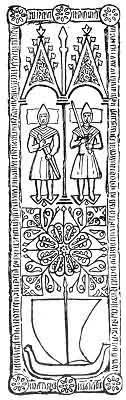 From a stone in Islay. |
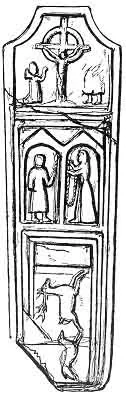 From a stone at Skipness, Argyllshire. |
| Neither of these cuts do justice to the design on the stones. |
I have said this much, because there is a vague idea in English-speaking society that a Celt is an inferior animal, and that is a "vulgar error." An Englishman, say what he will, has a large cross of the Celt in his composition, as the shape of his head proclaims. Many Lowlanders and the people of the midland counties of England are "Celts," and a Frenchman is not inferior to an Englishman in most things. The purest specimens of Scandinavian blood are to be found in Iceland, and there are no signs of superiority of race there; on the contrary, there is a strong resemblance to the people of the West Highlands, and to many of their peculiarities of temper and manner. I doubt if even the country whence the Anglo Saxons came, can now shew any
superiority over the countries where Celt and Saxon, and good feeding, have produced a good cross. In Norway, Iceland, France, Germany, and Italy, a man of five feet ten inches feels himself above the average size. He is below the average size of West Highland gentlemen. Whole families of men above six feet high could be named. I know a Highlander, who is a little over six feet, and measures fifty-six inches round the chest, and who in his youth was "as strong as a bull." A London drawing-room is the only place in Europe where a race of men better grown than West Highland gentlemen is to be met. Having associated with peasants in every country which I have visited, mixing with all classes on equal terms, so far as I could, I have arrived at the conclusion that a Celt is an average human animal, equal mentally and physically to any other species of the genus homo similarly placed. Much the same can be said of Lapps, though they are a small race, and I am no believer in the natural superiority of any one race over another. It seems to be in the nature of races to dislike and despise each other, and I would willingly "speak up" for the minority, who cannot speak for themselves, "having no English," and who are apt quietly to despise the Saxon fully as much as he despises them. Both are wrong, as much and as surely as the members and the stomach erred when they fell out. The one cannot suffer but the other must ache.
Footnotes
319:1 Pritchard, p. 210.
DRESS.
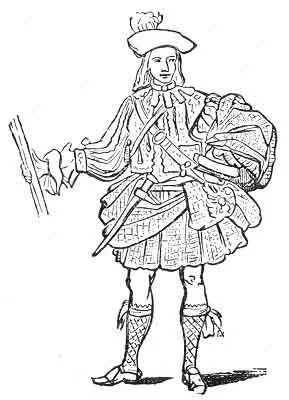 1560, or thereabouts. From a rough sketch taken from a picture at Taymouth, said to be a portrait of ''The Regent Murray.'' The arms are Gun, pistol, powder horn, dirk, and sword. |
Dress hardly belongs to my subject, but those who deny the existence of Gaelic poems, and affect to despise Celts, often assert that the Highland dress is of modern invention. I have so often heard this gravely maintained, that it may be as well to give some reasons for a different opinion, and quote some authorities for the antiquity of the "Garb of old Gaul."
The patterns of tartan are produced by crossing and twisting threads of various colours. It is easy to dye
hanks of yarn of single colours, and the simplest arrangement of coloured threads is to cross them; consequently the first effort to produce a pattern by the weavers' art, generally results in squares and bars something like Scotch tartan. The South Sea Islanders, who wear home-made woven cloths, either colour them by painting patterns on them, or by crossing coloured fibres. The bands woven by the Lapps on their small hand looms have similar patterns; their coloured baskets are woven into squares, and the early weaving and basket-making of all nations have a general resemblance.
But each savage tribe has some peculiarity in its patterns which distinguish them from others, and the manufactures of savage and civilized communities are alike marked by the development of some original design, which must have been the invention of somebody.
The idea of ornamenting woven fabrics with stripes of various colours, crossing each other at right angles, and blending where they cross, would result from the simplest arrangement of coloured fibres that could be devised, and was probably the invention of the first maker of mats, but in Scotland that idea has produced an enormous number of "tartans." Every year produces a new crop, but nevertheless there are a number of old "sets" which are of unknown antiquity, and these being made in particular glens or islands, came to be the distinctive uniform of the families or "clans" who lived in the glens, and who carried on the manufacture of tartan, spinning on distaffs, and weaving in handlooms at home.
The Irish, the Germans, the Celts, and many ancient nations, wore striped garments.
From the lives of the saints, it appears that in the seventh and eight centuries Scotchmen used cloaks of variegated colours, and fine linen, used chariots, and made swords and other weapons, had glass-drinking vessels, leather boats for the rivers, and oaken gallies for the sea.--(Scotland in the Middle Ages, 227.)
The oldest tartan "sets" ought to be those which can be made from native dyes, and this test will weed out a considerable number which profess to be "Clan tartans." The art of dyeing is attributed to the Tyrians, and it is asserted that they visited the British Isles. There are fish which produce a dye on the British coasts, but the inhabitants do not use them, so far as I know. Neither "Tyrian purple " nor "sæpia" are amongst Highland dyes; but the ancient Britons knew of a blue dye, the Irish knew many, and old wives still colour worsteds of their own spinning with plants that grow on their own Scotch hills.
With the root of the bent they make a sort of red.
With "máder" they dye blue and purple. With some other root, whose name I have forgotten, I have seen thread coloured yellow by boiling it in a pan, and thus the Highlanders still produce the three primitive colours from native dyes. Wool and goat's hair give black and white.
Green they produce with heather, and a very rich brown of various shades from yellow to black with a species of lichen which grows on trees and rocks, and is called "crotal."
The art is now giving way to improved manufactures, and there is often a kind of mystery about it. Some old woman is quoted as the authority, who knows a particular old Highland dye, and there is every indication of an old traditional art not quite forgotten.
Tartans, therefore, especially some sets, ought to be old. If not as old as the seventh century, they are at least as old as 1603, according to the author of "Certayn Mattere concerning Scotland," who says, "they delight in marbled cloths, especially that have stripes of sundrie colours; they love chiefly purple and blue; their predecessors used short mantles or plaids of diverse colours, sundrie ways divided, and among some the same custom is observed to this day, but for the most part they are brown, most near to the colour of the hadder, to the effect, when they lie among the hadders, the bright colour of their plaids shall not bewray them; with which, rather coloured than clad, they suffer the most cruel tempests that blow in the open fields, in such sort, that in a night of snow they sleep sound."
Tartan was worn during the thirty years' war, and the Germans thus described the wearers:--
In such dresses go the 800 Irrländer, or Irren, newly arrived at Stettin, A.D. 1631.
"This is a strong hardy people, content with common fare; if they have no bread they eat roots, when need requires it. They can run more than twenty German miles in a day; they have by them muskets, their bows and quivers, and long knives."
There are plenty of bits of old tartan preserved in Scotland. There are pictures at Dunrobin, at Taymouth, at Armidale, at Holyrood and elsewhere, all of which prove that tartan was anciently worn, and that particular patterns were worn in certain districts.
Dr. Johnson and Boswell saw men dressed in plaids and tartans when they made their tour in 1773, and whence the notion sprang that the Highland dress is a modern invention I cannot imagine, unless it is the offspring
of the same spirit which passed an Act of Parliament to forbid the dress.
The form of the dress is undeniably old. A sculptured stone was dug up some years ago at St. Andrews, in a position which proves its great antiquity; and General Stewart's description of the dress of 1740 applies as well to the figure, probably sculptured long before St. Andrew's Cathedral was built, as it does to pictures at Taymouth, and prints of 1631.
Copies of some of the figures on the St. Andrews stone are at pages 38 and 390. I have endeavoured to trace every fold, and those who would look at the sculptured figures will find a cast in the Antiquarian Museum at Edinburgh. The whole design is given in Wilson's Prehistoric Annals of Scotland, and in "the Sculptured Stones of Scotland." The style of ornament is exactly that of old Gaelic crosses and manuscripts, and that is pronounced by good judges to be "British" or "Celtic;" but the general look of the sculpture reminds me strongly of similar Roman stone chests of the time of the Lower Empire. In was found in the immediate vicinity of St. Andrews Cathedral, which was founded by Malcolm IV., A.D. 1159, consecrated 1318, and destroyed after a sermon by Knox in 1560. The position in which the stone was found indicates that it was far older than the Cathedral; and as there are no Christian symbols on it, I suspect that the sculptor must have studied art from some Roman master, though he studied design and nature at home.
Apes and lions never frequented the forests of Caledonia, and these indicate some knowledge of foreign ways or of foreign design, unless the Romans exhibited such creatures in Britain, and the artist saw them there. Wolves, foxes, dogs, and deer, were clearly familiar to
the sculptor, for they are well done. The men were probably copied from familiar models, and one of them (page 38) is dressed in a belted plaid, and armed with a leaf-headed spear. Another wears a leaf-shaped sword, and such weapons are referred to a very ancient period by the best lowland authorities. A third is figured page 30, and he also wears a belted plaid.
The picture from which the woodcut on page 365 was taken, is at Taymouth, and is a well-painted full-length in oils. From sketches of Early Scotch History, page 350, it appears that Jamesone, the Scotch painter, worked at Taymouth between 1633 and 1641. In 1635 he executed a family tree, "in which Sir Duncan of Lochow, the great ancestor of the family, is represented in a red plaid and kilt, with a shirt of mail, checked hose, and bare knees."
Mr. Innes does not mention a picture of the "Regent Murray," so the owner may have erred; perhaps it is "Johne Earl of Mar, 1637." It is at least certain that before Jamesone's time kilts were worn by the nobility, and were supposed to have been worn by their remote ancestors. There are several other pictures at Tay mouth, which are portraits of men and boys dressed in kilts of various fashions, though the dress of the nobility generally must have been that of the Court, and the Highland dress was probably abandoned by Scotch kings at an early date.
We have foreign authority also for the antiquity of the Highland costume.
At the British Museum there is a curious collection of broadsides and ballads, printed in Germany during the thirty years' war. One of these designs heads a ballad, and represents an "Irländer," a "Lappe," and a "Findländer." In the ballad the Lappe asks what
has brought them all so far from home, and the "Irländer" explains the reason of their coming, which was to assist the Protestant cause. This was in 1631. The Lappe is partly dressed in skins, and is armed with a bow and arrows. His face is very characteristic; his boots are of the same pattern as those now made in Lappmark, and his knife and its scabbard resemble those now used on the Tana river.
The Finlander is evidently in uniform; and the Lapp wears knickerbokers; so he was probably clad in part at the expense of his country.
The "Irländer" is dressed in tartan; his face is the. face of a Scotchman, and he carries a bow and arrows. All three have the same kind of guns, so probably they were partly armed and dressed according to their national costumes, and partly in uniform.
The Irländer has his feet and legs enveloped in something like the Gaelic "mogan," which is a bit of cloth or tartan cut into the shape of a stocking, and tied round the feet and legs, leaving the toes and the soles of the feet naked as often as not. The head-dress is a broad bonnet, which appears to be made in the same way.
Another print (789, g. 104, 24) gives four pictures of these Irländers, and was probably done by the same artist at the same time. As all the archers are shooting with their left hands, it was probably drawn on the wood direct, consequently the plaid is on the wrong shoulder, and the sword on the wrong side, but the drawing may well be taken from life.
The man with the walking-stick is dressed in the belted plaid, shirt, bonnet, brogues, and "mogans." The man next him is accoutred in a plaid, a bonnet, and a bow and arrows, and looks like a newly-caught
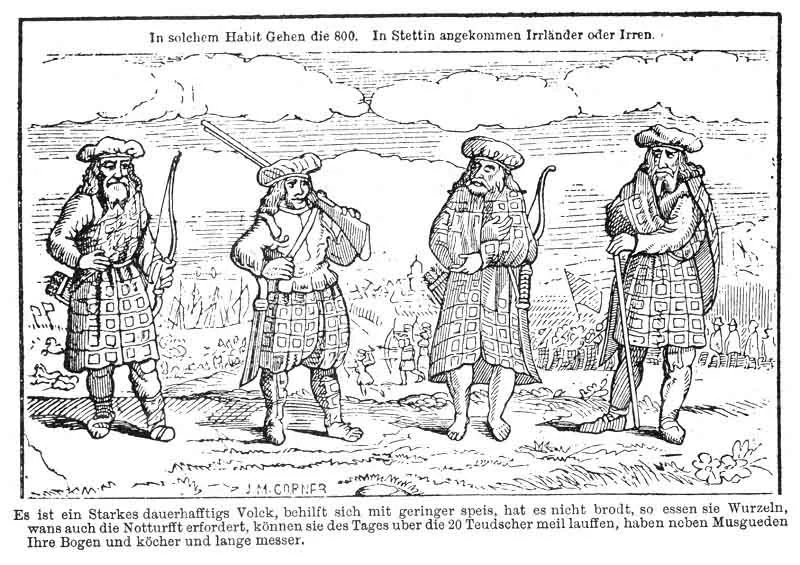
very rough specimen of a "redshank."
The next has knickerbokers and a jacket, but mogans, and no brogues, and looks like No. 2, changing into a soldier.
The fourth appears to be another view of the man drawn in No. 1.
In the back ground the plaided army is seen marching to battle, while a lot of archers, apparently dressed in shirts only, are running in front, shooting as they ran at a scattered mass of cavalry, who, of course, are retreating in disorder. A mass of spearmen follow the kilts. Thus we have the dress, arms, and mode of fighting of these strange, outlandish allies of the Protestant cause, as they appeared to the Germans when they landed at Stettin in 1631.
A third ballad represents one of these new allies with a cavalier in armour.
These three prints were apparently done for the purpose of informing the people of the appearance of their allies. Either these were called "Ersche," and were Scotch Highlanders, whom the German understood to be "Irish;" or Irishmen then wore the same dress as the Scotch of an earlier period, and sported tartan, and supported the Protestant cause. The faces are remarkably like Scotch faces at all events.
It appears from the history of Gustavus Adolphus by Harte (1759), that about 1630, 700 Scots, who were coasting the Baltic from Pillau in order to join the main body of the Swedish army, were shipwrecked near Rugenwalt, and lost their ammunition and baggage. Monro, their commander, got fifty muskets from a friend in Rugenwalt, took the town by a midnight assault, and maintained himself there for nine weeks, till joined by Hepburn with a small army of 6000
men. These probably were the "Irren" of the German ballads, who are variously stated at 800 and 8000, and in 1631 are said to have newly arrived at Stettin. Monro published an account of his campaigns in 1637.
From that work it appears probable that the "Irren" of the print were the shipwrecked veterans of the "Scotch regiment," which had received the thanks and commendations of Gustavus Adolphus a short time before in Sweden, which had done good service in former campaigns, and which did right good service afterwards.
Numbers of the officers bore Highland names. There were Munros, Mackays, MacDonalds, Guns, etc. "Murdo Piper " was drowned in trying to swim ashore at Rugenwelt. They had a "preacher;" Monro himself was a stanch Protestant, and a very religious man; and yet he gives an account of a vision which one of his Highland soldiers had seen, and which came true in every particular. In short, it is manifest that these warriors, clad in tartan plaids, were Scotch Highlanders in their national costume, and lowland Scotchmen in tartan uniforms. Sir Donald Munro, High Dean of the Isles, writing in 1549, calls the people of the Hebrides, "Erishe," and their language "Erishe" or Erish." In 1633 the Countess of Argyll called Gaelic "Erise" and "Irishe," so the German words "Irren" and "Irländer" are easily explained, if there were Scotch lowlanders in the regiment to name their Highland comrades.
About the same time a body of Scots, under one Sinclair, landed in Norway, and tried to force their way to Sweden. The people rose upon them, overpowered them, took some prisoners, and after a time killed them in cold blood. A small museum has been set up at the
road side in Gulbrans-dal, and comprises dirks, powder-horns, and the clasps of sporrans. The shipwreck of the party, who landed at Stettin, would account for the absence of ornament in their dresses.
The Highland dress, then, of the beginning of the seventeenth century is well known, and corresponds with one of the oldest sculptured representations of dress known to exist in Scotland. It also corresponds with one form of the dress as now worn, though modern tailors have diminished the amount of tartan, and improved upon the ancient simplicity of the belted plaid.
In 1822 General Stewart published a work, called "Sketches of the Character, Manners, and present state of the Highlanders of Scotland," which went through several editions, and the dress is therein described and authorities are quoted for its antiquity. There was the "truis" or tartan breeches and stockings in one piece, with a coat or jacket variously ornamented; secondly, the belted plaid, which was worn on guards and full dress occasions, in 1740, by the first Highland regiment embodied, the Black Watch. It was a tartan plaid of twelve yards (that is, six yards long and two wide), plaited round the middle of the body, the upper part being fixed on the left shoulder, ready to be thrown loose, and wrapped over both shoulders and firelock in rainy weather. At night the plaid served the purpose of a blanket, and was a sufficient covering for the Highlander. "In the barracks, and when not on duty, the little kilt or philibeg was worn."
This form of dress, then, was the simplest possible use of a web of cloth, as the pattern of tartan is its simplest ornament. The word plaid is the Gaelic plaide--a blanket. The Gaelic for a plaid is breacan,
the variegated (garment); the Welsh is brychan. The Gaelic for a kilt is féile, the covering or the shelter; the garment now worn is called "féile beag," the little covering which my friends often pronounce "filly-bag," and suppose to mean the "sporran" or purse. The kilt is sewn, and is made of a web three feet wide
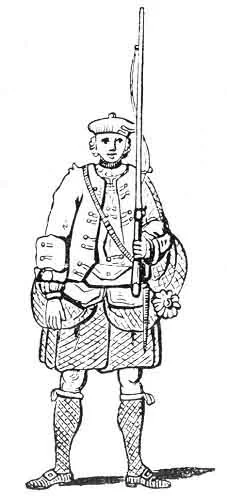 |
instead of six. The wide web was put on by folding it backwards and forwards along a belt laid on the ground, lying down upon it, and fastening the belt round the waist. One half of the cloth fell in folds to the knee, the other half was fastened up to the shoulder,
and in wet weather was raised over the head. At night, the whole could be cast loose and worn as a blanket, and the wearer was often buried in his plaid.
This striped blanket, then, ought to be a very ancient form of dress, and the early dress of most nations is something like a kilt. The Greeks and Romans, for example, wore kilts, and their great men wore a broader
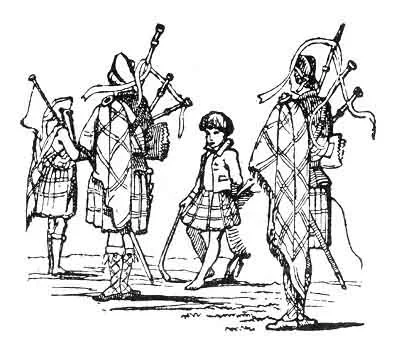 |
web of cloth variously wrapped about their bodies, as primitive people elsewhere in the world still do. The dress ought to be old, and it is old. The modern alteration is but an improved method of sewing the folds of one half to a band, and wearing the rest of the plaid over the shoulder, and in so far, but in no other sense, the dress is modern.
Again, it is said that gentlemen did not wear the Highland dress, that it was the dress of peasants,
churls, outlaws, and such like, but this is surely an error.
Every Highlander thinks himself a gentleman by birth, and often behaves all the better for holding the opinion. The wearers of the kilt now include many titled names; George the Fourth and the Duke of Sussex wore it; the officers of the Black Watch and Prince Charlie wore it in 1745; Monro's men wore it in 1630; the Regent Murray (or the Earl of Mar), Sutherlands, MacDonalds, and Breadalbanes, have been painted in the Highland dress; Magnus of Norway, who wore it, was surely a gentleman, if none of these were; and so, I presume, was the individual on horseback who figures on the St. Andrews stone, and has not a shred of covering on his bare legs, though he is going to ride into a wood, and get terribly scratched by a lion.
There is no standing ground for the notion that the dress is modern, or that it has not been the dress of gentlemen in Scotland from a very early period.
John, Duke of Argyll and Greenwich, is supposed to be the author of the well-known Scotch song, which, for popularity, almost equals "The roast beef of old England." It begins thus:--
Argyll is my name and you may think it strange,
To live at a court and never to change
Falsehood and flattery I do disdain,
In my secret thoughts nae guile does remain."
In the third verse the author of the song represents this "Argyll" returning to the Highlands, and arraying himself in the Highland dress.
"I'll quickly lay down my sword and my gun,
And I'll put my plaid and my bonnet on,
Wi' my plaiding, stockings, and leather heel'd shoon,
They'll mak me appear a fine sprightly loon.
And when I am drest thus frae tap to tae,
Hame to my Maggie I think for to gae;
Wi' my claymore hinging down to my heel,
To whang at the bannocks o' barley meal."
Whether this duke ever wore the dress described or not, the author of this song clearly considered it a farmer's dress; and if the popular tale is to be credited, some courtiers who invited him to a dinner of barley meal brose, were called to account for their joke. He praised the food set before him, and acted up to his principles; dined on the barley meal, but slew the man who had tried to make game of him.
Speaking from the experience of one who wore no other dress in his youth, and has worn it at odd times all his life, it is the best possible dress for shooting, fishing, wading, walking, or running one of the worst possible for riding, or boating; it is inconvenient at first for cover-shooting in whins or brambles, or for watching at a pass when the midges are out on a warm evening. It is a capital dress for a healthy man, and tends to preserve health by keeping the body warm and dry. Many a man has caught cold when he changed his dress, and exchanged the thick folds of a kilt for a pair of trousers. It is commonly worn by boys in the Highlands till they grow up to be striplings. It is hardly ever now worn by labourers, boatmen, or farmers. It is the dress of individuals of all classes--gamekeepers, deerstalkers, peers, pipers. It is worn by Highland regiments, and occasionally by all classes of
the community as a gala dress, when they attend Highland demonstrations, or go to court; but it can no longer be called the common dress of the country, though there is not a Highlander in it, or out of it, whose heart does not "warm to the tartan."
I have heard it related that a tartan plaid worn in Canada, there helped to rouse up a whole Highland country side, who flew to arms when it was known that one who wore that tartan was in danger, and rescued the wearer and the plaid.
CELTIC ART.
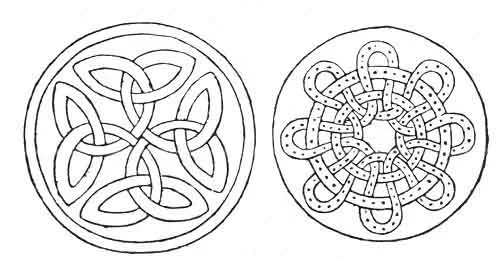
Bosses from St. Sebald, Nuremburg. plate xxviii., Grammar of Ornament, ''Byzantine.''
Celtic art, like Gaelic mythology, points eastwards, and to a very early origin. It may be new to many to hear of "Celtic art," but nevertheless it is classed in the Grammar of Ornament by Owen Jones, who is an acknowledged authority in such matters. In books and sculptures, and in ornaments of known date, from the fourth and fifth centuries to the eleventh or twelfth; in ornamental writings, on stone, pottery, and metal,
found in the British Isles, there is a peculiar style of interlaced Ornament, which is not to be found in Germany or in Norway, though it is similar to Anglo-Saxon ornaments found in England. Something of the kind has been found about Mount Athos, and in a few places in continental Europe where Irish or Anglo-Saxon
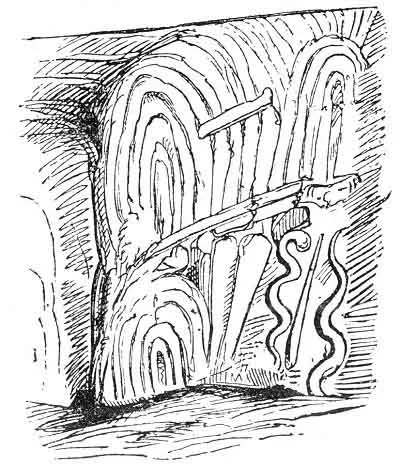
Sculptured stone in a mound at Gavr Innis in Brittany--See page 361.
missionaries have been. And as Britain was formerly celebrated for basket-work, it has been ingeniously suggested that these patterns, which can be imitated in basketwork, were copied from ancient British osier patterns, and so spread eastwards to Rome, and. Byzantium, and the East. It is said that in the
oldest manuscripts, foliage is not represented. Basket work might well be the foundation of pottery and of defensive armour. It is quite common for herd boys to make bottles and shields of rushes, and even conical helmets and long swords of the same materials, and therewith to hold sham fights, with the cattle for spectators. Early British clay vessels seem to bear the mark of similar workmanship, and the crow, in No. viii., advises the girl to carry water by stuffing a sieve with clay. A basket covered with leather makes a good shield. Boats were so made, and a basket lined with sunbaked clay would serve to carry water, and the shape of the basket might well suggest decorations, but I would rather believe that the basket-makers brought their patterns from the East. At all events the interlaced design given below was taken from a bronze which belongs to a set on which the signs of the Zodiac, elephants, camels, lions, and Eastern emblems are represented, together with similar designs.
The Western tombstones of Iona are rich in such patterns, and so are the crosses of Ireland, the sculptured stones of Scotland, and crosses at Sandbach, in Cheshire. The pattern on the cover is taken from a stone in Islay, the tail-piece is from an ancient Gaelic manuscript; several interlaced designs will be found in vol. iii., and these complicated knots appear to be the distinguishing feature of ancient British Celtic art.
But on crosses and other monuments in Scotland these interlaced patterns are often found associated with other designs; with human figures, and those of monsters, and with certain symbols which have not yet been explained.
On the bronze vessels, from one of which the pattern below was copied, a great number of figures and symbols
are also engraved, and as their meaning is generally clear enough, and the style of ornament is the same with that which is called "Celtic," the bronzes and the sculptured stones may perhaps throw light upon each other. One of these Scotch hieroglyphics is very roughly drawn at page 220, vol. iii., and is better represented at page 499, Prehistoric Annals of Scotland.
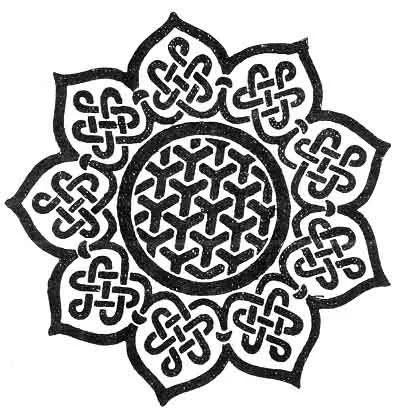
Interlaced Pattern from an Eastern Bronze, supposed to be of Hindu workmanship.
In the one case it forms part of a very rudely sculptured stone, of unknown date and origin, in the other it is part of a design copied from a suit of silver armour discovered in Scotland. It may be described as three spiral lines starting from a common centre, and comprised
within a circle, and these spiral lines are characteristic of Celtic art according to Owen Jones. In the silver ornament this symbol is twice repeated, and is associated with the "Z ornament," the "crescents," and the head of some creature which seems to have horns. The question is, what do these symbols mean? for they are frequently repeated on sculptural stones in Scotland.
I have imagined that they have an astronomical signification, and that they may have related to solar worship before they were adopted as ornaments on crosses.--See page 356, vol. iii.
The Isle of Man has always been the stronghold of fairies, and it was the refuge of the Druids; the Druids were astronomers, as it is said, and the Manxs penny bears a device which is the same in principle as the three spiral lines, though these have grown into three armed legs; and thereby bangs a popular tale, and it is this:--
"Some fishermen long ago arrived on the shore of an island which they had never seen or heard of, because it was always enveloped in a magic cloud, raised by little Manain, the Son of the Sea. They landed, and presently there came rolling on the mist something like a wheel of fire, with legs for spokes, and the portent so frightened the men that they fled to their boats." But the charm was broken, the Isle of Man had been discovered, and its possession has been disputed by men and fairies ever since.
The "legs of Man" then have to do with a wheel of fire.
It is common in the Highlands now to speak of the "wheel of the sun, and it was the custom not long ago to ascend some high hill on Easter Sunday to see
the sun rise, and "Whirl round like a mill wheel, and give three leaps." But a peasant of a practical turn of. mind rebuked a friend, saying--
"Fool! And dost thou think to see the sun rise from there, when she rises beyond Edinburgh, and so many hills as there are in the way?"
The characteristic spirals, the circle, the wheel, and the sun are thus associated by Celtic traditions and devices. The design given below was traced from the bronze vessel already mentioned, and it represents the sun, with three lines starting from its centre. These
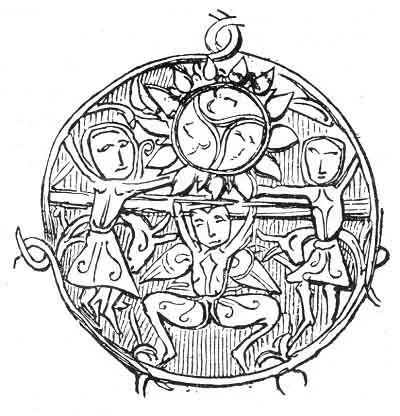
are not exactly the "Legs of Man," but they are drawn on the same spiral principle, and the spaces enclosed are filled by three human faces, rudely carved. The design resembles that on the "Norrie's law relics " found in Fife, and in the east it clearly related to fire or light.
But the design given above is only one of a great
many on the same vessel; all bound together and enclosed by endless lines, turning, and twisting, and sprouting into heads, leaves, and buds; and twelve of the designs represent the signs of the Zodiac. Thus the particular style of ornament which experts have agreed to call "Celtic" and "Byzantine," here occurs on a "Hindu" sacred bronze almanac, and the sun in "Leo" has the spiral lines in its centre, so these once had an astronomical meaning.
The Lion's tail grows into a serpent, and the interlaced ornament sprouts into a whole crop of buds, and monstrous heads, over which the lion stalks triumphant. "Aries" is a man riding on a monstrous ram with a flourishing tail; "Taurus" is mounted on a bull; "Gemini" are dancing about two bulls' heads; "Cancer" has got the sun in his claws; "Leo" is described above; "Virgo," men gathering autumn fruits; "Libra" is a lady playing on a guitar; "Scorpio" a man fighting with two scorpions; "Sagittarius" is a Centaur shooting back at a monster which grows out of the end of his own tail; "Capricornus" is looking back, and riding on a goat; "Aquarius" has a bird; and "Pisces" his two fish; so there is no doubt of the meaning of these designs at all events.
A six-pointed star, made of interlaced triangles and curves and interlaced patterns, is in the inside of the bronze vessel, and as the star is surrounded by fish, it is to be argued that the symbol relates to water, though it is also surrounded by forty-nine points like rays.
But the Scotch crosses, and standing stones, and sarcophagi on which interlaced designs appear, often represent animals with which Scotch artists could not well be familiar. There is an elephant on a very beautiful cross in Islay; there is a camel on another
stone, figured in the "Sculptured Stones of Scotland." On the St. Andrews sarcophagus there are lions, and apes with globes, a griffin, and a knot of snakes; and though the system of ornament might be of home growth, the most patriotic of Scotch antiquaries must refer these to some foreign source. The question now is, Whence did the Scotch artists borrow these ideas, which they could not have got at home? Beneath the signs of the Zodiac, on the eastern bronze, is a kind of frieze of figures, all fighting, and marching sunwise round the bowl. Beneath Aries are two men mounted on a camel, one shooting arrows backwards, the other shooting forwards at the tail of a nondescript animal like a hare. The falconer, in the wood-cut below, is between "Cancer" and "Leo." Beneath "Virgo" is a man on foot resisting the progress of the others with a long spear, and also an elephant with several riders; and beneath these is a procession of birds, probably to indicate that the whole has to do with the powers of the air. Beneath them are human-headed snakes. Above the signs of the Zodiac is another frieze, comprising forty-two human figures engaged in all sorts of occupations--playing the harp and the tambourine, fighting and drinking; and above all these, on the cover of the vessel, are eight compartments, of which one is figured above; and the rest are in like manner occupied by figures which appear to represent divinities or the heavenly bodies. Two of these comprise legends which are almost effaced; one is in a "Persian" character, the other has not been identified, and neither has been read. Still it is evident that this is of Eastern, probably "Hindu" workmanship; that the designs relate to matters connected with the heavens, and the gods; that the sun is one of these, and that the style
of ornament is that which is called "Celtic." With these designs are animals which are associated with like designs on stones in Scotland; camels, elephants, lions, horses, hawks, rams, bulls, goats, snakes, fish, dragons, and monsters.
"Celtic ornament," then, is found in the far East and in the far West; and the foreign animals associated
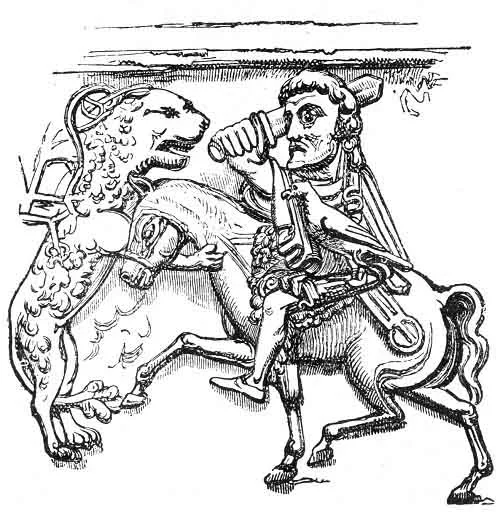
Figure dressed in the belted plaid, from the St. Andrews Sarcophagus.
with "Celtic ornament" in Scotland are associated with a similar style of ornament on ancient Hindu vessels. The meaning of the symbols in the latter case is sufficiently
plain. It seems possible that the others may have a like signification.
With this view, the horseman on the St. Andrews sarcophagus may have the same meaning as the horseman figured below.
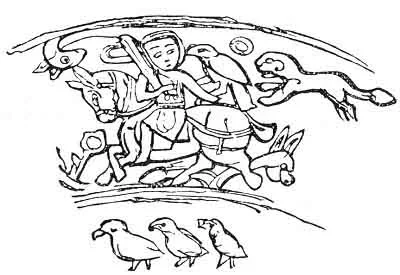
Figure between Leo and Gemini, on a chased silver inlaid Hindu bronze.
They are dressed in some national costume; the one wears a belted plaid and has bare legs; the other appears to have a Persian dress, but both carry hawks and swords, and are fighting lions, without any apparent reference in the one case to a bronze bowl, or in the other to a sarcophagus. In both cases the figures are marching "sunwise;" in the one case the figure clearly has to do with astronomical symbols; it is possible that the St. Andrews stone and the Eastern bowl may have been sculptured with a like intention.
Another curious ancient bronze sacrificial vessel was brought from Java in 1817 by my friend, Mr. John Crawford, and proves that the signs of the Zodiac were associated with Hindu worship, in a place nearly as remote from Central Asia as Scotland is. The vessel
was found amongst the ruins of Hindu temples, and bears a date equivalent to A.D. 1320. It is a rough casting, and the style of art is different. In the inside, at the bottom, is an eight-pointed star, with some rude figure in a circle within the star. On the outside are twelve symbols, with twelve figures above them. These are--
1. A ram, or some other horned and bearded animal of a like kind, above which is a long-armed, long-bearded, large human figure, in profile. Both are facing the same way--"sunwise," westwards.
2. A bull, or cow, with a bump; above which is a human figure with a crown, or a glory; seen full face, and therefore stationary.
3. Instead of "Gemini," something like a triple claw emerging from a sleeve, or a cloud, and pointing back at the bull; above which is a short, thick, human figure, with a helmet, or a monstrous head, with a bill like that of a goose, facing the usual way. 1
4. A crab with his claws upwards, ready to run either way sideways; above is a man carrying something over his shoulder on a stick, and walking sunwise about the bowl.
5. Instead of "Leo," a two-legged dragon, without wings, and with a long tail, facing sunwise; above which is the stationary figure in No. 2 repeated.
6. A draped female figure, moving sunwise; above which is a stationary female figure, very like the male figure in No. 5.
7. The scales. The figure above is moving sunwise, but is not easily made out.
8. A scorpion, facing sunwise; above is a repetition of the figure in No. 2.
9. A bent bow, with an arrow on the string pointing sunwise; above is a monstrous bird, like an eagle, walking the other way.
10. Instead of "Capricornus," a creature like a lobster, crayfish, or shrimp; all of which walk forwards, and swim backwards. This symbol, therefore, corresponds to the crab, which walks sideways in either direction; and it probably indicates the Southern tropic, or Northern winter.
11. A jar, above which is a man walking sunwise, and carrying something; probably "Aquarius" in his Javanese dress.
12. A fish, with something like an elephant's trunk, the head as usual pointing sunwise, or to the right of the vessel. Above the fish is the same figure which is repeated in 2, 5, 8, 10, and 12. The human figures are dressed in some scanty costume which bears a resemblance to Javanese dresses; it is therefore probable that the vessel was made in the country where it was found.
Java is to the south of the equator, and consequently, stars which seem to move along the equator or ecliptic there appear to move about an observer or a vessel set upright, in a direction contrary to that in which they seem to move in the northern hemisphere. The sun, during the greater part of the year, is to the north of an observer whose head is towards the South Pole, and there appears to him to move East, North, West, South, from his right hand towards his left from morning to evening. But the symbols of constellations on the Java sacrificial vessel, like those on the Hindu bowl, are facing in the opposite direction; the direction in which the constellations would appear to move about the
vessels if they were placed on their bases north of the tropic of Cancer.
When the sun in our spring seems to move northwards, up, and back, from "Aries" to "Taurus," the ram and the bull seem to move from East to West, and from left to right, and down, and to the south of the sun, on the ecliptic, because the earth is moving. But to an observer in the southern hemisphere who has put his head the other way through the hoop, towards the South Pole, the constellations seem to pass the sun, and rise and set, still moving from East to West, but from right to left, not from left to right. On the Java bronze they are facing to the right, consequently it is probable that the symbols were not invented in Java or south of the line, but somewhere in the northern hemisphere, and the agricultural operations represented in the signs of the Zodiac agree with northern seasons. 1 But if these symbols were invented in Central Asia, or in Babylon, 3000 years ago, or in Egypt or Greece, it is just as likely that they should have arrived in Scotland, as it is that they should have got to Java 540 years ago. It is thus proved that certain symbolic creatures have been associated with astronomy; that in Java, India, Greece, and Rome, they have been associated with worship; and in India with a particular style of ornament. That style of ornament is found in Scotland, on sculptured stones of unknown date, and associated with the figures of the animals, which in Rome, Greece, India, and Java, have represented constellations. The meaning of these, and of certain Scotch symbols, 2 is
unexplained, but it is not unreasonable to suppose that they once had a similar meaning in India and in Scotland, when there are so many hands pointing towards Central Asia as the common starting place of so many human races.
It would be going too far to call the ram on the St. Andrews stone "Aries," and the lion "Leo;" but till something has been found out concerning the stone-falconer of the long locks, and the naked legs, and the flowing dress, he may perhaps pass for a relative of the Eastern bronze falconer who is fighting a lion, between "Cancer" and "Leo," amongst twisted snakes, and branches and buds, under the sway of the sun and moon, and of diverse many-armed graven images, whose meaning is not so clear.
Perhaps the oldest bit of Celtic ornamental art known is to be found in Gavr Innis, in Brittany. A large sepulchral mound was opened some years ago, and was found to cover a passage formed of large boulders, one of which is figured above, p. 349. The cut is taken from a very hasty sketch, made in August, 1855, in a very bad light. The design appears to be a rude attempt to represent the inside of a house, like the tomb itself, or such as a Lapp hut, or an Icelandic house, or a Highland cottage, now is. A sketch of part of the interior of a Lapp hut will be found in vol. iii., frontispiece. Such dwellings are thus made--a number of rough sticks or trunks of small trees, or big stones, are set in the ground about the plan or floor of the house, which in Gaelic is called "làrach," and in Scotch "stance." If the house is to be of sticks and round, the sticks slope over towards the centre, and form a cone. If it is to have a passage, like Icelandic houses, stakes or large stones are set in two rows, and planted nearly
upright. If it is to be square, the passage walls are separated and repeated, and the roof is a pyramid.
This, so far, is an imitation of, and only an improvement on the frame-work of a round or square tent.
The next step is to place sticks across the others to keep them steady, and in the Gavr Innis design, as in the sketch of the Lapp hut, this appears to be indicated. In Highland stone and turf cottages, the partitions are still made of hurdles plastered with clay.
In the Morea, the shepherds still make temporary conical wattled huts in which they live, but as the climate is warm, a thatch of branches is sufficient.
The frame-work being made, the hut is covered outside with birch bark, turf, or some contrivance to "stop up the sieve," or "line the basket;" and then big stones, and earth, and rubbish, and turf, and other available materials, are heaped up and stamped down to keep out the wind and cold, till there remains a hollow, conical, or pyramidal mound, on which, after a time, the grass grows. To extend this principle, it is only necessary to place the cone or pyramid of earth upon the upright passage walls. To make this a really comfortable dwelling, it is only necessary to line the sides with planks; and many comfortable hospitable dwellings, in which well-educated, polite ladies and gentlemen now reside in Iceland, are mainly built of boulders and turf, lined with planks, and look like a nest of green hillocks at a distance. The long passages in tombs at Gavr Innis, and in Greece, are very like those in old Icelandic houses which I have seen. No material, it is said, resists cold so well as earth; and as fuel and timber are scarce in the north, so Highland cottages are like Icelandic houses.
The architectural design on the passage wall of the
tomb in Gavr Innis appears to represent the inside view of such a building, with its stakes, stones, and turf, but the waving lines cannot be so explained. They look like serpents, and there are similar designs, like a serpent pierced by a zig-zag line, on stones in Scotland. (See vol. iii., 309.) In the immediate neighbourhood of Gavr Innis, there are great numbers of "standing stones," like those which exist in England, etc. Some of enormous size have fallen and are broken, but others remain erect. At Carnac 1 there is an array of smaller stones which extends for about three miles. There must have been many thousands of them arranged in rows at some period, and many hundreds still remain erect. It is hard to believe that this enormous work had not a religious meaning. If so, then, similar monuments on a smaller scale, such as "Stonehenge" in England, and "Calenish" in Lewes, and standing stones and barrows all over the world, even to the obelisks, and pyramids, and temples of Egypt, may be but various growths of the primitive ideas of dwellings, tombs, and temples. From a tree came a post, a gnomon, and a pillar; from a tent came a hut, and thence a house; from a sepulchral mound came a cairn, and thence a pyramid; from stakes and poles grew columns; from sloping tent-sticks came rafters and a roof, and thence a covered temple, with rows of pillars; and so architectural ornaments might take their origin from wattled branches, leaves, basketwork, hurdles, and mats; plaited straw, rushes, and hair, honeysuckle, and birch roots.
Specimens of the style of design, which is called Celtic, will be found at pp. 137, 303, vol. iii., and on
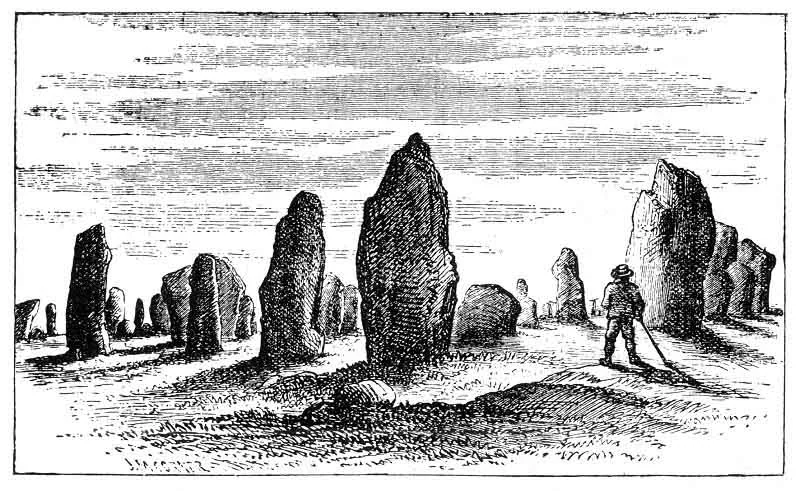
A bit of Carnac, sketched in 1855.
the cover of this book; and the nearest good hairdresser or maker of straw mats will imitate the design on page 137.
Thus sacred ivy, matted about a sacred oak, may have suggested the interlaced ornaments on stone pillars and Christian crosses; and basket-work may have suggested the patterns on gold and silver filigree, on stone and clay vessels and pottery, on carved powder-horns and dirks, and generally the designs attributed to Celtic art. Honeysuckle is the object of superstitious observances at this day. It winds sunwise about trees, and its long stem would be a good material for making these basketwork designs.
But the fact that such designs are found upon works of art manufactured in the far East, seems to prove that "Celtic art" was not invented in the British Isles, but imported at some early date.
It was not brought by the Northmen, for there is nothing like it in Scandinavia. For a similar reason it was not brought by the Normans, Anglo-Saxons, or Romans; stones and manuscripts on which it occurs are older than the Saracenic period; and unless the Celts brought the germ of it from the far East, with their religion and language, and their popular tales, it is hard to explain the occurrence of similar eastern animals, monsters, and "runic knots" on the sculptured stones of Scotland, and on "Hindu" bronzes.
There are plenty of cases in which Greek or Italian art can be traced in the Hebrides. The ornament figured below is from a stone which was found in the ancient stronghold of the MacDonalds in Islay.
It is rude enough, much broken, and the stone is worn away, seemingly by the hands of those who used
it. It is very old, but the style of ornament is not "Celtic."
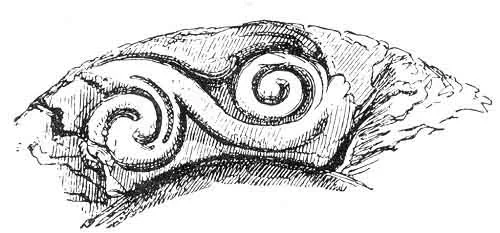 |
It is the style which is to be found in wooden Norwegian churches, said to be as old as A.D. 1100, and which is characteristic of more modern Norwegian carving, on knife-handles, powder-horns, wooden chests, and such like articles. A glance at the following woodcut will show what is meant.
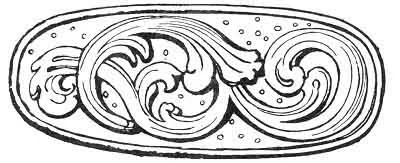 |
Celtic art, then, appears to be of Eastern origin, like "Celtic nations" and "languages," and like Gaelic popular tales.
The well-known superstitions observances connected with Halloween have been referred to Eastern solar worship. 1 The Reverend James Robertson, minister of Callander, described them in 1791, and alluded to the stone circles of Scotland as to Druidical temples. He tells that in his day, in hamlets, a fire was lighted at sundown, made entirely of ferns gathered on Halloween. The neighbours assembled, and each, according to seniority, placed a marked stone at the edge of the ashes till a circle was made about the site of the fire, which was then abandoned.
Next morning the place was visited, and if any of the party found his foot-print in the ashes, and his stone removed from its place, he was doomed to die before the twelve months expired.
I have often seen the site of fires surrounded by stones placed there by children; and once, on a beautiful Easter Thursday evening (April 5), just at sundown, many fires suddenly appeared blazing and smoking on the hill-tops in the Isle of Man. In about ten minutes they all vanished as suddenly as they had appeared, and a Manksman, who was asked to explain the cause, looked much disturbed, and went his way in haste without answering.
"Bealtainn," yellow May day, is in spring; and All Saints, All Hallows or Halloween, "Samhuinn," 1st of November, is late in autumn--so there are Pagan as
well as Christian observances connected with these two seasons.
The following passage from Mr. Robertson's letter adds to the list of things which were done sunwise in his day in the Highlands:--
"To this day, when the Highlanders go round anything with a degree of religious veneration, they go round in the same direction as the sun goes round the world on this side the equator, i.e., from east to west, by the south side. This is the direction in which a bride is placed by her bridegroom when they stand up to be married; the direction in which the bridegroom turns round the bride to give the first kiss after the nuptial ceremony; the direction in which they go at least half round a grave before the coffin is deposited; the direction in which they go round any consecrated fountain, whose waters are supposed to have some medicinal virtues which they expect to receive by immersion or drinking.
"I have heard it said, that in certain places of the Highlands the people sometimes took off their bonnets to the sun when he appeared first in the morning."
It seems, then, that the ancient eastern veneration for the sun and for fire, which is recorded in the Vedas, still survives in the West Highlands in popular superstitious observances which resemble Indian religious ceremonies. Perhaps "Bodach," the bogle, may once have been "Buddha," the sage; "Bramman," the fiend, "Brahme," the air; "Puath," the spectre; " Fohi," the god; "Cailleach," the night bag, "Cale"; and "Aigne," thought "Agni," divine fire.
Note.--"King Arthur's table" is still preserved at Winchester. It is hard to believe that it is the real table, but it is what people thought it was like a long time ago, about the time of Henry the VIII.
It is round. In the centre are two five-leaved roses, which
are surrounded by an inscription, which declares that "This is the round table of King Arthur and his twenty-four knights." Outside the circle in which the inscription is, the table is divided into twenty-four radiating stripes of alternate black and white; and at the end of each, at the edge of the table, is the name of a knight. All the names read from the centre, consequently they read "sunwise."
King Arthur, crowned and throned with globe and sceptre, sits as though he had sat in the midst, facing outwards, and behind his head is a kind of glory of light, in which is his name. It has been suspected that a real King Arthur has acquired the attributes of a Pagan sun-god; and this looks very like it, when brought to bear upon other Celtic traditions.
Footnotes
358:1 The sun in Gemini is north of an observer about the latitude of Bombay.
360:1 On the Farnese globe the signs, except Taurus, face westwards.
360:2 Some of the symbols are like the letters Z. V. A. O. Δ. S. ♓. See page 309.
363:1 Gaelic carn, a heap of stones; achadh, a field (?) stonefield.
367:1 Transactions of the Society of Antiquaries of Scotland, vol. iii., p. 223. Other ceremonies are described in Armstrong's Dictionary. See Bealtuinn.
MUSIC.
A work on Gaelic music is in course of preparation, when that appears there will be another element of comparison. Meantime those who are curious in such matters may hear bagpipes in nearly all the European countries where Celts have been. I have heard the pipes in Ireland, Scotland, Spain, Portugal, and Italy, I believe they are in Albania, and I have heard tell of something of the kind in the Himalayan mountains. They are to be seen in old English prints, and old German pictures; and the other ancient Gaelic musical instrument, the harp, is to be found all over the world. Who first invented these is a question yet to be solved, but both are sufficiently old.
In 1627 a certain Alexander MacNaughton, of that ilk, was commissioned to raise a body of Highland bowmen, and on January 15, 1628, he wrote to the Earl of Morton, from Falmouth, where he had been driven
with his men by stress of weather. He says 1--
. . . . "(and withal) that your L. will haue clothis for them quhen it sall pleise god that they come to the Ile of Wicht, for your L, knowis althow they be men of personagis, they cannot muster befoir your L. with thair Trewis and blew cappis."
Whether this means that they wore trewis, or had none to wear, does not clearly appear, but the postscript seems to imply the latter. He says--
"My L. as for newis frome our selfis our bagg pypperis and Marlit Plaidis serwitt us to guid wise in the persuit of ane man of warr that hetlie followit us."
These men, therefore, wore tartans, and followed the pipes, and as they were bound to join the forces of King Charles I. they were a Highland regiment in embryo. It appears that the piper, Allester Caddell, was followed by a boy, and pipers still claim to be exempt from menial service. There was also "Harrie M‘Gra, harper, fra Larg," and another piper; and as they were one hundred on the roll, they had a tolerable band of national music. At the end of the roll is the remark--
"To be disposed of be the Erle of Morton. They haue bene deir guests."
They were shipped at "Lochkilcherane," 11th of December, 1627, and it is surmised that they must have joined their countrymen and Gustavus Adolphus.
CONCLUSION.
And now, in conclusion, let me recommend the study of Gaelic to Scotch antiquaries. Their worthy president lately expressed a wish to be able to knock up the dead, by the help of a table, to answer some vexed
questions:--he could get nothing even from them without knowing the language of his departed countrymen.
In the preceding pages, strange Gaelic witnesses dressed in vellum and parchment and tattered brown paper, and some few in gay attire of green and gold--queer characters, who live far up the stream of time--have appeared to answer questions, and have told a great deal about the Ossianic controversy. A good number of Lowlanders have been summoned from the past, and have deponed, sometimes in very bad language, that they knew of the Feinne, and thought them bad company, but Celtic gods.
A good number of Welsh and Breton witnesses have been called, and have confirmed what the rest bad asserted. A few Icelanders, Norwegians, Germans, and Frenchmen, a Carthaginian, and some Egyptians, Arabs, Persians, Indians, and Aryans, have said a few words. A good many Highland hills, and a few Edinburgh porters, have said their say; and the best sort of clairvoyance, as it seems to me, for my lowland countrymen to aim at, is to clear their eyes from lowland prejudice, and take a look at Gaelic, when they want to find out something which happened before that language was driven into corners. A large proportion of the names about Edinburgh are Gaelic; but no one there will look so near home as the first Highland porter for an explanation of their meaning. Men would rather go to Wales or Brittany than look at home for anything British," and even Sir Walter Scott, who wrote amongst a Gaelic population, made the strangest of mistakes when he used Gaelic words.
As I have done my best to make peace between Celt and Celt, and Celt and Saxon, I wished to end with a peaceful Gaelic quotation; but having searched right
through divers song books, I have utterly failed to discover one that will suit. Bards are a pugnacious race. I can only say with Motherwell and the Gaelic proverb--
"Gree, bairnies, gree."
"’S e deireadh gach cogaidh sith."
The end of each strife is peace.
Even the strife and confusion of tails, which some ancient Gaelic artist imagined and depicted centuries ago; even the "Ossianic controversy," and its confusion of tongues and arguments; "Mythology;" "West Highland Tales;" even this lengthy postscript and its tail-piece--all have a beginning, a middle, and
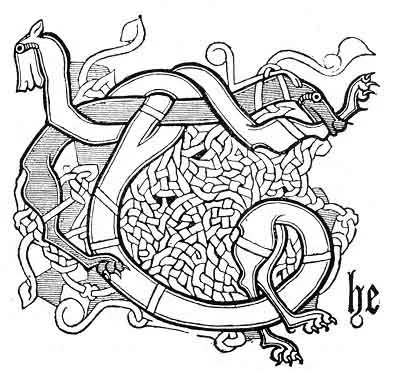
The
END.
Footnotes
370:1 Transactions of the Society of Antiquaries of Scotland, vol. iii., p. 249.
OSSIANIC BALLADS--REFERENCES TO BOOKS, ETC.
* Means that the piece, in some form, is still current.
|
1530. |
Dean MacGregor's MSS. See published list of contents, Proceedings of the Society of Antiquaries, 1856, and papers read, 24th January 1831. Report of the Highland Society on the poems of Ossian p. 93, and appendix, 302. See selections published 1862. (Edinburgh: Edmonton and Douglas.) The following references have been taken from the other authorities, but the selections will probably give a full account of this interesting manuscript. |
|
Page in MSS. |
|
|
25. |
Demand for the head of Gaul. |
|
63. |
LA MOR SEALG NA FEINNE, or SLIABH NAM BAN FIONN. Kennedy; the Rev. Francis Stewart; Malcolm MacCallum; Macdonald of Staffa; traditional. Appears in Fingal. |
|
*145. |
PRAISE OF GOLL. Gillies; MacCallum; Miss Brooke; traditional now. |
|
*147. |
DIARMAID. Dr. Smith; Sutherland; Islay; General Mackay; R. Campbell, advocate. The Islay version had Cuach Fhinn, which was rejected as not historical. |
|
*172. |
THE BANNERS. (?) The traditional poem now current, and in Gillies. |
|
*205. |
ON THE HEADS. MacCallum; mentioned p. 302, H. S. appendix. (?) The current traditional poem. |
|
*220. |
FAINEASOLIS. Kennedy; Miss Brooke; H. S. Report, p. 95; Maid of Craca in English Fingal; not in the Gaelic of 1807. |
|
*230. |
DEATH OF OSCAR. Kennedy; MacDonald of Staffa; H. S. Report, 102; traced in Temora (English) (?) Gillies; and now current. |
|
*232. |
BATTLE OF GAURA. (?) The one given in Gillies and now current; traced in Temora. |
|
*236. |
CUCHULLIN and CONLAOCH. Carthon in English Ossian not in Gaelic of 1807; Islay; Miss Brooke, 265, 268; MacCallum. For the story, compare Marie's Lays; Zohrab and Rustam. |
|
*301. |
FRAOCH. Jerome Stone, 1756; Scotch Magazine; H. S. Report, appendix 7; compare Bellerophon for the story; current in fragments. |
|
1739. |
ALEXANDER POPE, minister in the Reay country, p. 53 appendix iii. H. S. Report. ERRAGON; in Temora, under the name of Dibird fli (?) LATHMORE. * CA GAUR. Death of Oscar. * DUAN DEARMOT. Dr. Smith; Diarmaid, etc. |
|
1756. |
Clerk's Collection. (?) |
|
1772. |
RANALD MACDONALD'S collection, printed 1772, contains a piece which is in the Dean's MS.; Antiquaries' Transactions; H. S. Report, p. 305; subject, four wise men at the grave of Alexander. |
|
1774. |
KENNEDY'S COLLECTION. List from p. 108, 273, appendix, Highland Society's Report. * Luachar Leothaid. |
|
1780. |
HILL, p. 50, Report of the Highland Society, p. 143, appendix, published in the Gentleman's Mag., afterwards in a separate book. Gives Fionn's Genealogy, and a great deal of speculation. |
|
1786. |
Gillies. Published pieces not found in 1860, 1861. 211. Claidheamh Cuchullin. (Measured prose.) |
|
|
|
|
1787. |
Smith. "Seann Darla." These are of a class between current popular ballads and the published Ossian. |
|
1789. |
Miss Brooke (Irish). |
|
1803. |
MS. Collection by Macdonald of Staffa (Advocates' Library), |
|
1804. |
Stewart. |
|
1816. |
|
MACCALLUM. |
STEWART. |
|
|
106. |
Dan air crom Ghlearm |
|
|
|
112. |
Iambair Aluinn |
|
|
|
* 140. |
Cuchullin na charbad |
|
|
|
153. |
Colg Shuil is Trathail |
|
|
|
170. |
Dan Chiothaich |
590 |
|
|
* 178. |
Oisian do'n Ghrein |
592 |
|
|
181. |
Ditto |
|
|
|
183. |
Mor Ghlan agus Min Fhonn |
|
|
|
193. |
Comhrag Fhinn ague Garbh MacStairn |
|
|
|
196. |
An t' Sealg a's mò rinn an Fhian |
|
|
|
200. |
Conall. Ghulbuinn |
|
|
|
207. |
Ursgeul Oisian |
|
|
|
209. |
Ioma Cheist Oisian |
|
|
|
221. |
Laoidh Deirdreann |
562 |
1805. J. Macdonald, MS. Collection (Advocates' Library).
A number of poems are printed in the Report of the Highland Society, 1805, and there are numerous private collections written in modern times, of which I have heard. Their owners would do well to send them to the Advocates' Library to be preserved there with the rest of the Gaelic manuscripts, to which attention has been called, and which are now arranged and catalogued. Some of these pieces have been reprinted in the West of Scotland Magazine, and were also translated in Drummond's Irish Minstrelsy. One (I am told) was lately made into a kind of musical play, and acted in Ireland.
LIST OF STORIES
COLLECTED CHIEFLY IN SCOTLAND AFTER JANUARY 1859._____________
ENGLISH:
MOST OF THESE WERE TOLD IN GAELIC, AND ARE IN FACT TRANSLATIONS AT FIRST OR SECOND HAND.SUTHERLAND COLLECTION.
No.
1. The Unwelcome Guest.
Heard by J. F. C. about twenty or twenty-five years ago, in Islay. A man invites a skull to dinner, it comes as an old man, and is frightened away by a particular arrangement of bannocks. I have seen a similar story, but cannot name the book.--D. D.
2. Donald Duval Mackay. (?Devil).
How he lost his shadow.
The Cave of Smoo--Fairy threshing.
3. How he lost his power.
4. The Great Cave of Smoo (Eastern).
5. Donald and the Devil, or whatever else the creature may have been who ate the griddle in the bannock.
(This is to be found in the manuscript from the Highland Society of Scotland: attributed, I think, to Fingal.)
6. The Fairy asking about his chance of Salvation.
This, or something like it, is in "Croker's Irish Stories," and in the "Popular Superstitions of the Highlands," in Grant Stewart's, and seems to shew that the Fairies are the old Pagans, probably those who made the Fairy arrow heads.
7. The Man who flew with the Fairies.
8. A Water Spirit "Vougha," translated Kelpie.
Is this the Irish "Phoca?"
9. Second Sight--The Road.
This is a good instance, and is probably an article of popular belief.
No.
10. The Funeral Procession.
This is the same as a story in Grant Stewart's collection, and is probably common.
11. A Second-sight Warning of Death, and the Ghost.
This is like some in Grant Stewart's collection.
12. Captain W. Ross and his Descendant, who wanted to see him, and raised a whole army.
I know nothing like this--it is good.
13. A Morayshire Legend of a Castle that sunk into the earth, and is still to be seen at the bottom of a lake.
This has many foreign relations. The origin of the tradition is perhaps to be traced to the destruction of the cities of the plain.
14. The Rotterdam.
A large ship sunk with the crew still alive. The Folge Fond, in Norway, is said to cover seven parishes which were overwhelmed for their wickedness, by the snow and ice. The church bells may still be heard ringing under the ice, and the people will some day be restored to the world.--J. F. C., 1857.
15. A Legend of Loch Spynie.
A Warlock and his Coachman driving over the ice--Two Crows on the carriage--I do not know this one.
16. The Three Hunters and their Brides.
Vide Lady of the Lake, which contains this legend in an improved shape.
17. The Tailor and the Skeleton.
Common in Argyllshire and the Isle of Man.
18. The Wakes of Loch Manaar--a talisman. Clach Bhuaidh.
19. The Tree Witness.
20. The Jewel of Ben Stack.
Common in Argyllshire.
21. The Erse version of Jack the Giant Killer.
It resembles the Norse--It is the best of the collection.
22. Superstitions--Instance of:--Gamekeeper.
23. The Sea, and drowned and murdered people.
No.
24. Wraith choosing boards for a dying man.
25. Death Struggle.
26. Passing, and funeral bell.
27. Cathedrals expected to fall.
28. Babes.
29., 30. Babes.
31. Spirits of friends haunting a house looked on as a reason for remaining in the place.
32. The lost Wedding Ring--The Witch--The Demon--The Escape.
A Legend which is unlike any I know, and good.
33. Honeysuckle--Charm against evil.
34. Evil eye, and those who suffer from it.
35. Cure of Evil eye--by boiling stones in water--still prevalent.
36. Verses of Scripture as charms.
In Iceland it is a custom to open the Bible by chance to find out the result of some undertaking. I tried it, and it came right, in 1861.
37., 38., 39. Instances of Voghes being seen. Fuath is the Gaelic word.
These three have no story; they are but appearances believed in.
40. Phantom armies commonly seen.
41. Snow never lies on the ground where the blood of a murdered woman was spilt.
42. The Lord's Prayer a protection against evil.
43. Magical disappearance of a Witch.
44. The Holy Virgin and the Black Beetle.
This is a very good Legend, and is unknown to me; it is in Irish.
No.
45. A Rhyme.
46. Saint Gilbert and the Dragon.
Something like St. George and the Dragon; and like the Sea Maiden, but not so good.
47. The Boar of Ben Laighal. Diarmaid and Grainne.
48. Things Lucky and Unlucky.
49. The Golden Horse of Loch na Gillie. EACH UISGE.
Widely spread.
50. The Otter King-common in Argyllshire.
51. Mr. Alexander Fraser's Pilgrimage.
Good; contains the incident of the ring.
52. Salamander.
53. The Hour and the Man.
54. Poetical Sayings.
55. The Demon Angler--an appearance.
56. The Herds of Sallochie.
A Kelpie--well known in books, and widely spread.
57. The Death of Sweno.
This is probably the tradition of a fact in the history of Norse invasions--I know nothing quite like it.
58. The Dun Otter, called Doar-chu.
59. Why the Wolf is stumpy tailed.
Well known in Norway and in Central Africa in various shapes.
60. The Bogie Roschan.
A kind of Brownie well known all over Germany and elsewhere, though I know nothing quite like this.
61. The Dragon of Loch Corrie Mor.
62. The Dragons of Loch Merkland.
63. The Stupid Boy.
This is known in Ross and in Argyllshire. It is one of the Highland stories, and, so far as I know, has never been published. There is more of it which should not be inquired for. I have two Gaelic versions, got elsewhere.
No.
64. The Unjust Sentence.
Very good. It has a resemblance to a tale in the Arabian Nights, but I do not think it is taken from that source.
65. Lauchlin, Dhumor, and the Witch.
I know nothing quite like this.
66. The Sleeping Giants.
This is known all over the United Kingdom, in all manner of shapes. It has come to me from four or five quarters, and this differs from the rest.
67. The Giant in Barra.
This also is well known, and belongs to British Mythology.
68. The Vaugh, the Poacher, and the Dog. (FUATH).
I have something like this from Barra.
69. The Vaugh of the Laxford.
70. Something about a Mermaid.
This is common in Germany, in Ireland, in Islay, and elsewhere, in all sorts of shapes. Some noble family, I forget which, claims to be descended from the mermaid. Thomas the Rhymer is said to have been the son of the mermaid.
71. The Caillach Mhor of Clibreck.
This tale looks very like a recollection of the Lapps and their deer.
72. The Mhor Bhain.
This is probably a tradition of a Witch trial.
73. Fach Mor.
This is one of the Gaelic Legends which seem to have been almost forgotten on the east coast of Scotland, and which are well known in the west. It is an extraordinary jumble of everything,--King Arthur, Thor in Norse Mythology, Theseus, Hercules, Circe, and the Bible, may all be traced; and yet, when this tale was told, it probably contained traits which proved it to be a native of Sutherland, as those which come from the Islands prove themselves to be islanders. There are plenty of these tales in Gaelic MSS.; their origin is worth searching out.
74. The Callach Mhor. Vol. II., XXVII.
75. A Badenoch Fairy.
This is told in Norway; I remember to have read it in a Norse book, at a station, while waiting for horses.
No.
76. The Assyindach's Mistakes Vol. II., XLVIII.
77. The Fox and the Wrens Vol. I., XVIIa.
78. The Fox and the Fox-hunter Vol. I., XVIIa.
79. The Great White Snake Vol. II., XLVII.
80. The Vougha's Charcoal Vol. II., XXXVII.
81 and 82. Holy Wells . . . . Vol. H., XXXIII.
83 and 84. Of Banshees . . . Vol. II., XXXVIII.
85. The Vaugh of Moulin na Fougha Vol. II., XXXVIII.
86. The Brolachan . . . . . Vol. II., XXXVIII.
87. The Herds of Glen Oar Vol. I., Introduction.
88. Farquar the Physician Vol. II., XLVII.
A version of this is given in Chambers' Nursery Rhymes; it is told in Islay, well known in Mull. The man was Beaton, physician to a Scotch king, I think James VI. His MSS. are preserved in the Advocates' Library in Edinburgh. The story is in Norway, in an old MS., and may be traced in the story of Æsculapius.
89. The Fox and the Cock and Hen Vol. I., XVIIa.
90. The Fox and the Goose Vol. I., XVIIa.
91. The Last Giant.
This is like a published tale found in Ireland; like two versions heard in Uist by J. F. C., and one written down in Barra. It is probably founded on the MS. of the dialogue of Ossian and St. Patrick, or on something still older. The birds are generally deer. The word which means Black Bird in Gaelic may also mean Black Elk.
_________
STORIES FROM DONALD MUNRO, Esq., CHAMBERLAYNE OF LEWIS.
92. A Champion. (Popular History.)
93. Water Horses. EICH UISGE.
94. Gruagach. BROWNIE.
95. A Supernatural Woman.
96. Water Horse.
Same as Miss M‘Leod's story from Skye.
No.
FROM JOHN CAMPBELL, ESQ. OF KILBERRY.
97. Water Horses and Bogles. (Good.)
98. The Boobrie. Large bird.
99. Boobrie as Water-Horse.
Somewhat like the ploughing of the Asa, Norse Mythology.
100. Boobrie as Water-Bull.
Letter from Kilberry. Another story from the same collector is printed.
101. Donald MacRae and the Witch.
Letter from Kilberry.
102. Letter from URQUHART,--Large Fish.
103. " " " Large Skate (Craken).
104. " " " Large Salmon.
105. " " " Large Cormorant.
106. Mr. B------ and the Water-Horse. True, J. F. C.
107. Letter from Hector Fraser to Hector Urquhart.
Gruagach--Water-horse--Gaelic Stories--Fairies.
FROM THE REV. THOMAS PATTIESON. ANOTHER OF HIS STORIES IS PRINTED.
108. Flying Ladies from the Isle of Youth.
109. Myself.
Shortened and printed. Ditto.
110. The Mermaid Bride.
This in various shapes is well known; the latter part resembles the story of the Wizard of Alderley.
111. The Glasgow Merchant.
A kind of Whittington story; I have it in many shapes.
112. Letter from HUGH M‘LEAN--Kilchamuig, Tarbert--The Mermaid.
113. The Mermaid. (Ossianic English.)
FROM HUGH MACCOLL, GARDENER AT CRAIGFORTH.
No.
114. Ossian. (Genuine Legend.)
115. The Old Man and the Sleepy Giants.
Common. Compare No. 110 and Alderley Story.
116. Fionn's Dogs. (Ossianic, genuine.)
117. Fionn's Dogs. (Ossianic, genuine.)
118. The Packman and the Laird. (Witchcraft.) See Gaelic, 275.
119. Cairn Dearg. (Popular History--Good.)
120. The Brownie, and the Laird of Loch Awe, and the Letter.
121. The Witch and the Horse Hair Rope.
______
122. Stories from a Clergyman.
Got from E. Campbell of Ardpatrich, Enchanted Piper.--Common.
123. Nuts and Ghost.
Same as the Norse story of Goosey Grizzle. A version told by a tinker in London.
______
124. Mermaid.
From THOMAS MACDONALD, Gamekeeper, Dunrobin, Sutherland. Another of his stories is printed.
125. Stories from JOHN ROSS, Lord Lovat's Forester.
(Spelling copied--Ghost.)
126. The Man that the Cow ate.
______
FROM THE MINISTER OF NORTH RONALDSHAY.
127. Orcadian Superstitions.
128. Saining and Ceremonies at Births.
129. Crossing the Path.
No.
130. Crows.
131. Crows.
132. Frogs. 133. Witch and Fisherman. 134. Milk.
135. Fowl Buried Alive. 136. Bible and Corpse.
137. Bible and Key.
138. Scotch Proverbs, 46 in number.
139 to 166. From Lady C------ C------, mostly from memory.
149. Black Bull o' Norway.
Referred to in a letter.
150. Letter from the Rev. Mr. Anderson.
163. Brownie.
161. Scotch Tunes.
165. French Anecdote.
166. The Mantle Jo.
A pretty child's song, old, popular; has relatives in Norse, Gaelic, and Chinese.
" Letter from Lady C------, 22nd June, 1859.
______
167. A regular heroic Highland play, written by John Clerk, gamekeeper to the Duke of Argyll, at Roseneath. I have never heard a tale so told by an old man, but they are very dramatic, and this is probably an old sgeulachd dramatized by a gamekeeper. If John Clerk had been Shakespear, this would have become a play; if MacPherson, it would have taken the form of an Epic poem. It is curious as showing the growth of a popular tale.
168. Written from memory by J. F. C., Tailor and Bogle.
This is common to the Isle of Man, etc.
169. MacArthur's Head.
170. Great Cave at Bolsa.
A piper goes with a dog to explore a large cave. The dog comes out at a great distance, with the hair rubbed or singed off his body. The piper is heard playing, but never reappears. Commonly told of caves and underground passages in the Scilly Isles, South of Ireland, Cantyre, Islay, East Lothian. In short, wherever there is a cave and a Celtic population. ? Æneas and the Sybil, and Cerberus, Cupid and Psyche, etc., etc.
No.
171. MacPharlan's Geese.
172. Holy Wells and Frog Story. (Printed.)
173. Alderley Play regularly acted every Christmas.
174. Water Horse.
Got in Skye.
175. The Ghostly Duel.
Got in Skye.
176 and 177. Gaelic.
178 to 185. A lot of Anecdotes from AIRTH, the Duke of Argyll's Messenger, when he was Postmaster-General.
This is a tall strapping Highlander from the east country, a capital fisherman.
186 to 200. Written from Memory by J. F. Campbell, January 1858.
186. Black Kitchen Jack.
Heard as a child. (Popular novel.)
187. The Man on Laggan Sand.
Like Washington Irving's Legend of Sleepy Hollow, I have several other versions of it.
188. A Gloss upon Bird Language.
189. Dr. Beaton and the Snake.
From memory; see Sutherland story which was got after this had been written down. (See No. 88.)
190. Sun, and Rain, and Fairies.
191. The Woman and the Lobster. (Popular Wit.)
192. The Lassie and the Skull.
See No. I., Sutherland Collection.
193. Sgrioch na Caillich--Jura legend.
194. Jura Fleas.
195. The great Eel in Lossit Lake. Very common belief.
196. A Letter, 3rd December, 1842.
No.
197. A Letter and Poem in English on Corry Bhreacan.
198. The Legend of Slochd Mhaol Dori.
199. The Fisherman and the Saint. Common in Ireland.
200. The Princess Eila.
201. Anecdote. 202. Dream. 203. Rousseau's Dream. 204. Saying.
(MRS. M‘TAVISH)
205. The White Pet Sheep.
206. Old Saw. (From memory, J. F. C.)
206a. The King of Lochlin. (From memory, see 125. J. F. C.)
207. A New Year's Rhyme. (Ditto.)
Mrs. M‘Tavish, from 198 to 248.
208. Proverbs. 209. Weather.
210. Dan an Dearg.
211. Translation of the Song.
212. Diarmid. (Story.)
212a. Fairies--Dunbhuilg. Very widely spread.
213. Fairies Reaping.
214. Fairies Stealing People.
215. Fairies.
215a. Fairies--Gaolin Castle.
216. The King's Children.
A very good version of the story in "Leabhar nan Cnoc."
217. The Man with the Loose Gray Coat.
A very good story, something like the story of Murdoch M‘Brian.
218. Dunbhuilg Fairies.
219. John of the Little Head.
No.
220. Another Version of the Same.
(See the Man on Laggan Sand.)
221. Maol Dori.
(See Ante, 198.)
222. The Piper in the Cave.
This is a curious story, because it is so widely spread in Celtic districts of the Kingdom. I have heard it in the Scilly Islands, in Ireland, and elsewhere.
223. St. Patrick and the Snakes.
224. Texa carried from Ireland by a Giantess.
225. Some account of Breacan, Prince of Norway. How be killed a dragon which infested Islay; all the localities are pointed out.
226. Another story of the same. How he was drowned in Corrie Bhreacan.
I have known these two myself from childhood.
227. Story of Eila.
228. Gloss upon Bird Language.
229. Proverb.
230. Remarks on Weather.
(Spelling due in some degree to the Copyist.)
231. Weather Sayings.
232, Ditto.
233. Ditto. 234. Ditto. 235. Ditto. 236. Ditto. 237. Ditto. 238. Ditto.
239. The Raven. 240. The Weather.
241. Large Eel (See 195). 242. Cuckoo.
243. Dr. Beaton. (See 18S.)
244 and 245. Two Stories of the same Personage.
246. Story of the Old Woman who slid down the Hills of Jura.
No.
247. Song about the same.
248. Proverbs, 4.
249 to 273. Letter from Minister of North Ronaldshay, Orkney, and Stories.
250. The Sealchies.
This is a widely spread tradition all over the Islands. John Rochfort gave it to me, and said he had got it from a gamekeeper in Harris. I think it is in Grant Stewart's Book, and it is clearly the same as the mermaid stories of which I have many.
251. Sealchie Song.
252. Letter from the Minister.
253. Fairies.
254. Bogles.
255. The Smith of Barrigar and Tangie.
256. More about Tangie.
This, and 250, may fit in with the Islay story of the man who was begotten by a seal, which ears upon a German romance.
257. Mysterious Light.
259. Fairies.
260. Selkie Sherry.
261. Superstitions. 262. Large Fish. 263, 264. Witches, or Evil Eye. 265. Dog Howling.
266. Courtship "langer." 267. Courtship.
268. Evil Spirit.
(Curious--well told.)
269. Exposing Children.
270. Charms, Gun, etc.
271. Old Customs at Burials.
272. Witchcraft.
A long story.
273. Note on the MSS. and Glossary of Curious Words.
No.
274. Dunbhuilg Fairies.
Story from Hugh Maclean, got by James Campbell of Ardpatrick, Argyllshire.
STORIES FROM GAIRLOCH. GOT BY O. H. MACKENZIE.
275. The Soldier.
A version of Bolgam Mor. Very like Grimm.
276. Story about a Minister.
277. Story of a Weaver.
278. Seun (a poem).
(The spelling belongs to the scribe).
279. The Wife of Laggan.
(See Grant Stewart).
280. Fairy Tale.
281. Letter from E. Campbell.,
STORIES FROM A CLERGYMAN IN, ARGYLLSHIRE.
282. Fairies.
283. The Dead rising and grinning.
BADENOCH.
STORIES FROM A CLERGYMAN. GOT THROUGH THE HON. T. BRUCE.
284. Fairies. These are well told, genuine and popular.
285. Ditto.
286. Ditto.
287. Ditto.
288. Ditto.
289. Ditto.
290. Ditto.
291. Ditto.
292. Letter from A. Campbell of Blythswood, sending a Legend.
No.
293. Legend of St. Convallus.
From the Breviary of Aberdeen.
294. Letter from CHARLES EDWARD upon the Ossianic controversy.
295, The Brownie.
A Poem from Galloway.
JOURNALS AND STORIES COLLECTED BY J. F. CAMPBELL in 1859 AND 1860.
296. Cath nan Eun--Easter, 1859--Ferry Boat, Loch Fyne.
297. A lot of Miscellaneous Notes used in the Introduction.
298. The Tinker-April 25th.
Incantation--very good.
299. Sheen Billy.
From the old Tinker.
300. The Contradictory Wife. (Popular novel.)
John Mackenzie.
301. Party at the Miller's House, Inverary.
302. "Conall." (Gillies.)
303. The Uruisg and Farmer's Daughter.
This is almost the same as a story in Straparola. It is also in some old English jest book. I believe it is a Lapp story. It is witty, and unfit for publication now-a-days.
304. Smeuran dubha 's an Fhaoilteach. (Tinker.) Good--long.
305. The Fox. (Tinker.) Good--long.
306. The Beetle. (Mackenzie.)
This is a very curious story, in which a king's son slays a great beetle, DAOL, in an island, and a bit of the skin sticks on his hand. No other version got, 1862.
307. The Bee. (Tinker.) Good, but cannot be published.
No.
Old Mary MacVicar, Inverary.
308. Fraoch. Poem--fragment.
309. The Duke of Argyll's Dairy Maid and Wild Calf.
(Popular History.)
310. Rob Roy--Anecdotes of him. Ditto.
311. The Eagle and Child.
Same as the legend of the Stanly Crest.
The Rev. Mr. MacCalman.
312. MacPherson and Ossian.
Summer Trip to the Long Island.
313. The Cow's legs and Col Kitto.
314. The Three Questions.
315. The Smith's Apprentice--Master Thief.
316. Popular History.
317. Old Saying of Birds.
318. Fairy Eggs--Ossian's Poems--Appearance of the Country.
31 9. The Piper's Story.
320. The Dunbhuilg Story.
321. The Men Dancing in a Hill.
322. The Strong Miller.
323. The Gael came from Eirinn.
324. Clan Donald came from Eirinn.
325. Country possessed by the Lochliners.
326. Old MacPhie--Conal Gulban.
327. Morag a' chota bhàin.
328. Mother's Blessing.
329. The Widow's Son the Hunter.
No.
330. Note on the Spread of Stories.
331. The Slim-Waisted Giant. Same as "Red Etin."
332. Murachag and Mionachag.
333. Rann Coluinn.
334. Old Building in Uist.
335. Popular History.
From a relation of Clanronald, a herd.
337. Patrick Smith.
338. The Fisherman.
(Written by MacLean afterwards.)
339. Sailor and Sweetheart.
(Popular romance, written by MacLean afterwards.)
340. Ossianic Poem.
(Ditto.)
341. Polchar Inn and Smith's Cottage.
342. A Song got.
343. The Maiden without hands.
A very good version-differs from Grimm.
344. Monday, Sept. 5th, 1859.
Dance--Reciters--Hear of Old MacPhie.
345. Young Scottish Lord.
346. Mermaid. Same as Urquhart's Version nearly.
347. Naked Sword Incident. Common.
348. The Collier's Son.
Origin of the story "MacPhie." Common.
349. The Widow's Son. Common.
350. MacPhie's Cottage.
351. The Three Wise Men. Donald MacIntyre, Benbecula.
352. The Inheritance. " " "
353. Conal Gulbanach. " " "
354. Ossianic Poem. " " "
(Written by M‘Lean and Torrie afterwards.)
No.
No regular journal was kept after. Walked back to Lochmaddy--drove to the Sound of Harris where I found a lady from Wapping domiciled with her husband, a sailor--sailed to Harris--walked in two days to Stornoway--found the people more sophisticated, more used to strangers, and shyer of me--sailed to Gairloch--stayed there for a few days at the inn; notes of the proceedings are in the introduction--made my way to Dingwall--visited friends, and came south to the work of the Lighthouse Commission.
Trip to the Isle of Man, April, 1860.--Language.
355. The three legs of Man, etc., etc.
Fires, etc.
356. Drift Log. The Glashan.
357. Glashans. The Fluke.
The most of this is worked into the introduction to West Highland Tales.
358.-366.
Eight stories told by William and Soloman Johns, two gipsy tinkers picked up in London. They came to the office after hours, and were treated to beer and tobacco. Present--the author of Norse Tales. They were rather hard to start, but when once set agoing they were fluent. One brother was very proud of the other, who plays the fiddle by ear, and is commonly sent for to wakes, where he entertains the company with stories. He gave us, 1. A ghost, which appeared to himself. Finding that he was on the wrong track, told him a popular tale which I had got from another tinker in London, "The Cutler and Tinker." Got 2. "The lad and the dancing pigs." This is the same as the "Mouse and Bee," and has something of Hacon Grizzlebeard. A version of it was told to me by Donald MacPhie in South Uist. It is one of the few indecent stories which I have heard in the Highlands. There are adventures with a horse, a lion, and a fox, which the London tinker had not got. It savours of the wit which is to be found in Straparola.
3. A sailor and others, by the help of a magic blackthorn stick, go to three castles under ground, copper, silver, and gold, and win three princesses. Same as, "the king of Lochlin's daughters," and "the knight of Grianaig," and several stories in Norse Tales and Grimm.
4. "The five hunchbacks." This story was quite new to both of us, but a version of it was subsequently found in a book of Cruickshank's. The tinker's version was much better.
5. A long and very well told story of a Jew, in which there figured a magic strap, hat, etc., same as Big and Little Peter, Eoghan Iuarach; a story in Straparola, etc.
6. The art of doctoring--dirty wit.
7. Poor student and black man travel--dig up dead woman--make fire in church--steal sheep--clerk--parson--take black man for fiend and bolt. Very well told. See Goosey Grizzle and several Gaelic versions.
8. Poor student, parson, and man, with cat, which was the fiend in disguise. Well told; new to both us.
The men said that they knew a great many more; that they could neither read nor write; that they picked these up at wakes and other meetings, where such tales are commonly told in England now.
368. A lot of notes collected in September, 1860, during a trip to Glenquoich, Skye, Uist, Barra, etc.
No.
Many of these are preserved as notes in an interleaved copy of West Highland Tales (vols. i. ii.) Notes of a dinner given at Inverary to Dewar, Macnair, Gillies, Mackenzie, The Miller, The Tinker, and others (Mr. Robertson present); the whole party told stories, and parted quietly and soberly at midnight exactly, on Saturday night. Under this number are included some fifty or sixty long stories, some of which were not written down.
369. Letter from Mr. Fraser of Mauld, August 2, 1861, mentioning a lad who knows a great many stories, 1. Magnus MacRigh na Albain (a long one). 2. An t-Uirsgeul Mor (a very long one), of this I have several versions. 3. Finn M‘Cuile (probably a Fenian legend). 4. Caileach Uileam dean suidhe (a short one), probably a story which I know well, about William sit down, which is in Norse in another shape.
370. Collection sent by the Rev. THOMAS PATTIESON, (letter).
371. 1. From a native of Islay who lives in Glasgow, a story of a man who is beset by a female water-spirit. This is curious, because it was told me by an Irish carman at Waterford. The locality and some details altered. A stallion overcame the Islay sprite, and a big dog finished her. Good.
372. A story of fairies stealing a man's whisky, and the man himself. A very good fairy tale.
373. Glenastil water-horses ridden to market. A good instance of this popular belief.
No.
374. A dialogue between a woman and a fairy in Gaelic, like the spirit of many popular tales. Ready answers.
375. Letter, December 24, 1860, about LACHLAN MACNEIL, who told a number of capital stories; he is a shoemaker and fiddler, and lives in Paisley.
376. A Fairy Changeling, very well told, traced back for three generations.
377. Ard na h-uamh loch--Water-horses--dun coloured.--ridden to market--torn to pieces by the rest on his return. Water bulls, said to be now extinct, but to have existed long ago.
378. See 371.
379. Iain Ciar, Dun John of Dunolly. Popular history; a very good legend, of a very old date. The hero is outlawed, and gains his pardon by bringing the head of a robber from Ireland to London to the king. The narrator added that in these days the kings lived a good deal at York, and he was not sure if the head went to London or to York.
380. Sgeul Alastair Arranach, A bit of popular history, wild and well told.
381. A Legend of the Island in the Rhinns of Islay.
382. Supernatural history, water-bulls, etc, as described by the people.
383. Bull fights water-horses. Nearly the same as a story got from Kilberry.
384. The origin of the name Cnoc Angil (in Islay). The Feinne appear in this, and an old woman who runs off with their arms.
No.
385. Appearance of a mysterious personage on Laggan Sand.
386. A legend of a stream near Bowmore. A goblin appears to some wrecked sailors as a pig, a wolf, an old woman, and a ball of fire (letter, January 28, 1861).
387. Collection sent December 3, 1860. 1. Taoghairm; a man raises the fiend and challenges all that are dead or alive in the sea to fight. He is saved by women who are making Tein' éigin, forced fire.
388. The legend which is told of Cawdor Castle: A man builds his house where an ass's tether breaks, and prospers; he goes to a bridge, and is there told that where the peg of the ass's tether is fixed there is a pot of gold. The old thorn tree where the man stopped stands in a cellar at Cawdor Castle. In this the man's name is "Coinneach bràth na bràthin," and the place is not named.
389. A shoemaker flies to London from Coleraine. (I don't know this legend).
390. The Doideag Mhuileach's daughter, Mogan Dubh and her son. A legend of witchcraft and flying through the air to steal. (Very popular).
391. A woman and a frog. There is something like this in the Mabinogion told of a mouse, but the Welsh story is very long.
392. A smuggler sees a lot of little people about as big as a bottle, with teeth as long as his finger. Fairies? or Lusbirdean.
No.
393 to 402. A lot of stories got from a carman in Waterford in 1861, included--1. The water-cow and her progeny. 2. The Bansithe, which the narrator "had seen and heard." 3. A version of the man who travelled to learn shivering. 4. A haunted tower. 5. Treasure finding. 6. A spirit haunting a road and asking for a ride. 7. A lake spirit. 8. The man and dog in the subterranean passage, and many others were alluded to. It was evident that the Irish peasantry had the very same legends as the Scotch, and these were told in a different, and very characteristic way.
It is to be hoped that some Irishman will collect and publish the Irish popular tales. If it be honestly and faithfully done it will be the most amusing collection of all; but if any one polishes the language of Irish peasants, he will most certainly spoil it.
I have a lot of notes scattered in note-books which would increase this number considerably. And I have heard stories told in Devonshire, near London, in Cheshire, in Ireland, in Norway, Sweden, and France. But nowhere have I found popular tales so well preserved, or in such great abundance. as in the western coasts and islands of Scotland. I have a great many notes of stories scattered through some hundreds of letters, which are not included in this list.
February 1861--Other Stories have been received.
LIST OF STORIES
GAELIC
|
No. |
STORY. |
NARRATOR. |
PLACE. |
COLLECTOR. |
REFERENCE. |
|
1. |
Sgeulachd na Daoil |
John Mackenzie, fisherman |
Inverary |
H. Urquhart |
|
|
2. |
Bolgum mòr |
|
|
|
Gifted Servants |
|
3. |
Procession and Death |
Nurse maid |
Islay. |
Miss Ord Campbell |
|
|
4. |
Righ Breaton (Ballad) |
John Maclean |
|
H. MacLean |
|
|
5. |
Leannan sith (Ballad) |
John Maclean |
|
|
Woman in the hill. |
|
6. |
Proverbs, metrical |
? |
Lochaweside |
Rev. D. M‘Lean |
|
|
7. |
Ditto. 135 in number |
Mrs. Macdonald and MacEchany |
Inverary |
Mr. Robertson |
|
|
8. |
Mac na baintrich |
John Campbell, June 27, 1859 |
Gearrloch |
H. Urquhart |
No. I., Abstract |
|
9. |
Sgire mo Chealaig |
" (known also to Dewar) |
|
|
No. XLVIII |
|
10. |
Sgeulachd choise Ceun |
|
|
|
No. XXX, Note |
|
11. |
Fuathan. |
|
|
|
" |
|
12. |
Fuathan. |
|
|
|
|
|
13. |
Ridire Ghrianaig |
Don Macniven, lame carter |
Islay (Bowmore) |
H. MacLean |
No. LVIII |
|
14. |
Niahean Righ Da Frainge |
Hugh Macindeor |
|
|
|
|
15. |
Na tri Comhairlean |
|
|
|
Didactic |
|
16. |
Mac an tuathanach Ilich |
|
|
|
|
|
17. |
The Widow |
|
|
|
No. XLI |
|
18. |
MacCuan |
|
|
|
Sea Monster Fionn, etc. |
|
19. |
Sgriob liath an Earraich |
" (known to Urquhart) |
|
|
|
|
20. |
Fraoch |
Ann Darroch, June 30, 1859 |
(Ballygrant) |
|
Poetry |
|
21. |
Conal |
|
Barra |
|
No. XXXV. |
|
22. |
Magach Colgar |
Alexander Macneil |
|
|
No. XXXVI. |
|
23. |
Conal Gulban |
" (known to Dewar) |
|
|
No. LXXVI. |
|
24. |
Bilidh |
Roderick Macneil |
|
|
Very Highland |
|
25. |
Iosbadaidh |
|
|
|
|
|
26. |
An nighean bhriagh leisg |
|
|
|
|
|
27. |
Nighean Righ fo thuinn. |
Roderick MacLean |
|
|
|
|
28. |
Alasdair Mac an Impire. |
|
|
|
Popular Novel |
|
29. |
Gruan an eòin 's an sporran òir |
|
|
|
Like three Soldiers (Grimm), and Arabian Nights; good. |
|
30. |
Gille Bhudsair |
" (known to MacPhie, 348, English) |
|
|
Widely spread |
|
31. |
Iain MacRigh na Frainge |
Roderick Macneil |
|
|
Very Highland. |
|
32. |
An da chraobh Ghaoil |
Roderick MacLean (tailor) |
|
|
Novel; tragic |
|
33. |
An Nighean a chreichdadh |
|
|
|
Novel; good |
|
34. |
An leanabh gun bhaisteadh |
" (see 343, English) |
|
|
Handless Maiden |
|
|
|
|
|
||
|
No. |
STORY. |
NARRATOR. |
PLACE. |
COLLECTOR. |
REFERENCE. |
|
35. |
An duine bochd bearteach |
Hector Boyd, fisherman |
|
|
Arabian Nights. |
|
36. |
Three Widows' Sons |
|
|
|
No. XXXIX. |
|
37. |
Na tri leintean Cannach |
Hector Boyd, fisherman |
Barra. |
|
Twelve Wild Ducks |
|
38. |
Na tri Saighdairean |
" (known to Dewar) |
|
|
No. X., Note |
|
39. |
Gruagach ban |
Alex. Macneil, fisherman |
|
|
No. LI. |
|
40. |
An da Sgiobair |
Alex. Macneil, fisherman |
Barra. |
H. MacLean |
Whittington |
|
41. |
An Gadaiche dubh |
|
|
|
No. V. |
|
42. |
An t-iasgair |
|
|
|
No. IV., Note |
|
43. |
An Gille glas |
John Smith, Polchar |
South Uist |
|
No. IV., Note |
|
44. |
Mac a' bhreabadair |
Patrick Smith, ditto |
|
|
Version of No. IV. |
|
45. |
Nighean Dubh gheal dhearg |
Roderick M‘Kenzie, sawyer |
Gearrloch |
H. Urquhart |
No. II., Note |
|
46. |
An siunnach |
John MacDonald, tinker |
Inveraray |
|
No. XLVI., Note |
|
47. |
Smeuran dubh 's an Fhaoilteach |
|
|
|
Wild--good |
|
48. |
Ossianic Poem |
Charles Macintyre |
Benbecula |
D. Torrie |
The Heads |
|
49. |
Edinburgh beggar |
|
|
|
Beggar of Bethnal Green |
|
50. |
Robber |
|
|
|
|
|
51. |
Provost of London |
|
|
|
No. XVII. b, Note |
|
52. |
An ceabharnach |
? |
Gearrloch |
Thomas Cameron |
No. XXX., 2nd version |
|
53. |
Uisdean mor |
53-61 This lot got from various sources by different schoolmasters, through Osgood Hanbury Mackenzie, but the collectors, after a time, struck work, one saying that he would write no more lies for the whole estate. |
|
|
No. VII., Abstract |
|
54. |
Mac' ille Mhore na cruit |
|
|
|
|
|
55. |
Donnachadh eilean dubh |
|
|
|
|
|
56. |
Gille dubh loch a dring |
|
|
|
|
|
57. |
Oran do'n Ghille dhubh |
|
|
|
|
|
58. |
Jacobite Song |
|
|
|
|
|
59. |
Riddles |
|
|
? |
No. L. |
|
60. |
Historical Traditions |
|
|
? |
|
|
61. |
The Soldier |
|
|
? |
No. X., Note |
|
62. |
Historical; pretty good |
|
|
? |
|
|
63. |
Poor Wit about a Laird of Islay |
|
|
? |
|
|
64. |
Each Uisge |
|
|
? |
Good |
|
65. |
Domhnull Duilleag (a fairy) |
|
|
? |
|
|
66. |
Stupid Boy |
(Several versions) |
|
? |
No. X. |
|
67. |
Gabhar Maol-buidhe |
Same as 53, 11, 12 |
|
? |
No. XXX. |
|
68. |
Loircean na luaithe |
John Tinker |
Inverary |
H. Urquhart |
No. XLVIII. |
|
69. |
Figheadair mor |
Alexander MacAllister |
Islay |
H. MacLean |
No. LII. |
|
70. |
Diarmaid agus Graidhne |
|
|
|
No. LX. |
|
71. |
A lot of Riddles |
|
|
|
No. L. |
|
72. |
A Fingalian Riddle |
|
Tarbert |
|
|
|
73. |
How Cats went to Spain |
(Known to H. Urquhart) |
London |
|
Whittington |
|
74. |
The Black Pipe |
|
Beauly |
|
|
|
75. |
Ossianic Part of Bas Osgair |
|
Islay, Port Wemyss |
|
|
|
76. |
Murachel agus Merachel |
(Known to Dewar, MacNair, Urquhart) |
Islay |
|
No. VIII., Note |
|
77. |
Proverbs. |
|
|
Hector MacLean |
|
|
78. |
The Cat and Mouse |
Hector MacLean |
|
|
No. XLIX. |
|
79. |
An Ceatharnach |
James Wilson, blind fiddler |
|
|
No. XVII. |
|
|
|
|
|
||
|
No. |
STORY. |
NARRATOR. |
PLACE. |
COLLECTOR. |
REFERENCE. |
|
80. |
Murachadh MacBrian |
|
Islay |
|
No. XXXVIII. |
|
81. |
Gaisgeach na sgiath deirge |
|
|
|
No. LII. |
|
82. |
Nighean Righ fo thuinn |
John MacKenzie |
Inverary |
H. Urquhart |
No. LII. |
|
83. |
Nighean gun bhaisteadh |
? |
Islay |
H. MacLean |
Translated. |
|
84. |
Fear a' chota libesteach liathghlas |
Mrs. MacTavish. (H. Urquhart) |
|
Mrs. MacT------- |
Also in Irish |
|
85. |
Domhnull-dona |
|
|
|
|
|
86. |
Domhnull nach robh glic |
|
|
|
Very old. Grimm |
|
87. |
Dan an deirg |
|
|
|
No. LX. |
|
88. |
The Sheep's tail |
J. F. C., H. Urquhart, J., MacNair, etc. |
" etc., etc. |
J. F. C. |
No. LVII. |
|
89. |
The Widow's son |
|
Islay |
MacLean |
No. II., Abstract |
|
90. |
Gille carrach |
Stable-boy, John M‘Gibbon |
Inverary |
J. F. C. |
No. II., Abstract |
|
91. |
Do. Mother's blessing |
MacCraw, drover |
South Uist. |
J. F. C. |
No. II., Abstract |
|
92. |
MacRigh Lochlainn |
A Traveller: Inn, Inverary |
Lochaweside |
J. F. C. |
No. II., Note |
|
93. |
No name. Cath nan Eun |
John Dewar |
Glendaruail |
J. Dewar |
No. II., Abstract |
|
94. |
An Leodach |
A Minister's Wife |
Skye |
Miss Macleod |
|
|
95. |
Each Uisge |
|
|
|
|
|
96. |
Morachan 'as Mionachan |
A Minister |
Inverness |
|
No. VIII., Note |
|
97. |
Fear a' bhratain uaine |
John Dewar, labourer |
Glendaruail |
Dewar |
Good |
|
98. |
Toad Prince |
Mrs. M‘Tavish |
Islay |
Mrs. MacT------- |
No. XXXIII. |
|
99. |
A chaora bhiorach ghlas |
John Dewar |
Glendaruail |
J. Dewar |
No. XLIII. |
|
100. |
Iullar og Armailteach |
... Jan. 7, 1860 |
|
|
No. LII., Note. |
|
101. |
An t' Uirsgeul aig na Righre |
... Aug. 1859 |
|
|
No. III. |
|
102. |
A' Maighdean mhara |
|
|
|
|
|
103. |
Colla mo run |
Song heard long ago |
Islay |
J. F. C. |
|
|
104. |
The Sailor's Son |
Patrick Smith |
South Uist. |
J. F. C., H. MacLean |
Novel |
|
105. |
The Merchant |
|
|
|
Arabian Nights? |
|
106. |
An t' Uirisgeul mor |
Donald MacPie |
|
H. MacLean |
See No. I. |
|
107. |
Fiachaire gobha |
Malcolm MacLean |
North Uist |
|
Known to Urquhart, |
|
108. |
Bearneraidh |
|
|
|
No. XXVIII. |
|
109. |
Ribin 'us Robain, etc. |
Donald MacLean |
Edinburgh |
Mr. MacLauchlan |
No. XXXIX. |
|
110. |
Mac an Tuathanaich |
|
|
|
No. XL. |
|
111. |
Loch Alsh (Jan. 19,1860) |
Mary Morrison (pauper, bedridden) |
Benbecula |
D. Torrie |
|
|
112. |
Skye |
|
|
|
|
|
113. |
Robber Story |
|
|
|
|
|
114. |
Na Fiantaichean |
Donald MacLean |
Edinburgh |
Rev. Mr. MacLauchlan |
Returned |
|
115. |
Mac na Baintrich (Bee) |
Kenneth MacKenzie, Jan. 20, 1860 |
Ross |
H. Urquhart |
|
|
116. |
Na tri Saighdairean |
|
Glasgow |
|
No. X., Note. |
|
|
|
|
|
||
|
No. |
STORY. |
NARRATOR. |
PLACE. |
COLLECTOR. |
REFERENCE. |
|
117. |
Sgeulachd mathaolachd Righ |
Mrs. MacTavish, Jan. 19, 1860 |
Islay |
Mrs. MacT------ |
Compare Leabhar nan cnoc |
|
118. |
Mac a' chiobair |
Kenneth Boyd, Carnish, Lochmaddy |
North Uist |
H. MacLean |
|
|
119. |
Cu bàn an 't Sleibhe |
Marian Gillies, Port an long |
North Uist |
|
No. II. |
|
120. |
Na tri Rathaidean mora |
Margaret MacKenzie |
Bermeray |
|
No. IV. |
|
121. |
An Cat glas |
B. MacAskill |
|
|
Magic cave, swords, etc. |
|
122. |
Mac a ghobha |
|
|
|
No. IV., Abstract |
|
123. |
Fios an an raidh |
|
|
|
A woman who has no fear |
|
124. |
Morag an Righ 's Morag a Bhanrighin |
|
|
|
No. XLIII. |
|
125. |
Bodach na craoibhe moire |
Donald MacLean |
Edinburgh |
Mr. MacLauchlan |
Returned |
|
126. |
Clann an Righ fo gheasaibh |
? |
Glendaruail |
J. Dewar |
Version of Cannach shirts. Wild ducks--good. |
|
127. |
Maol a' bhoibean |
|
Arrochar |
|
No. XVII. |
|
128. |
An Greusaiche's a ghille |
Donald MacLean |
Edinburgh |
Mr. MacLauchlan |
Returned. |
|
129. |
An Gasgaich mor |
|
|
|
Classical--good |
|
|
Numbers I. II. III. IV. V. V1. VII. VIII, IX. X. XII. XIII. XIV. XV. XVI. XVII. XVIII. XXI. XXII. XXXVIII. |
|
|
|
|
|
150. |
Sgeul Bhloineagain bhig |
John Dewar's Mother, 1810 |
Arrochar |
J. Dewar |
Buttercup--good |
|
151. |
Maic a Mhuillear Lonanaich. |
John Crawford, fisherman |
Loch Long |
|
Dr. MacLeod--Mrs. MacTavish-- Witch, etc., to be referred to. |
|
152. |
Nighean an Righ 's a Chailleachas Dubh. |
Donald Maclean |
Edinburgh |
Mr. MacLauchlan |
Returned |
|
153. |
An Righ a phos Nighean an Tuanaich. |
|
|
|
Returned |
|
154. |
An da Mharsanda |
Johanna MacCrimnion, Aug. 1859. |
Berneray |
H. MacLean |
A man and a lion in a desert island, and a dead man who helps them out--strange. |
|
155. |
An t aireach |
|
|
|
No. XXX., Note |
|
|
|
|
|
||
|
No. |
STORY. |
NARRATOR. |
PLACE. |
COLLECTOR. |
REFERENCE. |
|
156. |
An Eaglais Uamhalt |
Margaret MacKinnon |
|
|
A little dog which gets inside a giant and a king's sister leagued with the giant, Dec. 1859. |
|
157. |
Brian Briagach |
|
|
|
No. XXXIX., Abstract |
|
158. |
Eoghan agus Alasdair |
Donald MacKillop, Aug., 1859 |
|
|
Compare 125, and valiant Tailor, Grimm--(certainly old). |
|
159. |
Tri choin nan sreang uaine |
|
Clachaig |
J. Dewar |
Introduction |
|
160. |
Mac a Rusgaich |
J. Dewar |
|
|
No. XLV. |
|
161. |
Maol a Chliobain |
Flora Macintyre |
Islay |
H. MacLean |
No. XVII., Note |
|
162. |
Sgeulachd Eoghan Iurach |
J. Dewar |
Clachaig |
J. Dewar |
No. XXXVII., Note |
|
163. |
Conall Guilbeanach |
John MacNair, May, 1860 |
|
|
No. LXXVI. |
|
164. |
An Righ 'us am Muillear |
Donald MacLean |
Edinburgh |
Mr. MacLauchlan |
Returned |
|
165. |
A Fight between Brothers |
A Student |
Glasgow |
D. Torrie |
Popular history |
|
166. |
Ian Dubh mor |
|
|
|
No. XXX. |
|
167. |
An Tuathanach O'Draodh |
Donald MacKillop, Aug., 1859. |
Berneray |
H. MacLean |
A farmer finds a bag of money--wife sends him to school--owners come--says he found it when he went to school--wife says, "Now you see my husband is a fool." |
|
168. |
Brathair agus Leannan |
|
|
|
Robber story |
|
169. |
Cailleach na riobaig |
|
|
|
Fairy lady--common. Lady of Lake. |
|
170. |
Fuamhair nan coig ceann |
B. Macaskil |
Berneray |
H. MacLean |
No. IV. |
|
171. |
Ciotaidh 'us Uilleam |
Christian MacDonald |
North Uist |
|
Diamonds and Toads |
|
172. |
An Robair a bha posadh |
Marian Gillies, Aug., 1859 |
|
|
Compares Grimm Robber, Bridegroom--Mr. Greenwood--Widow and daughters--Blue beard, etc. |
|
173. |
An t-Amadan mor |
Donald Mackillop |
Berneray |
|
Versions of--107, Fiachaire Gobha--30, Gillo Bhadsair MacPhie, one of Peter Buchan's--Mrs. MacTavish-- Righ Eillan a Mhachbaidh. |
|
174. |
Biataiche Na boine |
Christian MacDonald |
North Uist |
|
|
|
175. |
An darna Mac aig Righ Eirinn |
John MacNair |
Clachaig |
J. Dewar |
No. IV. |
|
176. |
Am brathair bochd, etc. |
Angus Campbell |
Rosneath |
|
No. XV. |
|
177. |
Domhnul dona |
Dewar |
? |
|
Mouse and Bee. No. X. |
|
178. |
Witch Story, same as Black Dogs |
Duncan MacColl, June 11, 1860 |
Glenorchy |
Peter Robertson |
Dasent's goat fiend. No. X. |
|
179. |
Do. Galloway Story, Lady of Assynt |
Old dog gille, Breadalbane |
|
|
|
|
|
|
|
|
||
|
No. |
STORY. |
NARRATOR. |
PLACE. |
COLLECTOR. |
REFERENCE. |
|
180. |
Cameron Story |
|
|
|
(Good)--Popular history |
|
181. |
The people who flew with the fairies |
|
|
|
|
|
182. |
An Gille Carrach |
John MacNair and J. Dewar |
Clachaig |
J. Dewar |
No. XVII. |
|
183. |
Domhnull beag mac na bantrach |
|
|
|
Mrs. MacTavish-heard at Oban--Wind and meal. |
|
184. |
Callum Garbh M‘Eothain |
|
|
|
Tradition true |
|
185. |
Mogan dearg MacIochair |
James Leitch, shoemaker |
Glendaruail |
|
Lady in golden coracle with silver oars, who comes from Lochlann. |
|
186. |
Caol Reidhinn |
? |
Islay |
Mr. Carmichael |
No. LXVI. |
|
187. |
Fionn's Sword |
|
|
|
No. LXVII. |
|
188. |
Dan Fir Tharlochain |
Mrs. MacTavish |
|
Mrs. MacTavish |
|
|
189. |
Brathair Bochd |
R. MacNeill, labourer, July |
Barra |
H. MacLean |
No. XV. |
|
190. |
A version--Wife of Laggan |
Peter Robertson, June 12, 1860 |
Black mount |
|
|
|
191. |
Calum grin, etc. |
Alexander Fraser |
Mauld |
|
Semi-Historical Romance--Rhymes included. |
|
192. |
Islay Mermaid |
John Maclean |
London |
J. F. C. |
|
|
193. |
Duan Chollain |
Hector Urquhart |
Ross |
H. Urquhart |
Connal Guilbeanach |
|
194. |
Nighean Iarla Gliocas |
Alexander Macneil, fisherman |
Ken Tangval, Barra |
MacLean |
No. XX. |
|
195. |
Conal Guilbairneach |
John MacGilvray, labourer |
Colonsay |
|
No. LXXVI. |
|
196. |
Conall Ghuilbinich |
An Uist lad |
Mauld |
Mr. Fraser |
No. LXXVI. |
|
197. |
Tom Thumb |
Cathran MacFarlan, 1809 |
Glenfalloch |
J. Dewar |
No. LXIX. |
|
198. |
Righ nan Ceisd |
Mary MacCallum, 1812 |
|
|
No. XXII. |
|
199. |
Mac an Fhucadair |
James Leitch, shoemaker |
Glendaruail |
|
|
|
200. |
Morcharachd agus Beagcharachd |
Mary Macfarlane, 1812 |
Arrochar |
|
No. VIII. |
|
201. |
Gilchrist, MacDougall and Frog |
Hector MacLean |
Oban |
J. F. C. |
No. XVII. a, 275 |
|
202. |
The opening of a story |
A small boy told to his father |
Oban |
|
|
|
203. |
An t' Urraisgeal nor |
Donald MacPhie, 1860 |
South Uist |
H. MacLean |
No. I. |
|
204. |
Nighean Righ Chaisteal an oir |
MacNair |
Clachaig |
J. Dewar |
No. IV. |
|
205. |
Bull Story |
|
|
|
No. LXX. |
|
206. |
Donacha na Sgoil |
|
|
|
No. XL. |
|
207. |
Muillear Charlungainn |
" Heard by J. F. C. |
|
|
Popular Novel. |
|
208. |
Shifty lad |
Roderick Macneill, 1860. |
Minglay |
H. MacLean |
No. XVII. |
|
|
|
|
|
||
|
No. |
STORY. |
NARRATOR. |
PLACE. |
COLLECTOR. |
REFERENCE. |
|
209. |
Nighean Righ an Tullaich Ghuirm. |
Macnair |
Clachaig |
J. Dewar |
No. XLIV. |
|
210. |
Direach Ghlinn Eitidh |
Donald MacPhie |
South Uist |
H. MacLean |
No. XXXVIII. |
|
211. |
Guaigean làdhrach |
Macnair |
Clachaig |
Dewar |
No. LXXVI. |
|
212. |
Bàs Chonlaoich |
An old man, 1860 |
Islay |
Mr. Carmichael |
No. LXXV. |
|
213. |
Conal |
John Macneil, 1860 |
Barra |
H. MacLean |
Prose, Ossianic. |
|
214. |
A Bhruighin Chaorain |
John Macneil, Nov. 1860. |
|
|
Prose, Ossianic. |
|
215. |
Riddles |
? 1860 |
Benbecula |
D. Torrie |
No. L. |
|
216. |
Gille nan cochail craichion |
Angus Campbell, quarryman |
Rosneath |
J. Dewar |
See English Index, 73; Gaelic, 223. |
|
217. |
Righ nan ceisd |
R. MacNeill, 1860 |
Barra |
H. MacLean |
No. XXII. |
|
218. |
Nighean Iarla Gliocas |
Alexander MacNeill, 1860 |
Barra |
Ditto. |
No. XVIII. |
|
219. |
Fionn's Questions. |
Donald MacPhie, smith |
Breubhaig |
|
No. LIX. |
|
220. |
Fraoch |
Mrs. MacTavish, etc., etc. |
|
|
Poetry, Ossianic. |
|
221. |
Fraoch |
Ceite Laomidh |
Lios more |
Carmichael |
Poetry, Ossianic |
|
222. |
Con Mac an deirg |
Padruig Buidhe |
Islay |
|
Poetry, Ossianic. |
|
223. |
An cu glas |
Donnacha Laoimidh |
Lios more |
|
English 73, Gaelic, 216; Ossianic. |
|
224. |
Gille nan spleadh |
John MacNeill |
Barra |
H. MacLean |
Munchausen story--very original--long. |
|
225. |
The Fox and the Cake. |
Hector Boyd. |
|
|
No. LXVI. |
|
226. |
The Butter Barrel. |
|
|
|
No. LXV. |
|
227. |
A Bhràth |
R. MacNeill |
|
|
No. XXVIII. |
|
228. |
An Sitheachan 's an Taillear. |
A. MacNeill, Ken-tangval |
|
|
No. XXVIII. |
|
229. |
An tuanach mar bhean taighe |
Allen MacDonald |
South Uist. |
|
Norse Tales, etc. old man as housewife. |
|
230. |
A Gobhar glas |
Hector Boyd |
Barra |
|
No. LXII. |
|
231. |
Fox and Cock |
|
|
|
No. LXIII. |
|
232. |
The Hen |
|
|
|
No. LXIV. |
|
233. |
Cod Cawdy |
Roderick MacNeill |
|
|
No. XVII. |
|
234. |
Am faine oir. |
H. Boyd |
|
|
No. XLVIII. |
|
235. |
Manus |
Donald MacPhie |
South Uist |
|
No. LXXXIV. |
|
236. |
Brian Brigach |
R. MacNeill |
Minglay, 1860 |
|
No. XXXIX. |
|
237. |
A Mhuilearteach |
Several authorities; see poem |
Long Island |
|
Translated Poem 1 |
|
238. |
Laoidh Dhiarmaid |
Janet Currie |
Stony Bridge |
|
No. LXI. |
|
239. |
" |
Alexander MacDonald |
Burgh Barra |
|
No. LXI. |
|
|
|
|
|
||
|
No. |
STORY. |
NARRATOR. |
PLACE. |
COLLECTOR. |
REFERENCE. |
|
240. |
Laoidh Dhiarmaid |
See vol. iii., 63 |
Long Island |
|
No. LXI. |
|
241. |
Fionn's Questions |
Donald MacPhie, smith |
Barra. |
|
Translated, Poem 3 |
|
242. |
Poem on J. F. C. |
M. MacLeod |
Maidstone |
The Bard |
|
|
243. |
Laoidh Chaoilte |
Janet Currie, Staoine Breac |
South Uist |
H. MacLean |
Mythical. 4. Poem. |
|
244. |
Laoidh a choin duibh |
Allan MacPhie |
|
|
5. Poem. |
|
245. |
Conn Mac an Deirg |
Angus MacDonald and Alexander MacDonald. |
Barra |
|
6. Poem. |
|
246. |
Seathan MacRigh Beirbh |
Angus MacKinnon (tailor) |
South Uist |
|
No. LXXVII. |
|
247. |
Same as 243 nearly |
" Dallabrog |
|
|
8. Poem. |
|
248. |
Macabh Mor MacRigh Sorcha |
Patrick Smith |
South Uist |
|
9. Poem. |
|
249. |
Laoidh Osgair |
Donald MacPhie |
Barra |
|
No. LXXXI. |
|
250. |
Osgar MacOisein |
Allan MacPhie |
South Uist |
|
Prose |
|
251. |
An Fheanag 's am madadh ruagh |
John MacArthur, shepherd |
|
|
Islay. No. LXXII. |
|
252. |
Am madadh ruagh, agus an cat |
|
|
|
Fox and Cat.--Æsop. |
|
253. |
Am madadh ruagh 's an t iasg |
John MacArthur, shepherd |
Islay |
Ditto. |
Fox, and Fish, and Wolf. |
|
254. |
An fhcanag 's a Ghorachan |
|
|
|
No. LXXI. |
|
255. |
Sealgair nam meann |
Marian Gillies, Port an long |
North Uist, 1859 |
|
Witch Story |
|
256. |
Diuchd Earraghaidheal. |
From Donald MacDonald, Aird, August 1859 |
Benbecula |
|
Popular history |
|
257. |
Na ciad daoine a chaidh do Ioirt |
Donald Mackillop, 1859 |
Berneray |
|
Ditto, St. Kilda peopled |
|
258. |
Righ Ceolan |
From Christian MacDonald, 1859 |
North Uist |
|
Origin of the MacLeods. Ditto. |
|
259. |
Padraig beag MacSuain |
|
|
|
|
|
260. |
Domhnull nan tri laimh |
Donald MacPhie, 1860 |
|
|
Rasa. Ditto. |
|
261. |
Iain MacRuairidh |
Donald MacKillop, 1859 |
South Uist |
|
Magic mixed with Ditto. |
|
262. |
Aonghas nan Corc |
Christian MacDonald, 1859 |
Berneray |
|
Like a Saga. Ditto. |
|
263. |
Ailean MacRuairidh |
|
North Uist |
|
" Ditto. |
|
264. |
Iarl Antram. |
Donald MacDonald, 1859 |
|
|
" Ditto. |
|
265. |
An Claidheamh Soluis |
Ditto, his father, Page to Clanronald, innkeeper. |
South Uist |
|
" Ditto. |
|
266. |
An Criathar |
Ann MacLean |
|
|
Crying people. Ditto. |
|
267. |
Na uibhean |
|
Tobermory |
|
Language; Fairies |
|
268. |
Fios na Mionaid Fortanach |
Mary Morrison |
|
|
Ditto |
|
269. |
Fairy Tale |
|
Benbecula |
Donald Torrie |
Three golden hairs. Norse Tales, and Grimm. |
|
270. |
Do. and remarks |
|
|
|
Green Woman with bone beaks. |
|
271. |
Iain Mac 'ic Sheumais |
Christian MacDonald |
|
|
Woman in a hill |
|
272. |
Nighean a bhaigeir |
" Aug. 1859 |
North Uist |
H. MacLean |
Popular history. |
|
|
|
|
|
|
Story of the Beggar of Bethnal Green. |
|
273. |
The Lay of the Great Fool |
Angus MacDonald, constable |
South Uist |
|
11. Poem |
|
274. |
Fear Taighe 'a a ghleann |
MacDonald, tinker. |
Inveraray |
H. Urquhart |
Man goes to other world.--Compare Bean Sgeulachd. |
|
|
|
|
|
||
|
No. |
STORY. |
NARRATOR. |
PLACE. |
COLLECTOR. |
REFERENCE. |
|
275. |
Ursgeul an dubh cheard |
Rob. Stewart, ditto |
|
|
Compare 118, English |
|
276. |
Daghadh a chinn |
John Campbell |
Strath Gairloch, June 1859 |
|
|
|
277. |
MacOighre Righ na Ior Smail |
Donald MacPhie |
Barra, 1860 |
H. MacLean |
Compare Dean's MS. 13. Poem. |
|
278. |
Na Brataichean |
Ditto |
Breubhaig |
|
Good. 14. Poem |
|
279. |
Cath Mhanuis |
|
|
|
Compare Gillies--marked 11. 15. Poem |
|
280. |
Coireal |
|
|
|
Ossian--marked l2. 16. Poem |
|
281. |
Teannachd mor na Féinne |
|
|
|
Marked l5. 17. Poem |
|
282. |
Moladh Ghuill |
|
Barra |
H. MacLean |
No. LXXIX. |
|
283. |
Airt MacCumhail |
James Leitch. |
Glendaruel |
J. Dewar |
|
|
284. |
Am Maighsteir's a ghille |
Dewar's father |
Arrochar |
|
No. LXXVIII. |
|
285. |
Mar chuireadh suas an Fhéinn |
Angus MacDonald. |
South Uist |
H. MacLean |
No. LXXXIII. |
|
286. |
Iasg Righ |
Angus MacKinnon |
|
|
No. XXXIII. |
|
287. |
Bas Gharaidh |
|
|
|
Version of the death of Conan, etc. |
|
288. |
Duan an Deirg |
D. Macintyre |
Benbecula |
D. Torrie |
19. Poem. |
|
289. |
Laoidh Fhraoich |
Catherine MacQueen, or MacDonald. |
North Uist |
|
20. Poem |
|
290. |
Dan an Deirg |
|
|
|
21. Poem |
|
291. |
Dan na h-Ighean. |
D. Macintyre. |
Benbecula |
|
22. Poem |
|
292. |
Briathra Fhinn ri Oscar |
|
|
|
23. Poem |
|
293. |
Iain Oig |
Kate MacLaomam, aged 95 |
Skye |
|
|
|
294. |
A Mystic Dog |
Lachlan Robertson. |
|
|
|
|
295. |
An intelligent Dog |
Ditto Kyleakin |
|
|
|
|
296. |
The Woman who was shod |
|
|
|
No. XXVIII |
|
297. |
Mac an tuathanaich |
|
|
|
New to me--novel |
|
298. |
Nighean Gobha Rasaay |
|
|
|
Good--Woman and Water-horse |
|
299. |
An seoladair |
L. Robertson, Lusaig |
|
|
Barra Widow |
|
300. |
Mac Mhic Rhonnuil |
|
|
|
Glamour |
|
301. |
" |
|
|
|
Ditto. |
|
302. |
" |
|
|
|
Enchantment |
|
303. |
Duan na Ceardach |
Donald MacPhie |
Barra |
H. MacLean |
No. LXXXV. |
|
304. |
An Radan |
|
South Uist. |
|
Straparola, like Shortshanks. Version of Battle of Birds. |
|
305. |
Feileagan Ruadha nan spòg |
|
|
|
Curious--very original--don't know it at all. |
|
306. |
Oscar donn Mac Fhin Mhic Oisean |
R. Robertson. |
Skye |
D. K. Torrie |
Fingalian tale |
|
307. |
Gobhar Ghlas |
Several boys |
|
A. Carmichael |
Best version of the Gray Goat |
|
308. |
A chaora bhiorach ghlas |
Many people. |
|
|
See Urvashi; enchanted Swans appear. A very pretty version of the Sharp Gray sheep. |
|
|
|
|
|
||
|
No. |
STORY. |
NARRATOR. |
PLACE. |
COLLECTOR. |
REFERENCE. |
|
309. |
A' Chromag |
Rory Cameron, Duncan MacDiarmaid |
|
|
Story like the Magic Ass and the Man who went to the north wind--very good. |
|
310. |
Caisteal meadhon cuain |
Four different people, boys, etc. |
|
|
Mythical, wild, Highland |
|
311. |
Cigean Cuaigean 'us Boc geal an Reubain |
|
|
|
Like "We'll go to the Wood, says Richard to Robin." A child's story about baking bread. |
|
312. |
The Hogshead of Wine |
|
|
|
An arithmetical puzzle |
|
313. |
Aiseag na h-Aimhne |
Four different people, boys, etc. |
Skye |
Ditto. |
An arithmetical puzzle about crossing a river. |
|
314. |
The Woman's Son |
|
|
|
A genealogical puzzle |
|
315. |
A lot of Riddles |
|
|
|
Unusual kind--old saws |
|
316. |
Seann Fhacail |
|
|
|
Old Saws. These are specimens of a large class which show great sagacity. |
|
317. |
Am fear mòr agus am fear beag |
Donald Fraser, 1817 |
Lochlong-side |
J. Dewar |
The Big and Little Beggar--Tales illustrative of popular sayings. |
|
318. |
Am fear aig an robh an droch bhean |
|
|
|
A wife outwits her husband. Carfew (?). |
|
319. |
Am fear beag agus a bhean mhor |
|
|
|
"A little man's exploits,--boast, shout, and whistle." |
|
320. |
Ridire nan Spleadh |
|
|
|
"Another turn in the ox's horn." |
|
321. |
Ditto, more adventures |
|
|
|
This story, which is common in the Highlands, is the foundation of Munchausen. |
|
322. |
Riddles |
|
|
|
|
|
323. |
Trod nam ban mu'n sgarbh |
Ket MacDonald, travelling pack-wife |
|
|
"Wives scolding about a skart." |
|
324. |
Creachadh nid nan sgarbh |
|
|
|
"Let every man hold his own rope's-end." |
|
325. |
Toinntein an diorrais |
Mary Bell, travelling pack-wife |
Mull |
|
Curious. Law of woman inheriting land: how abolished: "The thing that took the inheritance from women." |
|
326. |
Poem by Ysbol Ni VcKellan |
Dean MacGregor, 1529 |
Argyleshire |
Mr. MacLauchlan |
MSS. Poetry |
|
327. |
The king of Eirin's son and the king of Greece's daughter |
R. MacNeill |
Minglay |
H. MacLean |
The narrator has never worn shoes. A very curious, very Eastern story, traced back forty-five years. |
|
328. |
Gruagach an Eilean Uaine |
Donnal MacCuidhean |
Skye |
A. Carmichael |
Story about the Green isle and the Isle of Youth. The Celtic Paradise. Good. |
|
329. |
Bas Choirreil |
Coinneach Carmichael |
|
|
40. Poetry. |
|
330. |
Ditto. |
|
|
|
41. Do. |
|
331. |
Suire Osein |
|
|
|
42. Do. |
|
332. |
Laoidh 'Chléirich |
|
|
|
Ossian and Padraig. 43. Do. |
|
|
|
|
|
||
|
No. |
STORY. |
NARRATOR. |
PLACE. |
COLLECTOR. |
REFERENCE. |
|
333. |
Na h-airm |
|
|
|
44. Do. |
|
334. |
A Mhuirearteach. |
|
|
|
Poetry. |
|
335. |
To Sir Neil Campbell |
Old MSS. copied |
Dunoon |
John MacNair |
MSS. Poetry |
|
336. |
Laoidh Oscair |
Kenneth Morrison |
Skye |
A. Carmichael |
Poem 47. Part of No. 9 |
|
338. |
Cuchullin na Charbad |
Donald Cameron |
|
|
Poem 48. Part of No. 26 |
|
339. |
Osein do'n Ghréin |
K. Morrison |
|
|
Poem 49. MacCallum, 140, Fingal, etc. |
|
337. |
Laoidh Choin duibh |
Hector MacDonald |
|
|
Poem 50. MacCallum 178. |
|
340. |
Laoidh an Amadain mhòir |
K. Morrison |
|
|
Poem 51. Part of No. 6 |
|
341. |
Bas Dhiarmaid |
|
|
|
Poem 52. Version of No. 4 |
|
342. |
Mar mharbh Cathul a Mhac |
|
|
|
Poem 53. Ossianic. |
|
343. |
A song |
By R. MacDonald |
|
|
Poem 54. |
|
344. |
Aireamh fir Dhubhain |
Hector MacDonald |
|
|
Numerical Fenian puzzle, Stewart, 547. |
|
345. |
Na Brataichean |
|
|
|
Poem 55. Part of No. 35. |
|
346. |
Cath Righ Soracha |
Kenneth Morrison |
|
|
Poem 56. Version of No. 31. |
|
347. |
Cuchullin na Charbad |
Hector MacDonald |
|
|
Poem 57. Version of No. 49. |
|
348. |
Same as 344. Version |
? |
|
|
|
|
349. |
Duaran agus Goll |
Kenneth Morrison |
|
|
Poem 58. Ossianic fragment. |
|
350. |
Mar mharbh Cathul a Mhac |
|
|
|
Poem 59 |
|
351. |
Laoidh Chathulaich Mac Chuchulain |
|
|
|
Poem 60.? Part of No. 59. |
|
352. |
Osein na sheann aois |
|
|
|
Poem 61. Ossianic fragment |
|
353. |
The Black Horse |
R. MacNeill |
Minglay |
Hector MacLean |
A long story, part of the adventures of King under waves. |
|
354. |
The language of Birds |
Janet Currie |
|
|
South Uist . A long and curious story, unlike any yet got. Traced back to Clanranald's bard, MacMhurich. |
|
355. |
Siarlas òg Mac an ridir' aimbheartaich |
Roderick MacNeill |
Glenbarra |
|
Romance with measured prose passages. Rich knight adopts poor nephew--aunt tempts him in vain--proves that his sweetheart is Princess of Eirinn. King of France jealous--contrives her destruction--murders cook and puts him in her room-she is to be torn by horses and burnt--hero pretends to stay at home--goes disguised--rescues her in three fights--is recognised and marries. Language very good, measured prose ditto. |
|
356. |
An Gobha |
Ditto |
Minglay |
|
A widow's son learns to be a smith--joins a tailor and a cobbler--goes to Glasgow and London--they enlist and desert--adventure of the three conjurors--adventure of the six black princesses--smith wins the daughters of the kings of Greece and Egypt for his comrades, and the Princess of Spain for himself. Parts of this p. 424 resemble a bit of the history of Merlin--part of Sir Tristrem--several of the Norse tales and Nos. 4 and 10, Vol. I. It shows that the smith's art was honourable. It is a very good story, well told, and the narrator is uneducated. |
|
|
|
|
|
||
|
No. |
STORY. |
NARRATOR. |
PLACE. |
COLLECTOR. |
REFERENCE. |
|
357. |
Maxims |
Hector MacDonald |
Skye |
A. Carmichael |
These are founded upon Ossianic poems and heroes. |
|
358. |
Old Seannachaidh |
Ditto |
Skye |
Ditto |
Men who knew Ossianic pieces. This man, aged 60 or 70, declares that he has heard his father repeat nearly the whole of the published Ossian as read to him by Carmichael in 1862. |
|
359. |
A Version of the Address to the Sun |
H. MacDonald |
Skye |
A. Carmichael |
Poem 62. |
|
360. |
Suire Oisein, and fragments |
|
|
|
Poem 63. |
|
361. |
Diarmaid, one verse |
|
|
|
Poem 64. |
|
362. |
Oisein a caoidh Oscair |
|
|
|
Poem 65. |
|
363. |
Taibhs Fhinn |
|
|
|
Fionn's ghost. Poem 66. |
|
364. |
Oisein na aois |
|
|
|
Poem 67. |
|
365. |
Bratach Fhinn |
|
|
|
Fionn's banner. Poem 68. |
|
366. |
Dearrsa Gréine |
|
|
|
Poem 69. |
|
367. |
Brataichean na Féinne |
|
|
|
Part of "the banners." Poem 70. |
|
368. |
Carbad Alaire Cuchuillin |
|
|
|
Version of Cuchullin in his car. Poem 71. |
|
369. |
Laoidh na h-ighinn |
|
|
|
Maid of Craca or Fainesotisis, Poem 72. |
|
370. |
Hid-alai |
|
|
|
Poem 73 |
|
371. |
Trothal |
|
|
|
Poem 74 |
|
372. |
Aireamh fir Dhubhain |
|
|
|
Poem 75 |
|
373. |
Declaration written by the reciter in Gaelic, and signed by him, to the effect that people do not believe that there were such heroes as the Feinne, but that people who could not read or write Gaelic or English could speak their history from Fionn to Connan. He declares to the scribe that he learned what he knows from his father, who know a great deal more, and who learned it from his father when he was a boy. The family have been noted for repeating such poetry for some generations. |
|
|
|
|
|
374. |
Version of Cuchallin's Chariot |
Kenneth Morrison |
|
|
Poem 76. |
|
375. |
Beannachd a' Bhaird |
Catherine Mathieson |
|
|
A Christmas poem 77. "Duan Cholainn;" mentions castles and heroes, Including Fionn. |
|
376. |
An t oglach o'n do dh' fhalbh a bhean |
Kenneth Morrison |
|
|
This is new to me; it mentions Florin and Grainne, and other Ossianic heroes, and is an Ossianic ballad, but the story I do not know. Poem 78. |
|
|
|
|
|
||
|
No. |
STORY. |
NARRATOR. |
PLACE. |
COLLECTOR. |
REFERENCE. |
|
377. |
A lot of fragments |
|
|
|
Some are versions of Ossianic ballads. Poem 79. |
|
378. |
The fairy lullaby of MacLeod |
H. MacLeod (bard) |
|
H. MacLeod |
This is very old. Poem 80. |
|
379. |
Oran an Ridarie |
Mairiread Nic Cuieim |
|
A. Carmichael |
A ballad. Poem 81. |
|
380. |
Tigh Didean nan Gorm lann |
Donnul MacCuieim |
|
Ditto. |
A poem, not Ossianic, given partly in the Beauties of Gaelic poetry. Poem 82. |
|
381. |
Duan Chollain |
Alexander MacNeill |
Barra |
H. MacLean |
Composed by the reciter's great grandfather to the young Hugh MacNeill in Barra, great-grandfather of Alexander MacRory the white, and son of the brother of MacNeill of Barra. These Christmas poems are commonly composed still. Poem 83. |
|
382. |
The hen's healing. |
Various people |
Roseneath |
John Dewar |
"He will not sell his hens in a rainy day." |
|
383. |
Rolais chailleach na cuinneige |
"The cogie Carlin's Rhapsody" (very Eastern). |
|||
|
384. |
Treubhantais a bhramanaich |
Hugh MacLauchlain, 1818 |
Lochlong-side |
The fool's hardihood. Same in principle as part of story about an Ass and a Lion in Straparola. |
|
|
385. |
Ditto |
The fool's haste. |
|||
|
386. |
Ditto |
A fool's strength. |
|||
|
387. |
Fear na firinn |
Very original, sagacious, humorous. |
|||
|
388. |
Fear a bhaile mhois 's na tri Suirichean. |
A very sagacious farmer's story: the principle is that "prevention is better than cure," and that slow and sure win the race. A grey coated suitor wins. |
|||
|
389. |
An tuathanach agus an gobha |
"Like the needle that was put on the coulter"--very sagacious. |
February 17, 1862.--The last nine stories are a voluntary contribution from John Dewar. They are of the same class as the ten which follow No. 316, and they resemble xvii. a in vol. i., xix. and xx. in vol. ii., and lxii. to lxvi. vol. iii. These are the popular equivalents of Æsop. Many of the old saws and allusions, founded on them, are still familiarly understood in the High lands. "Blackberries in February," or "He would not sell his hens in a rainy day," require no explanation in the Highlands. "Sour grapes," or the "Monkey and the Cats," or "King Log and King Stork," do not need to have their stories told in England, but they would convey no meaning to the untaught Highlander.
J. F. CAMPBELL,
NIDDRY LODGE.
KENSINGTON,
February 21, 1862,
FAIRY EGGS.
Of these curious beans I have now a large collection. Seven different kinds are thrown up on the Scotch coasts, of which four are roughly shewn in the woodcut. The largest and commonest sort is very like a bean which grows on the Andaman Islands. It is curious if worthless nuts thrown up by the sea in Scotland grow near India. In 1825 these nuts were mentioned in letters from the Irish Highlands. The Irish then laid them under their pillows to keep away the fairies, and it was supposed that they drifted from "South America." A Highland woman has twice refused to part with a gray one, which she "had from her mother," and which is "good against fire." I have seen one which was left to a girl by her nurse, and bad been silver mounted. A minister told me that they were blessed by the priests and worn by Roman Catholics only, but I think this was a mistake. Protestants keep them, I know.--See Introduction, Vol. i.
There is no reason to believe that the stories now current in the Highlands are nearly exhausted by this collection; whole districts are as yet untried, and whole classes of stories, such as popular history and robber stories, have scarcely been touched; and yet new stories come in regularly. MacLean, Urquhart, Carmichael, Dewar, and others, have many more written down, but not copied fairly out. 791 is the number now reached, and the manuscripts would fill a wheelbarrow. Three more volumes would hardly contain the collection: all taken down from the mouths of the people within the last three years; and yet it is commonly said that there are "no current popular traditions." One half of the world seems to know very little about the other; but here ends the list of what came out of
FAIRY EGGS.
of the West Highlands. 1890. Hermetic Cloud, https://hermeticcloud.com/library/campbell-of-the-west-highlands-4/. Public-domain text reproduced in full; markup only.
Scanned at sacred-texts.com, May, 2004. John Bruno Hare, redactor. This text is in the public domain. These files may be used for any non-commercial purpose, provided this notice of attribution is left intact.