Outline of Zuñi Mytho-Sociologic Organization
From "Outlines of Zuñi Creation Myths," Thirteenth Annual Report of the Bureau of American Ethnology, 1891-1892 (Washington, D.C., 1896), pp. 367-73.
THE Zuñi of today number scarcely 1,700 and, as is well known, they inhabit only a single large pueblo-single in more senses than one, for it is not a village of separate houses, but a village of six or seven separate parts in which the houses are mere apartments or divisions, so to say. This pueblo, however, is divided, not always clearly to the eye, but very clearly in the estimation of the people themselves, into seven parts, corresponding, not perhaps in arrangement topographically, but in sequence, to their subdivisions of the "worlds" or world-quarters of this world. Thus, one division of the town is supposed to be related to the north and to be centered in its kiva or estufa, which may or may not be, however, in its center; another division represents the west, another the south, another the east, yet another the upper world and another the lower world, while a final division represents the middle or mother and synthetic combination of them all in this world.
By reference to the early Spanish history of the pueblo it may be seen that when discovered, the Áshiwi or Zuñis were living in seven quite widely separated towns, the celebrated Seven Cities of Cibola, and that this theoretic subdivision of the only one of these towns now remaining is in some measure a survival of the original subdivision of the tribe into seven sub-tribes inhabiting as many separate towns. It is evident that in both cases, however, the arrangement was, and is, if we may call it such, a mythic organization; hence my use of the term the mytho-sociologic organization of the tribe. At any rate, this is the key to their sociology as well as to their mythic conceptions of space and the universe. in common with all other Indian tribes of North America thus far studied, the Zuñis are divided into clans, or artificial kinship groups, with inheritance in the female line. Of these clans there are, or until recently there were, nineteen, and these in turn, with the exception of one, are grouped in threes to correspond to the mythic subdivision I have above alluded to. These clans are also, as are those of all other Indians, totemic; that is, they bear the names and are supposed to have intimate relationship with various animals, plants, and objects or elements. Named by their totems they are as follows:
Kâ'lokta-kwe, Crane or Pelican people; Póyi-kwe (nearly extinct), Grouse or Sagecock people; Ta'hluptsi-kwe (nearly extinct), Yellow-wood or Evergreen-oak people; Ain'shi-kwe, Bear people; Súski-kwe, Coyote people; Aiyaho-kwe, Red-top plant or Spring-herb people; Ana-kwe, Tobacco people; Tâ'a-kwe, Maize-plant people; Tónashi-kwe, Badger people; Shóhoita-kwe, Deer people; Máawi-kwe (extinct), Antelope people; Tóna-kwe, Turkey people; Yä'tok'ya-kwe, Sun people; Ápoya-kwe (extinct), Sky people-, K'yä'k-yäli-kwe, Eagle people; Ták'ya-kwe, Toad or Frog people; K'yána-kwe (extinct), Water people; Chitola-kwe (nearly extinct), Rattlesnake people; Píchi-kwe, Parrot-Macaw people.
Of these clans the first group of three appertains to the north, the second to the west, the third to the south, the fourth to the east, the fifth to the upper or zenith, and the sixth to the lower or nadir region; while the single clan of the Macaw is characterized as "midmost," or of the middle, and also as the all-containing or mother clan of the entire tribe, for in it the seed of the priesthood of the houses is supposed to be preserved. The Zuñi explanation of this very remarkable, yet when understood and comprehended, very simple and natural grouping of the clans or totems is exceedingly interesting, and also significant whether it throw light on the origin, or at least the native meaning, of totemic systems in general, as would at first seem to be the case, or whether, as is more probably the case in this instance, it indicates a native classification, so to say, or reclassification of clans which existed before the culture had been elaborated to its present point. Briefly, the clans of the north--that is, those of the Crane, the Grouse, and Evergreen-oak--are grouped together and are held to be related to the north because of their peculiar fitness for the region whence comes the cold and wherein the season of winter itself is supposed to be created, for the crane each autumn appears in the van of winter, the grouse does not flee from the approach of winter but puts on his coat of white and traverses the forests of the snow-clad mountains as freely as other birds traverse summer fields and woodlands, caring not for the cold, and the evergreen-oak grows as green and is as sturdy in winter as other trees are in spring or summer; hence these are totems and in a sense god-beings of the north and of winter, and the clanspeople named after them and considered as, mythically at least, their breath-children, are therefore grouped together and related to the north and winter as are their totems. And as the bear, whose coat is grizzly like the evening twilight or black like the darkness of night, and the gray coyote, who prowls amidst the sagebrush at evening and goes forth and cries in the night-time, and the spring herb or the red-top plant, which blooms earliest of all flowers in spring when first the moisture-laden winds from the west begin to blow--these and the people named after them are as appropriately grouped in the west. The badger, who digs his hole on the sunny sides of hills and in winter appears only when the sun shines warm above them, who excavates among the roots of the juniper and the cedar from which fire is kindled with the fire drill; the wild tobacco, which grows only where fires have burned, and the corn which anciently came from the south and is still supposed to get its birth from the southland, and its warmth--these are grouped in the south. The turkey, which wakes with the dawn and helps to awaken the dawn by his cries; the antelope and the deer, who traverse far mesas and valleys in the twilight of the dawn--these and their children are therefore grouped in the east. And it is not difficult to understand why the sun, the sky (or turkis), and the eagle appertain to the upper world; nor why the toad, the water, and the rattlesnake appertain to the lower world.
By this arrangement of the world into great quarters, or rather as the Zuñis conceive it, into several worlds corresponding to the four quarters and the zenith and the nadir, and by this grouping of the towns, or later of the wards (so to call them) in the town, according to such mythical division of the world, and finally the grouping of the totems in turn within the divisions thus made, not only the ceremonial life of the people, but all their governmental arrangements as well, are completely systemized. Something akin to written statutes results from this and similar related arrangements, for each region is given its appropriate color and number, according to its relation to one of the regions I have named or to others of those regions. Thus the north is designated as yellow with the Zuñis, because the light at morning and evening in winter time is yellow, as also is the auroral light. The west is known as the blue world, not only because of the blue or gray twilight at evening, but also because westward from Zuñiland lies the blue Pacific. The south is designated as red, it being the region of summer and of fire, which is red; and for an obvious reason the east is designated white (like dawn light); while the upper region is many-colored, like the sunlight on the clouds, and the lower region black, like the caves and deep springs of the world. Finally, the midmost, so often mentioned in the following outline, is colored of all these colors, because, being representative of this (which is the central world and of which in turn Zuñi is the very middle or navel), it contains all the other quarters or regions, or is at least divisible into them. Again each region--at least each of the four cardinal regions, namely, north, west, south, and east--is the home or center of a special element, as well as of one of the four seasons each element produces. Thus the north is the place of wind, breath, or air, the west of water, the south of fire, and the east of earth or the seeds of earth; correspondingly, the north is of course the place of winter or its origin, the west of spring, the south of summer, and the east of autumn. This is all because from the north and in winter blow the fiercest, the greatest winds or breaths, as these people esteem them; from the west early in spring come the moistened breaths of the waters in early rains; from the south comes the greatest heat that with dryness is followed by summer, and from the east blow the winds that bring the frosts that in turn mature the seeds and perfect the year in autumn. By means of this arrangement no ceremonial is ever performed and no council ever held in which there is the least doubt as to the position which a member of a given clan shall occupy in it, for according to the season in which the ceremonial is held, or according to the reason for which a council is convened, one or another of the clan groups of one or another of the regions will take precedence for the time; the natural sequence being, however, first the north, second the west, third the south, fourth the east, fifth the upper, and sixth the lower; but first, as well as last, the middle. But this, to the Zuñi, normal sequence of the regions and clan groups, etc., has been determined by the apparent sequence of the phenomena of the seasons, and of their relations to one another; for the masterful, all conquering element, the first necessity of life itself, and to all activity, is the wind, the breath, and its cold, the latter overmastering, in winter all the other elements as well as all other existences save those especially adapted to it or potent in it, like those of the totems and gods and their children of the north. But in spring, when with the first appearance of the bear and the first supposed growls of his spirit masters in the thunders and winds of that time their breaths begin to bring water from the ocean world, then the strength of the winter is broken, and the snows thereby melted away, and the earth is revivified with drink, in order that with the warmth of summer from the south things may grow and be cherished toward their old age or maturity and perfection, and finally toward their death or sleeping in winter by the frost-laden breaths of autumn and the east.
Believing, as the Zuñis do, in this arrangement of the universe and this distribution of elements and beings chiefly concerned in them, and finally in the relationship of their clans and the members thereof to these elementary beings, it is but natural that they should have societies or secret orders or cult institutions composed of the elders or leading members of each group of their clans as above classified. The seriation of these secret and occult medicine societies, or, better, perhaps, societies of magic, is one of the greatest consequence and interest. Yet it can but be touched upon here. In strict accordance with succession of the four seasons and their elements, and with their supposed relationship to these, are classified the four fundamental activities of primitive life, namely, as relating to the north and its masterfulness and destructiveness in cold, is war and destruction; relating to the west is war cure and hunting; to the south, husbandry and medicine; to the east, magic and religion; while the above, the below, and the middle relate in one way or another to all these divisions. As a consequence, the societies of cold or winter are found to be grouped, not rigidly, but at least theoretically, in the northern clans, and they are, respectively: 'Hléwe-kwe, Ice-wand people or band; Áchia-kwe, Knife people or band; Kâ'shi-kwe, Cactus people or band; for the west: Pí'hla-kwe, Priesthood of the Bow or Bow people or band (Ápi'hlan Shiwani, Priests of the Bow); Sániyak'ya-kwe, Priesthood of the Hunt or Coyote people or band; for the south: Máke'hlána-kwe, Great fire (ember) people or band; Máketsána-kwe, Little fire (ember) people or band; of the east: Shíwana-kwe, Priests of the Priesthood people or band; Úhuhu-kwe, Cottonwood-down people or band; Shúme-kwe, or Kâ'kâ'hlána-kwe, Bird-monster people or band, otherwise known as the Great Dance-drama people or band; for the upper region: Néwe-kwe, Galaxy people or band or the All-consumer or Scavenger people or band (or life preservers); and for the lower regions: Chítola-kwe, Rattlesnake people or band, generators (or life makers). Finally, as produced from all the clans and as representative alike of all the clans and through a tribal septuarchy of all the regions and divisions in the midmost, and finally as representative of all the cult societies above mentioned is the Kâ'-kâ or Ákâkâ-kwe or Mythic Dance drama people or organization. It may be seen of these mytho-sociologic organizations that they are a system within a system, and that it contains also systems within systems, all founded on this classification according to the six-fold division of things, and in turn the six-fold division of each of these divisions of things. To such an extent, indeed, is carried this tendency to classify according to the number of the six regions with its seventh synthesis of them all (the latter sometimes apparent, sometimes nonappearing) that not only are the subdivisions of the societies also again subdivided according to this arrangement, but each clan is subdivided both according to such a six-fold arrangement and according to the subsidiary relations of the six parts of its totem. The tribal division made up of the clans of the north takes precedence ceremonially, occupying the position of elder brother or the oldest ancestor, as the case might be. The west is the younger brother of this, and in turn, the south of the west, the east of the south, the upper of the east, the under of them all, while the middle division is supposed to be a representative being, the heart or navel of all the brothers of the regions first and last, as well as elder and younger. In each clan is to be found a set of names called the names of childhood. These names are more of titles than of cognomens. They are determined upon by sociologic and divinistic modes, and are bestowed in childhood as the "verity names" or titles of the children to whom given. But this body of names relating to any one totem--for instance, to one of the beast totems--will not be the name of the totem beast itself, but will be names both of the totem in its various conditions and of various parts of the totem, or of its functions, or of its attributes, actual or mythical. Now these parts or functions, or attributes of the parts or functions, are subdivided also in a six-fold manner, so that the name relating to one member of the totem-for example, like the right arm or leg of the animal thereof--would correspond to the north, and would be the first in honor in a clan (not itself of the northern group); then the name relating to another member--say to the left leg or arm and its powers, etc.--would pertain to the west and would be second in honor; and another member--say the right foot--to the south and would be third in honor; and of another member--say the left foot--to the east and would be fourth in honor; to another say the head--to the upper regions and would be fifth in honor; and another-say the tail--to the lower region and would be sixth in honor; while the heart or the navel and center of the being would be first as well as last in honor. The studies of Major Powell among the Maskoki and other tribes have made it very clear that kinship terms, so called, among other Indian tribes (and the rule will apply no less or perhaps even more strictly to the Zuñis) are rather devices for determining relative rank or authority as signified by relative age, as elder or younger of the person addressed or spoken of by the term of relationship. So that it is quite impossible for a Zuñi speaking to another to say simply brother; it is always necessary to say elder brother or younger brother, by which the speaker himself affirms his relative age or rank; also it is customary for one clansman to address another clansman by the same kinship name of brother-elder or brother-younger, uncle or nephew, etc.; but according as the clan of the one addressed ranks higher or lower than the clan of the one using the term of address, the word-symbol for elder or younger relationship must be used.
With such a system of arrangement as all this may be seen to be, with such a facile device for symbolizing the arrangement (not only according to number of the regions and their subdivisions in their relative succession and the succession of their elements and seasons, but also in colors attributed to them, etc.), and, finally, with such an arrangement of names correspondingly classified and of terms of relationship significant of rank rather than of consanguinal connection, mistake in the order of a ceremonial, a procession or a council is simply impossible, and the people employing such devices may be said to have written and to be writing their statutes and laws in all their daily relationships and utterances. Finally, with much to add, I must be content with simply stating that the high degree of systemization which has been attained by the Zuñis in thus grouping their clans severally and serially about a midmost group, we may see the influence of the coming together of two diverse peoples acting upon each other favorably to the development of both in the application of such conceptions to the conduct of tribal affairs. It would seem that the conception of the midmost, or that group within all these groups which seems to be made up of parts of them all, is inherent in such a system of world division and tribal subdivision corresponding thereto; but it may also well be that this conception of the middle was made more prominent with the Zuñis than with any other of our southwestern peoples through the influence of the earthquakes, which obviously caused their ancestors from the west again and again to change their places of abode, thus emphasizing the notion of getting nearer to or upon the lap or navel of the earth mother, where all these terrific and destructive movements, it was thought, would naturally cease.
Be this as it may, this notion of the "middle" and its relation to the rest has become the central fact indeed of Zuñi organization. It has given rise to the septuarchy I have so often alluded to; to the office of the mortally immortal K'yäk'lu, keeper of the rituals of creation, from which so much sanction for these fathers of the people is drawn; to the consequent fixing in a series like a string of sacred epics, a sort of inchoate Bible, of these myths of creation and migration; and finally, through all this accumulated influence, it has served to give solidarity to the Zuñi tribe at the time of its division into separate tribes, making the outlying pueblos they inhabited subsidiary to the central one, and in the native acceptation of the matter, mere parts of it.
Zuñi Fetiches
From "Zuñi Fetiches," Second Annual Report of the Bureau of American Ethnology, 1880-1881 (Washington, D.C., 1883), pp. 9-15, 30-31.
THE Á-shi-wi, or Zuñis, suppose the sun, moor., and stars, the sky, earth, and sea, in all their phenomena and elements; and all inanimate objects, as well as plants, animals, and men, to belong to one great system of all-conscious and interrelated life, in which the degrees of relationship seem to be determined largely, if not wholly, by the degrees of resemblance. In this system of life the starting point is man, the most finished, yet the lowest organism; at least, the lowest because most dependent and least mysterious. In just so far as an organism, actual or imaginary, resembles his, is it believed to be related to him and correspondingly mortal; in just so far as it is mysterious, is it considered removed from him, further advanced, powerful, and immortal. It thus happens that the animals, because alike mortal and endowed with similar physical functions and organs, are considered more nearly related to man than are the gods; more nearly related to the gods than is man, because more mysterious, and characterized by specific instincts and powers which man does -not of himself possess. Again, the elements and phenomena of nature, because more mysterious, powerful and immortal, seem more closely related to the higher gods than are the animals; more closely related to the animals than are the higher gods, because their manifestations often resemble the operations of the former.
In consequence of this, and through the confusion of the subjective with the objective, any element or phenomenon in nature which is believed to possess a personal existence, is endowed with a personality analogous to that of the animal whose operations most resemble its manifestation. For instance, lightning is often given the form of a serpent, with or without an arrow-pointed tongue, because its course through the sky is serpentine, its stroke instantaneous and destructive; yet it is named Wí-lo-lo-a-ne, a word derived not from the name of the serpent itself, but from that of its most obvious trait, its gliding, zigzag motion. For this reason, the serpent is supposed to be more nearly related to lightning than to man; more nearly related to man than is lightning, because mortal and less mysterious. As further illustrative of the interminable relationships which are established on resemblances fancied or actual, the flint arrowpoint may be cited. Although fashioned by man, it is regarded as originally the gift or "flesh" of lightning, as made by the power of lightning, and rendered more effective by these connections with the dread element; pursuant of which idea, the zigzag or lightning marks are added to the shafts of arrows. A chapter might be written concerning this idea, which may possibly help to explain the Celtic, Scandinavian, and Japanese beliefs concerning "elf-shafts," and "thunder-stones," and "bolts."
In like manner, the supernatural beings of man's fancy--the "master existences"--are supposed to be more nearly related to the personalities with which the elements and phenomena of nature are endowed than to either animals or men; because, like those elements and phenomena, and unlike men and animals, they are connected with remote tradition in a manner identical with their supposed existence to-day, and therefore are considered immortal.
To the above descriptions of the supernatural beings of Zuñi Theology should be added the statement that all of these beings are given the forms either of animals, of monsters compounded of man and beast, or of man. The animal gods comprise by far the largest class.
In the Zuñi, no general name is equivalent to "the gods," unless it be the two expressions which relate only to the higher or creating and controlling beings-the "causes," Creators and Masters, "Pí-kwain-á-hâ-i" (Surpassing Beings), and "Á-tä-tchu" (All-fathers), the beings superior to all others in wonder and power, and the "Makers" as well as the "Finishers" of existence. These last are classed with the supernatural beings, personalities of nature, object beings, etc., under one term-
a. Í-shothl-ti-mon-á-hâ-i, from í-shothl-ti-mo-na = ever recurring, immortal, and â-hâ-i = beings.
Likewise, the animals and animal gods, and sometimes even the supernatural beings, having animal or combined animal and human personalities, are designated by one term only--
b. K?ia-pin-á-hâ-i, from k?ia-pin-na = raw, and á-hâ-i beings. Of these, however, three divisions are made:
(1.) K?ia-pin-á-hâ-i = game animals, specifically applied to those animals furnishing flesh to man.
(2.) K?iä-shem-á-hâ-i, from k?iä-we = water, she-man = wanting, and á-hâ-i = beings, the water animals, specially applied not only to them, but also to all animals and animal gods supposed to be associated sacredly with water, and through which water is supplicated.
(3.) Wê-ma-á-hâi, from we-ma = prey, and á-hâ-i = beings, "Prey Beings," applied alike to the prey animals and their representatives among the gods. Finally we have the terms--
c. Ak-na-á-hâ-i, from ák-na = done, cooked, or baked, ripe, and á-hâ-i = beings, the "Done Beings," referring to mankind; and
d. Ash-i-k?ia-á-hâ-i, from ä'-sh-k?ia = made, finished, and á-hâ-i = beings, "Finished Beings," including the dead of mankind.
That very little distinction is made between these orders of life, or that they are at least closely related, seems to be indicated by the absence from the entire language of any general term for God. True, there are many beings in Zuñi Mythology godlike in attributes, anthropomorphic, monstrous, and elemental, which are known as the "Finishers or makers of the paths of life," while the most superior of all is called the "Holder of the paths (of our lives);' Hâ'-no-o-na wí-la-po-na. Not only these gods, but all supernatural beings, men, animals, plants, and many objects in nature, are regarded as personal existences, and are included in the one term á-hâ-i, from á, the plural particle signifying "all," and hâ-i, being or life, ="Life," "the Beings." This again leads us to the important and interesting conclusion that all beings, whether deistic and supernatural, or animistic and mortal, are regarded as belonging to one system; and that they are likewise believed to be related by blood seems to be indicated by the fact that human beings are spoken of as the "children of men," while all other beings are referred to as "the Fathers," the "All-fathers," and "Our Fathers."
It naturally follows from the Zuñi's philosophy of life, that his worship, while directed to the more mysterious and remote powers of nature, or, as he regards them, existences, should relate more especially to the animals; that, in fact, the animals, as more nearly related to himself than are these existences, more nearly related to these existences than to himself, should be frequently made to serve as mediators between them and him. We find this to be the case. It follows likewise that in his inability to differentiate the objective from the subjective he should establish relationships between natural objects which resemble animals and the animals themselves; that he should even ultimately imitate these animals for the sake of establishing such relationships, using such accidental resemblances as his motives, and thus developing a conventionality in all art connected with his worship. It follows that the special requirements of his life or of the life of his ancestors should influence him to select as his favored mediators or aids those animals which seemed best fitted, through peculiar characteristics and powers, to meet these requirements. This, too, we find to be the case, for, preeminently a man of war and the chase, like all savages, the Zuñi has chosen above all other animals those which supply him with food and useful material, together with the animals which prey on them, giving preference to the latter. Hence, while the name of the former class is applied preferably as a general term to all animals and animal gods, as previously explained, the name of the latter is used with equal preference as a term for all fetiches (Wé-ma-we), whether of the prey animals themselves or of other animals and beings. Of course it is equally natural, since they are connected with man both in the scale of being and in the power to supply his physical wants more nearly than are the higher gods, that the animals or animal gods should greatly outnumber and even give character to all others. We find that the Fetiches of the Zuñis relate mostly to the animal gods, and principally to the prey gods.
This fetichism seems to have arisen from the relationships heretofore alluded to, and to be founded on the myths which have been invented to account for those relationships. It is therefore not surprising that those fetiches most valued by the Zuñis should be either natural concretions, or objects in which the evident original resemblance to animals has been only heightened by artificial means.
Another highly prized class of fetiches are, on the contrary, those which are elaborately carved, but show evidence, in their polish and dark patina, of great antiquity. They are either such as have been found by the Zuñis about pueblos formerly inhabited by their ancestors or are tribal possessions which have been handed down from generation to generation, until their makers, and even the fact that they were made by any member of the tribe, have been forgotten. It is supposed by the priests (Á-shi-wa-ni) of Zuñi that not only these, but all true fetiches, are either actual petrifactions of the animals they represent, or were such originally. Upon this supposition is founded the following tradition, [regarding the "drying of the world" by the Twin Gods in the "days of the new"].
Now that the surface of the earth was hardened, even the animals of prey, powerful and like the fathers (gods) themselves, would have devoured the children of men; and the Two thought it was not well that they should all be permitted to live, "for," said they, "alike will the children of men and the children of the animals of prey multiply themselves. The animals of prey are provided with talons and teeth; men are but poor, the finished beings of earth, therefore the weaker."
Whenever they came across the pathway of one of these animals, were he great mountain lion or but a mere mole, they struck him with the fire of lightning which they carried in their magic shield. Thlu! and instantly he was shriveled and burnt into stone.
Then said they to the animals that they had thus changed to stone, "That ye may not be evil unto men, but that ye may be a great good unto them, have we changed you into rock everlasting. By the magic breath of prey, by the heart that shall endure forever within you, shall ye be made to serve instead of to devour mankind."
Thus was the surface of the earth hardened and scorched and many of all kinds of beings changed to stone. Thus, too, it happens that we find, here and there throughout the world, their forms, sometimes large like the beings themselves, sometimes shriveled and distorted. And we often see among the rocks the forms of many beings that live no longer, which shows us that all was different in the "days of the new."
Of these petrifactions, which are of course mere concretions or strangely eroded rock-forms, the Zuñis say, "Whomsoever of us may be met with the light of such great good fortune may see (discover, find) them and should treasure them for the sake of the sacred (magic) power which was given them in the days of the new. For the spirits of the We-ma-á-hâ-i still live, and are pleased to receive from us the Sacred Plume (of the heart--Lä-sho-a-ni), and sacred necklace of treasure (Thlâ-thle-a); hence they turn their ears and the ears of their brothers in our direction that they may hearken to our prayers (sacred talks) and know our wants."
This tradition not only furnishes additional evidence relative to the preceding statements, but also, taken in connection with the following belief, shows quite clearly to the native wherein lies the power of his fetiches. It is supposed that the hearts of the great animals of prey are infused with a spirit or medicine of magic influence over the hearts of the animals they prey upon, or the game animals (K?ia-pin-á-hâ-i); that their breaths (the "Breath of Life"--Hâ-i-an-pi-nan-ne--and soul are synonymous in Zuñi Mythology), derived from their hearts, and breathed upon their prey, whether near or far, never fail to overcome them, piercing their hearts and causing their limbs to stiffen, and the animals themselves to lose their strength. Moreover, the roar or cry of a beast of prey is accounted its Sá-wa-ni-k?ia, or magic medicine of destruction, which, heard by the game animals, is fatal to them, because it charms their senses, as does the breath their hearts. Since the mountain lion, for example, lives by the blood ("life fluid") and flesh of the game animals, and by these alone, he is endowed not only with the above powers, but with peculiar powers in the senses of sight and smell. Moreover, these powers, as derived from his heart, are preserved in his fetich, since his heart still lives, even though his person be changed to stone. . . .
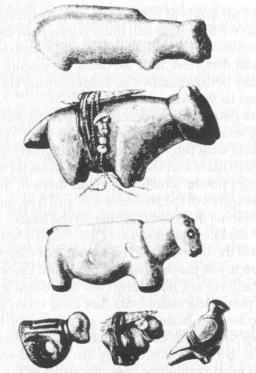
Fig. 1. Prey God Fetiches of the Six Regions. (From "Zuñi Fetiches")
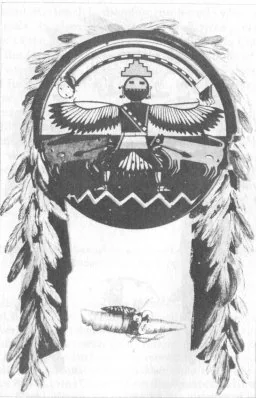
Fig 2. Shield and Fetich of the Priesthood of the Bow. (from "Zuñi Fetiches")
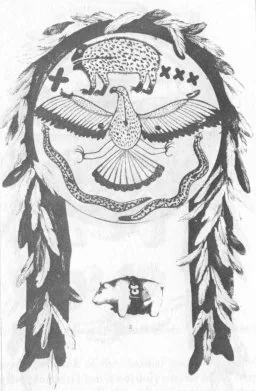
Fig. 3 Shield and Fetich of the Priesthood of the Bow (From "Zuñi Fetiches")[2]
The relative value of these varieties of fetiches depends largely upon the rank of the Animal god they represent. For instance, the Mountain Lion is not only master of the North, which takes precedence over all the other "ancient sacred spaces" (Té-thlä-shi-na-we), or regions, but is also the master of all the other Prey gods, if not of all other terrestrial animals. Notwithstanding the fact that the Coyote, in the Order of the Hunt (the Coyote society or the Sá-ni-a-k?ia-kwe), is given for traditional reasons higher sacred rank than the Mountain Lion, he is, as a Prey Being, one degree lower, being god of the West, which follows the North in order of importance. Hence we find the Mountain Lion and Coyote fetiches far more prized than any of the others, and correspondingly more numerous. The Coyote in rank is younger brother of the Mountain Lion, just as the Wild Cat is younger brother of the Coyote, the Wolf of the Wild Cat, and so on to the Mole, and less important Ground Owl. In relationship by blood, however, the yellow Mountain Lion is accounted older brother of the blue, red, white, spotted, and black Mountain Lions; the blue Coyote, older brother of the red, white, yellow, mottled or spotted, and black Coyotes.[1] So the Wild Cat of the South is regarded as the older brother of the Wild Cats of all the other five regions. And thus it is respectively with the Wolf, the Eagle, and the Mole. We find, therefore, that in the North all the gods of Prey are represented, as well as the Mountain Lion, only they are yellow. In the West all are represented, as well as the Coyote, only they are blue; and thus throughout the remaining four regions.
The Mountain Lion is further believed to be the special hunter of the Elk, Deer, and Bison (no longer an inhabitant of New Mexico). His fetich is, therefore, preferred by the hunter of these animals. So, also, is the fetich of the Coyote preferred by the hunter of the Mountain Sheep; that of the Wild Cat, by the hunter of the Antelope; that of the Wolf, by the hunter of the rare and highly-valued Ó-ho-li; those of the Eagle and Falcon, by the hunter of Rabbits; and that of the Mole, by the hunter of other small game.
The exception to this rule is individual, and founded upon the belief that any one of the gods of Prey hunts to some extent the special game of all the other gods of Prey. Hence, any person who may discover either a concretion or natural object or an ancient fetich calling to mind or representing any one of the Prey gods will regard it as his special fetich, and almost invariably prefer it, since he believes it to have been "meted to" him (an'-ik-tchi-a-k?ia) by the gods.
Notes
1. Each of the six species of prey animals--Mountain Lion (North), Bear (West), Badger (South), White Wolf (East), Eagle (Upper), and Prey Mole (Lower)--"is again divided into six varieties, according to color. . . .For instance, the Mountain Lion (Yellow) is primarily god of the North, but he is supposed to have a representative (younger brother) in the West (the Blue Mountain Lion), another in the South (the Red), in the East (the White), in the Upper regions (the Spotted), and in the lower regions (the Black). Hence, also, there are six varieties of the fetich representing any one of these divisions . . . "("Zuñi Fetiches," pp. 24-25). See figure 1 for fetich representations of these six species of prey animals.
2. "The Priesthood of the Bow possesses three fetiches. These three beings are the Mountain Lion (fig. 2.2); the great White Bear Ain-shi k'ó-ha-na, god of the scalp-taking ceremonials (Fig. 3.2), and the Knife-feathered Monster, Á-tchi-a lä-to-pa (Fig. 2.1).
"This [latter] curious god, [who is] sometimes classed with [the prey animals], sometimes with the higher beings, [and who] may safely be said to form a connecting link between the idolatry proper of the Zuñis and their fetichism, . . . is the hero of hundreds of folklore tales, and the tutelar deity of several of the societies of Zuñi. He is represented as possessing a human form, furnished with flint-knife-feathered pinions, and tail. His dress consists of the conventional terraced cap (representative of his dwelling-place among the clouds), and ornaments, badge, and garments of the Kâ'-kâ. His weapons are the Great Flint-Knife of War, the Bow of the Skies (the Rain-bow), and the Arrow of Lightning, and his guardians or warriors are the Great Mountain Lion of the North and that of the Upper regions. He was doubtless the original War God of the Zuñis, although now secondary, in the order of war, to the two children of the Sun. Anciently he was inimical to man, stealing and carrying away to his city in the skies the women of all nations, until subdued by other gods and men of magic powers. At present he is friendly to them, rather in the sense of an animal whose food temporarily satisfies him than in the beneficent character of most of the gods of Zuñi.
"Both the Great White Bear and the Mountain Lion of the War Priesthood are, as well as the Knife-feathered Demon, beings of the skies. For this reason the fetich of the Mountain Lion of the skies (of aragonite) is preferred by a Priest of the Bow above all other kinds of colors." ["Zuñi Fetiches," p. 40]
Corn Raising: The Decay of the Seed
From "Zuñi Breadstuff," Millstone 9, no. 5 (1884) 75-78.
THE reader of this chapter will at the end, like a man lost in the woods, find himself only where he started; but unlike such a man he will be, for all that, much nearer home. That is to say, a description of the last ceremonial of Harvest must begin an account of Zuñi Corn-Planting and Rearing.
In each corn-room or granary of Zuñi, are preserved carefully, four objects: an ear of yellow corn full to the very tip of perfect kernels, called a yä'-po-to; an ear of white corn which has resulted from the inter-growth of two or more ears within a single husk-fold, called, from its disproportionate breadth and flatness, a mi'-k?iap-pan-ne; a moderately large normal ear of corn which has been dipped by a Seed-Priest in the waters of the great sacred Salt Lake far south of Zuñi ("Las Salinas" of New Mexico), and a bunch of unbroken corn-soot. The latter two objects are laid side by side on the floor in the middle of the corn-room, and upon them also side by side, usually connected by a bandage of cotton filaments, the yä'-po-to and the mi'-k?iap-pan-ne. (See fig. 4.1.)
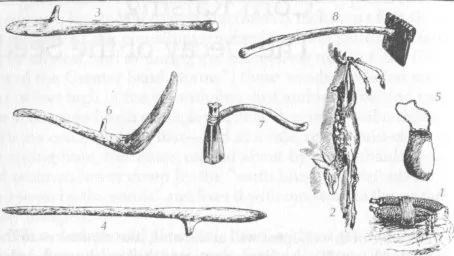
Fig 4. Zuñi Implements
The significance of all this is both interesting and poetic. The corn soot is held to symbolize the "generation of life," the salted and sanctified ear of corn, the material given by the gods and prepared by man, as the means whereby generated life is sustained, and finally, both these are regarded as the "resting place" or "couch" of the "Father and Mother of corn-crops" or Seed; the yä'-po-to being the "male," the mi'-k?iap-pan-ne, the "female."
In a field of growing maize, the owner selects such hills as give promise of speediest maturity. These receive his special care. No sooner have a few ears ripened on them than he picks the most perfect, as well as a bunch of soot from some neighboring stalk, and tenderly carries them home in his arms. Arrived at the entrance-way of his house he calls to the women within:
"We come!"
"Ah? How come ye?" say they.
"Together, happily," he replies.
"Then enter ye! " calls out the chorus of women's voices, whereupon the man goes slowly in. One of the women beckons his attention to the "sitting place," which, in this instance, is a decorated basket-tray in the center of the room. Thither he proceeds and places, one by one, the ears of corn in the tray--using care that they shall all point eastward--and lays the bunch of soot over them. The women of the house flock to the mantel whereon stands the family bowl of prayer-meal, each taking a pinch of the sacred substance, while one of their number, the "corn-matron," hastens away to the granary, and carefully lifting the yä'-po-to and mi'-k?iap-pan-ne, brings them forth. As she nears the tray, she says, across the objects in her hands (addressing the new corn), "My children, how be ye these many days?" Then the new corn is supposed to reply through the voices of the other women, now gathered near, "Happily, our old ones, happily!" With this the com-matron deposits her burden on the new bunch of soot, and all present say little prayers significant of the occasion and setting forth their wishes for "age of life, happy fortune and the health of strength born of the food of maize." This ceremonial is called the "Meeting of the Children" and is performed in commemoration of the return of the lost corn maidens under the guidance of Pai-a-tu-ma, and their welcome by the Seed-Priests of ancient Zuñi.[1]
With the closing of the prayers, the right hand of each worshiper is passed gently over the tray--while scattering prayer-meal--and breathed from. The corn-matron then returns to the granary, bearing both the old corn and the new. She replaces the old bunch of soot with the new, laying the former away with the fresh ears of corn and returning the yä'-po-to and mi'-k?iap-pan-ne to their resting place.
When all the harvest has been gathered, dried, sorted and corded up, around and over the "Father and Mother" in the corn-room, the ceremonial interrupted at the beginning is resumed. While the corn is being classified as to color and grade, the finest ears of each kind are selected and laid aside. These, and the ears of "new corn" are together laid along the outer edge of the corn-pile. Next morning the "corn-matron" takes a basket-tray--perhaps the same one used before, or at least one like it--and goes to the door of the corn-room. Here she slips off her left moccasin, then enters. As she passes the threshold she looks around as though she were about to address a group of waiting friends, and exclaims:
"My mothers and children, how be ye, and how have you come unto the morning?" and after a moment herself replies:
"Happily!"
Reverently, for she is in the presence of the conscious and the benign--so it seems to her--she approaches the cord of corn and with her left hand takes of the selected ears along the top, an ear for each finger (that is, four,) then with the right hand an equal number, placing them in the tray. She brings these forth and assisted by the male head of the household, shells them with such care that not a kernel is lost. Dust from the old bunch of soot is scattered over the shelled corn, and a curious sacred pigment is prepared, in an earthen ladle, of yellow paint and a kernel of salt, from the mountain near the lake of the dead, and the salt lake in the South. To these ingredients are added two or three kinds of little yellow flowers, the principal variety being precious in the eyes of the Zuñi, as that which was "left over of the seed stores of the gods." All this is mixed with pollen and water, and the whole tray of kernels is thoroughly sprinkled and annointed by stirring. The corn grains thus treated are bright yellow in color and pleasantly odoriferous. All this is done that the "seed" may have the power of reproduction, rapid growth and strength, and that it may bear fruit possessed of the properties of food, which fruit shall mature with the season when thrive most and bloom the little yellow flowers--early autumn. We are at first surprised when we learn that to a remarkable degree the corn thus treated has vigor and the quality of ripening early; but our wonder may be lessened when we reflect that these seeds are the most perfect of the whole harvest, selected mostly from among those ears which soonest reached maturity. Still, with the Zuñi all these things are living testaments of faith, proving the infallibility of his theory of "Medicine," or Fetichism and of his practice of religion.
The corn, now fully prepared, is poured into a pouch made from the whole skin of a fawn. (See fig. 4.2.) Most fantastic in appearance is this spotted, life-like corn-bag, as it hangs, at night-time, against the wall, gilded by the fire-light, head downward, the incessantly flickering shadows of its broad ears and dangling fore-legs giving it the appearance of struggling to get free from the strong antlers which seem as actively trying to cast it off. And there, notwithstanding these illusionary struggles, it hangs until late springtime.
I have told how, during the months of the sand storms the banks in the old cornfields are newly built up. Little more need be done, and some fine morning in May, the voice, low, mournful, yet strangely penetrating and tuneful, of the Sun Priest is heard from the house-tops. As you listen in the shadow of some tall terrace, you think that voice must come from a spirit of the Heroic age of Zuñi, returned on the night-wind and hastening to call his wayward game-becrazed children to the fields, so old fashioned, so hidden in meaning seem the words it is uttering. However little the sleepy-eyed devotee of "cane-weeds" and "stick-shuffling" may understand of that archaeic monologue, he knows its one principal meaning, and if he be the head of the household who assisted in the shelling of the seed-corn last autumn, he bethinks himself of the planting stick and bestirs himself to sharpen (against a slab of sandstone) that useful, simple, yet ingenious instrument of husbandry. This planting stick (see fig. 4.3) is a kind of prod made from a straight-grained juniper sapling, the base flattened and sharpened to a round-nosed blade-like point, and possessed of one ear formed by a fortuitous branch cut off and scraped until just enough is left to be useful as a brace for the right foot. The utensil our friend has just finished sharpening, glistens from long use. The blade is worn short, ground shorter, and the whole thing has an air of antiquity; was, likely as not made long ago by the man's grandfather on the mother's side or by some other equally pristine potterer early in this century or late in the last. He will not use this venerable relic, let us hope, for planting the whole field; but at any rate he prefers it, short though it be, for the work presently in hand. He has leaned it against the wall near the doorway now, and has gone in to get his feather-box and paint-pots. With these and a piece of willow (cut this time at the "Lake of the Dead") he makes a plumed prayer-stick. He then chooses from the fawn-skin pouch six kernels of corn, each, of course, of a different color, and in a broad husk wraps them with the plumed wand. Slinging the pouch over his shoulder, he takes up the old planting-stick and says ceremoniously to the women:
"We go!"
As he steps out of the doorway, the corn-matron hustles after him with a bowl of fresh, cold water, with which she lavishly sprinkles him and his pouch, laughingly telling "them" to go. Thoroughly be-drenched, he shuffles down the hill, across the river, and out to his field.
I need not stop to explain that a Zuñi would by no means miss this sprinkling process, as--jokingly performed though it may be--it is symbolic of rain, believed to be provocative of that blessing, without which the seed-corn would be powerless to grow. Arrived at the field, he goes to a well-known spot near the center. Here he digs in the soft sandy soil by pushing his prod down with his foot, and turning it around and around-four deep holes equally distant from a central space; the first to the North, the second to the West, the third to the South and the fourth to the East. By the left side of the northern hole he digs another to represent the Sky-regions, and by the right side of the southern hole still another relating it to the Lower regions. In the central space he kneels facing the East, and drawing forth the plumed prayer-wand first marks by sprinkling prayer-meal, a cross on the ground-to symbolize not only the four cardinal points, but also, the stars which shall watch over his field by night-time. Then with prayer, he plants the plumed stick at the intersection of the cross, sprinkles it with more prayer-meal-as the corn-matron had sprinkled him with water-and withdraws. From his pouch he selects three grains of each of the six colors--yellow, blue, red, white, speckled and black--and places them respectively with the six grains of like colors which had been wrapped in the shuck. He now goes back and kneeling down, holds the four grains of yellow color in his left hand, and facing toward the northern hole crones the following first verse of a planting chant:
"U-ai-o-a-ho-o
U-ai-o-a-ho-o
U-ai-o-a-ho-o
Li wa ma ha'ni,
Pish le a ha'n kwi,
Ho-lon e-te, hom thlup-tsi-kwa
Mi-a na-kia, an hai'te na kia.
U-ai-a-i-o-a-o ho."
U-ai, etc.
"Off over yonder,
Toward the North-land.
Will it but prove that my yellow corn grains
Shall grow and bear fruit asking which I now sing."
U-ai, etc.
And just as he sings the refrain he drops the yellow kernels into the hole toward the North. Continuing the refrain so that it runs into the prelude of the next stanza, he shifts about so as to face westward and taking up the four blue grains, repeats as before, except that he sings to the "West-land" and of the "blue corn grains," and when he comes to the refrain, drops the blue grains into the hole toward the West. Thus he proceeds, not once interrupting his droning chant, until all the sets of grains have been dropped into the holes which their colors respectively relate them to; the red into the Southern, the white into the Eastern, the speckled into the Upper and the black into the Lower. Ceremonial is now abandoned. He covers the grains he has dropped, and in lines corresponding to the directions of the four hills, plants rows far out into the field until the corn in the fawn-skin pouch is exhausted. Then he returns home, not again to plant until four days shall have passed by, during which time (let me add) he dutiously fasts, prays regularly at sunrise by the riverside, and abstains from all unbecoming pleasures.
It will not be held against me that I forgot to tell how the rest of the seed corn was provided. Those ears from among which the first eight were selected by the corn-matron, have been brought out, last autumn, from the place of storage, and shelled in the most matter-of-fact way. Part of the grains are laid by as seed for the Kâ'-kâ, or sacred dance, while the remainder are stored in large buckskin bags to serve as the "common-seed" for the planting of the fields.
At the end of the fourth day after the first planting the householder quite likely makes a new planting-stick (fig. 4.4), laying the old one aside. He also gets out his seed bags. These (see fig. 4.5) are curious; usually of rawhide, they have been so puckered and sewed that they form egg-shaped receptacles, cut off at the smaller end. They are ingeniously made to remain open and otherwise retain their shape by being moistened, filled first with damp, then with moderately hot, dry sand, and hung up to harden by desiccation, which of course takes place in a short time. A little hoop of wood is, moreover, fitted around the upper edge, much as is the large wire rim of a tin bucket, and like the latter, the seed-pouch is also furnished with a bail--of twisted buckskin.
Taking a luncheon of paper-bread--substantial in quantity at least--and a bag of common seed-corn, together with the various appliances above described, and followed by a discontented urchin, staggering under a big, earthen canteen of water, the planter now proceeds to his field. Along the eastern side of the rows of last year's broken stalks (or corn butts), four or five inches from each bunch, he digs holes with his wooden prod, to the depth of from four to seven inches. The boy comes along after him dropping into each hole from twelve to twenty kernels, and pushing sand in with his foot until it is filled. Wherever the stalk-butts happen to be thin, they reinforce them with bunches of grease-wood or sage-bush sprigs. The consequence is that not only is the crop not planted twice successively in the same spots, but a long drift of fresh soil is blown by the still prevailing west winds directly over each new hill of corn, forming without labor, neat little mounds of earth. The country of the Zuñis is so dry that the seeds have to be planted to great depths--even at the expense of great delay in their growth--and the little drifts of sandy soil protect the underlying loam in which the kernels are embedded from the fierce south-western sun. Not only on account of this dryness but because some of the plants die in their efforts to reach daylight, the large number of kernels for each hill is required.
Now comes the time when young Zuñi and his elder brother may indulge in fanciful creations which would astound the most talented scare-crow makers of New England. The glossy large south-western crow or raven is abroad. He sits on every rock, soars through every cloud-shadow, laughs and cackles in every corn-arroyo at safe, nevertheless impertinent distances from the busy planter. He as much as says to his companions--in the language of Zuñi crow lore--"Ah! you just wait until those little green spikes come up! They grow solely for our benefit that we may have signs whereby to find the good things those long-legged fearful fellows are hiding so deep in the sand; why, that's what our heavy noses are provided for! "Alas, poor birds! Have they forgotten last season? What a shock is in store for them! What disappointment shall soon be attested by the most discordant kaw croaks of anguish!
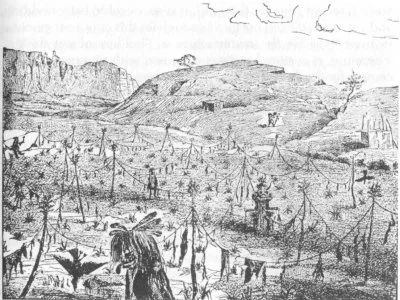
Fig 5. Zuñi Cornfield with Crow-Traps
The old man is busy setting up cedar poles at intervals of a few rods, all over the field. Not knowing what these poles were for, you would think an eastern bean-patch or hop-field had been transferred to Zuñi-land. But if you carefully look, you will see that each pole is furnished at the top with a bunch of its own or some other prickly leaves, so that the crows may not light on it. Moreover, the busy planter is now stringing from one pole to another, cords of split yucca leaves, which but for their knottiness, would remind you of the telegraph wires of New York City, so thick they are. A sort of network is thus formed all over the field. To make this more imposing, tattered rags, pieces of dog and coyote skins, old shoulder blades strung two or three together, streamers of moss, in fact streamers of every conceivable thing which has the property of swaying in the wind, are thickly attached to these numerous cords making them appear much as I fancy a clothes-line would left by a hurricane.
Meanwhile the youngsters are busy. They have pilfered from the old storeroom everything in the shape of off-duty clothing they could lay hands on. You must know, my reader, that this is quite what their fathers and uncles want; but not so their mothers, aunts and grandmothers. These representatives of Zuñi consanguinity are the stingiest creatures human breath was ever vouchsafed to. If a dress be too dirty and ragged to be kept comfortably on, it will do, backed by straw, to stop up sky-holes with; if too far gone for this, still, it is serviceable baby bedding, and yet more; if even not good enough for this, it is most gracious in their eyes for the manufacture of "holders of hot things." Therefore, it is stored away in common with numerous predecessors for the "wanting time." Yet, young Zuñi is quite as sharp as any other boy. He gets what he covets, be assured, and that too without the knowledge of even his younger sister! Off to the deep arroyo near his father's field he goes with his plunder. His older brother is "in with him." Both of them have been deprived all their lives long of slates and pencils. They have found no vent for their caricaturistic capacities, which are great, and they take it out on occasions like the present. They are prolific of invention, bold, and of ready execution. Twenty-four hours hence behold the result! As you ride along some outward-bound trail your feelings would be mirthful but for the effect on your shaky Indian nag. He will not be convinced that those things standing or sitting around so frequently are inanimate! Yonder on the hillside is an old woman limping (not along). She carries a basket on her back and a rib-scapula-tin-can-and-stick-rattle in her hand. Does it rattle? Yes; it is safe to say that you can hear it--if the wind be blowing--even before you see the stuffed old woman. This way further expressively tearing right along, is a being with outstretched hands, streaming shocks of gray hair (pulled from a dead horse's tail), a black black rawhide face, eyes made of husk-balls popping out of his head and painted yellow, teeth of corn-stalks from jaw-rim to jaw-rim, and a great red tongue which lolls in and out from side to side, with every breeze-gust. He seems to be frightened by the frog-legged character behind him. Now all these shé-tu-na-kwe ("watchers of corn sprouts") have the desired effect! The old crows let the field most faithfully alone!
Not so with the new generation of "kernel diggers"--which gets feathers and finds wings about this time. Before growth has made the corn invulnerable, these guileless young creatures come along. They are no more fearful of the extravagant effigies than of the embracing boughs of their paternal rookery. Many of them, therefore, get caught in little hair nooses plentifully attached to convenient cobbles. Others commit suicide in pairs by swallowing the tempting kernels at either end of a hair thread and then winding one another up and choking. They seem to prefer this to being "Siamese twins" all their lives!
The captives are, in due course of time, taken up. They are carried home and treated with the utmost tenderness, but they are not fed! If one of them happens to find something to eat or drink (rarely the case) his beak is promptly cut off in order that he shall not be tempted a second time. Of course, the wretched birds "die young," and are then crucified on two flexible twigs and hung, head downward, to one or another of the numerous yucca lines. This course of action is, it seems, prompted by the belief that the souls of these dead crows will warn their mortal companions that man is "very painful," and in order that these souls may not lack for witnesses they are furnished with their own bodies, hung up in conspicuous places.[2]
The scarecrow and the bird it scares are subjects of such grave interest to the Zuñi, such an element of agitation during its brief season in his industrial life, so undoubtedly the chief root of evil to his bread material-on which subject he is as touchy as a miser-that a little anecdote relative to the bird in particular, would not be, it seems to me, out of the way.
The corn had just sprouted in the spring of 1881, and my "Older Brother's" scarecrows (fault of his own) had not been so successful as those of his neighbors. That those of his neighbors were better than his own was not in itself an aggravation, but certainly a nuisance, for it caused the crows to leave their fields and fairly flock to his. He came to my "little house" one morning wearing a weary look.
"What's inside of you?" I asked.
"Crows!"
"Why do you not make scarecrows?" said I.
"Scarecrows? ho! Nothing will remedy the folly of our ancients, nothing, I say, Younger Brother!"
"Why? What did they do?" said I, feeling for a pencil.
"Now look here!" exclaimed the old man. "You little fool, put away that writing stick. I'm in earnest very, this morning, and I want to ask you two questions."
"Go on then," said I.
"Well, you know when our ancients came out of the four caves? There was a priest with them--he belonged to my clan too!" (added the old man with a look of injury and exceeding disgust.) "Well, from under the world this priest had brought a wonderful and beautiful wand, but no one had seen it in the dark. Now, they all asked 'What is it? what is it?'
"'It is a baton, 'said the priest,' given by the Makers of Life.'
"'what is it for?' said some, and 'How pretty it is!' said others, for it was covered with many colored feathers in bright patterns and bands.
"'It is a baton,' said the priest, 'given to test children's understandings,' saying which he spoke a charm, struck the wand against a rock, and behold! Four eggs issued from one end and rolled out in front of the lookers. One pair was dull; the other beautiful like pale turquoise-with little marks all over.
"'My children,' said the priest, 'listen! These are the seed of living things. Two of them are to become more beautiful than my wand, and precious-the blessing of those whom they accompany; for wheresoever they dwell, there will be everlasting summer and beautiful growing things. But the others will become beasts who, every year's end will fight the summer birds away and bring back winter; and every summer-dawn will tear up growing things, leaving hunger and perplexing thoughts to those they live with. Be wise, now, my children, and, above all, choose not with greed,' said the priest.
"Now what do you suppose those fools did?"
"I don't know."
"Well! They took the pretty blue eggs of course, 'because,' said they, 'these are of the color of precious stones; therefore they must surely be the seed of precious things!' So they carried them with great gentleness to a place on the sunny side of a cliff and laid them in soft down, and watched them day by day. By and by the eggs cracked and two little worms came out, which presently became birds with pin-feathers under their skins and open eyes. They never seemed satisfied with their food-always wanted more, you see! But the pin-feathers looked blue, green and yellow (under their skins), and the people chuckled, saying 'Ha-ha, wa-ha! We have understandings, for look! If their dresses be pretty under their skins think what they will be when they come out and cover them!' So they fed the greedy little wretches all they could stuff. When the birds feathered out they were black, and they flew away laughing Ka-ha, Ka-ha, as they've laughed ever since--the pesky corn-pullers!
"But the priest sent the dull eggs to summer-land in a rain-cloud, and they became the fathers of macaws, and wherever they dwell, like the color of their plumage are the flowers, fruits and leaves, and summer abides there forever.[3]
"Younger Brother, there are just two things I want!"
"What are they?"
"Some tail-feathers of the macaw for my medicine-wand, and some of that 'white wizard-powder' that Americans make and that they say 'will kill even a Zuñi dog' if you can only get him to eat it."
My Older Brother looked considerably happier when I told him I would get some of the white powder; but when I added that it would not be so easy to find the macaw feathers, he fell to cursing his grandfathers as heartily as ever.
Notes
1. See "Creation and the Origin of Corn," below.
2. Peculiarly gentle in his relations to fellow-men, never or rarely punishing his children for even the worst behavior, the Zuñi is, as a measure of self-defense, the embodiment of cruelty to crows, sneak-curs, coyotes, and other pestiverous-animals . . . . [F. H. C.]
3. "Thus first was our nation divided into the People of Winter and the People of Summer," we are told in another version of this story, "in such wise as are their children today, into anotiwe (clans or kinties) of brothers and sisters who may not marry one another" ("Outlines of Zuñi Creation Myths," pp. 386-387).
Corn Raising: The Regeneration of the Seed
From "Zuñi Breadstuff," Millstone 9, no. 6 (1884): 93-95.
WHEN the kernels have sprouted all through the field described in the last chapter, we find the planter busy inspecting the hills near the prayer-stick. Upon this inspection hangs the fate--so he thinks--of his cornfield; for if every kernel in each of the six sacred hills has "come out," the crop will be productive. If, on the contrary, one or two of the grains in, for example, the southern hill have not sprouted forth, "Alas!" part of his crop of red corn will be a failure; will not get ripe before frost time.
Toward noon he is joined by two or three of the women and some of the children of the household, and perhaps by as many neighbors. Wherever a sprout looks yellow, they dig down and kill the little white worm they are sure to find near the root. This is called "grub-finishing." Wherever the plants are very vigorous, they pull up all except four or five of the best, and this is called "leafing" or "leaf-lifting."
The occasion which follows soon and is recurrent twice or thrice during the warm season is perhaps the jolliest of the summer. It is the "hoeing" or "staving time" as the Zuñis call it in well remembrance of the instruments with which their ancestors hoed, away back in the age of stone. These were crooked, sharp-edged staves of hard wood, shaped not unlike sickles, or better still, short scythes. (See fig. 4.6.) Rude as they were, they seem to have been wonderfully efficacious in the removal of weeds, for the operator, progressing on his knees, swept the scythe-hoe from side to side between the rows of corn, cutting off wide swathes of weeds, just below the surface of the soft yielding soil. The principal drawback to this implement was that it proved equally efficacious in wearying the man who wielded it. Therefore, while with the introduction of iron the heavy hand-wrought hoes affected to-day by the Zuñis displaced the ancient wooden instrument, not so with the name the latter gave to hoeing.
Every night at staving time you will hear women calling in at the doorways as they go the rounds of their husbands' clans, "She! Tomorrow we stave," for only the poorest Zuñis hoe their fields unaided. Next morning a goodly number of the men thus summoned gather at whatever house was represented by the woman who summoned them. Without breakfast they betake themselves to the field and-hoe with might and main until about eleven o'clock, then stop to eat luncheon and joke with the girls who brought it down, and who are, true to nature, dressed in regular holiday costume. They have been "grinding" all the morning, in time to the shrill chant of the mistress, or of some old aunt whose back is too stiff for the mealing trough (or who pretends it is) but whose voice is, if possible, shriller than ever. If you look at these giggling, droop-eyed girls, you will see that they are a degree whiter than they were yesterday. They've actually been powdering! just before starting out with the lunch eon each one, warmed and perspiring from the violent exercise at the metate; grabbed up a handful of white meal, rubbed it well between her palms, and applied it evenly all over her face and neck.
When the girls have returned to help cook for the "stavers," the latter resume the work, but now more moderately. Laughing, joking, telling stories of the olden time (not folklore, that is forbidden, for the rattlesnake is abroad!), racing at their task, playing pranks, they are the lightest-hearted laborers you ever saw.
According to these stories, it was not like this in the olden time of which they tell. Many of the laborers of primitive pueblodom were given their tasks which they had to finish under a priest's inspection. Later on (and even that was a long time ago) war originated these hoeing bees (or "staving councils"). They were not then as now light-hearted crowds. Each member of them was like a deer on an open plain, fearful lest every puff of wind should bring sounds or sight of some enemy. Full often the enemy did come. Daring not to attack the terraced town, he hung about the distant fields, seeking vengeance for those of his tribe who had fallen under the knotty clubs of Zuñi. And woe to the workers if they proved but few! Armed even as they worked, brave with desperation, it was rare they ever saw Zuñi again; for the cowardly Navajos rarely came but in swarms. Some of the most thrilling traditions of Zuñi tongue concern these and the harvest days of long ago; and it is with regret that I pass my notes of many a long recital by for the short and perhaps less interesting tale below.
Below the pueblo of Zuñi westward, in one of the long arms of the valley, there stands, perched upon the summit of a high rock, an ancient tower of stone. You reach the doorway of this solitary little citadel by means of an old log notched at intervals to form rude steps. Entering, you find a neat little room, well plastered, in one corner a tiny fire-place, and opposite a single mealing-slab, while above hangs a blanket-pole. The cinders yet lie on the hearth-stone, the pole glistens still brightly from its shadowy recess, the meal clings even now to the roughened face of the mill-stone.
It seems as though only yesterday the fire was kindled, as though its light still lingered along the polished pole, as though the women had but just ceased to ply the molina in the mealing trough and had gone out to watch the wide cornfields or bring water. But it is fifty years since the flames died away on that hearthstone; fifty years a little streak of sunlight has played along the blanket-pole, replacing the fire's ruddy glow; and for fifty years the story has been related at each hoeing, how the woman went out one morning--never to return.
And the half of this tale is already told if you but climb another notched log leading through the trap-door by the chimney into an upper room. There are double port-holes here, which from without seem like the sightless sockets of a crumbling skull. By the light they let in you see that the plaster is broken and stained here and there with dark patches. Splintered shafts and shivered stones lie strewn about--ungathered by those who anxiously searched there fifty summers ago at sunset.
For the little house on the rock once belonged to Um'-thla-na--"He of large muscles." He was living there with his family to tend the cornfields. The women went out early one morning to get water. No sooner had they neared the distant pool than they heard the tread of many horse-hoofs. Then they saw, sweeping down the valley, a crowd of mounted warriors. They dropped their water-jars and fled, one to the neighboring rocks, hours after to appear breathless and fainting at Zuñi; but the younger toward the little tower, the steps of which she never ascended, for, caught up by some wrangling horsemen, wrangling for her possession, she was borne away into years of captivity.
Um'-thla-na heard the rush of the riders, grasped up his war-club, bow and arrows, and not pausing to close the doorway, clambered the step-log in the corner and barricaded the trapdoor. Soon the Navajos thronged into the lower room. They snatched the serapes from the blanket-pole, they stole the basket of corn cakes and paper bread. Wild with glee over these delicacies so rare to their roving life, they never noticed the trapdoor, but ran out and sat down about the doorway to feast. Alas, Um'-thla-na! why did he not keep quiet? Peering out through a port-hole, he saw a big Navajo calmly sitting near the step-log eating a roll of paper bread. He drew an arrow to the head, let fly, and struck so fairly the feasting raider that he uttered never a groan but fell over against the ladder still grasping his roll of guyave. Another, sitting near, saw him fall, but ere he could call an alarm he too was pinned with one of Um'-thla-na's arrows. As this one fell, Um'-thla-na raised a yell of victory, "changing his key that the Navajos might think him many." At first the enemy fell back, but when they found there was only one man, they rushed toward the house again. For awhile Um'-thla-na's arrows fell so thickly that the hazard of near approach kept the Navajos from charging. Even when his shafts were spent he pulled stones from the wall and broke them against one another, casting them down at the enemy. The port-holes were small and he had to stand quite close to them. Soon an arrow whizzed through one, sticking him in the arm. Um'-thla-na clinched his teeth and plucked it out, shooting it back.
Ere long he was wounded in many places and weak from loss of blood; still he stood bravely at bay by the port-holes. One of the Navajos more distant than the rest, saw Um'-thla-na's face at the hole. Taking careful aim he let go so cleverly that Um'-thla-na, dodging, was shot through the neck. He staggered back, falling heavily, then roused himself and sat up against the wall, clutching his war-club. Now the Navajos rushed toward the doorway. Suddenly they fled away, for, behold! coming swiftly across the valley in a cloud of dust was a band of Zuñi horsemen. The Zuñis pursued the flying Navajos, never thinking of Um'-thla-na. At last the poor old man, hearing no sound, pulled some of the arrows from his wounds, broke others off, and slowly, painfully clambered down the step-log, and staggered out into the plain toward Zuñi. Fainter and fainter he grew, until he swooned by the trailside. Toward sunset they found him there, those who came to seek. Some staid to tenderly care for him, while others went to search for the young woman. They did not find her, but lying dead on the rocks near the tower were five Navajos. One of them was leaning against the step-log still grasping in his hand a roll of paper bread. Um'-thla-na lived to tell the story, but grew worse as the arrow wounds rancored, and "killed himself that he might be divided from pain."
Nobody lives in the little house now. "It is a place of painful thoughts," say the narrators; but it stands always the same, for its builder was "He of large muscles."
At sunset the men file in from the field. The women have spread or rather strung the feast out on the lowest roof. Ten or twelve great bowls in a row, smoking hot with stew, every one as red with chili as its rising vapors are with the touches of sunset. There is a row of breadstuff, thin as paper, flaky as crackers, red, yellow, blue and white, piled up in baskets down either side of the meat bowls. Outside these, two other rows, this time of blankets and stool blocks. The first man whose head appears up the ladder is besieged with polite invitations to "Sit and eat, sit and eat," from as many pairs of lips as there are women on the house-top. Men all are seated, a sacrifice is made to the household fire; up to this time the talking has been rife; now it ceases altogether. Everything except eating seems tabu until the feast has disappeared, and the cigarettes are rolled and lighted. Then talking resumes and long into the night continues.
At the second or third hoeing, which takes place usually after one of the late summer rains, they "hill" the corn much as our eastern farmers do. In ancient times a sort of broad pick-axe or hoe made from the scapula of an elk and bound with rawhide
to a wooden handle (see fig. 4.7) or a hoe of hard wood similarly fastened to the handle and surmounted by a heavy stone (fig. 4.8) were used for this purpose.
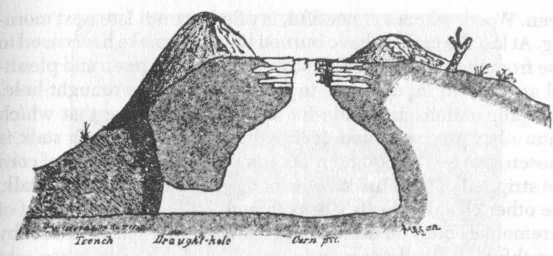
Figure 5. Corn Roasting
Autumn comes and the "corn children" have been taken in to meet their "Father and Mother," the yä'-po-to and the mi'-k?iap-pan-ne. A while later, another search is made through the field, this time for such corn as gives no promise of ripening. Blanketful after blanketful is picked, husks and all, and carried to some distant wooded hill where the soil is solid. Here, with sharp sticks, and hoes, a hole is dug resembling a well (see fig. 5). At the top, it is cut larger around, to the depth of a foot or more and walled up neatly and solidly with sandstone. Below this wall, say a foot, the hole is gradually enlarged toward the bottom, until it embraces a room several feet in diameter and cone-shaped, the apex as it were, being the walled, circular opening. From the windward side of the hill, a trench is dug to a level with the bottom of the excavation. A hole or passage, about two feet in diameter is cut from the end of the trench to the interior. Dry grass, old leaves, pitchy sticks, are thrown in from above, and arranged by a man who has entered through the trench. On top of these wood is piled until the hole is full. The mass is now fired. As soon as the night-wind rises, flames dart upward through the circular hole, many feet into the air, straight, lurid, setting the woodlands around and the skies above, fairly aglow with ruddy splendor. All night long, a merry group of young people dance, sing and romp around this volcano-like oven. Wood, whenever needful, is piled in until late next morning. At last the embers have burned low, and smoke has ceased to rise from their glaring red depths. Corn-stalks, green and plentiful are thrown in, more are tucked into the large draught-hole, and preparations are made for artificially ripening that which nature has procrastinated over. A beautiful, long, fresh stalk is chosen, leaves, tassels and roots complete. Two fine ears of corn are stripped of their husks. One of them is laid against the stalk, the other cleansed of its silk as though for boiling. The chief of ceremonials bites off from this all the milky kernels mouthful by mouthful, chews them to pulp, and blows their substance into fine mist over the heaps of plucked corn. He then places the cob by the side of the other ear, and binds both firmly to the stalk. This, in the brief prayer he presently makes, is called the shi'-wa-ni or priest. It is cast into the still glowing pit, and then, men, women, young and old, begin to hurl in the unhusked corn from all sides until no more is left. Most likely space remains at the top. If so, it is quickly filled with green stalks, more of which are bundled up and used as a cork for the circular opening. A mound of damp soil is heaped to a considerable height above this impromptu stopper. As night again comes on, campfires, bright enough it is true, but pale compared with the flames of last night, are built at convenient distances. Muffled sounds come all night from the buried oven. Sometimes, though rarely, the top is blown off, but usually next morning the mound is found unchanged and the sounds have ceased.
Now comes a sight which would surprise a stranger, miles away though he might be. The earthen mound is removed and the stopper of corn-stalks, with great trepidation, most gingerly pulled out. Instantly, hissing and seething, the steam from the heated corn and stalks below, shoots hundreds of feet into the air. On a clear day in green-corn time dozens of these white columns may be seen rising from the wooded slopes around the vale of Zuñi. It is not until toward afternoon that the mass is sufficiently cooled to admit of approach. As soon as possible the corn is handed out through the draught hole (which has been enlarged for the purpose) sewed up in blankets, strapped across burros and transported to the town. Every member of the party, as it approaches Zuñi, may be seen gorging this--really delicious--baked corn. When it is unloaded into the spare room, the heat has not yet left it. With all possible haste, the husks are stripped down, and the ears, now brown and plump, are braided into long bunches, and the whole is hung up to dry in an upper room.
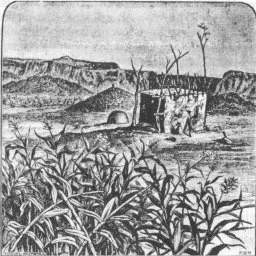
Figure 6. Zuñi Farm Hut
Many of the leaves in the field still remain green. These are gathered, carefully dried and folded into large long bundles, for winter kitchen use. Quantities of late squash and pumpkin flowers are stored away in jars to serve a similar end.
As the corn ripens, you may see fires burning at almost any of the quaint little farm huts (see fig. 6), for children or very old men watch there day and night, to keep crows, coyotes, and burros away. The crows are worse than they were last spring. The coyotes are not outdone by the crows at either time, but the burros are worse than both together. They are, to quote Zuñi, Mi'-wi-hâ or "adopted of corn." You may put them in the corrals, tie their fore-feet close together, or herd them as you will, but some of them will "leave tracks and love corn in every field." The remedies are many and ingenious, but all more or less fatally short of happy results. Each man in Zuñi knows every other man, and equally as well, he knows every other man's burros. If a burro is found in a cornfield some morning, the field owner counts the exact number of missing or injured ears, and drives the burro home. Forthwith he seeks out the animal's owner. If the latter prove obdurate, the sufferer informs the chief and bides his time. Woe to that burro if he get into the cornfield again. He may consider himself fortunate if he lose but one or even both ears. Sometimes he is gagged with a big stick, a cord being passed from either end of the stick up over the shoulders and back, and under the tail. The burro is then welcome to remain in the cornfield as long as he chooses. At other times, the luckless animal is thrown and a few of his teeth pulled Zuñi fashion; which is to say, a thread of sinew is looped to each, a heavy stone is tied to the sinew, and hurled into the air. I remember a lawsuit of three nights' duration over one of these animals. Ever after, he was called the "short-horn," and little wonder! For his ears had been shaved close to his head, his tail cut off short, the tip of his tongue and part of his teeth amputated, his left eye put out, and his back so stiffened by castigation that a five-foot straight-edge laid lengthwise along the very acute angle of his vertebra, would have touched at every point. Two years I knew that burro personally. His working days were over. He used to get deplorably hungry, and I sometimes fed him; for, winter or summer, he dared not stir from the protecting although inhospitable shadows of the walls of Zuñi. He preferred picking cedar bark from the fire-wood, anything he preferred, to going abroad. In fact, had he been able to run he would certainly have done so at the sight of a field of corn.
In pity both for crows and burros, I have sometimes pleaded mitigation of the customary severe measures. My experiences at such times lead me to advise all aspiring ethnologists to mind their own business when corn is in the question. As I have said before, the Zuñis, and probably most other Indians, are touchy on the subject of their breadstuff.
Frost comes, changing the green of the stalks to yellow gold, the leaf-like shucks to feathers. In every field are corn pickers and huskers. Such corn as is not husked in the field, is packed with consummate method on burros or in carts and a few second-hand wagons, and brought to the town. Husking bees are formed by the women, and at three o'clock any afternoon you can see around a corner, mountains of cast-away shucks, and many a black, frouzzly head sticking up from their flaky slopes, bobbing bodilessly with the severance of every ear from its rattling wrappings. At such times husks in great numbers are selected, bundled into neat bunches and strung several feet long on threads of yucca fiber. They will be needed before the month is gone, particularly in the council chambers, where every night brings the weary law-givers of Zuñi fresh cases of trespass for consideration.
How the roofs groan under the weight of drying corn; how the walls gleam and glory with the festoons of chili or red pepper! But in time the corn is dry, the peppers ripened enough for storage, and the work of "corn-sorting" begins. The different colors, yellow, blue, red, white, speckled and black are separated. The "nubbin-ears" are put in a cellar by themselves for sale or for burros, and as described before, the corn is corded up in the granary around the tutelar divinities of the place--the "Father and Mother of corn crops."
Patient reader, forgive me for having lingered so long in Zuñi cornfields. However closely we may have scrutinized these crops growing green, golden grown as they may have been, we have but barely glanced at them according to the rules and practices of their dusky owners. In illustration of his watchfulness--quite as well as in memory of a former promise--I repeat below a song of the growth of corn plants. Let me begin, however, by saying that shall give only in the first verse the prelude and refrain which opens and closes each stanza of the song.
I.
"A-hee-e'-iu, a-he-e'-iu!
A-hee-e'-iu, a-he-e'-iu!
Sa-ni-hi' akia tchu etai'-e
Te-tchi-nai-u-le, te-tchi-nai-iu-le'e'e."
"Soil shorn and spread by storms!
Soil shorn and spread by storms!
Band of Hunters, their corn grains planted
There may now be seen, there may now be seen."
II.
Sa-ni-hi'-akia, ke'-mu-toi'-ye,--
Band of hunters, their corn grains sprouted.
III.
Sa-ni-hi'-akia, thia-kwi-moi'-ye,--
Band of hunters, their corn grains rooted.
IV.
Sa-ni-hi'-akia, k?e-tsithl-pol'-ye,--
Band of hunters, their corn leaves fluted.
V.
Sa-ni-hi'-akia, la she yai' ye,--
Band of hunters, their corn leaves feathered.
VI.
Sa-ni-hi'-akia, ta-a-nai-ye,--
Band of hunters, their corn stalks tasseled.
VII.
Sa-ni-hi'-akia, u-te-ai'-ye,--
Band of hunters, their corn plants blooming.
VIII.
Sa-ni-hi'-akia, te-k?u-ai'-ye,--
Band of hunters, their corn ears started.--
[i.e. enfolded within the leaves.]
IX.
Sa-ni-hi'-akia, thia-k'u-nai'-ye, etc.,
Band of hunters, their corn ears shooting,
[i.e. starting forth from the leaves.]
X.
Sa-ni-hi'-akia, mi-i-ai'-ye,--
Band of hunters, their corn ears kerneled.
XI.
Sa-ni-hi'-akia, sho-ho-nai-ye,--
Band of hunters, their corn ears silkened.
XII.
Sa-ni-hi'-akia, o-sho-nai-yo,--
Band of hunters, their corn plants sooted.
XIII.
Sa-ni-hi'-akia, thla-shi-nai-ye,--
Band of hunters, their corn grown aged.
This song, although beautiful in the original language and music (possessed as it is of perfect metre, fair rhythm and considerable poetic sentiment) defies exact translation. Not only is it framed in archaic syllables, but the terms in Zuñi for every phenomenon connected with corn and its growth are so numerous and technical that it is as difficult to render them into English as it would be to translate into Zuñi the terminology of an exact science. I have, however, introduced this approximation as illustrative not only of Indian powers of observation but also as giving a fair example of the terms wherewith from planting time to harvesting time may be designated any given period; for the Zuñi, simply adding to any of the above expressions a syllable expressive of time, thus divides the quarters of the "Nameless Months."
Clowns, Priests, and Festivals of the Kâ'-kâ
From "Zuñi Breadstuff", Millstone 10, no. 8 (1885): 141-44.
PERHAPS the most sacred, though least secret of [Zuñi] esoteric societies, is the Kâ'-kâ, or great dance organization-truly the church of these pagan worshipers, if church they may be said to possess, for in it are included priests, laymen and song-leaders. The public celebrations of this Kâ'-kâ consist of wonderfully fantastic dances, in which gods, demons and the men of ancient times are dramatically represented by costumed actors. Inside one of the estufas, or subterranean council chambers, which, on occasions of great moment are embellished with fringed and plumed bows strung across their entrance-ladders, rituals are repeated, prayers and sacrifices offered during a whole night preceding the public appearance of the actors. But during the day the worship consists almost wholly of dances to the time of loud invocation chants and wild metric music. To describe the various features of this worship would be to give a history of the whole Zuñi mythology and delineate a hundred diverse and striking costumes and maskings. In each celebration, however, certain elements are constant. Such are the clowns--priests annually elected from the membership of the Kâ'-kâ, and disguised as monsters, with warty, wen-eyed, pucker-mouthed pink masks [see fig. 7] and mud-bedaubed equally pink bodies.
First appear the dancers, some fifty of them, costumed and masked with such similarity that individuals are as indistinguishable as the birds or the animals they conventionally represent are from each other. Large-jawed and staring-eyed demons of one kind or another marshal them into the open plaza of the village under the guidance of a sedate unmasked priest bearing sacred relies and prayer-meal. One of the demons sounds a rattle and howls the first clause in the song stanza; then all fall into line, all in equal time sing the weird song, and go through the pantomime and dance which invariably illustrate its theme. When four verses have been completed, the actors, bathed in perspiration, retire to their estufa to rest and pray, while the priest-clowns appear with drum, cabalistic prayer-plumes and the paraphernalia of guess-games. They begin the absurdest, most ingenious and witty of buffoonery and raillery, generally managing, nevertheless, to explain during their apparently nonsensical dialogues, the full meanings of the dance and song-the latter being often couched in archaic or jargonistic terms utterly incomprehensible to others than the initiated among the audience which throngs the terrace-tops. To merely see these clowns, without understanding a word of their incessant and really most humorous jabber, is to laugh immoderately. To understand everything, withal, is to sometimes wish from sheer excess of laughing, that the dancers would file in and thus put an end to their jibes and antics.
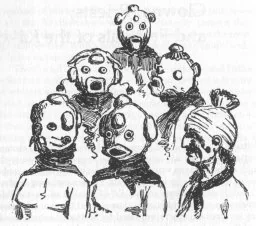
Figure 7. Clown's Heads
If these clowns accompany certain most beautiful corn-dances of late autumn, then each bears a bundle of beautifully painted and feathered toy bows and arrows, or hideous dolls, with all sorts of bread-loaves and cakes depending from them. The bread tied to the bows has usually the forms of deer, antelope, rabbits, turkeys or other game animals, while that attached to the dolls-unless these be of a certain kind-has the shape of delicately-made cakes of all forms other than such as above described, with sometimes the effigies of infants or men and women interspersed. Toward evening when all the spectators are gathered in full force, the clowns take up their burdens of toys, and go searching cautiously and grotesquely amid the children as though afraid of the person they sought. When one of them finds the object of his search, he stares, wiggles, cuts capers and dodges about, approaching nearer and nearer the wondering child and extending the toy he has selected. Finally the half-frightened little one is induced by its mother to reach for the treasure; as it clutches the proffered gift the clown suddenly straightens up and becomes grave, and delivers a long loud-toned harangue. If the toy he has just handed be a bow and arrows, it is given to a boy; if a doll, to either a very little boy, or a girl. The bow and arrows symbolize the hunt whereby the little man shall in later life provide the food rudely represented by the eatable effigies tied to it. The doll with its fanciful loaves is emblematic of housewifely dexterity and, with the addition of the little human effigies, of the duties and cares of maternity. So, too, the lectures delivered with the presents correspond to the functional character of the toys represented.
It is with these dolls, carved in imitation of the personae of the sacred dance, that the Zuñi child is first taught the simpler of the myriad weary prayer formulae which, as a member of the Kâ'-kâ he will have to become familiar with by and by. With them, also, the little maiden is first initiated into the mysteries of the matron-life she will some day presumably lead, as well as into the less profound rites of food consecration and hospitality.
As the Zuñi New Year approaches, the dances increase in number and variety. The ten clowns appear at night eight days before the grand festival, for the last time in their yearly service. They tell the people who assemble by torchlight to listen to their final ludicrosities, that the great feast day is at hand; that the men must make new garments for the women, and the women renew their houses with whitewash and cleaning for the men; their larders with fresh he'-we, he'-pa-lo-k?ia and other breadstuffs, for the strangers who are sure to flock in from the neighboring tribes to participate in the lavish festivities, witness the elaborate ceremonials and barter for the products of the Zuñi looms and kitchens.
With a few not very delicate jokes (for the New Year is of all others the marrying time in Zuñi) the clowns retire to their secret lodgings, there to remain until sun-rise eight days later, initiating the ten newly-chosen priests into the mysteries of their humor-laden vocation and severe ritualistic duties.
Thousands of sheep are driven in during the ensuing days, hundreds of them and dozens of cattle slaughtered, dissected and piled up in the corner of the newly plastered rooms. Hunters come in from the southern wilds bringing game, messengers speed away to surrounding tribes, bearing invitations to all who may wish to feast from Zuñi plenty or witness Zuñi dancing and beauty. Fires bum all over the house-tops each night cooking he'-pa-lo-k?ia, and all day in the little cooking rooms the he'-we stones are kept hot for the busy bakings. I have seen in one house at such times, twenty sheep carcasses, two quartered cattle, enough he'-we to fill a wagon box, and numerous other dishes of the kinds already so specifically described.
On the seventh evening the cry of the Sun-Priest is heard announcing the approach of "The Gods and the Ancients." At midnight, south of the town near the foot-hills, watch-fires are built to guide these coming personations--the chiefs and priests of the Kâ'-kâ, whose shrill flutes pipe dolefully in the night wind, and the rattles of whose masked attendants sound sharply on the frosty air. All night long, Navajos, Moquis, Pueblos and not a few Apaches, decked out in their finest costumes, and painted with ochre, vermillion, blue powder and marrow until their faces shine like those of Mediaeval Madonnas, ride in from the surrounding country and take up their quarters with welcoming hosts on every hand.
But in the midst of all these busy preparations, the "Meal with the Fathers" is not forgotten. I have said before that husbands abandon their own homes when they marry, to dwell in the houses of their wives. Early on the morning of New Year, however, old men may be seen tottering from place to place, gathering up their married sons and conducting them to homes of their nativity. Arrived there, the mother welcomes them as though returned from a long journey, and the first bread broken on that day of all days in the Zuñi year, is sacrificed in their honor on the hearth around which she has seen these sons, mostly grown middle-aged, frolic or play at the games they now scarce remember.
As the day wears away the Sun-Priest of the Kâ'-kâ--a god pro tem and treated as such--[and] the priests of a lesser degree, bird-like, beast-like, monster-like in apparel and disguise, come from where the fires burned last night, in solemn procession. Amid the showers of prayer meal with which they are reverently received, they consecrate the pueblo, the ladders of new houses and the plazas of the dances they are the leaders of. Later on they are followed by the Sha'-la-k?o, or giant war-priests of the Kâ'-kâ. These demoniac monsters tower far above the new clowns, flute players, and armed Priests of the Bow who herald and conduct their approach. They are ingeniously made effigies, long-haired, bearded, great-eyed, and long-snouted, so managed by means of strings and sticks by a person concealed under their ample, embroidered skirts that they seem alive, and strike terror to the uninitiated.
On entering the new houses they come to consecrate, they crouch low beside the sun-altar and glare out with gaping, clapping beaks and rolling eyes from the dark corner they are ensconced in, or fitfully start up at certain signals from the singer and drummers, like gigantic "Jacks" till their head-plumes fairly brush the rafters and their resounding clappers wake every sleepy child in the assemblage with nightmares of Zuñi devils and perdition. . . .
At about midnight, when fires glare fiercest and brightest in every sacred house in Zuñi, in each of them are stretched out like huge strings of beads across the immaculate floors, the rows and rows of round bowls, baskets and little black cooking-pots which make up the service of a great Zuñi feast.
Yet for long stand these many vessels of tempting viands untouched; for the Sun-Priest, the hereditary Priest of the House, the chief Priest of the Bow, all in turn have to pronounce long-winded rituals over them. Then the black-masked youth personating the god of fire, sweeps in bearing his burning brand of cedar bark, and gracefully swinging it over each kind of food, brushes away, as it were, the impure influences. The Priest of the Bow once more pronounces an invocation, takes a few bits of food from each dish, hands it to attendant juniors, who disappear to sacrifice it, then turns with a smile to the great crowd and calls out:
"Thus many have the days been numbered,
"The days of our anxious awaiting,
"That we might EAT WITH THE BELOVED!"
Whereupon the women echo his last clause and the hungry crowd gathers about the bowls and baskets. Eating is then the main business. Except for the shouts--"Approach with salt!"--"The favor of more meat this way."--"The he'-we is wasted down here"--"I am satisfied, thanks."--and the various appropriate responses, nothing is heard but the clatter of bones on the floor and the subdued smacking of lips; for the feasts of ceremonials are most decorous, and few of the rules for showing one's approbation at ordinary dinners are deemed in place at these, where the gods themselves are supposed to be the hosts and hostesses.
There is one other great festival, greater even than this. It is the "Initiation of Children" into the Kâ'-kâ. Occurring only once in four years, it is prepared for months beforehand, follows a fast of eight days, and lasts two days and two nights. The supply for it is provided with liberal hand by the parents of the little ones for whom it is instituted. Indeed, prodigality in everything seems to be the order of the day.
I cannot pause to describe separately the many fanciful personages which take part in this observance. There are the six-colored Sa-la-mo-pi-as, the Gods of the Dance, the Ancient "Long-homed-Demons" of war, the light-footed Tablet-dancers, and the Bird-beasts of the Mountains and Oceans, represented. The novitiates having been duly dieted almost to starvation, are ranged in a circular row about the main plaza, their backs covered with robes and blankets. To prepare them for the passage under the fringed bow of [the] mystic estufa, they are soundly drubbed with long wands by each one of the forty-eight dancers, four times, four blows each time. Although the paddings on their backs be thick, they howl piteously before the several hundred blows they have to crouch under be meted out to them; and the more they howl the harder descend the blows. When this flagellation is completed, they are led into the estufa, there to be divested of most of their coverings, and again most soundly flogged, though this time a less number of times. Then, indeed, their cries resound and they wriggle to free themselves from the firm hands of their weird captors. After this comes a grand baptism, and a breathing into the nostrils of the still whimpering urchins, of the sacred breath of the Kâ'-kâ. No sooner is this done then the great effigy of the sea serpent, managed by means of invisible cords, wriggles into their midst through a curtained port-hole, and vomits with unearthly groanings a quantity of green medicine-water, with the drinking of which the poor frightened little wretches are freed from the probation of the estufa.
Meanwhile, outside, the two white-bodied, gray-headed tribute-bearers of the gods--whose faces are grim and ghastly with their great deep eyes and black hand-marks over the mask-mouths--appear on the scene. They are followed by the Sa-la-mo-pi-a crew and the little god of fire. From house-top to house-top they go, throughout the pueblo, casting down the rarest vessels--set out to await them--and breaking up baskets and all other food vessels not hidden before their approach. As each vessel strikes the ground the Sa-la-mo-pi-as rush upon it and dance it into the ground--while the baskets as they fall are lighted by the torch of the fire god, and soon nothing but cinders remain of their bright colors and involved pattern-work. When it is considered that over each bowl, basket and water-jar or cooking pot a series of passes have to be made by the tribute collectors with their plumed wands, a prayer said, and a low, long dirge moan uttered, it may be conceived that, naked as they are in the cold winter afternoon, theirs is no enviable task; but the end of it signalizes the cessation of ceremonials, and the beginning of the joyous feasting. In the abandoned estufa, however, all through that boisterous night, a strange crowd of priests is gathered. The leaders of the Kâ'-kâ are assembled to listen to the great epic of creation, delivered by a masked and beautifully appareled priest. This epic, or ritual, is the Iliad of Zuñi. It is kept and handed down word for word by four priests, one of whom no sooner dies than another member of the Kâ'-kâ is installed in his place. One of these priests repeats every word of the ritual once in each of the six estufas, every fourth year. Each repetition requires six hours for its delivery--thirty-six hours in all-during which time the solemn-toned, rapid-speeched priest is not allowed to taste food other than O'ki'dis-lu water. Not once is his mask raised. None save those of the innermost circle of the Kâ'-kâ are supposed to know whom they are listening to, and the people at large so reverence the office, that to touch this priest's garments with the finger-tips as he is borne along from estufa to estufa by the ten clowns, is deemed a sacred, favor-laden grace.
Opposed to these, and the many other festivals I might tell of, are the Fasts, not less abundant in Zuñi. The most important of these, because almost universally observed, is the fast following the New Year festival. When the war-gods have been set up in their shrines on Thunder Mountain and the Mount of the Beloved, and the great "Last Fire" has been kindled as a signal by the Priests of the Bow, then only certain kinds of vegetable food are eaten by man, woman or child in Zuñi. All meat, all fatty matter, even vessels which have been contaminated by the touch of flesh, are abstained from. No fire is built out of doors during ten days, nor are many other things, allowable at other times, indulged in. The last night of the ten, however, is again full of ceremonial. Again the cooking-fires are busy. At daylight, however, they are all put out, and the cinders and ashes thrown to the winds of the open valley. Two nearly nude maskers of the dance may be seen in the twilight swiftly wending their way to a distant, lonely cañon, where the God of Fire is supposed to have once dwelt. There, with an ancient stick and shaft, they kindle tinder by drilling the two sticks together, and lighting a torch hurry it back to the great central estufa, where matrons, maidens and young men anxiously await the gift of New Fire. No sooner are the new flames kindled from this on the hearths of the households, than great baskets of food are cast into them, that the imperishable substance of life may be wafted upward into the outer world as food for the spirits of the ancestry and those who have died during the year just past. By no means unbeautiful is the sight of a gentle matron standing in prayer before the fireplace, dressed as if to meet beloved friends, and weeping softly to herself as she casts loaf after loaf unsparingly into the flames. Then, by all save the hereditary priests, who must continue their mortification of appetite six days longer, the great fast is broken.
Whenever a man is initiated into the Priesthood or one of the sacred Medicine Societies of the tribe, severe fastings are required. Never shall I forget the wretched existence I led during the four days of my probation when it had been decided I should become a "Priest of the Bow." In the council chamber of that priesthood I was confined. All meat, cooked food, salt, warmth and other comforts, including the cigarette, were denied me. Every morning, at the rising of the sun, I was conducted to an enormous bowl of dark, greenish-yellow medicine-water. By the side of this bowl stood another equally ample, but empty, and laid conveniently near, a turkey-quill. The offices of the extra bowl and the turkey-quill may be better implied than described when I say that I had to drink every drop--four gallons in all--of the tepid, nauseating draught before me. It left me weak and very empty each of those painful mornings, and after a pilgrimage to a distant shrine under the guardianship of a matron of my clan and two stalwart warriors, my breakfast, what though raw and stale, seemed most tempting--until I essayed to become satisfied of it! By the third day the habit of indigestion--artificially induced as has been described--became quite easy and natural; and although the "rising-water," turkey-quill and extra bowl were just as vigorously forced on my notice by my guardians, there really was no other than a purely chimerical reason for their use.
There is one secret order of the tribe wherein initiatory rules, though severe, are of quite an opposite nature. It is an esoteric society, of which I spoke in a foot-note of the first chapter of this series--the Ne'-we-kwe, or "Gluttons."[1] Like the ten mud-priests, they are the most ridiculous of clowns when they appear in public, the most serious of sacred personages when gathered into the secret councils. They are the medicine-men par excellence of the tribe, whose special province is the cure of all diseases of the stomach--the elimination of poisons from the systems of the victims of sorcery or imprudence. They are exempt from all fasts, though denied for life the use of two or three kinds of delicacies, such as water-cress, and the flesh of the birds sacred to their order. But the penalty they have to pay is a dear one. No foods aside from the latter taboos are unwholesome or, whatever their conditions, are considered harmful to them. Nude to the waist, grotesquely painted about the eyes and mouth, there is no chance for deception when, in broad daylight, they sit down to a "demonstration" in the middle of the dance plaza. I have seen one of them gather about him his melons, green and ripe, raw peppers, bits of stick and refuse, unmentionable water, live puppies--or dead, no matter--peaches, stones and all, in fact everything soft enough or small enough to be forced down his gullet, including wood-ashes and pebbles, and, with the greatest apparent gusto, consume them all at a single sitting. Once after such a repast, two of these Ne'-wes pretended, though their stomachs were bloated to distortion, to still be hungry. They fixed their staring eyes on me, and motioned me to give them something else to eat! I pitied them profoundly, but as it is considered the height of indecency to refuse a Ne'-we anything, I ran home, caught up some crackers, threw them into a paper, and in order to make them relish the better, poured a pint or two of molasses over them. I wrapped an old woolen army jacket around this as a present to the enterprising clowns, and hurried back. There they were anxiously waiting--the people watching them to see how much more they could get away with. I cast the bundle into the plaza. The pair immediately fell to fighting for its possession, consequently broke the paper, scattered some of the crackers about the ground and daubed the back of the coat thoroughly with the molasses. They gathered up the fragments of crackers and ate them--with their whole burden of adhesions, then fought over the paper and ate that, finally tore pieces out of the back of the coat with their teeth and ate them (though it nearly choked them to do so), after which the victor put the coat on and triumphantly wore it, his painted skin showing like white patches through the holes he had bitten in the back of the coat. I observed that ere long--one at a time--they disappeared. When either returned he was fairly lank and pretended to be woefully hungry--and manifested, moreover, quite as much readiness to devour everything as before.
Whatever the "medicine" is that these Ne'-wes possess, it must be superlatively good; for I have never yet known one to die from the effect of his extraordinary gourmandizing, and but one to grow sick during my long stay in the Pueblo--he only for a little while.
I hesitate to record in this, my last article on Breadstuff, the many other seemingly super-gastral exploits of these inimitably funny doctor-clowns. The most amusing chapter within the scope of my pen would be such a record; but not only would it be too often disgusting to one unaware of its almost heroic motive, it would be wholly disbelieved by such of my readers as never chanced to visit me in Zuñi and personally witness the performances of these Ne'-wes. When it is considered, however, that the Ne'-we never appears in public as a demonstrator of the power of his medicine until after years of arduous training, even then only after elaborate preparation, it will be conceded that the above narration transcends in no wise mere sober truth.
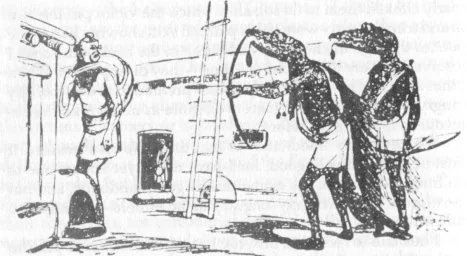
Figure 8. Zuñi Mendicants
The Ne'-wes may frequently be seen in seasons of scarcity, going from house to house in company with the Keo'-yi-mo-shi, or Priest-clowns, and in the service of certain strange mendicants. These mendicants usually travel in pairs. They are powerful men disguised as saurian monsters. Their heads are entirely encased in enormous long-jawed masks precisely resembling--what with their teeth of plaited corn-husk or shining squash-seeds--the heads of crocodiles. Out of the foreheads of these masks, stare eyes composed of balls of buckskin painted white and dotted with black, so adjusted that like the eyes of wax dolls they roll about or seem to wink with the upward, downward or side-wise motion of the man they disguise. The masks, cloths fastened to them to conceal the neck and bodies of the performers, are painted black, and a streamer of dark colored cloth hangs down the back and trails behind, covered with a row of eagle plumes which stand erect like the spines in a sea-monster's dorsal fin. All over the head and body of these figures are little patches of snowy eagle down--stuck on with wild honey--to represent scales. The mendicants are dressed in the armlets, wristlets, sashes and badges of war to proclaim their bloodthirsty proclivities. They are armed with bows and long arrows tipped with corn-cobs. This latter circumstance is fortunate for the Ne'-wes and Keo'-yi-mo-shi; for no sooner does one of the latter succeed in gathering up a blanket-load of he'-we, corn or other provender, than he is unmercifully plugged by the howling monsters [see illustration] and compelled to make a deposit of his precious cargo, or else goaded on to beg for more. If any woman to whom application is made by a Keo'-yi-mo-shi, be hardy enough to refuse him alms, the clown rushes bawling and whimpering back to his monster-master who, uttering low, hoarse gutteral bellows, very becoming to his appearance, proceeds to shoot out a few window-lights in her house, or sends--not very gently, either--two or three arrows at the woman herself, or her children, until she is fain to hand over any kind of breadstuff she may have at hand.
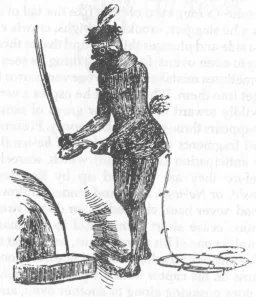
Figure 9. Demon Inspector of Oven
But ere we complete this series on ZUÑI BREADSTUFF, let us see how, once in four years or eight, the ovens whence it issues in such abundant variety are cleaned (ceremonially speaking) of the last vestiges of old bakings and the "bad influences" which are accounted as having accumulated in them.
On a certain summer evening of the fourth or, as the case may be, eighth year, a curious figure--a veritable ideal chimney-sweep appears. Black as the soot with which he is painted can make him, is he; bristling at many points with tufts of hair and cedar brushes, His head is round like an oven; round too his eyes, like flue-holes, with yellow ladders painted over them for brows. A bunch of stiff hair surmounts his crown, out of which issues like a flame a red eagle plume to symbolize fire. His mouth is almost square like an oven-door, but with red lips--the light gleaming out when the stone door is closed--with a stiff thin beard shooting forth from its under side which makes it look, despite its parallelogramic proportions, like a cyclopean eye with heavy winkers--placed too low down. On either cheek is painted in glaring yellow the paw of a badger or some other famous burrower--also symbolic of function. The creature carries in one hand a wand of yucca leaves with which to scourge away dogs; and in the other a little broom of hemlock. To his rump is fastened a long cord of fiber like the tail of a kite. As he travels along he staggers, crooks his thighs, crawls eccentrically from side to side and plunges this way and that as though seeking for or trying to enter ovens; for in everything he sees nothing but ovens--sometimes mistakes ladders or even burros for such and strives to get into them. When at last he espies a veritable oven, he leaps wildly toward it with a low growl of satisfaction, and eagerly disappears through its dark doorway. Presently out come crumbs and fragments of bread or bits of he'-we (left there, of course, in anticipation of his visit) which scarcely strike the ground before they are grabbed up by the ever attendant Keo'-yi-mo-shi, or Ne'-wes. Dust and cinders follow--as though the oven had never been cleaned!--nor do the exertions of the Oven-demons cease short of mischief to the masonry of the structure, unless; one of his companions, with great to-do, snakes him forth by means of the long rope of fiber. No sooner is he out than he turns on his captor with his yucca weapon, and breaks away and goes plunging along to another oven, and so on until every dome-shaped bread receptacle in the village has been duly visited and purified.
Thus, O, patient reader, with thanks indeed for your longsuffering kindness in the reading of these hasty sketches, let us leave these ovens, nor pollute them again with fresh bakings, or the mention of them!
Note
1. See p. 363, n. 6
Creation and the Origin of Corn
From "Zuñi Breadstuff," Millstone 9, no. 1 (1884): 1-3.
I once heard a Zuñi priest say: "Five things alone are necessary to the sustenance and comfort of the 'dark ones' [Indians] among the children of earth."
"The sun, who is the Father of all.
"The earth, who is the Mother of men.
"The water, who is the Grandfather.
"The fire, who is the Grandmother.
"Our brothers and sisters the Corn, and seeds of growing things."
This Indian philosopher explained himself somewhat after the following fashion:
"Who among men and the creatures could live without the Sun-father? for his light brings day, warms and gladdens the Earth-mother with rain which flows forth in the water we drink and that causes the flesh of the Earth-mother to yield abundantly seeds, while these-are they not cooked by the brand of fire which warms us in winter?"
That he reasoned well, may be the better understood if we follow for a while the teachings which instructed his logic. These relate that:
First, there was sublime darkness, which vanished not until came the "Ancient Father of the Sun, revealing universal waters. These were, save him, all that were.
The Sun-father thought to change the face of the waters and cause life to replace their desolation.
He rubbed the surface of his flesh, thus drawing forth yep'-na.[l]
The yep'-na he rolled into two balls. From his high and "ancient place among the spaces," (Te'-thlä-shi-na-kwin) he cast forth one of these balls and it fell upon the surface of the waters. There, as a drop of deer suet on hot broth, so this ball melted and spread far and wide like scum over the great waters, ever growing, until it sank into them.
Then the Sun-father cast forth the other ball, and it fell, spreading out and growing even larger than had the first, and dispelling so much of the waters that it rested upon the first. In time, the first became a great being--our Mother, the Earth; and the second became another great being--our Father, the Sky. Thus was divided the universal fluid into the "embracing waters of the World" below, and the "embracing waters of the Sky" above. Behold! this is why the Sky-father is blue as the ocean which is the home of the Earth-mother, blue even his flesh, as seem the far-away mountains--though they be the flesh of the Earth-mother.
Now while the Sky-father and the Earth-mother were together' the Earth-mother conceived in her ample wombs--which were the four great underworlds or caves-the first of men and creatures. Then the two entered into council that they might provide for the birth of their children.
"How shall it be?" said the one to the other. "How, when born forth, shall our children subsist, and who shall guide them?"
"Behold!" said the Sky-father. He spread his hand high and abroad with the hollow palm downward. Yellow grains like corn he stuck into all the lines and wrinkles of his palm and fingers. "Thus," said he, "shall I, as it were, hold my hand ever above thee and thy children, and the yellow grains shall represent so many shining points which shall guide and light these, our children, when the Sun-father is not nigh."
Gaze on the sky at night-time! Is it not the palm of the Great Father, and are the stars not in many lines of his hand yet to be seen?
"Ah yes! " said the Earth-mother, "yet my tiny children may not wander over my lap and bosom without guidance, even in the light of the Sun-father; therefore, behold! "
She took a great terraced bowl into which she poured water; upon the water she spat, and whipping it rapidly with her fingers it was soon beaten into foam as froths the soap-weed, and the foam rose high up around the rim of the bowl. The Earth-mother blew the foam. Flake after flake broke off, and bursting, cast spray downward into the bowl.
"See," said she, "this bowl is, as it were, the world, the rim its farthest limits, and the foam-bounden terraces round about, my features, which they shall call mountains whereby they shall name countries and be guided from place to place, and whence white clouds shall rise, float away, and, bursting, shed spray, that my children may drink of the water of life, and from my substance add unto the flesh of their being. Thou has said thou wilt watch over them when the Sun-father is absent, but thou art the cold being; I am the warm. Therefore, at night, when thou watchest, my children shall nestle in my bosom and find there warmth, strength and length of life from one day light to another."
Is not the bowl the emblem of the Earth, our mother? for from it we draw both food and drink, as a babe draws nourishment from the breast of its mother, and round, as is the rim of a bowl, so is the horizon, terraced with mountains, whence rise the clouds. Is not woman the warm, man the cold being? For while woman sits shivering as she cooks by the fire in the house-room, man goes forth little heeding the storms of winter, to hunt the feed and gather pine-faggots.
Yet alas! men and the creatures remained bounden in the lowermost womb of the Earth-mother, for she and the Sky-father feared to deliver them as a mother fears for the fate of her first offspring.
Then the Ancient Sun pitied the children of Earth. That they might speedily see his light, he cast a glance upon a foam cap floating abroad on the great waters. Forthwith the foam cap became instilled with life, and bore twin children, brothers one to the other, older and younger, for one was born before the other. To these he gave the k?ia'-al-lan, or "water-shield," that on it they might fly over the waters as the clouds--from which it was spun and woven--float over the ocean; that they might blind with its mists the sight of the enemy as the clouds darken the earth with rain-drops. He gave them for their bow, the rainbow, that with it they might clear men's trails of enemies, as the rain-bow clears away the storm-shadows; and for their arrows gave he them the thunder-bolts, that they might rive open the mountains, as the lightning cleaves asunder the pine trees; and then he sent them abroad to deliver, guide and protect the children of earth and the Sky-father. With their bow they lifted from his embraces the Sky-father from the bosom of the Earth-mother, "for," said they, "if he remain near, his cold will cause men to be stunted and stooped with shivering and to grovel in the earth," as stunted trees in the mountains delve under the snow to hide from the cold of the Sky-father. With their thunder-bolts they broke open the mountain which gave entrance to the cave-wombs of the Earth-mother, and upon their water-shields they descended into the lowermost of the caves, where dwelt the children of earth--men and all creatures.
Alas! It was dark as had been the world before the coming of the Sun, and the brothers found men and the beings sadly bewailing their lot. When one moved it was but to jostle another, whose complaints wearied the ears of yet others; hence the brothers called a council of the priest-chiefs--even ere the coming forth of men such lived--and they made a ladder of tall canes which they placed against the roof of the cavern. Up this rushed the children of earth. Some, climbing out before of their own wills, found deliverance from the caves above and, wandering away, became the ancestors of nations unknown to us; but our fathers followed in the footsteps of the older and younger brothers. Does not the cane grow jointed to-day, showing thus the notches which men traversed to day-light?
In the second cave all was still dark, but like starlight through cloud rifts, through the cleft above showed the twilight. After a time the people murmured again, until the two delivered them into the third world where they found light like that of early dawn. Again they grew discontented, again were guided upward, this time into the open light of the Sun--which was the light of this world. But some remained behind, not escaping until afterward; and these were the fathers of the Western nations whom our ancients knew not.
Then indeed for a time the people complained bitterly, for it was then that they first saw the light of the Sun-father, which, in its brilliancy, smote them so that they fell grasping their eye-balls and moaning. But when they became used to the light they looked around in joy and wonderment; yet they saw that the earth seemed but small, for everywhere rolled about the great misty waters.
The two brothers spread open the limbs of the Earth-mother, and cleft the western mountains with their shafts of lightning and the waters flowed down and away from the bosom of the Earth-mother, cutting great cañons and valleys which remain to this day. Thus was widened the land, yet the earth remained damp. Then they guided the people eastward.
Already before men came forth from the lower worlds with the priest-chiefs, there were many gods and strange beings. The gods gave to the priests many treasures and instructions, but the people knew not yet the meaning of either. Thus were first taught our ancients incantations, rituals and sacred talks (prayer), each band of them according to its usefulness. These bands were the "Priesthood"--Shi'-wa-na-kwe; the "Hunter-band"--Sa'-ni-a-k?ia-kwe; the "Knife-band"--A'tchi-a-k?ia-kwe or Warrior, and the Ne'-we-kwe, or Band of Wise Medicine Men. The leaders of each band thus came to have wonderful knowledge and power--even as that of the gods! They summoned a great council of their children--for they were called the 'Fathers of the People'--and asked them to choose such things as they would have for special ownership or use. Some chose the macaw, the eagle, or the turkey; others chose the deer, bear, or coyote; others the seeds of earth, or a'-tâ-a, the spring vine, tobacco, and the plants of medicine, the yellow-wood and many other things. Thus it came about that they and their brothers and sisters and their children, even unto the present day, were named after the things they chose in the days when all was new, and thus was divided our nation into many clans, or gentes (A'-no-ti-we) of brothers and sisters who may not marry one another but from one to the other. To some of the elders of these bands and clans was given some thing which should be, above all other things, precious. For instance, the clans of the Bear and Crane were given the Mu'-et-ton-ne, or medicine seed of hail and snow. For does not the bear go into his den, and appears not the crane when come storms of hail and snow?
When more than one clan possessed one of these magic medicines they formed a secret society--like the first four--for its keeping and use. Thus the Bear and Crane peoples became the "Holders of the Wand"--who bring the snow of winter and are potent to cure the diseases which come with them. In time they let into their secret council others, whom they had cured, that the precious secrets of their band might not be wasted. Thus it was that one after another were formed the rest of our medicine bands, who were and are called the finishers of men's trails, because, despite disease and evil, they guard and lengthen our lives; but in the "days of the new" there were only four bands.[2]
To the Eagle, Deer and Coyote peoples was given the Nal'-e-ton, or "Deer Medicine Seed," which the Hunter-band still guards; and to the Macaw, Sun and Frog peoples the Kia'-et-ton, or the "Medicine Seed of Water," which the priesthood and the Sacred Dance, or Kâ'-kâ, still hold-without the administration of which the world would dry up and even the insects of the mountains and hollows of earth grow thirsty and perish. Yet, not less precious was the gift to the "Seed-people," or Ta'-a-kwe. This was the Tchu'-et-ton, or the "Medicine Seed of Corn"--for from this came the parents of flesh and beauty, the solace of hunger, the emblems of birth, mortal life, death and immortality. To the Badger people was given the knowledge of Fire, for in the roots of all trees, great and little--which the badger best knows how to find--dwells the essence of fire.[3]
To all of these peoples it was told that they should wander for many generations toward the land whence the Sun brings the day-light (Eastward) until at last they would reach the "middle of the world," where their children should dwell forever over the heart of our Earth-mother until their days should be numbered and the light of Zuñi grow dark.
Toward this unknown country the "twin brothers of light" guided them. In those times a day meant a year, and a night another, so that four days and nights meant eight years. Many days the people wandered eastward, slaying game for their flesh-food, gathering seeds from grasses and weeds for their bread-food, and binding rushes about their loins for their clothing; they knew not until afterward, the flesh of the cotton and yucca-mothers.
The earth was still damp. Dig a hole in a hill-side, quickly it filled with water. Drop a seed on the highest table-land and it without waiting shot forth green sprouts. So moist, indeed, was the soil, that even foot-prints of men and all creatures might be traced whithersoever they tended. The beings and strange creatures increased with men, and spread over the world. Many monsters lived, by whose ferocity men perished.
Then said the twin brothers: "Men, our children, are poorer than the beasts, their enemies; for each creature has a special gift of strength or sagacity, while to men has been given only the power of guessing. Nor would we that our children be web-footed like the beings that live over the waters and damp places."
Therefore, they sent all men and harmless beings to a place of security; then laid their water shield on the ground. Upon it they placed four thunder-bolts, one pointed north, another west, another south, and the other eastward. When all was ready they let fly the thunder-bolts. Instantly the world was covered with lurid fire and shaken with rolling thunders, as is a forest to-day burned and blasted where the lightning has fallen. Thus as the clay of vessels is burned to rock, and the mud of the hearth crackled and reddened by fire, so the earth was mottled and crackled and hardened where now we see mountains and masses of rock. Many of the great monsters and prey-beings were changed in a twinkling to enduring rock or shriveled into twisted idols which the hunter and priest-warrior know best how to prize. Behold, their forms along every mountain side and ravine, and in the far western valleys and plains, still endure the tracks of the fathers of men and beings, the children of earth. Yet some of the beings of prey were spared, that the world might not become over-filled with life, and starvation follow, and that men might breathe of their spirits and be inspired with the hearts of warriors and hunters.
Often the people rested from their wanderings, building great houses of stone which may even now be seen, until the Conch of the Gods sounded, which lashed the ocean to fury and beat the earth to trembling.[4] Then the people started up, and gathering the few things they could, again commenced their wanderings; yet often those who slept or lingered were buried beneath their own walls, where yet their bones may sometimes be found.
Marvelous both of good and evil were the works of the ancients. Alas! there came forth with others, those impregnated with the seed of sorcery. Their evil works caused discord among men, and, through fear and anger, men were divided from one another. Born before our ancients, had been other men, and these our fathers sometimes overtook and looked not peacefully upon them, but challenged them--though were they not their older brothers? It thus happened when our ancients came to their fourth resting place on their eastward journey, that which they named Shi-po-lo-lon-K?ai-a, or "The Place of Misty Waters," there already dwelt a clan of people called the A'-ta-a, or Seed People, and the seed clan of our ancients challenged them to know by what right they assumed the name and attributes of their own clan. "Behold," said these stranger-beings, "we have power with the gods above yours, yet can we not exert it without your aid. Try, therefore, your own power first, then we will show you ours." At last, after much wrangling, the Seed clan agreed to this, and set apart eight days for prayer and sacred labors. First they worked together cutting sticks, to which they bound the plumes of summer birds which fly in the clouds or sail over the waters. "Therefore," thought our fathers, "why should not their plumes waft our beseechings to the waters and clouds?" These plumes, with prayers and offerings, they planted in the valleys, and there, also, they placed their Tchu'-e-ton-ne. Lo! for eight days and nights it rained and there were thick mists; and the waters from the mountains poured down bringing new soil and spreading it over the valleys where the plumed sticks had been planted. "See! " said the fathers of the seed clan, "water and new earth bring we by our supplications."
"It is well," replied the strangers, "yet life ye did not bring. Behold!" and they too set apart eight days, during which they danced and sang a beautiful dance and prayer song, and at the end of that time they took the people of the seed clan to the valleys. Behold, indeed! Mere the plumes had been planted and the tchu'-e-ton placed grew seven corn-plants, their tassels waving in the wind, their stalks laden with ripened grain.
"These," said the strangers, "are the severed flesh of seven maidens, our own sisters and children. The eldest sister's is the yellow corn; the next, the blue; the next, the red; the next, the white; the next, the speckled; the next, the black, and the last and youngest is the sweet-corn, for see! even ripe, she is soft like the young of the others. The first is of the North-land, yellow like the light of winter; the second is of the West, blue like the great world of waters; the third is of the South, red like the Land of Everlasting Summer; the fourth is of the East, white like the land whence the sun brings the daylight; the fifth is of the upper regions, many-colored as are the clouds of morning and evening, and the sixth is of the lower regions, black as are the caves whence came we, your older, and ye, our younger brothers." "Brothers indeed be we, each one to the other," said the people to the strangers, "and may we not journey together seeking the middle of the world?" "Aye, we may," replied the strangers, "and of the flesh of our maidens ye may eat, no more seeking the seeds of the grasses and of your water we may drink, no more wondering whither we shall find it; thus shall each help the other to life and contentment. Ye shall pray and cut prayer-plumes, we shall sing, and dance shall our maidens that all may be delighted and that it may be for the best. But beware! no mortal must approach the persons of our maidens."
Thenceforward, many of the A'-ta-a and the seed clan journeyed together, until at last the Sun, Macaw, and some other clans-people found the middle of the world; while others yet wandered in search of it, not for many generations to join their brothers, over the heart of the Earth-mother, which is Shi-wi-na-kwin, or the "Land of the Zuñis."
Day after day, season after season, year after year, the people of the seed clan and the A'-ta-a, who were named together the Corn-clan, or people, prepared, and their maidens danced the dance of the thla-he-kwe,[5] or "Beautiful Corn Wands," until their children grew weary and yearned for other amusements.
Sometimes the people saw over Thunder-mountain thick mists floating and lowering. At such times, near the Cave of the Rainbow, a beautiful halo would spring forth, amidst which the many-colored garments of the rainbow himself could be seen, and soft, sweet music, stranger than that of the whistling winds in a mountain of pines, floated fitfully down the valley. At last the priests and elders gathered in council and determined to send their two chief warriors (Priests of the Bow) to the cavern of the rainbow, that it might be determined what strange people made the sights and sounds. "Mayhap it will prove some new dancers, who will throw the light of their favor on our weary hearts and come to cheer us and delight our children." Thus said they to the warriors when they were departing.
No sooner had the warriors reached the cave-entrance than the mists enshrouded them and the music ceased. They entered and were received by a splendid group of beings, bearing long brightly-painted flutes, amongst whom the leader was Pai'-a-tu-ma, the father of the Ne'-we band, and the God of Dew.
"Enter, my children," said he, "and sit. We have commanded our dancers to cease and our players to draw breath from their flutes, that we might listen to your messages; for 'not for nothing does one stranger visit the house of another.'"
"True," replied the warriors. "Our fathers have sent us that we might greet you, and the light of your favor ask for our children. Day after day the maidens of the corn-people dance one dance which, from oft repeating, has grown undelightful, and our fathers thought you might come to vary this dance with your own, for that you knew one we were taught by your music, which we sometimes heard."
"Aha! " replied Pai'-a-tu-ma, "it is well! We will follow; but not in the day-time-in the night-time we will follow. My children," said he, turning to the flute-players, "show to the strangers our custom."
The drum sounded fill it shook the cavern; the music shrieked and pealed in softly surging unison, as the wind does in a wooded cañon after the storm is distant, and the mists played over the medicine bowl around which the musicians were gathered, until the rainbow fluttered his bright garments among the painted flutes. Maidens filed out brandishing wands whence issued tiny clouds white as the down of eagles, and as the sounds died away between the songs the two warriors in silent wonder and admiration departed for their home.
When they returned to their fathers in Zuñi, they told what they had seen and heard. Forthwith the fathers (priest-chiefs and elders) prepared the dance of the corn-maidens. A great bower was placed in the court of the pueblo, whither went the mothers and priests of the Seed-clan. The priests of the Macaw, Sun and Water clans were there. A terrace of sacred meal was marked on the ground, an altar set up over its base, and along its middle were placed the E'-ta-e or Medicine Seeds of corn and water. Along the outer edges were planted the sticks of prayer, plumed with the feathers of summer birds, and down in front of the altar and terrace were set basket-bowls covered with sacred mantles made of the flesh of the Cotton-mother (Goddess of Cotton), whose down grows from the earth and floats in the skies (cotton and the clouds are one in the Zuñi mythology). By the side of each basket-bowl sat a mother of the clan, silent in prayer and meditation. To the right were the singers, to the left the corn maidens. Night was coming on. The dance began and a fire was built in front of the bower beyond where the maidens danced. More beautiful than all human maidens were those maidens of the corn, but as are human maidens, so were they, irresistibly beautiful.
As the night deepened, the sound of music and flutes was heard up the river, and then followed the players of the rainbow-cave with their sisters, led by the God of Dew. When the players entered and saw the maidens their music ceased and they were impassioned. And when their turn came for leading the dance, they played their softest strains over their medicine bowl--the terraced bowl of the world--whence arose the rainbow. The people were delighted, but the corn maidens were sad; for no sooner had the dancing ceased a little than the flute players sought their hands and persons. In vain the corn maidens pleaded they were immortal virgins and the mothers of men! The flute players continually renewed their suits 'till the next day, and into the night which followed, while the dance went on. At last the people grew weary. The guardian warrior-priests nodded, and no longer wakened them. Silently the corn maidens stole up between the basket-trays and the sleeping people. There, passing their hands over their persons they placed something under the mantles, vanishing instantly as do the spirits of the dying, leaving only their flesh behind. Still the people slept, and ere long even the flute-players and dancers ceased. When the sun came out the people awoke. Then every one cried to the others "Where are our maiden mothers, our daughters?" Yet not even the warriors knew; for only of the flesh of the maidens (corn) could be found a little in the trays under the mantles. Then the place was filled with moaning among the women and upbraidings among the men, each blaming every other loudly until the priests cried out to silence their wranglings, and called a council. Then said they:
"Alas, we have laden our hearts with guilt, and sad thoughts have we prepared to weigh down our minds. We must send to seek the maidens, that they desert us not. Who shall undertake the journey?"
"Send for the eagle," it was said. The two warrior-priests were commanded to go and seek him.
Be it known that while yet the earth was young her children, both men and the creatures, spoke as men alone now speak, any one with any other. This the aged among all nations agree in saying, and are not those who grow not foolish with great age the wisest of men? Their words we speak!
Therefore, when the two warriors climbed the mountain whereon the eagle dwelt, and found only his eaglets at home, the little birds were frightened and tried to hide themselves in the hole where the nest was built. But when the warriors came nearer they screamed: "Oh do not pull our feathers; wait 'till we are older and we will drop them for you."
"Hush," said the warriors, "we seek your father."
But just then the old eagle, with a frown on his eyebrow, rushed in and asked why the warriors were frightening his "pinfeathers."
"We came for you, our father. Listen. Our mothers, the beautiful corn maidens, have vanished, leaving no trace save of their flesh. We come to beseech that you shall seek them for us."
"Go before! " said the eagle, smoothing his feathers, which meant that he would follow. So the warriors returned.
Then the eagle launched forth into the sky, circling higher and higher up, until he was smaller than a thistle-down in a whirlwind. At last he flew lower, then into the bower of the dancers where the council awaited him.
"Ah, thou comest! " exclaimed the people.
"Yes," replied the eagle. "Neither a blue-bird nor a wood-rat can escape my eye," said he, snapping his beak, "unless they hide under rocks or bushes. Send for my younger brother; he flies nearer the ground than I do."
So the warriors went to seek the sparrow-hawk. They found him sitting on an ant hill, but when he saw them he would have flown away had they not called out that they had words for him and meant him no harm.
"What is it? " said he. "For if you have any snare-strings with you I'll be off."
"No, no! we wish you to go and hunt for our maidens--the corn maidens," said the warriors,--"your old brother, the eagle, cannot find them."
"Oh, that's it; well, go before--of course he can't find them! He climbs up to the clouds and thinks he can see under every tree and shadow as the Sun, who sees not with eyes, does."
The sparrow-hawk flew away to the north and the east and the west, looking behind every cliff and copsewood, but he found no trace of the maidens, and returned, declaring as he flew into the bower, "they can not be found. They are hiding more snugly than I ever knew a sparrow to hide," said he, ruffling his feathers and gripping the stick he settled on as though it were feathers and blood.
"Oh, alas! alas! our beautiful maidens! " cried the old women; "we shall never see them again!"
"Hold your feet with patience, there's old heavy nose out there; go and see if he can hunt for them. He knows well enough to find their flesh, however so little that may be," said an old priest, pointing to a crow who was scratching an ash-heap sidewise with his beak, trying to find something for a morning meal. So the warriors ran down and accosted him.
"O caw! " exclaimed the crow, probing a fresh place, I am too hungry to go flying around for you stingy fellows. Here I've been ever since perching-time, trying to get a mouthful; but you pick your bones and bowls too clean, be sure for that!"
"Come in, then, grandfather, and we'll give you a smoke and something to eat," said the two warriors.
"Caw, haw!" said the old crow, ruffling up his collar and opening his mouth wide enough to swallow his own head. "Go before!" and he followed them into the dance-court.
"Come in, sit and smoke," said the chief priest, handing the crow a cigarette.
At once the old crow took the cigarette and drew such a big whiff into his throat that the smoke completely filled his feathers, and ever since then crows have been black all over, although before that time they had white shoulder-bands and very blue beaks, which made them look quite fine.
Then the crow suddenly espied an ear of corn under one of the mantles, for this was all the maidens had left; so he made for the corn and flew off with it, saying as he skipped over the houses, I guess this is all you'll see of the maidens for many a day," and ever since then crows have been so fond of corn that they steal even that which is buried. But bye and bye the old crow came back, saying that he had a "sharp eye for the flesh of the maidens, but be could not find any trace of the maidens themselves."
Then the people were very sad with thought, when they suddenly heard Pai'-a-tu-ma joking[6] along the streets as though the whole pueblo were listening to him. "Call him," cried the priests to the warriors, and the warriors ran out to summon Pai'-a-tu-ma.
Pai'-a-tu-ma sat down on a heap of refuse, saying he was about to make a breakfast of it. The warriors greeted him.
"Why and wherefore do you two cowards come not after me?" inquired Pai'-a-tu-ma.
"We do come for you."
"No, you do not."
"Yes, we do."
"Well! I won't go with you," said he, forthwith following them to the dance-court.
"My little children," said he, to the gray-haired priests and mothers, "good evening;"--it was not yet mid-day--"you are all very happy, I see."
"Thou comest," said the chief priest.
"I do not," replied Pai'-a-tu-ma.
"Father," said the chief priest, "we are very sad and we have sought you that we might ask the light of your wisdom.
"Ah, quite as I had supposed; I am very glad to find you all so happy. Being thus you do not need my advice. What may I not do for you?"
"We would that you seek for the corn-maidens, our mothers, whom we have offended, and who have exchanged themselves for nothing in our gaze."
"Oh, that's all, is it? The corn maidens are not lost, and if they were I would not go to seek them, and if I went to seek for them I could not find them, and if I found them I would not bring them, but I would tell them you 'did not wish to see them' and leave them where they are not--in the Land of Everlasting Summer, which is not their home. Ha! you have no prayer-plumes here, I observe," said he, picking up one each of the yellow, blue and white kinds, and starting out with the remark--
"I come."
With rapid strides he set forth toward the south. When he came to the mouth of the "Cañon of the Woods," whence blows the wind of summer in spring-time, he planted the yellow-plumed stick. Then he knelt to watch the eagle down, and presently the down moved gently toward the north, as though some one were breathing on it. Then he went yet farther, and planted the blue stick. Again the eagle down moved. So he went on planting the sticks, until very far away he placed the last one. Now the eagle plume waved constantly toward the north.
"Aha!" said Pai'-a-tu-ma to himself, "It is the breath of the corn maidens, and thus shall it ever be, for when they breathe toward the northland, thither shall warmth, showers, fertility and health be wafted, and the summer birds shall chase the butterfly out of Summer-land and summer itself, with my own beads and treasures shall follow after." Then he journeyed on, no longer a dirty clown, but an aged, grand god, with a colored flute, flying softly and swiftly as the wind he sought for.
Soon he came to the home of the maidens, whom he greeted, bidding them, as he waved his flute over them, to follow him to the home of their children.
The maidens arose, and each taking a tray covered with embroidered cotton, followed him as he strode with folded arms, swiftly before them.
At last they reached the home of our fathers. Then Pai'-a-tu-ma gravely spoke to the council.
"Behold, I have returned with the lost maidens, yet may they not remain or come again, for you have not loved their beautiful custom--the source of your lives--and men would seek to change the blessings of their flesh itself into suffering humanity were they to remain amongst you.
"As a mother of her own blood and being gives life to her offspring, so have these given of their own flesh to you. Once more their flesh they give to you, as it were their children. From the beginning of the new Sun each year, ye shall treasure their gift, during the moon of the sacred fire, during the moon of the snow-broken boughs, during the moon of the great sand-driving winds, during the moon of the lesser sand-driving winds, ye shall treasure their flesh. Then, in the new soil which the winter winds and water have brought, ye shall bury their flesh as ye bury the flesh of the dead, and as the flesh of the dead decays so shall their flesh decay, and as from the flesh of the dead springs the other being (the soul), so from their flesh shall spring new being, like to the first, yet in eight-fold plenitude. Of this shall ye eat and be bereft of hunger. Behold these maidens, beautiful and perfect are they, and as this, their flesh, is derived from them, so shall it confer on those whom it feeds perfection of person and beauty, as of those whence it was derived." He lifted the tray from the head of the maiden nearest him. She smiled and was seen no more; yet when the people opened the tray it was filled with yellow seed-corn. And so Pai'-a-tu-ma lifted the trays, each in turn, from the heads of the other maidens, and, as he did so, each faded from view. In the second tray the people found blue corn; in the third, red; in the fourth, white; in the fifth, variegated; and in the sixth, black. These they saved, and in the springtime they carefully planted the seeds in separate places. The breaths of the corn maidens blew rain-clouds from their homes in Summer-land, and when the rains had passed away green corn plants grew everywhere the grains had been planted. And when the plants had grown tall and blossomed, they were laden with ears of corn, yellow, blue, red, white, speckled and black. Thus to this day grows the corn, always eight-fold more than is planted, and of six colors, which our women preserve separately during the moons of the sacred fire, snow-broken boughs, great sand-driving winds and lesser sand-driving winds.
It was Pai'-a-tu-ma who found the corn maidens and brought them back. He took the trays from their heads and gave them to the people; hence, when in winter, during the moon of the sacred fire, the priests gather to bless the seed-corn for the coming year, the chief-priest of the Ne'-we-kwe hands the trays of corn-seed into the estufa.
Ever since these days, the beautiful corn maidens have dwelt in the Land of Everlasting Summer. This we know. For does not their sweet-smelling breath come from that flowery country, bringing life to their children, the corn-plants? It is the south wind which we feel in spring-time.
Thus was born Tâ-a, or the "Seed of Seeds."
Notes
1. Or the "substance of living flesh." This is exemplified as well as may be by the little cylinders of cuticle and fatty-matter that may be rubbed from the person after bathing. [F.H.C.]
2. It may be seen that the Zuñis have here their own way of accounting for their primitive social organization into Gentes and Phratries--organizations well nigh universal in the ancient world, as with the society of the early Greeks and Romans, and still prevalent amongst savage tribes of today. [F.H.C.]
3. In ancient times when desirous of making fire, and even today when kindling the sacred flame, the Zuñis produced and still produce, the first spark by drilling with a hard stick like an arrow-shaft into a dry piece of soft root. An arrow-shaft is now used by preference, as it is the emblem of lightning. [F.H.C.]
4. Doubtless this refers to the earthquake. Ruins may sometimes be found in the Southwest, buried like Pompeii beneath the ashes and lava of ancient eruptions, thus pointing either to a remote origin of the Pueblo or a recent cessation of volcanic action in New Mexico and Arizona. [F.H.C.]
5. Unexceptionably this is one of the most beautiful of the native ceremonials, and is one of the few sacred dances of the Zuñis in which women assume the leading part. it is still performed with untiring zeal, usually during each summer, although accompanied by exhausting fasts and abstinences from sleep. Curiously enough, it was observed and admirably, though too briefly described, by Coronado . . . nearly three hundred and fifty years ago.
It was with this ceremonial that the delighted nation welcomed the water which my party brought in 1882 from the "Ocean of Sunrise." As I was then compelled to join the watch of the priests and elders, I had ample leisure during two sleepless days and nights to gather the above and following story from the song which celebrates the origin of the custom, but which both in length and poetic beauty far surpasses the limits and style of the present paper. [F.H.C.]
6. The Ne'-we-kwe, of whom the God of Dew, or Pai'-a-tu-ma, was the first Great Father, are a band of medicine priests belonging, as explained heretofore, to one of the most ancient organizations of the Zuñis. Their medical skill is supposed to be very great--in many cases--and their traditional wisdom is counted even greater. Yet they are clowns whose grotesque and quick-witted remarks amuse most public assemblies of the Pueblo holiday. One of their customs is to speak the opposite of their meaning; hence too, their assumptions of the clown's part at public ceremonials, when really their office and powers are to be reversed. Their grotesque costuming and face-painting are quite in keeping with their assumed characters, and would, were it possible, justify the belief that our own circus clowns were their lineal descendants or copyists. Often so like are human things, though geographically widely severed. [F.H.C.]
Frank Hamilton Cushing on Zuñi Religion. . Hermetic Cloud, https://hermeticcloud.com/library/frank-hamilton-cushing-on-zuni-religion/. Public-domain text reproduced in full; markup only.