HIEROGLYPHICS
OFHORAPOLLO NILOUS
BYALEXANDER TURNER CORY
FELLOW OF PEMBROKE COLLEGE CAMBRIDGEChthonios Books, London
[1840]
Title Page
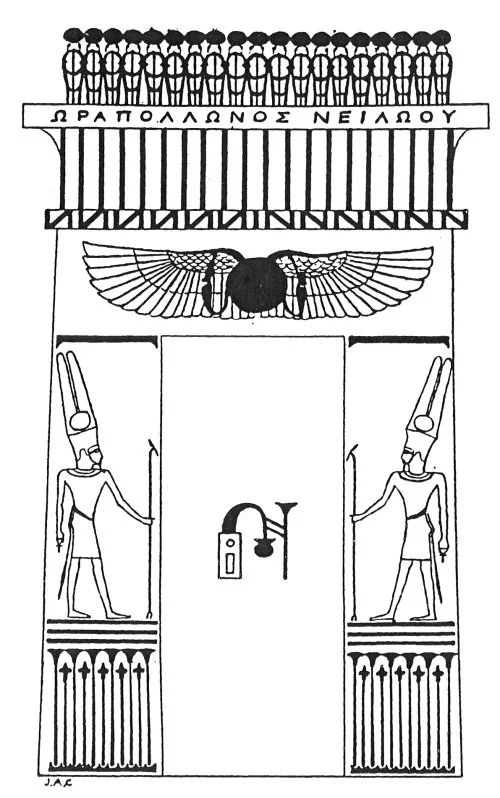
Verso
PREFACE.
FOR some years past an ardent spirit of enquiry has been awakened with regard to the interpretation of the hieroglyphics inscribed upon the monuments of Egypt. For ages, these had been looked upon as the depositories to which had been committed the religion arts and sciences of a nation once pre-eminent in civilization. Attempts had been continually made to penetrate the darkness, but without the slightest success, till the great discovery of Dr. Young kindled the light, with which the energetic and imaginative genius of Champollion, and the steady industry and zeal of his fellow labourers and successors, have illustrated almost every department of Egyptian antiquity, and rendered the religion and arts, and manners of that country, almost as familiar to us as those of Greece and Rome; and revived the names and histories of the long-forgotten Pharaohs.
The ill success of every previous attempt, may in a great measure, be attributed to the scanty
remnants of Egyptian literature that had survived, and the neglect into which the sacred writings of Egypt had fallen, at the time when Eusebius and several of the fathers of the Christian church turned their attention to antiquity.
The ravages of the Persians had scattered and degraded the priesthood of Egypt, the sole depositories of its learning. But the fostering care of the Ptolemies reinstated them in splendour, and again established learning in its ancient seat. The cultivation of the sacred literature and a knowledge of hieroglyphics continued through the whole of the Greek dynasty, although the introduction of alphabetic writing was tending gradually to supersede them. Under the Roman dominion and upon the diffusion of Christianity they further declined; but the names of Roman emperors are found inscribed in hieroglyphic characters, down to the close of the second century, that of Commodus being, we believe, the latest that appears. During the two centuries that succeeded, the influence of Christianity, and the establishment of the Platonic schools at Alexandria, caused them to be altogether neglected.
At the beginning of the fifth century, Horapollo, a scribe of the Egyptian race, and a native of Phænebythis, attempted to collect and perpetuate
in the volume before us, the then remaining, but fast fading knowledge of the symbols inscribed upon the monuments, which attested the ancient grandeur of his country. This compilation was originally made in the Egyptian language; but a translation of it into Greek by Philip has alone come down to us, and in a condition very far from satisfactory. From the internal evidence of the work, we should judge Philip to have lived a century or two later than Horapollo; and at a time when every remnant of actual knowledge of the subject must have vanished. He moreover, expressly professes to have embellished the second book, by the insertion of symbols and hieroglyphics, which Horapollo had omitted to introduce; and appears to have extended his embellishments also to the first book. Nevertheless, there is no room to doubt but that the greater portion of the hieroglyphics and interpretations given in that book, as well as some few in the second book, are translated from the genuine work of Horapollo, so far as Philip understood it: but in all those portions of each chapter, which pretend to assign a reason why the hieroglyphics have been used to denote the thing signified, we think the illustrations of Philip may be detected.
In the first stages of hieroglyphical interpretation,
this work afforded no inconsiderable light. But upon the whole, it has scarcely received the attention which it may justly claim, as the only ancient volume entirely devoted to the task of unravelling the mystery in which Egyptian learning has been involved; and as one, which in many instances, unquestionably contains the correct interpretations. In the present edition of the work, where any interpretations have been ascertained to be correct, the chapter has been illustrated by the corresponding hieroglyphic. In those cases where the hieroglyphic is mentioned, but an incorrect interpretation assigned, engravings have been given of it, as well as of the hieroglyphic corresponding to such interpretation, wherever these have been ascertained: and they have been inserted in the hope that they may lead persons better acquainted with the subject to discover more accurate meanings than we have been able to suggest.
Among the engravings is inserted a complete Pantheon of the great gods and goddesses of Egypt —Khem, of whom Osiris is a form, is the great deity corresponding to the Indian Siva, and the Pluto of the Greeks—Phtha, of whom Horus is another form, is the Indian Brahma, and Greek Apollo—and Kneph is the counterpart of Vishnu and Jupiter—Isis, of Vesta—Hathor, of Venus—
Neith, of Minerva—and Thoth, of whom Anubis is another form, * is the origin of Mercury.
In this edition, the best text that could be found has been adopted, and in no instance has any emendation been hazarded without express authority; and our own suggestions have throughout been inserted in the notes, or within parentheses. And at the end will be found an index of the authors and manuscripts referred to, as well as the celebrated passages of Porphyry and Clemens relating to Hieroglyphical interpretation.
To Lord Prudhoe, at whose request and expense this work has been completed, and by whom also a very considerable part of the illustrations has been furnished, I beg to return my most sincere thanks. To Sir Gardner Wilkinson's published works I am much indebted, as well as to his assistance in the progress of the work; also to the kindness of Messrs. Burton, Bonomi, Sharpe, and Birch, who have respectively supplied several additional illustrations. But for more convenient reference, I have generally cited Mr. Sharpe's vocabulary, in which are comprised in a condensed form almost all the established discoveries of his predecessors.
The edition of Horapollo by Dr. Leemans has
afforded some illustrations, and several of the various readings subjoined; and it is with great pleasure that the reader is referred to chat work for almost every passage contained in ancient authors which has any bearing upon the subject. The kindness of Mr. Bonomi, in executing designs for all the engravings, and of Mr. J. A. Cory, for the frontispiece and plates at the end, I beg with many thanks to acknowledge: and to Mr. I. P. Cory I am indebted for much assistance throughout the whole progress of the work, both in the translation and the notes, and in furnishing many of the illustrations and elucidations of some of the very obscure passages that occur throughout the work; and also for the labour of correcting much of the press, which he undertook for me while unavoidably engaged in other pursuits.
In conclusion, I beg to state, that upon myself must rest the responsibility of all the errors and deficiencies in the work, which I feel convinced cannot but be many; I trust, however, that they will in general be found comparatively unimportant.
Pembroke College, 1840.
Footnotes
xi:* See I. P. Cory's Mythological and Chronological Inquiries.
HORAPOLLO.
ΩΡΑΠΟΛΛΩΝΟΣ ΝΕΙΛΩΟΥ
ΙΕΡΟΓΡΑΥΦΙΚΑ
Α ΕΞΗΝΕΓΚΕ ΜΕΝ ΑΥΤΟΣ ΑΙΓΥΠΤΙΑΙ ΦΩΝΗΙ,
ΜΕΤΕΦΡΑΣΕ ΔΕ ΦΙΛΙΠΠΟΣ ΕΙΣ ΤΗΝ
ΕΛΛΑΔΑ ΔΙΑΛΕΚΤΟΝ
THE HIEROGLYPHICS OF
HORAPOLLO NILOUS
WHICH HE PUBLISHED IN THE EGYPTIAN TONGUE,
AND WHICH PHILIP TRANSLATED INTO
THE GREEK LANGUAGE.
N. B The inverted commas in the text denote the parts which have been already recognized in the hieroglyphics: and the Italics between the text und notes refer to the hieroglyphical illustrations.
H O R A P O L L O.
ΒΙΒΛΙΟΝ ΠΡΟΩΤΟΝ·
BOOK I.
I. HOW THEY DENOTE ETERNITY.
 1
1
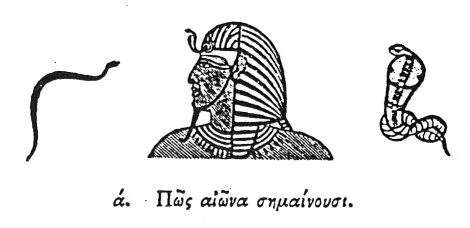
To denote Eternity 2 they depict the SUN and MOON, because their elements are eternal. But when they would represent Eternity 2 differently,
they delineate a SERPENT with its tail covered by the rest of its body: the Egyptians call this Ouraius, 1 which in the Greek language signifies Basilisk: 2 And they place golden figures of it round the Gods. The Egyptians say that Eternity is represented by this animal; because of the three existing species of serpents, the others are mortal, but this alone is immortal; and 3 because it destroys any other animal by merely breathing upon 4 it even without biting. And hence, inasmuch as it thus appears to have power over life and death, they place it upon the head of the Gods.
Footnotes
5:1
I. Denotes Eternal.
II. Head of a God with the Basilisk upon it. The basilisk often passes over the head, and is occasionally found passing round it.
III. Denotes Immortality.—Sharpe, 186, 191.
5:2 Eternal power?—a definite period?—an age?
6:1 ΟΥΡΟ, in Coptic, signifies a king. Jab. Champ. Tat.—Morell suggests Οὐβαῖος, as a derivative from אוב, Ob, a serpent.
6:2 The Cobra Capella.—Hasselquist is in error when he says that the Arabs call this serpent Haje. They call it Nasher: and Haiyeh or Hayyeh is a general name for a serpent.
6:4 Kircher suggests, "By the hiss."—See also Sanchoniatho Eus. Pr. Ev. lib. i. c. 10.
6:3 Qy. insert" Power?"
II. HOW THE UNIVERSE.
 1
1
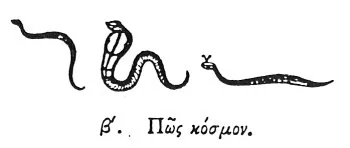
When they would represent the universe, they delineate a SERPENT bespeckled with variegated scales, devouring its own tail; by the scales intimating the stars in the universe. The animal is also extremely heavy, as is the earth, and extremely slippery, like the water: moreover, it every year puts off its old age with its skin, as in the universe the annual period effects a corresponding
change, and becomes renovated. And the making use of its own body for food implies, that all things whatsoever, that are generated by divine providence in the world, undergo a corruption 1 into it again.
Footnotes
7:1
I. II. III. The three species of serpents found upon the monuments.
The figures of the god Atmou sometimes exhibit instances of a serpent with its tail in its mouth. See Pl. I. fig. 1. Perhaps the nearest known approximation to the text is the serpent running round the lid of the sarcophagus of Ramesses III. at Cambridge, which rusts its head upon its tail, and may indicate the Universe.
8:1 De Pauw proposes εἰς αυτὸ, or εἰς αὑτὰ, which Leemans adopts. But it simply refers to the ancient doctrine of Generation and Corruption. See Arist. de Gen. et Cor.
III. HOW A YEAR.
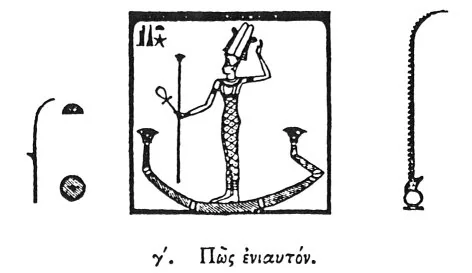 2
2
When they would represent a year, they delineate
ISIS, i. e. a woman. By the same symbol they also represent the goddess. Now Isis is with them a star, called in Egyptian, Sothis, but in Greek Astrocyon, [the Dog' star]; which seems also to preside over the other stars, inasmuch as it sometimes rises greater, and at other times less; sometimes brighter, and at other times not so; and moreover, because according to the rising of this star we shew all the events of the ensuing year: 1 therefore not without reason do they call the year Isis. When they would represent the year otherwise, they delineate a PALM TREE 2 [BRANCH], because of all others this tree alone at each renovation of the
moon produces one additional branch, so that in twelve branches the year is completed.
Footnotes
8:2
I. A year.
II. ISIS SOTHIS, from the ceiling of the Ramesseion.
III. The palm branch; on which Thoth measures time.
9:1 Regulate the calendar.
9:2 Qy. A palm branch, Sharpe, 636. Clemens Alex. describing a procession, states that the Horoscopus carries a φοίνικα, which evidently must imply a palm branch. See passage of Clemens in the Appendix.
IV. HOW A MONTH.
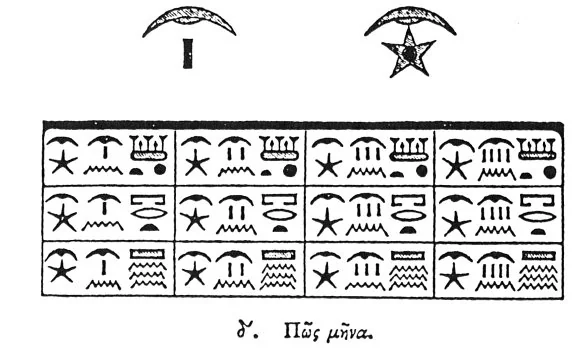 1
1
To represent a month they delineate a PALM BRANCH, or, the MOON INVERTED.
A palm branch for the reason before mentioned respecting the palm tree; and the moon inverted, because they say, that, in its increase, when it has come to fifteen degrees, 1 it appears in figure with its horns erect; and in its decrease, after having completed the number of thirty days, 2 it sets with its horns inverted.
Footnotes
10:1
I. II. A month.
III. The twelve months, divided into three seasons:
|
Season of Vegetation. | |||
|
Thoth. |
Paophi. |
Hathor. |
Choiak. |
|
Season of Harvest. | |||
|
Toby. |
Mechir. |
Phamenoth. |
Pharmuthi. |
|
Season of Inundation. | |||
|
Pachon. |
Paoni. |
Epiphi. |
Mesori. |
V. HOW THE CURRENT OR CIVIL YEAR.
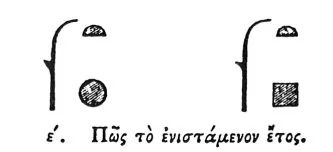 3
3
'To represent the current year, they depict [with the sign of the year?] the fourth
part of an ARURA: now the Arura is a measure of land of an hundred cubits. And when they would express a year they say a quarter [add the quarter?]: 1 for they affirm that in the rising of the star Sothis, 2 the fourth part of a day intervenes between the (completion of the solar year and the) following rising (of the star Sothis), because the year of the God [the solar year] consists of only 365 days; 3 hence in the course of each tetracterid 4 the Egyptians intercalate an entire day, for the four quarters complete the day.
Footnotes
11:3
I. Year as used in dates that refer to the reigns of kings or ages of individuals.
II. Year as an interval of time.—Sh. 634, 633.
11:1 During the first fifteen days?
11:2 During the last fifteen days.
12:1 Substitute a square?
12:2 i.e. calculating according to Sothic time.
12:3 Salm. and De Pauw suggest, and Leem has ventured to insert in the text καὶ τετάρου, i.e. and a quarter, which entirely destroys the passage. Mr. Wilkinson says, "They had two years, one intercalated, the other not: the former was calculated from the Heliacal rising of the Dogstar, to that of the ensuing year, and was hence called the Sothic year: it had also the name of Squared year, from the intercalation; and when expressed in hieroglyphics a square is placed instead of the globe of the solar year, which last was used in the dates of their tablets, that refer to the reigns of kings or ages of individuals." Mat. Hier. part ii. p. 134.
12:4 The period of four Julian years.
VI. WHAT THEY SIGNIFY BY DELINEATING A HAWK.
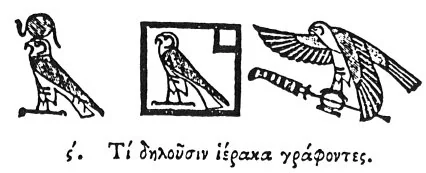 1
1
When they would signify God, or height, or lowness, or excellence, or blood, or victory, (or Ares, or Aphrodite,) [Hor or Hathor] 2, they delineate a HAWK. They symbolize by it God, because the bird is prolific and long-lived, or perhaps rather because it seems to be an image of the sun, being capable of looking more intently towards his rays than all other winged creatures: and hence physicians for the cure of the eyes use the herb hawkweed: hence
also it is, that under the form of a HAWK, they sometimes depict the sun as lord of vision. And they use it to denote height, because other birds, when they would soar on high, move themselves from side to side, being incapable of ascending vertically; but the hawk alone soars directly upwards. And they use it as a symbol of lowness, because other animals move not in a vertical line, but descend obliquely; the hawk, however, stoops directly down upon any thing beneath it. And they use it to denote excellence, because it appears to excel all birds—and for blood, because they say that this animal does not drink water, but blood—and for victory, because it shews itself capable of overcoming every winged creature; for when pressed by some more powerful bird, it directly turns itself in the air upon its
back, and fights with its claws extended upwards, and its wings and back below; and its opponent being unable to do the. like, is overcome.
Footnotes
13:1
I. RA or PHRA, the Sun, also HOR.—Sh. 110.
II. HATHOR.
III. This figure is constantly found over the head of the Egyptian kings in the representations of their victories, as well as upon other occasions.
13:2 Ald. and Treb. omit.
VII. HOW THEY INDICATE THE SOUL.
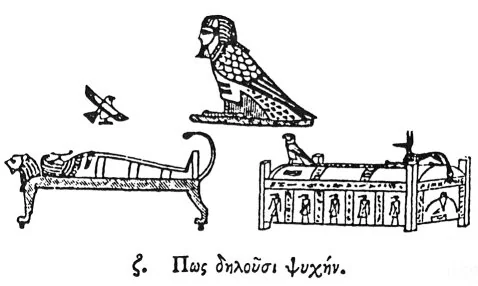 1
1
Moreover, the HAWK is put for the soul, from the signification of its name; for among ' the Egyptians the hawk is called BAIETH: and this name in decomposition signifies soul and heart; for the word BAI is the soul, and
ETH the heart; and the heart, according to the Egyptians, is the shrine of the soul; so that in its composition the name signifies 'soul enshrined in heart.' Whence also the hawk, from its correspondence with the soul, never drinks water, but blood, by which, also, the soul is sustained.
Footnotes
15:1
I. The departing soul.
II. The hawk found sitting upon the mummy cases.
III. The external mummy case.
VIII. HOW ARES AND APHRODITE (HOR AND HATHOR.) 1
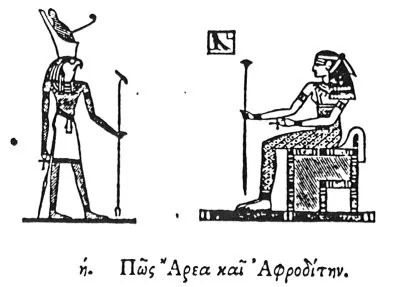 2
2
'To denote Ares and Aphrodite (Hor and Athor), they delineate TWO HAWKS; 1 of
which they assimilate the male to Ares (Hor), and the female to Aphrodite (Hathor), for this reason, quod ex cæteris animantibus fœmina mari non ad omnem congressum obtemperat, ut in accipitrum genere, in quo etsi tricies in die fœmina a mare comprimatur, ab eo digressa, si inclamata fuerit paret iterum. Wherefore the Egyptians call every female that is obedient to her husband Aphrodite (Hathor), but one that is not obedient they do not so denominate. For this reason they have consecrated the hawk to the sun: for, like the sun, it completes the number thirty in its conjunctions with the female.
When they would denote Ares and Aphrodite (Hor and Athor) otherwise, they
depict TWO CROWS [ravens?] as a man and woman; because this bird lays two eggs, from which a male and female ought to be produced, and, ([except?] when it produces two males or two females, which, however, rarely happens,) the males mate with the females, and hold no intercourse with any other crow, neither does the female with any other crow, till death; but those that are widowed pass their lives in solitude. And hence, when men meet with a single crow, they look upon it as an omen, as having met with a widowed creature; and 1 on account of the remarkable concord of these birds, the Greeks to this day in their marriages exclaim, EKKOKI KORI KORONE, though unacquainted with its import.
Footnotes
16:2
I. Hor or Horus.
II. Athor, Hathor, or Thyhor, the Egyptian Venus.
16:1 To denote Hor, they delineate a HAWK; and to denote Hathor, a HAWK WITHIN AN ENCLOSURE, as in the figure, which is read as an abode of Horus. Plutarch states that ATHURI signifies Horus's mundane house.
18:1 Treb. omits the concluding sentence from ζώῳ
IX. HOW MARRIAGE.
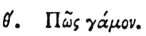
To denote marriage, they again depict TWO CROWS, on account of what has been mentioned.
X. HOW AN ONLY BEGOTTEN.
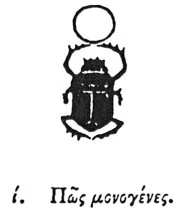 1
1
To denote an only begotten, or generation, or a father, or the world, or a man, they delineate a SCARABÆUS. 2
And they symbolise by this an only begotten, because the scarabæus is a creature self-produced, being unconceived by a female; for the propagation of it is unique after this manner:—when the male is desirous of procreating, he takes dung of an ox, and shapes it into a spherical form like the world; he then rolls it from the hinder parts from east to west, looking himself towards the east, that he may impart to it the figure of the world, (for that is borne from east to west, while the course of the stars is from west to east): then, having dug a hole, the scarabæus deposits this ball in the earth for the space of twenty-eight days, (for in so many days the moon passes through the twelve signs of the zodiac). By thus remaining under the moon, the race of scarabæi is endued with
life; and upon the nine and twentieth day after having opened the ball, it casts it into water, for it is aware that upon that day the conjunction of the moon and sun takes place, as well as the generation of the world. From the ball thus opened in the water, the animals, that is the scarabæi, issue forth. The scarabæus also symbolizes generation, for the reason before mentioned —and a father, because the scarabæus is engendered by a father only—and the world, because in its generation it is fashioned in the form of the world—and a man, because there is no female race among them. Moreover there are three species of scarabæi, the first like a cat, and irradiated, which species they have consecrated to the sun from this similarity: for they say that the male cat changes the shape of the pupils of his eyes according to the course of the sun: for in the morning
at the rising of the god, they are dilated, and in the middle of the day become round, and about sunset appear less brilliant: whence, also, the statue of the god in the city of the sun is of the form of a cat. Every scarabæus also has thirty toes, corresponding with the thirty days duration of the month, during which the rising sun [moon?] performs his course. The second species is the two horned and bull formed, which is consecrated to the moon; whence the children of the Egyptians say, that the bull in the heavens is the exaltation of this goddess. The third species is the one horned and Ibis formed, 1 which they regard as consecrated to Hermes [Thoth], in like manner as the bird Ibis.
Footnotes
19:1
I. The Scarabæus signifies the world: it is very commonly found with the circle, emblematic of the sun, in front of it.
19:2 Produced by a single parent?
22:1 Cuper. and De Pauw propose ἰβιόμορφος, ibis-formed; which is adopted in the translation above, but not inserted in the text.
XI. WHAT THEY IMPLY BY DEPICTING A VULTURE.
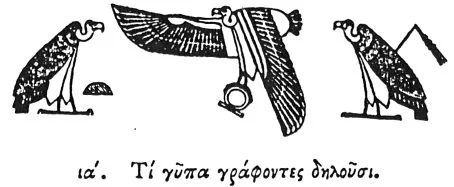 1
1
To denote a mother, or vision, or boundary, or foreknowledge, or a year, or heaven, or one that is compassionate, or Athena [Neith], or Hera [Saté], or two drachmas, they delineate it a mother, because in this race of creatures there is no male. Gignuntur autem hunc in modum. Cum amore concipiendi vultur exarserit, vulvam ad Boream aperiens, ab eo velut comprimitur per dies quinque, during which time
she partakes neither of food nor drink, being intent upon procreation. There are also other kinds of birds which conceive by the wind, but their eggs are of use only for food, and not for procreation; but the eggs of the vultures that are impregnated by the wind possess a vital principle. The vulture is used also as a symbol of vision, because it sees more keenly than all other creatures; and by looking towards the west when the sun is in the east, and towards the east when the god is in the west, it procures its necessary food from afar. And it signifies a boundary [landmark?] because, when a battle is to be fought, it points out the spot on which it will take place, by betaking itself thither seven days beforehand:—and foreknowledge, both from the circumstance last mentioned,
and because it looks towards that army which is about to have the greater number killed, and be defeated, reckoning on its food from their slain: and on this account the ancient kings were accustomed to send forth observers to ascertain towards which part of the battle the vultures were looking, to be thereby apprized which army was to be overcome. And it symbolizes a year, because the 365 days of the year, in which the annual period is completed, are exactly apportioned by the habits of this creature; for it remains pregnant 120 days, and during an equal number it brings up its young, and during the remaining 120 it gives its attention to itself, neither conceiving nor bringing up its young, but preparing
itself for another conception; 1 and the remaining five days of the year, as I have said before, it devotes to another impregnation by the wind. It symbolises also a compassionate person, which appears to some to be the furthest from its nature, inasmuch as it is a creature that preys upon all things; but they were induced to use it as a symbol for this, because in the 120 days, during which it brings up its offspring, it flies to no great distance, but is solely engaged about its young and their sustenance; and if during this period it should be without food to give its young, it opens its own thigh, and suffers its offspring to partake of the blood, that they may not perish from want of nourishment:—and Athena [Neith], and Hera [Saté], because
among the Egyptians Athena [ Neith] is regarded as presiding over the upper hemisphere, and Hera [Saté] over the lower; whence also they think it absurd to designate the heaven in the masculine, τὸν οὑρανὸν, but represent it in the feminine, τὴν οὑρανὸν, inasmuch as the generation of the sun and moon and the rest of the stars, is perfected in it, which is the peculiar property of a female. And the race of vultures, as I said before, is a race of females alone, and on this account the Egyptians over any female hieroglyph place the vulture as a mark of royalty [maternity?]. And hence, not to prolong my discourse by mentioning each individually, when the Egyptians would designate any goddess who is a mother, they delineate a vulture, for it is the mother of a female progeny. And they denote by it (οὑρανίαν)
heaven, (for it does not suit them to say τὸν οὑρανὸν, as I said before,) because its generation is from thence [by the wind]:—and two drachmas, because among the Egyptians the unit [of money] is the two drachmas, 1 and the unit is the origin of every number, therefore when they would denote two drachmas, they with good reason depict a vulture, inasmuch as like unity it seems to be mother and generation.
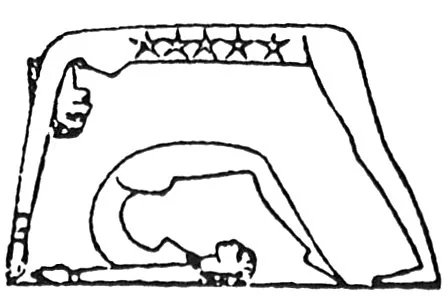
Netpe, as the upper hemisphere, or heaven; Isis, as the lower, or earth.
Footnotes
23:1
I. Mother. II. Victory. III. Lower Egypt.
26:1 This division appears to intimate the three seasons of the Egyptian year,—four months of Vegetation, four months of Harvest, and four of the Inundation, and the five epagomenæ consecrated as the birthdays of the gods.
28:1 Par A. Treb. Leem.γραμμαί al.—Leemans observes that the Alexandrine Interpreters of the Old Testament always reckon the money by the didrachma, as in xxx. Ex. 13, for the drachma they use the half of a didrachma, τὸ ἡ?'μισυ τοῦ διδράχμου.
XII. HOW THEY DENOTE HEPHÆSTUS [PHTHAH.]
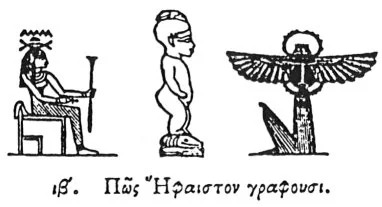 1
1
'To denote Hephæstus [Phthah], they delineate a SCARABÆUS and a VULTURE, and to denote Athena [Neith], 2 a VULTURE and a SCARABÆUS; for to them the world appears to consist both of male and female, (for Athena [Neith] however they also depict a vulture) and; according to them, these are the only Gods who are both male and female. 3
Footnotes
29:1
I. Neith, Athena, or Minerva.
II. Phthah Tore, the deformed pigmy God of Memphis, has a scarabæus on his head, and sometimes stands upon a crocodile.
III. Phthah Socari.
29:2 To denote Phthah, they delineate a SCARABÆUS i and a VULTURE, to denote Neith?
29:3 See c. 10 and 11.
XIII. WHAT THEY INTIMATE WHEN THEY DEPICT A STAR.
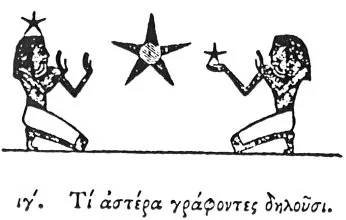 1
1
When they would symbolise the Mundane God, or fate, or the number 5, they depict a STAR. And they use it to denote God, because the providence of God maintains the order by which the motion of the stars and the whole universe is subjected to his government, for it appears to them that without a god nothing whatsoever could endure. And they symbolise by it fate, because even this is regulated by the dispositions
of the stars:—and also the number 5, because, though there are multitudes of stars in the heavens, five of them only by their motion perfect the natural order of the world.
Footnotes
30:1
I. A figure denoting Prayer or Glorifying.
II. The number 5.
III. From the architraves of the Ramesseion.
XIV. WHAT THEY DENOTE WHEN THEY POURTRAY A CYNOCEPHALUS.
 1
1
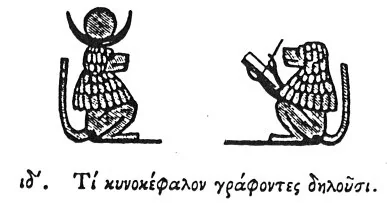
To denote the moon, or the habitable world, or letters, or a priest, or anger, or swimming, they pourtray a CYNOCEPHALUS. And they symbolise the moon by it, because the animal has a kind of sympathy with it at its conjunction
with the god. For at the exact instant of the conjunction of the moon with the sun, when the moon becomes unillumined, then the male Cynocephalus neither sees, nor eats, but is bowed down to the earth with grief, as if lamenting the ravishment of the moon: and the female also, in addition to its being unable to see, and being afflicted in the same manner as the male, ex genitalibus sanguinem emittit: hence even to this day cynocephali are brought up in the temples, in order that from them may be ascertained the exact instant of the conjunction of the sun and moon. And they symbolise by it the habitable world, because they hold that there are seventy-two primitive countries of the world; and because these animals, when brought up in the temples, and attended with
care, do not die like other creatures at once in the same day, but a portion of them dying daily is buried by the priests, while the rest of the body remains in its natural state, and so on till seventy-two days are completed, by which time it is all dead. They also symbolise letters by it, because there is an Egyptian race of cynocephali that is acquainted with letters; wherefore, when a cynocephalus is first brought into a temple, the priest places before him a tablet, and a reed, and ink, to ascertain whether it be of the tribe that is acquainted with letters, and whether it writes. The animal is moreover consecrated to Hermes [Thoth], the patron of all letters. And they denote by it a priest, 1 because by nature the cynocephalus does not eat fish, nor
even any food that is fishy, like the priests. And it is born circumcised, which circumcision the priests also adopt. And they denote by it anger, because this animal is both exceedingly passionate and choleric beyond others:—and swimming, because other animals by swimming 1 appear dirty, but this alone swims to whatever spot it intends to reach, and is in no respect affected with dirt.
Footnotes
31:1
I. Ioh or Pooh, the Moon, a form of Thoth.
II. A common symbol of Thoth.
33:1 Sacred scribe.
34:1 De Pauw suggests—...—are borne down by the stream, but this alone swims to the spot it intends to reach without being carried down by the stream. The passage is very obscure.
XV. HOW THEY DENOTE THE RENOVATION OF THE MOON.
 1
1
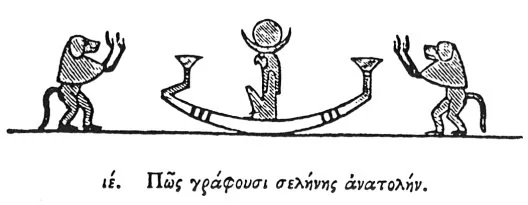
When they would denote the renovation of the moon, they again pourtray a CYNOCEPHALUS in this posture, standing upright, and raising its hands to heaven, with a diadem upon its head; and for the renovation they depict this posture, into which the cynocephalus throws itself, as congratulating the goddess, if we may so express it, in that they have both recovered light.
Footnotes
35:1 From the temple of Edfou.—Sh. E. I. 46. 6. Vocab. 959.
XVI. HOW THE TWO EQUINOXES.
 1
1
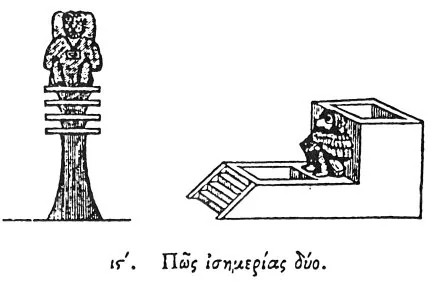
Again, to signify the two Equinoxes they depict a sitting CYNOCEPHALUS, for at the two equinoxes of the year it makes water twelve times in the day, once in each hour, and it does the same also during the two nights; wherefore not without reason do the Egyptians sculpture a sitting Cynocephalus on their Hydrologia
(or waterclocks); and they cause the water to run from its member, because, as I said before, the animal thus indicates the twelve hours of the equinox. And lest the contrivance, by which the water is discharged into the Horologium, should be too wide, or on the other hand too narrow, (for against both these caution must be taken, for the one that is too wide, by discharging the water quickly, does not accurately fulfil the measurement of the hour, neither the one that is too narrow, since it lets forth the water little by little, and too slowly,) they perforate an aperture to the extremity of the member, and according to its thickness insert in it an iron
tube adapted to the circumstances required. And this they are pleased to do, not without sufficient reason, more than in other cases. They also use this symbol, because it is the only animal that at the equinoxes utters its cries twelve times in the day, once in each hour.
Footnotes
36:1
I. The Cynocephalus upon the Nilometer, from the ceiling of the Ramesseion, where it occupies the central position between the last and first months of the year.
II. A water-clock in the Museum at Leyden.—Leemans.
XVII. HOW THEY DENOTE INTREPIDITY.
 1
1
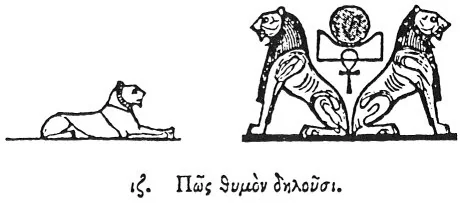
When they would denote intrepidity, they depict a LION, for he has a great head, and fiery eyeballs, and a round
face, and about it hairs like rays in resemblance of the sun; and hence it is, that they place lions under the throne of Horus, intimating the connexion of the animal with the god. And the sun is called Horus from presiding over the Hours.
Footnotes
38:1
I. The Lion signifying Lord.—Sh. 770.
II. Lions supporting the sun in his resting place; from Thebes about the beginning of the 18th dynasty.
XVIII. HOW THEY DENOTE STRENGTH.
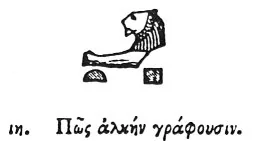 1
1
To denote strength, they pourtray the FOREPARTS OF A LION, because these are the most powerful members of his body.
Footnotes
39:1 This hieroglyphic signifies "Powerful;" and the head by itself "Victrix," as it occurs in Nitocris or Neith victrix.
XIX. HOW THEY DENOTE A WATCHFUL PERSON.
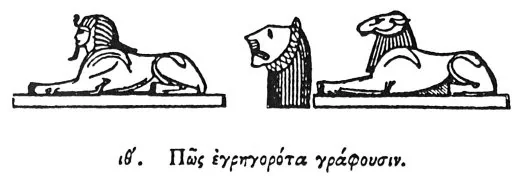 1
1
To denote a watchful person, or even a guard, they pourtray the HEAD OF A LION, because the lion, when awake, closes his eyes, but when asleep keeps them open, which is a sign of watching. Wherefore at the gates of the temples they have symbolically appropriated lions as guardians.
Footnotes
40:1
II. Watchful.
I. III. Andro-Sphinxes, and Crio-Sphinxes, were almost universally placed in the dromos of a temple. The magnificent lions, presented by Lord Prudhoe to the British Museum, are from Napata, now Gebel Burkel.
XX. HOW THE TERRIBLE.
To signify the terrible they make use of the SAME SYMBOL, 1 because this animal, being the most powerful, terrifies all who behold it.
Footnotes
41:1 See Chap. XVIII.
XXI. HOW THE RISING OF THE NILE.
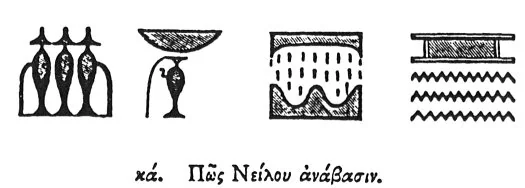 2
2
To signify the rising of the Nile, which they call in the
Egyptian language NOUN, and which, when interpreted, signifies New, they sometimes pourtray a LION, and sometimes THREE LARGE WATERPOTS, and at other times HEAVEN AND EARTH GUSHING FORTH WITH WATER. And they depict a LION, because when the sun is in Leo it augments the rising of the Nile, so that oftentimes while the sun remains in that sign of the zodiac, half of the new water [Noun, the entire inundation?] is supplied; and hence it is, that those who anciently presided over the sacred works, have made the spouts [?] and passages of the sacred fountains in the form of lions. 1
Wherefore, even to this day in prayer for an abundant inundation - - - - - - - - - And they depict THREE WATERPOTS, or HEAVEN AND EARTH GUSHING FORTH WITH WATER, because they make a waterpot like a heart having a tongue,—like a heart, because in their opinion the heart is the ruling member of the body, as the Nile is the ruler of Egypt, and like [a heart with?] a tongue, because it is always in a state of humidity, and they call it the producer of existence. And they depict three waterpots, and neither more nor less, because according to them there is a triple cause of the inundation. And they depict one for the Egyptian soil, as being of itself productive of water; and another for the ocean, for at the period of the inundation,
water flows up from it into Egypt; and the third to symbolise the rains which prevail in the southern parts of Ethiopia at the time of the rising of the Nile. Now that Egypt generates the water, we may deduce from this, that in the rest of the earth the inundations of the rivers take place in the winter, and are caused by frequent rains; but the country of the Egyptians alone, inasmuch as it is situated in the middle of the habitable world, like that part of the eye, which is called the pupil, of itself causes the rising of the Nile in summer.
Footnotes
41:2
I. The Inundation.
II. Lord of the waters of the Nile, a title of Kneph.—Sh. 781.
III. A figure from a tomb at Thebes; the symbols of heaven and earth, with drops distilling between them.
IV. The sign of the month, of the inundation—Noun.
42:1 The Lion's head is commonly used as a waterspout in the temples of Egypt.
XXII. HOW THEY DESIGNATE EGYPT.
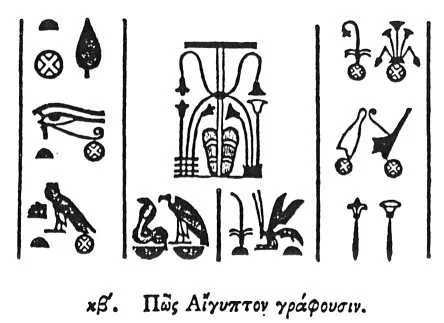 1
1
To designate Egypt, 2 they depict a BURNING CENSER AND A HEART. ABOVE IT, implying, that as the heart of a jealous person is constantly inflamed, so Egypt from its heat perpetually vivifies the things which are in or near it.
Footnotes
45:1
Of the above nine hieroglyphical groups, I, II, III, upon the left, signify Egypt. The fourth, in the centre, signifies Upper and Lower Egypt; and is apparently that to which Horapollo alludes, but is mistaken in his description of it. V, and VI, immediately beneath it, denote King, and King of the Upper and Lower country. And XII, VIII, IX, upon the right, signify the Upper and Lower country.
45:2 Qy. Αἴγυπτος, the Nile? or Egypt after the inundation?
XXIII. HOW A MAN THAT HAS NOT TRAVELLED ABROAD.

To symbolize a man that has not travelled out of his own country, they delineate an ONOCEPHALUS [creature with an ass's head], because he is neither acquainted with history, nor conversant with foreign affairs.
XXIV. HOW AN AMULET [PROTECTION]. 1
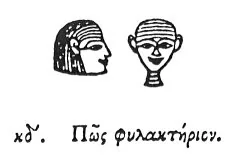 2
2
When they would denote an amulet, they pourtray TWO
HUMAN HEADS, one of a male looking inwards, the other of a female looking outwards, (for they say that no demon will interfere with any person thus guarded); for without inscriptions they protect themselves with the two heads.
Footnotes
46:2
Two heads, one in front and the other in profile, is a common hieroglyphic signifying Protection, but is not ascertained us an amulet.
46:1 Mr. Birch has suggested, that φυλακτήριον has been substituted by Horapollo for φύλακα, a Guard or Protector; which is extremely happy.
XXV. HOW THEY DENOTE AN IMPERFECT MAN.
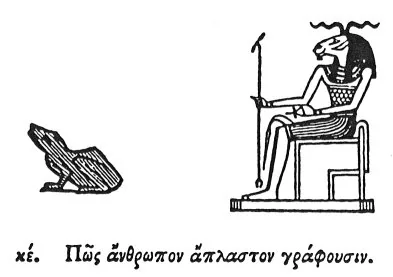 1
1
To denote an imperfect man, they delineate a FROG, because it is generated from the slime of the river, whence
it occasionally happens that it is seen with one part of a frog, and the remainder formed of slime, so that should the river fall, the animal would be left imperfect.
Footnotes
47:1
I. A common hieroglyphic, but not ascertained. In the British Museum is an inscription, in which Kneph is called "the king of Frogs."—Birch.
II. Kneph.
XXVI. HOW AN OPENING.
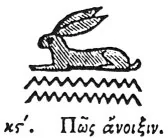 1
1
When they would denote an opening, they delineate a HARE, because this animal always has its eyes open.
Footnotes
48:1
Denotes "opening" according to Wilkinson—according to Sharpe it signifies "It is lawful." Qy. "Open or unprohibited."
XXVII. HOW SPEECH.
 1
1
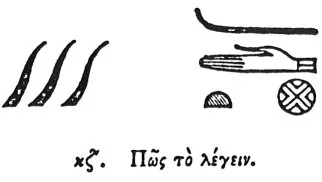
To denote speech they depict a TONGUE, and a BLOODSHOT EYE; because they allot the principal parts of speech to the tongue, but the secondary parts thereof to the eyes. For these kinds of discourses are strictly those of the soul varying in conformity with its emotions; more especially as they are denominated by the Egyptians as different languages. And to symbolize speech differently, they depict
a TONGUE and a HAND BENEATH; allotting the principal parts of speech to the tongue to perform, and the secondary parts to the hand as effecting the wishes of the tongue.
Footnotes
49:1
I. Supposed by Mr. Wilkinson to represent three tongues, and to apply to the goddess of speech.
II. Champollion considered this as the tongue and hand alluded to: it is often found inscribed at the beginning of tablets; a position not tin frequently occupied by an eye. It appears as a title of Hor.
XXVIII. HOW DUMBNESS.

To denote dumbness, they depict the number 1095, which is the number of days in the space of three years, the year consisting of 365 days, within which time, if a child does not speak, it chews that it has an impediment in its tongue.
XXIX. HOW A VOICE FROM A DISTANCE.

When they would symbolise a voice from a distance, which is called by the Egyptians Ouaie, they portray the VOICE OF THE AIR, i. e. THUNDER, than which nothing utters a greater or more powerful voice.
XXX. HOW ANCIENT DESCENT.
 1
1
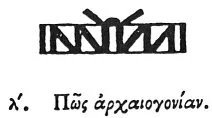
To denote ancient descent they depict a BUNDLE OF PAPYRUS, and by this they intimate the primeval food; for no one can find the beginning of food or generation.
Footnotes
51:1
A roll of papyrus.
XXXI. HOW TASTE.

To denote taste they delineate the EXTREMITY OF THE GULLET, for all taste is preserved thus far: I am speaking however of perfect taste. But to denote imperfect taste they delineate the TONGUE UPON THE TEETH, inasmuch as all taste is effected by these.
XXXII. HOW DELIGHT.
When they would represent delight they depict the NUMBER 16; 1 for from this age men
begin to hold commerce with women, and to procreate children.
Footnotes
52:1 Leemans very happily suggests, from the following passage in Pliny. Nat. Hist. V. 9., that the symbol had some reference to the rising of the Nile: "Justum incrementum est cubitorum sedecim . . . . . . . in duodecim cubitis famem sentit; in tredecim etiamnum esurit; quatuordecim cubits hilaritatem adferunt; quindecim securitatem; sedecim delicias."
XXXIII. HOW SEXUAL INTERCOURSE.

To denote sexual intercourse they depict TWO NUMBERS 16. Cum enim sedecim voluptatem esse diximus; congressus autem, duplici constet, maris ac fœminæ, voluptate, propterea alia sedecim adscribunt.
XXXIV. HOW A SOUL CONTINUING A LONG TIME HERE.
 1
1
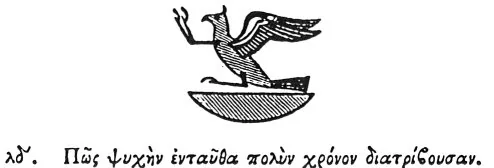
When they would denote a soul continuing a long time here, 2 or an inundation, they depict the PHŒNIX the bird: 3 and they denote the soul by it, because this is the longest lived of all creatures in the world; and an inundation, because the Phœnix is a symbol of the sun, than which nothing is greater in the universe. For the sun passes over all and
scrutinises all, hence he is called . . . . . Polys 1 (much).
Footnotes
54:1
The Phœnix.
54:2 Qy. 'When they would denote the soul, or an expiring cycle of time, or an inundation?' Of the two first the Phœnix was certainly a symbol, and possibly of the last, on account of its periodical return.
54:3 The Phœnix the Bird, to distinguish it from the Phœnix the Palm branch.—See Ch. 7.
55:1 Phanes? Apollo.
XXXV. HOW A MAN RETURNING HOME AFTER A LONG TIME FROM A FOREIGN LAND.

To denote a man returning home after a long time from a foreign land they again delineate the PHŒNIX the bird: for this creature, after an interval of 580 years, 2 when the time of death is about to overtake him, returns to Egypt, and as soon as he pays the debt of nature in Egypt, he is mystically served with funeral rites; and whatever rites the Egyptians pay to the rest of the sacred animals, the same
are due to the Phœnix: 1 for it is said by the Egyptians to rejoice in the sun more than other birds, and because among them the Nile overflows through the heat of this god; of which matter we discoursed with you a short time since.
Footnotes
55:2 See a similar relation in Tacitus Ann. vi. 28.
56:1 I have translated this according to Treb.
XXXVI. HOW THEY DENOTE THE HEART.
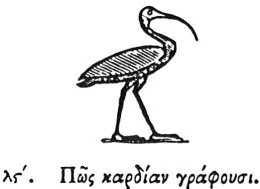 2
2
When they would denote the heart they delineate the Isis; for this animal is consecrated to Hermes [Thoth],
the lord of every heart and of reasoning. The Ibis also is itself in its own shape like the heart, respecting which great discussions are maintained by the Egyptians.
Footnotes
56:2
Ibis, the emblem of Thoth or Hermes.
XXXVII. HOW EDUCATION.

To denote education 1 they represent the HEAVEN DISTILLING DEW, intimating that as falling dew alights on all Vegetables, and softens those which have a nature susceptible of being softened, but is unable to operate upon those which essentially remain hard in the same way as upon the others; so also among men education is common to all; and a man of an apt disposition receives it as dew, while
a man of a disposition less docile is incapable of doing so.
Footnotes
57:1 Qy. An Educator or Priest? See Ch. 21, fig. 4. See also fig. 3 of Neith, who was the Minerva, the Goddess of Education, pouring out the waters.
XXXVIII. HOW THE EGYPTIAN LETTERS.
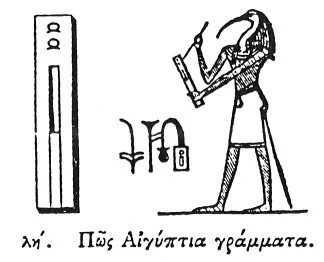 1
1
To denote the Egyptian letters, or a sacred scribe, or a boundary, they delineate INK, and a SIEVE, and a REED, and they thus symbolise the Egyptian letters, because by means of these things all writings among the Egyptians are executed: for they write with a reed and nothing else: and they depict a SIEVE, because the sieve being originally
an instrument for making bread is constructed of reed; and they thereby intimate that every one who has a subsistence should learn the letters, but that one who has not should practise some other art. And hence it is that among them education is called SBO, 1 which when interpreted signifies sufficient food. Also they symbolize by these a sacred scribe, because he judges of life and death. For there is among the sacred scribes a sacred book called AMBRES, by which they decide respecting any one who is lying sick, whether he will live or not, ascertaining it from the recumbent posture of the sick person. And a boundary, because he who has learnt his letters has arrived at a tranquil harbour of existence, no longer wandering among the evils of this life.
Footnotes
58:1
I. Inkstand: the ink and reeds, with one of which Thoth is writing, are placed in the cavities of the inkstand.
II. A royal scribe.
III. Thoth, the sacred scribe, is usually in this position, behind Osiris in the judgment of the dead.
59:1 SBO in Coptic denotes learning.—Champ.
XXXIX. HOW A SACRED SCRIBE.
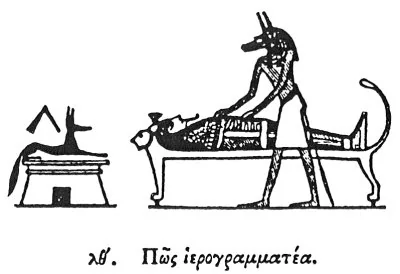 1
1
And again when they would denote a sacred scribe, or a prophet, or an embalmer, or the spleen, or smelling, or laughter, or sneezing, [or government, or a judge,] they depict a DOG. And by this they denote a sacred scribe, because it is necessary for one who is desirous of becoming a perfect sacred scribe to be extremely careful, and to bark perpetually, and to be fierce,
fawning upon no one, like dogs. And they symbolise by it a prophet, because the dog gazes intently 1 upon the images of the gods more than all other animals, as does a prophet. And an embalmer of the sacred animals, because he also surveys the naked and dissected forms which are preserved by him. And the spleen, because this animal alone of all other creatures has this organ very light: and whether death or madness seizes him it arises from his spleen. And those who attend this animal in his exequies, when about themselves to die, generally become splenetic; for smelling the exhalations from the dog, when dissecting him, they are affected by them.
And it denotes smelling, and laughter, and sneezing, because the thoroughly splenetic are neither able to smell, nor laugh, nor sneeze.
Footnotes
60:1
I. Anubis on a tomb.
II. Anubis as an embalmer.
61:1 In the ceiling of the Ramesseion is a figure of Anubis seated, as in fig. I., at each end of the zodiac, gazing at the gods, who represent the intermediate months.
XL. IN WHAT MANNER THEY REPRESENT GOVERNMENT, OR A JUDGE.
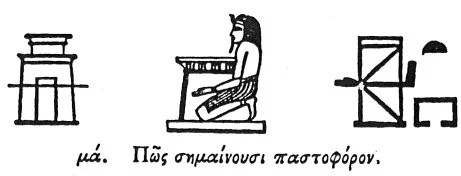 1 2
1 2
When they denote government, 3 or a judge, they place
close against the dog a ROYAL ROBE, the undress garment: 1 because like the dog, who, as I said before, gazes intently on the images of the gods, so likewise the minister, being in the more ancient times a judge also, used to see the king naked, and on this account they add the royal garment.
Footnotes
62:1
I. The figure, which appears to be some spotted skin upon a pole, is commonly placed beside Osiris or Thoth in the judgment of the dead, in which Anubis or the Dog is also concerned. It may be some coarse garment, but it is evidently the panther skin of the Greek Dionysus, the counter-part of Osiris.
II. Osiris as judge of the dead; another forth of Khem.
62:2 Qy. ὀσφραινόμενοι, the robe bearer, who was one of the officers of the procession. See the illustration of these chapters from Clemens, in the plate and note at the end.
62:3 Qy. Ἄρχοντα, An archon or minister of state.
63:1 Very obscure—Treb. reads nudæ figuræ appositam, placed on a naked figure.—Mer. and De Pauw. suggest σχήματι γύμνῳ—Caus. καὶ σχῆμα γυμνόν. It seems to have been the hide of some beast worn next the skin by the King, (as Dionysus and Hercules are represented,) sod, according to Mr. Wilkinson, by the priests of a certain grade.—See his Ancient Egypt.
XLI. HOW THEY SIGNIFY THE BEARER OF THE SHRINE.
2
To signify the bearer of the shrine, 3 they depict the KEEPER
OF A HOUSE, because by him the temple is guarded.
Footnotes
63:2
I. Shrine or small portable temple, which was borne like the Jewish ark by staves passed along its sides, as above.—Sh. 361.
II. This figure supporting a shrine is very common.
III. A temple; literally a shrine-house.—Sh. 362.
63:3 The cell in which the statue was carried in procession.
XLII. HOW THEY REPRESENT AN HOROSCOPUS [OBSERVER OF THE HOURS.]
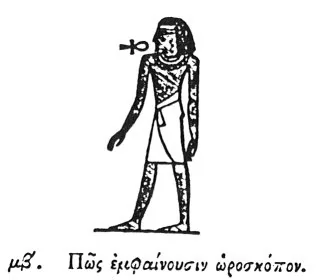 1
1
To signify an Horoscopus [observer of the hours], they delineate a MAN EATING THE HOURS, not that the man eats the hours, for that is impossible, but because food is prepared for men according to the hours.
Footnotes
64:1 This figure of a man with the emblem of life against his mouth is found; and seems to he the figure alluded to.
XLIII. HOW THEY DENOTE PURITY.

To represent purity they delineate FIRE AND WATER,
because by these elements all purification is perfected.
XLIV. HOW THEY INTIMATE A THING UNLAWFUL, OK AN ABOMINATION.
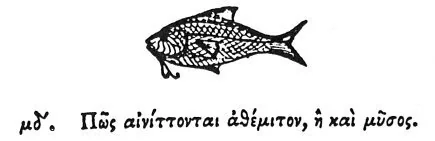 1
1
To denote a thing unlawful, or an abomination, they delineate a FISH, because the feeding upon fish is considered in the sacred rites as abominable, and a pollution: for every fish is an animal that is a desolator [laxative as food?], and a devourer of its own species.
Footnotes
65:1
Clemens states that the fish denotes hatred: and, according to Leemans, it is found in some inscriptions with that signfication.
XLV. HOW THEY REPRESENT THE MOUTH.
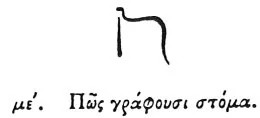
To represent the mouth they depict a SERPENT, because the serpent is powerful in no other of its members except the mouth alone.
XLVI. HOW MANLINESS COMBINED WITH TEMPERANCE.
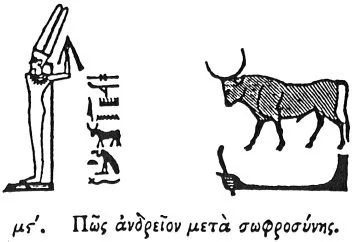 1
1
To denote manliness combined with temperance, they
delineate a BULL that has a vigorous constitution. Calidissimum enim est huic animali membrum, ita ut semel eo in fœminæ vulvam immisso, vel absque ullo motu semen effutiat. Quod si quando a vulvâ vaccæ aberrans, in alium corporis partem membrum intenderit, tum ejus immodicâ intentione vaccani vulnerat. Quin et temperans est: quippe cum nunquam post conceptum, vaccam ineat.
Footnotes
66:1
I. The commencement of numerous dedicatory inscriptions, generally interpreted "Sacred."—Sh. 309, 311. Does it signify things, or a tablet to "set up to, or in honour of?"
II. KHEM, one of the principal divinities, the god of generation, his emblem was the bull.
III. Powerful. Compare the translation of the obelisk of Hermapion, Anc. Fr. p. 169, with the square banners of the kings.
XLVII. HOW HEARING.
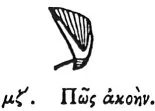 1
1
To denote hearing, they delineate the EAR OF THE BULL,
for when the cow is desirous of conception, (and she continues so for not longer than three hours together,) she vehemently lows, and if during this time the bull should not approach her, she reserves herself till another meeting. This however rarely happens; for the bull hears her from a great distance, and knowing that she is inflamed, he hastens to the meeting, and is the only animal that does so.
Footnotes
67:1
The bull's ear denotes hearing.—Champ.
 1
1
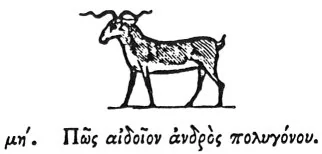
XLVIII. HOW THE MEMBER OF A PROLIFIC MAN.
To denote the member of a prolific man, they depict a
GOAT, and not a bull: ille enim antequam annum attigerit, coire non solet: hic septem statim post ortum diebus congreditur, infœcundum et genituræ minime accommodum semen excernens. Prius tamen ac celerius cæteris animantibus coit.
Footnotes
68:1
The Mendesian goat appears to have been considered by Herodotus as sacred to Khem. The goat as well as the bull was an emblem of Siva.
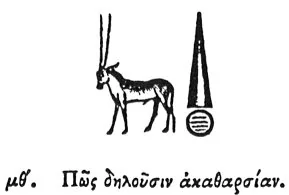
XLIX. HOW THEY DENOTE IMPURITY.
 1
1
To denote impurity, they delineate an ORYX 2 (a species of wild goat), because when
the moon rises, this animal looks intently towards the goddess and raises an outcry, and that, neither to praise nor welcome her; and of this the proof is most evident, for it scrapes up the earth with its fore legs, and fixes its eyes in the earth, as if indignant and unwilling to behold the rising of the goddess. And it acts in the same manner at the rising of (the divine star) the sun. Wherefore the ancient kings, when the Horoscopus apprised them of the rising of the moon, placed themselves near this animal, and by observing the middle of its operations, ascertained, as by a kind of gnomon, the exact time of the rising. And hence the priests, of all other cattle, eat this alone without being previously marked with the seal, inasmuch as it appears to entertain a kind of aversion to the
goddess: and in the desert wherever it finds a watering place, after having drunk, it stirs it up with its lips, and mingles the mud with the water, and throws dust into it with its feet, that it may be fit for no other animal to drink; so malicious and odious has the nature of the Oryx been considered. Nor does it act thus unmeaningly, because it is this same goddess who germinates and causes all things whatsoever to increase that are useful in the world.
Footnotes
69:1
I. The Oryx is found upon the monuments, but not explained.
II. A conical seal frequently appears in the hands of persons making oblations. Several with inscriptions on the base, as represented above, are in Dr. Lee's Museum.
69:2 Moe. Pur A. B. Mer. Causs. ὄρτυγα, a quail.
L. HOW A DISAPPEARANCE.

To denote a disappearance, they delineate a MOUSE 1, because
it pollutes and spoils all things by nibbling them. They also make use of the same symbol when they would denote discernment, for when many different sorts of bread lie before him, the mouse selects the purest from among them and eats it. And hence the selection by the bakers is guided by mice.
Footnotes
71:1
No hieroglyphic of a mouse has yet been found. But Herodotus states, that when Sennacherib approached Egypt, the bowstrings of his army were destroyed by mice during the night, in consequence of which, he was defeated by Sethos, king of Egypt, to whom was erected a statue with a mouse in his hand, as an emblem of DESTRUCTION.
LI. HOW IMPUDENCE.
To denote impudence, they represent a FLY, for this, though perpetually driven away, nevertheless returns.
LII. HOW THEY REPRESENT KNOWLEDGE.

To represent knowledge, they delineate an ANT, for
whatever a man may carefully conceal, this creature obtains a knowledge of: and not for this reason only, but also because beyond all other animals when it is providing for itself its winter's food, it never deviates from its home, but arrives at it unerringly.
LIII. HOW THEY REPRESENT A SON.
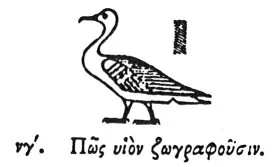 1
1
When they would denote a son, they delineate a CHENALOPEX (a species of goose). For this animal is excessively fond of its offspring, and if ever it is pursued so as to be in danger of being taken with its young, both the father and mother voluntarily give themselves up to the pursuers, that
their offspring may be saved; and for this reason the Egyptians have thought fit to consecrate this animal.
Footnotes
73:1
I. The Goose signifies a Son; and with the globe, Son of the Sun, the common title of the Pharaoh.
LIV. HOW A FOOL.

When they depict a PELICAN, they signify both a fool, and an idiot, because although like other winged creatures it is able to deposit its eggs on the higher places, it does not, but it merely scrapes up the earth and there lays its eggs. And the people observing this, surround the place with dried cows’ dung, to which they apply fire. And when the pelican sees the smoke, by endeavouring to extinguish the fire with its wings, she on the contrary kindles it by their motion: and thus, her wings being burnt by the fire, she easily becomes a prey for the
fowlers. And because it enters into the contest simply for the sake of its young, the priests consider it unlawful to eat it. But the rest of the Egyptians eat it, alleging that the pelican does not enter into the contest with discretion, as do the geese, but with folly.
LV. HOW THEY REPRESENT GRATITUDE.
 1
1
To represent gratitude, they delineate a CUCUPHA, because this is the only one of dumb animals, which, after it has been brought up by its parents,
repays their kindness to them when they are old. For it makes them a nest in the place where it was brought up by them, and trims their wings, and brings them food, till the parents acquire a new plumage, and are able to assist themselves: whence it is that the Cucupha is honored by being placed as an ornament upon the sceptres of the gods.
Footnotes
75:1
The top of the sceptre placed in the hands of the gods is ornamented with a crated head which appears to be that of some beast, but was evidently considered by Horapollo to be the Hoopoo of Egypt. See Ch. 8. and title page.
LVI. HOW AN UNJUST AND UNGRATEFUL MAN.
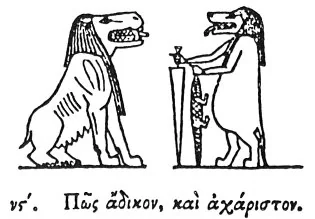 1
1
To symbolize an unjust and ungrateful man, they depict TWO CLAWS OF AN HIPPOPOTAMUS TURNED DOWNWARDS.
For this animal when arrived at its prime of life contends in fight against his father, to try which is the stronger of the two, and should the father give way he assigns him a place of residence, permitting him to live, and consorts himself with his own mother; but if his father should not permit him to hold intercourse with his mother, he kills him, being the stronger and more vigorous of the two. And they make use of the lowest parts of the hippopotamus, the two claws, that men seeing this, and understanding the story of it, may be more inclined to kindness.
Footnotes
76:1
I. II. Typhonian figures.
II. Has the body of an hippopotamus.
LVII. HOW ONE WHO 1S UNGRATEFUL TO HIS BENEFACTORS.

To signify a man that is ungrateful and quarrelsome with his benefactors, they delineate a Dove, for when the male becomes the stronger, the drives his father away from his mother, and mates himself with her. This creature however seems to be pure, because when any pestilential epidemic rages, and every thing, animate and inanimate, sickens with disease, those persons alone who feed upon this bird do not share in so great a calamity. Wherefore during such a time nothing is served up to the king as food except the dove alone. And the same food is served up to those who are under a course of purification,
that they may minister to the gods. It is likewise reported that this creature has no gall.
LVIII. HOW AN IMPOSSIBILITY.
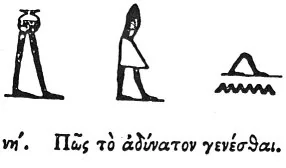 1
1
To signify an impossibility, they represent A MAN'S FEET WALKING ON THE WATER; or when they would signify the same thing differently, they delineate A HEADLESS MAN WALKING. And since these are both impossibilities, they have with good reason selected them for this purpose.
Footnotes
79:1
Well known hieroglyphics not yet interpreted. The second is from the ceiling of the Ramesseion.
LIX. HOW A VERY BAD KING.
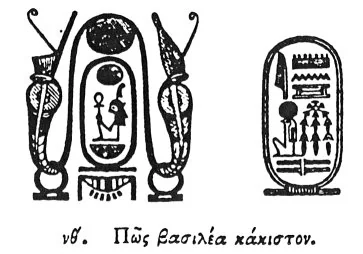 1
1
To denote a very bad [a very good? a very powerful?] king, they depict a SERPENT in the form of a circle, whose tail they place in his mouth, and they write the name of the king in the middle of the coil, intimating that the king governs the world. The serpent's name among the Egyptians is Meisi.
Footnotes
80:1
I. An oval decorated with the basilisks, containing the prenomen of Amunoph III.
II. A plain oval containing the name of Ramesses II. 'Amun me Ramses.' The oval is considered to hate been originally a serpent coiled.
LX. HOW A VIGILANT KING.
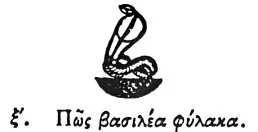
And otherwise to denote a vigilant king, they depict the SERPENT (UPON THE WATCH), and in the place of the king's name they depict a watcher: for he is the guardian of the whole world; and the king ought to be vigilant everywhere.
LXI. HOW THEY DESIGNATE A RULER OF THE WORLD.
 1
1
Again when they would
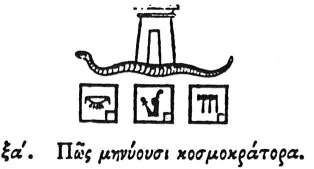
signify and designate a king who rules the world, they delineate the same SERPENT, and in the middle thereof they represent a LARGE HOUSE, and with reason for the royal abode from him - - - - - - in the world.
Footnotes
81:1
I. After the king's name has been once or twice given in an inscription, a serpent seems to be sometimes substituted.
II. From Belzoni's tomb.
III. Golden house or palace.—Sh. 380.
IV. King's house or palace.—Sh. 379.
V. God's house or temple.—Sh. 371.
LXII. HOW A PEOPLE OBEDIENT TO THEIR KING.
 1
1
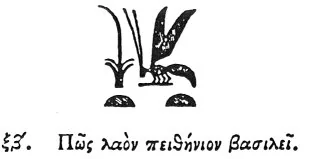
To denote a people obedient to their king, they depict a BEE, for this is the only one of all creatures which has a king whom the rest of the tribe of bees obey, as men serve their king. And they intimate from the honey's - - - - - - from the force of the creature's sting - - - - that
- - - - should be both lenient and firm in - - - - and administration.
Footnotes
82:1
Champollion interprets this as 'King of an obedient people;' Sharpe, as 'King of Upper and Lower Egypt.'—Sh. 417. 419.
LXIII. HOW A KING WHO GOVERNS A PART OF THE WORLD.

When they would symbolize a king who governs not all but a part of the world, they depict HALF A SERPENT. For by this creature they denote a king, and by half of it, that he is not king over all the world.
LXIV. HOW ONE WHO GOVERNS ALL THINGS. 1
 1
1
They symbolize one who governs all things by the perfect
form of the same animal, again depicting the ENTIRE SERPENT: for amongst them it is the spirit that pervades the universe.
Footnotes
83:1 See the winged globe and serpent in the frontispiece. which is called Agathodæmon, und is said to signify the spirit that pervades the universe. See also the Egg and Serpent in Pl. I.
LXV. HOW A FULLER. 1
 1
1
To denote a fuller, they depict the TWO FEET OF A MAN IN WATER, and they depict this from the resemblance of the work.
Footnotes
84:1 γραφέα, Par B. C.—Qy. Kneph, the spirit pervading the universe, and moving on the water. See Chaps. 23 and 58.
LXVI. HOW A MONTH. 2
 2
2
To represent a month, they depict as before explained the figure of the MOON when it has attained the age of eight and twenty days of equal lengths, each day containing twenty-four
hours, for during these it is apparent, and in the remaining two it is in a state of evanescence.
Footnotes
84:2 Treb. om. this chap.—See illustrations of Chap. 4.
LXVII. HOW A RAPACIOUS, OR PROLIFIC, OR FURIOUS MAN.

When they would symbolize a rapacious, or prolific, or furious man, they delineate a CROCODILE, because it is prolific [?], and fertile in offspring, and furious. For if it fails in its intention of seizing any thing it rages in anger against itself.
LXVIII. HOW SUNRISE.

To express sunrise they depict the TWO EYES OF A CROCODILE,
because of the whole body of the animal its eyes glare conspicuously from the deep.
LXIX. HOW SUNSET.
 1
1
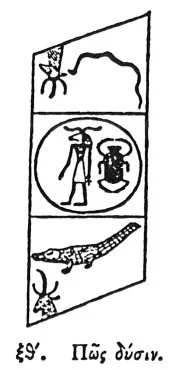
To denote sunset, they represent A CROCODILE TENDING DOWNWARDS, for this animal is self productive [?] and inclining downwards.
Footnotes
86:1
This illustration is front the descent in Belzoni's tomb. The central group is connected with the sun, and the stags’ heads appear to be emblems of eternity, or renovation. See Pl. II. and also Book II. Chap. 21.
LXX. HOW THEY SHADOW FORTH DARKNESS.
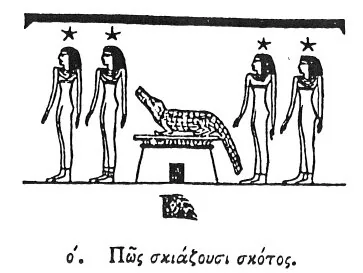 1
1
To denote darkness, they represent the TAIL OF A CROCODILE, for by no other means does the crocodile inflict death and destruction on any animal which it may have caught, than by first striking it with its tail, and rendering it incapable of motion: for in this part lies the strength and power of the crocodile. And now, though there are other
appropriate symbols deducible from the nature of the crocodile, those which we have mentioned are sufficient for the first Book.
Τέλος τοῦ πρώτου βιβλίου.
END OF THE FIRST BOOK.
Footnotes
87:1
I. The illustration is from Belzoni's tomb. There are properly 12 figures of each side of the crocodile; representing the hours of the day and night.
II. The fig. beneath certainly signifies darkness; and is supposed to represent the end of a crocodile's tail.
HORAPOLLO.
BOOK II.
ΩΡΑΠΟΛΛΩΝΟΣ ΝΕΙΛΩΟΥ
ΙΕΡΟΓΡΑΥΦΙΚΑ
Α ΕΞΗΝΕΓΚΕ ΜΕΝ ΑΥΤΟΣ ΑΙΓΥΠΤΙΑΙ ΦΩΝΗΙ,
ΜΕΤΕΦΡΑΣΕ ΔΕ ΦΙΛΙΠΠΟΣ ΕΙΣ ΤΗΝ
ΕΛΛΑΔΑ ΔΙΑΛΕΚΤΟΝ
THE HIEROGLYPHICS OF
HORAPOLLO NILOUS
WHICH HE PUBLISHED IN THE EGYPTIAN TONGUE,
AND WHICH PHILIP TRANSLATED INTO
THE GREEK LANGUAGE.
HORAPOLLO.
ΒΙΒΛΙΟΝ ΔΕΥΤΕΡΟΝ.
BOOK II.
In this second part of the work, I shall present you with the complete treatise of the remaining subjects: and some also from other writings, which have no explanation, I have deemed it requisite to subjoin.
I. WHAT THEY SIGNIFY BY DEPICTING A STAR. 1

When a STAR is depicted by the Egyptians, it sometimes symbolizes God, sometimes evening, sometimes night, sometimes time, and sometimes the soul of a male man.
Footnotes
93:1
I. The Star signer nod. See Book I. c. 13.
II. WHAT BY AN EAGLET.
 1
1
An EAGLET symbolizes something prolific of males, or of a circular form, or the seed of man.
Footnotes
94:1 Treb. omits this chapter.
III. WHAT BY TWO FEET CONJOINED AND ADVANCING.

Two FEET CONJOINED AND ADVANCING, symbolize the course of the sun in the winter solstice.
IV. WHAT BY THE HEART OF A MAN SUSPENDED BY THE WINDPIPE.
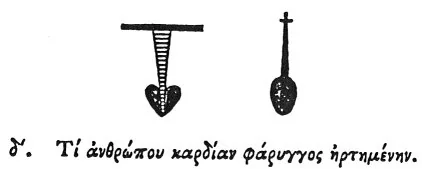 1
1
The HEART OF A MAN SUSPENDED BY THE WINDPIPE signifies the mouth of a good man.
Footnotes
95:1
IV. The first signifies Good, and seems to be the hieroglyphic referred to, but mistaken for the other. It is a musical instrument.
V. Victorious. Sh.
V. HOW THEY DENOTE THE FRONT OF BATTLE.
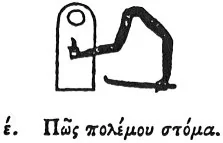 2
2
The HANDS OF A MAN, ONE HOLDING A SHIELD AND THE OTHER A Bow, when delineated, denote the front of battle
Footnotes
95:2 Treb. om this chapter.
VI. WHAT BY A FINGER.

A FINGER denotes the stomach of a man.
VII. QUID PENIS MANU COMPRESSA.

PENIS MANU COMPRESSA denotes continence in a man.
VIII. HOW THEY DENOTE DISEASE.

The FLOWERS OF THE ANEMONY denote disease of a man.
IX. HOW THE LOINS OF A MAN.

When we would denote the loins or the constitution of a man we depict the BACKBONE; for some hold that the seed proceeds from thence.
X. HOW THEY SYMBOLIZE PERMANENCY AND SAFETY.
1
The BONE OF A QUAIL when delineated symbolizes permanency and safety; because the bone of this animal is difficult to be affected.
Footnotes
97:1
I. The quail.
II. Signifies "Good." Sh. 625.
III. Bone with flesh upon it is common. Probably "Son." Sh. 1012.
XI. HOW CONCORD.

TWO MEN JOINING THEIR RIGHT HANDS denote concord.
XII. HOW A CROWD.
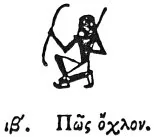 1
1
AN ARMED MAN SHOOTING WITH A BOW denotes a crowd [troop or army?]
Footnotes
98:1 XII. This signifies soldiers.—Sh. 988, 910. Perhaps an army. Sh.
XIII. HOW ADMEASUREMENT.

The FINGER OF A MAN denotes admeasurement.
XIV. HOW A WOMAN PREGNANT.

When they would denote a woman pregnant, they portray the ORB OF THE SUN WITH A STAR AND THE SUN'S DISK BISECTED.
XV. HOW WIND.
A HAWK soaring on high towards the east, signifies the winds; [the spirit or soul?] and again otherwise, a HAWK with its wings expanded in the air symbolizes the wind, as having wings.
XVI. HOW FIRE.
SMOKE ascending towards heaven denotes fire.
XVII. HOW A WORK.
A BULL'S HORN when depicted signifies work.
XVIII. HOW PUNISHMENT.
 1
1
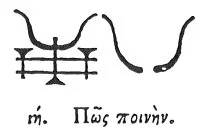
A cow's HORN when depicted signifies punishment.
Footnotes
100:1
XVIII. The Horns are used as the syllable "An," as in Anepo.
XIX. HOW IMPIETY.
 1
1
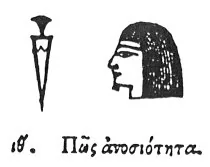
A BUST portrayed WITH A SWORD denotes impiety.
Footnotes
101:1
XIX. Not ascertained.
XX. HOW AN HOUR [EXECRATION?].
 2 3
2 3
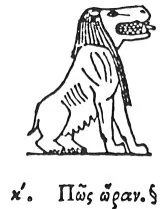
A RIVER HORSE when delineated, denotes an hour.
Footnotes
101:2
XX. Commonly found near Osiris in the judgment scenes. Qy.
101:3 Causs. sug. ἄραν, A curse.—De Pauw. φθόραν, Destruction.
XXI. How Anything of Long Duration.
 1 2
1 2
A STAG shoots its horns every year, and when depicted, signifies anything of long duration.
Footnotes
102:1 XXI. Several inverted stags’ heads alternating with hieroglyphics, are delineated in the judgment scene, where they seem to have some connexion with duration, perhaps eternity. See Pl. 3. and B. I. c. 69.
102:2 Par. A. B. Pier πολυχρόνια.
XXII. HOW AVERSION.

A WOLF OR A DOG AVERTED denotes aversion.
XXIII. HOW A FUTURE ACT.
 1
1
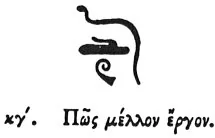
An EAR when delineated symbolizes a future act.
Footnotes
103:1
XXIII. Immortal or Eternal. Sh. 318. Qy. Extension in time. The coil may have been mistaken by Horapollo for an ear.
XXIV. HOW A MURDERER, OR THE BLOOD OF A CROCODILE.

A WASP FLYING IN THE AIR signifies either the noxious blood of a crocodile, or a murderer.
XXV. HOW DEATH.

A NIGHT RAVEN signifies death; 2 for it suddenly pounces
upon the young of the crows by night, as death suddenly overtakes men.
Footnotes
103:2 Qy. Erebus? The Hebrew word ערב, EREB, signifies either Erebus darkness, or the Nightraven, and it appears by Damascius, that the Sidonians substituted this bird as an emblem of Erebus.—An. Frag. p. 319.
XVI. HOW LOVE.
 1
1
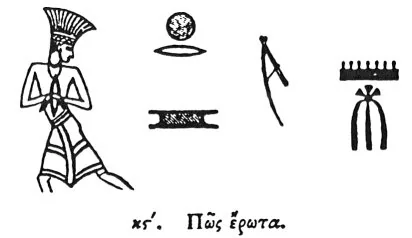
A NOOSE denotes love as . . . . . . . . . .
Footnotes
104:1
I. A prisoner handcuffed. Horapollo seems to have confounded the handcuff with the mouth in the next expression, which Mr. Wilkinson considers to signify "beloved."
II. III. IV. V. VI. Also signify beloved.
XXVII. HOW THE MOST ANCIENT.
 1
1
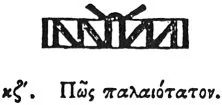
WORDS AND LEAVES OF A SEALED BOOK denote the most ancient.
Footnotes
105:1
XXVII. The Papyri are found tied up, and sealed with clay above the knot.
XXVIII. HOW A SIEGE.
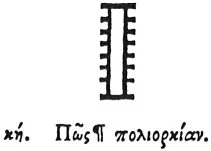 2
2
A LADDER signifies a siege by reason of its inequality [?].
Footnotes
105:2
XXVIII. A kind of tower frequently found battle scenes.
XXIX. HOW INFINITE, OR A SONG, OR FATE.
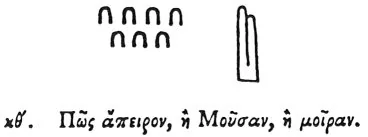 1
1
SEVEN LETTERS INCLUDED WITHIN TWO FINGERS [RINGS?] 2 symbolize a song, or infinite, or fate.
Footnotes
106:1
XXIX. 1. The number 70 is very common on funereal tablets, and signifies "The Days of mourning." Sh. 676. The Egyptians still sing their lamentations, perhaps a relic of the funereal chant called, Maneros by Plutarch.
2. An amulet with some mystic signification.
106:2 De Pauw. sug. δακτυλίοις," rings."—Reuv. ἐντος δακτυλίου, "within a ring." Qy. Bent into the form of a ring.
XXX. WHAT ONE LINE BENT OVER ANOTHER SIGNIFIES.
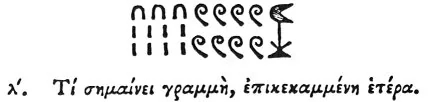 3
3
A straight line with a curved line above it signifies TEN PLANE LINES. 4
Footnotes
106:3
xxx. The plane lines denote units, the curved 10's, the coils 100's, and the other 1000's.
106:4 Qy. When a curved line is placed above a straight line it denotes ten of such straight lines.
XXXI. WHAT THEY DENOTE BY DEPICTING A SWALLOW.
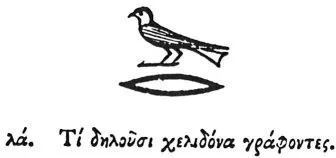 1
1
When they would signify that the whole of a parent's substance has been left to the sons, they depict a SWALLOW. For she rolls herself in the mud, and builds a nest for her young, when she is herself about to die.
Footnotes
107:1
XXXI. Jewels, valuables. Sh. 551.
XXXII. WHAT BY A BLACK DOVE.

When they would symbolise a woman who remains a widow till death, they depict a BLACK DOVE; for this bird has no connexion with another mate from the time that it is widowed.
XXXIII. WHAT BY AN ICHNEUMON.

When they would represent a man that is feeble, and unable of himself to help himself, but who does so by the aid of others, they delineate an ICHNEUMON. For this animal, when it spies a serpent, does not at once attack it, but by its noise calls others to its assistance, and then attacks the serpent.
XXXIV. WHAT THEY DENOTE BY ENGRAVING ORIGANUM (WILD MARJORAM) FOR A HIEROGLYPHIC.

When they would symbolise the departure of ants, they engrave ORIGANUM. For if this plant be laid down over the spot from whence the ants issue forth, it causes them to desert it.
XXXV. WHAT BY A SCORPION AND CROCODILE.
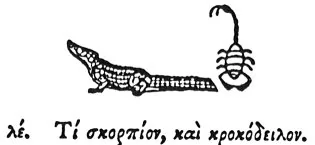 1
1
When they would symbolise one enemy engaging with another equal to himself, they depict a SCORPION AND A CROCODILE. For these kill one another. But if they would symbolise one who is hostile to, and has slain another, they depict a CROCODILE or a SCORPION; and if he has slain him speedily, they depict a CROCODILE, but if slowly, a SCORPION, from its tardy motion.
Footnotes
109:1
XXXV. This seems to hare some astronomical allusion. The Crocodile was one of the Vahans of the Sun, and the year began with Scorpio. It is not an uncommon hieroglyphic.
XXXVI. WHAT BY A WEASEL.
When they would symbolise a woman performing the works of a man, they depict a WEASEL; quod maris pudendum habeat velut ossiculum.
XXXVII. WHAT BY A HOG. 1

When they would symbolise a filthy man, they depict a HOG; from such being the nature of the hog.
Footnotes
110:1
XXXVII. There is an example of a hog in a judgment scene in the tombs of the kings, where, according to Champollion, it denotes the metampsychosis of a glutton condemned by Osiris into a hog: Bonomi. See Pl. 3.
XXXVIII. HOW IMMODERATE ANGER.

If they would represent immoderate anger, so that he who is angry takes a fever thereby, they depict a LION BREAKING THE BONES OF ITS OWN WHELPS. And they portray the lion to signify anger, and the whelps having their bones broken, because the bones of the whelps when struck together emit sparks of fire.
XXXIX. HOW AN OLD MINSTREL.

When they would symbolise an old minstrel, they depict a SWAN, for when old it sings the sweetest melody.
XL. HOW THEY DENOTE A MAN WHO LIVES WITH HIS WIFE.

When they would symbolise a man living in intercourse with his own wife, they depict TWO CROWS; for these birds cohabit with one another in the same manner as does a man by nature.
XLI. WHAT THEY INTIMATE BY POURTRAYING A BLIND BEETLE.

When they would symbolise a man who has caught a fever from a stroke of the sun, and died in consequence, they portray a BLIND BEETLE; for this creature dies after it has been blinded by the sun.
XLII. WHAT THEY DESIGN BY DEPICTING A MULE.

When they would symbolise a barren woman, they delineate a MULE; for this animal is barren, quod matricem rectam non habet.
XLIII. HOW THEY DENOTE A WOMAN WHO HAS BROUGHT FORTH FEMALE INFANTS.

When they would symbolise a woman who has brought forth female infants first, they delineate a BULL INCLINING TOWARDS THE LEFT: and again if male infants, then they delineate a BULL inclining to the right. Is enim ex congressu discedens, si ad lævam
conversus fuerit, genitam esse fœminam indicat, si ad dexteram marem.
XLIV. HOW THEY DENOTE WASPS.

When they would denote wasps, they depict a DEAD HORSE; for many wasps are generated from him when dead.
XLV. HOW A WOMAN WHO MISCARRIES.

When they would symbolise a woman who miscarries, they depict a MARE KICKING A WOLF; for not only by
kicking a wolf does a mare miscarry, but it immediately miscarries if it should merely tread on the footstep of a wolf.
XLVI. HOW A MAN WHO CURES HIMSELF BY AN ORACLE.

When they would symbolize a man who cures himself by an oracle, they delineate a WOOD PIGEON CARRYING A BRANCH OF LAUREL; for this bird when sick deposits a branch of laurel in its nest, and recovers.
XLVII. HOW A SWARM OF GNATS.

When they would represent many gnats swarming together, they depict MAGGOTS; for from them gnats are engendered.
XLVIII. HOW A MAN THAT HAS NO BILE, BUT RECEIVES IT FROM ANOTHER.

When they would symbolise a man who has naturally no bile but receives it from another, they depict a DOVE WITH HER HINDER PARTS ERECT; for in them she has her bile.
XLIX. HOW A MAN WHO DWELLS SECURELY IN A CITY.

When they would symbolise a man who dwells securely in a city, they depict an EAGLE CONVEYING A STONE; for he takes up a stone, either from the sea or land, and deposits it in his nest, to keep it steady.
L. HOW A MAN WHO IS WEAK AND PERSECUTED BY ANOTHER.

When they would symbolise a man that is weak and persecuted by a stronger, they delineate a BUSTARD AND A HORSE; for this bird flies away whenever it sees a horse.
LI. HOW THEY DENOTE A MAN WHO FLEES FOR REFUGE TO HIS PATRON, AND RECEIVES NO ASSISTANCE.

When they would denote a man who flees for refuge to his patron, and receives no assistance, they depict a SPARROW AND AN OWL; for the sparrow when pursued betakes itself to the owl, and being near it is seized.
LII. HOW THEY REPRESENT A WEAK MAN THAT IS AUDACIOUS.

When they would symbolise a man who is weak and audacious, they portray a BAT, for she flies though destitute of feathers.
LIII. HOW A WOMAN SUCKLING AND BRINGING UP HER CHILDREN WELL.

When they would represent a woman suckling and bringing up her children well, they again portray a BAT WITH TEETH AND BREASTS; for this is the only winged creature which has teeth and breasts.
LIV. HOW A MAN FOND OF DANCING.

When they would symbolise a man fond of dancing and piping, they delineate a TURTLE DOVE; for it is taken by means of a pipe and dancing.
LV. HOW A MYSTIC MAN.

When they would symbolise a mystic man, and one initiated, they delineate a GRASSHOPPER; for he does not utter sounds through his mouth, but chirping by means of his spine, sings a sweet melody.
LVI. HOW A KING WHO KEEPS HIMSELF APART, AND SHEWS NO MERCY TO DELINQUENCIES.
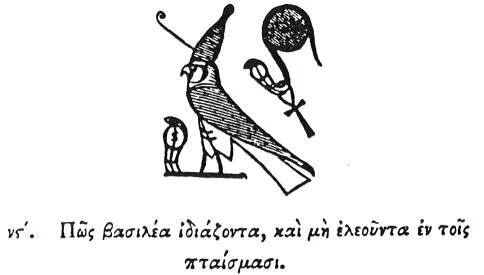 1
1
When they would symbolise a king who keeps himself apart, 2 and shews no mercy to delinquencies, 3 they depict an EAGLE; for he builds his nest in desert places, and flies higher than all birds.
Footnotes
120:1
Signifies Pharaoh.
120:2 ἰδιάζω, "to live apart," also "to revenge oneself."
120:3 πταῖσμα, "a calamity in war," also "a fault."
LVII. HOW THE GREAT CYCLICAL RENOVATION.
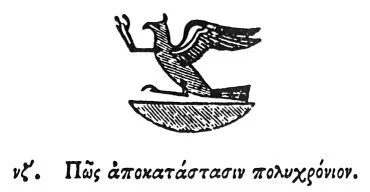 1
1
When they would denote the great cyclical renovation, they portray the bird PHŒNIX. For when he is produced a renovation of things takes place, and he is produced in this manner. When the Phœnix is about to die, he casts himself vehemently upon the ground, and is wounded by the blow, and from the ichor, which flows from the wound, another phœnix is produced; which as soon as it is fledged, goes with his father to the city of the sun in Egypt; who when he is come thither, dies in that place at the rising of
the sun. And after the death of his father, the young one departs again to his own country; and the priests of Egypt bury the phœnix that is dead.
Footnotes
121:1
Phœnix.
LVIII. HOW ONE WHO IS FOND OF HIS FATHER.
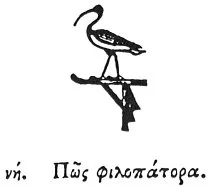 1
1
When they would denote a man fond of his father, they depict a STORK; for after he has been brought up by his parents he departs not from them, but remains with them to the end of their life, taking upon himself the care of them.
Footnotes
122:1
Thoth.
LIX. HOW A WOMAN THAT HATES HER HUSBAND.

When they would symbolise a woman that hates her own husband, and designs his death, and is complaisant only during intercourse, they delineate a VIPER; for when in connexion with the male, she places his mouth in her mouth, and after they have disjoined, she bites the head of the male and kills him.
LX. HOW THEY DENOTE CHILDREN PLOTTING AGAINST THEIR MOTHERS.

When they would denote children plotting against their mothers, they delineate a VIPER; for the viper is not
brought forth in the [usual manner?], but disengages itself by gnawing through the belly of its mother.
LXI. HOW THEY DENOTE A MAN WHO SICKENS UNDER THE REPROACH OF ACCUSATION.

When they would symbolise a man who is reproached with accusations and thence falls sick, they delineate a BASILISK; for he kills those that approach him with his breath.
LXII. HOW A MAN THAT IS BURNT WITH FIRE.

When they would symbolise a man that is burnt with fire, they depict a SALAMANDER; for it destroys with either head.
LXIII. HOW A BLIND MAN.

When they would symbolise a blind man, they depict a MOLE; for it neither has eyes, nor does it see.
LXIV. HOW A MAN THAT NEVER STIRS OUT.

When they would symbolise a man that never stirs
out, they depict an ANT AND THE WINGS OF A BAT; because, when these wings are placed over an ant's nest, none of them come forth.
LXV. HOW A MAN WHO IS INJURED BY SELF-INFLICTIONS.

When they would symbolise a man injured by self inflictions, they delineate a BEAVER; for when pursued he tears out his own testicles, and casts them as spoil to his pursuers.
LXVI. HOW A MAN WHO HAS BEEN SUCCEEDED IN HIS PROPERTY BY A SON WHOM HE HATED.

When they would symbolise a man who has been succeeded
in his property by a son whom he hated, they depict AN APE WITH A YOUNG APE BEHIND IT, For the ape begets two young apes, one of which he loves extravagantly, and the other he hates: and the one which he loves he keeps before him and kills with fondling; but the one which he hates he keeps behind him and brings up.
LXVII. HOW A MAN THAT CONCEALS HIS OWN DEFECTS.

When they would symbolise a man that conceals his own defects, they depict AN APE 1 MAKING WATER; for when he makes water he conceals his urine.
Footnotes
127:1 Pier. mentions a reading, αἴλουρον "a cat."
LXVIII. HOW ONE WHO HEARS WITH MORE THAN USUAL ACUTENESS.

When they would symbolise a man who hears with more than usual acuteness, they portray A SHE-GOAT, for she respires [hears?] through both her nostrils and ears.
LXIX. HOW AN UNSETTLED PERSON.

When they would symbolise one that is unsettled, and that does not remain in the same state, but is sometimes strong, and at other times weak, they depict an HYÆNA; for this creature is at times male, and at times female. 1
Footnotes
128:1 The Arabs still believe this to be the case.
LXIX. HOW A MAN OVERCOME BY HIS INFERIORS.

When they would symbolise a man overcome by his inferiors, they depict TWO SKINS, one of an HYÆNA, 1 and the other of a PANTHER; for if these two skins be placed together, the panther's shoots its hair, but the other does not.
Footnotes
129:1 Qy. A water skin.
LXX. HOW A MAN WHO OVERCOMES HIS PRIVATE ENEMY 2.

To denote a man who overcomes his private enemy, they
delineate an HYÆNA TURNING TO THE RIGHT; but if himself overcome, they on the contrary depict ONE TURNING TO THE LEFT; for should this animal, when pursued, turn to the right, it slays the pursuer, but if to the left, it is slain by the pursuer.
Footnotes
129:2
LXX. See the skin placed before Osiris, B. I. c. 40. The skin is in some manner connected with judgment and protection, but it is not yet well understood.
LXXII. HOW A MAN WHO PASSES FEARLESSLY THROUGH THE EVILS WHICH ASSAIL HIM.

When they would denote a man who passes fearlessly through the evils which assail him, even until death, they delineate the SKIN OF AN HYÆNA; 1 for if a man gird this skin about himself, and pass
through any of his enemies, he shall be injured by none of them, but passes through fearlessly.
Footnotes
130:1 The Arabs eat the flesh of this animal to free themselves from some particular illness.
LXXIII. HOW A MAN ANNOYED BY HIS PRIVATE ENEMIES.

When they would represent a man annoyed 1 by his private enemies, and extricating himself with small loss, they portray a WOLF WHICH HAS LOST THE EXTREMITY OF HIS TAIL; for the wolf, when about to be hunted, shoots the hairs and extremity of his tail.
Footnotes
131:1 διαθέντα, Ald.—σιανθέντα Par. C. Leem. "compelled to make a compact with."
LXXIV. HOW A MAN WHO IS FEARFUL LEST ACCIDENTS SHOULD HAPPEN UNEXPECTEDLY TO HIMSELF.

When they would denote a man who is fearful lest accidents should happen unexpectedly to himself, they depict a WOLF AND A STONE; for it fears neither iron, nor a stick, but a stone only; and indeed, if any one throw a stone at him he will find him terrified: and wherever a wolf is struck by a stone, maggots are engendered from the bruise.
LXXV. HOW A MAN CALMED BY FIRE DURING ANGER.
 1
1
When they would denote a man calmed by fire even during
anger, they portray LIONS AND TORCHES; for the lion dreads nothing so much as lighted torches, and is tamed by nothing so readily as by them.
Footnotes
132:1 Treb. igne castigatum "chastised by fire."
LXXVI. HOW A FEVERISH MAN WHO CURES HIMSELF.

When they would denote a feverish man who cures himself, they depict A LION DEVOURING AN APE; for if, when in a fever, he devours an ape, he recovers.
The Hieroglyphics of Horapollo Nilous. London, 1840. Hermetic Cloud, https://hermeticcloud.com/library/horapollo-hieroglyphics/. Public-domain text reproduced in full; markup only.
Scanned at sacred-texts.com, December 2006. This text is in the public domain in the United States because it was published prior to January 1st, 1923. These files may be used for any purpose provided this notice of attribution is left intact.