Hymns of the Tamil Śaivite Saints
by F. Kingsbury and G. P. Phillips
Calcutta: Association Press; London, NY: Oxford University Press
[1921]
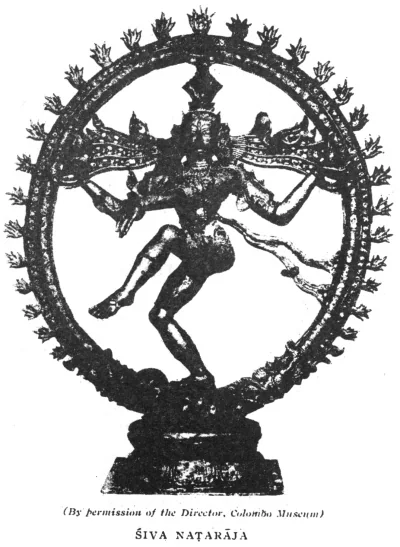
ŚIVA NAṬARĀJA
|
CHAP. |
PAGE | |
|
INTRODUCTION |
1 | |
|
I. |
Sambandar and his Hymns—Stanzas 1-24 |
10 |
|
II. |
Apparswāmi and his Hymns—Stanzas 25-64 |
35 |
|
III. |
Sundaramūrti and his Hymns—Stanzas 65-79 |
70 |
|
IV. |
Māṇikka Vāsahar and his Hymns—Stanzas 80-136 |
84 |
|
Appendix I: Shrines Mentioned in the Poems |
128 | |
|
Appendix II: System of Transliteration and Pronunciation |
129 | |
|
131 |
ILLUSTRATIONS
|
1. Śiva Naṭarājā |
Frontispiece |
|
2. Sambandar |
Following Page 8 |
|
3. Apparswāmi |
„ 34 |
|
4. Sundarar |
„ 68 |
|
5. Māṇikka Vāsahar |
„ 84 |
NOTE.—The bronze statuettes of the poets reproduced in this volume are not historical portraits but imaginative figures, created in accordance with popular traditions and used in the worship of the temple and the home.
INTRODUCTION
(A)—The Hymns and their Significance
THE voice of chanting and song, to the accompaniment of unfamiliar instruments, floats out over the high wall of the temple in the coolness of the evening or the dawn, making the Western passer-by wonder what it is that is being chanted and sung. If only he had a Hindu hymn-book he thinks he could learn from it the spirit of Hinduism as well as a non-Christian could learn Christianity from Christian hymns. For the Tamil country at any rate there is such a hymnbook, and our present aim is to give enough specimens from it for readers to know what the hymns are like. Englishmen are wanting to understand India more than they ever wanted before, for their debt to India is heavy. Indians are wanting more than ever before to know the wonderful past of their own country, and the wonder of it is all bound up with its religion. At such a time these hymns are worth looking into, for they are being sung in temples and homes throughout the Tamil country, and Tamil is the mother-tongue of more than eighteen millions of people. For pious Śaivites they equal in authority the Sanskrit Vedas; the mere learning of them by rote is held to be a virtue, and devout. Tamil parents compel their children to memorize them in much the same way as Christian parents make their children learn the Psalms.
The hymns here given are specimens from the Dēvāram and the Tiruvāchakam. The Dēvāram is the first of the collections of works held as canonical by Tamil Śaivites. Its hymns were composed between six and eight hundred A.D. by the three authors of whom this book gives some account, and the whole was put together in one collection of 797 stanzas by Nambi Āṇḍār Nambi about 1000 A.D. The Tiruvāchakam, or Sacred Utterance, was written by one author, Māṇikya Vāchaka (Tamilized as Māṇikka Vāsahar) at a date so far unsettled that scholars are still divided on the question whether it preceded or followed the Dēvāram, though most scholars place it in the ninth, or early in the tenth, century. Whenever it was written, it stands even higher than the Dēvāram in the affections of Tamil people.
Out of an immense number of hymns we have tried to select those which are most representative, those which are favourites, and those which contain the most striking thoughts. But it is amazingly difficult to give a fair or adequate idea of them in an English rendering. They are essentially songs, intended to be sung to Indian tunes, in metres which no English metre can represent. Much of their charm depends upon assonance, upon plays upon words, upon close knitting of word with word, upon intricacy of metre and rhyme, almost as much as upon the substance. We can only claim a fair degree of accuracy in our renderings, apologizing to the lovers of Tamil poetry for the plainness and poverty of our representation of so rich and varied an original. All our translations are new, and nearly all of those from the Dēvāram represent verses which have never before been done
into English. One of the translators of this book learned as Śaivite child to love these hymns, and therefore is the authority in matters of interpretation, the Englishman being responsible for the form. We shall be quite satisfied if our translations serve to call attention to the poems, and are some day replaced by worthier renderings.
We have tried to reduce introductory matter to a minimum, only giving such information as is necessary to enable readers to understand the hymns and the allusions in them. But it is entirely necessary to say something about the worship of Śiva, and to give a few words of biography of each of the four authors from whose work this book contains extracts.
(B)—The Worship of Śiva1. Its history previous to these poems.
The word Śiva occurs even in the Rig Veda, but there it is only in conjunction with Rudra. The joining together of these names provokes conjectures as to whether we have here an amalgamation of two earlier deities, an Aryan and a Dravidian, but these need not detain us here, since clearly even at this early date Śiva was an Aryan deity, identical with Rudra the storm-god, and father of the Maruts, storm-gods themselves. Rudra is a handsome god; he uses his thunderbolts chiefly for punishing evil-doers, and is on the whole a kindly being. The name Śiva means auspicious,' and must not be confused with the Tamil word for 'red,' although as it happens Rudra-Śiva was a red being,
In the period of the Purāṇas, we find that Śiva, instead of being one of a multitude of nature-deities, has risen to be one of the great triad, Brahmā, Vishṇu, and Śiva, who are far above all gods. How the change has come about we have not yet the means of discovering. The function has changed as much as the person, Śiva being now the destroyer as Brahmā is the creator and Vishṇu the preserver. The process of reduction in the number of the superior deities goes further, and Brahmā falls practically into the background, leaving only Vishṇu and Śiva as supreme beings for the worship of the people of India. By the time Hinduism penetrated southwards into the Tamil country, probably somewhere about 500 B.C., it had two main forms, the worship of Vishṇu and the worship of Śiva, the two being not too sharply disconnected. The Tamil Hindu believed in the existence of both, but held his own god, whether Śiva or Vishṇu, to be supreme. Hinduism seemed to be Firmly established, but was dangerously shaken when the Jains and Buddhists spread over South India. Then came for the Vaishṇavites the teachers known as the Āl̤vārs, while Śaivism was defended by the poets of whose work this book gives specimens. Hinduism was saved, but it existed henceforth in two distinct forms, Vaishṇavism and Śaivism, separated by a wider gulf than in earlier days.
2. The portrait of Śiva and its interpretation.
Śiva as imagined by his worshippers has a human form, usually with one but occasionally with five or six heads. He has three eyes, the right one being really the sun, the left eye the moon, and the one in the middle of his forehead fire, His reddish hair is
matted in the ascetic way, and on it is the crescent moon, the Ganges, and one or more cobras, while wreathed about it is a garland of konḍai (Cassia) flowers. He has four arms, though occasional representations show eight, but one body and two legs. Commonly he is seated on a grey-coloured bull. In colour he is reddish, but his body is smeared over with white sacred ash. He holds in his hands various things such as a battle-axe, a deer, fire, a trident, a bow. Round his neck, which is dark, hangs a long necklace, the beads of which are skulls. At his waist he wears sometimes an elephant's hide, sometimes a tiger-skin, sometimes only a very scanty loin-cloth. Generally his consort, Umā, is at his left side, but sometimes he is pictured as half man and half woman, the right half (Śiva) being pink-coloured, and the left half (Umā) green or black. Śiva's abode is said to be on Mount Kailāsa in the Himālayas, but among his special haunts is the burning-ground, where bodies are cremated. One of the favourite manifestations of Śiva is that as Naṭarāja, the dancer in the great hall at Chidambaram, of which we give a picture (see frontispiece). Here Śiva has one face, four arms, and two legs, performing a spirited dance. His right foot rests on a demon named Muyalahan. He is sometimes represented as dancing along with Kāḷī, not the Kāḷī who in North India is identified with Umā, but a she-devil feared in the South.
Doubtless each of these features in the manifestation of Śiva has its history, but that is unknown at present. The legends give fanciful explanations of most of them. The tiger's skin and the elephant's hide, for instance, are those which Śiva stripped from the wild animals sent against him by the magic of his
enemies the ṛishis of Darukāvana. But it is of more interest to find the religious ideas which these things suggest to a thoughtful Śaivite devotee to-day. The hides remind him that Śiva has all power, and all opposition to him is vain. That right foot of Naṭarāja set on Muyalahan means that God crushes down all evil. Those skulls in his necklace are the skulls of successive Brahmās, each of whom died after a life lasting many ages. This is a way of saying that while other gods at last come to their end, Śiva is eternal and unchanging. Śiva's dance suggests how easily, and how rhythmically, he performs his five functions of making, preserving, destroying, judging and purifying. And his dance in the burning-ground may sometimes carry the message that God becomes most real to men in the solemn hour when they part from their dead.
3. Four common legends and their meaning.
Of the many legends concerning Śiva four are so frequently alluded to in our poems that they should be told here, to avoid repeated explanatory notes.
1. Brahmā and Vishṇu once saw a pillar of fire that seemed to grow from the depths of the earth and to pierce beyond the highest heavens. They longed to learn its depth and height, and agreed that Brahmā should become a swan to fly to the pillar's top, and Vishṇu a boar to dig to its root. The swan flew up to the sky, but never reached the pillar's summit. The boar dug through the earth with his tusk, but never found where the pillar began. Brahmā and Vishṇu perforce acknowledged their limitations and prayed to the pillar, whereupon Śiva revealed himself, for the pillar was a form he had assumed. Not even the greatest and
wisest of creatures can by their searching find out God. But to the humble-hearted He reveals Himself.
2. Rāvaṇa, the ten-headed giant king of Ceylon, while on his conquering progress through many realms, came to the North of India and saw Kailāsa the silver mountain. Coveting its beauty he determined to uproot and transplant it to his own island. With his ten heads and twenty arms he tried to lift it from the earth, and Kailāsa shook. All the hosts of heaven, and even Irma., were terrified by what seemed to them an awful earthquake. But Śiva simply set his big toe upon the mountain, and lo, Rāvaṇa found himself being crushed to death. Repenting of his folly, Rāvaṇa prayed for mercy, and Śiva not only forgave him but even gave him fresh boons. For God pardons sinners who repent, and gives them blessings which before they did not know.
3. Three Asuras, or supernatural beings, once by doing penance obtained from Śiva three castles, one of gold, one of silver, and one of iron. These castles could fly at the owners' desire, and settle down on towns and villages, destroying many lives. In course of time the Asuras became very proud and ignored Śiva. Determining to punish them, Śiva mounted a chariot whose wheels were the sun and moon and whose scat was the earth. Brahmā was his charioteer, the four Vedas the horses, Mount Meru his bow, the ancient serpent Ādiśesha his bow-string, and Vishṇu his arrow. At sight of these preparations the gods became conceited, thinking that Śiva could not destroy his enemies without them. Śiva knowing their thoughts simply laughed, and at that laugh the three castles were on the instant reduced to ashes.
Those who forget God in their pride must be punished. When those whom God uses as his instruments begin to think themselves indispensable to him, he shews that his purposes can be fulfilled without them.
4. The gods once began to churn the ocean in the hope of obtaining divine nectar. The mountain Mandāra was their churning-stick, the primeval tortoise the pivot on which the stick rested and turned, and the serpent Vāsuki was the churning-rope. As they churned, at first, great and splendid things came up. But suddenly something black rose up and darkened the whole universe. It was a mass of poison, deadly alike to gods and men. In terror of destruction, the gods and demons called on Śiva. He came, drank the poison, and saved them all. That which was enough to destroy the universe could only stain his throat with a bluish colour. That is why Śiva is often called the "poison-necked" or "blue-throated" god. There is a link here, small but real, with the Christian teaching of God as ready to suffer for the sake of humbler beings.
SAMBANDAR AND HIS HYMNS
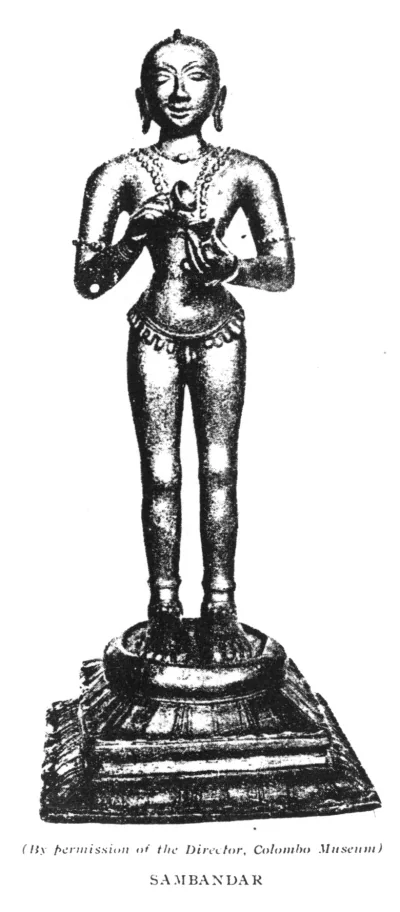
SAMBANDAR
I
SAMBANDAR
(Tamil: TIRU JÑĀNA SAMBANDAMŪRTI SWĀMĪ)
In the first half of the seventh century A.D. the worship of Śiva Was at its lowest ebb, overpowered by the Jainism and Buddhism which prevailed throughout the Tamil country. But a few pious Śaivites remained faithful. One of them, whose name means that his heart was laid at Śiva's foot, and who lived in the town in the Tanjore District now known as Shiyāli, prayed to the Śiva worshipped in the Shiyāli temple that he might be given a son who would dispel the godless dark and win men to Lord Śiva again. Sambandar's birth was the answer to that prayer. At the tender age of three, so orthodox Śaivites believe, this child was fed by Sivas spouse with milk from her divine breast, mingled with divine wisdom, whence he is called in his full name, "The man connected with wisdom divine," Tiru Jñāna Sambandar.
He grew up to be a pilgrim poet, who visited most of the Śaivite shrines with which South India abounds, in each place singing the praise of the Śiva whom there he worshipped. The cause he loved suffered a severe blow when the great king of Madura, with many of his subjects, went over to the Jain religion. The queen-consort and her prime minister (see stanzas 20 and 21) remained faithful to Śaivism, and sent for Sambandar.
The lonely saint faced a vast multitude of Jains in the royal presence, conquered them in argument, and reconverted the king. Eight thousand of the stubborn Jains, with Sambandar's consent, were impaled alive. Later on, after a similar adventure in another of the three great kingdoms of the Tamil country of his time, Sambandar converted to Śaivism a crowd of Buddhist opponents.
This is about all that is known of a man who helped to sing Buddhism right out of Southern India, and who composed the collection of hymns which stands first among the canonical works of Śaivites. Legends make him a wonder-worker, but we must draw our knowledge of the man from his poems themselves. He certainly was skilful in the handling of the many metres in which Tamil poetry is written, and it is not impossible that his productions were as effortless as the stories of him tell. That is their weakness, for there is not very much of heart religion in them. But they seem to have powerfully helped in that process of eliminating Jainism and Buddhism from India of which we know so little, though it was complete enough to be one of the marvels of history. Their author holds the foremost place among the four great 'Śaivite Preceptors' (Śivāchāryar), and some call him the incarnation of one of the sons of Śiva.
His date seems to be one of the few clearly established dates in the history of the religion of the country. Stanza 19 shews that he was a contemporary of another great early Śaivite, whose name means "Little Servant of God," and who is known to have fought in a battle which took place in 642 A.D.
We begin with the first verse which the author composed. According to the legends he uttered it at the age of three, on the banks of the temple tank at Shiyāli (once Bramāpuram), after Śiva's consort had fed him with milk from her own breast. The stanza itself of course contains no allusion to the story, but it is one of the best known verses in the Śaivite hymnbook.
1. His ears are beringed, He rideth the bull;
His head is adorned with the crescent moon's ray; White is He with ash from the burning-ground swept;
And He is the thief who my heal t steals away. Great Brahmā enthroned on the lotus’ full bloom
Erstwhile bowed him down and His glory extolled, And singing received he the grace of our lore
Who dwelleth in famèd Bramāpuram old.
No pilgrimage in South India is more popular than that to Tiruvaṇṇāmalai in North Arcot, the temple by a hill celebrated in many poems. Śaivism has tried to express the existence of the 'eternal feminine' in deity by giving Śiva a lady who not only is His consort, but is actually a part of Him, and is so represented in many images, which show Śiva as masculine on one side and feminine on the other.
2. He is our only Lord, conjoinèd still
To her whose breast no sucking lips have known.
They who in Aṇṇāmalai's holy hill,
Where falling waters noisy chatter down,
And the hill glistens gem-like, bow before
Our great one who is lord and lady too,
Unfailingly for them shall be no more
Dread fruit of good and bad deeds they may do.
One of the first puzzles to a student of Śaivism is the way in which each of the numerous shrines seems to be spoken of as if it were Śiva's exclusive abode. The broad river marked on English maps as the Cauvery, but in Tamil called the Kāviri, which brings so much blessing to a large part of South India that the respect in which it is held is not difficult to understand, is fringed throughout its length with shrines which are believed to confer the blessings of Śiva on all who visit them. One of these is 'Neyttānam,' 'Place of Ghee.'
3. So ye but say Neyttānam is the home
Of our great Lord who wears in his long hair
The crescent moon, the river, and the snake,
Neyttānam where chaste maidens gather fair,
On the north bank of Kāviri's loud stream,
Your vileness, guiltiness, the sin you dread,
Your sorrows many, shall be banishèd.
This specimen of a hymn connected with Palny in the Madura District alludes (in stanza 5) to the well-known legend which says in the Śaivite way that those who love God need not fear death. Mārkandeya was a boy devoted to Śiva, but over his life hung a terrible cloud, for the fates had decreed that he would not live beyond his sixteenth year. As the appointed time drew near his father lived in an agony of dread, but Mārkandeya, free from fear, spent all his time in the worship of Śiva. The god of Death came at last. Regardless of the fact that the boy was at worship he threw over him that noose which pulls out human life from the body. The boy clung to Śiva's lingam with both his hands. From within the lingam Śiva burst forth, kicked the terrible death-god and pierced him with his trident. So Mārkandeya was saved. The scene is sculptured on many temples.
4. Holy Vedas chanting,
Sacred thread He wears;
All His hosts surround Him
Whom the white bull bears.
Cometh He in splendour,
Tiger-skin attired.
'Lord, our naked beggar
Above all desired,'
Cry ye in your worship,
At His feet appeal.
He who dwells in Palny
All your sin will heal.
5. Three eyes hath His forehead,
Fair moon crowns His hair;
When Death sought a victim,
Śiva's foot crashed there;
Gory streams of blood flowed,
Death it was that died,
Such is He, our Father,
Um a, at His side;
Dwells He aye in Palny,
Where bees hum around
Drunk with honeyed sweetness,
Till its groves resound.
A multitude of hymns chant the glory of Chidambaram, ancient Tillai, holiest of all the Śaivite shrines. Pious Śaivites have for it a feeling not unlike the Jews’ feeling for Jerusalem. The tending of the sacrificial fire comes down from pre-historic times, being firmly established when the earliest hymns of the Rig Veda were composed.
6. Tending as taught of old the sacrificial fire,
At Tillai Brahmans pure drive out misfortune dire.
There dwells the First of all, moon-crowned, and
those who cleave
For ever to His foot, no cleaving sin will grieve.
Conjeeveram, the ancient Tamil name of which is given in this stanza, though more famous as a Vaishṇavite than as a Śaivite shrine, offers in its temples a remarkable compendium of the religious history of South India. See the article 'Kānchipuram' in Dr. Hastings’ 'Encyclopædia of Religion and Ethics.'
7. He is the pith of holy writ;
And in the tangle of His hair
The spotless crescent's ray is lit;
He is both Lord and Lady fair.
He our great sovereign doth abide
In Kachchi Ehambam's fair town.
My mind can think of naught beside,
Naught beside Him, and Him alone.
The next two stanzas, taken from two separate hymns associated with the great cities of Trichinopoly and Madura, both sacred places of Śaivism, are set side by side in order to bring out a point which even the most sympathetic student may not ignore. Śiva is commonly spoken of as all good, as in stanza 8, and yet not infrequently He includes, as in stanza 9, both good and its opposite. The pantheistic tendency even in these hymns causes God to be sometimes depicted as so all-embracing as to include evil as well as good.
8. All goodness hath He and no shadow of ill.
Grey-white is His bull, fair Umā shares His form.
His wealth is past searching. Chirāpaḷḷi's hill
Is His, whom to praise keeps my heart ever warm.
9. Thou art right and Thou art wrong,
Lord of holy Ālavāy;
Kinsman, I to Thee belong;
Never fades Thy light away.
Thou the sense of books divine,
Thou my wealth, my bliss art Thou,
Thou my all, and in Thy shrine
With what praises can I bow?
No one can know Śiva unless He chooses to reveal Himself. This thought constantly recurs with great emphasis. Its favourite expression is in the first legend of the four told in our introduction. Hymn singers are fond of contrasting with the vain search of Brahmā and Vishṇu the revelation of Himself which Śiva has graciously granted to them. Compare stanzas 25 and 48.
10. Thou Light whom Brahmā, being's fount, and Vishṇu could not see,
No righteousness have I, I only speak in praise of Thee.
Come, Valivalam's Lord, let no dark fruit of deeds, I pray,
Torment Thy slave who with his song extols Thee day by day.
Astrology plays a large part in popular Hinduism, and the influence of baleful or auspicious stars must be reckoned with in daily life. Most baleful of all is the influence of the eclipse, which is caused by two dragons Rāhu and Kētu which swallow the moon or the sun. This stanza enumerates the nine planets, Sun, Moon, Mars, Mercury; Jupiter, Venus, Saturn, Rāhu and Kētu, and says that to the singer, who has Śiva in his heart, all of them, even the dragons of eclipse, are auspicious. It is a powerful and characteristically Hindu way of saying that all things work together for good to those who love God.
The reference to the bamboo constantly recurs in descriptions of ladies’ beauty. Everyone who has seen a feathery clump of bamboo trees waving in the breeze will understand it as a symbol of delicate grace.
The vīṇa is the most delicate and beautiful instrument played in South India.
11. She shares His form whose shoulders’ curve vies with the bamboo's grace.
His throat the poison drank, He touched the vīṇa into tune.
The lustrous moon and Ganges crown His hair, and He a place
Hath made Himself within my heart. Wherefore let shine the moon
Or sun or any star of good or ill, or serpents twain.
For Śiva's slave all are benign, all work for him great gain.
White ash from burnt cow-dung must be worn by all true Śaivites. Every day the worshipper, facing north-east and crying 'Śiva, Śiva,' must dip in the ash the fingers of his right hand and draw the three middle fingers from left to right along his forehead, so leaving three horizontal white lines. The ceremonial side of Śaivism is so prominent that this one stanza must be given, a specimen of many extolling the virtues and potencies of the ash.
The Tantras are works inculcating ceremonies, also magic performances and mystic rites. Some of these are of an immoral nature.
12. The sacred ash has mystic power,
’Tis worn by dwellers in the sky.
The ash bestows true loveliness.
Praise of the ash ascends on high.
The ash shows what tile Tantras mean,
And true religion's essence tells,
The ash of Him of Ālavāy,
In whom red-lippèd Umā dwells.
Equally important with the wearing of the sacred ash is the constant repetition of the five syllables, or panchākshara, 'Namaśivāya.' This, which means literally 'a bow to Śiva,' is the chief mantra or mystic utterance of Śaivism. In Śaivite catechisms a whole chapter is devoted to its uses.
13. Those who repeat it while love's tears outpour,
It gives them life, and guides them in the way.
’Tis the true substance of the Vedas four,
The Lord's great name, wherefore 'Hail Śiva,' say.
The next three stanzas are from a hymn written in a very attractive short-lined metre, and promise light, freedom from rebirth, and bliss, through devotion to Śiva at Ārūr (now Tiruvaḷḷūr in the Tanjore District).
14. For the Father in Ārūr
Sprinkle ye the blooms of love;
In your heart will dawn true light,
Every bondage will remove.
15. Him the holy in Ārūr
Ne’er forget to laud and praise;
Bonds of birth will severed be,
Left behind all worldly ways.
16. In Ārūr, our loved one's gem,
Scatter golden blossoms fair.
Sorrow ye shall wipe away,
Yours be bliss beyond compare.
Associated with the hymn from which our next verse is taken is a story of the author, Sambandar, helping a sorrowing woman by raising to life the man she loved, who had been killed by snake-bite. The hymn makes no allusion to such a miracle, but it does give an example of intercession on behalf of another, an element which is somewhat rare in these devotional books.
17. Prostrate with fear at Thy feet she cries 'Lord with matted hair, my Refuge, Rider of the bull! Lord of Maruhal where fresh water-lilies bloom, is it right to leave her in this anguish of heart?
Our present writer's poems contain such frequent denunciations of Buddhism or Jainism that it is clear that they were written at a time when the struggle between Hinduism and these other religions was at its height. Buddhism and Jainism are scarcely known in South India to-day, though at one time they were supreme. It is probable that these songs helped not a little to drive them out of the country.
18. Those Buddhists and mad Jains may slander speak.
Such speech befits the wand’rers from the way.
But He who came to earth and begged for alms,
He is the thief who stole my heart away.
The raging elephant charged down at Him;
O marvel! He but took and wore its hide;
Madman men think Him, but He is the Lord
Who in great Bramāpuram doth abide.
The "Little Servant of God" mentioned in the next verse is one of the 63 canonized saints of Śaivism. According to the collection of legends known as the Periya Purāṇam, which is a Tamil Śaivite classic, he fought at the battle of Vādāpi, the modern Badāmi, which took place in 642 A.D. There are other indications which strengthen the view that these hymns date from the seventh century A.D.
In the first three lines of the verse Śiva is conceived as a lover, and the devotee as the woman whom He loves. In India the pain of absence from a lover is supposed to cause spots to appear on the skin of the woman who loves.
19. Birds in the flowering green-branched puṇṇai tree,
Love writeth clear its marks on me, for He
Who cured my grief, yet left unending pain.
Senkāttankuḍi is His holy fane,
And there His "Little Servant" dwells, who now
And ever doth before Lord Śiva bow.
There in the burning-ground, with fire in hand,
Sporteth unceasingly our Master grand.
Another possible indication of date occurs in the next two verses, given in English prose because the Tamil names will not fit into English metres. The Mangaiyarkkarasi here mentioned was the wife of a king of Madura, Kūn Pāṇdiyan, known to history. According to the above-mentioned collection of stories, this king became a Jain. Then the queen and the prime minister named in our poem sent for Sambandar, our author, through whose efforts the king was reconverted, and all Jain teachers were executed by impaling. Unfortunately the date of Kūn Pāṇdiyan cannot at present be accurately determined. An able discussion of it can be seen in "The Tamilian Antiquary, No. 3."
The explanation of the term 'Fish-eyed maid,' which sounds curiously in English ears, is that in Madura Śiva's consort is called Mīnākshi, i.e. fish-eyed. The suggestion of the epithet, frequently applied to beautiful women, is that the motion of their eyes resembles the beautiful motion of a fish in water.
20. This is Alavāy, where dwells the flame-formed lord of hosts, giver of the four Vedas and their meaning, with the fair fish-eyed maid. Here, reigning like the goddess of good fortune, Mangaiyarkkarasi the Chōla king's daughter, braceletted chaste Pāṇdiyan queen, daily serves and praises God.
The poem from which 20 and 21 are taken consists of stanzas like these alternately praising the queen and the king's minister, the last verse praising them both together.
21. This is Ālavāy, Śiva's abode. To those who forsake the world He reveals Himself as world-forsaking too. Head of the heavenly ones, He rides the one white bull. Praised is He by Kulachchirai, minister of that monarch who wears white ash, and loves to lay himself bare at the feet of Śiva's slaves.
Once, says a story, when Sambandar was about to contend with the Jains, the queen feared the consequences which might befal him, but he assured her in this verse that he could dare all when his God of Madura was on his side.
22. O fair one with the deer's glance meek,
Pāṇdya's great queen, think not of me
As of some sucking infant weak,
Because such wicked foes there be.
If only Hara by me stand,
Stronger am I than all their band.
The story here is that the Janis had set fire to Sambandar's house. He prayed in this stanza that the fire, transformed into a fever, might go to the Pāndyan king, then a Jain. It did so, and the king was converted.
23. O Thou whose form is fiery red,
In holy Alavāy, our Sire,
In grace deliver me from dread.
False Jains have lit for me a fire:
O, let it to the Pāṇḍiyan ruler go,
That he the torture of slow flame may know.
Our specimens of Sambandar's poetry may end with a verse which is a kind of benediction, often set as an auspicious word on the front page of a book.
24. Blest be the Brahmans pure, the heavenly ones, and kine.
Cool rain fall on the earth! May the king's glory shine!
Perish all forms of ill! Let Hara's name resound!
May sorrow pass away, from earth's remotest bound.
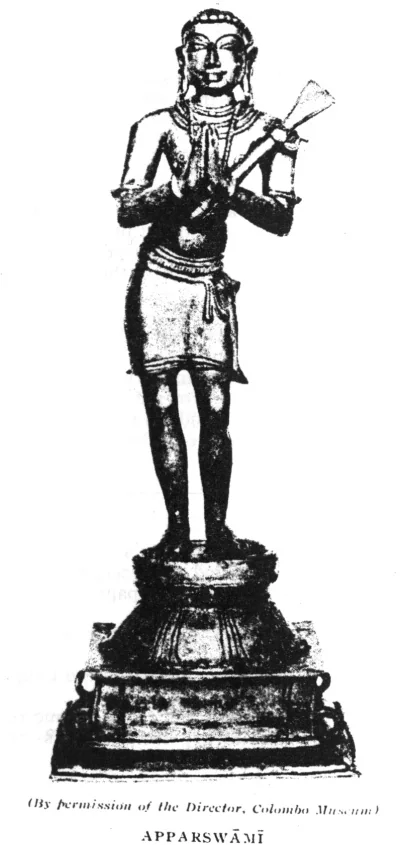
Apparswāmī
APPARSWAMI AND HIS HYMNS
II. TIRUNĀVUKKARASU SWĀMI(More commonly referred to as APPARSWĀMI)
Sambandar, whose works we have been studying, had a friend older than himself, named Appar, or Tirunāvukkarasu, belonging to that Veḷḷāla caste which to this day makes a very solid element in the population of the Tamil country. Left an orphan at an early age, Appar was brought up by a loving elder sister as a pious devotee of Śiva. Great was the sister's grief when Appar forsook the faith of his fathers and became a religious teacher among the Janis. But her earnest prayers at last prevailed, and Appar not only came back to Śaivism himself, but was the means of reconverting to Śaivism the king of his country. His full name was Tirunāvukkarasu, or 'King of the Tongue', but his young friend Sambandar called him Appār, or Father, and the name stuck to him. He too wandered throughout the Tamil country, sometimes alone, sometimes in company with Sambandar, singing his way from shrine to shrine. Pictures show him holding in his hand a little tool for scraping grass, with which he used to scrape the stones of the temple courts. The Jains persecuted him, and many stories tell of his miraculous escapes from their hands.
His hymns show a truly religious nature, with a deep-rooted sense of sin and need, and an exalted joy in God. There is real critical acumen in the old epigram which represents Śiva as appraising the three great writers of the Dēvāram, or Śaivite hymn-book: "Sambandar praised himself; Sundarar praised Me for pelf; My Appar praised Me Myself."
God, the essentially unsearchable, in His grace will reveal Himself to men. (See the first of the legends told in the Introduction.) Athihai Viraṭṭānam, in the South Arcot District, is the shrine here commemorated.
25. Vishṇu, spouse of Lakshmi, and four-ways-facing Brahm,
Searched the heights and depths, but Thy feet could never sec.
Yet, O only Lord, who in Athihai dost dwell,
Formless, in Thy grace, grant the sight of them to me.
The notable thing about our next verse is not so much the legend of the crushing of Rāvaṇa, who tried to storm the mountain Kailāsa, where Śiva had His heaven, but rather the thought of the devotee being stamped as the property of his god, a thought which recurs in other hymns. According to tradition Apparswami did receive the Hindu equivalent of St. Francis’ stigmata, the mark of Śiva's bull as if branded on his body. We cannot help recalling St. Paul's expression in Galatians vi. 17.
26. All other worlds his sceptre swayed,
But when Kailāsa he would rule
Thy crushing foot presumption paid.
O stamp me with. Thy sacred bull,
White as Himāl’ya's snowy hill.
Accent me, O our truth divine,
There where the moon outsoareth still
Groves of Tūṅgānaimāḍam's shrine.
Here is the divine vision as the enraptured Śaivite sees it.
27. See, there His bright trident appears to me;
See, there is the moon in His tangled hair;
His garland of flowers from the kondai tree,
And the ear-ring white in His either ear,
The cloak that He tore from the elephant wild,
His glittering crown and His body's sheen.
Ash-smeared, He is ever the undefiled,
In Pūvaṇam circled by groves all green.
The singer, standing at the shrine of Tiruvalur (Ārūr) in the Tanjore district, muses over the ancient connection of his lord with the holy place, suggesting that it began before the creation, before Śiva wrought his greatest marvels, perhaps even before the one Supreme, Īśvara, expanded into the triad Brahmā, Vishṇu and Rudra.
28. When was that ancient day our Lord
Chose Ārūr should His temple be?
Was’t when He stood ’mid praising worlds
Alone, or when the One grew three?
Was’t when in wrath He burned up Death,
Or turned on Lust His flaming eye?
Or when creative, immanent,
He called to being earth and sky?
Was’t when, his young deer in his hand,
He came, with Umā as His part?
Or ere He joined that lady fair
Took He our Ārūr to His heart?
It is often said, not without truth, that Hinduism fails to create a strong sense of sin. But there are great exceptions: witness the following verses, samples of many, taken from a hymn which trembles with feeling. The author is sunk in sin. Or he has been like a swing, flying first toward evil and then towards God; but now, joy! the cord has snapped, and he lies fixed at his Lord's feet. Yet the old mood returns; his soul is bound and drugged with sleep, and life has no joys to offer unless God will save.
The Soul's Bitter Cry29. In right I have no power to live,
Day after day I'm stained with sin;
I read, but do not understand;
I hold Thee not my heart within.
O light, O flame, O first of all,
I wandered far that I might see,
Athihai Vīraṭṭānam's Lord,
Thy flower-like feet of purity.
30. Daily I'm sunk in worldly sin;
Naught know I as I ought to know;
Absorbed in vice as ’twere my kin,
I see no path in which to go.
O Thou with throat one darkling gem,
Gracious, such grace to me accord,
That I may see Thy beauteous feet,
Athihai Vīraṭṭānam's Lord.
31. My fickle heart one love forsakes,
And forthwith to some other clings;
Swiftly to some one thing it sways,
And e’en as swiftly backward swings.
O Thou with crescent in Thy hair,
Athihai Vīraṭṭānam's Lord,
Fixed at Thy feet henceforth I lie,
For Thou hast broken my soul's cord.
32. The bond of lust I cannot break;
Desire's fierce torture will not die;
My soul I cannot stab awake
To scan my flesh with seeing eye.
I bear upon me load of deeds,
Load such as I can ne’er lay down.
Athihai Vīraṭṭānam's Lord,
Weary of joyless life I've grown.
Fresh pictures in another hymn set forth his sad condition. God's vessels are full of the sweetness of grace, but his spoon has no handle. He feels himself in the deadly grasp of fate, like the frog in the cruel mouth of the snake which is slowly swallowing it down. Or he is on a raft on the sea of life, wrecked on the rock of lust.
33. While violence is in my heart,
Care of my body cage is vain.
My spoon no handle hath when I
Thy honey's grace to drink am fain.
As in the serpent's mouth the frog,
Caught in life's terrors, wild I rave.
Thou, King of holy Ottiyūr,
Wilt Thou not care for me and save?
34. When on life's angry waves I launch,
My heart's the raft I take to me,
My mind's the pole I lean upon,
Vexation's freight I bear to sea.
I strike upon the rock of lust!
O then, though witless quite I he,
Grant, King of holy Ottiyūr,
Such wisdom that I think of Thee.
It would be hard to find a more comprehensive confession of sin than our next stanza from another hymn.
35. Evil, all evil, my race, evil my qualities all,
Great am I only in sin, evil is even my good.
Evil my innermost self, foolish, avoiding the pure,
Beast am I not, yet the ways of the beast I can never forsake.
I can exhort with strong words, telling men what they should hate,
Yet can I never give gifts, only to beg them I know.
Ah! wretched man that I am, whereunto came I to birth?
We give next a series of stanzas in various metres from different hymns, in which the saint utters in song some of the joy which his religion has brought him. God has revealed mysteries to him which tongue cannot tell, and dwells in his life's innermost places. God is to him the fabled katpaha tree, supplying his every need. God is his all in all, and His presence is sweeter than melody or evening moonlight.
36. The moving water He made stand unmoving in His hair;
And He my thoughtless heart hath fixed it thought of Him alone:
He taught me that which none can learn, what none can see laid bare;
What tongue tells not He told; me He pursuer and made His own.
The spotless pure, the holy One, my fell disease He healed,
And in Pūnturutti to me e’en me, Himself revealed.
37. O wealth, my treasure, sweetness, lustre fair of heavenly hosts,
Of lustre glory that excels, embodied One, my kin,
My flesh, yea heart within my flesh, image within my heart,
My all-bestowing tree, my eye, pupil my eye within,
Picture seen in that pupil, lord of Āḍutuṛai cool,
Immortals’ king, keep far from me strong pain of fruits of sin.
38. Thou to me art parents, Lord,
Thou all kinsmen that I need,
Thou to me art loved ones fair,
Thou art treasure rich indeed.
Family, friends, home art Thou,
Life and joy I draw from Thee,
False world's good by Thee I leave,
Gold, pearl, wealth art Thou to me.
39. As the vīṇa's pure sound, as the moonlight at even,
As the south wind's soft breath, as the spring's growing heat,
As the pool hovered over by whispering bees,
So sweet is the shade at our Father-Lord's feet.
40. No man holds sway o’er us,
Nor death nor hell fear we;
No tremblings, griefs of mind,
No pains nor cringings see.
Joy, day by day, unchanged
Is ours, for we are His,
His ever, who doth reign,
Our Śaṅkara, in bliss.
Here to His feet we've come,
Feet as plucked flow’re’ts fair;
See how His ears divine
Ring and white couch-shell wear.
41. Though they give me the jewels from Indra's abode,
Though they grant me dominion o’er earth, yea o’er heaven,
If they be not the friends of our lord Mahādēv,
What care I for wealth by such ruined hands giv’n?
But if they love Śiva, who hides in His hair
The river of Gaṅga, then whoe’er they be,
Foul lepers, or outcastes, yea slayers of kine,
To them is my homage, gods are they to me.
Often the Hindu devotee asks and re-asks the fundamental question 'Who am I?', coming to the saddest of conclusions, but setting against the background of his delusive life of self the great reality of God, to worship whom is to find release from the prison-house of personality.
42. Thy father, mother, brethren, wife,
Ask thyself who are they?
Thy children; yea, thy very self,
Who art thou, canst thou say?
How cam’st thou here, how wilt depart?
Love not this world unreal.
Ye anxious souls, this lesson learn,
To one pure name appeal.
Our father He, crowned with the moon
And snake. Who Him adore,
Prone lying, with ''Hail Śiva, hail,''
In heav’n live evermore.
Our next hymn with the short-lined verses (nos. 43 to 48) is a kind of Śaivite consecration hymn, mentioning successively various parts of the body—head, eyes, cars—to be given to the worship of Śiva. Verse 46 must sound sadly to a Śaivite, for it is frequently sung in the ears of the dying, as a plaintive appeal to think of God. Verse 47 rises far above the usual ideas of future absorption to the thought of a blissful state of communion with and praise of God.
43. Head of mine, bow to Him,
True Head, skull garlanded,
A skull was His strange begging-bowl,
Bow low to Him, my head.
44. Eyes of mine, gaze on Him
Who drank the dark sea's bane.
Eight arms He brandishes in dance,
At Him agaze remain.
45. Ears of mine, hear His praise,
Śiva, our flaming king.
Flaming as coral red His form:
Ears, hear men praises sing.
46. What kinsmen in that hour
When life departs, have we?
Who but Kuṭṭālam's dancing lord
Can then our kinsman be?
47. How proud shall I be there,
One of His heavenly host,
At His fair feet who holds the deer,
How proud will he my boast!
48. I sought Him and I found.
Brahm sought in vain on high.
Vishṇu delved vainly underground.
Him in my soul found I.
The mystic can never be a satisfied ceremonialist. These Śaivite devotees commonly praise the god of a particular shrine in language which might suggest that Śiva is only to be found there. And everyone who knows India remembers the ceaseless streams of pilgrims journeying to the Ganges or the Cauvery (Tamil Kāviri), to Rāmēśwaram or Cape Comorin or a hundred other holy places. But with a fine inconsistency these ancient singers sometimes point men away from externalities to a worship inward and spiritual; witness the following hymn. As to the terms used, in v. 50, Vedas are the religious works of the highest authority, Śāstras are philosophical and practical works based on them, while Vēdāngas are sciences subordinate to the Vedas, and there are six of them.
49. Why bathe in Gaṅga's stream, or Kāviri?
Why go to Comorin in Koṅgu's land?
Why seek the waters of the sounding sea?
Release is theirs, and theirs alone, who call
In every place upon the Lord of all.
50. Why chant the Vedas, hear the Śāstras’ lore?
Why daily teach the books of righteousness?
Why the Vēdāngas six say o’er and o’er?
Release is theirs, and theirs alone, whose heart
From thinking of its Lord shall ne’er depart.
51. Why roam the jungle, wander cities through?
Why plague life with unstinting; penance hard?
Why eat no flesh, and gaze into the blue?
Release is theirs, and theirs alone,
Who cry Unceasing to the Lord of wisdom high.
52. Why fast and starve, why suffer pains austere?
Why climb the mountains, doing penance harsh?
Why go to bathe in waters far and near?
Release is theirs, and theirs alone, who call
At every time upon the Lord of all.
It looks like a sudden drop when the same writer in our next hymn seems to say that everything depends upon the pronunciation of the five sacred syllables which can be translated 'Hail, Śiva!' In the later development of Śaivism the pronunciation of these syllables was exalted into a primary religious duty. But in the creative period in which these hymns were written the name probably stood for the person, so that we have here a religious 'calling upon the name of
the Lord' in the devotion of worship. In the first stanza there is a remarkable use of the term 'Word.' Modern Śaivites identify this 'Word' with Umā, Śiva's consort. We can compare the Sanskrit Vāk (Word) in the Ṛig Vēda.
The last lines of verse 53 are connected in the minds of Śaivites with a story that Apparswāmi was actually sunk in the sea by Jain persecutors, with two great stones tied to him, but on crying 'Hail, Śiva! he floated to the surface.
The five products of the cow referred to in verse 54 are all used together in ceremonial purification—milk, curds, ghee, urine, and dung.
53. O Lord of Scripture, whom the Word doth help,
Celestial light of heaven, so I but praise,
With hands meetly upraised, Thy golden feet,
Then though men tie on me two weighty stones,
And sink me in the ocean's depth, e’en then
The cry 'Hail, Śiva,' would salvation be.
54. The lotus is the glory of all flowers;
The glory of all kine is Hara's use
Of that which they put forth. Glory of kings
Is the unswerving straightness of their deeds.
But if we ask the glory of the tongue,
’Tis to cry out aloud, 'Hail, Śiva, hail.'
55. For men who all renounce, ’tis glory true
To wear the sacred ash. For Brāhmans pure
The Vēdas and Vēdāṅgas are their pride.
The white moon's glory is to shine serene
On the long locks of Śiva, while for us
True glory is to cry 'Hail, Śiva, hail.'
Tradition connects our next stanza with a story of Apparswāmi being smitten with an inward disease when he forsook Śaivism and became a Jain. Thè pain proved, says the legend, a convincing argument which reconverted him, whereupon he was promptly cured. But internal evidence proves this hymn to have been composed long after his return to Śaivism. Nandi is the name of Śiva's bull.
56. Thou takest not my deadly pain away,
My torments, Nandi-rider, never cease;
At Thy feet would I worship night and day,
But since my bowels writhe, and ne’er find peace,
I can no more! O Sire, to Thee I cry,
Who dwell’st by Keḍila, in Athihai.
Nature sometimes spoke to our author of God. The union of sexes even in animals one day spoke to him as a revelation of divine things.
57. I'll follow those who going to the shrine their praises sound,
With blooms and water for the god who wears the moon so mild
All lovely in His locks, a garland wreathed His neck around,
And with Him sing they Pārvati, the mountain god's fair child.
Once as I went to Aiyāṛu, with light and reverent tread,
I saw come two young elephants, male by loved female led,
And in that sight I saw God's foot, saw secret things unsaid.
God is the great yogi, the wielder of mystic powers.
58. "O greatly loved, our King, our Lord, from all eternity,
Our portion, our true mystic," thus from day to day I sing.
O golden one, O hill of coral, I in love of Thee
Have wandered far and wide, Athihai Vīraṭṭanam's king,
Have wandered far the shining blossom of Thy foot to see.
One whole hymn, from which our next verse is taken, is a prayer for the opening of a door. Tradition has it that the great locked temple door at Vedāranyam swung open in answer to this song.
59. Umā is Thy portion, whose words are like song.
In fair Maṛaikkāḍu men circle round Thee
In worship. O graciously open this door
That we Thy true servants Thy glory may see.
Here is a very popular stanza. There used to be a beggar in Madras who recited it, and it alone, all day long.
60. He is ever hard to find, but He lives in the thought of the good;
He is the innermost secret of Scripture, inscrutable, unknowable;
He is honey and milk and the shining light. He is the king of the Devas,
Immanent in Vishṇu, in Brahmā, in flame and in wind,
Yea in the mighty sounding sea and in the mountains.
He is the great One who chooses Perumpattapuliyūr for His own.
If there be days when my tongue. is dumb and speaks not of Him,
Let no such days be counted in the record of my life.
Whatever karma may teach of the inevitable consequence of evil, devotees hold that they may count on receiving divine forgiveness, for which the gracious nature of God is a sufficient pledge and guarantee.
61. Thy throat the black sea's poison drank, as ’twere ambrosia sweet,
O deer-skin wearer, Umā's lord, king of the gods on high;
Kailāsa's hill is Thine abode, and when Thy lovers cry
"Forgive our sin," great One, forgiveness is Thy duty meet;
For with Thee is great grace, lord of celestial beings all,
Who dwell'st in Āvaḍutuṛai, where peacocks dance and call.
The dreadful fate in store for irreligious men that is of being slowly killed by sore sickness, then being born again to a joyless life that circles round once more to death in unending cycles of dreariness.
The 'letters five' in no. 63 refer to the five-syllabled phrase na-mah-Śi-vā-ya, whose praise is chanted in vv. 53-55.
62. The ill-starred town without a house of God,
Wherein white ash on no man's brow doth glow,
The town where pious praises are unsung,
Where are no wayside shrines men's faith to show,
Where none blow joyfully the conch-shell white,
Where spread no canopies, no flags appear,
Where none make flowery offerings ere they eat,
Call it no town, ’tis but a jungle drear.
63. If men speak not His name in letters five,
Nor e’er the fire-formed Śiva's praise repeat,
And never walk in reverence round His shrine,
And pluck no flowers for offering ere they eat,
If they for healing wear no sacred ash,
I'll tell you whereunto such men were born,
’Twas that foul plagues might torture them to death,
Then death bring rebirths endlessly forlorn.
Our last fragment from Apparswāmi is in the minor key, in which so many of his refrains are pitched. It seems to prove, contrary to tradition, that Appar was once a married man.
64. Immersed in painful cherishing
Of child and wedded wife,
No room is there in me to feel
Thy power, Lord of my life.
O whereunto came I to birth?
To cherish this false world?
Or watch it, bubble-like, appear,
Then be to nothing hurled?
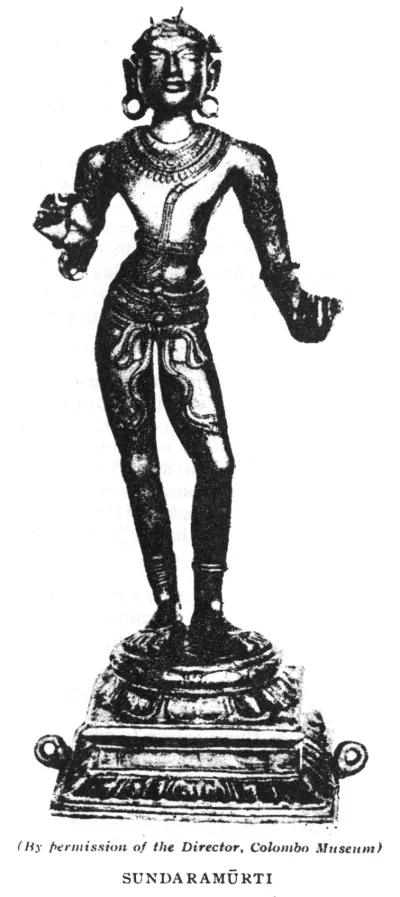
SUNDARAMŪRTI
SUNDARAMŪRTI SWAMI AND HIS HYMNS
III.
SUNDARAMŪRTI SWAMI
(Abbreviated as SUNDARAR)
The third of these hymn-writers, named in full Sundaramūrti Swāmi, was, like Sambandar, a Brahman. He was born in the South Arcot District, and is generally believed to have flourished in the first quarter of the ninth century A.D. He evidently sat loose to caste scruples, for neither of his two wives was a Brahman. One was a dancing-girl in the Śaivite temple at Tiruvārūr, the modern Tiruvalur in the Tanjore District, while the other was a Vēḷāḷa woman of Tiruvottiyūr, now a suburb of Madras. His life seems to have been no happier than life in polygamy usually is, and to add to his difficulties he sometimes found himself without food for his ladies to eat. He frankly praised God for what he could get, and on the whole his hymns are on a lower spiritual plane than those of the first two writers, though there are some which bear the marks of real spiritual experience. Of the sixty-three saints whom Śaivites hold in special honour, Sundarar seems to have been the last, for he sang the praises of the other sixty-two.
Sundarar, as our first sample of him shews, was not only later than the two authors whom we have been studying; he was the last of the sixty-three canonized saints of Śaivism. A serious weakness of the religion here shews its head. Śiva has his favourites, who can do no wrong. The stanza is given in prose, for these names cannot fit into any English metrical line. The first two will be recognised as names of the poets whose work we have been considering. Nāḷaippōvān is Nandan, the pariah saint. Silandi (= spider) is Kōchchengaṭ Chola, who figures largely in early Tamil history.
65. Ñānasambandar and Tirunāvukkarasar, skilled in the Tamil tongue, Nāḷaippōvān, learned Sūdan, Sākkiyan, Silandi, Kaṇṇappan, Kaṇampullan, these may do wrong, but yet Thou count’st it right. Hence have I come to the sounding anklets of Thy feet, O lord of Tiruppungūr with its pools where blossoms many a golden lotus gem.
To English ears the metre of the next two verses, which are common favourites, has a curious sound. It is a close reproduction of the Tamil, so close that the tune of the Tamil hymn could be sung to the English words.
66. Golden art Thou in Thy form, girt around with the fierce tiger's skin,
Fair shines Thy tangle of hair, crowned with blooms from the kondai's bright tree,
Sov’reign, great jewel art Thou, the red ruby of Mal̤apāḍi,
Mother, on Thee, none but Thee, can my heart evermore fixèd be.
67. Clad in the little loin-cloth, my body with holy ash white,
Lo I have come to Thy foot; O my head, I beseech Thee, take me.
Portion of sword-eyed Umā, Thou red ruby of Mal̤apāḍi,
Friend, ’tis on Thee, none but Thee, can my heart evermore fixèd be.
Is the Śiva manifested at one shrine so distinct from the Śiva manifested at another as to endanger the unity of God? If tradition is right, the danger is very real, for Sundarar was already worshipping at one shrine, Tiruvottiyūr, when he remembered the lord of Ārūr, and deciding to go to him like a returning prodigal, sang this stanza.
68. Ah sinful, I have left the path of love and service pure!
Now know I well the meaning of my sickness and my pain.
I will go worship. Fool! how long can I so far remain
From Him, my pearl, my diamond rare, the king of great Ārūr.
The joy in God which shines in our next hymn evidently rests on some experience of divine grace which we should have liked to hear more definitely described.
69. O madman with the moon-crowned hair,
Thou lord of men, thou fount of grace,
How to forget Thee could I bear?
My soul hath aye for Thee a place.
Veṇṇey-nallūr, in "Grace's shrine"
South of the stream of Peṇṇai, there
My father, I became all thine;
How could I now myself forswear?
70. I roamed, a cur, for many days
Without a single thought of Thee,
Roamed and grew weary, then such grace
As none could win Thou gayest me.
Veṇṇey-nallūr, in "Grace's shrine"
Where bamboos fringe the Peṇṇai, there
My Shepherd, I became all thine;
How could I now myself forswear?
71. Henceforth for me no birth, no death,
No creeping age, bull-rider mine.
Sinful and full of lying breath
Am I, hut do Thou mark me Thine.
Veṇṇey-nallūr, in "Graces shrine"
South of the wooded Peṇṇai, there
My Master, I became all thine;
How could I now myself forswear?
The varying mood of the saint, now joyous and triumphant, now plaintively looking for death, is reflected in the next two verses from one hymn.
72. Linked to naught else in life, my mind thinks only of Thy holy feet.
I'm born anew, from this time forth I pass the way of birth no more.
In Koḍumuḍi, lord austere, where wise men Thee with praises greet,
Should I forget Thee, my own tongue 'Hail, Śiva'! crying, would adore.
73. When will the end draw nigh, sense fade, life close, and I the bier ascend?
This, naught but this, is all my thought. But, lord of speech, Thou light on high,
Where the bright streams of Kāviri to Koḍumuḍi coolness lend,
Should I forget Thee, my own tongue to Thee would loud 'Hail, Śiva' cry.
God should deliver His own from death. The appeal here is to the familiar story of Markandeya (see No. 3). Yama is the god of death who gathers in the souls of men.
74. The young saint refuge sought from Death;
To save him, Thou grim Death did’st slay,
Such deeds Thy might accomplisheth,
And I who have beheld them pray
"O Father, should dread Yama press
On me, forbid him. ’Tis my slave";
Do Thou in green Pungūr confess.
I've reached Thy foot, and Thou can’st save."
Sundarar is sure that Śiva will understand his perplexities in supplying the needs of his fair ladies. For does not Śiva Himself bear the burden of two ladies, Pārvati his consort, and Gangā (lady Ganges) in his hair? Sundarar, in the legend with which these verses are connected, when one of his wives was suffering hunger, miraculously received some uncooked rice from Śiva. This was not enough; to complete the miracle Śiva must remove the rice for him to Ārūr the abode of his fair one. This too was done in answer to the hymn of which the next two stanzas are a sample.
75. Ever I think but of Thee;
Daily in worship I bow;
She of the sword-piercing eyes,
Leave her not suffering now.
Kōḷili's lord, Thou didst give
Rice in Kuṇḍaiyūr this day.
No man to bring it have I,
Bid it be sent me, I pray.
76. Thou art half woman Thyself;
Gaṅgā is in Thy long hair.
Full well canst Thou comprehend
Burden of women so fair.
Kuṇḍaiyūr circled with gems,
There didst Thou give rice to-day.
Source of all, wonderful one,
Bid it be sent me, I pray.
The saint advises his fellow-poets to sing the praises of Śiva rather than the praises of men because they seldom reward the poets. Śiva rewards them here and hereafter. The Pāri mentioned in 78 was a chieftain in the Tamil country in the early centuries of our era, famed for his liberality.
77. Though ye fawn on men of lies,
They to saints will nothing give;
Sing not them, O poets wise,
But if ye would wealth receive
Sing the Sire of Puhalūr;
Here your wants will be supplied,
Pain will flee; there evermore
Ye will kings in heav’n abide.
78. Call the weak by Bhima's name,
Style him Arjun with his bow,
Give the mean man Pāri's fame,
Not a gift will he bestow.
Sing, O bards, our holy God,
White with ash, in Puhalūr.
In the deathless one's abode
Ye shall reign for evermore.
Life and experience have no value, no reality. God alone is real, the refuge from the unreal.
79. Our life is all unreal,
Its end is only dust,
Out of the sea of birth
Come ruin, pain and lust.
Delay not to do good
But praise Ketāram's king,
Whom Vishṇu and great Brahm
Vainly sought sorrowing.
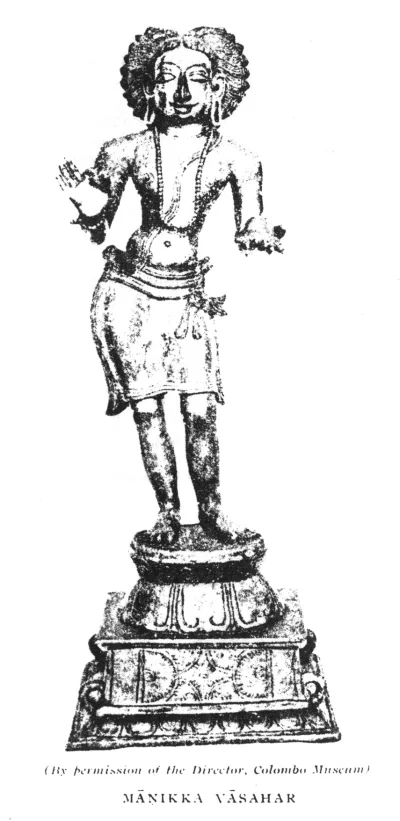
MĀṆIKKA VĀSAHAR
MANIKKA VĀSAHAR AND HIS HYMNS
IV.
MĀṆIKKA VĀSAHAR
(Sanskrit form MĀṆIKYA VĀCHAKA)
In the days when the powerful Pāndyan Kings flourished in Madura, there was once a prime minister who early became convinced of the transitoriness of this world's life and its riches. When on a visit to Perundurai, now Āvudaiyārkoil in the Tanjore District, he suddenly and completely came under the influence of a Brahman religious teacher, who for him was the manifestation of the very God Himself. Then and there he began to sing the "Sacred Utterance" (Tiruvāsaham), and was named by his preceptor "Utterer of Jewels" (Māṇikka Vāsahar). Returning to Madura, he forsook his high office with all its rewards, to become a religious poet wandering without earthly attachments from shrine to shrine. The stories clustering around his religious experience can be read by English readers in Dr. Pope's great edition of his work. We find him practising austerities at Chidambaram, or miraculously giving the gift of speech to the dumb daughter of the Chōl̤a king, or defeating in disputation a band of Buddhists from Ceylon, but of certain historical information about him we have practically none. Even the question of the century in which he lived is a battleground of the antiquarians. Tradition places him in the fifth century, earlier than the writers of the Dēvāram;
but the opinion of scholars seems to be converging on the view that he lived in the latter half of the ninth, or the first half of the tenth century of our era. Another of his works is the Tirukkōvaiyār, an erotic poem of four hundred stanzas. Among Tamil Śaivite writers none makes a stronger devotional appeal than Māṇikka Vāsahar. There is a common Tamil saying that nothing can melt the heart of the man who is not melted by the Tiruvāsaham.
Stanzas 80-92 are samples from an opening poem of one hundred stanzas, each ten of which has its own metre and is fairly complete in itself. They fairly reflect the saint's varying moods. Notice the importance he attaches to emotion; his worst self-reproach is for feeling no frenzy. As to his conception of God, see how the word 'grace' recurs in nearly every stanza. And yet that God of grace is called (in No. 84) both being and non-existence.
The Hundred Verses80. Thrills and trembles my frame;
Hands are lifted on high;
Here at Thy fragrant feet,
Sobbing and weeping I cry;
Falsehood forsaking, I shout,
"Victory, victory, praise!
Lord of my life, these clasped hands
Worship shall bring Thee always.
81. Indra or Vishṇu or Brahm,
Their divine bliss crave not I;
I seek the love of Thy saints,
Though my house perish thereby.
To the worst hell I will go,
So but Thy grace be with me.
Best of all, how could my heart
Think of a god beside Thee?
82. Though like Thy saints I seem, ’tis but the acting of a part.
Yet wondrous swift I run to reach the heaven where Thou art.
O hill of gold and precious gems, grant in Thy grace to me
A heart to melt, lord of my life, in ceaseless love to Thee.
83. I have no fear of births, but quake at thought that I must die.
E’en heav’n to me were naught; for earth's whole empire what care I?
O Śiva wreathed with honeyed blossoms, "When shall come the morn
When Thou wilt grant Thy grace to me?" I cry with anguish torn.
84. The sky, earth, wind, the light, our very flesh and life art Thou,
Being art Thou, non-being too, Thou king, who see’st how
Men dance like puppets with their foolish thoughts of 'I' and 'Mine,'
While Thou the cords dost pull. What words can tell Thy praise divine?
85. At sound of cries like this, "O Bull-rider whose spreading hair
The falling stream receives! "Heaven's Lord," true devotees there were,
Whose love-thrilled heart broke forth, like stopped-up rivers rushing down.
Yet Thou didst choose no one of them, but me to be Thine own.
And yet my body will not turn from heel to head one heart
To melt in love for Thee, one eye to shed the tears that smart
In swelling floods. Ah! wretched that I am, who only moan!
My two eyes are unfeeling wood, my heart a great dead stone!
86. Amid the fruits of deeds I lay. Thou didst thyself reveal
With words of comfort saying "Come, I will destruction deal
To evil fruit of deeds," and thus thou mad’st me all Thy slave.
And yet I stand as if a statue made of steel, nor rave,
Nor sing, nor cry, nor wail—woe's me—nor in my spirit faint
With deep desire, so dull am I. O being ancient,
Thou art beginning, Thou art end: tell me, how can I be
So dead at heart? The end if this I do not dare to see.
87. Him though men seek, none fully know; in Him no evil is.
None are His kindred; knowledge perfect, effortless is His.
A cur am I, yet He hath giv’n to me in sight of men
A place on earth, and shewed me things far beyond mortal ken.
He told me what no ears can hear; from future births He sav’d.
Such magic wrought my Lord who me hath lovingly enslaved.
88. Our God of gods, whom e’en the devas’ king knows but in part,
Ruleth the three who in the fair world-gardens life impart,
And life maintain, and life destroy; our First, Reality,
Father of old, whose consort Umā is, our sovereign, He
Came down in grace and made e’en me to be His very own.
Henceforth before no man I bow; I fear but Him alone.
Now of His servants’ servants I have joined the sacred throng,
And ever more and more I'll bathe in bliss. with dance and song.
89. The meanest cur am I; I know not how to do the right;
’Twere but what I deserve, should’st Thou my wickedness requite
With the dread fate of those who never saw Thy flowery feet;
For though mine eyes have seen, my ears have heard saints guileless, meet,
Who reached Thy fragrant presence, yet I stay, for false am I,
Fit for naught save to eat and dress, Lion of victory.
90. None but myself has sunk myself. Thy name be ever praised!
No blame lay I on Thee, lauds to my Master be upraised!
Yet to forgive is aye a mark of greatness. Praise to Thee!
Lord of the land celestial, Praise! O end this life for me.
91. The fawn-eyed maid is part of Thee! From holy writ Thou’rt hid!
Thou’rt honey, yea ambrosia, by man's mind not compassèd.
O king who bearest with my faults, some harsh words did I say.
Thy saints have entered heaven. Without, falsehood and I still stay.
92. Since I am false, and false my heart, and false my very love,
Howe’er I weep, still held by deed can I reach Thee above?
O honey, nectar, O essential sweetness, great as sweet,
Grant grace to me to find the path that leads unto Thy feet.
93. Heav’n, earth, and all that therein is, thou makest without seed.
Thou dost preserve and Thou destroy. ’Tis Thou who hast decreed
That I though treacherous, mean, should be a man who frenzied faints
Before Thy temple gates, one with the band of Thy true saints.
What men themselves have planted, e’en a poisonous mango tree,
They root not up. O Lord of mine, as such a tree keep me.
Our next five stanzas, taken from a hymn of fifty, are full of the pathos expressed in the title, which is a refrain recurring in every verse. Only flashes of the light of the presence of God pierce the prevailing gloom. The saint cannot free himself from sensuality,
even while he hates it. He wonders whether even the God who drank poison for others’ sake will leave him alone.
Wilt Thou Leave Me?94. Mingling in grace with me, O rider of the bull, Thou mad’st me Thine.
But wilt Thou leave me? Thou whose form in the fierce tiger's skin is clad,
Uttarakōsamaṅgai old has Thee for king. O lord of mine
With matted hair, hold Thou me up; for I am weary grown and sad.
95. Set in the marge of flowing stream that eats its banks away, the tree
Shakes to its fall; and thus am I, my sense bewitch’d by maids’ dark eyes.
Uttarakōsamaṅgai's king, spouse of gem-vested Pārvati,
Who dwell'st in Ārūr holy, O protector, for my help arise.
96. In ignorance I spurned thy grace. Dost Thou, my gem, now me despise,
And wilt thou leave me? O destroy my sum of deeds and make me thine.
Uttarakōsamaṅgai's king, ’tis surely true, the great and wise,
When only little curs play false, to mercy ever will incline.
97. With none to cheer me from my fear, far have I wandered wearily,
O Lightning-like, and wilt Thou leave me? If I truly thee compare,
Uttarakōsamaṅgai's king, I find naught else resembling Thee;
But a true father, mother dear art Thou to me, my treasure rare.
98. Whether I praise or curse Thee, still I'm stained with sin and sorrowing.
Yet, wilt Thou leave me? Splendour shining like the red-hued coral mount,
Master, thou drankest poison black, the humbler beings pitying,
That I, Thy meanest one, might find no poison, but a nectar fount.
Our poet made songs which maidens might sing in their rhythmical games, or as they sat at the grinding-stone. In India the boatman sings as he rows, the ryot sings as he draws from the well, the sepoy sings on his march. A feature of such songs is the refrain, which is usually a mere collection of euphonic syllables, though it may have a meaning. Here are specimens of a few songs intended for women. The refrain of the first, "Ēlōrembāvāy" probably means "Receive and ponder what I say, O lady." The Grinding song, strangely enough, is used at funerals, as also is the 'Antiphony.' The song of 'The Three Castles’ Destruction' is supposed to accompany play with a ball or a kind of shuttle called 'undī.' For the legend of the Three Castles, see page 7. 'The Shoulder-Play' is for some ancient game in which women grasped each other's shoulders.
Song of the Maidens99. Older are Thou than the oldest of all,
Newest of all that is new.
At Thy saints’ feet we in service will fall,
We are Thy handmaidens true.
None but Thy bondsmen shall call us their own;
Lord, we would none others wed;
We would be slaves at their bidding alone:
So be our bliss perfected.
Ēlōrembāvāy.
100. "Sure for Thy child there is refuge with Thee,"
Trembling we take up the cry.
Hear, O our Lord, while we bring Thee one plea,
Grant but one boon for our joy.
May only Thy lovers rest on our breast,
Let our hands’ labour be theirs.
Only on such our eyes night and day rest,
Then sun rise west, east, who cares?
Ēlōrembāvāy.
101. Grind we the powder gold, that He may bathe;
For He is Scripture, He is sacrifice;
He's being's truth, and being's falsehood too;
Light is He, yea, and He is darkness deep;
He is deep sorrow, and true bliss is He;
He is the half, and He again the whole;
Bondage is He, but He is true release;
He is the alpha, He the omega.
102. "His form is smeared with ashes white; the snake His strange adornment is;
The secret scriptures utters He: what kind of god, my friend, is this?
"Why talk of ash-smear, holy speech, adornment strange? This only know,
This god, of every living thing is the true nature. Chāḷalō."
103. "My father and my master, He of all men Lord supreme, is clad
With but a hanging loin-cloth stitched; pray tell me, friend, is He not mad?
"The Vedas four with meaning fraught, the everlasting Śāstras, know
That these are but the threads whereof is wove His loin-cloth. Chāḷalō."
104. The burning-ground's His temple fine; the tiger's skin His raiment is;
Father or mother hath He none; He's all alone; my friend, see this.''
"Though He no parents hath, no kin, yet should His anger kindle, lo,
The whole wide world would straightway turn to dust and ashes. Chāḷalō."
105. "Though I am but a cur, yet when I turned to Him who hath no end,
Into a sea of bliss He made me sink o’erwhelmed; see this, my friend."
"Those holy feet that sank thee in the sea of bliss o’erwhelmèd, know,
E’en to the very gods in heav’n they're richest treasure. Chāḷalō."
106. Bent was the bow, begun the fight,
The castles three were ’whelmèd quite, (Fly, undī)
Three castles blazing with one light. (Fly, undī)
107. One bolt in Śiva's hand saw we,
One single bolt for castles three, (Fly, undī)
And e’en that one scarce needed He. (Fly, undī)
108. Cleft lay the car at His foot's tread,
The axle was all shatterèd, (Fly, undī)
Three castles ruined lay and dead. (Fly, undī)
109. Poor slave was I, how long I poured out all my days for naught,
To Him the all-supreme no homage rendering! Yet see,
How He, the jewel from eternal ages incorrupt,
Has come and drawn the prison-bolt of births, and set me free.
Play we Tōṇōkkam
In the poetry of all lands lovers have appealed to birds to be their messengers to the distant loved one. This is so common in Indian poetry as to have become a recognised convention. Here the saint sends his message of love and devotion, in one case by a humming bee, in the other by the Indian cuckoo, to Śiva who dwells in Tillai, i.e. Chidambaram.
The Bee's Message110. Hard-hearted thief, stiff-necked was I, but no such name He called me;
My stony heart He melted, and by mercy He enthralled me.
The swans abound in Tillai's lovely hall of gold, His dwelling.
Fly, king of bees, at His gold anklets hum, my message telling.
111. Cur though I am, my lord has set me His great glory singing;
To me, the mad, His patient grace is aye forgiveness bringing;
Scorning me not, He deigns to take the service I can do Him.
Mother and God. Go, king of bees, hum thou my message to Him.
112. Far would my heart and mind have gone from Him, but He compelled me,
The lord with tangled locks, and His fair spouse, they saved and held me.
He is the sky, the mighty sea, east, west, north, south, indwelling.
His feet with honey drop. There, king of bees, my praise be telling.
113. In this world's treasure false immersed lay I, and self-deceivèd,
Held it for treasure true, but for His own He me receivèd.
My precious life itself is He, in Tillai's hall abiding.
Go, king of bees, at His red lotus feet my words confiding.
114. Hear, little cuckoo in the honey’d orchard groves.
Heav’n did He spurn; to save us men, to earth He calve,
Boundless in giving, reeking naught of flesh of mine,
Entered my mind, and there my very thought became.
He, the alone, the spouse of her whose pure eye's ray
Shames the gazelle in softness, call Him hither, pray.
One of the little childishnesses involved in idolatry is that every morning with solemn ceremony the idol must be wakened from his sleep, bathed, and dressed. Here is a song with which he is roused from slumber. But notice how successfully our author has filled his poem with the fresh morning feeling, and the sights and sounds of the sudden break of the Indian dawn.
The Idol's Awakening115. Hail to Thee, treasure rare,
Source of all prosperity,
Dawn has come, at Thy feet,
Flowers themselves, fair flowers lay we.
Praising Thee, we await
Smiles that blossom fair and sweet
In Thy face, as we fall
Prone adoring at Thy feet.
Śiva, Lord, dweller in
Perunduṛai, where expand
Lotus flowers, petalled white,
In the cool moist pasture land,
Thou whose flag is the bull,
Thou the Lord of all my ways,
Now O Lord of us all,
From Thy couch rise in Thy grace.
116. Now anigh Indra's East
Draws the sun; dark flies apace
At the dawn; and the sun
Of the kindness in Thy face
Riseth high’r, ever high’r,
As like fair flowers opening,
Eyes unclose from their sleep,
Eyes of Thee our beauteous king.
Hear how now clouds of bees
Humming bright fill all the air.
Śiva, Lord, dweller in
Holy Perunduṛai fair,
Thou wilt come to bestow
Favours rich, Oh shew Thy face!
Mountain-joy, ocean-bliss,
From Thy couch rise in Thy grace.
117. Cocks now crow to the morn,
While the cuckoos loudly call;
Little birds sweetly sing,
And the conch-shell sounds o’er all;
Light of stars fades away
Into common light of day;
Dawn and sun come as one,
Now to us, O God, display
In Thy love Thy twin feet,
Gracious, decked with anklets rare.
Śiva, Lord, dweller in Holy Perunduṛai fair,
Hard for all men to find,
Yet to me Thou shewedst Thy face.
Now O Lord of us all,
From Thy couch rise in Thy grace.
118. On this side some men play
Lutes and vīṇas sweet of sound;
On that side some men chant
Ancient Ṛik, their songs resound;
In their hands some have brought
Wreaths of many blossoms wove;
Some bow down, some men weep,
Some men sway, o’ercome by love;
Clasping hands o’er their heads,
Others stand with reverent air;
Śiva, Lord, dweller in
Holy Perunduṛai fair,
Even me didst thou save;
Sweet to me have been Thy ways.
Now, O Lord of us all,
From Thy couch rise in Thy grace.
The rest of our specimens of the 'Holy Utterances' may be left to explain themselves without comment, save for a single line of title. Where two or more stanzas are given from a poem, the title here given is a translation from the Tamil.
Only with Thee and Thy Saints!119. Our lady aye is in Thy heart,
As Thou in hers; and if ye both
In mine do dwell, grant me a part
Among your slaves, O ever First.
Unending lord, in Tillai's hall who dost abide,
Let this deep yearning of my soul be satisfied.
120. Thou gav’st Thyself, Thou gained’st me;
Which did the better bargain drive?
Bliss found I in infinity;
But what didst Thou from me derive?
O Śiva,. Perunduṛai's God,
My mind Thou tookest for Thy shrine:
My very body's Thine abode:
What can I give Thee, Lord, of mine?
121. Caught am I in passion's snare from women's liquid eyes;
Stabbed at heart, a cur. O wisdom's light, no aid I see.
Only lord, whose lady's feet are softer than the down,
How I long to hear Thy coral lips speak cheer to me.
122. Our lord supreme, both earth and heav’n indwelling,
See how I have no other help but Thee.
Thou king of Śiva's world, bright beyond telling,
Dweller in Perunduṛai, look on me.
Who'll hear my cry, who list to my complaining,
If Thou Thy grace deny, who saved’st me?
I find in sea-girt earth no joy remaining.
Now let Thy grace speak, bid me come to Thee.
123. In Thee she dwells whose feet than down are softer;
See how I have no other help but Thee.
Thou king of Śiva's world, my gracious master,
Dweller in Perunduṛai, look on me.
Fear holds me; for, in dark confusion godless,
I did forget the grace that savèd me.
Dog and deceitful am I. Life is joyless.
Now let Thy grace speak, bid me come to Thee.
124. In Thee she dwells whose ancient praise is faultless;
See how I have no other help but Thee.
Thou king of S`iva's world, the bright moon wearing,
Dweller in Perunduṛai, look on me.
Whom save Thee could I worship with my praises?
Can any other refuge give for me?
O Rider of the bull, my life is joyless.
Now let Thy grace speak, bid me come to Thee.
125. O lord of Perunduṛai, place of peace,
To them who call Thy name, beyond compare
True joy art Thou. Thou mad'st my woe to cease
When good and ill deeds done were balanced fair.
Then lest unwith’ring seeds of birth should grow,
In Kal̤ukunḍu Thy fair self didst shew.
126. Myself I cannot understand, nor what is day nor night;
He who both word and thought transcends has reft my senses quite,
He who for bull has Vishṇu, and in Perunduṛai dwells,
O Light supreme, in Brāhman guise has cast on me strange spells.
127. I ask not fame, wealth, earth or heav’n. No birth, no death for me.
None will I touch who love not Śiva. Now ’tis mine to see
Abiding Perunduṛai, wear the King's foot as my crown;
Never will I leave this His shrine, nor let Him leave His own.
128. Art Thou like honey on the branch too high for me to climb?
Or art Thou nectar ocean-churned? O Hara, King sublime,
In Perunduṛai, circled with moist fields, I can set Thee
With form ash-smeared, the spotless. Can I bear my ecstasy?
129. Many in this great earth who live do penance; I alone
Bearing this frame of flesh, a barren jungle-tree have grown.
Dweller in Perunduṛai old where blooms the kondai tree,
May I the sinner cry "Wilt Thou not grant Thyself to me"?
130. I fear not serpents lurking smooth;
I fear no liars’ feignèd truth;
But when I see fools venturing
E’en to the foot of Him our king,
Our three-eyed Lord with matted hair,
Of His great godhead unaware,
Fools thinking other gods can be,
Terror such sight inspires in me.
131. I fear no javelin's gory blade;
Nor sidelong glance of bangled maid;
But when I see men void of grace
Drinking no sweetness from the praise
Of my unchiselled Gem, whose dance
In Tillai's hail is seen, whose glance
Melts men's whole frame in ecstasy
Terror such sight inspires in me.
132. King of the heavenly ones! All-filling Excellence!
E’en to vile me Thou Thy wonders hast shown;
Balm of true bliss, ending false earthly bliss of sense,
Thou my whole household did’st take for Thine own.
Meaning of holy writ! Wondrous Thy glory!
True wealth, our Śiva, to Thee, Lord, I cling.
Never to loose my hold, firmly I cling to Thee;
Where canst Thou go, leaving me sorrowing?
133. King of celestial ones, ever with bull for steed,
Evil am I, yet my riches art Thou;
Lest I should rot in my foul flesh, and die indeed,
Thou hast preserved me, and Thine am I now.
Thou art our God; Thou of grace art a boundless sea,
Saved from my flesh, now to Thee, Lord, I cling.
Never to let Thee loose, firmly I cling to Thee;
Where can’st Thou go, leaving me sorrowing?
134. Thou dids’t come into my vile fleshly body,
E’en as ’twere into some great golden shrine;
Soft’ning and melting it all, Thou hast savèd me,
Lord condescending, Thou gem all divine!
Sorrow and birth, death, all ties that deceivèd me,
Thou did’st remove, all my bonds severing;
True bliss, our kindly Light, firmly I cling to Thee;
Where canst Thou go leaving me sorrowing?
135. I ask not kin, nor name, nor place,
Nor learnèd men's society.
Men's lore for me no value has;
Kuttālam's lord, I come to Thee.
Wilt thou one boon on me bestow,
A heart to melt in longing sweet,
As yearns o’er new-horn calf the cow,
In yearning for Thy sacred feet?
136. I had no virtue, penance, knowledge, self-control. A doll to turn
At others’ will I danced, whirled, fell. But me He filled in every limb
With love's mad longing, and that I might climb there whence is no return,
He shewed His beauty, made me His. Ah me, when shall I go to Him?
137. Fool's friend was I, none such may know
The way of freedom; yet to me
He shew’d the path of love, that so
Fruit of past deeds might ended be.
Cleansing my mind so foul, He made me like a god.
Ah who could win that which the Father hath bestowed?
138. Thinking it right, sin's path I trod;
But, so that I such paths might leave,
And find His grace, the dancing God,
Who far beyond our thought doth live,
O wonder passing great!—to me His dancing shewed.
Ah who could win that which the Father hath bestowed?
APPENDIX I
SHRINES MENTIONED IN THESE POEMS
Ādutuṛai, or Āvadutuṛai, in Tanjore District, now a station on the South Indian Railway.
Aiyāṛu, twelve miles from Tanjore.
Ālavāy, or Uttarakosaimangai, Madura.
Aṇṇāmalai, or Tiruvaṇṇāmalai, in South Arcot District.
Ārūr, Tiruvallur, Tanjore District.
Athihai Viraṭṭānam, South Arcot District.
Bramāpuram, Shiyali, Tanjore District.
Chenkāṭṭankuḍi
Chidambaram, or Tillai, or Perumpattapuliyūr, in S. Arcot District, the most venerated place of Śaivism.
Chōl̤a, one of the three great kingdoms into which the ancient Tamil country was divided.
Comorin, extreme southern point of India, still a great place of pilgrimage.
Dharmapuram, near Tranquebar, Tanjore District.
Kāviri, or Cauvery, the most sacred river in South India.
Kachchi Ehambam, or Kānchipuram, the modern Conjeeveram, in North Arcot District.
Keḍila
Kētāram
Koḍumuḍi, near Erode, Coimbatore District.
Kōḷili, near the modern Tiruvallur, Tanjore District.
Kongu
Kundaiyūr, near Tiruvallur, Tanjore District.
Kuttālam, Tanjore District.
Mal̤apādi, South Arcot District, near Trichinopoly.
Maṛaikkīdu, the modern Vetharaniam, Tanjore District. Curiously enough, the modern name is the Sanskrit translation of the Tamil, meaning 'Forest of the Vedas,' i.e., lonely place where Vedas are studied.
Maruhal, on the Cauvery River, Tanjore District.
Neyttānam, on the Cauvery River, Tanjore District.
Ottiyūr, better known as Tiruvottiyur, a few miles north of Madras, now practically a suburb.
Pal̤anam, Tanjore District.
Perumpattapuliyur, see Chidambaram.
Perunduṛai, Āvudaiyārkoil, Tanjore District.
Puhalūr
Pungūr, seven miles from Shiyali, Tanjore District.
Pūnturutti
Puvaṇam, twelve miles from Madura.
Tillai, see Chidambaram.
Tiruputtūr, Ramnad District, near Pudukottah.
Tiruvaṇṇāmalai, see Aṇṇāmalai.
Tiru Neyttānam, see Neyttānam.
Tūngānaimādam
Uttarakōsamangai, Ramnad District.
Valivalam on the Cauvery, Tanjore District.
Venneynallūr, South Arcot District.
NḄ.—"Tiru" is an epithet meaning "Holy," but where it has become practically part of the place-name, that name is given in this list as if it began with T.
APPENDIX II
SYSTEM OF TRANSLITERATION AND PRONUNCIATION OF TAMIL LETTERS
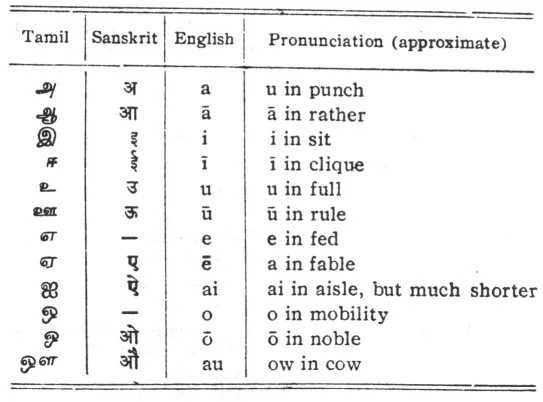
NḄ.—The Tamil alphabet is not fully phonetic as are the Sanskrit and the other Dravidian alphabets. Several letters indicate different sounds in different connections.
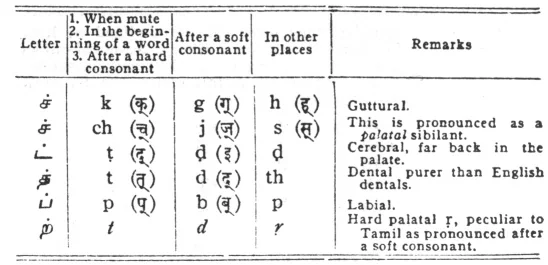
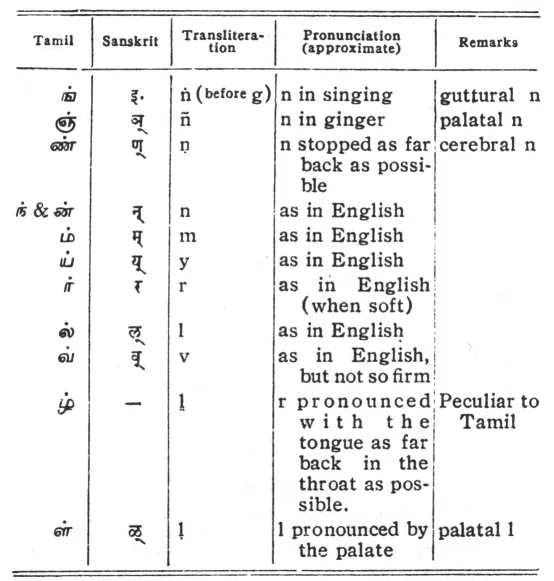
Sanskrit words, unless they have become modified by long Tamil usage, as, for example, in the author's name Māṇikka Vāsahar, are transliterated according to Sanskrit pronunciation, on the system used in other books in this series, the Sanskrit alphabet being represented as follows:—
|
k |
kh |
g |
gh |
ṅ |
|
ch |
chh |
j |
jh |
ñ |
|
ṭ |
ṭh |
ḍ |
ḍh |
ṇ |
|
t |
th |
d |
dh |
n |
|
p |
ph |
b |
bh |
m |
|
y |
r |
1 |
y | |
|
ś |
sh |
s |
h | |
|
ṛi |
ṁ |
ḥ |
(The Numbers are those of Pages, not of Stanzas.)
ĀDIŚESHA, 7.
Aiyāṛu, 61.
Al̤vār, 4.
Aryan, 3.
Ash, sacred, 23.
Astrology, 21.
Asuras, 7.
Athikai Virattānam, 39, 43.
Āvaduturai, 49, 65.
Avudaiyārkoil (Perundurai), 86, 111, 117 f., 121.
BRAHMĀ, 4, 6, 13, 21, 39, 41, 55, 89.
Brahmans, 17. 33, 59, 71, 88.
Buddhism, 11, 27, 86.
CAUVERY, 15, 55.,
Chidambaram (Tillai, Perumpattapuliyūr), 5, 17, 65, 86, 107, 109, 115, 131.
Comorin, 57.
Conjeeveram, 19.
Consecration, 53.
Cuckoo as messenger, 107.
Cycles of existence, 67.
DANCE of Śiva, 5, 6.
Dēvāram, 2.
EMOTION, emphasis upon, 89, 91, 125.
FAVOURITISM in God, 73.
GAMES, songs sung in, 101 f.
Ganges, 5, 23, 51, 79.
Grace, divine, 65, 89, 127.
HARA (Śiva), 33.
IDOL, worship of, 111.
Indra, 51, 89, 113.
JAINS, 11, 27, 33, 59, 61.
Joy in God, 47-51, 75, 77.
KAILĀSA, 5, 39. Kāḷī, 5,
Kal̤ukkundu, 119.
Katpaha tree, 47.
Kedila, 61.
Kētāram, 83.
Koḍumuḍi, 77.
Kōl̤ili, 81.
Kondai (cassia flower), 5, 73, 121.
Kulachchirai, 31.
Kūn Pāndiyan, 29.
Kundaiyūr, 81.
Kuttālam, 125.
MADURA (Ālavāy, Uttarakosamangai), 10, 19, 31, 33, 99.
Mahādev (Śiva), 51.
Mal̤apādi, 73.
Mangaiyarkkarasi, 29.
Mārkandeya, 15, 79.
Maruhal, 27.
Meru, 7.
Mīnākshi, 31.
Muyalahan, 5.
NAMASIVĀYA, 25, 67.
Nandan, 73.
Nandi (Śiva's bull), 5, 61.
Natarājan (Śiva), Frontispiece, 5.
Neyttānam, 15.
PALNY, 15.
Pāri, 81.
Pārvati (Umā), 5, 13, 59, 61, 63, 65, 75, 79, 93.
Periya Purāṇam, 29.
Pessimism, 51, 67, 83.
Pilgrimage, no need for, 57.
Planets, 21,
Puhalūr, 81.
Pungūr, 79.
Pūnturutti, 47.
Purāṇas, 4.
Pūvaṇam, 41.
RĀMESWARAM, 55.
Rāvaṇa, 7, 39.
Ṛig Veda, 3, 17, 59,-115.
Rudra, 3, 41.
SANKARA (Śiva), 51.
Shiyāli, 10, 11.
Sin, sense of, 43-47, 97, 99, 101.
Śiva:
Meaning of name, 3.
Conception of, 4 f.
Blue-throated; 8.
Delivering from death, 15, 79.
Including good and evil, 19, 103.
Unsearchable, 21.
Immanent in all, 91.
His saving grace, 127.
Śivāchāryar, 11.
TAMILIAN Antiquary, 29.
Tantras, 23.
Tirukkōvaiyār, 87.
Tiruvāchakam, 2.
Tiruvaḷḷūr (Ārūr), 25, 71, 75, 79.
Tiruvaṇṇāmalai, 13.
Tiruvottiyūr, 45, 71, 75.
Trichinopoly (Chirāpalḷi), 19.
Tungānaimādam, 39.
UMĀ (Parvati), 5, 13, 59, 61, 63, 65, 75, 79, 93.
Unreality of life, 51, 83.
VĀDĀPI, 29.
Vāk, 59.
Valivalam, 21.
Vāsuki, 8.
Vedāraṇiyam, 63.
Vedas, 55.
Vedāngas, 55.
Venneynallūr, 75.
Vīṇa, 49, 115.
Vishṇu, 4, 41, 83.
YAMA, 79.
Hymns of the Tamil Saivite Saints. 1921. Hermetic Cloud, https://hermeticcloud.com/library/kingsbury-hymns-of-the-tamil-saivite-saints/. Public-domain text reproduced in full; markup only.
Scanned, proofed and formatted at sacred-texts.com, January 2010, by John Bruno Hare. This text is in the public domain in the US because it was published prior to 1923.