Bibliotèque de Carabas
Volume VIII
Five hundred and fifty copies of this Edition have been printed, five hundred of which are for sale.
[All rights reserved]
The Secret Commonwealth ofElves, Fauns & Fairies
A Study in Folk-Lore & Psychical Research. The Text by Robert Kirk, M.A., Minister of Aberfoyle, A.D. 1691. The Comment by Andrew Lang, M.A. A.D. 1893

LONDON. M.D.CCCXCIII. PUBLISHED BY DAVID NUTT, IN THE STRAND
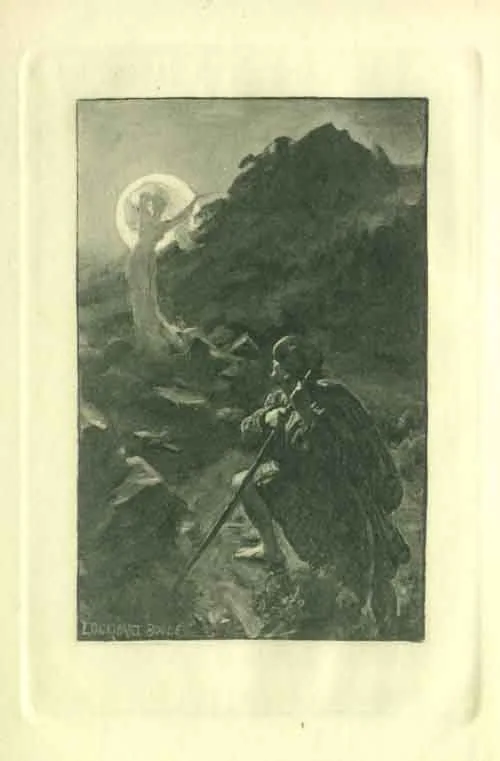
Frontispiece
Title Page
Front Cover

Spine
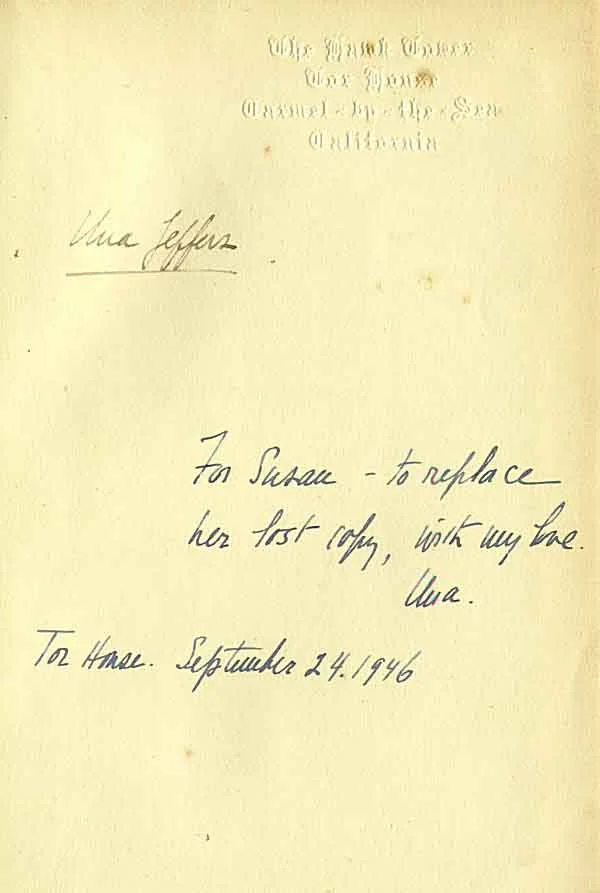
Inner front cover with inscriptions
DEDICATION
TO
ROBERT LOUIS STEVENSON,
O Louis! you that like them maist,
Ye're far frae kelpie, wraith, and ghaist,
And fairy dames, no unco chaste,
And haunted cell.
Among a heathen clan ye're placed,
That kens na hell!
Ye hae nae heather, peat, nor birks,
Nae troot in a' your burnies lurks,
There are nae bonny U. P. kirks,
An awfa' place!
Nane kens the Covenant o' Works
Frae that of Grace!
But whiles, maybe, to them ye'll read
Blads o' the Covenanting creed,
And whiles their pagan wames ye'll feed
On halesome parritch;
And sync ye'll gar them learn a screed
O' the Shorter Carritch.
Yet thae uncovenanted shavers
Hae rowth, ye say, o' clash and clavers
O' gods and etins--auld wives' havers,
But their delight ;
The voice d him that tells them quavers
Just wi' fair fright.
And ye might tell, ayont the faem,
Thae Hieland clashes o' oor hame.
To speak the truth, I tak' na shame
To half believe them;
And, stamped wi' TUSITALA'S name,
They'll a' receive them.
And folk to come, ayont the sea,
May hear the yowl of the Banshie,
And frae the water-kelpie flee,
Ere a' things cease,
And island bairns may stolen be
By the Folk o' Peace.
Faith, they might steal me, wi' ma will,
And, ken'd I ony Fairy hill,
I'd lay me down there, snod and still,
Their land to win,
For, man, I've maistly had my fill
O' this world's din.
The Fairy Minister
IN MEMORY OF
THE: REV. ROBERT KIRK,
WHO WENT TO HIS OWN HERD, AND ENTERED INTO
THE LAND OF THE PEOPLE OF PEACE,
IN THE YEAR OF GRACE SIXTEEN
HUNDRED AND NINETY-TWO,
AND OF HIS AGE
FIFTY-TWO.
____________
People of Peace! A peaceful man,
Well worthy of your love was he,
Who, while the roaring Garry ran
Red with the life-blood of Dundee,
While coats were turning, crowns were falling,
Wandered along his valley still,
And heard your mystic voices calling
From fairy knowe and haunted hill.
He heard, he saw, he knew too well
The secrets of your fairy clan;
You stole him from the haunted dell,
Who never more was seen of man.
Now far from heaven, and safe from hell,
Unknown of earth, he wanders free.
Would that he might return and tell
Of his mysterious company!
For we have tired the Folk of Peace
No more they tax our corn and oil
Their dances on the moorland cease,
The Brownie stints his wonted tail.
No more shall any shepherd meet
The ladies of the fairy clan,
Nor are their deathly kisses sweet
On lips of any earthly man.
And half I envy him who now,
Clothed in her Court's enchanted green,
By moonlit loch or mountain's brow
Is Chaplain to the Fairy Queen.
A. L.
KIRK'S
SECRET COMMONWEALTH.
INTRODUCTION.
1. THE HISTORY OF THE BOOK AND AUTHOR.
THE bibliography of the following little tract is extremely obscure. The title-page of the edition of 1815, which we reproduce, gives the date as 1691. Sir Walter Scott says in his Demonology and Witchcraft, (1830, p. 163, note), "It was printed with the author's name in 1691, and reprinted, in 1815, for Longman & Co." But was there really a printed edition of 1691? Scott says that he never met with an example. Research in our great libraries has discovered none, and there is none save that of 1815 at Abbotsford. The reprint, of one hundred copies, was made, as it states, from no printed text, but from "a manuscript copy preserved in the Advocates' Library." On page 45 of the edition of 1815,
at the end of the comments on Lord Tarbott's Letters, there is a "Note by the Transcriber"--that is, the person who wrote out the manuscript in the Advocates' Library: "See the rest in a little manuscript belonging to Coline Kirk." Now Coline or Colin Kirk, Writer to the Signet, was the son of the Rev. Mr. Kirk, author of the tract. If the son had his father's book only in manuscript, it seems very probable that it was not printed in 1691; that the title-page is only the title-page of a manuscript. Till some printed text of 1691 is discovered, we may doubt, then, whether the hundred copies published in 1815, and now somewhat rare, be not the original printed edition. The editor has a copy of 1815, but it is the only one which he has met with for sale.
The Rev. Robert Kirk, the author of The Secret Commonwealth, was a student of theology at St. Andrews: his Master's degree, however, he took at Edinburgh. He was (and this is notable) the youngest and seventh son of Mr. James Kirk, minister of Aberfoyle, the place familiar to all readers of Rob Roy. As a seventh son, he was, no doubt, specially gifted, and in The Secret Commonwealth he lays some stress on
the mystic privileges of such birth. There may be "some secret virtue in the womb of the parent, which increaseth until the seventh son be borne, and decreaseth by the same degree afterwards." It would not surprise us if Mr. Kirk, no less than the Rev. Robert Blair of St. Andrews (1650-60), could heal scrofula by the touch, like royal persons--Charles III. in Italy, for example. As is well known to all, the House of Brunswick has no such powers. However this may have been, Mr. Kirk was probably drawn, by his seventh sonship, to a more careful study of psychical phenomena than most of his brethren bestowed. Little is known of his life. He was minister originally of Balquidder, whence, in 1685, he was transferred to Aberfoyle. This was no Covenanting district, and there is no bigotry in Mr. Kirk's dissertation. He was employed on an "Irish" translation of the Bible, and he published a Psalter in Gaelic (1684). He married, first, Isobel, daughter of Sir Colin Campbell of Mochester, who died in 1680, and, secondly, the daughter of Campbell of Fordy: this lady survived him. From his connection with Campbells, we may misdoubt him for a Whig. By his first wife he
had a son, Colin Kirk, W.S.; by his second wife, a son who was minister of Dornoch. He died (if he did die, which is disputed) in 1692, aged about fifty-one; his tomb was inscribed--
ROBERTUS KIRK, A.M.
Linguæ Hiberniæ Lumen.
The tomb, in Scott's time, was to be seen in the cast end of the churchyard of Aberfoyle; but the ashes of Mr. Kirk are not there. His successor, the Rev. Dr. Grahame, in his Sketches of Picturesque Scenery, informs us that, as Mr. Kirk was walking on a dun-shi, or fairy-hill, in his neighbourhood, he sunk down in a swoon, which was taken for death. " After the ceremony of a seeming funeral," writes Scott (op. cit., p. 105), "the form of the Rev. Robert Kirk appeared to a relation, and commanded him to go to Grahame of Duchray. 'Say to Duchray, who is my cousin as well as your own, that I am not dead, but a captive in Fairyland; and only one chance remains for my liberation. When the posthumous child, of which my wife has been delivered since my disappearance, shall be brought to baptism, I will appear in the room, when, if Duchray shall throw over my
head the knife or dirk which he holds in his hand, I may be restored to society; but if this is neglected, I am lost for ever.'" True to his tryst, Mr. Kirk did appear at the christening and "was visibly seen;" but Duchray was so astonished that he did not throw his dirk over the head of the appearance, and to society Mr. Kirk has not yet been restored. This is extremely to be regretted, as he could now add matter of much importance to his treatise. Neither history nor tradition has more to tell about Mr. Robert Kirk, who seems to have been a man of good family, a student, and, as his book shows, an innocent and learned person.
II. THE SECRET COMMONWEALTH.
The tract, of which the reader now knows the history, is a little volume of somewhat singular character. Written in 1691 by the Rev. Robert Kirk, minister of Aberfoyle, it is a kind of metaphysic of the Fairy world. Haying lived through the period of the sufferings of the Kirk, the author might have been expected either to neglect Fairyland altogether, or to regard it as a mere appanage of Satan's kingdom--a "burning
question" indeed, for some of the witches who suffered at Presbyterian hands were merely narrators of popular tales about the state of the dead. That she trafficked with the dead, and from a ghost won a medical recipe for the cure of Archbishop Adamson of St. Andrews, was the charge against Alison Pearson. "The Bischope keipit his castle lyk a tod in his holl, seik of a disease of grait fetiditie, and oftymes under the cure of women suspected of witchcraft, namlie, ane wha confessit hir to haiff learnit medecin of ane callit Mr. Wilyeam Simsone, that apeired divers tymes to hir efter his dead, and gaiff hir a buik. . . . She was execut in Edinbruche for a witch " (James Melville's Diary, p. 137, 1583). The Archbishop, like other witches, had a familiar in the form of a hare, which once ran before him down the street. These were the beliefs of men of learning like James, the nephew and companion of Andrew Melville. Even in our author's own time, Archbishop Sharp was accused of entertaining "the muckle black Deil" in his study at midnight, and of being "levitated" and dancing in the air. This last feat, creditable to a saint or a Neo-Platonist like Plotinus, was reckoned for
sin to Archbishop Sharp, as may be read in Wodrow's Analecta. Thus all Fairydom was commonly looked on as under the same guilt as witchcraft. Yet Mr. Kirk of Aberfoyle, living among Celtic people, treats the land of faery as a mere fact in nature, a world with its own laws, which he investigates without fear of the Accuser of the Brethren. We may thus regard him, even more than Wodrow, as an early student in folk-lore and in psychical research--topics which run into each other--and he shows nothing of the usual persecuting disposition. Nor, again, is Mr. Kirk like Glanvil and Henry More. He does not, save in his title-page and in one brief passage, make superstitious creeds or psychical phenomena into arguments and proofs against modern Sadducees. Firm in his belief, he treats his matter in a scientific spirit, as if he were dealing with generally recognised physical phenomena.
Our study of Mr. Kirk's little tractate must have a double aspect. It must be an essay partly on folk-lore, on popular beliefs, their relation to similar beliefs in other parts of the world, and the residuum of fact, preserved by tradition, which they may contain. On the
other hand, as mental phenomena are in question--such things as premonitions, hallucinations, abnormal or unusual experiences generally--a criticism of Mr. Kirk must verge on "Psychical Research." The Society organised for that difficult subject certainly takes a vast deal of trouble about all manner of odd reports and strange visions. It "transfers" thoughts of no value, at a great expense of time and of serious hard work. But, as far as the writer has read the Society's Proceedings, it "takes no keep," as Malory says, of these affairs in their historical aspect. Whatever hallucination, or illusion, or imposture, or the "subliminal self" can do today, has always been done among peoples in every degree of civilisation. An historical study of the topic, as contained in trials for witchcraft, in the reports of travellers and missionaries, in the works of the seventeenth-century Platonists, More, Glanvill, Sinclair, and others, and in the rare tracts such as The Devil in Glen Luce and The Just Devil of Woodstock, not to mention Lavater, Wierus, Thyræus, Reginald Scott, and so on, is as necessary to the psychologist as to the folklorist. 1 If there be an element of fact
in modern hypnotic experiments (a matter on which I have really no opinion), it is plain that old magic and witchcraft are not mere illusions, or not commonplace illusions. The subliminal self has his stroke in these affairs. Assuredly the Psychologists should have an historical department. The evidence which they would find is, of course, vitiated in many obvious ways, but the evidence contains much that coincides with that of modern times, and the coincidence can hardly be designed--that is to say, the old Highland seers had no design of abetting modern inquiry. It may be, however, that their methods and ideas have been traditionally handed down to modern "sensitives" and "mediums." At all events, here is an historical chapter, if it be but a chapter in "The History of Human Error." These wide and multifarious topics can only be touched on lightly in this essay; the author will be content if he directs the attention of students with more leisure and a better library of diablerie to the matter. But first we glance at The Secret Commonwealth as folk-lorists.
Footnotes
xvi:1 Note ( a), p. 81.
III. "THE SUBTERRANEAN INHABITANTS."
Mr. Kirk's first chapter, "Of the Subterranean Inhabitants," naturally suggests the recent speculations of Mr. MacRitchie. The gist of Mr. MacRitchie's Testimony of Tradition is that there once was a race of earth-dwellers in this island; that their artificial caves still exist; that this people survive in popular memory as "the legendary Feens," and as the Pechts of popular tales, in which they are regarded as dwarfs. "The Pechs were unco wee bodies, but terrible strang." Here, then, it might be thought that we have the origin of Fairy beliefs. There really was, on this showing, a dwarf race, who actually did live in the "fairy-hills," or howes, now commonly looked on as sepulchral monuments.
There is much in Mr. MacRitchie's theory which does not commend itself to me. The modern legends of Pechts as builders of Glasgow Cathedral, for example, do not appear to prove such a late survival of a race known as Picts, but are on a level with the old Greek belief that the Cyclopes built Mycenæ (Testimony of Tradition, p. 72). Granting, for the sake of discussion,
that there were still Picts or Pechs in Galloway when Glasgow Cathedral was built (in the twelfth century), these wild Galloway men, scourges of the English Border, were the very last people to be employed as masons. The truth is that the recent Scotch have entirely forgotten the ages of mediæval art. Accustomed to the ill-built barns of a robbed and stinted Kirk, they looked on the. Cathedral as no work of ordinary human beings. It was a creation of the Pechts, as Mycenæ and Tiryns of the mighty walls were creations of the Cyclopes. By another coincidence, the well-known story of the last Pecht, who refuses to divulge the secret of the heather ale, is told in the Volsunga Saga, and in the Nibelungenlied, of the Last Niflung. Again, the breaking of a bar of iron, which he takes for a human arm, by the last Pecht is a tale current of the Drakos in modern Greece (see Chambers's Popular Traditions of Scotland for the last Pecht). I cannot believe that the historical Picts were a set of half-naked, dwarfish savages, hairy men living underground. These are the topics of Sir Arthur Wardour and Monkbarns. Mr. W. F. Skene may be said to have put the historic Picts in
their proper place as the ancestors of the Highlanders. The Pecht of legend answers to the Drakos and the Cyclopes: the beliefs about his habits may have been suggested by the tumuli, still more by the brochs: it seems less probable that they represent an historical memory. As to the Irish "Feens," the topic can only be discussed by Celtic scholars. But it does not follow, because the leader of the Feens seemed a dwarf among giants, that therefore his people were a dwarfish race. 1 The story proves no more than Gulliver's Travels.
Once more, we often read in the Sagas of a hero like Grettir, who opens a howe, has a conflict with a "barrow-wight," as Mr. Morris calls the "howe-dweller," and wins gold and weapons. But the dweller in the howe is often merely the able-bodied ghost of the Norseman, a known and named character, who is buried there; he is not a Pecht. Thus, as it seems to me, the Scotch and Celts possessed a theory of a legendary people, as did the Greeks. Whether any actual traditions of an earlier, perhaps a Finnish race, was at the bottom of the legend, is an obscure question, But, having such a
belief, the Scotch easily discovered homes for the fancied people in the sepulchral howes: they "combined their information." The Fairies, again, are composite creatures. As they came to births and christenings, and as Norse wise-wives (as in the Saga of Eric the Red) prophesied at festivals, Mr. MacRitchie combines his own information. The Wise-wife is a Finn woman, and Finn and Fairy amalgamate. But the Egyptians, as in the Tale of Two Brothers (Maspero, Contes Egyptiens), had their Hathors, who came and prophesied at births; the Greeks had their Mœræ, as in the story of Meleager and the burning brand. The Hathors and Mœræ play, in ancient Egypt and in ancient Greece, the part of Fairies at the christening, but surely they were not Finnish women! In short, though a memory of some old race may have mingled in the composite Fairy belief, this is at most but an element in the whole, and the part played by ancestral spirits, naturally earth-dwellers, is probably more important. Bishop Callaway has pointed out, in the preface to his Zulu Tales, that what the Highlanders say of the Fairies the Zulus say of "the Ancestors." In many ways, as when persons carried off to
Fairyland meet relations or friends lately deceased, who warn them, as Persephone and Steenie Steenson were warned, to eat no food in this place, Fairyland is clearly a memory of the pre-Christian Hades. There are other elements in the complex mass of Fairy tradition, but Chaucer knew "the Fairy Queen Proserpina," as Campion calls her, and it is plain that in very fact "the dread Persephone," the "Queen over death and the dead," had dwindled into the lady who borrows Tamlane in the ballad. Indeed Kirk mentions but does not approve of this explanation, "that those subterranean people are departed souls." Now, as was said, the dead are dwellers under earth. The worshippers of Chthonian Demeter (Achaia) beat the earth with wands; so does the Zulu sorcerer when he appeals to the Ancestors. And a Macdonald in Moidart, being pressed for his rent, beat the earth, and cried aloud to his dead chief, "Simon, hear me; you were always good to me." 1
Footnotes
xx:1 The Testimony of Tradition, p. 75.
xxii:1 In Father Macdonald's book on Moidart.
IV. FAIRYLAND AND HADES.
Thus, to my mind at least, the Subterranean Inhabitants of Mr. Kirk's book are not so much a traditional recollection of a real dwarfish race living underground (a hypothesis of Sir Walter Scott's), as a lingering memory of the Chthonian beings, "the Ancestors." A good case in point is that of Bessie Dunlop, of Dalry, in Ayrshire, tried on 8th November 1576 for witchcraft. She dealt in medicine and white magic, and obtained her prescriptions from Thomas Reid, slain at Pinkie fight (1547), who often appeared to her, and tried to lead her off to Fairyland. She, like Alison Pearson, was "convict and burnt" (Scott's Demonology, p. 146, and Pitcairn's Criminal Trials). Both ladies knew the Fairy Queen, and Alison Pearson beheld Maitland of Lethington, and Buccleugh, in Fairyland, as is recounted in a rhymed satire on Archbishop Adamson (Dalzell's Scottish Poems, p. 321). These are excellent proofs that Fairyland was a kind of Hades, or home of the dead.
Mr. Kirk, who speaks of the Sleagh Maith as confidently as if he were discussing the habits of some remote race which he has visited, credits
them, as the Greek gods were credited, with the power of nourishing themselves on some fine essential part of human sacrifice, of human food, "some fine spirituous Liquors, that peirce like pure Air and Oil, on the poyson or substance of Corns and Liquors." Others, more gross, steal the actual grain, "as do Crowes and Mice." They are heard hammering in the howes: as Brownies they enter houses and cleanse the hearths. They are the Domovoys, as the Russians call them. John Major, in his exposition of St. Matthew (1518, fol. xlviii.), gives perhaps the oldest account of Brownies, in a believing temper. Major styles them Fauni or brobne. They thrash as much grain in one night as twenty men could do. They throw stones about among people sitting by the fire. Whether they can predict future events is doubtful (see Mr. Constable in Major's Greater Britain, p. xxx. Edinburgh, 1892). To us they seem not much remote from the Roman Lares--spirits of the household, of the hearth. In all these creatures Mr. Kirk recognises "an abstruse People," who were before our more substantial race, whose furrows are still to be seen on the hill-tops. They never were, to his mind, plain palpable
folk; they are only visible, in their quarterly flittings, to men of the second sight. That gift of vision includes not only power to see distant or future events, but the viewless forms of air. To shun the flittings, men visit church on the first Sunday of the quarter: then they will be hallowed against elf-shots, "these Arrows that fly in the dark." As is well known, superstition explained the Neolithic arrow-heads as Fairy weapons; it does not follow that a tradition of a Neolithic people suggested the belief in Fairies. But we cannot deny absolutely that some such memory of an earlier race, a shy and fugitive people who used weapons of stone, may conceivably play its part in the Fairy legend.
Thence Mr. Kirk glides into that singular theory of savage metaphysics which somewhat resembles the Platonic doctrine of Ideas. All things, in Red Indian belief, have somewhere their ideal counterpart or "Father." Thus a donkey, when first seen, was regarded as "the Father" or archetype "of Rabbits." Now the second-sighted behold the "Double-man," "Doppel-ganger," "Astral Body," "Wraith," or what you will, of a living person, and that is merely his counterpart in the abstruse world. The
industry of the Psychical Society has collected much material--evidence, whatever its value, for the existence of the Double-man. We may call it a hallucination, which does not greatly increase our knowledge. From personal experience, and the experience of friends, I am constrained to believe that we may think we see a person who is not really present to the view--who may be in the next room, or downstairs, or a hundred miles off. This experience has occurred to the sane, the unimaginative, the healthy, the free from superstition, and in circumstances by no means mystic--for example, when the person supposed to be seen was not dying, nor distressed, nor in any but the most normal condition. Indeed, the cases when there was nothing abnormal in the state of the person seen are far more numerous, in my personal knowledge, than those in which the person seen was dying, or dead, or excited. The reverse appears to be the rule in the experience of the Psychical Society. "The actual proportion of coincidental to non-coincidental cases, after all deduction for possible sources of error, was in fact such that the probability against the supposition of chance coincidence became enormous, on the assumption of
ordinary accuracy on the part of informants" (Professor Sidgwick, Proc. S. P. R., vol. viii. p. 607). Some 17,000 answers were collected. We must apparently accept these facts as not very abnormal nor very unusual, and doubtless as capable of some subjective explanation. But when such things occurred among imaginative and uneducated Highlanders, they became foundations and proofs of the doctrine of second sight--proofs, too, of the primitive metaphysical doctrine of counterparts and correspondences. "They avouch that every Element and different state of Being have Animals resembling these of another Element." By persons not knowing this, "the Roman invention of guardian Angels particularly assigned" has been promulgated. The guardian Angel of the Roman superstition is merely the Double or Co-walker--the type (in the viewless world) of the man in the apparent world. Thus are wraiths and ghosts explained by our Presbyterian psychologist and his Highland flock. All things universally have their types, their reflex: a man's type, or reflex, or "co-walker" may be seen at a distance from or near him during his life--nay, may be seen after his death. The gifted man of
second sight can tell the substantial figure from the airy counterpart. Sometimes the reflex anticipates the action of the reality: "was often seen of old to enter a House, by which the people knew that the Person of that Likeness was to visit them in a few days." It may have occurred to most of us to meet a person in the street whom we took for an acquaintance. It is not he, but we meet the real man a few paces farther on. Thus a distinguished officer, at home on leave, met a friend, as he tells me, in Piccadilly. The other passed without notice: the officer hesitated about following him, did not, and in some fifty yards met his man. There is probably no more in this than resemblance and coincidence, but this is the kind of thing which was worked by the Highlanders into their metaphysics. 1
The end of the Co-walker is obscure. "This
Copy, Echo, or living Picture goes att last to his own Herd." Thus Ghosts are short-lived, and, according to M. d'Assier on the Manners of Posthumous Man (L'Homme Posthume), seldom survive for more than a century. By an airy being of this kind the Highlanders explained the false or morbid appetite. A "joint-eater" inhabited the patient, "he feeds two when he eats." As a rule, the Fairies get their food as witches do--take "the Pith and Milk from their Neighbours' Cows unto their own chiesehold, throw a Hair-tedder, at a great distance, by Airt Magic, only drawing a spigot fastened in a Post, which, will bring Milk as farr as a Bull will be heard to roar." This is illustrated in the drinking scene in Faust. This kind of charge is familiar in trials for witchcraft.
In accordance with the whole metaphysics of the system of doubles, which are parasites on humanity, is the superstition of nurses stolen by Fairies, and of children kidnapped while changelings are left in their place. The latter accounts for sudden decline and loss of health by a child; he is not the original child, but a Fairy brat. To guard against this, bread (as human food hateful to Fairies--so the Kanekas carry a boiled
yam about at night), or the Bible, or iron is placed in the bed of childbirth. "Iron scares spirits," as the scholiast says of the drawn sword of Odysseus in Hades. The Fairy bride, in Wales, vanishes on being touched with iron.
This belief probably came in when iron was a new, rare, and mysterious metal. The mortal nurses in Fairyland are pleasantly illustrated by the ballad
"I heard a cow lows,
A bonny, bonny cow lowe,"
in C. Kirkpatrick Sharpe's Ballad Book. 1 This part of the superstition is not easy to elucidate. Kirk repeats the well-known tales of the blinding of the mortal who saw too clearly "by making use of their Oyntments." Well-known examples occur in Gervase of Tilbury, and are cited in Scott's note on Tamlane in the Border Minstrelsy. As Homer fables of the dead, their speech is a kind of whistling like the cry of bats--another indication of the pre-Christian Hades. 2 They have feasts and burials; and Pashley, in his Travels in Crete, tells the well-known Border story of a man who fired on a
Fairy bridal, and heard a voice cry, "Ye have slain the bonny bridegroom." It is, of course, to be noted that the modern Greek superstition of the Nereids, who carry off mortal girls to dance with them till they pine away, answers to some of our Fairy legends, while it will hardly be maintained that the Nereids are a memory of pre-historic Finns. "Antic corybantic jollity" is a note of Nereids, as well as of the Sleagh Maith. "The Inconvenience of their succubi," the Fairy girls who make love to young men, is well known in the Breton ballad, Le Sieur Nan. The same superstition is current among the Kanekas of New Caledonia. My cousin, Mr. Atkinson, was visited by a young Kaneka, who twice or thrice returned to take leave of him with much emotion. When Mr. Atkinson asked what was the matter, the lad said that he had just met, as he thought, the girl of his heart in the forest. After a scene of dalliance she vanished, and he knew that she was a forest Fairy, and that he must die in three days, which he did. This is the "inconvenience of their succubi," regretted by Mr. Kirk. Thus it appears that the mass of these opinions is not local, nor Celtic merely, but of world-wide
diffusion. Thus Sir Walter Scott observes of the Afghans and Highlanders, "Their superstitions are the same, or nearly so. The Gholée Beabacan (demons of the desert) resemble the Boddach of the Highlanders, 'who walked the heath at midnight and at noon'" (Quarterly Review, xiv. 289). Again, Mr. Kirk says that "Were-wolves and Witches' true Bodies are (by the union of the spirit of Nature that runs thorow all, echoing and doubling the Blow towards another) wounded at home, when the astrial or assumed Bodies are stricken elsewhere." Thus, if a witch-hare is shot, the witch's real body is hurt in the same part; and Lafitau, in North America, found that when a Huron shot a witch-bird, the real magician was stricken in the same place. The theory that the Fairies appear as "a little rough Dog" is illustrated by the Welsh Dogs of Hell. Blackwood's Magazine for 1818 contains many examples of these Hell-dogs, which are often invested in a sheet of fire, as Rink says is the case among the Eskimo. Take a modern instance. "Mr. F. A. Paley and friend, walking home at night on a lonely road, see a large black dog rise from it, slowly walk to the side, and disappear. They search in vain. Mr. Paley
hears subsequently that this mysterious dog is the terror of the neighbourhood, but no such real dog is known." Date, summer 1837 (Journ. of S. P. R., Feb. 1893, p. 31).
The dwellings of these airy shadows of mankind are, naturally, "Fairie Hills." There is such a hill, the Fairy Hill at Aberfoyle, where Mr. Kirk resided: Baillie Nicol Jarvie describes its legends in an admirable passage in Rob Roy. Mr. MacRitchie says, "How much of this 'howe' is artificial, or whether any of it is, remains to be discovered." It is much larger than most artificial tumuli. According to Mr. Kirk, the Highlanders "superstitiously believe the souls of their Predecessors to dwell" in the fairy-hills. "And for that end, say they, a Mote or Mount was dedicate beside every Churchyard, to receive the souls till their adjacent bodies arise, and so become as a Fairy hill." Here the Highland philosophers have conspicuously put the cart before the horse. The tumuli are much older than the churches, which were no doubt built beside them because the place had a sacred character. Two very good examples may be seen at Dalry, on the Ken, in Galloway, and at Parton, on Loch Ken. The grassy howes are
large and symmetrical, and the modern Presbyterian churches occupy old sites; at Parton there are ruins of the ancient Catholic church. Round the tumulus at Dalry, according to the local form of the Märchen of Hesione, a great dragon used to coil in triple folds, before it was killed by the blacksmith. Nobody, perhaps, can regard these tumuli, and many like them, as anything but sepulchral. On the road between Balantrae, in Ayrshire, and Stranraer, there is a beautiful tumulus above the sea, which at once recalls the barrow above the main that Elpenor in the Odyssey, asked Odysseus to build for him, "the memorial of a luckless man." In the Argonautica of Apollonius Rhodius, the ghost of a hero who fell at Troy appears to the adventurers on a tumulus like this of the Ayrshire coast. In speaking of these barrows Mr. Kirk tells how, during a famine about 1676, two women had a vision of a treasure hid in a fairy-hill. This they excavated, and discovered some coins "of good money." The great gold corslet of the British Museum is said to have been found in Wales, where tradition spoke of a ghost in golden armour which haunted a hillock. The hillock was excavated, and the golden corslet,
like the Shakespearian bricks, is "alive to testify" to the truth of the story.
Footnotes
xxviii:1 A much odder case is reported. Two young men photographed a reach of a river. In the photograph, when printed, was visible the dead body of a woman floating on the stream. The water was dragged. Nothing was found; but two or three days later a girl drowned herself in the pool! As the Reports of the Psychical Society sometimes say, "no confirmation has been obtained;" but this is a pleasing instance of the Reflex, and of second sight in a photographic camera.
xxx:1 It is also published in Mrs. Graham Tomson's Border Ballads (Walter Scott).
xxx:2 Note ( b), p. 81.
V. FAIRIES AND PSYCHICAL RESEARCH.
The Fairy belief, we have said, is a composite thing. On the materials given by tradition, such as the memory, perhaps, of a pre-historic race, and by old religion, as in the thoughts about the pre-Christian Hades, poetry and fancy have been at work. Consumption, lingering disease, unexplained disappearances, sudden deaths, have been accounted for by the agency of the Fairies, or People of Peace. If the superstition included no more than this, we might regard it as a natural result of imagination, dealing with facts quite natural in the ordinary course of things. But there are elements in the belief which cannot be so easily dismissed. We must ask whether the abnormal phenomena which have been so frequently discussed, fought over, forgotten, and revived, do not enter into the general mass of folk-lore. They appear most notably in the two branches of Browniedom--of "Pixies," as they say in Devonshire, who haunt the house, and in the
alleged examples of the second sight. The former topic is the more obscure, if not the more curious. Let us examine the occurrences, then, which may have begotten the belief in Brownies, and in house-haunting Pixies or Fairies. These appearances may be alleged, on one hand, to be actual facts in Nature, the workings of some yet unexplained forces; or they may merely be the consequences of some very old traditional method of imposture, vulgar in itself, but still historical. That form of imposture, again, may be wrought either by conscious agents, or unconsciously and automatically by persons under the influence of somnambulism; or, finally, the phenomena may in various cases be due to any one of these three agencies, all of which may possibly be veræ causæ, as conscious imposture and trickery is certainly one vera causa.
In Mr. Kirk's book we meet "the invisible Wights which haunt Houses, . . . throw great Stones, Pieces of Earth and Wood at the Inhabitants," but "hurt them not at all." As we have said, Major (1518) calls these wights "Fauni or Brobne"--that is, Brownies--and says that they thrash as much grain in one
night as twenty men could do, and throw stones about. The legend of their working was common in Scotland, and a correspondent says that in Devonshire the belief in Pixies who set the house in order exists among the grandparents of the present generation. But the sportive is more common than the kindly aspect of Brownies. Through history we constantly find them causing objects to move without visible contact, and "acting in sport, like Buffoons and Drolls." In his Letters on Demonology (p. 377) Scott gives instances where the buffoon or droll was detected, and confessed that the rattlings of plates and movements of objects were caused by an apparatus of threads or horsehair. He also quotes the famous doings of "The Just Devil of Woodstock" in 1649, which so perplexed and discomfited the Cromwellian Commissioners. He accounts for those annoyances by the confessions of Joe Collins of Oxford, "Funny Joe," which he quotes from Hone's Every-Day Book, while Hone quotes from the British Magazine of 1747. But the writer in the British Magazine gives no references or authorities for the authenticity of Funny Joe's confessions, nor even for the existence of Joseph.
Scott could not find his original in the pamphlets of the British Museum, and some of the statements attributed to Joe do not tally with the official account, and other contemporary documents collected in Sir Walter's Woodstock. Joe pretends, for example, to have been secretary to the Commission under the name of Giles Sharpe; but in the other accounts the secretary is named Browne. A Royalist Brownie or Polter-geist lies under shrewd suspicion, but Joe's own existence is unproved, and his alleged evidence is of no value. However, no sane person can dream of doubting that many a Brownie has been as much in flesh and blood as the Brownie of Bodsbeck in Hogg's story.
There remain the less easily explicable tales of strange and humorous disturbances, accompanied by loud sounds, rappings, the moving of objects without visible contact, and so forth. 1 Perhaps we may best examine these by taking modern instances, collected by the Psychical Society, in the first place, and then comparing them with cases recorded at distant times and in remote places. Some curious common features
will be observed, and the evidence has at least the value of undesigned coincidence. Glanvil, Telfair (minister of Rerrick), the Wesleys, Dr. Adam Clarke, Increase Mather, were not modern students of psychical research. The modern Psychical Researchers, we fear, are not students of old legendary lore, which they dismiss on evidence not first-hand nor scientifically valid. Thus they do not seem to be aware that they are describing, almost in identical terms, phenomena identical with those noted by Telfair, Mather, Lavater, and the rest, and by those ancients attributed to devils. The modern recorders axe not consciously copying from old accounts; the coincidences therefore have their value, as proving that certain phenomena have occurred and recurred. Now those phenomena may be due to conscious or to hysterical imposture, but they have been frequent and common enough to keep alive, and probably to originate, a part of the Fairy belief--that part which is concerned with Brownies and house-haunting Pixies, or Domovoys. These, again, correspond to the tricky beings described by Mr. Leland in his Etruscan Remains as survivals of old Roman and Etruscan popular religions, while we find
similar occurrences in the Empire of the Incas not long after the Spanish conquest of Peru. 1
Beginning, then, with what is nearest to us in time, we take Mr. F. W. H. Myers's essays "On the Alleged Movement of Objects without Contact, occurring not in the Presence of a Paid Medium." 2 The alleged phenomena are, of course, as common as blackberries in the presence of paid mediums, but are to the last degree untrustworthy. Even when there is no paid medium present, the mere contagious excitement which is said to be developed at séances makes all that is thought to occur there a story to be taken with plenty of salt. 3 One of Mr. Myers's examples was the result of séances, but it had features of great importance for the argument. It will be found in Proc. S. P. R., vol. xix. p. 139, July 1891. The performers are Mr. C., Mrs. C., and Mr. H. Mr. C. and Mrs. C. are spoken of as good witnesses, known to Mr. Myers and Professor Barrett. Mr. H.'s health has suffered so much that he cannot be examined, and Mr.
H. is the person who interests us here, for reasons which will be given later. All three were "unbelievers" in these matters. On the second evening "lights floated about the room," which was lit, apparently, by a full moon. "F." (who is also "H.") felt cold hands touching, and "hands" recur in the old pre-scientific accounts. The three mages were holding hands tightly at the time. Now Mr. H. had hitherto been in excellent health, but after his chair was dragged from under him, and he was "thrown down on the ground," he went into "a trance." His watch and ring (on the finger of a hand held by Mrs. C.) were carried to a remote part of the room. H. leaves the circle and sits at the window. Another figure walks through the room. H. returns, is "thrown down," his coat is dragged off, and his boots are discovered on a distant sofa. He asks for "something from home," goes into a trance, a photograph locked up by him at home is found on the table. His wife, in town, "being quite ignorant of our having had séances, told us that, at that very hour, a fearful crash occurred in his bedroom. The photograph vanished, and returned last night, when H. was in a trance." He is "thrown
down" again. He has "alternate fits of unconsciousness and raving delirium." The home of Mr. and Mrs. C. (not the house where they sat) is vexed by "figures," noises, knockings; "we were sprinkled with water in the night," haunted by sounds of drums and horns, and so forth. Before a "manifestation," "we all felt a sudden chill, like either a wave of intensely cold air passing, or a rapid decrease of temperature." 1
This is a disgusting story if Mr. H's health was ruined by his presence at the performances. The point, however, is that he did behave in epileptic fashion while these events were in progress. It is natural to suppose that, in his "trances," he may have been capable, unconsciously, of feats physically and morally impossible to him in his normal condition. This explanation would not cover all the alleged occurrences, but would account for many of them.
We now take an ancient instance, similar disturbances at Newberry, in New England, in 1679, similarly accompanied by the presence of an epileptic patient. 1 The house of William Morse was "strangely disquieted by a dæmon." The inmates were Morse, his wife, and their grandson, a boy whose age is not given. The trouble began on December 3, with a sound of heavy objects falling on the roof. On December 8, large stones and bricks "were thrown in at the west end of the house . . . the bedstead was lifted up from the floor, and the bed-staff flung out of the window, and a cat was hurled at the wife. A long staff danced up and down in the chimney. The man's wife put the staff in the fire, but she could not hold it there, inasmuch as it would forcibly fly out; yet after much ado, with joynt strength, they made it to burn. . . . A chair flew about, and at last lighted on the table, where victuals stood ready to eat, and was likely to spoil all, only by a nimble catching they saved some of their meat. . . . A chest was removed from place to place,
no hand touching it. Two keys would fly about, making a loud noise by knocking against each other. . . . As they lay in bed with their little boy between them, a great stone from the floor of the loft was thrown upon the man's stomach, and he turning it down upon the floor, it was once more thrown upon him." On January 23, 1680, "his ink-horn was taken away from him while he was writing" (he was keeping a diary of these events), "and when by all his seeking he could not find it, at last he saw it drop out of the air, down by the fire. . . . February 2, while he and his boy were eating of cheese, the pieces which he cut were wrested from them. . . . But as for the boy, he was a great sufferer in these afflictions, for on the 18th of December he, sitting by his grandfather, was hurried into great motions. The man made him stand between his legs, but the chair danced up and down, and was like to have cast both man and boy into the fire, and the child was tossed about in such a manner as that they feared his brains would have been beaten out."
All these contortions of the boy were apparently what M. Charcot calls clownisms. 1 When
taken to a doctor's house the boy "was free of disturbances," which returned with his return home. He barked like a dog, clucked like a hen, talked nonsense about "Powel," who pinched and bullied him. While he was in bed with the old people, "a pot with its contents was thrown upon them." They were clutched by hands, like Mr. and Mrs. C. Once a voice was heard singing, "Revenge, revenge is sweet." Finally a mate of a ship came, declared that the grandmother was not rightly suspected as a witch, and offered, if he were left alone with the boy, to cure him. "The mate came next day betimes, and the boy was with him till night; since which time his house, Morse saith, has not been molested with evil spirits." Probably the mate used a rope's end: the boy was more speedily cured than Mr. H.
The phenomena are those of droll or buffooning wights, as Air. Kirk says, and no man can doubt that the boy was at the bottom of the whole affair. But whether he was capable, when well and conscious, of such diversions, is another question. Children like him produced the famous witch-mania in New England.
We have here, undeniably, a well-recorded
case, analogous to that of Mr. H. In a modern case of bell-ringing, heavy thumps, and movement of objects, the agent was "a young girl who had never been out to service before," and who passed the night in a state of wildly agitated somnambulism, repeating the whole of the Service for the day. 1 Mather gives several other examples, in which motives for trickery are manifest, while we hear nothing of an epileptic or hysterical patient.
In the majority of instances, ancient or modern, children are the agents. Thus we have "Physical Phenomena obtained in a Family Circle," that of Mr. and Mrs. Davis, with their children, at Rio Janeiro. 2 The time was 1888. Curiosity had been caused by "the notorious Henry Slade." There were "touches and grasps of hands." A table "ran after me" (Professor Alexander) "and attempted to hem me in," when only C., a little girl, was in the room. "As far as I could see, she did not even touch the table." The chair of Amy (aged thirteen months) was moved about, like that of Master Morse two hundred years earlier. A table jumped into the laps of the
public. There were raps and thumps, which "seemed to shake the whole building." Lights floated about. A slate, covered with flour, was placed on C.'s lap; her hands lay on the table. Marks of fingers came on the flour, and, in answer to request, the mark of "a naked baby foot." The children present were wearing laced boots, and we are not told that little Amy was under the table. Bluish lights and the phantasm of a dog were seen.
All this answers to an ancient example--the disturbances in Mr. Wesley's house at Epworth, December 1715 to January 1716. 1 The house was a new one, rebuilt in 1709. We have Mr. Samuel Wesley's Journal, with many contemporary letters from members of the family, and later reminiscences. There were many lively girls in the house, and two servants--a maid and a man, recently engaged. The disturbances began with groanings; then came knockings, which flitted about the house. Mr. Wesley heard nothing till December 21. The knocks replied to those made by the family, but they never could imitate the sounds. Mrs. Wesley
and Emily saw an object "like a badger" run from under a bed and vanish. The mastiff was much alarmed by the sounds. Mr. Wesley was "thrice pushed by invisible power." The bogie was a Jacobite, as was Mrs. Wesley: Mr. Wesley was for King George. The knocks were violent when that usurper was prayed for. They did not try praying for King James. Robin, the servant, saw a hand-mill work violently. "Naught vexed me but that it was empty. I thought, had it but been full of malt, he might have ground his heart out for me." But this was a jocose, not an industrious devil. Robin called it "old Jeffries," after a gentleman lately dead; the family called it "Jeffrey," unless one name is a mere misspelling. It "seemed to sweep after" Nancy Wesley, when she swept the chambers. "She thought he might have done it for her, and saved her the trouble." Mrs. Wesley concealed the matter from her husband, "lest he should fancy it was against his own death" (Letter of January 12, 1716-17). This belief in noises foretelling death is very common; compare Scott's nocturnal disturbances at Abbotsford when Bullock, his agent in building it, was dying in London. The racket occurred on April
28 and 29, 1818, and Scott examined the scene "with Beardie's broadsword under my arm." 1 Bullock died in Tenterden Street, in London, whether on April 28 or 29 is not easily to be ascertained. "The noise resembled half a dozen men putting up boards and furniture, and nothing can be more certain than that there was nobody on the premises at the time." 2 The noises used to follow Hetty Wesley, and thump under her feet, as under those of C. in Professor Alexander's narrative. Mr. Wesley's plate "danced before him on the table a pretty while, without anybody's stirring the table." 3 The disturbances quieted down in January, but recurred on March 31. Similar phenomena had occurred "long before" in the family. 4 "The sound very often seemed in the air, in the middle of a room, nor could they ever make any such themselves by any contrivance." 5 On February 16, 1740, twenty-three years later, Emily writes to Jack about "that wonderful thing called by us Jeffrey.
. . . That something calls on me against any extraordinary new affliction."
Priestley styles this affair "the best-authenticated that is anywhere extant." He supposes it to have been "a trick of the servants, for mere amusement." The modus operandi is difficult to explain. We hear nothing of bad health or hysterics in the household. 1 For our purpose it is enough that a few incidents of this kind, however produced, might originate and keep alive the belief in Brownies, and
"That shrewd and knavish sprite
Called Robin Goodfellow,"
who
"Frights the maidens of the villagery,
Skims milk, and sometimes labours in the quern."
By a curious coincidence, we can show a case in which phenomena of the kind usually reported as occurring at séances, and in examples like that of William Morse, were actually accepted as manifestations of the Sleagh Maith, or Fairies. In his account of the disturbances in the Wesley family, Dr. Clarke, the author, averred that be had himself witnessed similar events. It thus became necessary to consult his Life (London,
1833). "In the history of my own life," says Dr. Clarke, "I have related this matter in sufficient detail." 1 Unluckily, in his Life (pp. 76, 77) he gives scarce any details. Previous to sudden deaths in a family called Church, the phenomena of falling plates, heavy tread, and other noises occurred. Mr. Clarke "sat up one whole night in the kitchen, and most distinctly heard the above noises." He was a born mystic, and even in childhood a reader of Cornelius Agrippa, and, later, of the alchemists. But he records the instance of a woman, who solemnly declared to Mrs. Clarke that a number of the gentle people (Sleagh Maith) "occasionally frequented her house; that they often conversed with her, one of them putting its hands on her eyes during the time, which hands she represented, from the sensation she had, to be about the size of those of a child of four or five years of age." The family were "worn down" with these visits, and from the mention of touches of hands it is pretty plain that we have to do with the kind of sprite who paws people at séances. But these sprites are recognised (the scene is the North of Ireland) as "gentle people," Folk of
Peace. The amusing thing is, that Mr. Clarke, while he believes in Mr. Wesley's Jeffrey, and in the supernatural origin of a noise in a kitchen laughs at similar phenomena when assigned to Fairies. It is a mere difference of terminology.
Another old example may be given. It is Alexander Telfair's "True Relation" of disturbances at Ringcroft, in the parish of Rerrick. 1 The story is attested by the signatures of Ewart, minister of Kells, in Galloway; Monteith, minister of Borg; Murdoch, minister of Crosmichael, on Loch Ken; Spalding, minister at Parton, also by Loch Ken; Falconer, minister at Keltown; Mr. M'Lellan of Colline, Lennox of Milhouse, and a number of farmers. These were all neighbours, and all attested what they saw and heard. Robert Chambers says, "There never, perhaps, was any mystic history better attested. Few narrations of the kind have included occurrences and appearances which it was more difficult to reconcile with the theory of trick or imposture." Mr. Telfair himself had been
chaplain, in 1687, to Sir Thomas Kirkpatrick of Closeburn. He was then an Episcopalian.
Andrew Mackie was a stone-mason at Rerrick. On March 7 (1695?), and for long after, stones began to fly about in his house by night and day. "The stones which hit any person had not half their natural weight." Mackie complained to Telfair, his minister, who entered the house and prayed: nothing odd occurred. As he stood outside, he "saw two little stones drop down on the croft;" then he was asked to return, and was pelted inside the cottage. This was March 11. For a week there was no more trouble, then the disturbances began again. Mr. Telfair was sent for, and was pelted, beaten with a staff, and heard loud knockings. "That night, as I was at prayer, leaning on a bedside, I felt something lifting up my arm. I, casting my eyes thither, perceived a little white hand and arm from the elbow down, but presently it evanished." "There was never anything seen except that hand I saw," and an apparition of a boy in grey clothes. Sometimes the stoning went on in the open air. 1 There were plenty
of touchings, grippings, and scratchings. "The door-bar" (a long, heavy piece of squared wood) "would go thorow the house as if a person were carrying it in their hand, yet nothing seen doing it." Here we compare, in Proc. S. P. R., February 1892, the story of a carpenter's shop at Swanland, in Yorkshire, where pieces of wood were "levitated" into abnormal flight. No imposture was discovered, nor was the presence of any one person necessary.
The ministers of Kells and Crosmichael were pelted with stones of eight pounds weight. On April 6, fire-balls floated through the cottage. When five ministers were present, "it made all the house shake, brake a hole through the thatch, and poured in great stones." "It handled the legs of some as with a man's hand;" it hoisted Mr. Telfair, Lennox of Millhouse, and others off the ground! A sieve flew through the house; Mackie caught it; a force gripped it, and pulled the interior part out of the rim. A day of humiliation was solemnly kept in the parish, which only excited the emulation of the disturbing agent; "it continued in a most fearful manner without intermission." Voices were heard, which talked nonsense of a semi-scriptural
kind; finally the thing died out early in May. By the way, on April 28, "it pulled down the end of the house, all the stone-work thereof."
This is a very odd case, as no suspicion is thrown on the children. The attestations of several witnesses are given, not only at the close, but for almost every separate incident. The vision of the white hand is agreeable.
The Devil of Glen Luce, in Galloway, was published by Sinclair in his Hydrostaticks, of all places, in 1672, and again in Satan's Invisible World, and by Glanvil in Sadducismus Triumphatus. In this affair a boy called Thomas, a son of the unlucky householder, was clearly the agent. The phenomena were stone-throwing, beating with sticks, levitation of a plate, and a great deal of voices, probably uttered by the aforesaid Thomas. The Synod ordered a day of humiliation (1655-56).
The affair of the Drummer of Tedworth (1661) is, or ought to be, too well known for quotation. The troubles began after Mr. Momposson seized the drum of a vagrant musician. In the presence of a clergyman, chairs walked about the room of themselves, "a bed-staff was thrown at the minister, but so favourably that a lock of
wool could not have fallen more softly." The children, as usual, were especially haunted. A jingling of money was common, as it also was at Epworth. Lights wandered about the house, "blue and glimmering." The noise was persistent in the woodwork of the children's beds, while their hands were outside. The knocks answered knocks made by visitors. There were divers other marvels. The Drummer was suspected, but, consciously or not, the children were probably the agents. They seem to have been in their usual health. 1 In Galashiels (date not given), loud knocks on the floor accompanied a hystero-epileptic girl wherever she sat. In bed, "her body was so lifted up that many strong men were not able to keep it down." The minister, who could make nothing of her, was Mr. Wilkie; the girl was Margaret Wilson (Sinclair, p. 200).
This little parcel of strange stories may suffice to show that part of the Fairy belief is based on such incidents as still occur, or are reported to occur, just in the old fashion. It is for psychologists and physicians to ascertain how far, if at
all, the incidents are produced by hysterical, or epileptic, or somnambulistic patients. Common forthright trickery is usually detected in paid mediums. But the trickery simulates real events, or continues an old traditional form of imposture. The moral that parents should not allow their children to be present at séances hardly needs enforcing. Some of them may escape unharmed, but frightful injuries may be inflicted on health and on character. 1
Footnotes
xxxviii:1 Many instances may be read of in a little anonymous work, Obeah. The scene is Hayti.
xl:1 Note ( c), p. 82.
xl:2 Proc. S. P. R., July 1891, February 1892.
xl:3 As far as the author has watched séances personally, they have ended in nothing but "giggling and making giggle."
xlii:1 Some séances were held at ------ College, Oxford, about 1875. The performers were all athletic undergraduates. The breath of chill air was always felt "before anything happened," and, when the out-college men had gone, the owner of the rooms, in his bedchamber, was disturbed by the racket which continued in the sitting-room. But I know not if he had sported his oak!
xliii:1 An Essay for the Recording of Illustrious Providences, by Increase Mather. Boston, 1684; London, Reeves & Turner, 1890, pp. 101-111.
xliv:1 Diseases of the Nervous System, iii. 249. London, 1890.
xlvi:1 Proc. S. P. R., xix. 160-173.
xlvi:2 op. cit., pp. 173-189.
xlvii:1 Memoirs of the Wesley Family, by Adam Clarke, LL.D., F.A.S. London, 1823, pp. 161-200.
xlix:1 Letter to Terry, April 30. Lockhart, v. 309.
xlix:2 Scott to Terry, May 16.
xlix:3 Susannah Wesley to Samuel Wesley, March 27, 1717.
xlix:4 Op. cit., p. 193.
xlix:5 Op. cit., p. 194.
l:1 Note ( d), p. 83.
li:1 Memoirs of the Wesley Family, p. 198.
lii:1 Edinburgh: Mossman, 1696. There is a London reprint, of which I have a copy. The pamphlet is republished in Mr. Stevenson's edition of Sinclair's Satan's Invisible World Discovered, 1685-1871, Appendix, p. xix.
liii:1 Compare similar phenomena in Obeah, and in Peruvian example, note ( c), p. 82.
lvi:1 Glanvil's version is given in Sinclair's Satan's Invisible World.
lvii:1 Note ( e), p. 85.
VI. SECOND SIGHT AND "TELEPATHY."
We have already hinted that events of an ordinary kind--illusions, cases of mistaken identity, or hallucination--are probably the groundwork in part of the Highland belief in second sight. Of course, if a certain proportion of hallucinations were or could be taken for "veridical," attention would be given to these alone: the others would be neglected. The Psychical Society has collected and examined hundreds of these cases in modern life.
The Society may find out, experimentally, whether second sight can be acquired in the manner described by Mr. Kirk--whether by
the hair tether, or by merely putting the foot under that of a seer. Thus contact is used in thought reading, as, in second sight, the seer by contact communicates his hallucination. Second sight itself is now called telepathy, which, however, does not essentially advance our knowledge of the subject. It is either very common, or people who choose to claim the possession of it are very common. In our society it is mere matter for idle tales; in the Highlands the second sight was a belief and a system. Mr. Pepys and Dr. Johnson investigated the matter, and Dr. Johnson came away open to conviction, but unconvinced. The Psychical Society is now examining second sight in the Highlands. It is interesting to learn that the Presbyterian seers justified their visions out of the Bible, which also justified the burning of these gifted men on occasion. Mr. Kirk is tolerant enough to ascribe their visions to a "bounty of Providence." This may have passed, north of the Highland line, but in Fife and the south the seers would speedily have been accommodated with a stake and tar-barrel. The writings of Wodrow and Mr. Robert Blair of St. Andrews (1650-60)
prove that if a savoury preacher wrought marvels, he was inspired, but if an amateur did the very same things,--prophesied, healed diseases, and so forth,--he, or she, was likely to be haled before the Presbytery, and possibly dragged to the stake. In the Highlands these invidious distinctions were less forcibly drawn. Mr. Kirk treats the whole question in his curiously cold scientific way. If these things occur, they are in the realm of Nature, and are results of causes which may be variously conjectured. They may be providential, or a sport of evolution, derived from "a complexionall Quality of the first acquirer," which often becomes hereditary in his lineage.
Lord Tarbott's letter to an inquirer, Robert Boyle, is added by Mr. Kirk to his little treatise, with his own annotations. His belief that the Fairy sights could only be seen while the eyes are kept steady without twinkling, is attested by a well-known anecdote. On the afternoon of Culloden, a little girl, staying with Lord Lovat at Gortuleg, was reading in a window-seat. Chancing to look out, she saw a company of headlong riders hastening to the castle. Believing them to be the Sleagh Maith,
she tried hard to keep her eyes from twinkling, that she might not lose the vision. But these, alas! were no Fairies, they were Prince Charles and his men flying from the victorious English. The tale proves that the belief long survived the day of the minister of Aberfoyle. Lord Tarbott mentions, also, the vision of the shroud on the breast of a man about to die, which seems to be alluded to in the prophecy of Theoclymenus in the Odyssey. Lord Tarbott's tales are of the familiar kind, there are dozens of such in Theophilus Insulanus. Mr. Kirk's notes are chiefly remarkable for his citation of Walter Grahame's "evil eye," which killed what he praised,--a world-wide superstition, too common to need supporting by foreign and classical examples.
Unluckily, at this point Mr. Kirk abandons what we may call his scientific attitude. He has accounted for his "supernatural" affairs as not supernatural at all, but phenomena in Nature, and subject, like other phenomena, to laws. But now it occurs to him to explain the conduct of his Sleagh Maith as the result of missionary zeal on their part: "they endeavour to convince us of a Deity; " though, on the face
of his argument, a Co-walker no more proves a Deity than does an ordinary "walker." He may have been reading "the learned Dr. Mor" (More the Platonist), and may have altered his ideas. His account of a girl who learned, or rather composed, a long poem by aid of "our nimble and courteous spirits," affords an early example of what is called "an inspirational medium." It is unlucky that Mr. Kirk did not publish this work, of which he had a copy. The ordinary "spiritual" poetry may be written, as Dr. Johnson said of Ossian, "by any one who would abandon his mind to it." When Mr. Kirk maintains that Neolithic arrow-heads could not have been executed "by all the Airt of man," he relapses from his usual odd common-sense. He also believes in men who are magically shot-proof, like Claverhouse, who had to be shot by a silver bullet; like Archbishop Sharp, on whom his pious assassins erroneously held that their bullets took no effect; and like certain soldiers mentioned by Dugald Dalgetty of Drumthwacket. This absurd belief was very generally held by the Covenanters. Where his local superstitions and those of his generation are not concerned, Mr. Kirk recovers his clearness of intellect. In
Purgatory he finds only the pre-Christian Hades, "our Secret Republick," with an ecclesiastical colouring--"additional Fictions of Monks' doting and crazied Heads." Mr. Kirk did not perceive the danger involved in his own argument. If a Highland second-sighted man answers to a Hebrew prophet in his visions and trances, a Hebrew prophet is in danger of being no more considered than a Highland second-sighted man. However, it is to Mr. Kirk's praise that he shows no persecuting disposition as far as witches are concerned (though he has seen them pricked), and that he argues very fairly from his premisses, and within his limits. 1 He recognises the unity of spiritual phenomena and of popular beliefs, whether it springs from a common well-head of delusion in our nature, or whether it really has a source in the observation of peculiar and rather rare phenomena.
To the Edinburgh edition of 1815 (probably the only one) the editor added the work of Theophilus Insulanus on Second Sight. This is not rare nor expensive, and we do not reproduce it. One case of "telepathy" may be quoted from Theophilus.
"Donald Beaton, residenter in Hammir, related that, in his passage from Glasgow to the Isle of Sky, he stopped at Tippermory, a known harbour in the Isle of Mull." Here some one gave him a loin of venison. Donald, whose wife's mother was a seer, to try her powers, wished that piece of venison in her hands. "The same night the seer, who lived with her daughter, his wife, apprehended she saw him enter the house with a shapeless lump in his hands--she knew not what, but it resembled flesh, which gave herself and her daughter great joy, as they had despaired of him by his long absence." This is "telepathy," if telepathy there be.
Another picturesque tale shows how, on the night before the Rout of Moy, Patrick M'Caskill met the famed M'Rimmon (sic), M'Leod's piper, in the town of Inverness, and saw him contract into the size of a boy of five or six, and expand again into his athletic proportions. M'Rimmon was killed in the Rout of Moy--an attempt to surprise and seize Prince Charles. Before leaving Skye he had prophesied--
M'Leod shall come back,
But M'Rimmon shall never."
The editor is acquainted with a splendid case of second sight in Kensington. The seer was an accomplished English gentleman, and mentioned his vision at the moment to a witness who remembers and corroborates the statement. Thus the Hebrides and Highlands have no monopoly of second sight.
The researches of M. Charcot, M. Richet, and other psychologists do not at present help us much in the matter of veridical second sight. It is not a hallucination "suggested" to a hypnotised subject, but an impression produced by a remote person or event on a subject who has not been hypnotised at all. For example, Dr. Adam Clarke, in his Life (vol. ii. p. 16) tells us of Mr. Tracy Clarke, who, being in the Isle of Man with his son, dreamed that he had visited his wife in Liverpool. He told his son that Mrs. Clarke was looking very well, but, contrary to her habit, was sleeping in the best bedroom. On the day when Mr. Clarke said this, Mrs. Clarke, who had been sleeping in her best bedroom, told the little son who lay in her room that she had heard his father ride up to the house, stable his horse, open the door, come upstairs, and walk round her bed, but that she
could not see him. This is a case at least of second hearing, and has no hypnotic explanation.
We end in the candid spirit of Dr. Johnson, as far as the Polter-Geist and second sight are concerned--willing to be convinced, but far indeed from conviction. As to the Fairy belief, we conceive it to be a complex matter, from which tradition, with its memory of earth-dwellers, is not wholly absent, while more is due to a survival of the pre-Christian Hades, and to the belief in local spirits--the Vuis of Melanesia, the Nereids of ancient and modern Greece, the Lares of Rome, the fateful Mœræ and Hathors--old imaginings of a world not yet "dispeopled of its dreams." 1
Footnotes
lxii:1 Note ( f), p. 86.
lxv:1 The "earth-houses " in Scotland and the isles, which seem to have been inhabited at an early period, can seldom be called hills or mounds; being built for purposes of concealment, they are usually almost on a level with the surrounding land. The Fairy hills, on the other hand, are higher and much more notable, and were probably sepulchral. This, at least, is the impression left on me by Mr. MacRitchie's book, The Underground Life. (Privately printed. Edinburgh, 1892.)
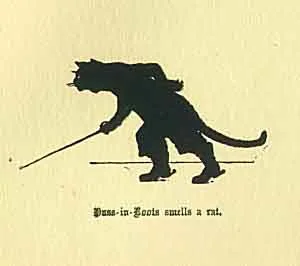
Puss-in-Boots smells a rat
AN ESSAY
OF
The Nature and Actions of the Subterranean (and, for the moƒt Part,) Inviƒible People, heretofioir going under the name of ELVES, FAUNES, and FAIRIES, or the lyke, among the Low-Country Scots, as they are deƒcribed by thoƒe who have the SECOND SIGHT; and now, to occaƒion further Inquiry, collected and compared, by a Circumƒpect Inquirer reƒiding among the Scottiƒh-Irifh in Scotland.
Secret Commonwealth
OR,
A Treatiƒe diƒplayeing the Chiefe Curioƒities
as they are in Uƒe among diverƒe of the
People of Scotland to this Day;
SINGULARITIES for the
moƒt Part peculiar to
that Nation.
A Subject not heretofore diƒcourƒed of by any of our
Writters; and yet ventured on in an Eƒƒay
to ƒuppreƒs the impudent and growing
Atheiƒme of this Age, and to
ƒatiƒfie the deƒire of ƒome
choice Freinds.
__________________________
Then a Spirit paƒƒed before my Face, the Hair of my Fleƒh ƒtood up; it ƒtood ƒtill, but I could not diƒcerne the Forme thereof; ane Image was before mine Eyes.--Job, 4. 15, 16.
This is a REBELLIOUS PEOPLE, which ƒay to the Siers, ƒie not; and to the Prophets, propheƒie not unto us right Things, bot ƒpeak unto us ƒmoothe Things.--Iƒaiah, 30. 9, 10.
And the Man whoƒe Eyes were open hath ƒaid.--Numbers, 24. 15.
For now we ƒie thorough a Glaƒs darkly, but then Face to Face.--1 Corinth. 13. 12.
It doth not yet appear what we ƒhall be; but we ƒhall be lyke God, and ƒie him as he is.--1 John, 3. 2.
Μη γιγιαντες μαιωδησονται ὑποκατωδεν ὑδατος και των γειτονων αυτον;--Job, 26. 5 (Septuag.).
By MR ROBERT KIRK, Miniƒter at Aberfoill.
1691.
CHAPTER I.
OF THE SUBTERRANEAN INHABITANTS.
 |
pure
pure Air and Oyl: others ƒeid more groƒs on the Foyƒon or ƒubƒtance of Corns and Liquors, or Corne it ƒelfe that grows on the Surface of the Earth, which theƒe Fairies ƒteall away, partly inviƒible, partly preying on the Grain, as do Crowes and Mice; wherefore in this ƒame Age, they are ƒome times heard to bake Bread, ƒtrike Hammers, and do ƒuch lyke Services within the little Hillocks they moƒt haunt: ƒome whereof of old, before the Goƒpell diƒpelled Paganiƒm, and in ƒome barbarous Places as yet, enter Houƒes after all are at reƒt, and ƒet the Kitchens in order, cleanƒing all the Veƒƒels. Such Drags goe under the name of Brownies. When we have plenty, they have Scarcity at their Homes; and on the contrarie (for they are empowred to catch as much Prey everywhere as they pleaƒe,) there Robberies notwithƒtanding oft tymes occaƒƒion great Rickes of Corne not to bleed ƒo weill, (as they call it,) or prove ƒo copious by verie farr as wes expected by the Owner.
THERE Bodies of congealled Air are ƒome tymes caried aloft, other whiles grovell in different Schapes, and enter into any Cranie or Clift
of
of the Earth where Air enters, to their ordinary Dwellings; the Earth being full of Cavities and Cells, and there being no Place nor Creature but is ƒuppoƒed to have other Animals (greater or leƒƒer) living in or upon it as Inhabitants; and no ƒuch thing as a pure Wilderneƒs in the whole Univerƒe.
2. WE then (the more terreƒtriall kind have now ƒo numerouƒly planted all Countreys,) do labour for that abƒtruƒe People, as weill as for ourƒelves. Albeit, when ƒeverall Countreys were unhabitated by ws, theƒe had their eaƒy Tillage above Ground, as we now. The Print of thoƒe Furrous do yet remaine to be ƒeen on the Shoulders of very high Hills, which was done when the champayn Ground was Wood and Forreƒt.
THEY remove to other Lodgings at the Beginning of each Quarter of the Year, ƒo traverƒing till Doomƒday, being imputent and [impotent of?] ƒtaying in one Place, and finding ƒome Eaƒe by ƒo purning [Journeying] and changing Habitations. Their chamælion-lyke Bodies ƒwim in the Air near the Earth with Bag and Bagadge; and at ƒuch revolution of Time, SEERS, or Men
of
of the SECOND SIGHT, (Fæmales being ƒeldome ƒo qualified) have very terrifying Encounters with them, even on High Ways; who therefoir uƒwally ƒhune to travell abroad at theƒe four Seaƒons of the Year, and thereby have made it a Cuƒtome to this Day among the Scottiƒh-Iriƒh to keep Church duely evry firƒt Sunday of the Quarter to ƒene or hallow themƒelves, their Corns and Cattell, from the Shots and Stealth of theƒe wandring Tribes; and many of theƒe ƒuperƒtitious People will not be ƒeen in Church againe till the nixt Quarter begin, as if no Duty were to be learned or done by them, but all the Uƒe of Worƒhip and Sermons were to ƒave them from theƒe Arrows that fly in the Dark. 1
THEY are diƒtributed in Tribes and Orders, and have Children, Nurƒes, Mariages, Deaths, and Burialls, in appearance, even as we, (unleƒs they ƒo do for a Mock-ƒhow, or to prognoƒticate ƒome ƒuch Things among us.)
Footnotes
8:1 Note ( a1), p. 86.
3. THEY are clearly ƒeen by theƒe Men of the SECOND SIGHT to eat at Funeralls [and] Banquets; hence many of the Scottiƒh-Iriƒh will not
teaƒt
teaƒt Meat at theƒe Meittings, leƒt they have Communion with, or be poyƒoned by, them. So are they ƒeen to carrie the Beer or Coffin with the Corps among the midle-earth Men to the Grave. Some Men of that exalted Sight (whither by Art or Nature) have told me they have ƒeen at theƒe Meittings a Doubleman, or the Shape of ƒome Man in two places; that is, a ƒuperterranean and a ƒubterranean Inhabitant, perfectly reƒembling one another in all Points, whom he notwithƒtanding could eaƒily diƒtinguiƒh one from another, by ƒome ƒecret Tockens and Operations, and ƒo go ƒpeak to the Man his Neighbour and Familiar, paƒƒing by the Apparition or Reƒemblance of him. They avouch that every Element and different State of Being have Animals reƒembling theƒe of another Element; as there be Fiƒhes ƒometimes at Sea reƒembling Monks of late Order in all their Hoods and Dreƒƒes; ƒo as the Roman invention of good and bad Dæmons, and guardian Angells particularly aƒƒigned, is called by them an ignorant Miƒtake, ƒprung only from this Originall. They call this Reflex-man a Co-walker, every way like the
Man,
Man, as a Twin-brother and Companion, haunting him as his ƒhadow, as is oft ƒeen and known among Men (reƒembling the Originall,) both before and after the Originall is dead, and wes alƒo often ƒeen of old to enter a Hous, by which the People knew that the Perƒon of that Liknes wes to Viƒite them within a few days. This Copy, Echo, or living Picture, goes att laƒt to his own Herd. It accompanied that Perƒon ƒo long and frequently for Ends beƒt known to it ƒelfe, whither to guard him from the ƒecret Aƒƒaults of ƒome of its own Folks, or only as ane ƒportfull Ape to counterfeit all his Actions. However, the Stories of old WITCHES prove beyond contradiction, that all Sorts of People, Spirits which aƒƒume light aery Bodies, or crazed Bodies coacted by forrein Spirits, ƒeem to have ƒome Pleaƒure, (at leaƒt to aƒƒwage from Pain or Melancholy,) by friƒking and capering like Satyrs, or whiƒtling and ƒcreeching (like unlukie Birds) in their unhallowed Synagogues and Sabboths. If invited and earneƒtly required, theƒe Companions make themƒelves knowne and familiar to Men; other wiƒe, being
in
in a different State and Element, they nather can nor will eaƒily converƒe with them. They avouch that a Heluo, or Great-eater, hath a voracious Elve to be his attender, called a Joint-eater or Juƒt-halver, feeding on the Pith or Quinteƒƒence of what the Man eats; and that therefoir he continues Lean like a Hawke or Heron, notwith ƒtanding his devouring Appetite: yet it would ƒeem that they convey that ƒubƒtance elƒewhere, for theƒe Subterraneans eat but little in their Dwellings; there Food being exactly clean, and ƒerved up by Pleaƒant Children, lyke inchanted Puppets. What Food they extract from us is conveyed to their Homes by ƒecret Paths, as ƒume ƒkilfull Women do the Pith and Milk from their Neighbours Cows into their own Chiefe-hold thorow a Hair-tedder, at a great Diƒtance, by Airt Magic, or by drawing a ƒpickot faƒtened to a Poƒt which will bring milk as farr of as a Bull will be heard to roar. 1 The Chiefe made of the remaineing Milk of a Cow thus ƒtrain'd will ƒwim in Water like a Cork. The Method they take to recover their Milk is a
bitter
bitter chyding of the ƒuƒpected Inchanters, charging them by a counter Charme to give them back their own, in God, or their Maƒter's Name. But a little of the Mother's Dung ƒtroakit on the Calves Mouth before it ƒuck any, does prevent this theft.
Footnotes
11:1 Note ( b1), p. 87.
4. THEIR Houƒes are called large and fair, and (unleƒs att ƒome odd occaƒions) unperceaveable by vulgar eyes, like Rachland, and other inchanted Iƒlands, having fir Lights, continual Lamps, and Fires, often ƒeen without Fuel to ƒuƒtain them. Women are yet alive who tell they were taken away when in Child-bed to nurƒe Fairie Children, a lingering voracious Image of their (them?) being left in their place, (like their Reflexion in a Mirrour,) which (as if it were ƒome inƒatiable Spirit in ane aƒƒumed Bodie) made firƒt ƒemblance to devour the Meats that it cunningly carried by, and then left the Carcaƒe as if it expired and departed thence by a naturall and common Death. The Child, and Fire, with Food and other Neceƒƒaries, are ƒet before the Nurƒe how ƒoon ƒhe enters; but ƒhe nather perceaves any Paƒƒage
out
out, nor ƒees what thoƒe People doe in other Rooms of the Lodging. When the Child is wained, the Nurƒe dies, or is conveyed back, or gets it to her choice to ƒtay there. But if any Superterraneans be ƒo ƒubtile, as to practice Slights for procuring a Privacy to any of their Miƒteries, (ƒuch as making uƒe of their Oyntments, which as Gygeƒ's Ring makes them inviƒible, or nimble, or caƒts them in a Trance, or alters their Shape, or makes Things appear at a vaƒt Diƒtance, &c.) they ƒmite them without Paine, as with a Puff of Wind, and bereave them of both the naturall and acquired Sights in the twinkling of ane Eye, (both theƒe Sights, where once they come, being in the ƒame Organ and inƒeparable,) or they ƒtrick them Dumb. The Tramontains to this Day put Bread, the Bible, or a piece of Iron, in Womens Beds when travelling, to ƒave them from being thus ƒtollen; and they commonly report, that all uncouth, unknown Wights are terrifyed by nothing earthly ƒo much as by cold Iron. They delyver the Reaƒon to be that Hell lying betwixt the chill Tempeƒts, and the Fire Brands of ƒcalding
Metals
Metals, and Iron of the North, (hence the Loadƒtone cauƒes a tendency to that Point,) by ane Antipathy thereto, theƒe odious far-ƒcenting Creatures ƒhrug and fright at all that comes thence relating to ƒo abhorred a Place, whence their Torment is eather begun, or feared to come hereafter
5. THEIR Apparell and Speech is like that of the People and Countrey under which they live: ƒo are they ƒeen to wear Plaids and variegated Garments in the Highlands of Scotland, and Suanochs therefore in Ireland. They ƒpeak but litle, and that by way of whiƒtling, clear, not rough. The verie Divels conjured in any Countrey, do anƒwer in the Language of the Place; yet ƒometimes the Subterraneans ƒpeak more diƒtinctly than at other times. Ther Women are ƒaid to Spine very fine, to Dy, to Toƒƒue, and Embroyder: but whither it is as manuall Operation of ƒubƒtantiall refined Stuffs, with apt and ƒolid Inƒtruments, or only curious Cob-webs, impalpable Rainbows, and a fantaƒtic Imitation of the Actions of more terreƒtricall Mortalls, ƒince it tranƒcended all
the
the Senƒes of the Seere to diƒcerne whither, I leave to conjecture as I found it.
6. THERE Men travell much abroad, either preƒaging or aping the diƒmall and tragicall Actions of ƒome amongƒt us; and have alƒo many diƒaƒtorous Doings of their own, as Convocations, Fighting, Gaƒhes, Wounds, and Burialls, both in the Earth and Air. They live much longer than wee; yet die at laƒt, or [at] leaƒt vaniƒh from that State. 'Tis ane of their Tenets, that nothing periƒheth, but (as the Sun and Year) every Thing goes in a Circle, leƒƒer or greater, and is renewed and refreƒhed in its Revolutions; as 'tis another, that every Bodie in the Creation moves, (which is a ƒort of Life;) and that nothing moves, but [h]as another Animal moving on it; and ƒo on, to the utmoƒt minuteƒt Corpuƒcle that's capable to be a Receptacle of Life.
7. THEY are ƒaid to have ariƒtocraticall Rulers and Laws, but no diƒcernible Religion, Love, or Devotion towards God, the bleƒƒed Maker of all: they diƒappear whenever they hear his Name invocked, or the Name of JESUS, (at
which
which all do bow willinglie, or by conƒtraint, that dwell above or beneath within the Earth, Philip. 2. 10;) nor can they act ought at that Time after hearing of that ƒacred Name. The TABHAISVER, or Seer, that correƒponds with this kind of Familiars, can bring them with a Spel to appear to himƒelfe or others when he pleaƒes, as readily as Endor Witch to thoƒe of her Kind. He tells, they are ever readieƒt to go on hurtfull Errands, but ƒeldome will be the Meƒƒengers of great Good to Men. He is not terrified with their Sight when he calls them, but ƒeeing them in a ƒurpryze (as often he does) frights him extreamly. And glaid would he be quite of ƒuch, for the hideous Spectacles ƒeen among them; as the torturing of ƒome Wight, earneƒt ghoƒtly ƒtairing Looks, Skirmiƒhes, and the like. They do not all the Harme which appearingly they have Power to do; nor are they perceaved to be in great Pain, ƒave that they are uƒewally ƒilent and ƒullen. They are ƒaid to have many pleaƒant toyiƒh Books; but the operation of theƒe Peices only appears in ƒome Paroxiƒms of antic corybantic Jolity, as if
raviƒht
raviƒht and prompted by a new Spirit entering into them at that Inƒtant, lighter and mirrier than their own. Other Books they have of involved abƒtruƒe Senƒe, much like the Roƒurcian [Roƒycrucian] Style. They have nothing of the Bible, ƒave collected Parcells for Charms and counter Charms; not to defend themƒelves withall, but to operate on other Animals, for they are a People invulnerable by our Weapons; and albeit Were-wolves and Witches true Bodies are (by the union of the Spirit of Nature that runs thorow all, echoing and doubling the Blow towards another) wounded at Home, when the aƒtrial aƒƒumed Bodies are ƒtricken elƒewhere; as the Strings of a Second Harp, tune to ane uniƒon, Sounds, though only ane be ƒtruck; yet theƒe People have not a ƒecond, or ƒo groƒs a Bodie at all, to be ƒo pierced; but as Air, which when divyded units againe; or if they feel Pain by a Blow, they are better Phyƒicians than wee, and quickly cure it. They are not ƒubject to ƒore Sickneƒƒes, but dwindle and decay at a certain Period, all about ane Age. Some ƒay their continual Sadneƒs is becauƒe of
their
their pendulous State, (like thoƒe Men, Luc. 13. 2. 6.) as uncertain what at the laƒt Revolution will become of them, when they are lock't up into ane unchangeable Condition; and if they have any frolic Fitts of Mirth, 'tis as the conƒtrained grinning of a Mort-head, or rather as acted on a Stage, and moved by another, ther [than?] cordially comeing of themƒelves. But other Men of the Second Sight, being illiterate, and unwary in their Obƒervations, learn from thoƒe; one averring thoƒe ƒubterranean People to be departed Souls, attending awhile in this inferior State, and clothed with Bodies procured throwgh their Almƒdeeds in this Lyfe; fluid, active, ætheriall Vehicles to hold them, that they may not ƒcatter, or wander, and be loƒt in the Totum, or their firƒt Nothing; but if any were ƒo impious as to have given no Alms, they ƒay when the Souls of ƒuch do depairt, they ƒleep in an unaictve State till they reƒume the terreƒtriall Bodies again: others, that what the Low-countrey Scotts calls a Wreath, and the Irish TAIBHSHE 1 or Death's Meƒƒenger, (ap-
pearing
pearing ƒometimes as a little rough Dog, and if croƒƒed and conjured in Time, will be pacified by the Death of any other Creature inƒtead of the ƒick Man,) is only exuvious Fumes of the Man approaching Death, exhal'd and congeal'd into a various Likneƒs, 1 (as Ships and Armies are ƒometimes ƒhapt in the Air,) and called aƒtral Bodies, agitated as Wild-fire with Wind, and are neather Souls or counterfeiting Spirits; yet not a few avouch (as is ƒaid,) that ƒurelie theƒe are a numerous People by them ƒelves, having their own Polities. Which Diverƒities of Judgments may occaƒion ƒeverall Inconƒonancies in this Rehearƒall, after the narroweƒt Scrutiny made about it.
Footnotes
18:1 The Death-candle is called DRUIG.
19:1 Note ( c1), p. 87.
8. THEIR Weapons are moƒt what ƒolid earthly Bodies, nothing of Iron, but much of Stone, like to yellow ƒoft Flint Spa, ƒhaped like a barbed Arrow-head, but flung like a Dairt, with great Force. Theƒe Armes (cut by Airt and Tools it ƒeems beyond humane) have ƒomething of the Nature of Thunderbolt ƒubtilty, and mortally wounding the vital Parts without breaking the Skin; of which Wounds I have obƒerved in
Beaƒts
Beaƒts, and felt them with my Hands. They are not as infallible Benjamites, hitting at a Hair's-breadth; nor are they wholly unvanquiƒhable, at leaƒt in Appearance.
THE MEN of that SECOND SIGHT do not diƒcover ƒtrange Things when aƒked, but at Fits and Raptures, as if inƒpyred with ƒome Genius at that Inƒtant, which before did lurk in or about them. Thus I have frequently ƒpoke to one of them, who in his Tranƒport told he cut the Bodie of one of thoƒe People in two with his Iron Weapon, and ƒo eƒcaped this Onƒet, yet he ƒaw nothing left behind of that appearing divyded; at other Times he out wreƒted [wreƒtled?] ƒome of them. His Neibours often perceaved this Man to diƒappear at a certane Place, and about one Hour after to become viƒible, and diƒcover him ƒelfe near a Bow-ƒhot from the firƒt Place. It was in that Place where he became inviƒible, ƒaid he, that the Subterraneans did encounter and combate with him. Thoƒe who are unƒeened or unƒanctified (called Fey) are ƒaid to be pierced or wounded with thoƒe People's Weapons, which makes them do
ƒomewhat
ƒomewhat verie unlike their former Practice, cauƒing a sudden Alteration, yet the Cauƒe thereof unperceavable at preƒent; nor have they Power (either they cannot make uƒe of their natural Powers, or aƒk't not the heavenly Aid,) to eƒcape the Blow impendent. A Man of the Second Sight perceaved a Perƒon standing by him (found to others view) wholly gored in Blood, and he (amazed-like) bid him inƒtantly flee. The whole Man laught at his Airt and Warning, ƒince there was no appearance of Danger. He had ƒcarce contracted his Lips from Laughter, when unexpectedly his Enemy leapt in at his Side, and ƒtab'd him with their Weapons. They alƒo pierce Cows or other Animals, uƒewally ƒaid to be Elf-ƒhot, whoƒe pureƒt Subƒtance (if they die) theƒe Subterraneans take to live on, viz. the aereal and ætherial Parts, the moƒt ƒpirituous Matter for prolonging of Life, ƒuch as Aquavitæ (moderately taken) is among Liquors, leaving the terreƒtrial behind. The Cure of ƒuch Hurts is, only for a Man to find out the Hole with his Finger; as if the Spirits flowing from a Man's
warme
warme Hand were Antidote ƒufficient againƒt their poyƒon'd Dairts.
9. As Birds and Beaƒts, whoƒe Bodies are much uƒed to the Change of the frie and open Air, forƒee Storms; ƒo thoƒe inviƒible People are more ƒagacious to underƒtand by the Books of Nature Things to come, than wee, who are peƒtered with the groƒƒer Dregs of all elementary Mixtures, and have our purer Spirits choaked by them. The Deer ƒcents out a Man and Powder (tho a late Invention) at a great Diƒtance; a hungry Hunter, Bread; and the Raven, a Carrion: Ther Brains, being long clarified by the high and ƒubtil Air, will obƒerve a very ƒmall Change in a Trice. Thus a Man of the Second Sight, perceaving the Operations of theƒe forecaƒting inviƒible People among us, (indulged thorow a ƒtupendious Providence to give Warnings of ƒome remarkable Events, either in the Air, Earth, or Waters,) told he ƒaw a Winding-ƒhroud creeping on a walking healthful Perƒons Legs till it come to the Knee; and afterwards it came up to the Midle, then to the Shoulders, and at laƒt over the Head, which was viƒible to
no
no other Perƒone. And by obƒerving the Spaces of Time betwixt the ƒeverall Stages, he eaƒily gueƒƒed how long the Man was to live who wore the Shroud; for when it approached his Head, he told that ƒuch a Perƒon was ripe for the Grave.
10. THERE be many Places called Fairie-hills, which the Mountain People think impious and dangerous to peel or diƒcover, by taking Earth or Wood from them; ƒuperƒtitiouƒly beleiving the Souls of their Prediceƒƒors to dwell there. 1 And for that End (ƒay they) a Mote or Mount was dedicate beƒide every Church-yard, to receive the Souls till their adjacent Bodies ariƒe, and ƒo become as a Fairie-hill; they uƒeing Bodies of Air when called Abroad. They alƒo affirme thoƒe Creatures that move inviƒibly in a Houƒe, and caƒt hug great Stones, but do no much Hurt, becauƒe counter-wrought by ƒome more courteous and charitable Spirits that are everywhere ready to defend Men, (Dan. 10. 13.) to be Souls that have not attained their Reƒt, thorough a vehement Deƒire of revealling a Murther or notable Injurie done or receaved,
or
or a Treaƒure that was forgot in their Liftyme on Earth, which when diƒcloƒ'd to a Conjurer alone, the Ghoƒt quite removes.
IN the nixt Country to that of my former Reƒidence, about the Year 1676, when there was ƒome Scarcity of Graine, a marvelous Illapƒe and Viƒion ƒtrongly ƒtruck the Imagination of two Women in one Night, living at a good Diƒtance from one another, about a Treaƒure hid in a Hill, called SITHBHRUAICH, or Fayrie-hill. The Appearance of a Treaƒure was firƒt repreƒented to the Fancy, and then an audible Voyce named the Place where it was to their awaking Senƒes. Whereupon both aroƒe, and meitting accidentallie at the Place, diƒcovered their Deƒigne; and joyntly digging, found a Veƒƒell as large as a Scottiƒh Peck, full of ƒmall Pieces of good Money, of ancient Coyn; which halving betuixt them, they ƒold in Diƒh-fulls for Diƒh-fulls of Meall to the Countrey People. Very many of undoubted Credit ƒaw, and had of the Coyn to this Day. But whither it was a good or bad Angell, one of the ƒubterranean People, or the reƒƒleƒs Soul of him who hid it,
that
that diƒcovered it, and to what End it was done, I leave to the Examination of others.
Footnotes
23:1 Note ( d1), p. 88.
11. THESE Subterraneans have Controverƒies, Doubts, Diƒputs, Feuds, and Siding of Parties; there being ƒome Ignorance in all Creatures, and the vaƒteƒt created Intelligences not compaƒƒing all Things. As to Vice and Sin, whatever their own Laws be, ƒure, according to ours, and Equity, natural, civil, and reveal'd, they tranƒgreƒs and commit Acts of Injuƒtice, and Sin, by what is above ƒaid, as to their ƒtealling of Nurƒes to their Children, and that other ƒort of Plaginiƒm in catching our Children away, (may ƒeem to heir ƒome Eƒtate in thoƒe inviƒible Dominions,) which never returne. For the Inconvenience of their Succubi, who tryƒt with Men, it is abominable; but for Swearing and Intemperance, they are not obƒerved ƒo ƒubjct to thoƒe Irregularities, as to Envy, Spite, Hypocracie, Lieing, and Diƒƒimulation.
12. As our Religion oblidges us not to make a peremptory and curious Search into theƒe Obƒtruƒeneƒƒes, ƒo that the Hiƒtories of all Ages give as many plain Examples of extraordinary
Occurrances
Occurrances as make a modeƒt Inquiry not contemptable. How much is written of Pigme's, Fairies, Nymphs, Syrens, Apparitions, which tho not the tenth Part true, yet could not ƒpring of nothing! Even Engliƒh Authors relate (of) Barry Iƒland, in Glamorganƒhire, that laying your Ear into a Clift of the Rocks, blowing of Bellows, ƒtricking of Hammers, claƒhing of Armour, fyling of Iron, will be heard diƒtinctly ever ƒince Merlin inchaunted thoƒe ƒubterranean Wights to a ƒolid manuall forging of Arm's to Aurelius Ambroƒius and his Brittans, till he returned; which Merlin being killed in a Battell, and not coming to looƒe the Knot, theƒe active Vulcans are there ty'd to a perpetuall Labour. But to dip no deeper into this Well, I will nixt give ƒome Account how the Seer my Informer comes to have this ƒecret Way of Correƒpondence beyond other Mortalls.
THERE be odd Solemnities at inveƒting a Man with the Priviledges of the whole Miƒtery of this Second Sight. He muƒt run a Tedder of Hair (which bound a Corps to the Bier) in a Helix [?] about his Midle, from End to End;
then
then bow his Head downwards, as did Elijah, 1 Kings, 18. 42. and look back thorough his Legs untill he ƒie a Funerall advance till the People croƒs two Marches; or look thus back thorough a Hole where was a Knot of Fir. But if the Wind change Points while the Hair Tedder is ty'd about him, he is in Peril of his Lyfe. The uƒewall Method for a curious Perƒon to get a tranƒient Sight of this otherwiƒe inviƒible Crew of Subterraneans, (if impotently and over raƒhly ƒought,) is to put his [left Foot under the Wizard's right] Foot, and the Seer's Hand is put on the Inquirer's Head, who is to look over the Wizard's right Shoulder, (which hes ane ill Appearance, as if by this Ceremony ane implicit Surrender were made of all betwixt the Wizard's Foot and his Hand, ere the Perƒon can be admitted a privado to the Airt;) then will he ƒee a Multitude of Wight's, like furious hardie Men, flocking to him haiƒtily from all Quarters, as thick as Atoms in the Air; which are no Nonentities or Phantaƒms, Creatures proceiding from ane affrighted Apprehenƒione, confuƒed or crazed Senƒe, but Realities, appear-
ing
ing to a ƒtable Man in his awaking Senƒe, and enduring a rationall Tryall of their Being. Thes thorow Fear ƒtrick him breathleƒs and ƒpeechleƒs. The Wizard, defending the Lawfullneƒs of his Skill, forbids ƒuch Horror, and comforts his Novice by telling of Zacharias, as being ƒtruck ƒpeechleƒs at ƒeeing Apparitions, Luke, 1. 20. Then he further maintains his Airt, by vouching Eliƒha to have had the ƒame, and diƒcloƒ'd it thus unto his Servant in 2 Kings, 6. 17. when he blinded the Syrians; and Peter in Act, 5. 9. forƒeing the Death of Saphira, by perceaving as it were her Winding-ƒheet about her before hand; and Paul, in 2nd Corinth. 12. 4. who got ƒuch a Viƒion and Sight as ƒhould not, nor could be told. Eliƒha alƒo in his Chamber ƒaw Gehazi his Servant, at a great Diƒtance, taking a reward from Naaman, 2d Kings, 5. 26. Hence were the Prophets frequently called SEERS, or Men of a 2d or more exhalted Sight than others. He acts for his Purpoƒe alƒo Math. 4. 8. where the Devil undertakes to give even Jeƒus a Sight of all Nations, and the fineƒt Things in the World, at one Glance, tho in
their
their naturall Situations and Stations at a vaƒt Diƒtance from other. And 'tis ƒaid expreƒly he did let ƒie them; not in a Map it ƒeems, nor by a phantaƒtick magicall jugling of the Sight, which he could not impoƒe upon ƒo diƒcovering a Perƒon. It would appear then to have been a Sight of real ƒolid Subƒtances, and Things of worth, which he intended as a Bait for his Purpoƒe. Whence it might ƒeem, (compairing this Relation of Math. 4. 8. with the former,) that the extraordinary or Second Sight can be given by the Miniƒtery of bad as weill as good Spirits to thoƒe that will embrace it. And the Inƒtance of Balaam and the Pytheniƒs make it nothing the leƒs probable. Thus alƒo the Seer trains his Scholler, by telling of the Gradations of Nature, ordered by a wiƒe Provydence; that as the Sight of Bats and Owls tranƒcend that of Shrews and Moles, ƒo the viƒive Faculties of Men are clearer than thoƒe of Owls; as Eagles, Lynxs, and Cats are brighter than Mens. And again, that Men of the Second Sight (being deƒigned to give warnings againƒt ƒecret Engyns) ƒurpaƒs the ordinary Viƒion of other
Men
Men, which is a native Habit in ƒome, deƒcended from their Anceƒtors, and acquired as ane artificiall Improvement of their natural Sight in others; reƒembling in their own Kynd the uƒuall artificiall Helps of optic Glaƒƒes, (as Proƒpectives, Teleƒcopes, and Microƒcopes,) without which aƒcititious Aids thoƒe Men here treated of do perceive Things that, for their Smallneƒs, or Subtility, and Secrecy, are inviƒible to others, tho dayly converƒant with them; they having ƒuch a Beam continuallie about them as that of the Sun, which when it ƒhines clear only, lets common Eyes ƒee the Atomes, in the Air, that without thoƒe Rayes they could not diƒcern; for ƒome have this Second Sight tranƒmitted from Father to Sone thorow the whole Family, without their own Conƒent or others teaching, proceeding only from a Bounty of Providence it ƒeems, or by Compact, or by a complexionall Quality of the firƒt Acquirer. As it may ƒeem alike ƒtrange (yet nothing vicious) in ƒuch as Maƒter Great-rake, 1 the Iriƒh Stroaker, Seventh-ƒons, and others that cure the King's Evill,
and
and chaƒe away Deƒeaƒes and Pains, with only ƒtroaking of the affected Pairt; which (if it be not the Reliques of miraculous Operations, or ƒome ƒecret Virtue in the Womb, of the Parent, which increaƒeth until Seventh-ƒons be borne, and decreaƒeth by the ƒame Degrees afterwards,) proceids only from the ƒanitive Balƒome of their healthfull Contƒitutions; Virtue going out from them by ƒpirituous Effluxes unto the Patient, and their vigorous healthy Spirits affecting the ƒick as uƒewally the unhealthy Fumes of the ƒick infect the ƒound and whole.
Footnotes
30:1 Note ( e1), p. 88.
13. THE Minor Sort of Seers prognoƒticat many future Events, only for a Month's Space, from the Shoulder-bone of a Sheep on which a Knife never came, (for as before is ƒaid, and the Nazarits of old had ƒomething of it) Iron hinders all the Opperations of those that travell in the Intrigues of theƒe hidden Dominions. By looking into the Bone, they will tell if Whoredom be committed in the Owner's Houƒe; what Money the Maƒter of the Sheep had; if any will die out of that Houƒe for that Moneth; and if any Cattell there will take a Trake, as
if
if Planet-ƒtruck. Then will they preƒcribe a Preƒervative and Prevention.
14. A WOMAN (it ƒeems ane Exception from the generall Rule,) ƒingularlie wiƒe in theƒe Matters of Foirƒight, living in Colaƒnach, ane Iƒle of the Hebrides, (in the Time of the Marqueƒs of Montroƒe his Wars with the States in Scotland,) being notorious among many; and ƒo examined by ƒome that violently ƒeazed that Iƒle, if ƒhe ƒaw them coming or not? She ƒaid, ƒhe ƒaw them coming many Hours before they came in View of the Iƒle. But earneƒtly looking, ƒhe ƒome times took them for Enemyes, ƒometime for Friends; and morover they look't as if they went from the Iƒle, not as Men approaching it, which made her not put the Inhabitants on their Guard. The Matter was, that the Barge wherein the Enemie ƒailed, was a little befoir taken from the Inhabitants of that fame Iƒle, and the Men had their Backs towards the Iƒle, when they were plying the oares towards it. Thus this old Scout and Delphian Oracle was at leaƒt deceived, and did deceave. Being aƒked who gave her ƒuch Sights
and
and Warnings, ƒhe ƒaid, that as ƒoon as ƒhe ƒet three Croƒƒes of Straw upon the Palm of her Hand, a great ugly Beaƒt ƒprang out of the Earth neer her, and flew in the Air. If what ƒhe enquired had Succeƒs according to her Wiƒh, the Beaft would deƒcend calmly, and lick up the Croƒƒes. If it would not ƒucceid, the Beaft would furiouƒly thruƒt her and the Croƒƒes over on the Ground, and ƒo vaniƒh to his Place.
15. AMONG other Inƒtances of undoubted Verity, proving in theƒe the Being of ƒuch aerial People, or Species of Creatures not vulgarly known, I add the ƒubƒequent Relations, ƒome whereof I have from my Acquaintance with the Actors and Patients, and the Reƒt from the Eye-witneƒƒes to the Matter of Fact. The firƒt whereof ƒhall be of the Woman taken out of her Child-bed, and having a lingring Image of her ƒubƒtituted Bodie in her Roome, which Reƒemblance decay'd, dy'd, and was bur'd. But the Perƒon ƒtollen returning to her Huƒband after two Years Space, he being convinced by many undenyable Tokens that ƒhe
was
was his former Wyfe, admitted her Home, and had diverƒe Children by her. Among other Reports ƒhe gave her Huƒband, this was one: That ƒhe perceived litle what they did in the ƒpacious Houƒe ƒhe lodg'd in, untill ƒhe anointed one of her Eyes with a certain Unction that was by her; which they perceaving to have acqainted her with their Actions, they fain'd her blind of that Eye with a Puff of their Breath. She found the Place full of Light, without any Fountain or Lamp from whence it did ƒpring. This Perƒon lived in the Countrey nixt to that of my laƒt Reƒidence, and might furniƒh Matter of Diƒpute amongƒt Caƒuiƒts, whither if her Huƒband had been mary'd in the Interim of her two Years Abƒence, he was oblidged to divorƒe from the ƒecond Spouƒe at the Return of the firƒt. There is ane Airt, appearingly without Superƒtition, for recovering of ƒuch as are ƒtolen, but think it ƒuperfluous to inƒert it.
I SAW a Woman of fourtie Years of Age, and examined her (having another Clergie Man in my Companie) about a Report that paƒt of
her
her long faƒting, [her Name is not intyre.] 1 It was told by them of the Houƒe, as well as her ƒelfe, that ƒhe tooke verie little or no Food for ƒeverall Years paƒt; that ƒhe tarried in the Fields over Night, ƒaw and converƒed with a People ƒhe knew not, having wandered in ƒeeking of her Sheep, and ƒleep't upon a Hillock, and finding her ƒelf tranƒported to another Place before Day. The Woman had a Child ƒince that Time, and is ƒtill prettie melanchollyous and ƒilent, hardly ever ƒeen to laugh. Her natural Heat and radical Moiƒture ƒeem to be equally balanced, lyke ane unextinguiƒhed Lamp, and going in a Circle, not unlike to the faint Lyfe of Bees, and ƒome Sort of Birds, that ƒleep all the Winter over, and revive in the Spring.
IT is uƒuall in all magicall Airts to have the Candidates prepoƒƒeƒƒit with a Believe of their Tutor's Skill, and Ability to perform their Feats, and act their jugling Pranks and Legerdemain; but a Perƒon called Stewart, poƒƒeƒƒed with a prejudice at that was ƒpoken of the 2d Sight,
and
and living near to my Houƒe, was ƒoe put to it by a Seer, before many Witneƒƒes, that he loƒt his Speech and Power of his Legs, and breathing exceƒƒively, as if expyring, becauƒe of the many fearfull Wights that appeared to him. The Companie were forced to carrie him into the Houƒe.
IT is notoriouƒly known what in Killin, within Perthƒhire, fell tragically out with a Yeoman that liv'd hard by, who coming into a Companie within ane Ale-houƒe, where a Seer ƒat at Table, that at the Sight of the Intrant Neighbour, the Seer ƒtarting, roƒe to go out of the Hous; and being aƒked the Reaƒon of his haƒt, told that the intrant Man ƒhould die within two Days; at which News the named Intrant ƒlabb'd the Seer, and was himƒelf executed two Days after for the Fact.
A MINISTER, verie intelligent, but miƒbelieving all ƒuch Sights as were not ordinar, chanceing to be in a narrow Lane with a Seer, who perceaving a Wight of a known Viƒage furioƒlie to encounter them, the Seer deƒired the Miniƒter to turn out of the Way; who ƒcorning his
Reaƒon
Reaƒon, and holding him ƒelfe in the Path with them, when the Seer was going haƒtily out of the Way, they were both violently caƒt a ƒide to a good Diƒtance, and the Fall made them lame for all their Lyfe. A little after the Miniƒter was carried Home, one came to tol the Bell for the Death of the Man whoƒe Repreƒentation met them in the narrow Path ƒome Halfe ane Hour before.
ANOTHER Example is: A Seer in Kintyre, in Scotland, ƒitting at Table with diverƒe others, ƒuddenly did caƒt his Head aƒide. The Companie aƒking him why he did it, he anƒwered, that ƒuch a Friend of his, by Name, then in Ireland, threatened immediately to caƒt a Diƒhfull of Butter in his Face. The Men wrote down the Day and Hour, and ƒent to the Gentleman to know the Truth; which Deed the Gentleman declared he did at that verie Time, for he knew that his Friend was a Seer, and would make ƒport with it. The Men that were preƒent, and examined the Matter exactly, told me this Story; and with all, that a Seer would with all his Opticks perceive no other Object ƒo readily as this, at ƒuch a Diƒtance.
Footnotes
35:1 Thus in the manuscript, which is only a Transcript of Mr. Kirk's Original. Perhaps M'Intyre?
A SUCCINT ACCOMPT
OF
My LORD TARBOTT'S RELATIONS,
IN A LETTER TO THE
HONOURABLE ROBERT BOYLE, ESQUIRE,
OF THE
PREDICTIONS MADE BY SEERS,Whereof himƒelf was Ear and Eye-witneƒs.
[I thought fit to adjoyne [it] hereunto, that I might not be thought ƒingular in this Diƒquiƒition; that the Mater of Fact might be undenyably made out; and that I might, with all Submiƒƒion, give Annotations, with Animadverƒions, on his ƒuppoƒed Cauƒes of that Phenomenon, with my Reaƒons of Diƒƒent from his judgement.]
SIR,
I HEARD very much, but beleived very little, of the Second Sight; yet its being aƒƒumed
by
by ƒeverall of great Veracity, I was induced to make Inquirie after it in the Year 1652, being then confin'd to abide in the North of Scotland by the Engliƒh Uƒurpers. The more generall Accounts of it were, that many Highlanders, yet far more Iƒlanders, were qualified with this Second Sight; that Men, Women, and Children, indiƒtinctly, were ƒubject to it, and Children, where Parents were not. Some times People came to age, who had it not when young, nor could any tell by what Means produced. It is a Trouble to moƒt of them who are ƒubject to it, and they would be rid of it any Rate if they could. The Sight is of no long Duration, only continuing ƒo long as they can keep their Eyes ƒteady without twinkling. The hardy therefore fix their look, that they may ƒee the longer; but the timorous ƒee only Glances, their Eyes always twinkles at the firƒt Sight of the Object. That which generally is ƒeen by them, are the Species of living Creatures, and of inanimate Things, which was in Motion, ƒuch as Ships, and Habits upon Perƒons. They never ƒie the
the Species of any Perƒon who is already dead. What they foirƒie fails not to exiƒt in the Mode, and in that Place where it appears to them. They cannot well know what Space of Time ƒhall interveen between the Apparition and the real Exiƒtance: But ƒome of the hardieƒt and longeƒt Experience have ƒome Rules for Conjectures; as, if they ƒie a Man with a ƒhrowding Sheet in the Apparition, they will conjecture at the Nearneƒs or Remoteneƒs of his Death by the more or leƒs of his Bodie that is covered by it. They will ordinarily ƒie their abƒent Friends, tho at a great Diƒtance, ƒome tymes no leƒs than from America to Scotland, ƒitting, ƒtanding, or walking in ƒome certain Place; and then they conclude with a Aƒƒurance that they will ƒie them ƒo and there. If a Man be in love with a Woman, they will ordinarily ƒie the Species of that Man ƒtanding by her, and ƒo likewiƒe if a Woman be in love; and they conjecture at their Enjoyments (of each other) by the Species touching (of) the Perƒon, or appearing at a Diƒtance from her (if they enjoy not one another.) If they ƒie
the
the Species of any Perƒon who is ƒick to die, they ƒie them covered over with the ƒhrowding Sheet.
THESE Generalls I had verified to me by ƒuch of them as did ƒie, and were eƒteemed honeƒt and ƒober by all the Neighbourhood; for I inquired after ƒuch for my Information. And becauƒe there were more of theƒe Seers in the Iƒles of Lewis, Harris, and Uiƒt, than in any other Place, I did entreat Sir James M'Donald (who is now dead) Sir Normand M'Loud, and Mr. Daniel Moriƒon, a verie honeƒt Perƒon, (who are ƒtill alive,) to make Inquirie in this uncouth Sight, and to acquaint me therewith; which they did, and all found ane Agriement in theƒe Generalls, and informed me of many Inƒtances confirming what they ƒaid. But though Men of Diƒcretion and Honour, being but at 2d Hand, I will chooƒe rather to put myƒelf than my Friends on the Hazard of being laughed at for incredible Relations.
I WAS once travelling in the Highlands, and a good Number of Servants with me, as is uƒuall
there
there; and one of them going a little before me, entering into a Houƒe where I was to ƒtay all Night, and going haiƒtily to the Door, he ƒuddenly ƒtept back with a Screech, and did fall by a Stone, which hit his Foot. I aƒked what the Matter was, for he ƒeemed to be very much frighted. He told me very ƒeriouƒly that I ƒhould not lodge in that Houƒe, becauƒe ƒhortly a dead Coffin would be carried out of it, for many were carrying of it when he was heard cry. I neglecting his Words, and ƒtaying there, he ƒaid to other of his Servants, he was ƒorry for it, and that ƒurely what he ƒaw would ƒhortly come to paƒs. Tho no ƒick Perƒon was then there, yet the Landlord, a healthy Highlander, died of ane appoplectick Fit before I left the Houƒe.
In the year 1653, Alexander Monro (afterward Lieut. Coll. to the Earl of Dunbarton's Regiment,) and I were walking in a Place called Ullabill, in Lochbroom, on a little Plain, at the Foot of a rugged Hill. There was a Servant working with a Spade in the Walk before us; his Back was to us, and his Face to
the
the Hill. Before we came to him, he let the Spade fall, and looked toward the Hill. He took Notice of us as wee paƒƒed neer by him, which made me look at him; and perceiving him to ƒtair a little ƒtrangely, I conjectured him to be a Seer. I called at him, at which he ƒtarted and ƒmiled. What are you doing? ƒaid I. He anƒwered, I have ƒeen a very ƒtrange Thing; ane Army of Engliƒhmen, leeding of Horƒes, coming doun that Hill; and a Number of them are come down to the Plain, and eating the Barley, which is growing in the Field neer to the Hill. This was on the 4th May, (for I notted the Day,) and it was four or fyve Days before the Barley was ƒown in the Field he ƒpoke of. Alexander Monro aƒked him how he knew they were Engliƒhmen? He ƒaid, becauƒe they were leeding of Horƒes, and had on Hats and Bootts, which he knew no Scot Man would have there. We took little Notice of the whole Storie, as other than a fooliƒh Viƒion; but wiƒhed that ane Engliƒh Partie were there, we being then at Warr with them, and the Place almoƒt unacceƒlable for Horƒe-
men
men. But in the Beginning of Auguƒt therafter, the Earle of Midleton (then Lieut. for the King in the Highlands) having occaƒion to march a Party of his toward the South Highlands, he ƒent his Foot thorow a Place called Inverlawell; and the Fore-partie which was firƒt down the Hill, did fall off eating the Barley which was on the litle Plain under it. And Monro calling to mynd what the Seer told us, in May preceiding, he wrote of it, and ƒent ane Expreƒs to me to Lochƒlin, in Roƒs, (where I then was) with it.
I HAD Occaƒion once to be in Companie where a Young Lady was, (excuƒe my not naming of Perƒons,) and I was told there was a notable Seer in the Companie. I called him to ƒpeak with me, as I did ordinarly when I found any of them; and after he had anƒwered me to ƒeveral Queƒtions, I aƒked if he knew any Perƒon to be in love with that Lady. He ƒaid he did, but he knew not the Perƒon; for during the two Dayes he had been in her Company, he perceaved one ƒtanding neer her, and his Head leaning on her Shoulder; which he ƒaid
did
did fore-tell that the Man ƒhould marrie her, and die before her, according to his Obƒervation. This was in the Year 1655. I deƒired him to deƒcribe the Perƒon, which he did; ƒo that I could conjecture, by the Deƒcription, of ƒuch a one, who was of that Ladyes Acquaintance, tho there were no thought of their Marriage till two Years thereafter. And having Occaƒion, in the Year 1657, to find this Seer, who was ane Iƒlander, in Company with the other Perƒon whom I conjectured to have been deƒcribed by him, I called him aƒide, and aƒked if that was the Perƒon he ƒaw beƒide the Lady near two Years then paƒt. He ƒaid it was he indeed, for he had ƒeen that Lady juƒt then ƒtanding by him Hand in Hand. This was ƒome few Months before their Marriage, and that Man is ƒince dead, and the Lady ƒtill alive.
I SHALL trouble you but with one more, which I thought moƒt remarkable of any that occurred to me. In January 1652, the above mentioned Lieut. Coll. Alex. Monro and I happened to be in the Houƒe of one Wm. M'Cleud of Ferrinlea, in the County of Roƒs.
He
He, the Landlord, and I were ƒitting in three Chairs neir the Fire, and in the Corner of the great Chimney there were two Iƒlanders, who were that verie Night come to the Hous, and were related to the Landlord. While the one of them was talking with Monro, I perceaved the other to look oddly toward me. From this Look, and his being ane Iƒlander, I conjectured him a Seer, and aƒked him, at what he ƒtair'd? He anƒwered, by deƒiring me to riƒe from that Chair, for it was ane unluckie one. I aƒked him why. He anƒwered, becauƒe there was a dead Man in the Chair nixt to me. Well, ƒaid I, if it be in the nixt Chair, I may keep mine own. But what is the Likneƒs of the Man? He ƒaid he was a tall Man, with a long Grey Coat, booted, and one of his Legs hanging over the Arme of the Chair, and his head hanging dead to the other Side, and his Arme backward, as if it were brocken. There were ƒome Engliƒh Troops then quartered near that Place, and there being at that Time a great Froƒt after a Thaw, the Country was covered all over with Yce. Four or Fyve of the Engliƒh ryding by
this
this Houƒe ƒome two Hours after the Viƒion, while we were ƒitting by the Fire, we heard a great Noiƒe, which prov'd to be thoƒe Troopers, with the Help of other Servants, carrying in one of their Number, who had got a very miƒcheivous Fall, and had his Arme broke; and falling frequently in ƒwooning Fits, they brought him into the Hall, and ƒet him in the verie Chair, and in the verie Poƒture that the Seer had propheƒied. But the Man did not die, though he recovered with great Difficulty.
AMONG the Accounts given me by Sir Normand M'clud, there was one worth of ƒpecial Notice, which was thus. There [was] a Gentleman in the Iƒle of Harris, who was always ƒeen by the Seers with ane Arrow in his Thigh. Such in the Iƒle who thought thoƒe prognoƒtications infalliable, did not doubt but he would be ƒhot in the Thigh before he died. Sir Normand told me that he heard it the Subject of their Diƒcourƒe for many Years. At laƒt he died without any ƒuch Accident. Sir Normand was at his Buriall, at St Clement's Church in the Harris. At the ƒame Time, the Corps of another
another Gentleman was brought to be buried in the ƒame verie Church. The Friends on either Side came to debate who ƒhould firƒt enter the Church, and in a Trice from Words they came to Blows. One of the Number (who was arm'd with Bow and Arrows) let one fly among them. (Now everie Familie in that Iƒle have their Buriall-place in the Church in Stone Cheƒts, and the Bodies are carried in open Biers to the Buriall-place.) Sir Normand having appeaƒed the Tumult, one of the Arrows was found ƒhot in the dead Man's Thigh. To this Sir Normand was a Witneƒs.
IN the Account which Mr Daniel Moriƒon, Parƒon in the Lewis, gave me, there was one, tho it be hetergeneous from the ƒubject, yet it may [be] worth your Notice. It was of a young Woman in his Pariƒh, who was mightily frightned by ƒeeing her own Image ƒtill before her, alwayes when ƒhe came to the open Air; the Back of the Image being alwayes to her, ƒo that it was not a reflection as in a Mirrour, but the Species of ƒuch a Body as her own, and in a very like Habit, which appeared to herƒelf
continually
continually before her. The Parƒon keept her a long whyle with him, but had no Remedy of her Evill, which troubled her exceidingly. I was told afterwards, that when ƒhe was four or fyve Years elder ƒhe ƒaw it not.
THESE are Matters of Fact, which I aƒƒure yow they are truely related. But theƒe, and all others that occurred to me, by Information or otherwiƒe, could never lead me into a remote Conjecture of the Cauƒe of ƒo extraordinary a Phænomenon. Whither it be a Quality in the Eyes of ƒome People into theƒe Pairts, concurring with a Quality in the Air alƒo; whither ƒuch Species be every where, tho not ƒeen by the Want of Eyes ƒo qualified, or from whatever other Cauƒe, I muƒt leave to the Inquiry of clearer judgements than mine. But a Hint may be taken from this image which appeared ƒtill to this Woman abovementioned, and from another mentioned by Ariƒtotle, in the 4th of his Metaphyƒicks (if I remember right, for it is long ƒince I read it;) as alƒo from the common Opinion that young Infants (unƒullied with many Objects) do ƒie Appearitions, which were
not
not ƒeen by thoƒe of elder Years; as like wife from this, that ƒeveralls did ƒie the Second Sight when in the Highlands or Iƒles, yet when tranƒported to live in other Countreys, eƒpecially in America, they quite loƒe this Qualitie, as was told me by a Gentleman who knew ƒome of them in Barbadoes, who did ƒee no Viƒion there, altho he knew them to be Seers when they lived in the Iƒles of Scotland.
Thus far my Lord Tarbett.
==================
My LORD, after narrow Inquiƒition, hath delivered many true and remarkable obƒerves on this Subject; yet to encourage a further Scrutiny, I crave leave to ƒay,
THAT 1. But a few Women are endued with this Sight in reƒpect of Men, and their Predictions not ƒo certane.
2. This Sight is not criminal, ƒince a Man can come by it unawares, and without his Conƒent; but it is certaine he ƒie more fatall and fearfull Things than he do gladƒome.
3. THE Seers avouch, that ƒeveralls who go
to
to the Siths, (or People at Reƒt, and, in reƒpect of us, in Peace,) before the natural Period of their Lyfe expyre, do frequently appear to them.
4. A VEHEMENT Deƒyre to attain this Airt is very helpfull to the Inquyrer; and the Species of ane Abƒent Friend, which appears to the Seers, as clearly as if he had ƒent his lively Picture to preƒent it ƒelfe before him, is no phantaƒtick Shaddow of a ƒick Apprehenƒion, but a reality, and a Meƒƒinger, coming for unknown Reaƒons, not from the originall Similitude of it ƒelfe, but from a more ƒwift and pragmantick People, which recreat them ƒelves in offering ƒecret Intelligence to Men, tho generally they are unacquainted with that Kind of Correƒpondence, as if they had lived in a different element from them.
5. THO my Collections were written long before I ƒaw My Lord of Tarbett's, yet I am glad that his deƒcriptions and mine correƒpond ƒo nearly. The Maid my Lord mentions, who ƒaw her Image ƒtill before her, ƒuteth with the CO-WALKER named in my Account; which tho
ƒome
ƒome, at firƒt Thought, might conjecture to be by the Refraction of a Cloud or Miƒt, as in the Parelij, (the whole Air and every Drop of Water being a Mirrour to returne the Species of Things, were our viƒive Faculty ƒharpe enough to apprehend them,) or a naturall Reflexion, from the ƒame Reaƒons that an Echo can be redoubled by Airt; yet it were more faƒable ((?) fafable in original--JBH) to impute this Second Sight to a Quality infuƒed into the Eye by ane Unction: for Witchies have a ƒleepie Oyntment, that, when applyed, troubles their Fantaƒies, advancing it to have unuƒuall Figures and Shapes repreƒented to it, as if it were a Fit of Fanaticiƒm, Hypocondriack Melancholly, or Poƒƒeƒƒion of ƒome inƒinuating Spirit, raiƒing the Soul beyond its common Strain, if the palpable Inƒtances and Realities ƒeen, and innocently objected to the Senƒes did not diƒprove it, make the Matter a palpable Verity, and no Deception; yet ƒince this Sight can be beƒtowed without Oyntment, or dangerous Compact, the Qualification is not of ƒo bad an Originall. Therefore,
6. By my Lord's good Leave, I preƒume to
ƒay
ƒay, that this Sight can be no Quality of the Air nor of the Eyes; becaus, 1. such as live in the ƒame Air, and ƒie all other Things as farr off and as clearly, yet have not the SECOND SIGHT. 2. A SEER can give another Perƒon this Sight tranƒiently, by putting his Hand and Foot in the Poƒture he requires of him. 3. The unƒullied Eyes of Infants can naturally perceave no new unaccuƒtomed Objects, but what appear to other Men, unleƒs exalted and clarified ƒome Way, as Ballaam's Aƒs for a Time; tho in a Witches Eye the Beholder cannot ƒie his own Image reflected, as in the Eyes of other People; ƒo that Defect of Objects, as well as Diverƒities of the Subject, may appear differently on ƒeverall Tempers and Ages. 4. Tho alƒo ƒome are of ƒo venemous a Conƒtitution, by being radicated in Envy and Malice, that they pierce and kill (like a Cockatrice) whatever Creature they firƒt ƒet their Eye on in the Morning; ƒo was it with Walter Grahame, ƒome Time living in the Paroch wherein now I am, who killed his own Cow after commending its Fatneƒs, and
ƒhot
ƒhot a Hair with his Eyes, having praiƒed its ƒwiftneƒs, (ƒuch was the Infection of ane evill Eye;) albeit this was unuƒuall, yet he ƒaw no Object but what was obvious to other Men as well as to himƒelfe. 5. If the being tranƒported to live in another Countrey did obƒcure the Second Sight, nather the Parƒon nor the Maid needed be much troubled for her Reflex-ƒelfe; a little Peregrination, and going from her wonted Home, would have ƒalved her Fear. Wherefore,
7. SINCE the Things ƒeen by the Seers are real Entities, the Preƒages and Predictions found true, but a few endued with this Sight, and thoƒe not of bad Lyves, or addicted to Malifices, the true Solution of the Phænomenon ƒeems rather to be, the courteous Endeavours of our fellow Creatures in the Inviƒible World to convince us, (in Oppoƒition to Sadduce's, Socinians, and Atheiƒts,) of a Deity; of Spirits; of a poƒƒible and harmleƒs Method of Correƒpondence betwixt Men and them, even in this Lyfe; of their Operation for our Caution and Warning; of the Orders and Degrees
of
of Angells, whereof one Order, with Bodies of Air condenƒed and curiouƒly ƒhap't, may be nixt to Man, ƒuperior to him in Underƒtanding, yet unconfirmed; and of their Region, Habitation, and Influences on Man, greater than that of Starrs on inanimat Bodies; a Knowledge (belike) reƒerved for theƒe laƒt atheiƒtick Ages, wherein the Profanity of Mens Lives hath debauched and blinded their Underƒtanding, as to MOSES, JESUS, and the Prophets, (unleƒs they get Convictions from Things formerly known,) as from the Regions of the Dead: nor doth the ceaƒing of the Viƒions, upon the Seers Tranƒmigration into forrein Kingdoms, make his Lordƒhip's Conjecture of the Quality of the Air and Eye a white (while (?)--JBH) the more probable; but, on the Contrary, it confirms greatly my Account of ane Inviƒible People, guardian over and care-full of Men, who have their different Offices and Abilities in diƒtinct Counterey's, as appears in Dan. 10. 13. viz. about Iƒraels, Grecia's, and Perƒia's aƒƒiƒtant Princes, whereof who ƒo prevaileth giveth Dominion and Aƒcendant to his Pupills and Vaƒƒalls over
the
the oppoƒite Armies and Countreys; ƒo that every Countrey and Kingdom having their topical Spirits, or Powers aƒƒiƒting and governing them, the SCOTTISH SEER baniƒhed to America, being a Stranger there, as well to the inviƒible as to the viƒible Inhabitants, and wanting a Fimiliarity of his former Correƒpondents, he could not have the Favour and Warnings, by the ƒeverall Viƒions and Predictions which were wont to be granted him by theƒe Acquantances and Favourites in his own Countrey. For if what he wont to ƒie were Realities, (as I have made appear,) 'twere too great ane Honour for Scotland to have ƒuch ƒeldom-ƒeen Watchers and predominant Powers over it alone, acting in it ƒo expreƒƒly, and all other Nations wholly deƒtitute of the lyke; tho, without all peradventure, all other People wanted the right Key of their Cabinet, and the exact Method of Correƒpondence with them, except the ƒagacious active Scots, as many of them have retained it of a long Time, and by Surpryƒes and Raptures do often foirtell what in Kyndneƒs is really repreƒented to them at
ƒeverall
ƒeverall Occaƒions. To which Purpoƒe the learned lynx-ey'd Mr. Baxter, on Rev. 12. 7. writting of the Fight betwixt Michaell and the Dragon, gives a verie pertinent Note, viz. That he knows not but ere any great Action (eƒpeciall tragicall) is don on Earth, that firƒt the Battell and Victory is acted and atchieved in the Air betwixt the good and evill Spirits: Thus he. It ƒeems theƒe were the mens Guardians; and the lyke Battells are oft tymes perceav'd in a Loaft (sic--JBH) in the Nycht-time; the Event of which myght eaƒily be repreƒented by ƒome one of the Number to a Correƒpondent on Earth, as frequently the Report of great Actions have been more ƒwiftly caried to other Countreys than all the Airt of us Mortals could poƒƒibly diƒpatch it. St. Auƒtine, (Augustine?--JBH) on Mark, 9. 4. giveth no ƒmall Intimation of this Truth, averring that Elias appeared with Jeƒus on the Mount in his proper Bodie, but Moƒes in ane aereall Bodie, aƒƒumed like the Angels who appeared, and had Ability to eat with Abraham, tho no Neceƒƒity on the Account of their Bodies. As lyke wife the late Doctrine of the Pre-exiƒtence
of
of Souls, living into aereall Vehicles, gives a ƒingular Hint of the Poƒƒibility of the Thing, if not a direct Prooff of the whole Aƒƒertion; which yet moreover may be illuminated by diverƒe other Inƒtances of the lyke Nature, and as wonderfull, beƒides what is above ƒaid. As,
8. THE inviƒible Wights which haunt Houƒes ƒeem rather to be ƒome of our ƒubterranean Inhabitants, (which appear often to Men of the Second Sight,) than evill Spirits or Devills; becauƒe, tho they throw great Stones, Pieces of Earth and Wood, at the Inhabitants, they hurt them not at all, as if they acted not malitiouƒly, like Devills at all, but in Sport, lyke Buffoons and Drolls. All Ages have affoorded ƒome obƒcure Teƒtimonies of it, as Pythagoras his Doctrine of Tranƒmigration; Socrates's Dæmon that gave him [Warning] of future Dangers; Platoe's claƒƒing them into various vehiculated Specieƒes of Spirits; Dioniƒius Areopagita's marƒhalling nyne Orders of Spirits, ƒuperiour and ƒubordinate; the Poets their borrowing of the Philoƒophers, and add-
ing
ing their own Fancies of Fountain, River, and Sea Nymphs, Wood, Hill, and Montain Inhabitants, and that every Place and Thing, in Cities and Countreys, had ƒpeciall inviƒible regular Gods and Governours. Cardan ƒpeaks of his Father his ƒeeing the Species of his Friend, in a moon-ƒhyn Night, riding fiercely by his Window on a white Horƒe, the verie Night his Friend dy'd at a Vaƒt Diƒtance from him; by which he underƒtood that ƒome Alteration would ƒuddenly enƒue. Cornelius Aggrippa, and the learned Dr. Mor, have ƒeverall Paƒƒages tending that Way. The Noctambulo's themƒelves would appear to have ƒome forrein joquing Spirit poƒƒeƒƒing and ƒupporting them, when they walk on deep Waters and Topes of Houƒes without Danger, when aƒleep and in the dark; for it was no way probable that their Apprehenƒion, and ƒtrong Imagination ƒetting the Animal Spirits a work to move the Body, could preƒerve it from ƒinking in the Deepth, or falling down head-long, when aƒleep, any more than when awake, the Body being then as ponderous as before; and it is hard
to
to attribute it to a Spirit flatelie evill and Enemy to Man, becauƒe the Noctambulo returns to his own Place ƒafe. And the moƒt furious Tribe of the Dæmons are not permitted by Providence to attacke Men ƒo frequently either by Night or by Day: For in our Highlands, as there may be many fair Ladies of this aereal Order, which do often tryƒt with laƒcivious young Men, in the quality of Succubi, or lightƒome Paramours and Strumpets, called Leannain Sith, or familiar Spirits (in Dewter. 18. 11.); ƒo do many of our Hyghlanders, as if a ƒtrangling by the Night MARE, preƒƒed with a fearfull. Dream, or rather poƒƒeƒƒed by one of our aereall Neighbours, riƒe up fierce in the Night, and apprehending the neereƒt Weapons, do puƒh and thruƒt at all Perƒons in the ƒame Room with them, ƒometymes wounding their own Comerades to dead. The lyke whereof fell ƒadly out within a few Miles of me at the writting, hereof I add but one Inƒtance more, of a very young Maid, who lived neir to my laƒt Reƒidence, that in one Night learned a large Peice of Poeƒy, by
the
the frequent Repetition of it, from one of our nimble and courteous Spirits, whereof a Part was pious, the reƒt ƒuperƒtitious, (for I have a Copy of it,) and no other Perƒon was ever heard to repeat it before, nor was the Maid capable to compoƒe it of herƒelf,
9. He demonƒtrated and made evident to Senƒe this extraordinary Viƒion of our Tramontain Seers, and what is ƒeen by them, by what is ƒaid above, many haveing ƒeen this ƒame Spectres and Apparitions at once, haveing their viƒive Faculties entire; for non eƒt diƒputandum de guƒtu. Itt now remaines to ƒhew that it is not unfutable to Reaƒon nor the Holy Scriptures.
FIRST, That it is not repugnant to Reaƒon, doeth appear from this, that it is no leƒs ƒtrange for Immortal Sparks and Souls to come and be immerƒed into groƒs terreƒtrial elementary Bodies, and be ƒo propagated, ƒo nouriƒhed, ƒo fed, ƒoe cloathed as they are, and breathe in ƒuch ane Air and World prepared for them, then for Hollanders or Hollow-cavern Inhabitants to live and traffick among us, in another
State
State of Being, without our Knowledge. For Raymond de Subinde, in his 3d Booke, Chap. 12. argues quaintly, that all Sorts of Living Creatures have a happie rational Politie of there own, with great Contentment; which Government and mutual Converƒe of theirs they all pride and pluim themƒelves, becauƒe it is as unknown to Man, as Man is to them. Much more, that the Sone of the HIGHEST SPIRIT ƒhould aƒƒume a Bodie like ours, convinces all the World that no other Thing that is poƒƒible needs be much wondered at.
2. The Manucodiata, or Bird of Paradiƒe, living in the higheƒt Region of the Air; common Birds in the ƒecond Region; Flies and Inƒects in the loweƒt; Men and Beaƒts on the Earth's Surface; Worms, Otters, Badgers, in Waters; lyke wiƒe Hell is inhabited at the Centre, and Heaven in the Circumference: can we then think the middle Cavities of the Earth emptie? I have ƒeen in Weems, (a Place in the Countie of Fyfe, in Scotland,) divers Caves cut out as vaƒt Temples under Ground; the lyke is a Countie of England;
in
in Malta is a Cave, wherein Stons of a curious Cut are thrown in great Numbers every Day; ƒo I have had barbed Arrow-heads of yellow Flint, that could not be cut ƒo ƒmall and neat, of ƒo brittle a Subƒtance, by all the Airt of Man. It would ƒeem therefoir that theƒe mention'd Works were done by certaine Spirits of pure Organs, and not by Devills, whoƒe continual Torments could not allow them ƒo much Leaƒure. Beƒides theƒe, I have found fyve Curioƒities in Scotland, not much obƒerv'd to be elƒewhere. 1. The Brounies, who in ƒome Families are Drudges, clean the Houƒes and Diƒhes after all go to Bed, taking with him his Portion of Food and removing befor Day-break. 2. The Maƒon Word, which tho ƒome make a Miƒterie of it, I will not conceal a little of what I know. It is lyke a Rabbinical Tradition, in way of Comment on Jachin and Boaz, the two Pillars erected in Solomon's Temple, (1 Kings, 7. 21.) with ane Addition of ƒome ƒecret Signe delyvered from Hand to Hand, by which they know and become familiar one with another. 3. This Second
Sight
Sight, ƒo largely treated of before. 4. Charmes, and curing by them very many Diƒeaƒes, ƒometimes by transferring the Sicknes to another. 5. A being Proof of Lead, Iron, and Silver or a Brieve making Men invulnerable. Divers of our Scottiƒh Commanders and Souldiers have been ƒeen with blue Markes only, after they were ƒhot with leaden Balls; which ƒeems to be an Italian Trick, for they ƒeem to be a People too currious and magically inclyned. Finally Iris-men, our Northern-Scotiƒh, and our Athole Men are ƒo much addicted to and delighted with Harps and Muƒick, as if, like King Saul, they were poƒƒeƒƒed with a forrein Spirit, only with this Difference, that Muƒick did put Saul's Pley-fellow a ƒleep, but rouƒed and awaked our Men, vanquiƒhing their own Spirits at Pleaƒure, as if they were impotent of its Powers, and unable to command it; for wee have ƒeen ƒome poor Beggers of them, chattering their Teeth for Cold, that how ƒoon they ƒaw the Fire, and heard the Harp, leapt thorow the Houƒe like Goats and Satyrs. As there paralell Stories in all Countries and Ages
reported
reported of theƒe our obƒcure People, (which are no Dotages,) ƒo is it no more of Neceƒƒitie to us fully to know their Beings and Manner of Life, then to underƒtand diƒtinctly the Politic of the nyne Orders of Angels; or with what Oyl the Lamp of the Sun is maintained ƒo long and regularlie; or why the Moon is called a great Luminary in Scripture, while it only appears to be ƒo; or if the Moon be truly inhabited, becauƒe Teleƒcopes diƒcover Seas and Mountains in it, as well as flaming Furniƒhes in the Sun; or why the Diƒcovery of America was look't on as a Fairie Tale, and the Reporters hooted at as Inventors of ridiculous Utopias, or the firƒt probable Aƒƒerters puniƒhed as Inventures of new Gods and Worlds; or why in England the King cures the Struma by ƒtroaking, and the Seventh Son in Scotland; whither his temperat Complexion conveys a Balƒome, and ƒucks out the corrupting Principles by a frequent warme ƒanative Contact, or whither the Parents of the Seventh Child put furth a more eminent Virtue to his Production than to all the Reƒt, as being the
certain
certain Meridian and hight to which their Vigour aƒcends, and from that furth have a graduall declyning into a feebleneƒs of the Bodie and its Production. And then, 1. Why is not the 7th Son infected himƒelfe by that Contagion he extracts from another? 2. How can continual ƒtroaking with a cold Hand have ƒoe ƒtrong a natural Operation, as to exhale all the Infections warming corroding Vapours. 3. Why may not a 7th Daughter have the ƒame Vertue? So that it appears, albeit, a happie natural Conƒtitution concurre, yet ƒomething in it above Nature. Therefore every Age hath left ƒome ƒecret for its Diƒcoverie; who knows but this Entercourƒe bewixt the two Kinds of rationall Inhabitants of the ƒame Earth may be not only beleived ƒhortly, but as friely entertain'd, and as well known, as now the Airt of Navigation, Printing, Limning, riding on Saddles with Stirrups, and the Diƒcoveries of Microƒcopes, which were ƒometimes a great a Wonder, and as hard to be beleived.
10. THO I will not be ƒo curious nor ƒo peremptorie as he who will prove the Poƒi-
bility
bility of the Philoƒopher's Stone from Scripture, Job, 28. 1. 2. Job, 22. 24. 25.; or the Pluralitie of Worlds, from John, 14. 2. and Hebrews ii. 3.; nor the Circulation of Blood from Eccles. 12. and 6.; nor the Taniƒmanical Airt, from the Blind and Lame mentioned in 2d of Samuel, 5. 6. yet I humblie propoƒe theƒe Paƒƒages which may give ƒome Light to our Subject at leaƒt, and ƒhow that this Polity and Rank of People is not a Thing impoƒƒible, nor the modeƒt and innocent Scrutiny of them impertinent or unƒafe. The Legion or Brigad of Spirits (mentioned Mark, 5. 10.) beƒought our Saviour not to ƒend them away out of the Countrey; which ƒhows they were DÆMONES LOCI, Topical Spirits, and peculiar Superintendents and Superviƒors aƒƒign'd to that Province. And the Power over the Nations granted (Rev. 2. 26.) to the Conquerors of Vice and Infidelitie, Sound ƒomewhat to that Purpoƒe. Tobit had a Dæmon attending Marriage, Chap. 6. Verƒe, 15; and in Matth. 4. and 5. ane evill Spirit came in a Viƒible Shape to tempt our Saviour, who himƒelfe
denyed
denyed not the ƒenƒible appearing of Ghoƒts to our Sight, but ƒaid, their Bodies were not compoƒed of Fleƒh and Bones, as ours, Luke, 24- 39. And in Philip. 2. 10. our verie Subterraneans are expreƒƒly ƒaid to bow to the Name of JESUS. Eliƒha, not intellectually only, but ƒenƒibly, ƒaw Gehazi when out of the Reach of ane ordinary View. It wants not good Evidents that there are more managed by God's Spirits, good, evill, and intermediate Spirits, among Men in this World, then we are aware of; the good Spirits ingeƒting fair and heroick Apprehenƒions and Images of Vertue and the divyne Life, thereby animating us to act for a higher Happines, according to our Improvement; and relinquiƒhing us as ƒtrangely upon our Neglect, or our embraceing the deceatfull ƒyrene-like Pictures and Repreƒentations of Pleaƒures and Gain, preƒented to our Imaginations by evill and ƒportfull Angells, to allure to ane unthinking, ungenerous, and ƒenƒual Lyfe; non of them having power to compell us to any Miƒdemeanour without our flat Conƒent. Moreover, this Life
of
of ours being called a Warfair, and God's ƒaying that at laƒt there will be no Peace to the Wicked, our buƒƒie and ƒilent Companions alƒo being called Siths, or People at Reƒt and Quiet, in reƒpect of us; and withall many Ghoƒts appearing to Men that want this Second Sight, in the very Shapes, and ƒpeaking the ƒame Language, they did when incorporate and alive with us; a Matter that is of ane old impreƒcriptible Tradition, (our Highlanders making ƒtill a Diƒtinction betwixt Sluagh Saoghalta and Sluagh Sith, averring that the Souls goe to the Sith when diƒlodged;) many real Treaƒures and Murders being diƒcovered by Souls that paƒs from among our ƒelves, or by the Kindneƒs of theƒe our airie Neighbours, non of which Spirits can be altogither inorganical. No leƒs than the Conƒeits about Purgatory, or a State of Reƒcue; the Limbus Patrum et Infantum, Inventions, [which] tho miƒapplyed, yet are not Chimæras, and altogither groundleƒs. For ab origine, it is nothing but blanƒh and faint Diƒcoveries of this SECRET REPUBLICK Of ours here treated on, and additional Fictions
of
of Monks doting and crazied Heads, our Creed ƒaying that our Saviour deƒcended εἰς ᾅδου, to the inviƒible Place and People. And many Divines ƒuppoƒing that the Deity appear'd in a viƒible Shape ƒeen by Adam in the Cooll of the Day, and ƒpeaking to him with ane audible voice. And Jeƒus, probably by the Miniƒtery of inviƒible Attendants, conveying more meat of the ƒame Kind to the fyve Thowƒand that wes fed by him with a very few Loaves and Fiƒhes, (for a new Creation it was not.) The Zijmjiim and Ochim, in Iƒa. 13. 21. 22. Thes Satyres, and doolfull unknown Creatures of Iƒlands and Deƒerts, ƒeem to have a plain Proƒpect that Way. Finally, the eternal Happineƒs enjoyed in the 3d Heavens, being more myƒterious than moƒt of Men take it to be. It is not a ƒenƒe whollie adduced to Scripture to ƒay, that this SIGHT, and the due Objects of it, hath ƒome Veƒtige in holy Write, but rather 'tis modeƒtly deduced from it.
11. It only now remains to anƒear the obvious Objections againƒt the Reality and Lawfullneƒs of this Speculation.
Queƒtion
QUESTION 1. How do you ƒalve the Second Sight from Compact and Witchcraft?
ANSWER, Tho this Correƒpondence with the Intermediate Unconfirm'd People (betwixt Man and Angell) be not ordinary to all of us who are Superterraneans, yet this SIGHT falling ƒome Perƒons by Accident, and its being connatural to others from their Birth, the Derivation of it cannot always be wicked. A too great Curioƒitie, indeed, to acquyre any unneceƒƒary Airt, may be blameworthy; but diverƒe of the SECRET COMMONWEALTH may, by Permiƒƒion, diƒcover themƒelves as innocently to us, who are in another State, as ƒome of us Men do to Fiƒhes, which are in another Element, when we plunge and dive into the Bottom of the Seas, their native Region; and in Proceƒs of Time we may come to converƒe as familiarly with theƒe nimble and agile Clans (but with greater Pleaƒure and Profit,) as we do now with the Chino's Antipodes.
QUESTION 2. Are they ƒubject to Vice, Lusts? Paƒƒion, and Injuƒtice, as we who live on the Surface of the Earth?
Anƒwer
ANSWER. The Seers tell us that theƒe wandering Aereal People have not ƒuch an Impetus and fatall Tendency to any Vice as Men, as not being drenched into ƒo groƒs and dregy Bodies as we, but yet are in ane imperfect State, and ƒome of them making better Eƒƒays for heroick Actions than others; having the ƒame Meaƒures of Vertue and Vice as wee, and ƒtill expecting advancement to a higher and more ƒplendid State of Lyfe. One of them is ƒtronger than many Men, yet do not incline to hurt Mankind, except by Commiƒƒion for a groƒs Miƒdemeanour, as the deƒtroying Angell of Ægypt, and the Aƒƒyrians, Exod. 12. 29. 2 Kings, 10. 35. They haunt moƒt where is moƒt Barbaritie; and therefoir our ignorant Anceƒtors, to prevent the Inƒults of that ƒtrange People, uƒed as rude and courƒe a Remedie; ƒuch as Exorciƒms, Donations, and Vows: But how ƒoon ever the true Piety prevailed in any Place, it did not put the Inhabitants beyond the Reach and Awthoritie of theƒe ƒubtile inferiour Co-inhabitants and Colleagues of ours: The FATHER OF ALL SPIRITS, and the Perƒon
himƒelfe
himƒelfe, having the only Command of his Soul and Actions, a concurrance they may have to what is virtuously done; for upon committing of a foul Deed, one will find a Demure upon his Soul, as if his cheerfull Collegue had deƒerted him.
QUESTION 3. Do theƒe airie Tribes procreate? If ƒo, how are they nouriƒhed, and at what period of Time do they die?
ANSWER. Suppoƒing all Spirits to be created at once in the Beginning, Souls to pre-exist and to circle about into ƒeveral States of Probationƒhip; to make them either totally unexcuƒable, or perfectly happie againƒt the laƒt Day, ƒolves all the Difficulties. But in very Deed, and ƒpeaking ƒuteable to the Nature of Things, there is no more Abƒurditie for a Spirit to inform ane Infant in Bodie of Airs, than a Bodie compoƒed of dull and druƒie Earth; the beƒt of Spirits have alwayes delyghted more to appear into aereal, than into terreƒtrial Bodyes. They feed moƒt what on Quinteƒƒences, and aetheriall Eƒƒences. The Pith and Spirits only of Women's Milk feed their Children, being arti-
ficially
ficially conveyed, (as Air and Oyl ƒink into our Bodies,) to make them vigorous and freƒh. And this ƒhorter Way of conveying a pure Aliment, (without the uƒuall Digeƒtions,) by tranƒfuƒing it, and tranƒpyring thorow the Pores into the Veins, Arteries, and Veƒƒells that ƒupplie the Bodie, is nothing more abƒurd, than ane Infant's being fed by the Navel before it is borne, or than a Plant, which groweth by attracting a livelie juice from the Earth thorow many ƒmall Roots and Tendons, whose courƒer Pairts be adapted and made connatural to the Whole, doth quickly coaleƒce by the ambient Cold; and ƒo are condenƒ'd and bak'd up into a confirm'd Wood in the one, and ƒolid Bodie of the Fleƒh and Bone in the other. A Notion which, if intertained and approv'd, may ƒhew that the late Invention of ƒoaking and tranƒfuƒing (not Blood, but) athereal virtuall Spirits, may be uƒefull both for Nouriƒhment and Health, whereof is a Veƒtige in the damnable Practiƒe of evill Angells, their ƒucking of Blood and Spirits out of Witches Bodys (till they drew them into a deform'd and dry Leanneƒs,) to ƒeid their own
Vehicles
Vehicles withall, leaving what we call the Witches Mark behind; a Spot that I have ƒeen, as a ƒmall Mole, horny, and brown-coloured; throw which Mark, when a large Braƒs Pin was thruƒt (both in Buttock, Noƒe, and Rooff of the Mouth,) till it bowed and become crooked, the Witches, both Men and Women, nather felt a Pain, nor did bleed, nor knew the preciƒe Time when this was adoing to them, (there Eyes only being covered.) Now the Air being a Body as well as Earth, no Reaƒon can be given why there may not be Particles of more vivific Spirit form'd of it for Procreation, then is poƒƒible to be of Earth, which takes more Time and Pains to rarify and ripen it, ere it can come to have a prolific Virtue. And if our Aping Darlings did not thus procreate, there whole Number would be exhauƒted after a conƒiderable Space of Time. For tho they are of more refyned Bodies and Intellectualls than wee, and of far leƒs heavy and corruptive Humours, (which cauƒe a Diƒƒolution,) yet many of their Lives being diƒƒonant to right Reaƒon and their own Laws,
and
and their Vehicles not being wholly frie of Luƒt and Paƒƒion, eƒpecially of the more ƒpirituall and hautie Sins they paƒs (after a long healthy Lyfe) into one Orb and Receptacle fitted for their Degree, till they come under the general Cognizance of the laƒt Day.
QUESTION 4. Doth the acquiring of this Second Sight make any Change on the Acquirers Body, Mind, or Actions?
ANSWER. All uncouth SIGHTS enfeebles the SEER. Daniel, tho familiar with divyne Viƒions, yet fell frequently doun without Strength, when dazzled with a Power which had the Aƒcendant of, and paƒƒed on him beyond his Comprehenƒion, Chap. 10. 8. 17. So our SEER is put in a Rapture, Tranƒport, and ƒort of Death, as diveƒted of his Body and all its Senƒes, when he is firƒt made participant of this curious Peice of Knowledge: But it maketh no Wramp or Strain in the Underƒtanding of any; only to the Fancy's of clownish or illiterate Men, it creates ƒome Affrightments and Diƒturbances, becauƒe of the Strongneƒs of the Showes, and their Unacquaintedneƒs with them. And as for their
their Lyfe, the Perƒons endued with this Rarity are, for the moƒt Part, candid, honeƒt, and ƒociable People. If any of them be ƒubject to Immoralities, this obƒtruƒe Skill is not to be blamed for it; for unleƒs themƒelves be the Tempters, the Colonies of the Inviƒible Plantations, with which they intercommune, do provoke them by no Villainy or Malifice, nather at their firƒt Acquaintance nor after a long Familiarity.
QUESTION 5. Doth not Sathan interpoƒe in ƒuch Caƒes by many ƒubtile unthought Inƒinuations, as to him who let the Fly, or Familiar, go out of the Box, and yet found the Fly of his own putting in, as ƒerviceable as the other would have been?
ANSWER. The Goodneƒs of the Lyfe, and Deƒigns of the ancient Prophets and Seers, was one of the beƒt Prooffs of their Miƒƒion. 1
Footnotes
78:1 The original Transcriber has added:
"See the Rest in a little Manuscript belonging to Coline Kirk," probably the author's son of that name.--A. L.
NOTE.
IN trying to collect evidence as to the Rerrick "evil spirit" from Kirk-Session Records, I have been most kindly assisted by the Rev. Mr. M'Conachie, Minister of Rerrick. Mr. M'Conachie finds that only two parishes in the Stewartry, Kells and Girthon, have records containing the years 1695, 1696. The records of Rerrick do not go so far back. We are therefore left to the pamphlet of 1696, by Telfair, which is an unusually business-like statement, the names of attesting witnesses being added in the marginal notes. For phenomena similarly similar to those of Rerrick, Obeah, by Mr. H. J. Bell, may be consulted. (Obeah, Sampson Low & Co., London, 1889, p. 93.)
NOTES.
INTRODUCTION.
Note (a), p. xvi.--"The Psychical Society."
The Psychical Society, as far as the writer is aware has not examined officially the old accounts of the phenomena which it investigates at present. The Catalogue of the Society's Library, however, proves that it does not lack the materials.
Note (b), p. xxx.--"Their speech is a kind of whistling."
That the voice of spirits is a kind of whistling, twittering, or chirping, is a very widely diffused and ancient belief. The ghosts in Homer twitter like bats; in New Caledonia an English settler found that he could scare the natives from a piece of ground by whistling there at night. Mr. Samuel Wesley says, "I followed the noise into almost every room in the house, both by day and by night, with lights and without, and have sat alone for some time, and, when I heard the noise, spoke to it to tell me what it was, but never heard any articulate voice, and only once or twice two or three feeble squeaks, a little louder than the chirping of a bird, and not like the noise of rats, which I have often heard" (Memoirs of the Wesley Family, p. 164). Professor Alexander mentions the "peculiar whistling sound" at some manifestations in Rio Janeiro as "rather frequent " (Proc. S. P. R.,
81 xix. 180). Here children were the mediums; how did they get the idea of the traditional whistle? See also the following note.
Note (c), p. xl.--"Not long after the Spanish conquest of Peru."
The phenomena alluded to here are said to have occurred in 1549. The evidence is a mere report by Cieza de Leon, who does not pretend to have been an eye-witness. But, as Mr. Clements Markham, Cieza's editor, remarks, the phenomena are analogous to those of spiritualism. At the very least, we find a belief in this kind of manifestation at a remote date, and in an outlandish place. Cieza says: 1
"When the Adelantado Belalcazar was governor of the province of Popyan, and when Gomez Hernandez was his lieutenant in the town of Auzerma, there was a chief in a village called Pirsa, almost four leagues from the town, whose brother, a good-looking youth named Tamaraqunga, inspired by God, wished to go to the town of the Christians to receive baptism. But the devils did not wish that he should attain his desire, fearing to lose what seemed secure, so they frightened this Tamaraqunga in such sort that he was unable to do anything. God permitting it, the devils stationed themselves in a place where the chief alone could see them, in the shape of birds called auras. Finding himself so persecuted by the devils, he sent in great haste to a Christian living near, who came at once, and hearing what he wanted, signed him with the sign of the cross. But the devils then frightened him more than ever, appearing in hideous forms, which only were visible to
him. The Christian only saw stones falling from the air and heard whistling. A brother of one Juan Pacheco, citizen of the same town, then holding office in the place of Gomez Hernandez, who had gone to Caramanta, came from Auzerma with another man to visit the Indian chief. They say that Tamaraqunga was much frightened and ill-treated by the devils, who carried him through the air from one place to another in presence of the Christians, he complaining and the devils whistling and shouting. Sometimes when the chief was sitting with a glass of liquor before him, the Christians saw the glass raised up in the air and put down empty, and a short time afterwards the wine was again poured into the cup from the air." Compare what Ibn Batuta, the old Arab traveller, saw at the court of the King of Delhi. The matter is discussed in Colonel Yule's Marco Polo.
This may suffice as a specimen of the manifestations. They continued while the chief was on his way to church; he was lifted into the air, and the Christians had to hold him down. In church the ghostly whistling was heard, and stones fell around, while the chief said that he saw devils standing upside down, and himself was thrown into that unusual posture. The combination of convulsive movements with the other phenomena is that which we have already remarked in the cases of "Mr. H." and the grandson of William Morse. Cieza de Leon says that the chief was not troubled after his baptism. The illusions of the newly-converted, so like those of the early Christian hermits, are described by Callaway in his Zulu Tales.
Note (d), p. 1.
Priestley's explanation of the Epworth disturbances is imposture by the servants, by way of a practical joke.
Coleridge, on the other hand, says that "all these stories, and I could produce fifty cases at least equally well authenticated, and, as far as the veracity of the narrators, and the single fact of their having seen and heard such and such sights or sounds, above all rational scepticism, are as much like one another as the symptoms of the same disease in different patients."
It is a pity that Coleridge did not produce his fifty well-authenticated examples. The similarity of the narratives everywhere, all the world over, is exactly what makes them interesting. Coleridge goes on. 'This indeed I take to be the true and only solution--a contagious nervous disease, the acme, or intensest form of which is catalepsy" (Southey's Wesley, vol. i. p. 14, Coleridge's note). If there be such a contagious nervous disease, it is a very remarkable malady, and well worth examining. The Wesleys were not alarmed; they bantered the spirit; they wished they could set him to work; and beyond the trembling of the children when Jeffrey was knocking during their sleep, there is no sign of morbid conditions. A neighbouring clergyman, who was asked to pass a night in the house, saw and heard just what the others heard and saw. 1 The hypothesis of a contagious nervous disease, in which every witness exhibits the same symptoms of illusion in all parts of the world, is a theory which needs a good deal of verification. Where material traces of the disturbances remain, it is absurd to speak of contagious hallucinations. We must fall back on the hypothesis of trickery, or must say with Southey, "Such things may be preternatural, yet not miraculous; they may not be in the ordinary course of nature, yet imply no alteration of its laws." Any theory is more plausible than the idea that Mr. Wesley and Mr. Hoole
were in a state bordering on catalepsy. Believers in hypnotism may think it possible that this, that, and the other persons, if they submitted themselves to hypnotic influences, might have the same hallucinations suggested to them. But there is no evidence, in the Epworth case nor in the Rerrick case, of any such matter. "So far as we yet know, sensory hallucination of several persons together, who are not in a hypnotic state, is a rare phenomenon, and therefore not a probable explanation" (Proc. S. P. R., iv. 62). There is some evidence that epileptic patients suffer from the same illusions--for example, the presence of a woman in a red cloak; and in delirium tremens the "horrors" are usually similar. But that all the persons who enter a given house should be impressed by the same material illusions, as of chairs and tables, and even beds (like Nancy Wesley's) flying about, is a theory more incredible than the hypothesis either of trickery or of abnormal occurrences. When the disturbances always cease on the arrival of a competent witness, then it is not hard to say which theory we ought to choose. For imposture see next note.
Note (e), p. lvii.--"Children at séances."
The phenomena discussed are most frequently connected with children, who may be regarded either as mediums or impostors, conscious or unconscious. In Proc. S. P. R., iv. 25-42, Professor Barrett gives the case of a little girl whom he knew. She had raps wherever she went, even when alone with the Professor, who made her stand with her hands against the wall, at the greatest stretch of her arms, "with the muscles of the legs and arms all in tension." "A brisk pattering of raps" followed Professor Barrett's request. But he also mentions a boy "of juvenile piety," who "for twelve
months deceived his father, a distinguished surgeon, and all his family, by pretended spiritualistic manifestations, which appeared at first sight inexplicable, until the cunning trickery of the lad was discovered." The only difference between these cases is that an "outsider" discovered trickery in one instance and not in the other. This is a very ticklish kind of certainty, and it is plain that children can do a great deal in the way of mere imposture. The state of any young Wesley who might have been caught out is unenviable. Verily Mr. Wesley would not have spared for his crying.
Note (f), p. lxii.--"The pricking of witches."
It is pretty certain that some of these unlucky old women were pricked "in anæsthetic areas."
_________________
Note (a1), p. 8.--"These Arrows that fly in the Dark."
The arrows are the ancient flint arrow-heads, which Mr. Kirk later asserts to be too delicate for human artificers. On this matter Isabel Gowdie, the witch, confessed, "As for Elf arrows, the Divell sharpes them with his ain hand, and deliveris them to Elf boys, wha whyttlis and dightis them with a sharp thing lyk a paking needle; bot whan I was in Elfland, I saw them whyttling and dighting them." Isabel described the manner in which witches use this artillery: "We spang them from the naillis of our thoombs," and with these she and her friends shot and slew many men and women. The confessions of Isabel Gowdie are in the third volume of Pitcairn's Scottish Criminal Trials. They contain little or nothing of the "psychical;" all is mere folk-lore, fairy tales, and charms derived from the old Catholic liturgy. The poor woman, having begun to fable, fabled
with manifest enjoyment and considerable power. It seems from her account that each "Covin," or assembly of witches, had a maiden in it, and "without our maiden we could do no great thing." On the other hand, an extraordinary case of an epileptic boy, who was hurled about, and beheld distant occurrences in trance, may be read in Chambers's Domestic Annals of Scotland, iii. 449. Candles used to go out when this boy, a third son of Lord Torpichen, was in the room. The date (1720) and the place (Mid-Lothian) prevented any one from being burned for bewitching him. A fast was proclaimed. The boy recovered, and did good service in the navy. He is said to have been "levitated" frequently."
Note (b1), p. 11.--" Milk thorow a hair-tedder. "
Isabel Gowdie confessed to stealing milk from the cow by magic. "We plait the rope the wrong way, in the Devil's name, and we draw the tether between the cow's hind feet, and out betwixt her forward feet, in the Devil's name, and thereby take with us the cow's milk."
Mr. Kirk, it will be observed, does not connect the Fairy kingdom with that of Satan, as some of his contemporaries were inclined to do.
Note (c1), p. 19.--"The Wreath (wraith) . . . is only exuvious fumes of the Man. . . . exhaled and congealed into a various likeness."
What is this theory of "Men illiterate and unwary in their Observations," but Von Hartmann's doctrine of "the nerve force which issues from the body of the medium, and then proceeds to set up fresh centres of force in all neighbouring objects . . . while it still remains under the control of the medium's unconscious will"? See Mr. Walter Leaf on Hartmann's Der Geisterhypothese des Spiritismus, Proc. S. P. R., xix. 293
It is amusing to find a learned German coinciding in scientific theory with "ignorant and unwary" Highland seers. Both regard the phantasms as manifestations of "nerve-force," "exuvious fumes," and as "neither souls nor counterfeiting spirits."
Note (d1), p. 23.--"Fairy hills."
The hypothesis that the Fairy belief may be a tradition of an ancient race dwelling in subterranean homes, is older than Mr. McRitchie or Sir Walter Scott. In his Scottish Scenery (1803), Dr. Cririe suggests that the germ of the Fairy myth is the existence of dispossessed aboriginals dwelling in subterranean houses, in some places called Picts' houses, covered with artificial mounds. The lights seen near the mounds are lights actually carried by the mound-dwellers. Dr. Cririe works out in some detail "this marvellously absurd supposition," as the Quarterly Review calls it (vol. lix., p. 280).
Note (e1), p. 30.--"Master Greatrake, the Irish Stroaker."
Glanvill, in Essays on Several Important Subjects (1675), prints a letter from an Irish Bishop on Greatrex, the "stroker." He cured diseases "by a sanative contagion." According to the Bishop, Greatrex had an impression that he could do "faith-healing," and found that he could, but whether by virtue of some special power or by "the people's fancy," he knew not. He frequently failed, and his patients had relapses. See his own Account of Strange Cures: in a Letter to Robert Boyle. London, 1666.
Footnotes
82:1 The Travels of Pedro de Cieza de Leon, ch. cxviii.
84:1 Mr. Hoole's account, Memoirs of the Wesleys, p. 91.
POSTSCRIPT.
IT has been said that no trace can be found of a printed Secret Commonwealth before 1815. The present editor is inclined to believe that in 1699 the work was still in manuscript. In a letter of Lord Reay's to Mr. Samuel Pepys (Oct. 24, 1699), he says, "I have got a manuscript since I last came to Scotland, whose author, though a parson, after giving a very full account of the Second Sight, defends there being no sin in it. . . . With the first opportunity I shall send you a copy of his books." This description answers very well to Mr. Kirk's treatise, and to no other contemporary work with which I am acquainted, unless it be A Discourse of the Second Sight, by the Rev. Mr. John Frazer, minister of Tirce and Coll. There were, doubtless, other parsons busy with these topics; and the minister of Rerrick informs me that several MSS. by Mr. Telfair, author of the tract already
quoted, were only dispersed about 1877, Examples of these clerical psychical researchers may be found in C. K. Sharpe's prefatory notice to Law's Memorials (Edinburgh, 1818). Such an one is the Rev. Robert Knox, who writes from Cavers to the Rev. Mr. Wyllie on the case of Sir George Maxwell of Pollock. He dare not attribute the mediumship of Janet Douglas "positively to an evil cause. . . . It is our ignorance of any natural agent that makes us impute the effects to evil spirits" (Memorials, p. lxxv). Moreover, Lord Reay writes as if his "parson" were still alive in 1699, whereas Mr. Kirk "went to his own herd" in 1692. "I am promised the acquaintance of this man, of which I am very covetous." Lord Reay was at Durness, and may not have heard of the mishap which carried the minister of Aberfoyle into Fairyland. It may be added that Dr. Hickes writes to Mr. Pepys about neolithic arrow heads as "a subject of near alliance to that of the Second Sight, and of witchcraft, which is akin to them both." He also speaks of "a very tragical, but authentic story told me by the Duke of Lauderdale, which happened in the family of Sir John Dalrymple, Laird of Stair,
and then Lord President. His Grace had no sooner told it me, but my Lord President coming into the room, he desired my Lord to tell it himself, which, altering his countenance, he did with a very melancholick air; but it is so long since that I dare not trust my memory with relating the particulars of it" (June 19, 1700).
Dr. Hickes calls the first Lord Stair "John," Scott calls him "James." There can be no doubt that Dr. Hickes refers to the woful tale of the bride of Lammermoor, who died on September 12, 1669. Law, in his Memorials, says she "was harled through the house"--by spirits, he means. This "harling" or tossing about of a patient, probably epileptic, we have noticed in many of the old stories, as in the modern instance of "Mr. H." Now, in his Introduction to the Bride of Lammermoor, Scott gives all the authorities at his command: Law, Symson's Elegie, and Hamilton of Whitelaw's Satire, which avers that Satan seized the bride and "threw the bridegroom from the nuptial bed." Sir Walter was unacquainted with Dr. Hickes' hint, which actually produces the bride's own father as evidence for a story which was plainly regarded as supernatural. It is most unlucky that Dr.
Hickes distrusted his memory. However, it is something to feel assured that "a memorable story" was accepted at the time by the family of the bride, and was known to Lauderdale. 1 Lauderdale himself, by the way, was a psychical researcher, and accommodated Richard Baxter with some accounts of haunted houses, published in his World of Spirits. One story of a haunted house, where a spectral hand appeared, he gives on the authority of "the Rev. James Sharp," afterwards the famous Archbishop. Lauderdale inspected the famed Loudun nuns, and saw only "wanton wenches singing baudy songs in French." His letter to Mr. Baxter is dated March 12, 1659. His best haunted house is of the Epworth type.
___________________
Printed by BALLANTYNE, HANSON & CO.
Edinburgh and London
Footnotes
92:1 The letters to Pepys are quoted from his Correspondence, published as Vol. X. of his Diary (New York, 1885).
p. Ad1
These are the advertisments from the original. They are included for the sake of completeness--JBH.
Bibliothèque de Carabas.
Crown 8vo Volumes, Printed on Hand-made Paper, with Wide Margins and Uncut Edges, done up in Japanese Vellum Wrappers.
The Prices are net for cash.
THESE VOLUMES WILL NEVER BE REPRINTED.
1. CUPID AND PSYCHE: The Most Pleasant and Delectable Tale of the Marriage of Cupid and Psyche. Done into English by WILLIAM ADLINGTON, of University College in Oxford. With a Discourse on the Fable by ANDREW LANG, late of Merton College, in Oxford. Frontispiece by W. B. RICHMOND, and Verses by the EDITOR, MAY KENDALL, J. W. MACKAIL, F. LOCKER-LAMPSON, and W. H. POLLOCK. (lxxxvi. 66 pp.) 1887. Out of print.
II. EUTERPE: The Second Book of the Famous History of Herodotus. Englished by B. R. 1584. Edited by ANDREW LANG, with Introductory Essays on the Religion and the good Faith of Herodotus. Frontispiece by A. W. TOMSON; and Verses by the EDITOR and GRAHAM R. TOMSON. (xlviii, 174 pp.) 1888. Out of print.
III. THE FABLES OF BIDPAI; or, The Morall Philosophie of Doni: Drawne out of the auncient writers, a work first compiled in the Indian tongue. Englished out of Italian by THOMAS NORTH, Brother to the Right Honourable Sir ROGER NORTH, Knight, Lord NORTH of Kyrtheling, 15 70. Now again edited and induced by JOSEPH JACOBS, together with a Chronologico-Biographical Chart of the translations and adaptations of the Sanskrit Original, and an Analytical Concordance of the Stories. With a full-page Illustration by EDWARD BURNE JONES, A.R.A., Frontispiece from a 16th century MS. of the Anvari Suhaili, and facsimiles of Woodcuts in the Italian Doni of 1532. (lxxxii. 264 pp.) 1888. Nearly out of print. The few remaining copies, 12s.
IV.--V. THE FABLES OF ÆSOP, as first printed by W. CAXTON in 1484. Now again edited and induced by J. JACOBS. With Introductory Verses by Mr. ANDREW LANG. 2 Vols. (280 pp., 320 pp.) 1890. £1, 1s.
"Ces deux volumes de la 'Bibliothèque de Carabas' (Bidpai et Æsop) constituent l'examen le plus complet et le plus savant qui ait été fait depuis Benfey de cette grande question de l'origine et de la migration des fables, et la critique de l'ateur s'y montre partout aussi sage que bien informée."--M. A. BARTH, in Mélusine.
"The degree and quality of the editor's learning are not to be doubted; it is varied, profound, and without a spice of pedantry."--Scots Observer.
p. Ad2
VI. THE ATTIS OF CAIUS VALERIUS CATULLUS. Translated into English Verse, with Dissertations on the Myth of Attis, on the Origin of Tree-Worship, and on the Galliambic Metre. By GRANT ALLEN, B.A., formerly Postmaster of Merton College, Oxford. (xvi, 154 pp.) 1892. 7s. 6d.
"The paramount interest of this book lies in its two disquisitions upon thc meaning of the Attis myth and upon the meaning of tree-worship."--Speaker.
"As a contribution to folk-lore it is of real value and interest, and to a considerable extent new in the line it takes."--Literary World.
"This theory, in which 'the ghost plays . . . the same part that guano and phosphates play to-day,' when stated thus baldly sounds strange, but when read in the author's own vivacious narrative, along with the excellent illustrations which he brings forward, it is singularly attractive."--Bookman.
"Highly interesting, and at this time will probably fall in with prevailing opinions."--ROBINSON ELLIS in The Academy.
"Whether readers adopt Mr. Allen's conclusions or not, all must agree that he has propounded a most interesting theory, and stated it in a manner forcible and stimulating to thought."--Nation.
VII. PLUTARCH'S ROMANE QUESTIONS. Translated, A.D. 1603, by PHILEMON HOLLAND. Now again Edited by FRANK BYRON JEVONS, MA., Classical Tutor to the University of Durham. With Dissertations on Italian Cults, Myths, Taboos, Man Worship, Aryan Marriage, Sympathetic Magic, and the Eating of Beans. (cxxviii. 170 pp.) 1892. 10s.
"Mr. Jevons's essay is learned and interesting, and in some cases he has probably found out the reason of behaviour which the Romans could not account for themselves."--Daily News, Jan. 10, 1893.
"All antiquaries and folk-lorists will thank him for enabling them to peruse in a convenient form that part of Plutarch's 'Moralio' which bears upon their science."--Daily Chronicle, Jan. 6, 1893.
"An admirable essay on Roman religion and on the characteristics of Aryan religion."--Glasgow Herald, Jan. 5, 1893-
"Holland's quaintness and homely vigour make his translations delightful reading. A most valuable and interesting introduction is supplied by a sound scholar and shrewd thinker, Mr. F. B. Jevons."--Athenæum, Jan. 7, 1893.
"Holland's translation, a delightful piece of Elizabethan English, as Mr. Jevons says, provides a seemly garb for Plutarch's ancient reasonings. Mr. Jevons's own contribution to the volume is, as a help towards a true interpretation, of scarcely less value than the translation itself."--Scotsman, Dec. 26, 1892.
"Mr. Jevons's introduction is at once learned and readable."--Times, Dec. 22, 1892.
"The editor has supplied an excellent commentary upon some of the most striking parts in a series of dissertations on Italian cults, myths, taboos, man-worship, Aryan marriage, sympathetic magic, and the eating of beans. The mere titles of these essays show the curiosity and interest of the problems dealt with in the text."--Manchester Guardian, Jan. 10, 1893
The Secret Commonwealth. 1893. Hermetic Cloud, https://hermeticcloud.com/library/kirk-secret-commonwealth/. Public-domain text reproduced in full; markup only.
Scanned at sacred-texts.com, February, 2004. John Bruno Hare, redactor. This text is in the public domain. These files may be used for any non-commercial purpose, provided this notice of attribution is left intact.