TWO MYTHS OF THE MISSION INDIANS OF CALIFORNIA.
by A. L. Kroeber
Journal of the American Folk-Lore Society Vol. XIX, No. LXXV pp. 309-21.
[1906]
TWO MYTHS OF THE MISSION INDIANS OF CALIFORNIA. 1
by A. L. Kroeber
WHAT are to-day known as the Mission Indians are those Shoshonean and Yuman peoples who occupy the portion of southern California which lies between the principal mountain ranges and the sea. Our knowledge of the mythology of these people is derived from two very different sources. The first goes back a century, and consists of the brief but invaluable account left by the missionary Boscana of the beliefs of two groups of Indians in the vicinity of the Mission San Juan Capistrano. The second source is a series of articles by several authors published in the most recent years in this journal.
The mythology of the Mission Indians is ethnographically of interest because it is of an entirely different type from that of the Indians of the remainder of California. It bears certain resemblances to the traditions of the Indians of Arizona and New Mexico, but has also much of a distinctive character. This is the more remarkable because while the culture of the Indians of certain parts of southern California, such as those of the Santa Barbara islands on the one hand and those of the Colorado valley on the other, was very different from the culture characteristic of California as a whole, that of the Mission Indians was much less specialized. In general status of civilization and social conditions the Mission Indians were certainly not markedly different from the Indians who inhabited the central and northern parts of the State. Ethnographically they stood much nearer these people than they did to the Pueblos and the less settled tribes of the Southwest.
Over the greater part of California the most important myth is a more or less full account of the creation. The creators may be one or many, human or animal. They make the world, its mountains and waters, make or acquire the sun and moon, create plants and animals, mankind, and often give to men their principal religious institutions. The culture-hero, who brings culture to men but is not responsible for the existence or workings of nature, scarcely appears. Beyond the account of the creation, the myths of California consist of stories of the adventures and experiences of individuals, sometimes human and sometimes animal. A favorite story is that of the deer children whose mother was killed by the bear, and who in revenge killed the children of the bear and then after a hazardous flight and pursuit were finally saved. It is stories of this type that make up
the bulk of Californian mythology outside of the creation. Migration legends are entirely lacking.
In southern California there is no creator. Generally heaven and earth are regarded as the first beings, or at least the first concrete existences, and they produce the principal objects of nature, plants, animals, and mankind, by a simple process of generation. The people move in a body under the leadership of a great hero among them who is not more than semi-divine. Only after a time do they break up, or are separated by him, into tribes. This hero becomes sick through the shamanistic operations of his enemies, especially the frog, and, after for some time expecting his death, he dies. The customs and especially the religious practices of the tribe recounting the tradition are instituted either by him or by a second leader. Most of the fuller accounts give two such leaders, Ouiot and Chinigchinich among the Shoshoneans of San Juan Capistrano, Matevilye and Mastamho among the Yuman Mohave.
Besides this account of origins, there seems usually to have been also some form of migration tradition in which the movements and experiences of the people, or of several bodies of people, are recounted. Such a tradition is very fully developed among the Mohave. It has never been obtained among the Mission Indians, but parts of the relation of Boscana make it clear that something similar, though possibly in briefer form, must also have existed among these tribes.
The non-creation myths of the southern California Indians are also different from those in the north. While often quite simple in plan and not essentially different from the northern tales recounting the adventures of a hero or a pair of heroes, they are enormously elaborated, so as to be of great length, and almost invariably take on a ceremonial or ritualistic character which is not found in connection with the much shorter and purely traditionary stories of the north. A great number of songs form an integral portion of such traditions in the south, and, in the form in which these myths exist and maintain themselves among the people from generation to generation, they consist essentially of such a series of songs. Such a body of songs, accompanied by a greater or less amount of ritualism, of course constitute a ceremony; and it is precisely of such singings that nearly all the ceremonies of southern California consist. There is thus a very much closer association of myth and ceremony than in the north. It is not only that the myth underlies or explains the performance of the ceremony: the ceremony itself is only a myth told in song. The two are identified, and the composite or intermediate product can with equal justification be called at one time a myth, at another a ceremony. The words of the song alone may often not be sufficient to give the thread of the story to those not
acquainted with it; but the thread is always there, and a person acquainted with the series of songs is always able to relate the myth in full. The best published examples of this form of myth-ceremonies are the Chaup traditions of the Diegueño collected by Miss Du Bois.
The southwestern affinities of this mythology, that is to say, its relations to tribes directly east, are evident. Both in Navaho and the Pueblo traditions there is no real creation. Mankind emerges from the earth as a wandering body or tribe. Sometimes a generation by heaven and earth is related. The entire account of origins, which is always very lengthy, is essentially nothing else than a mythical history of the people. The migration legend is in part contained in this pseudo-history, in which mankind and the tribe are virtually identified, and in part appears in the form of traditions of clan wanderings. There is no important leader of the people in the southwestern myths, but the hero who appears later and gives to the people at least part of their ceremonies until finally he leaves them, has some aspects in common with Chinigchinich and Mastamho. The elaborate rituals of the Southwest differ much from the simple singing ceremonies of southern California, but both, in action, in songs, and in symbolic paraphernalia, always refer to a myth. They are probably much more than mere dramatic representations of myths; but that they should have been characterized as such makes clear their deep-lying similarity to the myth-ceremonies of southern California. In northern and central California as well as in the Plains, conditions are radically different. There are ceremonial origin myths, but these are almost always only accounts of the reason for the existence of a ceremony which in its essence and in the majority of its details is an independent growth not associated with any mythical tradition. Among these peoples mythology and ceremony at times come in contact, but in the main each goes its own way; while in southern California, as well as in the Southwest, each contains the essential elements of the other.
Footnotes
309:1 Contributed as part of the Proceedings of the California Branch of the American Folk-Lore Society.
PICTORIAL REPRESENTATIONS.
The following creation story of the Luiseño of Pauma is only a fragment, sufficient, however, to add a new version to those already known, and sufficient to bring out the most important qualities of the origin traditions of this region. It is accompanied also by a feature of special ethnographic interest: a pictorial representation of the personified world. Crude as this is, it is enough to suggest the ritualistic and symbolic painting of the Southwest, and it is of particular importance on account of the absence of anything corresponding among the Indians of Central and northern California. Not only do
these latter Indians not make use of such ceremonial representations, but their whole life is remarkably deficient in all forms of graphic or pictorial art and imitation. The idea of representing anything by a drawing is foreign to the make-up of their minds. Even to-day, after living in the midst of civilization for over half a century, the older people are utterly at a loss if called upon to execute a picture of any sort. In many cases this extends even to map-like representations of the country with which they are familiar. A Californian Indian asked to sketch upon the ground a representation of the river system with which he is acquainted, either professes himself unable to do so, or, as has been the experience of the author, in some cases draws a number of marks or scratches which upon inquiry turn out to be nothing but a sort of score or tally of the names given, without any idea of an indication of spatial relations. Simple and awkward as is the figure drawn by old Pachito of Pauma and here reproduced, it nevertheless reveals a trend of ideas and practices entirely foreign to the Indians of northern California. A step farther in the direction of resemblances to the Southwest is found in the colored earth paintings of ceremonial import, the occurrence of which among the Mission Indians has been noticed, and to which, fortunately, Miss Du Bois has recently been able to give special study. It is clear that the difference in this respect between the Indians of southern California and those of the larger northern part of the State is culturally, that is to say historically, very deep-going, for southern California, like the Southwest and the Great Basin, abounds in carved and painted rocks, whereas the whole northern part of the State from Shasta to Tehachapi, with scattering exceptions along the borders, is one of the few areas in North America which are free from any trace of petrographs. It is therefore clear that the bulk of the California Indians not only do not execute pictorial representations for religious purposes at the present time, but that their ancestors or predecessors in their present sites did not do so, whereas the Indians of southern California both make such representations now and have done so in the past.
THE ORIGIN OF THE WORLD.
When asked to tell what he knew of the origin of the world, the informant first drew on the ground with a stick a rude outline of a person. The legs were somewhat spread, the foot a line coming out at an angle from the end of the leg. The arms were straight lines extending at right angles from the middle of the body and ending each in three fingers. The head was circularly outlined, but not further indicated. This figure, the narrator said, represented Tamaiawot, the Earth. Then only he began.
Tamaiawot, the Earth, was a woman, the mother of all people. She
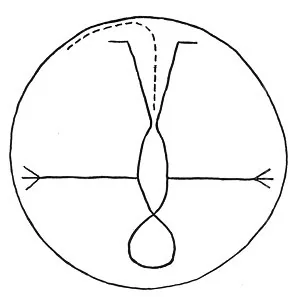
FIGURE REPRESENTING TAMAIAWOT, THE EARTH, THE MOTHER OF ALL.
Drawn by Pachito, Luiseño of Pauma.
was a person (atakh). Her feet were to the north, her head to the south. Dupash, the Sky, was a man. He was the younger brother of the Earth. All the people were born from the Earth. Some went this way, some that. At first they travelled together. They went from where they emerged to the end of the world and from there westward. (Their course is represented by the dotted line in the figure.) The eagle (aswut) went in advance and they all followed. While they were all together they had one language. Then they began to separate. The whites went away. The people (Indians) were left. They still went on following the eagle as he flew. Where he stopped they slept. So the eagle went on and they followed him until they came to Nachivomisavo, "north of the San Bernardino Needles." As they went the people had been going singly, in a long row. When they slept at this place they all crowded together in a great pile. There was no room for them. Now they smelt each other there. They found that they did not smelt good. Some of them did not like others. So they went in different ways and some of them came here. Before that they all had the same language. This original language was that of San Gabriel. Those who continued to speak this stayed at the place of separation.
Wiyot was the chief of the people. It was he who separated them at Nachivomisavo when they did not like each other. Wiyot was killed by the people. They quarrelled about life. Some of them said people should die, others said they should live and change. Wiyot tried to stop the quarrel but became tired of it. Then he said he would go away. He went to the sky, He is there now. Those who wanted people to die were Awaavit, fog, Tumihat, thunder (?), and Chebepe, wind (?). These three were wise and were doctors. Wiyot, however, knew most of all, and therefore some of the people did not like him. Many doctors wanted him killed. Those who made him die were Wakhaut, the frog, and Karaut, a red worm that lives in the mud. While Wiyot was alive all called him Wiyot. Now he has two names, Moila, the moon, and Wiyot. When Wiyot was dying he said: "I will teach no one. I will leave you all without telling you." Only to Chekhemal, a bird (probably the meadow-lark), he said. "When I die watch for me. I will come in the morning. Watch and tell all the people that I have not died." Then after Wiyot had died, in the morning Chekhemal chirped: "Moila Wiyot is coming." Then the people knew. Wiyot died at Tova near Maronge, north of the San Jacinto Mountains where the Serrano (Maringayam) live.
While Wiyot was sick Coyote was waiting to eat him. He watched. Wiyot said: "You see that Coyote constantly wants to eat me. When I die there will be a great fire far off in the east.
Let Coyote be sent to bring that fire. All of you say that you have no fire. Then he will go. As soon as he goes, make a fire and burn me. If you do not do that he will eat me." Now when Wiyot died the people told Coyote: "You are the best runner. You can get it quickly. Go and bring the fire to burn Wiyot. Then when he is roasted you can eat a little." Coyote went running. He saw the fire ahead and kept on running but never reached it. Meanwhile they burned Wiyot. Coyote turned around, and saw the fire, and ran back. As he came he said: "Give me room. I want to see my father Wiyot." The people knew him and stood about the fire in a thick crowd. They would not let him inside. Then Coyote went back a distance, ran, jumped over them, and just as the heart of Wiyot was burning he seized it and ate it.
Not only people but all things were born from Tamaiawot. They all came from her belly: the sun, the stars, the rocks, the trees, and everything. The ocean is her urine. That is why it is salty.
THE MOHAVE ACCOUNT OF ORIGINS.
It is interesting to compare with this story the corresponding myth of the Mohave. The Mohave live on the Colorado River in both California and Arizona. They are a primarily agricultural people with a more developed tribal sense and warlike spirit than the Mission Indians. Located as they are on the borders of the Southwest, in fact in part within it, they present many cultural features that are not found among the Mission Indians. In fact, as compared with the Mohave, the Mission Indians and the Indians of northern California form a unit as regards their general culture.
The Mohave origin myth has been obtained much more fully than the Luiseño, in fact at such length that it is possible to give only an outline in the present connection.
According to the Mohave, the first were the sky, a man, and the earth, a woman. These met far in the west, and from them were born, first Matevilye, and after him his daughter the frog, Mastamho who is usually called his younger brother, all the people, the animals, and plants. All these went upward toward the east, under the leadership of Matevilye. Matevilye himself did not walk. He merely moved four times, twice to the left and twice to the right. Thereby he arrived at Ahavulypo, a narrow defile on the Colorado River above Cottonwood Island, probably near the lower end of Eldorado Canyon. He stretched out his arms to the ends of the world and thereby found this spot to be the centre of the earth. Here he built a house. He became sick because the frog his daughter, whom he had offended by an indecency, ate his excrement; and it was known that he would die. When he died, Coyote, whose intentions were suspected, was
sent far away to bring fire for the funeral pyre, During Coyote's absence fire was produced among the people by the fly, a woman, who rubbed her thigh. Matevilye was then burned. According to the usual account, although this episode does not form part of the version on which the present relation is based, Coyote returned as the pyre was in flames. The people surrounded this in a close ring. Coyote succeeded in leaping over the head of the badger, who was short, seized Matevilye's heart, and escaped with it. Under the direction of Mastamho the people then made for Matevilye the first mourning ceremony in the world.
The remaining bones and ashes were offensive to the people. Mastamho therefore successively made wind, hail, and rain to obliterate them, but failed. As a fourth resource he then went far northward in four steps, taking the people with him. Plunging his stick into the ground, he made water come forth. Three times he stopped this with his foot, until the fourth time it flowed southward to form the Colorado River. As the water flowed, a boat emerged from the ground. He entered this and put the people into it with himself. They constituted six tribes not yet separated. As the boat floated down the river, he tilted it to one side and the other, making the river valley flat and wide in the places where he did so.
When the boat arrived at the ocean, the head of the Gulf of California, Mastamho left it and Went northward, carrying the people on his arms. The water was deep and he ascended a mountain. Everything was covered with water except the top of this peak. By taking a step in each of the four cardinal directions, he made the water recede. He then planted seeds of the vegetation which was to furnish subsistence to the desert tribes. Then, still accompanied by all the people, he went on northward to Avikwame, the sacred mountain of the Mohave, not far north from their villages, and called Dead or Newberry Mountain by the whites. There he too built a house for himself and the people.
He made the people shout four times and thus produced daylight, the sun, and the moon. Then he tried the medicine-men, making those sit down who did not talk properly, and designating those who spoke right. These men upon being born on earth would be successful shamans.
Far in the south in the ocean, in a house of hair, lived Humasereha, an immense snake. One of the people on Avikwame pretended to be sick, and Humasereha, the great medicine-man, was sent for. He came northward, rattling with his tail and making rain, and thunder. When he arrived he inserted his head into the door, It was so large that the house was almost tilted over. As soon as his head had entered the house it was cut off and he died. Therefore it is that
medicine-men, who are thought to be the cause of almost all disease and death, are killed by the Mohave.
Then Mastamho sent off five of the tribes, telling them what country to inhabit and how to live. The sixth, the Mohave, he ordered to stay in the adjacent country and there to live and build their houses. Then he was alone. He questioned himself what to do and how to "die," that is to say, what shape to assume to terminate his existence in human form. He tried departing in various directions and sinking into the ground, but was dissatisfied. Then he stretched out his arms. Feathers grew over him until he had wings. On the fourth trial he was able to fly. Then he went off as the fish eagle.
It is obvious that the general course and tenor of the Mohave creation is similar to that of the Mission Indians. All beings are generated by the primeval heaven and earth. The people move in a body, following a leader, whose death is later caused by the frog. At his death Coyote succeeds, in spite of the precautions taken, in seizing a part of his body. The second great leader, Mastamho, is relatively more important among the Mohave than his counterpart is among the Mission Indians, as Matevilye, the first, does little but lead the people from their place of origin to the centre of the world, build a house, and die. Mastamho makes the all-important river and the sun and moon. His other achievements all relate not to nature but to man. He journeys with the still united people, saves them from the flood, instructs them how to build houses, ordains and instructs medicine-men, provides food, and separates the various tribes, giving to each its distinctive customs. Other accounts, not here considered, deal more fully with his instructions to mankind regarding the arts of life and ceremonial institutions. The similarity of this tradition to the corresponding accounts among the Mission Indians, even in many points of detail, could not well be closer, and is the more important on account of the considerable cultural differences between the tribes. It is therefore evident that mythologically all the tribes of southern California, from the Colorado River to the sea, with the possible exception of the Santa Barbara islanders, of whose beliefs nothing is known, form a close unit as compared with the remainder of California.
METEOR MYTHS.
In the myths not dealing with the origin of things the same degree of resemblance is found between the Mission Indians and the Mohave. The elaborate Diegueño Chaup stories published by Miss Du Bois have a close parallel among the Mohave. This equivalent Mohave tradition has not been obtained in full, but an outline has been heard related which leaves no doubt of the correspondence
of the versions of the two tribes. It is interesting that Miss Du Bois states that her Diegueño informants believe their Chaup story to have been borrowed from the Mohave. Similarly the Luiseño informant from whom the Dakwish or Meteor myth given below was secured stated to the author that what he knew was only part of the entire Dakwish myth, that part, namely, which relates to Luiseño territory: and that another portion of the story, which tells of the doings of Dakwish in the country of the Diegueño, with an accompaniment of songs, was known to these people. Certain episodes and elements of the Diegueño Chaup stories have also been found in other Mohave myths, notably the one of the two Cane brothers, which may be regarded as a somewhat differentiated version of the same story. In this Cane story occurs Kwayu, the meteor, who is mentioned also in other Mohave legends as a destructive cannibalistic being. Chaup himself is the meteor, and while the greater part of the Chaup story has no direct reference to the meteor, the identification is present in the minds of the Indians. That the meteor was important in the beliefs of the Indians of southern California is further shown by the Luiseño Dakwish myth given below, and by a somewhat similar story from the Saboba, a more northern division of the Luiseño, printed in this journal some years ago. It must therefore be concluded that the meteor is one of the most important special conceptions in the mythology of all southern California, not of innate or inherent importance, but through a selection which for some reason or other has taken place. To this personification have been attached whole mythological episodes that have no real connection with it. These enlarged meteor myths have in many cases been made into myth-ceremonies of the kind characteristic of the region. We have therefore to see in the meteor myths of southern California a special, and as it were accidental, but striking development characteristic of the culture area, very much as the story of the deer and bear children is of northern California, and the story of the visit to the dead in pursuit of a wife is of the San Joaquin Valley.
The dakwish, it is said by the Luiseño, is not infrequently seen. Often it causes death, though some men can see it and not die. It is described as being like a bird, having soft white feathers all over its body. Around its head are tied feather ropes, and these hold in place the elat, the board ceremonially swallowed by medicine-men and also worn as a headdress. As the dakwish moves, its feathers fall and it leaves them behind. It can be seen every night at San Jacinto Mountain, turning like a ball of light.
When a woman, who now is old, was young, she was camped on the top of Palomar Mountain with her family. They had gone there
to gather acorns. At night they slept by a large fire. She awoke and heard a noise as of a dog chewing. Near them was a large pine-tree. On this she saw the dakwish sitting with its head bent, holding a person that it was eating. The young woman woke the others of her family. Then, after they all had seen it, the dakwish went away. Not long afterward one of the family, a young woman, died.
THE PAUMA LUISEÑO STORY OF DAKWISH.
Dakwish was born at Pawai, a place south from Escondido in the Diegueño country. His grandparents were born from Tamaiawot. The following is only part of the story concerning him, the part which relates to Temecula, not the part which has to do with the Diegueño country.
In Temecula there was a chief called Tukupar, which in Gabrielino means dupash, sky. He had a son who was named Naukit. Naukit went rabbit hunting to: Toatwi, Santa Gertrudes, near Temecula. There Dakwish met him and killed him. Tukupar looked for his son but could not find him. He came back and told his people that his son was lost. He started out again. At a large hill he saw his dead son. He knew that Dakwish had killed him. But Tukupar also was a medicine-man, very much of a medicine-man. Going back he called all his people. He told them that Dakwish had killed his son and that he was going to see Dakwish.
Now there was no ordinary way to enter the house of Dakwish, for the door was a large rock; but Tukupar, being a doctor, made himself into a raven. He was carrying two rabbits with him. He found the mother of Dakwish sitting. She was frightened. "What are you doing here? No one, comes here," she said. "I came to see Dakwish," he told her. She said: "Why do you want to see him? He is destructive. He will kill you. Go into the house and I will let you know when he comes." Tukupar went in and sat down.
In the, evening Dakwish came. It thundered and the wind roared and rocks rolled down the hills. Dakwish greeted his mother. The old woman told him that Tukupar had come. "Yes?" he said. "If my cousin is here I will roast him and eat him because I have caught no one to-day. I have had bad luck." His mother said: "No, do not do that. He is your cousin." "Be quiet," he told her. Dakwish went in to catch him. He took hold of him. Tukupar disappeared. He was behind Dakwish. He said: "Behave yourself, my cousin." Then the old woman said, "Leave your cousin alone." Dakwish answered: "Why did you not say that he was my cousin?" Then he asked Tukupar: "How did you come in?" He gave his pipe to Tukupar to smoke. Tukupar had his own and smoked that. He did
not smoke Dakwish's pipe. Dakwish said, "I did not think you were a man. No one can come into this house."
Then Dakwish went out and brought in food for Tukupar. He brought him human flesh. "Eat this," he said. "Very well," said Tukupar. But he did not eat it. He ate the two rabbits he had brought. Dakwish was behind him. He asked him: "Did you eat the meat I gave you?" "Yes," said Tukupar. "Do you ever eat that kind?" Dakwish asked him, and again Tukupar said, "Yes." It was dark where he ate. Now Dakwish made a light to see if the meat was gone, He said: "I did not think you would eat it. It is human meat." But Tukupar told him: "Yes, I was hungry and ate it."
Dakwish said, "I am surprised you have come. No one has ever done so. Now dance." Tukupar said: "No, you dance. I want to see you, my cousin. I do not know how to dance." Dakwish laughed. Then Tukupar stood up. He danced while Dakwish sang for him. As Tukupar danced he broke his own arms and legs. Dakwish said: "I did not think you were a man. Now I see you are a man. Now I see how you were able to come here." Then Tukupar rubbed his arms, his legs, and his body, and was well again.
Then he said: "Now, my cousin, you dance." Dakwish said: "No, I do not know how. You are a good dancer. I cannot do as well as you." "Come, do as I did," said Tukupar. Dakwish sat hanging his head. Then Tukupar told him: "My cousin, you say you are a man. I am a man too." Then Dakwish stood up. Tukupar sang the same song for him. He said: "I will sing the song I learned from you." Then Dakwish danced and the wind blew hard. Tukupar said: "Do not do that to me." He was thinking how to catch him. Dakwish did as Tukupar had done before. He broke his bones, cut off his hair, threw it away, broke off his legs, and threw them away. Then he flew about with only body and head, and broke his head apart with his hands. From the middle of his body feather ropes (pewish) grew out and spread around the entire bead and body. Then he put himself together again.
Now Tukupar threw gnats (sengmalum) into the eyes of Dakwish so that he could not see. He rubbed his eyes and said: "My cousin, cure me. I know you did this to me." Tukupar said "You are a man. You broke your body. Why do you not cure yourself?" Then he cured Dakwish.
Now Dakwish said: "My cousin, you have bad thoughts against me." "No, I have merely come to see you," said Tukupar. "Why have you come, my cousin?" Tukupar said: "I have come to see you because I had a son. He is dead." Dakwish was quiet. I came to ask you if you had seen him anywhere." Dakwish said: "What
will you do? I killed him." Tukupar said: "I want only my son's hair." Dakwish told him: "It is well. It is night now. In the morning we will see. Stay here, my cousin. I am going now. I am going to travel. There is war and I want to go to it. I will see you in the morning." Then he left Tukupar.
The mother of Dakwish came in. "What did he do with you?" she asked. "My cousin danced," said Tukupar. The old woman said: "He is bad. If he comes in the morning and tells you to stay, do not do it. He will kill you." "Very well, my father's sister," said Tukupar.
In the morning Dakwish came back. There was wind and thunder and it roared and shook. "How are you, my cousin?" he said. Tukupar stood up. Dakwish was afraid of him. He asked: "Tell me what you said last night." Tukupar said: "I want my son's hair." Dakwish said: "Very well. Look there where the masawat is" (an ornament made of or containing hair). Tukupar could not find his son's hair. He said so. Dakwish said: "I cannot help it. There is another masawat. Perhaps it is in that." Tukupar could not find it there. Dakwish said: "That is all. I have no more." Tukupar said "Yes, You have another." He went to another one, a new one. Dakwish was ashamed. He went away with it for a little while. Then he came back. He had hidden Tukupar's son's hair, and said: "There is nothing there. Don't you see?" Tukupar said: "My cousin, you have it under your arm." Then Dakwish hit him in the face with the hair. He said: "You came here to cry." Tukupar said: "That is what I want, my cousin," and he put the hair around him. Then he cried. After he had cried, he started to go. Dakwish said: "Are you saying good-by?" and tried to take hold of him. The old woman signed Tukupar to go off quickly. She wanted him to go at once. Then Tukupar flew away, down from the mountain to the ground.
He ht, stood up, and went home. Then he cried and called all his people. When they were all together he took out the hair for all of them to see, and they all cried. After they had cried he told them to go home and sleep and come in the morning. In the morning he said: "I will do to him what he did to my son when he killed him."
Then he went to invite Dakwish to visit him. When he came to where Dakwish had killed his son, a figure in the stone spoke to him. It was where his son had lain when Dakwish had killed him. The stone can still be seen. It said: "Father, go back. Do not go to Dakwish. I will do it myself. I told him not to kill me, I will do the same to him that he did to me." But Tukupar went to Dakwish. When he reached him he said: "I want you to come to my house in
three days." He moved his arm over his breast and Dakwish could not see him any more. Dakwish asked him: "Will there be many?" He said: "Yes. Some are coming to-day, some to-morrow, some the day after." Dakwish asked: "Will there be a chance to kill people?" "Of course," said Tukupar. "Very well," said Dakwish,
Tukupar went back and invited many people from everywhere. In three days they were all there. Dakwish came. People came from Paiacha, Elsinore. Among them was a large woman. Dakwish said: "I will eat that woman. She is nice and fat." But Tukupar said: "Do not, my cousin. There are more coming." Dakwish said: "There is a boy. I want to eat him to-night." Tukupar said: "No, there are more coming." Dakwish was angry. He went and killed one of the people and pounded him up with a pestle.
Then one of the chiefs said: "I have lost a boy." Tukupar said: "That is not my fault. I told you to kill Dakwish to-night. It surely was Dakwish who did that." Tukupar had told them all to kill Dakwish the first night that he was there. Now all the chiefs told their people to kill Dakwish. They talked how they were to kill him. Then Tukupar stood behind Dakwish, who was sitting with his head bowed. He signed to a man with a heavy war-club of oak (dadabish), and the man hit him on the back of the neck and knocked him down. Then they killed him.
They threw him outside and he turned to rock. He is there still (sic). Two men carried him (sic) to Pakhavkhau, north of Elsinore. There they laid him down, covered him with wood, and burned him. Then one said: "Light the fire while I go to drink." Then the other lit the wood and then he too went to drink. When Dakwish began to burn it thundered. There was a great noise and an explosion. Fire flew about and Dakwish flew home like a star. The men said: "There he is flying! He has gone away!" They were sitting at the spring. Dakwish's liver is now a rock at that place. In this way Dakwish went home.
A. L. Kroeber.
Two Myths of the Mission Indians of California. 1906. Hermetic Cloud, https://hermeticcloud.com/library/kroeber-two-myths-of-the-mission-indians-of-california/. Public-domain text reproduced in full; markup only.
Scanned at sacred-texts.com, September 2003. J. B. Hare, redactor. This text is in the public domain. These files may be used for any non-commercial purpose, provided this notice of attribution is left intact.