Mission Memories. By John Steven McGroarty.
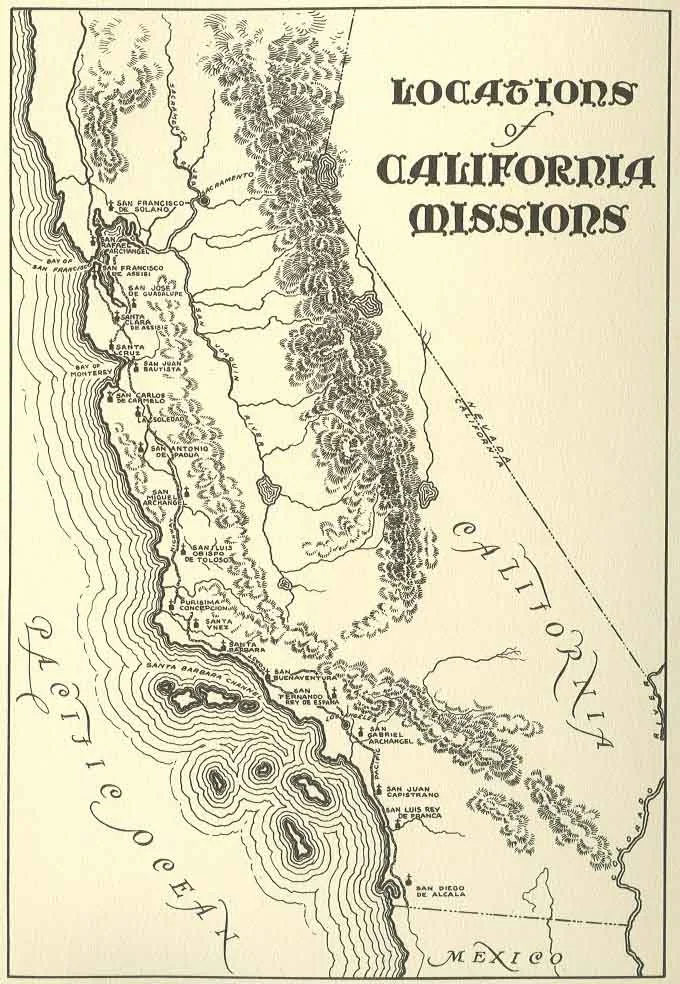
Location of California Missions

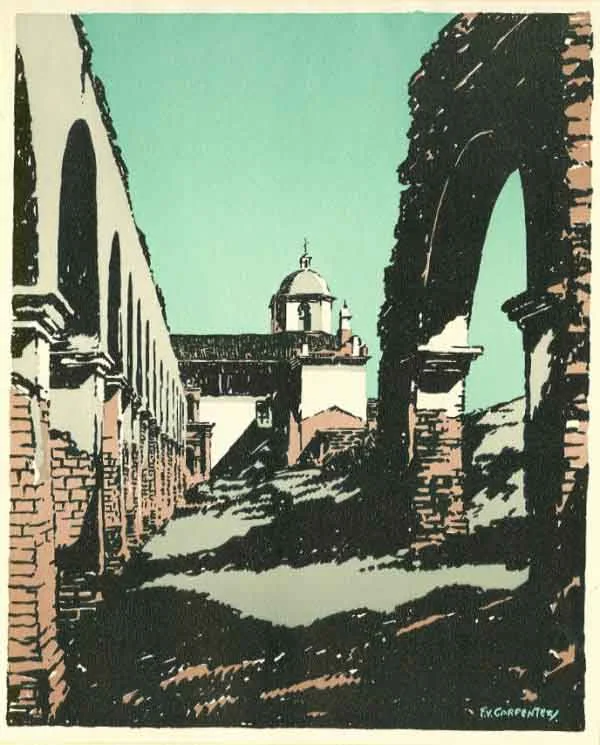
A GLIMPSE OF OLD CALIFORNIA
MISSION MEMORIES
AS DESCRIBED BY
John Steven McGroarty
ILLUSTRATED BY
Frederick V. Carpenter
WITH 22 PAGES OF ILLUSTRATIONS

PUBLISHED BY
Neuner Corporation
LOS ANGELES, CALIFORNIA
[1929]
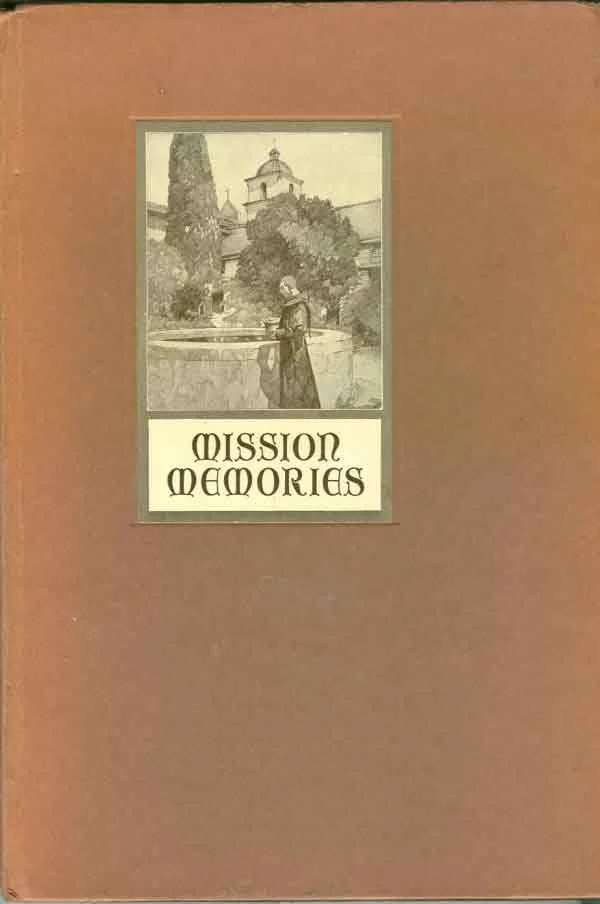
Front Cover
Title Page

The Old Missions of California
HE very soul of romance was woven into the great adventure which brought the white man's civilization to the Western shores of America. And it is in California that the soul of this soul burst into flower.
When the Franciscan Mission Fathers arrived at San Diego in the year 1769 our California of today stretched before them a thousand miles of desert. It was a beautiful desert, but for the purposes of civilized man it was the desolation of a wilderness.
This wonderful body of trained Franciscan missionaries who came from Spain up through the mysterious Mexican Peninsula to the bright shores of the Bay of San Diego wrought upon the desert with magical hands. They took an idle race and put it to work--a useless race that
they made useful in the world, a naked race and they clothed it, a hungry race and they fed it, a heathen race that they lifted up into the great white glory of God. When the vast chain of twenty-one Missions were at last completed through the toiling and patient years, California was the happiest land the world has ever known. There was peace and plenty, and hospitality became a religion. The great oaken doors of the Missions swung inward with welcome to whomsoever might come. In those days a man might travel from San Diego to Sonoma, a distance of seven hundred miles, without a penny in his pocket and never lack for shelter at night or food by day.
It was around the old Missions that the colorful social life of the early Spanish inhabitants centered. Song and laughter filled the sunny mornings. There was feasting and music, the strum of guitars and the click of castanets under the low hanging moons. Toil was easy and the burden of existence light. It was a sheer Utopia. Nothing like it ever existed before, nor has any approach to it existed since.
And yet the dream was not without difficulties for those who wrought it. It was no small achievement to make a desert blossom as the rose and to make so many blades of grass grow where none grew before. To look back upon it now is like looking upon a beautiful play upon a stage harmonized to the ear and eye and which those who see and hear accept so happily but without a thought of the patient effort that was behind it all.
When one looks back upon the achievement of the establishment of the Franciscan Missions in California it is almost unbelievable that so many difficulties were overcome and so many obstacles conquered.
The first great difficulty that presented itself to the Padres was that in the different localities between San Diego and San Francisco the Indian tribes spoke different tongues. It was necessary then to establish a common language so that the natives of one place could converse and have intercourse
with those of another place. And so the Padres set themselves to work to teach the Indians to speak the Spanish language. This they accomplished, and the Indians of California to this day are familiar with the musical tongue of Castile. Not only
did they teach them to speak Spanish, but they taught them to read it and to write it.
I think perhaps the least difficult task was the conversion of the Indians to Christianity. They really had no religion of their own as other savage peoples have had, and it appears that they willingly and even eagerly accepted the glamorous creed of Christianity. Anyhow, it is a fact that the whole race in California was Christianized. And the remnant of the race that still exists will be found by whoever goes among them to be very staunch Christians.
The miracle of inducing the California Indians to work was fully achieved. The proof of it is the chain of twenty-one Mission establishments which were erected and fashioned in beautiful architecture, and which now, alas, lie in ruins between San Diego's Harbor of the Sun and the peaceful and beautiful Sonoma in the Valley of the Seven Moons.
The Mission Fathers while being primarily missionaries burning with zeal for the conversion of the heathen Indians to the faith of Christianity, were essentially practical men. And so they
taught the natives to till the fields, to tend their flocks and to work with marvelous skill at fifty-four different European trades. This race that had lived idle and useless in a fruitful land was evolved by their patient and loving teachers into skilled and useful people. The granaries of the Missions were bursting with plenty, numberless sheep and cattle roamed the shining hills and valleys, the land was vibrant with the ring of the anvil and the whirr of looms. Every Mission was a manual training school where the trades were taught and where the women became skilled in weaving and all the domestic arts. Even the finer things of life were taught to them. Music, painting and sculpture came to be among their achievements and accomplishments.
There is a great deal of mis-information concerning the collapse of this great dream. Many
who are not informed seem to think that the fault is to be laid at the doors of the Americans who began to come into California in considerable numbers about the year 1846.
But, we are thankful to say, the black deed--for a black deed it was--was not done by Americans.
History has written the story down clearly and irrevocably. And what happened was that the Mexican Government which then owned California, seeing how rich the Indian had grown in the Missions which they had builded with their own hands, simply confiscated them. Mexico drove the Indians away, took the Missions into its own hands without warrant or the slightest semblance of justice, sold them at auction to the highest bidders, and pocketed the spoils.
The result was direful and calamitous. The Missions were abandoned and fell into decay. Every vandal that wandered the King's Highway took from them whatever suited his fancy, with none to say him nay. The great domes and towers crumbled and fell in the wind and the weather. The bat and the owl made their nests in the deserted rafters. The Indians were driven back into the wildernesses of the mountains to starve and die.
This is, in brief, the story. And there is no other story in the annals of time quite to compare with it. No other band of so few men accomplished so much as the brown-robed brothers of St. Francis accomplished in their day and generation in California.
The Franciscans who bore in their beautiful rough brown hands the torch of civilization to California, considered that the arts were a part of education. So we find through the ruins evidence of a perhaps crude art that is yet very beautiful. We find striking frescoes on the walls of the churches, statuary hewn from wood and hammered from brass. We find that musical instruments were made, upon which the natives were taught to play exquisitely. One of the great traditions of the Missions is the famous Indian orchestra of the Mission San Luis Rey where Fray Antonio Peyri lived his wonderful life for many long and splendid years.
Through this education was evolved a distinctive architecture which is today known and highly admired through the civilized world. All the Mission structures were more or less beautiful, and some of them were worthy to be classed among the best efforts of architecture in history. The mission of San Antonio de Padua in Monterey
County is said to have been the finest of the Northern Missions, while San Fernando is considered to have been the finest of the Missions of the South.
The glory of California today is its schools. The
stranger within our gates is overwhelmed with the lavish beauty of our school buildings--noble and stately structures that vie with the architecture of Greece and Rome in their best days. I think that our schools of today architecturally are the logical outcome of the Missions. This may be said to be a far-fetched conclusion, but we must remember that every civilization is builded on the ruins of the civilization that preceeded it. And, is it to much to say that this is as true of California as it is of any other land?
In the old days before civilization had reached the tremendous strides that it has now attained the journey from Mission to Mission was made by means of ox-carts or on horseback. The Mission Fathers themselves, obeying the rules laid down by St. Francis, the founder of their order, always walked.
The great road connecting the Mission establishments was called El Camino Real, "The King's Highway." A portion of this original road may still be seen as it was first made, if the traveler will look over the little barranca adjacent to the Mission San Juan Bautista.
The great main State highway of California, stretching for practically one thousand miles from
north to south, passes nearly all the Missions. It is one of the finest roads in the world, solidly paved with concrete and free from winter inconveniences of snow and ice for the reason that snow and ice is confined in California to the high mountains.
Wherefore, in these modern days the tourist and traveler may step into an automobile at San Diego, set forth upon the great highway and make a visit to all the Missions within the space of a few sunny days, finding marvelous hostelries for shelter at night and food by day.
But, in the old times it was a day's journey alone from one Mission to the other even on the back of a speedy horse. The Missions stand about thirty miles apart, the one from the other. And in old times they were the hospices of the land where travelers stopped and were always welcome and no price to pay from one end of the journey to the other.
It is a glamorous tale, full of
beauty and color and the grace of God. Nor has all the beauty and romance departed. Though the Missions are in ruin, one can still sense what glory and splendor once was theirs.
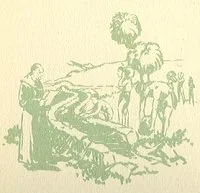
Mission San Diego de Alcala
HIS was the first of the Missions.
It was founded in the year 1769 upon the arrival of the expedition headed by Don Gaspar de Portola by land up the peninsula of Lower California and the expedition that came by sea. Fray Junipero Serra, first Father President of the Missions, was with Portola. The ruins of the Mission may still be seen. It was here that the first irrigation dam and ditches in California were builded, and that the first palm and olive trees were planted.
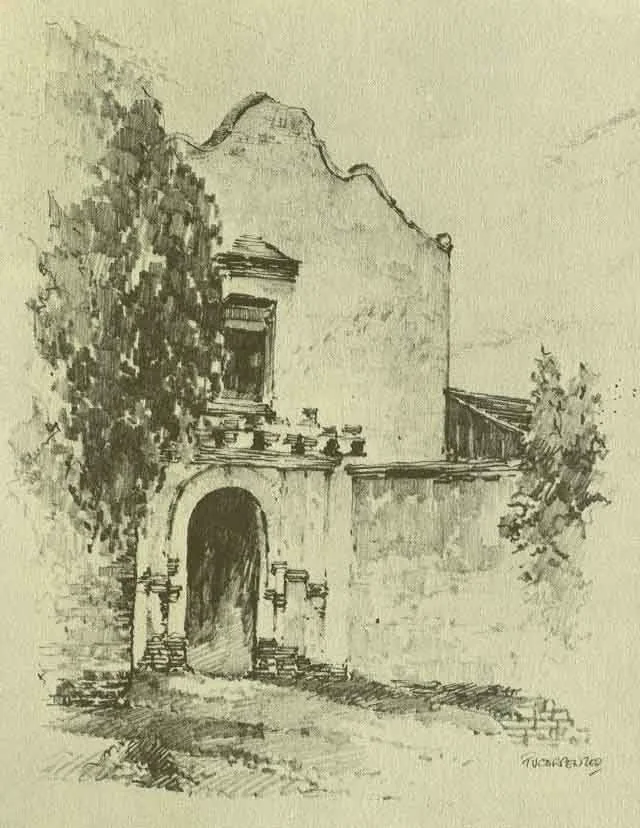
Mission San Diego de Alcala

Mission San Carlos de Carmelo
HIS, the second of the Mission establishments, was founded in 1770 by Father Serra and became his headquarters during his life in California. His body was buried within the sanctuary of the church that was erected there during the last year of his life. Annual pilgrimages by devout and patriotic Californians are made to it. The Mission is popularly known as "Carmel" and is situated on the little bay of that name six miles distant from the city of Monterey.
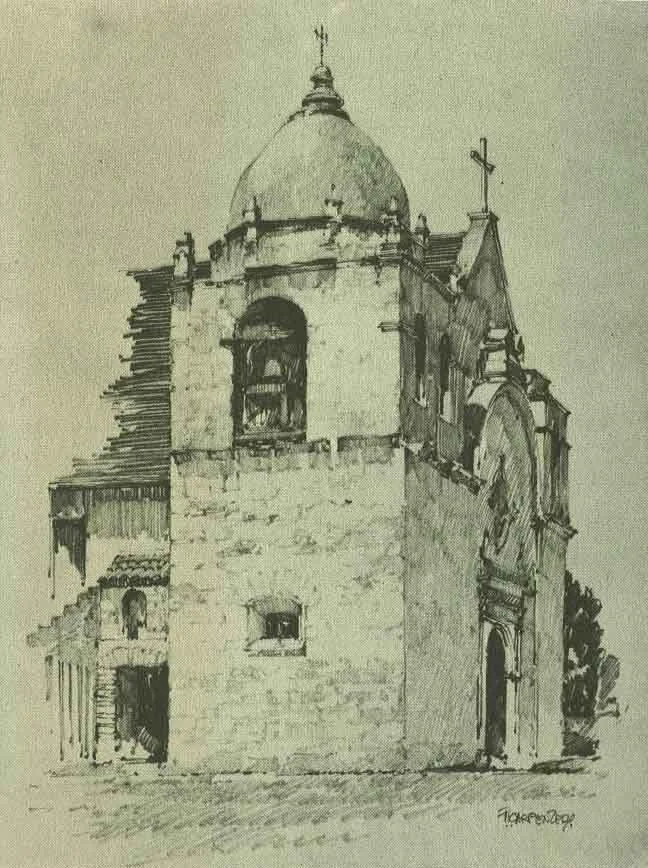
Mission San Carlos de Carmelo

Mission San Antonio de Padua
HIS was in the days of its glory one of the most beautiful and most important of the Mission establishments. Perhaps because of the fact that it is away from the trend of travel, situated in a lonely but lovely valley in a circle of the Santa Lucia Mountains, it has been sadly neglected and is only infrequently visited. In order to reach it a detour of twenty miles from King City on the main California State High-way is necessary. The trouble taken to find it is well worth the effort.
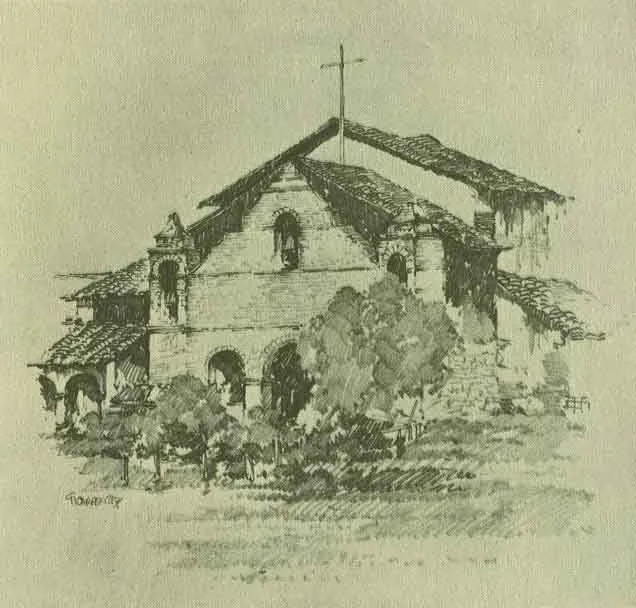
Mission San Antonio de Padua

Mission San Gabriel Arcangel
LD San Gabriel Mission with its picturesque bell tower and its exquisitely beautiful outer stairway, worn by the bare feet of the Indian neophytes, was founded in the year 1771 and is distant nine miles from the center of the City of Los Angeles. San Gabriel became the richest of the Missions and was called "The Queen of the Missions." It is here that the "Mission Play" is given each year in a magnificent playhouse by a great company of Indian and white performers numbering over one hundred persons.
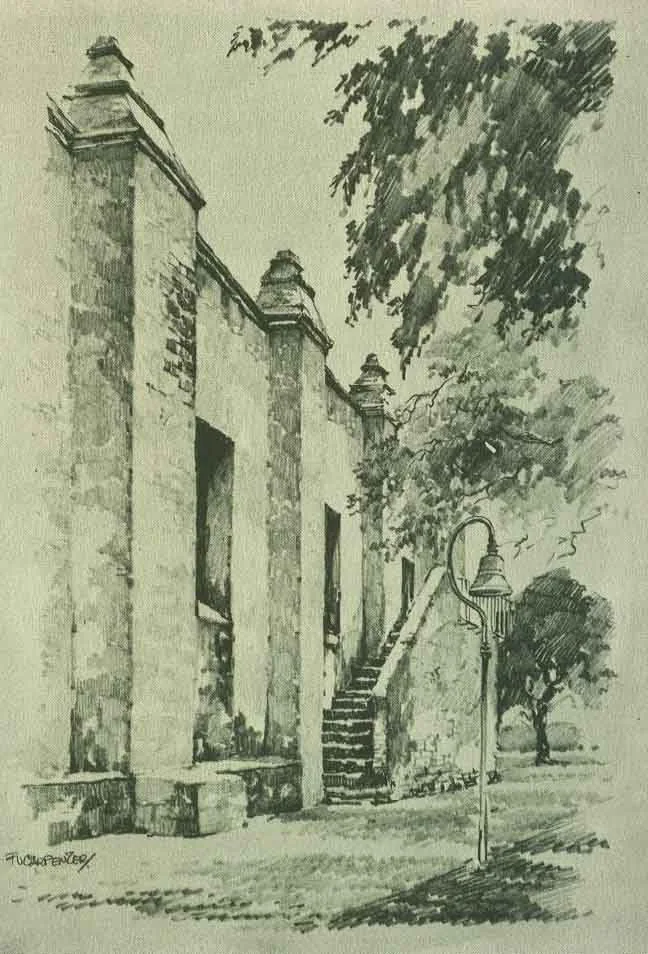
Mission San Gabriel Arcangel

Mission San Luis Obispo de Tolosa
T is located in the present thriving city of San Luis Obispo and was founded in 1772. Like nearly all the other Mission establishments much of the structure has fallen from long years of neglect and the merciless onslaughts of the wind and rain. However, the beautiful old church has been restored and is again being used for the celebration of Divine services. This Mission met with many discouragements in its early stages but finally became highly prosperous.
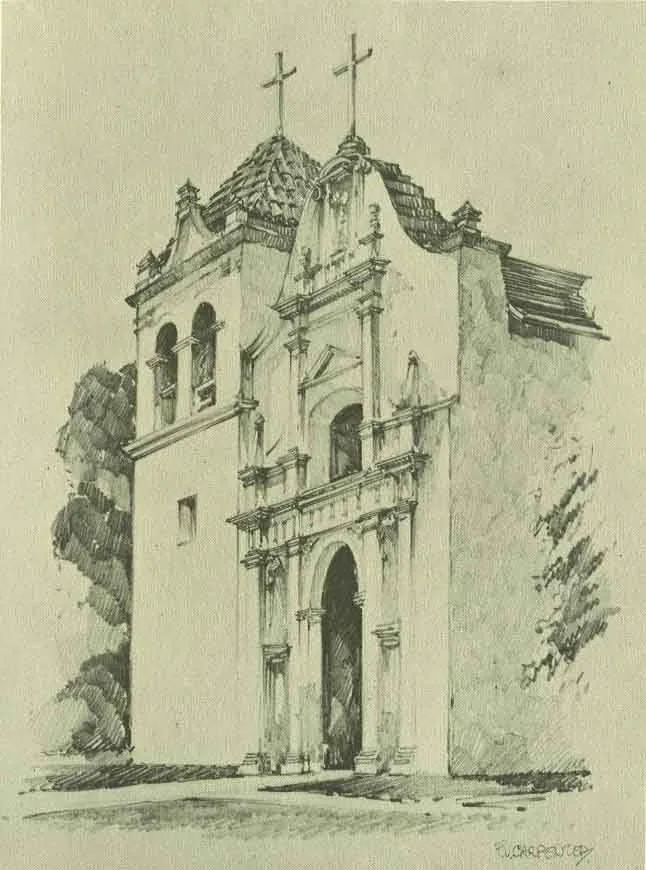
Mission San Luis Obispo de Tolosa

Mission San Francisco de Assisi
OUNDED in 1776, the year of American Independence, this Mission, still standing in the heart of the great City of San Francisco was a familiar landmark when the great gold rush of the "Days of ‘49" was in full swing. Almost since its establishment it has been popularly known as "Mission Dolores" probably for the reason that it was founded on the church calendar day of Our Mother of Sorrows. It escaped untouched, as though by a miracle, the great fire of 1906.
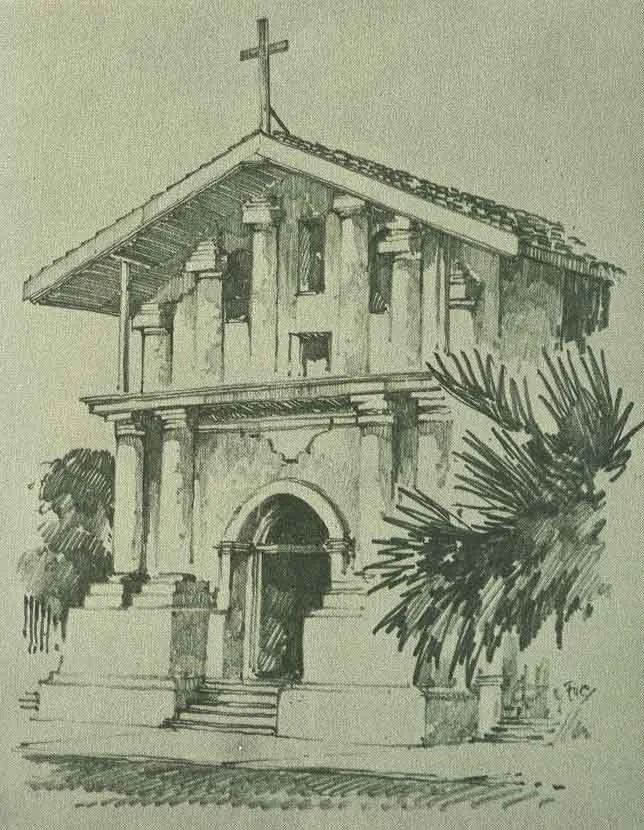
Mission San Francisco de Assisi

Mission of San Juan Capistrano
HE seventh link in the great chain, was founded in 1776 and became in its time a mighty establishment. An eminent architect, the late Arthur B. Benton, who made a careful survey of San Juan Capistrano with a view to its possible full restoration estimated that the work could not be done at a less cost than $200,000. It is here that the only remaining church in which Father Serra celebrated Mass is to be seen, and which has been completely restored by Father St. John O'Sullivan. But the great main church which was wrecked by the earthquake of 1812 still remains in ruins.
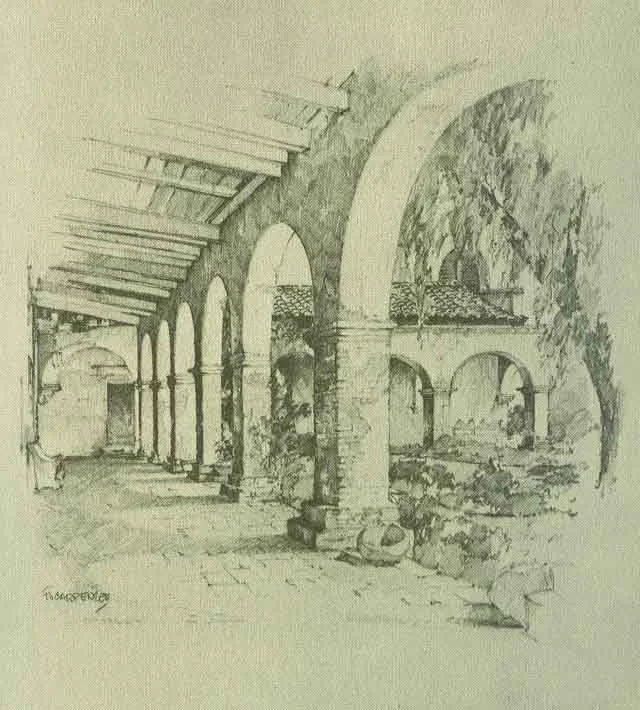
Mission San Juan Capistrano

Mission Santa Clara de Assisi
IGHTH in line was founded in 1777. It is located in the lovely little city of Santa Clara adjacent to the better known metropolis of San Jose. By reason of fires and one or two rather destructive temblors, this once beautiful structure finally reached almost complete destruction. Lately, however, the Jesuit Fathers having had for many years the seat of their university at Santa Clara have rebuilt the old church exactly as it originally stood.
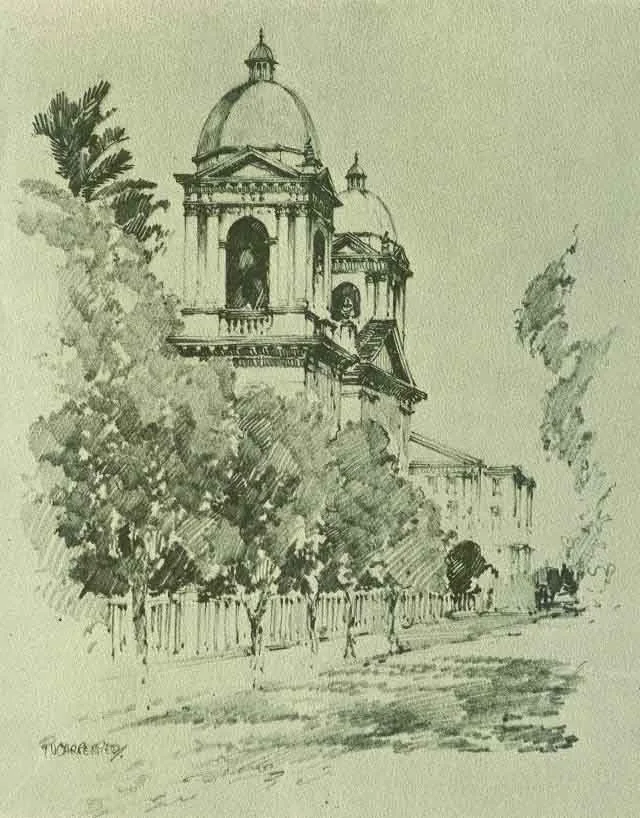
Mission Santa Clara de Assisi

Mission San Buenaventura
HIS, the ninth Mission, was founded in 1783 and is located along the main State Highway of California connecting Los Angeles with San Francisco. When San Buenaventura was builded no bells were available for it, and so wooden bells were substituted and the Mission became famous for them. Another feature of San Buenaventura that will prove of no small interest is the fact that within its walls may be found the celebrated "Matrimonial Chair." Any young lady sitting in this chair is assured of a good husband within a year following.
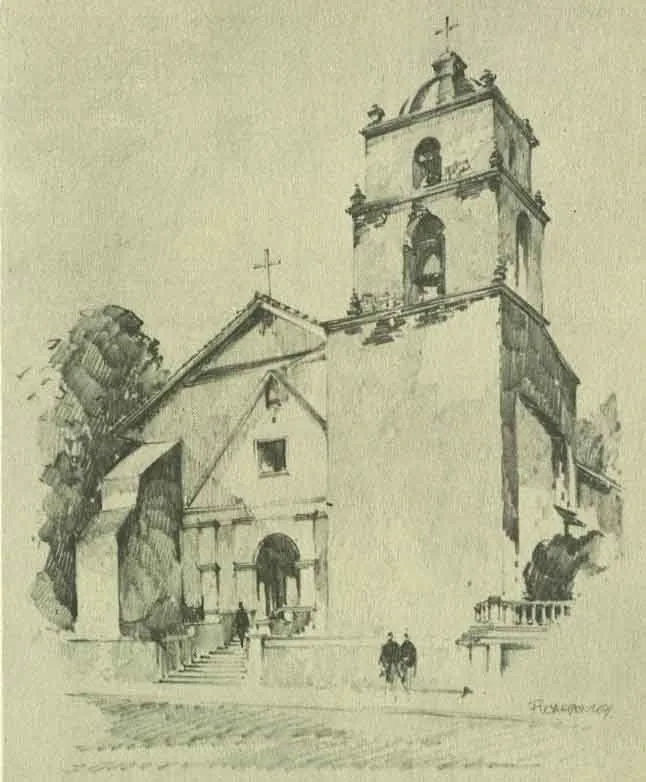
Mission San Buenaventura

Mission Santa Barbara
OUNDED in 1786, doubtless Santa Barbara is the most famous and best known of all the Missions, as it is, at the same time the best preserved. It may be said to stand as it originally was except for the absence of the Indian homes that once surrounded it. Within its cloister is the garden widely known as the "Sacred Garden" from which women are excluded under the Franciscan rule. However, two women are known to have been admitted--the Princess Eulalie of Spain and the wife of President McKinley.
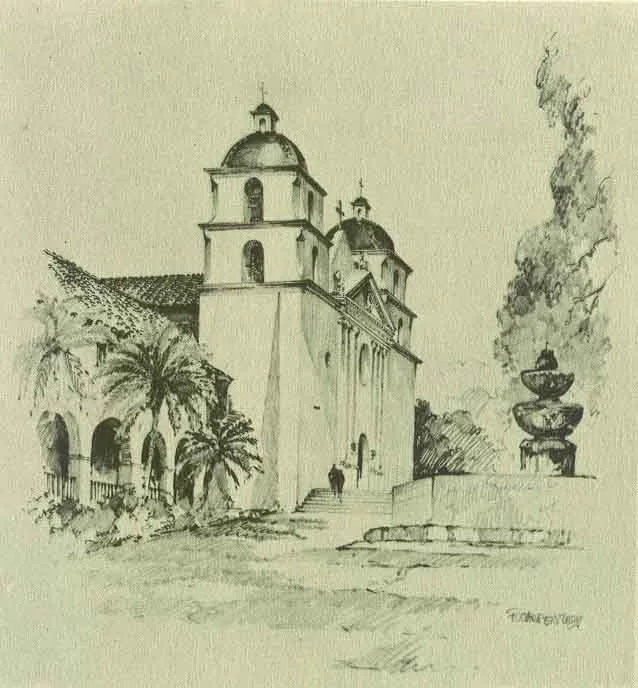
Mission Santa Barbara
Mission La Purisima Concepcion
HE eleventh Mission, founded in 1787. It was originally a most beautiful thing from an architectural point of view erected on a lovely plain in the Valley of Lompoc near the present little city of that name. It was used mainly as a monastery to which the Mission Fathers were wont to retire for special prayer and contemplation. So completely fallen to ruin is La Purisima now that the heedless traveler, may easily overlook it.
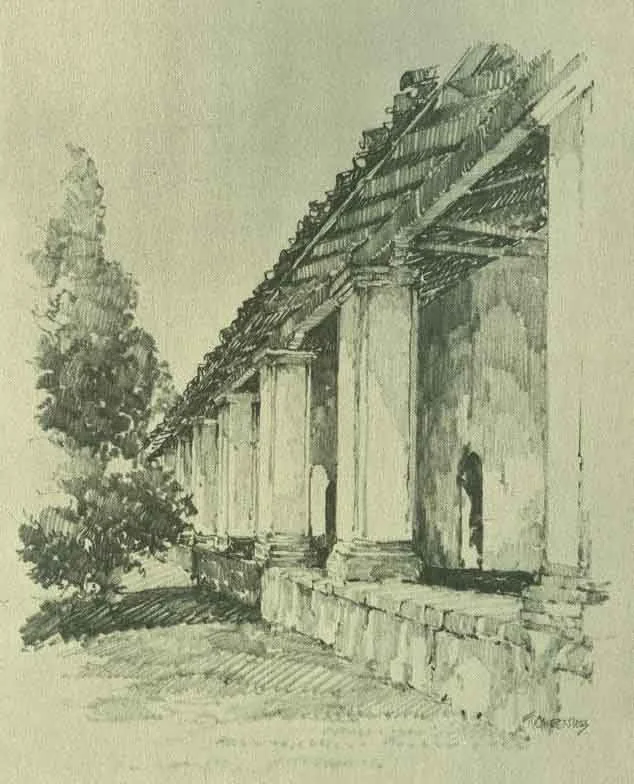
Mission La Purisima Concepcion

Mission Santa Cruz
HE Mission of the Holy Cross, not a trace of which now remains and the site of which is identified only by a mark, was founded in 1791 where the present city of the name now stands within the shadow of the great redwoods and at one end of the shining crescent of the Bay of Monterey. It was in its time a thriving establishment busy with the day's work and filled with the anvil's music and the sound of whirring looms.
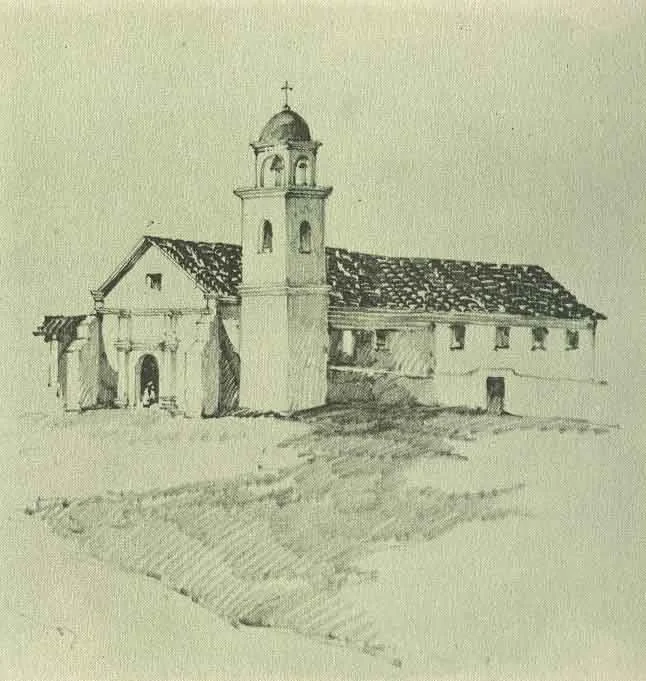
Mission Santa Cruz

Mission La Soledad
HIRTEENTH in the great chain, founded in 1791. As its name implies it was a lonely and solitary place. Only a few of its walls now stand which the sightseer can gaze upon by a short journey of a mile or so from Soledad City located on the main California Highway. It was here, when the Missions were confiscated by the Mexican government, that Father Saria (not Serra) remained with his stricken Indian neophytes and died among them of sheer starvation as he was weakly attempting to ascend the altar steps one morning to celebrate the Divine Service.
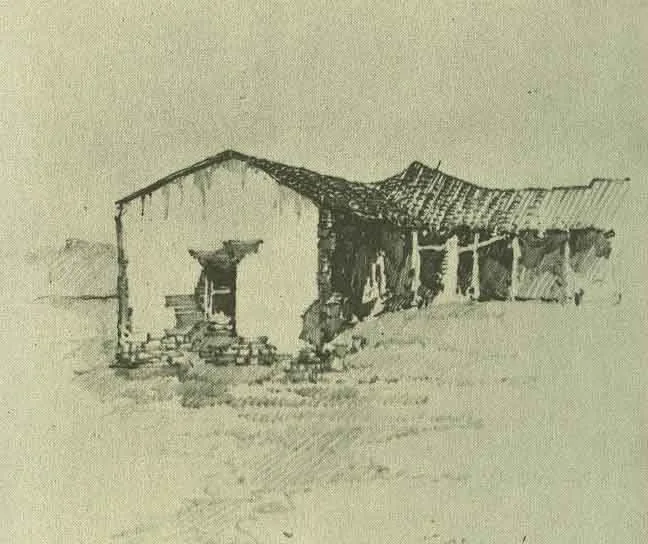
Mission La Soledad

Mission San Jose de Guadalupe
HE fourteenth Mission, founded in 1797. Only a little of the structure now remains but this little is available to sightseers in the Santa Clara Valley not far from the City of San Jose. It was here that the renowned Concepcion Arguello spent the last years of her life among the Dominican Sisters whose community she joined when they came to California. Her life and love story forms the theme of John Steven McGroarty's Play "La Golondrina" (The Swallow) which is presented for a short season each year in the Mission Playhouse at San Gabriel.
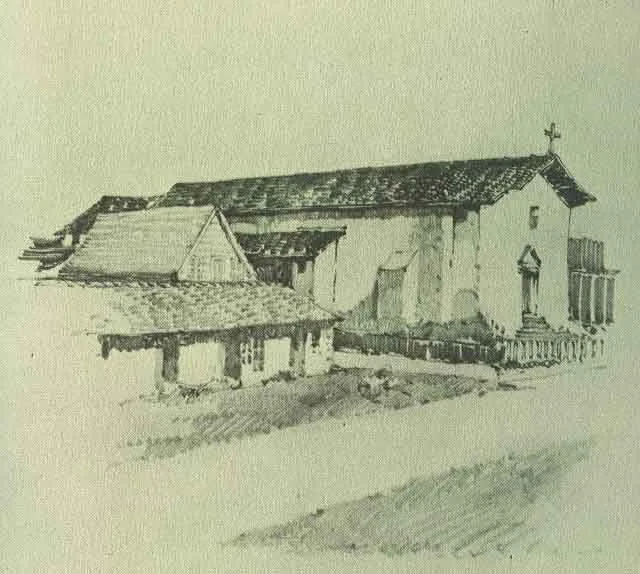
Mission San Jose de Guadalupe

Mission San Juan Bautista
AMED in honor of St. John the Baptist and founded in 1797. So much of the original structure remains, and in such enduring beauty, that no traveler should miss a visit to it. It is located near the city of Hollister in San Benito County, not far from Santa Cruz. Considerable "restoration" has been done at San Juan Bautista. Near the old church many of the historic adobe houses of California history are still standing and occupied.
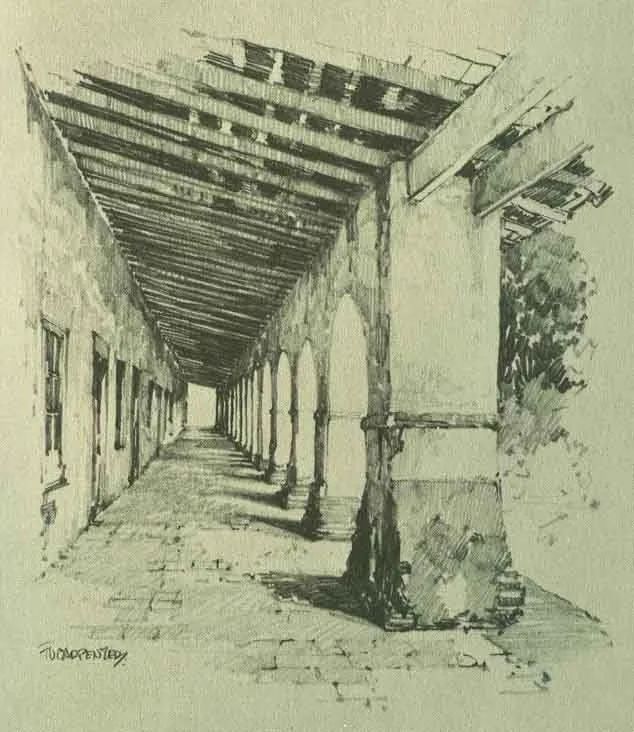
Mission San Juan Bautista

Mission San Miguel Arcangel
HRONOLOGICALLY the sixteenth of the Missions, founded in 1797. It is a familiar sight still to passengers on the railway trains and automobiles on the State Highway. A view of its ruins bespeaks the fact that it must have been a thing of great architectural splendor in the days of its glory. The original church still remains undisturbed with the frescoes painted by the Indians still bright upon its gray walls. The Franciscan Fathers have lately returned to its possession.
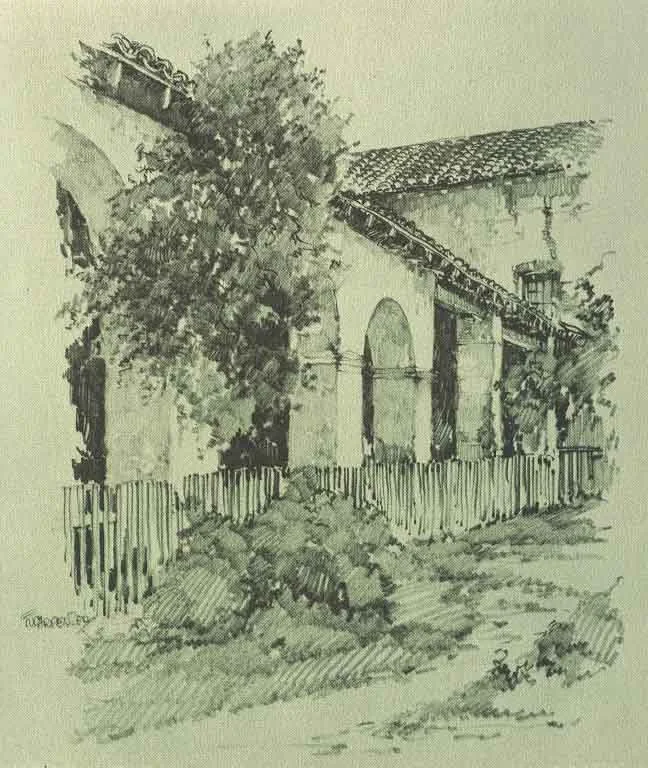
Mission San Miguel Arcangel

Mission San Fernando Rey de Espana
OUNDED in 1797 and located some twenty miles north of the City of Los Angeles in the great San Fernando Valley this ruin is the most striking landmark in Southern California. Prent Buell, the eminent authority on Mission architecture, places San Fernando next to San Luis Rey as the architectural Mission gem. A great bronze statue of Fray Junipero Serra has been erected here, and the City of Los Angeles maintains a beautiful floral park adjacent.
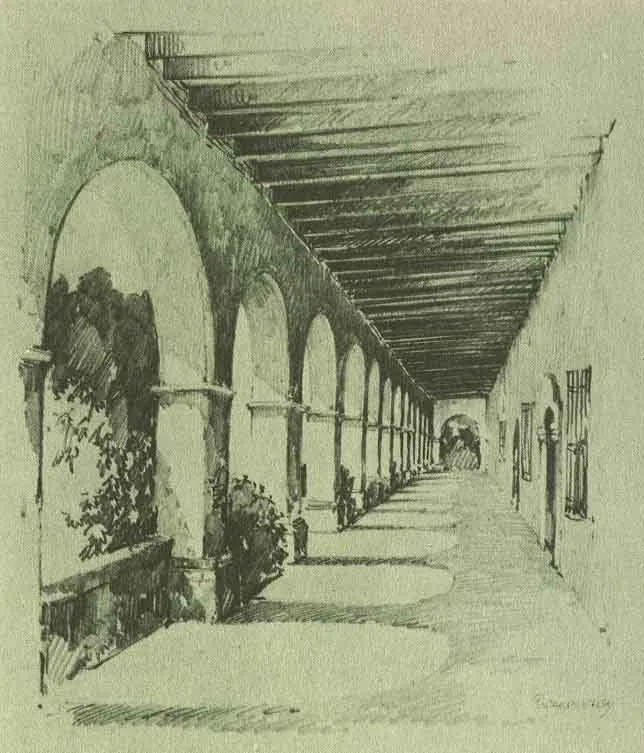
Mission San Fernando Rey de Espana
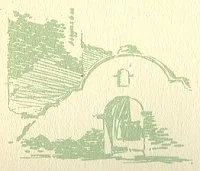
Mission San Luis Rey de Franca
HIS was the eighteenth Mission and was founded in 1798. The Franciscan Fathers have returned to it and have done a great deal to restore it to its original proportions. It was builded entirely of adobe and, according to Buell, stands preeminent architecturally. It is to be seen four miles inland from the town of Oceanside as the traveler enters San Diego County from the North. Many interesting relics of the early Mission days are on exhibition in the museum. In the patio of San Luis Rey the original pepper tree of California still stands green and growing.
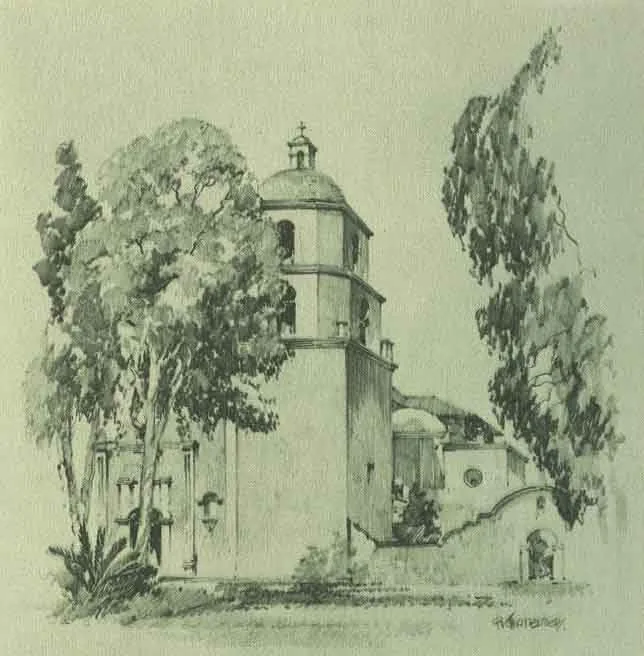
Mission San Luis Rey de Franca

Mission Santa Ines
OUNDED in 1804, nineteenth in the chain, located near the town of Los Olivos. This is one of the most beautiful of all Missions, and a great deal of restoration work has been done upon it mainly through the financial assistance of the Society of the Native Sons of the Golden West. Surrounding the old church is an Indian Reservation still maintained by the Government upon which a few Indian families continue to live. Much of the credit for the restoration of this beautiful edifice is due to the zeal of Father Alexander Butler who was for many years the resident priest.
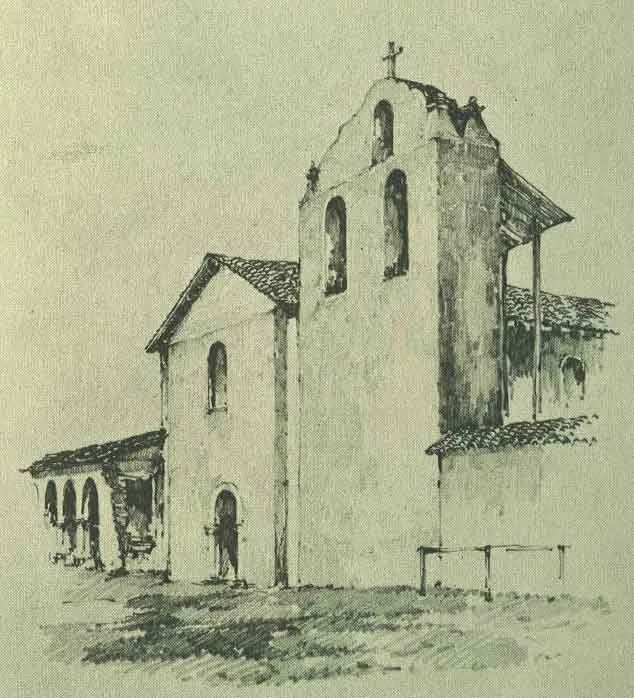
Mission Santa Ines

Mission San Rafael Arcangel
HE twentieth Mission, founded in 1817 has been entirely annihilated by time and the neglectful years. It was one of the two establishments erected north of the Bay of San Francisco in a beautiful and fruitful section of the country. A Masonic Temple now stands on the site. A few broken tiles are the only evidence remaining of this once devoted Franciscan outpost. In due time, no doubt, a suitable tablet or monument will be erected to mark the spot.
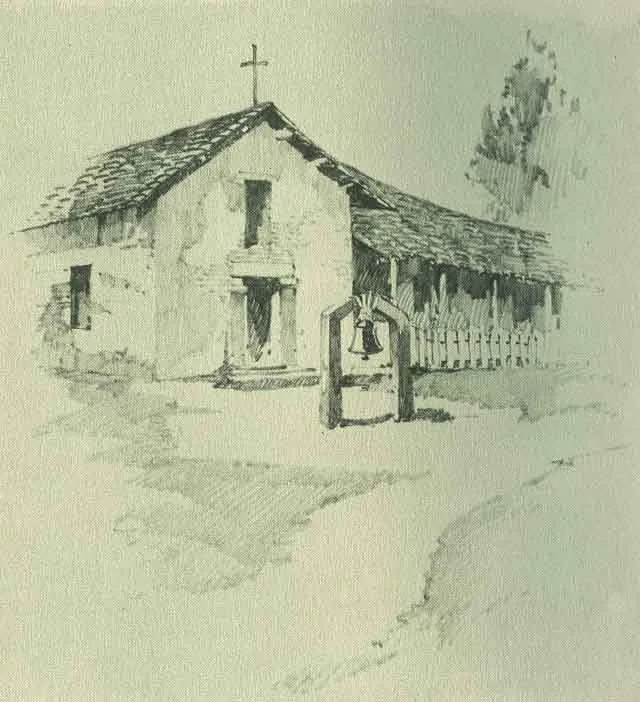
Mission San Rafael Arcangel

Mission San Francisco de Solano
HE twenty-first and the last of the Missions was founded on America's Independence day, July 4, 1824. The ancient church still stands intact and is surrounded by many historic graves marked by gorgeous monuments. The Mission is located in the town of Sonoma famous as the scene of the American adventure known in history popularly as the "Bear Flag Republic." The Sonoma Valley figures as the "Valley of the Moon" in one of Jack London's Novels.
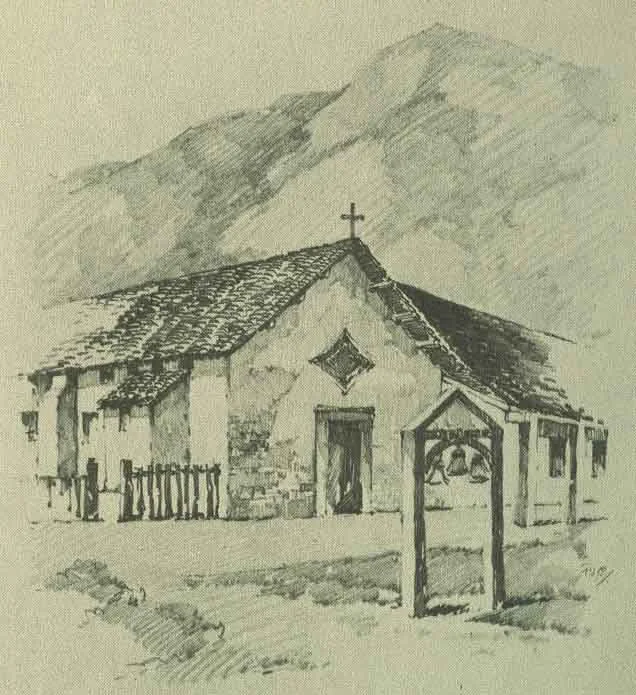
Mission San Francisco de Solano
|
|
page |
|
Introduction |
7-15 |
|
Mission San Diego de Alcala |
16-17 |
|
Mission San Carlos de Carmelo |
18-19 |
|
Mission San Antonio de Padua |
20-21 |
|
Mission San Gabriel Arcangel |
22-23 |
|
Mission San Luis Obispo de Tolosa |
24-25 |
|
Mission San Francisco de Assisi |
26-27 |
|
Mission San Juan Capistrano |
28-29 |
|
Mission Santa Clara de Assisi |
30-31 |
|
Mission San Buenaventura |
32-33 |
|
Mission Santa Barbara |
34-35 |
|
Mission La Purisima Concepcion |
36-37 |
|
Mission Santa Cruz |
38-39 |
|
Mission La Soledad |
40-41 |
|
Mission San Jose de Guadalupe |
42-43 |
|
Mission San Juan Bautista |
44-45 |
|
Mission San Miguel Arcangel |
46-47 |
|
Mission San Fernando Rey de Espana |
48-49 |
|
Mission San Luis Rey de Franca |
50-51 |
|
Mission Santa Inez |
52-53 |
|
Mission San Rafael Arcangel |
54-55 |
|
Mission San Francisco de Solano |
56-57 |
|
Map of the Missions |
59 |
|
HERE ENDS THE STORY OF
MISSION MEMORIES
WHICH HAS BEEN WRITTEN AND COMPILED BY JOHN STEVEN McGROARTY--ILLUSTRATED BY FREDERICK V. CARPENTER--AND PRINTED AND BOUND BY THE NEUNER CORPORATION
LOS ANGELES • CALIFORNIA
IN THE YEAR MCMXXIX |
Printed in U.S.A.