TAO
THE GREAT LUMINANT
ESSAYS FROM HUAI NAN TZU
WITH INTRODUCTORY ARTICLES NOTES ANALYSES
BY
EVAN MORGAN
HON. D.D. UNIVERSITY OF WALES ORDER OF THE DOUBLE DRAGONFOREWORD BY
J. C. FERGUSON PH.D.
[SHANGHAI, 1933]FOREWORD
The two articles by Dr. Evan Morgan which appeared more than ten years ago in the Journal of the North China Branch of the Royal Asiatic Society were the harbingers of this volume. The first article, in the 1922 issue, was based on the twelfth essay of Huai Nan Tzû and had the alternative title of "The operations and manifestations of the Tao examplified in history, or the Tao confirmed by history." Either of these titles is a long paraphrase of the cryptic title of the original Tao Yin. The contrast between the verbose title in Ennlish, which tries to reveal the meaning, and the laconic prototype in Chinese, which successfully conceals it, may be taken as an instructive introduction to the study of ancient Taoist philosophy in the terms and according to the norms of western philosophy. The second article, which may be found in the 1923 Journal, discusses "The Taoist Superman"—chih jên. In these two contributions one may enter the portals of this volume.
In early issues of the Journal, phases of Taoism were discussed in two papers by Dr. Edkins. In the China Review, this subject has been discussed by Giles, Balfour, Mears and Faber. In the Sacred Books of the East, Dr. Legge has given a translation of some Taoist texts. Up to the present, the chief interest of these and other European scholars has been centered in the Tao Tê Ching and in the T‛ai Shang Kan Yin P‛ien. This is not strange; for it is only in recent years that there has been, even among Chinese scholars, a revival of interest in other writers belonging to the Tao Chia. In 1921, Liu Wen-tien published a new edition of the Huai Nan Hung Lieh Chi Chieh based upon the 1788 edition of Chuang K‛uei-chi. An able preface to Liu's book was written by Hu Shih who in 1931 himself published a small brochure on the writings of the Prince of Huai Nan. In 1924 Wu Ch‛ing-shih issued a small volume on the text of the Huai Nan writings. These recent books by Chinese writers have been chiefly occupied with textual criticism; but Dr. Morgan's interest is in the contents. Like all westerners his mind is analytic. He wants to know the why and the wherefore. What is the Tao? He defines it as the Cosmic Spirit. Thence he proceeds to discuss the response of matter to this Cosmic Spirit, the transforming power of this Cosmic Spirit, in creation, beginning and reality and other allied metaphysical problems. Dr. Morgan combines an accurate knowledge of the meaning of the text with a sound understanding of the teachings of western philosophy. The obscurities of the original text are illuminated by his rare scholarship, and thus the reader is able to obtain a fair concept of the ideas of the young Prince.
These writings of the early philosophers of the Tao school are not easy to understand. They are characterized by freedom in the expression of ideas and by liberality of thought as contrasted with the recorded sayings of the Ju school represented by Confucius and Mencius; but their fundamental basis is a conception of nature, unknown to western philosophy. In all of the philosophies which have sprung from Egypt or Mesopotamia and been developed by Greece or Rome, the intellectual power of man has been projected into his conception of the deity. God is thought of as the All-Wise, the intelligent Creator of an intelligible universe. With the early Chinese it was the physical side of man, his power of procreation, that gave the first clue to the mystery of nature. Male and female among themselves, and in the animal life about them, were the source of new life; and it was only to them a natural extension of this known principle to an unknown material world which caused them to believe in the dual powers of nature, male and female, yin and yang. Spontaneity is the original law of creation. Male and female follow their own propensities, and new life is the resultant. This is a dualistic philosophy, but it is not the dualism of mind and matter, nor of good and evil, but of male and female. It is this fundamental difference in conception as to the origin of things, between the Mediterranean schools of thought and the Chinese, that makes it so difficult, and at times almost misleading, to translate early Taoist terms into western languages.
The word Tao is a case in point. Dr. Morgan renders it as Cosmic Spirit and perhaps has hit upon as a good a term as can be found. In my Chinese Mythology I had translated it as Nature, for it is the great force which sustains Heaven and Earth. By it the sky revolves; while the earth remains motionless. It causes the winds to rise, the clouds to gather, the thunder to roll and the rain to fall. All things follow this natural bent; and, from their male and female instincts, life is continuous. With such a conception as to Tao, shall this term be translated Nature or Cosmic Spirit? The question need only to be asked to call forth the answer that both show the limitations of translating composite characters, like Tao, into an alphabetic term. Tao is Nature; but it is more; it is Nature at work. It is also more than Cosmic Spirit, for in it inheres the idea of a Spirit in spontaneous activity.
Philosophic consistency in the accepted western sense cannot be expected of these early Taoist teachings. They never remind me of Plato or Socrates, but always of Philo Judaeus, an English translation of whose works may be found in Bohn's Ecclesiastical Library. Philo used an allegorical method of interpretation in his attempt to reconcile the statements of the divinely inspired Hebrew Scriptures with the speculations of Greek philosophers. The ideas of Plato were identified as the angels of the Old Testament, and they are all collected into a divine world-spirit, the logos, which, in the opinion of Philo, remained a cosmic power without personality. This logos of Philo resembles closely the Tao of the Prince of Huai Nan, but without the sexual implication of the latter. This logos of Philo is very different from the Johannine conception which approaches closely to the Chinese idea of Wên, as a manifestation of the Tao.
The task which Dr. Morgan set for himself has required long years of quiet research and patient toil; but he has the reward of giving to our western world the first adequate translation of the work of Liu An, the unhappy and ill-fated Prince of Huai Nan.
JOHN C. FERGUSON.
Peiping,
November 1933
PREFACE
For some years, now, I have been, off and on, a student of the essays of Huai Nan Tzû. Occasional papers on his work have been read before the Royal Asiatic Society (N. C. B.) and other societies. Some who heard the papers thought a translation of the essays was most desirable. In the course of time this object has been kept in view, and, at long last, it is now possible to publish, in English, eight of the twenty-one essays.
The work of Huai Nan Tzû has always been highly esteemed by all scholars. This is not surprising. It contains great ideals and passages of matchless beauty. It is a work not easy of interpretation. But though the shell is hard, the core is sweet. There are unusual words in the composition: the ideas are often recondite and vague. There are many things not clear in the description even of the phenomena of the visible world; but in the description of the invisible world the conceptions are often vague and the language necessarily not clear. To increase the difficulty there is frequent use made of paradox, hyperbole, the indirect and the allusive method: there is often the subtle reference and occultive meaning.
The theme also occupies a field of its own. Taoism is an original and unique philosophy. To anyone unaquainted with its teaching the language and ideas will seem strange and hard. As Huai Nan Tzû deals with the doctrine of Lao Tan, and was a keen follower of his teaching, it is essential for his readers to have some familiarity with the writings of that sage. These are found in the Tao Tê Ching. Unfortunately, there are no perspicuous translations of this important work. The best two are those of Dr. James Legge and Mr. Spurgeon Medhurst. But often they contain passages as vague as the original! The meaning does not shine out from the words. The translation seems quite correct; but yet the meaning is not quite clear.
This leads me to venture an opinion on what a translation should be. It should always convey a definite meaning and expressed as clearly as possible. The translation should be as near the original as possible. But the chief requisite is that each sentence must have a meaning clearly expressed. Otherwise the translation is useless. It is admitted that a paraphrase may sometimes be necessary; but if this conveys the meaning, it will be a good translation.
The Tao Tê Ching is hard to be understood. But a study of it is fruitful. It is conceded that Lao Tzû was one of the most original thinkers of China. His must have been a unique personality. He commanded the love and loyalty of a disciple, Chuang Tzû, who came 200 years after him, and was one of China's most celebrated scholars. He spent his talents and life in explaining and extolling the master. How much did this master ever write? We only know of the 5,000 words of the Tao Tê Ching. There are critics who doubt if such a person as Lao Tan ever existed. Those who hold such a view have to explain Chuang Tzû. That safe and sound critic Dr. J. Legge, is firmly convinced that he was a historical person and that the Tao Tê Ching is his work.
It has often struck me that Lao Tan bore some similarity to Mr. Bernard Shaw. The modern Irishman and the Chinese of a distant age have a floating resemblance, as they possess things in common. They take a delight in the paradoxical way of writing and in making strange affirmations. Sometimes a doubt hovers round the mind of the reader as to whether they expected him to believe their statements. Both like to shock the public by a seeming absurdity of assertion. Yet all becomes understood when one realises that the writers' great desire is to awaken men from dead tradition to a more real life. They discharge the function of the gadfly to which Socrates compared himself. It stings people to a new consciousness. There is, however, a difference of method. Mr. Shaw speaks much in the first personal pronoun, and vigorously. It would be transgressing against a fundamental principle of Lao Tan to do this. Suppression of self is a leading tenet of the Taoist philosophy. The Ego is only a medium for the expression of the Tao.
Besides a translation of eight of the essays, there are ancillary helps to the understanding of the work. And there are Notes and Annotations, Elucidations, Epitomes and Analyses. Under the heading of introduction, there are various themes discussed,—themes that have naturally arisen out of and that have been suggested by the subject-matter of the Dissertations. These, it is hoped, will be a help to a better understanding of the romantic mind of a thinker whose life-long meditations have been concerned with the profoundest subjects that can occupy human thought, the cosmos, spirit and man. These notes may help to solve some of the puzzling questions that are suggested by the work, such as, the science of "do nothing and there will be nothing undone" which will be recognised as conveying a deep truth connected with human and Divine nature. That "the existent comes from the non-existent" will not seem to be an irreconcilable contradiction: and the phrase "a wide experience gives but a little knowledge" is really not so absurd as it seems on the face of it. There are also words that are different in meaning but which seem so much alike that it is not easy to see the nuances suggested.
The author has ventured to give a new translation of the word Tao, viz., Cosmic Spirit. This seems to cover all the ideas found in the original. However, it is necessary to say, in anticipation of legitimate criticism, that the name has not been consistently used throughout. That of "Tao" is often retained.
I have not prepared a Bibliography nor a critique of the text. It is sufficient to say that a Chinese edition of Huai Nan Tzû can be bought in most old book shops. But the best edition is that published by the Commercial Press and edited by Liu Wen-tien. The introduction to this is by Dr. Hu Shih. I have taken the work as arranged in the ###, as the basis of my translation.
I have been under great obligation to many friends for help in preparing the book, and I take this opportunity of expressing my gratitude. I would like to mention Mr. Chou Yun-lou, Mr. Tu Shao-heng, Mr. C. F. Yeh and others. Especially am I indebted to Mr. T. M. Lien, an accomplished scholar. He has helped me in many ways. The essay on "The Life and Times of Lao Tan" has been prepared from materials supplied by him: also much of the matter in the elucidations and other subjects. The diagrams are also from him, I should also like to express my gratitude to the share my wife has had in the work. Her help has been invaluable. I offer my hearty thanks to all these friends.
| PAGE | |
| FOREWORD | i |
| PREFACE | v |
| CONTENTS | ix |
| INTRODUCTORY | |
| LIFE AND TIMES OF LAO TAN | xi |
| THE TWO WORLDS | xxi |
| FREEDOM OF LIFE | xxvi |
| TAO | xxxi |
| WU WEI | xxxvi |
| PERSISTENCE AND CONTINUITY | xl |
| LIU AN | xliii |
| TRANSLATIONS | |
| THE COSMIC SPIRIT | 2 |
| BEGINNING AND REALITY | 31 |
| LIFE AND SOUL | 58 |
| NATURAL LAW | 80 |
| RESPONSE OF MATTER TO THE COSMIC SPIRIT | 102 |
| INFLUENCE OF THE COSMIC SPIRIT | 143 |
| GENERALSHIP AND PREVENTION OF ANARCHY | 182 |
| ENDEAVOUR AND DUTY | 220 |
| NOTES AND ANNOTATIONS | 244 |
| ELUCIDATIONS AND ANALYSES | 271 |
| TITLES OF THE UNTRANSLATED ESSAYS | 288 |
| DIAGRAMS |
INTRODUCTORY
THE LIFE AND TIMES OF LAO TAN
AN INTRODUCTION TO HUAI NAN TZÛ
Written from materials supplied by Mr. M. T. Lien.
The writings and the philosophy of Huai Nan Tzû, are deeply rooted in the ideas of Lao Tan, the reputed founder of Taoism. In order, therefore, to have a better understanding of the teaching of Huai Nan Tzû, it is necessary to be acquainted with the learning of Lao Tan.
It is well to remember that there were two influences in the training of Lao Tan, one being his vocation, the other his environment. His vocation was that of Royal Historiographer. He had, thus, the means of knowledge and of intercourse denied to most. His environment, undoubtedly, coloured his views and modified all his ideas. It, in many respects, directed his thoughts, as he surveyed his surroundings, to a consideration of the true and lasting foundation of social and political life. It was the conditions of Eastern Chou that formed his environment. The laws of the State were in decay and human relationships in ruins. Loyalty and filial piety, which are the pillars of society, were rotten; and truth and justice were languishing. Ministers murdered their princes and sons their fathers. There was anarchy and disloyalty. Lao Tan, being the historian, knew well the history of the country from ancient times, and could trace the causes that had produced the lamentable anarchy of his times. This explains a passage in the Han work, Records of the Arts and Literature of the Han ### which says that the Taoist stream of ideas issued from the Ministry of History. The Minister had studied and knew the successive periods of the rise and fall, the vitality and dissolution of kingdoms, through the ages, and, therefore, appreciated important principles and grasped the essentials of the success and failures of government. The principles of success, he judged, depended on purity, spirituality, humility and yieldingness."
These sentences may help us to understand the thoughts that sprung up in the mind of Lao Tzû as he contemplated the lessons of history and the deplorable conditions that prevailed at his time. So, in a sense, the Tao Tê Ching is the philosophy of the history of contemporary times.
That little classic of 5,000 words was the background of Huai Nan Tzû and his friends, in their studies and writings. So, in reading his essays, the ideas of Lao Tan must be kept in mind and read with that in view. We may consider Lao Tan's ideas from six points of view.
1. His cosmology. This is based on Naturalism. He recognised a fundamental cause. Comparing his view with that of Abraham, we find that he was less positive. His is a more abstract view than Abraham's. The latter was more concrete in his theory. He gave the name of Jehovah to the Power which he saw manifested in the universe. This concrete appellation was a useful personification of the abstract. It, at once, revealed the genius of the Hebrew people in religious matters. It was a more intimate mode of thinking of the Power behind the universe, than that thought of by Lao Tzû in the word Naturalism. It was, also, less definite than the name used by Abraham. But they are similar in one sense: both recognise the manifestation of Power. This is explicitly stated in Chapter 25 of the Tao Tê Ching. "There was something undefined and complete, coming into existence before Heaven and Earth. How still it was and formless, standing alone, and undergoing no change, reaching everywhere and in no danger (of exhaustion)! It may be regarded as the mother of all things. "I do not know its name, and I give it the designation of the Tao." "I am, also, forced to add the name Great." Great Tao.
His definition is vague and shadowy, but it is clear, that he thought of it as independent and unvariable, somewhat similar to the Christian term 'sole and primary nature',—'the Absolute, without beginning and ending', "with whom is no variableness neither shadow of turning." He thus viewed Naturalism as the absolute. No name was big enough to cover it; so he gave it the conventional name of Tao. He added the word "Great", lest Tao, alone, might be confused with the ordinary tao in current use. This word great may be compared with Lord. In a way it may be synonymous with Jehovah. Yet it would not be right for us to give the same significance to Tao.
Tao begat one, and one begat two: two begat three, and three begat all things, i.e., Creation. The existent came from the non-existent. Now Lao Tzû had said that Heaven followed Tao, Tao followed Naturalness. So when he said, "Tao begat one and one begat two," it may be concluded that he implied that there was something above Tao which begat it. This something was Naturalness. This is like 'self-existing'. And it may be legitimately argued that he was an advocate of monotheism, and, indirectly his teaching may imply a Trinity.
2. His view of Life. His view of the cosmos being vague, consequently his view of life, likewise, could not be clear. His view partakes somewhat of negativity. All things are examined and judged from the standard supplied by the Annals or the Spring and Autumn Classic. This classic is a description of the anarchy of the period,—about 242 years. During this period, there were 36 cases of regicide, of which more than half were parricides. It was this tragic state that led Confucius to compose the Annals. Though Mencius said this work aroused fear in the hearts of regicides, yet it is to be questioned whether the statement is correct. Confucius did his best; but reform, to be effectual, must be radical in dealing with such conditions. The reforms of Confucius were not radical enough. In his social system, he placed the relation of prince and minister at the head of the five relationships. But in this he erred. The head relationship should be husband and wife. If this had been so established, the others would follow without derangement.
Just think! The emperor takes nine wives: the dukes married 5 women each. Besides these, there were the women in the three palaces, the 27 honourable women on the 6 courts; the 81 "court wives" and a multitude of others!
In the palace of the Emperor, Ch‛in Shih, there were concubines who had not seen the face of the emperor for 36 years! The nine ladies who were taken, were the sisters of the 9 empresses; and the wives of their brothers all came into the Court. The idea of getting them all from the clan, was the hope that it would bring harmony and concord into the imperial circle, that strife and contention would be averted and the spirit of coöperation would exist amongst them all. It never occurred to them that this method was the subversion of the ordinances of Heaven. Strife and bickerings were rampant in the palace circle, which, in fact, were more bitter than a war between two countries. The children and the young people that were brought up in this circle moved in a most poisonous atmosphere. They heard the gossip of the women from morning to night. The chief topics would concern state affairs and the work of the regicides and parricides, and all the rivalries and schemings that were all too rife. What an environment! What an evil training for young people who would be future rulers in the kingdom. One can't picture the iniquities of these women nor be surprised at their machinations. The blight of Heaven fell and rested on the children, because the marital relationships were corrupt.
Confucius did not attempt to make any radical and healthy reform in all this mass of iniquity, arising from a social condition that was monstrously wrong. He did not pull tile fire from under the kettle—the only radical way of reforming the evils,—he simply added a little more water to the boiling kettle, which, in the end, made things all the worse. This hell was not quenched, but rather made more fierce. He, himself, was a divorced person. His sons and grandsons were all tainted with the same blemishes. He helped, thus, to increase the anarchy of the times. Hence, Lao Tzû said, "If the sage does not die, robbers will not cease from the land.": and again, "Stop the sages and abandon the wise, and the good of the people will be advanced a hundred-fold. Stop benevolence, abandon righteousness, and, then, the people will have filiality. Stop cleverness, give up the practice of profit, and there will be no robbers." He says again, "When the Great Way is abandoned, the sage (Confucianist) resorts to jen i, benevolence and justice." But these creations are artificial: they have the appearance of wisdom and knowledge; but they give rise to many counterfeits and hypocrisies. "When the six relationships came to lack harmony, filial sons did appear. When the country came to anarchy, loyal ministers appeared." (Chap. 18).
From these words we see that Lao Tzû assigned the anarchy of a country to the teaching of the sages. Further, that the sages were illogical in their method of advancing the art of wisdom and cleverness. That is to say, this method was not radical in reforming and guiding society. The true method of reform is to take the fuel from under the pot—the boiling hell.
To explain the foregoing. The first two sentences mean that the sage, in his use of jen and i, was not consistent with the Great Way. His use of wisdom and cleverness made it easy for counterfeits to appear. The last two sentences show that the stress on filial piety, by the sage, led to the loss of other human relations: and the high value placed on loyalty of minister, sacrificed the interests of the country leading to anarchy and confusion.
Lao Tzû, in the passages quoted, wholly opposed the doctrines of the Confucian sage, and said they should be abolished. Then Society would benefit. For, as long as they existed, progress was impossible. The contrast in the result of the one and the other is marked and great. The artificial creation of moralities invariably leads to the desire to possess: the possessive element appears strongly. But the natural morality has a creative impulse. It enriches the nature, and therefore there is a constant advance in life and freedom. The artificial morality tends to enslave men and bind them down in the bonds of traditionalism. Work depends on the spiritual and not on the material. In the spiritual sphere, there is always the giving and the receiving. One does not exist without the other. "He that hath shall have more: he that hath not, from him shall be taken even that which he hath.'
We shall see this more clearly if we examine the official life of Confucius. When he was Minister in Luh, his face generally wore a smile. But his rule was stern. He put to death powerful politicians and dismissed others. He issued death capitulations which were rigorous. These measures show his domineering nature and his attempt to be the supreme master. All had to follow his will, and those who refused were threatened with death. In face of this, Lao Tzû said, "Heaven and Earth (according to the Confucian creed) have no humanity: all things are considered as 'grass dogs'. Humanity is of no more value than a scarecrow." The Confucian justified his severity by saying that nature produces, in spring, and kills, in autumn. This is a most inhuman doctrine. Nature's course is constructive and for the well being of man. The slaying of opponents is quite another matter and bears no relation to the beneficent work of nature. The sage, in his acts, made it impossible to find the harmony of things. The result was that the rule of Confucius lasted only three months.
When he paid a visit to the temple of Duke Huan and saw the leaning vessel—which stood upright when half full, but turned right over when full to the brim, he was awakened to the correct meaning of the lesson and how man should not be proud of his powers.
He met Lao Tzû when he visited Chou. Lao Tzû, in bidding him good-bye, said: "The scholars of the present time are most learned; but, when they criticise people, they get near death: wide and profound criticism of life is well; but when the evil of men is exposed, there is danger to the critic. A man should not live to himself: a minister should not consider himself." Confucius said. "Most respectfully do I receive your instruction," When he saw the bronze man with the sewn-up lips, with the inscription on the backside saying: "Be warned, Be warned! Don't speak much: many words mean many defeats. Don't meddle in many things: meddling with many things means much sorrow. Be warned in your joys, and in your life of quiet! Good behaviour brings no regrets. Don't say it is of no consequence; it may bring a long anguish."
"Don't say: What harm is there in it? The harm may be great. Don't say: "There is no in jury in doing this." The distress may be overwhelming. Don't say: "Nobody hears it." (God will not know). The Spirit watches actions. The flame when not extinguished may burst into a consuming fire. If the driblets of water are not stopped, they will become streams and rivers. When the silk thread is pulled without end, it may become a net (i.e., small faults may entrap you, so that that you cannot get free). The growing sprig, if not pulled up, will become the handle of a hammer (which will do mischief). Real carefulness is the root of happiness." Again we have, "What harm is it?" says one. "Ah! such a view is the gate of disaster." The aggressive man will not have a natural death. He who is fond of striving to be first will meet with defeat. The arrogant and aggressive master will not be welcomed at the head of affairs. The Superior Man, who understands that an aggressive person will not stand at the top, keeps humble: he knows the aggressive man is not liked, so will keep in the background. People long for the man who is gentle, sincere, virtuous. Meekness will not strive to be first: yet, nothing will get ahead of it. If all were to scramble for first place, yet, humility and yieldingness would be my attitude, even if I was the only one. Were all to hesitate in following humility, yet, I would follow, even were I the only one. I would hide my intelligence and not display my skill, even then were I in a most honourable position, men would not harm me. Who can act thus? Rivers, though winding, are longer than brooks. The Heavenly Way, though high and distant, is humbler than men's." Confucius understood and withdrew.
3. His method of self-culture. This consists of (a) Simplicity. (b) Self-knowledge. (c) Self-control. Simplicity casts out all lustful desire. Lust of wine, women, wealth, pleasure, extravagance, luxury, amusements will be eliminated. This is what Lao Tzû means when he speaks of the 5 colours blinding men's eyes, the five tones deafening men's ears and the 5 flavours tickling men's appetites, riding and hunting which derange men's minds. (Chap. 12). Rare objects, and strange, encourage the evil desires of men."
Such are his ideas of simplicity, viz., the elimination and suppression of the seductions of eye, ear and taste. Lao Tzu said: "He who knows men, has wisdom: Self knowledge is clarity: he who overcomes men has strength, and he who overcomes himself is mighty: he who has contentment has wealth, and he who has self-conquest has will-power.
Knowledge of men is nothing but a kind of wisdom: but he who knows himself, has true light. Wisdom is gathered from environment and is outward; but the true light comes from within. When the inner clarity is beclouded, wisdom is befogged. Jesus said, "If the light within thee is dark, the darkness is profound." "The overcoming of men is strength; but self-mastery is the great energy. True wisdom is wealth and the exercise of strength is volition. Persistence will ensure eternal life.
The Taoist method of seeking immortality is not that of the school of Chang Tao-ling, hunting for the elixir of immortality, and their art for becoming a genii. All this is unscientific.
4. His moral system. He has three views on ethics, which may be taken as mottoes of life. (a) Mercifulness. (b) Thrift. (c) Meekness. Lao Tzû says, (Chap. 67) "I have 3 precious things which I prize and hold fast. Gentleness, economy and a shrinking from taking precedence of others" (Legge). Compassion, self-restraint, refusal to claim precedence of others (Medhurst).
Compassion gives courage; temperance gives ample-mindedness and liberality. By shrinking from the struggle for precedence, the physical life is lengthened. When men abandon these three precious things, they hurry on in the path of death. Compassion will be victorious in life: rely on it and you will be firm. Heaven always protects with compassion.
It is recognised that Lao Tzû had courage; but it is forgotten that this came from his compassion: men recognise he had liberality but forget that it sprung from his temperance: they know, too, his preëminence; but they are unaware that this came from his diffidence and his not pushing himself forward. Jesus also said: "The last shall be first and the first last." The spirit that is willing to be last, comes to be the first.
5. His Political theory. Purity and tranquility are the leading ideas. Ancillary to these, we have (ning) peace of mind and unity. So Lao Tzû says: "Heaven is bright and pure, by unity: earth is restful, by unity: the soul wins unity through the spiritual: the valleys are full through it (unity); creation is life-giving, through unity: rules get the model of life, which they give to all, by it. (unity: tao). (C. 39) All these are the work of the One, (Tao). When the unity or the Cosmic Spirit is obtained, there is no need for rigorous laws and stern regulations, in order to win the people and keep them. Hence, the 1st Emperor of the Han, when he entered and occupied the Han Ku Pass, swept away the rigorous laws of Ch‛in Shih Huang and made a few simple and humane laws. These were the foundation of the Han dynasty. These plans were determined by Hsiao Ao, Ts‛ao Ch‛an, Ch‛en P‛ing, Ch‛ang Liang. (Advisers of the emperor). As a result of these spiritual ideas, the Western Han was most peaceful under the Taoist regime of ideas. The first principle of the Taoist conception of government is to have peace and concord. The idea is expressed in the 80th chapter of Tao Tê Ching. It was to be a kingdom of simplicity. That would be his ideal, if he were ruler. The ideal is wholly different from the complex state of modern times. It was a state of moderate population: a people rude and uncultured, abstaining from war and all travel, having little intercourse with others and without the appliances of civilization. This is, in idea, similar to other Utopias of the world.
6. His view of war. Lao Tzû was averse to the use of soldiers and was definitely anti-war. He has given expression to this in many places, but, in particular, in the 30th chapter.
"He who would assist his sovereign by the Tao will not coerce the State by armies. Such action is most likely to come back on the user. Where the hosts meet, there thorns and briers will spring up. After great military movements there is sure to ensue bad years. The soldier is a vessel of bad omen. If anyone rejoices in using them there are but ill prospects ahead. The world is a spiritual vessel and should not be subject to this physical force. He who handles this instrument will be defeated finally: he who grasps it will lose it. If weapons are used in the coercion of men, it will be vain: for the people do not fear death really. So how can death be used to frighten them? People think little of death, if they can get fulness of life.
These 6 points express the main ideas of Lao Tzû, as seen in his little classic of 5,000 words.
The Taoist view of war may be summed up in this way. Militarism is not required, when the government is governing. When there is good government and the military is efficient, no vassal would dare to attack. When war is inevitable, the organization should be so perfect that victory would be certain in the most sanguinary conflict. But it is to be remembered that, over and over again, war is denounced as harmful and most anti-social.
THE TWO WORLDS
THE WORLD OF SPIRIT AND THE WORLD OF SENSE
Theme suggested by the material given in the 7th Essay of Huai Nan Tzû.
The Taoist philosophy maintains three fundamental essences, as outlined in the 7th chapter. These are ching ###, the ethereal part, as opposed to the gross in human beings. This is spoken of by some as instinct: ch‛i ### élan vital, transformed into material substance. The word is the same as the word for air and is that which is looked upon as substance; and finally shen ### the animal-spirits, the mind and so on: by some it is thought of as conscience. These three are, or should be, under the command of the will. Volition is the vanguard. The combination of these three, results in the issue of beings. The organization of the different classes is due to the different quantities of the essences in the combination. That which has only partaken of ch‛i becomes mineral. A combination of ching and ch‛i forms the lower form of organic matter, such as plants and animals. But those objects that are possessed of the three elements, ching, ch‛i and shen, go to form the highest form of beings,—beings with mind and soul. Within such beings the due harmony of the ching and shen constitute what may be called "the spirit."
This highest form of beings has the power of will to choose its own path in life: but, for their own welfare, they should adopt the will of the Tao as their fundamental director.
The processes of creation proceed on very natural lines. The combination of the three factors, as mentioned previously, proceeds continuously and gives birth to the Cosmos,—Heaven, Earth and Man. Since these are creations proceeding through the instrumentality of the Tao, their full life can only be maintained by entire harmony and identity with this Cosmic Spirit. But, being endowed with a power of will in himself, man is inclined to neglect this, by the seduction of the senses and through ignorance, thus making an artificial life for himself where the senses and the flesh predominate, to the neglect of the spirit and culminating in the final ruin of life. But Heaven and Earth still maintain their original contact and implicitly follow the movement of the Tao, in all their motions. "As it was in the beginning, is now and ever shall be," in regard to these. But man, being endowed with power of will, does not follow the impulse of the Tao, but goes on, following his own desires, and conducts his administrative, executive, educational and ceremonial systems, wholly regardless of the direction of the Tao, and has thus lost reality and created an artificial state of life. So the natural harmony is lost, to a great extent. In turn, this artificiality has altered (swerved) the course of Heaven and Earth.
The human body is constituted as a microcosmos: it is a miniature form of the universe. The four limbs and the whole body have a resemblance to the larger universe. The part affects the whole; and so, if the part has lost its full power of interaction and coöperation, the larger whole is affected. Heaven and Earth have a way of wholesomeness, in order to follow the volition of the Tao. This consists in the economy of the use of all or any of its powers, care of its talents and love and regard for its soul. So that, if we do not follow them, but do everything in artificial ways,—following our own wills, the harmony of nature will be spoiled, as well as our own economies of life.
Losing this wholesomeness of life will create great disadvantages, inducing the four corruptions of the body, which will invitably entail death. If the microcosmos suffers, the macrocosmos cannot escape infection. There is a close connection between the Universe and Man. There is intimate connection between Man and all things. There is an equality and an essential unity. This is the ontology of life. Since human beings neglect or are ignorant of this wholeness, and are disobedient to the will of Tao, painful consequences follow, such as the pangs of birth, sickness, old age and death. Men, being ignorant of the true course of evolution and laws of nature, think of life as pleasure, and death as bane, or regard strength as the summum bonum, and decay and the ills of life as evil and unfortunate,—all which implies that a great mistake has been made about the natural system, and, in consequence, many unnatural things are brought about.
Accordingly, the first thing to do is to guard the mind; for the mind is the throne of the spirit: it is the tablet of the soul and the spot where the 'jades' (precious things) of life are presented. It is the shrine of life. If there is no tablet, presentations will have no value, and nothing can be done in averting evils. So all real men safe-guard the mind. They never let it drift, and so they accomplish great things, and great results are achieved. The attitude is one of stillness or a perfect equilibrium of forces, i.e., not disturbed by passion. They are, however, full of activity. They understand that the changes occurring in the body are only the natural processes of evolution; they feel assured that the spirit can never die; and accordingly, look on it as a matter of supreme importance to safe-guard the spirit through the mind, or safe-guard the heart,—the soil whence the spirit comes. This is most important! Evolving from the chen jen ###, true man, there grows, naturally, the chih jen ### superman,—the highest class of beings in nature.
It may be permitted us to think that the word mind used in the foregoing passage is much similar to the word reason as used by Plato. Here, then, we have a very interesting analogy between two ancient writers, living not very distant in time from one another, but very distant in space. One in Greece, the other in China. And it will well repay us to compare the two worlds which both discussed. One the world of sense, the other the world of spirit. We have already seen the Taoist conceptions of the two worlds; let us now hear the Platonic view. I will quote from Martineau's "Types of Ethical Theory."
"According to Plato, the leading distinction between its immortal part and its mortal is expressed by the words Reason and Sense. The adhesive entanglements of sense and passion grow around the soul, and cover her with an earthly mass so dense and wild, that her primitive divine nature is unperceived: but if you only notice the insight that she can show into the true and good, and the converse she aspires to with the godlike and immortal, you may imagine what she would appear if, lifted out of the gulf in which her life is plunged, and with the unsightly accretions all struck off. The immortal part of the soul is simple and uncompounded: but the other is composed of a nobler and a less noble part, of which the higher,—impulse or energy of Will, mediates between the extremes of Intellect and Sense: and the lower,—appetite, or the selfish desire of having rather than of being, is in complete opposition to reason, and through the force of the intervening impulse to be in rightful subordination to it. This leads to the conception of character.
What is the highest good? Are we entangled in the delusions and fascinations of the senses? We must clear ourselves from them, learn to converse with ideas, subjugate the body, and welcome death as an emancipation from the last hindrance of our wisdom. Are we sharers in that divine Reason which informs and organises the universe? We must recognise and welcome it everywhere, and follow it out as it ramifies through the world of sense, and touches pleasure itself with the ray of beauty. There is nothing inconsistent in this double view, which regards the material system now as the opaque veil to hide, now as the transparent medium to reveal, the inner thought which is the divine essence of all: and seek, at one time, into the intellectual glory, by escape from detaining appearances: at another, to descend with that glory as it streams into the remotest recesses of the phenomenal world." Pp. 65-7.
And then we are led on from this to consider the matter from the view-point of the two worlds,—the visible and the invisible. As is clear to those who have read these essays, the matter is ever present to these ancient Taoists—possibly in a very vague way and not to be compared with the clearness and the ardour of the Christian mystic. Possibly no modern life brings out this more manifestly than the life of the late Cardinal Newman. "In words of strange and wrapt solemnity he gave simply and unfalteringly his tidings of that "other world", to him so real, that "other world", half-hidden yet mysteriously present, veiled by the world of sense, yet laying from time to time, and unawares, upon the heart some intimation, some mystic hint, that it was close at hand." And a further quotation from the same source will remind us that the description given of him bears much resemblance to that given, in ancient time, of the ancient "perfect man" of the Taoists.
"One who knew him speaks of his "intense stillness", when in repose. This stillness was but the outward expression of his inward quietude, the quietude of one rapt in contemplation of a vision. Mathew Arnold speaks of him as a "spiritual apparition." "There's Newman", the students used to say, as they met him, "with head thrust forward and gaze fixed as though at some vision seen only by himself, with swift, noiseless steps he glided by". From the seclusion of the study, from abstinence and prayer, from habitual dwelling in the Unseen, he seemed to come forth, that one day of the week (Sunday), to speak to others of the things he had seen and known." J. L. May's "Cardinal Newman". Pp. 30, 33.
FREEDOM OF LIFE
Liberty is a prominent question in this philosophy. There is more implied than what is openly expressed. The Imperial Authority, grandfather though he was to the Prince of Huai Nan, was jealous of his autocratic powers, and, perhaps, rightly so, for regicide was a common thing in the days before the Annals. The prince was a favourite at one time and at another time he was an object of suspicion. So he did not venture to openly advocate freedom of life in his writings. He had to broach the subject under occultive language such as "the fish forgetting its existence in the sea." Nevertheless, he did make clear his views that he opposed the suppression of liberty by oppressive laws. Further he made it plain that liberty and freedom can only be found and cherished in one way by surrender of the mind to the Tao. That is the only guarantee, that is the only sure basis. And the liberty that was under this spiritual bondage was the true liberty. It guaranteed true freedom of life, though the chains of the tyrant bound the person. This superlative teaching runs through all the thought of the writings especially those of Essays 6 and 8; and the exhibition of such a shining vision tinges the whole of life with optimism.
You will notice, first of all, the sentence in which the idea is expressed. "The fish forget each other." (p. 37., l. i.) There is no mutual jealousy, no definite opposition, no desire to make profit by one at the expense of another. The heart does not think of these things nor the mind consider any idea of self-aggrandisement. It is as though others do not exist for my sake. And this follows the principle of Naturalism and embraces the power of the Tao. Accretions resulting from the flesh, temptations arising from the mind, cease to exist where Naturalism is supreme and life is governed by the Tao. In this way, and in this way alone, the believer's vital faith is the momentum of Life. This is what is meant by the "Freedom of Life." There is a similarity in it to what Christ and the Psalmist said: "The truth shall make you free. Thy word is truth."
This is the great view of life. It is different from, and sometimes antagonistic to, the ideals of the Confucian school. Now this antagonism and difference of view arises from different basic conceptions. The diagrams attached will help to distinguish these different sources and conceptions. The Confucian idea of Cosmos is more rigid and inflexible than that of the Taoist and the Christian. It is necessarily so; for it is more allied to the physical. The other is attached to the Spirit and, therfore, more flexible. He who thinks that everything proceeds from a material Heaven, with its rigid laws and principles, is less elastic in his views than he who follows the Spirit. Thus, the Confucian is said to be in bondage to li, law, and to the innumerable ceremonies that arise from law. In a way this is the same idea, though covering a narrower range, than we find expressed in the great epistles of St. Paul concerning "Law and Grace." The Confucian tends to bondage; the Taoist towards liberty. "Where the spirit of the Lord is, there is liberty," says Paul. (2 Cor. 3. 17.)
This idea of liberty leads us to another fundamental thought, viz., that of forgetfulness. This is expressed by the fishes forgetting each other. Thus, the True Man, standing firmly on a spiritual foundation, the basis of Heaven and Earth, his centre, or heart, moving freely in this sphere, is possessed of the fulness of virtues, and is warmed by the rays of harmony. Naturally all things become full of the vividness of life's happiness. In that case, who would be willing to change that state for one full of perplexity and complexity, arising from the intrusion of desire and passion, selfishness, ambition, pride and so on?
Now, everything depends on the base or foundation. This is all important. The base is Naturalism, which is the Tao. Everything must be based on the Tao. All other bases are ropes of sand. And we may rely on them; or get this base through Forgetfulness. This forgetfulness is not neglectfulness. The latter is carelessness, which implies want of attention and concentration, or consciousness of mind. Forgetfulness is a state or condition in which all things live their own free lives, unhindered and without interference. The opposite word is Remembrance. This word is a very pleasing one, and most welcome when referring to acts of friendship and so on. But, in other respects, it is a word portentous of danger. And in explaining it, we may take the figure of the fishes, as typical of the "jades" and gains of the world. People never forget their fishes: they always want to catch them. They invent innumerable ways of catching them, and get them for their own uses. There is always a struggle of class for privileges and benefits. Powers and individuals from time immemorial have sought their own advantage, and struggled, fought and litigated for position. They are like bandits who plot to get the money and wealth of others. We may use the words of St. James, "From whence come wars and fightings among you? Come they not from your lusts that war in your members?" So Forgetfulness of these lusts would give us full peace, within and without.
Now, a little further on, we read that the "connective relations result in a Tao Unity." The original is One. This word "One" is significant. It means the major principle of existence, Naturalism or Tao, Logos. It is maintained by some that Tao issues from Naturalism. But it is more probable that they are identical, just as, in Christian theology, we say that God must be governed by the eternal law, as if law were outside God. The only way is to regard them as identical.
Just a little further on, (page 38, the 2nd paragraph,) we read "the person who follows narrow and crooked conventionalism," etc. Here the Confucianists are again attacked, for the error of their doctrines and principles. These are accused of being narrow, crooked and trifling, and do not come from the real and true source of being and life. In Biblical language they are no more than "hewn cisterns that hold no water" and soon dry up. To use these in the cultivation and the reform of life is but to tinker with the problem of existence. To try to reconstruct and keep in proper order social life, by means of these trifling things, is like patching an old garment. It is not renewing it. Rites and ceremonies and the arid virtues that have issued from a purely human invention and are entirely based on social ideas, such as monarchism, filialism and the five relations, and not the natural outcome of the virtue which is based on the Tao are totally insufficient for the purpose of human renewal. The Confucian, in fact, attempts to reform and maintain society on things that are only trifling, viz., ritualism and physical ethics.
It is not to be denied, it is granted, that the Confucian system has certain merit and achieves certain social ends. They have the will power to accomplish their end and to satisfy their desires. They have a tao, but in the words of Han Yü,—and his words may be used to attack his own theory,—his tao is not, the true Tao; and his tê-virtue, is not the real virtue. With their inferior rate tao they have produced certain effects. But the effects are of secondary value, only, and incomparable, in value, to those influences that emanate from the great Tao itself. The effects of the working of this is lofty, sure and lasting. The contrast between the real life and the artificial is elaborately described, and the attainments of the true Taoist, are extolled in noble language. Who but he can really achieve the ideal life? All others must fail in true achievement (Pp. 37-40). With regard to these minor and artificial philosophies of the schoolmen, they are described, in another place, as the molten drops that fall on the ground, when a worker in iron beats the glowing mass.
Who is the Perfect Man (###)? He is the ideal follower of the Tao. He is identified with it, and, through its influence, he becomes the great personality that he is. The question of personality is not definitely discussed nor, even mentioned, except it be in such passages as the description of the man who has undergone a great physical change through same mishap and looks upon his reflection in the water and magnifies the Creator for such an endowment as he has received, etc. And the perfect-man is the only free man. Identity with the spiritual gives the true freedom of mind and spirit. All other methods fail to do so.
This self-surrender to the Spirit assures the best freedom. The background to all human liberty and successful life is authority. Liberty without this authority can only result in license. And the man who feels most a subjection to this authority is the one who will do most for the world.
We may compare the Taoist view of life in this repect with that of Socrates. Socrates maintained that he was at his best when his daimonion was working; and his thought clearest when he was most sure of divine guidance. Prof. Bury says that "Socrates represents his own life work as a sort of religious quest: he feels convinced that in devoting himself to philosophic discussion he had done the bidding of a superhuman guide and he goes to death rather than be untrue to his personal conviction. Because of this he became the champion of free discussion and the supremacy of the individual conscience over human law." And we have the Taoist view that human enactments and the wisdom of Sages may be abolished. Tradition binds man and therefore is inferior to "conscience." If men followed the Tao they would never be opportunists, but always act according to principle and right. Both had unbounded faith in spiritual law. Mere human knowledge is of itself wholly inadequate and uncertain. But the Tao is always full to those who have the mind for it.
TAO
Mankind has always been concerned about the "Power manifesting itself in the universe." It could not be otherwise. The world is full of wonder and the signs of power. The starry heavens above and the pullulating earth below have ever urged on the mind of man to seek the cause and origin of the forces behind phenomena.
There are as many opinions as there are minds. And the record of the many interpretations of this Power is both long and various. The study of the impressions made on men, by it, falls generally within the sphere of religion. For it concerns a subject which it is not easy to examine by experiment. There can only be philosophical deductions and religious impressions. The experience is as wide as the human race, and exists without regard to the states of civilization or the standards of culture. Savages and cultured people both have experience of the Power, though expressed in different ways, and having divers social effects. The guise under which the Power is conceived starts a wide study in human experience.
Our chief concern is with how the Chinese have thought of this Power manifesting itself in the universe. A comparison with other races can only be very brief. Is it thought of as personal and approachable, as good or malign? Some looked on it as being outside and as external to the world. But Aristotle did not think so. He did not conceive of it as being outside and as an external providence, designing earthly structure and events: rather the design is internal and arises from the type and function of the thing. In his view "Divine providence coincides completely with the operations of natural causes. Yet there is a God." (W. Durrant). In his book, "Progress in Religion," Dr. T. R. Glover discusses what is the Great Original, as expressed by the Greeks; and he seems to think it was expressed by Air. The Taoists, too, think of air, but they deny it was the ordinary air we breathe, but quite something of another quality. Would it be ether they were thinking of? And it is not easy to conclude how the Taoist view compares with that of Aristotle. On the whole they differ. The Tao is conceived of as something self-existent and being independent of the visible world. It belongs to the invisible world and the visible comes from it.
The ancients judged of the world without mechanical aids. What they would have concluded had they had at their command all the modern mechanism for surveying the universe, passes our imagination! But, as the Taoist saw it, he judged that the invisible was greater than the visible: that spirit, from every point of view, was more excellent than matter. Lao Tan felt that behind all,—not only the visible world, but also behind the invisible world, there is a Supreme Power to which he gave the conventional name of Tao, or, as it may be translated the Cosmic Spirit. But this is only a conventional term: we cannot comprehend it and therefore it is impossible to give it an adequate name. Its quality, its power and its magnitude is so vast and deep that no human language,—language belonging to the material universe alone—can describe it. And, of course, were any term comprehensive enough to connote it, in all its mysterious greatness, it would, at once, lose its chief characteristic of the Infinite. Once a thing is defined, it becomes limited. So the conventional name of Great Tao is only an indicative name,—indicative of immensity and quality and the way. But whilst no name can adequately define it, yet it is possible for the mind to have a good conception of it, through description of its works and by analogues of what it is like. It is the Source of all and the Eternal Sustainer of all creation. It gives out energy, but without the least exhaustion of its own powers and resources.
These comparisons and descriptions of the Tao are so fully and frequently made, that it is unnecessary to say more. In the 1st essay, in particular, a wealth of illustration is given to show its nature and quality. Throughout the work there are significant suggestions made that in it, alone, will be found the secret of life and strength adequate to bring all human affairs to a successful issue. The State and the individual can find the perfect life in it. The "Perfect Man" will make the perfect state; and the Perfect Man is so because of a full alliance with the Tao.
A description of this "Perfect man" may occasion some difficulty. He is described as being ashen grey in the face and so unconcerned with life and business, as though he did not care for any of these things. He looks incompetent. It is easy to understand the intention. It is a concrete way of depicting a man who is wholly under the domination of the Tao. It is a way of saying that the chief things in life are the things of the Tao. It is the greatest thing. "He who looks into the mirror of the Great Purity sees with great clearness. He who perambulates in the regions of the Tao has lucidity equal with sun and moon. Where the Tao was, there was truth and uprightness. Those who had the Tao, had perfect liberty. "We see all things in God," said Malebranche.
There was no ritual in the service of the Tao. It does not seek the outward manifestation of rites, but guards unity in the heart so that the possessor may reach communion with High Heaven and with all the world below. In this the Taoist is far superior to the Confucianist. The latter is involved in endless etiquettes from which the Taoist is free. This is a fundamental difference which pervades the two systems. This arises from the difference in origins. The Taoist maintains a spiritual origin which has far reaching results in life and conduct. The Confucianist conceives a physical origin to all things. He begins with heaven and ends with earth. Even his name for the Supreme Being smells of the physical, the "Ruler Above, Shang Ti." His moralities have, therefore, not the naturalness of the Taoist's. Hence the controversies. The Taoist is left without a rag of man-made ceremonies. His is all spiritually natural. He has not even that of the noble Roman boy pictured by Virgil, whose purple-edged toga suggested not only the weakness of boyhood and its need of protection by a holy garment, but kept daily before the eyes and mind of its wearer that duty to family, state and gods which was the foundation of all that was best in the Roman character.
I am not quite certain whether there was any communion in worship and prayer. But this should be guardedly said. For there are indications that there are responses to those who pursue and press forward on it. There are statements about such meditations in which all outside things are forgotten,—some Yoga practice. There are indications that there was the practice of abstraction from outward things, that the unseen world became the chief thing, similar to what the Sadhu Sundar Singh says of his communion with the spiritual.
The Tao being one with naturalness (###) is not composed of any fixed principles. "It is not a fixed compound, nor has it any definite limitations. Hence the use of scientific formulae to describe it is not possible. It may not be stated in any logical terms" or explained by syllogistic forms. Its form and applications are interminable and are self-acting and self-determining. It may, further, be said that the inherent nature of the Tao is purity, tranquility, rest and unity. Whenever it is present in human affairs, it is never divorced from these four inherent qualities. These words are leading words in the philosophy: purity, tranquility, rest and unity. Their purport is easily understood, and it means that the spiritual must predominate in all things. The senses are to be instruments in its service. But the mistake men make is that they make the senses supreme and allow them to get the mastery. The result is that the whole of life is put into a state of anarchy. Purity, tranquility, rest and unity are lost, and the whole of nature is disturbed, in consequence. The Tao, being what it is, has four qualities of purpose, viz., forethought, accomplishment, deliberation and action without force. There is no forcing the Tao. Whoever tries to use the Tao in a compulsive way, bending and twisting it to suit his own ideas, can only lead to sham and hypocrisy.
A peaceful world can only come through the adoption of the Tao. Anarchy is the fruit of disobedience to it. But when the world adopts and embodies the principles of the Tao, and coöperates with naturalness, through the Tao, it follows that creation will receive its wealth of gifts.
The assimilation of the Tao has its foundation in meekness, tenderness, poverty of spirit and quietness. These are expressed sometimes by one word, emptiness. An aggressive spirit will be brought low, pride leads to a fall, violence will end in defeat, all which come from misunderstanding the real use of the Tao.
The problem of self-culture is not overlooked. The most esteemed method is the reduction of desire and the suppression of the senses. This will give the power to govern the mind. When the heart is empty and pure, the seeds of truth may be sown in the field of the mind. The spirit will be nourished and perfected, and its usefulness made available for the whole world.
WU WEI
These two words, which taken literally mean "not doing," form a distinctive term in Taoist philosophy. It should be stated, at once, that the literal meaning is not the true meaning. This is clearly stated in the 19th essay. The writer of that essay says, "Some maintain that the person who acts in the spirit of wu wei is one who spends his time in serenity and meditation, doing nothing: he will not come when called nor be driven by any force. I never heard such an explanation from any sage." And he goes on to say that the men who act in the wu wei method are the most laborious men in the world. They are hard workers in every field.
I think it also means more than the mere influence of personality. The late Dr. Edkins once wrote, "The principle of wu wei, non-action, is also Confucian. Confucius says that Shun ruled the empire by non-action. By this he meant that people obeyed him, from admiration of his virtue." This is quite true; but the influence of personality or a good life is not quite the same as wu wei. It is said that Lord Grey dominated the House of Commons. He had but to rise to his feet in order to command rapt attention. Yet he was not a great speaker and did not often speak. And Lord Northcliffe said of Charles Hind: "When he spoke, everybody listened; but to Charles nothing seemed to matter. He had an effortless superiority." Professor Driesch calls attention to what M. Baudouin calls "the law of reversed effort." I resolve to make a suggestion, and herein lies the volition. For the rest, the formula is now: "It will happen, and it does happen." In effect, "I do nothing; but the thing is done. That is something like the activity of inaction." (Times, Lit. Sup. Aug. 21. 30.). The language is similar to the Taoist; yet there is no resemblance in the doctrine. Taoism is not a mere matter of willing. It is a principle of life.
The difficulty is that wu is always looked upon as a negative and nothing else: Just only the opposite of yu, has or "is." This narrow definition forgets the possibility of language: and wu, the negative, may become a term of positive quality. The vast empty spaces of the universe are looked upon as purely negative quality, but they may become to be looked on from another point of view, as the immense abode of ether or some other fluid, and, thus, have a positive significance. From being looked on as a vast invisible space, containing nothing, it may be looked on as the great expanse full of vital fluid. So the vast empty spaces that were looked upon as the abode of the non-existent may come to be looked on as the source of all existence. The existent is begotten of the non-existent. So we have the statement "what is" comes from that "which is not"; "form" comes from the "formless": the "material" comes from the "immaterial". It is something in this way that we can find the true meaning of wu wei. It is not negative, but something positive.
To go a step further, it is said, "Wu and tao are equally the mother of all things." Thus wu and tao are the same. So it may be said that wu wei, no action is tao wei, action by the spirit. It is in this sense that the phrase, wu wei erh wu pu wei, "there is no doing, but there is nothing undone" is to be understood. Of course, wu wei must be rendered by "spirit action," which makes the meaning full of force. Lao Tzû says: "Heaven and earth and all things were begotten of what is; and what is is begotten of wu, the non-existent, physically, i.e. tao, the spirit.
A further help to the understanding of this much-misunderstood term may be had from the frequent references made to the simplicity of a pristine people, a people of an earlier age, an age that was free from the entanglements of a later civilization which had been corrupted by desire. This people is given as an example of a mode of life that was governed by the spontaneity of an uncorrupted nature. This people had no recognition of things, so as to desire them. Did this mean that the sight of a pile of gold, for example, did not arouse the feelings of cupidity? or could it refer to a time of innocency,—a state of innocency before a fall? Sincerity was natural, without any affirmation in speech, a condition that Jesus tried to lay as a command on his followers. "Let your nay be nay," etc. But there happened to come a gradual deterioration of nature. Somehow this pristine people passed into the region of carnality and desire. The rise of desire was the beginning of ruin. Lao Tan tried to get men restored to the state of pristine nature. And most of his sententious sayings convey this meaning. Was it possible to recognise the existence of things without creating desire? In this case wu refers to the non-recognition of things and, therefore, has the negative sense. Things were looked on as non-existent. But the difficulty involved is great. It meant a people without increase of knowledge through travel, and without increase of learning and work on the field of experiment. This difficulty was felt and is shown in the 19th essay, the 8th Dissertation. Here the writer pleads for education and the advancement of knowledge. Possibly the difficulty was solved by turning this negativity of the absence of desire into a positivity of great value. This positivity is seen in their two superior men, the chen jen, true man, and the chih jen, the perfect man. And how did they attain to these positions of unworldliness and perfection of character, with desire suppressed or eliminated? They rose to this by identity with the tao. The secret lay not in perpetual struggle with a corrupt heart, but in the realisation of an identity with the Cosmic Spirit. Here, then, the Taoist idea has much in common with the Christian ideal of the Saint. Both are under the command of the inward spirit.
It may now be possible to mention the last and final idea underlying the meaning of wu wei. Generally speaking it is that no dependence can be or should be placed in mere human strength. "Not by might, nor by power, but by my Spirit, saith the Lord of hosts." The time-server and the person who seeks to get on by human skill: the opportunist who watches chances for gaining an advantage and pushing his way to the front: the clever demagogue who wins applause by insinuating speeches are all contemned and disesteemed by the Taoist. The intellect must be kept in abeyance and not allowed to get the mastery. It is to be supposed that the description given, often, of the Taoist sage comes from this conception. He is ashen grey in colour: he looks as though he were incompetent to deal with affairs: he appears as though not interested in any subject. We are to understand by these descriptions that the individual is not under the sway of the senses but is governed by the spirit.
PERSISTENCE AND CONTINUITY.
UNIFORMITY OF BIRTH AND DEATH.
Birth and death are the great events of life. There is nothing greater in popular estimation. Confucian scholars have done much to encourage such an opinion. The Confucianists emphasised these two events and made of them the grand events of existence. Consider the multitudinous ceremonies traditionally bequeathed from one generation to another. These show that birth is to be rejoiced in and death is to be mourned over. May this not be a reversal of the proper order? Anyhow the popular view has won the day, and the observance of birth and death, as joy and sorrow, has become universal. Birth is welcomed and death is dreaded. Connected with these two events there are now established many rites and ceremonies, and the observance of these fulfils the human idea of civilization.
These rites have become onerous; for the growing boy has to perform innumerable ceremonies, from the day of birth to his marriage day. The wedding ceremonies are important. And in mourning for parents, the normal wife and the eldest son, there is a three years exclusion. Much of the life of the strict Confucian scholar is occupied with these rites. They occupy more of the attention of life than that given to social service. A succession of deaths in the family takes a period of 12 years, when all public service is barred. Such a view of life and waste of energies has been severely condemned by Mei Tzû, the great sociologist.
The Confucianist fails to recognise that birth and death is only a transformation, something like a silkworm. Life is a revolution; there is nothing for glorification and nothing for mourning.
Chuang Tzû, tells a story of one Li Chih, a beautiful girl of a small country, who was selected to be the wife of the Duke of Ts‛in. At the prospect she wept daily on her mother's breast. But after the wedding she was very happy in the new home,—so happy that she forgot her mother completely. And he makes this a parable of birth and death. So, when he lost his own wife, instead of the usual wailing and weeping, he began to sing. This astonished his friends, who were surprised at this uncommon and unusual attitude of a mourner. So he explained: "During her critical illness I could not but shed a few tears: but after her death I realised that she originally had no life. Not only so, she had no form: moreover she had no vitalism, ch‛i (air). In the vast void, there, she was changed to the positive of these negatives, and there was the vitalism state, the form-state, the life-state. And death induced the change. The four seasons, in their succession, are somewhat similar; they change and transform and develop but the unity persists through all changes. She is now lying in the big sleeping-room, and I began to weep and made such an unhappy sound, which I concluded was most unreasonable. Therefore, I am singing instead of monrning."
He has also another story about death and burial. When about to die, his disciples wished to have a sumptuous funeral for the master. But he declined their suggestion, and said "I have the heaven and earth for my coffin: I have the sun and moon for my jades: I have the stars and planets, as the pearls to fill my mouth. I have all things round as my funeral presents. Don't you think these are ample? And what can be added to these natural beauties, for funeral ceremonies"? His disciples replied, "but we are afraid the kites and the hawks will eat you: the eagle will pounce on you." "To be eaten by birds" he said, "is better than to be eaten by ants, in the bowels of the earth. You want to rob the birds and are partial to maggots."
The Taoists seem to have had a clear view of the meaning and significance of the change and flux in nature. It is akin to the modern scientific view that in the perpetual changes, which matter undergoes, there is no actual loss of anything. The candle may burn out, but there has been no loss: change of form has been the only consequence. This truth was strenuously held, and possibly Chuang's view of death came from this consideration. There is a persistence and continuity in all things. But it does not seem quite clear whether they held the persistence of personality. I think perhaps they did. They affirm that spirit does not undergo the changes that matter does. Spirit never dies. Indeed, in one of the essays, there is a very imaginative piece of writing on this point; but whether it was the fancy of the individual writer or was the view generally held is not clear. This writer, following the theory held by the founders that spirit is more permanent than matter, imagines that material existence may be compared to a dream. When we dream, we feel it reality, and only on waking are we aware that the experience in sleep was only a passing show. So he imagines that this material life, in which we now spend our existence, is no more than a dream. It is when we pass out of it, through the great change of death, that we come to the reality and enter real existence. The present is shadowy and but the fabric of a dream. When this passes, we enter on the truer and more real state of being. And then there is the question of being and non-being. These have their sources in the Tao and find their unity there. And the relation is indicated by the word hsuan, profound.
LIU AN
THE PRINCE OF HUAI NAN
He was the grandson (great-grandson?) of the founder of the Han dynasty. He died 122 B. C. He was editor of the famous essays in the work known as "Huai Nan Tzû."
The first editor of this work was Kao Yu. The short life of Liu An given here is from the record given by Kao Yu. In modern time Mr. Liu Wen-tien has spent most of his life revising and editing the text. The result of his work was published on June 15th of the l0th year of the Republic. His edition is published by the Commercial Press in 6 volumes, with a Preface by Dr. Hu Shih.
Kao Yu states that Liu An was the son of Prince Li, the son of the Emperor Kao, and so he was the grandson (?) of the emperor. Prince Li's mother was a Court Lady of the Prince of Chao. She came to be the mother of Prince Li, in this way. In the 7th year of the reign of Emperor Kao, an expedition was sent to arrest a rebellious general, Han Hsin, who had fled to Mongolia. On the return of the expedition and passing through the domain of Chao, the emperor paid no respect to the prince of the place. This led Chao to send the beautiful Court maid as a courtesy gift to the Emperor. Kao accepted her and she became his concubine. Later on, Kuan and Kao, two generals of the principality of Chao, rose in rebellion against the Emperor. The Prince of Chao was arrested and his domain confiscated. The Court lady, who was still in the old Court, was also taken. The Court lady gave birth to a son. But the mother hated herself and committed suicide. The baby was taken by the emperor, who ordered the empress to adopt him. The title given to this royal child was the Prince of Huai Nan.
After the death of Emperor Kao, his son Hsiao Wen came to the throne. The Prince of Huai Nan (i.e. Prince Li) wrote to the new Emperor asking for an interview; and this led to mutual friendship. But later, the Prince killed an officer who had been mixed up in former intrigues. The Emperor Hsiao Wen was angry, and the Prince apologised; but the Emperor confiscated four of the counties of the Prince. On the return of the Prince to his territory he built a yellow house and called himself the Emperor of the East. For this he was exiled to Ssuchuan where he died. The Emperor had pity on his four sons and made each of them a duke, and later gave also some land to each, practically giving back what had been confiscated from the father. One of the four sons died soon after, and his son inherited the land and the title of the Prince of Huai Nan. A minister thought it unwise to have bestowed this land and foretold trouble, which actually happened when Liu An and a brother rebelled.
Liu An, Prince of Huai Nan, was gifted with great talents; so he was favoured with many interviews and became a favourite of his adopted father. Hsiao Wen highly honoured him and asked him to write an introduction to the Li Sao (a celebrated book by Chü Yuen on rhymes in poetry {actually a poem by Chü Yuen in the Ch‛u Tz‛u anthology}). He did this in one morning, before breakfast,—a few hours after the decree was issued. The emperor treasured it as a precious possession. Liu An became very popular, and all men of talent resorted to him. He was inclined to Taoism and attracted men of similar tastes. Amongst the latter there were eight famous scholars. They gathered together for study and chose the subject of Tao and jen, i, Love and justice, as the theme. This is how the essays of Huai Nan Tzû came to be written. The main theme is akin to the principles of Lao Tzû: sober and serious thought and wu wei were the leading themes and the function of emptiness, tranquility, and so on, in life. They discussed everything in their conferences, as will be seen from the titles of the 21 essays. The range of search was wide, and history was ransacked, for proof of the theories advanced. The question of the gains and losses in following the Tao was a central theme. There was nothing in Heaven and Earth that did not arouse the curiosity of their enquiring minds. It was this fund of variety, this exuberant research into every department of life, in the search for a true standard—or to put it in another way,—this exuberant search into the nature of the Tao that finally led to the name of hung lieh, "greatness and luminosity," i.e., "the Tao," being given to the book.
Scholars who have not read the book will fail to realise the profound significance attaching to the Tao, by the fraternity. It is a most illuminating treatise on the profound subject of the Tao.
THE COSMIC SPIRIT
| " | To every form of being is assigned An active principle:—howe'er removed From sense and observation, it subsists In all things, in all natures: in the stars Of azure Heaven, the unenduring clouds, In flower and tree, in every pebbly stone That paves the brooks, the stationary rocks, The moving waters and the invisible air. Whate'er exists hath properties that spread Beyond itself, communicating good, A simple blessing, or with evil mixed: Spirit that knows no insulated spot, No chasm, no solitude; from link to link It circulates, the soul of all the worlds." |
| Wordsworth. Excursion. Book VI, 1-15. |
Christianity has, also, found a difficulty in finding a term to express the Divine Being; and so, sometimes, it has been left and expressed under the general term, THE NAME. Christian doctrine found that the term "God" did not adequately express the great idea in the one word, but was more complete under the threefold expression: "Father, Son and Holy Spirit."
TRANSLATIONS
DISSERTATION ON
THE COSMIC SPIRIT
{notes|elucidations and analyses}
The Cosmic Spirit (Tao)1 embraces Heaven and supports Earth. It stretched the four quarters of the
| The properties of the Tao. |
Expanding, the Cosmic Spirit overspread every part of the firmament, earth, time and space. Rolled together, it was not a fistful; compressed, it can expand; opaque, it can yet be clear; yielding, yet strong, soft, yet firm. It is a macrocosmos as well as a microcosmos. It holds, as in a net, the four poles: and comprehends the active and passive forces of creation. It links the universe together and makes the sky luminous. It is most substantial and full of sap; most tenuous and fine: so delicate is it that it penetrates every pore and crevice.
It gives height to the mountain and depth to the abyss. It fashioned beasts to walk and birds to fly. Sun
| The work of the Tao. |
In the beginning, the two forces Yin and Yang,2 having obtained the essence of the Tao, became the central
| Agency of Yin and Yang. |
As the potter moves the wheel, the hub turns, one complete turn following on the other. In the universal
| Flux of matter. |
Without (apparent) doing, things came into existence under the inspiration of the Tao. There is no sound or speech to indicate activity: the successive evolutions proceed with energies permeating all. Without love or hate, impartially, and in no boastful spirit, the perfect harmony is attained. The myriad varieties are organised each with its own nature. The energy of the Tao is imparted to the minutest thing: and, also, it operates in the greatest, composing the mighty universe. Its virtue gives flexibility to nature and harmonizes into unity the operations of Yin and Yang. It divides the four seasons and co-ordinates the five elements. Its beneficent spirit breathes on all, fructifying creation and the world of life. It sends forth its fattening dews on grass and tree; it bathes metal and stone with lustre; it makes bird and beast strong; it gives sheen to scale and feather, and strength to wing; and it begets the horns (of cattle). Through its powers the embryo of beasts do not miscarry nor the eggs of birds addle.
It is due to the Tao that fathers have no occasion to mourn over the untimely death of their children,3 nor the
| The Tao preserves men from calamity. |
The supreme Tao begets all creation, but keeps itself as though it did not exist, i.e. makes no boast of it. It
| Its transforming power. |
Oh! how swift! how sudden! No form does it take: how exhaustless. Profound, Oh! Obscure, Oh! Responsive, Oh! Answer there is, Oh! Effective, Oh! Never does it move in vain, Oh! Conterminous with heaven and earth in its expansion and contraction, Oh! Ascending and descending with Yin and Yang, Oh!
In olden times Feng I and Ta Ping were great charioteers by virtue of the Tao.5 They rode on the chariot
| Examples of Tao enduement. |
Thus we see that the great man interested in the Tao lives happily without anxieties: his outlook is without fears because he feels Heaven is a covering, the Earth is a chariot, the four seasons his steeds, Yin and Yang his drivers. He rides on the pinnacle of the clouds, through space, a compeer of the Creator.6 He gives reins to his will; he opens out his mind to travel the great empyrean. He walks when he so desires, or rushes on when he so wills. He commands the Rain Spirit (star) to irrigate his way, and employs the Wind God to sweep away the dust. The lightening he takes for whip, the revolving breath of thunder as wind for his chariot wheels. Above, he travels in the boundless waste of space; below, he comes forth at the gates of the great void. He looks all round in space and gazes abroad on everything, yet keeping all under the central organ7: master of the four quarters he brings everything within the range of the master spirit within. And so it was that, with Heaven canopying all, there was nothing outside the pale of his influence: with Earth as chariot, there was nothing outside his range: with the four Seasons as steeds, he has all things as ministers: with Yin and Yang as charioteers, there is nothing lacking; the processes of creation are complete. So there is no instability in this immense effort: there is no toil in the profound operations. There has been no fatigue of body nor diminution of intelligence.8 How was it that they gained a knowledge of the conditions of Heaven and Earth? It was because they had the authority of the Tao that they traversed the illimitable world.
Therefore the affairs of empire should not be regulated in detail by legal interference, inasmuch as they operate in
| Four Fundamental Principles. Purity, Quiescence, Peacefulness, Unity. |
An angler who goes to the river bank with the finest of hooks, lines and bait, who plies his skill with the
| Great Principles are superior to temporary expedients. |
In ancient times, Emperor Kun of Hsia built a towering wall; but the Lords rebelled and the distant people became
| Force leads to force. |
It is certain that he who is in sympathy with the Tao and acts accordingly, wins his end with ease and is never
| Tao is expressed in naturalism and adaptation. |
The rubbing together of two pieces of wood begets heat: when metal is held in fire it becomes liquid: wheels revolve; cylinders and scooped-out articles, as boats or shells, float. Natural conditions these, arising from form and following natural law.
Similarly when the Spring winds arrive, the gentle rain falls, bedewing the whole creation into fruitfulness. The feathered tribes burst the egg, and the hairy creatures conceive and beget. Plants and trees put on bloom: birds and beasts bear their eggs and conceive their young. Nothing is seen of these operations, but the results are being achieved. The autumn chills bring the hoar-frosts, leading to the drooping and fall of the flora. The eagle and heron strike their prey mercilessly; creeping things hibernate. Plants and trees live on their roots: fishes and turtles congregate in the deep pools. Their doing these things is not seen: traces of these hidden activities is annihilated. Birds that perch on trees use twigs for nests; water animals have holes. Wild beasts spread straw in their lairs: human beings dwell in houses. Cows and horses are for service in dry districts; boats require much water: the Hsiung Nu produce and wear raw skins: Hunan and Kuangtung grow fine hemp. Each produces that which is required for its own climate to meet the conditions of dry and damp. Each is able to protect itself against the cold and heat, by means of its own produce, and in order to obtain what is necessary for itself: convenient goods and commodities meet the requirements of each place. From these evidences we see that creation is strong in its naturalness. What need then for government by the sage?23 There is no need for him to act. Naturalness is enough.
South of the Chiu I, dry-land industry is scarce and the water-way industries are many. The inhabitants use short trousers for convenience of fording waters: they have short sleeves for convenience in propelling their boats. These habits arise from the watery nature of the districts.
North of Yen Men, the natives do not eat cereals. They pay little regard to seniority and age, admiring rather lusty youth and virility. The conventional view pays respect to lusty strength. It is a custom for men never to let go the bow from their hands nor to unsaddle their horses. Such is their habit. Hence Yü disrobed when he entered the Nudity (Lo) kingdom, and wore his robes again when he emerged from its border; this he did because he did not wish to interfere with custom.24
Now if people, in transplanting trees, should digregard the fit time for doing so, all would wither and decay. On these grounds an orange tree, when it is transplanted north of the river, changes its nature and becomes a citron. The mynal and parrot (Ku) never cross the Tsi. If the Ho, badger (?) crosses the Wen river, it dies. Its nature does not permit this transmigration. Its habitat cannot be changed. Everything linked to the Tao rests in undisturbed repose. They who are in line with the nature of things ultimately rest in wu wei.25 Such nourish their life on quietism: they rest their spirit in passiveness. By so doing they enter the gate of Heaven.26
What is meant by "Heaven" is purity, clarity, directness, grounded on reality, luminosity. Such is nature, as endowed by Heaven, when, as yet, it is unmixed with worldly impurities. What is meant is that man has an implication of accidental accretions, such as bias, angularity, sharpness of intellect, duplicity, whereby men follow the world and traffic in the conventional. Now we see that the natural thing is for kine to have cloven hoofs and horns in the head and for horses to have manes and hoofs, undivided and whole: but it is the device of man to put bits in the horse's mouth and run a noose through the ox's nose. They who follow Heaven, or the natural order, flow in the current of the Tao. They who follow men get mixed with conventional ways. It would be useless to tell the fish in the well about the horizon of the great ocean, because it is cribbed in a narrow place. It would be vain to speak of the cold of winter to the creeping things that know only of the summer's heat: they are cognizant only of their own seasons. It would be useless to discuss broad views with a narrow-minded scholar: he is bound to the conventional and tied to his own orthodoxy. Hence the sage must not tarnish heavenly law by human things: nor confuse natural laws with concupiscence. Without any planning, affairs find their correct issues: without a multitude of words, faith is achieved, credence is found: without anxiety, life is attained; and without effort, success is won. He whose spirit is identified with the cosmic soul27 is partner of the Creator in governing men.
A good swimmer may sink; a good horseman may have a fall. That in which each excels may become an
| Clever men may miss the mark. |
From these examples it is evident that success depends on opportunity (times) rather than on strength, (for preeminence), government (or action) should rest on the Tao rather than on the Sage.30 The ground is placed low and not high, hence it ever abides in peace, free from the dangers of a giddy height. Water flows down, the currents do not compete for precedence. So it flows swift, uninterrupted, undelayed.31
In ancient time, Shun, for a whole year, tilled the land at Li Shan, and as a result of his example, the tillers of
| Success of those who followed Tao. |
It is able to control the San Miao (aborigines) and induce the Yü people to offer their tributes. It can
| Achievements of Tao. |
The meaning of Wu wei,{32} is that there is no going in advance of things. The meaning of "wu pu wei" "there
| Wu Wei. |
There is a raison d'être in the springing to birth of all creation; and each thing knows how to guard its root.33a There is a raison d'être in the appearance of hundreds of affairs: attention is only given to the intrusion of what enters. Hence the exhaustless is probed, the limitless is reached, and matter is illumined without confusion. There is mutual response without fatigue. By this is meant that there is an understanding of the mind of Heaven. The Way is understood.
Hence they who have attained the Tao, possess a yielding mind; nevertheless their work is invincible. (The
| Four Atributes of Tao. Meekness, Tenderness, Humility, Emptiness. |
Let us now discuss what is meant by the statement; "His acts are strong or forceful." During times of change, one is equal to any sudden crisis; one disposes of calamities, and wards off difficulties, with invincible strength. There is no enemy that is not overcome. Being capable of meeting every change and judging the times, nothing can harm such an one.
We may see, therefore, that he who would have firmness must do so by yieldingness. He who would be strong
| The power of yieldingness: non-resistance. |
Pioneers39 come to the end of their tether and die out early. Those who follow, clutching to their skirts, reach the goal. How can it be known that it is so? All who attain the good age of seventy, nevertheless have gained from the past as regarding their actions and feel dissatisfied with most of their work, as they look back on their mistakes. It is so even until they are dead. Hence men like Ch‛ü Pei Yü40 felt that 49 years out of the fifty had been ineffectual, the reason being that the pioneer has the disadvantage of inexperience; whereas his successor finds it so much easier to achieve the purpose. The pioneer climbs high; his successor follows and gets help from him. The pioneer descends to the depths and falls into ruin; he who follows will step on the shoulder of the pioneer and take measures based on the experience of his predecessor. The pioneer falls into dangers; the man who comes after gains from experience. The pioneer is baffled in his plans, but his successor avoids the pitfalls.
From this it is seen that the pioneer forms the sharp point of his successor's arrow. He is, as it were, the point of the lance.
The point strikes the difficult obstacle, breaks its resistance and becomes a buffer; but the handle suffers no harm, for the reason that it occupies a secondary position and is cushioned by the buffer. This may be taken as the universal view. The worldly-wise and intelligent cannot avoid the consequences of this impulsion of the senses.
What I mean by "successors" does not imply that they are immobile and without initiative, nor that they are petrified and incapabable of motion. But what these do is to pay attention to the harmonizing of every plan and act in concert with occasion and take account of times and seasons. By the power of the Tao one meets the need of every change, using the beginning to govern the end, and the end to govern the beginning.41 His principle is that he does not lose that whereby men are governed i.e. tao, for this reason that acting through the tao others cannot control him. A critical business42 does not permit of miscalculation: too early an act may miss fire; too late an act may fail to hit the occasion. Time is ever on the flux and waits for no man, and so the Sage43 does not value a foot of jade, but rather an inch of time. Time is that which it is difficult to get and easy to lose. Yü44 took time by the forelock and never went back for a lost shoe, nor would he delay business by getting a hat from the peg. Not that he strove for first place with another, but that he strove to catch every opportunity.45 Hence the Sage46 guarded a freedom from passions, and preserved yielding complaisance.
Acquiescent, men meet every crisis, always following and not leading. By yieldingness and tenderness they gain repose;47 by equanimity and peace they find stability. Great in achievement, they wear down every difficulty, and no one can compete with them.
Nothing in the world is more yielding and softer than water; yet its greatness cannot be measured, nor its depths
| Greatness of yieldingness illustrated by water. |
Light, indeed, can be seen but not grasped; water can be handled but not destroyed. Therefore, of those things that have shape nothing excels or is more honourable than water. In coming into life it enters into death i.e. into the shades of the carnal world: from non-existence, it treads the way of existence, i.e. in having form, it departs from its original: from existence it passes into non-existence, thus becoming a ruin.51 Hence this hidden purity, spiritual repose, is the supreme power (te chih chih yeh).52 And yieldingness and tenderness are essentials of the Tao: The immaterial53 in happy repose gives rise to all things for the use of man. Reverently responding to influences, it instantly reverts to its own root and then becomes merged in the formless.54 What is expressed by "formless" is Unity. What is termed the Unity55
| Unity of Tao. |
Now the movements of pleasure and anger are a corruption of the Tao;66 trouble and grief are abortions
| Self Culture. Reduce desire restrain feeling. |
| Autocrat of the World. |
The Great Way (Tao) is broad and level, not far from the person. The seeker finds it in himself: going out for it, again and again, he returns within for it.70 Pressure on it will move it; touching it or feeling after it will bring a response.71 Its mutations are without substantial form and its visitations are generous and free; everything is done with deliberation and serenity; to every matter a suitable solution is found, as fittingly as an echo answering to the sound or as an image reflecting an object. Whether such an one mounts to a high station or descends to a low position, he never loses what he grasps (of the Tao): whether treading the way of danger or walking in the paths of peril, there is no forgetting the Tao. He who abides in this frame will lack not in virtue; he disposes successfully of the myriad affairs of every complexity that crowd before him. In attending to the affairs of empire, he is expeditious, like (a boat) sailing with the wind.72 This is the meaning of Supreme ability,73 and with this supreme ability comes joy.
There were men of old who lived in hermit caves without losing their high spirit. In later times there have been those exercising great power, but they had daily anxieties and were not free from sorrow.74 We may gather from this that the princely state75 does not lie in actual ruling so much as in getting the Tao: Joy does not lie in riches and honours, but consists in the possession of virtue and harmony. Knowing the greatness of the higher self, paying little value to possession of empire, is indeed to be near the Tao.
What is termed as joy? How can it be necessary to be placed in palaces and towers, to serenade on lakes and in gardens,76 to hear the Chiu Shao and Liu Ying77 orchestras, to dine on seasoned meats, to gallop in broad avenues or shoot the turquoise kingfisher, in order to find it? Can these be said to compose joy? The joy I speak of is the finding of the true self.78 The possessor of this true life will not regard ostentatious expenditure as joy, nor will the simple life be looked on with regret. He will accept a lot lowly or bright,—just as the flower shuts and opens in response to the season. Wen Tzŭ expands the idea in these words:—"He cherishes the truth of Heaven, he embraces the heart of Heaven; he breathes in the spirit of Yin and Yang; he blows out the old (foul) and breathes in the new: he closes with the Yin and opens with the Yang: he contracts with the firm and expands with the tender: with the Yin and Yang, he looks up and down: he is of one mind with Heaven and of one body with the Tao: there are no joys and no sorrows: there are no pleasures and no angers." Thus Tsû Hsia was thin, so long as his mind was at war with itself, i.e. when governed by desire; but he became fat on getting the Tao.
The Sage will not allow his person to be the instrument of matter, nor permit his peace to be disturbed by
| Spiritual joy lasts. |
Suppose every imaginable pleasure were at command of a person. The bells and drums are prepared; pipes and
| Carnal joy vanishes. |
If the reasons be examined how it is that one failed to get the substance of joy and thus continued to injure
| The reason. |
Now the heart is the govenor of life.82 It, therefore, controls all the members and the circulation of the fluids of sensation, referring everying, forthwith, to the moral
| When the Tao governs the mind a monarchy is needless. |
Further the empire is possessed by the individual and the individual is possessed by the empire. There can be no alienation between the individual and empire. There is mutual identity. Thus, surely, there is no necessity for the person who possesses the empire to exercise authority or grasp at power or to have the prerogative of life and death, the promulgation of edicts and so on. What I mean by "possessing the empire" is not such as this: I mean that the person has found himself. When self is found, the empire has also got a man. When there is this mutual possession, we each exist together without a break. How can it be that there is any alienation and that the empire cannot use me? The meaning of "finding self" is that life is perfected—or the culture of the person is perfect. When this is done, there is identity with the Tao.86
Now if a person were able to enjoy himself by promenading on riverbanks and by the sea shore (i.e. the
| Physical and spiritual joy compared. |
| Outward change does not move the mind. |
| The tao-man wears well. |
Now the body is life's tenement, the breath (passion nature)90 is life's fulness: the soul is life's regulator. The three suffer by the aberration of anyone from its function. The Sage-King gives to each man his proper office where each will do his own work without interference of one with the other. Therefore, to place the body in that which does not bring contentment is to waste energies: to exercise the spirit in a sphere which is not suitable to it is to scatter power: to employ the soul in operations that are unfitting is to becloud clarity. It is essential that strict attention be paid to the proper exercise of each of these three factors—body, breath, soul.
Now let us consider such insignificant creatures as creeping worms and zoophytes in their wriggling movements or crawling actions; they have their likes and dislikes; they know what is helpful or harmful by reason of the instincts they possess; these they follow. Should they suddenly lose these, flesh and bones would be of no value to them.
Now what is that power in man which enables him to gaze clearly and hear distinctly, enables the body to stand erect and the limbs to bend and stretch at will; what are those faculties that help him to distinguish white and black, to appreciate the ugly and beautiful: what is that knowledge by which he differentiates similarities and dissimilarities and which enlighten him in right and wrong? It is a fulness of spirit (ch‛i),90 the passion-nature that supplies the person with capacity; and the soul gives it direction. How may it be known that such is so? Men who have their wills bent on some object and their minds concentrated solely on that, become oblivious to all else, so that in walking they fall into a pit: the head may hit a post without their being conscious of it: call him, and he does not hear. It is not because he has given away eyes and ears that he is unable to respond. And the reason? The mind or soul has let go that which it holds, i.e., the body. And so when it is centred on the particular; it is dead to the general: centred in the inner, it is dead to the outer: centred on the high, it is dead to the low: centred on the right, it is dead to the left.91 When the soul is all-pervading, then it is omnipresent. Therefore, the tao-man prizes the pure spirit uncontaminated by desire, and his thoughts dwell in the spiritual.
Now consider an imbecile. He does not know to avoid the hazards of fire or water; he goes all unheeding into deep waters that are dangerous. It is not that he, too, has not got a body, soul, spirit, will, but that he uses these differently from other men. He has lost the proper use of these faculties and fails in the correct exercise of them. For this reason his actions are erratic, his movements not being under control. He acts, through life, like a tottering person, staggering in passing through an uneven gate, falling into miry drains or into the midst of pits and holes. Though endowed as others with the motors of life, he cannot help being an object of merriment to men. And the reason? Body and spirit do not act in mutual harmony. Thus, we may deduce that where the soul is the dominant force, the body follows to purpose. But where the soul follows the motions of the body, disaster ensues.
Men of a covetous and ambitious nature, and of many passions, are allured insatiably by power and ensnared by the lust of position. They aspire to stand in the high places of the world, by reason of superior abilities which implies a daily expenditure of their spirit. The longer this goes on, the farther is the distance between spirit and body: steeped in these excesses, return to normality is less likely. The body being closed up by these desires, the heart opposes the entrance of higher influences. Thus the pure spirit of the natural endowment has no freedom of action. Thus it constantly happens in the world that disasters befall men who fail to see the right and who act contrary to justice and who have the lost mind. Such people are of the "tallow candle" class. This means that fire that burns quickly will die out all the sooner.
The soul and spirit that are in repose are daily at the full and make for strength. The impetuous spirit wears itself out early, leading to senility (weakness). Therefore, the Sage-man nourishes his soul and moulds his spirit in yieldingness and keeps the body in repose (equanimity): up and down in the height and in the depth, he oscillates with the Tao. Serenely he yields to it: compelled to take office, he makes use of it. He yields to it as to the robe he puts on himself: he uses it as it were a swift arrow. Thus in all the fluxes of nature there is nothing he fails to respond to: in the changing affairs of life there is nothing he does not answer.
BEGINNING AND REALITY
| Unheard the dews around me fall, And heavenly influence shed: And silent on this earthly ball Celestial footsteps tread. |
| Night moves in silence round the pole, The stars sing on unheard, Their music pierces to the soul, Yet borrows not a word. |
| Noiseless the morning flings its gold, And still the evenings place: And silently the earth is rolled Amidst the vast of space. |
| In quietude Thy Spirit grows In man from hour to hour: In calm eternal onward flows Thy all-redeeming power. |
| Lord, grant my soul to hear at length Thy deep and silent voice: To work in stillness, wait in strength, With calmness to rejoice. |
| STOPFORD A. BROOKE. |
"In the Grand Beginning of all things there was nothing in all the vacancy of space: there was nothing that could be named. It was in this state that there arose the first existence: the first existence, but still without bodily shape. From this, things could be produced, (receiving) what we call their several characters. That which had no bodily shape was divided, and then without intermission there was what we call the process of conferring. The two processes continued to operate, and things were produced. As they were completed, there appeared the distinguishing lines of each, which we call the bodily shape. That shape was the body preserving the spirit, and each had its peculiar manifestation which we call its nature." Kuang Tzû, translated by Dr. LEGGE.
II
DISSERTATION ON BEGINNING AND REALITY
{notes|elucidations and analyses}
Beginning: Reality: The reality of the Cosmic Spirit. There was an evolution in the non-existence towards the realization of the existene. This process is described in the terms "The Beginning: The Reality." The processes of evolution.
(1) There was "the beginning:"1 (2) there was a beginning of an anteriority to this beginning: (3) there
| Reality Beginnings. |
(1) the meaning of "There was the beginning" is that there was a complex energy which had not yet pullulated into germinal form, nor into any visible shape of root and seed and rudiment. Even then in this vast and impalpable void there was apparent the desire to spring into life; but, as yet, the genera of matter were not formed.
(2) At "the beginning of anteriority before the beginning" the fluid of heaven first descended and the fluid of earth first ascended. The male and female principles interosculated, prompting and striving among the elements of the cosmos. The forces wandered hither and thither, pursuing, competing, interpenetrating. Clothed with energy, they moved, sifted, separated, impregnated the various elements as they moved in the fluid ocean, each aura desiring to ally itself with another, even when, as yet, there was no appearance of any created form.
(3) At the stage "There must be a beginning of an anteriority even before the beginning of anteriority," Heaven contained the spirit of harmony, but had not, as yet, descended: earth cherished the vivifying fluid, but had not ascended, as yet. It was space, still, desolate, vapoury,—a drizzling humid state with a similitude of vacancy and form. The vitalising fluid floated about, layer on layer.
(4) "There was the existence" speaks of the coming of creation and the immaterial fluids assuming definite forms," implying that the different elements had become stabilized. The immaterial nuclei and embryos, generic forms as roots, stems, tissues, twigs and leaves of variegated hues appeared. Beautiful were the variegated colours. Butterflies and insects flew hither and thither: insects crawled about. We now reach the stage of movement and the breath of life on every hand. At this stage it was possible to feel, to grasp, to see and follow outward phenomena. They could be counted and distinguished both quantitatively and qualitatively.
(5) "The non-existence" period. It was so called because when it was gazed on no form was seen: when the ear listened, there was no sound: when the hand grasped, there was nothing tangible: when gazed at, it was illimitable. It was limitless space, profound and a vast void,—a quiescent, subtile mass of immeasurable translucency.
(6) In "There was not yet a beginning of non-existence," implies that this period wrapped up heaven and earth, shaping and forging the myriad things of creation: there was an all-penetrating impalpable complexity, profoundly vast and all-extending; nothing was outside its operations. The minutest hair and sharpest point were differentiated: nothing within was left undone. There was no wall around, and the foundation of non-existence was being laid.
(7) In the period of "There was not yet a beginning of the not yet beginning of non-existence," Heaven and Earth were not divided: the four seasons were not yet separated: the myriad things were not yet come to birth. Vast-like even and quiet, still-like, clear and limpid, forms were not visible.
One says, "I can appreciate non-existence, but the non-existence of non-existence is too profound for me to apprehend! How may one come to this apprehension?" These fluxes are most mysterious, beyond the ken of the mind. None can trace the workings of these mysterious operations and penetrate into ultimate depths.2
Now Heaven has endowed me with a body and given me work in life. It has made it pleasant for me during
| Joy of life and death. |
| Nothing lost. |
If the world is hidden in the world, then there is no
| Tao does not decay. |
The emergence of the human form in creation is pleasureable. If man undergoes a myriad transformations
| Resurrection. |
Take an illustration of a person in a dream. He dreams he is a bird flying in the air; he dreams he is a fish lost (immersed) in the pool. In the dream he is insensible of its being a dream: only when he returns to consciousness, does he become aware that it was but a dream. Now is looked on as the time of life; afterwards this now-life will be looked on as a great dream.
In the prenatal state, how can one know the joys of life? Likewise how can we venture to deny, before we die, that death has no joy?
In ancient times, Kung Niu-ai6 had a fit of madness and, during seven days, was changed into a tiger. His brother peeped in at the door to look at him and was seized by the tiger and killed. Hence the human limbs had changed into the claws and teeth of the wild beast.
| A Certain continuity persists when form changes. |
Water, on the approach of winter, congeals and becomes ice. Ice meets with spring and melts to become water again. Water and ice are periodic changes of form. In the wheel's revolution of flux, who may imagine which is pain and which is joy? Therefore the bodily form suffers from the rigours of cold, heat, dryness and dampness. The body wastes, but the spirit is hale. On the other hand, the spirit may suffer from the outrages of joy, anger and anxieties. Whilst the vitality of spirit is being exhausted, the form may remain in abundance of strength. Again, when the carcasses of worn-out horses are skinned, the hide is found to be dry and brittle: but the carcass of a young hound, on the other hand, is found to be full of sap, when
| Spirit does not die with body. |
The ancients lodged within the realm of the Tao; desire was controlled and passion mastered; and, in
| Utopia. |
During this period, the people were in a state of Arcadian simplicity: they ate and rambled about: they smacked their stomachs and rejoiced. All together enjoyed the blessings of heaven and ate of the fruits of the earth. They did not wrangle in mutual recriminations, nor dispute over rights and wrongs. Peace and plenty existed. This may be called the Ideal Rule.11
During such times, rulers employed, in all offices, men who did not confuse the nature of the people.12 There were officers for guiding and cherishing the people without disturbing the spontaneity of virtue in their minds. Therefore the artificial doctrines of humanity and justice12 were absent, and all creation luxuriated and fattened. Without the device of rewards and punishments, the whole empire flocked to pay its tribute. The doctrine is as splendid as it was successful. Nevertheless it is not easy to specify its movements with any detail, just as progress may not be manifest in any one day, though a whole year may show great achievement.
As the fish forgets its relative existence in the river and lake, so men forget themselves in their relation to the way and art of the Tao. The perfect man (Chen-jen) of ancient time stood in the very root and centre of being, the foundations of Heaven and Earth themselves, and wandered at will, unhasting and free, in this central seat of being. He cherished and diffused virtue, he enkindled the spirit of harmony of existence and thus enabled creation to come to full maturity. Which of them, then, would involve himself in the commotions of men, and embroil his soul in the pothers of life?
Nevertheless the Tao has its rules and principles; its connective relations result in a (Tao) Unity, so that the thousand twigs and myriad leaves are connected and related. Get at the unit, and the interrelations will fall into line.
Hence, when in office, (the superior man) has the means to diffuse his commands; when out of office, he has the power to forget that he is of little count; when poor, he rejoices in his work; when difficulties assail, he can control
| Difficulties show the man. |
On the other hand, the person who follows narrow and crooked conventionalism, who tinkers with things, and who in his plans and designs for the reform of human institutions, simply cobbles here and there in altering and improving the ingtitutions of men, acts in a most superficial
| Reforms must not be patchwork. |
| Tao-men follow Tao not senses. |
| True to principle. |
They who are clear on the distinction of life and death, (i.e. different phases of one thing) and who apprehend the alternations of fortune, will never entertain the idea19 of giving a hair of their leg in exchange for the greatest thing in the world: for empire they will not abandon the Tao.
Such matters as honours and poverty coming on are looked upon as but a passing breath, i.e. a passing phase
| Unconquerable. |
It is only the man with the Tao who is able not to succumb: neither rushing waters, nor whirlpools, nor the depth of the Lu-liang can delay him. The dangers of T‛ai-Hang, Shih-chien, Fei-hu, Ko-wang are no difficulty to him.
Therefore, he who, voyaging on the rivers and the seas of life, has his mind directed on spiritual pilgrimages into the precincts of the Highest, is the same who is in unity with the One Source (tao). (Or, another rendering. He who mixing with the world, yet keeps his heart in the secret place, is he who is united with the Tao.) Who else would not be defeated?
Therefore, they who dwell with the perfect man, are led to forget family poverty; and the honourable of the
| Influence of the perfect man. |
The Tao issues from the One fountain21 and communicates with the nine gates22 of Heaven: it is distributed
| The great unity. |
What the dome of Heaven covers, what earth sustains, what the six corners of the earth embraces, what the positive and negative respire, what the rain and clouds moisten and fertilise, and what truth and virtue maintain, all come from the one father and mother24 and are interpenetrated by one harmony. Hence, the oak (in the north) and the orange tree (in the south) are brothers: and the Miao25 and the San Wei25 are one family. The eye watches the flight of geese, the ear listens to the organ, yet, at the
| Unity runs through all. |
Each school has its own theory, issuing from principles peculiar to each, such as the theories of Mei, Yang,
| Schools only contain bits of truth. |
Now the distributions and bifurcations of creation, the divisions of matter into leaves and twigs, roots and branches, all spring from one stock. Though having only one trunk, yet the offshoots branch out into myriad forms. These divisions befall the recipients and not the creative power, "which is unity. Thus, then, these are all recipients and not the giver which is the Tao. The recipients are not givers. The giver embraces everything: he covers the emanations of his creation. These are the reflections of its own giving, and these reflections of the giver are owned, like the cloud which falls and moistens all things: but the cloud is cloud and the moisture is moisture. There is a separation and yet a unity. In giving itself, this unity is not lost and the tao does not change or lose anything. So it is not itself.
An example of the statement "there is nothing not received" may be had in a thick cloud full of rain, particles massed together and distributing themselves in heavy rain. It steeps the myriad things in moisture, but does not get wet itself, i.e. it gives itself to others.
Now a skilful archer has expediences and contrivances, even as the bow-maker has the skill of rule and compass.
| An expert is only expert in his own craft. |
When an article of purple colour is dyed with black alum, the result will be that the article becomes darker than the dye itself. Likewise when a green article is dyed with indigo blue, it will come out a deeper colour than the dye itself. Though purple is not black, and green not blue, they owe their origin to black and blue respectively, and they can never recover their original shade. The colour gets faint and deteriorates by the dyeing. How much more that which has not yet undergone the creative agency. The transformations have been innumerable which no pen can fully describe.29
From all this we may learn that there is no matter which has not sprung from that which is past. The varieties are profuse in the extreme.
Again, the minute autumn hair30 can disappear into the non-spatial, yet, though so minute, it is great compared
| Tao is most fine so most pervasive and great. |
Now a swift wind that will uproot trees is unable to pull out a hair. A lofty tower, in falling, will break the backbone or crush the head of a resident; but small insects will hum as they fly about in the falling ruins. Creeping and moving insects have equally been endowed with nature's springs of action. Nevertheless, it is the class of such minute creatures that can most easily fly, and those creatures of a small and delicate structure that can save themselves most easily. How much more so, then, can that which has not received a corporeal form at all, fly about most easily.
From such considerations it is clear that the formless produces forms. Hence, the sage man commits his soul to
| Form comes from the formless and senses used after Tao illumination. |
Now when the firmament was not fashioned, the sun and moon could not run their courses; when the Earth
| Honest truth only from the honest man. |
To set up great merit, to gain fame, to make real the loyalties of king and ministers, to arrange the regulation of classes, to know laws of kindred and strangers, to divide the classes, to support falling states, to preserve a decaying house, to quell rebellions, to control turmoils, to restore decadent clans, to continue a dying house and to suppress anarchy, compose I, righteousness.37
(What are the real values?) To close up the avenues of the senses; to repress the ambitions of the mind; to abandon the mere art of cleverness and knowledge and revert to the state of Wu Shih, non-cognition: to roam in the void, as outside the world of sensibility and move in the regions of "nothings" (no affairs); to imbibe the Yin, and exhale the Yang and move in step with the harmony of creation, is Tê. Therefore, where the Tao distributes itself, there is Tê (and constitutes the variety of virtues in man). When these attributes abound and overflow, we have (the real) benevolence, jen, and righteousness, i.38 But when the Confucian school sets up benevolence and righteousness as the ultimate, then the Tao and its attributes Tê are abandoned and lost.
A large tree39 is cut down and carved into sacrificial cups. It is carved with chisel and foot-measure, with art and skill. It is embellished with the figures of beautiful bells, of dragon, snake, tiger and leopard. It is most decorative.40 But a piece of this timber has fallen as waste. The difference between the carved goblet and the piece which has gone uncarved is the difference between beauty and roughness. All the pieces of timber have lost
| Broken away from Tao conduct is artificial. |
Now when language is garish and action meretricious, it implies that the spirit has been trading with the senses
| Fine manners do not make a gentleman. |
The sage-man,41 however, cultivates the tao-method within and makes no outward adornment of benevolence
| The sage cultivates Tao first and last. |
But the Chen Jen,43 True Man,43 moves in a still more exalted sphere. He moves in the regions of the completely
| The true man moves in spiritual realm. |
(Now take an example of the theme). He who is freezing in winter thinks of the genial warmth of spring. The fevered subject of the heat of summer looks for the cool breezes of autumn. He who has a disease in his system shows it in heightened colour of the face.
Again the ch‛en tree gives a blue tincture which, when used as a collyrium, will cure inflammation of the eyes; and some snails, also, cure ophthalmia. Infusions for the eye are made from these. Now, were anyone to apply these to an eye without inflammation, they would produce the very disease they would cure and produce obscurity of vision.48
The means used by the Confucian sage for terrifying
| Laws and Punishments not the best. |
Further, a shallow pool such as an ox can wade will have no foot-long carp in it. The hill, K‛uei-fu, will bear no timber of ten-foot girth, for the reason that the capacity of these hills is limited and they cannot bear anything big. All material things are circumscribed, which, by implication, leads us to understand the immensity of the immaterial and formless. It is the immaterial which creates the great mountains and deep waters. Great is the Tao!
Moreover, when men are tied by the world, they are circumscribed, and the spiritual energies are cramped.
| Sensual illusions cramp men. |
The Sage, therefore, inhales the fluid of the Yin and Yang, and all creatures, being full of ease, were expectant on his virtue, in order to induce general like-mindedness. At this period, with no governing authority, the people lived their life in quietness. The world was a unity without division into classes nor separation into orders (lit: a disorgnised mass): the unaffectedness and homeliness of the natural heart had not, as yet, been corrupted: the spirit of the age was a unity, and all creation was in great affluence. Hence, if a man with the knowledge of 'I'50 appeared, the world had no use for him.
Following the course of history until we come to the decay of the world, we arrive at the times of Mr. Fu Hsi.51
| Simplicity lost in the complexity of life from new learning. |
However, it was with the advent of Shen Nung52 and Huang Ti53 that there arose a division and separation of
| A veiled attack on the policies of the time. |
When we come to a still later time, to the periods of K‛un Wu and Hsia Hou, we find that the desires of men were centred on the material and sensual: their intelligence was allured by the objective impression of the senses, so that they lost hold of the central principles of life.
Proceeding still further, we come to the decay of the House of Chou. Purity was vitiated, simplicity
| Rise of ceremonies etc.: |
| Loss of the Reality. |
But the wherefore of losing the soul{56,} 57 by men was a matter of long process: the causes of decay and
| This loss gradual. |
| Worldly renown useless. |
| Value of life important. |
Were fire or flood to overwhelm the world, the spirits of these men would not quail, nor would it give them any surprise. Thus they look upon this span of life as but a feather wafted on the winds, or a floating straw on the waters, (Empire and its glories are but a bubble). Who, then, would wish to centre his thoughts on this material and passing world!
The nature of water is to be clear and pure; but it is made turbid by the soil. The disposition of man is serene and tranquil; but lust and desire have disturbed it. What men have received from Heaven are such things as the sense of the ear's power of hearing, the eye's appreciation of colour, the sense of taste and smell, by mouth and nose; the sense of cold and heat, through skin and nerve. The passions (Ch‛ing) are one. How is it, then, it may be asked, that some are clever and some almost stupid? The difference lies in the way of control (one governs himself by the outward or senses; the other governs himself by the inward or the tao).
It is clear, then, that the soul is the well of intelligence. When the well is clear, the intelligence will be pellucid. The intelligence is the store-house of the mind. When the intelligence is correct, the mind will be just. Men don't make mirrors of rushing waters, but make mirrors of still waters, because it is quiet. Men don't peer into mirrors of rough metal for seeing the form, but into burnished metal, in order to see their images; and this, because of its evenness. Now, evenness and stillness are qualities that can reveal the nature of other things. From which consideration it may be concluded that the positive rests on the negative, i.e. movement rises from quiescence: or water and metal are unconscious of having qualities that can be of service. Hence, the empty room, i.e. the unsullied heart, begets the white, that is to say the tao; and blessings come to rest there.62
A bright mirror cannot be defiled by dust: the appetites cannot disorganise a soul that is pure.63 The spirit that
| Light and truth come from within not from ear and eye. |
When the mind has an objective, the spirit follows and is held there. When a return is attempted to the realm of the spirit, passion, (tao) and then concupiscence are held in check only by effort. It is thus the sage nourishes the spirit.
Hence the rulers of ancient time felt the necessity of an understanding of the real facts of nature and of the
| Unity in diversity. |
Furs are not worn in summer, not because people are not fond of furs, but because of the oppressive heat. Fans are not wanted in winter, not because people dislike them, but because the air is already cool enough.
The Sage eats just enough to satisfy his wants, and wears just sufficient clothes to cover his person.64 He
| Simplicity. |
Kung and Mei's disciples taught the methods of benevolence and justice to the world: nevertheless, they could not
| Artificial moralities inferior. |
| Purity gives power. |
When the soul is not clogged with desires, nor the mind loaded with sophism, the inward light is clear and penetrating and the mind easy and at leisure from the weight of the senses; unclogged and unobstructed, it meets every impression of the senses without bias and in serenity,—a state which no force can beguile, which no sophist with cunning words can shake, which no voluptuousness or licentiousness can seduce, nor art and beauty submerge, which no clever man can move or shake, nor a powerful man frighten. This is the Tao of the True Man. Such a person as this shapes creation and cooperates with the Creator in governing man. Nothing in Heaven or Earth can rob him of immortality!
The power which brings about organic life does not die itself,68 nor does the transformer of inorganic things
| Polished scholarship not enough. |
Quiescence and ease, contemplation and meditation, ease and tranquillity (free from passions) are the means for nourishing the nature. Harmony and happiness, unaffectedness and freedom from passions (Hsü wu) are the means
| He who has Tao has all. |
Nevertheless who can reach this standard without a proper environment? Such a man might, indeed, appear; but if the times were unpropitious, even his life would not be safe. The man without the tao would be much less likely to keep free of entanglements.
Further, the senses, (ear and eye) of men are in contact with and respond to impressions. The mind and
| Longing for quiet and freedom. |
The onset of troubles and anxiety harass the mind of men to a far greater degree than do the poisonous sting of wasp and scorpion or the annoying pain of the bite of a mosquito. And the longing for quiet, solitude, detachment and freedom from passion, cannot but be strong. How can it be attained?
Again, when the eye examines the speck of autumn hair, the ear does not hear the clap of thunder: when the ear is intent on distinguishing and harmonizing the sounds of the jade and stone, the eye does not see the height of the T‛ai Shan. What then? It is just this. When the little commands attention, the great is often lost. Now the onset of the world upheaves our nature and stirs the passions
| Most easy to sully the spirit. |
Trees planted and cultivated by the work of ten men, by means of irrigation and fertilisation, could be pulled up by one man and a clean sweep made of every vestige in one night. How much more so were the whole country to engage in the work of destruction of what has been planted! Though a desire existed for a lengthy life, how could it be attained? Take again the example of a bowl of turbid water standing in some hall. It would take more than a day for it to settle and become so transparent that the eye-lashes could be seen reflected: on the other hand, it can he made turbid in a moment, so that you could not distinguish square from round in it. Man's spirit is easily befouled and most difficult to clarify: it is very similar to the example given by the bowl of water. How much befouled the soul would be if the pollution had been continued through a long time. Moreover, how can the spirit find a moment's peace, subject to the worries and cares and temptations of the world?74
In the golden age75 of ancient time, the shopman found pleasure in his shop, and the farmer had joy in his farming; the minister found peace in his affairs and the retired scholars cultivated the way (of the ancient kings). At that time, winds and rains did not destroy nor injure the
| Advance the Tao. |
How did this come about? Because the masters of men (kings) truly desired to advance the interests of the empire; hence these four men found the opportunity and leisure to advance the practice of the Truth (Tao). It was not that these four men had such perfect talents that they were superior to all others, but no one else could compete with them in the lustre of their teaching, because they fell on the favourable times of Tang and Yü.80 But when we come to the epochs of Chieh of Hsia and Chou of Yin,
| and the world will have peace. |
During these monstrosities, the Jao mountain tumbled down, and the three rivers ran dry. Flying birds were wounded in the wings and walking wounded beasts limped along.
It would be wrong to say that it was only during these periods there were no sages. The fact was they could not do anything to put their teaching into practice, since they fell on uncongenial times. Birds even at the height of a thousand jen,82 and beasts stalking in the depth of
| Environment important. |
The city of Li Yang83 (Yang Chow) was turned into a lake, in one evening. Valour, talent, as well as timidity, the godly and the ungodly were all caught and engulfed.
A favourable wind on the height of the Wu mountain carried a fire forward, consuming the finest tallow-trees and medicinal grasses, as well as the common plants and grasses. The fishes in the Yellow River fail to see, on account of the turgid waters: the tender and late grains fail to mature, because of untimely frosts. These are the results of naturally unfavourable circumstances.
Likewise, when there is proper government, the foolish and stupid individuals cannot alone produce anarchy. Similarly, the wise, alone, cannot, without cooperation, induce a proper government. Treading in the way of an anarchical world and failing to put into operation the Tao, as he would, is a situation similar to that of shackling Ch‛i and I84 together, and expecting them to do the full journey of a thousand li. Place a monkey in a cage, and he will be like a pig showing none of his nimbleness and pranks, since he has no room for exercising these. Shun's
| A favourable destiny. |
The Sages-of-old, were men of harmony, joy, ease, and quietude that pertained to their nature. But it was the favourable destiny (of place and position) that made it possible for them to propagate the doctrine.
Hence, when nature is seconded by destiny, things will go: when destiny is seconded by nature, everything will be clear. The Wu Hao bow, the Hsi Tzŭ crossbow, could not be shot without the string. The small boats of Yueh, and the few plank boats of Szechuen cannot be floated without water.
When the air above is full of the darts of the crossbow, and the earth beneath is spread full of nets and snares, though one were to desire to soar high and stir the world by his teachings, it could not be done. At the Odes say:—
| 'I was gathering and gathering the mouse-ear,' 'But could not fill my shallow basket,' 'With a sigh for the man of my heart,' 'I placed it there on the high way.' |
Odes Pt. I. Bk. I. Ode 3.
A longing is expressed in these words for the days—the golden age—of the long past.
LIFE AND SOUL
| This man is freed from servile bands Of hope to rise, or fear to fall: Lord of himself, though not of lands, And having nothing, yet hath all. |
| SIR H. WOTTON. |
"As for the soul of man, "the bounds of the soul," said Heraclitus, "thou could'st not by going discover though thou didst travel every road: so deep a logos hath it." Logos is one of Heraclitus' chief contributions to philosophy, a cosmic principle, actively intelligent and thinking, and operative in man and in all nature, rational and divine."
"Nature tries to hide herself and eyes and ears are bad witnesses to such as have barbarian souls", said Heraclitus. The harmony of all things will not be obvious. But, in any case, underlying the variety of things, is unity: and they speculated, as to what the unity is. Is water the substance of all things, or fire, or the vaguer 'infinite'? They extended the reign of law to all phenomena."
"He, without toil, rules all things by his will."
From Progress in Religion by Dr. T. R. Glover.
III
DISSERTATION ON
LIFE AND SOUL
OR
THE KEEPER OF LIFE
{notes|elucidations and analyses}
The title in Chinese is ching shen ###. Ching is the breath of life the material generation—the original endowment of the body. Shen is the soul-life in man. It may mean body and soul, or spirit and soul. There is implied in the words the sense of guardianship which has suggested the alternative title of KEEPER of LIFE.
Of old, before the creation of Heaven and Earth, I consider there was the void without form or shape; profound, opaque, vast, immobile, impalpable and still: it was a nebulosity, infinite, unfathomable, abysmal, a vasty deep without clue of class or genera. The twin and undivided divinities were born (born together and undivided), who superintended the way of Heaven and organized the path of the Earth. Deep-like indeed! No end could be discerned. Great-like indeed! No limit could be set. At a juncture, the divinities Yin and Yang were
| Order of creation. |
The Sage-man, therefore, learns of Heaven and follows nature. He should not be tied by convention nor enticed
| Absence of equilibrium is death. |
| The Tao is within and without. |
Now the soul is that which is received from Heaven: the physical form is what is received from Earth. Hence the saying: "One begets two; two begets three; three begets all things."5
Creation's back is Yin (it rests downward on earth); its front is Yang (it embraces and looks up to Heaven):
| The body has correspondence in the cosmos. |
Heaven has the Four Seasons, the Five Elements, the Nine Cardinal Points and the 366 days. These find a correspondence in Man's four limbs, five viscera, nine passages or orifices of the body and the 366 joints and branches. Heaven has wind, rain, cold, heat; and man has the activities of giving and taking, or reciprocity of feelings, and emotions of joy and anger. Therefore, the gall may bear correspondence to vapour (cloud),7 the lungs to breath,
| Harmony necessary. |
The Way of Heaven and Earth is great and boundless:10 nevertheless it conserves its variegated lights and avoids all waste. Eyes and ears cannot be expected to last for ever and work without rest. How can spirit ever speed
| Restraint required. |
| The physical co-operates with the moral. |
| Economy of life. |
Now the orifices are doors and windows of the spirit: breath and will are the messengers and signals of the five viscera, i.e., the animal life. When the eyes and ears are
| When desire predominates, life is confused. |
| The contrary. |
| Four elements of corruption. |
There is mutual correspondence in the fluxes of Nature. Creation is governed by unity. When this unity is comprehended there is nothing which is not apprehended. But through ignorance of this universal unity (The Tao) it is not possible to know any one thing.16 For example, I am placed in the world and count also as a unit in it. May it not be that creation must have me to make it complete; would it be perfect without me? Nevertheless, I am a parcel of matter and creation is matter and I am matter. Why name each and other? We are all one matter. Nevertheless, is life, given me by Heaven, of any worth that it adds to the value of creation or would my annihilation be any injury to it? Further, since the Creator made me an ignorant clod, i.e., a man, I must submit to its decrees. How then may it be said that the invalid who seeks a leach, desiring to prolong his life, is not mistaken? How may it be sure that the man who seeks death by suicide is not happy in
| Value of personality. |
Again, the Creator's moulding and guidance of matter may be illustrated by the potter's kneading of clay. He takes it from the soil and having made it into a bason or dish it is still not different from what it was in the soil, since, when the vessel is broken, it gets dispersed and returns again to its source: and in this state it is in no wise different in nature from a plate or bason as made. The people who live in villages bordering on the river lead its waters to irrigate their gardens, to which the water has no objection. The poor people disgusted with the filthy pools around drain them into the flowing river, but the foul water feels no exhilaration. Therefore, there is no difference whether the water is in the river or irrigating the garden: it is a matter of indifference to the water whether it lies in the filthy pool or in the flowing Chiang.17 Therefore the Sage rests satisfied with his position, whether high or low, and joyfully follows his work and avocation of Sage.
Grief and joy are aberrations from virtue (tê): pleasure and anger are the excesses of man trying to follow Tao: love and hate are the exasperations of the mind. Therefore the saying, "life is as the change of the seasons: death is as the flux of matter." Immobile, it is inactive with Yin (negative, all avenues are closed up): mobile, it is active with Yang, (positive, all avenues open out). The spirit begins pure, unadulterated, with a fund of tranquility, and undisturbed by the friction of life, has the world at
| Pearl of the heart. |
| Mind sees things through the spirit. |
He who is named the True Man,21 implies an identity of his nature with the Tao. Thoroughly equipped he yet
| The True Man. |
| His principles. |
| His acts. |
| Life in the Spirit has the great quality of stillness. |
| Achievement. |
| Inner light. |
| Is master of all. |
Death and life are looked on as but a transformation: the myriad creation is all of a kind, there is a kinship through all. Being one in essence with the fundamental of the Great purity he moves in the realm of the formless.
| The soul is part of the whole. |
| House of light. |
| Gymnastic exercises will not get tao. |
| Body may decay soul never dies. |
| The Spirit does not die. |
The reason why people think it a matter of joy to be masters of men is that these have all that the senses can desire, and can command all those luxuries that minister to the comfort of the person. Lofty fabrics and storied palaces people affect and covet: yet Yao did not decorate
| Great men lived simply. |
Yü travelled south inspecting the Empire, and when crossing the River a yellow dragon shouldered the boat. The boatmen changed colour, but Yü, smiling genially said, "I'm doing my utmost in the interest of the people, discharging my duties in obedience to Heaven. Living, I'm but a guest, dying I return home. Why should we be
| and worked hard. |
A ghost-like witch of Cheng, telling the fortune of Hu Tzŭ Lin, thought he couldn't live long, and mentioned the fact to Lieh Tzŭ. Lieh Tzŭ went weeping to tell Hu Tzŭ. Hu Tzŭ replied "I hold that our spiritual nature comes from Heaven, and our physical frame from the Earth. Honours and wealth are not lasting, death comes on apace." Thus we see that Hu Tzŭ looked on life and death as being but the same thing.
Tzû Ch‛iu when he was 54 years of age had an illness which left his body deformed. The nape of his neck was higher than his head, his jaw was bent to his chest, his lips were distorted and his head was twisted. He crawled one day to a well and seeing his reflection in the water, exclained: "How wonderful! Great is the work of the Creator, who hath fashioned me in this goodly way!" The change did not disfigure the real form, in his view.
We may, therefore, deduce that in Yao's view of life, the empire, or being an emperor, was of no great consequence.
| No fear of death. |
Now the Perfect Man29 leans on a support that cannot be uprooted and travels on an unobstructed road.30 He is endowed with an inexhaustible store of spiritual goods
| Sustained by the Tao. |
| These good men great. |
These men, then, had in view nothing but righteousness.{35} They were not hampered by material things. How much
| Wu-wei man is greatest. |
From these instances it is clear that the highest honour is not that pertaining to official position: the greatest wealth is not that which comes from worldly riches. The Empire is the very greatest thing in the world, yet this has been relinquished (by Yao) to another. There is nothing dearer to a man than his body, but it was thrown into the whirlpool. Having said this the last word is said. These are the greatest things, and in saying this all is said.
These instances refer to people who have not been entangled by the world,—men with spirits free from the glamour of life who do not look upon a throne as a thing of honour to be coveted. Thinking of these men that stand right above us, and considering their view of life, probing their profound meaning of Tao and its works of virtue, we cannot but blush as we look on the conventional life we live.
Therefore an apprehension of Hsü Yu's ideas lead us to abandon the study of the Ching Teng and Pao t‛ao, the two classics on militarism, as having no place in the cultured life. Yen Leng Chi Tzû refused the throne of
| Ideals of life. |
Let us take an illustration of our theme. In a very rustic state of Society people sing together to the music made by striking a crock, or tapping an ewer, and they think this is music. They do it with gusto. But once they have heard the tapping on the taute drum, and the ringing of the great bell, they are surprised, and the music of the crock and ewer fills them with shame. He who has a library of good books and cultivates his own scholarship, yet who does not understand the real message of life, is but a disciple of the crock and ewer. Nevertheless he who has no lust for empire is he who is concerned with the great music. Honourable position and great profits are what men desire: but let them have a warranty of the gift of empire in the right hand and a knife for cutting the throat in the left (i.e., let them think that the venture for empire will cost life), even a stupid person will refuse the great honour if it means death. From which we gather that life is of more value than the possession of empire, in the estimation of all. The Sage eats just enough to keep body
| Externals not of the essence of life. |
| Simplicity of life. |
| Cultivate the spirit. |
| No fear of death. |
He who realizes the greatness of the universe cannot fear death. He who has the Great Law will not be enslaved in the toils of pleasures. He who is aware of the joys of a former existence will not be alarmed by death. He who knows that Hsü Yu's choice (refusal of a throne) was better than Shun's will not lust for goods that serve the purpose of gain or the gratification of desire. A wall that is built up is inferior to its state when lying prone. How much better then if it had never been made into a wall! The congealed ice is in a worse state than if it
| The secret of life is with the man of Tao. |
A corrupt and decadent age heaps up its superficial learning to gain honours and to win a name from the studies of others, ignorant (of the need) to probe their own mind and the necessity of constant reversion to original nature. They carve and decorate their nature; they hew
| Rites rob life of bloom. |
But the man who is enlightened in the Tao is not so. He regulates his natural passions and controls the activities of the emotions. He nourishes them with the harmony of life and maintains them by suitable processes. The person
| Freedom of the man in truth. |
The Confucian literateurs of the present day fail to dig into the root of the simple and pure nature and deal fundamentally with the culture of life, but try to restrain desires by rule when they break out. They do not draw from the true fountain of joy but in the effort at mending and patching they shut up the little joy that they have. This way of dealing with the genesis of appetites and desires is just as though the source of a river were not led into the proper and natural channel but allowed to burst
| Artificial methods. |
On the other hand, the Perfect Man eats just as he wants: he clothes his person as he feels necessary: he exercises his body as required: he satisfies the desires of nature: for the rest, he has no lust for empire: he gives up the desire for the gain of worldly goods. Placed as he is in the vast domain of Heaven, he can roam in this endless expanse: he ascends the regions of Heaven, he depends on the T‛ai I, the good God: he has all Heaven and Earth in the hollow of his hand for a plaything. Who will say that he is poor or thin and wasted?
The Confucianist, on the contrary, is unable to extract the root of desire from the mind, he can only restrain it. He is not able to extirpate the source of pleasure, he only curbs it when it appears. And to keep society from thieving and brigandage by fear of punishment is not such a good way as to extirpate the desire for thieving from the heart.41
The people of Yüeh (Chih Kiang), when they caught a python looked on it as the greatest delicacy. But the Chinese had a repugnance for it, it was valueless to them. Therefore, knowing its valuelessness, the covetous are able to renounce the lust for it: but if its use should become known even the unavaricious would desire it. The cause for a king bringing his kingdom to shame and destruction, injuring and abandoning the ancestral gods, and suffering death at the hands of his enemies, being derided by all the multitude, came from lust of gain. Chou Yü42 lusted for the bribe of the Great Bell and lost his kingdom. The prince of Yu hankered after the Tsui-Chi jade and became a captive. The sensual pleasures in which Duke Hsien indulged created a state of anarchy for four generations. Duke Huan loved the pleasures of the table and did not meet with a timely burial.43 The king of Hu found pleasure in sensual music and the dance of women and lost his best land.
Now these five men, if they had been satisfied with just enough to meet the cravings of nature and had renounced every wanton excess, and had taken their own manhood as the standard of life, unmoved by the inducement of the senses, they would not have met with the disasters that overtook them.
An archer cannot hit the mark without an arrow: but he who practises archery knows nothing of the craft of
| Concentrate on the tao. |
The man who knows that a fan is no use for him in winter, nor a fur in summer, will understand that the flux of life is but a minute speck.45 Therefore, to try and arrest the course of boiling by adding more water will not stop it. He who knows really the root of things will take the fire from underneath the pot: this will be effective.46
NATURAL LAW
"Medieval thought regarded the universe as an articulated whole, and everything in it as both a part and a whole. The world is cosmos, a divinely instituted harmony. And, in accordance with the Neoplatonic philosophy, the higher principle is not divided up when it 'comes down' in its creative power to give life and order to the lower ranks of being. It is present everywhere in its entirety, though enfeebled to a greater or less degree in its operation, from its admixture with lower existences. Therefore, every institution and even every individual is a microcosm or minor mundus (hsiao tien). God, the Absolute One, is above the plurality of the world, the source and also the goal of every living being. Hence the lex eterna, the eternal law of God, permeates all the apparent multiplicity of the world. 'All multitude', it was said, 'is derived from the One, and is brought back to the One': in other words, all order consists in the subordination of plurality to unity. The heavenly bodies have their unity in the primum mobile. So, in societies, there must be a unum regens in every whole."
"The State Invisible is the kingdom of absolute values, the kingdom of eternal life."
W. R. INGE, D.D.
IV
DISSERTATION ON
NATURAL LAW
{notes|elucidations and analyses}
The origin and processes of all creation issue from the Cosmic Spirit. The causes of Natural Law and anarchy, the winning of power and the loss of it proceed on constant lines.
Chinese Editor.
The rule of the T‛ai Ch‛ing1 was in accord with Heaven, and beneficial to creation. Nature (hsing) was constant, the spirit simple and centred, (i.e. not scattered over a multitude of things). The mind had no appetites, (desire): it was quiescent: it was active, not stagnant. Mental activities were inwardly consonant with the Tao, and outward activities were in agreement with right. The activities of the mind worked artistically; action was correct with benefit to things. Words were prized and in accord with reason. Actions were simple and direct, in accordance with nature. The mind was contented and without cunning.
| Felicity of all order in the Cosmic Spirit. |
During these periods the primal fluid was surpassingly glowing (in men of the period) and transmitted its brilliancy. The phoenix and the Lin nestled on the land; the divining grass and tortoise were found. The fattening dews descended; the flowering bamboo came to ripeness; the yellow jade appeared; the vermillion grass showed itself in the palace precincts. Portents of good omen were all these. Men's hearts were free from secret craftiness and the smartness of cunning.
When we arrive at the decadent age, we find that men dug into the mountains for precious stones. They
| Decadent age marked by |
| Luxury and poverty. |
The classes made mounds and built on high grounds: they fertilized their land and sowed their corn: they dug the land for wells, to drink from, and opened up irrigation channels, for their enrichment. They laid foundations for
| Rapacity of man disturbed Nature. |
Next we see the building of great palaces and houses with their great erections of rafters and door pillars, the short rafters of the eaves and the smaller ones that support the tiles of the eaves. These were elaborately decorated and carved: one was dove-tailed into the other and all decorated with the lotus and calthrops. One colour vied with the other, and their harmonious blending in a whole was artistic and elegant. Rooms were decorated with pictures of every kind of plant and bird. The decorations were such as the cunning of craftsmen and skill of artisans, of the type of Kung Shu and Wang Erh, who plied the chisel and saw, producing the most perfect carvings and filigree work and every kind of fretwork, could not do. Nevertheless, all this lavish ornamentation seemed as though insufficient to satisfy the desires of the rulers. The cypress, the pine and the flowering bamboo, that bloom the year round, died even in summer (because the intrinsic nature of Yin and Yang was offended): the rivers and streams, too, dried up and ceased flowing,
| Nature became savage. |
In the course of time, the mountains and streams were divided into boundaries and frontiers: censuses of the
| Social fission. |
The harmonious cooperation of Heaven and Earth, the evolution of creation by the Yin and Yang depends on
| Cosmic order deranged by human enmity. |
For forty-six days before the winter solstice, the firmament retains its own aura, which does not descend: the Earth embosoms hers, which does not ascend; that is to say the operations of the Yin and Yang are in abeyance.4 At this period, the forces of Yin and Yang are in suspense, as though undetermined what to do. Their abundant and wide inspiration and expiration embrace and bathe all the aura of the universe. They plan and determine the myriad varieties which are mutually connected, each to each, and endowing every thing with what each should possess.
It is by this inspiration of every matter, each influencing the other and thus fermenting with life, the host of species is organized and sustained. This is the order. But when Spring is cold and Autumn hot, when there is hail in Winter and hoar-frost in Summer, the reason is that the proper fluids are short and evil humours have entered. Hence, we may say that this universe is of a similar nature to the human body and the spaces within the six cardinal points similar to its internal economy.
We may say that he who is of an intelligent nature is not alarmed at any of the operations of Nature:
| The sage confident in the Unity. |
The ancients were one in spirit with Nature and identified with the spirit of the age. At this period there were no guerdons or largesse and congratulations, nor was there the dread of disciplinary punishment. Ceremonies, duty, honesty, (the pillars of society) had not been recognised: nor had the practice of ridicule, compliments, and
| Bathed in the Tao. |
If we consider, on the contrary, the decadent age of the world, we find that men were many and wealth little: even laborious work failed to bring in the means of subsistence. So there sprang up strifes and struggles. Thus it came about that benevolence, jen, came to find a high place (in the philosophy of life). Benevolence and niggardliness are inconsistent with each other. The men of narrow mind and those of catholic views both formed parties and factions. Schemes of cunning appeared; expediency and sophism
| Rise of petty moralities. |
The nature of the Yin and Yang elements is never uninfluenced by sexual feelings.5 Men and women congregating together in their houses and mustering in cities, without segregation, gave rise to ceremonies.6 Passions of life, being exuberant and compulsive, there arose, involuntarily, want of harmony and lack of cordiality, from which issues sprang the value of music to soothe and cordialize man.
Thus, we see that whilst benevolence, ceremony, duty, music have the power to deliver men from degeneration,
| Partly due to sex feeling. |
When the spirit which is ordained by heaven is centred on spiritual things and is free from passion, and when this
| Virtuous Nature is the essential. |
Therefore it was that virtue having deteriorated, benevolence came to birth. The failure of human conduct caused the rise of duty. Concord being lost, there arose music;
| See the root is healthy. |
Men, to-day, have turned their backs on the root, and gone in search of the branch. They have abandoned fundamental principles and paid attention to mere details, so that it is impossible to arrive at real truth.9
The greatness of Heaven and Earth can be shown and be known by measurement: the motions of the heavenly bodies can be calculated by science: the reverberating sound of thunder can be estimated by striking the drum: the change of wind and weather can be gauged by the twelve laws of sound. Hence, the visible, vast though it be, can be measured: the luminaries that can be seen can be investigated; sound that can be heard can be harmonised: colour that can be observed can be differentiated. Notwithstanding, the greatest thing of all, (the Tao), cannot be contained by Heaven and Earth: and, being so fine and tenuous, the human mind cannot classify it.
Now, with regard to the creation of laws and instruments for differentiating the five colours, for
| Rites artificial. |
In ancient times, Tsang Chueh invented the art of writing, and (in alarm) Heaven rained corn; the demons cried the night through (fearing the rise of skill and craft). When Pei I bored for the first well, the dragon ascended the sable cloud and made its spiritual roosting place in the K‛un-Lun mountain. Thus, the more the display of ability, the less becomes the power of virtue. Therefore, the maker of the Chou Ting (Urn), cast the figure of Ts‛ui, a man biting his finger, on the surface of an urn, in token of his opinion that cunning works of skill should not be the creation of human skill, but great art comes from Wu-Wei, not from craft, Yu-Wei.10
With regard to government by the Perfect Man, it is thus: his mind and spirit function together: his body
| Govern in the spirit. |
The giver does not reckon his gifts to be charity, nor does the recipient look on it with anything but sincerity. What is given and received is a matter of course. Virtue fills every act and there is nothing done without it. Hence that which is unified by tê, virtue, is not such as can be injured by Tao—i.e. they are indentical in spirit. What the understanding does not comprehend cannot be explicated by a gifted speaker. The tao is inexplicable. The tao that cannot be expressed is embosomed in the very Heaven of Truth. This Tao can be used without exhaustion, and it yields its treasures without ever being the poorer. Its source is unknown: let us call it the Yao Kuang, the north constellation. Yao Kuang is the treasury and granary of creation.
To save the needy and supply the deficient gave rise to the name jen, benevolence: to advance the interests of men and eliminate the sources of misfortune, arrest anarchy and stop violence is the work of the soldier. Were the world without plagues and evils, even an angel would find no room for the exercise of charity. Were the classes and masses living in amity, even the most worthy would find no channel for the dispensation of good works and the establishment of merit.
In olden times, when Yung Ch‛eng13 was king, old and young observed the precedence of the road like geese:
| Historical observations. |
Coming to the times of Yao, ten suns once appeared together, scorching the crops, killing trees and plants, so that the people had nothing to eat: ferocious dragon-like beasts, baboons with long teeth, monsters of the deep, gorillas or bears, great boars and pythons are hurtful to people. So Yao employed I to slay the baboons in the wastes of Ch‛ou Hua and killed the monsters on the shore of the evil waters (of the barbarian north); he bound the evil beast that creates hurricanes in the marshes of the Ch‛ing Chiu; he shot the ten suns above and destroyed the dragon-like beast below; he cut down the python in T‛ung Ting lake and captured the wild boars in the Mulberry forest. The people were delighted and placed Yao on the pedestal of the Son of Heaven.14
It was then, for the first time, that the empire had any cartography. The country was divided into nine divisions, with specifications of mountains and plains, and distances were mapped out. During the time of Shun, the engineers mismanaged the floods and the obstreperous waves beat in violence against the land. The Lung Men was not then opened, nor the Lu Liang mountain tunnelled: the Yangtse and Hui rivers were still one, and the sea filled all the plains below. The people sought the high grounds and dwelt in the trees. So Shun employed Yü to drain the Three Rivers and the Five Lakes, to tunnel the I Ch‛üeh mountain and lead forth the waters of the Ch‛an and Chien. Channels and drains were made to lead all the waters to the Eastern Sea: the great flood flowed away and the continent dried up. The people found repose and ascribed Yao and Shun to be sages.15
At a later age, the emperors Chieh and Chou16 built marble houses and jasper terraces, porches of ivory and beds of jade. Chou had a forest of meats and game hanging for his tables, and a lake of wine. He exhausted all the natural resources of the country and wasted the energies of the people: he extracted the heart of his minister (who ventured to reprimand him) and ripped open a pregnant woman in order to examine the embryo. He put the empire into confusion and oppressed the people. At this juncture, T‛ang, accordingly, with 300 chariots of war, overthrew Chieh at Nan Ts‛ao and imprisoned him in a great tower. Wu Wang, too, with 3000 armoured soldiers, destroyed Chou in Mou Yeh, slaying him at Hsüan Shih. Whereupon the empire was settled in peace, and concord multiplied. These were, therefore, named the worthies of Tang and Wu.
From this we may gather that to gain the ascription of a Worthy or Sage it was essential to fall on the troublous times of anarchy. Today how many perfect men, born in an age of turmoil, full of virtue, and cherishing the Tao, possessing inexhaustible knowledge, yet keeping silence, putting a muzzle on their own mouths and a gag on their lips, have died without the age knowing how to esteem their silence.17 Hence the Tao that can be explained and spoken is not the eternal Tao. The name that can be defined is not the eternal name. Such as can be inscribed on bamboo, carved and cut in metal and stone and transmitted, are only secondary and inferior goods. The Five Emperors and Three Kings differed in their achievements; but all had a common purpose. They went by different roads, but reached the same end. Later scholars have been ignorant of that which formed the Unity of the Tao and the essential and important points of the embodiment of virtue. They appropriated ready-made opinions and adopted old fashions. Stiffly seated opposite each other, they discussed these ready-made theories and beat the drum and shouted for joy and danced in their pleasure or joined in animated and lively argument. Thus, savants hear much, but are filled with many doubts,17 a condition aptly described by the words of the Ode 11. 6 Bkv. Pt. 2.
| THEY DARE NOT, WITHOUT WEAPONS, ATTACK A TIGER; THEY DARE NOT CROSS THE HO, WITHOUT A BOAT. THEY KNOW ONE THING; BUT THEY ONLY KNOW THAT ONE. |
The Sage-Emperor embodies the principle of wu-wei. The King imitates the Yin and Yang. The Autocrat copies the Four Seasons. The Prince uses the Six Laws.18
The Supreme (God) holds sway over Heaven and Earth and keeps in subjection the mountains and rivers.19
| Emperor, King, Autocrat, Prince. |
Yin and Yang, with harmonious endowments from Heaven and Earth, give bodily form to myriad varieties: possessing the tempered fluids, the flux of matter proceeds to the end, so that the embryos of species may be produced. The expansion and contractions, the impalpableness and tenuity cannot be fathomed. The beginnings and the endings, the unformed, with its later maturity, proceed in their paths in unceasing march.
Of the Four Seasons the Spring begets, the Summer fructifies, the Autumn gathers, the Winter conserves. There is method in the reception and bestowment: there are times for ingress and egress. The pullulating arid withering seasons, the expansion and suspension of life have their timely order: there is no mistake in the process. Spring (joy), Autumn (anger) (asperity), Summer (strength), Winter (weakness), never depart from their appointed courses.
The Six Laws20 may be thus expressed. They concern the granting of life or sentence of death, rewards and punishments, bestowment or alienation of lands. Anything not administered according to these harmonies would be without principle. Therefore, such a man is careful of the weights and measures,21 of the standards and measuring lines, (or is equitable, just and true), sees to it that (even small things) are correct, so that his country may be governed properly.
We may also conclude that the man in sympathy with T‛ai I (the Supreme) is enlightened as to the facts of
| The Characteristics of their rule. |
The King imitates Yin and Yang; his virtue stands on a par with Heaven and Earth; his intelligence is comparable with the sun and moon; his spiritual character is like the divinities. He is similar to Heaven and Earth (they are the round and square); he maintains the principles of right, justice and truth. Able to govern himself, he obtains the adhesion of men. So there are none in the empire who do not follow and give general assent to laws and commands, as they are issued and promulgated.
The Autocrat copies the Four Seasons and acts flexibly, but not with impatience, firmly, but not with harshness, generously, but not with excess, eagerly, but not refractorily. Leisurely, flexibly, deliberately, persistently he acts so as to nourish the various things and affairs of life. His goodness tolerates the simple, and suffers the reprobates. There is no trace of a baleful partiality.
The Princes use the Six Laws, suppress anarchy, arrest the violent, advance the worthy and degrade the unfit: they brush away the incompetent and forcibly correct them: they straighten out the rough and awkward and bend the crooked to make him straight. These know what to prohibit and permit, what to encourage and what to discourage. Following the spirit of the times and popular ideas, they act so as to command the allegiance of men.
Now, when he who is emperor acts in sympathy with Yin and Yang (and not with God, as he should) he will
| Abuse of the proper order leads to failure. |
Thus we may conclude that when a man of minor gifts attempts deeds beyond his abilities, he will act in a very defective manner, lacking all the marks of a finesse of
| A Square peg in a round hole. |
Heaven is careful of its own powers and Earth of its own elements: men guard their own natures. The powers of Heaven are sun, moon, planet, thunder, lightening, wind and rain. The elements of Earth are fire, water, metal, wood, soil. The nature of man consists of feeling, thought, meditation, intelligence, joy and anger. And so, when the four senses are closed up and the "five extravagances"{22} are suspended, the being or individual will be immersed in the tao. Hence the spiritual faculties will be hidden in the invisible world, and the spirit will return to the Perfect Body (or the Perfect Realm).{23} In such a state the eye will be clear, but not occupied with seeing; the ear will be quick, but not given to hearing; the mind will be exquisitely intelligent, directly intuitive, but not occupied with thinking. There will be an abandon and no energetic activity: harmonious concord will prevail, without giving rise to pride of self (or boastfulness). The appetites, the passions, will be in a state of calm, and there will be no employment of human wisdom and clevernesses. The spirit fills the eye, so he sees clearly; it is present in the ear, so he hears acutely; it abides in the mouth, and so the person's words are with wisdom; it accummulates in the mind, so his thoughts are penetrative. Hence the closing down of the Four Senses gives the body rest from troubles, and the individual parts have no sickness. There is no death, no life, no void, no excess: in such a condition of spirit, like the diamond, it will not wear away: such are the characteristics of the Perfect Man.24 All anarchy springs from excess: the causes of excess may be traced to the extravagant use made of the five elements. Let us take these in order.25
Extravagant and Luxurious Use of Wood.—A lavish use of timber in building, with rafter and post interlacing
| Waste and excesses the cause of anarchy. |
Extravagant and Luxurious Use of Water.—Long and deep channels are dug through the ground, stretching right to the far distance. Waters are led into these from the hills. Ornamental and zigzag ways are created, slabs of stone are piled up; squares of marble are built into ornamental banks or jetties and landing places; obstacles are placed in the water to create artificial waves and fountains, the waters being lashed into angry waves. The water is bent in its path, being deviated hither and thither,—now straight, now oblique, here turning sharply round, there moving in a curving channel, in imitation of the waters of Yü, Ou, and Wu. The lotus and the chestnut plants are grown in abundant luxuriance in these waters, to feed the tortoises and fishes. Great herons, the turquoise kingfishers26 fly about; paddy rice and millet abound. The dragon boats, with the fabulous bird painted on the prow, sail along, to the sound of gala music.
Extravagant and Luxurious Use of Soil.—High walls are built round the cities for defence: trees are planted for bulwarks:27 parapets of earth and timber of surpassing height are admired and sought after: extensive walled and unwalled gardens for housing the rarest animals; portals and houses of giddy heights are erected, touching the very clouds and rivalling the Kun-Iun mountain itself in height. Men erect walls and parapets and build thoroughfares over giddy heights. Elevations are lowered and depressions raised: earth is piled on earth, mountain high. To pass quickly from one place to another and in order to reach distant parts, roads are straightened, and obstructions and dangers removed. There is constant riding to the hunt, but no accidents through horses stumbling.
The Extravagant and Luxurious Use of Metal.—Great bells and tripods, beautiful vessels, works of art are manufactured. The decorations cast on these have been superb. The mountain dragon, or pheasant, and all animals of variegated plumage, the aquatic grass, flamboyants and grains of cereals were engraven on them, one symbol interwoven with another. The sleeping rhinoceros and crouching tiger, the dragon, wreathed in coils, were wrought. These figures shone with the brilliancy of the sun, dazzling the eyes: the decorations and the engravings in metal shone with different rays and variegated hues: there were zigzag lines, dovetailing traceries. Roughness was smoothed out; every flaw was eliminated; the lines were exceedingly fine, like those of the bamboo and water reeds with the whiteness of snow. They were close together and yet each apart, distinct and clear. Though carved, the lines could not be felt, so smooth and even was the work.
The Extravagant and Luxurious Use of Fire.—By roasting, frying, broiling and stewing, they sought to perfect the cooking of foods and to give the viands flavour, rivalling the sweet and acid tastes of Ching and Wu, in their variety, by sauces made from the salt of Ch‛i.
Forests were burnt for the chase, great timbers being scorched and charred. Bellows blew the fires of the stoves, so that the very iron and brass of these were melted by the roaring heat. So it went on, day by day. There were no big trees left on the mountains nor wild mulberry in the fields: wood was burnt into charcoal; grass was scorched and burnt into ashes; the grasses of the fields, betimes, were scorched white, so that nothing found its seasonable ripeness. The sky, above, was hidden by the smoke, and the wealth of the land, below, was exhausted by the extravagance.
One, alone, of these five extravagant wastes would be enough to bring the empire to ruin! Consider the simplicity of the ancient court of the Ming Tang28 in ancient times. They were simply built to ensure that no damp should arise from the ground, nor rain and fog enter from above, and that they might be shielded from the winds that blow from the four quarters. This was thought enough. The walls were not ornamented: the woodwork was not carved (or even sawn or planed too fine). The metal vessels were not engraved; clothes were not cut out with any elaboration (i.e. the corners were not cut off, but shaped much in the way of a kimono). Hats were not shaped with elaborate corners,29 but in a simple style. The Ming Tang was built just large enough for people to move about comfortably in attendance on their duty: it was kept so quiet and clean as to be fit for the worship of God and for the ceremonies of 'All Souls.'30 The people were thus taught to practise economy in expenditure.
But music, painting and the five flavours, the rare delicacies and curios of distant countries, wonderful and
| Luxury inflames the passions. |
The production of wealth by Nature consists really of no more than the five elements. The sage king, by the economical use of these,31 governed without excesses.
All people whose natures and minds are blended in harmony, without anger or joy, and whose desires are simple, are animated with the feeling of pleasure. Pleasure seeks to express itself in movement: movement gives rise to motion, the tripping of the feet: this again leads to song and dance. When song and dance are spontaneous, wild animals come in and join in the dance.31a
When people's minds and natures are in sorrow, by reason of death, there arises grief; and with grief comes mourning. Weeping excites the nerves, and excitement leads to passion. Passion, on the other hand, wants to express itself in physical movements; so there ensues the gesture of hand and foot. Anger gets hold of a person who sees his land pillaged and raided. Anger rises in this way: the blood, coursing fast in the veins, gives rise to temper, and violence of spirit issues in the ebullition of anger. Once anger has been vented, the hatred of the mind has been released.
Thus, bells, drums, flutes, whistles, shields and feather flags are the symbolic embellishments of joy. Garments of frayed edges, caps of hemp, rough hemp clothes and mourning staff32 are the symbolic ornaments of a mourning spirit. The pangs of sorrow have their regulations, whereby grief is restrained within bounds. Arms, wands, metal drums, battle-axes and halberds symbolise anger. There is the fact; and the symbolic representation of it is shown. In ancient times, the sage sat in the seat of honour administrating and instructing impartially: and the feeling of kindness and goodwill blended: high and low were of the same mind, prince and minister were in concord. The necessaries of life were enough and to spare. Families and individuals had enough. Fathers were sympathetic; sons were filial, elder brothers kind and the younger ones cooperative. There was no grumbling at life nor regrets at death.33 The empire was permeated with the spirit of concord and everyone was satisfied. As the joy and goodwill that filled the heart of everybody needed some means of expressing itself, the Sages created music for the people, in order that they might possess an instrument for this self-expression.
In the government of these modern days, the taxes on agriculture and fisheries are heavy: the octrois and local
| Heavy taxes lead to despair |
In ancient times the authorities imposed light taxes and the people had enough. The prince exercised his goodness; the minister discharged his loyalties; the father dispensed his kindness; the son consummated his filial duty. All were moved by the feelings of love, and there was no room for any unfriendly spirit.
The three years mourning is not to be observed as matter of compulsion (but of real feeling); at such a time, music has no pleasure; good food has no taste: the mind can't leave off thinking of the departed.
But the manners and customs of these modern times have deteriorated: extravagant desires have multiplied:
| and deterioration of life |
In olden times, the king's demesne of a 1,000 square li and the land of the feudal lords of a 100 li were sufficient
| Unworthy ruler to be removed. |
In these later times, on the contrary, kings plan to enlarge their dominions and snatch frontiers, by
| The right use of Soldiers. |
The 'raison d'être' of the soldiers is to suppress oppression, not to be oppressors, Similarly, music was created
| And decay of music. |
There are, therefore, principles in the service of parents, love being the predominant element. There are demeanours and miens observed in the Court, with the feeling of reverence as the chief factor. There are ceremonies in the observances of mourning, but the dominating idea is grief. There is an art for the use of the military, and justice should be the ruling idea in their employment.
Build on the foundation, and the Tao will operate: when the foundation is neglected, the Tao will fail.
RESPONSE OF MATTER TO THE
MOVEMENT OF THE COSMIC SPIRIT.
A COMPARISON.
We may compare the Taoist view of life in one respect with that of Socrates. Socrates maintained that he was at his best when his daimonion was working, and his thought clearest when he was most sure of divine guidance. Prof. Bury says that "Socrates represents his own life-work as a sort of religious quest: he feels convinced that in devoting himself to philosophic discussion he had done the bidding of a superhuman guide and he goes to death rather than be untrue to his personal conviction. Because of this he became the champion of free discussion and the supremacy of the individual conscience over human law." And we have the Taoist view that human enactments and the wisdom of Sages may be abolished. Tradition binds man and therefore is inferior to "conscience". If men followed the Tao they would never be opportunists, but always act according to principle and right. Both had unbounded faith in spiritual law. Mere human knowledge is of itself wholly inadequate and uncertain. But the Tao is always full to those who have the mind for it.
V
DISSERTATION ON
THE RESPONSE OF MATTER TO THE
MOVEMENT OF THE COSMIC SPIRIT
{notes}
The title is "Tao Ying (###)" Tao, the Cosmic spirit. There is the idea of 'hovering over,' 'moving on the face' of all things, and all, in acting, give an automatic response to the tao. In examining the good and evil of every event, we shall see the results of the corresponding responses.
The mystery of existence.—Great Purity asked Exhaustless1 whether he knew anything of the Tao. Exhaustless replied he knew nothing. He also asked Wu-wei,2 who replied he had some knowledge. "And is the knowledge you have of it finite?" "Yes, it is finite," Wu-wei replied. "Well, then, how much do you know about the Tao?" "I know that such things as yieldingness, firmness, courtesy and severity, the negative and positive, the recondite and clear are possible through the Tao. Thus it is possible for the Tao to enwrap Heaven and Earth, and to operate with perfect response through the whole universe. This is the limit of my knowledge."
Great-Purity also asked Without-Beginning,3 saying: "Formerly I asked Exhaustless about the Tao, who replied he had no knowledge; and subsequently I asked Wu-wei who replied that he had knowledge. We have thus the knowledge of Wu-wei and the non-knowledge of Exhaustless. Which of them is right and which is wrong?" Without-Beginning replied, "The non-knowledge of Exhaustless is the more profound; knowledge is superficial; non-knowledge knows the intrinsic, but knowledge only the extrinsic; non-knowledge sees the essence, knowledge the accident." Great-Purity was surprised, and, sighing, replied; "Thus, then, is non-knowledge the same as knowledge? And is not-knowing the same as knowing? There is no difference, who but knows that knowledge is non-knowledge and non-knowledge is (really) knowledge. Isn't that so?" Without-Beginning replied, "The Tao cannot be heard; the Tao that can be heard is not the Tao. The Tao cannot be seen; that which can be seen is not the Tao. The Tao cannot be spoken; were it possible to express it, then it would not be the Tao. Who is it that can understanding the form of the formless?" Thus Lao Tzû said: (Chap. 2)4
THE GOODNESS THAT IS RECOGNIZED AS SUCH BY ALL THE WORLD IS NOT THE GOODNESS: AND SO IT MAY BE SAID, HE WHO KNOWS DOES NOT SPEAK, AND HE WHO SPEAKS DOES NOT KNOW.
A case of conscience. Silence is golden.—Duke Pei asked Confucius "May men use dark hints or an obscure and subtle way of speech?" Confucius made no response. Duke Pei5 said, "What about a stone thrown into the water?" Confucius replied, "The expert swimmers of Wu and Yüeh would get to the bottom and feel it." He again enquired: "What about the effect of throwing water into water? No trace of one, as distinct from the other, would be found. Confucius replied, "The two waters Chih and Sheng of Ch‛i, though mixed, would be detected as to the tastes of each by such as I Shen." Duke Pei then said, "Such being the case, men certainly cannot use occult language." To which Confucius replied, "Why say it cannot be done?" Who knows the sense of words that are spoken? He who knows what words signify does not express (his thought) in words."6
"A fisherman must enter the deep water to catch his fish; a hunter must brave danger and enter the lair to get his prey. This is inevitable and not a mere matter of pleasure. Hence the most perfect language7 does away with words, and the perfect action consists in Wu-wei. He who has but a superficial knowledge of a matter in dispute, is shallow and fails to go to the root."
Duke Pei failed to adopt this advice (of Confucius) and died at Yu Shih. Lao Tzû says: (Chap. 73.)
| WORDS ARE ONLY A BASKET FOR MORALITY: AFFAIRS ARE THE MEDIUM FOR REVEALING THE TAO: THE IGNORANT FAILS TO UNDERSTAND MY WORDS.8 |
This fits the case of Duke Pei exactly.
Theoretical laws are useless.—Hui Tzû created a system of laws for King Hui for governing the kingdom. When completed, these were shown to all the scholars, who, without exception, praised them. They were then presented to King Hui, who was very pleased with them and showed them to Tsê Chien, who said they were good. King Hui said, "Since they are good they should be put into operation." But on Chai Tsê Chien objecting to the suggestion, the King wanted to know his reason. Tsê Chien replied that when men carried a heavy log of wood, they ha'd and ho'd, those behind responding to those before. This is the song they have for stimulus in carrying heavy loads. They do not use the more classic songs of Cheng and Wei with their high plaintive notes, simply because such are not so fitting to the work. The rites for governing a country do not consist of written enactments. Too much law is not good. This is as Lao Tzu says: (Chap. 57.)
| "WHEN LAWS AND COMMANDS ABOUND, THIEVES AND ROBBERS ARE MANY." |
The art of education is to teach, "How to see."9—T‛ien Pien was expounding certain principles of the Tao to the King of Ch‛i, and the King, in the conversation, said, "What I am faced with are the practical policies of the Kingdom of Ch‛i; these principles of yours are useless as means to abolish the distresses of the land. I want to hear something definite and practical on the art of government." T‛ien P‛ien replied that though his words contained nothing on government, yet they could be made to apply. And he gave this illustration. "A forest is composed of raw timber; it has no ready-made material. Wood must be dressed accordingly to suit the need. Would the king kindly examine the principles he had stated and adopt them to the needs of the government of Ch‛i. The King would find them adaptable. Though they may not abolish the embarrassments of the country, yet this is the Tao that moves Heaven and changes the world in the evolutionary flux. The affairs of Ch‛i are small in comparison." This episode exemplifies Lao Tan's statement: (Chap. 14.)
| THE FORM THAT IS FORMLESS THE PHENOMENA THAT HAS NO SUBSTANCE |
The King wanted practical advice on the administration of Ch‛i, and T‛ien P‛ien gave him general principles. Now the actual manufactured article is of less importance than the trees of the forest, since the one depends on the other. The forest is nothing without rain; rain is nothing without the operations of Yin and Yang; Yin and Yang are nothing without the essential co-operating harmony; harmony is nothing without the Tao.
A word of advice to the avaricious profiteer. True self-interest.—When Sheng, the Duke of Pei, gained the kingdom of Ching, and on his failing to distribute the contents of the Treasury between the people, members of his party, after the lapse of seven days, came in and told him, "If what is gained illicitly is not distributed to the public, distress is sure to come. It is better to burn the treasures, if they cannot be distributed amongst the people, so that disaster may not befall us." Duke Pei would not listen to the advice. In nine days Duke Shê attacked the place, and having gained entrance, distributed the goods in the treasury amongst the multitude: he also issued the munitions of war, in the Treasury, to the people. In consequence of this he captured Duke Pei after investing his palace for nineteen days. The Kingdom didn't really belong to Pei and his desire for it may be said to be a piece of avarice. That he failed to act generously towards the people, and serve his own true self-interest thereby, showed that he was most stupid as well as avaricious. The niggardliness of Duke Pei was in no way different from the love of the owl for its young.10 This agrees with Lao Tzu's saying: (Chap. 9.)
IT IS ENOUGH TO CARRY A FULL VESSEL; DON'T TRY TO ADD TO IT AND MAKE IT TO OVERFLOW.
TRYING TO SHARPEN A POINT ALREADY SHARP MAY MAKE IT HARD TO KEEP AN EDGE AT ALL.
Character is the essential thing in a ruler. Hereditary power is useless.—Chao Chien Tzû adopted Hsiang Tzŭ as his heir. Tung Ngo Yu objected on the grounds of Wu Hsü's (Hsiang Tzŭ) obscurity, holding he was not fit to be a successor. Chien Tzŭ replied, "that his character was such as to ensure success. He would bear indignity for the sake of the kingdom."
Some time after, Chih Pei when drinking with Hsiang Tzŭ slapped his face. A minister suggested he should be put to death for this, but Hsiang Tzŭ, the King, argued that the deceased Prince had adopted him because he could bear personal indignity for the throne. "Do you think," he said, "that he put me in this place to slay people?" After the passing of ten months Chih Pei invested Hsiang Tzŭ at Ching Yang. Hsiang Tzŭ divided his army and attacked him on either side and routing Chih Pei slew him and made his skull into a drinking vessel. This confirms Lao Tzŭ's saying: (Chap. 26.)
HE WHO IS CONSCIOUS OF HIS PROWESS BUT AT THE SAME TIME WHO MAINTAINS GENTLENESS AND PATIENCE, IS HE TO WHOM WILL FLOW ALL THE STREAMS OF EMPIRE.
The inspired man is the discerning man.—Yeh Ch‛üeh sought to know the Tao from Pei I. Pei I replied, "If you correct your deportment, and guard your eyes from wandering, the blessings of Heaven will come down on you. If you preserve your knowledge, and rectify your standards the Spirit will soon settle on your person: and virtue will abide with you. If you exercise the Tao it will make its abode with you. Unsophisticated as a new born calf, never asking the why or wherefore of its origin,"—but before he had finished this sentence, Yeh Ch‛ueh seemed to have lost interest in what Pei I was saying, so he got up and departed singing this ditty as he was going, "His form and limbs look withered and dried up: his mind looks dead like ashes. Truly I don't know how to deal with such a show of stupidity. I have no mind to talk to him. What kind of a man is he really?" This just confirms Lao Tzŭ's saying:
"CAN HE WHO IS CLEAR ON EVERY MATTER BE WITHOUT KNOWLEDGE IN DISCERNMENT?"
The use of the mailed fist is not the way to maintain the fruits of victory.—Chao Hsiang Tzû attacked Ti and overpowered him and took his two prefectures of Yu Jen and Chung Jen. The messenger came to announce the victory and to offer congratulations, and when Hsiang Tzû was about to sup, it was noticed that he was of a sad countenance, which led them to say, "People find it a matter of joy to become possessors of two cities in a morning. So what may be the cause of the present sadness of the Prince?" Hsiang Tzû replied to them, "The floods of the two rivers last only three days at most. Storms of winds and rain pass over quickly. There is no accumulated merit in our Chao family; how is it that now, in one morning, two cities have fallen to me? Is not this ominous of disaster?" When Confucius heard of this, he said, "The good fortune of the family of Chao must increase. Dejection, or moderation of spirit, is the foundation of greatness, and hilarity is the root of decay. It isn't victory that is difficult, but the maintenance of the fruits of victory: this is the difficulty. The worthy kings of the past who maintained victory in this spirit, handed down their happiness to their successors. Ch‛i, Ts‛u, Wu, Yueh gained victories in their time, but eventually fell into decay, simply because they failed to apprehend how to maintain victory. This can only be done by making the Tao dominant." Confucius, for example, could manipulate the ponderous gate of the city, but never displayed his physical strength before man. It is said that Mei-tzû (who knew no art of war) maintained the defensive and offensive against Duke Yu P‛an and brought him to submission, but not by military force. They knew that the effective way of maintaining victory was by looking upon gentleness, right not might, as the strong power, just as Lao Tzû says: (Chap. 4.)
| WHEN THE IMPALPABLE TAO IS OPERATING, THE RECIPIENT IS UNCONSCIOUS OF ITS OVERFLOW. |
Not Might but Right.—Hui Meng had an interview with King Sung K‛ang. He wore his characteristic way of restless feet, of humming, and coughing, and speaking with rapidity, during the visit. The King said, "What I admire is the achievements of valour, humanity and justice. Have you, Sir, anything to instruct me?" Hui Meng replied, "Your servant has a Way according to which even the shafts of the valiant will do me no harm, neither can force, however cleverly used, succeed against me. Great Prince have you truly a mind to try it?" The King replied, "Very excellent! It's just what I want to hear about." Hui Meng continued, "But the shaft that will not penetrate me, the attack that will not succeed against me, do not seem, after all, the best. Your servant has still a superior way; such a way that a man with courage will not dare to use force against me: though possessing the power, he will not venture to use it against me. This lack of daring to thrust and attack will not be from want of will. Your servant has a way still higher than this even. This highest form will make men naturally lose the desire to stab and kill for the display of daring and courage. Still simple absence of the intention of using force does not produce a mind of love and care. So I have something still better than even this way, which will give unfailing delight to all men and women. This best way is of more worth than the valour of force: it is superior to these four other ways. Is the Great King the only one not desirous of it?" King Sung responded that he desired above all things to get this. Hui Meng replied. "This way is really no other than the doctrines of Confucius and Mei. Kung Ch‛iu and Mei Tsê were princes, though they had no territory: they were leaders, though without official status. None in the country, be they men or women, but craned their necks and stood on tip-toe that they might find and win the help of their doctrines. You are a great King, ruling a large empire: were you sincerely to have this ambition, every part of your kingdom would benefit; and so you would greatly excel Confucius and Mei.
King Sung having nothing to say in reply, Hui Meng departed. The King said to those about him, "What a talker! My guest overcame me thoroughly, when speaking." This way agrees with what Lao Tzu says: (Chap. 23.)
COURAGEOUS IN NOT USING FORCE IS THE WAY OF LIFE.
Whence we may gather that the greatest courage lies in not exercising the might that may be at one's command.
The King is the conning man.—In ancient times, Yao had nine assistants, Shun seven, and Wu Wang had five. Yao, Shun and Wu Wang were not experts in any one thing, like their assistants. They sat in their offices receiving the reports of successful operations. They were, however, masters in their estimate of the abilities of men. Now, a runner can never beat the great horse, Chi, in a race: but when this horse is hitched to a carriage, it is not able to beat a man. In the north is a beast, which goes by the name of Chüeh, with front quarters like a rat, and hind quarters like a hare. When it runs, it stumbles (as it has short forelegs and long hindlegs); it falls when it walks. This animal always picks out the fragrant grass for the Chiung Chiung Chü Hsü and supplies it with this grass (another animal with long forelegs and short hindlegs. It can't ascend hills). The Chiung Chiung, therefore, always carries the Chüeh on its back, because of the infirmity of its legs.
Here we have a case of one ability throwing its disability on another. This fits in with Lao Tzu's words: (Chap. 74.)
"THE INEXPERIENCED WHO WOULD DO THE WORK OF A MASTER-CARPENTER, STRANGE IT WOULD BE WERE HE NOT TO INJURE HIS HANDS."
Everything is easy to him who has the Law.—Po I counselled Prince Wei Ssu (the new king) on the art of government on civil and moral lines. The Prince said, "Mine is a small country, a country of only 1,000 chariots. I would apply your advice to such." Po I replied that Wu Hu, the lifter of 100 catties would think nothing of lifting one catty. This means that a small country can all the more easily carry on government on moral and civil methods.{11}
Tu Hê counselled Chou Chao Wen, the Prince, on how to pacify the empire.—After the disruption of Chou, Wen Chun asked advice of Tu Hê on the best way to settle the country, saying, "I would earnestly learn from you how to bring peace to Chou." Tu Hê replied. "If you cannot act on the words of your servant, there is no possibility of pacifying Chou. If you can put my words into practice, Chou will settle down of itself." This is the meaning of the saying: 'Don't fight for peace. Peace will come naturally.' The principle is expressed by Lao Tzû thus: (Chap. 28.)
"THE GREAT LAW MUST NOT BE CUT UP AND TAKEN IN DRIBLETS. TO TELL THE PARTS OF A CARRIAGE DOES NOT MAKE A CARRIAGE."
Be guided by big and generous ideas. Avoid a parsimonious spirit.—It was a law in Luh that, when any of their people were taken prisoners and made slaves by the Feudal Lords, their ransom should be paid out of the Treasury, should an opportunity offer itself to liberate them; Tzû Kung ransomed one such captive but declined the redemption money offered by the Treasury. Confucius told him: "Tzû, you have not done quite right. Whenever the sage takes any matter in hand (or acts), he supplies a principle that affects the conventions of life and the manners of society, with the result that the effects of the teaching would be handed down to succeeding generations. He never acts with a view to his own individual case. The kingdom, at the present time, has but few wealthy people; the majority are poor. To receive the cost of a ransom from the Public Treasury should not be looked on as avaricious: it would be impossible to redeem many under present conditions, if help from the Treasury were not accepted. Under such circumstances, no Luh prisoners in the hands of the Feudal Lords could be ransomed after this." This view of Confucius showed that he was profoundly versed in the true spirit of reform and proper principles of action, which is consonant with Lao Tzu's dictum: (Chap. 52.)
"PERCEPTION OF THE GERM IS ENLIGHTENMENT."
Militarism is baneful.—Wei Wu Hou enquired of Li K‛e12 the cause of the decay of the Wu nation. His reply was: "Wu often fought and often conquered," i.e., Wu was too often victorious in war. Wu Hou answered that frequent victories in war should lead to the greatness of a country, and he could not see how this could be the cause of decay. Li K‛ê replied, "Frequent wars exhaust the people: frequent victories make the masters drunk with pride. The more the pride, the more is the vitality of the people consumed in vainglorious wars. Few are the countries that can stand such a strain and not decay. Pride and arrogance lead to licence and anarchy, exhausting resources and people. Thus, there come hatred and dislike, leading to all sorts of schemes and devices (for amelioration of hardships). The strange thing is that Wu did not succumb much earlier." When it did fall, Fu Ch‛ai (the minister) committed suicide at Kan Sui. Lao Tzu's words give the principle: (Chap. 9.)
"TO WITHDRAW AFTER SUCCESS IS WON AND NAME ESTABLISHED IS A GOOD PRINCIPLE OF ACTION, AND IT IS THE LAW OF HEAVEN."
The Saviour of his Country.—Ning Yüeh13 desired an official post from Duke Huan of Ch‛i, but he had no means of getting an interview with him. In the meantime he followed the work of a merchant, and was on his way to Ch‛i, driving his cart loaded with goods. Resting one evening outside the city gate, Duke Huan came out to receive a guest for whom the gates were opened. The carts round the gate were ordered to move off. The lamps and lights were many and the retainers were numerous. Ning Yüeh saw his opportunity and, tapping the horns of his cow, sang a ditty in high clear notes. Duke Huan tapped the arm of his attendant, saying, "How strange! That singer can be no ordinary person. Let him come in the train of the carriages."14 When Duke Huan had returned home, his attendants waited his instructions regarding the guest. The Duke prepared court robes for him for an interview. Ning Yüeh talked about how to govern a country at the interview. Duke Huan was delighted and was about to offer him a post, when the entourage remonstrated that the guest was a man of Wei, and that Wei was not far away. The prince had better send a man to enquire about his past record and, if good, he could then be engaged." "Not so," replied the Duke, "if it be found that there are some minor defects against him, we shall lose the excellent services of a man for some slight error of his in the past. This is how governors lose the scholars of the country. You can always judge from what you hear: and, after hearing, there is no need of enquiries into the past. This man is quite agreeable to me. To get just the right men is a difficult matter. Men must be estimated at their best."
Duke Huan acted quite correctly in this matter. Thus Lao Tzû says: (Chap. 25.)
"HEAVEN IS GREAT; EARTH IS GREAT; THE TAO IS GREAT; THE KING IS ALSO GREAT. WHEN THOSE FOUR GREATNESSES EXIST WITHIN THE BORDERS, THE KING SHARES ONE OF THEM."15
The man worthy to rule and be king.—Tan Fu,16 the great ancestor, lived in Pin. Being attacked by the Tartars, he hid tribute of furs, cotton, silk fabrics, precious stones, which, being refused, made him say, "What the Tartars want is land: wealth and goods will not satisfy them." T‛ai Wang Tan Fu17 reasoned in this way: "To live with the people (elder brothers) and kill their brothers, to mingle with the fathers and slay their sons are acts I will not be a party to; so rest you here in peace. To serve the Tartars will not be different from serving me. Moreover I have heard it said, "Don't hurt the people for the sake of territory." So, taking his staff, he departed. The people clung to him, and they went forth and founded a kingdom near the Ch‛i mountain. The great ancestor Tan Fu may be accredited with knowing how to preserve his kind.
Though rich and honourable, he did not injure his person by his mode of life: though poor and lowly, he did not permit the love of gain to entangle his person. As it is now, there are those who would look upon it as a great calamity to lose the titles and emoluments of their ancestors; but they regard it as a light matter to mar the bodies handed down through long ages. Is this not a silly view of life? Listen to what Lao Tzu says: (Chap. 13.)
"THE EMPIRE CAN BE ENTRUSTED TO HIM WHO HONOURS HIS BODY FOR THE SAKE OF HIS COUNTRY. THE EMPIRE CAN BE COMMITTED TO HIM WHO LOVES HIS BODY FOR THE SAKE OF HIS COUNTRY."
Moral strength is gained by conquest of the desires. Loss of two worlds. True vision.—Kung Tzû Mu of Chung Shan, talking to Chan Tzû, said, "What is your opinion of the man whose thought and will are always occupied in guarding his inner life or personal nature?" Shan Tzû replied. "He has the best view of life. Thinking thus of life, he condemns the sway of passion."
Kung Tzû Mu said, "Though knowledge of the law may exist, what if there is failure to subdue the desires?" To which Chan Tzû replied, "Failure in self-conquest means submission to desire. Would you not grieve at acquiescence to the passions? On the other hand, inability to win self-conquest and a forced submission to the passions implies a double loss. Persons who experience this double suffering belong to a short-lived race." Lao Tzû speaks thus: (Chap. 55, 32.)
"THE KNOWLEDGE OF THE HARMONY IS CALLED THE CONSTANT LAW OR RULE OF LIFE. THE KNOWLEDGE OF THE CONSTANT LAW GIVES TRUE INTELLIGENCE: THE WELL-BEING OF LIFE IS CALLED HAPPINESS. THE MIND, USING THE FORCES OF THE FLESH, IS CALLED ANIMAL STRENGTH. SO, BY USING THE LIGHT AND REVERTING TO THIS ENLIGHTENMENT, NO CALAMITY WILL THEN BE BEQUEATHED TO THE BODY."18
A mere knowledge of the art of government is insufficient for ruling.—Chuang Wang of Ts‛u consulted Chan Ho on how to govern a country. He replied, "I am versed in the government of the person, but not in the government of a country." Tz‛u Wang further said: "I have come into possession of the Penates and Lares19 and would like to learn how to preserve them." Chan Ho replied, "Your servant has never heard of any country being in disorder when the person of the ruler is well-governed: nor, on the other hand, have I ever heard that order can be had in a nation where the personal life of the ruler is disordered. So I place the whole responsibility (of government) on the person,—personal renovation. I would not venture to attribute it to the art of government itself." This is confirmed by what Lao Tzû says: (Chap. 54.)
"THE PERSON WHO IS UNDERGOING TRAINING IN VIRTUE POSSESSES THE REAL VIRTUE."
There is no bloom in any stereotyped law of life.—Duke Huan was reading in his study, when a wheelwright, who was trimming wheels outside, leaving his adze and awl, came near and asked the Duke what he was reading. The Duke replied "The books of the Sages." The wheelwright asked where these men were now, to which the Duke responded that they were all dead. The wheelwright said: "These books are but the dregs and lees of the Sages." The Duke Huan was angered and said, as the colour mounted his cheeks: "Do you, a workman, venture to criticise my reading! If you can justify yourself, well: otherwise you will be put to death." The wheelwright replied, "Of course I can justify myself. Permit your servant to explain himself from his own work of wheelwright. If the wedges are driven in too fast, they will not enter (but break): if driven in too slowly, they will not be firm: neither too slow nor too fast is an art whereby the hand and will wholly act in concert, and in this way perfect workmanship is got. Your servant cannot transmit this expertness to his son, nor can the son get it from him, and so he is still working at wheels, though close on 70 years of age. It is so with the words of the sages; the real bloom of them died with their authors, and there is nothing but the empty lees and husks remaining."20 Lao Tzŭ's words supply the principle: (Chap. 1.)
"THE TAO THAT CAN BE EXPRESSED IN WORDS IS NOT THE UNCHANGING TAO; THE NAME THAT CAN BE NAMED IS NOT THE UNCHANGING NAME."
A wily old diplomat.—In ancient time Han Tzŭ, the city-engineer, being Prime Minister of Sung, spoke to the King, making the following suggestion: "The peace and unrest of a nation, the government and the anarchy of the people depend on the king's rewards and punishments. Rewarding with titles and the giving of largesse is what the people like. Let the King himself exercise this power. But the death penalty and punishment arouse the disgust of the people. Let your servant, therefore, discharge this function." The King of Sung replied, that it was a good suggestion, since he would get the praise and his minister bear the brunt of opprobrium, and he was sure that the Feudal Lords would not scorn him for this. Nevertheless, continued the King, when the people realized that the autocratic powers of death were in the hands of the minister, the officers would pay him respect and the people would fear him. In less than a year, Tzŭ Han overshadowed the king and usurped the power of government. Lao Tzŭ says: (Chap. 36.)
| "THE FISH SHOULD NOT LEAVE HIS POOL. THE SHARP TOOLS OF AUTHORITY SHOULD NOT BE GIVEN INTO OTHER HANDS." |
Tradition is no law of life.—Wang Shou carried his books and went to see Hsü Feng at Chou. Hsü Feng observed that things should respond to change and circumstance. Customs and practices change, and what does for the present may be useless for a later time. Books come from words, words come from knowledge, and knowledge changes. A library becomes dead stock and so useless. The knowing man knows this. On hearing this, Wang Shou burnt his books very joyfully. Thus Lao Tzû says: (Chap. 5.)
"THOUGH IT IS POSSIBLE FOR WORDS TO EXPRESS THE THEME EXHAUSTIVELY, YET IT IS BETTER NOT TO GO INTO EVERY DETAIL."
Conserve and concentrate the mind.—Tzû Pei, Mayor of the Palace, invited Chwang Wang to a feast, which he accepted. Tzû Pei was wanting in courtesy; and so the king did not keep the appointment. One day the Mayor was standing in the courtyard and looking north (towards the King), Tzû Pei said, "Ancient kings kept their appointments; do you not really mean to go? I fear your servant has committed some fault." "I have been told," replied the King, "that you prepared a feast for me in the Ch‛iang T‛ai. This fairy edifice looks south on the Liao mountain, at the foot of which are the waters of Fang Huang. On the left is the Yangtse, on the right is the Hui river. The joy of such a scene would make one forget death itself. Such joy is not for such an imperfect man as myself. I would be afraid that I should never return, were I to go." As Lao Tzû says:
"NOT TO LOOK ON WHAT STIRS THE DESIRES IS THE WAY TO KEEP THE MIND FROM WANDERING."
A discerning wife.—Chung Erh, the son of the Duke of Tsin, in the course of his wandering life happened to pass through Ts‛ao, the prince of which country showed him no courtesy. However, the wife of Hsi Fu Chi, a minister, said to her husband: "The prince is not very attentive to the son of the Duke of Tsin. I notice that all who accompany him are able men. When they return into power they are certain to come and attack Ts‛ao. Why don't you pay some attention to them?" Hsi Fu Chi, in consequence, presented them with a costly feast and sent a present of jade. Chung Erh took the food but declined the jade. After returning to his country, he organised an expedition against Ts‛ao and gained its submission. He commanded the three regiments not to enter the village of Hsi Fu Chi. We find this principle enunciated by Lao Tzu in the words: (Chap. 39.)
| "IN HUMILITY YOU WILL FIND SALVATION; IN BENDING YOU WILL FIND FREEDOM." |
Stoop to conquer.—K‛ou Chien, the King of Yüeh, failed to win in the war with Wu. He lost his country and fled. He was in distress at K‛uei Chi. His anger blazed; his courage rose like the gushing waters of a fountain. He had a mind to marshall his best troops and attack the enemy. But he thought discretion the better part of valour. Instead, he submitted to his enemy, and his wife became a serving maid. He personally carried the musket before the King, like a common soldier. Notwithstanding, he eventually took his master Wu a prisoner at Kan Sui. Thus we find Lao Tzû saying: (Chap. 40.)
"THE YIELDING SPIRIT WILL OVERCOME THE FIRM SPIRIT: THE GENTLE SPIRIT WILL TRIUMPH OVER THE AGGRESSIVE. THERE IS NO ONE IN THE WORLD BUT KNOWS IT; YET NO ONE IS ABLE TO PUT IT INTO PRACTICE."
The King of Yüeh put it into practice himself and rose to be the autocrat of China.
Noblesse oblige.—Chao Chien Tzû died, and before his burial, the magistrate of Chung Mu transferred his allegiance to Ch‛i. Five days after the burial, Hsiang Tzû took his troops to the attack of Chung Mu: however, before his soldiers were even posted round the place, 100 feet of the wall fell down, whereupon Hsiang Tzû sounded the retreat and withdrew. The commanders remonstrated with the Prince, maintaining that Heaven itself showed its approval of their cause in punishing the crime of Chung Mu, in that it had caused the wall to crumble of itself before them, a sure indication that they should not retire. The prince replied in these words: "I have heard that Hsü Hsiang used to say: 'The Superior Man doesn't take advantage of an enemy's difficulty nor press him when he is in danger.' Let them mend their breech and we will renew the attack." The people of Mu, on hearing of this fine spirit, begged that they be received back and capitulated. This episode illustrates this saying of Lao Tzû: (Chap. 42.)
"YOU HAVE ONLY NOT TO STRIVE AND NO ONE IN THE EMPIRE WILL BE ABLE TO CONTEND WITH YOU."
Intuitive sagacity.—Duke Mu of Ts‛in spoke to the horse-expert, Pei Lu, asking him whether his son Tzû Hsing, seeing he was old himself, could buy him a good horse. His reply was that a good horse may be judged from its form, stand, muscles and bones: but a super-excellent horse was not to be judged by these outward points. In looking for such a horse, form should be lost sight of; the stand of the horse may be indecisive or need not be particularly good, the texture may be indifferent. A unique horse of this kind would not raise dust in galloping nor leave a trace of its steps behind it. My son's qualities are secondary. He may recognise a good horse, but not the unique one. I have an assistant, however, who helps me in feeding and grooming the horses, who is in no whit inferior to myself: his name is Chiu Fang Yin. Please interview him." The Duke commissioned this person to buy a horse. He returned in three months with the information that he had got a horse in Shan Ch‛iu. Duke Mu asked him what kind of a horse it was, and he replied that it was a stallion of yellow colour. Men were sent for it, and, when it came, it was found to be a black mare. The Duke called Pei Yoh and said what a mess the man whom he had recommended had made of things. He neither knew the colour of the hair, nor the quality of the animal: neither was he aware of whether it was a stallion or a mare. "What kind of a horse-fancier could such an individual be?" Pei Yoh breathed deeply and heaved a sigh saying: "Is it as bad as that! This man is a thousand times superior to me as a connoisseur of horses. What Yin sees in a horse is its natural endowments and not merely the outward accidents. In seeking its vitality, he doesn't think of the flesh and bone: he looks for the intrinsic merits, without regarding the extrinsic form. He searches for the essentials and has no eyes for the non-essentials. He looks for what he wants to see and pays no attention to what he doesn't want to see. Such points as he observes are above the mere form of the horse." When the horse was led in, it proved to be truly a horse of a thousand li. This illumines the saying of Lao Tzû: (Chap. 45.)
"THE LONG STRAIGHTNESS LOOKS AS THOUGH CROOKED: THE BIG CLEVERNESS AS THOUGH DULL."
The maxim that necessity knows no law is alien to the true art of government.—Wu Ch‛i filled the office of Prime Minister of Ts‛u. Going to Wei, he told Ch‛u I Jo that the King had overlooked his demerits and made him Prime Minister; so he asked Ch‛u to please give an opinion on his personal qualities as a man. Ch‛u Tzû asked, in turn, what his real aims were; to which Wu Ch‛i replied that his policy was to lower the power of the nobles, to equalize the scale of salaries, by lowering some and increasing the salaries of those who had too little, to make the armaments of the nation perfect and, by constant struggle, gain a dominant place for his country in the empire. Ch‛u Tzû responding said: "The ancients governed best by not making any changes in past methods and not altering the usual practices. But since you propose doing so, let me tell you it will not be good. I have also heard that enmity is an inversion of nature: the military is an obnoxious instrument, on which people depend in settling their quarrels. Strife is what men desire to eliminate. You now secretly plan this method of brute force, and delight in the use of this hurtful instrument. If you were to carry on those struggles, you would be acting most banefully. Further, when you employed the Luh troops against Ch‛i, you gained your purpose in spite of a bad cause: in like manner, you conquered Ts‛in in the face of all right. I have heard it said, If you keep from bringing disaster and miseries on men, you will keep yourself from your own ruin. By ruining others, you complete your own ruin. I firmly believe that our country's King has transgressed the laws of Heaven and wrecked human principles often; but no disaster has, hitherto, overtaken him, and it must be that you are the man to bring this on. Ah: wait and see!" Wu Ch‛i became alarmed and asked if there were a possibility of avoiding such a catastrophe. Ch‛u Tzû replied that as the catastrophe impending over all had already taken form,22 it would be impossible to avert it. All that could be done was to alleviate any deleterious effects by generous love and sincere actions. As Lao Tzû says: (Chap. 45.)
"BLUNT THE EDGE OF YOUR DESIRES; SCATTER YOUR TENDENCY TO STRIFE; GET THE TRUE LIGHT OF THE TAO; MAKE YOURSELF ONE WITH THE COMMON MAN.21
Great is humility.—When Tsin was going to attack Ts‛u, and when the army was not more than 105 li away and still coming on, the ministers of Ts‛u asked authority to meet the enemy and strike him. King Chuang responded that Tsin did not attack Ts‛u, in the days of former Princes, so it must be that he was personally guilty of something to bring on such shame. All the ministers replied that Tsin did not attack Ts‛u during the regime of past ministers, so it must be owing to their fault that Tsin came to attack the country now. They begged for an order to meet the attack. The King weeping bitterly, the tears falling down his garments, rose up and made obeisance to all the ministers.
When the people of Ts‛in heard of this, they said, "King and ministers are vying the one with the other, each asking to bear the responsibility of our aggression, the King even doing homage to his ministers." So they said, "This expedition must not be made." The army returned. Just as Lao Tzû says: (Chap. 46.)
| "HE WHO CAN BEAR INDIGNITY FOR THE NATION HE IS THE MAN TO BE ITS MASTER." |
The character of a man worthy to be King.—In the time of Duke Ching of Sung, the planet Mars was in the heart constellation, which so alarmed the Duke that he called the astronomer Tzŭ Wei for consultation on the portent, who reported that the appearance of Mars signified a judgment of Heaven, since the heart constellation was the celestial arc that governed the territory of Sung.23 Further the Prince would have to bear the impending calamity: nevertheless it would be possible to shift this on to the shoulders of the Prime Minister. But the Duke objected to this since he carried the work of government and it would be unfortuitous for him to die. "In that case," Tzŭ Wei said: "It could be shifted on to the people." Again the Duke objected on the plea that if the people were to die, he would have no one over whom to rule, and it would be preferable for him alone to die. "Let it then be transferred on to the Seasons," said Tzŭ Wei. Once more the Duke expressed his unwillingness to this proposal, since the livelihood of the people depended on the Seasons; for, should the people experience a famine, they would die. "And were I," he continued, "to risk the life of the people to save my own, who would desire to have me as their King! My days are finished; so there's an end of it. Don't say anything more." Tzû Wei turned to the north, making his obeisance, said: "May I venture to congratulate your Majesty? Though Heaven is placed high, it yet hears those below. The Prince has given expression to the thought of a good man in his three objections. So Heaven will surely reward the Prince threefold. To-night this planet will move 21 li and the Duke will have 21 years' lease of life." In response to the question of what assurance there was of this, Tzŭ Wei replied: "The Prince spoke three times the words of a wise man and the star must remove the distance I indicated. May I ask you to come outside and see? If it doesn't deviate the distance mentioned, you may take my life." The Duke assented. That evening the star did move away 21 li. Lao Tzŭ says: (Chap. 49.)
"HE WHO CAN TAKE ON HIMSELF THE ILL OMENS OF A NATION SHALL BE THE KING."
Room for all.—In olden times during the days of Chao, Kung Sung Lung said to his disciples, "I have no use for men without talent." A guest came along, wearing rough serge and a girdle of common hemp. He said, at an interview: "Your servant has the talent of being able to shout." Kung Sung looked him up and down and said to his disciples "Have we any criers?" They replied that they had none. So the King ordered this stranger to be entered on the register. A few days later, the disciples went to call on Yen Wang for consultation: on coming to a river, the ferry boat was found to be far away at the opposite bank. So the newly-enlisted crier was ordered to vociferate his loudest. The boat came, after he shouted once. It is written that the Sage does not readily overlook the service of any man with ability. Just as Lao Tzû expresses it: (Chap. 50.)
"THERE IS NO MAN QUITE USELESS; THERE IS NO ARTICLE THAT IS WORTHLESS; THE UNITY OF THESE DIVERSE THINGS MAKE UP THE SUM TOTAL OF LIFE."
Who should get the decoration?—Tzû Fa attacked and overcome Ts‛ai. The King Hsuan went out to meet him on his return, and gave him 100 acres of the best land for the purposes of sacrifices. But Tzû Fa refused this grant on the grounds that all government administration and tributes and the visits of the Feudal Lords were the result of the King's merits. The issue of commands, the distribution of orders and the dispersion of the enemy, even before the army was engaged in battle, were the result of the awe inspired by the chief commander. The victory of the army in battle was the result of the people's effort. To take advantage of these successes, in order to increase personal emoluments and honours, would be neither humane nor just. Hence I refuse." This episode shows what Lao Tzû says: (Chap. 51.)
"HE HAS ACHIEVED SUCCESS BUT DOES NOT THINK OF IT: THE VERY FACT OF NOT DWELLING ON IT ENSURES THAT THE RENOWN SHALL ABIDE WITH HIM."
A contract is more than a scrap of paper.—Duke Wen of Tsin, in going to attack the Yuan State, assured his ministers that the enemy would submit in three days, and he converted them to his enterprise by this hope. But when the three days had passed without the capitulation, Duke Wen withdrew his troops. An officer said the place would capitulate in a day or two, therefore let them hold on. The Prince replied that he was fully convinced that Yuan could be taken in three days, when he made the promise: but as he failed to capture it within the prescribed time he had given to his ministers, he had, therefore, broken faith with them by such a promise of taking Yuan: so he would not take it. When the people of Yuan heard this they said: "Having such a Prince, can we refrain from surrendering?" Which they did forthwith. The people of Wen, hearing these things, also begged to be received. Thus Lao Tzû says: (Chap. 52.)
"HOW DEEP AND ABSTRUSE! WITHIN THE TAO THERE IS THE ESSENCE; THE ESSENCE IS ABSOLUTELY TRUE; IN ITS VERY CENTRE REPOSE SINCERITY AND GOOD FAITH."
First things first.—When Duke Kung I became Premier of Luh, the whole country brought him presents of fish, knowing that he was fond of it; but he refused to accept it. His pupils remonstrated with him and wanted to know why he refused every gift of fish, seeing he was so fond of it? He gave as his reason that he declined the presents for the very reason that he was fond of it. Were he to accept such, he said, it would involve his vacating the post of minister; though he liked fish, yet he could not afford to buy it himself (out of office). But his refusal to accept any presents of fish did away with the necessity of retiring from office, and thus he could afford to supply himself with fish always. Thus he was clear on altruism and egoism. Just as Lao Tzû says: (Chap. 53.)
| "BY PUTTING HIS PERSON LAST, IT CAME TO BE FIRST. BY DENYING HIS BODY, HE PRESERVED IT. IT WAS NOT WHOLLY A MATTER OF UNSELFISHNESS THAT HE WAS ABLE TO GRATIFY HIS PRIVATE DESIRES." |
Another saying of his is:
"SATISFIED WITH WHAT ONE HAS WILL PRECLUDE THE OCCASION OF SHAME."
An elderly man of Hu Ch‛iu said to Sun Hsü Ao, "People have three kinds of hatreds. Do you know them?" Well they are: "The scholars envy a high noble; the king dislikes a great officer; and all dislike those with big salaries." Sun Hsü Ao replied, "The greater my nobility, the less is my aim: the higher my post, the lowlier my heart: the higher my salary the more I distribute. May I escape these three hatreds, do you think? As Lao Tzû says: (Chap. 39.)
| "THE EXALTED MUST MAKE LOWLINESS THEIR BASE. THE HIGH MUST TAKE THE LOW AS A FOUNDATION." |
The man who acted as smith for Ta Ssû-ma was still beating buckles at 70 years of age without ever making a mistake in shaping even the finest edge. The minister said to him: "Is it skill or is there some secret about it that you can work thus?" The smith replied: "It is practice and attention. When your servant was twenty years old, I liked to beat buckles, and paid no attention to anything else. I never examined an article that wasn't a buckle." Therefore in the use of this skin, it came to be second nature to him, and by this concentrated practice he became perfect. How much more may it be said of that which is in constant use!
This unconscious habit is even more than Wu-wei, Lao Tzu says: (Chap. 54.)
"TO ACT ACCORDING TO THE TAO IS THE WAY THAT MAKES A PERSON ONE WITH THE TAO ITSELF."
Bear present indignity and wait for empire.—Wen Wang sharpened his virtues and cultivated his government, so that, in three years, two-thirds of the country owned him allegiance. Chou, the emperor, was troubled when he heard it, and said: "I really can't rise early and retire late and mend my ways and cultivate virtue, belabouring my mind and wearing my body with heavy toils! But if I don't do it and let him go and think no more about him, I fear he would attack me." Ts‛un Hou Hu said to him; "Chou Pei Ch‛ang24 i.e. Wen Wang, is a person of benevolence and justice and of good judgement. His eldest son, Fa, is a man of courage and determination. His second son, Tan, is a person of pious and frugal habits and possesses the gift of reading the drift of the times. But should you try to follow his example, you cannot escape the danger of such a course; if you take no notice of him and let him go free, you are bound to come to a bad end. Even an ugly cap must be worn on the head. So I counsel you to check him before his schemes are matured." Thereupon Ch‛u Shang held Wen Wang captive in Yu Li. Whereupon San I Sheng, having a thousand ingots of silver, sought for the most curious and precious stones in the empire. He obtained a tandem of the tiger-marked horses, 300 pieces of black jade, 500 cowries, the dusky leopard, the yellow p‛i, (bear) the blue kan (wild dog), and 2,000 pieces of the white tiger with the striped skin. Having collected these, he presented them to Chou by means of an intermediary, the minister Fei Chung. When Chou saw the gifts, he was delighted with them and liberated Wen Wang, killing an ox and offering it to him as a parting gift. On his return home, Wen Wang simulated an infatuation for building doors inlaid with jade and lofty towers, played with girls and spent his time dilly-dallying with drums and music; but really he was waiting his chance to fall on Chou. When Chou heard of these infatuations, it made him say: "Chou Pei Ch‛ang has changed his way and altered his course of life. There will be no more disquiet for me." Chou, however, did not mend his ways, but cast the iron man,25 he took out the heart of Pei Kan, and ripped out the embryo of a pregnant woman and slew the minister who remonstrated with him. Wen Wang at length arose at these enormities and put his plans into execution. Lao Tzû says: (Chap. 28.)
"CONSCIOUS OF GLORY, YET BEARING PRESENT SHAME, SUCH A MAN IS AS A VALLEY TO WHICH ALL THE CURRENTS OF EMPIRE SHALL CONVERGE."
Kings should stand in awe of the people.—Ch‛eng Wang sought advice from Yen I on political matters, desiring to know how he should act so that the authorities could gain the affection of the people. Yen I replied in these words: "Employ them at suitable seasons:26 be mindful of their interests: respect their feelings." In response the king wanted to know, further, how these things were to be done. Yen replied, "Act with circumspection as though you were approaching a deep pool or treading on thin ice." In turn, the king said, "Fearful for kings then." Yen said, "Within the whole empire, if the king acts well, the people recognise him as their pastor: if he acts ill, they look on him as an enemy. The servants of Hsia and Shang became the enemies of the kings, Chieh and Chou, and transferred their allegiance to Tang and Wu. The people of Hsü Hsia attacked their ruler and allied themselves to Shen Nung.27 All the world knows these things. Kings should stand in awe." The principle is given by Lao Tzû in these words: (Chap. 12.)
| "WHAT MEN STAND IN AWE OF IS TO BE FEARED BY ALL KINGS." |
The principles of the Sages should be abolished, as they are the maxims of robbers.—The followers of Chê, when asking their chief if thieves had any principles, received the reply that it was not possible for them to be without such. The person who could guess where the treasure was stored, was a superior man: the first to enter was the man of courage: the last to leave, was the hero. In the average division of spoils there was an element of justice. The member of the gang who knew when to act was the man of knowledge. Where one of these five factors was lacking no great act of plunder could be successful. Nothing in the world could be done without these principles. From this it may be inferred that the mind of the brigand must needs borrow the teaching of the sages for carrying on his trade. Lao Tzŭ says: (Chap. 19.)
"ABOLISH THE PRINCIPLES OF THE SAGES, ABANDON SAGACITY, AND THE WELFARE OF THE PEOPLE WILL BE INCREASED A HUNDREDFOLD."
Use for the rough diamonds of Society.—General Tzŭ Fa of Ts‛u liked to look out for men of skill. He encouraged everyone who showed any talent. Now there was a clever thief in Ts‛u who heard of this, so he went to see the general, saying that he had heard he was on the look out for men of skill; that his was in thieving, and as he would like to try his skill, he offered himself as a soldier. Hearing this, the general was in such haste to see him that he could hardly wait to put on his hat and robes to receive him civilly. His attendants tried to dissuade him from showing any civility to a thief. The general replied that this was no business of theirs.
Not long after, Ch‛i marshalled its troops to attack Ts‛u. Tzŭ Fa, the commander of the Ts‛u army, was pressed and had to withdraw his forces three times. The best leaders of Ts‛u had exhausted their plans and used every device, but the army of Ch‛i still advanced and was stronger than ever. Just then the quondam thief begged permission of the general to use his little talent. Tzŭ Fa consented, and without asking any particulars, sent him off. So the thief entered the camp of the Ch‛i commander and stole the curtain of his bed, as he was sleeping, and brought it to his general. The general thereupon sent it back by a messenger with the words that one of his soldiers found the commander's curtains, when gathering fire sticks: so he was returning it to the man in charge, by a messenger. The next day, the thief soldier stole the pillow of the commander, as he was sleeping. This again Tzŭ Fa returned in the same way. The next day he went and abstracted the commander's hair-fastening. Tzŭ Fa once more returned the article. When the soldiers became aware of this, they were greatly alarmed, and the commander held a consultation with his officers maintaining that if they didn't immediately return home, it was not impossible that the King of Ts‛u would get the commander's head next! He then withdrew the troops and departed. This is, as the common saying has it, no gift is too little, no ability too slight for the king to use. Just as Lao Tzŭ says: (Chap. 27.)
"THE ROUGH DIAMONDS OF SOCIETY ARE THE MATERIALS FOR THE USE OF THE GOOD MAN."
The true culture of the Tao and life.—Yen Hui told Chung Ni (Confucius) "I have made progress." "How so?" asked Chung Ni. He replied "Hui28 can forego Etiquette and Music." Confucius said: "Good, but your progress is not yet complete." Another day, Yen Hui saw Confucius and said: "Hui has made progress." "In what way? asked Confucius. "I have dispensed with Jen and I, Benevolence and Justice" answered Hui. Confucius said "Very good, there is yet room to advance." Yet another day, on seeing him again, Hui said, "I can sit without being conscious of my body. I have reached the abstraction of the Tao." Confucius suddenly asked, "What do you mean by sitting in a state of abstraction?" Yen Hui replied: "Lose all sense of the physical body: I can be detached from sentiency, and be oblivious of this outward form and abandon knowledge: thus situated I penetrate within the spiritual flux: passivity is what I mean by sitting in a state of insensibility." Chung Ni replied, "Penetration into these implies a state without shan, goodness, virtue: the state of spiritual passivitity or flux implies a state without the constant principles and maxims of the Sages. You have entered sainthood before me. I must beg to follow after you." Lao Tzŭ says: (Chap. 10.)
CLOTHED WITH ANIMAL SPIRIT AND SOUL EMBRACING THE UNITY AND ABIDING THERE, WITHOUT INTERRUPTION, THE UNDIVIDED VITAL BREATH IN A STATE OF YIELDINGNESS, SIMILAR TO AN INFANT CHILD, THIS IS WHAT IT IS TO BE BATHED IN THE TAO.
A false move.—Duke Mu of Ts‛u mobilised his troops for a surprise attack on Cheng. Ch‛ien Hsü disagreed with the proposal, on the grounds that for a surprise attack to be successful, the chariots must not be over 100 li away, and the infantry not over 30 li from the objective; that the plans must be secret and not divulged; the soldiers' keenness must not have lost its edge (as it would, after long marches); the commissariat must not be depleted: the people must not be exhausted; but all, by uniting their keen spirit and abounding strength in the objective, attack the enemy, and overawe him. "But in the case before us," he said, "the distance is several thousand li: the territories of several Feudal Princes must be crossed to make this surprise attack. Your servant wonders whether the King would not reconsider the plan." But Duke Mu refusing the advice, Ch‛ien Hsu in sending forth the troops wore mourning hemp garments, and wept.
The army on its march had to pass through Chou and was met on the east of it by a trader from Cheng Hsuan, Kao by name, who had come, inspired by the command of the Baron of Cheng, to welcome the weary troops of Ts‛in by an offering of 12 oxen. The three commanders were alarmed, and deliberated, saying they had marched several thousand li to a surprise attack on a people, but before they had reached their objective, people were aware of their purpose and so were prepared: the surprise therefore would be impossible. The troops were withdrawn and departed.
Just then Duke Wen of Tsin fell sick and died; but before the burial had taken place, Hsien Chen spoke to the young king, Hsiang Kung, saying: "My former Prince, in days gone by, was friendly with Duke Mu, as is well known to everybody, and none of the Feudal Lords but was aware of it. But here we find that, even ere our dead King is buried, he (Mu) does not offer his condolences nor ask permission to pass over our territory. This is because he sees our King is dead and despises our new King. I beg for authority to attack him." This being granted, Hsien Chen called up the army and, meeting the forces of Ts‛in at Yao, routed them. He captured their three commanders and led them captive. On hearing these tidings, Duke Mu put on sack-cloth and wailed in the temple, as he related the events to the people. Lao Tzu says: (Chap. 71.)
"TO HAVE KNOWLEDGE AND YET APPEAR NOT TO KNOW, IS THE HIGHEST ATTAINMENT. TO HAVE NO KNOWLEDGE AND YET GIVE THE APPEARANCE OF KNOWING, IS CHICANERY."29
In the choice of a wife, don't be led away by the senses.—After the death of the queen of Ch‛i, the King desired to choose a queen-consort from the concubines. The matter still pending, he took counsel with the ministerial body. Duke Hsueh, wishing to fall in with the purpose of the King, sent a present of ten ear-rings of which one pair was most beautiful. One morning, later, he enquired of the servitors which of the maids had the beautiful pair and advised the king to make her his consort. (He thus wished to curry favour with the king and the new queen). The king of Ch‛i was most delighted and heaped honours on Duke Hsueh. Thus when the master's desires are revealed to the servant, a handle is given the servant to control the master. Just as Lao Tzu says: (Chap. 52.)
"PLUG UP THE AVENUE OF THE SENSES; CLOSE UP THE DOOR OF THE DESIRES. THIS WILL STOP THE CARES OF LIFE."
Another case of Newton and the sands.—Lu Ao,30 a man haughty and proud, went touring towards the North Sea to find an arhat. Having crossed through to the limit of the North, he entered the Hsuan Ch‛üeh mountain and arrived at the top of the Meng Ku range. Here he met with a scholar-like person whose eyes were deep set, his temples were covered with jet black hair, tears stood in his eyes: he had the shoulders of a kite; his head was generous above and receding below. He seemed full of merriment, as he danced in the breezes. He looked at Lu Ao and appeared ill-pleased to see him there: the arms, that were swaying in his gyrations, he let fall and slipped behind a stone column. Lu Ao came forward and looked at him, just as he was seated on a tortoise shell and swallowing oysters. Lu Ao addressed him thus: "I thought I was the only individual who had turned his back on kith and kin to get a thorough observation of the uttermost parts of the world. As a young man I was fond of travel, nor have I changed my habits in old age; so having traversed the four quarters of the earth, I still had the extreme north unvisited. To-day I find you, Sir, here! May it not be possible that we may be friends?" The scholar-like man smilingly replied: "Hsi! you are from China and have chosen to come to this distant spot. But you musn't think this is very far. Here there are still the sun and moon, the stars, too, are hung out here. Here the Yin and Yang still operate, and the four seasons come and go. These parts compared with the unnameable places are still circumscribed. But where I roam to the south there is the boundless waste; to the north I stop in the profound gloom; to the west there is an illimitable vista; on the east I go beyond the orient. In these distant regions there is no firmament above nor earth below: there is no sound to be heard nor vista on which to gaze; still further on, there is only the sound as of rolling waters. Thither it is I have not been able to reach. Now Sir, having reached this place to which you have voyaged for the first time, you musn't think you have reached the end of the world: as a matter of fact you are far from that. Rest here, Sir: I must go to Han Man.31 beyond the range of the nine Heavens. I musn't abide here long." This strange man then lifted his arms and pulling together his body, forthwith disappeared in the clouds. Lu Ao, looking after him, saw him not. He stopped his chariot. Feeling annoyed with himself and with the turn things had taken, he said: "Compared with that person I am no more than a yellow heron or a worthless worm of the earth; I can only crawl a few feet in a whole day, whereas he has already sped a long way. Isn't it grievous!" Thus Chuang Tzu says:
"THE CREATURES OF A SHORT YEAR ARE INFERIOR TO THOSE OF A LONG YEAR. A LITTLE KNOWLEDGE IS INFERIOR TO GREAT KNOWLEDGE. THE MOTH THAT SEES THE MORNING LIGHT, DIES BEFORE A MON'TH COMES ROUND. THE CICADA KNOWS NEITHER AN AUTUMN NOR SPRING."
These words show clearly that there are many things we can never know.32
Let the King cultivate a conscience in the people.—Ch‛i Tzŭ ruled Shan Fu for three years. Wu Ma-ch‛i, making himself incognito, went about to see the effect of his administration. Seeing a fisherman throw back into the stream a fish he had taken, he asked the reason why he did so, telling him that fishermen as a rule kept the fish they had taken. What was the reason for his not doing so? The fisherman replied that Ch‛i Tzŭ didn't wish people to capture small fishes. That was the reason. Wu returned to Confucius and told him this, remarking that Ch‛i Tzŭ's virtue was perfect, in that he had induced men to act in their privacy as though a monitor stood by their side with the warning and admonitions of severe punishment. How could he have attained to this degree of excellence? Confucius replied: "I have seen the statement that in government sincerity in one thing will also appear in other things. Ch‛i Tzŭ has exercised this art in his administration." Lao Tzû puts it in this way: (Chap. 12.)
"EJECT THIS TO ACCEPT THAT, i.e. SUPPRESS THE PASSIONS AND FOLLOW THE TAO."
Follow the Spirit and cultivate the habit of Wu-wei.—The Spirit of the water said to Shadow: "Is Luminosity a spirit?" The Shadow replied, "Nay". The Spirit of the water said, "How do you know?" Shadow replied, "The light passes Fu Sang,33 the orient, and daily illumines the Universe. The brilliancy of the light, tinging the four seas and the world, has no means of entering the closed door and the stopped-up window, but spirit penetrates everywhere and floods everything. Above, it spreads to the very borders and limits of heaven, below it covers the earth, nourishing all creation. An image cannot be made of it. Up and down, even to the extremities of the world and beyond, the Spirit's energies operate. Luminosity cannot be such as spirit." As Lao Tzû says: (Chap. 43.)
"THE MOST YIELDING THING IN THE WORLD INTERPENETRATES THE FIRMEST."
Brilliancy{34} asked Non-Being, "Have you really an existence or are you really non-existent?" Non-Being made no reply to this.35 Not able to see any objective form which he could address, he kept gazing on Non-Being's appearance, dim and vague. He gazed, but saw no manifest form; he listened, but discerned no sound; he clutched at it, but failed to grasp anything; he viewed it, but could not fathom it. Brilliancy exclaimed. "Wonderful! Who can attain to this? I can be the Invisible Spirit, but I cannot differentiate his qualities; I can get to be nothing, but I cannot attain to the elimination of nothing itself."36 As Lao Tzû says: (Chap. 43.)
"SINCE THE NON-BEING ENTERS INTO THE NON-SPATIAL, I KNOW THEREFORE THAT WU-WEI IS PROFITABLE."
The Supremacy of the Spirit.—Pei Kung Sheng37 meditated a revolution. After the end of an audience, he stood leaning on his lance; the point pricked his jaw and the blood flowed, but without his being conscious of it. When the people of Cheng heard of it, they said: "If he is unconscious of this, what will he not be unconscious of!" This shows that when the spirit follows ideas beyond the physical frame and the mind is flooded with thoughts and designs, there is no attention paid to wounds nearer home. Hence, when the mind is occupied with distant objects, things nearer the body are foregotten. Just as Lao Tzû says: (Chap. 47.)
"BY NOT GOING OUT OF YOUR DOOR YOU MAY LEARN OF THE AFFAIRS OF THE COUNTRY. WITHOUT LOOKING OUT OF YOUR WINDOW, THE HEAVENLY DOCTRINE CAN BE KNOWN. THE FARTHER YOU TRAVEL IN YOUR RESEARCHES THE LESS YOU KNOW."
The saying is illustrated by the foregoing historical episode.
Forts are not the best guardians of a frontier.—The emperor Ts‛in,38 anxious about maintaining the empire he had won, assigned guardposts on the frontiers, built the Great Wall, organized likin stations and bridges, erected fortifications, prepared express services and appointed frontier officials. Nevertheless Liu Pang captured the empire most easily.39
When Wu Wang punished Chou and broke his power at Mu Yeh, he nevertheless sealed up the grave of Pi Kan (Chou's founder): he exhibited notices of immunity and protection over the shops of the merchants; he placed a guard at the door of Ch‛i Tzu.40 He offered his respects at the temple of Ch‛eng Ch‛iao; he distributed the grain at Chu Ch‛iao; he disbursed the money-hoards at Lu T‛ai; he broke his war drum and war staff; he unbent his bows and broke their strings; he abandoned his palace and lived in the suburbs to show the settlement of peace and the change of regime. He laid by the sword and adopted the ivory tablet,41 to show that all enmity had been laid aside. Whereupon the whole empire became jubilant and praised him. The Feudal Lords brought their tributes (silk) and paid court for 34 generations, without a break. As Lao Tzŭ says: (Chap. 27.)
"HE WHO CLOSES WELL, THOUGH WITHOUT BAR AND BOLT, YET IT CANNOT BE OPENED. HE WHO BINDS WELL, THOUGH WITHOUT ROPE AND CORD, YET IT CANNOT BE UNTIED."
The mental condition that will lead to mastery.—Yin Hsü tried to learn driving, for three years, without success. He was extremely troubled and thought hard on the matter. One night, in a dream, Ch‛iu Chia (the great charioteer) appeared as his teacher. Going to call, the following day, on his usual instructor, he was greeted with the remark, "It isn't that I dislike instructing you; I fear it is that you are incapable of instruction. To-day I am going to tell you the art of Ch‛iu Chia (I can't do more)." Yin Hsü turned to go, but did the usual courtesy saying: "Your pupil has met with great good fortune. I truly received his instruction in a dream last night." This is what Lao Tzü says: (Chap. 16.)
"WHEN THE MIND IS CONVINCED OF THE UNREALITY OF VISIBLE THINGS AND HOLDS STEADFASTLY TO THIS UNDISTUBED STATE, THOUGH THE WHOLE CREATION IS SPREAD OUT BEFORE THE EYES, I LOOK TO THE MIND."42
Superior Men.—Formerly Sun Hsü Ao thrice gained the post of Prime Minister without showing any special gratification. He also vacated the office thrice without any compunction or manifestation of chagrin. Chi Tzû of Yen Ling was pressed by the Wu people to become their King, but refused the honour.
Hsü Yu declined the throne and refused to accept it.
An Tzû made an oath to Ts‛ui Shu that he would not change his loyalty to the old house, though he were to suffer death for it.
All these loyal men had a vision of something beyond the present. Their spirits were indifferent to life and death, and so they were not to be beguiled by any material conditions or worldly goods.
The spirit of Self-sacrifice.—The Ching nation had a man named Tz‛u Fei, who gained an excalibur in the army of the Kan country. On returning from the war, he had to cross a river. When midway, a violent storm was raised by Yang Hou, the spirit of the water, and two scaly dragons clutched the sides of the boat. Tz‛u Fei asked the ferrymen whether they had ever survived another such storm. They replied it was most unusual. So Tz‛u Fei with wide-open eyes, rolling up his sleeves and drawing out his sword exclaimed: "A soldier may be persuaded by the courteous way of kindness and justice, but he refuses to submit to intimidation. You rotten and despicable creatures of the river! I wouldn't grieve if I lost my precious sword in attacking you!" So, jumping into the river, he slashed at the dragons and cut off their heads. All the passengers were saved, and the wind and waves died away. Tz‛u Fei was made a Baron of Ching, with territory. Confucius, hearing of it, remarked, "Tz‛u Fei did well in drawing his sword at the hideous monsters of the river." Thus Lao Tzû says: (Chap. 75.)
"HE WHO ACTS, REGARDLESS OF LIFE, IS WORTHIER THAN THE MAN WHO PUTS LIFE BEFORE ALL."
The man of fickle purpose is unfit to be a leader.—Shun Yu K‛un of Ch‛i counselled King Wu to adopt the principle of Federation. The King accepted the advice and gave him ten fine chariots to go to Ching. When about to depart, his men held that federation was not good enough; so he offered the King the further advice of Imperialism.43 Just as he was departing with this alternative idea, the King stopped him, as he had lost confidence in a man who had as suddenly abandoned the purpose of federation, holding such a person incompetent to work out the principle of imperialism, as he was unstable. Words should be based on conviction, and business should be carried forward on fundamental principles. When these are both lost, devices, though many, are useless. This is the significance of the figure biting his finger cast on the Chou tripod.44 It showed the mind of the ancient kings how they did not care to use forced cleverness. Hence Sheng Tzû says, "A carpenter knows how to make a door. If he only made one to open and not to shut, he would not know the intention and raison d'être of a door."
Personality must not be hampered.—Tien Chiu of the sect of Mei Tzû followed the master's method. Desiring to see King Hui of Ch‛ing, he hung up the reins of his fine carriage, vainly waiting audience. He remained a whole year at the court without getting an interview. Some one advised him to go and see the King of Ts‛u. This king received him gladly and gave him credentials to go as minister to Ch‛ing. On arriving, King Hui finding that he was duly accredited with a general's commission, received him willingly and gave him an audience. In leaving the palace, he sighed deeply, saying to those around him: "I stayed for three years at Ch‛ing without an audience; never did I imagine I could get one viâ Ts‛u." In business matters it may be said: "The near is distant, and the distant is near." Hence the ways of the great man may not be gauged by any routine formula. He arrives at his object in his own way, and that is all about it, as Kuan Tzu remarks: "An owl will not get to its destination if its wings are tied."
The great depths of the Feng waters do not keep any dust and debris on the surface. Throw a needle in and it is quite visible at the bottom. It isn't the depth, but clearness that matters. Neither fish, turtle, dragon, nor snake care to appear within. For the same reason cereals will not grow on a stone, nor do deer and stags roam on the bare hills, since there is no cover to give them hiding.
Generosity of spirit.—Once on a time, Chao Wen Tzû asked Shu Hsiang45 which of the six generals of Tsin would die first. He replied that it would be Chih of the centre army: "because," he said, "this man in administering, carried on his examination with harshness; he informed himself of vexatious details; he regarded loyalty to consist in being stingy to his underlings and reckoned that merit lay in gaining many good marks from the government. Such a person may be likened to one stretching leather. Pull it, and it can be made larger. Nevertheless, this is the way to tear it. Lao Tzû says:
"HE WHO ADMINISTERS IN A GENEROUS SPIRIT WILL HAVE A SINCERE AND SIMPLE PEOPLE: HE WHO IS PETTYFOGGING AND VEXATIOUS WILL HAVE A PEOPLE IN POVERTY."
Strict justice and loyalty.—The Duke of Ching asked T‛ai P‛u what was the effect of his teaching? And the reply was: "It can shake the Earth." An Tzû, the Prime Minister, went to interview the duke, and the duke said to him, "T‛ai P‛u told me his ability could shake the Earth. Now how can he shake the Earth?" An Tzû was silent and made no reply. He went out and spoke to T‛ai P‛u saying, "I saw formerly the planet Kou in the region of Fang Hsin (###). Did it shake the earth?" T‛ai P‛u replied, "Naturally it did." An Tzû withdrew and T‛ai P‛u went to the Duke, saying he didn't mean to say that he could shake earth, but that the earth was about to shake from natural causes. Tien Tzû Yang, hearing this, said, "The perplexing silence of An Tzû arose from his desire to shield T‛ai P‛u from death." His interview with T‛ai P‛u showed his desire to know the truth, fearing lest the king should have deceived him in what he had said. It may be truly said that An Tzû acted loyally to his superior and graciously towards those under him. As Lao Tzû says: (Chap. 58.)
"SQUARE IN CONDUCT WITHOUT DEFECTS, TO BE JUSTLY STRICT WITHOUT INJURING, STERN IN DUTY WITHOUT IN JUSTICE."
A mistaken judgement.—Viscount Wei Wen, at a feast he gave to his ministers at Yang Ch‛ü (Tai Yuan), being somewhat under the influence of liquor, sighed deeply, as he said: "I alone have no minister like to Yu Jang." For loyalty Ch‛un Chung poured out a large cupful of liquor and held it up to the king saying: "May it please you to drink up this 'as a fine.'" "Why so," replied the king. "Your servant has heard it said, that the carrying out of the requests of parents is not thought of as filial piety. A just prince does not think of the loyalty of ministers who carry out their duties." Now what kind of man was Yu Jang's king? He was a defeated prince. Viscount Wen drank the cup at one gulp, saying: "The deed of Yu Jang arose from the lack of loyal ministers of the type of Kuan Chung and Pao Hsü." Loyalty is seen in times of anarchy. Hence Lao Tzû says: (Chap. 18.)
| "THE ANARCHY OF A NATION REVEALS LOYAL MINISTERS." |
Do not be puffed up by knowledge.—When Confucius was viewing the fane of Duke Huan, in which was a vessel called Yu Chih,{46}—or the leaning tube,—he exclaimed: "How splendid that we have seen this vessel!" Turning to his disciples, he said, "Boys, bring some water." When the vessel was half filled, it stood upright; but when the water reached the brim, the centre of gravity was shifted and the vessel overturned. Suddenly Confucius changed countenance saying, "Perfect is the lesson of holding the full vessel!" Tzû Kung, standing at his side, said, "Please tell us more of this holding of a full vessel." "Superfluity brings its penalty. There is danger in superabundance," said Confucius. "What do you mean by this?" "When a thing has reached luxuriance, decay has also set in. Mirth is followed by melancholy; the sun goes down after its zenith; a full moon wanes."
Hence quick intelligence and a rich wisdom should be preserved by simplicity, encyclopaedic information and wide attainments by lowliness, martial strength and bold courage by awe, great wealth and position by economy, universal beneficence by reserve and modesty. It was by observing these five qualities that the empire was preserved. History affirms that the spirit of these five principles could not be contravened with impunity. As Lao Tzû says: (Chap. 15.)
"THEY WHO ADHERE TO THIS DOCTRINE HAVE NO DESIRE FOR EXUBERANCE. ONLY BY NOT BEING OVERFLOWING, ONE IS ABLE TO (LIVE) QUIETLY AND NOT TO HAVE NOTORIETY AND THUS BE ABLE TO KEEP A STATE OF MODESTY WITHOUT OUTWARD OSTENTATION."
A criticism of current methods of government which were based on opportunism and therefore a great contrast to true government based on the Tao.—Wu Wang enquired of T‛ai Kung an opinion on his action in punishing Chou, whether the world would not look on it as the murder of a master by his servant, and whether his fears were groundless that the example might be followed by later ages, giving rise to constant employment of troops and the perpetuation of strifes. T‛ai Kung replied that the king's question was most excellent, saying, in illustration, that sportsmen were anxious lest the hit was too slight before they had the prey: but, once they had the bag, the fear was lest the flesh had been torn too much. Did the king therefore desire to hold the nation securely for long, he should shut up the avenue of the senses, i.e. the eye, ear, nose, mouth of the people.
The Tao was useless for the people and education but an evil.47 When the people are all pleased with their occupations and their desires all gratified, the cap of the general may be changed for that of the scholar. Let the sword be sheathed and the ivory displayed. Let the people be made to be in mourning for three years so that the population be diminished. Let the high refuse office and the masses yield their rights, and so keep them from strifes and struggles. Let them rejoice in social feasts and be amused with music and orchestras: let them be awed by religion: multiply etiquettes and swell ceremonies in profusion, so that simplicity of nature may be buried in these artificialities: let burials be costly and mourning be protracted, in order to weaken the family power. Let them spend freely on pearls and ornaments: on silk tassels elaborately worked, so that they may be impoverished. Let them dig deep trenches and build high walls to exhaust their energies. Impoverished in family wealth, diminished in population, their whole attention will be concerned with their poverties. Let social reforms move on these lines and it will be possible to keep the country without the fear of loss. As Lao Tzû says: (Chap. 37.)
WHEN DESIRES RE-ENTER THE HEART, THEY SHOULD BE SUPPRESSED BY THE UNADORNED SUBSTANCE OF THE NAMELESS TAO.
INFLUENCE OF THE COSMIC SPIRIT ON THE UNIVERSE
If the philosopher says that mental phenomena cannot be accounted for wholly in physiological terms, and that the behaviour of living organisms cannot be exhaustively described by laws of mechanics, he not only cannot be scientifically refuted, but he will find a number of scientific men to agree with him. And if he says that the whole evolutionary process cannot be attributed to chance, but points to the gradual realization of some gupreme purpose, he will still find scientific men willing to follow him—a little faint, perhaps, but pursuing.
The Times, London.
VI
DISSERTATION ON
A COMPENDIOUS REVIEW OF THE INFLUENCE
OF THE COSMIC SPIRIT ON THE UNIVERSE
{notes|elucidations and analyses}
The title is Fan Lun ###. The meaning of fan is a large expanse of water; overflowing water. Here it is used to describe a wide survey of history from the beginning of time, to discover the gains and losses, with the tao as the standard of measurement; and everything is referred to it as the unity.
An ancient king1 did not wear the crown and royal robes to govern the empire. He cherished the people and
| Kingship lies in good government not in pomp. |
In ancient times, the people, living in humid plains, dug caves further and further into the earth. When the
| Sages ameliorated hard social conditions. |
Pei Yu was the first tailor to fashion clothes. People twisted hemp with their fingers and made it by spinning into cloth of web and woof. Thus they had the wherewith to cover their persons and fight the cold. The ground was tilled, in primitive times, with sharp-pointed sticks and hoed with the bones of shell fish (clam). They cut grass with a wooden sickle and carried water in earthen vessels. The people worked hard, with only meagre gains. Later generations made ploughs and hoes and picks for mowing and hoeing; they drew water up in buckets, by means of a winch. The people were eased and got more profitable returns.
In ancient times, as great rivers and famous channels interrupted communication and prevented intercourse, they
| Transport improved. |
Thus people, driven by necessity of their difficulties, sought means of relief. Forced by their trials, they devised means of alleviation. By empirical knowledge, every one sought means of relief from his necessitous circumstances. Finding out the economical, they gradually changed their implements to suit their requirements. The customary tool need not be followed, and implements of the past need not be conformed to. Thus the standards of former kings are changed.
We may instance the case of marriage. The ancient custom determined that the parties themselves should not
| Not incumbent to follow convention. |
The rule in the selection of an heir was that the eldest be chosen; but Wen Wang passed by Pei I Kuo, the eldest, and designated Wu Wang. This was constitutionally irregular.
It was the custom that people should marry only on attaining the age of thirty, but Wen Wang begat Wu Wang when he was only fifteen. Such was against the law.
The House of Hsia placed the tablet of a deceased member to the east of the central steps; the House of Yin
| Custom only temporary, |
Again, the house of Hsia offered their sacrifices in their houses at midnight (in the dark). The Yin people sacrificed in the Ancestral Hall in the twilight. The Chou people sacrificed from sunrise to evening, in the Audience Hall. This shows the existence of diversity in the practice of sacrifices.
Yao had the Ta Chang imperial music: Shun used the Chin Shao music, Yü the Ta Hsia, T‛ang the Ta Hu, Chou the Wu-Hsiang, These show that the music used by the different dynasties differed.
Thus we see that whilst there was a diversity in the practices of the Five Emperors,4 nevertheless their virtues equally embraced the whole empire. The Three Kings used different methods; but the renown of each equally became a tradition.
Now all these changed their methods in unison with the times, and regulated their etiquette and music
| and may be abrogated. |
Thus when the practices of the Ancient Kings appeared to be unsuitable to new times, they were abandoned; but when suitable to and compatible with the demands of still later times, they were revived and observed. These show that there have been no uniform standards of ceremonies and music, in the past. Sages regulated them according to the times. They were not bound by any.
There is only one fundamental and unvarying law in all rule, that is the good of the people. There is a constant
| The good of the people |
The decay of Hsia and Shang came about through obstinate conservatism and refusal to change decaying methods. This resulted in the end of the dynasties. The
| The unvarying law. |
| Obstinate conservatism fatal. |
A hundred streams issue from different springs; but
| Methods differ. The aim one. |
It was when the princely rule was failing, that poetry was created in the hope of reviving it. When the
| Why the Odes were made |
| But Tao is the vital matter. |
THE TAO THAT CAN BE EXPRESSED IN WORDS IS NOT THE ETERNAL TAO.
Duke Chou, in his service of Wen Wang, arrogated no arbitrary authority. He administered nothing on his
| Duke of Chou |
When Wu Wang died, and Cheng Wang was still young, Duke Chou carried on the work of Wen Wang. He attended to the Census, transacted the affairs of administration, suppressed the disturbances of the I and Ti: he executed his two brothers, Kuan and Tsai.{7} He sat with his back to the screen and faced south;8 and gave audience to the Feudal Lords. He had no counsellor in administering rewards and punishments, in organizing and deciding.9 His authority was respected everywhere, and his renown filled the land. In this he may be said to be perfect as a great statesman.
After Ch‛eng Wang had grown to manhood, the Duke handed back to him the insignia of empire and once more took the position of facing north, offering the homage and service of a minister. He acted only after consultation and did the business of his office after receiving the imperial reply. He showed no trace of an ambitious will nor any shade of boastfulness of his merits. Thus he may be said to be a perfect minister.
Thus we see, in the person of one man, that, in order to sustain the duties of the several times, he had to make three changes. How much more necessary is a change incumbent on a prince who experiences many changes or on a country which has a succession of kings! Man, according to his position, follows his taste and predilections and relies on his power to satisfy what his desires command. But it is plain that the application of one uniform principle or fixed rule to the demands of every different time and the appreciation of the mating of them to every issue, will never result in a proper equilibrium.
Therefore, the sage's spring of action is called the Tao. His deeds are called affairs (Shih). The Tao is like a bell
| The Tao is unchangeable. |
| Methods vary. |
In ancient times, men were simple and sincere; work was real; commerce was honest, and woman was virtuous and faithful. Under such conditions it was an easy matter for government and education to convert people and correct
| Laws must suit the times |
Of old, Shen Nung10 never issued laws; nevertheless the people followed him. T‛ang and Yü had a system of laws without punishments. The House of Chow governed by faithfulness: they never broke their word. The House of Yin demanded an oath from the people. The House of Chou went further and entered into covenant by blood.9a When we come to consider the present age, when the people think lightly of the shame of castigation and punishment, and do not consider a lustful disposition degrading, any attempt to apply the way of Shen Nung in government would lead to inevitable anarchy.
Pei Ch‛eng Tzŭ Kao refused the position of a feudal lord and continued to till his land. This renunciation won universal admiration. But should a man now refuse office and go into retirement, he would be looked an as the lowest in the district. He could never have the same standing as was awarded to such independence of mind, in olden times.
In olden times, the soldier was simply armed with bow and sword. Their pikes had no points, their long lances no barbs. But soldiers of a later age must be equipped with battering rams for attack; the defenders must have shields to stop the arrows. The bow became a multiple one and it was needful to have a cow drag the carriage into battle.11
In olden times it was not the custom to slay youths in taking a kingdom nor to make captives of men whose temples were getting grey. What was counted good in ancient times is now laughed at. What was looked on as glory in the past is now regarded as a shame. The art of ruling as carried on by the ancients is now considered anarchical and out of date.
Though Shen Nung and Fu Hsi dispensed no rewards and punishments people did no wrong. Nevertheless, legislators cannot (now), in imitation of them, do without law and succeed in governing men. Shun used the lancers and dances and the rebellious aborigines became willing subjects. Notwithstanding, pacificators cannot hang up their instruments and do without soldiers and arms in governing a violent people.
From these considerations it is evident that the nature of legislation must be determined, as to its means and use,
| Times and needs must determine nature of legislation. |
Yin altered the regime of Hsia; Chou altered that of Yin; and the dynasties of the Annals changed the customs of Chou. Since the ceremonies of the Three Dynasties were dissimilar, what need is there for us to follow and conform to antiquity?
A fundamental principle is that the leaders should create, and associates should follow. They who know the sources from which law and government spring, will change their methods in response to the times. They who have no apprehension of the fountain-head of law and the art of ruling, can never maintain tranquility, even though they follow ancient ways.
Legislation should change with the times; ceremonies and etiquette should alter with new ideas. Students who
| Die-hards. A square peg in a round hole. |
At present the Confucianist and Meist extol the Three Dynasties, the Wen and Wu systems,12 but do not act up
| Superficial Reforms. |
Now it is not possible without knowledge to meet critical situations. People of even limited intelligence can well enough praise the merits of the ancients. Words alone are a simple matter. The sages, however, refuse to bring into being laws that cannot be put into practice. Good kings will not listen to advice that cannot be verified in practice. There is nothing greater in the fluid of Nature than the creative harmony. When this creative spirit operates, Yin and Yang work, day and night are distinguished, and creation moves into birth; seed sown in spring matures in autumn. Both in birth and fruition
| Nature of the rule of the Tao-Sage. |
Too much sternness will defeat its own ends by
| He finds the equilibrium. |
An accumulation of the Yin fluid will result in depression; an accumulation of the Yang fluid will lead to overbuoyancy. When the Yin and Yang fluids combine, the happy medium is found resulting in creative harmony.
A line used for measuring can be both rolled up and stretched out. Drawn out and expanded, it is straight and a measurement taken by it. It is in some similar way that the sage uses his body.
Now a rope has length without breadth. Though short, it is interminable, i.e., it can be used successively in measurement. It is straight and yet not stiff. Its results are
| and harmony |
In olden times, Duke Chi Chien lost control of his kingdom, by committing the whole power to his great
| Ruler must not be too indulgent. |
People do not understand the power of the Tao, so
| But must have a dominating conduct. |
Take an illustration. A person who does not know the music of a gong, will sing too low in the bass and fail to recover; the tenor will get too high and screech and lose the harmony. As a contrast, the lyric singing of Han Nyo, Tsing Ch‛ing, Hsieh T‛an, the ballads of Hou Tung and Yen Sheng came hot from the soul of these singers and welled up from their inspired feelings, with a richness of voice, so that every note was correct and harmonized with the listener's mind. The secret was that they had a mastery of their music which gave them control over the
| And exercise control. |
The orchestra, drum and dance are the instruments of music; obeisances and bowing are the practices for cultivating etiquette. Generous expenditure in funerals and protracted mourning in the obsequies of the dead, were established by Confucius. But these proprieties were condemned by Mei Tzŭ. Universal love, altruism, respect for the saints, adoration of the spirits, disbelief in destiny, were the creations of Mei Tzû; but these practices and ideas were condemned by Yang. The preservation of one's nature, the maintenance of reality and refusal to let circumstances entangle one's person, were the creations of Yang; but they were criticised by Mencius. Thus, each man has
| Each faculty in life must be used in the right sphere. |
In the age of Ts‛in16 (the fashion was) to build lofty belvederes and grand-stands, to lay out extensive gardens
| Militarism is costly in lives an suffering. |
The militarists of the present time despise the civilians. The pacificists (civil) condemn the militarists. There are mutual recriminations. Both fail to appreciate the different needs of alternating times and the necessity for the application of divers methods, each suitable to its time. Each faction looks at the matter from a one-sided point of view. So one party, looking only to the eastern side, does not see the west window; looking at the north he does not see the south. Thus, as there is no comprehensive view, there
| Morality essential to national well-being |
| Rise and fall of Nations |
Consider; when Hsia20 was about to fall, Chung Ku, the Prime Minister, anticipating the disaster, fled beforehand to Shang; just three years afterwards, Chieh, the emperor, perished. When Yin was about to be overthrown, Huang and I, ministers, went over to Wen Wang, just a year before the death of Chou. We thus see that the sages, in their discernment of the symptoms of rise and fall, and the crises of success and failure, have no need to wait for the actual days of Ming T‛ao and Yeh Chia.21
Now, people seeing that success comes to the strong, measure their land and count their numbers. Thinking that
| Not by power nor might. |
| Reign of Law essential. |
Therefore, we find this great principle, that princes of anarchical countries who strive to extend their territory,
| Humanity and Justice. |
| Avengers of might. |
This is the guiding law. If the principles of a government by right are not acted on, but rather the selfish policy of personal gain is followed, which ends in seizure of territory, then such a course leads directly to ruin.
When Wu Wang overthrew Yin, some of his people wished to build a fortress on the Wu Hsing mountain.
| Forts cannot preserve a nation. |
There is an old saying of a Chou book: "The words of the authorities are put in practice by the subjects. The words of the subjects are put into use by the authorities. They thus mutually help in carrying on the country."
The words of the authorities are the prince's law, the words of the people are a guide to meet the needs of the country and carry on administration satisfactorily. These are the ways to success, of expediency and failure. The sages, alone, know what is expedient; others look on a literal faithfulness in words, or a strict adherence to time
| Minor sins permissible to shield great principles. |
It is generally held a great fault for the soldier to go beyond his command. When the Duke Mu moved his soldiers to make a surprise attack on the Cheng country, he had to pass Chou, on his march eastward. Hsü An-kao, a merchant of Cheng, travelling west with cattle to the markets, met the Ts‛in commander on the confines of Chou and Cheng. He feigned to have an order from the Baron of Cheng. And so he told the Commander that he was
| A deception justified |
We may, then, judge that the sage considers the circumstances and suits his methods to the end in view; he
| The Sage guided by times and seasons. |
Intercourse, according to the rules of propriety, demand that the minister should bend the knee and bow the head in reverence and respect. But in an exiguous crisis, no one would affirm that the lifting of the foot to kick the person of the prince would be wrong. Therefore, if etiquette should he wanting at times, it arises from the exigency of the occasion. Filial service demands a pleasant countenance, a humble demeanour and an orderly deportment from the son, when he stoops to tie the gaiter
| The right of impiety. |
"Those who study together may not equally find the way. There may even be a common agreement on theories, but it does not follow that all will be established in the way. Even though there be a common practice, it may be that all will not concur in a matter of expediency."
Analects BK IX. Chap. 29.
The Sage, alone, is able to see the way of expediency. Therefore, what appears, at first, incompatible, later on
| The Sage avoids varnish and seeks reality. |
The ape has a cognizance of the past, but none of the future. The Eastern magpie26 knows the future, but not the past. This is a differentiation in merits and shortcomings.
Formerly Chang Hung was the astrologer of the house of Chou. There were neither laws of climatic conditions nor of changes in weather, with which he was not conversant; nevertheless he was not able to foresee his own death through a carriage accident. Su Ch‛in was a common man who generally rode shanks's pony. But he rose to travel in a stylish carriage and be the adviser of great kings.
| Mere capacity not enough. |
All these persons were versed in the essentials of government and in the means of self-preservation. Chang Hung was proficient in astrology but not in human affairs. Su Ts‛in knew the art of weighing the merit of plans and schemes, but did not know what constituted misfortune and happiness. Hsü Yen Wang was a proficient protagonist in the exercises of love and mercy, but not in the signs of the times. Ta Fu Chung knew how to be loyal, but not how to plan for his own person.
The sages did not so act. They weighed every matter in all their deliberations of world conditions and acted
| Sages careful in planning. |
Let us suppose the empire in anarchy, law and order being suspended, the principles of government abandoned, the strong and weak in mutual conflict, everyone striving to gain power, the distinction of prince and minister lost, the differentiation of classes extinct, the military verminous from constant service, the swallows building their nests in the camps, and the soldier with never a respite from service: only when the country had come to these straits, did the people realize the gravity of affairs and feel a sense of responsibility: but it was too late to revive the country. Disaster was inevitable.
Suppose the country at rest, the government in concord, the people in comfort and peace, high and low in mutual harmony, and then those persons who only think of getting into the public service, come out with zeal and energy to serve their country, when all is calm. They would inevitably be the subject of public castigation.
Now both those who realized the sense of danger too tardily, and those who come out into public service only during an era of peace, are useless. On the contrary, the action of the sage is very different. Only such as he can accommodate himself to obscurity and publicity; he, alone, can be pliant or obdurate; he, alone, can be active or quiet, according to the times. He will act according to the circumstance. He will apprehend what direction forces will take. He will study the fluctuations of affairs in their beginnings, act compatibly with their transformations and respond to them as they shift. Therefore, he will have no
| and in weighing events. |
| Minor faults no bar to service. |
Formerly, Ts‛ao Tzŭ, a general of Luh, was thrice defeated in battle and lost 1,000 li of land. Ts‛ao Tzŭ never looked back or retraced his steps, but went forward, ready, if need be, to die in battle, and thought the worst that could happen would be no more than a reputation of a loser of battles and a captured general. Notwithstanding, Ts‛ao Tzŭ was not mortified by his defeats but rather felt ashamed of dying without achieving his purpose; so, during the treaty at Kô, he drew out his dagger and, clutching the coat of Huan Kung, threatened to kill him. He thus won back in a day what he had lost in three defeats. The renown of his valour spread over the empire and his deeds were enshrined in the Luh nation.
Kuan Chung27 attempted to rescue his King, Baron Chin, but he cannot be praised for intelligence, for he fled and escaped and had no share in the tragic death of his King (as a minister should). For this he cannot be called valorous. Bound and handcuffed and yet unashamed of his chains, he cannot be said to be faithful. For these unmeritorious acts, an ordinary man would not claim his friendship nor would a prince ever make a minister of him! Nevertheless, freed from the shackles of bondage after becoming the leading minister in Ch‛i, he united the 9 Feudal states into one empire. Had he rushed to death and lost his life, without regard to later plans for the empire, he would never have accomplished the work of unifying the empire under one dominant power.
As things are now, princes do not weigh the supreme merit of their ministers, nor regard their preeminent abilities, as a whole, but rather select them for some small personal
| Small defects must not stand in the way of service. |
No nature is wholly free from some shortcoming. It is enough to weigh the general purpose of the life. A trifling shortcoming must not be allowed to entangle the whole person. Of course, if a person fails to have any great scheme or purpose in life, then he is useless for great office, even though he may be well-spoken-of in his village.
Yen Hsin Chu of Liang Fu was a bandit, but rose to be a loyal minister of Ch‛i. Tuan Kan Mu was a
| Character considered as a whole. |
Chi Huang, Ch‛en Chung Tzŭ were worthy men and independent in action. They refused to enter the
| Too idealistic standards. |
| Moral indiscretions not a bar. |
| Moral culture not easy. |
Pei Li Hsi was a cattle-broker, Yi Yin a cook, T‛ai Kung was a butcher, Ning Ch‛i a ballad singer. But subsequently their merits as ministers are not forgotten. Before they rose to power, the multitude only saw the
| Discernment in choosing men. |
To be advanced from the kitchen, to emerge from the butchery, to be raised, after deliverance from the prisoner's shackles, to be exalted from a broker's position, for such, I say, to be bathed in the bath of nectar and purified by the heating streams of the sun, exalted to high positions in the Court and seated in high office of State, on the right hand of the Three Dukes, for them to stand unabashed in the Palace of the Kingdom and feel pride of dignity abroad amongst the Barons, with powers matching those of princes,—all this shows that it required the penetration of Yao to discern their merits, whilst they were as yet undistinguished. This is the way Yao knew Shun. The populace only became cognizant of his merits after he had completed his great work and established his reputation.
Such, only, is the popular knowledge of Shun. Were anyone to rely merely on his own eyes and intelligence,
| Given only to a few. |
Now, as a rule, all things have a great similarity. There is outwardly but little difference between one man and another. And mediocre princes and governors of the world may be deceived easily by appearances. A white bone much resembles ivory; most men fail to distinguish the one from the other. So with men. The specious kind appears to have goodness, but it is not really so. The bravado kind has not really got courage. Now, did men really appear as distinct in character as a jade does from stone, or beauty from ugliness, it would be easy to judge them. There are four varieties of plants very much alike and hard to be distinguished, so that people often mistake them. Similarly the sword-maker may err in thinking a Sword is like (the famous) Mo Hsieh sword. Only the expert, O Yen, could give an authoritative opinion. The diamond-cutter may
| Easy to err in judgement. |
Confucius, by refusing the magistracy of Ling Ch‛in, showed that he was free from the love of empty gain. By the refusal of Imperial power, Hsü Yu manifested, by this one act, the purity of his life. Similarly, it might be said that he who has not been burnt will not grasp fire, since
| Taste and act show character. |
The ancient method of rewards was good, involving but little expenditure of money, yet resulting in wide-spread
| Value of rewards and punishments. |
Examples of such may be given from history. Chao Hsiang Tzŭ, after the raising of the investment of Tsin Yang, bestowed the chief reward on Wu Jen Kao Hê. Others criticised this, alleging that the man did but little to save the situation when they were besieged in Tsin Yang. So the King explained his action by saying, "When I was besieged and my house and country were in critical danger, all my ministers were disrespectful to me in my plight: Wu, alone, preserved still the proper courtesies between prince and minister in this time of humiliaton." This act had great influence in the whole empire by inspiring the feeling of loyalty. None there was, but showed respect to his King after this example. This, then, is an illustration of the saying, 'All were inspired by an exemplary reward.'
Again, Wei Kung of Ch‛i prepared a cauldron of boiling oil in the central area of his court, and addressing the officer of Wu Yen, said, "The report of your fine reputation reached my ears daily, but when I came to examine the facts, I found that your district was a waste, your granaries empty and prisons full. It was by wickedness that you served me." He was, thereupon, thrust into the cauldron. After this exemplary punishment, for the next 32 years, articles dropped on the road and lost were quite safe. This is an example of the saying, "By an exemplary punishment crime is stopped."
Once an expediticn lost a favourite horse which kicked the traces and ran away. It was captured by some rustics
| Art of conciliation. |
Further, Huan Kung of Ch‛i, purposing a military expedition, was short of equipment for his troops. So he issued a notice that great criminals should be pardoned, if they supplied him with the materials for making cuirasses: criminals should be redeemed by a gift of metal, the quantity to be determined by the gravity of the guilt. Unsuccessful litigants were to be consoled, if they gave a gift of arrows. The people thought well of the plan and worked to make arrows from poles; metal was melted into swords. Thus, the lawless were subdued, and the unruly corrected. In this way he became the dominant lord of the empire. This illustrates the saying, "They contributed much without grumbling."
The sage, then, will influence the people by that which commands their goodwill and restrain evil-doors by following what the people detest. So that, by the exemplary reward of one man, the King wins popular applause; by an exemplary punishment of one man, all the people are filled with fear. Thus the perfect way of rewards demands no lavish expenditure. The most perfect form of punishment does not need that many suffer. Confucius slew Shao Cheng and stopped crime in Luh. By putting Teng Hsi to death, Tzû Ch‛an closed up the ways of criminals in Chêng. Thus the distant regions are warned by an intimate act, and the big known from the little. Similarly the Sage, by a few acts, is able to reach and rule the wide stretches of empire.
There is nothing in the world easier than goodness and nothing more difficult than depravity. By "goodness" is
| Easy to be good. |
| Not easy to be bad. |
The reason that men commit criminal acts and endanger their lives springs from unsatiated appetites which are uncontrolled by proper restraints. How may this be proved? The promulgated laws of the Empire state: "The removers of graves shall be decapitated; thieves and bandits shall be punished." These are under the administration of the authorities. The law commands that the police should always be on the track of criminals and catch them. Now if an ignorant man or stupid woman knows well there is no escape for criminals, transgressors of the law cannot hope to evade the penalty. Nevertheless the good-for-nothing people who cannot control their lusts, brave the penalty of death, and incur the obloquy of punishment. In spite of this terrifying result, the executioners lead an endless train of guilty persons to execution after the autumn assize, and the blood of the culprits who die deluges the streets. It is the lust for gain that brings people to this tragic end.
Armies in battle, ready for action, one facing the other, are addressed by their respective generals in such words as, "Whoever slays an enemy shall be loaded with honours; the craven shall be decapitated." Notwithstanding this, the front line of soldiers, being incapable of advancing and of winning the promised laurels of a victor, came under the sentence of decapitation. The very act of fleeing, through fear of death, brought on them the certainty of death as a punishment. Hence the gain, on one side, becomes a loss, and vice versa. Thus the intimate connection of infelicity should not be neglected. So that in the desire of gaining a certain end, the good is missed. As an example take the instance in Tzŭ, where some passengers travelling by boat met with a big wind, which swept the waves over the boat. The passengers, in their fright, jumped into the water. They wished to live and feared death; but the attempt to escape it, in one form, brought it on them, in another form. Men governed by the appetites are just like these. A Ch‛i individual stole some money at a crowded bazaar. He was walking away with it when the police asked him why it was that he stole the money in the market. The thief replied that the sight of the money filled his mind to the exclusion of the policeman. So his desires made him forgetful of the nature of his act.
The Sage, therefore, watches the fluctuations of the emotions; he weighs the measures of repugnance and
| The psychology of crime. |
| Be ruled by reason. |
Men's hearts are very similar to the things just instanced. They should be governed as to their needs, by the due measure of their wants. Just enough food to satisfy one's hunger and enough clothes to protect the body against the cold should suffice for a form of six feet. Where there is no rule or measure to govern one's thrift, it would be found that the highest position in the land would be insufficient to give satisfaction, and the wealth of the empire inadequate to give enjoyment to such a person. Sun Hsü Ao thrice declined the premiership without any regrets. The seductive attractions of position and emoluments could not entangle him. Chung Tzû Fei stood unmoved when the two dragons clutched his boat, the monsters failed to frighten him. When the heart of the sage is at ease and his mind firm, and when his spirit rules within, nothing can raise doubts and fears.
A drunken man stoops in entering a city gate as though it were a small door in his house; he enters the deep waters of rivers as though they were but the little streams in the valley, because his spirit is besotted by wine. The timid, seeing a pillar in the night, thinks it a ghost; he imagines a stone lying prone to be a tiger. Fear has robbed him of his spirit. There are no such things as ghosts and goblins.
When male and female are mated and the Yin and Yang crossed, the feathered tribes appear as fowls and such like; and the hairy tribe as foals and colts. The soft element became skin and flesh, the hard element teeth and horns. But as they are common sights, they are not objects of strange curiosity. The water breeds dragons and sea serpents, mountains grow metal and jade, and these no one looks on as objects of wonder.
An old cypress takes fire by spontaneous combustion; old corpses become phosphorescent; yet people do not think these things strange. The Hsiao Yang30 stalks the mountains. The undines (Yin Hsiang) are begotten by the waters. The trees give birth to the Pi Fang, fabulous bird, (Hamadryad) (Satyr). The well begets the Fen Yang Rain naiad. That people should think these strange comes from their rarity and the mind's superficial acquaintance with things. The sage, alone, knows these fantastic things; people of understanding, alone, comprehend the use of them. The strange and unnatural create doubt in the minds of the generality of men. Those things which are not understood, and on which the people are not informed, are taken as spiritual manifestations and are used as means to warn and restrain the people. All these appearances are used as parabolic teaching. Popular
| Use of myths |
It is impossible to record all similar folk-lore found in books and script, and store them up in the archives for public instruction; therefore, the ignorant are instructed by means of these mythological sayings, and are being instructed in those things of whose harm they are ignorant, by such inculcation, and by the dread of demons of which use is made. This folklore is of great antiquity. The uninitiated, therefore, look upon ghosts and demons as being inauspicious, or auspicious, as the case may be, and fear them accordingly. The bold do not believe in them, and those of understanding know the real significance of these superstitions.
It must not be thought that the spirits can eat the sacrifices offered by the people to the well, kitchen, door, window, basket, brook, mortar, pestle, and so on; but the sacrifices offered to them are a display of the gratitude of people to the spirits for their boundless kindness and trouble. Hence, whenever there is an act of worship for kindness, it is an occasion for remembering their meritorious service.
T‛ai Shan is the only mountain that can give rise to the stone round which the flock of clouds collect which, uniting into one whole cumulus, will disperse in rain, in a short time. The streams and rivers are the only channels that run unceasingly, even when the land is parched by a three years drought, fertilizing the land and enriching every
| Why sacrifice? |
| Why demon worship? |
Once upon a time there was a man in North Ts‛u, who had the reputation of being a pugilist and helping the oppressed with his fists. His children often exhorted him not to do so and to give up his gymnastic cult, but without avail. A local thief broke into his dwelling one night and, in this way, his gymnastic exercises came to be known to the officials. The pugilist was frightened and fled. He was pursued and captured; but those people whom he had helped, in the past, came to his rescue and fought for him. Thus escaping, he returned and spoke to his children, saying "You have often advised me to desist from my exercises, but I have saved the family this evening by my arts. So that such advice as you gave was useless." This man knew how to deliver himself from trouble, but not how to keep himself from trouble. His wisdom may truly be doubted.
A man of Sung, about to give his daughter in marriage, said to her: "I fear this marriage cannot be consummated, unless you can make a little money yourself. It would be easy to marry you, could you get a little wealth." The girl understood what her father hinted at and purloined the private goods of her grandfather. When the grandfather knew of the theft, he drove the girl from home. The father did not blame himself for this, but rather prided himself on the success of his scheme. He knew how to get some stolen money, but failed to apprehend that this stolen money would lead to making the girl an out-cast. Such reasoning as the father's arouses our ire.
A man who overloaded a hired conveyance so that no ox could draw it, fearing lest the axle would break, thought it well to strengthen the shafts, without realizing that the added bit of material would more swiftly cause the axle to break.
The King of Ts‛u, when he went to hunt the hare, provided himself with two jade ornaments on his girdle, in case one should break in the chase; but the very fact of two being in juxtaposition, one knocking against the other, made it all the more easy for them both to be broken.
The government of a disturbed nation is very similar to the experiences recorded in these examples.
The eyes of the owl are big, but not of such keen vision as those of rats. A centipede has many feet, but is not so quick as a snake, in its motion. Thus we may see that the big is unequal to the little and the many unequal to the few. Even the strong may be weak and the weak strong; the man of the weak constitution is he who suddenly dies. Who but the sage can discern the true merits of the great and little, the lordly and the lowly? These cannot be decided by appearances. Wherever the Tao exists, there will be honour. An illustration will make this plain. When the emperor abides in the Chiao pavilion, the officers of state hasten with him, the ministers walk alongside, those who sit bend their heads, those who stand do so reverently. At this very time in the Ming T‛ang and the T‛ai Miao,33 hats are hung, swords are unstrapped, girdles are unloosed and sleepers lie about. And this not because the Chiao pavilion is big and the others small, but the presence of the emperor makes the difference and gives the dignity. Now the honour conferred by the Heavenly Doctrine is even greater than that conferred by the presence of the King. Wherever it is, all creation looks up to it with reverence. Hibernating insects, the jays in their nests, all turn their faces towards this one divine unity, the centre of perfect creative harmony. If the King could verily maintain the endowments of the Tao, in perfect harmony, then birds and beasts, plants and trees would all, without exception, share in the divine enrichment. How much more would man so share!
GENERALSHIP AND PREVENTION OF ANARCHY
| " | No more the thirsty entrance of this soil Shall daub her lips with her own children's blood. No more shall trenching war channel her fields Nor bruise her flowerets with the armed hoofs Of hostile paces: those opposed eyes, Which, like the meteors of a troubled heaven, All of one nature, of one substance bred, Did lately meet in the intestine shock And furious close of civil butchery, Shall now, in mutual well-beseeming ranks, March all one way: and be no more opposed Against acquaintance, kindred and allies: The edge of war, like an ill-sheathed knife, No more shall cut his master." |
| SHAKESPEARE. |
VII
DISSERTATION ON
GENERALSHIP AND PREVENTION OF ANARCHY
{notes|elucidations and analyses}
Kao Yu's explanation of the title Ping Lueh (###) is: Military functions are for defence against incipient anarchy (nip it in the bud), consonant with the Chinese saying ### 'take it before it comes on.' To do this well lies in tactics.
In ancient times the military was employed neither for the enlargement of territory, nor for lust of gain, but
| Military defensive in purpose. |
All creatures of flesh and blood are endowed with teeth, horns, claws, or heels. Those with horns butt;
| Animals endowed with arms. |
The appetites of man demand food and clothes: and since there are not enough for them all, they congregate in
| Social struggles. |
Since man is without the strong muscle and bone of the animals, and lacks the advantages of tooth and claw,
| Sage works for social justice. |
The origin and sources of militarism are to be found in the distant past. Huang Ti, once upon a time, warred
| Soldiers were for defence. |
Now the reason for the existence of soldiers arose from the necessity of preventing lawlessness and the
| To quell the lawless. |
No crimes are greater than the killing of the innocent, and the feeding of a lot of unprincipled rulers. There can be no calamity greater than the grabbing of territory, done
| When bad men held military power. |
| Execution of kings justified. |
The restraint of violence and the punishment of anarchy are the prime reasons for the establishment of
| Kings set up for order. |
| Tyrants to be exterminated. |
Hence the militarism of the autocrat and king was a matter of anxious consideration by conference, of arrangement by plans, and of support by justice. The object was not to overthrow the existing but to keep waning powers alive. Therefore, when it was heard that the prince of an enemy country was adding oppression to oppression on his people, troops were put in motion and came to the confines of his country. He was reprimanded for his injustice,
| Just to discipline unruly princes. |
The country that surrenders will have its freedom. In a word, the punishment of the kingdom shall not fall
| Banish a bad prince but treat his people kindly. |
We thus clearly see that when a king is without the Tao, his subjects look on the invading soldiers even as the parched land looks for rain and the thirsty long for water. When just soldiers, therefore, come, there would be no war.
The soldiers of later times, in every case, even when the king is without the Tao, dig moats and trenches; they
| Altruistic idea lost. |
When the cause of war arises from the lust of territory, it would be vain to hope for true kingship. He who fights
| In just war the goodwill of the people essential. |
What is meant by the Tao? To embody the Round and3 imitate the Square.4 It carries the Yin and embraces the Yang: Its left is soft, its right hard. Its base is dark, its crown is light. Its transformations are irregular (inconstant). It possesses the root of the Unity in order to satisfy the whole creation.5 This is Enlightenment!6 By "Round" is meant Heaven, and by "Square," Earth. There is no beginning point in the rotundity of Heaven; there is no boundary to the squareness of Earth, hence it is not possible to peer in through its doors. Heaven revolves, bringing fecundity at every turn; yet it has no shape or form. Earth begets and nourishes boundlessly. Profound and exuberant! Who can sound the depths of their resources? Every created thing has some beginning. It is the Tao alone that has no beginning. The reason of its having no beginning is that it has no constant and rigid form. It revolves, but is inexhaustible, like the Sun and Moon in their convolutions, like the Spring and Autumn in their sequences, like Day and Night. When one ends, the other begins. Light is followed by dark. It is impossible to take count of their records. The Tao creates form, but is without form itself; and for this reason its work is achieved. It creates matter, but is not matter: hence it is victorious and is not subjugated. Destruction
| No war best. |
| The perfect rule is the way of Heaven. |
| Perfect order in nature. |
If there is any miscalculation in archery, the target will never be hit. If there is any sinew or joint which the Ch‛i horse does not put into full use, it will never do a thousand li in the day. Likewise failure to obtain victory,
| The Tao state need never war. |
| Unity of purpose gives unity of aid. |
Likewise, the enlightened king in the use of soldiers acts in the interests of the community and for the
| A disinterested king wins. |
In military governing there are three important points to note. (a) The highest method of its functions is this,
| Conditions of success unity and loyalty. |
| discipline, efficiency. |
| strategy and courage. |
To-day the empire knows only the application of rules in a superficial way. There is no application of
| Aids to victory. |
To be learned in the movements of the heavenly bodies and in the art of divining the psychology of the soldier
| The Tao of the General. |
Now the utmost care is required in the selection of good officers and the elimination of the bad. The different
| The choice of officers. |
| Right man in right place. |
| Fitness in service. |
| Worth in Command. |
When virtue and justice are enough to influence the whole people of the empire; when means are sufficient to
| Essential point of victory. |
Broad territories and many people are not enough to make a country strong, nor are a virile soldiery and sharp implements enough to ensure victory. High walls and deep moats are not enough to supply firm stability.
| Power lies in good rule. |
The ancient kingdom of Ts‛u embraced the waters of Yuan and Hsiang, on the South, and on the North it was
| Examples. |
Speedy as the flying arrow were they. When travelling together, they sounded like roaring thunder; they were like wind and rain when going in loose formation. Nevertheless, these formidable troops were annihilated at Tsui Hsia and their power wrecked at Pei Chu. The powerful Ts‛u, great of territory, numerous of people, possessed half the empire; nevertheless its king, Huai Wang feared Meng Chang Chun of the North. He had to leave his lares and penates and become the slave of the mightier Ts‛in. His soldiers were captured, his lands were appropriated, and he died in servitude and never returned home.
Hu Hai,11 Ch‛in Shih Huang, the second, held the imperial power of the world. His kingdom was most wealthy. Where the foot of man went, no spot on which oars plied the boats but was embraced within his rule. In the pursuit of his extravagancies and his lusts of eye and ear he exhausted every art. He never heeded the hunger, poverty and cold of the people. He built myriad chariots and the famous palace of Ao Fang.12 He conscripted the youths of the villages, sending them to disant parts as indentured soldiers. He exacted taxes, amounting to more than half the nation's wealth. He drafted people from afar into his service and punished mercilessly any delinquents. Countless numbers were dying without food and clothes. How many myriads died daily I do not know. Discontent prevailed throughout the land. The people had no peace; they were giddy with heat and bent with hard labour. There was no mutual help between officials and the common people. Mutual suspicion filled every breast. A rustic, named Ch‛en Sheng,13 in Ta Tze, appeared in rebellion, with bared shoulders, proclaiming that he was establishing the Great Ts‛u. He called, and the whole nation responded to his call. He had no well-furnished armoury nor trained soldiers with strong cross-bows and sharp swords. But they made lances of brier and date trees, fixing into them sharpened iron points. These, alone, were their weapons. With only such arms they met an army furnished with lances and cross-bows. They attacked fortified cities and occupied territories. Everything fell before them. The people of the whole empire were seething with discontent like writhing worms. So the rebel army swept all before it. The old order passed away like a fleeting cloud or a rolling mist. This man, of humble origin and with such extemporized arms, turned out in the rough, won the whole land to his cause, which responded to his call, because the hearts of the people were full of anger and resentment.
Another example:—When King Wu undertook the chastisement of Chou,14 he met with discouraging omens in his enterprise, such as great rains, when he came to Fan: the head of the Kung mountain collapsed into the river when he came near. A comet appeared, with its tail pointing to the east, which seemed to be an omen favourable to Yin (Chow) and indicating that Wu would be routed. During the war, the elements were boisterous for the space of ten days, and in the middle of the march, the army was embarrassed by storms of wind and rain. Nevertheless, those who pressed on, though not encouraged by rewards, nor laggards urged by the threat of punishment, succeeded, with but little serious fighting, in winning a victory that wrested the empire from the hands of Chou. Therefore, we learn that he who governs well need never fear an enemy: and he who wars well, on high moral principles, will have no battles to wage. He who is clear on the doctrine of prohibitions and permissions,15 on what to open and on what to close taking the right opportunity and following the popular wish, wins that day. Therefore, he who would govern well, accumulates virtue. He is a good general who arouses the spirit of his soldiers. The people will serve loyally if there is a fund of virtue in the leader, and the exercise of authority will enhance the power of awe. Therefore, where the accretion of spirit is slight, the strength for victory will be small. Where there is a large flow of benevolent virtue towards people there will be a wide influence of awe. Where awe prevails there will be strength in the one and weakness in the other. It follows, then, that a wise general will first use such methods as exist for weakening the enemy, and only subsequently should he engage in battle. In which case with less than half the expenditure of power applied, results will be doubled.
The territory of Tang was only 70 li in extent. It became a kingdom through the cultivation of virtue. Chih Pei had a 1000 li of land, yet he perished, enfeebled by militarism. So the kingdom of a thousand chariots expanded through the cultivation of virtue: the kingdom of ten thousand chariots became extinct through too much inclination to use military operations. Hence conquering troops must first gain the victory through well thought out plans, and battle may then be undertaken. Undisciplined troops go headlong into war and expect victory simply by an engagement of arms.
Given equality of virtue16 in the contending parties, the victory will lie with the party with most soldiers. Armament
| Equality in virtue. |
Visible strongholds are seen of all: there are military works which are handed on and studied from one age to another. All such are the visible means of getting a victory. But he who is apt in these visible things does not stake his all on them. What he esteems still more is the tao. He esteems this because of its formlessness. Being without material form it cannot be imposed upon, it cannot be fathomed.18 Skill may be met by skill; the form visible can be met with opposition; the appearance of the whole army may be concealed with ambush; the appearance of arms will be met by preparation in arms. Movements,
| The Tao mind. |
All pervasive through the regions of the mind, the spirit speeds to the boundless without. The will, active in the invisible world, will issue forth in most unexpected ways: with power it goes, with suddenness it comes. There is no divining its movements. It emerges clear and hits the object truly. The objective of the spirit is known to no mortal. It is swift as the lightning and rapid as the wind and the rain. It seems as though it sprang from earth or fell from heaven. Alone it issues, alone it enters: nothing can withstand it. It is like the shuttle and the bronze-pointed arrow. There is none to compare with it! Now light, now dark! Who can know its beginning? Who can divine its end? Before it is seen, it has already accomplished its purpose.
Therefore, he who is a wise leader, when he sees the weak spot of his enemy, presses on him without rest:
| Swift energy of the wise leader. |
The cool soldier is strong. In unity there is strength and concentrated fierceness: Fearlessness of death and
| Unity of will. |
When general and soldier, officers and people move as one body, the enemy can be met and engaged in battle.
| Confidence and Preparedness. |
We may say thus, that a good general's soldiers are as the teeth of the tiger, the horns of the rhinoceros, the feathers of a bird, the legs of the centipede. They can walk, they can toss, they can bite and they can butt. Though strong, the enemy will not succeed, though numerous, it will cause but little injury. The result of unity of heart is mighty! Where the soldiers sincerely follow the command, they will have no fear, though few. On the contrary, when they do not follow, sincerely, the supreme command, they are weak in power, though they be a host in number. And so when the masses below have no regard for the powers above, they put no heart into their service. When the soldier has no fear of the general it will be seen in the demeanour of slackness in battle. There must be the essential of firmness in defence, and the essential of victory in attack. Without even awaiting a close engagement, the occasion of success and failure may verily be learnt from the outward demeanour and conduct of the army.
An army has three Influences and two Adjustments (ch‛uan). There is the Influence of Morale, the Influence of Position, and the Influence of (yin.) Opportunity. When
| Three Influences. |
An exiguous pass, a ferry pontoon, a great mountain, a serpentine defile, a cul-de-sac, a dangerous pitfall, a narrow ravine, full of winding ways like the intestines of a sheep, a hole like a fisher's net, which admits, but from which there is no exit, are situations in which one man can hold back a thousand. They may be called the Influence of Position. The Influence of Opportunity is the tiredness, the disorder, the hunger and thirst, the coldness, the uncertainty of the time of attack, unwatchfulness in the time of tent-pegging, or the striking of the camp, of the enemy.
Skilful in the use of bluffing and spying, in finding out the mistakes and in calculating the troubles of the enemy
| Two Adjustments. |
| Power. |
Correct arrangement of the line of battle; placing picked soldiers in front: arranging orderly advance and retreat: disposing of the attacking platoons so that the front and rear do not tread on each other, or the right and left mutually clash, thus ensuring few casualties, yet inflicting many on the enemy: such may be called Tactics.
| Tactics. |
| Administration. |
| Battle joined must be with power. |
The invisible governs all the visible, and Wu wei,
| Wu wei secret of success. |
If the enemy makes the first move, his intentions may be seen. He being in commotion, and I at rest with the fundamental, has his strength worn out. When his movements are seen, the possibility of victory may be controlled. When his strength is on the wane, then will be my chance to show power. Seeing his movements, I may adapt my plans according to all his changes. Watching the enemy's weak and strong points, gives me the control of his life. I offer him the baits which he desires, until he is satiated with them, and so, when I see any weak spot for an opening, I rush in to seize the advantage. When his strategy has come to an end, then I grip him: and when his various schemes are exhausted, then the opportunity to overthrow him has arrived.
On the other hand, if the enemy should also resort to non-activity, he must be met by some exceptional strategy: if he will not come to an open engagement, then will be the time to perfect plans and wait for him to engage. If the enemy manoeuvres, in open response to his opponents movement, which being seen, there may be mutual attempts to circumvent the rear of each other. When he expects "me" to follow in pursuit of his feint of deployment, he will naturally concentrate his best soldiers in one spot; with the result that his army will be thinned in other parts: when the seasoned soldiers wheel to the left, his right wing (west) will be endangered. When his troops get separated, then will be the time to give pursuit. When the enemy is very near and yet shows no sign of moving to the attack, and he is in a state of lethargy, then is the time to attack him with a rush like thunder and mow down his troops like grass and trees. It will be easy work: flash on him like lightning: accelerate speed with speed. The enemy will have no time to wheel round: his chariots will be paralyzed. His troops will be stock-still like trees: his bows will be stiff like rams' horns: his troops, though multitudinous, will not dare to face "mine" in battle. Whoever has a full perspective of conditions will gain the victory. All outward and concrete actions can be countered and met. Therefore, the wise man conceals the outward expression of purpose within the wu, the invisible, the mind. The mind roams in the region of the immaterial. Winds and rain can be closed against, but cold and heat cannot be shut out because they have no form. Now those things that can penetrate through the minutest pores, (like water through the pores of blotting-paper) and infiltrate metal and stone and reach to the utmost distances, and place themselves above the ninth heaven, or wreathe themselves underground21 can only do so by wu hsing, the formless.
A general, able in handling soldiers, should attack the enemy in disorder, but not attack him when he is in good order. No surprise attack can be made on a redoubtable army nor an assault carried out against flags that stand upright and float proudly.
When the outlook regarding the enemy is not clear, then is the time to consider the star of destiny22a in
| Look to the star of destiny. |
| Caution in moving. |
If a myriad soldiers went out to fight one by one the result would be feebler than if they went out in squads of
| Cooperation essential. |
| As a rule the few cannot match the many. |
But man vis-à-vis man bears not the mutual relation that fire does to water. A few men cannot overcome the many. This is evident. The military, it is true, are fond of saying the few can match the may. But this saying is for the home consumption of the military. It is not true in fact. It is not true in the stern test of war. There are times when the army is big, but of little use: because it is not animated by unity of spirit. There are times when the soldiers are few, but their utilities many and great, which comes from its unity. Nevertheless, were all men on both sides to bring out and exert the utmost ability of each, and use all their strength, it has never been known that the few could conquer the many.
Of all spirits Heaven is the most honoured: in strategy nothing is superior to a good vantage ground: in movement of troops there is nothing so urgent as times and seasons. In the use of soldiers, there is nothing more trenchant that the getting of the right men. These four points are the pillars and the cardinal principles of military action. Nevertheless, the Tao must be waited for before any action is taken and movement begun.
Now, superior vantage ground is of more importance than times and seasons. And a skilful plan is even better than superior vantage ground. Power conquers man. Therefore, he who depends on times may be misled by appearances: who depends on vantage ground will be too tied down: he who depends on seasons will be coerced: he who depends on men will be duped. And courage, benevolence, faith, economy are all the good qualities and talents of men. Nevertheless, the courageous may be led into error, the benevolent may be gulled, the man of faith is easily deceived, the economical man may be easily hoodwinked. Now if a commander of hosts has all these virtues but should he show any one of them, men will take him in their schemes. From this we may gather that the soldier must rely on the tao law23 to control victory, and not on human talents. This is naturally evident. Therefore, the long tailed deer may be caught in the land net: the fish and lobster will be caught in the sea net: the swan and the heron may be shot at by the bow: since all these are visible objects.24 What can't be got at are the invisible things: there is no way of dealing with these. Hence the sage secretes himself in the 'no source'25 (even before the pullulating of visibility): so his will and mind cannot be known. His movements are in the incorporeal, so his paths are not fathomed and made use of. Without rules and models, when things come, they are fittingly met. Without names, without definitions, changes bring about visible things. Oh how deep! Oh how profound! Whether it be Winter, Summer, Spring or Autumn, always and ever, the Tao is higher than the highest Heaven, deeper than the deepest depths. The fluxes and movements proceed unobstructed without stop. The Tao establishes the life of man in the spaces of the profound, and buries his will in the deepest depths. The most clear-sighted cannot penetrate into his nature. The secret pondering of plans in military things is a matter of the Tao: charts and maps are of the earthly orders, and instructions pertain to the human side. Hence, assured victory depends on the stamp of power. So the commanders of superior quality, in their use of soldiers, use the highest gift of all which is the way of Heaven. Then they find the vantage grounds of earth and for the medium they get the hearts of men. These are put in action with skill and displayed with power: then the army will not be broken nor the soldiers defeated.
The commander of second rate quality is not so good. He does not get the way of Heaven, that is to say, he has none of the secret and profound thoughts on militarism: nor does he know anything of the advantages of earth. He looks, wholly, to men and power. Though he may not get a decisive victory, yet, on the whole, his victories are not a few.
The commander of inferior quality is he who gathers wide information but yet is confused in himself: he knows a lot, but is himself without resolution. In the camp he is hesitating, in the field he is undecided, patching up temporary plans and always probing for ways and means. Therefore he is often in trouble and taken by the enemy.
Now suppose that two men were engaged in a battle
| Confidence and boldness win. |
So a strong current will give energy. A good arrow will go far. But even if the arrow is made of the finest
| Force and mind must be behind finest tools. |
The swiftness of wind will take the roof off a house and break trees: an empty cart going down or ascending
| Certain factors in success. |
What is meant by astrology is to have the star Ching Lung on the left and Pai Hu on the right, the star Chu Chiao in front and Hsuan Wu behind.26 What is meant by a favourable position is to have rising ground behind and flat terrain in front: to have a mountain on the left and deep water or valley, on the right. What is meant by human affairs is that the imperial bounty of land and honours and money be faithfully done and punishments dealt without favour shown. There are times for activity and inactivity. Action and non-action should be with celerity.
It is quite true that rules and regulations are made by tradition, but these are not born of tradition but by reason of change according to times and seasons. Therefore the hour and season may be known from the shadow in the Ming Tang, Ancestral27 fane. The cold and heat of the country is indicated by the level of water in the bottle. But the interactions of these things are very trifling. Only the Sage can see their furthest import. The drum is not one of the five tones, but it is the master sound of all. Water
| Commander stands alone. |
According as the enemy shows himself, so he is to be met, by a change in disposition. Alteration is made to meet
| He matches the enemy. |
The measure of success will be according to resources. The enemy may know my coming forth, but he will not know the objective of the army. The enemy may know when the other army starts, but he will not know where it will settle down. In the beginning, I am like the fox and so the enemy will come on lightheartedly: but in the engagement I will be as the rhinoceros and the tiger, making the enemy flee pell-mell.
When birds advance to the attack there is a hanging down of the head. In the ravening of fierce beasts there
| Hides his plan and power. |
| A genius. |
What man rejoices in is life: what he hates is death. Notwithstanding, when the city walls are built high and the moats dug deep, when arrows and stones fall like rain, when the battle is in process in the plain and by the broad water, and when naked swords are flashing, the soldiers vie with one another to be the first in the fight. It is not because the soldier looks lightly on death or likes to get wounded; it is the sure reward and the certain punishment that move him. Therefore, when the ruler looks on those below as sons, then those below look on those above as father. When the ruler regards the people as brothers, then the people look on him as the elder brother. When the ruler looks on the people as sons then he will inevitably exercise the kingly way over the empire. When the people look on him above as father, then the empire will necessarily be well governed. When the ruler loves the people like brothers, then it will not be difficult to get them to die for him. When the people look on him above as elder brother, it will not be so difficult for them to sacrifice life. That state will not be easily attacked where all are father and sons, elder and younger brothers, since there has already been abundant kindness dispensed. If on the contrary four horses are unequally matched (i.e. one is slow), the best driver will not be able to drive the chariot far: if the bow and arrows are not of the same poise, even a famous archer would not be sure to hit the centre. If prince and minister lack confidence in each other, even the famous general Sun Tzû would not be able to meet the enemy. Wherefore if the government is internally well ordered by an overflow of goodness, and externally the weak points of danger are closed up so as to command the awe of aliens, when an examination is made into who are industrious and who lazy, so that it be known who is well fed, who hungry,
| Officer one with men. |
| Mutual obligation. |
| Faith to be kept. |
A commander must have three sciences: he must have four loyalties: he must have five virtues: he must have ten tenacities. The three sciences are: knowledge of the heavenly bodies; acquaintance with the form of the earth; discernment of the nature of man. The four loyalties are: prosecuting the interests of the kingdom without overtaxing the army; disregard of bodily ease in service to the king; fearlessness of death in the face of danger; reliance on his own judgement in a matter of doubt, without consideration of consequences. The five virtues are: gentleness without being made the catspaw of others; firmness without being unduly influenced; benevolence without becoming the dupe of men; sincerity and truthfulness, without being taken in; courage that shall not be affronted. The ten tenacities of character are: purity of soul that cannot be contaminated; firmness that cannot be shaken; a clear intelligence that cannot be beclouded; freedom from covetousness and dissoluteness; mental balance in argument; no dabbling in fortune telling; no undue mirth; no show of anger. In other words, the mind must remain calm whatever happens. This state is that which is called profound. Who is there who could fathom a man with such a nature? When beginning any undertaking, he inevitably hits the correct balance. His words are infallibly well weighed, his actions are unfailingly well-timed, and his decisions are well reasoned. He seizes the right opportunity for action and inaction. He sees clearly just when to begin and when to end an affair. He estimates the advantage or harm of movement and its cessation. He is as swift as the stretched string of the bow and as strong as the flying arrow; he moves with the stealth and silence of the dragon and the snake, giving no clue to his purpose. No one can say where and how he will strike. It is never known whence he will come nor whither he will end. No one will be able to stand up against his attack, nor will it be possible for anyone to break his defences. I have heard that a good commander first makes his own resources perfect and afterwards considers the conditions of others. He first sees that his own defences are impregnable and then seeks victory for his own arms. Well organised himself, he then seeks victory over the enemy. To go to battle with an enemy, unprepared and in disorder, would be like trying to extinguish fire with fire or stopping an overflow with water,—a method which must spell failure. There must be a dissimilarity in order to gain success. Take the following example. Suppose a potter dissolved himself into a lump of mud, he could not possibly, in that condition, make a bowl or a crock. If a woman worker in silk made herself into silk, she could
| There must be a mind behind matter and art. |
The wise commander observes the aura of the five elements, viz., metal, wood, water, fire, earth, following
| Aura of the five elements. |
What is important in military affairs is that plans are concealed from the enemy, and visible movements camouflaged. Attack the enemy altogether unexpectedly and give him no time to prepare. Once contemplated plans are made known, their use is finished. When the visible operation is manifest, then it can be met and controlled. Hence the skilful commander gets the concealments of "heaven above" and those offered by "earth below": in between these
| The nature of the terrain. |
| Many helps to victory. |
Then there is the working out of plans and schemes, the lying in ambush in grass, the use of water and of fire,
| Many ways of skill. |
Take advantage of the enemy's hunger and thirst, of biting cold and torrid heat, of his labours and fatigue, of his exhaustion and consequent lack of discipline, of his nervousness, and the afflicted state of his feet and footwear, and then select your warriors and attack him in the depth of night. This is the skill which makes use of special occasions and adapts action to circumstances.
Ride in chariots where the roads are level: in difficult climbs or winding mountain roads, take to horse: for the most part use the simple bow (not the crossbow), in crossing water: and the crossbow when in mountain defiles. Let the banners fly in the day and light many fires for the night, and in the twilight let the drums be well sounded. This is the skill used in making preparations.
All these eight matters are necessary; not one should be omitted. Notwithstanding, they are not the most important
| The most important is for the General to have a clear mind. |
| Preparation and unity of spirit. |
| Victory where the right spirit prevails. |
| Examples. |
| In case of war. |
These things being so, the wise will take thought of them: the brave will fight for their country. Spirit will be
| Victory. |
Areas will be apportioned for stations of the troops before they return to their country: the conduct
| Dispositions. |
The Country against whom the army is sent is necessarily a lawless one and the possibility of a victorious campaign is promising because the war is not one of revenge. Results: Territory taken from the enemy shall not be given back: the people shall not have any pestilence: the commander will not have an untimely death: the crops will be luxuriant: the wind and rains will fall seasonably. A victory in foreign parts will ensure great prosperity at home. And so renown is secure and there will be no excess of calamity afterwards.36
ENDEAVOUR AND DUTY.
"To tell you the truth, Cephalus, I replied, I delight in conversing with very old persons. For as they have gone before us on the road over which perhaps we also shall have to travel, I think we ought to try to learn from them what the nature of that road is,—whether it be rough and difficult, or smooth and easy."
The Republic Of Plato.
VIII
DISSERTATION ON
ENDEAVOUR AND DUTY.
{notes|elucidations and analyses}
An interpretation of Wu Wei.
Hsiu (###) means endeavour. Wu (###) to rush eagerly towards a goal. The sages always rush to do things according to the times. They do not think in their so doing of winning a high position and glory, nor do they study their own personal affairs. They are weighed with the conviction that they must use the doctrine of humanity and justice to rescue the world. This is the meaning of the title.
Some may maintain that the person who acts in the spirit of Wu Wei is one who is in serenity, without speaking, and in meditation, without acting: he will not come when called nor be driven by force. And this demeanour is, it is assumed, the phenomenal appearance of one getting the Cosmic Spirit. Such an interpretation of Wu Wei I cannot admit. I never heard such an explanation from any sage.
Now if it be granted that Shen Nung, Yao, Shun, Yü and T‛ang1 were sages, authors and writers cannot
| Wu Wei is not inaction. |
People of old fed on grass, drank spring water, plucked the fruits of the trees for their food and fed on the flesh
| Men of Wu Wei were men of action. |
Yao founded the doctrines of filial piety, mercy, benevolence and love, which established the people in brothrerhood. Thus he instructed the Wo people, to the west; he went to the black-teeth people,2a on the east; he looked after the people of the gloomy regions in the north and taught the cloven-footed people of the south. Yao banished his minister, Huan Tou, to the Ch‛un mountain; he drove out the (prince of the) Three Aborigines to the outer San Wei; he exiled the Superintendent of works to Yu Chou; he transported Chi Kun to the mountain Yu.2 Shun taught the art of building houses, by erecting walls and thatching roofs; of breaking-up fallow land and planting cereals and trees, thus helping the people to do away with the rough life of caves, by each having a house of his own. He died at Tsang Wu (Hunan), as he was making a tour of inspection in the south and instructing the Three Aborigines.
Yü3 toiled through rough and stormy weather: the wind combed his hair and the rain drenched his person. He brought the mighty Chiang within banks and led the yellow river into channels. He bore a way through the mountains, hewing the Dragon Gate and drilling away through I Ch‛ueh for the waters to issue forth. He built the dykes and made the Po Yang lake, in the marshy regions. By building roads along the mountains' base, hewing down the thick timber in the way, he opened up lines of communication. In this way he settled 1800 kingdoms. (Book of Histories Pt iii. Bk I. Sec. I.)
T‛ang early and late meditated on the multitude of state affairs of his country and became wise in them. Being frugal and economical in his personal habits, he exacted but light taxes and thus enriched the rustic people. His virtue and kindness flowed everywhere, so that the oppressed and poor were relieved. He comforted those who mourned for the dead; he enquired after the sick and fed the orphan and widow. The people clung to him with affection, his commands were readily obeyed in the country. He drilled his troops at Ming Tiao; he invested Hsia at Nan Ch‛ao, and, having reprimanded him for his sins, exiled him to Li Shan.
These Five Sages were the brilliant masters of the empire. They did not spare themselves: they toiled, with
| They toiled. |
A person will raise a glass of wine without changing colour; but he who lifts the amphora, a picul in weight, will have the sweat running down his cheeks. How much more so he who carries the anxieties of empire and the affairs of the country. Such anxieties are far heavier than an amphora of a hundred weight. Moreover, the Sage doesn't mind the indignity of labour or the absence of honour: what he is troubled about is lest there be a failure of the Tao in practice: he is not grieved over an early death, but he is concerned about the difficulties and poverty of
| They yearned over the people. |
Further the creation of emperors and kings in ancient times did not arise from any wish to gratify personal desire.
| Kings are for protection. |
The wisdom of any one man is not great enough to illumine all the empire, so the offices of the Three Dukes and Nine Ministers were created, wings on the king's right and left hand to assist the throne. With this help it was possible to overshadow distant kingdoms with kingly virtue and generosity, to influence the various customs and to open up the distant and rustic regions, and the system of Feudal
| With ministers to help. |
Let us consider those sages who (started life as common people) were the people of the cotton clothes, and the foot travellers. There was Yi-yun4 who had his first acquaintance with T‛ang, the emperor, when he was cook
| Sages are toilers. |
I have read in an old book that Shen Nung was tanned and, that Yao was thin, that Shun was swarthy and that Yü was horny of hands and feet. Whence we may learn of the intense solicitude and toil of the Sages for the people. (Hence it has never been seen that government could be carried on successfully or affairs be transacted satisfactorily if king and people did not exert their physical and mental energies). The configuration of the earth causes water to
| Kings toil according to natural law. |
| Yu Wei effort. |
The Sages, in all their diverse methods of actions, follow the nature of things. Though there were diversities of methods, yet all reverted to the one objective the preservation of the tottering, the righting of the crooked, which are governed by the one purpose, which is never forgotten, for a moment—the desire to benefit the people. This may be
| Examples. |
Tuan Kan Mu refused the emoluments of office and dwelt at home. Wei Wen Hou happened to pass his village and wished to pay his respects. Tuan's servant asked why he came, and Wen Hou replied. "To pay my respects to a worthy man at his home." The servant said. "Tuan Kan Mu is a private individual, and for the Duke to come thus is surely overstepping etiquette." To which reprimand Wei Wen Hou replied: "Tuan Kan Mu is a man who doesn't seek gain or the exercise of power—a true gentleman. His name has travelled widely, though he lives in retirement and in a mean abode. I dare not pass without offering my cordial respects. Tuan Kan Mu is renowned for his virtue,
| Influence of personality. |
Later on, when Ts‛in was about to attack Wei, Ssŭ Ma Yü remonstrated, on the grounds that Tuan Kan Mu, the sage, lived there, and that his Prince had gone even to his home to pay his respects. This fact was universally known, amongst the Feudal Lords. To move an army against the country of such a person would be to violate right. Whereupon the troops were disbanded and the attack was never made. Thus Mei Tzû saved both Ts‛u and Sung by his forced and swift journey; and Tuan Kan Mu, in the quietude of his home, settled the trouble between Ts‛in and Wei. The one did it by a journey, the other without stirring out. The method of action was radically different, the end attained the same. Both saved their countries from war.
Take, again, the stamping out of a conflagration. Water is hauled from wells and carried to the scene of fire.
| Unity in Variety. |
Again the wails of the nine I and eight Ti tribes are very different in sound, but all show the signs of grief. Thus songs are the evidence of joy, wailings the result of grief. What stirs the heart is seen in the outward expression. Hence, each sends forth what moves the feelings. The Sages, neither night nor day, forgot their desire to help the people and, wherever their kindnesses came, it was effective and great.
There are many strange theories to account for the degraded morals of the age. Some account for it by saying that men's natures have their differences, some being good and some bad, just as there is a difference in the leaping
| Education will not change the nature. |
When a horse is yet a colt in pasture, he gambols, kicking his heels and erecting his tail, he is not subject to
| But will enlighten endowment. |
It may be granted that the superior man whose person is correct and nature good, whose every movement breathes
| It is for the normal not the abnormal |
People of beautiful physique need not add powder and lavender to make others like them. Such were Hsi Shih and Yang Wen (two famous beauties). Ugly and deformed persons with narrow chests and protruding stomachs, thick lips and crooked mouths, on the other hand, though they daub themselves with powder and paint and pencil their eyebrows, can never hope to get people to admire their good looks: such were Mo Mu and P‛i Sui.
But the bulk of men do not belong to either extremes, the one needing no instruction, the other incapable of it.
| Improvement is possible. |
| The normal is the rule. |
A good horse needs no stirrup and whip to urge it on; but double thongs will not make a bad horse move any faster. Nevertheless, it would be absurd to argue that, therefore, a whip and spurs should never be used! The majority of horses are of the mediocre class.
A timid person carrying a sharp sword would be afraid to hew down a person or stab him with it. But a person of courage would roll up his sleeves and sway it and run it into the bone and marrow. But it wouldn't be at all logical to give up the use of all famous swords, the Kan Chiang and Mo Yeh,14 and fight only with fists for these reasons!
What we mean to say applies to things generally, common to all and current in society: we don't refer to the rare and exceptional, to anything at either extreme.14a The extremes of anything cannot be taken as a general standard in an argument.
Some oranges and pumeloes grow in winter; but people say that, in winter, things die, because most things die in winter. Some wheat and greens die in summer; yet people say that summer begets things, because most things do grow in summer. Rivers and streams do, now and then, meander and at times wend north and south; yet people say all water flows eastward. The Nieh T‛i, the star near the Great Bear, the Chen Star, sun and moon revolve eastwards; yet people speak of the constellations moving westwards. It is a general way of speaking. It is a manner of speech.
There are Mongols of a penetrating knowledge; yet people generally consider the race sluggish. The southern
| Unusual talents. |
Let us again take the common saying that Yao had eyebrows of eight hues and nine penetrative senses; that his acts were all just and free from self-interest. Every word of his was enough to unify the people. Shun is said to have had double pupils which gave him an overwhelming power of penetration in understanding men; an act of his became law, a word an example to the world. Yü had three orifices to the ear which gave him great comprehension of world affairs, enabling him to advance the interests of the people and to eliminate what was detrimental to them, such as the dredging of rivers and the clearing of obstructions from streams. Wen Wang is said to have had four teats and so was prolific in his methods of social economy, resulting in the adhesion of the empire and the affection of the people. Kao Yao16 had equine, long lips and so was called "the perfectly faithful" and spoke no nonsense: hence he judged criminals with perspicacity and his knowledge of men was penetrative. Yü was born as a result of the influence of the stone on his mother: Hsieh as the result of his mother's pregnancy through eating a swallow's egg. Shih Huang17 could write as soon as he was born. All these nine noted men embrace a period of a thousand years; but they are thought of as each one, following on the heels of the other (Sages are rare). At the present time there are no five Sages inspired by Heaven: it is most difficult to obtain the services of such four great men of talent. But to adandon learning on this account and simply follow instinct, would be similar to abandoning the ferry boat and walking through the river.
When the two famous swords, Ch‛un Kou and Yu Chang,18 were first put in the furnace, they could neither
| Function of education. |
A bright mirror is opaque in its rough state and no object is visible in it; but when ground and burnished with quicksilver, it will show the smallest hair and the finest line.
Now education is as the quicksilver, grindstone and file. To say that there is no advantage in education is to
| Education is fruitful. |
How may these propositions be substantiated? Let us do so by some examples, such as the Sung art, the Wu methods of smelting and decorative work in carving. Their work in lines and decorations was profoundly wonderful and their workmanship exquisitely fine. No sage like Yao or Shun could touch it. The embroidery work of the maidens of Honan and the young girls of Wei was marvellous in the combination of colours. Their embroideries and patterns on cloth were a wonderful combination of black, and white and other colours worked into a harmonious whole. It was such that the knowledge of Yü and T‛ang could never match.
What heaven covers, what earth sustains is all embraced within the six points and supported within the universe.
| It gives knowledge. |
| Instinct alone not reliable. |
Geese fly with the wind to preserve their strength: they sail along with straws in their beaks to ward off any attacks from the shooting arrow. The ant knows to build its mound: the badger and otter build their zigzag paths underground: the tigers have their lairs of grass and the boar its home in the leaves. The moles have their winding subterranean passages as a home for protection against the rain, in cloudy weather, and the sun in its heat.
Thus we find that beast and bird know, by their instincts, how to seek for those safeguards that suit them and which will be a means of defence to them.
Now think of a person born in a secluded and rustic place, growing up in a poor hamlet and a mean abode. Growing up, he has no brothers, and he loses his parents young. Such an one has had no experience of rites and ceremonies. He has had no opportunity to hear the teachings of ancient sages. Living in solitude in his small home and never going out to the world, he, though not stupid by nature, yet could never have much knowledge.
In ancient times Tsang Hsieh invented the written character. Yung Ch‛eng,19 made charts of the heavenly
| Progress depends on education. |
The successors of the house of Chou possessed no individual having the talent of these six men; yet all practise what these invented. The present generation has none with the talents of any one of these; but they comprehend the methods of these savants. And how? Because they know, by imitation, what these transmitted, and continue to practise what was given, and so they have the knowledge and can do what was invented.
These examples make clear that education cannot be abandoned.
Again think of a blind person who cannot distinguish night from day, nor differentiate between white and black; yet he can run his fingers over the strings of the harp and strike the correct note, without a single mistake. Now,
| The trained mind is best. |
The bow must be stretched on a frame to give it shape. The sword must be ground to give it edge. The jade of incomparable hardness must be carved with figures of beasts, by the application of the stone file. Wood, straight as a line, may be bent into the shape of a wheel so that it becomes exactly circular by the force of the bevelling tool. The hardest quality of the T‛ang jade stone may be made into serviceable utensils by scalloping and cutting. How much more so may the mind of man be improved by training.
The human spirit is plastic and impressionable, subtile and tenuous. It responds to change instantly, ever following influence. The clouds soar up, the wind hurries on; each distributing itself where it is. The superior man, by
| Effort gives illumination. |
In this way does the Sage exercise his mental powers. He refuses to sit idly at home in silent meditations, thrumming the drum or zither or reading the lore of the ancients. But not so the Worthies (second rate men). They discuss literature all day for their pleasure. They are empiricists in history, enquiring and differentiating the clear and obscure, the good and bad. They seek the reasons for the rise and fall of things in order to find the sources of disaster and happiness. They organize ceremonies and create precedents which may serve as laws. They examine the beginning and end of principles and fathom the essence, even the cause and effect of events. They uphold the true and eliminate the false for the enlightenment of posterity. Dead they bequeathe their art: living they have an honourable name. All this is within the capacity of men. Why is it, then, that men fail in attaining to this? It comes from the superficiality and laziness of men in the pursuit of knowledge.
We see that many people in poor districts strive after perfection; but the people of rich places, like Soochow, have
| Effort necessary. |
It has never been known that anything has been accomplished by any person, from the highest to the lowest, who has not striven for success. As the Odes say:—"The day revolves; the night wanes and there is a storing of learning that will reach luminosity." This illustrates my theme. "Renown can be won by effort. Merit can be gained by struggle."
Hence the superior man concentrates his thought on correct principles and selects capable guides. He animates his life by purity of purpose and lofty aims, and breaks off connection with ordinary conventionalism.
How may we know this is true? In olden time Nan Yung Chou24 who, being ashamed of failure in carrying out the teaching of the Sages, braved the inclemencies of weather, travelled over wilds and mountains, pushed his
| Renown won. |
Wu had a war with Ts‛u. Ta Hsin,25 the captain of the hosts, on going into battle, touched the arm of his aide-de-camp saying, "Today we are facing the force of the enemies' naked swords and hurtling darts. What if we die,
| Merit won. |
Shen Pao Hsü,26 on the other hand, felt that were he to use his bodily strength in facing a terrible enemy, and by shedding his blood fall a corpse, it would be no more than what an ordinary infantryman could do. So he adopted a most effective way. Regardless of personal inconveniences and the shame of it, he became a suppliant to the Feudal Lords, begging their help. To meet the national crisis he wrapped a little food in a napkin, marched on foot, crossing mountains and rivers and valleys. Ascending great mountains, he plunged into the jungle and crossed deep gorges; he traversed over marshes in his journey to Ts‛in. He forced his way past the guards that held the passes. He pushed through thickets and walked over arid plains and stony paths. He was covered with briers and thorns. Though his knees were swollen and his feet raw to the bone, he did not loiter on his journey of seven days and nights, until he came to the palace of Ts‛in. He wept day and night with his face to the wall crying for help and relief. He was so agitated that his face became ashen grey, and his colour changed to black. His tears and humours trickled down, one on the other: eager was he for an interview with the prince of Ts‛in to plead for relief. On an interview being granted, he said that Wu was as a great boar or mighty snake slowly worming its way to the predominant place in the world; the oppression of Ts‛u was but the first movement towards this end. 'I, the king,' he said, 'am already driven from home and compelled to live in a mean abode. My people are scattered; men and women are at their wits end, fleeing hither and thither. This is the urgency of my appeal." The king of Ts‛in, hereupon, sent a large army of 70,000 men and 1,000 chariots to the rescue of Ts‛u under the command of Tzû Hu. He crossed over the Eastern pass, and engaging the forces of Wu, routed them at the Chu waters on the Yangtse. In this way the kingdom of Ts‛u was saved. This martial prowess has been inscribed in the ancestral temple and illuminated in the records. Such is an example of the saying, 'Merit is gained by exertion.'
Now the lives of mortals have much in common. Their bodies, minds, knowledge, anxieties, troubles and toils, their sensibilities to pain, heat and cold are similar; and the Sage, realizing the difficulties of men, exerts himself to gain success. He toils and worries and acts most carefully: he never avoids any trouble: he always confronts every crisis.
I have heard that Wen Tzŭ Fa27 (General of Ts‛u) went to the war forthright, straight as an arrow. His strategy was superb. His convergence of troops was like the roar of thunder: his deployment of them like the wind and rain. He wheeled troops into circles methodically: he formed them into squares exactly. He broke the power
| Success depends on effort. |
The farmer who is not energetic will never have overflowing granaries. The charioteer who does not train his mind, will never be an expert in his art. Generals and statesmen who are not forceful, will never bring any labour to consummation. Kings and dukes who are indolent, will have no renown in posterity. The Ode says:—
| MY HORSES ARE PIEBALD; THE SIX REINS ARE SILKEN: I GALLOP THEM AND URGE THEM ON, EVERYWHERE SEEKING INFORMATION AND COUNSEL.28 |
These words speak of those who concentrate the mind on their business.
Persons conversant with work are not to be frightened by anything uncommon. Persons who are well-informed
| Education gives truth. |
In ancient times Hui, King of Ts‛in, gave an interview to Sie Tzŭ and gladly listened to his suggestions. But when he questioned T‛ang Ku Liang, he heard from him that Sie Tzŭ was nothing but a charlatan, always suiting his clever talk to the listener, being only desirous of gaining the goodwill of his prince. Hui Wang, therefore, changed his mind and, when Sie Tzŭ came again, he was not welcomed. Again music never varies; it is always the same. A mistake of a note lies in the faulty ear not in the string. To think sweet is bitter does not lie in any changed quality of an article but in the taste of the palate. A man of Ts‛u boiled a monkey and invited his neighbours to partake of it. When told it was broth made of dog's flesh, they enjoyed it. But hearing later it was monkey's broth, they vomited it all up. The symptom was governed by mental conditions.
The musician, Han Tan,38 composed a new tune, giving out it was the creation of Li Ch‛i.39 Everybody strove to learn it. But on hearing later that it was not his creation, they gave it up. They really didn't judge from its merit as music. They hadn't the taste for that. They were enamoured of a name. A rustic found a rough jade and prized it as a thing of beauty. When he showed it to others, they said it was a common stone, which made him throw it away. He hadn't the connoisseur's discernment and knowledge of the preciousness of jade. Thus when there is a true knowledge there is real appreciation. This is a universal proposition. Whenever there is no real appreciation, then people esteem things simply because of their antiquity or tradition.
This was the case with Mr. Ho who got a piece of hardest jade from a thicket of bramble, at the cost of much blood. Two successive kings, thinking he was trying to palm this on them as real jade, cut off the one and the other of his feet. They did not know its real value.
Now let us mention an old sword, rusty, indented, knarled and blunt but with the reputation of being the sword of Ch‛ing Hsiang and much prized: for the possession of it there is quite a competition: or a lute, which may be out of tune, its strings flabby, its tuning keys cracked; but let it be looked on as a lute of Ts‛u Chuang, even the Palace ladies and Temple musicians all want to play on it. A ram's-head sword, made from the rich ore of the Miao mines, which can cut the sides of a ship or pierce the rhinoceros-hide armour, has no competitors for its possession. A lute whose body is made of the hardest wood, gathered from near the waters of Chien, does not find eager players though its tones be mellow, resonant, and harmonious.
However, an expert does not look on things in that light. A swordsman desires edge on his sword rather than a mere renown of name such as a Mei Yang, or a Mo Hsien sword. An organist seeks tone, volume, harmony in his instrument rather than merely a celebrated name such as Lan Hsieh, Hao Chung. What a rider wants is a horse that can do a 1,000 li a day, not mere famous names. A poet or scholar wants reason and solid matter in his books and not merely names such as Hung Fan and Shang Sung.40 The Sage discriminates between the true and false in literature, just as his eye distinguishes light and dark, or as the ear discriminates bass from tenor. But not so the multitude. It is not governed by any real standard in what it accepts. For example: A son born after his father's death, when the time comes for him to pay his vows at the grave, he will do so with ceremonious tears: but his heart will not really be stirred. It is just the same in the case of twins that are so much alike that only the mother can know the one from the other. In the case of pieces of jade of equal hardness and quality, it is only a good artificer that can discriminate them. It is only a sage can appreciate the fine and delicate points in a book. Now if a new and great writer appears and composes a book, should it be attributed to Confucius or Mencius, litterateurs thumb each sentence and finger each word. Many will accept and read it. Beauties need not all be of the kind of Hsi Shih. Savants need not be of the type of Confucius or Mencius to express clearly the knowledge they have of matters. Hence, in composing a book, a writer aims at a clear expression of ideas to gain appreciative readers. When a reader of intelligence is found whose mind reflects as in a mirror the truth expounded, he doesn't mind whether the book he reads is of ancient or modern date. A writer could die without regret feeling that he had written his work with clearness for the information of his readers.
Of old Duke Ping of Ts‛in, Shansi, ordered his foundry-man to cast a bell. When this was done, he asked the minister of music, Shih Kuang, for his opinion on its tone. Shih Kuang replied that it was imperfect. Duke Ping, in turn, said that the opinions of the expert artificers were all favourable. How then did he consider it imperfect? Shih Kuang replied that it might do if posterity were without a person who understood music: but a true musician would at once discern its imperfection. Thus the wish of Shih Kuang was for a perfect-toned bell to satisfy the ear of a musician of all times.
Now the men of the Three Dynasties, were such as I am: the Five Worthies were of similar knowledge to mine.
| Endeavour necessary. |
| On correct lines. |
Today people with only ordinary talents and intelligence and of no distinction, without any definite calling and who cultivate no art, will not escape the finger of scorn and the contempt of the world, if they neglect education.
Take the case of acrobats. They bend their bodies into a ring and turn and twist themselves into all sorts of strange and fantastic shapes, like genii. Their bodies are as flexible as are the autumn hairs to the winds. They can twist and twirl their bodies with lightning speed.
Gymnasts, again, can lift heavy weights and bend tough sticks: they can mount trees like monkeys, play in the branches and do their dressing as they stand on a twig of a tree: they hurry and skip, jump and gambol like a dragon, in a way that stops the heart of the looker-on and makes the knees of the beholder tremble and shake. But they themselves are indifferent and smile nonchalantly. These, however, were not born thus with such nimble limbs. Gymnasts have no specially supple joints. They attained this art by immersing themselves in it, and by exercise they perfected themselves, step by step.
Hence, a growing tree is not seen to add to its stature. The wearing away of a hard substance is not visible in the
| Education gives culture. |
We may sum up and say, anything that costs only small labour is of little worth. That which is difficult of attainment, only, is of value. A gentleman who cultivates the beautiful, may reap no immediate gain: happiness is in the coming. Such will be gathered only in posterity. Hence the Ode says:—
| "THE DAYS COME AND GO: LEARNING TAKES TIME TO GAIN BRILLIANCY." |
| Pt: IV. Bk 1. IV |
This, then, is the lesson.
NOTES AND ANNOTATIONS.
THE COSMIC SPIRIT. DISSERTATION I.—Pp. 1-30.
This is the lst Essay in the series. The Chinese title is Yuan Tao Hsun, (###). The Tao is discussed in a separate article. It needs here only to say that an innovation has been made in the translation of the word Tao by Cosmic Spirit. To anticipate perfectly just criticism to which the translation is open that there is a lack of consistency in the use, it is well to say that Cosmic Spirit is sometimes used, and sometimes the transliterated sound Tao is used. This is a compromise. The Cosmic Spirit really indicates and expresses comprehensively the idea of the Tao in Chinese. The Chinese word is retained because it is being adopted into English partly; and in many cases it is a simpler form for use.
1. Fu tao cho ###. The chô follows the theme indicating the matter discussed. It also implies personality, but not so here.
2. Yin and Yang. The negative and positive principles conceived of as existing in nature universally: male and female: light and darkness.
3. There are no surprising calamities, because all is natural and well-ordered. It may refer more to ill-starred signs than actual physical disturbance.
4. The rainbow is a bad sign: no one dares to point the finger at it.
5. The introduction of such persons here and elsewhere with the exaggerated description of their powers may have contributed to the Taoist degeneration of later days. If such passages were introduced by the original writer, it was done to denote the great power of the Tao, in rhetorical terms.
6. The Creator, i.e., the Tao. There may be here a personification of natural forces under the sway of the Tao.
7. Central organ. The authority of the mind under the sway of the Tao.
8. No fatigue, etc: One of the great themes of the work is that there is no diminution of powers, where the Tao is the dominant force. But a reliance on the senses leads to early exhaustion. This is a fundamental teaching.
9. Legal interference. One of the Liberal principles is that the State should interfere as little as possible by legal enactments. Things have a power of settling themselves without the meddling of opportunist policies and cleverness of the politician.
10. Quiescent. One of the great words of the ancient Taoist philosophers. It implies a perfect equilibrium in human nature, when undisturbed by the entrance of the disturbing forces of passion, desire and all the inventions of the tinkers that crowd the human stage, people who have invented many methods to aid virtue,—the te that results from tao. This refers to the Confucianist theories of jen, love, and i, justice. It should be remembered that there was a great controversy between the Taoist and the Confucianist on the origin of being and on the doctrine of human nature.
11. Do not change the tao-nature for the human, not the spiritual for the sensual.
12. Cp: Mencius Book vi. I: 8, 4.
13. Tan Ho. For Tan read chan. A famous angler.
14. For Yuan Huan read Chüan Huan.
15. For Wu Nao read Hu Hao. The story of how the branches of the mulberry tree came to be used for the most famous bow is that the crows used to rest in the branches. But when springing off, there was such reaction in the branch that the crows got frightened and refused to fly away and so cried in the tree. Another story is that when Huang Ti was flying away to be a genii from the people who loved him, that they shot at the dragon on which he was flying to bring him back, but missed the object; and so the people wailed and the bow came to be known as the "crying bow."
16. For Seng Meng Tzu read Peng Meng Tzu.
17. The original is rather difficult to render; but the idea is "Be guided by great principles and not by temporary policies."
18. T‛u Shan. There are 4 places of this name. The one in the text was in Anhui, 8 li S. E. of Huai Yuan. There was a hill, river and place of the same name. The concord is that between the great Yü and Feudal Lords.
19. Yin I. A famous Prime Minister of T‛ang who kept his emperor prisoner until he amended his ways.
20. Li Chu. A minister of Huang Ti. (2698 B.C.), noted for keenness of eyesight. Mencius mentions him in Book IV Li Lou, Pt. 1. Chap. 1.
21. Shih Kuang. Great musician. He blinded his eyes for concentration on music.
22. A small domain, lit: a terrain of 3 li.
23. Another slap at the Confucian 'sage'. Here the writer touches on a vital Taoist view. It is something akin to the modern view partly expounded by Tolstoy. When men are properly self-governing and taught by the inward monitor, there is no need for the enactment of law or for human government. This is implied in the common saying "The law is only for bad men." The underlying idea is of a natural scheme of life contrary to the Confucian theory of life which is entirely artificial. Weight and measure. The yard and foot-rule came into existence after the loss of the natural state, through strife and cunning and ambition and greed. These standards gave an occasion for dishonesty and injustice. The doctrine of jen, i, benevolence and justice are an artificial creation which has led the world away from the fundamental truths of life and principles of action. Old Mause in "Old Mortality" gives vent to the idea when he says:—"Your leddyship and the steward has been pleased to propose that my son Cuddie suld work in the barn wi a new-fangled machine for dighting the corn frae th' chaff, thus impiously thwarting the will o' Divine Providence by raising wind for your leddyship's ain particular use by human art, instead of soliciting it by prayer."
24. These items are mentioned, in detail, to show the adaptations of nature and to emphasise its naturalness.
25. Wu wei. Lit., No action, not doing. This, of course, is not correct. Wu has not its usual meaning of not; but of invisible existence. Yu Wu comes from Wu yu; the existent comes from the non-existent. It is the invisible state from which all visible things come. Thus it is a synonym of Tao. Hence wu wei means tao action. The same idea is seen in the words of thc Psalm. "There is no voice nor sound: their language is not heard."
26. The gate of Heaven. This is explained by the next paragraph.
27. Cosmic Soul. The original is Tao. Tao has been translated by many words, such as Nature, First Cause, Primum mobile, etc.
28. Kung Kung. One of the two ancient engineers. {Kung Kung is also the mythological figure who knocked down one of the four mountains supporting the heavens, thus accounting for the apparent tilt of the sky.}
29. I, king of Kuang Tung mentioned in other essays too. He is the subject of one of the most popular plays in the country.
30. Sage here refers to Confucius himself. His systems of ethics are man-made moralities and not emanating from the Tao. Hence the contention.
31. Naturalness is sure in its ways. There may be a veiled attack on ambitious politicians and statesmen who force the course of things. Giddy height Cp. Richard III. "Who raised me to this giddy height."
32. Wu wei, Translate by no-action, for antithesis.
33. Affairs settle themselves. Time is a healer.
33a. Knows how to guard its roots. It knows when to pullulate and when to close up flowering etc.
34. The passage is obscure; but the general meaning is there can be no wrenching of the natural.
35. Symbols of unworthiness. Princes, dukes, lords use depreciatory terms in speaking of themselves, such as orphans, the lonely one and so on.
36. The Unity. May not mean Tao here, but rather to have a commanding control, mental or physical of any situation or thing.
37. Just as one general governs the army.
38. Mainstay. The word is ### i.e. the trunk of a tree.
39. Pioneers. May there be a reference to ambitious persons?
40. Ch‛ü Pei-yü. A minister of Wei.
41. The meaning is according to the official commentator, "The Taoist discusses affairs from the tao point of view, and hence is certain in judgment. The tao is before the advent of any affair and so can control it. It also governs the end and issue.
42. A critical business. Any situation fraught with tense issues.
43. Sage. The Taoist sage.
44. Yü,—the great emperor.
45. This passage throws some light on wu wei, viz. that it does not mean laissez faire. He strove: he is prompt in every act: instantaneous to the call of duty.
46. Cp: Book of History. Bk II. Chap. 2. Sect. 14.
47. Gain repose. Not ease and leisure, but the freedom from sense agitation aroused by any anti-tao state.
48. Distance. The word is Hsiu ### which usually means salary, but here length of time or distance.
49. The action of wu wei. The reference is to the Tao Te Ching Chap. 43. This is a magificent description of water and its power. It worthily shows the exhaustless and beneficial operations of tao.
50. Light bears a nearer relation to the Formless Spirit than water does, because it has no substance. Water is the grandson, because it has form and substance.
51. The passage of anything from the immaterial to the material means deterioration. Plato says "Generation leads to corruption". In Christian theology there is the question of the sinfulness of the flesh. The view is also in Buddhism.
52. The Supremacy power. The stability given by an inward repose arising from identification with tao. There are no accretions from the flesh.
53, 54. Immaterial, Formless. Great terms in Taoism. The political conditions of the time is ever hovering over the thought of the writer. He was himself in difficult positions. Indirectly he may be referring to the emperor, his grandfather, and implying that were he living in fellowship with tao, there would be freedom from the complexities of passion and he would have at his service all the powers of the spirit and nature.
55. Unity. A commentator says unity is the foundation of the Tao.
56. It is difficult to say whether he intends to attribute personality to the Unity. It is evident he would give it a separate existence from all else. But as Martineau says, "It is certain that in ancient philosophy words expressive of mental life and action were employed where no proper idea of personality was present." "Types of Ethical Theory," Vol. I. p. 87.
57. Includes the centre and circumference of the universe.
58. No circle etc. It can't be measured nor fathomed.
59. Unity opens the entrance or is the gate of Tao. The idea is the entrance through narrow defile to empire.
60. Five tones. Kung, shang, chüeh, chi (cheng), yu.
61. Sweet, acid, saline, acrid, bitter.
62. The unity here may mean the point of transition from the immaterial into the material and vice versa. Unity covers the deep, i.e., everywhere. The point when the invisible passes into the visible, and is all pervasive.
63. Cp., Cowper's lines,
| "Like the cerulean arc we see Majestic in its own simplicity." |
64. Lao Tan referring to the everlasting, natural tao, said ### but tao is used only conventionally for the nameless. It is not easy to give a name to it. One portal. The portal of generation of matter: passing from the invisible to the visible, from spirit to matter, so entering corruption.
65. Follows law. All is law. The invisible law of the nature of things. In tune with this there can be no erratic ways.
66. Corruption of tao. Joy and anger are excesses of the equanimity of the tao.
67. Repose, purity. Great names in the system, Ching, hsü.
68. Shen Ming, Spiritual and Spirit.
69. Autocrat of the Universe. Triumphant confidence in the tao.
70. He returns within. The tao is within and without. Cp. this with the idea of Plato.
"Are we sharers in that divine Reason which informs and organises the universe? We must recognise and welcome it everywhere, and follow it out as it ramifies through the world of sense. There is nothing inconsistent in this double view, which regards the material system, now as the opaque veil to hide, and now as the transparent medium to reveal, the inner thought which is the divine essence of all: and seeks at one time to ascend into the intellectual glory by escape from detaining appearances: at another, to descend with that glory as it streams into the remotest recesses of the phenomenal world." Martineau. "Types of Ethical Theory," Vol. I. p. 67.
71. This passage seems to imply that if the seeker knocks, he will find. The Tao will respond to human pressure: in other words, prayer is effective. Also it implies the personality of the Tao. The words used are Hsuan fu, ### the hidden secret and profundity.
72. The Tao-man finds his work expeditious, when guided by Tao.
73. Highest excellence, tê, the tao in action.
74. Possibly a reference to his own disturbed times. One reason for writing the 21 essays was the hope to assuage the anarchy of the day, by the application of the tao.
75. Nobility of life: true nobility.
76. There were famous historical palaces in Ts‛u, also famous lakes in the country. This was the prominent kingdom of the age.
77. Chiu Shao ###. Music composed by Shun, the emperor. Liu Ying ### the music composed by Chuen Shu, minister of Shun.
78. The individual under the true order of eternal law, not swayed by the senses and passions.
79. The satisfaction of life does not come from without but from within,—the reconciliation and harmony of the spirit with naturalness.
80. Spiritual joy. Wu loh, (###) Wu not to be read as negative but as implying freedom from sense and passion's contamination.
81. To the mind. That is the true self spoken of before.
82. Governor of life. In the text the 5 viscera.
83. Hsü Yu. A hermit of Ch‛i Shan. For his sanctity Yao, the emperor, desired him to take the throne which he refused. Cp., Mencius Bk IV Chap. 9. 1. Also Analects XXII Chap. 2. 2.
84. Each is an empire in himself. There is no need for organised monarchy when the tao rules each. Cp. what Mencius says, "Wan wu chieh pei yü wo ###." "I am a miniature cosmos."
85. With this compare what Mencius says, BK VII. 4. 1.
85a. That is when external impressions are eliminated.
86. Pp. 24-28 may have some spurious sentences as a later addition. It does not seem probable that the same writer wrote all.
87. This has been said before in the essay. The recipient is governed by the tao within, which no outward circumstance can change.
88. The compass and square cannot each be both round and square: kou sheng pu neng ch‛üeh chih (###). The plumb and line cannot be crooked and straight. Eternal principles are not to be made to suit conventional life and temporal expedients.
89. He is not scorched by fire nor soaked by water. Figurative language to describe a firm spirit.
90. Fulness of spirit. Ch‛i ### is not air. It always has a special meaning in this philosophy. It is something spiritual not physical. Vitalism. Cp. Analects VII Chap. 10. 1.
91. Cp. Great Learning Chap VIII 1. 2. 3. An example. Duke Pei of Tsu was lost in constant thought how to overthrow the king and get his throne. He was leaning on his lance which pierced his jaw of which he was unconscious.
Concluding remark. It is evident from certain passages in this essay, especially in the latter parts, that the circle of writers were seeking the consolations of philosophy and religion against the anarchy and warring ambitions of the times.
REALITY. DISSERTATION II.—Pp. 31-58.
This is the 2nd essay in the Chinese text. The exordium is difficult. As a supplementary explanation and analysis is given later, it is not necessary to say more here, than that the author tries to describe the various steps in the evolution of the cosmos. As a rule, Confucianism is satisfied with describing material phenomena and so starts with Heaven. The Taoists go further back and think of Naturalness and Tao.
1. The author tries to see and to describe not only the phenomena of the cosmos but also what is beyond—the various steps in the eternities of time and space. He pushes the thought back to that which is behind all phenomena. Heaven is the ultimate of the Confucian School; but to the Taoist philosopher there is the tao and naturalism.
2. Ultimate depths. These are in the beginnings and shrouded in profound mystery.
3. In death. Chuang Tzu says: Life is the time of movement, death of rest.
4. All things change, but nothing is lost.
5. The illustration of a man moving a mountain in the night is a common proverb implying something sudden and miraculous. The use of it here is to show the inadequacy of a man-made doctrine divorced from the tao. So Confucianism and Meiism may disappear and lose their sway, because they are not founded on tao. What comes from tao cannot disappear, because it is coextensive with the cosmos.
6. Kung Yu-ai. A mythical case.
7. The world is a mystery and all events a riddle beyond human solution. For man himself is a part of created things. The Taoist insists that there is a purpose in the cosmos, but only known to the Unknown One.
8. The Taoists hold that the tao-man has no kuei (ghost) after death. He may have a shen, spirit.
9. The Taoists preserve their bodies and spirits well, so end their lives naturally; and the personality of the spirit enters and is lost in the Cosmic Spirit. They leave no ghost. But those who die prematurely and unnaturally leave a ghost.
10. As the Taoists let the tao rule the heart, so no worldly desires clamour within. Hence, they have no cares or worry: their thoughts are tranquil and serene in simplicity. So in sleep the mind rests and there are no dreams.
11. The Chinese have an account of the Utopian State which is much admired, but more for its style of writing rather than for the nature of the state.
12. The Confucian moralities, benevolence, justice, jen, i, etc., are artificial because not connected with the real source of all things (tao). They were false standards and confuse human nature.
13. Cp. Mencius Bk. VII Pt. 1. Chap. 7. Also 1 Cor. 3, 22. The whole passage beginning with "As the fish forgets, etc.," deals with the freedom of life. The fishes forget the existence of others. No mutual interference. See separate elucidation.
14. Jasper ring. The jasper is a rare jade ### produced in a distant land and difficult to get, implying that the tao is rare and hard to get.
15. Abandon eye and ear etc. Perfect altruism.
16. Spiritual frontiers. The formless, wu hsing.
17. Jade Coach. Imperial coach.
18. T‛ai hang etc., Precipitous heights: mountains.
19. A hair of the leg. Strong: will not entertain the idea.
20. Action of dragon & snake. Transformation of the dragon is invisible. The snake changes its skin naturally.
21. One fountain. The Unity.
22. Earth has nine continents, and heaven has nine corresponding realms.
23. Six avenues. The six directions of space.
24. One father and mother. The positive and negative.
25. San Wei. Aborigines.
26. Mei or Mu Ti the founder of the doctrine of universal altruism. 4th-5th century B.C. Yang. Died 338 B.C. He made many agrarian reforms and reformed the civil and military administrations. Ennobled as the Prince of Shang. Shen. A contemporary of Yang. He advocated the authority of law as against the arbitrary authority of individuals.
27. Nine-Tripod Vessel. The casting was of rough mould. Who had the tripod must be the monarch. The schools that did not issue from the tao were artificial. They did not issue from the unity, the stock, as the myriad branches do from the trunk.
28. Peng Meng. An expert with the bow. Tsao Fu-an expert driver of horses. Pei Lo. A fine judge of horses.
29. The idea contained in this difficult passage is that the Confucianist and other schools have corrupted the tao by their own philosophies. In so doing, they have interrupted its free play. The transformations of cloud and moisture. Moisture implies change and generation. Generation enters into corruption.
30. Cp. Mencius Bk I. Pt. I. Chap 7. Sec 10.
31. The original is ### Like a potter he can shape as he likes.
32. May this mean, "A heart free from human accretions: i.e., the impressions of the senses and the accretions that come from mere human knowledge, and so on? He lives in the spiritual realm, with its pristine purity.
33. Voiceless regions. The realm of meditation and prayer (?) He is blind to the world of sense, but alight with the spiritual illuminations.
34. He can use it because he does not use it, etc.: He does not lean on the work of the senses as the main thing. He does not use directly and foremost the mental functions, but he has something higher which gives an inward direction and so with this inward direction he can use to more and better effect all the functions of the mind. Similarly non-knowledge leads to knowledge. By not depending on the knowledge gained through the senses, he comes, by first depending on the illumination of the tao, to a truer and better knowledge. More correct and more judicial because untainted by mental prejudice and the errors of bias. A paradoxical statement. The whole idea is the principle of wu wei. This is the chief instruction of these passages. Knowledge is artificial: non-knowledge is real.
35. No form. Before the body is constituted, there can be no standard for judging right and wrong. Morality can't exist without body (?)
36. True knowledge. Man without falsity gives true knowledge. The word is ### chen, same as the specific true man.
37. These two passages describe Confucian morality and politics. The Confucian jen and i, benevolence and justice, is a travesty of the real, because they do not issue from the true source. The following paragraphs describe the real tê virtue which is a quality of the tao. The Confucian virtue is a mongrel.
38. {There is no 38 in the text. See note 37 (?).}
39. The 'senator of the forest' (Keats).
40. One of the words is crooked, chüch. Crooked lines made into artistic design.
41. The sage-man, i.e., the Taoist sage.
42. Three fountains. The very depths of the earth.
43. Chen jen. The true man. There are three grades.
44. Fei lien. A kind of animal in antiquity with long hair and large wings.
45. Kua Fu. One of the genii.
46. Mi Fei. Daughter of Fu Hsi. She drowned herself in the river Lo because of the genii of the river.
47. Extravagantly imaginative.
48. An attack on Confucianism for wrong methods of reform. Diseased Society. Let well alone.
49. Pristine nature. The commentary explains this as "The Eastern wilds: the Orient, whence the sun comes forth, natural movement."
50. I. A mythical person of great powers.
51. Fu Hsi. Supposed the first emperor of China or the first man to civilize the world. His behaviour harmonised with the creation. So he is likened to the sun and moon. He taught men to fish and cook. He taught men to use domestic animals. He invented the eight diagrams ### for divination. He had a name Pao Hsing ###: Pao means, "cooking."
52. Shen Nung. 838 B.C. {sic, Shen Nung should be much earlier} A legendary ruler.
53. Huang Ti. One of the 6 Rulers. 2698 B.C. Some writers attribute the teaching of the Tao Tê Ching to him and others.
54. Yang Chu. 4th century B.C. The founder of the school of Egoism and selfishness: the direct antithesis of Meiism-altruism. Each advanced his theory for the organisation of the state. Mei Tzu promised a golden age, if his principles were adopted. Mencius opposed his teaching. Yang founded his school in opposition to Mei's. Of Yang Mencius says, he would not part with a hair of his leg to save the world, but Mei Tzu would have sacrificed his all.
55. The sage. Confucius.
56. Losing the soul. It must not be concluded that the author was hostile to education, nor that he advocated the Arcadian simplicity of prehistoric times. So to understand his attitude we must recall the political conditions of the times. His narrative is a veiled attack on the rulers of the age. He wrote soon after the death of Ch‛in Shih Huang who had stirred the time most impressively. But in many respects his rule was destructive. It had been disturbing and inquisitive. The era was such. So he veiled his attack in honeyed words descriptive of a state of society the very opposite of that of the time-arrogant authority.
57. Soul. Hsing ming, life
58. Non-desire. Hsing ### is naturally good but ch‛ing ### passions hurts it. So desire must be abolished.
59. Schoolmen. Ta jen chih hsueh (###). Learned School.
60. This is the misuse of eye and ear. Laborious effort of fighting against human nature when not properly cultivated.
61. Being and non-being. The view of being (###) which means gains and non-being (###) loss of the minor philosophies is a false one. A true standard is essential and should be thoroughly appreciated.
62. Since the heart and mind are occupied with the tao, passion and desire will find no place. So there can be no pain and cares, therefore, blessings come to rest there.
63. A soul that is pure shows that the spirit is keeping a keen watch over the intruding appetites so there is no chance left for any disturbing force.
64. Not extravagant in frills and embroideries. Just enough to keep the body warm.
65. The foundation is tao and its practice is te ###, behaviour. One of its branches is jen and i, love and justice. To take these as the foundation is a Confucian error and far from reality.
66. Hsu Yu. A contemporary of Yao. A man of wu wei, that is action by the tao.
67. While the tao is embraced all other things become of no importance. The world cannot move the heart.
68. This is Heaven; the transformer is te virtue from the tao.
69. The spirit, shen? Shen, the spirit: ching, crosses. Li not Lu.
70. Nine rivers. Four seas and nine rivers, i.e., the empire.
71. Yen Shui. Yang Ah Yen Shui, Name of ancient dances.
72. Juggle with words. The original are words used for a puzzle.
73. To pass through life. Attend to the duties of life.
74. That is, without a proper environment.
75. Golden age. Cp. with this the golden age of Hesiod and the Stoic. v. Hastings, "Dictionary of Ethics," under Ages of the World.
76. Nine tripods. Symbol of the nine virtues. The tripods increased or decreased in weight according to the quality of government.
77. Red book. A book about tao written by Huang Ti. Mythology says it was delivered from Heaven by a red bird.
78. Green plan. Attributed to Huang Ti who got it from the river, The writing was green.
79. The three worthies. Fang Hui is straightforward (### fang) and humble (### hui). Shan chuan. Concentrated the mind (###) on reading. Péi I. The meaning of his name is "To throw the cloak over the shoulder without taking the trouble to button it." That is to pay no attention to worldly things. These 3 men were the contemporaries of Yao, the emperor, whose names were unknown so their characters became names for them.
80-84. {These notes are not printed in the book.}
LIFE AND SOUL. DISSERTATION III.—Pp. 58-78.
Essay 7 in the Chinese text. The theme may be translated also by Spirit and Consciousness. The word Spirit comes from 3 values, Ching ### Ch‛i ### and Shen ###. Ching and shen may be termed Ling. Spirit. Ch‛i ### has more of a physical meaning and may denote the body.
1. Repose ###. The state of being undisturbed by passions. It gains the unity by purity. This and the following word tranquillity are leading words in the system.
2. Tranquillity ###. Earth gains stability by tranquillity. Unity gives life and the absence of it is death.
3. Unconditioned. That is unlimited by the material.
4. The true factors of life are inward not outward so not to be obtained from the physical and outward but from the inward operation of the spirit. The Cosmic Spirit is omnipresent and simply a derivative in the mind. Root is the life principle within: the branches are the life without activity. Thought and act are intimately connected.
5. One interpretation is that One is the tao: two is reason or spirit: three is the spiritual harmony. Another is, One is the original ch‛i or spirit, breath: this gives birth to two, i.e. heaven and earth. Two begets three, creation. Yin and yang flow through all and creation is at birth. Still another explanation. One is the tao: two is the spirit (shen ming ###): three is the harmony. And again, One is the primal aura and begets two, heaven and earth, and two begets three heaven and creation. When heaven and earth are established yin and yang circulate and all things come to birth.
6. The Five Viscera.
| The heart | corresponding | to | fire | ### |
| lungs | " | " | metal | ### |
| kidneys | " | " | water | ### |
| stomach | " | " | earth | ### |
| liver | " | " | wood | ### |
The opening and closing, expansion and contraction etc.: the function of inhaling and exhaling etc.
7. Gall, tan, has correspondence in vapour. Metal and stone come under water so the correspondence.
8. Sinister powers of nature.
9. Five planets are ###, ###, ###, ###, ###.
They are now called Venus, Jupiter, Mercury, Mars, Saturn.
10. Great and boundless. A Chinese idiom: most expansive by its vastness. It implies a power to expand according to need.
11. Variegated lights is the literal translation. Its brilliant powers. When there is no waste the chest will be normal and its energies at the full.
12. The idea is the centrality of thought in the spirit within gives the greatest knowledge and power: wandering desires weaken the powers.
13. Excess of lust and passion prevent spiritual culture.
14. Past known . . . future seen. Cp: Chung Yung Chap 24. Sincerity is able to foreknow.
15. Cp: Math. 10. 39.
16. The first unity is tao and the 2nd is unity of wu, things. The relative worth of life's parts can only be truly valued by the tao. The tao is head and source of all and ignorance of it implies that one knows nothing.
17. The cultured man should not dislike death since it means only a return to original nature by dissolution. Here there is another insight into the trend of thought under stress of danger and anarchy.
18. Seat of Hsia Hou. A precious jade, of half a circle, of the Hsia dynasty. Half circle implies winter: in winter earth is in lethargy: so heaven only active.
19. This is different from the nil admirari state of mind. For there is an admiration of the tao which is seen from the next sentence "he cherishes virtue and warms himself," etc.
20. Happiness is not the aim of his life.
21. True Man ###. Such was Fu Hsi ###. B.C. 2953-2838. The 1st of the Five Emperors of the legendary period. Taught the people to hunt, fish and keep flocks. Huang Ti ### 2698 B.C. Said to be inventer of wheeled vehicles, armour, ships, pottery. Phoenix and Chilin appeared in his reign. Lao Tan ### b. 604 B.C.
They are the reputed founders of Taoism and some maintain that the Tao Te Ching originated with the first two and not with Lao Tan. But for this there is no sufficient evidence.
22. Like and dislike. The inner life is under perfect control. Love and hate do not move him.
23. Cp: Analects. Bk. 8 C. 19. 1.
24. To use a modern phrase now much in vogue, 'there is guidance' and his emptiness is filled. The following sentences describe a person whose mind is completely under the spirit and not concerned with worldliness.
25. He gives the impression of possessing the divine power.
26. The true Taoist does not indulge in these physical gymnastics. He is concerned with the body only as the medium of the spirit.
27. The spirit is the true source of all power.
28. In the original the suggestion is that Shun should offer the sacrifices
29. The 'perfect man' ###. There are 3 kinds of men named according to their attainments in the tao. They are ###, The sage: ###, The true man: ###, The Perfect man.
30. There are no closed avenues to the spiritual man.
31. No death. There are two deaths. One of the body one of the soul. No death of the body is used to lead men on to think of the eternal life of the soul. When a man has the two his spirit preserves the unity after death and is not dispersed into 7 parts as is commonly said. No death, refers to this. Unity is preserved.
32. Yen Tzu: a minister of the State of Ch‛i.
33. Ts‛ui Chu. It was he who slew Duke Chuang.
34. Cp: Mencius Bk. VI. Pt. 2. VI. 5.
35. These men just mentioned are great men—but they are men of the school of artificial virtue created by sages and not men of the wu wei standard of life.
36. Wu Kuang. T‛ang, the emperor, ceded the throne to him and he refused it. He finally hung a stone round his neck and jumped into a river.
37. AO granary. In Yung yang a city of Honan. Famous in history.
38. Plato said that the generation of matter implies entering a state of corruption. The wall mentioned in the section refers to the body. Its life is short and temporal it would be better if it had remained in the spiritual stage and not have been born.
39. "Man when perfected is the best of animals: but when isolated he is the worst of all: for injustice is more dangerous when armed: and man is equipped at birth with intelligence and with qualities of character which he may use for the vilest ends. Wherefore if he have not virtue, he is the most unholy and savage of all animals, full of gluttony and lust." Aristotle.
40. {This note is not printed in the book.}
41. A fresh attack on Confucianism and its ideals of life.
42. Chou Yu. An ancient kingdom outside Shansi.
43. His 5 sons in the struggle for power after the death of their father neglected to coffin him and to attend to the funeral arrangements.
44-46. {These notes are not printed in the book.}
NATURAL LAW. DISSERTATION IV.—Pp. 79-101.
1. This is the 8th essay in the text. T‛ai Ch‛ing: Lit., Most pure. It also means the beginning of wu wei, not doing, by human intelligence which is corrupt. Here possibly used historically referring to the happy period before the Three Emperors, The Utopian age. T‛ai Chi is the beginning of creation and born of the tao.
2. Eight Signs, the pa kua. The diagram of divination. A most mysterious code. It originated from Fu Hsi who attempted to reveal the tao and its significance in creation, by 8 signs. Later, Wen Wang altered the combination into 64 signs and arranged it for finding the destiny and the cyclic changes of the universe and human beings. The system is the I Ching, but, since Confucius, the key to it is lost. The use made of it by fortune tellers is only to deceive the people.
3. The appearance of the T‛u ti shen—the spirit of the soil, was a warning of national decay. The verbal description in the original is noteworthy.
4. Therefore the land etc.: Building operations are entirely tabooed at the time. The reason may be gathered from the sentences following. The cosmology of the Chinese is extensive.
5 Lit.: flesh and blood: eroticism: sexual feelings.
6. Gave rise to ceremonies. Here directly connected with sex passion which is to be controlled by ceremonies.
7. In the text we have the mind reverting to the beginning, that is to the time before the rise of desire and lust.
8. Tao te is the root, and Jen i the branch. Jen i, benevolence and duty are greater than li yoh, ceremony and music.
9. {This note is not printed in the book.}
10. Art is from wu wei, or as we should say, the inspired genius.
11. Cp: Analects VIII, 19. 1.
12. Because they were the work of Tao and wu wei.
13. Yung Cheng. An officer in the service of Huang Ti who founded the calendar and the reckoning of time.
14. Made him emperor, son of Heaven.
15. Conservancy work of ancient time. See article by M. Von Heiderstam, N.C.B.R.A.S. Journal. Vol. 53. p. 21.
16. Chou and Chieh, the two most notorious and evil emperors in the whole history of China.
17. The silence prepares for the logical consequence which follows in next sentence. These men had the inspiration of the Tao, different from the tao of those who only theorise. "Professing to profess," as Wordsworth says. Another explanation of the passage is: When a man knows of a danger he will be careful: but there are invisible dangers much more insidious. The unseen dangers are many.
18. Here we have the 3 types of the superior men, as thought of by Taoists. (1). The Emperor is their sheng jen or sage, who acts on the principle of wu wei, spiritual action. (2). The King carries on government on principles of right and law, and (3) the Autocrat who governs by might and military.
19. Compels them to collect clouds and rain.
20. This refers to the harmony existing amongst men, and the correspondence of the six laws (###). (The six laws of music are Hwang chung ###, Tai chu ###, Ku Hsi ###, Sen pin ###, I Tsê ###, Wang she ###), and the Four Seasons. Here we may see a clew to much of Chinese thought. The great man deals in great principles. The smaller man deals with careful exactness and details. This principle has been a ruling principle in the past history of China.
21. Cp: Analects Bk. {?} Chap I. 6.
22. The Five Extravagances. Wu Tun (###). The word tun seems to imply a person immersed in and intoxicated with a subject, like a gambler or a man giving his mind to luxury. The meaning here is the garish world of things which seduces men and betrays their best nature.
23. Perfect body or realm may mean the realm of the spiritual abode—'walking in the spirit.' When the body is not imprisoned by the senses, it becomes the abode of the spirit.
24. Perfect body and perfect man. Perfect has the same words in the original.
25. The description of the five extravagances are superb in Chinese. The 5 elements are symbolic of an idea which may be expressed by worldliness.
26. This is the name in Giles' Dictionary. The Chinese, however, say it is of the goose kind.
27. The native commentary says, 'make it difficult of attack and easy of defence.'
28. Ming T‛ang. One of the great names. The fane of empire where God was worshipped and ancestors honoured and where Feudal Lords had audience of the emperor.
29. Like the blinkers of a horse.
30. "All Souls." Lit.: kuei shen ###.
31. Viz.: Water, fire, wood, metal, earth.
Water is under Yin ###: Fire under Yang ###: Wood under heat, Metal under cold, Earth under wind. These 5 aura are in constant operation and hence called wu hsing ###.
31a. A favourite topic with the ancients Cp: Isaiah 11. 6-10.
32. The staff is made of (###) bamboo which dies naturally. So it was carried to show that the deceased died a natural death. Wang's comment is that the staff is used to drive away the ghosts along the way of the funeral cortege.
33. The people had the tao and spent a full life and died in peace.
34. There were few inns, and travellers carried their own food.
35. These latter passages may have been prompted by the distressing circumstances of the times.
RESPONSE OF MATTER. DISSERTATION V.—Pp. 102-141
Essay 12, in Chinese text. These impressive historical instances are given to illustrate and confirm the truth of some of Lao Tzû's recondite sayings. The instances may be crude, but they help to elucidate the theme.
Please note that paragraphs in this Dissertation have no cut-in-heads, and the omission is balalaced by headings in italics. These are not in the original.
References to chapters from Lao Tzû are from the Tao Tê Ching. The order in the different editions are not always the same, so there may be a discrepancy.
1. Great Purity is the essence of the primal fluid. Exhaustless is the Formless and may refer to the tao. There are other personifications in this essay of abstract names.
2. Wu wei. See special article on this term. Knowledge has shape and form. It is the phenomena as opposed to noumena, body as the opposite of soul. Therefore, as it has form, it knows. Knowledge is of form, and therefore has entered the sphere of corruption. An appreciation of this view will help the understanding of these passages and many others similar, in these essays. Plato also held that all movement from the spiritual into the physical was an entrance into corruption.
3. Without-beginning. The aura existing before the beginning of created matter.
4. The quotations are from the Tao Tê Ching. The meaning of the classic term is The classic of the Cosmic Spirit (Tao) and its works of (te). This te is different from the ordinary te of Confucianism, which is virtue and work of an artificial kind, since it is man-made and therefore smells of corruption.
5. Duke Pei. Son of Tai Tzu-ch‛ien and grandson of king P‛ing of Ts‛u. Ping had slain his son, Tai, and the son of the latter now sought to avenge his father's death by slaying his grandfather. He wanted to know whether he could make dark hints on his meditated deed.
6 The language of the heart is best understood and needs no words.
7. Perfect language of the heart.
8. My words. Pei Lo-tien, the Tang poet, wrote a skit on the words of Lao Tzû, reminding us of Carlyle who wrote of the doctrine of silence in 40 volumes. His words are:—
| "Who speaks much little knowledge has indeed: The wise is silent, thus is Lao Tzû's creed. If Lao Chun ranks among the men who know, Why does he make one thousand words to flow? |
9. Dr. N. D. Hillis says:—"Some of our schools are open to criticism because the teachers emphasise facts to be known rather than the vision that sees the fact. The teacher should teach how to see."
10. The owl loves its young: but, when grown up, the young eats the mother.
11. A small country can be carried by the Cosmic Spirit equally well with a large one.
12. Li Ke. Prime Minister of Wu Hou.
13. This is the classic story for children in China.
14. Cp: Odes Pt. 2 Bk. 8 Ode 6. 1.
15. This implies that the king has and can sustain great responsibility.
16. Tan Fu. The progenitor of the House of Chou, 14th century B.C.
17. T‛ai Wang. Translate by great ancestor.
18. Legge's translation is not the same. See The Texts of Taoism Pt. 1. p. 99. See also Medhurst's Tao Tê Ching, Chap. 55.
19. i.e., the Throne.
20. An appeal to all to be endued with the Cosmic spirit, and so have the bloom of life.
21. A truly humane view and a democratic principle.
22. Ch‛eng hsing chih t‛u. The meaning is that the calamity has already taken form in persons.
23. There is an intimate relation between the Royal House and the starry heavens.
24. Ch‛ang, the personal name? Chou, the name of country and Pei, the rank. The posthumous name is Wen Wang, the founder of the Chou dynasty.
25. The persecuted had to clasp this iron man when hot.
26. Cp: Analects Bk. I Chap. 16. The people had to give from 1 to 3 years service to government, according to the good and bad years.
27. In the interval between Fu Hsi and Shen Nung, Kung Kung, a Feudal Lord, got power and became the autocrat of empire.
28. Hui is used to avoid the use of I. Chung Ni, the personal name of Confucius. Yen Hui was his favourite disciple. Etiquette, music, benevolence, justice, knowledge or wisdom, all these are acquired, and so artificial and consequently are inferior in quality. Wisdom = cleverness of seeing and hearing. Physical body = the Corpse of life. Sentiency = feelings.
29. Chicanery. Lit.: disease.
30. Lu Ao. A Peking man commanded by the Emperor Ch‛in Shih Huang to find out the Fang kingdom of the East and to seek the Shen Hsia arhat. Description of the head implies great intellectual powers.
31. A name of some mythical deity unknown. A fine piece of imaginative writing. Cp., the opening of Essay 2.
32. "The world is only on the threshold of knowledge" (H. G. Wells.)
33. Fu Sang (###). There is a wood of this name in the Orient, and this name became the name of Japan.
34. Brilliancy (###).
35. This deals with the problem of existence. Form is begotten of the formless. How can matter be begotten? is the question. "He hangeth the world on nothing."
36. Alternate translation. "I can know that of which the form or idea, but not the substance (wu ###), exists: but I cannot know that of which the idea, even, does not exist." Also it may mean, "But how did this nothing come to be the state of nothing?"
37. The people of Cheng were the enemies of Pei Kung-sheng.
38. Ch‛in Shih Huang. B.C. 259-210. For detail of his life see Giles' Biographical Dictionary No. 1712. He ascended the throne of Ch‛in when 13 years old. He fought the States still loyal to the House of Chou. In B.C. 221 he was master of the whole of China, from Chihli to Chinkiang and from Hunan to the Eastern Sea. He made a clean slate of China's past history and began as First Emperor with the understanding that his successors would be Second, Third and so on. Everything was to begin from his reign, literature and everything: so he burnt the books. He built the the famous mansion which could seat 10,000 people. He made coinage. He died in Chihli and had a famous grave: the workmen who have made the passages were buried within, so that no one would know the internal labyrinth. In spite of such precaution and power, his dynasty only lasted about 45 years. This is one of the great proofs used that militarism is not the true system of government. This paragraph helps to fix the date of this dissertation.
39. Most easily, Lit.: as easily as turning the spinning wheel.
40. Ch‛i Tzu died in Korea 12th century B.C. One of the foremost nobles under Chou Hsin, the last Emperor of the Yin dynasty. For protesting against the evil life of his master, he was thrown into prison and released thence by Wu Wang, in 1122. He would not serve under Wu, since he looked on him as an usurper and has remained as a great example of loyalty.
41. The Ivory tablet. The symbol of peace and harmony.
42. Alternate reading:—Striving for the state of emptiness (i.e. uncontaminated by passion and desire) to the utmost: and guarding with unwearying vigour the quiesence of spirit (i.e. not disturbed by the motions of the flesh), the myriad movements of creation will then be seen in their true nature. (When the senses govern there is an arificiality in viewing the nature of things and even the names given partake of this.)
43. Imperialism. The word used is ### or ###.
44. See and compare Essay 8.
45. Hsu Hsiang. A clairvoyant.
46. Yu chih ### A vessel fixed on the right side in the temple of the Sages, to teach humility.
47. Education an evil. Cp: Anal. XIV Chap., 18. 2. People should follow a path without understanding its import. The view expressed all through is the view of T‛ai Kung, the Prime Minister.
INFLUENCE, ETC. DISSERTATION VI.—Pp. 142-180.
Essay 13 in the Chinese text. Certain remarks may be made on the attitude of the writers towards progress. Usually it is concluded that the Chinese have been a most conservative race; and, in a sense, that is generally true. But we must also remember that they have had a broad outlook on things. For example, in this Essay, there are very illuminating passages showing that the writer was most liberal in his thought and not obstinately conservative in his attitude towards government and Society. It is shown that change was welcomed and often necessary. There are the fundamental principles of right and morality on which no change can be permitted: but, in other respects, change is a healthy and welcome symptom. Alteration in practices may be incumbent, for the sake of the times, and so on:
1. Ancient Kings. Kings before and including the Three Emperors. Amongst them were supposed to be the true founders of the taoist system. There were no symbols of pomp and power and royalty. Their kingliness was seen in good and perfect government.
To govern the empire: 'to king' the world. 'To king' always implied government by right and not by might. Stress was laid on the character of the individual ruler.
2. Cp. Isaiah Chap. II.
3. Hsia Family. Dynasty founded by the great Yü, a man great ability. His father was executed by Emperor Yao, for his failure to stem the flood. Yü took up the work thus arrested and put his whole soul in it. He spent 8 laborious years at it, refusing even to drop in at his own home, when near by, for fear of delaying his exacting work. The task completed won him renown, and Emperor Shun appointed Yü his successor. The Hsia family held the sovereignty for 422 years, B.C. 2205-1786.
4. Five Emperors. They are: Yao ### of T‛ang ### dynasty 2357 B.C., Shun ### of Yu ### 2255 B.C., Great Yü ### of Hsia ### 2205 B.C., Ch‛eng T‛ang ### of Shang ### 1766 B.C., Wu Wong ### of Chou ### 1122 B.C.
5. In ancient times it was the custom for the host duke to pour out the wine into the cups of his guests and the hostess to hold the wine jug.
6. See Tao Tê Ching, Chap. I.
7. Kuan and Ts‛ai. They were ambitious for first places of power and accused their brother of aiming at the throne, and, on this ground, started a rebellion. See The author's "A New Mind And Other Essays." Duke of Chou.
8. The king always faces South.
9. He took full responsibility. V. "A New Mind And Other Essays," p. 68, for a full life of the Duke.
9a. {This note is not printed in the book.}
10. Shen Nung ### B.C. 2838. Said to be the 2nd emperor of China formally recorded in history. He introduced agriculture and taught the people to grow cereals. Removed his capital from Honan to Shantung. Tested all plants for medicine.
11. A carriage with swords stuck to the sides, for mowing down the enemy.
12. Principles of Wen ### and Wu ### were anti-egoism and the advancement of the people. They abolished the goal system: substituted a kind of parole, leaving it to the man's honour not to go beyond the bounds allotted. They started coöperation in work. They established a formal marriage, instead of the old free love. To love the old and train the young, not only of your own house but of one's neighbours, also became the new social system: mutual love, service, and sacrifice.
13. So that people could give and get judgments.
14. Heard the affairs: by the help of the 5 musical tones.
The drum harmonizes all tones in music, as the tao regulates dualism of yin and yang. So the sound of drum indicates that some one is going to discuss tao with the emperor. Likewise the sound of the bell is a sign of warning to keep to right and justice: the clapper is the shape of the mouth with a tongue insides indicating discussion of affairs: the sonorous stone has a tone of urgency betokening sad and critical affairs: the flat drum, rattle etc: indicate things to be argued before the Court.
15. The Duke of Chou was noted for his promptness in responding to any call. He left his food unfinished and his hair undressed, to hasten to public affairs. He was a devoted servant of the State.
16. Ch‛in ###, the successor to the Chou ### dynasty. The 1st emperor was called Shih Huang Ti. Made a drastic reformation by sweeping away all duchies and the nobility and controlling all with an iron hand—the great dictator. Famous for his tyranny, building the Great Wall, burning the books and burying alive the obstructive scholars.
17. Great Coach and the symbolic crown. The emperor went in the great jade coach to great functions of State. One of the most solemn was the sacrifice in the South Suburb. He started before dawn: lamps lit the way. A full account may be found in Ma Tuan Lin's "T‛ung Wen K‛ao."
18. Yao had not a 100 families when he began.
19. The kingly way. Wang Tao ###. The Principles of this is right as opposed to might. It is a pure civil form. The opposite of this was the pa tao (###) or (###) the military way which holds that might is right.
20. See Note 3.
21. Ming t‛iao (###). A popular wilderness in ancient Shansi. Here it was that T‛ang defeated Ch‛ieh, the last of the Hsia family, and captured him. (B.C. 1784) Chia Tzu ###. The date when Wu Wang defeated emperor, Tsou, the last of Shang dynasty. (B.C. 1133).
The translation should be amended and read, "the wilderness of Ming T‛iao and the date of Chia Tzu."
22. {Note 22 in the book should be 22a. The actual note 22 is not printed.}
22a. Ode. Yin ### was on the East and Chou ### on the West. {This note is printed as note 22 in the book.}
23. T‛ang, a prisoner of Chieh.
24. Killed Wen Wang. Note the noble humanity and grand ideals of the whole passage.
25. The king's name is always taboo.
26. Ape. A different type of ape from the African etc. It was common in the N. & S. of China. When caught, people made it work and taught it to talk. Tradition states that this ape-man knew the names of all people, after meeting them once.
It is good luck to have the magpie cheep to one in the early morning. It implies good news. The bird takes no thought of the destruction of its nest in the past: it seems to forget it and tries to make a new one in the same place.
27. Kuan Chung. Considered to be the most intelligent and learned man of antiquity and one of the greatest generals of all time, as well as a great administrator. He assisted Huan ###, the duke of Chi ###, to win the hegemony of the duchies.
28. Five autocracies. Five leaders of the dukes, viz: Huan ### of Chi ### Hsiang ### of Sung ### Wen ### of Tsin ### Mu ### of Tsin ### and Chuang ### of Ts‛u ###.
29. Fox cuirass. ### may be a misprint. It should be ###, the nail of the claw, meaning a small bit of a thing. The son of Chu Yang could estimate the quality of a sword by a mere glance of a small bit (chua chia) of it.
30. Hsiao Yang ###. The owl, the sprite of the mountain, is described as "It is the essence of the mountain: it has a man's body, long and big, a black face covered with hair: the feet have the heels turned back. It laughs, on seeing men.
Yin Hsiang. The sprite of the water. Dragon-like in appearance. Pi Fang. The sprite of the wood. A hamadry. It has a bird-like appearance: red claws: does not eat grain.
Fen Yang. The sprite of the soil. Rain naiad.
31. The title for Shen Nung ### Emperor. The Chinese Characters are ### not the Yen Ti mentioned in the beginning of the essay.
32. Hou Chi ### Disliked at birth by his mother who threw him away, hence the name of (ch‛i ###), thrown away. Under emperor Yao he was instructor in agriculture and Minister of Agriculture under emperor Shun. Hou Ch‛i the title of the Ministry was given to the holder for his merits and he was known by that name ever after.
33. T‛ai Miao. The family temple where Emperors worship ancestors. Ming Tang,—Grand hall built in a palace where grand ceremonies were to be held,—offerings to Heaven, worshipping of ancestors, interviewing dukes, honoring worthy persons and aged people, etc.
GENERALSHIP. DISSERTATION VII.—Pp. 181-218.
The law of naturalness should be followed. An efficient army is not the chief factor in winning victory. The chief factor is a spiritual one. Essay 75.
1. All these examples are famous episodes in ancient history.
2. Duke Hunan ### of Ch‛i ### d. B.C. 643, the most celebrated of the 5 chieftains in the 7th century B.C.
3. May the Tao mean the movements of the mind in this essay? The definition immediately following gives a clue.
4. That is, the principles underlying all. Round and square imply wholeness and measureless.
5. Whole creation. Perhaps limitless.
6. Enlightenment. Shen ming. ### means Tao, God. It has other meanings. Shen ### the spirit of a man, the soul: ming ### enlightened. The soul that has been in contact with the tao is, therefore, enlightened.
7. The war drum played an important part in the army. Used for carrying out commands, direct a charge, etc. It was not used except in war and to sound victory.
8. Imbued with the Tao. This implies that the country walk in the way of the Tao, in righteousness and justice.
9. Temple. In ancient times Heaven represented the unseen God. The emperor represented Heaven, so son of Heaven. The temple and Ming Tang were most sacred and solemn places for dealing with great events, political, military and educational, etc., and showed that the emperor did all in the sight of Heaven.
10. Officers of works.
11. The son of the great Ch‛in Shih Huang.
12. Ah Fang. Most famous palace of antiquity, built by Ch‛in Shih Huang, but burnt down by the revolutionists, a few years later.
13. Hu Hai. Second son of Ch‛in Shih Huang. 209-206 B.C.
14. Chou ###. The notoriously wicked emperor, the last of the Shang dynasty. 1154 B.C.
15. Geomantic references: right land lucky days: may have moral references.
16. The army must be trained in moral efficiency.
17. Ancestral temple. Sacred spot of empire for cultivation of high principles, and the spot for thinking out things.
18. High morale. The army that is touched with the tao is just and righteous. It cannot be tricked and deceived. Men are strong when they have the tao.
19. Sustain T‛aishan. The great power against evil. The mountain is in Shantung.
20. The mind the invisible. The word is wu ###; not, i.e., it is not material.
21. Underground, ###, yellow grave, the upper layer of hell, deepest layer of earth.
22. Ch‛iu is simply hill here and not the Ch‛iu hill.
22a. Star of destiny. ### divination. Calculate the future. Fate uncertain.
23. The text is taoli not tao. Tao li may mean right principles or read as two words.
24. Deer refers to, and are similar to, an army without art and method; fish and lobster symbolise the army scattered; swan and heron show the army is on high ground, without cover.
25. No source. wu yuen, i.e., before pullulating into visibility.
26. Geomancy. To harmonise the plan with nature.
27. Ming Tang. The Ming should be omitted. Tang a grand hall, always open, and so the light of sun and moon always to be seen there.
{The following four notes are not referenced in the text.}
28. A general of king Wu.
29. Possibly means that the general, commander and king are one and the same.
30. Muddled by deep plans.
31. The great hammer. Shows the army unbeaten, and, in being.
32. Absolute power is given to the Commander.
33. Pare the nails. Done only for the dead. Conquer or die is the idea.
34. The door through which the dead are carried out.
35. Calico, the sign of mourning. The implication is not defeat but that injustice may have happened in the war. But some imply the passage means defeat.
36. {This note is not printed in the book.}
ENDEAVOUR AND DUTY. DISSERTATION VIII.—Pp. 219-242
This is Essay 19 in the Chinese text. You, will note the great liberality of thought that is here revealed. There is no die-hard rigidity in sticking to tradition. They looked with open minds on the world and were prepared to accommodate institutions to the times.
1. These five are Shen Nung ### 2838. B.C. Yao of T‛ang ### 2357 B.C. Shun of Yü ### 2255 B.C. Great Yu of Hsia ### 2205 B.C. T‛ang of Shang ### 1766 B.C.
{2a.} In the 4th paragraph there is (a) People of the black teeth, they of Formosa, Japan, Annam (b) Cloven footed: so called because of the local pronounciation, the foot and name of place being similar in sound. They are the Annamese.
2. Chi Kun. Read, Transported (chi). Chi is not a part of name. Kun father of Yü who was executed by Yao at Yu m't.
3. See article in Journal R.A.S. by Rev. G. G. Warren. Vol. 46. P. 77.
4. Yi-Yin was a prominent minister of Emperor T‛ang, of Shang dynasty who administered all national affairs on the principles of the Tao.
5. Lü Wang. His first name Chiang (###) who utilised the principles of the tao, in carrying out his military and political plans, to unite the empire for the emperor Wu Wang. It is said that he was 83 years of age when power was delegated to him to act. His work, Six Principles (###) are looked upon as classical up to this day, though they are hard to be understood.
6. Pei Li-hsi, a man of great ability: almost a sage. He had been most unlucky before he fell into the hands of Duke Ch‛in (###), who bought him for 5 pieces of goat skin, while he was a slave in the duchy of Ts‛u (###). The ascendency of Emperor Shih Huang Ti owed much of its success to the administrative work of this minister. N. B. Mencius should be consulted on these illustrations. Bk. V: Pt. 1. C. 8, IX, 2.
7. Kuan Chung. He was criticised for not dying with his prince and defended his action that he was worth more alive than dead to his country.
8. Referring to Great Yü who dealt with the flood and Hou Chi who devised a system of agriculture, and herbs for medicine.
9. V. Notes 2 and 3.
9a. {This note is not printed in the book. See note 2(?).}
12. So education would be useless.
13. Famous founder of the Chou dynasty, Hero of Confucius.
14. Kan chiang and Mo Yeh (hsieh). Two famous swords.
14a. Lit. the zenith of the 9th heaven, and, the bottom of the yellow spring—the nether world. The two extremities.
15. The ancient yüeh ### people: covers chiefly Chekiang, also Fukien; Annam, Canton, etc., were barbarous then.
16. Kao Yao. The Gaol warden of Emperor Shun. 2204 B.C.
17. Shih Huang or Chieh Hang named Ch‛ang Chieh ### the initiator of Chinese handwriting. Suggested by the footprints of birds on mud. Some say discovered from the marks on the back of tortoise.
18. {This note is not printed in the book.}
19. Yung Ch‛eng ###. Ancient astronomer who had charge of the Calendar under Huang Ti (Yellow emperor). 2698 B.C.
20. Hu Ts‛ao ###. Court officer of Huang Ti. Invented the mode of clothes.
21. I Ti ###. A man of the time of Great Yü. Yü's daughter told him to make wine. After tasting it, Yü discharged the maker by way of punishment, saying, it would be the cause of distress to the world.
22. Hsi Chung ###, Officer of Great Yü, the inventor of carpentry.
23. Li Chu ###. Of the time of Huang Ti. Had the keenest sight.
24. Nan Yung Chou ###. Double surname. A zealous Taoist of Shantung.
25. Ta Hsin ###. A brave young general of Ch‛u ###, by name Te Ch‛en ###.
26. Shen Pao Hsü ###. A loyal minister of Ch‛u.
27. Wen Tzû-fa. The Wellington of China.
28. Odes Pt. 2 Bk. 1 Ode 3.
29. Plausible speaker. Better perhaps, Faithful followers of Tao.
30. Chant them, without understanding their import.
31. {This note is not printed in the book.}
32. Luh Pan ###. A skilful carpenter in Shantung. Hence name Luh.
33. Chung Tzu-chi ###. A chopper of wood by profession, but became the sage in music. He could divine the author's mind from hearing his music. His friend Pei ya, another expert in music. These men attached to Tao through their gifts in music.
34. {This note is not printed in the book.}
35. Chuang Tzû ### named Chou ###. 3rd & 4th cent. B.C. A native of Meng, Anhui. He devoted his life to the glorification of Lao Tzû. A most distinguished Taoist and a great scholar. He refused to accept post of Prime Minister of the Ch‛u State, on the ground that he had no wish to be the fattened ox for sacrifice. He wished to be buried under the open sky and not under ground. To be eaten by kites was better than by ants etc:
36-38. The text contains all that is known of them.
39. Li Ch‛i ### a prominent musician in ancient Peking.
40. Hung Fan ### Written by Chi Tzû containing the principles or laws of Heaven for the world and presented to Wu Wang. V. Book of History. Shang Sung ###. Songs of praise used in the worship of past emperors.
ELUCIDATIONS AND ANALYSES
The Cosmic Spirit. Dissertation 1. Pp. 2-30
Epitome.
The nature and scope of the Cosmic Spirit. The transformations induced by the Cosmic Spirit are illimitable. Consider the experiences of some ancients Taoists. Purity, Stillness, Tranquillity and Unity are of the essence of the Cosmic Spirit. There are great disadvantages following any abuse of the principles of the Cosmic Spirit. Proofs are given of the foregoing statement. Naturalness is a fundamental condition to the approach of and getting near the Cosmic Spirit. There is much difference, on the one hand, between adopting and following artificial rules and ceremonies, and following, on the other hand, the natural and fundamental principles of the Cosmic Spirit. True achievements depend on non-action, or, in a more strictly correct expression, in action made under the guidance and influence of the Spirit. This is wu wei. It may be asked how may the Cosmic Spirit be got and won? The answer is by meekness and emptiness. Emptiness means freedom from the accretions of desire and the influence of the senses. The Cosmic Spirit is a unity and is invisible. To find the way, a reduction of desires and suppression of the passions are essential factors. Mastery over the mind is of primary importance. Spirit, material substances, volition and mind are elemental conditions. Splendid examples are given of those who are governed by the Cosmic Spirit and those who are under the domination of the Senses.
{return to text}
Beginning and Reality. Dissertation 2. Pp. 32-58
(i) Epitome.
Beginning and evolution of the Cosmos. Nothing is lost. All things undergo transformation. Persistence and continuity. Uniformity of birth and death. Freedom of Life. The Great Unity. Cultivation of the Spiritual and natural. Consequence of leaving the natural and spiritual. Anarchy and Confusion. Power of the Inner Life. Tranquillity and anarchy. The secret of embodying the tao is in naturalness as fundamental and as adaptation in application. The achievements of the tao. Four attributes or influences of the tao: Meekness, tenderness, humility, and emptiness. Non-existence and Monism. True self-culture lies in the control of the desires and the restraining of feelings. Guarding of the heart. Its sentinels. Three values of the Tao. Physical (body), spiritual, vital.
(ii) Analysis.
There are seven topics stated in the exordium. Following these, demonstrations are given proving the validity of the statements. These are:
| 1. | There was the beginning of time and space, (Creation). |
| 2. | There was time and space before the beginning of time and space. |
| 3. | There was time and space even anterior to 2. |
| 4. | There was the time and space of existence. |
| 5. | There was the time and space of non-existence. |
| 6. | There was the time and space before those of non-existence. |
| 7. | There was the time and space before that of 6. |
It will be noticed that in 4 there is a dividing line between the positive and the negative view,—in other words, between the visible and the invisible, or between the absolute spiritual period and the period of phenomena, between the form and the formless.
Then, after the exordium, there follows a fuller description and explanation of 1-7, in more detail.
As written on the bamboo boards, the leading topic is No. 4. There was the time and space of existence. The first 3 refer to the positive state of material existence. The last 3 refer to the negative view, the purely spiritual state. And this indicates that space and time, i.e., those things that are come from that which is not.
The question is: What is existence? It is all created things put in the midst of time and space. This has been a point of contention and debate. The Confucianist and the Taoists are opposed in their ideas, and the difference between them is fundamental. The Confucianist holds by the traditions of antiquity; whilst the Taoist looks more to the eternal source of things. Tradition becomes stale and unsuitable and tends to keep its adherents in bondage. The Taoist method ensures more freedom of spirit. The difference is more clearly seen in a later age and amongst another race. The Pharisees clung to their traditions; but Jesus engendered quite another spirit,—the spirit of freedom, by leading men to look to the ever-active Spirit, rather than to be tied by the letter of tradition. So the Taoists desired to liberate the mind from the bondage of letterism and tradition, and return to the naturalness of life. Naturalism is a major doctrine with the Taoists. It is asserted by some that the theory of Naturalism is prior to the Tao itself. But this may be a too refined exposition. It may be better to look upon the two as being identical, or in mutual relationship, just as we sometimes hear that even God must act in accordance with eternal law. In one sense, law may be looked on as outside God; but, in another way, God, Himself, is the law.
This fundamental difference of view leads to other vital views of life. Confucianism led to artificial creations, in its view of rites and ceremonies. Even in its idea of virtue, it retained the inevitable sense of artificiality. Its righteousness and justice did not issue from the true source, viz: the Tao,—the spiritual origin of everything, but from secondary causes which were thoroughly artificial. The result was the increase of rites and ceremonies, which became a burden hard to be carried mechanically. The contrast may again be seen in the arguments of St. Paul, regarding Law and Life.
(iii) Elucidation.
The exordium is extraordinarily difficult. In a way the sentences are quoted from Chuang Tzû. The ideas come from this most distinguished of all Taoists. The analysis of the passage (i) may help to elucidate the meaning. Compare with this those lines of Milton:
| "They pass the planets seven, and pass the fixt, And that crystalline sphere whose balance weighs" |
"Paradise Lost". Bk. III. line 482, and note in Edition by W. C. Browne. Vol. 1. p., 343. There is some similarity between all ancient descriptions.
The textual commentator says: "The beginning and reality. The reality of the Tao has its beginning in (wu) nothing (non-physical, formless), or the visibly non-existent. By transformation, through birth, there came existence. This gives the name emergence of reality into creation."
It is difficult to give a satisfactory analysis of the different phases described in the vast ideas brought before the mind. Naturally the object presented is vague and the description cannot be anything better. I offer a further analysis with some hesitation; but it may help to convey a meaning of the bythos of space and creation, which has commanded the thought of Valentinus and others to offer an explanation. See "Dictionary of Religion and Ethics" Hastings, Art. Aeons.
The author proceeds, step by step, to outline his conception. I do so, in more ways than one, in the hope that these several divisions may suggest a correct and perfect idea.
1. The Dawn of Creation. 2. Anterior to this dawn, there was a beginning. 3. There was a beginning even anterior to the beginning, before the dawn (2). In explanation of this it may be said that:
A. 1. The dawn implies the germinal stage of created forms. 2. Anterior to the beginning which is before the dawn, there was nothing tangible, in the vast and profound, to which a name could not be given. 3. In the beginning anterior to the dawn, when there was, as yet, no sign of created matter, there was nothing,—not even embryonic symptoms.
B. 1. What is meant by "the dawn" is that the germs had not, as yet, pullulated. (This is the pregerminal stage). The shoots had not taken any definite form: the nucleus, the embryos, the roots and the stumps were there. There was a heaving, panting movement as though there was a desire to arise into birth, but without becoming any definite species of matter.
2. The "beginning anterior to the dawn" implies that the heavenly aura was beginning to descend, and the earthly aura was beginning to ascend. The Yin and Yang were mobile and mutually striving to get the spirit of harmony within the universe, prompting the inosculation of the elements. These forces wandered hither and thither, pursuing, competing, interpenetrating. Clothed with energy, they sifted, separated, impregnated and moved about in the fluid ocean, desiring to ally one aura with another, even whilst, as yet, there was no appearance of any unusual forms.
3. In the beginning anterior to the dawn, when there was, as yet, no sign of created forms, there was nothing, not even embryonic symptoms. This stage marked heaven drinking in harmony, but not descending: the earth embraced the aura, but had not yet ascended. It was a vast, vacuous space, still, desolate, vapoury, a drizzling humid state. In the chaos, the vitalising fluid floated about, layer on layer. There was no difference between that which was not and that which was; all was alike.
The Visible Creation. The myriad things came into existence and the spiritual fluids assumed definite forms and were stabilised. The spiritual nuclei and embryos assumed generic forms, as roots, stems, tissues, twigs and leaves of variegated forms and hues. Beautiful were the different colours! Butterflies and insects flew hither and thither: insects crawled about. We now reach the stage of movement and the breathings of life, on every hand. It was possible to feel, grasp and see, and to follow outward phenomena. They could be distinguished and counted.
{return to text}
Life and Soul. Dissertation 3. Pp. 58-78
(i) Elucidation.
Concerning the sources and resources of life and soul (Spirit). Since the spirit derives its origin from naturalness, or Tao, it is best, therefore, for it to follow always the Tao and keep to the law of nature: in this way it will be kept from losing its root. The whole of creation is produced through the instrumentality of the positive and the negative, (Yin and Yang). Heaven and Earth are most thrifty in the use of the spirit and vital energy; and this should be a lesson to human beings not to waste their vitality on the vain and useless. The best way to attain this end is to reserve the vital forces by the reduction of desires and suppression of the passions.
There is a uniformity in all creation, both in that with life and that without life. I, myself, am apart of matter, and am, in no sense, superior to it. Birth and death are one. Accordingly, human beings should rest satisfied with the order of nature and not worry about life or death and, in this way, avoid loss of spirit and vitality. People should avoid the over-stimulus of feeling and emotionalism.
The way to get into touch with the Tao is to be in a state of tranquillity and emptiness (freedom from the government of the senses) which will keep the spirit from anarchy and confusion. Only the physical and the material come under the sphere of life and death. The spirit never dies. In the light of this, we should pay greater attention to the cultivation of the spirit than to matter. When the spirit is well cultivated, the whole creation is at the service of such a man; and death is just a natural transit.
The perfect man is not enslaved in the physical. Guard the spirit so as to be fit to meet all circumstances. Keep away from, and don't be allured by, material attractions; then the real pleasure of nature will be found. Know the origin whence you came and be guided by correct principles without diminution or excess, and hit the central way. This will be the resting-place for the spirit. The best way to govern the mind is not to let it wander.
Confucianism is reprehensible in that its idea of morality, of love and justice is based on the physical and not the spiritual. And, finally, the perfect man finds, in the protection of the spirit, the fulfilment of life's satisfaction.
(ii) Summary and Analysis.
Spirit and consciousness are united to form a single whole, which will form the essential part of man; and in combination with the material part we have the whole person.
The following summary is an attempt to give, in other words than in the cut-in-heads, the contents of the essay.
The numerical divisions are only a general attempt to get at clews.
1. Origin of spirit and consciousness, and of beings.
2. The physical part is based on the spiritual, i.e., spirit and consciousness. The body, therefore, must rest on the root, the spiritual. In other words, man should submit to the law of Heaven and Earth.
3. Creation proceeds through negativity and positivity, or male and female. There are correspondences in man to Heaven and Earth. Man is a small cosmos. Harmony is the coöperation of all correspondences.
4. Matter must have hygenic environment to be healthy. The cosmos has harmony which is its hygiene. The small cosmos must have it, too; and it comes through identity with tao. This hygiene is self-culture. But this is spiritual and moral. Have as few desires as possible and be fed with the spirit. Nourish the spirit; mortify the flesh.
5. The four corruptions. The ego is a part of the universal cosmos. There is uniformity between the ego and all things. And this leads to the conclusion that birth and death are also uniform and are but different phases of the same thing. They are both natural movements. We should not worry about death; this would hurt the spirit.
6. The pearl of the heart, the spirit, should not be injured by emotions, feelings and sentiments. The attitude of mind of the True Man and the effects of his work. His attitude is one of stillness or presence of mind and his movements are those of activity. By these the spirit will be nourished.
7. The body undergoes dissolution on death; but there is no change of the spirit. Once the spirit is born, no change can ever happen to it. Thus matter is different from spirit in its constitution.
8. The nourishment of the spirit is to let it alone. Do not seek for the comfort of the body alone. There is something higher.
9. Once the spirit finds stability, it has great power to command all things. Death is nothing to it.
10. The ancient men of the spirit looked out of the mind on the world wholly with the eye of the spirit. They moved under the direction of the spirit and refused to be governed by the senses. They judged all by spiritual values.
11. Therefore, he has a pleasure of his own. He is not troubled at all by the material. He knows how to keep the spirit.
12. Examples are given of the tao-men, and certain deductions made.
13. The attitude of the supreme man. He never mistakes the Tao. He guards it by stillness, and hits the very centre of the Tao in all. There are men who walk after the manner of the cult of the branch, jen, i, benevolence and justice; and they have results; but fruitfulness is far inferior to that of the tao-man.
14. In order to govern the mind, the consciousness must be guarded and it must not wander from the centre. This will ensure the constant presence of the Spirit.
15. A severe reproof is administered to the Confucian view of life. They do not know how to cultivate the spirit. They pursue after the physical pleasure and idea. This is far and away insufficient.
19. Example of 4 sages who walked in the great way or word. Externalities should be eschewed. Internalities are valuable things to be cherished.
20. Satisfaction comes from identity with the spirit. This is the real happiness and the true knowledge.
21. The warning is—get at the root of things. Don't bother with etiquette and ceremonies. These cut the wrong way.
{return to text}
Natural Law. Dissertation 4. Pp. 79-100
(i) Elucidation.
In ancient times, during the days of the three sages,—Fu Hsi, Shen Nung, Huang Ti,—the system of government in vogue was according to wu wei, which ensured the spirit of harmony in the universe: there being no violence done to this spirit, the result was peace and freedom from disturbance. However, in the course of time, with the growth of art and cunning inventions, the human mind, gradually, became divorced from the natural and tended to the artificial. Leading men and those in authority were the chief instigators in these artificial productions; and the more they followed the seductions of the senses, the more marked was the decadence in life and the inequalities in social conditions. There was growing luxury amongst those who had wealth, and the poverty of others greatly increased. Concurrently there arose moral corruption and the spirit of selfishness. There naturally followed the spirit of envy, dissatisfaction, struggle and contention. As the love of pleasure and luxury grew, the social contrast became more marked. The rich ceased to consider the poor; the misery of the people was bitter. The spirit of concord was lost, and turmoil, more and more, disturbed the land.
Good men felt the dangers of the situation, and many uprose to stem the tide of evil and wickedness. The sages created a moral system which was chiefly composed of jen, i, benevolence, righteousness, rites and music, hoping, by the inculcation of these ideas and corrective methods of culture, to help men to suppress the reign of the senses which threatened to drown the higher life. But these good intentions and noble practices failed. All was in vain. The reason is clear; they created an artificial system of culture, and so far from arresting the tendency to become the slaves of the senses, these new methods only added to the seductive charms that misled the world away from the real source of power.
(ii) Epitome and analysis.
(a) The governing system adopted and in vogue during the age of the three sages,—the age of the T‛ai Ch‛ing.
The system adopted was that of wu wei,—the governing force being the rule of the spirit and not that of the senses. The results were most felicitous. The whole of nature glowed with peace and harmony. When the leaders of men neglected this system, the harmony was marred, and peace was broken. Private pleasure took the place of public good, as the standard of life. The happiness of the people was not considered. The rapacity of the powerful disturbed nature. It became savage. Calamities failed to warn the transgressors. In order to counteract the mistakes and selfishness of the times, education and law, rewards and punishments were established, so as to correct the evils of the times; but this system of minor moralities failed to reach the end in view. The artificial methods used were a poor substitute for the true principle of action viz., wu wei. The thing that should have been done was to restore the principle of wu wei and thus follow the force that governs the harmony of Heaven and Earth. These were founded on the principle of harmony: yin and yang will play their part properly, when there is universal harmony. The method of governing the country used by the sages was wholly on the principle of naturalness. The people were simple and easy-going. But the world, later, deteriorated; and the disadvantages of benevolence, righteousness, rites and music were pointed out. Rites and music are inferior to jen, i, benevolence and righteousness; and jen, i, again, is inferior to tao te (this tao te, morality is the artificial form of Confucian morality).
(b) As the age deteriorated and manners became worse, falsehood and hypocrisy grew more manifest, and the leaders adopted policies and diplomacies in governing the people.
Heaven, with all its constellations, and the Earth, with its varieties, exhibit the greatness of the Tao. The laws of the Tao should be followed implicitly. Benevolence, righteousness, rites and music are fascinating ideas; but they only lead into artificiality, more and more. Compare these artificial methods with the method of the Perfect Man with the systems of Yao and Shun, of T‛ang and Wu Wang. The better results of these at once become evident.
The Chih jen, the Perfect Man of the Taoist system, always acts in the spirit of wu wei, of apparently doing nothing. He withdraws from the active arena of affairs and retires into seclusion and does not interfere in public agitations and turmoil; but, as we have already seen, their influence is very effective. The silence they observe carries out the Tao of wu wei, which is of priceless value. But merely learned persons do not appreciate this method nor understand the value of the wu wei method: and they engage in purposeless discussions and the vanity of words.
(c) Here follows an account of the policies of emperors, kings and dukes in governing the empire. They followed naturalness generally. There are several systems; the system of T‛ai i, the primum mobile; of yin and yang, harmony; of time and seasons; of the six laws. The last borders on the artificial, being human creation. Then follows an account of the results of these different methods. It should be observed that these methods, again, were adapted to the rule of each. The emperor stood for the primum mobile: kings used the method of harmony: the autocrat used the regime of seasons, and the duke that of the six laws. (These ideas are obscure, and it is not clear what was really intended by the description.) It is enjoined that each of the four grades should strictly act within the sphere of each.
(d) We now come to the system of the Chen jen, or True Man. It is he who is most economical of the spirit and energy. He takes care to close up the 4 Passes, or the Senses: and to stop the 5 Extravagances. These are the wrong and extravagant use made of the resources of nature. (Both these are fully explained in the text.) We may well enquire into the causes of unrest and anarchy. It will be found that these causes lie in giving rein to the senses and in the wasteful use made of the sources of wealth. When a country's resources are used to minister merely to the love of pleasure and luxury, distress of the people will follow and anarchy will come. Luxury inflames the passions: heavy taxes lead to despair.
The ancient sages were thrifty in the use they made of the five resources.
(e) Closing remarks on the use of the military, on music and funerals.
Joy, anger and mourning should be natural and not artificial. There is a difference between ancient and modern music and also in ceremonials connected with funerals and the rites of mourning. There is also a great dissimilarity of intention in the use of an army, between the ancient and the modern. The original purpose of all the above was constructive and not destructive, helpful and joyful to the community, rather than the contrary.
{return to text}
Influence of the Cosmic Spirit. Dissertation 6. Pp. 143-180.
Epitome and Analysis.
Before and during the time of the Three Sages, naturalness was the guiding principle for ruling. All creation, as a result, worked together in harmony. During the age of the Five Emperors, rites, ceremonies, music and other social accomodations came into vogue. These were established to meet the needs of the people and in response to the changing times. But these conveniences were not made with any idea that they should be used or altered by successors who were not under the inspiration of the Tao.
All leaders of the people should, therefore, (a) follow the law of nature, (b) supply the needs of the people, and (c) adapt the method of government to suit the changing times. If any one of these three things is neglected, it is certain that disturbances and ruin will follow. It is clear that all sages followed the Tao in their administration of affairs and supplied the needs of the public according to the times.
In the time of the 5 Rulers, 2953-2914 B.C., there were men who preferred to be farmers than Court officers and Ministers of State. The practices in war were humane: the weapons were sword and bow and arrow, only; in war they did not capture soldiers whose temples were getting gray, nor kill the young. There were no strict forms of punishments and rewards. There was a general spirit of tolerance, which it was possible to practice, for the reason that the people were simple and guileless. These tolerant practices could not be used in later generations, on account of changes in habits and thoughts. So, later leaders had need to adopt the system of a mixture of sternness and meekness—one composed of the negative and positive principles. In a word, leaders could not blindly follow past practices but had to adapt rule to the times. Mere imitation is never possible.
In the Confucian system, different sages had different ideas. Confucius stressed jen, i, benevolence and righteousness. Mei Tzû was the advocate of universal love and altruism. Yang Tzû stood out for Egoism or love of self. Mencius was the advocate of princely Sovereignty and righteousness, etc. Tradition must not be followed blindly. Morality is most important. Its neglect may lose a kingdom, and the observance of its rule may gain a kingdom. A survey of history will convince us of the truth of this. Emperor Yao began his kingdom with 100 families. Shun had no supporters and land. Chieh lost his sovereign power because he was morally bankrupt. Chou ruined the country because he neglected the welfare of the people in the search of illicit pleasures and selfish perversion.
What is true of a kingdom is equally true of the individual. Success and failure depends on the character of the person. There are many examples given to prove the theory. And it is to be observed that men who have greatly succeeded may have been at some period of their lives guilty of some misbehaviour and minor faults. These, however, should not bar their way to advancement, should they show that the main purpose of their life is in accordance with the Tao. Men must be judged at their best and not at their worst. This should be a clear principle of action. And again, instances are given of men who won out in spite of past faults and of some wrong doing that weighted them down.
It is easy to be good and to do good things: it is not easy to be bad and do bad things. Man's nature in its origin is good, and it requires some effort to bend it towards evil. Man's inability to control the passions is the chief cause of evil. The senses and desires govern the motions of life, when they are not under the Tao. Herein is the great difference between the sage and the worldly man. The sages have an even mind and a strong will power; so they keep the senses from racing into the outward world: they guard the spirit within, and, thus, they are not tempted and attracted by outward things. They have curbed desire and suppressed the passions, or, in the words of the classic, "they have a scale for themselves."
The conclusion is that nations and individuals, whether they belong to the nobility or the commons, must follow the Tao as the law of life.
{return to text}
Generalship. Dissertation 7. Pp. 182-218.
Summary.
In early times, during the years of the Three Sages and Five Worthies, the aim of all military action, by the governing power, was the welfare of the people. In no sense was the army raised on account of private disputes or in order to satisfy individual ambition or to serve aggressive purposes. The aim was similar to that of wise men, when they make use of weapons. They use them to pacify disturbances and rid the country of pests and dangers, just like fishermen who, in rearing fish, destroy all otters and seals from the preserves, so that the fish may grow in peace. Such a process is natural, and those who act thus follow the law of nature. On the contrary, if anyone should use the military for private purposes and to serve selfish ends, it would be against the law of nature, and the result would be fatal to success and right order. Such a proposition can be verified by innumerable historical instances.
The law of nature, or in other words, Tao is of infinite variety in its operations. It meets the myriad affairs of existence not by any one rigid rule, but by multifarious methods, suiting each action to the needs of the case. The Tao is the only principle to follow. There is no other safe way. He who follows Tao is strong; but he who disobeys this law will certainly perish. It seems more right and more consonant with the Tao to have punishment inflicted, but without recourse to actual physical engagement in battle. To refer to the ancient method, a properly organised soldiery would never need to actually engage in battle: for if one's own army is properly organised on Tao principles and statesmen have carried on their part with truth and justice, there never need be any fighting. When it is time to act, the people on both sides readily respond to statesmen who draw from the well of truth. Even before any movement has taken place, the enemy has already dissolved and ceased to be.
There are three fundamental things to be observed by those who have armies. 1. Right government of the nation. 2. Administration, on the basis of benevolence and righteousness. 3. The exercise of justice in all affairs.
But now-a-days leaders and people are ignorant of the fundamental idea of things, viz., the Tao. They think that victory lies with the sharpest arms. But this is disproved by history. It is plain that it is the nation with the best government, and not with the best army, which survives. The nation nearest to the Tao is the nation that continues.
No military preparation can take place without form. This is quite evident. Just think of fortresses, ammunition factories, arsenals and armouries: these are material and are of visible form. This being so, the visible things can be overcome by means of tactics. The force which can operate without form is the only one sure of victory. Nothing can overcome formless force, which works through invisibility. But the Tao is without visible form. To possess the Tao assures victory.
The method of sage rulers, when they are obliged to undertake military operations, is one consonant with right. They work on the principles of the Tao; all is done according to truth and justice. They do not want war: the mind is calm, whatever the conditions may be. They keep still, and this very stillness shatters the unrest of the enemy, who is tossed about by selfish ambitions and the pursuit of private ends. The enemy is not animated by any just aim in his counsels, so he is fatally weak. They maintain a unity of mind in all their work, which is in such contrast to the scattered-brain condition of those who act without the Tao. They maintain a vitality of spirit, whilst their enemies waste resources in uncertain and dubious plans. They act speedily in order to protect those under their charge,—so unlike their opponents, who hesitate and are tardy. Further, they preserve a fundamental quality in all good action; that is to say, they keep to the harmony of Heaven and Earth and give it place in all human affairs. Such, then, are the main-springs of action which seeks always to follow the Tao.
The nation that follows the Tao, though mild in spirit, will bend the toughest opponent: fewer in number, it will yet gain victory over the many: though small in size, it will vanquish the biggest enemy.
A word should be said on the character and spirit of the Commander himself, as the essay contains not a little about this.
As for leaders and generals of the army, there are a few important things that are essential. These may be summed up under two captions. The first exhibits the need of three fundamental points, and the second two superlative advantages, which should be gained over the enemy. To take the first point, first. (1) The existence of a courageous spirit. How may this be best got? There is one certain way, and that is that all action and thought must have its origin in the well of truth; and the aim of all action must be the righting of wrong and the adjustment of unfair conditions. Possessed with this sense of right, the spirit of the men will be fired with the greatest courage and make them mighty, so that when they swoop down on an enemy, it will be swept away, just as a strong gust of wind snips the leaves from off the tree; or it may be compared to the sharp peal of thunder breaking into the stillness of the quiet air. The spirit animated by a sense of truth and justice is an awe-inspiring power and one able to overpower the enemy. 2. The Commandant should occupy strategic positions, which will make the fortress impregnable, and at the same time, standing on high ground, be a fitting place for the arrows to be rained down on the enemy. 3. The third and last point is to find out the weak spots of the enemy and to utilise them for his certain defeat.
The two superlative advantages are as follows: 1. Good scouting, in order to get knowledge of the enemy's condition. Through these investigations, plans for attack and ambuscading can be worked. 2. Perfect training and discipline of the soldiers, so that under the trying conditions of battle, there may arise no confusion, either with regard to order or disposition.
Now, as to the generals themselves. There must be self-discipline. They should inure themselves to bear heat and cold; they must always be ahead of the soldier in attack; they must have great courage to rush the most difficult passes; they must eat after the soldier has had his food, and drink after the thirst of the soldier has been quenched. They, thus, gain the affection and loyalty of the men. And this comradeship is of incalculable value in war. They should be well-educated and cultivate the habit of a healthy life, both physical and moral.
{return to text}
Endeavour and Duty. Dissertation 8. Pp. 219-242.
Epitome.
The purpose of this essay is to show that the ancient worthies strove to fulfil their duty of serving the people. In so doing, the ancient sages were adherents of wu wei, which literally means no action, but which really means action according to naturalness or the Tao. It is quite true that there are many who think that quietness and stillness mean motionless activities. But it is quite a mistake to think that the distinguished adherents of wu wei, and even the founders of the theory, were men who did nothing. They were, on the contrary, men of laborious toil, men who incessantly laboured for the good of the people. They were diligent workers in all fields of human activities and served the people in their difficulties. This may be proved historically by the example of Shen Nung, the great investigator of vegetation and the classifier of plants, and discoverer of their values, as drugs for human sickness: by Yao, the kindest and wisest of emperors who loved the people: by the emperor Shun, also, a person of great activity, who did immense good by designing houses for the people, thus removing them from the dangers of cave-dwelling and living in precarious nests in the trees; by Yü, the emperor, also, whose skin was tanned black in his toils to stem the waters and the flood. T‛ang may also be called as a witness. He was the founder of the Shang dynasty and delivered the oppressed subjects of the cruel monarch Chieh, the last emperor of the Hsia dynasty. Some of these five rulers are regarded as the founders of the spiritual elements in Taoism. And the conclusion to be drawn from their lives is that they were laborious workers and were governed by the principle of wu wei. So the term is not a doctrine of non-performance, but one of in-performance—to play on the words in and non. Their lives were truly sacrificial lives.
Indeed, it may be said, that the creation of emperors, kings and the nobility was originally due to the election of good men to guard the interests of the people and the oppressed. They maintained the cause of right and justice: they warded off danger of enemies and relieved the people, by humane measures of government and social benefits. And they were acting, in the doing of all this ameliorative work, by spiritual means,—naturalness of the Tao. In no sense were they of the cult of 'doing nothing', indolent and lazy, as some of the more modern disciples affirm. Anything opposed to wu wei, naturalness, is yu wei, action by effort as wu wei is action, in accordance with the spirit. But this implies hard training and heavy tasks and education. Improvement through education, except in certain cases, is possible. Some are born perfect; others are born wicked. In many cases education may prove to be a failure. But generally education is appreciated by all. All should be educated up to the standard of life, and there should be no curtailment because of the failures of some.
Animals have instinct, and depend on it in order to avoid harm and gain advantage. If education is abandoned and people left to their natural instinct, they would soon become like birds and beasts. It lies in education to advance the progress of the world and to civilize people. It gives men an expert knowledge and an enlightenment of mind. Fame is won by hard study, and merit by hard work, as may be shown by numberless instances.
Further, education is a factor in human evolution. Those who insist on sticking to old views, hinder progress and shut out inventions, to the detriment of their minds. This, in turn, will create loss of harmony and coöperation. Education gives knowledge and consequent mastery. Without education the power of management will suffer. Ignorance leads to unnecessary suffering.
Real knowledge is got by profound study and kept by a retentive memory. Superficial knowledge is of little value, and to study merely to get a name, is worse than useless. The multitude is not led by real and true standards. Reality and not dilettantism is what is wanted. One must not be deceived by mere appearances. Nevertheless, one may have the accomplishments of the great leaders of old in learning; but without tê, virtue, it will be useless. Also, there must be a field for its exercise. Here follow illustrations of the powers of education. If progress is slow, there must be no discouragement. In the end, if there is no stopping half way in education, there will be results.
{return to text}
TITLES OF THE ESSAYS NOT TRANSLATED
| No. | in the Text. |
| 3. | The hosts of Heaven and Earth declare the wonder and the glory of the Tao. |
| 4. | The earth and all physical phenomena are indications of the operations of the Tao. |
| 5. | The seasons and the divisions of time are phenomena indicative of the directing power of the Tao. |
| 6. | A survey of the invisible and profound changes that happen will reveal original causes which are indicative of the Tao. |
| 9. | When the rule of the emperor conforms to the principles of the Tao, there will be effective results. |
| 10. | Names savour of locality, and each folklore has a nature of its own. To reduce all to a common denomination, for unification, must be done by a unification of the heart first. |
| 11. | The nomenclature of things throw some light on their origin. In investigating these we are seeking for the truth. |
| 14. | The whole creation is symbolic of the Tao. |
| 16. | The majesty of the mountain symbolizes the accumulation of the truth of the Tao. |
| 17. | The Tao is the origin of the myriad things; their unity is like to the congregation of the trees of the forest. |
| 18. | An analysis of human history reveals the losses and gains following on the neglect or pursuit of the Tao. |
| 20. | In the myriad forms of creation a pure unity is manifested everywhere. |
| 21. | A summary of the contents and a commentary on the 3rd essay. |
Diagrams
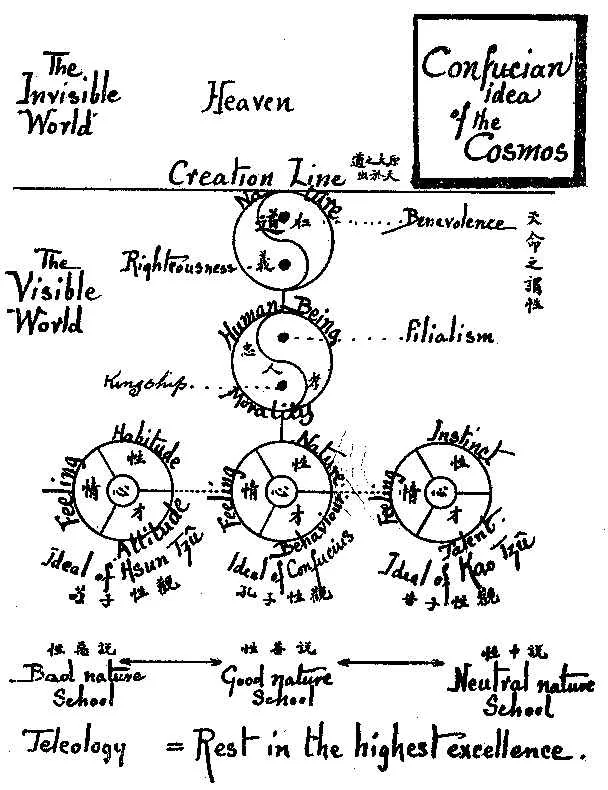
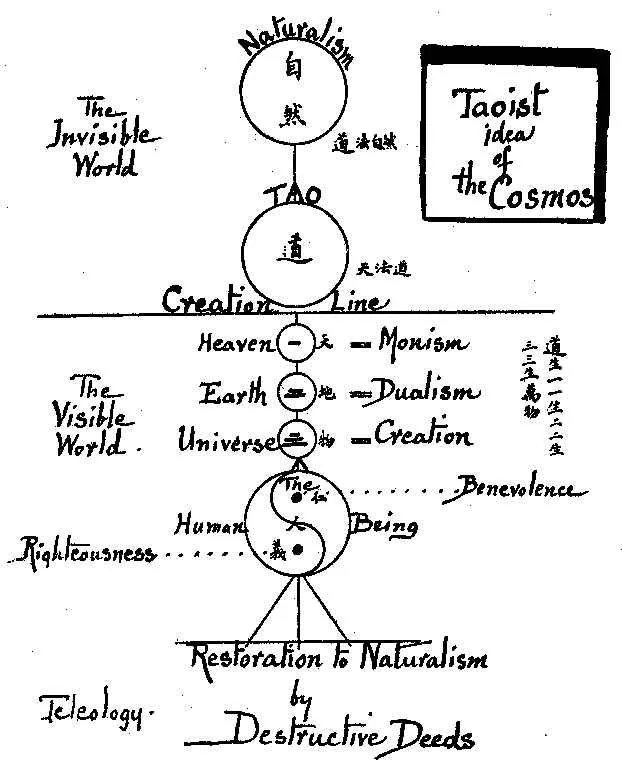
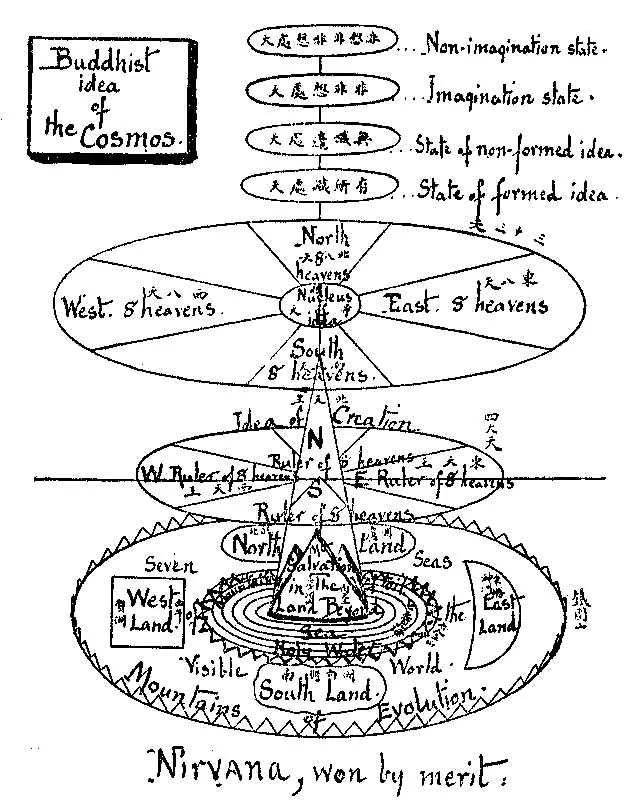
Tao, The Great Luminant. . Hermetic Cloud, https://hermeticcloud.com/library/morgan-tao-the-great-luminant/. Public-domain text reproduced in full; markup only.