The Poems of Sappho
An Interpretative Rendition into English BYJOHN MYERS O'HARA
PORTLAND: MDCCCCX
SMITH & SALE, PUBLISHERS
[1910]
Front Cover and Spine
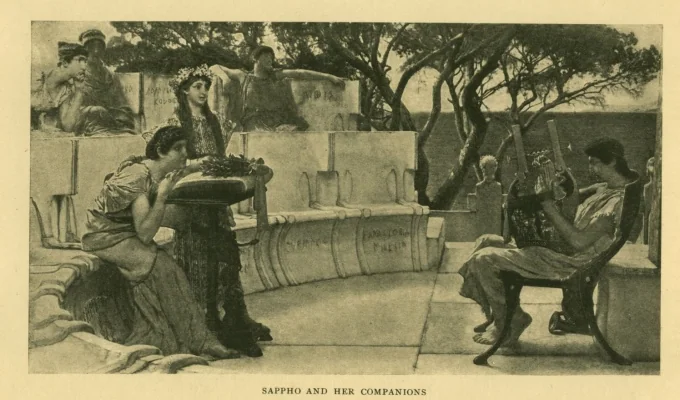
SAPPHO AND HER COMPANIONS
Title Page

Verso
|
Of this edition, five hundred copies No.
|
 .
.Who shall strike the wax of mystery from those priceless amphora, and give to the unsophisticated nostrils of the average reader the ravishing bouquet of wine pressed in a garden in Mitylene, twenty-five centuries ago?—MAURICE THOMPSON.
Then to me so lying awake a vision
Came without sleep over the seas and touched me,
Softly touched mine eyelids and lips; and I, too,
Full of the vision,
Saw the white implacable Aphrodite,
Saw the hair unbound and the feet unsandalled
Shine as fire of sunset on western waters;
Saw the reluctant
Feet, the straining plumes of the doves that drew her,
Looking always, looking with necks reverted
Back to Lesbos, back to the hills whereunder
Shone Mitylene.
—SWINBURNE.
|
Ω θεόί, πίς ἆρα Κύπρις, ἢ τίς ἱμερος |
SAPPHICS
THE MUSES
Hither now, O Muses, leaving the golden
House of God unseen in the azure spaces,
Come and breathe on bosom and brow and kindle
Song like the sunglow;
Come and lift my shaken soul to the sacred
Shadow cast by Helicon's rustling forests;
Sweep on wings of flame from the middle ether,
Seize and uplift me;
Thrill my heart that throbs with unwonted fervor,
Chasten mouth and throat with immortal kisses,
Till I yield on maddening heights the very
Breath of my body.
MUSAGETES
Come with Musagetes, ye Hours and Graces,
Dance around the team of swans that attend him
Up Parnassian heights, to his holy temple
High on the hill-top;
Come, ye Muses, too, from the shades of Pindus,
Let your songs, that echo on winds of rapture,
Wake the lyre he tunes to the sweet inspiring
Sound of your voices.
LOVE'S BANQUET
If Panormus, Cyprus or Paphos hold thee,
Either home of Gods or the island temple,
Hark again and come at my invocation,
Goddess benefic;
Come thou, foam-born Kypris, and pour in dainty
Cups of amber gold thy delicate nectar,
Subtly mixed with fire that will swiftly kindle
Love in our bosoms;
Thus the bowl ambrosial was stirred in Paphos
For the feast, and taking the burnished ladle,
Hermes poured the wine for the Gods who lifted
Reverent beakers;
High they held their goblets and made libation,
Spilling wine as pledge to the Fates and Hades,
Quaffing deep and binding their hearts to Eros,
Lauding thy servant.
So to me and my Lesbians round me gathered,
Each made mine, an amphor of love long tasted,
Bid us drink, who sigh for thy thrill ecstatic,
Passion's full goblet;
Grant me this, O Kypris, and on thy altar
Dawn will see a goat of the breed of Naxos,
Snowy doves from Cos and the drip of rarest
Lesbian vintage;
For a regal taste is mine and the glowing
Zenith-lure and beauty of suns must brighten
Love for me, that ever upon perfection
Trembles elusive.
MOON AND STARS
When the moon at full on the sill of heaven
Lights her beacon, flooding the earth with silver,
All the shining stars that about her cluster
Hide their fair faces;
So when Anactoria's beauty dazzles
Sight of mine, grown dim with the joy it gives me,
Gorgo, Atthis, Gyrinno, all the others
Fade from my vision.
ODE TO ANACTORIA
Peer of Gods to me is the man thy presence
Crowns with joy; who hears, as he sits beside thee,
Accents sweet of thy lips the silence breaking,
With lovely laughter;
Tones that make the heart in my bosom flutter,
For if I, the space of a moment even,
Near to thee come, any word I would utter
Instantly fails me;
Vain my stricken tongue would a whisper fashion,
Subtly under my skin runs fire ecstatic;
Straightway mists surge dim to my eyes and leave them
Reft of their vision;
Echoes ring in my ears; a trembling seizes
All my body bathed in soft perspiration;
Pale as grass I grow in my passion's madness,
Like one insensate;
But must I dare all, since to me unworthy,
Bliss thy beauty brings that a God might envy;
Never yet was fervid woman a fairer
Image of Kypris.
Ah! undying Daughter of God, befriend me!
Calm my blood that thrills with impending transport;
Feed my lips the murmur of words to stir her
Bosom to pity;
Overcome with kisses her faintest protest,
Melt her mood to mine with amorous couches,—
Till her low assent and her sigh's abandon
Lure me to rapture.
THE ROSE
If it pleased the whim of Zeus in an idle
Hour to choose a king for the flowers, he surely
Would have crowned the rose for its regal beauty,
Deeming it peerless;
By its grace is valley and hill embellished,
Earth is made a shrine for the lover's ardor;
Dear it is to flowers as the charm of lovely
Eyes are to mortals;
Joy and pride of plants, and the garden's glory,
Beauty's blush it brings to the cheek of meadows;
Draining fire and dew from the dawn for rarest
Color and odor;
Softly breathed, its scent is a plea for passion,
When it blooms to welcome the kiss of Kypris;
Sheathed in fragrant leaves its tremulous petals
Laugh in the zephyr.
ODE TO APHRODITE
Aphrodite, subtle of soul and deathless,
Daughter of God, weaver of wiles, I pray thee
Neither with care, dread Mistress, nor with anguish,
Slay thou my spirit!
But in pity hasten, come now if ever
From afar of old when my voice implored thee,
Thou hast deigned to listen, leaving the golden
House of thy father
With thy chariot yoked; and with doves that drew thee,
Fair and fleet around the dark earth from heaven,
Dipping vibrant wings down he azure distance,
Through the mid-ether;
Very swift they came; and thou, gracious Vision,
Leaned with face that smiled in immortal beauty,
Leaned to me and asked, "What misfortune threatened?
Why I had called thee?"
"What my frenzied heart craved in utter yearning,
Whom its wild desire would persuade to passion?
What disdainful charms, madly worshipped, slight thee?
Who wrongs thee, Sappho?"
"She that fain would fly, she shall quickly follow,
She that now rejects, yet with gifts shall woo thee,
She that heeds thee not, soon shall love to madness,
Love thee, the loth one!"
Come to me now thus, Goddess, and release me
From distress and pain; and all my distracted
Heart would seek, do thou, once again fulfilling,
Still be my ally!
SUMMER
Slumber streams from quivering leaves that listless
Bask in heat and stillness of Lesbian summer;
Breathless swoons the air with the apple-blossoms’
Delicate odor;
From the shade of branches that droop and cover
Shallow trenches winding about the orchard,
Restful comes, and cool to the sense, the flowing
Murmur of water.
THE GARDEN OF THE NYMPHS
All around through the apple boughs in blossom
Murmur cool the breezes of early summer,
And from leaves that quiver above me gently
Slumber is shaken;
Glades of poppies swoon in the drowsy languor,
Dreaming roses bend, and the oleanders
Bask and nod to drone of bees in the silent
Fervor of noontide;
Myrtle coverts hedging the open vista,
Dear to nightly frolic of Nymph and Satyr,
Yield a mossy bed for the brown and weary
Limbs of the shepherd.
Echo ever wafts through the drooping frondage,
Ceaseless silver murmur of water falling
In the grotto cool of the Nymphs, the sacred
Haunt of Immortals;
Down the sides of rocks that are gray and lichened
Trickle tiny rills, whose expectant tinkle
Drips with gurgle hushed in the clear glimmering
Depths of the basin.
Fair on royal couches of leaves recumbent,
Interspersed with languor of waxen lilies,
Lotus flowers empurple the pool whose edge is
Cushioned with mosses;
Here recline the Nymphs at the hour of twilight,
Back in shadows dim of the cave, their golden
Sea-green eyes half lidded, up to their supple
Waists in the water.
Sheltered once by ferns I espied them binding
Tresses long, the tint of lilac and orange;
Just beyond the shimmer of light their bodies
Roseate glistened;
Deftly, then, they girdled their loins with garlands,
Linked with leaves luxuriant limb and shoulder;
On their breasts they bruised the red blood of roses
Fresh from the garden.
She of orange hair was the Nymph Euxanthis,
And the lilac-tressed were Iphis and Io;
How they laughed, relating at length their ease in
Evading the Satyr.
APHRODITE'S DOVES
When the drifting gray of the vesper shadow
Dimmed their upward path through the midmost azure,
And the length of night overtook them distant
Far from Olympus;
Far away from splendor and joy of Paphos,
From the voice and smile of their peerless Mistress,
Back to whom their truant wings were in rapture
Speeding belated;
Chilled at heart and grieving they drooped their pinions,
Circled slowly, dipping in flight toward Lesbos,
Down through dusk that darkened on Mitylene's
Columns of marble;
Down through glory wan of the fading sunset,
Veering ever toward the abode of Sappho,
Toward my home, the fane of the glad devoted
Slave of the Goddess;
Soon they gained the tile of my roof and rested,
Slipped their heads beneath their wings while I watched them
Sink to sleep and dreams, in the warm and drowsy
Night of midsummer.
ANACREON'S SONG
Golden-Throned Muse, sing the song that in olden
Days was sung of love and delight in Teos,
In the goodly land of the lovely women:
Strains that in other
Years the hoary bard with the youthful fancy
Set to mirthful stir of flutes, when the dancing
Nymphs that poured the wine for the poet's banquet
Mixed it with kisses;
Sing the song while I, in the arms of Atthis,
Seal her lips to mine with a lover's fervor,
Breathe her breath and drink her sighs to the honeyed
Lull of the melics.
THE DAUGHTER OF CYPRUS
Dreaming I spake with the Daughter of Cyprus,
Heard the languor soft of her voice, the blended
Suave accord of tones interfused with laughter
Low and desireful;
Dreaming saw her dread ineffable beauty,
Saw through texture fine of her clinging tunic
Blush the fire of flesh, the rose of her body,
Radiant, blinding;
Saw through filmy meshes the melting lovely
Flow of line, the exquisite curves, whence piercing
Rapture reached with tangible touch to thrill me,
Almost to slay me;
Saw the gleaming foot, and the golden sandal
Held by straps of Lydian work thrice doubled
Over the instep's arch, and up the rounded
Dazzling ankle;
Saw the charms that shimmered from knee to shoulder,
Hint of hues, than milk or the snowdrift whiter;
Secret grace, the shrine of the soul of passion,
Glows that consumed me;
Saw the gathered mass of her xanthic tresses,
Mitra-bound, escape from the clasping fillet,
Float and shine as clouds in the sunset splendor,
Mists in the dawn-fire;
Saw the face immortal, and daring greatly,
Raised my eyes to hers of unfathomed azure,
Drank their world's desire, their limitless longing,
Swooned and was nothing.
THE DISTAFF
Come, ye dainty Graces and lovely Muses,
Rosy-armed and pure and with fairest tresses,
Come from groves on Helicon's hill where murmur
Founts that are holy;
Come with dancing step and with lips harmonic,
Gather near and view my ivory distaff,
Gift from Cos my brother Charaxus brought me,
Sailing from Egypt;
Sailing back to Lesbos from far Naucratis,
From the seven mouths of the Nile and Egypt
Up the blue Ægean, the island-dotted
Ocean of Hellas;
Choicest wool alone will I spin for fabrics,
Winding reel with threads for the cloths as fleecy,
Soft and fine as they bring from far Phocea,
Sidon or Sardis;
While I weave my thought shall engird the giver,
Whether here, or far on the sea, or resting
Couched in shady courts with the lovely garland
Girls of Naucratis.
THE SLEEP WIND
Softer than mists o’er the pale green of waters,
O’er the charmed sea, shod with sandals of shadow
Comes the warm sleep wind of Argolis, floating
Garlands of fragrance;
Comes the sweet wind by the still hours attended,
Touching tired lids on the shores dim with distance,
Ever its way toward the headland of Lesbos,
Toward Mitylene.
Faintly one fair star of evening enkindles
On the dusk afar its lone fire Œtean,
Shining serene till the darkness will deepen
Others to splendor;
Bringing ineffable peace, and the gladsome
Return with the night of all things that morning
Ruthlessly parted, the child to its mother,
Lover to lover.
From the marble court of rose-crowned companions,
All alone my feet again seek the little
Theatre pledged to the Muse, now deserted,
Facing the surges;
Where the carved Pan-heads that laugh down the gentle
Slope of broad steps to the refluent ripple,
Flute from their thin pipes the dithyrambs deathless,
Songs all unuttered.
Empty each seat where my girl friends acclaimed me,
Poets with names on the tiered stone engraven,
Over whose verge blooms the apple tree, drifting
Perfume and petals;
Gone Telesippa and tender Gyrinno,
Anactoria, woman divine; Atthis,
Subtlest of soul, fair Damophyla, Dica,
Maids of the Muses.
Here an hour past soul-enravished they listened
While my rapt heart breathed its pæan impassioned,
Chanted its wild prayer to thee, Aphrodite,
Daughter of Cyprus;
Now to their homes are they gone in the city,
Pensive to dream limb-relaxed while the languid
Slaves come and lift from the tresses they loosen,
Flowers that have faded.
Thou alone, Sappho, art sole with the silence,
Sole with night and dreams that are darkness, weaving
Thoughts that are sighs from the heart and their meaning
Vague as the shadow;
When the great silence shall come to thee, sad one,
Men that forget shall remember thy music,
Murmur thy name that shall steal on their passion
Soft as the sleep wind.
THE REPROACH
Kypris, hear my prayer to thee and the Nereids!
Safely bring the ship of my brother homewards,
Bring him back unharmed to the heart that loves him,
Throbbing remorseful;
Fair Immortal, banish from mind, I pray thee,
Every discord's hint that of yore estranged us;
Grant that never again dissension's hateful
Wrangle shall part us;
May he never in days to come remember
Keen reproach of mine that had grieved him sorely;
Words that broke my very heart when I heard them
Uttered by others;
Words that wounded deep and recurring often,
Bowed his head with shame at the public banquet;
Where my scorn, amid festal joy and laughter,
Sharpened the covert
Jests that stung his pride and assailed his folly,
Slave-espoused when he, a Lesbian noble,
Might have won the fairest in Mitylene,
Virgins the noblest;
Open slurs that linked his name with Doricha,
Lovely slave that Xanthes had sold in Egypt;
She whose wondrous charms the wealth of Charaxus
Ransomed from bondage.
Now that he is gone and my anger vanished,
Keen regret and grief for the pain I gave him
Pierce my heart, and fear of loss that is anguish
Darkens the daylight.
LONG AGO
Long ago beloved, thy memory, Atthis,
Saddens still my heart as the soft Æolic
Twilight deepens down on the sea, and fitful
Winds that have wandered
Over groves of myrtle at Amathonte
Waft forgotten passion on breaths of perfume.
Long ago, how madly I loved thee, Atthis!
Faithless, light-hearted
Loved one, mine no more, who lovest another
More than me; the silent flute and the faded
Garlands haunt the heart of me thou forgettest,
Long since thy lover.
EPITHALAMIA
THRENODES
HYMENAIOS
Artisans, raise high the roof beam!
Tall is the bridegroom as Ares,
Taller by far than the tallest,
O Hymenæus!
Ay! towering over his fellows,
As over men of all other
Lands towers the Lesbian singer,
O Hymenæus!
Well-favored, too, is the maiden,
Eyes that are sweeter than honey,
Fair both in face and in figure,
O Hymenæus!
For there was never another
Virgin in loveliness like her,
By Aphrodite so honored,
O Hymenæus!
O happy bridegroom, the wedding
Comes to the point of completion;
Thou hast the maid of thy choosing,
O Hymenæus!
See how a paleness suffuses
Soft o’er her exquisite features,
Passion's benign premonition,
O Hymenæus!
Go to the couch unreluctant,
Rejoicing and sweet to the bridegroom;
He in his turn is rejoicing,
O Hymenæus!
May Hesperus lead thee, and Hera,
She whom to-night that ye honor,
Silver-throned Goddess of marriage,
O Hymenæus!
BRIDAL SONG
Bride, that goest to the bridal chamber
In the dove-drawn car of Aphrodite,
By a band of dimpled
Loves surrounded;
Bride, of maidens all the fairest image
Mitylene treasures of the Goddess,
Rosy-ankled Graces
Are thy playmates;
Bride, O fair and lovely, thy companions
Are the gracious hours that onward passing
For thy gladsome footsteps
Scatter garlands.
Bride, that blushing like the sweetest apple
On the very branch's end, so strangely
Overlooked, ungathered
By the gleaners;
Bride, that like the apple that was never
Overlooked but out of reach so plainly,
Only one thy rarest
Fruit may gather;
Bride, that into womanhood has ripened
For the harvest of the bridegroom only,
He alone shall taste thy
Hoarded sweetness.
EPITHALAMIUM
Vesper is here! behold
Faint gleams that welcome shine!
Rise from the feast, O youths,
And chant the fescennine!
Before the porch we sing
The hymeneal song;
Vesper is here, O youths!
The star we waited long.
We lead the festal groups
Across the bridegroom's porch;
Vesper is here, O youths!
Wave high the bridal torch.
Hail, noble bridegroom, hail!
The virgin fair has come;
Unlatch the door and lead
Her timid footsteps home.
Hail, noble bridegroom, hail!
Straight as a tender tree;
Fond as a folding vine
Thy bride will cling to thee.
PIERIA'S ROSE
Pale death shall come, and thou and thine shall be,
Then and thereafter, to all memory
Forgotten as the wind that yesterday
Blew the last lingering apple buds away;
For thou hadst never that undying rose
To grace the brow and shed immortal glows;
Pieria's fadeless flower that few may claim
To wreathe and save thy unremembered name.
Ay! even on the fields of Dis unknown,
Obscure among the shadows and alone,
Thy flitting shade shall pass uncomforted
Of any heed from all the flitting dead.
But no one maid, I think, beneath the skies,
At any time shall live and be as wise,
In sooth, as I am; for the Muses Nine
Have made me honored and their gifts are mine;
And men, I think, will never quite forget
My songs or me; so long as stars shall set
Or sun shall rise, or hearts feel love's desire,
My voice shall cross their dreams, a sigh of fire.
LAMENT FOR ADONIS
Ah, for Adonis!
See, he is dying,
Delicate, lovely,
Slender Adonis.
Ah, for Adonis!
Weep, O ye maidens,
Beating your bosoms,
Rending your tunics.
O Cytherea,
Hasten, for never
Loved thou another
As thy Adonis.
See, on the rosy
Cheek with its dimple,
Blushing no longer,
Thanatos’ shadow.
Save him, O Goddess!
Thou, the beguiler,
All-powerful, holy,
Stay the dread evil.
Ah, for Adonis!
No more at vintage
Time will he come with
Bloom of the meadows.
Ah, for Adonis!
See, he is dying,
Fading as flowers
With the lost summer.
THE STRICKEN FLOWER
Think not to ever look as once of yore,
Atthis, upon my love; for thou no more
Wilt find intact upon its stem the flower
Thy guile left slain and bleeding in that hour.
So ruthless shepherds crush beneath their feet
The hill flower blooming in the summer heat;
The hyacinth whose purple heart is found
Left bruised and dead, to darken on the ground.
DEATH
Death is an evil; so the Gods decree,
So they have judged, and such must rightly be
Our mortal view; for they who dwell on high
Had never lived, had it been good to die.
And so the poet's house should never know
Of tears and lamentations any show;
Such things befit not us who deathless sing
Of love and beauty, gladness and the spring.
No hint of grief should mar the features of
Our dreams of endless beauty, lasting love;
For they reflect the joy inviolate,
Eternal calm that fronts whatever fate.
Clëis, my darling, grieve no more, I pray!
Let wandering winds thy sorrow bear away,
And all our care; my daughter, let thy smile
Shine through thy tears and gladden me the while.
PERSEPHONE
I saw a tender maiden plucking flowers
Once, long ago, in the bright morning hours;
And then from heaven I saw a sudden cloud
Fall swift and dark, and heard her cry aloud.
Again I looked, but from my open door
My anxious eyes espied the maid no more;
The cloud had vanished, bearing her away
To underlands beyond the smiling day.
PARTHENEIA
DIDAKTIKA
MAIDENHOOD
Do I long for maidenhood?
Do I long for days
When upon the mountain slope
I would stand and gaze
Over the Ægean's blue
Melting into mist,
Ere with love my virgin lips
Cercolas had kissed?
Maidenhood, O maidenhood,
Whither hast thou flown?
To a land beyond the sea
Thou hast never known.
Maidenhood, O maidenhood,
Wilt return to me?
Never will my bloom again
Give its grace to thee.
Now the autumn skies are low,
Youth and summer sped;
Shepherd hills are far away,
Cercolas is dead.
Mitylene's marble courts
Echo with my name;—
Maidenhood, we never dreamed,
Long ago of fame.
EVER MAIDEN
I shall be ever maiden,
Ever the little child,
In my passionate quest for the lovely,
By earth's glad wonder beguiled.
I shall be ever maiden,
Standing in soul apart,
For the Gods give the secret of beauty
Alone to the virgin heart.
CLËIS
Daughter of mine, so fair,
With a form like a golden flower,
Wherefore thy pensive air
And the dreams in the myrtle bower?
Clëis, beloved, thy eyes
That are turned from my gaze, thy hand
That trembles so, I prize
More than all the Lydian land;
More than the lovely hills
With the Lesbian olive crowned;—
Tell me, darling, what ills
In the gloom of thy thought are found?
Daughter of mine, come near
And thy head on my knees recline;
Whisper and never fear,
For the beat of thy heart is mine.
Sweet mother, I can turn
With content to my loom no more;
My bosom throbs, I yearn
For a youth that my eyes adore;
Lykas of Eresus,
Whom I knew when a little child;
My heart by Love is thus
With the sweetest of pain beguiled.
ASPIRATION
I do not think with my two arms to touch the sky,
I do not dream to do almighty things;
So small a singing bird may never soar so high,
To beat the sapphire fire with baffled wings.
I do not think with my two arms to touch the sky,
I do not dream by any chance to share
With deathless Gods the bliss of Paphos they deny
To men behind the azure veil of air.
HERO, OF GYARA
I taught Hero, of Gyara, the swift runner;
Swifter far was she than Atalanta,
When through clinging fleece of her wind-rippled
Garments blushed the glimmer of her limbs.
I taught Hero, of Gyara, the swift runner;
Lovelier was she than Atalanta,
When the straining vision of the suitor
Saw her beauty mock impending death.
I taught Hero, of Gyara, the swift runner,
All the singing numbers of Terpander,
Metres of Archilochus and Alcman,
And my melic verse that glows supreme.
I taught Hero, of Gyara, the swift runner,
Sapphics with their triple surge of music
Melting in the final verse Adonic,
Like the foam fall of a spended wave.
COURAGE
Faint not in thy strong heart!
Nor downcast stand apart;
Beyond the reach of daring will there lies
No beauty's prize.
Faint not in thy strong heart!
Through temple, field and mart,
Courage alone the guerdon from the fray
May bear away.
THE BOAST OF ARES
Ares said he would drag
Hephestus by force
From Poseidon's palace
Deep down in the sea;
Where he had fashioned
The cunning throne
With the secret chains.
He presented the throne,
Forsooth, as a gift
To the queen of heaven;
But Hera soon found
For revenge on her
Who had him cast
From the home of Gods.
For secure in its clasp
Of adamant gold
She was held imprisoned,
The prey of his guile;
And Hephestus knew
By him alone
Could the queen be freed.
But the great God of war
Made boast of his strength;
He would bring the forger
Of metals and tricks
On high to release
Hera, and end
Her enraged despair.
Ares said he would drag
Hephestus by force,
But was made to waver
And flee when assailed
With a blazing brand
By the dark God
Of the underworld.
GOLD
Gold is the son of Zeus,
Immortal, bright;
Nor moth nor worm may eat it,
Nor rust tarnish.
So are the Muse's gifts
The offspring fair,
That merit from high heaven
Youth eternal.
GNOMICS
I
My ways are quiet, none may find
My temper of malignant kind;
For one should check the words that start
When anger spreads within the heart.
II
Who from my hands what I can spare
Of gifts accept the largest share,
Those are the very ones who boast
No gratitude and wrong me most.
III
He who in face and form is fair
Must needs be good, the Gods declare;
But he whose thought and act are right
Will soon be equal fair to sight.
IV
Beauty of youth is but the flower
Of spring, whose pleasure lasts an hour;
While worth that knows no mortal doom
Is like the amaranthine bloom.
PRIDE
Pride not thyself upon a ring,
Or any trinket thing
Of fleeting value, dross or gold.
Wealth, lacking worth, is no safe friend,
Though both to life may lend,
In just proportion, joy untold.
LETO AND NIOBE
Leto and Niobe were friends full dear,
The Goddess’ heart and woman's heart were one
In that maternal love that men revere,
Love that endures when other loves are done.
But Niobe with all a mother's pride,
Artless and foolish, would not be denied;
And boasted that her children were more fair
Than Leto's lovely children of the air.
The proud Olympians vowed revenge for this,
Irate Apollo, angered Artemis;
They slew her children, heedless of her moan,
And with the last her heart was turned to stone.
THE DYE
From Scythian wood they brew
The dye whose yellow hue
Turns gold the lovely hair
Of Lesbians fair.
So, Zanthis, slave of mine,
Shall dip the fleeces fine,
And dye the robes I made
A saffron shade.
EROTIKA
DITHYRAMBS
HYMN TO PAPHIA
Immortal Paphia! have I earned thy hate,
That I should burn in passion's fatal flame?
Is not my constant service thine to claim,
My prayer's appeal with praise of thee elate?
Has not my life been one sole hymn of thee,
One quivering chord on Love's harp overwrought?
My soul has trembled up to thee in thought,
Probed to its depth thy every ecstasy.
Are not my countless heart-beats each a vow,
Of tribute throbs a garland? For thy gain
The Fates have drenched my soul in passion's rain,
Pieria's roses twined about my brow.
The virgin harvest of my heart was thine,
I shuddered in the joy that half consumed;
The votive garlands on thy altar bloomed,
My days were songs to nights of bliss divine.
Why try me, then, with torture, gracious Queen?
Why verge me on this rapture's dread abyss,
Hold breast from breast and stay the yearning kiss?
Ah, couldst thou fashion pain that stung less keen?
The throe of Tantalus is mine to bear,
Beauty that Thetis-like eludes my clasp;
Glances that lure, that make each breath a gasp,
And then disdainful gloat at my despair.
Scornful she dwells beyond my ardor's clutch,
Bathed in an aureole of carnal fire;—
O bind her equal slave to fond desire,
Let passion's tingling warmth her being touch!
Come to me, Goddess, come as once of old,
Hearing my voice implore thee from afar,
I drew to earth thy dazzling avatar;
Accord the smile of piercing bliss untold.
Ask me the dear suave question phrased of yore;
"Sappho, who grieveth now thy mad fond heart?
Wouldst win her beauty, she who frowns apart?
Wild as thou lovest, she soon shall love thee more."
O fair Olympian, answer thus, I pray!
Release me from this torment, yield my arms
The transport thirsted of her folded charms,
In glow that welds her heart to mine for aye.
EROS
From the gnarled branches of the apple trees
The heavy petals, lifted by the breeze,
Fluttered on puffs of odor fine and fell
In the clear water of the garden well;
And some a bolder zephyr blew in sport
Across the marble reaches of my court,
And some by sudden gusts were wafted wide
Toward sea and city, down the mountain side.
Lesbos seemed Paphos, isled in rosy glow,
Green olive hills, the violet vale below;
The air was azure fire and o’er the blue
Still sea the doves of Aphrodite flew.
My dreaming eyes saw Eros from afar
Coming from heaven in his mother's car,
In purple tunic clad; and at my heart
The God-was aiming his relentless dart.
He whom fair Aphrodite called her son,
She, the adored, she, the imperial One;
He passed as winds that shake the soul, as pains
Sweet to the heart, as fire that warms the veins;
He passed and left my limbs dissolved in dew,
Relaxed and faint, with passion quivered through;
Exhausted with spent thrills of dread delight,
A sudden darkness rushing on my sight.
PASSION
Now Love shakes my soul, a mighty
Wind from the high mountain falling
Full on the oaks of the forest;
Now, limb-relaxing, it masters
My life and implacable thrills me,
Rending with anguish and rapture.
Now my heart, paining my bosom,
Pants with desire as a mænad
Mad for the orgiac revel.
Now under my skin run subtle
Arrows of flame, and my body
Quivers with surge of emotion.
Now long importunate yearnings
Vanquish with surfeit my reason;
Fainting my senses forsake me.
APHRODITE'S PRAISE
O Sappho, why art thou ever
Singing with praises the blessed
Queen of the heaven?
Why does the heart in thy bosom
Ever revert in its yearning
Throb to the Goddess?
Why are thy senses unsated
Ever in quest of elusive
Love that is deathless?
Ah, gracious Daughter of Cyprus,
Never can I as a mortal
Tire of thy service.
Thou art the breath of my body,
The blood in my veins, and the glowing
Pulse of my bosom.
Omnipotent, burning, resistless,
Thou art the passion that shaking
Masters me ever.
Thou art the crisis of rapture
Relaxing my limbs, and the melting
Ebb of emotion;
Bringing the tears to my lashes,
Sighs to my lips, in the swooning
Excess of passion.
O golden-crowned Aphrodite,
Grant I shall ever be grateful,
Sure of thy favor;
Worthy the lot of thy priestess,
Supreme in the song that forever
Rings with thy praises.
THE FIRST KISS
And down I set the cushion
Upon the couch that she,
Relaxed supine upon it,
Might give her lips to me.
As some enamored priestess
At Aphrodite's shrine,
Entranced I bent above her
With sense of the divine.
She had, by nature nubile,
In years a child, no hint
Of any secret knowledge
Of passion's least intent.
Her mouth for immolation
Was ripe, and mine the art;
And one long kiss of passion
Deflowered her virgin heart.
ODE TO ATTHIS
I loved you, Atthis, once, long years ago!
My blood was flame that thrilled to passion's throe;
Now long neglect has quenched the olden fire,
And blight of drifting years effaced desire.
I loved you, Atthis—joy of long ago—
Love shook my soul as winds on forests blow;
This lawless heart that dared exhaust delight,
Unsated strove and maddened through the night.
I loved you, Atthis, once, long years ago!
With pain whose surge I felt to anguish grow;
Suffered the storms that waste the heart and leave
A desert shore where seas but break to grieve.
I loved you, Atthis—spring of long ago—
Watched you depart, to Andromeda go;
Then I, as keen despair its shadow cast,
O’er my deserted threshold, sobbing, passed.
I loved you, Atthis, once, long years ago!
The thought of me is hateful now, I know;
And all the lavish tenderness of old
Has gone from me and left my bosom cold.
I loved you, Atthis—dream of long ago—
. . . . . . . . . . . .
How the fond words, impassioned music low,
Sustain the sigh of love's divine regret
No length of time may bid the heart forget.
COMPARISON
Less soft a Tyrian robe
Of texture fine,
Less delicate a rose
Than flesh of thine.
Whiter thy breast than snow
That virgin lies,
And deeper than the blue
Of seas thy eyes.
More golden than the fruit
Of orange trees,
Thy locks that floating lure
The satyr breeze.
Less fine of silver string
An Orphic lyre,
Less sweet than thy low laugh
That wakes desire.
THE SACRIFICE
Upon a cushion soft
My limbs I place,
My every garment doffed
For deeper grace;
From burning doves embalmed
In baccharis,
The scented fumes have calmed
Me like a kiss.
Beyond the phallic shrine
That tripods light,
I pledge with holy wine
An image white;
Anadyomene,
Than foam more fair,
When from the ravished sea
She rose to air.
Daughter of God, accept
These gifts of mine!
Last night my body slept
In arms divine.
These sated lips and eyes
That erstwhile sued,
Accord this sacrifice
In gratitude.
LEDA
Once on a time
They say that Leda found
Beneath the thyme
An egg upon the ground;
And yet the swan
She fondled long ago
Was whiter than
Its shell of peeping snow.
AMŒBEUM: ALCÆUS AND SAPPHO
ALCÆUS
Violet-weaving Sappho, pure and lovely,
Softly-smiling Sappho, I would utter
Something that my secret hope has cherished,
Did no painful sense of shame deter me.
SAPPHO
Had the impulse of thy heart been honest,
It had urged no evil supplication;
Shame had not abashed thy eyes before me,
And thy words had done thee no dishonor.
ALCÆUS
Softly-smiling Sappho, longing bids me
Tell thee all that in my heart lies hidden.
SAPPHO
Have no fear, Alcæus, to offend me!
Thy emotion stirs my heart to pity.
ALCÆUS
I desire thee, violet-weaving Sappho!
Love thee madly, softly-smiling Sappho!
SAPPHO
Hush, Alcæus! thou must choose a younger
Comrade for thy couch, for I would never
Join thy years to mine—the Gods forbid it—
Youth and ardent fire to age and ashes.
THE LOVE OF SELENE
Across the still sea's moonlit wave
Selene came
Softly to seek the Latmian cave,
Her breast aflame
With secret passion's ruthless throe,
Her scruples done,
And burning with desire to know
Endymion.
THE CRETAN DANCE
As the moon in all her splendor
Slowly rose above the forest,
Silent stood the Cretan women
Round the altar.
Girdled close their clinging tunics,
Made of some transparent fabric,
Traced the every curve and lissome
Of their bodies.
With revering eyes uplifted
To the round and rising planet,
Soon its drifting beams of silver
Lit their faces.
Soft and clear its sphere effulgent,
Full defined above the treetops,
Steeped in pale unearthly glamor
All the landscape.
When the argent glimmer rested
On the altar piled with garlands,
And its glow unveiled the marble
Aphrodite;
Linking hands, the Cretan women
Moving gracefully with metric
Steps began to dance a measure
To the Goddess.
All so light their feet unsandalled
Pressed the velvet grass in treading,
That they scarcely bruised its tender
Blooming verdure.
Slowly turning in a circle
To the east, their voices chanted
In a plaintive note the sacred
Ithyphallics;
Then they paused, their steps retracing
Toward the west, and answered strophe
By antistrophe with choric
Tones accordant;
With the aftersong epodic,
Standing all before the altar,
Lo! the hymn in praise of Paphos
Was completed.
TO ALCÆUS
Countless are the cups thou drainest
In thy hymns to Dionysos,
O Alcæus!
War and wine alone thou singest;—
Wherefore not of Aphrodite,
O Alcæus!
Spacious halls are thine where many
Trophies hang in Ares’ honor,
O Alcæus!
Brazen shields and shining helmets,
Plates of brass, Chalcidian broad-swords,
O Alcæus!
When with winter roars the Thracian
North wind through the leafless forest,
O Alcæus!
Thou dost heap the fire and banish
Care with many a tawny goblet,
O Alcæus!
HYPORCHEME
Thus contend the maidens
In the cretic dance,
Rosy arms that glisten,
Eyes that glance;
Cheeks as fair as blossoms,
Parted lips that glow,
With their honeyed voices
Chanting low;
With their plastic bodies
Swaying to the flute,
Moving with the music
Never mute;
Graceful the orchestric
Figures they unfold,
While the vesper heaven
Turns to gold.
LARICHUS
While charming maids plait garlands for thy brows,
Larichus, bring the pledge for this carouse
Like lovely Ganymede, brother mine,
And cool from thy patera pour the wine.
Thy slender limbs have all a Satyr's grace,
Hylas, the Wood-God, dimples in thy face;
These maids of mine, beloved and loving me,
My dreams have made thy Nymphs to sport with thee.
I heard fair Mitylene's plaudits cease
O’er Lykas, Menon and Dinnomenes;
And hail thy beauty worthy of the prize,
Cupbearer to the council of the wise.
No noble youth the prytaneum holds,
Whose graceful form the purple tunic folds
Can match with thee, when on affairs of state
All Lesbos gathers with the wise and great.
SPRING
Come, shell divine, be vocal now for me,
As when the Hebrus river and the sea
To Lesbos bore, on waves harmonious,
The head and golden lyre of Orpheus.
Calliope, queen of the tuneful throng,
Descend and be the Muse of melic song;
For through my frame life's tides renewing bring
The glad vein-warming vigor of the spring.
The skies that dome the earth with far blue fire
Make the wide land one temple of desire;—
Just now across my cheek I felt a God,
In the enraptured breeze, pass zephyr-shod.
Was that Pan's flute, O Atthis, that we heard,
Or the soft love-note of a woodland bird?
That flame a scarlet wing that skimmed the stream,
Or the red flash of our impassioned dream?
Ah, soon again we two shall gather fair
Garlands of dill and rose to deck our bare
White arms that cling, white breast that burns to breast,
When the long night of love shall banish rest.
GIRL FRIENDS
PRELUDE
Deftly on my little
Seven-stringed barbitos,
Now to please my girl friends
Songs I set to music.
Maidens fair, companions
Of the Muses, never
Toward you shall my feelings
Undergo a change.
Chanted in a plaintive
Old Ionic measure,
All the songs I give you
Are the songs of love.
ANDROMEDA
What bucolic maiden
Now thy heart bewitches,
O my Andromeda
Of the strange amours?
Round her awkward ankles
She has not the faintest
Sense of art to draw her
Long ungraceful tunic.
Yet she surely makes thee,
O my Andromeda,
For thy sweet unlawful
Love a fair requital.
Joy and praise attend thee,
In thy keen perceptive
Taste for beauty, daughter
Of Polyanax!
EUNEICA
Aphrodite's handmaid,
Bright as gold thou camest,
Tender woven garlands
Round thy tender neck;
Sweet as soft Persuasion,
Lissome as the Graces,
Shy Euneica, lovely
Girl from Salamis.
Slender thou as Syrinx,
As the waving reed-nymph,
Once by Pan, the god of
Summer winds, deflowered.
On thy lips whose quiver
Seems to plead for pity,
Mine shall rest and linger
Like the mouth of Pan
On the mouth of Syrinx,
When his breath that filled her
Blew through all her body
Music of his love.
GORGO
Gorgo, I am weary
Of thy love's insistence,
Thou to me appearest
An ill-favored child.
Though I am than Gello
Fonder still of virgins,
Toward thee I have never
Felt the least desire.
Yesternight I knew not
What to do, for pity
Moved my bosom deeply,
Seeing thee implore.
Harassed by alternate
Yielding and refusal,
I was half persuaded
Then to grant thy prayer.
At my door thy presence
Lingers like a shadow;
Vain wouldst thou reproach me
With appealing eyes.
Dost thou think by constant
Proofs of lasting passion,
Slowly my obdurate
Will to wear away?
Gorgo, I am weary
Of thy love's insistence,
And my strength exhausted
Grants thy wish at last.
MNASIDICA
Set, O Dica, garlands on thy lovely
Glinting mass of fine and golden tresses,
Sprays of dill with fingers soft entwining
While I stand apart to better judge.
Those who have fair wreaths about the forehead,
Breathing brentheian odor to the senses,
Ever first find favor with the Graces
Who from wreathless suppliants turn away.
Dica, Mnasidica, thou art shapely
With the flowing curves of Aphrodite;
Eyes the color of her azure ocean
Washing wide on Cyprus’ languid shore.
In thy every movement grace unconscious
Sways the rhythmic poem of thy body,
Charming with elusive undulation
Like a splendid lily in the wind.
As I stand apart to judge the better
Fair effects that roses add to beauty,
All thy rays of loveliness concentered
Sun me till I swoon with swift desire.
TELESIPPA
Sleep thou in the bosom
Of thy tender girl friend,
Telesippa, gentle
Maiden from Miletus.
Like twin petals shyly
Closing to the darkness,
Dewy on your drooping
Lids shall fall her kisses.
While her arms enfold you,
On your drowsy senses
Shall her soft caresses
Seal delicious languor.
Warm from her desireful
Heart the flush of passion
On your cheek unconscious,
With her sighs shall deepen.
All the long sweet night-time,
Sleepless while you slumber,
She shall lie and quiver
With her love's mad longing.
GYRINNO
Now the silver crescent
Of the moon has vanished,
With the golden Pleiads
Drifting down the west.
It is after midnight
And the time is passing,
Hours we pledged to passion
And I sleep alone.
Anger ill becomes thee,
Tender-souled Gyrinno,
Shapelier is Dica
But less loved by me.
Art thou still relentless,
Wilful one, annulling
All thy protestations
In the fervid past?
Can it, O Charites,
Be thou hast forgotten?
Dost thou love another,
Even now, perchance?
Ah, my tears are falling,
Yet in my despairing
Mood I lie and listen
For thy furtive step;
For the lightest rustle
Of thy flowing garment,
For thy sweet and panting
Whisper at the door.
Now the moon has vanished
With the golden Pleiads;
It is after midnight
And I sleep alone.
MEGARA
Thou burnest us, Megara,
With thy passions wild;
Bringing from Panormus
Such unbridled fires.
Thou burnest us, a supple
Flow of tortured flame,
Raging, biting, searing,
Lawless of the will.
Thou burnest us, Megara,
Love must know reserve,
Curbing power to keep it
Keener for restraint.
ERINNA
Haughtier than thou, O fair Erinna,
I have never met with any maiden.
Such a careless scorn as thine for passion
Proves a dire affront to Aphrodite.
When with soft desire she wounds thy bosom,
Thou shalt know love's pain and doubly suffer.
Keep the gifts I gave thee, long rejected;
Fabrics for thy lap from far Phocea,
Babylonian unguents, scented sandals,
And the costly mitra for thy tresses;
Tripods worked in brass to flank the altar
With the ivory figure of the Goddess;
Where the sacrificial fumes from sacred
Flames shall rise to gladden and appease her,
In the hour when at her call thy fervid
Breast and mouth to mine shall be relinquished.
GONGYLA
It was when the sunset
Burned with saffron fire,
And Apollo's coursers
Turned below the hills,
That on Mitylene's
Marble bridge we met,
Gongyla, thou golden
Maid of Colophon.
Like the breath of morning
Or a breeze from sea,
Fresh thy beauty smote me,
Virile of the north.
Startled by thy vision,
Transports half divine
Flooded veins and bosom,
Shook me with desire.
Soon the kinder sunglow
Of Æolic lands
Melted all the futile
Snows about thy heart.
DAMOPHYLA
Cold of heart and strangely
Uninclined to passion,
Wisdom's vigil leaves thee,
Proud Damophyla.
Sapphics thou hast written,
Verses in my metre,
With a skill surpassing
In the melic art.
Love's superb enchantment
Thou art fain to banish,
Like the virgin Huntress
Long by thee adored.
Molded by thy tunic,
Every arching contour
Of her chaste and noble
Form I dream to see;
Even view her stepping
From the leafy covert
Down the dawn-white valley,
Stately as a stag.
Long I sued but found thee
Deaf to all entreaty,
Till one summer twilight
Listless in the heat;
Soothed by slumber's languor,
And my low monodic
Voice that hymned a pæan
In the praise of love;
Loth to yield yet vanquished,
As I knelt beside thee,
All thy long resistance
To my kiss succumbed.
ANAGORA
Anagora, fairest
Spoil of fateful battle,
Babylonian temples
Knew thy luring song.
Wrested from barbaric
Captors for thy beauty,
Thou wert made a priestess
At Mylitta's shrine.
Once these flexile fingers
Clasped in mine so closely,
Neath the temple's arches
Thrummed the tabor soft.
Thou hast taught me secrets
Of the cryptic chambers,
How the zonahs worship
In the burning East;
Raptures that my wildest
Dreaming never pictured,
Arts of love that charmed me,
Subtle, new and strange.
Hearken to my earnest
Prayer, O Aphrodite!
May the night be doubled
Now for our delight.
PHAON
PHILOMEL
Philomel in my garden,
Messenger sweet of springtide,
From the bough of the olive tree utter
Tidings ecstatic.
Linger long on thy olden
Note as in days remembered;
Ere the Boatman that knew Aphrodite
Ravished my vision.
Fatal glamor of beauty,
Beauty of Gods made mortal;
Ah, before its delight I am ever
Fearful of heaven.
Spring in breeze and the blossom,
Grasses and leaves and odors,
On my heart with the breath of a vanished
April is shaken;
Shaken with thrill and regret of
Lost caresses and kisses;
Anactoria's memory, Atthis
Never forgotten.
Philomel in my garden,
Messenger sweet of springtide,
From the bough of the olive tree utter
Tidings ecstatic.
GOLDEN PULSE
Golden pulse grew on the shore,
Ferns along the hill,
And the red cliff roses bore
Bees to drink their fill;
Bees that from the meadows bring
Wine of melilot,
Honey-sups on golden wing
To the garden grot.
But to me, neglected flower,
Phaon will not see,
Passion brings no crowning hour,
Honey nor the bee.
THE SWALLOW
Daughter of Pandion, lovely
Swallow that veers at my window,
Swift on the flood of the sunshine
Darting thy shadow;
What is thy innocent purpose,
Why dost thou hover and haunt me?
Is it a kinship of sorrow
Brings thee anear me?
Must thou forever be tongueless,
Flying in fear of Tereus?
Must he for Itys pursue thee,
Changed to a lapwing?
Tireless of pinion and never
Resting on bush or the branches,
Close to the earth, up the azure,
Over the treetops;
After thy wing in its madness
Follows my glance, as a flitting
Child on the track of its mother
Hastens in silence.
Daughter of Pandion, lovely
Swallow that veers at my window,
Hast thou a message from Cyprus
Telling of Phaon?
TIDINGS
She wrapped herself in linen woven close,
Stuffs delicate and texture-fine as those
The dark Nile traders for our bartering
From Egypt, Crete and far Phocea bring.
Love lent her feet the wings of winds to reach
(Whose steps stir not the shingle of the beach)
My marble court and, breathless, bid me know
My lover's sails across the harbor blow.
He seemed to her, as to himself he seems,
Like some bright God long treasured in her dreams;
She saw him standing at his galley's prow—
My Phaon, mine, in Mitylene now!
HESPERUS
Hesperus shines
Low on the eastern wave,
Off toward the Asian shore;
Over faint lines
Whose grays and purples pave
Where seas night-calmed adore.
Fair vesper fire,
Fairest of stars, the light
Benign of secret bliss
Star of desire,
Bringing to me with night
Dreams and my Phaon's kiss.
DAWN
Just now the golden-sandalled Dawn
Peered through the lattice of my room;
Why must thou fare so soon, my Phaon?
Last night I met thee at the shore,
A thousand hues were in the sky;
The breeze from Cyprus blew, my Phaon!
I drew, to lave thy heated brow,
My kerchief dripping from the sea;
Why hadst thou sailed so far, my Phaon?
Far up the narrow mountain paths
We heard the shepherds fluting home;
Like some white God thou seemed, my Phaon!
And through the olive trees we saw
The twinkle of my vesper lamp;
Wilt kiss me now as then, my Phaon?
Nay, loosen not with gentle force
The clasp of my restraining arms;
I will not let thee go, my Phaon!
See, deftly in my trailing robe
I spring and draw the lattice close;
Is it not night again, my Phaon?
THE FAREWELL
Beloved, stand face to face,
And, lifting lids, disclose to me the grace,
The Paphic fire that lingers yet and lies
Reflected in thy eyes.
Phaon, my sole beloved,
Stand not to my mad passion all unmoved;
O let, ere thou to far Panormus sail,
One hour of love prevail.
Dear ingrate, come and let
Thy breath like odor from a cassolet,
Thy smile, the clinging touch of lips and heart
Anoint me, ere we part.
Phaon, I yearn and seek
But thee alone; and what I feel must speak
In all these fond and wilful ways of mine,
O mortal, made divine!
My girl friends now no more
Hang their sweet gifts of garlands at my door;
Dear maids, with all your vanished empery
Ye now are naught to me.
Phaon, thy galley rides
Within the harbor's mouth and waits the tides
And favoring winds, far to the west to fly
And leave me here to die.
The brawny rowers lean
To bend long-stroking oars; and changing scene
And fairer loves than mine shall soon efface
This last divine embrace.
Phaon, the lifting breeze!
See, at thy feet I kneel and clasp thy knees!
Go not, go not! O hear my sobbing prayer,
And yield to my despair!
DARK-EYED SLEEP
Dark-eyed Sleep, child of Night,
Come in thy shadow garment to my couch,
And with thy soothing touch,
Cool as the vesper breeze,
Grant that I may forget;
Bestow condign release,
A taste of rest that comes with endless sleep;
Lure off the haunting dreams,
The dire Eumenides
That torture my repose.
For I would live a space
Though Phaon has forsaken me, nor yet
Be found on shadow fields
Among the lilies tall
Of pale Persephone.
THE CLIFF OF LEUCAS
A far-seen cliff
Stands in the western sea
Toward Cephallenian lands.
Apollo's temple crowns
Its whitened crest,
And at its base
The waves eternal beat.
Its leap has power
To cure the pangs
Of unrequited love.
Thither pale lovers go
With anguished hearts
To dare the deep and quench
Love's slow consuming flame.
Urged to the edge
By maddening desire,
I, too, shall fling myself
Imploring thee,
Apollo, lord and king!
Into the chill
Embraces of the sea,
Less cold than thine, O Phaon,
I shall fall—
Fall with the flutter of a wounded dove;
And I shall rise
Indifferent forever to love's dream,
Or find below
The sea's eternal voice,
Eternal peace.
EPIGRAMS
THE DUST OF TIMAS
This is the dust of Timas! Here inurned
Rest the dear ashes where so late had burned
Her spirit's flame. She perished, gentle maid,
Before her bridal day and now a shade,
Silent and sad, she evermore must be
In the dark chamber of Persephone.
When life had faded with the flower and leaf,
Each girl friend sweet, in token of her grief,
Resigned her severed locks with bended head,
Beauty's fair tribute to the lovely dead.
THE PRIESTESS OF ARTEMIS
Maidens, that pass my tomb with laughter sweet,
A voice unresting echoes at your feet;
Pause, and if any would my story seek,
Dumb as I am, these graven words will speak;
Once in the vanished years it chanced to please
Arista, daughter of Hermocleides,
To dedicate my life in virgin bliss
To thee, revered of women, Artemis!
O Goddess, deign to bless my grandsire's line,
For Saon was a temple priest of thine;
And grant, O Queen, in thy benefic grace,
Unending fame and fortune to his race.
PELAGON
Above the lowly grave of Pelagon,
Ill-fated fisher lad, Meniscus’ son,
His father placed as sign of storm and strife
The weel and oar, memorial of his life.
FINIS
|
PAGE | |
SAPPHICS | |
|
THE MUSES |
3 |
|
MUSAGETES |
4 |
|
LOVE'S BANQUET |
5 |
|
MOON AND STARS |
6 |
|
ODE TO ANACTORIA |
7 |
|
THE ROSE |
8 |
|
ODE TO APHRODITE |
9 |
|
SUMMER |
10 |
|
THE GARDEN OF THE NYMPHS |
11 |
|
APHRODITE'S DOVES |
13 |
|
ANACREON'S SONG |
14 |
|
THE DAUGHTER OF CYPRUS |
15 |
|
THE DISTAFF |
16 |
|
THE SLEEP WIND |
17 |
|
THE REPROACH |
19 |
|
LONG AGO |
20 |
EPITHALAMIA: THRENODES | |
|
HYMENAIOS |
23 |
|
BRIDAL SONG |
24 |
|
EPITHALAMIUM |
25 |
|
PIERIA'S ROSE |
26 |
|
LAMENT FOR ADONIS |
27 |
|
THE STRICKEN FLOWER |
28 |
|
DEATH |
29 |
|
PERSEPHONE |
30 |
|
PAGE | |
PARTHENEIA: DIDAKTIKA | |
|
MAIDENHOOD |
33 |
|
EVER MAIDEN |
34 |
|
CLËIS |
35 |
|
ASPIRATION |
36 |
|
HERO, OF GYARA |
37 |
|
COURAGE |
38 |
|
THE BOAST OF ARES |
39 |
|
GOLD |
40 |
|
GNOMICS |
41 |
|
PRIDE |
42 |
|
LETO AND NIOBE |
43 |
|
THE DYE |
44 |
EROTIKA: DITHYRAMBS | |
|
HYMN TO PAPHIA |
47 |
|
EROS |
49 |
|
PASSION |
50 |
|
APHRODITE'S PRAISE |
51 |
|
THE FIRST KISS |
52 |
|
ODE TO ATTHIS |
53 |
|
COMPARISON |
54 |
|
THE SACRIFICE |
55 |
|
LEDA |
56 |
|
AMŒBEUM: ALCÆUS AND SAPPHO |
57 |
|
THE LOVE OF SELENE |
58 |
|
THE CRETAN DANCE |
59 |
|
TO ALCÆUS |
61 |
|
HYPORCHEME |
62 |
|
LARICHUS |
63 |
|
SPRING |
64 |
|
PAGE | |
GIRL FRIENDS | |
|
PRELUDE |
67 |
|
ANDROMEDA |
68 |
|
EUNEICA |
69 |
|
GORGO |
70 |
|
MNASIDICA |
71 |
|
TELESIPPA |
72 |
|
GYRINNO |
73 |
|
MEGARA |
74 |
|
ERINNA |
75 |
|
GONGYLA |
76 |
|
DAMOPHYLA |
77 |
|
ANAGORA |
78 |
PHAON | |
|
PHILOMEL |
81 |
|
GOLDEN PULSE |
82 |
|
THE SWALLOW |
83 |
|
TIDINGS |
84 |
|
HESPERUS |
85 |
|
DAWN |
86 |
|
THE FAREWELL |
87 |
|
DARK-EYED SLEEP |
88 |
|
THE CLIFF OF LEUCAS |
89 |
EPIGRAMS | |
|
THE DUST OF TIMAS |
93 |
|
THE PRIESTESS OF ARTEMIS |
94 |
|
PELAGON |
95 |
PRINTED BY
SMITH & SALE
PORTLAND
MAINE
The Poems of Sappho. 1910. Hermetic Cloud, https://hermeticcloud.com/library/ohara-the-poems-of-sappho/. Public-domain text reproduced in full; markup only.
Scanned, Proofed and Formatted by John Bruno Hare at sacred-texts.com, June 2008. This text is in the public domain in the US because it was published prior to 1923.