The river at Villefranche may be conducted to Romorantin which may be done by the inhabitants; and the timber of which their houses are built may be carried in boats to Romorantin 591 . The river may be dammed up at such a height that the waters may be brought back to Romorantin with a convenient fall.
Footnotes
252:591 : Compare No. 744.
1076.
As to whether it is better that the water should all be raised in a single turn or in two?
The answer is that in one single turn the wheel could not support all the water that it can raise in two turns, because at the half turn of the wheel it would be raising 100 pounds and no more; and if it had to raise the whole, 200 pounds in one turn, it could not raise them unless the wheel were of double the diameter and if the diameter were doubled, the time of its revolution would be doubled; therefore it is better and a greater advantage in expense to make such a wheel of half the size (?) &c
The going down of the nave of the wheel must not be so low as to touch the surface of the water, because by touching the water its momentum will be lessened.
And if on the contrary the conduit for the water were ten times the size of the pipe for the water escaping from it, and if it had ten times less motion, what would be its office? This is answered by the 9th of this which says that the water would rise in the pipe whence it first flow, to a tenth part of its original height. 592
Footnotes
252:592 : 1076. The topographical interest of this passage arises from the circumstance that it is written on the reverse of the sheet on which we find the text relating to Romorantin, No. 1074.
1077.
If the river m n, an affluant of the river Loire, were turned with its muddy waters, into the river of Romorantin, this would fatten
the land which it would water and would render the country fertile to supply food to the inhabitants, and would make navigable canals for mercantile purposes.
The way in which the river in its flow should scour its own channel.
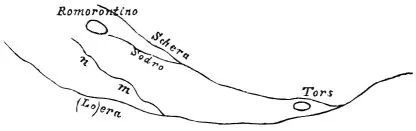
By the ninth of the third; the more rapid it is, the more it wears away its channel; and, by the converse proposition, the slower the water the more it deposits that which renders it turbid.
And let the sluice be movable like the one I arranged in Friuli 593 , where when one sluice was opened the water which passed through it dug out the bottom. Therefore when the rivers are flooded, the sluices of the mills ought to be opened in order that the whole course of the river may pass through falls to each mill; there should be many in order to give a greater impetus, and so all the river will be scoured. And below the site of each of the two mills there may be one of the said sluice falls; one of them may be placed below each mill.
Footnotes
253:593 19: This passage reveals to us the fact that Leonardo had visited the country of Friuli and that he had stayed there for some time. Nothing whatever was known of this previously.
1078.
A trabocco is four braccia, and one mile is three thousand of the said braccia. Each braccio is divided into 12 inches; and the water in the canals has a fall in every hundred trabocchi of two of these inches; therefore 14 inches of fall are necessary in two thousand eight hundred braccia of flow in these canals; it follows that 15 inches of fall give the required momentum to the currents of the waters in the said canals, that is one braccio and a half in the mile. And from this it may be concluded that the water taken from the river of Ville-franche
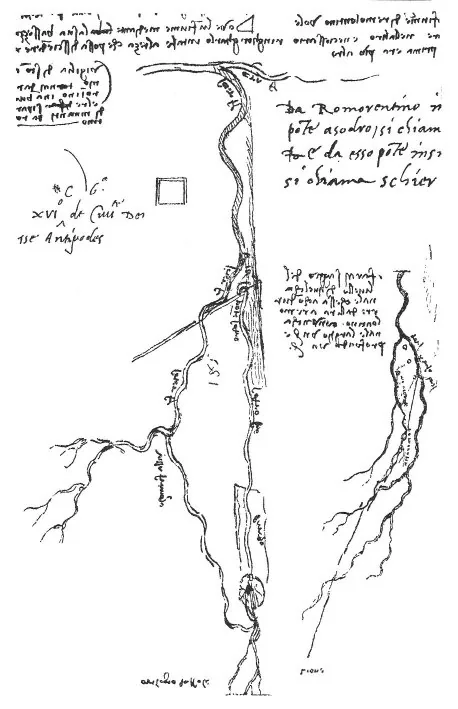
and lent to the river of Romorantin will..... Where one river by reason of its low level cannot flow into the other, it will be necessary to dam it up, so that it may acquire a fall into the other, which was previously the higher.
The eve of Saint Antony I returned from Romorantin to Amboise, and the King went away two days before from Romorantin.
From Romorantin as far as the bridge at Saudre it is called the Saudre, and from that bridge as far as Tours it is called the Cher.
I would test the level of that channel which is to lead from the Loire to Romorantin, with a channel one braccio wide and one braccio deep.
594
Footnotes
255:594 : Lines 6-18 are partly reproduced in the facsimile on p. 254, and the whole of lines 19-25.
The following names are written along the rivers on the larger sketch, era f (the Loire) scier f (the Cher) three times. Pote Sodro (bridge of the Soudre). Villa francha (Villefranche) banco (sandbank) Sodro (Soudre). The circle below shows the position of Romorantin. The words 'orologio del sole' written below do not belong to the map of the rivers. The following names are written by the side of the smaller sketch-map:--tors (Tours), Abosa (Amboise) bres--for Bles (Blois) mo rica (Montrichard). Lione (Lyons). This map was also published in the 'Saggio' (Milano, 1872) Pl. XXII, and the editors remark: Forse la linia retta che va da Amboise a Romorantin segna l'andamento proposto d'un Canale, che poi rembra prolungarsi in giu fin dove sta scritto Lione.
M. Ravaisson has enlarged on this idea in the Gazette des Beaux Arts (1881 p. 530): Les traces de Leonard permettent d'entrevoir que le canal commencant soit aupres de Tours, soit aupres de Blois et passant par Romorantin, avec port d'embarquement a Villefranche, devait, au dela de Bourges, traverser l'Allier au-dessous des affluents de la Dore et de la Sioule, aller par Moulins jusqu' a Digoin; enfin, sur l'autre rive de la Loire, depasser les monts du Charolais et rejoindre la Saone aupres de Macon. It seems to me rash, however, to found so elaborate an hypothesis on these sketches of rivers. The slight stroke going to Lione is perhaps only an indication of the direction.--With regard to the Loire compare also No. 988. l. 38.
1079.
THE ROAD TO ORLEANS
At 1/4 from the South to the South East. At 1/3 from the South to the South East. At 1/4 from the South to the South East. At 1/5 from the South to the South East. Between the South West and South, to the East bearing to the South; from the South towards the East 1/8; thence to the West, between the South and South West; at the South.
595
Footnotes
255:595 : The meaning is obscure; a more important passage referring to France is to be found under No. 744
1080.
On the Germans (1080. 1081).The way in which the Germans closing up together cross and interweave their broad leather shields against the enemy, stooping down and putting one of the ends on the ground while they hold the rest in their hand. 596
Footnotes
256:596 : Above the text is a sketch of a few lines crossing each other and the words de ponderibus. The meaning of the passage is obscure.
1081.
The Germans are wont to annoy a garrison with the smoke of feathers, sulphur and realgar, and they make this smoke last 7 or 8 hours. Likewise the husks of wheat make a great and lasting smoke; and also dry dung; but this must be mixed with olive husks, that is olives pressed for oil and from which the oil has been extracted. 597
Footnotes
256:597 : There is with this passage a sketch of a round tower shrouded in smoke.
1082.
The Danube.That the valleys were formerly in great part covered by lakes the soil of which always forms the banks of rivers,--and by seas, which afterwards, by the persistent wearing of the rivers, cut through the mountains and the wandering courses of the rivers carried away the other plains enclosed by the mountains; and the cutting away of the mountains is evident from the strata in the rocks, which correspond in their sections as made by the courses of the rivers 598 , The Haemus mountains which go along Thrace and Dardania and join the Sardonius mountains which, going on to the westward change their name from Sardus to Rebi, as they come near Dalmatia; then turning to the West cross Illyria, now called Sclavonia, changing the name of Rebi to Albanus, and going on still to the West, they change to Mount Ocra in the North; and to the South above Istria they are named Caruancas; and to the West above Italy they join the Adula, where the Danube rises [8], which stretches to the East and has a
course of 1500 miles; its shortest line is about l000 miles, and the same or about the same is that branch of the Adula mountains changed as to their name, as before mentioned. To the North are the Carpathians, closing in the breadth of the valley of the Danube, which, as I have said extends eastward, a length of about 1000 miles, and is sometimes 200 and in some places 300 miles wide; and in the midst flows the Danube, the principal river of Europe as to size. The said Danube runs through the middle of Austria and Albania and northwards through Bavaria, Poland, Hungary, Wallachia and Bosnia and then the Danube or Donau flows into the Black Sea, which formerly extended almost to Austria and occupied the plains through which the Danube now courses; and the evidence of this is in the oysters and cockle shells and scollops and bones of great fishes which are still to be found in many places on the sides of those mountains; and this sea was formed by the filling up of the spurs of the Adula mountains which then extended to the East joining the spurs of the Taurus which extend to the West. And near Bithynia the waters of this Black Sea poured into the Propontis [Marmora] falling into the Aegean Sea, that is the Mediterranean, where, after a long course, the spurs of the Adula mountains became separated from those of the Taurus. The Black Sea sank lower and laid bare the valley of the Danube with the above named countries, and the whole of Asia Minor beyond the Taurus range to the North, and the plains from mount Caucasus to the Black Sea to the West, and the plains of the Don this side--that is to say, at the foot of the Ural mountains. And thus the Black Sea must have sunk about 1000 braccia to uncover such vast plains.
599
Footnotes
256:598 4: Emus, the Balkan; Dardania, now Servia.
257:599 8: Danubio, in the original Reno; evidently a mistake as we may infer from come dissi l. 10 &c
1083.
III.
THE COUNTRIES OF THE WESTERN END OF THE MEDITERRANEAN.
WHY THE SEA MAKES A STRONGER CURRENT IN THE STRAITS OF SPAIN THAN ELSEWHERE.
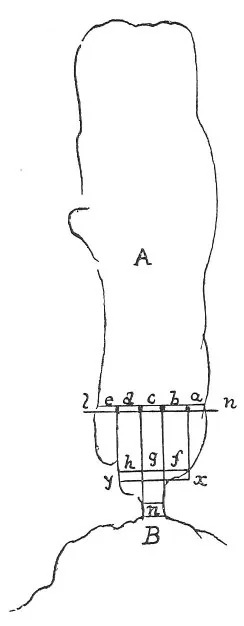
The straits of Gibraltar (1083-1085).A river of equal depth runs with greater speed in a narrow space than in a wide one, in proportion to the difference between the wider and the narrower one.
This proposition is clearly proved by reason confirmed by experiment. Supposing that through a channel one mile wide there flows one mile in length of water; where the river is five miles wide each of the 5 square miles will require 1/5 of itself to be equal to the square mile of water required in the sea, and where the river is 3 miles wide each of these square miles will require the third of its volume to make up the amount of the square mile of the narrow part; as is demonstrated in f g h at the mile marked n.
600
Footnotes
258:600 : In the place marked A in the diagram Mare Mediterano (Mediterranean Sea) is written in the original. And at B, stretto di Spugna (straits of Spain, i.e. Gibraltar). Compare No. 960.
1084.
WHY THE CURRENT OF GIBRALTAR IS ALWAYS GREATER TO THE WEST THAN TO THE EAST.
The reason is that if you put together the mouths of the rivers which discharge into the Mediterranean sea, you would find the sum of water to be larger than that which this sea pours through the straits into the ocean. You see Africa discharging its rivers that run northwards into this sea, and among them the Nile which runs through 3000 miles of Africa; there is also the Bagrada river and the Schelif and others. 601 Likewise Europe pours into it the Don and the Danube, the Po, the Rhone, the Arno, and the Tiber, so that evidently these rivers, with an infinite number of others of less fame, make its great breadth and depth and current; and the sea is not wider than 18 miles at the most westerly point of land where it divides Europe from Africa.
Footnotes
259:601 5: Bagrada (Leonardo writes Bragada) in Tunis, now Medscherda; Mavretano, now Schelif.
1085.
The gulf of the Mediterranean, as an inland sea, received the principal waters of Africa, Asia and Europe that flowed towards it; and its waters came up to the foot of the mountains that surrounded it and made its shores. And the summits of the Apennines stood up out of this sea like islands, surrounded by salt water. Africa again, behind its Atlas mountains did not expose uncovered to the sky the surface of its vast plains about 3000 miles in length, and Memphis 602 was on the shores of this sea, and above the plains of Italy, where now birds fly in flocks, fish were wont to wander in large shoals.
Footnotes
259:602 6: Mefi. Leonardo can only mean here the citadel of Cairo on the Mokattam hills.
1086.
Tunis.The greatest ebb made anywhere by the Mediterranean is above Tunis, being about two and a half braccia and at Venice it falls two braccia. In all the rest of the Mediterranean sea the fall is little or none.
1087.
Libya.Describe the mountains of shifting deserts; that is to say the formation of waves of sand borne by the wind, and of its mountains and hills, such as occur in Libya. Examples may be seen on the wide sands of the Po and the Ticino, and other large rivers.
1088.
Majorca.Circumfulgore is a naval machine. It was an invention of the men of Majorca. 603
Footnotes
260:603 : The machine is fully described in the MS. and shown in a sketch.
1089.
The Tyrrhene Sea.Some at the Tyrrhene sea employ this method; that is to say they fastened an anchor to one end of the yard, and to the other a cord, of which the lower end was fastened to an anchor; and in battle they flung this anchor on to the oars of the opponent's boat and by the use of a capstan drew it to the side; and threw soft soap and tow, daubed with pitch and set ablaze, on to that side where the anchor hung; so that in order to escape that fire, the defenders of that ship had to fly to the opposite side; and in doing this they aided to the attack, because the galley was more easily drawn to the side by reason of the counterpoise. 604
Footnotes
260:604 : This text is illustrated in the original by a pen and ink sketch.
1090.
IV.
THE LEVANT.
The Levantine Sea.On the shores of the Mediterranean 300 rivers flow, and 40, 200 ports. And this sea is 3000 miles long. Many times has the increase of its waters, heaped up by their backward flow and the blowing of the West winds, caused the overflow of the Nile and of the rivers which flow out through the Black Sea, and have so much raised the seas that they have spread with vast floods over many countries. And these floods take place at the time when the sun melts the snows on the high mountains of Ethiopia that rise up into the cold regions of the air; and in the same way the approach of the sun acts on the mountains of Sarmatia in Asia and on those in Europe; so that the gathering together of these three things are, and always have been, the cause of tremendous floods: that is, the return flow of the sea with the West wind and the melting of the snows. So every river will overflow in Syria, in Samaria, in Judea between Sinai and the Lebanon, and in the rest of Syria between the Lebanon and the Taurus mountains, and in Cilicia, in the Armenian mountains, and in Pamphilia and in Lycia within the hills,
and in Egypt as far as the Atlas mountains. The gulf of Persia which was formerly a vast lake of the Tigris and discharged into the Indian Sea, has now worn away the mountains which formed its banks and laid them even with the level of the Indian ocean. And if the Mediterranean had continued its flow through the gulf of Arabia, it would have done the same, that is to say, would have reduced the level of the Mediterranean to that of the Indian Sea.
1091.
The Red Sea. (1091. 1092).For a long time the water of the Mediterranean flowed out through the Red Sea, which is 100 miles wide and 1500 long, and full of reefs; and it has worn away the sides of Mount Sinai, a fact which testifies, not to an inundation from the Indian sea beating on these coasts, but to a deluge of water which carried with it all the rivers which abound round the Mediterranean, and besides this there is the reflux of the sea; and then, a cutting being made to the West 3000 miles away from this place, Gibraltar was separated from Ceuta, which had been joined to it. And this passage was cut very low down, in the plains between Gibraltar and the ocean at the foot of the mountain, in the low part, aided by the hollowing out of some valleys made by certain rivers, which might have flowed here. Hercules 605 came to open the sea to the westward and then the sea waters began to pour into the Western Ocean; and in consequence of this great fall, the Red Sea remained the higher; whence the water, abandoning its course here, ever after poured away through the Straits of Spain.
Footnotes
262:605 9: Leonardo seems here to mention Hercules half jestingly and only in order to suggest to the reader an allusion to the legend of the pillars of Hercules.
1092.
The surface of the Red Sea is on a level with the ocean.
A mountain may have fallen and closed the mouth of the Red Sea and prevented the outlet of the Mediterranean, and the Mediterranean Sea thus overfilled had for outlet the passage below the mountains of Gades; for, in our own times a similar thing has been seen 606 ; a mountain fell seven miles across a valley and closed it up and made a lake. And thus most lakes have been made by mountains, as the lake of Garda, the lakes of Como and Lugano, and the Lago Maggiore. The Mediterranean fell but little on the confines of Syria, in consequence of the Gaditanean passage, but a great deal in this passage, because before this cutting was made the Mediterranean sea flowed to the South East, and then the fall had to be made by its run through the Straits of Gades.
At a the water of the Mediterranean fell into the ocean.
All the plains which lie between the sea and mountains were formerly covered with salt water.
Every valley has been made by its own river; and the proportion between valleys is the same as that between river and river.
The greatest river in our world is the Mediterranean river, which moves from the sources of the Nile to the Western ocean.
And its greatest height is in Outer Mauritania and it has a course of ten thousand miles before it reunites with its ocean, the father of the waters.
That is 3000 miles for the Mediterranean, 3000 for the Nile, as far as discovered and 3000 for the Nile which flows to the East, &c
607
Footnotes
263:606 6: Compare also No. 1336, ll. 30, 35 and 36.-- Paolo Giovio, the celebrated historian (born at Como in 1483) reports that in 1513 at the foot of the Alps, above Bellinzona, on the road to Switzerland, a mountain fell with a very great noise, in consequence of an earthquake, and that the mass of rocks, which fell on the left (Western) side blocked the river Breno (T. I p. 218 and 345 of D. Sauvage's French edition, quoted in ALEXIS PERCY, Memoire des tremblements de terre de la peninsule italique; Academie Royale de Belgique. T. XXII).--
263:607 : See Pl. CXI 2, a sketch of the shores of the Mediterranean Sea, where lines 11 to 16 may be seen. The large figures 158 are not in Leonardo's writing. The character of the writing leads us to conclude that this text was written later than the foregoing. A slight sketch of the Mediterranean is also to be found in MS. I', 47a.
1093.
The Nile (1093-1098).Therefore we must conclude those mountains to be of the greatest height, above which the clouds falling in snow give rise to the Nile.
1094.
The Egyptians, the Ethiopians, and the Arabs, in crossing the Nile with camels, are accustomed to attach two bags on the sides of the camel's bodies that is skins in the form shown underneath.
In these four meshes of the net the camels for baggage place their feet.
608
Footnotes
264:608 : Unfortunately both the sketches which accompany this passage are too much effaced to be reproduced. The upper represents the two sacks joined by ropes, as here described, the other shows four camels with riders swimming through a river.
1095.
The Tigris passes through Asia Minor and brings with it the water of three lakes, one after the other of various elevations; the first being Munace and the middle Pallas and the lowest Triton. And the Nile again springs from three very high lakes in Ethiopia, and runs northwards towards the sea of Egypt with a course of 4000 miles, and by the shortest and straightest line it is 3000 miles. It is said that it issues from the Mountains of the Moon, and has various unknown sources. The said lakes are about 4000 braccia above the surface of the sphere of water, that is 1 mile and 1/3, giving to the Nile a fall of 1 braccia in every mile.
609
Footnotes
264:609 5: Incogniti principio. The affluents of the lakes are probably here intended. Compare, as to the Nile, Nos. 970, 1063 and 1084.
1096.
Very many times the Nile and other very large rivers have poured out their whole element of water and restored it to the sea.
1097.
Why does the inundation of the Nile occur in the summer, coming from torrid countries?
1098.
It is not denied that the Nile is constantly muddy in entering the Egyptian sea and that its turbidity is caused by soil that this river is continually bringing from the places it passes; which soil never returns in the sea which receives it, unless it throws it on its shores. You see the sandy desert beyond Mount Atlas where formerly it was covered with salt water.
1099.
Customs of Asiatic Nations (1099. 1100).The Assyrians and the people of Euboea accustom their horses to carry sacks which they can at pleasure fill with air, and which in case of need they carry instead of the girth of the saddle above and at the side, and they are well covered with plates of cuir bouilli, in order that they may not be perforated by flights of arrows. Thus they have not on their minds their security in flight, when the victory is uncertain; a horse thus equipped enables four or five men to cross over at need.
1100.
SMALL BOATS.
The small boats used by the Assyrians were made of thin laths of willow plaited over rods also of willow, and bent into the form of a boat. They were daubed with fine mud soaked with oil or with turpentine, and reduced to a kind of mud which resisted the water and because pine would split; and always remained fresh; and they covered this sort of boats with the skins of oxen in safely crossing the river Sicuris of Spain, as is reported by Lucant; 610
The Spaniards, the Scythians and the Arabs, when they want to make a bridge in haste, fix hurdlework made of willows on bags of ox-hide, and so cross in safety.
Footnotes
264:610 7: See Lucan's Pharsalia IV, 130: Utque habuit ripas Sicoris camposque reliquit, Primum cana salix madefacto vimine parvam Texitur in puppim, calsoque inducto juvenco Vectoris patiens tumidum supernatat amnem. Sic Venetus stagnante Pado, fusoque Britannus Navigat oceano, sic cum tenet omnia Nilus, Conseritur bibula Memphitis cymbo papyro. His ratibus transjecta manus festinat utrimque Succisam cavare nemus
1101.
Rhodes (1101. 1102).In [fourteen hundred and] eighty nine there was an earthquake in the sea of Atalia near Rhodes, which opened the sea--that is its bottom--and into this opening such a torrent of water poured that for more than three hours the bottom of the sea was uncovered by reason of the water which was lost in it, and then it closed to the former level.
611
Footnotes
265:611 : Nello ottanto 9. It is scarcely likely that Leonardo should here mean 89 AD. Dr. H. MULLER- STRUBING writes to me as follows on this subject: "With reference to Rhodes Ross says (Reise auf den Griechischen Inseln, III 70 ff. 1840), that ancient history affords instances of severe earthquakes at Rhodes, among others one in the second year of the 138th Olympiad=270 B. C.; a remarkably violent one under Antoninus Pius (A. D. 138-161) and again under Constantine and later. But Leonardo expressly speaks of an earthquake "nel mar di Atalia presso a Rodi", which is singular. The town of Attalia, founded by Attalus, which is what he no doubt means, was in Pamphylia and more than 150 English miles East of Rhodes in a straight line. Leake and most other geographers identify it with the present town of Adalia. Attalia is rarely mentioned by the ancients, indeed only by Strabo and Pliny and no earthquake is spoken of. I think therefore you are justified in assuming that Leonardo means 1489". In the elaborate catalogue of earthquakes in the East by Sciale Dshelal eddin Sayouthy (an unpublished Arabic MS. in the possession of Prof. SCHEFER, (Membre de l'Institut, Paris) mention is made of a terrible earthquake in the year 867 of the Mohamedan Era corresponding to the year 1489, and it is there stated that a hundred persons were killed by it in the fortress of Kerak. There are three places of this name. Kerak on the sea of Tiberias, Kerak near Tahle on the Libanon, which I visited in the summer of l876--but neither of these is the place alluded to. Possibly it may be the strongly fortified town of Kerak=Kir Moab, to the West of the Dead Sea. There is no notice about this in ALEXIS PERCY, Memoire sur les tremblements de terres ressentis dans la peninsule turco- hellenique et en Syrie (Memoires couronnes et memoires des savants etrangers, Academie Royale de Belgique, Tome XXIII).
1102.
Rhodes has in it 5000 houses.
1103.
SITE FOR [A TEMPLE OF] VENUS.
Cyprus (1103. 1104).You must make steps on four sides, by which to mount to a meadow formed by nature at the top of a rock which may be hollowed out and supported in front by pilasters and open underneath in a large portico,
612
in which the water may fall into various vases of granite, porphyryand serpentine, within semi-circular recesses; and the water may overflow from these. And round this portico towards the North there should be a lake with a little island in the midst of which should be a thick and shady wood; the waters at the top of the pilasters should pour into vases at their base, from whence they should flow in little channels.
Starting from the shore of Cilicia towards the South you discover the beauties of the island of Cyprus.
Footnotes
265:612 : See Pl. LXXXIII. Compare also p. 33 of this Vol. The standing male figure at the side is evidently suggested by Michael Angelo's David. On the same place a slight sketch of horses seems to have been drawn first; there is no reason for assuming that the text and this sketch, which have no connection with each other, are of the same date.
Sito di Venere. By this heading Leonardo appears to mean Cyprus, which was always considered by the ancients to be the home and birth place of Aphrodite (Kirpic in Homer).
1104.
The Caspian Sea (1105. 1106).From the shore of the Southern coast of Cilicia may be seen to the South the beautiful island of Cyprus, which was the realm of the goddess Venus, and many navigators being attracted by her beauty, had their ships and rigging broken amidst the reefs, surrounded by the whirling waters. Here the beauty of delightful hills tempts wandering mariners to refresh themselves amidst their flowery verdure, where the winds are tempered and fill the island and the surrounding seas with fragrant odours. Ah! how many a ship has here been sunk. Ah! how many a vessel broken on these rocks. Here might be seen barks without number, some wrecked and half covered by the sand; others showing the poop and another the prow, here a keel and there the ribs; and it seems like a day of judgment when there should be a resurrection of dead ships, so great is the number of them covering all the Northern shore; and while the North gale makes various and fearful noises there.
1105.
Write to Bartolomeo the Turk as to the flow and ebb of the Black sea, and whether he is aware if there be such a flow and ebb in the Hyrcanean or Caspian sea. 613
Footnotes
266:613 : The handwriting of this note points to a late date.
1106.
WHY WATER IS FOUND AT THE TOP OF MOUNTAINS.
From the straits of Gibraltar to the Don is 3500 miles, that is one mile and 1/6, giving a fall of one braccio in a mile to any water that moves gently. The Caspian sea is a great deal higher; and none of the mountains of Europe rise a mile above the surface of our seas; therefore it might be said that the water which is on the summits of our mountains might come from the height of those seas, and of the rivers which flow into them, and which are still higher.
1107.
The sea of Azov.Hence it follows that the sea of Azov is the highest part of the Mediterranean sea, being at a distance of 3500 miles from the Straits of Gibraltar, as is shown by the map for navigation; and it has 3500 braccia of descent, that is, one mile and 1/6; therefore it is higher than any mountains which exist in the West.
614
Footnotes
267:614 : The passage before this, in the original, treats of the exit of the waters from Lakes in general.
1108.
The Dardanelles.In the Bosphorus the Black Sea flows always into the Egean sea, and the Egean sea never flows into it. And this is because the Caspian, which is 400 miles to the East, with the rivers which pour into it, always flows through subterranean caves into this sea of Pontus; and the Don does the same as well as the Danube, so that the waters of Pontus are always higher than those of the Egean; for the higher always fall towards the lower, and never the lower towards the higher.
1109.
Constantinople.The bridge of Pera at Constantinople, 40 braccia wide, 70 braccia high above the water, 600 braccia long; that is 400 over the sea and 200 on the land, thus making its own abutments.
615
Footnotes
268:615 : See Pl. CX No. 1. In 1453 by order of Sultan Mohamed II. the Golden Horn was crossed by a pontoon bridge laid on barrels (see Joh. Dukas' History of the Byzantine Empire XXXVIII p. 279). --The biographers of Michelangelo, Vasari as well as Condivi, relate that at the time when Michelangelo suddenly left Rome, in 1506, he entertained some intention of going to Constantinople, there to serve the Sultan, who sought to engage him, by means of certain Franciscan Monks, for the purpose of constructing a bridge to connect Constantinople with Pera. See VASARI, Vite (ed. Sansoni VII, 168): Michelangelo, veduto questa furia del papa, dubitando di lui, ebbe, secondo che si dice, voglia di andarsene in Gostantinopoli a servire il Turco, per mezzo di certi frati di San Francesco, che desiderava averlo per fare un ponte che passassi da Gostantinopoli a Pera. And CONDIVI, Vita di M. Buonaroti chap. 30; Michelangelo allora vedendosi condotto a questo, temendo dell'ira del papa, penso d'andarsene in Levante; massimamente essendo stato dal Turco ricercato con grandissime promesse per mezzo di certi frati di San Francesco, per volersene servire in fare un ponte da Costantinopoli a Pera ed in altri affari. Leonardo's plan for this bridge was made in 1502. We may therefore conclude that at about that time the Sultan Bajazet II. had either announced a competition in this matter, or that through his agents Leonardo had first been called upon to carry out the scheme.
1110.
The Euphrates.If the river will turn to the rift farther on it will never return to its bed, as the Euphrates does, and this may do at Bologna the one who is disappointed for his rivers.
1111.
Centrae Asia.Mounts Caucasus, Comedorum, and Paropemisidae are joined together between Bactria and India, and give birth to the river Oxus which takes its rise in these mountains and flows 500 miles towards the North and as many towards the West, and discharges its waters into the Caspian sea; and is accompanied by the Oxus, Dargados, Arthamis, Xariaspes, Dargamaim, Ocus and Margus, all very large rivers. From the opposite side towards the South rises the great river Indus which sends its waters for 600 miles Southwards and
receives as tributaries in this course the rivers Xaradrus, Hyphasis, Vadris, Vandabal Bislaspus to the East, Suastes and Coe to the West, uniting with these rivers, and with their waters it flows 800 miles to the West; then, turning back by the Arbiti mountains makes an elbow and turns Southwards, where after a course of about 100 miles it finds the Indian Sea, in which it pours itself by seven branches. On the side of the same mountains rises the great Ganges, which river flows Southwards for 500 miles and to the Southwest a thousand ... and Sarabas, Diarnuna, Soas and Scilo, Condranunda are its tributaries. It flows into the Indian sea by many mouths.
1112.
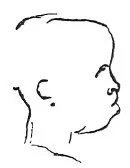
On the natives of hot countries.Men born in hot countries love the night because it refreshes them and have a horror of light because it burns them; and therefore they are of the colour of night, that is black. And in cold countries it is just the contrary.
616
Footnotes
270:616 : The sketch here inserted is in MS. H3 55b.
XVIII.
Naval Warfare.--Mechanical Appliances.--Music.
Such theoretical questions, as have been laid before the reader in Sections XVI and XVII, though they were the chief subjects of Leonardo's studies of the sea, did not exclusively claim his attention. A few passages have been collected at the beginning of this section, which prove that he had turned his mind to the practical problems of navigation, and more especially of naval warfare. What we know for certain of his life gives us no data, it is true, as to when or where these matters came under his consideration; but the fact remains certain both from these notes in his manuscripts, and from the well known letter to Ludovico il Moro (No. 1340), in which he expressly states that he is as capable as any man, in this very department.The numerous notes as to the laws and rationale of the flight of birds, are scattered through several note-books. An account of these is given in the Bibliography of the manuscripts at the end of this work. It seems probable that the idea which led him to these investigations was his desire to construct a flying or aerial machine for man. At the same time it must be admitted that the notes on the two subjects are quite unconnected in the manuscripts, and that those on the flight of birds are by far the most numerous and extensive. The two most important passages that treat of the construction of a flying machine are those already published as Tav. XVI, No. 1 and Tav. XVIII in the "Saggio delle opere di Leonardo da Vinci" (Milan 1872). The passages--Nos. 1120-1125--here printed for the first time and hitherto unknown--refer to the same subject and, with the exception of one already published in the Saggio-- No. 1126--they are, so far as I know, the only notes, among the numerous observations on the flight of birds, in which the phenomena are incidentally and expressly connected with the idea of a flying machine.
The notes on machines of war, the construction of fortifications, and similar matters which fall within the department of the Engineer, have not been included in this work, for the reasons given on page 26 of this Vol. An exception has been made in favour of the passages Nos. 1127 and 1128, because they have a more general interest, as bearing on
the important question: whence the Master derived his knowledge of these matters. Though it would be rash to assert that Leonardo was the first to introduce the science of mining into Italy, it may be confidently said that he is one of the earliest writers who can be proved to have known and understood it; while, on the other hand, it is almost beyond doubt that in the East at that time, the whole science of besieging towns and mining in particular, was far more advanced than in Europe. This gives a peculiar value to the expressions used in No. 1127.
I have been unable to find in the manuscripts any passage whatever which throws any light on Leonardo's great reputation as a musician. Nothing therein illustrates VASARPS well-known statement: Avvenne che morto Giovan Galeazze duca di Milano, e creato Lodovico Sforza nel grado medesimo anno 1494, fu condotto a Milano con gran riputazione Lionardo al duca, il quale molto si dilettava del suono della lira, perche sonasse; e Lionardo porto quello strumento ch'egli aveva di sua mano fabbricato d'argento gran parte, in forma d'un teschio di cavallo, cosa bizzarra e nuova, acciocche l'armonia fosse con maggior tuba e piu sonora di voce; laonde supero tutti i musici che quivi erano concorsi a sonare.
The only notes on musical matters are those given as Nos. 1129 and 1130, which explain certain arrangements in instruments.
1113.
ON MOVEMENTS;--TO KNOW HOW MUCH A SHIP ADVANCES IN AN HOUR.
The ship's logs of Vitruvius, of Alberti and of LeonardoThe ancients used various devices to ascertain the distance gone by a ship each hour, among which Vitruvius 617 gives one in his work on Architecture which is just as fallacious as all the others; and this is a mill wheel which touches the waves of the sea at one end and in each complete revolution describes a straight line which represents the circumference of the wheel extended to a straightness. But this invention is of no worth excepting on the smooth and motionless surface of lakes. But if the water moves together with the ship at an equal rate, then the wheel remains motionless; and if the motion of the water is more or less rapid than that of the ship, then neither has the wheel the same motion as the ship so that this invention is of but little use. There is another method tried by experiment with a known distance between one island and another; and this is done by a board or under the pressure of wind which strikes on it with more or less swiftness. This is in Battista Alberti 618 .
Battista Alberti's method which is made by experiment on a known distance between one island and another. But such an invention does not succeed excepting on a ship like the one on which the experiment was made, and it must be of the same burden and have the same sails, and the sails in the same places, and the size of the waves must be the same. But my method will serve for any ship, whether with oars or sails; and whether it be small or large, broad or long, or high or low, it always serves 619 .
Footnotes
273:617 6: See VITRUVIUS, De Architectura lib. X. C. 14 (p. 264 in the edition of Rose and Muller- Strubing). The German edition published at Bale in 1543 has, on fol. 596, an illustration of the contrivance, as described by Vitruvius.
273:618 25: LEON BATTISTA ALBERTI, De Architectura lib. V., c. 12 treats 'de le navi e parti loro', but there is no reference to the machine, mentioned by Leonardo. Alberti says here: Noi abbiamo trattato lungamente in altro luogo de' modi de le navi, ma in questo luogo ne abbiamo detto quel tanto che si bisogna. To this the following note is added in the most recent Italian edition: Questo libro e tuttora inedito e porta il titolo, secondo Gesnero di 'Liber navis'.
274:619 52: Leonardo does not reveal the method invented by him.
1114.
Methods of staying and moving in waterHow an army ought to cross rivers by swimming with air-bags ... How fishes swim 620 ; of the way in which they jump out of the water, as may be seen with dolphins; and it seems a wonderful thing to make a leap from a thing which does not resist but slips away. Of the swimming of animals of a long form, such as eels and the like. Of the mode of swimming against currents and in the rapid falls of rivers. Of the mode of swimming of fishes of a round form. How it is that animals which have not long hind quartres cannot swim. How it is that all other animals which have feet with toes, know by nature how to swim, excepting man. In what way man ought to learn to swim. Of the way in which man may rest on the water. How man may protect himself against whirlpools or eddies in the water, which drag him down. How a man dragged to the bottom must seek the reflux which will throw him up from the depths. How he ought to move his arms. How to swim on his back. How he can and how he cannot stay under water unless he can hold his breath [13]. How by means of a certain machine many people may stay some time under water. How and why I do not describe my method of remaining under water, or how long I can stay without eating; and I do not publish nor divulge these by reason of the evil nature of men who would use them as
means of destruction at the bottom of the sea, by sending ships to the bottom, and sinking them together with the men in them. And although I will impart others, there is no danger in them; because the mouth of the tube, by which you breathe, is above the water supported on bags or corks [19].
621
Footnotes
274:620 2: Compare No. 821.
275:621 : L. 13-19 will also be found in Vol. I No. 1.
1115.
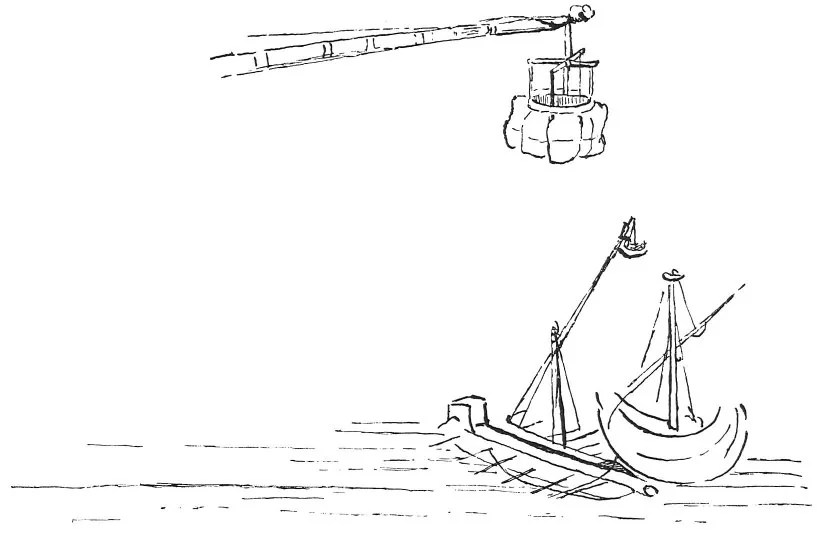
On naval warfare (1115. 1116).Supposing in a battle between ships and galleys that the ships are victorious by reason of the high of heir tops, you must haul the yard up almost to the top of the mast, and at the extremity of the yard, that is the end which is turned towards the enemy, have a small cage fastened, wrapped up below and all round in a great mattress full of cotton so that it may not be injured by the bombs; then, with the capstan, haul down the opposite end of this yard and the top on the opposite side will go up so high, that it will be far above the round-top of the ship, and you will easily drive out the men that are in it. But it is necessary that the men who are in the galley should go to the opposite side of it so as to afford a counterpoise to the weight of the men placed inside the cage on the yard.
1116.
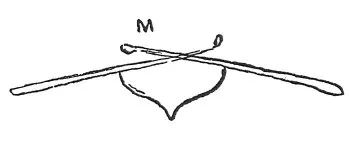
If you want to build an armada for the sea employ these ships to ram in the enemy's ships. That is, make ships 100 feet long and 8 feet wide, but arranged so that the left hand rowers may have their oars to the right side of the ship, and the right hand ones to the left side, as is shown at M, so that the leverage of the oars may be longer. And the
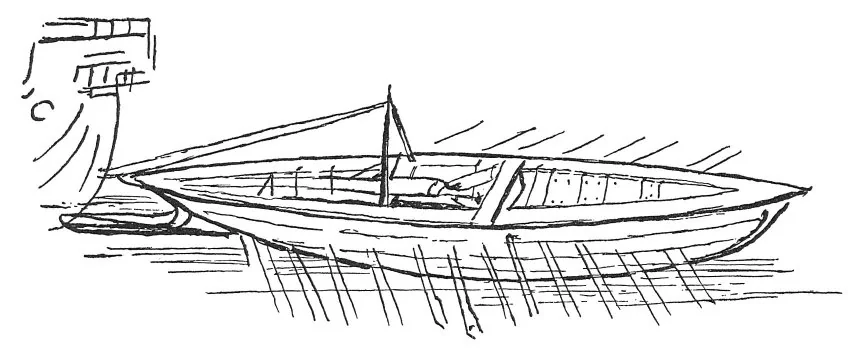

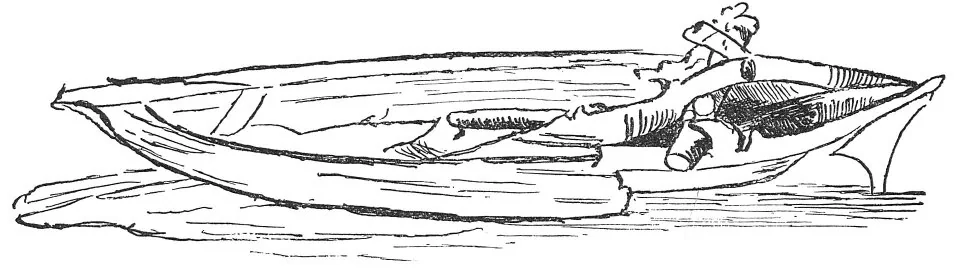
water, an iron-shod spike of about the weight and size of an anvil; and this, by force of oars may, after it has given the first blow, be drawn back, and driven forward again with fury give a second blow, and then a third, and so many as to destroy the other ship.
1117.
A METHOD OF ESCAPING IN A TEMPEST AND SHIPWRECK AT SEA.
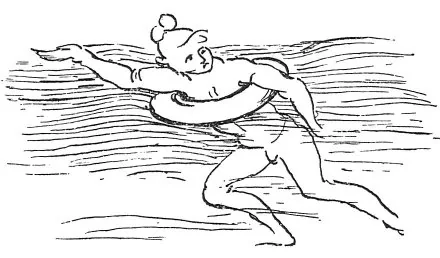
The use of swimming belts.Have a coat made of leather, which must be double across the breast, that is having a hem on each side of about a finger breadth. Thus it will be double from the waist to the knee; and the leather must be quite air-tight. When you want to leap into the sea, blow out the skirt of your coat through the double hems of the breast; and jump into the sea, and allow yourself to be carried by the waves; when you see no shore near, give your attention to the sea you are in, and always keep in your mouth the air-tube which leads down into the coat; and if now and again you require to take a breath of fresh air, and the foam prevents you, you may draw a breath of the air within the coat.
622
Footnotes
277:622 : AMORETTI, Memorie Storiche, Tav. II. B. Fig. 5, gives the same figure, somewhat altered. 6. La canna dell' aria. Compare Vol. I. No. I. Note
1118.
On the gravity of water.If the weight of the sea bears on its bottom, a man, lying on that bottom and having l000 braccia of water on his back, would have enough to crush him.
1119.
Diving apparatus and Skating (1119-1121).Of walking under water.
Method of walking on water.
623
Footnotes
277:623 : The two sketches belonging to this passage are given by AMORETTI, Memorie Storiche. Tav. II, Fig. 3 and 4.
1120.
Just as on a frozen river a man may run without moving his feet, so a car might be made that would slide by itself.
624
Footnotes
278:624 : The drawings of carts by the side of this text have no direct connection with the problem as stated in words.--Compare No. 1448, l. 17.
1121.
A definition as to why a man who slides on ice does not fall. 625
Footnotes
278:625 : An indistinct sketch accompanies the passage, in the original.
1122.
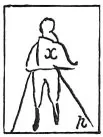
On Flying machines (1122-1126).Man when flying must stand free from the waist upwards so as to be able to balance himself as he does in a boat so that the centre of gravity in himself and in the machine may counterbalance each other, and be shifted as necessity demands for the changes of its centre of resistance.
1123.
Remember that your flying machine must imitate no other than the bat, because the web is what by its union gives the armour, or strength to the wings.
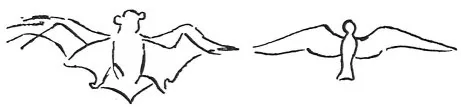
If you imitate the wings of feathered birds, you will find a much stronger structure, because they are pervious; that is, their feathers are separate and the air passes through them. But the bat is aided by the web that connects the whole and is not pervious.
1124.
TO ESCAPE THE PERIL OF DESTRUCTION.
Destruction to such a machine may occur in two ways; of which the first is the breaking of the machine. The second would be when the machine should turn on its edge or nearly on its edge, because it ought always to descend in a highly oblique direction, and almost exactly balanced on its centre. As regards the first--the breaking of the machine--, that may be prevented by making it as strong as possible; and in whichever direction it may tend to turn over, one centre must be very far from the other; that is, in a machine 30 braccia long the centres must be 4 braccia one from the other.
626
Footnotes
279:626 : Compare No. 1428.
1125.
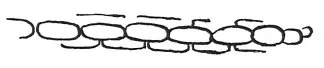
Bags by which a man falling from a height of 6 braccia may avoid hurting himself, by a fall whether into water or on the ground; and these bags, strung together like a rosary, are to be fixed on one's back.
1126.
An object offers as much resistance to the air as the air does to the object. You may see that the beating of its wings against the air supports a heavy eagle in the highest and rarest atmosphere, close to the sphere of elemental fire. Again you may see the air in motion over the sea, fill the swelling sails and drive heavily laden ships. From these instances, and the reasons given, a man with wings large enough and duly connected might learn to overcome the resistance of the air, and by conquering it, succeed in subjugating it and rising above it. 627
Footnotes
279:627 : A parachute is here sketched, with an explanatory remark. It is reproduced on Tav. XVI in the Saggio, and in: Leonardo da Vinci als Ingenieur etc., Ein Beitrag zur Geschichte der Technik und der induktiven Wissenschaften, von Dr. Hermann Grothe, Berlin 1874, p. 50.
1127.
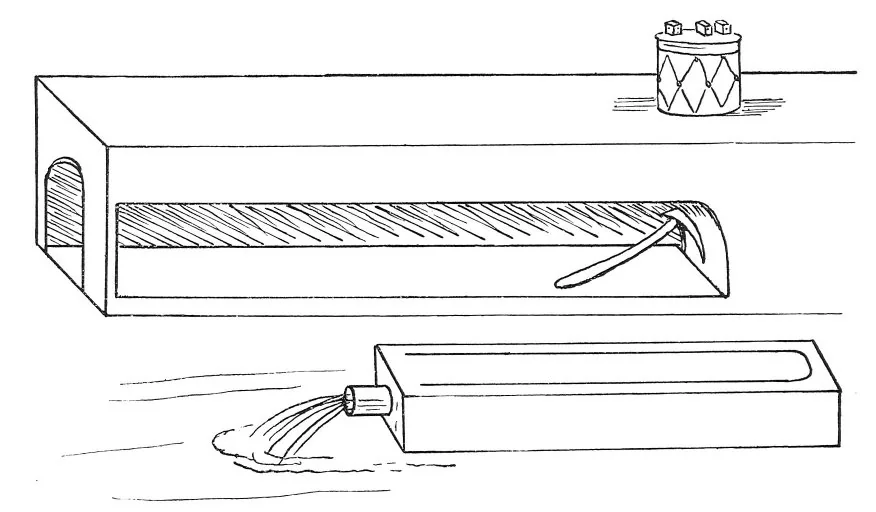
Of mining.If you want to know where a mine runs, place a drum over all the places where you suspect that it is being made, and upon this drum put a couple of dice, and when you are over the spot where they are mining, the dice will jump a little on the drum at every blow which is given underground in the mining.
There are persons who, having the convenience of a river or a lake in their lands, have made, close to the place where they suspect that a mine is being made, a great reservoir of water, and have countermined the enemy, and having found them, have turned the water upon them and destroyed a great number in the mine.
1128.
GREEK FIRE.
Of Greek fire.Take charcoal of willow, and saltpetre, and sulphuric acid, and sulphur, and pitch, with frankincense and camphor, and Ethiopian wool, and boil them all together. This
fire is so ready to burn that it clings to the timbers even under water. And add to this composition liquid varnish, and bituminous oil, and turpentine and strong vinegar, and mix all together and dry it in the sun, or in an oven when the bread is taken out; and then stick it round hempen or other tow, moulding it into a round form, and studding it all over with very sharp nails. You must leave in this ball an opening to serve as a fusee, and cover it with rosin and sulphur.

Again, this fire, stuck at the top of a long plank which has one braccio length of the end pointed with iron that it may not be burnt by the said fire, is good for avoiding and keeping off the ships, so as not to be overwhelmed by their onset.
Again throw vessels of glass full of pitch on to the enemy's ships when the men in them are intent on the battle; and then by throwing similar burning balls upon them you have it in your power to burn all their ships.
628
Footnotes
281:628 : Venturi has given another short text about the Greek fire in a French translation (Essai Section XIV). He adds that the original text is to be found in MS. B. 30 (?). Libri speaks of it in a note as follows (Histoire des sciences mathematiques en Italie Vol. II p. 129): La composition du feu gregeois est une des chases qui ont ete les plus cherchees et qui sont encore les plus douteuses. On dit qu'il fut invente au septieme siecle de l'ere chretienne par l'architecte Callinique (Constantini Porphyrogenetae opera, Lugd. Batav. 1617,-- in-8vo; p. 172, de admin, imper. exp. 48), et il se trouve souvent mentionne par les Historiens Byzantins. Tantot on le langait avec des machines, comme on lancerait une banche, tantot on le soufflait avec de longs tubes, comme on soufflerait un gaz ou un liquide enflamme (Annae Comnenae Alexias, p. 335, lib. XI.--Aeliani et Leonis, imperatoris tactica, Lugd.-Bat. 1613, in-4. part. 2 a, p. 322, Leonis tact. cap. l9.--Joinville, histoire du Saint Louis collect. Petitot tom. II, p. 235). Les ecrivains contemporains disent que l'eau ne pouvait pas eteindre ce feu, mais qu'avec du vinaigre et du sable on y parvenait. Suivant quelques historiens le feu gregeois etait compose de soufre et de resine. Marcus Graecus (Liber ignium, Paris, 1804, in-40) donne plusieurs manieres de le faire qui ne sont pas tres intelligibles, mais parmi lesquelles on trouve la composition de la poudre a canon. Leonard de Vinci (MSS. de Leonard de Vinci, vol. B. f. 30,) dit qu'on le faisait avec du charbon de saule, du salpetre, de l'eau de vie, de la resine, du soufre, de la poix et du camphre. Mais il est probable que nous ne savons pas qu'elle etait sa composition, surtout a cause du secret qu'en faisaient les Grecs. En effet, l'empereur Constantin Porphyrogenete recommende a son fils de ne jamais en donner aux Barbares, et de leur repondre, s'ils en demandaient, qu'il avait ete apporti du ciel par un ange et que le secret en avait ete confie aux Chretiens (Constantini Porphyrogennetae opera, p. 26-27, de admin. imper., cap. 12).
1129.
Of Music (1129. 1130).A drum with cogs working by wheels with springs [2].
629
A square drum of which the parchment may be drawn tight or slackened by the lever a b [5].
A drum for harmony [6].
[7] A clapper for harmony; that is, three clappers together.
[9] Just as one and the same drum makes a deep or acute sound according as the parchments are more or less tightened, so these parchments variously tightened on one and the same drum will make various sounds [16].
Keys narrow and close together; (bicchi) far apart; these will be right for the trumpet shown above.
a must enter in the place of the ordinary keys which have the ... in the openings of a flute.
Footnotes
281:629 : This chapter consists of explanations of the sketches shown on Pl. CXXI. Lines 1 and 2 of the text are to be seen at the top at the left hand side of the first sketch of a drum. Lines 3-5 refer to the sketch immediately below this. Line 6 is written as the side of the seventh sketch, and lines 7 and 8 at the side of the eighth. Lines 9-16 are at the bottom in the middle. The remainder of the text is at the side of the drawing at the bottom.
1130.
Tymbals to be played like the monochord, or the soft flute.
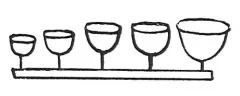
[6] Here there is to be a cylinder of cane after the manner of clappers with a musical round called a Canon, which is sung in four parts; each singer singing the whole round. Therefore I here make a wheel with 4 teeth so that each tooth takes by itself the part of a singer.
630
Footnotes
282:630 : In the original there are some more sketches, to which the text, from line 6, refers. They are studies for a contrivance exactly like the cylinder in our musical boxes.
1131.
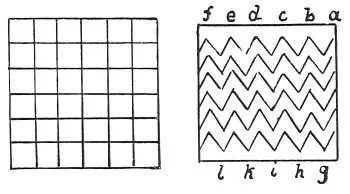
Of decorations.White and sky-blue cloths, woven in checks to make a decoration.
Cloths with the threads drawn at a b c d e f g h i k, to go round the decoration.
XIX.
Philosophical Maxims. Morals. Polemics and Speculations.
Vasari indulges in severe strictures on Leonardo's religious views. He speaks, among other things, of his "capricci nel filosofar delle cose naturali" and says on this point: "Per il che fece nell'animo un concetto si eretico che e' non si accostava a qualsi voglia religione, stimando per avventura assai piu lo esser filosofo che cristiano" (see the first edition of 'Le Vite'). But this accusation on the part of a writer in the days of the Inquisition is not a very serious one--and the less so, since, throughout the manuscripts, we find nothing to support it.
Under the heading of "Philosophical Maxims" I have collected all the passages which can give us a clear comprehension of Leonardo's ideas of the world at large. It is scarcely necessary to observe that there is absolutely nothing in them to lead to the inference that he was an atheist. His views of nature and its laws are no doubt very unlike those of his contemporaries, and have a much closer affinity to those which find general acceptance at the present day. On the other hand, it is obvious from Leonardo's will (see No. 1566) that, in the year before his death, he had professed to adhere to the fundamental doctrines of the Roman Catholic faith, and this evidently from his own personal desire and impulse.
The incredible and demonstrably fictitious legend of Leonardo's death in the arms of Francis the First, is given, with others, by Vasari and further embellished by this odious comment: "Mostrava tuttavia quanto avea offeso Dio e gli uomini del mondo, non avendo operato nell'arte come si conveniva." This last accusation, it may be remarked, is above all evidence of the superficial character of the information which Vasari was in a position to give about Leonardo. It seems to imply that Leonardo was disdainful of diligent labour. With regard to the second, referring to Leonardo's morality and dealings with his fellow men, Vasari himself nullifies it by asserting the very contrary in several passages. A further refutation may be found in the following sentence
from the letter in which Melsi, the young Milanese nobleman, announces the Master's death to Leonardo's brothers: Credo siate certificati della morte di Maestro Lionardo fratello vostro, e mio quanto optimo padre, per la cui morte sarebbe impossibile che io potesse esprimere il dolore che io ho preso; e in mentre che queste mia membra si sosterranno insieme, io possedero una perpetua infelicita, e meritamente perche sviscerato et ardentissimo amore mi portava giornalmente. E dolto ad ognuno la perdita di tal uomo, quale non e piu in podesta della natura, ecc.
It is true that, in April 1476, we find the names of Leonardo and Verrocchio entered in the "Libro degli Uffiziali di notte e de' Monasteri" as breaking the laws; but we immediately after find the note "Absoluti cum condizione ut retamburentur" (Tamburini was the name given to the warrant cases of the night police). The acquittal therefore did not exclude the possibility of a repetition of the charge. It was in fact repeated, two months later, and on this occasion the Master and his pupil were again fully acquitted. Verrocchio was at this time forty and Leonardo four-and-twenty. The documents referring to this affair are in the State Archives of Florence; they have been withheld from publication, but it seemed to me desirable to give the reader this brief account of the leading facts of the story, as the vague hints of it, which have recently been made public, may have given to the incident an aspect which it had not in reality, and which it does not deserve.
The passages here classed under the head "Morals" reveal Leonardo to us as a man whose life and conduct were unfailingly governed by lofty principles and aims. He could scarcely have recorded his stern reprobation and unmeasured contempt for men who do nothing useful and strive only for riches, if his own life and ambitions had been such as they have so often been misrepresented.
At a period like that, when superstition still exercised unlimited dominion over the minds not merely of the illiterate crowd, but of the cultivated and learned classes, it was very natural that Leonardo's views as to Alchemy, Ghosts, Magicians, and the like should be met with stern reprobation whenever and wherever he may have expressed them; this accounts for the argumentative tone of all his utterances on such subjects which I have collected in Subdivision III of this section. To these I have added some passages which throw light on Leonardo's personal views on the Universe. They are, without exception, characterised by a broad spirit of naturalism of which the principles are more strictly applied in his essays on Astronomy, and still more on Physical Geography.
To avoid repetition, only such notes on Philosophy, Morals and Polemics, have been included in this section as occur as independent texts in the original MSS. Several moral reflections have already been given in Vol. I, in section "Allegorical representations, Mottoes and Emblems". Others will be found in the following section. Nos. 9 to 12, Vol. I, are also passages of an argumentative character. It did not seem requisite to repeat here these and similar passages, since their direct connection with the context is far closer in places where they have appeared already, than it would be here.
1132.
I.
PHILOSOPHICAL MAXIMS.
Prayers to God (1132. 1133).I obey Thee Lord, first for the love I ought, in all reason to bear Thee; secondly for that Thou canst shorten or prolong the lives of men.
1133.
A PRAYER.
Thou, O God, dost sell us all good things at the price of labour.
1134.
The powers of Nature (1134-1139).O admirable impartiality of Thine, Thou first Mover; Thou hast not permitted that any force should fail of the order or quality of its necessary results.
1135.
Necessity is the mistress and guide of nature.
Necessity is the theme and the inventress, the eternal curb and law of nature.
1136.
In many cases one and the same thing is attracted by two strong forces, namely Necessity and Potency. Water falls in rain; the earth absorbs it from the necessity for moisture; and the sun evaporates it, not from necessity, but by its power.
1137.
Weight, force and casual impulse, together with resistance, are the four external powers in which all the visible actions of mortals have their being and their end.
1138.
Our body is dependant on heaven and heaven on the Spirit.
1139.
The motive power is the cause of all life.
1140.
Psychology (1140-1147).And you, O Man, who will discern in this work of mine the wonderful works of Nature, if you think it would be a criminal thing to destroy it, reflect how much more criminal it is to take the life of a man; and if this, his external form, appears to thee marvellously constructed, remember that it is nothing as compared with the soul that dwells in that structure; for that indeed, be it what it may, is a thing divine. Leave it then to dwell in His work at His good will and pleasure, and let not your rage or malice destroy a life--for indeed, he who does not value it, does not himself deserve it 631 .
632
Footnotes
286:631 19: In MS. II 15a is the note: chi no stima la vita, non la merita.
286:632 : This text is on the back of the drawings reproduced on Pl. CVII. Compare No. 798, 35 note on p. 111: Compare also No. 837 and 838.
1141.
The soul can never be corrupted with the corruption of the body, but is in the body as it were the air which causes the sound of the organ, where when a pipe bursts, the wind would cease to have any good effect. 633
Footnotes
287:633 : Compare No. 845.
1142.
The part always has a tendency to reunite with its whole in order to escape from its imperfection.
The spirit desires to remain with its body, because, without the organic instruments of that body, it can neither act, nor feel anything.
1143.
If any one wishes to see how the soul dwells in its body, let him observe how this body uses its daily habitation; that is to say, if this is devoid of order and confused, the body will be kept in disorder and confusion by its soul.
1144.
Why does the eye see a thing more clearly in dreams than with the imagination being awake?
1145.
The senses are of the earth; Reason, stands apart in contemplation.
634
Footnotes
287:634 : Compare No. 842.
1146.
Every action needs to be prompted by a motive.
To know and to will are two operations of the human mind.
Discerning, judging, deliberating are acts of the human mind.
1147.
All our knowledge has its origin in our preceptions.
1148.
Science, its principles and rules (1148--1161)Science is the observation of things possible, whether present or past; prescience is the knowledge of things which may come to pass, though but slowly.
1149.
Experience, the interpreter between formative nature and the human race, teaches how that nature acts among mortals; and being constrained by necessity cannot act otherwise than as reason, which is its helm, requires her to act.
1150.
Wisdom is the daughter of experience.
1151.
Nature is full of infinite causes that have never occured in experience.
1152.
Truth was the only daughter of Time.
1153.
Experience never errs; it is only your judgments that err by promising themselves effects such as are not caused by your experiments.
Experience does not err; only your judgments err by expecting from her what is not in her power. Men wrongly complain of Experience; with great abuse they accuse her of leading them astray but they set
Experience aside, turning from it with complaints as to our ignorance causing us to be carried away by vain and foolish desires to promise ourselves, in her name, things that are not in her power; saying that she is fallacious. Men are unjust in complaining of innocent Experience, constantly accusing her of error and of false evidence.
1154.
Instrumental or mechanical science is of all the noblest and the most useful, seeing that by means of this all animated bodies that have movement perform all their actions; and these movements are based on the centre of gravity which is placed in the middle dividing unequal weights, and it has dearth and wealth of muscles and also lever and counterlever.
1155.
OF MECHANICS.
Mechanics are the Paradise of mathematical science, because here we come to the fruits of mathematics. 635
Footnotes
289:635 : Compare No. 660, 11. 19--22 (Vol. I., p. 332).
1156.
Every instrument requires to be made by experience.
1157.
The man who blames the supreme certainty of mathematics feeds on confusion, and can never silence the contradictions of sophistical sciences which lead to an eternal quackery.
1158.
There is no certainty in sciences where one of the mathematical sciences cannot be applied, or which are not in relation with these mathematics.
1159.
Any one who in discussion relies upon authority uses, not his understanding, but rather his memory. Good culture is born of a good disposition; and since the cause is more to be praised than the effect, I will rather praise a good disposition without culture, than good culture without the disposition.
1160.
Science is the captain, and practice the soldiers.
1161.
OF THE ERRORS OF THOSE WHO DEPEND ON PRACTICE WITHOUT SCIENCE.
Those who fall in love with practice without science are like a sailor who enters a ship without a helm or a compass, and who never can be certain whither he is going.
1162.
II.
MORALS.
What is life? (1162. 1163).Now you see that the hope and the desire of returning home and to one's former state is like the moth to the light, and that the man who with constant longing awaits with joy each new spring time, each new summer, each new month and new year--deeming that the things he longs for are ever too late in coming--does not perceive that he is longing for his own destruction. But this desire is the very quintessence, the spirit of the elements, which finding itself imprisoned with the soul is ever longing to return from the human body to its giver. And you must know that this same longing is that quintessence, inseparable from nature, and that man is the image of the world.
1163.
O Time! consumer of all things; O envious age! thou dost destroy all things and devour all things with the relentless teeth of years, little by little in a slow death. Helen, when she looked in her mirror, seeing the withered wrinkles made in her face by old age, wept and wondered why she had twice been carried away.
O Time! consumer of all things, and O envious age! by which all things are all devoured.
1164.
Death.Every evil leaves behind a grief in our memory, except the supreme evil, that is death, which destroys this memory together with life.
1165.
How to spend life (1165-1170).0 sleepers! what a thing is slumber! Sleep resembles death. Ah, why then dost thou not work in such wise as that after death thou mayst retain a resemblance to perfect life, when, during life, thou art in sleep so like to the hapless dead? 636
Footnotes
292:636 : Compare No. 676, Vol. I. p. 353.
1166.
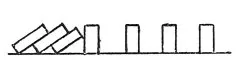
One pushes down the other.
By these square-blocks are meant the life and the studies of men.
1167.
The knowledge of past times and of the places on the earth is both an ornament and nutriment to the human mind.
1168.
To lie is so vile, that even if it were in speaking well of godly things it would take off something from God's grace; and Truth is so excellent, that if it praises but small things they become noble.
Beyond a doubt truth bears the same relation to falsehood as light to darkness; and this truth is in itself so excellent that, even when it dwells on humble and lowly matters, it is still infinitely above uncertainty and lies, disguised in high and
lofty discourses; because in our minds, even if lying should be their fifth element, this does not prevent that the truth of things is the chief nutriment of superior intellects, though not of wandering wits.
But you who live in dreams are better pleased by the sophistical reasons and frauds of wits in great and uncertain things, than by those reasons which are certain and natural and not so far above us.
1169.
Avoid studies of which the result dies with the worker.
1170.
Men are in error when they lament the flight of time, accusing it of being too swift, and not perceiving that it is sufficient as it passes; but good memory, with which nature has endowed us, causes things long past to seem present.
1171.
Learning acquired in youth arrests the evil of old age; and if you understand that old age has wisdom for its food, you will so conduct yourself in youth that your old age will not lack for nourishment.
1172.
The acquisition of any knowledge is always of use to the intellect, because it may thus drive out useless things and retain the good.
For nothing can be loved or hated unless it is first known.
1173.
As a day well spent procures a happy sleep, so a life well employed procures a happy death.
1174.
The water you touch in a river is the last of that which has passed, and the first of that which is coming. Thus it is with time present.
Life if well spent, is long.
1175.
Just as food eaten without caring for it is turned into loathsome nourishment, so study without a taste for it spoils memory, by retaining nothing which it has taken in.
1176.
Just as eating against one's will is injurious to health, so study without a liking for it spoils the memory, and it retains nothing it takes in.
1177.
On Mount Etna the words freeze in your mouth and you may make ice of them.
637
Just as iron rusts unless it is used, and water putrifies or, in cold, turns to ice, so our intellect spoils unless it is kept in use.
You do ill if you praise, and still worse if you reprove in a matter you do not understand.
When Fortune comes, seize her in front with a sure hand, because behind she is bald.
Footnotes
294:637 2: There is no clue to explain this strange sentence.
1178.
It seems to me that men of coarse and clumsy habits and of small knowledge do not deserve such fine instruments nor so great a variety of natural mechanism as men of speculation and of great knowledge; but merely a
sack in which their food may be stowed and whence it may issue, since they cannot be judged to be any thing else than vehicles for food; for it seems to me they have nothing about them of the human species but the voice and the figure, and for all the rest are much below beasts.
1179.
Some there are who are nothing else than a passage for food and augmentors of excrement and fillers of privies, because through them no other things in the world, nor any good effects are produced, since nothing but full privies results from them.
1180.
On foolishness and ignorance (1180--1182).The greatest deception men suffer is from their own opinions.
1181.
Folly is the shield of shame, as unreadiness is that of poverty glorified.
1182.
Blind ignorance misleads us thus and delights with the results of lascivious joys.
Because it does not know the true light.
Because it does not know what is the true light.
Vain splendour takes from us the power of being .... behold! for its vain splendour we go into the fire, thus blind ignorance does mislead us. That is, blind ignorance so misleads us that ...
O! wretched mortals, open your eyes.
1183.
On riches (1183--1187).That is not riches, which may be lost; virtue is our true good and the true reward of its possessor. That cannot be lost; that never deserts us, but when life leaves us. As
to property and external riches, hold them with trembling; they often leave their possessor in contempt, and mocked at for having lost them.
1184.
Every man wishes to make money to give it to the doctors, destroyers of life; they then ought to be rich. 638
Man has much power of discourse which for the most part is vain and false; animals have but little, but it is useful and true, and a small truth is better than a great lie.
Footnotes
296:638 2: Compare No. 856.
1185.
He who possesses most must be most afraid of loss.
1186.
He who wishes to be rich in a day will be hanged in a year.
1187.
That man is of supreme folly who always wants for fear of wanting; and his life flies away while he is still hoping to enjoy the good things which he has with extreme labour acquired.
1188.
Rules of Life (1188-1202).If you governed your body by the rules of virtue you would not walk on all fours in this world.
You grow in reputation like bread in the hands of a child. 639
Footnotes
296:639 : The first sentence is obscure. Compare Nos. 825, 826.
1189.
Savage he is who saves himself.
1190.
We ought not to desire the impossible. 640
Footnotes
297:640 : The writing of this note, which is exceedingly minute, is reproduced in facsimile on Pl. XLI No. 5 above the first diagram.
1191.
Ask counsel of him who rules himself well.
Justice requires power, insight, and will; and it resembles the queen-bee.
He who does not punish evil commands it to be done.
He who takes the snake by the tail will presently be bitten by it.
The grave will fall in upon him who digs it.
1192.
The man who does not restrain wantonness, allies himself with beasts.
You can have no dominion greater or less than that over yourself.
He who thinks little, errs much.
It is easier to contend with evil at the first than at the last.
No counsel is more loyal than that given on ships which are in peril: He may expect loss who acts on the advice of an inexperienced youth.
1193.
Where there is most feeling, there is the greatest martyrdom;--a great martyr.
1194.
The memory of benefits is a frail defence against ingratitude.
Reprove your friend in secret and praise him openly.
Be not false about the past.
1195.
A SIMILE FOR PATIENCE.
Patience serves us against insults precisely as clothes do against the cold. For if you multiply your garments as the cold increases, that cold cannot hurt you; in the same way increase your patience under great offences, and they cannot hurt your feelings.
1196.
To speak well of a base man is much the same as speaking ill of a good man.
1197.
Envy wounds with false accusations, that is with detraction, a thing which scares virtue.
1198.
We are deceived by promises and time disappoints us ...
641
Footnotes
298:641 2: The rest of this passage may be rendered in various ways, but none of them give a satisfactory meaning.
1199.
Fear arises sooner than any thing else.
1200.
Just as courage imperils life, fear protects it.
Threats alone are the weapons of the threatened man.
Wherever good fortune enters, envy lays siege to the place and attacks it; and when it departs, sorrow and repentance remain behind.
He who walks straight rarely falls.
It is bad if you praise, and worse if you reprove a thing, I mean, if you do not understand the matter well.
It is ill to praise, and worse to reprimand in matters that you do not understand.
1201.
Words which do not satisfy the ear of the hearer weary him or vex him, and the symptoms of this you will often see in such hearers in their frequent yawns; you therefore, who speak before men whose good will you desire, when you see such an excess of fatigue, abridge your speech, or change your discourse; and if you do otherwise, then instead of the favour you desire, you will get dislike and hostility.
And if you would see in what a man takes pleasure, without hearing him speak, change the subject of your discourse in talking to him, and when you presently see him intent, without yawning or wrinkling his brow or other actions of various kinds, you may be certain that the matter of which you are speaking is such as is agreeable to him &c
1202.
The lover is moved by the beloved object as the senses are by sensible objects; and they unite and become one and the same thing. The work is the first thing born of this union; if the thing loved is base the lover becomes base.
When the thing taken into union is perfectly adapted to that which receives it, the result is delight and pleasure and satisfaction.
When that which loves is united to the thing beloved it can rest there; when the burden is laid down it finds rest there.
1203.
Politics (1203. 1204).There will be eternal fame also for the inhabitants of that town, constructed and enlarged by him.
642
All communities obey and are led by their magnates, and these magnates ally themselves with the lords and subjugate them in two ways: either by consanguinity, or by fortune; by consanguinity, when their children are, as it were, hostages, and a security and pledge of their suspected fidelity; by property, when you make each of these build a house or two inside your city which may yield some revenue and he shall have...; 10 towns, five thousand houses with thirty thousand inhabitants, and you will disperse this great congregation of people which stand like goats one behind the other, filling every place with fetid smells and sowing seeds of pestilence and death;
And the city will gain beauty worthy of its name and to you it will be useful by its revenues, and the eternal fame of its aggrandizement.
Footnotes
299:642 : These notes were possibly written in preparation for a letter. The meaning is obscure.
1204.
To preserve Nature's chiefest boon, that is freedom, I can find means of offence and defence, when it is assailed by ambitious tyrants, and first I will speak of the situation of the walls, and also I shall show how communities can maintain their good and just Lords.
643
Footnotes
300:643 : Compare No. 1266.
1205.
III.
POLEMICS.--SPECULATION.
Against Speculators (1205. 1206).Oh! speculators on things, boast not of knowing the things that nature ordinarily brings about; but rejoice if you know the end of those things which you yourself devise.
1206.
Oh! speculators on perpetual motion how many vain projects of the like character you have created! Go and be the companions of the searchers for gold. 644
Footnotes
301:644 : Another short passage in MS. I, referring also to speculators, is given by LIBRI (Hist, des Sciences math. III, 228): Sicche voi speculatori non vi fidate delli autori che anno sol col immaginatione voluto farsi interpreti tra la natura e l'omo, ma sol di quelli che non coi cienni della natura, ma cogli effetti delle sue esperienze anno esercitati i loro ingegni.
1207.
Against alchemists (1207. 1208).The false interpreters of nature declare that quicksilver is the common seed of every metal, not remembering that nature varies the seed according to the variety of the things she desires to produce in the world.
1208.
And many have made a trade of delusions and false miracles, deceiving the stupid multitude.
1209.
Against friars.Pharisees--that is to say, friars.
645
Footnotes
302:645 : Compare No. 837, ll. 54-57, No. 1296 (p. 363 and 364), and No. 1305 (p. 370).
1210.
Against writers of epitomes.Abbreviators do harm to knowledge and to love, seeing that the love of any thing is the offspring of this knowledge, the love being the more fervent in proportion as the knowledge is more certain. And this certainty is born of a complete knowledge of all the parts, which, when combined, compose the totality of the thing which ought to be loved. Of what use then is he who abridges the details of those matters of which he professes to give thorough information, while he leaves behind the chief part of the things of which the whole is composed? It is true that impatience, the mother of stupidity, praises brevity, as if such persons had not life long enough to serve them to acquire a complete knowledge of one single subject, such as the human body; and then they want to comprehend the mind of God in which the universe is included, weighing it minutely and mincing it into infinite parts, as if they had to dissect it!
Oh! human stupidity, do you not perceive that, though you have been with yourself all your life, you are not yet aware of the thing you possess most of, that is of your folly? and then, with the crowd of sophists, you deceive yourselves and others, despising the mathematical sciences, in which truth dwells and the knowledge of the things included in them. And then you occupy yourself with miracles, and write that you possess information of those things of which the human mind is incapable and which cannot be proved by any instance from nature. And you fancy you have wrought miracles when you spoil a work of some
speculative mind, and do not perceive that you are falling into the same error as that of a man who strips a tree of the ornament of its branches covered with leaves mingled with the scented blossoms or fruit....... 646 as Justinus did, in abridging the histories written by Trogus Pompeius, who had written in an ornate style all the worthy deeds of his forefathers, full of the most admirable and ornamental passages; and so composed a bald work worthy only of those impatient spirits, who fancy they are losing as much time as that which they employ usefully in studying the works of nature and the deeds of men. But these may remain in company of beasts; among their associates should be dogs and other animals full of rapine and they may hunt with them after...., and then follow helpless beasts, which in time of great snows come near to your houses asking alms as from their master....
Footnotes
303:646 48: Givstino, Marcus Junianus Justinus, a Roman historian of the second century, who compiled an epitome from the general history written by Trogus Pompeius, who lived in the time of Augustus. The work of the latter writer no longer exist.
1211.
On spirits (1211--1213).O mathematicians shed light on this error.
The spirit has no voice, because where there is a voice there is a body, and where there is a body space is occupied, and this prevents the eye from seeing what is placed behind that space; hence the surrounding air is filled by the body, that is by its image.
1212.
There can be no voice where there is no motion or percussion of the air; there can be no percussion of the air where there is no instrument, there can be no instrument without a body; and this being so, a spirit can have neither voice, nor form, nor strength. And if it were to assume a body it could not penetrate nor enter where the passages are closed. And if any one should say that by air, compressed and compacted
together, a spirit may take bodies of various forms and by this means speak and move with strength--to him I reply that when there are neither nerves nor bones there can be no force exercised in any kind of movement made by such imaginary spirits.
Beware of the teaching of these speculators, because their reasoning is not confirmed by experience.
1213.
Of all human opinions that is to be reputed the most foolish which deals with the belief in Necromancy, the sister of Alchemy, which gives birth to simple and natural things. But it is all the more worthy of reprehension than alchemy, because it brings forth nothing but what is like itself, that is, lies; this does not happen in Alchemy which deals with simple products of nature and whose function cannot be exercised by nature itself, because it has no organic instruments with which it can work, as men do by means of their hands, who have produced, for instance, glass &c but this Necromancy the flag and flying banner, blown by the winds, is the guide of the stupid crowd which is constantly witness to the dazzling and endless effects of this art; and there are books full, declaring that enchantments and spirits can work and speak without tongues and without organic instruments-- without which it is impossible to speak-- and can carry heaviest weights and raise storms and rain; and that men can be turned into cats and wolves and other beasts, although indeed it is those who affirm these things who first became beasts.
And surely if this Necromancy did exist, as is believed by small wits, there is nothing on the earth that would be of so much importance alike for the detriment and service of men, if it were true that there were in such an art a power to disturb the calm serenity of the air, converting it into darkness and making coruscations or winds, with terrific thunder and lightnings rushing through the darkness, and with violent
storms overthrowing high buildings and rooting up forests; and thus to oppose armies, crushing and annihilating them; and, besides these frightful storms may deprive the peasants of the reward of their labours.--Now what kind of warfare is there to hurt the enemy so much as to deprive him of the harvest? What naval warfare could be compared with this? I say, the man who has power to command the winds and to make ruinous gales by which any fleet may be submerged, --surely a man who could command such violent forces would be lord of the nations, and no human ingenuity could resist his crushing force. The hidden treasures and gems reposing in the body of the earth would all be made manifest to him. No lock nor fortress, though impregnable, would be able to save any one against the will of the necromancer. He would have himself carried through the air from East to West and through all the opposite sides of the universe. But why should I enlarge further upon this? What is there that could not be done by such a craftsman? Almost nothing, except to escape death. Hereby I have explained in part the mischief and the usefulness, contained in this art, if it is real; and if it is real why has it not remained among men who desire it so much, having nothing to do with any deity? For I know that there are numberless people who would, to satisfy a whim, destroy God and all the universe; and if this necromancy, being, as it were, so necessary to men, has not been left among them, it can never have existed, nor will it ever exist according to the definition of the spirit, which is invisible in substance; for within the elements there are no incorporate things, because where there is no body, there is a vacuum; and no vacuum can exist in the elements because it would be immediately filled up. Turn over.
1214.
OF SPIRITS.
We have said, on the other side of this page, that the definition of a spirit is a power conjoined to a body; because it cannot
move of its own accord, nor can it have any kind of motion in space; and if you were to say that it moves itself, this cannot be within the elements. For, if the spirit is an incorporeal quantity, this quantity is called a vacuum, and a vacuum does not exist in nature; and granting that one were formed, it would be immediately filled up by the rushing in of the element in which the vacuum had been generated. Therefore, from the definition of weight, which is this--Gravity is an accidental power, created by one element being drawn to or suspended in another--it follows that an element, not weighing anything compared with itself, has weight in the element above it and lighter than it; as we see that the parts of water have no gravity or levity compared with other water, but if you draw it up into the air, then it would acquire weight, and if you were to draw the air beneath the water then the water which remains above this air would acquire weight, which weight could not sustain itself by itself, whence collapse is inevitable. And this happens in water; wherever the vacuum may be in this water it will fall in; and this would happen with a spirit amid the elements, where it would continuously generate a vacuum in whatever element it might find itself, whence it would be inevitable that it should be constantly flying towards the sky until it had quitted these elements.
AS TO WHETHER A SPIRIT HAS A BODY AMID THE ELEMENTS.
We have proved that a spirit cannot exist of itself amid the elements without a body, nor can it move of itself by voluntary motion unless it be to rise upwards. But now we will say how such a spirit taking an aerial body would be inevitably melt into air; because if it remained united, it would be separated and fall to form a vacuum, as is said above; therefore it is inevitable, if it is to be able to remain suspended in the air, that it should absorb a certain quantity of air; and if it were mingled with the air, two difficulties arise; that is to say: It must rarefy that portion of the air with which it mingles; and for this cause the rarefied air must fly up of itself and will not
remain among the air that is heavier than itself; and besides this the subtle spiritual essence disunites itself, and its nature is modified, by which that nature loses some of its first virtue. Added to these there is a third difficulty, and this is that such a body formed of air assumed by the spirits is exposed to the penetrating winds, which are incessantly sundering and dispersing the united portions of the air, revolving and whirling amidst the rest of the atmosphere; therefore the spirit which is infused in this
1215.
air would be dismembered or rent and broken up with the rending of the air into which it was incorporated.
AS TO WHETHER THE SPIRIT, HAVING TAKEN THIS BODY OF AIR, CAN MOVE OF
ITSELF OR NOT.
It is impossible that the spirit infused into a certain quantity of air, should move this air; and this is proved by the above passage where it is said: the spirit rarefies that portion of the air in which it incorporates itself; therefore this air will rise high above the other air and there will be a motion of the air caused by its lightness and not by a voluntary movement of the spirit, and if this air is encountered by the wind, according to the 3rd of this, the air will be moved by the wind and not by the spirit incorporated in it.
AS TO WHETHER THE SPIRIT CAN SPEAK OR NOT.
In order to prove whether the spirit can speak or not, it is necessary in the first place to define what a voice is and how it is generated; and we will say that the voice is, as it were, the movement of air in friction against a dense body, or a dense body in friction against the air,--which is the same thing. And this friction of the dense and the rare condenses the rare and causes resistance; again, the rare, when in swift motion, and the rare in slow motion condense each other when they come in contact and make a noise and very great uproar;
and the sound or murmur made by the rare moving through the rare with only moderate swiftness, like a great flame generating noises in the air; and the tremendous uproar made by the rare mingling with the rare, and when that air which is both swift and rare rushes into that which is itself rare and in motion, it is like the flame of fire which issues from a big gun and striking against the air; and again when a flame issues from the cloud, there is a concussion in the air as the bolt is generated. Therefore we may say that the spirit cannot produce a voice without movement of the air, and air in it there is none, nor can it emit what it has not; and if desires to move that air in which it is incorporated, it is necessary that the spirit should multiply itself, and that cannot multiply which has no quantity. And in the 4th place it is said that no rare body can move, if it has not a stable spot, whence it may take its motion; much more is it so when an element has to move within its own element, which does not move of itself, excepting by uniform evaporation at the centre of the thing evaporated; as occurs in a sponge squeezed in the hand held under water; the water escapes in every direction with equal movement through the openings between the fingers of the hand in which it is squeezed.
As to whether the spirit has an articulate voice, and whether the spirit can be heard, and what hearing is, and seeing; the wave of the voice passes through the air as the images of objects pass to the eye.
1216.
Nonentity.Every quantity is intellectually conceivable as infinitely divisible.
[Amid the vastness of the things among which we live, the existence of nothingness holds the first place; its function extends over all things that have no existence, and
its essence, as regards time, lies precisely between the past and the future, and has nothing in the present. This nothingness has the part equal to the whole, and the whole to the part, the divisible to the indivisible; and the product of the sum is the same whether we divide or multiply, and in addition as in subtraction; as is proved by arithmeticians by their tenth figure which represents zero; and its power has not extension among the things of Nature.]
[What is called Nothingness is to be found only in time and in speech. In time it stands between the past and future and has no existence in the present; and thus in speech it is one of the things of which we say: They are not, or they are impossible.]
With regard to time, nothingness lies between the past and the future, and has nothing to do with the present, and as to its nature it is to be classed among things impossible: hence, from what has been said, it has no existence; because where there is nothing there would necessarily be a vacuum.
647
Footnotes
309:647 : Compare No. 916.
1217.
EXAMPLE OF THE LIGHTNING IN CLOUDS.
Reflections on Nature (1217-1219).[O mighty and once living instrument of formative nature. Incapable of availing thyself of thy vast strength thou hast to abandon a life of stillness and to obey the law which God and time gave to procreative nature.]
Ah! how many a time the shoals of terrified dolphins and the huge tunny-fish were seen to flee before thy cruel fury, to escape; whilst thy fulminations raised in the sea a sudden tempest with buffeting and submersion of ships in the great waves; and filling the uncovered shores with the terrified and desperate fishes which fled from thee, and left by the sea, remained in spots where they became the abundant prey of the people in the neighbourhood.
648
O time, swift robber of all created things, how many kings, how many nations hast thou undone, and how many changes of states and of various events have happened since the wondrous forms of this fish perished here in this cavernous and winding recess. Now destroyed by time thou liest patiently in this confined space with bones stripped and bare; serving as a support and prop for the superimposed mountain.
649
Footnotes
309:648 : The character of the handwriting points to an early period of Leonardo's life. It has become very indistinct, and is at present exceedingly difficult to decipher. Some passages remain doubtful.
310:649 : Compare No. 1339, written on the same sheet.
1218.
The watery element was left enclosed between the raised banks of the rivers, and the sea was seen between the uplifted earth and the surrounding air which has to envelope and enclose the complicated machine of the earth, and whose mass, standing between the water and the element of fire, remained much restricted and deprived of its indispensable moisture; the rivers will be deprived of their waters, the fruitful earth will put forth no more her light verdure; the fields will no more be decked with waving corn; all the animals, finding no fresh grass for pasture, will die and food will then be lacking to the lions and wolves and other beasts of prey, and to men who after many efforts will be compelled to abandon their life, and the human race will die out. In this way the fertile and fruitful earth will remain deserted, arid and sterile from the water being shut up in its interior, and from the activity of nature it will continue a little time to increase until the cold and subtle air being gone, it will be forced to end with the element of fire; and then its surface will be left burnt up to cinder and this will be the end of all terrestrial nature.
650
Footnotes
310:650 : Compare No. 1339, written on the same sheet.
1219.
Why did nature not ordain that one animal should not live by the death of another? Nature, being inconstant and
taking pleasure in creating and making constantly new lives and forms, because she knows that her terrestrial materials become thereby augmented, is more ready and more swift in her creating, than time in his destruction; and so she has ordained that many animals shall be food for others. Nay, this not satisfying her desire, to the same end she frequently sends forth certain poisonous and pestilential vapours upon the vast increase and congregation of animals; and most of all upon men, who increase vastly because other animals do not feed upon them; and, the causes being removed, the effects would not follow. This earth therefore seeks to lose its life, desiring only continual reproduction; and as, by the argument you bring forward and demonstrate, like effects always follow like causes, animals are the image of the world.
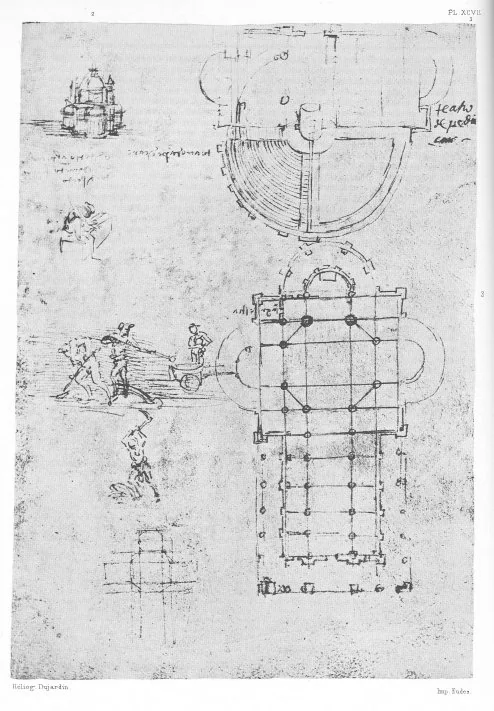
Plate XCVII
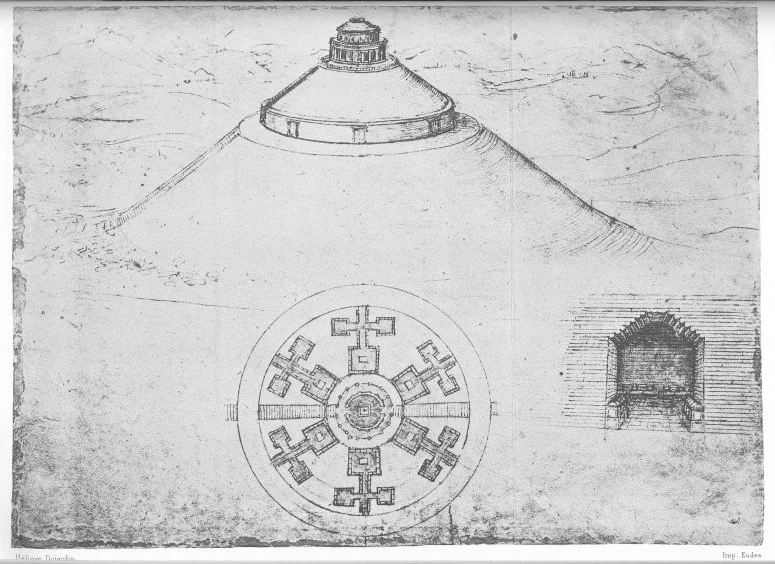
Plate XCVIII
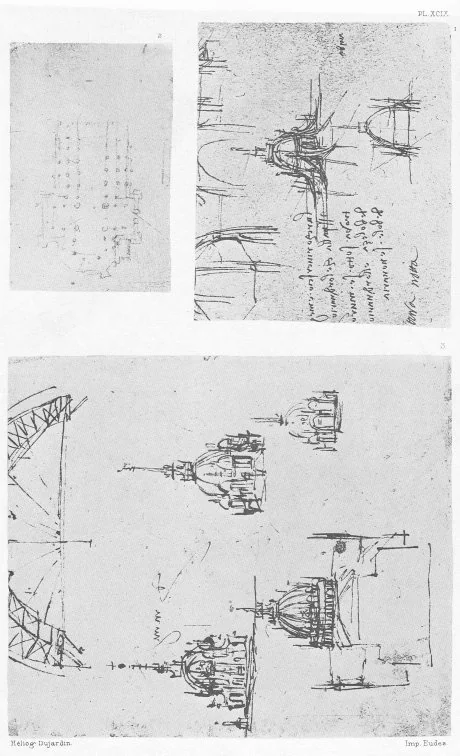
Plate XCIX
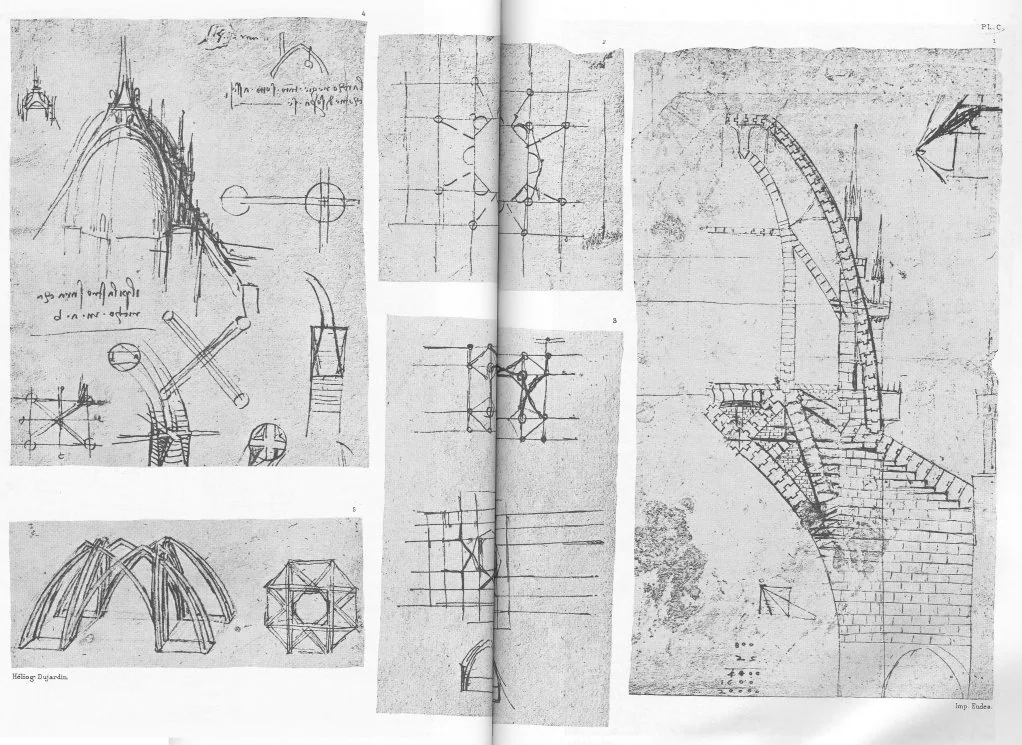
Plate C
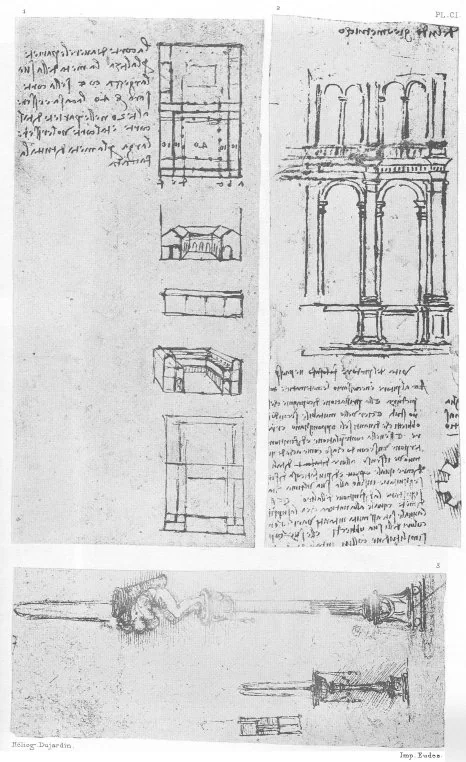
Plate CI
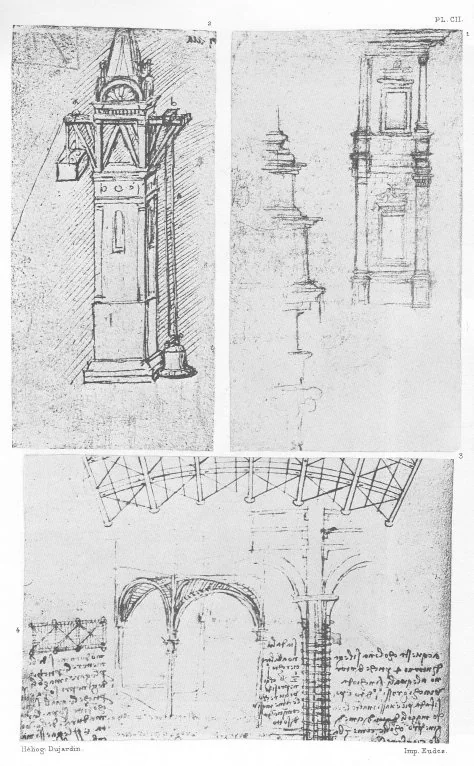
Plate CXII
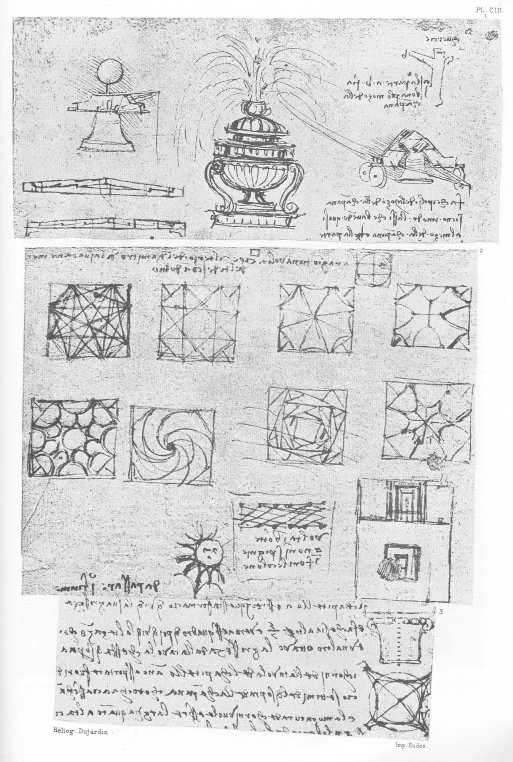
Plate CIII
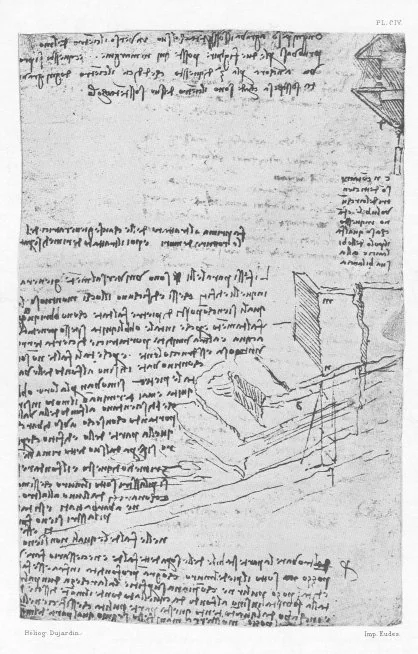
Plate LXIV
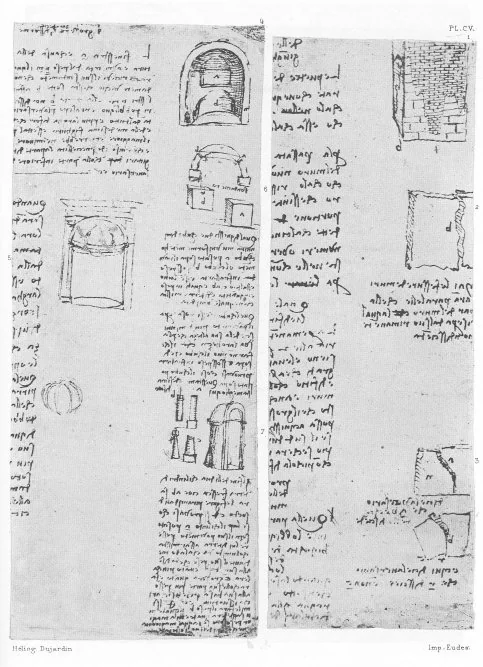
Plate CV
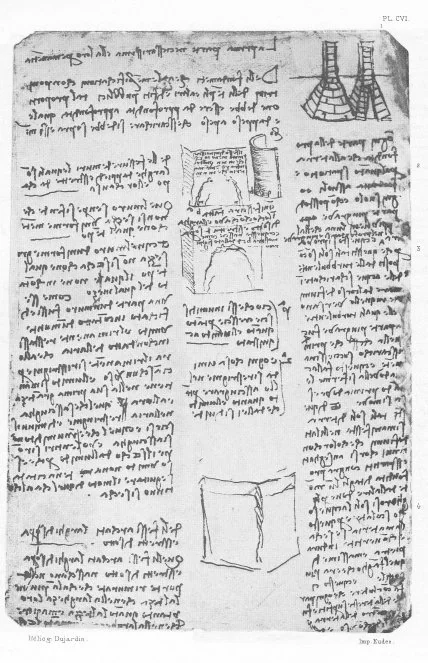
Plate CVI
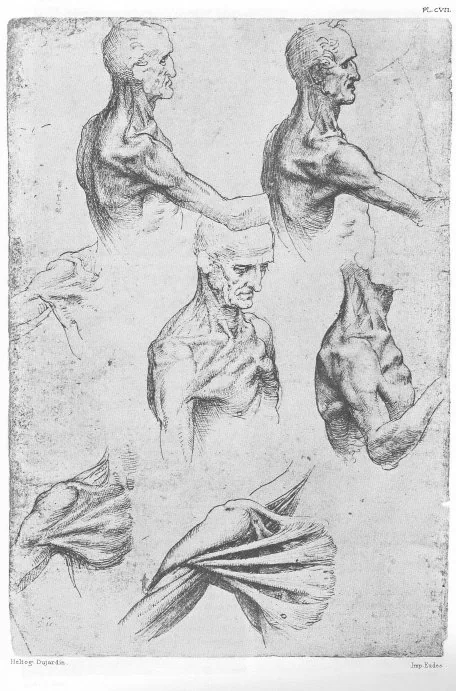
Plate CVII
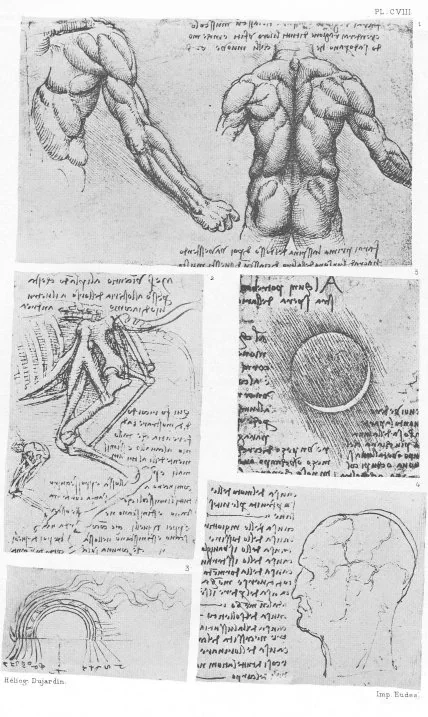
Plate CVIII
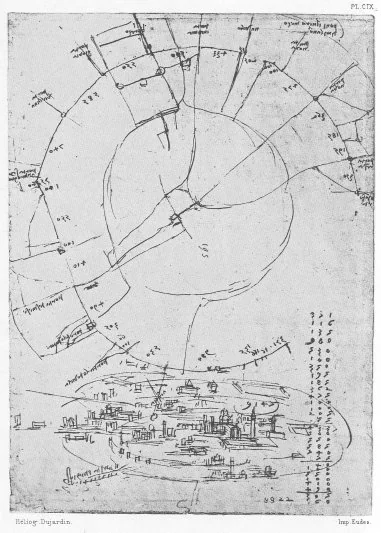
Plate CIX
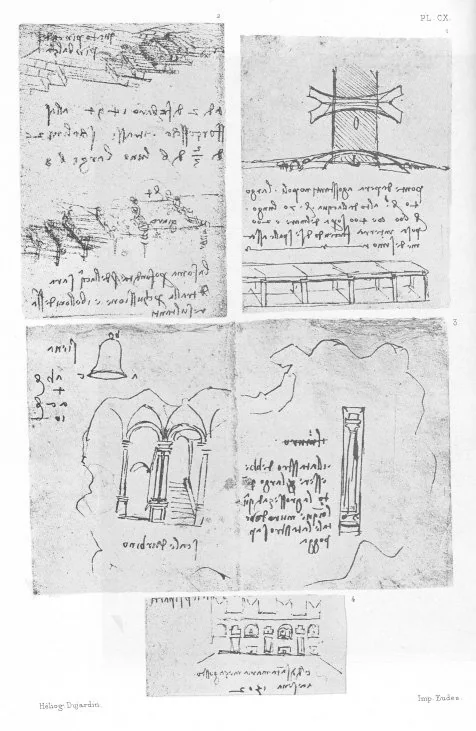
Plate CX
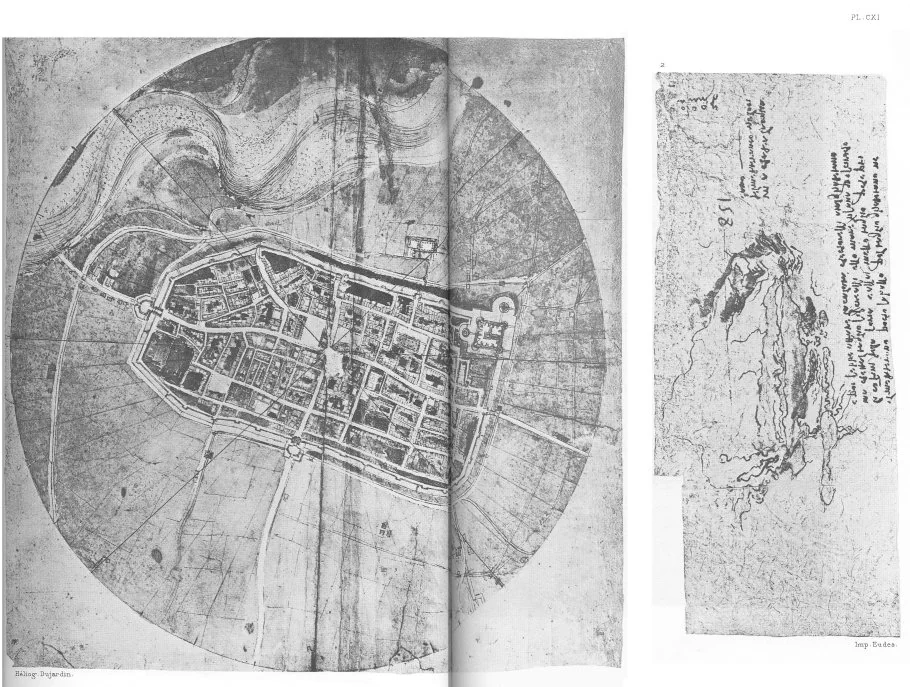
Plate CXI
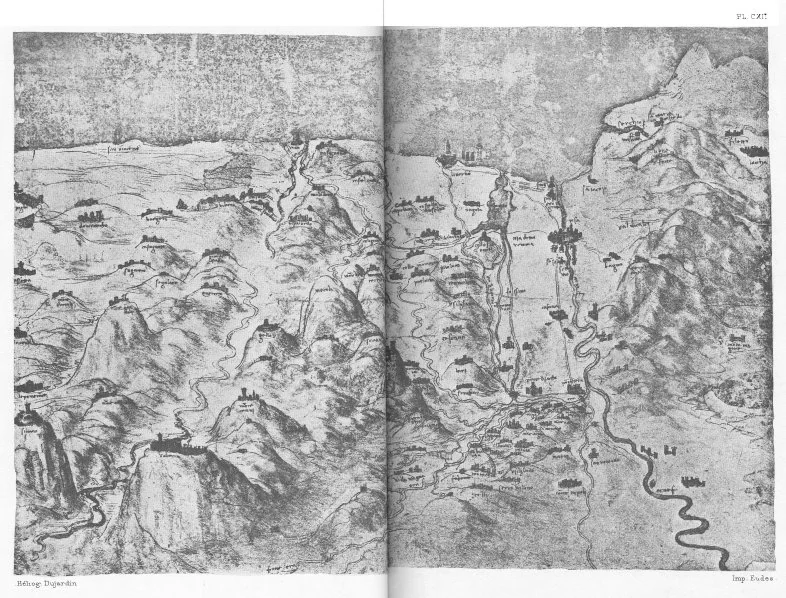
Plate LXII
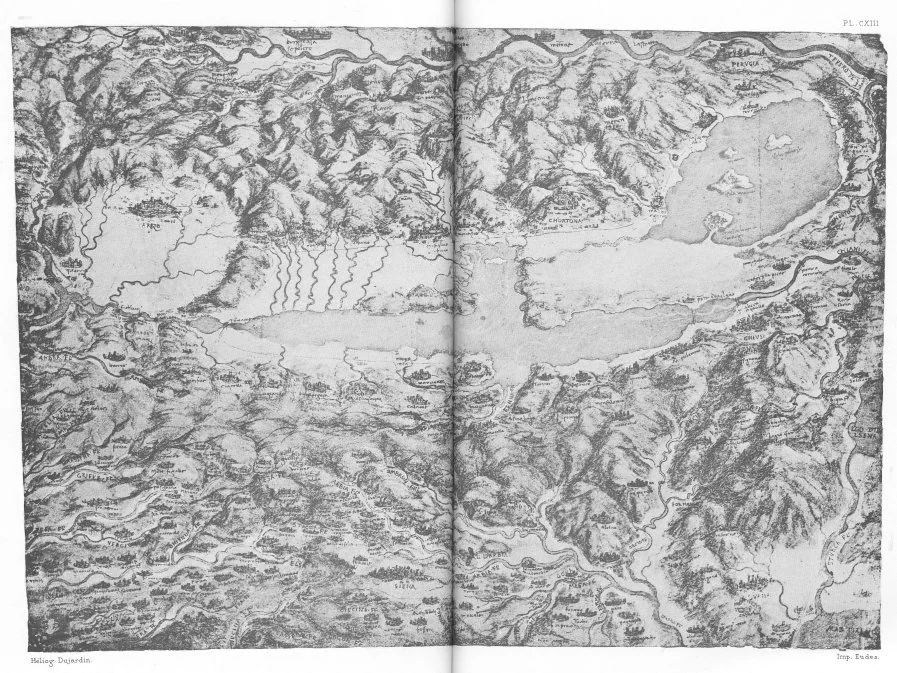
Plate CXIII
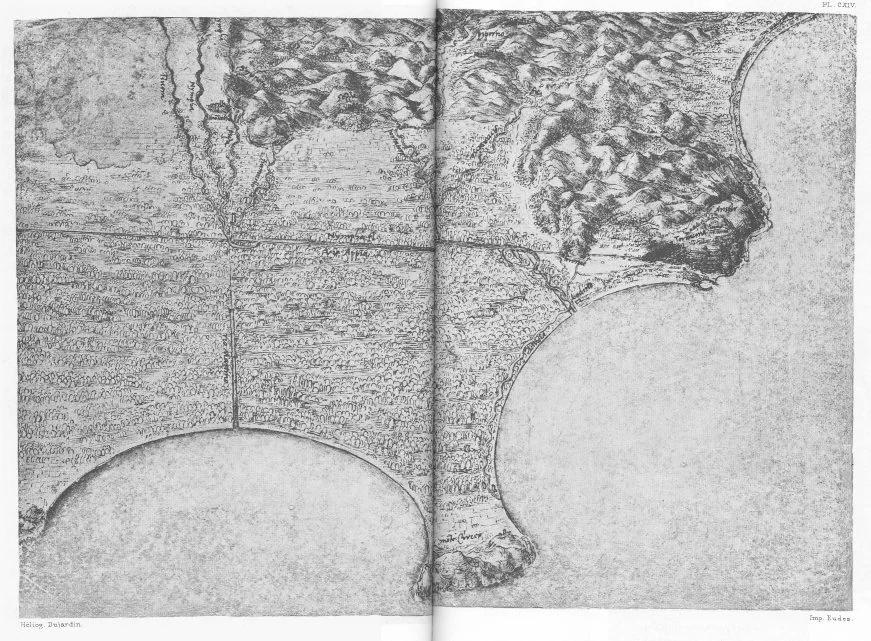
Plate CXIV
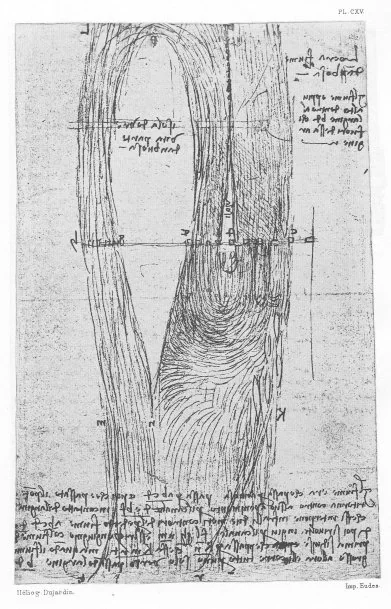
Plate CXV
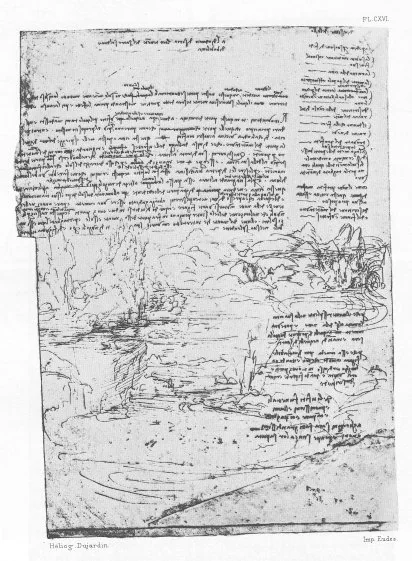
Plate CXVI
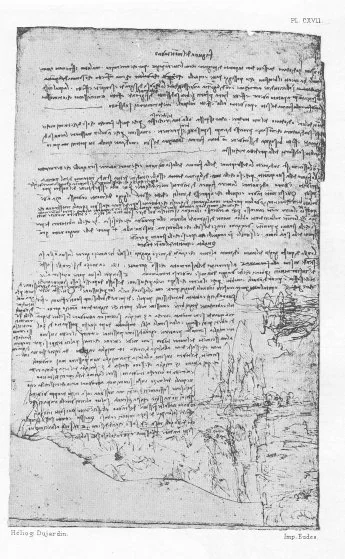
Plate CXVII
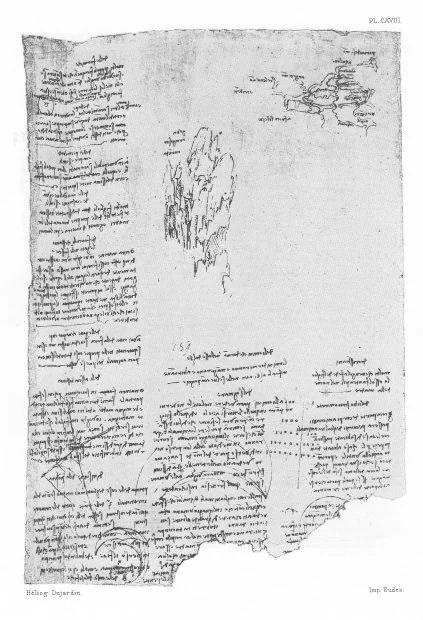
Plate CXVIII
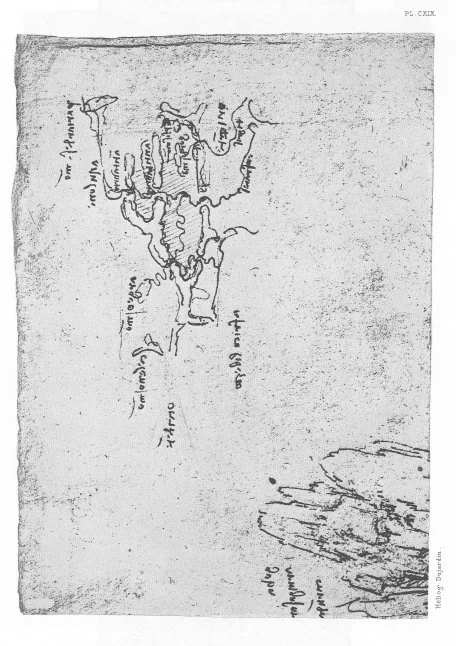
Plate CXIX
Plate CXX
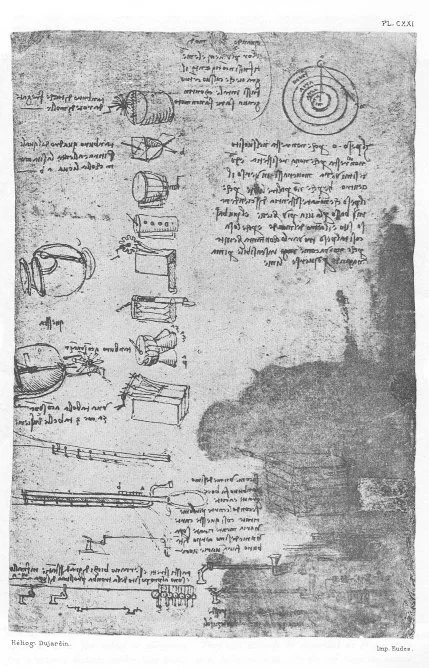
Plate CXXI
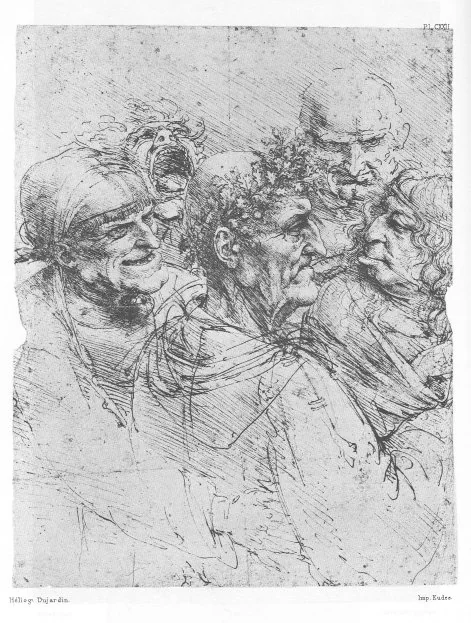
Plate LCXXII
XX.
Humorous Writings.
Just as Michaelangelo's occasional poems reflect his private life as well as the general disposition of his mind, we may find in the writings collected in this section, the transcript of Leonardo's fanciful nature, and we should probably not be far wrong in assuming, that he himself had recited these fables in the company of his friends or at the court festivals of princes and patrons. Era tanto piacevole nella conversazione-- so relates Vasari--che tirava a se gli animi delle genti. And Paulus Jovius says in his short biography of the artist: Fuit ingenio valde comi, nitido, liberali, vultu autem longe venustissimo, et cum elegantiae omnis deliciarumque maxime theatralium mirificus inventor ac arbiter esset, ad lyramque scito caneret, cunctis per omnem aetatem principibus mire placuit. There can be no doubt that the fables are the original offspring of Leonardo's brain, and not borrowed from any foreign source; indeed the schemes and plans for the composition of fables collected in division V seem to afford an external proof of this, if the fables themselves did not render it self-evident. Several of them-- for instance No. l279--are so strikingly characteristic of Leonardo's views of natural science that we cannot do them justice till we are acquainted with his theories on such subjects; and this is equally true of the 'Prophecies'.
I have prefixed to these quaint writings the 'Studies on the life and habits of animals' which are singular from their peculiar aphoristic style, and I have transcribed them in exactly the order in which they are written in MS. H. This is one of the very rare instances in which one subject is treated in a consecutive series of notes, all in one MS., and Leonardo has also departed from his ordinary habits, by occasionally not completing the text on the page it is begun. These brief notes of a somewhat mysterious bearing have been placed here, simply because they may possibly have been intended to serve as hints for fables or allegories. They can scarcely be regarded as preparatory for a natural history, rather they would seem to be extracts. On the one hand the names
of some of the animals seem to prove that Leonardo could not here be recording observations of his own; on the other hand the notes on their habits and life appear to me to dwell precisely on what must have interested him most--so far as it is possible to form any complete estimate of his nature and tastes.
In No. 1293 lines 1-10, we have a sketch of a scheme for grouping the Prophecies. I have not however availed myself of it as a clue to their arrangement here because, in the first place, the texts are not so numerous as to render the suggested classification useful to the reader, and, also, because in reading the long series, as they occur in the original, we may follow the author's mind; and here and there it is not difficult to see how one theme suggested another. I have however regarded Leonardo's scheme for the classification of the Prophecies as available for that of the Fables and Jests, and have adhered to it as far as possible.
Among the humourous writings I might perhaps have included the 'Rebusses', of which there are several in the collection of Leonardo's drawings at Windsor; it seems to me not likely that many or all of them could be solved at the present day and the MSS. throw no light on them. Nor should I be justified if I intended to include in the literary works the well-known caricatures of human faces attributed to Leonardo-- of which, however, it may be incidentally observed, the greater number are in my opinion undoubtedly spurious. Two only have necessarily been given owing to their presence in text, which it was desired to reproduce: Vol. I page 326, and Pl. CXXII. It can scarcely be doubted that some satirical intention is conveyed by the drawing on Pl. LXIV (text No. 688).
My reason for not presenting Leonardo to the reader as a poet is the fact that the maxims and morals in verse which have been ascribed to him, are not to be found in the manuscripts, and Prof. Uzielli has already proved that they cannot be by him. Hence it would seem that only a few short verses can be attributed to him with any certainty.
1220.
I.
STUDIES ON THE LIFE AND HABITS OF ANIMALS.
THE LOVE OF VIRTUE.
The gold-finch is a bird of which it is related that, when it is carried into the presence of a sick person, if the sick man is going to die, the bird turns away its head and never looks at him; but if the sick man is to be saved the bird never loses sight of him but is the cause of curing him of all his sickness.
Like unto this is the love of virtue. It never looks at any vile or base thing, but rather clings always to pure and virtuous things and takes up its abode in a noble heart; as the birds do in green woods on flowery branches. And this Love shows itself more in adversity than in prosperity; as light does, which shines most where the place is darkest.
1221.
ENVY.
We read of the kite that, when it sees its young ones growing too big in the nest, out of envy it pecks their sides, and keeps them without food.
CHEERFULNESS.
Cheerfulness is proper to the cock, which rejoices over every little thing, and crows with varied and lively movements.
SADNESS.
Sadness resembles the raven, which, when it sees its young ones born white, departs in great grief, and abandons them with doleful lamentations, and does not feed them until it sees in them some few black feathers.
1222.
PEACE.
We read of the beaver that when it is pursued, knowing that it is for the virtue [contained] in its medicinal testicles and not being able to escape, it stops; and to be at peace with its pursuers, it bites off its testicles with its sharp teeth, and leaves them to its enemies.
RAGE.
It is said of the bear that when it goes to the haunts of bees to take their honey, the bees having begun to sting him he leaves the honey and rushes to revenge himself. And as he seeks to be revenged on all those that sting him, he is revenged on none; in such wise that his rage is turned to madness, and he flings himself on the ground, vainly exasperating, by his hands and feet, the foes against which he is defending himself.
1223.
GRATITUDE.
The virtue of gratitude is said to be more [developed] in the birds called hoopoes which, knowing the benefits of life and food, they have received from their father and their mother, when they see them grow old, make a nest for them and brood over them and feed them, and with their beaks pull out their old and shabby feathers; and then, with a certain herb restore their sight so that they return to a prosperous state.
AVARICE.
The toad feeds on earth and always remains lean; because it never eats enough:-- it is so afraid lest it should want for earth.
1224.
INGRATITUDE.
Pigeons are a symbol of ingratitude; for when they are old enough no longer to need to be fed, they begin to fight with their father, and this struggle does not end until the young one drives the father out and takes the hen and makes her his own.
CRUELTY.
The basilisk is so utterly cruel that when it cannot kill animals by its baleful gaze, it turns upon herbs and plants, and fixing its gaze on them withers them up.
1225.
GENEROSITY.
It is said of the eagle that it is never so hungry but that it will leave a part of its prey for the birds that are round it, which, being unable to provide their own food, are necessarily dependent on the eagle, since it is thus that they obtain food.
DISCIPLINE.
When the wolf goes cunningly round some stable of cattle, and by accident puts his foot in a trap, so that he makes a noise, he bites his foot off to punish himself for his folly.
1226.
FLATTERERS OR SYRENS.
The syren sings so sweetly that she lulls the mariners to sleep; then she climbs upon the ships and kills the sleeping mariners.
PRUDENCE.
The ant, by her natural foresight provides in the summer for the winter, killing the seeds she harvests that they may not germinate, and on them, in due time she feeds.
FOLLY.
The wild bull having a horror of a red colour, the hunters dress up the trunk of a tree with red and the bull runs at this with great frenzy, thus fixing his horns, and forthwith the hunters kill him there.
1227.
JUSTICE.
We may liken the virtue of Justice to the king of the bees which orders and arranges every thing with judgment. For some bees are ordered to go to the flowers, others are ordered to labour, others to fight with the wasps, others to clear away all dirt, others to accompany and escort the king; and when he is old and has no wings they carry him. And if one of them fails in his duty, he is punished without reprieve.
TRUTH.
Although partridges steal each other's eggs, nevertheless the young born of these eggs always return to their true mother.
1228.
FIDELITY, OR LOYALTY.
The cranes are so faithful and loyal to their king, that at night, when he is sleeping, some of them go round the field to keep watch at a distance; others remain near, each holding a stone in his foot, so that if sleep should overcome them, this stone would fall and make so much noise that they would wake up again. And there are others which sleep together round the king; and this they do every night, changing in turn so that their king may never find them wanting.
FALSEHOOD.
The fox when it sees a flock of herons or magpies or birds of that kind, suddenly flings himself on the ground with his mouth open to look as he were dead; and these birds want to peck at his tongue, and he bites off their heads.
1229.
LIES.
The mole has very small eyes and it always lives under ground; and it lives as long as it is in the dark but when it comes into the light it dies immediately, because it becomes known;--and so it is with lies.
VALOUR.
The lion is never afraid, but rather fights with a bold spirit and savage onslaught against a multitude of hunters, always seeking to injure the first that injures him.
FEAR OR COWARDICE.
The hare is always frightened; and the leaves that fall from the trees in autumn always keep him in terror and generally put him to flight.
1230.
MAGNANIMITY.
The falcon never preys but on large birds; and it will let itself die rather than feed on little ones, or eat stinking meat.
VAIN GLORY.
As regards this vice, we read that the peacock is more guilty of it than any other animal. For it is always contemplating the beauty of its tail, which it spreads in the form of a wheel, and by its cries attracts to itself the gaze of the creatures that surround it.
And this is the last vice to be conquered.
1231.
CONSTANCY.
Constancy may be symbolised by the phoenix which, knowing that by nature it must be resuscitated, has the constancy to endure the burning flames which consume it, and then it rises anew.
INCONSTANCY.
The swallow may serve for Inconstancy, for it is always in movement, since it cannot endure the smallest discomfort.
CONTINENCE.
The camel is the most lustful animal there is, and will follow the female for a thousand miles. But if you keep it constantly with its mother or sister it will leave them alone, so temperate is its nature.
1232.
INCONTINENCE.
The unicorn, through its intemperance and not knowing how to control itself, for the love it bears to fair maidens forgets its ferocity and wildness; and laying aside all fear it will go up to a seated damsel and go to sleep in her lap, and thus the hunters take it.
HUMILITY.
We see the most striking example of humility in the lamb which will submit to any animal; and when they are given for food to imprisoned lions they are as gentle to them as to their own mother, so that very often it has been seen that the lions forbear to kill them.
1233.
PRIDE.
The falcon, by reason of its haughtiness and pride, is fain to lord it and rule over all the other birds of prey, and longs to be sole and supreme; and very often the falcon has been seen to assault the eagle, the Queen of birds.
ABSTINENCE.
The wild ass, when it goes to the well to drink, and finds the water troubled, is never so thirsty but that it will abstain from drinking, and wait till the water is clear again.
GLUTTONY.
The vulture is so addicted to gluttony that it will go a thousand miles to eat a carrion [carcase]; therefore is it that it follows armies.
1234.
CHASTITY.
The turtle-dove is never false to its mate; and if one dies the other preserves perpetual chastity, and never again sits on a green bough, nor ever again drinks of clear water.
UNCHASTITY.
The bat, owing to unbridled lust, observes no universal rule in pairing, but males with males and females with females pair promiscuously, as it may happen.
MODERATION.
The ermine out of moderation never eats but once in the day; it will rather let itself be taken by the hunters than take refuge in a dirty lair, in order not to stain its purity.
1235.
THE EAGLE.
The eagle when it is old flies so high that it scorches its feathers, and Nature allowing that it should renew its youth, it falls into shallow water 651 . And if its young ones cannot bear to gaze on the sun 652 --; it does not feed them with any bird, that does not wish to die. Animals which much fear
it do not approach its nest, although it does not hurt them. It always leaves part of its prey uneaten.
LUMERPA,--FAME.
This is found in Asia Major, and shines so brightly that it absorbs its own shadow, and when it dies it does not lose this light, and its feathers never fall out, but a feather pulled out shines no longer.
Footnotes
321:651 5: The meaning is obscure.
321:652 6: The meaning is obscure.
1236.
THE PELICAN.
This bird has a great love for its young; and when it finds them in its nest dead from a serpent's bite, it pierces itself to the heart, and with its blood it bathes them till they return to life.
THE SALAMANDER.
This has no digestive organs, and gets no food but from the fire, in which it constantly renews its scaly skin.
The salamander, which renews its scaly skin in the fire,--for virtue.
THE CAMELEON.
This lives on air, and there it is the prey of all the birds; so in order to be safer it flies above the clouds and finds an air so rarefied that it cannot support the bird that follows it.
At that height nothing can go unless it has a gift from Heaven, and that is where the chameleon flies.
1237.
THE ALEPO, A FISH.
The fish alepo does not live out of water.
THE OSTRICH.
This bird converts iron into nourishment, and hatches its eggs by its gaze;--Armies under commanders.
THE SWAN.
The swan is white without any spot, and it sings sweetly as it dies, its life ending with that song.
THE STORK.
This bird, by drinking saltwater purges itself of distempers. If the male finds his mate unfaithful, he abandons her; and when it grows old its young ones brood over it, and feed it till it dies.
1238.
THE GRASSHOPPER.
This silences the cuckoo with its song. It dies in oil and revives in vinegar. It sings in the greatest heats
THE BAT.
The more light there is the blinder this creature becomes; as those who gaze most at the sun become most dazzled.--For Vice, that cannot remain where Virtue appears.
THE PARTRIDGE.
This bird changes from the female into the male and forgets its former sex; and out of envy it steals the eggs from others and hatches them, but the young ones follow the true mother.
THE SWALLOW.
This bird gives sight to its blind young ones by means of celandine.
1239.
THE OYSTER.--FOR TREACHERY.
This creature, when the moon is full opens itself wide, and when the crab looks in he throws in a piece of rock or seaweed and the oyster cannot close again, whereby it serves for food to that crab. This is what happens to him who opens his mouth to tell his secret. He becomes the prey of the treacherous hearer.
THE BASILISK.--CRUELTY.
All snakes flie from this creature; but the weasel attacks it by means of rue and kills it.
THE ASP.
This carries instantaneous death in its fangs; and, that it may not hear the charmer it stops its ears with its tail.
1240.
THE DRAGON.
This creature entangles itself in the legs of the elephant which falls upon it, and so both die, and in its death it is avenged.
THE VIPER.
She, in pairing opens her mouth and at last clenches her teeth and kills her husband. Then the young ones, growing within her body rend her open and kill their mother.
THE SCORPION.
Saliva, spit out when fasting will kill a scorpion. This may be likened to abstinence from greediness, which removes and heals the ills which result from that gluttony, and opens the path of virtue.
1241.
THE CROCODILE. HYPOCRISY.
This animal catches a man and straightway kills him; after he is dead, it weeps for him with a lamentable voice and many tears. Then, having done lamenting, it cruelly devours him. It is thus with the hypocrite, who, for the smallest matter, has his face bathed with tears, but shows the heart of a tiger and rejoices in his heart at the woes of others, while wearing a pitiful face.
THE TOAD.
The toad flies from the light of the sun, and if it is held there by force it puffs itself out so much as to hide its head below and shield itself from the rays. Thus does the foe of clear and radiant virtue, who can only be constrainedly brought to face it with puffed up courage.
1242.
THE CATERPILLAR.--FOR VIRTUE IN GENERAL.
The caterpillar, which by means of assiduous care is able to weave round itself a new dwelling place with marvellous artifice and fine workmanship, comes out of it afterwards with painted and lovely wings, with which it rises towards Heaven.
THE SPIDER.
The spider brings forth out of herself the delicate and ingenious web, which makes her a return by the prey it takes.
653
Footnotes
325:653 : Two notes are underneath this text. The first: 'nessuna chosa e da ttemere piu che lla sozza fama' is a repetition of the first line of the text given in Vol. I No. 695.
The second: faticha fugga cholla fama in braccio quasi ochultata c is written in red chalk and is evidently an incomplete sentence.
1243.
THE LION.
This animal, with his thundering roar, rouses his young the third day after they are born, teaching them the use of all their dormant senses and all the wild things which are in the wood flee away.
This may be compared to the children of Virtue who are roused by the sound of praise and grow up in honourable studies, by which they are more and more elevated; while all that is base flies at the sound, shunning those who are virtuous.
Again, the lion covers over its foot tracks, so that the way it has gone may not be known to its enemies. Thus it beseems a captain to conceal the secrets of his mind so that the enemy may not know his purpose.
1244.
THE TARANTULA.
The bite of the tarantula fixes a man's mind on one idea; that is on the thing he was thinking of when he was bitten.
THE SCREECH-OWL AND THE OWL.
These punish those who are scoffing at them by pecking out their eyes; for nature has so ordered it, that they may thus be fed.
1245.
THE ELEPHANT.
The huge elephant has by nature what is rarely found in man; that is Honesty, Prudence, Justice, and the Observance of Religion; inasmuch as when the moon is new, these beasts go down to the rivers, and there, solemnly cleansing themselves, they bathe, and so, having saluted the planet, return to the woods. And when they are ill, being laid down, they fling up plants towards Heaven as though they would offer sacrifice. --They bury their tusks when they fall out from old age.--Of these two tusks they use one to dig up roots for food; but they save the point of the other for fighting with; when they are taken by hunters and when worn out by fatigue, they dig up these buried tusks and ransom themselves.
1246.
They are merciful, and know the dangers, and if one finds a man alone and lost, he kindly puts him back in the road he has missed, if he finds the footprints of the man before the man himself. It dreads betrayal, so it stops and blows, pointing it out to the other elephants who form in a troop and go warily.
These beasts always go in troops, and the oldest goes in front and the second in age remains the last, and thus they enclose the troop. Out of shame they pair only at night and secretly, nor do they then rejoin the herd but first bathe in the river. The females do not fight as with other animals; and it is so merciful that it is most unwilling by nature ever to hurt those weaker than itself. And if it meets in the middle of its way a flock of sheep
1247.
it puts them aside with its trunk, so as not to trample them under foot; and it never hurts any thing unless when provoked. When one has fallen into a pit the others fill up the pit with branches, earth and stones, thus
raising the bottom that he may easily get out. They greatly dread the noise of swine and fly in confusion, doing no less harm then, with their feet, to their own kind than to the enemy. They delight in rivers and are always wandering about near them, though on account of their great weight they cannot swim. They devour stones, and the trunks of trees are their favourite food. They have a horror of rats. Flies delight in their smell and settle on their back, and the beast scrapes its skin making its folds even and kills them.
1248.
When they cross rivers they send their young ones up against the stream of the water; thus, being set towards the fall, they break the united current of the water so that the current does not carry them away. The dragon flings itself under the elephant's body, and with its tail it ties its legs; with its wings and with its arms it also clings round its ribs and cuts its throat with its teeth, and the elephant falls upon it and the dragon is burst. Thus, in its death it is revenged on its foe.
THE DRAGON.
These go in companies together, and they twine themselves after the manner of roots, and with their heads raised they cross lakes, and swim to where they find better pasture; and if they did not thus combine
1249.
they would be drowned, therefore they combine.
THE SERPENT.
The serpent is a very large animal. When it sees a bird in the air it draws in its breath so strongly that it draws the birds into its mouth too. Marcus Regulus, the consul of the Roman army was attacked, with his army, by such an animal and almost defeated. And this animal, being killed by a catapult, measured 123 feet, that is 64 1/2 braccia and its head was high above all the trees in a wood.
THE BOA(?)
This is a very large snake which entangles itself round the legs of the cow so that it cannot move and then sucks it, in such wise that it almost dries it up. In the time of Claudius the Emperor, there was killed, on the Vatican Hill,
1250.
one which had inside it a boy, entire, that it had swallowed.
THE MACLI.--CAUGHT WHEN ASLEEP.
This beast is born in Scandinavia. It has the shape of a great horse, excepting that the great length of its neck and of its ears make a difference. It feeds on grass, going backwards, for it has so long an upper lip that if it went forwards it would cover up the grass. Its legs are all in one piece; for this reason when it wants to sleep it leans against a tree, and the hunters, spying out the place where it is wont to sleep, saw the tree almost through, and then, when it leans against it to sleep, in its sleep it falls, and thus the hunters take it. And every other mode of taking it is in vain, because it is incredibly swift in running.
1251.
THE BISON WHICH DOES INJURY IN ITS FLIGHT.
This beast is a native of Paeonia and has a neck with a mane like a horse. In all its other parts it is like a bull, excepting that its horns are in a way bent inwards so that it cannot butt; hence it has no safety but in flight, in which it flings out its excrement to a distance of 400 braccia in its course, and this burns like fire wherever it touches.
LIONS, PARDS, PANTHERS, TIGERS.
These keep their claws in the sheath, and never put them out unless they are on the back of their prey or their enemy.
THE LIONESS.
When the lioness defends her young from the hand of the hunter, in order not to be frightened by the spears she keeps her eyes on the ground, to the end that she may not by her flight leave her young ones prisoners.
1252.
THE LION.
This animal, which is so terrible, fears nothing more than the noise of empty carts, and likewise the crowing of cocks. And it is much terrified at the sight of one, and looks at its comb with a frightened aspect, and is strangely alarmed when its face is covered.
THE PANTHER IN AFRICA.
This has the form of the lioness but it is taller on its legs and slimmer and long bodied; and it is all white and marked with black spots after the manner of rosettes; and all animals delight to look upon these rosettes, and they would always be standing round it if it were not for the terror of its face;
1253.
therefore knowing this, it hides its face, and the surrounding animals grow bold and come close, the better to enjoy the sight of so much beauty; when suddenly it seizes the nearest and at once devours it.
CAMELS.
The Bactrian have two humps; the Arabian one only. They are swift in battle and most useful to carry burdens. This animal is extremely observant of rule and measure, for it will not move if it has a greater weight than it is used to, and if it is taken too far it does the same, and suddenly stops and so the merchants are obliged to lodge there.
1254.
THE TIGER.
This beast is a native of Hyrcania, and it is something like the panther from the various spots on its skin. It is an animal
of terrible swiftness; the hunter when he finds its young ones carries them off hastily, placing mirrors in the place whence he takes them, and at once escapes on a swift horse. The panther returning finds the mirrors fixed on the ground and looking into them believes it sees its young; then scratching with its paws it discovers the cheat. Forthwith, by means of the scent of its young, it follows the hunter, and when this hunter sees the tigress he drops one of the young ones and she takes it, and having carried it to the den she immediately returns to the hunter and does
1255.
the same till he gets into his boat.
CATOBLEPAS.
It is found in Ethiopia near to the source Nigricapo. It is not a very large animal, is sluggish in all its parts, and its head is so large that it carries it with difficulty, in such wise that it always droops towards the ground; otherwise it would be a great pest to man, for any one on whom it fixes its eyes dies immediately. 654
THE BASILISK.
This is found in the province of Cyrenaica and is not more than 12 fingers long. It has on its head a white spot after the fashion of a diadem. It scares all serpents with its whistling. It resembles a snake, but does not move by wriggling but from the centre forwards to the right. It is said that one
Footnotes
330:654 : Leonardo undoubtedly derived these remarks as to the Catoblepas from Pliny, Hist. Nat. VIII. 21 (al. 32): Apud Hesperios Aethiopas fons est Nigris (different readings), ut plerique existimavere, Nili caput.-----Juxta hunc fera appellatur catoblepas, modica alioquin, ceterisque membris iners, caput tantum praegrave aegre ferens; alias internecio humani generis, omnibus qui oculos ejus videre, confestim morientibus. Aelian, Hist. An. gives a far more minute description of the creature, but he says that it poisons beasts not by its gaze, but by its venomous breath. Athenaeus 221 B, mentions both. If Leonardo had known of these two passages, he would scarcely have omitted the poisonous breath. (H. MULLER-STRUBING.)
1256.
of these, being killed with a spear by one who was on horse-back, and its venom flowing on the spear, not only the man but the horse also died. It spoils the wheat and not only that which it touches, but where it breathes the grass dries and the stones are split.
THE WEASEL.
This beast finding the lair of the basilisk kills it with the smell of its urine, and this smell, indeed, often kills the weasel itself.
THE CERASTES.
This has four movable little horns; so, when it wants to feed, it hides under leaves all of its body except these little horns which, as they move, seem to the birds to be some small worms at play. Then they immediately swoop down to pick them and the Cerastes suddenly twines round them and encircles and devours them.
1257.
THE AMPHISBOENA.
This has two heads, one in its proper place the other at the tail; as if one place were not enough from which to fling its venom.
THE IACULUS.
This lies on trees, and flings itself down like a dart, and pierces through the wild beast and kills them.
THE ASP.
The bite of this animal cannot be cured unless by immediately cutting out the bitten part. This pestilential animal has such a love for its mate that they always go in company. And if, by mishap, one of them is killed the other, with incredible swiftness, follows him who has killed it; and it is so determined and eager for vengeance that it overcomes every difficulty, and passing by every troop it seeks to hurt none but its enemy. And it will travel any distance, and it is impossible to avoid it unless by crossing water and by very swift flight. It has its eyes turned inwards, and large ears and it hears better than it sees.
1258.
THE ICHNEUMON.
This animal is the mortal enemy of the asp. It is a native of Egypt and when it sees an asp near its place, it runs at once to the bed or mud of the Nile and with this makes itself muddy all over, then it dries
itself in the sun, smears itself again with mud, and thus, drying one after the other, it makes itself three or four coatings like a coat of mail. Then it attacks the asp, and fights well with him, so that, taking its time it catches him in the throat and destroys him.
THE CROCODILE.
This is found in the Nile, it has four feet and lives on land and in water. No other terrestrial creature but this is found to have no tongue, and it only bites by moving its upper jaw. It grows to a length of forty feet and has claws and is armed with a hide that will take any blow. By day it is on land and at night in the water. It feeds on fishes, and going to sleep on the bank of the Nile with its mouth open, a bird called
1259.
trochilus, a very small bird, runs at once to its mouth and hops among its teeth and goes pecking out the remains of the food, and so inciting it with voluptuous delight tempts it to open the whole of its mouth, and so it sleeps. This being observed by the ichneumon it flings itself into its mouth and perforates its stomach and bowels, and finally kills it.
THE DOLPHIN.
Nature has given such knowledge to animals, that besides the consciousness of their own advantages they know the disadvantages of their foes. Thus the dolphin understands what strength lies in a cut from the fins placed on his chine, and how tender is the belly of the crocodile; hence in fighting with him it thrusts at him from beneath and rips up his belly and so kills him.
The crocodile is a terror to those that flee, and a base coward to those that pursue him.
1260.
THE HIPPOPOTAMUS.
This beast when it feels itself over-full goes about seeking thorns, or where there may be the remains of canes that have been
split, and it rubs against them till a vein is opened; then when the blood has flowed as much as he needs, he plasters himself with mud and heals the wound. In form he is something like a horse with long haunches, a twisted tail and the teeth of a wild boar, his neck has a mane; the skin cannot be pierced, unless when he is bathing; he feeds on plants in the fields and goes into them backwards so that it may seem, as though he had come out.
THE IBIS.
This bird resembles a crane, and when it feels itself ill it fills its craw with water, and with its beak makes an injection of it.
THE STAG.
These creatures when they feel themselves bitten by the spider called father-long-legs, eat crabs and free themselves of the venom.
1261.
THE LIZARD.
This, when fighting with serpents eats the sow-thistle and is free.
THE SWALLOW.
This [bird] gives sight to its blind young ones, with the juice of the celandine.
THE WEASEL.
This, when chasing rats first eats of rue.
THE WILD BOAR.
This beast cures its sickness by eating of ivy.
THE SNAKE.
This creature when it wants to renew itself casts its old skin, beginning with the head, and changing in one day and one night.
THE PANTHER.
This beast after its bowels have fallen out will still fight with the dogs and hunters.
1262.
THE CHAMELEON.
This creature always takes the colour of the thing on which it is resting, whence it is often devoured together with the leaves on which the elephant feeds.
THE RAVEN.
When it has killed the Chameleon it takes laurel as a purge.
1263.
Moderation checks all the vices. The ermine will die rather than besmirch itself.
OF FORESIGHT.
The cock does not crow till it has thrice flapped its wings; the parrot in moving among boughs never puts its feet excepting where it has first put its beak. Vows are not made till Hope is dead.
Motion tends towards the centre of gravity.
1264.
MAGNANIMITY.
The falcon never seizes any but large birds and will sooner die than eat [tainted] meat of bad savour.
1265.
II.
FABLES.
A FABLE.
Fables on animals (1265-1270).An oyster being turned out together with other fish in the house of a fisherman near the sea, he entreated a rat to take him to the sea. The rat purposing to eat him bid him open; but as he bit him the oyster squeezed his head and closed; and the cat came and killed him.
1266.
A FABLE.
The thrushes rejoiced greatly at seeing a man take the owl and deprive her of liberty, tying her feet with strong bonds. But this owl was afterwards by means of bird-lime the cause of the thrushes losing not only their liberty, but their life. This is said for those countries which rejoice in seeing their governors lose their liberty, when by that means they themselves lose all succour, and remain in bondage in the power of their enemies, losing their liberty and often their life.
1267.
A FABLE.
A dog, lying asleep on the fur of a sheep, one of his fleas, perceiving the odour of the greasy wool, judged that this must be a land of better living, and also more secure from the teeth and nails of the dog than where he fed on the dog; and without farther reflection he left the dog and went into the thick wool. There he began with great labour to try to pass among the roots of the hairs; but after much sweating had to give up the task as vain, because these hairs were so close that they almost touched each other, and there was no space where fleas could taste the skin. Hence, after much labour and fatigue, he began to wish to return to his dog, who however had already departed; so he was constrained after long repentance and bitter tears, to die of hunger.
1268.
A FABLE.
The vain and wandering butterfly, not content with being able to fly at its ease through the air, overcome by the tempting flame of the candle, decided to fly into it; but its sportive impulse was the cause of a sudden fall, for its delicate wings were burnt in the flame. And the hapless butterfly having dropped, all scorched, at the foot of the candlestick, after much lamentation and repentance, dried the tears from its swimming eyes, and raising its face exclaimed: O false light! how many must thou have miserably deceived in the past, like me; or if I must indeed see light so near, ought I not to have known the sun from the false glare of dirty tallow?
A FABLE.
The monkey, finding a nest of small birds, went up to it greatly delighted. But they, being already fledged, he could only succeed in taking the smallest; greatly delighted he took it in his hand and went to his abode; and having begun to look at the
little bird he took to kissing it, and from excess of love he kissed it so much and turned it about and squeezed it till he killed it. This is said for those who by not punishing their children let them come to mischief.
1269.
A FABLE.
A rat was besieged in his little dwelling by a weasel, which with unwearied vigilance awaited his surrender, while watching his imminent peril through a little hole. Meanwhile the cat came by and suddenly seized the weasel and forthwith devoured it. Then the rat offered up a sacrifice to Jove of some of his store of nuts, humbly thanking His providence, and came out of his hole to enjoy his lately lost liberty. But he was instantly deprived of it, together with his life, by the cruel claws and teeth of the lurking cat.
1270.
A FABLE.
The ant found a grain of millet. The seed feeling itself taken prisoner cried out to her: "If you will do me the kindness to allow me accomplish my function of reproduction, I will give you a hundred such as I am." And so it was.
A Spider found a bunch of grapes which for its sweetness was much resorted to by bees and divers kinds of flies. It seemed to her that she had found a most convenient spot to spread her snare, and having settled herself on it with her delicate web, and entered into her new habitation, there, every day placing herself in the openings made by the spaces between the grapes, she fell like a thief on the wretched creatures which were not aware of her. But, after a few days had passed, the vintager came, and cut away the bunch of grapes and put it with others, with which it was trodden; and thus the grapes were a snare and pitfall both for the treacherous spider and the betrayed flies.
An ass having gone to sleep on the ice over a deep lake, his heat dissolved the ice and the ass awoke under water to his great grief, and was forthwith drowned.
A falcon, unable to endure with patience the disappearance of a duck, which, flying before him had plunged under water, wished to follow it under water, and having soaked his feathers had to remain in the water while the duck rising to the air mocked at the falcon as he drowned.
The spider wishing to take flies in her treacherous net, was cruelly killed in it by the hornet.
An eagle wanting to mock at the owl was caught by the wings in bird-lime and was taken and killed by a man.
1271.
Fables on lifeless objects (1271--1274).The water finding that its element was the lordly ocean, was seized with a desire to rise above the air, and being encouraged by the element of fire and rising as a very subtle vapour, it seemed as though it were really as thin as air. But having risen very high, it reached the air that was still more rare and cold, where the fire forsook it, and the minute particles, being brought together, united and became heavy; whence its haughtiness deserting it, it betook itself to flight and it fell from the sky, and was drunk up by the dry earth, where, being imprisoned for a long time, it did penance for its sin.
1272.
A FABLE.
The razor having one day come forth from the handle which serves as its sheath and having placed himself in the sun, saw the sun reflected in his body, which filled him with great pride. And turning it over in his thoughts he began to say to himself: "And shall I return again to that shop from which I have just come? Certainly not; such splendid beauty shall not, please God, be turned to such base uses. What folly it would be that could lead me to shave the lathered beards of rustic peasants and perform such menial service! Is this body destined for such work? Certainly not. I will hide myself in some retired spot and
there pass my life in tranquil repose." And having thus remained hidden for some months, one day he came out into the air, and issuing from his sheath, saw himself turned to the similitude of a rusty saw while his surface no longer reflected the resplendent sun. With useless repentance he vainly deplored the irreparable mischief saying to himself: "Oh! how far better was it to employ at the barbers my lost edge of such exquisite keenness! Where is that lustrous surface? It has been consumed by this vexatious and unsightly rust."
The same thing happens to those minds which instead of exercise give themselves up to sloth. They are like the razor here spoken of, and lose the keenness of their edge, while the rust of ignorance spoils their form.
A FABLE.
A stone of some size recently uncovered by the water lay on a certain spot somewhat raised, and just where a delightful grove ended by a stony road; here it was surrounded by plants decorated by various flowers of divers colours. And as it saw the great quantity of stones collected together in the roadway below, it began to wish it could let itself fall down there, saying to itself: "What have I to do here with these plants? I want to live in the company of those, my sisters." And letting itself fall, its rapid course ended among these longed for companions. When it had been there sometime it began to find itself constantly toiling under the wheels of the carts the iron-shoed feet of horses and of travellers. This one rolled it over, that one trod upon it; sometimes it lifted itself a little and then it was covered with mud or the dung of some animal, and it was in vain that it looked at the spot whence it had come as a place of solitude and tranquil place.
Thus it happens to those who choose to leave a life of solitary comtemplation, and come to live in cities among people full of infinite evil.
1273.
Some flames had already lasted in the furnace of a glass-blower, when they saw a candle approaching in a beautiful and glittering candlestick. With ardent longing they strove to reach it; and one of them, quitting its natural course, writhed up to an unburnt brand on which it fed and passed at the opposite end out by a narrow chink to the candle which was near. It flung itself upon it, and with fierce jealousy and greediness it devoured it, having reduced it almost to death, and, wishing to procure the prolongation of its life, it tried to return to the furnace whence it had come. But in vain, for it was compelled to die, the wood perishing together with the candle, being at last converted, with lamentation and repentance, into foul smoke, while leaving all its sisters in brilliant and enduring life and beauty.
1274.
A small patch of snow finding itself clinging to the top of a rock which was lying on the topmost height of a very high mountain and being left to its own imaginings, it began to reflect in this way, saying to itself: "Now, shall not I be thought vain and proud for having placed myself--such a small patch of snow--in so lofty a spot, and for allowing that so large a quantity of snow as I have seen here around me, should take a place lower than mine? Certainly my small dimensions by no means merit this elevation. How easily may I, in proof of my insignificance, experience the same fate as that which the sun brought about yesterday to my companions, who were all, in a few hours, destroyed by the sun. And this happened from their having placed themselves higher than became them. I will flee from the wrath of the sun, and humble myself and find a place befitting my small importance." Thus, flinging itself down, it began to descend, hurrying from its high home on to the other snow; but the more it sought a low place
the more its bulk increased, so that when at last its course was ended on a hill, it found itself no less in size than the hill which supported it; and it was the last of the snow which was destroyed that summer by the sun. This is said for those who, humbling themselves, become exalted.
1275.
Fables on plants (1275-1279).The cedar, being desirous of producing a fine and noble fruit at its summit, set to work to form it with all the strength of its sap. But this fruit, when grown, was the cause of the tall and upright tree-top being bent over.
The peach, being envious of the vast quantity of fruit which she saw borne on the nut-tree, her neighbour, determined to do the same, and loaded herself with her own in such a way that the weight of the fruit pulled her up by the roots and broke her down to the ground.
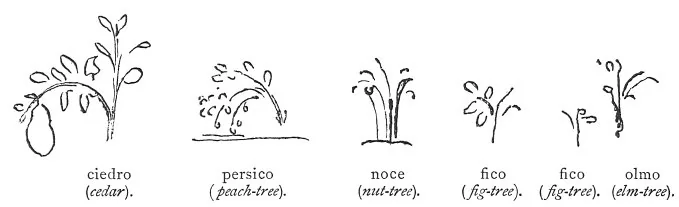
The nut-tree stood always by a road side displaying the wealth of its fruit to the passers by, and every one cast stones at it.
The fig-tree, having no fruit, no one looked at it; then, wishing to produce fruits that it might be praised by men, it was bent and broken down by them.
The fig-tree, standing by the side of the elm and seeing that its boughs were bare of fruit, yet that it had the audacity to keep the Sun from its own unripe figs with its branches, said to it: "Oh elm! art thou not ashamed to stand in front of me. But wait till my offspring are fully grown and you will see where you are!" But when her offspring were mature, a troop of soldiers coming by fell upon the fig-tree and her
figs were all torn off her, and her boughs cut away and broken. Then, when she was thus maimed in all her limbs, the elm asked her, saying: "O fig-tree! which was best, to be without offspring, or to be brought by them into so miserable a plight!"
1276.
The plant complains of the old and dry stick which stands by its side and of the dry stakes that surround it.
One keeps it upright, the other keeps it from low company.
1277.
A FABLE.
A nut, having been carried by a crow to the top of a tall campanile and released by falling into a chink from the mortal grip of its beak, it prayed the wall by the grace bestowed on it by God in allowing it to be so high and thick, and to own such fine bells and of so noble a tone, that it would succour it, and that, as it had not been able to fall under the verdurous boughs of its venerable father and lie in the fat earth covered up by his fallen leaves it would not abandon it; because, finding itself in the beak of the cruel crow, it had there made a vow that if it escaped from her it would end its life in a little hole. At these words the wall, moved to compassion, was content to shelter it in the spot where it had fallen; and after a short time the nut began to split open and put forth roots between the rifts of the stones and push them apart, and to throw out shoots from its hollow shell; and, to be brief, these rose above the building and the twisted roots, growing thicker, began to thrust the walls apart, and tear out the ancient stones from their old places. Then the wall too late and in vain bewailed the cause of its destruction and in a short time, it wrought the ruin of a great part of it.
1278.
A FABLE.
The privet feeling its tender boughs loaded with young fruit, pricked by the sharp claws and beak of the insolent blackbird, complained to the blackbird with pitious remonstrance entreating her that since she stole its delicious fruits she should not deprive it of the leaves with which it preserved them from the burning rays of the sun, and that she should not divest it of its tender bark by scratching it with her sharp claws. To which the blackbird replied with angry upbraiding: "O, be silent, uncultured shrub! Do you not know that Nature made you produce these fruits for my nourishment; do you not see that you are in the world [only] to serve me as food; do you not know, base creature, that next winter you will be food and prey for the Fire?" To which words the tree listened patiently, and not without tears. After a short time the blackbird was taken in a net and boughs were cut to make a cage, in which to imprison her. Branches were cut, among others from the pliant privet, to serve for the small rods of the cage; and seeing herself to be the cause of the Blackbird's loss of liberty it rejoiced and spoke as follows: "O Blackbird, I am here, and not yet burnt by fire as you said. I shall see you in prison before you see me burnt."
A FABLE.
The laurel and the myrtle seeing the pear tree cut down cried out with a loud voice: "O pear-tree! whither are you going? Where is the pride you had when you were covered with ripe fruits? Now you will no longer shade us with your mass of leaves." Then the pear-tree replied: "I am going with the husbandman who has cut me down and who will take me to the workshop of a good sculptor who by his art will make me take the form of Jove the god; and I shall be dedicated in a temple and adored by men in the place of Jove, while you are bound always to remain maimed and stripped of your boughs, which will be placed round me to do me honour.
A FABLE.
The chesnut, seeing a man upon the fig-tree, bending its boughs down and pulling off the ripe fruits, which he put into his open mouth destroying and crushing them with his hard teeth, it tossed its long boughs and with a noisy rustle exclaimed: "O fig! how much less are you protected by nature than I. See how in me my sweet offspring are set in close array; first clothed in soft wrappers over which is the hard but softly lined husk; and not content with taking this care of me, and having given them so strong a shelter, on this she has placed sharp and close-set spines so that the hand of man cannot hurt me." Then the fig-tree and her offspring began to laugh and having laughed she said: "I know man to be of such ingenuity that with rods and stones and stakes flung up among your branches he will bereave you of your fruits; and when they are fallen, he will trample them with his feet or with stones, so that your offspring will come out of their armour, crushed and maimed; while I am touched carefully by their hands, and not like you with sticks and stones."
1279.
The hapless willow, finding that she could not enjoy the pleasure of seeing her slender branches grow or attain to the height she wished, or point to the sky, by reason of the vine and whatever other trees that grew near, but was always maimed and lopped and spoiled, brought all her spirits together and gave and devoted itself entirely to imagination, standing plunged in long meditation and seeking, in all the world of plants, with which of them she might ally herself and which could not need the help of her withes. Having stood for some time in this prolific imagination, with a sudden flash the gourd presented itself to her thoughts and tossing all her branches with extreme delight, it seemed to her that she had found the companion suited to her purpose, because the gourd is more apt to bind others than to need binding; having come to this conclusion
she awaited eagerly some friendly bird who should be the mediator of her wishes. Presently seeing near her the magpie she said to him: "O gentle bird! by the memory of the refuge which you found this morning among my branches, when the hungry cruel, and rapacious falcon wanted to devour you, and by that repose which you have always found in me when your wings craved rest, and by the pleasure you have enjoyed among my boughs, when playing with your companions or making love--I entreat you find the gourd and obtain from her some of her seeds, and tell her that those that are born of them I will treat exactly as though they were my own flesh and blood; and in this way use all the words you can think of, which are of the same persuasive purport; though, indeed, since you are a master of language, I need not teach you. And if you will do me this service I shall be happy to have your nest in the fork of my boughs, and all your family without payment of any rent." Then the magpie, having made and confirmed certain new stipulations with the willow,--and principally that she should never admit upon her any snake or polecat, cocked his tail, and put down his head, and flung himself from the bough, throwing his weight upon his wings; and these, beating the fleeting air, now here, now there, bearing about inquisitively, while his tail served as a rudder to steer him, he came to a gourd; then with a handsome bow and a few polite words, he obtained the required seeds, and carried them to the willow, who received him with a cheerful face. And when he had scraped away with his foot a small quantity of the earth near the willow, describing a circle, with his beak he planted the grains, which in a short time began to grow, and by their growth and the branches to take up all the boughs of the willow, while their broad leaves deprived it of the beauty of the sun and sky. And not content with so much evil, the gourds next began, by their rude hold, to drag the ends of the tender shoots down towards the earth, with strange twisting and distortion.
Then, being much annoyed, it shook itself in vain to throw off the gourd. After raving for some days in such plans vainly, because the firm union forbade it, seeing the wind come by it commended itself to him. The wind flew hard and opened the old and hollow stem of the willow in two down to the roots, so that it fell into two parts. In vain did it bewail itself recognising that it was born to no good end.
1280.
III.
JESTS AND TALES.
A JEST.
A priest, making the rounds of his parish on Easter Eve, and sprinkling holy water in the houses as is customary, came to a painter's room, where he sprinkled the water on some of his pictures. The painter turned round, somewhat angered, and asked him why this sprinkling had been bestowed on his pictures; then said the priest, that it was the custom and his duty to do so, and that he was doing good; and that he who did good might look for good in return, and, indeed, for better, since God had promised that every good deed that was done on earth should be rewarded a hundred-fold from above. Then the painter, waiting till he went out, went to an upper window and flung a large pail of water on the priest's back, saying: "Here is the reward a hundred-fold from above, which you said would come from the good you had done me with your holy water, by which you have damaged my pictures."
1281.
When wine is drunk by a drunkard, that wine is revenged on the drinker.
1282.
Wine, the divine juice of the grape, finding itself in a golden and richly wrought cup, on the table of Mahomet, was puffed up with pride at so much honour; when suddenly it was struck by a contrary reflection, saying to itself: "What am I about, that I should rejoice, and not perceive that I am now near to my death and shall leave my golden abode in this cup to enter into the foul and fetid caverns of the human body, and to be transmuted from a fragrant and delicious liquor into a foul and base one. Nay, and as though so much evil as this were not enough, I must for a long time lie in hideous receptacles, together with other fetid and corrupt matter, cast out from human intestines." And it cried to Heaven, imploring vengeance for so much insult, and that an end might henceforth be put to such contempt; and that, since that country produced the finest and best grapes in the whole world, at least they should not be turned into wine. Then Jove made that wine drunk by Mahomet to rise in spirit to his brain; and that in so deleterious a manner that it made him mad, and gave birth to so many follies that when he had recovered himself, he made a law that no Asiatic should drink wine, and henceforth the vine and its fruit were left free.
As soon as wine has entered the stomach it begins to ferment and swell; then the spirit of that man begins to abandon his body, rising as it were skywards, and the brain finds itself parting from the body. Then it begins to degrade him, and make him rave like a madman, and then he does irreparable evil, killing his friends.
1283.
An artizan often going to visit a great gentleman without any definite purpose, the gentleman asked him what he did this for. The other said that he came there to have a pleasure which his lordship could not have;
since to him it was a satisfaction to see men greater than himself, as is the way with the populace; while the gentleman could only see men of less consequence than himself; and so lords and great men were deprived of that pleasure.
1284.
Franciscan begging Friars are wont, at certain times, to keep fasts, when they do not eat meat in their convents. But on journeys, as they live on charity, they have license to eat whatever is set before them. Now a couple of these friars on their travels, stopped at an inn, in company with a certain merchant, and sat down with him at the same table, where, from the poverty of the inn, nothing was served to them but a small roast chicken. The merchant, seeing this to be but little even for himself, turned to the friars and said: "If my memory serves me, you do not eat any kind of flesh in your convents at this season." At these words the friars were compelled by their rule to admit, without cavil, that this was the truth; so the merchant had his wish, and eat the chicken and the friars did the best they could. After dinner the messmates departed, all three together, and after travelling some distance they came to a river of some width and depth. All three being on foot--the friars by reason of their poverty, and the other from avarice--it was necessary by the custom of company that one of the friars, being barefoot, should carry the merchant on his shoulders: so having given his wooden shoes into his keeping, he took up his man. But it so happened that when the friar had got to the middle of the river, he again remembered a rule of his order, and stopping short, he looked up, like Saint Christopher, to the burden on his back and said: "Tell me, have you any money about you?"--"You know I have", answered the other, "How do you suppose that a Merchant like me should go about otherwise?" "Alack!" cried the friar, "our rules forbid as to carry any money on our persons," and forthwith he dropped him into the water, which the merchant perceived was a facetious way of being revenged on the indignity he had done them; so, with a smiling face, and blushing somewhat with shame, he peaceably endured the revenge.
1285.
A JEST.
A man wishing to prove, by the authority of Pythagoras, that he had formerly been in the world, while another would not let him finish his argument, the first speaker said to the second: "It is by this token that I was formerly here, I remember that you were a miller." The other one, feeling himself stung by these words, agreed that it was true, and that by the same token he remembered that the speaker had been the ass that carried the flour.
A JEST.
It was asked of a painter why, since he made such beautiful figures, which were but dead things, his children were so ugly; to which the painter replied that he made his pictures by day, and his children by night.
1286.
A man saw a large sword which another one wore at his side. Said he "Poor fellow, for a long time I have seen you tied to that weapon; why do you not release yourself as your hands are untied, and set yourself free?" To which the other replied: "This is none of yours, on the contrary it is an old story." The former speaker, feeling stung, replied: "I know that you are acquainted with so few things in this world, that I thought anything I could tell you would be new to you."
1287.
A man gave up his intimacy with one of his friends because he often spoke ill of his other friends. The neglected friend one day lamenting to this former friend, after much complaining, entreated him to say what might be the cause that had made him forget so much friendship. To which he answered: "I will no longer be intimate
with you because I love you, and I do not choose that you, by speaking ill of me, your friend, to others, should produce in others, as in me, a bad impression of yourself, by speaking evil to them of me, your friend. Therefore, being no longer intimate together, it will seem as though we had become enemies; and in speaking evil of me, as is your wont, you will not be blamed so much as if we continued intimate.
1288.
A man was arguing and boasting that he knew many and various tricks. Another among the bystanders said: "I know how to play a trick which will make whomsoever I like pull off his breeches." The first man-- the boaster--said: "You won't make me pull off mine, and I bet you a pair of hose on it." He who proposed the game, having accepted the offer, produced breeches and drew them across the face of him who bet the pair of hose and won the bet [4].
A man said to an acquaintance: "Your eyes are changed to a strange colour." The other replied: "It often happens, but you have not noticed it." "When does it happen?" said the former. "Every time that my eyes see your ugly face, from the shock of so unpleasing a sight they suddenly turn pale and change to a strange colour."
A man said to another: "Your eyes are changed to a strange colour." The other replied: "It is because my eyes behold your strange ugly face."
A man said that in his country were the strangest things in the world. Another answered: "You, who were born there, confirm this as true, by the strangeness of your ugly face."
655
Footnotes
351:655 : The joke turns, it appears, on two meanings of trarre and is not easily translated.
1289.
An old man was publicly casting contempt on a young one, and boldly showing that he did not fear him; on which the young man replied that his advanced age served him better as a shield than either his tongue or his strength.
1290.
A JEST.
A sick man finding himself in articulo mortis heard a knock at the door, and asking one of his servants who was knocking, the servant went out, and answered that it was a woman calling herself Madonna Bona. Then the sick man lifting his arms to Heaven thanked God with a loud voice, and told the servants that they were to let her come in at once, so that he might see one good woman before he died, since in all his life he had never yet seen one.
1291.
A JEST.
A man was desired to rise from bed, because the sun was already risen. To which he replied: "If I had as far to go, and as much to do as he has, I should be risen by now; but having but a little way to go, I shall not rise yet."
1292.
A man, seeing a woman ready to hold up the target for a jousting match, exclaimed, looking at the shield, and considering his spear: "Alack! this is too small a workman for so great a business."
1293.
IV.
PROPHECIES.
THE DIVISION OF THE PROPHECIES.
First, of things relating to animals; secondly, of irrational creatures; thirdly of plants; fourthly, of ceremonies; fifthly, of manners; sixthly, of cases or edicts or quarrels; seventhly, of cases that are impossible in nature [paradoxes], as, for instance, of those things which, the more is taken from them, the more they grow. And reserve the great matters till the end, and the small matters give at the beginning. And first show the evils and then the punishment of philosophical things.
Of Ants.
These creatures will form many communities, which will hide themselves and their young ones and victuals in dark caverns, and they will feed themselves and their families in dark places for many months without any light, artificial or natural.
656
(Of Bees.)
And many others will be deprived of their store and their food, and will be cruelly submerged and drowned by folks devoid of reason. Oh Justice of God! Why dost thou not wake and behold thy creatures thus ill used?
(Of Sheep, Cows, Goats and the like.)
Endless multitudes of these will have their little children taken from them ripped open and flayed and most barbarously quartered.
(Of Nuts, and Olives, and Acorns, and Chesnuts, and such like.)
Many offspring shall be snatched by cruel thrashing from the very arms of their mothers, and flung on the ground, and crushed.
(Of Children bound in Bundles.)
O cities of the Sea! In you I see your citizens--both females and males--tightly bound, arms and legs, with strong withes by folks who will not understand your language. And you will only be able to assuage your sorrows and lost liberty by means of tearful complaints and sighing and lamentation among yourselves; for those who will bind you will not understand you, nor will you understand them.
(Of Cats that eat Rats.)
In you, O cities of Africa your children will be seen quartered in their own houses by most cruel and rapacious beasts of your own country.
(Of Asses that are beaten.)
657 O Nature! Wherefore art thou so partial; being to some of thy children a tender and benign mother, and to others a most cruel and pitiless stepmother? I see children of thine given up to slavery to others, without any sort of advantage, and instead of remuneration for the good they do, they are paid with the severest suffering, and spend their whole life in benefitting those who ill treat them.
(Of Men who sleep on boards of Trees.)
Men shall sleep, and eat, and dwell among trees, in the forests and open country.
(Of Dreaming.)
Men will seem to see new destructions in the sky. The flames that fall from it will seem to rise in it and to fly from it with terror. They will hear every kind of animals speak in human language. They will instantaneously run in person in various parts of the world, without motion. They will see the greatest splendour in the midst of darkness. O! marvel of the human race! What madness has led you thus! You will speak with animals of every species and they with you in human speech. You will see yourself fall from great heights without any harm and torrents will accompany you, and will mingle with their rapid course.
(Of Christians.)
Many who hold the faith of the Son only build temples in the name of the Mother.
(Of Food which has been alive.)
[84] 658 A great portion of bodies that have been alive will pass into the bodies of other animals; which is as much as to say, that the deserted tenements will pass piecemeal into the inhabited ones, furnishing them with good things, and carrying with them their evils. That is to say the life of man is formed from things eaten, and these carry with them that part of man which dies . . .
Footnotes
353:656 : Lines 1--51 are in the original written in one column, beginning with the text of line 11. At the end of the column is the programme for the arrangement of the prophecies, placed here at the head: Lines 56--79 form a second column, lines 80--97 a third one (see the reproduction of the text on the facsimile Pl. CXVIII).
Another suggestion for the arrangement of the prophecies is to be found among the notes 55--57 on page 357.
354:657 48: Compare No. 845.
355:658 : 84 and following; compare No. 846.
1294.
(Of Funeral Rites, and Processions, and Lights, and Bells, and Followers.)
The greatest honours will be paid to men, and much pomp, without their knowledge.
659
Footnotes
355:659 : A facsimile of this text is on Pl. CXVI below on the right, but the writing is larger than the other notes on the same sheet and of a somewhat different style. The ink is also of a different hue, as may be seen on the original sheet at Milan.
1295.
(Of the Avaricious.)
There will be many who will eagerly and with great care and solicitude follow up a thing, which, if they only knew its malignity, would always terrify them.
(Of those men, who, the older they grow, the more avaricious they become, whereas, having but little time to stay, they should become more liberal.)
We see those who are regarded as being most experienced and judicious, when they least need a thing, seek and cherish it with most avidity.
(Of the Ditch.)
Many will be busied in taking away from a thing, which will grow in proportion as it is diminished.
(Of a Weight placed on a Feather-pillow.)
And it will be seen in many bodies that by raising the head they swell visibly; and by laying the raised head down again, their size will immediately be diminished.
(Of catching Lice.)
And many will be hunters of animals, which, the fewer there are the more will be taken; and conversely, the more there are, the fewer will be taken.
(Of Drawing Water in two Buckets with a single Rope.)
And many will be busily occupied, though the more of the thing they draw up, the more will escape at the other end.
(Of the Tongues of Pigs and Calves in Sausage-skins.)
Oh! how foul a thing, that we should see the tongue of one animal in the guts of another.
(Of Sieves made of the Hair of Animals.)
We shall see the food of animals pass through their skin everyway excepting through their mouths, and penetrate from the outside downwards to the ground.
(Of Lanterns.)
660 The cruel horns of powerful bulls will screen the lights of night against the wild fury of the winds.
(Of Feather-beds.)
Flying creatures will give their very feathers to support men.
(Of Animals which walk on Trees--wearing wooden Shoes.)
The mire will be so great that men will walk on the trees of their country.
(Of the Soles of Shoes, which are made from the Ox.)
And in many parts of the country men will be seen walking on the skins of large beasts.
(Of Sailing in Ships.)
There will be great winds by reason of which things of the East will become things of the West; and those of the South, being involved in the course of the winds, will follow them to distant lands.
(Of Worshipping the Pictures of Saints.)
Men will speak to men who hear not; having their eyes open, they will not see; they will speak to these, and they will not be answered. They will implore favours of those who have ears and hear not; they will make light for the blind.
(Of Sawyers.)
There will be many men who will move one against another, holding in their hands a cutting tool. But these will not do each other any injury beyond tiring each other; for, when one pushes forward the other will draw back. But woe to him who comes between them! For he will end by being cut in pieces.
(Of Silk-spinning.)
Dismal cries will be heard loud, shrieking with anguish, and the hoarse and smothered tones of those who will be despoiled, and at last left naked and motionless; and this by reason of the mover, which makes every thing turn round.
(Of putting Bread into the Mouth of the Oven and taking it out again.)
In every city, land, castle and house, men shall be seen, who for want of food will take it out of the mouths of others, who will not be able to resist in any way.
(Of tilled Land.)
The Earth will be seen turned up side down and facing the opposite hemispheres, uncovering the lurking holes of the fiercest animals.
(Of Sowing Seed.)
Then many of the men who will remain alive, will throw the victuals they have preserved out of their houses, a free prey to the birds and beasts of the earth, without taking any care of them at all.
(Of the Rains, which, by making the Rivers muddy, wash away the Land.)
661 Something will fall from the sky which will transport a large part of Africa which lies under that sky towards Europe, and that of Europe towards Africa, and that of the Scythian countries will meet with tremendous revolutions 662 .
(Of Wood that burns.)
The trees and shrubs in the great forests will be converted into cinder.
(Of Kilns for Bricks and Lime.)
Finally the earth will turn red from a conflagration of many days and the stones will be turned to cinders.
(Of boiled Fish.)
The natives of the waters will die in the boiling flood.
(Of the Olives which fall from the Olive trees, shedding oil which makes light.)
And things will fall with great force from above, which will give us nourishment and light.
(Of Owls and screech owls and what will happen to certain birds.)
Many will perish of dashing their heads in pieces, and the eyes of many will jump out of their heads by reason of fearful creatures come out of the darkness.
(Of flax which works the cure of men.)
That which was at first bound, cast out and rent by many and various beaters will be respected and honoured, and its precepts will be listened to with reverence and love.
(Of Books which teach Precepts.)
Bodies without souls will, by their contents give us precepts by which to die well.
(Of Flagellants.)
Men will hide themselves under the bark of trees, and, screaming, they will make themselves martyrs, by striking their own limbs.
(Of the Handles of Knives made of the Horns of Sheep.)
We shall see the horns of certain beasts fitted to iron tools, which will take the lives of many of their kind.
(Of Night when no Colour can be discerned.)
There will come a time when no difference can be discerned between colours, on the contrary, everything will be black alike.
(Of Swords and Spears which by themselves never hurt any one.)
One who by himself is mild enough and void of all offence will become terrible and fierce by being in bad company, and will most cruelly take the life of many men, and would kill many more if they were not hindered by bodies having no soul, that have come out of caverns--that is, breastplates of iron.
(Of Snares and Traps.)
Many dead things will move furiously, and will take and bind the living, and will ensnare them for the enemies who seek their death and destruction.
(Of Metals.)
That shall be brought forth out of dark and obscure caves, which will put the whole human race in great anxiety, peril and death. To many that seek them, after many sorrows they will give delight, and to those who are not in their company, death with want and misfortune. This will lead to the commission of endless crimes; this will increase and persuade bad men to assassinations, robberies and treachery, and by reason of it each will be suspicious of his partner. This will deprive free cities of their happy condition; this will take away the lives of many; this will make men torment each other with many artifices deceptions and treasons. O monstrous creature! How much better would it be for men that every thing should return to Hell! For this the vast forests will be devastated of their trees; for this endless animals will lose their lives.
(Of Fire.)
One shall be born from small beginnings which will rapidly become vast. This will respect no created thing, rather will it, by its power, transform almost every thing from its own nature into another.
(Of Ships which sink.)
Huge bodies will be seen, devoid of life, carrying, in fierce haste, a multitude of men to the destruction of their lives.
(Of Oxen, which are eaten.)
The masters of estates will eat their own labourers.
(Of beating Beds to renew them.)
Men will be seen so deeply ungrateful that they will turn upon that which has harboured them, for nothing at all; they will so load it with blows that a great part of its inside will come out of its place, and will be turned over and over in its body.
(Of Things which are eaten and which first are killed.)
Those who nourish them will be killed by them and afflicted by merciless deaths.
(Of the Reflection of Walls of Cities in the Water of their Ditches.)
The high walls of great cities will be seen up side down in their ditches.
(Of Water, which flows turbid and mixed with Soil and Dust; and of Mist, which is mixed with the Air; and of Fire which is mixed with its own, and each with each.)
All the elements will be seen mixed together in a great whirling mass, now borne towards the centre of the world, now towards the sky; and now furiously rushing from the South towards the frozen North, and sometimes from the East towards the West, and then again from this hemisphere to the other.
(The World may be divided into two Hemispheres at any Point.)
All men will suddenly be transferred into opposite hemispheres.
(The division of the East from the West may be made at any point.)
All living creatures will be moved from the East to the West; and in the same way from North to South, and vice versa.
(Of the Motion of Water which carries wood, which is dead.)
Bodies devoid of life will move by themselves and carry with them endless generations of the dead, taking the wealth from the bystanders.
(Of Eggs which being eaten cannot form Chickens.)
Oh! how many will they be that never come to the birth!
(Of Fishes which are eaten unborn.)
Endless generations will be lost by the death of the pregnant.
(Of the Lamentation on Good Friday.)
Throughout Europe there will be a lamentation of great nations over the death of one man who died in the East.
(Of Dreaming.)
Men will walk and not stir, they will talk to those who are not present, and hear those who do not speak.
(Of a Man's Shadow which moves with him.)
Shapes and figures of men and animals will be seen following these animals and men wherever they flee. And exactly as the one moves the other moves; but what seems so wonderful is the variety of height they assume.
(Of our Shadow cast by the Sun, and our Reflection in the Water at one and the same time.)
Many a time will one man be seen as three and all three move together, and often the most real one quits him.
(Of wooden Chests which contain great Treasures.)
Within walnuts and trees and other plants vast treasures will be found, which lie hidden there and well guarded.
(Of putting out the Light when going to Bed.)
Many persons puffing out a breath with too much haste, will thereby lose their sight, and soon after all consciousness.
(Of the Bells of Mules, which are close to their Ears.)
In many parts of Europe instruments of various sizes will be heard making divers harmonies, with great labour to those who hear them most closely.
(Of Asses.)
The severest labour will be repaid with hunger and thirst, and discomfort, and blows, and goadings, and curses, and great abuse.
(Of Soldiers on horseback.)
Many men will be seen carried by large animals, swift of pace, to the loss of their lives and immediate death.
In the air and on earth animals will be seen of divers colours furiously carrying men to the destruction of their lives.
(Of the Stars of Spurs.)
By the aid of the stars men will be seen who will be as swift as any swift animal.
(Of a Stick, which is dead.)
The motions of a dead thing will make many living ones flee with pain and lamentation and cries.
(Of Tinder.)
With a stone and with iron things will be made visible which before were not seen.
Footnotes
357:660 35: Lanterns were in Italy formerly made of horn.
358:661 81: Compare No. 945.
358:662 84: Compare No. 945.
1296.
(Of going in Ships.)
We shall see the trees of the great forests of Taurus and of Sinai and of the Appenines and others, rush by means of the air, from East to West and from North to South; and carry, by means of the air, great multitudes of men. Oh! how many vows! Oh! how many deaths! Oh! how many partings of friends and relations! Oh! how many will those be who will never again see their own country nor their native land, and who will die unburied, with their bones strewn in various parts of the world!
(Of moving on All Saints' Day.)
Many will forsake their own dwellings and carry with them all their belongings and will go to live in other parts.
(Of All Souls' Day.)
How many will they be who will bewail their deceased forefathers, carrying lights to them.
(Of Friars, who spending nothing but words, receive great gifts and bestow Paradise.)
Invisible money will procure the triumph of many who will spend it.
(Of Bows made of the Horns of Oxen.)
Many will there be who will die a painful death by means of the horns of cattle.
(Of writing Letters from one Country to another.)
Men will speak with each other from the most remote countries, and reply.
(Of Hemispheres, which are infinite; and which are divided by an infinite number of Lines, so that every Man always has one of these Lines between his Feet.)
Men standing in opposite hemispheres will converse and deride each other and embrace each other, and understand each other's language.
(Of Priests who say Mass.)
There will be many men who, when they go to their labour will put on the richest clothes, and these will be made after the fashion of aprons [petticoats].
(Of Friars who are Confessors.)
And unhappy women will, of their own free will, reveal to men all their sins and shameful and most secret deeds.
(Of Churches and the Habitations of Friars.)
Many will there be who will give up work and labour and poverty of life and goods, and will go to live among wealth in splendid buildings, declaring that this is the way to make themselves acceptable to God.
(Of Selling Paradise.)
An infinite number of men will sell publicly and unhindered things of the very highest price, without leave from the Master of it; while it never was theirs nor in their power; and human justice will not prevent it.
(Of the Dead which are carried to be buried.)
The simple folks will carry vast quantities of lights to light up the road for those who have entirely lost the power of sight.
(Of Dowries for Maidens.)
And whereas, at first, maidens could not be protected against the violence of Men, neither by the watchfulness of parents nor by strong walls, the time will come when the fathers and parents of those girls will pay a large price to a man who wants to marry them, even if they are rich, noble and most handsome. Certainly this seems as though nature wished to eradicate the human race as being useless to the world, and as spoiling all created things.
(Of the Cruelty of Man.)
Animals will be seen on the earth who will always be fighting against each other
with the greatest loss and frequent deaths on each side. And there will be no end to their malignity; by their strong limbs we shall see a great portion of the trees of the vast forests laid low throughout the universe; and, when they are filled with food the satisfaction of their desires will be to deal death and grief and labour and wars and fury to every living thing; and from their immoderate pride they will desire to rise towards heaven, but the too great weight of their limbs will keep them down. Nothing will remain on earth, or under the earth or in the waters which will not be persecuted, disturbed and spoiled, and those of one country removed into another. And their bodies will become the sepulture and means of transit of all they have killed.
O Earth! why dost thou not open and engulf them in the fissures of thy vast abyss and caverns, and no longer display in the sight of heaven such a cruel and horrible monster.
1297.
PROPHECIES.
There will be many which will increase in their destruction.
(The Ball of Snow rolling over Snow.)
There will be many who, forgetting their existence and their name, will lie as dead on the spoils of other dead creatures.
(Sleeping on the Feathers of Birds.)
The East will be seen to rush to the West and the South to the North in confusion round and about the universe, with great noise and trembling or fury.
(In the East wind which rushes to the West.)
The solar rays will kindle fire on the earth, by which a thing that is under the sky will be set on fire, and, being reflected by some obstacle, it will bend downwards.
(The Concave Mirror kindles a Fire, with which we heat the oven, and this has its foundation beneath its roof.)
A great part of the sea will fly towards heaven and for a long time will not return. (That is, in Clouds.)
There remains the motion which divides the mover from the thing moved.
Those who give light for divine service will be destroyed.(The Bees which make the Wax for Candles)
Dead things will come from underground and by their fierce movements will send numberless human beings out of the world. (Iron, which comes from under ground is dead but the Weapons are made of it which kill so many Men.)
The greatest mountains, even those which are remote from the sea shore, will drive the sea from its place.
(This is by Rivers which carry the Earth they wash away from the Mountains and bear it to the Sea-shore; and where the Earth comes the sea must retire.)
The water dropped from the clouds still in motion on the flanks of mountains will lie still for a long period of time without any motion whatever; and this will happen in many and divers lands.
(Snow, which falls in flakes and is Water.)
The great rocks of the mountains will throw out fire; so that they will burn the timber of many vast forests, and many beasts both wild and tame.
(The Flint in the Tinder-box which makes a Fire that consumes all the loads of Wood of which the Forests are despoiled and with this the flesh of Beasts is cooked.)
Oh! how many great buildings will be ruined by reason of Fire.
(The Fire of great Guns.)
Oxen will be to a great extent the cause of the destruction of cities, and in the same way horses and buffaloes.
(By drawing Guns.)
1298.
The Lion tribe will be seen tearing open the earth with their clawed paws and in the caves thus made, burying themselves together with the other animals that are beneath them.
Animals will come forth from the earth in gloomy vesture, which will attack the human species with astonishing assaults, and which by their ferocious bites will make confusion of blood among those they devour.
Again the air will be filled with a mischievous winged race which will assail men and beasts and feed upon them with much noise-- filling themselves with scarlet blood.
1299.
Blood will be seen issuing from the torn flesh of men, and trickling down the surface.
Men will have such cruel maladies that they will tear their flesh with their own nails. (The Itch.)
Plants will be seen left without leaves, and the rivers standing still in their channels.
The waters of the sea will rise above the high peaks of the mountains towards heaven and fall again on to the dwellings of men. (That is, in Clouds.)
The largest trees of the forest will be seen carried by the fury of the winds from East to West. (That is across the Sea.)
Men will cast away their own victuals. (That is, in Sowing.)
1300.
Human beings will be seen who will not understand each other's speech; that is, a German with a Turk.
Fathers will be seen giving their daughters into the power of man and giving up all their former care in guarding them. (When Girls are married.)
Men will come out their graves turned into flying creatures; and they will attack other men, taking their food from their very hand or table. (As Flies.)
Many will there be who, flaying their mother, will tear the skin from her back. (Husbandmen tilling the Earth.)
Happy will they be who lend ear to the words of the Dead. (Who read good works and obey them.)
1301.
Feathers will raise men, as they do birds, towards heaven (that is, by the letters which are written with quills.)
The works of men's hands will occasion their death. (Swords and Spears.)
Men out of fear will cling to the thing they most fear. (That is they will be miserable lest they should fall into misery.)
Things that are separate shall be united and acquire such virtue that they will restore to man his lost memory; that is papyrus [sheets] which are made of separate strips and have preserved the memory of the things and acts of men.
The bones of the Dead will be seen to govern the fortunes of him who moves them. (By Dice.)
Cattle with their horns protect the Flame from its death. (In a Lantern 663 .)
The Forests will bring forth young which will be the cause of their death. (The handle of the hatchet.)
Footnotes
368:663 13: See note page 357.
1302.
Men will deal bitter blows to that which is the cause of their life. (In thrashing Grain.)
The skins of animals will rouse men from their silence with great outcries and curses. (Balls for playing Games.)
Very often a thing that is itself broken is the occasion of much union. (That is the Comb made of split Cane which unites the threads of Silk.)
The wind passing through the skins of animals will make men dance. (That is the Bag-pipe, which makes people dance.)
1303.
(Of Walnut trees, that are beaten.)
Those which have done best will be most beaten, and their offspring taken and flayed or peeled, and their bones broken or crushed.
(Of Sculpture.)
Alas! what do I see? The Saviour cru- cified anew.
(Of the Mouth of Man, which is a Sepulchre.)
Great noise will issue from the sepulchres of those who died evil and violent deaths.
(Of the Skins of Animals which have the sense of feeling what is in the things written.)
The more you converse with skins covered with sentiments, the more wisdom will you acquire.
(Of Priests who bear the Host in their body.)
Then almost all the tabernacles in which dwells the Corpus Domini, will be plainly seen walking about of themselves on the various roads of the world.
1304.
And those who feed on grass will turn night into day (Tallow.)
And many creatures of land and water will go up among the stars ( that is Planets.)
The dead will be seen carrying the living (in Carts and Ships in various places.)
Food shall be taken out of the mouth of many (the oven's mouth.)
And those which will have their food in their mouth will be deprived of it by the hands of others (the oven.)
1305.
(Of Crucifixes which are sold.)
I see Christ sold and crucified afresh, and his Saints suffering Martyrdom.
(Of Physicians, who live by sickness.)
Men will come into so wretched a plight that they will be glad that others will derive profit from their sufferings or from the loss of their real wealth, that is health.
(Of the Religion of Friars, who live by the Saints who have been dead a great while.)
Those who are dead will, after a thousand years be those who will give a livelihood to many who are living.
(Of Stones converted into Lime, with which prison walls are made.)
Many things that have been before that time destroyed by fire will deprive many men of liberty.
1306.
(Of Children who are suckled.)
Many Franciscans, Dominicans and Benedictines will eat that which at other times was eaten by others, who for some months to come will not be able to speak.
(Of Cockles and Sea Snails which are thrown up by the sea and which rot inside their shells.)
How many will there be who, after they are dead, will putrefy inside their own houses, filling all the surrounding air with a fetid smell.
1307.
(Of Mules which have on them rich burdens of silver and gold.)
Much treasure and great riches will be laid upon four-footed beasts, which will convey them to divers places.
1308.
(Of the Shadow cast by a man at night with a light.)
Huge figures will appear in human shape, and the nearer you get to them, the more will their immense size diminish.
664
Footnotes
370:664 page 1307: It seems to me probable that this note, which occurs in the note book used in 1502, when Leonardo, in the service of Cesare Borgia, visited Urbino, was suggested by the famous pillage of the riches of the palace of Guidobaldo, whose treasures Cesare Borgia at once had carried to Cesena (see GREGOROVIUS, Geschichte der Stadt Rom im Mittelalter. XIII, 5, 4).
1309.
(Of Snakes, carried by Storks.)
Serpents of great length will be seen at a great height in the air, fighting with birds.
(Of great guns, which come out of a pit and a mould.)
Creatures will come from underground which with their terrific noise will stun all who are near; and with their breath will kill men and destroy cities and castles.
1310.
(Of Grain and other Seeds.)
Men will fling out of their houses those victuals which were intended to sustain their life.
(Of Trees, which nourish grafted shoots.)
Fathers and mothers will be seen to take much more delight in their step-children then in their own children.
(Of the Censer.)
Some will go about in white garments with arrogant gestures threatening others with metal and fire which will do no harm at all to them.
1311.
(Of drying Fodder.)
Innumerable lives will be destroyed and innumerable vacant spaces will be made on the earth.
(Of the Life of Men, who every year change their bodily substance.)
Men, when dead, will pass through their own bowels.
1312.
(Shoemakers.)
Men will take pleasure in seeing their own work destroyed and injured.
1313.
(Of Kids.)
The time of Herod will come again, for the little innocent children will be taken from their nurses, and will die of terrible wounds inflicted by cruel men.
1314.
V.
DRAUGHTS AND SCHEMES FOR THE HUMOROUS WRITINGS.
A FABLE.
Schemes for fables, etc. (1314-1323).The crab standing under the rock to catch the fish which crept under it, it came to pass that the rock fell with a ruinous downfall of stones, and by their fall the crab was crushed.
THE SAME.
The spider, being among the grapes, caught the flies which were feeding on those grapes. Then came the vintage, and the spider was cut down with the grapes.
The vine that has grown old on an old tree falls with the ruin of that tree, and through that bad companionship must perish with it.
The torrent carried so much earth and stones into its bed, that it was then constrained to change its course.
The net that was wont to take the fish was seized and carried away by the rush of fish.
The ball of snow when, as it rolls, it descends from the snowy mountains, increases in size as it falls.
The willow, which by its long shoots hopes as it grows, to outstrip every other plant, from having associated itself with the vine which is pruned every year was always crippled.
1315.
Fable of the tongue bitten by the teeth.
The cedar puffed up with pride of its beauty, separated itself from the trees around it and in so doing it turned away towards the wind, which not being broken in its fury, flung it uprooted on the earth.
The traveller's joy, not content in its hedge, began to fling its branches out over the high road, and cling to the opposite hedge, and for this it was broken away by the passers by.
1316.
The goldfinch gives victuals to its caged young. Death rather than loss of liberty. 665
Footnotes
374:665 : Above this text is another note, also referring to liberty; see No. 694.
1317.
(Of Bags.)
Goats will convey the wine to the city.
L.1 39b]
1318.
All those things which in winter are hidden under the snow, will be uncovered and laid bare in summer. (for Falsehood, which cannot remain hidden).
1319.
A FABLE.
The lily set itself down by the shores of the Ticino, and the current carried away bank and the lily with it.
1320.
A JEST.
Why Hungarian ducats have a double cross on them.
1321.
A SIMILE.
A vase of unbaked clay, when broken, may be remoulded, but not a baked one.
1322.
Seeing the paper all stained with the deep blackness of ink, it he deeply regrets it; and this proves to the paper that the words, composed upon it were the cause of its being preserved.
1323.
The pen must necessarily have the penknife for a companion, and it is a useful companionship, for one is not good for much without the other.
1324.
Schemes for prophecies (1324-1329).The knife, which is an artificial weapon, deprives man of his nails, his natural weapons.
The mirror conducts itself haughtily holding mirrored in itself the Queen. When she departs the mirror remains there ...
1325.
Flax is dedicated to death, and to the corruption of mortals. To death, by being used for snares and nets for birds, animals and fish; to corruption, by the flaxen sheets in which the dead are wrapped when they are buried, and who become corrupt in these winding sheets.-- And again, this flax does not separate its fibre till it has begun to steep and putrefy, and this is the flower with which garlands and decorations for funerals should be made.
1326.
(Of Peasants who work in shirts)
Shadows will come from the East which will blacken with great colour darkness the sky that covers Italy.
(Of the Barbers.)
All men will take refuge in Africa.
1327.
The cloth which is held in the hand in the current of a running stream, in the waters of which the cloth leaves all its foulness and dirt, is meant to signify this &c
By the thorn with inoculated good fruit is signified those natures which of themselves were not disposed towards virtue, but by the aid of their preceptors they have the repudation of it.
1328.
A COMMON THING.
A wretched person will be flattered, and these flatterers are always the deceivers, robbers and murderers of the wretched person.
The image of the sun where it falls appears as a thing which covers the person who attempts to cover it.
(Money and Gold.)
Out of cavernous pits a thing shall come forth which will make all the nations of the world toil and sweat with the greatest torments, anxiety and labour, that they may gain its aid.
(Of the Dread of Poverty.)
The malicious and terrible [monster] will cause so much terror of itself in men that they will rush together, with a rapid motion, like madmen, thinking they are escaping her boundless force.
(Of Advice.)
The man who may be most necessary to him who needs him, will be repaid with ingratitude, that is greatly contemned.
1329.
(Of Bees.)
They live together in communities, they are destroyed that we may take the honey from them. Many and very great nations will be destroyed in their own dwellings.
1330.
WHY DOGS TAKE PLEASURE IN SMELLING AT EACH OTHER.
This animal has a horror of the poor, because they eat poor food, and it loves the rich, because they have good living and especially meat. And the excrement of animals always retains some virtue of its origin as is shown by the faeces ...
Now dogs have so keen a smell, that they can discern by their nose the virtue remaining in these faeces, and if they find them in the streets, smell them and if they smell in them the virtue of meat or of other things, they take them, and if not, they leave them: And to return to the question, I say that if by means of this smell they know that dog to be well fed, they respect him, because they judge that he has a powerful and rich master; and if they discover no such smell with the virtue of meat, they judge that dog to be of small account and to have a poor and humble master, and therefore they bite that dog as they would his master.
1331.
The circular plans of carrying earth are very useful, inasmuch as men never stop in their work; and it is done in many ways. By one of these ways men carry the earth on their shoulders, by another in chests and others on wheelbarrows. The man who carries it on his shoulders first fills the tub on the ground, and he loses time in hoisting it on to his shoulders. He with the chests loses no time. 666
Footnotes
377:666 : The subject of this text has apparently no connection with the other texts of this section.
1332.
Irony (1332).If Petrarch was so fond of bay, it was because it is of a good taste in sausages and with tunny; I cannot put any value on their foolery. 667
Footnotes
377:667 : Conte Porro has published these lines in the Archivio Stor. Lombarda VIII, IV; he reads the concluding line thus: I no posso di loro gia (sic) co' far tesauro.--This is known to be by a contemporary poet, as Senatore Morelli informs me.
1333.
Tricks (1333-1335).We are two brothers, each of us has a brother. Here the way of saying it makes it appear that the two brothers have become four.
1334.
TRICKS OF DIVIDING.
Take in each hand an equal number; put 4 from the right hand into the left; cast away the remainder; cast away an equal number from the left hand; add 5, and now you will find 13 in this [left] hand; that is--I made you put 4 from the right hand into the left, and cast away the remainder; now your right hand has 4 more; then I make you throw away as many from the right as you threw away from the left; so, throwing from each hand a quantity of which the remainder may be equal, you now have 4 and 4, which make 8, and that the trick may not be detected I made you put 5 more, which made 13.
TRICKS OF DIVIDING.
Take any number less than 12 that you please; then take of mine enough to make up the number 12, and that which remains to me is the number which you at first had; because when I said, take any number less than 12 as you please, I took 12 into my hand, and of that 12 you took such a number as made up your number of 12; and what you added to your number, you took from mine; that is, if you had 8 to go as far as to 12, you took of my 12, 4; hence this
4 transferred from me to you reduced my 12 to a remainder of 8, and your 8 became 12; so that my 8 is equal to your 8, before it was made 12.
668
Footnotes
379:668 : G. Govi says in the 'Saggio' p. 22: Si dilettò Leonarda, di giuochi di prestigi e molti (?) ne descrisse, che si leggono poi riportati dal Paciolo nel suo libro: de Viribus Quantitatis, e che, se non tutti, sono certo in gran parte invenzioni del Vinci.
1335.
If you want to teach someone a subject you do not know yourself, let him measure the length of an object unknown to you, and he will learn the measure you did not know before;--Master Giovanni da Lodi.
XXI.
Letters. Personal Records. Dated Notes.
When we consider how superficial and imperfect are the accounts of Leonardo's life written some time after his death by Vasari and others, any notes or letters which can throw more light on his personal circumstances cannot fail to be in the highest degree interesting. The texts here given as Nos. 1351--1353, set his residence in Rome in quite a new aspect; nay, the picture which irresistibly dwells in our minds after reading these details of his life in the Vatican, forms a striking contrast to the contemporary life of Raphael at Rome.
I have placed foremost of these documents the very remarkable letters to the Defterdar of Syria. In these Leonardo speaks of himself as having staid among the mountains of Armenia, and as the biographies of the master tell nothing of any such distant journeys, it would seem most obvious to treat this passage as fiction, and so spare ourselves the onus of proof and discussion. But on close examination no one can doubt that these documents, with the accompanying sketches, are the work of Leonardo's own hand. Not merely is the character of the handwriting his, but the spelling and the language are his also. In one respect only does the writing betray any marked deviation from the rest of the notes, especially those treating on scientific questions; namely, in these observations he seems to have taken particular pains to give the most distinct and best form of expression to all he had to say; we find erasures and emendations in almost every line. He proceeded, as we shall see, in the same way in the sketches for letters to Giuliano de' Medici, and what can be more natural, I may ask, than to find the draft of a letter thus altered and improved when it is to contain an account of a definite subject, and when personal interests are in the scale? The finished copies as sent off are not known to exist; if we had these instead of the rough drafts, we might unhesitatingly
have declared that some unknown Italian engineer must have been, at that time, engaged in Armenia in the service of the Egyptian Sultan, and that Leonardo had copied his documents. Under this hypothesis however we should have to state that this unknown writer must have been so far one in mind with Leonardo as to use the same style of language and even the same lines of thought. This explanation might--as I say--have been possible, if only we had the finished letters. But why should these rough drafts of letters be regarded as anything else than what they actually and obviously are? If Leonardo had been a man of our own time, we might perhaps have attempted to account for the facts by saying that Leonardo, without having been in the East himself, might have undertaken to write a Romance of which the scene was laid in Armenia, and at the desire of his publisher had made sketches of landscape to illustrate the text.
I feel bound to mention this singular hypothesis as it has actually been put forward (see No. 1336 note 5); and it would certainly seem as though there were no other possible way of evading the conclusion to which these letters point, and their bearing on the life of the master,--absurd as the alternative is. But, if, on a question of such importance, we are justified in suggesting theories that have no foundation in probability, I could suggest another which, as compared with that of a Fiction by Leonardo, would be neither more nor less plausible; it is, moreover the only other hypothesis, perhaps, which can be devised to account for these passages, if it were possible to prove that the interpretation that the documents themselves suggest, must be rejected a priori; viz may not Leonardo have written them with the intention of mystifying those who, after his death, should try to decipher these manuscripts with a view to publishing them? But if, in fact, no objection that will stand the test of criticism can be brought against the simple and direct interpretation of the words as they stand, we are bound to regard Leonardo's travels in the East as an established fact. There is, I believe nothing in what we know of his biography to negative such a fact, especially as the details of his life for some few years are wholly unknown; nor need we be at a loss for evidence which may serve to explain--at any rate to some extent--the strangeness of his undertaking such a journey. We have no information as to Leonardo's history between 1482 and 1486; it cannot be proved that he was either in Milan or in Florence. On the other hand the tenor of this letter does not require us to assume a longer absence than a year or two. For, even if his appointment
(offitio) as Engineer in Syria had been a permanent one, it might have become untenable--by the death perhaps of the Defterdar, his patron, or by his removal from office--, and Leonardo on his return home may have kept silence on the subject of an episode which probably had ended in failure and disappointment.From the text of No. 1379 we can hardly doubt that Leonardo intended to make an excursion secretly from Rome to Naples, although so far as has hitherto been known, his biographers never allude to it. In another place (No. 1077) he says that he had worked as an Engineer in Friuli. Are we to doubt this statement too, merely because no biographer has hitherto given us any information on the matter? In the geographical notes Leonardo frequently speaks of the East, and though such passages
afford no direct proof of his having been there, they show beyond a doubt that, next to the Nile, the Euphrates, the Tigris and the Taurus mountains had a special interest in his eyes. As a still further proof of the futility of the argument that there is nothing in his drawings to show that he had travelled in the East, we find on Pl. CXX a study of oriental heads of Armenian type,--though of course this may have been made in Italy.
If the style of these letters were less sober, and the expressions less strictly to the point throughout, it miglit be possible to regard them as a romantic fiction instead of a narrative of fact. Nay, we have only to compare them with such obviously fanciful passages as No. 1354, Nos. 670-673, and the Fables and Prophecies. It is unnecessary to discuss the subject any further here; such explanations as the letter needs are given in the foot notes.
The drafts of letters to Lodovico il Moro are very remarkable. Leonardo and this prince were certainly far less closely connected, than has hitherto been supposed. It is impossible that Leonardo can have remained so long in the service of this prince, because the salary was good, as is commonly stated. On the contrary, it would seem, that what kept him there, in spite of his sore need of the money owed him by the prince, was the hope of some day being able to carry out the project of casting the
'gran cavallo'.1336.
1336TO THE DEVATDAR 1 OF SYRIA, LIEUTENANT OF THE SACRED SULTAN 2 OF BABYLON.
Drafts of Letters and Reports referring to Armenia (1336. 1337).[ 3] The recent disaster in our Northern parts which I am certain will terrify not you alone but the whole world, which
shall be related to you in due order, showing first the effect and then the cause [ 4]...
Finding myself in this part of Armenia 5 to carry into effect with due love and care the task for which you sent me [6] and to make a beginning in a place which seemed to me to be most to our purpose, I entered into
the city of Calindrafy[ 7], near to our frontiers. This city is situated at the base of that part of the Taurus mountains which is divided from the Euphrates and looks towards the peaks of the great Mount Taurus [ 8] to the West [ 9]. These peaks are of such a height that they seem to touch the sky, and in all the world there is no part of the earth, higher than its summit[10], and the rays of
the sun always fall upon it on its East side, four hours before day-time, and being of the whitest stone [ 11] it shines resplendently and fulfils the function to these Armenians which a bright moon-light would in the midst of the darkness; and by its great height it outreaches the utmost level of the clouds by a space of four miles in a straight line. This peak is seen in many places towards the West, illuminated by the sun after its setting the third part of the night. This it is, which with you [ 14] we formerly in calm weather had supposed to be a comet, and appears to us in the darkness of night, to change its form, being sometimes divided in two or three parts, and sometimes long and sometimes short. And this is caused by the clouds on the horizon of the sky which interpose between part of this mountain and the sun, and by cutting off some of the solar rays the light on the mountain is intercepted by various intervals of clouds, and therefore varies in the form of its brightness.
THE DIVISIONS OF THE BOOK [ 19]
The praise and confession of the faith [ 20]
The sudden inundation, to its end.
[23] The destruction of the city.
[24] The death of the people and their despair.
The preacher's search, his release and benevolence [ 28].
Description of the cause of this fall of the mountain [ 30].
The mischief it did.
[32] Fall of snow.
The finding of the prophet [33].
His prophesy.
[35] The inundation of the lower portion of Eastern Armenia, the draining of which was effected by the cutting through the Taurus Mountains 36.
How the new prophet showed 40 that this destruction would happen as he had foretold.
Description of the Taurus Mountains [43] and the river Euphrates.
Why the mountain shines at the top, from half to a third of the night, and looks like a comet to the inhabitants of the West after the sunset, and before day to those of the East.
Why this comet appears of variable forms, so that it is now round and now long, and now again divided into two or three parts, and now in one piece, and when it is to be seen again.
OF THE SHAPE OF THE TAURUS MOUNTAINS [ 53]
54I am not to be accused, Oh Devatdar, of idleness, as your chidings seem to hint; but your excessive love for me, which gave rise to the benefits you have conferred on me [55] is that which has also compelled me to the utmost painstaking in seeking out and diligently investigating the cause of so great and stupendous an effect. And this could not be done without time; now, in order to satisfy you fully as to the cause of so great an effect, it is requisite that I should explain to you the form of the place, and then I will proceed to the effect, by which I believe you will be amply satisfied.
[ 59]Do not be aggrieved, O Devatdar, by my delay in responding to your pressing request, for those things which you require of me are of such a nature that they cannot be well expressed without some lapse of time; particularly because, in order to explain the cause of so great an effect, it is necessary to describe with accuracy the nature of the place; and by this means I can afterwards easily satisfy your above-mentioned request.[ 62]
I will pass over any description of the form of Asia Minor, or as to what seas or lands form the limits of its outline and extent, because I know that by your own diligence and carefulness in your studies you have not remained in ignorance of these matters [65]; and I will go on to describe the true form of the Taurus Mountain which is the cause of this stupendous and harmful marvel, and which will serve to advance us in our purpose [66]. This Taurus is that mountain which, with many others is said to be the ridge of Mount Caucasus; but wishing to be very clear about it, I desired to speak to some of the inhabitants of the shores of the Caspian sea, who give evidence that this must be the true Caucasus, and that though their mountains bear the same name, yet these are higher; and to confirm this in the Scythian tongue Caucasus means a very high 68 peak, and in fact we have no information of there being, in the East or in the West, any mountain so high. And the proof of this is that the inhabitants of the countries to the West see the rays of the sun illuminating a great part of its summit for as much as a quarter of the longest night. And in the same way, in those countries which lie to the East.
OF THE STRUCTURE AND SIZE OF MOUNT TAURUS.
[ 73] The shadow of this ridge of the Taurus is of such a height that when, in the middle of June, the Sun is at its meridian, its
shadow extends as far as the borders of Sarmatia, twelve days off; and in the middle of December it extends as far as the Hyperborean mountains, which are at a month's journey to the North [75]. And the side which faces the wind is always free from clouds and mists, because the wind which is parted in beating on the rock, closes again on the further side of that rock, and in its motion carries with it the clouds from all quarters and leaves them where it strikes. And it is always full of thunderbolts from the great quantity of clouds which accumulate there, whence the rock is all riven and full of huge d´bris[ 77]. This mountain, at its base, is inhabited by a very rich population and is full of most beautiful springs and rivers, and is fertile and abounding in all good produce, particularly in those parts which face to the South. But after mounting about three miles we begin to find forests of great fir trees, and beech and other similar trees; after this, for a space of three more miles, there are meadows and vast pastures; and all the rest, as far as the beginning of the Taurus, is eternal snow
which never disappear at any time, and extend to a height of about fourteen miles in all. From this beginning of the Taurus up to the height of a mile the clouds never pass away; thus we have fifteen miles, that is, a height of about five miles in a straight line; and the summit of the peaks of the Taurus are as much, or about that. There, half way up, we begin to find a scorching air and never feel a breath of wind; but nothing can live long there; there nothing is brought forth save a few birds of prey which breed in the high fissures of Taurus and descend below the clouds to seek their prey. Above the wooded hills all is bare rock, that is, from the clouds upwards; and the rock is the purest white. And it is impossible to walk to the high summit on account of the rough and perilous ascent.
Footnotes
385:1336 Lines 1-52 are reproduced in facsimile on Pl. CXVI.
385:1 Diodario. This word is not to be found in any Italian dictionary, and for a long time I vainly sought an explanation of it. The youthful reminiscences of my wife afforded the desired clue. The chief town of each Turkish Villayet, or province --such as Broussa, for instance, in Asia Minor, is the residence of a Defterdar, who presides over the financial affairs of the province. Defterdar hane was, in former times, the name given to the Ministry of Finance at Constantinople; the Minister of Finance to the Porte is now known as the Mallie-Nazri and the Defterdars are his subordinates. A Defterdar, at the present day is merely the head of the finance department in each Provincial district. With regard to my suggestion that Leonardo's Diodario might be identical with the Defterdar of former times, the late M. C. DEFREMERIE, Arabic Professor, and Membre de l'Institut de France wrote to me as follows: Votre conjecture est parfaitement fondee; diodario est Vequivalent de devadar ou plus exactement devatdar, titre d'une importante dignite en Egypt'e, sous les Mamlouks.
The word however is not of Turkish, but of Perso-Arabie derivation. Defter (Arabic) means folio; for dar (Persian) Bookkeeper or holder is the English equivalent; and the idea is that of a deputy in command. During the Mamelook supremacy over Syria, which corresponded in date with Leonardo's time, the office of Defterdar was the third in importance in the State.
385:2 Soltano di Babilonia. The name of Babylon was commonly applied to Cairo in the middle ages. For instance BREIDENBACH, Itinerarium Hierosolyma p. 218 says: "At last we reached Babylon. But this is not that Babylon which stood on the further shore of the river Chober, but that which is called the Egyptian Babylon. It is close by Cairo and the twain are but one and not two towns; one half is called Cairo and the other Babylon, whence they are called together Cairo-Babylon; originally the town is said to have been named Memphis and then Babylon, but now it is called Cairo." Compare No. 1085, 6.
Egypt was governed from 1382 till 1517 by the Borgite or Tcherkessian dynasty of the Mamelook Sultans. One of the most famous of these, Sultan Kait Bey, ruled from 1468-1496 during whose reign the Gama (or Mosque) of Kait Bey and tomb of Kait Bey near the Okella Kait Bey were erected in Cairo, which preserve his name to this day. Under the rule of this great and wise prince many foreigners, particularly Italians, found occupation in Egypt, as may be seen in the 'Viaggio di Josaphat Barbaro', among other travellers. "Next to Leonardo (so I learn from Prof. Jac. Burckhardt of Bale) Kait Bey's most helpful engineer was a German who in about 1487, superintended the construction of the Mole at Alexandria. Felix Fabri knew him and mentions him in his Historia Suevorum, written in 1488."
385:3 Il nuovo accidente accaduto, or as Leonardo first wrote and then erased, e accaduto un nuovo accidente. From the sequel this must refer to an earthquake, and indeed these were frequent at that period, particularly in Asia Minor, where they caused immense mischief. See No. 1101 note.
386:4 The text here breaks off. The following lines are a fresh beginning of a letter, evidently addressed to the same person, but, as it would seem, written at a later date than the previous text. The numerous corrections and amendments amply prove that it is not a copy from any account of a journey by some unknown person; but, on the contrary, that Leonardo was particularly anxious to choose such words and phrases as might best express his own ideas.
386:5 Parti d'Erminia. See No. 945, note. The extent of Armenia in Leonardo's time is only approximately known. In the XVth century the Persians governed the Eastern, and the Arabs the Southern portions. Arabic authors--as, for instance Abulfeda--include Cilicia and a part of Cappadocia in Armenia, and Greater Armenia was the tract of that country known later as Turcomania, while Armenia Minor was the territory between Cappadocia and the Euphrates. It was not till 1522, or even 1574 that the whole country came under the dominion of the Ottoman Turks, in the reign of Selim I.
The Mamelook Sultans of Egypt seem to have taken a particular interest in this, the most Northern province of their empire, which was even then in danger of being conquered by the Turks. In the autumn of 1477 Sultan Kait Bey made a journey of inspection, visiting Antioch and the valleys of the Tigris and Euphrates with a numerous and brilliant escort. This tour is briefly alluded to by Moodshireddin p. 561; and by WEIL, Geschichte der Abbasiden V, p. 358. An anonymous member of the suite wrote a diary of the expedition in Arabic, which has been published by R. V. LONZONE ('Viaggio in Palestina e Soria di Kaid Ba XVIII sultano della II dinastia mamelucca, fatto nel 1477. Testo arabo. Torino 1878', without notes or commentary). Compare the critique on this edition, by J. GILDEMEISTER in Zeitschrift des Deutschen Palaestina Vereins (Vol. Ill p. 246--249). Lanzone's edition seems to be no more than an abridged copy of the original. I owe to Professor Sche'fer, Membre de l'Institut, the information that he is in possession of a manuscript in which the text is fuller, and more correctly given. The Mamelook dynasty was, as is well known, of Circassian origin, and a large proportion of the Egyptian Army was recruited in Circassia even so late as in the XVth century. That was a period of political storms in Syria and Asia Minor and it is easy to suppose that the Sultan's minister, to whom Leonardo addresses his report as his superior, had a special interest in the welfare of those frontier provinces. Only to mention a few historical events of Sultan Kait Bey's reign, we find that in 1488 he assisted the Circassians to resist the encroachments of Alaeddoulet, an Asiatic prince who had allied himself with the Osmanli to threaten the province; the consequence was a war in Cilicia by sea and land, which broke out in the following year between the contending powers. Only a few years earlier the same province had been the scene of the so-called Caramenian war in which the united Venetian, Neapolitan and Sclavonic fleets had been engaged. (See CORIALANO CIPPICO, Della guerra dei Veneziani nell' Asia dal 1469--1474. Venezia 1796, p. 54) and we learn incidentally that a certain Leonardo Boldo, Governor of Scutari under Sultan Mahmoud,--as his name would indicate, one of the numerous renegades of Italian birth--played an important part in the negotiations for peace.
Tu mi mandasti. The address tu to a personage so high in office is singular and suggests personal intimacy; Leonardo seems to have been a favourite with the Diodario. Compare lines 54 and 55.
I have endeavoured to show, and I believe that I am also in a position to prove with regard to these texts, that they are draughts of letters actually written by Leonardo; at the same time I must not omit to mention that shortly after I had discovered these texts in the Codex Atlanticus and publi- shed a paper on the subject in the Zeit- schrift fur bildende Kunst (Vol. XVI), Prof. Govi put forward this hypothesis to account for their origin:
"Quanto alle notizie sul monte Tauro, sull'Armenia e sull' Asia minore che si contengono negli altri frammenti, esse vennero prese da qualche geografro o viaggiatore contemporaneo. Dall'indice imperfetto che accompagna quei frammenti, si potrebbe dedurre che Leonardo volesse farne un libro, che poi non venne compiuto. A ogni modo, non e possibile di trovare in questi brani nessun indizio di un viaggio di Leonardo in oriente, ne della sua conversione alla religione di Maometto, come qualcuno pretenderebbe. Leonardo amava con passione gli studi geografici, e nel suoi scritti s'incontran spesso itinerart, indicazioni, o descrizioni di luoghi, schizzi di carte e abbozzi topografici di varie regioni, non e quindi strano che egli, abile narratore com'era, si fosse proposto di scrivere una specie di Romanzo in forma epistolare svolgendone Pintreccio nell'Asia Minore, intorno alla quale i libri d'allora, e forse qualche viaggiatore amico suo, gli avevano somministrato alcuni elementi piu o meno fantastici. (See Transunti della Reale Accademia dei Lincei Voi. V Ser. 3).
It is hardly necessary to point out that Prof. Govi omits to name the sources from which Leonardo could be supposed to have drawn his information, and I may leave it to the reader to pronounce judgment on the anomaly which is involved in the hypothesis that we have here a fragment of a Romance, cast in the form of a correspondence. At the same time, I cannot but admit that the solution of the difficulties proposed by Prof. Govi is, under the circumstances, certainly the easiest way of dealing with the question. But we should then be equally justified in supposing some more of Leonardo's letters to be fragments of such romances; particularly those of which the addresses can no longer be named. Still, as regards these drafts of letters to the Diodario, if we accept the Romance theory, as pro- posed by Prof. Govi, we are also compelled to assume that Leonardo purposed from the first to illustrate his tale; for it needs only a glance at the sketches on Pl. CXVI to CXIX to perceive that they are connected with the texts; and of course the rest of Leonardo's numerous notes on matters pertaining to the East, the greater part of which are here published for the first time, may also be somehow connected with this strange romance.
387:7 Città de Calindra (Chalindra). The position of this city is so exactly determined, between the valley of the Euphrates and the Taurus range that it ought to be possible to identify it. But it can hardly be the same as the sea port of Cilicia with a somewhat similar name Celenderis, Kelandria, Celendria, Kilindria, now the Turkish Gulnar. In two Catalonian Portulans in the Bibliothèque Nationale in Paris-one dating from the XVth century, by Wilhelm von Soler, the other by Olivez de Majorca, in l584--I find this place called Calandra. But Leonardo's Calindra must certainly have lain more to the North West, probably somewhere in Kurdistan. The fact that the geographical position is so carefully determined by Leonardo seems to prove that it was a place of no great importance and little known. It is singular that the words first written in l. 8 were divisa dal lago (Lake Van?), altered afterwards to dall'Eufrates.
Nostri confini, and in 1. 6 proposito nostro. These refer to the frontier and to the affairs of the Mamelook Sultan, Lines 65 and 66 throw some light on the purpose of Leonardo's mission.
387:8 I corni del gra mote Tauro. Compare the sketches Pl. CXVI-CXVIII. So long as it is impossible to identify the situation of Calindra it is most difficult to decide with any certainty which peak of the Taurus is here meant; and I greatly regret that I had no foreknowledge of this puzzling topographical question when, in 1876, I was pursuing archaeological enquiries in the Provinces of Aleppo and Cilicia, and had to travel for some time in view of the imposing snow-peaks of Bulghar Dagh and Ala Tepessi.
387:9-10 The opinion here expressed as to the height of the mountain would be unmeaning, unless it had been written before Leonardo moved to Milan, where Monte Rosa is so conspicuous an object in the landscape. 4 ore inanzi seems to mean, four hours before the sun's rays penetrate to the bottom of the valleys.
388:11 Pietra bianchissima. The Taurus Mountains consist in great part of limestone.
388:14 Appresso di voi. Leonardo had at first written noi as though his meaning had,been: This peak appeared to us to be a comet when you and I observed it in North Syria (at Aleppo? at Aintas?). The description of the curious reflection in the evening, resembling the "Alpine-glow" is certainly not an invented fiction, for in the next lines an explanation of the phenomenon is offered, or at least attempted.
388:19 The next 33 lines are evidently the contents of a connected Report or Book, but not of one which he had at hand; more probably, indeed, of one he purposed writing.
388:20 Persuasione di fede, of the Christian or the Mohammedan faith? We must suppose the latter, at the beginning of a document addressed to so high a Mohammedan official. Predica probably stands as an abbreviation for predicazione (lat. praedicatio) in the sense of praise or glorification; very probably it may mean some such initial doxology as we find in Mohammedan works. (Comp. 1. 40.)
388:28 The phraseology of this is too general for any conjecture as to its meaning to be worth hazarding.
388:30 Ruina del monte. Of course by an earthquake. In a catalogue of earthquakes, entitled kechf aussalssalèb an auasf ezzel-zelèh, and written by Djelal eddin Syouthy, the following statement occurs: "In the year 889 (1484 A.D.) there were six shocks of earthquake at Aleppo. They were excessively violent and threw the inhabitants into consternation." I owe this communication to the kindness of Prof. Ch. Schefer, Membre de l'Institut, to whom this unpublished Arabic MS. belongs. The foregoing entries refer to two earthquakes in Cairo, in 1476 and 1481: the following ones indicate a time at which Leonardo was, certainly, living in Milan.
389:36 Tagliata di Monte Tauro. The Euphrates flows through the Taurus range near the influx of the Kura Shai; it rushes through a rift in the wildest cliffs from 2000 to 3000 feet high and runs on for 90 miles in 300 falls or rapids till it reaches Telek, near which at a spot called Gleikash, or the Hart's leap, it measures only 35 paces across. Compare the map on Pl. CXIX and the explanation for.
389:40 Nova profeta, 1. 33, profeta. Mohammed. Leonardo here refers to the Koran:
In the name of the most merciful God.--When the earth shall be shaken by an earthquake; and the earth shall cast forth her burdens; and a man shall say, what aileth her? On that day the earth shall declare her tidings, for that thy Lord will inspire her. On that day men shall go forward in distinct classes, that they may behold their works. And whoever shall have wrought good of the weight of an ant, shall behold the same. And whoever shall have wrought evil of the weight of an ant, shall behold the same. (The Koran, translated by G. Sale, Chapter XCIX, p. 452).
389:53--94: The facsimile of this passage is given on Pl. CXVII.
389:54 The foregoing sketch of a letter, lines 5. 18, appears to have remained a fragment when Leonardo received pressing orders which caused him to write immediately and fully on the subject mentioned in line 43.
390:59 This passage was evidently intended as an improvement on that immediately preceding it. The purport of both is essentially the same, but the first is pitched in a key of ill-disguised annoyance which is absent from the second. I do not see how these two versions can be reconciled with the romance-theory held by Prof. Govi.
390:62 This passage was evidently intended as an improvement on that immediately preceding it. The purport of both is essentially the same, but the first is pitched in a key of ill-disguised annoyance which is absent from the second. I do not see how these two versions can be reconciled with the romance-theory held by Prof. Govi.
390:68 Caucasus; Herodot Καύχασις; Armen. Kaukaz.
390:73--75: The statements are of course founded on those of the 'inhabitants' spoken of in l. 67.
391:77 Sudden storms are equally common on the heights of Ararat. It is hardly necessary to observe that Ararat cannot be meant here. Its summit is formed like the crater of Vesuvius. The peaks sketched on Pl. CXVI-CXVIII are probably views of the same mountain, taken from different sides. Near the solitary peak, Pl. CXVIII these three names are written goba, arnigasar, caruda, names most likely of different peaks. Pl. CXVI and CXVII are in the original on a single sheet folded down the middle, 30 centimetres high and 43 1/2 wide. On the reverse of one half of the sheet are notes on peso and bilancia (weight and balance), on the other are the 'prophecies' printed under Nos. 1293 and 1294. It is evident from the arrangement that these were written subsequently, on the space which had been left blank. These pages are facsimiled on Pl. CXVIII. In Pl. CXVI-CXVIII the size is smaller than in the original; the map of Armenia, Pl. CXVIII, is on Pl. CXIX slightly enlarged. On this map we find the following names, beginning from the right hand at the top: pariardes mo (for Paryadres Mons, Arm. Parchar, now Barchal or Kolai Dagh; Trebizond is on its slope).
Aquilone --North, Antitaurus Antitaurus psis mo ///// (probably meant for Thospitis = Lake Van, Arm. Dgov Vanai, Tospoi, and the Mountain range to the South); Gordis mo (Mountains of Gordyaea), the birth place of the Tigris; Oriente --East; Tigris, and then, to the left, Eufrates. Then, above to the left Argeo mo (now Erdshigas, an extinct volcano, 12000 feet high); Celeno mo (no doubt Sultan Dagh in Pisidia). Celeno is the Greek town of Κελαιναί-- see Arian I, 29, I--(now the ruins of Dineir); oriente --East; africo libezco (for libeccio--South West). In the middle of the Euphrates river on this small map we see a shaded portion surrounded by mountains, perhaps to indicate the inundation mentioned in l. 35. The affluent to the Euphrates shown as coming with many windings from the high land of 'Argeo' on the West, is the Tochma Su, which joins the main river at Malatie. I have not been able to discover any map of Armenia of the XVth or XVIth century in which the course of the Euphrates is laid down with any thing like the correctness displayed in this sketch. The best I have seen is the Catalonian Portulan of Olivez de Majorca, executed in 1584, and it is far behind Leonardo's.
1337.
1337Having often made you, by my letters, acquainted with the things which have happened, I think I ought not to be silent as to the events of the last few days, which--[2]...
Having several times--
Having many times rejoiced with you by letters over your prosperous fortunes, I know now that, as a friend you will be sad with me over the miserable state in which I find myself; and this is, that during the last few days I have been in so much trouble, fear, peril and loss, besides the miseries of the people here, that we have been envious of the dead; and certainly I do not believe that since the elements by their separation reduced the vast chaos to order, they have ever combined their force and fury to do so much mischief to man. As far as regards
us here, what we have seen and gone through is such that I could not imagine that things could ever rise to such an amount of mischief, as we experienced in the space of ten hours. In the first place we were assailed and attacked by the violence and fury of the winds [10]; to this was added the falling of great mountains of snow which filled up all this valley, thus destroying a great part of our city [ 11]. And not content with this the tempest sent a sudden flood of water to submerge all the low part of this city [12]; added to which there came a sudden rain, or rather a ruinous torrent and flood of water, sand, mud, and stones, entangled with roots, and stems and fragments of various trees; and every kind of thing flying through the air fell upon us; finally a great fire broke out, not brought by the wind, but carried as it would seem, by ten thousand devils, which completely burnt up all this neighbourhood and it has not yet ceased. And those few who remain unhurt are in such dejection and such terror that they hardly have courage to speak to each other, as if they were stunned. Having abandoned all our business, we stay here together in the ruins of some churches, men and women mingled together, small and great[ 17], just like herds of goats. 18The neighbours out of pity succoured us with victuals, and they had previously been our enemies. And if
it had not been for certain people who succoured us with victuals, all would have died of hunger. Now you see the state we are in. And all these evils are as nothing compared with those which are promised to us shortly.
I know that as a friend you will grieve for my misfortunes, as I, in former letters have shown my joy at your prosperity ...
Footnotes
392:1337 On comparing this commencement of a letter l. 1-2 with that in l. 3 and 4 of No. 1336 it is quite evident that both refer to the same event. (Compare also No. 1337 l. 10-l2 and 17 with No. 1336 l. 23, 24 and 32.) But the text No. 1336, including the fragment l. 3-4, was obviously written later than the draft here reproduced. The Diodario is not directly addressed--the person addressed indeed is not known--and it seems to me highly probable that it was written to some other patron and friend whose name and position are not mentioned.
393:11 Della nostra citta (Leonardo first wrote di questa citta). From this we may infer that he had at some time lived in the place in question wherever it might be.
393:17 Certe ruine di chiese. Either of Armenian churches or of Mosques, which it was not unusual to speak of as churches.
Maschi e femmini insieme unite, implies an infringement of the usually strict rule of the separation of the sexes.
393:18 I vicini, nostri nimici. The town must then have stood quite close to the frontier of the country. Compare 1336. L. 7. vicini ai nostri confini. Dr. M. JORDAN has already published lines 4-13 (see Das Malerbuch, Leipzig, 1873, p. 90:--his reading differs from mine) under the title of "Description of a landscape near Lake Como". We do in fact find, among other loose sheets in the Codex Atlanticus, certain texts referring to valleys of the Alps (see Nos. 1030, 1031 and note p. 237) and in the arrangement of the loose sheets, of which the Codex Atlanticus has been formed, these happen to be placed close to this text. The compiler stuck both on the same folio sheet; and if this is not the reason for Dr. JORDAN'S choosing such a title (Description &c) I cannot imagine what it can have been. It is, at any rate, a merely hypothetical statement. The designation of the population of the country round a city as "the enemy" (nemici) is hardly appropriate to Italy in the time of Leonardo.
1338.
BOOK 43. OF THE MOVEMENT OF AIR ENCLOSED IN WATER.
Notes about events observed abroad (1338-1339).I have seen motions of the air so furious that they have carried, mixed up in their course, the largest trees of the forest and whole roofs of great palaces, and I have seen the same fury bore a hole with a whirling movement digging out a gravel pit, and carrying gravel, sand and water more than half a mile through the air.
669
670
Footnotes
394:669 : The first sixteen lines of this passage which treat of the subject as indicated on the title line have no place in this connexion and have been omitted.
394:670 2: Ho veduto movimenti &c Nothing of the kind happened in Italy during Leonardo's lifetime, and it is therefore extremely probable that this refers to the natural phenomena which are so fully described in the foregoing passage. (Compare too, No. 1021.) There can be no doubt that the descriptions of the Deluge in the Libro di Pittura (Vol. I, No. 607-611), and that of the fall of a mountain No. 610, l. 17-30 were written from the vivid impressions derived from personal experience. Compare also Pl. XXXIV-XL.
1339.
Like a whirling wind which rushes down a sandy and hollow valley, and which, in its hasty course, drives to its centre every thing that opposes its furious course ...
No otherwise does the Northern blast whirl round in its tempestuous progress ...
671
Nor does the tempestuous sea bellow so loud, when the Northern blast dashes it, with its foaming waves between Scylla and Charybdis; nor Stromboli, nor Mount Etna, when their sulphurous flames, having been forcibly confined, rend, and burst open the mountain, fulminating stones and earth through the air together with the flames they vomit.
Nor when the inflamed caverns of Mount Etna 672 , rejecting the ill-restained element vomit it forth, back to its own region, driving furiously before it every obstacle that comes in the way of its impetuous rage ...
Unable to resist my eager desire and wanting to see the great ... of the various and strange shapes made by formative nature, and having wandered some distance among gloomy rocks, I came to the entrance of a great cavern, in front of which I stood some time, astonished and unaware of such a thing. Bending my back into an arch I rested my left hand on my knee and held my right hand over my down-cast and contracted eye brows: often bending first one way and then the other, to see whether I could discover anything inside, and this being forbidden by the deep darkness within, and after having remained there some time, two contrary emotions arose in me, fear and desire--fear of the threatening dark cavern, desire to see whether there were any marvellous thing within it ...
Footnotes
394:671 : 1339. It may be inferred from the character of the writing, which is in the style of the note in facsimile Vol. I, p. 297, that this passage was written between 1470 and 1480. As the figure 6 at the end of the text indicates, it was continued on another page, but I have searched in vain for it. The reverse of this leaf is coloured red for drawing in silver point, but has not been used for that purpose but for writing on, and at about the same date. The passages are given as Nos. 1217, 1218, 1219, 1162 and No. 994 (see note page 218). The text given above is obviously not a fragment of a letter, but a record of some personal experience. No. 1379 also seems to refer to Leonardo's journeys in Southern Italy.
395:672 13: Mongibello is a name commonly given in Sicily to Mount Etna (from Djebel, Arab.=mountain). Fr. FERRARA, Descrizione dell' Etna con la storia delle eruzioni (Palermo, 1818, p. 88) tells us, on the authority of the Cronaca del Monastero Benedettino di Licordia of an eruption of the Volcano with a great flow of lava on Sept. 21, 1447. The next records of the mountain are from the years 1533 and 1536. A. Percy neither does mention any eruptions of Etna during the years to which this note must probably refer Memoire des tremblements de terre de la peninsule italique, Vol. XXII des Memoires couronnees et Memoires des savants etrangers. Academie Royal de Belgique).
A literal interpretation of the passage would not, however, indicate an allusion to any great eruption; particularly in the connection with Stromboli, where the periodical outbreaks in very short intervals are very striking to any observer, especially at night time, when passing the island on the way from Naples to Messina.
1340.
Drafts of Letters to Lodovico il Moro (1340-1345).Most illustrious Lord, Having now sufficiently considered the specimens of all those who proclaim themselves skilled contrivers
of instruments of war, and that the invention and operation of the said instruments are nothing different to those in common use: I shall endeavour, without prejudice to any one else, to explain myself to your Excellency
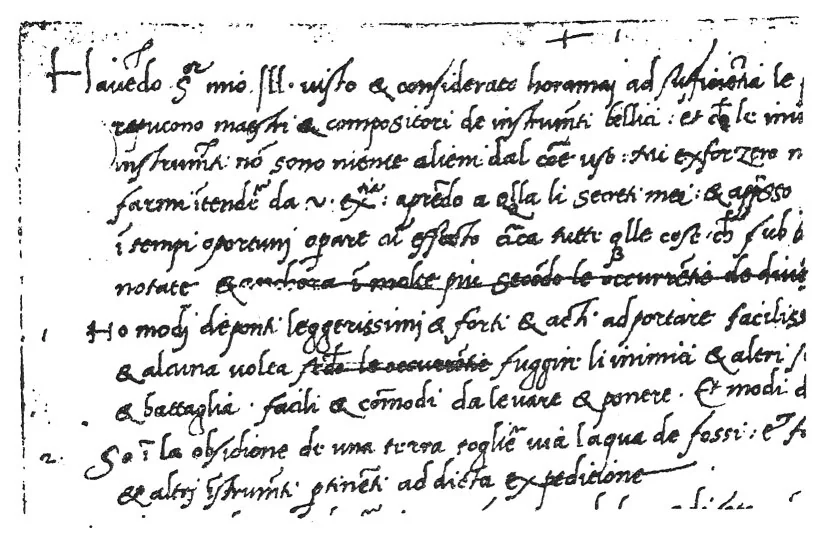
673
1) I have a sort of extremely light and strong bridges, adapted to be most easily carried, and with them you may pursue, and at any time flee from the enemy; and others, secure and indestructible by fire and battle, easy and convenient to lift and place. Also methods of burning and destroying those of the enemy.
2) I know how, when a place is besieged, to take the water out of the trenches, and make endless variety of bridges, and covered ways and ladders, and other machines pertaining to such expeditions.
3) Item. If, by reason of the height of the banks, or the strength of the place and its position, it is impossible, when besieging a place, to avail oneself of the plan of bombardment, I have methods for destroying every rock or other fortress, even if it were founded on a rock, &c
4) Again I have kinds of mortars; most convenient and easy to carry; and with these can fling small stones almost resembling a storm; and with the smoke of these causing great terror to the enemy, to his great detriment and confusion.
9) [8] And when the fight should be at sea I have kinds of many machines most efficient for offence and defence; and vessels which will resist the attack of the largest guns and powder and fumes.
5) Item. I have means by secret and tortuous mines and ways, made without noise to reach a designated [spot], even if it were needed to pass under a trench or a river.
6) Item. I will make covered chariots, safe and unattackable which, entering among the enemy with their artillery, there is no body of men so great but they would break them. And behind these, infantry could follow quite unhurt and without any hindrance.
7) Item. In case of need I will make big guns, mortars and light ordnance of fine and useful forms, out of the common type.
8) Where the operation of bombardment should fail, I would contrive catapults, mangonels, trabocchi and other machines of marvellous efficacy and not in common use. And in short, according to the variety of cases, I can contrive various and endless means of offence and defence.
10) In time of peace I believe I can give perfect satisfaction and to the equal of any other in architecture and the composition of buildings public and private; and in guiding water from one place to another.
Item: I can carry out sculpture in marble, bronze or clay, and also in painting whatever may be done, and as well as any other, be he whom he may.
[32] Again, the bronze horse may be taken in hand, which is to be to the immortal glory and eternal honour of the prince your father of happy memory, and of the illustrious house of Sforza.
And if any one of the above-named things seem to any one to be impossible or not feasible, I am most ready to make the experiment in your park, or in whatever place may please your Excellency--to whom I commend myself with the utmost humility &c
Footnotes
396:673 : The numerous corrections, the alterations in the figures (l. 18) and the absence of any signature prove that this is merely the rough draft of a letter to Lodovico il Moro. It is one of the very few manuscripts which are written from left to right--see the facsimile of the beginning as here reproduced. This is probably the final sketch of a document the clean of which copy was written in the usual manner. Leonardo no doubt very rarely wrote so, and this is probably the reason of the conspicuous dissimilarity in the handwriting, when he did. (Compare Pl. XXXVIII.) It is noteworthy too that here the orthography and abbreviations are also exceptional. But such superficial peculiarities are not enough to stamp the document as altogether spurious. It is neither a forgery nor the production of any artist but Leonardo himself. As to this point the contents leave us no doubt as to its authenticity, particularly l. 32 (see No. 719, where this passage is repeated). But whether the fragment, as we here see it, was written from Leonardo's dictation--a theory favoured by the orthography, the erasures and corrections--or whether it may be a copy made for or by Melzi or Mazenta is comparatively unimportant. There are in the Codex Atlanticus a few other documents not written by Leonardo himself, but the notes in his own hand found on the reverse pages of these leaves amply prove that they were certainly in Leonardo's possession. This mark of ownership is wanting to the text in question, but the compilers of the Codex Atlanticus, at any rate, accepted it as a genuine document.
With regard to the probable date of this projected letter see Vol. II, p. 3.
1341.
To my illustrious Lord, Lodovico,
Duke of Bari,
Leonardo da Vinci
of Florence--
Leonardo.
674
Footnotes
398:674 : Evidently a note of the superscription of a letter to the Duke, and written, like the foregoing from left to right. The manuscript containing it is of the year 1493. Lodovico was not proclaimed and styled Duke of Milan till September 1494. The Dukedom of Bari belonged to the Sforza family till 1499.
1342.
You would like to see a model which will prove useful to you and to me, also it will be of use to those who will be the cause of our usefulness.
675
Footnotes
398:675 : 1342. 1343. These two notes occur in the same not very voluminous MS. as the former one and it is possible that they are fragments of the same letter. By the Modello, the equestrian statue is probably meant, particularly as the model of this statue was publicly exhibited in this very year, 1493, on tne occasion of the marriage of the Emperor Maximilian with Bianca Maria Sforza.
1343.
There are here, my Lord, many gentlemen who will undertake this expense among them, if they are allowed to enjoy the use of admission to the waters, the mills, and the passage of vessels and when it is sold to them the price will be repaid to them by the canal of Martesana.
1344.
I am greatly vexed to be in necessity, but I still more regret that this should be the cause of the hindrance of my wish which is always disposed to obey your Excellency.
Perhaps your Excellency did not give further orders to Messer Gualtieri, believing that I had money enough.
I am greatly annoyed that you should have found me in necessity, and that my having to earn my living should have hindered me ...
[12] It vexes me greatly that having to earn my living has forced me to interrupt the work and to attend to small matters, instead of following up the work which your Lordship entrusted to me. But I hope in a short time to have earned so much that I may carry it out quietly to the satisfaction of your Excellency, to whom I commend myself; and if your Lordship thought that I had money, your Lordship was deceived. I had to feed 6 men for 56 months, and have had 50 ducats.
1345.
And if any other comission is given me by any ... of the reward of my service. Because I am not [able] to be ... things assigned because meanwhile they have ... to them ... ... which they well may settle rather than I ... not my art which I wish to change and ... given some clothing if I dare a sum ...
676
My Lord, I knowing your Excellency's mind to be occupied ... to remind your Lordship of my small matters and the arts put to silence that my silence might be the cause of making your Lordship scorn ... my life in your service. I hold myself ever in readiness to obey ...
677 Of the horse I will say nothing because I know the times [are bad] to your Lordship how I had still to receive two years' salary of the ... with the two skilled workmen who are constantly in my pay and at my cost that at last I found myself advanced the said sum about 15 lire ... works of fame by which I could show to those who shall see it that I have been everywhere, but I do not know where I could bestow my work [more] ...
678 I, having been working to gain my living ...
I not having been informed what it is, I find myself ...
679 remember the commission to paint the rooms ...
I conveyed to your Lordship only requesting you ...
Footnotes
399:676 : The paper on which this is written is torn down the middle; about half of each line remains.
400:677 11: See No. 723, where this passage is repeated.
400:678 17: See No. 1344 l. 12.
400:679 19: In April, 1498, Leonardo was engaged in painting the Saletta Nigra of the Castello at Milan. (See G. MONGERI, l'Arte in Milano, 1872, p. 417.)
1346.
Draft of letter to be sent to Piacenza (1346. 1347).Magnificent Commissioners of Buildings I, understanding that your Magnificencies have made up your minds to make certain great works in bronze, will remind you of certain things: first that you should not be so hasty or so quick to give the commission, lest by this haste it should become impossible to select a good model and a good master; and some man of small merit may be chosen, who by his insufficiency may cause you to
680
be abused by your descendants, judging that this age was but ill supplied with men of good counsel and with good masters; seeing that other cities, and chiefly the city of the Florentines, has been as it were in these very days, endowed with beautiful and grand works in bronze; among which are the doors of their Baptistery. And this town of Florence, like Piacenza, is a place of intercourse, through which many foreigners pass; who, seeing that the works are fine and of good quality, carry away a good impression, and will say that that city is well filled with worthy inhabitants, seeing the works which bear witness to their opinion; and on the other hand, I say seeing so much metal expended and so badly wrought, it were less shame to the city if the doors had been of plain wood; because, the material, costing so little, would not seem to merit any great outlay of skill...
Now the principal parts which are sought for in cities are their cathedrals, and of these the first things which strike the eye are the doors, by which one passes into these churches.
Beware, gentlemen of the Commission, lest too great speed in your determination, and so much haste to expedite the entrusting of so great a work as that which I hear you have ordered, be the cause that that which was intended for the honour of God and of men should be turned to great dishonour of your judgments, and of your city, which, being a place of mark, is the resort and gathering-place of innumerable foreigners. And this dishonour would result if by your lack of diligence you were to put your trust in some vaunter, who by his tricks or by favour shown to him here should obtain such work from you, by which lasting and very great shame would result to him and to you. Thus I cannot help being angry when I consider what men those are who have conferred with you as wishing to undertake this great work without thinking of their sufficiency for it, not to say more. This one is a potter, that one a maker of cuirasses, this one is a
bell-founder, another a bell ringer, and one is even a bombardier; and among them one in his Lordship's service, who boasted that he was the gossip of Messer Ambrosio Ferrere 681 , who has some power and who has made him some promises; and if this were not enough he would mount on horseback, and go to his Lord and obtain such letters that you could never refuse [to give] him the work. But consider where masters of real talent and fit for such work are brought when they have to compete with such men as these. Open your eyes and look carefully lest your money should be spent in buying your own disgrace. I can declare to you that from that place you will procure none but average works of inferior and coarse masters. There is no capable man,--[33] and you may believe me,--except Leonardo the Florentine, who is making the equestrian statue in bronze of the Duke Francesco and who has no need to bring himself into notice, because he has work for all his life time; and I doubt, whether being so great a work, he will ever finish it [34].
The miserable painstakers ... with what hope may they expect a reward of their merit?
Footnotes
400:680 : 1346. 1347. Piacenza belonged to Milan. The Lord spoken of in this letter, is no doubt Lodovico il Moro. One may infer from the concluding sentence (No. 1346, l. 33. 34 and No. 1347), that Leonardo, who no doubt compiled this letter, did not forward it to Piacenza himself, but gave it to some influential patron, under whose name and signature a copy of it was sent to the Commission.
402:681 26: Messer Ambrogio Ferrere was Farmer of the Customs under the Duke. Piacenza at that time belonged to Milan.
1347.
There is one whom his Lordship invited from Florence to do this work and who is a worthy master, but with so very much business he will never finish it; and you may imagine that a difference there is to be seen between a beautiful object and an ugly one. Quote Pliny.
Letter to the Cardinal Ippolito d' Este.
1348.
Most Illustrious and most Reverend Lord. The Lord Ippolito, Cardinal of Este at Ferrare.
Most Illustrious and most Reverend Lord.
I arrived from Milan but a few days since and finding that my elder brother refuses to
682
carry into effect a will, made three years ago when my father died--as also, and no less, because I would not fail in a matter I esteem most important--I cannot forbear to crave of your most Reverend Highness a letter of recommendation and favour to Ser Raphaello Hieronymo, at present one of the illustrious members of the Signoria before whom my cause is being argued; and more particularly it has been laid by his Excellency the Gonfaloniere into the hands of the said Ser Raphaello, that his Worship may have to decide and end it before the festival of All Saints. And therefore, my Lord, I entreat you, as urgently as I know how and am able, that your Highness will write a letter to the said Ser Raphaello in that admirable and pressing manner which your Highness can use, recommending to him Leonardo Vincio, your most humble servant as I am, and shall always be; requesting him and pressing him not only to do me justice but to do so with despatch; and I have not the least doubt, from many things that I hear, that Ser Raphaello, being most affectionately devoted to your Highness, the matter will issue ad votum. And this I shall attribute to your most Reverend Highness' letter, to whom I once more humbly commend myself. Et bene valeat.
Florence XVIIIa 7bris 1507. E. V. R. D.
your humble servant Leonardus Vincius, pictor.
Footnotes
402:682 : This letter addressed to the Cardinal Ippolito d'Este is here given from Marchese G. CAMPORI'S publication: Nuovi documenti per la Vita di Leonardo da Vinci. Atti e Memorie delle R. R. Deputazioni di Storia patria per la provincie modenesi e parmenesi, Vol. III. It is the only text throughout this work which I have not myself examined and copied from the original. The learned discoverer of this letter--the only letter from Leonardo hitherto known as having been sent--adds these interesting remarks: Codesto Cardinale nato ad Ercole I. nel 1470, arcivescovo di Strigonia a sette anni, poi d'Agra, aveva conseguito nel 1497 la pingue ed ambita cattedra di Milano, la dove avra conosciuto il Vinci, sebbene il poco amore ch'ei professava alle arti lasci credere che le proteste di servitu di Leonardo piu che a gratitudine per favori ricevuti e per opere a lui allogate, accennino a speranza per un favore che si aspetta. Notabile e ancora in questo prezioso documento la ripetuta signatura del grande artista 'che si scrive Vincio e Vincius, non da Vinci come si tiene comunemente, sebbene l'una e l'altra possano valere a significare cosi il casato come il paese; restando a sapere se il nome del paese di Vinci fosse assunto a cognome della famiglia di Leonardo nel qual supposto piu propriamento avrebbe a chiamarsi Leonardo Vinci, o Vincio (latinamente Vincius) com'egli stesso amo segnarsi in questa lettera, e come scrissero parecchi contenporanei di lui, il Casio, il Cesariano, Geoffrey Tory, il Gaurico, il Bandello, Raffaelle Maffei, il Paciolo. Per ultimo non lascero d'avvertire come la lettera del Vinci e assai ben conservata, di nitida e larga scrittura in forma pienemente corrispondente a quella dei suoi manoscritti, vergata all'uso comune da sinistra a destra, anziche contrariamente come fu suo costume; ma indubbiamente autentica e fornita della menzione e del suggello che fresca ancora conserva l'impronta di una testa di profilo da un picciolo antico cammeo. (Compare No. 1368, note.)
1349.
Draft of Letter to the Governor of Milan.I am afraid lest the small return I have made for the great benefits, I have received from your Excellency, have not made you
somewhat angry with me, and that this is why to so many letters which I have written to your Lordship I have never had an answer. I now send Salai to explain to your Lordship that I am almost at an end of the litigation I had with my brother; that I hope to find myself with you this Easter, and to carry with me two pictures of two Madonnas of different sizes. These were done for our most Christian King, or for whomsoever your Lordship may please. I should be very glad to know on my return thence where I may have to reside, for I would not give any more trouble to your Lordship. Also, as I have worked for the most Christian King, whether my salary is to continue or not. I wrote to the President as to that water which the king granted me, and which I was not put in possession of because at that time there was a dearth in the canal by reason of the great droughts and because 683 its outlets were not regulated; but he certainly promised me that when this was done I should be put in possession. Thus I pray your Lordship that you will take so much trouble, now that these outlets are regulated, as to remind the President of my matter; that is, to give me possession of this water, because on my return I hope to make there instruments and other things which will greatly please our most Christian King. Nothing else occurs to me. I am always yours to command. 684
Footnotes
404:683 :Compare Nos. 1009 and 1010. Leonardo has noted the payment of the pension from the king in 1505.
404:684 :1349. Charles d'Amboise, Marechal de Chaumont, was Governor of Milan under Louis XII. Leonardo was in personal communication with him so early as in 1503. He was absent from Milan in the autumn of 1506 and from October l5l0--when he besieged Pope Julius II. in Bologna--till his death, which took place at Correggio, February 11, 1511. Francesco Vinci, Leonardo's uncle, died--as Amoretti tells us--in the winter of l5l0-11 (or according to Uzielli in 1506?), and Leonardo remained in Florence for business connected with his estate. The letter written with reference to this affair, No. 1348, is undoubtedly earlier than the letters Nos. 1349 and 1350. Amoretti tells us, Memorie Storiche, ch. II, that the following note existed on the same leaf in MS. C. A. I have not however succeeded in finding it. The passage runs thus: Jo sono quasi al fine del mio letizio che io o con mie fratetgli ... Ancora ricordo a V. Excia la facenda che o cum Ser Juliana mio Fratello capo delli altri fratelli ricordandoli come se offerse di conciar le cose nostre fra noi fratelli del comune della eredita de mio Zio, e quelli costringa alla expeditione, quale conteneva la lettera che lui me mando.
1350.
Drafts of Letters to the Superintendent of Canals and to Fr. Melzi.Magnificent President, I am sending thither Salai, my pupil, who is the bearer of this, and from him you will hear by word of mouth the cause of my...
Magnificent President, I...
Magnificent President:--Having ofttimes remembered the proposals made many times to me by your Excellency, I take the liberty of writing to remind your Lordship of the promise made to me at my last departure, that is the possession of the twelve inches of water granted to me by the most Christian King. Your Lordship knows that I did not enter into possession, because at that time when it was given to me there was a dearth of water in the canal, as well by reason of the great drought as also because the outlets were not regulated; but your Excellency promised me that as soon as this was done, I should have my rights. Afterwards hearing that the canal was complete I wrote several times to your Lordship and to Messer Girolamo da Cusano,who has in his keeping the deed of this gift; and so also I wrote to Corigero and never had a reply. I now send thither Salai, my pupil, the bearer of this, to whom your Lordship may tell by word of mouth all that happened in the matter about which I petition your Excellency. I expect to go thither this Easter since I am nearly at the end of my lawsuit, and I will take with me two pictures of our Lady which I have begun, and at the present time have brought them on to a very good end; nothing else occurs to me.
My Lord the love which your Excellency has always shown me and the benefits that I have constantly received from you I have hitherto...
I am fearful lest the small return I have made for the great benefits I have received from your Excellency may not have made you somewhat annoyed with me. And this is why, to many letters which I have written to your Excellency I have never had an answer. I now send to you Salai to explain to your Excellency that I am almost at the end of my litigation with my brothers, and that I hope to be with you this Easter and carry with me two pictures on which are two Madonnas of different sizes which I began for the most Christian King, or for whomsoever you please. I should be very glad to
know where, on my return from this place, I shall have to reside, because I do not wish to give more trouble to your Lordship; and then, having worked for the most Christian King, whether my salary is to be continued or not. I write to the President as to the water that the king granted me of which I had not been put in possession by reason of the dearth in the canal, caused by the great drought and because its outlets were not regulated; but he promised me certainly that as soon as the regulation was made, I should be put in possession of it; I therefore pray you that, if you should meet the said President, you would be good enough, now that the outlets are regulated, to remind the said President to cause me to be put in possession of that water, since I understand it is in great measure in his power. Nothing else occurs to me; always yours to command.
Good day to you Messer Francesco. Why, in God's name, of all the letters I have written to you, have you never answered one. Now wait till I come, by God, and I shall make you write so much that perhaps you will become sick of it.
Dear Messer Francesco. I am sending thither Salai to learn from His Magnificence the President to what end the regulation of the water has come since, at my departure this regulation of the outlets of the canal had been ordered, because His Magnificence the President promised me that as soon as this was done I should be satisfied. It is now some time since I heard that the canal was in order, as also its outlets, and I immediately wrote to the President and to you, and then I repeated it, and never had an answer. So you will have the goodness to answer me as to that which happened, and as I am not to hurry the matter, would you take the trouble, for the love of me, to urge the President a little, and also Messer Girolamo Cusano, to whom you will commend me and offer my duty to his Magnificence.
685
Footnotes
406:685 : 1350. 28-36. Draft of a letter to Francesco Melzi, born l493--a youth therefore of about 17 in 1510. Leonardo addresses his young friend as "Messer", as being the son of a noble house. Melzi practised art under Leonardo as a dilettante and not as a pupil, like Cesare da Sesto and others (See LERMOLIEFF, Die Galerien &c, p. 476).
1351.
Drafts of a letter to Giuliano de' Medici (1351-1352).[Most illustrious Lord. I greatly rejoice most Illustrious Lord at your...]
I was so greatly rejoiced, most illustrious Lord, by the desired restoration of your health, that it almost had the effect that [my own health recovered]--[I have got through my illness]--my own illness left me-- --of your Excellency's almost restored health. But I am extremely vexed that I have not been able completely to satisfy the wishes of your Excellency, by reason of the wickedness of that deceiver, for whom I left nothing undone which could be done for him by me and by which I might be of use to him; and in the first place his allowances were paid to him before the time, which I believe he would willingly deny, if I had not the writing signed by myself and the interpreter. And I, seeing that he did not work for me unless he had no work to do for others, which he was very careful in solliciting, invited him to dine with me, and to work afterwards near me, because, besides the saving of expense, he
686
would acquire the Italian language. He always promised, but would never do so. And this I did also, because that Giovanni, the German who makes the mirrors, was there always in the workshop, and wanted to see and to know all that was being done there and made it known outside ... strongly criticising it; and because he dined with those of the Pope's guard, and then they went out with guns killing birds among the ruins; and this went on from after dinner till the evening; and when I sent Lorenzo to urge him to work he said that he would not have so many masters over him, and that his work was for your Excellency's Wardrobe; and thus two months passed and so it went on; and one day finding Gian Niccolo of the Wardrobe and asking whether the German had finished the work for your Magnificence, he told me this was not true, but only that he had given him two guns to clean. Afterwards, when I had urged him farther, be left the workshop and began to work in his room, and lost much time in making another pair of pincers and files and other tools with screws; and there he worked at mills for twisting silk which he hid when any one of my people went in, and with a thousand oaths and mutterings, so that none of them would go there any more.
I was so greatly rejoiced, most Illustrious Lord, by the desired restoration of your health, that my own illness almost left me. But I am greatly vexed at not having been able to completely satisfy your Excellency's wishes by reason of the wickedness of that German deceiver, for whom I left nothing undone by which I could have hope to please him; and secondly I invited him to lodge and board with me, by which means I should constantly see the work he was doing and with greater ease correct his errors while, besides this, he would learn the Italian tongue, by means of which be could with more ease talk without an interpreter; his moneys were always given him in advance of the
time when due. Afterwards he wanted to have the models finished in wood, just as they were to be in iron, and wished to carry them away to his own country. But this I refused him, telling him that I would give him, in drawing, the breadth, length, height and form of what he had to do; and so we remained in ill-will.
The next thing was that he made himself another workshop and pincers and tools in his room where he slept, and there he worked for others; afterwards he went to dine with the Swiss of the guard, where there are idle fellows, in which he beat them all; and most times they went two or three together with guns, to shoot birds among the ruins, and this went on till evening.
At last I found how this master Giovanni the mirror-maker was he who had done it all, for two reasons; the first because he had said that my coming here had deprived him of the countenance and favour of your Lordship which always... The other is that he said that his iron-workers' rooms suited him for working at his mirrors, and of this he gave proof; for besides making him my enemy, he made him sell all he had and leave his workshop to him, where he works with a number of workmen making numerous mirrors to send to the fairs.
Footnotes
407:686 : 1351. 1353.It is clear from the contents of this notes that they refer to Leonardo's residence in Rome in 1513-1515. Nor can there be any doubt that they were addressed to Leonardo's patron at the time: Giuliano de' Medici, third son of Lorenzo the Magnificent and brother of Pope Leo X (born 1478). In 1512 he became the head of the Florentine Republic. The Pope invited him to Rome, where he settled; in 1513 he was named patrician with much splendid ceremonial. The medal struck in honour of the event bears the words MAG. IVLIAN. MEDICES. Leonardo too uses the style "Magnifico", in his letter. Compare also No. 1377.
GlNO CAPPONI (Storia della Repubblica di Firenze, Vol. III, p. 139) thus describes the character of Giuliano de' Medici, who died in 1516: Era il migliore della famiglia, di vita placida, grande spenditore, tenendo intorno a sè uomini ingegnosi, ed ogni nuova cosa voleva provare.
See too GREGOROVIUS, Geschichte der Stadi Rom, VIII (book XIV. III, 2): Die Luftschlösser fürstlicher Grösse, wozu ihn der Papst hatte erheben wollen zerfielen. Julian war der edelste aller damaligen Medici, ein Mensch von innerlicher Richtung, unbefriedigt durch das Leben, mitten im Sonnenglanz der Herrlichkeit Leo's X. eine dunkle Gestalt die wie ein Schatten vorüberzog. Giuliano lived in the Vatican, and it may be safely inferred from No. 1352 l. 2, and No. 1353 l. 4, that Leonardo did the same.
From the following unpublished notice in the Vatican archives, which M. Eug. Müntz, librarian of the Ecole des Beaux arts, Paris, has done me the favour to communicate to me, we get a more accurate view of Leonardo's relation to the often named GIORGIO TEDESCO:
Nota delle provisione (sic) a da pagare per me in nome del nostro ill. S. Bernardo Bini e chompa di Roma, e prima della illma sua chonsorte ogni mese d. 800.
A Ldo da Vinci per sua provisione d. XXXIII, e più d. VII al detto per la provisione di Giorgio tedescho, che sono in tutto d. 40.
From this we learn, that seven ducats formed the German's monthly wages, but according to No. 1353 l. 7 he pretended that eight ducats had been agreed upon.
1352.
I was so greatly rejoiced, most Illustrious Lord, by the wished for recovery of your health, that my own ills have almost left me; and I say God be praised for it. But it vexes me greatly that I have not been able completely to satisfy your Excellency's wishes by reason of the wickedness of that German deceiver, for whom I left nothing undone by which I could hope to please him; and secondly I invited him to lodge and board with me, by which means I should see constantly the work he was doing,
for which purpose I would have a table fixed at the foot of one of these windows, where he could work with the file and finish the things made below; and so I should constantly see the work he might do, and it could be corrected with greater ease.
1353.
Draft of letter written at Rome.This other hindered me in anatomy, blaming it before the Pope; and likewise at the hospital; and he has filled [4] this whole Belvedere with workshops for mirrors; and he did the same thing in Maestro Giorgio's room. He said that he had been promised [7] eight ducats every month, beginning with the first day, when he set out, or at latest when he spoke with you; and that you agreed.
Seeing that he seldom stayed in the workshop, and that he ate a great deal, I sent him word that, if he liked I could deal with him separately for each thing that he might make, and would give him what we might agree to be a fair valuation. He took counsel with his neighbour and gave up his room, selling every thing, and went to find...
1354.
Miscellaneous Records (1354. 1355).Dear Benedetto de' Pertarti. When the proud giant fell because of the bloody and miry state of the ground it was as though a mountain had fallen so that the country shook as with an earthquake, and terror fell on Pluto in hell. From the violence of the shock he lay as stunned on the level ground. Suddenly the people, seeing him as one killed by a thunderbolt, turned back; like ants running wildly over the body of the fallen oak, so these rushing over his ample limbs.......... them with
687
frequent wounds; by which, the giant being roused and feeling himself almost covered by the multitude, he suddenly perceives the smarting of the stabs, and sent forth a roar which sounded like a terrific clap of thunder; and placing his hands on the ground he raised his terrible face: and having lifted one hand to his head he found it full of men and rabble sticking to it like the minute creatures which not unfrequently are found there; wherefore with a shake of his head he sends the men flying through the air just as hail does when driven by the fury of the winds. Many of these men were found to be dead; stamping with his feet.
And clinging to his hair, and striving to hide in it, they behaved like sailors in a storm, who run up the ropes to lessen the force of the wind [by taking in sail].
News of things from the East.
Be it known to you that in the month of June there appeared a Giant, who came from the Lybian desert... mad with rage like ants.... struck down by the rude.
This great Giant was born in Mount Atlas and was a hero ... and had to fight against the Egyptians and Arabs, Medes and Persians. He lived in the sea on whales, grampuses and ships.
Mars fearing for his life took refuge under the... of Jove.
And at the great fall it seemed as though the whole province quaked.
Footnotes
410:687 : 1354. A puzzling passage, meant, as it would seem, for a jest. Compare the description of Giants in Dante, Inf. XXI and XXII. Perhaps Leonardo had the Giant Antaeus in his mind. Of him the myth relates that he was a son of Ge, that he fed on lions; that he hunted in Libya and killed the inhabitants. He enjoyed the peculiarity of renewing his strength whenever he fell and came in contact with his mother earth; but that Hercules lifted him up and so conquered and strangled him. Lucan gives a full account of the struggle. Pharsalia IV, 617. The reading of this passage, which is very indistinctly written, is in many places doubtful.
1355.
This spirit returns to the brain whence it had departed, with a loud voice and with these words, it moved...
And if any man though he may have wisdom or goodness .........
688
O blessed and happy spirit whence comest thou? Well have I known this man, much against my will. This one is a receptacle of villainy; he is a perfect heap of the utmost ingratitude combined with every vice. But of what use is it to fatigue myself with vain words? Nothing is to be found in them but every form of sin ... And if there should be found among them any that possesses any good, they will not be treated differently to myself by other men; and in fine, I come to the conclusion that it is bad if they are hostile, and worse if they are friendly.
Footnotes
411:688 : This passage, very difficult to decipher, is on the reverse of a drawing at Windsor, Pl. CXXII, which possibly has some connection with it. The drawing is slightly reduced in this reproduction; the original being 25 cm. high by 19 cm. wide.
1356.
Miscellaneous drafts of letters and personal records (1356--1368).All the ills that are or ever were, if they could be set to work by him, would not satisfy the desires of his iniquitous soul; and I could not in any length of time describe his nature to you, but I conclude...
1357.
I know one who, having promised me much, less than my due, being disappointed of his presumptuous desires, has tried to deprive me of all my friends; and as he has found them wise and not pliable to his will, he has menaced me that, having found means of denouncing me, he would deprive me of my benefactors. Hence I have informed your Lordship of this, to the end [that this man who wishes to sow the usual scandals, may find no soil fit for sowing the thoughts and deeds of his evil nature] so that he, trying to make your Lordship, the instrument of his iniquitous and maliceous nature may be disappointed of his desire.
1358.
And in this case I know that I shall make few enemies seeing that no one will believe what I can say of him; for they are but
689
few whom his vices have disgusted, and he only dislikes those men whose natures are contrary to those vices. And many hate their fathers, and break off friendship with those who reprove their vices; and he will not permit any examples against them, nor any advice.
If you meet with any one who is virtuous do not drive him from you; do him honour, so that he may not have to flee from you and be reduced to hiding in hermitages, or caves or other solitary places to escape from your treachery; if there is such an one among you do him honour, for these are our Saints upon earth; these are they who deserve statues from us, and images; but remember that their images are not to be eaten by you, as is still done in some parts of India 690 where, when the images have according to them, performed some miracle, the priests cut them in pieces, being of wood, and give them to all the people of the country, not without payment; and each one grates his portion very fine, and puts it upon the first food he eats; and thus believes that by faith he has eaten his saint who then preserves him from all perils. What do you think here, Man, of your own species? Are you so wise as you believe yourselves to be? Are these things to be done by men?
Footnotes
412:689 : Below this text we read gusstino--Giustino and in another passage on the same page Justin is quoted (No. 1210, 1. 48). The two have however no real connection.
413:690 15: In explanation of this passage I have received the following communication from Dr. G. W. LEITNER of Lahore: "So far as Indian customs are known to us, this practice spoken of by Leonardo as 'still existing in some parts of India' is perfectly unknown; and it is equally opposed to the spirit of Hinduism, Mohammedanism and Sikhism. In central Thibet the ashes of the dead, when burnt, are mixed with dough, and small figures--usually of Buddha--are stamped out of them and some are laid in the grave while others are distributed among the relations. The custom spoken of by Leonardo may have prevailed there but I never heard of it." Possibly Leonardo refers here to customs of nations of America.
1359.
As I told you in past days, you know that I am without any....
Francesco d'Antonio.
Bernardo di Maestro Jacopo.
1360.
Tell me how the things happened.
1361.
S lorezo/// inbiadali/// inferri de/// in lorezo/// [inno abuil]// in acocatu/// per la sella //// colte di lor/// v cavallott/// el uiagg/// al/// a lurez/// in biada/// inferri/// abuss/// in viagg/// alorz/// 691
Footnotes
414:691 : This seems to be the beginning of a letter, but only the first words of the lines have been preserved, the leaf being torn down the middle. No translation is possible.
1362.
And so may it please our great Author that I may demonstrate the nature of man and his customs, in the way I describe his figure. 692
Footnotes
414:692 : A preparatory note for the passage given as No. 798, ll. 41--42.
1363.
This writing distinctly about the kite seems to be my destiny, because among the first recollections of my infancy, it seemed to me that, as I was in my cradle, a kite came to me and opened my mouth with its tail, and struck me several times with its tail inside my lips. 693
Footnotes
414:693 : This note probably refers to the text No. 1221.
1364.
[When I did well, as a boy you used to put me in prison. Now if I do it being grown up, you will do worse to me.]
1365.
Tell me if anything was ever done.
1366.
Tell me if ever I did a thing which me ....
1367.
Do not reveal, if liberty is precious to you; my face is the prison of love. 694
Footnotes
414:694 : This note seems to be a quotation.
1368.
Maestro Leonardo of Florence. 695
Footnotes
415:695 : So Leonardo writes his name on a sheet with sundry short notes, evidently to try a pen. Compare the signature with those in Nos. 1341, 1348 and 1374 (see also No. 1346, l. 33). The form "Lionardo" does not occur in the autographs. The Portrait of the Master in the Royal Library at Turin, which is reproduced--slightly diminished--on Pl. I, has in the original two lines of writing underneath; one in red chalk of two or three words is partly effaced: lionardo it... lm (or lai?); the second written in pencil is as follows: fatto da lui stesso assai vecchio. In both of these the writing is very like the Master's, but is certainly only an imitation.
1369.
Notes bearing Dates (1369--1378).The day of Santa Maria della Neve [of the Snows] August the 2nd 1473. 696
Footnotes
415:696 : 1369. This date is on a drawing of a rocky landscape. See Chronique des Arts 1881 no. 23: Leonard de Vinci a-t-il ete au Righi le 5 août 1473? letter by H. de Geymuller. The next following date in the MSS. is 1478 (see No. 663).
1370.
On the 2nd of April 1489, book entitled 'Of the human figure'. 697
Footnotes
415:697 : While the letters in the MS. notes of 1473 and 1478 are very ornate, this note and the texts on anatomy on the same sheet (for instance No. 805) are in the same simple hand as we see on Pl. CXVI and CXIX. No 1370 is the only dated note of the years between 1480 and 1489, and the characters are in all essential points identical with those that we see in the latest manuscripts written in France (compare the facsimiles on Pl. CXV and p. 254), so that it is hardly possible to determine exactly the date of a manuscript from the style of the handwriting, if it does not betray the peculiarities of style as displayed in the few notes dated previous to l480.--Compare the facsimile of the manuscripts 1479 on Pl. LXII, No. 2; No. 664, note, Vol. I p. 346. This shows already a marked simplicity as compared with the calligraphy of 1478.
The text No. 720 belongs to the year 1490; No. 1510 to the year 1492; No. 1459, No. 1384 and No. 1460 to the year 1493; No. 1463, No. 1517, No. 1024, 1025 and 1461 to the year 1494; Nos. 1523 and 1524 to the year 1497.
1371.
On the 1st of August 1499, I wrote here of motion and of weight. 698
Footnotes
415:698 :1371. Scrissi qui. Leonardo does not say where; still we may assume that it was not in Milan. Amoretti writes, Memorie Storiche, chap. XIX: Sembra pertanto che non nel 1499 ma nel 1500, dopo il ritorno e la prigionia del duca, sia da qui partito Lionardo per andare a Firenze; ed e quindi probabile, che i mesi di governo nuovo e incerto abbia passati coll' amico suo Francesco Melzi a Vaprio, ove meglio che altrove studiar potea la natura, e soprattutta le acque, e l'Adda specialmente, che gia era stato l'ogetto delle sue idrostatiche ricerche. At that time Melzi was only six years of age. The next date is 1502; to this year belong No. 1034, 1040, 1042, 1048 and 1053. The note No. 1525 belongs to the year 1503.
1372.
On the 9th of July 1504, Wednesday, at seven o'clock, died Ser Piero da Vinci, notary at the Palazzo del Podestá, my father, --at seven o'clock, being eighty years old, leaving behind ten sons and two daughters.
699
Footnotes
416:699 : This statement of Ser Piero's age contradicts that of the Riassunto della portata di Antonio da Vinci (Leonardo's grandfather), who speaks of Ser Piero as being thirty years old in 1457; and that of the Riassunto della portata di Ser Piero e Francesco, sons of Antonia da Vinci, where Ser Piero is mentioned as being forty in 1469. These documents were published by G. UZIELLI, Ricerche intorno a L. da Vinci, Firenze, 1872, pp. 144 and 146. Leonardo was, as is well known, a natural son. His mother 'La Catarina' was married in 1457 to Acchattabriga di Piero del Vaccha da Vinci. She died in 1519. Leonardo never mentions her in the Manuscripts. In the year of Leonardo's birth Ser Piero married Albiera di Giovanni Amadoci, and after her death at the age of thirty eight he again married, Francesca, daughter of Ser Giovanni Lanfredi, then only fifteen. Their children were Leonardo's halfbrothers, Antonio (b. 1476), Ser Giuliano (b. 1479), Lorenzo (b. 1484), a girl, Violante (b. 1485), and another boy Domenico (b. 1486); Domenico's descendants still exist as a family. Ser Piero married for the third time Lucrezia di Guglielmo Cortigiani by whom he had six children: Margherita (b. 1491), Benedetto (b. 1492), Pandolfo (b. 1494), Guglielmo (b. 1496), Bartolommeo (b. 1497), and Giovanni) date of birth unknown). Pierino da Vinci the sculptor (about 1520-1554) was the son of Bartolommeo, the fifth of these children. The dates of their deaths are not known, but we may infer from the above passage that they were all still living in 1505.
1373.
On Wednesday at seven o'clock died Ser Piero da Vinci on the 9th of July 1504.
700
Footnotes
416:700 : This and the previous text it may be remarked are the only mention made by Leonardo of his father; Nos. 1526, 1527 and No. 1463 are of the year 1504.
1374.
Begun by me, Leonardo da Vinci, on the l2th of July 1505.
701
Footnotes
416:701 : Thus he writes on the first page of the MS. The title is on the foregoing coversheet as follows: Libro titolato disstrafformatione coe (cioè) d'un corpo nvn (in un) altro sanza diminuitione e acresscemento di materia.
1375.
Begun at Milan on the l2th of September 1508.
702
Footnotes
416:702 : No. 1528 and No. 1529 belong to the same year. The text Vol. I, No. 4 belongs to the following year 1509 (1508 old style); so also does No. 1009.-- Nos. 1022, 1057 and 1464 belong to 1511.
1376.
On the 9th of January 1513.
703
Footnotes
416:703 : No. 1465 belongs to the same year. No. 1065 has the next date 1514.
1377.
The Magnifico Giuliano de' Medici left Rome on the 9th of January 1515, just at daybreak, to take a wife in Savoy; and on the same day fell the death of the king of France.
704
Footnotes
417:704 : Giuliano de Medici, brother to Pope Leo X.; see note to Nos. 1351-1353. In February, 1515, he was married to Filiberta, daughter of Filippo, Duke of Savoy, and aunt to Francis I, Louis XII's successor on the throne of France. Louis XII died on Jan. 1st, and not on Jan. 9th as is here stated.-- This addition is written in paler ink and evidently at a later date.
1378.
On the 24th of June, St John's day, 1518 at Amboise, in the palace of...
705
Footnotes
417:705 : Castello del clli. The meaning of this word is obscure; it is perhaps not written at full length.
XXII.
Miscellaneous Notes.
The incidental memoranda scattered here and there throughout the MSS. can have been for the most part intelligible to the writer only; in many cases their meaning and connection are all the more obscure because we are in ignorance about the persons with whom Leonardo used to converse nor can we say what part he may have played in the various events of his time. Vasari and other early biographers give us a very superficial and far from accurate picture of Leonardo's private life. Though his own memoranda, referring for the most part to incidents of no permanent interest, do not go far towards supplying this deficiency, they are nevertheless of some importance and interest as helping us to solve the numerous mysteries in which the history of Leonardo's long life remains involved. We may at any rate assume, from Leonardo's having committed to paper notes on more or less trivial matters on his pupils, on his house-keeping, on various known and unknown personages, and a hundred other trifies--that at the time they must have been in some way important to him.
I have endeavoured to make these 'Miscellaneous Notes' as complete as possible, for in many cases an incidental memorandum will help to explain the meaning of some other note of a similar kind. The first portion of these notes (Nos. l379--l457), as well as those referring to his pupils and to other artists and artificers who lived in his house (1458--1468,) are arranged in chronological order. A considerable proportion of these notes belong to the period between 1490 and 1500, when Leonardo was living at Milan under the patronage of Lodovico il Moro, a time concerning which we have otherwise only very scanty information. If Leonardo did really--as has always been supposed,--spend also the greater part of the preceding decade in Milan, it seems hardly likely that we should not find a single note indicative of the fact, or referring to any event of that period, on the numerous loose leaves in his writing that exist. Leonardo's life in Milan between 1489 and 1500 must have been comparatively uneventful. The MSS. and memoranda of those years seem to prove that it was a tranquil period of intellectual and artistic labour rather than of bustling court life. Whatever may
have been the fate of the MSS. and note books of the foregoing years--whether they were destroyed by Leonardo himself or have been lost--it is certainly strange that nothing whatever exists to inform us as to his life and doings in Milan earlier than the consecutive series of manuscripts which begin in the year 1489.
There is nothing surprising in the fact that the notes regarding his pupils are few and meagre. Excepting for the record of money transactions only very exceptional circumstances would have prompted him to make any written observations on the persons with whom he was in daily intercourse, among whom, of course, were his pupils. Of them all none is so frequently mentioned as Salai, but the character of the notes does not--as it seems to me--justify us in supposing that he was any thing more than a sort of factotum of Leonardo's (see 1519, note).
Leonardo's quotations from books and his lists of titles supply nothing more than a hint as to his occasional literary studies or recreations. It was evidently no part of his ambition to be deeply read (see Nrs. 10, 11, 1159) and he more than once expressly states (in various passages which will be found in the foregoing sections) that he did not recognise the authority of the Ancients, on scientific questions, which in his day was held paramount. Archimedes is the sole exception, and Leonardo frankly owns his admiration for the illustrious Greek to whose genius his own was so much akin (see No. 1476). All his notes on various authors, excepting those which have already been inserted in the previous section, have been arranged alphabetically for the sake of convenience (1469--1508).
The passages next in order contain accounts and inventories principally of household property. The publication of these--often very trivial entries--is only justifiable as proving that the wealth, the splendid mode of life and lavish expenditure which have been attributed to Leonardo are altogether mythical; unless we put forward the very improbable hypothesis that these notes as to money in hand, outlay and receipts, refer throughout to an exceptional state of his affairs, viz. when he was short of money.
The memoranda collected at the end (No. 1505--1565) are, in the original, in the usual writing, from left to right. Besides, the style of the handwriting is at variance with what we should expect it to be, if really Leonardo himself had written these notes. Most of them are to be found in juxtaposition with undoubtedly authentic writing of his. But this may be easily explained, if we take into account the fact, that Leonardo frequently wrote on loose sheets. He may therefore have occasionally used paper on which others had made short memoranda, for the most part as it would seem, for his use. At the end of all I have given Leonardo's will from the copy of it preserved in the Melzi Library. It has already been printed by Amoretti and by Uzielli. It is not known what has become of the original document.
1379.
Memoranda before 1500 (1379-l413).Find Longhi and tell him that you wait for him at Rome and will go with him to Naples; make you pay the donation 706 and take the book by Vitolone, and the measurements of the public buildings. [3] Have two covered boxes made to be carried on mules, but bed-covers will be best; this makes three, of which you will leave one at Vinci. [4] Obtain the.............. from Giovanni Lombardo the linen draper of Verona. Buy handkerchiefs and towels,.... and shoes, 4 pairs of hose, a jerkin of... and skins, to make new ones; the lake of Alessandro. 707 Sell what you cannot take with you. Get from Jean de Paris the method of painting in tempera and the way of making white 708
salt, and how to make tinted paper; sheets of paper folded up; and his box of colours; learn to work flesh colours in tempera, learn to dissolve gum lac, linseed ... white, of the garlic of Piacenza; take 'de Ponderibus'; 709 take the works of Leonardo of Cremona. Remove the small furnace ... seed of lilies and of... Sell the boards of the support. Make him who stole it, give you the ... learn levelling and how much soil a man can dig out in a day.
Footnotes
421:706 2: Libro di Vitolone see No. 1506 note.
421:707 : 7 and fol. It would seem from the text that Leonardo intended to have instructions in painting on paper. It is hardly necessary to point out that the Art of illuminating was quite separate from that of painting.
421:708 : The mysterious looking words, quite distinctly written, in line 1: ingol, amor a, ilopan a and on line 2: enoiganod al are obviously in cipher and the solution is a simple one; by reading them backwards we find for ingol: logni-probably longi, evidently the name of a person; for amor a: a Roma, for ilopan a: a Napoli. Leonardo has done the same in two passages treating on some secrets of his art Nos. 641 and 729, the only other places in which we find this cipher employed; we may therefore conclude that it was for the sake of secrecy that he used it.
There can be no doubt, from the tenor of this passage, that Leonardo projected a secret excursion to Naples. Nothing has hitherto been known of this journey, but the significance of the passage will be easily understood by a reference to the following notes, from which we may infer that Leonardo really had at the time plans for travelling further than Naples. From lines 3, 4 and 7 it is evident that he purposed, after selling every thing that was not easily portable, to leave a chest in the care of his relations at Vinci. His luggage was to be packed into two trunks especially adapted for transport by mules. The exact meaning of many sentences in the following notes must necessarily remain obscure. These brief remarks on small and irrelevant affairs and so forth are however of no historical value. The notes referring to the preparations for his journey are more intelligible.
422:709 11. 'De Ponderibus'. A large number of Leonardo's notes bear this superscription. Compare No. 1436, 3.
1380.
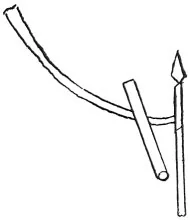
This was done by Leone in the piazza of the castle with a chain and an arrow. 710
Footnotes
422:710 : This note must have been made in Milan; as we know from the date of the MS.
1381.
NAMES OF ENGINEERS.
Callias of Rhodes, Epimachus the Athenian, Diogenes, a philosopher, of Rhodes, Calcedonius of Thrace, Febar of Tyre, Callimachus the architect, a master of fires. 711
Footnotes
422:711 : Callias, Architect of Aradus, mentioned by Vitruvius (X, 16, 5).--Epimachus, of Athens, invented a battering-enginee for Demetrius Poliorketes (Vitruvius X, 16, 4).--Callimachus, the inventor of the Corinthian capital (Vitr. IV, I, 9), and of the method of boring marble (Paus. I, 26, 7), was also famous for his casts in bronze (Plin. XXXIV, 8, 19). He invented a lamp for the temple of Athene Polias, on the Acropolis of Athens (Paus. I, 26, 7)--The other names, here mentioned, cannot be identified.
1382.
Ask maestro Lodovico for 'the conduits of water'. 712
Footnotes
422:712 : Condotti d'acqua. Possibly a book, a MS. or a map.
1383.
... at Pistoja, Fioravante di Domenico at Florence is my most beloved friend, as though he were my [brother]. 713
Footnotes
422:713 : On the same sheet is the text No. 663.
1384.
On the 16th day of July.
Caterina came on 16th day of July, 1493.
Messer Mariolo's Morel the Florentin, has a big horse with a fine neck and a beautiful head.
The white stallion belonging to the falconer has fine hind quarters; it is behind the Comasina Gate.
The big horse of Cermonino, of Signor Giulio. 714
Footnotes
423:714 : Compare Nos. 1522 and 1517. Caterina seems to have been his housekeeper.
1385.
OF THE INSTRUMENT.
Any one who spends one ducat may take the instrument; and he will not pay more than half a ducat as a premium to the inventor of the instrument and one grosso to the workman every year. I do not want sub-officials. 715
Footnotes
423:715 : Refers perhaps to the regulation of the water in the canals.
1386.
Maestro Giuliano da Marliano has a fine herbal. He lives opposite to Strami the Carpenters. 716
Footnotes
423:716 : Compare No. 616, note. 4. legnamiere (milanese dialect) = legnajuolo.
1387.
Christofano da Castiglione who lives at the Pieta has a fine head.
1388.
Work of ... of the stable of Galeazzo; by the road of Brera 717 ; benefice of Stanghe 718 ; benefice of Porta Nuova; benefice of Monza; Indaco's mistake; give first the benefices; then the works; then ingratitude, indignity and lamentations.
Footnotes
423:717 4: Brera, see No. 1448, II, 13
423:718 5:Stanghe, see No. 1509.
1389.
Chiliarch--captain of 1000.
Prefects--captains.
A legion, six thousand and sixty three men.
1390.
A nun lives at La Colomba at Cremona; she works good straw plait, and a friar of Saint Francis. 719
Footnotes
424:719 : La Colomba is to this day the name of a small house at Cremona, decorated with frescoes.
1391.
Needle,--Niccolao,--thread,--Ferrando, -lacopo Andrea,--canvas,--stone,--colours, -brushes,-pallet,-sponge,-the panel of the Duke.
1392.
Messer Gian Domenico Mezzabarba and Messer Giovanni Franceso Mezzabarba. By the side of Messer Piero d'Anghiera.
1393.
Conte Francesco Torello.
1394.
Giuliano Trombetta,--Antonio di Ferrara, --Oil of .... 720
Footnotes
424:720 : Near this text is the sketch of a head drawn in red chalk.
1395.
Paul was snatched up to heaven. 721
Footnotes
424:721 : See the facsimile of this note on Pl. XXIII No. 2.
1396.
Giuliano da Maria, physician, has a steward without hands.
1397.
Have some ears of corn of large size sent from Florence.
1398.
See the bedstead at Santa Maria. Secret.
1399.
Arrigo is to have 11 gold Ducats. Arrigo is to have 4 gold ducats in the middle of August.
1400.
Give your master the instance of a captain who does not himself win the victory, but the soldiers do by his counsels; and so he still deserves the reward.
1401.
Messer Pier Antonio.
1402.
Oil,--yellow,--Ambrosio,--the mouth,--the farmhouse.
1403.
My dear Alessandro from Parma, by the hand of ...
1404.
Giovannina, has a fantastic face,--is at Santa Caterina, at the Hospital. 722
Footnotes
425:722 : Compare the text on the same page: No. 667.
1405.
24 tavole make 1 perch.
4 trabochi make 1 tavola.
4 braccia and a half make a trabocco.
A perch contains 1936 square braccia, or 1944.
1406.
The road of Messer Mariolo is 13 1/4 braccia wide; the House of Evangelista is 75.
It enters 7 1/2 braccia in the house of Mariolo. 723
Footnotes
426:723 : On this page and that which faces it, MS.I2 7la, are two diagrams with numerous reference numbers, evidently relating to the measurements of a street.
1407.
I ask at what part of its curved motion the moving cause will leave the thing moved and moveable.
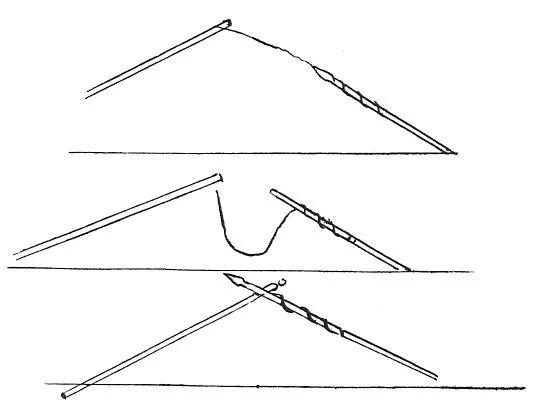
Speak to Pietro Monti of these methods of throwing spears.
1408.
Antonio de' Risi is at the council of Justice.
1409.
Paolo said that no machine that moves another ... 724
Footnotes
426:724 : The passage, of which, the beginning is here given, deals with questions in mechanics. The instances in which Leonardo quotes the opinions of his contemporaries on scientific matters are so rare as to be worth noticing. Compare No. 901.
1410.
Caravaggio. 725
Footnotes
427:725 :Caravaggio, a village not far from the Adda between Milan and Brescia, where Polidoro and Michelangelo da Caravaggio were born. This note is given in facsimile on Pl. XIII, No. I (above, to the left). On Pl. XIII, No. 2 above to the right we read cerovazo.
1411.
Pulleys,--nails,--rope,--mercury,--cloth, Monday.
1412.
MEMORANDUM.
Maghino, Speculus of Master Giovanni the Frenchman; Galenus on utility.
1413.
Near to Cordusio is Pier Antonio da Tossano and his brother Serafino. 726
Footnotes
427:726 : This note is written between lines 23 and 24 of the text No. 710. Corduso, Cordusio (curia ducis) = Cordus in the Milanese dialect, is the name of a Piazza between the Via del Broletto and the Piazza de' Mercanti at Milan.. In the time of il Moro it was the centre of the town. The persons here named were members of the noble Milanese family de'Fossani; Ambrogio da Possano, the con- temporary painter, had no connection with them.
1414.
Memoranda after 1500 (1414--1434)Paul of Vannochio at Siena ...
The upper chamber for the apostles.
[4] Buildings by Bramante.
The governor of the castle made a prisoner.
727
Giovanni della Rosa deprived of his money.
728 Borgonzio began ...; and moreover his fortunes fled.]
The Duke has lost the state, property and liberty and none of his entreprises was carried out by him.
729
Footnotes
427:727 6: Visconti. Chi fosse quel Visconte non sapremmo indovinare fra tanti di questo nome. Arluno narra che allora atterrate furono le case de' Viconti, de' Castiglioni, de' Sanseverini, e de' Botta e non e improbabile che ne fossero insultati e morti i padroni. Molti Visconti annovera lo stesso Cronista che per essersi rallegrati del ritorno del duca in Milano furono da Francesi arrestati, e strascinati in--Francia come prigionieri di stato; e fra questi Messer Francesco Visconti, e suo figliuolo Battista. (AMORETTI, Mem. Stor. XIX.). Visconti carried away and his son killed.
427:728 8: Borgonzio o Brugonzio Botta fu regolatore delle ducali entrate sotto il Moro, alla cui fuga la casa sua fu pur messa a sacco da' partitanti francesi. (AMORETTI, 1. c.)
427:729 1: 4--10 This passage evidently refers to events in Milan at the time of the overthrow of Ludovico il Moro. Amoretti published it in the 'Memorie Storiche' and added copious notes.
1415.
Ambrosio Petri, St. Mark, 4 boards for the window, 2 ..., 3 the saints of chapels, 5 the Genoese at home.
1416.
Piece of tapestry,-pair of compasses,-- Tommaso's book,--the book of Giovanni Benci,--the box in the custom-house,--to cut the cloth,--the sword-belt,--to sole the boots, --a light hat,--the cane from the ruined houses,--the debt for the table linen, --swimming-belt,--a book of white paper for drawing,--charcoal.--How much is a florin .... a leather bodice.
1417.
Borges 730 shall get for you the Archimedes from the bishop of Padua, and Vitellozzo the one from Borgo a San Sepolcro 731
Footnotes
428:730 : Borges. A Spanish name.
428:731 : Borgo a San Sepolcro, where Luca Paciolo, Leonardo's friend, was born.
1418.
Marzocco's tablet.
1419.
Marcello lives in the house of Giacomo da Mengardino.
1420.
Where is Valentino? 732 --boots,--boxes in the custom-house ...,-- 733 the monk at the Carmine,--squares,-- 734 Piero Martelli,--[8] Salvi Borgherini,--send back the bags,--a support for the spectacles,-- 735 the nude study of San Gallo,--the cloak. Porphyry,--groups,--square,-- 736 Pandolfino.
Footnotes
428:732 : Valentino. Cesare Borgia is probably meant. After being made Archbishop of Valence by Alexander VI he was commonly called Valentinus or Valentino. With reference to Leonardo's engagements by him see pp. 224 and 243, note.
428:733 : Carmine. A church and monastery at Florence.
428:734 s 7 an 8: Martelli, Borgherini; names of Florentine families. See No. 4.
428:735 11: San Gallo; possibly Giuliano da San Gallo, the Florentine architect.
428:736 16: Pandolfini, see No. 1544 note.
1421.
Concave mirrors; philosophy of Aristotle; 737 738 the books of Avicenna Italian and Latin vocabulary; Messer Ottaviano Palavicino or his Vitruvius 739 . bohemian knives; Vitruvius 740 ; go every Saturday to the hot bath where you will see naked men;
Meteora' 741 ,
Archimedes, on the centre of gravity 742 ; anatomy 743 Alessandro Benedetto; The Dante of Niccolo della Croce; Inflate the lungs of a pig and observe whether they increase in width and in length, or in width diminishing in length.
744 Marliano, on Calculation, to Bertuccio. Albertus, on heaven and earth 745 , [from the monk Bernardino]. Horace has written on the movements of the heavens.
Footnotes
429:737 :Filosofia d'Aristotele see No. 1481 note.
429:738 2: Avicenna (Leonardo here writes it Avinega) the Arab philosopher, 980-1037, for centuries the unimpeachable authority on all medical questions. Leonardo possibly points here to a printed edition: Avicennae canonum libri V, latine 1476 Patavis. Other editions are, Padua 1479, and Venice 1490.
429:739 3: Vitruvius. See Vol. I, No. 343 note.
429:740 6: Vitruvius. See Vol. I, No. 343 note.
429:741 7: See No. 1448, 25.
429:742 9: The works of Archimedes were not printed during Leonardo's life-time.
429:743 10: Compare No. 1494.
429:744 14: Johannes Marliani sua etate philosophorum et medicorum principis et ducala phisic. primi de proportione motuum velocitate questio subtilissima incipit ex ejusdem Marliani originali feliciter extracta, M(ilano) 1482.
Another work by him has the title: Marlianus mediolanensis. Questio de caliditate corporum humanorum tempore hiemis ed estatis et de antiparistasi ad celebrem philosophorum et medicorum universitatem ticinensem. 1474.
429:745 15: See No. 1469, 1. 7.
1422.
Of the three regular bodies as opposed to some commentators who disparage the Ancients, who were the originators of grammar and the sciences and ...
1423.
The room in the tower of Vaneri. 746
Footnotes
429:746 : This note is written inside the sketch of a plan of a house. On the same page is the date 1513 (see No. 1376).
1424.
The figures you will have to reserve for the last book on shadows that they may appear in the study of Gerardo the illuminator at San Marco at Florence.
[Go to see Melzo, and the Ambassador, and Maestro Bernardo].
747
Footnotes
430:747 : L. 1-3 are in the original written between lines 3 and 4 of No. 292. But the sense is not clear in this connection. It is scarcely possible to devine the meaning of the following sentence.
2. 3. Gherardo Miniatore, a famous illuminator, 1445-1497, to whom Vasari dedicated a section of his Lives (Vol. II pp. 237-243, ed. Sansoni 1879).
5. Bernardo, possibly the painter Bernardo Zenale.
1425.
Hermes the philosopher.
1426.
Suisset, viz. calculator,--Tisber,--Angelo Fossobron,--Alberto.
1427.
The structure of the drawbridge shown me by Donnino, and why c and d thrust downwards.
748
Footnotes
430:748 : The sketch on the same page as this text represents two poles one across the other. At the ends of the longest are the letter c and d. The sense of the passage is not rendered any clearer.
1428.
The great bird will take its first flight;-- on the back of his great swan,--filling the universe with wonders; filling all writings with his fame and bringing eternal glory to his birthplace.
749
Footnotes
430:749 : This seems to be a speculation about the flying machine (compare p. 271).
1429.
This stratagem was used by the Gauls against the Romans, and so great a mortality ensued that all Rome was dressed in mourning.
750
Footnotes
430:750 : Leonardo perhaps alludes to the Gauls under Brennus, who laid his sword in the scale when the tribute was weighed.
1430.
Alberto da Imola;--Algebra, that is, the demonstration of the equality of one thing to another.
1431.
Johannes Rubicissa e Robbia.
1432.
Ask the wife of Biagio Crivelli how the capon nurtures and hatches the eggs of the hen,--he being drunk.
1433.
The book on Water to Messer Marco Antonio.
751
Footnotes
431:751 : Possibly Marc-Antonio della Torre, see p. 97.
1434.
Have Avicenna's work on useful inventions translated; spectacles with the case, steel and fork and...., charcoal, boards, and paper, and chalk and white, and wax;.... .... for glass, a saw for bones with fine teeth, a chisel, inkstand ........ three herbs, and Agnolo Benedetto. Get a skull, nut,--mustard.
Boots,--gloves, socks, combs, papers, towels, shirts,.... shoe-tapes,--..... shoes, penknife, pens. A skin for the chest.
752
Footnotes
431:752 : 4. Lapis. Compare Condivi, Vita di Michelagnolo Buonarotti, Chap. XVIII.: Ma egli (Michelangelo) non avendo che mostrare, prese una penna (percioche in quel tempo il lapis non era in uso) e con tal leggiadria gli dipinse una mano ecc. The incident is of the year l496.--Lapis means pencil, and chalk (matita). Between lines 7 and 8 are the texts given as Nos. 819 and No. 7.
1435.
Undated memoranda (1435-1457).The book of Piero Crescenze,--studies from the nude by Giovanni Ambrosio,--compasses, --the book of Giovanni Giacomo.
1436.
MEMORARDUM.
To make some provisions for my garden, --Giordano, De Ponderibus 753 ,--the peacemaker, the flow and ebb of the sea,--have two baggage trunks made, look to Beltraffio's 754 lathe and have taken the stone,--out leave the books belonging to Messer Andrea the German,-- make scales of a long reed and weigh the substance when hot and again when cold. The mirror of Master Luigi; A b the flow and ebb of the water is shown at the mill of Vaprio,--a cap.
Footnotes
432:753 3: Giordano. Jordanus Nemorarius, a mathematician of the beginning of the XIIIth century. No particulars of his life are known. The title of his principal work is: Arithmetica decem libris demonstrata, first published at Paris 1496. In 1523 appeared at Nuremberg: Liber Jordani Nemorarii de ponderibus, propositiones XIII et earundem demonstrationes, multarumque rerum rationes sane pulcherrimas complectens, nunc in lucem editus.
432:754 6: Beltraffio, see No. 465, note 2.
There are sketches by the side of lines 8 and 10.
1437.
Giovanni Fabre,--Lazaro del Volpe,-- the common,--Ser Piero.
755
Footnotes
432:755 : These names are inserted on a plan of plots of land adjoining the Arno.
1438.
[Lactantius], [the book of Benozzo], groups, to bind the book,--a lantern,--Ser Pecantino,--Pandolfino.--[Rosso]--a square, --small knives,--carriages,--curry combs-- cup.
1439.
Quadrant of Carlo Marmocchi,--Messer Francesco Araldo,--Ser Benedetto d'Accie perello,--Benedetto on arithmetic,--Maestro Paulo, physician,--Domenico di Michelino,-- ...... of the Alberti,--Messer Giovanni Argimboldi.
1440.
Colours, formula,--Archimedes,--Marcantonio.
Tinned iron,--pierced iron.
1441.
See the shop that was formerly Bartolommeo's, the stationer.
756
Footnotes
433:756 : 6. Marc Antonio, see No. 1433.
1442.
The first book is by Michele di Francesco Nabini; it treats on science.
1443.
Messer Francesco, physician of Lucca, with the Cardinal Farnese.
757
Footnotes
433:757 : Alessandro Farnese, afterwards Pope Paul III was created in 1493 Cardinal di San Cosimo e San Damiano, by Alexander VI.
1444.
Pandolfino's book 758 ,--knives,--a pen for ruling,--to have the vest dyed,--The library at St.-Mark's,--The library at Santo Spirito,--Lactantius of the Daldi 759 ,--Antonio Covoni,--A book by Maestro Paolo Infermieri, --Boots, shoes and hose,--(Shell)lac, --An apprentice to do the models for me. Grammar, by Lorenzo de Medici,--Giovanni del Sodo,--Sansovino, 760 --a ruler,--a very sharp knife,--Spectacles,--fractions...., --repair.........,--Tomaso's book,-- Michelagnolo's little chain; Learn the multiplication of roots from Maestro Luca;--my map of the world which Giovanni Benci has 761 ;-Socks,--clothes from the customhouse --officier,--Red Cordova leather,--The map of the world, of Giovanni Benci,--a print, the districts about Milan--Market book.
Footnotes
433:758 1: Pandolfino, Agnolo, of Florence. It is to this day doubtful whether he or L. B. Alberti was the author of the famous work 'Del Governo della Famiglia'. It is the more probable that Leonardo should have meant this work by the words il libro, because no other book is known to have been written by Pandolfino. This being the case this allusion of Leonardo's is an important evidence in favour of Pandolfino's authorship (compare No. 1454, line 3).
433:759 7: The works of Lactantius were published very often in Italy during Leonardo's lifetime. The first edition published in 1465 "in monastero sublacensi" was also the first book printed in Italy.
433:760 15: Sansovino, Andrea--the sculptor; 1460-1529.
433:761 25: Leonardo here probably alludes to the map, not executed by him (See p. 224), which is with the collection of his MSS. at Windsor, and was published in the Archaeologia Vol. XI (see p. 224).
1445.
In that at Pavia the movement is more to be admired than any thing else.
The imitation of antique work is better than that of the modern things.
Beauty and utility cannot exist together, as seen in fortresses and in men.
The trot is almost the nature of the free horse.
Where natural vivacity is lacking it must be supplied by art.
762
Footnotes
434:762 : Quel di Pavia. Pavia is possibly a clerical error for Padua, and if so the meaning of the passage is easily arrived at: Quel di Padua would be the bronze equestrian statue of Gattamelata, on the Piazza del Santo at Padua executed by Donatelle in 1443 (see pp. 2 and 3).
1446.
Salvadore, the matress maker, lives on the Piazza di Sant' Andrea, you enter by the furrier's.
1447.
Monsignore de' Pazzi,--Ser Antonio Pacini.
1448.
An algebra, which the Marliani have, written by their father, 763 --
On the bone, by the Marliani,--
On the bone which penetrates, Gian Giacomo of Bellinzona, to draw out the nail with facility,--
The measurement of Boccalino,--
The measurement of Milan and the suburbs, 764 --
A book, treating of Milan and its churches which is to be had at the last stationer's on the way to Corduso 765 ,--
The measurement of the Corte Vecchia,--
The measurement of the Castle,--
Get the master of arithmetic to show you how to square a....,--
Get Messer Fazio to show you [the book] on proportion,--
Get the Friar di Brera to show you [the book] 'de Ponderibus',-- 766
Of the measurement of San Lorenzo,-- 767
I lent certain groups to Fra Filippo de Brera,-- 768
Memorandum: to ask Maestro Giovannino as to the mode in which the tower of Ferrara is walled without loopholes,--
Ask Maestro Antonio how mortars are placed on bastions by day or by night,--
Ask Benedetto Portinari how the people go on the ice in Flanders,-- 769
On proportions by Alchino, with notes by Marliano, from Messer Fazio,--
The measurement of the sun, promised me by Maestro Giovanni, the Frenchman,--
The cross bow of Maestro Gianetto,--
The book by Giovanni Taverna that Messer Fazio,--
You will draw Milan [21],--
The measurement of the canal, locks and supports, and large boats; and the expense,--
Plan of Milan 770 ,--
Groups by Bramante 771 ,--
The book on celestial phenomena by Aristoteles, in Italian 772 ,--
Try to get Vitolone, which is in the library at Pavia 773 and which treats of Mathematics,--He had a master [learned] in waterworks and get him to explain the repairs and the costs, and a lock and a canal and a mill in the Lombard fashion.
A grandson of Gian Angelo's, the painter has a book on water which was his fathers.
Paolino Scarpellino, called Assiolo has great knowledge of water works.
Footnotes
434:763 1: Marliani, an old Milanese family, now extinct.
434:764 5: 21. See Pl. CIX and No. 1016.
434:765 6: Corduso, see No. 1413, note.
435:766 : 11. 13. Brera, now Palazzo delle Scienze ed Arti. Until 1571 it was the monastery of the order of the Umiliati and afterwards of the Jesuits.
De ponderibus, compare No. 1436, 3.
435:767 : 12. Sco Lorenzo. A church at Milan, see pp. 39, 40 and 50.
435:768 : 13. 24. Gruppi. See Vol. I p. 355, No. 600, note 9.
435:769 : 16. The Portinari were one of the great merchant- families of Florence.
435:770 23: Fondamento is commonly used by Leonardo to mean ground-plan. See for instance p. 53.
435:771 24: Gruppi. See Vol. I p. 355, No. 600, note 9.
435:772 25: Meteora. By this Leonardo means no doubt the four books τὰ μετεωρολογιχά. He must refer here to a MS. translation, as no Italian translation is known to have been published (see No. 1477 note).
435:773 26: Vitolone see No. 1506, note.
Libreria di Pavia. One of the most famous of Italian libraries. After the victory of Novara in April 1500, Louis XII had it conveyed to France, 'come trofeo di vittoria'!
1449.
Francesco d'Antonio at Florence.
1450.
Giuliano Condi[1],-- 774 , As he was 59 years old in 1480, he certainly would not have been alive at the time of Leonardo's death. But Leonardo must have been on intimate terms with the family till the end of his life, for in a letter dated June 1. 1519, in which Fr. Melzi, writing from Amboise, announces Leonardo's death to Giuliano da Vinci at Florence (see p. 284), he says at the end "Datemene risposta per i Gondi" (see UZIELLI, Ricerche, passim).
Most of the other names on the list are those of well-known Florentine families.} Tomaso Ridolf1,-- Tomaso Paganelli,--Nicolo delNero,--Simone Zasti,--Nasi,--the heir of Lionardo Manelli, --Guglielmo di Ser Martino,--Bartolomeo del Tovaglia,--Andrea Arrigucci,-- Nicolo Capponi,--Giovanni Portinari.
Footnotes
436:774 : 1. Guiliano Gondi. Ser Piero da Vinci, Leonardo's father, lived till 1480, in a house belonging to Giuliano Gondi. In 1498 this was pulled down to make room for the fine Palazzo built on the Piazza San Firenze by Giuliano di San Gallo, which still exists. In the Riassunto del Catasto di Ser Piero da Vinci, 1480, Leonardo is not mentioned; it is evident therefore that he was living elsewhere. It may be noticed incidentally that in the Catasto di Giuliano Gondi of the same year the following mention is made of his four eldest sons:
Lionardo mio figliuolo d'eta d'anni 29, non fa nulla, Giovambatista d'eta d'anni 28 in Ghostantinopoli, Billichozo d'eta d'anni 24 a Napoli, Simone d'eta d'anni 23 in Ungheria.
He himself was a merchant of gold filigree (facciamo lavorare una bottegha d'arte di seta ... facciamo un pocho di trafico a Napoli
1451.
Pandolfino.
1452.
Vespuccio will give me a book of Geometry.
775
Footnotes
436:775 : See No. 844, note, p. 130.
1453.
Marcantonio Colonna at Santi Apostoli.
776
Footnotes
436:776 : In July 1506 Pope Julius II gave Donna Lucrezia della Rovere, the daughter of his sister Lucchina, in marriage to the youthful Marcantonio Colonna, who, like his brothers Prospero and Fabrizio, became one of the most famous Captains of his family. He gave to him Frascati and made him a present of the palazzo he had built, when Cardinal, near the church of Santi Apostoli which is now known as the Palazzo Colonna (see GREGOROVIUS, Gesch. der Stadt Rom. Vol. VIII, book XIV I, 3. And COPPI, Mem. Colonnesi p. 251).
1454.
A box, a cage,-- A square, to make the bird 777 ,-- Pandolfino's book, mortar [?],-- Small knives, Venieri for the
778
Pen for ruling, stone,--star,--
To have the vest dyed, Alfieri's tazza,--
The Libraries, the book on celestial phenomena,-- 779
Lactantius of the go to the house of Daldi,-- the Pazzi,
Book from Maestro small box,-- Paolo Infermieri,--
Boots, shoes and small gimlet,-- hose,
Lac, .......,--
An apprentice for .....,-- models,
Grammar of Lo-the amount of the renzo de' Medici,...
Giovanni del Sodo ..... for...,--the broken
Sansovino, the....
Piero di Cosino 780 , the wings,--
Filippo and Lorenzo 781 ,--A ruler-,-- Spectacles,--to do the..... again,--To- maso's book,--Michelagnolo's chain,--The multiplication of roots,--Of the bow and strinch,--The map of the world from Benci,-- Socks,--The clothes from the custom-house officier,--Cordova leather,--Market books,
--waters of Cronaca,--waters of Tanaglino...,
--the caps,--Rosso's mirror; to see him make it,--1/3 of which I have 5/6,--on the celestial phenomena, by Aristotle 782 ,--boxes of Lorenzo di Pier Francesco 783 ,--Maestro Piero of the Borgo,--To have my book bound,--Show the book to Serigatto,-- and get the rule of the clock 784 ,-- ring,--nutmeg,--gum,--the square,--Giovan' Batista at the piazza, de' Mozzi,--Giovanni Benci has my book and jaspers,--brass for the spectacles.
Footnotes
436:777 2: Vasari states that Leonardo invented mechanical birds which moved through the air. Compare No. 703.
436:778 : 1454. Much of No. 1444 is repeated in this memorandum.
437:779 : 7. 36. Meteora. See No. 1448, 25.
437:780 16: Pier di Cosimo the well known Florentine painter 1462-1521. See VASARI, Vite (Vol. IV, p. 134 ed. Sansoni 1880) about Leonardo's influence on Piero di Cosimo's style of painting.
437:781 17: Filippo e Lorenzo; probably the painters Filippino Lippi and Lorenzo di Credi. L. di Credi's pictures and Vasari's history of that painter bear ample evidence to his intimate relations with Leonardo.
437:782 36: Meteora. See No. 1448, 25.
437:783 37: Lorenzo di Pier Francesco and his brother Giovanni were a lateral branch of the Medici family and changed their name for that of Popolani.
437:784 41: Possibly this refers to the clock on the tower of the Palazzo Vecchio at Florence. In February 1512 it had been repaired, and so arranged as to indicate the hours after the French manner (twelve hours a. m. and as many p. m.).
1455.
Search in Florence for......
1456.
Bernardo da Ponte ... Val di Lugano ... many veins for anatomical demonstration.
785
Footnotes
438:785 : This fragmentary note is written on the margin of a drawing of two legs.
1457.
Paolo of Tavechia, to see the marks in the German stones.
786
Footnotes
438:786 : This note occurs on a pen and ink drawing made by Leonardo as a sketch for the celebrated large cartoon in the possession of the Royal Academy of Arts, in London. This cartoon is commonly supposed to be identical with that described and lauded by Vasari, which was exhibited in Florence at the time and which now seems to be lost. Mr. Alfred Marks, of Long Ditton, in his valuable paper (read before the Royal Soc. of Literature, June 28, 1882) "On the St. Anne of Leonardo da Vinci", has adduced proof that the cartoon now in the Royal Academy was executed earlier at Milan. The note here given, which is written on the sheet containing the study for the said cartoon, has evidently no reference to the drawing on which it is written but is obviously of the same date. Though I have not any opening here for discussing this question of the cartoon, it seemed to me important to point out that the character of the writing in this note does not confirm the opinion hitherto held that the Royal Academy cartoon was the one described by Vasari, but, on the contrary, supports the hypothesis put forward by Mr. Marks.
1458.
Notes on pupils (1458-1468.)Giacomo came to live with me on St.-Mary Magdalen's[1] day, 1490, aged 10 years. The second day I had two shirts cut out for him, a pair of hose, and a jerkin, and when I put aside some money to pay for these things he stole 4 lire the money out of the purse; and I could never make him confess, though I was quite certain of the fact.--Thief, liar, obstinate, glutton.
The day after, I went to sup with Giacomo Andrea, and the said Giacomo supped for two and did mischief for four; for he brake 3 cruets, spilled the wine, and after this came to sup where I....
Item: on the 7th day of September he stole a silver point of the value of 22 soldi from Marco 787 who was living with me, 4 lire this being of silver; and he took it from his studio, and when the said Marco had searched for it a long while he found it hidden in the said Giacomo's box 4 lire.
788
Item: on the 26th January following, I, being in the house of Messer Galeazzo da San Severino 789 , was arranging the festival for his jousting, and certain footmen having undressed to try on some costumes of wild men for the said festival, Giacomo went to the purse of one of them which lay on the bed with other clothes, 2 lire 4 S, and took out such money as was in it.
Item: when I was in the same house, Maestro Agostino da Pavia gave to me a Turkish hide to have 2 lire. a pair of short boots made of it; this Giacomo stole it of me within a month and sold it to a cobbler for 20 soldi, with which money, by his own confession, he bought anise comfits.
Item: again, on the 2nd April, Giovan Antonio 790 having left a silver point on a drawing of his, Giacomo stole it, and this was of the value of 24 soldi 1 lira 4 S.
The first year--
A cloak, 2 lire,
6 shirts, 4 lire,
3 jerkins, 6 lire,
4 pairs of hose, 7 lire 8 soldi,
1 lined doublet, 5 lire,
24 pairs of shoes, 6 lire 5 soldi,
A cap, l lira,
laces, 1 lira.
791
Footnotes
438:787 6: Marco, probably Leonardo's pupil Marco d'Oggionno; 1470 is supposed to be the date of his birth and 1540 of his death.
Che stava con meco. We may infer from this that he left the master shortly after this, his term of study having perhaps expired.
438:788 : Il di della Maddalena. July 22.
439:789 9: Galeazza. See No. 718 note.
439:790 16: Giovan Antonio, probably Beltraffio, 1467 to 1516.
439:791 : Leonardo here gives a detailed account not only of the loss he and others incurred through Giacomo but of the wild tricks of the youth, and we may therefore assume that the note was not made merely as a record for his own use, but as a report to be forwarded to the lad's father or other responsible guardian.
1459.
On the last day but one of September;
Thursday the 27th day of September Maestro Tommaso came back and worked for himself until the last day but one of February. On the 18th day of March, 1493, Giulio, a German, came to live with me,--Lucia, Piero, Leonardo.
On the 6th day of October.
1460.
1493. On the 1st day of November we settled accounts. Giulio had to pay 4 months; and Maestro Tommaso 9 months; Maestro Tommaso afterwards made 6 candlesticks, 10 days' work; Giulio some fire-tongs 15 days work. Then he worked for himself till the 27th May, and worked for me at a lever till the 18th July; then for himself till the 7th of August, and for one day, on the fifteenth, for a lady. Then again for me at 2 locks until the 20th of August.
1461.
On the 23rd day of August, 12 lire from Pulisona. On the 14th of March 1494, Galeazzo came to live with me, agreeing to pay 5 lire a month for his cost paying on the l4th day of each month.
His father gave me 2 Rhenish florins.
On the l4th of July, I had from Galeazze 2 Rhenish florins.
1462.
On the l5th day of September Giulio began the lock of my studio 1494.
1463.
Saturday morning the 3rd of August 1504 Jacopo the German came to live with me in the house, and agreed with me that I should charge him a carlino a day.
1464.
1511. On the 26th of September Antonio broke his leg; he must rest 40 days.
792
Footnotes
440:792 : This note refers possibly to Beltraffio.
1465.
I left Milan for Rome on the 24th day of September, 1513, with Giovanni [2] 793 , Francesco di Melzi [3] 794 795
Footnotes
441:793 : 1465. 2. Giovan; it is not likely that Leonardo should have called Giovan' Antonio Beltraffio at one time Giovanni, as in this note and another time Antonio, as in No. 1464 while in No. 1458 l. 16 we find Giovan'Antonio, and in No. 1436, l.6 Beltraffio. Possibly the Giovanni here spoken of is Leonardo's less known pupil Giovan Pietrino (see No. 1467, 5).
441:794 : 2. 3. Francesco de' Melzi is often mentioned, see Nos. 1350., Salai, Lorenzo and il Fanfoia.
441:795 ; 3. Salai. See No. 1519 note.
1466.
On the 3rd day of January.
Benedetto carne on the 17th of October; he stayed with me two months and 13 days of last year [4] 796 , in which time he earned 38 lire, 18 soldi and 8 dinari; he had of this 26 lire and 8 soldi, and there remains to be paid for the past year 12 lire 10 soldi.
Giodatti (?) came on the 8th day of September, at 4 soldi a month, and stayed with me 3 months and 24 days, and earned 59 lire 14 soldi and 8 dinari; he has had 43 lire, 4 soldi, there remains to pay 16 lire, 10 soldi and 8 dinari.
Benedetto, 24 grossoni. 797
Footnotes
441:796 : 4. Lorenzo. See No. 1351, l. 10 (p. 408). Amoretti gives the following note in Mem. Stor. XXIII: 1505. Martedi-sera a di 14 d'aprile. Venne Lorenzo a stare con mecho: disse essere d'eta d'anni 17 .. a di 15 del detto aprile ebbi scudi 25 d'oro dal chamerlingo di Santa Maria nuova. This, he asserts is derived from a MS. marked S, in quarto. This MS. seems to have vanished and left no trace behind; Amoretti himself had not seen it, but copied from a selection of extracts made by Oltrocchi before the Leonardo MSS. were conveyed to Paris on the responsibility of the first French Republic. Lorenzo, by this, must have been born in 1487. The sculptor Lorenzetto was born in 1490. Amoretti has been led by the above passage to make the following absurd observations:
Cotesto Lorenzo, che poi gli fu sempre compagno, almeno sin che stette in Italia, sarebb' egli Lorenzo Lotto bergamasco? Sappiamo essere stato questo valente dipintore uno de' bravi scolari del Vinci (?).
Il Fafoia, perhaps a nickname. Cesare da Sesto, Leonardo's pupil, seems to have been in Rome in these years, as we learn from a drawing by him in the Louvre.
441:797 : 1466. This seems to be an account for two assistants. The name of the second is scarcely legible. The year is not given. The note is nevertheless of chronological value. The first line tells us the date when the note was registered, January 3d, and the observations that follow refer to events of the previous month 'of last year' (dell' anno passato). Leonardo cannot therefore have written thus in Florence where the year was, at that period, calculated as beginning in the month of March (see Vol. I, No. 4, note 2). He must then have been in Milan. What is more important is that we thus learn how to date the beginning of the year in all the notes written at Milan. This clears up Uzielli's doubts: A Milano facevasi cominciar l'anno ab incarnatione, cioe il 25 Marzo e a nativitate, cioe il 25 Decembre. Ci sembra probabile che Leonardo dovesse prescegliere lo stile che era in uso a Firenze. (Ricerche, p. 84, note.)
1467.
1467 Gian Maria 4,
Benedetto 4,
Gian Pietro [5] 3,
Salai 3,
Bartolomeo 3,
Gherardo 4.
Footnotes
441:1467 5. See No. 1465, 2.
1468.
Salai, 20 lire,
Bonifacio, 2 lire,
Bartolomeo, 4 lire,
Arrigo [Harry], 15 lire.
1469.
Quotations and notes on books and authors (1469--1508). 1469 Book on Arithmetic,[ 1] 'Flowers of Virtue' ,
Pliny[ 2], 'Lives of the Philosophers',
The Bible[ 3], 'Lapidary',
'On warfare'[ 4] 'Epistles of Filelfo',
The first decade, [5] 'On the preservation of health', The third decade, [6] Ciecho d'Ascoli, The fourth decade, [7] Albertus Magnus, Guido, [8] New treatise on rhetorics, Piero Crescentio, [9] Cibaldone, 'Quadriregio', [10] AEsop, 798
Donato, 799 Psalms,
Justinus, 800 'On the immortality of the soul,
Guido 801 Burchiello,
'Doctrinale' 802 Driadeo,
Morgante 803 Petrarch.
John de Mandeville 804
'On honest recreation' 805
Manganello, 806
The Chronicle of Isidoro, 807
The Epistles of Ovid, 808
Epistles of Filelfo, 809
Sphere, 810
The Jests of Poggio 811
Chiromancy, 812
Formulary of letters, 813
Footnotes
442:1469 The late Marchese Girolamo d'Adda published a highly valuable and interesting disquisition on this passage under the title: Leonardo da Vinci e la sua Libreria, note di un bibliofilo (Milano 1873. Ed. di soli 75 esemplari; privately printed). In the autumn of 1880 the Marchese d'Adda showed me a considerable mass of additional notes prepared for a second edition. This, as he then intended, was to come out after the publication of this work of mine. After the much regretted death of the elder Marchese, his son, the Marchese Gioachino d'Adda was so liberal as to place these MS. materials at my disposal for the present work, through the kind intervention of Signor Gustavo Frizzoni. The following passages, with the initials G. d'A. are prints from the valuable notes in that publication, the MS. additions I have marked*. I did not however think myself justified in reproducing here the acute and interesting observations on the contents of most of the rare books here enumerated.
442:1 "La nobel opera de arithmethica ne la qual se tracta tute cosse amercantia pertinente facta & compilata per Piero borgi da Veniesia", in-4°. In fine: "Nela inclita cita di Venetia a corni. 2 augusto. 1484. fu imposto fine ala presente opera." Segn. a--p. quaderni. V'ha pero un' altra opera simile di Filippo Calandro, 1491. E da consultarsi su quest' ultimo, Federici: Memorie Trevigiane, Fiore di virtu: pag. 73. "Libricciuolo composto di bello stile verso il 1320 e piu volte impresso nel secolo XV (ristampato poi anche piu tardi). Gli accademici della Crusca lo ammettono nella serie dei testi di lingua. Vedasi Gamba, Razzolini, Panzer, Brunet, Lechi, ecc. (G. D'A.)
442:2 "Historia naturale di C. Plinio Secondo, tradocta di lingua latina in fiorentina per Christophoro Laudino & Opus Nicolai Jansonis gallici imp. anno salutis M. CCCC.LXXVI.Venetiis" in-fol.-Diogene Laertio. Incomincia: "El libro de la vita de philosophi etc.: Impressum Venetiis" per Bernardinum Celerium de Luere, 1480", in-4° (G. D'A.).
442:3 "La Bibia volgare historiata (per Nicolo di Mallermi) Venecia ... M.CCCC.LXXI in kalende di Augusto (per Vindelino de Spira)" 2 vol. in-fol. a 2 col. di 50 lin,; od altra ediz. della stessa versione del Mallermi, Venetia 1471, e sempre: "Venecia per Gabriel de Piero 1477," in-fol.; 2 vol.; Ottavio Scotto da Modoetia 1481," "Venetia 1487 per Joan Rosso Vercellese," "1490 Giovanni Ragazo di Monteferato a instantia di Luchanthonio di Giunta, ecc."--Lapidario Teofrasto? Mandebille: "Le grand lapidaire," versioneitaliana ms.?... Giorgio Agricola non puo essere, perche nato nel 1494, forse Alberto Magno: de mineralibus. * Potrebbe essere una traduzione del poema latino (Liber lapidum seu de gemmis) di Marbordio Veterio di Rennes (morto nel II23 da lui stesso tradotto in francese dal greco di Evao re d'Arabia celebre medico che l'aveva composto per l'imperatore Tiberio. Marbodio scrisse il suo prima per Filippo Augusto re di Francia. Vi sono anche traduzioni in prosa. "Il lapidario o la forza e la virtu delle pietre preziose, delle Erbe e degli Animali." (G. D'A.)
442:4 Il Vegezio?... Il Frontino?,.. Il Cornazzano?... Noi crediamo piuttosto il Valturio. Questo libro doveva essere uno de'favoriti di Leonardo poiche libro di scienza e d'arte nel tempo stesso.
Le edizioni a stampa sono le seguenti: La prima: "Roberti Valturii de re militari, libri XII ad Sigismundum Pandulfum Malatestam . . . .Johannes ex Verona oriundus: Nicolai cyrugiae medici filius: Artis impressorie magister: hunc de re militari librum elegantissinzum; litteris, & figuratis signis sua in patria primus impressit. An. M. CCCCLXXII." in fol. senza numerazione.
La seconda edizione è di Bologna, 1483, ristampata a Parigi nel 1532, e poi nuovamente nel 1533. Paolo Ramusio la volgeva in italiano e la pubblicava di nuovo in Verona coi tipi del Paganimo, sempre in fol., 1483 (le stampe di formalo più piccolo), e Luigi Meigret la traduceva in lingua francese nel 1555 a Parigi.
"Mediolani per Lena. Pachel & Ulric. Scinzenzeler 1484" in-4°--
.443:798 :
5--7. Abbiamo varie versione delle Deche di Tito Livio, impresse nel secolo XV. Il "Tito Livio volgarizzato (da Ruggiero Ferario) Roma Uldarico Gallo nel 1476," un tom. in 3 vol. in-fol. "Bologna per maestro Antonio da Bologna 1478," piccolo infal. "Venetia Octaviano Scolo 1481," pic. in fai. Venetia Bartholomeo de Alexandria & Andrea de Anela 1485. Bartholomeo de Zanis, 1490, ecc."Velasi il Manuel del Brunet o meglio il Repertorium dell' Hain ed il Panzer. (G. D'A.)
5. "Arnaldi de Villanova & Johannis Mediolanensis Regimen sanitatis Salernitanum, 1480," in-4° ovvero "Trattato utilissimo circa la conservalione de la sanitade, ecc. composto per il clarissimo ed excellente philosopho & doctore di medicina messer Ugo Bezzo di Siena, ecc.", in-4°, caratteri gotici senza numeri e senza nome di tipografo. In fine: "Exactum est hoc opus Mli (Mediolani) cura & diligentia Petri de Corneno Mediolanensis, 1481. pridie kalendas Junias . Johanne Galentio Sforcia Viceconzite principe nostro invictissimo dominante." V. Sassi-Argelati. Parte I, vol. I, p. DLXXV (G. D'A.)
6. L'Acerba (da acervies, cumulo), il noto poema di Francesco Stabili, astrologo, nemico dell'Alighieri. Numerose edizioni del secolo XV e XVI. È una vera enciclopedici in versi, ripiena di idee arditissime e che valsero all' infelice pensatore il rogo nel 1347. In questo poema trovansi delineate le origini di molti trovati moderni, ed in particolare della circolazione del sangue, due secoli prima del Michele Serveto. Della prima edizione di Brescia Ferrandus s. a. in-fol.--non si conosce che un solo esemplare nella Spenceriana. V. Dibdin. (G. D'A.)
7. "Incomenza el libro chiamato della vita ecc., cóposto per Alberto magno filosofo excellentissimo ecc. Neapoli Bernardini de gcrardinis de Amelia, 1478," in-4°. Altra edizione di "Bologna per Analizzo di Bazaliero, 1493," in-4° got. (G. D'A.)
8. Forse "Guido dalle Colonne" detto anche "da Cauliaco." "Guidonis de Cauliaco Cyrurgia. Tazrra de Castello recepta erigete balnei de Porecta ecc. Venetiis mandato w expensis Octaviani Scoti cura & arte Baneti Locatelli, 1498" in.-fol. got.: rarissimo trattato di chirurgia. Ebbe traduzioni francesi parecchie e nel secolo XV anche una versione italiana s. l. n. a. ed un altra in lingua castigliana nel 1498. Vedi: Brunet, Panzer, Hain e Mendez.--L. Guil. de Saona rhetorica nova, S. Albano, in-4° 1480 (Laurentius Guilelmus). È libro de' più rari (Brunet, Tomo V, col. 137). S. Albans, Albani Villa, Verulantiunz, Borgo inglese nella contea di Hertfordshire, la patria di Barone Francesco. (G. D'A.)
9. De agricultura. "Il libro della agricultura di Pietro Crescientio," prima edizione di questa versione italiana scritta nel trecento e testo di lingua citato dall'Accademia della Crusca. "Florentie per me Nicholauan Laurentii alemanunz diocesis uratislaviensis anno M.CCCC.L.XXVIII." in-fol.--Cibdone: Le materie trattate in questo singolarissimo libretto sono: dei frutti, delle erbe, della flebotomia, della medicina, della luxuria, del bagno, ecc. Almansor-ebn-Isahck fu governatore del Chorassan ed al suo nome intitolava Raze i suoi dodici libri di medicina, che in compendio contengono tutto il sistema medico degli Arabi. Quest' ultima edizione in-4°. Brescia per d. Bapt. de Farfengo, si compone di sei carte s. n. 2. o seg. caratteri semigotici a 2 col. (G. D'A.)
10. Quadriregio (libro chiamato il) di Federigo Frezzi domenicano. È poema religioso-morale-scientifico in terzine. Fra gli imitatori della Divina Conzedia è dei migliori "non indegno di gir dietro a Dante" dice il Quadrio. Questo poema è in oggi ingiustamente negletto e quasi sconosciuto, ancorchè in tempi da noi lontani fosse stato nobilmente stampato più volte. Ebbe almeno sette edizioni dal 1481 al 1515, e contiene bellezze di primo ordine. *L'edizione che con molta probabilità era fra i libri di Leonardo riteniamo quello di Milano 1488 Zaroto. Un esemplare all'Ambrosiana fra i quattrocentisti donati da G. Porro;--forse più rara che molte altre.
"Fabulae de Esopo histariate," in-4° fig. senza nota di tempo e di luogo; o l' edizione di Venezia per Manfredo da Monferrato, in-4° fig. 1481 e 1490; od anche: "Brescia per Bozinizm de Baninis 1487," in-4° con 67 belle figure silografiche; "Roma, Silber 1483," Venetia Manfredo Bonello da Sirene), 1497, in-4°, ecc., o più probabilmente: "Aesopi" vita & fabulce latine cum versione italica dy, allegariis Fr. Tappi impressa, Napoli, 1483," infol., rara edizione ornata di belle vignette incise in legno. Questo Esopo è anche libro di novelle. Nel Catalogo Cicognara abbiamo una minuta descrizione di questo rarissimo volume. (G. D'A.)
444:799 11: "Donatus latine & italice: Impressum Venetiis impensis Johannis Baptistae de Sessa anno 1499, in-4°".-- "El Psalterio de David in lingua volgare (da Malermi Venetia nel M.CCCC.LXXVI," in-fol. s. n. (G. D'A.)
444:800 12: Compare No. 1210, 48.--La versione di Girolamo Squarzafico: "Il libro di Justino posto diligentemente in materna lingua. Venetia ale spesse (sic) di Johane de Colonia & Johane Gheretze ... l477," in-fol.--"Marsilii Ficini, Theologia platonica, sive de animarum immortalitate, Florentine, per Ant. Misconimum 1482," in-fol., ovvero qualche versione italiana di questo stesso libro, ms. (G. D'A.)
444:801 13: Forse "la Historia Trojana Guidonis" od il "manipulus" di "Guido da Monterocherii" ma piu probabilmente "Guido d'Arezzo" il di cui libro: "Micrologus, seu disciplina artis musicae" poteva da Leonardo aversi ms.; di questi ne esistono in molto biblioteche, e fu poi impresso nel 1784 dal Gerbert.
Molte sono le edizione dei sonetti di Burchiello Fiorentino, impresse nel secolo XV. La prima e piu rara e recercata: "Incominciano li sonetti, ecc. (per Christoforo Arnaldo)", in-4° senza numeri, richiami o segnature, del 1475, e fors' anche del 1472, secondo Morelli e Dibdin, ecc. (G. D'A.)
444:802 14: Versione italiana det "Doctrinal de Sapience" di Guy de Roy, e foris'anche l'originale in lingua francese.--
Di Pulci Luigi, benche nell' edizione: "Florentiae 1479" in-4°, si dica: "Il Driadeo composto in rima octava per Lucio Pulcro" Altre ediz, del secolo XV, "Florentie Miscomini 1481, in-4°, Firenze, apud S. Jacob, de Ripoli, 1483," in-4° e "Antoni de Francesco, 1487," in-4° e Francesco di Jacopo 1489,in-4° ed altre ancora di Venezia e senza alcuna nota ecc. (G. D'A.)
444:803 15: Una delle edizioni del Morgante impresse nel secolo XV, ecc.--
Quale delle opere di Francesco Petrarca, sarebbe malagevole l'indovinare, ma probabilmente il Canzoniere. (G. D'A.)
444:804 16: Sono i viaggi del cavaliere "Mandeville" gentiluomo inglese. Scrisse il suo libro in lingua francese. Fu stampato replicatamente nel secolo XV in francese, in inglese ed in italiano,* ed in tedesco; del secolo XV ne annoverano forse piu di 27 edizioni, di cui ne conosciamo 8 in francese, quattro in latino, sei in tedesco e molte altre in volgare. (G. D'A.)
444:805 17: Il Platina (Bartolomeo Sacchi) la versione italiana "de la honesta voluptate, & valetudine (& de li obsonnii) Venetia (senza nome di tipografo) 1487," piccolo in-4° gotico. (G. D'A.)--Compare No. 844, 21.
444:806 18: Il Manganello: Satira eccessivamente vivace contro le donne ad imitazione della Sesta di Giovenale. Manganello non e soltanto il titolo del libricino, sua ben anche il nome dell'autore ch'era un "milanese". Di questo libercolo rarissimo, che sembra impresso a Venezia dallo Zoppino (Nicolo d'Aristotile detto il), senza data, ma dei primissimi anni del secolo XVI, e forse piu antico, come vedremo in appresso, non se ne conoscono fra biblioteche pubbliche e private che due soli esemplari in Europa. (G. D'A.)
444:807 19: "Cronica desidero", sembra si deggia leggere piuttosto "cronico disidoro"; ed in questo caso s'intenderebbe la "cronica d'Isidoro" tanto in voga a quel tempo "Comenza la Cronica di Sancto Isidoro menore con alchune additione cavate del testo & istorie de la Bibia & del libro di Paulo Oroso .... Impresso in Ascoli in casa del reverendo misser Pascale ..... per mano di Guglielmo de Linis de Alamania M.CCCC.LXXVII" in-4° di 157 ff. E il primo libro impresso ad Ascoli e l'edizione principe di questa cronica in oggi assai rara. Non lo e meno l'edizione di Cividal del Friuli, 1480, e quella ben anche di Aquila, 1482, sempre in-40. Vedasi Panzer, Hain, Brunet e P. Dechamps. (G. D'A.)
444:808 20: "Le pistole di Ovidio tradotte in prosa. Napoli Sixt. Riessinger", in-4°, oppure: "Epistole volgarizzate 1489," in-4° a due col. "impresse ne la cita (sic) di Bressa per pre: Baptista de Farfengo," (in ottave) o: "El libro dele Epistole di Ovidio in rima volgare per messere Dominico de Monticelli toschano. Brescia Farfengo," in-4° got. (in rima volgare), 1491, ed anche la versione di Luca Pulci. Firenze, Mischomini, 1481, in-4°. (G. D'A.)
444:809 21: See l. 4.
445:810 22: "Jo: de Sacrobusto," o "Goro Dati," o "Tolosano da Colle" di cui molteplici edizioni del secolo XV. (G. D'A.)
445:811 23: Tre edizioni delle facezie del Poggio abbiamo in lingua italiana della fine del secolo XV, tutte senza data. "Facetie de Poggio fiorentino traducte de latino in vulgare ornatissimo," in-4°, segn. a--e in caratteri romani; l'altra: "Facetie traducte de latino in vulgare," in-4°, caratteri gotici, ecc. (G. D'A.)
445:812 24: *"Die Kunst Cyromantia etc, in tedesco. 26 ff. di testo e figure il tutte eseguito su tavole di legno verso la fine del secolo XV da Giorgio Schapff". Dibdin, Heinecken, Sotheby e Chatto ne diedero una lunga descrizione; i primi tre accompagnati da fac-simili. La data 1448 che si legge alla fine del titolo si riferisce al periodo della composizione del testo, non a quello della stampa del volume benche tabellario. Altri molti libri di Chiromanzia si conoscono di quel tempo e sarebbe opera vana il citarli tutti. (G. D'A.)
445:813 25: Miniatore Bartolomeo. "Formulario de epistole vulgare missive e responsive, & altri fiori de ornali parlamenti al principe Hercule d'Esti ecc. composto ecc. Bologna per Ugo di Rugerii," in-4°, del secolo XV, Altra edizione di "Venetia Bernardino di Novara, 1487" e "Milano per Joanne Angelo Scinzenzeler 1500," in-4°. (G. D'A.)
Five books out of this list are noted by Leonardo in another MS. (Tr. 3):
donato,--lapidario,--plinio, --abacho,--morgante.1470.
Nonius Marcellus, Festus Pompeius, Marcus Varro.
814
Footnotes
445:814 : Nonius Marcellus and Sextus Pompeius Festus were Roman grammarians of about the fourth century A. D. Early publications of the works of Marcellus are: De proprietate sermonis, Romae (about 1470), and 1471 (place of publication unknown). Compendiosa doctrina, ad filium, de proprietate sermonum. Venice, 1476. BRUNET, Manuel du libraire (IV, p. 97) notes: Le texte de cet ancien grammairien a ete reimprime plusieurs fois a la fin du XVe siecle, avec ceux de Pomponius Festus et de Terentius Varro. La plus ancienne edition qui reunisse ces trois auteurs est celle de Parme, 1480 ... Celles de Venise, 1483, 1490, 1498, et de Milan, 1500, toutes in-fol, ont peli de valeur.
1471.
Map of Elephanta in India which Antonello Merciaio has from maestro Maffeo;--there for seven years the earth rises and for seven years it sinks;--Enquire at the stationers about Vitruvius.
1472.
See 'On Ships' Messer Battista, and Frontinus 'On Acqueducts' 815 .
816
Footnotes
445:815 2: 2. Vitruvius de Arch., et Frontinus de Aquedoctibus. Florence, l5l3.--This is the earliest edition of Frontinus.--The note referring to this author thus suggests a solution of the problem of the date of the Leicester Manuscript.
445:816 : Compare No. 1113, 25.
1473.
Anaxagoras: Every thing proceeds from every thing, and every thing becomes every thing, and every thing can be turned into every thing else, because that which exists in the elements is composed of those elements.
1474.
The Archimedes belonging to the Bishop of Padua. 817
Footnotes
446:817 : 1474. See No. 1421, 1. 3, 6 and Vol. I, No. 343.
1475.
Archimedes gave the quadrature of a polygonal figure, but not of the circle. Hence Archimedes never squared any figure with curved sides. He squared the circle minus the smallest portion that the intellect can conceive, that is the smallest point visible. 818
Footnotes
446:818 : 1475. Compare No. 1504.
1476.
If any man could have discovered the utmost powers of the cannon, in all its various forms and have given such a secret to the Romans, with what rapidity would they have conquered every country and have vanquished every army, and what reward could have been great enough for such a service! Archimedes indeed, although he had greatly damaged the Romans in the siege of Syra- cuse, nevertheless did not fail of being offered great rewards from these very Romans; and when Syracuse was taken, diligent search was made for Archimedes; and he being found dead greater lamentation was made for him by the Senate and people of Rome than if they had lost all their army; and they did not fail to honour him with burial and with a statue. At their head was Marcus Marcellus. And after the second destruction of Syracuse, the sepulchre of Archimedes was found again by Cato[25], in the ruins of a temple. So Cato had the temple restored and the sepulchre he so highly honoured.... Whence it is written that Cato said that he was not so proud of any thing he had done as of having paid such honour to Archimedes. 819
Footnotes
446:819 : 1476. Where Leonardo found the statement that Cato had found and restored the tomb of Archi- medes, I do not know. It is a merit that Cicero claims as his own (Tusc. V, 23) and certainly with a full right to it. None of Archimedes' biographers -not even the diligent Mazzucchelli, mentions any version in which Cato is named. It is evidently a slip of the memory on Leonardo's part. Besides, according to the passage in Cicero, the grave was not found 'nelle mine ffun tempio'-which is highly improbable as relating to a Greek-but in an open spot (H. MULLER-STROBING).--See too, as to Archi- medes, No. 1417.
Leonardo says somewhere in MS. C.A.: Architronito e una macchina di fino rame, invenzlon d' Archimede (see 'Saggiol, p. 20).
1477.
Aristotle, Book 3 of the Physics, and Albertus Magnus, and Thomas Aquinas and the others on the rebound of bodies, in the 7th on Physics, on heaven and earth.
1478.
Aristotle says that if a force can move a body a given distance in a given time, the same force will move half the same body twice as far in the same time.
1479.
Aristotle in Book 3 of the Ethics: Man merits praise or blame solely in such mat- ters as lie within his option to do or not to do.
1480.
Aristotle says that every body tends to maintain its nature.
1481.
On the increase of the Nile, a small book by Aristotle. 820
Footnotes
447:820 : De inundatione Nili, is quoted here and by others as a work of Aristotle. The Greek original is lost, but a Latin version of the beginning exists (Arist. Opp. IV p. 213 ed. Did. Par.).
In his quotations from Aristotle Leonardo possibly refers to one of the following editions:
Aristotelis libri IV de coelo et mundo; de anima libri III; libri VIII physi- corum; libri de generatione et corruptione; de sensu et sensato... omnia latine, interprete Averroe, Venetiis 1483 (first Latin edition). There is also a separate edition of Liber de coelo et mundo, dated 1473.1482.
Avicenna will have it that soul gives birth to soul as body to body, and each member to itself. 821
Footnotes
447:821 : Avicenna, see too No. 1421, 1. 2.
1483.
Avicenna on liquids.
1484.
Roger Bacon, done in print. 822
Footnotes
448:822 :The earliest printed edition known to Brunet of the works of Roger Bacon, is a French translation, which appeared about fourty years after Leonardo's death.
1485.
Cleomedes the philosopher. 823
Footnotes
448:823 : Cleomede. A Greek mathematician of the IVth century B. C. We have a Cyclic theory of Meteorica by him. His works were not published before Leonardo's death.
1486.
CORNELIUS CELSUS.
The highest good is wisdom, the chief evil is suffering in the body. Because, as we are composed of two things, that is soul and body, of which the first is the better, the body is the inferior; wisdom belongs to the better part, and the chief evil belongs to the worse part and is the worst of all. As the best thing of all in the soul is wisdom, so the worst in the body is suf- fering. Therefore just as bodily pain is the chief evil, wisdom is the chief good of the soul, that is with the wise man; and nothing else can be compared with it. 824
Footnotes
448:824 : Aulus Cornelius Celsus, a Roman physician, known as the Roman Hippocrates, probably contemporary with Augustus. Only his eight Books 'De Medicina", are preserved. The earliest editions are: Cornelius Celsus, de medicina libr. VIII., Milan 1481 Venice 1493 and 1497.
1487.
Demetrius was wont to say that there was no difference between the speech and words of the foolish and ignorant, and the noises and rumblings of the wind in an inflated stomach. Nor did he say so without reason, for he saw no difference between the parts whence the noise issued; whether their lower parts or their mouth, since one and the other were of equal use and importance. 825
Footnotes
448:825 : Compare Vol. I, No. 10.
1488.
Maestro Stefano Caponi, a physician, lives at the piscina, and has Euclid De Ponderibus.
1489.
5th Book of Euclid. First definition: a part is a quantity of less magnitude than the greater magnitude when the less is contained a certain number of times in the greater.
A part properly speaking is that which may be multiplied, that is when, being multiplied by a certain number, it forms exactly the whole. A common aggregate part ...
Second definition. A greater magnitude is said to be a multiple of a less, when the greater is measured by the less.
By the first we define the lesser [magnitude] and by the second the greater is defined. A part is spoken
1490.
of in relation to the whole; and all their relations lie between these two extremes, and are called multiples.
1491.
Hippocrates says that the origin of men's sperm derives from the brain, and from the lungs and testicles of our parents, where the final decocture is made, and all the other limbs transmit their substance to this sperm by means of expiration, because there are no channels through which they might come to the sperm. 826
Footnotes
449:826 : The works of Hippocrates were printed first after Leonardo's death.
1492.
Lucretius in his third [book] 'De Rerum Natura'. The hands, nails and teeth were (165) the weapons of ancient man.
They also use for a standard a bunch of grass tied to a pole (167). 827
Footnotes
450:827 : Lucretius, de rerum natura libri VI were printed first about 1473, at Verona in 1486, at Brescia in 1495, at Venice in 1500 and in 1515, and at Florence in 1515. The numbers 165 and 167 noted by Leonardo at the end of the two passages seem to indicate pages, but if so, none of the editions just mentioned can here be meant, nor do these numbers refer to the verses in the poems of Lucretius.
1493.
Ammianus Marcellinus asserts that seven hundred thousand volumes of books were burnt in the siege of Alexandria in the time of Julius Cesar. 828
Footnotes
450:828 : Ammiani Marcellini historiarum libri qui extant XIII, published at Rome in 1474.
1494.
Mondino says that the muscles which raise the toes are in the outward side of the thigh, and he adds that there are no muscles in the back [upper side] of the feet, because nature desired to make them light, so as to move with ease; and if they had been fleshy they would be heavier; and here experience shows ... 829
Footnotes
450:829 : "Mundini anatomia. Mundinus, Anothomia (sic). Mundini praestantissimorum doctorum almi studit ticiensis (sic) cura diligentissime emendata. Impressa Papiae per magistrum Antonium de Carfano 1478," in-fol.; ristampata: "Bononiae Johan. de Noerdlingen, 1482," in-fol.; "Padova
per Mattheum Cerdonis de Vuindischgretz, 1484," in-40; "Lipsia, 1493," in-40; "Venezia, 1494," in-40 e ivi "1498," con fig. Queste figure per altro non sono, come si e preteso, le prime che fossero introdotte in un trattato di Notamia. Nel 'fasciculus Medicinae' di Giovanni Ketham, che riproduce F'Anatomia' del Mundinus, impresso pure a Venezia da J. e G. de Gregoriis, 1491, in-fol., contengosi intagli in legno (si vogliono disegnati non gia incisi da Andrea Mantegna) di grande dimensione, e che furono piu volte riprodotti negli anni successivi. Quest' edizione del "fasciculus" del 1491, sta fra nostri libri e potrebbe benissimo essere il volume d'Anatomia notato da Leonardo. (G. D'A.)
1495.
Of the error of those who practice without knowledge;--[3] See first the 'Ars poetica' of Horace [5].
830
Footnotes
450:830 : A 3--5 are written on the margin at the side of the title line of the text given, entire as No. 19
1496.
The heirs of Maestro Giovanni Ghiringallo have the works of Pelacano.
1497.
The catapult, as we are told by Nonius and Pliny, is a machine devised by those &c 831
Footnotes
451:831 : Plinius, see No. 946.
1498.
I have found in a history of the Spaniards that in their wars with the English Archimedes of Syracuse who at that time was living at the court of Ecliderides, King of the Cirodastri. And in maritime warfare he ordered that the ships should have tall masts, and that on their tops there should be a spar fixed 832 of 40 feet long and one third of a foot thick. At one end of this was a small grappling iron and at the other a counterpoise; and there was also attached 12 feet of chain; and, at the end of this chain, as much rope as would reach from the chain to the base of the top, where it was fixed with a small rope; from this base it ran down to the bottom of the mast where a very strong spar was attached and to this was fastened the end of the rope. But to go on to the use of his machine; I say that below this grappling iron was a fire 833 which, with tremendous noise, threw down its rays and a shower of burning pitch; which, pouring down on the [enemy's] top, compelled the men who were in it to abandon the top to which the grappling-iron had clung. This was hooked on to the edges of the top and then suddenly the cord attached at the base of the top to support the cord which went from the grappling iron, was cut, giving way and drawing in the enemy's ship; and if the anchor--was cast ... 834
Footnotes
451:832 6: Compare No. 1115.
451:833 14: Compare No. 1128.
451:834 : Archimedes never visited Spain, and the names here mentioned cannot be explained. Leonardo seems to quote here from a book, perhaps by some questionable mediaeval writer. Prof. C. Justi writes to me from Madrid, that Spanish savants have no knowledge of the sources from which this story may have been derived.
1499.
Theophrastus on the ebb and flow of the tide, and of eddies, and on water. 835
Footnotes
452:835 : The Greek philosophers had no opportunity to study the phenomenon of the ebb and flow of the tide and none of them wrote about it. The movement of the waters in the Euripus however was to a few of them a puzzling problem.
1500.
Tryphon of Alexandria, who spent his life at Apollonia, a city of Albania (163). 836
Footnotes
452:836 : Tryphon of Alexandria, a Greek Grammarian of the time of Augustus. His treatise πάθη λέξεως appeared first at Milan in 1476, in Constantin Laskaris's Greek Grammar.
1501.
Messer Vincenzio Aliprando, who lives near the Inn of the Bear, has Giacomo Andrea's Vitruvius.
1502.
Vitruvius says that small models are of no avail for ascertaining the effects of large ones; and I here propose to prove that this conclusion is a false one. And chiefly by bringing forward the very same argument which led him to this conclusion; that is, by an experiment with an auger. For he proves that if a man, by a certain exertion of strength, makes a hole of a given diameter, and afterwards another hole of double the diameter, this cannot be made with only double the exertion of the man's strength, but needs much more. To this it may very well be answered that an auger
1503.
of double the diameter cannot be moved by double the exertion, be- cause the superficies of a body of the same form but twice as large has four times the extent of the superficies of the smaller, as is shown in the two figures a and n.
1504.
On the 9th day of August, 1504, I took 10 florins in gold[2] .... [3] on Friday the 9th day of August fifteen grossoni that is fl. 5 S 5 .... given to me 1 florin in gold on the l2th day of August [4] ..... on the 14th of August, 32 grossoni to Tommaso. On the l8th of the same 5 grossoni to Salai. On the 8th of September 6 grossoni to the workman to spend; that is on the day of our Lady's birth. On the 16th day of September I gave 4 grossoni to Tommaso: on a Sunday.847
848
Footnotes
458:847 : In the original, the passage given as No. 1463 is written between lines 2 and 3 of this text, and it is possible that the entries in lines 3 and 4 refer to the payments of Jacopo Tedesco, who is there mentioned. The first words of these lines are very illegible.
458:848 : 7. Al fattore. Il Fattore, was, as is well known, the nick-name of Giovanni Franceso Penni, born in Florence in 1486, and subsequently a pupil of Raphael's. According to Vasari he was known by it even as a boy. Whether he is spoken of in this passage, or whether the word Fattore should be translated literally, I will not undertake to decide. The latter seems to me more probably right.
1505.
Virgil says that a blank shield is devoid of merit because among the people of Athens the true recognition confirmed by testimonies ... 838
Footnotes
453:838 : The end of the text cannot be deciphered.
1506.
In Vitolone there are 805 conclusions [problems] in perspective. 839
Footnotes
453:839 : (Witelo, Vitellion, Vitellon) Vitellione. È da vedersi su questo ottico prospettico del secolo XIII Luca Pacioli, Paolo Lomazzo, Leonardo da Vinci, ecc. e fra i moderni il Graesse, il Libri, il Brunet, e le Memorie pubblicate dal principe Boncompagni, e 'Sur l' orthographe du nom et sur la patrie de Witelo (Vitellion) note de Maximilien Curtze, professeur à Thorn', ove sono descritti i molti codici esistenti nelle biblioteche d' Europa. Bernardino Baldi nelle sue 'Vite de'matematici', manoscritto presso il principe Boncompagni, ha una biografia del Vitellione. Questo scritto del Baldi reca la data 25 agosto 1588. Discorsero poi di lui Federigo Risnerio e Giovanni di Monteregio nella prefazione dell' Alfagrano, Giovanni Boteone, Girolamo Cardano, 'De subtilitate', che nota gli errori di Vitellione. Visse, secondo il Baldi, intorno all' anno 1269, ma secondo il Reinoldo fioriva nel 1299, avendo dedicata la sua opera ad un frate Guglielmo di Monteca, che visse di que' tempi.
Intorno ad un manoscritto dell' ottica di Vitellione, citato da Luca Pacioli v' ha un secondo esemplare del Kurlz, con aggiunte del principe Boncompagni, e le illustrazioni del cav. Enrico Narducci. Nel 'Catalogo di manoscritti' posseduti da D. Baldassare de' principi Boncompagni, compilato da esso Narducci, Roma, 1862, sotto al n. 358, troviamo citato: Vitellio, 'Perspectiva', manoscritto del secolo XIV. La 'Prospettiva di Vitelleone' (sic) Thuringo-poloni è citata due volte da Paolo Lomazzo nel Trattato dell' arte della pittura. Vitellio o Vitello o Witelo. Il suo libro fu impresso in foglio a Norimberga nel 1535; la secondo edizione è del 1551, sempre di Norimberga, ed una terza di Basilea, 1572. (See Indagini Storiche ... sulla Libreria--Visconteo--Sforzesca del Castello di Pavia ... per cura di G. D'A., Milano 1879. P. I. Appendice p. 113. 114).
1507.
Vitolone, at Saint Mark's. 840 K.2 12b}
Footnotes
453:840 : Altro codice di cotesta 'Prospettiva' del Vitolone troviamo notato nel 'Canone bibliographico di Nicolo V', conservato alla, Magliabecchiana, in copia dell' originale verosimilmente inviato dal Parentucelli a Cosimo de' Medici (Magliab. cod. segn. 1 VII, 30 carte da 193 a 198). Proviene dal Convento di San Marco e lo aveva trascritto frate Leonardo Scruberti fiorentino, dell' ordine dei predicatori che fu anche bibliotecario della Medicea pubblica in San Marco (See Indagini Storiche ... per cura di G. D'A. Parte I, p. 97).
1508.
How this proposition of Xenophon is false. If you take away unequal quantities from unequal quantities, but in the same proportion, &c 841
Footnotes
454:841 : Xenophon's works were published several times during Leonardo's lifetime.
1509.
Inventories and accounts (1509-1545).On the 28th day of April I received from the Marchesino 103 lire and 12 dinari. 842
Ash. I. Ia]
Footnotes
454:842 : Instead of the indication of the year there is a blank space after d'aprile.--Marchesino Stange was one of Lodovico il Moro's officials.--Campare No. 1388.
1510.
On the ioth day of July 1492 in 135
Rhenish florins 1. 445
in dinari of 6 soldi 1. 112 S 16
in dinari of 5 1/2 soldi 1. 29 S 13
9 in gold and 3 scudi l. 53
1. 811 in all
1511.
On the first day of February, lire 1200.
1512.
The hall towards the court is 126 paces long and 27 braccia wide.
1513
The narrow cornice above the hall lire 30.
The cornice beneath that, being one for each picture, lire 7, and for the cost of blue, gold, white, plaster, indigo and glue 3 lire; time 3 days.
The pictures below these mouldings with their pilasters, 12 lire each.
I calculate the cost for smalt, blue and gold and other colours at 1 1/2 lire.
The days I calculate at 3, for the invention of the composition, pilasters and other things.
1514.
Item for each vault 7 lire
outlay for blue and gold 3 1/2
time, 4 days
for the windows 1 1/2
The cornice below the windows 16 soldi
per braccio
item for 24 pictures of Roman history
14 lire each
The philosophers 10 lire
the pilasters, one ounce of blue 10 soldi
for gold 15 soldi
Total 2 and 1/2 lire.
1515.
The cornice above lire 30
The cornice below lire 7
The compositions, one with another lire 13
1516.
Salai, 6 lire... 4 soldi... 10 soldi for a chain;--
On the l4th of March I had 13 lire S. 4; 16 lire remain.
1517.
How many braccia high is the level of
the walls?--
123 braccia
How large is the hall?
How large is the garland?
30 ducats.
On the 29th day of January, 1494
cloth for hose lire 4 S 3
lining S 16
making S 8
to Salai S 3
a jasper ring S 13
a sparkling stone S 11
to Caterina S 10
to Caterina S 10
1518.
The wheel lire 7
the tire lire 10
the shield lire 4
the cushion lire 8
the ends of the axle-tree lire 2
bed and frame lire 30
conduit lire 10
1519.
Parsley 10 parts
mint 1 part
thyme 1 part
Vinegar ... and a little salt two pieces
of canvas for Salai.
843
Footnotes
456:843 : This note, of about the year 1494, is the earliest mention of Salai, and the last is of the year 1513 (see No. 1465, 3). From the various notes in the MSS. he seems to have been Leonardo's assistant and keeper only, and scarcely himself a painter. At any rate no signed or otherwise authenticated picture by him is known to exist. Vasari speaks somewhat doubtfully on this point.
1520.
On Tuesday I bought wine for morning [drinking]; on Friday the 4th day of September the same. 844
Footnotes
456:844 : This note enables us to fix the date of the Manuscript, in which it is to be found. In 1495 the 4th of September fell on a Friday; the contents of the Manuscript do not permit us to assign it to a much earlier or later date (Compare No. 1522, and Note).
1521.
The cistern ... at the Hospital,--2 ducats,--beans,-white maize,--red maize,--millet,--buckwheat, --kidney beans,--beans,--peas.
1522.
EXPENSES OF THE INTERMENT OF CATERINA.
For the 3 Ibs of tapers 27 S
For the bier 8 S
A pall over the bier 12 S
For bearing and placing the cross 4 S
For bearing the body 8 S
For 4 priests and 4 clerks 20 S
Bell, book and sponge 2 S
For the gravediggers 16 S
To the senior 8 S
For a license from the authorities 1 S
106 S
The doctor 2 S
Sugar and candles 12 S
120 S
845
Footnotes
456:845 : See Nos. 1384 and 1517.
1523.
Salai's cloak, the 4th of April 1497.
4 braccia of silver cloth l. 15 S 4
green velvet to trim it l. 9 S --
binding l.-- S 9
loops l.-- S 12
the making l. 1 S 5
binding for the front l.-- S 5
stitching
here are 13 grossoni of his l. 26 S 5
Salai stole the soldi.
1524.
On Monday I bought 4 braccia of cloth lire 13 S 14 1/2 on the 17th of, October 1497.
1525.
Memorandum. That on the 8th day of April 1503, I, Leonardo da Vinci, lent to Vante, miniature painter 4 gold ducats, in gold. Salai carried them to him and gave them into his own hand, and he said he would repay within the space of 40 days.
Memorandum. That on the same day I paid to Salai 3 gold ducats which he said he wanted for a pair of rose-coloured hose with their trimming; and there remain 9 ducats due to him-excepting that he owes me 20 ducats, that is 17 I lent him at Milan, and 3 at Venice.
Memorandum. That I gave Salai 21 braccia of cloth to make a shirt, at io soldi the braccio, which I gave him on the 20th day of April 1503.
846
Footnotes
457:846 : With regard to Vante or Attavante, the miniature painter (not Nanni as I formerly deciphered this name, which is difficult to read; see Zeitschrift fur Bild. Kunst, 1879, p. 155), and Vasari, Lives of Frate Giovanni da Fiesole, of Bartolommeo della Gatta, and of Gherardo, miniatore. He, like Leonardo, was one of the committee of artists who, in 1503, considered the erection and placing of Michel Angelo's David. The date of his death is not known; he was of the same age as Leonardo. Further details will be found in 'Notizie di Attavante miniatore, e di alcuni suoi lavori' (Milanese's ed. of Vasari, III, 231-235).
1526.
On the morning of San Peter's day, June 29th, 1504, I took io ducats, of which I gave one to Tommaso my servant to spend.
On Monday morning 1 florin to Salai to spend on the house.
On Thursday I took 1 florin for my own spending.
Wednesday evening 1 florin to Tommaso, before supper.
Saturday morning 1 florin to Tommaso.
Monday morning 1 florin less 10 soldi.
Thursday to Salai i florin less 10 soldi.
For a jerkin, 1 florin.
For a jerkin
And a cap
2 florins.
To the hosier, 1 florin.
To Salai, 1 florin.
Friday morning, the 19th of July, 1 florin, less 6 soldi. I have 7 fl. left, and 22 in the box.
Tuesday, the 23th day of July, 1 florin to Tommaso.
Monday morning, to Tommaso 1 florin.
[Wednesday morning 1 fl. to Tommaso.]
Thursday morning the 1st day of August 1 fl. to Tommaso.
Sunday, the 4th of August, 1 florin.
Friday, the pth day of August 1504, I took 10 ducats out of the box.
1527.
1528.
On the day of October, 1508, I had 30 scudi; 13 I lent to Salai to make up his sister's dowry, and 17 I have left.
1529.
Memorandum of the money I have had from the King as my salary from July 1508 till April next 1509. First 100 scudi, then 70, then 50, then 20 and then 200 florins at 48 soldi the florin. 849
Footnotes
459:849 : Compare No. 1350 and 1561.
1530.
Saturday the 2nd day of March I had from Santa Maria Novella 5 gold ducats, leaving 450. Of these I gave 2 the same day to Salai, who had lent them to me. 850 published by G. UZIELLI, Ricerche intorno a Leonardo da Vinci, Firenze, 1872, pp. 164, 165, 218 and 219. The date here given by Leonardo does not occur in either of the accounts.]
Footnotes
459:850 : See
'Conto corrente di Leonardo da Vinci con lo Spedale di S. Maria Nuova' [1500 a 1507, 1513--15201531.
Thursday, the eighth day of June, I took 17 grossoni, 18 soldi; on the same Thursday in the morning I gave to Salai 22 soldi for the expenses.
1532.
To Salai 4 grossoni, and for one braccio of velvet, 5 lire, and 1/2; viz. 10 soldi for loops of silver; Salai 14 soldi for binding, the making of the cloak 25 soldi. 851
Footnotes
459:851 : Compare No. 1523.
1533.
I gave to Salai 93 lire 6 soldi, of which I have had 67 lire and there remain 26 lire 6 soldi.
1534.
To Salai S 42
2 dozen of laces S 8
for papers S 3 d 8
a pair of shoes S 14
for velvet S 14
a sword and knife S 21
to the barber S 11
to Paolo for a.... S 20 For having his fortune told S 6
1535.
On Friday morning, one florin to Salai to spend; 3 soldi received
bread S.. d
wine S.. d
grapes S.. d
mushrooms S.. d
fruit S.. d
852 bran S.. d
at the barber's S.. d
for shoes S.. d
Footnotes
460:852 6: Compare Nos. 1545, l. 4 and 5, with similar entries for horse's fodder.
1536.
On Thursday morning one florin.
1537.
On Saint Ambrose's day from the morning to Thursday 36 soldi.
1538.
The moneys I have had from Ser Matteo; first 20 grassoni, then on 13 occasions 3 f. and then 61 grassoni, then 3, and then 3 • 3; 46 soldi 12 grossoni.
1539.
For paper S 18
for canvas S 30
for paper S 10 d 19
Total S 73
1540.
20 pounds of German blue, at one ducat the pound lire 80 S d
60 pounds of white, S.. the pound lire 15 S d
1 1/2 pound at 48 the pound lire 6 S d
2 pounds of cinnabar at S 18 the pound lire 1 S 16 d
6 pounds of green at S 12 the pound lire 3 S 12 d
4 pounds of yellow at S 12 the pound lire 2 S 8 d
1 pound of minium at S 8 the pound lire 0 S 8 d
4 pounds of..... at S 2 the pound lire 0 S 8 d
6 pounds of ochre at S 1 the pound lire 0 S 6 d
black... at S 2 the pound for 20 lire 2 S 0 d
wax to make the stars 29 pounds at S--the pound lire 0 S 0 d
40 pounds of oil for painting at 5 soldi the pound lire 10 S 0 d
Altogether lire 120 d 18 without the gold. 18
tin for putting on the gold 120 18 58
1541.
Two large hatchets and one very small one, 8 brass spoons, 4 tablecloths, 2 towels, 15 small napkins, 2 coarse napkins, 2 coarse cloths, 2 wrappers, 3 pairs of sheets, 2 pairs new and 1 old.
1542.
Bed 7 0 S
ring 7 0
crockery 2 5
gardener 1 2
 . . 2 8
porters 2 1
glasses 1
fuel 3 6
a lock 1
1543.
New tin-ware 3 pairs of sheets
6 small bowls, each of 4 breadths,
6 bowls, 2 small sheets,
2 large dishes, 2 tablecloths and J/2,
2 dishes medium size, 16 coarse cloths,
2 small ones 8 shirts,
Old tin-ware 9 napkins,
3 small bowls, 2 hand-towels.
4 bowls,
3 square stones,
2 small bowls,
1 large bowl,
1 platter,
4 candlesticks,
1 small candlestick.
1544.
Hose S 40
straw S 60
wheat S 42
wine S 54
bread S 18
meat S 54
eggs S 5
salad S 3
the Barber S 2 d 6
horses S 1
1545.
Sunday
meat S 10 d
wine S 12 d
bran S 5 d 4
herbs S 10 d
buttermilk S 4 d 4
melon S 3 d
bread S 3 d 1
------------------------
Monday S 9 8
------------------------
..... S 6 d
wine S 12 d
bran S 9 d 4
buttermilk S 4 d 4
herbs S 8 d
------------------------
Tuesday S d
meat S 0 d 8
wine S 12 d
bread S 3 d
meal S 5 d 4
herbs S 8 d
Wednesday
------------------------
wine S 5 d
melon S 2 d
meal S 5 d 4
vegetables S 8
Notes by unknown persons among the MSS. (1546--1565).
1546.
Miseracione divina sacro sancte Romane ecclesie tituli n cardinalis 2wulgariter nuncupatus venerabili religioso fratri Johanni Mair d'Nustorf 3ordinis praedicatorum provintie teutonie (?) conventus Wiennensis capellano 4 nostro commensali salutem in dno sempi- ternam Religione zelus rite ac in [ferite?] 5honestas aliarumque laudabilium probitatis et virtutum merita quibus apud nos fide 6digno commendationis testimonio Magistri videlicet ordinis felicis recordacionis Leonardi de 7Mansuetis de Perusio sigillo suo ... us dans tibi ad ... opera virtutum comen(salem)? 8 locum et tempus success(ores) cujus simi- liter officium ministratus qui praedecessoris sui donum (?) 9confirmavit et de novo dedit aliorumque plurima [laudatis] qui opera tua laudant 10nos inducunt ut tibi (?) reddamus ad gratiam liberalem hinc est quod nos cupientes. 853
Footnotes
463:853 : The meaning of this document, which is very difficult to decipher, and is written in unintelligible Latin, is, that Leonardo di Mansuetis recommends the Rev. Mair of Nusdorf, chaplain at Vienna, to some third person; and says also that something, which had to be proved, has been proved. The rest of the passages on the same leaf are undoubtedly in Leonardo's hand. (Nos. 483, 661, 519, 578, 392, 582, 887 and 894.)
1547.
Johannes Antonius di Johannes Ambro- sius de Bolate. He who lets time pass and does not grow in virtue, the more I think of it the more I grieve. No man has it in him to be virtuous who will give up honour for gain. Good fortune is valueless to him who knows not toil. The man becomes happy who follows Christ. There is no perfect gift without great suffering. Our glories and our triumphs pass away. Foul lust, and dreams, and luxury, and sloth have banished every virtue from the world; so that our Nature, wandering and perplexed, has almost lost the old and better track. Henceforth it were well to rouse thyself from sleep. The master said that lying in down will not bring thee to Fame; nor staying beneath the quilts. He who, without Fame, burns his life to waste, leaves no more vestige of himself on earth than wind-blown smoke, or the foam upon the sea. 854 Section Title: Miscellaneous notes.
Footnotes
463:854 : From the last sentence we may infer that this text is by the hand of a pupil of Leonardo's.-- On the same sheet are the notes Nos.1175 and 715 in Leonardo's own handwriting.
1548.
On the morning of Santo Zanobio the
29th of May 1504, I had from Lionardo Vinci
15 gold ducats and began to spend them.
to Mona Margarita S 62 d 4
to remake the ring S 19 d 8
clothes S 13
good beef S 4
eggs S 6
debt at the bank S 7
velvet S 12
wine S 6 d 4
meat S 4
mulberries S 2 d 4
mushrooms S 3 d 4
salad S 1
fruit S 1 d 4
candles S 3
.... S 1
flour S 2
Sunday 198 8
bread S 6
wine S 9 d 4
meat S 7
soup S 2
fruit S 3 d 4
candles S 3 d
Monday 31
bread S 6 d 4
meat S 10 d 8
wine S 9 d 4
fruit S 4
soup S 1 d 8
32
1549.
Tuesday
bread S 6
meat S 11
wine S 7
fruit S 9
soup S 2
salad S 1
855 Section title: Notes by unknown hands.
Footnotes
464:855 : 1548, 1549. On the same sheet is the text No. 1015 in Leonardo's own handwriting.
1550.
To Monna Margarita S 5
to Tomaso S 14
to Monna Margarita d 5 S 2
on the day of San Zanobi
left..... after
payment d 13 S 2 d 4
of Monna Margarita
altogether d 14 S 5 d 4
1551.
On Monday, the l3th of February, I lent lire S 7 to Lionardo to spend, Friday d 7. 856
Footnotes
465:856 : This note is followed by an account very like the one given as No. 1549.
1552.
Stephano Chigi, Canonico....., servant of the honorable Count Grimani at S. Apostoli. 857
Footnotes
465:857 : Compare No. 674, 21--23.
1553.
Having become anxious.......... Bernardo di Simone, Silvestro di Stefano, Bernardo di Jacopo, Francesco di Matteo Bonciani, Antonio di Giovanni Ruberti, Antonio da Pistoia.... Antonio; He who has time and waits for time, will lose his friends and his money.
1554.
Reverend Maestro, Domino Giovanni, I spoke to Maestro Zacaria as a brother about this business, and I made him satisfied with the arrangement that I had wished; that is, as regards the commission that I had from the parties and I say that between us there is no need to pay money down, as regard the pictures of the ...
1555.
Of things seen through a mist that which is nearest its farthest limit will be least visible, and all the more so as they are more remote.
1556.
Theodoricus Rex Semper Augustus.
1557.
Πρωομιάσαι ῶ᾽ ἄνθρωπος Ἀθῆνας·
Either you say Hesperia alone, and it will mean Italy, or you add ultima, and it will mean Spain. Umbria, part of Tuscany. 858 859
Footnotes
466:858 : AMORETTI, Mem. Stor. XXIV, quotes the first three lines of this letter as by Leonardo. The cha- racter of the writing however does not favour this hypothesis, and still less the contents. I should regard it rather a rough draft of a letter by young Melzi. I have not succeeded in deciphering completely the 13 lines of this text. Amoretti reads at the beginning Canonica di Vaprio, but Vaprio seems to me a very doubtful reading.
466:859 : The notes in Greek, Nos. 1557, 1558 and 1562 stand in close connection with each other, but the meaning of some words is very doubtful, and a translation is thus rendered impossible.
1558.
Πάντων ἀντιαμφλίων δυὸ εὐθείαι ἐπισταύρονται; 2πρωομιάσαι ῶ᾽ ἄνθρωπος Ἀθῆνας τοῖς θεοῖς δέχομαι. 860
Footnotes
466:860 : The notes in Greek, Nos. 1557, 1558 and 1562 stand in close connection with each other, but the meaning of some words is very doubtful, and a translation is thus rendered impossible.
1559.
Canonica of ... on the 5th of July 1507; my dearly beloved mother, sisters and cousin I herewith inform you that thanks to God I am ... about the sword which I ... bring it to Maso at the piazza ... and I will settle the business of Piero so that ...
1560.
Ut bene respondet Naturae ars docta! dedisset
Vincius, ut tribuit cetera • sic animam •
Noluit ut similis magis haec foret: altera sic est:
Possidet illius Maurus amans animam.
Hujus quam cernis nomen Lucretia, Divi
Omnia cui larga contribuere manu.
Rara huic forma data est; pinxit Leonardos, amavit
Maurus, pictorum primus hic, ille ducum.
Naturam, ac superas hac laesit imagine Divas
Pictor: tantum hominis posse manum haec doluit,
Illae longa dari tam magnae tempera formae,
Quae spatio fuerat deperitura brevi.
861
Footnotes
467:861 1560: These three epigrams on the portrait of Lucrezia Crivelli, a picture by Leonardo which must have been lost at a very early date, seem to have been dedicated to Leonardo by the poet. Leonardo used the reverse of the sheet for notes on geometry.
1561.
Egidius Romanus on the formation of the human body in the mother's womb 862 .
863 I believe to be the signature of Charles d'Amboise the Governor of Milan. If this explanation is the right one, it can be easily explained by the contents of Nos. 1350 and 1529. The note, line 1, was perhaps added later by another hand; and Leonardo himself wrote afterwards on the same sheet some geometrical explanations. I must also point out that the statement that this sheet belongs to the year 1509 has absolutely no foundation in fact. There is no clue whatever for giving a precise date to this note.] To Monsieur le Vinci,--the horses of the king's equerry.... Continue the payment to Ms. Lyonard, Painter to the King.
[6] Amboise.
Footnotes
467:862 1: Liber magistri Egidii de pulsibus matrice conipositus (cum commentario Gentilis de Fulgineo) published in 1484 at Padova, in 1494 and in 1514 at Venice, and in 1505 at Lyons.
467:863 2:2. This text appears to be in a handwriting different from that in the note, l. 1. Here the reading is not so simple as AMORETTI gave it, Mem. Star. XXV: A Monsieur Lyonard Peintre du Roy pour Amboyse. He says too that this address is of the year 1509, and Mr. Ravaisson remarks: "De cette suscription il semble qu'on peut inferer que Leonard etait alors en France, a la cour de Louis XII ... Pour conclure je crois qu'il n'est pas prouve que Leonard de Vinci n'ait pas fait un voyage de quelques mois en France sous Louis XII, entre le printemps de 1509 et l'automne de 1510."--I must confess that I myself have not succeeded in deciphering completely this French writing of which two words remain to me doubtful. But so much seems to be quite evident that this is not an address of a letter at all, but a certificate or note. Amboise[l. 6
1562.
Πρωομιάσαι ῶ᾽ ἄνθροωπος τοῖς θεοῖς δέχομαι.
1563.
Memorandum to Maestro Lionardo to have ... the state of Florence.
1564.
To remind your Excellency that Ridolfo Manini brought to Florence a quantity of crystal besides other stones such as are ...
1565.
864
Footnotes
468:864 : A facsimile of this note, which refers to a well known book by St. Augustin, is given on page 254.
1566.
Leonardo's Will.Be it known to all persons, present and to come that at the court of our Lord the King at Amboise before ourselves in person, Messer Leonardo da Vinci painter to the King, at present staying at the place known as Cloux near Amboise, duly considering the certainty of death and the uncertainty of its time, has acknowledged and declared in the said court and before us that he has made, according to the tenor of these presents, his testament and the declaration of his last will, as follows. And first he commends his soul to our Lord, Almighty God, and to the Glorious Virgin Mary, and to our lord Saint Michael, to all the blessed Angels and Saints male and female in Paradise.
Item. The said Testator desires to be buried within the church of Saint Florentin at Amboise, and that his body shall be borne thither by the chaplains of the church.
Item. That his body may be followed from the said place to the said church of Saint Florentin by the collegium of the said church, that is to say by the rector and the prior, or by their vicars and chaplains of the church of Saint Denis of Amboise, also the lesser friars of the place, and before his body shall be carried to the said church this Testator desires, that in the said church of Saint Florentin three grand masses shall be celebrated by the deacon and sub-deacon and that on the day when these three high masses are celebrated, thirty low masses shall also be performed at Saint Gregoire.
Item. That in the said church of Saint Denis similar services shall be performed, as above.
Item. That the same shall be done in the church of the said friars and lesser brethren.
Item. The aforesaid Testator gives and bequeaths to Messer Francesco da Melzo, nobleman, of Milan, in remuneration for services and favours done to him in the past, each
865
and all of the books the Testator is at present possessed of, and the instruments and portraits appertaining to his art and calling as a painter. Item. The same Testator gives and bequeaths henceforth for ever to Battista de Vilanis his servant one half, that is the moity, of his garden which is outside the walls of Milan, and the other half of the same garden to Salai his servant; in which garden aforesaid Salai has built and constructed a house which shall be and remain henceforth in all perpetuity the property of the said Salai, his heirs and successors; and this is in remuneration for the good and kind services which the said de Vilanis and Salai, his servants have done him in past times until now.
Item. The said Testator gives to Maturina his waiting woman a cloak of good black cloth lined with fur, a..... of cloth and two ducats paid once only; and this likewise is in remuneration for good service rendered to him in past times by the said Maturina.
Item. He desires that at his funeral sixty tapers shall be carried which shall be borne by sixty poor men, to whom shall be given money for carrying them; at the discretion of the said Melzo, and these tapers shall be distributed among the four above mentioned churches.
Item. The said Testator gives to each of the said churches ten lbs. of wax in thick tapers, which shall be placed in the said churches to be used on the day when those said services are celebrated.
Item. That alms shall be given to the poor of the Hotel-Dieu, to the poor of Saint Lazare d'Amboise and, to that end, there shall be given and paid to the treasurers of that same fraternity the sum and amount of seventy soldi of Tours.
Item. The said Testator gives and bequeaths to the said Messer Francesco Melzo, being present and agreeing, the remainder of his pension and the sums of money which are owing to him from the past time till the day of his death by the receiver or treasurer-general M. Johan Sapin, and each and every sum of money that he has already received from the aforesaid Sapin of his said pension, and in case he should die before the said Melzo and not otherwise; which moneys are at present in the possession of the said Testator in the said place called Cloux, as he says. And he likewise gives and bequeaths to the said Melzo all and each of his clothes which he at present possesses at the said place of Cloux, and all in
remuneration for the good and kind services done by him in past times till now, as well as in payment for the trouble and annoyance he may incur with regard to the execution of this present testament, which however, shall all be at the expense of the said Testator.
And he orders and desires that the sum of four hundred scudi del Sole, which he has deposited in the hands of the treasurer of Santa Maria Nuova in the city of Florence, may be given to his brothers now living in Florence with all the interest and usufruct that may have accrued up to the present time, and be due from the aforesaid treasurer to the aforesaid Testator on account of the said four hundred crowns, since they were given and consigned by the Testator to the said treasurers.
Item. He desires and orders that the said Messer Francesco de Melzo shall be and remain the sole and only executor of the said will of the said Testator; and that the said testament shall be executed in its full and complete meaning and according to that which is here narrated and said, to have, hold, keep and observe, the said Messer Leonardo da Vinci, constituted Testator, has obliged and obliges by these presents the said his heirs and successors with all his goods moveable and immoveable present and to come, and has renounced and expressly renounces by these presents all and each of the things which to that are contrary. Given at the said place of Cloux in the presence of Magister Spirito Fieri vicar, of the church of Saint Denis at Amboise, of M. Guglielmo Croysant priest and chaplain, of Magister Cipriane Fulchin, Brother Francesco de Corion, and of Francesco da Milano, a brother of the Convent of the Minorites at Amboise, witnesses summoned and required to that end by the indictment of the said court in the presence of the aforesaid M. Francesco de Melze who accepting and agreeing to the same has promised by his faith and his oath which he has administered to us personally and has sworn to us never to do nor say nor act in any way to the contrary. And it is sealed by his request with the royal seal apposed to legal contracts at Amboise, and in token of good faith.
Given on the XXIIIrd day of April MDXVIII, before Easter.
And on the XXIIIrd day of this month of April MDXVIII, in the presence of M. Guglielmo Borian, Royal notary in the court of the bailiwick of Amboise, the aforesaid M. Leonardo de Vinci gave and bequeathed, by his last will and testament, as aforesaid, to the said M. Baptista de Vilanis, being present and agreeing, the right of water which
the King Louis XII, of pious memory lately deceased gave to this same de Vinci, the stream of the canal of Santo Cristoforo in the duchy of Milan, to belong to the said Vilanis for ever in such wise and manner that the said gentleman made him this gift in the presence of M. Francesco da Melzo, gentleman, of Milan and in mine.
And on the aforesaid day in the said month of April in the said year MDXVIII the same M. Leonardo de Vinci by his last will and testament gave to the aforesaid M. Baptista de Vilanis, being present and agreeing, each and all of the articles of furniture and utensils of his house at present at the said place of Cloux, in the event of the said de Vilanis surviving the aforesaid M. Leonardo de Vinci, in the presence of the said M. Francesco Melzo and of me Notary &c Borean
Footnotes
468:865 : See page 420.
The following plates, which apppeared in Vol. I, are referenced in Vol. II. They do not appear in the original book in this location.
Plate I
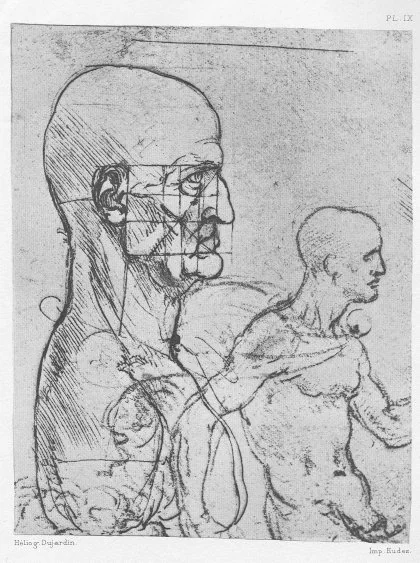
Plate IX
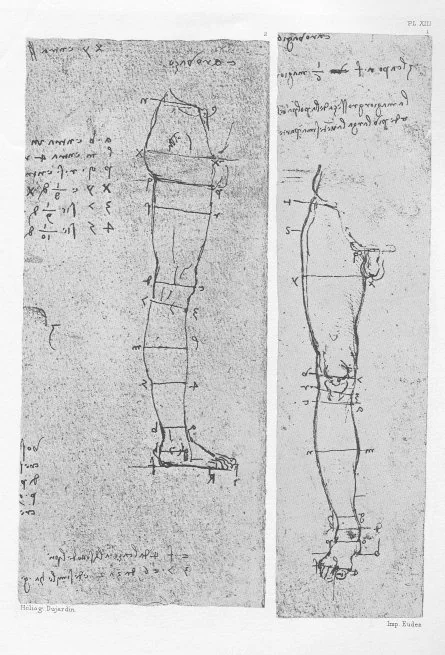
Plate XIII
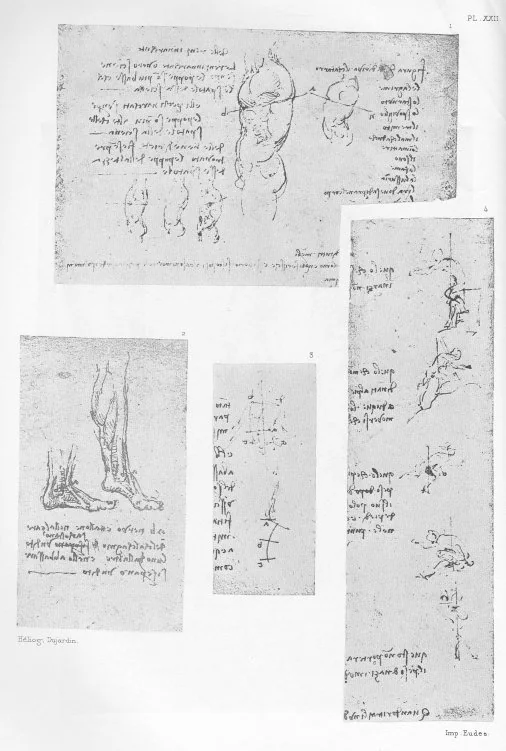
Plate XXII
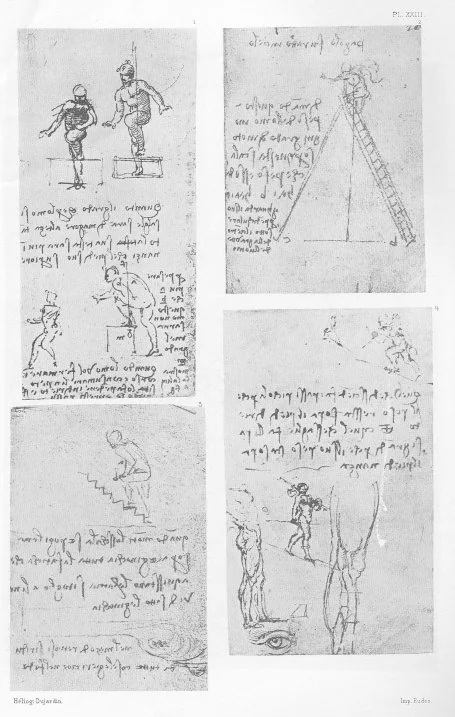
Plate XXIII
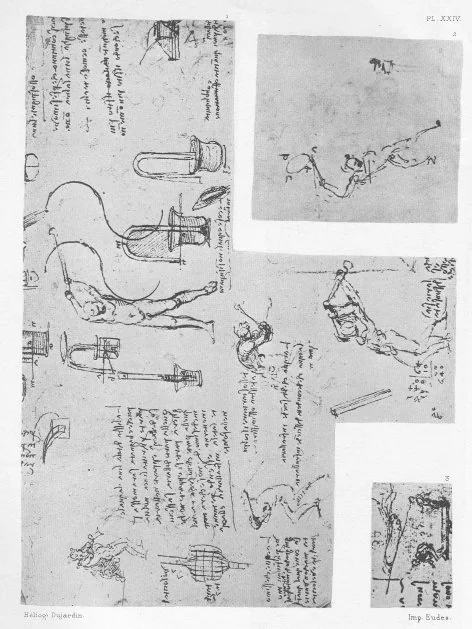
Plate XXIV
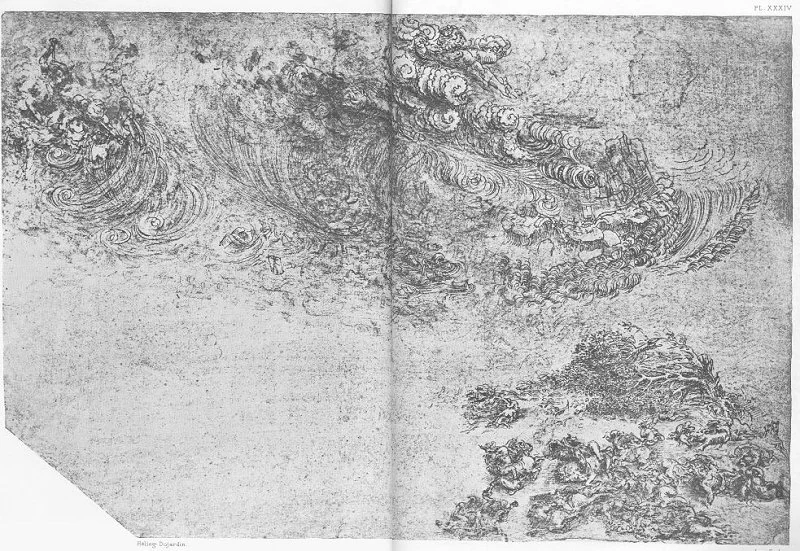
Plate XXXIV
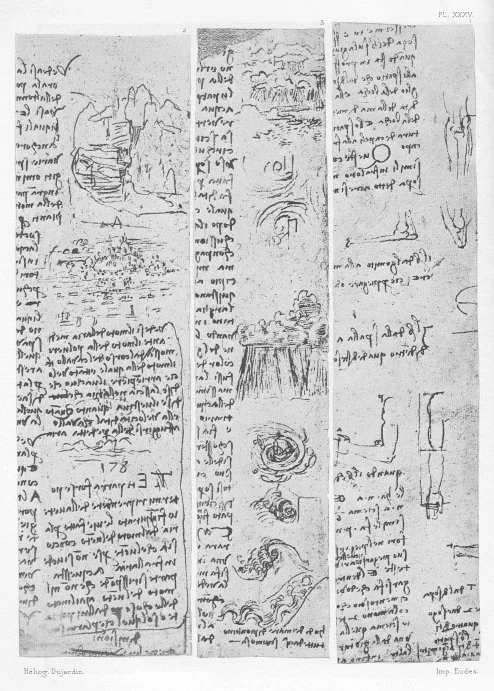
Plate XXXV
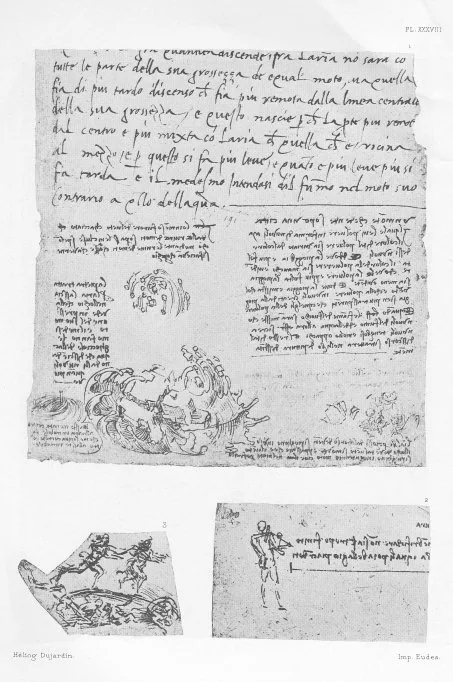
Plate XXXVIII
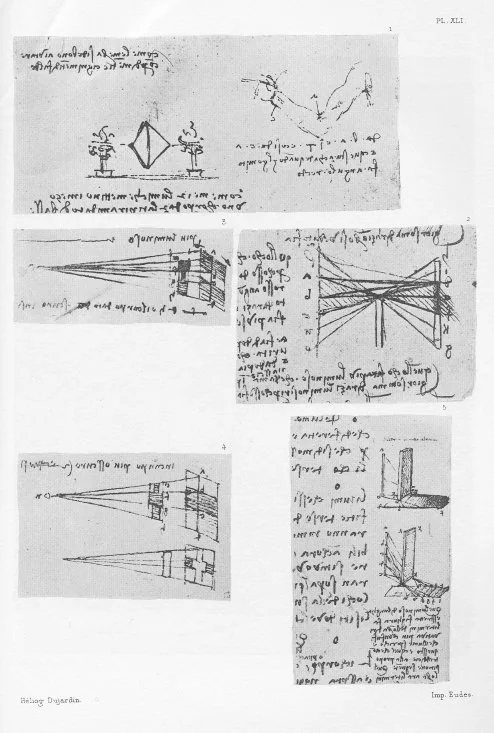
Plate XLI
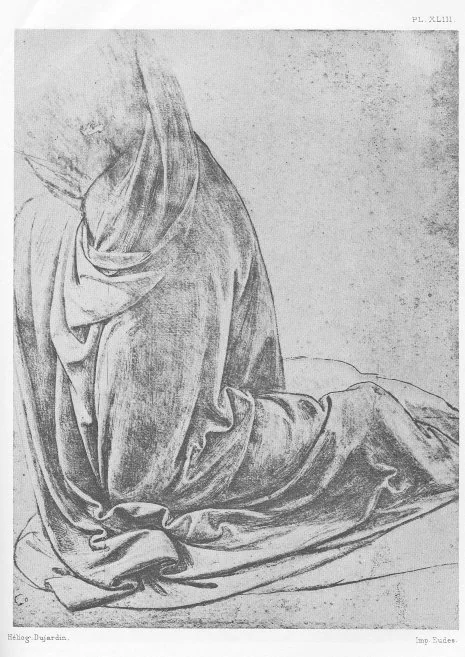
Plate XLIII
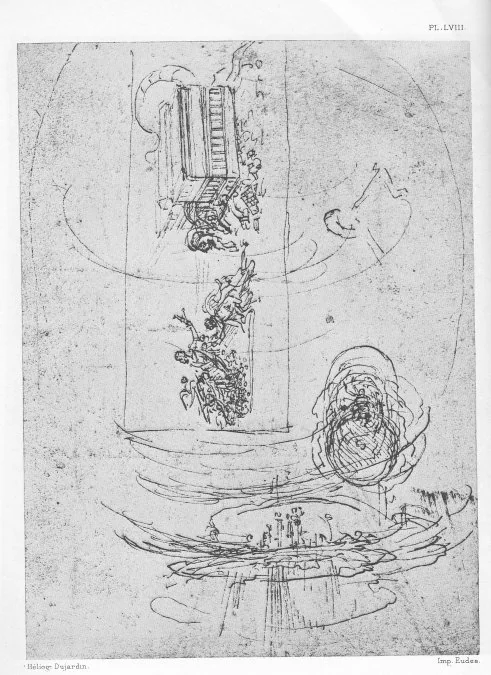
Plate LVIII
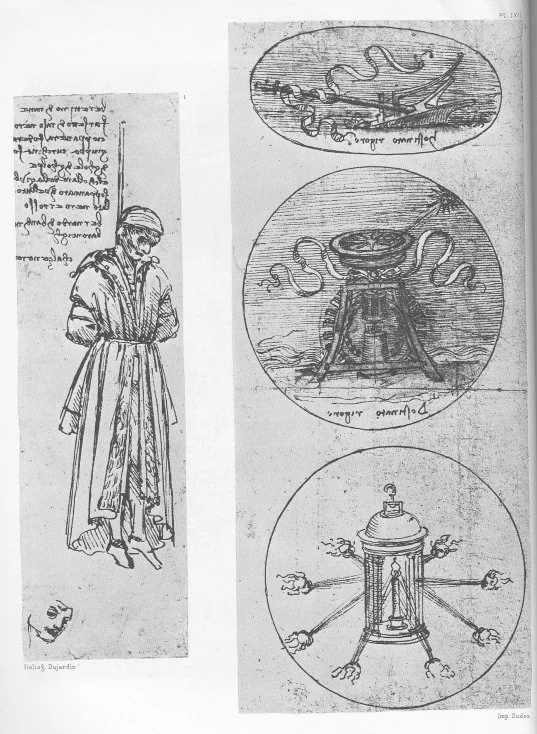
Plate LXII
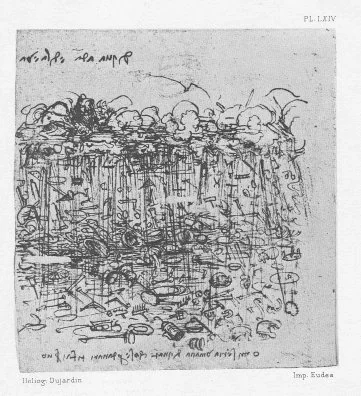
Plate LXIV
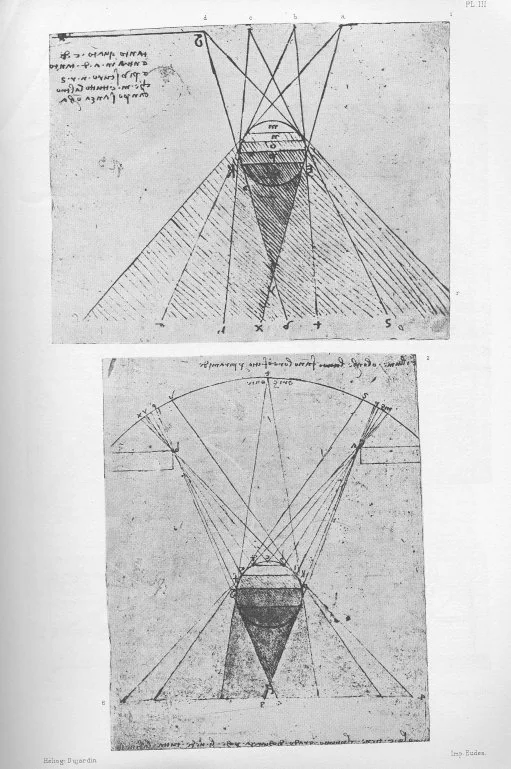
Plate III
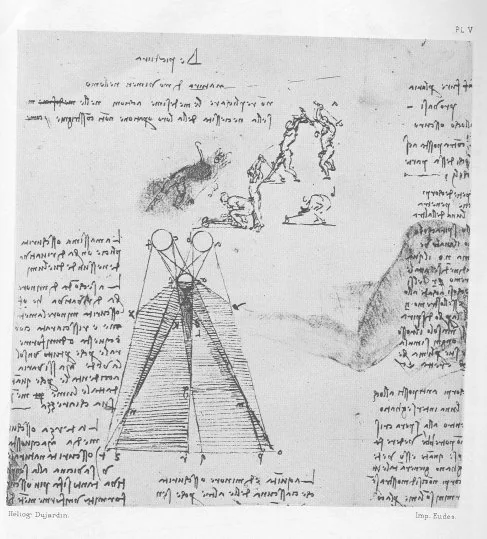
Plate V
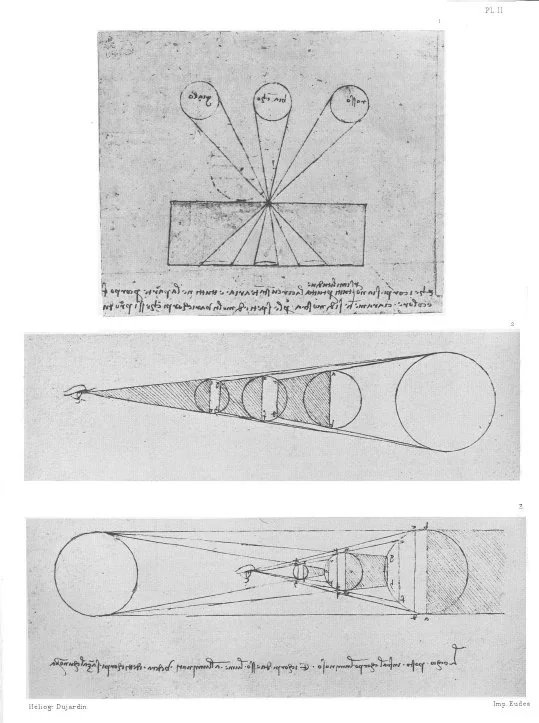
Plate II
The Notebooks of Leonardo Da Vinci, part 4 of 4. 1883. Hermetic Cloud, https://hermeticcloud.com/library/richter-the-notebooks-of-leonardo-da-vinci-part-4/. Public-domain text reproduced in full; markup only.
The Da Vinci Notebooks at sacred-texts.com