The
Translated
By various Oriental scholars
and edited by
F. Max Müller
Vol. I
The Upanishads
Translated by F. Max Müller
In two parts
Part I
Oxford, the Clarendon Press
[1879]
TOTHE RIGHT HONOURABLE THE MARQUIS OF SALISBURY, KG.
CHANCELLOR OF THE UNIVERSITY OF OXFORD, LATELY SECRETARY OF STATE FOR INDIA,SIR HENRY J. S. MAINE, K.OS.I.
MEMBER OF THE COUNCIL OF INDIA, ANDTHE VERY REV. H. G. LIDDELL, DD.
DEAN OF CHRIST CHURCH,TO WHOSE KIND INTEREST AND EXERTIONS
THIS ATTEMPT TO MAKE KNOWN TO THE ENGLISH PEOPLE
THE SACRED BOOKS OF THE EAST
IS SO LARGELY INDEBTED,
I NOW DEDICATE THESE VOLUMES WITH SINCERE RESPECT AND GRATITUDE,
F. MAX MÜLLER.
'The general inclinations which are naturally implanted in my soul to some religion, it is impossible for me to shift off: but there being such a multiplicity of religions in the world, I desire now seriously to consider with my self which of them all to restrain these my general inclinations to. And the reason of this my enquiry is not, that I am in the least dissatisfied with that religion I have already embraced; but because 'tis natural for all men to have an overbearing opinion and esteem for that particular religion they are born and bred-up in. That, therefore, I may not seem biassed by the prejudice of education, I am resolved to prove and examine them all; that I may see and hold fast to that which is best ....
'Indeed there was never any religion so barbarous and diabolical, but it was preferred before all other religions whatsoever, by them that did profess it; otherwise they would not have professed it ....
'And why, say they, may not you be mistaken as well as we? Especially when there is, at least, six to one against your Christian religion; all of which think they serve God aright; and expect happiness thereby as well as you And hence it is that in my looking out for the truest religion, being conscious to my self how great an ascendant Christianity holds over me beyond the rest, as being that religion whereinto I was born and baptized, that which the supreme authority has enjoined and my parents educated me in; that which every one I meet withal highly approves of, and which I my self have, by a long continued profession, made almost natural to me: I am resolved to be more jealous and suspicious of this religion, than of the rest, and be sure not to entertain it any longer without being convinced by solid and substantial arguments, of the truth and certainty of it. That, therefore, I may make diligent and impartial enquiry into all religions and so be sure to find out the best, I shall for a time, look upon my self as one not at all interested in any particular religion whatsoever, much less in the Christian religion; but only as one who desires, in general, to serve and obey Him that made me, in a right manner, and thereby to be made partaker of that happiness my nature is capable of.'
BISHOP BEVERIDGE (1636-1707).
Private Thoughts on Religion, Part 1, Article 2.
I. The Khândogya-Upanishad
II. The Talavakâra-Upanishad
III. The Aitareya-Âranyaka
Îsâ-Upanishad
CONTENTS.
|
PAGE | |
|
PREFACE TO THE SACRED BOOKS OF THE EAST |
ix |
|
Program of a Translation of the Sacred Books of the East |
xxxix |
|
Transliteration of Oriental Alphabets |
xlviii |
|
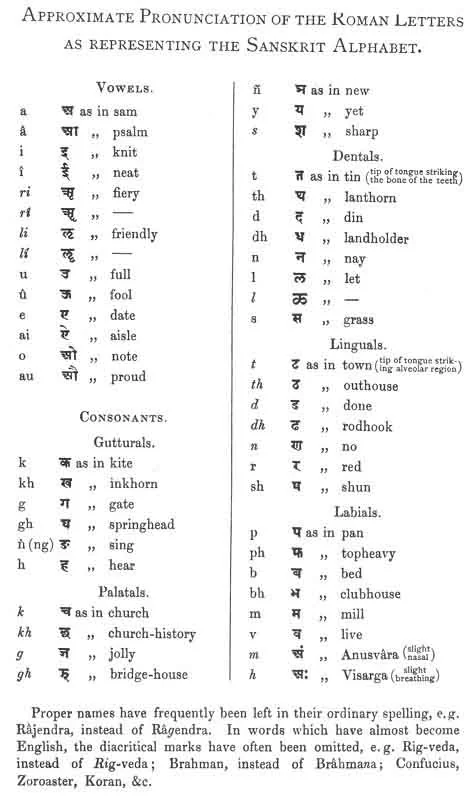
Approximate Pronunciation of the Roman Letters as representing the Sanskrit Alphabet |
lv |
|
INTRODUCTION TO THE UPANISHADS |
lvii |
|
Khândogya-upanishad |
lxxxvi |
|
Talavakâra-upanishad |
lxxxix |
|
Aitareya-âranyaka |
xci |
|
Kaushîtaki-brâhmana-upanishad |
xcviii |
|
Vâgasaneyi-samhitâ-upanishad |
c |
|
TRANSLATION OF THE KHÂNDOGYA-UPANISHAD |
1 |
|
TRANSLATION OF THE TALAVAKÂRA-UPANISHAD | |
|
TRANSLATION OF THE AITAREYA-ÂRANYAKA |
157 |
|
TRANSLATION OF THE KAUSHÎTAKI-BRÂHMANA-UPANISHAD |
271 |
|
TRANSLATION OF THE VÂGASANEYI-SAMHITÂ-UPANISHAD |
311 |
PREFACE
TO
THE SACRED BOOKS OF THE EAST.
I MUST begin this series of translations of the Sacred Books of the East with three cautions:--the first, referring to the character of the original texts here translated; the second, with regard to the difficulties in making a proper use of translations; the third, showing what is possible and what is impossible in rendering ancient thought into modern speech.
Readers who have been led to believe that the Vedas of the ancient Brahmans, the Avesta of the Zoroastrians, the Tripitaka of the Buddhists, the Kings of Confucius, or the Koran of Mohammed are books full of primeval wisdom and religious enthusiasm, or at least of sound and simple moral teaching, will be disappointed on consulting these volumes. Looking at many of the books that have lately been published on the religions of the ancient world, I do not wonder that such a belief should have been raised; but I have long felt that it was high time to dispel such illusions, and to place the study of the ancient religions of the world on a more real and sound, on a more truly historical basis. It is but natural that those who write on
ancient religions, and who have studied them from translations only, not from original documents, should have had eyes for their bright rather than for their dark sides. The former absorb all the attention of the student, the latter, as they teach nothing, seem hardly to deserve any notice. Scholars also who have devoted their life either to the editing of the original texts or to the careful interpretation of some of the sacred books, are more inclined, after they have disinterred from a heap of rubbish some solitary fragments of pure gold, to exhibit these treasures only than to display all the refuse from which they had to extract them. I do not blame them for this, perhaps I should feel that I was open to the same blame myself, for it is but natural that scholars in their joy at finding one or two fragrant fruits or flowers should gladly forget the brambles and thorns that had to be thrown aside in the course of their search.
But whether I am myself one of the guilty or not, I cannot help calling attention to the real mischief that has been done and is still being done by the enthusiasm of those pioneers who have opened the first avenues through the bewildering forest of the sacred literature of the East. They have raised expectations that cannot be fulfilled, fears also that, as will be easily seen, are unfounded. Anyhow they have removed the study of religion from that wholesome and matter-of-fact atmosphere in which alone it can produce valuable and permanent results.
The time has come when the study of the ancient religions of mankind must be approached in a different, in a less enthusiastic, and more discriminating, in fact, in a more scholarlike spirit. Not
that I object to dilettanti, if they only are what by their name they profess to be, devoted lovers, and not mere amateurs. The religions of antiquity must always be approached in a loving spirit, and the dry and cold-blooded scholar is likely to do here as much mischief as the enthusiastic sciolist. But true love does not ignore all faults and failings: on the contrary, it scans them keenly, though only in order to be able to understand, to explain, and thus to excuse them. To watch in the Sacred Books of the East the dawn of the religious consciousness of man, must always remain one of the most inspiring and hallowing sights in the whole history of the world; and he whose heart cannot quiver with the first quivering rays of human thought and human faith, as revealed in those ancient documents, is, in his own way, as unfit for these studies as, from another side, the man who shrinks from copying and collating ancient MSS., or toiling through volumes of tedious commentary. What we want here, as everywhere else, is the truth, and the whole truth; and if the whole truth must be told, it is that, however radiant the dawn of religious thought, it is not without its dark clouds, its chilling colds, its noxious vapours. Whoever does not know these, or would hide them from his own sight and from the sight of others, does not know and can never understand the real toil and travail of the human heart in its first religious aspirations; and not knowing its toil and travail, can never know the intensity of its triumphs and its joys.
In order to have a solid foundation for a comparative study of the religions of the East, we must have before all things complete and thoroughly
faithful translations of their sacred books. Extracts will no longer suffice. We do not know Germany, if we know the Rhine; nor Rome, when we have admired St. Peter's. No one who collects and publishes such extracts can resist, no one at all events, so far as I know, has ever resisted, the temptation of giving what is beautiful, or it may be what is strange and startling, and leaving out what is commonplace, tedious, or it may be repulsive, or, lastly, what is difficult to construe and to understand. We must face the problem in its completeness, and I confess it has been for many years a problem to me, aye, and to a great extent is so still, how the Sacred Books of the East should, by the side of so much that is fresh, natural, simple, beautiful, and true, contain so much that is not only unmeaning, artificial, and silly, but even hideous and repellent. This is a fact, and must be accounted for in some way or other.
To some minds this problem may seem to be no problem at all. To those (and I do not speak of Christians only) who look upon the sacred books of all religions except their own as necessarily the outcome of human or superhuman ignorance and depravity, the mixed nature of their contents may seem to be exactly what it ought to be, what they expected it would be. But there are other and more reverent minds who can feel a divine afflatus in the sacred books, not only of their own, but of other religions also, and to them the mixed character of some of the ancient sacred canons must always be extremely perplexing.
I can account for it to a certain extent, though not entirely to my own satisfaction. Most of
the ancient sacred books have been handed down by oral tradition for many generations before they were consigned to writing. In an age when there was nothing corresponding to what we call literature, every saying, every proverb, every story handed down from father to son, received very soon a kind of hallowed character. They became sacred heirlooms, sacred, because they came from an unknown source, from a distant age. There was a stage in the development of human thought, when the distance that separated the living generation from their grandfathers or great-grandfathers was as yet the nearest approach to a conception of eternity, and when the name of grandfather and great-grandfather seemed the nearest expression of God 1. Hence, what had been said by these half-human, half-divine ancestors, if it was preserved at all, was soon looked upon as a more than human utterance. It was received with reverence, it was never questioned and criticised.
Some of these ancient sayings were preserved because they were so true and so striking that they could not be forgotten. They contained eternal truths, expressed for the first time in human language. Of such oracles of truth it was said in India that they had been heard, sruta, and from it arose the word sruti, the recognised term for divine revelation in Sanskrit.
But besides those utterances which had a vitality of their own, strong enough to defy the power of
time, there were others which might have struck the minds of the listeners with great force under the peculiar circumstances that evoked them, but which, when these circumstances were forgotten, became trivial and almost unintelligible. A few verses sung by warriors on the eve of a great battle would, if that battle ended in victory, assume a charm quite independent of their poetic merit. They would be repeated in memory of the heroes who conquered, and of the gods who granted victory. But when the heroes, and the gods, and the victory were all forgotten, the song of victory and thanksgiving would often survive as a relic of the past, though almost unintelligible to later generations.
Even a single ceremonial act, performed at the time of a famine or an inundation, and apparently attended with a sudden and almost miraculous success, might often be preserved in the liturgical code of a family or a tribe with a superstitious awe entirely beyond our understanding. It might be repeated for some time on similar emergencies, till when it had failed again and again it survived only as a superstitious custom in the memory of priests and poets.
Further, it should be remembered that in ancient as in modern times, the utterances of men who had once gained a certain prestige, would often receive attention far beyond their merits, so that in many a family or tribe the sayings and teachings of one man, who had once in his youth or manhood uttered words of inspired wisdom, would all be handed down together, without any attempt to separate the grain from the chaff.
Nor must we forget that though oral tradition, when once brought under proper discipline, is a most faithful guardian, it is not without its dangers in its incipient stages. Many a word may have been misunderstood, many a sentence confused, as it was told by father to son, before it became fixed in the tradition of a village community, and then resisted by its very sacredness all attempts at emendation.
Lastly, we must remember that those who handed down the ancestral treasures of ancient wisdom, would often feel inclined to add what seemed useful to themselves, and what they knew could be preserved in one way only, namely, if it was allowed to form part of the tradition that had to be handed down, as a sacred trust, from generation to generation. The priestly influence was at work, even before there were priests by profession, and when the priesthood had once become professional, its influence may account for much that would otherwise seem inexplicable in the sacred codes of the ancient world.
These are some of the considerations which may help to explain how, mixed up with real treasures of thought, we meet in the sacred books with so many passages and whole chapters which either never had any life or meaning at all, or if they had, have, in the form in which they have come down to us, completely lost it. We must try to imagine what the Old Testament would have been, if it had not been kept distinct from the Talmud; or the New Testament, if it had been mixed up not only with the spurious gospels, but with the records of the wranglings of the early Councils, if we wish to understand, to some extent at least, the wild confusion of sublime truth
with vulgar stupidity that meets us in the pages of the Veda, the Avesta, and the Tripitaka. The idea of keeping the original and genuine tradition separate from apocryphal accretions was an idea of later growth, that could spring up only after the earlier tendency of preserving whatever could be preserved of sacred or half-sacred lore, had done its work, and wrought its own destruction.
In using, what may seem to some of my fellow-workers, this very strong and almost irreverent language with regard to the ancient Sacred Books of the East, I have not neglected to make full allowance for that very important intellectual parallax which, no doubt, renders it most difficult for a Western observer to see things and thoughts under exactly the same angle and in the same light as they would appear to an Eastern eye. There are Western expressions which offend Eastern taste as much as Eastern expressions are apt to offend Western taste. A symphony of Beethoven's would be mere noise to an Indian ear, an Indian Saṅgîta seems to us without melody, harmony, or rhythm. All this I fully admit, yet after making every allowance for national taste and traditions, I still confidently appeal to the best Oriental scholars, who have not entirely forgotten that there is a world outside the four walls of their study, whether they think that my condemnation is too severe, or that Eastern nations themselves would tolerate, in any of their classical literary compositions, such violations of the simplest rules of taste as they have accustomed themselves to tolerate, if not to admire, in their sacred books.
But then it might no doubt be objected that books of such a character hardly deserve the honour of
being translated into English, and that the sooner they are forgotten, the better. Such opinions have of late been freely expressed by some eminent writers, and supported by arguments worthy of the Khalif Omar himself. In these days of anthropological research, when no custom is too disgusting to be recorded, no rules of intermarriage too complicated to be disentangled, it may seem strange that the few genuine relics of ancient religion which, as by a miracle, have been preserved to us, should thus have been judged from a purely aesthetic, and not from an historical point of view. There was some excuse for this in the days of Sir William Jones and Colebrooke. The latter, as is well known, considered 'the Vedas as too voluminous for a complete translation of the whole,' adding that (what they contain would hardly reward the labour of the reader; much less that of the translator 1.' The former went still further in the condemnation which he pronounced on Anquetil Duperron's translation of the Zend-avesta. Sir W. Jones, we must remember, was not only a scholar, but also a man of taste, and the man of taste sometimes gained a victory over the scholar. His controversy with Anquetil Duperron, the discoverer of the Zend-avesta, is well known. It was carried on by Sir W. Jones apparently with great success, and yet in the end the victor has proved to be the vanquished. It was easy, no doubt, to pick out from Anquetil Duperron's translation of the sacred writings of Zoroaster hundreds of passages which were or seemed to be utterly unmeaning or absurd. This arose partly, but partly only, from the imperfections
of the translation. Much, however, of what Sir W. Jones represented as ridiculous, and therefore unworthy of Zoroaster, and therefore unworthy of being translated, forms an integral part of the sacred code of the Zoroastrians. Sir W. Jones smiles at those who 'think obscurity sublime and venerable, like that of ancient cloisters and temples, shedding,' as Milton expresses it, 'a dim religious light 1.' 'On possédait déjà,' he writes in his letter addressed to Anquetil Duperron, and composed in very good and sparkling French, 'plusieurs traités attribués à Zardusht ou Zeratusht, traduits en Persan moderne; de prétendues conférences de ce législateur avec Ormuzd, des prières, des dogmes, des lois religieuses. Quelques savans, qui ont lu ces traductions, nous ont assure que les originaux étaient de la plus haute antiquité, parce qu'ils renfermaient beaucoup de platitudes, de bévues, et de contradictions: mais nous avons conclu par les mêmes raisons, qu'ils étaient très-modernes, ou bien qu'ils n'étaient pas d'un homme d'esprit, et d'un philosophe, tel que Zoroastre est peint par nos historiens. Votre nouvelle traduction, Monsieur, nous confirme dans ce jugement: tout le collège des Guèbres aurait beau nous l'assurer; nous ne croirons jamais que le charlatan le moins habile ait pu écrire les fadaises dont vos deux derniers volumes sont remplis 2.' He at last sums up his argument in the following words: 'Ou Zoroastre n'avait pas le sens commun, ou il n'écrivit pas le livre que vous lui attribuez: s'il n'avait pas le sens commun, il fallait le laisser dans la foule, et dans l'obscurité; s'il n'écrivit pas
ce livre, il était impudent de le publier sous son nom. Ainsi, ou vous avez insulté le goût du public en lui présentant des sottises, ou vous l'avez trompé en lui donnant des faussetés: et de chaque côté vous méritez son mépris 1.'
This alternative holds good no longer. The sacred code of Zoroaster or of any other of the founders of religions may appear to us to be full of absurdities, or may in fact really be so, and it may yet be the duty of the scholar to publish, to translate, and carefully to examine those codes as memorials of the past, as the only trustworthy documents in which to study the growth and decay of religion. It does not answer to say that if Zoroaster was what we believe him to have been, a wise man, in our sense of the word, he could not have written the rubbish which we find in the Avesta. If we are once satisfied that the text of the Avesta, or the Veda, or the Tripitaka is old and genuine, and that this text formed the foundation on which, during many centuries, the religious belief of millions of human beings was based, it becomes our duty, both as historians and philosophers, to study these books, to try to understand how they could have arisen, and how they could have exercised for ages an influence over human beings who in all other respects were not inferior to ourselves, nay, whom we are accustomed to look up to on many points as patterns of wisdom, of virtue, and of taste.
The facts, such as they are, must be faced, if the study of the ancient religions of the world is ever to assume a really historical character; and having
myself grudged no praise to what to my mind is really beautiful or sublime in the early revelations of religious truth, I feel the less hesitation in fulfilling the duty of the true scholar, and placing before historians and philosophers accurate, complete, and unembellished versions of some of the sacred books of the East. Such versions alone will enable them to form a true and just estimate of the real development of early religious thought, so far as we can still gain a sight of it in literary records to which the highest human or even divine authority has been ascribed by the followers of the great religions of antiquity. It often requires an effort to spoil a beautiful sentence by a few words which might so easily be suppressed, but which are there in the original, and must be taken into account quite as much as the pointed ears in the beautiful Faun of the Capitol. We want to know the ancient religions such as they really were, not such as we wish they should have been. We want to know, not their wisdom only, but their folly also; and while we must learn to look up to their highest points where they seem to rise nearer to heaven than anything we were acquainted with before, we must not shrink from looking down into their stony tracts, their dark abysses, their muddy moraines, in order to comprehend both the height and the depth of the human mind in its searchings after the Infinite.
I can answer for myself and for those who have worked with me, that our translations are truthful, that we have suppressed nothing, that we have varnished nothing, however hard it seemed sometimes even to write it down.
There is only one exception. There are in ancient books,
and particularly in religious books, frequent allusions to the sexual aspects of nature, which, though perfectly harmless and innocent in themselves, cannot be rendered in modern language without the appearance of coarseness. We may regret that it should be so, but tradition is too strong on this point, and I have therefore felt obliged to leave certain passages untranslated, and to give the original, when necessary, in a note. But this has been done in extreme cases only, and many things which we should feel inclined to suppress have been left in all their outspoken simplicity, because those who want to study ancient man, must learn to study him as he really was, an animal, with all the strength and weaknesses of an animal, though an animal that was to rise above himself, and in the end discover his true self, after many struggles and many defeats.
After this first caution, which I thought was due to those who might expect to find in these volumes nothing but gems, I feel I owe another to those who may approach these translations under the impression that they have only to read them in order to gain an insight into the nature and character of the religions of mankind. There are philosophers who have accustomed themselves to look upon religions as things that can be studied as they study the manners and customs of savage tribes, by glancing at the entertaining accounts of travellers or missionaries, and. then classing each religion under such wide categories as fetishism, polytheism, monotheism, and the rest. That is not the case. Translations can do much, but they can never take the place of the originals, and if the originals require not only to be
read, but to be read again and again, translations of sacred books require to be studied with much greater care, before we can hope to gain a real understanding of the intentions of their authors or venture on general assertions.
Such general assertions, if once made, are difficult to extirpate. It has been stated, for instance, that the religious notion of sin is wanting altogether in the hymns of the Rig-veda, and some important conclusions have been based on this supposed fact. Yet the gradual growth of the concept of guilt is one of the most interesting lessons which certain passages of these ancient hymns can teach us 1. It has been asserted that in the Rig-veda Agni, fire, was adored essentially as earthly sacrificial fire, and not as an elemental force. How greatly such an assertion has to be qualified, may be seen from a more careful examination of the translations of the Vedic hymns now accessible 2. In many parts of the Avesta fire is no doubt spoken of with great reverence, but those who speak of the Zoroastrians as fire-worshippers, should know that the true followers of Zoroaster abhor that very name. Again, there are certainly many passages in the Vedic writings which prohibit the promiscuous communication of the Veda, but those who maintain that the Brahmans, like Roman Catholic priests, keep their sacred books from the people, must have for gotten
the many passages in the Brâhmanas, the Sûtras, and even in the Laws of Manu, where the duty of learning the Veda by heart is inculcated for every Brâhmana, Kshatriya, Vaisya, that is, for every man except a Sûdra.
These are a few specimens only to show how dangerous it is to generalise even where there exist complete translations of certain sacred books. It is far easier to misapprehend, or even totally to misunderstand, a translation than the original; and it should not be supposed, because a sentence or a whole chapter seems at first sight unintelligible in a translation, that therefore they are indeed devoid of all meaning.
What can be more perplexing than the beginning of the Khândogya-upanishad? 'Let a man meditate,' we read, or, as others translate it, 'Let a man worship the syllable Om.' It may seem impossible at first sight to elicit any definite meaning from these words and from much that follows after. But it would be a mistake, nevertheless, to conclude that we have here vox et præterea nihil. Meditation on the syllable Om consisted in a long continued repetition of that syllable with a view of drawing the thoughts away from all other subjects, and thus concentrating them on some higher object of thought of which that syllable was made to be the symbol. This concentration of thought, ekâgratâ or one-pointedness, as the Hindus called it, is something to us almost unknown. Our minds are like kaleidoscopes of thoughts in constant motion; and to shut our mental eyes to everything else, while dwelling on one thought only, has become to most of us almost as impossible as to apprehend one
musical note without harmonics. With the life we are leading now, with telegrams, letters, newspapers, reviews, pamphlets, and books ever breaking in upon us, it has become impossible, or almost impossible, ever to arrive at that intensity of thought which the Hindus meant by ekâgratâ, and the attainment of which was to them the indispensable condition of all philosophical and religious speculation. The loss may not be altogether on our side, yet a loss it is, and if we see the Hindus, even in their comparatively monotonous life, adopting all kinds of contrivances in order to assist them in drawing away their thoughts from all disturbing impressions and to fix them on one subject only, we must not be satisfied with smiling at their simplicity, but try to appreciate the object they had in view.
When by means of repeating the syllable Om, which originally seems to have meant 'that,' or 'yes,' they had arrived at a certain degree of mental tranquillity, the question arose what was meant by this Om, and to this question the most various answers were given, according as the mind was to be led up to higher and higher objects. Thus in one passage we are told at first that Om is the beginning of the Veda, or, as we have to deal with an Upanishad of the Sâma-veda, the beginning of the Sâma-veda, so that he who meditates on Om, may be supposed to be meditating on the whole of the Sâma-veda. But that is not enough. Om is said to be the essence of the Sâma-veda, which, being almost entirely taken from the Rig-veda, may itself be called the essence of the Rig-veda. And more than that. The Rig-veda stands for all speech, the Sâma-veda for all breath or life, so that Om may be conceived again as the
symbol of all speech and all life. Om thus becomes the name, not only of all our physical and mental powers, but especially of the living principle, the Prâna or spirit. This is explained by the parable in the second chapter, while in the third chapter, that spirit within us is identified with the spirit in the sun. He therefore who meditates on Om, meditates on the spirit in man as identical with the spirit in nature, or in the sun; and thus the lesson that is meant to be taught in the beginning of the Khândogya-upanishad is really this, that none of the Vedas with their sacrifices and ceremonies could ever secure the salvation of the worshipper, i.e. that sacred works, performed according to the rules of the Vedas, are of no avail in the end , but that meditation on Om alone, or that knowledge of what is meant by Om alone, can procure true salvation, or true immortality. Thus the pupil is led on step by step to what is the highest object of the Upanishads, viz. the recognition of the self in man as identical with the Highest Self or Brahman. The lessons which are to lead up to that highest conception of the universe, both subjective and objective, are no doubt mixed up with much that is superstitious and absurd; still the main object is never lost sight of. Thus, when we come to the eighth chapter, the discussion, though it begins with Om or the Udgîtha, ends with the question of the origin of the world; and though the final answer, namely, that Om means ether (âkâsa), and that ether
is the origin of all things, may still sound to us more physical than metaphysical, still the description given of ether or âkâsa, shows that more is meant by it than the physical ether, and that ether is in fact one of the earlier and less perfect names of the Infinite, of Brahman, the universal Self. This, at least, is the lesson which the Brahmans themselves read in this chapter 1; and if we look at the ancient language of the Upanishads as representing mere attempts at finding expression for what their language could hardly express as yet, we shall, I think, be less inclined to disagree with the interpretation put on those ancient oracles by the later Vedânta philosophers 2, or, at all events, we shall hesitate before we reject what is difficult to interpret, as altogether devoid of meaning.
This is but one instance to show that even behind the fantastic and whimsical phraseology of the sacred writings of the Hindus and other Eastern nations, there may be sometimes aspirations after truth which deserve careful consideration from the student of the psychological development and the historical growth of early religious thought, and that after careful sifting, treasures may be found in what at first we may feel inclined to throw away as utterly worthless.
And now I come to the third caution. Let it not be supposed that a text, three thousand years old, or, even if of more modern date, still widely distant from our own sphere of thought, can be translated in the same manner as a book
written a few years ago in French or German. Those who know French and German well enough, know how difficult, nay, how impossible it is, to render justice to certain touches of genius which the true artist knows how to give to a sentence. Many poets have translated Heine into English or Tennyson into German, many painters have copied the Madonna di San Sisto or the so-called portrait of Beatrice Cenci. But the greater the excellence of these translators, the more frank has been their avowal, that the original is beyond their reach. And what is a translation of modern German into modern English compared with a translation of ancient Sanskrit or Zend or Chinese into any modern language? It is an undertaking which, from its very nature, admits of the most partial success only, and a more intimate knowledge of the ancient language, so far from facilitating the task, of the translator, renders it only more hopeless. Modern words are round, ancient words are square, and we may as well hope to solve the quadrature of the circle, as to express adequately the ancient thoughts of the Veda in modern English.
We must not expect therefore that a translation of the sacred books of the ancients can ever be more than an approximation of our language to theirs, of our thoughts to theirs. The translator, however, if he has once gained the conviction that it is impossible to translate old thought into modern speech, without doing some violence either to the one or to the other, will hardly hesitate in his choice between two evils. He will prefer to do some violence to language rather than to misrepresent old thoughts by clothing them in words which do
not fit them. If therefore the reader finds some of these translations rather rugged, if he meets with expressions which sound foreign, with combinations of nouns and adjectives such as he has never seen before, with sentences that seem too long or too abrupt, let him feel sure that the translator has had to deal with a choice of evils, and that when the choice lay between sacrificing idiom or truth, he has chosen the smaller evil of the two. I do not claim, of course, either for myself or for my fellow-workers, that we have always sacrificed as little as was possible of truth or idiom, and that here and there a happier rendering of certain passages may not be suggested by those who come after us. I only wish to warn the reader once more not to expect too much from a translation, and to bear in mind that, easy as it might be to render word by word, it is difficult, aye, sometimes impossible, to render thought by thought.
I shall give one instance only from my own translation of the Upanishads. One of the most important words in the ancient philosophy of the Brahmans is Âtman, nom. sing. Âtmâ. It is rendered in our dictionaries by 'breath, soul, the principle of life and sensation, the individual soul, the self, the abstract individual, self, one's self, the reflexive pronoun, the natural temperament -or disposition, essence, nature, character, peculiarity, the person or the whole body, the body, the understanding, intellect, the mind, the faculty of thought and reason, the thinking faculty, the highest principle of life, Brahma, the supreme deity or soul of the universe, care, effort, pains, firmness, the Sun, fire, wind, air, a son.'
This will give classical scholars an idea of the chaotic state from which, thanks to the excellent work done by Boehtlingk, Roth, and others, Sanskrit lexicology is only just emerging. Some of the meanings here mentioned ought certainly not to be ascribed to Âtman. It never means, for instance, the understanding, nor could it ever by itself be translated by sun, fire, wind, air, pains or firmness. But after deducting such surplusage, there still remains a large variety of meanings which may, under certain circumstances, be ascribed to Âtman.
When Âtman occurs in philosophical treatises, such as the Upanishads and the Vedânta system which is based on them, it has generally been translated by soul, mind, or spirit. I tried myself to use one or other of these words, but the oftener I employed them, the more I felt their inadequacy, and was driven at last to adopt self and Self as the least liable to misunderstanding.
No doubt in many passages it sounds strange in English to use self, and in the plural selfs instead of selves; but that very strangeness is useful, for while such words as soul and mind and spirit pass over us unrealised, self and selfs will always ruffle the surface of the mind, and stir up some reflection in the reader. In English to speak even of the I and the Non-I, was till lately considered harsh; it may still be called a foreign philosophical idiom. In German the Ich and Nicht-ich have, since the time of Fichte, become recognised and almost familiar, not only as philosophical terms, but as legitimate expressions in the literary language of the day. But while the Ich with Fichte expressed the highest abstraction of personal existence, the
corresponding word in Sanskrit, the Aham or Ahaṅkâra, was always looked upon as a secondary development only and as by no means free from all purely phenomenal ingredients. Beyond the Aham or Ego, with all its accidents and limitations, such as sex, sense, language, country, and religion, the ancient sages of India perceived, from a very early time, the Âtman or the self, independent of all such accidents.
The individual âtman or self, however, was with the Brahmans a phase or phenomenal modification only of the Highest Self, and that Highest Self was to them the last point which could be reached by philosophical speculation. It was to them what in other systems of philosophy has been called by various names, τὸ ὄν, the Divine, the Absolute. The highest aim of all thought and study with the Brahman of the Upanishads was to recognise his own self as a mere limited reflection of the Highest Self, to know his self in the Highest Self, and through that knowledge to return to it, and regain his identity with it. Here to know was to be, to know the Âtman was to be the Âtman, and the reward of that highest knowledge after death was freedom from new births, or immortality.
That Highest Self which had become to the ancient Brahmans the goal of all their mental efforts, was looked upon at the same time as the starting-point of all phenomenal existence, the root of the world, the only thing that could truly be said to be, to be real and true. As the root of all that exists, the Âtman was identified with the Brahman, which in Sanskrit is both masculine and neuter, and with the Sat, which is neuter only, that which is,
or Satya, the true, the real. It alone exists in the beginning and for ever; it has no second. Whatever else is said to exist, derives its real being from the Sat. How the one Sat became many, how what we call the creation, what they call emanation (πρόοδος), constantly proceeds and returns to it, has been explained in various more or less fanciful ways by ancient prophets and poets. But what they all agree in is this, that the whole creation, the visible and invisible world, all plants, all animals, all men are due to the one Sat, are upheld by it, and will return to it.
If we translate Âtman by soul, mind, or spirit, we commit, first of all, that fundamental mistake of using words which may be predicated, in place of a word which is a subject only, and can never become a predicate. We may say in English that man possesses a soul, that a man is out of his mind, that man has or even that man is a spirit, but we could never predicate Âtman, or self, of anything else. Spirit, if it means breath or life; mind, if it means the organ of perception and conception; soul, if, like kaitanya, it means intelligence in general, all these may be predicated of the Âtman, as manifested in the phenomenal world. But they are never subjects in the sense in which the Âtman is; they have no independent being, apart from Âtman. Thus to translate the beginning of the Aitareya-upanishad, Âtmâ vâ idam eka evâgra âsît, by 'This (world) verily was before (the creation of the world) soul alone' (Röer); or, 'Originally this (universe) was indeed soul only' (Colebrooke), would give us a totally false idea. M. Regnaud in his 'Matériaux pour servir à l'histoire de la philosophie
de l'Inde' (vol. ii, p. 24) has evidently felt this, and has kept the word Âtman untranslated, 'Au commencement cet univers n'était que l'âtman.' But while in French it would seem impossible to find any equivalent for âtman, I have ventured to translate in English, as I should have done in German, 'Verily, in the beginning all this was Self, one only.'
Thus again when we read in Sanskrit, 'Know the Self by the self,' âtmânam âtmanâ pasya, tempting as it may seem, it would be entirely wrong to render it by the Greek γνῶθι σεαυτόν. The Brahman called upon his young pupil to know not himself, but his Self, that is, to know his individual self as a merely temporary reflex of the Eternal Self. Were we to translate this so-called âtmavidyâ, this self-knowledge, by knowledge of the soul, we should not be altogether wrong, but we should nevertheless lose all that distinguishes Indian from Greek thought. It may not be good English to say to know his self, still less to know our selfs, but it would be bad Sanskrit to say to know himself, to know ourselves; or, at all events, such a rendering would deprive us of the greatest advantage in the study of Indian philosophy, the opportunity of seeing in how many different ways man has tried to solve the riddles of the world and of his soul.
I have thought it best therefore to keep as close as possible to the Sanskrit original, and where I could not find an adequate term in English, I have often retained the Sanskrit word rather than use a misleading substitute in English. It is impossible, for instance, to find an English equivalent for so simple a word as Sat, τὸ ὄν. We cannot render the Greek τὸ ὄν
and τὸ μὴ ὄν by Being or Not-being, for both are abstract nouns; nor by 'the Being,' for this would almost always convey a wrong impression. In German it is easy to distinguish between das Sein, i.e. being, in the abstract, and das Seiende, τὸ ὄν. In the same way the Sanskrit sat can easily be rendered in Greek by τὸ ὄν, in German by das Seiende, but in English, unless we say 'that which is,' we are driven to retain the original Sat.
From this Sat was derived in Sanskrit Sat-ya, meaning originally 'endowed with being,' then 'true.' This is an adjective; but the same word, as a neuter, is also used in the sense of truth, as an abstract; and in translating it is very necessary always to distinguish between Satyam, the true, frequently the same as Sat, τὸ ὄν, and Satyam, truth, veracity. One example will suffice to show how much the clearness of a translation depends on the right rendering of such words as âtman, sat, and satyam.
In a dialogue between Uddâlaka and his son Svetaketu, in which the father tries to open his son's mind, and to make him see man's true relation to the Highest Self (Khândogya-upanishad VI), the father first explains how the Sat produced what we should call the three elements 1, viz. fire, water, and earth, which he calls heat, water, and food. Having produced them (VI, 2, 4), the Sat entered into them, but not with its real nature, but only with its 'living self' (VI, 3, which is a reflection (âbhâsamâtram) of the real Sat, as the sun in the water is a reflection
of the real sun. By this apparent union of the Sat with the three elements, every form (rûpa) and every name (nâman) in the world was produced; and therefore he who knows the three elements is supposed to know everything in this world, nearly in the same manner in which the Greeks imagined that through a knowledge of the elements, everything else became known (VI, 4, 7). The same three elements are shown to be also the constituent elements of man (VI, 5). Food or the earthy element is supposed to produce not only flesh, but also mind; water, not only blood, but also breath; heat, not only bone, but also speech. This is more or less fanciful; the important point, however, is this, that, from the Brahmanic point of view, breath, speech, and mind are purely elemental, or external instruments, and require the support of the living self, the gîvâtman, before they can act.
Having explained how the Sat produces progressively heat, how heat leads to water, water to earth, and how, by a peculiar mixture of the three, speech, breath, and mind are produced, the teacher afterwards shows how in death, speech returns to mind, mind to breath, breath to heat, and heat to the Sat (VI, 8, 6). This Sat, the root of everything, is called parâ devatâ, the highest deity, not in the ordinary sense of the word deity, but as expressing the highest abstraction of the human mind. We must therefore translate it by the Highest Being, in the same manner as we translate devatâ, when applied to heat, water, and earth, not by deity, but by substance or element.
The same Sat, as the root or highest essence of all material existence, is called animan, from
anu, small, subtile, infinitesimal, atom. It is an abstract word, and I have translated it by subtile essence.
The father then goes on explaining in various ways that this Sat is underlying all existence, and that we must learn to recognise it as the root, not only of all the objective, but likewise of our own subjective existence. 'Bring the fruit of a Nyagrodha tree,' he says, 'break it, and what do you find?' 'The seeds,' the son replies, 'almost infinitesimal.' 'Break one of them, and tell me what you see.' 'Nothing,' the son replies. Then the father continues: 'My son, that subtile essence which you do not see there, of that very essence this great Nyagrodha tree exists.'
After that follows this sentence: 'Etadâtmyam idam sarvam, tat satyam, sa âtmâ, tat tvam asi Svetaketu.'
This sentence has been rendered by Rajendralal Mitra in the following way: 'All this universe has the (Supreme) Deity for its life. That Deity is Truth. He is the Universal Soul. Thou art He, O Svetaketu 1.'
This translation is quite correct, as far as the words go, but I doubt whether we can connect any definite thoughts with these words. In spite of the division adopted in the text, I believe it will be necessary to join this sentence with the last words of the preceding paragraph. This is clear from the commentary, and from later paragraphs, where this sentence is repeated, VI, 9, 4, &c. The division
in the printed text (VI, 8, 6) is wrong, and VI, 8, 7 should begin with sa ya esho 'nimâ, i. e. that which is the subtile essence.
The question then is, what is further to be said about this subtile essence. I have ventured to translate the passage in the following way:
'That which is the subtile essence (the Sat, the root of everything), in it all that exists has its self, or more literally, its self-hood. It is the True (not the Truth in the abstract, but that which truly and really exists). It is the Self, i. e. the Sat is what is called the Self of everything 1.' Lastly, he sums up, and tells Svetaketu that, not only the whole world, but he too himself is that Self, that Satya, that Sat.
No doubt this translation sounds strange to English ears, but as the thoughts contained in the Upanishads are strange, it would be wrong to smoothe down their strangeness by clothing them in language familiar to us, which, because it is familiar, will fail to startle us, and because it fails to startle us, will fail also to set us thinking.
To know oneself to be the Sat, to know that all that is real and eternal in us is the Sat, that all came from it and will, through knowledge, return to it, requires an independent effort of speculative thought. We must realise, as well as we can, the thoughts of the ancient Rishis, before we can hope to translate them. It is not enough simply to read the half-religious, half-philosophical utterances which we find in
the Sacred Books of the East, and to say that they are strange, or obscure, or mystic. Plato is strange, till we know him; Berkeley is mystic, till for a time we have identified ourselves with him. So it is with these ancient sages, who have become the founders of the great religions of antiquity. They can never be judged from without, they must be judged from within. We need not become Brahmans or Buddhists or Taosze altogether, but we must for a time, if we wish to understand, and still more, if we are bold enough to undertake to translate their doctrines. Whoever shrinks from that effort, will see hardly anything in these sacred books or their translations but matter to wonder at or to laugh at; possibly something to make him thankful that he is not as other men. But to the patient reader these same books will, in spite of many drawbacks, open a new view of the history of the human race, of that one race to which we all belong, with all the fibres of our flesh, with all the fears and hopes of our soul. We cannot separate ourselves from those who believed in these sacred books. There is no specific difference between ourselves and the Brahmans, the Buddhists, the Zoroastrians, or the Taosze. Our powers of perceiving, of reasoning, and of believing may be more highly developed, but we cannot claim the possession of any verifying power or of any power of belief which they did not possess as well. Shall we say then that they were forsaken of God, while we are His chosen people? God forbid! There is much, no doubt, in their sacred books which we should tolerate no longer, though we must not forget that there are portions in our own sacred books, too, which many of us would wish to be absent,
which, from the earliest ages of Christianity, have been regretted by theologians of undoubted piety, and which often prove a stumbling block to those who have been won over by our missionaries to the simple faith of Christ. But that is not the question. The question is, whether there is or whether there is not, hidden in every one of the sacred books, something that could lift up the human heart from this earth to a higher world, something that could make man feel the omnipresence of a higher Power, something that could make him shrink from evil and incline to good, something to sustain him in the short journey through life, with its bright moments of happiness, and its long hours of terrible distress.
If some of those who read and mark these translations learn how to discover some such precious grains in the sacred books of other nations, though hidden under heaps of rubbish, our labour will not have been in vain, for there is no lesson which at the present time seems more important than to learn that in every religion there are such precious grains; that we must draw in every religion a broad distinction between what is essential and what is not, between the eternal and the temporary, between the divine and the human; and that though the non-essential may fill many volumes, the essential can often be comprehended in a few words, but words on which 'hang all the law and the prophets.'
Footnotes
xiii:1 Bishop Callaway, Unkulunkulu, or the Tradition of Creation, as existing among the Amazulu and other tribes of South Africa, p. 7.
xvii:1 Colebrooke's Miscellaneous Essays, 1873, vol. ii, p. 102.
xviii:1 Sir W. Jones's Works, vol. iv, p. 113.
xviii:2 Ib., vol. x, p. 408.
xix:1 Works, vol. x, p.437.
xxii:1 M. M., History of Ancient Sanskrit Literature, second edition, 1859, p.540 seq.
xxii:2 Ludwig, Rig-veda, übersetzt, vol. iii, p. 331 seq. Muir, Sanskrit Texts, vol. v, p. 199 seq. On the later growth of Agni, see a very useful essay by Holtzmann, 'Agni, nach den Vorstellungen des Mahâbhârata,' 1878.
xxvi:1 The Upanishad itself says: 'The Brahman is the same as the ether which is around us; and the ether which is around us, is the same as the ether which is within us. And the ether which is within, that is the ether within the heart. That ether in the heart is omnipresent and unchanging. He who knows this obtains omnipresent and unchangeable happiness.' Kh. Up. III, 12, 7-9.
xxvi:2 Cf. Vedânta-sûtras I, 1, 22.
xxxiii:1 Devatâs, literally deities, but frequently to be translated by powers or beings. Mahadeva Moreshvar Kunte, the learned editor of the Vedânta-sûtras, ought not (p. 70) to have rendered devâta, in Kh. Up. I, 11, 5, by goddess.
xxxv:1 Anquetil Duperron translates: 'Ipso hoc modo (ens) illud est subtile: et hoc omne, unus âtma est: et id verum et rectum est, O Sopatkit, tatoumes, id est, ille âtma tu as.'
xxxvi:1 The change of gender in sa for tad is idiomatic. One could not say in Sanskrit tad âtmâ, it is the Self, but sa âtmâ. By sa, he, the Sat, that which is, is meant. The commentary explains sa âtmâ by tat sat, and continues tat sat tat tvam asi (p.443).
PROGRAM OF A TRANSLATION
OFTHE SACRED BOOKS OF THE EAST.
I here subjoin the program in which I first put forward the idea of a translation of the Sacred Books of the East, and through which I invited the co-operation of Oriental scholars in this undertaking. The difficulty of finding translators, both willing and competent to take a part in it, proved far greater than I had anticipated. Even when I had secured the assistance of a number of excellent scholars, and had received their promises of prompt co-operation, illness, domestic affliction, and even death asserted their control over all human affairs. Professor Childers, who had shown the warmest interest in our work, and on whom I chiefly depended for the Pali literature of the Buddhists, was taken from us, an irreparable loss to Oriental scholarship in general, and to our undertaking in particular. Among native scholars, whose co-operation I had been particularly desired to secure, Rajendralal Mitra, who had promised a translation of the Vâyu-purâna, was prevented by serious illness from fulfilling his engagement. In other cases sorrow and sickness have caused, at all events, serious delay in the translation of the very books which were to have inaugurated this Series. However, new offers of assistance have come, and I hope that more may still come from Oriental scholars both in India and England, so that the limit of time which had been originally
assigned to the publication of twenty-four volumes may not, I hope, be much exceeded.
THE SACRED BOOKS OF THE EAST, TRANSLATED, WITH INTRODUCTIONS AND NOTES, BY VARIOUS ORIENTAL SCHOLARS, AND EDITED BY F. MAX MULLER.Apart from the interest which the Sacred Books of all religions possess in the eyes of the theologian, and, more particularly, of the missionary, to whom an accurate knowledge of them is as indispensable as a knowledge of the enemy's country is to a general, these works have of late assumed a new importance, as viewed in the character of ancient historical documents. In every country where Sacred Books have been preserved, whether by oral tradition or by writing, they are the oldest records, and mark the beginning of what may be called documentary, in opposition to purely traditional, history.
There is nothing more ancient in India than the Vedas; and, if we except the Vedas and the literature connected with them, there is again no literary work in India which, so far as we know at present, can with certainty be referred to an earlier date than that of the Sacred Canon of the Buddhists. Whatever age we may assign to the various portions of the Avesta and to their final arrangement, there is no book in the Persian language of greater antiquity than the Sacred Books of the followers of Zarathustra, nay, even than their translation in Pehlevi. There may have been an extensive ancient literature in China long before Khung-fû-ʓze and Lâo-ʓze, but among all that was rescued and preserved of it, the five King and the four Shû claim again the highest antiquity. As to the Koran, it is known to be the fountain-head both of the religion and of the literature of the Arabs.
This being the case, it was but natural that the attention of the historian should of late have been more strongly attracted by these Sacred Books, as likely to afford most valuable information, not only on the religion, but also on the moral sentiments, the social institutions, the legal maxims of some of the most important nations of antiquity. There are not many nations that have preserved sacred writings, and many of those that have been preserved have but lately become accessible to us in their original form, through the rapid advance of Oriental scholarship in Europe. Neither Greeks, nor Romans, nor Germans, nor Celts, nor Slaves have left us anything that deserves the name of Sacred Books. The
Homeric Poems are national Epics, like the Râmâyana, and the Nibelunge, and the Homeric Hymns have never received that general recognition or sanction which alone can impart to the poetical effusions of personal piety the sacred or canonical character which is the distinguishing feature of the Vedic Hymns. The sacred literature of the early inhabitants of Italy seems to have been of a liturgical rather than of a purely religious kind, and whatever the Celts, the Germans, the Slaves may have possessed of sacred traditions about their gods and heroes, having been handed down by oral tradition chiefly, has perished beyond all hope of recovery. Some portions of the Eddas alone give us an idea of what the religious and heroic poetry of the Scandinavians may have been. The Egyptians possessed Sacred Books, and some of them, such as the Book of the Dead, have come down to us in various forms. There is a translation of the Book of the Dead by Dr. Birch, published in the fifth volume of Bunsen's Egypt, and a new edition and translation of this important work may be expected from the combined labours of Birch, Chabas, Lepsius, and Naville, In Babylon and Assyria, too, important fragments of what may be called a Sacred Literature have lately come to light. The interpretation, however, of these Hieroglyphic and Cuneiform texts is as yet so difficult that, for the present, they are of interest to the scholar only, and hardly available for historical purposes.
Leaving out of consideration the Jewish and Christian Scriptures, it appears that the only great and original religions which profess to be founded on Sacred Books 1, and have preserved them in manuscript, are:--
1. The religion of the Brahmans.
2. The religion of the followers of Buddha.
3. The religion of the followers of Zarathustra.
4. The religion of the followers of Khung-fû-ʓze.
5. The religion of the followers of Lâo-ʓze.
6. The religion of the followers of Mohammed.
A desire for a trustworthy translation of the Sacred Books of these six Eastern religions has often been expressed. Several have been translated into English, French, German, or Latin, but in some cases these translations are difficult to procure, in others they are loaded with notes and commentaries, which are intended for
students by profession only. Oriental scholars have been blamed for not having as yet supplied a want so generally felt, and so frequently expressed, as a complete, trustworthy, and readable translation of the principal Sacred Books of the Eastern Religions. The reasons, however, why hitherto they have shrunk from such an undertaking are clear enough. The difficulties in many cases of giving complete translations, and not selections only, are very great. There is still much work to be done in a critical restoration of the original texts, in an examination of their grammar and metres, and in determining the exact meaning of many words and passages. That kind of work is naturally far more attractive to scholars than a mere translation, particularly when they cannot but feel that, with the progress of our knowledge, many a passage which now seems clear and easy, may, on being re-examined, assume a new import. Thus while scholars who are most competent to undertake a translation, prefer to devote their time to more special researches, the work of a complete translation is deferred to the future, and historians are left under the impression that Oriental scholarship is still in so unsatisfactory a state as to make any reliance on translations of the Veda, the Avesta, or the Tâo-te King extremely hazardous.
It is clear, therefore, that a translation of the principal Sacred Books of the East can be carried out only at a certain sacrifice. Scholars must leave for a time their own special researches in order to render the general results already obtained accessible to the public at large. And even then, really useful results can be achieved viribus unitis only. If four of the best Egyptologists have to combine in order to produce a satisfactory edition and translation of one of the Sacred Books of ancient Egypt, a much larger number of Oriental scholars will be required for translating the Sacred Books of the Brahmans, the Buddhists, the Zoroastrians, the followers of Khung-fû-ʓze, Lâo-ʓze, and Mohammed.
Lastly, there was the most serious difficulty of all, a difficulty which no scholar could remove, viz. the difficulty of finding the funds necessary for carrying out so large an undertaking. No doubt there exists at present a very keen interest in questions connected with the origin, the growth, and decay of religion. But much of that interest is theoretic rather than historical. How people might or could or should have elaborated religious ideas, is a topic most warmly discussed among psychologists and theologians, but a study of the documents, in which alone the actual growth of religious thought can be traced, is much neglected.
A faithful, unvarnished prose translation of the Sacred Books of India, Persia, China, and Arabia, though it may interest careful students, will never, I fear, excite a widespread interest, or command a circulation large enough to make it a matter of private enterprise and commercial speculation.
No doubt there is much in these old books that is startling by its very simplicity and truth, much that is elevated and elevating, much that is beautiful and sublime; but people who have vague ideas of primeval wisdom and the splendour of Eastern poetry will soon find themselves grievously disappointed. It cannot be too strongly stated, that the chief, and, in many cases, the only interest of the Sacred Books of the East is historical; that much in them is extremely childish, tedious, if not repulsive; and that no one but the historian will be able to understand the important lessons which they teach. It would have been impossible to undertake a translation even of the most important only of the Sacred Books of the East, without the support of an Academy or a University which recognises the necessity of rendering these works more generally accessible, on the same grounds on which it recognises the duty of collecting and exhibiting in Museums the petrifactions of bygone ages, little concerned whether the public admires the beauty of fossilised plants and broken skeletons, as long as hard-working students find there some light for reading once more the darker pages in the history of the earth.
Having been so fortunate as to secure that support, having also received promises of assistance from some of the best Oriental scholars in England and India, I hope I shall be able, after the necessary preparations are completed, to publish about three volumes of translations every year, selecting from the stores of the six so-called 'Book-religions' those works which at present can be translated, and which are most likely to prove useful. All translations will be made from the original texts, and where good translations exist already, they will be carefully revised by competent scholars. Such is the bulk of the religious literature of the Brahmans and the Buddhists, that to attempt a complete translation would be far beyond the powers of one generation of scholars. Still, if the interest in the work itself should continue, there is no reason why this series of translations should not be carried on, even after those who commenced it shall have ceased from their labours.
What I contemplate at present and I am afraid at my time of life even this may seem too sanguine, is no more than a Series
of twenty-four volumes, the publication of which will probably extend over eight years. In this Series I hope to comprehend the following books, though I do not pledge myself to adhere strictly to this outline:--
1. From among the Sacred Books of the Brahmans I hope to give a translation of the Hymns of the Rig-veda. While I shall continue my translation of selected hymns of that Veda, a traduction raisonnée which is intended for Sanskrit scholars only, on the same principles which I have followed in the first volume 1, explaining every word and sentence that seems to require elucidation, and carefully examining the opinions of previous commentators, both native and European, I intend to contribute a freer translation of the hymns to this Series, with a few explanatory notes only, such as are absolutely necessary to enable readers who are unacquainted with Sanskrit to understand the thoughts of the Vedic poets. The translation of perhaps another Samhitâ, one or two of the Brâhmanas, or portions of them, will have to be included in our Series, as well as the principal Upanishads, theosophic treatises of great interest and beauty. There is every prospect of an early appearance of a translation of the Bhagavad-gîtâ, of the most important among the sacred Law-books, and of one at least of the Purânas. I should have wished to include a translation of some of the Gain books, of the Granth of the Sikhs, and of similar works illustrative of the later developments of religion in India, but there is hardly room for them at present.
2. The Sacred Books of the Buddhists will be translated chiefly from the two original collections, the Southern in Pali, the Northern in Sanskrit. Here the selection will, no doubt, be most difficult. Among the first books to be published will be, I hope, Sûtras from the Dîgha Nikâya, a part of the Vinaya-pitaka, the Dhammapada, the Divyâvadâna, the Lalita-vistara, or legendary life of Buddha.
3. The Sacred Books of the Zoroastrians lie within a smaller compass, but they will require fuller notes and commentaries in order to make a translation intelligible and useful.
4. The books which enjoy the highest authority with the followers of Khung-fû-ʓze are the King and the Shû. Of the former the Shû King or Book of History; the Odes of the Temple and
the Altar, and other pieces illustrating the ancient religious views and practices of the Chinese, in the Shih King or Book of Poetry; the Yî King; the Lî Kî; and the Hsiâo King or Classic of Filial Piety, will all be given, it is hoped, entire. Of the latter, the Series will contain the Kung Yung or Doctrine of the Mean; the Tâ Hsio or Great Learning; all Confucius' utterances in the Lun Yü or Confucian Analects, which are of a religious nature, and refer to the principles of his moral system; and Mang-ʓze's Doctrine of the Goodness of Human Nature.
5. For the system of Lâo-ʓze we require only a translation of the Tâo-teh King with some of its commentaries, and, it may be, an authoritative work to illustrate the actual operation of its principles.
6. For Islam, all that is essential is a trustworthy translation of the Koran.
It will be my endeavour to divide the twenty-four volumes which are contemplated in this Series as equally as possible among the six religions. But much must depend on the assistance which I receive from Oriental scholars, and also on the interest and the wishes of the public.
F. MAX MÜLLER.
OXFORD, October, 1876.
The following distinguished scholars, all of them occupying the foremost rank in their own special departments of Oriental literature, are at present engaged in preparing translations of some of the Sacred Books of the East: S. Beal, R. G. Bhandarkar, G. Bühler, A. Burnell, E. B. Cowell, J. Darmesteter, T. W. Rhys Davids, J. Eggeling, V. Fausböll, H. Jacobi, J. Jolly, H. Kern, F. Kielhorn, J. Legge, H. Oldenberg, E. H. Palmer, R. Pischel, K. T. Telang, E. W. West.
The works which for the present have been selected for translation are the following:
1. ANCIENT VEDIC RELIGION.
Hymns of the Rig-veda.
The Satapatha-brâhmana.
The Upanishads.
The Grihya-sûtras of Hiranyakesin and others.
II. LAW-BOOKS IN PROSE.
The Sûtras of Âpastamba, Gautama, Baudhâyana, Vasishtha, Vishnu, &c.
III. LAW-BOOKS IN VERSE.
The Laws of Manu, Yâgñavalkya, &c.
IV. LATER BRAHMANISM.
The Bhagavad-gîtâ.
The Vâyu-purâna.
V. BUDDHISM.
1. Pali Documents.
The Mahâparinibbâna Sutta, the Tevigga Sutta, the Mahasudassana Sutta, the Dhammakakkappavattana Sutta; the Suttanipâta; the Mahâvagga, the Kullavagga, and the Pâtimokkha.
2. Sanskrit Documents.
The Divyâvadâna and Saddharmapundarîka.
3. Chinese Documents.
The Phû-yâo King, or life of Buddha.
4. Prakrit Gaina Documents.
The Âkârâṅga Sûtra, Dasavaikâlika Sûtra, Sûtrakritâṅga, and Uttarâdhyayana Sûtra.
VI. PARSI RELIGION.
1. Zend Documents.
The Vendîdâd.
2. Pehlevi and Parsi Documents.
The Bundahis, Bahman Yasht, Shâyast-lâ-shâyast, Dâdistâni Dînî, Mainyôi Khard.
VII. MOHAMMEDANISM.
The Koran.
VIII. CHINESE RELIGION.
1. Confucianism.
The Shû King, Shih King, Hsiâo King, Yî King, Lî Kî, Lun Yü, and Măng-ʓze.
2. Tâoism.
The Tâo-teh King, Kwang-ʓze, and Kan Ying Phien.
Footnotes
xli:1 Introduction to the Science of Religion, by F. Max Müller (Longmans, 1873), p.104
xliv:1 Rig-veda-sanhitâ, The Sacred Hymns of the Brahmans, translated and explained by F. Max Müller. Vol. i. Hymns to the Maruts or the Storm-Gods. London, 1869.
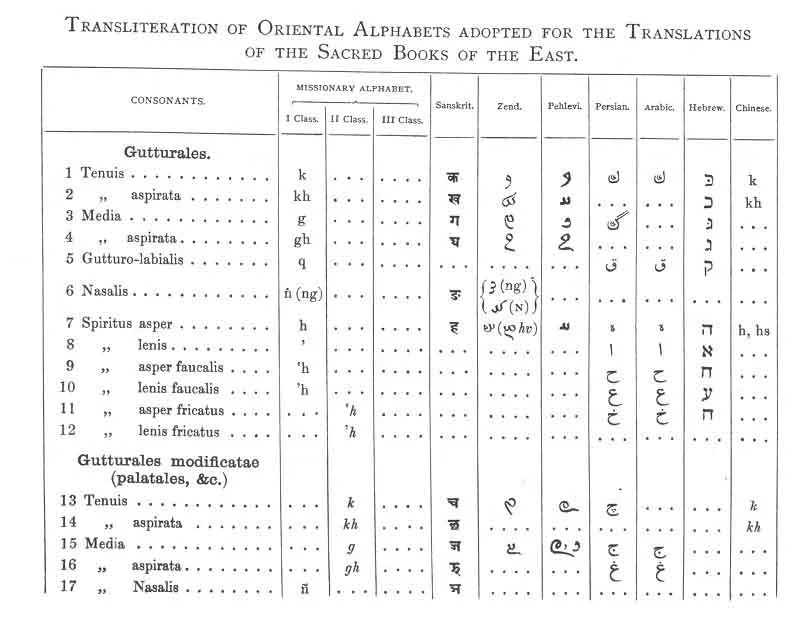
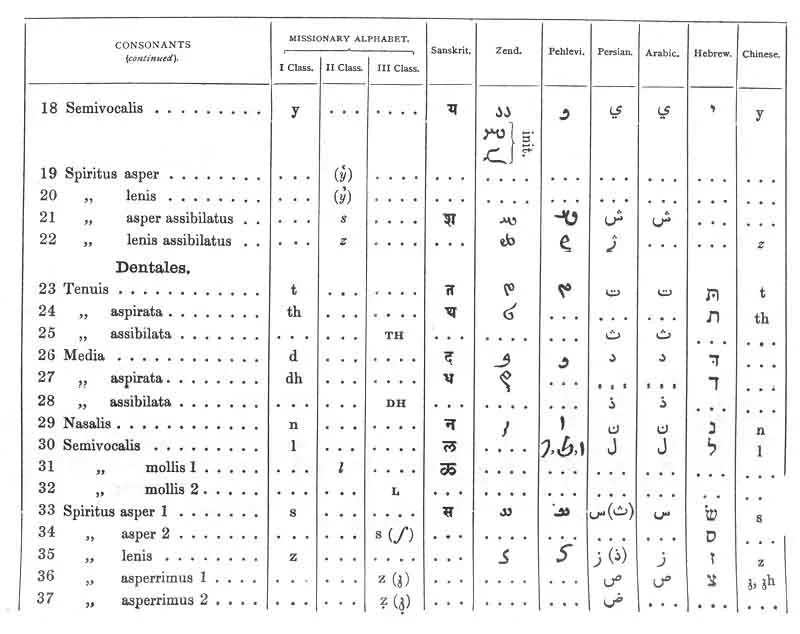
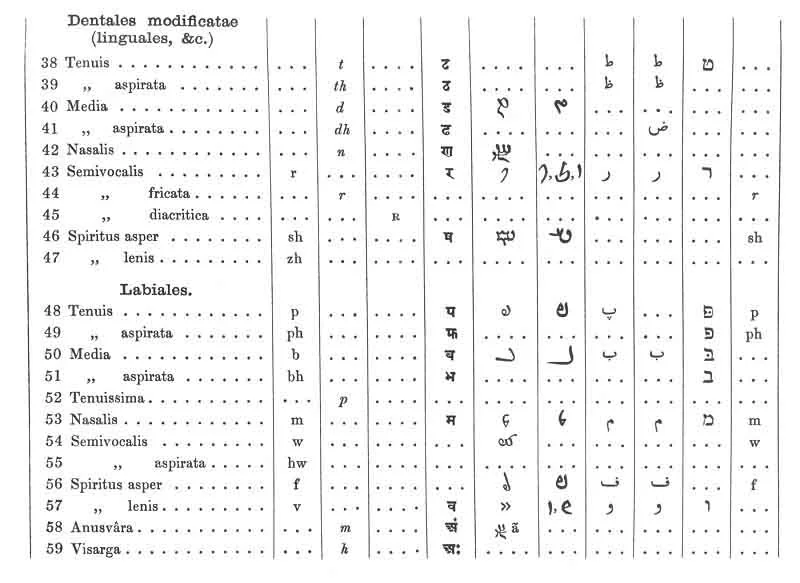
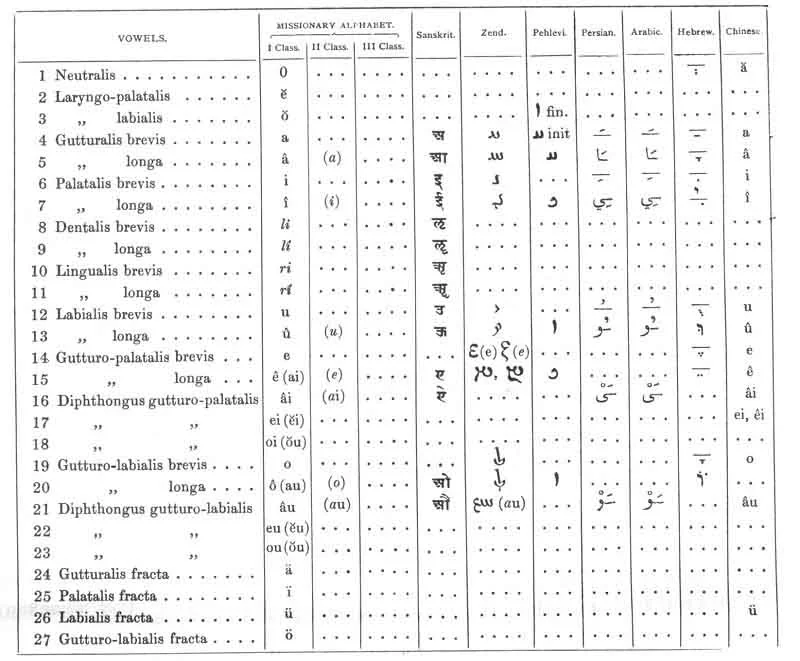
TRANSLITERATION OF ORIENTAL ALPHABETS.
The system of transcribing Oriental words with Roman types, adopted by the translators of the Sacred Books of the East, is, on the whole, the same which I first laid down in my Proposals for a Missionary Alphabet, 1854, and which afterwards I shortly described in my Lectures on the Science of Language, Second Series, p. 169 (ninth edition). That system allows of great freedom in its application to different languages, and has, therefore, recommended itself to many scholars, even if they had long been accustomed to use their own system of transliteration.
It rests in fact on a few principles only, which may be applied to individual languages according to the views which each student has formed for himself of the character and the pronunciation of the vowels and consonants of any given alphabet.
It does not differ essentially from the Standard Alphabet proposed by Professor Lepsius. It only endeavours to realise, by means of the ordinary types which are found in every printing office, what my learned friend has been enabled to achieve, it may be in a more perfect manner, by means of a number of new types with diacritical marks, cast expressly for him by the Berlin Academy.
The general principles of what, on account of its easy application to all languages, I have called the Missionary Alphabet, are these:
1. No letters are to be used which do not exist in ordinary founts.
2. The same Roman type is always to represent the same foreign letter, and the same foreign letter is always to be represented by the same Roman type.
3. Simple letters are, as a rule, to be represented by simple, compound by compound types.
4. It is not attempted to indicate the pronunciation of foreign languages, but only to represent foreign letters by Roman types, leaving the pronunciation to be learnt, as it is now, from grammars or from conversation with natives.
5. The foundation of every system of transliteration must consist of a classification of the typical sounds of human speech. Such classification may be more or less perfect, more or less minute, according to the objects in view. For ordinary purposes the classification in vowels and consonants, and of consonants again in gutturals, dentals, and labials suffices. In these three classes we distinguish hard (not-voiced) and sonant (voiced) consonants, each being liable to aspiration; nasals, sibilants, and semivowels, some of these also, being either voiced or not-voiced.
6. After having settled the typical sounds, we assign to them, as much as possible, the ordinary Roman types of the first class.
7. We then arrange in every language which possesses a richer alphabet, all remaining letters, according to their affinities, as modifications of the nearest typical letters, or as letters of the second and third class. Thus linguals in Sanskrit are treated as nearest to dentals, palatals to gutturals.
8. The manner of expressing such modifications is uniform throughout. While all typical letters of
the first class are expressed by Roman types, modified letters of the second class are expressed by italics, modified letters of the third class by small capitals. Only in extreme cases, where another class of modified types is wanted, are we compelled to have recourse either to diacritical marks, or to a different fount of types.
9. Which letters in each language are to be considered as primary, secondary, or tertiary may, to a certain extent, be left to the discretion of individual scholars.
10. As it has been found quite impossible to devise any practical alphabet that should accurately represent the pronunciation of words, the Missionary Alphabet, by not attempting to indicate minute shades of pronunciation, has at all events the advantage of not misleading readers in their pronunciation of foreign words. An italic t, for instance, or a small capital T, serves simply as a warning that this is not the ordinary t, though it has some affinity with it. How it is to be pronounced must be learnt for each language, as it now is, from a grammar or otherwise. Thus t in Sanskrit is the lingual t. How that is to be pronounced, we must learn from the Prâtisâkhvas, or from the mouth of a highly educated Srotriya. We shall then learn that its pronunciation is really that of what we call the ordinary dental t, as in town, while the ordinary dental t in Sanskrit has a pronunciation of its own, extremely difficult to acquire for Europeans.
11. Words or sentences which used to be printed in italics are spaced.
INTRODUCTION
TO
THE UPANISHADS.
FIRST TRANSLATION OF THE UPANISHADS. DÂRÂ SHUKOH, ANQUETIL DUPERRON, SCHOPENHAUER.THE ancient Vedic literature, the foundation of the whole literature of India, which has been handed down in that country in an unbroken succession from the earliest times within the recollection of man to the present day, became known for the first time beyond the frontiers of India through the Upanishads. The Upanishads were translated from Sanskrit into Persian by, or, it may be, for Dârâ Shukoh, the eldest son of Shâh Jehân, an enlightened prince, who openly professed the liberal religious tenets of the great Emperor Akbar, and even wrote a book intended to reconcile the religious doctrines of Hindus and Mohammedans. He seems first to have heard of the Upanishads during his stay in Kashmir in 1640. He afterwards invited several Pandits from Benares to Delhi, who were to assist him in the work of translation. The translation was finished in 1657. Three years after the accomplishment of this work, in 1659, the prince was put to death by his brother Aurangzib 1, in reality, no doubt, because he was the eldest son and legitimate successor of Shâh Jehân, but under the pretext that he was an infidel, and dangerous to the established religion of the empire.
When the Upanishads had once been translated from Sanskrit into Persian, at that time the most widely read language of the East and understood likewise by many European scholars, they became generally accessible to
all who took an interest in the religious literature of India. It is true that under Akbar's reign (1556-1586) similar translations had been prepared 1, but neither those nor the translations of Dârâ Shukoh attracted the attention of European scholars till the year 1775. In that year Anquetil Duperron, the famous traveller and discoverer of the Zend-avesta, received one MS. of the Persian translation of the Upanishads, sent to him by M. Gentil, the French resident at the court of Shuja ud daula, and brought to France by M. Bernier. After receiving another MS., Anquetil Duperron collated the two, and translated the Persian translation 2 into French (not published), and into Latin. That Latin translation was published in 1801 and 1802, under the title of 'Oupnek'hat, id est, Secretum tegendum: opus ipsa in India rarissimum, continens antiquam et arcanam, seu theologicam et philosophicam doctrinam, e quatuor sacris Indorum libris Rak baid, Djedjer baid, Sam baid, Athrban baid excerptam; ad verbum, e Persico idiomate, Samkreticis vocabulis intermixto, in Latinum conversum: Dissertationibus et Annotationibus difficiliora explanantibus, illustratum: studio et opera Anquetil Duperron, Indicopleustæ. Argentorati, typis et impensis fratrum Levrault, vol. i, 1801; vol. ii, 1802 3.'
This translation, though it attracted considerable interest among scholars, was written in so utterly unintelligible a style, that it required the lynxlike perspicacity of an intrepid
philosopher, such as Schopenhauer, to discover a thread through such a labyrinth. Schopenhauer, however, not only found and followed such a thread, but he had the courage to proclaim to an incredulous age the vast treasures of thought which were lying buried beneath that fearful jargon.
As Anquetil Duperron's volumes have become scarce, I shall here give a short specimen of his translation, which corresponds to the first sentences of my translation of the Khândogya-upanishad (p. 1):--'Oum hoc verbum (esse) adkit ut sciveris, sic τὸ maschghouli fac (de co meditare), quod ipsum hoc verbum aodkit est; propter illud quod hoc (verbum) oum, in Sam Beid, cum voce altâ, cum harmoniâ pronunciatum fiat.
'Adkiteh porro cremor (optimum, selectissimum) est: quemadmodum ex (præ) omni quieto (non moto), et moto, pulvis (terra) cremor (optimum) est; et e (præ) terra aqua cremor est; et ex aqua, comedendum (victus) cremor est; (et) e comedendo, comedens cremor est; et e comedente, loquela (id quod dicitur) cremor est; et e loquela, aïet τοῦ Beid, et ex aïet, τὸ siam, id est, cum harmonia (pronunciatum); et e Sam, τὸ adkit, cremor est; id est, oum, voce alta, cum harmonia pronunciare, aokit, cremor cremorum (optimum optimorum) est. Major, ex (præ) adkit, cremor alter non est.'
Schopenhauer not only read this translation carefully, but he makes no secret of it, that his own philosophy is powerfully impregnated by the fundamental doctrines of the Upanishads. He dwells on it again and again, and it seems both fair to Schopenhauer's memory and highly important for a true appreciation of the philosophical value of the Upanishads, to put together what that vigorous thinker has written on those ancient rhapsodies of truth.
In his 'Welt als Wille und Vorstellung,' he writes, in the preface to the first edition, p. xiii:
'If the reader has also received the benefit of the Vedas, the access to which by means of the Upanishads is in my eyes the greatest privilege which this still young century (1818) may claim before all previous centuries, (for I anticipate that the influence of Sanskrit literature will not be less profound
than the revival of Greek in the fourteenth century,)--if then the reader, I say, has received his initiation in primeval Indian wisdom, and received it with an open heart, he will be prepared in the very best way for hearing what I have to tell him. It will not sound to him strange, as to many others, much less disagreeable; for I might, if it did not sound conceited, contend that every one of the detached statements which constitute the Upanishads, may be deduced as a necessary result from the fundamental thoughts which I have to enunciate, though those deductions themselves are by no means to be found there.'
And again 1:
'If I consider how difficult it is, even with the assistance of the best and carefully educated teachers, and with all the excellent philological appliances collected in the course of this century, to arrive at a really correct, accurate, and living understanding of Greek and Roman authors, whose language was after all the language of our own predecessors in Europe, and the mother of our own, while Sanskrit, on the contrary, was spoken thousands of years ago in distant India, and can be learnt only with appliances which are as yet very imperfect;--if I add to this the impression which the translations of Sanskrit works by European scholars, with very few exceptions, produce on my mind, I cannot resist a certain suspicion that our Sanskrit scholars do not understand their texts much better than the higher class of schoolboys their Greek. Of course, as they are not boys, but men of knowledge and understanding, they put together, out of what they do understand, something like what the general meaning may have been, but much probably creeps in ex ingenio. It is still worse with the Chinese of our European Sinologues.
'If then I consider, on the other hand, that Sultan Mohammed Dârâ Shukoh, the brother of Aurangzib, was born and bred in India, was a learned, thoughtful, and enquiring man, and therefore probably understood his Sanskrit about as well as we our Latin, that moreover
he was assisted by a number of the most learned Pandits, all this together gives me at once a very high opinion of his translation of the Vedic Upanishads into Persian. If, besides this, I see with what profound and quite appropriate reverence Anquetil Duperron has treated that Persian translation, rendering it in Latin word by word, retaining, in spite of Latin grammar, the Persian syntax, and all the Sanskrit words which the Sultan himself had left untranslated, though explaining them in a glossary, I feel the most perfect confidence in reading that translation, and that confidence soon receives its most perfect justification. For how entirely does the Oupnekhat breathe throughout the holy spirit of the Vedas! How is every one who by a diligent study of its Persian Latin has become familiar with that incomparable book, stirred by that spirit to the very depth of his soul! How does every line display its firm, definite, and throughout harmonious meaning! From every sentence deep, original, and sublime thoughts arise, and the whole is pervaded by a high and holy and earnest spirit. Indian air surrounds us, and original thoughts of kindred spirits. And oh, how thoroughly is the mind here washed clean of all early engrafted Jewish superstitions, and of all philosophy that cringes before those superstitions! In the whole world there is no study, except that of the originals, so beneficial and so elevating as that of the Oupnekhat. It has been the solace of my life, it will be the solace of my death!
'Though 1 I feel the highest regard for the religious and philosophical works of Sanskrit literature, I have not been able to derive much pleasure from their poetical compositions. Nay, they seem to me sometimes as tasteless and monstrous as the sculpture of India.
'In 2 most of the pagan philosophical writers of the first Christian centuries we see the Jewish theism, which, as Christianity, was soon to become the faith of the people, shining through, much as at present we may perceive shining through in the writings of the learned, the native
pantheism of India, which is destined sooner or later to become the faith of the people. Ex oriente lux.'
This may seem strong language, and, in some respects, too strong. But I thought it right to quote it here, because, whatever may be urged against Schopenhauer, he was a thoroughly honest thinker and honest speaker, and no one would suspect him of any predilection for what has been so readily called Indian mysticism. That Schelling and his school should use rapturous language about the Upanishads, might carry little weight with that large class of philosophers by whom everything beyond the clouds of their own horizon is labelled mysticism. But that Schopenhauer should have spoken of the Upanishads as 'products of the highest wisdom' (Ausgeburt der höchsten Weisheit) 1, that he should have placed the pantheism there taught high above the pantheism of Bruno, Malebranche, Spinoza, and Scotus Erigena, as brought to light again at Oxford in 1681 2, may perhaps secure a more considerate reception for these relics of ancient wisdom than anything that I could say in their favour.
Footnotes
lvii:1 Elphinstone, History of India, ed. Cowell, p. 610.
lviii:1 M. M., Introduction to the Science of Religion, p. 79.
lviii:2 Several other MSS. of this translation have since come to light; one at Oxford, Codices Wilsoniani, 399 and 400. Anquetil Duperron gives the following title of the Persian translation: 'Hanc interpretationem τῶν Oupnekhathai quorumvis quatuor librorum Beid, quod, designatum cum secreto magno (per secretum magnum) est, et integram cognitionem luminis luminum, hic Fakir sine tristitia (Sultan) Mohammed Dara Schakoh ipse, cum significatione recta, cum sinceritate, in tempore sex mensium (postremo die, secundo τοῦ Schonbeh, vigesimo) sexto mensis τοῦ Ramazzan, anno 1067 τοῦ Hedjri (Christi, 1657) in urbe Delhi, in mansione nakhe noudeh, cum absolutione ad finem fecit pervenire.' The MS. was copied by Âtma Ram in the year 1767 A.D. Anquetil Duperron adds: 'Absolutum est hoc Apographum versionis Latinæ τῶν quinquaginta Oupnekhatha, ad verbum, e Persico idiomate, Samskreticis vocabulis intermixto, factæ, die 9 Octobris, 1796, 18 Brumaire, anni 4, Reipublic. Gall. Parisiis.'
lviii:3 M. M., History of Ancient Sanskrit Literature, second edition, p. 325.
lx:1 Schopenhauer, Parerga, third edition, II, p.426.
lxi:1 Loc. cit. II, pp. 425.
lxi:2 Loc. cit. I, p. 59.
lxii:1 Loc. cit. II, p. 428.
lxii:2 Loc. cit. I, p. 6. These passages were pointed out to me by Professor Noiré.
RAMMOHUN ROY.
Greater, however, than the influence exercised on the philosophical thought of modern Europe, has been the impulse which these same Upanishads have imparted to the religious life of modern India. In about the same year (1774 or 1775) when the first MS. of the Persian translation of the Upanishads was received by Anquetil Duperron, Rammohun Roy 3 was born in India, the reformer and reviver of the ancient religion of the Brahmans. A man who in his youth could write a book 'Against the Idolatry of all Religions,' and who afterwards expressed in so many exact words his 'belief in the divine authority of Christ 4' was not likely to retain anything of the sacred literature of his own religion, unless he had perceived in it the same
divine authority which he recognised in the teaching of Christ. He rejected the Purânas, he would not have been swayed in his convictions by the authority of the Laws of Manu, or even by the sacredness of the Vedas. He was above all that. But he discovered in the Upanishads and in the so-called Vedânta something different from all the rest, something that ought not to be thrown away, something that, if rightly understood, might supply the right native soil in which alone the seeds of true religion, aye, of true Christianity, might spring up again and prosper in India, as they had once sprung up and prospered from out the philosophies of Origen or Synesius. European scholars have often wondered that Rammohun Roy, in his defence of the Veda, should have put aside the Samhitâs and the Brâhmanas, and laid his finger on the Upanishads only, as the true kernel of the whole Veda. Historically, no doubt, he was wrong, for the Upanishads presuppose both the hymns and the liturgical books of the Veda. But as the ancient philosophers distinguished in the Veda between the Karma-kânda and the Gñâna-kânda, between works and knowledge; as they themselves pointed to the learning of the sacred hymns and the performance of sacrifices as a preparation only for that enlightenment which was reserved as the highest reward for the faithful performance of all previous duties 1, Rammohun Roy, like Buddha and other enlightened men before him, perceived that the time for insisting on all that previous discipline with its minute prescriptions and superstitious observances was gone, while the knowledge conveyed in the Upanishads or the Vedânta, enveloped though it may be in strange coverings, should henceforth form the foundation of a new religious life 2. He would tolerate nothing idolatrous, not even in his mother, poor woman, who after joining his most bitter opponents, confessed to her son, before she set out on her
last pilgrimage to Juggernaut, where she died, that 'he was right, but that she was a weak woman, and grown too old to give up the observances which were a comfort to her.' It was not therefore from any regard of their antiquity or their sacred character that Rammohun Roy clung to the Upanishads, that he translated them into Bengali, Hindi, and English, and published them at his own expense. It was because he recognised in them seeds of eternal truth, and was bold enough to distinguish between what was essential in them and what was not,--a distinction, as he often remarked with great perplexity, which Christian teachers seemed either unable or unwilling to make 1.
The death of that really great and good man during his stay in England in 1833, was one of the severest blows that have fallen on the prospects of India. But his work has not been in vain. Like a tree whose first shoot has been killed by one winter frost, it has broken out again in a number of new and more vigorous shoots, for whatever the outward differences may be between the Âdi Brahmo Samâj of Debendranath Tagore, or the Brahmo Samâj of India of Keshub Chunder Sen, or the Sadharan Brahmo Samâj, the common root of them all is the work done, once for all, by Rammohun Roy. That work may have disappeared from sight for a time, and its present manifestations may seem to many observers who are too near, not very promising. But in one form or another, under one name or another, I feel convinced that work will live. 'In India,' Schopenhauer writes, 'our religion will now and never strike root: the primitive wisdom of the human race will never be pushed aside there by the events of Galilee. On the contrary, Indian wisdom will flow back upon Europe, and produce a thorough change in our knowing and thinking.' Here, again, the great philosopher seems to me to have allowed himself to be carried away too far by his enthusiasm for the less known. He is blind for the dark sides of the Upanishads, and he wilfully shuts his eyes against the bright rays of eternal truth in the Gospels, which even
Rammohun Roy was quick enough to perceive behind the mists and clouds of tradition that gather so quickly round the sunrise of every religion.
Footnotes
lxii:3 Born 1774, died at 2.30 A.M., on Friday, 28th September, 1833.
lxii:4 Last Days of Rammohun Roy, by Mary Carpenter, 1866, p. 135.
lxiii:1 M. M., History of Ancient Sanskrit Literature, p. 319.
lxiii:2 'The adoration of the invisible Supreme Being is exclusively prescribed by the Upanishads or the principal parts of the Vedas and also by the Vedant.' Rammohun Roy, Translation of the Kena-upanishad, Calcutta, 1816, p. 6. M. M., History of Ancient Sanskrit Literature, p. 320.
lxiv:1 Last Days, p. 11.
POSITION OF THE UPANISHADS IN VEDIC LITERATURE.
If now we ask what has been thought of the Upanishads by Sanskrit scholars or by Oriental scholars in general, it must be confessed that hitherto they have not received at their hands that treatment which in the eyes of philosophers and theologians they seem so fully to deserve. When the first enthusiasm for such works as Sakuntalâ and Gîta-Govinda had somewhat subsided, and Sanskrit scholars had recognised that a truly scholarlike study of Indian literature must begin with the beginning, the exclusively historical interest prevailed to so large an extent that the hymns of the Veda, the Brâhmanas, and the Sûtras absorbed all interest, while the Upanishads were put aside for a time as of doubtful antiquity, and therefore of minor importance.
My real love for Sanskrit literature was first kindled by the Upanishads. It was in the year 1844, when attending Schelling's lectures at Berlin, that my attention was drawn to those ancient theosophic treatises, and I still possess my collations of the Sanskrit MSS. which had then just arrived at Berlin, the Chambers collection, and my copies of commentaries, and commentaries on commentaries, which I made at that time. Some of my translations which I left with Schelling, I have never been able to recover, though to judge from others which I still possess, the loss of them is of small consequence. Soon after leaving Berlin, when continuing my Sanskrit studies at Paris under Burnouf, I put aside the Upanishads, convinced that for a true appreciation of them it was necessary to study, first of all, the earlier periods of Vedic literature, as represented by the hymns and the Brâhmanas of the Vedas.
In returning, after more than thirty years, to these favourite studies, I find that my interest in them, though it has changed in character, has by no means diminished.
It is true, no doubt, that the stratum of literature which contains the Upanishads is later than the Samhitâs, and later than the Brâhmanas, but the first germs of Upanishad doctrines go back at least as far as the Mantra period, which provisionally has been fixed between 1000 and 800 B.C. Conceptions corresponding to the general teaching of the Upanishads occur in certain hymns of the Rig-veda-samhitâ, they must have existed therefore before that collection was finally closed. One hymn in the Samhitâ of the Rig-veda (I, 191) was designated by Kâtyâyana, the author of the Sarvânukramanikâ, as an Upanishad. Here, however, upanishad means rather a secret charm than a philosophical doctrine. Verses of the hymns have often been incorporated in the Upanishads, and among the Oupnekhats translated into Persian by Dârâ Shukoh we actually find the Purusha-sûkta, the 90th hymn of the tenth book of the Rig-veda 1, forming the greater portion of the Bark'heh Soukt. In the Samhitâ of the Yagur-veda, however, in the Vâgasaneyisâkhâ, we meet with a real Upanishad, the famous Îsâ or Îsâvâsya-upanishad, while the Sivasamkalpa, too, forms part of its thirty-fourth book 2. In the Brâhmanas several Upanishads occur, even in portions which are not classed as Âranyakas, as, for instance, the well-known Kena or Talavakâra upanishad. The recognised place, however, for the ancient Upanishads is in the Âranyakas, or forest-books, which, as a rule, form an appendix to the Brâhmanas, but are sometimes included also under the general name of Brâhmana. Brâhmana, in fact, meaning originally the sayings of Brahmans, whether in the general sense of priests, or in the more special of Brahman-priest, is a name applicable not only to the books, properly so called, but to all old prose traditions, whether contained in the Samhitâs, such as the Taittirîya-samhitâ, the Brâhmanas, the Âranyakas, the Upanishads, and even, in certain cases, in the Sûtras. We shall see in the introduction to the Aitareya-âranyaka, that that Âranyaka is in the beginning
a Brâhmana, a mere continuation of the Aitareya-brâhmana, explaining the Mahâvrata ceremony, while its last book contains the Sûtras or short technical rules explaining the same ceremony which in the first book had been treated in the style peculiar to the Brâhmanas. In the same Aitareya-âranyaka, III, 2, 6, 6, a passage of the Upanishad is spoken of as a Brâhmana, possibly as something like a Brâhmana, while something very like an Upanishad occurs in the Âpastamba-sûtras, and might be quoted therefore as a Sûtra 1. At all events the Upanishads, like the Âranyakas, belong to what Hindu theologians call Sruti, or revealed literature, in opposition to Smriti, or traditional literature, which is supposed to be founded on the former, and allowed to claim a secondary authority only; and the earliest of these philosophical treatises will always, I believe, maintain a place in the literature of the world, among the most astounding productions of the human mind in any age and in any country.
Footnotes
lxvi:1 See Weber. Indische Studien, IX, p. 1 seq.
lxvi:2 See M. M., History of Ancient Sanskrit Literature, p. 317.
lxvii:1 Âpastamba, translated by Bühler, Sacred Books of the East, vol. ii, p. 75.
DIFFERENT CLASSES OF UPANISHADS.
The ancient Upanishads, i. e. those which occupy a place in the Samhitâs, Brâhmanas, and Âranyakas, must be, if we follow the chronology which at present is commonly, though, it may be, provisionally only, received by Sanskrit scholars, older than 600 B.C., i.e. anterior to the rise of Buddhism. As to other Upanishads, and their number is very large, which either stand by themselves, or which are ascribed to the Atharva-veda, it is extremely difficult to fix their age. Some of them arc, no doubt, quite modern, for mention is made even of an Allah-upanishad; but others may claim a far higher antiquity than is generally assigned to them on internal evidence. I shall only mention that the name of Atharvasiras, an Upanishad generally assigned to a very modern date, is quoted in the Sûtras of Gautama and Baudhâyana 2;
that the Svetâsvatara-upanishad, or the Svetâsvataranâm Mantropanishad, though bearing many notes of later periods of thought, is quoted by Saṅkara in his commentary on the Vedânta-sûtras 1; while the Nrisimhottaratâpanîya-upanishad forms part of the twelve Upanishads explained by Vidyâranya in his Sarvopanishad-arthânubhûti-prakâsa. The Upanishads comprehended in that work are:
1. Aitareya-upanishad.
2. Taittirîya-upanishad.
3. Khândogya-upanishad.
4. Mundaka-upanishad.
5. Prasna-upanishad.
6. Kaushîtaki-upanishad.
7. Maitrâyanîya-upanishad.
8. Kathavallî-upanishad.
9. Svetâsvatara-upanishad.
10. Brihad-âranyaka-upanishad.
11. Talavakâra (Kena)-upanishad.
12. Nrisimhottaratâpanîya-upanishad 2.
The number of Upanishads translated by Dârâ Shukoh amounts to 50; their number, as given in the Mahâvâkyamuktâvalî and in the Muktikâ-upanishad, is 108 3. Professor Weber thinks that their number, so far as we know at present, may be reckoned at 235 4. In order, however, to arrive at so high a number, every title of an Upanishad would have to be counted separately, while in several cases it is clearly the same Upanishad which is quoted under different names. In an alphabetical list which I published in 1855 (Zeitschrift der Deutschen Morgenländischen Gesellschaft XIX, 137-158), the number of real Upanishads reached 149. To that number Dr. Burnell 5 in his Catalogue
(p. 59) added 5, Professor Haug (Brahma und die Brahmanen) 16, making a sum total of 170. New names, however, are constantly being added in the catalogues of MSS. published by Bühler, Kielhorn, Burnell, Rajendralal Mitra, and others, and I shall reserve therefore a more complete list of Upanishads for a later volume.
Though it is easy to see that these Upanishads belong to very different periods of Indian thought, any attempt to fix their relative age seems to me for the present almost hopeless. No one can doubt that the Upanishads which have had a place assigned to them in the Samhitâs, Brâhmanas, and Âranyakas are the oldest. Next to these we can draw a line to include the Upanishads clearly referred to in the Vedânta-sûtras, or explained and quoted by Saṅkara, by Sâyana, and other more modern commentators. We can distinguish Upanishads in prose from Upanishads in mixed prose and verse, and again Upanishads in archaic verse from Upanishads in regular and continuous Anushtubh Slokas. We can also class them according to their subjects, and, at last, according to the sects to which they belong. But beyond this it is hardly safe to venture at present. Attempts have been made by Professor Weber and M. Regnaud to fix in each class the relative age of certain Upanishads, and I do not deny to their arguments, even where they conflict with each other, considerable weight in forming a preliminary judgment. But I know of hardy any argument which is really convincing, or which could not be met by counter arguments equally strong. Simplicity may be a sign of antiquity, but it is not so always, for what seems simple, may be the result of abbreviation. One Upanishad may give the correct, another an evidently corrupt reading, yet it does not follow that the correct reading may not be the result of an emendation. It is quite clear that a large mass of traditional Upanishads must have existed before they assumed their present form. Where two or three or four Upanishads contain the same story, told almost in the same words, they are not always copied from one another, but they have been settled independently, in different localities, by different teachers, it may be, for different purposes.
Lastly, the influence of Sâkhâs or schools may have told more or less on certain Upanishads. Thus the Maitrâyanîya-upanishad, as we now possess it, shows a number of irregular forms which even the commentator can account for only as peculiarities of the Maitrâyanîya-sâkhâ 1. That Upanishad, as it has come down to us, is full of what we should call clear indications of a modern and corrupt age. It contains in VI, 37, a sloka from the Mânava-dharma-sâstra, which startled even the commentator, but is explained away by him as possibly found in another Sâkhâ, and borrowed from there by Manu. It contains corruptions of easy words which one would have thought must have been familiar to every student. Thus instead of the passage as found in the Khândogya-upanishad VIII, 7, 1, ya âtmâpahatapâpmâ vigaro vimrityur visoko 'vigighatso 'pipâsah, &c., the text of the Maitrâyanîya-upanishad (VII, 7) reads, âtmâpahatapâpmâ vigaro vimrityur visoko 'vikikitso 'vipâsah. But here again the commentator explains that another Sâkhâ reads 'vigighatsa, and that avipâsa is to be explained by means of a change of letters as apipâsa. Corruptions, therefore, or modern elements which are found in one Upanishad, as handed down in one Sâkhâ, do not prove that the same existed in other Sâkhâs, or that they were found in the original text.
All these questions have to be taken into account before we can venture to give a final judgment on the relative age of Upanishads which belong to one and the same class. I know of no problem which offers so many similarities with the one before us as that of the relative age of the four Gospels. All the difficulties which occur in the Upanishads occur here, and no critical student who knows the difficulties that have to be encountered in determining the relative age of the four Gospels, will feel inclined, in the present state of Vedic scholarship, to speak with confidence on the relative age of the ancient Upanishads.
Footnotes
lxvii:2 Gautama, translated by Bühler, Sacred Books of the East, vol. ii, p. 272, and Introduction, p. lvi.
lxviii:1 Vedânta-sûtras I, I, II.
lxviii:2 One misses the Îsâ or Îsâvâsya-upanishad in this list. The Upanishads chiefly studied in Bengal are the Brihad-âranyaka, Aitareya, Khândogya, Taittirîya, Îsâ, Kena, Katha, Prasna, Mundaka, and Mândûkya, to which should be added the Svetâsvatara. MM., History of Ancient Sanskrit Literature, p. 325.
lxviii:3 Dr. Burnell thinks that this is an artificial computation, 108 being a sacred number in Southern India. See Kielhorn in Gough's Papers on Ancient Sanskrit Literature, p. 193.
lxviii:4 Weber, History of Sanskrit Literature, p. 155 note.
lxviii:5 Indian Antiquary, II, 267.
lxx:1 They are generally explained as khândasa, but in one place (Maitr. Up. II, 4) the commentator treats such irregularities as etakkhâkhâsaṅketapâthah, a reading peculiar to the Maitrâyanîya school. Some learned remarks on this point may be seen in an article by Dr. L. Schroeder, Über die Maitrâyanî Samhitâ.
CRITICAL TREATMENT OF THE TEXT OF THE UPANISHADS.
With regard to a critical restoration of the text of the Upanishads, I have but seldom relied on the authority of new MSS., but have endeavoured throughout to follow that text which is presupposed by the commentaries, whether they are the work of the old Saṅkarâkârya, or of the more modern Saṅkarânanda, or Sâyana, or others. Though there still prevails some uncertainty as to the date of Saṅkarâkârya, commonly assigned to the eighth century A.D., yet I doubt whether any MSS. of the Upanishads could now be found prior to 1000 A.D. The text, therefore, which Saṅkara had before his eyes, or, it may be, his ears, commands, I think, a higher authority than that of any MSS. likely to be recovered at present.
It may be objected that Saṅkara's text belonged to one locality only, and that different readings and different recensions may have existed in other parts of India. That is perfectly true. We possess various recensions of several Upanishads, as handed down in different Sâkhâs of different Vedas, and we know of various readings recorded by the commentators. These, where they are of importance for our purposes, have been carefully taken into account.
It has also been supposed that Saṅkara, who, in writing his commentaries on the Upanishad, was chiefly guided by philosophical considerations, his chief object being to use the Upanishads as a sacred foundation for the Vedânta philosophy, may now and then have taken liberties with the text. That may be so, but no stringent proof of it has as yet been brought forward, and I therefore hold that when we succeed in establishing throughout that text which served as the basis of Saṅkara's commentaries, we have done enough for the present, and have fulfilled at all events the first and indispensable task in a critical treatment of the text of the Upanishads.
But in the same manner as it is easy to see that the text
of the Rig-veda, which is presupposed by Sâyana's commentary and even by earlier works, is in many places palpably corrupt, we cannot resist the same conviction with regard to the text of the Upanishads. In some cases the metre, in others grammar, in others again the collation of analogous passages enable us to detect errors, and probably very ancient errors, that had crept into the text long before Saṅkara composed his commentaries.
Some questions connected with the metres of the Upanishads have been very learnedly treated by Professor Gildemeister in his essay, 'Zur Theorie des Sloka.' The lesson to be derived from that essay, and from a study of the Upanishads, is certainly to abstain for the present from conjectural emendations. In the old Upanishads the same metrical freedom prevails as in the hymns; in the later Upanishads, much may be tolerated as the result of conscious or unconscious imitation. The metrical emendations that suggest themselves are generally so easy and so obvious that, for that very reason, we should hesitate before correcting what native scholars would have corrected long ago, if they had thought that there was any real necessity for correction.
It is easy to suggest, for instance, that in the Vâgasaneyi-samhitâ-upanishad, verse 5, instead of tad antar asya sarvasya, tadu sarvasyâsya bâhyatah, the original text may have been tad antar asya sarvasya tadu sarvasya bâhyatah; yet Saṅkara evidently read sarvasyâsya, and as the same reading is found in the text of the Vâgasaneyi-samhitâ, who would venture to correct so old a mistake?
Again, if in verse 8, we left out yâthâtathyatah, we should get a much more regular metre,
Kavir manîshî paribhûh svyambhûh
arthân vyadahâk khâsvatîbhyai samâbhyah.
Here vyada forms one syllable by what I have proposed to call synizesis 1, which is allowed in the Upanishads as well as in the hymns. All would then seem right, except
that it is difficult to explain how so rare a word as yâthâtathyatah could have been introduced into the text.
In verse 10 one feels tempted to propose the omission of eva in anyad âhur avidyayâ, while in verse 11, an eva inserted after vidyâm ka would certainly improve the metre.
In verse 15 the expression satyadharmâya drishtaye is archaic, but perfectly legitimate in the sense of 'that we may see the nature of the True,' or 'that we see him whose nature is true.' When this verse is repeated in the Maitr. Up. VI, 35, we find instead, satyadharmâya vishnave, 'for the true Vishnu.' But here, again, no sound critic would venture to correct a mistake, intentional or unintentional, which is sanctioned both by the MSS. of the text and by the commentary.
Such instances, where every reader feels tempted at once to correct the textus receptus, occur again and again, and when they seem of any interest they have been mentioned in the notes. It may happen, however, that the correction, though at first sight plausible, has to be surrendered on more mature consideration. Thus in the Vâgasaneyi-samhitâ-upanishad, verse 2, one feels certainly inclined to write evam tve nânyatheto 'sti, instead of evam tvayi nânyatheto 'sti. But tve, if it were used here, would probably itself have to be pronounced dissyllabically, while tvayi, though it never occurs in the Rig-veda, may well keep its place here, in the last book of the Vâgasaneyi-samhitâ, provided we pronounce it by synizesis, i. e. as one syllable.
Attempts have been made sometimes to go beyond Saṅkara, and to restore the text, as it ought to have been originally, but as it was no longer in Saṅkara's time. It is one thing to decline to follow Saṅkara in every one of his interpretations, it is quite another to decline to accept the text which he interprets. The former is inevitable, the latter is always very precarious.
Thus I see, for instance, that M. Regnaud, in the Errata to the second volume of his excellent work on the Upanishads (Matériaux pour servir à l'histoire de la philosophie de l'Inde, 1878) proposes to read in the Brihad-âranyaka upanishad IV, 3, 1-8,
sam anena vadishya iti, instead of sa mene na vadishya iti. Saṅkara adopted the latter reading, and explained accordingly, that Yâgñavalkya went to king Ganaka, but made up his mind not to speak. M. Regnaud, reading sam anena vadishya iti, takes the very opposite view, namely, that Yâgñavalkya went to king Ganaka, having made up his mind to have a conversation with him. As M. Regnaud does not rest this emendation on the authority of any new MSS., we may examine it as an ingenious conjecture; but in that case it seems to me clear that, if we adopted it, we should have at the same time to omit the whole sentence which follows. Saṅkara saw clearly that what had to be accounted or explained was why the king should address the Brahman first, samrâd eva pûrvam paprakkha; whereas if Yâgñavalkya had come with the intention of having a conversation with the king, he, the Brahman, should have spoken first. This irregularity is explained by the intervening sentence, in which we are reminded that on a former occasion, when Ganaka and Yâgñavalkya had a disputation on the Agnihotra, Yâgñavalkya granted Ganaka a boon to choose, and he chose as his boon the right of asking questions according to his pleasure. Having received that boon, Ganaka was at liberty to question Yâgñavalkya, even though he did not like it, and hence Ganaka is introduced here as the first to ask a question.
All this hangs well together, while if we assume that Yâgñavalkya came for the purpose of having a conversation with Ganaka, the whole sentence from 'atha ha yag ganakas ka' to 'pûrvam paprakkha' would be useless, nor would there be any excuse for Ganaka beginning the conversation, when Yâgñavalkya came himself on purpose to question him.
It is necessary, even when we feel obliged to reject an interpretation of Saṅkara's, without at the same time altering the text, to remember that Saṅkara, where he is not blinded by philosophical predilections, commands the highest respect as an interpreter. I cannot help thinking therefore that M. Regnaud (vol. i, p. 59) was right in translating the passage in the Khând. Up. V, 3, 7, tasmâd u
sarveshu lokeshu kshattrasyaiva prasâsanam abhût, by 'que le kshatriya seul l'a enseignée dans tous les mondes.' For when he proposes in the 'Errata' to translate instead, 'ç'est pourquoi l'empire dans tous les mondes fut attribué au kshatriya seulement,' he forgets that such an idea is foreign to the ordinary atmosphere in which the Upanishads move. It is not on account of the philosophical knowledge possessed by a few Kshatriyas, such as Ganaka or Pravâhana, that the privilege of government belongs everywhere to the second class. That rests on a totally different basis. Such exceptional knowledge, as is displayed by a few kings, might be an excuse for their claiming the privileges belonging to the Brahmans, but it would never, in the eyes of the ancient Indian Âryas, be considered as an argument for their claiming kingly power. Therefore, although I am well aware that prasâs is most frequently used in the sense of ruling, I have no doubt that Saṅkara likewise was fully aware of that, and that if he nevertheless explained prasâsana here in the sense of prasâstritvam sishyânâm, he did so because this meaning too was admissible, particularly here, where we may actually translate it by proclaiming, while the other meaning, that of ruling, would simply be impossible in the concatenation of ideas, which is placed before us in the Upanishad.
It seems, no doubt, extremely strange that neither the last redactors of the text of the Upanishads, nor the commentators, who probably knew the principal Upanishads by heart, should have perceived how certain passages in one Upanishad represented the same or nearly the same text which is found in another Upanishad, only occasionally with the most palpable corruptions.
Thus when the ceremony of offering a mantha or mash is described, we read in the Khândogya-upanishad V, 2, 6, that it is to be accompanied by certain words which on the whole are intelligible. But when the same passage occurs again in the Brihad-âranyaka, those words have been changed to such a degree, and in two different ways in the two Sâkhâs of the Mâdhyandinas and Kânvas, that, though the commentator explains them, they are almost unintelligible.
I shall place the three passages together in three parallel lines:
1. Khândogya-upanishad V, 2, 6:
II. Brihad-âranyaka, Mâdhyandina-sâkhâ, XIV, 9, 3, 10:
III. Brihad-âranyaka-upanishad, Kânva-sâkhâ, VI, 3, 5:
I. Amo nâmâsy amâ hi te sarvam idam sa hi gyeshthah
II. âmo 'sy âmam hi te mayi sa hi
III. âmamsy âmamhi te mahi sa hi
I. sreshtho râgâdhipatih sa mâ gyaishthyam srai-
II. râgesâno 'dhipatih sa mâ râgesâno
III. râgesâno
I. shthyam râgyam âdhipatyam gamayatv aham evedam
II. 'dhipatim karotv iti.
III. 'dhipatim karotv iti.
I. sarvam asânîti.
II.
III.
The text in the Khândogya-upanishad yields a certain sense, viz. 'Thou art Ama by name, for all this together exists in thee. He is the oldest and best, the king, the sovereign. May he make me the oldest, the best, the king, the sovereign. May I be all this.' This, according to the commentator, is addressed to Prâna, and Ama, though a purely artificial word, is used in the sense of Prâna, or breath, in another passage also, viz. Brihad-âranyaka-up. I, 3, 22. If therefore we accept this meaning of Ama, the rest is easy and intelligible.
But if we proceed to the Brihad-âranyaka, in the Mâdhyandina-sâkhâ, we find the commentator proposing the following interpretation: 'O Mantha, thou art a full knower, complete knowledge of me belongs to thee.' This meaning is obtained by deriving âmah from â + man, in the sense of knower, and then taking âmam, as a neuter, in the sense of knowledge, derivations which are simply impossible.
Lastly, if we come to the text of the Kânva-sâkhâ, the grammatical interpretation becomes bolder still. Saṅkara does not explain the passage at all, which is strange, but Ânandagiri interprets âmamsi tvam by 'Thou knowest
(all),' and âmamhi te mahi, by 'we know thy great (shape),' which are again impossible forms.
But although there can be little doubt here that the reading of the Khândogya-upanishad gives us the original text, or a text nearest to the original, no sound critic would venture to correct the readings of the Brihad-âranyaka. They are corruptions, but even as corruptions they possess authority, at all events up to a certain point, and it is the fixing of those certain points or chronological limits, which alone can impart a scientific character to our criticism of ancient texts.
In the Kaushîtaki-brâhmana-upanishad Professor Cowell has pointed out a passage to me, where we must go beyond the text as it stood when commented on by the Saṅkarânanda. In the beginning of the fourth adhyâya all MSS. of the text read savasan, and this is the reading which the commentator seems anxious to explain, though not very successfully. I thought that possibly the commentator might have had before him the reading sa vasan, or so 'vasan, but both would be very unusual. Professor Cowell in his Various Readings, p. xii, conjectured samvasan, which would be liable to the same objection. He now, however, informs me that, as B. has samtvan, and C. satvan, he believes the original text to have been Satvan-Matsyeshu. This seems to me quite convincing, and is borne out by the reading of the Berlin MS., so far as it can be made out from Professor Weber's essay on the Upanishads, Indische Studien I, p.419. I see that Boehtlingk and Roth in their Sanskrit Dictionary, sv. satvat, suggest the same emendation.
The more we study the nature of Sanskrit MSS., the more, I believe, we shall feel convinced that their proper arrangement is one by locality rather than by time. I have frequently dwelt on this subject in the introductions to the successive volumes of my edition of the Rig-veda and its commentary by Sâyanâkârya, and my convictions on this point have become stronger ever since. A MS., however modern, from the south of India or from the north, is more important as a check on the textus receptus of
any Sanskrit work, as prevalent in Bengal or Bombay, than ever so many MSS., even if of greater antiquity, from the same locality. When therefore I was informed by my friend Dr. Bühler that he had discovered in Kashmir a MS. of the Aitareya-upanishad, I certainly expected some real help from such a treasure. The MS. is described by its discoverer in the last number of the journal of the Bombay Asiatic Society, p. 34 1, and has since been sent to me by the Indian Government. It is written on birch bark (bhûrga), and in the alphabet commonly called Sâradâ. The leaves are very much injured on the margin and it is almost impossible to handle them without some injury. In many places the bark has shrunk, probably on being moistened, and the letters have become illegible. Apart from these drawbacks, there remain the difficulties inherent in the Sâradâ alphabet which, owing to its numerous combinations, is extremely difficult to read, and very trying to eyes which are growing weak. However, I collated the Upanishad from the Aitareya-âranyaka, which turned out to be the last portion only, viz. the Samhitâ-upanishad (Ait. Âr. III, 1-2), or, as it is called here, Samhitâranya, and I am sorry to say my expectations have been disappointed. The MS. shows certain graphic peculiarities which Dr. Bühler has pointed out. It is particularly careful in the use of the sibilants, replacing the Visarga by sibilants, writing s + s and s + s instead of h + s and h + s; distinguishing also the Gihvâmûlîya and Upadhmanîya. If therefore the MS. writes antastha, we may be sure that it really meant to write so, and not antahstha, or, as it would have written, antasstha. It shows equal care in the use of the nasals, and generally carries on the sandhi between different paragraphs. Here and there I met with better readings than those given in Rajendralal Mitra's edition, but in most cases the commentary would have been sufficient to restore the right reading. A few various readings, which seemed to deserve being mentioned, will be found
in the notes. The MS., though carefully written, is not free from the ordinary blunders. At first one feels inclined to attribute some importance to every peculiarity of a new MS., but very soon one finds out that what seems peculiar, is in reality carelessness. Thus Ait. Âr. III, I, 5, 2, the Kashmir MS. has pûrvam aksharam rûpam, instead of what alone can be right, pûrvarûpam. Instead of pragayâ pasubhih it writes repeatedly pragaya pasubhih, which is impossible. In III, 2, 2, it leaves out again and again manomaya between khandomaya and vâṅmaya; but that this is a mere accident we learn later on, where in the same sentence manomayo, is found in its right place. Such cases reduce this MS. to its proper level, and make us look with suspicion on any accidental variations, such as I have noticed in my translation.
The additional paragraph, noticed by Dr. Bühler, is very indistinct, and contains, so far as I am able to find out, sânti verses only.
I have no doubt that the discovery of new MSS. of the Upanishads and their commentaries will throw new light on the very numerous difficulties with which a translator of the Upanishads, particularly in attempting a complete and faithful translation, has at present to grapple. Some of the difficulties, which existed thirty years ago, have been removed since by the general progress of Vedic scholarship, and by the editions of texts and commentaries and translations of Upanishads, many of which were known at that time in manuscript only. But I fully agree with M. Regnaud as to the difficultés considérables que les meilleures traductions laissent subsister, and which can be solved only by a continued study of the Upanishads, the Âranyakas, the Brâhmanas, and the Vedânta-sûtras.
Footnotes
lxxii:1 Rig-veda, translated by M. M., vol. i, Preface, p. cxliii.
lxxviii:1 Journal of the Bombay Branch of the Royal Asiatic Society, 1877. Extra Number, containing the Detailed Report of a Tour in search of Sanskrit MSS., made in Kásmír, Rajputana, and Central India, by G. Bühler.
MEANING OF THE WORD UPANISHAD.
How Upanishad became the recognised name of the philosophical treatises contained in the Veda is difficult to explain. Most European scholars are agreed in deriving
upa-ni-shad from the root sad, to sit down, preceded by the two prepositions ni, down, and upa, near, so that it would express the idea of session, or assembly of pupils sitting down near their teacher to listen to his instruction. In the Trikândasesha, upanishad is explained by samîpasadana, sitting down near a person 1.
Such a word, however, would have been applicable, it would seem, to any other portion of the Veda as well as to the chapters called Upanishad, and it has never been explained how its meaning came thus to be restricted. It is still more strange that upanishad, in the sense of session or assembly, has never, so far as I am aware, been met with. Whenever the word occurs, it has the meaning of doctrine, secret doctrine, or is simply used as the title of the philosophic treatises which constitute the gñânakânda, the knowledge portion, as opposed to the karmakânda, the work or ceremonial portion, of the Veda.
Native philosophers seem never to have thought of deriving upanishad from sad, to sit down. They derive it either from the root sad, in the sense of destruction, supposing these ancient treatises to have received their name because they were intended to destroy passion and ignorance by means of divine revelation 2, or from the root sad, in the sense of approaching, because a knowledge of Brahman comes near to us by means of the Upanishads, or because we approach Brahman by their help. Another explanation proposed by Saṅkara in his commentary on the Taittirîya-upanishad II, 9, is that the highest bliss is contained in the Upanishad (param sreyo 'syâm nishannam).
These explanations seem so wilfully perverse that it is difficult to understand the unanimity of native scholars. We ought to take into account, however, that very general tendency among half-educated people, to acquiesce in any etymology which accounts for the most prevalent meaning of a word. The Âranyakas abound in
such etymologies, which probably were never intended as real etymologies, in our sense of the word, but simply as plays on words, helping to account somehow for their meaning. The Upanishads, no doubt, were meant to destroy ignorance and passion, and nothing seemed more natural therefore than that their etymological meaning should be that of destroyers 1.
The history and the genius of the Sanskrit language leave little doubt that upanishad meant originally session, particularly a session consisting of pupils, assembled at a respectful distance round their teacher.
With upa alone, sad occurs as early as the hymns of the Rig-veda, in the sense of approaching respectfully 2:--
Rig-veda IX, 11, 6. Námasâ ít úpa sîdata, 'approach him with praise.' See also Rig-veda X, 73, II; I, 65, I.
In the Khândogya-upanishad VI, 13, I, a teacher says to his pupil, atha mâ prâtar upasîdathâh, 'come to me (for advice) to-morrow morning.'
In the same Upanishad VII, 8, I, a distinction is made between those who serve their teachers (parikaritâ), and those who are admitted to their more intimate society (upasattâ, comm. samîpagah, antaraṅgah, priyah).
Again, in the Khândogya-upanishad VII, I, we read of a pupil approaching his teacher (upâsasâda or upasasâda), and of the teacher telling him to approach with what he knows, i.e. to tell him first what he has learnt already (yad vettha tena mopasîda 3).
In the Sûtras (Gobhilîya Grihya-sûtra II, 10, 38) upasad is the recognised term for the position assumed by a pupil with his hands folded and his eyes looking up to the teacher who is to instruct him.
It should be stated, however, that no passage has yet been met with in which upa-ni-sad is used in the sense of pupils approaching and listening to their teacher. In the
only passage in which upanishasâda occurs (Ait. Âr. II, 2, 1), it is used of Indra sitting down by the side of Visvâmitra, and it is curious to observe that both MSS. and commentaries give here upanishasasâda, an entirely irregular form.
The same is the case with two other roots which are used almost synonymously with sad, viz. âs and vis. We find upa + âs used to express the position which the pupil occupies when listening to his teacher, eg. Pân. III, 4, 72, upâsito gurum bhavân, 'thou hast approached the Guru,' or upâsito gurur bhavatâ, 'the Guru has been approached by thee.' We find pari + upa + âs used with regard to relations assembled round the bed of a dying friend, Khând. Up. VI, 15; or of hungry children sitting round their mother, and likened to people performing the Agnihotra sacrifice (Khând. Up. V, 24, 5). But I have never met with upa-ni-as in that sense.
We likewise find upa-vis used in the sense of sitting down to a discussion (Khând. Up. I, 8, 2), but I have never found upa + ni + vis as applied to a pupil listening to his teacher.
The two prepositions upa and ni occur, however, with pat, to fly, in the sense of flying down and settling near a person, Khând. Up. IV, 7, 2; IV, 8, 2. And the same prepositions joined to the verb sri, impart to it the meaning of sitting down beneath a person, so as to show him respect: Brih. Âr. I, 4, II. 'Although a king is exalted, he sits down at the end of the sacrifice below the Brahman,' brahmaivântata upanisrayati.
Sad, with upa and ni, occurs in upanishâdin only, and has there the meaning of subject, eg. Satap. Brâhm. IX, 4, 3, 3, kshatrâya tad visam adhastâd upanishâdinîm karoti, 'he thus makes the Vis (citizen) below, subject to the Kshatriya.'
Sometimes nishad is used by the side of upanishad, and so far as we can judge, without any difference of meaning 1.
All we can say therefore, for the present, is that upanishad,
besides being the recognised title of certain philosophical treatises, occurs also in the sense of doctrine and of secret doctrine, and that it seems to have assumed this meaning from having been used originally in the sense of session or assembly in which one or more pupils receive instruction from a teacher.
Thus we find the word upanishad used in the Upanishads themselves in the following meanings:
1. Secret or esoteric explanation, whether true or false.
2. Knowledge derived from such explanation.
3. Special rules or observances incumbent on those who have received such knowledge.
4. Title of the books containing such knowledge.
I. Ait. Âr. III, 1, 6, 3. 'For this Upanishad, i.e. in order to obtain the information about the true meaning of Samhitâ, Târukshya served as a cowherd for a whole year.'
Taitt. Up. 1, 3. 'We shall now explain the Upanishad of the Samhitâ.'
Ait. Âr. III, 2, 5, 1. 'Next follows this Upanishad of the whole speech. True, all these are Upanishads of the whole speech, but this they declare especially.'
Talav. Up. IV, 7. 'As you have asked me to tell you the Upanishad, the Upanishad has now been told you. We have told you the Brâhmî Upanishad,' i.e. the true meaning of Brahman.
In the Khând. Up. III, II, 3, after the meaning of Brahman has been explained, the text says: 'To him who thus knows this Brahma upanishad (the secret doctrine of Brahman) the sun does not rise and does not set.' In the next paragraph brahma itself is used, meaning either Brahman as the object taught in the Upanishad, or, by a slight change of meaning, the Upanishad itself.
Khând. Up. I, 13, 4. 'Speech yields its milk to him who knows this Upanishad (secret doctrine) of the Sâmans in this wise.'
Khând. Up. VIII, 8, 4. When Indra and Virokana had both misunderstood the teaching of Pragâpati, he says: 'They both go away without having perceived and without having known the Self, and whoever of these two, whether
Devas or Asuras, will follow this doctrine (upanishad), will perish.'
II. In the Khând. Up. I, i, after the deeper meaning of the Udgîtha or Om has been described, the advantage of knowing that deeper meaning is put forward, and it is said that the sacrifice which a man performs with knowledge, with faith, and with the Upanishad, i.e. with an understanding of its deeper meaning, is more powerful.
III. In the Taittirîya-upanishad, at the end of the second chapter, called the Brahmânandavallî, and again at the end of the tenth chapter, the text itself says: Ity upanishad, this is the Upanishad, the true doctrine.'
IV. In the Kaushîtaki-upanishad II, I; 2, we read: 'Let him not beg, this is the Upanishad for him who knows this.' Here upanishad stands for vrata or rahasya-vrata, rule.
Footnotes
lxxx:1 Pânini I, 4, 79, has upanishatkritya.
lxxx:2 M. M., History of Ancient Sanskrit Literature, p. 318; Colebrooke, Essays, I, 92; Regnaud, Matériaux, p. 7.
lxxxi:1 The distinction between possible and real etymologies is as modern as that between legend and history.
lxxxi:2 See M. M.'s History of Ancient Sanskrit Literature, p. 318.
lxxxi:3 See also Khand. Up. VI, 7, 2.
lxxxii:1 Mahâbhârata, Sântiparva, 1613.
WORKS ON THE UPANISHADS.
Anquetil Duperron, Oupnek'hat, 1801, 1802. See page clii.
Rammohun Roy, Translation of Several Principal Books, Passages, and Texts of the Veds. Second edition. London, 1832.
Translation of the Moonduk-Ooptinishud of the Uthurvu Ved, p. 23.
Translation of the Céna Upanishad, one of the Chapters of the Sáma Véda, p. 41.
Translation of the Kut'h-Oopunishud of the Ujoor-Ved, p. 55.
Translation of the Ishopanishad, one of the Chapters of the Yajur Véda, p. 81.
H. T. Colebrooke, Miscellaneous Essays, in three volumes, 1873.
K. J. H. Windischmann, Die Philosophie im Fortgange der Weltgeschichte, 1827-34.
F. W. Windischmann, Sancara, seu de theologumenis Vedanticorum, 1833.
E. Röer, The Taittirîya, Aitareya, Svetâsvatara, Kena Îsâ, Katha, Prasna, Mundaka, and Mândûkya Upanishads translated; Bibliotheca, Indica. Calcutta, 1853.
Rajendralal Mitra, The Khândogya Upanishad, with extracts from the commentary of Saṅkara; Bibliotheca Indica. Calcutta, 1862.
E. B. Cowell, The Kaushîtaki-brâhmana-upanishad, edited with an English translation; Bibliotheca Indica. Calcutta, 1861.
E. B. Cowell, The Maitri Upanishad, edited with an English translation; Bibliotheca Indica. Calcutta, 1870.
A. Weber, Die Vagrasûkî des Asvaghosha. Berlin, 1860.
A. Weber, Die Râma-tâpanîya Upanishad. Berlin, 1864.
A. Weber, Analyse der in Anquetil du Perron's Übersetzung enthalten Upanishad; Indische Studien, vol. i, p. 247 et seq.
A. E. Gough, The Philosophy of the Upanishads; Calcutta Review, CXXXI.
P. Regnaud, Matériaux pour servir à l'histoire de la Philosophic de l'Inde. Paris, 1876.
Editions of the Upanishads, their commentaries and glosses have been published in the Tattvabodhinî patrikâ, and by Poley (who has also translated several Upanishads into French), by Röer, Cowell, Rajendralal Mitra, Harakandra Vidyâbhûshana, Visvanâtha Sâstrî, Râmamaya Tarkaratna, and others. For fuller titles see Gildemeister, Bibliotheca Sanscrita, and E. Haas, Catalogue of Sanskrit and Pali Books in the British Museum, s. v. Upanishads.
I.
THE KHÂNDOGYA-UPANISHAD.
THE Khândogya-upanishad belongs to the Sâma-veda. Together with the Brihad-âranyaka, which belongs to the Yagur-veda, it has contributed the most important materials to what may be called the orthodox philosophy of India, the Vedânta 1, i.e. the end, the purpose, the highest object of the Veda. It consists of eight adhyâyas or lectures, and formed part of a Khândogya-brâhmana, in which it was preceded by two other adhyâyas. While MSS. of the Khândogya-upanishad and its commentary are frequent, no MSS. of the whole Brâhmana has been met with in Europe. Several scholars had actually doubted its existence, but Rajendralal Mitra 2, in the Introduction to his translation of the Khândogya-upanishad, states that in India 'MSS. of the work are easily available, though as yet he has seen no commentary attached to the Brâhmana portion of any one of them.' 'According to general acceptation,'
he adds, 'the work embraces ten chapters, of which the first two are reckoned to be the Brâhmana, and the rest is known under the name of Khândogya-upanishad. In their arrangement and style the two portions differ greatly, and judged by them they appear to be productions of very different ages, though both are evidently relics of pretty remote antiquity. Of the two chapters of the Khândogya-brâhmana 1, the first includes eight sûktas (hymns) on the ceremony of marriage, and the rites necessary to be observed at the birth of a child. The first sûktas is intended to be recited when offering an oblation to Agni on the occasion of a marriage, and its object is to pray for prosperity in behalf of the married couple. The second prays for long life, kind relatives, and a numerous progeny. The third is the marriage pledge by which the contracting parties bind themselves to each other. Its spirit may be guessed from a single verse. In talking of the unanimity with which they will dwell, the bridegroom addresses his bride, "That heart of thine shall be mine, and this heart of mine shall be thine 2." The fourth and the fifth invoke Agni, Vâyu, Kandramas, and Sûrya to bless the couple and ensure healthful progeny. The sixth is a mantra for offering an oblation on the birth of a child; and the seventh and the eighth are prayers for its being healthy, wealthy, and powerful, not weak, poor, or mute, and to ensure a profusion of wealth and milch-cows. The first sûkta of the second chapter is addressed to the Earth, Agni, and Indra, with a prayer for wealth, health, and prosperity; the second, third, fourth, fifth, and sixth are mantras for offering oblations to cattle, the manes, Sûrya, and divers minor deities. The seventh is a curse upon worms, insects, flies, and other nuisances, and the last, the concluding mantra of the marriage ceremony, in which a general blessing is invoked for all concerned.'
After this statement there can be but little doubt that
this Upanishad originally formed part of a Brâhmana. This may have been called either by a general name, the Brâhmana of the Khandogas, the followers of the Sâma-veda, or, on account of the prominent place occupied in it by the Upanishad, the Upanishad-brâhmana 1. In that case it would be one of the eight Brâhmanas of the Sâma-veda, enumerated by Kumârila Bhatta and others 2, and called simply Upanishad, scil. Brâhmana.
The text of the Upanishad with the commentary of Saṅkara and the gloss of Ânandagiri has been published in the Bibliotheca Indica. The edition can only claim the character of a manuscript, and of a manuscript not always very correctly read.
A translation of the Upanishad was published, likewise in the Bibliotheca Indica, by Rajendralal Mitra.
It is one of the Upanishads that was translated into Persian under the auspices of Dârâ Shukoh 3, and from Persian into French by Anquetil Duperron, in his Oupnekhat, i.e. Secretum Tegendum. Portions of it were translated into English by Colebrooke in his Miscellaneous Essays, into Latin and German by F. W. Windischmann, in his Saṅkara, seu de theologumenis Vedanticorum. (Bonn, 1833), and in a work published by his father, K. J. H. Windischmann, Die Philosophie im Fortgang der Weltgeschichte (Bonn, 1827-34). Professor A. Weber has treated of this Upanishad in his Indische Studien I, 254; likewise M. P. Regnaud in his Matériaux pour servir à l'histoire dc la philosophie de l'Inde (Paris, 1876) and Mr. Gough in several articles on 'the Philosophy of the Upanishads,' in the Calcutta Review, No. CXXXI.
I have consulted my predecessors whenever there was a serious difficulty to solve in the translation of these ancient texts. These difficulties are very numerous, as those know
best who have attempted to give complete translations of these ancient texts. It will be seen that my translation differs sometimes very considerably from those of my predecessors. Though I have but seldom entered into any controversy with them, they may rest assured that I have not deviated from them without careful reflection.
Footnotes
lxxxvi:1 Vedânta, as a technical term, did not mean originally the last portions of the Veda, or chapters placed, as it were, at the end of a volume of Vedic literature, but the end, i. e. the object, the highest purpose of the Veda. There are, of course, passages, like the one in the Taittirîya-âranyaka (ed. Rajendralal Mitra, p. 820), which have been misunderstood both by native and European scholars, and where vedânta means simply the end of the Veda:--yo vedâdau svarah prokto vedânte ka pratishthitah, 'the Om which is pronounced at the beginning of the Veda, and has its place also at the end of the Veda.' Here vedânta stands simply in opposition to vedâdau, and it is impossible to translate it, as Sâyana does, by Vedânta or Upanishad. Vedânta, in the sense of philosophy, occurs in the Taittirîya-âranyaka (p. 817), in a verse of the Narâyanîya-upanishad, repeated in the Mundaka-upanishad III, 2, 6, and elsewhere, vedântavigñânasuniskitârâh, 'those who have well understood the object of the knowledge arising from the Vedânta,' not 'from the last books of the Veda;' and Svetâsvatara-up. VI, 22, vedânte paramam guhyam, 'the highest mystery in the Vedânta.' Afterwards it is used in the plural also, e. g. Kshurikopanishad, 10 (Bibl. Ind. p. 210), pundarîketi vedânteshu nigadyate, 'it is called pundarîka in the Vedântas,' i. e. in the Khândogya and other Upanishads, as the commentator says, but not in the last books of each Veda. A curious passage is found in the Gautama-sûtras XIX, 12, where a distinction seems to be made between Upanishad and Vedânta. Sacred Books, vol. ii, p. 272.
lxxxvi:2 Khândogya-upanishad, translated by Rajendralal Mitra, Calcutta, 1862, Introduction, p. 17.
lxxxvii:1 It begins, Om, deva savitah, pra Suva yagñam pra suva yagñapatim bhagâya. The second begins, yah prâkyâm disi sarparâga esha te balih.
lxxxvii:2 Yad etad dhridayam tava tad astu hridayam mama, Yad idam hridayam mama tad astu hridayam tava.
lxxxviii:1 The same name seems, however, to be given to the adhyâya of the Talavakâra-brâhmana, which contains the Kena-upanishad.
lxxxviii:2 M. M., History of Ancient Sanskrit Literature, p. 348. Most valuable information on the literature of the Sâma-veda may be found in Dr. Burnell's editions of the smaller Brâhmanas of that Veda.
lxxxviii:3 M. M., History of Ancient Sanskrit Literature, p. 325.
II.
THE TALAVAKÂRA-UPANISHAD.
THIS Upanishad is best known by the name of Kena-upanishad, from its first word. The name of brâhmî-upanishad (IV, 7) can hardly be considered as a title. It means 'the teaching of Brahman,' and is used with reference to other Upanishads also 1. Saṅkara, in his commentary, tells us that this Upanishad forms the ninth adhyâya of a Brâhmana, or, if we take his words quite literally, he says, 'the beginning of the ninth adhyâya is "the Upanishad beginning with the words Keneshitam, and treating of the Highest Brahman has to be taught."' In the eight preceeding adhyâyas, he tells us, all the sacred rites or sacrifices had been fully explained, and likewise the meditations (upâsana) on the prâna (vital breath) which belongs to all these sacrifices, and those meditations also which have reference to the fivefold and sevenfold Sâmans. After that followed Gâyatra-sâman and the Vamsa, the genealogical list. All this would naturally form the subject of a Sâma-veda-brâhmana, and we find portions corresponding to the description given by Saṅkara in the Khândogya-upanishad, eg. the fivefold Sâman, II, 2; the sevenfold Sâman, II, 8; the Gâyatra-sâman, III, 12, I.
Ânandagñâna tells us that our Upanishad belonged to the Sâkhâ of the Talavakâras.
All this had formerly to be taken on trust, because no Brâhmana was known containing the Upanishad. Dr. Burnell, however, has lately discovered a Brâhmana of the Sâma-veda which comes very near the description given by Saṅkara. In a letter dated Tanjore, 8th Dec. 1878, he
writes: 'It appears to me that you would be glad to know the following about the Kena-upanishad, as it occurs in my MS. of the Talavakâra-brâhmana.
'The last book but one of this Brâhmana is termed Upanishad-brâhmana. It consists of 145 khandas treating of the Gâyatra-sâman, and the 134th is a Vamsa. The Kena-upanishad comprises the 135-145 khandas, or the tenth anuvâka of a chapter. The 139th section begins: âsâ vâ idam agra âsit, &c.
'My MS. of the Talavakâra-brâhmana agrees, as regards the contents, exactly with what Saṅkara says, but not in the divisions. He says that the Kena-upanishad begins the ninth adhyâya, but that is not so in my MS. Neither the beginning nor the end of this Upanishad is noticed particularly.
'The last book of this Brâhmana is the Ârsheya-brâhmana, which I printed last February.
'Among the teachers quoted in the Brâhmana I have noticed both Tândya and Sâtyâyani. I should not be surprised to find in it the difficult quotations which are incorrectly given in the MSS. of Sâyana's commentary on the Rig-veda. The story of Apâlâ, quoted by Sâyana in his commentary on the Rig-veda, VIII, 80, as from the Sâtyâyanaka, is found word for word, except some trivial var. lectiones, in sections 220-221 of the Agnishtoma book of the Talavakâra-brâhmana. The Sâtyâyanins seem to be closely connected with the Talavakâra-sâkhâ.'
From a communication made by Dr. Burnell to the Academy (1 Feb. 79), I gather that this Talavakâra-brâhmana is called by those who study it 'Gaiminîya-brâhmana,' after the Sâkhâ of the Sâma-veda which they follow. The account given in the Academy differs on some particulars slightly from that given in Dr. Burnell's letter to me. He writes: 'The largest part of the Brâhmana treats of the sacrifices and the Sâmans used at them. The first chapter is on the Agnihotra, and the Agnishtoma and other rites follow at great length. Then comes a book termed Upanishad-brâhmana. This contains 145 sections in four chapters. It begins with speculations on the Gâyatra-sâman,
followed by a Vamsa; next, some similar matter and another Vamsa. Then (§§ 135-138) comes the Kena-upanishad (Talavakâra). The last book is the Ârsheya. The Upanishad forms the tenth anuvâka of the fourth chapter, not the beginning of a ninth chapter, as Saṅkara remarks.'
The Kena-upanishad has been frequently published and translated. It forms part of Dârâ Shukoh's Persian, and Anquetil Duperron's Latin translations. It was several times published in English by Rammohun Roy (Translations of Several Principal Books, Passages, and Texts of the Veda, London, 1832, p. 41), in German by Windischmann, Poley, and others. It has been more or less fully discussed by Colebrooke, Windischmann, Poley, Weber, Röer, Gough, and Regnaud in the books mentioned before,
Besides the text of this Upanishad contained in the Brâhmana of the Sâma-veda, there is another text, slightly differing, belonging to the Atharva-veda, and there are commentaries on both texts (Colebrooke, Misc. Essays, 1873, II, p. 80).
Footnotes
lxxxix:1 See before, p. lxxxiii.
THE AITAREYA-ÂRANYAKA.
IN giving a translation of the Aitareya-upanishad, I found it necessary to give at the same time a translation of that portion of the Aitareya-âranyaka which precedes the Upanishad. The Âranyakas seem to have been from the beginning the proper repositories of the ancient Upanishads, though it is difficult at first sight to find out in what relation the Upanishads stood to the Âranyakas. The Âranyakas are to be read and studied, not in the village (grâme), but in the forest, and so are the Upanishads. But the subjects treated in the Upanishads belong to a very different order from those treated in the other portions of the Âranyakas, the former being philosophical, the latter liturgical.
The liturgical chapters of the Âranyakas might quite as well have formed part of the Brâhmanas, and but for the restriction that they are to be read in the forest, it is difficult to distinguish between them and the Brâhmanas. The
first chapter of the Aitareya-âranyaka is a mere continuation of the Aitareya-brâhmana, and gives the description of the Mahâvrata, the last day but one of the Gavâmayana, a sattra or sacrifice which is supposed to last a whole year. The duties which are to be performed by the Hotri priests are described in the Aitareya-âranyaka; not all, however, but those only which are peculiar to the Mahâvrata day. The general rules for the performance of the Mahâvrata are to be taken over from other sacrifices, such as the Visvagit, Katurvimsa, &c., which form the type (prakriti) of the Mahâvrata. Thus the two sastras or recitations, called âgya-praüga, are taken over from the Visvagit, the sastras of the Hotrakas from the Katurvimsa. The Mahâvrata is treated here as belonging to the Gavâmayana sattra, which is described in a different Sâkhâ, see Taittirîya Samhitâ VII, 5, 8, and partly in other Vedas. It is the day preceding the udayanîya, the last day of the sattra. It can be celebrated, however, by itself also, as an ekâha or ahîna sacrifice, and in the latter case it is the tenth day of the Ekadasarâtra (eleven nights sacrifice) called Pundarîka.
Sâyana does not hesitate to speak of the Aitareya-Âranyaka as a part of the Brâhmana 1; and a still earlier authority, Saṅkara, by calling the Aitareya-upanishad by the name of Bahvrika-brâhmana-upanishad 2, seems to imply that both the Upanishad and the Âranyaka may be classed as Brâhmana.
The Aitareya-Âranyaka appears at first sight a miscellaneous work, consisting of liturgical treatises in the first, fourth, and fifth Âranyakas, and of three Upanishads, in the second and third Âranyakas. This, however, is not the case. The first Âranyaka is purely liturgical, giving a description of the Mahâvrata, so far as it concerns the Hotri priest. It is written in the ordinary Brâhmana style. Then follows the first Upanishad, Âranyaka II, 1-3, showing
how certain portions of the Mahâvrata, as described in the first Âranyaka, can be made to suggest a deeper meaning, and ought to lead the mind of the sacrificer away from the purely outward ceremonial to meditation on higher subjects. Without a knowledge of the first Âranyaka therefore the first Upanishad would be almost unintelligible, and though its translation was extremely tedious, it could not well have been omitted.
The second and third Upanishads are not connected with the ceremonial of the Mahâvrata, but in the fourth and fifth Âranyakas the Mahâvrata forms again the principal subject, treated, however, not as before in the style of the Brâhmanas, but in the style of Sûtras. The fourth Âranyaka contains nothing but a list of the Mahânâmnî hymns 1, but the fifth describes the Mahâvrata again, so that if the first Âranyaka may be looked upon as a portion of the Aitareya-brâhmanas, the fifth could best be classed with the Sûtras of Âsvalâyana.
To a certain extent this fact, the composite character of the Aitareya-Âranyaka, is recognised even by native scholars, who generally do not trouble themselves much on such questions. They look both on the Aitareya-brâhmana and on the greater portion of Aitareya-Âranyaka as the works of an inspired Rishi, Mahidâsa Aitareya 2, but they consider the fourth and fifth books of the Âranyaka as contributed by purely human authors, such as Âsvalâyana and Saunaka, who, like other Sûtrakâras, took in verses belonging to other Sâkhâs, and did not confine their rules to their own Sâkhâ only.
There are many legends about Mahidâsa, the reputed author of the Aitareya-brâhmana and Âranyaka. He is
quoted several times as Mahidâsa Aitareya in the Âranyaka itself, though not in the Brâhmana. We also meet his name in the Khândogya-upanishad (III, 16, 7), where we are told that he lived to an age of 116 years 1. All this, however, would only prove that, at the time of the composition or collection of these Âranyakas and Upanishads, a sage was known of the name of Mahidâsa Aitareya, descended possibly from Itara or Itarâ. and that one text of the Brâhmanas and the Âranyakas of the Bahvrikas was handed down in the family of the Aitareyins.
Not content with this apparently very obvious explanation, later theologians tried to discover their own reasons for the name of Aitareya. Thus Sâyana, in his introduction to the Aitareya-brâhmana 2, tells us that there was once a Rishi who had many wives. One of them was called Itarâ, and she had a son called Mahidâsa. His father preferred the sons of his other wives to Mahidâsa, and once he insulted him in the sacrificial hall, by placing his other sons on his lap, but not Mahidâsa. Mahidâsa's mother, seeing her son with tears in his eyes, prayed to her tutelary goddess, the Earth (svîyakuladevatâ Bhûmih), and the goddess in her heavenly form appeared in the midst of the assembly, placed Mahidâsa on a throne, and on account of his learning, gave him the gift of knowing the Brâhmana, consisting of forty adhyâyas, and, as Sâyana calls it, another Brâhmana, 'treating of the Âranyaka duties' (âranyakavratarûpam brâhmanam).
Without attaching much value to the legend of Itarâ, we see at all events that Sâyana considered what we call the Aitareyâranyaka as a kind of Brâhmana, not however the whole of it, but only the first, second, and third Âranyakas (atha mahâvratam îtyâdikam âkâryâ âkâryâ ityantam). How easy it was for Hindu theologians to invent such legends we see from another account of Mahidâsa, given by Ânandatîrtha in his notes on the Aitareya-upanishad.
He, as Colebrooke was the first to point out, takes Mahidâsa 'to be an incarnation of Nârâyana, proceeding from Visâla, son of Abga,' and he adds, that on the sudden appearance of this deity at a solemn celebration, the whole assembly of gods and priests (suraviprasaṅgha) fainted, but at the intercession of Brahmâ, they were revived, and after making their obeisance, they were instructed in holy science. This avatâra was called Mahidâsa, because those venerable personages (mahin) declared themselves to be his slaves (dâsa) 1.
In order properly to understand this legend, we must remember that Ânandatîrtha, or rather Visvesvaratîrtha, whose commentary he explains, treated the whole of the Mahaitareya-upanishad from a Vaishnava point of view, and that his object was to identify Mahidâsa with Nârâyana. He therefore represents Nârâyana or Hari as the avatâra of Visâla, the son of Brahman (abgasuta), who appeared at a sacrifice, as described before, who received then and there the name of Mahidâsa (or Mahîdâsa), and who taught this Upanishad. Any other person besides Mahidâsa would have been identified with the same ease by Visvesvaratîrtha with Vishnu or Bhagavat.
A third legend has been made up out of these two by European scholars who represent Mahidâsa as the son of Visâla and Itarâ, two persons who probably never met before, for even the Vaishnava commentator does not attempt to take liberties with the name of Aitareya, but simply states that the Upanishad was called Aitareyî, from Aitareya.
Leaving these legends for what they are worth, we may at all events retain the fact that, whoever was the author of the Aitareya-brâhmana and the first three books of the Aitareya-Âranyaka, was not the author of the two concluding Âranyakas. And this is confirmed in different ways. Sâyana, when quoting in his commentary on the Rig-veda from the last books, constantly calls it a Sûtra of Saunaka, while the fourth Âranyaka is specially ascribed
to Âsvalâyana, the pupil and successor of Saunaka 1. These two names of Saunaka and Âsvalâyana are frequently intermixed. If, however, in certain MSS. the whole of the Aitareya-âranyaka is sometimes ascribed either to Âsvalâyana or Saunaka, this is more probably due to the colophon of the fourth and fifth Âranyakas having been mistaken for the title of the whole work than to the fact that such MSS. represent the text of the Âranyaka, as adopted by the school of Âsvalâyana.
The Aitareya-âranyaka consists of the following five Âranyakas:
The first Âranyaka has five Adhyâyas:
1. First Adhyâya, Atha mahâvratam, has four Khandas, 1-4.
2. Second Adhyâya, Â tvâ ratham, has four Khandas, 5-8.
3. Third Adhyâya, Hiṅkârena, has eight 2 Khandas, 9-16.
4. Fourth Adhyâya, Atha sûdadohâh, has three Khandas, 17-19.
5. Fifth Adhyâya, Vasam samsati, has three Khandas, 20-22.
The second Âranyaka has seven Adhyâyas:
6. First Adhyâya, Eshâ panthâh, has eight Khandas, 1-8.
7. Second Adhyâya, Esha imam lokam, has four Khandas, 9-12.
8. Third Adhyâya, Yo ha vâ âtmânam, has eight (not three) Khandas, 13-20.
9. Fourth Adhyâya, Âtma vâ idam, has three Khandas, 21-23.
10. Fifth Adhyâya, Purushe ha vâ, has one Khanda, 24
11. Sixth Adhyâya, Ko 'yam âtmeti, has one Khanda, 25.
12. Seventh Adhyâya, Vâṅ me manasi, has one Khanda, 26.
The third Âranyaka has two Adhyâyas:
13. First Adhyâya, Athâtah samhitâyâ upanishat, has six Khandas, 1-6.
14. Second Adhyâya, Prâno vamsa iti sthavirah Sâkalyah, has six Khandas, 7-12.
The fourth Âranyaka, has one Adhyâya:
15. First Adhyâya, Vidâ maghavan, has one Khanda (the Mahânâmnî's).
The fifth Âranyaka has three Adhyâyas:
16. First Adhyâya, Mahâvratasya pañkavimsatim, has six Khandas, 1-6.
17. Second Adhyâya, (Grîvâh)Yasyedam, has five Khandas, 7-11.
18. Third Adhyâya, (Ûrû) Indrâgnî, has four Khandas, 11-14
(9-11 are labelled Aitareya-upanishad and 6-14 are labelled Bahvrika-upanishad by vertical brackets in the original)
With regard to the Upanishad, we must distinguish between the Aitareya-upanishad, properly so-called, which fills the fourth, fifth, and sixth adhyâyas of the second Âranyaka, and the Mahaitareya-upanishad 1, also called by a more general name Bahvrika-upanishad, which comprises the whole of the second and third Âranyakas.
The Persian translator seems to have confined himself to the second Âranyaka 2, to which he gives various titles, Sarbsar, Asarbeh, Antrteheh. That Antrteheh
 is a misreading of
 was pointed out long ago by Burnouf, and the same explanation applies probably to
 , asarbeh, and if to that, then to Sarbsar also. No explanation has ever been given why the Aitareya-upanishad should have been called Sarvasâra, which Professor Weber thinks was corrupted into Sarbsar. At all events the Aitareya-upanishad is not the Sarvasâra-upanishad, the Oupnek'hat Sarb, more correctly called Sarvopanishatsâra, and ascribed either to the Taittirîyaka or to the Atharva-veda 3.
The Aitareya-upanishad, properly so called, has been edited and translated in the Bibliotheca Indica by Dr. Röer. The whole of the Aitareya-âranyaka with Sâyana's commentary was published in the same series by Rajendralal Mitra.
Though I have had several MSS. of the text and commentary at my disposal, I have derived little aid from them, but have throughout endeavoured to restore that text which Saṅkara (the pupil of Govinda) and Sâyana had before them. Sâyana, for the Upanishad portion, follows Saṅkara's commentary, of which we have a gloss by Ânandagñâna.
Colebrooke in his Essays (vol. ii, p. 42) says that he
possessed one gloss by Nârâyanendra on Saṅkara's commentary, and another by Ânandatîrtha on a different gloss for the entire Upanishad. The gloss by Nârâyanendra 1, however, is, so Dr. Rost informs me, the same as that of Ânandagñâna, while, so far as I can see, the gloss contained in MS. E. I. H. 2386 (also MS. Wilson 401), to which Colebrooke refers, is not a gloss by Ânandatîrtha at all, but a gloss by Visvesvaratîrtha on a commentary by Ânandatîrthabhagavatpâdâkârya, also called Pûrnapragñâkârya, who explained the whole of the Mahaitareya-upanishad from a Vaishnava point of view.
Footnotes
xcii:1 Aitareyabrâhmane 'sti kândam âranyakâbhidham (introduction), a remark which he repeats in the fifth Âranyaka. He also speaks of the Âranyaka-vratarûpam brâhmanam; see p. cxiv, l. 24.
xcii:2 In the same manner the Kaushîtaki-upanishad is properly called Kaushîtaki-brâhmana-upanishad, though occurring in the Âranyaka; see Kaushîtaki-brâhmana-upanishad, ed. Cowell, p. 30.
xciii:1 See Boehtlingk and Roth, sv. 'Neun Vedische Verse die in ihrem vollständigen Wortlaut aber noch nachtnachgewiesen sind.' Weber Indische Studien VIII, 68. How these hymns are to be employed we learn from the Âsvalâyana-sûtras VII, 12, 10, where we are told that if the Udgâtris sing the Sâkvara Sâman as the Prishthastotra, the nine verses beginning with Vidâ maghavan, and known by the name of Mahânâmnî, are to be joined in a peculiar manner. The only excuse given, why these Mahânâmnîs are mentioned here, and not in the Brâhmana, is that they are to be studied in the forest.
xciii:2 M. M., History of Ancient Sanskrit Literature, pp. 177, 335.
xciv:1 Not 1600 years, as I printed by mistake; for 24+44+48 make 116 years. Rajendralal Mitra should not have corrected his right rendering 116 into 1600. Ait. Âr. Introduction, p. 3.
xciv:2 M. M., History of Ancient Sanskrit Literature, p. 336.
xcv:1 Colebrooke, Miscellaneous Essays, 1873, II, p. 42.
xcvi:1 M. M., History of Ancient Sanskrit Literature, p. 235.
xcvi:2 Not six, as in Rajendralal Mitra's edition.
xcvii:1 This may have been the origin of a Rishi Mahaitareya, by the side of the Rishi Aitareya, mentioned in the Âsvalâyana Grihya-sûtras III, 4 (ed. Stenzler). Professor Weber takes Aitareya and Mahaitareya here as names of works, but he admits that in the Sâṅkhâyana Grihya-sûtras they are clearly names of Rishis (Ind. Stud. I, p. 389).
xcvii:2 He translates II, I-II, 3, 4, leaving out the rest of the third adhyâya afterwards II, 4-II, 7.
xcvii:3 Bibliotheca Indica, the Atharvana-upanishads, p. 394
xcviii:1 A MS. in the Notices of Sanskrit MSS., vol. ii, p. 133, ascribed to Abhinavanârâyanendra, called Âtmashatkabhâshyatîkâ, begins like the gloss edited by Dr. Röer, and ends like Sâyana's commentary on the seventh adhyâya, as edited by Rajendralal Mitra. The same name is given in MS. Wilson 94, Srîmatkaivalyendrasarasvatîpûgyapâdasishya-srîmadabhinavanârâyanendrasarasvatî.
IV.
THE KAUSHÎTAKI-BRÂHMANA-UPANISHAD.
THE Kaushîtaki-upanishad, or, as it is more properly called, the Kaushîtaki-brâhmana-upanishad, belongs, like the Aitareya-upanishad, to the followers of the Rig-veda. It was translated into Persian under the title of Kokhenk, and has been published in the Bibliotheca Indica, with Saṅkarânanda's commentary and an excellent translation by Professor Cowell.
Though it is called the Kaushîtaki-brâhmana-upanishad, it does not form part of the Kaushîtaki-brâhmana in 30 adhyâyas which we possess, and we must therefore account for its name by admitting that the Âranyaka, of which it formed a portion, could be reckoned as part of the Brâhmana literature of the Rig-veda (see Aitareya-âranyaka, Introduction, p. xcii), and that hence the Upanishad might be called the Upanishad of the Brâhmana of the Kaushîtakins 2.
From a commentary discovered by Professor Cowell it appears that the four adhyâyas of this Upanishad
were followed by five other adhyâyas, answering, so far as we can judge from a few extracts, to some of the adhyâyas of the Aitareya-âranyaka, while an imperfect MS. of an Âranyaka in the Royal Library at Berlin (Weber, Catalogue, p.20) begins, like the Aitareya-âranyaka, with a description of the Mahâvrata, followed by discussions on the uktha in the second adhyâya; and then proceeds in the third adhyâya to give the story of Kitra Gâṅgyâyani in the same words as the Kaushîtaki-upanishad in the first adhyâya. Other MSS. again adopt different divisions. In one MS. of the commentary (MS. A), the four adhyâyas of the Upanishad are counted as sixth, seventh, eighth, and ninth (ending with ityâranyake navamo 'dhyâyah); in another (MS. P) the third and fourth adhyâyas of the Upanishad are quoted as the fifth and sixth of the Kaushîtakyâranyaka, possibly agreeing therefore, to a certain extent, with the Berlin MS. In a MS. of the Sâṅkhâyana Âranyaka in the Royal Library at Berlin, there are 15 adhyâyas, 1 and 2 corresponding to Ait. Âr. 1 and 5; 3-6 containing the Kaushîtaki-upanishad; 7 and 8 corresponding to Ait. Âr. 3 1. Poley seems to have known a MS. in which the four adhyâyas of the Upanishad formed the first, seventh, eighth, and ninth adhyâyas of a Kaushîtaki-brâhmana.
As there were various recensions of the Kaushîtaki-brâhmana (the Sâṅkhâyana, Kauthuma, &c.), the Upanishad also exists in at least two texts. The commentator, in some of its MSS., refers to the various readings of the Sâkhâs, explaining them, whenever there seems to be occasion for it. I have generally followed the text which is presupposed by Saṅkarânanda's Dîpikâ, and contained in MSS. F, G (Cowell, Preface, p. v), so far as regards the third and fourth adhyâyas. According to Professor Cowell, Vidyâranya in his Sarvopanishadarthânubhûtiprakâsa followed the text of the commentary, while Sankarâkârya, if we may trust to extracts in his commentary on the Vedânta-sûtras, followed the other text, contained in MS. A (Cowell, Preface, p. v).
The style of the commentator differs in so marked a manner from that of Saṅkarâkârya, that even without the fact that the author of the commentary on the Kaushîtaki-upanishad is called Saṅkarânanda, it would have been difficult to ascribe it, as has been done by some scholars, to the famous Saṅkarânanda. Saṅkarânanda is called the teacher of Mâdhavâkârya (Hall, Index, p. 98), and the disciple of Ânandâtma Muni (Hall, Index, p. 116).
I have had the great advantage of being able to consult for the Kaushîtaki-upanishad, not only the text and commentary as edited by Professor Cowell, but also his excellent translation. If I differ from him in some points, this is but natural, considering the character of the text and the many difficulties that have still to be solved, before we can hope to arrive at a full understanding of these ancient philosophical treatises.
Footnotes
xcviii:2 A Mahâ-kaushîtaki-brâhmana is quoted, but has not yet been met with.
xcix:1 See Weber, History of Sanskrit Literature, p. 50.
V.
THE VÂGASANEYI-SAMHITÂ-UPANISHAD.
THE Vâgasaneyi-samhitâ-upanishad, commonly called from its beginning, Îsâ or Îsâvâsya, forms the fortieth and concluding chapter of the Samhitâ of the White Yagur-veda. If the Samhitâs are presupposed by the Brâhmanas, at least in that form in which we possess them, then this Upanishad, being the only one that forms part of a Samhitâ, might claim a very early age. The Samhitâ of the White Yagur-veda, however, is acknowledged to be of modern origin, as compared with the Samhitâ of the Black Yagur-veda, and it would not be safe therefore to ascribe to this Upanishad a much higher antiquity than to those which have found a place in the older Brâhmanas and Âranyakas.
There are differences between the text, as contained in the Yagur-veda-samhitâ, and the text of the Upanishad by itself. Those which are of some interest have been mentioned in the notes.
In some notes appended to the translation of this Upanishad I have called attention to what seems to me
its peculiar character, namely, the recognition of the necessity of works as a preparation for the reception of the highest knowledge. This agrees well with the position occupied by this Upanishad at the end of the Samhitâ, in which the sacrificial works and the hymns that are to accompany them are contained. The doctrine that the moment a man is enlightened, he becomes free, as taught in other Upanishads, led to a rejection of all discipline and a condemnation of all sacrifices, which could hardly have been tolerated in the last chapter of the Yagur-veda-samhitâ, the liturgical Veda par excellence.
Other peculiarities of this Upanishad are the name Îs, lord, a far more personal name for the highest Being than Brahman; the asurya (demoniacal) or asûrya (sunless) worlds to which all go who have lost their self; Mâtarisvan, used in the sense of prâna or spirit; asnâviram, without muscles, in the sense of incorporeal; and the distinction between sambhûti and asambhûti in verses 12-14.
The editions of the text, commentaries, and glosses, and the earlier translations may be seen in the works quoted before, p. lxxxiv.
KHÂNDOGYA-UPANISHAD.
FIRST PRAPÂTHAKA.
FIRST KHANDA 1.
1. LET a man meditate on the syllable 2 Om, called the udgîtha; for the udgîtha (a portion of the Sâma-veda) is sung, beginning with Om.
The full account, however, of Om is this:--
2. The essence 3 of all beings is the earth, the essence of the earth is water, the essence of water
the plants, the essence of plants man, the essence of man speech, the essence of speech the Rig-veda, the essence of the Rig-veda the Sâma-veda 1, the essence of the Sâma-veda the udgîtha (which is Om).
3. That udgîtha (Om) is the best of all essences, the highest, deserving the highest place 2, the eighth.
4. What then is the Rik? What is the Sâman? What is the udgîtha? 'This is the question.
5. The Rik indeed is speech, Sâman is breath, the udgîtha is the syllable Om. Now speech and breath, or Rik and Sâman, form one couple.
6. And that couple is joined together in the syllable Om. When two people come together, they fulfil each other's desire.
7. Thus he who knowing this, meditates on the syllable (Om), the udgîtha, becomes indeed a fulfiller of desires.
8. That syllable is a syllable of permission, for whenever we permit anything, we say Om, yes. Now permission is gratification. He who knowing this meditates on the syllable (Om), the udgîtha, becomes indeed a gratifier of desires.
9. By that syllable does the threefold knowledge (the sacrifice, more particularly the Soma-sacrifice, as founded on the three Vedas) proceed. When the Adhvaryu priest gives an order, he says Om. When the Hotri priest recites, he says Om. When the Udgâtri priest sings, he says Om,
--all for the glory of that syllable. The threefold knowledge (the sacrifice) proceeds by the greatness of that syllable (the vital breaths), and by its essence (the oblations) 1.
10. Now therefore it would seem to follow, that both he who knows this (the true meaning of the syllable Om), and he who does not, perform the same sacrifice 2. But this is not so, for knowledge and ignorance are different. The sacrifice which a man performs with knowledge, faith, and the Upanishad 3 is more powerful. This is the full account of the syllable Om.
Footnotes
1:1 The Khândogya-upanishad begins with recommending meditation on the syllable Om, a sacred syllable that had to be pronounced at the beginning of each Veda and of every recitation of Vedic hymns. As connected with the Sâma-veda, that syllable Om is called udgîtha. Its more usual name is pranava. The object of the Upanishad is to explain the various meanings which the syllable Om may assume in the mind of a devotee, some of them being extremely artificial and senseless, till at last the highest meaning of Om is reached, viz. Brahman, the intelligent cause of the universe.
1:2 Akshara means both syllable and the imperishable, i.e. Brahman.
1:3 Essence, rasa, is explained in different ways, as origin, support, end, cause, and effect. Rasa means originally the sap of trees. That sap may be conceived either as the essence extracted from the tree, or as what gives vigour and life to a tree. In the former case it might be transferred to the conception of effect, in the latter to that of cause. In our sentence it has sometimes the one, sometimes the other meaning. Earth is the support of all beings, water pervades the earth, plants arise from water, man lives by plants, speech is the best part of man, the Rig-veda the best part of speech, the Sâma-veda the best extract from the Rik, udgîtha, or the syllable Om, the crown of the Sâma-veda.
2:1 Because most of the hymns of the Sâma-veda are taken from the Rig-veda.
2:2 Parârdhya is here derived from para, highest, and ardha, place. The eighth means the eighth or East in the series of essences.
3:1 These are allusions to sacrificial technicalities, all intended to show the importance of the syllable Om, partly as a mere word, used at the sacrifices, partly as the mysterious name of the Highest Self. As every priest at the Soma-sacrifices, in which three classes of priests are always engaged, has to begin his part of the ceremonial with Om, therefore the whole sacrifice is said to be dependent on the syllable Om, and to be for the glory of that syllable, as an emblem of the Highest Self, a knowledge of whom is the indirect result of all sacrifices. The greatness of the syllable Om is explained by the vital breaths of the priest, the sacrificer, and his wife; its essence by rice, corn, &c., which constitute the oblations. Why breath and food are due to the syllable Om is explained by the sacrifice, which is dependent on that syllable, ascending to the sun, the sun sending rain, rain producing food, and food producing breath and life.
3:2 He who simply pronounces the syllable Om as part of his recitation at a sacrifice, and he who knows the hidden meaning of that syllable, both may perform the same sacrifice. But that performed by the latter is more powerful, because knowledge is better than ignorance. This is, as usual, explained by some comparisons. It is true that both he who knows the quality of the harîtakî and he who does not, are purged alike if they take it. But on the other hand, if a jeweller and a mere clod sell a precious stone, the knowledge of the former bears better fruit than the ignorance of the latter.
3:3 Upanishad is here explained by yoga, and yoga by devatâdivishayam upâsanam, meditation directed to certain deities, More likely, however, it refers to this very upanishad, i.e. to the udgîthavidyâ, the doctrine of the secret meaning of Om, as here explained.
SECOND KHANDA 1.
1. When the Devas and Asuras 2 struggled together, both of the race of Pragâpati, the Devas took the udgîtha 3 (Om), thinking they would vanquish the Asuras with it.
2. They meditated on the udgîtha 3 (Om) as the breath (scent) in the nose 4, but the Asuras pierced it (the breath) with evil. Therefore we smell by the breath in the nose both what is good-smelling and what is bad-smelling. For the breath was pierced by evil.
3. Then they meditated on the udgîtha (Om) as speech, but the Asuras pierced it with evil. Therefore we speak both truth and falsehood. For speech is pierced by evil.
4. Then they meditated on the udgîtha (Om) as the eye, but the Asuras pierced it with evil. Therefore
we see both what is sightly and unsightly. For the eye is pierced by evil.
5. Then they meditated on the udgîtha (Om) as the ear, but the Asuras pierced it with evil. Therefore we hear both what should be heard and what should not be heard. For the car is pierced by evil.
6. Then they meditated on the udgîtha (Om) as the mind, but the Asuras pierced it with evil. Therefore we conceive both what should be conceived and what should not be conceived. For the mind is pierced by evil.
7. Then comes this breath (of life) in the mouth 1. They meditated on the udgîtha (Om) as that breath. When the Asuras came to it, they were scattered, as (a ball of earth) would be scattered when hitting a solid stone.
8. Thus, as a ball of earth is scattered when hitting on a solid stone, will he be scattered who wishes evil to one who knows this, or who persecutes him; for he is a solid stone.
9. By it (the breath in the mouth) he distinguishes neither what is good nor what is bad-smelling, for that breath is free from evil. What we eat and drink with it supports the other vital breaths (i. e. the senses, such as smell, &c.) When at the time of death he 2 does not find that breath (in the
mouth, through which he eats and drinks and lives), then he departs. He opens the mouth at the time of death (as if wishing to eat).
10. Aṅgiras 1 meditated on the udgîtha (Om) as that breath, and people hold it to be Aṅgiras, i. e. the essence of the members (angânâm rasah);
11. Therefore Brihaspati meditated on udgîtha (Om) as that breath, and people hold it to be Brihaspati, for speech is brihatî, and he (that breath) is the lord (pati) of speech;
12. Therefore Ayâsya meditated on the udgîtha (Om) as that breath, and people hold it to be Ayâsya, because it comes (ayati) from the mouth (âsya);
13. Therefore Vaka Dâlbhya knew it. He was the Udgâtri (singer) of the Naimishîya-sacrificers, and by singing he obtained for them their wishes.
14. He who knows this, and meditates on the syllable Om (the imperishable udgîtha) as the breath of life in the mouth, he obtains all wishes by singing. So much for the udgîtha (Om) as meditated on with reference to the body 2.
Footnotes
4:1 A very similar story is told in the Brihad-âranyaka I, 1, 3, 1. But though the coincidences between the two are considerable, amounting sometimes to verbal identity, the purport of the two seems to be different. See Vedânta-sûtra III, 3, 6.
4:2 Devas and Asuras, gods and demons, are here explained by the commentator as the good and evil inclinations of man; Pragâpati as man in general.
4:3 Udgîtha stands, according to the commentator, for the sacrificial act to be performed by the Udgâtri, the Sâma-veda priest, with the udgîtha hymns; and as these sacrificial acts always form part of the Gyotishtoma &c., these great Soma-sacrifices are really intended. In the second place, however, the commentator takes udgîtha in the sense of Udgâtri, the performer of the udgîtha, which is or was by the Devas thought to be the breath in the nose. I have preferred to take udgîtha in the sense of Om, and all that is implied by it.
4:4 They asked that breath should recite the udgîtha. Comm.
5:1 Mukhya prâna is used in two senses, the principal or vital breath, also called sreshtha, and the breath in the mouth, also called âsanya.
5:2 According to the commentator, the assemblage of the other vital breaths or senses is here meant. They depart when the breath of the mouth, sometimes called sarvambhari, all-supporting, does no longer, by eating and drinking, support them.
6:1 The paragraphs from 10 to 14 are differently explained by Indian commentators. By treating the nominatives aṅgirâs, brihaspatis, and ayâsyas (here the printed text reads ayâsyam) as accusatives, or by admitting the omission of an iti after them, they connect paragraphs 9, 10, and 11 with paragraph 12, and thus gain the meaning that Vaka Dâlbhya meditated on the breath in the mouth as Aṅgiras, Brihaspati, and Ayâsya, instead of those saints having themselves thus meditated; and that he, knowing the secret names and qualities of the breath, obtained, when acting as Udgâtri priest, the wishes of those for whom he sacrificed. Tena is difficult to explain, unless we take it in the sense of tenânusishtah, taught by him.
6:2 Adhyâtma means with reference to the body, not with reference to the self or the soul. Having explained the symbolical meaning of Om as applied to the body and its organs of sense, he now explains its symbolical meaning adhidaivatam, i.e. as applied to divine beings.
THIRD KHANDA.
Now follows the meditation on the udgîtha with reference to the gods. Let a man meditate on the udgîtha (Om) as he who sends warmth (the sun in the sky). When the sun rises it sings as Udgâtri for the sake of all creatures. When it rises it destroys the fear of darkness. He who knows this, is able to destroy the fear of darkness (ignorance).
2. This (the breath in the mouth) and that (the sun) are the same. This is hot and that is hot. This they call svara (sound), and that they call pratyâsvara 1 (reflected sound). Therefore let a man meditate on the udgîtha (Om) as this and that (as breath and as sun).
3. Then let a man meditate on the udgîtha (Om) as vyâna indeed. If we breathe up, that is prâna, the up-breathing. If we breathe down, that is apâna, the down-breathing. The combination of prâna and apâna is vyâna, back-breathing or holding in of the breath. This vyâna is speech. Therefore when we utter speech, we neither breathe up nor down.
4. Speech is Rik, and therefore when a man utters a Rik verse he neither breathes up nor down.
Rik is Sâman, and therefore when a man utters a Sâman verse he neither breathes up nor down.
Sâman is udgîtha, and therefore when a man sings (the udgîtha, Om) he neither breathes up nor down.
5. And other works also which require strength, such as the production of fire by rubbing, running a race, stringing a strong bow, are performed without breathing up or down. Therefore let a man meditate on the udgîtha (Om) as vyâna.
6. Let a man meditate on the syllables of the udgîtha, i. e. of the word udgîtha. Ut is breath (prâna), for by means of breath a man rises (uttishthati). Gî is speech, for speeches are called girah. Tha is food, for by means of food all subsists (sthita).
7. Ut is heaven, gî the sky, tha the earth. Ut is the sun, gî the air, tha the fire. Ut is the Sâma-veda,, gî the Yagur-veda, tha the Rig-veda 1.
Speech yields the milk, which is the milk of speech itself 1, to him who thus knowing meditates on those
syllables of the name of udgîtha, he becomes rich in food and able to eat food.
8. Next follows the fulfilment of prayers. Let a man thus meditate on the Upasaranas, i. e. the objects which have to be approached by meditation: Let him (the Udgâtri) quickly reflect on the Sâman with which he is going to praise;
9. Let him quickly reflect on the Rik in which that Sâman occurs; on the Rishi (poet) by whom it was seen or composed; on the Devatâ (object) which he is going to praise;
10. On the metre in which he is going to praise; on the tune with which he is going to sing for himself;
11. On the quarter of the world which he is going to praise. Lastly, having approached himself (his name, family, &c.) by meditation, let him sing the hymn of praise, reflecting on his desire, and avoiding all mistakes in pronunciation, &c. Quickly 1 will the desire be then fulfilled to him, for the sake of which he may have offered his hymn of praise, yea, for which he may have offered his hymn of praise 2.
Footnotes
7:1 As applied to breath, svara is explained by the commentator in the sense of moving, going out; pratyâsvara, as applied to the sun, is explained as returning every day. More likely, however, svara as applied to breath means sound, Om itself being called svara (Kh. Up. I, 4, 3), and prasvâra in the Rig-veda-prâtisâkhya, 882. As applied to the sun, svara and pratyâsvara were probably taken in the sense of light and reflected light.
8:1 The commentator supplies explanations to all these fanciful etymologies. The heaven is ut, because it is high; the sky is gî, because it gives out all the worlds (giranât); earth is tha, because it is the place (sthâna) of living beings. The sun is ut, because it is high. The wind is gî, because it gives out fire, &c. (giranât); fire is tha, because it is the place (sthâna) of the sacrifice. The Sâma-veda is ut, because it is praised as svarga; the Yagur-veda is gî, because the gods take the oblation offered with a Yagus; the Rig-veda is tha, because the Sâma verses stand in it. All this is very childish, and worse than childish, but it is interesting as a phase of human folly which is not restricted to the Brahmans of India. I take the following passage from an interesting article, 'On the Ogam Beithluisnin and on Scythian Letters,' by Dr. Charles Graves, Bishop of Limerick. 'An Irish antiquary,' he says, 'writing several hundred years ago, proposes to give an account of the origin of the names of the notes in the musical scale.
'"It is asked here, according to Saint Augustine, What is chanting, or why is it so called? Answer. From this word cantalena; and cantalena is the same thing as lenis cantus, i. e. a soft, sweet chant to God, and to the Virgin Mary, and to all the Saints. And the reason why the word puinec (puncta) is so called is because the points (or musical notes) ut, re, mi, fa, sol, la, hurt the devil and puncture him. And it is thus that these points are to be understood: viz. When Moses the son of Amram, with his people in their Exodus was crossing the Red Sea, and Pharaoh and his host were following him, this was the chant which Moses had to protect him from Pharaoh and his host--these six points in praise of the Lord:--
'"The first point of these, i. e. ut: and ut in the Greek is the same as liberat in the Latin; and that is the same as saer in the Gaelic; i.e. O God, said Moses, deliver us from the harm of the devil.
"'The second point of them, i.e. re: and re is the same as saer; i. e. O God, deliver us from everything hurtful and malignant.
'"The third point, i.e. mi: and mi in the Greek is the same as militum in the Latin; and that is the same as ridere (a knight) in the Gaelic; i. e. O God, said Moses, deliver us from those knights who are pursuing us.
'"The fourth point, i.e. fa: and fa in the Greek is the same as famulus in the Latin; and that is the same as mug (slave) in the Gaelic; i. e. O God, said Moses, deliver us from those slaves who are pursuing us.
'"The fifth point, i.e. sol: and sol is the same as grian (sun); and that is the same as righteousness; because righteousness and Christ are not different; i. e. O Christ, said Moses, deliver us.
'"The sixth point, i. e. la, is the same as lav; and that is the same as indail (wash); i.e. O God, said Moses, wash away our sins from us.
'"And on the singing of that laud Pharaoh and his host were drowned.
'"Understand, O man, that in whatever place this laud, i. e. this chant, is sung, the devil is bound by it, and his power is extirpated thence, and the power of God is called in."
'We have been taught that the names of the first six notes in the gamut were suggested by the initial syllables of the first six hemistichs in one of the stanzas of a hymn to St. John:
Ut queant laxis
Resonare fibris
Mira gestorum
Famuli tuorum,
Solve polluti
Labii reatum,
Sancte Ioannes.'
9:1 The milk of speech consists in rewards to be obtained by the Rig-veda, &c. Or we may translate, Speech yields its milk to him who is able to milk speech.
10:1 Abhyâso ha yat, lit. depend on it that it will be fulfilled, but always explained by quickly. See Kh. Up. II, 1, 4; III, 19, 4; V, 10, 7. Frequently, but wrongly, written with a dental s.
10:2 The repetition of the last sentence is always an indication that a chapter is finished. This old division into chapters is of great importance for a proper study of the Upanishads.
FOURTH KHANDA.
1. Let a man meditate on the syllable Om, for the udgîtha is sung beginning with Om. And this is the full account of the syllable Om--
2. The Devas, being afraid of death, entered upon (the performance of the sacrifice prescribed in) the threefold knowledge (the three Vedas). They covered themselves with the metrical hymns. Because they covered (khad) themselves with the hymns, therefore the hymns are called khandas.
3. Then, as a fisherman might observe a fish in the water, Death observed the Devas in the Rik, Yagus, and Sâman-(sacrifices). And the Devas seeing this, rose from the Rik, Yagus, and Sâman-sacrifices, and entered the Svara 1, i.e. the Om (they meditated on the Om).
4. When a man has mastered the Rig-veda, he says quite loud Om; the same, when he has mastered the Sâman and the Yagus. This Svara is the imperishable (syllable), the immortal, free from fear. Because the Devas entered it, therefore they became immortal, and free from fear.
5. He who knowing this loudly pronounces (pranauti) 2- that syllable, enters the same (imperishable) syllable, the Svara, the immortal, free from fear, and having entered it, becomes immortal, as the Devas are immortal.
Footnotes
11:1 Cf. I, 3, 2.
11:2 Pranauti, he lauds, i. e. he meditates on. Comm.
FIFTH KHANDA.
1. The udgîtha is the pranava 1, the pranava is the udgîtha. And as the udgîtha is the sun 2, So is the pranava, for he (the sun) goes sounding Om.
2. 'Him I sang praises to, therefore art thou my only one,' thus said Kaushîtaki to his son. 'Do thou revolve his rays, then thou wilt have many sons.' So much in reference to the Devas.
3. Now with reference to the body. Let a man meditate on the udgîtha as the breath (in the mouth), for he goes sounding Om 3.
4. 'Him I sang praises to, therefore art thou my only son,' thus said Kaushîtaki to his son. 'Do thou therefore sing praises to the breath as manifold, if thou wishest to have many sons.'
5. He who knows that the udgîtha is the pranava, and the pranava the udgîtha, rectifies from the seat of the Hotri priest any mistake committed by the Udgâtri priest in performing the udgîtha, yea, in performing the udgîtha.
Footnotes
12:1 Pranava is the name used chiefly by the followers of the Rig-veda, udgîtha the name used by the followers of the Sâma-veda. Both words are intended for the syllable Om.
12:2 Cf. Kh. Up. I, 3, 1.
12:3 The breath in the mouth, or the chief breath, says Om, i. e. gives permission to the five senses to act, just as the sun, by saying Om, gives permission to all living beings to move about.
SIXTH KHANDA.
1. The Rik (veda) is this earth, the Sâman (veda) is fire. This Sâman (fire) rests on that Rik (earth) 4. Therefore the Sâman is sung as resting on the Rik.
Sâ is this earth, ama is fire, and that makes Sâma.
2. The Rik is the sky, the Sâman air. This Sâman (air) rests on that Rik (sky). Therefore the Sâman is sung as resting on the Rik. Sâ is the sky, ama the air, and that makes Sâma.
3. Rik is heaven, Sâman the sun. This Sâman (sun) rests on that Rik (heaven). Therefore the Sâman is sung as resting on the Rik. Sâ is heaven, ama the sun, and that makes Sâma.
4. Rik is the stars, Sâman the moon. This Sâman (moon) rests on that Rik (stars). Therefore the Sâman is sung as resting on the Rik. Sâ is the stars, ama the moon, and that makes Sâma.
5. Rik is the white light of the sun, Sâman the blue exceeding darkness 1 (in the sun). This Sâman (darkness) rests on that Rik (brightness). Therefore the Sâman is sung as resting on the Rik.
6. Sâ is the white light of the sun, ama the blue exceeding darkness, and that makes Sâma.
Now that golden 2 person, who is seen within the sun, with golden beard and golden hair, golden altogether to the very tips of his nails,
7. Whose eyes are like blue lotus's 3, his name is ut, for he has risen (udita) above all evil. He also who knows this, rises above all evil.
8. Rik and Sâman are his joints, and therefore he is udgîtha. And therefore he who praises him
(the ut) is called the Ud-gâtri 1 (the out-singer). He (the golden person, called ut) is lord of the worlds beyond that (sun), and of all the wishes of the Devas (inhabiting those worlds). So much with reference to the Devas.
Footnotes
12:4 The Sâma verses are mostly taken from the Rig-veda.
13:1 The darkness which is seen by those who can concentrate their sight on the sun.
13:2 Bright as gold.
13:3 The colour of the lotus is described by a comparison with the Kapyâsa, the seat of the monkey (kapiprishthânto yena upavisati), It was probably a botanical name.
14:1 Name of the principal priest of the Sâma-veda.
SEVENTH KHANDA.
1. Now with reference to the body. Rik is speech, Sâman breath 2. This Sâman (breath) rests on that Rik (speech). Therefore the Sâman is sung as resting on the Rik. Sâ is speech, ama is breath, and that makes Sâma.
2. Rik is the eye, Sâman the self 3. This Sâman (shadow) rests on that Rik (eye). Therefore the Sâman is sung as resting on the Rik. Sâ is the eye, ama the self, and that makes Sâma.
3. Rik is the ear, Sâman the mind. This Sâman (mind) rests on that Rik (ear). Therefore the Sâman is sung as resting on the Rik. Sâ is the ear, ama the mind, and that makes Sâma.
4. Rik is the white light of the eye, Sâman the blue exceeding darkness. This Sâman (darkness) rests on the Rik (brightness). Therefore the Sâman is sung as resting on the Rik. Sâ is the white light of the eye, ama the blue exceeding darkness, and that makes Sâma.
5. Now the person who is seen in the eye, he is Rik, he is Sâman, Uktha 4, Yagus, Brahman. The form of that person (in the eye) is the same 5 as the
form of the other person (in the sun), the joints of the one (Rik and Sâman) are the joints of the other, the name of the one (ut) is the name of the other.
6. He is lord of the worlds beneath that (the self in the eye), and of all the wishes of men. Therefore all who sing to the vînâ (lyre), sing him, and from him also they obtain wealth.
7. He who knowing this sings a Sâman, sings to both (the adhidaivata and adhyâtma self, the person in the sun and the person in the eye, as one and the same person). He obtains through the one, yea, he obtains the worlds beyond that, and the wishes of the Devas;
8. And he obtains through the other the worlds beneath that, and the wishes of men.
Therefore an Udgâtri priest who knows this, may say (to the sacrificer for whom he officiates);
9. 'What wish shall I obtain for you by my songs?' For he who knowing this sings a Sâman is able to obtain wishes through his song, yea, through his song.
Footnotes
14:2 Breath in the nose, sense of smelling. Comm.
14:3 The shadow-self, the likeness or image thrown upon the eye; see Kh. Up. VIII, 9, x.
14:4 A set of hymns to be recited, whereas the Sâman is sung, and the Yagus muttered.
14:5 Cf. Kh. Up. I, 6, 6.
EIGHTH KHANDA.
1. There were once three men, well-versed in udgîtha 1, Silaka Sâlâvatya, Kaikitâyana, Dâlbhya, and Pravâhana Gaivali. They said: 'We are well-versed in udgîtha. Let us have a discussion on udgîtha.'
2. They all agreed and sat down. Then Pravâhana Gaivali 2 said: 'Sirs, do you both speak first,
for I wish to hear what two Brâhmanas 1 have to say.
3. Then Silaka Sâlâvatya said to Kaikitâyana Dâlbhya: 'Let me ask you.'
'Ask,' he replied.
4. 'What is the origin of the Sâman?' 'Tone (svara),' he replied.
'What is the origin of tone?' 'Breath,' he replied.
'What is the origin of breath?' 'Food,' he replied.
'What is the origin of food?' 'Water,' he replied.
5. 'What is the origin of water?' 'That world (heaven),' he replied.
'And what is the origin of that world?'--
He replied: 'Let no man carry the Sâman beyond the world of svarga (heaven). We place (recognise) the Sâman in the world of svarga, for the Sâman is extolled as svarga (heaven).'
6. Then said Silaka Sâlâvatya to Kaikitâyana Dâlbhya: 'O Dâlbhya, thy Sâman is not firmly established. And if any one were to say, Your head shall fall off (if you be wrong), surely your head would now fall.'
7. 'Well then, let me know this from you, Sir,' said Dâlbhya.
'Know it,' replied Silaka Sâlâvatya.
'What is the origin of that world (heaven)?' 'This world,' he replied.
'And what is the origin of this world?'--
He replied: 'Let no man carry the Sâman beyond this world as its rest. We place the Sâman
in this world as its rest, for the Sâman is extolled as rest.'
8. Then said Pravâhana Gaivali to Silaka Sâlâvatya: 'Your Sâman (the earth), O Sâlâvatya, has an end. And if any one were to say, Your head shall fall off (if you be wrong), surely your head would now fall.'
'Well then, let me know this from you, Sir,' said Sâlâvatya.
'Know it,' replied Gaivali.
Footnotes
15:1 Cognisant of the deeper meanings of udgîtha, i. e. Om.
15:2 He, though not being a Brâhmana, turns out to be the only one who knows the true meaning of udgîtha, i. e. the Highest Brahman.
16:1 In V, 3, 5, Pravâhana Gaivali is distinctly called a râganyabandhu.
NINTH KHANDA.
1. 'What is the origin of this world?' 'Ether 1, 'he replied. For all these beings take their rise from the ether, and return into the ether. Ether is older than these, ether is their rest.
2. He is indeed the udgîtha (Om = Brahman), greater than great (parovarîyas), he is without end.
He who knowing this meditates on the udgîtha, the greater than great, obtains what is greater than great, he conquers the worlds which are greater than great.
3. Atidhanvan Saunaka, having taught this udgîtha to Udara-sândilya, said: 'As long as they will know in your family this udgîtha, their life in this world will be greater than great.
4. 'And thus also will be their state in the other world.' He who thus knows the udgîtha, and meditates on it thus, his life in this world will be greater than great, and also his state in the other world, yea, in the other world.
Footnotes
17:1 Ether, or we might translate it by space, both being intended, however, as names or symbols of the Highest Brahman. See Vedânta-sûtra I, 1, 22.
TENTH KHANDA.
1. When the Kurus had been destroyed by (hail) stones 1, Ushasti Kâkrâyana lived as a beggar with his virgin 2 wife at Ibhyagrâma.
2. Seeing a chief eating beans, he begged of him. The chief said: 'I have no more, except those which are put away for me here.'
3. Ushasti said: 'Give me to eat of them.' He gave him the beans, and said: 'There is something to drink also! Then said Ushasti: 'If I drank of it, I should have drunk what was left by another, and is therefore unclean.'
4. The chief said: 'Were not those beans also left over and therefore unclean?'
'No,' he replied; 'for I should not have lived, if I had not eaten them, but the drinking of water would be mere pleasure 3.'
5. Having eaten himself, Ushasti gave the remaining beans to his wife. But she, having eaten before, took them and put them away.
6. Rising the next morning, Ushasti said to her: 'Alas, if we could only get some food, we might gain a little wealth. The king here is going to offer a sacrifice, he should choose me for all the priestly offices.'
7. His wife said to him: 'Look, here are those beans of yours.' Having eaten them, he went to the sacrifice which was being performed.
8. He went and sat down on the orchestra near the Udgâtris, who were going to sing their hymns of praise. And he said to the Prastotri (the leader):
9. 'Prastotri, if you, without knowing 1 the deity which belongs to the prastâva (the hymns &c. of the Prastotri), are going to sing it, your head will fall off.'
10. In the same manner he addressed the Udgâtri: 'Udgâtri, if you, without knowing the deity which belongs to the udgîtha (the hymns of the Udgâtri), are going to sing it, your head will fall off.'
11. In the same manner he addressed the Pratihartri: 'Pratihartri, if you, without knowing the deity which belongs to the pratihâra (the hymns of the Pratihartri), are going to sing it, your head will fall off.'
They stopped, and sat down in silence.
Footnotes
18:1 When they had been killed either by stone weapons, or by a shower of stones, which produced a famine in the land. Comm.
18:2 Âtikî is not the name of the wife of Ushasti, nor does it mean strong enough to travel. Saṅkara explains it as anupagâtapayodhâridistrîvyañganâ, and Ânandagiri adds, Svairasamkâre 'pi na vyabhikârasaṅketi darsayitum âtikyeti viseshanam. She was so young that she was allowed to run about freely, without exciting any suspicion. Another commentator says, Grihâd bahirgantumarhâ anupagâtapayodharâ.
18:3 Or, according to the commentator, 'water I can get whenever I like.'
19:1 The commentator is at great pains to show that a priest may officiate without knowing the secret meanings here assigned to certain parts of the sacrifice, and without running any risk of punishment. Only, if another priest is present, who is initiated, then the uninitiated, taking his place, is in danger of losing his head.
ELEVENTH KHANDA.
1. Then the sacrificer said to him: 'I should like to know who you are, Sir.' He replied: 'I am Ushasti Kâkrâyana.'
2. He said: 'I looked for you, Sir, for all these sacrificial offices, but not finding you 2, I chose others.'
3. 'But now, Sir, take all the sacrificial offices.'
Ushasti said: 'Very well; but let those, with my permission, perform the hymns of praise. Only as much wealth as you give to them, so much give to me also.'
The sacrificer assented.
4. Then the Prastotri approached him, saying: 'Sir, you said to me, "Prastotri, if you, without knowing the deity which belongs to the prastâva, are going to sing it, your head will fall off,"--which then is that deity?'
5. He said: 'Breath (prâna). For all these beings merge into breath alone, and from breath they arise. This is the deity belonging to the prastâva. If, without knowing that deity, you had sung forth your hymns, your head would have fallen off, after you had been warned by me.'
6. Then the Udgâtri approached him, saying: 'Sir, you said to me, "Udgâtri, if you, without knowing the deity which belongs to the udgîtha, are going to sing it, your head will fall off,"--which then is that deity?'
7. He said: 'The sun (âditya). For all these beings praise the sun when it stands on high. This is the deity belonging to the udgîtha. If, without knowing that deity, you had sung out your hymns, your head would have fallen off, after you had been warned by me.'
8. Then the Pratihartri approached him, saying: 'Sir, you said to me, "Pratihartri, if you, without knowing the deity belonging to the pratihâra, are going to sing it, your head will fall off,"--Which then is that deity?'
9. He said: 'Food (anna). For all these beings
live when they partake of food. This is the deity belonging to the pratihâra. If, without knowing that deity, you had sung your hymns, your head would have fallen off, after you had been warned by me 1.'
Footnotes
19:2 Should it be avittvâ, as in I, 2, 9?
TWELFTH KHANDA.
1. Now follows the udgîtha of the dogs. Vaka Dâlbhya, or, as he was also called, Glâva Maitreya, went out to repeat the Veda (in a quiet place).
2. A white (dog) appeared before him, and other dogs gathering round him, said to him: 'Sir, sing and get us food, we are hungry.'
3. The white dog said to them: 'Come to me to-morrow morning.' Vaka Dâlbhya, or, as he was also called, Glâva Maitreya, watched.
4. The dogs came on, holding together, each dog keeping the tail of the preceding dog in his mouth, as the priests do when they are going to sing praises with the Vahishpavamâna hymn 2. After they had settled down, they began to say Hiṅ.
5. 'Om, let us eat! Om, let us drink! Om, may the divine Varuna, Pragâpati, Savitri 3 bring us food! Lord of food, bring hither food, bring it, Om!'
Footnotes
21:1 There are certain etymological fancies for assigning each deity to a certain portion of the Sâma-veda ceremonial. Thus prâna is assigned to the prastâva, because both words begin with pra. Âditya is assigned to the udgîtha, because the sun is ut. Anna, food, is assigned to the pratihâra, because food is taken, pratihriyate, &c.
21:2 This alludes to a ceremony where the priests have to walk in procession, each priest holding the gown of the preceding priest.
21:3 The commentator explains Varuna and Pragâpati as epithets of Savitri, or the sun, meaning rain-giver and man-protector.
THIRTEENTH KHANDA 1.
1. The syllable Hâu 2 is this world (the earth), the syllable Hâi 3 the air, the syllable Atha the moon, the syllable Iha the self, the syllable Î 4 is Agni, fire.
2. The syllable Û is the sun, the syllable E is the Nihava or invocation, the syllable Auhoi 5 is the Visve Devas, the syllable Hiṅ is Pragâpati, Svara 6 (tone) is breath (prâna), the syllable Yâ is food, the syllable Vâg 7 is Virâg.
3. The thirteenth stobha syllable, viz. the indistinct syllable Huṅ, is the Undefinable (the Highest Brahman).
4. Speech yields the milk, which is the milk of speech itself to him who knows this Upanishad (secret doctrine) of the Sâmans in this wise. He becomes rich in food, and able to eat food 8,--yea, able to eat food.
Footnotes
22:1 The syllables here mentioned are the so-called stobhâksharas, sounds used in the musical recitation of the Sâman hymns, probably to fill out the intervals in the music for which there were no words in the hymns. These syllables are marked in the MSS. of the Sâma-veda, but their exact character and purpose are not quite clear.
22:2 A stobha syllable used in the Rathantara Sâman.
22:3 Used in the Vâmadevya Sâman.
22:4 The Sâman addressed to Agni takes the syllable î as nidhana.
22:5 The stobha syllables used in the Sâman addressed to the Visve Devas.
22:6 See Kh. Up. I, 4, 4.
22:7 The commentator takes vâg as a stobha, as a syllable occurring in hymns addressed to Virâg, and as implying either the deity Virâg or food.
22:8 wealthy and healthy.
SECOND PRAPÂTHAKA.
FIRST KHANDA.
1. Meditation on the whole 1 of the Sâman is good, and people, when anything is good, say it is Sâman; when it is not good, it is not Sâman.
2. Thus they also say, he approached him with Sâman, i. e. becomingly; and he approached him without Sâman, i. e. unbecomingly.
:3. And they also say, truly this is Sâman for us, i.e. it is good for us, when it is good; and truly that is not Sâman for us, i. e. it is not good for us, when it is not good.
4. If any one knowing this meditates on the Sâman as good, depend upon it all good qualities will approach quickly, aye, they will become his own 2.
Footnotes
23:1 Hitherto meditation on certain portions only of the Sâma-veda and the Sâma-sacrifice had been enjoined, and their deeper meaning explained. Now the same is done for the whole of the Sâman.
23:2 Cf. Kh. Up. III, 19, 4.
SECOND KHANDA.
1. Let a man meditate on the fivefold Sâman 3 as the five worlds. The hiṅkâra is, the earth, the prastâva the fire, the udgîtha the sky, the pratihâra the sun, the nidhana heaven; so in an ascending line.
2. In a descending line, the hiṅkâra is heaven,
the prastâva the sun, the udgîtha the sky, the pratihâra the fire, the nidhana the earth.
3. The worlds in an ascending and in a descending line belong to him who knowing this meditates on the fivefold Sâman as the worlds 1.
Footnotes
23:3 The five forms in which the Sâman is used for sacrificial purposes. The Sâman is always to be under-stood as the Good, as Dharma, and as Brahman.
24:1 The commentator supplies some fanciful reasons why each of the five Sâmans is identified with certain objects. Earth is said to be the hiṅkâra, because both always come first. Agni is prastâva, because sacrifices are praised in the fire (prastûyante). The sky is udgîtha, because it is also called gagana, and both words have the letter g in common. The sun is pratihâra, because everybody wishes the sun to come towards him (prati). Heaven is nidhana, because those who depart from here are placed there (nidhîyante), &c.
THIRD KHANDA.
1. Let a man meditate on the fivefold Sâman as rain. The hiṅkâra is wind (that brings the rain); the prastâva is, 'the cloud is come;' the udgîtha is, 'it rains;' the pratihâra, 'it flashes, it thunders;'
2. The nidhana is, 'it stops.' There is rain for him, and he brings rain for others who thus knowing meditates on the fivefold Sâman as rain.
FOURTH KHANDA.
1. Let a man meditate on the fivefold Sâman in all waters. When the clouds gather, that is the hiṅkâra; when it rains, that is the prastâva that which flows in the east 2, that is the udgîtha that which flows in the west 3, that is the pratihâra the sea is the nidhana.
2. He does not die in water 4, nay, he is rich in
water who knowing this meditates on the fivefold Sâman as all waters.
Footnotes
24:2 The Ganges, &c. Comm.
24:3 The Narmadâ, &c. Comm.
24:4 The commentator adds, 'unless he wishes to die in the Ganges.'
FIFTH KHANDA.
1. Let a man meditate on the fivefold Sâman as the seasons. The hiṅkâra is spring, the prastâva summer (harvest of yava, &c.), the udgîtha the rainy season, the pratihâra autumn, the nidhana winter.
2. The seasons belong to him, nay, he is always in season (successful) who knowing this meditates on the fivefold Sâman as the seasons.
SIXTH KHANDA.
1. Let a man meditate on the fivefold Sâman in animals. The hiṅkâra is goats, the prastâva sheep, the udgîtha cows, the pratihâra horses, the nidhana man.
2. Animals belong to him, nay, he is rich in animals who knowing this meditates on the fivefold Sâman as animals.
SEVENTH KHANDA.
1. Let a man meditate on the fivefold Sâman, which is greater than great, as the prânas (senses). The hiṅkâra is smell 1 (nose), the prastâva speech (tongue), the udgîtha sight (eye), the pratihâra hearing (ear), the nidhana mind. These are one greater than the other.
2. What is greater than great belongs to him, nay, he conquers the worlds which are greater than
great, who knowing this meditates on the fivefold Sâman, which is greater than great, as the prânas (senses).
Footnotes
25:1 Prâna is explained by ghrâna, smell; possibly ghrâna may have been the original reading. Anyhow, it cannot be the mukhya prâna here, because it is distinctly represented as the lowest sense.
EIGHTH KHANDA.
1. Next for the sevenfold Sâman. Let a man meditate on the sevenfold Sâman in speech. Whenever there is in speech the syllable huṅ 1, that is hiṅkâra, pra is the prastâva, â is the âdi, the first, i.e. Om,
2. Ud is the udgîtha, pra the pratihâra, upa the upadrava, ni the nidhana.
3. Speech yields the milk, which is the milk of speech itself, to him who knowing this meditates on the sevenfold Sâman in speech. He becomes rich in food, and able to eat food.
Footnotes
26:1 These are again the stobhâksharas, or musical syllables used in the performance of the Sâman hymns; see p. 22.
NINTH KHANDA.
1. Let a man meditate on the sevenfold Sâman as the sun. The sun is Sâman, because he is always the same (sama); he is Sâman because he is the same, everybody thinking he looks towards me, he looks towards me 2.
2. Let him know that all beings are dependent on him (the sun). What he is before his rising, that is the hiṅkâra. On it animals are dependent. Therefore animals say hiṅ (before sunrise), for they share the hiṅkâra of that Sâman (the sun).
3. What he is when first risen, that is the prastâva. On it men are dependent. Therefore men love praise (prastuti) and celebrity, for they share the prastâva of that Sâman.
4. What he is at the time of the saṅgava 1, that is the âdi, the first, the Om. On it birds are dependent. Therefore birds fly about in the sky without support, holding themselves, for they share the âdi 2 (the Om) of that Sâman.
5. What he is just at noon, that is the udgîtha. On it the Devas are dependent (because they are brilliant). Therefore they are the best of all the descendants of Pragâpati, for they share the udgîtha of that Sâman.
6. What he is after midday and before afternoon, that is the pratihâra. On it all germs are dependent. Therefore these, having been conceived (pratihrita), do not fall, for they share the pratihâra of that Sâman.
7. What he is after the afternoon and before sunset, that is the upadrava. On it the animals of the forest are dependent. Therefore, when they see a man, they run (upadravanti) to the forest as a safe hiding-place, for they share the upadrava of that Sâman.
8. What he is when he first sets, that is the nidhana. On it the fathers are dependent. Therefore they put them 3 down (nidadhati), for they share the nidhana of that Sâman. Thus a man meditates on the sevenfold Sâman as the sun.
Footnotes
26:2 Cf. Kh. Up. II, 2, 2. Comm.
27:1 When the sun puts forth his rays, and when the cows are together with their calves, i.e. as Rajendralal Mitra says, after the cows have been milked and are allowed by the cowherds to suckle their young.
27:2 The tertium comparationis is here the â of âdi and the â of âdâya, i. e. holding. The d might have been added.
27:3 The cakes for the ancestral spirits, or the spirits themselves.
TENTH KHANDA.
1. Next let a man meditate on the sevenfold Sâman which is uniform in itself 1 and leads beyond death. The word hiṅkâra has three syllables, the word prastâva has three syllables: that is equal (sama).
2. The word âdi (first, Om) has two syllables, the word pratihâra has four syllables. Taking one syllable from that over, that is equal (sama).
3. The word udgîtha has three syllables, the word upadrava has four syllables. With three and three syllables it should be equal. One syllable being left over, it becomes trisyllabic. Hence it is equal.
4. The word nidhana has three syllables, therefore it is equal. These make twenty-two syllables.
5. With twenty-one syllables a man reaches the sun (and death), for the sun is the twenty-first 2 from here; with the twenty-second he conquers what is beyond the sun: that is blessedness, that is freedom from grief
6. He obtains here the victory over the sun (death), and there is a higher victory than the victory over the sun for him, who knowing this meditates on the sevenfold Sâman as uniform in itself, which leads beyond death, yea, which leads beyond death.
Footnotes
28:1 Âtmasammita is explained by the commentator either as having the same number of syllables in the names of the different Sâmans, or as equal to the Highest Self.
28:2 There are twelve months, five seasons, three worlds, then follows the sun as the twenty-first. Comm.
ELEVENTH KHANDA 3.
1. The hiṅkâra is mind, the prastâva speech, the udgîtha sight, the pratihâra hearing, the nidhana
breath. That is the Gâyatra Sâman, as interwoven in the (five) prânas 1.
2. He who thus knows this Gâyatra interwoven in the prânas, keeps his senses, reaches the full life, he lives long 2, becomes great with children and cattle, great by fame. The rule of him who thus meditates on the Gâyatra is, 'Be not high-minded.'
Footnotes
28:3 After having explained the secret meaning of the whole Sâma-veda ceremonial, as it is to be understood by meditation only (dhyâna),he proceeds to explain the secret meaning of the same ceremonial, giving to each its proper name in proper succession (gâyatra, rathantara, &c.), and showing the hidden purport of those names.
29:1 Cf. Kh. Up. II, 7, 1, where prâna is explained differently. The Gâyatrî itself is sometimes called prâna.
29:2 The commentator generally takes gyok in the sense of bright.
TWELFTH KHANDA.
1. The hiṅkâra is, he rubs (the fire-stick); the prastâva, smoke rises; the udgîtha, it burns; the pratihâra, there are glowing coals; the nidhana, it goes down; the nidhana, it is gone out. This is the Rathantara Sâman as interwoven in fire 3.
2. He who thus knows this Rathantara interwoven in fire, becomes radiant 4 and strong. He reaches the full life, he lives long, becomes great with children and cattle, great by fame. The rule is, 'Do not rinse the mouth or spit before the fire.'
Footnotes
29:3 The Rathantara is used for the ceremony of producing fire.
29:4 Brahmavarkasa is the 'glory of countenance' produced by higher knowledge, an inspired look. Annâda, lit. able to eat, healthy, strong.
THIRTEENTH KHANDA.
1, 2. Next follows the Vâmadevya as interwoven in generation 5.
Footnotes
29:5 Upamantrayate sa hiṅkâro, gñapayate sa prastâvah, striyâ saha sete sa udgîthah, pratistrî saha sete sa pratihârah, kâlam gakkhati tan nidhanam, pâram gakkhati tan nidhanam. Etad vâmadevyam mithune protam. 2. Sa ya evam etad vâmadevyam mithune protam veda, mithunî bhavati, mithunân mithunât pragâyate, sarvam âyur eti, gyog gîvati, mahân pragayâ pasubhir bhavati, mahân kîrttyâ. Na kâmkana pariharet tad vratam.
FOURTEENTH KHANDA.
1. Rising, the sun is the hiṅkâra, risen, he is the prastâva, at noon he is the udgîtha, in the afternoon he is the pratihâra, setting, he is the nidhana. That is the Brihat Sâman as interwoven in the sun 1.
2. He who thus knows the Brihat as interwoven in the sun, becomes refulgent 2 and strong, he reaches the full life, he lives long, becomes great with children and cattle, great by fame. His rule is, 'Never complain of the heat of the sun.'
Footnotes
30:1 The sun is brihat. The Brihat Sâman is to be looked upon as the sun, or the Brihat has Âditya for its deity.
30:2 The same as brahmavarkasin.
FIFTEENTH KHANDA.
1. The mists gather, that is the hiṅkâra; the cloud has risen, that is the prastâva; it rains, that is the udgîtha; it flashes and thunders, that is the pratihâra; it stops, that is the nidhana. That is the Vairûpa Sâman, as interwoven in Parganya, the god of rain.
2. He who thus knows the Vairûpa as interwoven in Parganya, obtains all kinds of cattle (virûpa), he reaches the full life, he lives long, becomes great with children and cattle, great by fame. His rule is, 'Never complain of the rain.'
SIXTEENTH KHANDA.
1. The hiṅkâra is spring, the prastâva summer, the udgîtha the rainy season, the pratihâra autumn,
the nidhana winter. That is the Vairâga Sâman, as interwoven in the seasons.
2. He who thus knows the Vairâga, as interwoven in the seasons, shines (virâgati) through children, cattle, and glory of countenance. He reaches the full life, he lives long, becomes great with children and cattle, great by fame. His rule is, 'Never complain of the seasons.'
SEVENTEENTH KHANDA.
1. The hiṅkâra is the earth, the prastâva the sky, the udgîtha heaven, the pratihâra the regions, the nidhana the sea. These are the Sakvarî Sâmans, as interwoven in the worlds 1.
2. He who thus knows the Sakvarîs, as interwoven in the worlds, becomes possessed of the worlds, he reaches the full life, he lives long, becomes great with children and cattle, great by fame. His rule is, 'Never complain of the worlds.'
Footnotes
31:1 The Sakvarîs are sung with the Mahânâmnîs. These are said to be water, and the worlds are said to rest on water.
EIGHTEENTH KHANDA.
1. The hiṅkâra is goats, the prastâva sheep, the udgîtha cows, the pratihâra horses, the nidhana man. These are the Revatî Sâmans, as interwoven in animals.
2. He who thus knows these Revatîs, as interwoven in animals, becomes rich in animals 2, he reaches the full life, he lives long, becomes great with children and cattle, great by fame. His rule is, 'Never complain of animals.'
Footnotes
31:2 Revat means rich.
NINETEENTH KHANDA.
1. The hiṅkâra is hair, the prastâva skin, the udgîtha flesh, the pratihâra bone, the nidhana marrow. That is the Yagñâyagñîya Sâman, as interwoven in the members of the body.
2. He who thus knows the Yagñâyagñîya, as interwoven in the members of the body, becomes possessed of strong limbs, he is not crippled in any limb, he reaches the full life, he lives long, becomes great with children and cattle, great by fame. His rule is, 'Do not eat marrow for a year,' or 'Do not eat marrow at all.'
TWENTIETH KHANDA.
1. The hiṅkâra is fire, the prastâva air, the udgîtha the sun, the pratihâra the stars, the nidhana the moon. That is the Râgana Sâman, as interwoven in the deities.
2. He who thus knows the Râgana, as interwoven in the deities, obtains the same world, the same happiness, the same company as the gods, he reaches the full life, he lives long, becomes great with children and cattle, great by fame. His rule is, 'Do not speak evil of the Brâhmanas.'
TWENTY-FIRST KHANDA.
1. The hiṅkâra is the threefold knowledge, the prastâva these three worlds, the udgîtha Agni (fire), Vâyu (air), and Âditya (sun), the pratihâra the stars, the birds, and the rays, the nidhana the serpents, Gandharvas, and fathers. That is the Sâman, as interwoven in everything.
2. He who thus knows this Sâman, as interwoven in everything, he becomes everything.
3. And thus it is said in the following verse: There are the fivefold three (the three kinds of sacrificial knowledge, the three worlds &c. in their fivefold form, i. e. as identified with the hiṅkâra, the prastâva, &c.), and the other forms of the Sâman. Greater than these there is nothing else besides.'
4. He who knows this, knows everything. All regions offer him gifts. His rule is, 'Let him meditate (on the Sâman), knowing that he is. everything, yea, that he is everything 1.'
Footnotes
33:1 Here ends the Sâmopâsana.
TWENTY-SECOND KHANDA 2.
1. The udgîtha, of which a poet said, I choose the deep sounding note of the Sâman as good for cattle, belongs to Agni; the indefinite note belongs to Pragâpati, the definite note to Soma, the soft and smooth note to Vâyu, the smooth and strong note to Indra, the heron-like note to Brihaspati, the dull note to Varuna. Let a man cultivate all of these, avoiding, however, that of Varuna.
2. Let a man sing 3, wishing to obtain by his song immortality for the Devas. 'May I obtain by my song oblations (svadhâ) for the fathers, hope for men, fodder and water for animals, heaven for the sacrificer, food for myself,' thus reflecting on these in his mind, let a man (Udgâtri priest) sing praises, without making mistakes in pronunciation, &c.
3. All vowels (svara) belong to Indra, all sibilants (ûshman) to Pragâpati, all consonants (sparsa) to Mrityu (death). If somebody should reprove him for his vowels, let him say, 'I went to Indra as my refuge (when pronouncing my vowels): he will answer thee.'
4. And if somebody should reprove him for his sibilants, let him say, 'I went to Pragâpati as my refuge: he will smash thee.' And if somebody should reprove him for his consonants, let him say, 'I went to Mrityu as my refuge: he will reduce thee to ashes.'
5. All vowels are to be pronounced with voice (ghosha) and strength (bala), so that the Udgâtri may give strength to Indra. All sibilants are to be pronounced, neither as if swallowed (agrasta) 1, nor as if thrown out (nirasta) 2, but well opened 3 (vivrita), so that the Udgâtri may give himself to Pragâpati. All consonants are to be pronounced slowly, and without crowding them together 4, so that the Udgâtri may withdraw himself from Mrityu.
Footnotes
33:2 These are lucubrations on the different tones employed in singing the Sâman hymns, and their names, such as vinardi, anirukta, nirukta, mridu slakshna, slakshna balavad, krauñka, apadhvânta.
33:3 It would be better if the first ity âgâyet could be left out. The commentator ignores these words.
34:1 Grâsa, according to the Rig-veda-prâtisâkhya 766, is the stiffening of the root of the tongue in pronunciation.
34:2 Nirâsa, according to the Rig-veda-prâtisâkhya 760, is the withdrawing of the active from the passive organ in pronunciation.
34:3 The opening, vivrita, may mean two things, either the opening of the vocal chords (kha), which imparts to the ûshmans their surd character (Rig. Prât. 709), or the opening of the organs of pronunciation (karana), which for the ûshmans is asprishtam sthitam (Rig. Prât. 719), or vivrita (Ath. Prât. I, 31; Taitt. Prât. 5).
34:4 Anabhinihita, for thus the commentaries give the reading, is explained by anabhinikshipta. On the real abhinidhâna, see Rig. Prât. 393. The translation does not follow the commentary. The genitive pragâpateh is governed by paridadâni.
TWENTY-THIRD KHANDA.
1. There are three branches of the law. Sacrifice, study, and charity are the first 1,
2. Austerity the second, and to dwell as a Brahmakârin in the house of a tutor, always mortifying the body in the house of a tutor, is the third. All these obtain the worlds of the blessed; but the Brahmasamstha alone (he who is firmly grounded in Brahman) obtains immortality.
3. Pragâpati brooded on the worlds. From them, thus brooded on, the threefold knowledge (sacrifice) issued forth. He brooded on it, and from it, thus brooded on, issued the three syllables, Bhûh, Bhuvah, Svah.
4. He brooded on them, and from them, thus brooded on, issued the Om. As all leaves are attached to a stalk, so is all speech (all words) attached to the Om (Brahman). Om is all this, yea, Om is all this.
Footnotes
35:1 Not the first in rank or succession, but only in enumerating the three branches of the law. This first branch corresponds to the second stage, the âsrama of the householder. Austerity is meant for the Vânaprastha, the third âsrama, while the third is intended for the Brahmakârin, the student, only that the naishthika or perpetual Brahmakârin here takes the place of the ordinary student. The Brahmasamstha would represent the fourth âsrama, that of the Sannyâsin or parivrâg, who has ceased to perform any works, even the tapas or austerities of the Vânaprastha.
TWENTY-FOURTH KHANDA.
1. The teachers of Brahman (Veda) declare, as the Prâtah-savana (morning-oblation) belongs to the Vasus, the Mâdhyandina-savana (noon-libation) to
the Rudras, the third Savana (evening-libation) to the Âdityas and the Visve Devas,
2. Where then is the world of the sacrificer? He who does not know this, how can he perform the sacrifice? He only who knows, should perform it 1.
3. Before the beginning of the Prâtaranuvâka, (matin-chant), the sacrificer, sitting down behind the household altar (gârhapatya), and looking towards the north, sings the Sâman, addressed to the Vasus:
4. 'Open the door of the world (the earth), let us see thee, that we may rule (on earth).'
5. Then he sacrifices, saying: 'Adoration to Agni, who dwells on the earth, who dwells in the world! Obtain that world for me, the sacrificer! That is the world for the sacrificer!'
6. 'I (the sacrificer) shall go thither, when this life is over. Take this! (he says, in offering the libation.) Cast back the bolt!' Having said this, he rises. For him the Vasus fulfil the morning-oblation.
7. Before the beginning of the Mâdhyandina-savana, the noon-oblation, the sacrificer, sitting down behind the Âgnidhrîya altar, and looking towards the north, sings the Sâman, addressed to the Rudras:
8. 'Open the door of the world (the sky), let us see thee, that we may rule wide (in the sky).'
9. Then he sacrifices, saying: 'Adoration to
Vâyu (air), who dwells in the sky, who dwells in the world. Obtain that world for me, the sacrificer! That is the world for the sacrificer!'
10. 'I (the sacrificer) shall go thither, when this life is over. Take this! Cast back the bolt!' Having said this, he rises. For him the Rudras fulfil the noon-oblation.
11. Before the beginning of the third oblation, the sacrificer, sitting down behind the Âhavanîya altar, and looking towards the north, sings the Sâman, addressed to the Âdityas and Visve Devas:
12. 'Open the door of the world (the heaven), let us see thee, that we may rule supreme (in heaven).' This is addressed to the Âdityas.
13. Next the Sâman addressed to the Visve Devas: 'Open the door of the world (heaven), let us see thee, that we may rule supreme (in heaven).'
14. Then he sacrifices, saying: 'Adoration to the Âdityas and to the Visve Devas, who dwell in heaven, who dwell in the world. Obtain that world for me, the sacrificer!'
15. 'That is the world for the sacrificer! I (the sacrificer) shall go thither, when this life is over. Take this! Cast back the bolt!' Having said this, he rises.
16. For him the Âdityas and the Visve Devas fulfil the third oblation. He who knows this, knows the full measure of the sacrifice, yea, he knows it.
Footnotes
36:1 The commentator is always very anxious to explain that though it is better that a priest should know the hidden meaning of the sacrificial acts which he has to perform, yet there is nothing to prevent a priest, who has not yet arrived at this stage of knowledge, from performing his duties.
THIRD PRAPÂTHAKA.
FIRST KHANDA 1.
1. The sun is indeed the honey 2 of the Devas. The heaven is the cross-beam (from which) the sky (hangs as) a hive, and the bright vapours are the eggs of the bees 3.
2. The eastern rays of the sun are the honey-cells in front. The Rik verses are the bees, the Rig-veda (sacrifice) is the flower, the water (of the sacrificial libations) is the nectar (of the flower).
3. Those very Rik verses then (as bees) brooded over the Rig-veda sacrifice (the flower); and from it, thus brooded on, sprang as its (nectar) essence, fame, glory of countenance, vigour, strength, and health 4.
4. That (essence) flowed forth and went towards the sun 5. And that forms what we call the red (rohita) light of the rising sun.
Footnotes
38:1 After the various meditations on the Sâma-veda sacrifice, the sun is next to be meditated on, as essential to the performance of all sacrifices.
38:2 Everybody delights in the sun, as the highest reward of all sacrifices.
38:3 I am not certain whether this passage is rightly translated. Rajendralal Mitra speaks of an arched bamboo, whence the atmosphere hangs pendant like a hive, in which the vapours are the eggs. Apûpa means a cake, and may mean a hive. In order to understand the simile, we ought to have a clearer idea of the construction of the ancient bee-hive.
38:4 Annâdya, explained as food, but more likely meaning power to eat, appetite, health. See III, 13, 1.
38:5 The commentator explains: The Rik verses, on becoming part of the ceremonial, perform the sacrifice. The sacrifice (the flower), when surrounded by the Rik verses (bees), yields its essence, the nectar. That essence consists in all the rewards to be obtained through sacrifice, and as these rewards are to be enjoyed in the next world and in the sun, therefore that essence or nectar is said to ascend to the sun.
SECOND KHANDA.
1. The southern rays of the sun are the honey-cells on the right. The Yagus verses are the bees, the Yagur-veda sacrifice is the flower, the water (of the sacrificial libations) is the nectar (of the flower).
2. Those very Yagus verses (as bees) brooded over the Yagur-veda sacrifice (the flower); and from it, thus brooded on, sprang as its (nectar) essence, fame, glory of countenance, vigour, strength, and health.
3. That flowed forth and went towards the sun. And that forms what we call the white (sukla) light of the sun.
THIRD KHANDA.
1. The western rays of the sun are the honey-cells behind. The Sâman verses are the bees, the Sâma-veda sacrifice is the flower, the water is the nectar.
2. Those very Sâman verses (as bees) brooded over the Sâma-veda sacrifice; and from it, thus brooded on, sprang as its (nectar) essence, fame, glory of countenance, vigour, strength, and health.
3. That flowed forth and went towards the sun. And that forms what we call the dark (krishna) light of the sun.
FOURTH KHANDA.
1. The northern rays of the sun are the honey-cells on the left. The (hymns of the) Atharvâṅgiras are the bees, the Itihâsa-purâna 1 (the reading of the old stories) is the flower, the water is the nectar.
2. Those very hymns of the Atharvâṅgiras (as bees) brooded over the Itihâsa-purâna; and from it, thus brooded on, sprang as its (nectar) essence, fame, glory of countenance, vigour, strength, and health.
3. That flowed forth, and went towards the sun. And that forms what we call the extreme dark (parah krishnam) light of the sun.
Footnotes
39:1 As there is no Atharva-veda sacrifice, properly so called, we have corresponding to the Atharva-veda hymns the so-called fifth Veda, the Itihâsa-purâna. This may mean the collection of legends and traditions, or the old book of traditions. At all events it is taken as one Purâna, not as many. These ancient stories were repeated at the Asvamedha sacrifice during the so-called Pariplava nights. Many of them have been preserved in the Brâhmanas; others, in a more modern form, in the Mahâbhârata. See Weber, Indische Studien, I, p. 258, note.
FIFTH KHANDA.
1. The upward rays of the sun are the honey cells above. The secret doctrines are the bees, Brahman (the Om) is the flower, the water is the nectar.
2. Those secret doctrines (as bees) brooded over Brahman (the Om); and from it, thus brooded on, sprang as its (nectar) essence, fame, glory of countenance, brightness, vigour, strength, and health.
3. That flowed forth, and went towards the sun. And that forms what seems to stir in the centre of the sun.
4. These (the different colours in the sun) are the essences of the essences. For the Vedas are essences (the best things in the world); and of them (after they have assumed the form of sacrifice) these (the colours rising to the sun) are again the essences. They are the nectar of the nectar. For the Vedas are nectar (immortal), and of them these are the nectar.
SIXTH KHANDA.
1. On the first of these nectars (the red light, which represents fame, glory of countenance, vigour, strength, health) the Vasus live, with Agni at their head. True, the Devas do not eat or drink, but they enjoy by seeing the nectar.
2. They enter into that (red) colour, and they rise from that colour 1.
3. He who thus knows this nectar, becomes one of the Vasus, with Agni at their head, he sees the nectar and rejoices. And he, too, having entered that colour, rises again from that colour.
4. So long as the sun rises in the east and sets in the west 2, so long does he follow the sovereign supremacy of the Vasus.
Footnotes
41:1 This is differently explained by the commentator. He takes it to mean that, when the Vasus have gone to the sun, and see that there is no opportunity for enjoying that colour, they rest; but when they see that there is an opportunity for enjoying it, they exert themselves for it. I think the colour is here taken for the colour of the morning, which the Vasus enter, and from which they go forth again.
41:2 1. East: Vasus: red: Agni. 2. South: Rudras: white: Indra. 3. West: Âditya: dark: Varuna. 4. North: Marut: very dark: Soma. 5. Upward: Sâdhya: centre: Brahman.
SEVENTH KHANDA.
1. On the second of these nectars the Rudras live, with Indra at their head. True, the Devas do not eat or drink, but they enjoy by seeing the nectar.
2. They enter into that white colour, and they rise from that colour.
3. He who thus knows this nectar, becomes one of the Rudras, with Indra at their head, he sees the
nectar and rejoices. And he, having entered that colour, rises again from that colour.
4. So long as the sun rises in the east and sets in the west, twice as long does it rise in the south and set in the north; and so long does he follow the sovereign supremacy of the Rudras.
EIGHTH KHANDA.
1. On the third of these nectars the Âdityas live, with Varuna at their head. True, the Devas do not eat or drink, but they enjoy by seeing the nectar.
2. They enter into that (dark) colour, and they rise from that colour.
3. He who thus knows this nectar, becomes one of the Âdityas, with Varuna at their head, he sees the nectar and rejoices. And he, having entered that colour, rises again from that colour.
4. So long as the sun rises in the south and sets in the north, twice as long does it rise in the west and set in the east; and so long does he follow the sovereign supremacy of the Âdityas.
NINTH KHANDA.
1. On the fourth of these nectars the Maruts live, with Soma at their head. True, the Devas do not eat or drink, but they enjoy by seeing the nectar.
2. They enter in that (very dark) colour, and they rise from that colour.
3. He who thus knows this nectar, becomes one of the Maruts, with Soma at their head, he sees the nectar and rejoices. And he, having entered that colour, rises again from that colour.
4. So long as the sun rises in the west and sets
in the east, twice as long does it rise in the north and set in the south; and so long does he follow the sovereign supremacy of the Maruts.
TENTH KHANDA.
1. On the fifth of these nectars the Sâdhyas live, with Brahman at their head. True, the Devas do not eat or drink, but they enjoy by seeing the nectar.
2. They enter into that colour, and they rise from that colour.
3. He who thus knows this nectar, becomes one of the Sâdhyas, with Brahman at their head; he sees the nectar and rejoices. And he, having entered that colour, rises again from that colour.
4. So long as the sun rises in the north and sets in the south, twice as long does it rise above, and set below; and so long does he follow the sovereign power of the Sâdhyas 1.
Footnotes
43:1 The meaning of the five Khandas from 6 to 10 is clear, in so far as they are intended to show that he who knows or meditates on the sacrifices as described before, enjoys his reward in different worlds with the Vasus, Rudras, &c. for certain periods of time, till at last he reaches the true Brahman. Of these periods each succeeding one is supposed to be double the length of the preceding one. This is expressed by imagining a migration of the sun from east to south, west, north, and zenith. Each change of the sun marks a new world, and the duration of each successive world is computed as double the duration of the preceding world. Similar ideas have been more fully developed in the Purânas, and the commentator is at great pains to remove apparent contradictions between the Paurânik and Vaidik accounts, following, as Ânandagñânagiri remarks, the Dravidâkârya (p. 173, l. 13).
ELEVENTH KHANDA.
1. When from thence he has risen upwards, he neither rises nor sets. He is alone, standing in the centre. And on this there is this verse:
2. 'Yonder he neither rises nor sets at any time. If this is not true, ye gods, may I lose Brahman.'
3. And indeed to him who thus knows this Brahma-upanishad (the secret doctrine: of the Veda) the sun does not rise and does not set. For him there is day, once and for all 1.
4. This doctrine (beginning with III, 1, 1) Brahman (m. Hiranyagarbha) told to Pragâpati (Virâg), Pragâpati to Manu, Manu to his offspring (Ikshvâku, &c.) And the father told that (doctrine of) Brahman (n.) to Uddâlaka Âruni.
5. A father may therefore tell that doctrine of Brahman to his eldest son 2, or to a worthy pupil.
But no one should tell it to anybody else, even if he gave him the whole sea-girt earth, full of treasure, for this doctrine is worth more than that, yea, it is worth more.
Footnotes
44:1 Cf. Kh. Up. VIII, 4, 2.
44:2 This was the old, not the present custom, says Ânandagiri. Not the father, but an âkârya, has now to teach his pupils.
TWELFTH KHANDA.
1. The Gâyatrî 3 (verse) is everything whatsoever here exists. Gâyatrî indeed is speech, for speech
sings forth (gâya-ti) and protects (trâya-te) everything that here exists.
2. That Gâyatrî is also the earth, for everything that here exists rests on the earth, and does not go beyond.
3. That earth again is the body in man, for in it the vital airs (prânas 1, which are everything) rest, and do not go beyond.
4. That body again in man is the heart within man, for in it the prânas (which are everything) rest, and do not go beyond.
5. That Gâyatrî has four feet 2 and is sixfold 3. And this is also declared by a Rik verse (Rig-Veda X, 90, 3):--
6. 'Such is the greatness of it (of Brahman, under the disguise of Gâyatrî 4); greater than it is the Person 5 (purusha). His feet are all things. The immortal with three feet is in heaven (i. e. in himself).'
7. The Brahman which has been thus described (as immortal with three feet in heaven, and as Gâyatrî) is the same as the ether which is around us;
8. And the ether which is around us, is the same as the ether which is within us. And the ether which is within us,
9. That is the ether within the heart. That ether in the heart (as Brahman) is omnipresent and unchanging. He who knows this obtains omnipresent and unchangeable happiness.
Footnotes
44:3 The Gâyatrî is one of the sacred metres, and is here to be meditated on as Brahman. It is used in the sense of verse, and as the name of a famous hymn. The Gâyatrî is often praised as the most powerful metre, and whatever can be obtained by means of the recitation of Gâyatrî verses is described as the achievement of the Gâyatrî. The etymology of gâyatrî from gai and trâ is, of course, fanciful.
45:1 The prânas may be meant for the five senses, as explained in Kh. I, 2, 1; II, 7, 1; or for the five breathings, as explained immediately afterwards in III, 13, 1. The commentator sees in them everything that here exists (Kh. Up. III, 15, 4), and thus establishes the likeness between the body and the Gâyatrî. As Gâyatrî is the earth, and the earth the body, and the body the heart, Gâyatrî is in the end to be considered as the heart.
45:2 The four feet are explained as the four quarters of the Gâyatrî metre, of six syllables each. The Gâyatrî really consists of three feet of eight syllables each.
45:3 The Gâyatrî has been identified with all beings, with speech, earth, body, heart, and the vital airs, and is therefore called sixfold. This, at least, is the way in which the commentator accounts for the epithet 'sixfold.'
45:4 Of Brahman modified as Gâyatrî, having four feet, and being sixfold.
45:5 The real Brahman, unmodified by form and name.
THIRTEENTH KHANDA 1.
1. For that heart there are five gates belonging to the Devas (the senses). The eastern gate is the Prâna (up-breathing), that is the eye, that is Âditya (the sun). Let a man meditate on that as brightness (glory of countenance) and health. He who knows this, becomes bright and healthy.
2. The southern gate is the Vyâna (back-breathing), that is the ear, that is the moon. Let a man meditate on that as happiness and fame. He who knows this, becomes happy and famous.
3. The western gate is the Apâna (down-breathing), that is speech, that is Agni (fire). Let a man meditate on that as glory of countenance and health. He who knows this, becomes glorious and healthy.
4. The northern gate is the Samâna (on-breathing), that is mind, that is Parganya (rain). Let a man meditate on that as celebrity and beauty.
He who knows this, becomes celebrated and beautiful.
5. The upper gate is the Udâna (out-breathing), that is air, that is ether. Let a man meditate on that as strength and greatness. He who knows this, becomes strong and great.
6. These are the five men of Brahman, the doorkeepers of the Svarga (heaven) world. He who knows these five men of Brahman, the door-keepers of the Svarga world, in his family a strong son is born. He who thus knows these five men of Brahman, as the door-keepers of the Svarga world, enters himself the Svarga world.
7. Now that light which shines above this heaven, higher than all, higher than everything, in the highest world, beyond which there are no other worlds, that is the same light which is within man. And of this we have this visible proof 1:
8. Namely, when we thus perceive by touch the warmth here in the body 2. And of it we have this audible proof: Namely, when we thus, after stopping our ears, listen to what is like the rolling of a carriage, or the bellowing of an ox, or the sound of a burning fire 3 (within the ears). Let a man meditate on this as the (Brahman) which is seen and heard.
He, who knows this, becomes conspicuous and celebrated, yea, he becomes celebrated.
Footnotes
46:1 The meditation on the five gates and the five gate-keepers of the heart is meant to be subservient to the meditation on Brahman, as the ether in the heart, which, as it is said at the end, is actually seen and heard by the senses as being within the heart.
47:1 The presence of Brahman in the heart of man is not to rest on the testimony of revelation only, but is here to be established by the evidence of the senses. Childish as the argument may seem to us, it shows at all events how intently the old Brahmans thought on the problem of the evidence of the invisible.
47:2 That warmth must come from something, just as smoke comes from fire, and this something is supposed to be Brahman in the heart.
47:3 Cf. Ait. Âr. III, 2, 4, 11-13.
FOURTEENTH KHANDA.
1. All this is Brahman (n.) Let a man meditate on that (visible world) as beginning, ending, and breathing 1 in it (the Brahman).
Now man is a creature of will. According to what his will is in this world, so will he be when he has departed this life. Let him therefore have this will and belief:
2. The intelligent, whose body is spirit, whose form is light, whose thoughts are true, whose nature is like ether (omnipresent and invisible), from whom all works, all desires, all sweet odours and tastes proceed; he who embraces all this, who never speaks, and is never surprised,
3. He is my self within the heart, smaller than a corn of rice, smaller than a corn of barley, smaller than a mustard seed, smaller than a canary seed or the kernel of a canary seed. He also is my self within the heart, greater than the earth, greater than the sky, greater than heaven, greater than all these worlds.
4. He from whom all works, all desires, all sweet odours and tastes proceed, who embraces all this, who never speaks and who is never surprised, he, my self within the heart, is that Brahman (n.) When I shall have departed from hence, I shall obtain him (that Self). He who has this faith 2 has no doubt; thus said Sândilya 3, yea, thus he said.
Footnotes
48:1 Galân is explained by ga, born, la, absorbed, and an, breathing. It is an artificial term, but fully recognised by the Vedânta school, and always explained in this manner.
48:2 Or he who has faith and no doubt, will obtain this.
48:3 This chapter is frequently quoted as the Sândilya-vidyâ, Vedântasâra, init; Vedânta-sûtra III, 3, 31.
FIFTEENTH KHANDA 1.
1. The chest which has the sky for its circumference and the earth for its bottom, does not decay, for the quarters are its sides, and heaven its lid above. That chest is a treasury, and all things are within it.
2. Its eastern quarter is called Guhû, its southern Sahamânâ, its western Râgñî, its northern Subhûtâ 2. The child of those quarters is Vâyu, the air, and he who knows that the air is indeed the child of the quarters, never weeps for his sons. 'I know the wind to be the child of the quarters, may I never weep for my sons.'
3. 'I turn to the imperishable chest with such and such and such 3.' 'I turn to the Prâna (life) with such and such and such.' 'I turn to Bhûh with such and such and such.' 'I turn to Bhuvah with such and such and such.' 'I turn to Svah with such and such and such.'
4. 'When I said, I turn to Prâna, then Prâna means all whatever exists here--to that I turn.'
5. 'When I said, I turn to Bhûh, what I said is, I turn to the earth, the sky, and heaven.'
6. 'When I said, I turn to Bhuvah, what I said is, I turn to Agni (fire), Vâyu (air), Âditya (sun).'
7. 'When I said, I turn to Svah, what I said is, I turn to the Rig-veda, Yagur-veda, and Sâma-veda. That is what I said, yea, that is what I said.'
Footnotes
49:1 The object of this section, the Kosavigñâna, is to show how the promise made in III, 13, 6, 'that a strong son should be born in a man's family,' is to be fulfilled.
49:2 These names are explained by the commentator as follows: Because people offer libations (guhvati), turning to the east, therefore it is called Guhû. Because evil doers suffer (sahante) in the town of Yama, which is in the south, therefore it is called Sahamânâ. The western quarter is called Râgñî, either because it is sacred to king Varuna (râgan), or on account of the red colour (râga) of the twilight. The north is called Subhûtâ, because wealthy beings (bhûtimat), like Kuvera &c., reside there.
49:3 Here the names of the sons are to be pronounced.
SIXTEENTH KHANDA 1.
1. Man is sacrifice. His (first) twenty-four years are the morning-libation. The Gâyatrî has twenty-four syllables, the morning-libation is offered with Gâyatrî hymns. The Vasus are connected with that part of the sacrifice. The Prânas (the five senses) are the Vasus, for they make all this to abide (vâsayanti).
2. If anything ails him in that (early) age, let him say: 'Ye Prânas, ye Vasus, extend this my morning-libation unto the midday-libation, that I, the sacrificer, may not perish in the midst of the Prânas or Vasus.' Thus he recovers from his illness, and becomes whole.
3. The next forty-four years are the midday-libation. The Trishtubh has forty-four syllables, the midday-libation is offered with Trishtubh hymns. The Rudras are connected with that part of it. The Prânas are the Rudras, for they make all this to cry (rodayanti).
4. If anything ails him in that (second) age, let him say: 'Ye Prânas, ye Rudras, extend this my midday-libation unto the third libation, that I, the sacrificer, may not perish in the midst of the Prânas or Rudras.' Thus he recovers from his illness, and becomes whole.
5. The next forty-eight years are the third
libation. The Gagatî has forty-eight syllables, the third libation is offered with Gagatî hymns. The Âdityas are connected with that part of it. The Prânas are the Âdityas, for they take up all this (âdadate).
6. If anything ails him in that (third) age, let him say: 'Ye Prânas, ye Âdityas, extend this my third libation unto the full age, that I, the sacrificer, may not perish in the midst of the Prânas or Âdityas.' Thus he recovers from his illness, and becomes whole.
7. Mahidâsa Aitareya (the son of Itarâ), who knew this, said (addressing a disease): 'Why dost thou afflict me, as I shall not die by it?' He lived a hundred and sixteen years (i.e. 24+44+48). He, too, who knows this lives on to a hundred and sixteen years.
Footnotes
50:1 The object of this Khanda is to show how to obtain long life, as promised before.
SEVENTEENTH KHANDA 1.
1. When a man (who is the sacrificer) hungers, thirsts, and abstains from pleasures, that is the Dîkshâ (initiatory rite).
2. When a man eats, drinks, and enjoys pleasures, he does it with the Upasadas (the sacrificial days on which the sacrificer is allowed to partake of food).
3. When a man laughs, eats, and delights himself, he does it with the Stuta-sastras (hymns sung and recited at the sacrifices).
4. Penance, liberality, righteousness, kindness, truthfulness, these form his Dakshinâs (gifts bestowed on priests, &c.)
5. Therefore when they say, 'There will be a
birth,' and 'there has been a birth' (words used at the Soma-sacrifice, and really meaning, 'He will pour out the Soma-juice,' and 'he has poured out the Soma-juice'), that is his new birth. His death is the Avabhritha ceremony (when the sacrificial Vessels are carried away to be cleansed).
6. Ghora Âṅgirasa, after having communicated this (view of the sacrifice) to Krishna, the son of Devăkî 1--and he never thirsted again (after other knowledge)--said: 'Let a man, when his end approaches,
take refuge with this Triad 1: "Thou art the imperishable," "Thou art the unchangeable," "Thou art the edge of Prâna."' On this subject there are two Rik verses (Rig-veda VIII, 6, 30):--
7. 'Then they see (within themselves) the ever-present light of the old seed (of the world, the Sat), the highest, which is lighted in the brilliant (Brahman).' Rig-veda I, 50, 10:--
'Perceiving above the darkness (of ignorance) the higher light (in the sun), as the higher light within the heart, the bright source (of light and life) among the gods, we have reached the highest light, yea, the highest light 2.'
Footnotes
51:1 Here we have a representation of the sacrifice as performed without any ceremonial, and as it is often represented when performed in thought only by a man living in the forest.
52:1 The curious coincidence between Krishna Devakîputra, here mentioned as a pupil of Ghora Âṅgirasa, and the famous Krishna, the son of Devakî, was first pointed out by Colebrooke, Miscell. Essays, II, 177. Whether it is more than a coincidence, is difficult to say. Certainly we can build no other conclusions on it than those indicated by Colebrooke, that new fables may have been constructed elevating this personage to the rank of a god. We know absolutely nothing of the old Krishna Devakîputra except his having been a pupil of Ghora Âṅgirasa, nor does there seem to have been any attempt made by later Brahmans to connect their divine Krishna, the son of Vasudeva, with the Krishna Devakîputra of our Upanishad. This is all the more remarkable because the author of the Sândilya-sûtras, for instance, who is very anxious to find a srauta authority for the worship of Krishna Vâsudeva as the supreme deity, had to be satisfied with quoting such modern compilations as the Nârâyanopanishad, Atharvasiras, VI, 9, brahmanyo devakîputro, brahmanyo madhusûdanah (see Sândilya-sûtras, ed. Ballantyne, p. 36, translated by Cowell, p. 51), without venturing to refer to the Krishna Devakîputra of the Khândogya-upanishad. The occurrence of such names as Krishna, Vâsudeva, Madhusûdanah stamps Upanishads, like the Âtmabodha-upanishad, as modern (Colebrooke, Essays, 1, 101), and the same remark applies, as Weber has shown, to the Gopâlatâpanî-upanishad (Bibliotheca Indica, No. 183), where we actually find such names as Srîkrishna Govinda, Gopîganavallabha, Devakyâm gâtâh (p. 38), &c. Professor Weber has treated these questions very fully, but it is not quite clear to me whether he wishes to go beyond Colebrooke and to admit more than a similarity of name between the pupil of Ghora Âṅgirasa and the friend of the Gopîs.
53:1 Let him recite these three verses.
53:2 Both these verses had to be translated here according to their scholastic interpretation, but they had originally a totally different meaning. Even the text was altered, divâ being changed to divi, svah to sve. The first is taken from a hymn addressed to Indra, who after conquering the dark clouds brings back the light of the sun. When he does that, then the people see again, as the poet says, the daily light of the old seed (from which the sun rises) which is lighted in heaven. The other verse belongs to a hymn addressed to the sun. Its simple meaning. is: 'Seeing above the darkness (of the night) the rising light, the Sun, bright among the bright, we came towards the highest light.'
EIGHTEENTH KHANDA 3.
1. Let a man meditate on mind as Brahman (n.), this is said with reference to the body. Let a man meditate on the ether as Brahman (n.), this is said with reference to the Devas. Thus both the meditation which has reference to the body, and the meditation which has reference to the Devas, has been taught.
2. That Brahman (mind) has four feet (quarters).
Speech is one foot, breath is one foot, the eye is one foot, the car is one foot-so much with reference to the body. Then with reference to the gods, Agni (fire) is one foot, Vâyu (air) is one foot, Âditya (sun) is one foot, the quarters are one foot. Thus both the worship which has reference to the body, and the worship which has reference to the Devas, has been taught.
3. Speech is indeed the fourth foot of Brahman. That foot shines with Agni (fire) as its light, and warms. He who knows this, shines and warms through his celebrity, fame, and glory of countenance.
4. Breath is indeed the fourth foot of Brahman. That foot shines with Vâyu (air) as its light, and warms. He who knows this, shines and warms through his celebrity, fame, and glory of countenance.
5. The eye is indeed the fourth foot of Brahman. That foot shines with Âditya (sun) as its light, and warms. He who knows this, shines and warms through his celebrity, fame, and glory of countenance.
6. The ear is indeed the fourth foot of Brahman. That foot shines with the quarters as its light, and warms. He who knows this, shines and warms through his celebrity, fame, and glory of countenance.
Footnotes
53:3 This is a further elucidation of Kh. Up. III, 14, 2.
NINETEENTH KHANDA.
1. Âditya (the sun 1) is Brahman, this is the doctrine, and this is the fuller account of it:--
In the beginning this was non-existent 2. It became
existent, it grew. It turned into an egg 1. The egg lay for the time of a year. The egg broke open. The two halves were one of silver, the other of gold.
2. The silver one became this earth, the golden one the sky, the thick membrane (of the white) the mountains, the thin membrane (of the yoke) the mist with the clouds, the small veins the rivers, the fluid the sea.
3. And what was born from it that was Âditya, the sun. When he was born shouts of hurrah arose, and all beings arose, and all things which they desired. Therefore whenever the sun rises and sets, shouts of hurrah arise, and all beings arise, and all things which they desire.
4. If any one knowing this meditates on the sun as Brahman, pleasant shouts will approach him and will continue, yea, they will continue.
Footnotes
54:1 Âditya, or the sun, had before been represented as one of the four feet of Brahman. He is now represented as Brahman, or as to be meditated on as such.
54:2 Not yet existing, not yet developed in form and name, and therefore as if not existing.
55:1 Ânda instead of anda is explained as a Vedic irregularity. A similar cosmogony is given in Manu's Law Book, I, 12 seq. See Kellgren, Mythus de ovo mundano, Helsingfors, 1849.
FOURTH PRAPÂTHAKA.
FIRST KHANDA 2.
1. There lived once upon a time Gânasruti Pautrâyana (the great-grandson of Ganasruta), who was a pious giver, bestowing much wealth upon the
people, and always keeping open house. He built places of refuge everywhere, wishing that people should everywhere eat of his food.
2. Once in the night some Hamsas (flamingoes) flew over his house, and one flamingo said to another: 'Hey, Bhallâksha, Bhallâksha (short-sighted friend). The light (glory) of Gânasruti Pautrâyana has spread like the sky. Do not go near, that it may not burn thee.'
3. The other answered him: 'How can you speak of him, being what he is (a râganya, noble), as if he were like Raikva with the car 1?'
4. The first replied: 'How is it with this Raikva with the car of whom thou speakest?'
The other answered: 'As (in a game of dice) all the lower casts 2 belong to him who has conquered with the Krita cast, so whatever good deeds other people perform, belong to that Raikva. He who knows what he knows, he is thus spoken of by me.'
5. Gânasruti Pautrâyana overheard this conversation, and as soon as he had risen in the morning, he said to his. door-keeper (kshattri): 'Friend, dost thou speak of (me, as if I were) Raikva with the car?'
He replied: 'How is it with this Raikva, with the car?'
6. The king said: 'As (in a game of dice), all the lower casts belong to him who has conquered with the Krita cast, so whatever good deeds other people perform, belong to that Raikva. He who knows what he knows, he is thus spoken of by me.'
7. The door-keeper went to look for Raikva, but returned saying, 'I found him not.' Then the king said: 'Alas! where a Brâhmana should be searched for (in the solitude of the forest), there go for him.'
8. The door-keeper came to a man who was lying beneath a car and scratching his sores 1. He addressed him, and said: 'Sir, are you Raikva with the car? '
He answered: 'Here I am.'
Then the door-keeper returned, and said: 'I have found him.'
Footnotes
55:2 Vâyu (air) and Prâna (breath) had before been represented as feet of Brahman, as the second pair. Now they are represented as Brahman, and as to be meditated on as such. This is the teaching of Raikva. The language of this chapter is very obscure, and I am not satisfied with the translation.
56:1 Sayugvan is explained as possessed of a car with yoked horses or oxen. Could it have meant originally, 'yoke-fellow, equal,' as in Rig-veda X, 130, 4? Anquetil renders it by 'semper cum se ipso camelum solutum habens.'
56:2 Instead of adhareyâh, we must read adhare 'yâh.
57:1 It is curious that in a hymn of the Atharva-veda (V, 22, 5, 8) takman, apparently a disease of the skin, is relegated to the Mahâvrishas, where Raikva dwelt. Roth, Zur Literatur des Veda, p. 36.
SECOND KHANDA.
1. Then Gânasruti Pautrâyana took six hundred cows, a necklace, and a carriage with mules, went to Raikva and said:
2. 'Raikva, here are six hundred cows, a necklace, and a carriage with mules; teach me the deity which you worship.'
3. The other replied: 'Fie, necklace and carriage be thine, O Sûdra, together with the cows.'
Then Gânasruti Pautrâyana took again a thousand cows, a necklace, a carriage with mules, and his own daughter, and went to him.
4. He said to him: 'Raikva, there are a thousand cows, a necklace, a carriage with mules, this wife, and this village in which thou dwellest. Sir, teach me!'
5. He, opening her mouth 2, said: 'You have
brought these (cows and other presents), O Sûdra, but only by that mouth did you make me speak.'
These are the Raikva-parna villages in the country of the Mahâvrishas (mahâpunyas) where Raikva dwelt under him 1. And he said to him:
Footnotes
57:2 To find out her age. The commentator translates, 'Raikva, knowing her mouth to be the door of knowledge, i. e. knowing that for her he might impart his knowledge to Gânasruti, and that Gânasruti by bringing such rich gifts had become a proper receiver of knowledge, consented to do what he had before refused.'
58:1 The commentator supplies adât, the king gave the villages to him.
THIRD KHANDA.
1. 'Air (vâyu) is indeed the end of all 2. For when fire goes out, it goes into air. When the sun goes down, it goes into air. When the moon goes down, it goes into air.
2. 'When water dries up, it goes into air. Air indeed consumes them all. So much with reference to the Devas.
3. 'Now with reference to the body. Breath (prâna) is indeed the end of all. When a man sleeps, speech goes into breath, so do sight, hearing, and mind. Breath indeed consumes them all.
4. 'These are the two ends, air among the Devas, breath among the senses (prânâh).'
________________
5. Once while Saunaka Kâpeya and Abhipratârin Kâkshaseni were being waited on at their meal, a religious student begged of them. They gave him nothing.
6. He said: 'One god--who is he?--swallowed the four great ones 3, he, the guardian of the world.
O Kâpeya, mortals see him not, O Abhipratârin, though he dwells in many places. He to whom this food belongs, to him it has not been given 1.'
7. Saunaka Kâpeya, pondering on that speech, went to the student and said: 'He is the self of the Devas, the creator of all beings, with golden tusks, the eater, not without intelligence. His greatness is said to be great indeed, because, without being eaten, he eats even what is not food 2. Thus do we, O Brahmakârin, meditate on that Being.' Then he said: 'give him food.'
8. They gave him food. Now these five (the eater Vâyu (air), and his food, Agni (fire), Âditya (sun), Kandramas (moon), Ap (water)) and the other five (the eater Prâna (breath), and his food, speech, sight, hearing, mind) make ten, and that is the Krita (the highest 3) cast (representing the ten, the eaters and the food). Therefore in all quarters those ten are food (and) Krita (the highest cast). These are again the Virâg 4 (of ten syllables)
which eats the food. Through this all this becomes seen. He who knows this sees all this and becomes an eater of food, yea, he becomes an eater of food.
Footnotes
58:2 Samvarga, absorption, whence samvargavidyâ, not samsarga. It is explained by samvargana, samgrahana, and samgrasana, in the text itself by adana, eating.
58:3 This must refer to Vâyu and Prâna swallowing the four, as explained in IV, 3, 2, and IV, 3, 3. The commentator explains it by Pragâpati, who is sometimes called Ka. In one sense it would be Brahman, as represented by Vâyu and Prâna.
59:1 The food which you have refused to me, you have really refused to Brahman.
59:2 Saunaka wishes the student to understand that though I mortals see him not,' he sees and knows him, viz. the god who, as Vâyu, swallows all the gods, but produces them again, and who, as prâna, swallows during sleep all senses, but produces them again at the time of waking.
59:3 The words are obscure, and the commentator does not throw much light on them. He explains, however, the four casts of the dice, the Krita = 4, the Tretâ = 3, the Dvâpara = 2, the Kali = 1, making together 10, the Krita cast absorbing the other casts, and thus counting ten.
59:4 Virâg, name of a metre of ten syllables, and also a name of food. One expects, 'which is the food and eats the food.'
FOURTH KHANDA 1.
1. Satyakâma, the son of Gabâlâ, addressed his mother and said: 'I wish to become a Brahmakârin (religious student), mother. Of what family am I?'
2. She said to him: 'I do not know, my child, of what family thou art. In my youth when I had to move about much as a servant (waiting on the guests in my father's house), I conceived thee. I do not know of what family thou art. I am Gabâlâ by name, thou art Satyakâma (Philalethes). Say that thou art Satyakâma Gâbâlâ.'
3. He going to Gautama Hâridrumata said to him, 'I wish to become a Brahmakârin with you, Sir. May I come to you, Sir?'
4. He said to him: 'Of what family are you, my friend?' He replied: 'I do not know, Sir, of what family I am. I asked my mother, and she answered: "In my youth when I had to move about much as a servant, I conceived thee. I do not know of what family thou art. I am Gabâlâ by name, thou art Satyakâma," I am therefore Satyakâma Gâbâlâ, Sir.'
5. He said to him: 'No one but a true Brâhmana would thus speak out. Go and fetch fuel, friend, I shall initiate you. You have not swerved from the truth.'
Having initiated him, he chose four hundred lean and weak cows, and said: 'Tend these, friend.'
He drove them out and said to himself, 'I shall not return unless I bring back a thousand.' He dwelt a number of years (in the forest), and when the cows had become a thousand,
Footnotes
60:1 This carries on the explanation of the four feet of Brahman, as first mentioned in III, 18, x. Each foot or quarter of Brahman is represented as fourfold, and the knowledge of these sixteen parts is called the Shodasakalâvidyâ.
FIFTH KHANDA.
1. The bull of the herd (meant for Vâyu) said to him: 'Satyakâma!' He replied: 'Sir!' The bull said: 'We have become a thousand, lead us to the house of the teacher;
2. 'And I will declare to you one foot of Brahman.'
'Declare it, Sir,' he replied.
He said to him: 'The eastern region is one quarter, the western region is one quarter, the southern region is one quarter, the northern region is one quarter. This is a foot of Brahman, consisting of the four quarters, and called Prakâsavat (endowed with splendour).
3. 'He who knows this and meditates on the foot of Brahman, consisting of four quarters, by the name of Prakâsavat, becomes endowed with splendour in this world. He conquers the resplendent worlds, whoever knows this and meditates on the foot of Brahman, consisting of the four quarters, by the name of Prakâsavat.
SIXTH KHANDA.
1. 'Agni will declare to you another foot of Brahman.'
(After these words of the bull), Satyakâma, on the morrow, drove the cows (toward the house of the teacher). And when they came towards the evening, he lighted a fire, penned the cows, laid wood on the fire, and sat down behind the fire, looking to the east.
2. Then Agni (the fire) said to him: 'Satyakâma!' He replied: 'Sir.'
3. Agni said: 'Friend, I will declare unto you one foot of Brahman.'
'Declare it, Sir,' he replied.
He said to him: 'The earth is one quarter, the sky is one quarter, the heaven is one quarter, the ocean is one quarter. This is a foot of Brahman, consisting of four quarters, and called Anantavat (endless).'
4. 'He who knows this and meditates on the foot of Brahman, consisting of four quarters, by the name of Anantavat, becomes endless in this world. He conquers the endless worlds, whoever knows this and meditates on the foot of Brahman, consisting of four quarters, by the name of Anantavat.
SEVENTH KHANDA.
1. 'A Hamsa (flamingo, meant for the sun) will declare to you another foot of Brahman.'
(After these words of Agni), Satyakâma, on the morrow, drove the cows onward. And when they came towards the evening, he lighted a fire, penned the cows, laid wood on the fire, and sat down behind the fire, looking toward the east.
2. Then a Hamsa flew near and said to him 'Satyakâma.' He replied: 'Sir.'
3. The Hamsa said: 'Friend, I will declare unto you one foot of Brahman.'
'Declare it, Sir,' he replied.
He said to him: 'Fire is one quarter, the sun is one quarter, the moon is one quarter, lightning is one quarter. This is a foot of Brahman, consisting of four quarters, and called Gyotishmat (full of light).
4. 'He who knows this and meditates on the foot of Brahman, consisting of four quarters, by the name of Gyotishmat, becomes full of light in this world. He conquers the worlds which are full of light, whoever knows this and meditates on the foot of Brahman, consisting of four quarters, by the name of Gyotishmat.
EIGHTH KHANDA.
1. 'A diver-bird (Madgu, meant for Prâna) will declare to you another foot of Brahman.'
(After these words of the Hamsa), Satyakâma, on the morrow, drove the cows onward. And when they came towards the evening, he lighted a fire, penned the cows, laid wood on the fire, and sat down behind the fire, looking toward the east.
2. Then a diver flew near and said to him 'Satyakâma.' He replied: 'Sir.'
3. The diver said: 'Friend, I will declare unto you one foot of Brahman!
'Declare it, Sir,' he replied.
He said to him: 'Breath is one quarter, the eye is one quarter, the ear is one quarter, the mind is one quarter. This is a foot of Brahman, consisting of four quarters, and called Âyatanavat (having a home).
'He who knows this and meditates on the foot of Brahman, consisting of four quarters, by the name of Âyatanavat, becomes possessed of a home in this world. He conquers the worlds which offer a home, whoever knows this and meditates on the foot of Brahman, consisting of four quarters, by the name of Âyatanavat.'
NINTH KHANDA.
1. Thus he reached the house of his teacher. The teacher said to him: 'Satyakâma.' He replied: 'Sir.'
2. The teacher said: 'Friend, you shine like one who knows Brahman. Who then has taught you 1?' He replied: 'Not men. But you only, Sir, I wish, should teach me 2;
3. 'For I have heard from men like you, Sir, that only knowledge which is learnt from a teacher (Âkârya), leads to real good.' Then he taught him the same knowledge. Nothing was left out, Yea, nothing was left out.
Footnotes
64:1 It would have been a great offence if Satyakâma had accepted instruction from any man, except his recognised teacher.
64:2 The text should be, bhagavâms tv eva me kâme brûyât (me kâme = mamekkhâyâm).
TENTH KHANDA 3.
1. Upakosala Kâmalâyana dwelt as a Brahmakârin (religious student) in the house of Satyakâma Gâbâla. He tended his fires for twelve years. But the teacher, though he allowed other pupils (after they had learnt the sacred books) to depart to their own homes, did not allow Upakosala to depart.
2. Then his wife said to him: 'This student, who is quite exhausted (with austerities), has carefully tended your fires. Let not the fires themselves blame you, but teach him.' The teacher, however, went away on a journey without having taught him.
The student from sorrow was not able to eat.
Then the wife of the teacher said to him: 'Student, eat! Why do you not eat?' He said: 'There are many desires in this man here, which lose themselves in different directions. I am full of sorrows, and shall take no food.'
4. Thereupon the fires said among themselves: 'This student, who is quite exhausted, has carefully tended us. Well, let us teach him.' They said to him:
5. 'Breath is Brahman, Ka (pleasure) is Brahman, Kha (ether) is Brahman.'
He said: 'I understand that breath is Brahman, but I do not understand Ka or Kha 1.'
They said: 'What is Ka is Kha, what is Kha is Ka 2.' They therefore taught him Brahman as breath, and as the ether (in the heart) 3.
Footnotes
64:3 The Upakosala-vidyâ teaches first Brahman as the cause, and then in its various forms, and is therefore called âtmavidyâ and agnividyâ.
65:1 I do not understand, he means, how Ka, which means pleasure, and is non-eternal, and how Kha, which means ether, and is not intelligent, can be Brahman.
65:2 The commentator explains as follows:--Ka is pleasure, and Kha is ether, but these two words are to determine each other mutually, and thus to form one idea. Ka therefore does not mean ordinary pleasures, but pleasures such as belong to Kha, the ether. And Kha does not signify the ordinary outward ether, but the ether in the heart, which alone is capable of pleasure. What is meant by Ka and Kha is therefore the sentient ether in the heart, and that is Brahman, while Prâna, breath, is Brahman, in so far as it is united with the ether in the heart.
65:3 And as its ether, i.e. as the ether in the heart, the Brahman, with which prâna is connected. Comm.
ELEVENTH KHANDA.
1. After that the Gârhapatya fire 4 taught him Earth, fire, food, and the sun (these are my forms, or
forms of Brahman). The person that is seen in the sun, I am he, I am he indeed 1.
2. 'He who knowing this meditates on him, destroys sin, obtains the world (of Agni Gârhapatya), reaches his full age, and lives long; his descendants do not perish. We guard him in this world and in the other, whosoever knowing this meditates on him.'
Footnotes
65:4 The household altar.
66:1 Fanciful similarities and relations between the fires of the three altars and their various forms and manifestations are pointed out by the commentator. Thus earth and food are represented as warmed and boiled by the fire. The sun is said to give warmth and light like the fire of the altar. The chief point, however, is that in all of them Brahman is manifested.
TWELFTH KHANDA.
1. Then the Anvâhârya fire 2 taught him: Water, the quarters, the stars, the moon (these are my forms). The person that is seen in the moon, I am he, I am he indeed.
2. 'He who knowing this meditates on him, destroys sin, obtains the world (of Agni Anvâhârya), reaches his full age, and lives long; his descendants do not perish. We guard him in this world and in the other, whosoever knowing this meditates on him.'
Footnotes
66:2 The altar on the right. Anvâhârya is a sacrificial oblation, chiefly one intended for the manes.
THIRTEENTH KHANDA.
1. Then the Âhavanîya 3 fire taught him: 'Breath, ether, heaven, and lightning (these are my forms). The person that is seen in the lightning, I am he, I am he indeed.
2. 'He who knowing this meditates on him, destroys sin, obtains the world (of Agni Âhavanîya), reaches his full age, and lives long; his descendants do not perish. We guard him in this world and in the other, whosoever knowing this meditates on him.'
Footnotes
66:3 The Âhavanîya altar is the altar on the eastern side of the sacrificial ground.
FOURTEENTH KHANDA.
1. Then they all said: 'Upakosala, this is our knowledge, our friend, and the knowledge of the Self, but the teacher will tell you the way (to another life).'
2. In time his teacher came back, and said to him: 'Upakosala.' He answered: 'Sir.' The teacher said: 'Friend, your face shines like that of one who knows Brahman. Who has taught you?'
'Who should teach me, Sir?' he said. He denies, as it were. And he said (pointing) to the fires: 'Are these fires other than fires?'
The teacher said: 'What, my friend, have these fires told you?'
3. He answered: 'This' (repeating some of what they had told him).
The teacher said: 'My friend, they have taught you about the worlds, but I shall tell you this; and as water does not cling to a lotus leaf, so no evil deed clings to one who knows it.' He said: 'Sir, tell it me.'
FIFTEENTH KHANDA.
1. He said: 'The person that is seen in the eye, that is the Self. This is the immortal, the fearless, this is Brahman 1. Even though they drop melted
butter or water on him, it runs away on both sides 1.
2. 'They call him Samyadvâma, for all blessings (vâma) go towards him (samyanti). All blessings go towards him who knows this.
3. 'He is also Vâmanî, for he leads (nayati) all blessings (vâma). He leads all blessings who knows this.
4. 'He is also Bhâmanî, for he shines (bhâti) in all worlds. He who knows this, shines in all worlds.
5. 'Now (if one who knows this, dies), whether people perform obsequies for him or no, he goes to light (arkis) 2, from light to day, from day to the light half of the moon, from the light half of the moon to the six months during which the sun goes to the north, from the months to the year, from the year to the sun, from the sun to the moon, from the moon to the lightning. There is a person not human,
6. 'He leads them to Brahman. This is the path of the Devas, the path that leads to Brahman. Those who proceed on that path, do not return to the life of man, yea, they do not return.'
Footnotes
67:1 This is also the teaching of Pragâpati in VIII, 7, 4.
68:1 It does so in the eye, and likewise with the person in the eye, who is not affected by anything. Cf. Kh. Up. IV, 14, 3.
68:2 The commentator takes light, day, &c. as persons, or devatâs. Cf. Kh. Up. V, 10, 1.
SIXTEENTH KHANDA 3.
1. Verily, he who purifies (Vâyu) is the sacrifice, for he (the air) moving along purifies everything.
Because moving along he purifies everything, therefore he is the sacrifice. Of that sacrifice there are two ways, by mind and by speech.
2. The Brahman priest performs one of them in his mind 1, the Hotri, Adhvaryu, and Udgâtri priests perform the other by words. When the Brahman priest, after the Prâtaranuvâka ceremony has begun, but before the recitation of the Paridhânîyâ hymn, has (to break his silence and) to speak,
3. He performs perfectly the one way only (that by words), but the other is injured. As a man walking on one foot, or a carriage going on one wheel, is injured, his sacrifice is injured, and with the injured sacrifice the sacrificer is injured; yes, having sacrificed, he becomes worse.
4. But when after the Prâtaranuvâka ceremony has begun, and before the recitation of the Paridhânîyâ hymn, the Brahman priest has not (to break his silence and) to speak, they perform both ways perfectly, and neither of them is injured.
5. As a man walking on two legs and a carriage going on two wheels gets on, so his sacrifice gets on, and with the successful sacrifice the sacrificer gets on; yes, having sacrificed, he becomes better.
Footnotes
68:3 If any mistakes happen during the performance of a sacrifice, as described before, they are remedied by certain interjectional syllables (vyâhriti), the nature of which is next described. All this is supposed to take place in the forest.
69:1 While the other priests perform the sacrifice, the Brahman priest has to remain silent, following the whole sacrifice in his mind, and watching that no mistake be committed. If a mistake is committed, he has to correct it, and for that purpose certain corrective penances (prâyaskitta) are enjoined. The performance of the Brahman priest resembles the meditations of the sages in the forest, and therefore this chapter is here inserted.
SEVENTEENTH KHANDA.
1. Pragâpati brooded over the worlds, and from them thus brooded on he squeezed out the essences, Agni (fire) from the earth, Vâyu (air) from the sky, Âditya (the sun) from heaven.
2. He brooded over these three deities, and from them thus brooded on he squeezed out the essences, the Rik verses from Agni, the Yagus verses from Vâyu, the Sâman verses from Âditya.
3. He brooded over the threefold knowledge (the three Vedas), and from it thus brooded on he squeezed out the essences, the sacred interjection Bhûs from the Rik verses, the sacred interjection Bhuvas from the Yagus verses, the sacred interjection Svar from the Sâman verses.
4. If the sacrifice is injured from the Rig-Veda side, let him offer a libation in the Gârhapatya fire, saying, Bhûh, Svâha! Thus does he bind together and heal, by means of the essence and the power of the Rik verses themselves, whatever break the Rik sacrifice may have suffered.
5. If the sacrifice is injured from the Yagur-veda side, let him offer a libation in the Dakshina fire, saying, Bhuvah, Svâhâ! Thus does he bind together and heal, by means of the essence and the power of the Yagus verses themselves, whatever break the Yagus sacrifice may have suffered.
6. If the sacrifice is injured by the Sâma-veda side, let him offer a libation in the Âhavanîya fire, saying, Svah, Svâhâ! Thus does he bind together and heal, by means of the essence and the power of the Sâman verses themselves, whatever break the Sâman sacrifice may have suffered.
7. As one binds (softens) gold by means of lavana 1 (borax), and silver by means of gold, and tin by means of silver, and lead by means of tin, and iron (loha) by means of lead, and wood by means of iron, or also by means of leather,
8. Thus does one bind together and heal any break in the sacrifice by means of (the Vyâhritis or sacrificial interjections which are) the essence and strength of the three worlds, of the deities, and of the threefold knowledge. That sacrifice is healed 2 in which there is a Brahman priest who knows this.
9. That sacrifice is inclined towards the north (in the right way) in which there is a Brahman priest who knows this. And with regard to such a Brahman priest there is the following Gâthâ 3: 'Whereever it falls back, thither the man 4 goes,'--viz. the Brahman only, as one of the Ritvig priests. 'He saves the Kurus as a mare' (viz. a Brahman priest who
knows this, saves the sacrifice, the sacrificer, and all the other priests). Therefore let a man make him who knows this his Brahman priest, not one who does not know it, who does not know it.
Footnotes
71:1 Lavana, a kind of salt, explained by kshâra and taṅka or taṅkana. It is evidently borax, which is still imported from the East Indies under the name of tincal, and used as a flux in chemical processes.
71:2 Bheshagakrita, explained by bheshagena 'iva kritah samskritah, and also by kikitsakena susikshitena 'esha yagño bhavati,' which looks as if the commentator had taken it as a genitive of bheshagakrit.
71:3 This Gâthâ (or, according to Saṅkara, Anugâthâ) is probably a Gâyatrî, though Ânandagiri says that it is not in the Gâyatrî or any other definite metre. It may have been originally 'yato yata âvartate, tattad gakkhati mânavah, kurûn asvâbhirakshati.' This might be taken from an old epic ballad, 'Wherever the army fell back, thither the man went; the mare (mares being preferred to stallions in war) saves the Kurus.' That verse was applied to the Brahman priest succouring the sacrifice, whenever it seemed to waver, and protecting the Kurus, i. e. the performers of the sacrifice.
71:4 Mânava, explained from mauna, or manana, but possibly originally, a descendant of Manu.
FIFTH PRAPÂTHAKA 1.
FIRST KHANDA.
1. He who knows the oldest and the best becomes himself the oldest and the best. Breath indeed is the oldest and the best.
2. He who knows the richest, becomes himself the richest. Speech indeed is the richest.
3. He who knows the firm rest, becomes himself firm in this world and in the next. The eye indeed is the firm rest.
4. He who knows success, his wishes succeed, both his divine and human wishes. The ear indeed is success.
5. He who knows the home, becomes a home of his people. The mind indeed is the home.
6. The five senses quarrelled together 2, who was the best, saying, I am better, I am better.
7. They went to their father Pragâpati and said: 'Sir, who is the best of us?' He replied: 'He by whose departure the body seems worse than worst, he is the best of you.'
8. The tongue (speech) departed, and having been absent for a year, it came round and said: 'How have you been able to live without me?' They replied: 'Like mute people, not speaking, but breathing with the breath, seeing with the eye, hearing with the ear, thinking with the mind. Thus we lived.' Then speech went back.
9. The eye (sight) departed, and having been absent for a year, it came round and said: 'How have you been able to live without me?' They replied: 'Like blind people, not seeing, but breathing with the breath, speaking with the tongue, hearing with the ear, thinking with the mind. Thus we lived.' Then the eye went back.
10. The ear (hearing) departed, and having been absent for a year, it came round and said: 'How have you been able to live without me?' They replied: 'Like deaf people, not hearing, but breathing with the breath, speaking with the tongue, thinking with the mind. Thus we lived.' Then the ear went back.
11. The mind departed, and having been absent for a year, it came round and said: 'How have you been able to live without me?' They replied: 'Like children whose mind is not yet formed, but breathing with the breath, speaking with the tongue, seeing with the eye, hearing with the ear. Thus we lived.' Then the mind went back.
12. The breath, when on the point of departing, tore up the other senses, as a horse, going to start,
might tear up the pegs to which he is tethered 1. They came to him and said: 'Sir, be thou (our lord); thou art the best among us. Do not depart from us!'
13. Then the tongue said to him: 'If I am the richest, thou art the richest.' The eye said to him: 'If I am the firm rest, thou art the firm rest 2.'
14. The ear said to him: 'If I am success, thou art success.' The mind said to him: 'If I am the home, thou art the home.'
15. And people do not call them, the tongues, the eyes, the ears, the minds, but the breaths (prâna, the senses). For breath are all these.
Footnotes
72:1 The chief object is to show the different ways on which people proceed after death. One of these ways, the Devapatha that leads to Brahman and from which there is no return, has been described, IV, 15. The other ways for those who on earth know the conditioned Brahman only, have to be discussed now.
72:2 The same fable, the prânasamvâda or prânavidyâ, is told in the Brihadâranyaka VI, 1, 1-14, the Aitareya Âr. II, 4, the Kaush. Up. III, 3, and the Prasna Up. II, 3. The last is the simplest version of all, but it does not follow therefore that it is the oldest. It would be difficult to find two fables apparently more alike, yet in reality differing from each other more characteristically than this fable and the fable told to the plebeians by Menenius Agrippa.
SECOND KHANDA.
1. Breath said: 'What shall be my food?' They answered: 'Whatever there is, even unto dogs and birds.' Therefore this is food for Ana (the breather). His name is clearly Ana 3. To him who knows this there is nothing that is not (proper) food.
2. He said: 'What shall be my dress?' They answered: 'Water.' Therefore wise people, when they are going to eat food, surround their food before and after with water 4.' He (prâna) thus gains a dress, and is no longer naked 5'.
3. Satyakâma Gâbâla, after he had communicated this to Gosruti Vaiyâghrapadya, said to him: 'If you were to tell this to a dry stick, branches would grow, and leaves spring from it.'
________________
4. If 1 a man wishes to reach greatness, let him perform the Dîkshâ 2 (preparatory rite) on the day of the new moon, and then, on the night of the full moon, let him stir a mash of all kinds of herbs with curds and honey, and let him pour ghee on the fire (âvasathya laukika), saying; 'Svâhâ to the oldest and the best.' After that let him throw all that remains (of the ghee) 3 into the mash.
5. In the same manner let him pour ghee on. the fire, saying, 'Svâhâ to the richest.' After that let him throw all that remains together into the mash.
In the same manner let him pour ghee on the fire, saying, 'Svâhâ to the firm rest.' After that let him throw all that remains together into the mash.
In the same manner let him pour ghee on the fire, saying, 'Svâhâ to success.' After that let him throw all that remains together into the mash.
6. Then going forward and placing the mash
in his hands, he recites: 'Thou (Prâna) art Ama 1 by name, for all this together exists in thee. He is the oldest and best, the king, the sovereign May he make me the oldest, the best, the king, the sovereign. May I be all this.'
7. Then he eats with the following Rik verse at every foot: 'We choose that food'--here he swallows--'Of the divine Savitri (prâna)'--here he swallows--'The best and all-supporting food'--here he swallows--'We meditate on the speed of Bhaga (Savitri, prâna)'--here he drinks all.
8. Having cleansed the vessel, whether it be a kamsa or a kamasa, he sits down behind the fire on a skin or on the bare ground, without speaking or making any other effort. If in his dream he sees a woman, let him know this to be a sign that his sacrifice has succeeded.
9. On this there is a Sloka: 'If during sacrifices which are to fulfil certain wishes he sees in his dreams a woman, let him know success from this vision in a dream, yea, from this vision in a dream.'
Footnotes
74:1 Padvîsa, fetter, πέδη, pedica, a word now well known, but which Burnouf (Commentaire sur le Yaçna, Notes, CLXXIV) tried in vain to decipher.
74:2 Burnouf rightly preferred pratishthâsi to pratishtho 'si, though the commentary on the corresponding passage of the Brihadâranyaka seems to favour tatpratishtho 'si.
74:3 Ana, breather, more general than pra-ana = prâna, forth-breather, and the other more specified names of breath.
74:4 They rinse the mouth before and after every meal.
74:5 We expect, 'He who knows this' instead of prâna, but as prâna may apply to every individual prâna, the usual finishing sentence was possibly dropt on purpose.
75:1 The oblation here described is called mantha, a mortar, or what is pounded in a mortar, i. e. barley stirred in some kind of gravy. See Gaim. N. M. V. P. 406.
75:2 Not the real dîkshâ, which is a preparatory rite for great sacrifices, but penance, truthfulness, abstinence, which take the place of dîkshâ with those who live in the forest and devote themselves to upâsana, meditative worship.
75:3 What is here called sampâtam avanayati is the same as samsravam avanayati in the Brih. Âr. VI, 3, 2. The commentator says: Sruvâvalepanam âgyam mantham samsrâvayati.
76:1 Cf. Brih. Âr. I, 1, 3, 22.
THIRD KHANDA 2.
1. Svetaketu Âruneya went to an assembly 3 of the Pañkâlas. Pravâhana Gaivali 4 said to him: 'Boy, has your father instructed you?' 'Yes, Sir,' he replied.
2. 'Do you know to what place men go from here?' 'No, Sir,' he replied.
'Do you know how they return again?' 'No Sir,' he replied.
'Do you know where the path of Devas and the path of the fathers diverge?' 'No, Sir,' he replied.
3. 'Do you know why that world 1 never becomes full?' 'No, Sir,' he replied.
'Do you know why in the fifth libation water is called Man 2? No, Sir,' he replied.
4. 'Then why did you say (you had been) instructed? How could anybody who did not know these things say that he had been instructed?' Then the boy went back sorrowful to the place of his father, and said: 'Though you had not instructed me, Sir, you said you had instructed me.
5. 'That fellow of a Râganya, asked me five questions, and I could not answer one of them.' The father said: 'As you have told me these questions of his, I do not know any one of them 3. If I knew these questions, how should I not have told you 4?'
6. Then Gautama went to the king's place, and when he had come to him, the king offered him proper respect. In the morning the king went out on his way to the assembly 5. The king said to him:
'Sir, Gautama, ask a boon of such things as men possess.' He replied: 'Such things as men possess may remain with you. Tell me the speech which you addressed to the boy.'
7. The king was perplexed, and commanded him, saying: 'Stay with me some time.' Then he said: 'As (to what) you have said to me, Gautama, this knowledge did not go to any Brâhmana before you, and therefore this teaching belonged in all the worlds to the Kshatra class alone. Then he began:
Footnotes
76:2 This story is more fully told in the Brihadâranyaka VI, 2, Satapatha-brâhmana XIV, 8, 16.
76:3 Samiti, or parishad, as in the Brih. Âr.
76:4 He is the same Kshatriya sage who appeared in I, 8, 1, silencing the Brâhmans.
77:1 That of the fathers. Comm.
77:2 Or, according to others, why the water has a human voice; purushavâkah in Brih. Âr. XIV, 9, 3.
77:3 I doubt whether the elliptical construction of these sentences is properly filled out by the commentator. In the Brihadâranyaka the construction is much easier. 'You know me well enough to know that whatever I know, I told you.'
77:4 I read avedishyam, though both the text and commentary give avadishyam. Still viditavân asmi points to an original avedishyam, and a parallel passage, VI, 1, 7, confirms this emendation.
77:5 Cf. Kh. Up. V, II, 5.
FOURTH KHANDA 1
1. 'The altar (on which the sacrifice is supposed to be offered) is that world (heaven), O Gautama; its fuel is the sun itself, the smoke his rays, the light the day, the coals the moon, the sparks the stars.
2. 'On that altar the Devas (or prânas, represented by Agni, &c.) offer the sraddha libation (consisting of water). From that oblation rises Soma, the king 2 (the moon).
Footnotes
78:1 He answers the last question, why water in the fifth libation is called Man, first.
78:2 The sacrificers themselves rise through their oblations to heaven, and attain as their reward a Soma-like nature.
FIFTH KHANDA.
1. 'The altar is Parganya (the god of rain), O Gautama; its fuel is the air itself, the smoke the cloud, the light the lightning, the coals. the thunderbolt, the sparks the thunderings 3.
2. 'On that altar the Devas offer Soma, the king (the moon). From that oblation rises rain 1.
Footnotes
78:3 Hrâduni, generally explained by hail, but here by stanayitnusabdâh, rumblings.
79:1 The water, which had assumed the nature of Soma, now becomes rain.
SIXTH KHANDA.
1. 'The altar is the earth, O Gautama; its fuel is the year itself, the smoke the ether, the light the night, the coals the quarters, the sparks the intermediate quarters.
2. 'On that altar the Devas (prânas) offer rain. From that oblation rises food (corn, &c.)
SEVENTH KHANDA.
1. 'The altar is man, O Gautama; its fuel speech itself, the smoke the breath, the light the tongue, the coals the eye, the sparks the ear.
2. 'On that altar the Devas (prânas) offer food. From that oblation rises seed.
EIGHTH KHANDA.
1. 'The altar is woman, O Gautama 2.
2. 'On that altar the Devas (prânas) offer seed, From that oblation rises the germ.
Footnotes
79:2 Tasyâ upastha eva samid, yad upamantrayate sa dhûmo, yonir arkir, yad antah karoti te 'ṅgârâ abhinandâ vishphuliṅgâh.
NINTH KHANDA.
1. 'For this reason is water in the fifth oblation called Man. This germ, covered in the womb, having dwelt there ten months, or more or less, is born.
2. 'When born, he lives whatever the length of his life may be. When he has departed, his friends carry him, as appointed, to the fire (of the funeral pile) from whence he came, from whence he sprang.
TENTH KHANDA.
'Those who know this 1 (even though they still be grihasthas, householders) and those who in the forest follow faith and austerities (the vânaprasthas, and of the parivrâgakas those who do not yet know the Highest Brahman) go 2 to light (arkis), from light to day, from day to the light half of the moon, from the light half of the moon to the six months when the sun goes to the north, from the six months when the sun goes to the north to the year, from the year to the sun, from the sun to the moon, from the moon to the lightning. There is a person not human 3,--
2. 'He leads them to Brahman (the conditioned Brahman). This is the path of the Devas.
3. 'But they who living in a village practise (a life of) sacrifices, works of public utility, and alms, they go to the smoke, from smoke to night, from night to the dark half of the moon, from the dark half of the moon to the six months when the sun goes to the south. But they do not reach the year.
4. 'From the months they go to the world of the fathers, from the world of the fathers to the ether, from the ether to the moon. That is Soma, the king. Here they are loved (eaten) by the Devas, yes, the Devas love (eat) them 4.
5. 'Having dwelt there, till their (good) works are consumed, they return again that way as they came 1, to the ether, from the ether to the air. Then the sacrificer, having become air, becomes smoke, having become smoke, he becomes mist,
6. 'Having become mist, he becomes a cloud, having become a cloud, he rains down. Then he is born as rice and corn, herbs and trees, sesamum. and beans. From thence the escape is beset with most difficulties. For whoever the persons may be that eat the food, and beget offspring, he henceforth becomes like unto them.
7. 'Those whose conduct has been good, will quickly attain some good birth, the birth of a Brâhmana, or a Kshatriya, or a Vaisya. But those whose conduct has been evil, will quickly attain an evil birth, the birth of a dog, or a hog, or a Kandâla.
8. 'On neither of these two ways those small creatures (flies, worms, &c.) are continually returning of whom it may be said, Live and die. Theirs is a third place.
'Therefore that world never becomes full 1 (cf. V, 3, 2).
'Hence let a man take care to himself 1! And thus it is said in the following Sloka 2:--
9. 'A man who steals gold, who drinks spirits,
who dishonours his Guru's bed, who kills a Brahman, these four fall, and as a fifth he who associates with them.
10. 'But he who thus knows the five fires is not defiled by sin even though he associates with them. He who knows this, is pure, clean, and obtains the world of the blessed, yea, he obtains the world of the blessed.'
Footnotes
80:1 The doctrine of the five fires, and our being born in them, i. e. in heaven, rain, earth, man, and woman.
80:2 Cf. Kh. Up. IV, 15, 5.
80:3 Instead of mânava, human, or amânava, not human, the Brih. Âr. reads mânasa, mental, or created by manas, mind.
80:4 This passage has been translated, 'They are the food of the gods. The gods do eat it.' And this is indeed the literal meaning of the words. But bhag (to enjoy) and bhaksh (to eat) are often used by theosophical writers in India, in the more general sense of cherishing or loving, and anna in the sense of an object of desire, love, and protection. The commentators, however, as the use of bhaksh in this sense is exceptional, or as it has no support in the use of the ancients, warn us here against a possible misunderstanding. If those, they say, who have performed sacrifices enter at last into the essence of Soma, the moon, and are eaten by the Devas, by Indra, &c., what is the use of their good works? No, they reply, they are not really eaten. Food (anna) means only what is helpful and delightful; it is not meant that they are eaten by morsels, but that they form the delight of the Devas. Thus we hear it said that men, women, and cattle are food for kings. And if it is said that women are loved by men, they are, in being loved, themselves loving. Thus these men also, being loved by the Devas, are happy and rejoice with the Devas. Their body, in order to be able to rejoice in the moon, becomes of a watery substance, as it was said before, that the water, called the Sraddha libation, when offered in heaven, as in the fire of the altar, becomes Soma, the king (Kh. Up. V, 4, 1). That water becomes, after various changes, the body of those who have performed good works, and when a man is dead and his body burnt (Kh. Up. V, 9, 2), the water rises from the body upwards with the smoke, and carries him to the moon, where, in that body, he enjoys the fruits of his good works, as long as they last. When they are consumed, like the oil in a lamp, he has to return to a new round of existences.
81:1 But only to a certain point.
82:1 In this manner all the five questions have been answered. First, why in the fifth oblation water is called man; secondly, to what place men go after death, some by the path of the Devas, others by the path of the fathers, others again by neither of these paths; thirdly, how they return, some returning to Brahman, others returning to the earth; fourthly, where the paths of the Devas and the fathers diverge, viz. when from the half-year the path of the Devas goes on to the year, while that of the fathers branches off to the world of the fathers; fifthly, why that world, the other world, does never become full, viz. because men either go on to Brahman or return again to this world.
Many questions are raised among Indian philosophers on the exact meaning of certain passages occurring in the preceding paragraphs. First, as to who is admitted to the path of the Devas? Householders, who know the secret doctrine of the five fires or the five libations of the Agnihotra, as described above, while other householders, who only perform the ordinary sacrifices, without a knowledge of their secret meaning, go by the path of the fathers. Secondly, those who have retired to the forest, and whose worship there consists in faith and austerities, i. e. Vânaprasthas and Parivrâgakas, before they arrive at a knowledge of the true Brahman. The question then arises, whether religious students also enter the path of the Devas? This is affirmed, because Purânas and Smritis assert it, or because our text, if properly understood, does not exclude it. Those, on the contrary, who know not only a conditioned, but the highest unconditioned Brahman, do not proceed on the path of the Devas, but obtain Brahman immediately.
Again, there is much difference of opinion whether, after a man has been in the moon, consuming his works, he can be born again. Birth is the result of former works, and if former works are altogether consumed, there can be no new birth. This, however, is shown to be an erroneous view, because, besides the good sacrificial works, the fruits of which are consumed in the moon, there are other works which have to be enjoyed or expiated, as the case may be, in a new existence.
The great difficulty or danger in the round of transmigration arises when the rain has fructified the earth, and passes into herbs and trees, rice, corn, and beans. For, first of all, some of the rain does not fructify at once, but falls into rivers and into the sea, to be swallowed up by fishes and sea monsters. Then, only after these have been dissolved in the sea, and after the sea water has been attracted by the clouds, the rain falls down again, it may be on desert or stony land. Here it may be swallowed by snakes or deer, and these may be swallowed by other animals, so that the round of existence seems endless. Nor is this all. Some rain may dry up, or be absorbed by bodies that cannot be eaten. Then, if the rain is absorbed by rice, corn, &c., and this be eaten, it may be eaten by children or by men who have renounced marriage, and thus again lose the chance of a new birth.. Lastly, there is the danger arising from the nature of the being; in whom the food, such as rice and corn, becomes a new seed, and likewise from the nature of the mother. All these chances have to be met before a new birth as a Brâhmana, Kshatriya, or Vaisya can be secured.
Another curious distinction is here made by Saṅkara in his commentary. There are some, he says, who assume the form of rice, corn, &c., not in their descent from a higher world, as described in the Upanishad, but as a definite punishment for certain evil deeds they have committed. These remain in that state till the results of their evil deeds are over, and assume then a new body, according to their work, like caterpillars. With them there is also a consciousness of these states, and the acts which caused them to assume this or that body, leave impressions behind, like dreams. This is not the case with those who in their descent from the moon, pass, as we saw, through an existence as rice, corn, &c. They have no consciousness of such existences, at least not in their descent. In their ascent to the moon, they have consciousness, as a man who climbs up a tree knows what he is about. But in their descent, that consciousness is gone, as it is when a man falls down from a tree. Otherwise a man, who by his good works had deserved rewards in the moon, would, while corn is being ground, suffer tortures, as if he were in hell, and the very object of good works, as taught by the Veda, would be defeated. As we see that a man struck by a hammer can be carried away unconscious, so it is in the descent of souls, till they are born again as men, and gain a new start for the attainment of the Highest Brahman.
83:1 Let him despise it. Comm.
83:2 Evidently an old Trishtubh verse, but irregular in the third line. See Manu XI, 54.
ELEVENTH KHANDA 1.
1. Prâkînasâla Aupamanyava, Satyayagña Paulushi, Indradyumna Bhâllaveya, Gana Sârkarâkshya, and Budila Âsvatarasvi, these five great householders and great theologians came once together and held a discussion as to What is our Self, and what is Brahman 2.
2. They reflected and said: 'Sirs, there is that Uddâlaka Âruni, who knows at present that Self,
called Vaisvânara. Well, let us go to him.' They went to him.
3. But he reflected: 'Those great householders and great theologians will examine me, and I shall not be able to tell them all; therefore I shall recommend another teacher to them.'
4. He said to them: 'Sirs, Asvapati Kaikeya knows at present that Self, called Vaisvânara. Well, let us go to him.' They went to him.
5. When they arrived (the king) ordered proper presents to be made separately to each of them. And rising the next morning 1 he said: 'In my kingdom there is no thief, no miser, no drunkard, no man without an altar in his house, no ignorant person, no adulterer, much less an adulteress. I 2 am going to perform a sacrifice, Sirs, and as much wealth as I give to each Ritvig priest, I shall give to you, Sirs. Please to stay here.'
6. They replied: 'Every man ought to say for what purpose he comes. You know at present that Vaisvânara Self, tell us that.'
7. He said: 'To-morrow I shall give you an answer.' Therefore on the next morning they approached him, carrying fuel in their hands (like students), and he, without first demanding any preparatory rites 3, said to them:
Footnotes
84:1 The same story is found in the Satapatha-brâhmana X, 6, 1,1.
84:2 Âtman and Brâhman are to be taken as predicate and subject.
85:1 The commentator explains that the king, seeing that they would not accept his presents, and thinking that they did not consider him worthy of bestowing presents on them, made these remarks.
85:2 When they still refused his presents, he thought the presents he had offered were too small, and therefore invited them to a sacrifice.
85:3 He was satisfied with the humility of the Brahmans, who, being Brahmans, came to him, who was not a Brahman, as pupils. Generally a pupil has first to pass through several initiatory rites before he is admitted to the benefit of his master's teaching.
TWELFTH KHANDA.
1. 'Aupamanyava, whom do you meditate on as the Self?' He replied: 'Heaven only, venerable king.' He said: 'The Self which you meditate on is the Vaisvânara Self, called Sutegas (having good light). Therefore every kind of Soma libation is seen in your house 1.
2. 'You eat food, and see your desire (a son, &c.), and whoever thus meditates on that Vaisvânara Self, eats food, sees his desire, and has Vedic glory (arising from study and sacrifice) in his house. That, however, is but the head of the Self, and thus your head would have fallen (in a discussion), if you had not come to me.'
Footnotes
86:1 Soma is said to be suta in the Ekâha, prasuta in the Ahîna, âsuta in the Sattra-sacrifices.
THIRTEENTH KHANDA.
1. Then he said to Satyayagña Paulushi: 'O Prâkînayogya, whom do you meditate on as the Self?' He replied: 'The sun only, venerable king.' He said: 'The Self which you meditate on is the Vaisvânara Self, called Visvarûpa (multiform). Therefore much and manifold wealth is seen in your house.
2. 'There is a car with mules, full of slaves and jewels. You eat food and see your desire, and whoever thus meditates on that Vaisvânara Self, eats food and sees his desire, and has Vedic glory in his house.
'That, however, is but the eye of the Self, and you would have become blind, if you had not come to me.'
FOURTEENTH KHANDA.
1. Then he said to Indradyumna Bhâllaveya: 'O Vaiyâghrapadya, whom do you meditate on as the Self?' He replied: 'Air only, venerable king.' He said: 'The Self which you meditate on is the Vaisvânara Self, called Prithagvartman (having various courses). Therefore offerings come to you in various ways, and rows of cars follow you in various ways.
2. 'You eat food and see your desire, and whoever thus meditates on that Vaisvânara Self, eats food and sees his desire, and has Vedic glory in his house.
'That, however, is but the breath of the Self, and your breath would have left you, if you had not come to me.'
FIFTEENTH KHANDA.
1. Then he said to Gana Sârkarâkshya: 'Whom do you meditate on as the Self?' He replied: 'Ether only, venerable king.' He said: 'The Self which you meditate on is the Vaisvânara Self, called Bahula (full). Therefore you are full of offspring and wealth.
2. 'You eat food and see your desire, and whoever thus meditates on that Vaisvânara Self, eats food and sees his desire, and has Vedic glory in his house.
'That, however, is but the trunk of the Self, and your trunk would have perished, if you had not come to me.'
SIXTEENTH KHANDA.
1. Then he said to Budila Âsvatarâsvi, 'O Vaiyâghrapadya, whom do you meditate on as the Self?' He replied: 'Water only, venerable king.' He said;
'The Self which you meditate on is the Vaisvânara Self, called Rayi (wealth). Therefore are you wealthy and flourishing.
2. 'You eat food and see your desire, and whoever thus meditates on that Vaisvânara Self, eats food and sees his desire, and has Vedic glory in his house.
'That, however, is but the bladder of the Self, and your bladder would have burst, if you had not come to me.'
SEVENTEENTH KHANDA.
1. Then he said to Auddâlaka Âruni: 'O Gautama, whom do you meditate on as the Self?' He replied: 'The earth only, venerable king.' He said: 'The Self which you meditate on is the Vaisvânara Self, called Pratishthâ (firm rest). Therefore you stand firm with offspring and cattle.
2. 'You eat food and see your desire, and whoever thus meditates on that Vaisvânara Self, eats food and sees his desire, and has Vedic glory in his house.
'That, however, are but the feet of the Self, and your feet would have given way, if you had not come to me.'
EIGHTEENTH KHANDA.
1. Then he said to them all: 'You eat your food, knowing that Vaisvânara Self as if it were many. But he who worships the Vaisvânara Self as a span long, and as 1 identical with himself, he eats food in all worlds, in all beings, in all Selfs.
2. 'Of that Vaisvânara Self the head is Sutegas (having good light), the eye Visvarûpa (multiform), the breath Prithagvartman (having various courses), the trunk Bahula (full), the bladder Rayi (wealth), the feet the earth, the chest the altar, the hairs the grass on the altar, the heart the Gârhapatya fire, the mind the Anvâhârya fire, the mouth the Âhavanîya fire.
Footnotes
88:1 The two words prâdesamâtra and abhivimâna are doubtful. The commentator explains the first in different ways, which are all more or less fanciful. He is measured or known (mâtra) as Self, by means of heaven as his head and the earth as his feet, these being the prâdesas; or, in the mouth and the rest, which are instruments, he is known as without action himself; or, he has the length from heaven to earth, heaven and earth being called prâdesa, because they are taught. The interpretation, supported by the Gâbâlasruti, that prâdesa is the measure from the forehead to the chin, he rejects. Abhivimâna is taken in the same meaning as abhimâna in the Vedânta, seeing everything in oneself. Vaisvânara is taken as the real Self of all beings, and, in the end, of all Selfs, and as thus to be known and worshipped.
NINETEENTH KHANDA.
1. 'Therefore 1 the first food which a man may take, is in the place of Homa. And he who offers that first oblation, should offer it to Prâna (up-breathing), saying Svâhâ. Then Prâna (up-breathing) is satisfied,
2. 'If Prâna is satisfied, the eye is satisfied, if the eye is satisfied, the sun is satisfied, if the sun is satisfied, heaven is satisfied, if heaven is satisfied, whatever is under heaven and under the sun is satisfied.. And through their satisfaction he (the sacrificer or eater) himself is satisfied with offspring, cattle, health, brightness, and Vedic splendour.
Footnotes
89:1 The object now is to show that to him who knows the Vaisvânara Self, the act of feeding himself is like feeding Vaisvânara, and that feeding Vaisvânara is the true Agnihotra.
TWENTIETH KHANDA.
1. 'And he who offers the second oblation, should offer it to Vyâna (back-breathing), saying Svâhâ. Then Vyâna is satisfied,
2. 'If Vyâna is satisfied, the ear is satisfied, if the ear is satisfied, the moon is satisfied, if the moon is satisfied, the quarters are satisfied, if the quarters are satisfied, whatever is under the quarters and under the moon is satisfied. And through their satisfaction he (the sacrificer or eater) himself is satisfied with offspring, cattle, health, brightness, and Vedic splendour.
TWENTY-FIRST KHANDA.
1. 'And he who offers the third oblation, should offer it to Apâna (down-breathing), saying Svâhâ. Then Apâna is satisfied. If Apâna is satisfied, the tongue is satisfied, if the tongue is satisfied, Agni (fire) is satisfied, if Agni is satisfied, the earth is satisfied, if the earth is satisfied, whatever is under the earth and under fire is satisfied.
2. 'And through their satisfaction he (the sacrificer or eater) himself is satisfied with offspring, cattle, health, brightness, and Vedic splendour.
TWENTY-SECOND KHANDA.
1. 'And he who offers the fourth oblation, should offer it to Samâna (on-breathing), saying Svâhâ. Then Samâna is satisfied,
2. 'If Samâna is satisfied, the mind is satisfied, if the mind is satisfied, Parganya (god of rain) is satisfied, if Parganya is satisfied, lightning is satisfied, if lightning is satisfied, whatever is under Parganya and under lightning is satisfied. And through their
satisfaction he (the sacrificer or cater) himself is satisfied with offspring, cattle, health, brightness, and Vedic splendour.
TWENTY-THIRD KHANDA.
1. 'And he who offers the fifth oblation, should offer it to Udâna (out-breathing), saying Svâhâ. Then Udâna is satisfied,
2. 'If Udâna is satisfied, Vâyu (air) is satisfied, if Vâyu is satisfied, ether is satisfied, if ether is satisfied, whatever is under Vâyu, and under the ether is satisfied. And through their satisfaction he (the sacrificer or eater) himself is satisfied with offspring, cattle, health, brightness, and Vedic splendour.
TWENTY-FOURTH KHANDA.
1. 'If, without knowing this, one offers an Agnihotra, it would be as if a man were to remove the live coals and pour his libation on dead ashes.
2. 'But he who offers this Agnihotra with a full knowledge of its true purport, he offers it (i.e. he eats food) 1 in all worlds, in all beings, in all Selfs.
3. 'As the soft fibres of the Ishîkâ reed, when thrown into the fire, are burnt, thus all his sins are burnt whoever offers this Agnihotra with a full knowledge of its true purport.
4. 'Even if he gives what is left of his food to a Kandâla, it would be offered in his (the Kandâla's) Vaisvânara Self. And so it is said in this Sloka:--
'As hungry children here on earth sit (expectantly) round their mother, so do all beings sit round the Agnihotra, yea, round the Agnihotra.'
Footnotes
91:1 Cf. V, 18, 1.
SIXTH PRAPÂTHAKA.
FIRST KHANDA.
1. Harih, Om. There lived once Svetaketu Âruneya (the grandson of Aruna). To him his father (Uddâlaka, the son of Aruna) said: 'Svetaketu, go to school; for there is none belonging to our race, darling, who, not having studied (the Veda), is, as it were, a Brâhmana by birth only.'
2. Having begun his apprenticeship (with a teacher) when he was twelve years of age 1, Svetaketu returned to his father, when he was twenty-four, having then studied all the Vedas,--conceited, considering himself well-read, and stern.
3. His father said to him: 'Svetaketu, as you are so conceited, considering yourself so well-read, and so stern, my dear, have you ever asked for that instruction by which we hear what cannot be heard, by which we perceive what cannot be perceived, by which we know what cannot be known?'
4. 'What is that instruction, Sir?' he asked.
The father replied: 'My dear, as by one clod of clay all that is made of clay is known, the difference 2 being only a name, arising from speech, but the truth being that all is clay;
5. 'And as, my dear, by one nugget of gold 3
all that is made of gold is known, the difference being only a name, arising from speech, but the truth being that all is gold?
6. 'And as, my dear, by one pair of nail-scissors all that is made of iron (kârshnâyasam) is known, the difference being only a name, arising from speech, but the truth being that all is iron,--thus, my dear, is that instruction.'
7. The son said: 'Surely those venerable men (my teachers) did not know that. For if they had known it, why should they not have told it me? Do you, Sir, therefore tell me that.' 'Be it so,' said the father.
Footnotes
92:1 This was rather late, for the son of a Brahman might have begun his studies when he was seven years old. Âpastamba-sûtras I, 1, 18. Twelve years was considered the right time for mastering one of the Vedas.
92:2 Vikâra, difference, variety, change, by form and name, development, cf. VI, 3, 3.
92:3 The commentator takes lohamani here as suvarnapinda.
SECOND KHANDA 1
1. 'In the beginning,' my dear, 'there was that only which is (τὸ ὄν), one only, without a second. Others say, in the beginning there was that only which is not (τὸ μὴ ὄν), one only, without a second; and from that which is not, that which is was born.
2. 'But how could it be thus, my dear?' the father continued. 'How could that which is, be born of that which is not? No, my dear, only that which is, was in the beginning, one only, without a second.
3. 'It thought 2, may I be many, may I grow forth. It sent forth fire 3.
'That fire 1 thought, may I be many, may I grow forth. It sent forth water 2.
'And therefore whenever anybody anywhere is hot and perspires, water is produced on him from fire alone.
4. 'Water thought, may I be many, may I grow forth. It sent forth earth 3 (food).
'Therefore whenever it rains anywhere, most food is then produced. From water alone is eatable food produced.
Footnotes
93:1 Cf. Taitt. Up. II, 6.
93:2 Literally, it saw. This verb is explained as showing that the Sat is conscious, not unconscious (bewusst, nicht unbewusst).
93:3 In other Upanishads the Sat produces first âkâsa, ether, then vâyu, air, and then only tegas, fire. Fire is a better rendering for tegas than light or heat. See Jacobi, Zeitschrift der Deutschen Morgenl. Gesellschaft, XXIX, p. 242. The difficulties, however, of accurately translating tegas are not removed by rendering if by fire, as may be seen immediately afterward in VI, 4, 1, where tegas is said to supply the red colour of agni, the burning fire, not the god of fire. See also VI, 8, 6. In later philosophical treatises the meaning of tegas is more carefully determined than in the Upanishads.
94:1 Really the Sat, in the form of fire. Fire is whatever burns, cooks, shines, and is red.
94:2 By water is meant all that is fluid, and bright in colour.
94:3 By anna, food, is here meant the earth, and all that is heavy, firm, dark in colour.
THIRD KHANDA.
1. 'Of all living things there are indeed three origins only 4, that which springs from an egg (oviparous), that which springs from a living being (viviparous), and that which springs from a germ.
2. 'That Being 5 (i. e. that which had produced fire, water, and earth) thought, let me now enter those three beings 5 (fire, water, earth) with this living
Self (gîva âtmâ) 1, and let me then reveal (develop) names and forms.
3. 'Then that Being having said, Let me make each of these three tripartite (so that fire, water, and earth should each have itself for its principal ingredient, besides an admixture of the other two) entered into those three beings (devatâ) with this living self only, and revealed names and forms.
4. 'He made each of these tripartite; and how these three beings become each of them tripartite, that learn from me now, my friend!
Footnotes
94:4 In the Ait. Up. four are mentioned, andaga, here ândaga, gâruga (i.e. garâyuga), here gîvaga, svedaga, and udbhigga, svedaga, born from heat, being additional. Cf. Atharva-veda I, 12, 1.
94:5 The text has devatâ, deity; here used in a very general sense. The Sat, though it has produced fire, water, and earth, has not yet obtained its wish of becoming many.
95:1 This living self is only a shadow, as it were, of the Highest Self; and as the sun, reflected in the water, does not suffer from the movement of the water, the real Self does not suffer pleasure or pain on earth, but the living self only.
FOURTH KHANDA.
1. 'The red colour of burning fire (agni) is the colour of fire, the white colour of fire is the colour of water, the black colour of fire the colour of earth. Thus vanishes what we call fire, as a mere variety, being a name, arising from speech. What is true (satya) are the three colours (or forms).
2. 'The red colour of the sun (âditya) is the colour of fire, the white of water, the black of earth. Thus vanishes what we call the sun, as a mere variety, being a name, arising from speech. What is true are the three colours.
3. 'The red colour of the moon is the colour of fire, the white of water, the black of earth. Thus vanishes what we call the moon, as a mere variety, being a name, arising from speech. What is true are the three colours.
4. 'The red colour of the lightning is the colour of fire, the white of water, the black of earth. Thus
vanishes what we call the lightning, as a mere variety, being a name, arising from speech. What is true are the three colours.
5. 'Great householders and great theologians of olden times who knew this, have declared the same, saying, "No one can henceforth mention to us anything which we have not heard, perceived, or known 1." Out of these (three colours or forms) they knew all.
6. 'Whatever they thought looked red, they knew was the colour of fire. Whatever they thought looked white, they knew was the colour of water. Whatever they thought looked black, they knew was the colour of earth.
7. 'Whatever they thought was altogether unknown, they knew was some combination of those three beings (devatâ).
'Now learn from me, my friend, how those three beings, when they reach man, become each of them tripartite.
Footnotes
96:1 This reminds one of the Aristotelian διὰ γὰρ ταῦτα καὶ ἐκ τούτων τἄλλα γνωρίζεται, ἀλλ᾽ οὐ ταῦτα διὰ τῶν ὑποκειμένων.
FIFTH KHANDA.
1. 'The earth (food) when eaten becomes threefold; its grossest portion becomes feces, its middle portion flesh, its subtilest portion mind.
2. 'Water when drunk becomes threefold; its grossest portion becomes water, its middle portion blood, its subtilest portion breath.
3. 'Fire (i. e. in oil, butter, &c.) when eaten becomes threefold; its grossest portion becomes bone, its middle portion marrow, its subtilest portion speech 2.
4. 'For truly, my child, mind comes of earth, breath of water, speech of fire.'
'Please, Sir, inform me still more,' said the son.
Be it so, my child,' the father replied.
Footnotes
96:2 Food, water, and fire are each to be taken as tripartite; hence animals which live on one of the three elements only, still share in some measure the qualities of the other elements also.
SIXTH KHANDA.
1. 'That which is the subtile portion of curds, when churned, rises upwards, and becomes butter.
2. 'In the same manner, my child, the subtile portion of earth (food), when eaten, rises upwards, and becomes mind.
3. 'That which is the subtile portion of water, when drunk, rises upwards, and becomes breath.
4. 'That which is the subtile portion of fire, when consumed, rises upwards, and becomes speech.
5. 'For mind, my child, comes of earth, breath of water, speech of fire.'
'Please, Sir, inform me still more,' said the son.
'Be it so, my child,' the father replied.
SEVENTH KHANDA.
1. 'Man (purusha), my son, consists of sixteen parts. Abstain from food for fifteen days, but drink as much water as you like, for breath comes from water, and will not be cut off, if you drink water.'
2. Svetaketu abstained from food for fifteen days. Then he came to his father and said: 'What shall I say?' The father said: 'Repeat the Rik, Yagus, and Sâman verses.' He replied: 'They do not occur to me, Sir.'
3. The father said to him: 'As of a great lighted fire one coal only of the size of a firefly may be left, which would not burn much more than this (i. e. very
little), thus, my dear son, one part only of the sixteen parts (of you) is left, and therefore with that one part you do not remember the Vedas. Go and eat!
4. 'Then wilt thou understand me.' Then Svetaketu. ate, and afterwards approached his father. And whatever his father asked him, he knew it all by heart. Then his father said to him:
5. 'As of a great lighted fire one coal of the size of a firefly, if left, may be made to blaze up again by putting grass upon it, and will thus burn more than this,
6. 'Thus, my dear son, there was one part of the sixteen parts left to you, and that, lighted up with food, burnt up, and by it you remember now the Vedas.' After that, he understood what his father meant when he said: 'Mind, my son, comes from food, breath from water, speech from fire.' He understood what he said, yea, he understood it 1.
Footnotes
98:1 The repetition shows that the teaching of the Trivrikarana, the tripartite nature of things, is ended.
EIGHTH KHANDA.
1. Uddâlaka Âruni said to his son Svetaketu:
Learn from me the true nature of sleep (svapna). When a man sleeps here, then, my dear son, he becomes united with the True 2, he is gone to his
own (Self). Therefore they say, svapiti, he sleeps, because he is gone (apîta) to his own (sva) 1.
2. 'As a bird when tied by a string flies first in every direction, and finding no rest anywhere, settles down at last on the very place where it is fastened, exactly in the same manner, my son, that mind (the gîva, or living Self in the mind, see VI, 3, 2), after flying in every direction, and finding no rest anywhere, settles down on breath 2; for indeed, my son, mind is fastened to breath.
3. 'Learn from me, my son, what are hunger and thirst. When a man is thus said to be hungry, water is carrying away (digests) what has been eaten by him. Therefore as they speak of a cow-leader (go-nâya), a horse-leader (asva-nâya), a man-leader (purusha-nâya), so they call water (which digests food and causes hunger) food-leader (asa-nâya). Thus (by food digested &c.), my son, know this offshoot (the body) to be brought forth, for this (body) could not be without a root (cause).
4. 'And where could its root be except in food (earth) 3? And in the same manner, my son, as
food (earth) too is an offshoot, seek after its root, viz. water. And as water too is an offshoot, seek after its root, viz. fire. And as fire too is an offshoot, seek after its root, viz. the True. Yes, all these creatures, my son, have their root in the True, they dwell in the True, they rest in the True.
5. 'When a man is thus said to be thirsty, fire carries away what has been drunk by him. Therefore as they speak of a cow-leader (go-nâya), of a horse-leader (asva-nâya), of a man-leader (purusha-nâya), so they call fire udanyâ, thirst, i. e. water-leader. Thus (by water digested &c.), my son, know this offshoot (the body) to be brought forth: this (body) could not be without a root (cause).
6. 'And where could its root be except in water? As water is an offshoot, seek after its root, viz. fire. As fire is an offshoot, seek after its root, viz. the True. Yes, all these creatures, O son, have their root in the True, they dwell in the True, they rest in the True.
'And how these three beings (devatâ), fire, water, earth, O son, when they reach man, become each of them tripartite, has been said before (VI, 4, 7). When a man departs from hence, his speech 1 is merged
in his mind, his mind in his breath, his breath in heat (fire), heat in the Highest Being.
7. 'Now that which is that subtile essence (the root of all), in it all that exists has its self. It is the True. It is the Self, and thou, O Svetaketu, art it.'
'Please, Sir, inform me still more,' said the son.
'Be it so, my child,' the father replied.
Footnotes
98:2 The deep sushupta sleep is meant, in which personal consciousness is lost, and the self for a time absorbed in the Highest Self. Sleep is produced by fatigue. Speech, mind, and the senses rest, breath only remains awake, and the gîva, the living soul, in order to recover from his fatigue, returns for a while to his true Self (âtmâ). The Sat must be taken as a substance, nay, as the highest substance or subject, the Brahman. The whole purpose of the Upanishad is obscured if we translate sat or satyam by truth, instead of the True, the true one,τὸ ὄντως ὄν.
99:1 This is one of the many recognised plays on words in the Upanishads and the Vedânta philosophy. Svapiti, he sleeps, stands for sva (his own), i.e. the self, and apîta, gone to.
99:2 The commentator takes prâna here in the sense of Sat, which it often has elsewhere. If so, this illustration would have the same object as the preceding one. If we took prâna in the sense of breath, breath being the result of water, this paragraph might be taken to explain the resignation of the living Self to its bondage to breath, while on earth.
99:3 That food is the root of the body is shown by the commentator in the following way: Food when softened by water and digested becomes a fluid, blood (sonita). From it comes flesh, from flesh fat, from fat bones, from bones marrow, from marrow seed. Food eaten by a woman becomes equally blood (lohita), and from seed and blood combined the new body is produced. We must always have before us the genealogical table:--
Sat, τὸ ὄν.
|
Tegas (fire) = Vâk (speech).
|
Ap (water) = Prâna (breath).
|
Anna (earth)= Manas (mind).
100:1 If a man dies, the first thing which his friends say is, He speaks no more. Then, he understands no more. Then, he moves no more. Then, he is cold.
NINTH KHANDA.
1. 'As the bees 1, my son, make honey by collecting the juices of distant trees, and reduce the juice into one form,
2. 'And as these juices have no discrimination, so that they might say, I am the juice of this tree or that, in the same manner, my son, all these creatures, when they have become merged in the True (either in deep sleep or in death), know not that they are merged in the True.
3. 'Whatever these creatures are here, whether a lion, or a wolf, or a boar, or a worm, or a midge, or a gnat, or a musquito, that they become again and again.
4. 'Now that which is that subtile essence, in it all that exists has its self. It is the True. It is the Self, and thou, O Svetaketu, art it.'
'Please, Sir, inform me still more,' said the son.
'Be it so, my child,' the father replied.
Footnotes
101:1 At the beginning of each chapter the commentator supplies the question which the son is supposed to have asked his father. The first is: All creatures falling every day into deep sleep (sushupti) obtain thereby the Sat, the true being. How is it then that they do not know that they obtain the Sat every day?
TENTH KHANDA 1
1. 'These rivers, my son, run, the eastern (like the Gangâ) toward the east, the western (like the Sindhu) toward the west. They go from sea to sea (i. e. the clouds lift up the water from the sea to the sky, and send it back as rain to the sea). They become indeed sea. And as those rivers, when they are in the sea, do not know, I am this or that river,
2. 'In the same manner, my son, all these creatures, when they have come back from the True, know not that they have come back from the True. Whatever these creatures are here, whether a lion, or a wolf, or a boar, or a worm, or a midge, or a gnat, or a musquito, that they become again and again.
3. 'That which is that subtile essence, in it all that exists has its self. It is the True. It is the Self, and thou, O Svetaketu, art it.'
'Please, Sir, inform me still more,' said the son.
'Be it so, my child,' the father replied.
Footnotes
102:1 The next question which the son is supposed to have asked is: If a man who has slept in his own house, rises and goes to another village, he. knows that he has come from his own house. Why then do people not know that they have come from the Sat?
ELEVENTH KHANDA 2.
1. 'If some one were to strike at the root of this large tree here, it would bleed, but live. If he were to strike at its stem, it would bleed, but live. If he were to strike at its top, it would bleed, but live.
Pervaded by the living Self that tree stands firm, drinking in its nourishment and rejoicing;
2. 'But if the life (the living Self) leaves one of its branches, that branch withers; if it leaves a second, that branch withers; if it leaves a third, that branch withers. If it leaves the whole tree, the whole tree withers 1. In exactly the same manner, my son, know this.' Thus he spoke:
3. 'This (body) indeed withers and dies when the living Self has left it; the living Self dies not.
'That which is that subtile essence, in it all that exists has its self. It is the True. It is the Self, and thou, Svetaketu, art it.'
'Please, Sir, inform me still more,' said the son.
'Be it so, my child,' the father replied.
Footnotes
102:2 The next question is: Waves, foam, and bubbles arise from the water, and. when they merge again in the water, they are gone, How is it that living beings, when in sleep or death they are merged again in the Sat, are not destroyed?
103:1 The commentator remarks that according to the Veda, trees are conscious, while Buddhists and followers of Kanâda hold them to be unconscious. They live, because one sees how their sap runs and how it dries up, just as one sees the sap in a living body, which, as we saw, was produced by food and water. Therefore the simile holds good. The life, or, more correctly, the liver, the living Self, pervades the tree, as it pervades man, when it has entered the organism which produces breath, mind, and speech. If any accident happens to a branch, the living Self draws himself away from that branch, and then the branch withers. The sap which caused the living Self to remain, goes, and the living Self goes away with it. The same applies to the whole tree. The tree dies when the living Self leaves it, but the living Self does not die; it only leaves an abode which it had before occupied. Some other illustrations, to show that the living Self remains, are added by the commentator: First, with regard to the living Self being the same when it awakes from deep sleep (sushupti), he remarks that we remember quite well that we have left something unfinished before we fell asleep. And then with regard to the living Self being the same when it awakes from death to a new life, he shows that creatures, as soon as they are born take the breast, and exhibit terror, which can only be explained, as he supposes, by their possessing a recollection of a former state of existence.
TWELFTH KHANDA 1.
1. 'Fetch me from thence a fruit of the Nyagrodha tree.'
'Here is one, Sir.' Break it.'
'It is broken, Sir.'
'What do you see there?'
'These seeds, almost infinitesimal.'
'Break one of them.'
'It is broken, Sir.'
'What do you see there?'
'Not anything, Sir.'
2. The father said: 'My son, that subtile essence which you do not perceive there, of that very essence this great Nyagrodha tree exists.
3. 'Believe it, my son. That which is the subtile essence, in it all that exists has its self. It is the True. It is the Self, and thou, O Svetaketu, art it.'
'Please, Sir, inform me still more,' said the son.
'Be it so, my child,' the father replied.
THIRTEENTH KHANDA 2.
1. 'Place this salt in water, and then wait on me in the morning.'
The son did as he was commanded.
The father said to him: 'Bring me the salt, which you placed in the water last night.'
The son having looked for it, found it not, for, of course, it was melted.
2. The father said: 'Taste it from the surface of the water. How is it?'
The son replied: 'It is salt.'
'Taste it from the middle. How is it?'
The son replied: 'It is salt.'
'Taste it from the bottom. How is it?'
The son replied 'It is salt.'
The father said Throw it away 1 and then wait on me.'
He did so; but salt exists for ever.
Then the father said: 'Here also, in this body, forsooth, you do not perceive the True (Sat), my son; but there indeed it is.
3. 'That which is the subtile essence, in it all that exists has its self. It is the True. It is the Self, and thou, O Svetaketu, art it.'
'Please, Sir, inform me still more,' said the son.
'Be it so, my child,' the father replied.
Footnotes
104:1 The question which the son is supposed to have asked is How can this universe which has the form and name of earth &c. be produced from the Sat which is subtile, and has neither form nor name?
104:2 The question here is supposed to have been: If the Sat is the root of all that exists, why is it not perceived?
105:1 Read abhiprâsya, which is evidently intended by the commentary: abhiprâsya parityagya. See B. R. Sanskrit Dictionary, s. v.
FOURTEENTH KHANDA 2.
1. 'As one might lead a person with his eyes covered away from the Gandhâras 3, and leave him
then in a place where there are no human beings; and as that person would turn towards the east, or the north, or the west, and shout, "I have been brought here with my eyes covered, I have been left here with my eyes covered,"
2. 'And as thereupon some one might loose his bandage and say to him, "Go in that direction, it is Gandhâra, go in that direction;" and as thereupon, having been informed and being able to judge for himself, he would by asking his way from village to village arrive at last at Gandhâra,--in exactly the same manner does a man, who meets with a teacher to inform him, obtain the true knowledge 1. For him
there is only delay so long as he is not delivered (from the body); then he will be perfect 1.
3. 'That which is the subtile essence, in it all that exists has its self. It is the True. It is the Self, and thou, O Svetaketu, art it.'
'Please, Sir, inform me still more,' said the son.
'Be it so, my child,' the father replied.
Footnotes
105:2 The question here asked is: The salt, though no longer perceptible by means of sight or touch, could be discovered by taste. Then how can the Sat be discovered, although it is imperceptible by all the senses?
105:3 The Gandhâras, but rarely mentioned in the Rig-veda and the Ait. Brâhmana, have left their name in Κάνδαροι and Candahar. The fact of their name being evidently quite familiar to the author of the Upanishad might be used to prove either its antiquity or its Northern origin.
106:1 Tedious as the commentator is in general, he is sometimes almost eloquent in bringing out all that is implied or supposed to be implied in the sacred text. He explains the last simile as follows: A man was carried away by robbers from his own country. After his eyes had been covered, he was taken to a forest full of terrors and dangers arising from tigers, robbers, &c. Not knowing where he was, and suffering from hunger and thirst, he began to cry, wishing to be delivered from his bonds. Then a man took pity on him and removed his bonds, and when he had returned to his home, he was happy. Next follows the application. Our real home is the True (Sat), the Self of the world. The forest into which we are driven is the body, made of the three elements, fire, water, earth, consisting of blood, flesh, bones, &c., and liable to cold, heat, and many other evils. The bands with which our eyes are covered are our desires for many things, real or unreal, such as wife children, cattle, &c., while the robbers by whom we are driven into the forest are our good and evil deeds. Then we cry and say: 'I am the son of so and so, these arc my relatives, I am happy, I am miserable, I am foolish, I am wise, I am just, I am born, I am dead, I am old, I am wretched, my son is dead, my fortune is gone, I am undone, how shall I live, where shall I go, who will save me?' These and hundreds and thousands of other evils are the bands which blind us. Then, owing to some supererogatory good works we may have done, we suddenly meet a man who knows the Self of Brahman, whose own bonds have been broken, who takes pity on us and shows us the way to see the evil which attaches to all that we love in this world. We then withdraw ourselves from all worldly pleasures. We learn that we are not mere creatures of the world, the son of so and so, &c., but that we are that which is the True (Sat). The bands of our ignorance and blindness are removed, and, like the man of Gandhâra, we arrive at our own home, the Self, or the True. Then we are happy and blessed.
107:1 The last words are really--'for him there is only delay so long as I shall not be delivered; then I shall be perfect.' This requires some explanation. First of all, the change from the third to the first person, is best explained by assuming that at the point where all individuality vanishes, the father, as teacher, identifies himself with the person of whom he is speaking.
The delay (the kira or kshepa) of which he speaks is the time which passes between the attainment of true knowledge and death, or freedom from the effects of actions performed before the attainment of knowledge. The actions which led to our present embodiment must be altogether consumed, before the body can perish, and then only are we free. As to any actions performed after the attainment of knowledge, they do not count; otherwise there would be a new embodiment, and the attainment of even true knowledge would never lead to final deliverance.
FIFTEENTH KHANDA 2.
1. 'If a man is ill, his relatives assemble round him and ask: "Dost thou know me? Dost thou know me?" Now as long as his speech is not
merged in his mind, his mind in breath, breath in heat (fire), heat in the Highest Being (devatâ), he knows them.
2. 'But when his speech is merged in his mind, his mind in breath, breath in heat (fire), heat in the Highest Being, then he knows them not.
'That which is the subtile essence, in it all that exists has its self. It is the True. It is the Self, and thou, O Svetaketu, art it.'
'Please, Sir, inform me still more,' said the son.'
'Be it so, my child,' the father replied.
Footnotes
107:2 The question supposed to be asked is: By what degrees a man, who has been properly instructed in the knowledge of Brahman, obtains the Sat, or returns to the True. To judge from the text both he who knows the True and he who does not, reach, when they die, the Sat, passing from speech to mind and breath and heat (fire). But whereas he who knows, remains in the Sat, they who do not know, return again to a new form of existence. It is important to observe that the commentator denies that he who knows, passes at his death through the artery of the head to the sun, and then to the Sat. He holds that with him who knows there is no further cause for delay, and that as soon as he dies, he returns to the Sat.
SIXTEENTH KHANDA 1.
1. 'My child, they bring a man hither whom they have taken by the hand, and they say: "He has taken something, he has committed a theft." (When
he denies, they say), "Heat the hatchet for him." If he committed the theft, then he makes himself to be what he is not. Then the false-minded, having covered his true Self by a falsehood, grasps the heated hatchet--he is burnt, and he is killed.
2. 'But if he did not commit the theft, then he makes himself to be what he is. Then the true-minded, having covered his true Self by truth, grasps the heated hatchet--he is not burnt, and he is delivered.
'As that (truthful) man is not burnt, thus has all that exists its self in That. It is the True. It is the Self, and thou, O Svetaketu, art it.' He understood what he said, yea, he understood it.
Footnotes
108:1 The next question is: Why does he who knows, on obtaining the Sat, not return, while he who does not know, though obtaining the Sat in death, returns? An illustration is chosen which is intended to show how knowledge produces a material effect. The belief in the efficacy of ordeals must have existed at the time, and appealing to that belief, the teacher says that the man who knows himself guilty, is really burnt by the heated iron, while the man who knows himself innocent, is not. In the same manner the man who knows his Self to be the true Self, on approaching after death the true Self, is not repelled and sent back into a new existence, while he who does not know, is sent back into a new round of births and deaths. The man who tells a falsehood about himself, loses his true Self and is burnt; the man who has a false conception about his Self, loses likewise his true Self, and not knowing the true Self, even though approaching it in death, he has to suffer till he acquires some day the true knowledge.
SEVENTH PRAPÂTHAKA.
FIRST KHANDA.
1. Nârada approached Sanatkumâra and said, 'Teach me, Sir!' Sanatkumâra said to him: 'Please to tell me what you know; afterward I shall tell you what is beyond.'
2. Nârada said: 'I know the Rig-veda, Sir, the Yagur-veda, the Sâma-veda, as the fourth the Âtharvana, as the fifth the Itihâsa-purâna (the Bhârata); the Veda of the Vedas (grammar); the Pitrya (the rules for the sacrifices for the ancestors); the Râsi (the science of numbers); the Daiva (the science of portents); the Nidhi (the science of time); the Vâkovâkya (logic); the Ekâyana (ethics); the Deva-vidyâ (etymology); the Brahma-vidyâ (pronunciation, sikshâ, ceremonial, kalpa, prosody, khandas); the Bhûta-vidyâ (the science of demons); the Kshatra-vidyâ
(the science of weapons); the Nakshatra-vidyâ (astronomy); the Sarpa and Devagana-vidyâ (the science of serpents or poisons, and the sciences of the genii, such as the making of perfumes, dancing, singing, playing, and other fine arts) 1. All this I know, Sir.
3. 'But, Sir, with all this I know the Mantras only, the sacred books, I do not know the Self. I have heard from men like you, that he who knows the Self overcomes grief. I am in grief. Do, Sir, help me over this grief of mine.'
Sanatkumâra, said to him: 'Whatever you have read, is only a name.
4. 'A name is the Rig-veda, Yagur-veda, Sâma-veda, and as the fourth the Âtharvana, as the fifth the Itihâsa-purâna, the Veda of the Vedas, the Pitrya, the Râsi, the Daiva, the Nidhi, the Vâkovâkya, the Ekâyana, the Deva-vidyâ, the Brahma-vidyâ, the Bhûta-vidyâ, the Kshatra-vidyâ, the Nakshatra-vidyâ, the Sarpa and Devagana-vidyâ. All these are a name only. Meditate on the name.
5. 'He who meditates on the name as Brahman 2,
is, as it were, lord and master as far as the name reaches-he who meditates on the name as Brahman.'
'Sir, is there something better than a name?'
'Yes, there is something better than a name.'
'Sir, tell it me.'
Footnotes
110:1 This passage, exhibiting the sacred literature as known at the time, should be compared with the Brihadâranyaka, II, 4, 10. The explanation of the old titles rests on the authority of Saṅkara, and he is not always consistent. See Colebrooke, Miscellaneous Essays, 1873, 11, p. 10.
110:2 Why a man who knows the Veda should not know the Self, while in other places it is said that the Veda teaches the Self, is well illustrated by the commentary. If a royal procession approaches, he says, then, though. we do not see the king, because he is hidden by flags, parasols, &c., yet we say, there is the king. And if we ask who is the king, then again, though we cannot see him and point him out, we can say, at least, that he is different from all that is seen. The Self is hidden in the Veda as a king is hidden in a royal procession.
SECOND KHANDA.
1. 'Speech is better than a name. Speech makes us understand the Rig-veda, Yagur-veda, Sâma-veda, and as the fourth the Âtharvana, as the fifth the Itihâsa-purâna, the Veda of the Vedas, the Pitrya, the Râsi, the Daiva, the Nidhi, the Vâkovâkya, the Ekâyana, the Deva-vidyâ, the Brahma-vidyâ, the Kshatra-vidyâ, the Nakshatra-vidyâ, the Sarpa and Devagana-vidyâ; heaven, earth, air, ether, water, fire, gods, men, cattle, birds, herbs, trees, all beasts down to worms, midges, and ants; what is right and what is wrong; what is true and what is false; what is good and what is bad; what is pleasing and what is not pleasing. For if there were no speech, neither right nor wrong would be known 1, neither the true nor the false, neither the good nor the bad, neither the pleasant nor the unpleasant. Speech makes us understand all this. Meditate on speech.
2. 'He who meditates on speech as Brahman, is, as it were, lord and master as far as speech reaches he who meditates on speech as Brahman.'
'Sir, is there something better than speech
'Yes, there is something better than speech.'
'Sir, tell it me.'
Footnotes
111:1 The commentator explains vyagñâpayishyat by avigñâtam abhavishyat. Possibly hridayagño stands for hridayagñam.
THIRD KHANDA.
1. 'Mind (manas) is better than speech. For as the closed fist holds two amalaka or two kola or two aksha fruits, thus does mind hold speech and name. For if a man is minded in his mind to read the sacred hymns, he reads them; if he is minded in his mind to perform any actions, he performs them; if he is minded to wish for sons and cattle, he wishes for them; if he is minded to wish for this world and the other, he wishes for them. For mind is indeed the self 1, mind is the world, mind is Brahman. Meditate on the mind.
2. 'He who meditates on the mind as Brahman, is, as it were, lord and master as far as the mind reaches--he who meditates on the mind as Brahman.'
'Sir, is there something better than mind?'
'Yes, there is something better than mind.'
'Sir, tell it me.'
Footnotes
112:1 The commentator explains this by saying that, without the instrument of the mind, the Self cannot act or enjoy.
FOURTH KHANDA.
1. 'Will 2 (saṅkalpa) is better than mind. For when a man wills, then he thinks in his mind, then he sends forth speech, and he sends it forth in a name. In a name the sacred hymns are contained, in the sacred hymns all sacrifices.
2. 'All these therefore (beginning with mind and
ending in sacrifice) centre in will, consist of will, abide in will. Heaven and earth willed, air and ether willed, water and fire willed. Through the will of heaven and earth &c. rain wills; through the will of rain food wills; through the will of food the vital airs will; through the will of the vital airs the sacred hymns will; through the will of the sacred hymns the sacrifices will; through the will of the sacrifices the world (as their reward) wills; through the will of the world everything wills 1. This is will. Meditate on will.
3. 'He who meditates on will as Brahman, he, being himself safe, firm, and undistressed, obtains the safe, firm, and undistressed worlds which he has willed; he is, as it were, lord and master as far as will reaches--he who meditates on will as Brahman.'
'Sir, is there something better than will?'
'Yes, there is something better than will.'
'Sir, tell it me.'
Footnotes
112:2 Saṅkalpa is elsewhere defined as a modification of manas. The commentator says that, like thinking, it is an activity of the inner organ. It is difficult to find any English term exactly corresponding to saṅkalpa. Rajendralal Mitra translates it by will, but it implies not only will, but at the same time conception, determination, and desire.
FIFTH KHANDA.
1. 'Consideration (kitta) 2 is better than will. For when a man considers, then he wills, then he thinks in his mind, then he sends forth speech, and he
sends it forth in a name. In a name the sacred hymns are contained, in the sacred hymns all sacrifices.
2. 'All these (beginning with mind and ending in sacrifice) centre in consideration, consist of consideration, abide in consideration. Therefore if a man is inconsiderate, even if he possesses much learning, people say of him, he is nothing, whatever he may know; for, if he were learned, he would not be so inconsiderate. But if a man is considerate, even though he knows but little, to him indeed do people listen gladly. Consideration is the centre, consideration is the self, consideration is the support of all these. Meditate on consideration.
3. 'He who meditates on consideration as Brahman, he, being himself safe, firm, and undistressed, obtains the safe, firm, and undistressed worlds which he has considered; he is, as it were, lord and master as far as consideration reaches--he who meditates on consideration as Brahman.'
'Sir, is there something better than consideration?'
'Yes, there is something better than consideration.'
'Sir, tell it me.'
Footnotes
113:1 This paragraph is obscure. The text seems doubtful, for instance, in samaklipatâm, samakalpetâm, and samakalpatâm. Then the question is the exact meaning of samkliptyai, which must be taken as an instrumental case. What is intended is that, without rain, food is impossible &c. or inconceivable; but the text says, 'By the will of rain food wills,' &c. Will seems almost to be taken here in the sense in which modern philosophers use it, as a kind of creative will. By the will of rain food wills, would mean, that first rain wills and exists, and afterwards the vital airs will and exist, &c.
113:2 Kitta, thought, implies here consideration and reflection.
SIXTH KHANDA.
1. 'Reflection (dhyâna) 1 is better than consideration. The earth reflects, as it were, and thus does the sky, the heaven, the water, the mountains, gods and men. Therefore those who among men obtain
greatness here on earth, seem to have obtained a part of the object of reflection (because they show a certain repose of manner). Thus while small and vulgar people are always quarrelling, abusive, and slandering, great men seem to have obtained a part of the reward of reflection. Meditate on reflection.
2. 'He who meditates on reflection as Brahman, is lord and master, as it were, as far as reflection reaches--he who meditates on reflection as Brahman.'
'Sir, is there something better than reflection?'
'Yes, there is something better than reflection.'
'Sir, tell it me.'
Footnotes
114:1 Reflection is concentration of all our thoughts on one object, ekâgratâ. And as a man who reflects and meditates on the highest objects acquires thereby repose, becomes firm and immovable, so the earth is supposed to be in repose and immovable, as it were, by reflection and meditation.
SEVENTH KHANDA.
1. 'Understanding (vigñâna) is better than reflection. Through understanding we understand the Rig-veda, the Yagur-veda, the Sâma-veda, and as the fourth the Âtharvana, as the fifth the Itihâsa-purâna 1, the Veda of the Vedas, the Pitrya, the Râsi, the Daiva, the Nidhi, the Vâkovâkya, the Ekâyana, the Deva-vidyâ, the Brahma-vidyâ, the Bhûta-vidyâ, the Kshatra-vidyâ, the Nakshatra-vidyâ, the Sarpa and Devagana-vidyâ, heaven, earth, air, ether, water, fire, gods, men, cattle, birds, herbs, trees, all beasts down to worms, midges, and ants; what is right and what is wrong; what is true and what is false; what is good and what is bad; what is pleasing and what is not pleasing; food and savour, this world and that, all this we understand through understanding. Meditate on understanding.
2. 'He who meditates on understanding as Brahman, reaches the worlds where there is understanding
and knowledge 1; he is, as it were, lord and master as far as understanding reaches--he who meditates on understanding as Brahman.'
'Sir, is there something better than understanding?'
'Yes, there is something better than understanding.'
'Sir, tell it me.'
Footnotes
115:1 See before, p. 109.
116:1 The commentator takes vigñâna here as understanding of sacred books, gñâna as cleverness with regard to other subjects.
EIGHTH KHANDA.
1. 'Power (bala) is better than understanding. One powerful man shakes a hundred men of understanding. If a man is powerful, he becomes a rising man. If he rises, he becomes a man who visits wise people. If he visits, he becomes a follower of wise people. If he follows them, he becomes a seeing, a hearing, a perceiving, a knowing, a doing, an understanding man. By power the earth stands firm, and the sky, and the heaven, and the mountains, gods and men, cattle, birds, herbs, trees, all beasts down to worms, midges, and ants; by power the world stands firm. Meditate on power.
2. 'He who meditates on power as Brahman, is, as it were, lord and master as far as power reaches--he who meditates on power as Brahman.'
'Sir, is there something better than power?'
'Yes, there is something better than power.'
'Sir, tell it me.'
NINTH KHANDA.
1. 'Food (anna) is better than power. Therefore if a man abstain from food for ten days, though he live, he would be unable to see, hear, perceive, think, act, and understand. But when he obtains
food, he is able to see, hear, perceive, think, act, and understand. Meditate on food.
2. 'He who meditates on food as Brahman, obtains the worlds rich in food and drink; he is, as it were, lord and master as far as food reaches--he who meditates on food as Brahman.'
'Sir, is there something better than food
'Yes, there is something better than food.'
'Sir, tell it me.'
TENTH KHANDA.
1. 'Water (ap) is better than food. Therefore if there is not sufficient rain, the vital spirits fail from fear that there will be less food. But if there is sufficient rain, the vital spirits rejoice, because there will be much food. This water, on assuming different forms, becomes this earth, this sky, this heaven, the mountains, gods and men, cattle, birds, herbs and trees, all beasts down to worms, midges, and ants. Water indeed assumes all these forms. Meditate on water.
2. 'He who meditates on water as Brahman, obtains all wishes, he becomes satisfied; he is, as it were, lord and master as far as water reaches--he who meditates on water as Brahman.'
'Sir, is there something better than water?'
'Yes, there is something better than water.'
'Sir, tell it me.'
ELEVENTH KHANDA.
1. 'Fire (tegas) is better than water. For fire united with air, warms the ether. Then people say, It is hot, it burns, it will rain. Thus does fire, after showing this sign (itself) first, create water. And
thus again thunderclaps come with lightnings, flashing upwards and across the sky. Then people say, There is lightning and thunder, it will rain. Then also does fire, after showing this sign first, create water. Meditate on fire.
2. 'He who meditates on fire as Brahman, obtains, resplendent himself, resplendent worlds, full of light and free of darkness; he is, as it were, lord and master as far as fire reaches--he who meditates on fire as Brahman.'
'Sir, is there something better than fire?'
'Yes, there is something better than fire.'
'Sir, tell it me.'
TWELFTH KHANDA.
1. 'Ether (or space) is better than fire. For in the ether exist both sun and moon, the lightning, stars, and fire (agni). Through the ether we call, through the ether we hear, through the ether we answer 1. In the ether or space we rejoice (when we are together), and rejoice not (when we are separated). In the ether everything is born, and towards the ether everything tends when it is born 2. Meditate on ether.
2. 'He who meditates on ether as Brahman, obtains the worlds of ether and of light, which are free from pressure and pain, wide and spacious 3; he is, as it were, lord and master as far as ether reaches--he who meditates on ether as Brahman.'
'Sir, is there something better than ether?'
Yes, there Is something better than ether.'
'Sir, tell it me.'
Footnotes
118:1 Cf. Kh. Up. IV, 5, 2
118:2 The seed grows upwards towards the ether; not downwards.
118:3 Cf. Kâth. Up. II, 11.
THIRTEENTH KHANDA.
1. 'Memory 1 (smara) is better than ether. Therefore where many are assembled together, if they have no memory, they would hear no one, they would not perceive, they would not understand. Through memory we know our sons, through memory our cattle. Meditate on memory.
2. 'He who meditates on memory as Brahman, is, as it were, lord and master as far as memory reaches;--he who meditates on memory as Brahman.'
'Sir, is there something better than memory?'
'Yes, there is something better than memory.'
'Sir, tell it me.'
Footnotes
119:1 The apparent distance between ether and memory is bridged over by the commentator pointing out that without memory everything would be as if it were not, so far as we are concerned.
FOURTEENTH KHANDA.
1. 'Hope (âsâ) is better than memory. Fired by hope does memory read the sacred hymns, perform sacrifices, desire sons and cattle, desire this world and the other. Meditate on hope.
2. 'He who meditates on hope as Brahman, all his desires are fulfilled by hope, his prayers are not in vain; he is, as it were, lord and master as far as hope reaches--he who meditates on hope as Brahman.'
'Sir, is there something better than hope?'
'Yes, there is something better than hope.'
'Sir, tell it me.'
The Upanishads, part 1. 1879. Hermetic Cloud, https://hermeticcloud.com/library/upanishads-1/. Public-domain text reproduced in full; markup only.
Scanned at sacred-texts.com, 1997 and 2003, by John Bruno Hare. This text is in the public domain because it was published prior to 1923.