THE RELIGIOUS PRACTICES OF THE DIEGUEÑO INDIANS
BYT. T. WATERMAN
BERKELEY
THE UNIVERSITY PRESS
UNIVERSITY OF CALIFORNIA PUBLICATIONS
DEPARTMENT OF ANTHROPOLOGY
[1910]
CONTENTS.
|
PAGE | |
|
Introduction |
272 |
|
Customs concerning Birth and Adolescence |
284 |
|
Girls' Adolescence Ceremony |
285 |
|
Bad Songs |
290 |
|
Conclusion of the Girls’ Ceremony |
292 |
|
Boys’ Adolescence Ceremony |
293 |
|
The Ground Painting |
300 |
|
Conclusion of the Boys’ Ceremony |
304 |
|
Mourning Ceremonies |
305 |
|
The Clothes Burning Ceremony |
306 |
|
The Feather Ceremony |
307 |
|
The Whirling Dance, Tapakwirp |
308 |
|
Conclusion of the Feather Ceremony |
311 |
|
The Image Burning |
311 |
|
The Eagle Ceremony |
314 |
|
The "War" Dance |
320 |
|
The Fire Ceremony |
325 |
|
Other Ceremonial Matters |
328 |
|
Gambling |
329 |
|
Colors and Direction |
332 |
|
Ceremonial Numbers |
335 |
|
Tobacco |
335 |
|
Diegueño Beliefs concerning Origin |
336 |
|
Creation Myth |
338 |
|
Conclusion |
343 |
INTRODUCTION.
The people known as Diegueño, called by themselves Kawakipai 1 or southern people, 2 occupy the extreme southern part of California. The region which they inhabit coincides approximately with the boundaries of San Diego county. Linguistically they are divided into at least two dialectic groups. One dialect is spoken at the villages or rancherias of Mesa Grande, Santa Ysabel, Capitan Grande, Los Conejos, Sycuan, and Inyaxa. These villages are located on reservations in the northern part of the county. The people now residing at Campo, Manzanita, La Laguna, Cuayapipe, and La Posta reservations, in the southern part of the county, speak a slightly different dialect. During the Spanish occupation of California, the people speaking these dialects were associated in a general way with Mission San Diego. Hence both divisions acquired the designation "Diegueño." The southern dialect is spoken also by the Indians of Yuman family in Lower California immediately across the Mexican border. This latter people may be considered ethnographically identical with the people occupying the southern group of reservations mentioned above. The extent of the territory in the peninsula of Lower California in which this dialect is spoken has
not been determined. The Diegueño, together with these neighboring people of Lower California, are part of the great Yuman linguistic stock to which the Yuma, Mohave, Maricopa, Walapai, Havasupai, Yevepai, Cocopa, and the Cochimi and other practically unknown tribes of the greater half of Lower California also belong.
In culture, the Diegueño show a marked similarity to their neighbors, the Luiseño on the north, and the Cahuilla on the northeast. In basket-making these people use almost exclusively the coiled weave. The basket designs of the Diegueño are rather simpler than those of the Luiseño and Cahuilla, and run largely to the horizontal band type. Like their neighbors they manufacture fairly good pottery of a brittle, porous variety. In place of the large conical burden-basket usual in California, the Diegueño use a large burden-net with a packstrap to go across the forehead. Twines made of milkweed, mescal or maguey, and nettle fibres, are employed by them in the manufacture of a large variety of textile objects, such as bags, ceremonial dresses, and the carrying nets just mentioned. From maguey fibre they make excellent sandals, of a type not found in California outside of this southern region. The Diegueño, as well as the Luiseño and Cahuilla, build houses of tule or California bulrush, which are fairly weather-proof and permanent. Although big game is naturally scarce in their habitat, they make a powerful bow of willow, its length and size compensating for the lack of sinew reinforcement. Altogether, in the matter of material culture, the Diegueño seem fully equal to the other people of the State. Alone, among all the tribes of the State, they together with their neighbors the Luiseño, Cahuilla, and Mohave, have achieved the manufacture of pottery and the use of cloth-like textiles.
In religious matters the Diegueño seem to stand almost alone. They have little in common, for instance, with the Mohave, who are their nearest blood-kin in California. Certain of their external ceremonies they share with the Luiseño, their neighbors on the north. The religious systems of the two peoples are not, however, by any means the same. The Luiseño have several rites which are not performed at all by the Diegueño. In regard
to many details, furthermore, even where ceremonies are somewhat similar, the Diegueño occupy an independent position. 2a In general religious outlook, as in mythology, the two peoples are totally dissimilar.
Most of the rites which the Diegueño have in common with the Luiseño belong to a definite cultus. This cultus is what has been described among the Luiseño as the "Chungichnish worship." Among the Diegueño it is known as awik or Western system. As described elsewhere in the present paper, and in another paper of this series by a different author, 3 this cultus centers around an initiatory rite, which consists in drinking ceremonially a decoction of toloache or jimsonweed, Datura meteloides. 3a In studying the religious practices of the Diegueño a distinction is therefore always to be kept in mind between the rites which belong on the one hand to the cultus and on the other to the ordinary ceremonies, since the latter exhibit a totally different animus, and have no definite relation either to the cultus or to each other.
This cultus seems for several reasons to be a late development among the Diegueño. They possess, in the first place, many ceremonies which are supposed by them to be older than the cultus. A tradition exists that this cultus was first acquired by the mainland peoples only three or four generations ago, from the islands off the coast of southern California, particularly from Santa Catalina and San Clemente. This is very likely the origin of the term awik, "from the west," applied to the ceremonies to-day by the Diegueño. Among the Luiseño and northern Diegueño exist supplementary traditions concerning the spread of this system of rites. The Luiseño say that they taught the practices to the Diegueño, and the Diegueño that they learned
the practices from the Luiseño. This evidence is of a traditionary nature only. In the southern Diegueño region, however, the cultus began to be celebrated only within the memory of men now living. 4 The same might be said of the remote Cahuilla villages. The writer found old men at both places who remembered when the practices were first introduced from the north. The rituals themselves offer internal evidence of a late adoption by the Diegueño. Of seventy-four songs concerned with these ceremonies obtained by the writer, sixty are in a language said to be Luiseño. 4a The religious myths of the Diegueño never mention this cult, or any of the practices connected with it. 5 This fact would by itself be almost enough to indicate that this jimsonweed or "awik" cultus is not primarily Diegueño.
We may conclude therefore that there are two component factors in the external religion of the Diegueño, as we find it today. They have certain practices, in the first place, concerning the historical origin of which we have no evidence of any kind. As far as our present purpose is concerned, these may be considered inherently Diegueño. They employ in the second place a large series of practices which, whatever their original source, seem to have come to them through the agency of the Luiseño.
As soon as we leave the matter of general outline, we find among the Diegueño, even in the matter of "awik" practices, evidences of a religious outlook totally different from that of the Luiseño. The Luiseño, for instance, believe in a superhuman being, Chungichnish, 6 practically a divinity. He sends certain
animals, like the rattlesnake, bear, panther, or wolf, to punish ceremonial offenses or omissions. 7 The Diegueño, while they believe that certain misfortunes, among them snake-bites, follow when these identical ceremonies are neglected, look on the whole matter as being impersonal. They have a definite feeling that certain aches in the bones are connected with the non-observance of the awik ceremonies. These aches are called awik wutim or "sickness from the West." The only way to prevent the experience of these evils, including snake-bites, is to hold the ritualistic dances. So clear is the association of the two ideas among the Diegueño, that when several people have been bitten by rattlesnakes within a short period, the leader, kwaipai, of the ceremonies is regarded as responsible because he does not order the ceremonies oftener. While confident of the expected effect, however, the Diegueño can give no definite explanation of the cause. There is not the slightest evidence that they believe in a personal god, who sends the punishments.
The Diegueño do conceive, however, that certain extra-human powers or beings exist. These powers are associated with striking natural phenomena. The electric fire-ball or "ball lightning," Chaup, is one such supernatural being. He is thought to have lived once on earth in the form of a man. Diegueño mythology is largely made up of stories about his marvellous acts. He takes in part the place of a "culture hero," since his actions frequently left permanent effects on the world and on mankind. 8 It was he who struck all the animals and plants in the world with a stick, leaving marks of all sorts on them. 9 That is the way the red
wattle came on the roadrunner's cheek, for instance, and the stripe on the coyote's back. Many of the ceremonies performed by this people are also founded on supposed actions of this hero. This is particularly true of a mourning ceremony, known as the Keruk, southern dialect Wukeruk, 10 in which the people dance holding images. Many such incidents make him out clearly as a "Transformer." Certain of the geographical features of the region inhabited by the Diegueño are explained by reference to another mythical being. A great ridge of white rock near Cuayapipe marks the trail made by Ocean Monster, when he came across the land. 11 The Diegueño know also of a "creator," Tochaipa (also called Chaipakomat), who first gave the world its form and substance. Like the other great beings, however, Tochaipa is no longer considered immanent in the world. There is a curious lack of evidence that either he or any of the other of these powers are ever approached through prayer or ceremonial practices.
The religious practices of the Diegueño will be found, rather curiously, to spring from other sources than their belief in the existence of such supernatural beings. Their important ceremonies are founded on one or the other of two conceptions. One of these is that in early infancy, and again at the period of adolescence, persons of both sexes enter into a peculiar condition of receptivity. They are so firmly convinced of this, that whatever the child or person does or undergoes in these two periods is supposed by them to leave a permanent effect upon body and mind. Numerous religious practices and prohibitions are therefore grouped around these two periods. The inward purpose seems to be about equally to prevent evil and to establish good. Young girls, to illustrate, were carefully prevented during the period of budding womanhood from looking at men. If they should look at men they would certainly smile, and so wrinkle up their faces. If their faces were wrinkled during this receptive or formative period, they would stay wrinkled and ugly through
after life. When boys were "initiated" at the age of puberty, their heads were carefully freed of lice, under the conviction that if they entered manhood without any parasites in their hair, they would never be troubled in the future. Every newly born infant among the Diegueño was in former times wrapped tightly in soft, nettle-fibre bandages, his being tied down. This was done in order that he might grow up straight and strong. If as an infant he were permitted to twist himself and throw his limbs about, he would grow up to be ungainly, loose-jointed and "rickety." Elaborate ceremonies, especially as regards the period of adolescence in boys and girls, have been built up around such beliefs.
The second motive underlying the Diegueño ceremonies is the belief that the souls of people have a continued existence after the death of the body. This belief is at the bottom of the celebration of complicated mourning rites. Their various beliefs concerning human "spirits" are quite contradictory, but not for that reason any less typical perhaps of primitive thought. The spirits of the dead are in the first place thought to go "to the east." They say that if you go to a certain valley over in the desert (they believe that this valley is the place where mankind first came into existence) and put your ear to the ground, you will hear grunting, footfalls, and the humming of old songs. These sounds are made by spirits of the dead holding the ancient dances. The spirit of each individual is on the other hand supposed to linger about the localities and objects with which he was associated during life. For this reason the Diegueño are afraid to handle or disturb ancient relics, or to invade places where people have formerly lived. They use a certain "medicine song" or charm if engaged with objects associated with dead people, to preclude the possibility of confronting a spirit, or "diablo" as they have been taught to call such beings. 12
The fear of the disembodied human soul seems to lie at the base of their mourning ceremonies. The principal feature of the mourning practices is the incineration of all a dead man's
clothes and belongings. A large fire is made at the proper time and after appropriate ceremonies; and the deceased person's property, which has been carefully segregated, is thrown on the fire. The purpose of the incineration is to send the property "east" to its owner. While the smoke and sparks of the burning material drift upward, the assembled people sing:
|
wa katomi aminy awa |
is-going essence to-your home |
The animus of the practice seems to be a wish to send the property "to the east" in order that the dead man may have no reason to return for it. 13 A ceremony of similar import was performed over each dead person, to free his spirit from all desire to linger about the corpse. The old men gather about the body, and press it time and again with their hands in unison. The motion is performed in time to a chant:
|
wesi wesi kiyi kiyi |
finished finished ... .. . |
At the end of this song, the entire company motion upward with their hands into the air, expelling the breath strongly. The song, as well as the gesture and the "blowing" action, is repeated three times. Then the entire company stamp one foot with a deep grunting sound. This sound was uniformly heard by the present writer as "mwau," 15 and occurs very often in nearly all Diegueño ceremonies. Following that the entire company quickly expel the breath three times, motioning upward on each occasion. It is thought that after this ceremony the body can be safely handled and prepared for the mortuary rites.
Though disease is often explained in primitive thought as a "possession" by spirits, 16 it is worth while to note that the Diegueño differ from many primitive peoples in this regard. They
conceive rather that the symptoms of disease are caused by certain actual deleterious substances in the body. It is the business of "doctors" or medicine men to remove these substances. "Sucking" is one method employed. The doctor before beginning operations conceals some small object, such as a seed or a wad of hair, in his mouth. He then sucks the part of the patient affected, and produces this foreign matter as having been sucked directly from the seat of pain or disease. The Diegueño believe that such material objects can be caused to enter any person's body through a practice which partakes something of the nature of sympathetic magic. This practice was particularly effective if a lock of the victim's hair, or something which had been intimately associated with him, could be obtained. For this reason the Diegueño carefully destroy all of their hair when it is cut off as a mark of mourning.
Certain of their practices nevertheless reflect vaguely a belief that disease may be charmed away. When a man for example was taken ill, they stretched him out on the ground and gathered around him. Then they motioned upward three times with the hands, expelling the breath each time. They then danced around him from left to right, stepping sideways and singing:
|
kwinkui pumaski |
... ... |
At the conclusion of this song, they sat about the patient in a circle. The oldest woman present, taking a small olla or pottery cup provided for the purpose, urinated in it. The patient was then sprinkled 17 with an eagle feather, the company chanting:
|
awisi awisi awisi |
sprinkling sprinkling sprinkling. 18 |
The writer was told by one informant that the people at Mesa Grande were not accustomed to dancing as a cure for disease, but instead, blew tobacco-smoke over the sufferer. Dancing, according to this man, was practiced only by the people who lived in the south, "near the Mohave."
The religious rites of the Diegueño do not to any great extent center in definite localities. Almost all may be executed in any convenient spot. One reason for this may be that the Diegueño country does not present many striking landmarks around which religious beliefs might center. Every village has a circular dance ground, kept always in readiness, where the dances take place. This is sprinkled and packed down hard to keep dust from rising. In former times these dance-circles, hīma´k, were surrounded with a wall of brush. This was placed upright in the ground and, being held in place by large rocks, served to keep the wind away. This brush enclosure seems to correspond roughly with the Luiseño wamkish or ceremonial enclosure. 19 It is not considered sacred, however, as the Luiseño wamkish is said to have been, nor is it guarded with any secrecy. 20 Among the Diegueño the ceremonial objects were kept in a house called kwusitcnyawa. 21 None but the men concerned in the ceremonies ever entered this house.
Like many primitive people the Diegueño ascribe great importance to religious dances. They always dance to the accompaniment of songs. These songs are set off in a number of series, each one appropriate to a particular ceremony. Such songs are always composed of words and have a definite meaning. They usually describe the manner of dancing or mention some fact connected with the performance of the ceremony. Thus:
|
kwutukwaik kwutukwaik |
circle-in-the-other-direction 22 |
or:
|
yaka alolo kewaiya timayaka |
lies thistle-sage under she-lies |
In at least one case, a ceremony known as the Eagle Dance, 24 the songs seem to outline a myth or story. In this usage the
Diegueño resemble the Mohave, among whom the songs regularly tell a story. 25 Each song among the Diegueño consists usually of two or three words, though the number is occasionally as high as seven or eight. These words are usually repeated over and over again. Sometimes the words are distorted in the singing until the meaning becomes somewhat obscure.
The air of the song covers usually only a slight range, though a singer will sometimes introduce variety by inserting a short passage in the octave of the regular pitch. On the whole, their vocal music is not devoid of melody. The singing is usually done by a whole company, one person leading and often beating an accompaniment on a rattle of turtleshell, axnal. Instrumental music outside of the sound of this rattle is practically unknown at the present time. There is in the Diegueño language a word for "flute," the object described being a plain wooden tube with four stops, of the type common in California. The writer has never seen an actual specimen of this instrument among the Diegueño. The whistle, tcaxhwiw, was also formerly known, but neither it nor the flute seem to have had any ceremonial significance. The rhombus or bull-roarer was used by the Diegueño until recent years. It consists of a smooth, narrow piece of greasewood about three feet long, fastened end on to a short twisted rope of milkweed fibre. When swung rapidly around the head of the performer it gives out a deep booming or roaring sound. This instrument was formerly sounded three times as the signal for an assembly for ceremonial purposes.
The religious dancing of the Diegueño does not exhibit much variety of movement. It consists, except in one or two cases, in marching around a central fire. The manner of marching or moving varies, however, for different occasions. In the mourning ceremonies for example, the movement is clockwise in single file. The dancers march face to the front with a sort of twisting movement. 26 In the girls’ puberty ceremony, the women who dance hold hands in a circle, while each individual moves sideways
in a contra-clockwise direction. In a ceremony known as the Fire dance, men and women join together and hold hands in a circle. Then the entire circle rotates first in a clockwise and then in a contra-clockwise direction. The individual members alternately run forward and side-step. The only dance which appears in a measure complicated is the so-called "War dance" which is danced by initiates into the awik cultus. The step consists of a jump forward, made with the feet together, followed by a short step with each foot. The general movement of the dance alternates between circling about in contra-clockwise direction, stamping the feet without moving in either direction, and jumping backwards in line. The changes from one manner of dancing to another are instantaneous and always executed in perfect unison. The dance is accompanied throughout by grunting and gesticulation and when in full swing exhibits no little animation. The most picturesque dance among the Diegueño is known as the whirligig, tapakwirp. 27 It is danced in the daytime while the great Mourning Ceremony, Keruk, southern dialect Wukeruk, is in progress. The single performer in this dance, attired in a ceremonial dress of eagle feathers, yipexai, moves rapidly in a clockwise direction around the periphery of a circle, at the same time whirling from left to right. The Diegueño have several other dances, but all of them are of the simple marching type.
Both men and women, as just indicated, have a share in the religious dances of the Diegueño. In some ceremonies both sexes take an active part, as in the early part of the Fire dance for instance. The adolescence ceremonies for girls are the peculiar prerogative of the matrons of each village. Women, however, and all those who have not drunk the kusī, are excluded from the corresponding ceremony for boys. Frequently, however, the sex which does not take active part in a ceremony sings the songs which accompany it. The men, for example, sing during the progress of the girls’ ceremony, while the women dance. The women on the other hand sing the songs of the men's "War
dance." There is no indication that women ever take active part in those ceremonies which are supposed to concern magic powers. The final part of the Fire dance, in which the performers affect to dance on the hot coals, is danced by men alone. It is certain that women never became "doctors" or magicians. The mother of Chaup is said in the myths to be "just like a man, because she knew everything." 28
The Diegueño people have of course for some generations been under the Christianizing influence of the Roman Catholic Church. The teachings of Christianity have not, however, wholly eradicated their ancient religion. A good deal of importance is still attached, particularly by the old people, to the native observances. Many of these however have in actual practice fallen into disuse. At the present time only a few dances are regularly or normally practiced. The decadent observances have however been discontinued only within the past twenty-five years. Clear accounts of them are therefore in most cases obtainable. It seems almost certain that the main outline at least of their ceremonial usages remains intact to the present day.
Footnotes
272:1 Phonetically the Diegueño language is rather simple. The consonants b, g, h, k, l, m, n, p, r, s, t, are pronounced nearly as in English. The sounds represented by the English d, f, seem to be absent from the language. x in the present paper stands for the sound of German ch. Ordinary l represents a sonant l in which the tip of the tongue rests against the teeth. Small capital l stands for a sound corresponding closely to Welsh l, namely, a surd l. This sound is rather forcible in Diegueño. Of unfamiliar sounds, the following are present: a surd r, written as r; a trilled r, made with the tip of the tongue close to the front of the palate, written r; and a bilabial v, written v. Following the established usage, the sound of sh in shall is written as c; and correspondingly, the sound of ch in church (= tsh) as tc. A sound resembling the sh sound in shall, but made with the tip of the tongue further to the rear, is written c. Y stands always for a glide, never for a vowel sound. In Luiseño words g represents a velar spirant g or velar r.
The vowels are: a as in father, ē as a in fate, e as e in met, ī as ee in meet, i as in pin, ō as in so, o as a in fall, o as u in cup, ū as in rule, u as in put, ü as in the German über. The diphthongs are written oi, ai, and au. Oi represents the sound of oi in boil, ai of ai in aisle, au of au in the German word aus or ow in how.
272:2 Miss C. G. DuBois gives "Western Indians" as the name the Diegueño apply to themselves. Univ. Calif. Publ. Am. Arch. Ethn., VIII, 138 note. 192, 1908.
274:2a Am. Anthropologist, n.s. XI, 41-55, 1909.
274:3 Univ. Calif. Publ. Am. Arch. Ethn., VIII, 69-186, 1908, "The Religion of the Luiseño Indians of Southern California," by Constance Goddard DuBois. See, also, P. S. Sparkman, "The Culture of the Luiseño Indians," ibid., 187-234, 1908.
274:3a For a religious use of this drug among the Hualapai see John G. Bourke, "On the Border with Crook," p. 165, 1892. The White Mountain Apache also use it (A. Hrdlicka, Bur. Am. Ethn. Bull. 34, p. 25, 1908), mixing it with their mescal for its intoxicating effect. So far as known, its employment is characteristic of this southwestern area.
275:4 DuBois, op. cit. 74.
275:4a This is probably an incorrect statement so far as the Luiseño dialect is specifically concerned, but is true if Luiseño is understood to mean any Shoshonean language. Most of the Luiseño toloache cult songs are said by themselves to be in the Gabrielino language of the north. See in this connection footnote 55. The fifty Horloi songs transcribed below contain the sound l only once or twice, but r abundantly. In Luiseño r is rare, but l very frequent. In the San Gabriel dialect Luiseño l regularly changes to r. The original source of these songs is therefore scarcely doubtful. The Diegueño however unquestionably received the songs from the Luiseño.
275:5 For the mythology of the Diegueño see Journal of American Folk-Lore, XIV, 181, 1901; XVII, 217, 1904; and XIX, 147, 1906, by Constance Goddard DuBois. Also Amer. Anthropologist, n.s. VII, 627, 1905. Also "Analysis of the Mission Indian Creation Story," by the present writer, Am. Anthropologist, n.s. XI, 41, 1909. To this must be added the "Creation Myth" obtained by the writer of the present paper and given below.
275:6 Journ. Am. Folk-Lore, XIX, 53, 54, 1906.
276:7 DuBois, op. cit., present series, pp. 89, 97, et al. Also Sparkman, op. cit., 222, 223.
276:8 Journ. Am. Folk-Lore, XIX, 163, 1906: "When the little boy (Chaup) pulled his uncle's body out of the ground, they cried and talked together. His uncle said, 'You ought not to have done this. . When you put me back, (do not) let a breath of wind arise from the place where I am buried'. The little boy tried to do as he was directed . . . but in spite of all his trouble, a breath of air puffed up from the grave; and this is the cause of all the sickness in the world."
276:9 Ibid., 161: "When he came to his grandmother's house, he found it full of people of all sorts, such as are now all the animals and plants and everything that lives in the world. . . . The boy took his spear and stood in front of the door and began hitting all these people with his spear. The roadrunner was hit as he ran by and escaped, and the red may still be seen on the side of his head where it was grazed by the spear. The mock-orange came rolling out and it was hit many times by the spear. You can still see the marks in white lines upon it."
277:10 Ibid., 153: "So the old woman took the shape into her hands and danced with it. (Song of the Image Dance) This was the first time they made a dance for the dead. . . . This is the reason they make the dance of the Images, wukaruk."
277:11 See the Creation Myth given below.
278:12 DuBois, op. cit., p. 124, record 1093: "Two brothers were going along when one was bitten by a rattlesnake and died of the bite. The other was afraid of his spirit. It was following him and terrifying him."
279:13 This seems to be the fear of a dead man's return common among primitive peoples.
279:14 University of California, Department of Anthropology, phonograph record 710(2).
279:15 This is the action described by Miss DuBois among the Luiseño as "a breathing groaning invocation". Dr. A. L. Kroeber heard the same as "wiau." Op. cit., p. 182. No meaning for it has ever been discovered.
279:16 This belief is reflected, of course, in the New Testament; and was accepted until modern times by the Christian church.
280:17 The juice of the jimsonweed or toloache was also used in this way.
280:18 The purpose may have been to impart the old woman's tenacity of life to the sick person. A similar idea perhaps is that found in Poland, where a barren woman wears the dress of some neighbor who has a large family.
281:19 See Boscana, quoted in DuBois, op. cit., p. 77.
281:20 Ibid., p. 183.
281:21 kwusitc, meaning unknown; -ny, grammatical; awa, house.
281:22 A song of the girls’ adolescence ceremony, sung while the women danced. See below.
281:23 A song of the same ceremony, describing the position of the girls who undergo it. See below.
281:24 See the account of the Eagle Ceremony below.
282:25 See present series, IV, 340, 344; also VIII, 181.
282:26 The women formerly wore in this dance skirts or short petticoats made of strips of elder bark (paxal). This movement is intended to make these skirts swish back and forth.
283:27 This is the dance described variously by Miss DuBois, A. L. Kroeber, and P. S. Sparkman as the Morahash, Tatahuila, and Dance with the Eagle Feather Skirt (present series, VIII, 101, 183).
284:28 Journ. Am. Folk-Lore, XVII, 229, 1904.
CUSTOMS CONCERNING BIRTH AND ADOLESCENCE.
The expectant mother among the Diegueño refrains as far as possible from meat and salt. This is held to make childbirth less dangerous. At birth the navel string of the infant is cut with a flint knife, hakwuca. A poultice or small mat of pounded white willow bark, myal, southern dialect meyal, is then heated at the fire and placed on the infant's abdomen. Among the northern Diegueño a small flat stone perforated at one side, milaputapa, was used in place of the willow bark. This was thought, by warming the stomach, to cause the child's digestion to be good for life. So far as the present writer could ascertain, no customs attach to the umbilical cord itself. Wrappings or swaddling clothes of nettle fibre, ahorl, 29 were put on the child immediately. As soon as practicable thereafter the infant was bound on a straight "cradle-board" made of willow twigs. This binding
on the cradle-board is thought to make his back straight and strong. The people say nowadays that all the old men, who are as a rule remarkably hardy, show the advantage of this practice. The younger generation, who are laid in beds and baby-buggies and other soft places, grow up round-shouldered, and are not sturdy like the older generation.
The customs and restrictions attending adolescence are made the occasion of long and somewhat complicated ceremonies. Boys were put through the rather violent kusī or jimsonweed initiation into manhood. 29a At this time they were taught the practices which are supposed to prove the possession of magic power. The proper religious knowledge was taught them through the medium of a great "painting" made on the ground in seeds and colored earths. The girls escaped the administration of the jimsonweed drug, and were not shown any painting. 30 Their ceremony had quite a different purpose, and was apparently concerned primarily with the prospect of motherhood. The difference between the two ceremonies might be summed up by saying that the boys’ ceremony was primarily an initiation into a ceremonial cultus, while the girls’ ceremony referred to their physiological well-being in their future life.
Footnotes
284:29 Compare above, p. 278.
285:29a Cf. p. 274 and note 3a.
285:30 It must be observed that this contradicts the account given of this ceremony by Miss DuBois, op. cit., p. 96. The boys’ ceremony is one of the awik or imported series, while the girls’ ceremony is thought by the present writer to be older and original with the Diegueño themselves.
GIRLS’ ADOLESCENCE CEREMONY.
The Atanuk, or girls’ adolescence ceremony, will be found to correspond closely with the Wukunish ceremony of the Luiseño. There is no internal evidence, however, of a Luiseño source, since the songs throughout are in the Diegueño language. The ceremony is not however mentioned in Diegueño mythology as far as this mythology is known at the present time. The ceremony is the same as that described briefly by Rust 31 and others as the "roasting of girls."
Several girls undergo the ceremony at the same time. At least one of them has to be in the actual period of adolescence, while the others may be either older or younger. A pit, lopop, is dug, large enough to accommodate all of the girls when stretched out at full length. This excavation is lined with stones and a large fire kindled in it. When the stones become very hot, the fire is taken out and the pit filled with green herbs. Three kinds are used, white sage or biltai, thistle sage, Salvia carduacea, or alolo, and common ragweed, Ambrosia psilostachya, or xawoxa. The girls are then brought to the edge of the pit and seated, in the presence of all the people of the village. At a signal the entire company motion upward three times, expelling the breath each time. The leader then fills a basketry cap, npurl, with water, and mixes in it crumbled native tobacco, up. Each girl then takes a large drink of the liquid. If there were anything evil or morbid inside of the girl, this drink, it is thought, would cause her to vomit it out, and she would never thereafter be troubled by it. Whatever the case among the Luiseño, 32 this ceremony is not considered by the Diegueño to be an ordeal. They strive rather after a benign physiological effect. After the girls have drunk this mixture, they are placed at full length, face-downward on the bed of herbs, and covered with a blanket, wūkwil, of rabbitskin. Sage-brush, biltai, is then piled over them. The heat of the rocks causes a fragrant steam to rise about the girls. This is kept up by occasionally renewing the herbs and putting in new hot rocks. The girls remain in this pit with as little movement as possible as long as they can stand the strain of confinement, except as mentioned below. This is usually about one week, though girls who are not of a nervous disposition stand it for three or four. The longer the confinement, the greater the benefit is supposed to be.
A ceremonial crescent-shaped stone, atulku, (pl. 21, fig. 1), is warmed at the fire and placed in turn between the legs of each girl close against her body. 33 The supposed effect was to warm and soften the abdominal muscles. The quality imparted by
this means was thought to last through life, and to make future motherhood easier for the girls. A garland or "hat" of ragweed, xawoxa, wrapped with tule, asok, is placed on each girl's head. This garland is renewed every day while they remain in the pit. They also wear on their wrists, throughout the "roasting," bracelets made of human hair. Their faces are painted black each morning with straw-charcoal.
Certain restrictions are placed on the girls during the progress of this ceremony and for some time afterward. They are required in the first place, as already noted, to stay in the pit with as little movement as possible, leaving it only for short periods at a time. If they moved about or were restless they would through after life be nervous and discontented. Once every day they are taken out, carefully wrapped in blankets, 34 while the pit is lined with hot rocks and filled with fresh brush. During this period and for as long as possible afterward, the girls abstain absolutely from meat and salt. They are however given plenty of sage-seed mush and drinking water. They are not supposed to look at people, especially at men. 35 They are carefully warned not to touch their hair with their hands. If they do so it will come out. For this reason each girl is given two "scratchers" of shell, or of late years two small sticks of wood, which she uses should scratching become necessary. It is noticeable both in this and the following features that the Diegueño do not show the fear concerning the phenomena of menstrual life in women, which is common among primitive races. The restrictions prescribed during menstruation and during the period of adolescence spring usually among savage peoples from the belief that the glance or touch of a woman in that condition will have a harmful effect on other people or on the world. Among the Diegueño however the restrictions, at least as far as indicated by their adolescence ceremonies, seem to refer rather to the well-being of the girl herself. Outside of the enforced inaction the ceremony under discussion seems to have been rather
pleasant than otherwise. The time between chatting, laughing, and sleeping passed very cheerfully.
The girls are placed in the pit usually in the afternoon towards sunset. When they are comfortably fixed, the matrons of the village gather around them, each woman holding a small branch of white sage. At a signal they wave these branches up and down. Meanwhile two of the older women chant:
|
wutcaitci wutcaitci |
cover cover |
This song is repeated for quite a long time. Then the branches are dipped in water and the girls sprinkled. The same two women sing:
|
lilmalilmalila lilmalilmalil |
sprink-sprink-sprinkle |
When the sun gets low, all the women join hands in a circle about the pit. Then they dance around in a line from left to right. Each woman holds her arms out from her sides and raises first one hand and then the other in time to the music. The men sing the following song while the women dance:
|
yuliyu yuliyu timana |
low-down he-is-flying (or sailing) |
"Yuliyu" is said of a bird when he is flying or sailing low, near the ground. The song is said to refer to the sun.
When the sun has gone down, the dancers circle in the opposite direction (that is, contrary to the course of the sun), while the men sing:
|
kwutukwaik kwutukwaik |
circle-the-other-way circle-the-other-way |
The custom is for these dances to continue all night. A great many songs are known, of which the following are samples:
|
ki-ima ki-ima |
dance! dance! 36 |
|
yaka alolo kewaiya timayaka |
lying thistle-sage under she-is-lying 37 |
|
yoyokanaitc yoyokanaitc |
you-must-sing you-must-sing 38 |
After a number of songs of this character, the dancers no longer hold hands, but each woman dances by herself. The following are specimens of the songs sung during this second period:
|
mai katcyiw |
where! shall-we-start-to sing |
|
wiyam tcwa no |
he went for |
When the sun rose they sang the following song:
|
inya-tcopuk amiyo |
sunrise I-menstruate 39 |
On the second and following days of this ceremony it is the custom for the people of neighboring villages to come and join in the ritual. The following song was sung when a party of strangers was seen approaching:
|
pok nyawiyeu |
there they-are-coming 40 |
During the progress of this ceremony each of the girls is tattooed on the face. The process is performed with a cactus thorn and powdered charcoal, and therefore requires some little
time. A little is done every day until the whole is completed. One of the old women begins it on the second day of the "roasting". The usual design is a stripe downward from each corner of the mouth, with sometimes a third stripe down the middle of the chin. 41 A small disc is sometimes tattooed between the eyes. If this tattooing were not done, it is believed that the girls would turn into beetles when they die.
Footnotes
285:31 H. N. Rust, "A Puberty Ceremony of the Mission Indians," Am. Anthr., n.s. VIII, 28, 1906. For Luiseño accounts see DuBois, op. cit., pp. 93, 174, 224; Am. Anthr., n.s. VII, 625, 1905.
286:32 DuBois, op. cit., pp. 94, 178.
286:33 Rust, op. cit.
287:34 Beyond the covering of blankets, the girls in this ceremony seem to have worn no clothing. One informant at Campo, however, said that they wore short skirts of willow-bark, fastened to belts made of milkweed fibre.
287:35 Cf. above, p. 277.
288:36 University of California phonograph record 744(2).
289:37 Ibid., 745.
289:38 Ibid., 746(1).
289:39 Ibid., 747(1).
289:40 Ibid., 744(1).
290:41 Few women show this tattoo at the present day.
BAD SONGS.
Part of each day, usually the afternoon, is given up to the singing of curious songs which are called by the people "bad" songs. The intent of these songs is to insult and revile the people of hostile villages. The songs name over people in each village who have recently died. With the Diegueño, as among many primitive races, the naming of a deceased relative or friend is deadly injury. Some of these songs refer to other unpleasant facts about people, or ridicule them in various ways. They are sung by the men, while the women gather in two groups, one at the head and one at the foot of the reclining girls, and dance. This dancing is done by rising on the toes and dropping back on the heels in time to the music. Their hands are at times held out in front, palm upwards, with forearm stiff. At other times they hang loosely. The position is shown in pl. 26, fig. 1. It was impossible, owing to the long skirt worn when the photograph was taken, to determine whether or not the toes are ever lifted from the ground.
Specimens of such songs are the following:
|
ikitcyau ikitcyau |
... ... 42 |
This song (used by the people of Mesa Grande) refers to a man of another village whose daughter, son, wife, and mother-in-law
had all died within a short period. The village where he lived was said to be near where San Dieguito is now.
A second song referring to the same people was used at Mesa Grande. The people from San Dieguito once came unbidden to Mesa Grande to take part in a festival, so the people there sing this song about them.
|
kwonyuwai itca |
our-relatives they-thought 44 |
The following song is also sung at Mesa Grande, but the singer had forgotten the circumstances to which it refers.
|
xitol toyomsa |
North (she-was)-sitting |
The two following songs, one of them a fragment, were obtained at Campo.
|
peyam wiw |
they-come, look! |
It was formerly the custom in singing certain of these songs to name over all the places and landmarks between the village of the people mentioned in the song and the home of the singer. Many of these place-names are no longer used, however, and the songs are therefore in part forgotten. The following fragments will illustrate the point.
|
makatco yiwoka |
... ... 47 |
Footnotes
290:42 University of California phonograph record 729.
290:43 These words aitco tcaxpo are said to be "in the language of San Dieguito." Nothing further is known of a dialect there.
291:44 University of California phonograph record 728.
291:45 "Mexican" is said to have been applied to these people as a term of reproach.
291:46 The word was not translated by the informant. Haminyo means sandal in Mohave.
291:47 University of California phonograph record 748.
291:48 Place-names in Spanish have been introduced into this song.
CONCLUSION OF THE GIRLS’ CEREMONY.
With such matters the time elapsed day by day until the girls could no longer endure the inaction of remaining in the pit. As each girl surrendered and came out, she took off her garland and her hair bracelets and left them in the pit to be burned with the brush when the whole ceremony was completed. 49 One informant at Los Conejos spoke of the girls leaving the pit at the end of about a week. According to him, they were then put in a row face downward while four grown women walked on their backs. This was to make them straight. While one woman walked, the others stood at the girls’ feet, covering their faces with their hands. For the first month after leaving the pit the faces of these girls were painted black with straw-charcoal. Through the second month they were painted red with vertical stripes, axwitc, of black. Throughout the third month the pattern was a series of horizontal stripes of black, xicamkwir, on a red background. For at least six months after first entering the pit they were supposed to abstain from meat and salt, and to eat very slowly. Otherwise they would be gluttonous in after life. If they abstained, they would live long. At the end of this period they were given a little meat, just a taste. As soon as they began to eat meat their faces were no longer painted.
The corresponding ceremony among the southern Diegueño differed slightly from that performed near Mesa Grande. Only two kinds of herbs seem to have been put by the people of the south into the pit with the girls. They were willow, ayau, and white sage, biltai. Informants at Campo denied that they used the crescent-stone there. The girls seem to have remained in the pit for a definite period of seven days. In place of the headdress already described they wore a wreath of yellow flowers, miltasiw. It is denied in the southern region that the girls were given the tobacco-water to drink, as was the case among the Luiseño and the northern Diegueño. 50 They are said also
to have worn skirts of willow-bark, caiyula, fastened to a belt of milkweed fibre. Mention is made at Campo of a daily bath taken by all the girls during the progress of the ceremony. 51 The Diegueño, whenever questioned, say that the purpose of the ceremony is to make the girls live long.
In the corresponding Luiseño ceremony 52 the girls are said to have had a footrace and to have painted the rocks in the neighborhood of their village. Rock-paintings exist in the Diegueño country, but are said to have been made by the boys in connection with another ceremony, the description of which is as follows:
Footnotes
292:49 According to an informant at Mesa Grande, they were sunk or "buried" in a large spring near the location of the present rancheria at that place.
292:50 DuBois, op. cit., pp. 94, 176; Am. Anthr., n.s. VIII, 32, 1906.
293:51 In Luiseño, the word "to menstruate the first time," aci, is a specific use of the general word which means "to bathe."
293:52 DuBois, present series, op. cit., pp. 96, 174.
BOYS’ ADOLESCENCE CEREMONY.
The boys’ puberty or toloache ceremony among the Diegueño is similar to the corresponding ceremony 52a performed by the Luiseño. The songs are partly sung in the Luiseño language. The accounts of the Diegueño ceremony obtained by the present writer differ from each other in a number of minor details. They also differ somewhat from the published accounts of the Luiseño rite. In the matter of the so-called ground-painting or sand picture made for the instruction of the initiates, the Diegueño and Luiseño usages seem especially to differ.
With the Diegueño, as with the Luiseño, the ceremony is essentially an initiation. It begins with the administration of an intoxicating extract of the jimson-weed, Datura meteloides, Spanish toloache, Diegueño kusī. The boys and men who have drunk this decoction may take part subsequently in certain ceremonies. These practices are never participated in by outsiders. Besides this actual privilege, the initiates theoretically obtain at the time certain magic or shamanistic powers. There exist a number of tricks, such as dancing on the fire or killing an eagle by witchcraft, which are passed along to all the initiates. Those who have undergone the ceremony may almost be said to be bound into a fraternity by the possession of these secrets.
Although these tricks are usually quite transparent to the outside observer, they form real capital among the medicine-men even at the present day.
The toloache ceremony is undergone but once by each individual. The recurrent rites which are performed at varying periods by all who have undergone the toloache initiation, include those described in the following pages as the War dance or horloi, the awik mourning ceremonies (not to be confused with the Keruk mourning ceremony, which is thought to be the older), and the Eagle dance.
The administration of the jimson-weed extract or kusī is superintended by officials called the kaponail, corresponding to the Luiseño paha. Their number is given variously as four, and as a good many—five or six. These men go at night to the house, kwusitcnyawa, where the ceremonial objects are kept. A quantity of jimson-weed root has already been gathered and dried for use in this rite. They break some of this root up, and put it in a small ceremonial mortar, kalmo (pl. 21, fig. 2), which is kept for the purpose. This kalmo is said to have been freshly painted each time in vertical red and black stripes. The red used was the iron rust, or oxide of iron, precipitated by the iron springs of the region. The black seems from the description to have been graphite. This substance is found in places on the desert east of the Diegueño country proper. One man takes the mortar and prepares to pound. Another puts his closed fist to his mouth, tubelike, and makes a long-drawn sound like "u-u-u-u-i-i-i-i." As long as this sound continues, the first man pounds the root in the mortar. As he strikes, the others chant:
|
tcoki-a! tcoki-a! |
pound! pound! 53 |
When the long-drawn sound ceases the pounding stops, and the mortar is passed to one of the other men. Then the first man repeats the sound and the pounding goes on. When the root gets broken up into small pieces they chant:
|
yoki-a! yoki-a! |
fine! fine! |
When it is almost fine enough for use they chant:
|
wesi-a wesi-a |
ready ready |
Several accounts are given of the way in which the drug was administered. In the vicinity of Mesa Grande they seem to have poured hot water on the powder in the mortar itself. They allowed it to stand for awhile to steep. Then the young boys were brought in and allowed to drink directly from the mortar. One of the kaponail slipped his hand under each boy's forehead and pulled his head up when he seemed to have taken enough. One informant at Santa Ysabel 54 told the writer that they boiled the powder in a small jar of pottery, and strained the juice into basketry cups. As cups they used the close-woven basketry caps, npurl. In the southern part of the Diegueño region they put the powder on a flat basket, sūngūlk, and poured hot water over it, catching the resulting liquid in a large deep basket, xapitul. They then dipped small cups of pottery into the large basket and gave the boys each a drink.
In the meantime a large fire has been built in the dance-circle, himak, and all the people have assembled there. When the boys have each drunk the liquid, the kaponail lead them in a group to the dance-circle. When the people see them coming they begin to sing:
kwisi maimoni
maino xaikovera nita
As the boys enter the dance-circle a number of the old men of the village go up and each take charge of a boy. These men are thereafter "sponsors", nyuxut, for such boys. They guide them through the entire ceremony and teach them how to dance.
On this first night, each nyuxut stands behind his protege, as they all stand in a circle around the fire. The men hold the boys under the armpits. Then the kwaipai leads the company in a song, and they march or push the boys around the fire, swaying them from side to side. The song is as follows:
hayompa hayom 55
hayompa hayom
and is said to mean "look at your son, look at your son". The
initiates soon begin to feel the effects of the drug, and to have difficulty in keeping their feet. The people vary this first chant by singing the songs of the war dance, horloi. When one informant took the drink, he recalls that they sang this song:
anoson ararowi
anomai wikmarowi
When the boys can no longer keep their feet and move about, they are led or carried outside of the dance circle and put somewhere to sleep off the effects. During this sleep or unconsciousness they are expected to have a vision or dream which is to be important for them in their future life. This vision often takes the form of a dream about some animal. For instance, an old man of Mesa Grande, when as a boy he took the drug, saw Grouse sitting on the ground. Grouse said:
|
kamīyowai-ī |
I am singing |
After this experience, the man took this song for his own. The grouse was thereafter "his" bird to the extent that he would never kill one or injure one of the species. The feeling is so vague, however, that the words "totemism" or "fetishism" cannot properly be used in connection with it. 56 After all the initiates have "fallen about" helpless from the effects of the drug and been carried outside, the grown people continue to dance the War dance till daybreak.
The drug is given soon after dark, and the subjects do not regain full consciousness until late the next morning. The first precaution on their awakening is to give them large draughts of warm water to free their systems of the drug. Otherwise they "swell up" and are in danger of dying. Even grown men have died from the effects of the ceremony. 57 Each boy is then given a bath or a swim. They are then painted black from head to foot with straw charcoal. Some of the men thereupon chew
white clay (soapstone?) and blow the powder over the boys, making them part white. 58 This painting is expected to make them live long, or, as another informant said, to keep the east wind from making them cold after the drugging. 59
For one day after the administration of the kusī they are allowed no food of any sort. At the close of that period a bowl of sage-seed mush, Spanish "atole," is offered each one. As he puts out his hand to take it, however, the kaponail yell, "awi! awi!" (rattlesnake! rattlesnake!) and jerk the bowl away. If the boy is quick enough he grabs a handful or two. Otherwise he gets nothing at all. For six days after the drugging they are given no meat, and but very little mush. 59a
To ease the pangs of actual starvation during this period, they are given belts, inyip, made of tule. These are about four inches wide and made to tie in front. They are tightened from time to time toward the close of the six-day fast.
The probability is that the boys are extremely ill on the first of these six days. No exertion is required of them, at any rate, until the afternoon of the second day. At that time the boys, together with the kaponail, walk to a second and smaller enclosure distant about one hundred yards from the dance-circle. From this enclosure they crawl back in a group to the dance-circle on their hands and knees. The kaponail walk beside them, each dragging a long pole. The whole company stop three times on the way for a short period. While in motion they keep up a continual grunting, which sounds like "a-ha-ha-ha, a-ha-ha-ha". This procession is made every day for three days.
At the end of that time the sponsors, nyuxut, take the boys in charge early every night, and teach them to dance. After dancing all night they are led away in the morning by the kaponail to a house chosen for the purpose, to be fed a little and
put to sleep. As they leave the dance-circle they always sing the following chant:
kwisi maimoni 60
maino kaikovira
nizo kwaikora
When they have gone one hundred yards from the dance-circle they stop singing and walk to the chosen house in an irregular crowd.
After the first six days, visitors are expected from each of the neighboring villages to teach them other dances. Such visitors always come in groups, and halt when about one hundred yards from the dance-circle, until one of the kaponail goes out and "tells them that all is in readiness". Then they begin grunting "a-ha-ha-ha, a-ha-ha-ha", and approach the circle where the tribe waits in silence. Room is made in the center of the enclosure, and each stranger, taking a boy in charge, teaches him dances and songs until daylight. Each boy in this way learns a number of songs which are different from those sung in his home village. A sort of proprietorship was held and recognized over songs. Certain men know songs which they learned from their fathers, or which other men have "given" them. The people never sing such songs unless the "owner" is present to lead them. This giving away of songs may account for the fact that the Diegueño sing a great many Luiseño songs, since there has been, first and last, a good deal of intercourse between the two peoples.
After the first three days the boys are painted with broad stripes of white powdered soapstone. These stripes cross on the breast, pass over each shoulder, and meet on the back. Pl. 26, fig. 2, representing a man prepared for the Whirligig dance or Tapakwirp, shows the general appearance of this white paint. One side of the face in the case of the boys is painted white, the other red. The feet during about the first week are striped transversely in black and white; after the first week, in black and red. The food given is gradually increased in quantity from day
to day after the first three days. It consists exclusively, however, of unsalted acorn or sage-seed mush. At the end of a mouth the initiates are taken to some creek about a mile away from the village. Here the head of each candidate is carefully freed of lice. 61 The tule hunger-belts are then removed, sunk in the creek, and weighted down with rocks. In the course of time a certain bush, ipewi, it is said, grows up out of these belts, in the water. Under ordinary circumstances this bush grows, it is thought, only on the tops of high mountains away from the water.
After the burying of the belts, all the party, men and boys, join in a footrace, mutpikwil, to the dance-circle. The first to arrive is held to be a "high-bred man", and if it chances to be a boy, his relatives throw baskets and the like in the air for other people to pick up. This does not often occur, however. Men hide in the bushes and grass along the race-course, and as the straining youths pass by in the race, these fresh men join in and easily beat them. They do this "for a joke". If a boy runs good and fast on this occasion, he will always be fleet of foot.
The first half of each night during the following month is spent in dancing. The boys are given all the acorn mush they can eat. The purpose of the fasting which precedes is to accustom them to get along in after life on little food. Toward the end of the period the boys are each given by his sponsor a plume of owl or crow feathers, and in addition to that a painted stick to carry in the dances. This stick is flat, pointed at one end, and sometimes inlaid with abalone shell. It is similar to the "hechicero" stick, kotat, Luiseño paviut, carried by the old dancers, but has no "medicine-stone" or flint fastened in the end. Figs. 1 and 2 show such hechicero sticks. This stick is sometimes decorated with yellowhammer feathers and eagle down. The following song is sung by the women when the boys are given the feather plumes and painted sticks:
nerosvita
nikwam mimaino
miyip notomyara
At the close of this period a sacred painting of the world is made on the ground.
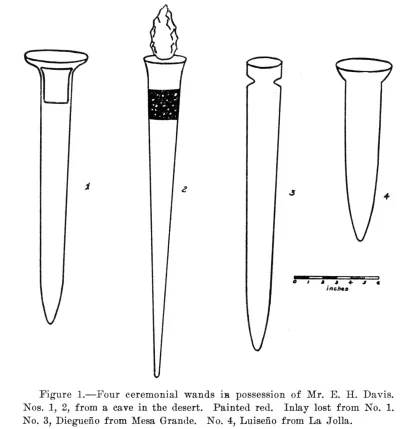
Figure 1.—Four ceremonial wands is possession of Mr. E. H. Davis. Nos. 1, 2, from a cave in the desert. Painted red. Inlay lost from No. 1. No. 3, Diegueño from Mesa Grande. No. 4, Luiseño from La Jolla.
Footnotes
293:52a Ibid., pp. 77, 176; Sparkman, p. 221.
294:53 University of California phonograph record 739. Cf. DuBois, op. cit., p. 78, note 12.
295:54 Manuel Lachuso.
295:55 University of California phonograph record 740(1). Said by a Luiseño, when the record was played for him, to be in the language of the north, San Gabriel, like most his own people's songs connected with the toloache cult.
296:56 See below under the account of the Tapakwirp.
296:57 Grown men who had never taken the drug were sometimes initiated.
297:58 Similarly the Mohave medicine-men blow frothy saliva over their patients.
297:59 Manuel Lachuso at Santa Ysabel is the authority for the statement that the painting was done by young women especially chosen for the purpose. If true at Santa Ysabel, it seems not to have been the case elsewhere.
297:59a The corresponding ceremony among the Luiseño has been called mani. This root mani means to abstain.
298:60 University of California phonograph record 740(2). Compare the song given on page 295.
299:61 See above, in the Introduction.
THE GROUND-PAINTING.
Several variations in this ground-painting have come to light in the Diegueño country, but all such are of one general type. All alike are quite different from anything reported among the Luiseño. 62 The painting (pl. 24, 25), which is some fifteen or eighteen feet in diameter, is a map or diagram of the world as known to the Diegueño. It is said to have been made inside of the kwusitcnyawa, or house where the ceremonial
objects were preserved. In form it is a circle, representing the visible limits of the earth—in other words, the horizon. This circle marks the place where the sky, amai, touches, or seems to touch, the ground. The circle is, therefore, itself called amai. It is made in white powdered soapstone. The name and meaning of this circle are identical wherever the Diegueño were questioned. 63
Across the circle stretches a broad white line from east to west, also made in white powder. This represents the Milky Way, called amai xatatkurl, sky-its-backbone. This feature is also constant wherever the painting was described to the writer.
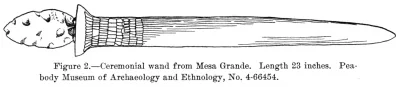
Figure 2.—Ceremonial wand from Mesa Grande. Length 23 inches. Peabody Museum of Archaeology and Ethnology, No. 4-66454.
The other heavenly bodies are indicated here and there within the circle, since they are all situated centrally to the visible horizon. The sun, inyau, and the full moon, xalya, are represented as disks. They are made in the red oxide of iron from the mineral springs. The sun is considered to "make" the large circle, amai, and is therefore drawn near the circumference. Its precise location with reference to other objects in the circle seems to have varied among different villages. The full moon was placed in the center, near the Milky Way. The new moon, xalya-xai, is drawn in the northern half of the great circle, near the eastern end of the Milky Way. The last quarter, xalya-inyo, is drawn in the southern half of the circle, on the other side of the Milky Way and opposite to the first quarter. The first and last quarters are represented as crescents, one of them reversed. Like the sun, the moons and all the other heavenly bodies are made in red oxide of iron.
All the constellations recognized by the Diegueño were represented in the painting. Those mentioned to the writer were xatca, the Pleiades; amu, Mountain Sheep; 64 sair, Buzzard; 65 and watun, Shooting. 66 Each star of these constellations was represented as a small disk of iron rust. The following scheme was followed in the orientation of these constellations in the painting: Xatca and amu, the Pleiades and Mountain Sheep, are said to accompany each other in the heavens. 67 The Pleiades are drawn, as they appear in the heavens, in the southern half of the great circle, near the eastern end of the Milky Way. Amu is drawn just east of xatca. Similarly, watun (Scorpio?) points always directly at sair (Altair?). These two constellations are drawn together in the northern half of the painting, opposite xatca and amu.
The principal mountains on earth are also represented in the painting. The painting is all in one plane by necessity. These mountains therefore appear scattered in among the stars as the sacred diagram is actually made on the ground. The identity of these mountains seems to vary for the different villages which at various times have made the painting. That is, the local topography around each village was reflected in the painting. At Santa Ysabel they drew Mount San Jacinto, the islands of Santa Catalina and San Clemente, which are considered to be mountains out on the ocean, and a mountain called nyapuxaua, 68 whose location is vaguely indicated as southward on the desert. Santa Catalina they must have learned about from the Luiseño
at Agua Caliente, who lived almost in the same valley as themselves, and with whom intercourse was easy. The people at Mesa Grande also drew four mountains. These were San Bernardino, represented in the northern part of the circle, and the three Cuyamaca peaks in the southern part. San Bernardino is easily identified, since it is called "white-top." It is the only mountain in southern California with a snow cap. The Cuyamacas are plainly visible to the south from the vicinity of Mesa Grande. At Los Conejos rancheria the people seem to have represented six mountains, 69 which could not be identified by the present writer in terms of the modern geography of the region. One of them, however, called moon-rock mountain, wixalya, because of a crescent-shaped crag near its summit, was pointed out at a distance of twelve or fourteen miles from the reservation. No rivers or lakes were represented in the ground-painting, since there are none in the Diegueño country.
All the creatures associated with the awik cult are represented in the painting. These correspond to the "Chungichnish animals" of the Luiseño. They are Coyote, Wolf, Bear, Black Spider (Tarantula), and Raven. Such animals as the skunk, wildcat, and raccoon, and such birds as the crane and owl were never drawn. The awik creatures are represented each by a conventional symbol consisting of a line bent at a right angle. In addition to these creatures, several species of snake are drawn. The most important in significance are the two varieties of rattlesnake, the light-colored and the dark-colored, awi nil, and awi axwat. Mention is also made, in the description of the painting, of the gopher-snake, awiyuk, grass-snake or blue garter, xawitai, and red racer, xilkair. These snakes were drawn as sinuous lines, made in different colored seeds. The rattlesnake is considered to be beyond all others the medium through which falls punishment for ceremonial offenses. The two rattlesnakes, said to correspond to two actual varieties found in the region, are accordingly drawn with particular attention to detail. They are very large, said by some to reach clear across the painting. The "diamond-back" pattern is put in with the
utmost care. The eyes are represented by pieces of haliotis shell.
The toloache mortars, kalmo, which each village possesses are set inside of the painting in a row near the eastern edge. Each mortar has its pestle, xanokai, inside it. The rattlesnakes are so arranged that their heads just touch the mortars. The boys are instructed that mankind is typified by these mortars. The great snakes are drawn with the heads just touching them to indicate that when people are careless, the snake is always waiting to destroy them.
According to some accounts, a small excavation three or four inches in diameter, is made in the sand-painting. The boys are made to stand over this hole, one by one, and spit into it. If they miss, it is a sign that they will not live long. In some villages lumps of sage-seed and salt are placed in the boys’ mouths, in order to induce a flow of saliva. When the significance of the different figures has been explained, and after the spitting is done, in case that feature is present, the dirt is shoved in over the painting, obliterating it, so that no one else may see it.
Footnotes
300:62 DuBois, op. cit., pp. 87, 179.
301:63 At Mesa Grande, Santa Ysabel, Capitan Grande, Los Conejos, Inyaxa, and Campo.
302:64 In Mojave, amo, mountain sheep, is the three stars of Orion.
302:65 Cf. Luiseño: Yungavish, buzzard, the star Altair. DuBois, p. 162.
302:66 Cf. ibid., 165, note 304: "It is said that with the Diegueños Scorpio is a boy with bow and arrows." "Orion is called Mu in Manzanita Diegueño, Emu at Mesa Grande." The present writer's information among the Diegueño seemed to make watun the three large stars of Orion, but the Mohave and Luiseño parallels and Miss DuBois’ statements make it appear probable that amu is Orion and watun Scorpio.
302:67 Ibid., 163: "Hulaish is Orion and Chehaiyam the Pleiades. These two are always named together."
302:68 This mountain is said to be half dark-colored earth and half light-colored. It is related that when mankind were first created, the Mexicans, pinyai, were made of earth from the light-colored side, the Indians from that of the dark-colored side.
303:69 Called awai, hulkokwis, xamatai, hipokwiskwi, wixalya, and wiki´naūn.
CONCLUSION OF THE BOYS’ CEREMONY.
On the following day, late in the afternoon, they proceed with the final rite of the ceremony. While the other rites have been progressing, a figure representing a man has been fashioned out of netting made of nettle fibre, ahorl. This figure, minyu, is five or six feet long. It seems to correspond exactly with the Luiseño "wanal wanawut." 70 The Diegueño figure, besides having arms and legs, is represented as having a long tail. A pit is dug, large enough to accommodate the figure when stretched out at full length, and from eighteen inches to three feet deep. The long axis of this pit points east and west. The eastern end is made sloping. The netting figure, minyu, is placed in the bottom of this pit, feet to the east. Small flat stones, reserved for this purpose, are placed on the figure at the end of the tail, on the abdomen, on the base of the neck,
which is very long, and on the head. The people, especially the relatives of the initiates, then gather around the pit. One by one the boys are placed in the pit, their feet resting on the first stone. Each boy's sponsor stands behind him and takes him under the armpits. According to one account, the boy also steadies himself by placing his hands on the sides of the pit. The kwaipai, when all is ready, pronounces "mwau." The people give three answering grunts, and at the third the boy jumps on to the next stone. At another grunt he jumps to the next, and so on. Should he miss landing fairly on one of the stones, his relatives all begin to wail, in the belief that he will die before long. When each candidate has passed through the pit in this way, they all gather about, each with his sponsor beside him. Some old man then takes out the flat stones, since they are preserved with the other ceremonial objects in the kwusitcnyawa. At a signal from the kwaipai, the whole company then "grunt" three times. At the third, the boys and their sponsors push the dirt in from all sides, filling the trench and burying the netting figure. If any of the dust rises from this "grave" and gets in a boy's nostrils, he will die. 71 As it is almost dark by this time, they begin the war dance at once, on top of the grave where the figure is buried. They dance all night, and at daybreak dance the fire out. 72 This ends the ceremony.
Footnotes
304:70 DuBois, p. 85.
305:71 Cf. the Chaup Myth by Miss DuBois, Journ. Am. Folk-Lore, XIX, 163, 1906.
305:72 See the account of the Fire ceremony.
MOURNING CEREMONIES.
Quite as significant as the adolescence ceremonies are the mourning rites. Mourning for a relative usually lasts among the Diegueño for one year. The hair of both men and women was formerly cut short during this period, and the face sometimes painted black. Cremation was universally practiced by the Diegueño until they came under the influence of the missions. As far as can be learned, each body was burned without any rites other than the one mentioned above, 73 the purpose of
which was to make the spirit done with it. 74 The clothing and other property was laid aside for use in the Mourning ceremony. Whatever ashes remained after the cremation were gathered up and placed in a small-mouthed jar of pottery, of the type used for carrying water on the desert (pl. 23). 75 This jar was then put away in some hidden place among the rocks, or buried on a hillside.
The funerary or mourning ceremony occurs on the anniversary of the death. At this time the clothing and personal property of the deceased person is publicly burned amid appropriate ceremonies. This burning is made the occasion of a large gathering. As usual in California, the family who gives the ceremony is at the total expense of entertaining all the visitors, and in addition to this, considerable property in the form of baskets, of late replaced in large degree by money and calico, is given away and burned on the funerary fire. If difficulty is experienced by the family in getting together sufficient property, the festival may be postponed for two and even three years.
Footnotes
305:73 See page 279.
306:74 This is performed also in the Eagle ceremony, the account of which see below.
306:75 Cf. C. G. DuBois, "Diegueño Mortuary Ollas," Am. Anthr., n.s. IX, 484, 1907, pl. 29.
THE CLOTHES-BURNING CEREMONY.
At the appointed time word is sent to the neighboring villages and families, and a large assembly drawn together. According to invariable custom, both for this and kindred ceremonies, the head of the family passes over the management of everything to a friend or visitor. Both he and his family carefully refrain from even tasting any of the food gathered for the festival.
The first night is passed by the relatives of the deceased in wailing. On the following night a great fire is built and all the people, men and women, dance around it, circling alternately in each direction. The man who has charge of proceedings, assisted by one or two others, carries the dead person's clothes. The songs sung at this time are the regular songs of the Fire dance. 76 At the close of each song all the dancers together make
the deep grunting sound: "mwau—u," and motion upward in the air. At the completion of three or four songs, all pause and face toward the fire, repeating the grunting sound three times. Then the sound is repeated once more, and all the clothes are thrown at the same time on the fire. While the garments, together with numerous baskets and other property, burn, they sing this song:
|
menai dispa tcawai tcawi |
now dead I-begin-to-sing 77 |
Following this they dance several times around the fire, singing Fire songs, then throw on more clothes and sing:
|
mawi-a! mawi-a! |
what-fore ah! what-for? ah! |
Anyone of the strangers who wants a little money takes a long stick and turns over the clothes so they will burn better. The relatives of the dead person then come around and give him small jars, baskets, and other "little things."
When the clothes are completely burned they sing as follows:
apamsi penoxi inyoxo
The rites are completed by dancing the fire out, singing meanwhile the songs which belong to that ceremony. 78
Footnotes
306:76 The account of which see below.
307:77 Part of the myth which tells of the origin of the ceremony is as follows: "The first man who performed the ceremony reached his hand to the North and brought a red rock, from the East a gleaming white rock, from the South a green rock, and from the West a black rock because the sun sets there. Then he blew in all four directions and sang, 'My father and grandfather are dead, so now I sing.'" The remainder of the narrative concerning the origin of the ceremony could not be obtained.
307:78 See below, the account of the Fire ceremony. The Luiseño Clothes-Burning is described in present series, VIII, 180, 226.
THE FEATHER CEREMONY.
A distinctive mortuary ceremony is performed after the death of each toloache initiate. Among the Diegueño it is called "otcam", and seems to coincide with the unish matakish ceremony of the Luiseño. 79 It is said by the Diegueño to take place
on the afternoon preceding the Clothes-Burning ceremony just discussed. Some time about the middle of the afternoon one of the old men swings the bull-roarer, air, three times. This is the signal for the people to assemble. Some especially practiced man then performs the Whirling dance. This corresponds to the Luiseño Morahash dance, 80 called at the present time the "Tatahuila." It includes a great deal of whirling, and a man who is not used to it becomes dizzy and falls down. This dance has been observed a number of times by the writer. It is also performed in connection with another mourning ceremony known as the Eagle dance.
Footnotes
307:79 DuBois, p. 92.
308:80 Ibid., p. 185. Etymologically, the word is compounded of the root mor, to whirl, plus a connecting vowel a which indicates that the root is to be taken in a passive or middle sense, plus a suffix hash which means "the doing something for someone else." The Luiseño name implies, therefore, the whirling that is performed in behalf of someone else. This is particularly in harmony with what has been elsewhere written concerning the Tatahuila.
THE WHIRLING DANCE, TAPAKWIRP.
Before the dancer appeared, on the occasions when the dance was witnessed, one of the old men made an energetic speech, saying that the ceremony was ancient, and must be done exactly according to usage. The dancer remained out of sight in a brush house or "ramada" until this lecture was completed. When all was in readiness and the crowd waiting, an assistant who was with the dancer raised a long cry, sounding like "kūūūwanh!" All the old men around the himak or dance-circle grunted and stamped with the right foot. The assistant then repeated his cry, and all stamped again. On a third repetition of the cry, all grunted and stamped three times. Then the assistant, exclaiming "a-ha-ha-ha a-ha-ha-ha," ran out of the house, and entering the dance-ground from the north side, 81 ran half way around its circumference. Then he halted and dropped on one knee, facing the sun. He carried a stick in each hand. These he held up toward the sun as if to protect himself from a blow (pl. 27, fig. 1). After a momentary pause
the dancer also appeared on a run, entered the dance-ground from the north, encircled it once in a clockwise direction, and halted at the point of entry. He also carried two short, smooth sticks (pl. 26, fig. 3). When he halted he touched these two sticks to the ground and leaned upon them (pl. 27, fig. 2). The costume as shown in this figure consisted of a skirt or kilt of long eagle-feathers, yipexai, mounted on milkweed-fibre network. 82 In connection with this was worn a head-band of split owl-feathers, tsekwirp (pl. 22, fig. 4), mounted on a circlet of mescal or other fibre. His body was painted (pl. 26, fig. 3, pl. 27, fig. 3) in broad stripes of white paint. This is made of powdered soapstone mixed with water. This costume seems to be the ancient ceremonial dress of the Diegueño and their neighbors, the Luiseño, since Boscana, writing in the early years of Spanish influence, describes practically the same dress. 82a
An old man with a rattle took his stand close by the dancer, and the two conversed in a very low tone. This was always done whenever the dance was observed, though the words were in so low a tone that they could not be distinguished. They are thought by the younger people to have ceremonial significance, though the present writer was never able to discover precisely what is said at the time.
After a moment the old man began to shake his rattle and sing. The dancer trotted around the circle once or twice, and then began to whirl as he went. The song was as follows:
|
niyaukam penowo |
I-handle ... 83 |
The dancer signalled for faster music by rapidly striking together the two sticks he carried. After some time he struck these sticks together once, and as the song ended he made a short leap, landing on both feet. Then to this accompaniment of a deep grunt from the old men looking on, he bent his knees slightly, pointing the stick in his right hand toward the ground.
Then he trotted silently around the circle to its northern edge, and leaning over rested on his two sticks.
The next song was as follows:
|
neyonga nitceyo |
my-head my-... |
The dancer trotted around the circle as at first, but soon began to skip instead. Finally he began to turn as he skipped, hopping or skipping on one foot between every half-turn. At times he changed his step in the midst of a song from the plain turn to the skipping turn. He also paused for an instant at frequent intervals to squat three times (pl. 27, fig. 4), facing in a different direction each time. Three or four songs always completed the dance, and the performer then ran back whence he came.
Other Tatahuila or Tapakwirp songs are the following. They are sung with no apparent regard to order.
itca yumitci itca yumitci 84
yumpeni yumno yumpeni yumptero
hai-i-i-wano
aweni maitero
wainipai rorowi nani
neyongi aweni mainipa
rorowi neyongi
itca, etc.
norowi mumpeno
keruwi mumpeno
kemipa mumpeno
kepai novita
keruwi, etc.
pohyom nipa pohyom nipa 85
nipampowow nipampo rorowi
witcaxa wipneyau
tsegora tsaxawi
penomo apa
rorowi mohitna
penema rorowi, etc.
sahavi penovi 86
xehora mokikai
penovi meyoivi
Footnotes
308:81 East is the ceremonial direction among the Diegueño. This detail may indicate a Luiseño origin for this rite.
309:82 For this type of skirt, see DuBois, op. cit., plate 18.
309:82a Boscana, "Chinigchinich," in Robinson's "Life in California," New York, Wiley and Putnam, 1846.
309:83 The words of this and the following song are Shoshonean.
310:84 This and the two following are said to be in the Cahuilla language.
310:85 University of California phonograph record 689(4).
310:86 Ibid., 689(2).
CONCLUSION OF THE FEATHER CEREMONY.
While the Tapakwirp is in progress, the old dancers gather in a second enclosure at some distance from the assemblage. After the conclusion of the dance they appear one by one and come part of the way to the dance-circle. Each one imitates as far as he can the actions and manner of the dead man. Amid great wailing and crying on the part of the spectators he then returns to the small inclosure. After all have done this, the entire company of dancers appear, crawling on their hands and knees. As they crawl they make animal noises. Each one is painted with the footprint of the animal about which he dreamed when he took the toloache. Every man imitates as far as he can the sound which his particular animal is in the habit of making. Continuing this crawling posture, the dancers advance to the dance-circle and seat themselves about its edge. When they are seated the dead person's headplume, talo, is set upright in the center. At a signal the company then move their hands together with a solemn gesture to the left, and then to the right, each time with a long-drawn grunting sound. Then they toss their hands upward twice with an expulsion of the breath each time, finishing with two quick gestures and two expulsions of the breath.
This ceremony, called the otcam, is intended to keep the dead person from coming back; or, as one informant put it, "to make him done with this world." 87 The dead person's plume is then buried in the center of the circle, the company grunting three times, and at the third time shoving in the dirt from all sides.
Footnotes
311:87 The Luiseño term unish matakish (DuBois, op. cit., p. 92) applied to a corresponding ceremony has a similar meaning. Unish is not recognized at the present time. Matakish or matakihish is a verbal noun from the causative stem of mati, "send away". The meaning of the term is "the causing to send one thing away"; "to loosen or untie it".
THE IMAGE-BURNING.
When several members of a family have died within a short period, it is customary to hold a ceremony called Image Burning or Keruk, southern dialect Wukeruk. The corresponding ceremony
among the Luiseño is called Tochinish or Tauchanish. 87a Images representing each of the deceased are made out of matting. These are stuffed with grass to give them a lifelike appearance, and are dressed in all sorts of finery. Eyes, nose, ears, and teeth are represented with bits of haliotis shell. The gum of the greasewood is used for glue. Drops of this substance are also used to make the pupils of the eyes. Human hair is put on the heads of the images. These images, together with considerable property, are burned amid elaborate rites. The whole forms a long and complicated ceremony.
Mention of this ceremony is made several times in the mythology of the Diegueño. 88 Its origin is described in the Creation myth which follows in this paper. It is believed by the Diegueño to be the first ceremony ever performed. The author of the account of the equivalent Luiseño ceremony says correctly that the original source of the ceremony must remain a matter of speculation.
Though in the account given of the Luiseño ceremony no mention is made of time, it seems likely that the rite itself consumes only two or three days. The Diegueño ceremony, however, requires six days. For the latter a small ceremonial house is built. This house, keruk, is absent from the Luiseño ceremony. It seems, therefore, that the Diegueño have a fuller form of the rite. Since, in addition, the ceremony is mentioned in Diegueño mythology, while it is nowhere mentioned in Luiseño mythology as so far printed, it at least seems likely that the ceremony was first celebrated by the Diegueño and acquired from them by the Luiseño.
As always, the family giving the ceremony entertains all the visitors. It was formerly a matter of pride to furnish not only an abundance of food, but also to provide delicacies. For this reason a quantity of pine-nuts, axiw, choke-cherries, akwai, and mesquite beans, anal, was gathered, and sometimes brought from a distance. The images are made in some private place by the relatives of the deceased persons. On the spot chosen
for the ceremony the small ceremonial house called keruk is erected. It is in shape half a hemisphere facing the east. 89 When all is in readiness the people assemble and pass one night in wailing. In the morning they have something to eat, and go to sleep. The relatives of the dead fast as much as they can and carefully refrain, moreover, from touching any of the festival supplies.
The next night a large fire is built near the keruk. The faces of the images are then painted. Those which represent women are painted red with scorched mescal syrup. Those which represent men are painted black with graphite, with the addition of a white stripe down the nose and chin. Amid great wailing the images are then picked up and carried to the fire. The relatives join in the procession, but do not carry the images. They continually wail. The following song is sung as they march.
|
wumi pawakaam |
weeping we-arrive |
When they reach the fire the people march around it from left to right. They advance first one foot and then the other with the twisting motion of the body already mentioned. The sound of the elderbark skirts worn by the women at the time is supposed to be represented by the following song:
|
xeyul paxal apuraxa apuraki |
put-on elderbark-skirt ... ... |
A long series of songs follows, and the dancing continues all night. So the time passes for six days, with eating and sleeping in the daytime, and dancing at night. Several times every night the relatives of the deceased persons pile baskets and clothing on the fire and burn them. Small baskets are also thrown in the air. These the visitors gather up and keep for themselves. This is always accompanied by wailing on the part of the family giving the ceremony. On the seventh night, after dancing till sunrise, they put the images inside of the keruk. Then they put in a great quantity of property, clothing, baskets, beads, and household goods. Finally the remaining space is
filled with dry brush and the whole set on fire. While the smoke and sparks shoot upward in the early morning sunlight, they sing the following song:
|
wa katomi aminy awa |
is-going essence to-your home |
The significance of this song as showing the existence of a belief in a future life has already been discussed. The singers were thoroughly questioned concerning this belief, but no further particulars were brought out. No distinction seems to be made in this future state between "good" and "bad" people, nor between those who observe the ceremonies and those who do not. Concerning the general purpose of the ceremony, the usual explanation was that offered for the Clothes Burning—that people did not wish to see any reminders of the dead left about, because it made them feel bad. This of course does not explain the custom of burning new and valuable property which has no association with the dead. On a second visit to the region the writer was informed that the ceremony was to make the dead contented, "so they would not come back." After this ceremony the dead are never mentioned, and signs of grief are discontinued.
Footnotes
312:87a DuBois, op. cit., pp. 100, 103, 180; Sparkman, p. 227.
312:88 Journ. Am. Folk-Lore, XIX, 153, 160, 1906.
313:89 East is the ceremonial direction among the Diegueño, as north is among the Luiseño.
THE EAGLE CEREMONY.
The Eagle dance or ceremony, expa ima, is a mourning ceremony held on the anniversary of the death of a kwaipai, or leader of the dances. 90
An Eagle dance which was observed by the writer at Mesa Grande, occurred at the end of a three-day festival. During each of the first two days the people in holiday attire loitered about the fiesta grounds, busying themselves in a general way with the usual "fiesta" events. A peon gambling game 90a was running during most of the time; and in the afternoons and
evenings there was considerable gambling with poker and chuck-a-luck. Every afternoon, however, a Whirling or Tapakwirp dance was held, and after nightfall, a War dance or Horloi. In a cage under a brush shelter or "ramada" off to one side, there was kept a large bald-eagle. Some months before he had been purchased in readiness for this ceremony from the people to the southward. This had been in accordance with well established usage. If a village used an eagle from a nest near by, it would be hard, it was thought, to make the spirit leave his body when he was killed. It would have an attachment for its old home and would therefore linger about.
Each afternoon before the Tapakwirp or Tatahuila dance, the daughter of the old leader or kwaipai wailed for some time. This was the only indication that a mourning ceremony was in progress.
On the third evening, toward nightfall, an extra large fire was kindled, and for two or three hours the old men danced the Horloi. The final part of the dance was, however, omitted. The dance-circle was then cleared, and one of the oldest men announced: "All will sit down and smoke tobacco." After some time an old man, said to be called the kaponail, 91 who sat on a stool to one side, exclaimed "mwau." Several others then went to the middle of the dance-circle and motioned upward three times, grunting as they did so. Then a so-called "capitan" made a long and very emphatic harangue. He said that the ceremony they were about to perform was very ancient. He explained that it had not been held for a long time, but that they were going to perform it just as had always been done. The kwaipai had died, he proceeded, and the old men had determined to get together clothes and property and send it to him, and to kill the eagle and send it with messages of respect to him. The eagle, he explained, in this ceremony, though he appeared to be a bird, was really a man. He was not to be killed by ordinary means, but would be "witched to death" by the dancers. Nobody therefore was to move about or make a noise, but all were to remain quiet and see this wonder. It was
extremely hard to kill the eagle in this way, and the dancers could do it only because they had a great deal of "power."
Soon after the close of this speech the oldest one of the dancers began singing and sounding his rattle off in the darkness beyond the light of the fire. Soon he appeared in the dance-circle at the head of a line of old men. One of these carried the eagle. The other people of the rancheria fell in line behind them and all marched around the fire, twisting from side to side. As the eagle was carried into the circle, the daughter of the deceased kwaipai wailed and threw some new calico over him. The song was as follows:
|
otolyi wam |
flapping he-is-gone 92 |
After this song had been repeated a number of times, there was a ceremonial pause or rest, during which the eagle was passed to another old man. 93a During these pauses there was a general wailing. The dancing continued in this way without change until seven songs in all had been sung. They were obtained as phonograph records on the day following the ceremony, the order being established by notes and texts taken down at the time of singing. Although the arrangement was afterwards learned to be fortuitous, 94 the reader can see that these songs seem to outline a myth or story.
|
wumi wam |
crying he-is-gone 95 |
|
expa kunumsup |
Said to mean: White Eagle puts his nest on big cliffs. Eagle from the West puts his nest on sycamore trees along the edge of creeks. 96 |
|
wumi amai yiwama |
crying up-in-the-air he-is 97 |
|
kwonyūwai mayiwa |
(the)-nest there-it-is 98 |
|
amu tcapuk xatca tcapuk |
Orion(?) coming-out Pleiades coming-out 99 |
|
expa lamalama kiwiw! |
eagle is-a-man, look! 100 |
In the pauses between several of these songs, one man held the eagle aloft while another took his stand some distance away and pointed a small stick at the bird. He aimed this stick as a man aims a rifle, twisting it over and over, however, with his thumb and forefinger. At the same time he exclaimed "ahahaha! ahahaha!" Some of the dancers dipped the end of the stick in the fire before they pointed it at the eagle. In this way death is supposed to be conveyed through the stick. Following this action a second man always approached the eagle and waved his feather tuft in front of it. Then he brushed or "dusted" its head three times 101 with the plume. At the same time they blew or made a laughing sound. Several of the old men at various times blew tobacco smoke over the bird. All this was done "to brush away death, so they could tell him more." 101a
At the conclusion of the last song above, several people, relatives of the dead kwaipai, approached the eagle and threw new calico over it, wailing at the same time. The most muscular one of the old men then took the eagle, and held it aloft at arm's length. Another dancer took a position across the dance-circle. Raising his stick this second man pointed it slowly and impressively at the eagle. After a pause, he broke into a sudden shout, " ahahaha!" and made his stick quiver. At the same moment the man who was holding the eagle pressed his finger in over its heart and killed it. The muscular exertion required showed in the trembling of his arms as he made the effort. The attention
of the onlookers had of course been attracted to the other man by his peculiar actions and his sudden shout. The real cause of the eagle's death seemed not to be understood by the onlookers.
As the eagle sank forward dead, many of the company wailed. Someone threw another piece of calico several yards long over the bird. The daughter of the old leader in whose honor the ceremony was made scattered considerable money in small change among the crowd. This was gathered up by anybody who wanted it.
Soon the old man who directed the ceremony began to sound his rattle again. The singing and dancing continued far into the night. The old men took turns carrying the dead eagle around the fire. The songs were as follows:
|
awir amanha |
wings he-flies 102 |
|
axa inyau winyau kiwiw |
water I am-beating look! 103 |
|
axa wakum wakumu |
water rolls rolls 104 |
|
axa kaiakwiru-u |
water its-edge 105 |
|
expa ruara kiwiw |
eagle is-swooping look 106 |
|
kwinyora kwinyora |
colored colored 107 |
|
waiyu il waiyu |
coming black (-eagle) coming 108 |
|
iū nya axa |
eye my water 109 |
An important part of the ceremony remained yet to be performed. That was the burying of the eagle. This was not done, through some misunderstanding, until the following morning. The grave for the eagle was dug by one of the old men in the center of the dance-circle. Its long axis was north and south. No songs or ceremonies of any kind accompanied the digging. The dead eagle, wrapped tightly in a new piece of red calico, was laid on the west side of the grave. After the first part of the ceremony had been completed, and before the eagle was thus brought out for the burial, the longest feathers had been ceremonially plucked, in order to make a dance-skirt. This had been done by the old men in a private place. During the operation no word was spoken, in order "not to bring bad luck."
The leader took his place, kneeling, on the west side of the grave and facing it. Four other old men knelt about, completing the circle. The leader then took the eagle in his hands and waved it three times in a circle, saying each time "wu—o." The other men grunted deeply after each circling motion. The leader then raised it aloft three times, while the others grunted again each time. Finally he waved it first to the left and then to the right, while the others grunted each time as before. Then he began to pat the bird with both hands together, while the others imitated his movements with their own hands, but did not touch the eagle directly. As this patting progressed, the men chanted in a curious choppy monotone:
|
wesi wesi |
done done |
At the end of three repetitions of this song, they all expelled their breath very forcibly three times. The whole was then repeated three times. Then the leader exclaimed "tca," and all said together, in deep guttural tones, "hi u hi," or something to which these sounds are an approximation. The eagle was then put in the hole and the dirt pushed in from all sides. Another piece of red calico was thrown in the air by the daughter of the dead leader.
The old man who had led the singing then pressed the mound of earth three times with his hands, saying " Once I put it, twice I put it, three times I put it." All grunted once at each phrase. Then all stood up and began pressing the grave with their feet. This movement gradually assumed the form of a march around the grave, circling from right to left. The women had in the meantime gathered on the west of the dance-circle, and as the old men marched both men and women chanted.
toki toki
aso aso
Their utterance in this song was very abrupt, sounding like "to! ki! to! ki! a! so! a! so!" When this had been repeated three times, the old men motioned away into the air with a grunt. Throughout this song the man who led in the singing made a steady long roll with his rattle.
At the end of the song there was a short pause. Then the dancers turned sideways to face the grave, and stepped sideways to the right. The song, in which both men and women took part, was as follows:
mero romki
hiyau tcaau
alwe potaxau
This was repeated three times, then three grunts and stamps were given by all the dancers. After the song the dancers broke up and transferred their interest to a peon game which was then progressing. The Eagle dance was over.
Footnotes
314:90 Luiseño accounts in the present series, VIII, pp. 7, 113, 114, 182, 227; Am. Anthr., n.s. VII, 625, 1905. An early reference is in the present series, VIII, 1-27, 1908, A. L. Kroeber, "A Mission Record of the California Indians," in which see p. 4.
314:90a See below.
315:91 Cf. preceding, p. 294.
316:92 Said of a bird hopping along on the ground before he launches himself into the air.
316:93 University of California phonograph record 707(2).
316:93a These brief but frequent intermissions are characteristic of all Diegueño ceremonies.
316:94 The leader explained that he had not heard the songs for years, and sung them just as he could remember them.
316:95 University of California phonograph record 711(1).
316:96 Ibid., 712(2).
317:97 Ibid., 713(1). The song refers to the young eaglets in the nest.
317:98 Ibid., 713(2). The song is to explain that "Eagle and Chickenhawk once were friends".
317:99 Ibid., 709(1).
317:100 Ibid., 712(1).
317:101 One man did it four times instead of three.
317:101a More messages for the deceased kwapai?
318:102 University of California phonograph record 703.
318:103 Ibid., 705(2). The waves say this to the eagle.
318:104 Ibid., 706(1).
318:105 University of California phonograph record 706(2). The eagle says this as he walks in the edge of the surf.
318:106 Ibid., 706(3).
318:107 Ibid., 707(1).
318:108 Ibid., 708(1).
318:109 Ibid., 708(3). Sung as they wept for the eagle.
THE "WAR" DANCE.
The writer observed the Horloi or "War dance" a number of times in the fall of 1907. It always occurred after nightfall. A large fire was kindled in the evening on the northern side of the dance-circle and soon after sundown a number of women seated themselves in a group near it. As fresh wood was thrown on, the old men who expected to dance began taking off their shoes. Each one put on either an owl-feather headband, tsekwirp, (pl. 22, fig. 4), or else tied a handkerchief about his forehead. Those who had headplumes of split owl-feathers, talo, (pl. 22, fig. 1, 2, 3),
thrust them upright in this headband. An old man then stood up and made a short speech, very loud and emphatic. The other old men grunted three times deep in their chests. The old man then said a few words, and the others grunted once. The substance of the speech was said to be that the dance had come down from their fathers, and that they were going to do it as they had always done it. Then the leader of the dance, without his rattle, took a position close in front of the women, and leaning over, began to mutter the words of a War-dance song. The women listened in silence. The old man varied his muttering by stamping with his right foot and grunting. This continued until the occurrence of one of the ceremonial rests. A second old man then joined the first, and the two sang in a guttural whisper, at times clapping their hands softly as if to urge the women on. After some time the women began to sing, so faintly at first that the sound was barely audible. The singing was interrupted by occasional pauses or rests. The leader seemed to call for these by clapping his hands sharply once with a deep grunt. During these pauses or rests the men left the dance-circle, but the women remained seated, without movement. The leader gave the signal for more dancing by entering the circle and beginning the words of the next song.
After some time the singing grew more distinct. More of the men joined in at every pause, and the grunting also grew louder and more labored. The dancers marked time to the music by stamping with the right foot. Soon they began to hitch themselves forward in little jumps after each stamp. The singing grew rapidly louder and shriller. By the time the seventh or eighth song was taken up the music was a full-toned chant, of which the words were plainly audible. The dust by this time rose steadily from the feet of the old men as they shuffled backwards and forwards.
There seemed to be no rule governing the number of times the words of each song were repeated. The men joined in certain parts of every song, singing in a very jerky and energetic fashion. In fact, they exclaimed rather than sang. When they were not singing, they grunted in unison in time to the music.
During the eighth or ninth song, the men faced to the left, that is toward the west, and began to dance in a large circle. The dancing step consisted of two jumps, followed by a stride. After completing the circle they always formed a stationary group in front of the women, stamping hard and grunting. At places in every song during the latter half of the Horloi dance, marked by a sudden rise in the pitch of the music, the men all raised and shook first their right hands and then their left, their fists being closed. 109a This was done three times. The old man who led the singing always touched the right side of his neck, in this gesture, with his left fist, fingers out, after he had shaken his fist toward the west. No definite information concerning the significance of the gesture was obtained. The movement in a circle was explained as representing the movement of the cultus eastward from the islands. "The dance came from the west, so we dance from the west," is the way in which one informant put the statement.
The close of each song was marked by a quick, explosive grunt on the part of the men. This was always accompanied by striking the open hands together once.
After the dance had been in progress several hours, the men just previous to each pause formed in line and danced backward. In this movement the hands were clasped together in front, the dancers assuming a stooping posture. The singing and dancing always stopped at the time of the ceremonial pause with surprising suddenness, the leaders breaking into a satisfied chuckle as the final explosive word of the song found them stricken motionless.
Several times in the course of this ceremony a man who seemed to have no other duty raised a saucer full of tobacco in his two hands. As he did so he pronounced "mwau" in what resembled a tone of surprise or astonishment. The dancers always responded with an upward gesture and an expulsion of the breath. This was repeated three times, the third repetition consisting of two expulsions. Between times this man sat motionless near the women. He was said to be called the "Tatahuila," in Diegueño.
kaponail. 110 The tobacco thus held aloft was afterwards smoked by the old men.
As the closing song of the Horloi the Diegueño always sang the following:
kaipovipaima
povitem yara
tavoyaki natavo
miitara
This song, in contradistinction to those which immediately preceded it, was sung very slowly and very softly. Each dancer removed his headplume and held it in his hand. As the song progressed, they gradually shuffled into a line before the women and stood facing them "Indian file." Holding the plumes in their right hands, they made long vertical strokes in time to the music. From one side the gesture gave the impression of being directed at the women. At every third repetition of the song the dancers waved their plumes skyward with an expulsion of the breath. At the twelfth repetition the leader cried out "tea." The dancers in response gave three quick expulsions of the breath, followed after an instant by a fourth. The leader then cried: "Paropum, paropum!" (throw it away!) The dancers then repeated the last gesture.
During a Horloi dance which took place at Mesa Grande in September, 1907, the following songs were sung in the order given. They were said to be in the Luiseño language, but are more probably in the related dialect of San Gabriel.
|
1. |
awi kwaitomya |
|
awi yompo yuwiyom | |
|
atsatsa tcunga | |
|
2. |
wipiyom tonya anoti |
|
saher riki ranito | |
|
waiyoti toroteher | |
|
3. |
monaha monaha (probably incomplete) |
|
4. |
tomom mari nipam |
|
tomom mari nipam | |
|
togorowi | |
|
tomom, etc. | |
|
5. |
tsoxa xita tsoxa |
|
xita tsaxoxa hiyaiya | |
|
6. |
hotom hita |
|
monini atoxa | |
|
mani sapame | |
|
7. |
pamivat pane |
|
hinne hixo awiwi | |
|
8. |
yaare haima |
|
tomo miki | |
|
kwinneya yainga mora | |
|
9. |
akavira waiyoti |
|
miyaim vitaya | |
|
yikau waiyoti | |
|
nikoma | |
|
10. |
yekino yekino yekino |
|
saho nitomya | |
|
miya homa nita | |
|
saxo haitonya | |
|
hayuki hayuki | |
|
hahai cahovit | |
|
11. |
honi maiyeno |
|
mini nompeno mini nokirowi | |
|
12. |
hwemini yo hwemini |
|
yomtero (word or words missing) | |
|
13. |
pawa xapa |
|
wami nopawe | |
|
yumpeni kete | |
|
14. |
hawe yumbri |
|
hana maipo ampur | |
|
vitamtero wamki hawe yumbri | |
|
15. |
hetciyom hanita |
|
yonitsa pehamtsur | |
|
komya yonitsa | |
|
pehamki | |
|
16. |
haita ponikwa |
|
... manikwa (fragmentary) | |
|
17. |
tsera tomyac |
|
rera tomyac | |
|
gina pera | |
|
mini tomyac | |
|
kokeni gino | |
|
18. |
wipiri (fragmentary) |
|
19. |
gai nita (fragmentary) |
|
20. |
awe awini awe awini |
|
kwaiye komnipa | |
|
21. |
mommai yomtera |
|
mommai toroyote komya | |
|
22. |
nehyo pama ... |
|
okami peyo ... | |
|
nitso | |
|
23. |
tamki kiyi |
|
yaiyu vita | |
|
24. |
metsair waipeno |
|
hiyoni | |
|
25. |
The final song was sung very softly: |
|
kaipovi paima | |
|
povitem yara | |
|
tavomai yeki natavo | |
|
maitara |
The following series of songs were sung at a Horloi held at Santa Ysabel in September, 1907. Like the former series they are said to be Luiseño.
|
1. |
The first song was inaudible. |
|
2. |
kadjuo wamki |
|
sia waipo | |
|
3. |
tcawaiko mero |
|
muni ... (incomplete) | |
|
4. |
tama huna wipeni ... (incomplete) |
|
5. |
haowa haiwano |
|
monini | |
|
6. |
tolema tolema |
|
xapo nika | |
|
xapo wiki mini | |
|
7. |
tekmai huni a hwemini 111 |
|
cukai tekmai huni | |
|
howa tekmai | |
|
8. |
ata xatopra 112 |
|
awiwi umtero | |
|
awi ata | |
|
9. |
mina nomri mowiki |
|
mina nomriwi | |
|
10. |
ota nita ota nita |
|
omni partemui | |
|
11. |
tserau ahawi |
|
mane nipeni tsiro | |
|
mane nipeni | |
|
12. |
terera tomyaxa terera tomyaxa 113 |
|
gina pera mini tomyaxa | |
|
tokeni gino | |
|
13. |
ge nita 114 |
|
manita | |
|
awi wiromni | |
|
yoni yoni | |
|
manita | |
|
14. |
kwate koni take |
|
ana xanoko | |
|
15. |
tayawe |
|
tayawe | |
|
16. |
awe awini awe wini |
|
kwaiye komnipa | |
|
17. |
karampa pawe |
|
wimpeki yoiyo | |
|
18. |
nekema yato nika |
|
kenonat yatoma | |
|
yato nika kenonat | |
|
19. |
hayo tipeno 115 |
|
waiyoti moya | |
|
wira wira wira wira | |
|
20. |
awiwi haiyom hoka |
|
tarampa hoka | |
|
tarampa heron | |
|
21. |
awiwi yomkeri 115 |
|
waipeno | |
|
22. |
mona naka mona 116 |
|
nitomya | |
|
23. |
hana maimaka |
|
koram koram koram | |
|
hotcepe niturti turti | |
|
24. |
awewe hyombri 116 |
|
wihyombri ataku | |
|
25. |
kaipovi paima 117 |
Footnotes
322:109a The hostility suggested by this gesture, which occurs frequently, is said by some to be the reason why the ceremony is called the "War" dance. The name may however be derived from the whites.
323:110 See above under Boys' Adolescence Ceremony. "Tatahuila" is a very familiar term in the mouths of both the Luiseño and Diegueño. It is said by both to be a Spanish word. It suggests, however, the Luiseño root taw-i, to sit at one side, tatawi, to sit customarily at one side, plus the noun-ending -la. On the other hand the regular suffix denoting the action of a verb is -c, and the accent should not leave the stem syllable, so that the Luiseño form to be expected would be tata´wic rather than tatawī´la, in Spanish orthography tatahuila. The tempting etymology is therefore at least doubtful.
324:111 Compare the twelfth song of the preceding series.
324:112 Compare the twelfth song of the preceding series.
325:113 Evidently the same song as the seventeenth of the preceding series.
325:114 Evidently the same song as the nineteenth of the preceding series.
325:115 Compare songs 19, 21, 22, and 24 of this series with 9, 24, 10, and 14 of the preceding. With 19 compare also 2 of the preceding series.
325:116 See footnote 115.
325:117 The same as the final song of the preceding series.
THE FIRE CEREMONY.
This ceremony never occurs by itself, but always follows some other dance. When observed by the writer it occurred late at night after a Horloi or War dance. It also occurs as part of the kusī or toloache ceremony and the Clothes Burning. After the close of whatever rite preceded it, some one of the old men always made a very emphatic speech, saying that the Fire dance had descended from long before, and was very ancient. 117a
Men and women then gathered about the fire in a large circle. The man in the company who usually leads the dances then began to sound his rattle. The people moved about the fire in a "sidestep" to the accompaniment of this rattling, without singing. Two circles were gradually formed, one of them inside of the
other, moving in opposite directions. At frequent signals from the leader the direction of the movement was reversed. Shouts of laughter greeted the sudden change. After some time the effort seemed to become tiresome to the younger people, who one by one dropped out. This left only the old men and women in the dance. The movement now became more sedate. The dancers gradually formed a single line, which circled about the fire from right to left. All the dancers moved forward with a twisting movement, which as already explained, is intended to swish back and forth the skirts of elderbark formerly worn by the women.
Suddenly all raised their arms, holding them out from their sides for the space of three or four steps. Then they faced inward, toward the fire, joining hands all around. While they held hands they stepped sideways to the left. After several steps in this position, they loosed their hands and struck downwards with their arms. Then they stamped three times with the right foot, accompanying each stamp with a grunt. This was followed by a ceremonial rest.
The dance was resumed to the accompaniment of a song:
apampe penovi
hai-i yo-ona
At the end of the second line the entire company squatted suddenly down and rose together. The character of the dancing step was also changed. Each dancer jumped sideways to the left twice, and followed this by a short step to the left. After some time the men suddenly squatted or crouched three times, pointing at the fire first with the left hand, then with the right, and then with the left again. This action was followed by a rest. The same step was shortly resumed, to a different chant, of which the following were the words:
waiyoti waiyoti 118
neyonga meteya
nekiwe nitceyo
tcama avi nitceyo
Throughout the above song the men stamped violently. At each step they swung their fists "underhand" at the fire. Mean-
while they moved about in a circle, of which the center was the fire, in short jumps, each one followed by a single step. At the end of the singing, the leader shook his rattle, and all grunted and struck downward toward the ground. Then he rattled again, and all motioned away into the air and expelled the breath.
When the dancing began again, the step consisted of two jumps followed by a short step. The women had by this time all dropped out, and only about a dozen old men were actually taking part in the rite. The song was as follows:
watani watani
waiyai mani
At the close the leader rattled two loud strokes and then a long roll, calling as he did so, "mwau." All stamped their feet once and grunted. He repeated the rattling and the exclamation, and all expelled the breath and motioned into the air.
The words of the next song were:
pako weknam
pako dikile (incomplete)
When the fifth song began, the men ran sideways around the fire quite rapidly. The singing was also very fast and loud. The rattling took on the character of a steady, beating cadence. The entire performance assumed an excited appearance. The words of the song were:
agorowi take
tcaposon take
agorowi
The old men gave a loud yell in the midst of the song, and dropping on their haunches close to the fire, began pushing the blazing wood in a pile with their feet. Leaping up after a moment they continued to dance, but soon returned to the fire again. They danced in on the coals as much as they could, and each man before he was driven back by the heat would throw himself on his haunches, kick at the fire, and surreptitiously pile in a little dirt with his hands. In this way the fire was gradually extinguished. The women throughout kept up a shrill and rapid chant. The effect of the whole was rather good. The leaping figures of the dancers were outlined in inky black against the
ruddy light of the bonfire, and their swirling feather headplumes lent an air of wildness. Even the whites who looked on were visibly impressed toward the close, while the young Indians seemed completely awed. When nothing was left but blackened coals and a dim pile of glowing embers, the dancers left the circle and the ceremony was over.
This ceremony was formerly accompanied by the exhibition of many magic tricks. A quantity of liquid, said to be a decoction of willow bark, was drunk by the performers before coming to the dance. At the proper time they took slender curved wands twelve or fourteen inches long, called "swallowing-sticks," kotat, 119 and inserted almost the whole length in their throats. The violent vomiting which ensued was held to make the fire mysteriously "cool." It is likely that in the old days when no shoes were worn, the toughness of the soles of the dancers' feet enabled them to dance actually on the coals without much discomfort. Even at the present day their method of dancing would severely burn a bare-footed white man.
Footnotes
325:117a The occurrence of these emphatic ceremonial speeches or addresses is, as will be observed, a feature of all Diegueño rites.
326:118 The words of this song, as of the preceding, have the appearance of being Luiseño.
328:119 DuBois, op. cit., plate 16.
OTHER CEREMONIAL MATTERS.
A moon ceremony among the Luiseño is mentioned by Miss DuBois 120 in the following words: " They sing 'Wy-ot, Wy-ot' nine times, then 'Ne-yonga (My head), ne-chaya, tomave.' 121 The dances were to please the moon and prevent his waning."
This seems to correspond to what is known as the "Sick Moon" ceremony among the Diegueño. Information about this ceremony is not very satisfactory, but the following particulars were at length obtained by questioning several informants. The ceremony is held when the moon rises in the daytime and looks small and pale. The people at this time went out and bathed themselves and had footraces "to please the moon and make him glad." At the same time the women danced, each one by herself, and sang songs. Some of these songs are the following:
|
1. |
halya kwasau |
moon eat 122 | |
|
inyau kwasau |
sun eat | ||
|
kwasau kwasau |
eat eat | ||
|
ī ī |
ī ī | ||
|
2. |
kamaiyo xwao kwatcayi |
... ... ... | |
|
3. |
wami yoik amai |
crying he-is up-there | |
|
4. |
axo kaiyax wumi |
... ... crying | |
|
5. |
xatpa maxo |
... ... | |
|
6. |
axikwa o-o xotcamiya |
owl is-singing |
The belief was that "if they sang and made a noise and laughed down here on earth, the moon would grow cheerful and get well and large again."
Footnotes
328:120 Journ. Am. Folk-Lore, XVII, 185, 1904. See, also, present series, VIII, 11, 1908, and Boscana, p. 298.
328:121 Compare the Fire Dance song before given on p. 326.
329:122 This song was said by the interpreter to refer to an eclipse.
GAMBLING.
Gambling among the Diegueño as among many primitive peoples has so much of the formal in it, and so many "charms" connected with it, that it becomes almost a religious observance.
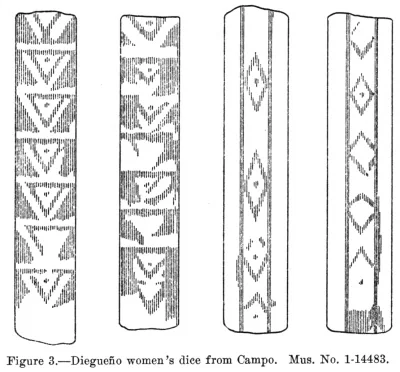
Figure 3.—Diegueño women's dice from Campo. Mus. No. 1-14483.
The Diegueño play at the present time several gambling games. Some of these have been introduced by the Mexicans and Americans. A four-dice game (fig. 3) is said to have been learned from the Mohave. The large, flat wooden "dice "with which it is played are found only among the southern Diegueño, who are nearest the influence of the Mohave and other eastern tribes of the Yuman family. A gambling game with stick and hoop, in which the player tries to throw the stick through the hoop while rolling, is mentioned in Diegueño mythology. 123 This game is no longer played. There is a game played by the Diegueño at the present day, however, which is believed by them to be of ancient origin. This game, called "peon," in Diegueño homarp, is mentioned in the Chaup myth. 124 It is the only game among the Diegueño which is played ceremonially. 124a
The game is played by two sides of four players each. Each individual is provided with two small cylindrical objects of bone or wood, similar except that one has a black band around the middle. These cylinders or "peons," in Diegueño nyumumarpai, are clasped one in each fist of the player. One side guesses in which hand the other side hold their white peons.
These guessing bones are of course a familiar gambling device along the whole Pacific coast. In the method of play, however, followed by the Diegueño, the players are not considered as individuals. The side only is considered in the guessing. The players making the guess agree together, and one man offers the resulting conclusion as their joint guess. So also the other side is looked upon not as individuals but as a unit. The "guess" applies to all equally. At the beginning of the game lots are drawn to determine which side is to begin the guessing and which side shall act on the defensive. After that, every player who is correctly guessed must surrender his peons for the time being to the player opposite him. When all the pairs of peons have been won from the players of the first side, the losing side must begin to guess, the winning side taking the
defensive. For every bad guess, the players acting on the defensive get one point.
The peons are adjusted to the wrists of the players by means of leather thongs, to prevent any sleight-of-hand work at the critical moment. When adjusting the peons the players cover their hands with a blanket, the edge of which they hold in their teeth. Before dropping the blanket they fold their arms, to hide the peons still further. The guessing is indicated by pointing. Pointing with one finger indicates that the white peon is believed to be in the hand pointed at. Pointing with two fingers implies that the peon is believed to be in the opposite hand. The guess is merely a "trial," however, unless the player commits himself to it by a spoken word.
The method followed in play is to point at a player in silence, and then endeavor to read from his expression whether the guess thus indicated is or is not the correct one. It is a fact that some men always betray themselves at the first "point" to the beady scrutiny of the opposing players. Others can assume such a wooden expression that they may be wrongly guessed five or six times in succession. Since each poor guess represents a point won, such players are much in demand as partners. In order to hide or cover all facial expression, each player yelps and throws himself about, folding his arms and keeping his hands out of sight. In actual practice the members of the guessing side go over the opposing players separately, clapping their hands and pointing until the location of the peons is thought to be understood. They then compare notes, and one of them, speaking for all, claps his hands with a gesture and calls out the guess. Every one of their opponents who is caught must give up his peons. But for every bad guess a point is lost. This goes on until all of the peons have passed to the guessing side, or until all of the points in the game have been won by the opposing side. As soon as all of the peons are won, the guessing, as already indicated, reverts to the opposite side.
The winning of fifteen points constitutes the game. Points are represented by fifteen long wooden counters, eselkwak. At the beginning of the game these counters, together with the stakes which are wagered, are placed in the hands of an umpire, who
sits at the end of the "alley" between the two rows of players. He doles out the counters as points are won by each side. After they have all left his hands, the players pass them back and forth directly as points are lost or won. The stakes in this game often used to amount to one hundred dollars. Two or three days are sometimes required to bring a game to a close.
The game is primarily inter-village in character. This trait has been somewhat obscured in late years, though "teams" are still to some degree identified with certain rancherias. The women gather behind the side which represents their particular locality and sing songs to bring luck while the play is in progress. Specimens of these songs are the following:
|
1. |
tcītcīnai yūwinī 125 |
|
tcītcīnai yūwana | |
|
hya-a yūwinī | |
|
hya-a yūwana | |
|
2. |
hakē waiyūma |
|
hatra lemē wiyōna | |
|
3. |
haōko melume 126 |
|
hakō melume | |
|
haēwila mēnēwila | |
|
melume |
Certain religious practices accompany this game. The flowers of an umbelliferous herb, in Spanish chuchupate, are dried and made into a powder. This powder is rubbed over the face and breast of a player, and a little of it thrown furtively on the fire which burns to one side. This is held to bring luck. Players sometimes chew a little of this chuchupate, or a little dried jimson-weed. Occasionally the tails of small snakes are cut off, dried, and pounded into a "powder." This powder is thrown on the fire. It is thought to poison the other side "a little," making them "give up the peons" quickly. Black spiders (tarantulas or trap-door spiders) also are used in this way.
Footnotes
330:123 Journ. Am. Folk-Lore, XIX, 157, 1906.
330:124 Ibid., XVII, 239, 1904.
330:124a For an account of this game, see Stewart Culin, "Games of the North American Indians," Ann. Rep. Bur. Am. Ethn., XXIV, 323-325.
332:125 University of California phonograph record 701.
332:126 Ibid., 702.
COLORS AND DIRECTION.
Among the Diegueño exists a peculiar association of direction with color. 126a The two ideas appear together frequently both in their myths and in their religious formulas and rituals.
North is associated with red, east with white, south with blue or green, these colors not being distinguished by the Diegueño, and west with black.
One of the songs accompanying the Eagle dance given above is:
The white eagle puts his nest on cliffs.
The eagle from the west puts his nest on sycamore along the edge of the creeks.
The eagle from the west is in the song contrasted with a "white" eagle. The western eagle seems therefore to occur to the native mind as black. The association of west with black is carried out by the statement of the old men, that when the dancers witch a white eagle to death in the Eagle-dance, as described above, "they send him east. When they kill a black eagle they send him west."
In the myth of Chaup, 127 there is shown a corresponding feeling for color connected with north and south. "The elder sister, who was a witch-doctor and knew everything, stood up and held her hand to the north and brought down a red stone. ... Then she held up her hands to the south and got a blue stone of the same sort." Further on in this same story, 128 the corresponding colors for east and west are indicated. "The boys stood and held their hands to the east and got some white clay and with it they painted their cheeks. Then they held their hands to the west and got some black clay."
A complete color-system for the four cardinal points has already been quoted in connection with the Clothes-burning ceremony. The account of the original ceremony is as follows:
From the north he (the first man making the ceremony) brought a red rock, from the east a gleaming white rock, from the south a green rock, and from the west a black rock because the sun sets there. Then he said: "My father and grandfather are dead, so now I sing."
|
menai dispa tcawai tcawi |
now dead I sing |
Certain passages in Diegueño mythology seem to indicate that this system is not always understood. In the Chaup story, for instance, the following passage occurs: 129 "Then she held up her hand to the sky and got a black sticky substance . . . and then she reached out her hand toward the west and got some shining stuff like quicksilver." This of course contradicts the statement already made, that west is associated with black and east with "gleaming white." The author of the quoted passage, however, elsewhere confuses her Diegueño directions east and west. In her paper in the present series 130 east is given as awik, and west as nyak, the terms being reversed. The confusion of the color association in the above passage may therefore have risen only in the English translation, and not from any confusion in the mind of the native narrator.
The colors are however to a certain extent confused by the Diegueño themselves. The present writer for instance obtained the following sentence from an old man at Campo named Tciwal: "He reached his hand to the north (he was a wonderful medicine man) and got a blue flint." North of course ought properly to be "red." In this case the contradiction came from an actual confusion in the informant's mind. The writer's attention was attracted by the violation of the usual color rule and the argument which followed precluded the possibility of any misunderstanding of the narrator's words.
It must be said however that in all such violations of the rule which have so far come to light in Diegueño mythology, the color in question is always applied to the direction opposite to the proper one if any mistake is made. North and south are always identified with one pair of colors, east and west with another. The order within these pairs merely is sometimes reversed. On the whole, in spite of occasional discrepancies, the color-system outlined above may be considered well established.
Footnotes
332:126a See the author's "Diegueño Identification of Color with the Cardinal Points," Journ. Am. Folk-Lore, XXI, 40, 1908.
333:127 Journ. Am. Folk-Lore, XVII, 218, 1904.
333:128 Ibid., 226.
334:129 Journ. Am. Folk-Lore, XIX, 151, 1906.
334:130 Op. cit., p. 125, record 1090.
CEREMONIAL NUMBERS.
A prominent element in all ritualism, whether of the primitive or civilized variety, is the consciousness of a sacred or ceremonial number. The exact implication of the term "ceremonial number" is illustrated by what we know of the special significance among Hebrews of the number seven: or among Christians, especially Roman Catholics, of the number three. A corresponding usage is apparent in all the religious practices of the Diegueño. The author can say, however, what every reader of the foregoing pages has seen for himself, that more or less confusion exists. The Diegueño themselves are unconscious of any rule. Nor does their mythology reflect any definite feeling in the matter. In the absence of direct testimony, however, we can derive certain conclusions from the rituals themselves. Ceremonial actions and gestures are repeated usually either three or four times. The frequent "growling or groaning sound accompanied by blowing," and the exclamation "mwau," are repeated usually thrice, and only occasionally four times. In the latter case, the third repetition is felt by the people to be "doubled." "The last one is just for winding up," is the way one informant put it. In the Horloi dance the saucer of tobacco is raised three times; and many other instances could be quoted. Six sometimes occurs, appearing to be however a duplication of three. Two and also seven do not appear. Five was observed by the writer only once. The ceremonial number varies therefore between three and four, and of these, while the feeling is not very definite, three is much the more usual.
TOBACCO.
While the Diegueño do not seem to attach much ceremonial importance to plants, there is a definite religious feeling associated with tobacco. The shape of the Diegueño stone pipe (pl. 21, fig. 4) indicates that tobacco was used by them primarily in a ceremonial way. This pipe was not adapted for ordinary smoking, since it is a short, thick cylinder in outline. In smoking it has to be held in a perpendicular position, with the head tipped back and the face turned upward. Tobacco smoke was blown on a man in
case of sickness. Tobacco smoke was also blown three times into the air to prevent disease and misfortune when ill-omened events occurred, for instance the cawing of a crow or the cry of a coyote. The religious use of tobacco seems to be older than the awik or jimsonweed cultus, since it occurs in Diegueño mythology. For instance: 131 "'I don't know which of us will get the best of it,' said the boy. But he had some tobacco in a piece of cane which he took from his ear and smoked, and blew the smoke at the bear and put him to sleep so that he passed on. . . . The bear woke up and said . . . 'He has more power than I.'" As just noted, tobacco is still used ceremonially in the Horloi dance, though its exact significance in native thought could not be ascertained.
Footnotes
336:131 Journ. Am. Folk-Lore, XIX, 161, 1906.
DIEGUEÑO BELIEFS CONCERNING ORIGIN.
As already suggested in the discussion of the Keruk ceremony, the Diegueño explain the origin of certain of their religious practices in the myths which concern a wonderful being called Chaup, to be identified in all probability with the physical phenomenon of ball-lightning. This myth has been contributed to the Journal of American Folk-Lore in complete form by Miss Constance Goddard DuBois, under the titles of "The Story of Chaup" and the "Story of Cuyahomarr." 132 It must be noted in passing that this Chaup, 133 or Tcaup in the orthography of the present paper, is in many respects the culture hero of the Diegueño. From his activity, according to the myths, date many of the phenomena which taken together compose the world as we latter-day peoples know it. For instance, the plants and animals used to be people until Chaup or his relatives imposed on them their present appearance. Cricket, 134 Jackrabbit, 135 and Coyote 136 are mentioned specifically in one myth.
Animals had no names, so he named them. 137 They had no distinctive markings (for instance the red wattle of Roadrunner, the stripes on Mock-Orange, and the dark shading on Coyote) until Chaup marked them. 138 These mythological "heroes", Chaup and his relatives, first brought storms 139 and disease 140 into the world. They acted generally speaking as models or prototypes for the customs and ceremonies of succeeding generations. Sinyohauch tells her sons, for instance: 141 "Do not quarrel (on this journey). The people who come after will do the same as you (do)". This copying by the people of an action performed by Chaup 142 was the origin of the great Image or Keruk mourning ceremony. Such then, in the Diegueño conception, is the origin of the more striking features of animate nature and the usages obtaining among human beings.
Certain elements in their culture, however, are supposed to have arisen in another manner. The narrative concerning the second source seems by the native informants to be felt as an inherent part of a certain definite myth of "Creation" or Origin of the Mundus. We have two independent ideas, then, among the Diegueño, with reference to this general topic of origins. These are embodied in two types of myth. One type, the "Chaup" story, tells among other things of the modification of an already existing world, by "Chaup." The other type tells of the origin of the mundus itself, and is a real Creation story. 143
The fact of Creation is mentioned and described in several places in the literature now extant 144 concerning the Mission Indian area and cultures. The Diegueño account for numerous
reasons must be considered as a distinct and independent narrative, not related to the stories told by the neighboring Mission peoples. 145 The present writer obtained a rather complete outline of this Diegueño myth from an old man at Campo 146 calling himself a Kamiyai. 147 For several reasons this story is interesting in the present connection. In the first place, and most important of all, it is a fair sample of the primitive sacred story, as found among the Diegueño. In the second place, it outlines as briefly as could be accomplished by any other method the beliefs of the people in question concerning the organization of the mundus. This among any primitive people must be considered a definitely religious topic. Finally, it helps to throw a certain illumination, from an independent view-point, on the broader subject of Diegueño mythology, a subject which is more or less germane to our present purpose. For these reasons it seems proper to quote it in full, as obtained from the Diegueño informant.
Footnotes
336:132 Journ. Am. Folk-Lore, XVII, 217, 1904, and XIX, 147, 1906.
336:133 Perhaps better "Chaups," in the plural, since his remarkable attributes are in the myths possessed also by his father, his uncle, and his grandmother Sinyaxau or First Woman. Sinyaxau is the "Sinyohauch" of Miss DuBois’ narratives.
336:134 Journ. Am. Folk-Lore, XIX, 147, 1906.
336:135 Ibid., p. 160.
336:136 Ibid.. p. 163.
337:137 Ibid., p. 160.
337:138 Ibid., p. 162.
337:139 Ibid., p. 148.
337:140 Ibid., p. 163.
337:141 Ibid., p. 148.
337:142 Ibid., p. 153.
337:143 It is impossible to say definitely whether the two accounts of Origin are mutually complementary, or whether they spring from vague and rather inconsistent beliefs on the part of the Diegueño. As they stand in translation they are certainly contradictory, but this may be only on the surface.
337:144 For the various Mission Indian myths on the subject, consult: Boscana, 241-257; Constance Goddard DuBois, Journ. Am. Folk-Lore, XVII, 185, 1904; XIX, 52, 1906; XIV, 181, 1901; XXI, 236, 1908; also ibid., 234, a Mesa Grande song of Creation, and ibid., 229, Kachawharr, a song series from Jacumba, about Tuchaipa and Yokomatis; Congr. Intern. des Americanistes, XV Session, Quebec, II, 129, 131, 1906; Univ. Calif. Publ. Amer. Arch. Ethn., VIII, 123, 1908; A. L. Kroeber, Journ. Am. Folk-Lore, XIX, 309, 1906; John P. Harrington, Journ. Am. Folk-Lore, XXI, 324, 1908.
338:145 For a full treatment of this theme see the paper by the present writer in Am. Anthr., n.s. XI, 41-55, 1909.
338:146 This may perhaps be the informant mentioned by Miss DuBois (Journ. Am. Folk-Lore, XIX, 162, 1906), from whom she obtained indirectly her "Yuma" creation story. (See ibid., XXI, 236, 1908.)
338:147 The Mohave designate as Kamia a tribe living on the desert between the Yuma and the Diegueño. That these people were closely related to the Diegueño of the Missions, is shown by the fact that the Mohave name for the latter is Kamia axwe, foreign or hostile Kamia.
CREATION MYTH.
In the beginning there was no earth or land. There was nothing except salt water. This covered everything like a big sea. Two brothers lived under this water. The oldest one was Tcaipakomat. 148
Both of them kept their eyes closed, for the salt would blind them. The oldest brother after awhile went up on top of the salt water and looked around. He could see nothing but water. Soon the younger brother too came up. He opened his eyes on the way and the salt water blinded him. When he got to the top he could see nothing at all, so he went back. When the elder brother saw
that there was nothing, he made first of all little red ants, miskiluwi (or ciracir). They filled the water up thick with their bodies and so made land. Then Tcaipakomat caused certain black birds with flat bills, xanyil, to come into being. There was no sun or light when he made these birds. So they were lost and could not find their roost. So Tcaipakomat took three kinds of clay, red, yellow, and black, and made a round, flat object. This he took in his hand and threw up against the sky. It stuck there. It began to give a dim light. We call it the moon now, halya. The light was so poor that they could not see very far. So Tcaipakomat was not satisfied, for he had it in mind to make people. He took some more clay and made another round, flat object and tossed that up against the other side of the sky. It also stuck there. It made everything light. It is the sun, inyau. Then he took a light-colored piece of clay, mutakwic, and split it up part way. He made a man of it. That is the way he made man. Then he took a rib 149 from the man and made a woman. This woman was Sinyaxau, First Woman. 150 The children of this man and this woman were people, ipai. They lived in the east at a great mountain called Wikami. 151 If you go there now you will hear all kinds of singing in all languages. If you put your ear to the ground you will hear the sound of dancing. This is caused by the spirits of all the dead people. They go back there when they die and dance just as they do here. That is the place where everything was created first.
A big snake lived out in the ocean over in the west. He was called Maihaiowit. 152 He was the same as Tcaipakomat but had taken another form. This big snake had swallowed all learning. All the arts were inside his body—singing, dancing, basket-making, and all the others. The place where the snake lived was
called Wicuwul (Coronado Islands?) The people at this time at Wikami wished to have an Image Ceremony. They had made a wokeruk, ceremonial house, but did not know what else to do. They could neither dance nor make speeches. One man knew more than the others. He told them they ought to do more than just build the house, so that the people who came after them would have something to do. So they made up their minds to send to Maihaiowit and ask him to give them the dances. Another sea monster, Xamilkotat, was going to swallow everyone who tried to go out to Maihaiowit. So the people said the man who went had better change himself into a bubble.
So the man who had first spoken about the matter changed himself into a bubble. The monster swallowed him anyway. When he found himself down inside he first went north, but he could find no way out. Then he went south, east, and west but could find no way out. Then he reached his hand toward the north—he was a wonderful medicine-man—and got a blue flint, awi-haxwa. He broke this so as to get a sharp edge. Then he cut a hole through the monster and got out. Then he went on and on till he got to the place where Maihaiowit lived. The snake had a big circular house, with the door in the top. The man went in there. When the snake saw him he called out:
Mamapitc inyawa maxap meyo (Who-are-you my-house hole comes-in?)
The man answered:
Inyatc eyon enuwi (I it-is, Uncle) .
"Tell me what you want," said the snake.
"I came over from Wikami," said the man. "They are trying to make a wukeruk ceremony there, but they don't know how to sing or dance."
"All right," said the snake, "I will come and teach them. You go ahead and I will come slowly."
So the man went back. The monster came after him reaching from mountain to mountain. He left a great white streak over the country where he went along. You can still see it. The people at Wikami were expecting him, so they cleared a space. He came travelling fast as a snake travels. He went to the wukeruk. First he put his head in. Then he began slowly pulling
his length in after him. He coiled and coiled, but there was no end to his length. After he had been coiling a long time the people became afraid at his size. So they threw fire on top of the house and burned him. When they put the fire on him he burst. All the learning inside of him came flying out. It was scattered all around. Each tribe got some one thing. That is the reason one tribe knows the wildcat dance and another the wukeruk and a third are good at peon. Some people got to be witches or medicine-men (kwusiyai), and orators, but not many.
The head of Maihaiowit was burned to a cinder. The rest of his body went back west. It did not go very far. In the Colorado river there is a great, white ridge of rock. That is his body. A black mountain near by is his head. The people go to the white rock and make spearheads.
After the house was burned up, the people were not satisfied, so they scattered in all directions. The people who went south were the oldest. They are called Akwal, Kwiliyeu, and Axwat. The rocks were still soft when the people scattered abroad over the earth. Wherever one of them stepped he left a footprint. The hollows around in all the rocks are where they set down their loads when they rested. 152a
Even a hasty reading of this myth makes evident its dissimilarity with the ordinary Luiseño and Mohave accounts of creation. It may be well to add in this place that a systematic comparison of the narratives in detail confirms the impression of dissimilarity conveyed at first blush by the general structure and underlying idea of the story. 153 A certain external relation between the myth outlined above and the Mohave story 154 is of course apparent. The mountain Wikami, for instance in the
present story, and the monster Maihaiowit, correspond to the Mohave "Avikwame" and the monster "Humasareha." This relationship does not seem to extend down into the story-elements proper.
It is of course impossible to determine at this time, either from the myth just quoted or from other versions, just what elements enter properly into the Diegueño myth. All the evidence extant, however, points quite unmistakably to the conclusion that as far as the mythology of Creation is concerned, the Diegueño are thoroughly independent of the Shoshonean peoples north of them.
It must be noted in passing that the "meteor" or electric fireball, Diegueño Tcaup or Kwiyaxomar (Cuyahomarr), Luiseño Takwish, Mohave Kwayu, is also prominent in all the mythologies of the Mission area. 155 As a corollary to the theme discussed just above, it is to be observed that the Diegueño give this subject, too, a characteristic treatment of their own. The physical phenomenon which is the basis of the stories is apparently the same everywhere, namely, ball-lightning. A certain confusion has arisen in this regard, owing to the use in various papers of the word "meteor" to describe the manifestation. The presence of this word in the literature of the subject is in all likelihood to be charged to a loose employment of the term, in the first place, by uneducated native informants. The being described in the myths is widely thought to be accompanied by thunderings, to have a "bright" or "beaming" appearance, and to fly about close to the surface of the ground. These traits unmistakably characterize ball-lightning rather than meteors. 156 The terrific action of the electric fireball would, at least in the mind of the present writer, account in part for the terror in which the being is held by all the Mission peoples. However this may be, the Luiseño and Mohave "cannibal meteor" stories offer almost no similarity (outside of concerning the same subject) to the corresponding Diegueño tale. This being, who as we have seen is
the culture hero of the Diegueño, is apparently regarded as a malevolent demon among the Luiseño and Mohave.
It is perhaps too early to say that the Diegueño have no myths other than the Chaup and Creation stories. We may safely conclude however that these two are by far the most important types of myth. It is also safe to say concerning Diegueño mythology that while it seems to be restricted in scope, its affiliations are to be sought, not among the mythology of the Shoshoneans as has at times been suggested, but among that of the peoples, related linguistically to the Diegueño, who live to the south and east.
Footnotes
338:148 Miss DuBois gives Tuchaipa as the elder and Yokomat or Yokomatis as the younger, but says (Journ. Am. Folk-Lore, XXI, 229, 1908; and Congr. Intern. American., XV, Quebec, II, 131, 1906) that the two names are sometimes given in one: Chaipakomat.
339:149 This may be an original element and not a gloss from the Biblical myth. The informant is a "bronco" (unbaptized) Indian, who has never been under the influence of the missionaries.
339:150 From siny, woman, and axau, first; apparently the same as Miss DuBois’ Sinyohauch (Journ. Am. Folk-Lore, XVII, 222, 1904), in which the final ch is guttural.
339:151 Cf. present series, VIII, 123, 1908; Journ. Am. Folk-Lore, XIX, 315, 1906; Am. Anthropologist, n.s. VII, 627, 1905.
339:152 Journ. Am. Folk-Lore, XIX, 315, 1906; XXI, 235, 1908; Am. Anthr., n.s., VII, 627, 1905.
341:152a A full account of the Yuma creation story has been contributed by Mr. John P. Harrington to the Journal of American Folk-Lore, XXI, 324, 1908. The relationship between the above schematic account and Mr. Harrington's full version of the Yuma story is at once evident.
341:153 See Am. Anthr., n.s. XI, 41-55, 1909. Thirteen prominent story elements are there chosen for study. Of these, it develops that the Mohave and Luiseño myths have nine in common. The Diegueño story, on the other hand, has only three elements in common with the Luiseño, and but two in common with the Mohave. This is quite insignificant, since any two totally unrelated mythologies might to this limited extent be similar.
341:154 Journ. Am. Folk-Lore, XIX, 314, 1906.
342:155 Ibid., 316. Ibid., XVII, 217, 1904. Ibid., XIX, 147, 1906.
342:156 The present writer has never met the word "meteor" in this connection among native informants, and has found the being in question identified both in Luiseño and Diegueño territory with the electric fireball.
CONCLUSION.
We may, in conclusion, carry away several definite facts concerning the religion of the Diegueño people. One such fact is, that a certain part of their religious practices are, so far as externals are concerned, common also to the Luiseño and Cahuilla. An equally rich and much older part of this worship is thoroughly and inherently Diegueño. As a basis for at least this older part of their ceremonial, they have a rich and varied, though not a voluminous mythology. We are entitled to a vehement suspicion that the songs invariably used as the accompaniment of their dances, bear a definite reference to this mythology. In fact only the somewhat advanced decadence of their religious practices, and the unfortunate fact that their language has never been exhaustively studied, prevent the final establishment of this fact. In this one trait alone they somewhat resemble their kindred, the Mohave. In mythology, finally, they offer a sharp contrast to their Shoshonean neighbors, the Luiseño and Cahuilla. The real affiliation of the Diegueño religion is, like that of their mythology, probably to be sought among their kindred, the other southwest peoples of Yuman stock.
PLATES
NOTE: The order of the plates and 'explanations' have been reversed so that the explanation follows the plate. All plates have been arbitrarily resized so the notes on the 'natural size' of the objects are no longer valid.—JBH
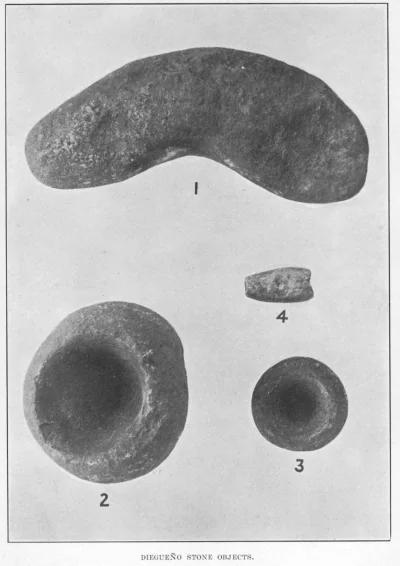
Plate 21. DIEGUEÑO STONE OBJECTS
EXPLANATION OF PLATE 21.
Fig. 1.—Crescent-shaped ceremonial stone. Mesa Grande. 1-13747 1.
Fig. 2.—Toloache mortar. Mesa Grande. 1-13742.
Fig. 3.—Stone cup for drinking toloache. Mesa Grande. 1-13743.
Fig. 4.—Stone pipe. Capitan Grande. 1-14474.
Figures are .3 natural size.
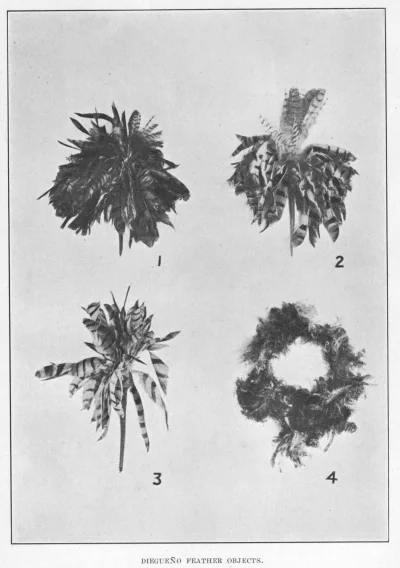
Plate 22. DIEGUEÑO FEATHER OBJECTS
EXPLANATION OF PLATE 22.
Figs. 1-3.—Headplumes of owl feathers. Mesa Grande. 1-12963, 1-13751, 1-13750.
Fig. 4.—Headband of owl feathers. Mesa Grande. 1-12962.
Figures are .13 natural size.
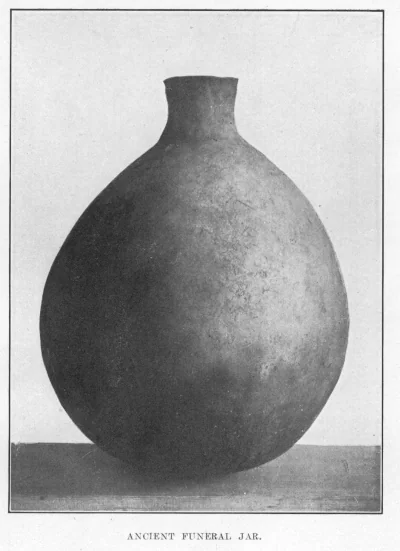
Plate 23. ANCIENT FUNERAL JAR.
EXPLANATION OF PLATE 23.
Funeral jar. Found about 15 miles from Mesa Grande. 1-13739.
.11 natural size.
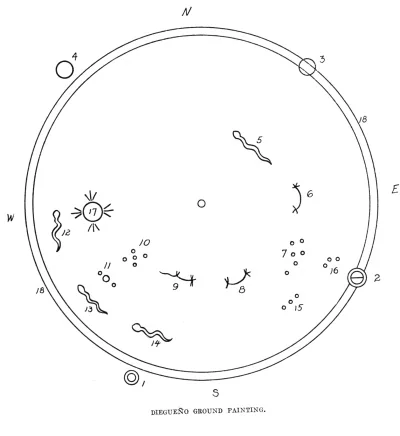
DIEGUEÑO GROUND PAINTING.
EXPLANATION OF PLATE 24.
Ground Painting, made by Manuel Lachuso, an old man of Santa Ysabel. He had forgotten the precise location of the milky way, sun, new moon, and old moon, so they are omitted. He made no mention of toloache mortars.
1.—Atoloi, witch mountain on an island, identified by the informant with Coronado island.
2.—Nyapukxaua, mountain where people were created.
3.—Wikaiyai, San Bernardino mountain.
4.—Axatu, Santa Catalina island.
5.—Awī, rattlesnake.
6.—Etcekurlk, wolf.
7.—Xatca, Pleiades.
8.—Namul, bear.
9.—Nyimatai, panther.
10.—"Cross star".
11.—Sair, buzzard star.
12.—Xawitai, grass or blue garter snake.
13.—Xilkaīr, red racer snake.
14.—Awiyuk, gopher snake.
15.—Watun, "shooting" constellation.
16.—Amu, mountain-sheep, three stars of Orion.
17.—Spitting hole, diameter about 8 inches.
18.—Horizon, forming the visible limits of the earth.
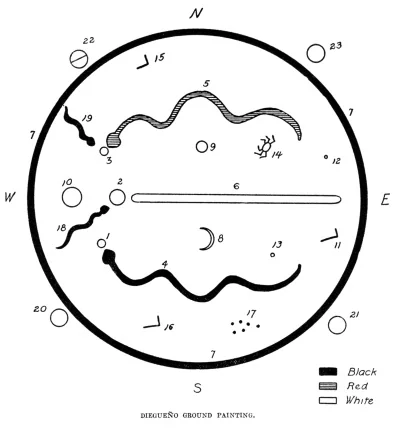
DIEGUEÑO GROUND PAINTING.
EXPLANATION OF PLATE 25.
Ground Painting made by Antonio Maces and Jo Waters, old men at Mesa Grande.
1, 2, 3.—Kalmo and witūrt, toloache mortar and pestle.
4, 5.—Awī, rattlesnake.
6.—Xatatkūrl, milky way.
7.—Amut kwaptcurpai, world's edge. There is some doubt as to the correct color for this figure.
8.—Halyaxai, new moon.
9.—Halya, full moon.
10.—Inyau, sun.
11.—Hatapa, coyote.
12.—Saīr, buzzard star.
13.—Crow.
14.—Halturt, black spider.
15.—Katckurlk, wolf.
16.—Amu, mountain-sheep, Orion.
17.—Hatca, Pleiades.
18.—Awī-nīl, black snake.
19.—Awl-yuk, gopher snake.
20-23.—Mountains.
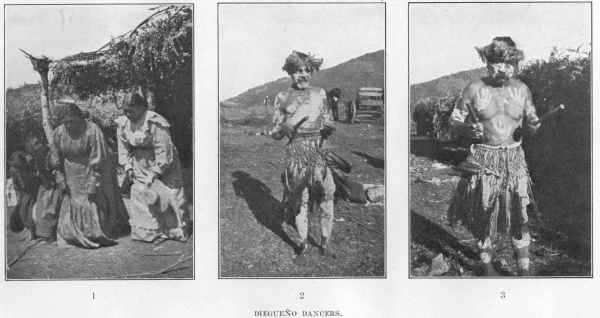
DIEGUEÑO DANCERS.
EXPLANATION OF PLATE 26.
Fig. 1.—Women Dancing.
Figs. 2, 3.—Dancers painted for Tapakwirp.
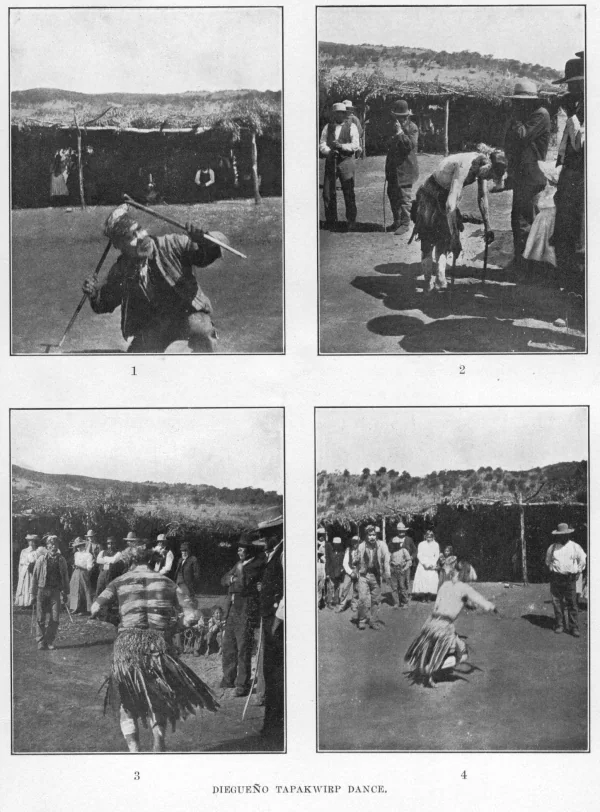
DIEGUEÑO TAPAKWIRP DANCE.
EXPLANATION OF PLATE 27.
Fig. 1.—Assistant posing facing the sun in the Tapakwirp dance.
Fig. 2.—Tapakwirp dancer resting. The leader stands at his left.
Fig. 3.—Tapakwirp dancer whirling.
Fig. 4.—Tapakwirp dancer squatting in the midst of a song.
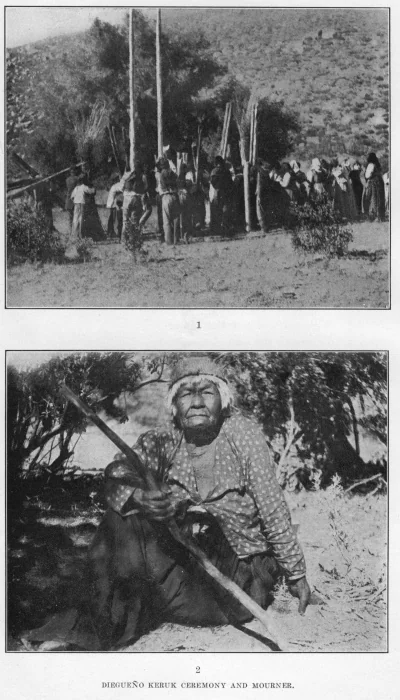
DIEGUEÑO KERUK CEREMONY AND MOURNER.
EXPLANATION OF PLATE 28.
By courtesy of Mr. E. H. Davis, Mesa Grande.
Fig. 1.—Poles and materials for the enclosure used in the Keruk ceremony. The women are crying. The old woman on the left is sprinkling pine-nuts and beans over the materials. Photographed in August, 1908.
Fig. 2.—Old woman. Her breast is lacerated as a sign of mourning.
Footnotes
345:1 The numbers given are the catalogue numbers of the Museum of the Department of Anthropology of the University of California.
Religious Practices of the Diegueño Indians. 1910. Hermetic Cloud, https://hermeticcloud.com/library/waterman-religious-practices-of-the-diegueno-indians/. Public-domain text reproduced in full; markup only.
Scanned, proofed and formatted by John Bruno Hare at sacred-texts.com, April 2008. This text is in the public domain in the US because it was published prior to 1923.