PREFACE.
The chief object of preparing this translation of the standard native history of Ancient Japan, known as the Nihongi, was to make accessible to European scholars the very considerable store of material for the study of mythology, folk-lore, early civilization, and manners and customs which it contains. It may also prove of interest to those numerous Japanese who are acquainted with the English language, and who may have the curiosity to learn in what light their ancient history and traditions are viewed by a Western student.
As only a limited sale of a work of this kind could be expected, the translator was fortunate in being relieved from all pecuniary responsibility for its publication by the Japan Society. His special acknowledgments are due to those members by whose liberality a guarantee fund for this purpose has been provided.
It remains for him to express his indebtedness to other workers, by whose labours in the field of Japanese and Chinese learning he has freely profited. The writings of Messrs. Chamberlain and Satow[1] have been placed under frequent contribution, and for the latter part of the work, the scholarly German translation of the Nihongi, by Dr. Florenz, has been of the greatest possible assistance. He should also mention the names of Williams, Giles, Parker, Mayers, Gubbins, Hepburn, Anderson, Legge, and Eitel, whose writings are the indispensable companions of all students of Far-Eastern subjects. Other sources of information are acknowledged in the notes.
Amongst native Japanese writers the chief authorities have been the famous scholars Motoöri and Hirata. Their religious and patriotic prejudices often lead them to take views from which a European reader is forced to dissent, but no Western scholar can hope to rival or even to approach their vast erudition, clothed as it is in an easy and graceful style, undisfigured by pedantry. The translator gladly seizes this opportunity of expressing the strong admiration which he has long entertained for them. For the Notes, the Shūkai edition of the Nihongi and the Tsūshō Commentary have been largely drawn upon. The references to Chinese literature have been usually taken from these last-named sources. It is unnecessary to enumerate more particularly the other native works of reference which have been utilized. A copious list of them will be found in Dr. Florenz's Introduction.
The translator should not omit to express his thanks to Mr. W. Gowland for the use of the drawings and photographs relating to the Imperial Misasagi and sepulchral mounds, from which a number of the illustrations have been reproduced.
The vital importance of a good Index is fully recognized. No pains will be spared to make this part of the work as complete and satisfactory as possible.
- Now Sir Ernest Satow, K.C.M.G., H.M.'s Minister Plenipotentiary to Japan.
INTRODUCTION.
Writing.—The art of writing is one of the numerous elements of civilization for which Japan is indebted to China. The date of its first introduction is not definitely known. There are indications that some acquaintance with the Chinese written character was possessed by individuals in Japan during the early centuries of the Christian era, but the first positive information on the subject belongs to A.D. 405, for which an erroneous date corresponding to A.D. 285 is given in the Nihongi. In this year a Corean named Wani or Wangin was appointed tutor in Chinese to a Japanese Imperial Prince. He was the first of a succession of teachers from that country whose instructions paved the way for a revolution in Japanese institutions and manners, not less profound and far-reaching than that produced in our own time by the influence of European ideas.
From its geographical position, Corea was the natural intermediary by which China became known to Japan. In these early times there was no direct sea communication between the two last-named countries. Travellers crossed the Strait from Japan to Corea, and pursued the rest of their journey by the circuitous overland route. But the Corean national genius seems to have left no impress of its own on the civilization which it received from China and handed on to Japan. Medicine, Buddhism, painting, and the mechanic arts were transmitted, as far as we can see, without modification, and there is little trace of any special Corean character in the knowledge of Chinese literature and science which Coreans communicated to Japan. They had themselves taken up this study only thirty years before Wani's departure.[1]
The newly-acquired Chinese characters were soon put to practical use. Wani himself is said to have been employed to keep the accounts of the Treasury. In the reign of Nintoku we are told that Ki no Tsuno no Sukune committed to writing an account of the productions of the Corean kingdom of Pėkché. The date given for this in the Nihongi is A.D. 353, to which, as in the case of other events of this period, two cycles or 120 years should probably be added. In the following reign (Richiu's) "recorders were appointed in the provinces in order to note down words and events." But from the specimens of their reports which are preserved in the Nihongi, these officials do not seem to have contributed much of importance to historical knowledge. Fabulous stories and accounts of monstrosities and portents form the staple of their compositions. It may be inferred, however, that such functionaries were already in existence at the capital, and indeed we find mention at this time of hereditary corporations of fumi-bito or scribes, known as the Achiki Be and Wani Be, the successors of Atogi and Wani, the Corean scholars who first taught Chinese at the court of the Mikado.
History. The Kiujiki.—The first literary efforts of the Japanese took the direction of history. No doubt the Norito or rituals of the Shinto religion and some poetical compositions date from an earlier period. But they do not seem to have been committed to writing. The earliest book of which we find mention is the Kiujiki or Kujiki (Chronicle of old matters of former ages), which was compiled in A.D. 620 under high official auspices, as indeed were all the historical works which have come down to us from these ancient times. The writing of history was, and still is, regarded as pre-eminently a matter of State concern in all those Eastern countries where Chinese ideas are predominant. The Kiujiki was entrusted to the keeping of the Soga House, but on its downfall in 645, a large portion was destroyed by fire, a part only, described as Kokuki or national annals, having been saved from the flames. Whether this work is or is not identical with the Kiujiki of our own day, is a question on which I shall have more to say afterwards. At present it is sufficient to note that the latter work contains nothing which is not also to be found in the Kojiki or Nihongi except a few passages in the mythological portion and a list of local governors. The historical part is almost word for word the same as the Nihongi, which, however, is very much fuller, and is brought down to a much later period.
The Kojiki.—In A.D. 682 a number of Princes and High Officials were formally commissioned by the Emperor Temmu to prepare a "History of the Emperors and of matters of high antiquity." Nothing is known of the result of their labours, but this measure led eventually to the compilation of the Kojiki, as we learn from a passage in the Preface to that work.[2] It was not completed, however, until A.D. 712. The Kojiki has fortunately been preserved to us. If the Kiujiki is excepted, as of doubtful authenticity, it is the earliest product of the Japanese historical muse, and indeed the oldest monument of Japanese literature. It presents many features of the highest interest, but it is needless to dwell here on a subject which has been so thoroughly dealt with by Chamberlain in the Introduction to his admirable translation of this work.
In 714, or two years after the completion of the Kojiki, the Empress Gemmiō gave orders for the preparation of a national history. We hear nothing more of this project, which may or may not have served to provide materials for the Nihongi.
The Nihongi—Date and Authorship.—We now come to the Nihongi itself. It has no title-page or preface, and our information as to its date and authorship is derived from other sources. The Kōnin Shiki (commentary on the Nihongi, of the period 810-824) informs us that it was completed and laid before the Empress Gemmiō in A.D. 720 by Prince Toneri and Yasumaro Futo no Ason. In addition to the thirty books which have come down to us, there was originally a book of genealogies of the Emperors which is no longer extant. The term used by the Shiki in speaking of its preparation is "selected afresh," which points obviously to compilation rather than original composition. An examination of the work itself favours this view. It consists of detached passages linked together by chronological sequence, and some endeavour is visible to shape the materials into a consistent whole, but the result has a more or less patchwork appearance, and falls far short of the standard of uniformity of style and method which we are accustomed to look for in historical compositions.
Materials for the Nihongi.—The remains of the Kiujiki must have formed a very important element of the authors' material. Indeed I lean to the belief that whether the present Kiujiki is authentic or not, much of the earlier part of the Nihongi (except the first two books) is practically the composition of the illustrious Shōtoku Daishi, its reputed author. It is recorded that he was a profound student of Buddhism and of Chinese classical literature, and internal evidence shows that the writer of this part of the Nihongi was well versed in these subjects. The Kojiki is not directly referred to, and little use seems to have been made of it. But it was well known to the authors. Indeed one of them, Yasumaro, was the very person who took down the Kojiki from the lips of Hiyeda no Are, a man (or woman) who had a remarkable memory, well stored with the ancient traditions of the Japanese race. That no community of style can be traced between the two works is easily explained by the circumstance that Yasumaro was in the first case little more than an amanuensis, and in the second a compiler. It is possible, too, that his associate, Prince Toneri, was the guiding spirit of the undertaking, and that Yasumaro simply carried out his directions.
The Nihongi contains a few phrases which show that the Norito or Rituals of the Shinto cult were familiar to the authors, but nothing of importance is drawn from this source.
Another stock of information which was probably at their disposal is referred to in the History of the reign of Jitō Tennō (A.D. 694), where it is stated that orders were given to eighteen of the principal noble Houses to deliver to the Government their genealogical records. Other historical works, notably a certain Kana Nihongi have been spoken of as in existence before the date of the Nihongi, and that there was a copious historical or legendary literature accessible to the authors cannot be doubted. The work itself, as we have it, contains ample evidence of this in the numerous quotations from other writings, added, as most Japanese critics think, by the authors themselves, or, as I prefer to believe, by subsequent scholars soon after its appearance. These extracts are always referred to in later times as if they formed part of the Nihongi, and there can be no harm in accepting them as of equal authority with it. Some are, no doubt, of still greater antiquity.
An institution which must have contributed substantially, though perhaps indirectly, to the collection and conservation of the materials for the more legendary part of the Nihongi was the Katari Be, or hereditary corporation of reciters. Unfortunately we know very little about it. Hirata, in his Koshichō, states, on what authority does not appear, that the Katari Be came forward and recited "ancient words" before the Emperor at the festival of Ohonihe when he inaugurated his reign by sacrifices to the Gods. It is not probable that their services were confined to this occasion.
Character and Contents of the Nihongi.—The Nihongi consists of very heterogeneous elements which by no means all answer to our ideas of history. The earlier part furnishes a very complete assortment of all the forms of the Untrue of which the human mind is capable, whether myth, legend, fable, romance, gossip, mere blundering, or downright fiction. The first two books are manifestly mythological. They are followed by an account of Jimmu's Conquest of Yamato, which has probably a basis of truth, though the legendary character obviously predominates.
Most of the meagre details given us of the reigns of the next eight Emperors have a Chinese stamp, and must, I fear, be pronounced simply fictitious. Nor need this greatly surprise us. There are other countries where
Mortal men are ever wont to lie,Whene'er they speak of sceptre-bearing kings.
A portrait gallery in Holyrood Palace illustrates the same principle, though in a different way.
Then we have a series of legendary stories full of miraculous incidents, but in which grains of truth may here and there be discerned. The value of this early part of the work is enhanced by the numerous poems of great antiquity which have been incorporated into it, and which have considerable antiquarian and philological interest.
The narrative becomes more and more real as it goes on, until about the 5th century we find ourselves in what, without too violent a departure from the truth, may be called genuine history, while from the beginning of the 6th century until A.D. 697, when it is brought to a close, the Nihongi gives us what is to every appearance a trustworthy record of events. We must still, however, be on our guard against the Chinese diction and sentiments which are put into the mouths of the Mikados and their Ministers, and there are some strange stories of a kind not likely to impose on our credulity. This part of the Nihongi is of very great value, comprising as it does a period of the highest importance in the life of the Japanese nation. It was at this time that the Japanese adopted and assimilated the civilization of China, material, moral, and political, together with the Buddhist religion, thereby profoundly modifying the entire course of their future history.
The defects of the Nihongi are due partly to the uncritical spirit of the age when it was written, but mainly to the circumstance that the authors were accomplished scholars deeply imbued with ideas derived from the classical and historical literature of ancient China. With exceptions to be noticed presently, the work is composed in the Chinese language. This is in itself an obstacle to the faithful representation of things Japanese. But unfortunately it is not all. Chinese ideas and traits of Chinese manners and customs are frequently brought in where they have no business. In the very first paragraph we have an essay spiced with Chinese philosophical terms which reads strangely incongruous as a preface to the native cosmogonic myth. Battle axes are mentioned at a time when no such weapons were in use by the Japanese, stone mallets are converted into swords, and we hear continually of the Temples of the Earth and of Grain, a purely Chinese metaphor for the State. No inconsiderable part of the work consists of speeches and Imperial decrees interlarded with quotations from Chinese literature, and evidently composed for the occasion in imitation of Chinese models. In one case the authors have gone so far as to attribute to the Emperor Yūriaku a dying speech of several pages, which is taken with hardly any alteration from a history of the Chinese Sui dynasty, where it is assigned to an Emperor who died 125 years later.
But what is far more misleading than these naive inventions is the confirmed habit common to the writers both of the Kojiki and of the Nihongi, though the latter are the greater offenders, of throwing back, no doubt more or less unconsciously, to more ancient times the ideas of their own age, when the national thought and institutions had become deeply modified by Chinese influences. As Dr. Florenz very justly remarks, "The little which European inquiry has hitherto been able to teach us of the real condition of Japan in the most ancient times shows that the historical representation of this period in the Kojiki and Nihongi (upon which rest all the later statements of the Japanese) is most profoundly penetrated by false principles. The newer relations, partly developed from native material, partly influenced by Chinese culture, are reflected back upon the oldest without due distinction, and the result is a confused picture in which the critical inquirer can, it is true, frequently separate what is original from subsequent additions, but must often let fall his hands in despair." A conspicuous instance of this is the way in which the Imperial theory of the universal authority of the Mikados is extended backwards to a time when their sway was really restricted to the provinces round the capital and a few other places. It is also exemplified by the treatment of territorial and official designations in the older part of the history as if they were already family names, which they did not become until a later period.
Chronology.—The Kojiki wisely has no chronology. But the authors of the Nihongi, or more probably of some of the works on which it is based, thought it necessary, in imitation of their Chinese models, to provide a complete system of dates extending as far back as the middle of the 7th century B.C., and giving the exact years, months, and even days for events which are supposed to have happened in this remote period. When it is remembered that there was no official recognition of the art of writing in Japan until A.D. 405, and that the first mention of calendar-makers belongs to A.D. 553, the historical value of such chronology may be readily estimated. After the Christian epoch there may have been some blundering and unsuccessful endeavours to give the right years, but for several centuries longer the months and days must have been simply supplied from the writers' imagination. Even so late as the beginning of the 5th century the chronology can be shown to be wrong in several cases by no less an interval than 120 years. Abundant proofs of its inaccuracy are revealed by a comparison with the contemporary histories of Corea and China, and an examination of the Nihongi itself yields many more. The impossible lengths attributed to the Emperors' reigns are a well-known example, and some, but by no means all, of the other evidence to this effect is indicated in the notes to the present version.
The first date in the Nihongi which is corroborated by external evidence is A.D. 461, but the chronology is not a little vague for some time longer. Perhaps if we take A.D. 500 as the time when the correctness of the Nihongi dates begins to be trustworthy, we shall not be very far wrong.
In an essay contributed to a Japanese magazine called Bun, in 1888, Mr. Naka has brought together absolutely overwhelming evidence of the utter inaccuracy in matters of chronology of the early part of the Nihongi, and I may be allowed to refer the reader to a paper on "Early Japanese History" read before the J.A.S. in December, 1887, in which the same thesis is maintained. Such scholars as Satow, Chamberlain, Bramsen, Griffis and others have expressed themselves to a similar effect, and it may be hoped that we have now heard the last of the thoughtless echoes of old Kaempfer's audacious assertion that since the time of Jimmu Tennō, the Japanese have been "accurate and faithful in writing the history of their country and the lives and reigns of their monarchs."
But enough has been said of the defects of the Nihongi. The above strictures apply almost exclusively to the earlier half of the work, and they must not be allowed to blind us to the fact that it after all presents a very full and varied picture of the civilization, manners and customs, and political, moral, and religious ideas of the ancient Japanese. Even the large untrue element which it contains is not without its value. Bad history may be good mythology or folk-lore, and statements the most wildly at variance with fact often throw a useful light on the beliefs or institutions of the age when they became current.
Estimation in which the Nihongi was held.—The importance of the Nihongi was at once recognized by the somewhat narrow circle of courtiers and officials for whom it was intended. Subsequent history contains frequent mention of its being publicly read and expounded to the Mikado's Court, one of these notices belonging to the very next year after its completion. It threw wholly into the shade its predecessor the Kojiki and superseded the recitations of the Katari Be and other similar customs. Another testimony to its value is the series of commentaries which began to be written upon it immediately after its appearance. Some of these notes, known as Shiki or "private notes" have been preserved to us in a work called Shaku-nihongi, written about the end of the 13th century. They are described as of the periods Yōrō, (714-724), Kōnin (810-824), and Yengi (901-923).
This high estimation for the Nihongi has lasted until our own day. Its pre-eminence as a source of knowledge of Japanese antiquity was never contested until quite recent times. Even Motoöri[3] acknowledges its value, although his religious and patriotic prejudices lead him to give a preference to the Kojiki which is less profoundly tainted by an admixture of Chinese ideas.
The Kojiki and the Nihongi.—Both the Kojiki and the Nihongi present to the eye a series of Chinese characters. A closer examination, however, reveals a marked difference in the way in which they are used by the respective authors. In the Kojiki, which was taken down from the mouth of a Japanese by a man with some tincture of Chinese learning, the Chinese construction is every now and then interrupted or rather helped out by Japanese words written phonetically, the result being a very curious style wholly devoid of literary qualities. It is in fact possible to restore throughout the original Japanese words used by Hiyeda no Are with a fair degree of probability, and this has actually been done by Motoöri in his great edition of the work known as the Kojikiden, This feature gives the Kojiki a far greater philological interest than the Nihongi. The latter is composed almost wholly in the Chinese language, the chief exception being the poems, for which it was necessary to use the Chinese characters with a phonetic value so as to give the actual words and not simply the sense, as is the case when they are employed as ideographs. The proper names in both works are naturally Japanese.
As a repertory of ancient Japanese myth and legend, there is little to choose between the Kojiki and Nihongi, The Kojiki is on the whole the fuller of the two, and contains legends which the Nihongi passes over in silence, but the latter work, as we now have it, is enriched by variants of the early myths, the value of which for purposes of comparison will be recognized by scientific inquirers.
But there can be no comparison between the two works when viewed as history. Hiyeda no Are's memory, however well-stored, could not be expected to compete in fulness and accuracy with the abundant written literature accessible to the writers of the Nihongi and an examination of the two works shows that, in respect to the record of actual events, the latter is far the more useful authority. It should be remembered, too, that the Nihongi is double the size of its predecessor, and that whereas the Kojiki practically comes to an end with the close of the 5th century, the Nihongi continues the narrative as far as the end of the 7th, thus embracing an additional space of two hundred years of the highest importance in the history of Japan.
Text and Editions.—The class of readers for whom the present work is intended would be little interested in an account of the text of the Nihongi and of its various manuscripts and printed editions. In any case this subject has been so exhaustively treated by Dr. Florenz in his Introduction as to render research by other inquirers a superfluous labour.
A few words, however, should be said respecting the Shūkai (or Shūge i.e. collected interpretations) edition, which has been taken as the basis of the present version. There are a few departures from it, chiefly where the translator has restored passages of the "Original Commentary" which the Shūkai editor has struck out or relegated to his notes.
The Shūkai edition is on the whole the most useful one, being well printed, and provided with a copious Chinese commentary. To facilitate reference to it the book and page of this edition have been noted throughout in the margin of the present translation.
The large black type of the Shūkai is the text. The "Original Commentary" and the quotations from other books are printed in a smaller type. Both of these are usually assumed to be part of the Nihongi, and are quoted as such. They have been included in the present translation, but they are distinguished from the Nihongi proper by being indented, or in the case of some very short passages, enclosed in square brackets. Still smaller characters are used by the editor for his notes. In addition to these, small Katakana characters may be seen at the side of many of the characters of the original text and commentary. They are frequently referred to in the notes of the present version under the description of the "interlinear Kana" or the "traditional Kana rendering," and consist of translations into Japanese of the Chinese characters alongside of which they stand, or add particles which are necessary to complete the sense in a Japanese translation. These glosses are of considerable but unknown antiquity. They are sometimes useful, especially in giving obsolete words and the pronunciation of proper names, but they cannot be implicitly relied on. They are often wrong, and still more frequently inadequate.
Spelling.—In transliterating Japanese words, the method adopted by the Japan Society has been followed pretty closely. It is nearly identical with that which is recommended by the Royal Geographical Society, and which may be briefly described as—"the vowels as in Italian, the consonants as in English." There are no silent letters.
Some inconsistencies will doubtless be observed in the spelling of proper names, in regard to which the Japanese themselves are often very vague. There is a good deal of confusion between the hard and soft consonants t and d, ch or sh and j, h and b, and k and g, which it is difficult for a European scholar always to avoid.
The spelling in the case of words of Japanese derivation follows the Japanese written language in representing an older pronunciation than that now current.
Corean proper names are spelt after the system described by Sir E. Satow in his "List of Corean Geographical Names." It is based on the principle of the Royal Geographical Society's method above-mentioned. But the true pronunciation of these names is involved in much obscurity, and the rendering adopted is in many cases merely provisional.
In spelling Chinese proper names, the ordinary authorities have been followed. They do not agree very well among themselves, but it is hoped that the inconsistencies which have resulted will not occasion any difficulty to the reader.
- See a paper on "Writing, Printing, and the Alphabet in Corea," in the "J.R.A.S.," July, 1895.
- See Ch. K., p. 9.
- Motoöri has left a poem to the following effect:—
In all their fulness
How should we know
The days of old,
Did the august Yamato writing (the Nihongi)
Not exist in the world?
Hirata says ("Kodō Taii," I. 36), "If we put aside the ornaments of style of Chinese fashion, there is none among all the writings in the world so noble and important as this classic."
ABBREVIATIONS.
T.A.S.J.—Transactions of the Asiatic Society of Japan.
Ch. K.—The translation of the "Kojiki" by Basil Hall Chamberlain in "T.A.S.J.," Vol. X. Supplement.
J.R.A.S.—Journal of the Royal Asiatic Society.
N.B.—Attention is drawn to the Table of Errata and Addenda in the second volume.
NIHONGI.[1]
BOOK I.[2]
THE AGE OF THE GODS.
Part I.
Of old, Heaven and Earth were not yet separated, and the In and Yō[3] not yet divided. They formed a chaotic mass like an egg which was of obscurely defined limits and contained germs.
The purer and clearer part was thinly drawn out, and formed Heaven, while the heavier and grosser element settled down and became Earth.
The finer element easily became a united body, but the consolidation of the heavy and gross element was accomplished with difficulty.
Heaven was therefore formed first, and Earth was established subsequently.
Thereafter Divine Beings were produced between them.[4]
Hence[5] it is said that when the world began to be created, the soil of which lands were composed floated about in a manner which might be compared to the floating of a fish sporting on the surface of the water.
At this time a certain thing was produced between Heaven and Earth. It was in form like a reed-shoot. Now this (I. 2.) [6]became transformed into a God, and was called Kuni-toko-tachi no Mikoto.[7]
[The character 尊 is used owing to the extreme dignity of this Deity. For the others the character 命 is used. Both are read Mikoto. This rule is followed below.[8]]
Next there was Kuni no sa-tsuchi no Mikoto,[9] and next Toyo-kumu-nu no Mikoto,[10] in all three deities.[11]
These were pure males spontaneously developed by the operation of the principle of Heaven.[12]
In one writing it is said:[13]—"When Heaven and Earth began, a thing existed in the midst of the Void.[14] Its shape may not be described. Within it a Deity was spontaneously produced, whose name was Kuni-toko-tachi no Mikoto, also called Kuni-soko-tachi[15] no Mikoto. Next there was Kuni no sa-tsuchi no Mikoto, also called Kuni no sa-tachi[16] no Mikoto. Next there was Toyo-kuni-nushi[17] no Mikoto, also called Toyo-kumu-nu[18] no Mikoto, Toyo-ka-fushi-no[19] no Mikoto, Uki-fu-no-toyo-kahi[20] no Mikoto, Toyo-kuni-no[21] no Mikoto, Toyo-kuhi-no[22] no Mikoto, Ha-ko-kuni-no[23] no Mikoto, or Mi-no[24] no Mikoto."
In one writing it is said:—"Of old, when the land was young and the earth young, it floated about, as it were floating oil. At this time a thing was produced within the land, in shape like a reed-shoot when it sprouts forth. From this there was a Deity developed, whose name was (I. 3.) Umashi-ashi-kabi-hiko-ji[25] no Mikoto. Next there was Kuni no toko-tachi no Mikoto, and next Kuni no sa-tsuchi no Mikoto."
In one writing it is said:—"When Heaven and Earth were in a state of chaos, there was first of all a deity,[26] whose name was Umashi-ashi-kabi-hiko-ji no Mikoto. Next there was Kuni-soko-tachi no Mikoto."
In one writing it is said:—"When Heaven and Earth began, there were Deities produced together, whose names were, first, Kuni-no-toko-tachi no Mikoto, and next Kuni no sa-tsuchi no Mikoto." It is further stated:—"The names of the Gods which were produced in the Plain of High Heaven were Ama no mi-naka-nushi[27] no Mikoto, next Taka-mi-musubi[28] no Mikoto, next Kami-mi-musubi[29] no Mikoto."
In one writing it is said:—"Before Heaven and Earth were produced, there was something which might be compared to a cloud floating over the sea. It had no place of attachment for its root. In the midst of this a thing was generated which resembled a reed-shoot when it is first produced in the mud. This became straightway transformed into human[30] shape and was called Kuni no toko-tachi no Mikoto."
In one writing it is said:—"When Heaven and Earth began, a thing was produced in the midst of the Void, which resembled a reed-shoot. This became changed into a God, who was called Ama no toko-tachi[31] no Mikoto. There was next Umashi-ashi-kabi-hiko-ji no Mikoto." It is further stated:—"There was a thing produced in the midst of the Void like floating oil, from which a God was developed, called Kuni toko-tachi no Mikoto."
The next Deities who came into being were Uhiji-ni[32] no Mikoto and Suhiji-ni no Mikoto, also called Uhiji-ne no (I. 4.) Mikoto and Suhiji-ne no Mikoto.
The next Deities which came into being were Oho-to nochi no Mikoto and Oho-to mahe no Mikoto.
One authority says Oho-to no he no Mikoto, otherwise called Oho-to-ma-hiko no Mikoto and Oho-to-ma-hime no Mikoto. Another says Oho-tomu-chi no Mikoto and Oho-tomu-he no Mikoto.[33]
The next Gods which came into being were Omo-taru no Mikoto and Kashiko-ne no Mikoto, also called Aya-kashiko-ne no Mikoto, Imi kashiki no Mikoto, or Awo-kashiki-ne no Mikoto, or Aya-kashiki no Mikoto.[34]
The next Deities which came into being were Izanagi no Mikoto and Izanami no Mikoto.[35]
One writing says:—"These two Deities were the children of Awo-kashiki-ne no Mikoto."
One writing says:—"Kuni no toko-tachi no Mikoto produced Ame kagami no Mikoto, Ame kagami no Mikoto produced Ame yorodzu no Mikoto, Ame yorodzu no Mikoto produced Aha-nagi no Mikoto, and Aha nagi no Mikoto produced Izanagi no Mikoto."[36]
These make eight Deities in all. Being formed by the mutual action of the Heavenly and Earthly principles, they were made male and female.[37] From Kuni no toko-tachi no Mikoto to Izanagi no Mikoto and Izanami no Mikoto are called the seven generations of the age of the Gods.[38]
In one writing it is said:—"The gods that were produced in pairs, male and female, were first of all Uhiji ni [38] no Mikoto and Suhiji ni no Mikoto. Next there were Tsuno-guhi no Mikoto and Iku-guhi no Mikoto, next
[38] Omo-taru no Mikoto and Kashiko-ne no Mikoto, and next Izanagi no Mikoto and Izanami no Mikoto."
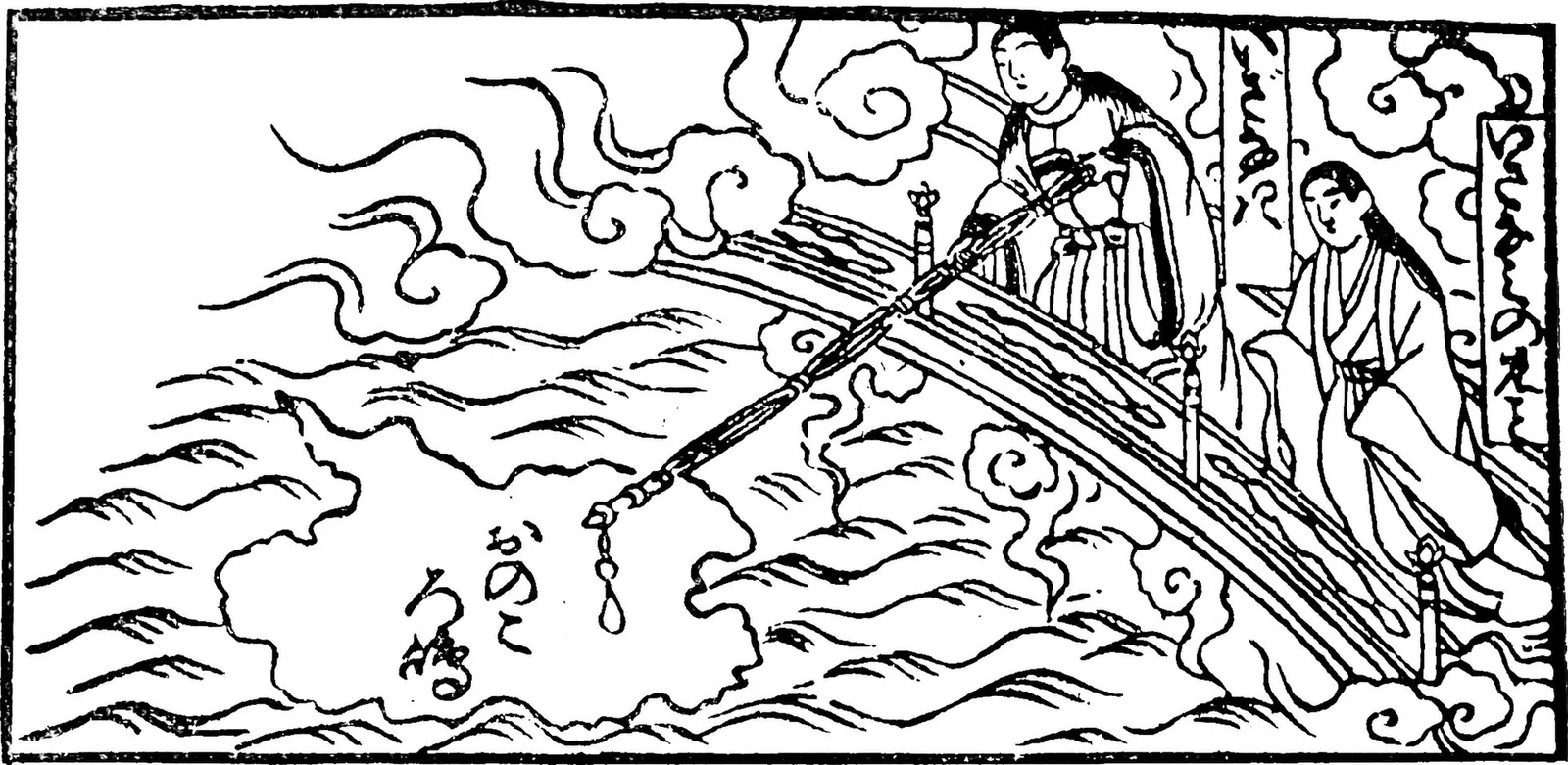
Izanagi and Izanami on the Floating Bridge of Heaven.
Izanagi no Mikoto and Izanami no Mikoto stood on the (I. 5.) floating bridge of Heaven, and held counsel together, saying: "Is there not a country beneath?"
[38] Thereupon they thrust down the jewel-spear of Heaven[39] and groping about therewith found the ocean. The brine which [38] dripped from the point of the spear coagulated and became an island which received the name of Ono-goro-jima.[40]
The two Deities thereupon descended and dwelt in this island. Accordingly they wished to become husband and wife together, and to produce countries.
So they made Ono-goro-jima the pillar of the centre of the land.[41]
Now the male deity turning by the left, and the female[42] [39] deity by the right, they went round the pillar of the land separately. When they met together on one side, the female (I. 6.) deity spoke first and said:—"How delightful! I have met with a lovely youth." The male deity was displeased, and said:—"I am a man, and by right should have spoken first. How is it that on the contrary thou, a woman, shouldst have been the first to speak? This was unlucky. Let us go round again." Upon this the two deities went back, and having met anew, this time the male deity spoke first, and said:—"How delightful! I have met a lovely maiden."
Then he inquired of the female deity, saying:—"In thy body is there aught formed?" She answered, and said:—"In my body there is a place which is the source of femineity." The male deity said:—"In my body again there is a place which is the source of masculinity. I wish to unite this source-place of my body to the source-place of thy body." Hereupon the male and female first became united as husband and wife.
Now when the time of birth arrived, first of all the island of Ahaji was reckoned as the placenta, and their minds took no pleasure in it. Therefore it received the name of Ahaji no Shima.[43]
Next there was produced the island of Oho-yamato no Toyo-aki-tsu-shima.[44]
Here and elsewhere 日本 (Nippon) is to be read Yamato.[45]
(I. 7.) Next they produced the island of Iyo no futa-na,[46] and next the island of Tsukushi.[47] Next the islands of Oki and Sado were born as twins. This is the prototype of the twin-births which sometimes take place among mankind.
Next was born the island of Koshi,[48] then the island of Oho-shima, then the island of Kibi no Ko.[49]
Hence first arose the designation of the Oho-ya-shima[50] country.
Then the islands of Tsushima and Iki, with the small islands in various parts, were produced by the coagulation of the foam of the salt-water.
It is also stated that they were produced by the coagulation of the foam of fresh water.
In one writing it is said:—"The Gods of Heaven addressed Izanagi no Mikoto and Izanami no Mikoto, (I. 8.) saying: 'There is the country Toyo-ashi-hara-chi-i-wo-aki no midzu-ho.[51] 'Do ye proceed and bring it into order.' They then gave them the jewel-spear of Heaven. Hereupon the two Gods stood on the floating bridge of Heaven, and plunging down the spear, sought for land. Then upon stirring the ocean with it, and bringing it up again, the brine which dripped from the spear-point coagulated and became an island, which was called Ono-goro-jima. The two gods descended, dwelt in this island, and erected there an eight-fathom palace.[52] They also set up the pillar of Heaven."
Then the male Deity asked the female Deity, saying:—"Is there anything formed in thy body?" She answered and said:—"My body has a place completely formed, and called the source of femineity." The male god said:—"My body again has a place completely formed, and called the source of masculinity. I desire to unite my source of masculinity to thy source of femineity." Having thus spoken, they prepared to go round the pillar of Heaven, and made a promise, saying:—"Do thou, my younger sister, go round from the left, while I will go round from the right." Having done so, they went round separately and met, when the female Deity spoke first, and said:—"How pretty! a lovely youth!" The male Deity then answered and said:—"How pretty! a lovely maiden!" Finally they became husband and wife. Their first child was the
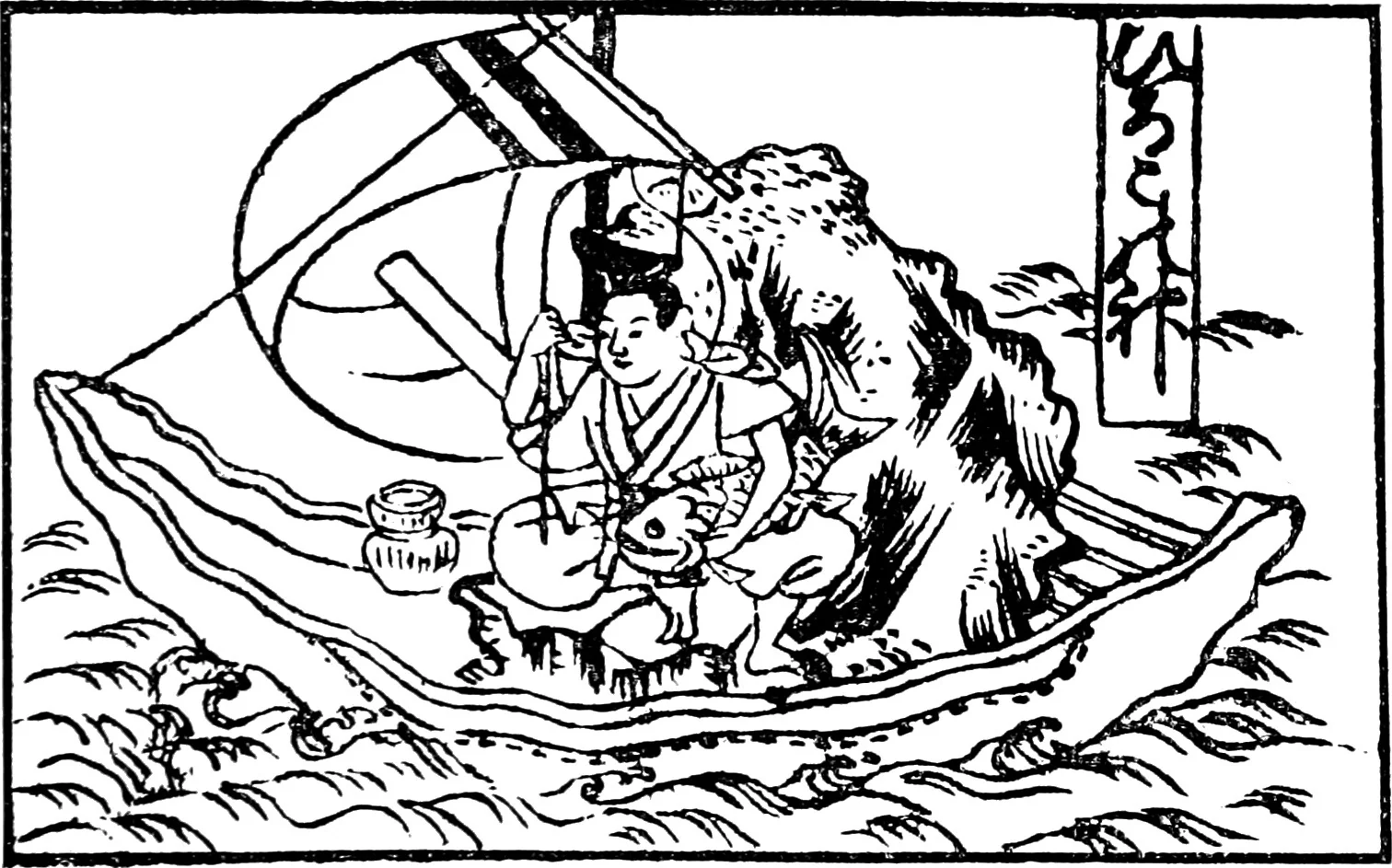
The Leech Child as Yebisu.
leech, whom they straightway placed in a reed-boat and sent (I. 9.) adrift.[53] Their next was the Island of Ahaji. This also was not included in the number of their children. Wherefore they returned up again to Heaven, and fully reported the circumstances. Then the Heavenly Gods divined this by the greater divination. Upon which they instructed them, saying:—"It was by reason of the woman's having spoken first; ye had best return thither again." Thereupon having divined a time, they went down. The two deities accordingly went again round the pillar, the male Deity from the left,[54] and the female Deity from the right. When they met, the male Deity spoke first and said:—"How pretty! a lovely maiden!" The female Deity next answered and said:—"How pretty! a lovely youth!" Thereafter they dwelt together in the same palace and had children, whose names were Oho-yamato no Toyo-aki-tsu-shima, next the island of Ahaji, next the island of Iyo no futa-na, next the island of Tsukushi, next the triplet islands of Oki, next the island of Sado, next the island of Koshi, next the island of Kibi-no-ko. The country was accordingly called the "Great-Eight-Island Country."
In one writing it is said:—"The two Deities Izanagi no Mikoto and Izanami no Mikoto stood in the midst of the mist of Heaven, and said:—'We wish to find a country.' So they thrust down the jewel-spear of Heaven, and groped about till they found the island of Ono-goro. Then they drew back the spear and rejoiced, saying:—'Good! there is a country!'"
In one writing it is said:—"The two Deities Izanagi no Mikoto and Izanami no Mikoto sat in the Plain of High Heaven, and said:—'There must surely be a country.' So with the jewel spear of Heaven they scraped together the island of Ono-goro."
In one writing it is said:—"The two Deities Izanagi no Mikoto and Izanami no Mikoto spoke to one another, saying: — 'There is something resembling floating oil. In the midst of this there is perhaps a country.' So they (I. 10.) took the jewel-spear of Heaven and groping about formed with it an island which was called Ono-goro."
In one writing it is said:—"The female Deity spoke first and said:—'How pretty! a handsome youth!' Now it was considered unlucky that the female Deity should have spoken first. Accordingly they went round again, when the male Deity spoke first and said:—"How pretty! a lovely maiden!" Postemo cupiebant coire, sed artis nescii erant. Tum erat motacilla[55] quae advolavit, atque concussit suum caput et suam caudam. Quod cum vidissent duo Dei, imitati sunt eam, et in hoc modo artem coeundi potiti sunt.
In one writing it is said:—"The two Deities were united and became husband and wife. First of all, the islands of Ahaji and Aha being considered the placenta,[56] they produced the island of Oho-yamato no Toyo-aki-tsu-shima, next the island of Iyo, next the island of Tsukushi, next, as twins, the islands of Oki and Sado, next the island of Koshi, next Oho-shima, and next Kojima."
In one writing it is said:—"First there was born the island of Ahaji, next the island of Oho-yamato no Toyo-aki-tsu-shima, next the island of Iyo no futa-na, next the island of Oki, next the island of Sado, next the island of Tsukushi, next the island of Iki, and next the island of Tsushima."
In one writing it is said:—"The island of Ono-goro being considered the placenta, there was born the island of Ahaji, next the island of Oho-yamato no Toyo-aki-tsu, next the island of Iyo no futa-na, next the island of Tsu-kushi, next the island of Kibi no ko, next, as twins, the islands of Oki and Sado, and next the island of Koshi."
In one writing it is said:—"The island of Ahaji being considered the placenta, there was born the island of Oho-yamato Toyo-aki-tsu, next the island of Aha, next the island of Iyo no futana, next the triplet islands of Oki, next the island of Sado, next the island of Tsukushi, next the island of Kibi no ko, and next Oho-shima."
In one writing it is said:—"The female Deity spoke first and said:—'How pretty! a lovely youth!' She forthwith took the hand of the male Deity, and they at length became husband and wife. There was born to (I. 11.) them the island of Ahaji, and next the leech-child."
They next produced the sea, then the rivers, and then the mountains. Then they produced Ku-ku-no-chi, the ancestor of the trees, and next the ancestor of herbs, Kaya no hime.[57] Also called Nudzuchi.
After this Izanagi no Mikoto and Izanami no Mikoto consulted together, saying:—"We have now produced the Great-eight-island country, with the mountains, rivers, herbs, and trees. Why should we not produce someone who shall be lord of the universe?[58] They then together produced the Sun-Goddess, who was called Oho-hiru-me no muchi.[59]
Called in one writing Ama-terasu no Oho kami.[60]
In one writing she is called Ama-terasu-oho-hiru-me no Mikoto.[61]
The resplendent lustre of this child shone throughout all the six quarters.[62] Therefore the two Deities rejoiced, saying:—"We have had many children, but none of them have been equal to this wondrous infant. She ought not to be kept long in this land, but we ought of our own accord to send her at once to Heaven, and entrust to her the affairs of Heaven."
At this time Heaven and Earth were still not far separated,[63] and therefore they sent her up to Heaven by the ladder of Heaven.
They next produced the Moon-god.
Called in one writing (I. 12.) Tsuki-yumi[64] no Mikoto, or Tsuki-yomi no Mikoto.
His radiance was next to that of the Sun in splendour. This God was to be the consort of the Sun-Goddess, and to share in her government. They therefore sent him also to Heaven.
Next they produced the leech-child, which even at the age of three years could not stand upright. They therefore placed it in the rock-camphor-wood boat of Heaven, and abandoned it to the winds.
Their next child was Sosa no wo no Mikoto.[65]
Called in one writing Kami Sosa no wo no Mikoto or Haya Sosa no wo no Mikoto.[66]
This God had a fierce temper and was given to cruel acts. Moreover he made a practice of continually weeping and wailing. So he brought many of the people of the land to an untimely end. Again he caused green mountains to become withered. Therefore the two Gods, his parents, addressed[67] Sosa no wo no Mikoto, saying:—"Thou art exceedingly wicked, and it is not meet that thou shouldst reign over the world. Certainly thou must depart far away to the Nether Land."[68] So they at length expelled him.
In one writing it is said:—"Izanagi no Mikoto said: 'I wish to procreate the precious child who is to rule the world.' He therefore took in his left hand a white-copper mirror,[69] upon which a Deity was produced from it called Oho-hiru-me no Mikoto. In his right hand he took a white-copper mirror, and forthwith there was produced (I. 13.) from it a God who was named Tsuki-yumi no Mikoto. Again, while turning his head and looking askance, a God was produced who was named Sosa no wo no Mikoto. Now Oho-hirume no Mikoto and Tsuki-yumi no Mikoto were both of a bright and beautiful nature, and were therefore made to shine down upon Heaven and Earth. But Sosa no wo's character was to love destruction, and he was accordingly sent down to rule the Nether Land."
In one writing it is said:—"After the sun and moon, the next child which was born was the leech-child. When this child had completed his third year, he was nevertheless still unable to stand upright. The reason why the leech-child was born was that in the beginning, when Izajiagi no Mikoto and Izanami no Mikoto went round the pillar, the female Deity was the first to utter an exclamation of pleasure, and the law of male and female was therefore broken. They next procreated Sosa no wo no Mikoto. This God was of a wicked nature, and was always fond of wailing and wrath. Many of the people of the land died, and the green mountains withered. Therefore his parents addressed him, saying: 'Supposing that thou wert to rule this country, much destruction of life would surely ensue. Thou must govern the far-distant Nether Land.' Their next child was the bird-rock-cam-phor-wood boat of Heaven. They forthwith took this boat and, placing the leech-child in it, abandoned it to the (I. 14.) current. Their next child was Kagu tsuchi."[70]
Now Izanami no Mikoto was burnt by Kagu tsuchi, so that she died.[71] When she was lying down to die, she gave birth to the Earth-Goddess, Hani-yama-hime,[72] and the Water-Goddess, Midzu-ha-no-me. Upon this Kagu tsuchi took to wife Hani-yama-hime, and they had a child named Waka-musubi.[73] On the crown of this Deity's head were produced the silkworm and the mulberry tree, and in her navel the five kinds of grain.[74]
In one writing it is said:—"When Izanami no Mikoto gave birth to Ho-no-musubi,[75] she was burnt by the child, and died.[76] When she was about to die, she brought forth the Water-Goddess, Midzu-ha-no-me, and the Earth-Goddess, Hani-yama-hime. She also brought forth the gourd[77] of Heaven."
In one writing it is said:—"When about to give birth to the Fire-God, Kagu tsuchi, Izanami no Mikoto became feverish and ill. In consequence she vomited, and the vomit became changed into a God, who was called Kana-yama-hiko.[78] Next her urine became changed into a Goddess, who was called Midzu-ha-no-me. Next her excrement was changed into a Goddess, who was called Hani-yama-hime.
In one writing it is said:—"When Izanami no Mikoto gave birth to the Fire-God, she was burnt, and died. She was, therefore, buried at the village of Arima in Kumano, in the province of Kii. In the time of flowers, the inhabitants worship the spirit of this Goddess by offerings of flowers. They also worship her with drums, flutes, flags, (I. 15.) singing and dancing."
In one writing it is said:—"Izanagi no Mikoto and Izanami no Mikoto, having together procreated the Great-eight-island Land, Izanagi no Mikoto said: 'Over the country which we have produced there is naught but morning mists which shed a perfume everywhere!' So he puffed them away with a breath, which became changed into a God, named Shina tohe no Mikoto. He is also called Shina[79] tsu hiko no Mikoto. This is the God of the Wind. Moreover, the child which they procreated when they were hungry was called Uka no mi-tama[80] no Mikoto. Again they produced the Sea-Gods, who were called Wata[81] tsu mi no Mikoto, and the Mountain-Gods, who were called Yama tsu mi, the Gods of the River-mouths, who were called Haya-aki[82]-tsubi no Mikoto, the Tree-Gods, who were called Ku-ku no chi, and the Earth-Goddess, who was called Hani-yasu[83] no Kami. Thereafter they produced all manner of things whatsoever. When the time came for the Fire-God Kagu tsuchi to (I. 16.) be born, his mother Izanami no Mikoto was burnt, and suffered change and departed.[84] Then Izanagi no Mikoto was wroth, and said: 'Oh, that I should have given my beloved younger sister[85] in exchange for a single child! So while he crawled at her head, and crawled at her feet, weeping and lamenting, the tears which he shed fell down and became a Deity. It is this Deity who dwells at Unewo no Konomoto, and who is called Naki-saha-me[86] no Mikoto. At length he drew the ten-span sword with which he was girt, and cut Kagu tsuchi into three pieces, each of which became changed into a God. Moreover, the blood which dripped from the edge of the sword[87] became the multitudinous[88] rocks which are in the bed of the Easy-River[89] of Heaven. This God was the father of Futsu-nushi no Kami. Moreover, the blood which dripped from the hilt-ring of the sword spurted out and became deities, whose names were Mika no Haya-hi[90] no Kami and next Hi no Haya-hi no[91] Kami. This Mika no (I. 17.) Haya-hi no Kami was the parent of Take-mika-suchi[92] no Kami."
Another version is:—"Mika no haya-hi no Mikoto, next Hi no haya-hi no Mikoto, and next Take-mika-tsuchi no Kami."
"Moreover, the blood which dripped from the point of the sword spurted out and became deities, who were called Iha-saku[93] no Kami, after him Ne-saku no Kami,[94] and next Iha-tsutsu-wo[95] no Mikoto. This Iha-saku no Kami was the father of Futsu-nushi[96] no Kami."
One account says:—"Iha-tsutsu-wo no Mikoto, and next Iha-tsutsu-me no Mikoto."
"Moreover, the blood which dripped from the head of the sword spurted out and became deities, who were called Kura o Kami no Kami,[97] next Kura-yamatsumi no Kami,[98] and next Kura-midzu-ha no Kami.[99]
Thereafter, Izanagi no Mikoto went after Izanami no (I. 18.) Mikoto, and entered the land of Yomi.[100] When he reached her they conversed together, and Izanami no Mikoto said: 'My lord and husband, why is thy coming so late? I have already eaten of the cooking-furnace of Yomi.[101] Nevertheless, I am about to lie down to rest. I pray thee, do not thou look on me.' Izanami no Mikoto did not give ear to her, but secretly took his many-toothed comb and, breaking off its end tooth,[102] made of it a torch, and looked at her. Putrefying matter had gushed up, and maggots swarmed. This is why people at the present day avoid using a single light at night, and also avoid throwing away a comb[103] at night. Izanagi no Mikoto was greatly shocked, and said: 'Nay! I have come unawares to a hideous and polluted land.' So he speedily ran away back again. Then Izanami no Mikoto was angry, and said: 'Why didst thou not observe that which I charged thee? Now am I put to shame.' So she sent the eight Ugly Females of Yomi[104] (Shikome, called by some: Hisame) to pursue and stay him. Izanagi no Mikoto therefore drew his sword, and, flourishing it behind him, ran away. (I. 19.) Then he took his black head-dress and flung it down. It became changed into grapes, which the Ugly Females seeing, took and ate. When they had finished eating them, they again pursued Izanagi no Mikoto. Then he flung down his many-toothed comb, which forthwith became changed into bamboo-shoots. The Ugly Females pulled them up and ate them, and when they had done eating them, again gave chase. Afterwards, Izanami no Mikoto came herself and pursued him.[105] By this time Izanagi no Mikoto had reached the Even Pass of Yomi."
According to one account, Izanagi no Mikoto made water against a large tree, which water at once turned into a great river. While the Ugly Females of Yomi were preparing to cross this river, Izanagi no Mikoto had already reached the Even Pass of Yomi. So he took a thousand-men-pull-rock, and having blocked up the path with it, stood face to face with Izanami no Mikoto, and at last pronounced the formula of divorce. Upon this, Izanami no Mikoto said: "My dear Lord and husband, if thou sayest so, I will strangle to death the people of the country which thou dost govern, a thousand in one day." Then Izanagi no Mikoto replied, saying, "My beloved younger sister, if thou sayest so, I will in one day cause to be born fifteen hundred." Then he said, "Come no further," and threw down his staff, which was called Funado[106] no Kami. Moreover, he threw down his girdle, (I. 20.) which was called Naga-chi-ha[107] no Kami. Moreover, he threw down his upper garment, which was called Wadzurahi[108] no Kami. Moreover, he threw down his trowsers, which were called Aki-gui[109] no Kami. Moreover, he threw down his shoes, which were called Chi-shiki[110] no Kami.
Some say that the Even Pass of Yomi is not any place in particular, but means only the space of time when the breath fails on the approach of death.[111]
Now the rock with which the Even Pass of Yomi was blocked is called Yomi-do ni fusagaru Oho-kami[112]. Another name for it is Chi-gayeshi[113] no Oho-kami.
When Izanagi no Mikoto had returned, he was seized with regret, and said, "Having gone to Nay! a hideous and filthy place, it is meet that I should cleanse my body (I. 21.) from its pollutions." He accordingly went to the plain of Ahagi at Tachibana in Wodo in Hiuga of Tsukushi, and purified himself. When at length he was about to wash away the impurities[114] of his body, he lifted up his voice and said, "The upper stream is too rapid and the lower stream is too sluggish, I will wash in the middle stream." The God which was thereby produced was called Ya-so-maga-tsu-bi[115] no Kami, and then to remedy these evils there were produced Deities named Kami-nawo-bi no Kami, and after him Oho-nawo-bi[116] no Kami.
Moreover, the Deities which were produced by his plunging down and washing in the bottom of the sea were called Soko-tsu-wata-tsu-mi[117] no Mikoto and Soko-tsutsu-wo no Mikoto. Moreover, when he plunged and washed in the mid-tide, there were Gods produced who were called Naka[118] tsu wata-dzu-mi no Mikoto, and next Naka-tsutsu-wo no Mikoto.[119] Moreover, when he washed floating on the surface of the water, Gods were produced, who were called Uha-tsu-wata-dzu-mi no Mikoto and next Uha[120]-tsutsu-wo no Mikoto. There were in all nine Gods. The Gods Soko-tsutsu-wo no Mikoto, Naka-tsutsu-wo no Mikoto, and Soko-tsutsu-wo no Mikoto are the three great Gods of Suminoye. The Gods Soko-tsu-wata-dzu-mi no Mikoto, Naka-tsu-wata-dzu-mi no Mikoto, and Uha-tsu-wata-dzu-mi no Mikoto are the Gods worshipped[121] by the Muraji of Adzumi.[122]
Thereafter, a Deity was produced by his washing his (I. 22.) left eye, which was called Ama-terasu-no-oho-Kami.[123] Then he washed his right eye, producing thereby a Deity who was called Tsuki-yomi no Mikoto.[124] Then he washed his nose, producing thereby a God who was called Sosa no wo no Mikoto. In all there were three Deities. Then Izanagi no Mikoto gave charge to his three children, saying, "Do thou, Amaterasu no Oho-kami, rule the plain of High Heaven: do thou, Tsuki-yomi no Mikoto, rule the eight-hundred-fold tides of the ocean plain: do thou, Sosa no wo no Mikoto, rule the world." At this time, Sosa no wo no Mikoto was already of full age. He had, moreover, grown a beard eight spans long. Nevertheless, he neglected to rule the world, and was always weeping, wailing, and fuming with rage. Therefore Izanagi no Mikoto inquired of him, saying, "Why dost thou continually weep in this way?" He answered and said, "I wish to follow my mother to the Nether Land, and it is simply for that reason that I weep." Then Izanagi no Mikoto was filled with detestation of him, and said, "Go, even as thy heart bids thee." So he forthwith drove him away.
(I. 23.) In one writing it is said: "Izanagi no Mikoto drew his sword and cut Kagutsuchi into three pieces. One of these became Ikadzuchi no Kami,[125] one became Oho-yama-tsu-mi[126] no Kami, and one became Taka-wo-Kami.[127] Moreover, it is said: "When he slew Kagutsuchi, the blood gushed out and stained the five hundred[128] rocks which are in the midst of the eighty rivers of Heaven, forming thereby Gods who were called Iha-saku[129] no Kami; next Ne-saku[130] no Kami's child, Ihatsutsu-wo[131] no Kami; and next, Iha-tsutsu-me no Kami's child, Futsu-nushi no Kami."
(I. 24.) In one writing it is said: "Izanagi no Mikoto cut Kagutsuchi no Mikoto into five pieces, which were each changed, and became the five Mountain-Gods. The first piece, viz., the head, became Oho-yama-tsu-mi;[132] the second, viz. the trunk, became Naka[133]-yama-tsu-mi; the third, viz. the hands, became Ha[134]-yama-tsu mi; the fourth, viz. the loins, became Masa-katsu-yama-tsu-mi;[135] and the fifth, viz. the feet, became Shiki[136]-yama-tsu-mi.
At this time the blood from the wounds spurted out and stained the rocks, trees and herbage. This is the reason that herbs, trees, and pebbles naturally contain the element of fire."
In one writing it is said: "Izanagi no Mikoto, wishing to see his younger sister, went to the temporary burial-place. At this time, Izanami no Mikoto being still as she was when alive came forth to meet him, and they talked together. She spoke to Izanagi no Mikoto and said, 'My august Lord and husband, I beseech thee not to look at me.' When she had done speaking, she suddenly became invisible. It was then dark, so Izanagi no Mikoto lit a single light, and looked at her. Izanami no Mikoto was then swollen and festering, and eight kinds of Thunder-Gods rested on her. Izanagi no Mikoto was shocked, and ran away. Then the thunders all arose and pursued him. Now by the roadside there grew a large peach tree,[137] at the foot of which Izanagi no Mikoto concealed himself. He accordingly took its fruit and flung it to the thunders, upon which the thunders all ran away. This was the origin of the practice of keeping off evil spirits by means of peaches. Then Izanagi flung down his staff, saying: 'The thunders may not come beyond this.' It (the staff) was called Funado no Kami, and was originally called Kunado no Ohoji.[138]
Of the so-called Eight Thunders, that which was on her head was called the Great Thunder; that which was on her breast was called the Fire-Thunder; that which was on her belly was called the Earth-Thunder; that which was on her back was called the Young-Thunder; that which was on her posteriors was called the Black-Thunder; that which was on her hand was called the Mountain-Thunder; that which was on her foot was called the Moor-Thunder; and that which was on her genitals was called the Cleaving-Thunder."
In one writing it is said: "Izanagi no Mikoto followed after Izanami no Mikoto, and, arriving at the place where she was, spoke to her and said: 'I have come because I sorrowed for thee.' She answered and said, 'We are relations.[139] Do not thou look upon me.' Izanagi no Mikoto would not obey, but continued to look on her. Wherefore Izanami no Mikoto was ashamed and angry, and said, 'Thou hast seen my nakedness. Now I will in turn see thine.' Then Izanagi no Mikoto was ashamed, and prepared to depart. He did not, however, merely go away in silence, but said solemnly, 'Our relationship is severed.'[140] Again he said, 'I will not submit to be beaten by a relation.'[141] And the God of the Spittle[142] which he thereupon spat out was called Haya-tama no wo.[143] Next the God of his purification was called Yomo-tsu-koto-saka no wo;[144] two gods in all. And when he came to contend with his younger sister at the Even Pass of Yomi, Izanagi no Mikoto said, 'It was weak of me at first to sorrow and mourn on account of a relation.'
Then said the Road-wardens of Yomi, 'We have a message for thee, as follows: 'I and thou have produced countries. Why should we seek to produce more? I shall stay in this land, and will not depart along with thee.' At this time Kukuri[145]-hime no Kami said something which Izanagi no Mikoto heard and approved, and she then vanished away.
(I. 26.) But, having visited in person the Land of Yomi, he had brought on himself ill-luck. In order, therefore, to wash away the defilement, he visited the Aha gate[146] and the Haya-sufu-na[147] gate. But the tide in these two gates was exceeding strong. So he returned and took his way towards Wodo[148] in Tachibana. There he did his ablutions. At this time, entering the water, he blew out and produced Iha-tsu-tsu[149] no Mikoto; coming out of the water, he blew forth and produced Oho-nawo-bi[150] no Kami. Entering a second time, he blew out and produced Soko-tsutsu[151] no Mikoto; coming out he blew forth and produced Oho-aya-tsu-bi[152] no Kami. Entering again, he blew forth and produced Aka-tsutsu[153] no Mikoto, and coming out he blew out and produced the various deities of Heaven and Earth, and of the Sea-plain."
In one writing it is said:—"Izanagi no Mikoto charged his three children, saying, 'Do thou, Ama-terasu no Oho-kami, rule over the plain of High Heaven; do thou, Tsuki-yomi no Mikoto, be associated with her in the charge of Heavenly matters; do thou, Sosa no wo no Mikoto, govern the plain of Ocean.'
Now when Ama-terasu no Oho-kami was already in Heaven, she said:—'I hear that in the Central country of reed-plains there is the Deity Uke-mochi no Kami.[154] Do thou, Tsuki-yomi no Mikoto, go and wait upon her.' Tsuki-yomi no Mikoto, on receiving this command, descended and went to the place where Uke-mochi no Kami was. Thereupon Uke-mochi no Kami turned her head towards the land, and forthwith from her mouth there came boiled rice: she faced the sea, and again there came from her mouth things broad of fin and things narrow of fin. She faced the mountains and again there came from her (I. 27.) mouth things rough of hair and things soft of hair. These things were all prepared and set out on one hundred tables for his entertainment. Then Tsuki-yomi no Mikoto became flushed with anger, and said:—'Filthy! Nasty! That thou shouldst dare to feed me with things disgorged from thy mouth.' So he drew his sword and slew her, and then returned and made his report, relating all the circumstances. Upon this Ama-terasu no Oho-kami was exceedingly angry, and said:—'Thou art a wicked Deity. I must not see thee face to face.' So they were separated by one day and one night, and dwelt apart.
After this Ama-terasu no Oho-kami sent a second time Ame-kuma-bito[155] to go and see her. At this time Uke-mochi no Kami was truly dead already. But on the crown of her head there had been produced the ox and the horse; on the top of her forehead there had been produced millet; over her eyebrows there had been produced the silkworm; within her eyes there had been produced panic; in her belly there had been produced rice; in her genitals there had been produced wheat, large beans[156] and small beans.[157]
Ame-kuma-bito carried all these things and delivered them to Ama-terasu no Oho-kami, who was rejoiced, and said:—'These are the things which the race of visible[158] men will (I. 28.) eat and live.' So she made the millet, the panic, the wheat, and the beans the seed for the dry fields, and the rice she made the seed for the water-fields. Therefore she appointed a Mura-gimi[159] of Heaven, and forthwith sowed for the first time the rice seed in the narrow fields and in the long fields of Heaven. That autumn, drooping ears bent down, eight span long, and were exceedingly pleasant to look on.
Moreover she took the silkworms in her mouth, and succeeded in reeling thread from them. From this began the art of silkworm rearing."[160]
Upon this Sosa no wo no Mikoto made petition, saying:—"I will now obey thy instructions and proceed to the Nether Land. Therefore I wish for a short time to go to the Plain of High Heaven and meet with my elder sister, after which I will go away for ever." Permission was granted him, and he therefore ascended to Heaven.
After this, Izanagi no Mikoto, his divine task having been accomplished, and his spirit-career about to suffer a change, built himself an abode of gloom in the island of Ahaji, where he dwelt for ever in silence and concealment.
Another account says:—"Izanagi no Mikoto, his task having been accomplished, and his power great, ascended to Heaven and made report of his mission. There he dwelt (I. 29.) in the smaller palace of the Sun." (By smaller palace is meant the palace of a prince.)
Now at first when Sosa no wo no Mikoto went up to Heaven, by reason of the fierceness of his divine nature there was a commotion in the sea, and the hills and mountains groaned aloud. Ama-terasu no Oho-kami, knowing the violence and wickedness of this Deity, was startled and changed countenance, when she heard the manner of his coming. She said (to herself):—"Is my younger brother coming with good intentions? I think it must be his purpose to rob me of my kingdom. By the charge which our parents gave to their children, each of us has his own allotted limits. Why, therefore, does he reject the kingdom to which he should proceed, and make bold to come spying here?" So she bound up her hair into knots[161] and tied up her skirts into the form of trowsers. Then she took an (I. 30.) august string of five hundred Yasaka[162] jewels, which she entwined around her hair and wrists. Moreover, on her back she slung a thousand-arrow quiver and a five-hundred-arrow quiver. On her lower arm she drew a dread loud-sounding elbow-pad.[163] Brandishing her bow end upwards,[164] she firmly grasped her sword-hilt, and stamping on the hard earth of the courtyard, sank her thighs into it as if it had been foam-snow,[165] and kicked it in all directions. Having thus put forth her dread manly valour, she uttered a mighty cry of defiance, and questioned him in a straightforward manner. Sosa no wo no Mikoto answered and said:—"From the beginning my heart has no been black. But as in obedience to the stern behest of our parents, I am about to proceed for ever to the Nether Land, how could I bear to depart without having seen face to face thee my elder sister? It is for this reason that I have (I. 31.) traversed on foot the clouds and mists and have come hither from afar. I am surprised that my elder sister should, on the contrary, put on so stern a countenance."
Then Ama-terasu no Oho-kami again asked him, saying:—"If this be so, how wilt thou make evident the redness of thy heart?"[166] He answered and said:—"Let us, I pray thee, make an oath together. While bound by this oath, we shall surely produce children. If the children which I produce are females, then it may be taken that I have an impure heart. But if the children are males, then it must be considered that my heart is pure."
Upon this Ama-terasu no Oho-kami asked for Sosa no wo no Mikoto's ten-span sword, which she broke into three pieces, and rinsed in the true-well of Heaven. Then chewing them with a crunching noise, she blew them away, and from the true-mist of her breath Gods were born. The first was named Ta-gori-bime, the next Tagi-tsu-bime, and the next Ichiki-shima-bime,[167] three daughters in all.
After this Sosa no wo no Mikoto begged from Ama-terasu no Oho-kami the august string of 500 Yasaka jewels which was entwined in her hair and round her wrists, and rinsed it in the true-well of Heaven. Then chewing it with a crunching noise, he blew it away, and from the true-mist of his breath there were Gods produced. The first was called Masa-ya-a-katsu-kachi-hayabi-ama no oshi-ho-mimi no Mikoto[168] and the next Ama no ho-hi no Mikoto.[169] This is the ancestor of the Idzumo (I. 32.) no Omi, and of the Hashi no Muraji.[170] The next was Ama-tsu hiko-ne no Mikoto.[171] He was the ancestor of the Ohoshi-kafuchi no Atahe, and of the Yamashiro no Atahe.[172] The next was Iku-tsu-hiko-ne no Mikoto,[173] and the next Kumano no kusu-bi[174] no Mikoto—in all five males.[175]
Then Ama-terasu no Oho-kami said:—"Their seed was in the beginning the august necklace of 500 Yasaka jewels which belonged to me. Therefore these five male Deities are all my children." So she took these children and brought them up. Moreover she said:—"The ten-span sword belonged to thee, Sosa no wo no Mikoto. Therefore these three female Deities are all thy children." So she delivered them to Sosa no wo no (I. 33.) Mikoto. These are the deities which are worshipped by the Munagata no Kimi of Tsukushi.
In one writing it is said:—"The Sun-Goddess, aware from the beginning of the fierce and relentless purpose of Sosa no wo no Mikoto, said (to herself) when he ascended: 'The coming of my younger brother is not for a good object. He surely means to rob me of my Plain of Heaven.' So she made manly warlike preparation, girding upon her a ten-span sword, a nine-span sword, and an eight-span sword. Moreover, on her back she slung a quiver, and on her fore-arm drew a dread loud-sounding elbow-pad. In her hand she took a bow and arrow, and going forth to meet him in person, stood on her defence. Then Sosa no wo no Mikoto declared to her, saying:—'From the beginning I have had no evil intentions. All that I wished was to see thee, my elder sister, face to face. It is only for a brief space that I have come.' Thereupon the Sun-Goddess, standing opposite to Sosa no wo no Mikoto, swore an oath, saying:—'If thy heart is pure, and thou hast no purpose of relentless robbery, the children born to thee will surely be males.' When she had finished speaking, she ate first the ten-span sword which she had girded on, and produced a child which was called Oki-tsu-shima-bime.[176] Moreover she ate the nine-span sword, and produced a child which was called Tagi-tsu-hime. Moreover she ate the eight-span sword, and produced a child which was called Tagori-hime—in all three female Deities. After (I. 34.) this Sosa no wo no Mikoto took the august five-hundred string of jewels which hung upon his neck, and having rinsed them in the Nuna[177] well of Heaven, another name for which is the true-well of Isa, and ate them. So he produced a child, which was called Masa-ya-a-katsu-kachi-haya-bi-ame no oshi-ho-ne no Mikoto. Next he produced Ama-tsu-hiko-ne no Mikoto, next Iku-tsu-hiko-ne no Mikoto, next Ama no ho-hi no Mikoto, and next Kumano no oshi homi no Mikoto—in all five male Deities. Therefore as Sosa no wo no Mikoto had thus acquired proof of his victory, the Sun-Goddess learnt exactly that his intentions were wholly free from guilt. The three female Deities which the Sun-Goddess had produced were accordingly sent down to the Land of Tsukushi. She therefore instructed them, saying:—'Do ye, three Deities, go down and dwell in the centre of the province, where you will assist the descendants of Heaven,[178] and receive worship from them.'"
In one writing it is said:—"When Sosa no wo no Mikoto was about to ascend to Heaven, there was a Deity whose name was Ha-akaru-tama.[179] This Deity came to meet him and presented to him beautiful maga-tama[180] of Yasaka jewels. So Sosa no wo no Mikoto took these gems and went up to Heaven. At this time Ama-terasu
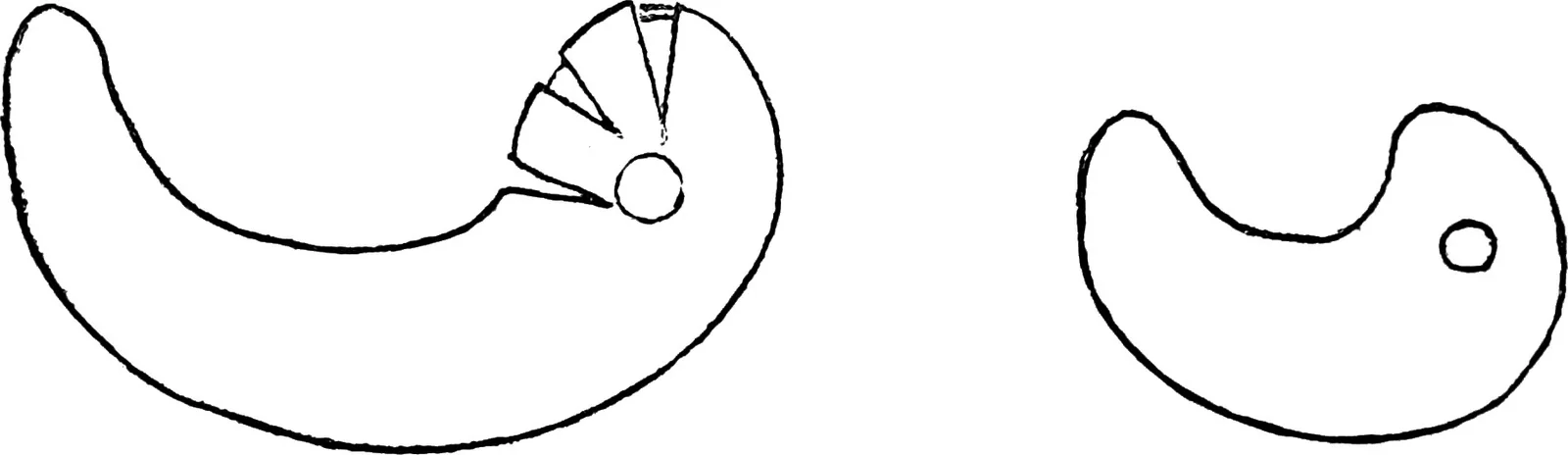
Magatama.
no Oho-kami, suspecting that the intentions of her younger brother were evil, prepared war and questioned him. Sosa no wo no Mikoto answered and said:—'Truly the sole reason of my coming is that I wished to see my elder sister face to face, and moreover to present to her these beautiful curved jewels of Yasaka gem. I dare not have any other purpose.' Then Ama-terasu no Oho-kami asked (I. 35.) him again, saying:—'Wherewithal wilt thou prove to me whether thy words are true or false?' He answered and said:—'Let thee and me bind ourselves by an oath. If while we are bound by this oath, the children produced are females, my heart is to be accounted black, but if they are males, it is to be thought red.' So they dug three true-wells of Heaven and stood opposite to one another. Then Ama-terasu no Oho-kami spoke to Sosa no wo no Mikoto and said:—'I am now about to give thee the sword which is in my girdle; do thou give me the curved jewels of Yasaka gem which thou hast.' Having thus covenanted they made a mutual exchange. Then Ama-terasu no Oho-kami took the curved jewels of Yasaka gem, and having made them float on the true-well of Heaven, bit off the heads of the jewels and blew them away. The Deity which was produced from amidst her breath was called Ichiki-shima-hime no Mikoto. This is the Goddess who dwells in Oki-tsu miya. Again, a Deity was produced from amidst her breath when she bit through and blew away the middle parts of the jewels. This Deity was called Ta-gori-hime no Mikoto. It is she who dwells in Naka-tsu miya. Again a Deity was produced from amidst her breath when she bit through and blew away the tails of the jewels. This Deity was called Tagi-tsu-hime no Mikoto. It is she who dwells in He-tsu miya.[181] In all there were three female Deities.
Upon this Sosa no wo no Mikoto, taking the sword which he held, and having made it to float on the surface of the True-Well of Heaven, bit off the end of the sword and blew it away. The Deities which were produced from amidst his breath were called Ama no ho-hi no Mikoto, next Masa-ya-a katsu-katsu-no-haya-hi-ama-no oshi-ho-ne no Mikoto, next Ama-tsu hiko-ne no Mikoto, next Iku-tsu hiko-ne no Mikoto, and next Kumano no kusu-hi no Mikoto. In all there were five male Deities. Such is the story."
In one writing it is said:—"The Sun-Goddess stood opposite to Sosa no wo no Mikoto, separated from him by the Tranquil River of Heaven,[182] and established a covenant (I. 36.) with him, saying, 'If thou hast not a traitorous heart, the children which thou wilt produce will surely be males, and if they are males, I will consider them my children, and will cause them to govern the Plain of Heaven.' Hereupon the Sun-Goddess first ate her ten-span sword, which became converted into a child, the Goddess Oki-tsu-shima hime no Mikoto, also called Ichiki-shima hime no Mikoto. Next she ate her nine-span sword, which became converted into a child, the Goddess Tagi-tsu hime no Mikoto. Again she ate her eight-span sword, which became converted into a child, the Goddess Ta-giri hime no Mikoto. Upon this, Sosa no wo no Mikoto took in his mouth the string of 500 jewels which was entwined in the left knot of his hair, and placed it on the palm of his left hand, whereupon it became converted into a male child. He then said:—'Truly I have won.' And the child was therefore called Katsu no haya-hi ama no oshi-ho-mimi no Mikoto. After that he took in his mouth the jewels of the right knot of his hair, and placed them on the palm of his right hand, when they became changed and produced the God Ama no ho-hi no Mikoto. After that he took in his mouth the jewels which hung round his neck and laid them on his left fore-arm, when they became changed and produced the God Ama-tsu hiko-ne no Mikoto. Moreover, from his right fore-arm there was produced the God Iku-tsu hiko-ne no Mikoto. Again from his left foot was produced the God Hi no haya-hi no Mikoto. Again from his right leg was produced Kumano no oshi-homi-no Mikoto, also called Kumano no oshi-sumi no Mikoto. The children produced by Sosa no wo no Mikoto were all male children. Therefore the Sun-Goddess knew exactly that Sosa no wo no Mikoto's intentions had been from the first honest. So these six male children were taken and made the children of the Sun-Goddess, and were caused to govern the Plain of Heaven. The three female Deities born of the Sun-Goddess were made to descend and dwell at Usa-shima in the Reed-plain Central Land.[183] They are now in the middle of the Northern Sea province, and are styled the Michi-nushi no (I. 37.) Muchi.[184] These are the Deities which are worshipped by the Kimi of Minuma in Tsukushi."
After this Sosa no wo no Mikoto's behaviour was exceedingly rude. In what way? Ama-terasu no Oho-kami had made august rice-fields of Heavenly narrow rice-fields and Heavenly long rice-fields. Then Sosa no wo no Mikoto, when the seed was sown in spring, broke down the divisions between the plots of rice, and in autumn let loose the Heavenly piebald colts,[185] and made them lie down in the midst of the rice-fields. Again, when he saw that Ama-terasu no Oho-kami was about to celebrate the feast of first-fruits, he secretly voided excrement in the New[186] Palace. Moreover, when he saw that Ama-terasu no Oho-kami was in her sacred[187] weaving hall, engaged in weaving the garments of the Gods, he flayed a piebald colt of Heaven, and breaking a hole in the roof-tiles of the hall, flung it in. Then Ama-terasu no Oho-kami started with alarm, and wounded herself with the shuttle. Indignant at this, she straightway entered the Rock-cave of Heaven, and having fastened the Rock-door, dwelt there in seclusion. Therefore constant darkness prevailed on all sides, and the alternation of (I. 38.) night and day was unknown.[188]
Then the eighty myriads of Gods met on the bank of the Tranquil River of Heaven, and considered in what manner they should supplicate her. Accordingly Omohi-kane[189] no Kami, with profound device and far-reaching thought, at length gathered long-singing birds[190] of the Eternal Land and made them utter their prolonged cry to one another. Moreover he made Ta-jikara-wo[191] no Kami to stand beside the Rock-door. Then Ame no Koyane[192] no Mikoto, ancestor of the Nakatomi no Muraji,[193] and Futo-dama no Mikoto,[194] ancestor of the Imibe[195] (I. 39.) no Obito, dug up a five-hundred branched True Sakaki[196] tree of the Heavenly Mt. Kagu.[197] On its upper branches they hung an august five-hundred string of Yasaka jewels. On the middle branches they hung an eight-hand[198] mirror.[195]
One writing says Ma-futsu no Kagami.
On its lower branches they hung blue soft offerings and white soft offerings.[199] Then they recited their liturgy together.
Moreover Ama no Uzume[200] no Mikoto, ancestress of the (I. 40.) Sarume[201] no Kimi, took in her hand a spear wreathed with Eulalia grass, and standing before the door of the Rock-cave of Heaven, skilfully performed a mimic dance.[202] She took, moreover, the true Sakaki tree of the Heavenly Mount Kagu, and made of it a head-dress, she took club-moss and made of it braces,[203] she kindled fires,[204] she placed a tub bottom upwards,[205] and gave forth a divinely-inspired utterance.[206][198]
Now Ama-terasu no Oho-kami heard this, and said:—"Since I have shut myself up in the Rock-cave, there ought surely to be continual night in the Central Land of fertile reed-plains. How then can Ama no Uzume no Mikoto be so jolly?" So with her august hand, she opened for a narrow space the Rock-door and peeped out. Then Ta-jikara-wo no Kami forthwith took Ama-terasu no Oho-kami by the hand, and led her out. Upon this the Gods Nakatomi no Kami and Imibe no Kami[207] (I. 41.) at once drew a limit by means of a bottom-tied rope[208] (also called a left-hand rope) and begged her not to return again (into the cave).
After this all the Gods put the blame on Sosa no wo no Mikoto, and imposed on him a fine of one thousand tables,[209] and so at length chastised him. They also had his hair plucked out, and made him therewith expiate his guilt.
Another version is:—They made him expiate it by plucking out the nails of his hands and feet.
When this was done, they at last banished him downwards.
In one writing it is said:—"After this Waka-hiru-me[210] no Mikoto was in the sacred weaving-hall, weaving the garments of the Deities. Sosa no wo no Mikoto saw this, and forthwith flaying a piebald colt with a backward flaying, flung it into the interior of the hall. Then Waka-hiru-me no Mikoto was startled, and fell down from the loom, wounding herself with the shuttle which she held in her hand, and divinely departed.[211] Therefore Ama-terasu no Oho-kami spoke to Sosa no wo no Mikoto and said:—'Thou hast still evil intentions.[212] I do not wish to see thee face to face.' So she entered the Rock-cave of Heaven and[206] shut the Rock-door. Hereupon all under Heaven was in continual darkness, and there was no difference of day and night. Therefore the eighty myriads of Gods met in the (I. 42.) High-market-place of Heaven and made inquiry. Now
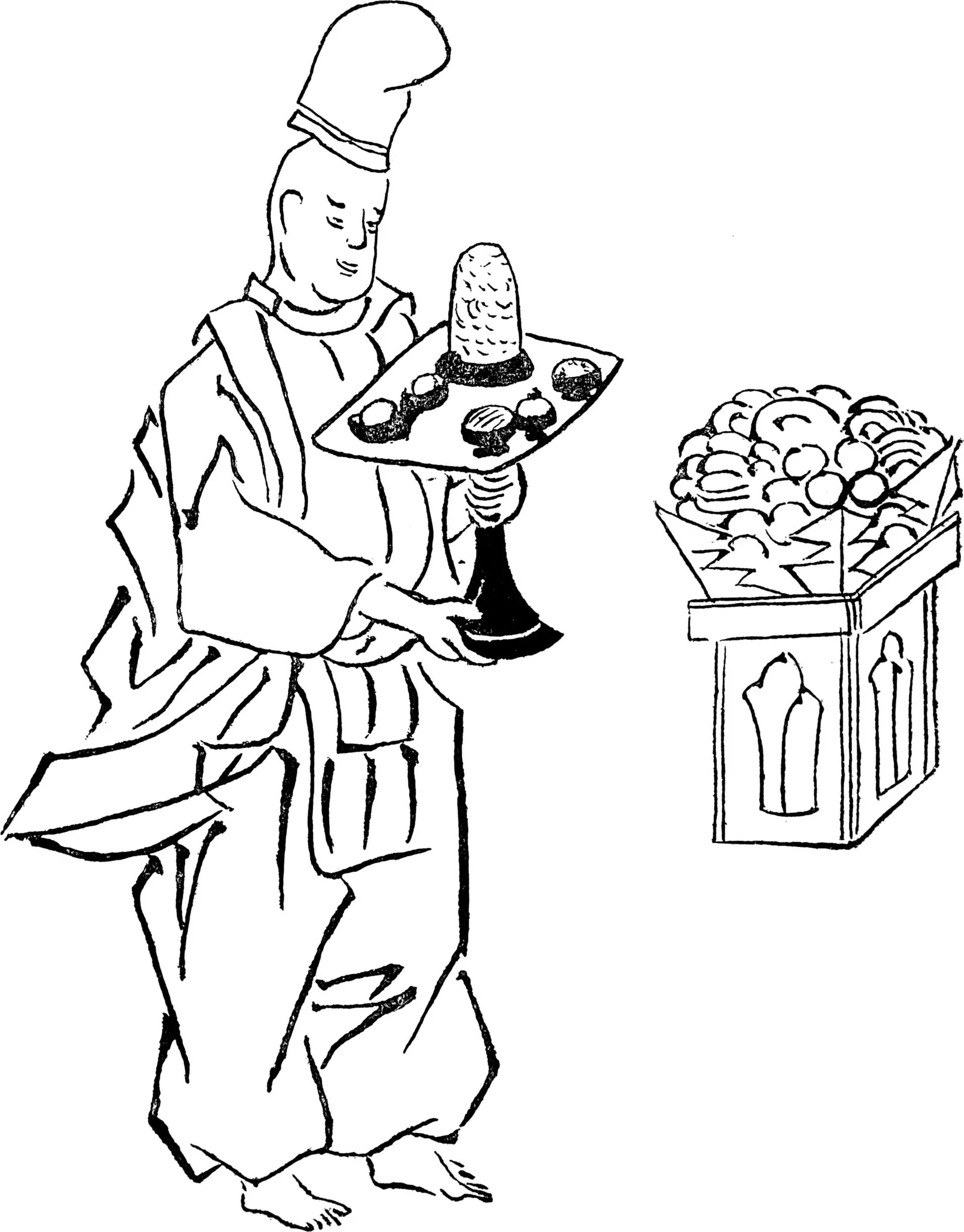
there was Omohi-kane no Kami, son of Taka-mi-musubi no Mikoto, who had a talent for devising plans. He accordingly considered the matter, and spoke, saying, 'Let there be made an image of this Goddess, and let prayer be addressed to it.' They therefore proceeded to appoint Ishi-kori-dome[213] as artisan, who, taking copper of the Mt. Kagu of Heaven, made therefrom a Sun-spear. Moreover, he stripped off in one piece the hide of a true stag, and made of it Heavenly bellows. The Goddess which he fashioned by this means is the Goddess Hi no mahe no Kami, who dwells in the province of Kiï."
In one writing it is said:—"The august Sun Goddess took an enclosed rice-field and made it her Imperial rice-field. Now Sosa no wo no Mikoto, in spring, filled up the channels and broke down the divisions, and in autumn, when the grain was formed, he forthwith stretched round them division ropes.[214] Again when the Sun-Goddess was in her Weaving-Hall, he flayed alive a piebald colt and flung it into the Hall. In all these various matters his conduct was rude in the highest degree. Nevertheless, the Sun-Goddess, out of her friendship for him, was not indignant or (I. 43.) resentful, but took everything calmly and with forbearance.
When the time came for the Sun-Goddess to celebrate the feast of first-fruits, Sosa no wo no Mikoto secretly voided excrement under her august seat in the New Palace.[215] The Sun-Goddess, not knowing this, went straight there and took her seat. Accordingly the Sun-Goddess drew herself up, and was sickened. She therefore was enraged, and straightway took up her abode in the Rock-cave of Heaven, and fastened its Rock-door.
Then all the Gods were grieved at this, and forthwith caused Ama no nuka-do no Kami, the ancestor of the Be of mirror-makers, to make a mirror, Futo-dama, the ancestor of the Imibe, to make offerings,[216] and Toyo-tama,[217] the ancestor of the Be of jewel-makers, to make jewels. They also caused Yama-tsuchi[218] to procure eighty precious combs of the five-hundred-branched true sakaki tree, and Nu-dzuchi[219] to procure eighty precious combs of the five-hundred-branched suzuki grass. When all these various objects were collected, Ama no Koyane no Mikoto, the (I. 44.) ancestor of the Nakatomi, recited a liturgy in honour of the Deity. Then the Sun-Goddess opened the Rock-door and came out. At this time, when the mirror was put into the Rock-cave, it struck against the door and received a slight flaw, which remains until this day. This is the great Deity worshipped at Ise. After this Sosa no wo no Mikoto was convicted, and fined in the articles required for the ceremony of purification. Hereupon these were the things abhorrent of luck of the tips of his fingers, and the things abhorrent of calamity of the tips of his toes.[220] Again, of his spittle he made white soft offerings, and of his nose-mucus he made blue soft offerings, with which the purification service was performed. Finally he was banished according to the law of Divine banishment."
(I. 45.) In one writing it is said:—"After this the Sun-Goddess had three rice-fields, which were called the Easy[221] Rice-field of Heaven, the Level Rice-field of Heaven, and the Village-join[222] Rice-field of Heaven. All these were good rice-fields, and never suffered even after continuous rain or drought. Now Sosa no wo no Mikoto had also three rice-fields, which were called the Pile-field of Heaven,[223] the River-border[224] Field of Heaven, and the Mouth-Sharp[225] Field of Heaven. All these were barren places. In the rains, the soil was swept away, and in droughts it was parched up. Therefore, Sosa no wo no Mikoto was jealous and destroyed his elder sister's rice-fields. In spring, he knocked away the pipes and troughs, filled up the channels and broke down the divisions. He also sowed seed over again. In autumn, he set up combs,[226] and made horses lie down in the rice-fields. Notwithstanding all these wicked doings, which went on incessantly, the Sun-Goddess was not indignant, but treated him always with calmness and forbearance, etc., etc.
(I. 46.) When the Sun-Goddess came to shut herself up in the Rock-cave of Heaven, all the Gods sent the child of Kogoto Musubi, Ama no Koyane no Mikoto, the ancestor of the Nakatomi no Muraji, and made him recite a liturgy. Hereupon Ama no Koyane no Mikoto rooted up a true Sakaki tree of the Heavenly Mount Kagu and hung upon its upper branches a mirror of eight hands, made by the ancestor of the mirror-makers, Ono-kori-dome, a child of Ama no Nukado; on the middle branches he hung curved[227] jewels of Yasaka gem made by the ancestor of the jewel-makers, Ama no Akaru-dama, a child of Izanagi no Mikoto. On the lower branches he hung tree-fibre[228] made by Ama-no Hi-washi, the ancestor of the Imbe of the province of Aha. Futo-dama no Mikoto, ancestor of the Imbe no Obito, was thereupon made to take these things in his hand, and, with lavish and earnest words of praise, to recite a liturgy.
When the Sun-Goddess heard this, she said:—'Though of late many prayers have been addressed to me, of none has the language been so beautiful as this.' So she opened a little the Rock-door and peeped out. Thereupon the God Ama no Tajikara-wo no Kami, who was waiting beside the Rock-door, forthwith pulled it open, and the radiance of the Sun-Goddess filled the universe. Therefore all the Gods rejoiced greatly, and imposed on Sosa no wo no (I. 47.) Mikoto a fine of a thousand tables of (articles of) purification.[229] Of the nails of his hands they made things abhorrent[226] of luck, and of the nails of his feet they made things abhorrent of calamity. Then they caused Ama no Koyane no Mikoto to take charge of his Great Purification Liturgy, and made him recite it. This is the reason why the people of the world are careful in the disposal of their own nails.[230]
After this, all the Gods upbraided Sosa no wo no Mikoto, saying:—'Thy conduct has been in the highest degree improper. Thou must, therefore, not dwell in Heaven. Nor must thou dwell in the Central Reed-Plain Land. Thou must go speedily to the Bottom Nether Land.'[231] So together they drove him away downwards. Now this was at the time of continuous rains. Sosa no wo no Mikoto bound together green grass, and made of it a broad hat and rain-coat, and in this garb asked a lodging of the assembled Gods. They said:—'Thy behaviour has been filthy and wicked, and therefore thou hast been banished. How canst thou ask of us a lodging?' In the end they unanimously repulsed him. Therefore, although the wind and rain were very violent, he was unable to find a resting-place, and went downwards, suffering bitterly. Ever since that time all the world has avoided entering the house of another wearing a broad hat and a grass rain-coat, or bearing a bundle of grass on the back. For a breach of (I. 48.) these rules an expiatory fine is certainly imposed. This is an institution which has come down to us from remote antiquity.
After this, Sosa no wo no Mikoto said:—'All the Gods have banished me, and I am now about to depart for ever. Why should I not see my elder sister face to face; and why take it on me of my own accord to depart without more ado?' So he again ascended to Heaven, disturbing Heaven and disturbing Earth. Now Ame no Uzume, seeing this, reported it to the Sun-Goddess. The Sun-Goddess said:—'My younger brother has no good purpose in coming up.[229] It is surely because he wishes to rob me of my kingdom. Though I am a woman, why should I shrink?' So she arrayed herself in martial garb, etc., etc.
Thereupon Sosa no wo no Mikoto swore to her, and said:—'If I have come up again cherishing evil feelings, the children which I shall now produce by chewing jewels will certainly be females, and in that case they must be sent down to the Central Land of Reed-Plains. But if my intentions are pure, then I shall produce male children, and in that case they must be made to rule the Heavens. The same oath will also hold good as to the children produced by my elder sister.' In this way the Sun-Goddess first of all chewed her ten-span sword, etc., etc.
Sosa no wo no Mikoto straightway unwound, coil after coil, the complete string of five hundred jewels entwined in the right knot of his hair. The jewels chinked as he rinsed them on the surface of the true well of Heaven. Then he chewed their ends, and laid them on his left palm, thus producing a child, who was called Masa-ya-a-katsu-katsu-haya-hi-ama-no-oshi-ho-ne no Mikoto. After this he chewed the left jewels, and placing them on his right palm, produced a child, who was called Ama-no-ho-hi no Mikoto. He is the ancestor of the Idzumo no Omi, of the Musashi no Miyakko,[232] and of the Hashi no Muraji. There was next (I. 49.) produced Ama tsu hikone no Mikoto, the ancestor of the Mubaraki[233] no Miyakko and of the Nukada Be no Muraji. Next was produced Iku-me tsu hikone no Mikoto, and next Kumano no Oho-sumi no Mikoto—in all six male Deities. Then Sosa no wo no Mikoto spoke to the Sun-Goddess, and said:—'The reason why I came up a second time was that, having been condemned by the assembled Gods to banishment to the Nether Land, and being about to take my departure thither, I could never bear to become separated from my elder sister without having seen her face to face. Therefore it is truly with a pure heart, and not otherwise, that I came up again. Now that our interview is over, I must return hence for ever to the Nether Land, in obedience to the Divine behest of the assembled Deities. I pray that my elder sister may illuminate the Land of Heaven, and that it may spontaneously enjoy tranquillity. Moreover, I deliver to my elder sister the children which, with a pure heart, I have produced.' Having done so, he returned downwards."
Then Sosa no wo no Mikoto descended from Heaven and proceeded to the head-waters of the River Hi, in the province (I. 50.) of Idzumo. At this time he heard a sound of weeping at the head-waters of the river, and he therefore went in search of the sound. He found there an old man and an old woman. Between them was set a young girl, whom they were caressing and lamenting over. Sosa no wo no Mikoto asked them, saying:—"Who are ye, and why do ye lament thus?" The answer was:—"I am an Earthly Deity, and my name is Ashi-nadzuchi.[234] My wife's name is Te-nadzuchi.[235] This girl is our daughter, and her name is Kushi-nada-hime.[236] The reason of our weeping is that formerly we had eight children, daughters. But they have been devoured year after year by an eight[237]-forked serpent, and now the time approaches for this girl to be devoured. There is no means of escape for her, and (I. 51.) therefore do we grieve." Sosa no wo no Mikoto said:—"If that is so, wilt thou give me thy daughter?" He replied, and said:—"I will comply with thy behest and give her to thee." Therefore Sosa no wo no Mikoto on the spot changed Kushi-nada-hime into a many-toothed close-comb, which he stuck in the august knot of his hair. Then he made Ashi-nadzuchi and Te-nadzuchi to brew eight-fold sake, to make eight cupboards, in each of them to set a tub filled with sake,[238] and so to await its coming. When the time came, the serpent actually appeared. It had an eight-forked head and an eight-forked tail; its eyes were red, like the winter-cherry;[239] and on its back firs and cypresses were growing. As it crawled it extended over a space of eight hills and eight valleys. Now when it came and found the sake, each head drank up one tub, and it became drunken and fell asleep. Then Sosa no wo no Mikoto drew the ten-span sword which he wore, and chopped the serpent into small pieces. When he came to the tail, the edge of his sword was slightly notched, and he therefore split open (I. 52.) the tail and examined it. In the inside there was a sword. This is the sword which is called Kusa-nagi no tsurugi.[240]
In one writing it is said:—"Its original name was Ama no Mura-kumo no tsurugi."[241]
[It perhaps received this name from the clouds constantly gathering over the place where the serpent was. In the time of the Imperial Prince Yamato-dake its name was changed to Kusa-nagi no tsurugi.]
Sosa no wo no Mikoto said:—"This is a divine sword. How can I presume to appropriate it to myself?" So he gave it up to the Gods of Heaven.[242]
After this he went in search of a place where he might celebrate his marriage, and at length came to Suga, in the province of Idzumo. Then he spoke, and said:—"My heart is refreshed." Therefore that place is now called Suga.[243] There he built a palace.
(I. 53.) Many clouds arise,One version says:—"Now Take[244] Sosa no wo no Mikoto composed a verse of poetry, saying:—
On all sides a manifold fence,
To receive within it the spouses,
They form a manifold fence—
Ah! that manifold fence!"[245]
Thereupon they had intercourse together,[246] and a child was born named Oho-na-muchi[247] no Kami.
He (Sosa no wo) accordingly spake, and said:—"The masters of my son's Palace[248] are Ashi-nadzuchi and Te-nadzuchi. I therefore grant to these two Deities the designation of Inada no Miya-nushi[249] no Kami."
Having done so, Sosa no wo no Mikoto at length proceeded to the Nether Land.
In one writing it is said:—"Sosa no wo no Mikoto, having descended from Heaven, came to the head-waters of the river Hi, in Idzumo. There he saw Inada-hime, the daughter of Susa no yatsu-mimi,[250] Master of the Shrine of Inada. He had connubial relations with her, and a child was born, styled Suga no yu-yama-nushi[251] Mitsu-na-saro-hiko-yama-shino."[252]
One version has Suga no Kake-na Saka-karu-hiko-ya-shima[253] no Mikoto.
Another has:—"Suga no yu-yama-nushi Mitsu-na-saro-hiko ya-shima-no.[254] The descendant of this God in the fifth generation was Oho-kuni-nushi no Kami."[255]
(I. 54.) In one writing it is said:—"At this time Sosa no wo no Mikoto went down and came to the head-waters of the River Ye, in the province of Aki. There was there a God whose name was Ashi-nadzu-te-nadzu.[256] His wife's name was Inada no Miya-nushi Susa no yatsu-mimi. This Deity was just then pregnant, and the husband and wife sorrowed together. So they informed Sosa no wo no Mikoto, saying:—'Though we have had born to us many children, whenever one is born, an eight-forked serpent comes and devours it, and we have not been able to save one. We are now about to have another, and we fear that it also will be devoured. Therefore do we grieve.' Sosa no wo no Mikoto forthwith instructed them, saying:—'You must take fruit of all kinds, and brew from it eight jars of sake, and I will kill the serpent for you.' The two Gods, in accordance with his instructions, prepared sake. When the time came for the child to be born, the serpent came indeed to the door, and was about to devour the child. But Sosa no wo no Mikoto addressed the serpent, and said:—'Thou art an Awful Deity. Can I dare to neglect to feast thee?' So he took the eight jars of sake, and poured one into each of its mouths. The serpent drank it up and fell asleep. Sosa no wo no Mikoto drew his sword and slew it. When he came to sever its tail, the edge of his sword was slightly notched. He split the tail open and examined it, when he found that inside it there was a sword. This sword is called Kusa-nagi no tsurugi. It is now in the village of Ayuchi, in the province (I. 55.) of Ohari. It is this Deity which is in the charge of the Hafuri[257] of Atsuta. The sword which slew the serpent is called Worochi no Ara-masa.[258] It is now at Isonokami.[259]
Afterwards the child who was born of Inada no Miya-nushi Susa no yatsu-mimi, namely Ina-gami Furu-kushi-nada-hime,[260] was removed to the upper waters of the river Hi, in the province of Idzumo, and brought up there. After this Sosa no wo no Mikoto made her his consort, and had by her a child, whose descendant in the sixth generation was Oho-na-muchi no Mikoto."
In one writing it is said:—"Sosa no wo no Mikoto wished to favour[261] Kushi-nada-hime, and asked her of Ashinadzuchi and Tenadzuchi,[262] who replied, saying:—'We pray thee first to slay the serpent, and thereafter it will be good that thou shouldst favour her. This serpent has rock-firs growing on each of its heads; on each of its sides there is a mountain; it is a very fearful beast. How wilt thou set about to slay it?' Sosa no wo no Mikoto thereupon devised a plan. He brewed a poisonous sake, which he gave it to drink. The serpent became drunk, and fell asleep. Sosa no wo no Mikoto forthwith (I. 56.) took his sword, called Worochi no Kara-sabi,[263] and severed its head and severed its belly. When he severed its tail, the edge of the sword was slightly notched, so he split the tail open and made examination. He found there another sword, which he called Kusa-nagi no Tsurugi. This sword was formerly with Sosa no wo no Mikoto. It is now in the province of Ohari. The sword with which Sosa no wo no Mikoto slew the serpent is now with the Kambe[264] of Kibi. The place where the serpent was slain is the mountain at the upper waters of the river Hi in Idzumo."
In one writing it is said:—"Sosa no wo no Mikoto's behaviour was unmannerly. A fine was therefore imposed on him by all the Gods of a thousand tables, and he was driven into banishment. At this time, Sosa no wo no Mikoto, accompanied by his son Iso-takeru[265] no Kami, descended to the Land of Silla,[266] where he dwelt at Soshi-mori.[267] There he lifted up his voice and said:—'I will not dwell in this land.' He at length took clay and made of it a boat, in which he embarked, and crossed over eastwards until he arrived at Mount Tori-kamu no Take, which is by the upper waters of the river Hi in Idzumo. Now there was in this place a serpent which devoured men. Sosa no wo no Mikoto accordingly took his sword, called (I. 57.) Ama no Haye-kiri,[268] and slew this serpent. Now when he cut the serpent's tail, the edge of his sword was notched. Thereupon he split open the tail, and on examination, found within it a divine sword. Sosa no wo no Mikoto said:—'I must not take this for my private use.' So he sent Ama no Fuki-ne no Kami, his descendant in the fifth generation, to deliver it up to Heaven. This is the sword now called Kusa-nagi.
Before this, when Iso-takeru no Kami descended from Heaven, he took down with him the seeds of trees in great quantity. However, he did not plant them in the land of Han,[269] but brought them all back again, and finally sowed them every one throughout the Great Eight-island-country, beginning with Tsukushi. Thus green mountains were produced. For this reason Iso-takeru no Mikoto was styled Isaoshi no Kami.[270] He is the Great Deity who dwells in the Land of Kiï."[271]
In one writing it is stated:—"Sosa no wo no Mikoto said:—'In the region[272] of the Land of Han there is gold and silver. It will not be well if the country ruled by my son should not possess floating riches. So he plucked out his beard and scattered it. Thereupon Cryptomerias were (I. 58.) produced. Moreover, he plucked out the hairs of his breast, which became Thuyas.[273] The hairs of his buttocks became Podocarpi.[274] The hairs of his eye-brows became Camphor-trees. Having done so, he determined their uses. These two trees, viz. the Cryptomeria and the Camphor-tree, were to be made into floating riches;[275] the Thuya was to be used as timber for building fair palaces;[276] the Podocarpus was to form receptacles in which the visible race of man was to be laid in secluded burial-places. For their food he well sowed and made to grow all the eighty kinds of fruit.
Now the children of Sosa no wo no Mikoto were named Iso-takeru no Mikoto, with Oho-ya[277] tsu hime, his younger sister, and next Tsuma[278]-tsu-hime no Mikoto. All these three Deities also dispersed well the seeds of trees, and forthwith crossed over to the Land of Kiï.
(I. 59.) Thereafter Sosa no wo no Mikoto dwelt on the Peak of Kuma-nari,[279] and eventually entered the Nether Land."
In one writing it is said:—"Oho-kuni-nushi[280] no Kami is also called Oho-mono-nushi no Kami,[281] or else Kuni-dzukuri Oho-na-mocha[282] no Mikoto, or again Ashi-hara no Shiko-wo,[283] or Ya-chi-hoko[284] no Kami, or Oho-kuni-dama[285] no Kami, or Utsushi-kuni-dama[286] no Kami. His children were in all one hundred and eighty-one Deities.
Now Oho-na-mochi no Mikoto and Sukuna-bikona no Mikoto, with united strength and one heart, constructed this sub-celestial world. Then, for the sake of the visible race of man as well as for beasts, they determined the method of healing diseases. They also, in order to do away with the calamities of birds, beasts, and creeping things, established means for their prevention and control.[287] The people enjoy the protection of these universally until the present day.
Before this Oho-na-mochi no Mikoto spake to Sukuna-bikona no Mikoto, and said:—'May we not say that the country which we have made is well made?' Sukuna-bikona no Mikoto answered and said:—'In some parts it is complete and in others it is incomplete.' This conversation had doubtless a mysterious purport.
(I. 60.) Thereafter Sukuna-bikona no Mikoto went to Cape Kumano,[288] and eventually proceeded to the Everlasting Land.[289]
Another version is that he went to the island of Aha, where he climbed up a millet-stalk, and was thereupon jerked off, and went to the Everlasting Land.
After this, wherever there was in the land a part which was imperfect, Oho-na-mochi no Kami visited it by himself, and succeeded in repairing it. Coming at last to the province of Idzumo, he spake, and said:—'This Central Land of Reed-plains had been always waste and wild. The very rocks, trees and herbs were all given to violence. But I have now reduced them to submission, and there is none that is not compliant.' Therefore he said finally:—'It is I, and I alone, who now govern this Land. Is[287] there perchance any one who could join with me in governing the world?' Upon this a Divine radiance illuminated the sea, and of a sudden there was something which floated towards him and said:—'Were I not here, how couldst thou subdue this Land? It is because I am here that thou hast been enabled to accomplish this mighty undertaking.' Then Oho-na-mochi no Kami inquired, saying:—'Then who art thou?' It replied and (I. 61.) said:—'I am thy guardian spirit, the wondrous spirit.' Then said Oho-na-mochi no Kami:—'True, I know therefore that thou art my guardian spirit, the wondrous spirit. Where dost thou now wish to dwell?' The spirit answered and said:—'I wish to dwell on Mount Mimoro, in the province of Yamato.' Accordingly he built a shrine in that place and made the spirit to go and dwell there. This is the God of Oho-miwa.
The children of this Deity were the Kimi of Kamo (I. 62.) and of Oho-miwa,[290] and also Hime-tatara[291] I-suzu-hime no Mikoto.
Another version is that Koto-shiro-nushi no Kami, having become transformed into an eight-fathom bear-sea-monster,[292] had intercourse with Mizo-kuhi[293] hime of the island of Mishima (some call her Tama-kushi-hime), and had by her a child named Hime-tatara I-suzu-hime no Mikoto, who became the Empress of the Emperor Kami-Yamato Ihare-biko Hohodemi.[294]
Before this time, when Oho-na-mochi no Kami was pacifying the land, he went to Wobama in Isasa, in the province of Idzumo. He was just having some food and drink, when of a sudden there was heard a human voice from the surface of the sea. He was astonished, but on seeking for it there was nothing at all to be seen. After a while a dwarf appeared, who had made a boat of the rind of a kagami[295] and clothing of the feathers of a (I. 63.) wren.[296] He came floating towards him on the tide, and Oho-na-mochi no Mikoto taking him up, placed him on the palm of his hand. He was playing with him, when the dwarf leaped up, and bit him on the cheek. He wondered at his appearance, and sent a messenger to report the matter to the Gods of Heaven. Now when Taka-mi-musubi no Mikoto heard this, he said:—'The children whom I have produced number in all one [292] thousand and five hundred. Amongst them one was very wicked, and would not yield compliance to my instructions. He slipped through between my fingers and fell. This must be that child, let him be loved and nurtured.' This was no other than Sukuna-bikona no Mikoto."[297]
- Nihon, otherwise Nippon, the Niphon of our older maps, where it is wrongly limited to the main island of Japan. Japan is merely a Chinese pronunciation of this word, modified in the mouths of Europeans. Nihon, in Chinese 日本 means sun-origin, i.e. sunrise. The country received this name from its position to the east of the Asiatic continent. China being the Great Central Land, other countries were given names with reference to it. Corea, for example, is the Tong-Kuk or East-Country. These Chinese characters are sometimes used to represent Yamato, the true old Japanese name of the country, as in the name of the first Emperor, Kamu-yamato-ihare-biko-hoho-demi, better known as Jimmu Tennō. I have little doubt that Nihon, as a name for Japan, was first used by the Corean scholars who came over in numbers during the early part of the seventh century. Perhaps the earliest genuine use of this term occurs in the lament for the death of Shōtoku Daishi by a Corean Buddhist priest in A.D. 620. In 670 it was formally notified to one of the Corean kingdoms that this would be the name of the country in future, and from about the same time the Chinese also began to use it officially. There are several cases of its being used retrospectively in places where it has no business, as in a supposed letter from the King of Koryö to the Emperor of Japan quoted in the "Nihongi" under 297 A.D. "Nihongi," or the Chronicles of Japan, is the proper and original name of this work. But later editors and writers have introduced the syllable sho, writing, styling it the Nihon-shoki, which is its most usual literary designation at the present time. It is also spoken of as the "Shoki."
- The first two books of the "Nihongi" contain the myths which form the basis of the Shinto religion. For the further study of this subject, Chamberlain's admirably faithful translation of the Kojiki, and Satow's contributions to the "J.A.S.T." will be found indispensable. Griffis's "Religions of Japan" may also be consulted with advantage.
- The Yin and Yang, or female and male principles of Chinese philosophy. See "Mayer's Chinese Manual," p. 293.
- These opening sentences of the "Nihongi" have been justly condemned by modern Shinto scholars such as Motowori and Hirata as an essay of the Chinese rationalistic type, which has been awkwardly prefixed to the genuine Japanese traditions. Hirata mentions two Chinese works named 淮南子 and 三五曆記, as among the originals from which the author of the "Nihongi" borrowed these ideas. See Satow's "Revival of Pure Shinto," pp. 19 and 51 (reprint), "Japan Asiatic Society's Transactions," 1875, Appendix. I take this opportunity of referring the reader to this treatise, which is much the most instructive and accurate work that has yet appeared on the ancient Japanese religion and mythology. No serious student of this subject can afford to neglect it. The corresponding passage of the "Kiujiki" (vide Index) is as follows:—"Of old, the original essence was a chaotic mass. Heaven and Earth had not yet been separated, but were like an egg, of ill-defined limits and containing germs. Thereafter, the pure essence, ascending by degrees, became thinly spread out, and formed Heaven. The floating grosser essence sank heavily, and, settling down, became Earth. What we call countries were produced by the opening, splitting up, and dividing of the earth as it floated along. It might be compared to the floating of a fish which sports on the surface of the water. Now Heaven was produced first, and Earth afterwards."
- Motowori points out that hence has no meaning here. It is inserted clumsily to make it appear as if there were some connection between the Chinese essay which precedes and the Japanese tradition which follows. The author is fond of this word and frequently brings it in without much meaning.
- The marginal references are to the Shukai edition of the original.
- Land-eternal-stand-of-august-thing.
- This distinction is, of course, an invention of the persons who committed the myths to writing, and it is by no means consistently adhered to even in the "Nihongi." The passage in italics is from what is called the "Original Commentary," for which see introduction.
- Land-of-right-soil-of-augustness, i.e. his augustness the true soil of the land. Sa, which I have rendered "right," is a mere honorific. Tsuchi is written with a Chinese character which means "mallet," but it must be taken here as put phonetically for tsuchi, land or soil.
- Rich-form-plain-of-augustness. The meaning of many of the names of the gods is obscure, and these renderings must be accepted with caution. Compare the notes to Chamberlain's "Kojiki," where much attention has been given to this subject. It may be remarked that there is great and inextricable confusion as to the early deities between the various ancient authorities, the "Kojiki," the "Kiujiki," the "Kogojiui," the various documents quoted in the "Nihongi," and the "Nihongi" itself.
- The Chinese 三神 means simply three deities. But the interlinear Kana has mi-bashira no Kami, i.e. Deities, three pillars, hashira or bashira being the usual auxiliary numeral (like our head of cattle, sail of ships, etc.) for gods in the ancient literature. Historical Shinto has no idols, but does not this use of the word hashira suggest a time when the gods of Japan were wooden posts carved at the top into a rude semblance of the human countenance, such as are seen at this day in many savage lands? In Corea, closely related to Japan, there are gods of this kind. The mile-posts there have their upper part fashioned into the shape of an idol, to which some pompous title is given, and at a village not far from Söul, on the Wönsan road, I have seen a group of a dozen or more of these pillar gods, set up, I was told, as guardians to the inhabitants during an epidemic of small-pox. The word Kami, deity, has a very wide application in Japanese. It means primarily upper, and hence nobles, the sovereign, gods, and generally any wonderful or mysterious thing. The leopard and wolf are Kami, the peach with which Izanagi put to flight the thunders which pursued him in the land of Yomi, etc. See Hirata's interesting remarks translated by Satow in "Revival of Pure Shinto," "J.A.S.T.," p. 42 (reprint). The Aino ideas regarding Kamui are very similar. See Batchelor in "J.A.S.T.," XVI., Pt. I., p. 17.
- The principle of Heaven is the same thing as the Yō or male principle of Chinese philosophy. This again is no part of the old tradition.
- These quotations are usually referred to as part of the "Nihongi." They were, in my opinion, added at a somewhat (but not much) later date. They afford some indication of the mass of written literature which existed on this subject.
- In Japanese sora, to be distinguished from ame or ama, the heaven or firmament, which was regarded as a plain, as in the expression takama no hara, the plain of high heaven.
- Soko means bottom.
- Tachi means stand.
- Rich-country-master.
- Rich form-moor.
- Rich-perfume-joint-plain.
- Float-pass-plain-rich-buy.
- Rich-land-plain.
- Rich-bite (?) plain.
- Leaf-tree-land-plain.
- Mino is written with characters which suggest the derivation see-plain. But mi is more probably a honorific, to be rendered "august."
- Sweet-reed-shoot-prince-elder. There is some doubt about the precise signification of the word ji here rendered elder. It is the same root which we have in chichi father; wo-ji, uncle; orochi, serpent, and tsutsu or tsuchi, which is found in many names of gods. It is probably little more than a mere honorific.
- Lit. a Divine man.
- Heaven-of-august-centre-master. The Pole-star god, according to O'Neill, Vide "Night of the Gods," pp. 535, 536.
- High-august-growth. "Personifications of highly abstract ideas are not unknown in myths of savages. The South Sea islanders have personified 'the very beginning,' and 'space.'" Lang's "Myth, Religion, and Ritual," Vol. I, p. 196. It is not quite clear whether this is the same as the Musubi or Musubu no Kami, a god who unites lovers, and to whom the rags hung on trees by the roadside are offered.
- Divine-august-growth. This corresponds nearly with the Kojiki myth.
- The Chinese character is 人, which the interlinear Kana coolly renders by Kami, deity.
- Heaven-of-eternal-stand.
- The names of these two Deities are of doubtful meaning. According to the Chinese characters Uhiji should mean mud-earth, and Suhiji sand-earth. Ni or ne is a honorific particle. Vide Chamberlain's "Kojiki," p. 17.
- These names are somewhat obscure. Oho-to means great door or house; nochi, after, and mahe, before. He, is place; toma, a coarse kind of mat; tomu, wealthy; and chi, ground. The other elements of these names have occurred above.
- Omo-taru means face-pleasing, and Kashiko, awful. Ne is a honorific suffix; aya, an interjection like our ah! Imi means avoidance, religious, abstinence, taboo. Kashiki is probably only another form of Kashiko, awful. A wo is green.
- Izana is the root of a verb izanafu, to invite; gi, a masculine, and mi, a feminine termination. These two names may therefore be rendered male-who-invites and female-who-invites. But it may be suspected that this is, after all, merely a volks-etymologie, and that Iza or Isa is simply the name of a place, na being another form of no, the genitive particle. Isa is known to Japanese myth. We shall find an Isa well in Heaven spoken of below. There are two places called Isa in Hitachi, and an Isa no Jinja in Idzumo.
- Ame-kagami, heaven-mirror; Ame-yorodzu, heaven-myriad; Aha-nagi, foam-calm.
- This sentence is obviously from the pen of a student of Chinese philosophy.
- The eight Gods specially worshipped by the Jingikwan, or Department of the Shinto Religion in the Yengi period—901-922—were Takami-musubi no Kami, Kamimi-musubi no Kami, Tama-tsume musubi no Kami, Iku musubi no Kami, Taru musubi no Kami, Oho-miya no me no Kami, Mi Ketsu Kami, and Koto-shiro-nushi no Kami.
For the sake of comparison the Kiujiki scheme of the generations of early Deities is herewith added. It will still further exemplify the confusion of these traditions.
Therefore a God was developed in the Plain of High Heaven whose name was
Ame-
heaven
yudzuru-
transfer
hi-
sun
ame no
heaven
sa-
right
giri
mist
kuni-
land
yudzuru-
transfer
tsuki
moon
kuni
land
no
of
sa-
right
giri
mist
no Mikoto,
Ame- yudzuru- hi- {ame no} sa- giri kuni- yudzuru- tsuki kuni no sa- giri {no Mikoto,}
heaven transfer sun heaven right mist land transfer moon land of right mist {}
who was produced alone. After him, were born two generations of companion Gods and five generations of mated Deities. These make up what is called the seven generations of the Gods. Genealogy of the Age of the Gods. The Heavenly parent, Ame yudzuru hi ame no sa-giri kuni yudzuru tsuki kuni no sa-giri no Mikoto. 1st Generation. Companion-born heavenly Gods.-
Ame
heaven
no
mi-naka-
middle
nushi
master
no Mikoto.
Ame no mi-naka- nushi {no Mikoto.}
heaven {} middle master {}
-
Umashi-
sweet
ashi-kabi
reed-shoot
prince
hikoji
elder
no Mikoto.
Umashi- ashi-kabi {} hikoji {no Mikoto.}
sweet reed-shoot prince elder {}
-
Kuni
land
no
toko
eternal
tachi
stand
no Mikoto.
Kuni no toko tachi {no Mikoto.}
land {} eternal stand {}
-
Toyo-
rich
kuni-
land
nushi
master
no Mikoto.
Toyo- kuni- nushi {no Mikoto.}
rich land master {}
-
Ame-
heaven
ya-
eight
kudari
descend
no Mikoto.
Ame- ya- kudari {no Mikoto.}
heaven eight descend {}
-
Tsuno-
horn
gui
stake
no Mikoto.
(name of place?)
Tsuno- gui {no Mikoto.}
horn stake {(name of place?)}
-
Iku-
live
gui
stake
no Mikoto,
his younger sister of wife.
Iku- gui {no Mikoto,}
live stake {}
-
Ame
heaven
mi
three
kudari
descend
no Mikoto.
Ame mi kudari {no Mikoto.}
heaven three descend {}
-
Uhiji-
mud
ni
earth (honorific affix)
no Mikoto.
Uhiji- ni {no Mikoto.}
mud {earth (honorific affix)} {}
-
Suhiji-
sand
ni
earth
no Mikoto,
his younger sister or wife.
Suhiji- ni {no Mikoto,}
sand earth {}
Ama
heaven
-ahi
meet
no Mikoto.
Ama -ahi {no Mikoto.}
heaven meet {}
5th Generation. Heavenly Gods born as mates.-
Oho-
great
toma-
mat
hiko
prince
no Mikoto.
Oho- toma- hiko {no Mikoto.}
great mat prince {}
-
Oho-
great
toma-
mat
he
place
no Mikoto,
his younger sister or wife.
Oho- toma- he {no Mikoto,}
great mat place {}
-
Ame
heaven
ya-
eight
wo-
hundred
hi
days
no Mikoto.
Ame ya- wo- hi {no Mikoto.}
heaven eight hundred days {}
-
Awo-
green
kashiki
awful
ne
(honorific)
no Mikoto.
Awo- kashiki ne {no Mikoto.}
green awful (honorific) {}
-
Aya-
ah!
kashiki
awful
ne
no Mikoto,
his younger sister or wife.
Aya- kashiki ne {no Mikoto,}
ah! awful {} {}
-
Ame no
ya-so-
eighty
yorodzu-
myriads
dama
spirits
no Mikoto.
{Ame no} ya-so- yorodzu- dama {no Mikoto.}
{} eighty myriads spirits {}
- Izanagi no Mikoto.
- Izanami no Mikoto, his younger sister or wife.
-
Taka
high
mi-
august
musubi
growth
no Mikoto.
Taka mi- musubi {no Mikoto.}
high august growth {}
-
Ama no
heaven
omohi-
thought-
game:
compriser
no Mikoto.
{Ama no} omohi- game: {no Mikoto.}
heaven thought- compriser {}
-
Ama no
futo-
big
dama
jewel
no Mikoto.
{Ama no} futo- dama {no Mikoto.}
{} big jewel {}
-
Ama no
woshi-
endure
hi
sun
no Mikoto.
{Ama no} woshi- hi {no Mikoto.}
{} endure sun {}
-
Ama no
kamu-
god
dachi
stand
no Mikoto.
{Ama no} kamu- dachi {no Mikoto.}
{} god stand {}
-
Kamu
above
mi
musubi
growth
no Mikoto.
Kamu mi musubi {no Mikoto.}
above {} growth {}
-
Ame no
mi
august
ke
food
mochi
hold
no Mikoto.
{Ame no} mi ke mochi {no Mikoto.}
{} august food hold {}
-
Ame no
michi
road
ne
(honorific)
no Mikoto.
{Ame no} michi ne {no Mikoto.}
{} road (honorific) {}
-
Ame no
kami-
god
dama
jewel
no Mikoto.
{Ame no} kami- dama {no Mikoto.}
{} god jewel {}
-
Iku-
live
dama
jewel
no Mikoto.
Iku- dama {no Mikoto.}
live jewel {}
-
Tsu-
port
haya-
quick
dama
jewel
no Mikoto.
Tsu- haya- dama {no Mikoto.}
port quick jewel {}
-
Ichi-
market
chi-
thousand
dama
jewel
no Mikoto.
Ichi- chi- dama {no Mikoto.}
market thousand jewel {}
-
Kogoto-dama
(?)
no Mikoto.
Kogoto-dama {no Mikoto.}
(?) {}
-
Ama no
ko-yane
child-roof
no Mikoto.
{Ama no} ko-yane {no Mikoto.}
{} child-roof {}
-
Takechi-
brave
nokori
milk remnant
no Mikoto.
Takechi- nokori {no Mikoto.}
brave {milk remnant} {}
-
Furu-
shake
dama
jewel
no Mikoto.
Furu- dama {no Mikoto.}
shake jewel {}
-
Saki-
first
dama
jewel
no Mikoto.
Saki- dama {no Mikoto.}
first jewel {}
-
Ama no
woshi-
endure
dachi
stand
no Mikoto.
{Ama no} woshi- dachi {no Mikoto.}
{} endure stand {}
-
Yorodzu-
myriad
dama
jewel
no Mikoto.
Yorodzu- dama {no Mikoto.}
myriad jewel {}
-
Ama no
koha-
hard
kaha
river
no Mikoto."
{Ama no} koha- kaha {no Mikoto.}"
{} hard river {}
-
- Hirata conjectures that the jewel-spear (nu-boko or tama-boko) of Heaven was in form like a wo-bashira.
 Wo-bashira.
Wo-bashira means literally male-pillar. This word is usually applied to the end-posts or pillars of a railing or balustrade, no doubt on account of the shape of the top, which ends in a sort of a ball (the nu or tama), supposed to resemble the glans. That by wo-bashira Hirata means a phallus is clear from his quoting as its equivalent the Chinese expression 玉莖, i.e. jewel-stalk, an ornate word for the penis. A Japanese word for this is wo-hashi, or wo-bashi, which contains nearly the same etymological elements as wo-bashira.
A writer quoted in the Tsū-shō commentary on the "Nihongi," says that the Tama-boko (or nu-boko) is the root of coition.
The late Mr. J. O'Neill, in his "Night of the Gods" (pp. 31, 37, 67), proposed the theory that this spear and other spears of myth "are but symbols of the Earth-axis and its prolongation," an idea which is worked out with much ingenuity and learning in that remarkable work. At p. 88 he argues that this view is not inconsistent with the phallic interpretation.
There are other indications in the "Nihongi" and "Kojiki" of phallic worship in Ancient Japan, although, probably owing to the influence of Chinese ideas of literary propriety, there are fewer than might have been expected, Vide Index—Phallic worship.
All travellers in Japan, especially before the Revolution of 1868, must have observed numerous evidences of a phallic cult. The Government have of recent years done their best to suppress this very gross form of nature worship, but it still exists in out-of-the-way places, as has been shown in an interesting Essay by Dr. Edmund Buckley, of the University of Chicago, who has collected numerous facts relating to this subject. Dr. Griffis, in his "Religions of Japan," has also noticed several evidences of it.
Travelling from Utsunomiya to Nikko, in 1871, I found the road lined at intervals with groups of phalli, connected, no doubt, with the worship of the Sacred Mountain Nan-tai (male-form), which was visited every summer by hundreds of pilgrims of the male sex, access to females being at that time rigorously prohibited.
A cave at Kamakura formerly contained scores of phalli carved in stone.
I once witnessed a phallic procession in a town some miles north of Tokio. A phallus several feet high, and painted a bright vermilion colour, was being carried on a sort of a bier by a crowd of shouting, laughing coolies with flushed faces, who zig-zagged along with sudden rushes from one side of the street to another. It was a veritable Bacchic rout. The Dionysia, it will be remembered, had their phalli. A procession of this kind invaded the quiet thoroughfares of the Kobe foreign settlement in 1868, much to the amazement of the European residents.
That there are domestic shrines in the lupanars where these objects of worship are propitiated by having a small lamp kept constantly burning before them is, perhaps, not to be wondered at.
Is it a mere coincidence that wo-bashira, male pillar, should contain the element hashira which is used as a numeral for deities? See above, p. 5.
Some of the Rai-tsui, or thunder-clubs, figured in Kanda's "Ancient Stone Implements," Plate VII., are probably phalli. Their size precludes the view that they were used as weapons.
It may be, however, that both the Earth-axis and the phallic interpretations of the nu-boko are too subtle. The Hoko may after all be a spear and nothing more, and the nu or jewel merely an ornate epithet, as indeed Hirata
suggests.
- Spontaneously-congeal-island. Cf. Ch. "Kojiki," p. 19. Identified with a small island near Ahaji.
- The "Kiujiki" mentions a tradition according to which the two gods made the jewel-spear the central pillar of their house.
- The words for male and female are in the original Yō and In. It greatly excites the indignation of the Motowori and Hirata school to have these Chinese philosophical terms applied to Japanese deities. I cannot help thinking that some early marriage ceremony is adumbrated by this circumambulation. We have the ceremony of divorce further on. The erection of a house is not merely for practical reasons. It appears from several passages that a special building was a necessary preliminary to the consummation of a marriage in proper form.
- "The island which will not meet," i.e. is unsatisfactory. Ahaji may also be interpreted as "my shame." The characters with which this name is written in the text mean "foam-road." Perhaps the true derivation is "millet-land." Cf. Ch. "Kojiki," p. 21.
- Rich-harvest (or autumn)-of-island.
- Yamato means probably mountain-gate. It is the genuine ancient name for the province which contained Nara and many of the other capitals of Japan for centuries, and it was also used for the whole country. Several of Mikados called themselves Yamato-neko. It is mentioned by the historian of the Later Han dynasty of China (A.D. 25-220) as the seat of rule in Japan at that time. (See above, p. 1.)
- Now called Shikoku.
- Now called Kiushiu.
- Koshi is not an island. It comprises the present provinces of Ettchiu, Echigo, and Echizen.
- These two are not clear. Kibi is now Bingo, Bizen, and Bittchiu. Ko, "child or small," perhaps refers to the small islands of the Inland Sea.
- Great-eight-island.
- Abundant-reed-plain, thousand-five-hundrcd-harvest (or autumn) fair-ears.
- The "Kiujiki" makes the nu-boko or jewel-spear the central pillar of the house which they erected. Eight-fathom is simply a poetical expression for large. There is no special sacredness attached to the number eight.
- The leech was identified in after times with the God Yebisu. See Anderson's Catalogue of Paintings in the British Museum, p. 36. Hirata attempts to show that he was the same as Sukuna-bikona, but is not convincing. The reed boat recalls the Accadian legend of Sargon and his ark of rushes, the Biblical story of Moses as an infant and many more, for which the curious reader may consult the late John O'Neill's "Night of the Gods," p. 410.
- Hirata says that as the left is superior to the right, and the man to the woman, it is proper that the man should go round from the left, and the woman from the right. He strongly condemns the Kojiki version of the story which reverses this order. The notion of the superiority of the left is really Chinese.
- Anglice, wagtail.
- The Japanese word for placenta is ye or yena. Ye is also Japanese for elder brother. The Kiujiki has in the corresponding passage 兄 or elder brother.
- Ku-ku is evidently for ki-ki, trees. Chi is the same root which we have in the modern chichi, father, and kaya is the name of a kind of rush used for thatching. Nu-dzu-chi, moor-of-father.
- Universe. In the original, tenka, i.e. that which is under Heaven, subsequently the usual word for the Empire.
- Oho-hiru-me no muchi. Great-noon-female-of- possessor.
- Heaven-illumine-of-great-deity.
- Heaven-illumine-great-noon-female-of-augustness.
- North, South, East, West, Above, Below.
- "In the beginning the Heaven, Rangi, and the Earth, Papa, were the father and mother of all things. In those days the Heaven lay upon the Earth, and all was darkness. They had never been separated." Maori myth, quoted by Lang, "Custom and Myth," p. 45.
- Yumi means bow, yomi darkness. Neither is inappropriate as applied to the moon.
- This name is written indifferently Sosa no wo and Susa no wo. The accepted derivation refers Susa to Susamu, a verb which means "to be impetuous." Hence the "Impetuous Male" of Chamberlain's and Satow's translations. I am disposed to prefer a derivation suggested by the "Idzumo Fudoki," a very old book, which states:— "Village of Susa. Nineteen ri due west of the Town-house of the district. Kamu Susa no wo no Mikoto said:—'This is only a small country, but it is a Kuni-dokoro (local capital?). Therefore my name shall not be affixed to wood or stone.' This was accordingly the place where he allowed his august spirit to repose. There were, therefore, established by him the Greater Susa rice-lands and the Lesser Susa rice-lands." Susa no wo is therefore simply the "male of Susa." It will be remembered that by one Japanese tradition, Idzumo is the home of the Gods, and that several of the legends respecting them relate to this locality. It is, however, probable that the older derivation is really a volks-etymologie, which has given colour to the stories told of this deity. Idzumo is a chief home of the worship of Susa no wo at the present day. His wife's mother was called Susa no Yatsu-mimi, but it has not occurred to anybody to make her an "impetuous female." Hirata rejects the modern identification of this God with Godzu Tennō.
- Kami, deity; haya, quick.
- The character used is that appropriate to a sovereign addressing his subjects.
- Ne no kuni, lit. the root-country, by which Hades or Yomi is no doubt meant.
- See Index—Copper.
- Kagu tsuchi was the God of Fire. Tsu is here probably the genitive particle, and chi the same honorific word as appears in several other names of Gods. He was worshipped at Nagusa in Kiï.
- Lit. ended.
- Clay-mountain-lady.
- Young-growth.
- Hemp, millet, rice, corn, pulse. This is a Chinese form of speech, and with the mention of the silkworm betrays a recent origin of this tradition.
- Fire-growth.
- Lit. retired.
- The gourd was to hold water to subdue the Fire-God with when he became violent.
- Metal-mountain prince. This legend indicates an acquaintance with mining.
- Shina is said to be derived from shi, wind or breath, and na, a short form of naga, long. See Chamberlain's "Kojiki," p. 27. The worship of this God is frequently referred to in the last two books of the Nihongi. See also Satow's "Ancient Japanese Rituals," where a prayer to him is given. Tohe means chief.
- Food august-spirit. The Chinese characters transliterated Uka mean storehouse rice.
- Wata is an old word for sea; mi is probably "body."
- Haya-aki means swift-autumn; tsu, of, and bi (or mi) perhaps person or body.
- Clay-easy.
- i.e. died.
- The ancient Japanese word for younger sister was imo, which is also applied to a wife. It may be doubted whether this justifies any adverse inference as to the morals of the Japanese in early times. "Sister" is used as an endearing epithet in the Song of Solomon where the relation is certainly not that of brother and sister. It is true, however, that marriages were allowed between brothers and sisters when of different mothers.
- Weep-abundant-female.
- Cf. Ch. "Kojiki," p. 32.
- Literally, five hundred.
- i.e. The Milky Way. Yasu, easy, is probably in error for ya-so, eighty, i.e. manifold, having many reaches.
- Jar-swift-sun. So written, but mika is probably a word meaning very or mighty.
- Fire-swift-sun. See Ch. "Kojiki," p. 32.
- Brave-jar-father.
- Rock-splitting-god.
- Root-splitting-god.
- Rock-elder-male-god.
- Futsu is interpreted as "a snapping sound"; nushi is master.
- Dark-god.
- Dark-mountain-body-god.
- Dark-water-goddess.
- The original has "yellow springs," a Chinese expression. Yomi or Yomo is Hades. It is no doubt connected with yo or yoru, night.
- This is a feature of many old-world and savage myths. In the legend of the rape of Proserpine by Pluto, as told by Ovid, Jupiter replies to Ceres, who demanded back her daughter—
". . . Repetat Proserpina caelum,
Lege tamen certâ: si nullos contiget illic
Ore cibos."
But Proserpine already— "Puniceum curvâ decerpserat arbore pomum
Sumta que pallenti septem de cortice grana
Presserat ore suo."
Compare also the story of Nachikėtas from the Taittiriya Brāhmana, and the Katha Upanishad:— "Three nights within his (Yama's) mansion stay,
But taste not, though a guest, his food."
Muir's Sanskrit texts, Vol. V., p. 329.
The resemblance of the name Yama of the Indian God of the Lower World to the Japanese Yomi has been noted, and also some points of similarity in the myth of Yami and Yama to that of Izanagi and Izanami. See Lang, "Custom and Myth," p. 171. - End-tooth is in Japanese wo-bashira, i e. male-pillar, for which see above, note to p. 11.
- The "Adzuma Kagami" mentions a superstition that any one who picks up a comb which has been thrown away is transformed into another person.
- The "Wamiōsho" mentions a statement that these were used as bogeys to frighten children with under the name of Gogo-me.
- The student of folk-lore will at once recognize this pursuit. Cf. Lang's "Custom and Myth," pp. 88 and 92: "A common incident is the throwing behind of a comb, which turns into a thicket."
- Or Kunado, come-not-place. Cf. Ch. "Kojiki," p. 39. This was the God of roads.
- Long-road-rock.
- Disease or trouble.
- This might mean open-bite, but the derivation is very doubtful.
- Road-spread-out.
- Motoöri treats this suggestion with supreme contempt. He prefers to accept the identification of the "Kojiki" (Ch. K. p. 39) with a place in Idzumo. Other parts of the world also, boast entrances to the lower regions. The Chinese have one at Têng-chow, and the Roman and Greek legends need not be more particularly referred to.
- Yomi-gate-block-great-God.
- Road-turn-back.
- Izanagi's ablutions are typical of the ceremonial lustration required after contact with death. A Chinese traveller to Japan in the early centuries of the Christian era noted that "when the funeral is over the whole family go into the water and wash." Ovid makes Juno undergo lustration after a visit to the lower regions, and Dante is washed in Lethe when he passes out of Purgatory. For lustration as a widespread practice, consult Dr. Tyler's "Primitive Culture." Vol. II., p. 435, et seqq.
- Eighty-evils-of-body. Cf. Ch. "Kojiki," p. 41.
- Nawo is the root of a verb nawosu, to remedy.
- Bottom-sea-of-body.
- Middle-sea-god.
- Middle-elder-male.
- Uha means upper.
- As appears from the parallel passage of the "Kojiki," this is a case of ancestor worship, not, it will be observed, of the immediate ancestors, as in China, but of a remote mythical ancestor who is a Deity, as his name indicates.
- Adzumi no Muraji is a title corresponding exactly to such English titles as "Duke of Wellington," Adzumi being the name of a place and Muraji a title of honour. It is derived from mura, a village or assemblage, and ushi, master. These titles, called Uji or Kabane, though Kabane is properly the second or honorary element, were in their origin simply official designations, and in the "Nihongi" we frequently meet with cases where the office and the title are united in the same person. They were, however, hereditary, and by degrees the mere honorary element prevailed. It too, ultimately vanished, these titles becoming simply surnames to which no particular distinction was attached. Japanese writers, the author of the "Nihongi" with the rest, have, for want of a more appropriate character, identified them with the Chinese 姓 or surname, which is only true of a period later than the time covered by the "Nihongi." There was also a personal name (na), but the ancient Japanese seem to have had no proper surnames, although the Uji answered the same purpose in a rough way.
- The Sun-Goddess.
- The Moon-God. Compare with this the Chinese myth of P'an-ku: "P'an-ku came into being in the Great Waste, his beginning is unknown. In dying, he gave birth to the existing material universe. His breath was transmuted into the wind and clouds, his voice into thunder, his left eye into the sun, and his right into the moon: his four limbs and five extremities into the four quarters of the globe and the five great mountains, his blood into the rivers, his muscles and veins into the strata of the earth, his flesh into the soil etc."—Mayer's "Chinese Manual," p. 174. Note here that the Japanese myth gives precedence to the left over the right. This is a Chinese characteristic. Hirata rejects any identification of the two myths, pointing out that the sun is masculine in China and feminine in Japan. This is not conclusive. Such closely related nations as the English and Germans differ as to the sex which they ascribe to the sun, and Lang in his "Myth, Ritual, and Religion," points out that among the Australians, different tribes of the same race have different views of the sex of the sun and moon.
- The Thunder-God.
- Great-mountain-of-person.
- High male-God.
- The numbers 500, 80, 8, 180, 10,000 are often put vaguely for a large number.
- Rock-split.
- Root-split.
- Rock-elder-male.
- Great-mountain-of-person.
- Middle.
- Spur, vide Ch. K., p. 33.
- True-conquer or excel.
- Foundation.
- Chinese legend also ascribes magical properties to the peach. Si Wang Mu, a fabulous being of the female sex, possessed a peach tree whose fruit conferred the gift of immortality. It has also the virtue of driving off the demons of disease. Staves and bows of peach-tree wood were used in the ceremony of oni-yarahi (sending away demons), performed on the last day of the year.
- Come-not-place-great-elder (or ancestor).
- Relations. The interlinear kana has ugara, i.e. the same uji or house.
- From the "Kiujiki" it would appear that this was the formula of divorce.
- Referring to the threat of slaying 1000 people in one day, and the counter-threat of making 1500 children to be born in one day.
- A Japanese authority says that at the present time spitting is (Essential in the purification ceremony. Another says, "This is the reason why at the present day people spit when they see anything impure." Cf. Tylor's "Primitive Culture," Vol. I., p. 103; Vol. II., p. 441.
- Quick-jewel-male.
- Yomi-of-thing-divide-male.
- Hirata derives this from hiki, hear, and iri, enter, the meaning being that of mediation.
- Now known as the Naruto passage, a strait famous for its rapid tides.
- Quick suck-name. In the Bungo Channel.
- Little-gate.
- Rock-of-elder.
- Great-remedy-person.
- Bottom-elder.
- Great-pattern-of-person.
- Red-elder.
- The Goddess of food.
- Written "Heaven-bear-man." The real meaning is supposed to be Heaven-cloud (kumo)-man, the clouds being regarded as messengers of the Gods.
- Soja hispida. Hepburn.
- Phaseolus radiatus. Hepburn. Compare with this the Chinese myth of P'an-ku quoted above. There are Indian and Iranian myths of a similar character. See "T.R.A.S.," Jan., 1895, p. 202. "Creation from the fragments of a fabulous anthropomorphic being is common to Chaldaeans, Iroquois, Egyptians, Greeks, Tinnehs, Mangaians, and Aryan Indians." Lang, "Myth, Religion, Ritual," I. 246.
- As opposed to the unseen gods.
- Village-chief.
- The "Kojiki" makes Susa no wo to slay Uke-mochi no Mikoto, but the "Kiujiki" agrees with the version just given, which is more likely to be the original form of the story as it is an explanation of the reason why the sun and moon are not seen together, and has parallels in myths of other countries. Ama-terasu no Oho-kami (now called Ten-shō-dai-jin) and Ukemochi no Kami are the two principal Deities worshipped at Ise. See Satow's "Handbook of Japan," pp. 175, 176.
- In male fashion.
- This word has given much difficulty to the commentators. It is written with characters which mean "eight feet," and this is accepted by some as the true derivation. Hirata makes it ya, very, sa, a honorific, and aka, bright. Perhaps the best interpretation is simply that which makes it the name of the place where the jewels, or rather beads, were made. Ya-saka would then mean eight-slopes. A place of this name is mentioned more than once in the "Nihongi." See Ch. "Kojiki," p. 46, and Satow's "Rituals."
- In Japanese, tomo. This was partly for the protection of the arm against the recoil of the bow-string, and partly in order to produce a terrifying sound when struck by it. Its shape (like a comma) is familiar to us from the well-known tomoye, the symbol so constantly met with in Japanese art, in which two or three tomo are joined together. There it represents the in and yô, or the in, yō and taiki.
- In the position for shooting.
- i.e. snow of as little consistence as foam.
- i. e. The purity of thine intentions.
- The first two of these three names are of doubtful meaning. The third is the name of a sacred island in the Inland Sea, near Hiroshima, better known as Miya-jima. Cf. Ch. K., p. 48.
- Truly-I-conquer-conquer-swiftness-heaven-of-great-great-august-person. Cf. Ch. K., p. 48. I take mimi to be composed of mi the honorific, and mi, body, person, which is also the termination of abstract nouns, as fukami, depth, and in this meaning frequently becomes bi, as in several names of Deities.
- Heaven-great-sun?
- Idzumo no Omi. Omi is a title of rank, probably derived from o, for oho, great, and mi, person. The Chinese character with which it is written means minister or vassal. Hashi no Muraji. Muraji is explained above, p. 27. Hashi, which is also read Hanishi, Hase, or Haji, means clay-worker. For the origin of this title see below, reign of Suinin, 32nd year.
- Heaven prince—honorific particle.
- Atahe is a title of nobility, like Omi, Muraji, etc., but lower.
- Live-of-prince—honorific particle.
- Name of place-of-wondrous-ness.
- These five, with the three female children mentioned above, are now worshipped under the name of Hachi-ō-ji, or the Eight Princes.
- Lady of the island of the offing.
- Nuna-wi,—perhaps for mana-wi, i.e. true well.
- i.e. the Emperors.
- Feather-bright-gem.
- Maga-tama, curved jewels, are the comma-shaped gems of cornelian or other stones frequently seen in museums in Japan.
- Oki-tsu miya means the "shrine of the offing;" Naka-tsu miya, the "middle shrine;" He-tsu miya, the "shrine of the shore." Ichiki-shima is the same as Itsuku shima, the sacred island near Hiroshima in the Inland Sea.
- The Milky Way.
- Ashihara no Naka tsu kuni, i.e. Japan. The phrase Central Land is suspiciously like Chinese.
- Province-master—honoured ones or possessors.
- Indian myth has a piebald or spotted deer or cow among celestial objects. The idea is probably suggested by the appearance of the stars. It is doubtful whether colt should be singular or plural.
- For the sake of greater purity in celebrating the festival.
- The Chinese character here translated sacred is 齋, the primary meaning of which is abstinence, fasting. In the "Nihongi," however, it represents the Japanese word ihahi (pronounced iwai). According to Hirata this contains the same root as imi, avoidance, especially religious avoidance of impurity, and had originally the same meaning. The yu of yu-niha, or sacred plot of ground where rice for the festival of first-fruits was grown, is the same root. But as a strict observance of conditions of ceremonial purity was a chief feature of the Shinto senvices, this word came to be put for religious rites generally, and the Chinese character is even used, if we may believe the interlinear gloss which renders it by ogami, for Buddhist celebrations. The usual modern meaning of ihahi is blessing, well-wishing, congratulation, where we have got a long way from the original sense of tabu, avoidance. Ritual purity is of the very essence of Shinto. It applies to food, clothing, and language. There was in later times a special set of terms for certain Buddhist objects and ideas. It was probably to avoid contamination to the ordinary dwelling that special huts were erected for the consummation of marriage, and for childbirth. Death contaminated a house, and therefore a new one had to be erected on the decease of the owner, a practice which was long continued in the case of Imperial Palaces.
- Ama-terasu no Oho-kami is throughout the greater part of this narrative an anthropomorphic Deity, with little that is specially characteristic of her solar functions. Here, however, it is plainly the sun itself which withholds its light and leaves the world to darkness. This inconsistency, which has greatly exercised the native theologians (see Satow's "Revival of Pure Shinto," p. 50, reprint), is not peculiar to Japanese myth. Muir, in the introduction to Vol. V. of his "Sanskrit Texts," says:—"The same visible object was at different times regarded diversely as being either a portion of the inanimate universe, or an animated being and a cosmical power. Thus in the Vedic hymns, the sun, the sky, and the earth are severally considered, sometimes as natural objects governed by particular gods, and sometimes as themselves gods who generate and control other beings." But this difficulty is inherent in all mythologies.
- Thought-combining or thought-including.
- The cock is meant.
- Hand-strength-male.
- Ko-yane is written with two characters which mean child and roof. Hirata ("Koshiden," Vol. XIII., p. 1) identifies this Deity with Omohi-kane no Mikoto, and endeavours to show that ko is for kokoro, heart. Ya, he thinks, is many, and ne a honorific. See also Ch. K., p. 56. I agree with Ch. that the meaning is obscure.
- Hirata and Motowori have written many pages on the derivation of Nakatomi. The former takes it to be for Naka-tori-mochi, which would give the meaning mediator, these officials being regarded as go-betweens for the Kimi, or sovereign, in his intercourse with the Kami. Perhaps it is safest to follow the Chinese characters which mean "middle-minister," in Japanese Naka-tsu-omi, tsu being a genitive particle. The Nakatomi would then be the ministers of middle rank, as opposed to Prime Ministers on the one hand, and underlings on the other. In historical times their duties were of a priestly character. Worship and government were closely associated in ancient times in more countries than Japan. Matsurigoto, government, is derived from matsuri, worship. It was they who recited the Harahi or purification rituals.
- Futo-dama, big-jewel.
- Imi-be or imbe is derived from imi, root of imu, to avoid, to shun, to practise religious abstinence, and be, a hereditary corporation. The original function of the Imibe will be understood from the following extract from a Chinese book written not long after the Christian Epoch:—"They (i.e. the Japanese) appoint a man whom they call an 'abstainer.' He is not allowed to comb his hair, to wash, to eat meat, or to approach women. When they are fortunate they make him presents, but if they fall ill, or meet with disaster, they set it down to the 'abstainer's' failure to keep his vows, and together they put him to death." Compare with this the following paragraph from a recent American newspaper. "An Unlucky Medecine Man Big Bob was a prominent member of the tribe, and claimed to be a "tenanimous" man, which, translated from the Chinook, means an Indian doctor. By Indian superstition a "tenanimous" man is held responsible if any general calamity befalls the tribe. Things had not been going well with the Swinomish Indians for some time. There was much sickness among them, and Big Bob was regarded as responsible for it. So at a meeting of the tribe four Indians were appointed to execute him. The day upon which the murder took place Big Bob was waylaid by four assassins, who seized him, held him, and cut his throat from ear to ear. The red men were arrested and bound over for murder by the Justice of the Peace of Laconner." In the "Nihongi" times the Imibe occupied a subordinate position in performing the ceremonies of Shinto, and at a still later period this term became a mere surname. Vide Satow, "Ancient Rituals," in "J.A.S.T.," Vol. VII., Pt. II., p. 126. The Be, or heredilary corporations, were a peculiar institution of Old Japan. This term has been rather inadequately rendered by clan, tribe, or guild. But they differed from clans, as it was not even supposed that there was any tie of blood-relationship between the various classes of members. And if we call them guilds we lose sight of their hereditary character, and of the fact that they were essentially branches of the Government. Perhaps if we imagine the staff of one of our dockyards in which the director and officials should be drawn from the governing class, the artisans being serfs, and the whole having a more or less hereditary character, we shall have a tolerable idea of a Be. The origin of some, as of the Imibe, is lost in antiquity, but many were instituted in historical times, and for all manner of objects. There were Be of weavers (Oribe), of figured-stuff weavers (Ayabe), of executioners (Osakabe), of fishers (Amabe), of farmers (Tanabe), of clay-workers (Hasebe or Hashibe), and many more. The sole function of some was to perpetuate the name of a childless Emperor or Empress. The local habitation of these corporations was also called Be, just as our word admiralty may mean either a body of officials or the building where they discharge their duties. This accounts for the frequency with which this termination occurs in names of places. A familiar example is Kobe, the open port in the Inland Sea. Kobe is for Kami-be, and meant originally the group of peasants allotted to the service of a Deity (of Ikuta?), and hence the village where they lived. A good number of Japanese surnames contain the same termination. O-bito is a title of nobility, perhaps for Oho-bito, great man. It is represented by a Chinese character which means head or chief.
- The Sakaki or Cleyera Japonica, is the sacred tree of the Shinto religion. It is used in Shinto religious ceremonies at the present day.
- Mt. Kagu is the name of a mountain in Yamato. It is here supposed to have a counterpart in Heaven.
- In Japanese yata-kagami, which is literally "eight-hand mirror." The word ta (for te, hand) may here be a measure of length, an explanation which is favoured by the Chinese character used for it in the "Nihongi." The hand is a hand's length, not a hand's breadth, as with us. The yata-kagami would therefore be "a mirror of large size." There are ancient mirrors in Japan with a number of suzu or bells projecting round them, or of an octagonal shape, and I am disposed to think that the epithet yata has reference to this peculiarity, the corners or projections being taken for handles. Compare the analogous word Yatagarasu (Index). It is said to be this mirror which is worshipped at Ise as an emblem of the Sun-Goddess. See Satow's "Handbook," second edit., p. 176.
- The blue were of hempen cloth, and the white of the paper-mulberry cloth. By blue probably the colour of undyed hempen stuff is meant. The Japanese word awo, blue, is used very loosely. Some take soft in the metaphorical sense of "propitiatory." These offerings are the originals of the Gohei, or strips of paper wreathed round a wand, which are now seen set up in every Shinto shrine.
- Terrible female of Heaven.
- Monkey-female.
- This is said to be the origin of the Kagura or pantomimic dance now performed at Shinto festivals.
- The braces or shoulder straps were to support a tray for carrying things, and so assist the arms. The Japanese word is tasuki, which means assistance.
- A prototype of the nihabi (courtyard fires) of later Shinto worship.
- The "Nihongi" strangely omits to say that, as we learn from the "Kojiki," she danced on this and made it give out a sound.
- In Hirata's version of the ancient mythical narrative, he introduces here an incantation said in the "Kiujiki" to have been taught by the Sun-Goddess to Ninigi no Mikoto, but stated in the "Ko-go-jiui" to have come down originally from Uzume no Mikoto. It consists of the syllables Hito-futa-mi-yo-itsu-mu-nana-ya-kokono-tari, which Hirata has tried hard to extract some meaning out of. Hito, he says, is man, futa, the lid, i.e. the door of the rock-cave, miyo is the imperative of miru, to see, this phrase meaning "Look! ye Gods at the door!" and so on. That these words are now simply the numerals from one to ten cannot be denied, but this, he argues, is a later application. The "Kojiki" gives other details of the conduct of this Goddess which the "Nihongi" draws a veil over.
- These Gods' names were properly Koyane no Mikoto and Futo-dama no Mikoto (see above), but here the names of their human descendants are substituted.
- Shiri-kume-naha, now called shime-naha, a rope made of straw of rice which has been pulled up by the roots. See Ch. K., p. 59.
- By tables are meant tables of offerings, as in the illustrations.
- Young-Sun-female, a younger sister of the Sun-Goddess.
- i.e. died.
- Lit. a black heart.
- The meaning is doubtful, as also whether this Deity is a God or a Goddess.
- i.e. ropes drawn along the divisions of the rice-fields in token of ownership.
- See above, p. 41.
- Of cloth.
- Rich-jewel.
- Mountain-god.
- Moor-god.
- No very satisfactory explanation is given by the commentators of this sentence. Hirata understands the things abhorrent of luck, etc., to be things required for the purification service.
- Easy to cultivate, says the "Shukai" editor.
- Mura-ahase, a term of doubtful meaning. Motowori suggests that for ahase we should read yori. The meaning then would be rice-fields adjoining the village. Accommodation land, as we should say.
- Obstructed with stumps of wood.
- Exposed to inundation.
- Exposed to drought?
- The "Shiki" explains that combs were stuck up in the rice-field with words of incantation, so that if anyone wrongly claimed the fields he might be destroyed. "The present custom of setting up combs in rice-fields whose ownership is disputed arose perhaps from this."
- The curved jewels are the well-known maga-tama, numbers of which have been preserved. They are made of chalcedony, jasper, nephrite, chrysophrase, serpentine, steatite, crystal, etc. Some of these materials are not found in Japan.
- Made of the bark of the paper-mulberry.
- The word harahi or harahe not only means purification, but an indemnity or "damages" paid by an offender. "Expiatory fine" would, perhaps, be a good rendering here. See Index—Purgation.
- Referring to a superstition, not confined to Japan, as to cutting the nails on particular days and burying the parings.
- Yomi, or Hades.
- Or Miya-tsu-ko, originally provincial governors, afterwards hereditary local nobles.
- In Hitachi.
- Foot-stroke-elder.
- Hand-stroke-elder. These names refer to the caressing of the young girl by her parents.
- Kushi-nada-hime. Wondrous Inada-princess.
- Eight—in Japanese yatsu. This word is here used as a numeral. But in many places in the old Japanese literature it must be taken in what I regard as its primary sense of "many," "several," as in the word yatagarasu—the many-handed crow—which had really only three claws. In Corean the word yörö, which means many, is, I think, the same root that we have in yöl, ten—words which are probably identical with the Japanese yatsu. The Japanese word yorodzu, myriad, belongs to the same group.
- Sake is an intoxicating liquor brewed from rice.
- Hirata thinks that the akakagachi, here translated, on the authority of the "Original Commentary," by "red winter-cherry," was really a kind of snake.
- The grass-mower. See Index—Kusa-nagi.
- The sword of the gathering clouds of Heaven.
- It is hardly necessary to point out the resemblance of this story to that of Perseus and Andromeda, and many others.
- Suga means pure, fresh.
- Fierce.
- In the original—
Ya-kumo tatsu
Idzu-mo ya-he-gaki:
Tsuma-gome ni
Ya-he-gaki tsukuru—
Sono ya-he-gaki wo!
This poem is also given in the "Kojiki" (Ch. K. p. 64), with the slight variant of tsuma-gomi for tsuma-gome in the third line, which makes it intransitive instead of transitive. Idzumo is written with two characters which mean "issuing clouds," as if it were idzuru kumo. The poem no doubt alludes to this meaning and also to the name of the province, but it seems probable that the primary signification of idzumo here is that given in the translation. The true derivation of Idzumo, as the name of the province, is probably idzu, sacred, and mo, quarter. Idzu-mo is for idzure-mo, as so-mo is for sore-mo. It has the same meaning, I think, in a poem given below ("Reign of Kenzō," xv. 11). This verse of poetry is undoubtedly old, but the regularity of the metre which is a tanka (short poetry) of thirty-one syllables, and its allusive character, point to a somewhat later date than many of the other poems contained in the "Nihongi." The fact that it is here relegated to a note is some corroboration of this view. The poems in this work are translated so that a line of the English version corresponds to a line of Japanese, but it has not always been possible to preserve the original order of the lines. - The interlinear version has kumi-do ni mito no makuai shite. Kumi-do is no doubt the special nuptial hut above referred to. Mito is "august-place" according to Hirata, and is another word for the kumi-do. This phrase, which is taken from the "Kojiki," probably denotes legitimate nuptial, as opposed to casual intercourse. But the Chinese original has nothing of the sort. It has been already observed that the erection of a special building for the consummation of the marriage had a ceremonial as well as a practical significance.
- Or Oho-na-muji, or Oho-na-mochi, Great-name-possessor. This Deity, one of the most prominent of the Japanese Pantheon, has numerous names (Hirata mentions seven). The derivation is not quite clear. See Ch. K., p. 67.
- The same word (miya) means also shrine.
Shrine Master. Palace - Susa, name of place; yatsu, eight or many; mi, august; mi, body or abstract termination.
- Master of the hot-spring mountain of Suga.
- Three name-monkey (?) prince-mountain-bamboo-grass.
- Suga-of-attach-name-pass-light-prince-eight-island.
- Eight-island-moor.
- Great-country-master-god. Identified by Hirata with Oho-na-muji, also with one of the Shichi-fuku-jin, or Seven Gods of Happiness, named Dai-koku-sama.
- Foot-stroke-hand-stroke.
- Shintō priests. Atsuta is near Nagoya.
- Worochi means serpent; ara, rough; masa, true.
- In Bizen.
- True-hair-touch-wondrous-Inada-princess.
- I.e. to take to wife.
- Note that the mother as well as the father was consulted.
- Serpent's Kara-blade. Kara is that part of the present province of Kyöng-syang-do in Corea which lies S.W. of the Naktong River. But the word is used loosely for all Corea, and in modern times even for China. See Early Japanese History in "J.A.S.T.," Vol. XVI. Pt. I., p. 43. It was called Mimana by the Japanese.
- The Kambe or Kami-be were the group of peasants charged with the care of a Shintō shrine.
- Fifty-courageous.
- The eastern of the three kingdoms into which Corea was formerly divided.
- This is the traditional Kana pronunciation. It is not clear whether this is the name of a person or a place. Mori may be the Corean moi, mountain.
- Fly-cutter.
- Corea.
- The meritorious God.
- Kiï or Ki means tree.
- Shima usually means island, but in this and other places must be rendered "region."
- A kind of pine.
- Maki, a kind of pine.
- Ships.
- Or Shintō shrines.
- Great-house.
- Written with a Chinese character which means nail or hoof.
- Probably Mount Kumano in Idzumo. It adjoins the Suga mentioned above as the residence of Sosa no wo. See Index—Kuma-nari.
- Great-country-master.
- Great-thing-master.
- Country-make great-name-possessor.
- The ugly male of the reed-plain.
- Eight thousand spears.
- Great-country-jewel.
- Apparent-country-jewel.
- Calamities (wazahahi) are defined by Hirata as injuries which come to us from the unseen world. By beasts wild beasts are meant. In addition to the real injuries caused by them, we must remember that in Japan all manner of imaginary effects are attributed to the enchantments of foxes and badgers. One of the Norito (rituals) mentions calamities of birds flying in by the smoke-hole in the roof—perhaps because their droppings polluted the food which was being cooked. The term hafu mushi (creeping things) includes both insects and reptiles. The stings of wasps, centipedes, and vipers are doubtless meant. The ancient Japanese houses, slight structures often built in pits, would be especially obnoxious to such calamities. Possibly also the injury to the crops and to domestic animals by insects and snakes may be referred to. It should be remembered, too, that the Japanese suppose many ailments, such as toothache and children's convulsions, to be owing to mushi, and these are no doubt to be included in the hafu mushi no wazahahi. Hirata remarks that it is the opinion of the men of the Western Ocean that by examining ringworm (called in Japanese ta-mushi, i.e. rice-field insect), itch and other diseases under a microscope, it would appear that they are due to the presence of exceedingly small insects. It would also appear, he says, from a work recently published, that the human body is full of such animalcules. The words "prevention and control" are rendered in the interlinear kana by Majinahi, i.e. witchcraft, including incantations, etc. Possibly the author had in mind the Oho-harahi, which deprecates "calamities of creeping things" and of "high birds." Here is a modern majinahi directed against hafu mushi. If you wish to keep your house free from ants, all you have to do is to put up a notice at the place where they come in, "Admittance, one cash each person." The economical ant goes no further. Yamada in his dictionary defines majinahi as "the keeping off of calamity by the aid of the supernatural power of Gods and Buddhas."
- In Idzumo.
- Toko-yo no kuni. The Japanese scholar Arawi identifies this with a province in the East of Japan, now called Hitachi.
- Descendants are here meant. Kimi is simply Lord.
- Tatara is said to be the name of a plant. Isuzu (fifty bells) is the name of the site of the Inner Shrine at Ise.
- Sea-monster is in Japanese wani. It is written with a Chinese character which means, properly, crocodile, but that meaning is inadmissible in these old legends, as the Japanese who originated them can have known nothing of this animal. The wani, too, inhabits the sea and not rivers, and is plainly a mythical creature. Satow and Anderson have noted that the wani is usually represented in art as a dragon, and Toyo-tama-hime (see Index), who in one version of the legend changes into a wani, as her true form, at the moment of child-birth, according to another changes into a dragon. Now Toyo-tama-hime was the daughter of the God of the Sea. This suggests that the latter is one of the Dragon-Kings familiar to Chinese (see Mayers' Manual, p. 142) and Corean fable who inhabit splendid palaces at the bottom of the sea. It is unnecessary here to follow the Dragon-Kings into Indian myth, where they appear under the form of the Nâga Râdja or Cobra-Kings. The reader who wishes to do so should consult Anderson's British Museum Catalogue, p. 50. Chamberlain has remarked that "the whole story of the Sea-God's palace has a Chinese ring about it, and the cassia-tree mentioned in it is certainly Chinese." Is it possible that wani is for the Corean wang-i, i.e. "the King," i being the Corean definite particle, as in zeni, fumi, yagi, and other Chinese words which reached Japan viâ Corea? We have the same change of ng into n in the name of the Corean who taught Chinese to the Japanese Prince Imperial in Ojin Tennō's reign. It is Wang-in in Corean, but was pronounced Wani by the Japanese. Wani occurs several times as a proper name in the "Nihongi." Bear (in Japanese kuma) is no doubt an epithet indicating size, as in kuma-bachi, bear-bee or bear-wasp, i.e. a hornet; kuma-gera, a large kind of wood-pecker, etc.
- Mizo-kuhi means water-channel pile. Tama-kushi is jewel-comb.
- Otherwise called Jimmu Tennō. See below, beginning of Book III.
- Some plant, very likely having gourd-shaped fruit. Vide Ch. K., p. 85.
- The "Kojiki" says goose skins. The wren was no doubt substituted as more in accordance with the dwarfish stature of Sukuna-bikona. Dr. Schlegel in his "Problèmes Géographiques" mentions a Chinese notice of a Han-ming-kuo, the inhabitants of which sew together skins of birds for clothing. He identifies this country with the Kuriles, where modern travellers have found this to be the custom. The bird whose skins are thus used is the Procellaria gracilis (petrel).
- Sukuna-bikona is a popular God at the present day. Hirata has devoted two volumes (the "Shidzu no ihaya") to a glorification of him as the inventor of medicine and of the art of brewing sake under the name of Kushi no Kami. The "Kojiki" relates his legend somewhat differently. See Ch. K., p. 85. Sukuna means small (in modern Japanese few) and bikona is honorific. Hirata identifies Sukuna-bikona with Yebisu and Oho-na-mochi with Daikoku. See Anderson's B. M. Catalogue, p. 36. All these identifications, of which Hirata is profuse, are somewhat problematical.
BOOK II.
THE AGE OF THE GODS.
Part II.
Masa-ya-a-katsu-katsu-haya-hi ama no oshi-ho-mi-mi no Mikoto, the son of Ama-terasu no Oho-kami, took to wife Taku-hata[1]-chi-chi-hime, daughter of Taka-mi-musubi no Mikoto. A child was born to them named Ama-tsu-hiko-hiko-ho-no-ninigi no Mikoto[2]. Therefore his august grandparent, Taka-mi-musubi no Mikoto, treated him with special affection, and nurtured him with great regard. Eventually he desired to establish his august grandchild Ama-tsu-hiko-ho-ho-ninigi no Mikoto as the Lord of the Central Land of Reed-Plains. But in that Land there were numerous Deities which shone with a lustre like that of fireflies, and evil Deities which buzzed (II. 2.) like flies. There were also trees and herbs all of which could speak. Therefore Taka-mi-musubi no Mikoto assembled all the eighty Gods, and inquired of them, saying:—"I desire to have the evil Gods of the Central Land of Reed-Plains expelled and subdued. Whom is it meet that we should send for this purpose? I pray you, all ye Gods, conceal not your opinion." They all said:—"Ama-no-ho-hi no Mikoto is the most heroic among the Gods. Ought not he to be tried?"
Taka-mi-musubi no Mikoto thereupon complied with the general advice, and made Ama-no-ho-hi no Mikoto to go and subdue them. This Deity, however, curried favour with Oho-na-mochi no Mikoto, and three years passed without his making any report. Therefore his son Oho-se-ihi no Mikuma no ushi[3] (also called Take[4]-mikuma no ushi) was sent. (II. 3.) He, too, yielded compliance to his father, and never made any report. Taka-mi-musubi no Mikoto therefore again summoned together all the Gods and inquired of them who should be sent. They all said:—"Ame-waka-hiko,[5] son of Ame no Kuni-dama.[6] He is a valorous person. Let him be tried." Hereupon Taka-mi-musubi no Mikoto gave Ame-waka-hiko a heavenly deer-bow and heavenly feathered arrows, and so despatched him. This God also was disloyal, and as soon as he arrived took to wife Shita-teru-hime,[7] the daughter of Utsushi-kuni-dama[8] (also called Taka-hime or Waka-kuni-dama). Accordingly he remained, and said:—"I, too, wish to govern the Central Land of Reed-Plains." He never reported the result of his mission. At this time, Taka-mi-musubi no Mikoto, wondering why he was so long in coming and making his report, sent the pheasant Na-naki[9] to observe. The pheasant flew down and perched on the top of a many-branched cassia-tree which grew before Ame-waka-hiko's gate. Now (II. 4.) Ama-no Sagu-me[10] saw this and told Ame-waka-hiko, saying:—"A strange bird has come and is perched on the top of the cassia-tree." Then Ame-waka-hiko took the heavenly deer-bow and the heavenly feathered arrows which had been given him by Taka-mi-musubi no Mikoto, and shot the pheasant, so that it died. The arrow having passed through the pheasant's breast, came before where Taka-mi-musubi no Kami was sitting. Then Taka-mi-musubi no Kami seeing this arrow, said:—"This arrow I formerly gave to Ame-waka-hiko. It is stained with blood, it may be because he has been fighting with the Earthly Deities." Thereupon Taka-mi-musubi no Mikoto took up the arrow and flung it back down (to earth). This arrow, when it fell, hit Ame-waka-hiko on the top of his breast. At this time Ame-waka-hiko was lying down after the feast of first-fruits, and when hit by the arrow died immediately. This was the origin of the general saying, "Fear a returning arrow."
The sound of the weeping and mourning of Ame-waka-hiko's (II. 5.) wife Shita-teru-hime reached Heaven. At this time, Ame no Kuni-dama, hearing the voice of her crying, straightway knew that her husband, Ame-waka-hiko, was dead, and sent down a swift wind to bring the body up to Heaven. Forthwith a mortuary house was made, in which it was temporarily deposited. The river-geese were made the head-hanging bearers and broom-bearers.
One version is:—"The barn-door fowls were made head-hanging bearers, and the river-geese were made broom-bearers."
The sparrows were made pounding-women.
One version is:—"The river-geese were made head-hanging bearers and also broom-bearers, the kingfisher was made the representative of the deceased, the sparrows were made the pounding-women, and the wrens the mourners. Altogether (II. 6.) the assembled birds were entrusted with the matter."
For eight days and eight nights they wept and sang dirges.[11] Before this, when Ame-waka-hiko was in the Central Land of Reed-Plains, he was on terms of friendship with Aji-suki[12]-taka-hiko-ne no Kami. Therefore Aji-suki-taka-hiko-ne no Kami ascended to Heaven and offered condolence on his decease. Now this God was exactly like in appearance to Ame-waka-hiko when he was alive, and therefore Ame-waka-hiko's parents, relations, wife, and children all said:—"Our Lord is still alive," and clung to his garments and to his girdle, partly rejoiced and partly distracted. Then Aji-suki-taka-hiko-ne no Kami became flushed with anger and said:—"The way of friends is such that it is right that mutual condolence should be made. Therefore I have not been daunted by the pollution, but have come from afar to make mourning. Why then should I be mistaken for a dead person?" So he drew his sword, Oho-ha-kari,[13] which he had in his girdle? and cut down the mortuary house, which fell to earth and became a mountain. It is now in the province of Mino, by the upper waters of the River (II. 7.) Ayumi. This is the mountain of Moyama (mourning mountain). This is why people take care not to mistake a living for a dead person.
After this, Taka-mi-musubi no Mikoto again assembled all the Gods that they might select some one to send to the Central Land of Reed-Plains. They all said:—"It will be well to send Futsu-nushi[14] no Kami, son of Iha-tsutsu no wo[15] and Iha-tsutsu no me, the children of Iha-saku-ne-saku[16] no Kami."[11]
Now there were certain Gods dwelling in the Rock-cave of Heaven, viz. Mika no Haya-hi[17] no Kami, son of Idzu no wo-bashiri[18] no Kami, Hi no Haya-hi no Kami, son of Mika no Haya-hi no Kami, and Take-mika-dzuchi no Kami,[19] son of Hi no Haya-hi no Kami. The latter God came forward and said:—"Is Futsu-nushi no Kami alone to be reckoned a hero? And am I not a hero?" His words were animated by a spirit of indignation. He was therefore associated with Futsu-nushi no Kami and made to subdue the Central Land of Reed-Plains. The two Gods thereupon descended and arrived at the Little Shore[20] of Itasa, in the Land of Idzumo. Then they drew their ten-span swords, and stuck them upside down in the earth, and sitting on their points questioned Oho-na-mochi no Kami, saying:—"Taka-mi-musubi no Mikoto wishes to send down his August Grandchild to preside over this country as its Lord. He has therefore sent us two Gods to clear out and pacify it. What is thy intention? Wilt thou stand aside or no?" Then Oho-na-mochi no Kami answered and said:—"I must ask my son before I reply to you." At this time his son Koto-shiro-nushi no Kami was absent on an excursion to Cape Miho in the Land of Idzumo, where he was amusing himself by angling for fish.
(II. 8.) Some say:—"He was amusing himself by catching birds."
He therefore took the many-handed boat of Kumano,
[Another name is the Heavenly Pigeon-boat.]
and placing on board of it his messenger, Inase-hagi,[21] he despatched him, and announced to Koto-shiro-nushi no Kami the declaration of Taka-mi-musubi no Kami. He also inquired what language he should use in answer. Now Koto-shiro-nushi no Kami spoke to the messenger, and said:—"The Heavenly Deity has now addressed us this inquiry.[22] My father ought respectfully to withdraw, nor will I make any opposition." So he made in the sea an eight-fold fence of green branches, and stepping on the bow of the boat, went off.[22] The messenger returned and reported the result of his mission. Then Oho-na-mochi no Kami said to the two Gods, in accordance with the words of his son:—"My son, on whom I rely, has already departed. I, too, will depart. If I were to make resistance all the Gods of this Land would certainly resist also. But as I now respectfully withdraw, who else will be so bold as to refuse submission?" So he took the broad spear which he had used as a staff when he was pacifying the land and gave it to the two Gods, saying:—"By means of this spear I was at last (II. 9.) successful. If the Heavenly Grandchild will use this spear to rule the land, he will undoubtedly subdue it to tranquillity. I am now about to withdraw to the concealment of the short-of-a-hundred[23]-eighty road-windings."[24] Having said these words, he at length became concealed.[25] Thereupon the two Gods put to death all the rebellious spirits and Deities.
One version says:—"The two Gods at length put to death the malignant Deities and the tribes of herbs, trees and rocks. When all had been subdued, the only one who refused submission was the Star-God Kagase-wo.[26] Therefore they sent the Weaver-God Take-ha-dzuchi no Mikoto also, upon which he rendered submission. The two Gods therefore ascended to Heaven."
Ultimately they reported the result of their mission.
Then Taka-mi-musubi no Mikoto took the coverlet which was on his true couch, and casting it over his August Grandchild, Amatsu-hiko-hiko-ho-ninigi no Mikoto, made him to descend. So the August Grandchild left his Heavenly Rock-seat, and with an awful[27] path-cleaving, clove his way through the eight-fold clouds of Heaven, and descended on the Peak of Takachiho of (II. 10.) So[28] in Hiuga.
After this the manner of the progress of the August Grandchild was as follows:—From the Floating Bridge of Heaven on the twin summits of Kushibi, he took his stand on a level part of the floating sand-bank. Then he traversed the desert land of Sojishi from the Hill of Hitawo in his search for a country, until he came to Cape Kasasa, in Ata-no-nagaya. A certain man of that land appeared and gave his name as Koto-katsu-kuni-katsu Nagasa.[29] The August Grandchild inquired of him, (II. 11.) saying:—"Is there a country, or not?" He answered, and said:—"There is here a country. I pray thee roam through it at thy pleasure." The August Grandchild therefore went there and took up his abode. Now there was a fair maid in that land whose name was Ka-ashi-tsu-hime.[26]
[Also called Kami Ata-tsu-hime or Ko no hana no saku-ya-hime.[30]]
The August Grandchild inquired of this fair maid, saying:—"Whose daughter art thou?" She answered and said:—"Thy handmaiden[31] is the child of a Heavenly Deity by his marriage with Oho-yama-tsu-mi Kami."
The August Grandchild accordingly favoured[32] her, whereupon in one night she became pregnant. But the August Grandchild was slow to believe this, and said:—"Heavenly Deity though I am, how could I cause any one to become pregnant in the space of one night? That which thou hast in thy bosom is assuredly not my child." Therefore Ka-ashi-tsu-hime was wroth. She prepared a doorless[33] muro[34] (called utsumuro), and entering, dwelt therein. Then she made a solemn declaration, saying:—"If that which is in my bosom is not the offspring of the Heavenly Grandchild, it will assuredly be destroyed by fire, but if it is really the offspring of the Heavenly Grandchild, fire[34] cannot harm it." So she set fire to the muro. The child which was born from the extremity of the smoke which first arose was called Ho no Susori no Mikoto (he was the ancestor of the Hayato); next the child which was born when she drew back and remained away from the heat was called Hiko-ho-ho-demi no Mikoto; the child which was next born was called Ho no akari no Mikoto (he was the ancestor of the Wohari no Muraji)—in (II. 12.) all three children.[35]
A long time after, Ama-tsu-hiko hiko-ho-no-ninigi no Mikoto died, and was buried in the Misasagi[36] of Hiuga no ye in Tsukushi.
In one writing it is said:—"Ama-terasu no Oho-kami gave command unto Ame-waka-hiko, saying:—'The Central Land of Reed-Plains is a region which it is for my child to rule over. Considering, however, that there are there certain rebellious, violent and wicked Deities, do thou therefore go first and subdue it.' Accordingly she gave him the Heavenly deer-bow and the Heavenly true-deer-arrows, and so despatched him. Ame-waka-hiko, having received this command, went down and forthwith married many daughters of the Earthly Deities. Eight years passed, during which he made no report of his mission. Therefore Ama-terasu-no Oho-kami summoned Omohi-kane no Kami (the Thought-combiner) and inquired the reason why he did not come. Now the Thought-combining Deity reflected and informed her, saying:—'It will be well to send the pheasant to inquire into this.' Hereupon, in accordance with this God's device, the pheasant was caused to go and spy out (II. 13.) the reason. The pheasant flew down and perched on the top of a many-branched cassia-tree before Ame-waka-hiko's gate, where it uttered a cry, saying:—'Ama-waka-hiko! wherefore for the space of eight years hast thou still not made a report of thy mission?' Now a certain Earthly Goddess, named Ama-no-sagu-me, saw the pheasant, and said:—'A bird of evil cry is sitting on the top of this tree. It will be well to shoot it and kill it.' So Ame-waka-hiko took the Heavenly deer-bow and the Heavenly true deer-arrow given him by the Heavenly Deity and shot it, upon which the arrow went through the pheasant's breast, and finally reached the place where the Heavenly Deity was. Now the Heavenly Deity seeing the arrow, said:—'This arrow I formerly gave to Ame-waka-hiko. Why has it come here?' So she took the arrow, and pronouncing a curse over it, said:—'If it has been shot with evil intent, let mischief surely come upon Ama-waka-hiko; but if it has been shot with a tranquil heart, let no harm befall him.' So she flung it back. It fell down and struck Ame-waka-hiko on the top of the breast, so that he straightway died. This is the reason why people at the present day say, 'Fear a returning arrow.' Now Ame-waka-hiko's wife and children came down from Heaven and went away upwards taking with them the dead body. Then they made a mourning house in Heaven, in which they deposited it and lamented over it. Before this Ame-waka-hiko was on friendly terms with Aji-suki-taka-hiko-ne no Kami. Therefore Aji-suki-taka-hiko-ne no Kami ascended to Heaven and condoled with them on the mourning, lamenting greatly. Now this God had by nature an exact resemblance to Ame-waka-hiko in appearance. Therefore Ame-waka-hiko's wife and children, when they saw him, rejoiced, and said:—'Our Lord is still alive.' And they clung to his robe and to his girdle, and could not be thrust away. Now Aji-suki-taka-hiko ne no Kami became angry, and said:—'My friend is dead, therefore have I come to make condolence. Why then should I be mistaken for a dead man?' So he drew his ten-span sword and cut down the mourning house, which fell to earth and became (II. 14.) a mountain. This is Moyama (Mount Mourning) in the province of Mino. This is the reason why people dislike to be mistaken for a dead person.
Now the glory of Aji-suki-taka-hiko ne no Mikoto was so effulgent that it illuminated the space of two hills and two valleys, and those assembled for the mourning celebrated it in song, saying:—
[Another version is that Aji-suki-taka-hiko-ne no Kami's younger sister, Shita-teru-hime, wishing to make known to the company that it was Aji-suki-taka-hiko ne no Mikoto who illuminated the hills and valleys therefore made a song, saying:—]
Like the string of jewels
Worn on the neck
Of the Weaving-maiden,
That dwells in Heaven—
Oh! the lustre of the jewels
Flung across two valleys
From Aji-suki-taka-hiko-ne![37]
Again they sang, saying:—
To the side-pool—
The side-pool
Of the rocky stream
Whose narrows are crossed
By the country wenches
Afar from Heaven,
Come hither, come hither!
(The women are fair)
And spread across thy net
In the side-pool
Of the rocky stream.[38]
These two poems are in what is now called a Rustic[39] measure.
After this Ama-terasu no Oho-kami united Yorodzu-hata Toyo-aki-tsu-hime, the younger sister of Omohi-kane no Kami to Masa-ya-a-katsu-katsu-no-haya-hi no Ama no Oshi-ho-mimi (II. 15.) no Mikoto, and making her his consort, caused them to descend to the Central Land of Reed-Plains. At this time Katsu-no-haya-hi no Ama no Oshi-ho-mimi no Mikoto stood on the floating bridge of Heaven, and glancing downwards, said:—'Is that country tranquillized yet? No! it is a tumble-down land, hideous to look upon.' So he ascended, and reported why he had not gone down. Therefore, Ama-terasu no Oho-kami further sent Taka-mika-tsuchi no Kami and Futsu-nushi no Kami first to clear it. Now these two Gods went down and arrived at Idzumo, where they inquired of Oho-na-mochi no Mikoto, saying:—'Wilt thou deliver up this country to the Heavenly Deity or not?' He answered and said:—'My son, Koto-shiro-nushi is at Cape Mitsu for the sport of bird-shooting. I will ask him, and then give you an answer.' So he sent a messenger to make inquiry, who brought answer and said:—'How can we refuse to deliver up what is demanded by the Heavenly Deity?' Therefore Oho-na-mochi no Kami replied to the two Gods in the words of his son. The two Gods thereupon ascended to Heaven and reported the result of their mission, saying:—'All the Central Land of Reed-Plains is now completely tranquillized.' Now Ama-terasu no Oho-kami gave command, saying:—'If that be so, I will send down my child.' She was about to do so, when in the meantime, an August Grandchild was born, whose name was called Ama-tsu-hiko-hiko-ho-no-ninigi no Mikoto. Her son represented to her that he wished the August Grandchild to be sent down in his stead. Therefore Ama-terasu no Oho-kami gave to Ama-tsu-hiko-hiko-ho no ninigi no Mikoto the three treasures, viz. the curved jewel of Yasaka gem, the eight-hand mirror, and the sword Kusanagi, and joined to him (II. 16.) as his attendants Ame no Koyane no Mikoto, the first ancestor of the Naka-tomi, Futo-dama no Mikoto, the first ancestor of the Imbe, Ame no Uzume no Mikoto, the first ancestor of the Sarume,[40] Ishi-kori-dome no Mikoto, the first ancestor of the mirror-makers, and Tamaya no Mikoto, the first ancestor of the jewel-makers, in all Gods of five Be. Then she commanded her August Grandchild, saying:—'This Reed-plain-1500-autumns-fair-rice-ear Land is the region which my descendants shall be lords of. Do thou, my August Grandchild, proceed thither and govern it. Go! and may prosperity attend thy dynasty, and may it, like Heaven and Earth, endure for ever.' When he was about to descend, one, who had been sent in advance to clear the way, returned and said:—'There is one God who dwells at the eight-cross-roads of Heaven, the length of whose nose is seven hands, the length of whose back is more than seven fathoms. Moreover, a light shines from his mouth and from his posteriors. His eye-balls are like an eight-hand mirror and have a ruddy glow like the Aka-kagachi.' (II. 17.) Thereupon he sent one of his attendant Deities to go and make inquiry. Now among all the eighty myriads of Deities there was not one who could confront him and make inquiry. Therefore he specially commanded Ame no Uzume, saying:—'Thou art superior to others in the power of thy looks. Thou hadst better go and question him.' So Ame no Uzume forthwith bared her breasts and, pushing down the band of her garment below her navel, confronted him with a mocking laugh. Then the God of the cross-ways asked her, saying:—'Ame no Uzume! What meanest thou by this behaviour?' She answered and said:—'I venture to ask who art thou that dost thus remain in the road by which the child of Ama-terasu no Oho-kami is to make his progress?' The God of the cross-ways answered and said:—'I have heard that the child of Ama-terasu no Oho-kami is now about to descend, and therefore I have come respectfully to meet and attend upon him. My name is Saruta-hiko no Oho-kami.'[41] Then Ame no Uzume again inquired of him, saying:—'Wilt thou go before me, or shall I go before thee?' He answered and said:—"I will go before and be his harbinger.' Ame no Uzume asked again, saying:—"Whither wilt thou go and whither will the August Grandchild go?' He answered and said:—'The child of the Heavenly Deity will proceed to the peak of Kushifuru of Takachiho in Hiuga in the Land of Tsukushi, and I will (II. 18.) go to the upper waters of the River Isuzu at Sanada in Ise. He accordingly said:—'Thou art the person who didst discover me. Thou must therefore escort me and
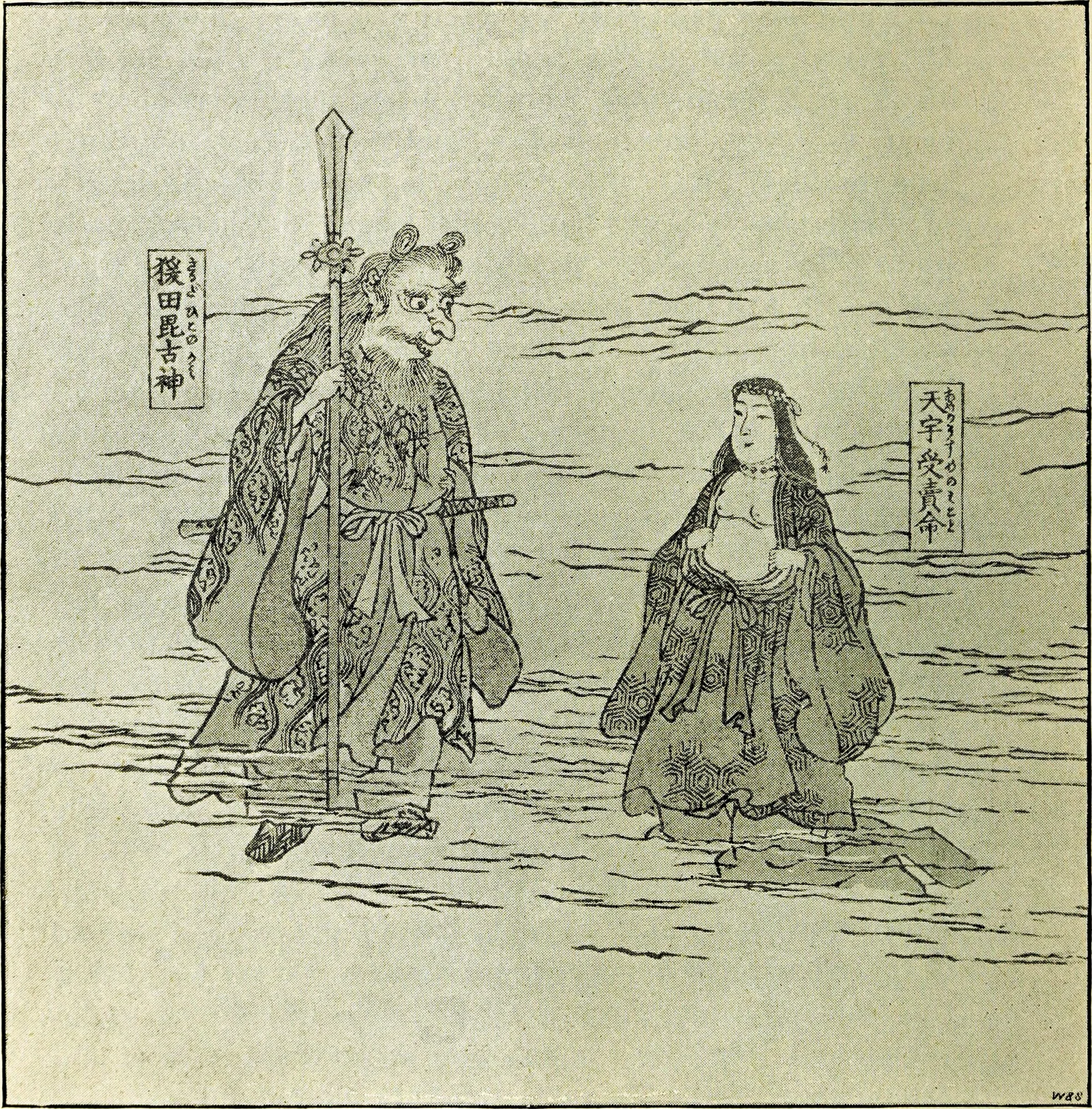
Saruta-hiko and Uzume.
complete thy task.' Ame no Uzume returned and reported these circumstances. Thereupon the August Grandchild, leaving the Heavenly rock-seat, and thrusting apart the eight-piled clouds of Heaven, clove his way with an awful way-cleaving, and descended from Heaven. Finally, as had been arranged, the August Grandchild arrived at the peak of Kushifuru of Takachiho in Hiuga, in the land of Tsukushi. And Saruta-hiko no Kami forthwith proceeded to the upper waters of the River Isuzu at Sanada in Ise. Ame no Uzume no Mikoto, in accordance with the request made by Saruta[42] hiko no Kami, attended upon him. Now the August Grandchild commanded Ame no Uzume no Mikoto, saying:—'Let the name of the Deity whom thou didst discover be made thy title.' Therefore he conferred on her the designation of Sarume no Kimi.[43] So this was the origin of the male and female Lords of Sarume being both styled Kimi."[44]
(II. 19.) In one writing it is said:—"The Heavenly Deity sent Futsu-nushi no Kami and Take-mika-tsuchi no Kami to tranquillize the Central Land of Reed-Plains. Now these two Gods said:—'In Heaven there is an Evil Deity called Ama-tsu-mika-hoshi, or Ame no Kagase-wo. We pray that this Deity may be executed before we go down to make clear the Central Land of Reed-Plains.' At this time Iwahi-nushi[45] no Kami received the designation of Iwahi no Ushi. This is the God which now dwells in the land of Katori in Adzuma.[46] After this the two Deities descended and arrived at the Little Shore of Itasa in Idzumo, and asked Oho-na-mochi no Kami, saying:—'Wilt thou deliver up this country to the Heavenly Deity, or no?' He answered and said:—'I suspected that ye two gods were coming to my place. Therefore I will not allow it.' Thereupon Futsu-nushi no Kami forthwith returned upwards, and made his report. Now Taka-mi-musubi no Mikoto sent the two Gods back again, and commanded Oho-na-mochi no Mikoto, saying:—'Having now heard what thou hast said, I find that there is profound reason in thy words. Therefore again I issue my commands to thee more circumstantially, that is to say:—Let the public matters which thou hast charge of be conducted by my grandchild, and do thou rule divine affairs. Moreover, if thou wilt dwell in the palace of Ama no Hi-sumi,[47] I will now build it for thee. I will take a thousand fathom rope[48] of the (bark of the) paper mulberry, and tie it in 180 knots. As to the dimensions of the building of the palace,[49] its pillars shall be high and massy, and its planks broad and thick. I will (II. 20.) also cultivate thy rice-fields for thee, and, for thy provision when thou goest to take pleasure on the sea, I will make for thee a high bridge, a floating bridge, and also a Heavenly bird-boat. Moreover, on the Tranquil River of Heaven I will make a flying-bridge. I will also make for thee white shields[50] of 180 seams, and Ame no Ho-hi no Mikoto shall be the president of the festivals in thy honour.' Hereupon Oho-na-mochi no Kami answered and said:—'The instructions of the Heavenly Deity are so courteous that I may not presume to disobey his commands. Let the August Grandchild direct the public affairs of which I have charge. I will retire and direct secret matters.' So he introduced Kunado no Kami to the two Gods, saying:—'He will take my place and will yield respectful obedience. I will withdraw and depart from here.' He forthwith invested him with the pure Yasaka jewels, and then became concealed for ever.[51] Therefore Futsu-nushi no Kami appointed (II. 21.) Kunado no Kami[52] as guide, and went on a circuit of pacification. Any who were rebellious to his authority he put to death, while those who rendered obedience were rewarded. The chiefs of those who at this time rendered obedience were Oho-mono-nushi[53] no Kami and Koto-shiro-nushi no Kami. So they assembled the eighty myriads of Gods in the High Market-place of Heaven, and taking them up to Heaven with them, they declared their loyal behaviour. Then Taka-mi-musubi no Mikoto commanded Oho-mono-nushi no Kami, saying:—'If thou dost take to wife one of the Deities of Earth, I shall still consider that thy heart is disaffected. I will therefore now give thee my daughter Mi-ho-tsu hime to be thy wife. Take with thee the eighty myriads of Deities to be the guards of my August Grandchild to all ages.' So she sent him down again. Thereupon Ta-oki-ho-ohi no Kami, ancestor of the Imbe of the Land of Kii, was appointed hatter,[54] Hiko-sachi no Kami was made shield-maker,[55] Ma-hitotsu no Kami[56] was made metal-worker, Ame no Hi-washi[57] no Kami was appointed tree-fibre maker, and Kushi-akaru-dama no Kami (II. 22.) jewel-maker.[58]
Taka-mi-musubi no Kami accordingly gave command, saying:—'I will set up a Heavenly divine fence[59] and a Heavenly rock-boundary wherein to practise religious abstinence[60] on behalf of my descendants. Do ye, Ame no Koyane no Mikoto and Futo-dama[61] no Mikoto, take with you the Heavenly divine fence, and go down to the Central Land of Reed-Plains. Moreover, ye will there practise abstinence[62] on behalf of my descendants.' So she attached the two Deities to Ame no Oshi-ho-mi-mi no Mikoto and sent them down. It was when Futo-dama no Mikoto was sent that the custom first began of worshipping this Deity with stout straps[63] flung over weak shoulders when taking the place of the Imperial hand. From this, too, the custom had its origin, by which Ame no Koyane no Mikoto had charge of divine matters. Therefore he was[59] made to divine by means of the Greater Divination, and thus to do his service.[64]
(II. 23.) At this time Ama-terasu no Oho-kami took in her hand the precious mirror, and, giving it to Ame no Oshi-ho-mi-mi no Mikoto, uttered a prayer, saying:—'My Child, when thou lookest upon this mirror, let it be as if thou wert looking on me. Let it be with thee on thy couch and in thy hall, and let it be to thee a holy[65] mirror.' Moreover, she gave command to Ame no Ko-yane no Mikoto and to Futo-dama no Mikoto, saying:—'Attend to me, ye two Gods! Do ye also remain together in attendance and guard it well.' She further gave command, saying:—'I will give over to my child the rice-ears of the sacred garden,[66] of which I partake in the Plain of High Heaven.' And she straightway took the daughter of Taka-mi-musubi no Mikoto, by name Yorodzu-hata-hime, and uniting her to Ame no Oshi-ho-mi-mi no Mikoto as his consort, sent her down. Therefore while she was still in the Void of Heaven,[67] she gave birth to a child, who was called Ama-tsu-hiko-ho no ninigi no Mikoto. She accordingly desired to send down this grandchild instead of his parents. Therefore on him she bestowed Ame no Ko-yane no Mikoto, Futo-dama no Mikoto, and the Deities of the various Be,[68] all without exception. She gave him, moreover, the things belonging to his person,[69] just as above stated.
After this, Ame no Oshi-ho-mi-mi no Mikoto went back again to Heaven. Therefore Ama-tsu-hiko-ho no ninigi no Mikoto descended to the peak of Takachiho of Kushibi in (II. 24.) Hiuga. Then he passed through the Land of Munasohi,[70] in Sojishi, by way of the Hill of Hitawo, in search of a country, and stood on a level part of the floating sand-bank. Thereupon he called to him Koto-katsu-kuni-katsu-Nagasa, the Lord of that country, and made inquiry of him. He answered and said:—'There is a country here. I will in any case obey thy commands.' Accordingly the August Grandchild erected a palace-hall and rested here. Walking afterwards by the sea-shore, he saw a beautiful woman. The August Grandchild inquired of her, saying:—'Whose child art thou?' She answered and said:—'Thy handmaiden is the child of Oho-yama-tsu-mi no Kami. My name is Kami-ataka-ashi-tsu-hime, and I am also called Ko-no-hana-saku-ya-hime.' Then she said:—'I have also an elder sister named Iha-naga-hime.'[71] The August Grandchild said:—'I wish to make thee my wife. How will this be?' She answered and said:—'I have a father, Oho-yama-tsu-mi no Kami, I pray thee ask him.' The August Grandchild accordingly spake to Oho-yama-tsu-mi no Kami, saying:—'I have seen thy daughter and wish to make her my wife.' Hereupon Oho-yama-tsu-mi no Kami sent his two daughters with one hundred tables of food and drink to offer them respectfully. Now the August Grandchild thought the elder sister ugly, and would not take her. So she went away. But the younger sister was a noted beauty. So he took her with him and favoured her, and in one night she became pregnant. Therefore Iha-naga-hime was greatly ashamed, and cursed him, saying:—'If the August Grandchild had taken me and not rejected me, the children born to him would have been long-lived, and would have endured for ever like the massy rocks. But seeing that he has not done so, but has married my younger sister only, the children born to him will surely be decadent like the flowers of the trees.'"
One version is:—"Iha-naga-hime, in her shame and resentment, spat and wept. She said:—'The race of visible mankind shall change swiftly like the flowers. of the trees, and shall decay and pass away.' This is the (II. 25.) reason why the life of man is so short.
After this, Kami-ataka-ashi-tsu-hime saw the August Grandchild, and said:—'Thy handmaiden has conceived a child by the August Grandchild. It is not meet that it should be born privately.' The August Grandchild said:—'Child of the Heavenly Deity though I am, how could I in one night cause anyone to be with child? Now it cannot be my child.' Kono-hana-saku-ya-hime was exceedingly ashamed and angry. She straightway made a doorless muro, and thereupon made a vow, saying:—'If the child which I have conceived is the child of another Deity, may it surely be unfortunate. But if it is truly the offspring of the Heavenly Grandchild, may it surely be alive and unhurt.' So she entered the muro, and burnt it with fire. At this time, when the flames first broke out, a child was born who was named Ho-no-susori no Mikoto; next when the flame reached its height, a child was born who was named Ho-no-akari no Mikoto. The next child which was born was called Hiko-ho-ho-demi no Mikoto,[72] and also Ho-no-wori no Mikoto."
In one writing it is said:—"When the flames first became bright, a child was born named Ho-no-akari no Mikoto; next, when the blaze was at its height, a child was born named Ho-no-susumi[73] no Mikoto, also called Ho-no-suseri no Mikoto; next, when she recoiled from the blaze, a child was born named Ho-no-ori-hiko-ho-ho-demi no Mikoto—three children in all. The fire failed to harm them, and the mother, too, was not injured in the least. Then with a bamboo knife she cut their navel-strings.[74] From the bamboo knife which she threw away, there eventually sprang tip a bamboo grove. Therefore that place was called Taka-ya.[75]
(II. 26.) Now Kami-ataka-ashi-tsu-hime by divination fixed upon a rice-field to which she gave the name Sanada, and from the rice grown there brewed Heavenly sweet sake, with which she entertained him. Moreover, with the rice from the Nunada rice-field she made boiled rice and entertained him therewith."[76]
In one writing it is said:—"Taka-mi-musubi no Mikoto took the coverlet which was on the true couch and wrapped in it Ama-tsu-hiko-kuni-teru-hiko-ho no ninigi no Mikoto, who forthwith drew open the rock-door of Heaven, and thrusting asunder the eight-piled clouds of Heaven, descended. At this time Ama-no-oshi-hi no Mikoto, the ancestor of the Oho-tomo[77] no Muraji, taking with him Ame-kushi-tsu Oho-kume, the ancestor of the Kume Be,[78] placed on his back the rock-quiver of Heaven, drew on his[74] forearm a dread loud-sounding elbow-pad,[79] and grasped in his hand a Heavenly vegetable-wax-tree bow and a Heavenly feathered arrow, to which he added an eight-eyed sounding-arrow.[80] Moreover he girt on his mallet-headed (II. 27.) sword,[81] and taking his place before the Heavenly Grandchild, proceeded downwards as far as the floating bridge of Heaven, which is on the two peaks of Kushibi of Takachiho in So in Hiuga. Then he stood on a level part of the floating sand-bank and passed through the desert land
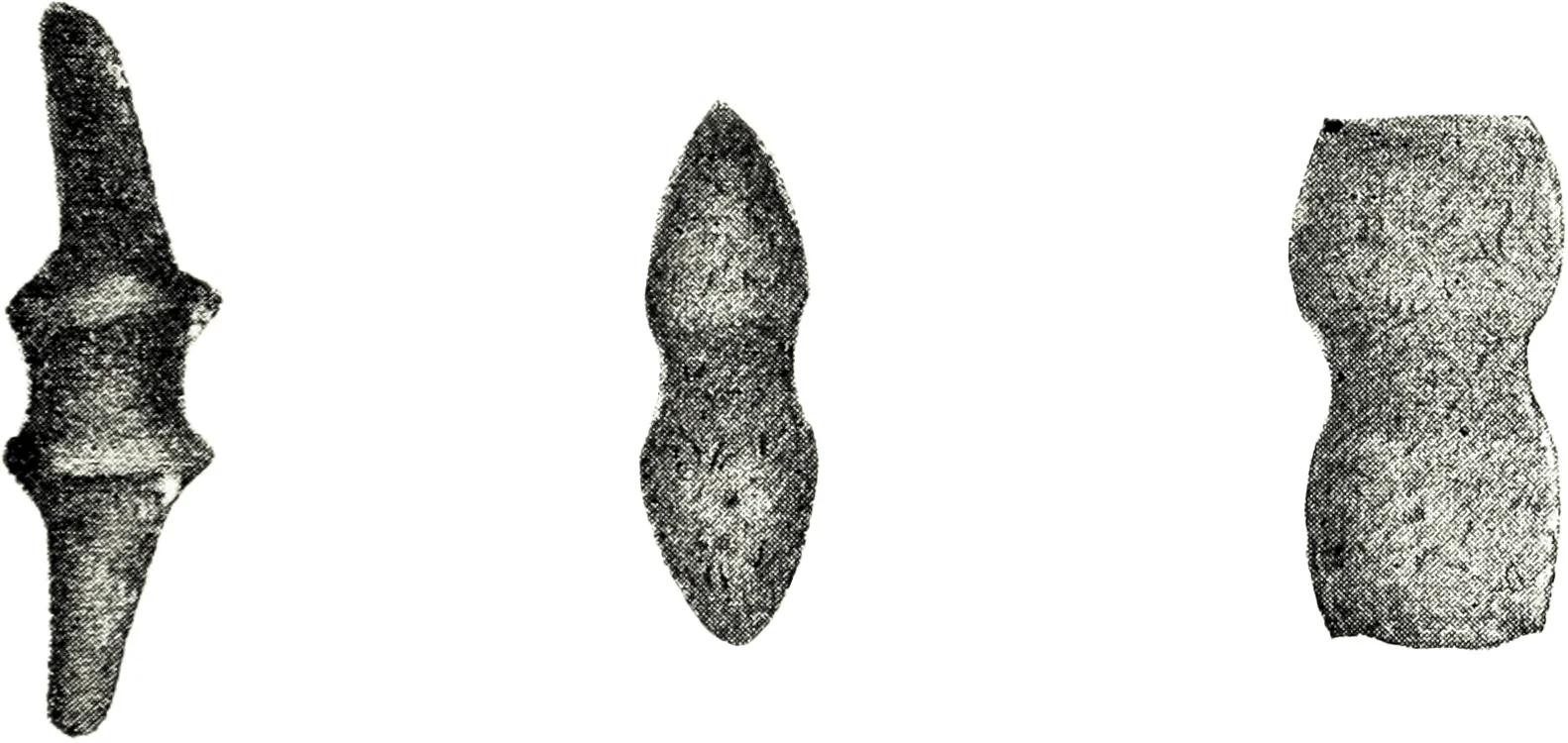
Stone Mallets.
of Sojishi by way of Hitawo in search of a country until he came to Cape Kasasa in Ata no Nagaya. Now at this place there was a God named Koto-katsu-kuni-katsu-Nagasa. Therefore the Heavenly Grandchild inquired of this God, saying:—'Is there a country?' He answered and said:—'There is.' Accordingly he said:—'I will yield it up to thee in obedience to thy commands.' Therefore the Heavenly Grandchild abode in that place. This Koto-katsu-kuni-katsu no Kami was the child of Izanagi no Mikoto, and his other name is Shiho-tsu-tsu-no oji."[82]
In one writing it is said:—"The Heavenly Grandchild favoured Ataka-ashi-tsu-hime, the daughter of Oho-yama-tsu-mi no Kami. In one night she became pregnant, and eventually gave birth to four children. Therefore Ataka-ashi-tsu-hime took the children in her arms, and, coming forward, said:—'Ought the children of the Heavenly Grandchild to be privately nurtured? Therefore do I announce to thee the fact for thy information.' At this time the Heavenly Grandchild looked upon the children, and, with a mocking laugh, said:—'Excellent—these princes of mine! Their birth is a delightful piece of news!' Therefore Ataka-ashi-tsu-hime was wroth, and said:—'Why dost thou mock thy handmaiden?' The Heavenly Grandchild said:—'There is surely some doubt of this, and therefore did I mock. How is it possible for me, Heavenly God though I am, in the space of one night to cause anyone to become pregnant? Truly they are not my children.' On this account Ataka-ashi-tsu-hime was more and more resentful. She made a doorless muro, into which she entered, and made a vow, saying:—'If the children which I have conceived are not the offspring of the Heavenly Grandchild, let them surely perish. But if they are the offspring of the Heavenly Grandchild, let them (II. 28.) suffer no hurt.' So she set fire to the muro and burnt it. When the fire first became bright, a child sprang forth and announced himself, saying:—'Here am I, the child of the Heavenly Deity, and my name is Ho-no-akari no Mikoto. Where is my father?' Next, the child who sprang forth when the fire was at its height also announced himself, saying:—'Here am I, the child of the Heavenly Deity, and my name is Ho-no-susumi no Mikoto. Where are my father and my elder brother?' Next, the child who sprang forth when the flames were becoming extinguished also announced himself, saying:—'Here am I, the child of the Heavenly Deity, and my name is Ho-no-ori no Mikoto. Where are my father and my elder brothers?' Next, when she recoiled from the heat, a child sprang forth, and also announced himself, saying:—'Here am I, the child of the Heavenly Deity, and my name is Hiko-ho-ho-demi no Mikoto. Where are my father and my elder brothers?' After that, their mother, Ataka-ashi-tsu-hime, came forth from amidst the embers, and approaching, told him, saying:—'The children which thy handmaiden has brought forth, and thy handmaiden herself, have of our own accord undergone the danger of fire,[83] and yet have suffered not the smallest hurt. Will the Heavenly Grandchild not look on them?' He answered and said:—'I knew from the first that they were my children, only, as they were conceived in one night, I thought that there might be suspicions, and I wished to let everybody know that they are my children, and also that a Heavenly Deity can cause pregnancy in one night. Moreover, I wished to make it evident that thou dost possess a wonderful and extraordinary dignity, and also that our children have surpassing spirit. Therefore it was that on a former day I used words of mockery.'"
In one writing it is said:—"Ame no Oshi-ho-ne no Mikoto took to wife Taku-hata-chichi-hime Yorodzu-hata[84] hime no Mikoto, daughter of Taka-mi-musubi no Mikoto."
Another version says:—"Honoto-hata-hime-ko-chichi-hime no Mikoto, daughter of Taka-mi-musubi no Mikoto." She bore to him a child named Ama-no-ho-no-akari no Mikoto. Next she bore Ama-tsu-hiko-ne-ho-no-ninigi-ne no Mikoto. The child of Ama-no-ho-no-akari no Mikoto was called Kayama no Mikoto. He is the ancestor of (II. 29.) the Ohari no Muraji.
When Taka-mi-musubi no Mikoto was sending down the Heavenly Grandchild Ho-no-ninigi no Mikoto to the Central Land of Reed-Plains, she commanded the eighty myriads of Gods, saying:—"In the Central Land of Reed-Plains, the rocks, tree-stems and herbage have still the power of speech. At night, they make a clamour like that of flames of fire; in the day-time they swarm up like the flies in the fifth month, etc., etc." Now Taka-mi-musubi no Mikoto gave command, saying:—"I formerly sent Ame-waka-hiko to the Central Land of Reed-Plains, but he has been long absent, and until now has not returned, perhaps being forcibly prevented by some of the Gods of the Land." She therefore sent the cock-pheasant Na-naki to go thither and spy out the reason. This pheasant went down, but when he saw the fields of millet and the fields of pulse he remained there, and did not come back. This was the origin of the modern saying, "The pheasant special messenger." Therefore she afterwards sent the hen-pheasant Na-naki, and this bird came down and was hit by an arrow shot by Ame-waka-hiko, after which she came up and made her report, etc., etc. At this time Taka-mi-musubi no Mikoto took the coverlet which was upon the true couch, and having clothed therewith the Heavenly Grandchild Ama-tsu-hikone Ho-no-ninigi-ne no Mikoto, sent him downwards, thrusting asunder the eight-piled clouds of Heaven. Therefore this God was styled Ame-kuni-nigishi-hiko-ho-ninigi no Mikoto. Now the place at which he arrived on his descent is called the Peak of Sohori-yama of Takachiho (II. 30.) in So in Hiuga. When he proceeded therefore on his way, etc., etc.,[85] he arrived at Cape Kasasa in Ata, and finally ascended the Island of Takashima in Nagaya. He went round inspecting that land, and found there a man whose name was Koto-katsu-kuni-katsu Nagasa. The Heavenly Grandchild accordingly inquired of him, saying:—"Whose land is this?" He answered and said:—"This is the land where Nagasa dwells. I will, however, now offer it to the Heavenly Grandchild." The Heavenly Grandchild again inquired of him, saying:—"And the maidens who have built an eight-fathom palace on the highest crest of the waves and tend the loom with jingling wrist jewels, whose daughters are they?" He answered and said:—"They are the daughters of Oho-yama-tsu-mi no Kami. The elder is named Iha-naga-hime, and the younger is named Kono-hana saku-ya-hime, also called Toyo-ata-tsu hime, etc., etc." The August Grandchild accordingly favoured Toyo-ata-tsu hime, and after one night she became pregnant. The August Grandchild doubting this, etc., etc. Eventually she gave birth to Ho-no-suseri no Mikoto; next she bore Ho-no-ori no Mikoto, also called Hiko-hoho-demi no Mikoto. Proof having been given by the mother's vow, it was known exactly that they were truly the offspring of the Heavenly Grandchild. Toyo-ata-tsu hime however was incensed at the Heavenly Grandchild, and would not speak to him. The Heavenly Grandchild, grieved at this, made a song, saying:—
The sea-weed of the offing—
Though it may reach the shore:
The true couch
Is, alas! impossible.
Ah! ye dotterels of the beach![86]
(II. 31.) In one writing it is said:—"The daughter of Taka-mi-musubi no Mikoto, Ama-yorodzu-taku-hata chi-hata hime."
One version is:—"Yorodzu-hata-hime ko-dama-yori-hime no Mikoto was the child of Taka-mi-musubi no Mikoto. This Goddess became the consort of Ame no Oshi-hone no Mikoto, and bore to him a child named Ama-no Ki-ho-ho-oki-se no Mikoto."
One version is:—"Katsu no haya-hi no Mikoto's child was Ama no Oho-mimi no Mikoto. This God took to wife Nigutsu hime, and had by her a child named Ninigi no Mikoto."
One version is:—"The daughter of Kami-mi-musubi no Mikoto, Taku-hata chi-hata hime, bore a child named Ho-no-ninigi no Mikoto."
One version is:—"Ama no Kise no Mikoto took to wife Ata-tsu hime, and had children, first Ho-no-akari no Mikoto, next Ho-no-yo-wori no Mikoto, and next Hiko-ho-ho-demi no Mikoto."
In one writing it is said:—"Masa-ya-a-katsu-katsu-no-haya-hi Ama no Oshi-ho-mimi no Mikoto took to wife Ama no yorodzu-taka-hata-chi-hata hime, daughter of Taka-mi-musubi no Mikoto, and by her as consort had a child named Ama-teru-kuni-teru Hiko-ho no akari no Mikoto. He is the ancestor of the Ohari no Muraji. The next child was Ama-no-nigishi-kuni-no-nigishi Ama-tsu-hiko-ho-no ninigi no Mikoto. This God took to wife Kono hana saku-ya-hime no Mikoto, daughter of Oho-yama-tsu-mi no Kami, and by her as consort had first a child named Ho-no-susori no Mikoto, and next Hiko-hoho-demi no Mikoto."
The elder brother Ho-no-susori no Mikoto had by nature a sea-gift; the younger brother Hiko-ho-ho-demi no Mikoto had by nature a mountain-gift.[87] In the beginning the two brothers, the elder and the younger, conversed together, saying:—"Let us for a trial exchange gifts." They eventually exchanged them, but neither of them gained aught by doing so. The elder brother repented his bargain, and returned to the younger brother his bow and arrows, asking for his fish-hook to be given back to him. But the younger brother had already lost the elder brother's fish-hook, and there was no means of finding it. He accordingly made another new hook which he offered to his elder brother. But his elder brother refused to accept it, and (II. 32.) demanded the old hook. The younger brother, grieved at this, forthwith took his cross-sword[88] and forged[89] from it new fish-hooks, which he heaped up in a winnowing tray, and offered to his brother. But his elder brother was wroth, and said:—"These are not my old fish-hook: though they are many, I will not take them." And he continued repeatedly to demand it vehemently. Therefore Hiko-hoho-demi no Mikoto's grief was exceedingly profound, and he went and made moan by the shore of the sea. There he met Shiho-tsutsu[90] no Oji.[91] The old man inquired of him saying:—"Why dost thou grieve here?" He answered and told him the matter from first to last. The old man said:—"Grieve no more. I will arrange this matter for thee." So he made a basket without interstices, and placing in it Hoho-demi no Mikoto, sank it in the sea. Forthwith he found himself at a pleasant strand, where he abandoned the basket, and, proceeding on his way, suddenly arrived at the palace of the Sea-God. This palace was provided with battlements and turrets, and had stately towers. Before the gate there was a well, and over the well there grew a many-branched cassia-tree,[92] with wide-spreading boughs and leaves. Now Hiko-hoho-demi no Mikoto went up to the foot of this tree and loitered about. After some time a beautiful woman appeared, (II. 33.) and, pushing open the door, came forth. She at length took a jewel-vessel and approached. She was about to draw water, when, raising her eyes, she saw him, and was alarmed. Returning within, she spoke to her father and mother, saying:—"There is a rare stranger at the foot of the tree before the gate." The God of the Sea thereupon prepared an eight-fold cushion and led him in. When they had taken their seats, he inquired of him the object of his coming. Then Hiko-hoho-demi no Mikoto explained to him in reply all the circumstances. The Sea-God accordingly assembled the fishes, both great and small, and required of them an answer. They all said:—"We know not. Only the Red-woman[93] has had a sore mouth for some time past and has not come." She was therefore peremptorily summoned to appear, and on her mouth being examined the lost hook was actually found.
After this, Hiko-hoho-demi no Mikoto took to wife the Sea-God's daughter, Toyo-tama[94]-hime, and dwelt in the sea-palace. For three years he enjoyed peace and pleasure, but still had a longing for his own country, and therefore sighed deeply from (II. 34.) time to time. Toyo-tama-hime heard this and told her father, saying:—"The Heavenly Grandchild often sighs as if in grief. It may be that it is the sorrow of longing for his country." The God of the Sea thereupon drew to him Hiko-hoho-demi no Mikoto, and addressing him in an easy, familiar way, said:—"If the Heavenly Grandchild desires to return to his country I will send him back." So he gave him the fish-hook which he had found, and in doing so instructed him, saying:—"When thou givest this fish-hook to thy elder brother, before giving to him call to it secretly, and say, "A poor hook." He further presented to him the jewel of the flowing tide and the jewel of the ebbing tide, and instructed him, saying:—"If thou dost dip the tide-flowing jewel, the tide will suddenly flow, and therewithal thou shalt drown thine elder brother. But in case thy elder brother should repent and beg forgiveness, if, on the contrary, thou dip the tide-ebbing jewel, the tide will spontaneously ebb, and therewithal thou shalt save him. If thou harass him in this way, thy elder brother will of his own accord render submission."
When the Heavenly Grandchild was about to set out on his return journey, Toyo-tama-hime addressed him, saying:—"Thy handmaiden is already pregnant, and the time of her delivery is not far off. On a day when the winds and waves are raging, I will surely come forth to the sea-shore, and I pray thee that thou wilt make for me a parturition house,[95] and await me there."
When Hiko-hoho-demi no Mikoto returned to his palace, he complied implicitly with the instructions of the Sea-God, and the elder brother, Ho-no-susori no Mikoto, finding himself in the utmost straits, of his own accord admitted his offence, and (II. 35.) said:—"Henceforward I will be thy subject to perform mimic dances for thee. I beseech thee mercifully to spare my life." Thereupon he at length yielded his petition, and spared him.[96] This Ho-no-susori no Mikoto was the first ancestor of the Kimi of Wobashi in Ata.
After this Toyo-tama-hime fulfilled her promise, and, bringing with her her younger sister, Tama-yori-hime, bravely confronted the winds and waves, and came to the sea-shore. When the time of her delivery was at hand, she besought Hiko-hoho-demi no Mikoto, saying:—"When thy handmaiden is in travail, I pray thee do not look upon her." However, the Heavenly Grandchild could not restrain himself, but went secretly and peeped in. Now Toyo-tama-hime was just in childbirth, and had changed into a dragon.[97] She was greatly ashamed, and said:—"Hadst thou not disgraced me, I would have made the sea and land communicate with each other, and for ever
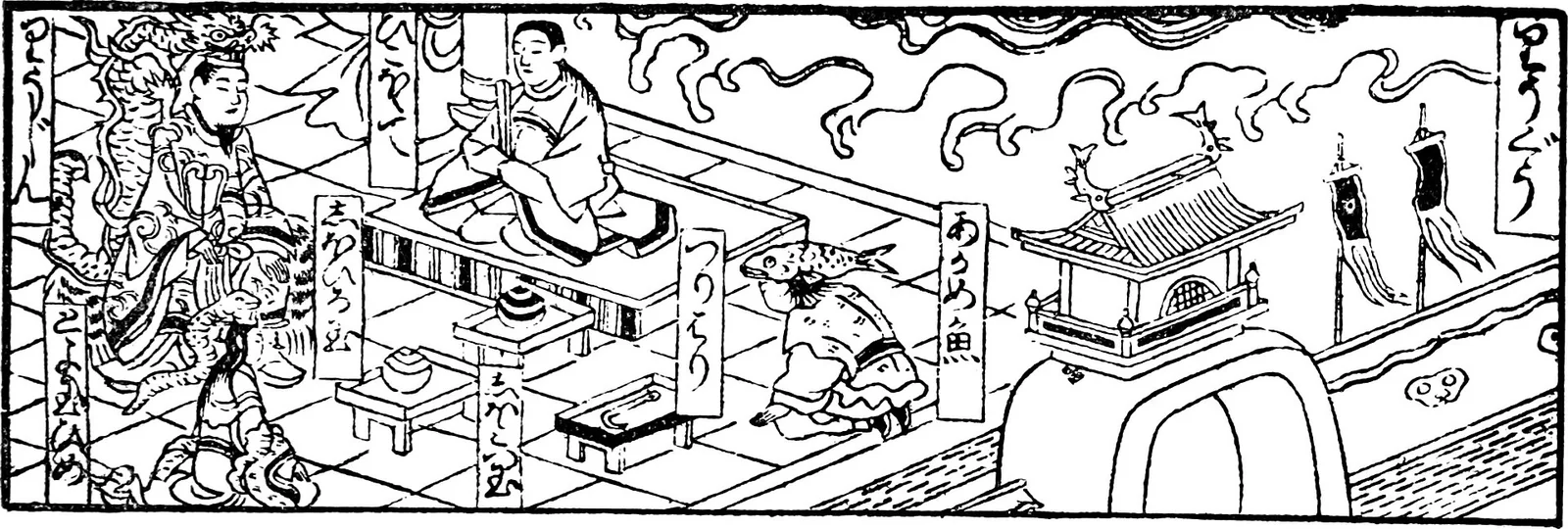
prevented them from being sundered. But now that thou hast disgraced me, wherewithal shall friendly feelings be knit together?" So she wrapped the infant in rushes, and abandoned it on the sea-shore. Then she barred the sea-path, and passed away.[98] Accordingly the child was called Hiko-nagisa-take-u-gaya-fuki-ahezu[99] no Mikoto.
A long time after, Hiko-hoho-demi no Mikoto died, and was buried in the Misasagi on the summit of Mount Takaya in Hiuga.
(II. 36.) In one writing it is said:—"The elder brother Ho-no-susori no Mikoto had acquired a mountain-gift. Now the elder and younger brothers wished to exchange gifts, and therefore the elder brother took the bow which was of the gift of the younger brother, and went to the mountain in quest of wild animals. But never a trace of game did he see. The younger brother took the fish-hook of his elder brother's gift, and with it went a fishing on the sea, but caught none at all, and finally lost his fish-hook. Then the elder brother restored his younger brother's bow and arrows, and demanded his own fish-hook. The younger brother was sorry, and of the cross-sword which he had in his girdle made fish-hooks, which he heaped up in a winnowing tray, and offered to his elder brother. But the elder brother refused to receive them, saying:—'I still wish to get the fish-hook of my gift.' Hereupon Hiko-hoho-demi no Mikoto, not knowing where to look for it, only grieved and made moan. He went to the sea-shore, where he wandered up and down lamenting. Now there was an old man, who suddenly came forward, and gave his name as Shiho-tsuchi no Oji. He asked him, saying:—'Who art thou, my lord, and why dost thou grieve here?' Hiko-hoho-demi no Mikoto told him all that had happened. Whereupon the old man took from a bag a black comb, which he flung upon the ground. It straightway became changed into a multitudinous[100] clump of bamboos. Accordingly he took these bamboos and made of them a coarse basket with wide meshes, in which he placed Hiko-hoho-demi no Mikoto, and cast him into the sea."
One version says:—"He took a katama without interstices, and made of it a float, to which he attached Hoho-demi by a cord and sunk him." [The term katama means what is now called a bamboo-basket.]
Now there is in the bottom of the sea a natural "Little-shore of delight." Proceeding onwards, along this shore, he arrived of a sudden at the palace of Toyo-tama-hiko, the God of the Sea. This palace had magnificent gates and towers of exceeding beauty. Outside the gate there was a well, and beside the well was a cassia-tree. He approached (II. 37.) the foot of this tree, and stood there. After a while a beautiful woman, whose countenance was such as is not anywhere to be seen, came out from within, followed by a bevy of attendant maidens. She was drawing water in a jewel-urn, when she looked up and saw Hoho-demi no Mikoto. She was startled, and returning, told the God, her father, saying:—'At the foot of the cassia-tree without the gate, there is a noble stranger of no ordinary build. If he had come down from Heaven, he would have had on him the filth of Heaven; if he had come from Earth, he would have had on him the filth of Earth. Could he be really the beautiful prince of the sky?'
One version says:—"An attendant of Toyo-tama-hime was drawing water in a jewel-pitcher, but she could not manage to fill it. She looked down into the well, when there shone inverted there the smiling face of a man. She looked up and there was a beautiful God leaning against a cassia-tree. She accordingly returned within, and informed her mistress.
Hereupon Toyo-tama-hiko sent a man to inquire, saying:—'Who art thou, O stranger, and why hast thou come here?' Hoho-demi no Mikoto answered and said:—'I am the grandchild of the Heavenly Deity,' and ultimately went on to give the reason of his coming.
Then the God of the Sea went out to meet him. He made him obeisance, and led him within, where he inquired courteously of his welfare, and gave him to wife his daughter, Toyo-tama-hime. Therefore he remained and dwelt in the palace of the sea. Three years passed, after which Hoho-demi no Mikoto sighed frequently, and Toyo-tama-hime asked him, saying:—'Does the Heavenly Grandchild perchance wish to return to his native land?' He answered and said:—'It is so.' Toyo-tama-hime forthwith told the God her father, and said:—'The noble guest who is here wishes to return to the upper (II. 38.) country.' Hereupon the God of the Sea assembled all the fishes of the sea, and asked of them the fish-hook. Then one fish answered and said:—'The Red-woman[101] (also called the Red Tahi) has long had an ailment of the mouth. I suspect that she has swallowed it.' So the Red-woman was forthwith summoned, and on looking into her mouth, the hook was still there. It was at once taken and delivered to Hiko-hoho-demi no Mikoto, with these instructions:—'When thou givest the fish-hook to thy elder brother, thou must use this imprecation: "The origin of poverty: the beginning of starvation: the root of wretchedness." Give it not to him until thou hast said this. Again, if thy brother cross the sea, I will then assuredly stir up the blasts and billows, and make them overwhelm and vex him.' Thereupon he placed Hoho-demi no Mikoto on the back of a great sea-monster, and so sent him back to his own country.
At another time, before this, Toyo-tama-hime spoke in an easy, familiar way, and said:—'Thy handmaid is with child. Some day, when the winds and waves are boisterous, I will come forth to the sea-shore, and I pray thee to construct for me a parturition-house, and to await me there.'
After this, Toyo-tama-hime fulfilled her promise to come, and spake to Hoho-demi no Mikoto, saying:—'To-night thy handmaiden will be delivered. I pray thee, look not on her.' Hoho-demi no Mikoto would not hearken to her, but with a comb[102] he made a light, and looked at her. At this time Toyo-tama-hime had become changed into an enormous sea-monster of eight fathoms, and was wriggling about on her belly. She at last was angry that she was put to shame, and forthwith went straight back again to her native sea, leaving behind her younger sister Tama-yori-hime (II. 39.) as nurse to her infant. The child was called Hiko-nagisa-take-u-gaya-fuki-ayezu no Mikoto, because the parturition-house by the sea-shore was all thatched with cormorants' feathers, and the child was born before the tiles had met. It was for this reason that he received this name."[103]
One version says:—"Before the gate there was a beautiful well, and over the well there grew a cassia-tree with an hundred branches. Accordingly Hiko-hoho-demi no Mikoto sprang up into that tree and stood there. At this time, Toyo-tama-hime, the daughter of the God of the Sea, came with a jewel-bowl in her hand and was about to draw water, when she saw in the well the reflection of a man. She looked up and was startled, so that she let fall the bowl, which was broken to pieces. But without regard for it, she returned within and told her parents, saying:—'I have seen a man on the tree which is beside the well. His countenance is very beautiful, and his form comely. He is surely no ordinary person.' When the God, her father, heard this, he wondered. Having prepared an eight-fold cushion, he went to meet him, and brought him in. When they were seated, he asked the reason of his coming, upon which he answered and told him all his case. Now the God of the Sea at once conceived pity for him, and summoning all the broad of fin and narrow of fin, made inquiry of them. They all said:—"We know not. Only the Red-woman has an ailment of the mouth and has not come.' [Another version is:—'The Kuchi-me[104] has an ailment of the mouth.'] So she was sent for in all haste, and on searching her mouth, the lost fish-hook was at once found. Upon this the God of the Sea chid her, saying:—'Thou Kuchime! Henceforward thou shalt not be able to swallow a bait, nor shalt thou be allowed to have a place at the table of the Heavenly Grandchild.' This is the reason why the fish kuchime is not among the articles of food set before the Emperor.
When the time came for Hiko-hoho-demi no Mikoto to take his departure, the God of the Sea spake to him, saying:—'I am rejoiced in my inmost heart that the Heavenly Grandchild has now been graciously pleased to visit me. (II. 40.) When shall I ever forget it?' So he took the jewel which when thought of makes the tide to flow, and the jewel which when thought of makes the tide to ebb, and joining them to the fish-hook, presented them, saying:—'Though the Heavenly Grandchild may be divided from me by eight-fold windings (of road), I hope that we shall think of each other from time to time. Do not therefore throw them away.' And he taught him, saying:—'When thou givest this fish-hook to thy elder brother, call it thus:—'A hook of poverty, a hook of ruin, a hook of downfall.' When thou hast said all this, fling it away to him with thy back turned, and deliver it not to him face to face. If thy elder brother is angry, and has a mind to do thee hurt, then produce the tide-flowing jewel and drown him therewith. As soon as he is in peril and appeals for mercy, bring forth the tide-ebbing jewel and therewith save him. If thou dost vex him in this way, he will of his own accord become thy submissive vassal.' Now Hiko-hoho-demi no Mikoto, having received the jewels and the fish-hook, came back to his original palace, and followed implicitly the teaching of the Sea-God. First of all he offered his elder brother the fish-hook. His elder brother was angry and would not receive it. Accordingly the younger brother produced the tide-flowing jewel, upon which the tide rose with a mighty overflow, and the elder brother was drowning. Therefore he besought his younger brother, saying:—'I will serve thee as thy slave. I beseech thee, spare my life.' The younger brother then produced the tide-ebbing jewel, whereupon the tide ebbed of its own accord, and the elder brother was restored to tranquillity. After this the elder brother changed his former words, and said:—'I am thy elder brother. How can an elder brother serve a younger brother?' Then the younger brother produced the tide-flowing jewel, which his elder brother seeing, fled up to a high mountain. Thereupon the tide also submerged the mountain. The elder brother climbed a lofty tree, and thereupon the tide also submerged the tree. The elder brother was now at an extremity, and had nowhere to (II. 41.) flee to. So he acknowledged his offence, saying:—'I have been in fault. In future my descendants for eighty generations shall serve thee as thy mimes in ordinary. [One version has 'dog-men.'] I pray thee, have pity on me.' Then the younger brother produced the tide-ebbing jewel, whereupon the tide ceased of its own accord. Hereupon the elder brother saw that the younger brother was possessed of marvellous powers, and at length submitted to serve him.
On this account the various Hayato descended from Ho no susori no Mikoto to the present time do not leave the vicinity of the enclosure of the Imperial Palace, and render service instead of barking dogs[105]
This was the origin of the custom which now prevails of not pressing a man to return a lost needle."[106]
In one writing it is said:—"The elder brother, Ho no susori no Mikoto, was endowed with a sea-gift, and was therefore called Umi no sachi-hiko:[107] the younger brother, Hiko-hoho-demi no Mikoto, was endowed with a mountain-gift, (II. 42.) and was therefore called Yama no sachi-hiko. Whenever the wind blew and the rain fell, the elder brother lost his gain, but in spite of wind and rain the younger brother's gain did not fail him. Now the elder brother spoke to the younger brother, saying:—'I wish to make trial of an exchange of gifts with thee.' The younger brother consented, and the exchange was accordingly made. Thereupon the elder brother took the younger brother's bow and arrows, and went a-hunting to the mountain: the younger brother took the elder brother's fish-hook, and went on the sea a-fishing. But neither of them got anything, and they came back empty-handed. The elder brother accordingly restored to the younger brother his bow and arrows, and demanded back his own fish-hook. Now the younger brother had lost the fish-hook in the sea, and he knew not how to find it. Therefore he made other new fish-hooks, several thousands in number, which he offered to his elder brother. The elder brother was angry, and would not receive them, but demanded importunately the old fish-hook, etc., etc. Then the younger brother went to the sea-shore and wandered about, grieving and making moan. Now[105] there was there a river wild-goose which had become entangled in a snare, and was in distress. He took pity on it, and loosing it, let it go. Shortly after there appeared Shiho tsutsu no Oji. He came and made a skiff of basket-work without interstices, in which he placed Hoho-demi no Mikoto and pushed it off into the sea, when it sank down of its own accord, till of a sudden there appeared the Pleasant Road. So he went on along this road, which in due course led him to the palace of the Sea-God. Then the Sea-God came out himself to meet him, and invited him to enter. He spread eight layers of sea-asses'[108] skins, on which he made him to sit, and with a banquet of tables of a hundred, which was already prepared, he fulfilled the rites of hospitality. Then he inquired of him in an easy manner:—'Wherefore has the Grandchild of the Heavenly Deity been graciously pleased to come hither?'"
[One version has:—"A little while ago my child came and told me that the Heavenly Grandchild was mourning by the sea-shore. Whether this be true or false I know not, but perhaps it may be so."]
Hiko-hoho-demi no Mikoto related to him all that had happened from first to last. So he remained there, and the Sea-God gave him his daughter Toyo-tama-hime to wife. At length, when three years had passed in close and (II. 43.) warm affection, the time came for him to depart. So the Sea-God sent for the tahi, and on searching her mouth found there the fish-hook. Thereupon he presented the fish-hook to Hiko-hoho-demi no Mikoto, and instructed him thus:—'When thou givest this to thy elder brother thou must recite the following:—"A big hook, an eager hook, a poor hook, a silly hook." After saying all this, fling it to him with a back-handed motion.' Then he summoned together the sea-monsters, and inquired of them, saying:—'The Grandchild of the Heavenly Deity is now about to take his departure homewards. In how many days will you accomplish this service?' Then all the sea-monsters fixed each a number of days according to his own length. Those of them which were one fathom long of their own accord said:—'In the space of one day we will accomplish it.' The one-fathom sea-monsters were accordingly sent with him as his escort. Then he gave him two precious objects, the tide-flowing jewel and the tide-ebbing jewel, and taught him how to use them. He further instructed him, saying:—'If thy elder brother should make high fields, do thou make puddle fields; if thy elder brother make puddle fields, do thou make high fields.' In this manner did the Sea-God in all sincerity lend him his aid. Now Hiko-hoho-demi no Mikoto, when he returned home, followed implicitly the God's instructions, and acted accordingly. When the younger brother produced the tide-flowing jewel, the elder brother forthwith flung up his hands in the agony of drowning. But when, on the other hand, he produced the tide-ebbing jewel, he was relieved, and recovered. After that Hi no susori no Mikoto pined away from day to day, and lamented, saying:—'I have become impoverished.' So he yielded submission to his younger brother.
(II. 44.) Before this Toyo-tama-hime spake to the Heavenly Grandchild, saying:—'That which thy handmaid has conceived is the offspring of the Heavenly Grandchild. How could I give birth to it in the midst of the ocean? Therefore when the time of my delivery comes, I will surely betake myself to my lord's abode, and it is my prayer that thou shouldst build me a house by the sea-side and await me there.' Therefore Hiko-ho-ho-demi no Mikoto, as soon as he returned to his own country, took cormorants' feathers, and with them as thatch, made a parturition-house. But before the tiling of the house was completed, Toyo-tama-hime herself arrived, riding on a great tortoise, with her younger sister Tama-yori-hime, and throwing a splendour over the sea. Now the months of her pregnancy were already fulfilled, and the time of her delivery was urgent. On this account she did not wait till the thatching of the house was completed, but went straight in and remained there. Then she spake quietly to the Heavenly Grandchild, saying:—'Thy handmaid is about to be delivered. I pray thee do not look on her.' The Heavenly Grandchild wondered at these words, and peeped in secretly, when behold, she had become changed into a great sea-monster of eight fathoms. Now she was aware that the Heavenly Grandchild had looked in upon her privacy, and was deeply ashamed and resentful. When the child was born, the Heavenly Grandchild approached and made inquiry, saying:—'By what name ought the child to be called?' She answered and said:—'Let him be called Hiko-nagisa-take-u-gaya-fuki-ahezu no Mikoto.'[109] Having said so, she took her departure straight across the sea. Then Hiko-hoho-demi no Mikoto made a song, saying:—
Whatever befals me,
Ne'er shall I forget my love
With whom I slept
In the island of wild-ducks—
The birds of the offing."[110]
(II. 45.) Another account says:—"Hiko-ho-ho-demi no Mikoto took other women and made them wet-nurses, bathing-women, boiled-rice-chewers, and washerwomen.[111] All these various Be were provided for the respectful nurture of the infant. The provision at this time, by means of other women, of milk for the nurture of the august child was the origin of the present practice of engaging temporarily wet-nurses to bring up infants.
After this, when Toyo-tama-hime heard what a fine boy her child was, her heart was greatly moved with affection, and she wished to come back and bring him up herself. But she could not rightly do so, and therefore she sent her younger sister Tama-yori-hime to nurture him. Now when Toyo-tama-hime sent Tama-yori-hime, she offered (to Hoho-demi no Mikoto) the following verse in answer:—
Some may boast
Of the splendour
Of red jewels,
But those worn by my Lord—
It is they which are admirable.[112]
These two stanzas, one sent, and one in reply, are what are termed age-uta."[113]
In one writing it is said:—"The elder brother, Ho no susori no Mikoto had a sea-gift, while the younger brother, Ho no ori no Mikoto, had a mountain gift, etc., etc.
(II. 46.) The younger brother remained by the sea-shore grieving and making moan, when he met with Shiho-tsutsu no Oji, who inquired of him, saying:—'Why dost thou grieve in this way?' Ho no ori no Mikoto answered and said, etc., etc.
The old man said:—'Grieve no longer. I will devise a plan.' So he unfolded his plan, saying:—'The courser on which the Sea-God rides is a sea-monster eight fathoms in length, who with fins erect stays in the small orange-tree house. I will consult with him.' So he took Ho no ori no Mikoto with him, and went to see the sea-monster. The sea-monster then suggested a plan, saying:—'I could bring the Heavenly Grandchild to the Sea-Palace after a journey of eight days, but my King has a courser, a sea-monster of one fathom, who will without doubt bring him thither in one day. I will therefore return and make him come to thee. Thou shouldst mount him, and enter the sea. When thou enterest the sea, thou wilt in due course find there "the Little-shore of delight." Proceed along this shore and thou wilt surely arrive at the palace of my King. Over the well at the palace gate there is a multitudinous branching cassia-tree. Do thou climb up on to this tree and stay there.' Having so said, he entered into the sea, and departed. Accordingly the Heavenly Grandchild, in compliance with the sea-monster's words, remained there, and waited for eight days, when there did indeed appear to him a sea-monster of one fathom. He mounted on it, and entered the sea, where he followed in every particular the former sea-monster's advice. Now there appeared an attendant of Toyo-tama-hime, carrying a jewel-vessel, with which she was about to draw water from the well, when she espied in the bottom of the water the shadow of a man. She could not draw water, and looking up saw the Heavenly Grandchild. Thereupon she went in and informed the King, saying:—'I had thought that my Lord alone was supremely handsome, but now a stranger has appeared who far excels him in beauty.' When the Sea-God heard this, he said:—'I will try him and see.' So he prepared a threefold dais. Thereupon the Heavenly Grandchild wiped both his feet at the first step of the dais. At the middle one he placed both his hands to the ground; at the inner one he sat down at his ease[114] upon the cushion covering the true couch. When the Sea-God saw this, he knew that this was the grandchild of the Heavenly Deity, and treated (II. 47.) him with more and more respect, etc., etc.
The Sea-God summoned the Akame and the Kuchime, and made inquiry of them. Then the Kuchime drew a fish-hook from her mouth and respectfully delivered it to him. [The Akame is the Red Tahi and the Kuchime is the Nayoshi.][115] The Sea-God then gave the fish-hook to Hiko-hoho-demi no Mikoto, and instructed him, saying:—'When thy elder brother's fish-hook is returned to him, let the Heavenly Grandchild say:—"Let it be to all thy descendants, of whatever degree of relationship, a poor hook, a paltry poor hook." When thon hast thus spoken, spit thrice, and give it to him. Moreover, when thy elder brother goes to sea a-fishing, let the Heavenly Grandchild stand on the sea-shore and do that which raises the wind. Now that which raises the wind is whistling. If thou doest so, I will forthwith stir up the wind of the offing and the wind of the shore, and will overwhelm and vex him with the scurrying waves.' Ho no ori no Mikoto returned, and obeyed implicitly the instructions of the God. When a day came on which the elder brother went a-fishing, the younger brother stood on the shore of the sea, and whistled. Then there arose a sudden tempest, and the elder brother was forthwith overwhelmed and harassed. Seeing no means of saving his life, he besought his younger brother from afar, saying:—'Thou hast dwelt long in the ocean-plain, and must possess some excellent art. I pray thee teach it to me. If thou save my life, my descendants of all degrees of relationship shall not leave the neighbourhood of thy precinct, but shall act as thy mime-vassals.' Thereupon the younger brother left off whistling, and the wind again returned to rest. So the elder brother recognized the younger brother's power, and freely admitted his fault. But the younger brother was wroth, and would hold no converse with him. Hereupon the elder brother, with nothing but his waistcloth on, and smearing the palms of his hands and (II. 48.) his face with red earth, said to his younger brother:—'Thus do I defile my body, and make myself thy mime for ever.' So kicking up his feet, he danced along and practised the manner of his drowning struggles. First of all, when the tide reached his feet, he did the foot-divination;[116] when it reached his knees, he raised up his feet; when it reached his thighs, he ran round in a circle; when it reached his loins, he rubbed his loins; when it reached his sides, he placed his hands upon his breast; when it reached his neck, he threw up his hands, waving his palms. From that time until now, this custom has never ceased.
Before this, Toyo-tama-hime came forth, and when the time came for her delivery, she besought the Heavenly Grandchild, saying, etc., etc.
The Heavenly Grandchild did not comply with her request, and Toyo-tama-hime resented it greatly, saying:—'Thou didst not attend to my words, but didst put me to shame. Therefore from this time forward, do not send back again any of the female servants of thy handmaid who may go to thy place, and I will not send back any of thy servants who may come to my place.' At length she took the coverlet of the true couch and rushes, and wrapping her child in them, laid him on the beach. She then entered the sea and went away. This is the reason (II. 49.) why there is no communication between land and sea."
One version says:—"The statement that she placed the child on the beach is wrong. Toyo-tama-hime no Mikoto departed with the child in her own arms. Many days after, she said:—'It is not right that the offspring of the Heavenly Grandchild should be left in the sea,' so she made Tama-yori-hime to take him, and sent him away. At first, when Toyo-tama-hime left, her resentment was extreme, and Ho no ori no Mikoto therefore knew that they would never meet again, so he sent her the verse of poetry which is already given above."
Hiko-nagisa-take-u-gaya-fuki-ahezu no Mikoto took his aunt Tama-yori-hime as his consort, and had by her in all four male children, namely, Hiko-itsu-se[117] no Mikoto, next Ina-ihi[118] no Mikoto, next Mi-ke-iri-no[119] no Mikoto, and next Kamu-yamato-Ihare-biko no Mikoto. Long after, Hiko-nagisa-take-u-gaya-fuki-ahezu no Mikoto died, in the palace of the western country, and was buried in the Misasagi on the top of Mount Ahira in Hiuga.
One writing says:—"His first child was Hiko-itsu-se no Mikoto, the next Ina-ihi no Mikoto, the next Mi-ke-iri-no no Mikoto, and the next Sano no Mikoto, also styled Kamu[120]-yamato-Ihare-biko no Mikoto. Sano was the name by which he was called when young. Afterwards when he had cleared and subdued the realm, and had control of the (II. 50.) eight islands, the title was added of Kamu-yamato Ihare-biko no Mikoto."
In one writing it is said:—"His first child was Itsu-se no Mikoto, the next Mikeno no Mikoto, the next Ina-ihi no Mikoto, and the next Ihare-biko no Mikoto, also styled Kamu-yamato Ihare-biko Hoho-demi no Mikoto."
In one writing it is said:—"First he had Hiko-itsuse no Mikoto, next Ina-ihi no Mikoto, next Kamu-yamato Ihare-biko Hoho-demi no Mikoto, next Waka-mi-ke-no no Mikoto."
In one writing it is said:—"First he had Hiko-itsu-se no Mikoto, next Ihare-biko Hoho-demi no Mikoto, next Hiko Ina-ihi no Mikoto, next Mi-ke-iri-no no Mikoto."
- Taku-hata, paper-mulberry loom (cloth).
- The interpretation of this name is doubtful. See Ch. K., p. 106.
- Great-husband-boiled-rice-of-Mikuma of master.
- Take, brave, is merely a honorific. It is prefixed to several names of Deities.
- Heaven-young-prince.
- Heaven-of-country-jewel.
- Lower-shine-princess.
- Real-country-jewel.
- Na-naki. This word is written here as if the meaning were "nameless." But in the "Kojiki" (see Ch. K., p. 95), characters are used which give it the sense of name-crying, i.e. calling out its own name. The old Japanese for pheasant is kigishi or kigisu. Comparing this with uguhisu (the Japanese nightingale), kakesu (the jay), kirigirisu (the grasshopper), karasu (the crow), and hototogisu (a kind of cuckoo), it becomes evident that kigisu is an onomatopoetic word. Su is for suru, to do. The Corean for a pheasant is kiöng, no doubt also an onomatope.
- Heavenly-spying-woman.
- We have here a glimpse of the ancient Japanese funeral ceremonies. "Head-hanging bearers" is a literal translation of the Chinese characters. The interlinear Kana renders them by the obsolete word kisari-mochi, of obscure meaning. An ancient commentator says that these were persons who accompanied the funeral, bearing on their heads food for the dead, which is perhaps correct. The brooms were probably for sweeping the road before the procession. The pounding-women pounded the rice for the guests, and perhaps also for the offerings to the deceased. By mourners are meant paid mourners. To these Hirata adds from old books the wata-dzukuri or tree-fibre carders, the kites (the fibre being to fill up the vacant space in the coffin), and the fleshers (for food offered to the deceased), an office given to the crow. Compare also Ch. K., p. 97. The student of folk-lore will not think it frivolous of me to cite here the English story of the Death and Burial of Cock Robin, where the birds officiate in various capacities at a funeral. "Sang dirges." Hirata condemns this as a Chinese importation. He prefers the "Kojiki" version, which says that "they made merry," and explains that this was with the object of recalling the dead to life, perhaps in imitation of the Gods dancing and making merry in order to entice the Sun-Goddess from her rock-cave. Compare the following passage from a Chinese History of the Han (A.D. 25–220) Dynasty. In Japan "Mourning lasts for some ten days only, during which time the members of the family weep and lament, whilst their friends come singing, dancing and making music." The mortuary house was required for the temporary disposal of the dead, while the sepulchral mound with its megalithic chamber was being constructed. Vide Index—Misasagi.
- No satisfactory explanation of this name.
- Great-leaf-mower.
- Futsu is explained by Hirata as an onomatopoetic word like the modern futtsuri for the abrupt snapping sound produced when anything is cleanly cut or broken off. Nushi means master.
- Iha-tsutsu. Iha is rock, tsutsu probably a honorific=elder. Wo is male; me, female.
- Iha-saku means rock-split; ne-saku, root-split.
- Mika is explained by Hirata as the same as ika, terrible; haya-hi means swift sun.
- Idzu no wo-bashiri, lit. dread-of-male-run.
- Take-mika-dzuchi. Take is brave. Mika-dzuchi is identified with ika-dzuchi, thunder.
- Wobama.
- Hirata points out the appropriateness of this name, which means "Yes or no?—shanks," to a messenger sent to ask a question.
- The Chinese character indicates a communication from an Emperor. "Went off" is the same character as is translated "withdraw" above. Hirata understands this of his death. The whole episode is related quite differently in the "Kojiki." Vide Ch. K., p. 101. Enclosures of bamboo are used at the present day to trap fishes, but it is not very clear why one is introduced here.
- A mere epithet or pillow-word (makura-kotoba) of eighty.
- The eighty-road-windings are put for a long journey, i.e. to Yomi or Hades, or rather for Yomi itself.
- i.e. died.
- Kagase-wo. Wo means male. Kaga is obviously connected with kagayaku, to shine. This is the only Star-God mentioned in Japanese myth, and it may be noted that little honour is shown him. He is described as a conquered rebel, and has neither Kami nor Mikoto affixed to his name. The only stars mentioned in the "Kojiki" or "Nihongi" are Venus, the Pleiades, and the Weaver or Star α Lyrae, the latter being connected with a Chinese legend. The Weaver-God is literally, if we follow the Chinese character, the God of Japanese striped stuffs. The interlinear "Kana" gives Shidzuri or Shidori, from shidzu, cloth, and ori, weave, which is doubtless correct. Take-ha-dzuchi is brave-leaf-elder. It is not clear that this Weaver-God is the same as the Weaver star.
- The interlinear gloss has idzu, an obsolete word which means awful, holy, sacred. It is, I would suggest, the same root which appears in the name of the province Idzu-mo and in Idzu-shi in Tajima, also a seat of Shintō worship. Mo means quarter, as in yomo, the four quarters, everywhere, and shi is for ishi, stone. See Index—Idzu.
- It is this word which forms the second part of Kumaso, the general name of the tribes which inhabited the south of Kiushiu.
- Thing-excel-country-excel. Long-narrow.
- These names mean respectively Deer-reed-of-princess, Deity (or upper) Ata-of-princess and Tree-of-flower-of-blossom-princess, i.e. blossoming like the flowers of the trees. The last name is that by which she is called in the "Kojiki" (vide Ch. K., p. 115), and is the one best known.
- The use of the character meaning concubine as a pronoun of the first person fem. is a Chinese idiom. The interlinear Kana version has yakko, i.e. slave. Oho-yama-tsu-mi means the Great-mountain-body. Possibly it should be taken here as a common noun, a mountain Deity.
- i.e. married her.
- It appears from the "Kojiki" that after going in she plastered up the entrance.
- The character 室 which in Chinese means a house, a chamber, is, in the older Japanese literature, generally, if not invariably, used to represent the Japanese word muro. Another character used for this purpose is 窩, a cellar. The muro is distinguished from the ihe, or ordinary dwelling. What was the muro? This term is nowadays applied to a gardener's forcing-house, which in Japan consists of a pit four or five feet deep and roofed over. Hi-muro means an ice-house. If the ice-houses in Japan (see drawing in "San-sai-dzu-ye," IV., 19), so denominated, resemble those which I have seen at Yang-hwa-chin in Corea, they were pits sunk several feet below the surface of the ground and covered with a heavy thatched roof. At the foot of Mount Ohoyama there was to be seen, some years ago, a large rectangular pit, three or four feet in depth, with a thatched roof sloping to the ground, and no walls, which was occupied as a dwelling by the pilgrims to that mountain. There are also pits in Corea covered with thatch or strong oil-paper, which are used by the poorest classes as shelters. These are called um, or um-mak. Pit-dwellers are also mentioned in the old Chinese literature. The references to the muro in the "Kojiki" and "Nihongi" show that the muro of those days had a similar character. We read of Tsuchi-gumo (earth-hiders, see Index) living in muro, of a muro being dug, and of steps (down) to a muro. That they were sometimes of considerable size is shown by the legend of Jimmu Tennō's reign, which speaks of 160 persons being in a muro at the same time. The pit was (at least in some cases) not simply roofed over, but contained a house with a wooden frame lashed together with cords of a creeping vine (dolichos), the walls having sedges or reeds for laths, and plastered with a mixture of grass and clay. The roof was thatched with reeds. The muro had a door opening inwards, and contained a raised platform for sleeping on. A dwelling closely answering this description was actually unearthed near Akita in Dewa in 1807.
Muro were used in ancient times by the higher as well as by the poorest classes. Sosa no wo no Mikoto is said by the Idzumo Fudoki to have made himself a muro, and Jimmu Tennō's son is represented as sleeping in a great muro. In modern times muro sometimes means simply chamber.
Some writers confound the muro with the ihaya. So far as I am aware, the latter is used only of caverns in the rock, or of the artificial megalithic chambers contained in sepulchral mounds.
Mr. J. Milne, in an extremely interesting paper on the pit-dwellers of Yezo, read before the Asiatic Society of Japan in 1882, argues that certain pits discovered by him in large numbers in the islands of Yezo and Itorup were the dwellings of a pre-Aino race, whose modern representatives are to be found amongst the Kurilsky or their neighbours in Kamschatka and Saghalin. To these he gives the name of Koro-pok-guru, following an Aino tradition communicated to him by Mr. Batchelor.
On the other hand, I am informed by Baron A. von Siebold, who visited several of these groups of pits in Kusiro and the Kurile Islands, that,—
- Their appearance is, in his opinion, not consonant with the great antiquity assigned to them by Mr. Milne's theory. It was especially noticeable that no large trees or even deep-rooted brushwood were found growing in or between the square pits.
- They are arranged in a regular order more suggestive of a military encampment than of the abodes of a tribe of savages. They are all of the same size, except a few larger ones, which may have been occupied by officers. An earthwork near one of them was also suggestive of a military occupation.
- The pits were carefully dug and found to contain fragments of burned wood, unglazed pottery, and what is more remarkable, a small Japanese sword (tantō) of comparatively modern manufacture.
- The most important evidence, however, is the fact that the sites of these pits correspond in all the cases which Baron von Siebold was able to examine with those of the military encampments established in Yezo and the Kuriles by the Japanese Government about the beginning of the present century as a defence against the Russians. These encampments are marked on a Japanese map presented to Ph. Fr. von Siebold (the father) by a Court astronomer named Mogami Toknai, and published in Siebold's Atlas. The inference is obvious. In fact pit-dwelling in northern climates affords no indication of race. It has been seen that Chinese, Japanese, and Coreans may all be pit-dwellers on occasion, and the practice is by no means confined to this part of the world.
- The "Kojiki" gives these names differently. Ho no akari means fire-light. The other two are of doubtful interpretation. Perhaps Susori is from the word suso, skirt, and ho-ho-de may mean "go out from flames". This passage shows that the muro was used as an ubu-ya or parturition-house. It was the custom in ancient Japan for women to retire for their confinement to a temporary hut constructed for the purpose. Satow and Dickins found this practice still in vogue in the Island of Hachijō when they visited it in 1878. See "J.A.S.T.," vi. 3.
- See Index.
- The metre is irregular. The "Kojiki" version (see Ch. K., p. 99) is somewhat different. The Weaving-maiden of Heaven is a Chinese personification of the Star α Lyrae. See Mayers' "Chinese Manual," p. 97. This affords some indication of the date of this poem. It must have been written after the Japanese became familiar with Chinese astronomy.
- The metre is irregular, the text doubtful, and the meaning and application obscure. I agree with the Japanese critics who think that this poem has no business here. The "Kojiki," which gives the previous one, omits it.
Afar from Heaven is a mere epithet (makura-kotoba) of the country. Heaven here stands for the capital. - Probably because hina, country or rustic, is a prominent word in the latter of these two poems.
- Lit. monkey-eye.
- In later times a phallic Deity.
- Monkey-field.
- Lord of Sarume.
- The "Kojiki" says that it was the females alone who had this title. In either case, the inference is that it was unusual for women to have such names or titles, Motowori's opinion to the contrary notwithstanding. The Sarume were primarily women who performed comic dances (saru-mahi or monkey-dances) in honour of the Gods. They are mentioned along with the Nakatomi and Imbe as taking part in the festival of first-fruits and other Shintō ceremonies. These dances were the origin of the Kagura and Nō performances. Another function of the Sarume is that indicated in the part taken by Uzume no Mikoto when the Gods enticed the Sun-Goddess out of her rock-cave. She is there said to have been divinely inspired. This divine inspiration has always been common in Japan. The inspired person falls into a trance, or hypnotic state, in which he or she speaks in the character of some God. Such persons are now known as Miko, defined by Hepburn as 'a woman who, dancing in a Miya, pretends to hold communication with the Gods and the spirits of the dead,' in short a medium. There are also strolling mediums, as in England, women of a low class, who pretend to deliver messages from deceased friends or relatives. See Lowell's "Esoteric Shinto," in the "J. A. S. T.," and Index—Inspiration.
- Master of religious abstinence or worship.
- A general name for the eastern part of Japan.
- Heaven-sun-corner.
- The rope was for measuring the site, say some. Or it may have been for lashing together the timbers of the building.
- Or shrine.
- Shields are frequently mentioned in the "Norito" among offerings to the Gods.
- i.e. died.
- The Deity of roads.
- Great-thing-master.
- Kasa-nuhi, i.e. broad-hat-sewer.
- Tate-nuhi, lit. shield-sewer.
- The one-eyed God. It is curious that the Smith-God of Japan, like the Cyclops of Greek fable, should have but one eye. The "Kojiki" calls him Ama-tsu Mara, as to which see Index. Also Ch. K., p. 55.
- Sun-eagle. Tree-fibre is yufu. It was the fibre for weaving made of the inner bark of the paper-mulberry, and perhaps also included hemp. All these objects were used in Shintō ceremonies.
- Kushi means comb; akaru, shining; dama (for tama), jewel.
- In Japanese, himorogi. The "Shiki" says that this is the same thing which is now called a shrine, but admits that its meaning is not clear. The usual interpretation is that the himorogi is a fence of sakaki (the sacred tree) planted round the enclosure consecrated for Shintō worship. But this interpretation is not without difficulty. In Suinin Tennō's reign we hear of a himorogi which was brought over from Corea and preserved as a sacred treasure. This could hardly have been a hedge. Another interpretation makes the himorogi an offering, and interprets the "Kuma" himorogi of the passage just referred to as an offering of bear's paws, one of the eight dainties of ancient Chinese literature. But it is not easy to see how this should be preserved as a sacred treasure. The derivation does not help us much. Hi is no doubt sun, used metaphorically, as in hi-kagami, sun-mirror or sacred-mirror; hiko, sun-child (prince); hime, sun-female (princess). This is fairly well represented by the Chinese character 神 in the text. The remainder of the word, viz. morogi, is probably moro, a word of multitude, all, many, and gi (for ki), wood. There is a proper name, Take-morogi, where morogi is written with characters which imply this derivation. Hi-moro-gi is therefore a sacred row or group of sticks of some sort or another. I may mention a suspicion that the himorogi may be connected, perhaps by way of a survival, with a time when the Japanese Deities were a row of posts roughly carved into human shape. See above, p. 3.
- This and other passages show that the Shintō place of worship might be merely a piece of ground enclosed for the purpose. The modern word for a Shintō shrine, viz. ya-shiro, house-enclosure or house-area, suggests the same inference. See Satow, "Japanese Rituals," in "T.A.S.J.," Vol. VII., Pt. II., p. 115. It will be remembered that the Roman templum and the Greek τέμενος had originally a similar signification.
- The ancestor of the Imbe, or abstainers.
- Including avoidance of ceremonial impurities, and hence used for religious worship generally. See above, note to p. 41.
- For supporting a tray on which the offerings were placed. See "T.A.S.J.," Vol. VII., p. 112.
- The Greater Divination was by observing the cracks in a deer's shoulder-blade which had been exposed to fire. This is also a practice of the Chinese and Mongols, but in China it is more common to use the shell of a tortoise for this purpose, as is sometimes done in Japan also. See Legge's "Chinese Classics," Vol. III., p. 335, 336. Ban Nobutmno has devoted a work in two volumes to this subject, entitled 正卜考.
- The same word as is used above for religious abstinence.
- The yu-niha, in which rice was grown under conditions of strict ceremonial purity for the festival of first-fruits.
- Not the Takama no hara, or Plain of High Heaven, but the Oho-sora or Great Void, the space between Heaven and Earth. She was on her way downwards.
- The hatter, shield-maker, etc., mentioned above.
- The regalia, or mirror, sword and jewel are doubtless meant.
- Above, p. 70, we have Muna-kuni or desert land.
- Rock-long-princess. Ko-no-hana-saku-ya-hime is the "Princess who blossoms like the flowers of the trees."
- Ho-ho-demi no Mikoto. The word Mikoto is here written with a different and more honourable character than in the case of his two brothers for the reason that this Deity was the direct ancestor of the Mikados. See above, p. 3.
- Flame-advance.
- A note to the Shukai edition mentions a local custom of severing the umbilical cord with a bamboo or copper knife. Another custom is not to use a knife, but to bite it through, a thin garment being interposed. It should be breathed on seven times with warm breath before being tied. Superstition and Ritual have a preference for knives of some more primitive material than iron. Medea shears her magic herbs "curvamine falcis ahenæ," and Zipporah performs the rite of circumcision with a sharp stone. But a more prosaic explanation of the present passage is suggested by a surgeon friend. There is less hæmmorrhage when a blunt instrument is used.
- Bamboo-house.
- This incident is the mythical counterpart of the annual festival of Nihi-nahe or nihi-name, now celebrated on November 23rd, when the new season's rice is offered to the Gods and partaken of by the Emperor for the first time. It was grown in plots of ground (yu-niha), the position of which was fixed upon by divination and prepared under strict conditions of ceremonial purity. Nihi means new, n represents no, the genitive particle, and ahe means feast. Nami means to taste. The modern name of this festival is Shin-jō-sai. There is a similar one in China. In ancient times there was no distinction made between this and the Oho-nihe or Oho-name, when the Emperor at his accession offered rice to the Gods (now called the Daijōye), both being called Oho-nihe. The prayer read at the Nihi-name is given among the norito in the Yengishiki, and Hirata devotes the last three vols. of the "Koshiden" to this subject.
- Great escort, i.e. of the Emperor.
- I quite endorse Chamberlain's shrewd suggestion that this Kume is "nothing more nor less than an ancient mispronunciation of the Chinese word chün (軍), the modern Japanese gun, army, troops." The Oho-tomo were the Imperial guards. Vide Ch. K., p. 112.
- See above, p. 34.
- Or nari-kabura. Giles says they were discharged by bandits as a signal to begin an attack. "Eight-eyed" means that there were several holes in the head, the air passing through which produced a humming sound. Parker says that the nari-kabura is not Chinese, but an invention of the Huns.
- From the way in which these swords are associated with "stone-mallet" swords in the Jimmu Tennō narrative (see also Ch. K., pp. 112, 142), I am disposed to think that they were of stone, and probably identical with the mallet-shaped objects called raiko shown in Plate XI. of Kanda's "Stone Implements of Japan," from which the illustration is taken. They were, no doubt, lashed to wooden handles, and used as weapons.
- Old man of the sea.
- The ordeal by fire is here alluded to. In later times the ordeal of boiling water was also practised. Both customs are kept up by Shintō devotees in modern times. See Lowell's "Esoteric Shintō," in the "T.A.S.J." A picture in Hokusai's "Mangwa" represents two in persons the garb of Buddhist priests passing through the ordeal of fire.
- Myriad looms, or rather webs. The currency of ancient Japan consisted of pieces of cloth. Hence Yorodzu-hata means wealthy.
- These etc's mark intentional omissions.
- A regular tanka (short poem) of 31 syllables. The meaning is: "The weeds of the deep sea may drift to the shore, but between thy couch and mine an impassable gulf is fixed. I appeal to you, ye dotterels of the beach! Is it not so?"
- A talent for fishing and a talent for hunting.
- The interlinear gloss has tachi, or simply sword.
- This points to iron as the material of both swords and fish-hooks at the time when this story became current. The Homeric fish-hook was of horn—βοὸς κέρας ἀγραύλοιο. See Index—Bronze Age.
- Salt-sea-elder.
- Grandfather or old-man.
- A castle-gate with a tree growing before it, and a well at its bottom which serves as a mirror, are the stock properties of several old-world stories. The following is from Lang's "Custom and Myth," p. 91:—"Then the Giant's dochter came to the palace where Nicht Nought Nothing was, and she went up into a tree to watch for him. The gardener's dochter going to draw water in the well, saw the shadow," etc.
- Aka-me, a name of the Tai (pagrus).
- Rich-jewel.
- See above, p. 73.
- Ever since the time of Cain and Abel, folk-lore has had a curious partiality for the younger of two brothers. The Jimmu legend contains several instances of this.
- In the accompanying illustration from a Japanese book (printed 1746), the Sea-King and his daughter are represented as combining the Dragon with the human form. See above, p. 61.
- "There are many examples of the disappearance of the bride or bridegroom in consequence of the infringement of various mystic rules." Lang's "Custom and Myth," p. 81.
- Prince-beach-brave-cormorant-rush-thatch-unfinished. The application of the latter part of the name will appear from one of the variant myths given below. See also Ch. K., p. 127.
- Lit. 500.
- See above, p. 93.
- See above, p. 24.
- There is a superstition that a woman in childbirth gained relief by holding a cormorant's feather in her hand. A cowrie (ko-yasu-gai) is used for the same purpose, no doubt on account of its shape. See above, p. 95.
- Kuchi-me means "mouth-female."
- The Hayato constituted the Imperial Guard. The literal meaning of the name (for haya-bito) is falcon-man. They were from the provinces of Satsuma and Ohosumi. The Hayato are mentioned repeatedly in the reigns of Temmu and Jitō, not, I think, before that time. The Yengi-shiki (regulations of the Yengi, 901–923 period) says that on the first day of the year, at coronations, and when foreign envoys were received, twenty upper class hayato were to attend, twenty "new-comer" hayato, and 132 ordinary hayato. These were to take their posts in detachments to right and left outside the Palace Gate. When the officials first entered, or got up from their seats, the "new-comer" hayato raised three barks, and there was more barking or howling, sometimes loud and sometimes low, at other stages of the ceremony.
- The Japanese word hari means both needle and fish-hook. There is no such ambiguity in the Chinese characters used here.
- Sea-gift-prince.
- The interlinear gloss has michi. One of the marine carnivora is meant, probably tile seal.
- See above, p. 95.
- The order of the lines in the original is exactly the reverse of the above. Metre, regular tanka. The word for "my love" is imo, which in ancient Japanese is used indifferently for wife and younger sister. See above, p. 22.
- Evidently the narrator is here describing the staff of the Imperial nursery of the day.
- The "Kojiki" gives a different version of this poem. Vide Ch. K., p. 128.
- Ageru means to exalt, hence to praise, and age-uta may be rendered "complimentary poetry."
- i.e. with legs crossed, which is less respectful than the usual squatting posture.
- Mullet.
- i.e. shuffled with his feet, as when performing this kind of divination.
- Prince-five-reaches.
- Boiled rice.
- Three-hairs-enter-moor.
- Or Kami.
BOOK III.
THE EMPEROR KAMI-YAMATO IHARE-BIKO.[1]
(JIMMU TENNŌ.)
The Emperor Kami Yamato Ihare-biko's personal name was Hiko-hoho-demi. He was the fourth child[2] of Hiko-nagisa-take-u-gaya-fuki-ahezu no Mikoto. His mother's name was Tama-yori-hime, daughter of the Sea-God. From his birth, this Emperor was of clear intelligence and resolute will. At the (III. 2.) age of fifteen he was made heir to the throne. When he grew up, he married Ahira-tsu-hime, of the district of Ata in the province of Hiuga, and made her his consort. By her he had Tagishi-mimi no Mikoto and Kisu-mimi no Mikoto.
When he reached the age of forty-five, he addressed his elder brothers and his children, saying:—"Of old, our Heavenly Deities Taka-mi-musubi no Mikoto, and Oho-hiru-me no Mikoto, pointing to this land of fair rice-ears of the fertile reed-plain, gave it to our Heavenly ancestor, Hiko-ho no ninigi no Mikoto. Thereupon Hiko-ho no ninigi no Mikoto, throwing open the barrier of Heaven and clearing a cloud-path, urged on his superhuman course until he came to rest. At this time the world was given over to widespread desolation. It was an age of darkness and disorder. In this gloom, therefore, he fostered justice, and so governed this western border.[3] Our Imperial ancestors and Imperial parent, like gods, like sages, accumulated happiness and amassed glory. Many years elapsed. From the date when our Heavenly ancestor descended until now it is over (III. 3.) 1,792,470 years.[4] But the remote regions do not yet enjoy the blessings of Imperial rule. Every town has always been allowed to have its lord, and every village its chief, who, each one for himself, makes division of territory and practises mutual aggression and conflict.
Now I have heard from the Ancient of the Sea,[5] that in the East there is a fair land encircled on all sides by blue mountains. Moreover, there is there one who flew down riding in a Heavenly Rock-boat. I think that this land will undoubtedly[1] be suitable for the extension of the Heavenly task,[6] so that its glory should fill the universe. It is, doubtless, the centre of the world.[7] The person who flew down was, I believe, Nigi-haya-hi.[8] Why should we not proceed thither, and make it the capital?"
All the Imperial Princes answered, and said:—"The truth of this is manifest. This thought is constantly present to our (III. 4.) minds also. Let us go thither quickly." This was the year Kinoye Tora (51st) of the Great Year.[9]
B.C. 667. In that year, in winter, on the Kanoto Tori day (the 5th) of the 10th month, the new moon of which was on the day Hinoto Mi,[10] the Emperor in person led the Imperial Princes and a naval force on an expedition against the East. When he arrived at the Haya-suhi gate,[11] there was there a fisherman who came riding in a boat. The Emperor summoned him, and then inquired of him, saying:—"Who art thou?" He answered and said:—"Thy servant is a Country-God, and his name is Utsu-hiko.[12] I angle for fish in the bays of ocean. Hearing that the son of the Heavenly Deity was coming, therefore I forthwith came to receive him." Again he inquired of him, saying:—"Canst thou act as my guide?" He answered and said:—"I will do so." The Emperor ordered the end of a pole of shihi wood[13] to be given to the fisher, and caused him to be taken and pulled into the Imperial vessel, of which he was made pilot. A name was specially granted him, and he was called (III. 5.) Shihi-ne-tsu-hiko.[14] He was the first ancestor of the Yamato no Atahe.
Proceeding on their voyage, they arrived at Usa[15] in the Land of Tsukushi. At this time there appeared the ancestors of the Kuni-tsu-ko[16] of Usa, named Usa-tsu-hiko and Usa-tsu-hime. They built a palace raised on one pillar[17] on the banks of the River Usa, and offered them a banquet. Then, by Imperial command, Usa-tsu-hime was given in marriage to the Emperor's attendant minister Ama no tane[18] no Mikoto. Now Ama no tane no Mikoto was the remote ancestor of the Nakatomi Uji.[19]
11th month, 9th day. The Emperor arrived at the harbour of Oka[20] in the Land of Tsukushi.
(III. 6.) 12th month, 27th day. He arrived at the province of Aki, where he dwelt in the Palace of Ye.
B.C. 666. The year Kinoto U, Spring, 3rd month, 6th day. Going onwards, he entered the land of Kibi,[21] and built a temporary palace, in which he dwelt. It was called the Palace of Takashima. Three years passed, during which time he set in order the helms[22] of his ships, and prepared a store of provisions. It was his desire by a single effort to subdue the Empire.
B.C. 663. The year Tsuchinoye Muma, Spring, 2nd month, 11th day. The Imperial forces at length proceeded eastwards, the prow of one ship touching the stern of another. Just when they reached Cape Naniha they encountered a current of great swiftness. Whereupon that place was called Nami-haya (wave-swift) or Nami-hana (wave-flower). It is now called Naniha,[23] which is a corruption of this.
3rd month, 10th day. Proceeding upwards against the stream, they went straight on, and arrived at the port of Awo-kumo no Shira-date, in the township of Kusaka, in the province (III. 7.) of Kafuchi.[24]
Summer, 4th month, 9th day. The Imperial forces in martial array marched on to Tatsuta. The road was narrow and precipitous, and the men were unable to march abreast, so they returned and again endeavoured to go eastward, crossing over Mount Ikoma. In this way they entered the inner country.[25]
Now when Naga-sune-hiko[26] heard this, he said:—"The object of the children of the Heavenly Deity in coming hither is assuredly to rob me of my country." So he straightway levied all the forces under his dominion, and intercepted them at the Hill of Kusaka. A battle was engaged, and Itsuse no Mikoto was hit by a random arrow on the elbow. The Imperial forces were unable to advance against the enemy. The Emperor was vexed, and revolved in his inmost heart a divine plan, saying:—"I am the descendant of the Sun-Goddess, and if I proceed against the Sun to attack the enemy, I shall act contrary to the way of Heaven. Better to retreat and make a show of weakness. Then sacrificing to the Gods of Heaven and Earth, and (III. 8.) bringing on our backs the might of the Sun-Goddess, let us follow her rays and trample them down. If we do so, the enemy will assuredly be routed of themselves, and we shall not stain our swords with blood." They all said:—"It is good." Thereupon he gave orders to the army, saying:—"Wait a while, and advance no further." So he withdrew his forces and the enemy also did not dare to attack him. He then retired to the port of Kusaka, where he set up shields, and made a warlike show. Therefore the name of this port was changed to Tatetsu,[27] which is now corrupted into Tadetsu.
Before this, at the battle of Kusaka, there was a man who hid in a great tree, and by so doing escaped danger. So pointing to this tree, he said:—"I am grateful to it, as to my mother." Therefore the people of the day called that place Omo no ki no Mura.[28]
5th month, 8th day. The army arrived at the port of Yamaki in Chinu [also called Port Yama no wi]. Now Itsuse no Mikoto's arrow wound was extremely painful. He grasped his sword, and striking a martial attitude, said:—"How exasperating it is that a man should die of a wound received at the hands of slaves, and should not revenge it!" The people of that (III. 9.) day therefore called the place Wo no minato.[29]
Proceeding onwards, they reached Mount Kama in the Land of Kiï, where Itsuse no Mikoto died in the army, and was therefore buried at Mount Kama.
6th month, 23rd day. The army arrived at the village of Nagusa, where they put to death the Tohe[30] of Nagusa. Finally they crossed the moor of Sano, and arrived at the village of Kami[31] in Kumano. Here he embarked in the rock-boat of Heaven, and leading his army, proceeded onwards by slow degrees. In the midst of the sea, they suddenly met with a violent wind, and the Imperial vessel was tossed about. Then Ina-ihi no Mikoto exclaimed and said:—"Alas! my ancestors were Heavenly Deities, and my mother was a Goddess of the Sea. Why do they harass me by land, and why moreover do they harass me by sea?" When he had said this, he drew his sword and plunged into the sea, where he became changed into the God Sabi-mochi.[32]
(III. 10.) Mike Irino no Mikoto, also indignant at this, said:—"My mother and my aunt are both Sea-Goddesses: why do they raise great billows to overwhelm us?" So treading upon the waves, he went to the Eternal Land.[33] The Emperor was now alone with the Imperial Prince Tagishi-mimi no Mikoto. Leading his army forward, he arrived at Port Arazaka in Kumano [also called Nishiki Bay], where he put to death the Tohe of Nishiki. At this time the Gods belched up a poisonous vapour, from which everyone suffered. For this reason the Imperial army was again unable to exert itself. Then there was there a man by name Kumano no Takakuraji, who unexpectedly had a dream, in which Ama-terasu no Oho-kami spoke to Take-mika-tsuchi no Kami,[34] saying:—"I still hear a sound of disturbance from the Central Land of Reed-Plains. Do thou again go and chastise it." Take-mika-tsuchi no Kami answered and said:—"Even if I go not, I can send down my sword, with which I subdued the land, upon which the country will of its own accord become peaceful." To this Ama-terasu no Kami assented. Thereupon Take-mika-tsuchi no Kami addressed Takakuraji, saying:—"My sword, which is called Futsu no Mitama, I will now place in thy storehouse. (III. 11.) Do thou take it and present it to the Heavenly Grandchild." Takakuraji said "Yes," and thereupon awoke. The next morning, as instructed in his dream, he opened the storehouse, and on looking in, there was indeed there a sword which had fallen down (from Heaven), and was standing upside down[35] on the plank floor of the storehouse. So he took it and offered it to the Emperor. At this time the Emperor happened to be asleep. He awoke suddenly, and said:—"What a long time I have slept!" On inquiry he found that the troops who had been affected by the poison had all recovered their senses and were afoot. The Emperor then endeavoured to advance into the interior, but among the mountains it was so precipitous that there was no road by which they could travel, and they wandered about not knowing whither to direct their march. Then Ama-terasu no Oho-kami instructed the Emperor in a dream of the night, saying:—"I will now send thee the Yata-garasu,[36] make it thy guide through the land." Then there did indeed appear the Yata-garasu flying down from the Void. The Emperor said:—"The coming of this crow is in due accordance with my auspicious dream. How grand! How splendid! My Imperial ancestor, Ama-terasu no Oho-kami, desires therewith to assist me in creating the hereditary institution."[37]
At this time Hi no Omi[38] no Mikoto, ancestor of the (III. 12.) Oho-tomo[39] House, taking with him Oho-kume[40] as commander of the main body, guided by the direction taken by the crow, looked up to it and followed after, until at length they arrived at the district of Lower Uda. Therefore they named the place which they reached the village of Ukechi[41] in Uda.
[36] At this time, by an Imperial order, he commended Hi no Omi no Mikoto, saying:—"Thou art faithful and brave, and art moreover a successful guide. Therefore will I give thee a new name, and will call thee Michi no Omi."[42]
Autumn, 8th month, 2nd day. The Emperor sent to summon Ukeshi the Elder and Ukeshi the Younger. These two were chiefs of the district of Uda. Now Ukeshi the Elder did not come. But Ukeshi the Younger came, and making obeisance at the gate of the camp, declared as follows:—"Thy servant's elder brother, Ukeshi the Elder, shows signs of resistance. Hearing that the descendant of Heaven was about to arrive, he forthwith raised an army with which to make an attack. But having seen from afar the might of the Imperial army, he was afraid, and did not dare to oppose it. Therefore he has secretly placed his troops in ambush, and has built for the occasion a new palace, in the hall of which he has prepared engines. It is his intention to invite the Emperor to a banquet there, and then to do him a mischief. (III. 13.) I pray that his treachery be noted, and that good care be taken to make preparation against it." The Emperor straightway sent Michi no Omi no Mikoto to observe the signs of his opposition. Michi no Omi no Mikoto clearly ascertained his hostile intentions, and being greatly enraged, shouted at him in a blustering manner:—"Wretch! thou shalt thyself dwell in the house which thou hast made." So grasping his sword, and drawing his bow, he urged him and drove him within it. Ukeshi the Elder being guilty before Heaven, and the matter not admitting of excuse, of his own accord trod upon the engine and was crushed to death. His body was then brought out and decapitated, and the blood which flowed from it reached above the ankle. Therefore that place was called Uda no Chi-hara.[43] After this Ukeshi the Younger prepared a great feast of beef and sake,[44] with which he entertained the Imperial army. The Emperor distributed this flesh and sake to the common soldiers, upon which they sang the following verses:—
| In the high | castle | of Uda | ||
| tree | ||||
| I set a snare for woodcock, | ||||
| And waited, | ||||
| But no woodcock came to it; | ||||
| (III. 14.) A valiant whale came to it.[45] | ||||
| **** | ||||
| **** |
This is called a Kume[46] song. At the present time, when the Department of Music performs this song, there is still the[47] measurement of great and small by the hand, as well as a distinction of coarse and fine in the notes of the voice. This is by a rule handed down from antiquity.
After this the Emperor wished to inspect the Land of Yoshino, so taking personal command of the light troops, he (III. 15.) made a progress round by way of Ukechi mura in Uda.
When he came to Yoshino, there was a man who came out of a well. He shone, and had a tail. The Emperor inquired of him, saying:—"What man art thou?" He answered and said:—"Thy servant is a local Deity, and his name is Wi-hikari."[48] He it is who was the first ancestor of the Yoshino no Obito. Proceeding a little further, there was another man with a tail, who burst open a rock and came forth from it. The Emperor inquired of him, saying:—"What man art thou?" He answered and said:—"Thy servant is the child of Iha-oshi-wake."[49] It is he who was the first ancestor of the Kuzu[50] of Yoshino.
Then skirting the river, he proceeded westward, when there appeared another man, who had made a fish trap and was catching fish. On the Emperor making inquiry of him, he answered and said:—"Thy servant is the son of Nihe-motsu."[51] He it is who was the first ancestor of the U-kahi of Ata.[52]
9th month, 5th day. The Emperor ascended to the peak of (III. 16.) Mount Takakura in Uda, whence he had a prospect over all the land. On Kuni-mi[53] Hill there were descried eighty bandits. Moreover at the acclivity of Me-zaka[54] there was posted an army of women, and at the acclivity of Wo-zaka[55] there was stationed a force of men. At the acclivity of Sumi-zaka[56] was placed burning charcoal. This was the origin of the names Me-zaka, Wo-zaka and Sumi-zaka.
Again there was the army of Ye-shiki,[57] which covered all the village of Ihare. All the places occupied by the enemy[58] were strong positions, and therefore the roads were cut off and obstructed, so that there was no room for passage. The Emperor, indignant at this, made prayer on that night in person, and then fell asleep. The Heavenly Deity appeared to him in a dream, and instructed him, saying:—"Take earth from within the shrine[59] of the Heavenly Mount Kagu, and of it (III. 17.) make eighty Heavenly platters. Also make sacred jars[60] and therewith sacrifice to the Gods of Heaven and Earth. Moreover pronounce a solemn imprecation. If thou doest so, the enemy will render submission of their own accord." The Emperor received with reverence the directions given in his dream, and proceeded to carry them into execution.
Now Ukeshi the Younger again addressed the Emperor, saying:—"There are in the province of Yamato, in the village of Shiki, eighty Shiki bandits. Moreover, in the village of Taka-wohari [some say Katsuraki] there are eighty Akagane[61] bandits. All these tribes intend to give battle to the Emperor, and thy servant is anxious in his own mind on his account. It were now good to take clay from the Heavenly Mount Kagu, and therewith to make Heavenly platters with which to sacrifice to the Gods of the Heavenly shrines and of the Earthly shrines. If after doing so, thou dost attack the enemy, they may be easily driven off." The Emperor, who had already taken the words of his dream for a good omen, when he now heard the words of Ukeshi the Younger, was still more pleased in his heart. He caused Shihi-netsu-hiko[62] to put on ragged garments and a grass hat, and to disguise himself as an old man. He also caused Ukeshi the Younger to cover himself with a winnowing tray, so as to assume the appearance of an old woman, and then addressed them, saying:—"Do ye two proceed to the Heavenly Mount Kagu, and secretly take earth from its summit. Having done so, return hither. By means of you I shall then divine whether my undertaking will be successful or not. Do your utmost and be watchful."
(III. 18.) Now the enemy's army filled the road, and made all passage impossible. Then Shihi-netsu-hiko prayed, and said:—"If it will be possible for our Emperor to conquer this land, let the road by which we must travel become open. But if not, let the brigands surely oppose our passage." Having thus spoken they set forth, and went straight onwards. Now the hostile band, seeing the two men, laughed loudly, and said:—"What an uncouth old man and old woman!" So with one accord they left the road, and allowed the two men to pass and proceed to the mountain, where they took the clay and returned with it. Hereupon the Emperor was greatly pleased, and with this clay he made eighty platters, eighty Heavenly small jars and sacred jars,[63] with which he went up to the upper waters of the River Nifu and sacrificed to the Gods of Heaven and of Earth. Immediately, on the Asa-hara plain by the river of Uda, it became as it were like foam on the water, the result of the curse cleaving to them.[64]
Moreover the Emperor went on to utter a vow, saying:—"I will now make ame[65] in the eighty platters without using water. If the ame is formed, then shall I assuredly without effort and without recourse to the might of arms reduce the Empire to peace." So he made ame, which forthwith became formed of itself.[66]
Again he made a vow, saying:—"I will now take the sacred jars and sink them in the River Nifu. If the fishes, whether great or small, become every one drunken and are carried down the stream, like as it were to floating maki[67] leaves, then shall I assuredly succeed in establishing this land. But if this be (III. 19.) not so, there will never be any result." Thereupon he sank the jars in the river with their mouths downward. After a while the fish all came to the surface, gaping and gasping as they floated down the stream. Then Shihi-netsu-hiko, seeing this, represented it to the Emperor, who was greatly rejoiced, and plucking up a five-hundred-branched masakaki tree of the upper waters of the River Nifu, he did worship therewith to all the Gods. It was with this that the custom began of setting sacred jars.[68]
At this time he commanded Michi no Omi no Mikoto, saying:—"We are now in person[69] about to celebrate a public[70] festival to Taka-mi-musubi no Mikoto, and I appoint thee Ruler of the festival, and grant thee the title of Idzu-hime.[71] The earthen jars which are set up shall be called the Idzube or sacred jars, the fire shall be called Idzu no Kagu-tsuchi or sacred-fire-elder, the water shall be called Idzu no Midzu-ha no me or sacred-water-female, the food shall be called Idzu-uka no me or sacred-food-female, the firewood shall be called Idzu no Yama-tsuchi or sacred-mountain-elder, and the grass shall be called Idzu no No-tsuchi or sacred-moor-elder."
(III. 20.) Winter, 10th month, 1st day. The Emperor tasted[72] the food of the Idzube, and arraying his troops set forth upon his march. He first of all attacked the eighty bandits at Mount Kunimi, routed and slew them. It was in this campaign that the Emperor, fully resolved on victory, made these verses, saying:—
Like the ShitadamiWhich creep around
The great rock
Of the Sea of Ise
Where blows the divine wind—
Like the Shitadami,
My boys! my boys!
We will creep around,
And smite them utterly,
And smite them utterly.[73]
In this poem, by the great rock is intended the Hill of Kunimi.
After this the band which remained was still numerous, and their disposition could not be fathomed. So the Emperor privately commanded Michi no Omi no Mikoto, saying:—"Do thou take with thee the Oho-kume, and make a great muro at the village of Osaka.[74] Prepare a copious banquet, invite the enemy to it, and then capture them." Michi no Omi no Mikoto thereupon, in obedience to the Emperor's secret behest, dug a muro at Osaka, and having selected his bravest soldiers, stayed therein mingled with the enemy. He secretly arranged with them, saying:—"When they have got tipsy with sake, I will strike up a song. Do you, when you hear the sound of (III. 21.)my song, all at the same time stab the enemy." Having made this arrangement they took their seats, and the drinking-bout proceeded. The enemy, unaware that there was any plot, abandoned themselves to their feelings, and promptly became intoxicated. Then Michi no Omi no Mikoto struck up the following song:—
At OsakaIn the great muro-house,
Though men in plenty
Enter and stay,
We the glorious
Sons of warriors,
Wielding our mallet-heads,
Wielding our stone-mallets,
Will smite them utterly.[75]
Now when our troops heard this song, they all drew at the[73] same time their mallet-headed swords, and simultanously slew the enemy, so that there were no eaters left.[76] The Imperial army were greatly delighted; they looked up to Heaven and laughed. Therefore he made a song, saying:—
Though folk sayThat one Yemishi
Is a match for one hundred men,
They do not so much as resist.[77]
The practice according to which at the present time the Kume sing this and then laugh loud, had this origin.
Again he sang, saying:—
Ho! now is the time;Ho! now is the time;
Ha! Ha! Psha!
Even now
My boys!
Even now
My boys![78]
All these songs were sung in accordance with the secret behest of the Emperor. He had not presumed to compose (III. 22.) them of his own motion.
Then the Emperor said:—"It is the part of a good general when victorious to avoid arrogance. The chief brigands have now been destroyed, but there are ten bands of villains of a similar stamp, who are disputatious. Their disposition cannot be ascertained. Why should we remain for a long time in one place? By so doing we could not have control over emergencies." So he removed his camp to another place.
11th month, 7th day. The Imperial army proceeded in great force to attack the Hiko[79] of Shiki. First of all the Emperor sent a messenger to summon Shiki the Elder, but he refused to obey. Again the Yata-garasu was sent to bring him. When the crow reached his camp it cried to him, saying:—"The child of the Heavenly Deity sends for thee. Haste! haste!" Shiki the Elder was enraged at this, and said:—"Just when I heard that the conquering Deity of Heaven was coming and was indignant at this, why shouldst thou, a bird of the crow tribe, utter such an abominable cry?" So he drew his bow and aimed at it. The crow forthwith fled away, and next proceeded to the house of Shiki the Younger, where it cried, saying:—"The child of the Heavenly Deity summons thee. Haste! haste!" Then Shiki the Younger was afraid, and, changing countenance, said:—"Thy servant, hearing of the approach of the conquering Deity of Heaven, is full of dread morning and evening. Well hast thou cried to me, O crow." He straightway made eight leaf-platters,[80] on which he disposed food, and entertained the crow. Accordingly, in obedience to the crow, he proceeded to the Emperor and informed him, saying:—"My elder brother, Shiki the Elder, hearing of the approach of the (III. 23.) child of the Heavenly Deity, forthwith assembled eighty bandits and provided arms, with which he is about to do battle with thee. It will be well to take measures against him without delay." The Emperor accordingly assembled his generals and inquired of them, saying:—"It appears that Shiki the Elder has now rebellious intentions. I summoned him, but again he will not come. What is to be done?" The generals said:—"Shiki the Elder is a crafty knave. It will be well, first of all, to send Shiki the Younger to make matters clear to him, and at the same time to make explanations to Kuraji the Elder and Kuraji the Younger. If after that they still refuse submission, it will not be too late to take warlike measures against them." Shiki the Younger was accordingly sent to explain to them their interests. But Shiki the Elder and the others adhered to their foolish design, and would not consent to submit. Then Shihi-netsu-hiko advised as follows:—"Let us first send out our feebler troops by the Osaka road. When the enemy sees them he will assuredly proceed thither with all his best troops. We should then straightway urge forward our robust troops, and make straight for Sumi-zaka.[81] Then with the water of the River Uda we should sprinkle the burning charcoal, and suddenly take them unawares, when they cannot fail to be routed." The Emperor approved this plan, and sent out the feebler troops towards the enemy, who, thinking that a powerful force was approaching, awaited them with all their power. Now up to this time, whenever the Imperial army attacked, they invariably captured, and when they fought they were invariably victorious, so that the fighting men were all wearied (III. 24.) out. Therefore the Emperor, to comfort the hearts of his leaders and men, struck off this verse:—
As we fight,Going forth and watching
From between the trees
Of Mount Inasa,
We are famished.
Ye keepers of cormorants
(Birds of the island),
Come now to our aid.[82]
In the end he crossed Sumi-zaka with the stronger troops, and, going round by the rear, attacked them from two sides and put them to the rout, killing their chieftains Shiki the Elder and the others.
12th month, 4th day. The Imperial army at length attacked Naga-sune-hiko and fought with him repeatedly, but was unable to gain the victory. Then suddenly the sky became overcast, and hail fell. There appeared a wondrous kite of a golden colour which came flying and perched on the end of the Emperor's bow. The lustre of this kite was of dazzling brightness, so that its appearance was like that of lightning. In consequence of this all Naga-sune-hiko's soldiers were (III. 25.) dazzled and bewildered so that they could not fight stoutly.
Nagasune was the original name of the village, whence it became the name of a man. But in consequence of the Imperial army obtaining the favourable omen of the Kite, the men of that time called it Tobi no mura.[83] It is now called Tomi, which is a corruption of this.
Ever since Itsuse no Mikoto was hit by an arrow at the battle of Kusaka and died, the Emperor bore this in mind, and constantly cherished resentment for it. On this campaign it was his desire to put all to death, and therefore he composed these verses, saying:—
My mouth tinglesWith the ginger planted
At the bottom of the hedge
By the glorious
Sons of warriors—
I cannot forget it;
Let us smite them utterly.[84]
Again he sang, saying:—
In the millet-fieldIs one stem of odorous garlic:—
The glorious
Sons of warriors
Binding its stem
And binding its shoots
Will smite it utterly.
Then again letting loose his army, he suddenly attacked him. In general, all these songs composed by the Emperor are termed kume uta, in allusion to the persons who took and sang them.
Now Naga-sune-hiko sent a foot-messenger, who addressed the Emperor, saying:—"There was formerly a child of the Heavenly Deity, who came down from Heaven to dwell here, riding in a Rock-boat of Heaven. His name was Kushi-dama Nigi-haya-hi no Mikoto. He took to wife my younger sister (III. 26.) Mi-kashiki-ya-bime[85] [also called Naga-sune-hime, or Tomi-ya-hime][86] of whom he at length had a child, named Umashi-ma-te[87] no Mikoto. Therefore did I take Nigi-haya-hi no Mikoto for my Lord, and did service to him. Can it be that there are two seeds of the children of the Heavenly Deity? Why should any one else take the name of Child of the Heavenly Deity and therewith rob people of their dominions? I have pondered this in my heart, but have as yet failed utterly to believe it." The Emperor said:—"There are many other children of the Heavenly Deity. If he whom thou has taken as thy Lord were truly a child of the Heavenly Deity, there would be surely some object which thou couldst show to us by way of proof." Naga-sune-hiko accordingly brought a single Heavenly-feathered-arrow of Nigi-haya-hi no Mikoto, and a foot-quiver,[88] and exhibited them respectfully to the Emperor. The Emperor examined them, and said:—"These are genuine." Then in his turn he showed to Naga-sune-hiko the single Heavenly-feathered-arrow and quiver which he wore. When Naga-sune-hiko saw the Heavenly token he became more and more embarrassed. But the murderous weapons were already prepared, and things were in such a state that he was unable to pause in his career. Therefore he adhered to his misguided scheme, and would not alter his purpose.
Nigi-haya-hi no Mikoto, knowing from the first that the Heavenly Deity had simply generously bestowed the Empire on the Heavenly Grandchild, and that in view of the perverse disposition of Naga-sune it would be useless to instruct him (III. 27.) in the relation of Heaven to Man,[89] put him to death. He then came with his army and made submission. The Emperor, who from the first had heard that Nigi-haya-hi no Mikoto had come down from Heaven, finding that he now had actually performed faithful service, accordingly praised him, and was gracious to him. He was the ancestor of the Mono no Be House.[90]
B.C. 662. The year Tsuchi no to Hitsuji, Spring, 2nd month, 20th day. The Emperor commanded his generals to exercise the troops. At this time there were Tsuchi-gumo[91] in three places, viz.:—The Tohe[92] of Nihiki at Tada no Oka-zaki[93] in the district of Sofu, the Kose Hofuri at Wani no Saka-moto,[94] and the Wi-Hofuri[95] at Hosomi no Nagara no Oka-zaki. All of these, trusting to their valour, refused to present themselves at Court. The Emperor therefore sent detachments separately, and put them all to death. There were, moreover, Tsuchi-gumo at the village of Taka-wohari, whose appearance was as follows:—They had short bodies, and long arms and legs. They were of the same class as the pigmies. The Imperial troops wove nets of dolichos, which they flung over them and then slew (III. 28.) them. Wherefore the name of that village was changed to Katsuraki.[96] It is in the land of Ihare. Its ancient name was Kataru, or Katatachi. When our Imperial forces routed the enemy, a great army assembled and filled that country. Its name was accordingly changed to Ihare.[97]
Another account says that when the Emperor on a previous occasion tasted the food of the sacred jars, he moved forward his army on an expedition towards the West. At this time the eighty bandits of Katsuraki were encamped together there. A great battle with the Emperor followed, and they were at length destroyed by the Imperial army. Therefore that place was called the village of Ihare.[98] Again, the place where the Imperial troops made a warlike stand was called Takeda.[99] The place where he built a castle was named Kita.[100] Moreover, the place where the enemy fell in battle, their dead bodies prostrate, with their forearms for pillows, was called Tsura-maki-da.[101]
The Emperor, in Autumn, the 9th month of the previous year, secretly took clay of the Heavenly Mount Kagu, with which he made eighty platters, and thereafter performing abstinence in person, sacrificed to all the Gods. He was thereby at length enabled to establish the world[102] in peace. Therefore he called the place where the clay was taken Hani-yasu.[103]
(III. 29.) 3rd month, 7th day. The Emperor made an order,[104] saying:—"During the six years that our expedition against the East has lasted, owing to my reliance on the Majesty of Imperial Heaven, the wicked bands have met death. It is true that the frontier lands are still unpurified, and that a remnant of evil is still refractory. But in the region of the Central Land there is no more wind and dust. Truly we should make a vast and spacious capital, and plan it great and strong.[105]
At present things are in a crude and obscure condition, and the people's minds are unsophisticated. They roost in nests or dwell in caves.[106] Their manners are simply what is customary. Now if a great man were to establish laws, justice could not fail to flourish. And even if some gain should accrue to the people, in what way would this interfere with the Sage's[107] action? Moreover, it will be well to open up and clear the mountains and forests, and to construct a palace. Then I may (III. 30.) reverently assume the Precious Dignity, and so give peace to my good subjects. Above, I should then respond to the kindness of the Heavenly Powers in granting me the Kingdom, and below, I should extend the line of the Imperial descendants and foster rightmindedness. Thereafter the capital may be extended so as to embrace all the six cardinal points, and the eight cords may be covered so as to form a roof.[108] Will this not be well?
When I observe the Kashiha-bara[109] plain, which lies S.W. of Mount Unebi, it seems the Centre of the Land. I must set it in order."
Accordingly he in this month commanded officers to set about the construction of an Imperial Residence.
B.C. 661. Year Kanoye Saru, Autumn, 8th month, 16th day. The Emperor, intending to appoint a wife, sought afresh[110] children of noble families. Now there was a man who made representation to him, saying:—"There is a child who was (III. 31.) born to Koto-shiro-nushi no Kami by his union with Tama-kushi-hime, daughter of Mizo-kuhi-ni no Kami of Mishima. Her name is Hime-tatara-i-suzu-hime no Mikoto. She is a woman of remarkable beauty." The Emperor was rejoiced, and on the 24th day of the 9th month he received Hime-tatara-i-suzu-hime no Mikoto and made her his wife.
B.C. 660. Year Kanoto Tori, Spring, 1st month, 1st day. The Emperor assumed the Imperial Dignity in the Palace of Kashiha-bara. This year is reckoned the first year of his reign.[111] He honoured his wife by making her Empress. The children born to him by her were Kami-ya-wi-mimi no Mikoto and Kami-nunagaha mimi no Mikoto.
Therefore[112] there is an ancient saying in praise of this, as follows:—"In Kashiha-bara in Unebi, he mightily established his palace-pillars on the foundation of the bottom-rock, and (III. 32.) reared aloft the cross roof-timbers to the Plain of High Heaven.[113][109] The name of the Emperor who thus began to rule the Empire was Kami Yamato Ihare-biko Hohodemi."
On the day on which he first began the Heavenly institution, Michi no Omi no Mikoto, the ancestor of the Ohotomo House, accompanied by the Oho-kume Be, was enabled, by means of a secret device received from the Emperor, to use incantations and magic formulæ so as to dissipate evil influences. The use of magic formulæ had its origin from this.
B.C. 659. 2nd year, Spring, 2nd month, 2nd day. The Emperor ascertained merit and dispensed rewards. To Michi no Omi no
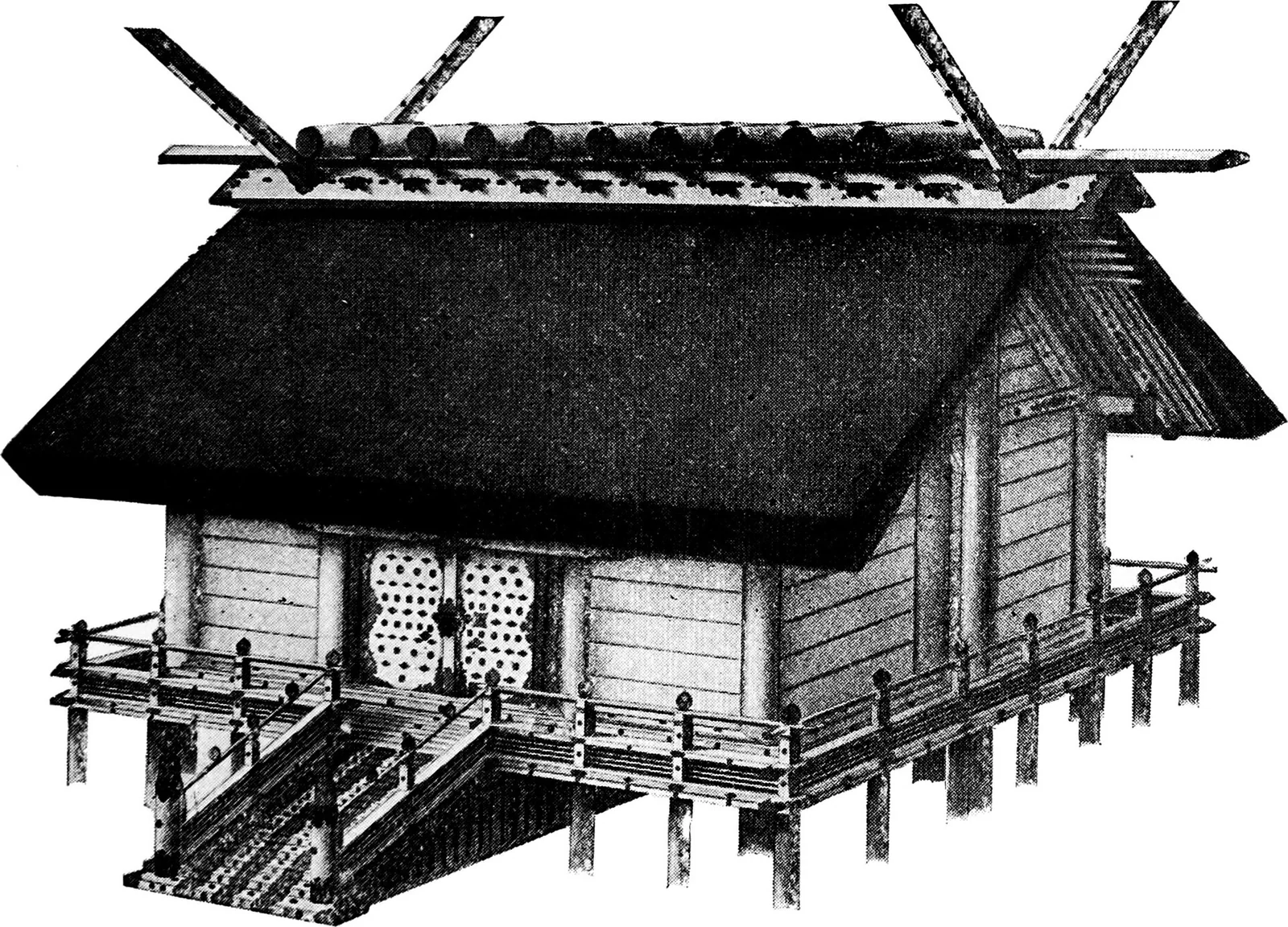
Shrine at Ise.
Mikoto he granted a site for a house in which to dwell at the village of Tsuki-zaka, thereby showing him special favour.
Moreover, he caused the Oho-kume to dwell at a place on the river-bank, west of Mount Unebi, now called Kume no mura.[114] Such was the origin of this name. Utsu-hiko was made (III. 33.) Miyakko of the land of Yamato. Moreover, he gave to Ukeshi the younger the village of Takeda, constituting him [113] Agata-nushi[115] of Takeda. He was the ancestor of the Mohi-tori[116] of Uda. Shiki the younger, whose personal name was Kuro-haya, was made Agata-nushi of Shiki. Moreover, he appointed a man called Tsune to be Miyakko of the Land of Katsuraki. The Yata-garasu was also included in the ranks of those who received rewards. His descendants are the Agata-nushi of Katsurano and the Tonomori[117] Be.
B.C. 657. 4th year, Spring, 2nd month, 23rd day. The Emperor issued the following decree:—"The spirits of our Imperial ancestors reflecting their radiance down from Heaven, illuminate and (III. 34.) assist us. All our enemies have now been subdued, and there is peace within the seas. We ought to take advantage of this to perform sacrifice to the Heavenly Deities, and therewith develop filial duty."
He accordingly established spirit-terraces amongst the Tomi hills, which were called Kami-tsu-wono no Kaki-hara and Shimo-tsu-wono no Kaki-hara.[118] There he worshipped his Imperial ancestors, the Heavenly Deities.[119]
B.C. 630. 31st year, Summer, 4th month, 1st day. The Imperial palanquin[120] made a circuit, in the course of which the Emperor ascended the Hill Waki Kamu no Hotsuma. Here, having viewed the shape of the land on all sides, he said:—"Oh! what a beautiful country we have become possessed of! Though a blessed land of inner-tree-fibre,[121] yet it resembles a dragon-fly licking its hinder parts." From this it first received the name of Akitsu-shima.[122]
Of old, Izanagi no Miketo, in naming this country, said:—"Yamato is the Land of Ura-yasu:[123] it is the Land of Hoso-hoko no Chi-taru:[124] it is the Land of Shiwa-Kami-Ho-tsu-ma."[125]
(III. 35.)Afterwards Oho-namuchi no Oho-kami named it the Land of Tama-gaki no Uchi-tsu-kuni.[126]
Finally, when Nigi-haya-hi no Mikoto soared across the Great Void in a Heaven-rock-boat, he espied this region and descended upon it. Therefore he gave it a name and called it Sora-mitsu-Yamato.[127]
B.C. 619. 42nd year, Spring, 1st month, 3rd day. He appointed Prince Kami-nunagaha-mimi no Miketo Prince Imperial.
B.C. 585. 76th year, Spring, 3rd month, 11th day. The Emperor died in the palace of Kashiha-bara. His age was then 127.[128] The following year, Autumn, the 12th day of the 9th month, he was buried in the Misasagi[129] N.E. of Mount Unebi.[122] [129] [129]
- Emperor is as near an equivalent as possible of the Chinese 天皇. Both are foreign words. The Japanese interlinear gloss is Sumera Mikoto "supreme majesty," sumera having the same root as suberu, "to unite as a whole"; hence, "to have general control of." See Satow, "Rituals," "T.A.S.J.," VII., ii., p. 113. Yamato, see above, note to p. 13. Ihare is the name of a district of Yamato; Hiko means prince. Jimmu (divine valour) is a posthumous name. These names for the earlier Mikados were invented in the reign of Kwammu (782–806), after the "Nihongi" was written, but it is necessary to mention them, as they are in universal use by Japanese writers. In this narrative we have probably a legendary echo of a real movement of population from Kiushiu eastwards to Yamato, at some time before the Christian epoch, but it is not safe to go further than this. The details are manifestly fictitious, some of them, as the quotations from Chinese books put into the mouth of Jimmu Tennō, demonstrably so. Granting for a moment that the narrative of the Conquest of Yamato by Jimmu Tennō is substantially true, the question arises, Of what race were the tribes whom he found there? I would suggest that they may have been the Southern Wa mentioned in the "Shan hai king," a very ancient Chinese book, as being, along with the Northern Wa, subject to the kingdom of Yen. The Chinese in ancient times had a notion that Yamato lay to the south of Kiushiu. Yen, a kingdom of Northern China, had an independent existence from B.C. 1122 to B.C. 265. Chamberlain has pointed out that the ancient legends of Japan are connected with three distinct centres—Idzumo, Yamato, and Tsukushi, which is some indication that these places were also centres of governmental authority. The names given to the chieftains subdued by Jimmu Tennō are unmistakably Japanese, as are also those of the places which they inhabited. I cannot agree with Chamberlain in deriving Yamato, Ki, Shima, etc., from Aino words, when obvious Japanese explanations are available. There is another Yamato in Chikugo, where the Aino derivation is surely out of place. I have no desire, however, to dispute all his Aino derivations of place names in this part of Japan, and I think it very probable that the first Japanese who settled here drove out a population of Aino race.
- Primogeniture was evidently not recognized in Japan at the time this story was written.
- i.e. Kiushiu.
- This is in imitation of the great number of years ascribed to the reigns of the early Chinese monarchs.
- Shiho tsutsu no oji.
- i.e. for the further development of the Imperial power.
- The world is here the six quarters, N., S., E., W., Zenith, Nadir. This is, of course, Chinese, as indeed is this whole speech.
- Nigi-haya-hi means soft-swift-sun.
- The great year is the Chinese cycle of sixty years. This system of reckoning time is described in Legge's "Classics," Chalmers' "Essay in prolegomena to Shooking," "Japanese Chronological Tables," by E.M.S., Bramsen's "Chronological Tables," Mayers' "Chinese Manual," etc. It was not in use to record years before the Christian era even in China, and could hardly have been known in Japan before the introduction of writing in the 5th century, A.D. It is needless to add that such dates are, in this part of the "Nihongi," purely fictitious.
- The days of the month are throughout the "Nihongi" given in this clumsy fashion. I have not thought it necessary to follow the example, except in this one instance.
- The Quick-suck-gate or Bungo Channel, so called from its rapid tides.
- Rare-prince.
- Quercus cuspidata.
- Prince of shihi root.
- Usa is now a district (kōri) in the province of Buzen. Tsukushi is used by old writers both for the whole island of Kiushiu and for the northern part of it.
- Or Kuni no miyakko, local hereditary nobles.
- Vide Ch. K., p. 130, and "Night of the Gods," p. 224, where a curious coincidence with an Irish legend is noted. "In Mailduin's voyage he came to an island called Aenchoss, that is One-foot, so called because it was supported by a single pillar in the middle." The "Kojiki" and a note to the "Nihongi" have for one pillar, "one foot." Possibly there is here a reminiscence of a nomadic tent life.
- Heavenly seed.
- i.e. house, or noble family.
- In Chikuzen.
- Including the present provinces of Bizen, Bittchiu, and Bingo.
- Or oars.
- Naniha is now a poetical name for Ohosaka. The current referred to is no doubt the tide on the bar at the river-mouth, a most dangerous place for small craft in bad weather.
- Pronounced Kawachi.
- Yamato.
- Prince Longshanks. Naga-sune is the name of a place.
- Shield-port or shield-ferry.
- Mother-tree-village.
- Port Man (vir).
- Tohe seems to have been a word for chieftain.
- Or it may be of the Deity of Kumano.
- i.e. the blade-holder.
- Toko-yo no Kuni.
- The Thunder-God.
- i.e. point upwards.
- Yata-garasu. The Chinese characters used here mean "The crow with a head eight feet long." But this is a case where we must put aside the Chinese characters, and attend solely to the Japanese word which they are meant to represent. This is undoubtedly yata-garasu, as we know from the "Kojiki" and from the traditional Kana rendering. Much has been written about this bird by Motowori and other Shintō scholars, which is, I venture to think, wholly wide of the mark. The clue to its meaning is afforded by the "Wamiō-shō," a Chinese-Japanese vocabulary of the tenth century, which says, on the authority of the "Shiki," still more ancient commentaries on the "Nihongi," that the Yang-wu or Sun-crow is in Japanese yata-garasu. The Yang-wu is a bird with three claws, and of a red colour, which, according to Chinese myth, inhabits the sun.
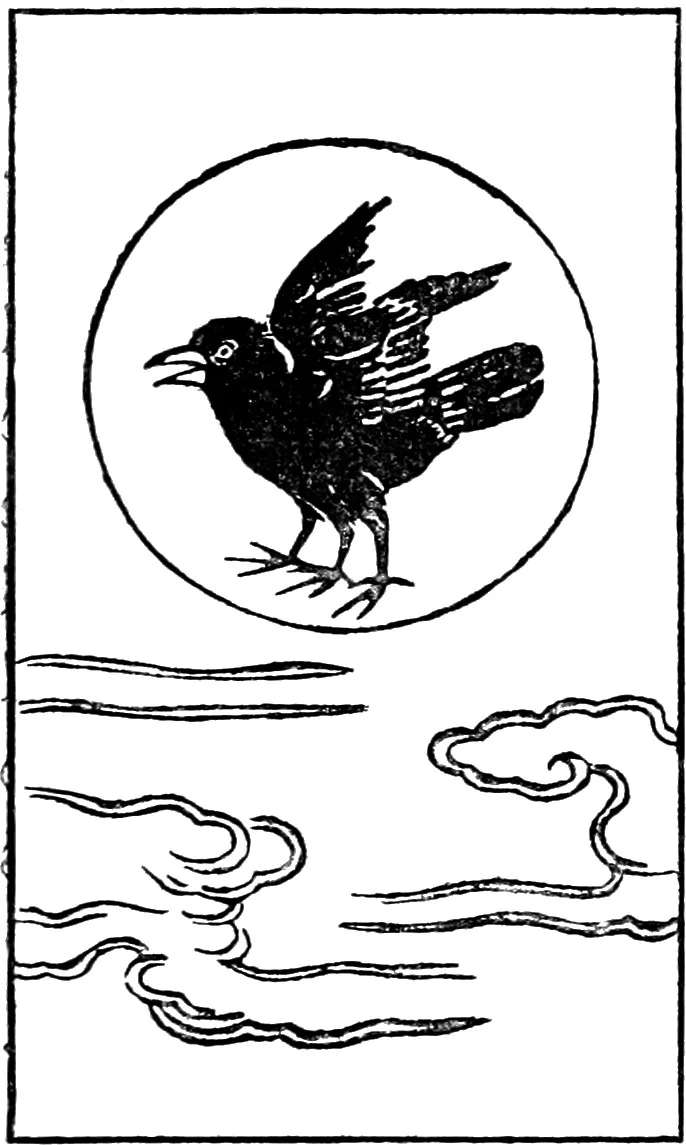
Sun-crow.If we accept this identification, the meaning of the epithet yata becomes clear. It means eight hands, or, as ya in ancient Japanese meant also many or several, many hands, a sufficiently accurate description for popular myth of the Yang-wu with its three claws. The late M. Terrien de La-Couperie, in his "Western Origin of Early Chinese Civilization," says that "the first allusion to the three-legged crow supposed to roost in the sun occurs in the "Li Sao" of Kiü-yuen, the poet of Ts'u, 314 B.C. in China. A three-legged bird in various forms was figured on coins of Pamphylia and Lycia of older times. Comte Goblet d'Alviella has reproduced some of them in his interesting work on "La Migration des Symboles," 1891, p. 222. See a paper on the Hi no maru in "T.A.S.J.," Vol. XXII., p. 27, and Ch. K., p. 136. The guidance of conquerors or colonists to their destination by a supernatural bird or beast is a familiar feature of old-world story. See Lang, "Custom and Myth," II., 71. - The sovereignty.
- Hi means sun; Omi, minister.
- Oho-tomo means "great companion." The Oho-tomo were the Imperial guards.
- Oho-kume, as Chamberlain points out, probably means simply a great force. But when the "Kojiki" and "Nihongi" were written, this meaning was forgotten, and it was supposed to be a man's name.
- Ugatsu means to pierce, and the name was given because they penetrated the mountains to this place. All these derivations are very fanciful.
- The Minister of the Road.
- The bloody plain of Uda.
- We might be inclined to infer from this (what was probably the case) that the Ancient Japanese lived more on animal food than their descendants in modern times. But there is much room for suspicion that this statement is nothing more than a reminiscence of a passage in a history of the Later Han dynasty of China, which speaks of beef and sake being presented to the Emperor Kwang Wu Ti, who came to the throne A.D. 25.
- Ki in the first line of this poem means probably both tree and castle. The words are put into the mouth of Ukeshi the Elder, who found a whale (the Emperor) in his springe instead of the harmless woodcock he expected. The wild boar is now called the yama-kujira or mountain-whale, and is perhaps the animal intended here. I confess that I can make no satisfactory sense of the remainder of this poem. The version given by Chamberlain (Ch. K., p. 140), following Moribe, is as good as any, but it seems to me very conjectural. It should be noted, however, that this part of the poem contains an indication of the polygamous customs of the Japanese at this time in the use of two words signifying respectively elder wife (konami) and younger wife (uhanari). The "Nihongi" omits the interjectional refrain given in the "Kojiki."
- Kume means no doubt "soldier" in this passage.
- Beating time is perhaps meant.
- Well-brightness.
- Rock-push-divide.
- Kuzu were local chiefs. They are mentioned again in Ōjin's reign.
- Food-holder or purveyor.
- U-kahi means cormorant-keepers. Fishing with cormorants is still practised in Japan.
- Land-view.
- Women's acclivity.
- Men's acclivity. The terms Me-zaka and Wo-zaka are now applied to two roads or stairs leading up to the same place, one of which (the women's) is less precipitous than the other.
- Sumi-zaka means charcoal acclivity.
- Shiki the Elder.
- Lit. Robber-slaves or prisoners.
- A shrine, like a templum, might be merely a consecrated plot of ground. Kagu-yama is a mountain in Yamato.
- Idzube. The platters were for rice, the jars for sake. See Satow's "Rituals" in "J.A.S.T.," VII., ii., p. 109.
- Akagane means red metal, i.e. copper, but the text is doubtful. The "Kiujiki" has a different reading.
- See above, p. 111.
- The reader who wishes to realize what the ancient pottery of Japan was like should visit the British Museum and inspect the Gowland collection. There is also a collection in the Uyeno Museum in Tokio. Ninagawa Noritane's work entitled "Kwan-ko-dzu-setsu" gives very good drawings of ancient pottery. The common Japanese name for this ware is Giōgi-yaki, Giōgi being the name of a Buddhist priest who lived 670–749, and who is credited with the invention of the potter's wheel. But the wheel was certainly known in Japan long before his time. This very passage contains an evidence of this fact. Both the Chinese characters and the Japanese word ta-kujiri given in the ancient commentary for the small jars here mentioned mean "hand-made," leading to the conclusion that this was exceptional. Indeed, nearly all the pottery of the Nihongi period which has come down to us is wheel-made.
- Foam on water is a favourite emblem of the transitoriness of human life.
- Ame (sweetness) is usually made of millet, malted, and is nearly identical in composition with what our chemists call "malt extract." It is a favourite sweetmeat in the far East.
- Cf. Judges vi. 36.
- Podocarpus macrophylla.
- A note says that they were set up in the courtyard.
- The Mikado deputed most of his priestly functions to the Nakatomi.
- The ancient commentary gives the Japanese word utsushi, i.e. manifest, visible. This suggests that there was a distinction between esoteric and exoteric in the Shintō rites of this time.
- Idzu-hime means dread or sacred princess. The "Tsūshō" commentator says that the persons entrusted with this function were usually women, as may be seen in the case of the priestesses of Ise, Kamo, and Kasuga. But as no women were available at this time, Michi-no-Omi was given a feminine title for the occasion.
- The interlinear Kana has tatematsuri, i.e. offered. The reference is to the feast of Nihiname described above. See p. 86.
- The shitadami is a small shell of the turbinidæ class. Its introduction here does not seem very appropriate. Perhaps the meaning is "in number like the turbinidæ." Cf. Ch. K., p. 143. The "Shukai" editor thinks that the shitadami represent the bandits. The great rock is, perhaps, the Miyôto-seki at Futami, so often represented in Japanese pictures. See Anderson's Catalogue, p. 320, or Satow and Hawes' Handbook, p. 150.
- In Yamato. To be distinguished from the city of Ohosaka.
- The muro-ya is a pit-dwelling (see above, p. 71). The poem speaks of mallet-heads, but the text which follows of mallet-headed swords. I have little doubt that the former is the true phrase, and that stone weapons are referred to. The stone-mallets are unmistakably the weapons figured above (p. 87). The mallet-heads and stone-mallets are perhaps the same thing under different names.
- That is, none were left alive.
- The Yemishi are the Ainos, or more correctly Ainus, of whom a remnant of some ten thousand souls now inhabit the island of Yezo. When the "Nihongi" was written they still occupied a large part of the main island of Japan, and in earlier times, as we gather from the evidence of place-names (See Chamberlain's Essay published by the Imperial University), they extended west even of Yamato. But it would not be safe to draw any conclusion from their mention in this poem. The writer of the "Nihongi" is in the habit of fitting ancient poetry into his narrative in a very arbitrary manner. The "Kojiki" omits it. Yemishi or Yebisu is also applied to barbarous tribes generally, and this is probably its primary meaning. It ought, perhaps, to be added to the group of onomatopoetic words ending in su or shi, mentioned at p. 65, the b or m having the same function as these letters in the words barbarian, babble, murmur, etc. See Index—Yemishi.
- Nothing could well be more primitive than this. The metre is irregular, and, like all Japanese poetry, there is no rhyme, quantity or regular recurrence of accent to distinguish it from prose.
- Princes.
- Or trays, made of the leaves of Kashiha, a kind of evergreen oak.
- The charcoal acclivity.
- The metre is nearly regular naga-uta, which consists of alternate lines of five and seven syllables, with an additional line of seven syllables at the end. The cormorant-keepers were appealed to to supply fish for the army's food.
- Kite-village.
- "As the taste of ginger remains in the mouth for a long time after it is eaten, so do my feelings of resentment for my brother's death remain present to my mind. I cannot forget it, so let us revenge it by destroying the enemy utterly." The word for shoots is me, which also means females. This is no doubt intentional. Naga-sune-hiko is to be destroyed with all his family.
- Three-cook-house-princess.
- Wealth-house.
- Sweet-true-hand.
- A foot soldier's quiver is meant.
- i.e. of Lord and Vassal.
- The Mononobe were soldiers. Here, however, the hereditary chiefs only are meant, the Mononobe no Muraji.
- The Tsuchi-gumo are mentioned in four or five passages of the "Nihongi" and one passage of the "Kojiki," all of which belong to the highly legendary period of Japanese history. We gather from them that the Tsuchi-gumo were usually, though not invariably, outlaws who defied the Imperial authority. They had Japanese names, and inhabited such long-settled parts of Japan as Yamato, Harima, and even Kiushiu. There is nothing, if we put aside the mention of Yemishi at p. 124, to suggest that they were not of Japanese race. The "short bodies," etc., of the "Nihongi" description I take to be nothing more than a product of the popular imagination working on the hint contained in the name Tsuchi-gumo, which is literally "earth spider." Some etymologists prefer the derivation which connects kumo (or gumo) with komori, to hide, thus making tsuchi-gumo the "earth-hiders." But this is probably a distinction without a difference, these two words containing the same root, and the animal which we call the spider, i.e. spinner, being in Japan termed the "hider," an epithet of which no one who has observed its habits will dispute the appropriateness. An ancient Japanese book says Tsuchi-gumo is a mere nickname, to be compared therefore with our clod-hopper or bog-trotter. In one of the passages above referred to, the Tsuchi-gumo are described as inhabiting a rock-cave, but in others they are said to live in muro or pit-dwellings, and this is obviously the origin of the name. There are several notices of Tsuchi-gumo in the ancient "Fudoki," or "County Histories," but they are probably mere echoes of the older legends related in the "Nihongi" and "Kojiki," and in any case they add nothing of importance to our information about them. It may be noted, however, that Hiuga and Higo are mentioned in them as habitats of bands of these outlaws. An amusing expansion by a modern writer of the spider conception of the Tsuchi-gumo will be found at p. 140 of Anderson's B.M. Catalogue. See also Ch. K., p. 141, and Index. A little work called "Kek-kio-kō," in a collection entitled "Haku-butsu-sō-sho," published by the Japanese Imperial Museum, has brought together all the available information respecting Muro and Tsuchi-gumo.
- Chiefs.
- Oka-zaki means hill-spur, and is perhaps to be so understood here, and not as a proper name.
- Saka-moto (acclivity bottom) may be also a description and not a proper name.
- Hofuri is a kind of Shintō priest. It is unlikely that persons not of Japanese race should be so called.
- Dolichos Castle.
- The interlinear Kana gives for "fill," ihameri, a word which I do not know.
- The "original commentary" says that the Japanese word corresponding to the Chinese characters rendered "encamp" is ihami, a word not otherwise known to me.
- Brave-field.
- Castle-field.
- Face-pillow-field.
- "World" is not quite a merely rhetorical expression for the Empire of Japan. Hirata justifies Hideyoshi's invasion of Corea on the grounds that the sovereigns of Japan are de jure lords of the whole earth.
- Clay-easy or clay-peace.
- This whole speech is thoroughly Chinese in every respect, and it is preposterous to put it in the mouth of an Emperor who is supposed to have lived more than a thousand years before the introduction of Chinese learning into Japan. The strange thing is that it is necessary to make this remark. Yet there are still writers who regard this part of the "Nihongi" as historical.
- The Kana rendering is mi-araka, "an august shrine" or "an august palace." This would imply a different reading, 社 instead of 壯.
- The reader must not take this as any evidence of the manners and customs of the Ancient Japanese. It is simply a phrase suggested by the author's Chinese studies.
- Meaning the Emperor's action.
- The character for roof 宇 also means the universe. The eight cords, or measuring tapes, simply mean "everywhere."
- Kashiha is an evergreen oak, the Quercus dentara. Hara means plain. This afterwards became a proper name. Here it is perhaps simply a description.
- He had already a consort, but she was apparently not considered a wife.
- Japanese History is often said to begin with this year. The fact is that nothing which really deserves the name of history existed for nearly a thousand years more. This date is very much like that given for the foundation of Rome by Romulus, B.C. 753. The very calendar by which the reckoning was made was not invented or known in Japan until many centuries after. See Bramsen's "Chronological Tables," and "Early Japanese History" in "T.A.S.J."
- As above remarked, the author often introduces this word without much reason.
- It was a mark of Shrines or Imperial Palaces to have the rafters at each end of the roof projecting upwards for several feet beyond the roof-tree, as in the illustration. These were called Chigi. See Ch. K., p. 311. Shintō temples at the present day are thus distinguished. What would those Japanese Euhemerists who think Takama ga hara (the Plain of High Heaven) to be the name of a country, make of this passage?
- i.e. the village of the kume or soldiers.
- Ruler of district.
- The Mohi-tori, afterwards mondori or mondo, were originally the officials charged with the water supply of the Palace. The designation Mondo no Kami remained until quite recent times.
- Tonomori, guardian of a palace or shrine.
- These names mean respectively the Persimmon plain of Upper Little-moor and the Persimmon plain of Lower Little-moor. The "spirit terraces" (a Chinese phrase) seems meant for the plots of ground consecrated for Shintō worship. See above, p. 81.
- The union of the offices of priest and king is to be noted all through this narrative.
- It is considered respectful to speak of the Imperial car or palanquin when the Emperor himself is meant.
- The inner-tree-fibre is the inner bark of the paper mulberry, used for weaving into cloth. It is here an ornamental epithet.
- The real meaning of Aki-tsu-shima is the "region of harvests." See above, p. 13. It has nothing to do with akitsu, the dragon-fly. This insect may often be seen with its tail touching its mouth, so that its body forms a ring. The appearance of the province of Yamato, which is a plain surrounded by a ring of mountains, suggested the sitnile in the text. Later historians have converted this into a comparison of Japan to a dragon-fly with outstretched wings.
- Bay-easy. Explained to mean "which has peace within its coasts."
- Slender-spears-thousand-good. "Well supplied with weapons," say the commentators.
- Rock-ring-upper-pre-eminent-true (land).
- Jewel-fence-within-land.
- Sky-saw-Yamato. But Sora-mitsu really means "that fills the sky," i.e. that reaches to the farthest horizon. These names are merely poetical inventions. They were never in actual use.
- The "Kojiki" makes him 137.
- The Misasagi are still to be seen in large numbers in Japan, especially in the Gokinai or five metropolitan provinces. They are particularly numerous in Kahachi and Yamato.
In the most ancient times, say the Japanese antiquarians, the Misasagi or tombs of the Mikados were simple mounds. At some unknown period,
 Misasagi, side view.
however, perhaps a few centuries before the Christian epoch, a highly specialized form of tumulus came into use for this purpose, and continued for several hundreds of years without much change. It consists of two mounds, one having a circular, the other a triangular base, merging into each other after the manner shown in the illustration, the whole being surrounded by a moat, or sometimes by two concentric moats with a narrow strip of land between. The interment took place on the circular mound, the other probably serving as a platform on which were performed the rites in honour of the deceased. Seen from the side the appearance is that of a saddle-hill, the circular mound being somewhat higher than the other. There are sometimes two smaller mounds at the base of the larger ones, filling up the angle where they meet. The slope of the tumulus is not
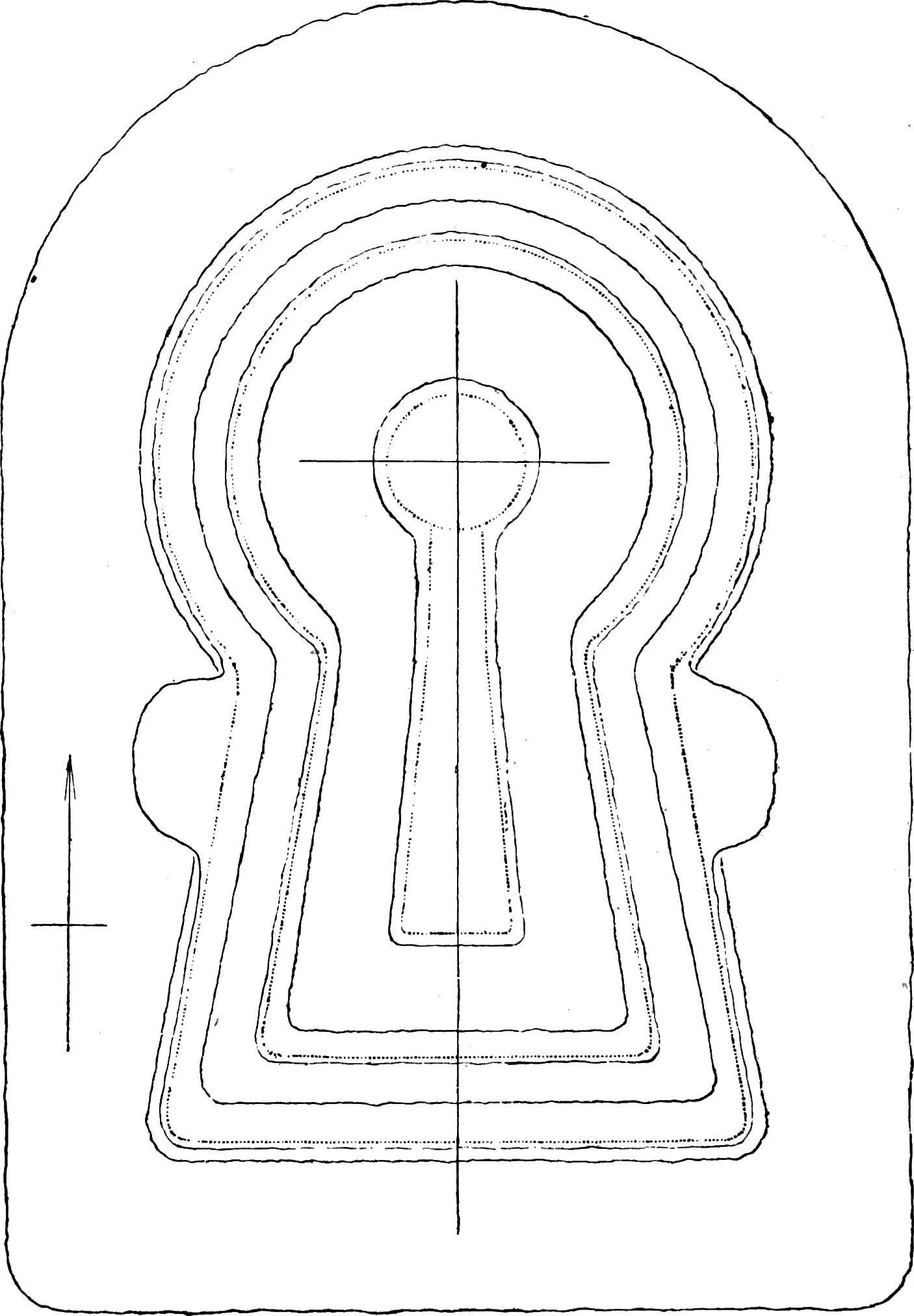 Ground plan of Misasagi.
regular, but is broken up by terraces, on which are placed in rows, a few inches apart, curious cylinders made of baked clay shaped in a mould, and measuring from 1 to 2 feet in height, and from 6 to 14 inches in diameter. They are buried in the earth, their upper rims being just level with the surface.
In some, perhaps in most cases, the Misasagi contains a large vault of great unhewn stones without mortar. The walls of the vault converge gradually towards the top, which is roofed in by enormous slabs of stone weighing many tons each. The entrance was by means of a gallery roofed with similar stones.
Sarcophagi of stone or pottery have been found in some Misasagi.
The above description is quoted from an article by the present writer in Chamberlain's "Things Japanese." I would ask travellers in China and Corea to compare with it any ancient tumuli which they may discover in those countries.
I learn from Mr. W. Gowland, who has visited the spot recognized officially as the Misasagi of Jimmu Tennō, that there are here two enclosures, the inner of which contains two low mounds each about 18 feet in diameter and 2 feet in height. A Chokushi or Imperial Envoy visits this Misasagi annually on the 3rd April with offerings of products of mountain, river, and sea, viz., tahi, carp, sea-weed, salt, water, sake, mochi (a preparation of rice), warabi (fern flour?), pheasants and wild ducks.
The site of Jimmu's tomb is a question even with Japanese antiquaries, and European scholars may be pardoned if they are somewhat sceptical about it. Vide "San-rio-shi" (山陵志), p. 9.
BOOK IV.
THE EMPEROR KAMI-NUNAGAHA-MIMI.
(SUIZEI TENNŌ.[1])
The Emperor Kami-Nunagaha-mimi was the third child of the Emperor Kami-Yamato-Ihare-biko Hohodemi. His mother's name was Hime-tatara-Isuzu no Mikoto, the eldest daughter of Koto-shiro-nushi no Kami.
This Emperor was of distinguished manners and appearance. As a child he possessed the vigour of manhood; when he grew to manhood, his form was gigantic. He excelled in warlike accomplishments, and his will was resolute in the extreme.
(IV. 2.) When he reached the age of forty-eight, the Emperor Kami-Yamato-Ihare-biko died. Now Kama-Nunagaha-mimi no Mikoto's disposition was profoundly filial, and his grief and longing knew no bounds. He made the funeral ceremonies his especial care.
His elder half-brother,[2] Tagishi-mimi no Mikoto, was now advanced in years,[3] and had a long experience of matters of state. Therefore he was again charged with the conduct of affairs, and the Emperor treated him as an intimate friend. This prince, however, was of a perverse disposition, and his natural bent was opposed to justice. During the period of sincere seclusion[4] his authority at last became independent, and concealing his malicious purposes, he plotted the destruction of his two younger brothers.
Now in the year Tsuchinoto U of the cycle, Winter, the 11th month, Kami-Nunagaha-mimi no Mikoto and his elder brother Kami-Ya-wi-mimi no Mikoto learnt privately his intentions and effectively prevented him. When the business of the misasagi was ended, they caused Yumi Be no Waka-hiko to make a bow, and Yamato no Kanuchi[5] Ama-tsu-ma-ura[6] to make a true-deer arrow-point, and the Ya[7] Be to prepare arrows. When the bow and arrows were ready, (IV. 3.) Kami-Nunagaha-mimi no Mikoto wished therewith to shoot to death Tagishi-mimi no Mikoto, who happened just then to be in a great muro at Kataoka, lying alone on a great couch. Then Kami-Nunagaha-mimi no Mikoto spake to Kami-Ya-wi[3] no Mikoto, saying:—"The right time has now arrived. In words, secrecy is to be prized: in deeds, caution is advisable. Therefore, we have never had any partner in our conspiracy, and the enterprise of to-day is to be carried out by thee and me alone. I will first open the door of the muro. Do thou then shoot him." They accordingly went forward and entered in together.
Kami-Nunagaha-mimi no Mikoto pushed open the door, while Kami-Ya-wi-mimi no Mikoto's arms and legs trembled so that he was unable to let fly the arrow. Then Kami-Nunagaha-mimi no Mikoto snatched the bow and arrows which his elder brother held and shot Tagishi-mimi no Mikoto. The first shot struck him on the breast, the second on the back, and so at length he killed him. Hereupon Kami-Ya-wi-mimi no Mikoto was troubled and submitted himself, yielding the sovereignty to Kami-Nunagaha-mimi no Mikoto, saying:—"I am thy elder brother.[8] But I am timid and weak, and unfit for effective action. On the present occasion thou hast specially displayed divine valour, and hast thyself put to death our chief enemy. Is it not expedient that thou shouldst illuminate the Celestial station[9] and take over the functions of (IV. 4.) our Imperial ancestors? I will be thy assistant and will attend to the worship of the Gods of Heaven and Earth." He was the first ancestor of the Oho no Omi.
B.C. 581. 1st year, Spring, 1st month, 8th day. Kami-Nunagaha-mimi no Mikoto assumed the rank of Emperor. He made his capital at Katsuraki. It was called the palace[10] of Takaoka. He honoured the Empress by granting her the title of Kwō-dai-gō or Grand Empress.[11] This was the year Kanoye Tatsu of the cycle.
B.C. 580. 2nd year, Spring, 1st month. Isuzu-yori-bime was appointed Empress.
One writing says:—"Kaha-mata-bime, daughter of the Agata-nushi of Shiki."
One writing says:—"Itori-hime, daughter of Ohohimoro, Agata-nushi of Kasuga."
She was the Emperor's aunt. The Empress bore a son, the Emperor Shiki-tsu-hiko-tama-demi.
B.C. 578. 4th year, Summer, 4th month. Kami-Ya-wi-mimi no Mikoto died, and was buried on the Northern side of Mount Unebi.
B.C. 577. 25th year, Spring, 1st month, 7th day. The Imperial Prince (IV. 5.) Shiki-tsu-hiko-tama-demi no Mikoto was made heir to the Imperial throne.
B.C. 549. 33rd year, Summer, 5th month. The Emperor took ill, and on the 10th day of the same month, he died, at the age of eighty-four.
THE EMPEROR SHIKI-TSU-HIKO-TAMA-DEMI.
(ANNEI[12] TENNŌ.)
The Emperor Shiki-tsu-hiko-tama-demi was the eldest child of the Emperor Kami-Nunagaha-mimi. His mother's name was Isuzu-yori-bime no Mikoto, the younger daughter of Koto-shiro-nushi no Kami. This Emperor had been made Prince Imperial in the 25th year of the Emperor Kami-Nunagaha-mimi. He was then twenty-one[13] years of age. In the 5th month, Summer, of the 33rd year of his reign, the Emperor Kami-Nunagaha-mimi died. In the 7th month of that year, on the 3rd day of the month, the Prince Imperial assumed the Imperial Dignity.
B.C. 548. 1st year,[14] Winter, 10th month, 11th day. The Emperor Kami-Nunagaha-mimi was buried in the Misasagi on Tsukida Hill in Yamato.
The Emperor honoured the Empress with the title of Kwō-dai-gō.
This was the year Midzunoto Ushi of the cycle.
B.C. 547. 2nd year. The capital was removed to Katashiho. It was called the Palace of Ukiana.
B.C. 546. 3rd year, Spring, 1st month, 5th day. Nuna-soko-naka-tsu (IV. 6.) hime no Mikoto was appointed Empress.
Others call her Nuna-so hime.
One writing says:—"Kaha-tsu hime, daughter of Haye, Agata-nushi of Shiki."
One writing says:—"Daughter of Ohoma no Sukune."[15]
Before this, his consort had given birth to two Imperial princes. The first was called Ikishi-mimi no Mikoto, the second, the Emperor Oho-Yamato-hiko-suki-tomo.
One version says:—"She bore three princes, the first of whom was called Toko-tsu-hiko-iro-ne; the second, the Emperor Oho-Yamato-hiko-suki-tomo; and the third, Shiki-tsu-hiko no Mikoto."
B.C. 538. 11th year, 1st month, 1st day. Oho-Yamato-hiko-suki-tomo no Mikoto was made Prince Imperial. His younger brother, Shiki-tsu-hiko no Mikoto was the first ancestor of the Wi-tsu-kahi no Muraji.
B.C. 511. 38th year, Winter, 11th month, 6th day. The Emperor died at the age of 57.[16]
THE EMPEROR OHO-YAMATO-HIKO-SUKI-TOMO.
(ITOKU[17] TENNŌ.)
(IV. 7.) The Emperor Oho-Yamato-hiko-suki-tomo was the second child of the Emperor Shiki-tsu-hiko-tama-demi. His mother's name was Nuna-soko-naka-tsu-hime, grandchild of Koto-shiro-nushi no Kami, and daughter of the Prince[18] of Kamo. He was made Prince Imperial in the 11th year, Spring, the 1st month of the Emperor Shiki-tsu-hiko-tama-demi's reign. He was then 16 years of age. In the 38th year of that reign, Winter, the 12th month, the Emperor Shiki-tsu-hiko-tama-demi died.[19]
B.C. 511. 1st year, Spring, 2nd month, 4th day. The Prince Imperial assumed the Imperial Dignity.
Autumn, 8th month, 1st day. The Emperor Shiki-tsu-hiko-tama-demi was buried in the Misasagi above Mihodo no wi, south of Mount Unebi.
9th month, 14th day. The Empress was honoured with the title of Grand Empress. This was the year Kanoto U of the cycle.
B.C. 509. 2nd year, Spring, 1st month, 5th day. The capital was removed to Karu.[20] It was called the Palace of Magariwo.
2nd month, 11th day. Ama-toyo-tsu-hime no Mikoto was made Empress.
One version has:—"Idzumi hime, daughter of Oto-wite, son of Haye, Agata-nushi of Shiki."
(IV. 8.) One version has:—"Ihi-hime, daughter of Futo-ma-waka-hiko, Agata-nushi of Shiki."
This Empress was the mother of the Emperor Mi-matsu-hiko-Kayeshine.
One version has:—"The Emperor's younger brother by the mother's side,[21] Takeshi-hiko-kushi-tomo se no Mikoto."[22]
B.C. 489. 22nd year, Spring, 2nd month, 12th day. Mi-matsu-hiko-Kayeshine no Mikoto was made Prince Imperial. He was then 18 years of age.
B.C. 477. 34th year, Autumn, 9th month, 8th day. The Emperor died.
THE EMPEROR MI-MATSU-HIKO-KAYESHINE.
(KŌSHŌ[23] TENNŌ.)
The Emperor Mi-matsu-hiko-Kayeshine was the eldest son of the Emperor Oho-Yamato-hiko-suki-tomo. The name of the Empress, his mother, was Ama-toyo-tsu-hime no Mikoto. She was the daughter of Ikishi-mimi no Mikoto.
The Emperor had been made Prince Imperial in Spring, the second month of the 22nd year of the reign of the Emperor Oho-Yamato-hiko-suki-tomo. The Emperor Oho-Yamato-hiko-suki-tomo died in autumn, the ninth month of the 34th year of his reign. On the 13th day of the 10th month of the following year, the Emperor Oho-Yamato-hiko-suki-tomo was buried in the Misasagi over the Masago Valley to the south of Mount Unebi.
(IV. 9.) B.C. 475. 1st year, Spring, 1st month, 9th day. The Prince Imperial assumed the Imperial Dignity.
Summer, 4th month, 5th day. The Empress was honoured with the title of Grand Empress.[24]
7th month. The capital was removed to Wakigami.[25] It was called the Palace of Ikegokoro. This year was the year Hinoye Tora of the cycle.
B.C. 447. 29th year, Spring, 1st month, 3rd day. Yoso-tarashi-hime was appointed Empress.
One version says:—"Nunaki-tsu hime, daughter of Haye, Agata-nushi of Shiki."
One version has:—"Oho-wi-hime, daughter of Toyo-aki-sata-wo of the Land of Yamato."
The Empress gave birth to Ama-tarashi-hiko-kuni-oshi-bito no Mikoto, and to the Emperor Yamato-tarashi-hiko-kuni-oshi-bito.
B.C. 408. 68th year, Spring, 1st month, 14th day. Yamato-tarashi-hiko-kuni-oshi-bito no Mikoto was made Prince Imperial. He was twenty years of age. Ama-tarashi-hiko-kuni-oshi-bito no Mikoto was the first ancestor of the Wani no Omi.
B.C. 391. 83rd year, Autumn, 8th month, 5th day. The Emperor died.
THE EMPEROR YAMATO-TARASHI-HIKO-KUNI-OSHI-BITO.
(KŌAN[26] TENNŌ.)
(IV. 10.) The Emperor Yamato-tarashi-hiko-kuni-oshi-bito was the second child of the Emperor Mi-matsu-hiko-kayeshine. His mother's name was Yoso-tarashi-hime. She was the younger sister of Okitsu Yoso, the ancestor of the Ohari no[27] Muraji.
The Emperor was made Prince Imperial in Spring, the 1st month of the 68th year of the reign of the Emperor Mi-matsu-hiko-kayeshine. The Emperor Mi-matsu-hiko-kayeshine died in Autumn, the 8th month of the 83rd year of his reign.
B.C. 392. 1st year, Spring, 1st month, 7th day. The Prince Imperial assumed the Imperial Dignity.
Autumn, 8th month, 1st day. The Empress was honoured with the title of Grand Empress. This year was the year Tsuchi no to Ushi of the cycle.
B.C. 391. 2nd year, Winter, 10th month. The capital was removed to Muro. It was called the Palace of Akitsushima.
B.C. 367. 26th year, Spring, 2nd month, 14th day. The Emperor appointed his niece,[28] Oshi-bime, Empress.
One version has:—"Naga-hime, daughter of Haye, Agata-nushi of Shiki."
One version has:—"Isaka-hime, daughter of Isaka-hiko, Agata-nushi of Tohoehi."
The Empress was the mother of the Emperor Oho-Yamato-neko-hiko-futo-ni.
B.C. 355. 38th year, Autumn, 8th month, 14th day. The Emperor Mi-matsu-hiko-kayeshine was buried in the Misasagi on Mount Hakata in Wakigami.
(IV. 11.) B.C. 317. 76th year, Spring, 1st month, 5th day. Oho-Yamato-neko-hiko-futo-ni no Mikoto was made Prince Imperial. He was then twenty-six years of age.
B.C. 291. 102nd year, Spring, 1st month, 9th day. The Emperor died.
THE EMPEROR OHO-YAMATO-NEKO[29]-HIKO-FUTO-NI.
(KŌREI[30] TENNŌ.)
The Emperor Oho-Yamato-neko-hiko-futo-ni was the eldest child of the Emperor Yamato-tarashi-hiko-kuni-oshi-bito. His mother's name was Oshi-bime. He had been appointed Prince Imperial in Spring, the 1st month of the 76th year of the reign of the Emperor Yamato-tarashi-hiko-kuni-oshi-bito. In Spring, the 1st month of the 102nd year of his reign, the Emperor Yamato-tarashi-hiko-kuni-oshi-bito died. In Autumn, the 9th month, 13th day, the Emperor Yamato-tarashi-hiko-kuni-oshi-bito was buried in the Misasagi on Tamade Hill.
Winter, 12th month, 4th day. The Prince Imperial removed the capital to Kuroda.[31] It was called the Palace of Ihodo.
B.C. 290. 1st year, Spring, 1st month, 12th day. The Prince Imperial assumed the Imperial Dignity. He honoured the Empress with the title of Grand Empress. This year was the year Kanoto Hitsuji of the cycle.
(IV. 12.) B.C. 289. 2nd year, Spring, 2nd month, 11th day. Hoso-bime no Mikoto was appointed Empress.
One version has:—"Kasuga no Chichi-haya-yamaka-hime."
One version has:—"Mashita-bime, daughter of Toso, Agata-nushi of Tohochi."
The Empress was the mother of the Emperor Oho-Yamato-neko-hiko-kuni-kuru. A concubine named Yamato no kuni-ka-hime [also called Haye-irone] was the mother of Yamato-to-to-hi-momo-so bime no Mikoto and of Hiko-i-saseri-hiko no Mikoto [also called Kibi-tsu-hiko no Mikoto], and Yamato-toto-waka-ya-bime no Mikoto.
Another concubine Haye-iroto was the mother of Hiko-sajima no Mikoto and of Waka-take-hiko no Mikoto. The younger of these, namely, Waka-take-hiko no Mikoto, was the first ancestor of the Kibi no Omi.[32]
B.C. 255. 36th year, Spring, 1st month, 1st day. Hiko-kuni-kuru no Mikoto was made Prince Imperial.
B.C. 215. 76th year, Spring, 2nd month, 8th day. The Emperor died.
(IV. 13.) THE EMPEROR OHO-YAMATO-NEKO-HIKO-KUNI-KURU.
(KŌGEN[33] TENNŌ.)
The Emperor Oho-Yamato-neko-hiko-kuni-kuru was the eldest child of the Emperor Oho-Yamato-neko-hiko-futo-ni. His mother's name was Hoso-bime, daughter of Oho-me,[34] Agata-nushi of Shiki. He had been created Prince Imperial in Spring, the 1st month of the 36th year of the reign of the Emperor Oho-Yamato-neko-hiko-futo-ni. He was then nineteen years of age. The Emperor Oho-Yamato-neko-hiko-futo-ni died in Spring, the 2nd month of the 76th year of his reign.
B.C. 214. 1st year, Spring, 1st month, 14th day. The Prince Imperial assumed the Imperial Dignity. He honoured the Empress with the title of Grand Empress. This year was the year Hinoto I of the cycle.
B.C. 211. 4th year, Spring, 3rd month, 11th day. The capital was removed to Karu. It was called the Palace of Sakahibara.
B.C. 209. 6th year, Autumn, 9th month, 6th day. The Emperor Oho-Yamato-neko-hiko-futo-ni was buried in the Misasagi on Muma-zaka[35] at Kataoka.
B.C. 208. 7th year, Spring, 2nd month, 2nd day. Uchi-shiko-me no Mikoto was appointed Empress. She had three children, two boys and one girl. The name of the eldest was Oho-hiko no Mikoto; of the second, the Emperor Waka-Yamato-neko-hiko Oho-hihi; and of the third, Yamato-toto-hime no Mikoto.
One version has:—"The Emperor's brother by the mother's side was Sukuna-biko-wo-kokoro[36] no Mikoto."
(IV. 14.) A concubine named Ika-shiko-me no Mikoto was the mother of Hiko-futo-woshi-makoto no Mikoto. The next concubine, named Hani-yasu-hime, daughter of Awotama of Kahachi, was the mother of Take-hani-yasu no Mikoto.
The elder brother Oho-hiko no Mikoto was the first ancestor of the Abe no Omi, the Kashihade[37] no Omi, the Ahe no Omi, the Sasaki-yama no Kimi, the Tsukushi no Miyakko, the Koshi no Miyakko and the Iga no Omi, in all seven families.
(IV. 15.) Hiko-futo-woshi-makoto no Mikoto was the grandfather of Takechi no Sukune.
B.C. 193. 22nd year, Spring, 1st month, 14th day. Waka-Yamato-neko-hiko-oho-hihi no Mikoto was made Prince Imperial. He was sixteen years of age.
B.C. 158. 57th year, Autumn, 9th month, 2nd day. The Emperor died.
THE EMPEROR WAKA-YAMATO-NEKO-HIKO-OHO-HIHI.
(KAIKWA[38] TENNŌ.)
The Emperor Waka-Yamato-neko-hiko-oho-hihi was the second child of the Emperor Oho-Yamato-neko-hiko-kuni-kuru. His mother's name was Uchi-shikome, the ancestor of the Hodzumi no Omi, and younger sister of Uchi-shiko-wo no Mikoto.
The Emperor had been created Prince Imperial in Spring, the 1st month of the 22nd year of the reign of the Emperor Oho-Yamato-neko-hiko-kuni-kuru. He was then sixteen years of age.
The Emperor Oho-Yamato-neko-hiko-kuni-kuru died in Autumn, the 9th month of the 57th year of his reign.
In Winter, the 11th month, 12th day, the Prince Imperial assumed the Imperial Dignity.
B.C. 157. 1st year, Spring, 1st month, 4th day. The Empress was honoured with the title of Grand Empress.
Winter, 10th month, 13th day. The capital was removed to (IV. 16.) Kasuga. It was called the Palace of Isa-kaha. This year was the year Kinoye Saru of the cycle.
B.C. 153. 5th year, Spring, 2nd month, 6th day. The Emperor Oho-Yamato-neko-hiko-kuni-kuru was buried in the Misasagi on the island of Tsurugi-ike.[39]
B.C. 152. 6th year, Spring, 1st month, 14th day. Ika-shiko-me no Mikoto was appointed Empress. [She was his father's concubine.] The Empress was the mother of the Emperor Mimaki-iri-hiko-i-niye.
The Emperor had previously taken to himself as concubine Taniha no Takano-hime. She was the mother of Hiko-yu-musumi no Mikoto. [Also called Hiko komosu no Mikoto.] There was a subordinate concubine named Oke-tsu-hime, younger sister of Oke-tsu no Mikoto, the ancestor of the Wani no Omi. She was the mother of Prince[40] Hiko-imasu.
(IV. 17.) B.C. 130. 28th year, Spring, 1st month, 5th day. Mimaki-iri-hiko no Mikoto was created Prince Imperial. He was nineteen years of age.
B.C. 98. 60th year, Summer, 4th month, 9th day. The Emperor died.
Winter, 10th month, 3rd day. He was buried in the Saka-moto Misasagi at Isa-kaha in Kasuga.
One version has:—"The Misasagi of Saka no kami."[41]
His age was then 115.
- This book contains the reigns of eight emperors, and covers a period of 483 years, giving an average of over sixty years for each reign. This is far too much for real history, especially when we consider the ages to which these sovereigns are said to have reached. Kôshô lived to the age of 114, Kôan to 137, and so on. Most of it is not even legendary. The account of the period previous to the accession of Suizei seems to contain a genuine ancient tradition, but the rest is plainly fictitious and the invention of some one imbued with Chinese ideas. Kami means upper or lord; Nunagaha is the name of a river; mimi means august body. Suizei means quiet, tranquil.
- The word employed indicates that the mother of this prince was not of full rank, but there is no such stigma as is implied by our word "bastard."
- As he was present with his younger brother at a council held by the Emperor Jimmu before starting on his expedition to the East, B.C. 667, we may suppose that he was at that time twenty years of age at least. We are now in B.C. 585, so that he must have been over 100.
- i.e. of mourning.
- Yumi-be is the Be of bow-makers; Kanuchi, smith.
- Ama-tsu-ma-ura. This name is obviously identical with that of the smith-god, Ama-tsu-mara, mentioned in the "Kojiki" (see Ch. K., p. 55), upon which Chamberlain remarks, "Obvius hujus nominis sensus foret 'Cælestis Penis.'" Ma-ura means literally true-heart, or inwards, and hence came to be used as a decent term for penis, corresponding somewhat to our word "nakedness." In modern times it is a very vulgar word. This is Hirata's view. Another derivation connects it with Mâra, the Indian God of lust, sin, and death. If Ama-tsu-ma-ura or mara stood alone, we might be disposed with Motowori to pass it by as a proper name of doubtful derivation. But Hirata ("Koshiden" v. 48) quotes from old books three other names of deities which contain this element, viz. Oho (great) mara no Mikoto, Ama-tsu-aka (red) mara no Mikoto and Ama-teru (shining) mara take-wo (brave male) no Mikoto. He thinks it sufficient to say that as these are the names of Gods, a phallic interpretation is inadmissible, but in this European scholars will hardly agree with him. There is a Mara no Sukune in the Japanese peerage of the ninth century, known as the Seishiroku. See Index—Phallic worship.
- Ya, arrow.
- In this and other passages of the "Nihongi," there is a sort of recognition of a right of primogeniture, but cases are numerous where the eldest son is ignored or set aside without very strong reason in favour of a brother, widow, or younger son of the deceased sovereign.
- i.e. the rank of Emperor.
- Capital and palace are interchangeable terms in this narrative.
- Equivalent to Empress Dowager. This is a Chinese title.
- Annei means peace.
- The editor of the Shukai edition alters this to eleven, in order to agree with other passages. But when the whole chronology is utterly fanciful, there is no use attempting to make it consistent.
- For purposes of chronology, these reigns begin with the next year following the previous Emperor's death. The first year of Annei's reign is therefore B.C. 548, although his predecessor died B.C. 549.
- A title, derived by Yamada from Sukuna, small, and e or ye, elder brother.
- The "Kojiki" makes him 49.
- Admirable virtue.
- Prince is here 王, a lower rank than 皇子 or Imperial Prince.
- These repetitions seem intended to conceal the want of any real information about this period.
- In Yamato.
- The Japanese word for brother by the mother's side is hara-kara, "of the same belly," as to which a paper by the present writer on the "Family in Ancient Japan," contributed to the Japan Society's Journal, may be consulted.
- It is not clear what is meant by this.
- Filial piety manifested.
- Kwō-dai-gō.
- In Yamato.
- Filial piety-peace.
- Or Owari.
- A brother's daughter.
- Several of the Emperors' names have the element Yamato-neko (neko is a honorific), and one Emperor styles himself Yamato-neko in an edict, although this was not his name. It may be suspected that Yamato-neko was at one time a general title for the sovereigns of Japan.
- Filial piety-spirit.
- In Yamato.
- The "Kojiki" genealogies differ a good deal. One must be wrong; and both, doubtless, leave much to be desired in accuracy.
- Filial-duty-origin.
- Great-eyes.
- The home-acclivity.
- Small-prince-manly-heart.
- This word means steward.
- Civilization.
- Ike means a pond or artificial lake.
- Where Prince stands alone without the word Imperial before or after it, it represents the Chinese character 王, which in the "Nihongi" is applied sometimes to the kings or princes of Corea, but more usually to Japanese princes who did not belong to the family of the reigning sovereign.
- It is difficult to say whether Saka-moto and Saka no kami are proper names or merely descriptions. They mean respectively the "bottom of the acclivity" and the "top of the acclivity."
BOOK V.
THE EMPEROR MIMAKI-IRI-BIKO-I-NIYE.
(SŪJIN[1] TENNŌ.)
The Emperor Mimaki-iri-biko-i-niye was the second child of the Emperor Waka-yamato-neko-hiko-oho-hi-hi. His mother's name was Ika-shiko-me, daughter of Oho-he-so-ki no Mikoto, the ancestor of the Mononobe House.[2]
The Emperor was created Prince Imperial at the age of nineteen. He was of a quick intelligence, and in his boyhood was fond of manly devices. When he grew up to manhood, he was of wide culture and circumspect in his behaviour. He honoured profoundly the Gods of Heaven and Earth. His mind was constantly directed to the management of the Celestial Institution.[3]
The Emperor Waka-yamato-neko-hiko-oho-hihi died in Summer, the 4th month of the 60th year of his reign.
B.C. 97. 1st year, Spring, 1st month, 13th day. The Prince Imperial assumed the Imperial Dignity. He honoured the Empress with the title of Grand Empress.
2nd month, 16th day. Mimaki-hime was appointed Empress. Before this she had given birth to the Emperor Iku-me-iri-hiko-i-sachi, Kuni-kata-hime no Mikoto, Chichi-tsuku Yamato-hime no Mikoto, Yamato-hiko no Mikoto, and Ika-tsuru-hiko (V. 2.) no Mikoto. By a concubine, Tohotsu Ayume ma-kuwashi-hime, daughter of Araka, the Tohe of the Land of Kiï, he had Toyo-suki-iri-hiko no Mikoto, and a subordinate concubine named Ohari no Oho-ama.
One version has:—"Ya-saka-furu-ama-irohe, daughter of Oho-umi no-Sukune."
bore to him Ya-saka-iri-hiko no Mikoto, Nunaki-iri-bime no Mikoto, and Toho-chi-ni-iri-bime no Mikoto.
This year was the year Kinoye Saru of the cycle.
B.C. 95. 3rd year, Autumn, 9th month. The capital was removed to Shiki. It was called the Palace of Midzu-gaki.
B.C. 94. 4th year, Winter, 10th month, 13th day. The Emperor issued a decree, saying:—"When our Imperial ancestors gloriously assumed the Supreme Rank, was it for the benefit of themselves alone? It was doubtless in order that they might thereby shepherd men and spirits,[4] and regulate the Empire. Therefore it was that from generation to generation they were able to extend their unfathomable merit, and in their day to spread abroad their perfect virtue.
We, having now received at their hands the mighty inheritance, lovingly nourish our good subjects. In so doing, let us follow obediently in the footsteps of our Imperial ancestors, and long preserve the unbounded felicity. And ye too, Our (V. 3.) Ministers and functionaries, should you not co-operate with all loyalty in giving peace to the Empire?"[5]
B.C. 93. 5th year. There was much pestilence throughout the country, and more than one half the people died.
B.C. 92. 6th year. The people took to vagabondage, and there was rebellion, the violence of which was such that by worth alone it could not be assuaged.[6]
Therefore, rising early in the morning and being full of awe until the evening, the Emperor requested punishment[7] of the Gods of Heaven and Earth.
Before this the two Gods Ama-terasu no Oho-kami and Yamato no Oho-kuni-dama[8] were worshipped together within the Emperor's Great Hall. He dreaded, however, the power of these Gods, and did not feel secure in their dwelling together. Therefore he entrusted Ama-terasu no Oho-kami to Toyo-suki-iri-bime no Mikoto to be worshipped at the village of Kasanuhi in Yamato, where he established the sacred enclosure (V. 4.) of Shiki. Moreover, he entrusted Yamato-oho-kuni-dama no Kami to Nunaki-iri-bime no Mikoto to be worshipped. But Nunaki-iri-bime no Mikoto was bald and lean, and therefore unfit to perform the rites of worship.
B.C. 91. 7th year, Spring, 2nd month, 15th day. The Emperor decreed as follows:—"Of old our Imperial ancestors greatly extended the vast foundation, and under the later Emperors the institution became more and more exalted. The royal influence spread and flourished. But now that it has devolved upon us, numerous calamities have unexpectedly befallen it. It is to be feared that from the absence of good Government in the Court, We have incurred the blame of the Gods of Heaven and Earth. Would it not be well to commit the matter to the Sacred Tortoise[9] and thereby ascertain the cause of the calamity?"
Accordingly, the Emperor hereupon proceeded to the plain of Kami-asachi, where he assembled the 80 myriads of Deities, and inquired of them by means of divination. At this time the Gods inspired Yamato-to-to-hi-momoso-hime no Mikoto to say as follows:—"Why is the Emperor grieved at the disordered state of the country? If he duly did us reverent worship it would assuredly become pacified of itself." The Emperor inquired, (V. 5.) saying:—"What God is it that thus instructs me?" The answer was:—"I am the God who dwells within the borders of the land of Yamato, and my name is Oho-mono-nushi no Kami."
Now, having obtained this divine message, the Emperor worshipped as he was told, but without effect. Then, having bathed and practised abstinence, and purified the interior of the Hall, he prayed, saying:—"Is Our observance of due ceremonies towards the Gods not yet complete? This non-acceptance is cruel. We pray that We may be further instructed in a dream, and the divine favour thereby consummated."
That night he had a dream. A man of noble appearance stood opposite to him in the door of the hall, and, announcing himself as Oho-mono-nushi no Kami, said:—"Let the Emperor grieve no more for the disorder of the country. This is my will. If thou wilt cause me to be worshipped by my child, Oho-tata-neko, then will there be peace at once. Moreover the lands beyond the sea will of their own accord render submission."
Autumn, 8th month, 7th day. Yamato-to-to-kami-asachi-hara-ma-guhashi-hine, Oho-mina-kuchi-no Sukune, the ancestor of the Hodzumi no Omi, and the Kimi of Wo-umi in Ise had all three the same dream, which they reported to the Emperor, saying:—"Last night we had a dream in which there appeared a man of noble aspect, who admonished us, saying:—'Let Oho-tata-neko no Mikoto be appointed master of the (V. 6.) worship of Oho-mono-nushi-no-oho-kami, and let Ichi-shi no Naga-ochi be appointed master of the worship of Yamato no Oho-kuni-dama no Kami. Then assuredly the Empire will have profound peace.' "
The Emperor, when he learned the words of the dream, was more and more delighted in his heart. By a proclamation to the Empire he sought for Oho-tata-neko, who was accordingly found in the village of Suye, in the district of Chinu,[10] and sent to the Emperor, who forthwith proceeded in person to the plain of Kami-asachi, and assembled all the Princes and Ministers, and the eighty Be. He then inquired of Oho-tata-neko, saying:—"Whose child art thou?" He answered and said:—"My father's name is Oho-mono-nushi no Oho-kami. My mother's name is Ikudama-yori-bime, daughter of Suye-tsu mimi."
Also called Kushi-hi-kata-ame-hi-kata, daughter of Take-chinu-tsumi.
The Emperor said:—"Now we shall be prosperous." So he ascertained by divination that it would be lucky to send Ika-shiko-wo to distribute offerings to the Gods. He also divined that it would be unlucky to take advantage of this opportunity to worship other Gods.[11]
11th month, 8th day.[12] The Emperor took the articles[13] for the worship of the Gods which he ordered Ika-shiko-wo to have made by the hands of the eighty Mononobe, and appointed Oho-tata-neko Master of the worship of Oho-mono-nushi no Oho-kami. Moreover he made Nagaochi Master of the worship of Yamato no Oho-kuni-dama no Kami.
After that, he divined that it would be lucky to worship the other Gods. So he took the opportunity of separately worshipping the assemblage, of eighty myriads of Deities. He also settled which were to be Heavenly shrines and which Earthly shrines, and allotted land and houses for the service of the Gods. Thereupon the pestilence first ceased; the country at length had peace, the five kinds of grain were produced, and the peasantry enjoyed abundance.
B.C. 90. 8th year, Summer, 4th month, 6th day. A man of the village of Takahashi, named Ikuhi, was appointed Brewer to the Great Deity.
Winter, 12th month, 20th day. The Emperor caused Oho-tata-neko to worship the Great Deity. On this day, Ikuhi, in person, presented to the Emperor sacred sake, with a song, as follows:—
This sacred sakeIs not my sacred sake:
'Tis sacred sake brewed
By Oho-mono-nushi,
Of Yamato,
How long ago!
How long ago![14]
Having thus sung, they feasted in the Shrine of the God. As soon as the feast was over, the various high officials sang as follows:—
(V. 8.)
The Hall of Miwa(Of sweet sake fame),
Even its morning door
We would go forth from—
The door of the Hall of Miwa.
Hereupon the Emperor sang as follows:—
The Hall of Miwa(Of sweet sake fame),
Even its morning-door
I would push open—
The door of the Hall of Miwa.[15]
So the door of the Shrine of the God was thrown open, and the Emperor proceeded on his way.
He who was called Oho-tata-neko was the first ancestor of the Kimi of Miwa.
B.C. 89. 9th year, Spring, 3rd month, 15th day. The Emperor had a dream in which a divine person appeared to him and instructed him, saying:—"Take eight red shields and eight red spears and do worship to the God of Sumi-zaka. Take moreover eight black shields and eight black spears and do worship to the God of Oho-zaka."
Summer, 4th month, 16th day. In accordance with the instruction he had received in the dream, he worshipped the Gods of Sumi-zaka and Oho-zaka.[16]
B.C. 88. 10th year, Autumn, 7th month, 24th day. He proclaimed to the company of Ministers, saying:—"For the guidance of the people, the chief thing is education. Now that I have performed due rites to the Gods of Heaven and Earth, all calamity has become spent. The distant savages, however, do not receive our calendar because they are yet unaccustomed to (V. 9.) the civilizing influences of our rule. We will, therefore, select some of our company of Ministers and despatch them to the four quarters, so that they may cause our Will to be known."
9th month, 9th day. The Emperor sent Oho-hiko no Mikoto to the northern region, he sent Takenu-kaha wake to the Eastern Sea,[17] he sent Kibi[18]-tsu-hiko to the Western road, he sent Tamba no chi-nushi no Mikoto to Tamba. On this occasion he addressed them, saying:—"If there be any who do not receive our instructions, prepare war and smite them." Having said so, he granted them all alike seals and ribbons,[19] and appointed them generals.
27th day. Oho-hiko no Mikoto arrived at the top of the Wani acclivity. Now there was there a maiden who sang as follows:—
Ah! Prince Mimaki-iri!One version has:—"Oho-hiko-no Mikoto arrived at the Hira-zaka acclivity, in Yamashiro. Now there was by the road-side a young woman who sang as follows:"—
Unaware that some are stealthily
Preparing to cut
The thread of thine own life,
Thou amusest thyself like a lady!
Unaware that some are preparing(V. 10.) Another version is:—
To slay thee,
On the watch
At the great gate,
Thou amusest thyself like a lady![20]
Wondering at this, Oho-hiko inquired of the maiden, saying:—"What are these words that thou sayest?" She answered and said:—"I was saying nothing: I was only singing." So she sang over again the above song, and suddenly disappeared. Oho-hiko accordingly returned and reported these circumstances to the Emperor. Upon this Yamato-toto-hi momo so bime no Mikoto, the Emperor's aunt by the father's side, a shrewd and intelligent person, who could foresee the future, understood what was portended by this song, and told the Emperor that it was a sign that Take-hani-yasu-hiko[21] was about to plot treason against him. "I have heard," she said, "that Ata-bime, Take-hani-yasu-hiko's wife, came secretly and took earth from Mount Kako[22] in Yamato, which she wrapped in her (V. 11.) neckerchief and prayed, saying:—'This earth represents the Land of Yamato,' and turned it upside down. By this I know that there will be troubles. If thou dost not speedily take measures, it will assuredly be too late." Hereupon he recalled all the generals and consulted with them. No long time after, Take-hani-yasu-hiko and his wife Ata-bime conspired to revolt, and arrived suddenly with an army which they had raised. They came each by different roads, the husband by way of Yamashiro, the wife by Oho-saka. They intended to join their forces and attack the capital. Then the Emperor sent Isaseri-hiko no Mikoto to attack the force led by Ata-bime. He accordingly intercepted it at Oho-saka and put it all to a great rout. Ata-bime was killed, and her troops were all slain. Afterwards he sent Oho-hiko and Hiko-kuni-fuku, the ancestor of the Wani no Omi, towards Yamashiro to attack Take-hani-yasu. Here they took sacred jars and planted them at the top of the acclivity of Takasuki in Wani.[23] Then they advanced with their best troops and ascended Mount Nara and occupied it. Now when the Imperial forces were encamping, they trod level the herbs and trees, whence that mountain was given the (V. 12.) name of Mount Nara.[24] Then abandoning Mount Nara, they proceeded as far as the River Wakara. Hani-yasu-hiko was encamped on both sides of the river; and the two armies challenged each other. Therefore the men of that time changed the name of the river, and called it the River Idomi,[25] which is now corrupted into Idzumi.
Hani-yasu-hiko, standing on the bank of this river, inquired of Hiko-kuni-fuku, saying:—"Why hast thou raised an army and come hither?" He answered and said:—"Thou, in opposition to Heaven, and regardless of right, dost intend to overturn the Royal chamber.[26] Therefore I have raised a loyal army to punish thy revolt. This is the Emperor's command." Hereupon there was a struggle who should shoot first. Hani-yasu-hiko shot first at Hiko-kuni-fuku, but missed him. Then Hiko-kuni-fuku aimed at Hani-yasu-hiko, hit him in the breast, and killed him. His troops lost courage and retreated. They were consequently pursued and driven in rout to the north of the river. More than half had their heads cut off, and of dead bodies there was a plentiful overflow. Therefore that place was named Hafu-sono.[27]
Again the troops fled in fear and their excrements were voided on their breeches. So they took off their armour and ran. Knowing that they could not escape, they bowed their heads to the ground, and said, "Our Lord." Therefore the men of that time called the place where the armour was taken off "Ka-wara,"[28] and the place where the breeches were defiled they called Kuso-bakama[29] It is now called Kusuba, which is a corruption of this word.
(V. 13.) Moreover the place where they bowed their heads was called A-gimi.[30]
After this Yamato-toto-hi-momo-so-bime no Mikoto became the wife of Oho-mono-nushi no Kami. This God, however, was never seen in the day-time, but came at night. Yamato-toto-hime no Mikoto said to her husband:—"As my Lord is never seen in the day-time, I am unable to view his august countenance distinctly; I beseech him therefore to delay a while, that in the morning I may look upon the majesty of his beauty." The Great God answered and said:—"What thou sayest is clearly right. To-morrow morning I will enter thy toilet-case and stay there. I pray thee be not alarmed at my form." Yamato-toto-hime no Mikoto wondered secretly in her heart at this. Waiting until daybreak, she looked into her toilet-case. There was there a beautiful little snake,[31] of the length and thickness of the cord of a garment. Thereupon she was frightened, and uttered an exclamation. The Great God was ashamed, and changing suddenly into human form, spake to his wife, and said:—"Thou didst not contain thyself, but hast caused me shame: I will in my turn put thee to shame." So treading the Great Void, he ascended to Mount Mimoro. Hereupon Yamato-toto-hime no Mikoto looked up and had remorse. She flopped down on a seat and with a chopstick stabbed herself in the pudenda so that she died. She was buried at Oho-chi. Therefore the men of that time called her tomb the (V. 14.) Hashi no haka.[32] This tomb was made by men in the day-time, and by Gods at night. It was built of stones carried from Mount Oho-saka. Now the people standing close to each other passed the stones from hand to hand, and thus transported them from the mountain to the tomb. The men of that time made a song about this, saying:—
If one passed from hand to handThe rocks
Built up
On Oho-saka,[33]
How hard 'twould be to send them![34]
Winter, 10th month, 1st day. The Emperor gave command to his Ministers, saying:—"The rebels have now all yielded themselves to execution and there is peace in the home district.[35] But the savage tribes abroad[36] continue to be tumultuous. Let the generals of the four roads now make haste to set out." On the 22nd day, the four generals set out on their journeys simultaneously.
B.C. 87. 11th year, Summer, 4th month, 28th day. The generals of the four roads reported to the Emperor the circumstances of their pacification of the savages. This year strange tribes came in great numbers and there was tranquillity throughout the land.
B.C. 86. 12th year, Spring, 3rd month, 11th day. The following decree was issued:—"Ever since we received the Celestial Dignity and undertook the guardianship of the ancestral shrines, Our light has been subject to obscuration, and Our influence has been wanting in placidity. Consequently there has been disaccord in the action of the male and female principles of nature, heat and cold have mixed their due order, epidemic disease has been rife, and calamities have befallen (V. 15.) the people. But now in order to be absolved from Our offences and to rectify Our errors, we have reverently worshipped the Gods of Heaven and Earth. We have also dispensed Our instructions and thus pacified the savage tribes, and by force of arms have chastised those who refused submission. In this way authority has been maintained, while below there are no retired people.[37] Education[38] is widespread; the multitude take delight in their industries;[39] strange tribes come employing several interpreters; the countries beyond the sea offer allegiance. At this time We think it fit to make a new recension of the people, and to acquaint them with grades of seniority, and the order of forced labour."
Autumn, 9th month, 16th day. A census of the people was begun and taxes were imposed anew. These are called the men's bow-end tax and the women's finger-end tax.[40] Therefore the Gods of Heaven and Earth were harmonious. The wind and rain came in their season, the hundred kinds of grain formed duly. Families did not become extinct, population was sufficient. Profound peace prevailed in the Empire. Therefore he received the title of "The Emperor, the august founder of the country."
B.C. 81. (V. 16.) 17th year, Autumn, 7th month, 1st day. The following decree was issued:—
"Ships are of cardinal importance to the Empire. At present the people of the coast, not having ships, suffer grievously by land-transport. Therefore, let every province be caused to have ships built."
Winter, 10th month. The building of ships was begun.
B.C. 50. 48th year, Spring, 1st month, 10th day. The Emperor gave command to Toyoki no Mikoto and Ikume no Mikoto, saying:—"Ye, my two children, are alike in Our affection, and We know not which of you to make Our successor. Do each of you dream, and We will form an augury from your dreams." Hereupon the two princes, having received this command, performed their ablutions and prayed. In their sleep each of them had a dream. The next dawn the elder brother, Toyoki no Mikoto, reported to the Emperor the story of his dream, saying:—"I myself ascended Mount Mimoro, and turning to the East, eight times I flourished a spear, and eight times dealt blows with a sword."
The younger brother, Ikume no Mikoto, reported the story of his dream, saying:—"I myself ascended to the summit of Mount Mimoro, and stretched a cord to the four quarters with which to drive away the sparrows which fed upon the grain."
The Emperor compared the dreams, and spake to his two sons, saying:—"The elder of you turned to the East only, and it is therefore meet that he should rule the Eastern Land. But the younger looked down generally over the four quarters, and he ought therefore to succeed to Our Dignity."
Summer, 4th month, 19th day. Ikume no Mikoto was appointed Prince Imperial, and Toyoki no Mikoto was made ruler of the Eastern Land. He was the first ancestor of the Kimi of Kami-tsuke[41] and of the Kimi of Shimotsuke.
B.C. 38. (V. 17.) 60th year, Autumn, 7th month, 14th day. The Emperor addressed his ministers, saying:—"Take-hi-teru no Mikoto
Another version is Take-hina-tori or Ama-no-hina-tori.
brought from Heaven the divine treasures and stored them in the Temple of the Great God at Idzumo. I wish to see them." Accordingly Take-moro-sumi, the ancestor of tile Yata-be no Miyakko, was sent for them
One writing says:—"Also called Oho-moro-sumi."
that he might lay them before the Emperor. Now at this time Idzumo Furune, the ancestor of the Idzumo no Omi, held charge of the divine treasures. He had gone to the Land of Tsukushi and did not come to meet him. His younger brother, Ihi-iri-ne, accordingly received the Imperial command and entrusted them to his younger brother, Umashi-Kara[42]-hisa and his son Uka-tsuku-nu, and so rendered them up to the Emperor. Now when Idzumo Furune returned from Tsukushi and heard that the divine treasures had been rendered up to the Court, he rebuked his younger brother Ihi-iri-ne, saying:—"Thou shouldst have waited for some days. What wert thou afraid of that thou didst so lightly part with the divine treasures?" On this account (V. 18.) he still, after years and months had passed, cherished wrath against his younger brother and had a mind to slay him. So he deceived his younger brother, saying:—"Of late the mo[43] plant grows plentifully in the Yamiya pool. Pray let us go together and see it." So he followed his elder brother and went there. Before this, the elder brother had secretly made a wooden sword, in appearance like a real sword, which at this time he himself wore. The younger brother was girt with a real sword. When they both came to the head of the pool, the elder brother said to the younger:—"The water of the pool is limpid and cool; pray let us both bathe in it." The younger brother agreed to his elder brother's proposal, and they each took off the sword which he wore and laid it on the bank of the pool. Having bathed in the water, the elder brother came first to land, and taking the younger brother's real sword, girded it on himself. Afterwards the younger brother, surprised, took up his elder brother's wooden sword, but on coming to mutual blows, the younger brother was unable to draw the wooden sword. So the elder brother smote his younger brother, Ihi-iri-ne, and killed him. Therefore the men of that day made a song, saying,—
The sword girt onBy the warrior of Idzumo
(Where many clouds arise[44])—
There is the sheath enwound with creepers,
But, alas! there is no blade.
Hereupon Umashi-Kara-hisa and Uka-tsuku-nu proceeded to Court, where they reported this affair in detail. Accordingly, Kibi-tsu-hiko and Takenu-kaha-wake were sent to put to death Idzumo Furune. Therefore the Omi of Idzumo, in dread of this, desisted for a while from the worship of the Great God.
Now a man of Higami, in Tamba, named Hika-tohe, made a representation to the Prince Imperial, Iku-me no Mikoto, (V. 19.) saying:—"One of my children is a young infant. Yet of his own accord he has said this:—'These are the Gods worshipped by the men of Idzumo—Idzumo of the gem-like water-plant[45] and the sunken stone[46]—viz. the true-kind-beautiful-august-mirror, the pinion-flapping-beautiful-august-God, the bottom-treasure-august-treasure-master; the august-spirit-plunged-in-the-water-of-the-mountain-stream, the peacefully-wearing (jewels?)-august-deity, the bottom-treasure-august-treasure-master.'[47] These do not seem like the words of a young infant. May they have been spoken by divine inspiration?"
Hereupon the Prince Imperial reported to the Emperor, who accordingly caused them to be worshipped.
B.C. 36. 62nd year, Autumn, 7th month, 2nd day. The following edict was issued:—
"Agriculture is the great foundation of the Empire. It is that upon which the people depend for their subsistence.[48] At present the water of Hanida of Sayama in Kahachi is scarce, and therefore the peasants of that province are remiss in their husbandry. Open up therefore abundance of ponds and runnels, and so develop the industry of the people."
Winter, 10th month. The Yosami pond was made.
11th month. The Karusaka pond and the Sakahori pond were made.
One version has:—"These three ponds were made when the Emperor dwelt in the Palace of Kuhama."
B.C. 33. (V. 20.) 65th year, Autumn, 7th month. The Land of Imna[49] sent Sonaka-cheulchi and offered tribute. Imna is more than 2000 ri to the north of Tsukushi, from which it is separated by the sea. It lies to the south-west of Ké-rin.
In the 68th year of his reign, Winter, the 12th month, 5th day, the Emperor died at the age of 120.[50]
In the following year, Autumn, the 8th month, 11th day, he was buried in the Misasagi above the road at Yamanobe.
- Sūjin means "honouring the Gods."
- In Japanese Uji.
- The sovereignty.
- The Kana has simply hito, men.
- This decree is a mere cento of Chinese phrases.
- i.e., by the virtues of the Sovereign commanding the respect and obedience of the people.
- In accordance with the Chinese notion that national calamlties are owing to the faults of the Emperor.
- The numen of the great land of Yamato.
- The ancient Japanese divination was by roasting deer's shoulder-blades and observing the cracks thus caused, not by the shell of a tortoise, which is the Chinese practice.
- In Idzumi.
- Than the two above mentioned.
- The original has cyclical characters which would make it the 56th day of the month. I have adopted an emendation which does not make obvious nonsense. But where the whole series of dates is fictitious, it is hardly worth while noticing minor inaccuracies of this kind.
- Of pottery.
- "How long ago" is in Japanese Ikuhisa, an obvious allution to the Brewer's name, Ikuhi, in short a pun.
- The sentiment of these poems seems to be the same as that of our own "We won't go home till morning." Metre irregular.
- However unhistorical all this may be, one thing clearly appears from it, viz., that in the early days of Japan the king and high priest were identical. Both the civil and religious functions, however, might be equally delegated.
- In the original Tō-kai, whence Tōkaidō, East-sea-road, the great highway from Kioto to the East and also the provinces lying to each side it.
- Kibi is the ancient name for Bizen, Bingo, and Bittchiu, which lie west of Yamato.
- The seals and ribbons are Chinese, and could not have been used as emblems of office in Japan at this time. The word for general is Shōgun, so familiar at a later period of Japanese History.
- The text of this poem is very doubtful. The "Kojiki" has a third version. Prince Mimaki-iri is the Emperor.
- A half-brother of the Emperor. He lived in Yamashiro.
- The same as Mount Kagu above referred to.
- i.e. they sacrificed to the Gods before entering on the campaign.
- Narasu means to make level.
- Challenge River.
- We would say the throne.
- Afureru is "to overflow," sono means garden. Hafu is more probably for hafuri, sacrifice.
- An old word for "armour."
- "Excrement-breeches."
- Our Lord. See above.
- This is one of numerous evidences of serpent-worship in Ancient Japan. The interlinear Kana for snake is worochi, where the last syllable is a honorific.
- The Chopstick Tomb.
- The great acclivity.
- The tombs of men of rank at this period of Japanese History consisted of a round mound of earth varying in size according to the station of the person interred, and containing a vault of megalithic stones, with an entrance gallery similar to those of the Imperial Misasagi, but of much smaller size. Many of these are still to be seen in Japan, especially in the provinces near Yamato. Of course it is utterly impossible to pass from hand to hand stones of the size used in constructing these tombs.
- The original is Kinai, more familiarly known as Gokinai, and comprising the provinces of Yamato, Yamashiro, Settsu, Kawachi, and Idzumi.
- Lit. outside the sea. This is a Chinese expression which must not be taken too literally. The Ainos may be referred to. But the whole passage seems inspired by recollections from Chinese literature, and is probably entirely fictitious.
- By "retired people" are probably meant those who have concealed themselves in order to escape from oppression. The phrase occurs in the "Confucian Analects" (Legge, p. 200), where, however, it is used of a voluntary retirement from the world.
- The "education" is not juvenile education, but the education of the people by the good example of the monarch, with, perhaps, an occasional discourse from the throne.
- From "authority" to "industries" is copied from a Chinese History of the Han Dynasty. The whole decree is utterly impossible as a document of Japanese History at this period. It is as Chinese as it can be.
- That is, a tax of animals' skins and game to be paid by the men, and of textile fabrics to be levied on women. See Ch. K., p. 182.
- Now Kōdzuke.
- Note the occurrence of Kara, the name of a Corean Kingdom, in a proper name at a time when it was not supposed that Japan had relations with Corea.
- Defined as "a water plant with round leaves and stems which vary in length according to the depth of the water." It is edible.
- See above, p. 54.
- The mo, above referred to.
- Perhaps a precious stone found at the bottom of rivers.
- The Shiki says that this is the description of two deities only.
- The above two sentences are copied word for word from a Chinese history.
- The traditional Japanese pronunciation of this name is Mimana. I have followed here, as elsewhere, the Corean pronunciation of Corean proper names. On any estimate of the length of the ri, the distance given is far too great. Imma or Mimana is also knowa as Kara. It is a small kingdom lying to the S.W. of the River Naktong. Kérin, in Japanese Kirin, is another name for Silla (in Japanese Shinra or Shiragi). See "Early Japanese History" in "J.A.S.T.," p. 43. Sonaka-cheulchi looks like a genuine Corean name.
- The age given here is inconsistent with other data found in the "Nihongi" itself, and with the "Kojiki," which makes him 168 at the time of his death.
BOOK VI.
THE EMPEROR IKU-ME-IRI-HIKO-I-SACHI.
(SUININ[1] TENNŌ.)
The Emperor Iku-me-iri-hiko-i-sachi was the third child of the Emperor Mimaki-iri-hiko-iniye. The Empress his mother was called Mimaki-hime. She was the daughter of Oho-hiko no Mikoto. The Emperor was born in the Palace of Midzu-gaki in the 29th year of the Emperor Mimaki, the 50th year of the cycle, Spring, the 1st month, the 1st day. From his birth he was of a distinguished appearance; when he grew to manhood, he had superior talent and large principles. His disposition was to be guided implicitly by truth and to avoid dissimulation.
The Emperor loved him, and retained him near his own person. At the age of twenty-four,[2] in accordance with the prognostic of a dream, he made him Prince Imperial.
The Emperor Mimaki-iri-hiko-iniye died in Winter, the 12th month of the 68th year of his reign.
B.C. 29. 1st year, Spring, 2nd day. The Prince Imperial assumed the Imperial Dignity.
(VI. 2.) Winter, 10th month, 11th day.[3] The Emperor Mimaki was buried in the Misasagi over the road at Yamanobe.
11th month, 2nd day. The Empress was granted the honorary title of Grand Empress. This was the year Midzu-noye Tatsu of the cycle.
B.C. 28. 2nd year, Spring, 2nd month, 9th day. Saho-hime was appointed Empress. She gave birth to Homu-tsu-wake no Mikoto. From his birth the Emperor loved him, and kept him near his own person. When he grew to manhood, he could not speak.
Winter, 10th month. The capital was removed to Maki-muku. It was called the Palace of Tamaki. In this year the man of Imna, Sonaka cheulchi,[4] asked permission to return to his country. Therefore gifts were liberally bestowed on him, and there were entrusted to him as a present for the King of Imna 100 pieces of red silk. But the Silla people waylaid and robbed him, and at this time began the enmity between the two countries.[5]
One account says:—"In the reign of the Emperor Mimaki, there was a man with horns on his forehead[6] who came riding in a ship and anchored in the Bay of Kebi in the land of Koshi. Therefore that place was called Tsunoga.[7] He was asked what countryman he was. He replied, saying:—'I am the son of the King of Great Kara. (VI. 3.) My name is Tsunoga arashito, and I am also called Ushiki arishichi kanki.[8] It having come to my ears that there is in the Land of Japan a sage Emperor, I wished to offer him my allegiance and came to Anato.'[9] Now in that land there was a man named Itsutsu-hiko, who spoke to thy servant, saying:—'I am the King of this land, and there is no other king but me. Do not thou therefore proceed further.' But when I observed him closely and saw what manner of man he was, I knew surely that he was not a king. So I departed again from that place, and not knowing the road, anchored at one island and bay after another, going round by way of the Northern Sea and passing the Land of Idzumo until I arrived here."
It so happened that at this time the Emperor died, so he was detained and served the Emperor Ikume for three years.
Then the Emperor inquired of Arashito, saying:—"Dost thou wish to return to thy country?" He answered and said:—"I earnestly desire to do so." The Emperor then addressed Arashito, saying:—"If thou hadst not lost thy way, thou wouldst certainly have arrived here sooner—in time to serve the late Emperor. Do thou, therefore, change (VI. 4.) the name of thy country. In future take the august name of the Emperor Mimaki and make it the name of thy country. So he gave Arashito red silk stuffs and sent him back to his native land. This was the reason why the name of that country is called Mimana.[10] Hereupon Arashito took the red silk which had been given him, and stored it in the magazine of his country. The people of Silla hearing this, raised an army and proceeding thither robbed him of all the red silk. This was the beginning of the enmity between these two countries."
One writing says:—"In the beginning, when Tsunoga Arashito was still in his own land, he went into the country with an ox loaded with implements of husbandry. The ox suddenly disappeared, and seeking for it by its tracks, he found that the foot-prints ceased in a certain village. Now there was here an old man who said:—'The ox which thou art in search of entered this village, and the village chiefs said:—"With the implements which he is carrying let us fell the ox. We must surely prepare to slay and eat him. If the owner comes in search of him, we shall indemnify him with something." So they slew and ate him. If thou art asked what thing thou desirest as the price of the ox, do not ask for treasures, but say that thou wishest to have the God worshipped by the village. Tell them so.' Presently the village chiefs came and said:—'What dost thou desire as the price of thy ox?' And he replied as the old man had instructed him. Now the God whom they worshipped was a white stone. So they gave the white stone to the owner of the ox, and he accordingly brought it away with him and placed it in his bed-chamber. This divine stone became changed into (VI. 5.) a beautiful maiden, upon which Arashito was greatly rejoiced, and wished to be united to her. But while he was away in another place, the maiden suddenly disappeared. Arashito was greatly alarmed, and inquired of his wife, saying:—'Whither has the maiden gone?' She replied and said:—'She has gone towards the East.' So he went in search of her, and at length, drifting far over the sea, he thus arrived in our country. The maiden whom he sought came to Naniha, where she became the Deity of the Himegoso shrine. Then proceeding to the district of Kusaki, in the Land of Toyo, she afterwards became the Deity of the Himeoso shrine. She is worshipped in both these places."
B.C. 27. 3rd year, Spring, 3rd month. The Silla prince, Ama no hi-hoko,[11] arrived. The objects which he brought were—one Ha-buto gem, one Ashi-daka gem, one red-stone Ukaka gem, one Idzushi short sword, one Idzushi spear, one sun-mirror, one Kuma-himorogi,[12] seven things in all. These were stored in the Land of Tajima,[13] and made divine things for ever.
(VI. 6.) One version says:—"In the beginning, Ama no hi-hoko, riding in a ship, anchored at the land of Harima, where he dwelt in the village of Shisaha. Then the Emperor sent to Harima Ohotomo nushi, the ancestor of the Miwa no Kimi, and Nagaochi, the ancestor of the Yamato no Atahe, and inquired of Ama no hi-hoko, saying:—'Who art thou, and to what country dost thou belong?' Ama no hi-hoko answered and said:—'I am the son of the King of Silla. Hearing that in the Land of Japan there was a sage monarch, I gave my country to my younger brother, Chiko,[14] and have come to offer my allegiance and to bring tribute of the following objects, viz.—a Ha-boso[15] gem, an Ashi-daka gem, an Ukaka red-stone (or Akashi) gem, an Idzushi short sword, an Idzushi spear, a sun-mirror, a Kuma-himorogi, and an Isasa sword—eight objects in all.' So the Emperor gave orders to Ama no hi-hoko, saying:—'Do thou dwell in either of these two villages—Shisaha in the land of Harima, or Idesa in the island of Ahaji, at thy pleasure.' Then Ama no hi-hoko addressed the Emperor, saying:—'In regard to a dwelling-place for thy servant, if the celestial favour is bestowed on him so far as to grant thy servant the place of his desire, thy servant will himself proceed to and visit the various provinces, and he hopes that he may be granted the place which is agreeable to his mind.' This was agreed to. Thereupon Ama no hi-hoko, ascending the river Uji, went northwards, until he arrived at the village of Ana, in the province of Ohomi.
Afterwards, he proceeded onwards, from the province of Ohomi, through the province of Wakasa, and going westward arrived at the province of Tajima. So there he[13] fixed his dwelling-place. Therefore the potters of Kagami no hasama,[16] in the province of Ohomi, are the servants of (VI. 7.) Ama no hi-hoko. Accordingly Ama no hi-hoko took to wife Matawo, the daughter of Futomimi, a man of Idzushi in Tajima, who bore to him Tajima Morosuke, who was the father of Tajima no Hinaraki, who was the father of Kiyohiko, who was the father of Tajima-mori."
B.C. 26. 4th year, Autumn, 9th month, 23rd day. The Empress's elder brother by the mother's side, Prince Sahohiko, plotted treason and tried to endanger the State. Therefore he watched for an occasion when the Empress was enjoying her leisure, and addressing her, said as follows:—"Whom dost thou love best—thy elder brother or thy husband?" Upon this, the Empress, ignorant of his object in making this inquiry, straightway answered and said:—"I love my elder brother." Then he enticed the Empress, saying:—"If one serves a man by beauty, when the beauty fades, his affection will cease.[17] There are now many beautiful women in the Empire. They will come one after another and seek affection. How, then, canst thou trust always to thy beauty? It is my wish, therefore, to ascend to the immense felicity,[18] and of a certainty to rule over the Empire along with thee. So making high our pillows,[19] we shall complete a long hundred years. Would not this be (VI. 8.) delightful? I beg thee, therefore, to slay the Emperor for me." So he took a dagger, and giving it to the Empress, said:—"Gird on this dagger among thy garments, and when the Emperor goes to sleep, do thou stab him in the neck, and thus kill him." Upon this the Empress trembled in her heart within, and knew not what she should do. But in view of the determination of the Prince, her elder brother, she felt that remonstrance would be useless. Therefore she took the dagger, and having herself nowhere to deposit it, she placed it in her garments, intending all the while to remonstrate with her elder brother.
B.C. 25. 5th year, Winter, 10th month, 1st day. The Emperor proceeded to Kume, where he dwelt in Taka-miya."[20] Now the Emperor took his noon-day sleep with the Empress's knees as his pillow. Up to this time the Empress had accomplished nothing, but thought vainly to herself:—"This would be the time to do that which the Prince, my elder brother, plotted." And she wept tears which fell on the Emperor's face. The Emperor woke up and addressed the Empress, saying:—"To-day We have had a dream. A small brocade-coloured snake coiled itself round Our neck and a great rain arose from Saho, which coming hither wet Our face. What does this portend?" The Empress thereupon, knowing that she could not conceal the plot, in fear and awe bowed herself to the earth, and informed the Emperor fully of the circumstances of the Prince, her elder brother's, treason. Accordingly she addressed him, saying:—"Thy handmaiden was unable to resist the purpose of the Prince, her elder brother, and yet could not be false to the gratitude due to the Emperor. If I confessed I destroyed the Prince, my elder brother. If I said nothing, I overturned the temples of the earth and of grain,[21] so that on the one hand there was fear, and on the other there was (VI. 9.) grief. Whether I looked up or down there was lamentation, whether I advanced or retired there was weeping and wailing. Night and day I was disturbed in mind, and could find no way to give information. Only to-day when Your Majesty went to sleep with his handmaiden's knee as a pillow, she thought—'If I were mad enough to accomplish the purpose of my elder brother, at this very time the deed could be done without difficulty.' With this thought still in my mind, the tears flowed spontaneously. So I raised my sleeve to wipe away the tears, and they overflowed from the sleeve and moistened Your Majesty's face. Therefore the dream of to-day must have been an effect of this thing. The small brocade-coloured snake is nothing else than the dagger which was given me: the great rain which arose suddenly is nothing else than thy handmaiden's tears." Then the Emperor addressed the Empress, saying:—"This is not thy crime," and raising a force from the neighbouring district, he commanded Yatsunada, the remote ancestor of the Kimi of Kōdzuke, to slay Saho-hiko. Now Saho-hiko withstood him with an army, and hastily piling up rice-stalks made thereof a castle, which was so solid that it could not be breached. This is what was called a "rice-castle."[22] A month passed, and yet it did not surrender. Hereupon the Empress, grieved at this, said:—"Even though I am Empress, with what countenance can I preside over the Empire, after bringing to ruin the Prince, my elder brother?" Accordingly, she took in her arms the Imperial Prince Homutsu wake no Mikoto, and entered the rice-castle of the Prince, her elder brother. The Emperor increased his army still more, and having surrounded the castle on all sides, proclaimed to those within it, saying:—"Send forth quickly the Empress and the Imperial Prince." But they would not send them out. So the (VI. 10.) General Yatsunada set fire to the castle. Then the Empress, taking in her bosom the Imperial child, crossed over the castle and came out from it. Therewithal she besought the Emperor, saying:—"The reason why thy handmaiden at first fled into her elder brother's castle was in the hope that her elder brother might be absolved from guilt for the sake of her and of her child. But now he has not been absolved, and I know that I am guilty. Shall I have my hands tied behind my back? There is nothing left for me but to strangle myself. But even though I, thy handmaiden, die, I cannot bear to forget the favour shown me by the Emperor. I pray, therefore, that the Empress's palace, which I had charge of, may be granted to fair mates for thee. In the land of Tamba there are five ladies, all of virtuous minds, the daughters of the Prince, who is Michi no Ushi[23] of Tamba.
Prince Michi no Ushi was a grandson of the Emperor Waka-Yamato-Neko oho-hi-hi, and son of Prince Hiko-imasu.
One version has:—"Son of Prince Hiko-yu-musubi-kuma."
Let them be placed in the side courts to complete the number of the consort chambers." To this the Emperor agreed.[24] Then the fire blazed up, and the castle was destroyed. The troops all ran away, and Saho-hiko and his younger sister died together inside the castle. Thereupon the Emperor commended the good service of General Yatsunada, and granted him the name of Yamato-hi-muke take-hi-muke-hiko[25] Yatsunada.
B.C. 23. (VI. 11.) 7th year, Autumn, 7th month, 7th day. The courtiers represented to the Emperor as follows:—"In the village of Taima[26] there is a valiant man called Kuyehaya of Taima. He is of great bodily strength, so that he can break horns and straighten out hooks. He is always saying to the people:—'You may search the four quarters, but where is there one to compare with me in strength? O that I could meet with a man of might, with whom to have a trial of strength, regardless of life or death.' "
The Emperor, hearing this, proclaimed to his ministers, saying:—"We hear that Kuyehaya of Taima is the champion of the Empire. Might there be any one to compare with him?"
One of the ministers came forward and said:—"Thy servant hears that in the Land of Idzumo there is a valiant man named Nomi no Sukune. It is desirable that thou shouldst send for him, by way of trial, and match him with Kuyehaya."
That same day the Emperor sent Nagaochi, the ancestor of the Atahe of Yamato, to summon Nomi no Sukune. Thereupon Nomi no Sukune came from Idzumo, and straightway he and Taima no Kuyehaya were made to wrestle together. The two men stood opposite to one another. Each raised his foot and kicked at the other,[27] when Nomi no Sukune broke with a kick the ribs of Kuyehaya and also kicked and broke his loins and thus killed him. Therefore the land of Taima no Kuyehaya was seized, and was all given to Nomi no Sukune. This was the cause why there is in that village a place called Koshi-ore-da, i.e. the field of the broken loins.
(VI. 12.) Nomi no Sukune remained and served the Emperor.
B.C. 15. 15th year, Spring, 2nd month, 10th day. The five women of Tamba were sent for and placed in the side-court. The name of the first was Hibasu-hime, of the second Nuba-tani-iri-hime, of the third Matonu-hime, of the fourth Azami-ni-iri-hime, and of the fifth Takano-hime.[28]
Autumn, 8th month, 1st day. Hibasu-hime no Mikoto was appointed Empress, and the Empress's three younger sisters were made concubines. Only Takano-hime, on account of the ugliness of her form, was sent back to her own country. Accordingly in her shame at being sent back, when she came to Kadono, she purposely tumbled from the carriage and was killed. Therefore that place received the name of Ochi-kuni.[29] The present name, Oto-kuni, is a corruption of this. The Empress Hibasu-hime no Mikoto had three sons and two daughters. The eldest was called Ini-shiki-iri-hiko no Mikoto, the second Oho-tarashi-hiko no Mikoto, the third Oho-nakatsu-hime no Mikoto, the fourth Yamato-hime no Mikoto, and the fifth Wakaki-ni-iri-biko no Mikoto. The concubine Nuba-tani-iri-hime gave birth to Nuteshi-wake no Mikoto and Ika-tarashi-bime no Mikoto. The next concubine Azami-ni-iri-bime gave (VI. 13.) birth to Ike-haya-wake no Mikoto and Waka-asa-tsu-hime no Mikoto.
B.C. 7. 23rd year, Autumn, 9th month, 2nd day. The Emperor addressed his ministers, saying:—"Prince Homutsu-wake is now thirty years of age.[30] His beard is eight span long, yet he weeps like an infant, and never speaks. What can be the reason of this?" So he caused Commissioners to consider the matter.
Winter, 10th month, 8th day. The Emperor stood before the Great Hall, with the Imperial Prince Homutsu-wake in attendance on him. Now there was a swan which crossed the Great Void, uttering its cry. The Imperial Prince looked up, and seeing the swan, said:—"What thing is this?" The Emperor, observing that the Imperial Prince had gained his speech on seeing the swan, was rejoiced, and commanded his courtiers, saying:—"Which of you will catch this bird and present it to me?" Thereupon, Amano Yukaha Tana, the ancestor of the Tottori[31] no Miyakko, addressed his Majesty, saying:—"Thy servant will surely catch it, and present it to thee." So the Emperor declared to Yukaha Tana, saying:—"If thou present this bird to me, I will certainly reward thee liberally." Now, Yukaha Tana, looking from afar towards the quarter whither the swan had flown, followed in search of it to Idzumo and there captured it.
(VI. 14.) Some say "To the land of Tajima."
11th month, 2nd day. Yukaha Tana presented the swan to the Emperor. Homutsu-wake no Mikoto played with this swan and at last learned to speak. Therefore, Yukaha Tana was liberally rewarded, and was granted the title of Tottori no Miyakko.[32] In consequence there was further established the Be of bird-catchers, the Be of bird-feeders,[33] and the Homu-tsu Be.
B.C. 5. 25th year, Spring, 2nd month, 8th day. The Emperor commanded the five Daibu,[34] Takenu Kaha-wake, ancestor of the Abe no Omi, Hiko-kuni-fuku,[35] ancestor of the Wani no Omi, Oho-kashima, ancestor of the Nakatomi no Muraji, Tochine, ancestor of the Mononobe no Muraji, and Take-hi, ancestor of the Ohotomo no Muraji, saying:—"The sagacity of our predecessor on the throne, the Emperor Mimaki-iri-hiko-iniye, was displayed in wisdom: he was reverential, intelligent and capable. He was profoundly unassuming, and his disposition was to cherish self-abnegation. He adjusted the machinery of (VI. 15.) Government, and did solemn worship to the Gods of Heaven and Earth. He practised self-restraint and was watchful as to his personal conduct. Every day he was heedful for that day. Thus the weal of the people was sufficient, and the Empire was at peace. And now, under Our reign, shall there be any remissness in the worship of the Gods of Heaven and Earth?"[36]
3rd month, 10th day. Ama-terasu no Oho-kami was taken from Toyo-suki-iri-hime no Mikoto,[37] and entrusted to Yamato-hime no Mikoto. Now Yamato-hime no Mikoto sought for a place where she might enshrine the Great Goddess. So she proceeded to Sasahata in Uda. Then turning back from thence, she entered the land of Ohomi, and went round eastwards to Mino, whence she arrived in the province of Ise.
(VI. 16.) Now Ama-terasu no Oho-kami instructed Yamato-hime no Mikoto, saying:—"The province of Ise, of the divine wind,[38] is the land whither repair the waves from the eternal world, the successive waves. It is a secluded and pleasant land. In this land I wish to dwell." In compliance, therefore, with the instruction of the Great Goddess, a shrine was erected to her in the province of Ise. Accordingly an Abstinence Palace[39] was built at Kaha-kami in Isuzu. This was called the palace of Iso. It was there that Ama-terasu no Oho-kami first descended from Heaven.
One story is that the Emperor made Yamato-hime no Mikoto to be his august staff,[40] and offered her to Ama-terasu no Oho-kami. Thereupon Yamato-hime no Mikoto took Ama-terasu no Oho-kami, and having enshrined her at Idzu-kashi no Moto in Shiki,[41] offered sacrifice to her. Thereafter, in compliance with the Goddess's instructions, she, in Winter, the 10th month of the year Hinoto Mi,[42] on the 18th day, removed to the Palace[43] of Watarahi (VI. 17.) in the province of Ise. At this time the Great God of Yamato inspired Ohominakuchi no Sukune, the ancestor of the Hodzumi no Omi, and admonished (the Emperor by his mouth), saying:—"At the time of the Great Beginning, it was covenanted that Ama-terasu no Oho-kami should govern all the Plain of Heaven, and that her august Imperial descendants should hold absolute rule over the eighty spiritual beings of the Central Reed-plain Land. My personal tenure of the governance of the great land is already at an end. But although the worship of the Gods in Heaven and Earth was maintained by the late Emperor Mimaki, he failed to search out the root of the matter in its details; he was wanting in thoroughness, and stopped short at the leaves and branches. Therefore that Emperor was short-lived.[44] For this reason do thou, our august descendant, now show regret for the shortcomings of the late Emperor and be watchful in regard to the ceremonies of worship. If thou dost so, the life of thine augustness will be long, and moreover the Empire will have peace."
Now when the Emperor heard these words, he caused Fukayu nushi, the ancestor of the Nakatomi no Muraji, to use divination in order to discover who should be appointed to conduct the worship of the Great God of Yamato. Thereupon Nunaki-waka-hime no Mikoto answered to the divination, and was consequently appointed. A sacred plot of ground was fixed on in the village of Anashi, and worship performed at Point[45] Naga-oka of Oho-chi. But this Nunaki-waka-hime no Mikoto's body was already all emaciated, so that she was unable to do sacrifice, and therefore Nagaochi no Sukune, ancestor of the Yamato no Atahe, was made to offer the sacrifices.
B.C. 4. 26th year, Autumn, 8th month, 3rd day. The Emperor commanded the Mononobe, Tochine no Oho-muraji,[46] saying:—"We (VI. 18.) have repeatedly despatched messengers to the Land of Idzumo to inspect the divine treasures of that Land, but we have had no clear report. Do thou go thyself to Idzumo, and having made inspection, attest them." So Tochine no Oho-muraji, having examined and attested the divine treasures, made a clear report thereof to His Majesty. He was accordingly appointed to the charge of the divine treasures.
B.C. 3. 27th year, Autumn, 8th month, 7th day. The Department of Worship was made to ascertain by divination what implements of war would be lucky as offerings to the Gods. Consequently bows, arrows, and cross-swords were deposited in the shrines of all the Gods. The land and houses consecrated to their service were fixed anew, and they were sacrificed to in due season. The practice of offering weapons in sacrifice to the Gods of Heaven and Earth probably had its origin at this time. This year granaries were erected in the village of Kume.[47]
B.C. 2. 28th year, Winter, 10th month, 5th day. Yamato-hiko no Mikoto, the Emperor's younger brother by the mother's side, died.
11th month, 2nd day. Yamato-hiko was buried at Tsuki-zaka in Musa. Thereupon his personal attendants were assembled, and were all buried alive upright in the precinct of the misasagi. For several days they died not, but wept and wailed day and night. At last they died and rotted. Dogs and crows gathered and ate them.
(VI. 19.) The Emperor, hearing the sound of their weeping and wailing, was grieved in heart, and commanded his high officers, saying:—"It is a very painful thing to force those whom one has loved in life to follow him in death. Though it be an ancient custom, why follow it, if it is bad? From this time forward, take counsel so as to put a stop to the following of the dead."[48]
A.D. 1. 30th year, Spring, 1st month, 6th day. The Emperor commanded Inishiki no Mikoto and Oho-tarashi-hiko no[48] Mikoto, saying:—"Do ye each tell me the thing ye would dearly like to have." The elder Prince said:—"I should like to have a bow and arrows." The younger Prince said:—"I should like to have the Imperial Dignity." Thereupon the Emperor commanded, saying:—"Let the desire of each of you be complied with." So a bow and arrows were given to Inishiki no Mikoto, and a decree was addressed to Oho-tarashi hiko no Mikoto, saying:—"Thou must succeed to Our Dignity."
A.D. 3. 32nd year, Autumn, 7th month, 6th day. The Empress Hibasu-hime no Mikoto died.
One version has Hibasu ne no Mikoto.
Some time before the burial, the Emperor commanded his Ministers, saying:—"We have already recognized that the practice of following the dead is not good. What should now be done in performing this burial?" Thereupon Nomi no Sukune came forward and said:—"It is not good to bury living men upright at the tumulus of a prince. How can such a practice be handed down to posterity? I beg leave to propose an expedient which I will submit to Your Majesty." So he sent messengers to summon up from the Land of Idzumo a hundred men of the clay-workers' Be. He himself directed the men of the clay-workers' Be to take clay and form therewith (VI. 20.) shapes of men, horses, and various objects, which he presented to the Emperor, saying:—"Henceforward let it be the law for future ages to substitute things of clay for living men, and to set them up at tumuli." Then the Emperor was greatly rejoiced, and commanded Nomi no Sukune, saying:—"Thy expedient hath greatly pleased Our heart." So the things of clay were first set up at the tomb of Hibasu-hime no Mikoto. And a[48] name was given to these clay objects. They were called Hani-wa.[49]
Another name is Tatemono.[50]
Then a decree was issued, saying:—"Henceforth these clay figures must be set up at tumuli: let not men be harmed." The Emperor bountifully rewarded Nomi no Sukune for this service, and also bestowed on him a kneading-place, and appointed him to the official charge of the clay-workers' Be. His original title was therefore changed, and he was called Hashi no Omi. This was how it came to pass that the Hashi no Muraji superintend the burials of the Emperors.[51]
(VI. 21.) The said Nomi no Sukune was the first ancestor of the Hashi no Muraji.[52]
A.D. 5. 34th year, Spring, 3rd month, 2nd day. The Emperor made a progress to Yamashiro. At this time his courtiers represented to him that there was in that country a beautiful person named Kambata no Tohe.[53] She was very handsome, and was the daughter of Fuchi of Ohokuni in Yamashiro. Hereupon the Emperor, spear in hand, made a vow, saying:—"I must be united to this beautiful person." On his way he saw an omen. When he was arriving at his lodging,[54] a large tortoise came out from the river. The Emperor raised his spear and thrust at
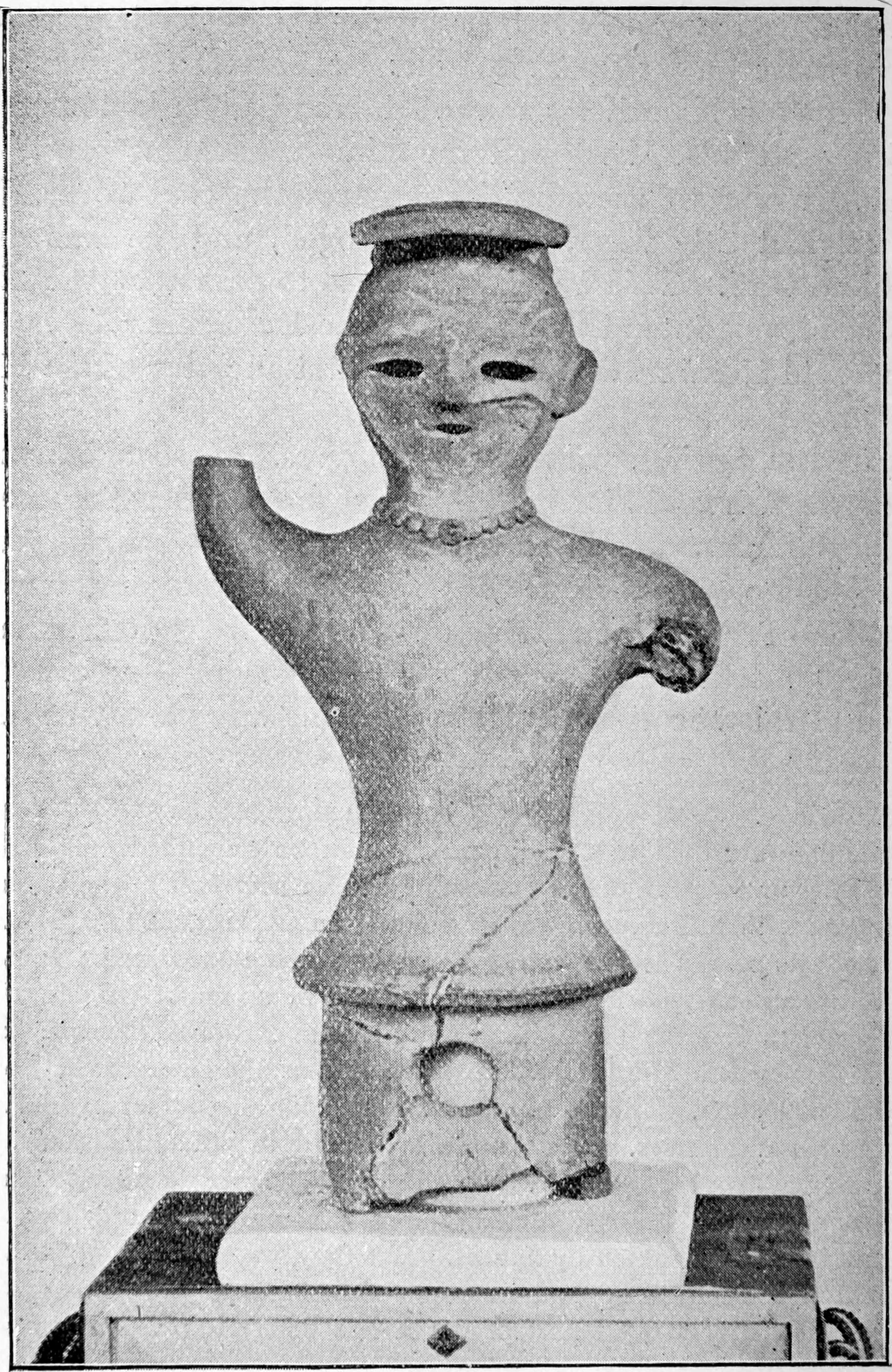
Tsuchi-ningiô. (Gowland Collection, British Museum.)
the tortoise, when it suddenly became changed into a white stone. Then the courtiers said:—"If one were only to think this out, it must prognosticate something." So Kambata no Tohe was sent for, and lodged in the hinder palace. She was the mother of Iha-tsuku-wake no Mikoto, who was the ancestor of the Kimi of Miho. Before this he had taken to wife Kari-hata-tohe, who bore him three sons. The first was called Oji-wake no Mikoto, the second Ika-tarashi-hiko no Mikoto, and the third I-take-wake no Mikoto.
(VI. 22.) Ika-tarashi-hiko no Mikoto was the first ancestor of the Kimi of Ishida.
A.D. 6. 35th year, Autumn, 9th month. Inishiki no Mikoto was sent to the province of Kahachi to construct the pond of Takashi, and the pond of Chinu.
Winter, 10th month. He made the pond of Saki in Yamato, and the pond of Tomi. In this year, the various provinces were commanded extensively to excavate ponds and channels,[55] to the number of eight hundred and more. Much attention was thus paid to husbandry. Therefore the people enjoyed abundance, and the Empire was at peace.
A.D. 8. 37th year, Spring, 1st month, 1st day. Oho-tarashi-hiko no Mikoto was made Prince Imperial.
A.D. 10. 39th year, Winter, 10th month. Inishiki no Mikoto, while dwelling in the palace at Kahakami of Udo in Chinu, made a thousand swords. Therefore those swords were called the Kahakami set.
Another name was the Naked[56] Companions.
(VI. 23.) They were deposited in the shrine of Iso no kami. After this the Emperor gave orders to Inishiki no Mikoto, and made him to have charge of the divine treasures of the shrine of Iso no kami.
One version is:—"Whilst the Imperial Prince Inishiki dwelt at Kahakami of Udo in Chinu, he sent for a smith by name Kahakami, and made a thousand swords. At this time, the shield-makers' Be, the Japanese-figured-cloth-workers' Be, the sacred-bow-shavers' Be, the sacred-arrow-makers' Be,[57] the Oho-anashi Be, the Hatsu-kashi[58] Be, the jewel-workers' Be, the Kami-osaka Be,[59] the Hi-oki[60] Be, and the sword-wearers' Be—the Be of ten articles altogether—were granted to the Imperial Prince Inishiki.
These thousand swords were deposited in the village of Osaka. They were afterwards removed from Osaka and deposited in the shrine of Iso no kami. At this time the God made a request, saying:—'Let the person named Ichikaha, of the family of the Omi of Kasuga, be made to attend to them.' Therefore by the Emperor's command, (VI. 24.) Ichikaha was caused to attend to them. He was the first ancestor of the Mononobe[61] no Obito."
A.D. 58. 87th year, Spring, 2nd month, 5th day. Inishiki no Mikoto spake to his younger sister, Oho-naka-tsu-hime no Mikoto, saying:—"I am old, and unable to have charge of the divine treasures. Henceforward thou must have charge of them." Oho-naka-tsu-hime refused, saying:—"I am a feeble woman. How can I ascend to the divine storehouse of Heaven?"
Inishiki no Mikoto said:—"Although the divine storehouse[62] is high, I can make for the divine storehouse a ladder. How, then, should it be hard to ascend to the storehouse?" Hence the proverbial saying, "You can ascend even to the divine storehouse of Heaven, if you only plant a ladder." This was its origin. Ultimately Oho-naka-tsu-hime no Mikoto gave them to Mononobe no Tochine no Oho-muraji, and made him to have charge of them. Therefore the Mononobe no Muraji retain charge of the divine treasures of Iso no kami up to the present time. The above was the origin of this practice.
Formerly in the Land of Tamba, in the village of Kuwada, there was a man whose name was Mikaso. Now, in Mikaso's house there was a dog, by name Ayuki. This dog bit a wild animal called the mujina,[63] and killed it. In the animal's belly there was found a magatama of Yasaka gem. This gem was accordingly offered to the Emperor, and is now in the shrine of (VI. 25.) Iso no kami.
A.D. 59. 88th year, Autumn, 7th month, 10th day. The Emperor commanded the Ministers, saying:—"We hear that the divine treasures which the Silla Prince Ama no hihoko brought with him when he first came here are now in Tajima. They were originally made divine treasures because the people of that province saw that they were admirable. We desire to see these treasures." That same day messengers were despatched with the Imperial commands to Kiyo-hiko, great-grandson of Ama no hihoko, directing him to present them to the Emperor. Thereupon, Kiyo-hiko, when he received the Imperial orders, brought the divine treasures himself, and laid them before His Majesty. There was one Ha-buto gem, one Ashi-daka gem, one Uka no Akashi (red-stone) gem, one sun-mirror, and one Kuma-himorogi.[64] But there was one short sword called Idzushi,[65] which it suddenly occurred to Kiyo-hiko not to offer to the Emperor; so he concealed it in his clothing, and wore it himself. The Emperor, unaware of the circumstance of the concealment of the short sword, and wishing to be gracious to Kiyo-hiko, sent for him and gave him sake in the palace. Then the short sword appeared from among his garments and became visible. The Emperor saw it, and himself asked Kiyo-hiko, saying:—"What short sword is that in thy clothing?" Then Kiyo-hiko, seeing that he was unable to conceal the short sword, explained that it belonged to the divine treasures which he was laying before the Emperor. So the Emperor said to Kiyo-hiko:—"How is it possible for this divine treasure to be separated from its kind?" So he took it out and presented it to the Emperor, and all were deposited in the Sacred Treasury. Afterwards, when the Sacred Treasury was opened and inspected, the short sword had spontaneously disappeared. Accordingly, a messenger was sent to Kiyo-hiko, who inquired of him, saying:—"The short sword which thou hast presented to the Emperor has suddenly disappeared. (VI. 26.) Has it perchance come to thy place?" Kiyo-hiko answered, and said:—"Last night the short sword came of its own accord to thy servant's house; but this morning it has disappeared." The Emperor was struck with awe, and made no further endeavour to find it. Afterwards the Idzushi short sword went of its own accord to the Island of Ahaji, where the people of the island considered it a God, and erected for the short sword a shrine, in which it is worshipped until this day.
Formerly there was a man, who riding in a ship, cast anchor in the land of Tajima. He was therefore asked, saying:—"Of what country art thou?" He answered and said:—"I am a son of the king of Silla, and my name is Ama no hihoko." So he dwelt in Tajima, and took to wife Mata no wo, daughter of Mahetsu mimi [One version has Mahetsu mi and another Futo-mimi] of that province, who bore to him Tajima Morosuke, the grandfather of Kiyo-hiko.
A.D. 61. 90th year, Spring, 2nd month, 1st day. The Emperor commanded Tajima Mori to go to the Eternal Land[66] and get the fragrant fruit that grows out of season, now called the Tachibana.[67]
A.D. 70. 99th year, Autumn, 7th month, 14th day. The Emperor died in the Palace of Maki-muku at the age of 140,[68] and in Winter, the 12th month, the 10th day, was buried in the misasagi of Fushimi, in Suga-hara.
(VI. 27.) The next year, Spring, the 3rd month, the 12th day, Tajima Mori arrived from the Eternal Land, bringing of the fragrant fruit that grows out of season eight sticks and eight bundles.[69]
Thereupon Tajima Mori wept and lamented, saying:—
"Receiving the Celestial Court's command,Afar I went to a remote region:
Ten thousand ri I crossed the waves,
Distantly I passed over the weak water.[70]
This Eternal Land
Is no other than the mysterious realm of Gods and Genii
To which ordinary mortals cannot attain;
Therefore in going thither and returning
Ten years have naturally passed.
Beyond my expectation, I braved alone the towering billows,
Turning my way again towards my own land.
Thus, trusting in the spirits of the Emperors,
I hardly accomplished my return.
But now the Emperor is dead,
I am unable to report my mission.
Though I should remain alive,
What more would it avail me?"[71]
Then turning his face towards the misasagi of the Emperor, he wept aloud, and so of himself he died. When the ministers heard of it they all shed tears.
Tajima Mori was the first ancestor of the Miyake[72] no Muraji.
- Dispense-benevolence.
- This does not agree with what precedes. He was born in the 29th year of his father's reign, and made Prince Imperial in the 48th. He would therefore be only twenty, and not twenty-four. Note that the Japanese always count both the year of birth and the current year in their calculations of age.
- This does not agree with the date on the previous page.
- Corean pronunciation. The Japanese would be Sonaka shichi.
- There is probably some historical foundation for this. But the chronology must be wrong. According to the Tongkam, Kara (Imna) was not formed into a kingdom until A.D. 42, and hostilities between Kara and Silla are first mentioned in that work in A.D. 94. They were also at war in 97, 115, 116, and 203. See "Early Japanese History" in "J.A.S.T.," p. 44.
- The ancient Chinese Emperors are so depicted.
- Now Tsuruga in Echizen. A derivation from Tsuno-nuka (horn-forehead) seems intended.
- The Chinese characters in the text are probably intended to be read with their Japanese pronunciation, and I have accordingly in this instance followed the traditional Kana rendering. If the Corean pronunciation were followed, we should read Tonoka Arasǎteung and Usaki ari cheulchi kanki. The Shiki says that kanki is a Silla rank equal to the Japanese senior 3rd rank. From a passage in Keidai Tennō's reign, year 23, it would appear that Arashito, or Arasǎteung, was the name of some office or dignity.
- Anato, lit. hole-door, is the ancient name of Nagato (long-door) or Chōshiu. The door is the Strait of Shimonoseki.
- Imna, according to the Corean pronunciation of the characters.
- This means "The sun-spear of Heaven," and is purely Japanese. It cannot be a Corean name.
- Kuma-himorogi. See above, p. 82.
- In the district of Idzu-shi (which I take to be for Idzu-ishi, sacred stone), a name which is suggestive of stone-worship. The "Kojiki" mentions eight objects, not at all the same, however, and calls them the Eight Great Deities of Idzushi. Vide Ch. K., p. 261. Possibly the Idzushi short sword and the Idzushi spear were stone weapons. This passage is one of several evidences that Japan owes to Corea one element of the Shintō religion. The "Yengi-shiki" mentions several Corean Gods as being worshipped in Japan. The "Kojiki" mixes up this legend with that of Arashito given above. Indeed both are probably founded on the same occurrence.
- I can't find any king of this name in Silla History.
- Ha-boso means leaf-slender and Ashi-daka leg-high. They are probably names of places.
- Mirror-valley.
- A Chinese saying.
- i.e. to take possession of the throne.
- A Chinese metaphor meaning "in security."
- Taka-miya means high-palace or shrine.
- Chinese expression for the State.
- The Japanese word for rice-castle is inaki. It may be doubted whether there ever was any such castle as that described here. Artless attempts at derivation furnish a considerable portion of the old myths and legends of Japan. Inaki is the term used for the Imperial granaries in the provinces, and was also applied to their custodians. It therefore became a title of nobility which is frequently met with in the later history.
- Lit. master of the road.
- But did not act on it till nine years later!
- Yamato-sun-facing brave-sun-facing prince.
- In Yamato.
- The wrestling seems to have been of the nature of a Greek παγκράτιον, or the French savate.
- The "Kojiki" (vide Ch. K., p. 197) makes only four princesses, and in another passage only two.
- Fall-country.
- The "Kojiki" makes this Prince born at the time of Saho-hiko's rebellion, i.e. in the fifth year of Suinin Tennō's reign. The "Nihongi" is less precise, but it is plain from the narrative that he cannot have been thirty at this time.
- Tottori for tori-tori, i.e. bird-catcher, is the name of a number of places in Japan, notably of the capital of the province of Inaba.
- Lord of the bird-catchers. The Chinese character for title is 姓, which means properly family name, surname. But, as this instance shows, such appellations were primarily official designations. Then they became hereditary titles, and in the last place were attenuated into mere surnames.
- Tori-kahi-be.
- Daibu, great man, is a general term for high officials.
- Both these men are named in Sūjin Tennō's reign, 10th year, eighty-five years before.
- This speech is thoroughly Chinese. It contains numerous phrases borrowed from the Chinese classics.
- She had been appointed B.C. 92, eighty-seven years before.
- This is a stock epithet (makura kotoba) of this province.
- Abstinence Palace or Worship Palace. "On the accession of an Emperor, an unmarried Princess of the Imperial House was selected for the service of the Shrine of Ise, or if there was no such unmarried Princess, then another Princess was fixed upon by divination and appointed worship-princess (齋王). The Worship-Palace was for her residence." Shintō miômoku ruijiushô, III. 23. See above, note to p. 41.
- i.e. assistant or deputy.
- In Yamato. Idzu means sacred; kashi is the name of a tree; moto means bottom.
- Corresponding to the 26th year of Suinin Tennō's reign, or B.C. 4.
- Or shrine.
- He died at the age of 120, or 168 if we take the "Kojiki" as an authority. This is one of numerous indications that the chronology of this period is worthless.
- The word misaki (point) is used both of a promontory and of a spur of a hill. Naga-oka is long-hill.
- Great-village-elder. This word is nearly equivalent to Prime Minister.
- As explained above, Kume is probably a variant of the Chinese word for army. There is at present a village of this name in Yamato, but it was no doubt originally the barrack quarter, and the storehouses here referred to were to contain grain for the food of the army. The original commentary gives miyake as the Japanese name for these granaries. At a later period the miyake were local government offices.
- The "Kojiki" (Ch. K., p. 174) says that this was the first time a hedge of men was set up round a tumulus. But the "Nihongi's" statement that it was an old custom must be correct. This custom is too much in accordance with what we know of other races in the barbaric stage of culture to allow us to doubt that we have here a genuine bit of history, though perhaps the details may be inaccurate, and the chronology is certainly wrong. In an ancient Chinese notice of Japan we read that "at this time (A.D. 247) Queen Himeko died. A great mound was raised over her, and more than a hundred of her male and female attendants followed her in death." Funeral human sacrifice for the service of the dead is described by Dr. Tylor ("Primitive Culture," i. 458) as "one of the most wide-spread, distinct, and intelligible rites of animistic religion. Arising in the lower barbaric stage, it develops itself in the higher, and thenceforth continues or dwindles in survival." He proceeds to quote numerous examples of it from all parts of the world, and from many ages of history. It is well known to have existed among the Manchu Tartars and other races of North-Eastern Asia until modern times. The Jesuit missionary Du Halde relates that the Emperor Shunchi, of the T'sing dynasty (died 1662), inconsolable for the loss of his wife and infant child, "signified by his will that thirty men should kill themselves to appease her manes, which ceremony the Chinese look upon with horror, and was abolished by the care of his successor"—the famous Kanghi. Another missionary, Alvarez Semedo, in his history of the Tartar invasion, says:—"The Tartarian King vowed to celebrate his Father's Funerals with the lives of two hundred thousand of the inhabitants of China. For it is the custome of the Tartars, when any man of quality dieth, to cast into that fire which consumes the dead corpse as many Servants, Women and Horses with Bows and Arrows as may be fit to atend and serve them in the next life." This custom was also practised in China in the most ancient times, though long condemned as barbarous. Confucius disapproved of it. An ode in the "Sheking" (Legge, iv. i. 198) laments the death of three brothers who were sacrificed at the funeral of Duke Muh, B.C. 621. When the Emperor She Hwang-ti died, B.C. 209, his son Urh said, "My father's palace ladies who have no children must not leave the tomb," and compelled them all to follow him in death. Their number was very great. For other cases see a paper by Mayers in the Journal of the North China Branch of the Asiatic Society, new Series, xii. A King of Kokuryö in Corea died A.D. 248. He was beloved for his virtues, and many of his household wished to die with him. His successor forbade them to do so, saying that it was not a proper custom. Many of them, however, committed suicide at the tomb. "Tongkam," iii. 20. In A.D. 502, Silla prohibited the custom of burying people alive at the funerals of the sovereigns. Before this time five men and five women were put to death at the King's tomb. "Tongkam," v. 5. Cases of suicide at the tomb of a beloved lord or sovereign have not been uncommon in Japan even in modern times. There was one in 1868. The Japanese, like the Chinese, make no distinction between voluntary deaths and human sacrifices. Both are called jun-shi, a term which means "following in death." Indeed, as we may see by the Italian Suttee, it is often hard to draw the line between these two forms of what is really the same custom.
- Clay-rings.
- Things set up.
- The date ascribed to this incident cannot be depended on. At least Chinese accounts speak of the custom of human sacrifices at the burial of a sovereign as in full force in Japan so late as A.D. 247. Probably all the events of this part of Japanese history are very much antedated. But of the substantial accuracy of the narrative there can be no doubt. Some of these clay figures (known as tsuchi-ningiô) are still in existence, and one may be seen in the British Museum, where it constitutes the chief treasure of the Gowland collection. The Uyeno Museum in Tokio also possesses specimens, both of men and horses. None, however, remain in situ at the tombs. The hani-wa (clay-ring) cylinders which may now be seen embedded in the earth round all the principal misasagi are so numerous that they can hardly have all been surmounted by figures. But they are of the same workmanship and of the same date, and no doubt some of them are the pedestals of images, the above-ground part of which has been long ago destroyed by the weather or by accident. A similar substitution of straw or wooden images for living men took place in China in ancient times, though by a curious inversion of ideas, the former practice is described as leading to the latter. See Legge's "Chinese Classics, Mencius," p. 9.
- Hashi (clay-worker) is also read hanishi, hashibe, or hasebe.
- As above stated, Tohe means chief.
- Literally, travelling-palace.
- For irrigation.
- So called because worn without a sheath.
- See above, p. 178.
- These are the names of villages. The "Shukai" editor suggests that they were allotted to the Prince for his support.
- Osaka was the place where the swords were stored.
- Hi-oki means "daily offerings."
- The Mononobe were Imperial life guards.
- One of these storehouses, dating from the 8th century, may still be seen at Tōdaiji, Nara. It is raised on pillars some ten feet above the ground.
- A kind of badger.
- Cf. above, p. 168.
- Sacred-stone.
- Tajima Mori was apparently selected for this mission on account of his descent from a king of Silla. But the Tokoyo no Kuni, or Eternal Land, can hardly have been Corea, where the Orange is little, if at all, grown in the present day. It was more likely China.
- The Orange, vide Ch. K., p. 198.
- The chronology, as usual, will not bear investigation.
- The meaning of the characters which I have thus rendered is doubtful. The corresponding passage in the "Kojiki" is corrupt and equally obscure. I do not feel sure that Motoöri has cleared it up quite satisfactorily, in spite of the amount of recondite learning he has brought to bear on it. Cf. Ch. K., p. 199.
- Said by the Chinese to be north of Fuyu (in Manchooria). It does not support ships.
- The sentiment and diction of this speech are thoroughly Chinese. It is not exactly poetry, but nearly so.
- Miyake, written with characters which mean "three storehouses." Mi, however, is more probably the honorific prefix.
BOOK VII.
THE EMPEROR OHO-TARASHI-HIKO-OSHIRO-WAKE.
(KEIKŌ[1] TENNŌ.)
The Emperor Oho-tarashi-hiko-oshiro-wake was the third child of the Emperor Iku-me-iri-hiko-isachi. The Empress his mother was named Hibasu-hime no Mikoto. She was the daughter of Prince Michi no ushi of Tamba. The Emperor Iku-me-iri-hiko-isachi, in the 37th year of his reign, raised him to the rank of Prince Imperial. He was then twenty-one years of age. In the 99th year of his reign, Spring, the second month, the Emperor Iku-me-iri-hiko-isachi died.
A.D. 71. 1st year, Autumn, 7th month, 11th day. The Prince Imperial assumed the Imperial Dignity. The chronological epoch was altered accordingly. This year was the year Kanoto Hitsuji (8th) of the Cycle.
A.D. 72. 2nd year, Spring, 3rd month, 3rd day. The elder lady[2] of Inabi in Harima was appointed Empress.
Another version has:—"The younger lady of Inabi in Harima."
(VII. 2.) She had two sons, the first of whom was named the Imperial Prince Oho-usu, and the second Wo-usu no Mikoto.
In one writing it is said:—"The Empress bore three sons. The third was named the Imperial Prince Waka-Yamato-neko."
The Imperial Prince Oho-usu and Wo-usu no Mikoto were born as twins[3] on the same day with the same placenta. The Emperor, wondering at this, informed the mortar.[4] Therefore he gave these two Princes the names of Great Mortar (Oho-usu) and Little Mortar (Wo-usu). Now this Wo-usu no Mikoto was also called Yamato Woguna and again Yamato-dake no Mikoto.[5] Whilst a child he had a manly spirit; when he arrived at manhood his beauty was extraordinary. He was a rod in height, and his strength was such that he could lift a tripod.[6]
A.D. 73. 3rd year, Spring, 2nd month, 1st day. Divination was made as to whether the Emperor should make a progress to the Land of Kii to perform sacrifices to all the Gods of Heaven and Earth. It was found to be unlucky, and the Imperial car was accordingly countermanded. Ya-nushi-oshiho-dake-wo-goro no Mikoto [one version has Take-wi-goro] was sent and caused (VII. 3.) to do sacrifice. Hereupon Ya-nushi-oshiho-dake-wo-goro no Mikoto went thither, and stayed at Kashihara in Abi, where he sacrificed to the Gods of Heaven and Earth. He lived here for nine years, and took to wife Kage-hime, the daughter of Uji-hiko, who was the ancestor of the Ki no Atahe.[7] She was the mother of Takechi no Sukune.
A.D. 74. 4th year, Spring, 2nd month, 11th day. The Emperor made a progress to Mino. His courtiers represented to him, saying:—"In this province there is a handsome woman named Oto-hime, of perfect beauty. She is the daughter of the Imperial Prince Yasaka Irihiko." The Emperor wished to obtain her to be his consort, and went to the house of Oto-hime.[8] Oto-hime, hearing that the Emperor was coming in his carriage, straightway concealed herself in a bamboo-grove. Hereupon the Emperor provisionally caused Oto-hime to go and reside in the Kuguri Palace, and letting loose carp in a pond, amused himself by looking at them morning and evening. Now Oto-hime wished to see the carp sporting, so she came secretly and stood over the pond. The Emperor forthwith detained her, and had intercourse with her. Hereupon Oto-hime thought:—"The way of a husband and wife is the prevailing rule both now and of old time. But for me it is not convenient." So she besought the Emperor, saying:—"Thy handmaiden's disposition is averse to the way of conjugal (VII. 4.) intercourse. Unable to withstand the awe of the Imperial commands, she has been placed for a while within the curtain. But it gives her no pleasure. Her face too is hideous, and she is unworthy of being added to the side courts. Thy handmaiden, however, has an elder sister, by name Yasaka Iri-hime, of a beautiful countenance, and also of a virtuous disposition. Let her be placed in the hinder palace." The Emperor assented, and having summoned Yasaka Iri-hime, made her his consort. She bore to him seven sons and six daughters. The name of the first was the Emperor Waka-tarashi-hiko, of the second the Imperial Prince Iho-ki Iri-hiko, of the third the Imperial Prince Oshi-wake, of the fourth the Imperial Prince Waka-Yamato-neko, of the fifth the Imperial Prince Oho-su-wake, of the sixth the Imperial Princess Nunoshi, of the seventh the Imperial Princess Nunaki, of the eighth the Imperial Princess Ihoki no Iri-hime, of the ninth the Imperial Princess Kako-yori-hime, of the tenth the Imperial Prince Isaki no Iri-hiko, of the eleventh the Imperial Prince Kibi no Ye-hiko, of the twelfth the Imperial Princess Takaki no Iri-hime, and of the thirteenth the Imperial Princess Oto-hime.
Again he took as consort the Lady[9] Midzuha, younger sister of Ihaki-wake, of the Miho House, who bore to him the Imperial Princess Ihono. His next consort, named Ikaha-hime, bore to him the Imperial Prince Kami-kushi[10] and the Imperial Prince (VII. 5.) Inase no Iri-hiko. The elder of these two, the Imperial Prince Kami-kushi, was the first ancestor of the Miyakko of Sanuki. The younger, the Imperial Prince Inase no Iri-hiko, was the first ancestor of the Harima no Wake.[11] His next consort was named Takada-hime, daughter of Kogoto of the Abe House, who bore to him the Imperial Prince Take-kuni Kori-wake. He was the first ancestor of the Wake of Mimura, in the Province of Iyo. His next consort, named Oho-tane-hime, of Kami-naga in Hiuga, bore the Imperial Prince Hiuga no Sotsu-hiko. He was the first ancestor of the Kimi of Amu.[12] His next consort, named Sotake-bime, bore the Imperial Prince Kuni-chi-wake, the Imperial Prince Kuni-se-wake [one version has the Imperial Prince Miya-chi-wake] and the Imperial Prince Toyoto-wake. The elder of these, the Imperial Prince Kuni-chi-wake, was the first ancestor of the Wake of Minuma. The youngest brother, the Imperial Prince Toyo-to-wake, was the first ancestor of the Wake of the Province of Hi.[13]
(VII. 6.) Now the children of the Emperor, male and female, from first to last, numbered eighty in all. With the exception, however, of Yamato-dake no Mikoto, the Emperor Waka-tarashi-hiko and the Imperial Prince Ihoki no Iri-hiko, the other seventy and odd children were all granted fiefs[14] of provinces and districts, and each proceeded to his own province. Therefore, those who at the present time are called Wake of the various provinces are the descendants of these separated (wakare) Princes.[15]
In this month, the Emperor, hearing that the daughters of Kambone, Mino no Miyakko, the elder's name being Ane-toho-ko, and the younger's being Oto-toho-ko, were both of distinguished beauty, sent Oho-usu no Mikoto with orders to examine the countenance of these women. Now Oho-usu no Mikoto had secret intercourse with them, and did not report his mission. For this reason the Emperor was wrath with Oho-usu no Mikoto.
Winter, the 11th month, 1st day. The Emperor returned from Mino and removed the capital to Maki-muku. This was called the palace of Hi-shiro.
A.D. 82. 12th year, Autumn, 7th month. The Kumaso[16] rebelled, and did not bring tribute.
(VII. 7.) 8th month, 5th day. The Emperor made a progress to Tsukushi.[17]
9th month, 5th day. On arriving at Saha in Suwo, the Emperor, standing with his face to the south,[18] addressed his Ministers, saying:—"To the southwards, smoke rises abundantly. There must certainly be brigands there." So he halted, and sending in advance Take-moro-gi, ancestor of the Omi of Oho, Unade, ancestor of the Omi of Kusaki, and Natsu-bana, ancestor of the Kimi of the Mononobe, made them to reconnoitre. Now there was here a woman, by name Kamu-nashi-hime, whose followers were exceedingly numerous. She was the chieftain of that whole country. When she heard that the Emperor's messengers had arrived, she broke off branches of the hard wood of Mount Shitsu. On the upper branch[19] she hung an eight-span sword, on the middle branch she hung an eight-hand mirror, and on the lower branch a Yasaka jewel. She also hoisted a white flag on the bow of her ship, and having come to meet them, addressed them, saying:—"I beseech you, do not have recourse to arms. None of my people, I assure you, are rebellious. They will presently submit themselves to virtue.[20] But there are mischievous brigands. The name of one is Hanatari.[21] He has assumed an unauthorized title. In the mountains and valleys he has called men together, and is encamped at Kahakami in Usa. Another is called Mimi-tari.[22] He is a mischievous brigand, rapacious, frequently plundering the people. He dwells at (VII. 8.) Kahakami in Mike. The third is called Asa-hagi. He has secretly assembled a following, and dwells at Kahakami in Takaha. The name of the fourth is Tsuchi-wori-wi-wori.[23] He lives concealed at Kahakami[24] in Midori no, and relying solely on the difficulties of the mountains and rivers, plunders the people greatly. All the places to which these four have betaken themselves are strong places. Each of them therefore makes his relations chiefs of one place, and they all say they will not obey the Imperial command. I pray you attack them suddenly, and fail not."
Hereupon Take-moro-gi and the others first enticed the followers of Asa-hagi, and gave them presents of trowsers of red material and all manner of curious objects. Then having made them beckon to the four unsubmissive men, who came accompanied by their followers, they seized them and put them all to death.
The Emperor ultimately pursued his journey to Tsukushi, and arrived at the district of Nagawo in the province of Buzen, where he erected a travelling palace and dwelt there. Therefore the name of that place was called Miyako.[25]
Winter, 10th month. He arrived in the Land of Ohokida. The form of this region is wide and beautiful. Therefore it was called Ohokida.[26]
When he came to the village of Hayami, there was there a woman named Haya-tsu-hime. She was chieftain[27] of one place. When she heard that the Imperial car was coming, she went out in person to meet the Emperor, and reported to him, saying:—"In this mountain there is a great cavern called the Rat's Cave. There are two Tsuchi-gumo[28] who dwell in this cave. One is called Awo,[29] and the other Shira.[30] Again (VII. 9.) at Negino, in the district of Nawori, there are three Tsuchi-gumo. The name of the first is Uchi-zaru,[31] of the second Yata,[32] and of the third Kunimaro.[33] These five men are alike mighty of frame, and moreover have numerous followers. They all say that they will not obey the Imperial command. If their coming is insisted on, they will raise an army and offer resistance." The Emperor, provoked by this, could not advance on his journey. So he halted at the village of Kutami, where he erected a temporary palace muro, and dwelt therein. Then he consulted with his Ministers, saying:—"Let us now put in motion a numerous army and slay the Tsuchi-gumo. If, fearing the might of our arms, they should conceal themselves in the mountains and moors, they will assuredly do future mischief." Accordingly he gathered camellia trees, and made of them mallets for weapons. Then selecting his bravest soldiers, he gave them the mallet-weapons. Therewith they pierced through the mountains, cleared away the grass, and attacking the Tsuchi-gumo of the cave,[34] defeated them at Kahakami in Inaba. The whole band were killed, and their blood flowing reached to the ancle. Therefore the men of that day called the place where the camellia mallets were made Tsubaki-no-ichi,[35] and the place where the blood flowed they called Chida.[36] Then, in order to attack Uchi-zaru, he crossed straight over (VII. 10.) Mount Negi. At this time the arrows of the enemy, shot crosswise from the mountain, fell like rain in front of the Imperial army. The Emperor retreated to Shiro-hara, where he made divination on the river-bank, and accordingly arraying his troops, he first attacked Yata on the moor of Negi, and defeated him. Upon this Uchi-zaru felt that he could not gain the victory, and prayed that his submission should be accepted. This, however, was refused, and they all flung themselves into a ravine and were killed. In the beginning, when the Emperor was about to attack the enemy, he made a station on the great moor of Kashihawo. On this moor there was a stone six feet in length, three feet in breadth, and one foot five inches in thickness. The Emperor prayed, saying:—"If we are to succeed in destroying the Tsuchi-gumo, when we kick this stone, may we make it mount up like a Kashiha leaf." Accordingly he kicked it, upon which, like a Kashiha leaf, it arose to the Great Void. Therefore that stone was called Homishi.[37] The Gods whom he prayed to at this time were the God of Shiga, the God of the Mononobe of Nawori, and the God of the Nakatomi of Nawori—these three Gods.
11th month. He arrived at the Land of Hiuga, and erected a travelling palace, wherein he took up his residence. This was called the palace of Takaya.
12th month, 5th day. Counsel was held how they should attack the Kumaso. Hereupon the Emperor addressed his Ministers, saying:—"We have heard that in the Land of the Kumaso there are two men named Atsukaya and Sakaya, who (VII. 11.) are the leaders of the Kumaso. Their followers are exceedingly numerous, and are called the eighty Kumaso braves. It will be better not to touch their spear-points. For if we raise a small force, it will be insufficient to exterminate the brigands, while if a large army is put in motion, the people will suffer harm. Is there no means of subduing this country without active measures, and without resorting to the might of arms?" Then one of the ministers stood forward and said:—"A Kumaso brave has two daughters, the elder named Ichi-fukaya, and the younger Ichi-kaya. Their beauty is perfect, and their hearts are brave. Offer valuable presents, and under the pretence of bestowing them beneath thy standard, take advantage of this to gain intelligence of the enemy, and attack them unawares. So without ever a sword-edge being stained with blood, the enemy will surely yield themselves up." The Emperor gave command, saying:—"Let it be so." Thereupon the presents were offered, and the two women, deceived by them, were bestowed beneath the tent. The Emperor straightway had intercourse with Ichi-fukaya, and made a show of affection for her. Then Ichi-fukaya told the Emperor, saying:—"Be not anxious lest the Kumaso should not submit. Thy handmaiden has an excellent plan. Let me have one or two soldiers to follow me." She then returned to her home, and prepared much strong sake, which she made her father drink. He became drunk and lay down to sleep. Ichi-fukaya then secretly cut her father's bowstring. Thereupon one of the soldiers who had escorted her came up and killed the Kumaso brave. The Emperor was provoked by such excessively unfilial conduct and put Ichi-fukaya to death. But Ichi-kaya he gave to the (VII. 12.) Miyakko of the Land of Ki.
A.D. 83. 13th year, Summer, 5th month. The Kumaso country having been all subdued, the Emperor accordingly dwelt in the palace of Takaya. When he had lived there six years, there was a beautiful woman in that country named Mihakashi-hime.[38] So he took her and made her his concubine. She bore to him the Imperial Prince Toyo-kuni-wake. He was the first ancestor of the Miyakko of the Land of Hiuga.
A.D. 87. 17th year, Spring, 3rd month, 12th day. The Emperor made a progress to the district of Koyu,[39] where he visited the little moor of Nimo. Then looking down towards the east, he said to his courtiers:—"This country faces directly the quarter of the Rising Sun." Therefore he named that country Hiuga.[40] On this day he mounted upon a great stone in the middle of the moor, and feeling a longing for the capital, made this poetry:—
Oh! how sweet!(VII. 13.) From the quarter of my home,
Clouds arising come hither!
Yamato
Is the most secluded of lands.
Yamato
Retired behind Mount Awo-gaki,
Which encompasses it in its folds,
Is beautiful.
Let those whose lives are sound
Stick (in their hair) by way of headdress
Branches of the white evergreen oak
Of Mount Heguri—
(Fold within fold).
This child![41]
This is called a song of longing for one's country.
A.D. 88. 18th year, Spring, 3rd month. The Emperor, when about to turn his way towards the capital, made a tour of inspection to the Land of Tsukushi.[42] He first arrived at Hina-mori. There was at this time on the bank of the River Ihase a crowd of men assembled. The Emperor, looking down on them from afar, addressed his courtiers, saying:—"Who are these men who are assembled? Are they an enemy?" So he sent two men, Hinamori the Elder and Hinamori the Younger, to see. Now Hinamori the Younger returned and reported, (VII. 14.) saying:—"Idzumi-hime, the Kimi of Muro-kata, is about to offer your Majesty a banquet, and therefore have people gathered together."
Summer, 4th month, 3rd day. The Emperor arrived at the district of Kuma. In this place there were two brothers called Kuma-tsu-hiko.[43] The Emperor first sent to summon Kuma the Elder to him. Accordingly he came along with the messenger. Then he summoned Kuma the Younger, but he would not come. Therefore he sent soldiers and put him to death.
11th day. Proceeding by the sea route, he anchored at a small island in Ashikita, where he partook of food. Then he told Wo-hidari, ancestor of the Yama no Ahiko,[44] to give him some cold water. Just at this time there was no water in the island, and he did not know what to do. So looking up, he prayed to the Gods of Heaven and the Gods of Earth, when suddenly a cool spring bubbled forth from the side of a cliff. This he drew and put before the Emperor. Therefore that island was called Midzushima.[45] That spring still exists in the cliff of Midzushima.
5th month, 1st day. Setting sail from Ashikita, he proceeded to the Land of Hi.[46] Here the sun went down, and the night being dark, they did not know how to reach the shore. A fire was seen shining afar off, and the Emperor commanded the helmsman, saying:—"Make straight for the place where the fire (VII. 15.) is." So he proceeded towards the fire, and thus was enabled to reach the shore. The Emperor made inquiry respecting the place where the fire was, saying:—"What is the name of this village?" The people of the land answered and said:—"Toyomura, in the district of Yatsushiro." Again he made inquiry respecting the fire:—"Whose fire is this?" But no owner could be found, and thereupon it was known that it was not a fire made by man. Therefore that country was called Hi no Kuni.[47]
6th month, 3rd day. He crossed over from the district of Takaku to the village of Tamakina. At this time he killed a Tsuchi-gumo of that place called Tsudzura.
16th day. He arrived at the Land of Aso.[48] The level tracts of that Land were wide and far-reaching, but no dwellings of men were to be seen. The Emperor said:—"Are there any people in this country?" Now there were two Deities, one called Aso-tsu-hiko, and the other Aso-tsu-hime, who suddenly assuming human form, sauntered forward and said:—"We two are here. How can it be said that there are no men?" Therefore that place was called Aso.[49]
Autumn, 7th month, 4th day. He arrived at Mike[50] in the further Land of Tsukushi,[51] where he dwelt in the temporary Palace of Takata. Now there was here a fallen tree 970 rods (VII. 16.) in length. The hundred functionaries passed backwards and forwards stepping on this tree. The people of that day made a song, saying:—
The morning hoar-frost[52]August tree pole-bridge!
The Lords of the Presence
Pass over it—
The august tree pole-bridge!
The Emperor inquired, saying:—"What tree is this?" There was there an old man who said:—"This tree is a Kunugi tree.[53] Before it fell down, when the rays of the morning sun fell on it, it overshadowed the Hill of Kishima; when the rays of the evening sun fell on it, it covered Mount Aso." The Emperor said:—"This tree is a divine tree. Therefore let this country be called the Land of Mike."[54]
(VII. 17.) 7th day. He reached the district of Yame, where, crossing Mount Mahe, he looked down to the south upon Aha no Saki, and spake, saying:—"The peaks and glens of this mountain follow each other fold upon fold. They are exceedingly beautiful. May it be that a God dwells in this mountain?" Then Saru-ohomi,[55] the Agata-nushi of Minuma, represented to the Emperor, saying:—"There is a female Deity named Yame-tsu hime, who dwells always among these mountains." This is therefore the reason why this country is called the Land of Yame.
8th month. He arrived at the village of Ikuha,[56] where he partook of food. On this day the stewards left behind the drinking cup. Wherefore the men of that day called the place where the drinking cup had been forgotten Ukuha. The present name Ikuha is a corruption of this. In old times the common people of Tsukushi called a drinking-cup Ukuha.
A.D. 89. 19th year, Autumn, 9th month, 20th day. The Emperor arrived from Hiuga.
A.D. 90. 20th year, Spring, 2nd month, 4th day. The Princess Ihono was made to sacrifice to Ama-terasu no Oho-kami.
A.D. 95. 25th year, Autumn, 7th month, 3rd day. Takechi no Sukune was commissioned to inquire into the geography of the various provinces of the Northern[57] and Eastern[58] circuits and the condition of the people.
A.D. 97. 27th year, Spring, 2nd month, 12th day. Takechi no Sukune returned from the East Country and informed the Emperor, saying:—"In the Eastern wilds there is a country (VII. 18.) called Hitakami.[59] The people of this country, both men and women, tie up their hair in the form of a mallet, and tattoo their bodies. They are of fierce temper, and their general name is Yemishi. Moreover, their land is wide and fertile. We should attack them and take it."
Autumn, 8th month. The Kumaso again rebelled, and made unceasing inroads on the frontier districts.
Winter, 10th month, 13th day. Yamato-dake no Mikoto was sent to attack the Kumaso. He was at this time sixteen years of age. Thereupon Yamato-dake no Mikoto said:—"I desire to take with me some good archers. Where are there any good archers?" Some one told him, saying:—"In the province of Mino there is a good archer named Oto-hiko-gimi." Thereupon Yamato-dake no Mikoto sent Miyado-hiko, a man of Katsuraki, and summoned to him Oto-hiko-gimi. Therefore Oto-hiko-gimi came and brought with him Ishiura no Yokotachi, Tako no Inaki,[60] and Chichika no Inaki of the province of Ohari, and followed Yamato-dake no Mikoto on his expedition.
12th month. Having arrived at the Land of Kumaso, he inquired into the state of things, and the character of the country in respect of facilities of access. Now the Kumaso had a leader named Torishi-kaya, also called the Brave of (VII. 19.) Kahakami, who assembled all his relations in order to give them a banquet. Hereupon Yamato-dake no Mikoto let down his hair, and disguising himself as a young girl, secretly waited until the banquet should be given by the Brave of Kahakami. Then with a sword girded on him underneath his inner garment, he entered the banqueting muro of the Brave of Kahakami and remained among the women. The Brave of Kahakami, enchanted with the beauty of the young girl, forthwith took her by the hand, and made her sit beside him. He also offered her the cup, and made her drink, and thus amused himself with her. By and by the night grew late, and the company fewer. Also the Brave of Kahakami became intoxicated. Hereupon Yamato-dake no Mikoto drew the sword which he had in his inner garments, and stabbed the Brave of Kahakami in the breast, but did not kill him outright. The Brave of Kahakami, bowing down his head to the ground, said:—"Wait a little. I have something to say." Then Yamato-dake no Mikoto stayed his sword and waited. The Brave of Kahakami addressed him, saying:—"Who is thine Augustness?" He answered and said:—"I am the child of the Emperor Oho-tarashi-hiko, and my name is Yamato Woguna." The Brave of Kahakami again spake to him, saying:—"I am the strongest man in all this land, and therefore none of the men of this time can excel me in might, and none refuses to be my follower. I have met with many valiant men, but none as yet could match the Prince. Therefore this despicable robber, from his filthy mouth, offers thine Augustness a title. Wilt thou accept it?" He said:—"I will accept it." So he spake to him, saying:—"Henceforward in speaking of the Imperial Prince, let him be styled the Imperial Prince Yamato-dake."[61] When he had done speaking Yamato-dake pierced his breast through and killed him. Therefore up to the present day he is styled Yamato-dake no Mikoto. This was the origin of it.
Afterwards he despatched Oto-hiko and the others, who slew all that band, leaving not a chewer,[62] and when this was (VII. 20.) done, he returned by sea to Yamato. Arriving at Kibi, he crossed the Ana Sea. In this place there was a malignant Deity, whom he forthwith slew. Again, turning northwards, he arrived at Naniha,[63] where he killed the malignant Deity of the Kashiha ferry.
A.D. 98. 28th year, Spring, 2nd month, 1st day. Yamato-dake no Mikoto reported to the Emperor how he had subdued the Kumaso, saying:—"Thy servant, trusting in the Emperor's Divine Spirit,[64] by force of arms, at one blow, suddenly slew the Kumaso chieftain and reduced that whole country to peace. In this way the Western Land is now quiet, and the people are undisturbed. Only the God of the Ferry of Ana in Kibi and the God of the Ferry of Kashiha at Naniha, both, with mischievous intent, sent forth a poisonous vapour, by which travellers were plagued. Both of them formed centres of calamity. Therefore I killed all those evil Deities, and have thrown open the roads by land and water alike." The Emperor upon this commended the good service done by Yamato-dake no Mikoto, and bestowed extraordinary affection on him.
A.D. 110. 40th year, Summer, 6th month. There was wide rebellion of the Eastern wilds, and the frontier was in a state of tumult.
Autumn, 7th month, 6th day. The Emperor addressed his Ministers, saying:—"The Eastern country is now in an unquiet state, and turbulent Deities have sprung up in numbers. Moreover the Yemishi have rebelled to a man and frequently carry off the people. Whom shall I send to still this disturbance?" But none of the Ministers knew whom to send. Then Yamato-dake no Mikoto addressed the Emperor, saying:—"Thy servant it was who formerly performed the labour of the expedition to the West. This campaign must be the business of the Imperial Prince Oho-usu." But the Imperial Prince Oho-usu was afraid, and ran to conceal himself among the grass. Accordingly a messenger was sent to fetch him. Hereupon the Emperor chid him, saying:—"If thou dost not (VII. 21.) wish it, shall We insist on sending thee? Why all this alarm, whilst thou hast not yet confronted the enemy?" Accordingly he eventually granted him Mino as a fief, and so he went to his government. He was the first ancestor of the two houses of the Kimi of Muketsu and the Kimi of Mori. Upon this Yamato-dake no Mikoto, striking a martial attitude, said:—"Not many years have passed since I subdued the Kumaso. Now the Yemishi of the East have made a fresh rebellion. When shall we arrive at a universal peace? Thy servant, notwithstanding that it is a labour to him, will speedily quell this disturbance." So the Emperor took a battle-axe,[65] and giving it to Yamato-dake no Mikoto, said:—"We hear that the Eastern savages are of a violent disposition, and are much given to oppression: their hamlets have no chiefs, their villages no leaders, each is greedy of territory, and they plunder one another. Moreover, there are in the mountains malignant Deities, on the moors there are malicious demons, who beset the highways and bar the roads, causing men much annoyance. Amongst these Eastern savages the Yemishi are the most powerful, their men and women live together promiscuously, there is no distinction of father and child. In winter they dwell in holes, in summer they live in nests. Their clothing consists of furs, and they drink blood.[66] Brothers are suspicious of one another. In ascending mountains they are like flying birds; in going through the grass they are like fleet quadrupeds. When they receive a favour, they forget it, but if an injury is done them they never fail to revenge it. Therefore (VII. 22.) they keep arrows in their top-knots and carry swords within their clothing. Sometimes they draw together their fellows and make inroads on the frontier. At other times they take the opportunity of the harvest to plunder the people. If attacked, they conceal themselves in the herbage; if pursued, they flee into the mountains. Therefore ever since antiquity they have not been steeped in the kingly civilizing influences. Now We mark that thou art mighty of stature and thy countenance is of perfect beauty, thou hast strength sufficient to raise tripods, thy fierceness is like thunder and lightning, wherever thou dost turn thy face, there is none to stand before thee; whenever thou dost attack thou dost surely conquer. This we know, that whereas in outward form thou art Our child, in reality thou art a God. Truly Heaven, commiserating Our want of intelligence and the disturbed condition of the country, has ordained that thou shouldst order the Heavenly institution, and save the monarchy from extinction. Moreover, this Empire is thy Empire, and this Dignity is thy Dignity. I adjure thee to exercise profound policy and far-reaching foresight in searching out iniquity and watching against crises. Admonish with majesty; comfort with kindness. Avoid having recourse to arms, and thou wilt naturally inspire loyal obedience. So by cunning words thou mayst moderate the violent Deities, and by a display of armed force sweep away malignant demons."[67]
Then Yamato-dake no Mikoto received the battle-axe, and, bowing twice, addressed the Emperor, saying:—"But few years have elapsed since my former expedition to the West, when, trusting in the might of the Imperial spirit, I, with a sword three feet in length, conquered the land of Kumaso, and (VII. 23.) the rebel chiefs yielded themselves to punishment. Now again, trusting in the spirits[68] of the Gods of Heaven and Earth, and in reliance on the Imperial might, I am proceeding to the frontier. I will admonish them by gentle teaching, and if any remain unsubmissive, I will smite them with arms." So he again bowed twice. Then the Emperor commanded Kibi no Take-hiko and Ohotomo no Take-hi no Muraji to follow Yamato-dake no Mikoto. He also appointed Nana-tsuka-hagi his steward.[69]
Winter, 10th month, 2nd day. Yamato-dake no Mikoto set out on his journey.
7th day. He turned aside from his way to worship at the shrine of Ise. Here he took leave of Yamato-hime[70] no Mikoto, saying:—"By order of the Emperor, I am now proceeding on an expedition against the East to put to death the rebels, therefore I am taking leave of thee." Hereupon Yamato-hime no Mikoto took the sword Kusa-nagi and gave it to Yamato-dake no Mikoto, saying:—"Be cautious, and yet not remiss."
This year Yamato-dake no Mikoto first reached Suruga. The brigands of this place made a show of obedience, and said, deceivingly:—"On this moor there are large deer in very great plenty. Their breath is like the morning mist, their legs are like a dense wood. Do thou go and hunt them." Yamato-dake no Mikoto believed these words, and, going into the middle of the moor, sought for game. The brigands, desiring (VII. 24.) to kill the Prince, set fire to the moor. But the Prince, seeing that he had been deceived, produced fire by means of a fire-drill,[71] and, kindling a counter-fire, succeeded in making his escape.
One version says:—"The sword Mura-kumo,[72] which the Prince wore, wielded itself, and mowed away the herbage near the Prince, thus enabling him to escape. Therefore that sword was called Kusa-nagi."[73]
The Prince said:—"I was almost betrayed." So he burnt all that robber-band and exterminated them. Therefore that place was called Yaketsu.[74]
Next he marched on to Sagami, whence he desired to proceed to Kadzusa. Looking over the sea, he spake with a loud voice, and said:—"This is but a little sea:[75] one might even jump over it." But when he came to the middle of the sea a storm suddenly arose, and the Prince's ship was tossed about, so that he could not cross over. At this time there was a concubine in the Prince's suite, named Oto-tachibana-hime. She was the daughter of Oshiyama no Sukune of the Hodzumi House. She addressed the Prince, saying:—"This present uprising of the winds and rushing of the waves, so that the Prince's ship is like to sink, must be due to the wishes of the God of the Sea. I pray thee let me go into the sea, and so let the person of thy mean handmaiden be given to redeem the life of the Prince's Augustness." Having finished speaking, she plunged into the billows. The storm forthwith ceased, and the ship was enabled to reach the shore. Therefore the people of that time called that sea Hashiri-midzu.[76]
(VII. 25.) Hereupon Yamato-dake no Mikoto, going by way of Kadzusa, changed his route, and entered the Land of Michi no oku.
At this time a great mirror was hung upon the Prince's ship. Proceeding by the sea route, he went round to Ashi no ura and crossed aslant to Tama no ura.[77] When he arrived at the Yemishi frontier, the chiefs of the Yemishi, Shima-tsu-kami and Kuni-tsu-kami,[78] encamped at the harbour of Take, with the intention of making resistance. But when they saw the Prince's ship from afar, they feared his majesty and power, and knew in their hearts that they could not gain the victory over him. They all flung away their bows and arrows, bowed down towards him, and said:—"When we look upon thy face, we see that it is more than human. Art thou perchance a Deity? We desire to know thy name." The Prince answered and said:—"I am the son of a Deity of visible men." Hereupon the Yemishi were all filled with awe. They gathered up their skirts and, plunging into the waves, of their own accord assisted the Prince's ship to reach the shore. Then, with their hands bound behind them, they submitted themselves for punishment. He therefore pardoned their offence, and having made prisoners their chieftains, caused them to be his personal attendants. The Yemishi having been subdued, he returned from the country of Hitakami, and proceeding to the south-west, passed through Hitachi, and arrived (VII. 26.) at the Land of Kahi, where he dwelt in the palace of Sakawori. At this time a light was kindled and he partook of food. On this night he made a song, in which he inquired of those in attendance on him, saying:—
Since I passed Tsukuba,And Nihibari,
How many nights have I slept?
None of his attendants was able to answer him. Now there was a man who had charge of the lights, who made a song, in continuation of the Prince's, saying:—
Counting the days—Of nights there are nine nights,
Of days there are ten days.
Therefore the Prince commended his intelligence and liberally rewarded him.[79]
Now while he was residing in this palace, he granted to Take-hi, the ancestor of the Ohotomo no Muraji, the Yuki[80] Be. Thereupon Yamato-dake no Mikoto said:—"All the wicked chiefs of the Yemishi have submitted to the punishment of their crimes. Only in the Land of Shinano and the Land of Koshi there are a considerable number who are not yet obedient to the civilizing influence." So from Kahi he turned towards the north, and passing through Musashi and Kōdzuke, he went (VII. 27.) westward as far as the Usuhi-saka.[81] Now Yamato-dake no Mikoto always thought with regret of Oto-tachibana-hime. Therefore, when he ascended to the summit of Usuhi and looked down towards the south-east, he sighed three times, and said, "Alas! my wife!" Therefore the provinces east of the mountains were given the name of Adzuma.[82]
Here he sent Kibi no Takehiko by a different road to the Land of Koshi, and caused him to examine the character of the country as regards means of access, and also whether the people were tractable or not. So Yamato-dake no Mikoto advanced into the province of Shinano. This is a Land of high mountains and profound valleys. Verdant summits are piled up ten thousand fold, so that for men with staff in hand they are hard to ascend. The cliffs are precipitous, and are girt with flying bridges.[83] Many thousand are the hill-ranges, where even with slackened reins the horse makes no progress. Yet Yamato-dake no Mikoto, bursting through the smoke, and braving the mists, distantly crossed Mount Oho-yama. He had already reached the summit when he became hungry and had food on the mountain. The God of the mountain plagued the Prince. He assumed the form of a white deer and stood before him. The Prince, wondering at this, took a stick of garlic, and jerked it (VII. 28.) at the white deer, striking it in the eye and killing it.[84] Here the Prince suddenly lost his way and could find no issue. Then a white dog came of its own accord, and made a show of guiding the Prince. Following the dog, he proceeded on his way, and succeeded in coming out into Mino. Kibi no Take-hiko, coming out from Koshi, met him. Before this when any one crossed the Shinano pass, he inhaled so much of the breath of the Deity that he became ill and lay down. But after the white deer was killed, the travellers who crossed that mountain chewed garlic,[85] and smearing with it men, kine, and horses, preserved them from being affected by the Deity's breath.
Yamato-dake no Mikoto, having returned back again to Ohari, straightway took to wife a daughter of the Ohari House, by name Miyazu-hime, and tarried there until the next month. Here he heard that on Mount Ibuki in Afumi there was a savage Deity. So he took off his sword, and leaving it in the house of Miyazu-hime, went on afoot. When he arrived at Mount Ibuki, the God of the mountain took the shape of a (VII. 29.) great serpent, and posted himself on the road. Hereupon Yamato-dake no Mikoto, not knowing that it was the master God who had become a serpent, said to himself:—"This serpent must be the Savage Deity's messenger. Having already slain a master God, is a messenger worth hunting after?" Accordingly he strode over the serpent and passed on. Then the God of the mountain raised up the clouds, and made an icy rain to fall. The tops of the hills became covered with mist, and the valleys involved in gloom. There was no path which he could follow. He was checked and knew not whither to turn his steps. However, braving the mist, he forced his way onwards, and barely succeeded in finding an issue. He was still beside himself like a drunken man. He therefore sat down beside a spring at the foot of the mountain, and, having drunk of the water, recovered his senses. Therefore that spring was called the Wi-same[86] spring.
It was at this time that Yamato-dake no Mikoto first became ill. The disease gradually increased and he returned to Ohari. Here he did not enter the house of Miyazu-hime, but passed on to Ise and reached Otsu.[87] Formerly, in the year when Yamato-date no Mikoto was proceeding eastwards, he halted on the shore at Otsu and partook of food. At that time he took off a sword which he laid down at the foot of a fir-tree. Eventually he went away forgetting it. When he now came to this place, the sword was still there. Therefore he made a song, saying:—
Oh! thou single pine-tree!That art right opposite
To Ohari—
Ah me—thou single pine-tree!
If thou wert a man,
Garments I would clothe thee with,
A sword I would gird on thee.
(VII. 30.) When he came to the moor of Nobo, his sufferings became very severe. So he made an offering of the Yemishi whom he had captured to the Shrine of the God.[88] He therefore sent Kibi no Take-hiko to report to the Emperor, saying:—"Thy servant having received the command of the Celestial Court, undertook a distant expedition to the wilds of the East, where by the favour of the Gods, and trusting in the mighty power of the Emperor, I made the rebellious to submit themselves for punishment, and the violent deities to become moderate. Therefore I rolled up my armour, laid aside my weapons, and was returning peacefully. It was my hope on such a day at such an hour to report my mission to the Celestial Court.[89] But the life allotted me by Heaven has unexpectedly approached an end. Passing swiftly as a four-horse carriage passes a crack in the road, it may not be stayed. Alone I lay me down on the waste moor with none to say a word to me. But why should I regret the loss of this body? My only grief is that I cannot meet thee."
Having said so, he died on the moor of Nobo. He was then thirty years of age. When the Emperor heard it, he could not sleep peacefully on his couch, nor was the taste of food sweet to him. Night and day his voice was choked with grief: with tears and lamentations he beat his breast. Therefore he exclaimed aloud, saying:—"Oh! Our son, Prince Wo-usu! (VII. 31.) Formerly when the Kumaso revolted he was still a boy. But for a long time he bore the labour of campaigning. Afterwards he was constantly at Our side, supplying Our deficiencies. Then when the troubles with the Eastern savages arose, there was no one else whom We could send to smite them, so in spite of Our affection for him, We sent him into the country of the enemy. No day passed that we did not think of him. Therefore morning and evening We longingly awaited the day of his return. Oh! what a calamity! Oh! what a crime! While We least expected it, we suddenly lost Our child. Henceforth with whom to help us shall we manage the vast institution?"
So he commanded his ministers and through them instructed the functionaries[90] to bury him in the misasagi of Nobo Moor in the Land of Ise.
Now Yamato-dake no Mikoto, taking the shape of a white bird, came forth from the misasagi, and flew towards the Land of Yamato. The Ministers accordingly opened the coffin, and looking in, saw that only the empty clothing remained, and that there was no corpse. Thereupon messengers were sent to follow in search of the white bird. It stopped on the plain of Kotobiki in Yamato. Accordingly in that place a misasagi was erected. The white bird flew on again until it reached Kahachi, where it rested in the village of Furuchi, and in this (VII. 32.) place also a misasagi[91] was erected. Therefore the men of that day called these three misasagi "the white bird misasagi."[92] At last it soared aloft to Heaven, and there was nothing buried but his clothing and official cap. The Emperor, wishing to perpetuate the fame of his services, established the Takeru[93] Be. This was in the 43rd year of the Emperor's reign.
A.D. 121. 51st year, Spring, 1st month, 7th day. The Emperor summoned his Ministers, and feasted them for several days. Now the Imperial Prince Waka-tarashi-hiko no Mikoto and Takechi no Sukune did not come to the Banqueting Court. The Emperor sent for them and asked the reason. Therefore they represented to the Emperor, saying:—"On a day of festival, the Ministers and functionaries must have their minds bent on jollity, and they do not think of the State. In view of the possibility of there being madmen, who might watch for an unprotected space in the ramparts, we remain on guard beneath the Gate[94] and provide against emergencies." Then the Emperor spake and said:—"Splendid!" So he showed them an extraordinary affection.
Autumn, 8th month, 4th day. Waka-tarashi-hiko no Mikoto was appointed Prince Imperial. On this day Takechi no Sukune was appointed Prime Minister.
(VII. 33.) The cross-sword Kusanagi, which was at first worn by Yamato-dake no Mikoto, is now in the shrine of Atsuta in the district of Ayuchi, in the province of Ohari. Now the Yemishi who had been presented to the shrine brawled day and night, and were disrespectful in their goings out and comings in. Then Yamato-hime no Mikoto said:—"These Yemishi should not be allowed near the shrine." Accordingly she sent them up to the Court, where they were made to settle beside Mount Mimoro. Ere long they cut down all the trees of the sacred mountain. They shouted and bawled in the neighbouring villages and threatened the people. The Emperor, hearing this, summoned his Ministers, and said:—"The Yemishi who were placed beside the sacred mountain have by nature the hearts of beasts. They cannot be allowed to dwell in the inner country." So he caused them to be stationed without the home provinces, in any places which they pleased. They were the ancestors of the present Saheki[95] Be of the five provinces of Harima, Sanuki, Iyo, Aki, and Aha.
(VII. 34.) In the beginning Yamato-dake no Mikoto took the Imperial Princess Futachi-iri-hime, and made her his consort.[96] She bore Prince Ineyori-wake, next the Emperor Tarashi-naka-tsu-hiko,[97] next Nuno oshi-iri-hime no Mikoto, and next Prince Waka-take. The eldest of these, Prince Ineyori-wake, was the first ancestor of the two families of the Kimi of Inu-gami and of the Kimi of Takebe. Another consort, named Kibi no Anato no Take-hime, daughter of Kibi no Take-hiko, bore to him Prince Take-miko and Prince Towoki-wake. The elder of these, Prince Take-miko, was the first ancestor of the Kimi of Aya in Sanuki. Prince Towoki-wake was the first ancestor of the Kimi of Wake in Iyo. His next consort, Oto-tachibana hime, daughter of Oshiyama no Sukune, of the Hodzumi House, bore to him Prince Waka-take-hiko.
(VII. 35.) A.D. 122. 52nd year, Summer, 5th month, 4th day. The Empress Harima no Oho-iratsume died.
Autumn, 7th month, 7th day. Ya-saka-iri-hime no Mikoto was appointed Empress.
A.D. 123. 53rd year, Autumn, 8th month, 1st day. The Emperor commanded his Ministers, saying:—"When will Our longing for Our son cease? We desire to make a tour of inspection to the region subdued by Prince Wo-usu." In this month he mounted into his carriage and made a progress to Ise; where, turning aside, he entered the East Sea provinces.
Winter, 10th month. He arrived at the province of Kadzusa, whence by the sea-route he crossed over to the harbour of Aha.
At this time the Emperor, hearing the cry of a fish-hawk, wished to see the bird's form. So he went out upon the sea in search of it, and caught clams. Hereupon the ancestor of the Kashihade no Omi,[98] by name Ihaka Mutsukari, made shoulder-straps of bulrushes, and preparing a hash of the clams, put it before the Emperor. Therefore he commended the service rendered by the Omi Ihaka Mutsukari, and granted him the Stewards' Ohotomo Be.
12th month. The Emperor returned from the Eastern country and dwelt in Ise. This was called the Kambata Palace.
(VII. 36.) A.D. 124. 54th year, Autumn, 9th month, 19th day. From Ise the Emperor returned to Yamato, and dwelt in the Palace of Makimuku.
A.D. 125. 55th year, Spring, 2nd month, 5th day. Prince Hiko-sa-jima was appointed Governor-general of the fifteen provinces of the Tô-san-dô.[99] He was a grandson of Toyoki no Mikoto. But when he arrived at the village of Anashi in Kasuga he fell ill and died.
At this time the people of the Eastern Land, grieved that the Prince did not arrive, secretly purloined his body, and buried it in the land of Kōdzuke.[100]
A.D. 126. 56th year, Autumn, 8th month. The Emperor commanded Prince Mimoro-wake, saying:—"Thy father, Prince Hiko-sajima, was unable to proceed to his governorship and died prematurely. Therefore do thou undertake the absolute rule of the Eastern Land." So Mimoro-wake no Mikoto, having received the Emperor's commands, and being also desirous of accomplishing his father's work, straightway proceeded thither, and undertook the government. He had already attained to a good administration when the Yemishi made a disturbance. So he raised an army and attacked them. Then the Yemishi chieftains, Ashi-furi-he, Oho-ha-furi-he, and Tohotsu Kura-ho-he bowed their heads to the ground and came; they made deep obeisance and accepted punishment, offering him all their territory without exception. Therefore he pardoned those who surrendered, and put to death those who would not submit. On this account the Eastern Land was for a long time free from trouble. Therefore his descendants are to this day in the Eastern Land.
A.D. 127. (VII. 37.) 57th year, Autumn, 9th month. The Pool of Sakate was constructed, and the embankment planted with bamboos.
Winter, 10th month. It was commanded that every province should erect granaries of the labourers' Be.[101]
A.D. 128. 58th year, Spring, 2nd month, 11th day. The Emperor made a progress to the Land of Ohomi, and dwelt in Shiga for three years. This was called the Palace of Taka-Anaho.
A.D. 130. 60th year, Winter, 11th month, 7th day. The Emperor died in the Palace of Taka-Anaho at the age of 106.
THE EMPEROR WAKA-TARASHI-HIKO.
(SEIMU[102] TENNŌ.)
The Emperor Waka-tarashi-hiko was the fourth child of the Emperor Oho-tarashi-hiko-oshiro-wake. The name of the Empress his mother was Ya-saka-iri-hime no Mikoto, daughter of the Imperial Prince Ya-saka-iri-hiko. He was appointed Prince Imperial in the 46th year of the Emperor Oho-tarashi-hiko, being then aged twenty-four years. In the 60th year of his reign, Winter, the 11th month, the Emperor Oho-tarashi-hiko died.
A.D. 131. 1st year, Spring, 1st month, 5th day. The Prince Imperial assumed the Imperial Dignity. This year was the year Kanoto Hitsuji (8th) of the Cycle.
A.D. 132. 2nd year, Winter, 11th month, 10th day. The Emperor Oho-tarashi-hiko was buried in the misasagi over the road at Yamanobe in the province of Yamato.
(VII. 38.) The Empress was honoured with the title of Grand Empress.
A.D. 133. 3rd year, Spring, 1st month, 7th day. Takechi no Sukune was made Prime Minister. In the beginning the Emperor was born on the same day with Takechi no Sukune, and he therefore had an extraordinary affection for him.
A.D. 134. 4th year, Spring, 2nd month, 1st day. The Emperor commanded, saying:—"Our predecessor on the throne, the Emperor Oho-tarashi-hiko, was clear-sighted and of divine valour. When he became subject to the scheme[103] and received over the plan he ruled Heaven and was in accordance with Man. He swept away the banditti, and restored right. His virtue was like a canopy, his path harmonized with development. Therefore in all the land under Universal Heaven (VII. 39.) there was none who did not recognize him as Sovereign. Of all things endowed with life and possessed of soul were there any which did not find their place?
We have now succeeded him in the occupation of the precious felicity. Morning and night we tremble and fear. But the people are like wriggling worms, and will not reform the savagery of their hearts. In the provinces and districts there are no Lords, in the villages there are no Chiefs.[104] Henceforward let there be established Lords in the provinces, and let there be Chiefs placed in the villages. Accordingly let men of ability of the provinces be taken and appointed Chiefs over provinces and districts, so as to form a defence for the Inner Country."[105]
A.D. 135. 5th year, Autumn, 9th month. A decree was issued to all the provinces establishing Miyakko (governors) in the provinces and districts, and Inaki[106] in the villages. All were granted shields and spears as emblems of authority. So the mountains and rivers were made boundaries for the separation of one province and district from another, whilst the bounds of townships and villages were established by means of lanes. In this way East and West were reckoned as in a line with the sun, (VII. 40.) while North and South were reckoned as athwart the sun.[107] The sunny side of the mountains was called the light-face and the shady side of the mountains the back-face.[108]
In this way the people had tranquil possession of their dwellings, and the Empire was at peace.
A.D. 178. 48th year, Spring, 3rd month, 1st day. The Emperor appointed his nephew Tarashi-naka-tsu-hiko no Mikoto Prince Imperial.[109]
A.D. 190. 60th year, Summer, 6th month, 11th day. The Emperor died, aged 107.
- Great road or great conduct.
- Oho-iratsume.
- There seems to have been a question which of twins was to be considered the elder. One idea was that the last born should be senior, because he occupied the higher place in the womb.
- The Chinese character used here is 碓, which properly means a pestle, and is more particularly applied to that arrangement of a mortar and pestle in which the latter is set on a pivot and worked by the foot.
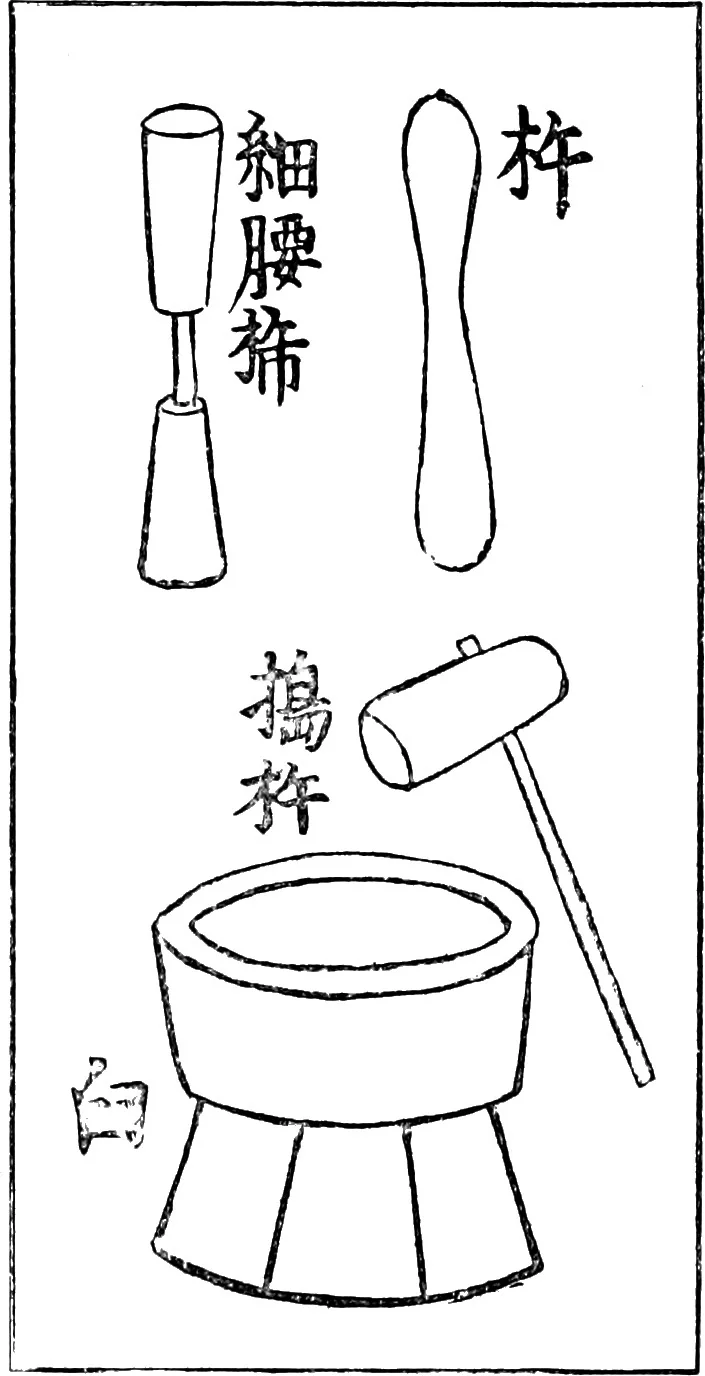
Pestle and Mortar.This is called the Kara-usu in Japan. Here, however, is one of those cases where we must put aside the Chinese character and be guided by the Japanese word, which is unquestionably usu, a term applied to any arrangement for hulling or grinding grain. The usu is properly the mortar rather than the pestle (kine), but it is used for the combination of both, and for querns or hand-mills, which are also in use in Japan. The usu here referred to is probably of the kind shown in the annexed illustration. Stone pestles resembling in shape that in the right hand upper corner are among the stone implements figured in Kanda's work on this subject. Hardy, in his "Manual of Buddhism," p. 158, says:—"The eastern pestle is found in every house, and is connected with as many superstitions and ceremonies as the besom among the old wives of Europe." The "Shukai" editor suggests that by Great Mortar and Little Mortar the lower and upper stones of the hand-mill were meant. But there is no reason to doubt the statement below (A.D. 610) that hand-mills were first introduced in Suiko's reign. - Woguna means boy, Yamato-dake means hero of Yamato. It is by the last of these names that he is best known to posterity.
- A Chinese phrase.
- In this passage the province now known as Kii is called indifferently Ki or Kiï.
- Oto-hime means simply "younger lady." There are frequent cases in the "Nihongi" where a woman seems to have no other name than "elder lady" or "younger lady."
- Iratsume.
- Divine-comb.
- Wake, separation, branch, was a title which implied descent from the Imperial line.
- In Nagato.
- Now Hizen and Higo in Kiushiu.
- This points to something like a feudal system. But the analogy to European feudalism must not be too closely pressed. Cf. Ch. K., p. 203.
- This omits to notice that Wake is a much older term.
- The country of the Kumaso was the southern part of the island of Kiushiu corresponding to the present provinces of Hiuga, Ohosumi, and Satsuma. Kuma and So are the names of two tribes.
- Tsukushi is used in two senses. It sometimes stands for the whole island of Kiushiu, sometimes for only the northern part of it, viz. the two provinces of Chikugo and Chikuzen.
- The Emperor of China stands with his face to the south on state occasions. But here it seems only to mean that the Emperor looked southwards.
- It was the ancient custom in Japan to deliver letters or presents fastened to branches of trees.
- To the Emperor's virtuous influence.
- Nose-depend.
- Ear-depend.
- Earth-break-well-break.
- Kaha-kami means the upper course of a river.
- Capital.
- Great field.
- The reader will observe that there are numerous cases of the "monstrous regiment of women" in these old legends.
- See above, p. 129.
- Green or blue.
- White.
- Strike-monkey.
- Eight-fields.
- Country-fellow. Note again that the Tsuchi-gumo have Japanese names, and inhabit old-settled parts of Japan.
- The interlinear gloss has iha-muro, rock-muro.
- Camellia market.
- Blood-field.
- For fumi-ishi, i.e. kicking-stone.
- The lady of the august sword.
- In Hiuga.
- For Hi-muka i.e. sun-fronting.
- The text and interpretation of this poem present considerable difficulty, and the above rendering is in parts only tentative. The "Kojiki" makes three distinct poems of it, and attributes them to Yamato-dake no Mikoto. Cf. Ch. K., p. 219. Awo-gaki means green-fence. "Fold within fold" is a mere epithet, or makura-kotoba, of Mount Heguri.
- Tsukushi is here evidently the northern part of the island.
- Prince of Kuma.
- Ahiko appears to be a title similar to Atahe, Sukune, etc. It is derived by the Japanese commentators from a, I, my, and hiko, prince.
- Water-island.
- Now Hizen and Higo.
- The Land of Fire.
- The name Aso is preserved in Mount Aso, a very curious volcanic mountain in the province of Higo.
- Aso is a dialectical variation for nanzo or nazo, how or why.
- August tree.
- Now Chikugo.
- Morning hoar-frost is a makura-kotoba. The only connection between it and the rest of the poem is that hoar-frost melts, and that ke (for ki) tree is also the first syllable of kesu, to melt. The Presence is of course the Imperial Presence.
- Quercus Serrata, Hepburn.
- August tree.
- Monkey-great-sea.
- In Chikugo.
- Including Mutsu and Dewa.
- Or Adzuma, the region round what is now Tokio.
- Sun-height. So called from its eastern position. Hi-tachi, sun-rise, is a name of similar purport.
- One of the lower ranks of the local nobility.
- The champion of Japan.
- i.e. a living soul.
- The modern Ohosaka.
- Very nearly the Latin numen.
- Motoöri points out this as an instance where the desire to imitate his Chinese models has caused the author of the "Nihongi" to introduce Chinese things which have no business in a Japanese narrative. The "Kojiki" says it was a spear of holly eight fathoms long.
- The "Liki" speaks of the ancient Chinese living on fruits and the flesh of wild beasts and drinking their blood.
- This speech cannot be received as a document of Japanese history. It is a cento of reminiscences of Chinese literature.
- Numina.
- Hirata says that Japanese surnames were taken from offices or avocations, names of places, parents' names, circumstances, or objects. I suppose he would have included under circumstances such personal peculiarities as that which suggested the name Nana-tsuka-hagi, literally "Seven-span-shanks."
- She was appointed priestess B.C. 5, and we are now at A.D. 110, by the common chronology.
- The interlinear gloss and the "Kojiki" (Ch. K., p. 211) have hi-uchi, or fire-striker, by which a flint and steel is doubtless meant. A fire-drill was known to the ancient Japanese, as appears from the "Kojiki" (Ch. K., p. 104) and other authorities, and it is actually in use at present to produce fire for sacred purposes. See a paper by Satow, in "J.A.S.T.," VI. 223.
- Assembled-clouds.
- The herbage mower.
- Port or ferry of burning.
- The bay of Yedo.
- Running-water.
- In Shimōsa.
- Literally, Gods of the Islands and Gods of the Continent.
- Cf. Ch. K., p. 214.
- Quiver.
- Now known as the Usuhi Tōge (pass) on the Nakasendō road.
- Aga tsuma means my wife.
- Kake-hashi, a bridge supported on poles driven into the side of a cliff. Common in some mountainous parts of Japan.
- Ch. K., 213.
- "Another popular device (in Scotland) for frightening away witches and fairies was to hang bunches of garlic about the farms." "Auld Licht Idylls," by J. M. Barrie. Dennys, in his "Folk-lore of China," mentions several cases of the use of garlic or onions to keep away evil spirits.
- Sit-sober.
- Not Ôtsu on the southern shore of Lake Biwa, but a place in Ise.
- As slaves.
- This sentence is in the "Shukai" edition introduced at the end of this speech.
- Lit. the hundred bureaus.
- I have seen this tumulus. It is a very large double mound surrounded by a moat.
- Shira-tori no Misasagi. Many of the tumuli are favourite resorts of the white egret, whence doubtless the name.
- Or Take, brave.
- Mikado means "august gate."
- The Chinese characters for Saheki mean "Assistant-Chief." It is apparently a Chinese word and not Japanese, and therefore it seems out of place in the history of a period long previous to the introduction of Chinese learning. But, however unhistorical this narrative may be, it goes to prove that there is an Aino element in the Japanese nation.
- She was his aunt.
- Chiuai Tennō.
- Stewards.
- East-mountain-road.
- Several ancient tumuli near the village of Ohomuro in this province are perhaps the tombs of this dynasty of governors. They are described in a paper by Satow in "T.A.S.J.," Vol. VIII., p. 327.
- Cf. Ch. K., p. 205.
- Accomplish-functions.
- The scheme of the permutations of the five elements. "Thus water is said to overcome fire and so forth. Each dynasty is believed to be subject to the influence of the element which overcomes that prevailing with the previous dynasty, and all human affairs are referable to the same occult influence." Mayers' Manual, p. 317. This whole speech is intensely Chinese.
- This cannot be correct.
- i.e. the Gokinai.
- Inaki is literally rice-castle, i.e. granary. The office seems to be something like mayor. It subsequently became a mere title, and eventually a surname.
- Meaning lanes running N. and S. and lanes running E. and W.
- The modern division of the provinces between Kiôto and Shimonoseki, the Sanyōdo and Sanindo, rests on this distinction.
- His own son had perhaps died.
BOOK VIII.
THE EMPEROR TARASHI-NAKATSU-HIKO.
(CHIUAI[1] TENNŌ.)
The Emperor Tarashi-nakatsu-hiko was the second child of Yamato-dake no Mikoto. The Empress[2] his mother was called Futachi-iri-hime no Mikoto. She was the daughter of the Emperor Ikume-iri-hiko isachi. The Emperor's countenance was of perfect beauty, and his stature was ten feet. He was appointed Prince Imperial in the forty-eighth year of the Emperor Waka-tarashi-hiko, being at this time thirty-one years of age. The Emperor Waka-tarashi-hiko having no male offspring, appointed him as his successor. In the sixtieth year of his reign the Emperor died, and in the following year, Autumn, the 9th month, 6th day, was buried in the Tatanami misasagi in Saki, in the province of Yamato.
A.D. 192. 1st year, Spring, 1st month, 11th day. The Prince Imperial assumed the Imperial Dignity.
Autumn, 9th month, 1st day. The Empress-mother was granted the honorary title of Grand Empress.
Winter, 11th month, 1st day. The Emperor commanded his Ministers, saying:—"The Prince, Our father, died before We reached the status of a youth. His divine spirit became changed (VIII. 2.) into a white bird and ascended to Heaven. Our longing regard for him knows not a day's intermission. Therefore it is Our wish to procure white birds and to keep them in the pond[3] within the precincts of the misasagi, so that, looking on these birds, we may comfort our feelings of longing." Orders were therefore sent to the various provinces to send tribute of white birds.
Intercalary 11th month, 4th day. The province of Koshi sent tribute of four white birds. Now the messengers who were sent with the birds stayed for the night on the bank of the river Uji. Then Prince Gama-mi-wake, of Ashigami, seeing the white birds, made inquiry, saying:—"Whither are you taking these white birds?" The men of Koshi answered and said:—"The Emperor, out of his longing for the Prince, his father, intends to keep them as pets. Therefore do we bring them as tribute." Prince Gama-mi-wake spake to the men of Koshi, saying:—"These may be white birds, but when they are roasted they will become black birds." So he forcibly seized the white birds and carried them away. Hereupon the men of Koshi came and reported to the Emperor, who was indignant at the affront offered by Prince Gama-mi-wake to the late Prince, and sending troops, put him to death.
Prince Gama-mi-Wake was the younger brother of the Emperor by a different mother. The people of that time said:—"A father is Heaven, an elder brother is a Lord; how can he escape execution who is wanting in respect to Heaven, and who thwarts his Lord?"[4]
This year was the year Midzunoye Saru (9th) of the Cycle.
A.D. 193. 2nd year, Spring, 1st month, 11th day. Oki-naga-tarashi-hime was appointed Empress. Before this the Emperor had taken to him as consort Oho-nakatsu-hime, daughter of his uncle Hiko-bito Ohine. She bore to him the Imperial Prince (VIII. 3.) Kakosaka and the Imperial Prince Oshikuma. Next he took to him as consort Oto-hime, daughter of Oho-saka-nushi,[5] the ancestor of the Miyakko of Kukumada. She bore to him the Imperial Prince Homuya wake.
2nd month, 6th day. The Emperor made a progress to Tsunoga,[6] where he erected a temporary palace and dwelt in it. This was called the Palace of Kehi. In the same month the granary of Ahaji was established.
3rd month, 15th day. The Emperor made a tour of inspection to the Southern provinces. Hereupon he left behind the Empress and the functionaries, and with two or three High officials[7] and several hundred officers in attendance, he proceeded, thus lightly equipped, as far as the land of Kiï, where he dwelt in the Palace of Tokorotsu. At this time the Kumaso rebelled and did not bring tribute. The Emperor thereupon prepared to smite the Land of Kumaso, and starting from Tokorotsu, borne over the sea, he made a progress to Anato. On the same day he sent messengers to Tsunoga and commanded the Empress, saying:—"Set out straightway from that harbour and meet me at Anato."
Summer, 6th month, 10th day. The Emperor anchored in the harbour of Toyora, while the Empress, who had set out from Tsunoga on her way there, arrived at the Strait of Nuta, and partook of food on board her ship. A great many tahi assembled beside the ship. The Empress (VIII. 4.) sprinkled sake upon the tahi, which forthwith became drunk and floated to the surface. Then the fishermen, having caught numbers of these tahi, were delighted, and said:—"They are the fish given us by our wise sovereign." Therefore the fish of that place, when the sixth month comes, are in the habit of floating belly upwards as if they were drunk. This was the origin of it.
Autumn, 7th month, 5th day. The Empress anchored in the harbour of Toyora. On this day the Empress found in the sea a Nyoi[8] pearl.
9th month. The Emperor erected a Palace in Anato, and dwelt in it. It was called the Palace of Toyora in Anato.
A.D. 199. 8th year, Spring, 1st month, 4th day. The Emperor proceeded to Tsukushi. At this time Kuma-wani,[9] the ancestor of the Agata-nushi of Oka, hearing of the Emperor's arrival, pulled up beforehand a 500-branched Sakaki tree, which he set up on the bows of a nine-fathom ship. On the upper branches he hung a white-copper mirror, on the middle branches he hung a ten-span sword, and on the lower branches he hung Yasaka jewels. With these he went out to meet him at the Bay of (VIII. 5.) Saha in Suwo, and presented to him a fish-salt-place.[10] In doing so, he addressed the Emperor, saying:—"Let the Great Ferry from Anato to Mukatsuno be its Eastern Gate and the Great Ferry of Nagoya[11] be its Western Gate. Let the Islands of Motori and Abe and none else be the august baskets: let the Island of Shiba be divided and made the august pans: let the Sea of Sakami be the salt-place." He then acted as the Emperor's pilot. Going round Cape Yamaga, he entered the Bay of Oka.
But in entering the harbour, the ship was unable to go forward. So he inquired of Kuma-wani, saying:—"We have heard that thou, Kuma-wani, hast come to us with an honest heart. Why does the ship not proceed?" Kuma-wani addressed the Emperor, saying:—"It is not the fault of thy servant that the august ship is unable to advance. At the entrance to this bay there are two Deities, one male and the other female. The male Deity is called Oho-kura-nushi,[12] the female Deity is called Tsubura-hime. It must be owing to the wish of these Deities." The Emperor accordingly prayed to them, and caused them to be sacrificed to, appointing his steersman Iga-hiko, a man of Uda in the province of Yamato, as priest.[13] So the ship was enabled to proceed. The Empress entered in a different ship by the Sea of Kuki. As the tide was out, she (VIII. 6.) was unable to go on. Then Kuma-wani went back and met the Empress by way of Kuki. Thereupon he saw that the august ship made no progress, and he was afraid. He hastily made a fish-pond and a bird-pond, into which he collected all the fishes and birds. When the Empress saw these fishes and birds sporting, her anger was gradually appeased, and with the flowing tide she straightway anchored in the harbour of Oka.
Moreover, Itote, the ancestor of the Agata-nushi of Ito[14] in Tsukushi, hearing of the Emperor's coming, pulled up sakaki trees of 500 branches, which he set up in the bow and stern of his ship. On the upper branches he hung Yasaka jewels, on the middle branches white-copper mirrors, and on the lower branches ten-span swords, and coming to meet the Emperor at Hikejima in Anato, presented them to him. In doing so, he addressed the Emperor, saying:—"As to these things which thy servant dares to offer, mayst thou govern the universe with subtlety tortuous as the curvings of the Yasaka jewels;[15] may thy glance survey mountain, stream and sea-plain bright as the mirror of white copper; mayst thou, wielding this ten-span sword, maintain peace in the Empire." Thereupon the Emperor commended Itote, and called him Isoshi. Wherefore the men of that time called the native place of Itote the Land of Iso. The present name Ito is a corruption of this.
(VIII. 7.) 22nd day. The Emperor arrived in the district of Naka. Here he dwelt in the palace of Kashihi.
Autumn, 9th month, 5th day. The Emperor addressed his Ministers, and consulted with them as to attacking the Kumaso. At this time a certain God inspired the Empress and instructed her, saying:—"Why should the Emperor be troubled because the Kumaso do not yield submission? It is a land wanting in backbone. Is it worth while raising an army to attack it? There is a better land than this, a land of treasure, which may be compared to the aspect of a beautiful woman—the land of Mukatsu,[16] dazzling to the eyes. In that land there are gold and silver and bright colours in plenty. It is called the Land of Silla of the coverlets of paper-mulberry.[17] If thou worshippest me aright, that land will assuredly yield submission freely, and the edge of thy sword shall not at all be stained with blood. Afterwards the Kumaso will surrender. In worshipping me, let these things be given as offerings, namely, the Emperor's august ship and the water-fields[18] called Ohota,[19] presented to him by Homutachi, the Atahe of Anato." When the Emperor heard the words of the God, his mind was filled with doubt, and straightway ascending a high hill, he looked away into the distance. But far and wide there was the ocean, and he saw no land. Hereupon the Emperor answered the God, and said:—"We have looked all around, and there is sea, and no land. Can there be a country in the Great Void?[20] Who is the God who cheats Us with vain illusions? Moreover, all the Emperors Our ancestors have worshipped the Gods of Heaven and Earth without exception, and none has been omitted." Then the God again spake by the mouth of the Empress, saying:—"I see this country lie outstretched like a reflection from Heaven in the water. Why sayest thou that (VIII. 8.) there is no country, and dost disparage my words? But as thou, O King! hast spoken thus, and hast utterly refused to believe me, thou shalt not possess this land. The child with which the Empress has just become pregnant, he shall obtain it."
The Emperor, however, was still incredulous, and persisted in attacking the Kumaso. But he retreated without having gained a victory.
A.D. 200. 9th year, Spring, 2nd month, 5th day. The Emperor took suddenly ill, and died on the following day, at the age of 52.
One version says:—"The Emperor having gone in person to smite the Kumaso, was hit by an enemy's arrow, and slain."
Thereupon the Empress and the Prime Minister Takechi no Sukune suppressed the mourning for the Emperor, and did not allow it to be known to the Empire.
Accordingly the Empress commanded the Prime Minister, the Nakatomi[21] Ikatsu no Muraji, Oho-miwa no Ohotomo-nushi no Kimi, Mononobe no Ikuhi no Muraji, and Ohotomo (VIII. 9.) no Takemotsu no Muraji, saying:—"The Empire is still ignorant of the Emperor's decease. If the people were to know of it, there would be negligence." So she instructed the four high officials to cause the functionaries to keep watch within the Palace while the body of the Emperor was secretly taken up and entrusted to Takechi no Sukune. He removed it by sea to Anato, and buried it temporarily in the Palace of Toyora, giving it a fireless temporary burial.[22]
22nd day. The Prime Minister, Takechi no Sukune, returned from Anato, and made his report to the Empress. This year, owing to the expedition against Silla, it was impossible to bury the Emperor.[23]
- Chiu means the middle one of three sons; ai, to be sad, to grieve.
- She was not Empress.
- The misasagi are surrounded with a moat.
- These phrases are Chinese, and therefore an anachronism in a history of this period.
- Great-sake-master.
- Tsuruga.
- Daibu.
- The Nyoi (如意) is a sort of sceptre seen in the hands of Buddhist idols. It contains the Mani, one of the Sapta ratna, a fabulous pearl which is ever bright and luminous, and therefore a symbol of Buddha and of his doctrines. A Buddhist term is of course an anachronism in this narrative.
- Bear (i.e. enormous), sea-monster, a fit name for a personage of a legendary narrative. See p. 61, note 3.
- A salt-pan.
- Near Karatsu. It was from Nagoya that Hideyoshi's expedition sailed for Corea. By the salt-place is evidently meant the whole northern coast of Kiushiu. Salt is still made here, though the chief seat of this manufacture is now the shores of the Inland Sea. See Wileman in "T.A.S.J." XVII. 1.
- Great-magazine-lord.
- Hafuri.
- This place is mentioned by a Chinese traveller to Japan in the third century of our era. "There are" (he says) "hereditary kings in Ito, who all owe allegiance to the Queen country."
- No doubt Maga-tama are meant.
- Opposite.
- Taku-fusuma in Japanese. This is a pillow-word, prefixed to Silla, not in the least because coverlets of cloth woven from the inner bark of the paper-mulberry were in use in that country, but because Silla (in Japanese Shiraki) suggests Shira, white, and textiles of paper-mulberry were white. By "bright colours" is probably meant dyed textile goods.
- i.e., rice lands.
- Great fields.
- The sky. Corea is visible from the Japanese island of Tsushima, and must have been well known to the Japanese at this time. There has already been frequent mention of it in the "Nihongi" itself.
- Probably here used in its original signification of Middle Minister.
- The commentators say that for the sake of secrecy there were no lights used.
- An army of labourers was needed to build one of the enormous tumuli which were the fashion at this time.
BOOK IX.
OKINAGA-TARASHI-HIME NO MIKOTO.
(JINGŌ[1] KŌGU.)
Okinaga-tarashi-hime no Mikoto was the great-grandchild of the Emperor Waka-Yamato-neko-hiko Ohohihi[2] and the daughter of Prince Okinaga[3] no Sukune. Her mother's name was Katsuraki no Taka-nuka-hime. She was made Empress in the second year of the Emperor Naka-tsu-hiko. Whilst still young, she was intelligent and shrewd, and her countenance was of such blooming beauty that the Prince her father wondered at it.
In his 9th year, Spring, the 2nd month, the Emperor Naka-tsu-hiko died in the palace of Kashihi in Tsukushi. At this time the Empress was grieved that the Emperor would not follow the Divine instructions, and had consequently died (IX. 2.) a premature death. She thought she would find out what God had sent the curse, so that she might possess herself of the land of treasures. She therefore commanded her Ministers and functionaries to purge offences[4] and to rectify transgressions, also to construct a Palace of worship[5] in the village of Wayamada.
3rd month, 1st day. The Empress, having selected a lucky day,[6] entered the Palace of worship, and discharged in person the office of priest.[7] She commanded Takechi no Sukune to play on the lute,[8] and the Nakatomi, Igatsu no Omi, was designated as Saniha.[9] Then placing one thousand pieces of cloth, high pieces of cloth, on the top and bottom of the lute, she prayed, saying:—"Who is the God who on a former day instructed the Emperor? I pray that I may know his name." After seven days and seven nights there came an answer, saying:—"I am the Deity who dwells in the Shrine of split-bell Isuzu in the district of hundred-transmit Watarahi in the province of divine-wind Ise,[10] and my name is Tsuki-sakaki idzu no mi-tama ama-zakaru Muka-tsu hime[11] no Mikoto.
(IX. 3.) Again she inquired:—"Other than this Deity, are there any Deities present?" The answer was:—"I am the Deity who comes forth on the ears of the flag-like Eulalia,[12] and my dwelling is in the district of Aha in Ada-fushi in Oda." She inquired:—"Are there others?" There was an answer, saying:—"There is the Deity who rules in Heaven, who rules in the Void, the gem-casket-entering-prince, the awful Koto-shiro-nushi."[13]
She inquired:—"Are there others?" There was an answer, saying:—"It is not known whether there are others or not." Hereupon the Saniha[14] said:—"There is no answer now, but they will speak again afterwards." So there was an answer, saying:—"There are the Gods who have settled to the bottom of the water of the Little Strait of Tachibana[15] in the Land of Hiuga, and who are produced and dwell there like fresh water plants. Their names are Uha-tsutsu no wo, Naka-tsutsu no wo, and Soko-tsutsu no wo.[16]
She inquired:—"Are there others?" There was an answer, saying:—"Whether there are or not is unknown." And nothing more was ever said as to the existence of other Gods.
Now that the Divine words[17] had been obtained, the Gods were worshipped in accordance with their instructions. Thereafter, Kamo no Wake, the ancestor of the Kibi no Omi, was sent to attack the Kumaso. Before many days had elapsed they freely submitted.
(IX. 4.) Moreover, there was in the village of Notorita a man named Hashiro Kuma-washi.[18] He was a fellow of powerful frame, and had wings on his body, so that he could fly, and with them soar aloft. Therefore he would not obey the Imperial commands, but habitually plundered the people.
17th day. The Empress desired to attack Kuma-washi. So from the Palace of Kashihi she returned to the Palace of Matsunowo. At this time a whirlwind suddenly arose, and her august hat was blown off by the wind. Therefore the men of the time called that place Mikasa.[19]
20th day. She arrived at the Moor of Sosoki, where she took up arms and smote Hashiro Kuma-washi, and destroyed him. Then she addressed her courtiers, saying:—"My mind is at peace now that we have taken Kuma-washi." Therefore the name of that place was called Yasu.[20]
25th day. Going on from thence, she arrived at the district of Yamato,[21] where she put to death a Tsuchi-gumo named Tabura-tsu-hime. Now Tabura-tsu-hime's elder brother Natsuha had raised an army and advanced against the Empress, but on hearing that his younger sister had been already put to death, he took to flight.
Summer, 4th month, 3rd day. Proceeding northwards, she arrived at the district of Matsura in the Land of Hizen, and partook of food on the bank of the river Wogawa,[22] in the village of Tamashima. Here the Empress bent a needle, and made of it a hook. She took grains of rice and used them as bait. Pulling out the threads of her garment, she made of them a line. Then mounting upon a stone in the middle of the (IX. 5.) river, and casting the hook, she prayed, saying:—"We are proceeding westward, where we desire to gain possession of the Land of Treasure. If we are to succeed, let the fish of the river bite the hook." Accordingly, raising up her fishing-rod, she caught a trout. Then the Empress said:—"It is a strange thing." Wherefore the men of the day called that place the Land of Medzura. The present name Matsura[23] is a corruption of this. For this reason, whenever the 1st decade of the 4th month comes round, the women of that land take hooks, which they cast into the river and catch trout—a custom which has not ceased unto this day. The men may angle for fish, but they cannot catch any.
This having been done, the Empress knew that there was virtue in the teaching of the Gods, and she made sacrifice anew to the Gods of Heaven and Earth. As it was her purpose in person to chastise the West, she set apart a sacred rice-field, and tilled it. Then, in order to divert water from the Naka-gaha with which to irrigate it, she dug a channel as far as the Hill of Todoroki. But a great rock stood in the way, and she was unable to pierce a channel through it. Then the Empress sent for Takechi no Sukune, and offering a sword and a mirror made him pray to the Gods of Heaven and Earth, and ask them to allow the channel to be completed. Straightway there came thunder and lightning, and stamped that rock asunder, so that the water passed through. Therefore the men of the time called that channel the Channel of Sakuta.[24]
The Empress returned to the Bay of Kashihi, and loosing her hair, looked over the sea, saying:—"I, having received the instructions of the Gods of Heaven and Earth, and trusting in the Spirits of the Imperial ancestors, floating across the deep blue sea, intend in person to chastise the West. Therefore do (IX. 6.) I now lave my head in the water of the sea. If I am to be successful, let my hair part spontaneously into two." Accordingly she entered the sea and bathed, and her hair parted of its own accord. The Empress bound it up parted into bunches.[25]
Then she addressed her ministers, saying:—"To make war and move troops is a matter of the greatest concern to a country. Peace and danger, success and failure must depend on it. If I now entrusted to you, my ministers, the duties of the expedition we are about to undertake, the blame, in case of ill-success, would rest with you. This would be very grievous to me. Therefore, although I am a woman, and a feeble woman too, I will for a while borrow the outward appearance of a man, and force myself to adopt manly counsels. Above, I shall receive support from the Spirits of the Gods of Heaven and Earth, while below I shall avail myself of the assistance of you, my ministers. Brandishing our weapons, we shall cross the towering billows: preparing an array of ships, we shall take possession of the Land of Treasure. If the enterprise succeeds, all of you, my ministers, will have the credit, while if it is unsuccessful, I alone shall be to blame. Such have been my intentions, do ye deliberate together regarding them." The ministers all said:—"The object of the measure which the Empress has devised for the Empire is to tranquillize the ancestral shrines and the Gods of the Earth and Grain, and also to protect her servants from blame. With heads bowed to the ground we receive thy commands."[26]
Autumn, 9th month, 10th day. The various provinces were ordered to collect ships and to practise the use of weapons. But an army could not be assembled. The Empress said:—"This is surely the will of a God." So she erected the Shrine of Oho-miwa, and offered there a sword and a spear. Then the troops assembled freely. Hereupon a fisherman of Ahe, by (IX. 7.) name Womaro, was sent out into the Western Sea, to spy if there was any land there. He came back and said:—"There is no land to be seen." Again a fisherman of Shika, named Nagusa, was sent to look. After several days he returned, and said:—"To the north-west, there is a mountain girt with clouds and extending crosswise. This is perhaps a country." Hereupon a lucky day was fixed upon by divination. There was yet an interval before they should set out. Then the Empress in person, grasping her battle-axe, commanded the three divisions of her army, saying:—"If the drums are beaten out of time, and the signal-flags are waved confusedly, order cannot be preserved among the troops: if greedy of wealth, and eager for much, you cherish self and have regard for your own interests, you will surely be taken prisoners by the enemy. Despise not the enemy, though his numbers may be few; shrink not from him, though his numbers may be many. Spare not the violent, slay not the submissive. There will surely be rewards for those who ultimately conquer in battle, and of course punishments for those who turn their backs and flee."
After this a God gave instructions, saying:—"A gentle spirit will attach itself to the Empress's person, and keep watch over her life: a rough spirit will form the vanguard, and be a (IX. 8.) guide to the squadron." So when she had received the divine instructions she did worship, and for this purpose appointed Otarimi,[27] Yosami no Ahiko to be the Director of the ceremonies in honour of the God.
The time had now come for the Empress's delivery. So she took a stone which she inserted in her loins, and prayed, saying:—"Let my delivery be in this land on the day that I return after our enterprise is at an end." That stone is now on the road-side in the district of Ito.[28]
After this the rough spirit was told to act as vanguard of the forces, and the gentle spirit requested to act as guardian of the Royal vessel.
Winter, 10th month, 3rd day. Sail was set from the harbour of Wani.[29] Then the Wind-God made a breeze to spring up, and the Sea-God[30] uplifted the billows. The great fishes of the ocean, every one, came to the surface and encompassed the (IX. 9.) ships. Presently a great wind blew from a favourable quarter on the ships under sail, and following the waves, without the labour of the oar or helm, they arrived at Silla. The tide-wave following the ships reached far up into the interior of the country. Hereupon the King of Silla feared and trembled, and knew not what to do, so he assembled all his people and said to them:—"Since the State of Silla was founded, it has never yet been heard that the water of the sea has encroached upon the land. Is it possible that the term of existence granted to it by Heaven has expired, and that our country is to become a part of the ocean?" Scarce had he spoken when a warlike fleet overspread the sea. Their banners were resplendent in the sunlight. The drums and fifes raised up their voices, and the mountains and rivers all thrilled to the sound. The King of Silla beholding this from afar felt that his country was about to be destroyed by this extraordinary force, and was terrified out of his senses. But presently coming to himself, he said:—"I have heard that in the East there is a divine country named Nippon, and also that there is there a wise sovereign called the Tennō. This divine force must belong to that country. How (IX. 10.) could we resist them by force of arms?" So he took a white flag, and of his own accord rendered submission, tying his hands behind his back with a white rope. He sealed up the maps and registers, and going down before the Royal vessel bowed his head to the ground, and said:—"Henceforward, as long as Heaven and Earth endure, we will obediently act as thy forage-providers. Not allowing the helms of our ships to become dry, every spring and every autumn we will send tribute of horse-combs and whips. And, without thinking the sea-distance a trouble, we will pay annual dues of male and female slaves." He confirmed this by repeated oaths, saying:—"When the sun no longer rises in the East, but comes forth in the West; when the River Arinare[31] turns its course backward, and when the river pebbles ascend and become stars—if before this we fail to pay homage every spring and every autumn, or neglect to send tribute of combs and whips, may the Gods of Heaven and Earth both together punish us."
Then someone said:—"Let us put to death the King of Silla." Hereupon the Empress said:—"When I first received the Divine instructions, promising to bestow on me the Land of Gold and Silver, I gave orders to the three divisions of the army, saying:—'Slay not the submissive.' Now that we have taken the Land of Treasure, and its people have freely offered submission, it would be unlucky to slay them." So she loosed the cords with which he was bound, and made him her forage-provider.
Ultimately she proceeded to the interior of that country, placed seals on the magazines of precious treasure, and took possession of the books of maps and registers.[32] The spear on which the Empress leant[33] was planted at the gate of the King of Silla as a memorial to after ages. Therefore that spear even now remains planted at the King of Silla's gate.
Now Phasa Mikeun,[34] King of Silla, gave as a hostage Mi-cheul-kwi-chi Pha-chin Kan-ki,[35] and with gold and silver, bright colours, figured gauzes and silks, he loaded eighty vessels, which he made to follow after the Imperial forces. This was the origin of the King of Silla always sending eighty ships of tribute.
Hereupon the kings of the two countries of Koryö and Pèkché[36] (IX. 12.) hearing that Silla had rendered up its maps and registers,[37] and made submission, secretly caused the warlike power (of the Empress) to be spied out. Finding then that they could not be victorious, they came of themselves without the camp, and bowing their heads to the ground, and sighing, said:—"Henceforth for ever, these lands shall be styled thy western frontier provinces, and will not cease to offer tribute." Accordingly interior Governments were instituted. This is what is termed the three Han.[38]
The Empress returned from Silla.
12th month, 14th day. She gave birth to the Emperor Homuda in Tsukushi. Therefore the men of that time called the place where he was born Umi.[39][36]
(IX. 13.) One version says:—"When the Emperor Tarashi-nakatsu-hiko dwelt in the palace of Kashihi in Tsukushi, there were Deities who spake by the mouth of Uchi-saru-taka, Kuni-saru-taka, and Matsu-ya-tane, ancestors of the Agata-nushi of Saha, and admonished the Emperor, saying:—'If the august descendant wishes to gain the Land of Treasure, we will presently bestow it on him.' So on a later day, a lute was brought and given to the Empress. And the Empress played upon the lute, in accordance with the word of the Gods. Hereupon the Gods spake by the mouth of the Empress, and admonished the Emperor, saying:—'The land which the august descendant wishes for is, as it were, a stag's horn, and not a real country. But if the august descendant now makes due offering to us of the ship in which he sails, and of the water-field[40] called Ohota given him as tribute by Homutate, the Atahe of Anato, we will bestow on the august descendant a dazzling land, a land of plenteous treasures, fair to look upon as a beautiful woman.' Then the Emperor answered the Gods, saying:—'Gods though ye may be, why these deceiving words? Where is there any country? Moreover, when the ship in which We sail has been offered to you Deities, in what ship shall We sail? Nor do I know what Gods ye are. I pray you, let me know your names.' Then the Gods gave their names, saying:—'Uha-tsutsu no wo, Naka-tsutsu no wo, Soko-tsutsu no wo.' Such were the names of the three Gods given by them. And again one said:—'I am Mukahitsu-no wo, Kiki-so-ofu-itsuno mitama, Hayasa-nobori no Mikoto.' Then the Emperor spake to the Empress, and said:—'What ill-sounding things they say! Is it a woman? What is meant by Hayasa-nobori?'[41] Then the (IX. 14.) Gods addressed the Emperor, saying:—'O King, since thou art thus unbelieving, thou shalt not possess that country. But the child which is now in the Empress's womb, he will doubtless take possession of it.' On that night the Emperor took suddenly ill, and died. Afterwards the Empress performed worship in accordance with the directions of the Gods.[42] Then the Empress, clad in male attire, went on the expedition against Silla, and the Gods guided her. Accordingly the wave which followed the ship reached far into the interior of the Land of Silla. Hereupon the Silla Prince Urusohorichiu[43] came to meet the Empress, and kneeling down, took hold of the Royal vessel. Bowing his head to the ground, he said:—'Henceforward thy servant will act as an interior Government for the child of the Gods who dwells in Japan, and will not cease to furnish tribute.' "
One version says:—"She took prisoner the Prince of Silla, and going to the sea-side, plucked out his knee-caps[44], and causing him to crawl on the rocks, suddenly slew him, and buried him in the sand. Accordingly she stationed there one man as Governor of Silla, and departed. Afterwards, the wife of the Prince of Silla, not knowing where the body of her husband was buried, all by herself conceived the thought of deluding the Governor. So, enticing him, she said:—'If thou wilt let me know the place where the Prince's body is buried, I will surely reward thee liberally, and will become thy wife.' Hereupon the Governor believed these deluding words, and secretly made known to her the place where the body was buried. Then the Prince's wife and the people of the country, having consulted together, slew the Governor, and having disinterred the Prince's body, buried it in another place. Then they took the Governor's body, and buried it in the earth under the Prince's tomb, and taking up the coffin, deposited it on the top of the Governor's body, saying:—'This is as it ought necessarily to be, according to the order of things exalted and things base.' Hereupon the Empress,[45] when she heard of this, was mightily incensed, and raised a large army, with which it (IX. 15.) was her intent utterly to destroy Silla. So, with war-ships filling the sea, she proceeded thither. At this time the people of Silla were all afraid, and knew not what to do. Having assembled, they consulted together, and slew the Prince's wife by way of apology for their crime."[46]
Hereupon the three Gods who accompanied the expedition, viz. Uha-tsutsu no wo, Naka-tsutsu no wo, and Soko-tsutsu no wo, admonished the Empress, saying:—"Let our rough spirits be worshipped at the village of Yamada in Anato." Now Homutate, the ancestor of the Atahe of Anato, and Tamomi no Sukune, ancestor of the Muraji of Tsumori, represented to the Empress, saying:—"Surely thou wilt set apart unto the Gods the lands where they desire to dwell." So Homutate was appointed master of the worship of the rough spirits, and a shrine was erected in the village of Yamada in Anato.
Now in Spring, the second month of the year following the expedition against Silla, the Empress removed with her ministers and functionaries to the palace of Toyora in Anato, where she took up the Emperor's remains, and proceeded towards the capital by the sea-route. Now Prince Kakosaka and Prince Oshikuma, hearing of the Emperor's decease, as well as of the Empress's expedition to the West, and of the recent birth of an Imperial Prince, plotted secretly, saying:—"The Empress has now a child, and all the ministers obey her. They will certainly consult together and establish an infant sovereign. But shall we, the elders, obey our younger brother?" So, pretending that it was in order to build a misasagi for the Emperor, they went to Harima, and raised a misasagi at Akashi.[47] Accordingly they joined boats together in a string across to the island of Ahaji, and so transported the (IX. 16.) stones of that island to build it. Now they made every man take a weapon, and so they awaited the Empress. Hereupon Kurami-wake, the ancestor of the Kimi of Inugami, and Isachi no Sukune, ancestor of the Kishi,[48] together joined themselves unto Prince Kakosaka, who made them his generals, and directed them to raise troops from the Eastern Land. Then Prince Kakosaka and Prince Oshikuma went forth together to the moor of Toga, and made a "hunt-prayer,"[49] saying:—"If our project is to be successful, then surely let us take some good game." The two Princes sat each in his shelter, when a wild-boar[50] sprang out suddenly, and climbing on to the shelter, bit Prince Kakosaka and killed him. The soldiers every one shuddered with fear. Then Prince Oshikuma addressed Kurami-wake, saying:—"This is a very ominous thing. We ought not to await the enemy here." So he withdrew his troops, and retreating again, encamped at Sumiyoshi.[51] At this time, the Empress heard that Prince Oshikuma had raised an army, and was awaiting her. She commanded Takechi no Sukune to take in his bosom the Imperial Prince, and going out across by way of the south-sea provinces,[52] to anchor in the harbour of Kiï, while the Empress's ship made straight for Naniha. At this time the Empress's ship swerved towards the midst of the sea, and was unable to proceed. She returned again to the harbour of Muko,[53] where she made divination as to this.
(IX. 17.) Hereupon Ama-terasu no Oho-kami admonished her, saying:—"My rough spirit may not approach the Imperial residence. Let him dwell in the land of Hirota in Mikokoro." So Ha-yama-hime, daughter of Yamashiro-neko, was appointed to worship him. Moreover, Waka-hiru-me no Mikoto admonished the Empress, saying:—"I wish to dwell in the land of Nagawo in Ikuta."[54] So Una-gami no Isachi was appointed to worship her. Again, Koto-shiro-nushi no Mikoto admonished her, saying:—"Worship me in the land of Nakata in Mi-kokoro."[55] So Naga-hime, younger sister of Ha-yama-hime, was appointed to worship him. Again the three Gods, Uha-tsutsu no wo, Naka-tsutsu no wo, and Soko-tsutsu no wo, admonished her, saying:—"Let our gentle spirits dwell at Nagawo[56] in Nuna-kura in Ohotsu, so that they may look upon the ships passing back and forward." Hereupon these Gods were enshrined in (IX. 18.) accordance with their instructions, and the Empress was enabled to cross the sea in peace.
Prince Oshikuma, again withdrawing his troops, retreated as far as Uji, where he encamped. The Empress proceeded southwards to the land of Kiï, and met the Prince Imperial at Hitaka. Having consulted with her Ministers, she at length desired to attack Prince Oshikuma, and removed to the Palace of Shinu. It so happened that at this time the day was dark like night. Many days passed in this manner, and the men of that time said:—"This is the Eternal Night." The Empress inquired of Toyomimi, the ancestor of the Atahe of Ki, saying:—"Wherefore is this omen?" Then there was an old man who said:—"I have heard by tradition that this kind of omen is called Atsunahi no tsumi."[57] She inquired:—"What does it mean?" He answered and said:—"The priests[58] of the two shrines have been buried together." Therefore she made strict investigation in the village. There was a man who said:—"The priest of Shinu and the priest of Amano were good friends. The priest of Shinu fell ill, and died. The priest of Amano wept and wailed, saying:—'We have been friends together since our birth. Why in our death should there not be the same grave for both?' So he lay down beside the corpse and died of himself, so that they were buried together. This is perhaps the reason." So they opened the tomb, and on examination found that it was true. Therefore they again changed their coffins and interred them separately, upon which the sunlight shone forth, and there was a difference between day and night.
3rd month, 5th day. The Empress commanded Takechi no Sukune and Take-furu-kuma, ancestor of the Omi of Wani, to lead an army of several tens of thousands of men to attack (IX. 19.) Prince Oshikuma. Hereupon, Takechi no Sukune and his colleague, having taken picked men, went out by way of Yamashiro as far as Uji, where they encamped north of the river. Prince Oshikuma came out from his camp, and offered battle. Now there was a man called Kuma[59] no Kori, who formed the vanguard of Prince Oshikuma's army.
One version says:—"Ancestor of the Obito of Katsurano no ki." Another says:—"The remote ancestor of the Kishi of Tako."
Accordingly, in order to encourage his men, he sang with a loud voice, saying:—
Beyond the river
Is the rough pine-clad plain—
To that pine-clad plain
Let us cross over,
With bows of tsuki,
And store of sounding arrows.
My dear fellow!
My dear fellows!
My cousin too!
My cousins!
Come! let us join battle
With Uchi no Aso![60]
(Within a tile
Is there any sand?)[61]
(IX. 20.) Come! let us join battle!
Then Takechi no Sukune, giving command to the three divisions of the army, made them all bind up their hair mallet-wise. Accordingly he made an order, saying:—"Let every one of you have spare bow-strings concealed in your top-knots, and gird on wooden swords." Having done so, in accordance with the commands of the Empress, he deluded Prince Oshikuma, saying:—"I am not greedy to possess the Empire. Only, while cherishing the infant Prince, we will obey my Lord the Prince. Why should I contend with thee in battle? I pray thee let us both cut our bow-strings, fling away our weapons, and be in harmony together. Then mayest thou, my Lord the Prince, mount to the Heavenly office, and sit at peace, making high thy pillow, and wielding at thy will the ten thousand appliances."[62]
So he openly gave orders to his army that they should all cut their bow-strings, and ungirding their swords, fling them into the river-water. Prince Oshikuma believed these deluding words, and ordered all his troops to ungird their weapons and fling them into the water of the river, and also to cut their bow-strings. Upon this, Takechi no Sukune commanded the three divisions of his army to produce their spare bow-strings, and to string their bows again, and, girt with their real swords, to advance across the river. Prince Oshikuma, seeing that he had been deceived, spake to Kurami-wake and Isachi no Sukune, saying:—"We have been deceived, and have now no spare weapons. How shall we be able to fight?" So he withdrew his forces and gradually retreated. Then Takechi no Sukune sent forth his choice troops and pursued him, and having come up to him just at Afusaka, put him to the rout. Therefore that place was called Afusaka.[63] The army took to flight, and ran as far as Kurusu in Sasanami. Many were slain. (IX. 21.) Hereupon the blood overflowed into Kurusu. Therefore in horror of this, until this day, the fruit of Kurusu[64] is not offered to the Imperial Palace. Prince Oshikuma, not knowing whither to betake himself in his flight, called to him Isachi no Sukune and made a song, saying:—
Come! my child,Isachi Sukune!
Rather than receive a severe wound
From the mallet[65]
Of Uchi no Aso,
Like unto the grebe
Let us make a plunge!
So they sank together in the crossing-place of Seta, and died. Then Takechi no Sukune made a song, saying:—
The birds that dived,At the ferry of Seta,
By the sea of Afumi.[66]
Since with my eyes I cannot see them,
Can they be still alive?
Hereupon they searched for their dead bodies, and were unable to find them. But several days after, they came out on the river-bank at Uji.[67] Then Takechi no Sukune again made a song, saying:—
In the sea of Afumi,At the ferry of Seta,
The birds that dived—
Passing Tanakami,[68]
Have been caught at Uji.
Winter, 10th month, 3rd day. The ministers honoured the Empress with the title of Grand Empress. This year was the year Midzunoto I (60th) of the Cycle. It was reckoned the first year of her administration of the Government.
(IX. 22.) A.D. 202. 2nd year, Winter, 11th month, 8th day. The Emperor was buried in the misasagi of Nagano, in the province of Kahachi.
A.D. 203. 3rd year, Spring, 1st month, 3rd day. The Imperial Prince Homuda-wake was appointed Prince Imperial. Accordingly, the capital was made at Ihare. It was called the Palace of Wakazakura.
A.D. 205. 5th year, Spring, 3rd month, 7th day. The King of Silla sent O-nyé-să-pöl, Mo-ma-ri Cheul-chi and Pu-ra-mo-chi with tribute. It was their desire to get back Mi-cheul Hö-chi pöl-han, who had formerly come as a hostage. With this object they tampered with Hö-chi pöl-han and caused him to use deceit, telling him to make petition and say:—"The envoys O-nyé-să-pöl, Mo-ma-ri Cheul-chi, and the other have informed me that my king, on account of my long failure to return, has wholly confiscated my wife and family and made them slaves. I pray thee, let me return for a while to my own country and learn whether this be true or false." The Emperor forthwith gave him leave to go, and accordingly sent him away, accompanied by Katsuraki no Sotsuhiko. They (IX. 23.) reached Tsushima together, and stayed for the night at the harbour of Sabi no umi. Then the Silla envoys Mo-ma-ri Cheul-chi and the others secretly provided a separate ship and sailors, on board of which they put Mi-cheul Han-ki and made him escape to Silla. They also made a straw figure which they put in Mi-cheul Hö-chi's berth, and making it appear like a sick man, they informed Sotsuhiko, saying:—"Mi-cheul Hö-chi has taken suddenly ill, and is on the point of death." Sotsuhiko sent men to nurse him, and so discovered the deception. Having seized the three Silla envoys, he placed them in a cage which he burnt with fire and so killed them. Then he proceeded to Silla, where he touched at the harbour of Tatara. He took the Castle of Chhora, and returned. The captives taken on this occasion were the first ancestors of the Han[69] (IX. 24.) people of the four villages of Kuhabara, Sabi, Takamiya, and Oshinomi.[70]
A.D. 213. 13th year, Spring, 2nd month, 8th day. Takechi no Sukune[70] [70]was commanded to go with the Prince Imperial and worship the Great God of Kebi in Tsunoga.[71]
17th day. The Prince Imperial returned from Tsunoga. On this day the Grand Empress gave a banquet to the Prince Imperial in the Great Hall. The Grand Empress raising her cup wished long life to the Prince Imperial. Accordingly she made a song, saying:—
This august liquorIs not my august liquor:
This prince of liquors[72]
He that dwells in the Eternal land
Firm as a rock—
The august God Sukuna,
With words of plenteous blessing,
Blessing all around—
With words of divine blessing
(IX. 25.) Blessing again and again—
Hath sent as an offering to thee.
Drink of it deeply.
Sa! Sa![73]
Takechi no Sukune, on behalf of the Prince Imperial, made an answering song, saying:—
The man who brewed[74]This august liquor,
Setting up on the mortar
His drum,
Singing all the while,
He must have brewed it.
This august liquor
Is exquisitely more and more delightful.
Sa! Sa!
A.D. 239. 39th year. This year was the year Tsuchinoto Hitsuji (56th) of the Cycle.
The History of Wei says:—"In the reign of the Emperor Ming Ti, in the third year of the period King-ch'u (A.D. 239) the Queen of Wa sent the high officer Nan-teu-mi and others to the province, where they begged permission to proceed to the Emperor and offer tribute. The T'ai-sheu,[75] Tăng-hia, sent an officer to escort them to the capital."
A.D. 240. 40th year.
The History of Wei says:—"In the first year of Chêng-Shih, Kien Chung-kiao, Wéi T'i-hi and others proceeded to the Wa country charged with an Imperial rescript and a seal and ribbon."[76]
A.D. 243. 43rd year.
The Ruler[77] of Wa again sent high officers as envoys with tribute, named I Shing-ché, Yih-Ye-yoh,[78] and others—eight persons in all.
A.D. 246. 46th year, Spring, 3rd month, 1st day. Shima no Sukune was sent to the Land of Thak-syun.[79] Hereupon Malkeum Kanki,[80] King of Thak-syun, informed Shima no Sukune, saying:—"In the course of the year Kinoye Ne,[81] three men of Pèkché named Kutyö, Mi-chyu-nyu, and Moko[82] came to my country and said:—'The King of Pèkché, hearing that in the Eastern quarter there is an honourable country, has sent thy servants to this honourable country's court. Therefore we beg of thee a passage so that we may go to that Land. If thou wilt be good enough to instruct thy servants and cause us to pass along the roads, our King will certainly show profound kindness to my Lord the King.'[83] I then said to Kutyö and his (IX. 26.) fellows:—'I have always heard that there is an honourable country in the East, but I have had no communication with it, and do not know the way. There is nothing but far seas and towering billows, so that in a large ship, one can hardly communicate. Even if there were a regular crossing-place, how could you arrive there?' Hereupon Kutyö and the others said:—'Well, then, for the present we cannot communicate. Our best plan will be to go back again, and prepare a ship with which to communicate later.' They also said:—'If envoys should come from the honourable country, thou oughtest surely to inform our country.' Thus they went back. Hereupon Shima no Sukune sent one of his followers named Nihaya, and a Thak-syun man named Kwa-ko to the Land of Pèkché to make friendly inquiries of the King's health.
King Syo-ko[84] of Pèkché was profoundly pleased, and received them cordially. He presented to Nihaya a roll each of five kinds of dyed silk, a horn-bow[85] and arrows, together with forty bars of iron.[86] Thereafter he opened his treasure-house, and pointing to his various rare objects, said:—"In my country there is great store of these rare treasures. I have wished to pay tribute of them to the honourable country, but not knowing the way I was unable to carry out my intention. I (IX. 27.) shall now entrust them to envoys, who will visit your country in order to offer them." Nihaya took charge of this message, and on his return informed Shima no Sukune, who thereupon came back from Thak-syun.
A.D. 247. 47th year, Summer, 4th month. The King of Pèkché sent Kutyö, Mi-chu-nyu and Ma-ko with tribute. Now a tribute envoy from Silla came along with Kutyö. Hereupon the Grand Empress and the Prince Imperial Homuda wake no Mikoto were greatly delighted and said:—"People from the countries wished for[87] by our late Sovereign have now come to Court. Alas! that they cannot meet the Emperor!' " There was not one of all the ministers who did not shed tears. But when the articles of tribute of the two countries were examined, the Silla tribute was of rare objects in very great number, while the Pèkché tribute articles were few and mean, and of no value. So inquiry was made of Kutyö and the others, saying:—"How is it that the Pèkché tribute is inferior to that of Silla?" They answered, and said:—"We lost our way and arrived at Sabi.[88] Here thy servants were captured by men of Silla and confined in a gaol. After three months had passed, they wished to kill us. Then Kutyö and the rest looked up towards Heaven, and pronounced a curse. The men of Silla, fearing this curse, refrained from killing us, but robbed us of our tribute. Then they gave us the tribute of Silla in exchange for our tribute, and made it the tribute of thy servants' country, and they spake to thy servants, saying:—'Be careful what ye say, or else, as soon as we return, we will kill you.' Therefore we, Kutyö and the rest, were afraid, and made no objection. For this reason we have hardly been able to reach the Heavenly Court." Then the Grand Empress and Homuda wake no Mikoto charged the Silla envoys with this deed, and accordingly prayed to the Gods of Heaven, saying:—"Whom is it meet that we send to Pèkché to examine this matter whether it be true or false; whom is it meet that we send to Silla to investigate this charge?" Therewith the Gods of Heaven admonished them, saying:—"Let Takechi no Sukune prepare a plan, and let Chikuma Nagahiko be the envoy. Then it will be as you desire."
(IX. 28.) Chikuma Nagahiko's title (姓) is unknown. One account says:—"Chikuma Nagahiko was a man of the province of Musashi, the first ancestor of the present Obito of Tsukimoto of the Nukada Be."
The Pèkché record[89] says:—"Shimananaga hiko was perhaps this man."
Hereupon Chikuma Nagahiko was sent to Silla to call that country to an account for meddling with the Pèkché tribute.
A.D. 249. 49th year, Spring, 3rd month. Areda wake and Kaga wake were made generals. Along with Kutyö and the others they prepared a force with which they crossed over and came to Thak-syun. They were accordingly about to invade Silla, when some one said:—"Your troops are too few. You cannot defeat Silla." They respectfully sent back again Sya-pèk Kè-ro to ask for reinforcements. Mong-na Keun-chă and Sya-sya Nokwé[90]
These two men's surname is unknown. But Mongna Keunchă was a Pèkché general.
were forthwith ordered to take command of choice troops which were sent along with Sya-pèk Kè-ro. They all assembled at Thak-syun, invaded Silla, and conquered it. Seven provinces were accordingly subdued, viz. Pi-chă-pun, South Kara, Tok-kuk, Ara, Tara, Thak-syun, and Kara.[91] Then they moved their forces, and turning westward, arrived at Ko-hyé-chin, where they slaughtered the southern savages of Chim-mi-ta-nyé and granted their country to Pèkché. Hereupon their King, (IX. 29.) Syoko,[92] together with Prince Kusyu, came to meet them with more troops. Then four villages, viz. Pi-ri, Phi-chung, Pho-mi-ki, and Pan-ko, spontaneously surrendered. Thereupon the Kings of Pèkché, father and son, met Areda wake, Mong-na Keunchă, and the rest at the village of Wi-niu [now called Tsurusugi],[93] and at an interview offered their congratulations and dismissed them with cordial courtesy. But Chikuma Nagahiko remained in the Land of Pèkché with the King of Pèkché, where they ascended Mount Phi-ki and made a solemn declaration. Afterwards they ascended Mount[94] Ko-sya, where they sat together upon a rock, and the King of Pèkché made a solemn declaration, saying:—"If I spread grass for us to sit upon, it might be burnt with fire; and if I took wood for a seat, it might be washed away by water. Therefore, sitting on a rock, I make this solemn declaration of alliance to show that it will remain undecayed to distant ages. From this time forward, therefore, for a thousand autumns and for ten thousand years, without pause and without limit, we shall bear the regular title of 'The Western Frontier Province,' and every spring and every autumn will attend your Court with tribute." So he took with him Chikuma Nagahiko to his capital, where he treated him with the most cordial courtesy. He also made Kutyö and the others escort him home.
A.D. 250. 50th year, Spring, 2nd month. Areda wake and his companions returned.
Summer, 5th month. Chikuma Nagahiko, Kutyö and the rest arrived from Pèkché. Thereupon the Grand Empress was delighted, and inquired of Kutyö, saying:—"The various Han[95] countries west of the sea have been already granted to thy country. Wherefore dost thou come again repeatedly?" Kutyö and the others said to the Empress:—"The vast (IX. 30.) blessings of the Celestial Court reached afar to our mean village, and our king capered with delight. Out of the fulness of his heart he has sent a return mission in token of his great sincerity. Though it come to the ten thousandth year, in what year shall we fail to attend thy Court?" The Grand Empress gave command, saying:—"Good are thy words. These are Our intentions. We grant in addition the Castle of Tasya to serve as a station in going and returning."
A.D. 251. 51st year, Spring, 3rd month. The King of Pèkché again sent Kutyö to the Court with tribute. Hereupon the Grand Empress addressed the Prince Imperial and Takechi no Sukune, saying:—"We owe it to Heaven and not to man that we have a friendly country like Corea. Therefore it brings constantly, without missing a year, tribute of trinkets and rarities such as there have never been before. We, seeing this true affection, are always rejoiced at it, and so long as we live will heartily bestow on it Our favour."
That same year she despatched Chikuma Nagahiko to the Land of Pèkché in company with Kutyö and the others. Accordingly, in the most gracious manner, she said:—"We, in accordance with the divine testimony, having for the first time laid open a road, subdued the lands west of the sea and granted them to Pèkché, would now again draw closer the bonds of friendship and make lasting our loving bounty."
At this time the Kings of Pèkché, father and son, both together knocked their foreheads on the ground and made representation, saying:—"The immense bounty of the honourable country is more weighty than Heaven and Earth. What day, (IX. 31.) what hour shall we presume to forget it? The sage sovereign dwells above, illustrious as the sun and moon; thy servants now dwell below, solid as a mountain or hill, and will always be thy western frontier land, never to the last showing double hearts."
A.D. 252. 52nd year, Autumn, 9th month, 10th day. Kutyö and the others came along with Chikuma Nagahiko and presented a seven-branched[96] sword and a seven-little-one[97]-mirror, with various other objects of great value. They addressed the Empress, saying:—"West of thy servants' country there is a river-source which issues from Mount Chölsan[98] in Kong-na. It is distant seven days' journey. It need not be approached, but one should drink of this water, and so having gotten the iron of this mountain, wait upon the sage Court for all ages." Moreover, he[99] addressed his grandson, Prince Chhim-nyu,[100] saying:—"The honourable country east of the sea with which we are now in communication has been opened to us by Heaven. Therefore does it bestow on us Celestial bounty, and dividing off the land west of the sea, has granted it to us. Consequently the foundation of our land is confirmed for ever. Thou shouldst cultivate well its friendship, and having collected our national products, wait on it with tribute without ceasing. Henceforth, grudging not even our lives, let us continue to send yearly tribute."
A.D. 255. (IX. 32.) 55th year. Syoko, King of Pèkché, died.[101]
A.D. 256. 56th year. Kusyu, son of the King of Pèkché, was set up as king.[102]
A.D. 202. 62nd year. Silla did not attend the Court. The same year Sotsuhiko was sent to chastise Silla.
The Pèkché record says:—"The year Midzunoye Mŭma.[103] Silla did not wait upon the honourable country. The honourable country sent Sachihiko to attack it. The men of Silla dressed up two beautiful women whom they sent to meet Sachihiko at the port and inveigle him. Sachihiko accepted them, and turning aside, attacked the land of Kara. Kwi-pon[104] Kanki, King of Kara, and his sons, Pèk-ku-chi, A-syu-chi, Ik-sya-ri, I-ra-ma-chyu, and I-mun-chi, fled to Pèkché, taking with them their subjects. Pèkché received them cordially, and Kwi-chön-chi, younger sister of the King of Kara, went to Great Wa and addressed the Empress, saying:—'Your majesty sent Sachihiko to attack Silla. But he has accepted beautiful women of Silla, and abandoned the invasion. On the contrary he has destroyed our country. My brothers and our people have all been driven into exile. Unable to bear my grief, I have come hither to make this representation.' The Empress was greatly enraged, and forthwith sent Mongna Keunchă in command of an army to bring them together in Kara and to restore the temples of the Earth and of Grain."
One account says:—"Sachihiko, when he learnt that the Empress was wroth with him, did not dare to return openly, but hid himself. He had a younger sister who was in the service of the Imperial Palace. Hiko secretly sent a messenger to inquire of her whether or no the Empress's wrath had abated. She, pretending a dream, said to the Empress:—'To-night, in a dream, I saw Sachihiko.' The Empress was greatly enraged, and (IX. 33.) said:—'How should Hiko dare to come?' The Empress's[105] words were reported to Sachihiko, who seeing that he would not be pardoned, went into a cave of a rock and died."
A.D. 264. 64th year.[106] Kusyu, King of Pèkché, died, and his son Chhim-nyu was set up as king.
A.D. 265. 65th year. King Chhim-nyu of Pèkché[107] died. His son Ahwa was a child, and his father's younger brother, Sinsă, by usurpation was set up and made king.[108]
A.D. 266. 66th year.
This year was the second year of the period T'ai She of the Emperor Wu Ti of the Tsin Dynasty. K'i Kü-chu of Tsin says:—"In the 10th month of the 2nd year of the period T'ai-she of Wu Ti, the Queen of Wa sent interpreters with tribute."
A.D. 269. 69th year, Summer, 4th month, 17th day. The Grand Empress died in the Palace of Waka-zakura at the age of 100.
Winter, 10th month, 17th day. She was buried in the misasagi of Tatanami in Saki. On this day, by way of posthumous honour to the Grand Empress, she was called Okinaga Tarashi-hime no Mikoto.
This year was the year Tsuchinoto Ushi (26th) of the Cycle.
- Divine merit or success.
- Kaikwa Tennō.
- Name of a place in Ohomi. This is hardly consistent with the statement at the end of this reign that Oki-naga (long life) was a posthumous name given her, apparently owing to the great age to which she attained.
- The ceremony of purification (harahi) is referred to. Motowori observes on the parallel passage of the "Kojiki" that tsumi, offence, includes kegare, pollutions, ashiki waza, ill-deeds, and wazawahi, calamities. The offences for which the ceremony of purification was required are enumerated in the "Kojiki" as flaying alive, flaying backwards, breaking down the divisions between rice-fields, filling up irrigating channels, committing nuisances, incest, and bestiality. The Oho-harahi, or Great Purification Ritual, gives a similar but more detailed description. See Ch. K., p. 230.
- Lit. religious abstinence. See above, p. 176.
- "Lucky day" is probably a Chinese trait.
- Kannushi.
- The Japanese or Adzuma koto, described as an instrument five or six feet long, with six strings.
- Saniha is explained as the official who examines the utterances prompted by the Deity. The literal meaning is "pure court," from the place in which he stood during the ceremony. See Ch. K., p. 229.
- The epithets split-bell, hundred-transmit and divine-wind are makura-kotoba or pillow-words, which have no meaning to us. Split-bell is put before Isuzu because suzu means bell (Fr. grêlot). Wataru, "to cross over," suggests the phrase momo-tsutahe (hundred-transmit). See Ch. K., p. 247.
- The awful spirit of the planted Cleyera, the lady of sky-distant Mukatsu. Mukatsu, as appears from p. 221, is Corea. The Deity who dwells at Ise is the Sun-Goddess. But she chooses (apparently) to represent herself as a Corean Deity. Sakaki (Cleyera Japonica) is the sacred tree of Shintō.
- A tall grass, like pampas grass, hence the epithet flag-like.
- Koto-shiro-nushi, thing-know-master. Thing-know is a Chinese idiom for "to rule," and it is the same word which is rendered rule just above.
- See above, p. 225.
- Little Strait is in the original Wodo: the Bungo Channel.
- See Ch. K., p. 41, also above, p. 27.
- The term "divine words" probably means the proper names and titles of the Deities.
- Feather-white bear-eagle.
- August hat.
- Peaceful.
- In Chikugo.
- Little river.
- Medzurashiki means "strange." Matsura is really Matsu-ura, fir-bay.
- Sundered field.
- In manly fashion.
- This speech is copied from a Chinese book.
- Otarimi is the na, or personal name; Yosami the uji, or name of the House; Ahiko is the Kabane, or title.
- Tradition pointed out two white egg-shaped stones a little over a foot long as those used on this occasion. They were afterwards stolen.
- In Tsushima.
- The words used here for Wind-God and Sea-God are purely Chinese. "Æolus" and "Neptune" would be just as appropriate in a Saga.
- Supposed to be the Am-nok-kang.
- The Cadastral records.
- As a staff.
- The traditional kana rendering is Hasa Mukin. Phasa was the 6th King of Silia. He reigned from A.D. 80 to A.D. 112. Mikeun or Mukin is not clear. The last syllable corresponds with the last syllable of ni-să-keun (尼師今), an old Silla word for king, mentioned in the Introduction to the "Tongkam."
- The traditional kana has Mi-shi-ko-chi Ha-tori Kamu-ki. Pha-chin was the fourth official rank in Silla (see "Tongkam," I. 31), and Kanki is said by the Shiki to be a title. A Silla Prince named Misǎheun (in Japanese Mishikin) was sent as hostage to Japan A.D. 402. It is clear from what follows (A.D. 205) that this is the same person.
- The original name of this country is Kokuryö. It did not become officially known as Koryö until A.D. 936, but the contracted form was in use long before, and there are examples of it in Chinese literature as early as A.D. 500 (Parker, "Race Struggles in Corea," "T.A.S.J.," XVIII., Pt. II.). The capital was Phyöngyang, at least at one time. The Japanese name for this kingdom was Koma, a word of doubtful derivation. I think it possible that it means bear (in Corean kom), and that the Koma of Corea and the Kuma of Japan were the same race—like the Saxons of Germany and the Saxons of England. Parker, in the article just referred to (p. 216), suggests that Koma was really a part of Pèkché, and not Koryö. The town of Koma or Kuma was certainly in Pèkché territory, and was for a while the capital. But I cannot think that the Japanese could have been mistaken on this point. They were far too well acquainted with Corean matters, and with them Koryö and Koma are the same thing. It is probable nevertheless that Koma or Kumanari was at some time the seat of the race of that name, as Kumamoto in Japan was of the Japanese Kuma. It is now Ung-chhön (bear-river), near the mouth of the R. Nak-tong, and a convenient port for crossing over to Japan. Pèkché, known to the Japanese as Kudara, was the S.-W. kingdom of Corea.
- i.e. the territory described in them.
- Corea at one time was divided into three kingdoms, called Ma-han, Sin-han, and Pyön-han, corresponding respectively to Pèkché, Silla, and Koryö. But there is some doubt on the subject. The three Han are rendered in the kana gloss mitsu no Kara-kuni. But although Kara is sometimes used loosely for all Corea, and even to include China, I doubt much whether there ever was such a phrase as the three Karas. It looks like a mere literal translation of Samham. For an estimate of the historical value of this narrative of the conquest of Corea, I would refer the reader to my paper on Early Japanese History in the "T.A.S.J.," XVI. Pt. I.
- Birth.
- Rice-field.
- Speed-ascend.
- i.e. offering the ship and lands.
- This transliteration follows the traditional Japanese pronunciation. The Corean would be U-ryu-cho-pu-ri-chi-u. It may be suspected that the final u 于 is a mistake for 干 kan, a frequent element of Corean titles, perhaps = khan, kami? See Parker's "Race Struggles in Corea," p. 220.
- A Chinese punishment.
- The original has Tennō a word which, strictly speaking, is either masculine or feminine, but which is not usually applied to this Empress.
- The "Tongkam," Vol. III. p. 21, has the following under the date A.D. 249, Summer, 4th month:—"The Was invaded Silla, and killed Uro. Before this the Was had sent Kalyako as Ambassador to Silla. The King made Uro entertain him. Uro said, jesting:—"Sooner or later we shall make your King our salt-slave, and your Queen our cook-wench." When the King of Wa heard this, he sent his General Uto-chiu to invade Silla. The King went out and dwelt at Yuchhon. Uro said:—"To-day's attack is owing to the words of thy servant. I pray thee let me deal with it." So he went eventually to the Wa army, and said:—"My words on a former day were a jest, and nothing more. Who would have thought that war should be waged, and that things should come to this extremity?" The men of Wa took him, and made a pile of firewood, on which they burnt him to death, and then went away. Afterwards an Ambassador came from Wa. Uro's wife begged leave from the King to entertain him on her own score. Accordingly she made the Ambassador drunk, seized him, and burnt him. The Was, enraged at this, besieged Keumsyöng,[*] but had to retire unsuccessful."
Notwithstanding the difference of date—A.D. 200 and A.D. 249—and other discrepancies, I believe these two narratives relate to the same events. The Prince Urusohorichiu of the Japanese account is the Uro of the Corean history. The word which I have translated Prince is 王, which might also be rendered King. But there is no King of this name in Corean history, and, as appears from a Corean authority quoted in the "Ishōnihonden," XIV. 11, Syök Uro was the son of King Nahè of Silla. The "Tongkam" relates several other events of his life, among others his appointment as Sö-pul-han (or Sö-pul-ya), whence probably the sohori of the name given him in the Japanese narrative.
Kalyako is no doubt the same person as the Katsuraki no Sotsu-hiko mentioned below as having been sent on a mission to Silla. Kal is written 葛, which is katsura in Japanese.
In "Early Japanese History" I have given reasons for thinking that, for this period, Corean history is much more in accordance with facts than that of Japan.
The Silla capital. - Two or three miles to the east of Maiko, on the bluff above the village of West Tarumi, there is a very large double mound, which local tradition has associated with the name of Chiuai Tennō. It is surrounded by the usual circles of clay cylinders, known in the neighbourhood as "Chiuai no sen-tsubo," i.e. "the thousand jars of Chiuai." There is a smaller mound of circular shape close to the other, also surrounded by a circle of clay cylinders. This is no doubt the tomb of a wife, son, or minister of the personage buried in the main tumulus. The "Nihongi" tradition does not account for it. The stones were to build the megalithic chamber.
- Kishi (吉師) is obviously the same as the Silla fourteenth official grade kilsă (吉士). See "Tongkam," I. 31. Ason, so frequently met with in later times, is also a Corean official grade. Has sukune anything to do with the Silla word for king, isăkeun? The "Kojiki" has "Kishi of Naniha" in this passage, no doubt rightly. Ch. K., p. 235.
- Ukehi-gari, a kind of divination.
- Lit. a red pig, so called from its flesh being red. The domestic pig is the white pig.
- Near Kōbe.
- Now called Shikoku.
- Now Hiōge.
- Just behind the foreign settlement of Kōbe.
- Mikokoro here and above may mean "after my august heart."
- Sumiyoshi, near Kōbe.
- The calamity of there being no sun.
- Hafuri.
- The reader will have noticed how frequently Kuma, bear, occurs in proper names. It is, I think, the race Kuma (in Corean, Koma) to which they should be referred.
- Aso is the same as Ason or 'Asomi, probably derived from Ason (阿飡), the 6th Silla official rank. This is the first mention of this title. The reference is to Takechi (Take-uchi) no Sukune. Uchi has a pillow-word (tamaki haru) prefixed, which is quite untranslatable. Cf. Ch. K., p. 283.
- These two lines are, of course, utterly irrelevant. They are brought in for the sake of a play of words, with which it is not worth while troubling the reader.
- i.e. all the machinery of Government.
- Pronounced Ôsaka, i.e. the hill of meeting. The pass on the road from Kiôto to Ôtsu. A railway tunnel now goes under it.
- Kurusu means chestnut-village.
- Kabu-tsuchi. See p. 123.
- Now called Lake Biwa, in the province of Afumi or Ômi.
- Uji is some miles further down the river issuing from Lake Biwa than Seta. Seta is just where it leaves the lake.
- The name of the upper part of the Uji River.
- The Chinese character is 漢, i.e. the Chinese Han dynasty. The interlinear kana has ayabito, which also means Chinese. Possibly they were descendants of Chinese emigrants to Corea.
- Under the date A.D. 418, Autumn, the "Tongkam" (Vol. IV. 18) has the following:— "Pak Ché-syang of Silla went to Wa and died there. The king's younger brother Misăheun came from Wa. Before this Pok-ho (another brother of the King, who had been sent as hostage to Kokuryö) had returned. The King addressed Ché-syang, saying:—'My love for my two younger brothers is like my left and right arms. Now I have got only one arm. What does it avail?' Ché-syang said:—'Though my abilities are those of a broken down horse, I have devoted myself to my country's service. What reason could I have for declining? Kokuryö, however, is a great country, and the king also is wise. Thy servant was able to make him understand with one word. But in dealing with the Was it will be meet to use stratagem to deceive them, and not by mouth and tongue to reason with them. I will pretend that I have committed a crime and absconded. After I have gone I pray thee arrest thy servant's family.' So he swore upon his life not to see again his wife and children, and went to Nyul-pho. The cable was already loosed when his wife came after him, lamenting loudly. Ché-syang said:—'I have already taken my life in my hands, and am leaving for a certain death.' At length he went to the Wa country, where he gave out that he was a rebel. The Lord of Wa doubted this. Before this time men of Pèkché had gone to the Wa country, and made a false report, saying:—'Silla and Kokuryö are about to plot together to attack Wa.' The Lord at length sent troops to guard the frontier. And when Kokuryö, having invaded Silla, slew those guards also, the Lord of Wa believed that the story told by the Pèkché men was true. But when he heard that the King of Silla had imprisoned the family of Misăheun and Ché-syang, he thought that Ché-syang was really a rebel. Hereupon he sent forth an army in order to attack Silla, and made Ché-syang and Misăheun guides. Coming to an island in the sea, all the generals consulted secretly how they should destroy Silla and return with Ché-syang and Misăheun's wives and children. Ché-syang, knowing this, sailed with Misăheun every day in a boat, under the pretence of making pleasure excursions. The Was had no suspicion. Ché-syang advised Misăheun to return secretly to his country. Misăheun said:—'How could I have the heart to abandon thee, my lord, and return alone?' Ché-syang said:—'Supposing that I succeed in saving my Prince's life, and thus gratify the feelings of the Great King, it will be enough, Why should I be so fond of living?' Misăheun wept, and taking his leave, made his escape back to his country. Ché-syang alone slept in the boat. He got up towards evening and waited until Misăheun was far on his way. The Was, when they found that Misăheun had disappeared, bound Ché-syang, and pursued Misăheun, but mist and darkness coming on, they could not overtake him. The Lord of Wa was enraged. He flung Ché-syang into prison, and questioned him, saying:—'Why didst thou secretly send away Misăheun?' Ché-syang said:—'As a subject of Kélin (Silla), I simply wished to carry out the desires of my Lord.' The Lord of Wa was wroth, and said:—'As thou hast now become a vassal of mine, if thou callest thyself a vassal of Kélin, thou shalt surely be subjected to the five punishments. But if thou callest thyself a vassal of the Wa country, I will certainly reward thee liberally.' Ché-syang said:—'I had rather be a puppy-dog of Kélin, than a vassal of the Wa country. I had rather be flogged in Kélin than have dignities and revenues in the Wa country.' The Lord of Wa was wroth. He flayed Ché-syang's feet, cut sedge, and made him walk on it (perhaps on the stubble left after the sedge was cut). Then he asked him, saying:—'Of what country art thou the vassal?' He said:—'The vassal of Kélin.' He also made him stand on hot iron, and asked him:—'Of what country art thou the vassal?' He said:—'The vassal of Kélin.' The Lord of Wa, seeing that he could not bend him, put him to death by burning. The King, hearing of this at the island of Mokto, was much grieved, and conferred on Ché-syang the posthumous title of Great Ason. He also bestowed rewards on his family, and made Misăheun marry his second daughter; and afterwards Ché-syang's wife, taking with her her three daughters, went up to a mountain whence she had a view of the Wa country, and having wailed bitterly, she died. She was made the Goddess' mother of this mountain, and there is now a shrine there." This, no doubt, relates to the same events as the above passage in the "Nihongi." Ché-syang is Mo-ma-ri and Misăheun is Mi-cheul Hö-chi. The Corean names present much difficulty. I have given the Corean pronunciation of the Chinese characters with which they are written, but there is much room for doubt whether the Japanese pronunciation would not sometimes be better. The text cannot be relied on. The interlinear kana gives as the names of the three envoys, Ureshi-hotsu, Momari Shichi, and Furamochi, and of the hostage, Mishi Kochi hotsu-kan. Here shichi is probably for 舎知 (sya-chi), the 13th official rank in Silla. A Chinese authority quoted by Parker, in "Race Struggles in Corea," gives one or two examples of Kilin (Kélin or Silla), words which show that 1000 years ago the language was the same as modern Corean. But I cannot recognize anything of the modern language in the Corean names of the "Nihongi." Later, all proper names in Corea are of Chinese derivation. Many of the Corean words in the "Nihongi" are names of offices, all of which are replaced in modern Corean by words of Chinese derivation.
- Now Tsuruga in Echizen. See Ch. K., p. 237.
- In the original "Kushi no Kami." The interpretation given above is Motowori's. This line might also mean "the wondrous deity" or the "God of liquor or sake."
- An interjection of encouragement or incitement.
- The Japanese word for brew is kamu, which also means to chew. Was chewing ever a part of the process of making strong drink in Japan as it is in some of the South Sea islands at the present time? The last line of this poem is of very doubtful interpretation.
- T'ai-sheu means governor. Thé-pang (in Chinese Tai-fang) was at one time a district of the Chinese province of Lolang in Corea. A map of China under the Tsin dynasty, however, makes Thé-pang a separate district further to the north. But the Governor of Thé-pang mentioned in the Wei history under the name of 劉夏 and the Governor of Lolang called by the "Tong-kam" 劉茂 are probably the same person. Another authority makes Thé-pang identical with Namwön in Chöllato.
- These officials, as we learn from other sources, were sent by the Chinese authorities of Sakpang in Corea, not far from the present Treaty Port of Wönsan. See "Early Japanese History," p. 58; "Ishōnihonden," I. 11; "Tongkam," III. 17.
- 王.
- It is doubtful whether these six syllables represent the names of one, two, or three men. I cannot guess what Japanese names are meant. The "Ishōnihonden" gives some of the characters differently. The "Shukai" edition rejects these extracts from Chinese History. They were doubtless added at a later date.
- The Chinese characters are 卓淳, of which the traditional kana rendering is Toku-shiu. The "Shukai" editor says it was part of Imna (or Mimana). Its destruction by Silla is recorded below—5th year of Kimmei Tennō.
- The Japanese traditional rendering is Makin Kănki.
- A.D. 244.
- The Japanese kana gloss has Kutei, Mitsuru, and Mako.
- This is quite inconsistent with the story of Pèkché offering homage to the Empress in the early part of her reign.
- There are two kings of this name in Corean history. The first died A.D. 214. This is the second, who reigned from A.D. 346 to A.D. 375. The Japanese chronology is, as usual, at fault.
- The Corean bow is to this day the Tatar bow described in Tylor's Anthropology as "formed of several pieces of wood or horn united with glue or sinews. Shorter than the long bow, it gets its spring by being bent outside to string it." The Japanese bow is a variety of the ordinary long-bow.
- Iron is plentiful in Corea at the present day, and its quality is much esteemed.
- On the contrary, Chiuai Tennō would have nothing to do with them.
- A Sabi in Tsushima is mentioned above. But this may be a place in Corea, in which case it should be read Sapi.
- This Pèkché record is frequently quoted from. From the circumstance that the character 貴, honourable, is used by the author or authors before the word country in speaking of Japan, it may be inferred that it was compiled by Pèkché Coreans from their own records for the information of the Japanese. I have not much doubt that it was the work of some of the Corean scholars who visited Japan in numbers during the seventh century.
- In Japanese Mokura Konshi and Sasa Toki.
- These places, in so far as they can be identified, did not belong to Silla, but to Imna. The identification of Corean names of places presents great difficulties, owing to the Corean mania for giving new names. The "Chôsen Zenzu furoku," a little book published by the Japanese War Office, gives as many as eight aliases for some towns. Nearly all have several.
- Reigned 346 to 375, when he was succeeded by Kusyu. The "Nihongi" names are nearly correct.
- Japanese pronunciation.
- Mountain is in the interlinear kana mure, no doubt the modern Corean moi. Similarly, nare, river, which occurs in Kuma-nare, is in modern Corean năi, pronounced nè.
- Corean.
- The traditional kana rendering is nana-saya, i.e. a "seven-sheathed sword," which is nonsense. Seven-branched is not much better.
- It is not clear what is meant by nanatsuko (七子), perhaps with seven projections round the rim. See above, p. 44.
- Iron mountain. All this about iron is merely symbolical of constancy.
- The King of Pèkché.
- Came to the throne A.D. 384.
- The "Tongkam" places his death in A.D. 375.
- The traditional kana rendering of 王 is Kokishi, a word I do not recognize as Corean. But nearly all Corean words relating to official matters have become obsolete, being replaced by Chinese terms.
- 19th year of the Cycle, corresponding to A.D. 382.
- I Si-Pheum was the name of the King of Kara at this time, according to the "Tongkam."
- The word for Empress is Tennō, which may also mean Emperor, and indeed this suits the narrative better.
- The "Tongkam" has A.D. 384.
- This is mentioned almost in the same words by the "Tongkam" under date A.D. 385—just two cycles later.
- The narrative from p. 246 down to this point contains a solid nucleus of fact. There can be no doubt that Japan at an early period formed an alliance with Pèkché and laid the foundation of a controlling power over the territory known as Imna or Mimana which lasted for several centuries. But the Japanese chronology cannot be right. See "Early Japanese History," p. 62.
BOOK X.
THE EMPEROR HOMUDA.
(ŌJIN[1] TENNŌ.)
The Emperor Homuda[2] was the 4th child of the Emperor Tarashi Nakatsu-hiko. His mother's name was Okinaga Tarashi-hime no Mikoto. The Emperor was born at Kata in Tsukushi in the 12th month, Winter, of the year Kanoye Tatsu,[3] being the year in which the Empress smote Silla. From a child he was intelligent, penetrating, and far-sighted. In his bearing and conduct there were amazing indications of sageness. In the third year of the Grand Empress's administration of the Government, he was raised to the rank of Prince Imperial. Before this time, when the Emperor was in the womb, the Gods of Heaven and Earth granted to him the three Han.[4] When he was born there was flesh growing on his arm in shape like an elbow-pad.[5] As to this resemblance, the Empress judged that it was the elbow-pad worn as a manly accoutrement. Therefore he was styled by this name, and called the Emperor Homuda.
In the earliest antiquity, the tomo was commonly called Homuda.
One account says:—"In the beginning, when the Emperor was made Heir to the Throne, he went to the Land of Koshi, and did worship to the Great God of Tsu-tsuhi in Tsunoga. At this time the Great God and the Heir to the Throne exchanged names. Accordingly the Great God was called the God Isasa-wake and the Heir to the Throne Homuda wake no Mikoto.[6]
In the 69th year of her administration of the Government, Summer, the 4th month, the Grand Empress died.
(X. 2.) A.D. 270. 1st year, Spring, 1st month, 1st day. The Prince Imperial assumed the Dignity. This year was the year Kanoye Tora (27th) of the Cycle.
A.D. 271. 2nd year, Spring, 3rd month, 3rd day. Nakatsuhime was appointed Empress. She gave birth to the Imperial Princess Arata, to the Emperor Oho-sazaki, and to the Imperial Prince Netori. Before this the Emperor had taken to him as concubine the Empress's younger sister, Takaki Iribime, who bore to him the Imperial Prince Nukada no Oho-naka-hiko, the Imperial Prince Oho-yama-mori, the Imperial Prince Iza no mawaka, the Imperial Princess Oho-hara, and the Imperial Princess Komida. Another concubine, a younger sister of the Empress, named Otohime, bore to him the Imperial Princess Ahe, the Imperial Princess Ahaji no Mihara, and the Imperial Princess Ki no Uno. The next concubine, daughter of Hifure no Omi, the ancestor of the Wani no Omi, by name Miya-nushi-yaka-hime, bore the Imperial Prince Uji no Waka-iratsuko, the Imperial Princess Yata, and the Imperial Princess Medori. The next concubine, named Oname-hime, the younger sister of Yaka-bime, bore the Imperial Prince Uji no waka-iratsu-me. The next concubine, named Oto-hime, daughter of Kaha-mata Nakatsu hiko, bore the Imperial (X. 3.) Prince Wakanoke Futa-mata. The next concubine, named Mago-hime, younger sister of Osabi, Muraji of the Sakurawi-da Be, bore the Imperial Prince Hayabusa wake. The next concubine, named Naga-hime, of Idzumi in Hiuga, bore the Imperial Princes Oho-haye and Wo-haye.
In all the sons and daughters of this Emperor were together twenty Princes and Princesses.[7] The Imperial Prince Netori was the first ancestor of the Kimi of Ohota. The Imperial Prince Oho-yama-mori was the first ancestor of the two families of the Kimi of Hiji-kata and the Kimi of Haibara. The Imperial Prince Iza no mawaka was the first ancestor of the Wake of Fukagaha.
A.D. 272. 3rd year, 10th month, 3rd day. The Eastern Yemishi all attended the Court with tribute. They were employed to make the Mŭma-zaka road.
11th month. The fishermen of several places clamoured noisily, and would not obey the Imperial command. So Oho-hama no Sukune, ancestor of the Muraji of Adzumi, was sent to subdue this clamour. He was accordingly made controller of the fishermen. This was the origin of the proverbial saying of the people of that time, viz. Sawa-ama or "clamorous fishermen."
This year King Sinsă of Pèkché was disrespectful to the Celestial Court. Therefore Ki no Tsuno no Sukune, Hata no (X. 4.) Yashiro no Sukune, Ishikaha no Sukune and Tsuku no Sukune were sent to call him to an account for his rudeness. Hereupon the people of Pèkché slew Sinsă by way of apology. Ki no Tsuno no Sukune and the others accordingly established Ahwa as king, and returned (to Japan).[8]
A.D. 274. 5th year, Autumn, 8th month, 13th day. The various provinces were directed to establish Be of fishermen and Be of mountain wardens.[9]
Winter, 10th month. The province of Idzu was charged with the duty of constructing a ship 10 rods[10] in length. As soon as it was completed, it was launched on the sea for a trial. It floated lightly, and was as swift as a racer. Therefore that ship was called Karano.
[It is a mistake to make the ship called Karano because it was light and swift. Perhaps this is a corruption by men of later times of Karuno.[11]]
A.D. 275. 6th year, Spring, 2nd month. The Emperor made a progress (X. 5.) to the province of Afumi. When he arrived near the Moor of Uji, he made a song, saying:—
When I look upon the moor of Kadzu
In Chiba,
Both the hundred thousand fold abundant
House-places are visible,
And the land's acme is visible.[12]
A.D. 276. 7th year, Autumn, 9th month. Men of Koryö, men of Pèkché, men of Imna, and men of Silla[13] all together attended the Court. Orders were then given to Takechi no Sukune to take these various men of Han and make them dig a pond. Therefore the pond was given a name, and was called the pond of the men of Han.[14]
A.D. 277. 8th year, Spring, 3rd month. Men of Pèkché attended Court.
The Pèkché record says:—"King Ahwa came to the throne and was disrespectful[15] to the honourable country. Therefore we were despoiled of Chhim-mi-ta-ryö, Hyön-nam, Chi-chhim, Kong-na, and Eastern Han. Herewith Prince Chik-chi[16] was sent to the Celestial Court in order to restore the friendship of former kings.
A.D. 278. 9th year, Summer, 4th month. Takechi no Sukune was sent to Tsukushi to inspect the people. Now Umashi no Sukune, Takechi no Sukune's younger brother, setting aside his elder brother, slandered him to the Emperor, (saying that) Takechi no Sukune had always designs upon the Empire. "I now hear," said he, "that while he is in Tsukushi, he is secretly plotting to that end, saying (to himself), 'Alone I will cut off Tsukushi, and will invite the three Han to come and do homage to me, so that finally I may possess the Empire.' "
Hereupon the Emperor straightway sent messengers to slay Takechi no Sukune. Now Takechi no Sukune cried out, (X. 6.) saying:—"I have not two hearts, but serve my prince with loyalty. What a calamity is this that I should die without a crime!"
Now there was a man named Maneko, ancestor of the Atahe of Iki, who in appearance strongly resembled Takechi no Sukune. All by himself he grudged that Takechi no Sukune's innocent life should be vainly thrown away. So he spoke to Takechi no Sukune and said:—"Now the Great Minister[17] serves his Prince with loyalty, and has not had a black heart. All the Empire knows this. I pray thee leave this place secretly, and, proceeding to the Court, personally unfold thine innocence. After this it will not be too late to die. Moreover the people of this time are always saying that thy slave resembles the Great Minister in appearance. Therefore I will now die in the place of the Great Minister, and so make clear the Great Minister's redness of heart."[18] So he threw himself on his sword, and slew himself. Then Takechi no Sukune, alone, grieving greatly for him, secretly left Tsukushi, and embarking on the sea, went round by way of the Southern Ocean. Anchoring in the harbour of Ki, he hardly succeeded in making his way to the Court, where he explained his innocence. The Emperor forthwith questioned Takechi no Sukune along with Umashi no Sukune, upon which these two men were each obstinate, and wrangled with one another, so that it was impossible to ascertain the right and the wrong. The Emperor then gave orders to ask of the Gods of Heaven and Earth the ordeal by boiling water. Hereupon Takechi no Sukune and Umashi no Sukune went out together to the bank of the Shiki river, and underwent the ordeal of boiling water. Takechi no Sukune was victorious. Taking his cross-sword, he threw down Umashi no Sukune, and was at length about to slay him, when the Emperor ordered him to let him go. So he gave him to the ancestor of the Atahe of Kiï.
A.D. 280. (X. 7.) 11th year, Winter, 10th month. The Tsurugi, Kakaki, and Mumaya-zaka ponds were made.
This year there was a man who made representation to the Emperor, saying:—"There is in the land of Hiuga a maiden whose name is Kami-naga-hime.[19] She is the daughter of Ushi-morowi, the Kimi of Muragata. She is distinguished for beauty over all the Land." The Emperor was pleased, and wished in his heart to obtain her.
A.D. 282. 13th year, Spring, 3rd month. The Emperor sent a special messenger to summon Kami-naga-hime.
Autumn, 9th month. Kami-naga-hime arrived from Hiuga, and was straightway settled at the village of Kuhadzu. Now the Imperial Prince, Oho-sazaki no Mikoto, when he saw Kami-naga-hime, was struck with the beauty of her form, and had a constant love for her. Hereupon the Emperor became aware of Oho-sazaki no Mikoto's passion for Kami-naga-hime, and wished to unite her to him. Therewith the Emperor, on the day that he gave a banquet in the hinder palace,[20] sent for Kami-naga-hime for the first time, and so gave her the upper seat in the banqueting-room. Then he brought in Oho-sazaki no Mikoto, and pointing to Kami-naga-hime, made a song, saying:—
Come! my son!On the moor, garlic to gather,
Garlic to gather
On the way as I went,
Pleasing of perfume
Was the orange in flower.
Its branches beneath
Men had all plundered,
Its branches above
(X. 8.) Birds perching had withered.
[Of three chestnuts][21]
Midmost, its branches
Held in their hiding
A blushing maiden.
Come! and for thee, my son,
Let her burst into blossom.
Hereupon Oho-sazaki no Mikoto, being favoured with this poetry, forthwith understood that he was receiving Kami-naga-hime as a gift; and, greatly delighted, made a song in reply, saying:—
In the pond of YosamiWhere the water collects,
The marsh-rope coils
Were growing, but I knew not of them:
In the river-fork stream,
The water-caltrops shells
Were pricking me, but I knew not of them.
Oh, my heart!
How very ridiculous thou wert![22]
Oho-sazaki no Mikoto, after the consummation of his union with Kami-naga-hime, was very attentive to her, and when he was alone with her, made a song, saying:—
The maid of KohadaOf the further province!
As of a God
Though I had heard of her,
We are folded in each other's arms.
Again he made a song, saying:—
The maid of KohadaOf the further province—
Oh! how I love her
As she lies
(X. 9.) Unresisting!
One account says:—"Ushi, the Kimi of Morogata in Hiuga, was in the service of the Court. But having become old in years, he was unable to serve, and so, having ceased his service, he retired to his own land. Thereupon he offered the Emperor his own daughter, Kami-naga-hime. When she first arrived at Harima, the Emperor had made a progress to the island of Ahaji, and was hunting there. Hereupon the Emperor, looking towards the west, saw several tens of stags swimming towards him over the sea. Presently they entered the harbour of Kako in Harima. The Emperor addressed his courtiers, saying:—'What stags are these which come in numbers swimming over the great sea?' Then the courtiers all looked at them and wondered. So a messenger was sent to make examination. The messenger, when he came there, saw that they were all men, only they had for clothing deer-skins with the horns attached. He inquired of them, saying:—'What men are ye?' They replied, saying:—'Ushi, the Kimi of Morogata, being old in years, has ceased his service, but he cannot forget the Court. Therefore he offers his own daughter, Kami-naga-hime.' The Emperor was delighted, and sending for her, made her follow the Imperial ship. For this reason, the men of that time called the place where they reached the shore the harbour of Kako[23] It was perhaps at this time that the practice began of using the word kako as a general name for sailors."
A.D. 283. 14th year, Spring, 2nd month. The King of Pèkché sent as tribute a seamstress named Maketsu.[24] She was the first ancestress of the present seamstresses of Kume.[25] This year the (X. 10.) Lord of Yutsuki[26] came from Pèkché and offered his allegiance. Accordingly he addressed the Emperor, saying:—"Thy servant was coming to offer allegiance with one hundred and twenty districts of the people of his own land, when the men of Silla prevented them, and they were all forced to remain in the land of Kara." Hereupon Katsuraki no Sotsuhiko was sent to bring the men of Yutsuki from Kara. Now three years passed, and Sotsuhiko did not come.
A.D. 284. 15th year, Autumn, 8th month, 6th day. The King of Pèkché sent A-chik-ki with two quiet horses as tribute. So they were fed in stables on the acclivity of Karu. Accordingly A-chik-ki was appointed to have charge of their foddering. Therefore the place where the horses were kept was named Mumaya-saka.[27] Moreover, A-chik-ki was able to read the classics, and so the Heir Apparent, Uji no Waka-iratsuko,[28] made him his teacher. Hereupon the Emperor inquired of A-chik-ki, saying:—"Are there other learned men superior to thee?" He answered and said:—"There is Wang-in,[29] who is superior." Then Areda wake, ancestor of the Kimi of Kōdzuke, and Kamu nagi wake were sent to Pèkché to summon Wang-in.
(X. 11.) This A-chik-ki was the first ancestor of the A-chik-ki (or Atogi) no Fumi-bito.[30]
A.D. 285. 16th year, Spring, 2nd month. Wang-in[31] arrived, and straightway the Heir Apparent, Uji no Waka-iratsuko, took him as teacher, and learnt various books from him. There was none which he did not thoroughly understand. Therefore the man called Wang-in was the first ancestor of the Fumi no Obito.[32]
In this year King Ahwa of Pèkché died. The Emperor then sent for Prince Työn-chi,[33] and addressed him, saying:—"Do thou return to thy country and succeed to the (royal) Dignity." Accordingly he further granted to him the territory of Eastern Han, and so dismissed him.[34]
Eastern Han comprises Kam-na-syöng, Ko-nan-syöng, and I-rim-syöng.[35]
8th month. Kidzu no Sukune of Heguri and Tada no Sukune of Ikuba were sent to Kara. Choice troops were granted them, and the Emperor commanded them, saying:—"The (X. 12.) long delay in Sotsuhiko's return must be owing to his being detained by the opposition of the men of Silla. Do you go speedily, assail Silla, and open a way for him." Hereupon Kidzu no Sukune and his colleague moved forward their choice troops and arrived at the Silla frontier. The King of Silla was afraid, and confessed his guilt, so they brought away with them the people of Kungwöl[36] and Sotsuhiko.
A.D. 288. 19th year, Winter, 10th month, 1st day. The Emperor made a progress to the Palace of Yoshino.[37] At this time the Kuzu[38] came to his Court, and presenting to the Emperor newly-brewed sake, made a song, saying:—
At KashinofuA cross-mortar[39] we made:
In that cross-mortar
The great august sake that we have brewed
Sweetly
Do thou partake of it
Oh! our father![40]
When the song was finished, they drummed on their mouths and looked up laughing. At the present time, on the day that the Kuzu[41] present their country's produce to the Emperor, when their song is finished they drum on their mouths and look up laughing. This custom is probably a relic of antiquity. Now the Kuzu are very plain and honest in character. They commonly gather wild berries for food, and they also boil frogs, (X. 13.) which they reckon a great dainty, calling them kebi. Their country lies to the south-east of the capital, on the other side of a mountain. There they dwell by the River Yoshino (amid) steep cliffs and deep ravines. The roads are narrow, with deep hollows. Therefore, although the distance from the capital is not great, their visits to Court had been rare. However, from this time forward they came frequently, bringing the produce of their country to present to the Emperor. This produce consists of such things as chestnuts, mushrooms, and trout.
A.D. 289. 20th year, Autumn, 9th month. Achi no Omi, ancestor of (X. 14.) the Atahe of the Aya[42] of Yamato, and his son Tsuga no Omi immigrated to Japan, bringing with them a company of their people of seventeen districts.
A.D. 291. 22nd year, Spring, 3rd month, 5th day. The Emperor made a progress to Naniha, where he dwelt in the Palace of Oho-sumi.
10th day. He ascended a lofty tower and had a distant prospect. Now he was attended by his concubine Yehime, who, looking towards the west, lamented loudly. Hereupon the Emperor inquired of Yehime, saying:—"Why dost thou lament so bitterly?" She answered and said:—"Of late thy handmaiden has been thinking fondly of her father and mother, and so, looking towards the west, unawares she made lament. I pray thee let me return for a while that I may see my parents." Hereupon the Emperor loved Yehime's tender thought for the warmth and coolness[43] of her parents, and addressing her, said:—"Many years have passed since thou hast seen thy parents. It is clearly right that thou shouldst wish to return and visit them." So he granted her permission, and summoning eighty fishermen of Mihara in Ahaji and making sailors of them, sent her to Kibi.
Summer, 4th month. Yehime set sail from Ohotsu[44] and departed.
(X. 15.) The Emperor, standing on the high tower, looked towards Yehime's ship and made a song, saying:—
Thou Island of AhajiWith thy double ranges;[45]
Thou Island of Adzuki
With thy double ranges—
Ye good islands
****[46]
Ye have seen face to face
My spouse of Kibi.
Autumn, 9th month, 6th day. The Emperor hunted in the Island of Ahaji. This island lies beyond the sea to the west of Naniha. There is a confusion of peaks and cliffs; hills and valleys succeed to one another. Fragrant herbs grow luxuriantly; it is washed by the long billows. Moreover, great deer, wild ducks, and wild geese are abundant in that island. Therefore the Emperor made frequent excursions thither.[47] Now the Emperor, going round by way of Ahaji, made a progress to Kibi and went on an excursion to the Island of Adzuki.
11th day. He again removed his dwelling to the Palace of (X. 16.) Ashimori in Hata. Then Mitomo wake presented himself and entertained the Emperor, employing his brother, children and grandchildren as stewards. Hereupon the Emperor, observing the reverential fear with which Mitomo wake waited on him, was pleased, and accordingly, having divided the province of Kibi, granted it in fee to his children; that is to say, dividing off the district of Kahashima, he granted it to the eldest son, Inehaya wake. He was the first ancestor of the Omi of Shimo-tsu-michi.[48] Next he took the district of Kamu-tsu-michi and granted it to the middle son, Nakatsuhiko.[49] He was the first ancestor of the Omi of Kamu-tsu-michi and of the Omi of Kaya. Next he took the district of Mino and granted it to Otohiko.[50] He was the first ancestor of the Omi of Mino. Afterwards he took the district of Hakuke and granted it to Ahiru wake, the younger brother of Mitomo wake. He was the first ancestor of (X. 17.) the Omi of Kasa. Accordingly he took the district of Sono and granted it to his elder brother, Urakori wake. He was the first ancestor of the Atahe of Sono. And taking the district of Hatori-be,[51] he granted it to Yehime. Wherefore his descendants dwell to this day in the Land of Kibi. This is the reason of it.[52]
A.D. 294. 25th year. King Työn-chi of Pèkché died.[53] Accordingly his son Ku-ni-sin became King. The King was a child. Therefore Mong-man-chi of Yamato[54] took the administration of the State. He had an intrigue with the King's mother, and his conduct was in many ways improper. The Emperor hearing this, sent for him.
The Pèkché record says:—"Mong-man-chi was the son of Mong-na Keunchă,[55] born to him of a Silla woman when he invaded that country. The great services of his father gave him absolute authority in Imna. He came into our country and went back and forward to the honourable country,[56] accepting the control of the Celestial Court. He seized the administration of our country, and his power was supreme in that day. The Emperor, hearing of his violence, recalled him."
A.D. 297. 28th year, Autumn, 9th month. The King of Koryö sent an envoy to the Court with tribute. He presented an address, in which it was said:—"The King of Koryö instructs the Land of (X. 18.) Nippon." Now the Heir Apparent, Uji no Waka-iratsuko, read this address and was enraged. He reproached the Koryö envoy with the rudeness of the address and tore it up."[57]
A.D. 300. 31st year, Autumn, 8th month. The Emperor commanded his ministers,[58] saying:—"The Government ship named Karano was sent as tribute by the Land of Idzu. It is rotten, and unfit for use. It has, however, been in Government use for a long time, and its services should not be forgotten. Shall we not keep the name of that ship from being lost, and hand it down to after ages?" The ministers, on receiving this command, made the functionaries take the timber of that ship and use it as firewood for roasting salt. Herewith they got five hundred baskets of salt, which were freely given away to the various provinces, and the latter were accordingly caused to build ships. Upon this, all the provinces at the same time sent up ships as tribute, to the number of five hundred, which all assembled in the harbour of Muko. At this time the Silla tribute-envoys were stopping along with them at Muko.[59] Hereupon, of a sudden, fire broke out in the Silla lodgings. It presently spread to the fleet of ships, so that many of them were burnt. In consequence of this, the Silla men were called to an account. The King of Silla, when he heard of it, was afraid, and, greatly alarmed, sent tribute of skilful workmen. They were the first ancestors of the Wina[60] Be. In the beginning, when the ship Karano was burnt as firewood for making salt, some was left over from the burning. It was thought strange that it did not burn, and it was accordingly presented to the Emperor. The Emperor wondered at it, and had it made into a koto, which had a ringing note, and could be heard afar off. Then the Emperor made a song, saying:—
(X. 19.) (The ship) KaranoWas burnt for salt:
Of the remainder
A koto was made.
When it is played on,
(One hears) the saya-saya[61]
Of the summer trees
Brushing against, as they stand,
The rocks of the mid-harbour—
The harbour of Yura.
A.D. 306. 37th year, Spring, 2nd month, 1st day. Achi no Omi and Tsuga no Omi[62] were sent to Wu,[63] to procure seamstresses. Now Achi no Omi and his companions crossed over to the Land of Koryö, and endeavoured to reach Wu. But on arriving at Koryö they knew not the road at all, and begged Koryö to give them persons who knew the road. The King of Koryö sent with them as guides two men called Kureha and Kureshi.[64] In this way they were enabled to reach Wu. The King[65] of Wu thereupon gave them four women as workwomen, namely Ye-hime, Oto-hime, Kure-hatori and Ana-hatori.[66]
A.D. 308. 39th year, Spring, 2nd month. The King of Pèkché sent his younger sister, the Lady Sin-chă-to,[67] to wait upon (the Emperor as his concubine). Now the Lady Sin-chă-to came over, bringing in her train seven women.
(X. 20.) A.D. 309. 40th year, Spring, 1st month, 8th day. The Emperor summoned to him Oho-yama-mori no Mikoto[68] and Oho-sazaki no Mikoto, and inquired of them, saying:—"Do ye love your children?" They answered and said:—"We love them exceedingly." Again he inquired:—"Which are most dear—the elder ones or the younger?" Oho-yama-mori no Mikoto answered and said:—"There is none like the elder." On this the Emperor showed displeasure. Then Oho-sazaki no Mikoto, who had previously observed the Emperor's expression of face, answered and said:—"The older has experienced many colds and heats, and has already become a man, so that there is no reason for anxiety about him. But in the case of a young child one knows not whether he will reach manhood or not, and for that reason he is very pitiable." The Emperor was greatly pleased and said:—"Thy words are truly in accordance with my feelings." At this time it was the Emperor's constant desire to establish Uji no Waka-iratsuko as Prince Imperial, and so he wished to conciliate the minds of the two Imperial Princes. Therefore he started this inquiry. On this account he was displeased with Oho-yama-mori no Mikoto's answer.
24th day. Uji no Waka-iratsuko was established as successor (to the throne). On the same day Oho-yama-mori no Mikoto[69] was appointed to the charge of the mountains, rivers, woods, and moors, while Oho-sazaki no Mikoto was made Assistant to the Prince Imperial, and caused to administer affairs of State.
A.D. 310. 41st year, Spring, 2nd month, 15th day. The Emperor died in the Palace of Toyo-Akira at the age of 110.[70]
One account says:—"He died in the Palace of Oho-kuma."
In this month Achi no Omi and his companions arrived in Tsukushi from Wu. Now the Great God of Muna-gata[71] asked for workwomen. Therefore Ane-hime was offered to the Great God of Muna-gata. She was the ancestor of the Mitsukahi[72] no Kimi, who now dwell in the Land of Tsukushi. He then took with him the three women, and proceeded to the Land of Tsu.[73] But when he reached Muko the Emperor was dead and he was too late. Accordingly he offered them to Oho-sazaki no Mikoto. The descendants of these women are the present seamstresses of Kure and the seamstresses of Kaya.[74]
- Responding to the Gods.
- The "Kojiki" calls him Homuda wake. Homuda or Honda is the name of a place.
- 17th of the Cycle.
- Corea.
- The tomo or leather shield worn on the fore-arm by archers as a protection against the recoil of the bow-string.
- There is a Semitic practice of men adopting Gods' names.
- Cf. Ch. K., p. 243, which makes 26 children, and differs in some details.
- The "Tongkam," under date A.D. 392, has the following:—"10th month. The king of Pèkché went to hunt on Ku-wön (dog-moor). Ten days elapsed without his returning. 11th month. King Sinsă of Pèkché died in his travelling palace on Dog-moor. Ahwa, son of King Chhim-nyu, came to the throne." Note that the Corean and Japanese chronologies differ by exactly 20 years, or two cycles. But the two stories are apparently irreconcilable. See below, XI. 26.
- Gamekeepers or huntsmen, whose business it was to supply the Imperial table.
- Of ten feet.
- Kara means withered, and no, moor, or the latter may be put phonetically for no the genitive particle. Karu means light. The "Shukai" editor rejects this note.
- From Ch. K., p. 245, q.v.
- The traditional kana rendering has Koma, Kudara, Mimana and Shiraki.
- Or "men of Kara." Compare Ch. K., p. 252.
- See above, p. 256, where it is said that it was King Sinsă who was disrespectful.
- The "Tongkam" calls him Työnchi, and places this event in 397.
- i.e. you.
- Sincerity.
- The long-haired lady.
- i.e. the women's apartments.
- This is a mere makura-kotoba of little or no meaning.
- In the "Kojiki" this poem is attributed to the Emperor. See Ch. K., p. 249. The marsh-rope is the Brasenia peltata, according to Chamberlain. The general meaning of the poem seems to be: "What a fool I was to be in such despair as to be unconscious of bodily suffering, while happiness was all the while near me!"
- Kako is written with characters which mean deer-little-one.
- I have here followed the traditional kana pronunciation. The Corean pronunciation of the Chinese characters would be Chin-mo-chin. Another reading makes two women.
- In Yamato.
- Yutsuki is the traditional rendering of the characters 弓月. This in Corean would be Kung-wöl.
- Stable-hill.
- But he was not the heir. Oho-sazaki was heir. See Ch. K., pp. 254 and 257.
- The traditional reading is Wani, which is also found in the "Kojiki."
- Scribes.
- There are clear indications that the Chinese language and character were not wholly unknown in Japan from a time which may be roughly put as coinciding with the Christian epoch. But this knowledge was probably confined to a few interpreters. There were no schools, and no official records. The arrival of Wangin was therefore a most important event in Japanese history. It was the beginning of a training in Chinese ideas which has exercised a profound influence on the whole current of Japanese thought and civilization up to our own day. The date given for it in the "Nihongi," however, cannot be correct. As I have endeavoured to show in a paper on "Early Japanese History," contributed to the Transactions of the Asiatic Society of Japan, Wangin's arrival must be placed 120 years later, i.e. in 405 instead of in 285. Whether the whole chronology of this period requires to be altered accordingly, as I am disposed to believe, or only the dates of those events which relate to Corea, is a question which has not yet received an adequate answer. It is curious that the "Kiujiki" omits all mention of them. Corea preceded Japan by only a very short time in the establishment of schools of Chinese learning and in the institution of official records. Kokuryö established a High School in 372, and Pèkché appointed a Professor of Chinese two years later. Before this time, says the "Tongkam," Pèkché had no written records. See "Writing, Printing, and Alphabet in Corea," "J.R.A.S.," 1895. Á-chik-ki is the Corean pronunciation of the characters 阿直岐. The traditional rendering in kana is Achiki or Atogi. The "Kojiki" calls him Achi-Kishi, where Kishi is written 吉師, the name of a Corean rank of no great eminence.
- Fumi no obito, chiefs of writing.
- Prince Työn-chi. The "Nihongi" has 直支 here and below (25th year), which would be in Corean Chik-chi. But 直 is a mistake for 腆, the former character having slipped in from the name of the horse-keeper mentioned above.
- The following are the notices in the "Tongkam" relating to Prince Työnchi's being sent to Japan:—
A.D. 397. "Reign of Ahwa, 6th year, Summer, 5th month. Pèkché made friends with Wa. Työnchi, the Heir Apparent, was sent as a hostage."
A.D. 405. "Reign of Ahwa, 14th year, Autumn, 9th month. King Ahwa of Pèkché died. The Heir Apparent Työnchi had not returned from Wa, whither he had gone as a hostage. Työnchi's next younger brother, Hunhê, administered the Government in expectation of the Heir Apparent's return. The youngest brother, Syöl-lyé, slew Hunhê, and set himself up as King. When Työnchi heard of the King's death, he wept bitterly, and asked permission to return. The Lord of Wa gave Työnchi one hundred soldiers as an escort. When he arrived at the frontier, a man of Hansyöng[*] named Hè-chhung came to meet him, and said:—'The Great King (Ahwa) having left this world, Syöl-lyé slew his elder brother and set up himself as King. I pray that the Heir Apparent will promptly take measures for this.' Työnchi, guarded by the Wa soldiers, repaired to an island in the sea, and made provision there while the people of the land killed Syöl-lyé, and going to meet (Työnchi), established him as King." "Tongkam," III. 14.
The present capital of Söul. - Syöng means a walled city.
- Or Yutsuki.
- In the south of Yamato.
- Local chieftains.
- It is not clear what a cross-mortar was. Vide Ch. K., p. 251.
- The word translated father is chi, which is also used more generally as a term of respect. Perhaps "Lord" might be better here.
- Seventeen was their number in later times, according to the Yengi Shiki.
- Aya is the traditional Japanese rendering of 漢, i.e. Han, the name of a Chinese dynasty. No satisfactory explanation of the reason why this character should be read aya has been given. As a mere guess, I would suggest that Hada or hata for 奏 (Ts‘in), Kure for Wu 呉 and Aya for Han may have been names given from the textile products with which these three Chinese dynasties, or the emigrants, may have been associated; Hada or Hata meaning loom or cloth generally, Kure, dyed stuffs (for Kurenawi, pink or scarlet), and Aya, figured stuffs. There were numerous weavers among the Corean (or Chinese) emigrants to Japan. See below, A.D. 306. For Kure, another derivation is that which makes it mean "distant," a sense in which it occurs more than once in the "Manyōshiu," and in a poem in the "Nihongi," Reign of Saimei, year 4. This family was called the Aya of Yamato to distinguish it from another family of the same name in Kahachi. These two families were also known respectively as the Higashi no Aya, or Eastern Aya, and the Nishi no Aya, or Western Aya. Motoöri ("Kojikiden," XXXIII. 39) shows that, like other events relating to Corea in this part of the "Nihongi," this immigration must be dated 120 years later. The Yamato Aya claimed descent from the Emperor Ling-ti of the Later Han dynasty, who reigned A.D. 168 to 190. We are told that on the fall of that dynasty in 221, Prince Achi fled to Corea, whence he subsequently emigrated to Japan; but how much of this is true it is impossible to say. Cf. Ch. K., p. 253.
- i.e. thoughtfulness for her parents' comfort.
- Ohotsu is literally "great port." Perhaps Ohosaka is meant.
- Showing a double row of mountain peaks.
- The sixth line of the original is unintelligible.
- Riding in his carriage, says the original, a Chinese expression which is not meant to be taken literally.
- Shimo-tsu-michi means the lower road, i.e. the part of the province furthest from the capital. Kamu-tsu-michi, on the other hand, is the higher road—the part nearest the capital.
- Middle prince.
- Younger prince.
- Weavers.
- If we take a broad view of Japanese History we shall recognize in it a constant oscillation between two forms of government. At one time there is a strong central authority with local governors removable at pleasure or at short intervals. By degrees the latter offices become hereditary and more independent of the throne, so that eventually a sort of feudal system is the result. Then the pendulum swings back again, and under a strong ruler the old centralized government is restored, while the local nobles, deprived of effective authority, retain their titles only. Notwithstanding the numerous imperfections of the record, it is clear that in Ôjin's reign the feudal system prevailed. Towards the end of the seventh century, again, we find a much more centralized form of government. The Revolution of 1868 is a remarkable example of a rapid change from a feudal system to a strong central government. The converse process is always far more gradual.
- The "Tongkam" gives A.D. 420 as the year of Työn-chi's death. The usual difference of 120 years is therefore not exactly realized in this case.
- Or Great Wa. 大倭.
- See above, p. 249. This does not look like a Japanese name.
- Japan.
- If this story were true, it would have to be dated 120 years later. But even then Koryö was still Kokuryö. The name Koryö did not come into official use till A.D. 918, though as a literary designation examples of it may be found as early as A.D. 500. Koryö, however, is out of place in an ostensible quotation from a formal official document of this period, and shows that this story is untrue or much garbled. The term Nippon for Japan is also an anachronism. It was not officially notified to Corea until A.D. 670, though there are examples of its use earlier in the same century. Waka-iratsuko did not become Heir Apparent until A.D. 309 (of the "Nihongi" chronology), and as he is there alluded to as being of tender years, he must have been at this time a somewhat precocious prince.
- See above, p. 257.
- Hiōgo, or some place in the vicinity, is meant.
- A place in Settsu.
- Saya-saya is an onomatopoetic word for rustling, equivalent to the French frou-frou. Yura is in Ahaji. Cf. Ch. K., 285.
- They were Coreans. See above, p. 264.
- Wu 呉, called by the Japanese Go or Kure, was a Chinese dynasty, the last sovereign of which was deposed A.D. 280, long before the despatch of these envoys. We learn, however, from a note to the "Shukai" edition that this appellation was applied (perhaps popularly) to all the six dynasties established at Nanking or the neighbourhood from Wu to Chên inclusive, i.e. from A.D. 229 to 589. To this day a draper's shop is called in Japan a Go-fuku-ya, or "house for Go-clothing."
- The Chinese characters given in the text seem to be only Japanese phonetic renderings of the names, and I have therefore not given them their Corean sounds, which would be Ku-nyé-pha and Ku-nyé-chi. But they do not look like real names. They appear to be made up of Kure, the name of the dynasty, or rather of the country ruled by it, and a termination.
- Some local authority must be intended.
- These names mean respectively "elder lady," "younger lady," "Kure weaver," and "hole weaver." But Ana, hole, is probably a mistake for Aya, the Japanese name of the Chinese Han dynasty. Wu (or Kure) and Han (or Aya) weavers are mentioned together below, year 14 of Yuriaku's reign. See also above, p. 265.
- The Japanese traditional reading is Shi-se-tsu. The "Shukai" edition rejects the name Chikchi, which in the older editions follows Pèkché. It is not in the old books, and besides his death has been already recorded above.
- He was the son of an inferior consort.
- His name, Great-mountain-warden, already indicates this office. There is a distinction between the characters for Mikoto applied to the elder and younger brothers, the latter having the more honorific character no doubt because he afterwards became Emperor. See above, p. 2.
- The "Kojiki" says 130. He was deified at a later period under the name of Yahata or Hachiman as the God of War, and there are many shrines in his honour standing at this day.
- In Chikuzen.
- Mitsukahi means "august messenger."
- Settsu.
- Kaya is written with the characters for "Musquito-net." There is a place in Bittchiu of this name, but written with different characters.
BOOK XI.
THE EMPEROR OHI-SAZAKI.[1]
(NINTOKU[2] TENNŌ.)
The Emperor Oho-sazaki was the fourth child of the Emperor Homuda. His mother's name was Nakatsu-hime no Mikoto. She was a granddaughter of the Imperial Prince Ihoki-iri-hiko. The Emperor from his childhood was intelligent and sagacious, and his face was fair to look upon. When he grew to manhood he was indulgent and humane. The Emperor Homuda died in Spring, the 2nd month of the 41st year of his reign. Now the Prince Imperial offered to cede the Dignity to Oho-sazaki no Mikoto. He would not assume the Imperial Dignity, but advised with Oho-sazaki no Mikoto, saying:—"He that shall rule over the Empire and govern the myriad subjects should overspread them like Heaven, and comprehend them like Earth. If there is above a cheerful heart with which to employ the people, the people are happy and the Empire tranquil. But here am I, a younger brother, and moreover wanting in talent. How shall I presume to succeed to the Dignity and to enter upon the Celestial task? But thou, O great Prince, art distinguished in appearance and of a far-reaching benevolence. Thou art also of ripe years and art fit to become Lord of the Empire. The late Emperor established me as his Heir. But was this for my abilities? No, it was simply because he loved me. Moreover, there is the weighty matter of the service of the Ancestral shrines and of the Gods of the Earth and of Grain.[3] For this thy servant is wanting in ready tact and is unmeet to (XI. 2.) fill the office. Now, there is a general principle admitted by both ancient and modern times that the elder brother should be above and the younger brother below, that the wise man should be Lord and the stupid man a vassal. Let the Prince therefore unhesitatingly assume the Imperial Dignity, and I will be simply his servant and assistant." Oho-sazaki no Mikoto answered and said:—"It was the intention of the late Emperor that the Imperial Dignity should not be vacant for a single day. Therefore he made choice beforehand of an illustrious virtue and established the Prince as his duplicate. The succession he bestowed on thee and the people he granted to thee. Let us honour his preference, and publish it throughout the land. Wanting in wisdom though I am, shall I disregard the command of the late Emperor, and without consideration comply with the request of the Prince, my younger brother?"
He firmly declined and would not receive it, and each of them wished to transfer (the sovereignty) to the other.
At this time the Imperial Prince Nukada no Oho-naka-tsu-hiko, intending to take charge of the official rice-lands and granary of Yamato, addressed Oü no Sukune, ancestor of the Omi of Idzumo, who was the officer charged with these official (XI. 3.) rice-lands, saying:—"These official rice-lands were originally Mountain-warden-land, and therefore I will now take the management of them. Thou oughtest not to hold them."
Now Oü no Sukune reported the matter to the Prince Imperial, who spake to him, saying:—"Do thou represent the matter to Oho-sazaki no Mikoto." Hereupon Oü no Sukune made representation to Oho-sazaki no Mikoto, saying:—"The Imperial Prince Oho-naka-tsu-hiko will not allow thy servant to manage the official rice-fields which were placed in his charge." Oho-sazaki no Mikoto inquired of Maro, the ancestor of the Atahe of Yamato, saying:—"It is stated that the official rice-lands of Yamato were originally Mountain-warden-land. How is this?" He answered and said:—"Thy servant knows not. But thy servant's younger brother, Akoko, knows." It happened that at this time Akoko had been sent to the Han[4] country and had not yet returned. Hereupon Oho-sazaki no Mikoto spake to Oü, saying:—"Do thou go thyself to the Han country and summon Akoko. Go quickly, travelling day and night." So he assigned to him eighty fishermen of Ahaji as sailors. Hereupon Oü proceeded to the Han country, and straightway came accompanied by Akoko. Accordingly he was asked about the Yamato official rice-lands. He replied, saying:—"I have heard by tradition that, in the time of the Emperor who reigned in the palace of Tamaki at Makimuku,[5] the official rice-fields of Yamato were settled in the charge of Oho-tarashi-hiko no Mikoto, the Prince Imperial. At that time there was an Imperial Decree to the effect that the official rice-lands of Yamato were always to be the official rice-lands of the reigning Sovereign, and could not be held by anyone who was not the reigning Sovereign, even an Emperor's child. It is therefore wrong to say that this is Mountain-warden-land."
Then Oho-sazaki no Mikoto sent Akoko to the Imperial Prince Nukada no Oho-naka-tsu-hiko, and made him acquaint him with these circumstances. The Imperial Prince Oho-naka-tsu-hiko knew not at all what to do, and Oho-sazaki no Mikoto, recognizing that he was in the wrong, forgave him and did not punish him.
(XI. 4.) Thereafter Prince Oho-yama-mori[6] was full of resentment that he was passed over by the late Emperor and not established as Prince Imperial. In addition he had this cause of hatred. So he plotted, saying:—"I will kill the Prince Imperial and will ultimately ascend to the Imperial Dignity." Hereupon Oho-sazaki no Mikoto, having heard beforehand of his plot, secretly advised the Prince Imperial to prepare soldiers for his protection. Then the Prince Imperial got ready troops and awaited him. The Imperial Prince Oho-yama-mori, not knowing that soldiers had been prepared, took with him only a few hundred fighting men, and starting in the middle of the night, proceeded thither. At dawn he arrived at Uji, and was about to cross the river when the Prince Imperial, having put on hempen garments, took the helm, and secretly mingled with the ferrymen. He then took the Imperial Prince Oho-yama-mori on board and ferried him over as far as the middle of the river, where he induced the ferrymen to step on the (side of the) boat and make it heel over. Hereupon the Imperial Prince Oho-yama-mori fell into the river and sank. But he rose to the surface again, and while floating down the stream made a song, saying,—
At the ferry of Uji
***[7]
Among the pole-men
Those who are nimblest
Will come to me.
But a large number of ambushed soldiers sprang up, so that he was unable to reach the bank, and he finally sank and died. Search was caused to be made for his dead body, and it came to the surface at the ferry of Kahara. Then the Prince Imperial seeing the dead body, made a song, saying,—
O thou Mayumi tree
For Adzusa bows
That growest by the ferry—
The ferry of Uji!
***In my heart I thought
To cut thee,
In my heart I thought
To take thee,
(XI. 5.) But at the bottom,
Of my lord I bethought me,
But at the top,
Of thy spouse I bethought me.
There I thought pitifully,
Here I thought mournfully—
Uncut I leave thee,
O thou Mayumi tree
For Adzusa bows![8]
So he was buried at Mount Nara. Afterwards the Prince Imperial built a palace at Uji, wherein he dwelt. Moreover in consequence of his ceding the Dignity to Oho-sazaki no Mikoto, he remained for a long time without assuming the Imperial rank. Now three years passed during which the Imperial rank was vacant. Then there was a fisherman who brought a mat-basket of fresh fish, which he offered as a present at the Uji Palace. The Prince Imperial commanded the fisherman, saying:—"I am not the Emperor," and sent him away, telling him to present it at Naniha. Oho-sazaki no Mikoto also sent him away, telling him to present it at Uji. Hereupon the fisherman's mat-basket became putrid on his journeys back and forward. So he sent it away again and procured other fresh fish, which he presented, and which were declined as on the previous day. The fresh fish again became putrid. The fisherman was grieved at his frequent returning, so he flung away the fresh fish and wept. Therefore the proverbial saying, "There is a fisherman who weeps on account of his own things," which had its origin in this.
The Prince Imperial said:—"I know that the Prince, my elder brother, is not to be moved from his resolution. Why then should I prolong my life and give trouble to the Empire?" So he died by his own hand. Then Oho-sazaki no Mikoto, hearing of the Prince Imperial's death, was greatly shocked, (XI. 6.) and hastening from Naniha arrived at the Palace of Uji. Now three days had passed since the Prince Imperial's death. Oho-sazaki no Mikoto beat his breast, wept aloud, and knew not what to do. He loosed out his hair, and bestriding the corpse, called upon him thrice, saying:—"Oh, my younger brother, the Imperial Prince!" In course of time he came to life, raised himself up, and remained in a sitting posture. Hereupon Oho-sazaki no Mikoto addressed the Heir Apparent, saying:—"Oh, what grief! Oh, what regret! Why didst thou pass away of thine own accord? If the dead had any[8] knowledge, what would the late Emperor think of me?" So the Prince Imperial addressed the Prince his elder brother, saying:—"It is the command of Heaven. Who may stay it? If I should go to the place where the Emperor is, I will tell him of all the Prince, my elder brother's wisdom, and also of my abdication. But the sage Prince must surely be fatigued after the long and hurried journey which he undertook on hearing of my death." So he presented to him the Imperial Princess Yata,[9] his younger sister by the same mother, saying:—"Though she is unworthy of thy nuptials, she may in some small measure serve to be entered in the number of the side Courts." So he lay down again in his coffin and died.
Hereupon Oho-sazaki no Mikoto put on plain unbleached garments and began mourning for him, and his lamentation was exceedingly pathetic. He was buried on the top of the hill of Uji.
A.D. 313. 1st year, Spring, 1st month, 3rd day. Oho-sazaki no Mikoto assumed the Imperial Dignity. The Empress was honoured with the title of Grand Empress. He made his capital at Naniha. It was called the Palace of Takatsu. The Palace (XI. 7.) enclosure and buildings were not plastered, the gable rafters and ridgepoles, the posts and pillars were devoid of ornament; the covering of thatch was not evenly trimmed.[10] This was that he might not delay the season of agricultural operations for the sake of his own personal caprices.
Before this time, on the day that the Emperor was born, an owl entered the parturition house. The next morning the Emperor Homuda called to him the Prime Minister Takechi no Sukune, and addressed him, saying:—"What may this portend?" The Prime Minister answered and said:—"It is a lucky omen. Moreover yesterday when thy servant's wife was in labour, a wren entered the parturition house. This also is strange!" Hereupon the Emperor said:—"Now our child and the Prime Minister's child have been born on the same day. In the case of both there are omens. This is an indication from Heaven. Let us take the names of these birds, and each exchanging them, call our children after them as a covenant to future generations." So he took the name "wren" (sazaki) and called the Prince Imperial by it, saying:—"The Imperial Prince Oho-sazaki."[11] And he took the name "owl" (Dzuku) and called the Prime Minister's child by it, saying:—"Dzuku (XI. 8.) no Sukune." He was the first ancestor of the Omi of Heguri.
This year was the year Midzunoto Tori (10th) of the Cycle.
A.D. 314. 2nd year, Spring, 3rd month, 8th day. Iha no hime no Mikoto was appointed Empress. She was the mother of the Emperor Ohi-ne[12] Iza-ho-wake, of the Imperial Prince Suminohe no Nakatsu, of the Emperor Midzu-ha-wake, and of the Emperor Wo-asa-tsu-ma-waku-go no Sukune. Another consort, Kami-naga-hime of Hiuga, bore to him the Imperial Prince Oho-kusaka and the Imperial Princess Hatahi.
A.D. 316. 4th year, Spring, 2nd month, 6th day. The Emperor addressed his ministers, saying:—"We ascended a lofty tower and looked far and wide, but no smoke arose in the land. From this we gather that the people are poor, and that in the houses there are none cooking their rice. We have heard that in the reigns of the wise sovereigns of antiquity, from every one was heard the sound of songs hymning their virtue, in every house there was the ditty, 'How happy are we.' But now when we observe the people, for three years past, no voice of (XI. 9.) eulogy is heard; the smoke of cooking has become rarer and rarer. By this we know that the five grain[13] do not come up, and that the people are in extreme want. Even in the Home provinces[14] there are some who are not supplied; what must it be in the provinces outside of our domain?"
3rd month, 21st day. The following decree was issued:—"From this time forward, for the space of three years, let forced labour be entirely abolished, and let the people have rest from toil." From this day forth his robes of state and shoes did not wear out, and none were made. The warm food and hot broths did not become sour or putrid, and were not renewed. He disciplined his heart and restrained his impulses so that he discharged his functions without effort.
Therefore the Palace enclosure fell to ruin and was not rebuilt; the thatch decayed, and was not repaired; the wind and rain entered by the chinks and soaked the coverlets; the starlight filtered through the decayed places and exposed the bed-mats. After this the wind and rain came in due season,[15] the five grains produced in abundance. For the space of three autumns the people had plenty, the praises of his virtue filled (XI. 10.) the land, and the smoke of cooking was also thick.
A.D. 319. 7th year, Summer, 4th month, 1st day. The Emperor was on his tower, and looking far and wide, saw smoke arising plentifully. On this day he addressed the Empress, saying:—"We are now prosperous. What can there be to grieve for?" The Empress answered and said:—"What dost thou mean by prosperity?" The Emperor said:—"It is doubtless when the smoke fills the land, and the people freely attain to wealth." The Empress went on to say:—"The Palace enclosure is crumbling down, and there are no means of repairing it; the buildings are dilapidated so that the coverlets are exposed. Can this be called prosperity?" The Emperor said:—"When Heaven establishes a Prince, it is for the sake of the people. The Prince must therefore make the people the foundation. For this reason the wise sovereigns of antiquity, if a single one of their subjects was cold and starving, cast the responsibility on themselves. Now the people's poverty is no other than Our poverty; the people's prosperity is none other than Our prosperity. There is no such thing as the people's being prosperous and yet the Prince in poverty."[16]
Autumn, 8th month, 9th day. For the Imperial Prince Ohine Izaho-wake there was established the Mibu Be,[17] and again for the Empress there was established the Katsuraki Be.[18]
9th month. The provinces, without exception, petitioned, saying:—"Three years have now elapsed since forced labour was altogether remitted. The Palace buildings have therefore become decayed, and the Treasury empty. The black-headed (XI. 11.) people have now abundance, and remnants are not picked up. Therefore in the villages there are no men without wives or women without husbands, in the houses there is store of spare provisions. If at such a time there was no payment of taxes with which to repair the Palace buildings, we fear that we should incur guilt in the sight of Heaven." The Emperor, however, continued to be patient, and would not grant their petition.
A.D. 322. 10th year, Winter, 10th month. Forced labour for the building of a Palace was imposed for the first time. Hereupon the people, without superintendence, supporting the aged and leading by the hand the young, transported timber, carried baskets[19] on their backs, and worked their hardest without distinction of night or day, vying with one another in the construction. In this manner, ere long the Palace buildings were every one completed. Therefore up to the present day he is styled the Sage Emperor.
A.D. 323. 11th year, Summer, 4th month, 16th day. The Emperor commanded his ministers, saying:—"Viewing this land, the moors and marshes extend far and wide, and the cultivated fields are few and rare. Moreover, the river waters spread out to each side, so that the lower streams flow sluggishly. Should there happen to be continuous rains, the tide from the sea flows up against them so that one may ride in boats through the villages: and the highways, too, are covered with mud. Therefore do ye our ministers examine this together, and having ascertained the source of the divergence, make a channel for them to the sea, and, staying the contrary flow (of the tide), preserve the fields and houses."
Winter, 10th month. The plain north of the Palace was excavated, and the water from the south diverted into the Western Sea. Therefore that water was called by the name Hori-ye.[20]
(XI. 12.) Moreover, in order to prevent the overflowing of the Northern river the Mamuta embankment was constructed. At this time there were two parts of the construction which gave way and could not be stopped up. Then the Emperor had a dream in which he was admonished by a God, saying:—"There is a man of Musashi named Koha-kubi[21] and a man of Kahachi named Koromo no ko,[22] the Muraji of Mamuta. Let these two men be sacrificed to the River-God, and thou wilt surely be enabled to close the gaps." So he sought for these two men, and having found them, sacrificed them to the River-God. Hereupon Koha-kubi wept and lamented, and plunging into the water, died. So that embankment was completed. Koromo no ko, however, took two whole calabashes, and standing over the water which could not be dammed, plunged the two calabashes into the mid-stream and prayed, saying:—"O thou River-God, who hast sent the curse (to remove which) I have now come hither as a sacrifice. If thou dost persist in thy desire to have me, sink these calabashes and let them not rise to the surface. Then shall I know that thou art a true God, and will enter the water of my own accord. But if thou canst not sink the calabashes, I shall, of course, know that thou art a false God, for whom, why should I spend my life in vain?" Hereupon a whirlwind arose suddenly which drew with it the calabashes and tried to submerge them in the water. But the calabashes, dancing on the waves, would not sink, and floated far away over the wide waters. In this way that embankment was completed, although Koromo no ko did not die. Accordingly (XI. 13.) Koromo no ko's cleverness saved his life. Therefore the men of that time gave a name to these two places, calling them "Kohakubi's Gap" and "Koromo no ko's Gap."
This year men of Silla came to the Court with tribute, and were made to labour at this public work.
A.D. 324. 12th year, Autumn, 7th month, 3rd day. The Land of Koryö sent tribute of iron shields and iron targets.
8th month, 10th day. The Koryö guests were entertained at Court. On this day the ministers and functionaries were assembled and made to shoot at the iron shields and targets presented by Koryö. Nobody could pierce the targets except Tatebito no Sukune, the ancestor of the Omi of Ikuba,[23] who shot at the iron targets and pierced them. Then the guests from Koryö, when they saw this, were struck with awe by his excellent skill in archery, and, standing up together, did obeisance to the Emperor. The next day the Emperor commended Tatebito no Sukune and gave him a title, calling him Ikuba no Toda no Sukune. On the same day a title was given to Sukune no Omi, the ancestor of the Miyakko of Ohase, and he was called Sakashi-nokori[24] no Omi.
Winter, 10th month. The Great Canal was dug in the district of Kurikuma in Yamashiro for the irrigation of the rice-fields. By this means the peasants of that district had always years of abundance.
A.D. 325. 13th year, Autumn, 9th month. Now for the first time official granaries were established at Mamuta. The Usu-me[25] Be was accordingly instituted.
Winter, 10th month. The Pond of Wani[26] was made. In (XI. 14.) the same month the Yokono Embankment was constructed.
A.D. 326. 14th year, Winter, 11th month. A bridge was made at the Wikahi ferry. It was this place which was called Wo-bashi.[27] In this year a highway was constructed and laid down within the capital from the South Gate extending in a straight line as far as the village of Tajihi. Moreover, a great canal was dug in Konku[28] by which the water of the Ishikaha River was brought to irrigate the four waste plains of Upper Suzuka and Lower Suzuka, Upper Toyora and Lower Toyora. By bringing these under cultivation there were gained more than 40,000 K‘iüng[29] of rice-land. Therefore the peasants of those places enjoyed abundance, and there was no longer the plague of bad years.
A.D. 328. 16th year, Autumn, 7th month, 1st day. The Emperor, indicating Kuhada no Kugahime, a lady of the Palace, to his personal attendants, said:—"It is our desire to bestow affection on this damsel, but, harassed by the Empress's jealousy, we have (XI. 15.) not been able to become united to her. Many years have passed. Why should she waste her years of bloom?" So he made a song, saying:—
Who will nourishThe daughter of the Omi
That sweeps along the bottom of the water?[30]
Then Hayamachi, the ancestor of the Miyakko of the province of Harima, advanced alone and made a song, saying:—
I, Hayamachi of Harima,(Where the dreadful tides are)
Though full of awe,
Like rocks tumbling down,
I will nourish her.[31]
That same day Kugahime was given to Hayamachi. On the evening of the next day Hayamachi went to Kugahime's house. Now Kugahime would not comply with his wishes, but he persisted in approaching the curtained space. Then Kugahime said:—"Thy handmaiden will end her years husbandless. How can she become my Lord's wife?" Now the Emperor, when he heard this, wished to accomplish Hayamachi's desires, so he sent Kugahime along with Hayamachi to Kuhada. But Kugahime straightway became ill and died on the journey. Therefore there is to this day the tomb of Kugahime.
A.D. 329. 17th year. Silla did not attend the Court with tribute.
Autumn, 9th month. Toda no Sukune, ancestor of the Omi of Ikuba, and Sakashi-nokori no Omi, ancestor of the Miyakko of Ohase, were sent to inquire the reason of the failure to send tribute. Hereupon the Silla people were afraid, and (XI. 16.) presented 1460 pieces of tribute, fine silks, and miscellaneous objects of all kinds—in all eighty ship-loads.
A.D. 334. 22nd year, Spring, 1st month. The Emperor addressed the Empress, saying:—"I have taken to me the Imperial Princess Yata, and am about to make her my concubine." But the Empress would not allow it. Hereupon the Emperor made a song, in which he besought the Empress, saying:—
As a means of raising upDear ones:
As a spare bowstring
To supply a vacancy
I would place (her) along with (thee).
The Empress made a song in reply, saying:—
In the case of garmentsTo double them is well,
But my Lord who would set in a row
The couches of night—
I wonder if he is wise.
The Emperor again made a song, saying:—
Like the shore of Narabi[32]Of Cape Naniha
That projects (into the sea)
It must have been solely to be thy comrade
That that child came into being.
The Empress made a song in reply, saying:—
Like the summer insect,The insect that seeks the fire
Wearing double garments,[33]
That the palace precinct should be thus,
(XI. 17.) Nay! it is not good.[34]
The Emperor again made a song, saying:—
Even the traveller,Who with unshared tears
Toils over the little pass of Hika
In Asatsuma[35]—
Well for him had he a companion!
The Empress finally refused her consent. Therefore she was silent, and answered not again.
A.D. 342. 30th year, Autumn, 9th month, 11th day. The Empress made an excursion to the land of Kiï. She went as far as Cape[36] Kumano, and was coming back with leaves of the mitsuna,[37] which she had gathered there. On this day the Emperor, espying the Empress's absence, wedded the Imperial Princess Yata, and placed her in the Palace. Now the Empress, when she arrived at the Naniha ferry, heard that the Emperor had become united to the Imperial Princess Yata, and was very wroth. She flung into the sea the mitsuna leaves which she had gathered, and would not land. Wherefore the men of (XI. 18.) that day called the sea where the leaves were scattered Kashiha no Watari, or the Kashiha ferry. Now the Emperor, unaware that the Empress was angry and would not land, went in person to the Great Harbour,[38] and while awaiting the Empress's ship, made a song, saying:—
Ye men of Naniha,Haul along the bell-(hung) ship,
Soaked as to your loins,
Haul along that ship.
Haul along the great august ship.
Now the Empress did not anchor at the Great Harbour, but drew onwards again, and, ascending the river, went round by way of Yamashiro, in the direction of Yamato.[39] The next day the Emperor sent an attendant named Toriyama to bring the Empress back, and made a song, saying:—
In YamashiroOvertake her, Toriyama.
Overtake her, overtake her,
My beloved spouse—
I wonder wilt thou overtake and join her.
The Empress would not come back, but continued her journey as far as the River of Yamashiro, where she made a song, saying:—
Ascending the river—The River of Yamashiro—
(Peak upon peak[40]—)
As I ascend it,
By the river bend
There stands luxuriant
(Less-than-a-hundred)[41]
An eighty-leaved tree.
Is it the Great Lord?
So she crossed over Mount Nara, and looking on Katsuraki, (XI. 19.) she made a song, saying:—
Going up to Miya,[42]As I ascend
The River of Yamashiro
(—Peak upon peak—)
Nara I pass
Of fertile soil;
Yamato I pass,
Shielded by its mountains;
The land I long to see
Is Takamiya of Katsuraki,
For there is my home.[43]
Returning again to Yamashiro, she built a Palace on the south side of the Hill of Tsutsuki, and dwelt there.
Winter, 10th month, 1st day. Kuchi no Omi, ancestor of the Omi of Ikuba, was sent to fetch the Empress.
One version says:—"Kuchi no Omi, ancestor of the Omi of Wani."
Now Kuchi no Omi went to the Palace of Tsutsuki, and wished to have audience of the Empress, but she remained silent and answered not. Then Kuchi no Omi prostrated himself before the Empress's hall, and remained there day and night drenched by the rain and snow, and did not move. Hereupon Kuchi no Omi's younger sister, Kuniyori-hime, who was in the service of the Empress, and happened just then to be in attendance upon her, saw her elder brother wet with the rain, and shed tears and made a song, saying:—
In the Palace of Tsutsuki,In Yamashiro,
When I see my elder brother
Delivering his message,
My eyes fill with tears.
Then the Empress addressed Kuniyori-hime, saying:—"Why weepest thou?" She answered and said:—"He that lies prostrate in the courtyard and begs an audience is thy (XI. 20.) handmaiden's elder brother. He is wet with the rain, and does not flinch, but still lies prostrate in the hope of an audience of thee. This is why I weep and am sorrowful." Then the Empress addressed her, saying:—"Tell thy elder brother to return with all speed. I will never go back." Kuchi accordingly returned, and made his report to the Emperor.
11th month, 7th day. The Emperor made a progress by river to Yamashiro. At this time there was a mulberry branch floating down the stream. The Emperor looked at the mulberry branch, and made a song, saying:—
The mulberry tree[44]****
Which Iha[45] no hime
Will not listen to even absently
May not reach (the bank),
But by the bends of the river
It seems to go tossing on—
Oh! that mulberry tree!
On the next day the Imperial cortège arrived at the Palace of Tsutsuki. The Empress was sent for, but she refused to appear before the Emperor. Then the Emperor made a song, saying:—
| Like the radishes[46] dug up With the wooden hoes Of the women of Yamashiro (Peak upon peak), | |
| { | Purely, purely, |
| Clamorously, clamorously, | |
| Because thou hast spoken I have come hither Like the flourishing trees Which I look over at. |
(XI. 21.) Again he made a song, saying:—
Had I not had for my pillowThine arm
White as the whiteness of the roots
Of the radishes dug up
With the wooden hoes
Of the women of Yamashiro
(Peak upon peak),
Then mightest thou say that thou knowest me not.
Then the Empress sent a message to the Emperor, saying:—"My lord has taken the Imperial Princess Yata and made her his concubine. Now I do not wish to be associated with the Princess as Consort." So she refused to enter his presence, and the Imperial carriage returned to the Palace. The Emperor hereupon resented the Empress's great indignation, but yet continued to love her.
A.D. 343. 31st year, Spring, 1st month, 15th day. Ohine-izaho-wake no Mikoto was appointed Prince Imperial.
A.D. 347. 35th year, Summer, 6th month. The Empress Iha no hime no Mikoto died in the Palace of Tsutsuki.
A.D. 349. 37th year, Winter, 11th month, 12th day. The Empress was buried on Mount Nara.
A.D. 350. 38th year, Spring, 1st month, 6th day. The Imperial Princess Yata was appointed Empress.
Autumn, 7th month. The Emperor and Empress dwelt in a high tower to escape from the heat. At this time there was heard every night from the moor of Toga the cry of deer with a musical, yet melancholy sound, so that a feeling of pity arose (XI. 22.) in them both. But when the interlune came, the cry of the deer was no longer heard. Hereupon the Emperor addressed the Empress, saying:—"This evening the deer does not bell. Wherefore is this?" The next day, a Saheki Be of the district of Wina presented a basket. The Emperor caused a steward to make inquiry of him, saying:—"What is this basket?" The answer was, "A buck." He inquired—"A deer of what place?" and was told, "Of Toga moor." The Emperor considered that this basket[47] must be the deer which had belled, and he accordingly addressed the Empress, saying:—"We have been soothed in the anxious thoughts which have of late possessed us by listening to the belling of a deer. Now when the day or night, and the mountain or moor of the deer which has been caught are considered, they correspond to the deer which belled. It is true that that man was not aware of our feelings of affection, and that it was by chance that he came to take it. We nevertheless cannot resist a feeling of resentment. It is therefore our wish that the Saheki Be shall not approach the Imperial Palace." So he made the officials remove his residence to Nuta in Aki. He was the ancestor of the present Saheki Be of Nuta in Aki.
There is a popular story that a long time ago there was a man who went to Toga, and spent the night on the moor. Now there were two deer which lay down beside him. When it was on the point of cock-crow, the male deer addressed the female, saying:—"This night I had a dream in which I saw a white mist come down copiously and cover my body. What (XI. 23.) may this portend?" The female deer answered and said:—"If thou goest out, thou wilt certainly be shot by men and die, and so thy body will be smeared with white salt to correspond with the whiteness of the mist." Now the man who was spending the night there wondered at this in his heart. Before it was yet dawn, there came a hunter, who shot the male deer, and killed it. Hence the proverbial saying of the men of that day—"Even the belling male deer follows the interpretation of a dream."
A.D. 352. 40th year, Spring, 3rd month. The Emperor wished to take to himself the Imperial Princess Medori[48] as concubine, and made the Imperial Prince Hayabusa wake[49] his middle man. Now the Imperial Prince Hayabusa secretly wedded her himself, and for a long time made no report of his mission. Hereupon the Emperor, not knowing that she had a husband, went in person to the Imperial Princess Medori's chamber. At this time the Imperial Princess was weaving, and her women made a song, saying:—
The metal loom of Heaven—The everlasting—[50]
The metal-loom where
Medori is weaving
Stuff for an august cloak
For Hayabusa wake!
Upon this the Emperor saw that the Imperial Prince Hayabusa (XI. 24.) wake had secretly wedded her, and was angry. But out of regard for what the Empress might say, and also from respect for the principle which governs the relation of stem and branches,[51] he was patient and did not punish him. Now the Imperial Prince Hayabusa wake was lying down for a little with his head pillowed on the Imperial Princess's knee. Whereupon he addressed her, saying:—"Which is the swiftest, the wren or the falcon?"[52] She said, "The falcon." Then the Imperial Prince said:—"That means that I shall be first." The Emperor heard these words, and his wrath was aroused again. At this time the Imperial Prince Hayabusa wake's attendants made a song, saying:—
The falconAscending to Heaven
With soaring flight—
Let him seize the wren
On the top of the Tsuki trees.[53]
When the Emperor heard this song, he flew into a great rage, and said:—"We were unwilling for a private cause of hate to destroy one related to us, and we were patient. Why should a private cause of quarrel be converted into a matter which affects the State?"
So he wished to kill the Imperial Prince Hayabusa wake. Now the Imperial Prince fled with the Imperial Princess Medori, intending to place her in the Shrine of Ise. Hereupon the Emperor, hearing that the Imperial Prince Hayabusa wake had run away, straightway sent Wofuna of the Honchi Be of Kibi (XI. 25.) and Aganoko, Atahe of Saheki in Harima, saying:—"Pursue them, and when you overtake them, slay them forthwith." Hereupon the Empress addressed the Emperor, saying:—"Truly the Imperial Princess Medori is liable to severe punishment. But when she is killed I hope her body may not be exposed." Accordingly he gave orders to Wofuna and his colleague not to take the Imperial Princess's leg-jewels or arm-jewels. Wofuna and his colleague pursued them as far as Uda, and closed on them at Mount Soni. Here they hid in the herbage, and escaping by only a little, fled hastily, and crossed the mountain. Then the Imperial Prince made a song, saying:—
Even this mountain, steepAs a ladder,
When I cross over it
With thee, my love,
Seems a restful couch.
Hereupon Wofuna and the rest, seeing that they had escaped, followed after hastily, and when they came to the moor of Komoshiro in Ise, slew them. Then Wofuna and the others searched for the Imperial Princess's jewels, and took them from within her undergarments. So they buried the bodies of the Prince and Princess on the bank of the River Ihoki, and then made their report to the Emperor. The Empress caused inquiry to be made of Wofuna and the others, saying:—"Did you see the Imperial Princess's jewels?" They answered and said, "We did not see them."
That year during the month[54] of the festival of tasting the first rice on the day of the banquet, sake was given to the princesses and ladies of the inner and outer circle. Thereupon, (XI. 26.) on the hands of two women, viz., the wife of Waka-mori-yama, Kimi of the mountains of Afumi, and Ihasakihime, one of the Uneme,[55] there were entwined excellent jewels. The Empress, observing that these jewels resembled those of the Imperial Princess Medori, straightway became suspicious, and commanded an official to inquire under what circumstances they had come by these jewels. They answered and said:—"They are the jewels of the wife of Aganoko, the Atahe of Saheki." So Aganoko, being interrogated, answered and said:—"On the day that the Imperial Princess was put to death I searched her and took them." So they were about to put Aganoko to death. But he offered to the Emperor all his private lands, and prayed to escape from death. Therefore his land was confiscated, and the death penalty remitted. On this account that land was called Tama-de.[56]
A.D. 353. 41st year, Spring, 3rd month. Ki no Tsuno no Sukune was sent to Pèkché. He was the first to distinguish the boundaries of provinces and districts, and to commit to writing in detail the productions of the soil in each locality. At this time Lord Chyu,[57] the grandson of the King of Pèkché, was disrespectful, (XI. 27.) and accordingly Ki no Tsuno no Sukune remonstrated with the King of Pèkché. The King of Pèkché was afraid, and binding Lord Chyu in iron chains, delivered him up in charge of Sotsuhiko. Now Lord Chyu, when he came to Japan, straightway ran away, and concealed himself in the house of Koroshi, Obito of Nishikori in Ishikaha, deceiving him by saying:—"The Empress has pardoned thy servant's offence. Therefore have I betaken myself to thee for maintenance." A long time after the Emperor ultimately forgave him his offence.[58]
A.D. 355. 43rd year, Autumn, 9th month, 1st day. Tsuchigura, Ahiko of Yosami, caught a strange bird and presented it to the Emperor, saying:—"I am constantly spreading nets and catching birds in them, but never before have I caught a bird of this kind. I therefore thought it curious, and offer it to His Majesty." The Emperor sent for Lord Chyu and, pointing to the bird, said:—"What bird is this?" Lord Chyu answered and said:—"Birds of this kind are numerous in Pèkché. They can be tamed so as to be quite obedient to man. Moreover they are swift of flight and prey upon all kinds of birds. The common people in Pèkché call them Kuchi." So it was given to Lord Chyu to be fed and tamed. In no long time he succeeded in taming it. Lord Chyu accordingly fastened to its leg a soft leather strap, and attached to its tail a small bell.[59] Then, placing it on his forearm, he presented it to the Emperor. On this day he went to the moor of Mozu and hunted. At this (XI. 28.) time a large number of hen pheasants got up, and the falcon[60] was let loose and made to catch them. It speedily caught several tens of pheasants. In this month the Be of Taka-ama (falcon-sweet) was first established. Therefore the men of that time called the place where the falcon was brought up the village of Taka-ama.
A.D. 362. 50th year, Spring, 3rd month, 5th day. A man of Kahachi informed the Emperor, saying:—"A wild goose has laid an egg on the Mamuta embankment." That same day a messenger was sent to see. He said:—"It is true." The Emperor hereupon made a song, in which he inquired of Takechi no Sukune, saying:—
O Aso of Uchi!****[61]
Thou, beyond all others,[62]
A man distant of age—
Thou, beyond all others,
A man long in the land—
Hast thou not heard
That a wild goose has laid an egg
In Akitsushima,
The land of Yamato?[63]
Takechi no Sukune made a song in reply, saying:—
Our great LordWho rules tranquilly,
Right is he, right is he
To ask me.
For in Akitsushima,
In the land of Yamato,
Never have I heard
That a wild goose has laid an egg.
A.D. 365. (XI. 29.) 53rd year. Silla did not attend the Court with tribute.
5th month. Takahase, ancestor of the Kimi of Kōdzuke, was sent to ask the reason of the failure to send tribute. On his way he took a white deer, and returning with it, presented it to the Emperor. He then chose another day and started on his journey. Shortly after, the Emperor sent in addition Takahase's younger brother Tamichi, and commanded him, saying:—"If Silla is recalcitrant, raise an army and invade that land." So he gave him chosen troops. Silla raised an army and made opposition. Now the Silla men offered battle daily. But Tamichi made strong his barriers, and would not go out. Now a Silla soldier who had been let out from the camp was taken prisoner. So being questioned as to the condition of affairs, he answered, saying:—"There are mighty men, called the 'Hundred Thrusters,'[64] nimble and valorous, who always form the right van of the army. Therefore if you observe this and attack the left, it will be routed." Now Silla allowed the left to[62] be vacant, and filled up the numbers of the right. Hereupon Tamichi, drawing up his picked cavalry,[65] attacked their left, (XI. 30.) upon which the Silla troops were defeated. Accordingly letting go his men, he bore down on the enemy and slew several hundreds of them. So he took prisoners the people of four villages, with whom he returned to Japan.[66]
A.D. 367. 55th year. The Yemishi rebelled. Tamichi was sent to attack them. He was worsted by the Yemishi, and slain at the Harbour of Ishimi.[67] Now one of his followers obtained Tamichi's armlet and gave it to his wife, who embraced the armlet and strangled herself. When the men of that time heard of this they shed tears. After this the Yemishi again made an incursion and carried off some of the people. Accordingly they dug up Tamichi's tomb, upon which a great serpent started up with glaring eyes, and came out of the tomb. It bit the Yemishi, who were everyone affected by the serpent's poison, so that many of them died, and only one or two escaped. Therefore the men of that time said: "Although dead, Tamichi at last had his revenge. How can it be said that the dead have no knowledge?"
A.D. 370. 58th year, Summer, 5th month. By the road which passes to the south of the grove of firs at Arehaka,[68] there suddenly sprang up two kunugi[69] trees, which joined over the road so that the ends of their branches met.
Winter, 10th month. The Land of Wu and the Land of Koryö together attended the Court with tribute.[70]
A.D. 372. 60th year, Winter, 10th month. The guardians of the Shiratori misasagi[71] were told off as labourers on the public works. Now the Emperor approached the place of the works. Hereupon Meki, one of the guardians of the misasagi, became suddenly changed into a white deer, and ran away. Upon this (XI. 31.) the Emperor commanded, saying:—"This misasagi has always been empty, and therefore I meant to abolish its guardians and for the first time to employ them as labourers. But now that I see this portent, I am filled with profound awe. Let not the guardians of the misasagi be disturbed." So he gave them to the Hashi no Muraji.[72]
A.D. 374. 62nd year, Summer, 5th month. The Governor[73] of the province of Tōtomi presented a memorial, saying:—"There is a great tree which has floated down the Ohowigaha until it was stopped in a bend of the river. It is ten girths[74] in size. It has one stem which divides into two at the extremity." Now Akoko, Atahe of Yamato, was sent to make a boat of it. He conveyed it by way of the Southern Sea, and brought it to the Harbour of Naniha, where it was enrolled among the number of the Imperial vessels.
This year the Imperial Prince Nukada no Ohonakatsu hiko hunted in Tsuke. Now the Imperial Prince, looking down over the moor from a mountain-top, espied something in shape like a hut. So he sent a messenger to look at it. The messenger returned and said:—"It is a muro." Accordingly he sent for Ohoyama-nushi, the Inaki of Tsuke, and inquired of him, saying:—"That thing which is on the moor—what kind of muro is it?" He informed him, saying:—"It is an ice-muro." The Imperial Prince said:—"How is the ice stored? Moreover, for what is it used?" He said:—"The ground is excavated to a depth of over ten feet. The top is then covered with a (XI. 32.) roof of thatch. A thick layer of reed grass is then spread, upon which the ice is laid. The months of summer have passed and yet it has not melted. As to its use—when the hot months come it is placed in water or sake and thus used." The Imperial Prince straightway brought some of that ice, and presented it to the Palace. The Emperor was delighted with it, and from that time forward it became the rule always to store up ice from the last month of winter until the second month of spring when the ice melts.
A.D. 377. 65th year. In the province of Hida there was a man called Sukuna, who was so formed that on one trunk he had two faces. The faces were turned away from each other. The crowns met, and there was no nape of the neck. Each had hands and feet. There were knees, but no popliteal spaces or heels. (XI. 33.) He was strong and nimble. He carried swords on his right and on his left side, and used bow and arrow with all four hands at once. On this account he was disobedient to the Imperial command, and took a pleasure in plundering the people. Hereupon the Emperor sent Naniha-neko Take-furu-kuma, ancestor of the Omi of Wani, who put him to death.
A.D. 379. 67th year, Winter, 10th month, 5th day. The Emperor made a progress to the plain of Ishitsu in Kahachi, where he fixed upon a site for a misasagi.
18th day. The building of the misasagi was commenced. On this day there was a deer which suddenly got up in the moor and ran in among the labourers, where it lay down and died. Now, its sudden death appearing strange, they looked to see where it was hurt, upon which a shrike came out of its ear and flew away. Accordingly they looked into its ear, and found that the skin was all bitten off. So this was the reason why they called that place the plain of Mozu no mimi.[75]
This year, at a fork of the River Kahashima, in the central division of the Province of Kibi, there was a great water-snake which harassed the people. Now when travellers were passing that place on their journey, they were surely affected by its poison, so that many died. Hereupon Agata-mori,[76] the ancestor of the Omi of Kasa, a man of fierce temper and of great bodily strength, stood over the pool of the river-fork and flung (XI. 34.) into the water three whole calabashes, saying:—"Thou art continually belching up poison and therewithal plaguing travellers. I will kill thee, thou water-snake. If thou canst sink these calabashes, then will I take myself away, but if thou canst not sink them, then will I cut up thy body." Now the water-snake changed itself into a deer and tried to draw down the calabashes, but the calabashes would not sink. So with upraised sword he entered the water and slew the water-snake. He further sought out the water-snake's fellows. Now the tribe of all the water-snakes filled a cave in the bottom of the pool. He slew them every one, and the water of the river became changed to blood. Therefore that water was called "The pool of Agata-mori."[77]
At this time pestilential vapours arose more and more, and there were one or two cases of rebellion. Hereupon[78] the Emperor, rising early in the morning and going to bed (late) at night, lightened the taxes, reduced the imposts, and so was generous to the people. He dispensed virtue and practised kindness, therewithal encouraging the indigent. He showed sympathy for the dead, and inquired after the sick, providing for the orphan and the widow. In this way the decrees of his Government were diffused into wide operation, and the Empire was at peace, so that for over twenty years nothing untoward happened.
A.D. 399. 87th year, Spring, 1st month, 16th day. The Emperor died.
Winter, 10th month, 7th day. He was buried in the misasagi on Mozu moor.[79]
- Great-wren. See below, XI. 7.
- Benevolence-virtue.
- These expressions are simply borrowed from Chinese books, and have no bearing on Japanese ancient institutions or ideas.
- Corea.
- Suinin Tennō.
- Clearly Oho-yama-morl is the same person who is spoken of above as Nukada no Oho-naka-tsu-hiko. Either Nukada all through the above passage is a mistake, or the genealogy (p. 255) which makes two persons of them is wrong. I think the latter more likely, Oho-yama-mori being an official designation, and Nukada, etc., the name.
- The asterisks represent an untranslatable pillow-word. See Ch. K, p. 255.
- Mayumi is the Euonymus. Adzusa is the Catalpa, a tree suitable for making bows. It has no particular meaning here. There is much difference of opinion among native commentators as to the meaning of this poem. It would seem as if the Prince, having thrown his brother overboard, could hardly claim much credit for clemency. But probably this is a genuine ancient poem, which the author has inserted here without much regard to fitness. The asterisks-represent the untranslatable pillow-word Chihay-bito, an epithet of Uji.
- She was also a daughter of the late Emperor. This shows that marriages of sisters by the father's side only were allowed. The Prince Imperial was able to give his sister by the mother's side in marriage. He would have had no control over his sisters by the father's side only.
- It should be remembered that at this period every Mikado built himself a new palace in a new locality.
- I have elsewhere suggested that the name of the Emperor Oho-sazaki was a posthumous title given him owing to the great size of the mound (sasagi) under which he is buried near Sakai. And although there is much to be said on the other side, I am not sure that this may not after all be correct. The difference in spelling between sasagi and sazaki is immaterial.
- Ohi-ne or Oho-ye means great-elder-brother. It is hardly a name.
- Hemp, millet, rice, wheat and barley, pulse.
- The territory round the capital ruled immediately by the Emperor. This is a Chinese phrase, not properly applicable to Japan at this period.
- The notion that the virtues of the Emperor have a direct influence on the weather is, of course, Chinese.
- This whole episode is the composition of some one well acquainted with Chinese literature. The sentiments are throughout characteristically Chinese, and in several cases whole sentences are copied verbatim from Chinese works.
- This Be is also called the Nibu Be. There are several places in Japan of this name. It was originally the group of peasants whose duty it was to provide wet nurses, etc., for infant princes. See Ch. K., p. 268, and Motowori in "Kojikiden," xxxv. 12.
- The "Kojiki" says that these two Be were instituted as "miōdai" of the Prince and the Empress, i.e. in order to perpetuate their memory, the Be in such cases taking the name of the person or of his or her residence. The last explanation might apply to the Empress, but it is not clear how the name Mibu could perpetuate the memory of this Prince.
- Of earth.
- Excavated estuary, or canal.
- Strong-neck.
- Garment-child. These are personal names. Such names are in the original put after titles, but I have reversed this order, in accordance with European practice.
- Tatebito means shield-man, and Ikuba, target.
- Clever-remainder.
- Millers.
- In Kahachi.
- Small-bridge.
- In Kahachi.
- A Chinese measure of land equal to 100 mo, or more than fifteen English acres. This exact number of K‘iüng occurs in a Chinese book of the Han period as the extent of land reclaimed by a similar operation.
- The last line is a makura kotoba not in the least suitable as an epithet of Omi, a minister. But Omi is somewhat like ami, a net, for which it is satisfactory enough. The text is doubtful.
- This stanza is in the ordinary 31-syllable metre, and the previous one in the same, minus the first two lines. The second line is a makura kotoba.
- Narabi means to be associated with, to be a companion.
- Wings?
- The meaning is here somewhat doubtful.
- Asatsuma is the name of a mountain in Yamato. It means "morning-wife."
- This is properly not a cape, but only a spur of a hill.
- In the original mitsuna-kashiha. Kashiha is the Quercus dentata, a kind of evergreen oak, the leaves of which were used as drinking-cups. But this term was also applied to any leaves used for this purpose. Here the leaves of another tree—the mitsuna—seem to be intended. Chamberlain makes it the aralia. See Ch. K., pp. 248–273.
- No doubt Naniha or Osaka.
- Ch. K., p. 276.
- Peak upon peak refers to yama, mountain, the first part of Yamashiro. It is a mere ornamental epithet.
- Less than a hundred is a makura-kotoba of eighty. The luxuriant tree, with its plentiful foliage, reminds her of the Emperor.
- Miya is probably short for Takamiya in the last line of the poem but one.
- Much of this poem is of doubtful interpretation. Compare Ch. K., p. 275.
- Mulberry is ura-kuha. In modern Japanese kuha alone means mulberry. Ura also means heart, and as koha means hard, there seems an allusion to the Empress's hard-heartedness. The Emperor compares his condition to that of the mulberry branch drifting down the stream, and finding no rest anywhere. The metre is irregular.
- Iha means rock. It has here a makura-kotoba prefixed to it, viz. tsuno-sahafu, creeper-clad, which is inappropriate to Iha, when taken as the Empress's name, though suitable to it in its original meaning.
- Radishes are at this day a staple food of the Japanese. When freshly washed they look very white and clean. The first four lines are a mere introduction to saha-saha, i.e. purely, and the author immediately goes on to exchange this meaning for another meaning of the same word, viz., clamorously, by a play of words common in Japanese poetry. The only bond of connection between the first and second halves of the poem is this double sense of saha-saha. "The flourishing trees" represent the Emperor's brilliant suite. The interpretation of this poem is more or less conjectural. Compare Ch. K., p. 279.
- The basket is put for the contents (like the Latin sportula), and the word is used even when there may have been no basket at all.
- Princess Medori was half-sister of the Emperor by a different mother, and full sister of the Empress.
- Hayabusa wake was half-brother to both Princess Medori and the Emperor by a different mother.
- The word translated everlasting is hisakata, lit. long-hard, an epithet involving a similar conception of the sky to our word "firmament." By metal is probably meant "adorned with metal fittings."
- i.e. the head of the family and the junior members.
- Hayabusa means "falcon."
- In the original itsuki or idzuki. This the commentators explain as fifty (i) tsuki trees. But how would "sacred (idzu) tree" do:—in allusion to the Emperor's rank?
- The 11th month.
- Probably for yone-me, i.e. rice-woman, women attendants of the palace. They were selected for their good looks.
- i.e. the price of jewels.
- The original has 酒, i.e. sake. Chyu is the Corean pronunciation, but it is doubtful what his name really was.
- We are told above, p. 256, A.D. 272 of the "Nihongi" Chronology, that King Sinsă of Pèkché was disrespectful, and that Ki no Tsuno no Sukune and others were sent to call him to an account. At p. 257, A.D. 277, we hear of King Ahwa being disrespectful, and a Pèkché Prince being sent to Japan as a hostage in consequence. Sotsuhiko is a name which has already occurred (p. 242, A.D. 205 of the "Nihongi" Chronology) in connection with Corean matters. But, as shown above (p. 256), King Sinsă really died in 392, and was succeeded by Ahwa. I strongly suspect that we have in the present passage only another version of the same incident, and that all three versions are much antedated.
- Fr. grêlot.
- The taka or goshawk. The hayabusa mentioned above is a smaller bird, probably the peregrine falcon. The best hawks for hunting were formerly imported to Japan from Corea.
- An untranslatable makura-kotoba comes in here.
- Takechi no Sukune's death is not mentioned in the "Nihongi." A later authority says that he died in this year, having held office for 240 years, and lived 295 (or 299) years. Another authority states that he died in the 55th year of Nintoku Tennō, at the age of 280. Still another says that he died in the 78th year of Nintoku Tennō's reign, which, as one account says that he was born in the 9th year of Keikō Tennō, would make him 312 years of age at his death. It has been suggested that there were several persons of this name who succeeded each other as hereditary prime ministers. But the simpler explanation is that the chronology at this period is wildly inaccurate, as there is plenty of other evidence to show.
- See Ch. K., p. 283. Wild geese do not nest in Japan.
- It may be only one man of this name.
- I do not regard this as any proof that the Japanese had cavalry at this time. The author is, I think, only using a Chinese phrase which suggested itself to his memory.
- The "Tongkam" mentions descents by Japanese in 440 in which a number of Coreans were carried off.
- In Kadzusa. This is the traditional kana for 伊寺. How the last character came to be read Shimi is not clear.
- Arehaka means ruined tumulus. The well-known temple of Tennōji at Osaka now stands here.
- Quercus serrata, Hepburn.
- It is not to be supposed that China or even Koryö ever sent "tribute" to Japan. Presents were no doubt exchanged, which both sides very likely represented to their subjects as "tribute."
- The tomb, or rather cenotaph, of Yamato dake.
- Who were charged with matters connected with the misasagi. See above, p. 181.
- Provincial governors 國司 are now mentioned for the first time.
- The character rendered "girth" is 圍, which is a measure of half a cubit according to some, of three feet by others. However, a ten-girth tree is merely a loose expression for a large tree.
- Shrike-ear. This plain lies inland from Sakai, near Osaka. The misasagi is still intact, and is, perhaps, the largest of its kind in Japan. Richiu Tennō and Hanzei Tennō are buried one on each side of Nintoku.
- District-warden.
- The traditional kana rendering of the Chinese character translated "water-snake" is midzuchi. Midzu is waters and chi a honorific term meaning "elder." Midzuchi means indifferently water-snake or water-god, the two ideas being intimately associated in the Japanese mind. Dennys, in his "Folk Lore of China," quotes from the North China Herald as follows:—"The River-God is in every case (where the waters of inundations were abated by them) a small water-snake, which popular fancy has converted into a deity." The poisonous breath of serpents is an article of popular faith in many countries.
- From "Hereupon" down to "operation" is taken almost verbatim from a Chinese book.
- The Emperor's age is not given here. The "Kojiki" makes him eighty-three years of age at his death. Others say 110. But if we allow him to have been at least sixteen when he fell in love with Kami-naga-hime (see above, p. 259) in A.D. 282, he cannot have been less than 132 at the time of his death.
BOOK XII.
THE EMPEROR IZA-HO-WAKE.
(RICHIU[1] TENNŌ.)
The Emperor Iza-ho-wake was the eldest son of the Emperor Ohosazaki. His mother's name was Iha no hime no Mikoto. She was the daughter of Katsuraki no Sotsuhiko. He was made Prince Imperial in Spring, the 1st month of the 31st year of the reign of the Emperor Ohosazaki. He was then fifteen years of age. The Emperor Ohosazaki died in Spring, the 1st month of the 87th year of his reign.
After the period of mourning, and in the interval before he assumed the exalted Dignity, he wished to take Kurohime,[2] the daughter of the Hata no Yashiro no Sukune, to him as concubine. The wedding presents[3] having been already given, he sent the Imperial Prince Nakatsu of Suminoye to give notice of the lucky day. Now Prince Nakatsu having assumed the elder Prince's name, by this means seduced Kurohime. On this night the Imperial Prince Nakatsu[4] came away, having forgotten his wrist-bells in Kurohime's house. On the following night, the Heir to the Throne, not knowing that the Imperial Prince Nakatsu had himself seduced her, went there. He entered the chamber, drew aside the curtain, and sat down upon the jewel-couch. Then there was a sound of bells at the (XII. 2.) head of the couch. The Heir wondering at this, inquired of Kurohime, saying:—"What bells are these?" She answered and said:—"Are they not the bells which thou didst bring last night? Wherefore dost thou ask thy handmaiden any more about them?" The Heir naturally concluded that the Imperial Prince Nakatsu had assumed his name and by this means seduced Kurohime, so he retired in silence.
Now the Imperial Prince Nakatsu, fearing that trouble would come of this, was about to kill the Heir to the Throne, and secretly raising a force, surrounded his Palace. Then Heguri no Tsuka no Sukune, Mononobe no Ohomahe no Sukune, and Achi no Omi, the ancestor of the Aya no Atahe, these three men, gave information to the Heir, but he would not believe them.
One version says:—"The Heir was drunk and would not get up."
Therefore the three men assisted the Heir, and making him mount on horseback, caused him to escape.
One account says:—"Ohomahe no Sukune took the Heir to the Throne in his arms and mounted him on a horse."
The Imperial Prince Nakatsu, not knowing that he was absent, set fire to his Palace. The fire lasted all night without being extinguished. When the Heir arrived at the Hanifu Hill in the Province of Kahachi he became sober, and looking back to Naniha, he saw the blaze of fire. He was greatly alarmed, and fled hastily by way of Ohosaka in the direction of Yamato. (XII. 3.) When he got as far as Mount Asuka, he met a girl at the entrance of the mountain, of whom he inquired, saying:—"Are there any men on this mountain?" She answered and said:—"This mountain is full of many armed men. Thou hadst better go round and cross over by the Tagima road." Hereupon the Heir thought to himself:—"By listening to the words of this girl I have been enabled to escape calamity." So he made a song, saying:—
At Ohosaka,The girl that I met—
When I asked her the way,
She said not, "right on,"
She said, "Tagima way."
So he turned aside again, and having raised the troops of that district, made them follow him, and crossed over by way of Mount Tatsuta. At this time several tens of armed men came in pursuit of him. The Heir, looking at them from a distance, said:—"Who are those men who are coming? And why is their pace so hurried? Can they be an enemy?" Accordingly they hid themselves on the mountain, and waited. When they approached, one man was sent to inquire of them, saying:—"What men are ye, and whither go ye?" They (XII. 4.) answered and said:—"We are fishermen of Nojima in Ahaji. Hamako, the Muraji of Adzumi,[5] on behalf of the Imperial Prince Nakatsu [One account says Sato-tomo, Muraji of Adzumi], has sent us in pursuit of the Heir to the Throne." Hereupon he brought out the troops which were in ambush, and surrounding them, captured[6] them every one. At this time Akoko, the Atahe of Yamato, who from the first had loved Prince Nakatsu, and was privy to his conspiracy, secretly assembled choice troops to the number of several hundred at Kurusu in Kakibami, and on behalf of Prince Nakatsu withstood the Heir. Now the Heir, not knowing that he was beset with troops, went out for several ri from the mountain. He was stopped by a large force of armed men, and was unable to advance. So he sent a messenger and inquired of them, saying:—"What men are ye?" They answered and said:—"Akoko, Atahe of Yamato." And in their turn they questioned the messenger, saying:—"Who has sent thee?" He said:—"The Prince Imperial has sent me." Then Akoko, fearing lest there might be a numerous army there, said to the messenger:—"Information has reached me that something unusual has happened to the Prince Imperial, and in order to assist him I am waiting upon him with this force that I have prepared." The Heir, however, doubted his intentions, and tried to kill him. Whereupon Akoko was afraid, and offering as a present his own younger sister Hinohime,[7] through her begged that his capital offence might be pardoned. He was pardoned accordingly. It was prolably at this time that the custom began of the Atahe of Yamato sending tribute of ladies of the Palace.[8]
The Heir took up his abode in the shrine of Furu no Iso no Kami. Hereupon the Imperial Prince Midzuha wake, discovering the absence of the Heir, sought him out and followed him. The Heir, however, suspected the intentions of the Prince, his younger brother, and would not send for him. Then the Imperial Prince Midzuha wake sent a message to the Heir, saying:—"Thy servant has not a black heart. Only, distressed at the absence of the Heir, he has come hither." Hereupon, the Heir sent a message to the Prince, his younger brother, saying:—"I have escaped hither alone in fear of the rebellion (XII. 5.) of Prince Nakatsu. Why should I not suspect thee? So long as the Imperial Prince Nakatsu lives his sole endeavour will still be to do me a mischief, and I wish sooner or later to get rid of him. Therefore, if thou hast really not a black heart, return again to Naniha, and kill the Imperial Prince Nakatsu. After that I will see thee." The Imperial Prince Midzuha wake represented to the Heir, saying:—"Is not the Great Man's[9] anxiety excessive? At present the Imperial Prince Nakatsu's unprincipled conduct is detested by the officials and the people alike. His own household, moreover, are against him, and think him a brigand. He stands alone, and there is nobody whom he can consult. I knew of his rebellion, but I had not received the commands of the Heir, and was therefore merely indignant at it. Now that I have received an order, why should I make any difficulty about killing the Imperial Prince Nakatsu? All that I fear is that when I have killed him thou mayest still suspect thy servant.[10] I pray that a trusty person may be selected, and I desire that he should make clear my loyalty." Accordingly the Heir joined to him Dzuku no Sukune and so despatched him. Hereupon the Imperial Prince Midzuha wake made lament, saying:—"The Heir and the Imperial Prince Nakatsu are both my elder brothers: which shall I obey? Which shall I oppose? If, however, I destroy the unprincipled and adhere to the righteous, who can suspect me?" So he went to Naniha and observed the state of things with the Imperial Prince Nakatsu. The Imperial Prince Nakatsu, thinking that the Heir had fled away and disappeared, had made no preparation. Now he had a Hayato[11] named Sashihire. Prince Midzuha wake sent for Sashihire secretly and tampered with him, saying:—"If thou wilt kill the Imperial Prince for me, then will I surely reward thee liberally." So he took off his coat and trousers of brocade and gave them to him. Sashihire, relying on his words of allurement, all by himself took his spear, and watching the time when the Imperial Prince Nakatsu went into the privy, stabbed him to death, and entered the service of Prince Midzuha wake. Hereupon Dsuku no Tsukune made representation to the Imperial Prince Midzuha wake, saying:—"Sashihire has killed his own lord for the sake of another, and although for us he has done a great service, yet towards his own lord his conduct has been heartless in the extreme. Shall he be allowed to live?" (XII. 6.) So he killed Sashihire.
That same day the Prince proceeded towards Yamato, and at midnight arrived at Iso no Kami, and made his report. Hereupon the Heir summoned to him the Prince his younger brother, and was liberal of his favour to him, granting him the Mura-ahase official granaries. On this day Hamako, Muraji of Adzumi, was arrested.
A.D. 400. 1st year, 2nd month, 1st day. The Prince Imperial assumed the Dignity in the Palace of Waka-zakura at Ihare.
Summer, 4th month, 17th day. The Emperor summoned before him Hamako, Muraji of Adzumi, and commanded him, saying:—"Thou didst plot rebellion with the Imperial Prince Nakatsu in order to overturn the State, and thy offence is deserving of death. I will, however, exercise great bounty, and remitting the penalty of death, sentence thee to be branded."[12] The same day he was branded near the eye. Accordingly the men of that time spoke of the "Adzumi eye." The fishermen of Nojima who had been Hamako's followers were also pardoned their offence, and employed as labourers at the official granaries of Komoshiro in Yamato.
Autumn, 7th month, 4th day. Kurohime, daughter of Hata no Sukune, was appointed Imperial concubine. She was the mother of the Imperial Prince Oshiha of Ichinobe in Ihazaka, (XII. 7.) of the Imperial Prince Mima, and of the Imperial Princess Awomi.
One account says:—"The Imperial Princess Ihi-toyo."
His next concubine, the Imperial Princess Hatahi, was the mother of the Imperial Princess Nakashi.
This year was the year Kanoye Ne (37th) of the Cycle.
A.D. 401. 2nd year, Spring, 1st month, 4th day. The Imperial Prince Midzuha wake was appointed Heir[13] to the Throne.
Winter, 10th month. The capital was established at Ihare. At this time Heguri no Dsuku no Sukune, Soga no Manchi no Sukune, Mononobe no Ikofutsu no Ohomuraji, and Tsubura no Oho-omi together administered the affairs of the country.
11th month. The Ihare pond was made.
A.D. 402. 3rd year, Winter, 11th month, 6th day. The Emperor launched the two-forked boat[14] on the pond of Ichishi at Ihare, and went on board with the Imperial concubine, each separately, and feasted.[15] The Lord Steward[16] Areshi set sake before the Emperor. At this time a cherry flower fell into the Emperor's cup. The Emperor wondered at this, and sending for Mononobe no Nagamake no Muraji, commanded him, saying:—"This flower has come out of season. Whence does it come? Do thou thyself seek." Hereupon Nagamake no Muraji went himself and sought for the flowers. He found (XII. 8.) them on Mount Wakikamunomuro and presented them to the Emperor. The Emperor was delighted to get such a rare thing, and so made them the name of the Palace. Therefore it was called the Palace of Ihare no Wakazakura.[17] This was the origin of the name.
In this month the original title of "Nagamake no Muraji" was altered to "Wakazakura Be no Miyakko," and the Lord Steward, Areshi, was styled Wakazakura Be no Omi.
A.D. 403. 4th year,[18] Autumn, 8th month, 8th day. Local Recorders were appointed for the first time in the various provinces, who noted down statements, and communicated the writings of the four quarters.
Winter, 10th month. The Iso no kami conduit was excavated.
A.D. 404. 5th year, Spring, 3rd month, 1st day. The three Deities[19] who dwell in Tsukushi appeared within the palace and said:—"Why are we robbed of our people? We will now disgrace thee." Hereupon the Emperor prayed, but his prayer was not answered.
Autumn, 9th month, 18th day. The Emperor went a-hunting to the Island of Ahaji. On this day the Kahachi Horse-keepers' Be were in attendance on the Emperor, and held the bit. Before this the (XII. 9.) Horse-keepers' Be had been branded,[20] on the face, and none of their wounds had yet healed. Now the God Izanagi, who dwells in the island, spoke by the mouth of a hafuri, saying:—"I cannot endure the stench of blood." Accordingly divination was made, and the answer was, "The God dislikes the smell of the branding of the Horse-keepers' Be." Therefore from that time forward the branding of the Horse-keepers' Be was utterly discontinued.
19th day. There was a sound as of a blast of wind which cried aloud in the Great Void, saying:—"O thou Prince, inheritor of The Sword!"[21] Again there was a voice which said:—"Thy younger sister[22] of bird-frequented Hata has gone to be buried at Hasa. [Another version is:—"Sanakita no Komotsu[23] no Mikoto has gone to be buried at Hasa."] Suddenly a messenger arrived in haste, who said:—"The Imperial concubine is dead." The Emperor was greatly shocked, and straightway ordering his carriage,[24] returned.
22nd day. The Emperor arrived from Ahaji.
Winter, 10th month, 11th day. The Imperial concubine was buried. After this the Emperor, vexed with himself that he had not appeased the divine curse, and had so caused the death of the Imperial concubine, again sought to ascertain where the fault lay. Some one said:—"The Kimi of the Cart-keepers[25] went to the Land of Tsukushi, where he held a review of all the (XII. 10.) Cart-keepers' Be, and he took along with them the men allotted to the service of the Deities. This must surely be the offence." The Emperor straightway summoned to him the Kimi of the Cart-keepers and questioned him. The facts having been ascertained, the Emperor enumerated his offences, saying:—"Thou, although only Kimi of the Cart-keepers, hast arbitrarily appropriated the subjects of the Son of Heaven.[26] This is one offence. Thou didst wrongfully take them, comprising them in the Cart-keepers' Be after they had been allotted to the service of the Gods of Heaven and Earth. This is a second offence." So he imposed on him the expiation of evil and the expiation of good,[27] and sent him away to Cape Nagasa, there to perform the rites of expiation. After he had done so, the Emperor commanded him, saying:—"Henceforward thou mayest not have charge of the Cart-keepers' Be of Tsukushi." So he confiscated them all, and allotted them anew, giving them to the three Deities.
A.D. 405. 6th year, Spring, 1st month, 6th day. The Imperial Princess Hatahi of Kusaka was appointed Empress.[28]
9th day. A Treasury was instituted and a Treasury[29] Be established.
2nd month, 1st day. The Emperor sent for Futohime no Iratsume and Takatsuru no Iratsume, daughters of Prince Funashi wake, and having bestowed them in the Empress's (XII. 11.) palace,[30] made them both his concubines.[31] Upon this the two concubines lamented continually, saying:—"Alas! Whither has the Prince, our elder brother, gone?" The Emperor heard their lamentation, and inquired of them, saying:—"Why do ye lament?" They answered and said:—"Thy handmaidens' elder brother, Prince Washizumi, is strong and nimble. Alone he has taken a running leap over an eight-fathom house, and gone away. Many days have passed that we have not spoken to him face to face. Therefore do we lament." The Emperor was pleased to hear of his great strength, and sent for him. But he would not come. Again messenger after messenger was sent to summon him, but still he would not come, and continued to reside in the village of Suminoye. After this the Emperor ceased to demand his presence. He was the first ancestor of the two houses of the Miyakko of Sanuki and the Wake of Ashikuhi in Aha.
3rd month, 15th day. The Emperor's precious body became ill at ease, and, the elements of water and earth being inharmonious, he died in the Palace of Waka-zakura, at the age of seventy.[32]
Winter, 10th month, 4th day. The Emperor was buried in the misasagi on the Plain of Mozu no Mimi.
THE EMPEROR MIDZUHAWAKE.[33]
(HANZEI[34] TENNŌ
OR
(XII. 12.) HANSHŌ TENNŌ.)
The Emperor Midzuhawake was a younger brother by the same mother of the Emperor Izaho-wake. He was appointed Prince Imperial in the second year of the Emperor Izaho-wake. The Emperor was born in the Palace of Ahaji. At his birth his teeth were like one bone,[35] and his appearance was beautiful. Now there was a well called Midzu no wi (the beautiful well) from which water was drawn to wash the Heir[36] to the Throne. A tajihi[37] flower had fallen into this well and it was accordingly made the name of the Heir to the Throne. The tajihi flower is what is now the itadori flower. Therefore he was styled the Emperor Tajihi[38] no Midzuha-wake.
The Emperor Izaho-wake died in Spring, the 3rd month of the 6th year of his reign.
A.D. 406. 1st year, Spring, 1st month, 2nd day. The Heir Apparent assumed the Imperial Dignity.
Autumn, 8th month, 6th day. Tsuno hime, daughter of (XII. 13.) Kogoto, ancestor of the Omi of Ohoyake, was appointed Imperial concubine.[39] She was the mother of the Imperial Princess Kahihime, and of the Imperial Princess Tsubura. Moreover, he took to him the Imperial concubine's younger sister Otohime, who bore to him the Imperial Princess Takara and the Imperial Prince Takabe.
Winter, 10th month. The capital was established at Tajihi[40] in Kahachi. It was called the Palace of Shibagaki.
At this time the rain and wind were seasonable, and the five kinds of grain reached maturity; the people enjoyed abundance, and the Empire was at peace.
This year was the year Hinoye Mŭma (43rd) of the Cycle.
A.D. 410. 6th[41] year, Spring, 1st month, 29th day. The Emperor died[42] in the chief sleeping-chamber.
- That is, "He who treads in the middle" (the right path).
- Black lady.
- Probably a trait of Chinese manners.
- Nakatsu means "of the middle," tsu in this and similar words being the genitive particle.
- See above, p. 256, where his ancestor was made prefect of the fishermen.
- As usual, "captured" stands for "slew."
- The Princess of the Sun.
- Uneme.
- A Chinese honorific for "you."
- Ch. K, p. 289.
- See above, p. 100. In this passage it seems used as a general name for retainer. Chamberlain renders it "man-at-arms" in the corresponding passage of the "Kojiki."
- Literally "inked." The branding consisted in tattooing a mark on the face or other part of the person. Until quite recently criminals were branded on the arm with ink, each prison having its own special mark. Branding was originally one of the "five punishments" of China.
- Note that the brother was made heir, though there were children.
- See above, p. 297.
- i.e. one in one fork of the boat, the other in the other.
- Kashihade no Omi. The context shows that this is here an official designation, and not a mere title, much less a surname.
- i.e. young cherry. This cannot be correct. See above, 3rd year of Jingō Kōgu, whose capital was also at Ihare, and was called Wakazakura.
- We have not yet got down to times of accurate chronology. Wani's arrival was in 405, and it is not likely that recorders were appointed till a good many years later. Examples of these "statements" occur frequently below. Most of them fall under the description of folk-lore.
- Probably the three children of the Sun-Goddess mentioned at p. 37.
- The branding here is not a criminal punishment, but only a distinctive mark.
- The sword was one of the Regalia.
- Kurohime, the Imperial concubine, is meant.
- Apparently another name for Princess Hata.
- The word carriage is not to be taken too literally. The kana interlinear gloss has Ohon mŭma ni tatematsurite, which means "mounted his horse."
- Kuruma-mochi.
- The Emperor.
- i.e. a fine of the articles required in the ceremony of purgation or expiation. See above, p. 48.
- She was the Emperor's half-sister.
- The Treasury means the office, the Be the staff. The "Kogo-jui" says:—"Until the reign of the latter Ihare no Waka-zakura (i.e. Richiu Tennō) the three Han failed not to send tribute for many generations. Beside the Sacred Treasury, there was erected an Inner Treasury, where the official property was classified and deposited. Achi no Omi and Wang-in (or Wani), the learned men of Pèkché, were made to record the ingoings and outcomings. A Treasury Be was first established." If we allow for the error of two cycles, this year, A.D. 405, is the very year in which Wang-in arrived. But the "Nihongi" chronology cannot yet be depended on. The "Shoku-in-rei" says:—"The Interior Treasury Department has one Chief, who has control of gold and silver, jewels, precious utensils, brocade and satin, sarsnet, rugs and mattresses, and the rare objects sent as tribute by the various barbarians."
- Women's apartments.
- The character used implies a subordinate rank.
- Other calculations make him sixty-four, seventy-seven, eighty-five, and eighty-seven. It is obvious that none of them can be relied on.
- Midzu ha means beautiful teeth.
- This is explained to mean "the Emperor who turned matters into the right path," han meaning turn, and sei or shō "right."
- In the Bamboo Books ("Legge's Chinese Classics"), p. 143, there is mention of an ancient Chinese king whose teeth were one piece of bone. The "Kojiki" says (Ch. K., p. 292):—"The length of his august teeth was one inch, and their breadth two lines, and the upper and lower [row] corresponded exactly, like jewels strung [together]."
- He was not Heir at this time.
- The Polygonum Cuspidatum. Hepburn.
- The "Seishi roku" states that in consequence of this incident Tajihi Be were established in all the provinces to be the villages for the hot baths of the Imperial Princes.
- The word for concubine here is 夫人. We have now had three ranks of concubines mentioned, showing that Chinese customs were coming in. In the older reigns the only distinction made is that of the Empress and other consorts.
- This is hardly consistent with the story of the tajihi flower on the previous page.
- The original reading is 6th. The "Shukai" editor would correct it into 5th from the "Kiujiki." It signifies extremely little which reading we take, as no reliance can yet be placed on any of the dates given.
- The age of this Emperor is not stated here. The "Kojiki" says sixty.
BOOK XIII.
THE EMPEROR WO-ASA-TSUMA WAKUGO NO SUKUNE.[1]
(INGIŌ[2] TENNŌ.)
The Emperor Wo-Asa-tsuma wakugo no Sukune was a younger brother by the same mother of the Emperor Midzuha wake.
From infancy to puberty,[3] the Emperor was kind and unassuming. When he attained to manhood, he became very ill and lost the free use of his limbs.
The Emperor Midzuha wake died in Spring, the 1st month of the 5th year of his reign. Hereupon the Ministers held counsel, saying:—"There are at the present time the Imperial Princes Wo-Asa-tsuma wakugo no Sukune and Oho-Kusaka, children of the Emperor Oho-sazaki. The Imperial Prince Wo-Asa-tsuma wakugo no Sukune, however, is the elder, and of an affectionate, dutiful disposition." So they chose a lucky day, and kneeling down, offered him the Imperial signet. The Imperial Prince Wo-Asa-tsuma wakugo no Sukune declined it, saying:—"I am an unlucky man, long afflicted with a grievous disease, which I cannot shake off. I am unable to walk. Of myself, without informing the Emperor, I have secretly treated (XIII. 2.) my disease by self-mutilation,[4] in the hope of getting rid of it, but still I am not healed. Therefore the former Emperor chid me, saying:—'What greater extreme of unfilialness can there be than this conduct of thine, in wantonly mutilating thy body because thou sufferest from disease? However long thou mayst live, thou must never succeed to the throne.' Moreover, the two Emperors, my elder brothers, despised me and thought me a fool, as is known to all the Ministers. Now the Empire is a great organization: the Imperial Dignity is a vast institution: and to be the father and mother of the people is the office of a sage. How can such a charge be given to a fool? Make another choice of some wise Prince, and let him be established as Emperor. I, the unworthy one, may not presume to fill the office." The Ministers bowed down twice, and said:—"The Imperial Dignity should not be long vacant; the command of Heaven should not be modestly refused. We, thy servants, fear that if thou, the Great Prince, dost delay the time, and in opposition to the general desire dost refuse to rectify the name and dignity, the nation's hopes will be disappointed. We pray therefore that the Great Prince, notwithstanding his sufferings, will yet assume the Imperial Dignity." The Imperial Prince Wo-Asa-tsuma wakugo no Sukune said:—"It is a weighty matter to take charge of the ancestral temples and the temples of the earth and of grain.[5] I, the unworthy one, am grievously ill, and am incompetent to fill this office worthily." He continued to decline it, and would not give his consent. Hereupon all the Ministers persisted in their petition, (XIII. 3.) saying:—"In the humble opinion of thy servants, thou, the Great Prince, art eminently worthy to take over charge of the Temples of thy Imperial Ancestors. Even the myriad people of the Empire all deem thee fit. We pray thee, O Great Prince, to give thy consent."
A.D. 412. 1st year, Winter, 12th month. The Prince's concubine, Osaka no Oho-nakatsu hime no Mikoto, was grieved at the mutterings of vexation of the Ministers, and taking in her own person water for washing the hands, came before the Imperial Prince and addressed him, saying:—"Thou, O Great Prince, having declined to assume the Dignity, it has remained vacant for years and months. The Ministers and functionaries are grieved, and know not what to do. I pray thee, O Great Prince, comply with the general wish, and, however reluctantly, assume the Imperial Dignity." The Imperial Prince, however, was loath to consent, and turning his back upon her, sat without saying a word. Hereupon Oho-nakatsu hime no Mikoto was afraid, and not knowing how to retire, remained in attendance on the Prince for four or five half-hours. It was then the 12th month, and the wind was blowing fierce and chill. The water in the basin which Oho-nakatsu hime had brought overflowed and became frozen on her arm. Unable to endure the cold, she was almost dying. The Imperial Prince looked round, and was shocked. He helped her to her feet, and said to her:—"The succession to the Dignity is so weighty a matter that I could not abruptly assume it. Therefore I have not complied up to the present. Now, however, the request of the Ministers is manifestly just. Why should I persist in my refusal?" Hereupon Oho-nakatsu hime looked up delighted, and told all the Ministers, saying:—"The Imperial Prince is about to give ear to the request of the Ministers. Now is the time to offer him the Imperial signet." Thereupon the (XIII. 4.) Ministers were much rejoiced, and on that same day delivered up to him the Imperial signet with repeated obeisances. The Imperial Prince said:—"Ye Ministers have, on behalf of the Empire, made a joint request of unworthy me. How can I presume to persist in refusing it?" So he assumed the Imperial Dignity.
This year was the year Midzunoye Ne (49th) of the Cycle.
A.D. 413. 2nd year, Spring, 2nd month, 14th day. Osaka no Oho-nakatsu hime was appointed Empress. On this day there was established on behalf of the Empress the Osaka Be.[6]
The Empress was the mother of the Imperial Prince Kinashi Karu, of the Imperial Princess Nagata no Oho-iratsume, of the Imperial Prince Sakahi no Kuro-hiko, of the Emperor Anaho, of the Imperial Princess Karu no Oho-iratsume, of the Imperial Prince Yatsuri no Shiro-hiko, of the Emperor Oho-hatsuse Waka-take, of the Imperial Princess Tajima no Tachibana no Oho-iratsume, and of the Imperial Princess Sakami.
At an earlier period, when the Empress was at home with her mother, she was walking alone in the garden, when the Miyakko of the Land of Tsuke passed along the road which was beside the garden. He was on horseback, and looking over the hedge, he addressed the Empress, and said mockingly:—"What an excellent gardener thou art." He also said:—"Pray, madam, let me have one of those orchids." The (XIII. 5.) Empress accordingly plucked an orchid root, and gave it to the man on horseback, asking him for what purpose he wanted the orchid. The man on horseback answered and said:—"I am going to the mountain, and it is to brush away the midges." Then the Empress reflected on this within her mind, and recognized the want of respect in the words of the man on horseback. So she addressed him, saying:—"Sir,[7] I shall not forget this."
Afterwards, in the year in which the Empress attained the felicitous rank, she sought out the man on horseback who had asked her for an orchid, and having stated his former offence, wished to have him put to death. Hereupon the man who had asked for the orchid knocked his forehead on the ground, and making a deep obeisance,[8] said:—"Truly thy servant's guilt is deserving of ten thousand deaths. At that time, however, I did not know that thou wert of high rank." Hereupon the Empress remitted the penalty of death, but deprived him of his title and called him Inaki.[9]
A.D. 414. 3rd year, Spring, 1st month, 1st day. An envoy was sent to Silla to procure a good physician.
Autumn, 8th month. The physician arrived from Silla, and was forthwith made to treat the Emperor's disease. No long time after, he was healed of his disease. The Emperor was rejoiced, and having rewarded the physician liberally, sent him back to his own country.
(XIII. 6.) A.D. 415. 4th year, Autumn, 9th month, 9th day. The Emperor made a decree, saying:—"In the most ancient times, good government consisted in the subjects having each one his proper place, and in names[10] being correct. It is now four years since We entered on the auspicious office. Superiors and inferiors dispute with one another: the hundred surnames[11] are not at peace. Some by mischance lose their proper surnames; others purposely lay claim to high family. This is perhaps the reason why good government is not attained to. Deficient in wisdom although We are, how can We omit to rectify these irregularities? Let the Ministers take counsel, and inform me of their determination." All the Ministers said:—"If Your Majesty, restoring that which is lost and correcting that which is perverted, will thus determine Houses and surnames, your servants will stake their lives in recommending the adoption of such a measure."
28th day. The Emperor made a decree, saying:—"The ministers, functionaries, and the Miyakko of the various provinces each and all describe themselves, some as descendants of Emperors, others attributing to their race a miraculous origin, and saying that their ancestors came down from Heaven.[12] However, since the three Powers of Nature[13] assumed distinct forms,[14] many tens of thousands of years have elapsed, so that single Houses[15] have multiplied and have formed anew ten thousand surnames of doubtful authenticity. Therefore let the people of the various Houses and surnames wash themselves and practise abstinence, and let them, each one calling the (XIII. 7.) Gods to witness, plunge their hands in boiling water." The caldrons of the ordeal by boiling water were therefore placed on the "Evil Door of Words" spur of the Amagashi Hill. Everybody was told to go thither, saying:—"He who tells the truth will be uninjured; he who is false will assuredly suffer harm."
This is called Kuka-tachi. Sometimes mud was put into a caldron and made to boil up. Then the arms were bared, and the boiling mud stirred with them. Sometimes an axe was heated red-hot and placed on the palm of the hand.
Hereupon every one put on straps of tree-fibre, and coming to the caldrons, plunged their hands in the boiling water, when those who were true remained naturally uninjured, and all those who were false were harmed. Therefore those who had falsified (their titles) were afraid, and slipping away beforehand, did not come forward. From this time forward the Houses and surnames were spontaneously ordered, and there was no longer any one who falsified them.[16]
A.D. 416. 5th year, 7th month, 14th day. There was an earthquake. Before this time Tamada no Sukune, grandson[17] of Katsuraki no Sotsuhiko, had been commanded to superintend the temporary burial of the Emperor Midzu-ha-wake. On the evening after the earthquake, Aso, Ohari no Muraji, was sent to examine the condition of the shrine of temporary burial. Now all the men (XIII. 8.) assembled, and none were absent except Tamada no Sukune, who was not present. Aso reported to the Emperor, saying:—"Tamada no Sukune, the High Officer of the Shrine of temporary interment, was not to be seen at the temporary place of interment." Accordingly, Aso was sent again to Katsuraki to see Tamada no Sukune. On this day it so happened that Tamada no Sukune had gathered together men and women and was holding revel. Aso made a statement of all the circumstances to Tamada no Sukune. Tamada no Sukune was afraid that trouble might ensue, and gave Aso a horse as a present. However, he secretly waylaid Aso and killed him on the road. Therefore he ran away and concealed himself within the precinct of the tomb of Takechi no Sukune. When the Emperor heard this, he sent for Tamada no Sukune. Tamada no Sukune was suspicious, and put on armour under his clothing and so presented himself. The border of the armour projected from within his garment. The Emperor, in order to ascertain clearly how this was, made an Uneme, named Woharida, present sake to Tamada no Sukune. Now the Uneme observing distinctly that there was armour underneath his clothing, reported this particularly to the Emperor. The Emperor got ready soldiers and was about to kill Tamada no Sukune, when he secretly ran away and hid in his house. The Emperor again despatched soldiers, who surrounded Tamada's house, took him, and put him to death.
Winter, 11th month, 11th day. The Emperor Midzu-ha-wake was buried in the Mimihara Misasagi.
A.D. 418. (XIII. 9.) 7th year, Winter, 12th month, 1st day. There was a banquet in the new Palace.[18] The Emperor in person played on the lute,[19] and the Empress stood up and danced. When the dance was ended, she did not repeat the compliment. At that time it was the custom at a banquet for the dancer, when the dance was ended, to turn to the person who occupied the highest place, and say, "I offer thee a woman." Now the Emperor said to the Empress:—"Why hast thou failed to say the usual compliment?" The Empress was afraid. She stood up again and danced, and when the dance was over, she said:—"I offer thee a woman." The Emperor forthwith inquired of the Empress, saying:—"Who is the woman whom thou offerest me? I wish to know her name." The Empress could not help herself, and addressed the Emperor, saying:—"It is thy handmaiden's younger sister, whose name is Otohime."[20] Otohime's countenance was of surpassing and peerless beauty. Her brilliant colour shone out through her raiment, so that the men of that time gave her the designation of Sotohori Iratsume.[21] The Emperor's wishes had dwelt upon Sotohori Iratsume, and therefore it was that he insisted on the Empress's offering her to him, while the Empress, knowing this, was reluctant to make the compliment. Now the Emperor was delighted, and the very next day he despatched a messenger to summon Otohime. At this time Otohime dwelt with her mother at Sakata in the land of Afumi. But she feared the feelings of the Empress and therefore refused to come. Again seven times she was sent for, and yet she obstinately refused and did not come. Upon this the Emperor was displeased, and again gave command to one of the Toneri, a Nakatomi named Ikatsu[22] no Omi, saying:—"The damsel Otohime, who was given to me by the Empress, has not come although sent for. Do thou go thyself and bring Otohime here with thee, and I will surely reward thee liberally." Hereupon Ikatsu no Omi, having received the Imperial command, withdrew, and having concealed a stock of provisions in his clothing, went to Sakata, where he prostrated himself in Otohime's courtyard, and said:—"By command of the Emperor, I summon thee." Otohime answered and said:—"Far be it from me not to fear the Emperor's command. But I am unwilling to hurt the (XIII. 10.) Empress's feelings. Thy handmaiden will not come, though it should cost her her life to refuse." Then Ikatsu no Omi answered and said:—"As thy servant has received the Emperor's commands, I must bring thee back with me. If I bring thee not back, I shall surely incur punishment. Therefore it is better to die lying prostrate in this courtyard than to return and undergo the extreme penalty." So for seven days he lay prostrate in the courtyard, and although food and drink were offered to him, he refused to taste them, but secretly ate the provisions in his bosom. Hereupon Otohime said:—"By reason of the Empress's jealousy, thy handmaiden has already disobeyed the Emperor's commands. To be the ruin of my Lord, who art his faithful servant, would be another crime on my part." Accordingly she came along with Ikatsu no Omi. When they reached Kasuga in Yamato they had food by the well of Ichihi. Otohime herself gave sake to the Omi, and soothed his spirit. The Omi that same day arrived at the capital, and having lodged Otohime at the house of Akoko, the Atahe of Yamato, made his report to the Emperor. The Emperor was greatly rejoiced. He commended Ikatsu no Omi, and showed him liberal favour. The Empress, however, showed her vexation, and Otohime could therefore not approach the interior of the Palace. Accordingly, a separate building was erected for her at Fujihara, and she dwelt there.[23] On the night that the Empress gave birth to the Emperor Oho-hatsuse, the Emperor for the first time went to the Fujihara Palace. The Empress hearing this, was angry, and said:—"Many years have passed since I first bound up my hair and became thy companion in the hinder palace. It is too cruel of thee, O Emperor. Wherefore, just on this night when I am in childbirth and hanging between life and death, must thou go to Fujihara?" So she went out, set fire to the parturition house, and was about to kill herself. The Emperor, hearing this, was greatly shocked, and said:—"We are wrong." So with explanations he soothed the mind of the Empress.
A.D. 419. 8th year, Spring, 2nd month. The Emperor went to Fujihara and secretly observed how matters were with Sotohori (XIII. 11.) Iratsume. That night Sotohori Iratsume was sitting alone, thinking fondly of the Emperor. Unaware of his approach, she made a song, saying:—
This is the night
My husband will come.
The little crab—
The spider's action
To-night is manifest.[24]
The Emperor, when he heard this song, was touched by it, and made a song, saying:—
Loosening and removingThe brocade sash
Of small pattern,
Not often have I slept—
But one night only.
The next morning, the Emperor looked at the cherry flowers beside the well, and made a song, saying:—
As one loves the cherrySweet of blossom,
Did I love another,
Then her I should not love—
The girl whom I love.
This came to the Empress's ear, and she was very wroth. Hereupon Sotohori Iratsume addressed the Emperor, saying:—"Thy handmaiden desires to be always near the Royal Palace, and night and day without ceasing to view the glory of Your Majesty. But the Empress, being thy handmaiden's elder sister, is, on her account, continually resentful towards Your Majesty, and is also vexed because of thy handmaiden. I pray therefore that I may be removed far from the Royal dwelling, and I wish to live at a distance. This might perhaps cause (XIII. 12.) the Empress's jealousy somewhat to abate." The Emperor forthwith built anew a palace in Chinu in Kahachi, and made Sotohori Iratsume to dwell there. And for this reason he frequently went a-hunting to the moor of Hine.
A.D. 420. 9th year, Spring, 2nd month. The Emperor made a progress to the Palace of Chinu.
Autumn, 8th month. The Emperor made a progress to Chinu.
Winter, 10th month. The Emperor made a progress to Chinu.
A.D. 421. 10th year, Spring, 1st month. The Emperor made a progress to Chinu. Hereupon the Empress addressed him, saying:—"Thy handmaiden is not a whit jealous of her younger sister. Only she fears that the people may be distressed by Your Majesty's frequent progresses to Chinu. I humbly pray thee to diminish the number of thy visits." Thereafter his excursions thither were infrequent.
A.D. 422. 11th year, Spring, 3rd month, 4th day. The Emperor made a progress to the Palace of Chinu. Sotohori Iratsume made a song, saying:—
For ever and ever,Oh! that I might meet my Lord!
As often as drift beachward
The weeds of the shore of ocean
(Where whales are caught).
Then the Emperor spake to Sotohori Iratsume, saying:—"No other person must hear this song. For if the Empress heard it, she would surely be greatly wroth." Therefore the men of that time gave a name to the shore-weed and called it Na-nori-ahi-mo.[25]
(XIII. 13.) Before this time, when Sotohori Iratsume dwelt in the Palace of Fujihara, the Emperor commanded Ohotomo Muruya no Muraji, saying:—"Of late we have gotten a beautiful woman, the younger sister of the Empress by the same mother.[26] In Our heart we dearly love her, and it is Our desire that her name should be handed down to after ages. How can this be done?" In accordance with the Imperial command, Muruya no Muraji proposed a plan for the Emperor's approval. Consequently the Miyakko of the various provinces were charged to establish Fujihara Be on behalf of Sotohori hime.
A.D. 425. 14th year, Autumn, 9th month, 12th day. The Emperor hunted in the island of Ahaji. Now the deer, monkeys, and wild boar, like dust-clouds, confusedly, filled the mountains and valleys. They sprang up like flames of fire, they were dispersed like flies. And yet all day long not a single beast was caught. Herewith the hunt was suspended, and divination was made anew. Then the God of the Island[27] gave an oracular utterance, saying:—"It was by my intent that no beast was caught. In the bottom of the sea of Akashi there is a pearl. If this pearl is sacrificed to me, ye shall be able to catch all the beasts." Hereupon they proceeded to assemble the fishermen of the various places, and made them search the bottom of the sea of Akashi. When they dived into the sea, however, they were unable to (XIII. 14.) reach the bottom. But there was one fisherman named Wosashi, a fisher of Naga-zato in the province of Aha, who excelled all the fishers. He tied a rope to his loins, and went down to the bottom of the sea. After some time he came forth, and said:—"In the bottom of the sea there is a great sea-ear,[28] and this place is shining." Everybody said:—"Probably the pearl which the God of the Island has asked for is in this sea-ear's belly." Again he went in and searched for it. Hereupon Wosashi came to the surface with the great sea-ear in his arms, but his breath had ceased, and he died on the surface of the waves. Afterwards a rope was let down and the bottom of the sea was measured. The depth was found to be sixty fathoms. When the sea-ear was split open, a true pearl was found in its belly, in size like a peach. This was offered to the God of the Island, and a hunt being made, they caught many beasts. But they grieved that Wosashi had met his death by entering the sea, and made a tomb, in which they reverently interred him. That tomb exists at the present day.
A.D. 434. 23rd year, Spring, 3rd month, 7th day. The Imperial Prince Kinashi Karu was made Heir to the Throne. He was fair to look upon, and those who saw him spontaneously loved him. His sister by the same mother,[29] the Imperial Princess Karu no Oho-iratsume, was also beautiful. The Heir Apparent's thoughts were constantly bent on becoming united to the Imperial Princess Oho-iratsume, but he dreaded the guilt,[30] and was silent. But his passion had become so violent that he was well-nigh on the point of death. Hereupon he thought to himself, "I will not die for nothing. It may be a crime, but how can I endure?" At last he became secretly united to her, and so his desperate passion became somewhat abated. Accordingly he made a song, saying:—
On the foot-dragging mountain,Rice-fields are made;
So high is the mountain,
The water pipes are run beneath—
Like them the hidden tears
That I wept for my spouse,
The unshared tears
(XIII. 15.) That I wept for my spouse,
But to-day, this very day,
Freely our bodies touch.[31]
A.D. 435. 24th year, Summer, 6th month. The soup for the Emperor's meal froze, and became ice. The Emperor wondered, and had divination made in order to learn the meaning of it. The diviner said:—"There is domestic disorder,[32] perhaps the illicit intercourse of near relations with one another." Then some one said:—"The Heir Apparent, Kinashi Karu, has seduced his younger sister by the same mother, the Imperial Princess Karu no Iratsume." So examination was made, and it was found that these words were true. The Heir Apparent being the successor to the Throne, it was impossible to punish him, so the Imperial Princess Karu no Iratsume was banished to Iyo.[33] At this time the Heir Apparent made a song, saying:—
I, the Great Lord,To an island am banished:
Remaining behind in the ship,
(XIII. 16.) I will certainly come back again.
Let my bed be respected—
(In words indeed
I shall call it my bed)
Let my spouse be respected.[34]
Again he made a song, saying:—
The maiden of Karu(The Heaven-soaring),
If she wept violently,
Men would know of it—
Like the doves of Mount Hasa,
She weeps with a suppressed weeping.[35]
A.D. 453. 42nd year, Spring, 1st month, 14th day. The Emperor died. His years were many.[36]
Now the King of Silla, when he heard that the Emperor had died, was shocked and grieved, and sent up eighty tribute ships with eighty musicians of all kinds. They anchored at Tsushima, and made great wail. When they arrived in Tsukushi they again made great wail. Anchoring in the harbour of Naniha, they all put on plain white garments, and bringing all the articles of tribute, and stringing their musical instruments of all kinds, they proceeded from Naniha to the capital.[37] Sometimes they wept and wailed, sometimes they sang and danced, until at length they assembled at the Shrine of temporary interment.
Winter, 10th month, 10th day. The Emperor was buried in the misasagi of Naga-no no hara in Kahachi.
(XIII. 17.) 11th month. The Silla messengers of condolence, when the funeral ceremonies were concluded, returned home.
Now the men of Silla had always loved Mount Miminashi and Mount Unebi, which are hard by the capital city. Accordingly, when they arrived at the Kotobiki Hill, they looked back, and said:—"Uneme haya! Mimi haya!" This was simply because they were unpractised in the common speech, and therefore corrupted Mount Unebi, calling it Uneme, and corrupted Mount Miminashi, calling it Mimi. Now the Yamato no Mŭma-kahi[38] Be, who were in attendance on the men of Silla, heard these words, and conceived a suspicion that the Silla men had had intercourse with the Uneme. So they made them go back, and gave information to the Imperial Prince Ohohatsuse. The Imperial Prince straightway threw the Silla messengers every one into prison, and put them to an examination. Then the Silla messengers made a statement, saying:—"We have done the Uneme no harm. Our words were simply expressive of our love for the two mountains close to the capital." Upon this it was recognized that the charge was groundless, and they were all released. But the people of Silla resented it greatly, and further reduced the kinds of articles sent as tribute and the number of ships.
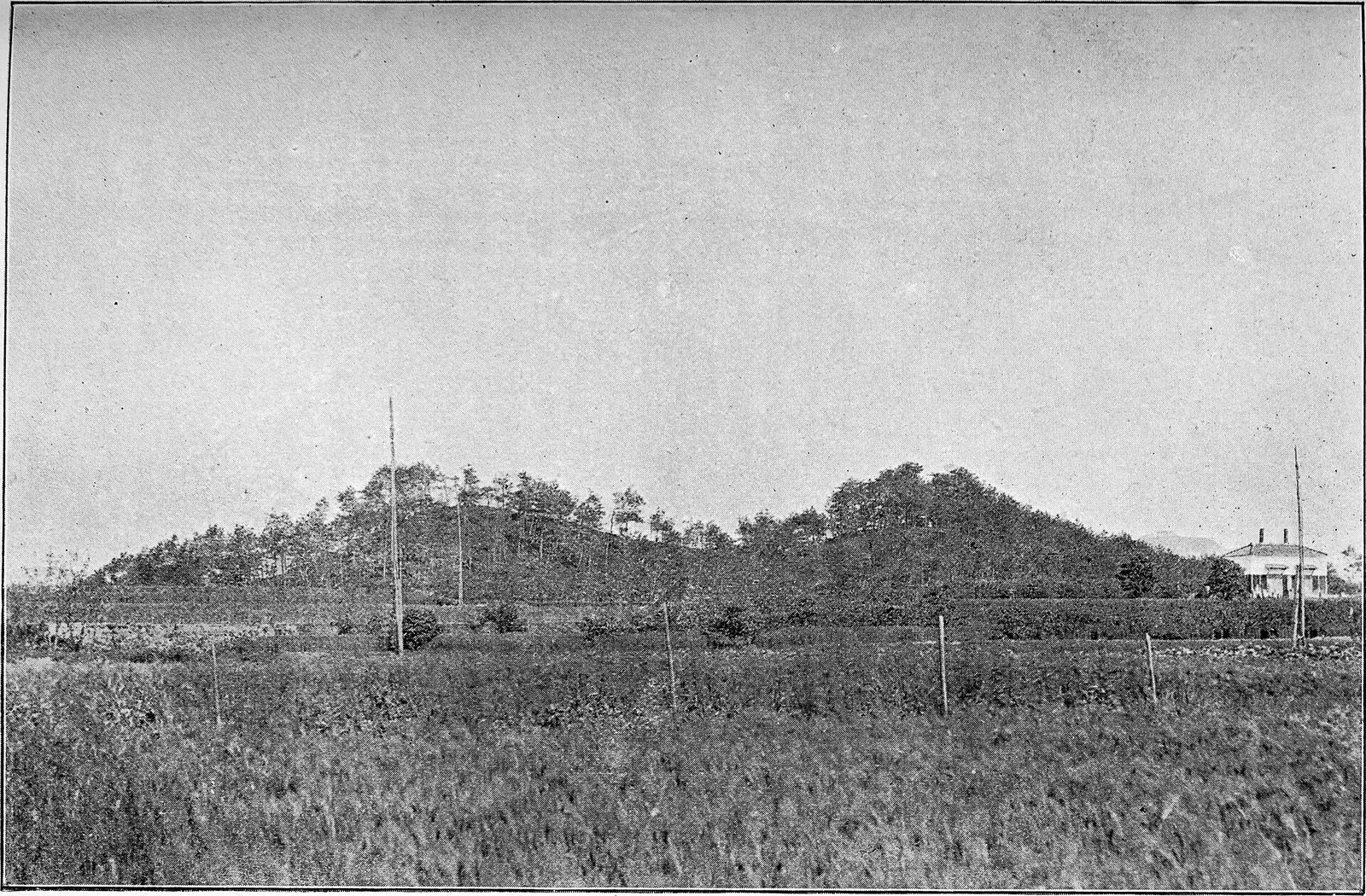
Misasagi of Ingiō Tennō.
THE EMPEROR ANAHO.
(ANKŌ[39] TENNŌ.)
The Emperor Anaho was the second child of the Emperor Wo-asa-tsuma waku-go no Sukune.
One account says:—"The third child."
(XIII. 18.) His mother's name was Osaka no Oho-nakatsu-hime no Mikoto. She was the daughter of the Imperial Prince Waka-nuke-futa-mata.[40]
The Emperor died in the 42nd year of his reign, Spring, the 1st month. In Winter, the 10th month, the funeral ceremonies were completed. At this time the Heir Apparent was guilty of a barbarous outrage in debauching a woman. The nation censured him, and the Ministers would not follow him, but all without exception gave their allegiance to the Imperial Prince Anaho. Hereupon the Heir Apparent wished to attack the Imperial Prince Anaho, and to that end secretly got ready an army. The Imperial Prince Anaho also raised a force, and prepared to give battle. It was at this time that the terms "Anaho arrow-notch" and "Karu arrow-notch"[41] began. Now the Heir Apparent, knowing that the Ministers would not follow him, and that the people were uncompliant, went away and hid in the house of the Mononobe, Ohomahe no Sukune. The Imperial Prince Anaho, hearing this, forthwith surrounded it. Ohomahe no Sukune came forth from the gate to meet him, upon which the Imperial Prince Anaho made a song, saying:—
To Oho-maheWo-mahe[42] Sukune's
Metal-gate's shelter,
Thus let us repair,
And wait till the rain stops.
Ohomahe no Sukune made a song in answer, saying:—
(XIII. 19.) Because the courtier'sGarter-bell
Has fallen off,
The courtiers make a noise:
Ye country-folks also beware! (of making a noise)[43]
So he addressed the Imperial Prince, saying:—"I beseech thee, harm not the Heir Apparent. Thy servant will advise with him." Accordingly the Heir Apparent died by his own hand in the house of Ohomahe no Sukune.
One account says that he was banished to the Land of Iyo.[44]
12th month, 14th day. The Imperial Prince Anaho assumed the Imperial Dignity, and the Empress was honoured with the title of "Grand Empress." The capital was forthwith removed to Isonokami.[45] It was called the Palace of Anaho.
At this time the Imperial Prince Ohohatsuse wished to betroth to him the daughters of the Emperor Midzuha-wake.[46]
[The names of these daughters are not found in any of the records.]
Hereupon the Imperial Princesses answered and said:—"Thou, my Lord, art much given to violence, and to sudden fits of anger, so that he who sees thee in the morning is slain in the evening, and he who sees thee in the evening is slain in the morning. Now, thy handmaidens' countenances are not distinguished for beauty, nor their minds for cleverness. If in manners and speech we should be no whit agreeable to the princely expectation, how shouldst thou receive us to thy intimacy? For this reason we are unable to obey thy commands." To the last they kept out of his way, and would not give ear to him.[47]
A.D. 454. 1st year, Spring, 2nd month, 1st day. On behalf of the Imperial Prince Ohohatsuse the Emperor desired to betroth to (XIII. 20.) him the Imperial Princess Hata-hi, a younger sister of the Imperial Prince Ohokusaka,[48] and for this purpose sent Ne no Omi, ancestor of the Omi of Sakamoto, to request her of the Imperial Prince Ohokusaka, saying:—"I beseech thee let me have the Imperial Princess Hata-hi, whom I desire to espouse unto the Imperial Prince Ohohatsuse." Hereupon the Imperial Prince Ohokusaka answered and said:—"Thy servant has for some time suffered from a severe illness, which cannot be healed. He may be compared to a ship which has taken in its cargo and is waiting for the tide. Death, however, is our destiny; and there is no sufficient reason for regret. Only I cannot die in peace because my younger sister, the Imperial Princess Hata-hi, will be left alone and unprotected. If now Your Majesty will not loathe her for her ugliness, and will allow her to complete the number of the duckweed flowers,[49] it will be a matter for the deepest gratitude. How should I decline the favour of thy commands? In order, therefore, to show my sincerity, I offer thee my private treasure, called the Oshiki[50] jewel head-dress [others say 'standing head-dress,' and others, again, Ihaki (rock-tree) head-dress], which I make so bold as to present to thee by the hand of Ne no Omi, the minister whom thou didst send to me. I beg thee to accept of it, although it is an object of no value, as a token of my good faith."
Hereupon Ne no Omi, when he saw the Oshiki jewel head-dress, was struck with its beauty, and the thought occurred to him of stealing it and making it his own treasure. So he falsely represented to the Emperor, saying:—"The Imperial Prince Ohokusaka refused to obey thy orders, and spake to thy (XIII. 21.) servant, saying:—'Shall he, though of the same house, have my younger sister to wife?' " Having done so, he retained the jewel head-dress, and did not present it to the Emperor, but made it his own.
Hereupon the Emperor believed Ne no Omi's slanderous words, and was greatly wroth. He raised an armed force, with which he surrounded the house of the Imperial Prince Ohokusaka and slew him.
At this time the Hikakas, Kishi of Naniha, father and sons, were all in the service of the Imperial Prince Ohokusaka, and they were all grieved that their lord should die without a crime. Accordingly the father took in his arms the Prince's head and the two sons took up each one of the Prince's legs and cried aloud, saying:—"Alas! Our Lord has died without a crime. Were we three, father and sons, who served him in life, not to follow him in death, we should be no true retainers." So they cut their throats, and died beside the Imperial corpse. The army, to a man, all wept tears. Upon this the Emperor took Nakashi hime,[51] the Imperial Prince Ohokusaka's wife, and bestowing her within the Palace, made her his concubine. Ultimately he sent for the Imperial Princess Hata-hi and gave her to the Imperial Prince Ohohatsuse to wife.
This year was the year Kinoye Mŭma (31st) of the Cycle.
A.D. 455. 2nd year, Spring, 1st month, 17th day. Nakashi hime no Mikoto was appointed Empress. The Emperor loved her exceedingly.
Before this time Nakashi hime no Mikoto bore Prince Mayuwa to the Imperial Prince Ohokusaka. On his mother's account he escaped punishment, and was always brought up within the Palace.
A.D. 456. 3rd year, Autumn, 8th month, 9th day. The Emperor was (XIII. 22.) assassinated by Prince Mayuwa [a detailed account is given in the history of the Emperor Ohohatsuse's reign]. After three years he was buried in the misasagi of Fushimi at Sugahara.
- Wo, male; Asa-tsuma (morning-wife) is the name of a place; wakugo, young child; Sukune, name of dignity.
- Ingiō is from the "Shooking," the Canon of Yaou, § 1, where Legge translates "sincerely courteous."
- The words translated infancy and puberty are in the original descriptive of the mode of dressing the hair at these periods of life in China.
- The precise meaning is doubtful.
- i.e. "the state."
- The "Kojiki" says that the Osaka Be was established as the Empress's na-shiro, which Chamberlain renders by "proxy." I would prefer to call it "name-sake." The object was to perpetuate the name of the Empress—at least, if this account is correct. But there was an Osaka Be already in existence. It is mentioned in the 39th year of Suinin's reign. Besides, the Osaka Be were the executioners, a circumstance with which it is difficult to reconcile the statement in the text. It is true, however, that the Empress's full name was Osaka no Oho-nakatsu hime, Osaka being the name of her residence.
- The Chinese character translated "sir" means literally head or chief. The Japanese word intended is probably Obito or Obuto, which, I take it, is an abbreviation of Oho-bito, great man. In Chinese Tajen (in Corean Tain), i.e. great man, is used as a personal pronoun in addressing men of rank. Our own word "master" (magister, magnus) has a somewhat similar history.
- Kowtow in Chinese.
- Inaki was a lower title than Miyakko.
- Literally surnames and personal names. What is really meant is titles. There were no proper surnames at this time. See above, p. 27.
- The word for "hundred surnames" is 百姓, which is also used for the nation generally, and in later times in Japan for the peasantry. Here its original meaning must be kept in view.
- The "Sei-shi-roku" contains numerous instances of this.
- Heaven, Earth, and Man. Vide Mayers, p. 302.
- Since the creation, as we would say.
- Uji.
- This measure can only have been applicable to a dominant caste. The nation cannot have all been subjected to the ordeal at Amagashi. Doubtless, then as now, the bulk of the people cared little for genealogies, and indeed had none but personal names.
- Below, XIV. 20, he is the son of Sotsuhiko.
- The interlinear kana has miya, palace, for 室, oftener rendered muro. But nihi-muro, new muro, is probably the word really meant.
- Koto.
- Otohime means simply "the younger lady."
- Clothing-pass-maiden. The "Kojiki" makes her the Emperor's daughter. Cf. Shelley's—
"Child of Light! thy limbs are burning,
Through the vest which seems to hide them." - As he was Toneri, the Ikatsu no Omi is clearly a mere title, like the no Kami's of recent times.
- Hence perhaps the name Soto-wori-hime, or the Lady who lives without, as opposed to Oho-nakatsu hime, the dame of the Great Interior.
- It was considered that when a spider clung to one's garments, it was a sign that an intimate friend would arrive. Little crab is another name for spider. Sotohori hime was in after times looked on as the "Muse of poetry." This poem is a regular Tanka, as are the others in this passage.
- Na-nori-ahi means "mutually to tell one's name," and mo is the general word for seaweed. There is a seaweed so called, but what this circumstance has to do with the story is not clear.
- The traditional kana has haha-hara-kara. As hara-kara by its derivation means "of the same womb," it is needless to prefix haha, mother. But this shows that when these kana glosses were written, hara-kara had come to mean simply brother or sister, as it does at present.
- Izanagi.
- The ahabi or Haliotis tuberculata.
- The prominence given to brotherhood and sisterhood by the same mother in the "Nihongi," as in Homer, has not, it appears to me, the significance attributed to it by McLennan's theory, which would trace back such terms to a time when the mother was the only parent as to whom there could be no doubt. It seems to me that the father's parentage is here taken for granted, the phrase really meaning brother or sister by the mother's side as well as by the father's, and that such phrases are merely indications of polygamous customs, not necessarily of promiscuity or polyandry.
- See Ch. K., Introd., p. xxxviii. I do not feel sure that Chamberlain is right in attributing to Chinese influence the stigma attached to unions of brothers and sisters of the full blood. See a paper on "The Family and Relationships in Ancient Japan," in the "Transactions of the Japan Society," 1892–93.
- A somewhat different version of this poem is given in the "Kojiki." See Ch. K., p. 296. I have adopted one or two of Motowori's emendations. See "Kojikiden," xxxix. 23. "Foot-dragging" is a makura-kotoba or conventional epithet of mountain, used because in ascending a mountain we drag one foot painfully after the other. At least, that is the common interpretation. The metre is somewhat irregular naga-uta.
- i.e. incest.
- The "Kojiki" makes the Prince to be banished and Motowori thinks with some reason that this must be the true version of the story. For one thing (he says), women have always been more lightly punished in Japan than men for the same offence, and the particular character of the fault in this case makes such a discrimination all the more reasonable. Moreover, it is hardly possible to construe the poem which follows otherwise than as composed by Prince Karu when about to be banished. An ancient note to the "Nihongi" (see below) speaks of the Prince as having died by his own hand in Iyo.
- The word for bed is tatami, now applied to the thick mats used to cover the floor of a Japanese house. At this time the tatami only covered the sleeping-place. There was a superstition forbidding people to meddle with the bed of an absent person, as to do so would bring down calamity on him. The word translated "respect" is yume, taboo, religious abstinence. The third line of this poem is literally "a ship-remainder," by which is understood "one who remains behind in a ship after the other passengers have landed." There are, however, other explanations. See Ch. K., p. 300.
- The metre of this poem is irregular. "Heaven soaring" is a conventional epithet applied to Karu, which is the name of a place, because Kari means "a wild goose"—hardly a sufficient reason to our Western minds.
- Seventy-eight, says the "Kojiki." Another authority says eighty. But his mother, the Empress Iha no hime, died A.D. 347, and she had ceased to cohabit with her husband A.D. 342 (see above, p. 285), so that he would be at least 110 at the time of his death.
- Anaho in Yamato.
- Horse-keepers.
- Ankō means peace.
- A son of Ōjin. See Ch. K., p. 242.
- The parallel passage of the "Kojiki" (Ch. K., p. 298) has "inside" for "notch," and an ancient note explains that in the case of Prince Karu's arrows, the "notch" or "inside" was of copper, whereas those of Prince Anaho were "like those of the present time," i.e. presumably of iron. Motowori thinks that the arrow-points are intended.
- It is a question whether Oho-mahe and Wo-mahe are one person or two brothers. The metre of this poem is imperfect Tanka.
- This is supposed to contain a remonstrance addressed to Prince Anaho's party for making a fuss about such a small matter as the escape of Prince Karu, which is compared to the loss of the grêlot of a courtier's garter.
- This is the "Kojiki" version.
- In Yamato.
- He died A.D. 411, at the age of 60, so these princesses were now (A.D. 453) not exactly young. They were his cousins by the father's side.
- This and many other stories in the "Nihongi" show that the position of women in these times was by no means one of abject dependence on their male relatives.
- They were children of the Emperor Nintoku, who died A.D. 399, aged 122. The "Shukai" suggests that the Prince and Princess here named were grandchildren, and not children of Nintoku, but the more obvious explanation of the difficulty is that the chronology is entirely untrustworthy.
- "An aquatic plant with peltate floating leaves, probably a Lemnanthemum, or marsh-flower." Williams. The allusion is to the opening stanzas of the first ode of the She-king, translated by Dr. Legge as follows:—
Kwan, Kwan go the ospreys
On the islet in the river.
The modest, retiring, virtuous, young lady:—
For our prince a good mate is she.
Here long, there short, is the duckweed
To the left, to the right, borne about by the current.
The modest, retiring, virtuous, young lady:—
Waking and sleeping he sought her.
- Oshiki means literally "push-wood" or "push-tree." Its application here is uncertain.
- The "Kojiki" gives here a different name.
BOOK XIV.
THE EMPEROR OHO-HATSUSE WAKATAKE.[1]
(YŪ-RIAKU[2] TENNŌ.)
The Emperor Oho-hatsuse Waka-take was the fifth child[3] of the Emperor Wo-asa-tsuma Waku-go no Sukune. When the Emperor was born, a supernatural radiance filled the building.[4] When he grew to manhood, he was distinguished for sturdy strength.
In the 8th month of the 3rd year of his reign, the Emperor Anaho went to the Mountain Palace with the intention of taking the hot baths. At length he went up into a lofty tower and was enjoying the prospect. Accordingly he commanded sake to be brought and a banquet to be held. So then, whilst his mind was at ease and his pleasure at its height, in the course of conversation he turned to the Empress and addressed her, saying:—
[The daughter of the Emperor Izahowake was called the Imperial Princess Nakashi hime. She was also called the Imperial Princess Nagata no Oho-iratsume. The Imperial Prince Ohokusaka, a child of the Emperor Oho-sazaki, took to wife the Imperial Princess Nagata, who bore to him Prince Mayuwa. Afterwards the Emperor Anaho, giving heed to the slander of Ne no Omi, put to death the Imperial Prince Ohokusaka and appointed the Imperial Princess Nakashi hime Empress. An account of this is given in the history of the reign of Anaho Tennō.]
"Our younger sister" [it seems to have been the ancient custom to address one's wife as "younger sister"], "although thou art Our friend, We fear Prince Mayuwa." Now Prince Mayuwa—who was only a boy—was playing below the tower, and heard everything that was said. Afterwards the Emperor Anaho, making a pillow of the Empress's knees, fell asleep in daylight (XIV. 2.) drunkenness. Hereupon Prince Mayuwa, watching the time when he was sound asleep, stabbed and murdered him. On this day one of the Oho-toneri ran [his name and surname are wanting[5]], and said to the Emperor[6]:—"The Emperor Anaho has been murdered by Prince Mayuwa." The Emperor was greatly shocked, and straightway being suspicious of his elder brothers, put on his armour and girded himself with his sword. Taking command of his troops in person, he urgently questioned the Imperial Prince Yatsuri no Shiro-hiko. The Imperial Prince, seeing that he wished to do him a mischief, sat silent and said not a word. So the Emperor drew his sword and slew him. Next he urgently questioned the Imperial Prince Sakahi no Kurohiko. But this Imperial Prince also knew that he was about to do him a mischief, and sat silent, saying not a word.[7] The Emperor's rage became still more violent, so with the further object of killing Prince Mayuwa as well, he examined him as to the reason of his conduct. Prince Mayuwa said:—"Thy servant has never sought the Celestial Dignity. He has only revenged himself on his father's enemy." The Imperial Prince Sakahi no Kurohiko, who feared profoundly the suspicion in which he was held, communicated secretly with Prince Mayuwa, and they at last found an opportunity (XIV. 3.) of getting away together. They fled to the house of the Oho-omi[8] Tsubura. The Emperor sent a messenger to ask for them. The Oho-omi replied by a messenger, saying:—"I may possibly have heard of a vassal in time of trouble taking refuge in a Royal chamber, but I had never seen Princes conceal themselves in the house of a vassal. At this very time the Imperial Prince Sakahi no Kurohiko and Prince Mayuwa, trusting profoundly in thy servant's heart, have come to thy servant's house. How can I have the heart to send them to thee?" In consequence of this the Emperor raised a still greater army and surrounded the Oho-omi's house. The Oho-omi came out, and standing in the courtyard, tied his garters. At this time the Oho-omi's wife brought the garters, and heart-broken, alas! made a song, saying[9]:—
The Omi childCloth trousers
Nine-fold having put on—
Standing in the courtyard
His garters he adjusts!
The Oho-omi, when he had finished dressing, advanced to the gate of the camp, where he knelt down and said:—"Thy servant cannot obey thy orders, even though his refusal costs him his life. There is a saying of a man of old, 'The will of even a common man cannot be taken from him.'[10] This is precisely thy servant's case. I humbly beseech the Great Prince to allow thy servant's daughter, Kara-hime, and the seven buildings[11] of Katsuraki, which I now offer thee, to be received as a (XIV. 4.) ransom for their offences." The Emperor would not permit it, but set fire to the houses and burnt them. Hereupon the Oho-omi with the Imperial Prince Kurohiko and Prince Mayuwa were all burnt to death together. Now Nihe no Sukune, Muraji of the Sakahi Be, took in his arms the Imperial Prince's dead body and so was burnt to death. His household [the names are wanting[12]] took up that which was burnt, but were never able to sort out the bones. They were deposited in one coffin and buried together on the hill south of Tsukimoto in Imaki no Aya.[13]
Winter, 10th month, 1st day. The Emperor resented the Emperor Anaho's having formerly wished to transfer the kingdom to the Imperial Prince Ichinobe no Oshiha,[14] and to commit the succession definitively to his charge. So he sent a man to the Imperial Prince Ichinobe no Oshiha, and treacherously arranged with him to go a-hunting. Inviting him to go on an excursion to the moors, he said:—Kara-bukuro,[15] the Kimi of the Sasaki mountain in Ohomi, tells me (XIV. 5.) that now on the Kaya moor in Kutawata in Ohomi, there are wild boars and deer in plenty. The horns they bear are like the twigs of withered trees, their legs are thick together like a grove of bushes, the breath which they breathe resembles the mists of morning. Along with the Imperial Prince, I wish in the first month of winter, when the sky is cloudy and the cold wind blows keenly, to go for an excursion to the moors, where we may somewhat divert our minds by running archery."[16] The Imperial Prince Ichinobe no Oshiha accordingly followed the hunt. Hereupon the Emperor Ohohatsuse drew his bow and putting his horse to a gallop, called out falsely, saying, "There is a wild boar!" and shot the Imperial Prince Ichinobe no Oshiha dead. A man of the Imperial Prince's household named Uruwa, of the Saheki Be [another name is Nakachiko], took the dead body in his arms. In his consternation he knew not what to do, but writhed on the ground and called aloud upon his master, going to and fro. The Emperor put him to death also.
In this month the Imperial Prince Mimŭma,[17] who had formerly been pleased with Musa, a place belonging to the (XIV. 6.) Kimi of Miwa, and wishing to shake off his cares, went thither. While on his way he unexpectedly fell in with a force which had been sent against him.[18] He joined battle with them at the well of Iha in Miwa, but was soon taken prisoner. When about to be executed, he pointed to the well and pronounced a curse, saying:—"This water may be drunk by the people only: royal persons alone may not drink of it."
11th month, 13th day. The Emperor ordered commissioners to erect a lofty pavilion at Asakura in Hatsuse,[19] in which he assumed the Imperial Dignity, and at last established the Palace. He appointed Matori, Heguri no Omi as Oho-omi and Muruya, Oho-tomo no Muraji and Me, Mononobe no Muraji he made Ohomuraji.[20]
A.D. 457. 1st year, Spring, 3rd month, 3rd day. The Imperial Princess Kusaka no Hatahi hime was appointed Empress. [Another name for her is Tachi-bana-hime.]
In this month three concubines were appointed. The senior of these, named Kara-hime, daughter of the Oho-omi of Tsubura in Katsuraki, was the mother of the Emperor Shiraga take-hiro-kuni-oshi Waka-Yamato-neko, and of the Imperial Princess Waka-tarashi-hime. [Also called the Imperial Princess Taku-hata no Iratsume.] This Imperial Princess (XIV. 7.) attended to the sacrifices of the Great Deity of Ise.[21] Next there was Waka-hime, daughter of the Omi of Kibi no Kamutsumichi.[22] [One book says she was the daughter of Kibi no Kuboya no Omi.] She bore two sons. The elder was called the Imperial Prince Ihashiro, and the younger the Imperial Prince Hoshikaha no Waka-miya. Next there was Woguna Kimi, daughter of Fukame, Omi of Wani in Kasuga. She was the mother of Princess Kasuga no Oho-iratsume [also called Princess Takahashi.] Woguna Kimi was originally an Uneme. The Emperor gave one night to her and she became pregnant. Ultimately she gave birth to a girl. The Emperor had suspicions and would not bring her up. When the girl was able to walk, the Emperor was in the great hall with the Oho-muraji Me, of the Mononobe, in attendance on him. The girl crossed the courtyard. Me, the Ohomuraji, looking round, said to the Ministers:—"What a pretty girl! There is a saying of the men of old, 'Thou art like thy mother.'[23] [This ancient saying is not clear.] Whose little girl is she said to be who is walking with leisurely pace in the pure court?" The Emperor said:—"Why dost thou ask?" Me no Ohomuraji answered and said:—"When thy servant looks at this little girl walking, she appears to him strongly to resemble the Emperor." The Emperor said:—"Every one who sees her makes the same remark. Sed insolitum est, quum ei unam solum noctem dederim, eam concepisse et filiam peperisse. Quam ob rem suspiciones mihi excitatae sunt." Ohomuraji dixit:—"Sed in hac unâ nocte quoties cum eâ rem habuisti?" "Septies," inquit (XIV. 8.) Imperator. Ohomuraji loquitur:—"Si haec femina puro corpore et purâ mente recepit unam noctem quam ei dedisti, cur tam facile concipis suspiciones et nolis fidere alterius castitati? Servus tuus audivit feminas quae facile praegnantes fiant vel tactu braccarum concipere. Multo magis, quum totam noctem dederis, sine justâ ratione non debes suspiciones concipere."
The Emperor, by order to the Ohomuraji, made the little girl an Imperial Princess, and appointed her mother to be a concubine.
This year was the year Hinoto Tori (34th) of the Cycle.
A.D. 458. 2nd year, Autumn, 7th month. Iketsu hime of Pèkché,[24] in despite of the Emperor's intention to favour[25] her, had an amour with Tate of Ishikaha.
In an old book it is said:—"Tate, the ancestor of the Obito of Momoahi in Ishikaha."
The Emperor was greatly enraged, and giving his commands to the Ohomuraji Muruya, of the Ohotomo House, sent some Kume Be who stretched the four limbs of the woman on a tree. The tree was placed over a cupboard, which was set fire to, and she was burnt to death.
The "Shinsen"[26] of Pèkché says:—"In the 6th year of the Cycle[27] King Kèro ascended the throne. The Emperor sent Aretoku hither to ask for a nyörang. Pèkché adorned the daughter of the Lady Moni, called the Nyörang Chök-ké, and sent her as tribute to the Emperor."[28]
Winter, 10th month, 3rd day. The Emperor made a progress to the Palace of Yoshino, and on the 6th he proceeded to Mimase. Giving orders to the wardens, he indulged in the chase. They climbed the towering peaks, they crossed the (XIV. 9.) wide jungles. Before the shadows fell, out of ten, seven or eight had been caught. Every time they hunted, they caught many, so that the birds and beasts were almost exhausted. At length they rested by the springs and groves, and sauntered together in the thickets and meadows. Halting his footmen, the Emperor counted the chariots and horses. Then he inquired of the Ministers, saying:—"It is a pleasure of the hunting-field to make the stewards cut up the fresh meat. Suppose that you and We cut it up ourselves?" The Ministers were taken aback and could find no answer. Hereupon the Emperor became very wroth, and drawing his sword, slew one of the stewards named Mumakahi of Ohotsu. On this day the Imperial cortège arrived from the Yoshino Palace. The people of the province all shook with fear. In consequence the Grand Empress and the Empress, hearing of this, were full of apprehension, and sent to meet him Hi-no-hime, the Uneme of Yamato,[29] to offer him sake. The Emperor, seeing the beauty of the Uneme's countenance,[30] and the elegance of her appearance, softened his looks, and with a pleased expression, said:—"How should I not wish to behold thy pleasing smile?" So (XIV. 10.) hand in hand with her, he entered the hinder palace, where he addressed the Empress Dowager, saying:—"In to-day's hunt we took many birds and beasts. We wished along with the Ministers to cut up the fresh meat and to have a banquet on the moor. But having proposed this to them, not one of them gave us an answer. Therefore did We get angry." The Empress Dowager, knowing the feeling which dictated these words of the Emperor, mollified him, saying:—"The Ministers did not understand that your Majesty, in connection with the sport on the hunting-field, was establishing a Fleshers' Be, and therefore did condescend to ask their opinion, so that their silence was reasonable, and it was hard for them to reply. But even now it is not too late to offer them.[31] I will make a beginning with myself. My steward Nagano is good at making mince meat.[32] I beg permission to present him to thee." The Emperor knelt down and accepted him, saying:—"It is good." This is what the rustic means when he says:—"The nobles understand each other's hearts." The Empress Dowager saw the Emperor's gratification, and pleasure filled her bosom. She further wished to offer men, and said:—"There are my two scullions, Masakida and Takame,[33] of the Mito Be of Uda. I beg leave to add these two men to the others to form a Fleshers' Be." From this time forward Akoko no Sukune, the Miyakko of the province of Yamato, sends some of the (XIV. 11.) Kotori Wake of Saho to form the Fleshers' Be. The Omi, the Muraji, the Tomo no Miyakko, and the Kuni no Miyakko also, following (the Empress's example), presented some, one after another.
In this month the Fumubito[34] Be, and the Toneri[35] Be of Kahakami, were instituted.
The Emperor, taking his heart for guide, wrongfully slew many men. The Empire censured him, and called him "The greatly wicked Emperor." The only persons who loved him were Awo Musa no Suguri[36] of the Scribes' Be and Hakatoko, Hinokuma no Tami-tsukahi.[37]
A.D. 459. 3rd year, Summer, 4th month. Kunimi, Abe no Omi [His other name was Shikotohi], uttered a slander respecting the Imperial Princess Taku-hata and Takehiko, Ihoki Be no Muraji, the bath-official, saying:—"Takehiko has had illicit intercourse with the Imperial Princess." Takehiko's father, Kikoyu, hearing (XIV. 12.) this rumour, was afraid lest calamity might overtake himself, and persuaded Takehiko to come with him to the River Ihoki. There, pretending to make cormorants dive into the water to catch fish, he took him unawares and slew him. When the Emperor heard this, he sent messengers to question the Imperial Princess. The Imperial Princess answered and said:—"Thy handmaiden knows nothing." Suddenly the Imperial Princess took a divine mirror and went to Isuzu no Kahakami,[38] and watching for a time when no one was passing, buried the mirror, and hanged herself. The Emperor became suspicious on account of the Imperial Princess's absence, and constantly sent persons in the dead of night to search in all directions. When they came to Kahakami, a rainbow appeared, like unto a serpent, four or five rods in length. When they dug the place from which the rainbow sprang they found the divine mirror, and no great distance off, they discovered the Imperial Princess's body. On ripping her open and making examination, there was in her belly something like water, and in the water there was a stone. Kikoyu was thus enabled to establish his son's innocence, but on the other hand he had remorse for having slain him. He revenged him by killing Kunimi, and then fled and hid in the Shrine of Isonokami.
A.D. 460. 4th year, Spring, 2nd month. The Emperor went a-hunting (XIV. 13.) with bow and arrows on Mount Katsuraki. Of a sudden a tall man appeared, who came and stood over the vermilion valley.[39] In face and demeanour he resembled the Emperor. The Emperor knew that he was a God, and therefore proceeded to inquire of him, saying:—"Of what place art thou Lord?" The tall man answered and said:—"I am a God of visible men.[40] Do thou first tell thy princely name, and then in turn I will inform thee of mine." The Emperor answered and said:—"We are Wake-take no Mikoto." The tall man next gave his name, saying:—"Thy servant is the God Hito-koto-nushi."[41] He finally joined him in the diversion of the chase. They pursued a deer, and each declined in favour of the other to let fly an arrow at him. They galloped on, bit to bit, using to one another reverent and respectful language, as if in the company of genii. Herewith the sun went down, and the hunt came to an end. The God attended on the Emperor and escorted him as far as the Water of Kume. At this time the people all said:—"An Emperor of great virtue!"
Autumn, 8th month, 18th day. The Emperor made a progress to the Palace of Yoshino.
28th day. He made a progress to Kahakami no Ono,[42] where he commanded the forest wardens to drive the wild beasts. He lay in wait hoping to shoot them himself, when a gad-fly came swiftly flying. Then a dragon-fly flew thither suddenly, bit the gad-fly, and went away with it. The Emperor was pleased at its attention, and commanded his Ministers, saying:—"Do ye on Our behalf compose an ode in praise of this (XIV. 14.) dragon-fly." As none of the Ministers made so bold as to compose an ode, the Emperor forthwith composed a short piece,[43] saying:—
These tidings some oneTold in the Great Presence,
How in Yamato
On the Peak of Womura
Four-footed game was lying:
The Great Lord,
When he heard this,
Stood at his throne
Entwined with jewels,
Stood at his throne
Entwined with cloth:
Waiting for the game
Whilst I[44] remained:
Waiting for the wild-boar
Whilst I was standing,
My arm in the fleshy part,
Was stung by a gad-fly:
But soon a dragon-fly
That gad-fly did bite.
Even a creeping insect
Waits upon the Great Lord.
Thy form it will bear,
O Yamato, land of the dragon-fly![45]
One book has, instead of "the great presence," "the great Lord."
One book has, instead of "stood at his throne," "remained in his throne."
One book has, instead of from "even a creeping insect" (inclusive) to the end, the following:—
That in this wise
It should be famous,
The Heaven-filling[46]
Land of Yamato
Was called the Land of the Dragon-fly.[47]
Therefore in honour of the Dragon-fly this place was called (XIV. 15.) Akitsu no.[48]
A.D. 461. 5th year, Spring, 2nd month. The Emperor hunted on Mount Katsuraki. Suddenly there came a supernatural bird, in size like a sparrow, with a long tail which trailed upon the ground. Now this bird chirruped, saying:—"Have a care! Have a care!" Then suddenly there appeared, issuing furiously from the herbage, a raging wild boar of which they had been in chase, and pursued the men. The huntsmen in great terror climbed up into trees. The Emperor commanded his attendants, saying:—"When a savage beast meets with man, it straightway halts. Encounter it with a shot from your bows, and then stab it." The attendants were of an effeminate nature. They climbed up trees, and changed countenance, and their five senses were masterless. The raging wild boar came straight on, and tried to bite the Emperor. But the Emperor with his bow pierced it and stayed its course. Then, raising his foot, he killed it with a kick. Hereupon, when the chase was over, he wanted to cut down the attendants. The attendants, when about to be executed, made a song, saying:—
Oh! my elder brother,Thou alder-tree branch—
Over Ariwo,
To which I climbed up in flight,
Dreading
(XIV. 16.) The snorting of the wild-boar,
That was shot
By Our great Lord
Who rules peacefully![49]
The Empress, hearing their lament, was sorry for them, and tried to stay (the execution). The Emperor said:—"The Empress is taking part, not with the Emperor, but with the attendants." She answered and said:—"The people all say, 'His Majesty is fond of the chase, and loves game. Is not this wrong?' If now Your Majesty, on account of a savage boar, puts to death your attendants, Your Majesty is, as it were, not different from a wolf." The Emperor with the Empress went up into their carriage and returned home. Amid cries of "Long live the Emperor!" he said:—"How delightful is this! Everybody has caught game, and We have caught good words, which We have brought back with us."[50]
Summer, 4th month. Lord Kasyuni [i.e. King Kèro] of Pèkché, having learnt by rumour that Iketsu hime [viz. the Nyörang Chök-ke] had been put to death by burning,[51] held counsel, saying:—"The ancient custom of sending tribute of women to be made Uneme is contrary to decorum, and is injurious to our country's reputation. Henceforward it is unmeet that women be sent as tribute." Accordingly he intimated to his younger brother, Lord Kun[52] [i.e. Lord Kon-chi], saying:—"Do thou go to Japan,[53] and serve the Emperor." Lord Kun answered and said:—"My Lord's commands must not be disobeyed. I pray thee give me one of thy consorts, and then I will undertake this mission." Lord Kasyuni (XIV. 17.) accordingly took one of his consorts who was pregnant, and having given her in marriage to Lord Kun, said:—"The month for the delivery of this pregnant consort of mine has already arrived. If she should be delivered on the journey, I pray thee place (the child) on board a ship, and whatever place thou mayest have arrived at, cause it to be at once sent back to this country." So at last he took his leave, and went on his mission to the (Japanese) Court.
6th month, 1st day. The pregnant consort realized the words of Lord Kasyuni, and gave birth to a child in the island of Kahara in Tsukushi. So this child was given the name of Lord Shima.[54] Upon this Lord Kun straightway took a ship and sent Lord Shima to his country. He became King Munyöng. The people of Pèkché call this island Chuto.[55]
Autumn, 7th month. Lord Kun entered the capital. After this he had five children.
The Pèkché Shinsen says:—"In the year Kanoto ushi (A.D. 461[56]) King Kèro sent his younger brother, Lord Konchi, to Great Wa, to wait upon the Emperor and to confirm the friendship of former sovereigns."
A.D. 462.) 6th year, Spring, 2nd month, 4th day. The Emperor made an excursion to the small moor of Hatsuse. There, viewing the aspect of the hills and moors, in an outburst of feeling, he made a song, saying:—
The mountains of Hatsuse,The secluded—
They stand out
Excellent mountains!
They run out
Excellent mountains!
The mountains of Hatsuse,
The secluded—
Are full of various beauties!
Are full of various beauties![57]
Hereupon he gave a name to the small moor, and called it Michi no Ono.[58]
(XIV. 18.) 3rd month, 7th day. The Emperor wished to make the Empress and his concubines plant mulberry trees with their own hands, in order to encourage the silk industry. Hereupon he gave orders to Sukaru [This is a personal name] to make a collection of silkworms throughout the country. Now Sukaru made a mistake and collected babies,[59] which he presented to the Emperor. The Emperor laughed greatly, and gave the babies to Sukaru, saying:—"Do thou bring them up thyself." Accordingly Sukaru brought them up hard by the Palace enclosure. So he was granted a title, and was called Chihisako Be[60] no Muraji.
Summer, 4th month. The Land of Wu[61] sent envoys with tribute.
A.D. 463. 7th year, Autumn, 7th month, 3rd day. The Emperor commanded Sukaru Chihisako Be no Muraji, saying:—"It is our desire to see the form of the Deity of Mimuro Hill. [Some say that the Diety of this mountain is Oho-mono-shiro-nushi no Kami. Others say Uda no Sumi-zaka no Kami.] Thou dost excel in strength of body. Go thyself, seize him, and bring him here." Sukaru answered and said:—"I will make the attempt, and go to seize him." So he ascended the Hill of Mimuro and caught a great serpent, which he showed the Emperor, who had not practised (religious) abstinence. Its thunder rolled, and its eyeballs flamed. The Emperor was afraid, and, covering his eyes, would not look upon it, but fled into the interior of the Palace. Then he caused it to be let loose on the Hill, and giving it a new name, called it Ikadzuchi.[62]
(XIV. 19.) 8th month. One of the Toneri named Oho-sora,[63] of the Bow-makers' Be of Kibi, went home on some urgency. Sakitsuya Omi of Lower Kibi [In one book it says:—"The Kuni no Miyakko, Yama, Kibi no Omi"], detained Oho-sora, and for several months would not consent to allow him to go up to the capital. The Emperor sent Mike no Kimi, a man of valour, to fetch him. Oho-sora came in obedience to the summons, and said:—"Sakitsuya took young girls to represent the Emperor's men, and grown-up women to represent his own men. Then he made them fight with one another, and on seeing that the young girls were victorious, drew his sword and slew them. At another time he took a small cock, which he called the Emperor's cock, and pulled out its feathers and clipped its wings. Then he took a large cock, which he called his own cock, attached to it a bell,[64] and armed its spurs with metal. Then he matched them together, and when the naked bird got the better of the other, he again took out his sword and killed it." When the Emperor heard this story, he sent thirty soldiers of the Monono Be, who put Sakitsuya to death, with seventy persons of his household.
This year Tasa, Omi of Upper Kibi, while on duty beside the Palace, praised Waka-hime abundantly to his friends, (XIV. 20.) saying:—"Of all the beautiful women in the Empire, there is none to compare with my wife. How blooming! How gentle! How graced with various charms! How radiant! How genial! What perfection in every feature! She uses not flower of lead:[65] she adds not oil of orchids. Through the wide ages her equals are but few: in the present day she stands alone and peerless." The Emperor inclined his ear, and listening from a distance, rejoiced in his heart. So with the object of obtaining Waka-hime for himself, and making her one of his concubines, he appointed Tasa Governor of Imna,[66] and promptly favoured Waka-hime. When Tasa no Omi wedded Waka-hime, she bore to him Ye-kimi and Oto-kimi."[67]
Another book says:—"Tasa no Omi's wife, by name Ke-hime, was the daughter of Tamado no Sukune, son of Katsuraki no Sotsuhiko. The Emperor, hearing of the serene beauty of her form, slew her husband, and wedded her himself."
After Tasa had arrived at his post, he learnt that the Emperor had married his wife, and with the object of obtaining succour, he went to Silla, which at that time did not do service to the Central Land.[68] The Emperor gave orders to Tasa no Omi's son Otokimi, and also to Akawo Kibi no Ama[69] no Atahe, saying:—"Do ye go and chastise Silla." At this time (XIV. 21.) a skilled artisan of Western Aya named Kwan-in Chiri,[70] who was near the Emperor, came forward and represented to him, saying:—"There are in the Land of Han[71] many who are more skillful than thy slave. Let them be sent for and made to serve thee." The Emperor commanded his Ministers, saying:—"Then let Kwan-in Chiri be joined to Otokimi and the others, and let him get instructions from Pèkché; at the same time let an Imperial rescript be delivered directing Pèkché to offer skilled men."
Hereupon Otokimi, in execution of these commands, took with him a body of men and proceeded as far as Pèkché. When he entered that land, a God of the country,[72] assuming the form of an old woman, suddenly met him on the road. Otokimi inquired of her whether the country was far or near. The old woman answered and said:—"If thou goest on for one day more, thou wilt then arrive there." Otokimi thought to himself that the way was too far, and returned without having chastised it. He got together the Imaki[73] skilled artisans who had been given as tribute by Pèkché on a large island, and under the pretence of awaiting a fair wind, tarried there for several months. Tasa no Omi, the Governor of Imna, pleased that Otokimi had gone away without chastising Silla, secretly sent a man to Pèkché, to warn Otokimi, saying:—"Is thine own head so firm that thou canst chastise others? A report has reached me that the Emperor has wedded my wife, with the result that he has had children by her. [The children are mentioned above.[74]] As I now fear that calamity may reach my own person, it is well that I should (XIV. 22.) wait with foot uplifted. Do thou, my son, come over and betake thyself to Pèkché, and prevent it from communicating with Japan, while I will repair to and hold Imna, and will also hold no communication with Japan." Otokimi's wife Kusu-hime had profound patriotic sentiment; the sense of duty between lord and vassal was strong in her; her loyalty surpassed the bright sun; her principles excelled the evergreen fir. She abominated such treason, and having stealthily killed her husband, secretly buried him in the chamber. Then she remained in the large island with Akawo, Ama no Atahe, in charge of the skilled artisans presented by Pèkché. The Emperor, hearing that Otokimi was missing, sent Katashiha, Hitaka no Kishi, and Ko An-chön.[75] These messengers together made their report to the Emperor. They[76] were accordingly ultimately settled in the village of Hirokitsu in Ato in the province of Yamato, where many of them died of disease. In consequence of this, the Emperor commanded Muruya, Ohotomo no Ohomuraji, to instruct Tsukami, Yamato no Aya[77] (XIV. 23.) no Atahe to remove Ko-kwi, of the Potters' Be, Kyön-kwi, of the Saddlers' Be, In-să-ra-ka, of the Painters'[78] Be, Chöng-an-na, of the Brocade-weavers' Be, and Myo-an-na, the Interpreter, all belonging to the New Aya,[79] to other residences at the following three places, viz., Upper Momohara, Lower Momohara, and Magami no Hara.
A certain book says:—"Otokimi, Kibi no Omi, returned from Pèkché, and presented a Be of Aya workmen, a Be of tailors, and a Be of fleshers."
A.D. 461. 8th year, Spring, 2nd month. Awo, Musa no Suguri, and Haka-toko, Hinokuma no Tami-tsukahi, were sent to the Country of Wu.
From the accession of the Emperor up to this year eight years had now passed, during which the Land of Silla was refractory and given to vain talk, and did not send presents. Therefore they feared the intentions of the Central Land,[80] and cemented friendship with Koryö. Consequently the King of Koryö sent one hundred picked soldiers to guard Silla. After a while, one of these Koryö soldiers returned to his own (XIV. 24.) country on furlough. Now he took with him a Silla man as groom. Turning to him, he addressed him, saying:—"Thy country will be conquered by my country ere long." [One book says:—Thy country will in the end become our territory, and that ere long.] When the groom heard this, he pretended a pain in his belly, and retiring, remained behind. At length he made his escape to his own country, and told what had been said. Hereupon the King of Silla knew that Koryö's guard was mere pretence, and sent messengers to run and tell the people to kill the cocks kept in their houses. The people knew his meaning, and killed all the men of Koryö[81] resident in the country. Only one Koryö man was left, who seized an opportunity to effect his escape and flee to his own country, when he told the whole story. The king of Koryö accordingly raised an army and encamped by the city of Chhyuk-chong-nyu. [One book says the city of Tokushiki.] At length they made music, with song and dance. Hereupon the King of Silla, hearing in the night the Koryö army singing and dancing on all sides, became aware that the enemy had occupied the whole land of Silla. So he sent a man to the King of Imna, saying:—"The King of Koryö has attacked our country. At this present time, like the fringes sewn on a flag,[82] the condition of the land is more precarious than that of a pile of eggs. (XIV. 25.) The thread of life is short, and may not at all be reckoned. I humbly beg that the Japanese Authorities[83] will assist me with war generals."
Accordingly the King of Imna persuaded Ikaruga, Kashihade no Omi, Wonashi, Kibi no Omi, and Akameko, Naniha no Kishi to go to the assistance of Silla. Kashihade no Omi and the others halted before they reached the camp, and before the Koryö generals had fought with Kashihade no Omi and the others, they were all afraid. So Kashihade no Omi and his colleagues did their best to keep the troops in good heart, and urged them to get ready the means of attack. Then suddenly they advanced and took the offensive. For more than ten days they and the Koryö men kept watch on one another. When night came on they pierced a steep place, and made a hollow way, along which they passed all the baggage wagons and prepared an ambush. At dawn the Koryö men thought to themselves:—"Kashihade no Omi and the others are stealing away." So they came in pursuit with their whole army. Then the troops in ambush, both horse and foot, were let go, and taking them from both sides, put them to a great rout. It was from this that the enmity between the two countries sprang. [By the two countries are meant Silla and Koryö.]
Kashihade no Omi and his colleagues spake to Silla, saying:—"Thou with the utmost weakness wert pitted against the utmost strength, and had it not been for the assistance of the Government[84] troops thou wouldst assuredly have been taken at a disadvantage and thy territory annexed. By this campaign be warned never in future to be disobedient to the Celestial Court."[85]
A.D. 465. (XIV. 26.) 9th year, Spring, 2nd month, 1st day. Katabu,[86] Ofushi Kahachi no Atahe, and an Uneme were sent to sacrifice to the Deity of Munagata.[87] Katabu and the Uneme, having arrived at the altar-place,[88] were about to perform the rites, when Katabu debauched the Uneme. When the Emperor heard this, he said:—"When we sacrifice to the Gods and invoke from them blessings, should we not be watchful over our conduct?" So he sent Naniha no Hidaka no Kishi to put him to death. But Katabu straightway took to flight, and was not to be found. The Emperor again sent Toyoho, Yuge[89] no Muraji, who searched the districts of that province far and wide, and at length caught and slew him at Awi[90] no hara, in the district of Mishima.
3rd month. The Emperor desired to chastise Silla in person, but a God warned him, saying:—"Go not." For this reason the Emperor did not carry out his intention of going, but gave orders to Ki no Woyumi no Sukune, Soga no Karako no Sukune, Ohotomo no Katari[91] no Muraji, and Wokahi no Sukune, saying:—"Silla occupies the Western Land: age after age he has done us homage: he did not neglect visits of ceremony: his payment (XIV. 27.) of tribute was duly discharged. But since We have come to rule the Empire, he has betaken himself beyond Tsushima, and concealed his traces outside of Chamna. He prevents Koryö from sending tribute, he devours the walled cities of Pèkché. Nay, more—his missions of ceremony to this court have been neglected and his tribute remains unpaid. With the savage[85] heart of the wolf he flies away when satiated, and sticks fast when starving. I appoint you four ministers to be generals. Take a royal army and chastise him. Let the punishment of Heaven be reverently executed."
Hereupon Ki no Woyumi no Sukune laid a complaint before the Emperor through Ohotomo no Muruya no Ohomuraji, saying:—"Thy servant, although feeble and incompetent, will respectfully obey the Emperor's orders. But now thy servant's wife has departed this life, and there is nobody to take care of thy servant. Do Thou, my Lord, I beseech Thee, represent this matter fully to the Emperor." Hereupon Ohotomo no Muruya no Ohomuraji represented it fully. When the Emperor heard this complaint, he uttered a sigh of pity. He took an Uneme from the hither province of Kibi, Ohomi[92] by name, and giving her to Ki no Woyumi no Sukune, attached her to his person to take care of him. So at length he sent him off with a shove to his axle.
Ki no Woyumi no Sukune and the rest accordingly entered Silla, butchering as they went the districts along their way. (XIV. 28.) The King of Silla heard by night on all sides the drums of the Government army, and becoming aware that they had completely conquered the land of Tok,[93] fled in confusion with several hundred cavalry. Thereby ensued a great defeat. Woyumi no Sukune pursued and slew the enemy's general in the midst of his army. The whole land of Tok was reduced to order, but there was a remainder which would not submit. Ki no Woyumi no Sukune again withdrew his troops, and having effected a junction with Ohotomo no Katari no Muraji and the others, they again, with a great display of forces, fought with the remaining band. This evening Ohotomo no Katari no Muraji and Ki no Okazaki no Kume no Muraji were both slain while fighting with all their might. Tsumaro, a follower of Katari no Muraji, of the same surname,[94] afterwards came amongst the army and asked for his master. He went along the ranks and sought for him, making inquiry, and saying:—"Where is my master, Lord Ohotomo?" Then some one informed him, saying:—"Thy masters[95] have, indeed, been slain by the enemy," and pointed out to him the place where the dead bodies were. Tsumaro hearing this, leaped and exclaimed, saying:—"My master has fallen. What avails it that I alone should remain unhurt?" Accordingly he too went against the enemy, and in the same hour perished. Soon after, the rest of the band retired of their own accord, and the Government army also followed their example, and fell back. The general-in-chief, Ki no Woyumi no Sukune, fell ill and died.
Summer, 5th month. Ki no Ohiha no Sukune, when he heard that his father was dead, forthwith proceeded to Silla, and taking from Wokahi no Sukune his command of horse, foot (XIV. 29.) and ships, with the various lesser offices, exercised absolute authority. Hereupon Wokahi no Sukune had a profound resentment towards Ohiha no Sukune and made a false report to Karako no Sukune, saying:—"Ohiha no Sukune has told thy servant, saying:—'Ere long I will take the command of Karako no Sukune from him too.' I pray thee be well on thy guard." In consequence of this there was a coolness between Karako no Sukune and Ohiha no Sukune. Upon this the King of Pèkché, hearing that there was a coolness between the commanders arising out of trifling causes, sent a man to Karako no Sukune and the others, saying:—"I wish to view the frontier of the land. I pray you be so kind as to come and join me." Herewith Karako no Sukune and the rest went on with bridle-bits in a line until they came to a river, when Ohiha no Sukune let his horse drink from the river. Then Karako no Sukune shot at Ohiha no Sukune from behind, and hit the hinder part of his saddle frame. Ohiha no Sukune looked round startled, and shot Karako no Sukune down into the mid stream, so that he died. So the three Omi, having from before this time been rivals with one another, fell out by the way, and returned back without having reached the Palace of the King of Silla.
Hereupon the Uneme, Ohomi, following the dead body of Woyumi no Sukune, arrived in Japan. She at length complained to Ohotomo no Muruya no Ohomuraji, saying:—"Thy handmaiden knows not where to bury him. I beseech thee let a good place be selected by divination." The Ohomuraji accordingly reported to the Emperor, who gave command to the Ohomuraji, saying:—"The Commander-in-chief, Ki no Woyumi no Sukune, tossing his head like a dragon, and glaring like a tiger, surveying with extensive view the eight cords,[96] overwhelmed the rebellious, and dashed against the (XIV. 30.) four seas.[97] So his body was worn out by ten thousand ri,[98] and his life succumbed in the three Han. To show Our compassion, let there be appointed officials to conduct his funeral. Thou, my Lord Ohotomo, art of the same province and a near neighbour of the Lords of Ki, so that thy connection with him is of old standing." Hereupon the Ohomuraji, having received the Emperor's commands, sent Wotori Hanishi[99] no Muraji to construct a tumulus at the village of Tamuwa, and bury him there. Upon this Ohomi, unable to contain herself for pleasure, sent to the Ohomuraji six Corean slaves named Muro, Te-maro, Oto-maro, Mi-kura, Wogura and Hari.[100] They are the Yake-bito[101] Be of the village of Kashimada in hither Kibi. Wokahi no Sukune came specially in attendance on Ki no Woyumi no Sukune's corpse. He remained, however, himself in the Land of Tsuno[102] and sent Yamato-ko no Muraji [it is not clear what was the surname of this Muraji[103]] with a present of an eight-hand mirror to Ohotomo no Ohomuraji to make a petition, saying:—"Thy servant cannot bear to serve the Celestial Court along with my Lord of Ki.[104] Therefore I beg permission to remain and reside in the Land of Tsuno." Upon this the Ohomuraji laid the matter before the Emperor on his behalf, and he was allowed to remain and dwell in the Land of Tsuno. This was the beginning of the Tsuno no Omi first dwelling in the land of Tsuno, and being called Tsuno no Omi.
(XIV. 31.) Autumn, 7th month, 1st day. The province of Kahachi reported:—"The daughter of a man of the district of Asukabe named Hiakŭson, Tanabe no Fubito, was wife to a man named Kariu, Fumi no Obito, of the district of Furuchi.[105] Hiakŭson,
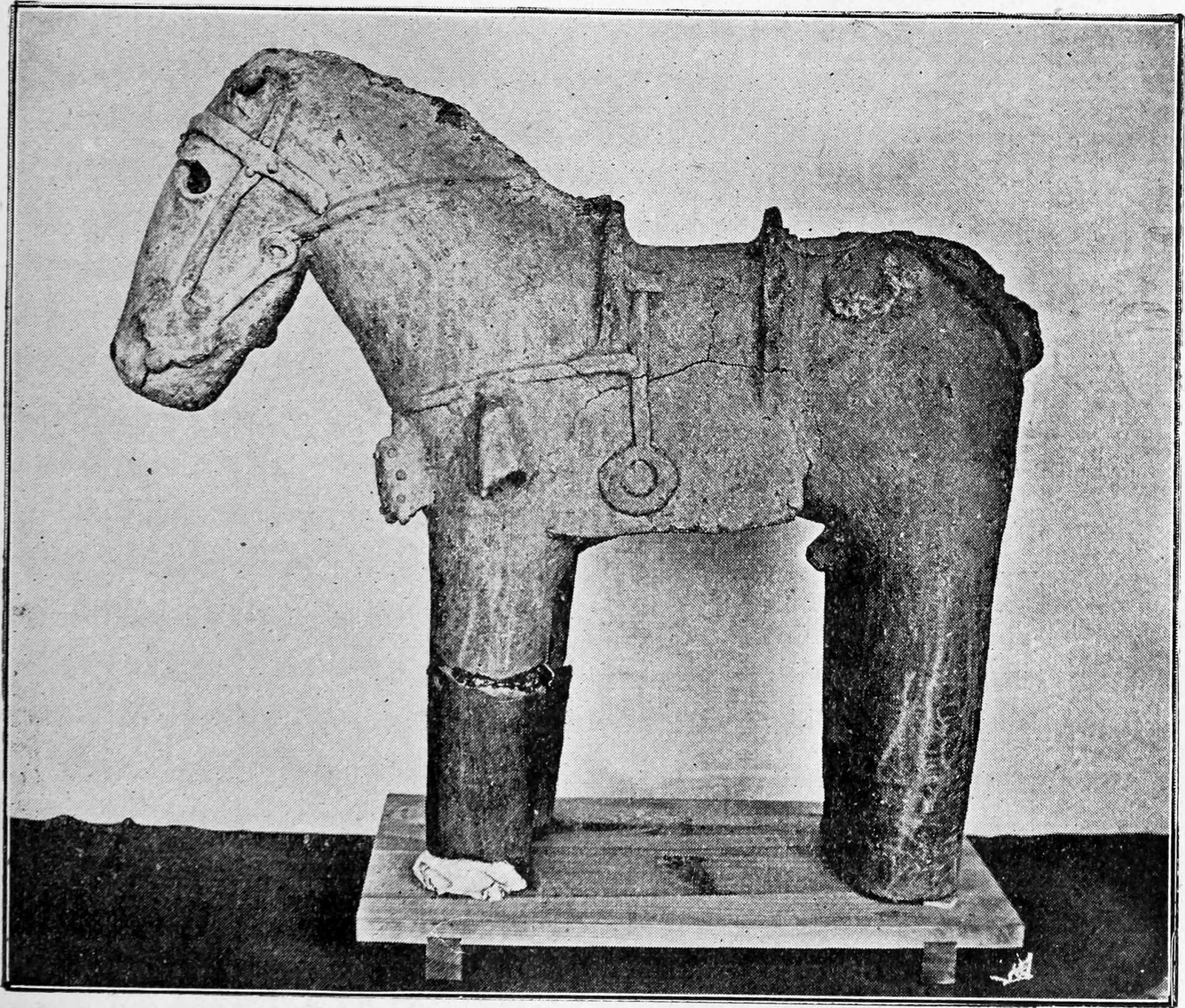
Clay Horse.
hearing that his daughter had given birth to a child, paid a visit of congratulation to his son-in-law's house. He came home by moonlight, and was passing at the foot of the Homuda[106] misasagi at Ichihiko hill, when he fell in with a horseman mounted on a red courser, which dashed along like the flight of a dragon, with splendid high springing action, darting off like a wild goose.[107] His strange form was of lofty mould; his remarkable aspect was of extreme distinction. Hiakŭson approached and looked at him. In his heart he wished to possess him, so he whipped up the piebald horse which he rode and brought him alongside of the other, head by head and bit by bit. But (XIV. 32.) the red horse shot ahead, spurning the earth, and, galloping on, speedily vanished in the distance. Hereupon the piebald horse lagged behind, and, slow of foot, could not overtake the other. But the rider of the courser, knowing Hiakŭson's wish, stopped and exchanged horses with him, upon which they took leave of each other and separated. Hiakŭson, greatly rejoiced at obtaining such a steed, hastened home and placed him in the stable, where he took off his saddle, foddered him, and went to sleep. The next morning the red courser had become changed into a horse of clay. Hiakŭson, wondering at this in his heart, went back, and, making search at the Homuda misasagi, found the piebald horse standing among the clay horses. So he took it, and left in its stead the clay horse which he had received in exchange.[108]
A.D. 466. 10th year, Autumn, 9th month, 4th day. Awo, Musa no Sukuri, and the others arrived in Tsukushi with two geese presented by Wu. These geese were bitten by Minuma no Kimi's dog and died.
Another book says:—"These geese were bitten by a dog (XIV. 33.) belonging to Nimaro, Tsukushi no Mine no Agata nushi, and died."
Hereupon Minuma no Kimi, unable to contain himself for fear and sorrow, presented to the Emperor ten large wild geese with bird-keepers, and begged that his offence might thus be compounded for. The Emperor granted his petition.
Winter, 10th month, 7th day. The bird-keepers presented by Minuma no Kimi were settled in two places, viz. the villages of Karu and Ihare.
A.D. 467. 11th year, Summer, 5th month, 1st day. It was reported from the district of Kurimoto in the province of Ohomi that white cormorants dwelt on the shore at Tanagami. Orders were therefore given to establish toneri[109] of Kahase.
Autumn, 7th month. There was a refugee from Pèkché who gave his name as Kwisin. It was also stated that Kwisin was a man of the Land of Wu. The Ihare no Kure[110] no Kotobiki and the Sakate no Yakata-maro are his descendants.
Winter, 10th month. A bird of the Bird-department was bitten by a dog belonging to a man of Uda and died. The Emperor was angry, and, branding him on the face, made him one of the Bird-keepers' Be. Hereupon some office coolies from the provinces of Shinano and Musashi, who were on night duty at the Palace, talked to one another, saying:—"Ah! In our country we pile up birds as high as a small tumulus and eat of (XIV. 34.) them morning and evening, but still some are left. Now, for the sake of one bird, the Emperor has branded a man on the face. He is a very unjust and wicked master." The Emperor, hearing this, ordered them to gather and make a heap (of birds), and as the office coolies were unable to complete it on the spot, he commanded that they should be enlisted in the Bird-keepers' Be.[111]
A.D. 468. 12th year, Summer, 4th month, 4th day. Awo, Musa no Sukuri, and Haka-toko Hinokuma no Tamitsukahi went on a mission to Wu.
Autumn, 10th month, 10th day. The Emperor commanded the carpenter Mita of Tsuke ["Mita of Winabe,"[112] says one book—probably erroneously] to commence the erection of a lofty edifice. Hereupon Mita ascended this high building, and ran about nimbly on all sides as if he were flying. An Uneme of Ise looked up to the top of this high edifice and marvelled at his nimble movements, so that she fell down on her face in the courtyard, and upset a dish of meat which she was serving to the Emperor. The Emperor forthwith suspected that Mita had debauched this Uneme, and conceiving to himself the thought of executing him, charged the Mononobe with this duty. At this time Hada no Sake[113] no Kimi was in attendance. He wished by the voice of his lute to make the Emperor understand, so placing his lute crosswise, and playing upon it, he said:—
(XIV. 35.) Be there for five hundred yearsProsperity
To the maid of Ise
Of Ise
(Of the divine wind),
And until it is spent
Let me attend
With faithful service
On the Great Lord.
Let my life, too,
Be as long,
Said the carpenter,
The poor carpenter![114]
Hereupon the Emperor understood the voice of the lute, and pardoned the offence.
A.D. 469. 13th year, Spring, 3rd month. Hadane no Mikoto, great-great-grandson of Saho-hiko,[115] secretly seduced the Uneme Yamanobe no Koshimako. When this came to the Emperor's ears, he gave Hadane no Mikoto in charge to Mononobe no Me no Ohomuraji, and made him call him to account for it. Hadane no Mikoto purged his offence by the payment of eight horses and eight swords, and then made a song, saying:—
For the sake of Koshimako,Of Yamanobe,
Some one boasts that
The eight horses
Are not even to be grudged.
Me no Ohomuraji, hearing this, reported it to the Emperor, who made Hadane no Mikoto lay out his treasures on the ground at Tachibana moto[116] of Ichinobe in Yega. He ultimately took the village of Nagano in Yega, and gave it to Mononobe no Me no Ohomuraji.
(XIV. 36.) Autumn, 8th month. There was a man of Miwikuma in the province of Harima called Ayashi no Womaro, who was strong of body and stout of heart, and did wanton outrage, committing robberies on the highways, and preventing traffic. He intercepted the boats of merchants and plundered them every one. He had also disobeyed the laws of the country by neglecting to pay his taxes.
Hereupon the Emperor sent Ohoki, Kasuga no Wono no Omi, in command of one hundred soldiers who feared not death. They all together took torches, and having surrounded his house, set fire to it. Now from the midst of the flames there came forth furiously a white dog, which pursued Ohoki no Omi. This dog was as big as a horse. But the complexion of Ohoki no Omi's spirit did not change.[117] He drew his sword and slew it, whereupon it became changed into Ayashi no Womaro.
Autumn, 9th month. The carpenter, Mane, of the Wina Be, planed timber with an axe,[118] using a stone as ruler. All (XIV. 37.) day long he planed, and never spoiled the edge by mistake. The Emperor visited the place, and, wondering, asked of him, saying:—"Dost thou never make a mistake and strike the stone?" Mane answered and said:—"I never make a mistake!" Then the Emperor called together the Uneme, and made them strip off their clothing and wrestle in open view with only their waistcloths on. Hereupon Mane ceased for a while, and looked up at them, and then went on with his planing. But unawares he made a slip of the hand, and spoilt the edge of his tool. The Emperor accordingly rebuked him, saying:—"Where does this fellow come from that, without respect to us, he gives such heedless answers with unchastened heart?" So he handed him over to the Mononobe to be executed on the moor.
Now amongst his comrades there was a carpenter who lamented for Mane, and made a song, saying:—
The much to be regrettedCarpenter of Winabe—
The ink-cord he applied,—
When he is no more,
Who will apply it?
Alas! that ink-cord![119]
When the Emperor heard this song, his feelings changed to remorse, and he said with a sigh of regret:—"How many men I have destroyed!" So he mounted a messenger of mercy on a black horse of Kahi, and made him gallop to the place of execution to stop it and pardon him. The cords with which he was tied were unbound, and he, too, made a song, saying:—
As the night[120]Black was the horse of Kahi—
Had they but saddled him,
(XIV. 38.) My life were lost—
Ah! that horse of Kahi!
Instead of "My life were lost," one book has, "He would not have arrived (in time)."
A.D. 470. 14th year, Spring, 1st month, 13th day. Awo, Musa no Sukuri, and the others, in company with envoys from the Land of Wu, and bringing with them skilled workmen presented by Wu, viz. Aya weavers and Kure[121] weavers, as well as the seamstresses Ane-hime and Oto-hime, anchored in the harbour of Suminoye. In this month the Shihatsu highway was carried through as a road for the guests from Wu. It was called the Kure-saka.[122]
3rd month. The Emperor commanded the Omi and Muraji to go to receive the envoys from Wu. The men of Wu were accordingly settled on the moor of Hinokuma, which was therefore called Kure-hara.[123] The seamstress Ane-hime was presented to the God of Oho-Miwa, and Oto-hime was appointed to the Be of Aya seamstresses. The Aya weavers, the Kure weavers and the seamstresses—these were the founders of the Asuka Seamstresses' Be and of the Ise Seamstresses' Be.
Summer, 4th month, 1st day. The Emperor, wishing to make a feast for the men of Wu, asked the ministers, one after another, saying:—"Who will be the best man to keep them company at table?" The ministers all said:—"Ne no Omi will be the proper person." The Emperor accordingly gave command to Ne no Omi, and appointed him to keep them company in eating. Ultimately the men of Wu were entertained at Takanukuhara (XIV. 39.) in Iso no Kami.[124] Now a Toneri was sent secretly to observe the ornamentation. The Toneri reported to the Emperor, saying:—"The jewel head-dress worn by Ne no Omi is very noble, and extremely lovely." Moreover, everybody said, "He also wore it before when he went to receive the men of Wu." Hereupon the Emperor, wishing to see it himself, gave orders to the Omi and Muraji, and made them present themselves before the hall in the dress which they wore at the banquet. The Empress looked up to Heaven and, with sobs and tears, lamented bitterly. The Emperor inquired of her, saying:—"Why weepest thou?" The Empress, leaving the couch, answered him, saying:—"This jewel head-dress was presented on behalf of thy handmaiden by her elder brother, Prince Oho-kusaka, when, in obedience to the orders of the Emperor Anaho, he offered her to Your Majesty.[125] Therefore I conceived suspicion of Ne no Omi, and unawares shed tears and wept for grief." When the Emperor heard this he was astonished, and was very wroth. He pressed it sharply home to Ne no Omi, who replied, saying:—"I have deserved to die! I have deserved to die! Truly it is thy servant's fault." The Emperor commanded, saying:—"From this time forward let Ne no Omi, his children, his descendants, and his eighty connections have no concern with the order of Ministers of State." He was about to put Ne no Omi to death, but he ran away and hid himself. Arriving at Hine, he made a rice-castle, in which he stood on the defensive, but was ultimately slain by the Government forces. The Emperor ordered the officials to divide his descendants into two parts, one of which was constituted common people of the Oho-kusaka Be, and (XIV. 40.) was allotted in fief to the Empress; the other part was given to the Chinu no Agata-nushi, and made sack-bearers. So having sought out a descendant of Hikaka, Naniha no Kishi,[126] a title was granted to him, and he was made Oho-kusaka Be no Kishi.
After matters had become quiet, Wone[127] no Omi [Wone no Omi was the son of Ne no Omi], when lying down at night, said to some one:—"The Emperor's castle is not strong; my father's castle is strong." These words came to the Emperor's ears. He sent a man to see Ne no Omi's house. It was really as had been said. Therefore he seized him and put him to death. Ne no Omi's descendants were made Sakamoto no Omi. From this they had their beginning.
A.D. 471. 15th year. The Hada House[128] was dispersed. The Omi and Muraji each enforced their services at pleasure, and would not allow the Hada no Miyakko to control them. Consequently Sake, Hada no Miyakko, made a great grievance of this, and took office with the Emperor. The Emperor loved and favoured him, and commanded that the Hada House should be assembled and given to Lord Sake of Hada. So (XIV. 41.) this Lord, attended by excellent Be workmen of 180[129] kinds, presented as industrial taxes fine silks, which were piled up so as to fill the Court. Therefore he was granted a title, viz. Udzu-masa. [Some say Udzumori masa, the appearance of all being piled up so as to fill.[130]]
A.D. 472. 16th year, Autumn, 7th month. The Emperor ordered those provinces and districts which were suitable for mulberry trees to plant mulberry trees. He again dispersed to other places the Hada House, and made them bring tribute of industrial taxes.
Winter, 10th month. The Emperor ordered the Aya Be to be brought together, and established their Tomo no Miyakko, granting him the title of Atahe.
One book says:—"Granted the Aya no Omi the title of Atahe."
A.D. 473. 17th year, Spring, 3rd month, 2nd day. The Hanishi[131] no Muraji were made to present pure vessels suitable for serving the Emperor's morning and evening meals. Hereupon Ake, the ancestor[132] of the Hanishi no Muraji, presented to the Emperor a Be of his private subjects of the village of Kusasa in the province of Settsu, of the villages of Uchi and Fushimi in (XIV. 42.) the province of Yamashiro, of the village of Fuji-kata in the province of Ise, and also from Tamba, Tajima and Inaba, and named them the Nihe[133] no Hanishi Be.
A.D. 474. 18th year, Autumn, 8th month, 10th day. The Mononobe Ushiro no Sukune and the Mononobe Me no Muraji were sent to smite Ise no Asahi no Iratsuko. Asahi no Iratsuko, hearing of the approach of the Government troops, opposed them in battle at Awohaka[134] in Iga. Priding himself on his skill in archery, he addressed the Government army, saying:—"Who is a match for the hand of Asahi no Iratsuko? The arrow which he lets fly will pierce two thicknesses of armour." The Government troops were all afraid, and Ushiro no Sukune did not dare to advance to the combat. They awaited each other for two days and one night. Hereupon the Mononobe Me no Muraji armed himself with his sword, and making Oho-wono-te,[135] of the Mononobe of Kiku in Tsukushi, take his shield and call out in the midst of the army, advanced along with him. Asahi no Iratsuko saw them from afar off, and shot an arrow through Oho-wono-te's shield and two-fold armour which at the same time entered the flesh of his body to the depth of (XIV. 43.) an inch. Oho-wono-te screened with his shield the Mononobe, Me no Muraji, and Me no Muraji caught Asahi no Iratsuko and slew him. Accordingly Ushiro no Sukune, beside himself with shame, for seven days did not make his report to the Emperor. But the Emperor inquired of his Ministers in attendance, saying:—"Why does not Ushiro no Sukune make his report?" Now there was a man named Sanuki no Tamushi Wake who came forward and addressed the Emperor, saying:—"Ushiro no Sukune is a coward. For the space of two days and one night he was unable to seize Asahi no Iratsuko. Then the Mononobe, Me no Muraji, taking with him Oho-wono-te, a Mononobe of Kiku in Tsukushi, caught and slew Asahi no Iratsuko." When the Emperor heard this he was angry, and promptly taking away from Ushiro no Sukune his Be of Wina,[136] gave it to the Mononobe Me no Muraji.
A.D. 475. 19th year, Spring, 3rd month, 13th day. By Imperial command, the Anaho Be was established.[137]
A.D. 476. 20th year,[138] Winter. The "King of Koryö raised a great army and utterly smote Pèkché. There was but a small remnant left, which assembled and occupied Chhang-ha.[139] Their victuals became exhausted, and deep was hereupon the weeping and lamentation. Upon this the Koryö generals addressed their King, saying:—"There is something extraordinary in the temper of Pèkché. Whenever thy servants observe them, they seem unaware of their own ruin. It is to be feared that they will again spread forth and revive. We pray that they may be at length got rid of." The King (XIV. 44.) said:—"No! I, the unworthy one, have heard that the Land of Pèkché is under the jurisdiction of the Country of Japan, and that this connection is of old standing. It is also known to all the neighbouring countries that their King repairs to Japan and serves the Emperor." Ultimately it (the proposal to exterminate the Pèkché people) was abandoned.
The Pèkché record says:—"King Kèro, year Kinoto U (475), Winter. A large army from Koryö came and besieged the great castle for seven days and seven nights. The Royal castle surrendered, and at length they destroyed Wi-nyé. The King, Queen, and Princes all fell into the hands of the enemy."
(XIV. 45.) A.D. 477. 21st year, Spring, 3rd month. The Emperor, hearing that Pèkché had been conquered by Koryö, gave Kuma-nari to King Munchu, and so lent aid to his country. The men of that day all said:—"The Land of Pèkché, though their race was destroyed, assembled and lamented at Chhang-ha. They with true hearts appealed to the Emperor, who restored their country."
King Munchu was King Kèro's younger brother by the mother's side. An ancient Japanese record says:—"The statement that Kumanari was given to King Mata[140] is probably an error. Kumanari is a separate village of the district of Lower Takori[141] in Imna."
A.D. 478. 22nd year, Spring, 1st month. Prince Shiraga was made Heir Apparent.
Autumn, 7th month. A man of Tsutsukaha in the district of Yosa in the province of Tamba, the child of Urashima of Midzunoye, went fishing in a boat. At length he caught a large tortoise,[142] which straightway became changed into a woman. Hereupon Urashima's child fell in love with her, and made her his wife. They went down together into the sea and reached Hōrai San,[143] where they saw the genii. The story is in another Book.[144]
A.D. 479. (XIV. 47.) 23rd year, Summer, 4th month. King Munkeun[145] of Pèkché died.
[141] The Emperor summoned within the Palace Prince Mata (Mutè), the second of Prince Konchi's five sons, who was young in years, but intelligent. He himself stroked the Prince's face and head, and made a gracious decree, appointing him to reign over that country. He also gave him weapons, and at the same time furnished him with 500 soldiers of the Land of Tsukushi to escort him to his country. He became King Tong-syöng.[146]
This year, tribute was sent from Pèkché in excess of the regular amount.
Tsukushi no Achi no Omi and Umakahi no Omi, in command of a naval force, attacked Koryö.
Autumn, 7th month. The Emperor took to his sick-bed, and was ill at ease. By an Imperial decree he committed rewards and punishments, together with financial matters, great and small alike, to the charge of the Prince Imperial.
8th month, 7th day. The Emperor's disease became more and more grave. He took leave of all the functionaries. He pressed all their hands with sobs and lamentations, and died (XIV. 48.) in the Great Hall, having left command to Ohotomo no Muruya no Ohomuraji and Yamato-Aya no Tsuka no Atahe, saying:—"At the present time, the world is one household: smoke and fire are 10,000 ri distant:[147] the people are well-ordered: the four barbarians are submissive. This is by the will of Heaven, which desires to bestow peace throughout[145] the land. Therefore with careful mind inciting myself, I have been every day watchful for that day, for the sake of the people. The Omi, the Muraji and the Tomo no Miyakko daily attend the court: the Governors of provinces and of districts in due season assemble in court. How shall they not with their whole hearts diligently observe the Imperial decrees? In principle our relation is that of Prince and vassal, but in feeling it is also that of father and child. It was my hope that (XIV. 49.) by the help of the wisdom of the Omi and Muraji the hearts of the people both in the capital and elsewhere might be rejoiced, and I desired long to preserve peace throughout the Empire. But unexpectedly disease has come upon me. It has rooted itself deeper and deeper, and has greatly increased. This is the common lot of humanity, and is not worth wasting words over.
But in the capital and in the country the clothing and caps have not yet attained to freshness and neatness: civilization and Government still remain short of perfection. When I begin to reflect on this, I am simply lost in chagrin. But it is now many years since I could be described as in the vigour of youth. My strength of body and of mind have together become worn out. What I now do is of course not for my own benefit, but solely from a desire to facilitate the nourishment of the people. Therefore is it that I do this. What one of the descendants of mankind is absent from my thought? For the sake of the Empire, private feelings should be severed. At the present time[148] Prince Hoshikaha cherishes treason in his heart. His conduct is wanting in friendliness towards (his brethren).[149] It has been said by a man of old:—'There is no one who knows the minister so well as his Lord: there is no one who knows the child so well as his father.' Even supposing that Hoshikaha should make up his mind to unite (with his brethren) in ruling the State, certain disgrace would come universally upon the Omi and Muraji, and a cruel poison overflow the nation. Now a bad (XIV. 50.) descendant is to be dreaded for the people's sake: a good descendant is sufficient to sustain the burden of the Great Task.[150] Although this is a matter concerning Our House, in principle it does not admit of concealment. The Ohomuraji and the officials of the Home Department are widespread and pervade the whole country: the Prince Imperial, who is in the position of becoming my successor, is known to the world for his benevolence and filial piety. His conduct is such that he is a sufficient person to carry out Our ideas. If along with him ye administer the Empire, even although Our eyes are closed, what room is there for repining?"[151]
In one book it is said:—"It is known to all the world that Prince Hoshikaha is of an evil disposition and of a violent heart. If unfortunately after Our death he should attempt to harm the Prince Imperial, ye and the officials of the Home Department are very numerous. Strive your utmost to render each other mutual aid, and let there be no contemptuousness."
At this time Oshiro, Kibi no Omi, General of the expedition (XIV. 51.) against Silla, arrived at the province of Kibi, and passed by his house. Afterwards 500 Yemishi under his command, hearing of the Emperor's death, spoke to one another, saying:—"The Emperor who controls our country is dead. The opportunity should not be lost." So assembling themselves into a band, they invaded the neighbouring districts. Hereupon Oshiro came from his house, and meeting the Yemishi at Port Saba,[152] fought with them, and shot at the Yemishi. But some skipped and others lay down, thereby succeeding in avoiding the arrows. In the end he was unable to shoot them. Therewith Oshiro twanged his empty bow by the sea-shore, and of the skippers and skulkers two companies were shot to death.[153] Two cases of arrows were all used up. So he called to boatmen and asked them for arrows. But they were afraid, and of their own accord retired. Then Oshiro set up his bow, and taking it by the end, made a song, saying:—
On the way he met them,The Boy of Oshiro!
It is in Heaven only that
Unheard of he will be,
For on Earth at least
He will be heard of.
Having finished this song, he slew many men with his own hand and pursued them on as far as Port Uragake in the Land (XIV. 52.) of Tamba, where they were all massacred.
One book says:—"He pursued them as far as Uragake, and then sent men who slew them all."
- Hatsuse is the name of a place in Yamato. Waka-take means young brave.
- Yū-riaku means manly stratagem or counsel. The events related in this Book read more like genuine history, and the chronology, though it still leaves much to be desired, is not so wildly inaccurate as before.
- He was really the fifth son. See above, p. 315.
- The same thing in nearly the same words is related of one of the Later Han Emperors of China.
- This note is rejected by the "Shukai" edition. It is certainly frivolous.
- i.e. to the Emperor Yūriaku.
- The "Kojiki" relates these events quite differently.
- Oho-omi is written with the characters read in later times Daijin, i.e. Great Minister or Prime Minister.
- This poem seems intended to express wonder at her husband's care for his appearance at a moment when his life was at stake.
- "Confucian Analects," Book IX. chap. xxv. 1.
- Granaries, as the "Kojiki" informs us.
- A silly note. No wonder the "Shukai" edition rejects it.
- This means literally the new-comer Aya or Han. See below, xix. 22.
- The eldest son of Richiu Tennō. See p. 306. He was, no doubt, thought too young to succeed to the throne at his father's death in 405.
- Kara bag. There is also a name Yamato-bukuro.
- i.e. shooting animals with the bow and arrow while one's horse is at a gallop.
- The Prince of the august horses. A son of Richiu Tennō.
- By the Emperor.
- The interlinear kana gloss has Hase.
- The "Shokugenshō" says:—"The Prime Minister (Oho-omi or Daijin) conducts the Government in conjunction with the Ohomuraji." Another authority says that the Oho-omi was a civil and the Ohomuraji a military officer. The titles were hereditary in these Houses. They became extinct towards the end of the sixth century.
- The Sun-Goddess.
- The upper province of Kibi, now Bizen.
- These words are in Japanese.
- Corea has been hardly mentioned for fifty years or so. Probably some of the events allotted to the previous period really belong to this interval.
- i.e. wed.
- i.e. new compilation, the name of a book.
- Corresponding to A.D. 429. The "Tongkam" places this event in A.D. 455.
- The use of the words "Emperor" and "tribute" shows that this "new compilation," like the "Pèkché record" already mentioned, was probably the work of Corean literati domiciled in Japan. Nyörang is in the Chinese 女郎 (lady), which in modern Japanese means a harlot. The Interlinear Kana is Yehashito, which probably means "beautiful person." The nyörang were no doubt concubines of inferior rank. The word rendered lady is 夫人, a title of the wives of officials above a certain rank. Aretoku is not like a Japanese name.
- The Atahe of Yamato was her father.
- She was of a marriageable age before the accession of Richiu Tennō in A.D. 400, and we are now at 458.
- Men to serve as fleshers.
- It must be remembered that the Japanese having no table-knives, all flesh is cut up small before it is served.
- A curious name! It means "High Heaven." Uda is the name of a Kōri of Yamato. There is a village there called Mitobe, which means Imperial House Be. It probably was an appanage of the Empress.
- Scribes.
- Palace attendants.
- Suguri is written with Chinese characters which mean "village master." It is said to be a Corean word.
- Tami-tsukabi means "employer of the people." It seems to be a title of a low class. It may be observed that the "Kojiki" strives to put a favourable construction on Yūriaku's conduct.
- Where the Ise shrines are.
- Fairy-land. It is perhaps here the name of a place, Tanikahi.
- i.e. who has assumed mortal form.
- Lit. one-word-master. The "Kojiki" expands this into "The Deity who dispels with a word the evil, and with a word the good." See Ch. K., p. 319. The "Kiujiki" makes him a son of Susanowo.
- The little moor of the upper stream.
- 口號. This was the name of a particular kind of Chinese poetry of four or eight lines.
- The change from the third to the first person is much less marked in the Japanese. It is not to be supposed that the Emperors actually composed these verses themselves, nor perhaps any others ascribed to them in the "Nihongi." The hand of the Court-poet is plain in the honorific epithets and forms given to him therein.
- The word for throne is agura. It was no doubt something of the nature of a camp-stool.
- Heaven-filling. See above, p. 135, note 5. The metre is irregular naga-uta.
- This is the "Kojiki" version.
- The moor of the Dragon-fly. See above, p. 134, note 8.
- This translation exactly reverses the order of the lines of the original. The "Kojiki" version (vide Ch. K., p. 318) varies somewhat. Ariwo I take (doubtfully) to be a proper name. The "Kojiki" says that it was the Emperor who climbed into the tree, and Motoöri takes this view. I agree with Chamberlain that this won't do. Perhaps something has been omitted in the "Kojiki" narrative. The insertion of the single word Toneri in one place would make it agree with the "Nihongi." It is not likely that a poem should have been composed to commemorate the Emperor's ascent into a tree. The alder-tree branch is addressed as "elder brother" in gratitude for its protection.
- This passage, from "If now Your Majesty" down to "with us," is copied, with a few trifling alterations, from a Chinese book. Motoöri dismisses the whole incident of the Empress's interference as a silly imitation of Chinese models. He is doubtless right.
- See above, p. 338.
- The traditional Kana rendering of 軍君 (War-lord) is Komukishi.
- Japan is 日本, or Nippon, by which name this country was not known till much later.
- Shima is the Japanese for island. The Corean is syöm, the two words being no doubt identical. See "Early Japanese History" in "T.A.S.J.," Vol. XVI. i. p. 68.
- Master-island.
- This date is noteworthy as being the first in the "Nihongi" which is confirmed by Corean history. It is true that it occurs only in a note, which was probably added by a later hand. But the narrative of the text no doubt refers to the same event. From this time forward the "Nihongi" chronology is never grossly inaccurate, though it would be too much to say that it can yet be depended on. See "Early Japanese History" in "T.A.S.J.," XVI. i. p. 67.
- Metre irregular.
- i.e. the small moor of the road.
- 'Ihe Japanese for silkworm is Kahiko. Kahi means to keep, to nurture, and ko is "little one;" so there was some excuse for Sukaru's mistake.
- Chihisako means "little child." The title and office seem merged in one here.
- The Wu dynasty came to an end A.D. 280, and at this time the Sung dynasty held rule, but, as Mr. E. H. Parker has pointed out, Wu was also a territorial designation of that part of China about Nanking. Of course, by tribute is meant presents. The Japanese early adopted the Chinese arrogant way of speaking of foreign nations.
- Thunderbolt.
- Oho-sofa means The Great Void (of Heaven). We have had above a name Takama, i.e. High Heaven.
- Small bells like the French grêlots were used as ornaments to the wrist or attached to garters.
- White lead ceruse.
- Mimana or Kara in Corea, where there was a Japanese resident.
- Elder lord and younger lord.
- The "Central Land" is evidently Japan. The Kana has "Mikado."
- Fishermen.
- Possibly these are the names of two men. The Western Aya were the Aya of Kahachi.
- Corea.
- This must refer to Silla.
- Imaki is the name of a place in Yoshino in Yamato. It means "newcomer," and the term may have been applied in the first place to this batch of emigrants to distinguish them from previous ones.
- As a matter of fact, they are not; the "Shukai" rejects this note. As the "Shukai" editor points out, all this cannot belong to the same year of Yūriaku's reign.
- Ko An-chön. Probably a Corean. Chön means copper cash, which were unknown in Japan at this time.
- This must refer to the Pèkché artisans.
- Otherwise called the Eastern Aya.
- The first mention of the art of painting.
- The Aya or Han would now appear to have three branches—the Eastern or Yamato Aya, the Western or Kahachi Aya, and the New or Imaki Aya, whose introduction is here related. They all consisted of skilled men from Corea.
- Japan.
- Kokuryö, the proper name of this country, resembles the onomatopoetic word for the crowing of a cock: English, cock-a-doodle-doo; French, kokeriko; Japanese, Bekkakō.
- Which are always wobbling about.
- In the original 日本府. The "Shukai" editor alters this to 官府 or official authorities, for no better reason than that the latter term is the one used in Kimmei's reign. 日本 occurs frequently after this time, no doubt being employed retrospectively. Probably the actual word used by the King of Silla was Wa.
- i.e. Japanese.
- It is difficult to say how much truth there is in this Corean episode. The "Tongkam" lends no corroboration. On the contrary the only notices of Japan which it contains about this time relate to Japanese descents on the Silla Coast. One is recorded in 459, one in 463, and one in 476. No unusual enmity between Silla and Koryö at this time is mentioned in the "Tongkam." Nor does this narrative square very well with what is related below, XIV. 26, 27. I am inclined, nevertheless, to believe that it has a solid foundation of fact, only that the dates must be wrong. From "having pierced" to "great rout" is copied mutatis mutandis from a Chinese history of the Wei period, reign of Wu Ti, and Kashihade no Omi's speech to the King of Silla is extracted from the same source.
- This curious name means "fragrance-giver."
- In Yamato.
- The Kana rendering is Kamu-niha (divine courtyard), which is not exactly an altar, but a plot of ground set apart for the worship of the Gods. See above, p. 81, note 9.
- Bow-makers.
- Awi is indigo, the Polygonum tinctorium.
- The Katari were reciters attached to the Court. Unfortunately we know very little about them, or what the subjects of their recitations were.
- Great sea.
- See above, p. 249, where it would seem that Tok was a part of Kara.
- Or title.
- Sic in original.
- The eight cords, or measuring tapes, i.e. the eight quarters of the universe.
- The four seas are not put for Japan, but for the universe. All this bombast is copied from a Chinese book.
- i.e. by distant campaigning.
- The Hanishi were the clay-workers whose office it was to make the clay images which were set up round the tombs of the Emperors. His appointment was therefore an appropriate one. But although the office and the title sometimes coincided as in this case, they had often nothing to do with each other. A few pages back we had a Katari no Muraji (Chief of the Reciters) and a Kashihade no Omi (Lord Steward) in command of troops in Corea.
- These names are Japanese.
- Domestics.
- In Suwō.
- This is a stupid note which the "Shukai" very properly rejects. In "Nihongi" language Yamato-ko no Muraji is the surname.
- i.e. Ki no Ohiha no Sukune.
- Both Hiakŭson and Kariu are Chinese words. This story is apparently a report by one of the recorders whose appointment is mentioned above, p. 307.
- Ōjin Tennō.
- As usual, this purpureus pannus is copied from a Chinese author.
- The clay horses here referred to were of the kind described at p. 181 as having been substituted for the living horses previously sacrificed at the tomb. Some of these have been preserved, and specimens may be seen in the Museum at Uyeno, Tōkiō. The illustration represents one of these.
- No doubt to take charge of the cormorants. Kahase, which means river-reach, may or may not be a proper name.
- Kure is the same as Wu, a part of China. Kotobiki means lute-player. It came to be a proper name.
- From which it would seem that the office coolies were of higher rank than the Bird-keepers.
- Winabe is the name of a place in Settsu. Tsuke is in Yamato.
- Sake is 酒 rice-beer. This person was, perhaps, a descendant of the Corean Prince Chhyu mentioned above, A.D. 353, and whose name is written with the same character. The word Hada, however, points to a Chinese ancestry. Hada is the Japanese traditional rendering of the character for T‘sin, the Chinese dynasty of that name.
- Some commentators explain part of this poem differently. The metre is irregular.
- It is not clear why so remote a descendant of a Mikado should be called Mikoto.
- Tachibana moto means "orange-stem, or orange-bottom," and possibly is to be taken here in this sense, and not as the name of a place.
- Here is the magician (world-wide) who can change himself into a beast, but on being wounded or killed is obliged to assume his natural form.
- The plane was apparently unknown.
- The ink-cord is a contrivance for ruling lines on wood, used to this day by Japanese carpenters. A cord is passed through a pot of ink and then drawn taut, and let go so as to strike the wood. A chalked line is sometimes used in the same way in this country. See illustration in "Transactions of Japan Society," Vol. II. p. 217. The metre of this poem is irregular, being a tanka with an additional line of seven syllables between the second and third.
- This is one of many explanations of the conventional epithet nubatama, applied to dark or black things.
- For Aya and Kure the Chinese characters are 漢 and 呉, i.e. Han and Wu, the Chinese dynasties so called. But in this connection the Japanese render these names by Aya and Kure. The "Shukai" editor has a note here to the effect that Han is Chang-an and Loh-yang, formerly capitals of Han; Wu is Chien-kang (Chien-yeh?), the Wu capital, near the present Nanking.
- Wu acclivity.
- The plain of Wu. It is in Yamato.
- Yamato.
- See above, p. 330.
- See above, p. 331.
- Wo means little.
- Hada. Several families of this name are mentioned in the "Seishiroku." They were believed to be descended from She Hwang-Ti, the celebrated Chinese Emperor of the T‘sin dynasty, who reigned B.C. 221 to 209.
- 180 is, of course, a fancy number.
- This is an attempt to connect this name with tsumoru, to be piled up.
- Potters.
- Ancestor here cannot mean founder of the House.
- Nihe means food; these potters were for the supply of the Emperor's table utensils.
- Green tumulus.
- Great-axe-hand.
- The village of Wina-Be, in Ise, with its inhabitants.
- In memory of the Emperor Anaho.
- The "Tongkam" date is 475. We have now arrived at pretty exact chronology.
- 倉下. The traditional Kana renders this Hesu-oto—perhaps an attempt to reproduce the native Corean name.
- 末多. The Coreans call him 牟大, i.e. Mu-tè. He was Munchu's successor. The Traditional Kana has Arushi for 下, lower. The Corean for Lower is arè.
- The syllable ko in this name is probably an error, as below (reign of Keidai), Upper Tari and Lower Tari are mentioned as districts. National vanity is a powerful stimulus to the mythopœic faculty, and the above narrative must be taken with a few grains of salt. But it is no doubt true in the main. The "Tongkam," which gives a short account of the war, says that Silla sent an army of 10,000 men to the assistance of Pèkché. Under the year 475 it records the removal of the Pèkché capital to Ung-chin. Now Ung-chin or Ung-chhön (熊津 or 熊川) was a town in Kyong-syang-do, near the present Keumhè, and the meaning is Bear-port or Bear-river, evidently, therefore, the same with the Kuma-nari of the text. Kuma is for koma, the Corean word for bear, and nari is a dialectical or ancient form of năi (pronounced nè), river. It occurs above in the name of the river which the King of Silla swears by at p. 231. Ung-chin or Kuma-nari was in the Imna territory, the capital of which was Keumhè, then controlled by Japan, and it is not at all improbable that it should be ceded to Pèkché on this occasion. The "Tongkam" mentions a Japanese descent on the eastern coast of Silla in 476. They were driven off with a loss of 200 men.
- Or turtle.
- "Mount Hōrai is the P‘eng-Lai-Shan of the Chinese, one of the Three Isles of the Genii, which were believed to lie in the Eastern Sea, opposite to the coast of China. This happy group was the paradise of the Genii, who there maintained a sempiternal vigour by quaffing the waters of the fountain of life which flowed for them in a perpetual stream. The pine, the plum, the peach-tree, and the sacred fungus grow for ever upon its rocky shores; and the ancient crane builds its nest upon the giant limbs of its never-dying pine." Catalogue of Japanese paintings in the British Museum, Anderson, p. 224. See also Dickins' "Taketori-Monogatari," in the "R.A.S. Transactions." The "Manyōshiu," an ancient collection of Japanese poems, contains a beautiful version of this legend, which has been rendered into English verse by Mr. B. H. Chamberlain, in his "Classical Poetry of the Japanese," and of which a prose version may be found in my grammar of the Japanese written language. The Chinese and Japanese legendary lore associated with Hōrai San is of boundless extent. The Interlinear Kana renders Hōrai San by Tokoyo no Kuni, or Eternal Land, which is quite inadequate.
- The "Shukai" editor rejects this as an unauthorized addition.
- There is no Pèkché king of this name. King Sam-Keun (三斤), who died in this year (the month differs), is doubtless meant. The first character 文 came in somehow from the name of the preceding King (文州) Munchu. The following is from the "Tongkam," IV. 32, under the date A.D. 477. "Summer, 4th month. The King of Pèkché appointed his eldest son Samkeun to be Heir Apparent. Hèku of Pèkché killed his Prince Munchu. The Heir Apparent Samkeun came to the throne. His age was thirteen. The military administration of the country was placed in entire charge of Hèku. Before this Hèku exercised authority in an arbitrary way, and corrupted the laws, cherishing feelings of disloyalty to his Prince. The King (Munchu) was unable to control him. Hereupon the King went hunting and stayed abroad for the night, and Hèku sent a robber who murdered him." Hèku was put to death in the following year. In 479 we have the following:—"Winter, 11th month. King Samkeun of Pèkché died, and was succeeded by Mutè, son of King Munchu's younger brother Kônchi.
- East Castle, probably in allusion to the Eastern situation of Ungchin.
- War is far off.
- See p. 337.
- "His brethren" is not in the original, but there is an allusion to the Shooking (Legge, Vol. III. Pt. II. p. 535), where the complete phrase is found.
- The sovereignty.
- This speech is copied, with some unimportant changes, from a passage in a Chinese History of the Sui dynasty, where it is assigned to the Emperor Kaotsu, who died A.D. 604, i.e. 125 years after the death of Yūriaku.
- In Suwō.
- Chinese legend mentions archers so skilful that they could shoot birds and beasts without any arrows whatever.
BOOK XV.
THE EMPEROR SHIRAGA[1]-TAKE-HIRO-KUNI-OSHI-WAKA-YAMATO-NEKO.
(SEINEI[2] TENNŌ.)
The Emperor Shiraga-take-hiro-kuni-oshi-waka-Yamato-neko was the third child of the Emperor Ohohatsuse-waka-take. His mother's name was Katsuraki no Kara-hime. The Emperor's hair was white[3] from his birth. When he grew up to manhood, he loved the people. The Emperor Ohohatsuse had a special admiration for him amongst all his children, and in the 22nd year of his reign appointed him Prince Imperial. The Emperor Ohohatsuse died in the 8th month of the 23rd year of his reign. Then Kibi no Waka-hime secretly addressed the Imperial Prince, the younger son Hoshikaha, saying:—"If thou dost desire to ascend to the Imperial rank, do thou first of all take the office of the Treasury." The eldest son, the Imperial Prince Ihaki, hearing this advice of the Lady his mother to her younger son, said:—"Although the Prince Imperial is my younger brother, why should he be betrayed? This thing should not be done." But Prince Hoshikaha would not give ear. He rashly followed the advice of the Lady his mother. Finally he took possession of the Treasury, (XV. 2.) and locked the outer door, therewith making provision against disaster. He exercised arbitrary authority, and squandered the official property. Hereupon Ohotomo no Muruya no Ohomuraji spake to Yamato no Aya no Tsuka no Atahe, saying:—"The time has now come when the dying injunctions of the Emperor Ohohatsuse are to be fulfilled. It is meet that we should comply with them and do service to the Prince Imperial." So they raised an armed force and besieged the Treasury. They blockaded it from without, and setting fire to it, roasted to death the Imperial Prince Hoshikaha. At this time Kibi no Waka-hime, the Imperial Prince Ihaki, Ani-kimi,[4] his elder brother by a different father, and Ki no Okazaki no Kume[5] were roasted to death along with him. Then Wone, the Agata-nushi of Mino in Kahachi, in trepidation and alarm, burst away from the fire and made his escape. He embraced the legs of Ayahiko, Kishi of Kusakabe, and through him begged his life of the Ohomuraji, Ohotomo no Muruya, saying:—"Thy slave Wone, the Agata-nushi, was the faithful servant of the Imperial Prince Hoshikaha, but yet he was not rebellious towards the Prince Imperial. He prays that a generous mercy be accorded him, and a human life spared." Accordingly Ayahiko represented this fully to Ohotomo, the Ohomuraji, on his behalf, and he was not entered in the rank of those who were executed. Wone thereupon made representation to the Ohomuraji through Ayahiko, saying:—"My Lord Ohotomo the Ohomuraji, owing to thy great mercy bestowed on me, my life, which was in imminent danger, has been continued and lengthened so that I can see the light of day." So he hastened to present to the Ohomuraji ten chō of (XV. 3.) rice-land at Ohowido in the village of Kume in Naniha. He also presented rice-land to Ayahiko as a return for the favour shown him.
In this month, the Omi of the upper province of Kibi, hearing of the disturbances at the Court, wished to aid their uterine brother, the Imperial Prince Hoshikaha, and came floating over the sea with a fleet of forty war vessels. When they arrived they heard of the roasting to death, and went away again without landing. The Emperor straightway sent messengers to call the Omi[6] of Upper Kibi to an account, and to deprive them of the mountain Be of which they had control.
Winter, 10th month, 4th day. The Ohomuraji, Ohotomo no Muruya, attended by the Omi and Muraji, delivered to the Prince Imperial the Seal.
A.D. 480. 1st year, Spring, 1st month, 15th day. The Emperor, by command to the officials, prepared an arena at Mikakuri in Ihare, and there assumed the Imperial Dignity. He at length established his Palace, and honoured Katsuraki no Kara-hime with the title of Grand Consort.[7] The Ohomuraji, Ohotomo no Muruya, was made Ohomuraji, and the Oho-omi of Matori in Heguri was made Oho-omi, so that both were continued in their former positions. The Omi, Muraji, and Tomo no Miyakko each took the rank belonking to their several offices.
Winter, 10th month, 9th day. The Emperor Ohohatsuse was buried in the misasagi on the Takawashi plain in Tajihi. At this time the Hayato lamented night and day beside the misasagi, and refused the food which was offered them. Seven days passed, and then they died. The officials constructed a mound to the north of the tumulus, where they were buried (XV. 4.) with due ceremony. This was the year Kanoye Saru (57th) of the Cycle.
A.D. 481. 2nd year, Spring, 2nd month. The Emperor, vexed that he had no children, sent the Ohomuraji, Ohotomo no Muruya, to the provinces, and established the Be of Shiraga no Toneri,[8] the Be of Shiraga no Kashihade,[9] and the Be of Shiraga no Yugehi,[10] in the hope of leaving a trace which might be seen of posterity.
Winter, 11th month. For the purpose of the offerings of the feast of first-fruits, Wodate, of the Be of Kume of Iyo, ancestor of the Yamabe no Muraji and Governor of Harima, was sent thither. In the new muro of Hosome, Miyakko of the Oshinomi Be and Obito of the granary of Shijimi in the district of Akashi, he saw Ohoke and Woke, sons of the Imperial Prince Oshiha of Ichinobe. He took them together reverently to his bosom, recognized them as his lords, and attended to their nurture with extreme care. From his own private income he arranged for the construction of a palace of brushwood, in which he lodged them temporarily, and (XV. 5.) mounting a swift steed, hastened to inform the Emperor. The Emperor was astonished, and after exclaiming for a good while, he said with emotion:—"Admirable! Delightful! Heaven in its bountiful love has bestowed on us two children." In this month he sent Wodate with a token of authority, and some of the Toneri in attendance on him, to Akashi to meet them (and escort them back).
The story[11] is given in the history of the Emperor Woke.
A.D. 482. 3rd year, 1st month, 1st day. Wodate and his companions arrived in the province of Settsu, escorting Ohoke and Woke. Then Omi and Muraji were sent, with emblems of authority and a royal green-canopied carriage,[12] to meet them and bring them into the Palace.
Summer, 4th month, 7th day. Prince Ohoke was appointed Prince Imperial, and Prince Woke was made an Imperial Prince.
Autumn, 7th month. Regina (princess) Ihitoyo primum coivit cum marito in Palatio Tsunuzashi. Dixit alicui:—"Nunc aliquantum cognovi viam feminarum. Quid habet mirum in se? Non sum cupida unquam rursus coëundi cum viro." [It is not clear that she had a husband at this time.]
9th month, 2nd day. The Omi and Muraji were sent on circuit to inspect the manners and customs.
Winter, 10th month, 4th day. An edict was made prohibiting dogs, horses, and playthings from being offered to the Emperor.[13]
(XV. 6.) 11th month, 18th day. The Omi and Muraji were feasted in the Great Court, and received presents of floss-silk. They were all allowed to take as much as they pleased themselves, and they went forth exerting their utmost strength.
In this month, the various outlying provinces beyond the sea all sent envoys with tribute.
A.D. 483. 4th year, Spring, 1st month, 7th day. The envoys of the various outlying provinces beyond the sea were feasted in the Audience Hall, and received presents of various values.
Summer, Intercalary 5th month. There was a national drinking festival, which lasted five days.[14]
Autumn, 8th month, 7th day. The Emperor personally held an inspection[15] of prisoners. On this day the Yemishi and Hayato together rendered homage.
9th month, 1st day. The Emperor was present in the Hall of Archery. He invited the functionaries and the envoys from beyond the sea to join in the shooting. Each received presents varying in value.
A.D. 484. 5th year, 1st month, 16th day. The Emperor died in the Palace. His years were many.[16]
Winter, 11th month, 9th day. He was buried in the misasagi on the Sakato plain in Kahachi.
(XV. 7.) THE EMPEROR WOKE.
(KENZŌ[17] TENNŌ.)
The Emperor Woke (otherwise called Kume no Wakako) was the grandchild of the Emperor Ohoye[18] no Izaho-wake and son of the Imperial Prince Ichinobe no Oshiha. His mother's name was Hayehime.
In the 'Genealogy' it is said:—"The Imperial Prince Oshiha of Ichinobe took to wife Hayehime, daughter of Ari no Omi, and at length had by her three sons and two daughters. The first was named Winatsu hime, the second Prince Ohoke, also called Shima no Wakako, also called Ohoshi no Mikoto, the third was named Prince Woke, also called Kume no Wakako, the fourth was named Princess Ihitoyo, also called Princess Oshinomibe, and the fifth Prince Tachibana. In one book Princess Ihitoyo is ranked above Prince Ohoke. Ari no Omi was the son of Hada no Sukune."
The Emperor, having lived for a long time on the borders, was thoroughly acquainted with the miseries of the people, and whenever he saw them oppressed, he felt as if his own four members were plunged in a ditch. He dispensed virtuous influence, he bestowed blessings; the regulations of government were everywhere enforced; charity was shown to the poor, and the husbandless were supported. The Empire rendered him cordial allegiance.
In the 10th month of the 3rd year of the Emperor Anaho, the Emperor's father,[19] the Imperial Prince Ichinobe no Oshiha was slain, together with the Toneri, Saheki be no Nakachiko, (XV. 8.) by the Emperor Ohohatsuse on the moor of Kaya.[20] They were accordingly buried in the same grave. Thereupon the Emperor[21] and Prince Ohoke, hearing that their father had been shot to death, were afraid, and both escaped and hid themselves. The Toneri, Omi, Kusakabe no Muraji [Omi is the personal name of Kusakabe no Muraji], with his son Adahiko, secretly served the Emperor and Prince Woke, so that they avoided disaster by fleeing to the district of Yosa in the province of Tamba. Omi at length changed his name and called himself Tatoku, but being still afraid of being put to death, he fled from this place to a cave in Mount Shijimi in the province of Harima. There he strangled himself. The Emperor, being still ignorant whither Omi had gone, urged his elder brother, Prince Ohoke, to turn his steps towards the district of Akashi in the province of Harima. There they both changed their names to Tamba no Waraha,[22] and entered the service of the Obito of the Shijimi granaries.
The Obito of the Shijimi granaries was Hosome Oshinomi Be no Miyakko.
Adahiko at this time did not leave them, but remained constant to his duty as their vassal.
In Winter, the 11th month of the 2nd year of the reign of the Emperor Shiraga, the Governor of the province of Harima, Wodate Iyo no Kumebe, ancestor of the Yamabe no Muraji, went to the district of Akashi to make arrangements in person for the offerings of the festival of first-fruits.
One writing says:—"Went on a circuit to the kohori and agata[23] to collect the land tax."
(XV. 9.) It so happened that he arrived just when the Obito of the granaries of Shijimi was holding a house-warming for a new muro and was extending the day by adding to it the night. Hereupon the Emperor spake to his elder brother, Prince Ohoke, saying:—"Many years have passed since we fled hither to escape ruin. It belongs to this very evening to reveal our names and to disclose our high rank." Prince Ohoke exclaimed with pity:—"To make such an announcement ourselves would be fatal. Which of us could keep safe his person and avoid danger?" The Emperor said:—"We, the grandsons of the Emperor Izahowake, are a man's drudges, and feed his horses and kine. What better can we do than make known our names and be slain?" At length he and Prince Ohoke fell into each other's arms and wept, being unable to contain their emotion. Prince Ohoke said:—"In that case who else but thou, my younger brother, is capable of making a heroic effort, and is therefore fit to make this disclosure?" The Emperor refused firmly, saying:—"Thy servant has no ability. How can he make so bold as to display virtuous action?" Prince Ohoke said:—"There are here none to excel my younger brother in ability and wisdom." And in this way they mutually held back each in favour of the other for two or three times. It was ultimately arranged, with the Emperor's consent, (XV. 10.) that he should make the announcement. Together they went to the outside of the muro and sat down in the lowest place. The Obito of the granary ordered them to sit beside the cooking-place and hold lights to right and left. When the night had become profound, and the revel was at its height, and every one had danced in turn, the Obito of the granary addressed Wodate, saying:—"Thy servant observes that these light-holders honour others, and abase themselves; they put others before, and themselves behind. By their respectfulness they show their observance of just principles; by their retiring behaviour they illustrate courtesy. They are worthy of the name of gentlemen." Upon this Wodate played on the lute and gave orders to the light-holders, saying:—"Get up and dance." Then the elder and younger brothers declined in each other's favour for a good while and did not get up. Wodate urged them, saying:—"Wherefore all this delay? Get up quickly and dance." Prince Ohoke got up and danced. When he had done, the Emperor stood up in his turn, and having adjusted his dress and girdle, proposed a health for the Muro, saying:—
The Dolichos roots[24] of the new muro which he has upbuilt;
The pillars which he has upbuilt—
These are[25] the calm of the august heart of the master of the house:
The ridge-poles which he has raised aloft—
These are the grove[26] of the august heart of the master of the house:
The rafters which he has set—
These are the perfect order of the august heart of the master of the house:
The laths which he has placed—
These are the fairness of the august heart of the master of the house:
The Dolichos cords which he has tied—[27]
These are the endurance of the august life of the master of the house:
The reed-leaves it is thatched with—
(XV. 11.) These are the superabundance of the august wealth of the master of the house:
With the ten-span rice-ears,
Of these fresh fields,
In a shallow pan
We have brewed sake.
With gusto let us drink it,
O my boys!
Whenever we dance
Uplifting the horns of a buck[29]
Of these secluded hills
(Weary to the foot)
Sweet sake from Yega market-town
Not buying with a price,
To the clear ring of hand-palms
Ye will revel,[30]
Oh! my immortal ones![31]
When he had ended proposing this health, he sang to the accompaniment of music, saying:—
∗ ∗ ∗ ∗[32]The willow that grows by the river—
When the water has gone,
It raises up (its stem that was) bent down,
And its roots perish not.
Wodate addressed him, saying:—"Capital! Pray let us hear something more."
The Emperor at length made a special dance,
This is what was anciently called a Tatsutsu (stand out) dance. The manner of it was that it was danced while standing up and sitting down.
and striking an attitude, said:—
Of Yamato,Soso chihara
Asachihara[33]
The younger Prince am I.
(XV. 12.) Hereupon Wodate thought this profoundly strange, and asked him to say more. The Emperor, striking an attitude, said:—
The sacred cedar[34]Of Furu in Isonokami—[35]
Its stem is severed,
Its branches are stripped off.
Of him who in the Palace of Ichinobe
Governed all under Heaven,[36]
The myriad Heavens,
The myriad lands—
Of Oshiha no Mikoto
The august children are we.[37]
[32]
Wodate was greatly astonished. He left his seat, and, vexed with himself,[38] made repeated obeisance to them. He undertook to provide for them, and brought his people to prostrate themselves reverently. Then he levied all the inhabitants of that district, and in a few days built a palace, in which the Princes were temporarily lodged. Going up to the capital, he asked that some one should be sent to meet the two Princes. The Emperor Shiraga was rejoiced to hear this, and exclaimed, saying:—"We have no children; we must make them our successors." Along with the Oho-omi and the Ohomuraji, he settled on a plan within the forbidden precinct.[39] So Kumebe no Wodate, the Governor of Harima, was sent with emblems of authority, and accompanied by personal attendants of the Emperor, to go to meet them at Akashi. In Spring, the 1st month of the third year of the Emperor Shiraga, the Emperor,[40] with Prince Ohoke, arrived at the province of Settsu, (XV. 13.) where Omi and Muraji were sent with emblems of authority and a Royal green-canopied carriage to meet them and bring them into the Palace. In Summer, the 4th month, Prince Ohoke was appointed Prince Imperial, and the Emperor was raised to the rank of Imperial Prince.
In Spring, the 1st month of the 5th year of his reign, the Emperor Shiraga died. In this month the Prince Imperial Ohoke and the Emperor ceded to each other the Dignity, and for a long time did not occupy it. Therefore the Emperor's elder sister,[41] the Imperial Princess Awo of Ihi-toyo, held a Court and carried on the Government in the Palace of Tsunuzashi in Oshinomi, styling herself Oshinomi no Ihitoyo no Awo no Mikoto. A poet of that day made a song, saying:—
In YamatoWhat I long to see
Is the Tsunuzashi Palace
In this Takaki[42]
Of Oshinomi.
Winter, 11th month. Ihitoyo, Awo no Mikoto died. She was buried in the misasagi on the Hill of Haniguchi in Katsuraki.
12th month. There was a great assembly of the officials, at which the Prince Imperial Ohoke took the Imperial Seal, and placing it on the seat occupied by the Emperor, did him repeated obeisance. He then took his place among the Ministers, and said:—"This rank of Emperor should be occupied by a man possessed of merit. The disclosure of our rank, and our being sent for by the late Emperor, is all a result of the policy of my younger brother. I resign the Empire in his favour." The Emperor, on the other hand, resigned it on the grounds that as a younger brother he might not presume to assume the Dignity, and also because he was aware that the Emperor Shiraga had appointed his elder brother Prince Imperial with the previous purpose of transmitting it to him. (XV. 14.) For these two reasons he firmly declined, saying:—"When the sun and moon appear, is it not impossible that a candle should not give way before their radiance? When a seasonable rain falls, is it not superfluous trouble to go on watering from a pond?[43] The conduct which should be esteemed by him who is in the position of a younger brother is to serve his elder brother by devising methods of averting from him disaster, to illustrate virtue, and to unravel complications without putting himself forward. For if he puts himself forward, he will be wanting in the reverence which is due from a younger brother. Woke cannot bear to put himself forward.[44] It is an immutable law that the elder brother should be affectionate and the younger brother reverent. So I have heard from our elders. How can I of myself alone make light of it?" The Prince Imperial Ohoke said:—"The Emperor Shiraga, by reason of my being the elder brother, at first assigned to me all the affairs of the Empire. But I am ashamed to accept it. Now the great Prince's conduct is established in beneficial retirement,[45] so that those who hear him utter sighs of admiration. He has displayed the qualities of an Imperial scion, so that all who see him let fall tears. The pitiable gentry will rejoice to bear the gladness of sustaining the Heavens: the wretched black-haired people will be delighted to enjoy the happiness of treading the earth. Therewith the four corners of the earth will be made solid, so as to flourish perpetually to ten thousand (XV. 15.) ages. His meritorious work will approach that of creation; his honest policy will illuminate the age. How pre-eminent! How recondite! Words fail me to describe. How shall I, albeit his elder, put myself forward before him? If, having no merit, I should accept the throne, self-reproach would surely be the result. I have heard that the office of Emperor ought not to remain long vacant, and that the will of Heaven should not be evaded out of humility. Let the Great Prince make the Temples of the Earth and of Grain his thought, and let him make the people his heart." As he uttered these words, his earnest emotion led him to shed tears. Upon this the Emperor saw that if he persisted in his refusal to come forward, he would be[46] acting contrary to his elder brother's wishes, and gave his consent. But he would not take his place on the Imperial throne. The world was rejoiced to see how well they sincerely yielded in each other's favour, and said:—"Excellent! With such good feeling between elder and younger brother, the Empire will tend to virtue: with such love between relations, the people will stimulate benevolence."
A.D. 485. 1st year, Spring, 1st month, 1st day. The Oho-omi and the Ohomuraji made a representation to the Emperor, saying:—"The (XV. 16.) Prince Imperial Ohoke, out of the abundance of his wisdom, has delivered over the Empire. Your Majesty, in his rightful governance, ought to accept the vast inheritance, and thus becoming the Lord of the Temple of Heaven, to continue the infinite line of his ancestors, so as, above, to correspond to the mind of Heaven, and, below, to satisfy the hopes of the people. To refuse to enter upon the Dignity would be to cause the destruction of the hopes of all the Gold and Silver[47] frontier lands, and of all the functionaries both far and near. It belongs to you by the will of Heaven, and has been ceded to you by the Prince Imperial. Your wisdom is abundant, and your good fortune conspicuous. While young you were diligent, humble, respectful, affectionate and docile. May it please you to comply with the command of your elder brother, and take over the conduct of the great undertaking." The Emperor made an order, saying:—"Be it so." Accordingly he summoned the Ministers of State and the functionaries to the Yatsuri Palace in Hither Asuka, and there assumed the Imperial Dignity, and the functionaries entered upon office, to the great delight of all.
(XV. 17.) One book says the Emperor Woke had two palaces, one at Wono, the other at Ikeno. Another book says that he made his palace at Mikakuri.
In this month, Princess Wono of Naniha was appointed Empress, and a general amnesty was made.
Princess Wono of Naniha was the daughter of Prince Wakugo of Oka, grandson of Prince Ihaki, who was the great-grandson of the Emperor Wo-asatsuma-wakugo no Sukune.
2nd month, 5th day. The Emperor spoke, saying:—"The late Prince, having met with much misfortune, lost his life on a desert moor. We were then a child, and fled away and concealed Ourselves. Then, by a piece of undeserved good fortune, We were sought out and sent for, and were raised up to continue the Great Work. We have searched for his honoured bones far and wide, but there is no one who can tell where they are." Having finished speaking, the Emperor and the Prince Imperial Ohoke burst into tears of passionate emotion, which they could not control.
In this month the Emperor summoned together the old people, and in person made inquiry of them one after another. Now there was one old woman who came forward and said:—"Okime knows where the honoured bones were buried, and begs permission to point out the place to the Emperor."
Okime was the old woman's name. It is stated below that the younger sister of Yamato-bukuro no Sukune, ancestor of the Kimi of Mount Sasaki in the province of Ohomi, was called Okime.
Thereupon the Emperor and the Prince Imperial Ohoke, taking with them the old woman, made a progress to the moor of Kaya in Kutawata in the province of Ohomi, where they dug them up, and found that it was really as the old woman had said. Looking down into the grave, they made lament, and their words showed deep and passionate feeling. From (XV. 18.) antiquity until now never was there anything so cruel. The body of Nakachiko[48] lay across the honoured bones, and were mixed with them so that it was impossible to distinguish them from one another. Then there appeared the nurse of the Imperial Prince Ihazaka, who made representation to the Emperor, saying:—"The upper teeth of Nakachiko had fallen out, so that by this they can be distinguished." But although they were able, in accordance with the nurse's words, to distinguish the skulls, they never succeeded in separating the bones of the four members. Accordingly a pair of misasagi were erected on the moor of Kaya resembling each other, so that they seemed but one. The funeral rites also were alike. The Emperor ordered the old woman, Okime, to live in the neighbourhood of the palace, where he treated her with respect and showed her kindness, not allowing her to be in want.
In this month he made an order, saying:—"Old woman! thou art desolate and infirm, and walking is not convenient for thee. Let there be a rope stretched across to support thee when thou goest out and comest in. And let there be a bell attached to the end of the rope, so that there may be no need for any one to announce thee. When thou comest, ring this bell, and we shall know that thou art coming." Herewith the old woman, in obedience to the Imperial order, rang the bell before she came forward. The Emperor, hearing from afar the sound of the bell, made a song, saying:—
| Past Wosone, | ||
| In Asajihara, | ||
| The far-extending | moor! | |
| bell | ||
| There the bell tinkles! | ||
| Okime must be coming![49] |
3rd month, 1st day of the Serpent[50] (the 2nd). The Emperor went to the Park, and there held revel by the winding streams.
(XV. 19.) Summer, 4th month, 11th day. The Emperor made an order, saying:—"The means by which a sovereign encourages the people is no other than the granting of office: that by which a country is exalted is naught else but the granting of rewards for merit. Now the former Governor of Harima, Kumebe no Wodate [his other name was Ihadate], sought Us out, came to meet Us, and raised Us up. His merit is manifold. Let him not hesitate to express his wishes." Wodate thanked the Emperor, saying:—"The mountain office[51] has always been my desire." He was appointed to the mountain office, and a new title was granted him, viz. the House of the Yamabe no Muraji.[52] Kibi no Omi was associated with him, and the Yamamori Be were made their serfs. The Emperor praised his good qualities, made conspicuous his deserts, showed gratitude for his services, requited his kindness, and treated him with the utmost affection. His prosperity was unequalled.
5th month. Karabukuro no Sukune, Kimi of Mount Sasaki, who was implicated in the assassination of the Imperial Prince Oshiha, when about to be executed, bowed down his head to the ground, and his words expressed extreme sorrow. The Emperor could not bear to put him to death, so he added him to the misasagi guardians, making him at the same time mountain-warden,[53] and erasing his name from the census registers. He was then handed over to the jurisdiction of the Yamabe no Muraji.[54]
But Yamato-bukuro no Sukune, by reason of the good services of his younger sister, Okime, was granted his original title, namely, the House of the Kimi of Mount Sasaki.
(XV. 20.) 6th month. The Emperor visited the Hall of Avoidance of the heat, and had music there. The Ministers were assembled, and a banquet was prepared for them.
This year was the year Kinoto Ushi (2nd) of the Cycle.
A.D. 486. 2nd year, Spring, 3rd month, 1st day of the Serpent (2nd). The Emperor went to the Park, where he held revel by the winding streams. At this time he assembled in great numbers the Ministers, the High Officials, the Omi, the Muraji, the Kuni no Miyakko, and the Tomo no Miyakko, and made revel. The Ministers uttered reiterated cries of "Long live the Emperor."[55]
Autumn, 8th month, 1st day. The Emperor addressed the Prince Imperial Ohoke, saying:—"Our father the late Prince was, for no crime, slain with an arrow shot by the Emperor Oho-hatsuse, and his bones cast away on a moor. Even until now, I have been unable to get hold of him, and my bosom is filled with indignation. I lie down to weep, and as I walk abroad I cry aloud. It is my desire to wash away the disgrace cast on us by our enemy. Now, I have heard that no one should live under the same Heaven as his father's enemy, that no one should lay aside arms against the enemy of his brother, that no one should dwell in the same country with the enemy of his comrade. Even the son of a common man, rather than serve with the enemy of his parents, sleeps on a coarse mat, and making a pillow of his buckler, refuses office. He will not dwell in the same country as his enemy, but whenever he meets him, in market or in Court, will not lay aside his weapon until he has encountered him in combat. (XV. 21.) Much more I who, two years ago, was raised to the rank of Son of Heaven! It is my desire to demolish his misasagi,[54] to crush his bones, and fling them broadcast. Would it not be a filial act to take revenge in this way?" The Prince Imperial Ohoke could hardly answer for sighing and sobbing. He remonstrated with the Emperor, saying:—"It is not well to do so. The Emperor Oho-hatsuse presided over the Empire as the rightful director of the myriad machinery of Government. Court and country looked up to him with joy. He was an Emperor, whereas the late Prince our father, although an Emperor's son, met with obstacles in his career, and never rose to the Imperial Dignity. Looking on the matter in this light, there is the difference of exalted and base. And if thou hadst the heart to demolish the misasagi, who would recognize as Lord and do service to the Soul of Heaven? This is one reason why the tomb should not be destroyed. Moreover, had it not been for the warm affection and special favour bestowed on the Emperor and Ohoke by the Emperor Shiraga, wouldst thou ever have attained to the precious Dignity? But the Emperor Oho-hatsuse was the father of the Emperor Shiraga. Ohoke has heard that it has been said by all the ancient sages, 'Without words there can be no response; without virtue there is no requital.'[56] If there is cause for gratitude, and no return is made, this is profoundly prejudicial to good morals. Your Majesty feasts the Country, and his virtuous conduct is felt far and wide over the Empire. But if he pulls down the misasagi, and shows himself in an opposite light to Court and Country, Ohoke fears that it will become impossible to govern the land and to bring up the people as (XV. 22.) his children. This is a second reason why it should not be destroyed." The Emperor said, "It is well," and countermanded the work.[57]
9th month. Okime, being decrepit from old age, asked leave to return to her home, saying:—"My vigour has decayed. I am old, infirm, and emaciated. Even with the help of the rope I am unable to walk. I pray thee let me return to my native place,[58] so that there I may spend my last days." When the Emperor heard this he was moved with pity. He gave her a present of a thousand pieces, and grieving in anticipation at the divergence of their paths, he repeatedly lamented that they could no longer meet. So he gave her a song, saying:—
Oh! Okime!Okime of Afumi!
From to-morrow,
Hidden by the deep mountains,
Thou wilt no more be seen!
Winter, 10th month, 6th day. The Emperor entertained his Ministers. At this time the Empire was at peace; the people were not subjected to forced labour, the crops reached maturity, and the peasantry were prosperous. A measure of rice was sold for one piece of silver,[59] and horses and kine covered the moors.
A.D. 487.) 3rd year, Spring, 2nd month, 1st day. Kotoshiro Ahe no Omi, acting by Imperial command, went on a mission to Imna. (XV. 23.) Hereupon the Moon-God, by the mouth of a certain man, addressed him, saying:—"My ancestor Taka-mimusubi had the merit in conjunction (with other Deities) of creating Heaven and Earth. Let him be worshipped by dedicating to him people and land. I am the Moon-God, and I shall be pleased if an offering is made according to his desire." Kotoshiro accordingly returned to the capital, and reported these things fully to the Emperor. The Utaarasu rice-fields were dedicated to the God, and Oshimi no Sukune, the ancestor of the Agatanushi of Yuki, was appointed to attend upon his shrine.
3rd month, 1st day of the Serpent (8th). The Emperor went to the Park, where he held revel by the winding streams.
Summer, 4th month, 5th day. The Sun-Goddess, by the mouth of a certain man, addressed Kotoshiro, Ahe no Omi, saying:—"Let the Ihare rice-fields be dedicated to my ancestor Taka-mimusubi." Kotoshiro accordingly reported the matter to the Emperor, and in compliance with the Goddess's request, fourteen chō[60] of rice-land were dedicated to him. The Atahe of Shimo no agata in Tsushima was appointed to attend upon his shrine.
(XV. 24.) 13th day. The Saki-kusa Be[61] was established.
25th day. The Emperor died in the palace of Yatsuri.
In this year, Ki no Ohiha no Sukune, bestriding and making a base of Imna, held communication with Koryö. In order to rule the three Han on the west, he established a government, and styled himself a Deity. By means of a plan laid by Cha-ro-na-kwi and Tha-kap-syo of Imna he slew Mak-ni-kè, the heir to the throne of Pèkché, at Irin.[62] [This is a place in Koryö.] He built the castle of Tè-san,[63] and then stood on the defensive as regards the Eastern province, cutting off the harbour by which supplies were transported, and causing the army to suffer from famine. The King of Pèkché was greatly enraged, and despatched General Ko-ni-kè and an officer of the military store department, named Mak-ko-kè, in command of troops to Tè-san, to lay siege to it. Upon this, Ohiha no Sukune moved forward his army, and attacked them with continually growing valour. All that opposed him were put to the rout. But he was but one against a hundred. Suddenly his weapons ran short, and his power became exhausted. He saw that he could not bring matters to a conclusion, and returned from Imna. Consequently the Land of Pèkché slew Cha-ro-na-kwi, Tha-kap-syo, and their people—more than three hundred men.[64]
(XV. 25.) THE EMPEROR OHOKE.[65]
(NINKEN[66] TENNŌ.)
The Empdror Ohoke's personal name was Ohoshi.[67]
Otherwise Ohosu. This is the only instance of an Emperor's personal name[68] or designation being stated. It is taken from an old manuscript.
His designation was Shima no Iratsuko.[69] He was the elder brother by the same mother of the Emperor Woke. In his childhood he was intelligent, of quick parts and great attainments. When he grew to man's estate, he was kind, indulgent and gentle.
At the death of the Emperor Anaho, he took refuge in the district of Yosa in the province of Tamba. In the first year of the reign of the Emperor Shiraga, Winter, 11th month, Wodate, Yamabe no Muraji, Governor of Harima, went to the Capital and requested permission to go to fetch him. The Emperor Shiraga accordingly caused Wodate, provided with symbols of authority, and accompanied by his own personal attendants, to proceed to Akashi, and respectfully to go to meet him. Ultimately, in the third year of his reign, Summer, the 4th month, the Emperor Ohoke was appointed Prince Imperial.[70] In his fifth year, the Emperor Shiraga died, and the Emperor abdicated the Empire in favour of the Emperor Woke, becoming Prince Imperial as before. In the third year of his reign, Summer, the 4th month, the Emperor Woke died.
A.D. 488. 1st year, Spring, 1st month, 5th day. The Prince Imperial assumed the Imperial rank in the Palace of Hirotaka in Isonokami.
One book says:—"There were two palaces of the Emperor Ohoke, the first at Kahamura,[71] the second at Takano in Shijimi. The pillars of the Hall remain undecayed until this day."
(XV. 26.) 2nd month, 2nd day. His former consort, the Imperial Princess Kasuga no Oho-iratsume,[72] was appointed Empress.
The Princess Kasuga no Oho-iratsume was the daughter of the Emperor Oho-hatsuse by Woguna Kimi, daughter of Fukame, Wani no Omi.
She at length bore to him one son and six daughters. The first was called the Imperial Princess Takahashi no Oho-iratsume; the second was called the Imperial Princess Asatsuma; the third was called the Imperial Princess Tashiraga; the fourth was called the Imperial Princess Kusuhi; the fifth was called the Imperial Princess Tachibana; the sixth was called the Emperor Wo-hatsuse no Waka-sazaki. When he came to possess the Empire, he made his capital at Namiki in Hatsuse. The seventh was called the Imperial Princess Mawaka.[73]
One book has a different arrangement, the Imperial Princess Kusuhi taking the third place and the Imperial Princess Tashiraga the fourth.
Next there was Nuka-kimi no Iratsume, daughter of Hiuri, Wani no Omi, who bore one daughter who was made the Imperial Princess Kasuga no Yamada.
One book says:—"Ohonuka no Iratsume, daughter of Hifure, Wani no Omi, bore one daughter who was made the Imperial Princess Yamada no Oho-iratsume, also called the Imperial Princess Akami." Notwithstanding the trifling difference of the documents, the facts are the same.
Winter, 10th month, 3rd day. The Emperor Woke was buried in the misasagi on the hill of Ihatsuki at Kataoka.
This year was the year Tsuchinoye Tatsu (5th) of the Cycle.
A.D. 489. 2nd year, Autumn, 9th month. The Empress Naniha no Wono, fearful on account of her long-standing want of respect (XV. 27.) (for the Emperor), died by her own hand.
One authority says:—"In the time of the Emperor Woke, the Prince Imperial Ohoke was present at a banquet. He took up a melon to eat, but there was no knife. The Emperor Woke himself took a knife and commanded his wife Wono to carry it and present it to the Prince Imperial. She came before him, and, in a standing position, laid the knife on the melon tray. Moreover, on the same day, she poured out sake, and, in a standing position, gave it to the Prince Imperial to drink. In consequence of this disrespect, she feared to be put to death, and died by her own hand."
A.D. 490. 3rd year, Spring, 2nd month, 1st day. The Isonokami Be of palace attendants[74] was established.
A.D. 491. 4th year, Summer, 5th month. Kashima Ikuba no Omi and Hohe no Kimi, being guilty of crimes, were both thrown into prison, where they died.
A.D. 492. 5th year, Spring, 2nd month, 5th day. General search was made in the provinces and districts for the dispersed Saheki Be, and a descendant of Nakachiko of the Saheki Be was made Saheki no Miyakko.
Nakachiko of the Saheki Be is mentioned in the history of the reign of Woke Tennō.
A.D. 493. 6th year, Autumn, 9th month, 4th day. Hitaka no Kishi was sent to Corea to fetch skilled artizans. This autumn, after (XV. 28.) Hitaka no Kishi was despatched, there was a woman dwelling at Mitsu[75] in Naniha who made lament, saying:—
Woes me, my youthful[76] spouse!For to me he is an elder brother,
And to my mother too an elder brother.
The sound of her lament was exceeding pathetic, even to the rending of men's bowels.[77] A man of the village of Hishiki, named Kaso, hearing it, came in front of her, and said:—"Why is thy lamentation so exceedingly sorrowful?" The woman answered and said:—"Think of the autumn garlic's ever clustering growth."[78] Kaso said:—"Thou art right. Now I understand what thou hast said." But a companion of his, not comprehending her meaning, inquired, saying:—"By what dost thou understand?" He answered and said:—"Funame (XV. 29.) of the Naniha Jewellers' Be was wedded to Karama no Hataye[79] and bore to him Nakume,[80] who was wedded to a man of Sumuchi named Yamaki and bore to him Akitame. Karama no Hataye and his daughter Nakume having both died, Yamaki, the man of Sumuchi, had illicit intercourse with Funame[81] of the Jewellers' Be, and had by her a son named Araki, who took to wife Akitame. Upon this Araki set out for Koryö in the suite of Hitaka no Kishi. Therefore his wife Akitame, restless and full of longing, has lost her wits and become distraught, and the sound of her lamentation is very touching, even to the rending of men's bowels."
Funame of the Jewellers' Be and Karama no Hataye became husband and wife, and had a daughter named Nakume. Yamaki, a man of Sumuchi, married Nakume, and had a daughter named Akitame. Yamaki's wife's father Karama no Hataye and the latter's child Nakume having both died, Yamaki, the man of Sumuchi, had an amour with his wife's mother, Funame of the Jewellers' Be, the fruit of which was Araki. Araki took to wife Akitame. One book says:—"Funame of the Jewellers' Be bore Nakume to her first husband Karama no Hataye; again to her second husband Yamaki, a man of Sumuchi, she bore Araki, so that Nakume and Araki were sister and brother by a different father. Consequently Nakume's daughter Akitame called Araki[82] her mother's elder brother. Nakume having married Yamaki, bore Akitame. Moreover, Yamaki having had illicit intercourse with Funame had by her Araki, so that Akitame and Araki were sister and brother by a different mother. Consequently Akitame called Araki her elder brother. In ancient times women called their brothers se[83] (elder brother), without distinction of age; while men called their sisters imo (younger sister). Hence the expression, 'To my mother an elder brother, to me an elder brother.'"[84]
In this year Hitaka no Kishi returned from Koryö, and delivered to the Emperor the artizans Sunyuki and Nonyuki.[85] They were the ancestors of the Koryö tanners of the village of Nukada in the district of Yamabe in the province of Yamato.
A.D. 494. (XV. 30.) 7th year, Spring, 1st month, 3rd day. Wo-hatsuse Waka-sazaki no Mikoto was appointed Prince Imperial.
A.D. 495. 8th year, Winter, 10th month. The people said:—"At this time there is peace throughout the land; the officials fill their offices worthily. Everywhere within the seas there is a movement towards good feeling; the subjects pursue peacefully their avocations." This year the five grains were produced in abundance, the silkworm and wheat afforded a rich harvest. Far and near there was purity and calm, and the population multiplied.
A.D. 498. 11th year, Autumn, 8th month, 8th day. The Emperor died in the Chief Bedchamber.
Winter, 10th month, 5th day. He was buried in the misasagi at the foot of the Hanifu acclivity.
- Shiraga means white hair. The "Kojiki" gives his name as Shiraga no oho-Yamato-neko.
- Seinei, pure and tranquil.
- The same thing is related of the Chinese philosopher Laotze and other Chinese worthies.
- Or Ye-kimi. This name means elder Lord.
- Probably for Kume no Muraji.
- No doubt the Yamamori Be or Mountain wardens mentioned in the reign of Ōjin.
- Kara-hime, not having been Empress, could not be appointed Grand Empress like other Imperial relicts.
- Attendants.
- Stewards.
- Lit. quiver-bearers, or archers, a part of the Imperial Guard. The "Kojiki" mentions only a Shiraga Be.
- See below, XV. 8, also Ch. K., p. 328.
- This is purely Chinese. Motowori says that no such vehicles were ever known in Japan.
- These same words are found in a History of the Chinese Sui Dynasty, under the year 581 A.D.
- The History of the Chinese Emperor Ming Ti (58–75 A.D.) has mention of a great drinking festival lasting five days.
- Williams says that 錄 in this phrase means "to release." No doubt the object was to release such as were deserving of pardon.
- His age is reckoned variously by other authorities at thirty-nine and forty-one.
- Illustrious ancestry.
- His name is not given elsewhere with the prefix Ohoye, which means "great elder brother."
- i.e. Emperor Woke's father.
- See above, p. 336.
- Woke is meant.
- The boys of Tamba.
- Districts.
- The Dolichos roots present a difficulty. They are better known for yielding a starchy food like arrowroot than as material for house-building. The stems are mentioned below. Another objection is that their introduction here spoils the symmetry of the composition, which though not exactly poetry, is something closely verging on it. I would prefer to omit the words "Katsura ne tsuki-tatsuru" of the original, so that the first two lines would become only one, viz.—
"The pillars of the new muro which he has upbuilt." - i.e. represent.
- Grove. The commentators say this means shigeki, thick, which in Japanese is a metaphor for cordial, hearty, kind.
- i.e. tied the laths (of sedge) to the uprights of the walls, which were then plastered with a mixture of mud and straw. The firmness with which they were tied represents the endurance of the master's life.
- In this passage, as in the well-known poem attributed to Susa no wo, I have ventured to render idzumo as equal to idzukumo, on all sides, although without native authority.
- Animal dances, in which the performer represented a deer, wild boar, butterfly, bird, etc., were common in ancient Japan. The Shishi mai, or lion-dance, danced by two boys, one of whom wears a grotesque mask supposed to represent a lion, and the other supports the body, made of cotton stuff, may still be seen in the streets.
- The word for "revel" is uchi-age, which means literally to strike up. But the uchi (strike) must also be taken with "hand-palms" in the sense of "clapping."
- A way of saying, "May you live for ever!" In this passage the author had in mind a speech in Japanese, the original language of which, although mainly expressed by Chinese ideographs, can be conjectured with some degree of certainty.
- The first line of this poem contains the single word Ina-mushiro, " sleeping-mat" (a rice straw mat), a conventional epithet or makura-kotoba of kaha, skin, perhaps because the Japanese used skins for sleeping on at one time. It has, properly speaking, nothing to do with kaha, river, but the unexpected conjunction is witty—from a Japanese point of view. The allusion to the position of the two Princes is plain.
- Chihara, or as it may be read Ashihara, means reed plain, a poetical term for Japan. So so is interpreted as an onomatope representing the rustling of reeds. Asa is shallow, and asachihara is said to be a plain on which the reeds grow short. The speech (or poem) is a (no doubt with intention) mysteriously worded announcement of Woke's rank as an Imperial Prince.
- The sugi or Cryptomeria Japonica.
- In Yamato.
- He never reigned. See above, p. 336.
- There is hardly any metre here. This passage is just on the border line between poetry and prose.
- For the neglect shown to the Princes.
- A Chinese term for the Palace.
- Viz. Woke.
- The "Kojiki" makes her his maternal aunt.
- Takaki means high castle, but is here the name of a place.
- From "When" to "pond" is taken from a Chinese book.
- From "The conduct" to "forward" is imitated from a passage in the "Liki."
- He probably makes allusion to the Yih-king, Diagram xxxiii. Sect. 6, which is thus translated by Legge: "The sixth line, undivided shows its subject retiring in a noble way. It will be advantageous in every respect." This means, perhaps, that his modest behaviour proves that his reign will be beneficial to the people.
- The "Nihongi" introduces a 不 (not) here. The "Kiujiki" reading seems preferable, and I have followed it in the translation.
- Corea is called the gold and silver country at p. 221.
- See above, XIV. 5.
- The point of this poem is not to be expressed in English. It rests on the similarity of the first syllable of nute, bell, with nu, a moor, which must be read twice in different senses. The first half of the poem takes nu in the latter sense. With the latter half it is only the first syllable of nute.
- This unusual way of designating the day of the month suggests that a different document is here quoted from.
- i.e, Warden of the Mountains, or, as we should say, "Woods and Forests." It included the charge of game.
- Muraji of the Mountain Be.
- Game-keeper.
- The erasure of his name from the register was on account of his being attached to the service of the misasagi; the mountain wardenship placed him under the jurisdiction of the Yamabe no Muraji. May not these guardians of the Imperial tombs have been among the ancestors of the Eta or Hinin, a pariah caste (abolished by the revolution of 1868), who lived in villages by themselves, and did not intermarry with or have any social intercourse with other Japanese? They followed the occupations of leather-dressers, shoemakers, buriers of dead animals, executioners, and watchmen of cemeteries. The name Hinin (not-man) accords well with the circumstance mentioned here of their names being erased from the census registers. They were supposed to belong to the service of the dead, and no longer to be reckoned with the living. Most of the misasagi had from one to five guardians' houses allotted to them.
- Ban-zai or Man-zai, lit. 10,000 years. This term is still in use.
- Virtue is in Chinese active, not merely the negation of vice.
- The "Kojiki" tells a somewhat different story. Vide Ch. K., p. 336. This misasagi (which I have visited) is at the present day a round single mound, encircled by a moat, but there are sufficient remains of the second mound and of the original moat to show that it was once a double-topped misasagi of the ordinary type. See above, p. 136. A large quantity of earth must have been removed in order thus to deprive this tomb of its distinctive character as an Imperial tumulus, and to give it the appearance of the tomb of a mere subject. It appears as if both the "Nihongi" and "Kojiki" regarded the demolition of a misasagi as an impious action, and tried to minimize it.
- Lit., The Mulberry and Euphorbia trees. There is an allusion to a verse in the "Chinese Book of Odes" (Legge, Vol. IV. p. 337):—
"Even the mulberry trees and the tsze (of one's home)
Must be regarded with reverence."
- This is the first mention of coin in the "Nihongi." It is impossible to say what the measure of rice was, or what the value of the coin. Indeed, I take the whole passage to be a flight of the author's fancy, stimulated by his recollections of Chinese literature. It contains several phrases borrowed from Chinese works. See Index—Currency.
- See below, XXV. 18.
- Saki-kusa is literally the herb of happiness. It is also called man-nen-gusa, or the "herb of 10,000 years." It was said to grow in the Court of the Temple to the sovereign's ancestors. The "Seishiroku" says:—"In the reign of the Emperor Kenzō, the officials were summoned to a banquet. At this time, a herb of three stems was growing in the courtyard of the palace. One of these was plucked up and presented to the Emperor, who thereupon conferred on the donor the title of Saki Be no Miyakko."
- Irin is called in Ōjin's reign, year 16, a place in Imna.
- The Kana rendering is Shitoromo or Shitoromure.
- The "Tongkam" does not mention this affair, but there is no reason to doubt that the "Nihongi" narrative is substantially true. The "Kojiki" practically ends here. Nominally, it is carried down to the death of Suiko in A.D. 628, but all after this is mere genealogy.
- Also read Oke. Ohoke is the "Kojiki" reading.
- Benevolent-talented.
- Big-leg or big-foot. The name is written above, XV. 7, with characters which mean big-stone.
- Or taboo name. In China the use of the personal name is not thought respectful except by a chief or parent. Instead of it the designation (字) is used. The latter was assumed at the age of fifteen (or twenty), when the ceremony of capping took place. In writing the personal names of the Emperors of the reigning dynasty, the Chinese are careful to alter one or two strokes of the character.
- Shima no Wakako, above, XV. 7.
- This is a curious way of putting it, but the original is so.
- This is the temporary palace built by Wodate. See above, XV. 5.
- See above, XIV. 7, for an account of her birth.
- The "Kojiki" makes Mawaka a Prince.
- Toneri.
- The august harbour.
- Literally young herb or grass.
- Cf. the Biblical expression "bowels of compassion".
- By the clusters of the garlic bulbs in autumn she indicates the somewhat complicated family relations described below.
- Kara-fisher's-field.
- The (professional) weeping woman.
- His wife's mother. This union was regarded as incestuous.
- In the speech above quoted.
- Se and imo also mean respectively husband and wife.
- This note is from the "Shiki" or "Scholiast."
- Possibly the Japanese reading of the characters is preferable, viz. Suruki, Toruki.
BOOK XVI.
THE EMPEROR WOHATSUSE WAKA-SAZAKI.[1]
(MURETSU[2] TENNŌ.)
The Emperor Wohatsuse waka-sazaki was the eldest son of the Emperor Ohoke. His mother was called the Empress Kasuga no Iratsume. He was made Prince Imperial in the seventh year of the Emperor Ohoke. When he grew to manhood, he was fond of criminal law, and was well versed in the statutes. He would remain in Court until the sun went down, so that hidden wrong was surely penetrated. In deciding cases he attained to the facts.[3] But he worked much evil, and accomplished no good thing. He never omitted to witness in person cruel punishments of all kinds, and the people of the whole land were all in terror of him.
In the 11th year, the 8th month of his reign, the Emperor Ohoke died. The Minister of State Heguri no Matori no Omi usurped the government of the country and tried to reign over Japan. Pretending that it was for the Emperor's eldest son, he built a palace, and ultimately dwelt in it himself. On all occasions he was arrogant, and was utterly devoid of loyal principle. Now the eldest son wished to betroth to himself Kagehime, the daughter of Mononobe no Arakahi no Ohomuraji, and sent a middleman to Kagehime's house to arrange for their union. (XVI. 2.) But Kagehime had already formed an illicit connection with Shibi, son of Matori, the Minister of State. Fearing, however, to offer opposition to the eldest son's proposal, she answered him, saying:—"Thy handmaiden wishes to wait upon thee on the street of Tsubaki-ichi." Accordingly the eldest son, in order to go to the place of assignation, sent one of his personal attendants to the house of the Oho-omi Heguri to ask for official horses, saying that he did so by his command. The Oho-omi mocked him, pretending that he would send them, and said:—"For whom (else) are official horses kept? Of course his orders shall be obeyed." But for a long time he did not send them. The eldest son cherished resentment at this, but controlled himself, and did not let it appear on his countenance. Ultimately he went to the place of assignation, and taking a place among the song-makers,[4] took hold of Kagehime's sleeve, and was loitering about unconcernedly, when suddenly Shibi no Omi came, and pushing away the eldest son from Kagehime, got between them. Hereupon the eldest son let go Kagehime's sleeve, and turning round, confronted Shibi no Omi, and addressing him straight in the face, made a song, saying:—
Of the briny current[5]The breakers as I view,
(XVI. 3.) By the fin of the Tunny
That comes sporting
I see my spouse standing.
[One book has "harbour" instead of "briny current."]
Shibi no Omi answered with a song, saying:—
Dost thou tell me, O Prince! to yield to theeThe eight-fold bamboo fence[6]
Of the Omi's child?
The eldest son made a song, saying:—
My great swordHung at my girdle I will stand;
Though I may not draw it,
Yet in the last resort
I am resolved to be united to her.
Shibi no Omi answered with a song, saying:—
The great Lord'sEight-fold retiring-fence
He may try to build,
Still for want of strict care,[7]
The retiring-fence is not built.
The eldest son made a song, saying:—
The eight-fold fastening fenceOf the Omi's child
Should an earthquake come, shaking,
Reverberating below,
'Twill be a ruined fastening fence.
[A various version of the first line is "eight-fold Kara fence."]
The eldest son gave Kagehime a song, saying:—
If Kagehime, who comes and staysAt the head of the lute,[8]
Were a jewel,
She would be a white sea-ear[9] pearl:—
The pearl that I love.
Shibi no Omi answered on behalf of Kagehime, and made song, saying:—
The great Lord's(XVI. 4.) Girdle of Japanese loom
Hangs down in a bow.[10]
Whosoever it may be—
There is no one (but me) whose love she requites.
The eldest son then for the first time saw that Shibi had already possessed Kagehime, and became conscious of all the disrespect shown him by the father and the son. He blazed out into a great rage, and forthwith, on that same night, proceeded to the house of Ohotomo no Kanamura no Muraji, where he levied troops and concerted his plans. Ohotomo no Muraji waylaid Shibi no Omi with a force of several thousand men. He slew him at Mount Nara.
One book says:—"Shibi was spending the night in Kagehime's house, and that same night he was slain."
At this time Kagehime followed on to the place where he had been slain, and seeing that he had already been put to death, was shocked, so that she did not know what she was doing, and tears of sorrow filled her eyes. At length she made a song, saying:—
Passing FuruIn Iso no Kami,
Passing Takahashi
In Komo-makura,
Passing Oho-yake
Where things are in plenty,
Passing Kasuga
Of the spring-day,
Passing Wosaho
(XVI. 5.) The spouse-retiring,
In a precious casket,
Placing boiled rice,
In a precious vase,
Placing water also,
She lets fall tears as she goes.
Alas! for Kagehime.[11]
Hereupon Kagehime, when the funeral was over, and she was about to return home, said, with an utterance choked by grief:—"Alas! to-day I have lost my beloved husband." So she burst into tears of sorrow, and in a state of distraction made a song, saying:—
Like a deerThat, drenched with water, hides
In the valley of Nara,—
(Of fertile soil)—
Is the young lord of Shibi—
(The water-besprinkled[12]):—
Make him not thy prey. Oh! thou wild boar!
Winter, 11th month, 11th day. Ohotomo no Kanamura no Muraji spake to the eldest son, saying:—"The rebel Matori ought to be slain. I pray thee let me attack him." The eldest son said:—"We are about to have civil war in the Empire, and without a rare warrior, we shall be unable to accomplish anything. When I consider this well, I find that (XVI. 6.) thou art the man."[13] So he laid his plans in concert with him.
Hereupon Ohotomo no Ohomuraji,[14] in personal command of the troops, led them to besiege the house of the Oho-omi, and setting fire to it, burnt it. His style of command was like the scattering of clouds.
Matori no Oho-omi, resenting the failure of his enterprise, and feeling that his life was doomed, that his designs had reached a limit, and that his hopes had vanished, cursed the salt (sea) far and wide, and at length was put to death along with his people. When he uttered the curse, the only place which he forgot was the sea-brine of Tsunoga, and this he did[11] not curse. Therefore the Emperor eats salt from Tsunoga, and avoids eating the salt of other seas."[15]
12th month. Ohotomo no Kanamura no Muraji having completely suppressed the insurrection, and restored the Government to the eldest son, asked permission to offer him the August Title, saying:—"Now there are no sons left of the Emperor Ohoke but Your Majesty, nor is there any second person to whom the people can give allegiance. Moreover, relying on the support of Supreme Heaven,[16] thou hast cleared away the wicked bands. By thy wise counsels and thy manly determination thou hast made the Celestial authority and the Celestial revenues to flourish. Japan must have a ruler, and who is there but thee to rule over Japan? I humbly pray (XVI. 7.) Your Majesty reverently to respond to the Divine Spirit of Earth by giving development to the luminous commands, casting a lustre on Japan, and widely taking over charge of the silver region."[17]
Hereupon the eldest son commanded the functionaries to prepare a sacred terrace at Namiki[18] in Hatsuse, where he ascended to the Imperial Dignity, and at length established his capital. On this day, Ohotomo no Kanamura no Muraji was made Ohomuraji.
A.D. 499. 1st year, Spring, 3rd month, 2nd day. Kasuga no Iratsume was appointed Empress. [It is not clear who her father was.]
This year was the year Tsuchinoto U (16th) of the Cycle.
A.D. 500. 2nd year, Autumn, 9th month. The Emperor ripped up the belly of a pregnant woman and inspected the pregnant womb.[19]
A.D. 501. 3rd year, Winter, 10th month. He plucked out men's nails, and made them dig up yams.[20]
11th month. He commanded Ohotomo no Muruya[21] no Ohomuraji to make a levy of labourers of the province of Shinano, in order to build a castle in the village of Minomata. It was called Kinouhe.
In this month, Wi-ta-nang[22] of Pèkché died and was buried on the top of the hill of Takada.
A.D. 502. (XVI. 8.) 4th year, Summer, 4th month. He pulled out the hair of men's heads, made them climb to the tops of trees, and then cut down the trees, so that the men who had climbed were killed by the fall. This he took a delight in.
In this year, King Malta[23] of Pèkché, for his lawless oppression of his subjects, was at length deposed by the people of that country and King Shima raised to the throne. He was made King Munyöng.
The Pèkché "Shinsen" says:—"King Malta lawlessly oppressed the subjects, and the people united to remove him. Munyöng was set up. His sobriquet was King Shima. He was the son of Prince Konchi, and therefore the elder brother of King Malta by a different mother. When Konchi went to Wa, he arrived at an island in Tsukushi where King Shima was born to him. He was sent back from the island, and did not reach the capital (of Japan). Owing to his having been born on an island, he received the name of Shima. There is now in the sea of Kawara[24] an island called Nirim Shima[25] which is the King's birthplace. Therefore the Pèkché people call this island Nirim Shima. Considering that King Shima was King Kèro's son, and King Malta King Konchi's son, the expression 'elder brother by a different mother' is not clear."[26]
A.D. 503. 5th year, Summer, 6th month. The Emperor made men lie down on their faces in the sluice of a dam and caused them to be washed away: with a three-bladed lance he stabbed them. In this he took delight.
A.D. 504. 6th year, Autumn, 9th month, 1st day. The Emperor made a decree, saying:—"As a measure for transmitting a kingdom, a son is raised up to honour.[27] But we have no successor: (XVI. 9.) wherewithal shall we hand down our name to posterity? In accordance, therefore, with old Imperial precedents, we establish the Wohatsuse Toneri and make them assume the designation of this reign, so that it may not be forgotten for ten thousand years."
Winter, 10th month. The Land of Pèkché sent Lord Mana with tribute. The Emperor, considering that for many years Pèkché had not sent tribute, detained him, and would not let him go.
A.D. 505. 7th year, Spring, 2nd month. He made men climb up trees and then shot them down with a bow, upon which he laughed.
Summer, 4th month. The King of Pèkché sent Lord Shika with tribute, and a separatte memorial, saying:—"Mana, the previous tribute-messenger, was no relation of the Sovereigns of Pèkché. Therefore I humbly send Shika to wait upon the Court." He eventually had a son named Lord Pöp-să. He was the ancestor of the Kimi of Yamato.
A.D. 506. 8th year, Spring, 3rd month. Nudas feminas super latas [26] tabulas imposuit et, equis adhibitis, fecit ut coirent cum eis. Tum, examinatione habitâ, quarum pudenda madida erant, eas interfecit, quarum autem madida non erant, eas fecit servas publicas. These things he took a pleasure in.
(XVI. 10.) At this time he dug a pond and made a park which he filled with birds and beasts. Here he was fond of hunting, and of racing dogs and trying horses. He went out and in at all times, taking no care to avoid storms and torrents of rain. Being warmly clad himself, he forgot that the people were starving from cold; eating dainty food, he forgot that the Empire was famishing. He gave great encouragement to dwarfs and performers, making them execute riotous music. He prepared strange diversions, and gave licence to lewd voices. Night and day he constantly indulged to excess in sake in the company of the women of the Palace. His cushions were of brocade, and many of his garments were of damask and fine white silk.
Winter, 12th month, 8th day. The Emperor died in the Palace of Namiki
LONDON:
PRINTED BY GILBERT AND RIVINGTON, LD.,
ST. JOHN'S HOUSE, CLERKENWELL, E.C.
- Wo, little; hatsuse, name of place; waka-sazaki, young-wren.
- Muretsu, martial ardour.
- This description from "When" down to "facts" is taken from the history of the Chinese Emperor Mingti of the Later Han Dynasty.
- In Japanese uta-gaki, i.e. poetry-hedge. The utagaki seems to have been a sort of poetical tournament. The "Kojiki" (Ch. K., p. 330) gives a different and not very intelligible account of this war of verses. That work places it at the beginning of an earlier reign, and makes the Emperor Woke the hero. The whole story is no doubt the work of some romancist. It would be a mere waste of time to try to sift out what grains of truth it may contain. It indicates, however, very different and much more unrestricted social relations between the sexes than that which prevailed in China and other Eastern countries. Of this there is abundant other evidence.
- Shibi means tunny-fish. This suggests the introduction of the "briny current" of the first line.
- The fence in this and the following verses is the enclosure of the bridal chamber. See above, pp. 13, 54.
- "For want of strict care" is in the original Ama-shimi. This word contains an allusion to the Omi's name Shibi. Mi and bi are often interchanged in Japanese.
- i.e. on my right hand.
- The sea-ear is in Japanese ahabi, which may be intended to suggest ahazu, "not to become united to."
- The sole reason why the second and third lines are introduced is to bring in tare, "to hang down." The same word is repeated in the fourth line with the meaning "who," thus producing a word-play, of which Japanese poets are fond.
- This poem contains a succession of plays on words, some of which are very obscure, and all are lost in an English version. Komo-makura means a matting pillow, i.e. a roll of matting used as a pillow. Makura is frequently followed by takaku, high, in the phrase makura takaku suru, "to make high one's pillow." This is probably why makura is here associated with Takahashi. Oho-yake means great storehouse. Hence the epithet attached to it. "Of the spring-day" is a regular makura-kotoba or pillow-word of Kasuga, because kasuga is like kasumeru, to be hazy, and the weather is hazy in spring. Wosaho contains wo, male, which accounts for the epithet "spouse-retiring" in the next line. The commentators have much more to say about these verses. The metre is irregular.
- This line has reference to the meaning of Shibi, viz. tunny-fish.
- This speech is adapted from a Chinese author.
- He was not Ohomuraji till afterwards. See below.
- Compare above, p. 337, where the water of a well was cursed.
- Motoöri objects to this phrase as Chinese.
- Viz. Corea.
- Namiki means a row of trees, an avenue lined with trees.
- This is a charge made against Show, King of Shang, in the "Shoo-king." See Legge's "Chinese Classics," Vol. III. p. 285.
- Dioscorea Japonica.
- There is something wrong here. Ohotomo no Muruya was Prime Minister (see p. 322) in the 7th year of Ingiō Tennō (A.D. 418). Muruya is no doubt a slip for Kanamura.
- This is the Corean pronunciation of the characters given, but very likely these are not the proper characters for his name, and are only a phonetic Japanese rendering of the sound. The traditional Kana rendering is Otara.
- Or Mata if the Japanese pronunciation is taken. His real name was Mutè.
- The traditional Kana pronunciation.
- The traditional Kana has sema, for the Corean syöm, island. Nirim means Lord.
- The "Tongkam" (Vol. V. 4) account of these events is as follows:—"Autumn, 8th month (A.D. 501). Pèkché built the Castle of Karim (in Chöllado), which was occupied by a garrison under a military officer named Chak Ka. Winter, 11th month. Chak Ka of Pèkché slew his Lord Mutè. Before this when the King appointed Chak Ka commandant of the garrison of Karim, he did not wish to go, and declined on the score of ill-health. The King would not listen to his excuse, and he therefore hated the King. Upon this the King went a-hunting on the plain east of Săchhă. Again he hunted in the plain north of Ung-chhön. Again he hunted in the plain west of Săchhă. Being prevented from returning by a great fall of snow, he stayed for the night at the village of Mapho, where Chak Ka sent a man to assassinate him. A month later he was buried and received the name of Tong-syöng. His son Shima, otherwise called Yöryung, came to the throne. Spring, 1st month (A.D. 502). Chak Ka of Pèkché was executed. He had taken position in the castle of Karim and rebelled. The King proceeded with an army to the city of Utu and ordered an attack upon him. Chak Ka came out and surrendered. He was put to death and his body flung into the River Pèk-Kang."
- Is made Prince Imperial.
N I H O N G I.
BOOK XVII.
THE EMPEROR WOHODO.
(KEIDAI[1] TENNŌ.)
The Emperor Wohodo [otherwise called Hiko-futo no Mikoto] was the son of Prince Hiko-nushi-bito, a descendant in the fifth generation of the Emperor Homuda. His mother's name was Furuhime. She was a descendant in the seventh generation of the Emperor Ikume. The Emperor's father, hearing at his country-house at Miwo, in the district of Takashima, in the province of Ohomi, of the extreme and resplendent beauty of Furuhime's countenance, sent a messenger to Sakanawi in Mikuni to ask for her in marriage. He took her to him as his consort, and she eventually gave birth to the Emperor.
The Prince, the Emperor's father, died while the Emperor was yet a child. Furuhime thereupon made lament, saying:—"I am now far removed from my native place: how could I (XVII. 2.) bring him up (here)? I will return to my parents at Takamuku [Takamuku is a village in Echizen], and there respectfully bring up the Emperor."
When the Emperor attained to manhood, he loved the people, and was courteous to men of worth. He was of a generous disposition.
The Emperor Wohatsuse died in the 8th year of his reign, in Winter, the 12th month, 8th day, at the age of fifty-seven. He had never had any children, either sons or daughters, and there was no one to succeed him.
On the 21st day, the Ohomuraji, Ohotomo no Kanamura, counselled, saying:—"At this moment there is no successor whatever to the throne.[2] Where shall the Empire bestow its allegiance? From ancient times even until now this has been a cause of disaster. Now there is in the district of Kuhada, in the province of Tamba, Prince Yamato-hiko, a descendant in the fifth generation of the Emperor Tarashi-nakatsu-hiko. Let us make the experiment of preparing an armed force to surround his carriage as a guard, and sending to meet him, establish him as our sovereign." The Oho-omi and Ohomuraji all assented, and sent to meet him in the manner proposed. Upon this, Prince Yamato-hiko, viewing from a distance the troops which were sent to meet him, was alarmed and changed countenance. Accordingly he took refuge in a mountain-valley, and no one could learn whither he had gone.
A.D. 507. 1st year, Spring, 1st month, 4th day. The Ohomuraji, Ohotomo no Kanamura, again counselled, saying:—"Prince Wohodo is of an affectionate and dutiful disposition. He is a (XVII. 3.) fit person to take over the Celestial succession. Let us, therefore, courteously offer it to him, and thus continue the prosperity of the Imperial institution." Mononobe no Arakahi no Ohomuraji, with Kose no Wobito no Oho-omi and others, all said:—"On a careful review of the branch descendants, there is no other worthy person but Prince Wohodo."
6th day. Omi and Muraji were sent to Mikuni with emblems of rank, and provided with a palanquin of state to fetch him. The troops to form his guard arrived suddenly in (XVII. 4.) awe-inspiring array, clearing the way before him. Upon this, the Emperor Wohodo remained calm and self-possessed,[3] seated on a chair, with his retainers in order by him, just as if he already occupied the Imperial throne. The envoys, therefore, bearing the emblems of rank, with respect and reverence bowed their hearts, and committed to him the Imperial authority, asking permission to devote to him their loyal service. In the Emperor's mind, however, doubts still remained, and for a good while he did not consent. Just then he chanced to learn that Arako, Kahachi no Mŭmakahi no Obito had sent a messenger secretly to inform him minutely of the real intentions of the Oho-omi and Ohomuraji in sending to escort him. After a delay of two days and three nights, he at length set out. Then he exclaimed, admiringly:—"Well done, Mŭmakahi no Obito! Had it not been for the information given by thy messenger, I ran a great risk of being made a laughing-stock to the Empire. The proverbial saying, 'Be not a respecter of rank, but value the heart,' was doubtless meant for men like Arako." When he came to the throne, he treated Arako with special favour.
12th day. The Emperor arrived at the Palace of Kusuba.
2nd month, 4th day. The Ohomuraji, Ohotomo no Kanamura, went on his knees, and, with repeated obeisances, presented (XVII. 5.) the Mirror, the Sword, and the Imperial Signet. The Emperor Wohodo declined them, saying:—"It is no light matter to be a father to the people and to rule the State. I, the unworthy one, am deficient in ability, and do not deserve to be thought fit for it. I pray thee, alter thy purpose, and select some wise person, for I, the unworthy one, do not dare to accept." Ohotomo no Ohomuraji, bowing down to the ground, persisted in his request. Then the Emperor Wohodo, facing the west, declined three times, and facing the south,[4] declined twice. Ohotomo no Ohomuraji and the rest all said:—"In the humble judgment of thy servants, the Great Prince is excellently fitted to be a father to the people and to rule the State. On behalf of the ancestral temples and the temples of the Earth and of Grain, thy servants' judgment dares not be hasty. Availing ourselves of the general desire, we pray that thou wilt graciously be pleased to grant thy acceptance." The Emperor Wohodo said:—"Ye Oho-omi and Ohomuraji, and all ye high officials! Since you all urge me, the unworthy one, I, the unworthy one, do not presume to oppose you." So he accepted the Imperial Signet.[5]
On this day he assumed the Imperial dignity. Ohotomo, Kanamura no Ohomuraji was appointed Ohomuraji, Kose no Wobito no Oho-omi was made Oho-omi, and Mononobe no Arakahi no Ohomuraji was made Ohomuraji, all being confirmed in their previous offices. Thereupon the Oho-omi and Ohomuraji each entered on their respective offices and ranks.
10th day. Ohotomo no Ohomuraji petitioned the Emperor, saying:—"Thy servant has been informed that it was a principle of government with former sovereigns that without the confirmation of an heir to the throne, it is impossible to give security to heaven and earth. Without the intimacy of the (XVII. 6.) side-courts, it is impossible to continue the calices.[6] For this reason, the Emperor Shiraga, having no heir, sent thy servant's grandfather, Ohomuraji Muruya, to all the provinces to establish three kinds of Shiraga Be [These three kinds were, first, Shiraga Be no Toneri; second, Shiraga Be no Kashihade; third, Shiraga Be no Yugehi], by which his name might remain to after ages. Alas! was not this painful? I pray thee, therefore, to establish the Imperial Princess Tashiraka[7] and take her to thee as Empress. Then send the officials charged with the worship of the Gods of Heaven and Earth to make reverent sacrifice to them, and ask of them an Imperial scion, who shall fully respond to the hopes of thy people." The Emperor said:—"Be it so."
3rd month, 1st day. The Emperor made a decree, saying:—"The Gods of Heaven and Earth must not want a master of their worship; the universe must not fail of a Lord. Heaven produces the nation, and establishes it by means of a supreme ruler, whom it causes to superintend its supply of food, so that each man's life may be preserved. The Ohomuraji, grieving for Our childlessness, has displayed his loyalty towards the State, showing generation after generation a devoted fidelity. Is this simply for the sake of Our own reign?
Let the Imperial Princess Tashiraka be brought to meet me with all due ceremony."
5th day. The Imperial Princess Tashiraka was made Empress, and took the government of the interior (of the Palace). She eventually gave birth to a son, who became Ame-kuni-oshi-harani[8]-hiro-niha no Mikoto.[9] He was the rightful heir, but as he was young in year, he held the Empire after his two elder brothers [The two elder brothers were Hiro-kuni-oshi-take-kanahi (XVII. 7.) no Mikoto and Take-o-hiro-kuni-oshi-tate no Mikoto. See below.] had ruled it.
9th day. The Emperor made a decree, saying:—"We have heard that if men are of fit age and do not cultivate, the Empire may suffer famine; if women are of fit age and do not spin, the Empire may suffer cold. Therefore is it that the sovereigns cultivate with their own hands, so as to give encouragement to agriculture, while their consorts rear silk-worms themselves, so as to encourage the mulberry season. How, then, shall there be prosperity if all, from the functionaries down to the ten thousand families, neglect agriculture and spinning? Let the officials publish this to all the Empire, so that our sentiments may be made known."
14th day. The Emperor took to him eight concubines.
Some of the eight concubines whom he took to him were earlier, others later. When it is said that they were taken on this day (the 14th), it is meant that then for the first time they were lodged in the after palace, a lucky day having been selected by divination, in consequence of the accession to the Imperial Dignity. Thus the facts are glossed over. Other cases are to be understood similarly.
The senior concubine's name was Menoko [otherwise called Irohe], daughter of Kusaka, Wohari no Muraji. She gave birth to two children, both of whom possessed the Empire. The first was called the Imperial Prince Magari no Ohine,[10] who became Oshi-kuni-oshi-take-kanahi no Mikoto.[11] The second was called the Imperial Prince Hinokuma Takada, who became Take-wo-hiro-kuni-oshi-tate no Mikoto.[12] The next concubine was Wakugohime, younger sister of Miho no Tsunowori no Kimi. She gave birth to the Imperial Prince Oho-iratsuko (XVII. 8.) and the Imperial Princess Idzumo. The next was called Hirohime, the daughter of Prince Ohomata of Sakata. She gave birth to three daughters, the eldest of whom was called the Imperial Princess Kanzaki, the middle one the Imperial Princess Mamuta, and the youngest the Imperial Princess Mŭmakuta. The next was Called Womi no Iratsume, daughter of Prince Mate of Okinaga. She was the mother of the Imperial Princess Sasage, who was in attendance on the shrine of the Great Deity of Ise. The next was Sekihime, daughter [some say younger sister] of Womochi, Mamuta no Muraji. She had three daughters, the eldest called the Imperial Princess Mamuta no Oho-iratsume, the middle one the Imperial Princess Shirazaka no Ikuhihime, and the youngest the Imperial Princess Wono no iratsume [otherwise called Nagashihime]. The next was Yamatohime, daughter of Katahi, Miwo no Kimi. She bore two sons and two daughters. The first was named the Imperial Princess Oho-iratsume,[13] and the second the Imperial Prince Mariko. He was the ancestor of the Kimi of Mikuni. The third was called the Imperial Prince Mimi, and the fourth the Imperial Princess Akahime. The next was Hayehime, daughter of Kahachi, Wani no Omi. She bore one son and two daughters. The first was called the (XVII. 9.) Imperial Princess Wakayahime, the second the Imperial Princess Tsubura no Iratsume, and the third the Imperial Prince Atsu. The next was Hirohime, daughter of Prince Ne. She had two sons, the elder of whom was called the Imperial Prince Usagi. He was the ancestor of the Kimi of the Sake-makers. The younger was called the Imperial Prince Naka. He was the ancestor of the Kimi of Sakada.[14]
This year was the year Hinoto I (24th) of the Cycle.
A.D. 508. 2nd year, Winter, 10th month, 3rd day. The Emperor Wohatsuse waka-sazaki was buried in the misasagi on the hill of Ihatsuki at Katawoka.
12th month. The people of Tamna[15] in the midst of the Southern Sea first had communication with the Land of Pèkché.
A.D. 509. 3rd year, Spring, 2nd month. Envoys were sent to Pèkché.
The statement in the Pèkché "Original Record" that Lord Kuramachi came from Japan (Nippon) is unclear.
The subjects of Pèkché, who during three or four generations (XVII. 10.) had made their escape and were living as refugees in the villages of the Japanese domain of Imna, having lost their place in the register of population, were all removed to Pèkché and replaced on the registers.
A.D. 511. 5th year, Winter, 10th month. The capital was transferred to Tsutsuki in Yamashiro.
A.D. 512. 6th year, Summer, 4th month, 6th day. Oshiyama, Hodzumi no Omi, was sent on a mission to Pèkché with a present of 44 horses of the Land of Tsukushi.
Winter, 12th month. Pèkché sent an envoy with tribute. In a separate memorial Pèkché asked for four districts of the Land of Imna, viz. Upper Tari, Lower Tari, Syata, and Muro. Oshiyama, Hodzumi no Omi, Governor of the Land of Tari, made a representation to the Emperor, saying:—"These four districts border on Pèkché and are far separated from the Japanese Residency. Morning and evening they (i.e. Pèkché and Tari) exchange communications: their fowls and dogs cannot be kept apart. If they are now ceded to Pèkché and[15] united to it so as to form one country, no better measure of conservation can be adopted. It is true, no doubt, that even if ceded and united to Pèkché there will still be a danger for future generations. Much more how many years could they be defended if they became foreign territory?"[16]
Kanamura, Ohotomo no Ohomuraji, having thoroughly comprehended this report, adopted this policy and laid it before the Emperor. Accordingly Arakahi, Mononobe no Ohomuraji, was appointed Imperial envoy. Mononobe no Ohomuraji was on the point of leaving for the official inn at Naniha in order to make known the Emperor's commands to the Pèkché guests, when his wife expostulated with him, saying:—"Originally the Deities[17] of Sumiyoshi bestowed on the Emperor Homuda while in the womb the gold and silver lands beyond the sea, namely Koryö, Pèkché, Silla, and Imna. Therefore did the Great Empress[18] Okinaga-tarashihime no (XVII. 11.) Mikoto and the Oho-omi Takechi no Sukune first establish Government Houses[19] in each of these countries and constitute them our screen territory beyond the sea. So that this has not come to pass without reason. If now we were to divide off (a part) and grant it to others, we should be acting contrary to the interests of our own land. How, in that case, during the long ages should reproach be sundered from men's mouths?" The Ohomuraji answered and said:—"Thy advice is reasonable, but I fear to disobey the Celestial command." His wife remonstrated with him earnestly, saying:—"Pretend that thou art ill, and do not make communication." The Ohomuraji was guided by this remonstrance, and therefore another envoy was appointed to make known the Imperial will. Presents were given, and an Imperial decree granting four districts of Imna in accordance with the petition. The Imperial Prince Ohine, owing to certain business, had not heard of the cession of territory. When it was too late he learnt that the decree had been issued. He was surprised and dissatisfied, and endeavoured to have it altered, saying:—"Since the days of the Emperor in the womb[20] there has been established the land of our Government House. Shall we lightly yield to the request of a frontier land and grant it away without difficulty?" Accordingly he sent Hiwashi[21] no Kishi to make a fresh intimation to the Pèkché guests. The Envoys, however, replied, saying:—"The Emperor, the father, has already, for considerations of expediency, consummated a grant by Imperial decree. How can the Imperial Prince, his son, act contrary to the Emperor's expressed will, and unauthorizedly make to us a different intimation? Surely he cannot be in earnest. But granting that it were true, which is the more painful—to be beaten with the large end of a staff or with the small one?" At length they took their departure. Upon this it was rumoured that Ohotomo no Ohomuraji and Oshiyama, Hodzumi no Omi, Governor of the Land of Tari, had received bribes from Pèkché.
A.D. 513. 7th year, Summer, 6th month. Pèkché sent General Chya-mi Mun-kwi and General Chyu-ri Cheung-ni along with Oshiyama, Hodzumi no Omi [the Pèkché "Original Record" says, "Commissioning Lord Oshiyama"], to bring as tribute a (XVII. 12.) scholar of the five classics named Tan Yang-ni. They separately addressed the Emperor, saying:—"The land of Pan-phi[22] has seized thy servants' territory of I-mun.[23] I humbly pray that the Celestial favour may decide that it be restored to its original jurisdiction."
Autumn, 8th month, 26th day. Syun-ta, the eldest son of the King of Pèkché, died.[24]
9th month. The Imperial Prince Magari no Ohine in person[25] betrothed to himself the Imperial Princess Kasuga. Thereupon all through the moonlit night they held sweet converse till the dawn came on them unawares. Of a sudden the grace of elegant style was embodied in his speech, and he broke into song, saying:—
In the eight-island land[26]
Vainly a wife I sought
Until in Kasuga
(Of Spring weather)
Hearing that there was
A fair maiden,
Hearing that them was
A good maiden,
Pushing open
The spruce-fir plank door
(Of right-wood[27] cleavage)
Hither have I come.
Taking it by the foot end
I laid hold of the hem[28] (of her garment),
Taking it by the pillow-end
I laid hold of the hem (of her garment);
Then my beloved's[29] arm
Was wound around me
And my arm too
Was wound round my beloved.
(XVII. 13.) Like a luxuriant vine,
Arm embraced and twined with arm;
As the armlet fits the elbow,[30]
In sweet slumber we lay.
'Tis the bird of the courtyard,
The cock that is crowing:
'Tis the bird of the moor,
The pheasant that is clamouring.
Ere I have uttered
All my mind fully
The dawn has come. Oh my beloved one!
Then his consort replied in song, saying:—
Down the river of Hatsuse
(The secluded)
A bamboo comes floating—
Close-jointed, long-jointed;[31]
The bottom part
Making into a lute,
The upper part
Making into a flute.
Blowing into it (the flute), playing on it (the lute),
Were I to ascend and stand
On the top of Mimoro,
And publish it[32] there,
The very fishes
That pass under the water
Of the pond of Ihare
(The creeper-clad)[33]
Would come to the surface and lament:
The august girdle of small pattern,[34]
(XVII. 14.) Girded on
By our Great Lord
Who rules peacefully,
Hangs down in a knot—
Not a man is there whoever he may be
But would come up and lament.
Winter, 11th month, 5th day. General Chya-mi Mun-kwi of Pèkché, Mun-tök-chi of Silla, Sin-i-hyé and Pun-pha-wi-sa of Ara and Kwi-chön-hyé and Chyung-mun-chi of Pan-phi were sent for to attend Court in a body, and received communication of a gracious Imperial order, giving I-mun and Tè-sa to the Land of Pèkché.
In this month the Land of Pan-phi sent Cheup-chi with presents of rare and valuable objects, asking for the Land of I-mun. Eventually it was refused them.
12th month, 8th day. An Imperial decree was made, saying:—"We, having taken over the Celestial succession, have been watchful to preserve the Ancestral Temples, and have been wary and fearful. For a while the Empire has been at peace; within the seas there has been serenity and calm. Years of abundance have been frequent, redounding to the prosperity of the Land. Admirable! Maroko,[35] thou hast made known our sentiments to the eight quarters. Magnificent! Magari no Ohine! thou hast cast a lustre on our authority amongst all countries. Japan[36] is harmonious, and each man may do as he pleases in the Empire. Akitsu is glorified, and the Royal territory raised to high honour. Thou prizest nought but wisdom: in nothing dost thou take greater pleasure than in doing good. Depending on this, the sagely (XVII. 15.) influences undulate afar: leaning upon this, the profound virtue is permanently supported. Truly, such is thy virtue that thou art fit to occupy the Spring Palace,[37] to aid Us in dispensing benevolence, and to assist Us by supplementing our deficiencies."
A.D. 514. 8th year, 1st month. The eldest Prince's Consort, the Imperial Princess Kasuga, was late in coming out one morning, and was not in her ordinary state. The eldest Prince's suspicions were aroused. He went into the Palace, and found his Consort lying on her couch weeping and sobbing. Her passion was such that she could not control it. The eldest Prince, thinking it strange, inquired of her, saying:—"What cause of grief hast thou, that thou sobbest and weepest this morning?" His Consort said:—"Thy handmaiden's sorrow hath no other cause but this. The heaven-soaring birds, in order lovingly to nurture their young, build nests on the treetops, so deep is their affection for them. The creeping things that crawl upon the ground, in order to guard their offspring, make holes in the ground, so careful is their guardianship of them. How then should mankind be wanting in foresight? The grief of childlessness having befallen the eldest Prince, thy handmaiden's name also becomes extinct." The Heir Apparent sympathized with her in her sorrow, and informed the Emperor, who made a decree, saying:—"Our son, Maroko![38] thy Consort's words are in profound accordance with reason. It is impossible that they should remain void, and without a consolatory response. Let her be granted the granary[39] of Saho, to bear her name for ten thousand generations."
3rd month. Panphi built castles at Chă-thăn[40] and Tè-sa, thus bringing itself in line with Manhyé. They also established (XVII. 16.) beacon-towers, as a defensive measure against Japan. Moreover, they built castles at Ni-nyöl-pi and Masupi, and so connected with Ma-chö-hyé and Chhyu-pu; they brought together troops and weapons, wherewith they harassed Silla, making booty of women and children, and fleecing the villages. Their violence increasing, scarce any inhabitants remained. Their deeds of outrage, profligacy, injury, oppression, and murder were too numerous to set down in detail.
A.D. 515.9th year, Spring, 2nd month, 4th day. General Mun-kwi, the Pèkché envoy, and his party asked leave to go away. By an Imperial decree Mononobe no Muraji [his personal name is not given] was attached to them, and they were allowed to go back.
The Pèkché "Original Record" says:—"Mononobe no chichi[41] no Muraji."
In this month they came to the Island of Sa-to,[42] where they learned by report that men of Pan-phi, with hate in their bosoms and venom in their mouths, were committing wanton outrage, trusting in brute force. Therefore Mononobe no Muraji, in command of a fleet of five hundred war-ships, made straight for the estuary of Tè-sa, and General Mun-kwi departed by way of Silla.
Summer, 4th month. Mononobe no Muraji remained at anchor in the estuary of Tè-sa.
6th day. The Pan-phi people raised an army and came to attack them. They stripped them of their clothing, plundered them of their property, and burnt all their tents.[43] Mononobe no Muraji and his men were frightened, and took to flight, (XVII. 17.) saving their lives with difficulty. They anchored at Mun-mo-ra [the name of an island].
A.D. 516. 10th year, Summer, 5th month. Pèkché sent Mok-hiöp, of the former division,[44] and the Pu-ma[45] Kap-hè to entertain Mononobe no Muraji and his men at I-mun, and to escort them into that country. All the (Pèkché) officials brought forth clothing, axe-iron, and woven stuffs, assisting them by presents of their national products, which they piled up in the court. Kind visits of inquiry were made to them, and unusually abundant presents were bestowed on them.
Autumn, 9th month. Pèkché sent General Chyuri Cheuk-chhă,[46] along with Mononobe no Muraji, to come and give thanks for the grant of the territory of I-mun. They also offered tribute of a scholar acquainted with the five classics, named Ko An-mu, of Han,[47] and asked that he should be exchanged for Tan Yang-ni.[48] He was exchanged in accordance with this request.
14th day. Pèkché sent General Chyang-mak-ko and two Japanese, named Shinato and Ahita, to accompany Anchyöng, the Koryö envoy, and his party, who came to our Court to cement amicable relations.
A.D. 518. 12th year, Spring, 3rd month, 9th day. The capital was removed to Otokuni.[49]
A.D. 523. 17th year, Summer, 5th month. King Mu-nyöng of Pèkché died.[50]
A.D. 524. 18th year, Spring, 1st month. The Pèkché Heir Apparent, Myöng,[51] assumed the (Royal) dignity.
A.D. 526. (XVII. 18.) 20th year, Autumn, 9th month, 13th day. The capital was removed to Tamaho in Ihare.[52] [In one book it says 7th year.]
A.D. 527. 21st year, Summer, 6th month, 3rd day. Afumi no Kena no Omi, in command of an army of 60,000 men, was about to proceed to Imna, in order to re-establish and unite to Imna South Kara and Tök-să-thăn, which had been conquered by Silla, when Ihawi, Tsukushi no Kuni no Miyakko, secretly plotted rebellion, so that there was a delay of several years. Fearing that the matter would be hard to accomplish, he was constantly watching a favourable opportunity. Silla, knowing this, secretly practised bribery with Ihawi, and encouraged him to oppose the passage of Kena no Omi's army. Hereupon Ihawi occupied the two provinces of Hi[53] and Toyo,[54] and would not allow the taxes to be paid. Abroad he intercepted the route by sea, and led astray the yearly tribute ships from the countries of Koryö, Pèkché, Silla, and Imna, while at home he blocked the way for Kena no Omi's army which was being sent to Imna. He lifted up his voice in abusive language, saying:—"Thou who hast now become an envoy wast formerly my companion. We rubbed shoulders and touched elbows; we ate the same food from the same vessels. How (XVII. 19.) canst thou lightly be made an envoy, and make me come freely and prostrate myself before thee?" He at length fought and would not receive him; he was haughty and self-conceited. For this reason Kena no Omi was prevented midways from proceeding on his journey, and was detained. The Emperor addressed Kanamura, Ohotomo no Ohomuraji, Arakahi, Mononobe no Ohomuraji, and Wobito, Kose no Oho-omi, saying:—"Ihawi of Tsukushi has rebelled, and has occupied the territory of the western wilds. Whom shall we now make general?" Ohotomo no Ohomuraji and the others all said:—"For uprightness, humane bravery, and acquaintance with military matters there is at present no one who goes out to the right of[55] Arakahi." The Emperor said:—"Be it so."
Autumn, 8th month, 1st day. The Emperor made a decree, saying:—"Ah, Ohomuraji![56] here is this Ihawi who will not obey us. Do thou go and chastise him." The Ohomuraji, Mononobe no Arakahi, with repeated obeisances, said:—"Ah! Ihawi, that unprincipled knave of the western wilds, relies on the impediments of rivers, and does not appear at Court. He trusts to the steepness of the mountains, and stirs up disorder. He subverts virtue and acts contrary to principle; he is insolent and wise in his own conceit. From Michi no Omi[57] in ancient times down to Muruya[58] at present (there have been ministers who) have fought at the same time both for their Emperor and to rescue the people from misery. This is (XVII. 20.) simply owing to the help of Heaven, and thy servant has always been impressed with its importance. How should he fail reverently to smite them?"
The Emperor charged him, saying:—"The generalship of a good commander consists in dispensing kindness and exercising forbearance: he rules others with the leniency he shows to himself. In attack he is like the bursting forth of a river, in combat he resembles the rising of the storm." Again he charged him, saying:—"On a great commander depends the lives of the people and the existence of the State. Be earnest, and reverently execute the Celestial punishment." The Emperor took up the battle-axe[59] in his own hands, and delivered it to the Ohomuraji, saying:—"We will control the country from Anato eastward; do thou hold sway over the land from Tsukushi westwards. Dispense rewards and punishments absolutely, and trouble not thyself to make frequent reference to Us."
A.D. 528. 22nd year, Winter, 11th month, 11th day. The Commander-in-chief Arakahi, Mononobe no Ohomuraji, taking personal command, engaged battle with the rebel leader, Ihawi, in the district of Miwi in Tsukushi. The flags and drums approached close to each other, the dust (from both armies) became mingled. The critical moment for the two armies arrived, and the position was such that ten thousand deaths seemed unavoidable. At length he slew Ihawi, and eventually subdued the frontier land.[60]
(XVII. 21.) 12th month. Kuzu, Kimi of Tsukushi, fearing to be involved in his father's execution, offered to the Emperor the Granary[61] of Kasuya, asking to be allowed to ransom his life.
A.D. 529. 23rd year, Spring, 3rd month. The King of Pèkché addressed Oshiyama, Hodzumi no Omi, Governor of Lower Tari, saying:—"Now our tribute envoys have always to avoid the headlands and expose themselves to the winds and waves. In consequence of this the goods they bear become wet and wholly spoiled and unsightly. I pray that thou wilt make the Port of Tasa in Kara the crossing route by which to send thy servant's tribute." Oshiyama no Omi made application to the Emperor accordingly.
This month Kasone, Mononobe no Ise no Muraji, Kishi no Okina,[62] and others were sent to make over the Port to the King of Pèkché. Hereupon the King of Kara spoke to the Imperial Envoys, saying:—"This Port ever since the establishment of the (Japanese) Government House has been the port of passage for your servant's tribute. How can you without grave reason change this state of things and grant it to a neighbouring country, contrary to the original definitive enfeoffment of this territory?" The Imperial Envoy Kasone and his colleagues were accordingly unable to make the grant (XVII. 22.) openly. They retired to Ohoshima and sent a clerk specially, by whom the grant to Pu-yö[63] was effected. Owing to this, Kara allied itself to Silla[64] and bred hatred against Japan. The King of Kara married the King of Silla's daughter, who eventually had issue by him. When Silla first sent a daughter, 100 men were sent away with her as her escort. When they were received, they were dispersed throughout the districts of the country, and allowed to wear the Silla costume. But Arasăteung[65] railed at their strange[66] garments and sent messengers to return them secretly. Silla felt greatly insulted. He changed his mind and tried to get his daughter back, saying:—"Formerly, when I received thy marriage proposals, I sanctioned the alliance. But since matters are now so, I request that the Princess may be restored to me." Kwi-pu-ri Chika of Kara [unclear] answered and said:—"How can husband and wife be sundered again when they have once become united? Moreover there are children. What will become of them if they are abandoned?" In the end it came to pass that (Silla) captured the three castles of To-ka, Ko-phi, and Phona mura.[67] He also took five castles on the northern frontier.
In this month Afumi no Kena no Omi was sent to Ara[68] to urge Silla, in the Emperor's name, to re-establish Southern Kara[69] and Tök-să-than. Pèkché sent the Lord-General Yun-kwi Ma-na, Kap-pè Ma-ro and others to Ara respectfully (XVII. 23.) to hear the Emperor's decree. Silla, fearing lest the Government which he had established in the frontier provinces should be destroyed, did not send a grandee. He only sent Pu-chi-na-ma-nyé and Hyé-na-ma-nyé to Ara respectfully to listen to the Imperial decree. Hereupon Ara built a new High-Hall, into which the Imperial Ambassador was led up, the ruler of the country ascending the staircase behind him. One or two of the local grandees had already ascended the Hall, but the Pèkché envoys, the Lord-General, and the others remained below. The consultations were repeated for many months[70] in the Hall above, until the Lord-General and the others grew angry at having to remain in the Courtyard.
Summer, 4th month, 7th day. Kwi-neung-ma-ta[71] Kanki, King of Imna,[72] came to Court. [Kwi-neung-ma-ta was doubtless the Arasăteung.] He addressed Kanamura, Ohotomo no Ohomuraji, saying:—"The several frontier provinces beyond the sea, ever since the time of the Emperor in the womb, have had Interior Government Houses placed in them. My land has not been abandoned, but the territory has been enfeoffed to me, not without good reason. But now Silla, in defiance of this original definitive enfeoffment, has frequently crossed the borders and invaded us. I pray, therefore, that thou wilt represent this to the Emperor, so that he may come to the assistance of his servant's country." The Ohomuraji, Ohotomo, in accordance with his request, laid the matter before the Emperor.
In this month an envoy was sent to escort Kwi-neung-ma-ta Kanki, and at the same time to convey to Afumi no Kena no Omi, who was resident in Imna, the instructions of the Emperor to investigate thoroughly the matter represented to him, and in a friendly way to dissipate their mutual suspicions. Hereupon Kena no Omi lodged at Kumanare[73] [one book (XVII. 24.) says he lodged at Kusă-mura in Imna], whither he summoned together the kings of the two countries, Sills and Pèkché. Cha-ri-chi,[74] King of Silla, sent Ku-chi-pu-nyé[75] [one book says Ku-nyé-ni-să-chi and (?) U-na-să-ma-ri], and Pèkché the Eunsol[76] Mi-teung-ni, to proceed to meet together at the place where Kena no Omi was. But the two kings did not attend in person. Kena no Omi was much incensed, and called the two envoys to an account for it, saying:—"It is the law of Heaven that the Small should wait upon the Great. [One book says:—'To the end of a great tree, you join a great tree; to the end of a small tree, you join a small tree.'] Why do the kings of the two countries send envoys in this disrespectful way instead of coming in person to the meeting and receiving the Emperor's commands? But now, even if your kings came themselves to hear the Imperial commands, I would not consent to deliver them, but would surely drive them away." Ku-chi-pu-nyé and the Eunsol Mi-teung-ni, with dread in their hearts, returned each to his own country to call his king. Accordingly, Silla sent another envoy, the Chief Minister, I-cheul-pu-nyé-chi Kanki, with a following of three thousand men, to come and ask leave to hear the Imperial commands. Kena no Omi, seeing from afar that he was being encompassed by several thousand armed men, left Kumanare and entered the castle of Kwi-cheul-kwi-ri[77] in Imna. I-cheul-pu-nyé-chi Kanki took up his lodging on the plain of Tatara, (XVII. 25.) and, not daring to go back, waited for three months, requesting leave repeatedly to hear the Imperial message. But to the last its communication was not vouchsafed him. Some men under I-cheul-pu-nyé-chi's command were begging for food in the villages when they passed Mikari, Kahachi Mumakahi no Obito, a retainer of Kena no Omi. Mikari went in and hid behind somebody's gate, and, waiting till the beggars were passing, clenched his fists and struck at them from afar. The beggars, seeing this, said:—"We have waited patiently for three months in hopes of hearing the Emperor's will. But you still refuse to communicate it, and harass the envoys who have been sent to listen to the Imperial message. Hence, we see that your object is to befool and put to death the Chief Minister." So they reported to the Chief Minister all that they had seen, and he thereupon seized four villages, Keum-kwan,[78] Hè-mu, A-ta, and Wi-tha [one book says Tatara, Sunara, A-ta, and Pi-chi were the four villages], took possession of all the people and their goods, and withdrew to his own country. Some said that it was the fault of Kena no Omi that these four villages, Tatara and the rest, were plundered.
Autumn, 9th month. The Oho-omi, Kose no Obito, died.
A.D. 530. 24th year, Spring, 2nd month, 1st day. The Emperor made an edict, saying:—"From the Emperor Ihare-hiko[79] until King Mimaki,[80] all (the sovereigns) put their trust in learned Ministers and enlightened assistants. Therefore Michi[81] no Omi propounded the policy, and divine Japan[82] flourished. Ohohiko enounced plans, and Inihe[83] was exalted. Among those (XVII. 26.) Princes of succeeding generations who were successful in re-establishing what had fallen into decay, what one has there ever been who did not rely upon wise counsels? Now, coming down to the time when the Emperor Wohatsuse ruled the Empire, auspiciously receiving it over from the previous sages, there was long peace and prosperity, during which morals became gradually deteriorated, and there was no awakening, while the Government became gradually steeped in decay, and there was no reform. But he looked out for (proper) men, and each had advancement after his kind. If a man had great capacity, his shortcomings were not inquired into; if he had high abilities, his failures were not found fault with. It was for this reason that this Emperor was enabled to serve the ancestral shrines, and not to endanger the Temples of the Land and of Grain. Judging from this, could he have been wanting in enlightened assistants?
During the twenty-four years which have elapsed since we took over the Imperial office, the Empire has enjoyed prosperity, and there have been no anxieties at home or abroad. The veins of the earth have been fertile and the crops have reached maturity. Our secret fear is that the masses may in consequence of this acquire a habit, and that depending on it they may become proud. Therefore let men be made to practise honest thrift, and let the Great Morality be inculcated, so that a mighty progress may be diffused abroad. From of old it has been hard to appoint the right men to office. Now that this duty has devolved upon Ourselves, ought we not to be watchful?"
Autumn, 9th month. An envoy from Imna made representation (XVII. 27.) to the Emperor, saying:—"It is now two years since Kena no Omi proceeded to Kusamura, where he built a house and took up his residence.
The statement in one book that it was three years includes the year of going and coming.
But he is remiss in the discharge of his Governmental duties. Now there are frequent disputes between the people of Japan and the people of Imna respecting children,[84] which are difficult to settle. None of these has ever been decided. Kena no Omi is fond of setting (the caldrons for) the ordeal by boiling water, and saying:—'Those who are in the right will not be scalded: those who are false will certainly be scalded.' Owing to this many persons have been scalded to death by plunging into the hot water. Moreover he has put to death Natari and Săpuri, Corean children of Kibi.
The children born of Japanese marriages with barbarian women were accounted Kara-ko.[85]
He constantly harasses the people, and there is never any amicable solution of difficulties." Hereupon the Emperor, hearing of this conduct, sent a man to recall him. But he would not come. He took the trouble, however, to send Mikari, Kahachi no Mŭma-kahi no Obito up to the capital with a message for the Emperor, saying:—"If thy servant returned to the capital before carrying out the Imperial instructions, his toil of travel would come to nothing. How should he get over his mortification? He humbly beseeches Your Majesty to await the execution of the national instructions. He will then proceed to Court and confess his faults." After sending off this messenger, he further took counsel with himself, saying:—"That Mitsugi[86] no Kishi is also an Imperial envoy. If he arrives back before me, and represents my offences to the Emperor as they really are, they will certainly be aggravated." So he sent Mitsugi no Kishi at the head of a force to guard the Castle of Isăchi mura. Hereupon the Arisăteung, seeing that a trivial matter was being made of great importance, would not apply himself to what was expected of him, but repeatedly urged his[87] returning to Court. But he persisted in his refusal to let him return. By this all his conduct was understood, and (XVII. 28.) in their hearts a spirit of revolt was begotten. So he[88] sent Kunyésăkwimo to Silla to ask for troops, and Nosukuri to Pèkché to ask for troops. Kena no Omi, hearing of the arrival of the Pèkché forces, went out against them and attacked Pè-phyöng. [Pè-phyöng is the name of a place—also called Ung-pi-kwi-pu-ri.[89]] Half were killed or wounded. Pèkché accordingly seized Nosukuri, punished him with handcuffs, and put him in the cangue and chains. Then, along with Silla they laid siege to the castle, and demanded of the Arisăteung with imprecations that Kena no Omi should be produced. But Kena no Omi clung to his castle and made a vigorous defence. His strength was such that he could not be taken prisoner. Upon this the two countries measured out a suitable piece of ground, where they settled down for a month and built a castle. They then retired. This castle was called Kunyé mura. On their way home they captured the five fortified places of Teung-ni-ki-mura, Puna-mura, Mu-chă-ki-mura, A-pu-ra-mura, and Ku-chi-pha-ta-ki.[90]
Winter, 10th month. Mitsugi no Kishi arrived from Imna and informed the Emperor of Kena no Omi's arrogant and perverse disposition. "He was inexperienced (he said) in the administration of government, and never brought about amicable solutions. He disturbed Kara. Moreover he followed his own impulses in a high-handed manner, while he at the same time put up with evils and did not prevent them." Therefore Medzurako was sent to recall him.
In this year, Kena no Omi, having received the summons, (XVII. 29.) proceeded as far as Tsushima, where he fell ill, and died. His funeral followed up the course of the river,[91] and so entered Afumi.
His wife made a song, saying:—
To Hirakata
With the music of flutes he goes up—
The youth of Kena
Of Afumi,
With the music of flutes goes up.[92]
When Medzurako first arrived in Imna his[93] people who remained in that country sent a song, saying:—
The land of Kara,
How should it be called so?
Medzurako has come!
By the crossing of Iki—
Opposite and afar,
Medzurako has come![94]
A.D. 531. 25th year, Spring, 2nd month. The Emperor took very ill. 7th day. The Emperor died in the Tamaho Palace at Ihare, at the age of 82.[95]
Winter, 12th month, 5th day. He was buried in the misasagi on the Awi plain.[96]
A certain book says:—"The Emperor died in the 28th year of his reign, namely the year Kinoye Tora. The statement in the text that he died in the 25th year of his reign, viz. the year Kanoto I, is taken from a passage in the 'Original Record' of Pèkché. This passage runs as follows: 'In the year Kanoto I of the Cycle, the 3rd month, an army advanced to Ara and constructed the fortified place of Kwi-tök. In this month Koryö slew their king An. It is said, moreover, that the Emperor of Japan with the Prince Imperial died at the same time and were buried.' This was the authority on which the statement was made. The year Kanoto I corresponds to the 25th year of the reign. Later inquirers may ascertain which is correct."[97]
- Succeed-body.
- It seems clear, from the fact that on this and a previous similar occasion adoption was not resorted to, that this practice had not yet been introduced from China.
- Unlike the other prince, who ran away when he saw the troops approach.
- The Imperial position.
- Was this Signet the Signet given the Japanese Emperor by China ("Early Japanese History," p. 70)? Or is it merely a Chinese expression for the gem 玉, which was one of the three regalia?
- The calyx is that which supports the flower. Hence it is put for an heir to the throne.
- Daughter of the Emperor Ninken.
- The "Kojiki" has haruki. Another rendering is hiraki.
- The Emperor Kimmei.
- Or Ohoye.
- Ankan Tennō.
- Senkwa Tennō.
- Some give iratsuko for the Kana of this and similar names.
- The "Kojiki" and "Kiujiki" present some trifling variations in the accounts of these concubines and children.
- Tamna is the island now called Chéchu by the Coreans and known to us as Quelpaert. The statement here made is utterly improbable in itself, as Quelpaert is in sight of the Corean mainland. It is contradicted by the following passages of the "Tongkam." "King Munchiu of Pèkché, 2nd year (A.D. 476), Summer, 4th month. The land of Tamna presented tribute of their national productions to Pèkché. The king was rejoiced, and appointed the ambassadors Eunsol. Tamna is in the midst of the Southern Sea. In ancient times there were no inhabitants. Then there were three divine men who bubbled up from the earth. The eldest was called Nang-eul-la, the next was called Ko-eul-la, and the third Pu-eul-la. One day these three, having gone out to hunt by the sea-side, found a stone coffer. On opening it, they discovered three women, with cattle of various sorts and seeds of the five kinds of grain. They eventually shared between them, taking the women as wives. Then each betook himself to a well-watered fertile spot and selected by divination a residence. Nang-eul-la's dwelling was called First City, Ko-eul-la's Second City, and Pu-eul-la's Third City. Then they sowed the five grains and pastured the cattle, and prospered and multiplied from day to day. Tamna is also called Tam-mu-ra."—"Tongkam," IV. 31. "A.D. 498. The King of Pèkché, because Tamna did not pay tribute, set out himself on an expedition against it. He got as far as Muchinchiu, when the Tamna people heard of it and sent messengers to beg for pardon. So they were let off."—"Tongkam," V. 3. There is no mention of Tamna in the "Tongkam" under the year 508.
- The meaning is that Pèkché will be better able to prevent these provinces from falling into the hands of Silla than Japan. All Imna was conquered by Silla in A.D. 562. See below, XIX. 51.
- See above, Vol. I. pp. 233–235, and "Satow's Handbook," p. 192.
- The word used does not mean a reigning Empress.
- Miyake.
- Ōjin Tennō.
- This name means sun-eagle. There is a god called Area no Hiwashi mentioned in the "Kogojiui."
- The traditional Kana is Hahe. It is doubtful here which rendering to follow.
- It seems to have been Japanese at this time. The "Seishiroku" says that in the reign of Mimaki-irihiko the Imna people asked Japan to annex I-mun, as the inhabitants were in constant strife with Silla. I-mun was a district on the north-east frontier of Imna.
- The "Tongkam" says nothing of this.
- i.e. without a middle-man. She was Ninken's daughter.
- i.e. Japan. See above, Vol. I. p. 15.
- Maki, lit. "right-wood," is here a mere honorific epithet applied to the wood of the Chamæcyparis obtusa, which has an even grain, adapting it well for making planks at a time when saws were unknown and the axe was used for that purpose.
- Tsuma, "hem," also means "spouse."
- Lit. younger sister, which was used much like our "my dear."
- The interpretation of this line is very doubtful.
- Close-jointed at the bottom, long-jointed at the top. At least so one commentator. There are other equally unsatisfactory explanations of this line.
- Viz. the sadness of the coming of the dawn under the circumstances above described.
- Iha means "rock." Therefore the epithet in parentheses.
- This and the next four lines are introduced solely because tare, "to hang down," also means "who." I have endeavoured to imitate this by "knot" and "not." See above, Vol. I. p. 402.
This poem amounts to this:—
"If to the accompaniment of music I were to express the sadness of our parting, the very fishes would lament, and all men who heard me would lament." - Ankan Tennō.
- "Japan" is probably an anachronism. The whole speech has every appearance of being an invention of later times.
- The Palace of the Heir to the Throne.
- I should like to find some authority for omitting "our son" and translating maro-ko thus. See above, Vol. I. p. 264, where maro ga chi is rendered "our father."
- Miyake.
- 子呑. See below, XVII. 18, where 巳呑 (Kwithăn) is probably this place, one of the two being a mistake.
- i.e. "the father."
- Sand-island.
- Or rather screens of cloth to hide off an encampment.
- See below, XXVII. 12.
- Puma is possibly the modern Corean Puma, i.e. King's son-in-law, but it is perhaps more likely to be a man's name too, thus making three Chyön-pu, or officials of the former division.
- Probably the person called Cheung ni above, XVII. 11, the difference being owing to a copyist's error.
- The Chinese dynasty of that name. It seems here to form part of the name.
- See above, XVII. 12.
- In Yamashiro.
- This agrees with the "Tongkam" date, even to the month.
- His name was Myöngnye 明禮.
- Back again to Yamato.
- Now Hizen and Higo.
- Buzen and Bungo.
- i.e. excels. This is a Chinese phrase. The left is now the honourable side; at one time the right was so.
- i.e. Arakahi.
- See above, Vol. I. p. 117.
- Muruya was Kanamura's father.
- An emblem of authority.
- According to the "Tsukushi Fudoki," the tomb of Ihawi was, at the time of writing, to be seen two ri to the south of Kami-tsuma no agata. "The height of the mound was seven rods (of ten feet, no doubt measured along the slope), and its circuit six rods (something wrong here). The ground belonging to the tomb was sixty rods from north to south, and forty from east to west. (This looks like a double mound.) On all four sides there are sixty stone men, with stone shields, arrayed against each other in order of battle. At the north-east corner there is a separate plot of ground, called the kitchen. In this there is one stone man, in a standing position, who is called 'the carver,' and in front of him a naked figure prostrate on the ground, called 'the thief.' On the side there are four stone pigs, called 'the plunder.' In that place, moreover, there are three stone horses, three stone halls, and two stone warehouses. The oldest inhabitants say that Ihawi had this place constructed in his lifetime." Some of these remains are still in existence, and I rather think that it is one of the stone figures which is now in the Uyeno Museum at Tokio.
- Miyake.
- Kishi was originally a Corean rank; Okina means old man.
- Puyö or Fuyu is an ancient name of Pèkché. It is properly the name of a region north of Corea whence the Pèkché royal family derived their origin. Southern Puyö was adopted as the official name of Pèkché in A.D. 538, according to the "Tongkam," V. 14.
- The "Tongkam" (A.D. 522) speaks of Silla giving a lady of royal blood (though not the king's daughter) in marriage to Kaya. The two kings had a friendly meeting in 527.
- A note to the "Shukai" says that Arishito (or Arasăteung, according to the Corean pronunciation of the characters) was the King of Kara. No doubt some high official is intended. See Vol. I. p. 166.
- Silla, according to the "Tongkam," first regulated official costume, no doubt on the Chinese model, in A.D. 520. It was apparently these garments that excited the reprobation of Kara.
- Mura is apparently the same as the Japanese word mura, village. There is a Corean word muri, assemblage, which seems to be the same root. An old Chinese author says that the Silla word for castle or city is kien-mu-la. Kien, I imagine, is kheun, great, and mula is for mura. See below, XVII. 24.
- One of the ten provinces of Imna, says the "Shukai" editor.
- See above, p. 15.
- The "Shukai" corrects this to "days."
- The traditional Kana is Konomatta.
- The "Shukai" has a note that Imna is Kara. The name given here is not that of the King of Kara at this time. He may have been only a prince.
- Or Eung-chön, i.e. Bear-river. See Vol. I. pp. 232, 368.
- The "Tongkam" calls the King of Silla at this time Pöp-hung. This is the posthumous name. His name in life was Wön-chong. Neither agrees with the name given here.
- Ku-chi-pu-nyé. The Japanese pronunciation is Kuchi-fure.
- The Eunchol were the third class of Pèkché dignitaries.
- Koshikori is the traditional Kana pronunciation.
- The present Keumhè, then capital of Kara.
- Jimmu Tennō.
- Sūjin Tennō. There seems no particular reason why one should be called a King 王, and the other an Emperor 帝.
- Michi means "path," "moral principle." Vide Vol. I. p. 117.
- Or Yamato.
- i.e. Sūjin Tennō, says the "Tsū-shō" commentary.
- The progeny of mixed unions.
- i.e. Corean or Kara children.
- Mitsugi means tribute or taxes. Kishi is a title, originally Corean.
- Mitsugi no Kishi's.
- The Arisăteung.
- Perhaps the last three syllables are meant for the Corean word Ko-eul, a district, the Japanese kôri. The first syllable Ung means bear.
- These names are written with Chinese characters, used phonetically in a way which conveys the idea that the author of the "Nihongi" considered them to be Corean words. But mura is unmistakably the Japanese word for village, and the names too are probably Japanese, viz. Toriki-mura, Funa-mura, Mushiki-mura, Abura-mura, and Kuchihataki.
- The Uji River.
- Hirakata is the name of a place in the province of Afumi or Ōmi. The word Wakugo, youth, has here a suffix i, which is now wholly obsolete. It is found, however, occasionally in the "Manyoshiu," and may be identical with the Corean suffix i, a sort of definite article.
Funerals were accompanied by the music of flutes, as appears from other ancient notices. - i.e. Kena no Omi's.
- Kara means "acrid, cruel, hard," as well as the country. In Medzurako there is an allusion to the adjective Medzurashiki, "strange, rare." The song expresses the satisfaction of the people of Kena no Omi's household in having Medzurako set over them instead of their own master.
- The "Kojiki" has forty-three, no doubt wrongly.
- In Settsu. This misasagi is visible from the railway, on the left as one goes from Osaka to Kioto.
- The uncertainty about this date shows how imperfect the chronological records must have been even at this late period. There is this difficulty about making Keidai die in the 28th year of his reign. He was then 82, and his son died the following year, aged 70, which would make him born when his father was only 13. One chronological work suggests that there was an interregnum. But this is contrary to the positive statement in the "Nihongi."
BOOK XVIII.
THE EMPEROR MAGARI NO OHOYE (OR OHINE) HIRO-KUNI OSHI-TAKE KANAHI.[1]
(ANKAN[2] TENNŌ.)
The Emperor Magari no Ohoye Hiro-kuni Oshi-take was the eldest child of the Emperor Wohodo. His mother's name was Menoko-hime. As to the Emperor's character, the walls were lofty, so that one could not peep in.[3] He was brave and generous, and had the capacity of a ruler of men.
In the 25th year of his reign, Spring, the 2nd month, the 7th day, the Emperor Wohodo established Ohoye as Emperor, and on the same day he died.[4]
In this month Ohotomo no Kanamura no Ohomuraji and Mononobe no Arakahi no Ohomuraji were made Ohomuraji, both being continued in their previous offices.
A.D. 534. 1st year, Spring, 1st month. The capital was removed to Magari no Kanahashi, in the province of Yamato, by which name the palace[5] was called.
3rd month, 6th day. On behalf of the Emperor, functionaries took wedding presents to the Imperial Princess Kasuga no (XVIII. 2.) Yamada, daughter of the Emperor Ohoke,[6] and made her Empress[7] [otherwise called the Imperial Princess Yamada no Akami]. There were, besides, three consorts appointed, viz., Satehime, daughter of Kose no Wobito no Oho-omi, Satehime's younger sister, Kagarihime, and Yakahime, daughter of Mononobe no Itahi no Ohomuraji.
Summer, 4th month, 1st day. The High Steward, Ohomaro Kashihade no Omi,[8] by command of the Emperor, sent a messenger to Ishimi[9] to get pearls. The Kuni no Miyakko of Ishimi delayed coming to the capital, and the time passed without their delivering them. Ohomaro Kashihade no Omi was greatly incensed, and, having seized and bound the Kuni no Miyakko, interrogated them as to the reason. Wakugo no Atahe and the other Kuni no Miyakko were afraid, and ran away, and concealed themselves in an inner chamber of the hinder-palace.[10] The Empress Kasuga, unaware that they had come straight in,[11] was startled, and fell down deeply ashamed. Wakugo no Atahe and the others, being already convicted of the crime of intrusion, and having become liable to severe punishment, humbly offered the Empress the Miyake[12] of Ishimi to be her absolute property, praying her to accept it by way of atonement for their offence of intrusion. A settlement (XVIII. 3.) was therefore made of the Miyake of Ishimi. It was now divided and made into districts, which were attached to the province of Kadzusa.
5th month. Pèkché sent the Ha-pu Syu-tök, Työk Tök-son, and the Syang-pu[13] To-tök, Kwi Chyukwiru, to come and render the Imperial tribute, and separately to present a memorial.
Autumn, 7th month, 1st day. The Emperor made a decree, saying:—"The Empress, it is true, is of one body with the Emperor, but their designations, one being outer and the other inner, are quite distinct. Moreover let there be assigned a tract of Miyake land from (the revenues of) which to erect a Pepper[14] Court, so that after generations may hand down its memory." Imperial Commissioners were accordingly appointed to select good rice-land. The Imperial Commissioners, having received this charge, addressed Ajihari [otherwise called Satohi], Ohoshi Kahachi no Atahe, saying:—"Thou shouldst now offer to the Emperor the fat rice-land of Kiji." Ajihari conceived a sudden grudging, and deceived the Imperial Commissioners, saying:—"This rice-land is subject to drought, and hard to irrigate. The surface water percolates readily, so that the expenditure of labour would be enormous, and the harvest very small." The Imperial Commissioners, in accordance with these words, made their report to the Emperor without reserve.
Winter, 10th month, 15th day. The Emperor commanded Kanamura, Ohotomo no Ohomuraji, saying:—"Although we have taken to us four wives there has been up till now no heir. When ten thousand years have passed,[15] Our name will be extinct. What dost thou propose should now be done, Our uncle[16] of Ohotomo? Whenever we think of this, Our anxiety knows no rest."
Kanamura, Ohotomo no Muraji, addressed the Emperor, (XVIII. 4.) saying:—"This is also a subject of anxiety to thy servant. It is necessary that all the sovereigns of this country who rule the Empire, whether they have heirs or not, should have something by which they should have a name. I pray, therefore, that on behalf of the Empress and thy other consorts Miyake lands may be established, and made to remain unto future generations, so that relics of the past may be manifested."
The Emperor commanded, saying:—"Be it so; let them be speedily established." Kanamura, Ohotomo no Ohomuraji, recommended to the Emperor that the Miyake of Oharida with serfs[17] from every province should be granted to Satehime, that the Miyake of Sakurawi [one book says, "And in addition the Miyake of Chinuyama"] with serfs from every province should be granted to Kagarihime, and that the Miyake of Naniha with spade-labourers from every district should be granted to Yakahime as an indication to posterity, and an example by which to view the past. The Emperor commanded, saying:—"Let it be done as proposed."
Intercalary 12th month, 4th day. The Emperor made a progress to Mishima. Kanamura, Ohotomo no Ohomuraji, was in attendance.
The Emperor, through Ohotomo no Ohomuraji, made inquiry as to good rice-land of the Agata-nushi[18] Ihi-bo. The Agata-nushi Ihi-bo was delighted beyond measure, and with the utmost reverence and loyalty offered as a present Upper Mino and Lower Mino, Upper Kuhabara and Lower Kuhabara, (XVIII. 5.) as well as land in Takefu, 40 chô in all. Ohotomo no Ohomuraji, by command of the Emperor, addressed him,[19] saying:—"Of the entire surface of the soil, there is no part which is not a Royal grant in fee; under the wide Heavens there is no place which is not royal territory. The previous Emperors therefore[20] established an illustrious designation and handed down a vast fame: in magnanimity they were a match with Heaven and Earth: in glory they resembled the sun and moon. They rode afar and dispensed their mollifying influence to a distance; in breadth it extended beyond the bounds of the capital and cast a bright reflection throughout the boundaries of the land, pervading everywhere without a limit. Above they were the crown of the nine heavens: they passed abroad through all the eight points of the compass: they declared their efficiency by the framing of ceremonial observances: they instituted music,[21] thereby manifesting order. The resulting happiness was truly complete: there was gladness which tallied with that of past years.[22]
Now thou, Ajihari, being an obscure and insignificant subject of the realm, didst suddenly entertain a grudging as regards the lands of the Crown, and hast lightly disregarded the messenger. It is the Imperial will that thou, Ajihari, shalt henceforth cease to hold the office of Local Governor." Hereupon, the Agata-nushi (XVIII. 6.) Ihibo's heart was filled with mingled joy and awe. He took his son Toriki and presented him to the Ohomuraji as a servant. Then Ajihari, Ohoshi Kahachi no Atahe, was afraid, and had lasting regret. Prostrating himself on the ground, with the perspiration streaming from him, he addressed the Ohomuraji, saying:—"I am an ignorant subject, and my crime deserves ten thousand deaths. I pray humbly that I may be allowed to furnish from each district in spring-time five hundred spade-labourers, and in the time of autumn five hundred, for the Emperor's service. My descendants to all ages will pray for their lives in dependence on this,[23] and they will keep it before them for ever as an exemplary punishment." He separately presented to Ohotomo no Ohomuraji six chô of rice-land in Sawida. This seems to have been the origin of the labourers of the Agata of Kahachi being attached to the Miyake of Takefu in Mishima as serfs.
This month Hatahime, daughter of Kikoyu, Ihoki be no Muraji, stole a necklace belonging to Okoshi, Ohotomo no Ohomuraji, and presented it to the Empress Kasuga. The matter was at length discovered, and Kikoyu gave his daughter, Hatahime, to be a servant of the Uneme. [The Kasuga Be Uneme.[24]] He also presented (to the Emperor) the Miyake of Ihokibe in Koshibe in the province of Aki, and therewith (XVIII. 7.) redeemed his daughter's crime. Okoshi, Mononobe no Ohomuraji, fearing that he might become implicated in the matter, could not feel secure, and presented to the Emperor Towochi Be, with Kusasa, Toi [Kusasa and Toi are names of two villages], and Nihe no Hasebe, in the province of Ise, and also Wisayamabe, in the Land of Tsukushi.
The Kuni no Miyakko of the province of Musashi, Omi, Kasahara no Atahe, had a dispute with a relation named Wogi as to who should be Kuni no Miyakko. This went on for years and could not be settled. Wogi was of an obstructive and rebellious disposition; he had a high spirit, unapt for compliance. He secretly sought support from Wokuma, the Kuni of Kamitsukenu,[25] and conspired with him to kill Omi. Omi became aware of this, and made his escape to the capital, where he informed the Court. When the matter came to be decided, Omi was made Kuni no Miyakko, and Wogi was executed. Omi, Kuni no Miyakko, his breast filled with mingled awe and gladness, could not restrain himself, but reverently offered to the State the four Miyake of Yokonu, Tachibana, Ohohi, and Kurasu.
This was the year Kinoye Tora (51st) of the Cycle.
A.D. 535. 2nd year, Spring, 1st Month, 5th day. The Emperor made a decree, saying:—"Of late, for several successive years, the crops have produced well; there have been no frontier anxieties: the people take pleasure in their husbandry: my black-headed subjects of every calling are free from famine: benign influences extend agreeably over the universe: cries of admiration fill Heaven and Earth: within and without serenity is everywhere diffused: the commonwealth is flourishing: Our joy is extreme: let there be a Great Revel for five days, to the delight of the Empire."
(XVIII. 8.) Summer, 4th month, 1st day. The Be of the Toneri of Magari was established, and the Be of the Yuki of Magari.[26]
5th month, 9th day. There were established the Miyake of Funami and Kama in Tsukushi, the Miyake of Tosa, Kuhabara, Kato, Ohonuku and Aka in the province of Toyo, the Miyake of Kasuga be, in the province of Hi, the Miyake of Koshibe and Ushika in the province of Harima, the Miyake of Shidzuki, Tane, Kukutsu, Hawaka, and Kaha-oto, in the further province of Kibi, the Miyake of Iye and Itoshibe in the province of Ata,[27] the Miyake of Kasuga be in the province of Aha, the Miyake of Fuse and Kahabe in the province of Ki, the Miyake of Soshiki in the province of Tamba, the Miyake of Ashiura in the province of Afumi, the Miyake of Mashiki and Iruka in the province of Wohari, the Miyake of Midono (XVIII. 9.) in the province of Kamitsukenu, and the Miyake of Wakanihe in the province of Suruga.[28]
Autumn, 8th month, 1st day. By Imperial command Be of dog-keepers[29] were established in every province.
9th month, 3rd day. The Emperor appointed Sakurawi Tanabe no Muraji, Agata no Inukahi no Muraji, and Naniha no Kishi, to the charge of the revenues from the Miyake.
13th day. The Emperor specially commanded the Ohomuraji, saying:—"Let cattle be let loose on Ohosumi-jima, and in the fir-plain of Hime-jima at Naniha. By this we hope that a name will be handed down to after times."[30]
Winter, 12th month, 17th day. The Emperor died in the palace of Kanabashi at Magari, at the age of seventy.
In this month the Emperor was buried in the misasagi on the hill of Takaya at Furuichi in the province of Kahachi. In this misasagi there were buried along with the Emperor the Empress, who was the Imperial Princess Kasuga no Yamada, and the Emperor's younger sister, the Princess Kamisaki.[31]
THE EMPEROR TAKE-WO HIRO-KUNI OSHITATE.[32]
(SENKWA[33] TENNŌ.)
The Emperor Take-wo Hiro-kuni Oshitate was the second child of the Emperor Wohodo, and the younger brother by (XVIII. 10.) the same mother of the Emperor Magari no Ohoye Hiro-kuni Oshitake Kanahi.
The Emperor Magari no Ohoye Hirokuni Oshitake Kanahi died in the 12th month of the second year of his reign, leaving no heir. The Ministers in a body delivered up the sword and mirror[34] to Takewo Hirokuni Oshitate no Mikoto, and made him assume the Imperial Dignity. As to his character, his capacity was unalloyed throughout, his intelligence surpassingly bright, and he did not play the ruler, making a boast to people of his abilities. Superior men gave him their allegiance.
A.D. 536. 1st year, Spring, 1st month. The capital was transferred to Ihorino in Hinokuma,[35] whence the palace took its name.
2nd month, 1st day. Ohotomo no Kanamura no Ohomuraji and Mononobe no Arakahi no Ohomuraji were appointed Ohomuraji, both as before. Moreover, Soga no Iname no Sukune was made Oho-omi and Abe no Ohomaro no Omi Daibu.
3rd month, 1st day. The functionaries petitioned that an Empress might be appointed.
8th day. The Emperor commanded, saying:—"Let her who is already my proper[36] consort, viz. the Imperial Princess Tachibana no Nakatsu, daughter of the Emperor Ohoke, be appointed Empress." She bore to him one son and three daughters. The eldest was called the Imperial Princess Ishi hime,[37] the next was called the Imperial Princess Koishi hime,[38] the next was called the Imperial Princess Kura no Wakaya hime, (XVIII. 11.) and the next the Imperial Prince Kamu-uye-ha [ otherwise Mariko]. He was the ancestor of the two families[39] of the Tajihi no Kimi and the Ina no Kimi. The concubine whom he already had, viz. Ohoshi Kahachi no Wakugo hime, bore to him one son, named the Imperial Prince Honowo.[40] He was the ancestor of the Kimi of Shihida.
Summer, 5th month, 1st day. The Emperor made an edict, saying:—"Food is the basis of the Empire. Yellow gold and ten thousand strings of cash cannot cure hunger.[41] What avails a thousand boxes of pearls to him who is starving of cold? Now the province of Tsukushi is a place reached by visitors to our Court from far and near; it is a barrier passed by travellers going and coming. Therefore the countries beyond the sea, awaiting the water of the ocean,[42] come as our guests: looking up to the clouds of Heaven, they bring us tribute. From the days of the Emperor in the womb[43] down to (XVIII. 12.) Ourselves, grain has been stored up and hoards of provisions accumulated as a distant preparation for evil years, and for the cordial entertainment of our good guests. For the peace of our country there is nothing better than this. We therefore send Asomo no Kimi to transport thither a further supply of grain from the Miyake of the district of Mamuta in Kahachi. Let Soga no Oho-omi and Iname no Sukune send Wohari no Muraji to transport grain of the Miyake of the province of Wohari. Let Arakahi, Mononobe no Ohomuraji send Nihinomi no Muraji to transport grain from the Miyake of Nihinomi. Let Abe no Omi send Iga no Omi to transport grain from the Miyake of the province of Iga. Let there be built a Government House at Nanotsu no Kuchi.[44] Moreover, the Miyake of the three provinces of Tsukushi, Hi, and Toyo are dispersed and remote: transport is therefore impeded by distance. In the case of an emergency it would be difficult to provide for sudden needs. Let the various districts therefore be charged each severally to transfer (the Miyake), and to erect one jointly at Nanotsu no Kuchi, thus making provision against extraordinary occasions, and long preserving the lives of the people. Speedily go down to the districts (in question) and make known to them Our behests."
Autumn, 7th month. Mononobe no Arakahi no Ohomuraji died.
This year was the year Hinoye Tatsu (53rd) of the Cycle.
A.D. 537.2nd year, Winter, 10th month, 1st day. By reason of Silla's hostility towards Imna, the Emperor commanded Ohotomo no (XVIII. 13.) Kanamura no Ohomuraji to send his sons Iha and Sadehiko to the assistance of Imna. At this time Iha staid in Tsukushi, where he took charge of the local Government, and made preparations against the three Han.[45] Sadehiko went to Imna and restored peace there. He also lent aid to Pèkché.
A.D. 539.4th year, Spring, 2nd month, 10th day. The Emperor died in the Palace of Ihorino in Hinokuma at the age of seventy-three.
Winter, 11th month, 17th day. The Emperor was buried in the misasagi at the top of the acclivity of Tsukijima, in Musa, in the province of Yamato.
There were buried with him in the same misasagi the Empress, viz. the Imperial Princess Tachibana and her infant child.[46]
There is no mention in the records of the year of the Empress's death. Probably the infant child had died before reaching manhood.
- Magari is the name of a place. Ohoye or Ohine means the elder of a family. The rest is literally "wide-country-push-valiant-metal-sun."
- Ankan, "easy-space."
- An allusion to a passage in the "Analects of Confucius." See Legge's edition, p. 211. The meaning is that he was of a reserved disposition, and not easy to understand and appreciate.
- The 25th year of Keidai's reign is A.D. 531. Ankan succeeds him at once, yet his 1st year is A.D. 534. See above, p. 25.
- i.e. the Kanahashi Palace.
- Ninken Tennō.
- This was only a formal installation. The real marriage took place in the 7th year of Keidai's reign.
- Kashihade no Omi means "steward minister," so that here the name and the office coincided, as they frequently did at this time.
- In Kadzusa.
- i.e. the Empresses' apartments.
- Without warning or introduction.
- The Miyake are frequently mentioned below. The word is defined in Yamada's Dictionary as follows:—"Mi means august; yake, house. The Miyake were granaries, in which was stored the rice which the peasants were made to cultivate on lands belonging to the government in the various provinces. The term was also applied to the government buildings belonging to them." This word is written in two ways in Chinese. One rendering means store-house or granary, the other government house. The Miyake has two aspects corresponding to this distinction. They were primarily granaries to which were attached cultivated lands and serfs, and they were also local centres of government. But the present and other passages show that they were frequently private property. The Japanese Residency in Imna is called a Miyake, and even the kingdoms of Pèkché and Silla are so termed. The Miyake are evidently the older Be somewhat modified. Cf. Vol. I. p. 214.
- Official ranks. Ha-pu and Syang-pu mean respectively Lower and Upper Division.
- "The private apartments of the Empress, so called because (1) an Empress of the Han had the walls of her palace smeared with pepper in order to generate warmth, or (2) because she always had a supply of pepper flowers about her, hoping to be fruitful like them."—Giles.
- i.e. when I am dead.
- Uncle, like cousin or brother in the mouths of European sovereigns, is only a term of friendly greeting.
- Tana-be. See above, Vol. I. p. 214.
- District-lord.
- i.e. Ajihari.
- From this point to the end of the paragraph is taken from the monument of a personage named 湘東王, of the Liang Dynasty of China.
- The importance of music as a means of government is often insisted on in the ancient Chinese literature. The interlinear version has here uta-mai, "song and dancing," which latter was no doubt included. Ceremony and music are put generally for the pomp and circumstance which are the life of an Imperial Court.
- Here we have the imperial theory formulated in terms, be it noted, which are borrowed entirely from Chinese writings.
- i.e. this will be a perpetual ransom for the lives of my descendants.
- i.e. The Empress's waiting-women.
- i.e. Kôdzuke.
- These Be were evidently intended to commemorate the Emperor's name. The Yuki were archers.
- Now part of Satsuma.
- This institution of Miyake seems to show that the Central Government was vigorously extending its power in the provinces. The Imperial theory was being translated into practice.
- Inukahi, a frequent surname in old Japan. The "Shukai" says:—"They had probably charge of the dogs to guard the Miyake against thieves."
- In 717 A.D. an order was given to discontinue the cattle-breeding establishments of Ohosumi-jima and Hime-jima, and to allow the peasantry to till the land.
- Or Kanzaki.
- The elements of this Emperor's name are literally "valiant-small-wide-country-push-shield."
- Senkwa means "diffuse-civilization."
- The Regalia.
- In Yamato.
- i.e. not a concubine.
- Stone-princess.
- Little-stone-princess.
- Lit. surnames.
- Flame of fire.
- It must not be inferred from this that the Japanese had coin at this time. It is simply a phrase borrowed from the Chinese.
- The tides.
- Ōjin Tennō.
- In Chikuzen.
- i.e. Silla, Pèkché, and Koryö.
- In Japanese wakugo. This word is also found as a proper name, which would account for the strange remark of the "Original Commentary."
BOOK XIX.
THE EMPEROR AME-KUNI OSHI-HIRAKI HIRO-NIHA.[1]
(KIMMEI[2] TENNŌ.)
The Emperor Ame-kuni Oshi-hiraki Hiro-niha was the rightful heir of the Emperor Wohodo. His mother's name was the Empress Tashiraka. The Emperor loved him, and kept him constantly at his side. When the Emperor was young he had a dream, in which a man appeared to him, saying:—"If thou makest a favourite of a man called Hada no Ohotsuchi, thou wilt surely possess the Empire when thou dost attain to manhood." When he awoke, he sent messengers to search everywhere. They got from the province of Yamashiro, the district of Kiï and the township of Fukakusa, a man whose name and surname were actually as in the dream. Upon this joy pervaded his whole frame. "A dream without precedent!" he exclaimed, and addressed him, saying:—"Has anything happened thee?" He answered and said:—"Nothing. Only when thy servant was on his way back from Ise, whither he had gone to trade, he fell in with two wolves[3] on a mountain, who were fighting with one another, and were defiled with blood. Thy servant got down from his horse, and, having rinsed his mouth and hands, made prayer to them, saying:—'Ye are august deities, and yet ye take delight in violence. If ye were to fall in with a hunter, very speedily ye should be taken.' So thy servant restrained them from fighting together, and having wiped them and cleansed their blood-stained hair, eventually let them go, thus saving both their lives." The Emperor said:—"This is undoubtedly your reward."[4] So he made him to serve near his own person, and treated him with a favour which was daily renewed, so that he arrived at the (XIX. 2.) height of great wealth. When the Emperor came to the throne, he appointed him to the Treasury.
In Winter, the 10th month of the 4th year of his reign, the Emperor Takewo hiro-kuni oshi-tate died. The Imperial Prince, the Emperor[5] Ame-kuni oshi-hiraki hiro-niha, addressed the Ministers, saying:—"I am young[6] in years, and of shallow knowledge. I have not yet had experience of the affairs of government. The Empress Yamada has a clear acquaintance with all matters of administration, and I pray you to apply to her and then decide."
The Empress Yamada rendered humble thanks, saying:—"Your handmaiden has been treated with favour, far beyond seas and mountains. But the manifold machinery of government is much too difficult a charge for a woman to undertake it. Now the Imperial Prince honours age, and shows affection to the young. He treats the wise with courtesy, and all day long neglects his food while he attends to others. Not only so, but young as he is, the point comes through.[7] Already he has at his disposal an auspicious reputation, he is of a mild disposition and earnest in compassionate care. I pray the Ministers that they will, without delay, cause him to ascend to the Dignity, and preside gloriously over the Empire."[8]
12th month, 5th day. The Imperial Prince Ame-kuni oshi-hiraki hiro-niha assumed the Imperial Dignity. The Empress was honoured with the title of Grand Empress. Ohotomo no (XIX. 3.) Kanamura no Ohomuraji and Mononobe no Okoshi no Ohomuraji were made Ohomuraji, and Soga no Iname no Sukune no Oho-omi was made Oho-omi, all as before.
A.D. 540. 1st year, Spring, 1st month, 15th day. The officials petitioned for the appointment of an Empress. The Emperor gave command, saying:—"Let my proper consort, Ishihime, daughter of the Emperor Take-wo hiro-kuni oshi-tate,[9] be appointed Empress."
She bore him two sons and one daughter. The eldest was called the Imperial Prince Yata no Tama-katsu no Ohoye, the middle one was called Wosada Nunakura Futo-damashiki no Mikoto,[10] the youngest was called the Imperial Princess Kasanuhi [otherwise called the Imperial Princess Satake].
2nd month. A man of Pèkché named Kwi-chi-pu came over as an emigrant. He was settled in Yamamura, in the district of Sofu no Kami, in the province of Yamato. He was the ancestor of the present Kochifu[11] of Yamamura.
3rd month.—The Yemishi and the Hayato, both bringing their people with them, came and rendered allegiance.
Autumn, 7th month, 13th day. The capital was removed to Shikishima, in the district of Shiki, in the province of Yamato. It was accordingly called the Palace of Kanazashi in Shikishima.
8th month. Koryö, Pèkché, Silla and Imna all sent envoys together to render tribute. The men of T'sin and of Han, etc., the emigrants from the various frontier nations were assembled together, settled in the provinces and districts, and enrolled (XIX. 4.) in the registers of population. The men of T'sin[12] numbered in all 7053 houses. The Director of the Treasury was made Hada[13] no Tomo no Miyakko.
9th month, 5th day. The Emperor made a progress to the shrine of Hafuritsu[14] at Naniha. He was accompanied by Kanamura, Ohotomo no Ohomuraji, Inamochi, Kose no Omi, and Okoshi, Mononobe no Ohomuraji. The Emperor inquired of the Ministers, saying:—"How many troops would be required to conquer Silla?" Okoshi, Mononobe no Ohomuraji and the rest addressed the Emperor, saying:—"With only a few soldiers it would not be easy to chastise Silla. Formerly, in the sixth year of the reign of the Emperor Wohodo, Pèkché sent envoys petitioning that the four districts of Imna, viz. Upper Tari, Lower Tari, Syata and Muro might be granted to him.[15] Kanamura, Ohotomo no Ohomuraji readily agreed with the request contained in this petition, and granted the demand. In consequence of this, Silla has cherished resentment for many years. Its chastisement should not be lightly undertaken." Now Ohotomo no Kanamura staid in his house at Sumiyoshi,[16] and, on the pretence of illness, did not attend Court. The Emperor sent Magariko, Awomi no Ohotoshi, courteously to make kind inquiries. The Ohomuraji humbly thanked the Emperor, and said:—"That which ails me is nought else than this. The Ministers now say that it was I who lost Imna. Therefore I was afraid, and did not come to Court." So he made a present to the messenger of a saddle-horse, and showed him great friendliness and honour. Awomi no Ohotoshi made a faithful report to the Emperor, who commanded, saying:—"Thou hast long shown the utmost fidelity: be not moved by what people may say." He acquitted him of all guilt, and showed him increasing favour.
This year was the year Kanoye Saru (57th) of the Cycle.
A.D. 541. (XIX. 5.) 2nd year, Spring, 3rd month. The Emperor took to him five concubines. The senior concubine was the Imperial Princess Kurawakaya hime, younger sister of the Empress. She bore to him the Imperial Prince Iso no kami. The next was also a younger sister of the Empress, named the Imperial Princess Hikage.
The statement made here that she was the Empress's younger sister is clear. This is the daughter of the Emperor Hinokuma no Takada.[17] And yet in enumerating the consorts the name of her consort-mother and the name of the Imperial Princess do not appear. I do not know what writing it is taken from. Some future inquirer may discover.[18]
She bore to the Emperor the Imperial Prince Kura. The next was the daughter of Soga no Oho-omi, Iname no Sukune. Her name was Kitashi hime. She had seven sons and six daughters. The first was called the Imperial Prince Ohoye. He became Tachibana no Toyohi no Mikoto.[19] The second was called the Imperial Princess Ihane. [Also called the Imperial Princess Ime.] At first she was priestess to the great Deity of Ise, but was afterwards dismissed, being convicted of an intrigue with the Imperial Prince Mubaragi.[20] The third was called the Imperial Prince Atori. The fourth was called Toyomike Kashikiya no Mikoto.[21] The fifth was called the Imperial Prince Mariko. The sixth was called the Imperial Princess Ohoyake. The seventh was called the Imperial Prince Iso no Kami-be. The eighth was called the Imperial Prince Yamashiro. The ninth was called the Imperial Princess Ohotomo. The tenth was called the Imperial Prince Sakurawi. The eleventh was called the Imperial Princess Katano. The twelfth (XIX. 6.) was called the Young Imperial Prince Tachibana ga moto. The thirteenth was called the Imperial Princess Toneri. The next (concubine) was a younger sister of Kitashi hime by the same mother, named Wonane-gimi. She bore four sons and one daughter. The first was called the Imperial Prince Mubaragi. The second was called the Imperial Prince Katsuraki. The third was called the Imperial Princess Hasetsukabe Anahobe. The fourth was called the Imperial Prince Hasetsukabe Anahobe. [Otherwise called the Imperial Prince Amatsuka no ko: one writing has, "otherwise called the Imperial Prince Sumuto."] The fifth was called the Imperial Prince Hasebe.
One writing has:—"The first was called the Imperial Prince Mubaragi. The second was called the Imperial Princess Hasetsukabe Anahobe. The third was called the Imperial Prince Hasetsukabe Anahobe, otherwise called the Imperial Prince Sumuto. The fourth was called the Imperial Prince Katsuraki. The fifth was called the Imperial Prince Hasebe." One writing says:—"The first was called the Imperial Prince Mubaragi. The second was called the Imperial Prince Sumuto. The third was called the Imperial Princess Hasetsukabe Anahobe. The fourth was called the Imperial Prince Hasetsukabe Anahobe, also called the Imperial Prince Amatsuka no ko. The fifth was called the Imperial Prince Hasebe." In (XIX. 7.) the original record of the Emperors there are many old characters, which underwent frequent alterations in the hands of the compilers. Later men, in learning to read them, modified them to suit the meaning, and, owing to their being handed down by repeated copying, errors eventually arose, by which the order was disturbed, and elder and younger mistaken for one another. We have now investigated old and new, and restored the truth. In cases where it was difficult to ascertain it, we have selected and followed one (MS.?) and noted down carefully the variants. All other (passages) follow the same rule.[22]
The next (consort) was the daughter of Kasuga no Hifuri no Omi, by name Nukako. She bore the Imperial Princess Kasuga no Yamada, and the Imperial Prince Tachibana no Maro.
Summer, 4th month. The second Kanki[23] of Ara named I-thăn-hyé, and the Té-pu-son Ku-chhyu-yu-ri, the Syang-syu-wi[24] of Kara named Kachyön-hyé, the Kanki of Cholma named San-pan-hyé, the Kanki's son, the junior Kanki of Tara named I-tha, Ko-tha son of the Kanki of Să-i-ki—these Kanki, together with Kibi no Omi, the (Japanese) Commissioner for Imna, proceeded to Pèkché, and together heard the Imperial edict read. Syöng-myöng,[25] King of Pèkché, addressing the Kanki of Imna and the others, said:—
"The Emperor of Japan decrees that Imna shall be wholly (XIX. 8.) re-established. Now by what means is this to be done? Why should not each of you with the deepest loyalty develop the sage purpose?"[26]
The Kanki of Imna and the others answered and said:—"Already two or three times proposals have been made to Silla, but no answer has been received. Let the present intention be again communicated to Silla, and if there is still no reply, it will now be well that all of us should send envoys to go and lay the matter before the Emperor. It will then depend on the Great King's will whether Imna is to be established or not. We shall humbly receive his instructions. Who shall dare to offer a word of objection? Now the territory of Imna is conterminous with Silla, and it is to be feared that this will prove disastrous to Chhak-syun, etc.
By etc. is meant Tök-kwi-than and Kara. The reference is to the disaster of the conquest of Chhak-syun and the other provinces.
King Syöng-myöng said:—"In former times, during the reigns of my ancestors, King Sok-ko[27] and King Kwi-syu,[28] the Kanki of Ara, Kara, and Chhak-syun first sent envoys and entered into communication. We became knitted together by a cordial friendship, and they were treated as children or younger brothers. It was my hope that they should flourish continuously. But now they have been deceived by Silla and have caused the Emperor to be wroth, and Imna to be angry. This is the fault of me, the incompetent one, for which I am profoundly sorry. I therefore sent Maro,[29] the Ha-pu Chung-cha-phyöng, and Mèno, the Syöng-pang Kap-syo, to Kara to meet the Imna authorities, and, having sworn together, thereafter earnestly and perseveringly to concert measures for the establishment of Imna, without forgetfulness either morning or evening. Now the terms of the Emperor's commands are—'Let (XIX. 9.) Imna be at once established.' I therefore wish to consult with you as to the means of setting up Imna and the other provinces. Let this matter be well weighed by you. Moreover I shall send for Silla to the Imna frontier, and ask whether he means to obey or not. Upon receiving his answer we can send envoys together to report to the Emperor and humbly receive his instructions. If, however, before the return of the envoys, Silla watches an opportunity and invades Imna, I will go to its assistance, so that there is no need for anxiety. Let us, however, make good preparation to defend ourselves; let us be watchful and not forgetful. As to what you specially tell me, viz. that you fear disaster for Chhak-syun, etc., it is not (merely) the aggressiveness of Silla which has made this possible. Tök-kwi-than lies on the border between Kara and Silla, and for several successive years has been harassed and defeated. Imna has not been able to render it assistance, and it has therefore suffered ruin. South Kara, being a very small place, was unable promptly to make defence, and knew not whom to rely upon. Therefore it has come to ruin. As to Chhak-syun, the upper and lower classes practise double-dealing so much so as to wish voluntarily to join Silla and to hold secret communication with that object. Therefore it has come to ruin. Viewed in this light, the downfall of these three provinces had very sufficient causes.
Formerly Silla asked help from Koryö, and with its assistance invaded Imna and Pèkché, but to this day without conquering them. How then could Silla alone destroy Imna? If you and (XIX. 10.) I, the incompetent one, now join our powers, and with united hearts place our inward trust in the Emperor, Imna will assuredly be established."
Each received presents according to his station, and they took their way homewards joyfully.
Autumn, 7th month. Pèkché, hearing that the (Japanese) authorities of Ara were intriguing with Silla, sent Pirimakko, Nasol of the Senior division, the Nasol Syön-mun, the Nasol of the middle division, Mok-hiöp Mè-syun, and Ki no Omi,
The Nasol Ki no Omi was probably the son of Ki no Omi by a marriage with a Corean woman, who therefore remained in the country and was made Nasol by Pèkché. It is not clear who his father was. Other cases all follow this rule.
the Nasol Mimasya, on a mission to Ara, to summon to them the agents of Silla and Imna, and to concert measures for the establishment of Imna. He separately reproved Kahachi no Atahe, the chief Japanese authority of Ara, roundly for intriguing with Silla.
The Pèkché "Original Record" has Kapuchipi Atahe Akyöninasăcharomato. This is not clear.
Addressing Imna, he said:—"In past times, my ancestors, Kings Sokko and Kwisyu,[30] were first joined in amity with the former Kanki. They became as it were brethren. I therefore look upon you as my children or younger brothers, and you regard me as a father or elder brother. Together we serve the Emperor, and unitedly repel hostile violence, procuring up till now the peace of the country and the integrity of the State. When I think of the friendly language of my ancestors and the (XIX. 11.) former Kanki, it seems to me like the shining sun. From that time to this, I have sedulously maintained friendship with my neighbours and have always dealt honestly with the allied countries. My affection for them passes that of flesh and bones.[31] It was the constant prayer of me, the inept one, that such a fair beginning might have a fitting end. I cannot understand why people should lightly give credit to vague rumours and for a space of several years should have impulsively abandoned their purpose. It may be said of such, in the words of the men of old, that 'they repent when it is too late.' But if, as regards the present, they swear to the gods as far as the cloud-spaces above, and down to the region within the springs[32] below, and amend their faults so as to accord with the past, revealing all that they do without the least reserve, so that their loyalty penetrates to the spirits, and if they take themselves severely to task, this may again be accepted. We are told that of those who stand in the position of successors, honour is to him who keeps well in the rut made by his predecessors, and makes the hall and roof to prosper, thereby accomplishing a meritorious service.[33] I therefore wish to go back and reverence the kindly feeling of the friendship of former ages, and, in respectful obedience to the terms of the Emperor's decree, rescue from Silla the provinces torn off by it, viz. South Kara, Tök-kwi-than, etc., and restoring them to their original (XIX. 12.) connection and making them transfer to Imna their substance, strive to play the part to them of father or elder brother, constantly doing homage to Japan. It is this which deprives my food of flavour, and robs me of peaceful slumber, my mind being full of anxious thought while I regret the past and practise self-discipline for the present.
Now all the world knows Silla's blandishing words and subtle deceptions. You, out of an indiscriminating confidence in them, have already fallen a prey to the designs of others. At the present moment, where the frontier of Imna borders on Silla, let there be permanent defensive preparations. How can your watchfulness be relaxed? Here it is to be feared lest you, having fallen into and become entangled in the nets and pitfalls of slanderous deceit, should ruin your country and overturn your State, becoming yourselves the captives of others. When I, the incompetent one, reflect on this, I am full of anxious thought, and can find no rest.
It has come to my ears that during the meetings at which Silla and Imna concerted their plans, there were manifested portents of trees and serpents. This is notorious to everybody. Now (ill) luck sent by the Powers of Evil[34] is for the sake of making people correct their conduct; natural catastrophes[34] are given for men's instruction. It is just in this way that Bright Heaven communicates to us as a lesson tokens of the former spirits. When misfortune has reached a climax, one may have remorse; when ruin has come, one may think of establishing himself again, but what avails it?
If you will now be guided by me and give obedience to the Emperor's command, Imna may be restored. Why should you apprehend ill-success? If you desire to hold permanently your original territory, and long to rule over your old subjects, here lies the means of doin so. Should you not be watchful?"
(XIX. 13.) King Syön-myöng further addressed the Japanese authorities of Imna, saying:—"The Emperor's decree amounts to this:—'If Imna falls, you are left without resources; if Imna is established, you will in that case have succour. You should therefore join us in setting up Imna and restoring it to its former position, so as to provide a help for yourselves and a kindly maintenance for your people.' Receive with respect the Imperial orders; let your hearts be filled with awe and dread, and make a vow to devote your earnest efforts. Thus it may be hoped that Imna may be rendered prosperous, and long serve the Emperor, as in former times. Let us first consider what is in the future, and then let us take repose. If you, the Japanese authority, in full reliance on the Imperial decree, lend aid to Imna, this will assuredly be attended by the Emperor's approval, and you personally will reap rewards.
Moreover, the high Japanese officials, having been long resident in the Land of Imna, close to the Silla frontier, are acquainted with the state of affairs in that country. They have not only for this year, but long been poisoning Imna, and devising means of defence against Japan. The reason they have not made up their minds to more active measures is that near, they are ashamed in the eyes of Pèkché, and afar, they fear the Emperor. So they beguile the Court with feigned service, and maintain a false appearance of amity with Imna.
In thus stimulating to action (you) the (Japanese) authorities of Imna, it is my desire that before they have annexed Imna, and while they still maintain a feigned appearance of submissiveness, you should now seize the opportunity of their being unprepared, and raising all your forces conquer them. The Imperial decree urging us to establish South Kara and Tök-kwi-thăn does not date merely from a few tens of years ago, and yet Silla has not once listened to this order, as is well known to you. Now, can anything be better than, in respectful faith in the Emperor, to endeavour to establish Imna? I fear, however, lest you, too readily trusting to blandishing speeches and lightly accepting false statements, may cause the ruin of (XIX. 14.) the land of Imna and bring dishonour on the Emperor. Be warned against this, and do not be deceived by others."
A.D. 542. 3rd year,[35] Autumn, 7th month. Pèkché sent Ki no Omi Nasol Mimasa and Kwi-nyön, Nasol of the middle division to come and report to the Emperor on the administration of Imna in Lower Kara,[36] and to present at the same time a memorial.
A.D. 543. 4th year, Summer, 4th month. Ki no Omi, Nasol Mimasa[37] of Pèkché and the rest took their departure.
Autumn, 9th month. King Syöng-myöng of Pèkché sent Chin-mu Kwi-mun, Nasol of the Former Division, the Hotök Kwi-cha Kwi-nu and Makamu, Sitök of the Mononobe, with a present of Punam[38] products and two slaves.
Winter, 11th month, 8th day. Tsumori no Muraji was sent to Pèkché with a message from the Emperor to the following effect:—"Let the Pèkché prefects and governors of castles resident in that part of Lower Kara which belongs to Imna be joined to the Japanese jurisdiction." He also bore an Imperial decree, which commanded as follows:—
"For more than ten years past you have presented memorials saying that Imna should be established. But notwithstanding these representations the matter still remains unaccomplished. Now Imna is the roof-tree of your country. If the roof-tree is broken, who shall erect a house with it? Our reflections rest (XIX. 15.) in this. You ought speedily to establish Imna. If you establish Imna speedily, it is necessary to say that Kahachi no Atahe[39] and his followers will of their own accord retire."
On this day King Syöng-myöng, having heard the Imperial decree, asked the opinion in succession of his three Chief Ministers, his Treasurer, and his high officials, saying:—"The Imperial edict runs so: What is now to be done?" The three Chief Ministers and the rest answered and said:—"Our prefects and governors of castles in Lower Kara should not leave our jurisdiction. As to establishing the country (of Imna), the Imperial decree should be at once complied with."
12th month. King Syöng-myöng of Pèkché again published the former Imperial decree to all his officials, saying:—"The Emperor's decree is to this effect. Now what is next to be done?" The senior Minister Sa-chhèk-kwi-nu, the middle Minister Mok-hyöp-ma-na, the junior Minister Mok-yun-kwi, the Tök-sol Pi-ri-mak-ko, the Tök-sol Tong-syöng-to-thyön, the Tök-sol Mok-hyöp-mè-syun, the Tök-sol Kuk-syu-ta and the Na-sol Yön-pi-chyön-na counselled alike, saying:—"Thy servants are by nature stupid, and have no good scheme at all to propose. It is best to carry out the Imperial instructions for the establishment of Imna. Thou shouldst now summon the agents of Imna and the Kanki of the various provinces, and concert along with them a common policy, which should be laid before the Emperor in proof of thy good intentions. Kahachi no Atahe, Yanasa and Mato are still resident in Ara-Imna, and (while this is so) it is to be feared that it will be hard to establish it. Add therefore a further memorial, praying that they may be removed to their original place."
King Syöng-myöng said:—"Your advice, my Ministers, is thoroughly in accordance with my feelings."
Accordingly, in this month he sent the Si-tök, Ko-pun to summon the Agent of Imna and the Agent of the Japanese (XIX. 16.) authority. They both answered and said:—"When New Year's Day has passed, we will go and hear (what the King of Pèkché has to say)."
A.D. 544. 5th year, Spring, 1st month. The Land of Pèkché sent messengers to summon the Agents of Imna and of the Japanese authorities. They both answered and said:—"The season has come for worshipping the Gods: when the festival is over we will go.
This month Pèkché sent messengers a second time to summon the Agents of Imna and of the Japanese authorities. Neither the Japanese authorities nor Imna sent their Agents, but sent mean persons, so that Pèkché was unable to concert with them measures for the establishment of Imna.
2nd month. Pèkché sent the Si-tök, Ma-mu, the Si-tök Ko-pun-ok and the Si-tök, Să-na-no-chhă-chyu to Imna with the following message to the Japanese authorities and the Kanki of Imna:—"I sent Ki no Omi, the Nasol, Mi-ma-sa,[40] the Nasol, Kwi-nyön, and Mononobe no Muraji, the Nasol, Yong-ka-ta, to have an audience of the Emperor. Mi-ma-sa and his colleagues returned from Japan with a decree which declared as follows:—'Do ye, in concert with the Japanese authorities residing there, speedily prepare a good plan such as may meet our wishes. See that you are vigilant, and be not imposed upon by the wiles of others.'
Moreover Tsumori no [the 'Original Pèkché Record' has 'Tsumori no Muraji Kwi-ma-nu-kwé.' There is here a corruption, and the name cannot be made clear] Muraji, when he returned from Japan, communicated an Imperial message, and inquired respecting the administration of Imna. I therefore desired, in concert with the Japanese authorities and the Imna Agents, to come to a decision regarding the government of Imna, which I might report to the Emperor. I sent for them three times, but until now they have not arrived. For this reason I have been unable to discuss with you a plan for the government of Imna, and make my report to the Emperor. It is now my intention to invite Tsumori no Muraji to remain, and by another quick messenger to send the Emperor a full report of the condition of affairs. This messenger will be despatched to Japan on the (XIX. 17.) 10th of the 3rd month. On his arrival the Emperor will undoubtedly ask questions about you. I would therefore recommend you, the chief Japanese authority and the Kanki of Imna, each to despatch messengers in company with my messenger to go and receive such commands as the Emperor may give."
Pèkché separately addressed Kahachi no Atahe [the "Original Pèkché Record" has Kahachi no Atahe Inasămato. There is here a corruption, and the correct name is unclear], saying:—"From former times until now I have heard of nothing but thy misdeeds. Thy ancestors [the 'Original Pèkché Record' has, 'Thy predecessor Na-han-tha-kap-pè-ka-nap-chik-kï-kap-pè, otherwise called Na-ka-tha-kap-pè-eung-ka-ki-mi.'[41] This is a corruption and not clear] have all fostered wicked lies, and, led away by Wi-ka-ka Kimi, have placed implicit faith in his statements. [The Pèkché 'Original Record' has, 'Wi-ka Kimi's personal name was Yupiki.'] Without sorrow for thy country's disasters or regard for my wishes they recklessly indulged in violence and oppression. Expelled on this account, thou and thy people came to reside in Imna, where thou hast constantly preached evil. The daily increasing ruin of Imna is due to thee. Although but an insignificant person, thou art like the small fire which burns up the hills and moors, and extends to the villages and hamlets. Owing to thy evil deeds, ruin is impending over Imna, with the result that eventually the Miyake of the various provinces west of the sea will become unable permanently to render service to the Emperor. I am now sending an address to the Emperor praying that he may remove thee and thy people, and send thee back to thy former place. Thou also wilt go and hear (the Emperor's decision)."
Further, addressing the chief Japanese authority of Imna and the Kanki of Imna, he said:—"In regard to the matter of establishing Imna, how could any one do so without borrowing the Emperor's power? It was therefore my intention to apply to the Emperor and request of him an army with which to succour the Land of Imna. The provisions for this army would be supplied by me. Whilst the number of the troops was still undecided, it was naturally impossible to make any fixed arrangements for the transport of provisions. It was therefore my request that we should meet and consider together what was best to be done, and having selected the (XIX. 18.) most advantageous course, to report to the Emperor accordingly. Therefore I sent repeated summonses to you, but since you steadily refused to come, it was impossible to advise with you."
The chief Japanese authority answered and said:—"The reason why the Imna Agent did not go in compliance with thy summons was because I would not allow him to do so. When I sent a report to the Emperor, the return messenger brought the following instructions from His Majesty:—'We are about to send Ika no Omi [corrupt—not clear] to Silla and Tsumori no Muraji to Pèkché. Do thou await the Imperial message which they will bring, and meanwhile refrain from taking the trouble of going to Silla or Pèkché.' Such were the Imperial instructions. When I heard of Ika no Omi's embassy to Silla, I sent after him to inquire the Emperor's message. He said, 'Let the Japanese Omi and the Agent of Imna proceed to Silla, and apply to Silla to receive communication of the Emperor's orders.' Nothing was said about going to Pèkché to learn his commands. Afterwards Tsumori no Muraji eventually arrived, and when passing through this place, mentioned this subject, and said, 'My present mission to Pèkché is for the purpose of getting rid of the Pèkché prefects and governors of castles resident in Lower Kara. I have only heard of this question, and know nothing of any instructions to Imna and the Japanese authorities to meet Pèkché, in order to hear the Emperor's commands.' This is why we have not gone, and Imna is not responsible."
Hereupon the Kanki of Imna said:—"In accordance with the summons of thy messenger, it was our desire to proceed (to Pèkché). But the chief Japanese authority would not allow us to be despatched, and that was why we did not do so. As for the instructions which the Great King, prompted by his feelings, has addressed to us, with the object of establishing Imna, it is impossible for us adequately to express our joy at seeing them."
3rd month. Pèkché sent the Nasol, A-mang-teung-mun, Kama, the Nasol of Hö-syé,[42] and Kapi, the Nasol of Mononobe, to present a memorial to the Emperor, as follows:—
"The Nasol, Mi-ma-sa, the Nasol, Kwi-nyön, and their colleagues came to thy servant's frontier state bearing an Imperial decree, which said:—'You should concert a good plan along with the Japanese authorities resident there, and speedily establish Imna. Be on your guard, and do not allow yourselves to be deceived by others.' Moreover Tsumori no Muraji and his colleagues came to thy servant's frontier state, bearing an Imperial message in which inquiry was made as to the establishment (XIX. 19.) of Imna. I received the Imperial command with reverence, and without presuming to delay, desired to concert measures along with them. I therefore sent messengers to summon the Japanese authorities [the Pèkché 'Original Record' has, 'Sent to summon Wi-ho-phi no Omi.' This is, perhaps, Iku-ba no Omi] and Imna. They all answered and said:—'The new year has come. Please let it pass, and then we will go.' A long time elapsed, and yet they did not arrive. I again sent messengers to summon them. They all answered and said:—'The festival time has come. Please let it pass, and then we will go.' A long time elapsed, and yet they did not arrive. I again sent messengers to summon them. But inasmuch as they sent mean men, it was impossible to concert plans. Now Imna's failure to come in answer to my summons was not their own idea, it was the work of the unprincipled sycophancy of Ahyön-Ya-na-sa and Cha-ro-ma-to [two men's names: they have already occurred above[43]]. Now Imna treats Ara as an elder brother, and simply follows its wishes, while the people of Ara regard the Japanese authority as Heaven, and are implicitly guided by its wishes. [The Pèkché 'Original Record' has, 'Treats Ara as a father, and regards the Japanese authority as the origin.'] Now Ikuba no Omi, Kibi no Omi, and Kahachi no Atahe are all simply at the beck and nod of Yanasa and Mato. Yanasa and Mato are only mean persons of no family, yet they exercise absolute authority over the Japanese administration. Moreover they restrain Imna and prevent it from sending envoys. For these reasons I was unable to concert measures with them and make answer to Your Majesty. I therefore detained Kwi-ma-nu-ki [probably Tsumori no Muraji] and sent another messenger, swift as a flying bird, with this report to Your Majesty. But if you allowed those two men [Yanasa and Mato] to remain in Ara, they would carry on their manifold intrigues, making it impossible for Imna to be established, and assuredly preventing the states west of the sea from doing their service. It was my humble petition that these two men might be removed and sent home, and that you should take measures for the establishment of Imna by instructions to the Japanese authorities and to Imna. Therefore thy servants (XIX. 20.) sent the Nasol, Mimasa and the Nasol, Kwinyön along with Kwi-ma-nu-ki to present this memorial and to hear Your Majesty's answer. Hereupon Your Majesty gave command, saying:—'It was not by our wishes that Ikuba no Omi and the others [by the others are meant Kibi, Otokimi no Omi and Kahachi no Atahe] went to Silla. Formerly, when In-chi-mi [not clear] and the Kanki of Aro were in office, that country was harassed by Silla, and the people were unable to attend to their husbandry. Pèkché is so far distant that it was unable to help them in their need. Ikuba no Omi and the others therefore went to Silla, and just obtained leave for them to plough and sow. Is it necessary to repeat what We have already told thee, viz., that if Imna is established, Yanasa and Mato will withdraw of their own accord.'
I received Your Majesty's Commands with humility. Joy and dread mingled in my bosom. Silla, however, was deceiving the Imperial Court, and knew how to set at naught the Imperial Commands. In spring, Silla seized Chhăk-syun, and having expelled my guards of Mount Kunyé, at length kept possession of it. The part bordering on Ara was cultivated by Ara; the part bordering on Mount Kunyé was cultivated by Silla. Each cultivated for themselves, and there was no mutual encroachment. But Yanasa and Mato passed over and cultivated the territory of others. In the sixth month they ran away to Inchimi. Afterwards, when Kose no Omi came [the Pèkché 'Original Record' has, 'After I detained Inchimi, when Kose no Omi came.' All this is not clear], Silla ceased to encroach on and harass the territory of others, and there were no complaints from Ara of being unable to attend to husbandry owing to the harassments of Silla. Thy servant was formerly told that Silla, every spring and autumn, assembled troops in large (XIX. 21.) numbers with the object of invading Ara and Hasan,[44] or as some say, to invade Kara. Lately I received a letter, in consequence of which I sent troops for the protection of Imna. This shows that there has been no negligence. I repeatedly despatched resolute soldiers to their help when occasion demanded, and it was owing to this that the Imna people were able to carry on their agricultural operations in due season, and that Silla did not dare to molest them. Yet it was reported to Your Majesty that Pèkché was so far distant that it was unable to help them in their need, and, therefore, Ikuba no Omi and the others went to Silla, and just obtained leave for them to plough and sow. This is deceiving the Celestial Court above, and multiplying wicked intrigues. The deception is here plain enough. There must be many other cases besides of lying in order to deceive the Celestial Court. So long as Ikuba no Omi resides in Ara I fear it will be impossible to establish the land of Imna. He ought speedily to be removed. This state of things is viewed by thy servant with profound apprehension. Cha-ro-ma-to, although the son of a Corean mother, holds the position of Ohomuraji and takes precedence among the Agents of Japan, entering the ranks of the noble and honourable. And yet he now wears the cap of the Silla official rank of Namanyé,[45] from which it may be readily seen that he is devoted to that country body and soul. When his conduct is maturely observed, there is no sign at all of awe or dread. Therefore I formerly reported to Your Majesty his evil deeds, setting them out fully for your information. Now he still wears a foreign dress and daily goes to the Silla borders, journeying back and forward publicly or privately without any fear whatever. The downfall of the Tök[46] country was owing to no other cause (XIX. 22.) than this. Hamphi, Kanki of the Tök country, was false to the Land of Kara, and had a secret understanding with Silla, so that Kara fought from without. Hence its (Tök's) downfall. Now supposing that the Kanki, Hamphi had been prevented from entering into a secret understanding with Silla, the Tök country, small as it is, would certainly not have come to ruin. In regard to Chhăk-syun again, the case is the same. If the Ruler of Chhăk-syun had been prevented from holding secret understandings with Silla, and inviting aggression, would this State have come to destruction? When I consider one after another the disasters of the downfall of these various provinces, all are owing to men with secret understandings and double hearts. Now Mato and the others are on terms of great intimacy with Silla. They have at last put on their dress, and frequent Silla morning and evening, secretly preparing treason. I fear, therefore, that Imna will, on this account, come to permanent ruin. If Imna is ruined, thy servant's country stands alone and exposed to danger, and though I am desirous of continuing my allegiance, how will this be possible? It is my humble prayer that Your Majesty, in the exercise of your profound reflection and distant foresight, will promptly remove them to their former place and thus give peace to Imna."
Winter, 10th month. The Pèkché envoys, the Nasol, Teung-mun, the Nasol, Kama, and the rest took their departure.
The Pèkché "Original Record" has, "Winter, 10th month. The Nasol, Teung-mun and the Nasol, Kama returned from Japan. They said there was no Imperial reply in respect to the matter of Kahachi no Atahe, Yanasa and Mato, which they had represented to the Emperor.
11th month. Pèkché sent messengers to summon the Omi of the Japanese Residency and the Agents of Imna, saying:—"The Nasol Teung-mun, Kama, the Nasol of Kose, and Kapi, the Mononobe Nasol, whom I sent on a mission to the Emperor's Court, have returned from Japan. Now let the chief Japanese authority, with the Agents of the Land of Imna, come and hear the Emperor's orders, and let us consult together respecting Imna." Accordingly, Kibi no Omi, the chief Japanese authority, the lower Kanki of Ara, the Tè-pu-son Ku-chhyu-yu-ni, the Syong-syu-wi[47] of Kara, named Ko-chyön-hyé, the Lord of Sol-ma, the Lord of Să-i-ki, the son of the Lord of San-pan-hyé, the I-syu-wi[48] of Tara, named Heul-kön-chi, (XIX. 23.) the Kanki of Chă-tha, and the Kanki of Ku-chha[49] proceeded to Pèkché. Hereupon, King Syöng-myöng of Pèkché notified to them the general purport of the Emperor's decree, saying:—"I sent the Nasol, Mimasa, the Nasol, Kwi-nyön, and the Nasol, Yong-ka-ta to the Court of Japan, upon which the Emperor gave command that Imna was to be speedily established. Moreover, Tsumori no Muraji, by the Emperor's order, inquired what was to be done with Imna. I have, therefore, sent for you, and I beg of you each to give your advice as to the best further means of establishing Imna." Kibi no Omi and the Kanki[50] of Imna said:—"The establishment of the land of Imna rests simply with the Great King. It is our desire and hope, in obedience to Your Majesty,[51] to join in making a representation to the Emperor and hearing his instructions." To this King Syöng-myöng said:—"The land of Imna has, from of old time, bound itself to be to our Pèkché as a son or younger brother.[52] Now, Inchimi, of the Japanese Miyake [the name of the Japanese Omi resident in Imna], has already smitten[53] Silla, and is now preparing to send an expedition against me. This, again, is a result of his fondness for listening to Silla's empty boasts and vaunting language. Now the object of sending Inchimi[54] to Imna was never that it should be invaded and destroyed [not clear]. From old time until now Silla has been without principle, eating its words and breaking its faith. In this way it has brought our faithful ally, the Land of Chhăk-syun, to ruin. I hope to have the satisfaction of making it repent it, and I have therefore sent for you. Let us all take to heart the Emperor's gracious message. It is my hope and desire that (XIX. 24.) the Land of Imna may thus be set up and continued as in former days, and that we may long be brethren. I have been informed that on the frontier between the two countries of Silla and Ara there is a great river,[55] which makes it easily defensible. I intend to take advantage of this to construct six fortresses along it, and humbly to petition the Emperor for 3000 troops—500 for each fortress. Adding to these my own soldiers, we shall make it impossible (for the Silla people) to cultivate the rice-fields. By harassing them in this way, it is to be hoped that the five fortresses of Mount Kunyé will fling down their arms and surrender of their own accord, while the Land of Chhăk-syun will be restored again. For the troops which I shall request of the Emperor, I will provide clothing and food. This is the first part of the plan which I wish to submit to the Emperor.
Moreover, in respect to the stationing of prefects and governors of castles in South Kara, is it that I wish to oppose the Emperor, and cut off the channel of paying tribute? I only hope to render effective aid against manifold disaster, and to overthrow a powerful enemy. But who is there who does not contrive to attach himself to these bands of violent men? The Northern[56] enemy is great and strong, and my country is small and weak. If I did not station in South Kara prefects and governors of castles for its government and protection, it could not be defended against such a powerful foe, and it would also be impossible therewith to restrain Silla. I therefore propose to retain them in their stations for the harassment of Silla, and the preservation of Imna. If this be not done, I fear (XIX. 25.) that I shall come to ruin and be unable to render allegiance to the Emperor. This is the second part of the scheme which I wish to submit to the Emperor.
Moreover, the Emperor may decree the establishment of Imna, but so long as Kibi no Omi, Kahachi no Atahe, Yanasa, and Mato continue to reside in Imna, he will be unable to do so. I shall therefore request that these four men be each sent back to their respective homes. This is the third part of the plan which I wish to submit to the Emperor.
Let us all together, you the Omi of the Japanese Miyake, you the Kanki of Imna, and myself, despatch envoys with a joint message to His Majesty, praying to hear his gracious instructions."
Hereupon Kibi no Omi and the Kanki said:—"The triple scheme propounded by the Great King is entirely in accordance with our humble sentiments. We pray that we may be allowed to return and respectfully advise with the Oho-omi[57] [meaning the Oho-omi of the Japanese Administration in Imna] of the Japanese Administration, the King of Ara, the King of Kara, as to their all sending envoys with a joint message to the Emperor. This is truly an occasion such as only comes once in a thousand years. Ought it not to be profoundly considered and maturely planned?"
12th month. The following report[58] was received from the province of Koshi:—"At Cape Minabe, on the northern side of (XIX. 26.) the Island of Sado, there arrived men of Su-shēn[59] in a boat, and staid there. During the spring and summer they caught fish, which they used for food. The men of that island said they were not human beings. They also called them devils, and did not dare to go near them. The people of the village of Umu, on the east of the island, having gathered acorns,[60] were preparing to cook them for eating, and having covered them over with ashes, were roasting them, when the shells turned into two men, which hovered over the fire at a distance of more than a foot. After a time they fought together, to the great wonder of the villagers. They took them and placed them in the courtyard, when they flew as before, and went on fighting. A certain man divined from this, saying:—'We shall assuredly be enchanted by devils.' Not long after, as he had said, they were plundered by them.[61] Thereupon the men of Su-shēn removed to Segaha Bay. The God of this bay is a dreadful God, and no one dares to approach him. Half of those who drink of that water when thirsty die, and their bones are piled up on the rocky steeps. The common people call this God Mishihase[62] no Kuma."
A.D. 545. 6th year, Spring, 3rd month. Hasuhi, Kashihade no Omi, was sent on a mission to Pèkché.
Summer, 5th month. Pèkché sent the Nasol, Ki-neung,[63] the Nasol, Yong-ka-ta, and the Sitök, Chhă-chyu with a memorial to the Emperor.
Autumn, 9th month. Pèkché sent Po-ché,[64] Ho-tök of the Middle Division, and others to Imna with a present of valuable products of Wu for the Omi of the Japanese Government there, and for all the Kanki, each in proportion to his rank.
(XIX. 27.) This month Pèkché made an image of Buddha sixteen feet high,[65] and drew up a written prayer, saying:—"I understand that it is extremely meritorious to make a Buddha sixteen feet high. By the merit which I have now acquired in reverentially constructing one, I pray that the Emperor may obtain exceeding virtue, and that all the land of the Miyake[66] belonging to the Emperor may receive blessings. I also pray for the moral enfranchisement[67] of all living creatures under Heaven. Therefore I have made this image."
Winter, 11th month. Hasuhi, Kashihade no Omi, returned from Pèkché, and said:—"Thy servant, when sent on his mission, departed with all his family, and arrived at the shore [shore means the seashore] of Pèkché. The sun went down and we took lodging for the night. One of my children suddenly disappeared, and we could not tell where he had gone to. That night there was a great fall of snow, and we could not search for him until morning. Then we found the footprints of a tiger in a row one after another. Thy servant accordingly, having girded on his sword and put on his armour, went out in search. Coming to a cliff, he drew his sword, and said:—'I, having respectfully taken charge of the silken threads and (XIX. 28.) cords,[68] with weary toil by land and sea, my hair combed by the wind, my bath the rain, with the grass for my mat and thorns for my carpet, came hither, all because I loved my child, and wished to make him succeed to his father's office. Thou (too), O Dread Deity! hast parental love as one feature of thy character. Now to-night my child disappeared. Following up his traces, I sought for him as far as this place, and without fear of losing my life I intend to have my revenge. For this I have come. Upon this that tiger advanced before me and opened his mouth in order to devour me. But I, Hasuhi, swiftly stretched out my left hand and seized that tiger by the tongue, while with my right I stabbed it to death. Then I stripped off its skin and returned with it.'"
This year Koryö was greatly troubled by civil disturbances, and large numbers of people suffered execution.
The "Pèkché Original Record" says:—"12th month, 20th day. The Syé faction and the Chhu faction of the Land of Koryö fought at the King's Court with beat of drum. The Syé party were beaten, but did not disband their troops. On the third day, all the Syé party's children and grandchildren were taken and put to death. On the 24th, King Hyang-kang, of the land of Koma,[69] died."
A.D. 546. 7th year, Spring, 1st month, 3rd day. The envoys from Pèkché, Kwi-nyön, Nasol of the Middle Division, and his companions took their departure. They received a present of seventy-four good[70] horses and ten ships.
Summer, 6th month, 12th day. Pèkché sent Nyang-Yöp-nyé, Nasol of the Middle Division, and others, to present tribute.
Autumn, 7th month. A report was received from the district of Imaki in the province of Yamato, saying:—"In the spring of the 5th year (of the reign), Miya [this is a personal (XIX. 29.) name], Kahara Tami no Atahe, went up to an upper story to view the prospect. He saw a good horse, bred from the mares which carry the food for the Emperor's table sent by the fishermen of the Land of Kiï. When it saw a shadow it neighed loudly: it nimbly sprang over its mother's back. He approached and bought it. He kept it for several years. When it grew up, its action was like that of the startled wild goose or the soaring dragon. It differed from the flock and excelled the crowd. It was obedient to control, and its paces were in due proportion.[71] It leaped over the ravine at the Hill of Ohochi, which is eighteen rods[72] in width. Miya, Kahara Tami no Atahe, is a man of the village of Hinokuma."
This year Koryö was greatly disturbed: more than 2000 people were killed in battle.
The "Pèkché Original Record" has:—"Koryö on the 3rd day of the 1st month established as king the son of the second queen. He was eight years of age. The King of Koma[73] had three wives. The true queen had no children, and the heir to the throne was the son of the second consort, whose father's family was of the Chhu faction. The junior wife had also a child. Her father's family was of the Syé faction. When the King of Koma took ill, the Syé faction and the Chhu faction each tried to set up the son of the respective consorts. The result was that of the Syé faction more than two thousand men were slain."
A.D. 547. 8th year, Spring, 4th month. Pèkché sent Chin-mo-syön-mun, Tök-sol of the Former Division, the Nasol, Kama and others to ask for auxiliaries, and offered (as hostage) Wön, son of Tong-syöng, (Nasol?) of the Lower Division, exchanging him for the Tök-sol, Mun-hyu-ma-na.
A.D. 548. (XIX. 30.) 9th year, Spring, 1st month, 3rd day. The Pèkché ambassador, Chin-mo-syön-mun, Tök-sol of the Former Division, and his colleagues, asked leave to depart. Accordingly an Imperial command was given, saying:—"In regard to the auxiliaries asked for by you, help will be assuredly sent you. Hasten to carry back this answer to your king."
Summer, 4th month, 3rd day. Pèkché sent the Han-sol of the Middle Division, Nyang Yöp-nyé and others with a message to the Emperor, saying:—"The Tök-sol, Syön-mun and his colleagues have arrived at thy servant's frontier state with an Imperial message, informing me that the auxiliary force which I asked for would be sent when occasion demanded. I have humbly received this gracious pronouncement, and my joy is unbounded. Now, a prisoner taken in the expedition of the Castle of Ma-chin [1st month, 3rd day. Koryö led an army and laid siege to the Castle of Ma-chin][74] has reported thus:—'It was on the invitation and at the instigation of the Land of Ara and of the Japanese authorities (in Corea) that this expedition against Pèkché was undertaken.' Judging from the facts, this appears likely. I wished, however, to examine thoroughly this statement, and three times sent to summon them. But neither of them came, and I am therefore profoundly anxious. I humbly pray the August Emperor [the western frontier states all style the Emperor of Japan the August (lit. to be feared) Emperor] first to consider this, and for the time being to delay the auxiliaries[75] which I asked for until thy servant sends an answer."
The Emperor's command was as follows:—"We have listened attentively to thy representation. When we consider what thou dost complain of, we, too, are vexed that the Japanese authorities and Ara should not have come to the assistance of a neighbour in his difficulty. But it is incredible that they should have gone so far as to send a secret message to Koryö. If we had ordered it so, of course they would have sent one, but in the absence of any order from us, how could they find it possible to do so? I beg that the king, loosing his collar and slackening his girdle, will possess his soul in (XIX. 31.) peace and avoid profound suspicions and fears. In accordance with our former instructions, let him join forces with Imna, and let them together each defend the territory which they hold in fee against the northern enemy.[76]
We are about to send a number of men to re-people the territory of Ara, left vacant by the fugitives."
6th month, 3rd day. An envoy was sent to Pèkché with an Imperial message, saying:—"What is the news since the Tök-sol, Syön-mun took his departure? We are informed that thy country has suffered from the Koma brigands. It would be well earnestly to take measures in concert with Imna, and defend yourselves as heretofore."
Intercalary 7th month. 12th day. Nyang-Yöp-nyé, the Pèkché envoy, and his colleagues took their departure.
Winter, 10th month. Three hundred and seventy men were sent to Pèkché to assist in constructing a fortress[77] at Tök-i-sin.
A.D. 549. 10th year, 6th month, 7th day. The Syang-tok, Mun-kwi and the Ko-tök, Ma-chha-mun asked permission to take their departure. Accordingly the Emperor commanded, saying:—"We are about to send to inquire into the truth of the statement that Yanasa and Mato have been privately sending emissaries to Koryö. The army asked for will be countermanded as requested."
A.D. 550. 11th year, Spring, 2nd month, 10th day. An envoy was sent with an Imperial message to Pèkché [the "Pèkché Original Record" says:—"3rd month, 12th day. The Japanese Ambassador Apita, with three ships, arrived at the capital"], saying:—"With regard to the purport of the memorial presented by the Syang-tök, Mun-kwi and the Ko-tök, Ma-chha-mun, We have given instructions on each point, so that it is as plain as looking at something on the palm of one's hand. It is Our desire that you should take them thoroughly to heart, and we hope, moreover, that you will give them your whole attention, so that after the envoy's return all may be with you the same as usual. It is Our present wish merely to make plain Our answer, and therefore We send a messenger to you.
(XIX. 32.) Moreover, We are informed that you have a trusty Minister, the Nasol, Ma-mu, who serves as a channel of communication between you and your people, and who, being a man after Your Majesty's heart, acts as your assistant. If you wish that your State should be undisturbed, that it should permanently occupy the position of a Miyake, and long continue to serve the Emperor, all that is necessary is that Ma-mu be appointed your chief Envoy to Our Court."
The Emperor made a further decree, saying:—"We are informed that your enemies of the North commit outrages, and we therefore send you thirty sets[78] of arrows, which we hope will serve for the defence of one place."
Summer, 4th month, 1st day. The Japanese representative[79] resident in Pèkché being on the point of leaving [the "Pèkché Original Record" says:—"4th month, 1st day. The Japanese Apita went away"], King Syöng-myöng, of Pèkché, addressed him, saying:—"As to the matter of Imna, it shall be vigorously defended, in accordance with the Imperial instructions; as to Yanasa and Mato, whether they are to be called to an account or not, I shall simply obey the Imperial orders." He accordingly sent a present of six Koryö slaves for the Emperor, and to his representative he gave a separate gift of one slave. [All these were slaves captured at the siege of Irim.]
16th day. Pèkché sent Phi-ku-keun, Nasol of the Middle Division, and Chyak-kan-na, Si-tök of the Lower Division, with a present for the Emperor of ten Koma captives.
A.D. 551. 12th year, Spring, 3rd month. The Emperor gave the king of Pèkché a present of 1000 bushels of seed-wheat.
This year, King Syöng-myöng of Pèkché, commanding an army in person, together with troops from the two countries, [by the two countries Silla and Imna are meant], invaded Koryö, and conquered the territory of Hansyöng.[80] Thence he again moved forward his army and attacked Phyöng-yang.[81] Six (XIX. 33.) districts in all were eventually restored to their former territorial dependence.
A.D. 552. 13th year, Summer, 4th month. The Imperial Prince, Yata no Tama-katsu no Ohoye, died.
5th month, 8th day. Pèkché, Kara, and Ara sent the Tök-sol of the Middle Division, Mok-hyöp-keum-ton, and Asăpita, of the Kahachi Be,[82] to make representation to the Emperor, saying:—"Koryö and Silla, having established friendly relations and joined their powers, design to overthrow thy servants' countries, together with Imna. Therefore we humbly request an auxiliary force, so that we may first attack them unawares. The number of the troops is left to the Emperor's decision."
The Emperor commanded, saying:—"We have now heard all that the King of Pèkché, the King of Ara, the King of Kara, and the Omi of the Japanese Government[83] have conjointly by their envoys represented to Us with regard to the state of affairs. Let them continue, along with Imna, to unite their hearts and strength as heretofore, and they will be undoubtedly blessed with the protection of High Heaven, and can, moreover, place their trust in the spirits of the August Emperors."
Winter, 10th month. King Syöng-myöng of Pèkché [also called King Syöng] sent Kwi-si of the Western Division, and the Tal-sol, Nu-ri Sa-chhi-hyé, with a present to the Emperor of an image of Shaka[84] Butsu in gold and copper,[85] several flags and umbrellas, and a number of volumes of "Sutras." (XIX. 34.) Separately he presented a memorial in which he lauded the merit of diffusing abroad religious worship, saying:—"This doctrine is amongst all doctrines the most excellent. But it is hard to explain, and hard to comprehend. Even the Duke of Chow[86] and Confucius had not attained to a knowledge of it. This doctrine can create religious merit[87] and retribution[88] without measure and without bounds, and so lead on to a full appreciation of the highest wisdom.[89] Imagine a man in possession of treasures to his heart's content, so that he might satisfy all his wishes in proportion as he used them. Thus it (XIX. 35.) is with the treasure of this wonderful doctrine. Every prayer is fulfilled and naught is wanting. Moreover, from distant India it has extended hither to the three Han,[90] where there are none who do not receive it with reverence as it is preached to them.
Thy servant, therefore, Myöng,[91] King of Pèkché, has humbly despatched his retainer,[92] Nu-ri Sa-chhi, to transmit it to the Imperial Country, and to diffuse it abroad throughout the home provinces, so as to fulfil the recorded saying of Buddha: 'My law shall spread to the East.'"
This day the Emperor, having heard to the end, leaped for joy, and gave command to the Envoys, saying:—"Never from former days until now have we had the opportunity of listening to so wonderful a doctrine. We are unable, however, to decide of ourselves." Accordingly he inquired of his Ministers one after another, saying:—"The countenance of this Buddha which has been presented by the Western frontier State is of a severe dignity, such as we have never at all seen before. Ought it to be worshipped or not?" Soga no Oho-omi, Iname no Sukune, addressed the Emperor, saying:—"All the Western frontier lands without exception do it worship. Shall Akitsu Yamato alone refuse to do so?" Okoshi, Mononobe no Ohomuraji, and Kamako, Nakatomi no Muraji, addressed the Emperor jointly, saying:—"Those who have ruled the Empire in this our State have always made it their care to worship in Spring, Summer, Autumn and Winter the 180 Gods of Heaven and Earth, and the Gods of the Land and of Grain. If just at this time we were to worship in their stead foreign Deities, it may be feared that we should incur the wrath of our National Gods."
(XIX. 36.) The Emperor said:—"Let it be given to Iname no Sukune, who has shown his willingness to take it, and, as an experiment, make him to worship it."
The Oho-omi knelt down and received it with joy. He enthroned it in his house at Oharida, where he diligently carried out the rites of retirement from the world, and on that score purified his house at Muku-hara and made it a Temple. After this a pestilence was rife in the Land, from which the people died prematurely. As time went on it became worse and worse, and there was no remedy. Okoshi, Mononobe no Ohomuraji, and Kamako, Nakatomi no Muraji, addressed the Emperor jointly, saying:—"It was because thy servants' advice on a former day was not approved that the people are dying thus of disease. If thou dost now retrace thy steps before matters have gone too far, joy will surely be the result! It will be well promptly to fling it away, and diligently to seek happiness in the future."
The Emperor said:—"Let it be done as you advise." Accordingly officials took the image of Buddha and abandoned it to the current of the Canal of Naniha. They also set fire to the Temple, and burnt it so that nothing was left. Hereupon, there being in the Heavens neither clouds nor wind, a sudden conflagration consumed the Great Hall (of the Palace).
This year Pèkché abandoned Han-syöng and Phyöng-yang. Silla took advantage of this to make an entrance and to settle in Han-syöng. These are the present Silla towns of U-to-pang[93] and Ni-mi-pang [these names of places are unclear].
A.D. 553. (XIX. 37.) 14th year, Spring, 1st month, 12th day. Pèkché sent Kwa-ya Chhă-chyu, Tök-sol of the Higher Division, the Hah-sol, Nyé-se-ton, and others to ask for troops.
15th day. The Pèkché Envoys, Mok-hyöp-keum-ton, Tök-sol of the Middle Division, and Kahachi Be no Asăpita took their departure.
Summer, 5th month, 7th day. The following report was received from the province of Kahachi:—"From within the sea at Chinu, in the district of Idzumi, there is heard a voice of Buddhist chants, which re-echoes like the sound of thunder, and a glory shines like the radiance of the sun." In his heart the Emperor wondered at this, and sent Unate[94] no Atahe [here we have only Atahe, and the personal name is not given, probably owing to the error of some copyist] to go upon the sea and investigate the matter.
This month Unate no Atahe went upon the sea, and the result was that he discovered a log of camphor-wood shining brightly as it floated on the surface. At length he took it, and presented it to the Emperor, who gave orders to an artist to make of it two images of Buddha. These are the radiant camphor-wood images now in the Temple of Yoshino.
6th month. Uchi no Omi [the personal name not given] was sent on a mission to Pèkché with a present of two good horses, two travelling barges, fifty bows, fifty sets[95] of arrows, and an Imperial message, saying:—"As to the troops asked for by the King, his wishes shall be complied with." A separate (XIX. 38.) Imperial order was given, saying:—"The men learned in Medicine, in Divination,[96] and in the calendar,[97] have to take it in turn to come up (to the Japanese Court) and to go down. The year and month having just now come for the above classes of men to be relieved, let them be sent with the Envoy on his return, so that they may be mutually exchanged. Let Us also be furnished with books of divination, calendars, and drugs of various kinds."
Autumn, 7th month, 4th day. The Emperor visited the Palace of Magari in Kusunoki.
By order of the Emperor, Soga no Oho-omi, Iname no Sukune, charged Ō-shin-mi[98] to keep an account of the shipping-tax. He was accordingly made Chief over the ships, and the style[99] was granted him of Funa no Fumibito. He was the ancestor of the present Funa no Muraji.[100]
8th month, 7th day. Pèkché sent Kwa-ya, Nasol of the Higher Division, with a man of Silla named Mun-hyu-thè-san, Ko-tök of the Lower Division, and others, who presented a memorial to the Emperor, saying:—"Last year thy servants jointly sent Uchi no Omi, the Tök-sol Chhă-chyu, with a High Official of Imna, to report to Your Majesty on the various Miyake beyond the sea. I have humbly awaited Your Majesty's gracious commands as the herbs in spring look up for the refreshing showers. This year there is the unexpected news that Silla and Koma have made a common plan, saying:—'Pèkché and Imna resort frequently to Japan, doubtless in (XIX. 39.) order to ask for troops wherewith to invade our territories. If this be true, it will be the ruin of our country. We must be on the alert and watch. It may be hoped that we shall anticipate the Japanese troops and conquer Ara before they have started. We can then cut off their communications with Japan.' Such is their plan. When thy servant heard this he was profoundly alarmed, and straightway dispatched a swift messenger and a light-sailing vessel speedily with a memorial informing you of this. I would humbly implore of the Celestial bounty that there may be speedily sent to our assistance in time for the autumn season, an army in two divisions, front and rear, one after the other, wherewith to make secure the Miyake beyond the sea. If they are later than this, our efforts will be as vain as the endearour to bite one's navel.
Thy servant will bear the expense of providing food and clothing for the troops which are sent, from the time of their arrival in his country. A similar arrangement would hold good on their arrival in Imna. But if their provisions are insufficient, thy servant will assuredly send supplies in aid and prevent there being any deficiency."
A separate memorial said:—"Ikuba no Omi, having reverently received the Imperial commands, came and comforted thy servant's frontier state. Ever attentive morning and evening, he sedulously discharged his various functions. Therefore the frontier States beyond the sea all celebrated his goodness, and wished that he might live for ten thousand years to give peace to the lands beyond the sea. Unfortunately he died, to our deep regret. And now who is there to direct the affairs of Imna? I humbly beg of the Celestial bounty that some one be sent to replace him and continue his service, so that Imna may have peace.
(XIX. 40.) Moreover, the lands beyond the sea are very scarce of bows and horses. From old times until now, they have received them from the Emperor, and have therewith defended themselves against their powerful enemies. I humbly pray the Celestial bounty to bestow on us a large supply of bows and horses."
Winter, 10th month, 20th day. Yö-chhyang, son of the King of Pèkché [King Wi-tök, son of King Myöng], led forth all the troops of the kingdom against the land of Koryö. Having thrown up entrenchments on the Pèk-hap[101] plain, he allowed his soldiers to sleep and eat. Looking out that evening over the great and fertile plain, with its level surface extending far and wide, where few traces of man were to be seen, and not a dog was heard to bark, he all at once heard a sudden sound of fife and drum. Yö-chhyang was greatly astonished, and having beat his drums in response, kept strict watch all that night. At early dawn he got up and saw the broad plain covered everywhere with flags and banners, as a hill is covered with green foliage. When it became clear, a horseman appeared, wearing a gorget, two others carrying cymbals, and two with leopards'[102] tails stuck on them—in all five horsemen. They advanced bit alongside of bit, and inquired, saying:—"Some boys told us that in our plain strangers were staying. How could we avoid going out courteously to receive them? We now wish that you should speedily become acquainted with us, and therefore, according to etiquette, we would ask your name, (XIX. 41.) age and rank." Yö-chhyang answered and said:—"My name is the same name;[103] my rank is that of Han-sol, and my age is twenty-nine." Pèkché having in turn made inquiry, an answer was given after the same manner. Finally marks[104] were set up, and they fought together. Thereupon Pèkché, with his spear, thrust down from his horse the Koryö warrior, and having cut off his head, raised it aloft on the point of his spear, returned to camp, and showed it to the troops. The Koryö generals were very indignant, while the shouts of joy of the Pèkché men were like to rend asunder Heaven and Earth. Next some of the generals of auxiliary troops beat their drums, and engaging quickly in the fight, drove back the King of Koryö to the top of Mount Tong-syöng.
A.D. 554. 15th year, 1st month, 7th day. The Imperial Prince, Nunakura Futo-dama-shiki no Mikoto, was raised to the position of Prince Imperial.
9th day. Pèkché sent Mok-hyöp Mun-chhă, Si-tök of the Middle Division, and Wal-cha Pun-ok, Si-tök of the Former Division, to Tsukushi, to communicate with Uchi no Omi, Saheki no Muraji, and his colleagues. They said:—"The Tök-sol, Chhă-chyu, with the Han-sol, Sè-ton, and the rest, arrived on the 4th day of the Intercalary month of last year and stated that the Omi [i.e. Uchi no Omi] and his colleagues would come in the first month of this year. But although they said so, it is still doubtful whether you are coming or not. Moreover, what of the number of the troops? We pray that (XIX. 42.) you will inform us of their number, so that we may prepare cantonments in advance."
In a separate communication, they said:—"We have just heard that thou, by command of the August Emperor, hast arrived in Tsukushi in charge of the troops bestowed on us by him. Nothing could compare with our joy when we heard this. The campaign of this year is a much more dangerous one than the last; and we beg that the force granted to us may not be allowed to be later than the first month."
Hereupon Uchi no Omi answered in accordance with the commands of the Emperor:—"Accordingly there is being sent an auxiliary force to the number of 1000 men, 100 horses, and 40 ships."
2nd month. Pèkché sent General Sam-kwi, Han-sol of the Lower Division, with Mononobe no O,[105] Nasol of the Senior Division, to ask for auxiliaries. They took the opportunity of offering Mak-ko, son of Tong-syöng,[106] in exchange for the Nasol Wön, son of Tong-syöng, whose turn it had previously been,[107] and Wang Yang-kwi, a man learned in the five classics, in exchange for the Ko-tök, Ma Työng-an, and the Buddhist priest Tam-hyé, and eight others in exchange for To-sim and six others.
Separately, in obedience to the Imperial commands, they brought the Si-tök, Wang To-nyang, a man learned in divination, the Ko-tök, Wang Po-son, a man learned in the calendar, the Nasol, Wang-yu-neung-tha, a physician, the Si-tök, Pön-nyang-phung, and the Ko-tök, Pyöng-yu-tha, herbalists, the Si-tök, Sam-keun, the Kyé-tök, Kwi-ma-chhă, the Kyé-tök,[108] Chin-no, and the Té-tök,[109] Chin-tha, musicians, all which persons were exchanged according to request.
3rd month, 1st day. The Pèkché envoys Mok-hyöp Mun-chhă, Si-tök of the Middle Division, and his colleagues took their departure.
Summer, 5th month, 3rd day. Uchi no Omi proceeded to Pèkché in command of a naval force.
Winter, 12th month. Pèkché sent Mun-să Kan-no, Han-sol of the Lower Division, who presented a memorial, saying:—"Thy servants, Myöng, King of Pèkché, the various Omi of Wa[110] resident in Ara, and the Kanki of all the provinces of Imna, beg to report to Your Majesty the unprincipled conduct of Silla, who, having no dread of the Emperor, has formed an alliance with Koryö, and designs to destroy the Miyake North of the Sea. Thy servants having consulted together, sent Uchi no Omi and others to ask for troops wherewith to make war on Silla. Accordingly the Emperor (XIX. 43.) sent Uchi no Omi in command of a force, which arrived in the sixth month. Thy servants were profoundly rejoiced, and on the ninth day of the twelfth month sent an expedition to attack Silla. Before this thy servant had sent Mononobe no Mak-ka-mu no Muraji,[111] Governor of the Eastern Quarter, in command of the troops of that Quarter, to lay siege to the castle of Ham-san. The people brought over by Uchi no Omi, along with Mak-ka Wi-sa-kwi, Tsukushi no Mononobe, who were skilled in shooting fire-arrows, under the protection of the August spirits of the Emperors, set fire to the castle and took it at sunset on the ninth day of the month. Therefore I have sent a special envoy in a swift ship to make this report to Your Majesty."[112]
In a separate address he said:—"If it were Silla alone, the troops under the command of Uchi no Omi would be sufficient. But now Koma and Silla have joined their hearts and united their strength, so that success will be difficult. I humbly pray that all the troops of the Island of Tsukushi may be at once sent to the assistance of thy servant's country, and also to the assistance of Imna. In that case we shall be successful."
He further represented as follows:—"Thy servant despatched a separate force of 10,000 men to the assistance of Imna, and at the same time sent information of this to Your Majesty. Now matters are in a critical condition, and I report them by a fast-sailing[113] vessel. I beg moreover to present to Your Majesty two rolls of brocade of superior quality, one of woollen carpet, 300 axes, with two men and five women belonging to the captured castle,[114] of such trifling value that I fear to look back on them."[115]
When Yö-chhyang was considering his plan of campaign against Silla, an old man[116] remonstrated with him, saying:—"Heaven does not yet grant it. Disaster is to be feared." Yö-chhyang said:—"Old man! why be so timid? I serve a (XIX. 44.) great country. How can there be any cause for apprehension?" So he eventually invaded the Land of Silla, and built the fortress of Kuta-mura.[117] His father, King Myöng, was distressed that Yö-chhyang should have so long to bear the sufferings of the campaign, deprived for lengthened intervals of sleep and food, his own parental affection feeling many a want, while his son's filial care was reduced to scanty limits. Accordingly he went out to join him and comfort him in his toil. Silla, hearing that King Myöng was coming in person, set on foot the whole armed force of the kingdom, intercepted him by the way, and crushed him. At this time Silla said to Koto [also called Kokchi] a groom-slave of Sachi-mura:[118]—"Thou Koto art a vile slave: King Myöng is a famous Prince. If now the mean slave were made to slay the famous Prince, he might hope to transmit his name to posterity, and not be forgotten in the mouths of men."
27th day. Koto accordingly took King Myöng, and with repeated obeisances, said to him:—"I beg leave to cut off Your Majesty's head." King Myöng answered and said:—"A king's head should not pass into the hands of a slave." Koto said:—"By our country's law, those who break their oaths, even were they called kings, must fall into the hands of slaves."
One book has:—"King Myöng sat down on a chair, and having taken off the sword which hung at his girdle, gave it to Kokchi to slay him therewith."
King Myöng looked up to Heaven, sighed deeply, and with tears gave his consent, saying:—"Whatever way I turn my thoughts, pain always enters my marrow. Nor on reflection is there any means by which there is a possibility of my life being saved." So he held forward his head, and submitted to have it cut off. Koto cut off his head and so killed him. He then dug a grave and buried him.
(XIX. 45.) One book says:—"Silla buried King Myöng's skull, but the other bones were sent with due ceremony to Pèkché. Now the King of Silla buried King Myöng's bones[119] at the bottom of the stairs of the Northern Hall of his Palace, and gave this Hall the name of To-tang."[120]
Yö-chhyang, finding at last that he was surrounded, attempted to make his way through, but could not. His troops were taken with consternation, and knew not what to do. Now there was a skilful archer, a Miyakko of the Land of Tsukushi. He advanced, bent his bow, and taking aim, shot down one of the bravest of the Silla horsemen. The penetration of the arrow which he shot was such that it went through the bow of the saddle on which he rode, both before and behind, and reached the joining of the armour[121] he had on. Then he went on shooting arrows one after another like rain, more and more fiercely, without any remission, and shot to the ground the troops by whom they were surrounded. By this means Yö-chhyang and his generals were enabled to escape (XIX. 46.) back by a by-road. Yö-chhyang complimented the Kuni no Miyakko on having shot down the troops who had encompassed them, and conferred on him the honorary name of Kurani no Kimi.[122]
Upon this the Silla generals, satisfied that Pèkché was completely worn out, wished at length to take measures for the destruction of the remainder. But there was one general who said:—"This would be a mistake. The Emperor of Japan has frequently attacked our country on account of Imna: much more should we certainly invite upon ourselves future mischief if we should proceed to take steps for the destruction of the Miyake of Pèkché." This project was therefore dropped.
A.D. 555. 16th year, Spring, 2nd month. Yö-chhyang, son of the King of Pèkché, sent Prince Hyé [Prince Hyé was the younger brother of Wi-tök][123] with a message to the Emperor, saying:—"King Syöng-myöng has been slain by brigands" [slain by Silla in the 15th year of the reign, and therefore this report to the Emperor]. When the Emperor heard this he was indignant, and sent an envoy to meet him at the port with a message of condolence. Hereupon Kose no Omi inquired of Prince Hyé:—"Dost thou wish to remain here or to proceed to thine own country?" Hyé answered and said:—"Trusting in the influence of the Emperor, it is my hope to revenge myself on the enemies of the King my father. I pray him to bestow his compassion on me and grant me a numerous armed force so that I may wipe out my disgrace, and repay my enemies. Whether I go or whether I remain, how should I dare to do otherwise than simply obey his commands?" Presently Soga no Omi condoled with him, saying:—"King Syöng had a wonderful mastery of the Law of Heaven, and the principles of Earth:[124] his fame was spread abroad through the four quarters (XIX. 47.) and the eight points of the compass. We hoped that he would long maintain peace, and rule over the frontier States west of the sea, and that for a thousand, nay for ten thousand years he would render allegiance to our Emperor. But to our surprise, in a morning, he passed upwards and was lost in the infinite. Like flowing water, he returns not again, but remains at rest in the dark dwelling. Oh! what a cruel grief, what a heartrending sorrow! Who is there possessed of feeling who does not lament his death? For what special fault, moreover, has this calamity come? But now what art shall be used to give tranquillity to your country?"
Hyé answered and said:—"Thy servant is by nature foolish, and knows not great counsels, much less the causes of good or ill fortune, or of the ruin or preservation of a State."
The Minister Soga said:—"Formerly, in the reign of the Emperor Oho-hatsuse,[125] thy country was hard pressed by Koryö, and was in an extremely critical position, like that of a pile of eggs. Thereupon the Emperor commanded the minister of the Shintō religion reverently to take counsel of the Gods. Accordingly the priests,[126] by divine inspiration, answered and said:—'If after humble prayer to the Deity, the founder of the Land,[127] thou goest to the assistance of the Ruler who is threatened with destruction, there will surely be tranquillity to the State and peace to the people.' Prayer was therefore offered to the God, aid was rendered, and the peace of the country was consequently assured. Now the God who originally founded this country is the God who descended from Heaven and established this State in the period when Heaven and Earth became separated, and when trees and herbs had (XIX. 48.) speech.[128] I have recently been informed that your country has ceased to worship him.[129] But if you now repent your former errors, if you build a shrine to the God and perform sacrifice in honour of his divine spirit, your country will prosper. Thou must not forget this."
Autumn, 7th month, 4th day. Iname no Sukune Soga no Oho-omi and Hodzumi no Ihayumi no Omi were despatched to the five districts of Kibi to establish the Miyake of Shirawi.
8th month. Yö-chhyang of Pèkché addressed his Ministers, saying:—"I[130] now desire, for the sake of the King, my deceased father, to leave the world and practise religion." The Ministers and the people answered and said:—"We have now received the instructions intimating to us Your Majesty's wish to be allowed to retire from the world and to practise religion. Ah! whose fault was it that firm plans were not made in the first place, of which neglect so great evils have been the consequence? From the foundation of this kingdom until the present year Koryö and Silla have vied with each other in their efforts to destroy it. To what country, therefore, could our national line of sovereigns now be entrusted? In principle Your Majesty's instructions ought unquestionably to be complied with. For if the words of the old man had been attended to, how should we have arrived at our present condition? We beseech Your Majesty, therefore, to repent your former errors. But do not take the trouble to retire from the world. If you wish to fulfil your vow, let a number of the people of the Land be made to enter religion." Yö-chhyang answered and said:—"Be it so." Accordingly he applied to his Ministers for advice. They at length consulted together upon the matter, and caused one hundred persons to enter religion. They also made a large number of banners and umbrellas and meritorious things of all kinds, etc., etc.
A.D. 556. 17th year, Spring, 1st month. Prince Hyé of Pèkché asked leave to return home. He was accordingly presented with a very large supply of weapons and good horses. Moreover, gifts were liberally bestowed (on his followers), so that they uttered respectful exclamations (of gratitude).
Hereupon Abe no Omi, Saheki no Muraji, and Harima no Atahe were sent in command of a naval force of the Land of Tsukushi to escort him to his country. The Lord of Hi[131] in Tsukushi was sent separately [the Pèkché "Original Record" says:—"Son of the Lord of Tsukushi and younger brother of (XIX. 49.) the Middle Lord of Hi"] in command of 1000 valiant soldiers to escort him to Mite [name of a port], and he was accordingly made to guard the strong positions on the way to the port.
Autumn, 7th month, 6th day. Soga no Oho-omi, Iname no Sukune[132] and others were sent to the district of Kojima in Hither Kibi[133] to establish a Miyake, of which Midzuko, Katsuraki no Yamada no Atahe, was made Tadzukahi.[134]
Winter, 10th month. Soga no Oho-omi, Iname no Sukune and others were sent to the district of Takechi in Yamato to establish the Miyake of Ohomusa of Coreans [by Coreans is meant Pèkché people] and the Miyake of Womusa[135] of Koryö men. The Miyake of Ama in the Land of Ki was established in the Land of Ki. [One writing says:—"The Coreans of various places were made serfs of the Miyake of Ohomusa and the Koryö men were made serfs of the Miyake of Womusa. It was in consequence of the appointment of the Coreans and Koryö men as serfs that these places were styled Miyake."[136]]
A.D. 557. 18th year, Spring, 3rd month, 1st day. Prince Yö-chhyang of Pèkché succeeded to the throne. He was styled King Wi-tök.
A.D. 560. 21st year, Autumn, 9th month. Silla sent the Namal[137] Michi Kwichi with an offering of tribute. His entertainment was unusually liberal. The Namal was rejoiced thereat, and (XIX. 50.) so took his departure. It was said:—"In the case of tribute Envoys the State is all-important and private considerations are despised. On an ambassador depend the lives of the people, and it is a governmental abuse when a mean person is selected for this position. Such a course is quite unjustifiable. It is desired that sons of good families should be selected as ambassadors, and not persons of mean extraction."[138]
A.D. 561. 22nd year. Silla sent the Keup-pöl-kan,[139] Ku-nyé-cheul, with an offering of tribute. He was entertained by the official charged with the reception of strangers on a lower scale of ceremony than usual. The Keup-pöl-kan was enraged, and took his departure.
This year the Tè-sa,[140] Notyö, was sent again to present the former tribute at Oho-kuni in Naniha. In arranging the precedence of the various frontier States, the entertainers, Nukadabe no Muraji and Katsuraki no Atahe, made him take rank below Pèkché and introduced him in this order. The Tè-sa was angry. He went away and refused to enter the (XIX. 51.) official residence. He went on board ship and returned to Anato.[141] At this time the official building at Anato was being repaired. The Tè-sa inquired:—"For what guest is this construction?" The chief builder, Oshikatsu, Kahachi no Mumakahi no Obito, mockingly said:—"It is for the lodging of the ambassador who is being sent to call the Western Land to an account for its rude conduct." The Tè-sa, on returning to his country, reported this speech, and therefore Silla built a fortress on Mount Araphasă as a defence against Japan.
A.D. 562. 23rd year, Spring, 1st month. Silla destroyed the Miyake of Imna.
One writing says:—"21st year. Imna was destroyed. The general term Imna includes the provinces called separately Kara, Ara, Săiki, Tara, Cholma, Kochhi, Chătha, Sanpanha, Kwison, and Imnyé, in all ten provinces."[142]
Summer, 6th month. An edict was issued, as follows:—"The Silla people, a tribe of wretches in the West, have, in defiance of Heaven and devoid of right feeling, disregarded the favour We have shown them. They have broken Our Miyake, poisoned Our black-haired people, and massacred the population of Our districts. When Our ancestor, Okinaga Tarashi hime no Mikoto,[143] a wonderful sage of clear intelligence, made a tour throughout the Empire, showing her anxiety on behalf of all the people and nourishing her myriad subjects, she pitied the (XIX. 52.) condition of Silla, which was then reduced to an extremity, and spared the head of its king, which was about to fall. She granted to Silla strong positions, and bestowed on it honours it was not entitled to. In what respect did Our ancestor, Okinaga Tarashi hime no Mikoto, show a want of consideration for Silla, or Our people an unfriendly feeling towards that country? Yet Silla with long spears and strong bows has oppressed Imna. With serrated tusks and hooked talons they have committed ravage amongst the living souls, rending their livers and hacking off their feet with insatiable delight, scorching their bones in the sun, and burning their dead bodies without saying to themselves that it was cruel. From the Noble House down to the people of Imna, using all their knives and expending their last chopping-block, they have butchered and made mince-meat of them. Within the shores of the land, who is now left to be called a servant of the King?[144] Who is there that eats grain, the food of man, or drinks water, his beverage, who can bear to hear these things without being grieved in his heart? Much more the heir to the Throne and the Oho-omi! For the former, bound as he is by hereditary friendship, it is an occasion to weep tears of blood and cherish feelings of revenge. In the case of the latter, there is towards officials charged with the frontier screen the gratitude due to those who rub themselves smooth[145] from crown to heel (in their country's service). Heirs in their generation to the virtues of previous governments, and themselves destined to hold high dignity in a later reign, if they cannot, by making drip their gall and drawing out their bowels,[146] join with Us in slaying the traitors, thus wiping off this bitter outrage against Heaven and Earth, and doing vengeance on the enemies of a Lord and father, even in my grave I shall be indignant that the right rule of conduct of vassal and child has not been realized."[147]
(XIX. 53.) In this month, a certain person slandered Uta-yori, Mumakahi no Omi, saying:—"Uta-yori's wife met me at Sanuki.[148] Her saddle-pad was different from ordinary ones. When I examined it closely, I saw that it was the Empress's saddle." He was accordingly handed over to the judicial authority, who put him to the most severe examination. Uta-yori, Mumakahi no Omi, accordingly declared upon oath, saying:—"This is false, and not true. If this is true, let calamity from Heaven surely befall me." At last he fell prostrate on the ground under the torture, and died. No long time after his death, there were sudden misfortunes in the Palace. The judicial officer then arrested his sons, Morishi and Nasehi [Morishi and Nasehi are personal names], and when about to cast them into the fire [Casting into the fire was no doubt the ancient mode of punishment], uttered a charm, saying:—"Not by my hand are they cast." Having uttered this charm, he was about to fling them into the fire, when Morishi's mother made a prayer, saying:—"If my child is flung into the fire, a great calamity will indeed follow. (XIX. 54.) I beseech thee, let him be given over to the Hafuri, to be a slave in the service of the Gods." In accordance, therefore, with his mother's supplication, he was permitted to be confiscated to the service of the Gods.
Autumn, 7th month, 1st day. Silla sent envoys to offer tribute. These envoys knew of the destruction of Imna by Silla, but, ashamed of the offence against national gratitude, they did not dare to ask leave to depart. Eventually they remained, and did not return to their own land, but were made to take rank as subjects of the State. They were the ancestors of the Silla men of the village of Uno in the district of Sarara in the province of Kahachi.
In this month, the General-in-Chief, Ki no Womaro no Sukune, was sent forth in command of an army by way of Tari, and the Associate General, Nihe, Kahabe no Omi, by way of Mount Kö-cheung, to demand of Silla its reasons for attacking Imna. At length they arrived at Imna. Toni, Komo-tsume Be no Obito, was sent to Pèkché to concert a plan of military operations. Toni accordingly lodged in his wife's house, and lost a letter and a bow and arrows by the way. Silla thus gained a thorough knowledge of the military plans, and having promptly raised a large army, brought on itself overthrow, and rendered submission and allegiance. Ki no Womaro no Sukune, having gained the victory, marched his army into the Pèkché camp, where he addressed an order to the troops, saying:—"It is the excellent advice of antiquity that in victory one should not forget defeat: that in safety it is necessary to bethink oneself of danger. On the frontier which we now hold, wolves meet in mutual intercourse. Such being the case, ought we to be heedless and not to think of disaster? Even in times of peace, the sword should not be laid aside. For a wise (XIX. 55.) man's warlike preparation ought not to be relaxed. I pray you, be very watchful, and zealously observe this command."[149] The soldiery all entrusted their hearts to him, and applied themselves to their duties. Nihe, Kahabe no Omi, advanced alone, and in successive engagements captured all that opposed him. The Silla men again raised the white flag, flung down their arms, and bowed their heads in submission. Nihe, Kahabe no Omi, never having had any skill in military matters, raised the white flag in reply, as a simple intimation to advance alone. The Silla commander said:—"General Kahabe no Omi now wishes to surrender," and advancing his troops, made an onset. With all their pointed weapons they hastened to the attack, and routed the vanguard. The wounded were very numerous. Tahiko, Yamato no Kuni no Miyakko, conscious that help was impossible, abandoned his troops and took to flight. The Silla commander, his hooked spear in hand, pursued as far as the castle-moat, and flourishing his spear, struck at him. But Tahiko, inasmuch as he was mounted on a swift horse, leaped across the castle-moat, and narrowly escaped with his life. The Silla commander stood on the edge of the moat, and exclaimed, saying:—"Kusunichări"[150] [a Silla word of uncertain meaning]. Hereupon Kahabe no Omi at length withdrew his forces, and retreating, hurriedly encamped on the plain. Upon this his troops all held him in contempt, and there was none to yield him obedience. The commander advanced in person within the camp, and took them all prisoners, viz. Nihe, Kahabe no Omi, and his men, as well as his (XIX. 56.) wife, who accompanied him. At this time, between father and child, husband and wife, there was no mutual commiseration. The commander inquired of Kahabe no Omi, saying:—"Which is more dear to thee—thine own life, or that of thy wife?" He answered and said:—"Why, for the love of one woman, should I accept disaster? There is nothing dearer than life," and eventually granted her to be his concubine. The commander at length ravished her in a public place. She afterwards returned, and Kahabe no Omi wished to approach her and talk to her. But she was deeply mortified, and refused to consort with him, saying:—"Thou, my former lord, having for no good reason sold thy handmaiden's person, with what countenance could I now live with thee?" And she persisted in her refusal to speak to him. This lady was the daughter of Sakamoto no Omi, and her name was Mumashi hime. Ikina, Mitsugi no Kishi, who was captured at the same time, being a man of mettle, utterly refused to submit. The Silla commander drew his sword, and making as if to kill him, compelled him with threats to take off his trousers, and then told him to present his hinder part towards Japan, and call out with a loud voice, "Let the Japanese generals bite[151] — ——!" But he cried out, saying:—"Let the King of Silla bite — ——!" No matter how much they tortured him, he went on shouting as before, and he was accordingly put to death. Moreover his son Wojiko embraced his father, and so died. So hard it always was to shake Ikina's determination to stick to his own language. Accordingly, he alone was lamented by all the generals. Moreover, his wife Ohobako[152] was taken captive at the same time. In her grief she made a song, saying[153]:—
Standing by the fortressOf the Land of Kara,
(XIX. 57.) Ohobako
Waves her head-scarf,
Turning towards Yamato.
Someone composed a song in response, saying:—
Standing by the fortressOf the Land of Kara,
Ohobako
Is seen to wave her head-scarf,
Turning towards Naniha.
8th month. The Emperor sent Sadehiko, Ohotomo no Muraji as general-in-chief in command of an army of several tens of thousands of men to attack Koryö. Accordingly Sadehiko, acting on plans laid by Pèkché, routed Koryö. Their King climbed over a wall, and so made his escape. Sadehiko at length followed up his victory, and entered the palace, where he took possession of and brought away with him all the valuables, presents, curtains of seven-fold woof, and an iron house.[154]
An old book says:—"The iron house was on the top of the western storied building of Koryö: the woven curtains were hung in the private chamber of the Koryö King.
The curtains of seven-fold woof were offered as a present to the Emperor; while to the Oho-omi, Soga, Iname no Sukune, there were sent two suits of armour, two swords mounted in gold, three copper bells with chasings, two flags variously coloured, a beautiful woman called Hime[155] [Hime is a name], and also her attendant, Atako. Hereupon the Oho-omi at length took to him these two women and made them his wives, lodging them in the palace of Karu no Magari.
The iron house is in the Temple of Chōanji, but we do not know in what province this temple is. One book says:—"11th year.[156] Ohotomo no Sadehiko, along with the Land of Pèkché, repulsed Yang-hyang, King of (XIX. 58.) Koryö, at the capital city of Pi-chin-nyu."
Winter, 11th month. Silla sent Envoys to offer presents and at the same time to bring tribute. The Envoys found out all about the Government being indignant against Silla on account of the destruction of Imna, and did not dare to ask leave to depart, fearing lest they might be executed.[157] They did not return to their own country, and were made to rank as (Japanese) subjects. These men were the ancestors of the present Silla men of Hani-iho in the district of Mishima in the province of Settsu.
A.D. 565. 26th year, Summer, 5th month. Some Koryö men, Tu-mu-ri-ya-phyé and others, emigrated to Tsukushi. They were settled in the province of Yamashiro, and were the ancestors of the present Koryö men of Une-hara, Nara, and Yamamura.
A.D. 567. 28th year. There were floods in the districts and provinces, with famine. In some cases men ate each other. Mutual assistance was rendered by transporting grain from the neighbouring districts.
A.D. 569. 30th year, Spring, 1st month, 1st day. An edict was issued as follows:—"The institution of serfs[158] is a custom of old standing. But for more than ten years past, there have been many whose names have been omitted from the lists, and who have avoided their tasks. Let Itsu [Itsu was nephew of Ō Chin-ni[159]] be sent to revise the lists of the serfs of Shirawi."
Summer, 4th month. Itsu revised the serfs of Shirawi, and in accordance with the edict, settled the lists, so that land-families[160] were formed. The Emperor, by way of compliment to Itsu on his success in settling the lists, gave him the title of Shirawi no Obito, and moreover appointed him Tadzukahi under Midzuko [Midzuko is mentioned above].[161]
A.D. 570. 31st year, Spring, 3rd month, 1st day. Iname no Sukune, Soga no Oho-omi, died.
(XIX. 59.) Summer, 4th month, 2nd day. The Emperor made a progress to the Palace of Shibagaki in Hatsuse.
Moshiro, Yenuno no Omi, a man of Koshi, came to the capital and addressed the Emperor, saying:—"Envoys from Koryö, suffering by reason of the winds and waves, lost their way, and missing their harbour, drifted at the mercy of the current, until they suddenly reached the shore. This was concealed by the ruler of the district. Therefore I make it known to Your Majesty."
The Emperor made an order, saying:—"This is the first time since our taking over the Imperial functions, now many years ago, that men of Koryö, losing their way, have reached the coast of Koshi. Though suffering from being cast away and submerged, yet their lives have been preserved. Is not this an instance of the wide extension of wise counsels, of perfect virtue majestically displayed, of benign influences universally pervasive, of vast blessings far diffused? Let the proper functionaries erect a hall in the district of Sagaraka in the province of Yamashiro, let them cleanse it and render cordial entertainment and help."
In this month the Imperial carriage arrived back from the Palace of Shibagaki in Hatsuse, and Arako, Atahe of the House of Eastern Aya,[162] and Naniha, Katsuraki no Atahe, were sent to meet and bring in the Koryö Envoys.
5th month. Katabeko, Kashihade no Omi, was sent to Koshi to entertain the Koryö Envoys. The Chief Envoy, knowing perfectly well that Kashihade no Omi had been sent by the Emperor, addressed Michi no Ushi, the ruler of the district of Koshi, saying:—"After all, as I suspected, thou art not the Emperor. Thou hast prostrated thyself in doing obeisance to Kashihade no Omi, which is abundant evidence that thou art a subject. And yet before, deceiving me, thou didst take the tribute and appropriate it. Let it be promptly (XIX. 60.) given back, and waste no words in palliation of thy conduct." Kashihade no Omi, learning this, sent men to require from him the tribute, which was all given up, and on returning to the capital reported on his mission.
Autumn, 7th month, 1st day. The Koryö envoys arrived at Afumi.
This month Saru, Kose no Omi, and Kishi no Akabato were despatched from the Port of Naniha, towing a barge (up the river) to Mount Sasanami, where they decorated a boat and went to meet them at Mount Kita[163] in Afumi. Finally they brought them into the official residence at Komahi in Yamashiro. Accordingly Komaro, Yamato no Aya no Saka no Uhe no Atahe, and Ohoshi, Nishikori no Obito, were sent to escort them. The Koryö envoys were again entertained in the official residence of Sagaraka.
A.D. 571. 32nd year, Spring, 3rd month, 5th day. Sakata, Mimiko no Iratsumi was sent on a mission to Silla to demand an explanation of the reasons for the destruction of Imna.
In this month Koryö sent presents and likewise a memorial, but several tens of days elapsed without their having an opportunity of presenting it. They were compelled to await a lucky day.
Summer, 4th month, 15th day. The Emperor took to his bed, sick and ill at ease. The Prince Imperial had gone away, and was not present, but was summoned by a messenger on a swift horse, and introduced into the bed-chamber. The Emperor took him by the hand, and gave command to him, saying:—"Our illness is very grave. That which comes after devolves on thee. Thou must make war on Silla, and establish Imna as a feudal dependency, renewing a relationship like that of a husband and wife just at it was in former days. If this be done, in my grave I shall rest contented."
(XIX. 61.) On this day the Emperor at length died in the inner chamber. His years were many.[164]
5th month. He was temporarily interred at Furuichi in Kahachi.
Autumn, 8th month, 1st day. Silla sent as Envoys of condolence Mi-cheul-chă-sil-syo and others to make lament at the place of temporary interment.
This month Mi-cheul-chă-sil-syo and the rest took their departure.
9th month. The Emperor was buried in the Misasagi of Sakahi at Hinokuma.
- Heaven-land push-open wide-court.
- Kimmei. Legge renders this by "reverential, intelligent." Vide "Shooking," p. 15.
- "No true wolf exists in Japan, but Canis hodophylax is a sort of lame counterfeit of the European beast."—Dickins, in Satow and Hawes' "Handbook of Japan," p. [40]. Of the Ohokami, lit. "Great God," by which the Chinese character for wolf is rendered, Dickins says, "If it exists, nothing is known of it to science."
- i.e. his being recommended to the Emperor in a dream.
- Sic.
- A brother had died four years before, aged seventy, and another had just died, aged seventy-three. Kimmei is said to have died A.D. 571, at the age of sixty-three, or eighty-one, by another account. Evidently the chronology is not yet quite satisfactory.
- An allusion to the Chinese saying, "Talent will show itself: like an awl in a bag, the point comes through." Vide Giles, p. 1309.
- The Empress's speech is composed almost wholly of sentences from Chinese authors.
- Senkwa Tennō. She was therefore his niece, daughter of his half-brother by the father's side.
- Bindatsu Tennō.
- The traditional Japanese rendering of the Corean name Kwichipu.
- T'sin and Han are the Chinese dynasties so called. These men must have been recent emigrants from China to Corea, or their near descendants who had not yet been merged in the general population. This statement throws light on Japanese ethnology. It shows that not only the upper classes, as appears from the "Seishiroku," but the common people contained a large foreign (Chinese and Corean) element.
- T'sin is called Hada in Japanese.
- Hafuri means a Shinto priest, tsu is probably the genitive particle.
- See above, p. 7.
- Or Suminoye, near Sakai.
- Senkwa Tennō.
- These genealogies present much that is obscure and contradictory. The "Kojiki" varies. One thing, however, is clear, that the Emperors at this time married their own half-sisters and other near relations.
- Yōmei Tennō.
- Or Ibaragi, or Uberagi. He was her half-brother by the father's side, and cousin by the mother's side.
- Suiko Tennō.
- It is difficult to say anything of the authorship of this note. It is clearly not from the pen of the compiler of the "Nihongi." The word I have rendered "modified" is engrave (or carve)—alter (刊改), which looks rather as if block-printing were referred to. This would bring the writer down to the thirteenth century or thereabouts. The "original record of the Emperors" is very like the title of one of the parts of Shōtoku Daishi's "Kiujiki." See below, XXII. 32. The Japanese commentators give no help here.
- The Corean pronunciation of the Chinese characters would be Hanki, but here and below Kanki is no doubt the correct word.
- Syang-syu-wi means "highest rank."
- The "Tongkam" calls him Syöng. It has only a few words under this year, and nothing is said of the events here related.
- Notwithstanding the respectful terms in which the King of Pèkché speaks of the Emperor of Japan, it would be a mistake to suppose that their relations were those of suzerainty. The King of Pèkché made war without consulting Japan, and several times during this century received investiture from the reigning Chinese Dynasty, as in 528 and 570. Possibly the Japanese historians may have garbled the documents before them so as to make them read more respectful to the Mikado. But for the period we have now come to it is not necessary to take this view. The kinglets of Corea very likely were not sparing of complimentary phrases which cost them nothing. A Chinese author mentions the fact that at this period the Coreans styled Japan 大國, or the Great Country. I am inclined to think that the word Japan in this passage has been introduced retrospectively. If this had been the official designation of the country at this time, it would in all probability have been used in the letter addressed to the Emperor of China in Suiko's reign.
- Probably King Syoko.
- Kusyu.
- From this it would appear that Maro is a Corean name as well as Japanese. It also occurs in Keidai Tennō's reign. Ha-pu means "lower division." Chung-cha-phyöng is the name of a high office in Corea.
- See above, p. 43.
- i.e. I love them more than a brother.
- i.e. the yellow springs, or Hades.
- "When a deceased father, wishing to build a house, had laid out the plan, if his son be unwilling to raise up the hall, how much less will he be willing to complete the roof!"—Legge's "Shooking," p. 371.
- 1 2 The Japanese interlinear version has tsuchi no wazawahi and ame no wazawahi, i.e. calamities of earth, and calamities of Heaven. There seems here a confusion between ill omens and the calamities they portend.
- "Third year" is not in the original. The "Shūkai" inserts it, no doubt rightly.
- 下韓. The interlinear Kana has Arushi Kara Kuni. Arushi is meant for the Corean word arē, "below."
- Ki no Omi was a Japanese with a Corean title. See above, p. 44.
- Described as Namban, or southern barbarians, i.e. the Malay Archipelago.
- See above, XIX. 10. He was the Japanese authority of Ara who was intriguing with Silla.
- Ki no Omi was the Nasol Mimasa.
- Kimi is probably the Japanese word for "lord."
- This may be Japanese, in which case Kose is the pronunciation. Mononobe is Japanese. The frequency with which Japanese names occur in the names of Pèkché officials is significant of the influence exercised by Japan in the peninsula at this period.
- See above, p. 54. They are intended for Japanese names, but I do not recognize them.
- 荷山. The interlinear Kana reading is Nomure, where mure is for the Corean moi, mountain.
- Nama was a Silla official rank.
- The Tök country is doubtless the same as Tök-kwi-than frequently named above, e.g. XVII. 18.
- This means Upper-head-rank, and is probably a Corean title.
- Second-head-rank, probably a title.
- Called Ko-chha below, year 23 of this reign.
- This term apparently includes all the personages above described.
- 王.
- This phrase is used loosely for "a dependant."
- The "Shukai" thinks we should read for "smitten," "conspired with."
- Probably Isumi was his name. The interlinear Kana gives this rendering.
- The Naktong gang.
- Koryö is meant. The old reading for "northern" is "this," the Chinese characters for these two words strongly resembling each other.
- The Omi was therefore only a subordinate officer.
- Apparently made by the provincial recorders whose appointment is noted above, p. 307 of Vol. I.
- "An old name for the 女愼, Tungusic ancestors of the Manchus."—Giles. The interlinear Kana has Mishi-hase or Mishi-muse or Mishimu-mase.
- The fruit of the shiï, or Quercus Cuspidata.
- Apparently by the Manchus.
- Mishihase is the Japanese rendering of Su-shēn. Kuma means bear.
- Perhaps identical with the Kwi-nyön mentioned above.
- Written with the same characters as are used for the Sanskrit Bôdhi, wisdom.
- The "Shukai" quotes from a Chinese author:—"Ming Ti, an Emperor of the Later Han Dynasty, saw in a dream a man of gold of great stature with a nimbus round his head. One of his Ministers explained that there was a God in the western quarter whose name was Buddha. He was sixteen feet high and of a yellow golden colour. Upon this the Emperor sent to India to make inquiries respecting the Buddhist doctrine, which resulted in paintings (of Buddha) being made in China." Numerous other cases are found of Buddhas of this height.
- i.e. the Japanese territory in Corea.
- Vimokcha. See Eitel's "Handbook of Buddhism," 2nd edition, p 201.
- i.e. the Emperor's missive.
- Written 狛. Koryö is meant. A king of Koryö named Anwön died in this year, according to the "Tongkam." The interlinear Kana has "Nuta," which I can make nothing of.
- i.e. broken in.
- i.e. it had a good mouth and easy paces.
- The rod is usually of ten feet.
- The Chinese character is 狛, as before. See above.
- The "Tongkam" mentions an invasion of Pèkché by Koryö in this year. Koryö was driven back with great loss by the help of an auxiliary force from Silla. The last statement sounds rather strange in view of the relations of Pèkché and Silla described in the above pages.
- If, as the "Tongkam" states, an invasion of Pèkché by Koryö had been repulsed by the help of Silla auxiliaries, there was a still better reason why Pèkché should no longer require a Japanese force for operations against Silla.
- Koryö.
- Or fortresses.
- According to the "Yengishiki" a set of arrows was sometimes ten, sometimes fifty.
- 王人, i.e. royal man.
- The present capital, commonly called Söul. This expedition is mentioned in the "Tongkam."
- Phyöng-yang was the capital of Koryö.
- Apparently a Japanese. The Interlinear Kana has Ashihita.
- In Corea.
- Sakyamuni.
- Copper with a small admixture of gold.
- See "Mayers' Handbook," p. 21.
- Sanskrit, Punya.—Giles.
- Either good or bad. Here in a good sense.
- Bôdhi.
- Buddhism had been introduced into Koryö A.D. 372, from the Ch'in country in Western China. It penetrated to Pèkché in 384.—"Tongkam," Vol. IV. pp. 4–7.
- This is the right name.
- The character used means the vassal of a vassal, and implies an acknowledgment of Japan's suzerainty.
- 牛頭方 and 尼彌方. Uto means Ox-head, and was no doubt taken from the name of the Mountain U-to-san. A commentator says:—"Silla and Koryö together attacked Pèkché and took Han-syöng and Phyöng-yang. Han-syöng was made Utopang and Phyöng-yang Ni-mi-pang."
- Or Misobe.
- See above, p. 64.
- By the "Yih-King," or Book of Changes.
- The first mention of calendars in the "Nihongi."
- Of Corean extraction.
- Lit. surname.
- Secretary of Shipping.
- Pèk-hap means "lily."
- The Interlinear Kana has naka tsu kami, i.e. the God of the middle. The wolf and tiger are also called Gods.
- i.e. as your own. The Koryö and Pèkché kings were of the same family originally.
- Flags to indicate the field of combat—the lists.
- O is 烏, i.e. Crow. Mononobe is Japanese. How the Coreans pronounced it is altogether uncertain.
- A former King of Pèkché.
- To serve as hostage. See above, p. 62.
- Tenth rank, green girdle.
- Eleventh rank, yellow girdle.
- The use of Wa for Japan in this passage is curious. If it is genuine, probably the earlier use of Nippon is retrospective.
- A curious mixture of Japanese and Corean in this name. In the rest of these messages it seems to be the King alone who is speaking.
- The "Tongkam" says:—"Silla and Koryö having formed an alliance, the King of Pèkché was angry, and in person led a force of infantry and cavalry with which he laid siege to the Castle of Kosan-san."
- I take 草, grass, to be a mistake for 早, fast.
- See above, p. 64.
- The "Tsū-shō" commentator suspects a lacuna here.
- Or plural.
- Apparently a Japanese name.
- A Japanese name. For mura the Interlinear Kana has Sukiri or Sukuri, apparently a rendering of a Corean word meaning village-master. But this would require the addition of 主, master. Perhaps this character has been accidentally omitted.
- The skull is no doubt meant.
- Tang means hall. To is apparently in allusion to Koto, the King's executioner. The "Tongkam" has also an account of these events. But it makes the King of Pèkché to have been killed in battle.
- The Interlinear Kana has kabuto, helmet, which is manifestly absurd.
- The Knight of the Saddle-bow.
- Wi-tök is the historical name of Yö-chhyang. He was succeeded by his second son, Hyé-chang, who is probably the Prince here referred to.
- By the former astronomy is meant; under the latter is included geomancy and physical geography.
- Yūriaku Tennō. See Vol. 1. p. 353.
- Hafuri.
- Oho-na-mochi no Kami.
- See Vol. I. p. 64.
- The "Tsū-shō" commentator here quotes the following curious statement from a work called the "Sei-to-ki":—"In the reign of the Emperor Kwammu (782–806) we and Corea had writings of the same kind. The Emperor, disliking this, burnt them and said:—'These speak of the God who founded the country, and do not mention the Gods our ancestors.'" But possibly this only refers to the legend of 檀君, Tan-kun, which the "Tongkam" gives as follows:—"In the Eastern region (i.e. Corea) there was at first no chief. Then there was a divine man who descended under a sandal tree. The people of the Land established him as their Lord. He was called Tan-kun (Sandal-lord), while the country received the name of Chosön (morning freshness). This was in the reign of (the Chinese Emperor) T'ang-Yao (B.C. 2357–2258), the year Mon-shên. The capital was at first Phyöng-yang; it was afterwards removed to Pèk-ak (the white hill). In the 8th year (B.C. 1317) of the reign of Wu Ting, of the Shang Dynasty, he entered Mount Asătal (Asita) and became a God."
- Lit. "the small child."
- Another reading is Tsukushi no Oho-Kimi, i.e. the Great Lord of Tsukushi.
- Only one person.
- This rendering follows the "Original Commentary."
- The Chinese characters mean "rural or rice-field governor."
- Ohomusa and Womusa are respectively Great Musa and Little Musa.
- It would appear from this that it was essential to a Miyake to have a number of serfs attached to it. Possibly 韓人 in this passage should be rendered Kara men instead of Coreans.
- The "Tongkam" has 奈麻, i.e. Nama, 11th official rank. The Shoku "Nihongi" has also Nama, which is doubtless correct.
- This is apparently a remonstrance addressed to Silla for sending as ambassador a man of the eleventh rank.
- Seventeenth rank.
- Twelfth rank.
- Now Shimonoseki.
- The "Tongkam" (Vol. V. p. 21) gives the following account of the downfall of Imna:— "Autumn, 9th month. (The year is the same, but the month given does not agree with the 'Nihongi' account.) Silla destroyed Great Kaya. Kaya was refractory, and the King commanded the I-son I-să-pu to attack it. Să-ta-sya was associated with him in the command. Să-ta-sya was a descendant in the 7th generation of King Nè-mil (or Nè-mul). He was sixteen years of age, and was accounted a national hero. More than 1000 men of his followers came and begged that he might join in the campaign, but the King would not allow it on account of his youth. On their persisting in their request, however, he gave his permission. Să-ta-sya went to Great Kaya in command of 5000 horsemen, and was the first to enter the Sandalwood gate, where he set up a white flag. Those in the castle were struck with consternation, and I-să-pu, approaching with his troops, at length destroyed that country, the territory being constituted the district of Great Kaya. When the army returned and the merits were weighed, Sya was reckoned first, and the King rewarded him with good rice-land and 300 of the captives. These he steadfastly refused. The King, however, insisted, and he then accepted but distributed the land among his troops, reserving only the barren tract of Chhyuk-syön. He released the captives and converted them every one into good subjects (i.e. free men). The nation admired this conduct. He died at the age of seventeen." It will be observed that there is not a word here about Japan.
- Jingō Kōgu.
- See Legge's "Sheking," p. 360.
- An allusion to Mencius's saying, "The philosopher Mih loves all equally. If by rubbing smooth his whole body from the crown to the heel, he could have benefited the Empire, he would have done it."—Legge's "Mencius," p. 340. This, again, refers to the great Yu, who wrought and waded till he had worn away all the hair on his legs.
- i.e. by the exercise of the most devoted loyalty.
- European scholars will readily endorse the opinion of Motoöri, that such Imperial edicts as the above are inventions of the writers of the "Nihongi," or perhaps of some predecessor. They are not State papers, but rhetorical exercises, and smell unmistakably of the lamp. The "Shoku-nihongi," which continues the history of Japan from the point where the "Nihongi" leaves off, contains a number of genuine edicts of the ancient Emperors. These are very different documents, written, of course, with Chinese characters, but, like the "Norito" and much of the "Kojiki," in such a way as to suggest the Japanese words in the writer's mind and without any endeavour to make a display of Chinese learning or elegance of style. Motoöri has collected these edicts and published them with a commentary under the title 歴朝詔詞解. The present edict is composed almost entirely of phrases taken from Chinese books.
- Not the province of that name, but a place in Yamato.
- Most of this speech is copied from a passage in a Chinese author.
- I cannot identify this with any modern Corean words.
- We should expect to find here the word "kiss" instead of "bite." But the fact is that neither the Chinese nor the Japanese have the thing or the word, at least quite in our sense. Kissing, or what we may call so, is in these countries not considered a proper subject of conversation, and does not figure in their literatures. The nearest Japanese equivalent is kuchi suu, i.e. "mouth-sucking." The only instance I can recollect of the use of this phrase is in a letter from Hideyoshi to his son Hideyori, then five years of age. He promises that he will soon come to see him and give him a kiss (kuchi-sui-mōsu-beku sōrō), expressing at the same time a playful jealousy of his allowing other people to kiss him. The Japanese editor of this letter finds it necessary to explain that kissing, or rather mouth-sucking, is a sign of affection. Dr. Schlegel, of the University of Leiden, informs me that "a Chinese boy never kisses his mother—they rub their respective noses over the cheeks. Kissing the hand is totally unknown in China." The use of the word bite for kiss by the Chinese suggests that the kiss may be a modification of a playful bite, just as the smile may have had its origin in a sportive showing of the canine teeth. See Darwin's "Expression of the Emotions," p. 255.
- The name of a plant.
- Another rendering is: "In grief for her, they (i.e. the generals) made a song, saying:—"
- Probably a shrine in the shape of a small pagoda, used as a receptacle for relics, says the "Shūkai" editor.
- Or Yome.
- No doubt an error for 21st year. The "Tongkam" does not mention this war.
- See above, XIX. 54.
- Lit. Rice-field Be.
- Apparently a Corean or Chinese name.
- 田戸 or field-house, i.e. families or groups of cultivators.
- XIX. 49.
- Or Yamato no Aya.
- Northern mountain.
- Some say 62, others 63 or 81.
BOOK XX.
THE EMPEROR NUNAKURA FUTO-TAMA-SHIKI.[1]
(BI-DATSU[2] TENNŌ
or
BIN-DATSU TENNŌ.)
The Emperor Nunakura Futo-tama-shiki was the second child of the Emperor Ame-kuni-oshi-hiraki-hiro-niha. His mother was called the Empress Consort Iha no hime [the Empress Consort Iha no hime was a daughter of the Emperor Take-o-hiro-kuni-oshi-tate]. The Emperor was not a believer in Buddhism, but was fond of literature.[3] At the age of twenty-nine he was raised to the position of Prince Imperial. In the fourth month of the thirty-second year of his reign the Emperor Ame-kuni-oshi-hiraki-hiro-niha died.
A.D. 572. 1st year, Summer, 4th month, 3rd day. The Prince Imperial assumed the Imperial Dignity. The Empress was honoured with the title of Grand Empress.
In this month the Emperor made his palace at Oho-wi in Kudara.[4] Mononobe no Yuge no Moriya no Ohomuraji was continued in his office of Ohomuraji, and Soga no Mumako no Sukune was made Oho-omi.
5th month, 1st day. The Emperor inquired of the Imperial Prince and the Oho-omi, saying:—"Where are the Koryö Envoys now?" The Oho-omi answered His Majesty, saying:—"They are in the official residence of Sagaraka." The Emperor hearing this was exceedingly vexed, and flushing up, exclaimed, saying:—"How sorry I am! The names of these Envoys were already announced to the Emperor, my deceased father." So he despatched the Ministers to the (XX. 2.) official residence of Sagaraka to inspect and take note of the tribute offered by them, and to cause them to be sent on to the capital.
15th day. The Emperor took the Koryö memorial, and passing it on to the Oho-omi, assembled all the scribes and directed them to read and explain it. At this time all the scribes for the space of three days were unable to read it. Now there was one Ō Chin-ni, founder of the family of the Funa no fubito,[5] who was able to read it and explain its meaning to the Emperor. Consequently the Emperor and the Oho-omi, both together, complimented him, saying:—"What diligence, Chin-ni! Well done, Chin-ni! If thou hadst not been fond of learning, who could have done the interpretation? From this time forward let thy attendance be near Us in the Palace." After this, an edict was issued to the scribes of East and West,[6] saying:—"How is it that the art which ye practise has come to naught? Though ye are many, none of you is equal to Chin-ni." Nor was this all. The memorial presented by Koryö was written on crow's feathers, and the characters, like the feathers, being black, nobody had been able to read them. Chin-ni accordingly steamed the feathers in the vapour from boiled rice, and took an impression of them on a piece of silk, whereupon all the characters were transferred to it, to the wonder of the Court.
6th month. The Chief Koryö Envoy addressed the Associate Envoys, saying:—"In the time of the Emperor of Shikishima,[7] ye, contrary to my advice, allowed yourselves to be deceived by others. You unauthorizedly shared the national tribute, and without due consideration granted it to mean persons. Were you not to blame in this? If the King of our country were to hear of it, he would certainly have you executed." The Associate Envoys then said to one another:—"If on our return to our country the Chief Envoy reveals our misconduct, it will be unfortunate for us. It is desirable to slay him secretly, and so stop his mouth." The same night their conspiracy (XX. 3.) leaked out, and became known to the Chief Envoy. He put on his clothes, and stealing out alone, stood in the inner court of the official residence. He was there not knowing what to do, when one of the ruffians came forward with a club and struck the Chief Envoy on the head, and then went away. Next there came another ruffian, who, facing right opposite to the Chief Envoy, struck him on the head and hands and then went away. The Chief Envoy remained silent, and stood his ground, wiping the blood from his face. Again there came another ruffian, who rushed forward with a sword, and having stabbed the Chief Envoy in the belly, went away. This time the Chief Envoy prostrated himself on the ground in fear, and in an attitude of supplication. Afterwards there came another ruffian, who killed him, and went away. The next morning, the official entertainer Komaro, Yamato no Aya no Saka no Uhe no Atahe, and the others inquired the cause of this. The Associate Envoys got up a false story, and said:—"The Emperor presented a wife to the Chief Envoy. The Chief Envoy was disobedient to the Imperial command and refused to accept her. This was a piece of extreme insolence, and your servants therefore slew him on the Emperor's behalf." The officials buried him with due ceremony.
Autumn, 7th month. The Koryö Envoys took their departure.
This year was the year Midzunoye Tatsu (29th) of the Cycle.
A.D. 573. 2nd year, Summer, 5th month, 2nd day. Koryö Envoys anchored on the coast of the Sea of Koshi. Their ship was wrecked and a great many were drowned. The suspicions of the Court were excited by their so frequently losing their way, and they were dismissed without entertainment. Accordingly Naniha, Kibi no Amabe no Atahe, was sent by the Emperor's orders to escort home the Koryö Envoys.
Autumn, 7th month, 1st day. Naniha and the Koryö Envoys met in consultation on the coast of the Sea of Koshi. Ihahi, Ohoshima no Obito, and Masa, Saoka no Obito, seamen of Naniha, the escort Envoy, were made to go on board the Koryö Envoys' ship, while two Koryö men were made to embark in the escort Envoy's ship. Having in this manner exchanged ships, as a precaution against treachery, they both set sail together. They had only gone a few ri, when the escort Envoy, Naniha, fearing the waves, took the two Koryö men and flung them into the sea.
(XX. 4.) 8th month, 14th day. The escort Envoy, Naniha, returned and reported the result of his mission, saying:—"The whale-fish of the sea assemble in great numbers and intercept and devour the ships with their sculls and oars. Naniha and his companions fearing to be swallowed up by these fishes were unable to go upon the sea." The Emperor hearing this saw that his language was untruthful, and employed him in one of the public offices,[8] not allowing him to return to his own province.
A.D. 574. 3rd year, Summer, 5th month, 5th day. The Koryö Envoys anchored on the sea-coast of Koshi.
Autumn, 7th month, 20th day. The Koryö Envoys entered the capital and addressed the Emperor, saying:—"Last year thy servants departed, in company with the escort Envoy, in order to return to their own country. Formerly when thy servants arrived at their frontier State,[9] thy servants' frontier State entertained Ihahi, Ohoshima no Obito, and his companions in accordance with the ceremony due to Envoys, and the King of Koryö treated them with specially cordial civility. Notwithstanding this, the ship of the escort Envoy had not arrived up till now, and therefore he has respectfully again sent Envoys along with Ihahi and his companions to request information as to why our Envoys[10] have not come." When the Emperor heard this he enumerated Naniha's offences, saying:—"Thou art doubly guilty, first for having deceived the Court, and secondly, for having drowned the Envoys of a neighbouring State. These are heinous crimes, and thou canst not be released." He was therefore sentenced to punishment.[11]
Winter, 10th month, 9th day. The Oho-omi, Soga no Mŭmako, was sent to the province of Kibi to extend the Shirawi Miyake and the staff of serfs attached to it. He accordingly took the register of serfs and handed it over to Itsu, Shirawi no Fubito.
11th day. By an Imperial order, the title of Tsu no Fubito[12] was granted to Ushi,[13] younger brother of Ō Chin-hi, Funa no Fubito.[14]
(XX. 5.) 11th month. Silla sent Envoys to offer tribute.
A.D. 575. 4th year, Spring, 1st month, 9th day. Hirohime, daughter of Prince Mate of Okinaga, was raised to the rank of Empress Consort. She had one son and two daughters. The eldest was called the Imperial Prince Oshizaka Hikohito no Ohine [otherwise the Imperial Prince Maroko]. The second was called the Imperial Princess Sakanobori. The third was called the Imperial Princess Uji no Shitsukahi.
In this month a consort was appointed named Womuna gimi no Otoshi,[15] the daughter of Nakatsu kimi, Kasuga no Omi. [She was otherwise called Kusu-kimi no Iratsuko.] She bore three sons and one daughter. The first was called the Imperial Prince Naniha; the second was called the Imperial Prince Kasuga; the third was called the Imperial Princess Kuwada; the fourth was called the Imperial Prince Ohomata. The next, an Uneme named Unako no Otoshi, daughter of Wokuma, Ise no Ohoka no Obito, gave birth to the Imperial Princess Futo hime [otherwise called the Imperial Princess Sakurawi] and the Imperial Princess Nukade hime [also called the Imperial Princess Tamura].
(XX. 6.) 2nd month, 7th day. The Oho-omi, Mŭmako no Sukune, returned to the capital and reported the result of his mission respecting the Miyake.
3rd month, 11th day. Pèkché sent envoys to offer tribute, more in quantity than in ordinary years. The Emperor, inasmuch as Silla had not yet established Imna, gave orders to the Imperial Prince and to the Oho-omi, saying:—"Be not remiss in the matter of Imna."
Summer, 4th month, 6th day. The Kishi, Kanako, was sent on a mission to Silla, the Kishi, Itahiko, to Imna, and the Kishi, Wosa-hiko,[16] to Pèkché.
6th month. Silla sent envoys to offer tribute, more in quantity than usual. They also sent tribute for the four townships of Ta-ta-ra, Su-na-ra, Hwa-tha, and Pal-kwi.
In this year, by command, the diviners divined a site for the dwellings of Prince Amabe and Prince Itowi. The divination was propitious, and eventually a palace was constructed at Wosada,[17] which was called the Palace of Sakidama.
Winter, 11th month. The Empress Consort Hirohime died.
A.D. 576. 5th year, Spring, 3rd month, 10th day. The functionaries petitioned that an Empress Consort should be appointed. By the Emperor's command Toyomike Kashikiya hime no Mikoto[18] was appointed Empress Consort. She bore two sons and five daughters. The first was called the Imperial Princess Uji no Kahitako [otherwise called the Imperial Princess Uji (XX. 7.) no Shitsukahi]. She was wedded to Shō-toku, the heir to the throne. The second was called the Imperial Prince Takeda; the third was called the Imperial Princess Woharida. She was wedded to the Imperial Prince Hiko-hito no Ohine.[19] The fourth was called the Imperial Princess Umori [otherwise called the Imperial Princess Karu no mori]; the fifth was called the Imperial Prince Wohari; the sixth was called the Imperial Princess Tame. She was wedded to the Emperor Okinaga tarashi-hi hiro-nuka.[20] The seventh was called the Imperial Princess Sakurawi no Yumibari.
A.D. 577. 6th year, Spring, 2nd month, 1st day. By Imperial command there were established a Sun-worship Be and a private Be.[21]
Summer, 5th month, 5th day. Prince Ohowake and Woguro no Kishi were sent to govern the Land of Pèkché.
The representatives of the Crown, who by Imperial command were sent on service to the three Han, called themselves 幸, meaning that they governed Corea. This was doubtless an ancient rule. They resembled what are now called Envoys. This explanation applies to all other passages also. It is not clear what was the extraction of Prince Ohowake.
Winter, 11th month, 1st day. The King of the Land of Pèkché presented to the Emperor, through the returning Envoys Prince Ohowake and his companions, a number of volumes of religious books,[22] with an ascetic,[23] a meditative monk,[24] a nun, a reciter of mantras,[25] a maker of Buddhist images, and a temple architect, six persons in all. Eventually there was founded the (XX. 8.) Temple of Prince Ohowake of Naniha.
A.D. 578. 7th year, Spring, 3rd month, 5th day. The Imperial Princess Uji was made to attend on the shrine of Ise, but an intrigue which she had with the Imperial Prince Ikenobe having come to light, this appointment was cancelled.
A.D. 579. 8th year, Winter, 10th month. Silla sent Chi-cheul-chöng Nami[26] to bring tribute. At the same time he sent a Buddhist image.
A.D. 580. 9th year, Summer, 6th month. Silla sent Ato Nami and Chil-syo Nami to offer tribute, but they were dismissed without its being received.
A.D. 581. 10th year, Spring, Intercalary 2nd month. Several thousand Yemishi showed hostility on the frontier.[27] Accordingly their chiefs [they were very hairy men] Ayakasu[28] and others were sent for, and the Emperor gave them his commands, saying:—"You Yemishi! In the reign of the Emperor Oho-tarashi-hiko[29] those of you whom it was meet to kill were put to death, and those who deserved forgiveness were pardoned. We now, in observance of this precedent, intend to put to death the ring-leaders." Hereupon Ayakasu and the others were filled with fear and awe. They went down into the middle stream of the (XX. 9.) Hatsuse river, and with their faces turned towards Mount Mimoro rinsed[30] their mouths and made oath, saying:—"We Yemishi promise that from this time forward, we, our children, and our children's children [there is an old saying, 'The children of our body eighty times continued'] will serve the Celestial Gate with sincerity of heart. If we break this oath, may all the Gods of Heaven and Earth, and also the spirits of the Emperors, destroy our race."
A.D. 582. 11th year, Winter, 10th month. Silla sent Ato Nami and Sil-syo Nami to render tribute. They were dismissed, their tribute not being accepted.
A.D. 583. 12th year, Autumn, 7th month, 1st day. The Emperor made an order, saying:—"In the reign of the late Emperor, my father, Silla destroyed our inner Miyake State.
In the 23rd year of the Emperor Ame-kuni oshi-hiraki hiro-niha, Imna was destroyed by Silla. Therefore it is said that Silla destroyed our inner Miyake State.
Our father, the late Emperor, devised measures for restoring Imna, but he died without carrying them out, and did not fulfil his purpose. It therefore devolves on Us to render assistance to his divinely admirable policy, and to restore Imna again. The Talsol, Illa, son of the Arisăteung, Miyakko of the Province of Ashigita in Hi,[31] now resident in Pèkché, is a wise and brave man. Therefore we wish to consult with him." Accordingly he sent Oshikatsu, Ki no kuni no Miyakko, and Hashima, Kibi no Amabe no Atahe, to summon him from Pèkché.
Winter, 10th month. Oshikatsu, Ki no Kuni no Miyakko, and his colleague returned from Pèkché and reported the result of their mission to the Court, saying:—"The King of the Land of Pèkché grudged Ilia and would not consent to allow him to come up."
This year, Hashima, Kibi no Amabe no Atahe, was again sent to summon Illa from Pèkché. Hashima, having gone to Pèkché, wished first of all to see Illa privately. He was (XX. 10.) standing all by himself facing the door of his house, when there suddenly came from within the house a Corean woman who addressed him in the Corean language, saying:—"Radix tua ineat in meam radicem," and then went away into the house. Hashima perceived her meaning, and followed in after her. Upon this Illa came to meet him, and taking him by the hand, made him take his place on a seat. He then secretly informed him, saying:—"I have received private information that the King of the Land of Pèkché is suspicious of the Celestial Court, fearing that if I were sent, I might afterwards be detained and not allowed to return. He is therefore reluctant, and will not consent to offer me. It would be well, when the Imperial commands are delivered, to make a show of severity, and to insist peremptorily on summoning me." Hashima accordingly followed this plan, and required Illa from the King of the Land of Pèkché. He stood in awe of the Celestial Court, and, not daring to disobey the Imperial message, sent Illa to the Emperor. The Eun-sol,[32] Tök-ni, Yö-no, and Kanochi, the Associate Official the Tök-sol,[33] Chhă-kan-tök, with a good number of steersmen and sailors, together with Illa and his companions, arrived at the Miyake of Kojima in Kibi. The Court sent Ohotomo no Nukadeko no Muraji to express sympathy for their fatigues. Afterwards Daibu[34] were sent to the official residence at Naniha to wait upon Illa. At this time Illa, clad in armour, and riding on horseback, came up to the gate.[35] Then advancing in front of the Hall of Audience, he did his obeisances when advancing and retiring in a kneeling posture, and sighing bitterly, said:—"In the reign of the Emperor who ruled the world from the Palace of Hinokuma,[36] my Lord Ohotomo no Kanamura no Ohomuraji sent Arisăteung, Hi no Ashigita no Miyakko, and Yugehi[37] of the Osaka Be,[38] beyond the sea, on the service of the State. Thy servant, the son of the Arisăteung, the Talsol Illa, having heard the Imperial summons, with fear and awe presents himself at thy Court." He accordingly took off his armour and delivered it to the Emperor. An official lodging was built for him at Kuha no ichi in Ato, where he was made to dwell, and provided with everything which he desired. Afterwards Abe no Me no Omi, (XX. 11.) Mononobe no Niheko no Muraji, and Ohotomo no Nukadeko no Muraji were sent to inquire of Illa respecting the government of the country. Illa answered and said:—"The Emperor's aim in governing the Empire is to ensure the protection and nourishment of the people. Why should he hastily stir up warfare which will redound to their destruction? Therefore now having made all, from his counsellors, viz. the Omi, Muraji, and Miyakko of both kinds [the Kuni no Miyakko and the Tomo no Miyakko], whose duty it is to serve the Court, down to the people, without exception, to enjoy prosperity, let him cause them to want for nothing. When this has been continued for three years, when food has been made abundant, and arms plentiful, the people being dealt with by means of gladness, will fear neither water nor fire, and will join with the Emperor in commiserating the troubles of the country. Thereafter let ships be built in numbers and stationed in order at all the ports, so that visitors from abroad may view them and be filled with dread. There should then be sent a capable Envoy to Pèkché to summon the King of that country. If he does not come, let his Prime Minister or a Prince be summoned to appear. Their hearts will in that case naturally be filled with submissive reverence, and they ought then to be called to an account for their misconduct" [the crime of delaying to establish Imna].
Moreover he addressed (a message to) the Emperor, saying:—"The people of Pèkché talk of a plan according to which it is intended to request (a settlement in) Tsukushi for 300 ships (of emigrants?). If they really make this request, I advise Your Majesty to pretend to grant it. Pèkché will then wish to create a new country, and will certainly put the women and children on ship-board and come with them in advance. The Government, when this time is at hand, should place in ambush in Iki and Tsushima plenty of troops, and, awaiting their arrival, slay them. On the other hand, guard against being yourselves over-reached, and solidly build fortresses in all the strong positions."[39]
Hereupon one of the Eun-sol and the Associate, on the eve of their departure for their own country [an old book says:—"One Eun-sol and one Associate"] held secret communication with Tök-ni and others, saying:—"If you, having allowed sufficient time for us to get past Tsukushi, will secretly kill Illa, we will report the matter fully to the King, who will (XX. 12.) confer on you high official rank, so that you and your families will leave prosperity to your descendants." Tök-ni and Yö-no both agreed. The Associate Official and the others at length started on their journey to Chika.[40] Hereupon Illa removed from the village of Kuha-ichi to the official residence of Naniha. Tök-ni and his colleague conspired together day and night how they were to slay him. Now Illa's body was radiant like a flame of fire,[41] and therefore Tök-ni and the others were afraid, and did not kill him. At length, during the interlune of the 12th month, they awaited his loss of radiance and slew him. But Illa came to life again, and said:—"This is the doing of Our slaves, and not of Silla." [This is said because there were at this time Silla Envoys (at the Court).] Having thus spoken, he died.
The Emperor gave command to Niheko no Ohomuraji and Nukadeko no Muraji, and had him buried in front of the Hill of the western boundary of Wogohori. His wife, children, and sailors were made to live at Ishikaha.[42] Hereupon Ohotomo no Nukadeko no Muraji counselled, saying:—"If they are made to live all together at one place, I fear it may give rise to trouble." Accordingly the wife and children were made to dwell at Kudara[43]-mura in Ishikaha, and the sailors at Ohotomo no mura in Ishikaha. Tök-ni and the other were arrested and kept at Ada-mura in Lower Kudara, where a number of Daibu were sent to investigate the matter. Tök-ni and the other confessed their guilt, saying:—"Indeed it was the Eun-sol and the Associate who by their instructions made us do this. We, being underlings, did not dare to refuse." (XX. 13.) They were accordingly cast into prison, and the Daibu reported the result of their mission to the Court. A messenger was sent to Ashigita[44] to summon all Illa's household, and Tök-ni and the other were delivered to them to fix their punishment at their discretion. Then the Kimi of Ashigita took them, and having slain them all, cast away their bodies on the Island of Mimejima. [Mimejima is perhaps Hime-jima.] Illa was removed for interment at Ashigita. Later the coast people reported that the Eun-sol's ship had met with a storm and foundered, and that the Associate's ship had not been able to return until it had first drifted to Tsushima.
A.D. 584. 13th year, Spring, 2nd month, 8th day. Kitahiko, Naniha no Kishi, was sent to Silla. He at length arrived at Imna.
Autumn, 9th month. Kafuka no Omi [the personal name is wanting], who had come from Pèkché, had a stone image of Miroku,[45] and Saheki no Muraji [the personal name is wanting] an image of Buddha. This year Soga no Mŭmako no Sukune, having asked for these two Buddhist images, sent Shiba Tattō,[46] Kurabe no Sukuri, and Hida, Ikenobe no Atahe, in all directions to search out persons who practiced (Buddhism). Upon this he only found in the province of Harima a man named Hyé-phyön (XX. 14.) of Koryö,[47] who from a Buddhist priest had become a layman again. So the Oho-omi made him teacher, and caused him to receive Shima, the daughter of Shiba Tattō, into religion. She took the name of Nun Zen-shin [twelve years of age]. Moreover he received into religion two pupils of the Nun Zen-shin. One was Toyome, the daughter of Ayabito[48] no Yaho. She took the name of Nun Sen-zō. The other was Ishime, daughter of Nishikori Tsubu. She took the name of Nun Kei-zen. Mŭmako no Sukune, still in accordance with the Law of Buddha, reverenced the three nuns, and gave them to Hida no Atahe and Tattō, with orders to provide them with food and clothing. He erected a Buddhist Temple on the east side of his dwelling, in which he enshrined the stone image of Miroku. He insisted on the three nuns holding a general meeting to partake of maigre fare.[49] At this time Tattō found a Buddhist relic on the food of abstinence, and presented it to Mŭmako no Sukune. Mŭmako no Sukune, by way of experiment, took the relic, and placing it on the middle of a block of iron, beat it with an iron sledge-hammer, which he flourished aloft. The block and the sledge-hammer were shattered to atoms, but the (XX. 15.) relic could not be crushed. Then the relic was cast into water, when it floated on the water or sank as one desired. In consequence of this, Mŭmako no Sukune, Ikenobe no Hida, and Shiba Tattō held faith in Buddhism and practised it unremittingly. Mŭmako no Sukune built another Buddhist Temple at his house in Ishikaha. From this arose the beginning of Buddhism.
A.D. 585. 14th year, Spring, 2nd month, 15th day. Soga no Oho-omi, Mŭmako no Sukune, erected a pagoda north of the Hill of Ohono, and having held a general meeting to partake of maigre food, deposited the relic obtained by Tattō on the top of the pillar.[50]
24th day. Soga no Oho-omi took ill. Having made inquiry of a diviner,[51] the diviner answered and said:—"It is a curse sent by will of the Buddha[52] worshipped in thy father's time." Soga no Oho-omi accordingly sent a young man of his family to report to the Emperor the nature of the divination. The Emperor gave orders, saying:—"In accordance with the words of the diviner, let thy father's Gods be worshipped." The Oho-omi, in obedience to the Emperor's commands, worshipped the stone image, and prayed that his life might be prolonged. At this time there was a pestilence rife in the land, and many of the people died.
3rd month, 1st day. Mononobe no Yugehi no Moriya no Ohomuraji and Nakatomi no Katsumi no Daibu addressed the Emperor, saying:—"Why hast thou not consented to follow thy servants' counsel? Is not the prevalence of pestilence from the reign of the late Emperor thy father down to thine, so that[49] the nation is in danger of extinction, owing absolutely to the establishment of the exercise of the Buddhist religion by Soga no Omi?" The Emperor gave command, saying:—"Manifestly so: let Buddhism be discontinued."
30th day. Mononobe no Yugehi no Moriya no Ohomuraji (XX. 16.) went himself to the Temple, and sitting on a chair,[53] cut down the pagoda,[54] which he then set fire to 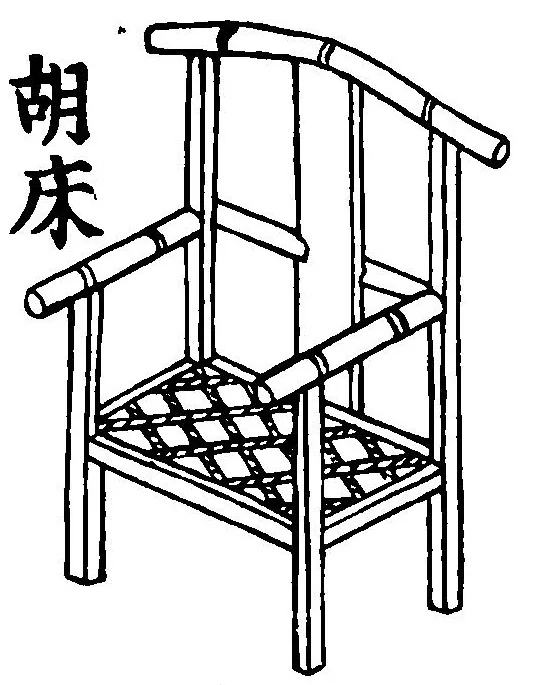
Agura.and burnt. He likewise burnt the image of Buddha and the Temple of Buddha. Having done so, he took the remains of the image of Buddha which were left from the burning and had them flung into the Naniha canal. On this day there was wind and rain without any clouds, and the Ohomuraji had on his rain-coat. He upbraided Mŭmako no Sukune and those who followed him in the exercise of religion, and made them feel shame and contrition of heart. Moreover he sent Mimoro [also called Oruke], Saheki no Miyakko, to summon Zen-shin and the other nuns provided for by Mŭmako no Sukune. So Mŭmako no Sukune did not dare to disobey this command, but with grief and lamentation called forth the nuns and delivered them to Mimoro. The officials accordingly took away from the nuns their three garments,[55] imprisoned them and flogged them at the road-station of Tsubaki no ichi.
The Emperor, with the view of establishing Imna, appointed as his Envoy Prince Mimiko of Sakata. Just at this time the Emperor and the Ohomuraji were suddenly afflicted with sores, and he was therefore after all not sent. The Emperor gave command to the Imperial Prince Tachibana no Toyohi, saying:—"The injunctions of the late Emperor my father must not be disregarded: the Government of Imna must be diligently put in order."
Again the Land was filled with those who were attacked with sores and died thereof. The persons thus afflicted with sores said:—"Our bodies are as if they were burnt, as if they were beaten, as if they were broken," and so lamenting, they died. Old and young said privately to one another, "Is this a punishment for the burning of the Image of Buddha?"
Summer, 6th month. Mŭmako no Sukune addressed the (XX. 17.) Emperor, saying:—"Thy servant's disease has not yet been healed; nor is it possible for succour to be afforded me unless by the power of the three precious things."[56] Hereupon the Emperor commanded Mŭmako no Sukune, saying:—"Thou mayest practise the Buddhist religion alone, but discontinue it in so far as others are concerned." So the three nuns were given back to Mŭmako no Sukune, who received them with rejoicing, lamenting their unexampled misfortunes, and bowing down his head in their honour. He built them a Temple anew, into which he welcomed them, and provided them with sustenance.
One book says:—"Mononobe no Yugehi no Moriya no Ohomuraji, Oho-miwa no Sakahe no Kimi and Nakatomi no Ihare no Muraji conspired together to destroy the Buddhist religion. They wanted to burn the Temple and pagoda, and also to throw away the Buddhist images. Mŭmako no Sukune opposed this project, and would not agree to it."
Autumn, 8th month, 15th day. The Emperor's disease having become more and more inveterate, he died in the Great Hall. At this time a Palace of temporary interment was erected at Hirose. Mŭmako no Sukune delivered a funeral (XX. 18.) oration with his sword girded on. Mononobe no Yugehi no Moriya no Ohomuraji burst out laughing, and said:—"He is like a sparrow pierced by a hunting-shaft." Next Yugehi no Moriya no Ohomuraji, with trembling hands and legs, delivered his funeral oration. The Oho-omi, Mŭmako no Sukune, laughed and said:—"He ought to have bells hung upon him." From this small beginning the two Ministers conceived a hatred of each other. Sakahe, Miwa no Kimi sent Hayato for the protection of the Courtyard of the temporary tomb. The Imperial Prince Anahobe,[57] who wished to possess himself of the empire, flew into a rage, and declared, saying:—"Why do ye serve the Court of a dead King, and do no service where the living King is?"
- Nunakura is the name of a place; the rest is literally big-jewel-spread.
- Clever.
- i.e. Chinese.
- Written with the Chinese characters for Pèkché, viz. 百濟. It is here the name of a place in Kahachi.
- i.e. recorders of ships. His name shows that he was of Chinese or Corean origin.
- East means here Yamato; West, Kahachi.
- Kimmei Tennō, so called from his place of residence.
- As a slave.
- Note the fiction of Koryö being a dependency of Japan.
- This must be taken as referring to the two men whom Naniha threw overboard.
- No doubt of death.
- Port-recorder.
- The ox.
- i.e. Shipping-recorder.
- This is the rendering of the Interlinear Kana version.
- Wosa means interpreter. Kishi was originally a Corean title.
- The Interpreter's field.
- Afterwards the reigning Empress Suiko Tennō.
- Her half-brother.
- Jomei Tennō.
- This is explained to mean "for the Empress's service."
- A later writer says that there were 200 vols., Buddhist Sutras being among them.
- Monks who practise vinaya. Vide Eitel, p. 202, 2nd edition.
- Yogi. Vide Eitel, p. 209.
- Buddhist magic spells.
- Here and below Nami may be a mistake for Nama, the Corean title of rank. The characters used for mi and ma closely resemble each other.
- It is to be remembered that all the northern part of the main island of Japan, including the province of Mutsu and Dewa, were at this time in Aino possession.
- A Japanese name.
- Keikō Tennō.
- As a purifying ceremony.
- Includes Higo and Hizen.
- 3rd rank.
- 4th rank.
- A general term for high officials.
- Leading to the Hall of Audience.
- Senkwa Tennō.
- Archer.
- The executioners.
- All this seems great nonsense. It has puzzled the native commentators.
- In Hizen.
- Il is 日, i.e. sun.
- Illa's history resembles somewhat that of Kim Ok-kiun in our own day.
- i.e. Pèkché. In Kahachi.
- Illa was of the Ashigita family. See above, p. 97.
- In Sanskrit Maitrêya, the expected Messiah of the Buddhists. Vide Eitel, p. 92.
- A Chinese or Corean name.
- In Japanese Koma no Keibin.
- Ayabito is written 漢人, i.e. a man of Han (China). Here it is a proper name, though no doubt indicating a Chinese ancestry.
- The Chinese character for "maigre fare" is 齋. This the Interlinear Kana renders here and below in many places by Ogami, i.e. prayer. That the meetings here referred to were practically for religious services is unquestionable, and we have seen above, Vol. I. p. 41, that this character when used in connection with Shintō, is equivalent to "worship," although primarily meaning "religious abstinence." Here the proper meaning is, I submit, "the vegetable diet of Buddhist priests." A few lines further down we have 齋食, "abstinence food," Lenten fare, as we should say, and Giles (p. 18) renders 齋僧 "to give meals to priests." This is a well-known duty of pious Buddhists. In the history of Corea there is frequent mention of large numbers of priests being entertained by the kings from time to time.
- i.e. the central pillar round which a pagoda is built.
- Urabe, or native augurs.
- The word for Buddha is 佛神, Buddha-Kami.
- Chair here and elsewhere is in the original represented by two Chinese characters which mean "Tartar couch." The Japanese word which the writer had in mind was no doubt agura, "leg-seat," which is the rendering of the Interlinear Kana.
- The meaning may be that he sat on a chair to superintend the workmen who were employed for this purpose.
- The three priestly garments, viz. the Sam̃ghâṭi, reaching from the shoulders to the knees, the Uttara Sam̃ghâṭi, a sort of overcoat, and the Kachâya (Kesa in Japanese), a coloured mantle. Vide Eitel, sub vocibus.
- The Triratna, i.e. Buddha, the Law and the Priesthood. Vide Eitel, sub voce.
- Younger brother of the Emperor by a different mother.
BOOK XXI.
THE EMPEROR TACHIBANA NO TOYOHI.[1]
(YŌMEI[2] TENNŌ.)
The Emperor Tachibana no Toyohi was the fourth child of the Emperor Ame-kuni oshi-hiraki hiro-niha.[3] His mother's name was Kitashi hime. The Emperor believed in the Law of Buddha and reverenced the Way of the Gods.[4] In the fourteenth year of his reign, Autumn, the 8th month, the Emperor Nunakura futo-tama-shiki died.
9th month, 5th day. The Emperor assumed the Imperial dignity, and made his capital at Ihare, calling it the Palace of Namitsuki in Ikenobe.[5] Soga no Mŭmako no Sukune was made Oho-omi, and Mononobe no Yugehi no Moriya no Ohomuraji was made Ohomuraji, both as before.
19th day. The Emperor made command, saying:—etc., etc.[6]—appointing the Imperial Princess Nukade hime to the charge of the Shrine of Ise and to attend to the worship of the Sun-goddess.
This Imperial Princess, from the time of this Emperor until the reign of the Empress Kashikiya hime,[7] attended to the divine service of the Sun-goddess. She then retired of her own accord to Katsuraki, and there died. See the reign of the Empress Kashikiya hime. One book says:—"Having attended to the worship of the Sun-goddess for the space of thirty-seven years, she then retired of her own accord and died."
A.D. 586. (XXI. 2.) 1st year, Spring, 1st month, 1st day. The Imperial Princess Anahobe no Hashibito was appointed Empress Consort.[8] She bore four sons. The first was called the Imperial Prince Mŭmayado[9] [also called Mimito[10] Shōtoku,[11] or as some have it Toyoto-mimi, Great King of the Law, or again Master King of the Law]. This Imperial Prince at first lived at Kamitsu miya.[12] Afterwards he removed to Ikaruga in the reign of the Empress Toyomike Kashikiya hime, where he occupied the Eastern Palace,[13] and discharged the duties of Emperor, being associated with her in the management of all matters of administration, as is stated in the history of the Empress Toyomike Kashikiya hime. The second was called the Imperial Prince Kume; the third was called the Imperial Prince Yeguri; the fourth was called the Imperial Prince Mamuta.[14] Ishikina, daughter of Soga no Oho-omi, Iname no Sukune, was appointed a Consort. She bore the Imperial Prince Tame [also called the Imperial Prince Toyora]. Hiroko, daughter of Ihamura, Katsuraki no Atahe, bore one son and one daughter. The son was called the Imperial Prince Maroko; he was the ancestor of the Kimi of Tahema. The daughter was called the Imperial (XXI. 3.) Princess Nukade hime. She was during three generations in the service of the Sun-goddess.
Summer, 5th month. The Imperial Prince Anahobe tried to force his way into the Palace of temporary interment in order to ravish the Empress Consort Kashikiya hime.[15] But the favourite Minister, Sakahe, Miwa no Kimi, called out the guards, who firmly fastened the Palace Gate, and resisting his entrance, would not let him in. The Imperial Prince Anahobe demanded of them, saying:—"Who is it that is here?" The guards answered and said:—"Sakahe, Miwa no Kimi, is here." Seven times he shouted at them to open the gate, but they steadily refused to admit him. Hereupon the Imperial Prince Anahobe addressed the Oho-omi and the Ohomuraji, saying:—"Sakahe is incessantly insulting me. In the funeral eulogy delivered by him at the Court of temporary interment he said:—'Thy Court shall not be left desolate, but shall be kept pure as the surface of a mirror, and thy servant will preserve peace in dutiful service to thee.' This is an insult. At this moment there are many young men of the Emperor's family, and there are two Chief Ministers present. Who has any right wantonly to monopolize talk of dutiful service? Moreover when I wished to see the interior of the place of temporary interment, I was prevented, and not allowed to enter. Seven times I myself called out, 'Open the gate,' but there was no answer. I request that I may be allowed to put him to death." The two Chief Ministers[16] said:—"Be it as thou hast commanded." Upon this, the Imperial Prince Anahobe, while secretly planning to make himself ruler of the Empire, falsely gave out that his object was to kill Sakahe no Kimi. At length, along with Mononobe no Moriya no Ohomuraji, he led troops with which they surrounded Ikenobe in Ihare. This having come to the knowledge of Sakahe no Kimi, he concealed himself on Mount Mimoro. That day, at midnight, he came away stealthily from the mountain and hid in the hinder[17] palace, [meaning the Empress Kashikiya hime's country-house. It was called the Palace of Tsubaki ichi]. Relatives of Sakahe (XXI. 4.) named Shiratsutsumi and Yokoyama told where Sakahe no Kimi was, and the Imperial Prince Anahobe straightway sent to Moriya no Ohomuraji [one book says:—"The Imperial Princes Anahobe and Hatsusebe having consulted together, sent to Moriya no Ohomuraji"], saying to him:—"Thou must go and slay Sakahe no Kimi, and likewise his two children." The Ohomuraji at length went off in command of an armed force. Soga no Mŭmako no Sukune, having heard from an outside source of this conspiracy, went to the place where the Imperial Prince was. He accordingly arrived before the gate [the gate of the Imperial Prince's house is meant], and finding him on the point of going to the place where the Ohomuraji was, remonstrated with him, saying:—"A ruler does not approach a criminal. Thou shouldst not go thyself." The Imperial Prince would not listen to him, but went. Mŭmako no Sukune forthwith departed in his train, and arrived at Ihare. There he urgently remonstrated with him, and the Prince yielded to his remonstrances and stopped. In this place, accordingly, he remained seated on a chair and waited for the Ohomuraji. A good while later the latter arrived with his troops and reported the result of his commission, saying:—"I have executed Sakahe and the others." [One books says:—"The Imperial Prince went in person and shot them dead."] Hereupon Mŭmako no Sukune broke into bitter lamentations, saying:—"Civil disorder in the Empire is not far off." The Ohomuraji hearing this, answered and said:—"Thy position is that of a small minister;[18] thou dost not know."
This Sakahe, Miwa no Kimi, was a favourite of the Emperor Wosada,[19] and he was charged with all matters both internal and external. In consequence of this the Empress-consort Kashikiya hime and Mŭmako no Sukune both conceived enmity against the Imperial Prince Anahobe.
This year was the year Hinoye Mŭma (43rd) of the Cycle.
A.D. 587. 2nd year, Spring, 4th month, 2nd day. The Emperor performed the ceremony of tasting the new rice[20] on the river-bank of Ihare. On this day the Emperor took ill and returned to the Palace. All the Ministers were in attendance. The Emperor addressed them, saying:—"It is Our desire to give our adherence to the three precious things. Do ye Our Ministers advise upon this." All the Ministers entered the Court and consulted together. Mononobe no Moriya no Ohomuraji (XXI. 5.) and Nakatomi no Katsumi no Muraji opposed the Imperial proposal, and advised, saying:—"Why should we reverence strange deities, and turn our backs upon the gods of our country? Of course we know naught of any such thing." The Oho-omi Soga no Mŭmako no Sukune said:—"Let us render assistance in compliance with the Imperial command. Who shall offer advice to the contrary?" Hereupon the Imperial Prince the Emperor's younger brother [the Imperial Prince Anahobe is meant.[21] He was the Emperor's younger brother, born of a concubine], introduced into the interior (of the Palace) a priest of the Land of Toyo[22] [the personal name is wanting]. Mononobe no Moriya no Ohomuraji glared at them in great wrath. Then Kekuso, Oshi-sakabe no Fubito, came hastily and spoke secretly to the Ohomuraji, saying:—"All the Ministers are now plotting against thee, and moreover are about to waylay thee." When the Ohomuraji heard this, he retired to Ato [Ato is the name of a place where the Ohomuraji had a country house] and assembled a body of men. Nakatomi no Katsumi no Muraji assembled troops at his house and went with them to the assistance of the Ohomuraji. At length he prepared figures of the Imperial Prince Hikobito, the Heir Apparent, and of the Imperial Prince Takeda, and loathed them.[23] But presently finding that success was impossible, he repaired to the Palace of the Imperial Prince Hikobito at Mimata. One of the attendants[24] (of the Prince) named Ichihi, (XXI. 6.) Tomi no Obito [Tomi is the family name, and Ichihi the personal name], watched till Katsumi no Muraji was withdrawing from the place where the Imperial Prince Hikobito was, and drawing his sword, slew him. The Ohomuraji from his house at Ato sent a message to Mŭmako no Oho-omi by Wosaka, Mononobe no Yasaka no Oho-ichi no Miyakko, and Ani, Urushibe[25] no Miyakko, saying:—"Hearing that the Ministers have designs against me, I am keeping out of the way." Mŭmako no Oho-omi accordingly sent Hashi no Yajima no Muraji to the place where Ohotomo no Hirafu no Muraji was, and told him all that the Ohomuraji had said. Hirafu no Muraji, therefore, took in his hand his bow and arrows and his leathern shield and went to the house at Tsukikuma [the Oho-omi's house], where he remained guarding the Oho-omi, and did not leave him by night or by day.
The Emperor's sores became worse and worse, and when the end was approaching, Tasuna of the Kuratsukuri[26] Be [son of Shiba Tattō] came forward and addressed him, saying:—"Thy servant, on behalf of the Emperor, will renounce the world and exercise religion. Moreover, he will make an image of Buddha sixteen feet high, and a Temple." The Emperor was deeply moved. This is the 16-foot wooden image of Buddha which with its attendant Bosatsu[27] now stands in the Temple of Sakata at Minabuchi.
9th day. The Emperor died in the Great Hall.
Autumn, 7th month, 21st day. He was buried in the Misasagi above the pond of Ihare.[28][25]
THE EMPEROR HATSUSEBE.[29]
(SUJUN[30] TENNŌ.)
(XXI. 7.) The Emperor Hatsusebe was the twelfth child of the Emperor Ame-kuni Oshi-hiraki hiro-niha."[31] His mother's name was Wo-ane[32] no Kimi [daughter of Iname no Sukune, as already stated].
The Emperor Tachibana no Toyohi died in the second year of his reign, Summer, the 4th month. In the 5th month the army of the Mononobe no Ohomuraji made a disturbance thrice. The Ohomuraji from the first wished to set aside the other Imperial Princes and to establish the Imperial Prince Anahobe as Emperor. He now hoped to make use of a hunting party to devise a plan for raising him to the throne instead. So he secretly sent a messenger to the Imperial Prince Anahobe, to say:—"I should like to hunt with the Imperial Prince in Ahaji." The plot leaked out.
6th month, 7th day. Soga no Mŭmako no Sukune and other Ministers, on behalf of Kashikiya hime no Mikoto, commissioned[33] Nifute, Saheki no Muraji, Ihamura, Hashi no Muraji, and Makuhi, Ikuba no Omi, saying:—"Do ye with rigorous discipline of arms proceed at once to execute the Imperial Prince Anahobe and the Imperial Prince Yakabe." On this day, at midnight, Nifute, Saheki no Muraji, and his colleagues surrounded the Palace of the Imperial Prince Anahobe. Upon this the guardsmen, having first climbed up into the upper story, smote the Imperial Prince Anahobe on the shoulder. The Imperial Prince fell down from the upper story, and ran away into an outhouse. Then the guardsmen, holding up lights, executed him.
8th day. The Imperial Prince Yakabe was executed.
The Imperial Prince Yakabe was the son of the Emperor Hinokuma[34] and father of Princess Kamutsu hime. This is not clear.
He was put to death because he approved the Imperial Prince Anahobe.
9th day. The nun Zen-shin and the others addressed the (XXI. 8.) Oho-omi, saying:—"Discipline is the basis of the method of those who renounce the world; we pray thee to let us go to Pèkché to receive instruction in the Law of Discipline." This month tribute Envoys from Pèkché arrived at Court. The Oho-omi addressed the Envoys, saying:—"Take these nuns with you, and when you are about to cross over to your country, make them learn the Law of Discipline. When they have done, send them off." The Envoys answered and said:—"When we return to our frontier State, we shall first of all inform the King of our country, and it will afterwards be not too late to send them off."[35]
Autumn, 7th month. The Oho-omi, Soga no Mŭmako no Sukune, incited the Imperial Princes and the Ministers to plot the destruction of the Ohomuraji, Mononobe no Moriya. The Imperial Prince Hatsusebe, the Imperial Prince Takeda, the Imperial Prince Mŭmayado, the Imperial Prince Naniha, the Imperial Prince Kasuga, the Oho-omi, Soga no Mŭmako no Sukune, Womaro no Sukune, Ki no Omi, Hirafu, Kose no Omi, Katafu, Kashihade no Omi, and Wonara, Katsuraki no Omi, together led an army, and advanced to attack the Ohomuraji. Kurafu, Ohotomo no Muraji, Hito, Abe no Omi, Ite, Heguri no Omi, Nukade, Sakamoto no Omi, and Kasuga no Omi [the personal name is not given], together led a force from the district of Shiki[36] as far as the house of Shibukaha.[37] The Ohomuraji, in personal command of the young men of his family and of a slave-army, built a rice-fort and gave battle. Then the Ohomuraji climbed up into the fork of an elm[38] at (XXI. 9.) Kisuri, from which he shot down arrows like rain. His troops were full of might. They filled the house and overflowed into the plain. The army of the Imperial Princes and the troops of the Ministers were timid and afraid, and fell back three times. At this time the Imperial Prince Mŭmayado, his hair being tied up on the temples[39] [the ancient custom was for boys of the age of fifteen or sixteen to tie up their hair on the temples; at the age of seventeen or eighteen it was divided, and made into tufts, as is the case even now], followed in the rear of the army. He pondered in his own mind, saying to himself:—"Are we not going to be beaten? Without prayer we cannot succeed." So he cut down a nuride tree,[40] and swiftly fashioned images of the four Heavenly Kings.[41] Placing them on his top-knot, he uttered a vow:—"If we are now made to gain the victory over the enemy, I promise faithfully to honour the four Heavenly Kings, guardians of the world, by erecting to them a temple with a pagoda." The Oho-omi Soga no Mŭmako also uttered a vow:—"Oh! all ye Heavenly Kings and great Spirit King,[42] aid and protect us, and make us to gain the advantage. If this prayer is granted, I will erect a temple with a pagoda in honour of the Heavenly Kings and the great Spirit King, and will propagate everywhere the three precious things." When they had made this vow, they urged their troops of all arms sternly forward to the attack. Now there was a man named Ichihi, Tomi no Obito, who shot down (XXI. 10.) the Ohomuraji from his branch and killed him and his children. The Ohomuraji's troops accordingly gave way suddenly. Joining their forces, they every one put on black clothes, and going hunting on the plain of Magari in Hirose, so dispersed.[43] In this war some of the children and relatives of the Ohomuraji made their escape, and concealing themselves on the plain of Ashihara, changed their personal names and altered their titles,[44] while others fled away nobody knew where. The people of that time said of them to one another:—"The wife of Soga no Oho-omi is the younger sister of the Ohomuraji Mononobe no Moriya, and the Oho-omi, injudiciously acting on his wife's advice, slew the Ohomuraji."[45]
When the civil troubles had been quieted, a Temple of the Four Heavenly Kings[46] was built in the province of Settsu. Half of the Ohomuraji's slaves, together with his house, were constituted the slaves and farm-house of the Great Temple, and ten thousand shiro[47] of rice-land were given to Ichihi, Tomi (XXI. 11.) no Obito. Moreover, Soga no Oho-omi, in fulfilment of his vow, erected the Temple of Hōkōji[48] in Asuka. A dependant of the Ohomuraji Mononobe no Moriya named Yorodzu, [the personal name], of the Tottori-be, in command of one hundred men, guarded the house[49] at Naniha, but hearing of the Ohomuraji's downfall, he urged his horse into a gallop, and made his escape by night in the direction of the village of Arimaka in the district of Chinu, where, having passed his wife's house, he at length concealed himself among the hills. The Court took counsel together, saying:—"Yorodzu cherishes traitorous feelings, and therefore has concealed himself among these hills. Let his kindred be extirpated promptly, and no remissness shown." Yorodzu, in tattered and filthy raiment, and with a wretched countenance, came forth alone, of his own accord, bow in hand and girt with a sword. The officials sent several hundred guardsmen to surround him. Yorodzu, accordingly, was afraid, and hid himself in a bamboo thicket, where he tied cords to the bamboos and pulled them so as to shake the bamboos, and thus make the people to doubt where he had gone in. The guardsmen were deceived, and pointing to the quivering bamboos, ran forward, saying:—"Yorodzu is here!" Yorodzu forthwith shot his arrows, not one of which missed its mark, so that the guardsmen were afraid, and did not dare to approach. Yorodzu then unstrung his bow, and taking it under his arm, ran off towards the hills. The guardsmen accordingly pursued him, shooting their arrows at him from both sides of a river, but none of them were able to hit (XXI. 12.) him. Hereupon one of the guardsmen ran on swiftly, and got before Yorodzu. Lying down by the river's side, he aimed at him, and hit him on the knee. Yorodzu forthwith pulled out the arrow, and stringing his bow, let fly his arrows. Then prostrating himself on the earth, he exclaimed aloud:—"A shield of the Emperor, Yorodzu would have devoted his valour to his service, but no examination was made, and, on the contrary, he has been hard pressed, and is now at an extremity. Let some one come forward and speak with me, for it is my desire to learn whether I am to be slain or to be made a prisoner." The guardsmen raced up and shot at Yorodzu, but he warded off the flying shafts, and slew more than thirty men. Then he took the sword which he wore, and cut his bow into three pieces, and bending back his sword, flung it into the midst of the water of the river. With a dagger which he had besides, he stabbed himself in the throat, and died. The Governor of Kahachi reported the circumstances of Yorodzu's death to the Court, which gave an order by a stamp[50] that his body should be cut into eight pieces and disposed for exposure among the eight provinces. The Governor[51] of Kahachi accordingly, in obedience to the purport of the stamped order, was about to dismember him for exposure, when thunder pealed, and a great rain fell. Now, there was a white dog which had been kept by Yorodzu. Looking up, and looking down, he went round, howling beside the corpse, and at last, taking up the head in his mouth, placed it on an ancient mound. He then lay down close by, and starved to death in front of it. The Governor of Kahachi, thinking that dog's conduct very strange, reported it to the Court. The Court could not bear to hear of it for pity, and issued a stamped order to this effect:—"The case of this dog is one that is rarely heard of in the world, and should be shown to after ages. Let Yorodzu's kindred be made to construct a tomb and bury their remains." The kindred of Yorodzu accordingly assembled together, and raised a tomb in the village of Arimaka, where they buried Yorodzu and his dog.
It was reported from the province of Kahachi that on the plain[52] of the River of Yega there were slain men to the number it might be of several hundreds. Their corpses had become (XXI. 13.) putrefied, so that their names could not be ascertained, but by the colour of the clothing their bodies were taken up (by their friends) for burial. Now there was a dog, kept by Inu, Sakurawi no Tanabe no Muraji, who held on by his teeth to the dead body (of his master), and lying beside it, guarded it closely, not getting up to go away until he had caused it to be taken up for burial.
8th month, 2nd day. The Emperor, upon the advice of Kashikiya hime no Mikoto and the Ministers, assumed the Imperial Dignity. Soga no Mŭmako no Sukune was made Oho-omi as before. The Ministers and Daibu were also confirmed in their previous ranks.
In this month the Palace was made at Kurahashi.[53]
A.D. 588. 1st year, Spring, 3rd month. Woteko, daughter of Ohotomo no Nukade no Muraji, was appointed Consort. She bore the Imperial Prince Hachiko and the Imperial Princess Nishikide.
This year, the Land of Pèkché sent Envoys, and along with them the Buddhist priests Hyé-song, Nyöng-Keun, and Hyé-sik,[54] with a present of Buddhist relics. The Land of Pèkché sent the Eun-sol, Syu-sin, the Tök-sol, Kè-mun, and the Na-sol, Pok-pu-mè-sin, with tribute, and also with a present of Buddhist relics, the Buddhist priest Nyöng-chyo, the ascetics Nyöng-wi, Hyé-chyung, Hyé-syuk and To-öm, the Temple carpenters Ta-nyang Mi-ta and Mun-ko-ko-chă, a man learned in the art of making braziers and chargers,[55] the Chyang-tök Pèng-mè-syun, men learned in pottery named Mana Puno, Yang Kwi-mun, Neung Kwi-mun and Syök-ma Tyé-mi, and a painter[56] named Pèk-ka.
Soga no Mŭmako no Sukune inquired of the Pèkché priests the method of receiving discipline, and handing over to the Eun-sol, Syu-sin, and the other Pèkché Envoys the nuns Zen-shin and her companions, despatched them (to Corea) for study. Having pulled down the house of Konoha, ancestor of the Asuka no Kinunuhi no Miyakko, he began to build the Temple of Hōkōji. The name of this place was Asuka no (XXI. 14.) Magami no Hara. It was also called Asuka no Tomada.
This year was the year Tsuchinoye Saru (45th) of the Cycle.
A.D. 589. 2nd year, Autumn, 7th month, 1st day. Kamafu, Afumi no Omi, was sent to the Tōsandō[57] to inspect the frontier of the territory of the Yemishi, Kari, Shishibito no Omi, to the Tōkaidō[58] to inspect the frontier of the provinces bordering on the Eastern ocean, and Abe no Omi to the Hokurikudō to inspect the frontier of the province of Koshi, etc.[59]
A.D. 590. 3rd year, Spring, 3rd month. The student nuns, Zen-shin and her companions, returned from Pèkché, and took up their abode in the Temple at Sakurawi.
Autumn, 10th month. People went to the hills to get timber for building Buddhist temples. In this year there entered religion as nuns, Zentoku, daughter of Ohotomo no Sadehiko no Muraji, and his Koma wives Shiraki hime and Kudara hime,[60] under the names of Zem-myō and Myō-kwō. Moreover men of Han[61] named Zen-sō, Zen-tsū, Hō Jō-shō, Zen Chi-sō, Zen Chi-kei, and Zen-kwō, with Tasuna, a son of Kuratsukuri be no Shiba Tattō, at the same time renounced the world, the latter taking the name of Tokusai Hōshi.[62]
A.D. 591. 4th year, Spring, 4th month, 12th day. The Emperor Wosada was buried in the Misasagi of Shinaga.[63] This is the Misasagi where the Empress-consort, his mother, was buried.
(XXI. 15.) Autumn, 8th month, 1st day. The Emperor addressed his Ministers, saying:—"It is our desire to establish Imna. What do ye think?" The Ministers said to him:—"The Miyake of Imna should be established. We are all of the same opinion as Your Majesty."
Winter, 11th month, 4th day. Ki no Womaro no Sukune, Hirafu, Kose no Omi, Kashihade no Omi, Ohotomo no Kuhi no Muraji, and Katsuraki no Wonara no Omi were appointed as Generals. Taking with them the Omi and Muraji of the various Houses as Adjutant-Generals of the divisions of the army, they marched out in command of over 20,000 men and stationed themselves in Tsukushi. Kishi no Kana was sent to Silla and Kishi[64] no Itahiko to Imna to make inquiry respecting Imna.
A.D. 592. 5th year, Winter, 10th month, 4th day. A wild boar was presented to the Emperor. Pointing to it, he said:—"When shall those to whom We have an aversion be cut off as this wild boar's throat has been cut?" An abundance of weapons was provided beyond what was customary.
10th day. Soga no Mŭmako no Sukune, having been told of the pronouncement of the Emperor, and alarmed at his detestation of himself, called together his people and conspired with them to assassinate the Emperor.
In this month, the Hall of Worship and the covered gallery of the great Hōkōji Temple were built.
11th month, 3rd day. Mŭmako no Sukune lied to the Ministers, saying:—"To-day I present the taxes of the Eastern provinces," and sent Koma, Yamato no Aya no Atahe, who killed the Emperor.
One book says:—"Koma, Yamato no Aya no Atahe, was the son of Ihawi, Yamato no Aya no Atahe."
On this day the Emperor was buried in the Misasagi on the hill of Kurahashi.
(XXI. 16.) One book says:—The Imperial concubine Ohotomo no Koteko, incensed at her declining favour, sent a man to Soga no Mŭmako no Sukune with a message, saying:—"Recently a wild boar was presented to the Emperor. He pointed to it and said:—'When shall the man We think of be cut off as this wild boar's throat has been cut?' Besides weapons are being made in abundance in the Palace." Now Mŭmako no Sukune, hearing this, was alarmed.
5th day. Mounted messengers were sent to the General's quarters in Tsukushi, saying:—"Do not let foreign matters be neglected in consequence of the internal troubles."
This month, Koma, Yamato Aya no Atahe, had a clandestine amour with the Imperial concubine Kahakami no Iratsume, daughter of Soga, and made her his wife. [Kahakami no Iratsume was the daughter of Soga no Mŭmako no Sukune.] Mŭmako no Sukune did not find out immediately that Kahakami no Iratsume had been clandestinely possessed by Koma, and supposed that she was dead. But when Koma's intrigue with the Imperial concubine became known he was killed by the Oho-omi.
- This name means orange abundance-sun. Tachibana is, however, here the name of a village in Yamato.
- Yō means to use, employ; mei, brightness.
- Kimmei Tennō.
- Shintō. 神道. The first time this phrase is found. The "Yih-king" has, "The sage frames his doctrine by the Way of the Gods, and the Empire accepts it."
- Province of Yamato.
- The author omits the words of the edict, and only gives its general purport.
- Suiko Tennō.
- She was also a daughter of Kimmei Tennō, by a different mother.
- See below, 1st year of Suiko's reign, for the reason of this name.
- Quick-ear.
- Sagely-virtue. This is the renowned Shōtoku Daishi, the real founder of Buddhism in Japan.
- The Upper Palace.
- i.e. the Heir Apparent's quarters.
- Or Mata.
- The Empress Dowager. The motive was probably not lust, but ambition. Compare the similar case of Jimmu Tennō's widow.
- 大臣 is here evidently not Oho-omi, for one of them was not an Oho-omi, but an Ohomuraji. It has the more general sense of Chief Minister.
- i.e. the Empress's palace.
- Alluding to his title of Oho-omi or Great Minister.
- Bidatsu Tennō.
- Nihi-name. See above, Vol. I. p. 86. It was unusual to celebrate this festival in spring.
- The "Shukai" editor thinks we should understand here the Emperor's younger brother and the Imperial Prince.
- Or perhaps Toyokuni was his name.
- i.e. practised witchcraft on them.
- Toneri.
- This name may be read either Urushibe no Miyakko or Nuribe no Miyakko. Urushi is "varnish," and nuri means "to smear," so that the difference is not very material. This is the first mention of lacquer in Japanese literature, and although it indicates that the art was already known, we may safely set aside as later inventions the statements referring it to a much earlier period which are quoted, with a reserve amply justified by the facts, in an essay on Lacquer in the "Catalogue of Japanese Lacquer and Metal Work in the Burlington Fine Arts Club, 1894." The Urushibe (or Nuribe) no Muraji (a higher rank than Miyakko) were promoted to be Urushibe no Sukune in 685. An ancient note to the "Kiujiki," III. 16, traces the descent of the Urushibe no Muraji from a deity.
- Saddle-makers.
- i.e. Boddhisattwa. The two Bosatsu here alluded to are probably Ji-zō Bosatsu (Kshidi-garbha) and Monju Bosatsu, the Sanskrit Mañdjus'rî. Vide Eitel, sub voce. Also vide "Satow's Handbook," 2nd ed. introduction, p. 87.
- Afterwards re-interred at Shinaga in Kahachi.
- The "Kojiki" calls him Hatsusebe no Waka-sazaki.
- Venerable-lofty.
- Kimmei Tennō.
- i.e. little-elder-sister.
- The character used is 詔, generally applied to an edict or order of the Emperor.
- Senkwa Tennō.
- See below, XXI. 13.
- In Kahachi.
- i.e. the Ohomuraji's house at Shibukaha.
- The yenoki or Celtis sinensis.
- The interlinear version calls this style hisago-hana, i.e. gourd-flower; the manly style is called age-maki, or rolling up.
- It is doubtful what kind of tree is intended. Nuride is the interlinear gloss. The nuride or nurude resembles the lacquer tree (nuri means lacquer). Hepburn calls it Rhus semialata.
- Shi-ten-ō or Chatur Mahārādjas. Four demon kings who guard the world against Asuras. Vide Eitel, p. 174, 2nd ed.; also "Satow's Handbook," p. 556.
- Daijinnō or Mahākāla. Vide Eitel, pp. 85 and 91. Identified with the modern Daikoku Sama. Vide "Anderson's B. M. Catalogue," p. 33.
- It is explained here that "black" was the colour of underlings' clothes, and that the chiefs put on this colour for disguise. The "hunting" was only a pretence.
- Or surnames.
- She wished to appropriate to herself his property.
- At Osaka. Still known as Tennōji. Vide "Murray's Handbook of Japan," 3rd ed. p. 285.
- The 頃 (shiro) is equal 100 畝 or mow, a measure which, according to present Chinese reckoning, is equal to 15.13 acres. Vide Giles.
- Near Nara. It is no longer in existence.
- Of the Ohomuraji.
- Oshide. A stamp of red or black ink on the palm of the hand as token of authority.
- 國司. The Interlinear Kana is mikoto-mochi.
- The dry bed of a river is frequently so called in Japan. They were often used as execution grounds.
- In Yamato.
- In Japanese Ye-sō, Ryō-kin, and Ye-shoku.
- Metal-founders. These artizans had a defined rank and are called Hakase, or doctor.
- Probably of Buddhist pictures, says the "Shukai" editor.
- i.e. East-mountain-circuit, including the inland provinces eastwards from Afumi (Ōmi). The Interlinear Kana has Adzuma, which is not quite the same.
- East-sea-circuit, including the provinces along the East Coast from Iga to Hitachi.
- Viz. Etchiu, Echizen, and Echigo.
- i.e. the Silla lady and the Pèkché lady.
- China. No doubt we should understand the Ayabito family of Chinese descent. The names are Chinese, but as the persons who bore them had probably never been in China, I have not given the Chinese pronunciation.
- Hōshi is a priestly title.
- In Kahachi.
- It seems doubtful whether Kishi is here part of the name or a title.
BOOK XXII.[1]
THE EMPRESS TOYO-MIKE KASHIKI-YA-HIME.[2]
(SUIKO[3] TENNŌ.)
The Empress Toyo-mike Kashiki-ya-hime was the second[4] daughter of the Emperor Ame-kuni oshi-hiraki hiro-niha[5] and a younger sister by the same mother of the Emperor Tachibana no toyo-hi.[6] In her childhood she was called the Princess Nukada-be. Her appearance was beautiful, and her conduct was marked by propriety. At the age of eighteen, she was appointed Empress-consort of the Emperor Nunakura futo-dama-shiki.[7] When she was thirty-four years of age, the Emperor Nunakura futo-dama-shiki died. When she was thirty-nine years of age, in the 5th year and the 11th month of the reign of the Emperor Hatsuse-be,[8] the Emperor was murdered by the Oho-omi Mŭmako no Sukune, and the succession to the Dignity being vacant, the Ministers besought the Empress-consort of the Emperor Nunakura futo-dama-shiki, viz. the Princess Nukada-be, to ascend the throne. The Empress refused, but the public functionaries urged her in memorials three times until she consented, and they accordingly delivered to her the Imperial Seal.
Winter, 12th month, 8th day. The Empress-consort assumed the Imperial Dignity in the Palace of Toyora.[9]
A.D. 593. 1st year, Spring, 1st month, 15th day. Relics of Buddha were deposited in the foundation-stone of the pillar of the pagoda[10] of the Temple of Hōkōji.
16th day. The Pagoda-pillar was erected.
Summer, 4th month, 10th day. The Imperial Prince Mŭmayado (XXII. 2.) no Toyotomimi was appointed Prince Imperial. He had general control of the Government, and was entrusted with all the details of administration. He was the second child of the Emperor Tachibana no Toyo-hi. The Empress-consort his mother's name was the Imperial Princess Anahobe no Hashibito. The Empress-consort, on the day of the dissolution of her pregnancy, went round the forbidden precinct, inspecting the different offices. When she came to the Horse Department, and had just reached the door of the stables,[11] she was suddenly delivered of him without effort. He was able to speak as soon as he was born, and was so wise when he grew up that he could attend to the suits of ten men at once and decide them all without error. He knew beforehand what was going to happen. Moreover he learnt the Inner Doctrine[12] from a Koryö Priest named Hyé-cha, and studied the Outer Classics[13] with a doctor called Hak-ka.[14] In both of these branches of study he became thoroughly proficient. The Emperor his father loved him, and made him occupy the Upper Hall South of the Palace. Therefore he was styled the Senior Prince Kamu-tsu-miya,[15] Muma-ya-do Toyotomimi.
Autumn, 9th month. The remains of the Emperor Tachibana no Toyohi were removed and re-interred in the Misasagi of Shinaga in Kahachi.
In this year the building of the Temple of Shi-ten-ō-ji[16] at Arahaka in Naniha was begun.
This year was the year Midzunoto Ushi (50th) of the Cycle.
A.D. 594. 2nd year, Spring, 2nd month, 1st day. The Empress instructed the Prince Imperial and the Oho-omi to promote the prosperity of the Three Precious Things.[17] At this time, all the Omi and Muraji vied each with one another in erecting Buddhist shrines for the benefit of their Lords and parents. These were called Temples.[18]
A.D. 595. (XXII. 3.) 3rd year, Summer, 4th month. Lign-aloes[19] wood drifted ashore on the Island of Ahaji. It was a fathom round. The people of the island, being unacquainted with aloes wood, used it with other firewood to burn in their cooking range, when the smoky vapour spread a perfume far and wide. Wondering at this, they presented it to the Empress.
5th month, 10th day. A priest of Koryö, named Hyé-chă, emigrated to Japan, and was taken as teacher by the Prince Imperial. In the same year a Pèkché priest, named Hyé-chhong, arrived. These two priests preached the Buddhist religion widely, and were together the mainstay of the Three Precious Things.
Autumn, 7th month. The General and his followers arrived from Tsukushi.
A.D. 596. 4th year, Winter, 11th month. The building of the Temple of Hōkōji was finished. Accordingly Zentoku no Omi, son of the Oho-omi, was appointed Commissioner for the Temple. On this day the two priests Hyé-chă and Hyé-chhong took up their residence in Hōkōji.
A.D. 597. 5th year, Summer, 4th month, 1st day. The King of Pèkché sent Prince A-cha with tribute.
Winter, 11th month, 22nd day. Ihagane no Kishi was sent to Silla.
A.D. 598. 6th year, Summer, 4th month. Ihagane Naniha no Kishi arrived from Silla, and presented to the Empress a pair of (XXII. 4.) magpies. They were accordingly made to be kept in the wood of Naniha, where they built their nest on the branch of a tree, and had their young.[20]
Autumn, 8th month, 1st day. Silla sent tribute of a peacock.
Winter, 10th month, 10th day. The Land of Koshi presented a white deer to the Empress.
A.D. 599. 7th year, Summer, 4th month, 27th day. There was an earthquake which destroyed all the houses. So orders were given to all quarters to sacrifice to the God[21] of Earthquakes.
(XXII. 5.) Autumn, 9th month, 1st day. Pèkché sent tribute of one camel, two sheep, and one white pheasant.[22]
A.D. 600. 8th year, Spring, 2nd month. Silla and Imna made war against each other. The Empress wished to assist Imna,[23] and in this year appointed Sakahibe no Omi General-in-Chief, and Hodzumi no Omi Assistant General, in command of over 10,000 men to invade Silla on behalf of Imna. Hereupon they went straight to Silla, and on arriving there by sea, laid siege to five fortresses and captured them. Now the King of Silla was struck with fear, and raising a white flag, came to the General's standard and offered his submission, ceding the six fortified places of Tatara, Sonara, Pulchikwi, Witha, South Kara, and Ara.[24] Then the Generals took counsel together, saying:—"Silla, conscious of guilt, makes his submission; it would be wrong to insist on chastising him." Accordingly they reported to the Empress. Hereupon the Empress further sent Miwa, Naniha no Kishi, to Silla, and also Itahiko, Naniha no Kishi, to Imna. Both were to examine the state of affairs. Hereupon the Kings of the two countries of Silla and Imna sent Envoys with tribute, and delivered a memorial to the Empress, saying:—"In Heaven above there are Gods; on Earth there are Emperors. Besides these two classes of Gods, what else is there which we should fear? Henceforward we will refrain from making war on one another, and will every year attend the Court without fail, not allowing the helms of (XXII. 6.) our ships to become dry." Accordingly the Empress sent messengers to recall the Generals, but no sooner had they arrived from Silla than Silla again invaded Imna.
A.D. 601. 9th year, Spring, 2nd month. The building of a Palace in Ikaruga[25] was begun by the Prince Imperial.
3rd month, 5th day. Kurafu,[26] Ohotomo no Muraji, was sent on a mission to Koryö, and Nukade, Sakamoto no Omi, to Pèkché, ordering them to proceed instantly to the assistance of Imna.
Summer, 5th month. The Empress dwelt in the temporary Palace of Miminashi. At this time there were heavy rains, and the river overflowed its banks, filling the Court of the Palace.
Autumn, 9th month, 8th day. A spy from Silla named Kamata came to Tsushima. He was forthwith arrested, and delivered up[27] to the Government, who banished him to Kamitsukenu.[28]
Winter, 11th month, 5th day. The question of making war on Silla was considered.
A.D. 602. 10th year, Spring, 2nd month, 1st day. The Imperial Prince Kume[29] was appointed General for the invasion of Silla, and was granted the various Be of the service of the Gods,[30] together with the Kuni no Miyakko and the Tomo no Miyakko, and an army of 25,000 men.
Summer, 4th month, 1st day. General the Imperial Prince Kume arrived in Tsukushi, and proceeded to the district of Shima, where he encamped, and assembled ships for the transport of provisions for his army.
(XXII. 7.) 6th month, 3rd day. Kurafu, Ohotomo no Muraji, and Nukade, Sakamoto no Omi, arrived together from Pèkché. At this time the Imperial Prince Kume fell ill, and was unable to carry out the expedition.
Winter, 10th month. A Pèkché priest named Kwal-leuk arrived and presented by way of tribute books of Calendar-making, of Astronomy, and of Geography,[31] and also books of the art of invisibility and of magic. At this time three or four pupils were selected, and made to study under Kwal-leuk. Ōchin,[32] the ancestor of the Yako no Fumibito, studied the art of Calendar-making. Kōsō,[33] Otomo no Suguri, studied Astronomy and the art of invisibility. Hinamitatsu, Yamashiro no Omi, studied magic. They all studied so far as to perfect themselves in these arts.
Intercalary 10th month, 15th day. Two Buddhist priests of Koryö named Seung-nyung and Un-chhong emigrated here together.
A.D. 603. 11th year, Spring, 2nd month, 4th day. The Imperial Prince Kume died in Tsukushi. A mounted courier was despatched to report the news to the Empress. Now when the Empress heard it, she was greatly shocked, and straightway sending for the Prince Imperial and Soga no Oho-omi, spoke to them, saying:—"The Imperial Prince Kume, the General-in-Chief (XXII. 8.) for the chastisement of Silla, has died. On the point of undertaking a great project, he has failed to accomplish it. Is not this much to be lamented?" So he was temporarily interred at Saba in the Province of Suwo, and Wite, Hashi no Muraji,[34] was sent to superintend the temporary burial. Therefore the descendants of Wite no Muraji were called Saba no Muraji. This was the reason of it.
He (the Prince) was afterwards buried on the top of Mount Hanifu in Kahachi.
Summer, 4th month, 1st day. A new appointment was made of the Imperial Prince Tahema,[35] the elder brother of the Imperial Prince Kume, as General for the chastisement of Silla.
Autumn, 7th month, 3rd day. The Imperial Prince Tahema sailed from Naniha.
6th day. The Imperial Prince Tahema arrived at Harima. Now his wife, Princess Toneri, who accompanied him, died at Akashi, and was buried on the top of the Hill of Higasa. So Prince Tahema returned, and never accomplished his expedition of chastisement.
Winter, 10th month, 4th day. There was a removal (of the Imperial residence) to the Palace of Woharida.
11th month, 1st day. The Prince Imperial addressed all the high functionaries,[36] saying:—"I have an image of the venerable Buddha. Which of you will receive this image and worship it reverently?" Now Kahakatsu, Hada no Miyakko, came forward and said:—"Thy servant will worship it." So he received the image of Buddha, and built for it the Temple of Hachi-woka.[37]
In this month, the Prince Imperial having asked permission of the Empress, made great shields and quivers. Moreover he (XXII. 9.) painted banners.[38]
12th month, 5th day. Cap-ranks[39] were first instituted, viz.:—
| Dai-toku[40] | . . | (greater virtue), | ||
| Shō-toku | . . | (lesser virtue), | ||
| Dai-nin | . . | (greater benevolence), | ||
| Shō-nin | . . | (lesser benevolence), | ||
| Dai-rai | . . | (greater propriety), | ||
| Shō-rai | . . | (lesser propriety), | ||
| Dai-shin | . . | (greater faith), | ||
| Shō-shin | . . | (lesser faith), | ||
| Dai-gi | . . | (greater justice), | ||
| Shō-gi | . . | (lesser justice), | ||
| Dai-chi | . . | (greater knowledge), | ||
| Shō-chi | . . | (lesser knowledge), |
—in all twelve grades.[41]
Each was made of sarcenet of a special colour.[42] They were gathered up on the crown in the shape of a bag, and had a border attached. Only on the first day of the year were hair-flowers[43] worn.
A.D. 604. (XXII. 10.) 12th year, Spring, 1st month, 1st day. Cap-ranks were for the first time granted to the various Ministers, there being a distinction for each.
Summer, 4th month, 3rd day. The Prince Imperial in person prepared for the first time laws.[44] There were seventeen clauses, as follows:—
I. Harmony is to be valued,[45] and an avoidance of wanton opposition to be honoured. All men are influenced by class-feelings, and there are few who are intelligent. Hence there are some who disobey their lords and fathers, or who maintain feuds with the neighboring villages. But when those above are harmonious and those below are friendly, and there is concord in the discussion of business, right views of things spontaneously gain acceptance. Then what is there which cannot be accomplished!
II. Sincerely reverence the three treasures. The three treasures, viz. Buddha, the Law and the Priesthood, are the final refuge of the four generated beings,[46] and are the supreme objects of faith in all countries. What man in what age can fail to reverence this law? Few men are utterly bad. They may be taught to follow it. But if they do not betake them to the three treasures, wherewithal shall their crookedness be made straight?
III. When you receive the Imperial commands, fail not scrupulously to obey them. The lord is Heaven, the vassal is Earth. Heaven overspreads, and Earth upbears. When this is so, the four seasons follow their due course, and the powers of Nature obtain their efficacy. If the Earth attempted to overspread, Heaven would simply fall in ruin. Therefore is it that when the lord speaks, the vassal listens; when the superior acts, the inferior yields compliance. Consequently when you receive the Imperial commands, fail not to carry them out scrupulously. Let there be a want of care in this matter, and ruin is the natural consequence.
IV. The Ministers and functionaries should make decorous (XXII. 11.) behavior their leading principle, for the leading principle of the government of the people consists in decorous behavior.[47] If the superiors do not behave with decorum, the inferiors are disorderly: if inferiors are wanting in proper behaviour, there must necessarily be offences. Therefore it is that when lord and vassal behave with propriety, the distinctions of rank are not confused: when the people behave with propriety, the Government of the Commonwealth proceeds of itself.
V. Ceasing from gluttony and abandoning covetous desires, deal impartially with the suits which are submitted to you. Of complaints brought by the people there are a thousand in one day. If in one day there are so many, how many will there be in a series of years? If the man who is to decide suits at law makes gain his ordinary motive, and hears causes with a view to receiving bribes, then will the suits of the rich man be like a stone flung into water,[48] while the plaints of the poor will resemble water cast upon a stone. Under these circumstances the poor man will not know whither to betake himself. Here too there is a deficiency in the duty of the Minister.
VI. Chastise that which is evil and encourage that which is good. This was the excellent rule of antiquity. Conceal not, therefore, the good qualities of others, and fail not to correct that which is wrong when you see it. Flatterers and deceivers are a sharp weapon for the overthrow of the State, and a pointed sword for the destruction of the people. Sycophants are also fond, when they meet, of dilating to their superiors on the errors of their inferiors; to their inferiors, they censure the faults of their superiors. Men of this kind are all wanting in fidelity to their lord, and in benevolence towards the people. From such an origin great civil disturbances arise.
VII. Let every man have his own charge, and let not the spheres of duty be confused. When wise men are entrusted with office, the sound of praise arises. If unprincipled men (XXII. 12.) hold office, disasters and tumults are multiplied. In this world, few are born with knowledge: wisdom is the product of earnest meditation. In all things, whether great or small, find the right man, and they will surely be well managed: on all occasions, be they urgent or the reverse, meet but with a wise man, and they will of themselves be amenable. In this way will the State be lasting and the Temples of the Earth and of Grain will be free from danger. Therefore did the wise sovereigns of antiquity seek the man to fill the office, and not the office for the sake of the man.
VIII. Let the Ministers and functionaries attend the Court early in the morning, and retire late. The business of the State does not admit of remissness, and the whole day is hardly enough for its accomplishment. If, therefore, the attendance at Court is late, emergencies cannot be met: if officials retire soon, the work cannot be completed.
IX. Good faith is the foundation of right. In everything let there be good faith, for in it there surely consists the good and the bad, success and failure. If the lord and the vassal observe good faith one with another, what is there which cannot be accomplished? If the lord and the vassal do not observe good faith towards one another, everything without exception ends in failure.
X. Let us cease from wrath, and refrain from angry looks. Nor let us be resentful when others differ from us. For all men have hearts, and each heart has its own leanings. Their right is our wrong, and our right is their wrong. We are not unquestionably sages, nor are they unquestionably fools. Both of us are simply ordinary men. How can any one lay down a rule by which to distinguish right from wrong? For we are (XXII. 13.) all, one with another, wise and foolish, like a ring which has no end. Therefore, although others give way to anger, let us on the contrary dread our own faults, and though we alone may be in the right, let us follow the multitude and act like them.
XI. Give clear appreciation to merit and demerit, and deal out to each its sure reward or punishment. In these days, reward does not attend upon merit, nor punishment upon crime. Ye high functionaries who have charge of public affairs, let it be your task to make clear rewards and punishments.
XII. Let not the provincial authorities[49] or the Kuni no Miyakko levy exactions on the people. In a country there are not two lords; the people have not two masters. The sovereign is the master of the people of the whole country. The officials to whom he gives charge are all his vassals. How can they, as well as the Government, presume to levy taxes on the people?
XIII. Let all persons entrusted with office attend equally to their functions. Owing to their illness or to their being sent on missions, their work may sometimes be neglected. But whenever they become able to attend to business, let them be as accommodating as if they had cognizance of it from before, and not hinder public affairs on the score of their not having had to do with them.
XIV. Ye ministers and functionaries! Be not envious. For if we envy others, they in turn will envy us. The evils of envy know no limit. If others excel us in intelligence, it gives us no pleasure; if they surpass us in ability, we are envious. Therefore it is not until after a lapse of five hundred years that we at last meet with a wise man, and even in a thousand years we hardly obtain one sage. But if we do not find wise men and sages, wherewithal shall the country be governed?
XV. To turn away from that which is private, and to set our faces towards that which is public—this is the path of a Minister. Now if a man is influenced by private motives, he will assuredly feel resentments, and if he is influenced by resentful feelings, he will surely fail to act harmoniously with others. If he fails to act harmoniously with others, he will assuredly sacrifice the public interests to his private feelings. When resentment arises, it interferes with order, and is subversive (XXII. 14.) of law. Therefore in the first clause it was said, that superiors and inferiors should agree together. The purport is the same as this.
XVI. Let the people be employed (in forced labor) at seasonable times. This is an ancient and excellent rule. Let them be employed, therefore, in the winter months, when they are at leisure. But from Spring to Autumn, when they are engaged in agriculture or with the mulberry trees, the people should not be so employed. For if they do not attend to agriculture, what will they have to eat? if they do not attend to the mulberry trees, what will they do for clothing?
XVII. Decisions on important matters[50] should not be made by one person alone. They should be discussed with many. But small matters are of less consequence. It is unnecessary to consult a number of people. It is only in the case of the discussion of weighty affairs, when there is a suspicion that they may miscarry, that one should arrange matters in concert with others, so as to arrive at the right conclusion. Autumn, 9th month. The Court ceremonies were reformed. In connection with this measure, the following edict was issued:—
"On entering or leaving the Palace Gate, one must kneel on both knees, with both hands pressed on the ground, but it is permitted to stand up and walk when the threshold is passed."
In this month there were first established the Kibumi[51] painters and the Yamashiro painters.
A.D. 605. 13th year, Summer, 4th month, 1st day. The Empress commanded the Prince Imperial, the Oho-omi, and also the Princes and Ministers, all to make a vow together, and therewithal to begin to make copper[52] and embroidery images of Buddha, sixteen feet high, one of each. She also commanded Kuratsukuri no Tori[53] to be the engineer for the construction of the Buddhas. At this time King Tè-hung[54] of Koryö, hearing that the Empress was making images of Buddha, sent tribute of 300 riō of the yellow metal.
Intercalary 7th month, 1st day. The Prince Imperial (XXII. 15.) ordered all the Princes and Ministers to put on the outer garments called hirahi.
Winter, 10th month. The Prince Imperial took up his abode in the Palace of Ikaruga.
A.D. 606. 14th year, Summer, 4th month, 8th day. Both the sixteen-foot images of Buddha, viz. that of copper and that of embroidery, were finished, and on the same day the sixteen-foot copper image was enshrined in the Golden Hall[55] of Gangōji.
Now this image of Buddha was too high for the door of the Golden Hall, and it could not be got into it. Hereupon the workmen consulted together and proposed to break down the door of the Hall, and so bring in the image. By the skill, however, of Kuratsukuri no Tori they succeeded in bringing it into the Hall without breaking down the door. On the same day a maigre entertainment[56] was given, at which there assembled an innumerable multitude of people.
Beginning with this year, festivals were held in all the temples on the 8th day of the 4th month and on the 15th day of the 7th month.
5th month, 5th day. The Imperial commands were given to Kuratsukuri no Tori, saying:—"It being my desire to encourage the Inner doctrines, I was about to erect a Buddhist Temple, and for this purpose sought for relics. Then thy (XXII. 16.) grandfather, Shiba Tattō, offered me relics. Moreover, there were no monks or nuns in the land. Thereupon thy father, Tasuna, for the sake of the Emperor Tachibana no Toyohi, took priestly orders[57] and reverenced the Buddhist law. Also thine aunt Shimame was the first to leave her home and, becoming the forerunner of all nuns, to practise the religion of Shaka. Now, We desired to make a sixteen-foot Buddha, and to that end sought for a good image of Buddha. Thou didst provide a model which met Our wishes. Moreover, when the image of Buddha was completed, it could not be brought into the Hall, and none of the workmen could suggest a plan of doing so. They were, therefore, on the point of breaking down the doorway, when thou didst manage to admit it without breaking down the doorway. For all these services of thine, We grant thee the rank of Dainin, and We also bestow on thee twenty chō of water-fields[58] in the district of Sakata in the province of Afumi." With the revenue derived from this land, Tori built for the Empress the Temple of Kongō-ji,[59] now known as the nunnery of Sakata in Minabuchi.
Autumn, 7th month. The Empress requested the Prince Imperial to lecture on the Shō-man-giō.[60] He completed his explanation of it in three days.
In this year the Prince Imperial also lectured on the Hokke-kiō[61] (XXII. 17.) in the Palace of Okamoto. The Empress was greatly pleased, and bestowed on the Prince Imperial one hundred chō of water-fields in the Province of Harima. They were therefore added to the Temple of Ikaruga.
A.D. 607. 15th year, Spring, 2nd month, 1st day. A Mibu Be[62] was established.
9th day. The following edict was made:—"We hear that Our Imperial ancestors, in their government of the world, bending lowly under the sky and treading delicately on the ground, paid deep reverence to the Gods of Heaven and Earth. They everywhere dedicated temples to the mountains and rivers, and held mysterious communion with the powers of Nature. Hence the male and female elements became harmoniously developed, and civilizing influences blended together. And now in Our reign, shall there be any remissness in the worship of the Gods of Heaven and Earth? Therefore let Our Ministers with their whole hearts do reverence to the Gods of Heaven and Earth."[63]
15th day. The Prince Imperial and the Oho-omi, accompanied by all the functionaries, did worship to the Gods of Heaven and Earth.
Autumn, 7th month, 3rd day. The Dairai,[64] Imoko Wono no Omi, was sent to the Land of Great Thang.[65] Kuratsukuri no Fukuri was appointed his interpreter.
In the winter of this year, the pond of Takechi, the pond of (XXII. 18.) Fujihara, the pond of Katawoka, and the pond of Sugahara were constructed in the province of Yamato, and a great canal was dug at Kurikuma in the province of Yamashiro. Moreover, in the province of Kahachi, the ponds of Tokari and Yosami were made. Miyake were also erected in all the provinces.
A.D. 608. 16th year, Summer, 4th month. Imoko, Wono no Omi, came back from the Land of Great Thang. The Thang country called him So In-ko.[66]
An envoy from Great Thang named P'ei Shih-ch‘ing, with a suite of twelve persons, arrived at Tsukushi in company with Imoko no Omi. Wonari, Naniha no Kishi, was sent to bring the guests of Great Thang, P'ei Shih-ch‘ing and the others, and a new official residence was erected for them over the Koryö official residence at Naniha.
6th month, 15th day. The guests anchored in the harbour of Naniha. Thirty gaily decked boats were sent to meet them at Yeguchi (river-mouth), and they were lodged in the new official residence. Hereupon Torimaro, Nakatomi no Miyatoko no Muraji, Nukade, Ohoshi Kahachi no Atahe and Ō-hei, Fune no Fumibito, were appointed their official entertainers.
Now Imoko no Omi represented to the Empress, saying:—"When I was leaving, the Thang Emperor gave me a letter. But while passing through the Land of Pèkché, the men of Pèkché searched me and took it from me. Therefore I am unable to present it." Hereupon the Ministers advised, (XXII. 19.) saying:—"An Envoy, though he lose his life, should not lose his message. Such is (the duty of) an Envoy! How can any one be so remiss in it as to lose the letter of the Great Country?" And they accordingly condemned him to banishment. Now the Empress made an order, saying:—"Although Imoko is guilty of losing the letter, We cannot easily punish him, for in that case the guest of the Great Country would hear of it, and this is undesirable." So he was pardoned and left unpunished.
Autumn, 8th month, 3rd day. The Thang guests entered the capital. On this day seventy-five caparisoned horses were sent to meet the Thang guests on the Tsubaki no ichi highway, where Hirafu, Nukada be no Muraji, delivered a message of welcome to them.
12th day. The Thang guests were summoned to Court, and caused to state the object of their mission. Abe no Tori no Omi and Idaku, Mononobe no Yosami no Muraji, acted as introducers of the guests.
Now the presents from the Land of Great Thang were placed in the courtyard. Then the Chief Envoy, P'ei-Shih-ch‘ing, bearing in his own hands the letter (of credence), made obeisance twice, and declared the purport of his mission. He then stood up.
This letter was as follows:—"The Emperor greets the Sovereign of Wa.[67] Your Envoy, the provincial governor, the (XXII. 20.) Dairai, So In-ko, and his suite have arrived, and have given us full information.
We having reverently received the precious command[68] (of Heaven), rule over the universe. It is Our desire to diffuse abroad Our civilizing influences, so as to cover all living things, and Our sentiment of loving nurture knows no distinction of distance.
Now We learn that Your Majesty, dwelling separately beyond the sea, bestows the blessings of peace on your subjects, that there is tranquillity within your borders, and that the manners and customs are mild.
With the most profound loyalty, you have sent Us tribute from afar, and We are delighted at this admirable token of your sincerity.
Our health is as usual, notwithstanding the increasing warmth of the weather.
Therefore We have sent P'ei-Shih-ch‘ing, Official Entertainer of the Department charged with the Ceremonial for the reception of Foreign Ambassadors, and his suite, to notify to you the preceding. We also transmit to you the products of which a list is given separately."
Then Abe no Omi came forward, received the letter, and advanced with it. Ohotomo no Kurafu no Muraji came out to meet him, and received the letter, which he laid on a table before the Great Gate, and reported to the Empress. When the ceremony was over, they (the Chinese Ambassador and his suite) retired.[69]
On this occasion, the Imperial Princes, the other Princes, and the Ministers all wore golden hair ornaments on their heads, and their clothing was all of brocade, purple, and embroidery, with various-coloured figured thin silks.
In one writing it is stated that the colour of the garments corresponded in all cases with that of the official caps.
[67] 16th day. The Thang guests were entertained at Court.
9th month, 5th day. The guests were entertained at Oho-kohori in Naniha.
11th day. The Thang guest, P'ei Shih-ch‘ing, took his departure. Accordingly, Wono no Imoko no Omi was appointed Chief Envoy, Kishi no Wonari Second Envoy, and Fukuri Interpreter. They were despatched in company with the Thang guests. Now the Emperor addressed the Thang Emperor in the following terms:—
"The Emperor of the East respectfully addresses the (XXII. 21.) Emperor of the West.[70] Your Envoy, P'ei Shih-ch‘ing, Official Entertainer of the Department of foreign receptions, and his suite, having arrived here, my long-harboured cares were dissolved. This last month of autumn is somewhat chilly. How is Your Majesty? We trust well. We are in our usual health. We now send the Dairai, So In-ko, the Dairai, Wonari, and others to you. This is respectfully presented, but informal."
At this time there were sent to the Land of Thang the students Fukuin, Yamato no Aya no Atahe, Emyō, Nara no Wosa,[71] Kuromaro, Takamuku no Ayabito, and Ohokuni, Imaki no Ayabito, together with the student-priests Hifumi (or Nichibun), Imaki no Ayabito, Shōan, Minabuchi no Ayabito, Eon, Shiga no Ayabito, and Kōsai, Imaki no Ayabito, in all eight persons.
In this year many persons from Silla came to settle in Japan.
A.D. 609. 17th year, Summer, 4th month, 4th day. The Viceroy[72] of Tsukushi reported to the Empress that Buddhist priests from Pèkché, named To-heun and Hyé-mi,[73] at the head of ten others and seventy-five laymen, had anchored in the harbour of Ashigita in the province of Higo. Then Tokomaro, Naniha no Kishi, and Tatsu, Funa no Fumibito, were sent to ask them why they came. They answered and said:—"The (XXII. 22.) King of Pèkché commanded us to go on a mission to the Land of Wu.[74] In that country, however, there is civil war. We were not allowed to enter it, and were returning to our own land again when we suddenly met with a storm, and were tossed about upon the sea, until most fortunately we anchored on the Imperial coast. At this we were greatly rejoiced."
5th month, 16th day. Tokomaro and his companion returned, and made their report to the Empress. Tokomaro and Tatsu were straightway sent back to accompany the men of Pèkché, and to escort them to their own country. When they arrived at Tsushima, the ten priests all expressed a wish to remain (in Japan), and the matter having been laid before the Government, they were permitted to do so. Accordingly, they were caused to dwell in the Temple of Gangōji.
Autumn, 9th month. Imoko, Wono no Omi, came back from the Land of Great Thang. Only the Interpreter Fukuri did not return.
A.D. 610. 18th year, Spring, 3rd month. The King of Koryö sent tribute of Buddhist priests named Tam-chhi and Pöp-chöng. Tam-chhi knew the five (Chinese) classics.[75] He was moreover skilled in preparing painters' colours, paper, and ink. He also made mills. This was apparently the first time that mills were made.[76]
Autumn, 7th month. An Envoy from Silla named [72] Chuk-syé-să, Nama[77] of Satök-pu, and an Imna Envoy named Syu (XXII. 23.) Chi-mè, Tè-sya[78] of Tök-pu, arrived in Tsukushi.
9th month. Messengers were sent to fetch the Envoys from Silla and Imna.
Winter, 10th month, 8th day. The Envoys from Silla and Imna arrived in the capital. On this day Hirafu, Nukadabe no Muraji, was made Chief Officer over the caparisoned horses sent to meet the Silla guests, and Ohotomo, Kashihade no Omi, Chief Officer over the caparisoned horses sent to meet the Imna guests. Accordingly they were lodged in the official building at Kahabe in Ato.
9th day. The Envoys paid their respects at Court. On this occasion Kahakatsu, Hada no Miyakko, and Usagi, Hashi no Muraji, were ordered to act as introducers for Silla, and Shiwo-futa, Hashibito no Muraji, and Ohoko, Abe no Omi, as introducers for Imna. They brought them in together by the South Gate, and made them stand in the middle of the Court. Now, Ohotomo no Kurafu[79] no Muraji, Soga no Toyora no Yemishi no Omi, Sakamoto no Nukade no Omi and Abe no Toriko no Omi got up together from their places, and going forward, prostrated themselves in the Court. Hereupon the guests of the two countries each made repeated obeisance, and declared the purport of their mission. Then the four Daibu stood up, and going forward, informed the Oho-omi. The Oho-omi got up from his place, and standing before the Hall, listened to their statement. When this was done, all the guests were given presents, each according to his rank.
17th day. The guests were entertained at Court. Nihe, Kahachi no Aya no Atahe was made table-companion for Silla, and Kusō, Nishikori no Obito, table-companion for Imna.
23rd day. The ceremonies of the reception of the guests having come to a close, they went away.
A.D. 611. 19th year, Summer, 5th month, 5th day. The Empress went to gather medicinal herbs on the plain of Uda.[80]
(XXII. 24.) At cockcrow they assembled by the pond of Fujihara, and at daybreak they set out. Ahata no Hosome no Omi was made to lead the van, while Nukadabe no Hirafu no Muraji brought up the rear. On this day the colour of the clothing of the various Ministers agreed with the colour of their official caps. They each wore hair ornaments, which in the case both of the Daitoko and Shōtoko were made of gold, of the Dainin and Shōnin of leopards' tails, and of the Dairai and lower ranks of birds' tails.[81]
Autumn, 8th month. Silla sent Peuk-cheul-chi,[82] Nama of Satök-pu, and Imna sent Chhin-chi and Chu-chi, the Tè-sya of Seup-pu together, with tribute.
A.D. 612. 20th year, Spring, 1st month, 7th day. A banquet, with sake, was given to all the high functionaries. On this day, the Oho-omi proposed the health of the Empress, and sang a song, saying:—
When I look on the august sky,[83]
Whence there stands forth,
From its manifold fence (of clouds)
Which conceals her,
The Great Sovereign
Who rules us tranquilly,
For myriads of ages (say we)
May it ever be thus!
For thousands of ages too
May it ever be thus!
With deep reverence
We would serve her;
With profound obeisance
(XXII. 25.) We would serve her;
And so ends my gong.
[80] The Empress replied, saying:—
My good Soga!
The sons of Soga—
Were they horses,
They would be steeds of Hiuga:
Were they swords,
They would be good blades of Kure.[84]
Right indeed
Seems the Great Sovereign
To have in her service
The sons of Soga!
2nd month, 28th day. The body of the former Empress-consort Katashi-hime[85] was removed and re-interred in the Great Misasagi of Hinokuma.
On this day funeral orations were pronounced on the Karu[86] highway. First of all, Tori, Abe no Uchi no Omi, pronounced an eulogistic decree of the Empress, and made offerings to the spirit of the deceased of such things as sacred utensils and sacred garments,[87] fifteen thousand kinds in all.
Secondly, the Imperial Princes, each in the order of their rank, pronounced funeral orations. Thirdly, Womaro, Nakatomi no Miyatokoro no Muraji, pronounced the eulogistic address of the Oho-omi. Fourthly, the Oho-omi, at the head (XXII. 26.) of the Omi of the eight families,[88] caused Marise, Sakahibe no Omi, to read the written eulogiums of the nobility.[89] The people of that time said that Marise and Womaro delivered their eulogiums well, but that Tori no Omi delivered his badly.
5th month, 5th day. An excursion was made to gather medicinal herbs. They assembled at Hada and proceeded together to the Court. The dress was the same as for the Uda excursion.
This year a man emigrated from Pèkché whose face and body were all flecked with white, being perhaps affected with white ringworm. People disliking his extraordinary appearance, wished to cast him away on an island in the sea. But this man said:—"If you dislike my spotted skin, you should not breed horses or kine in this country which are spotted with white. Moreover, I have a small talent. I can make the figures of hills and mountains. If you kept me and made use of me, it would be to the advantage of the country. Why should you waste me by casting me away on an island of the sea?" Hereupon they gave ear to his words and did not cast him away. Accordingly he was made to draw the figures of Mount Sumi[90] and of the Bridge of Wu in the Southern Court. The people of that time called him by the name of Michiko no Takumi, and he was also called Shikomaro.[91]
Another man of Pèkché named Mimachi emigrated to Japan. He said that he had learned from Wu their style of music and dancing. He was accordingly lodged at Sakurawi, and young people collected who were made to learn from him these arts. Hereupon Deshi,[92] Manu no Obito, and Seibun, (XXII. 27.) Imaki no Ayabito, learned dancing from him, and handed it down (to their pupils).
A.D. 613. 21st year, Winter, 11th month. The ponds of Waki no Kami, Unebi, and Wani were constructed, and a great highway laid from Naniha to the capital.[93]
12th month, 1st day. The Prince Imperial took a journey to Katawoka. Now a starving man was lying by the roadside. He asked his name, but there was no answer. The Prince Imperial, seeing this, gave him to eat and to drink, and taking off his own raiment, clothed with it the starving man, saying to him, "Lie in peace." Then he made a song, saying:—
Alas! for
The wayfarer lying
An hungered for rice
On the hill of Katawoka
(The sunshiny).
Art thou become
Parentless?
Hast thou no lord
Flourishing as a bamboo?
Alas! for
The wayfarer lying
An hungered for rice![94]
2nd day. The Prince Imperial sent a messenger to see the starving man. The messenger returned and said:—"The starving man is already dead." Hereupon the Prince Imperial was greatly grieved, and accordingly caused him to be buried at that place, a mound erected, and firmly closed.[95]
(XXII. 28.) Many days after, the Prince Imperial called for his personal attendants, and said to them:—"The starving man who was lying on a former day on the road was no ordinary man. He must have been an upright man." A messenger was sent to see. On his return he reported that when he went to the mound and made inspection, the heaped-up earth had not been disturbed, but on opening the tomb and looking in, there was no corpse. It was empty, and there was nothing but the garment folded up and laid on the coffin. Thereupon the Prince Imperial sent the messenger back a second time to fetch the garment, which he continued wearing as before.
The people of that time wondered much at this, and said:—"How true it is that a sage knoweth a sage." And they stood more and more in awe of him.
A.D. 614. 22nd year, Summer, 5th month, 5th day. An excursion for medicinal herbs was made.
6th month, 13th day. Mitasuki, Inugami no Kimi, and Yatabe no Miyakko were sent to the Land of Great Thang.
Autumn, 8th month. The Oho-omi fell ill. For his sake a thousand persons, men and women, entered religion.
A.D. 615. 23rd year, Autumn, 7th month. Mitasuki, Inugami no Kimi, and Yatabe no Miyakko arrived from the Land of Great Thang. An envoy from Pèkché accompanied Inugami no Kimi to our Court.
11th month, 2nd day. A banquet was given to the Pèkché guest.
11th day. The Koryö Buddhist priest Hyé-Chă returned to his country.
A.D. 616. 24th year, Spring, 1st month. Peach trees and plum trees bore fruit.[96]
3rd month. Three men from the Island of Yaku[97] came hither as emigrants.
(XXII. 29.) Summer, 5th month. Seven persons from Yaku arrived.
Autumn, 7th month. Twenty more persons arrived from Yaku. There were first and last in all thirty persons. They were all settled in Enowi. They never went away again, but all died there.
Autumn, 7th month. Silla sent the Nama, Chuk Syé-să, with tribute of an image of Buddha.[98]
A.D. 617. 25th year, Summer, 6th month. It was reported from the province of Idzumo that there was in the district of Kando a gourd of the size of an amphora.[99]
In this year there were good crops of the five kinds of grain.
A.D. 618. 26th year, Autumn, 8th month, 1st day. Koryö sent envoys with tribute of local productions, and reported that Yang-Ti[100] of the Sui dynasty had invaded that country with a force of 300,000 men, but had, on the contrary, been beaten by them.[101] (XXII. 30.) They therefore sent a present of two captives, named Chên-kung and P‘u-t‘ung, with such things as flutes, cross-bows, and catapults—ten in all. They also sent one camel, bred in their country.
This year Kahabe no Omi[102] was sent to the province of Aki with orders to build ships. On arriving at the mountain, he sought for ship timber. Having found good timber, he marked it and was about to cut it, when a man appeared, and said:—"This is a thunder-tree, and must not be cut." Kahabe no Omi said:—"Shall even the Thunder-god oppose the Imperial commands?" So having offered many mitegura,[103] he sent workmen to cut down the timber. Straightway a great rain fell, and it thundered and lightened. Hereupon Kahabe no Omi drew his sword, and said:—"O Thunder-god, harm not the workmen; it is my person that thou shouldst injure." So he looked up and waited. But although the God thundered more than ten times, he could not harm Kahabe no Omi. Then (XXII. 31.) he changed himself into a small fish, which stuck between the branches of the tree. Kahabe no Omi forthwith took the fish, and burnt it. So at last the ships were built.
A.D. 619. 27th year, Summer, 4th month, 4th day. It was reported from the province of Afumi that in the river Gamafu[104] there was a creature in the shape of a man.[105]
Autumn, 7th month. There was a fisherman of the province of Settsu, who cast his net in the Horiye.[106] Something entered his net formed like a child, which was neither a fish nor a man. Its name was unknown.
A.D. 620. 28th year, Autumn, 8th month. Two men of Yaku were cast away on the island of Idzu.[107]
Autumn, 10th month. The top of the Misasagi[108] of Hinokuma was covered with pebbles. Outside the boundary the earth was piled up into a hill, and each of the noble houses[109] was charged to erect a great pillar[110] on the top of the hill of earth. Now the pillar set up by Yamato no Aya no Saka no Uhe no Atahe was very much higher than the others, and the men of that time gave him the name of Ohohashira (great-pillar) no Atahe.
12th month, 1st day. There was a red appearance in the sky, over a rod in length, and resembling the tail of a fowl in shape.
(XXII. 32.) This year, the Prince Imperial, in concert with Shima no Oho-omi, drew up a history of the Emperors, a history of the country, and the original record of the Omi, the Muraji, the Tomo no Miyakko, the Kuni no Miyakko, the 180 Be, and the free subjects.[111]
A.D. 621. 29th year, Spring, 2nd month, 5th day. In the middle of the night the Imperial Prince Mŭmayado no Toyotomimi no Mikoto died in the Palace of Ikaruga. At this time all the Princes and Omi, as well as the people of the Empire, the old, as if they had lost a dear child, had no taste for salt and vinegar[112] in their mouths, the young, as if they had lost a beloved parent, filled the ways with the sound of their lamenting. The farmer ceased from his plough, and the pounding woman laid down her pestle. They all said:—"The sun and moon have lost their brightness; heaven and earth (XXII. 33.) have crumbled to ruin: henceforward, in whom shall we put our trust?"
In this month the Prince Imperial Kamitsumiya[113] was buried in the Shinaga Misasagi.
At this time Hyé-chă, the Buddhist priest of Koryö, heard of the death of the Prince Imperial Kamitsumiya, and was greatly grieved thereat. He invited the priests, and in honour of the Prince Imperial gave them a meal,[114] and explained the sacred books in person. On this day he prayed, saying:—"In the land of Nippon there is a sage, by name the Imperial Prince Kamitsumiya Toyotomimi. Certainly Heaven has freely endowed him with the virtues of a sage.[115] Born in the Land of Nippon,[116] he thoroughly possessed the three fundamental principles,[117] he continued the great plans of the former sages. He reverenced the Three Precious Things,[118] and assisted the people in their distress. He was truly a great sage. And now the Prince Imperial is dead. I, although a foreigner, was in heart closely united to him. Now what avails it that I alone should survive? I have determined to die on the 5th day of the 2nd month of next year.[119] So shall I meet the Prince Imperial Kamitsumiya in the Pure Land, and together with him pass through the metempsychosis of all living creatures." Now when the appointed day came, Hyé-chă (XXII. 34.) died, and all the people of that day said one to another:—"Prince Kamitsumiya is not the only sage, Hyé-chă is also a sage."[120]
This year Silla sent the Nama, Imimè, with tribute and a memorial, stating to the Empress the object of his mission. It was perhaps from this time that Silla began to present memorials.
A.D. 622. 30th year, Autumn, 7th month. Silla sent as ambassador the Nama, Chi-syön-i, and Imna sent the Talsol Nama, Chi. They came to Court together, and brought tribute of a golden image of Buddha, a golden pagoda, and relics, also a great baptismal flag,[121] with twelve smaller ones. Now the image of Buddha was placed in the Hada[122] Temple at Kadono. The other articles, namely the relics, the golden pagoda, and the baptismal flags, were all deposited in Shitenōji.[123] At this time, the Buddhist priests E-sai and E-kō, with the physicians E-jitsu and Fuku-in, students of the learning of Great Thang, arrived in company with Chi-syön-i and the others. Now E-jitsu and the rest made together a representation to the Empress, saying:—"Those who have resided in Thang for study[124] have all completed their courses, and ought to be sent for. Moreover, the Land of Great Thang is an admirable country, whose laws are complete and fixed. Constant communication should be kept up with it."
This year Silla invaded Imna,[125] and Imna became a dependency (XXII. 35.) of Silla. The Empress thought of invading Silla, and consulted with the Oho-omi. She also asked the opinion of all the Ministers. Then Tanaka no Omi answered and said:—"An invasion should not be too hastily undertaken. It will not be too late to attack when we have first learnt the condition of affairs and ascertained that they are (really) mutinous. I pray that the experiment be made of sending an envoy thither to view the state of things."
Kuni, Nakatomi no Muraji, said:—"Imna is originally an inner Miyake of ours. The Silla people have now attacked and taken possession of it. I pray that our troops be disciplined, that Silla be chastised, and Imna taken from it and given to Pèkché. Would not this be better than that it should be possessed by Silla?" Tanaka no Omi said:—"Not so![121] Pèkché is a very changeable country.[126] Even on the roads they lie. Everything they ask for is unjust. Therefore (Imna) should not be given over to Pèkché." So the expedition was not carried out. Hereupon Kishi no Ihakane was sent to Silla, and Kishi no Kuranoshita to Imna, to inquire into the Imna affairs.
Now the Lord of Silla sent eight Daibu to inform Ihakane of the affairs of Silla and Kuranoshita of the affairs of Imna. Therefore they promised as follows:—"Imna, though a small country, is a dependency of the Empress. Why should Silla unceremoniously take possession of it? Let it be once for all recognized to be, as always, an inner Miyake (of Japan), and we pray let there be no more trouble about it."
So the Nama, Chi-syön-i, was sent along with Kishi no Ihakane and an Imna man, the Talsol Nama named Chi, (XXII. 36.) along with Kishi no Kuranoshita to bring tribute from both countries. But that same year, before Ihakane and the other had returned, the Daitoko, Womaro, Sakahibe no Omi, and the Shōtoko, Kuni, Nakatomi no Muraji, were appointed generals of the first rank; the Shōtoko, Nedzu, Kahabe no Omi, the Shōtoko, Itto, Mononobe no Yosami no Muraji, the Shōtoko, Hironiha, Hada no Omi, the Shōtoko Ihifuta, Afumi no Ashimi no Omi, the Shōtoko, Ushi, Heguri no Omi, the Shōtoko, Ohotomo no Muraji, and the Shōtoko, Ikusa, Ohoyake no Omi, were made assistant-generals.
They invaded Silla with an army of several tens of thousands of men. Now Ihakane and the others had assembled at the port, and were waiting for a fair wind and smooth sea in order to embark. Hereupon a numerous naval force arrived, filling the sea. The Envoys of the two countries, gazing upon it, were struck with alarm, and returned home.
In their stead, Kamchi Tè-chhang[127] was made tribute-bearer for Imna, and came with an offering of tribute. Hereupon Ihakane and his colleague said to one another:—"The outbreak of this war is contrary to the previous agreement, therefore the Imna affairs cannot now be settled." So they put to sea, and crossed over to Japan. The generals, however, first went to Imna, and having held a consultation, were about to attack Silla. Hereupon the King of the Land of Silla, hearing that a large force had arrived, became apprehensive and tendered his submission. Then the generals consulted together, and forwarded a memorial, which was granted by the Empress.
Winter, 11th month. Ihakane, Kuranoshita, and the rest returned from Silla. Thereupon the Oho-omi inquired the state of affairs there. They answered and said:—"Silla received the Imperial commands with profound respect, and accordingly designated two special Envoys to deliver tribute from the two countries. But when they saw a naval force arrive, the Envoys with tribute for our Court went home again. The tribute, however, has been brought, notwithstanding this." Hereupon the Oho-omi said:—"What a pity that the army was despatched so soon!"
The men of that time said that this war was owing to (XXII. 37.) Sakahibe no Omi and Adzumi no Muraji having formerly[128] received many presents from Silla, and that they had again urged the Oho-omi, with the consequence that the expedition was despatched before receiving the Envoy's report.[129]
Before this time, when Ihakane and his colleague crossed over to Silla, a gaily-decorated boat came to meet them at a bay as they were approaching the harbour. Ihakane inquired:—"To what country does this boat sent to meet us belong?" They answered and said:—"It is a Silla boat." Ihakane again said:—"Why is there no boat to meet us from Imna?" A second boat was at once added on behalf of Imna. The practice of Silla sending two boats to meet our Envoys began from this time.
From spring till autumn there were heavy rains and floods, and the five grains did not reach maturity.
A.D. 623. 31st year, Spring, 4th month, 3rd day. There was a Buddhist priest who took an axe and smote therewith his paternal grandfather.[130] Now the Empress, hearing of this, sent for the Oho-omi, and gave command, saying:—"The man who has entered religion should be devoted to the Three Precious Things, and should cherish devoutly the prohibitions of the Buddhist law. How can he without compunction be readily guilty of crime? We now hear that there is a priest who has struck his grandfather. Therefore, let all the priests and nuns of the various temples be assembled, and investigation made. Let severe punishment be inflicted on any who are convicted of offences." Hereupon the priests and nuns were all assembled, and an examination held. The wicked priests and nuns were all about to be punished, when Kwal-leuk, a Buddhist priest of Pèkché, presented a memorial, as follows:—"The law of Buddha came from the Western Country to Han.[131] Three hundred years later it was handed on to Pèkché, since which time barely one hundred years had (XXII. 38.) elapsed, when Our King, hearing that the Emperor of Nippon was a wise man, sent him tribute of an image of Buddha and of Buddhist Sutras. Since that time, less than one hundred years have passed, and consequently the priests and nuns have not yet learned the Buddhist laws, and readily commit wickedness. On this account all the priests and nuns are afraid, and do not know what to do. I humbly pray that with the exception of the wicked (priest who struck his grandfather) all the other priests and nuns may be pardoned and not punished. That would be a work of great merit."
Accordingly the Empress granted (his petition).
13th day. A decree was made as follows:—"If even the priests continue to offend against the law, wherewithal shall the laymen be admonished? Therefore from this time forward we appoint a Sōjō and a Sōdzu for the superintendence of the priests and nuns."
17th day. The priest Kwal-leuk was appointed Sōjō, and Kurabe no Tokuseki was made Sōdzu. On the same day Adzumi no Muraji was made Hōto.[132]
Autumn, 9th month, 3rd day. There was an inspection of the temples, and of the priests and nuns, and an accurate record made of the circumstances of the building of the temples, and also of the circumstances under which the priests and nuns embraced religion, with the year, month and day of their taking orders. There were at this time 46 temples, 816 priests, and 569 nuns—in all, 1385 persons.
Winter, 10th month, 1st day. The Oho-omi sent the two Ministers, Adzumi no Muraji and Maro, Abe no Omi, to inform the Empress, saying:—"The district of Katsuraki is my (XXII. 39.) original residence, and I have therefore taken my name from it. I pray accordingly that I may have this district permanently, and I desire that it should be constituted nay fief." Hereupon the Empress made an order, saying:—
"We are sprung from the Soga family. Moreover the Oho-omi is Our uncle by the mother's side. Therefore the words of the Oho-omi, if spoken at night, (are carried into effect by us) before the night has given way to morning; if spoken in the daytime, (they are carried into effect) before the day has become dark. What speech of his have We not attended to? But if now in this Our reign, We were rashly to part with this district, future sovereigns would say, 'A foolish woman ruled the Empire, and rashly lost this district.' Not only should We be accounted unwise, but the Oho-omi would be thought disloyal. Such would be Our ill-fame in ages to come." So she refused.
A.D. 624. 32nd year, Spring, 1st month, 7th day. The King of Koryö sent tribute of a Buddhist priest, named Hyé-kwan. He was appointed Sōjō.
A.D. 625. 34th year, Spring, 1st month. Peach and plum trees blossomed.
3rd month. It was cold, and hoar-frost fell.
Summer, 5th month, 20th day. The Oho-omi died. He was buried in the tomb at Momohara. The Oho-omi was the son of Iname no Sukune. He had a talent for military tactics, and was also gifted with eloquence. He reverenced deeply the Three Precious Things. His house stood on the bank of the river Asuka. A small pond had been dug in the courtyard, and there was a little island in the middle of the pond. Therefore the men of that time called him Shima no Oho-omi.[133]
(XXII. 40.) 6th month. Snow fell. This year from the 3rd to the 7th month there were continual rains, and great famine in the Empire. The old ate the roots of herbs, and died by the road-side. Infants at the breast died with their mothers. Thieves and robbers sprang up in great numbers, and could not be put down.
A.D. 627. 35th year, Spring, 2nd month. In the province of Michinoku there was a mujina[134] which changed into a man and sang.
Summer, 5th month. Flies gathered together in great numbers. They clustered together for ten rods, and floated away in the air across the Shinano pass[135] with a sound like thunder. They reached as far east as the province of Kamitsuke, and then spontaneously dispersed.
A.D. 628. 36th year, Spring, 2nd month, 27th day. The Empress took to her sick bed.
3rd month, 2nd day. There was a total eclipse of the sun.
(XXII. 41.) 6th day. The Empress's illness became very grave, and (death) was unmistakably near. So she sent for the Imperial Prince Tamura, and addressed him, saying:—"To ascend to the Celestial Dignity, and therewith to regulate the vast foundation, to direct the manifold machinery of government, and thereby to nourish the people—this is not a matter to be lightly spoken of, but one which demands constant and serious attention. Do thou therefore be careful and observant, and let no hasty words escape thee." On the same day she summoned to her Tamashiro no Ohoye, and instructed him, saying:—"Thy heart is young. Whatever thou mayst wish in thy bosom, do not utter it in speech, but be sure to await the expression of general opinion, and act accordingly."
7th day. The Empress died at the age of seventy-five.[136] She was temporarily interred in the Southern Court (of the Palace).
Summer, 4th month, 15th day. Hail fell, of the size of peaches.
16th day. Hail fell, of the size of plums. There was a drought, which lasted from spring till summer.
Autumn, 9th month, 20th day. The rites of mourning for the Empress began. At this time all the Ministers each pronounced a funeral eulogy at the shrine of the temporary burial-place.
Before this time the Empress had given her dying injunctions to the Ministers, saying:—"Of late years the five grains have not produced well, and there is great famine among the people. Let there be therefore no costly interment[137] by raising (XXII. 42.) for me a misasagi, but let me be buried in the misasagi of the Imperial Prince Takeda.
24th day. The Empress was buried in the misasagi of Prince Takeda.
- From this point to the end of the work I have had the great advantage of consulting Dr. Florenz's German translation.
- Toyo, abundant; mi, august; ke, food; Kashikiya, cook-house; hime, princess.
- Suiko means "to reason from antiquity."
- Literally middle.
- Kimmei.
- Yōmei.
- Bidatsu.
- Sujun.
- In Yamato.
- The Chinese character here translated "pagoda" is 刹, pronounced setsu in Japanese. This words means (with the pronunciation chöl) in Corean Buddhist temples generally, and it is the same word which we have in the Japanese tera, temple. But in the present passage it would seem that one of the subsidiary buildings of a Buddhist temple is intended, no doubt something in the form of a pagoda, corresponding to either 6 or 14 in the drawing in "Murray's Handbook of Japan" (Introduction, p. 26). A pagoda in Japan is built round a solid central pillar (referred to in the text) which runs up to the topmost story. Shari, relics, is the Japanese form of the Sanskrit śarîra, body. The shari at Ikegami near Tokio is said to be part of the shoulder-blade of Saint Nichiren. The Pagoda is the Chinese and Japanese counterpart of the Indian stupa and an essentially sepulchral monument. The stories, of which there is always an odd number, represent umbrellas of honour. Vide an instructive article by Miss Gordon Cumming in the "English Illustrated Magazine."
- Hence his name, Mŭma-ya-do, which means stable door.
- i.e. Buddhism.
- i.e. the Chinese Classics. Inner and Outer have here something of the force of our words sacred and secular.
- The Corean pronunciation.
- Kamu-tsu-miya means upper palace.
- Shi-ten-ō-ji means the Temple of the Four (Dêva) Kings. This Temple is still in existence—not the original building, however. Arahaka is the name of the place where it stands. It means ruined tomb.
- See above, p. 104.
- The Chinese character used here is 寺, but whether the author refers to the use of this character (with the sound ji) at the end of names of Buddhist temples, or whether he was thinking of the Japanese word tera, temple, is not very clear. Tera, though always written 寺, is really, as already pointed out, derived from the Chinese 刹 through the Corean chöl.
- Aquilaria agallochum.
- Magpies are very plentiful in Corea. In Japan they are a somewhat rare bird. I have seen them near Kurume in the province of Higo.
- From a notice in the "Shoku-Nihongi" it appears that in the reign of Shōmu (724–748) there were shrines to this God in all the seven home provinces.
- See below, XXV. 46.
- Imna was incorporated with Silla A.D. 532, and is not mentioned in the "Tongkam" after that date. The "Nihongi" narrative may have reference to some rebellion of the Imna people.
- These places are in Imna.
- Near where the Temple of Hōriuji now stands.
- Or Kuhi.
- Literally sent as tribute.
- Kōdzuke.
- If Kume is 軍, war, as is probable, there is an obvious propriety in this appointment.
- Such as the Nakatomi, the Imbe, etc.
- The term used would include Geomancy.
- Ōchin is a name of Chinese or Corean origin, but as it is borne by a Japanese, I give it the Japanese pronunciation. Fumibito or fubito means scribes.
- Or Takatoshi.
- See Vol. I. p. 181. It would appear from this that Hashi no Muraji was still an office with specific duties, and not a mere title.
- Or Taima.
- Daibu.
- The present Temple of Kwō-riu-ji in Yamashiro, district of Kadono. The Temple tradition says that this image was of Miroku, i.e. Māitreya, Buddha, the merciful one, expected to appear and open a new era about 3000 years hence. Miroku is probably identical with the Corean miryök, the general term in that country for Buddhist images.
- As offerings to temples. The banners were for display at Court ceremonies. See a paper on the "Hi no Maru," "T.A.S.J.," Vol. XXII. 1893, for some account of these banners. See also Dr. Florenz's note on this passage.
- The Chinese custom of distinguishing rank by the form and materials of the official cap. In modern times a button on the top of the cap serves this purpose.
- Or Daitoko.
- The last five are the names of the Chinese five cardinal virtues. Vide "Mayers' Manual," p. 311. The "Shiki" informs us that these ranks corresponded, the first two to the fourth rank of that day, the next two to the fifth and so on, there being nothing, however, to correspond to the last two (Daichi and Shōchi) above mentioned. It is noticeable that the highest ranks, which comprised but a small number of persons, are not included in this table. These cap-ranks did not remain long in use. They were subsequently modified, and ultimately abandoned altogether.
- In imitation of the contemporary Sui dynasty of China, purple was for officials of the fifth rank and upwards. Nin was green, rai red, shin yellow, gi white, and chi black. Princes and chief Ministers wore the cap of the highest rank, viz. toku.
- Hair ornaments of gold or silver in the shape of flowers. Specimens are preserved in the Nara Museum. They are called Uzu in Japanese.
- These so-called laws are evidently rather of the nature of moral maxims. Dr. Florenz has a highly instructive note on this passage, to which I would refer the reader.
- From the "Lunyu," or "Analects" of Confucius.
- That is, the beings produced in transmigration by the four processes of being born from eggs, from a womb, moisture-bred, or formed by metamorphosis (as butterflies from caterpillars). Some editions omit the phrase Buddha, the Law and the Priesthood.
- The Chinese 禮, li, decorum, courtesy, proper behaviour, ceremony, gentlemanly conduct as we should say.
- i.e. they meet with no resistance.
- The Interlinear Kana has Mikoto mochi. The Kuni no Miyakko were the old local nobles, whose power was at this time giving way to that of the Central Government, represented in the provinces by the 國司, or local Governors.
- I venture to substitute 大, great, for 夫, the reading of the printed editions.
- The "Daishiden" ("History of Shōtoku Daishi") states that the Kibumi, Yamashiro and other painters were instituted for the painting of Buddhist pictures. They were relieved from certain taxes and allowed to make this their profession. There is some doubt whether Kibumi is the name of a place or not. It means literally yellow writing, and some think this is a description of the Buddhist Sutras which were written on tinted paper. Kibumi is also applied to Chinese books. The Shukai quotes here a passage from a Chinese History of the Liang dynasty to the following effect:—"In A.D. 541 Pèkché sent frequent Envoys with offerings of their national products. They also asked for a treatise on the Nirvana Sutra, doctors of (ancient) Chinese poetry, and also artizans and painters. These were granted by Imperial command." This is not the only evidence of the fact that simultaneously with the stream of Chinese civilizing influences which flowed from Corea to Japan at this period, there was a corresponding current from China to Corea. The frequency of Chinese names among the Corean emigrants to Japan is a proof of this. The "Seishiroku," a sort of peerage of Japan, compiled A.D. 814, shows that at that time nearly a third of the Japanese nobility traced their descent to Corean or Chinese ancestors in something like equal proportions. The members are: China (Han), 162 families; Pèkché, 104; Koryö, 50; Imna, 9, and Silla, 9; doubtful, 47. Total, 381 foreign families out of a grand total of 1177. Many of these were descended from teachers of various kinds, and all must have contributed to the spread of Chinese civilization in the country of their adoption.
- From the "Daishiden" we learn that the "copper" was an amalgam of copper and gold in the proportion of 23,000 kin (pounds) of the former to 759 riō (ounces) of the latter.
- i.e. Tori of the Saddlers' Be.
- This was not the name of the Koryö king who reigned at this time.
- The Great Hall of the Temple where the chief image is installed.
- This means practically a religious service. See above, XX. 14.
- Lit. left his house.
- i.e. rice-land.
- Diamond-temple.
- A Sutra or Buddhist Scripture called in Sanskrit the Çrīmālādevī-simhanāda.
- The Saddharma-pundarika-sūtra.
- See Vol. I. p. 280. Also Florenz, Part III. p. 24.
- This edict is pure Chinese, and sounds very strangely from an Empress who was devoted to Buddhism.
- 5th rank. See above, p. 128.
- Thang, 唐, is the Chinese dynasty of that name. China is here called Thang retrospectively, as that dynasty did not come into power until 618. The epithet "great" is found in all the older editions, but the "Shukai" editor strikes it out. "Great" is prefixed in China to the name of the reigning dynasty only. Subsequent writers omit it. Thang is in Japan pronounced Tō, as in Tōjin, which in our own day is (or perhaps I should say, was) a popular word for foreigners of all nationalities.
- So In-ko is 蘓因高. The two last characters are meant as a phonetic representation of Imoko. The first is taken, according to Dr. Florenz, from Soga, to which house Dr. Florenz says (on what authority I do not know) that Wono belonged. The Japanese commentators suggest that 蘓 is merely a phonetic equivalent of 小, the first character of Wono (little moor). But this is open to the objection that these two characters are not pronounced alike in China, though they are in Japan.
- There is here a distinction made. Emperor is written 皇帝. But the latter of these characters is omitted in describing the Sovereign of Japan. Wa was the ordinary name for Japan, both in China and Corea, and in the latter country it is in use to this day. The Japanese object to it, and have never called their country by this name. The "Shaku-nihongi" says:—"Wono no Imoko, the Envoy who visited China, (proposed to) alter this term into Nippon, but the Sui Emperor ignored his reasons and would not allow it. The term Nippon was first used in the period Wu-Tēh, under the Thang Dynasty (618–626)." Another Chinese authority gives 670 as the date when Nippon began to be officially used in China. The "Tongkam" gives the same date as that in which the Japanese officially notified this term to the Corean Government as the proper appellation of their country.
- The Dei gratiâ of European Sovereigns.
- It appears from this and other passages that at this period the Court was literally the courtyard in front of the Emperor's Hall of Audience. None but the principal Ministers entered the Hall itself.
- Emperor is here in the first case 天皇 (Tennō); in the second 皇帝 (Kō-tei). A Chinese History of the Thang dynasty gives a different version of the opening words of this letter. It says: "The Emperor (天子) of the place where the sun comes forth addresses a letter to the Emperor (天子) of the place where the sun sets." The Chinese Emperor complained of the rudeness of this barbarian letter. It is pretty clear from this incident that the word Nippon (sun-origin) for Japan was not yet in use officially. Cf. "Ishōnihonden," I. 22.
- Wosa means interpreter. No doubt the name and office here coincided.
- From very early times Kiushiu, or such part of it as submitted to the Tennō's rule, was governed by a viceroy, as I have ventured to translate Dazai 大宰. Vide "Early Japanese History," p. 56. Hereditary kings of Ito are mentioned in the Chinese annals as ruling in the north of Kiushiu under the sovereign of Yamato in the 3rd century. The Interlinear Kana gives Oho-mikoto-mochi, Great-august-thing-holder, as the Japanese equivalent for Dazai. But I am disposed to think that this is a mere translation, like many of the Kana renderings of Chinese titles, and that this word was not a real title of the viceroy.
- In Japanese Dōkin and Emi.
- Wu is of course here a mere geographical term. The Honan country is intended.
- Vide "Mayers' Chinese Manual," p. 315.
- It is not quite clear what sort of mills is intended. Probably hand-mills.
- Nama is a Silla official title—the 13th rank. The original has Nami, wrongly, I think. Satök-pu is the name of a place.
- Tè-sya was the 12th official rank in Silla.
- Or Kuhi.
- This was the day fixed for this purpose by the Calendar. The custom is frequently mentioned by later writers. The herbs gathered were mushrooms, fungus for moxa or scented flag for making the perfumed and gaily-ornamented balls called Kusu-dama, hung up by the Japanese in their temples and houses. Also various other herbs.
- In Loochoo at the present day rank is indicated by the material of the hair-pin. See Chamberlain in "J.A.S.T."
- The traditional transliteration is Horinchi.
- The Empress's appearance among her courtiers is compared to the sun (from whom she is descended) issuing from among the clouds. The metre is regular naga-uta.
- Kure is Wu in China. See above, XXII. 22. The "Shiki" says this is the name of a good sword.
- Wife of Kimmei Tennō and mother of Yōmei Tenno and Suiko Tennō. The Misasagi named was that of her husband. This is a case of double interment. Two stone coffins have been found in some misasagi.
- Or Karo.
- The "Shukai" gives what appears to me a violent and unnecessary emendation of this passage.
- Lit. bellies. Eight is here used loosely for a great number, all.
- 氏姓. In Japanese Uji and Kabane, i.e. noble houses and titles or surnames.
- In Sanskrit, Sumêru. The central mountain or axis of every universe, the support of the tiers of heaven, according to the Buddhist system.
- Shiko means ugly.
- Deshi means pupil.
- Which was then at Tachibana in Yamato.
- Metre, irregular naga-uta.
- There was a passage leading to the interior of burial mounds of persons of some rank, which was closed with earth and stones after the interment. It is possibly this process which is intended by the term 封, which means both to seal and to pile up earth. In the case of the burial of a vagrant, however, it is more probable that there was no vault, but simply a heap of earth raised over the grave.
- In a similar notice below, XXII. 39, the author is satisfied with the more probable statement that they blossomed.
- Off the south coast of Satsuma.
- A later work informs us that this image was of gold, two feet high. It was set up in Hōkōji. It sent forth rays of light, and worked miracles from time to time.
- Some understand here a musical instrument, the body of which was of earthenware.
- Reigned 605–617.
- This statement is corroborated both by Chinese and Corean history. The events referred to took place in A.D. 612.
- I have omitted here and in several other places a frivolous note of the "Original Commentary," to the effect that "the personal name is wanting."
- Offerings of cloth.
- Gamō.
- A bad omen.
- Hori-ye is literally an artificial canal. Here it is the name of a branch of the river at Osaka, no doubt originally artificially excavated.
- Probably Vries Island, or one of the adjacent islands. Or Shima may here mean promontory.
- At this day several of the misasagi are thickly covered with a layer of paving-stones, loosely put down, probably in order to prevent the earth from being washed away by rains. An example may be seen at Tarumi, near Kobe, and another on the hill above Nara.
- Uji.
- These pillars were probably of wood. No trace of them now remains. Dr. Florenz says the custom of erecting pillars was introduced by the Buddhists. This is the first mention of it.
- This is the work afterwards known as the "Kiujihonki," "Kiujiki," or "Kujiki." See below, XXIV. 26.
- To be understood generally of well-flavoured food.
- Prince Mŭmayado.
- Of vegetarian food only.
- See Legge's "Confucian Analects," p. 82.
- Whether or not the previous examples of the use of the characters 日本 (Nippon) for Japan are authentic, or merely introduced retrospectively by later compilers, the present instance is probably a genuine case of its use. It is natural to suppose that it was used in an informal way for some time before it was used officially. There is here, no doubt, an allusion to the meaning of Nippon, viz. "Origin of the sun."
- Viz. Heaven, Earth, and Man. The meaning is that he was a philosopher.
- Buddha, Dharma, and Samgha.
- The anniversary of the Prince's death.
- The "Kiujiki" ends here.
- The Buddhist baptism consists in washing the top of the head with perfumed water. The baptismal flags were so called because they had the same efficacy, raising those who passed under them first to the status of a Tchakra Râdja (vide Eitel), and ultimately of a Buddha. Fishes were benefited by such flags being floated down a river. There is at the present day a survival of this practice in the Nagare-kanjō (kanjō means baptism, or head-sprinkling), described in Yamada's Dictionary as follows:—"Four posts are set up near water, on which white cloth is hung. To this are attached leaves of lign-aloes, etc., as offerings for the benefit of the souls of the friendless dead, of drowned persons, or of still-born children." There is an interesting account of the nagare-kanjō in a little book called "Our Neighbourhood," by T. A. P. (the late Dr. Purcell, of Tokio).
- Called the Hachiwoka Temple above.
- At Osaka. See above, 1st year of reign.
- See above, XXII 21.
- The "Tongkam" says nothing of this. Pèkché and Silla were on hostile terms about this time. Besides, the downfall of Imna is already mentioned above.
- Pèkché is so described in the "Tongkam."
- Tè-chhang, as the "Shukai" suggests, is probably a mistake for Tè-sya, a Silla official title.
- i.e. in the 8th year of this reign.
- So that they might have again an opportunity of levying blackmail on Silla.
- The interlinear Kana gives here oya, parent. This may serve as an example of the inaccuracy of these glosses.
- The Chinese dynasty of that name.
- Lit. head of the law (of Buddha). This was the chief official of the Department of the Buddhist religion.
- The Island Premier.
- A kind of badger.
- The present Usui Tōge.
- The "Kojiki" ends here.
- Buddhist influence is traceable in the avoidance of costly forms of burial. It led subsequently to the abolition of misasagi.
BOOK XXIII.
THE EMPEROR OKINAGA TARASHI-HI HIRO-NUKA.[1]
(JOMEI[2] TENNŌ.)
The Emperor Okinaga tarashi-hi hiro-nuka was the grandson of the Emperor Nunakura futo-dama-shiki,[3] and the son of the Imperial Prince Hikobito no Ohoye. His mother's name was the Imperial Princess Nukade hime.
In the 29th year of the reign of the Empress Toyo-mike Kashikiya hime[4] the Prince Imperial Toyotomimi no Mikoto died. No successor to him had been appointed. In the 3rd month of the 36th year the Empress died. In the 9th month the funeral ceremonies were completed, but no decision as to who should succeed to the throne had yet been come to. At this time Soga no Yemishi no Omi was Oho-omi. He wished to decide the matter of the succession on his sole authority. But apprehending that the Ministers generally would not acquiesce in this, he consulted Abe no maro no Omi, and having assembled all the Ministers, they entertained them in the Oho-omi's house. When the feast was over, and they were about to disperse, the Oho-omi through Abe no Omi addressed the Ministers, saying:—"The Empress is dead, leaving no successor. If measures are not taken promptly, civil disturbances are to be feared. Which, therefore, of the Princes is to be her successor? When the Empress took ill, she commanded the Imperial Prince Tamura, saying:—'The Empire is a great charge, and, of course, not to be lightly spoken of. Do thou the Imperial Prince Tamura be watchful and observant, and not remiss.' She next sent for Prince Yamashiro no Ohoye, and said to him:—'Do thou avoid brawling speech of thine own, and fail not to follow the words of the many. Be self-restrained, and not contentious.' These were the dying injunctions of the Empress. Whom now shall we make Emperor?" The Ministers were silent, and made no answer. (XXIII. 2.) Again he asked them, but there was no reply. He persisted in questioning them, and thereupon Ohotomo no Kujira no Muraji advanced and said:—"Let us simply obey the Empress's dying injunctions. There is no need to go beyond them, and consult general opinion." Abe no Omi straightway inquired, saying:—"What does this mean? Explain thy opinion." He answered and said:—"What was the Empress's intention when she gave command to the Imperial Prince Tamura, saying:—'The Empire is a great charge; be not remiss'? Judging by this, the Imperial Dignity is already decided. And who shall gainsay this decision?" Then the four Ministers, Mareshi, Uneme no Omi, Uma, Taka-muku no Omi, Mike, Nakatomi no Omi, and Musashi, Naniha no Kishi, said:—"Let us comply with the advice of Ohotomo no Muraji; there is no more objection to be made." Ohomaro, Kose no Omi, Adzumōdo, Saheki no Muraji, and Shihote, Ki no Omi, these three, stood forward and said:—"It is Prince Yamashiro no Ohoye who should be made Emperor." But Soga no Kuramaro no Omi [also called Womasa] alone said:—"I am unable to say anything at this moment, but I will think further over the matter and declare myself later." Upon this the Oho-omi, seeing that the Ministers were inharmonious, and that the matter could not be accomplished, retired.
Before this, the Oho-omi had by himself inquired of Sakahibe no Marise no Omi, saying:—"The Empress has died, leaving no heir. Whom shall we make Emperor?" He answered and said:—"Let us raise up Yamashiro no Ohoye, and make him Emperor." At this time Yamashiro no Ohoye was living in the Palace of Ikaruga. This consultation having come to his ears, he sent Prince Mikuni and Wajiko, Sakurawi no Omi, these two, with a secret message to the Oho-omi, (XXIII. 3.) saying:—"It has come to my knowlege that (thou) my maternal uncle art desirous of making the Imperial Prince Tamura Emperor. On hearing this report, I have thought of it standing and have thought of it sitting, but without being able to see on what just grounds it rests. I beg that I may be clearly informed of my uncle's intentions." Hereupon the Oho-omi, when he received this message from Yamashiro no Ohoye, was unable of himself to give an answer. So he sent for Abe no Omi, Nakatomi no Muraji, Ki no Omi, Kahabe no Omi, Takamuku no Omi, Uneme no Omi, Ohotomo no Muraji, and Kose no Omi, to whom he communicated fully Yamashiro no Ohoye's message. He then proceeded to address these Daibu, saying:—"Go, ye Daibu, in a body to the Palace of Ikaruga, and say to Prince Yamashiro no Ohoye, 'How should his humble servant[5] be so rash as of his own authority to decide the succession to the Dignity? All that he has done is to take up the Empress's dying commands, and communicate them to the Ministers.' The Ministers said with one voice, 'In accordance with the dying instructions of the Empress, the Imperial Prince Tamura is the natural successor to the Dignity. Who has any further objection?' Such were the words of the Ministers. They are not specially my sentiments. Although I have a private opinion of my own, out of respect I refrain from communicating it by message, and await the opportunity of an interview in order to inform thee personally." Hereupon the Daibu, having received the words of the Oho-omi, proceeded together to the Palace of Ikaruga, where Prince Mikuni and Sakurawi no Omi were made to deliver to Yamashiro no Ohoye the message of the Oho-omi. Now Prince Ohoye made them go and ask the Daibu what were the dying commands of the Empress. They answered and said:—"We do not know the depth of the matter. Only we gathered from the account given us of the circumstance by the Oho-omi that on the day in which the Empress took to her sick bed, she gave command to the Imperial Prince Tamura, and said to him, 'The future government of the country is not to be lightly spoken of. Therefore do thou the Imperial Prince Tamura speak of it with self-restraint, and be not remiss.' She next gave command to Prince Ohoye, and said to him, 'Thy heart is young; avoid brawling words, and fail not to obey the voice of general opinion.' The princesses in immediate attendance on the (XXIII. 4.) Empress, and the ladies-in-waiting all know this. Moreover, it is within the direct knowledge of the great Prince." Hereupon Prince Ohoye caused further inquiry to be made, saying:—"Is there any special person who has heard these dying injunctions of the Empress?" The answer was, "We have no knowledge of any secret particulars." After this he sent a fresh message to the Daibu, saying:—"My beloved maternal uncle has been at the pains to send me not simply a single messenger, but a number of high officials for my instruction. For this I am deeply grateful. It appears, however, that the dying commands of the Empress which the Ministers now tell me of are somewhat different from what I heard. As soon as I learnt that the Empress had taken to her sick bed, I hastened to the palace and waited at the gate. Then Mike, Nakatomi no Muraji, came out from the forbidden precinct, and said:—'I summon thee by command of the Empress.' Accordingly I proceeded to the inner gate. Moreover Kurome, Kurikuma no Uneme, met me in the courtyard, and led me to the Great Hall. Now the Empress's personal attendants, with Princess Kurimoto at their head, and eight ladies-in-waiting, Shibime among the number, several tens of persons in all, were in attendance beside the Empress. The Imperial Prince Tamura was also present. Now the Empress was very ill, and could not see me. Accordingly Princess Kurimoto informed her that Prince Yamashiro no Ohoye, whom she had sent for, had arrived. Then the Empress raised herself up and gave command, saying:—'We, with our poor abilities, have long borne the burden of the great institution. But now our destined career is drawing to a close; and this disease admits of no avoidance. Therefore, thou hast always been dear to Our heart, and Our affection for thee has no parallel. Now the great foundation of the State is not a (XXIII. 5.) thing of Our reign (alone), but from all time has demanded diligence. Do thou, though thy heart[6] is young, be watchful over thy words.' All those who were in immediate attendance on the Empress at that time know this. Therefore when this great favour was conferred on me, I was on the one hand full of awe, and on the other full of grief. I leaped for joy, and knew not what to do. Then I bethought me:—'The Spirits of the land and of grain and the ancestral shrines are weighty matters. I am young and devoid of wisdom: how can I presume to accept this charge?' Just at this time I desired to converse with my maternal uncle and the Ministers on the subject, but there was no (fit) opportunity for me to speak, and it is for this reason only that I have been silent up to the present. On a former occasion I went to the capital in order to pay a visit of inquiry to my sick maternal uncle, and lodged in the Temple of Toyora. On this day the Empress sent Shibime, Yakuchi no Uneme, to me with an Imperial message, saying:—'Thy maternal uncle, the Oho-omi, constantly expresses anxiety on thy account. After a hundred years,[7] is it not to thee that the succession to the Dignity will fall? Be, therefore, watchful, and spare thyself.' This matter is clear. What doubt can there be about it? But am I covetous of the Empire? I am simply declaring what I have heard, and I call to witness to its truth the Gods both of Heaven and Earth. Therefore it is my desire to ascertain accurately the dying commands of the Empress. Moreover, ye, the Ministers sent to me by the Oho-omi, are men who have always addressed the sovereign as it were holding the sacred spear by the middle.[8] Will you be so good, therefore, as to inform my uncle?"
After this Prince Hatsuse, the second son (of Prince Ohoye[9]), sent for Nakatomi no Muraji and Kahabe no Omi separately, and said to them:—"Both my father and I spring from the Soga family, as is well known to the world. We, therefore, rely on it as on a high mountain. I pray, therefore, that the succession to the Dignity be not lightly spoken of." So he sent Prince Mikuni and Sakurawi no Omi along with the Ministers, (XXIII. 6.) saying:—"I desire to receive an answer." Then the Oho-omi sent Ki no Omi and Ohotomo no Muraji to say to Prince Mikuni and Sakurawi no Omi:—"On a former occasion I said all I had to say: there is nothing else. However, how should I presume to despise one prince and honour another?"
Several days after, Prince Yamashiro no Ohoye again sent Sakurawi no Omi to the Oho-omi to say:—"What I represented on the former day was only what I heard. Shall I oppose my maternal uncle?"
On this day the Oho-omi was ill, and unable to hold a personal conversation with Sakurawi no Omi.
The next day the Oho-omi sent for Sakurawi no Omi, and straightway despatched Abe no Omi, Nakatomi no Muraji, Kahabe no Omi, Oharida no Omi, and Ohotomo no Muraji to address Prince Yamashiro no Ohoye, saying:—"From the time of the Emperor[10] who reigned in the Palace of Shikishima until recently, the Ministers have all been wise men. Now I am not wise, yet having happened on a time when men are scarce, I hold rank wrongfully above all the Ministers. This being so, I have been unable to settle the great foundation."[11] This is, however, a grave matter, and cannot well be discussed by intermediaries. Therefore, although my age makes it burdensome to me, I will speak with thee personally. This is merely that there may be no misunderstanding as to the Empress's dying injunctions, and not because I have any private views of my own."
After this the Oho-omi sent Abe no Omi and Nakatomi no Muraji with a message to Sakahibe no Omi to inquire again of him, saying:—"Which Prince shall be made Emperor?" He answered and said:—"When the Oho-omi formerly asked me in person, his slave said all that he had to say on the matter. What need is there now for any further message?" And he was greatly enraged, and got up and went out. Just at this time there was a gathering of all the kinsmen of the Soga House to construct a tumulus for Shima no Oho-omi. They lodged at the place where the tomb was. Hereupon Marise no Omi,[12] having pulled down the sheds at the tomb, retired to the Soga farm-house, and would do no official duty. Upon this, the Oho-omi was angry, and sent Katsushi, Musa no Kimi, and (XXIII. 7.) Akawi, Nishikori no Obito, to admonish him, saying:—"I know thy evil speeches, but by reason of our relationship of elder and younger brother I cannot injure thee. But if others are wrong and thou art right, I shall oppose them and follow thee: if others are right and thou art wrong, I shall in that case oppose thee and follow them. If, therefore, thou shouldst eventually disagree with me, there will be a breach between us, and there will, moreover, be civil broils in the land. Then posterity will say that thou and I have brought the country to ruin. Such would be our ill-fame with after generations. Do thou be watchful, nor allow a rebellious spirit to arise."
But he still refused compliance, and at length went to Ikaruga, where he dwelt in the Palace of Prince Hatsuse. Hereupon the Oho-omi became more and more wrathful, and sent the Ministers to make a request of Yamashiro no Ohoye, saying:—"Marise has of late been disobedient to me, and has concealed himself in the Palace of Prince Hatsuse. I pray thee, let me have Marise, so that I may examine the reasons." Hereupon, Prince Ohoye answered and said:—"Marise was always a favourite of the wise Empress, and has only come here for a short visit. How should he set himself in opposition to the sentiments of my maternal uncle? I pray thee, do not find fault with him." Accordingly he spoke to Marise, saying:—"It is most kind of thee to come, not forgetting the gratitude which thou owest to the former prince.[13] But the peace of the Empire is now threatened on thy sole account. Moreover, the former Prince, when near his end, addressed his children, saying:—'Avoid wickedness of every kind, practise good of every kind.' I heard this speech, and have made it my constant rule of life. On this account, although I have my private sentiments, I am patient, and not wrathful. Nor can I set myself in opposition to my uncle. I pray thee, henceforward, be not afraid to reform thy views. Yield to the many, and do not withdraw thyself."[14]
At this time, the Daibu also admonished Marise no Omi, saying:—"Thou shouldst not disobey the commands of Prince Ohoye." Hereupon Marise no Omi, having advanced to a point where he had nowhere to turn for support, burst out (XXIII. 8.) weeping and went home again. He remained in his house for more than ten days. Prince Hatsuse suddenly took ill and died. Hereupon Marise no Omi said:—"Though I live, on whom shall I place my trust?"
The Oho-omi, wishing to put to death Sakahibe no Omi, raised troops which he sent against him. Sakahibe no Omi hearing that an armed force was coming, took with him his second son, Aya, and going outside the gate, sat down on a chair and waited. Then the troops arrived, and Ikuhi, Kume no Mononobe, was made to strangle him. Father and son died together and were buried in the same place. But the eldest son, Ketsu, fled and concealed himself in the tiled house[15] of a nunnery, where he had intrigues with one or two of the nuns. Now one of the nuns was jealous and informed on him. The temple was surrounded and he was on the point of being caught, when he got away and went to Mount Unebi. Therefore they searched the mountain. Ketsu had no place to escape to, and committed suicide on the mountain by stabbing himself in the throat. The people of that day made a song, saying:—
On Mount Unebi
Though thin are the trees,
May there not be trust in them?
The youth Ketsu
Seems to have hidden there.[16]
A.D. 629. 1st year, Spring, 1st month, 4th day. The Oho-omi together with the Ministers took the Imperial Seal and offered it to the Imperial Prince Tamura. He declined it, saying:—"The ancestral shrines are a weighty matter. I, the inept one, am wanting in wisdom; how can I presume to undertake their charge?" The Ministers humbly persisted in their request, saying:—"Thou, great Prince, wert the favourite of the late sovereign. Both the spirit realm and this visible world incline their hearts to thee. It is right that thou shouldst continue the Imperial line, and dispense thy radiance down on the people."
On the same day, he assumed the Imperial Dignity.
(XXIII. 9.) Summer, 4th month, 1st day. Tanabe no Muraji was sent to Yaku.[17]
This year was the year Tsuchinoto Ushi (26th) of the Cycle.
A.D. 630. 2nd year, Spring, 1st month, 12th day. The Imperial Princess Takara was appointed Empress-consort. She had two sons and one daughter. The name of the eldest was the Imperial Prince Katsuraki [the Emperor who reigned in the Palace of Ohotsu in Afumi];[18] the second was called the Imperial Princess Hashibito;[19] the third was called the Imperial Prince Oho-ama [the Emperor who reigned in the Palace of Kiyomihara].[20] The Lady Hōde no Iratsume, daughter of the Oho-omi Soga no Shima, bore (to him) the Imperial Prince Furubito [also called the Imperial Prince Ohoye]. He also took to him Kaya[21] no Uneme, of the province of Kibi, who bore to him the Imperial Prince Kaya.
3rd month, 1st day. The senior ambassador from Koryö named Yön Chă-phé, and the junior ambassador Ya-tök, with the senior ambassador from Pèkché, the Eun-sol, Sochă, and the junior ambassador the Tök-sol, Mutök, offered tribute together.
Autumn, 8th month, 5th day. The Dainin, Mitasuki, Inugami no Kimi, and the Dainin Kusushi[22] no Ejitsu were sent to Great Thang.[23]
8th day. The Koryö and Pèkché guests were entertained at Court.
9th month, 4th day. The Koryö and Pèkché guests returned to their own country.
In this month Tanabe no Muraji and his companions returned from Yaku.
Winter, 10th month, 12th day. The Emperor removed (the palace) to a place near the Hill of Asuka. This was called the Palace of Okamoto.[24] In this year the official residences of the three Han[25] in Oho-kohori at Naniha were repaired.
A.D. 631. 3rd year, Spring, 2nd month, 10th day. People from Yaku emigrated hither.
(XXIII. 10.) 3rd month, 1st day. Wi-chă,[26] King of Pèkché, sent Prince Phung-chyang as hostage.
Autumn, 9th month, 19th day. The Emperor made a progress to the hot springs of Arima[27] in the Province of Settsu.
Winter, 12th month, 13th day. The Emperor arrived from the hot springs.
A.D. 632. 4th year, Autumn, 8th month. Great Thang sent Kao Piao-jên to escort Mitasuki (on his way back from China to Japan). They anchored together at Tsushima. At this time the student-priests Ryöng-un and Bin, together with Suguri no Torikahi and Silla Escort Envoys, came in their train.
Winter, 10th month, 4th day. The Envoys from the Land of Thang, Kao Piao-jên and his companions, arrived in the harbour of Naniha. Accordingly Mŭmakahi no Muraji was sent to meet them at E-guchi.[28] There were thirty-two boats, which, as well as the drums, fifes and flags, were all gaily decorated. He addressed Kao Piao-jên and his companions, saying:—"Hearing that the Envoy appointed by the Son of Heaven has arrived at the Emperor's Court, I have come to receive him." Then Kao Piao-jên answered and said:—"On a day when the wind is so chill, it gives me great pleasure that you have been good enough to come to meet me with these gaily-decked boats." Hereupon Wotsuki, Naniha no Kishi, and Yafushi, Ohoshi-kahachi no Atahe, were appointed to be (XXIII. 11.) their guides as far as the front of the official residence. Then Ittō, Iki no Fubito, and Yatsushi, Naniha no Kishi, were sent to introduce the guests into the official residence. On the same day, sacred sake[29] was given them.
A.D. 633. 5th year, Spring, 1st month, 26th day. The Envoys from Great Thang, Kao Piao-jên and his companions, returned to their own country. The envoys sent to escort them, viz. the Kishi Womaro, Kuromaro and the rest, went as far as Tsushima, and then came back.
A.D. 634. 6th year, Autumn, 8th month. A long star was seen in the south. The people of that time called it a besom-star.[30]
A.D. 635. 7th year, Spring, 1st month. The besom-star went round and was seen in the East.
Summer, 6th month, 10th day. Pèkché sent the Tal-sol, Yu and others with tribute.
Autumn, 7th month, 7th day. The Pèkché guests were entertained at Court. In this month a lotus of auspicious omen grew in the Tsurugi pond. There were two flowers on one stalk.
A.D. 636. (XXIII. 12.) 8th year, Spring, 1st month, 1st day. There was an eclipse of the sun.
3rd month. All those who had had illicit intercourse with the Uneme were put on their trial, and were all punished.[31]
At this time Wosazaki, Miwa no Kimi, by reason of the pain of the examination,[32] committed suicide by stabbing himself in the throat.
Summer, 5th month. There were great rains and floods.
6th month. The Palace of Okamoto having been destroyed by fire, the Emperor removed his residence to the Palace of Tanaka.
Autumn, 7th month, 1st day. Prince Ohomata addressed Toyora no Oho-omi, saying:—"The Ministers and functionaries are remiss in their attendance at Court. Henceforward, let them attend at the beginning of the hour of the Hare,[33] and withdraw after the hour of the Serpent.[34] Regulate this by means of a bell." The Oho-omi, however, did not take this advice.
This year there was a great drought, and there was famine throughout the Empire.
A.D. 637. 9th year, Spring, and month, 23rd day. A great star floated from East to West, and there was a noise like that of thunder. The people of that day said that it was the sound of the falling star. Others said that it was earth-thunder. Hereupon the Buddhist Priest Bin said:—"It is not the falling star, but the Celestial Dog,[35] the sound of whose barking is like thunder."
(XXIII. 13.) 3rd month, 2nd day. There was an eclipse of the sun.
In this year the Yemishi rebelled and did not come to Court. The Dainin, Katana, Kamitsukenu no Kimi, was appointed general to smite them. But it was he, on the contrary, who was defeated by the Yemishi, and fled into a fortress, where he was eventually besieged by the enemy. His soldiers all slipped away, and the castle became empty. The general was perplexed and knew not what to do. Then at nightfall he was climbing over the palisade in order to escape, when his wife lamented, saying:—"Oh, what a shame that we should be slain by Yemishi!" And to her husband she spoke, saying:—"Thy ancestors crossed the blue ocean and travelled 10,000 ri to reduce to submission Governments beyond the water, and so hand down to future generations their dread valour. If thou dost now bring disgrace on the name of thy forefathers, thou wilt surely become a laughing-stock to posterity." So she poured out sake for her husband, and compelled him to drink it. Then she girded on herself her husband's sword, and bending ten bows, caused the women, of whom there were several tens, to twang the bow-strings. When this was done, her husband roused himself again, and seizing a weapon which was lying on the ground, advanced. The Yemishi thought that the army was still numerous, and by degrees withdrew. Hereupon the routed troops reassembled, and, re-forming their ranks, attacked the Yemishi, whom they greatly defeated, taking them every one prisoners.
A.D. 638. 10th year, Autumn, 7th month, 19th day. There was a great storm, which broke trees and tore up houses.
9th month. There were continuous rains, and peaches and plums blossomed.
[35] (XXIII. 14.) Winter, 10th month. There was an Imperial progress to the Palace of the hot springs of Arima.
This year Pèkché, Silla, and Imna all sent tribute.
A.D. 639. 11th year, Spring, 1st month, 8th day. The Imperial carriage returned from the hot springs.
11th day. The festival of tasting the new rice[36] was held.
12th day. There was thunder without any clouds.[37]
22nd day. There was a storm with thunder.
26th day. A long star appeared in the north-west. Priest Bin said that it was a besom-star. When it appeared, there was famine.[38]
Autumn, 7th month. The Emperor made a decree, saying:—"This year let there be a great palace and a great temple built." So the bank of the Kudara[39] River was chosen as the site for the palace. Herewith the western population built the palace, and the eastern population[40] built the temple. Agata, Fumi no Atahe, was made architect.
(XXIII. 15.) Autumn, 9th month. The priests who had studied in Great Thang, viz. Ye-on and Ye-un, entered the capital in the train of the Silla Escort Envoys.
Winter, 11th month, 1st day. The Silla Envoys were entertained at Court. Accordingly the Emperor granted them one grade of cap-rank.
12th month, 14th day. There was an Imperial progress to the Palace of the hot springs of Iyo.
In this month a pagoda of nine stories was erected on the bank of the River Kudara.
A.D. 640. 12th year, Spring, 2nd month, 7th day. A star entered the moon.[41]
Summer, 4th month, 6th day. The Emperor returned from Iyo, and took up his residence in the Palace of Mŭmaya-zaka.
5th month, 5th day. A great Buddhist maigre entertainment was given, at which by request the priest Ye-on expounded the Muryō jiu kiō.[42]
Winter, 10th month, 11th day. Shô-an, a priest who had studied in Great Thang, and the student Kuromasa, Takamuku no Ayabito arrived by way of Silla. The tribute-bearing Envoys (XXIII. 16.) of Pèkché and Silla came in their company. Each of them[43] was granted a grade of cap-rank.
This month (the Emperor) removed to the Palace of Kudara.
A.D. 641. 13th year, Winter, 10th month, 9th day. The Emperor died in the Palace of Kudara.
18th day. He was temporarily interred north of the Palace. This was called the "great temporary tomb" of Kudara. At this time the Heir Apparent, the Imperial Prince Hirakasu wake, was sixteen years old, and pronounced the funeral eulogium.
- Okinaga is the name of a place; tarashi-hi, suffice-sun, a honorific; hiro-nuke, broad forehead, is no doubt descriptive of the Emperor's appearance.
- Extend-brightness.
- Bidatsu Tennō.
- Suiko Tennō.
- The interlinear Kana version has yakkora, making the humble servant plural, and to refer to the Daibu.
- Lit. liver (kimo). He was thirty-six.
- i.e. some day or another: after my death.
- Without bias (?).
- Prince Ohoye could, therefore, not have been very young.
- Kimmei Tennō.
- That is, the succession to the throne.
- The same as Sakahibe no Omi.
- The Japanese commentators explain this expression as referring to Shōtoku Daishi, Prince Ohoye's father.
- From duty as a public servant.
- The "Tsushō" says that at this period the only part of a temple which had a tiled roof was the Hall of Worship.
- A Regular Tanka of thirty-one syllables.
- See above, XXII. 28.
- Tenchi Tennō.
- Wife of Kōtoku Tennō.
- Viz. Temmu Tennō.
- Kaya is the name of a place. The Uneme generally were called by the names of the places they came from.
- Physician.
- This Embassy is mentioned in the Thang annals.
- i.e. "bottom of hill." In Yamato.
- Silla, Koryö and Pèkché.
- Wi-chă, according to the "Tongkam," came to the throne in A.D. 641. So there is something wrong here.
- Well known to residents at the Treaty Port of Kōbe.
- River-mouth.
- This sake was made under special arrangements from rice grown in certain Temple glebe-lands. Vide "Yengishiki." It was customary to offer it to foreign ambassadors.
- Hahaki-bosbi or hōki-boshi, the present name for a comet.
- No doubt capital punishment is meant.
- By torture.
- 5 to 7 a.m. To be more exact, the beginning of this hour is an hour before daybreak.
- 9 to 11 a.m. Such early hours are usual in Eastern Courts. The King of Corea at the present day receives his Ministers before daybreak.
- "The Classic of the Mountains and Seas" (a very ancient Chinese book) says: "At the Heaven-gate-mountain there is a red dog, called the Celestial Dog. Its lustre flies through Heaven, and as it floats along becomes a star of several tens of rods (10 feet) in length. It is swift as the wind. Its voice is like thunder, and its radiance like lightning." The Celestial Dog 天狗 is a group of seven stars near the zodiacal constellation 鬼 (Cancer). Giles says that it is in Argo. The interlinear Kana has Ama no Kitsune, or the Celestial Fox. The Celestial Dog, or Tengu, of modern Japanese superstition is a winged creature in human form with an exceedingly long nose, which haunts mountain-tops and other secluded places. It is a favourite subject of artists. See "Anderson's British Museum Catalogue," p. 410.
- Nihi-name.
- An evil omen, according to the Chinese and Romans.
- Bin is the Priest quoted above, XXIII. 12, as an authority on astronomical matters.
- The Japanese name for Pèkché.
- The west is no doubt Kahachi, the east Yamato.
- Chinese history records that Venus entering the moon was looked upon by the diviners as portending mortality among the people.
- Florenz, quoting "Bunyu Nanjio," says this is the Amitayu Sutra or Sukhāvatī-Vyūha; Muryō jiu means "Everlasting life."
- i.e. of the Envoys.
BOOK XXIV.
THE EMPRESS AME TOYO-TAKARA IKASHI-HI TARASHI HIME.[1]
(KŌGYOKU[2] TENNŌ.)
The Empress Ame toyo-takara ikashi-hi tarashi hime was the great-granddaughter of the Emperor Nuna-kura futo-dama-shiki,[3] granddaughter of the Imperial Prince Ohoye, Oshizaka no hiko-bito, and daughter of Prince Chinu. Her mother's name was Princess Kibi.
This Empress conducted the government in conformity with the ancient path.
In the second year of the Emperor Okinaga tarashi-hi hiro-nuka,[4] she was appointed Empress-consort. This Emperor died in the 10th month of the 13th year of his reign.
A.D. 642. 1st year, Spring, 1st month, 15th day. The Empress-consort assumed the Imperial Dignity. Yemishi, Soga no Omi, was made Oho-omi as before. The Oho-omi's son, Iruka [also called Kuratsukuri], took into his own hands the reins of government, and his power was greater than his father's. Therefore thieves and robbers were in dread of him, and things dropped on the highways were not picked up.
29th day. The Dainin, Hirafu, Adzumi no Muraji, who had gone as Envoy to Pèkché, returned from Tsukushi, riding on post-horses, and said:—"The Land of Pèkché, hearing of the Emperor's death, has sent Ambassadors of condolence, along with whom I arrived in Tsukushi. But I wished to take part in the funeral ceremonies, and therefore have come on alone in advance. That country, however, is at present greatly disturbed."
(XXIV. 2.) 2nd month, 2nd day. Hirafu, Adzumi no Yamashiro no Muraji, Ihakane, Kusakabe no Kishi, and Agata, Yamato no Aya no fumi no Atahe, were sent to the Pèkché Ambassadors of condolence to inquire their news. The Ambassadors of condolence replied, saying:—"The sovereign of Pèkché said to us:—'Sè-syang is always behaving badly. I request that he may be delivered to the Envoys on their return.'" The Empress did not consent.
The servants of the Pèkché Envoys of condolence said:—"In the 11th month of last year, the Tè-sa-phyöng,[5] Chi-chyök, died. Moreover the Pèkché Envoys flung the Kunluen[6] Envoys into the sea. In the first month of this year the King's mother died. Again, Kyoki, the son of the younger Prince, and also his younger sisters by the same mother, four persons in all, with the Lord Nè-sa-phyöng,[7] and over forty notables, were banished to an island."[8]
6th day. Koryö Envoys anchored in the harbour of Naniha.
21st day. The Daibu were sent to the district (government house) of Naniha to inspect the gold and silver sent as tribute (XXIV. 3.) by the Land of Koryö, as well as the other things presented by that country. After the Envoys had delivered over all the tribute, they said:—"The younger Prince died in the sixth month of last year. In the autumn, the 9th month, the Prime Minister, Irikasyumi, slew the King, and also put to death Irikö-Iyésă and others to the number of more than 180. Then he took the son of the younger Prince and made him King.[9] He also made his own relation[10] To-syu-ryu Keum-nyu Prime Minister."
22nd day. The Koryö and Pèkché guests were entertained at the Naniha district (Government office). The Empress commanded the Oho-omi to send Oho-ama, Tsumori no Muraji, as Envoy to Koryö, Kuhina, Naniha no Kishi, to Pèkché, Mato, Kusakabe no Kishi, to Silla, and Nagaye, Sakamoto no Kishi, to Imna.
24th day. Kyoki was sent for and lodged in the house of Adzumi no Yamashiro no Muraji.
25th day. The Koryö and Pèkché guests were entertained.
27th day. The Koryö and Pèkché Envoys both took their departure.
3rd month, 3rd day. There was rain without any clouds.
Silla sent Envoys of congratulation on the accession, and also Envoys of condolence.
15th day. The Silla Envoys took their departure. This month there were continual rains.
Summer, 4th month, 8th day. The Chief Envoy Kyoki and his companions had an audience of the Empress.
10th day. The Oho-omi, Soga, invited Kyoki of Pèkché and (XXIV. 4.) his companions to his house at Unebi. He had friendly conversation with them and presented a good[11] horse and twenty bars of iron. But he did not invite Sè-syang.
This month there were continuous rains.
5th month, 5th day. Kyoki and his companions were invited to witness an archery-hunt[12] in front of the Miyake of Yosami in the province of Kahachi.
16th day. The ship of the Envoys of the Land of Pèkché and the ship of the Kishi anchored together in the harbour of Naniha.
18th day. The Pèkché Envoys delivered their tribute, and the Kishi reported their mission.
21st day. One of Kyoki's companions died.
22nd day. A child of Kyoki died. At this time, Kyoki and his wife shrunk with horror from the dead child, and were not present at the funeral ceremonies. It is the general custom in Pèkché and Silla when a death occurs that even the parents, brothers, husband or wife, and sisters of the deceased should never look on him again. Judging from this, they are utterly wanting in feeling, and not to be distinguished from birds and beasts.
23rd day. Ripe rice was seen.
24th day. Kyoki removed with his wife and children to the house in Ohowi in Kudara, and sent people to bury his child in Ishikaha.[13]
6th month, 16th day. Fine rain fell.
6th month. There was a great drought.
Autumn, 7th month, 9th day. A guest-star entered the moon.[14]
22nd day. The Pèkché Envoys, the Tè-sa-phyöng, Chichyök, and his colleagues were entertained at Court.
One writing has:—"The Tè-sa-phyöng, Chichyök, and his son the Tal-sol—the name is wanting—the Eun-sol Kun-syön."
Therewith stout fellows were commanded to wrestle before Kyoki, Chichyök and the others. When the banquet was over, they retired and went to pay their respects at Kyoki's gate.
(XXIV. 5.) 23rd day. The pages of Iruka, Soga no Omi, caught a white sparrow.[15] On the same day at the same time there was a man who put a white sparrow (or sparrows) into a cage and sent it as a present to Soga no Omi.
25th day. The Ministers conversed with one another, saying:—"In accordance with the teachings of the village hafuri, there have been in some places horses and cattle killed as a sacrifice to the Gods of the various (Shintō) shrines, in others frequent changes of the market-places,[16] or prayers to the River-Gods. None of these practices have had hitherto any good result." Then Soga no Oho-omi answered and said:—"The 'Mahāyāna Sutra' ought to be read by way of extract[17] in the temples, our sins repented of, as Buddha teaches, and thus with humility rain should be prayed for."
27th day. In the South Court of the Great Temple, the images of Buddha and of the Bosatsu,[18] and the images of the four Heavenly Kings, were magnificently adorned. A multitude of priests, by humble request, read the "Mahāyāna Sutra." On this occasion Soga no Oho-omi held a censer in his hands, and having burnt incense in it, put up a prayer.
28th day. A slight rain fell.
29th day. The prayers for rain being unsuccessful, the reading of the "Sutra" was discontinued.
8th month, 1st day. The Emperor made a progress to the river-source of Minabuchi. Here he knelt down and prayed, worshipping towards the four quarters, and looking up to Heaven.[19] Straightway there was thunder and a great rain, which eventually fell for five days, and plentifully bedewed the Empire. [One writing has:—"For five days there was continuous rain, and the nine grains ripened."]
(XXIV. 6.) Hereupon the peasantry throughout the Empire cried with one voice, "Bansai," and said, "An Emperor of exceeding virtue!"
6th day. The Pèkché Envoys, viz. the Associate Official and the rest, took their departure. They were given a large ship and three boats.
This day at midnight it thundered in the south-west corner, and there was wind and rain. The ship in which the Associate Official and his companions were embarked ran ashore and was wrecked.
13th day. The rank of Shôtoko was conferred on the Pèkché hostage, the Tal-sol, Chyang-pok. One grade of rank was conferred on the guests of middle and lower condition, and they each received presents according to their station.
15th day. A ship was given to the Associate Official of Pèkché and his companions, in which they were sent off.
16th day. The Koryö Envoys returned to their country.
26th day. The Pèkché Envoys returned to their country.
9th month, 3rd day. The Empress commanded the Oho-omi, saying:—"It is our wish to build a great temple. Let labourers be levied from Afumi and Koshi." Moreover, charge was given to the various provinces to have ships built.
19th day. The Empress commanded the Oho-omi, saying:—"I wish the building of a palace to be begun in this month, and completed not later than the 12th month. Let building-timber be taken from the various provinces." Accordingly, workmen for building the palace were levied from Tôtomi on the east, as far as Aki on the west.
21st day. The Yemishi of the Koshi neighbourhood, several thousand in number, made their submission.
Winter, 10th month, 8th day. There was an earthquake, with rain.
9th day. There was an earthquake. This night there was an earthquake, with wind.
12th day. The Yemishi were entertained at Court.
15th day. Soga no Oho-omi entertained the Yemishi in his house, and personally made kind inquiries after their welfare.
On this day, the ship of the Silla Envoys of condolence, and the ship of the Envoys of congratulation on the accession, anchored at the island of Iki.
24th day. There was an earthquake at midnight.
This month summer ordinances were put in force.[20] There was rain without clouds.
(XXIV. 7.) 11th month, 2nd day. There was great rain, with thunder.
5th day. At midnight there was a thunder-clap in the north-west corner.
8th day. It thundered five times in the north-west corner.
9th day. The weather was warm, as in spring.
10th day. Rain fell.
11th day. The weather was warm, as in spring.
13th day. There was a thunder-clap in the northern quarter, and wind sprang up.
16th day. The Empress celebrated the festival of tasting the new rice. On this day the Prince Imperial and the Oho-omi each personally tasted the new rice.[21]
12th month, 1st day. The weather was mild, as in spring.
3rd day. It thundered five times during the day, and twice at night.
9th day. It thundered twice in the east, and there was wind and rain.
13th day. The mourning ceremonies for the Emperor Okinaga tarashi-hi hiro-nuka were begun. On this day, the Shōtoko, Tokudai, Kose no Omi, pronounced a funeral eulogium on behalf of Prince Ohomata. Next the Shōtoko Hosome, Ahata no Omi, pronounced a funeral eulogium on behalf of the Imperial Prince Karu. Next the Shōtoko, Mŭma-kahi, Ohotomo no Muraji, pronounced a funeral eulogium on behalf of the Oho-omi.
14th day. Okinaga no Yamana no Kimi pronounced an eulogium of the Imperial line.
20th day. It thundered three times in the north-east corner.
21st day. The Emperor Okinaga tarashi-hi hiro-nuka was buried on the Hill of Name-hazama.
(XXIV. 8.) On this day the Empress removed her residence to the Palace of Woharida.
One writing says:—"To the temporary palace in the southern courtyard of the Eastern Palace."
23rd day. It thundered once in the night with a splitting noise.
[20] 30th day. The weather was mild, as in spring.
This year Yemishi, Soga no Oho-omi erected his own ancestral temple at Taka-miya in Katsuraki, and performed an eight-row dance.[22] Finally he made a song, saying:—
In order to ford
The River Hiro-se of Oshi
In Yamato,
I adjust my garters
And gird up my loins![23]
Moreover he levied all the people of the land as well as the serfs of the 180 Be, and constructed two tombs at Imaki in preparation for his death.[24] One was called the Great Misasagi, and was intended as the tomb of the Oho-omi; one was called the Small Misasagi, and was meant for the tomb of Iruka no Omi. It was his desire that after his death other people might not be troubled. Moreover he assembled all the Mibu people of Kamutsumiya,[25] and made them do forced labour on the precincts of the tombs. Hereupon Princess Kamutsumiya no Oho-iratsume[26] was wroth, and exclaimed, saying:—"Soga no Omi wantonly usurps the Government of the land, and does many outrageous things. In Heaven there (XXIV. 9.) are not two suns: in a state there cannot be two sovereigns. Why should he, at his own pleasure, employ, in forced labour, all the people of the fief?" From this her hate began to gather, and she at length shared in the common downfall.[27]
This year was the year Midzunoye Tora (39th) of the Cycle.
A.D. 643. 2nd year, Spring, 1st month, 1st day. In the morning great clouds of five colours[28] covered all the sky, except in the north-east, where they were wanting. A mist of a uniform blue colour arose from the earth on all sides.
10th day. A great storm.
2nd month, 20th day. Peach-blossoms first appeared.
25th day. The leaves and flowers of herbs and trees were injured by hail.
In this month there were wind, thunder, and ice-rain. Winter ordinances were in force.
3rd month, 13th day. The official quarters of the Pèkché guests at Naniha and the houses of the people took fire.
25th day. The flowers and leaves of the herbs and trees were injured by frost.
In this month there were wind, thunder, rain and ice-rain. Winter ordinances were in force.
Summer, 4th month, 7th day. A great storm, with rain.
8th day. A wind sprang up and the weather was chilly.
20th day. There was a west wind[29] and hail. The weather was cold, and people wore three wadded garments.
21st day. The Viceroy[30] of Tsukushi sent a mounted messenger with a message to the Empress, saying:—"The Prince, the younger brother of Kyoki, son of the King of Pèkché, has arrived in company of the tribute Envoys."
25th day. It was reported from the province of Ohomi that hail had fallen there one inch in diameter.
28th day. The Empress removed her residence from the temporary palace to the new Palace of Itabuki in Asuka.
5th month, 16th day. There was an eclipse of the moon.
6th month, 13th day. The Viceroy of Tsukushi sent a mounted messenger with a message to the Empress, saying:—"Koryö is sending Envoys to our Court." When (XXIV. 10.) the Ministers heard this, they said:—"Koryö has not come to Court since the year Kanoto i,[31] and this year they are coming to Court."
23rd day. The Pèkché tribute-ships anchored in the port of Naniha.
Autumn, 7th month, 3rd day. Several Daibu were sent to the district (Government house) of Naniha to inspect the Pèkché tribute and presents. Hereupon the Daibu inquired of the tribute Envoys, saying:—"The national tribute offered by you is less than by previous precedent. The articles sent to the Oho-omi are of no better quality than those which were returned in a former year; and, in defiance of previous precedent, no articles at all have been brought for the Ministers. How is this?"
The senior Envoy, the Tal-sol, Chă-să, and the junior Envoy, the Eun-sol, Kun-syön, together answered and said:—"The deficiency will be speedily supplied." Chă-să was a son of the hostage, the Tal-sol, Mu-chă.
In this month the water of the Mamuta pond stank greatly, and was covered with small grubs, which had black mouths and white bodies.
8th month, 15th day. The water of the Mamuta pond changed, and became like indigo juice. Its surface was covered with dead grubs. Moreover the running water in the drains became coagulated to the thickness of three or four inches, and the fishes, both great and small, stank, as when they are scorched to death in summer. They were therefore unfit for food.
9th month, 6th day. The Emperor Okinaga tarashi-hi hiro-nuka was buried in the Oshi-zaka Misasagi.
A certain writing says:—"The Emperor Hironuka is also called the Emperor Takechi."
11th day. Kibi no Shima, the Empress's grandmother, died.
17th day. The Empress instructed Wite, Hashi no Saba no Muraji, to superintend the funeral ceremonies of her grandmother. From the time that the Empress's grandmother took ill, until the beginning of the mourning, the Empress never left (XXIV. 11.) her bedside, and was assiduous in attending to her nourishment.
19th day. The Empress's grandmother was buried on the Hill of Mayumi.
On this day there was great rain, with hail.
30th day. The work of constructing the tomb of the Empress's grandmother was discontinued, and presents of silk and cloth[32] were given to the Omi, the Muraji, and Tomo no Miyakko, each according to his rank.
In this month the water of the Mamuta pond gradually changed, and became white. Moreover, it was no longer ill-smelling.
Winter, 10th month, 3rd day. The Ministers and Tomo no Miyakko were entertained in the Court of the Imperial Residence, and the matter of bestowing Dignities was considered. Ultimately instructions to the Governors of Provinces were given as before ordered, and no change was made. They were told to proceed to their posts, and to be watchful in respect to their administration.
6th day. Yemishi, Soga no Oho-omi, was unable from illness to attend at Court. On his own private authority, he granted his son Iruka a purple cap, which made him rank, as it were, with the Oho-omi. He also called the younger brother (of Iruka) Mononobe no Oho-omi. The Oho-omi's grandmother was the younger sister of Mononobe no Yugehi no Ohomuraji. Therefore, by reason of his mother's property, he acquired an influential position in the world.
12th day. Iruka, Soga no Omi, plotted by himself to set aside the Kamutsumiya Princes,[33] and to establish Furubito no Ohoye as Emperor. At this time there was a children's song which said:—
By the cliff,
A little monkey is cooking rice:
Pass on—having stolen
Even the very rice,
O thou mountain-goat[34] old man.
One book says:—"Iruka, Soga no Omi, had a profound repulsion for the prestige and fame of the Kamutsumiya Princes throughout the Empire, and plotted by himself how to become established in their stead."
In this month the water of the Mamuta pond became clear again.
11th month, 1st duy. Iruka, Soga no Omi, sent the Shōtoko, (XXIV. 12.) Kose no Tokudai no Omi, and the Dainin, Hashi no Saba no Muraji, to seize Prince Yamashiro no Ohoye and the rest at Ikaruga.
One book says:—"With Kose no Tokudai no Omi and Yamato no Mŭma-kahi no Obito as commanders."
Hereupon the slave Minari and several tens of toneri came forth and fought in their defence. Hashi no Saba no Muraji was hit by an arrow and died, and the troops were afraid, and retreated. They said to one another:—"The saying 'one man as good as a thousand' is applicable to Minari." Yamashiro no Ohoye accordingly took the bones of a horse and flung them into his sleeping-chamber, and eventually, taking with him his consort, and accompanied by the younger members of his family, seized an opportunity to escape, and concealed himself on Mount Ikoma. Miwa no Fumuya no Kimi, a toneri named Tame no Muraji, and his daughter Uda no Morowoshi, and Ise no Abe no Katafu followed him.
Kose no Tokudai no Omi and the others, having burnt the Palace of Ikaruga, found bones among the ashes, and wrongly imagined that the Prince was dead. So they raised the siege and withdrew. Therewith Prince Yamashiro no Ohoye and his companions tarried on the mountain for four or five days. They had nothing to eat or drink. Miwa no Fumuya no Kimi advanced, and advised him, saying:—"Let us, I pray thee, go over to the Miyake of Fukakusa, and thence on horseback towards the Eastern provinces. Let us make Mibu our headquarters, and having raised troops, come back and fight. Our success is not doubtful." Prince Yamashiro no Ohoye and his companions[35] answered and said:—"If we did as thou sayest, we should certainly succeed. In my heart, however, I desire for ten years not to impose a burden on the people. For the sake of one person only, why should I distress the ten thousand subjects? Moreover, I do not wish it to be said by after generations that for my sake anyone has mourned the loss of a (XXIV. 13.) father or mother. Is it only when one has conquered in battle that he is to be called a hero? Is he not also a hero who has made firm his country at the expense of his own life?" There was a man who from afar perceived the Princes of Kamutsumiya on the mountains, and went back and told this to Iruka, Soga no Omi. When Iruka heard this he was much afraid, and immediately set in movement an armed force. Then he informed Kuni-oshi, Takamuku no Omi, where the Prince was, and said:—"Thou must at once proceed to the mountain and arrest the Prince." Kuni-oshi answered and said:—"Thy slave guards the Imperial Palace, and dares not go elsewhere." Iruka was about to go himself when the Imperial Prince Furubito no Ohoye arrived, panting for breath, and asked whither he was going. Iruka informed him of the whole circumstances. Then the Imperial Prince Furubito said:—"The rat lies down in its hole and lives; it leaves its hole and dies." Accordingly Iruka gave up the idea of going, and sent commanders to make search at Ikoma, but they were never able to find him.
Hereupon Prince Yamashiro no Ohoye and his companions returned from the mountain and entered the Temple of Ikaruga. The commanders straightway surrounded the Temple with troops. Then Prince Yamashiro no Ohoye sent Miwa no Fumuya no Kimi with a message to the commanders, saying:—"If I had raised an army, and attacked Iruka, I should certainly have conquered. But for the sake of one person, I was unwilling to destroy the people. Therefore I deliver up myself to Iruka." Finally he and the younger members of his family, with his consorts, strangled themselves at the same time, and died together. At this time five coloured banners and umbrellas shone in the sky, and descending, ahung over the Temple to the sound of various music. Every one looked up with cries of admiration. At length they were pointed out to Iruka, upon (XXIV. 14.) which the banners and umbrellas were changed into a black cloud, so that Iruka was unable to see them.
Yemishi, Sega no Oho-omi, hearing that Prince Yamashiro no Ohoye and his people had all been destroyed by Iruka, chid him angrily, saying:—"Ah! Iruka! Thou are foolish exceedingly, and dost arbitrarily practise outrage. Is not thine own life precarious?"
The people of that day explained the application of the above poem[36] as follows:—
By "the cliff" is meant Kamutsumiya:[37] by the "little monkey" is meant Hayashi no Omi [Hayashi no Omi is Iruka]: by "cooking rice" is intended the burning of Kamutsumiya: by "Pass on, having stolen even the very rice, oh thou mountain-goat old man," Prince Yamashiro's head of hair, which was streaked with grey so as to resemble that of a wild goat, is alluded to. Another explanation is that it refers to his having abandoned his Palace and concealed himself deep among the mountains.
This year the Heir Apparent to the throne of Pèkché, Yö Phung-chyang, set loose and kept four hives of honey-bees on Mount Miwa; but they did not multiply their kind.
A.D. 644. 3rd year, Spring, 1st month, 1st day. Nakatomi no Kamako[38] no Muraji was appointed Chief[39] of the Shintō religion. He declined the appointment several times, and would not take it up. On the plea of ill-health he went away and lived at Mishima. At this time the Imperial Prince Karu had an ailment of the leg which prevented him from coming to (XXIV. 15.) Court. Now Nakatomi no Kamako no Muraji had before this a friendship for the Imperial Prince Karu, and therefore went to his Palace to spend the night in attendance on him. The Imperial Prince Karu, knowing well that Nakatomi no Kamako no Muraji was a man of exalted sentiments and of a bearing which made rudeness to him impossible, sent his favourite consort, a lady of the Abe House, to sweep out a separate room and to spread high a new sleeping-mat. There was nothing which was not provided for him, and the respect shown him was extraordinary. Nakatomi no Kamako no Muraji was very sensible of (the cordiality of) his reception, and addressed the toneri, saying:—"I have been treated with a special kindness which exceeds all that I had expected. Who would not make him Ruler over the Empire?" The toneri accordingly reported to the Imperial Prince what he had said. The Imperial Prince was greatly pleased.
Nakatomi no Kamako no Muraji was a man of an upright and loyal character and of a reforming disposition. He was indignant with Soga no Iruka for breaking down the order of Prince and Vassal, of Senior and Junior, and cherishing veiled designs upon the State. One after another he associated with the Princes of the Imperial line, trying them in order to discover a wise ruler who might establish a great reputation. He had accordingly fixed his mind on Naka no Ohoye, but for want of intimate relations with him he had been for so far unable to unfold his inner sentiments. Happening to be one of a football[40] party in which Naka no Ohoye played at the (XXIV. 16.) foot of the keyaki tree of the Temple of Hōkōji, he observed the (Prince's) leathern shoe fall off with the ball. Placing it on the palm of his hand, he knelt before the Prince and humbly offered it to him. Naka no Ohoye in his turn knelt down and respectfully received it. From this time they became mutual friends, and told each other all their thoughts. There was no longer any concealment between them. They feared, however, that jealous suspicions might be caused by their frequent meetings, and they both took in their hands yellow rolls,[41] and studied personally the doctrines of Chow[42] and Confucius with the learned teacher of Minabuchi.[43] Thus they at length while on their way there and back, walking shoulder to shoulder, secretly prepared their plans. On all points they were agreed.
Now Nakatomi no Kamako no Muraji counselled him, saying:—"For him who cherishes great projects, nothing is so essential as support. I pray thee, therefore, take to thee the eldest daughter of Soga no Kurayamada no Maro, and make her thy consort. When a friendly marriage relationship has been established, we can then unfold our desire to associate him with us in our plans. There is no shorter way to success than this. Now when Naka no Ohoye heard this, he was much pleased, and acted in accordance with his advice in every particular. Nakatomi no Kamako no Muraji accordingly went himself, and as go-between conducted the marriage negotiations (XXIV. 17.) to a successful result. On the night, however, fixed upon for (the consummation of the marriage with) the eldest daughter, she was stolen away by a relation [his name was Musa no Omi]. In consequence of this, Kurayamada no Omi was grieved and alarmed. He looked up and looked down, and knew not what to do. His younger daughter, wondering at her father's grief and alarm, went up to him and inquired of him, saying:—"Why art thou sorrowful and in fear?" Her father told her the cause. The younger daughter said:—"I beseech thee, do not grieve, but offer me. It is still not too late." Her father was greatly rejoiced, and at length offered this daughter. She served (the Prince) with sincerity of heart,[44] and without any shyness whatever.
Nakatomi no Kamako no Muraji recommended Komaro, Saheki no Muraji, and Amida,[45] Katsuraki no Waka-inu-kahi[46] no Muraji, to Naka no Ohoye, saying, &c., &c.
3rd month. An owl brought forth young in the Miyake of Ohotsu belonging to Toyota no Oho-omi.
It was reported from the Province of Yamato:—"Lately a man of the Uda district, called Oshizaka no Atahe, went with a boy for a walk over the snow. They climbed Mount Uda, and there they saw purple mushrooms growing out of the snow six inches or more in height, and covering about four chō.[47] So he made the boy gather them, and went back and showed them to his neighbours. They all said:—'We do not know them,' and suspected that they were poisonous. Hereupon Oshizaka no Atahe and the boy boiled and ate them. They were very savoury. The next day they went to see, but there were none (XXIV. 18.) at all. Oshizaka no Atahe and the boy, from having eaten the mushroom soup, were free from disease, and lived long. Some one said:—'Probably the common people, not knowing the herb of long life,[48] mistakenly called it a mushroom."
Summer, 6th month, 1st day. Ohotomo no Mŭmakahi no Muraji presented to the Empress a lily, the stem of which was eight feet in length, separated as to the lower part, but joined together as to the end.
3rd day. It was reported from the district of Shiki no Kami:—"There was a man on Mount Miwa who, seeing a monkey having its noonday sleep, stealthily took it by the elbow, but without doing it bodily harm. The monkey kept its eyes closed, and sang a song, saying:—
It can be none but the soft hand
Of a friend who stands
On the opposite hill
That has taken my hand:
Whose happy hand is it
—Oh happy, happy hand!—
That hath taken my hand?[49]
The man was amazed at the monkey's song. He set it free and came away. This was a portent, indicating, after many years had passed, the siege of the Kamutsumiya Princes on Mount Ikoma by Soga no Kura-tsukuri."
6th day. Among the lotuses in the Tsurugi pond, there was one which had two flowers on one stem. Toyora no Oho-omi inferred without sufficient reason that this portended the future (XXIV. 19.) prosperity of Soga no Omi. So he made a picture[50] with golden ink, and presented it to the sixteen feet high Buddha of Great Hōkōji.
In this month the witches and wizards[51] of the whole country, breaking off leafy branches and hanging them with tree fibre,[52] watched the time when the Oho-omi was crossing a bridge and vied with one another in addressing to him subtle interpretations of divine words. They were in great numbers, so that they could not be distinctly heard. Old people said that this was a sign of changes. At this time three popular songs were made. The first was:—
From afar off
Something is heard—
The jungle-plain of Shima.[53]
The second was:—
Though I have slept,
Not allowing a noise to be made
By the pheasants of the Ahanu plain,
On yonder side,
Others allow them to make a noise.
The third was:—
I know not the face,
Nor do I even know the house
Of him who did it,
Having led me
(XXIV. 20.) Into the Little Wood.[54]
Autumn, 7th month. A man of the neighbourhood of the River Fuji in the East Country named Ohofu Be no Oho urged his fellow-villagers to worship an insect, saying:—"This is the God of the Everlasting World. Those who worship this God will have long life and riches." At length the wizards and witches, pretending an inspiration of the Gods, said:—"Those who worship the God of the Everlasting World will, if poor, become rich, and, if old, will become young again." So they more and more persuaded the people to cast out the valuables of their houses, and to set out by the roadside sake, vegetables, and the six domestic animals.[55] They also made them cry out:—"The new riches have come!" Both in the country and in the metropolis people took the insect of the Everlasting World and, placing it in a pure place, with song and dance invoked happiness. They threw away their treasures, but to no purpose whatever. The loss and waste was extreme. Hereupon Kahakatsu, Kadono no Hada no Miyakko, was wroth that the people should be so much deluded, and slew[56] Ohofu Be no Oho. The wizards and witches were intimidated, and ceased to persuade people to this worship. The men of that time made a song, saying:—
Udzumasa[57]
Has executed
The God of the Everlasting World
Who we were told
Was the very God of Gods.
This insect is usually bred on orange trees, and sometimes on (XXIV. 21.) the Hosoki.[58] It is over four inches in length, and about as thick as a thumb. It is of a grass-green colour with black spots, and in appearance entirely resembles the silkworm.[59]
Winter, 11th month. Iruka no Omi, son of Yemishi, Soga no Oho-omi, built two houses on the Amagashi Hill. The Oho-omi's house was called the Palace-Gate:[60] Iruka's house was called the Valley-Palace-Gate. Their sons and daughters were styled Princes and Princesses. Outside the houses palisades were constructed, and an armoury was erected by the gate. At each gate there was set a tank for water, and several tens of wooden hooks as a provision in case of fire.[61] Stout fellows were constantly employed to guard the houses, with arms in their hands.
The Oho-omi made Osa no Atahe build the Temple of Hokonuki on Mount Ohoniho. Moreover, he built a house on the east side of Mount Unebi and dug a pond,[62] so as to make of it a castle. He erected an armoury, and provided store of arrows. In his goings out and comings in he was always surrounded by an attendant company of fifty soldiers. These sturdy fellows were called the Eastern[63] Company. The people of the various Uji[64] came to his gate, and waited upon him. He called himself their father, and them his boys. The Aya no Atahe attended wholly upon the two houses.[65]
A.D. 645. 4th year, Spring, 1st month. On mountain-peaks, by river-sides, or among shrines and temples, there was a something visible afar, and there was heard a humming of monkeys, as it were ten or sometimes twenty together. But when one (XXIV. 22.) approached to see what it might be, nothing was visible. There was still heard the sound of crying and screaming, but no one was able to distinguish any bodily form.
An old book says:—"In this year the capital was removed to Naniha, and this was an indication that the Itabuki palace would become a waste."
The men of that day said:—"These are the messengers of the Great Deity of Ise."[66]
Summer, 4th month, 1st day. The Koryö student-priests said that their fellow-student Kura-tsukuri no Tokushi had made friends with a tiger, and had learnt from him his arts, such as to make a barren mountain change into a green mountain, or to cause yellow earth to become clear water, and all manner of wonderful arts too many to enumerate. Moreover, the tiger bestowed on him his needle, saying:—"Be watchful! be watchful, and let no one know! Treated with this, there is no disease which may not be cured." Truly, as the tiger had said, there was no disease which was not cured when treated by it.[67] Tokushi always kept the needle concealed in a pillar. Afterwards the tiger broke the pillar and ran away, taking the needle with him. The Land of Koryö, hearing that Tokushi wished to return, put him to death by poison.
6th month, 8th day. (Prince) Naka no Ohoye secretly addressed Kurayamada no Maro no Omi, saying:—"On the day that the three Corean kingdoms present their tribute I will surely cause thee to read aloud their memorial," and went on to inform him of his plan for slaying Iruka no Omi. Maro no Omi respectfully assented.
(XXIV. 23.) 12th day. The Empress held a Court in the Taikyokuden.[68] (Prince) Furubito no Ohoye was in attendance.
Nakatomi no Kamako no Muraji, knowing that Soga, Iruka no Omi, was of a very suspicious nature, and wore a sword day and night, showed the performers an expedient to make him lay it aside. Iruka no Omi laughed, and, having ungirded his sword, entered and took his place in attendance by the throne. Kurayamada Maro no Omi advanced and read aloud the memorials of the three kingdoms of Corea. Hereupon (Prince) Naka no Ohoye ordered the Guard of the Gates to fasten all the twelve gates at the same time, and to allow nobody to pass. Then he called together the Guards of the Gates to one place and promised them rewards. (Prince) Naka no Ohoye then took in his own hands a long spear and hid it at one side of the Hall. Nakatomi no Kamako no Muraji and his people, armed with bows and arrows, lent their aid. Katsumaro, Ama no Inukahi no Muraji, was sent to give two swords in a case to Komaro, Saheki no Muraji, and Amida, Katsuraki no Waka-inu-kahi no Muraji, with the message, "Up! up! make haste to slay him." Komaro and the other tried to send down their rice with water, but were so frightened that they brought it up again.[69] Nakatomi no Kamako no Muraji chid and encouraged them. Kurayamada Maro no (XXIV. 24.) Omi feared lest the reading of the memorials should come to an end before Komaro and his companion arrived. His body was moist with streaming sweat, his voice was indistinct, and his hands shook. Kuratsukuri no Omi wondered at this, and inquired of him, saying:—"Why dost thou tremble?" Yamada Maro answered and said:—"It is being near the Empress that makes me afraid, so that unconsciously the perspiration pours from me." Naka no Ohoye, seeing that Komaro and his companion, intimidated by Iruka's prestige, were trying to shirk and did not come forward, cried out "Yā!" and forthwith coming out with Komaro and his companion, fell upon Iruka without warning, and with a sword cut open his head and shoulder. Iruka started up in alarm, when Komaro with a turn of his hand flourished his sword and wounded him on the leg. Iruka rolled over to where the Empress sat, and bowing his head to the ground, said:—"She who occupies the hereditary Dignity is the Child of Heaven. I, Her servant, am conscious of no crime, and beseech Her to deign to make examination into this." The Empress was greatly shocked, and addressed Naka no Ohoye, saying:—"I know not what has been done. What is the meaning of this?" Naka no Ohoye prostrated himself on the earth, and made representation to Her Majesty, saying:—"Kuratsukuri wished to destroy utterly the Celestial House, and to subvert the Solar Dignity. Is Kuratsukuri to be substituted for the Celestial descendants?" The Empress at once got up, and went into the interior of the Palace. Komaro, Saheki no Muraji, and Amida, Waka-inu-kahi no Muraji, slew Iruka no Omi. On this day rain fell, and puddle-water overflowed the Court. They covered Kuratsukuri's body with screens of matting.[70] When Furubito no Ohoye saw this, he (XXIV. 25.) ran into his private palace, and said to his people:—"The Coreans have slain Kuratsukuri no Omi. My heart is sore." Then he went into his sleeping-chamber, shut the door, and would not come out.
Naka no Ohoye presently entered the Temple of Hōkōji, which he fortified and prepared to defend. The Imperial Princes, Ministers, Daibu, Omi, Muraji, Tomo no Miyakko, and Kuni no Miyakko, one and all followed him. Men were sent to deliver the body of Kuratsukuri no Omi to Yemishi no Oho-omi. Hereupon the Aya no Atahe[71] assembled all their clan. Clad in armour and with weapons in their hands, they came to the assistance of the Oho-omi, and formed an army. Naka no Ohoye sent the General Kose no Tokuda[72] no Omi to explain to the rebel band that ever since the creation of Heaven and Earth there were lords and vassals, and to make himself acquainted with the cause of this uprising. Hereupon Kunioshi, Takamuku no Omi, addressed the Aya no Atahe, saying:—"We are bound to receive (capital) punishment on account of our Lord's[73] eldest son. Moreover, it is not doubtful that to-day or to-morrow swift execution awaits the Oho-omi. This being so, for whom should we fight to no purpose, rendering ourselves all liable to be put to death?" When he had finished speaking, he ungirded his sword, flung away his bow, and went away, deserting the cause. The rebel troops, moreover, following his example, dispersed and ran away.
13th day. Yemishi, Soga no Omi, and his people, when about to be executed, burnt the History of the Emperors, the History of the Country, and the objects of value. Yesaka Funa no Fubito straightway hastened to seize the burning History of the Country, and delivered it up to Naki no Ohoye. On this day permission was given for the interment of the bodies of Yemishi, Soga no Omi, and Kuratsukuri in tombs.[74] Lament for them was also allowed.
Upon this, some explained the first of the popular songs,[75] saying:—
The song which says:—
(XXIV. 26.) From afar off
Something is heard—
The jungle-plain of Shima,
prefigured the building of palaces together at the house of Shima no Oho-omi, and the secret conspiracy of Naka no Ohoye and Nakatomi, Kamako no Muraji in the cause of justice, with their plot to kill Iruka.
The second of the popular songs was explained as follows:—
The song which says:—
Though I have slept,
Not allowing a noise to be made
By the pheasants of the Ahanu plain
On yonder side,
Others allow them to make a noise,
was ominous of the Kamutsumiya Princes, of gentle disposition, and none of them guilty of a crime, being harmed by Iruka, and of Heaven bringing about his death by the hands of others, though they could not themselves have their revenge.
The third popular song was explained as follows:—
The song which says—
I know not the face,
Nor do I even know the house
Of him who did it,
Having led me
Into the little wood,
was ominous of Iruka no Omi being suddenly slain in the Palace by Komaro, Saheki no Muraji, and Amida, Wakainukahi no Muraji.
14th day. The Dignity was abdicated in favour of the Imperial Prince Karu, and Naka no Ohoye was made Prince Imperial.
- Heaven-rich-treasure-great-sun-suffice-princess.
- This word occurs in the "Shooking," p. 328 of Legge's edition, where it is translated "royal perfection."
- Bidatsu Tennō.
- Jomei Tennō.
- 大佐平, Prime Minister.
- Kun-luen, 崐崙, may be the Kunluen mountains between the desert of Gobi and Tibet, or it may be Pulo Condore in the China Sea.
- 内佐平, a Corean officer, Japanese Naidaijin, says a commentator.
- This is servants' gossip—not to be taken without many grains of salt. Chi-chyök is alive later on, and Kyoki appears as chief envoy to Japan. See below, XXIV. 4.
- The "Tongkam" places these events in A.D. 642, 10th month.
- Lit. of the same surname.
- i.e. well-broken.
- The interlinear Kana has uma-yumi, i.e. shooting with bow and arrows from horseback.
- Name of a district in Kahachi.
- This is evidently what we call the "occultation" of a star.
- A lucky omen.
- This is an old custom in China. A Chinese book, 廣州記, says that in a certain village there is a pond. At this pond there is a stone cow. In years of drought, the peasants kill a cow and, mixing its blood with mud, smear it on the back of the stone cow, with prayers. The "Kogojiui," an ancient Japanese book, speaks of sacrifices of oxen to the Ohotsuchi (great-earth) nushi (master) no Kami. The flesh was eaten by the peasants. The practice of changing the market-place as a means of averting drought is also an old Chinese custom. The present custom of closing the city gates of Söul, the capital of Corea, to put a stop to excessive rain, may be compared with it. A modern commentator denounces both these customs (sacrifice of animals and changing the market-place) as contrary to the spirit of Shintoism.
- The tendoku (轉讀) is the reading of passages of a book to represent the whole. I have seen a dozen priests each with a pile of books on his right, of which he took one, read a few words at the beginning, made the pages defile rapidly before him, and then reading a few words at the end, passed it to a gradually increasing pile on his left. In this way a volume takes only a few seconds to dispose of, and although the Buddhist scriptures are pretty voluminous, an hour or two of this sort of thing makes some impression on them.
- Boddhisatwa.
- This is the Chinese as opposed to the Buddhist styles, which had been without result.
- The writer had probably in his mind a passage of the "Liki" (Legge's translation, Vol. I. p. 276), of which the following is an extract:—"If in the second month of summer the governmental proceedings of winter were observed, hail and cold would injure the grain; the roads would not be passable, and violent assaults of war would come." The general purport is that bad government is the cause of bad weather, pestilence and other disasters. I am not sure, however, that the Japanese writer adopts this theory. He may only mean that the weather was unseasonable, without intending to saddle the Empress with the responsibility for it.
- They probably celebrated this ceremony in their own houses.
- These were assumptions of Imperial rank. Vide "Legge's Chinese Classics," Vol. I. p. 18.
- Hiro-se means a broad ford. Apparently Soga, in these lines, is supposed to hint at his secret ambition of usurpation.
- It was not unusual to build sepulchral mounds during the lifetime of the intended occupant. Nintoku Tennō is an example.
- The serfs of the late Prince Shōtoku Daishi.
- Shōtoku Daishi's daughter.
- See below, XXIV. 13.
- Rainbow-tinted.
- The west wind in Japan comes from North China and Siberia, and resembles our east wind in character.
- Dazai.
- A.D. 639.
- Of hemp or mulberry bark fibre.
- The sons of Shōtoku Daishi.
- The kama-shishi is probably the animal now known as the kamoshika, a kind of antelope with a shaggy fleece. Vide "Satow and Hawes' Handbook," 2nd ed. p. [41]. See below, XXIV. 14, for an interpretation of this poem.
- The speech itself can be only that of Prince Yamashiro.
- See above, XXIV. 11.
- i.e. Upper Palace.
- 神祇伯, Kamutsukasa no Kami.
- Better known as Kamatari Kō. See below, XXV. 54.
- Dakiu, "strike-ball," the word here used, now means "polo," for an account of which see "Things Japanese," p. 350. But here some kind of football is evidently meant. What kind of football—like ours, or in Chinese fashion, knocking the ball from one to another like a shuttle-cock—does not appear.
- i.e. Chinese books.
- Chow, the supposed author of the Chow-li, a set of rules for the guidance of officials. Vide Mayers, p. 20.
- No doubt the Shōan above mentioned, XXII. 21. It is often far from clear, as here, whether a proper name is to be understood as a man's name or as the name of his place of residence. The latter meaning fades into the former.
- Lit. a red heart.
- Net-ricefield.
- Puppy-keeper.
- The chō is at present, according to Hepburn, a land measure of 3000 tsubos, or 108,000 square feet.
- The "Yengishiki" describes the 芝草 as a plant resembling coral in shape, with clustering leaves and branches. Some are red, others purple, others black, others golden-coloured, while some change their colour in the four seasons. It blossoms three times a year, and gives long life to the person who eats it.
- The metre belongs to no recognized standard. The text of this song is probably corrupt. As it stands it is very obscure, though, perhaps, not more so than we should expect from a drowsy monkey. The Japanese commentators vary widely in its interpretation. Dr. Florenz's version will be found to differ from the one given above. I should be sorry to say that mine is any improvement.
- Or writing.
- The interlinear Kana has Kamunai (for Kamunagi), which Yamada renders by miko. See Vol. I. p. 79, Note.
- In the manner of offerings to the Gods. The Chinese characters for tree-fibre now mean cotton, which is a much later introduction into Japan. The fibre was probably that of the inner bark of the paper mulberry.
- Shima is the Oho-omi's place of abode. The "something heard" is said to mean the explanations of the wizards above referred to.
- Wood (Hayashi) is an allusion to Hayashi no Omi. The commentators have done their best to explain the political allusions in the above verses, but they do not at all agree among themselves, and are none of them very satisfactory. See below, XXIV. 26.
- i.e. the flesh of these animals, viz., of the horse, ox, sheep, pig, dog, fowl. But this is merely a Chinese phrase for domestic animals generally. There is no reason to suppose that the Japanese had sheep at this time.
- The original is 打, strike, which I take to be a euphemism for slay.
- i.e. Hada no Miyakko.
- The Chinese characters used mean "creeping pepper." I have not been able to identify this plant or tree. It is also called itachi-hajikami, i.e. weasel-ginger.
- It was evidently a caterpillar of some kind.
- The interlinear Kana version has Uhe no Mikado, Upper Palace, which suggests that a character has been lost here.
- A pole with a hook at the end is in use by Japanese firemen at the present day for pulling down houses.
- i.e. a moat.
- Perhaps because his house stood on the eastern side of Mount Unebi. An interlinear gloss has Adzuma or East Country. The Soga family had much to do with the Eastern provinces, as the name of its head, viz. Yemishi (Aino) suggests. Possibly the guard here spoken of consisted of Ainos.
- Noble houses.
- Of the father and son.
- The Sun-goddess.
- Acupuncture is no doubt meant.
- The 大極, Taikyoku, is the Absolute or first principle of Chinese philosophy, from which proceed the Yin and Yang. The Taikyokuden was the Great Hall of Audience.
- Probably only to be taken metaphorically.
- Or mats and screens.
- See above, XXIV. 21.
- Called Tokudai above.
- Yemishi.
- Haka, not misasagi. See above, XXIV. 8.
- See above, XXIV. 19.
BOOK XXV.
THE EMPREROR AME-YORODZU TOYO-HI.[1]
(KŌTOKU[2] TENNŌ.)
The Emperor Ame-yorodzu toyo-hi was a younger brother by the same mother of the Empress Ame-toyo-takara ikashi-hi tarashi-hime.[3] He honoured the religion of Buddha and despised the Way of the Gods[4] [as is instanced by his cutting down the trees of the shrine of Iku-kuni-dama]. He was of a gentle disposition, and loved men of learning. He made no distinction of noble and mean, and continually dispensed beneficent edicts.
In the fourth year, the sixth month, and the fourteenth day of her reign, the Empress Ame-toyo-takara ikashi-hi tarashi-hime wished to transfer the Dignity to Naka no Ohoye, and made order, saying:—"etc., etc." Naka no Ohoye, when he retired (from her presence), informed Nakatomi, Kamako no Muraji, who advised him, saying:—"Furubito no Ohoye is Your Highness's elder brother: the Imperial Prince Karu is (XXV. 2.) Your Highness's maternal uncle. If at present, during the lifetime of Furubito no Ohoye, Your Highness should ascend to the Imperial Dignity, it would be a transgression against the sentiment of respect and obedience due from younger brothers. Would it not, therefore, be better to raise your maternal uncle to the throne, and so respond to the expectations of the people?" Upon this Naka no Ohoye was profoundly pleased with this advice and reported it privately to the Empress. The Empress Ame-toyo-takara ikashi-hi tarashi-hime granted the Imperial Seal and resigned the Dignity to the Imperial Prince Karu, and made a rescript, saying:—"Thou, the Imperial Prince Karu, etc., etc." The Imperial Prince Karu declined firmly and repeatedly in favour of Furubito no Ohoye [also called the Imperial Prince Furubito no Ohochi], saying:—"Ohoye no Mikoto is the offspring of the former Emperor,[5] and he is of mature age, for both which reasons it is fit that he should occupy the Celestial Dignity." Upon this, Furubito no Ohoye left his seat, and, retiring to a distance, folded his arms and excused himself, saying:—"Let us comply with the sage will of the Empress. Why shouldst thou take the trouble to transfer it to thy servant? It is my desire to renounce the world, and to go to Yoshino, there to devote myself to the practice of the Law of Buddha, and thus render support to the Emperor." When he had concluded his refusal, he ungirt the sword which he had on, and flung it to the ground. Moreover he gave orders to all his household[6] to ungird their swords. That same day he went to the Temple of Hōkōji, and there, between the Hall of Buddha and the pagoda, he shaved off his beard and (XXV. 3.) hair, and put on the kesa. In consequence the Imperial Prince Karu was unable to persist in his refusal, and, ascending the throne, assumed the Dignity.
At this time Ohotomo no Nagatoko no Muraji [his cognomen was Mumakahi], girt with a golden quiver, stood on the right hand of the throne,[7] and Inugami no Takebe no Kimi, girt with a golden quiver, stood on the left hand of the throne. The functionaries, Omi, Muraji, Kuni no Miyakko, Tomo no Miyakko and the 180 Be, ranged in order, went round[8] making obeisance. On this day the title of Kō-so-bō[9] was conferred on the Empress Toyo-takara, and Naka no Ohoye was made Prince Imperial, Abe no Uchimaro no Omi was made Sa-dai-jin, and Soga no Kurayamada Ishikaha no Maro no Omi was made U-dai-jin.[10] A great brocade cap of honour was given to Nakatomi no Kamako no Muraji, and he was made Naijin,[11] with an increased feudal revenue of a large number of houses,[12] etc., etc. Nakatomi no Kamako no Muraji cherished the most sincere loyalty. Trusting to his power as ruling Minister, he took place over the various functionaries. In respect therefore to advancements and dismissals, taking measures or abandoning them, everything (XXV. 4.) was done in accordance with his counsel, etc., etc.[13] The Buddhist priest[14] Min Hōshi and Kuromaro Takamuko no Fubito were made national doctors.[15]
15th day. Golden tablets were granted to the Oho-omi, Abe no Kurahashi no Maro, and to the Oho-omi, Soga no Yamada no Ishikaha no Maro. [One book says they were granted refined gold.]
19th day. The Emperor, the Empress Dowager, and the Prince Imperial summoned together the Ministers under the great tsuki[16] tree, and made an oath appealing to the Gods of Heaven and Earth, and saying:—
"Heaven covers us: Earth upbears us: the Imperial[17] way is but one. But in this last degenerate age, the order of Lord and Vassal was destroyed, until Supreme Heaven (XXV. 5.) by Our hands put to death the traitors. Now, from this time forward, both parties shedding their heart's blood, the Lord will eschew double methods of government, and the Vassal will avoid duplicity in his service of the[10] sovereign! On him who breaks this oath, Heaven will send a curse and earth a plague, demons will slay them, and men will smite them. This is as manifest as the sun and moon."[18]
The style 4th year of the Empress Ame-toyo-takara ikashi-hi tarashi-hime was altered to Daikwa, 1st year.[19]
A.D. 645. Daikwa, 1st year, Autumn, 7th month, 2nd day. The Imperial Princess Hashibito, daughter of the Emperor Okinaga tarashi-hi hiro-nuka,[20] was made Empress. Two consorts were appointed. The senior was Wo-tarashi-hime, daughter of the Oho-omi, Abe no Kurahashi no Maro. She was the mother of the Imperial Prince Arima. The junior consort was Chi-iratsume, daughter of the Oho-omi, Soga no Yamada no Ishikaha no Maro.
10th day. Koryö, Pèkché, and Silla all sent Envoys at the same time bearing tribute. The Pèkché tribute-envoys were also charged with the office of Envoys from Imna and with the Imna tribute. But the Pèkché Chief Envoy, the Cha-phyöng[21] Yön-pok, fell ill, and remained in the official residence of the Port,[22] so that he did not enter the capital. Kose no Tokuda no Omi addressed the Koryö Envoys on the Emperor's behalf, saying:—"This is the mandate of the Emperor of Japan, who rules the world as a God incarnate. 'The Envoys sent by the Emperor and the Envoys sent by the Koryö Sons of the Gods,[23] (XXV. 6.) have a brief past, but a long future. Let them, therefore, simply continue to pass backwards and forwards with friendly hearts.'" Next he addressed the Pèkché Envoys on the Emperor's behalf, saying:—"This is the mandate of the Emperor of Japan, who rules the world as a God incarnate. 'At first, in the reign of our remote Imperial ancestor, the Land of Pèkché was made an interior Miyake[24] which might be compared to a three-fold cord.[25] In more recent times Imna was handed over to be a dependency of Pèkché. After that, Adzumabito, Miwa no Kurikuma no Kimi, was sent to inspect the frontier of the Land of Imna, and the King of Pèkché, in obedience to the Emperor's behest, showed him all the frontier. Yet there is a deficiency in the tribute, and it is therefore returned. The articles which are the produce of Imna are distinctly observed by the Emperor. Now for the future the country should be noted down as well the tribute which comes from it.[26] May you, the Cha-phyöng and the others, come back unchanged in appearance,[27] and speedily bring us a clear answer. Adzumabito, Miwa no Kimi, and Mŭmakahi no Miyakko will now be sent again.'"
A further Imperial order was given—"Let the wife and children of Wi-sa, a Talsol of Kwipu, be sent away."[28]
12th day. The Emperor gave command to the Oho-omi, Abe no Kurahashi no Maro, and the Oho-omi, Soga no Ishikaha no Maro, saying:—"The Empire should be ruled by (XXV. 7.) following in the footsteps of the Emperors of antiquity. Moreover, in your government of the Empire, you should preserve fidelity."
13th day. The Emperor gave command to the Oho-omi, Abe no Kurahashi no Maro, and the Oho-omi, Soga no Ishikaha no Maro, saying:—"Inquire of the Daibu and the hundred Tomo no Miyakko, one after another, as to the method of making gladness the means of using the people's services.[29]
14th day. The Oho-omi, Soga no Ishikaha no Maro, addressed the Emperor, saying:—"First of all the Gods of Heaven and Earth should be propitiated by worship; thereafter affairs of government ought to be considered."
On this day, Hirafu, Yamato no Aya no Atahe, was sent to the province of Wohari and Komaro, Imbe no Obito to the province of Mino, to levy offerings for the Gods.[30]
8th month, 5th day. Governors of the Eastern provinces were appointed. Then the Governors were addressed as follows:—"In accordance with the charge entrusted to Us by the Gods of Heaven, We propose at this present for the first time to regulate the myriad provinces.
When you proceed to your posts, prepare registers of all the free subjects of the State and of the people under the control of others, whether great or small. Take account also of the acreage[31] of cultivated land. As to the profits arising from the gardens and ponds, the water and land, deal with them in common with the people.[32] Moreover it is not competent for the provincial Governors, while in their provinces, to decide criminal cases, nor are they permitted by accepting bribes to bring the people to poverty and misery. When they come up to the capital they must not bring large numbers of the people in their train. They are only allowed to bring with them the Kuni no Miyakko and the district officials.[33] But when they travel on public business they may ride the horses of their department, and eat the food of their department. From the rank of Suke[34] upwards those who obey this law will surely be rewarded, while those who disobey it shall be liable to be (XXV. 8.) reduced in cap-rank. On all, from the rank of Hangwan[35] downwards, who accept bribes a fine shall be imposed of double the amount, and they shall eventually be punished criminally according to the greater or less heinousness of the case. Nine men are allowed as attendants on a Chief Governor, seven on an assistant, and five on a secretary. If this limit is exceeded, and they are accompanied by a greater number, both chief and followers shall be punished criminally.
If there be any persons who lay claim to a title,[36] but who, not being Kuni no Miyakko, Tomo no Miyakko, or Inaki of districts by descent, unscrupulously draw up lying memorials, saying:—'From the time of our forefathers we have had charge of this Miyake or have ruled this district'—in such cases, ye, the Governors, must not readily make application to the Court in acquiescence in such fictions, but must ascertain particularly the true facts before making your report.
Moreover on waste pieces of ground let arsenals be erected, and let the swords and armour, with the bows and arrows of the provinces and districts, be deposited together in them. In the case of the frontier provinces which border close on the Yemishi, let all the weapons be mustered together, and let them remain in the hands of their original owners. In regard to the six districts of the province of Yamato, let the officials who are sent there prepare registers of the population, and also take an account of the acreage of cultivated land.
This means to examine the acreage of the cultivated ground, and the numbers, houses, and ages of the people.
Ye Governors of provinces, take careful note of this and withdraw."[37] Accordingly presents were made them of silk and cloth, which varied in the case of each person.
(XXV. 9.) This day a bell and box were provided in the Court.[38] The Emperor issued an order, saying:—"If there be a complainant, in case the person in question belongs to a Tomo no Miyakko, let the Tomo no Miyakko first make inquiry and then report to Us. In case the person in question has an elder,[39] let the elder first make inquiry and then report to Us. If, however, the Tomo no Miyakko or the elder does not come to a clear decision respecting the complaint, let a document be received and placed in the box, and punishment will be inflicted according to the offence. The person who receives the document should at dawn take it and make report to the Inner Palace, when We will mark on it the year and month, and communicate it to the Ministers. In case there is any neglect to decide it, or if there are malpractices on the part of intriguing persons, let the complainant strike the bell. This is why the bell is hung and box provided in the Court. Let the people of the Empire know and appreciate Our intention.
Moreover the law of men and women shall be that the children born of a free man and a free woman shall belong to the father: if a free man takes to wife a slave woman, her children shall belong to the mother: if a free woman marries a slave man, the children of the marriage shall belong to the father; if they are slaves of two houses, the children shall belong to the mother. The children of temple serfs shall follow the rule for freemen. But in regard to others who become slaves, they shall be treated according to the rule for slaves. Do ye now publish this well to the people as a beginning of regulations."[40]
8th day. A messenger was sent to the Great Temple[41] to (XXV. 10.) summon together the Buddhist priests and nuns, and to address them on the part of the Emperor, saying:—"In the 13th year of the reign of the Emperor[42] who ruled the world in the Palace of Shikishima, King Myöng of Pèkché reverently transmitted the Law of Buddha to our great Yamato. At this time the Ministers in a body were opposed to its transmission. Only Soga no Iname no Sukune believed in this Law, and the Emperor accordingly instructed him to receive it with reverence. In the reign of the Emperor who ruled the world in the Palace of Wosada,[43] Soga no Mŭmako no Sukune, influenced by his reverence for his deceased father, continued to prize highly the doctrines of Buddha.[44] But the other Ministers had no faith in it, and its institutes had almost perished when the Emperor instructed Mŭmako no Sukune reverently to receive this Law. In the reign of the Empress who ruled the world in the Palace of Woharida,[45] Mŭmako no Sukune, on behalf of the Empress, made an embroidered figure of Buddha sixteen feet high and a copper image of Buddha sixteen feet high. He exalted the doctrine of Buddha and showed honour to its priests and nuns. It is Our desire anew to exalt the pure doctrine and brilliantly to promulgate great principles. We therefore appoint as professors the following ten persons:—The S‘ramana, Pok-nyang, Hyé-un, Syang-an, Nyöng-un, and Hyé-chi, Taihōshi[46] of Koma, and Sōbin, Dōto, Yerin, Yemyō and Yeon, (XXV. 11.) chief priests of temples.[47] We separately appoint the Hōshi, Yemyō, chief priest of the Temple of Kudara.
Let these ten professors well instruct the priests in general in the practice of the teachings of Shaka. It is needful that they be made to comply with the Law. If there is a difficulty about repairing Temples built by any from the Emperor down to the Tomo no Miyakko, We will in all cases assist in doing so. We shall also cause Temple Commissioners and Chief Priests to be appointed, who shall make a circuit to all the temples, and having ascertained the actual facts respecting the priests and nuns, their male and female slaves, and the acreage of their cultivated lands, report all the particulars clearly to us."
Accordingly Kume no Omi, Miwa no Shikobu no Kimi, and Ohi, Nukadabe no Muraji, were appointed Hōtō.[48]
9th month, 1st day. Officials were sent on a mission to all the provinces to regulate the matter of weapons.
One book says:—"From the 6th to the 9th month messengers were sent to the provinces of the four quarters to collect weapons of all kinds."
3rd day. The Imperial Prince Furubito, Kahahori, Soga no Taguchi no Omi, Shihimi, Mononobe no Yenowi no Muraji, Shidaru, Kibi no Kasa no Omi, Maro, Yamato no Aya no fumi no Atahe, and Takutsu, Yechi no Hada no Miyakko, plotted rebellion.
One book says:—"The Heir Apparent Furubito." One book says:—"Furubito no Ohoye." This Imperial Prince repaired to the mountains of Yoshino, and he is therefore (XXV. 12.) sometimes styled the Heir Apparent of Yoshino.
12th day. Shidaru, Yoshino no Kasa no Omi, surrendered himself to Naka no Ohoye, saying:—"The Imperial Prince Yoshino no Furubito and Kahahori, Soga no Taguchi no Omi, etc., having plotted rebellion, thy servant became an accomplice of their party."
One book says:—"Shidaru, Kibi no Kasa no Omi, told Abe no Oho-omi and Soga no Oho-omi that he was an accomplice of the band of rebels of the Imperial Prince of Yoshino, and that he therefore now surrendered himself."
Naka no Ohoye straightway sent Uda no Yenomuro no Furu and Koma no Miyachi with a considerable force to attack the Imperial Prince Furubito no Ohoye and his companions.
One book says:—"11th month, 30th day. Naka no Ohoye sent Abe, Kosobe no Omi, and Sahekibe no Komaro, these two, with a force of thirty men to attack Furubito no Ohoye. They slew Furubito no Ohoye and his children. His consorts strangled themselves." One book says:—"11th month. Prince Yoshino no Ohoye plotted rebellion, but the matter having become public, he was executed."
19th day. Commissioners were sent to all the provinces to take a record of the total numbers of the people. The Emperor on this occasion made an edict, as follows:—
"In the times of all the Emperors, from antiquity downwards, subjects have been set apart for the purpose of making notable their reigns and handing down their names to posterity.[49] Now the Omi and Muraji, the Tomo no Miyakko and the Kuni no Miyakko, have each one set apart their own vassals, whom they compel to labour at their arbitrary pleasure. Moreover they cut off the hills and seas, the woods and plains, the ponds and rice-fields belonging to the provinces and districts, and appropriate them to themselves. Their contests are never-ceasing. Some engross to themselves many tens of thousands of shiro[50] of rice-land, while others possess in all patches of ground too small to stick a needle into. When (XXV. 13.) the time comes for the payment of taxes, the Omi, the Muraji, and the Tomo no Miyakko, first collect them for themselves and then hand over a share. In the case of repairs to palaces or the construction of misasagi, they each bring their own vassals, and do the work according to circumstances. The Book of Changes says:—"Diminish that which is above: increase that which is below: if measures are framed according to the regulations, the resources (of the State) suffer no injury, and the people receive no hurt."[51]
"At the present time, the people are still few. And yet the powerful cut off portions of land and water,[52] and converting them into private ground, sell it to the people, demanding the price yearly. From this time forward the sale[53] of land is not allowed. Let no man without due authority make himself a landlord, engrossing to himself that which belongs to the helpless."
The people were greatly rejoiced.
Winter, 12th month, 9th day. The Emperor removed the capital to Toyosaki in Nagara at Naniha. Old people, remarking upon this to one another, said:—"The movement of rats towards Naniha from spring until summer was an omen of the removal of the capital."[54]
24th day. It was reported from the land of Koshi:—"Drift-wood of the sea shore passed away towards the east, leaving an impression on the sand like a ploughed rice-field in appearance."
This year was the year Kinoto Mi (42nd) of the Cycle.
A.D. 646. 2nd year, Spring, 1st month, 1st day. As soon as the ceremonies of the new year's congratulations were over, the Emperor promulgated an edict of reforms, as follows:—
"I. Let the people established by the ancient Emperors, etc., as representatives of children be abolished, also the Miyake of (XXV. 14.) various places and the people owned as serfs by the Wake,[55] the Omi, the Muraji, the Tomo no Miyakko, the Kuni no Miyakko and the Mura no Obito.[56] Let the farmsteads[57] in various places be abolished." Consequently fiefs were granted for their sustenance[58] to those of the rank of Daibu and upwards on a descending scale.[59] Presents of cloth and silk stuffs were given to the officials and people, varying in value.
"Further We say. It is the business of the Daibu to govern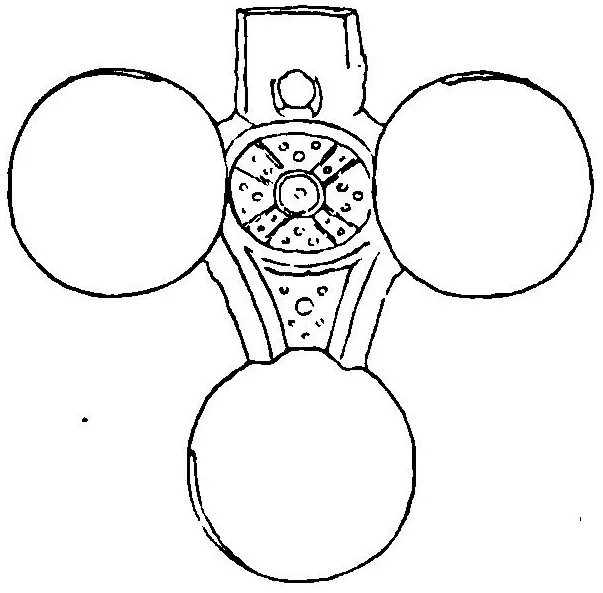
Bell-token.the people. If they discharge this duty thoroughly, the people have trust in them, and an increase of their revenue is therefore for the good of the people.
II. The capital is for the first time to be regulated, and Governors appointed for the Home provinces and districts. Let barriers, outposts, guards, and post-horses, both special and ordinary, be provided, bell-tokens[60] made, and mountains and rivers regulated.[61]
For each ward in the capital let there be appointed one (XXV. 15.) alderman,[62] and for four wards one chief alderman,[63] who shall be charged with the superintendence of the population, and the examination of criminal matters. For appointment as chief aldermen of wards let men be taken belonging to the wards, of unblemished character, firm and upright, so that they may fitly sustain the duties of the time. For appointments as aldermen, whether of rural townships or of city wards, let ordinary subjects be taken belonging to the township or ward, of good character and solid capacity. If such men are not to be found in the township or ward in question, it is permitted to select and employ men of the adjoining township or ward.
The Home provinces shall include the region from the River Yokogaha at Nabari[64] on the east, from Mount Senoyama in Kiï on the south, from Kushibuchi in Akashi on the west, and from Mount Afusaka-yama in Sasanami in Afumi on the north. Districts of forty townships[65] are constituted Greater Districts, of from thirty to four townships are constituted Middle Districts, and of three or fewer townships are constituted Lesser Districts. (XXV. 16.) For the district authorities, of whatever class, let there be taken Kuni no Miyakko of unblemished character, such as may fitly sustain the duties of the time, and made Tairei and Shōrei.[66] Let men of solid capacity and intelligence who are skilled in writing and arithmetic be appointed assistants and clerks.
The number of special or ordinary post-horses given shall in all cases follow the number of marks on the posting bell-tokens. When bell-tokens are given to (officials of) the provinces and barriers, let them be held in both cases by the chief official, or in his absence by the assistant official.
III. Let there now be provided for the first time registers of population, books of account and a system of the receipt and re-granting of distribution-land.[67]
(XXV. 17.) Let every fifty houses be reckoned a township, and in every township let there be one alderman who shall be charged with the superintendence of the population,[68] the direction of the sowing of crops and the cultivation of mulberry trees, the prevention and examination of offences, and the enforcement of the payment of taxes and of forced labour.
For rice-land, thirty paces in length by twelve paces in breadth shall be reckoned a tan.[69] Ten tan make one chō. For each tan the tax is two sheaves and two bundles (such as (XXV. 18.) can be grasped in the hand) of rice; for each chō the tax is twenty-two sheaves of rice. On mountains or in valleys where the land is precipitous, or in remote places where the population is scanty, such arrangements are to be made as may be convenient.[70]
IV. The old taxes and forced labour are abolished, and a system of commuted taxes instituted. These shall consist of fine silks, coarse silks, raw silk, and floss silk,[71] all in accordance with what is produced in the locality. For each chō of rice-land the rate is one rod[72] of fine silk, or for four chō one piece forty feet in length by two and a half feet in width. For coarse silk the rate is two rods (per chō), or one piece for every two (XXV. 19.) chō of the same length and width as the fine silk. For cloth the rate is four rods of the same dimensions as the fine and coarse silk, i.e. one tan[73] for each chō. [No rates of weight are anywhere given for silk or floss silk.] Let there be levied separately a commuted house tax.[74] All houses shall pay each one rod and two feet of cloth. The extra articles of this tax, as well as salt and offerings,[75] will depend on what is produced in the locality. For horses for the public service, let every hundred houses contribute one horse of medium quality. Or if the horse is of superior quality, let one be contributed by every two hundred houses. If the horses have to be purchased, the price shall be made up by a payment from each house of one rod and two feet of cloth. As to weapons, each person shall contribute a sword, armour, bow and arrows, a flag, and a drum. For coolies, the old system, by which one coolie was provided by every thirty houses, is altered, and one coolie is to be furnished from every fifty houses [one is for employment as a menial servant] for allotment to the various functionaries. Fifty houses shall be allotted to provide rations for one coolie, and one house shall contribute two rods and two feet of cloth and five masu[76] of rice in lieu of service.
(XXV. 20.) For waiting-women in the Palace,[77] let there be furnished the sisters or daughters of district officials of the rank of Shōrei or upwards—good-looking women [with one male and two female servants to attend on them], and let 100 houses be allotted to provide rations for one waiting-woman. The cloth and rice supplied in lieu of service shall, in every case, follow the same rule as for coolies."[78]
In this month the Emperor occupied the separate Palace of Koshiro. He sent messengers to command the provinces and districts to repair the arsenals. Yemishi came and did homage.
One book says:—"The Miyake of Koshiro, in the village of Sayabe, at Naniha, was pulled down, and a temporary Palace erected."
2nd month, 15th day. The Emperor proceeded to the Eastern Gate of the Palace, where, by Soga, Oho-omi of the Right,[79] he decreed as follows:—
"The God Incarnate, the Emperor Yamato-neko,[80] who rules the world, gives command to the Ministers assembled in his presence, to the Omi, Muraji, Kuni no Miyakko, Tomo no Miyakko, and subjects of various classes, saying:—
'We are informed that wise rulers of the people hung a bell at their gate, and so took cognizance of the complaints of their subjects; they erected buildings in the thoroughfares, where they listened to the censures of the passers-by. Even the opinions of the grass and firewood gatherers[81] they inquired personally and used for their guidance. We therefore, on a former occasion, made an edict, saying:—"In ancient times the Empire was ruled by having at the Court flags of honour for the encouragement of good, and a board of censure, the object being to diffuse principles of Government and to invite remonstrances." All this served widely to ascertain the opinions (XXV. 21.) of those below. Kwan-Tsze[82] said:—"The Emperor Hwang, by establishing the Conferences of the Bright Hall,[83] observed the opinions of the wise on the upper hand, while the Emperor Yao, having the inquiries of the street-houses, listened to the people on the lower hand. Shun again had flags to proclaim merit and thus secure publicity; and Yü set up a drum at his Court, thus providing for the investigation into expectations. T'ang[84] had the Court of the general control of Districts, whereby he observed the faults of the people. King Wu[85] had the park of the Spirit terrace, and therefore the wise had advancement. Thus the sage Emperor and Illustrious Sovereigns of antiquity possessed and did not lose; they gained and did not destroy."
The object of hanging up a bell, of providing a box, and of appointing a man to receive petitions, is to make those who have grievances or remonstrances deposit their petitions in the box. The receivers of petitions are commanded to make their report to Us every morning. When We receive this report We shall draw the attention of the Ministers to it, and cause them to consider it, and We trust that this may be done without (XXV. 22.) delay. But if there should be neglect on the part of the Ministers, and a want of diligence or partizan intrigues, and if We, moreover, should refuse to listen to remonstrance, let the complainant strike the bell. There has been already an Imperial command to this effect. But some time afterwards there was a man of intelligence and uprightness who, cherishing in his heart the spirit of a national patriot, addressed Us a memorial of earnest remonstrance, which he placed in the box prepared for the purpose. We therefore now publish it to the black-haired people here assembled. This memorial runs as follows:—"Those subjects who come to the capital in connection with the discharge of their duty to the Government of the Country, are detained by the various public functionaries and put to forced labour of various kinds, etc., etc." We are still moved with strong sympathy by this. How could the people expect that things would come to this? Now no long time has elapsed since the capital was removed, so that so far from being at home, we are, as it were, strangers. It is therefore impossible to avoid employing the people, and they have therefore been, against Our will, compelled to labour. As often as Our minds dwell on this We have never been able to sleep in peace. When We saw this memorial we could not refrain from a joyous exclamation. We have accordingly complied with the language of remonstrance, and have put a stop to the forced services at various places.
In a former edict, We said:—"Let the man who remonstrates sign his name." Those who disobey this injunction are doubtless actuated by a wish to serve their country, and not by a desire of personal gain. Whether a man signs his name or not, let him not fail to remonstrate with Us on Our neglect or forgetfulness.'"[86]
Another edict was made as follows:—"There are many things of which the assembled people of the land complain. We are now about to explain our principles. Listen attentively to what We say. Those who come to the capital and assemble at Court in order to obtain decisions of doubtful points, should not disperse in the morning,[87] but remain together in attendance at Court."
Koryö, Pèkché, Imna, and Silla all together sent envoys to offer tribute.
22nd day. The Emperor returned from the detached Palace of Koshiro.
3rd month, 2nd day. An edict was issued to the Governors of the Eastern provinces, saying:—"Do all ye Ministers and Daibu assembled in attendance on Us, as well as ye Omi, Muraji, Kuni no Miyakko, and Tomo no Miyakko, and also ye subjects of every class, listen to this:—He that is lord between (XXV. 23.) Heaven and Earth and rules the myriad people ought not to exercise control alone: he must have Ministers to support him. From generation to generation, therefore, Our Imperial ancestors have governed along with the ancestors of you, My Ministers. It is Our wish also, with the protecting power of the Gods, to associate you with Ourselves in the government. We therefore, on a former occasion, appointed Daibu, of good family, to the government of the eight Eastern provinces. Then the Governors went to their posts. Six obeyed the laws, and two were regardless of Our commands. In each case censure or praise became audible. We thereupon commended those who kept the law, and were severe with those who disregarded the instructions given them. He that would be a ruler, whether he be Lord or Minister, should first correct himself, and then correct others. If he do not correct himself, how shall he be able to correct others?[88] He therefore who does not correct himself, be he Lord or be he Minister, will meet with calamity. Should one not be watchful? If ye, the leaders, are upright, who shall presume to be otherwise? Do ye now be guided by Our former commands in dispensing your judgments."
19th day. The Emperor made a decree to the Chōshūshi[89] of the Eastern provinces, saying:—
"Hear this, all ye Ministers and Daibu assembled in Our presence, as well as ye Kuni no Miyakko and Tomo no Miyakko, together with the subjects of all classes! In the 8th month of last year, We in person admonished you, saying:—'Do not use your official authority to appropriate public or private property: you should consume food of your own domain, and ride horses of your own domain. Those who disregard this admonition, if of the rank of Assistant Governor or higher, shall be degraded in official rank, if of the rank of Clerk or lower, shall be sentenced to flogging. Those who convert property to their own use shall be mulcted in double its value.' Such was the edict which We issued. Now, when We inquired from the Chōshūshi and the Miyakko of the various provinces whether the local Governors, when they proceeded to their (XXV. 24.) posts, attended to this admonition or not, the Chōshūshi and the others informed Us fully of the facts, to wit:—The offence of Kuhi, Hodzumi no Omi, consists in having made exactions from each family among the people, and though he repented and gave back the things, not doing so completely. His two assistants, Fuse no Omi and Shidamu, Kose no Omi, have offended by not correcting the error of their chief, etc., etc. The inferior officials have all been guilty of offences. The offence of Kose no Tokune no Omi consists in having made exactions from each family among the people, and though he repented and returned the things, not doing so completely. He has moreover taken away the horses of the agricultural serfs. His two assistants, Yenowi no Muraji and Oshizaka no Muraji, did not correct the faults of their chief, but on the contrary joined with him in prosecuting their own advantage. They have moreover taken away horses belonging to the Kuni no Miyakko. Sumi, Utena no Atahe, although at first he remonstrated with his chief, yet at last became corrupt along with him. The inferior officials are all guilty of offences. The offence of Ki no Marikida no Omi consists in having sent men to Asakura no Kimi and Winouhe[90] no Kimi to fetch their horses for him to look at. Further, he made Asakura no Kimi manufacture swords. Further, he got from Asakura no Kimi his bow-cloth.[91] Further, he did not honestly return to their owners the articles sent by the Kuni no Miyakko in lieu of weapons, but delivered them to the Kuni no Miyakko in an irregular manner.[92] Further, in the province committed to his charge, he allowed himself to be robbed of a sword. Further, in (XXV. 25.) the province of Yamato he allowed himself to be robbed of a sword. These are the offences of Ki no Omi and of his assistants, Oho-guchi, Miwa no Kimi, and Momoyori, Kahabe no Omi. Their subordinate officials, Shihatsu, Kahabe no Omi, Tajihi no Fukame, Mozu no Nagaye, Katsuraki no Saigusa, Naniha no Kuhikame, Inukahi no Isogimi, Maro, Iki no Fubito, Tajihi no Inume[93]—these eight persons, all are guilty of offences. The offence of Adzumi no Muraji consists in this—that when Wadoku no Fubito was ill, he caused the Kuni no Miyakko to send (him?) government property. Further, he took horses belonging to the Yube.[94] The offence of his assistant Momoyori, Kashihade no Omi, consists in his having received and stored in his house articles paid in lieu of hay. Further, he took the horses of the Kuni no Miyakko and exchanged them for others. The two brothers, Ihatsutsu and Yumaro, Kahabeno Omi,[95] have also been guilty of offences. Ohochi no Muraji's offence consists in his having disobeyed Our former decree, which was (XXV. 26.) as follows:—'Let not the local Governors personally judge the plaints of the people in the districts placed under their charge.' He has disobeyed this edict in that he has taken it upon himself personally to judge the plaints of the men of Udo, and the matter of the slaves of Nakatomi no Toko. Nakatomi no Toko is equally guilty with him in this matter. The offence of Kishida no Omi consists in his having had his official sword stolen when he was in the province of Yamato. This showed a want of circumspection. As for Womidori no Omi and Tamba no Omi, they have been simply incompetent, but not guilty of any offence. The two men, Imbe no Konomi and Mutsuki,[96] Nakatomi no Muraji, have also been guilty of offences. Neither of these two men, viz. Hada no Omi and Taguchi no Omi, have committed any offence. The offence of Heguri no Omi consists in his having neglected to investigate the plaints of the men of Mikuni. Upon a review of these facts we find that all this is owing to the neglect and incompetence of you three, viz. Ki no Mariki no Omi, Kose no Tokune no Omi and Hodzumi no Kuhi no Omi. Is it not painful to Us to think of your disobedience to Our edict? Now if he who has pastoral care of the people, whether as Lord or Minister, gives a personal example of upright conduct, who shall presume to do otherwise? But if he, whether Lord or Minister, be not upright in heart, it is fit that he should bear the guilt. What avails it to repent afterwards? We shall therefore consider the cases of all these local Governors and punish them according to the gravity of their offences.
With regard moreover to the Kuni no Miyakko who have disobeyed Our edict by sending presents to the Governors of their provinces, and, at length joining with them in the[94] pursuit of gain, constantly conceive foul wickedness, repressive measures are indispensable. But although such are Our thoughts, we have only begun to occupy our new palace, and are about to make offerings to all the Kami, both which (XXV. 27.) matters belong to the present year. Moreover it is not meet to employ the people in labour during the months of agriculture. But in connection with the building of a new palace, it was decidedly impossible to avoid doing so. Deeply conscious of both these considerations, We proclaim a general amnesty throughout the Empire. From this time forward, let the local Governors of provinces and districts be zealous and do their utmost. Let them avoid profligacy. Let messengers be sent to release all banished men of the various provinces, and all prisoners in the gaols without exception.
In contradistinction from the rest, the following six men, viz. Shihoya no Konoshiro,[97] Kamikozo[98] no Saigusa,[99] Asakura no Kimi, Mariko no Muraji, Mikaha no Oho-tomo no Atahe and Suzuki wo no Atahe, have been obedient to the Emperor. We profoundly commend their sentiments.
Let the official rice-fields belonging to the public offices in various places be done away with, as well as the lent-rice[100] in various places belonging to the Kō-so-bō Kibishima[101] and let her official rice-lands be distributed among all Our Ministers and Tomo no Miyakko. Moreover, let rice-land and hill-tracts[102] (XXV. 28.) be given to those temples which are omitted from the registers."
20th day. The Prince Imperial, by a messenger, addressed a petition to the Emperor, saying:—"In the reigns of the former Emperors, they treated the Empire as a whole, and so ruled it. But, when we come to the present time, there was division and separation, to the injury of the Work [the work of the State is meant]. Now that it has devolved on the Emperor our Sovereign to have pastoral charge of the myriad people, Heaven and Man respond harmoniously to each other, and the government has been reformed.[103] I, therefore, filled with joy and veneration, place it on my head,[104] and prostrating myself, address Your Majesty:—'The Emperor who now rules the Land of the Eight Islands as an Incarnate Deity inquired of thy servant, saying:—"Should the Koshiro no Iribe in the possession of Ministers, Muraji, Tomo no Miyakko, Kuni no Miyakko, and established in the days of former Emperors, the Mina no Iribe in the private possession of Imperial Princes, and the Mina no Iribe belonging to the Imperial Father[105] Ohoye [Hikobito Ohoye is meant], as well as their Miyake, be allowed to remain the same as in former generations, or not?"[106] Thy servant having received this command with reverence, replies respectfully, saying:—"In Heaven there are not two suns: in a country there are not two rulers. It is therefore the Emperor alone who is supreme over all the Empire, and who has a right to the services of the myriad people. Make a special selection of labourers from the Iribe and from the people granted in fee, and follow the former arrangement.[107] For the rest,[108] it may be feared that they will be put to forced labour on private authority. I therefore offer to the Emperor 524 men of the Iribe, and 181 Miyake."'"
(XXV. 29.) 22nd day. The Emperor made a decree, as follows:—"We are informed that a Prince of the Western Land[109] admonished his people, saying:—'Those who made interments in ancient times resorted to a high ground which they formed into a tomb. They did not pile up a mound, nor did they plant trees.[110] The inner and outer coffin were merely enough to last till the bones decayed, the shroud was merely sufficient to last till the flesh decayed. I shall therefore cultivate[111] the unproductive pieces of land occupied by these tombs, to the end that their place may be forgotten after changing generations. Deposit not in them gold or silver or copper or iron, and let earthenware objects alone represent the clay chariots and straw figures[112] of antiquity. Let the interstices of the coffin be varnished. Let the offerings consist of rice presented three times, and let not pearls or jewels be placed in the mouth of the deceased. Bestow not jewel-shirts or jade armour. All these things are practices of the unenlightened vulgar.' Again it is said:—'Burial is putting away, and proceeds from the desire to prevent the dead from being seen by people.' Of late, the poverty of our people is absolutely (XXV. 30.) owing to the construction of tombs.[113] We now issue regulations making distinction of noble and mean.
The inner dimensions of tombs of persons of the rank of Princes and upwards[114] shall be nine feet in length by five in width. Their outer limits shall be nine fathoms square and their height five fathoms.[115] The work shall be completed by 1000 labourers in seven days. At the time of interment white cloth shall be used for the hangings (of the bier), etc. A hearse may be used.
The inner dimensions of tombs of Superior Ministers[116] shall be similar in length, breadth and height to the above. Their outer limits shall be seven fathoms square, and they shall be three fathoms in height.[117] The work shall be completed by 500 labourers in five days. At the time of interment white cloth shall be used for the hangings of the bier, which shall be borne on men's shoulders.
The inner dimensions of a tomb of a Minister of a lower class shall be in every respect similar in length, breadth, and height to the above. Their outer limits shall be five fathoms square, and they shall be two and a half fathoms in height. The work shall be completed by 250 labourers in three days. At the time of interment white cloth shall be used for hangings. In other matters the same rule as before is to be followed.
(XXV. 31.) The inner dimensions of the tombs of persons of the rank of Dainin and Shōnin shall be nine feet in length and four feet in height and breadth. The ground shall be made level and no mound raised. The work shall be completed by 200 labourers in one day.
In the case of persons from the rank of Dairei to that of Shōchi inclusive, the tombs shall in all respects follow the rule of Dainin; but the work shall be completed by fifty labourers in one day.
Let small stones[118] be used for the tombs of all from the rank of Prince down to that of Shōchi, and let white cloth be used for the hangings.
When ordinary persons die, let them be buried in the ground, and let the hangings be of coarse cloth. Let the interment not be delayed for a single day.
The construction of places of temporary interment is not allowed in any case, from Princes down to common people.
Not only in the Home provinces, but in the provinces generally, let plots of ground be set apart for interments.[119] It is not permitted to pollute the earth by dispersed interments in various places.
When a man dies, there have been cases of people sacrificing themselves by strangulation, or of strangling others by way of sacrifice, or of compelling the dead man's horse to be sacrificed, or of burying valuables in the grave in honour of the dead, or of cutting off the hair, and stabbing the thighs and pronouncing an eulogy on the dead (while in this condition). (XXV. 32.) Let all such old customs be entirely discontinued.
A certain book says:—'No gold or silver, no silk brocades, and no coloured stuffs are to be buried.' Again it is said:—'From the Ministers of all ranks down to the common people, it is not allowed to use gold or silver.'
Should there be any cases of this decree being disregarded and these prohibitions infringed, the relations shall surely receive punishment.
Again, there are many cases of persons who, having seen, say that they have not seen, or who, having not seen, say that they have seen, or who, having heard, say that they have not heard, or who, having not heard, say that they have heard, being deliberate liars, and devoid of truth in words and in sight.
Again, there have been many cases in which slaves, both male and femme, false to their masters in their poverty, betake themselves of their own accord to influential houses in quest of a livelihood, which influential houses forcibly detain and purchase them, and do not send them to their original owners.
Again, there have been very many cases in which wives or concubines, when dismissed by their husbands, have, after the lapse of years, married other husbands, as ordinary morality allows. Then their former husbands, after three or four years, have made greedy demands on the second husband's property, seeking their own gain.
Again, there have been very many cases in which men, relying on their power, have rudely demanded people's daughters in marriage. In the interval, however, before going to his house, the girl has, of her own accord, married another, and the rude suitor has angrily made demands of the property of both families for his own gain.
Again, there have been numerous cases of this kind. Sometimes a wife who has lost her husband marries another man after the lapse of ten or twenty years and becomes his spouse, or an unmarried girl is married for the first time. Upon this, people, out of envy of the married pair, have made them perform purgation.[120]
Again, there are cases in which women, who have become men's wives and who, being put away owing to their husbands' dislike of them, have, in their mortification at this injury, compelled themselves to become blemished[121] slaves.
Again, there are cases in which the husband, having frequent occasion to be jealous of his wife's illicit intercourse with others, voluntarily appeals to the authorities to decide the matter. Let such persons not lay their information until they have obtained, let us say, three credible witnesses to join with them in making a declaration. Why should they bring forward ill-considered plaints.
Again, there have been cases of men employed on forced labour in border lands who, when the work was over and they were returning to their village, have fallen suddenly ill and (XXV. 33.) lain down to die by the roadside. Upon this the (inmates of the) houses by the roadside say:—'Why should people be allowed to die on our road?' And they have accordingly detained the companions of the deceased and compelled them to do purgation. For this reason it often happens that even if an elder brother lies down and dies on the road, his younger brother will refuse to take up his body (for burial).
Again, there are cases of peasants being drowned in a river. The bystanders say:—'Why should we be made to have anything to do with drowned men?' They accordingly detain the drowned man's companions and compel them to do purgation. For this reason it often happens that even when an elder brother is drowned in a river his younger brother will not render assistance.
Again, there are cases of people who, when employed on forced labour, cook their rice by the roadside. Upon this the (inmates of the) houses by the roadside say:—'Why should people cook rice at their own pleasure on our road?' and have compelled them to do purgation.
Again, there are cases when people have applied to others for the loan of pots in which to boil their rice, and the pots have knocked against something and have been upset. Upon this the owner of the pot compels purgation to be made.
All such practices are habitual among the unenlightened vulgar. Let them now be discontinued without exception, and not permitted again.
Again, there are cases in which peasants, when they are about to proceed to the capital, apprehensive lest their riding horses should be worn out and unable to go, give two fathoms of cloth[122] and two bundles of hemp to men of the two provinces of Mikaha or Wohari, to hire them to feed their horses. After they have been to the capital and are on their way home, they make them a present of a spade, and then find that the men of Mikaha, etc., have not only failed to feed their horses properly, but have allowed them to die of starvation. In the case of horses of a superior class, they conceive covetous desires, and invent lying tales of their having been stolen, while in the case of mares which become pregnant in their house, they cause purgation to be made, and in the end make a plunder of the beast.
Such things having come to our ears, We therefore now establish the following regulation:—
Whenever horses are left at livery in any of the provinces along the highway, let the owner take with him the man whom he engages for this purpose, and make a full statement to the village elder, handing over (to the latter) at the same time the articles given as remuneration. It is unnecessary for him to (XXV. 34.) make any further payment when he returns home. If he has caused the horse to suffer harm, he should get nothing.
If anyone disobeys this edict, a severe penalty shall be imposed.
The dues payable to Market Commissioners,[123] for main roads, and to ferrymen; are abolished and lands are granted instead.
Beginning with the Home provinces, and embracing the provinces in all four quarters, during the agricultural months,[124] let everyone apply himself early to the cultivation of the rice-land. It is not meet at such a time to let them eat dainty food or drink sake. Let faithful messengers be appointed to intimate this to the Home provinces. And let the Kuni no Miyakko of the provinces in every quarter choose good messengers to urge (the peasants to work) in accordance with the edict."
Autumn, 8th month, 14th day. An edict was issued, saying:—
"Going back to the origin of things, we find that it is Heaven and Earth with the male and female principles of nature,[125] which guard the four seasons from mutual confusion. We find, moreover, that it is this Heaven and Earth[126] which produces the ten thousand things. Amongst these ten thousand things Man is the most miraculously gifted. Among the most miraculously gifted beings, the sage takes the position of ruler. Therefore the Sage Rulers, viz. the Emperors, take Heaven as their exemplar in ruling the World, and never for a moment dismiss from their breasts the thought of how men shall gain their fit place.
Now as to the names of the early Princes, the Omi, Muraji, Tomo no Miyakko and Kuni no Miyakko have divided their various Be[127] and allotted them severally to their various titles (or surnames). They afterwards took the various Be of the people, and made them reside in the provinces and districts, one mixed up with another. The consequence has been to make father and child to bear different surnames, and brothers to be reckoned of distinct families, while husbands and wives have names[128] different from one another. One family is divided into five or split up into six, and both Court and country are therefore (XXV. 35.) filled with contentious suits. No settlement has been come to, and the mutual confusion grows worse and worse. Let the various Be, therefore, beginning with those of the reigning Emperor and including those in the possession of the Omi, Muraji, etc., be, without exception, abolished, and let them become subjects of the State. Those who have become Tomo no Miyakko by borrowing the names of princes, and those who have become Omi or Muraji on the strength of the names of ancestors,[129] may not fully apprehend our purport, and might think, if they heard this announcement without warning, that the names borrowed by their ancestors would become extinct. We therefore make this announcement beforehand, so that they may understand what are our intentions.
The children of rulers succeed one another in the government of the Empire, and it is well known that the names of the actual Emperor and of his Imperial ancestors will not be forgotten by the world. But the names of sovereigns are lightly given to rivers and plains,[130] or common people are called by them. This is a truly fearful state of things. The appellations of sovereigns, like the sun and moon, will float afar: the names of those of the Imperial line[131] will last for ever, like unto Heaven and Earth. Such being our opinion, we announce as follows:—'Do ye all, from those of the Imperial line down to the Ministers, the Daibu, Omi, Muraji, and Tomo no Miyakko, who do Us service, (in short) all persons of whatever Uji[132] [One book has 'royal subjects of whatever name'], give ear to what We say. With regard to the form of your service, We now abolish the former offices and constitute afresh the hundred bureaus. We shall, moreover, grant grades of rank and confer official dignities.[133]
Let the local Governors who are now being despatched, and also the Kuni no Miyakko of the same provinces, give ear to what we say. In regard to the method of administration notified last year to the Court Assembly,[134] let the previous arrangement be followed, and let the rice-lands which are received and measured be granted equally to the people, without distinction of persons.[135] In granting rice-lands the peasants' houses should adjoin the land. Those whose houses lie near the lands must therefore have the preference. In this sense receive Our injunctions.
In regard to commuted taxes,[136] they should be collected from males (only).
Labourers should be supplied at the rate of one for every (XXV. 36.) fifty houses. The boundaries of the provinces should be examined and a description or map prepared, which should be brought here and produced for Our inspection. The names of the provinces and districts will be settled when you come.
With respect to the places where embankments are to be constructed, or canals dug, and the extent of rice-land to be brought under cultivation, in the various provinces, uniform provision will be made for causing such work to be executed.'
Give ear to and understand these injunctions."
9th month. The Shōtoko, Kuromaro, Takamuko no Hakase, was sent to Silla to cause them to send a hostage. Ultimately the tribute from Imna was discontinued.
In this month the Emperor occupied the temporary Palace of Kahadzu.[137] [Some books have "detached Palace."]
In this year the rats of the province of Koshi drew together in troops by night and day, and took their departure towards the East.
A.D. 647. 3rd year, Spring, 1st month, 15th day. There was archery at the Court.
On this day Koryö and Silla sent messengers together to offer tribute.
Summer, 4th month, 29th day. An edict was issued as follows:—
"The Empire was entrusted (by the Sun-Goddess to her descendants, with the words) 'My children, in their capacity of Deities, shall rule it.' [The phrase 惟神 means to follow the way of the Gods, or again to possess in oneself the way of the Gods.] For this reason, this country, since Heaven and Earth began, has been a monarchy. From the time that Our Imperial ancestor[138] first ruled the land, there has been great concord[139] in the Empire, and there has never been any (XXV. 37.) factiousness. In recent times, however, the names, first of the Gods, and then of the Emperors, have in some cases been separated (from their proper application) and converted into the Uji of Omi or Muraji, or they have been separated and made the qualifications of Miyakko,[140] etc. In consequence of this, the minds of the people of the whole country take a strong partisan bias, and conceiving a deep sense of the me and thee, hold firmly each to their names. Moreover the feeble and incompetent Omi, Muraji, Tomo no Miyakko and Kuni no Miyakko make of such names their family names; and so the names of Gods and the names of sovereigns are applied to persons and places in an unauthorized manner, in accordance with the bent of their own feelings. Now, by using the names of Gods and the names of sovereigns as bribes, they draw to themselves the slaves of others, and so bring dishonour upon unspotted names. The consequence is that the minds of the people have become unsettled and the government of the country cannot be carried on. The duty has therefore now devolved on Us in Our capacity as Celestial Divinity, to regulate and settle these things. In order to make them understood, and thereby to order the State and to order the people, We shall issue, one after another, a succession of edicts, one earlier, another later, one to-day and another to-morrow. But the people, who have always trusted in the civilizing influence[141] exercised by the Emperors, and who are used to old customs, will certainly find it hard to wait until these edicts are made. We shall therefore remit to all, from Princes and Ministers down to the common people of all classes, the tax in lieu of service."
In this year Wogohori[142] was pulled down and a Palace built.
The Emperor, having taken up his residence in the Palace of Wogohori, established a Law for Ceremonies, the regulations of which were as follows:—
All persons holding official rank must draw up in lines to right and left outside the south gate at the hour of the Tiger,[143] and wait there until the first appearance of the sun. They shall then enter the Court, and having made their obeisances, shall attend in the Hall. Those who come late will not be permitted to enter and take up their attendance. When the hour of the Horse[144] arrives, they shall retire when they hear the sound of the bell. The officer whose business it is to strike the bell shall wear a red apron. The bell-stand shall be set up in the Middle Court.
The engineer of the rank of Daisen,[145] Aratawi no Hirafu,[146] (XXV. 38.) Yamato no Aya no Atahe, mistakenly dug a canal which he led to Naniha and thereby distressed the people. Upon this some one presented a memorial of remonstrance, and the Emperor made a decree, saying:—"We unwisely gave ear to Hirafu's misrepresentations, and so dug this canal to no purpose. It is We who are to blame." That same day the work was discontinued.[147]
Winter, 10th month, 11th day. The Emperor made a progress to the hot baths of Arima. He was accompanied by the Oho-omi of the Right and Left, and by the other Ministers and Daibu.
12th month, last day. The Emperor returned from the hot baths and stayed in the temporary Palace of Muko.
On this day the Palace of the Prince Imperial took fire, to the great marvel of the people of that time.
In this year there were instituted caps of seven kinds and thirteen grades.
The first was called Shoku-kwan.[148] Of this there were two grades, the greater and the lesser. It was made of woven stuff, and embroidered on the borders. The colour of the clothing was in both cases dark purple.
The second was called Shu-kwan.[149] Of this there were two grades, the greater and the lesser. It was made of embroidered stuff. The border of the cap and the colour of the clothing was the same as for the Shoku-kwan.
(XXV. 39.) The third was called Shi-kwan.[150] Of this there were two grades, the greater and the lesser. It was made of purple material, with a border of woven stuff. The colour of the clothing was light purple.
The fourth was called Kin-kwan.[151] Of this there were two grades, the greater and the lesser. The greater Kin-kwan was made of Dai-haku-sen[152] brocade, and had the cap-border of woven stuff: the lesser Kin-kwan was made of Shō-haku-sen brocade, and had the cap-border of Dai-haku-sen brocade. The colour of the clothing was in both cases true dark red.
The fifth was called Sei-kwan,[153] and was made of blue silk. Of this there were two grades, the greater and the lesser. The greater Sei-kwan had a border of Dai-haku-sen brocade. The colour of the clothing was in both cases deep violet.
The sixth was called Kok-kwan,[154] and was made of black silk. Of this there were two grades, the greater and the lesser. The greater Kok-kwan had a border of wheel-pattern brocade. The lesser Kok-kwan had a border of diamond-pattern brocade. The colour of the clothing was in both cases green.[155]
The seventh was called Kembu[156] [the initial (or lowest) rank. It was also called Risshin].[157] It was made of black silk and had a border of dark violet.
In addition to the above there were Tō-kwan,[158] made of black silk. These caps had varnished gauze stretched behind.
Distinctions of rank were indicated by the border and the hair ornaments.[159] The latter were in shape like a cicada. The hair ornaments of the grades from the Lesser Kin-kwan upwards were of a combination of gold and silver: the hair (XXV. 40.) ornaments of the Greater and Lesser Seikwan were made of silver: the hair ornaments of the Greater and Lesser Kok-kwan were made of copper. The Kembu caps had no hair ornaments.
These caps were worn at Grand Assemblies,[160] when foreign guests were entertained, and at the (Buddhist) maigre feasts of the fourth[161] month and seventh month.
Silla sent Kim Chhyun-chhyu, a Superior Minister, of the rank of Greater Ason, and others to accompany the Hakase, Takamuko no Kuromaro, of Shōtoko rank, and Oshikuma, Nakatomi no Muraji, of middle Shōsen rank,[162] and bring a present to the Emperor of a peacock and a parrot. Chhyun-chhyu was made a hostage. He was a handsome man, who talked and smiled agreeably.[163]
The Nutari[164] barrier was constructed, and a barrier-settlement established. Old men talked to one another, saying:—"The migration of the rats towards the East some years ago prefigured the making of this barrier."
A.D. 648. 4th year. Spring, 1st month, 1st day. The ceremony of New Year's congratulations took place.
In the evening the Emperor proceeded to the Palace of Toyosaki in Naniha.
2nd month, 1st day. Student priests were sent to Corea.
8th day. The Oho-omi Abe invited the four classes[165] to the Temple of Shitenōji, where, having brought in four images of Buddha, he had them enshrined within the pagoda. He constructed a figure of the wondrous Vulture Mountain,[166] which he (XXV. 41.) made by piling up drums on one another.
Summer, 4th month, 1st day. The old caps were discontinued. The Oho-omi of the Left and Right, however, continued to wear the old caps.
This year Silla sent envoys bearing tribute.
The barrier of Ihabune[167] was put to rights as a precaution against the Yemishi. Eventually subjects from the provinces of Koshi and Shinano were selected, and a barrier-settlement for the first time established.
A.D. 649. 5th year. Spring, 1st month, 1st day. The New Year's congratulations took place.
2nd month. Nineteen cap grades were instituted, as follows:—
| First | Dai-shiki | (greater-woven-stuff) |
| Second | Shō-shiki | (lesser-woven-stuff) |
| Third | Dai-shū | (greater embroidery) |
| Fourth | Shō-shū | (lesser embroiderydo.) |
| Fifth | Dai-shi | (greater purple) |
| Sixth | Shō-shi | (lesser purpledo.) |
| Seventh | Upper Dai-kwa | (greater flower) |
| Eighth | Lower Dai-kwa | (greater flowerdo.) |
| Ninth | Upper Shō-kwa | (lesser flower) |
| Tenth | Lower Shō-kwa | (lesser flowerdo.) |
| Eleventh | Upper Dai-sen[168] | (greater mountain) |
| Twelfth | Lower Dai-sen | (greater mountaindo.) |
| Thirteenth | Upper Shō-sen | (lesser mountain) |
| Fourteenth | Lower Shō-sen | (lesser mountaindo.) |
| Fifteenth | Upper Dai-otsu[169] | |
| Sixteenth | Lower Dai-otsu | |
| Seventeenth | Upper Shō-otsu | |
| Eighteenth | Lower Shō-otsu | |
| Nineteenth | Risshin | (Promotion or advancement) |
In this month an order was given to the Hakase, Takamuko no Kuromaro, and the Buddhist Priest Bin to establish Eight Departments of State and one hundred bureaus.[170]
(XXV. 42.) 3rd month, 17th day. Abe no Oho-omi died. The Emperor proceeded to the Shujaku[171] gate, where he raised up lamentations for him and showed much emotion. The Empress Dowager, the Prince Imperial, and the other Princes, together with the Ministers of every rank, all, following his example, mourned and lamented.[172]
24th day. Hiuga, Soga no Omi [styled[173] Musashi] slandered the Oho-omi Kurayamada to the Prince Imperial, saying:—"Maro, thy servant's elder brother by a different mother, is watching the opportunity of the Prince Imperial making an excursion to the seaside, in order to do him a mischief. He will ere long commit treason." The Prince Imperial believed this. The Emperor sent Ohotomo no Komano Muraji, Mikuni no Maro no Kimi, and Hodzumi no Kurafu no Omi to the Oho-omi, Kurayamada no Maro, and questioned him as to the truth of the charge of treason. The Oho-omi answered and said:—"I will have a personal interview with the Emperor, and shall then answer to the charge brought against me." The Emperor again sent Mikuni no Maro no Kimi and Hodzumi, Kurafu no Omi, to investigate the circumstances of the treason. The Oho-omi, Maro, again answered as before. The Emperor was therefore about to raise an armed force and surround therewith the Oho-omi's house, when the Oho-omi, taking with him his two sons, Hōshi[174] and Akagoma [also called Mawosu], fled by way of Chinu towards the boundary of the province of Yamato. Before this, Koshi, the Oho-omi's eldest son, was already staying in Yamato, where he was building the Temple. [This means that he was staying in the Yamada house.] Now being suddenly apprised that his father was coming thither in flight, he went out to meet him at the great Tsuki tree in Imaki. Having approached, he took the lead and entered the Temple. Then he looked back to the Oho-omi and said:—"Koshi desires to advance straight on in person, and oppose the army which is coming." But the Oho-omi would not allow it. That night Koshi conceived the idea of burning the Palace [the Palace of Woharida is meant], and went on assembling troops.
(XXV. 43.) 25th day. The Oho-omi addressed his eldest son Koshi, saying:—"Dost thou love thy life?" Koshi answered and said:—"I love it not." The Oho-omi thereupon harangued the priests of the Yamada Temple, his eldest son Koshi and some tens of other persons, saying:—"Shall one who is in the position of vassal contrive treason against his Lord? Shall the duty of a son to a father be brought to nothing? This temple was originally built, not for me personally, but under a vow for the sake of the Emperor. I have now been slandered by Musashi, and I fear that I shall be unjustly put to death. With so near a prospect of the yellow springs,[175] I would withdraw (from life) still cherishing fidelity in my bosom, and the object of my coming to this Temple is that my last moments may be made easier."
When he had done speaking, he opened the door of the Buddha Hall and uttered a vow, saying:—"In all future births and existences, let me not have resentment against my sovereign!" When he had made this vow, he strangled himself and died. His wife and children, to the number of eight persons, sacrificed[176] themselves with him.
On this day, Oho-tomo no Koma no Muraji and Soga no Hiuga no Omi were sent as Generals in command of a body of troops to pursue the Oho-omi. General Ohotomo no Muraji and his colleague had gone as far as Kuroyama when Mu, Hashi no Muraji, and Omimaro, Uneme no Omi, came running from the Yamada Temple, and brought information that the Oho-omi Soga, with his three sons and one daughter, had already committed suicide together by strangulation. The Generals therefore returned from Tajihi no Saka.
26th day. The wife, children, and personal attendants of the Oho-omi Yamada, who committed suicide by strangulation, were many. Kurafu, Hodzumi no Omi, arrested in a body the Oho-omi's people, viz. Tsukushi, Taguchi no Omi, and others, placed cangues round their necks, and tied their hands behind their backs. That night, Maro, Ki no Omi, Hiuga, Soga no Omi, and Kurafu, Hodzumi no Omi, having surrounded the Temple (XXV. 44.) with an armed force, called Shiho, Mononobe no Futsuta no Miyakko, and ordered him to cut off the Oho-omi's head. Upon this Futsuta no Shiho drew his sword, raised up the body on its point, yelled and reviled, and then cut it off.
30th day. There were executed, as implicated with the Oho-omi, Soga no Yamada, Tsukushi, Taguchi no Omi, Miminashi no Dōtoko, Takada no Shikowo,[177] Nukadabe no Yumasu no Muraji, Hada no Adera and others, fourteen persons in all. Nine were strangled,[178] and fifteen banished.
In this month, messengers were sent to take over the property of the Oho-omi, Yamada. Among his property was a beautiful book with the inscription "Book belonging to the Prince Imperial," and a valuable object inscribed "Property of the Prince Imperial." When the messengers returned and reported the circumstances of their having taken over the property, the Prince Imperial recognized for the first time that the heart of the Oho-omi had remained pure and unspotted. He was seized with shame and remorse for the past, and bewailed his fate incessantly. Hiuga no Omi was accordingly appointed Viceroy of Tsukushi. The people of the time said to one another, "Is (XXV. 45.) not this a disguised banishment?"
When Soga no Miyakko hime, consort of the Prince Imperial, heard that her father the Oho-omi had been decapitated by Shiho, she took it deeply to heart, and grieved bitterly. She detested hearing Shiho's name mentioned, and so her personal attendants, whenever they had occasion to speak of salt (shiho), altered the word and called it Kitashi.[179] At last Miyakko hime died of a broken heart. When the Prince Imperial heard that she had passed away, he was grieved and deeply shocked, and bewailed her loss exceedingly. Upon this Mitsu, Nunaka Kahara no Fubito, came forward and presented verses of poetry as follows:—
On a mountain-stream
Two mandarin-ducks[180] there be,
Well matched together:—
But the wife who was a like mate for me
Who is it that has taken away?
This was the first verse.
Though on every tree
The flowers are blooming,
How can it be that
My darling wife
Does not blossom again?
This was the second verse.
The Prince Imperial, with a sigh of deep despair, praised the verses, saying:—"How beautiful! how pathetic!" So he gave him his lute[181] and made him sing them. He also presented him with four hiki of silk, twenty tan of cloth, and two bags of floss silk.
Summer, 4th month, 20th day. Kose no Tokodako no Omi, of Shōshi rank, was granted the rank of Daishi, and was made Oho-omi of the Left.[182]
Ohotomo no Nagatoko no Muraji [styled Mŭmakahi] of Shōshi rank, was granted the rank of Daishi, and was made Oho-omi of the Right.[183]
5th month, 1st day. Shikofu, Miwa no Kimi, of Lower Shōkwa rank, Tsunomaro, Harahibe no Muraji[184] of Upper (XXV. 46.) Daisen rank, and others were sent to Silla.
This year, the Queen of Silla sent Kim Ta-sya, Sa-son of Sa-tök-pu, as hostage. He had a suite of thirty persons.
One Buddhist priest, two Si-rang,[185] one Assistant, one Usher, five Chung-kēk,[186] ten Artists,[187] one Interpreter, and sixteen servants of various kinds—in all thirty-seven persons.
A.D. 650. Hakuchi,[188] 1st year, Spring, 1st month, 1st day. The Imperial chariot proceeded to the Palace of Ajifu, where the Emperor viewed the ceremonies of the New Year's congratulations.
On this day the Imperial chariot returned to the Palace.
2nd month, 9th day. Shikofu, Kusakabe no Muraji, Governor of the Province of Anato, presented to the Emperor a white pheasant, saying:—"Nihe, a relation of Obito, the Kuni no Miyakko, caught it on the 9th day of the first month on Mount Wonoyama." Upon this inquiry was made of the Lords of Pèkché, who said:—"In the eleventh year[189] of Yung-p‘ing, in the reign of Ming Ti of the Later Han dynasty, white pheasants were seen in a certain place." Further, inquiry was made of the Buddhist priests, who answered and said:—"With our ears we have not heard, nor with our eyes have we seen (XXV. 47.) such. May it please Your Majesty to order a general amnesty; and so give joy to the hearts of the people."
The Priest Dōtō said:—"At one time Koryö desired to build a Buddhist Temple. There was no place which was not examined for this purpose. Then in a certain place a white deer was seen quietly moving, and eventually a Temple was built on this spot. It was called the Temple of the park of the white deer, and the practice of the Buddhist Law was there permanently established. Again, a white sparrow was seen at the farmstead of a certain Temple. The people of the country all said that it was a good omen. Moreover, Envoys sent to Great Thang[190] brought back a dead crow with three legs.[191] The people of the country again said that this was a good omen. Though these things are trifles, yet they are deemed of favourable omen. Much more is this so in the case of a white pheasant."
The Priest Bin said:—"This is to be deemed a lucky omen, and it may reasonably be accounted a rare object. I have respectfully heard that when a Ruler extends his influence to all four quarters, then will white pheasants be seen. They appear, moreover, when a Ruler's sacrifices are not in mutual disaccord, and when his banquets and costumes are in due measure. Again, when a Ruler is of frugal habits, white pheasants are made to come forth on the hills. Again, they appear when the Ruler is sage and humane. In the time of the Emperor Ch‘ēng Wang of the Chou Dynasty, the Yüeh-shang[192] family brought and presented to the Emperor a white pheasant, saying:—'We were told by the old men of our country:—"What a long time it has been since there have been any exceptional storms or long-continued rains, and that the great rivers and the sea have not surged up over the land! Three years have now elapsed. We think that in the Central (XXV. 48.) Land there is a Sage. Would it not be well to go and pay your respects at his Court?" We have therefore come, having tripled our interpreters.' Again, in the first year of Hien-ning[193] in the reign of Wu-ti of the Tsin Dynasty, one was seen in Sung-tsze. This is accordingly a favourable omen. A general amnesty ought to be granted."
Upon this the white pheasant was let loose in the garden.
15th day. The array of guards at Court was like that on the occasion of a New Year's reception. The Oho-omi of the Right and Left and all the functionaries formed four lines outside of the purple gate. Ihimushi, Ahata no Omi, and three others were made to take the pheasant's litter and move off ahead, while the Oho-omi of the Right and Left at the head of all the functionaries and Phung-chyang, Lord of Pèkché, his younger brother Sē-syöng, Chhyung-seung,[194] the physician to the King of Koryö, by name Mo-chhi, the scholar attached to the Court of Silla, and others, advanced into the Central Court. These four men, viz. Maro, Mikuni no Kimi, Takami, Wina no Kimi, Mikaho, Miwa no Kimi, and Maro Kida,[195] Ki no Omi, taking up the pheasant's litter in turn, advanced in front of the (XXV. 49.) Hall. Then the Oho-omi of the Right and Left approached and held the litter by the forward end. The Prince of Ise, Maro, Mikuni no Kimi, and Woguso, Kura no Omi, took hold of the hinder end of the litter and placed it before the Imperial throne. The Emperor straightway called the Prince Imperial, and they took it and examined it together. The Prince Imperial having retired, made repeated obeisances, and caused the Oho-omi Kose to offer a congratulatory address, saying:—"The Ministers and functionaries offer their congratulations. Inasmuch as Your Majesty governs the Empire with serene virtue, there is here a white pheasant, produced in the western region. This is a sign that Your Majesty will continue for a thousand autumns and ten thousand years peacefully to govern the Great-eight-islands[196] of the four quarters. It is the prayer of the Ministers, functionaries, and people that they may serve Your Majesty with the utmost zeal and fidelity."
Having finished this congratulatory speech, he made repeated obeisances. The Emperor said:—
"When a sage Ruler appears in the world and rules the Empire, Heaven is responsive to him, and manifests favourable omens. In ancient times, during the reign of Ch‘ēng-wang of the Chou Dynasty, a ruler of the Western land,[197] and again in the time of Ming Ti of the Han Dynasty, white pheasants were seen. In this our Land of Japan,[198] during the reign of the Emperor Homuda,[199] a white crow made its nest in the Palace. In the time of the Emperor Oho-sazaki,[200] a Dragon-horse appeared in the West.[201] This shows that from ancient times until now, there have been many cases of auspicious omens appearing in response to virtuous rulers. What we call (XXV. 50.) phœnixes, unicorns,[202] white pheasants, white crows, and such like birds and beasts, even including herbs and trees, in short all things having the property of significant response, are favourable omens and auspicious signs produced by Heaven and Earth. Now that wise and enlightened sovereigns should obtain such auspicious omens is meet and proper. But why should We, who are so empty and shallow, have this good fortune? It is no doubt wholly due to our Assistants, the Ministers, Omi, Muraji, Tomo no Miyakko and Kuni no Miyakko, each of whom, with the utmost loyalty, conforms to the regulations that are made. For this reason, let all, from the Ministers down to the functionaries, with pure hearts reverence the Gods of Heaven and Earth, and one and all accepting the glad omen, make the Empire to flourish."
Again he commanded, saying:—
"The provinces and districts in the four quarters having been placed in our charge by Heaven, We exercise supreme rule over the Empire. Now in the province of Anato, ruled over by Our divine ancestors, this auspicious omen has appeared. For this reason We proclaim a general amnesty throughout the Empire, and begin a new year-period, to be called Haku-chi.[203] Moreover we prohibit the flying of falcons within the limits of the province of Anato."
Presents were made to the Ministers, Daibu and officials of lower rank down to the clerks, varying in value according to their rank. Hereupon the local Governor, Shikofu, Kusakabe no Muraji, was commended and granted the rank of Daisen, together with liberal presents. The commuted taxes and corvées of Anato were remitted for three years.
Summer, 4th month. Silla sent Envoys to offer tribute.
One book says:—"In the reign of this Emperor the three countries of Koryö, Pèkché and Silla sent Envoys bearing tribute every year."
(XXV. 51.) Winter, 10th month. In respect of the tombs which had been demolished in order to include the ground in a site for a Palace, and of the people who had been made to remove for the same purpose, presents were given, varying in value. This having been done, the chief builder Hirafu, Aratawi no Atahe, was sent to set up the boundary posts of the Palace.
In this month the construction was begun of an embroidery[204] figure of Buddha sixteen feet in height with its attendant Bosatsu,[205] and of figures of beings of the eight classes[206]—forty-six figures in all.
In this year, Ohoguchi, Aya no Yamaguchi no Atahe, in obedience to an Imperial order, carved one thousand images of Buddha.
Agata, Yamato no Aya no Atahe, Abumi, Shiragabe no Muraji, and Agura, Naniha no Kishi, were sent to the province of Aki to build two Pèkché ships.
A.D. 651. 2nd year, Spring, 3rd month, 14th day. The sixteen feet high embroidery figure of Buddha and the others were finished.
15th day. The Empress Dowager invited the ten Buddhist professors[207] and prepared a maigre entertainment for them.
6th month. Pèkché and Silla sent Envoys to bring tribute and to offer presents.
Winter, 12th month, last day. More than 2100 priests and nuns were invited to the Palace of Ajifu, and made to read the Issaikyō.[208]
That night over 2700 lights were lit in the courtyard of the Palace, and there were caused to be read the Antaku and Dosoku[209] Sutras, etc. Upon this, the Emperor removed his (XXV. 52.) residence from Oho-gohori to the new Palace. It received the name of the Palace of Naniha no Nagara no Toyosaki.
This year the Silla tribute-envoys, Chi-man, of Sa-son rank, and his companions anchored at Tsukushi, wearing garments of the Thang country. The Government, disgusted at this wanton change of habit, reproved them and drove them back again. At this time Kose no Oho-omi addressed the Emperor, saying:—"If we do not give a blow to Silla at this present time, we shall certainly have to regret it afterwards. Now as to the manner of giving a blow to Silla, we can do so without raising a sword.[210] From the port of Naniha as far as Tsukushi let the surface of the sea be covered with ships, one touching another. Then if Silla be summoned and called to an account for her offences, it will be easy for us to gain our object."
A.D. 652. 3rd year, Spring, 1st month, 1st day. When the New Year's ceremonies were over, the Imperial chariot proceeded to the Palace of Oho-gohori.
From the 1st month to the 2nd month the distribution of rice-lands[211] had been brought to a close. As to the length[212] of the rice-fields, thirty paces made a tan, and ten tan a chō.
The tax-rice was one sheaf and a half per tan, or fifteen sheaves per chō.
3rd month, 9th day. The Imperial chariot returned to the Palace.
Summer, 4th month, 15th day. The Shamon,[213] Ye-un, was invited to the interior of the Palace and made to explain the[208] Muryōjiu[214] Sutra, the Shamon Ye-ji was made lecturer and 1000 Shamon were constituted the audience.
20th day. The explanations (of the Sutras) was discontinued. From this day forward rain began to fall continually, lasting for nine days. It demolished buildings, and destroyed the young rice-plants in the fields. Many men, horses and oxen were drowned.
(XXV. 53.) In this month the registers of population were prepared. Fifty houses were made a township, and for each township there was appointed an elder. The senior member of the family[215] was always made the head of the household. The houses were all associated in groups of five for mutual protection, with one elder to supervise them one with another.
Silla and Pèkché sent Envoys to bring tribute and offer presents.
Autumn, 9th month. The building of the Palace was completed. It is impossible adequately to describe the appearance of the Palace Halls.
Winter, 12th month, last day. The priests and nuns of the Empire were invited to the interior of the Palace and entertained with meagre fare. Plentiful alms were given, and lights kindled.
A.D. 653. 4th year, Summer, 5th month, 12th day. There were sent to Great Thang, as Chief Ambassador, Kishi no Nagani, of Upper Shōsen rank, as Associate Ambassador, Kishi no Koma [also called Ito] of Upper Shō-otsu rank, as Student Priests, Dōgen, Dōtsū, Dōkwō, Yese, Gakushū, Benshō, Yeshō, Sōnin, (XXV. 54.) Chisō, Dōshō, Jōye[216] [Jōye was the eldest son of the Oho-omi of the Middle[217]], Adachi [Adachi was the son of Nakatomi no Kome no Muraji] and Dōkwan [Dōkwan was the son of
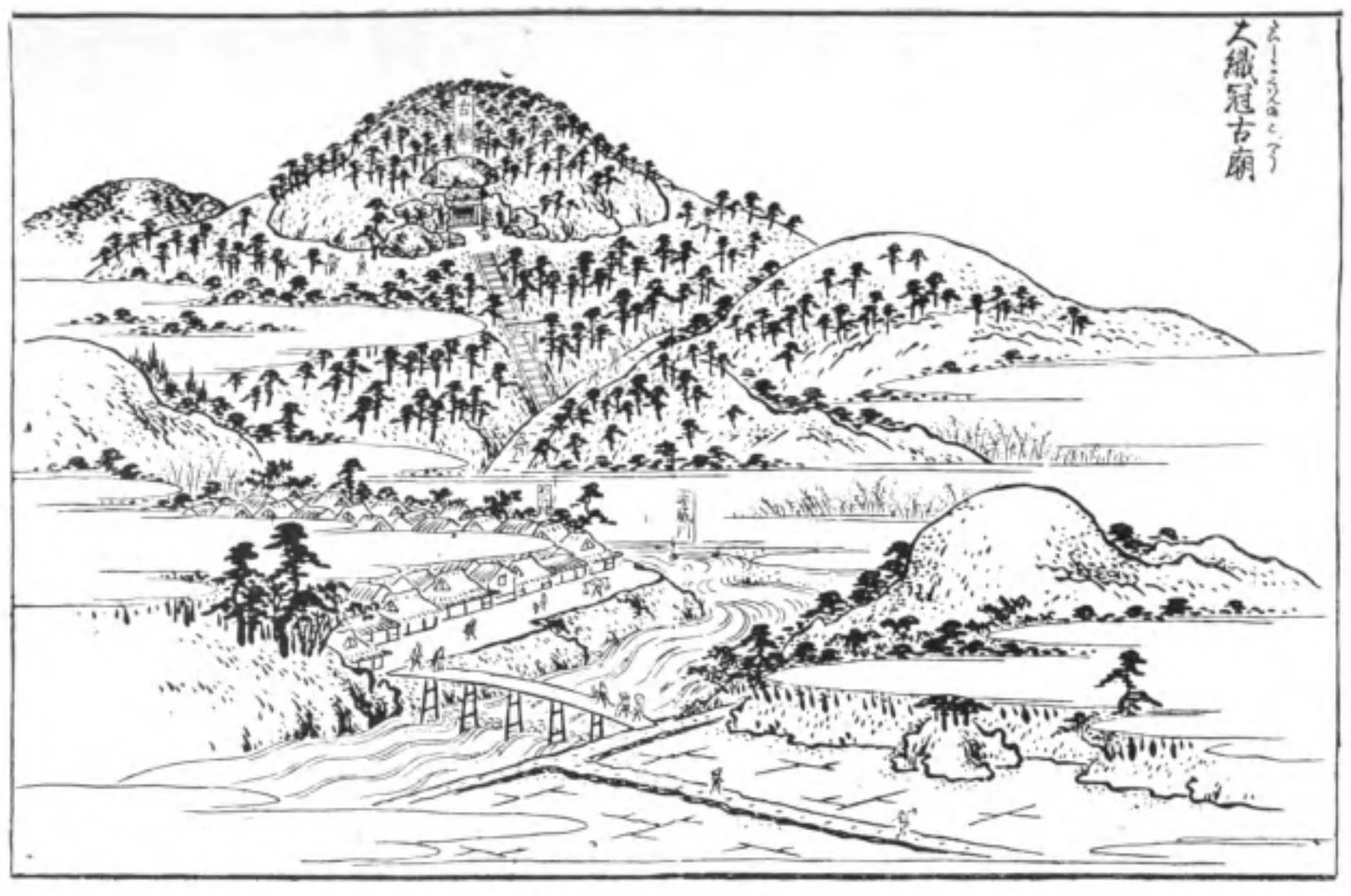
Tomb of the Minister of State, Kamatari.
Kudara, Kasuga no Ahata no Omi] as students,[218] Kusuri, Kose no Omi [son of Toyotari no Omi], and Okina, Hi no Muraji [son of Madama. Another book adds the student priests Chiben and Gitoku and the student Ihatsumi, Sakahibe no Muraji], in all 121 persons, who sailed together in the same ship. Mita, Nunobara no Obito, was appointed as envoy to accompany them. Again, the Chief Ambassador Nemaro [also called Yatsukahagi], Takada no Obito, of Lower Daisen rank, and the Associate Ambassador Womaro, Kamori[219] no Muraji, of Upper Shō-otsu rank, with the student priests Dōfuku and Gikō, in all 120 persons, sailed together in one ship. Yatsute, Hashi no Muraji, was appointed as Envoy to escort them.
In this month the Emperor visited the chamber of the priest Bin, inquired after his illness, and at length from his own mouth delivered his gracious commands.
One book says:—"In the 7th month of the 5th year, (XXV. 55.) the priest Bin took ill in the Temple of Adzumi. Thereupon the Emperor paid him a visit of inquiry, and taking him by the hand, said:—'If your Reverence dies to-day, We shall follow you in death to-morrow.'"
6th month. Pèkché and Silla sent Envoys bearing tribute and offering presents.
The highways of various places were repaired.
The Emperor was informed of the death of the priest Bin, and sent a messenger of condolence and also numerous presents.
The Empress Dowager, the Prince Imperial, etc., all sent messengers to offer condolences on the death of the priest Bin. Eventually the Emperor commanded Komaro, Koma no Tachibe, a painter, with Funado no Atahe and others to make a large number of figures of Buddha and Bosatsu, to be placed in the Temple of Kahara [one book says they are in the Temple of Yamada].
Autumn, 7th month. Takada no Nemaro and his colleagues, the Ambassadors sent to Great Thang, were drowned by the sinking of their ship in the Gate[220] of Takashima, off the coast of Satsuma. Only five men who lashed themselves to a plank, floated ashore on the island of Takashima. They knew not what to do, until one of the five, named Kadobe no Kogane, gathered bamboos[221] and made of them a raft, with which they anchored at the island of Shitoji-shima. These five men passed six days and six nights without any food whatever. Thereupon Kogane was complimented (by the Emperor), advanced in rank, and presents given him.
This year the Prince Imperial petitioned the Emperor, saying:—"I wish the Imperial residence were removed to the Yamato capital." The Emperor refused to grant his request. Upon this the Prince Imperial took with him the Empress (XXV. 56.) Dowager, the Empress Hashibito, and the younger Imperial Princes, and went to live in the temporary Palace of Asuka no Kahabe in Yamato. At this time the Ministers and Daibu, with the various functionaries, all followed and changed their residence. The Emperor resented this, and wished to cast away the national Dignity. He had a palace built in Yamazaki and sent a song to the Empress Hashibito, saying:—
The pony which I keep,
I put shackles on
And led it not out:
Can anyone have seen
The pony which I keep?
A.D. 654. 5th year, Spring, 1st month, 1st day. In the night the rats migrated towards the Yamato capital.
Nakatomi no Kamatari no Muraji was granted the Shikwan,[222] and his fief increased by a number of houses.
2nd month. The Controlling Envoys sent to Great Thang, namely, Kuromaro, Takamuku no Obito, of Upper Daikin rank [one book says:—"Summer, 5th month. There were sent to Great Thang the Controlling Envoy Takamuku no Kuromaro, of Lower Daikwa rank"], the Chief Ambassador Maro, Kahabe no Omi, of Lower Shōkin rank, the Associate Ambassador Kusushi[223] Yenichi, of Lower Daisen rank, the two Hangwan, Maro Fumi no Atahe, of Upper Daiotsu rank, and Miyaji no Amida [one book says:—"The Hangwan, Maro, Fumi no Atahe, of Lower Shōsen rank"], Yoroshi, Oka no Kimi, of Upper (XXV. 57.) Shō-otsu rank, Daihaku, Okizome no Muraji, Oyu, Nakatomi no Hashibito no Muraji, of Lower Shō-otsu rank, Tori, Tabe no Fubito, and others. They embarked separately on two ships. Having delayed for several months, they proceeded by way of Silla, and anchored at Laichou.[224] At last they reached the capital, where they had an audience of the Emperor. Thereupon Kuo Wēn-chü, superintendent of the guards of the Prince Imperial's Palace, inquired particularly of them regarding the geography of the Land of Japan, and the names of the Gods of the beginning of the country. To all which inquiries suitable answers were given.
The Controlling Envoy Takamuku no Kuromaro died in Great Thang.
Yuki no Hakatoko says:—"The student-priest Yemyō died in Thang; Chisō died at sea; Chikoku died at sea; Chisō[225] returned in a Silla ship in the year Kanoye Tora[226]; Gakushō died in Thang; Gitsū died at sea; Jōye returned in the year Kinoto Ushi[227] in the ship of Liu Teh-kao[228]; Myōi, Hōshō and the students Okina, Hi no Muraji and Kō Wō-gon,[229] twelve persons in all, with Kan Chikō and Cho Gempō, of foreign Japanese birth, came back this year along with the envoys."
Summer, 4th month. Two men and two women of the Land of Tukhāra[230] and one woman of S‘râvastî[231] were driven by a storm to Hiuga.
Autumn, 7th month, 24th day. Kishi no Nagani and his colleagues, who had gone as Envoys to the Western Sea,[232] anchored in Tsukushi with Escorting Envoys from Silla and (XXV. 58.) Pèkché. This month the Emperor commended the Envoys to the Western Sea for having had a personal audience of the Emperor of the Thang country, and for having obtained numerous books and precious objects. He bestowed on the Chief Ambassador Kishi no Nagani, of Upper Shōsen rank, the lower grade of Shōkwa rank, and granted him a fief of 200 houses with the name of the Kure House. On the Associate Ambassador, Kishi no Koma, of Lower Shō-otsu rank, there was bestowed the upper grade of the Shōsen rank.
Winter, 10th month, 1st day. The Prince Imperial, being informed that the Emperor had taken ill, proceeded to the Naniha Palace with the Empress Dowager, the Empress Hashibito, and also accompanied by the younger Imperial Princes and the Ministers.
10th day. The Emperor died in the State Bedchamber. He was temporarily interred in the southern courtyard. Dōtoko, Mozu no Hashi no Muraji, of Upper Shōsen rank, superintended the business of the Palace of Temporary Interment.
12th month, 8th day. He was buried in the misasagi of Shinaga at Ohosaka.[233]
On this day, the Prince Imperial, accompanied by the Empress Dowager, changed his residence to the Temporary Palace of Kahabe in Yamato. Old people said:—"The migration of the rats to the Yamato capital was an omen of the transference of the capital thither."
In this year, Koryö, Pèkché and Silla sent ambassadors of condolence.
- Heaven-myriad-abundant-sun.
- Virtue of filial piety. There is much evidence in this reign of the extension and development of the Imperial power in the provinces.
- Kōgyoku Tennō.
- i.e. Shintō.
- Jomei Tennō.
- The toneri.
- Probably a raised daïs is meant.
- Probably passing before the Emperor in rotation, as at our levees.
- Empress Dowager. Lit. Empress grandmother or ancestress.
- Sadaijin and Udaijin are respectively Great Minister of the Left and Great Minister of the Right. The left has precedence of the right in these matters. It is the same characters which above represent Oho-omi which are here used for daijin. That a change in the mode of reading them took place at some time is certain, but it is impossible to fix it exactly. Oho-omi is retained below, though daijin is possibly more correct. Sadaijin and Udaijin have been in use in our own day.
- Minister (Omi) of the Interior, i.e. of the Household, a rank next after that of Prime Minister.
- Of serfs.
- The "Shukai" editor says the etc., etc. marks a hiatus in the MS. much to be deplored. The previous two sentences are a quotation from a Chinese history.
- The word used is Shamon, the equivalent of the Sansk. S'ramana. Vide Eitel, p. 157. Min Hōshi is probably the priest who studied in China, and whose astronomical knowledge is above referred to. Hōshi is a priestly rank, the Sansk. Upadhyāya.
- Hakase, men of learning—not medical men.
- Planera.
- Or Divine.
- It may be noted that there is nothing Buddhist or Shintō in this vow. It is pure Chinese. It is not exactly an oath according to our ideas, but an imprecation on rebellion.
- This is the first introduction of the nengō, 年號, or year-period, a Chinese chronological device. Vide Introduction to "Satow's Chronological Tables." Daikwa means great civilization or development. As a matter of fact very revolutionary changes took place in this reign.
- Jomei Tennō.
- Minister of the Left.
- Doubtless Osaka.
- A polite term for kings.
- i.e. immediately dependent on the throne.
- This is explained to mean Pèkché, the Japanese authority in Imna, and the native Kings of Imna.
- The meaning seems to be that, as the Emperor takes special notice of the produce of Imna, a list should be prepared showing what tribute is sent by Pèkché and what by Imna, so that any deficiency may be at once recognizable.
- By sickness or old age.
- They were probably hostages. Vide XXIV. 10.
- Of reconciling the people to forced labour.
- Shintō.
- 畆, which is here rendered acreage, is the Chinese mow, now fixed by treaty as equal to 733+1/2 sq. yards. 田 is used here in the more general sense of cultivated land generally, not merely rice-fields. The Kana gloss tahatake appears to me to be put for 田 in this wider sense. Dr. Florenz interprets this expression differently. He takes hata or hatake to represent 畆, making the whole mean rice-land and dry fields—Reis- und Trockenfelder.
- Take them into your counsel.
- This is the way in which the commentators construe this passage. If there was any authority for doing so, I should like to take 領 as equivalent to 所領人 a few lines above, or to suppose that this phrase has been omitted. This would give the meaning, "the serfs of the Kuni no Miyakko and of the district." These local Governors usually were Kuni no Miyakko.
- Assistant to a Governor.
- The interlinear gloss is Matsurigotobito, i.e. Government-man. It is doubtful whether this and many more of these glosses are anything more than translations of the Chinese. The hangwan was a sort of aide of the chief local authority. Chancellor, perhaps nearly corresponds to it.
- Lit. name.
- It would seem that at this time there was a reorganization of the local governments, giving a more centralized character to the administration, temporary Governors superseding in some measure the hereditary titular officials. No clear account is given of this change, but it seems plainly to be inferred from the above passage. Kokushi, 國司, are not now mentioned for the first time, and it is clear that the change was not made all at once. The similar change from the Daimio system to that of local prefectures in 1868 will occur to the reader.
- The box was for the purpose of receiving petitions and complaints, like the Me-yasu-bako of later times. This custom was derived from China. See Florenz's note.
- The senior member of his family.
- The first example of what we should call legislation. Compare the so-called laws of Shōtoku Daishi above, A.D. 604.
- Kudara Temple.
- Kimmei Tennō.
- Bindatsu Tennō.
- Nō-jin, 能仁, "he who can produce benevolence," i.e. Sakyamuni.
- Suiko Tennō.
- A rank in the Buddhist priesthood.
- I give the last five names the Japanese pronunciation. But some of them may have been Coreans. Some editions make "chief priests of temples" part of the original commentary.
- i.e. Heads of the Law. See above, XXII. 38.
- The reference is to the institution of Be with names commemorative of the reign.
- A land measure of 15.13 acres.
- Vide Legge's "Yih-King," pp. 247 and 262.
- i.e. rice ground and other cultivated land.
- By sale is evidently meant letting. An early example of a "Land Act."
- A similar story is related in Chinese History (in the Wei dynasty) of rats indicating a change of capital by their movements.
- See above, Vol. I. p. 192.
- Chief men of villages.
- Of serfs.
- Instead of the serfs taken from them.
- The "Roku-rei" gives a scale of sustenance-fiefs at a later period. A Prime Minister had 3000 houses, a Junior Prime Minister 2000, a Dainagon 800, etc., etc. These fiefs were hereditary.
- I was at first disposed to regard the bells and tokens as different objects, but now agree with Dr. Florenz that they are the same. They were small globular bells, sometimes single, sometimes in groups as in the illustration, and indicated by their shape and number how many horses the bearer was entitled to. This institution was borrowed from China.
- By the regulation of mountains and rivers is meant the provision of guards at ferries and mountain passes which serve as boundaries between different provinces.
- The interlinear gloss is wosa, or chief.
- The interlinear gloss is unagashi, one who demands.
- In Iga.
- 里 A ri or sato consisted of 50 houses.
- Greater and Lesser Governors. These terms are rendered Kōri no Miyakko and Suke no Miyakko in the interlinear glosses. But I have little doubt that the Chinese words are intended, and that these are mere translations, and not the real titles of these officials.
- The Denryō (Land Regulations) says, "In granting Kō-bun-den (land shared in proportion to population) men shall have two tan, women a third less, and children under five years of age none. Lands are granted for a term of six years." This seems to point to a general redistribution of lands once in six years, something after the manner still practised in Russia.
- i.e. of the registers of population.
- Allowing five feet to the pace, this would make the tan 9000 square feet. The Japanese foot is not very different from our own. The present tan is 10,800 square feet. The interlinear gloss of 段 is kida; but I am strongly inclined to think that the Chinese word tan is here intended.
- The "Shūkai" editor brings in this last sentence at the end of the previous paragraph. It would then apply to the appointment of rural aldermen. The old reading is better.
- The "Shūkai" adds 布, or cloth, by which is meant fabrics of hemp or of the fibre of the inner bark of the paper mulberry. Textiles served the purpose of currency in this period, so that this commutation was in the nature of a substitution of payment in money for payment in rice.
- Ten feet.
- There are two tan to the hiki or piece, which now measures about 21+1/2 yards.
- The Chinese is 調, rendered in Japanese by mitsugi, or tribute. Here it seems to exclude the rice-tax, but to include various miscellaneous taxes.
- Or "salted articles of food for the Emperor's table."
- Or shō = 109 cubic inches.
- Uneme.
- For an account of the modern system of taxation in Japan the reader is referred to a paper in the "T.A.S.J.," Vol. XX., Supplement, p. 121.
- Or we should perhaps construe Udaijin.
- This title is found in the Japanese names of the ancient Emperors Kōrei and his two successors. It also occurs in the Japanese names of the Empresses Gemmei and Genshō in the early part of the eighth century. Here Yamato-neko is used by the Emperor himself, although it was no part of his name. It would appear therefore that it had become, to some extent, a common name, like Pharaoh or Cæsar.
- Vide Legge's "Shiking," p. 501. The ancients had a saying, "Consult the grass and firewood gatherers." This is the equivalent of our "Man in the street."
- One of the most renowned statesmen of Chinese antiquity. Died B.C. 645. Vide Mayers' "Chinese Manual," p. 91. The quotation is by no means accurate.
- As this is purely legendary, it is useless to inquire the nature of the institution in question. The term Bright Hall, or Meidō, is now applied to the Imperial University in Japan.
- Founder of the Shang Dynasty in China, B.C. 1766.
- The founder of the Chow Dynasty, B.C. 1169–1116. Vide Mayers "Handbook," p. 264.
- This is a difficult passage; Dr. Florenz renders it somewhat differently.
- The interlinear Kana has shibaraku, "for a while."
- See Legge's "Chinese Classics," Vol. I. p. 221.
- The institutes of the T'hang dynasty define Chōshūshi (court-assemble-messenger) as persons sent to the capital bearing tribute from the provinces. Here they seem to have been officials who reported on the conduct of the local officials.
- Now pronounced Inoüye.
- The meaning of this phrase is not quite clear. Cloth was the money of the period, and perhaps the bow-cloth was by way of commutation for bows to be furnished, or an allowance for making bows. Or it may have been one of the articles referred to in the next clause as deposited with the local authorities as a security for arms lent out.
- The "Shukai" editor's rendering is—"reported falsely to the Kuni no Miyakko that they had done so."
- It may be observed that the higher ranks of the local authorities seem to have been filled from the old nobility. Most of the subordinates, as appears from this passage, had no titles, only a personal name and a name indicative of the locality of their birth or residence.
- The Yube was originally a Be for the purpose of providing hot baths for some Emperor or Prince. This term was also applied to the village where the serfs of the Be lived, and subsequently became a mere proper name. It is not easy to decide in which application it is here used.
- Both had the title Kahabe no Omi.
- This name has the curious signification of 1st month.
- Shihoya means salt-house; Konoshiro is the name of a kind of herring.
- Shintō shrine.
- Herb of luck.
- Lent out to the peasants at seed-time, to be returned at harvest.
- The Empress Dowager. She died A.D. 643.
- Not arable land.
- This is the same term (i-shin) as is used of the revolution of 1868.
- This is a figurative expression of his respect for the reformed Government. At this day a Japanese often puts a present to his head in token of thanks.
- Father of Jomei Tennō.
- Ko-shiro means literally "equivalent of children." The Koshiro no Iribe seem to have been communities of serfs (be) instituted (iri) by persons who had no children, to perpetuate their name. This practice is frequently mentioned above. Mina means august name, and the Mina no Iribe were apparently similar communities instituted to perpetuate an Emperor's (or Empress's) name. Vide also Chamberlain's "Kojiki," pp. 186, 197, 268, 269, etc.
- See above, XXV. 19.
- Others than Iribe and people granted in fee.
- i.e. China.
- The trees planted were evergreens, viz. the fir and cryptomeria, for the same reasons as make the yew to be considered a proper churchyard tree in this country. "When the ancients buried their dead, they covered the body thickly with pieces of wood, having laid it in the open country. They raised no mound over it, nor planted trees around."—Legge's "Yih-King," p. 308.
- The "Shūkai" has 勞 in error for 營.
- See Vol. I. p. 181.
- It must be remembered that some of these were of enormous size. Vide Chamberlain's "Things Japanese," 2nd Ed. p. 27. Also above, Vol I. p. 135.
- This does not apply to Imperial tombs.
- The height is probably measured along the slope, not perpendicularly. The fathom is now of about five feet, but may have been more in those days.
- i.e. Oho-omi, says the "Shūkai" editor.
- Or 24 feet, says the "Shūkai".
- The reference is doubtless to the stones covering the roof of the vault, which were of great size, some which I have seen weighing many tons. A note to the "Shukai" says that stones with monumental inscriptions are meant. But no such stones have been found in connection with the tombs of this period.
- There are numerous groups of these tombs still to be seen, more especially in the Home provinces, sometimes thirty or forty together, usually on the lower slopes of the hills.
- Harahi, clearing away, purgation, is properly a religious ceremony. The Oho-harahi, or "Great Purgation," was performed every year by the Nakatomi as a general purification of the sins of the people. The ritual used on this occasion has come down to us, and is perhaps the most interesting of the Norito. When harahi was performed in the case of individual offences the necessary offerings to the Gods were provided by the guilty person (see above, Vol. I. p. 49). From this to a penalty the transition is easy, and has parallels in other countries. In the present passage the harahi was evidently what we should now call a "squeeze." The "Tsūshō" commentator quotes here a statement by one Kurokaha, to the following effect:—"During the first month of the year following the marriage of a newly-united couple, their friends assemble at the house bearing pails of water, with which they souse the husband liberally. This is called harahi." It may not be out of place to point out that marriage is in many uncivilized countries considered as an infringement of the rights of the community which calls for some sort of compensation.
- The meaning of this term—rendered kotosaka in the "Original Commentary"—is not very clear. It perhaps applies to persons who were made slaves on account of some offence or vice. Dr. Florenz and some Japanese scholars whom he consulted take this view of this paragraph. I am not sure, however, that the real meaning is not that the husband, mortified that his wife has left him from dislike, sells her as a slave.
- Cloth was evidently used as money.
- The "Shoku-in-ryō" says the Market Commissioner shall have superintendence of the currency, commerce, the genuineness of wares, the justness of weights and measures, buying and selling prices, and prohibitions and offences (relating thereto.)
- i.e. of getting in the crops.
- The Yin and Yang of Chinese philosophy. The interlinear gloss has samuku-atataka, i.e. "cold and warm," a most inadequate rendering.
- i.e. Nature.
- Instituted in commemoration of Princes and bearing their names, or names intended to recall their memory.
- 名 or Names must here apply to surnames, or rather Be names. The Japanese at this time had no proper surnames, and the Chinese characters for the two kinds of names are not always rightly distinguished.
- The "Shukai" quotes here the instances of Kibitsuhiko no Mikoto, whose descendants were called Kibi no Omi, and Achiki, whose descendants were styled Achiki no Fubito.
- The "Shukai" editor instances Annei Tennō, whose name of Shiki-tsu-hiko is borne by the plain of Shiki in Yamato, and Yūriaku Tennō, whose name of Ohohatsuse is applied to the River Hatsuse-gawa. But it is more likely that the facts are the other way, and that the names of places were given to the Emperors. The "Shoku-ni-hon-go-ki" (a continuation of the "Nihongi") records an edict which directed the alteration of names of persons, villages, mountains, or rivers, which coincided with the names (imina) of Emperors.
- 祖子, lit. ancestors and children. But I strongly suspect that 祖 is a mistake for 皇 imperial.
- House of nobles.
- This edict seems intended as a final severance of titles of various kinds from the offices they nominally represent. Official rank (位) and grade of office (官) do not invariably correspond, though they do in a general way. A Daijin, for example, is not necessarily first rank, though he will doubtless hold high rank, second or third at least.
- Chōshū. The reference is to the Chōshūshi named above, XXV. 23.
- See above, XXV. 17.
- Of other things than rice.
- Probably pronounced Kōdzu and identical with 商津 (Kōdzu), where a palace of the Emperor Nintoku stood at Osaka.
- Jimmu Tennō.
- Vide Legge's "Shooking," p. 337.
- The "Shūkai" editor gives as instances that the descendants of the God Oho-kuni-nushi are called Oho-kuni-nushi, of Oho-kume no Mikoto are called Kume no Atahe.
- The interlinear gloss is mi omofu koto, i.e. "august thoughts," which is ludicrously inadequate. It is as impossible to render such phrases in pure Japanese as it would be in Anglo-Saxon.
- The small (government house of a) district. It seems to have become a proper name.
- 3 to 5 a.m.
- 11 to 1, noon.
- This rank was not introduced until later.
- It is the same person who is called above Hirafu, Yamato no Aya no Atahe, and below Hirafu, Aratawi no Atahe. A few lines further on, the Emperor speaks of him as Hirafu. The complete title Aratawi no Hirafu, Yamato no Aya no Atahe, corresponds pretty exactly to such an English description as "Edmund of Langley, Duke of York." Hirafu is the personal name corresponding to Edmund; Langley and Aratawi are names of places, the residences of the persons in question or their forefathers; Duke and Atahe are titles. Yamato no Aya is, however, the name of a community of artisans of presumed Chinese descent who were settled in Yamato, while York is a territorial designation, of which, it may be noted, there are plenty among the ancient Japanese nobility.
- I have myself in 1869 seen a canal in course of construction at Osaka, which cost many thousands of pounds, and which was ultimately abandoned as impracticable.
- i.e. woven-cap. No doubt some special fabric is meant, which it is now difficult to identify.
- Embroidered cap.
- Purple-cap.
- Brocade-cap.
- Nothing more is known of this than that Hakusen seems to have been the name of a place.
- Blue cap. Neither the Chinese nor Japanese in ordinary speech or writing think it worth while to distinguish between green and blue. 靑, the Chinese character used here stands for both colours, and the corresponding Japanese word awoki may be either green or blue. It is also used of a pale complexion, and, strange to say, of a black horse. It does not follow that these nations cannot distinguish between green and blue. I have seen a dyer's sample book which contained numerous shades of both, each with an appropriate name.
- Black-cap.
- Especially grass-green.
- Kembu means "to establish valour."
- Risshin means advancement.
- Stirrup-caps, so called no doubt from their shape. The Japanese name is tsubo-kammuri, i.e. jar-caps.
- Uzu.
- As at the New Year's receptions, the ceremony of accession, etc.
- The anniversary of the birth of Buddha and the festival of All-Souls—now known as bon. Vide Eitel's "Handbook"—article Ullambana, also "Things Japanese," pp. 155, 156.
- See below, XXV. 41, where, however, no middle Shōsen rank is mentioned, only upper and lower.
- He is mentioned in the "Tongkam."
- In Echigo, as a defence against the Yemishi or Ainos.
- Of Buddhists, viz.: Biku (Bhikchu), Bikuni (Bhikchuni), Uhasoku (Upāsaka) and Ubai (Upāsika). Priests, nuns, and lay members, male and female.
- Gridhrakūta. Vide Eitel, sub voce.
- In Echigo.
- Or Daisan.
- Otsu (乙) is stated by the Japanese commentators to be put for 鶵, which has the same sound. Dai-otsu would then mean Greater Kingfisher, and Shō-otsu Lesser Kingfisher, and it is true that there was a kingfisher cap in China. But does not rather the following extract from Giles apply?—"The 乙 of the tiger,—i.e. its majesty, which is supposed to be in the shape of this character, and concealed under the skin of its ribs. Anyone who gets it and wears it, as an official will be a terror to evil-doers, while as a private individual he will have no enemies."
- These eight Departments were in imitation of the six boards of the Thang Dynasty in China. They were the Nakatsukasa Shō, or Central Department; the Shikibu Shō, or Board of Civil Office; the Jibu Shō, or Board of Ceremonies; the Mimbu Shō, or Board of Population; the Hyōbu Shō, or Board of War; the Gyōbu Shō, or Board of Justice; the Ohokura Shō, or Treasury; and the Kunai Shō, or Household Department. Those who wish to examine this matter more particularly are referred to Walter Dickson's "Japan," Count Itō's "Commentaries on the Constitution of the Empire," from which Dr. Florenz quotes largely, and Mayers' "Chinese Handbook," pp. 324, 326, 332. Of course the word "hundred" in hundred bureaus is not to be taken literally.
- The Scarlet Bird or South Gate.
- This reminds one of Achilles acting as fugleman to the mourners at the funeral of Patroclus:—τοῖσι δὲ Πηλεῒδης ἁδινοῦ ἐξῆρχε γόοιο. "Iliad," XXIII. 17. The official character of the mourning is shown by the fact that it took place at the Southern Gate of the Palace. The Emperor's official position is facing the South, even at this day.
- The 字 or style. "A name or style taken at the age of twenty. A man's Prince and father call him by his ming (名), other people call him by his 字 or style."—Giles.
- Hōshi means Buddhist priest.
- Hades.
- 殉死, Junshi.
- Ugly-man.
- Owing to the objection entertained in China and Japan to the mutilation of the body, hanging or strangulation is reckoned a less severe punishment than decapitation.
- Hard or coarse salt.
- The emblem of conjugal love in China and Japan, like the turtle dove in Europe.
- Koto.
- Sadaijin in later parlance.
- Udaijin.
- A note in the "Shūkai" identifies this family with the Kamori no Muraji of the "Seishiroku." They seem to have had originally something to do with the performance of the harahi or purification ceremonies.
- In China 侍郎 are Vice-Presidents of a Board. Chancellors (?)
- 中客, literally middle guests, officials of middle rank.
- Including skilled artisans.
- i.e. "white pheasant." The reason for this name of the year-period appears below.
- A.D. 68.
- China.
- We have obviously here an echo of the Chinese myth of a red three-legged crow which inhabits the sun, and which has all manner of mystical significance.
- The name of a region lying to the south of China.
- A.D. 275.
- Phung-chyang's uncle.
- So the "Shūkai" edition. But it has been conjectured with some probability that Kida is really the name of the Silla scholar just mentioned, which has come in here by mistake.
- Oho-ya-shima. See Vol. I. p. 15.
- China.
- The characters are 日本, but whether the Emperor actually said Nippon or Yamato is not quite clear. The interlinear gloss has Mikado, which is absurd.
- Ōjin Tennō.
- Nintoku Tennō.
- The dragon-horse has wings on its head. It crosses water without sinking. It appears when an illustrious sovereign is on the throne.
- Kirin.
- White pheasant.
- No doubt what we call tapestry.
- See above, XXI. 6.
- The eight classes are described as I. Heaven; II. Dragons; III. Yasha, the Sanskrit Yaksha, a kind of demons; IV. Kentatsuba, the Sanskrit Gandharva, a kind of demons; V. Asura, the mightiest of all demons; VI. Karora, Sanskrit Garuda, a kind of monstrous bird; VII. Kinnara, Sanskrit Kimnara, doubtful (horned) spirits, the musicians of Kuvēra; VIII. Makōraka, Sanskrit Mahoraga, demons shaped like a boa.
- See above, XXV. 10.
- The complete Buddhist canon as received in China. It consists of hundreds of volumes, and was no doubt read by the tendoku system, i.e. by reading a few words at the beginning and at the end of each volume, turning rapidly over the intermediate pages by a single motion of the hand.
- These are not known as Sutras. Probably they were litanies used as suitable for the occasion of taking up a residence in the new Palace. An-taku means "peaceful-house," and Do-soku "earth-side," or perhaps "earth-survey."
- The older reading is "without an effort." I follow the "Shūkai" editor's emendation of 刀 for 力.
- See above, XXV. 17.
- The breadth is not stated here. From other evidence it appears to have been twelve paces.
- Sanskrit S‘ramana, Buddhist priests or ascetics. Vide Eitel, sub voce.
- i.e. immortal life, called in Sanskrit the Sukhâvatî Vyûha Sutra.
- i.e. the eldest son or heir, to the exclusion of uncles, say the commentators. This would be primogeniture. This principle had not yet become established for the succession to the throne.
- There is a biography of Jōye extant. He remained for many years studying in China. On his return to Japan he had the body of his father removed from the old-fashioned dolmen-tomb in which he had been interred, and buried under a miniature pagoda of stone. This marks the decline of the old style of interment. The original tomb is still in existence. It is shown in the annexed illustration, which is reproduced with the kind permission of the editor of the "Asiatic Quarterly Review," where it appeared, July, 1892.
- Naidaijin.
- i.e. students of Chinese literature.
- See above, XXV. 45.
- A narrow passage between two islands. Or it may mean the entrance to a harbour.
- Takashima means "bamboo island."
- Or purple cap.
- Doctor.
- In Shantung.
- Spelt with a different Chinese character to the other.
- A.D. 690.
- A.D. 665.
- Presumably a Chinese.
- A Japanese who had taken a Chinese name.
- The region round Badakshan in India. Vide Eitel, sub voce.
- An ancient city of India situated near Sirkhee or Fuzabad. Vide Eitel. It is absurd to speak of natives of India being cast ashore in Hiuga. It is plain from a comparison of the passage in Book XXVI. 4, in which these persons are again referred to, that the place here called Tukhāra is really the island of Tokara, one of the Loochoo group. The writer of the "Nihongi," however, shows by the characters with which he writes the name, and by his poetic license of associating S‘râvastî with it, that he was thinking of the Indian locality. The native commentators follow him in this.
- China.
- In the province of Kahachi.
BOOK XXVI.
THE EMPRESS AME-TOYO-TAKARA IKASHI-HI TARASHI-HIME.
(SAIMEI[1] TENNŌ.)
The Empress Ame-toyo-takara ikashi-hi tarashi-hime first married the Emperor Tachibana no toyohi's[2] grandson, Prince Takamuku, and bore to him the Imperial Prince Aya. She was afterwards married to the Emperor Oki-naga tarashi-hi hiro-nuka,[3] to whom she bore two sons and one daughter. In his second year she was raised to the rank of Empress-consort, as may be seen in the history of the Emperor Oki-naga tarashi-hi hiro-nuka. In the thirteenth year of his reign, Winter, the tenth month, the Emperor Oki-naga tarashi-hi hiro-nuka died. In the first month of the following year the Empress assumed the Imperial Dignity. In the sixth month of the fourth year of the new reign, she resigned the Dignity to the Emperor Ame-yorodzu-toyo-hi, and was entitled Empress Dowager. The Emperor Ame-yorodzu-toyohi died in the tenth month of the later fifth year.[4]
A.D. 655. 1st year, Spring, 1st month, 3rd day. The Empress Dowager assumed the Imperial Dignity in the Palace of Asuka no Itabuki.
Summer, 5th month, 1st day. In the midst of the Void[5] there was seen one riding on a dragon, who resembled a man of Thang in appearance. He had on a broad hat of green (XXVI. 2.) oiled stuff. He rode fast from the peak of Katsuraki and disappeared on Mount Ikoma. When it became noon, he galloped off over the firs of Sumiyoshi in a westerly direction.
Autumn, 7th month, 11th day. There were entertained at the Court of Naniha of the Northern Yemishi ninety-nine persons, and of the Eastern Yemishi ninety-five persons. At the same time entertainment was provided for 150 persons who came as tribute envoys from Pèkché. Caps of honour, of two grades in each case, were bestowed on nine Yemishi of Kikafu[6] and on six Yemishi of Tsugaru.[7]
8th month, 1st day. Maro, Kahabe no Omi, and others returned from Great Thang.
Winter, 10th month, 13th day. There was a Palace in course of construction at Woharida which it was intended to roof with tiles. But in the recesses of the mountains and on the broad valleys, much of the timber with which it was proposed to erect the Palace buildings rotted. In the end the work was put a stop to, and no building was erected.[8]
This winter the Palace of Asuka no Itabuki[9] was burnt, and the Empress therefore removed her residence to the Palace of Asuka no Kahara.[10]
This year Koryö, Pèkché and Silla sent Envoys together to offer tribute.
The Pèkché Chief Ambassador was Talsol of the Western division, by name Yö-wi-syu; the Associate Ambassador was an Eunsol of the Eastern division, by name Tyo-sin-in. There were over one hundred persons altogether.
Yemishi and Hayato,[11] attended by a large number of followers, offered homage and came to Court with presents for the Empress.
Silla sent specially Mi-mu of Keup-son[12] rank as a hostage, and twelve men as skilled workmen.[13]
Mi-mu fell ill and died.
This year was the year Kinoto U (52nd) of the Cycle.
A.D. 656. (XXVI. 3.) 2nd year, Autumn, 8th month, 8th day. Koryö sent Tal-sa and others to offer tribute. [The Chief Ambassador was Talsa, and the Associate Ambassador I-li-chi. There were eighty-one persons in all.]
9th month. There were sent to Koryö, as Chief Ambassador, Hatsumi, Kashihade no Omi, and as Associate Ambassador Ihasuki, Sakahibe no Muraji, as Senior Hangwan, Shiromaro, Inugami no Kimi, as Second Class Hangwan, Kahachi no Fumi no Obito, and as Junior[14] Hangwan, Maro, Ohokura no Kinunuhi no Miyakko.
In this year a fresh site for a Palace was fixed upon at Asuka no Wokamoto.
At this time, Koryö, Pèkché and Silla together sent envoys to offer tribute. Dark purple curtains were drawn round this Palace site for them, and they were entertained there. At last the Palace buildings were erected, and the Empress removed into them. This Palace was called the later Palace of Asuka no Wokamoto.
Tamu Peak was crowned with a circular enclosure. Moreover on the summit of the Peak, close by where two tsuki trees grew, a lofty building was erected to which the name was given of the Palace of Futa-tsuki.[15] It was also called Amatsu[16] miya.
At this time public works were in favour. Navvies[17] were employed to dig a canal from the western end of Mount Kagu yama as far as the Mountain of Iso no kami. Two hundred (XXVI. 4.) barges were loaded with stones from the Iso no Kami Mountain and hauled with the current to the mountain on the east of the Palace, where the stones were piled up to form a wall. The people of that day reviled the work, saying:—"This mad canal, which has wasted the labour of over 30,000 men! This wall-building, which has wasted the labour of over 70,000 men! And the timber for the Palace which has rotted![18] And the top of the mountain which has collapsed!"
Again they reviled, saying:—"May the mound built at Iso no kami break down of itself as fast as it is built!" [This abuse was probably uttered while the work was incomplete.]
A Palace was also built at Yoshino.
The Ambassadors to the Western Sea,[19] Takunaha, Saheki no Muraji, and Kunikatsu, Naniha no Kishi, of Lower Shōsen rank, with their companions returned from Pèkché and presented the Empress with a parrot.
The Palace of Wokamoto took fire.
A.D. 657. 3rd year, Autumn, 7th month, 3rd day. Two men and four women of the Land of Tukhāra[20] who had drifted to Tsukushi, said:—"We first of all drifted to the island of Amami."[21] So they were sent for by post-horses.
15th day. A model of Mount Sumi[22] was constructed to the west of the Temple of Asuka-dera. Moreover the festival of All Souls[23] was held. In the evening the people from Tukhāra were entertained. [One book says, "the people of Tora."]
9th month. The Imperial Prince Arima[24] was of a deceitful disposition, and pretended insanity, etc., etc. He went to the hot baths of Muro,[25] under the pretence of treatment of disease. On his return he praised the quality of the country, saying:—"Scarce had I seen that region, when my complaint disappeared of itself," etc., etc. The Empress, hearing this, was (XXVI. 5.) rejoiced, and wished to go and visit it.
This year envoys were sent to Silla with the following message:—"We wish to send to Great Thang under the charge of your country's envoys the Buddhist priest Chitatsu, Mimŭmaya, Hashibito no Muraji, and Wakugo, Yozami no Muraji." Silla refused to grant such escort, and therefore the Buddhist priest Chitatsu and his colleagues returned.
The Ambassadors to the Western Sea, Tsuratari, Adzumi no Muraji, of Lower Shō-kwa rank, and Kutsuma, Tsu no Omi, of Lower Shōsen rank, returned from Pèkché. They brought presents for the Empress of one camel and two asses.
The people of Ihami said that a white fox[26] had been seen.
A.D. 658. 4th year, Spring, 1st month, 13th day. Kose no Tokuda no Omi, Oho-omi of the Left, died.
Summer, 4th month. Abe no Omi went on an expedition against the Yemishi in command of a fleet of 180 ships. The Yemishi of the two districts of Aita[27] and Nushiro[27] were struck with fear, and tendered their submission. Hereupon the ships were drawn up in order of battle in the bay of Aita. A Yemishi of Aita named Omuka came forward and made an oath, saying:—"It is not by reason of the arrival of the Imperial forces that we slaves carry bows and arrows, but because it is our nature to live upon animal food. If we have provided bows and arrows against the Imperial forces, may the Gods of the bay of Aita take note of it! We will serve the Government with pure hearts."
Omuka was accordingly granted the rank of Upper Shō-otsu, and local governors were established in the two districts of Nushiro and Tsugaru. Ultimately the Yemishi of Watari no Shima[28] were summoned together at the shore of Arima and a (XXVI. 6.) great feast provided them, after which they were dismissed home.
5th month. A grandson of the Empress named Prince Takeru died. He was eight years of age. His remains were deposited in a temporary tomb which was raised for him over the Imaki valley. The Empress had always esteemed her grandson highly for his obedient conduct. She was therefore beside herself with grief, and her emotion was exceeding great. Sending for the Ministers, she said:—
"After ten thousand years and a thousand autumns[29] he must be interred along with us in our own misasagi."
So she made songs, saying:—
On the Hill of Womure[30]
In Imaki—
If but a cloud
Arose, plain to be seen,
Why should I lament?
This was the first song.
I never thought
That he was young[31]
As the young grass
By the riverside whither one tracks
The deer wounded by an arrow.
This was the second song.
Like the flowing water
Of the River Asuka
Which surges as it flows,
Unceasingly
I long for him!
This was the third song.
The Empress sang these songs from time to time, and lamented bitterly.
Autumn, 7th month, 4th day. More than two hundred Yemishi came to Court with presents for the Empress. The entertainment and largess to them was on a more liberal scale than usual. Two Yemishi of Kikafu received one grade of rank. Saniguna, the Senior Governor of the district of (XXVI. 7.) Nushiro, was made Lower Shō-otsu [one book says was granted two steps in rank and given the superintendence of the population (register)], the Junior Governor Ubasa received the rank of Kembu, and two brave men received one grade of rank. In addition there were given to Saniguna and the others twenty cuttle-fish flags,[32] two drums, two sets of bows and arrows, and two suits of armour. Mamu, the Senior Governor of the district of Tsugaru, was granted the rank of Upper Dai-otsu, Awohiru, the Junior Governor, the rank of Lower Shō-otsu, and two brave men received a step in rank. In addition there were granted to Mamu and the others twenty cuttle-fish flags, two drums, two sets of bows and arrows, and two suits of armour. Two grades of rank were conferred on the Miyakko of the barrier of Tsukisara, and one grade on the Hangwan. Inadzumi Ohotomo no Kimi, Miyakko of the barrier of Nutari, received the rank of Lower Shō-otsu. Moreover Sanaguna,[33] Senior Governor of the district of Nushiro, was commanded by the Empress to investigate the Yemishi population and the captive population.
In this month, the Buddhist priests Chitsū and Chitatsu went by the Empress's command to Great Thang on board a Silla ship, where they received instruction from the teacher of religion,[34] Hsüan-ts‘ang, on the philosophy of things without life and living beings.[35]
Winter, 10th month, 15th day. The Empress visited the hot baths of Ki. The Empress, remembering her Imperial (XXVI. 8.) grandson, Prince Takeru, grieved and lamented. She exclaimed, saying:—
Though I pass over the mountains
And cross the seas
Yet can I never forget
The pleasant
Region of Imaki.
The first.
With the harbour's
Ebbing tide,
As the sea goes down,
With the darkness behind me
Leaving him, I must go—
The dear one.
My young child!
Leaving him, I must go.[36]
The second.
She commanded Mari, Hada no Oho-kura no Miyakko, saying:—"Let these verses be handed down and let them not be forgotten by the world."
11th month, 3rd day. Soga no Akaye no Omi, the official who had charge during the Empress's absence, addressed the Imperial Prince Arima, saying:—"There are three faults in the Empress's administration of the affairs of Government. The first is that she builds treasuries on a great scale, wherein she collects the riches of the people. The second is that she wastes the public grain revenue in digging long canals. The third is that she loads barges with stones and transports them to be piled up into a hill."[37] The Imperial Prince Arima, recognizing Akaye's friendly disposition towards himself, was gratified, and replied, saying:—"I have only now come to an age when I am fit to bear arms."
5th day. The Imperial Prince Arima proceeded to the house of Akaye, where he went up into an upper storey, and conspired with him. A leg-rest[38] broke of itself. They both recognized 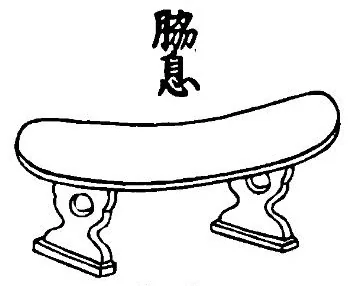
Kyōsoku.that this was a bad omen, and (XXVI. 9.) swore to one another to proceed no further. The Imperial Prince returned home, where he was staying for the night, when at midnight Akaye sent Shibi, Mononobe no Yenowi no Muraji, in command of the labourers engaged in building the Palace, to surround the Imperial Prince Arima in his house at Ichifu, and straightway despatched a mounted courier to inform the Empress.
9th day. The Imperial Prince Arima, with Oho-ishi, Mori no Kimi, Kusuri, Sakahibe no Muraji, and Konoshiro, Shihoya no Muraji, were arrested, and sent to the hot springs of Ki. His toneri Yonemaro, Nihitabe[39] no Muraji, followed him.
Thereupon the Prince Imperial in person questioned the Imperial Prince Arima, saying:—"Why didst thou plot treason?" He answered and said:—"Heaven and Akaye know. I do not at all understand."
11th day. Kuniso, Tajihi no Wosaha no Muraji, was sent to strangle the Imperial Prince Arima at the Fujishiro acclivity. On this day Konoshiro, Shihoya no Muraji, and the toneri Yonemaro, Nihitabe no Muraji, were executed at the Fujishiro acclivity. When Konoshiro, Shihoya no Muraji, was about to be executed, he said:—"I request that my right hand may be made a national treasure." Oho-ishi, Mori no Kimi, was banished to the province of Kamitsukenu,[40] and Kusuri, Sakahibe no Muraji, to the province of Wohari.
One book says:—"The Imperial Prince Arima, with Akaye, Soga no Omi, Konoshiro,[41] Shihoya no Muraji, Oho-ishi, Mori no Kimi, and Kusuri, Sakahibe no Muraji, divined the future of their treasonous conspiracy by drawing (XXVI. 10.) slips of paper." One book says:—"The Imperial Prince Arima said:—'First of all we will burn the Palace. Then with five hundred men for a day and two nights we will waylay (the Empress) at the harbour of Muro, and speedily with a fleet cutting off the Land of Ahaji, make as it were a prison. This can be easily accomplished.' Some one objected, saying:—'It cannot be so. For all your plans, the faculty (of carrying them out) is wanting. At the present time, Your Imperial Highness is only nineteen years of age, and has not yet attained to manhood. You must first reach manhood and then you will gain the faculty.'" Another book says:—"When the Imperial Prince Arima was plotting treason along with a judicial officer, the leg of the Imperial Prince's arm-rest broke of itself without cause, but he did not cease from conspiring, and was eventually executed."
In this year, Hirafu, Abe no Hikida no Omi, Warden of the Land of Koshi, went on an expedition against the Su-shēn.[42] He presented to the Emperor two live white bears.[43]
The Buddhist priest Chiyu made a south-pointing chariot.[44]
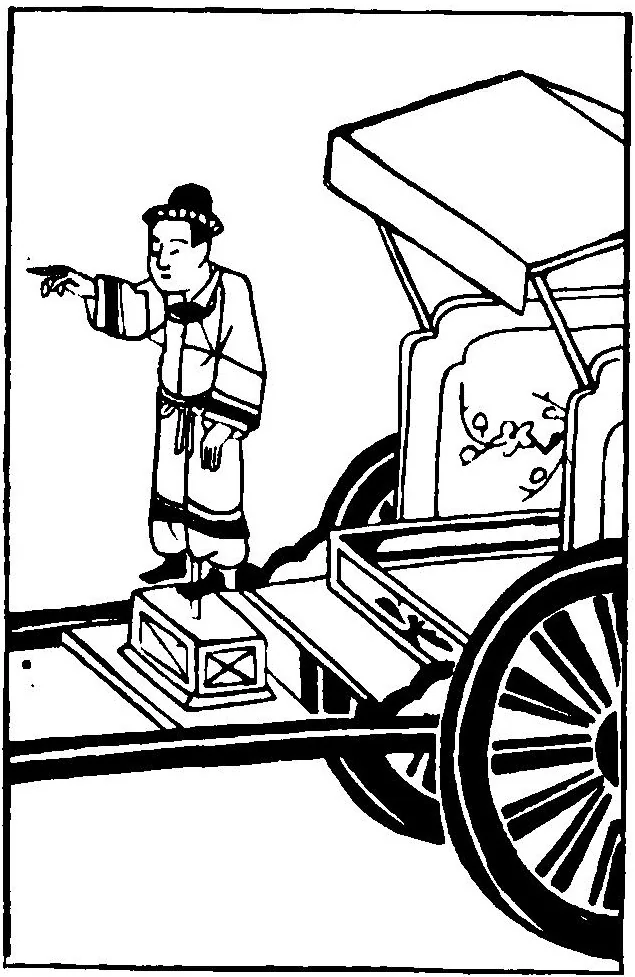
South-pointing Chariot.It was reported from the province of Idzumo:—"On the shore of the northern sea the fish are dying in heaps three feet in depth. In size they resemble the globe-fish.[45] They have the beaks of sparrows and thorny scales several inches long. The common people say that they are sparrows which have gone into the sea and become changed into fish, and give them the name of 'sparrow-fish.'"
One book says:—"In the seventh month of the sixth year, Pèkché sent Envoys with the following message to the Empress:—'Great Thang and Silla have (XXVI. 11.) joined their powers for an attack upon us. They have taken away as prisoners King Wichă, his Queen,[46] and the Heir to the Throne. Our Government has therefore stationed troops on the north-western frontier and repaired the fortifications as an indication that the mountains and rivers are blocked.'"[47]
Moreover Tsuratari, Adzumi no Muraji, of Lower Shōkwa rank, who had gone as Envoy to the Western Sea, returned from Pèkché and reported that Pèkché had returned after a successful expedition against Silla. At this time a horse of his own accord went round the Golden Hall[48] of a temple night and day without ceasing, and only stopping to graze.
One book says:—"This was an echo[49] of its destruction by the enemy in the year Kanoye Saru."[50]
A.D. 659. 5th year, Spring, 1st month, 3rd day. The Empress arrived from the hot springs of Ki.
3rd month, 1st day. The Empress visited Yoshino[51] and held a banquet there.
3rd day. The Empress visited Hira-ura in Afumi.
10th day. The man of Tukhāra[52] with his wife, a woman of S‘râvastî, arrived.
17th day. A Mount Sumi was constructed on the river-bank east of Amakashi no Oka, and the Yemishi of Michinoku and Koshi were entertained.
In this month, Abe no Omi was sent in command of 180 ships on an expedition against the Yemishi country. Abe no Omi assembled a selection of the Yemishi of the two districts of Akita and Nushiro to the number of 241 persons with 31 of (XXVI. 12.) their captives, 112 Yemishi of the district of Tsugaru with 4 captives, and 20 Yemishi of Ifurisahe, in one place, feasted them and gave them presents.
Accordingly he made an offering to the Gods of that Land of a boat and silk stuffs of various colours, and proceeded to Shishiriko. Then two Yemishi of Tohiu, named Ikashima and Uhona, came forward and said:—"You ought to make Shiribeshi[53] your seat of Government." In accordance with the advice of Ikashima and his companion, a district-governor was ultimately established there, after which he (Abe no Omi) returned. The provincial governors of Michinoku and Koshi were each granted two grades of rank, while the district-governors and administrators received each one degree.
One book says:—"Hirafu, Abe no Hikida no Omi, fought with the Su-shēn, and on his return presented to the Empress forty-nine captives."
Autumn, 7th month, 3rd day. Ihashiki, Sakahibe no Muraji, of Lower Shōkin rank, and Kiza, Tsumori no Muraji, of Lower Daisen rank, were sent on a mission to the Land of Thang. They took with them a Yemishi man and woman of Michinoku to show to the Thang Emperor.
In the writing of Hakatoko, Yuki no Muraji, it is stated:—"In the reign of this Empress, Sakahibe no Ihashiki no Muraji, of Lower Shōkin rank, Tsumori no Kiza no Muraji, of Lower Daisen rank, and others, in two ships, received orders to go on a mission to Thang of Wu.[54] In the year Tsuchinoto Hitsuji (659), the 7th month, and the 3rd day of the month, they started from the Bay of Mitsu in Naniha. On the 11th day of the 8th month, they left the Bay of Ohotsu[55] in Tsukushi. On the 13th day of the 9th month, they arrived at an island on the southern border of Pèkché. The name of the island is not (XXVI. 13.) known. At four a.m. on the 14th, the two ships put out to sea in company. On the 15th day, at sunset, the ship of Ihashiki no Muraji met crosswise with a contrary wind and was driven to an island in the Southern Sea, named Erh-kia-wei, where it was destroyed by the islanders. Arima, Yamato no Aya no Wosa no Atahe, with Inadzumi, Sakahibe no Muraji, and three others, stole a ship belonging to the islanders, and embarking in it, escaped to Kwa-chow. The officials of this district sent them under escort to the capital, Loh-yang. At midnight on the 16th day, the ship of Kiza no Muraji arrived at Mount Hsu-an near Kuei-chi in the Yueh district,[56] when a north-east wind sprang up and blew with such violence that on the 23rd they reached the district of Yü-yao. The great ship on which they were embarked, with all its gear, was left behind at this place, and on the 1st day of the 11th intercalary month, they arrived at the seat of Government of the Yueh district. On the 15th they entered the capital,[57] riding on post-horses. On the 29th, travelling with all speed, they reached the Eastern capital,[58] where the Emperor had then his residence. On the 30th they had an audience of the Emperor, who inquired of them, saying:—"Is the Empress of your country in good health?" The Envoys answered respectfully:—"Her virtue is in harmony with Heaven and Earth, and she therefore naturally enjoys good health." The Emperor inquired of them:—"And the Ministers in charge of affairs—is it well with them?" The Envoys answered respectfully:—"As (XXVI. 14.) they enjoy the favour and esteem of our Empress, it is well with them also." The Emperor inquired of them, saying:—"Is there peace within your country or not?" The Envoys answered respectfully, saying:—"The Government accords with Heaven and Earth, and therefore there is nothing untoward among the multitude." The Emperor inquired of them, saying:—"In what quarter is the Land of these Yemishi situated?" The Envoys answered respectfully, saying:—"It lies to the north-east." The Emperor inquired of them, saying:—"How many tribes of Yemishi are there?" The Envoys answered respectfully, saying:—"There are three kinds. The most distant are called Tsugaru, the next Ara-Yemishi, and the nearest Nigi-Yemishi.[59] These now here are Nigi-Yemishi—they bring tribute yearly to our country's Court." The Emperor inquired of them, saying:—"In their country are there the five kinds of grain?" The Envoys answered respectfully, saying:—"No, they sustain life by eating flesh?" The Emperor inquired of them, saying:—"Have they houses in their country?" The Envoys answered respectfully, saying:—"No, they have their dwelling under trees in the recesses of the mountains." The Emperor went on to say:—"When We look at the unusual bodily appearance of these Yemishi, it is strange in the extreme. You Envoys must have suffered greatly on your long voyage hither. Now retire and abide in your official residence. We shall meet again." On the 1st day of the 11th month the festival of the Winter Solstice was celebrated at Court. On the festival day, they again saw the Emperor. Amongst the various frontier states who attended the Court, the Japanese[60] visitors were the most distinguished. Thereafter, by reason of the confusion caused by a conflagration, the matter was neglected and not further attended to. On the 3rd day of the 12th month, Kahachi no Aya no Ohomaro, a servant of Han Chi-hung, slandered our visitors, who were found guilty by the Court of Thang, and were already condemned to banishment. Previously Chi-hung was banished to a distance of 3000 li. Among the visitors was one, Hakatoko, Yuki no Muraji, who made representations to the Emperor in consequence of which their punishment was remitted. When everything was concluded, the Emperor decreed as follows:—"This Government has determined next year to take administrative measures in regard to the lands east of the sea,[61] and you, the visitors from Wa, may not return to the east." In the end they (XXVI. 15.) were detained in the Western capital.[62] They were placed in separate seclusion, their door was closed and prohibited, and they had no liberty of movement. In such misery they passed the year. The writing of Wobito, Naniha no Kishi, says:—"The Chief Envoy to Great Thang struck on an island and was overturned.[63] The Associate Envoy had a personal audience of the Emperor and showed him some Yemishi. Upon this the Yemishi presented to the Emperor a white deer-skin, three bows, and eighty arrows."
15th day. By a decree to the Ministers, the Empress had the Urabon[64] Sutra expounded in all the Temples of the capital, and requital made to the ancestors for seven generations.
In this year, the Kuni no Miyakko of Idzumo was commanded to repair the shrine of the Itsuki[65] God.
A fox bit off the end of a creeper which a labourer of the district of Oü held in his hand, and went off with it. Moreover a dog brought in his mouth a dead man's hand and forearm and laid it in the Ifuya shrine. [Signs that the Empress was about to die.]
Again, the Koryö Envoys had a bear-skin[66] on which they put a price of sixty pounds of floss silk. The market commissioner laughed and went away.
A Koryö painter, named Komaro,[67] on the day on which he entertained guests of his own surname in his private house, borrowed seventy official Polar bear-skins for them to sit upon. The guests were ashamed and astonished and went away.
A.D. 660. 6th year, Spring, 1st month, 1st day. The Koryö Envoys, the Eul-syang, Ha Chhyu-mun, and his suite, numbering over one hundred persons, anchored in Tsukushi.
(XXVI. 16.) 3rd month. Abe no Omi was sent on an expedition with a fleet of 200 ships against the land of Su-shēn. Abe no Omi made some Yemishi of Michinoku embark on board his own ship. They arrived close to a great river.[68] Upon this over a thousand Yemishi of Watari-shima[69] assembled on the seashore and made a camp facing the river. Two men of this camp came forward and called out hurriedly, saying:—"The Su-shēn fleet has arrived in great force and threatens to slay us. We pray, therefore, to be allowed to cross the river and to serve the Government." Abe no Omi sent a boat to go and fetch these two Yemishi, and inquired from them where the enemy were concealed and the number of their ships. The two Yemishi accordingly pointed out the place of their concealment, saying:—"There are over twenty ships." Thereupon he sent messengers to summon them, but they refused to come. Abe no Omi accordingly heaped up on the beach coloured silk stuffs, weapons, iron, etc., to excite their cupidity. The Su-shēn people thereupon drew up their fleet in order, and tying feathers to poles, raised them aloft by way of flags. They approached with equal oars and came to a pause in a shallow place. Then from one of the ships they sent forth two old men who went round the coloured silk stuffs and other articles which had been piled up, examining them closely. They then changed the single garments they had on, and each taking up one piece of cloth in his hand, went on board their ship and departed. Presently the old men came back again, took off the exchanged garments, and laying them down along with the cloth they had taken away, went on board their ship and departed.[70] Abe no Omi sent several ships to fetch them, but they refused to come, and returned to the island of Herobe. [Herobe is a separate part of Watari-shima.] After some time they asked for peace, but Abe no Omi refused altogether to listen to them. So they betook themselves to their own palisades and fought. At this time Mamukatsu, Noto no Omi, was slain by the enemy. While the battle was still going on, and was not yet fought out, the enemy, finding that they were being beaten, put to death their own wives and children.
Summer, 5th month, 8th day. The Koryö Envoy, the Eul-syang, Ha Chhyu-mun, and his suite arrived at the official residence of Naniha.
(XXVI. 17.) In this month, the officials, by order of the Empress, prepared one hundred raised seats[71] and one hundred Nōkesa,[72] and held a Ninwo Hanya[73] meeting.
Moreover, the Prince Imperial for the first time made a clepsydra,[74] by which he caused the people to know the hours.
Clepsydra.
Again, Abe no Hikida no Omi presented to the Empress more than fifty savages.[75]
Again, a Mount Sumi was built near the pond of Iso no Kami, as high as a pagoda. On this occasion forty-seven men of Su-shēn were entertained.
Again, the people of the whole country carried arms without reason when passing to and fro on the highways. The old people of the country said:—"This perhaps denotes the destruction of the Land of Pèkché."[76]
Autumn, 7th month, 16th day. The Koryö Envoy, the Eul-syang, Ha Chhyu-mun, and his suite took their departure.
Again, the man of Tukhāra, Kendzuhashi Tatsua, desired to return to his native country, and asked for an escort officer, saying:—"I intend later to pay my respects to the Court of (XXVI. 18.) the Great Country, and therefore, in token of this, I leave my wife behind." Accordingly, he took the way of the Western Sea with several tens of men.
In the "Record of the reigns of Japan,"[77] written by the Koryö priest To-hyön, it is said:—"In the seventh month, etc., Chhyun-chhyu-chi,[78] by the aid of the General-in-Chief, Su Ting-fang, caused Pèkché to be invaded and destroyed." One account says:—"Pèkché brought ruin upon itself, owing to the feminine want of principle of the Royal Consort, who arbitrarily usurped the helm of Government and slew the wise and good, thus inviting the calamity which came upon them. Ought one not to be watchful? Ought one not to be watchful?" In a note it is stated:—"Chhyun-chhyu-chi, of Silla, was unable to accomplish his wishes by the Minister Kè-kim.[79] Therefore he again served Thang, and, putting off the national garb, made a fawning appeal to the Son of Heaven, with the object of bringing disaster on a neighbouring kingdom and preparing the accomplishment of his ends."
(XXVI. 19.) The writing of Hakatoko, Yuki no Muraji, says:—"In the year Kanoye Saru, the 8th month, Pèkché was reduced to submission. After this, on the 12th day of the 9th month, the visitors[80] were dismissed to their own country. On the 19th day they started from the Western capital. On the 16th day of the 10th month, they arrived back at the Eastern capital, and then for the first time met Arima and his four companions. One the 1st day of the 11th month, the thirteen royal persons captured by General Su Ting-fang and his men, from the King of Pèkché down to the Crown Prince Nyung and others, with the Prime Minister Sa-chhèk, Chhyön-pok-kuk, Pyön-syöng, and others of lower rank, thirty-seven persons, making in all fifty persons, were delivered up to the Government. They were at once led before the Emperor, who spoke kindly to them and released them on the spot. On the 19th the Emperor bestowed presents,[81] and on the 24th we started from the Eastern capital."
9th month, 5th day. Pèkché sent a Talsol, the Buddhist novice,[82] Kak-chyong, and others with the following message to the Empress [one book says, "They escaped hither and gave information of their hard case"]:—"In the 7th month of this year, Silla, relying on its strength and assuming a blustering attitude, picked a quarrel with its neighbour, and drawing the Thang people into it, overturned Pèkché. Sovereign and Ministers were all captured, and scarce a living soul[83] was left."
In one book it is said:—"On the 10th day of the 7th month of the present year, Su Ting-fang, of Great Thang, (XXVI. 20.) drew up the fleet under his command in the harbour of Michă, while Chhyun-chhyu-chi, King of Silla, with his horse and foot occupied Mount No-syu-ri, and so they attacked Pèkché from both sides. The fighting went on for three days. Our Royal city was taken. On the 13th day of the same month, they began to demolish the Royal city. Mount No-syu-ri is on the eastern border of Pèkché."
Upon this Kwisil Pok-sin, Eunsol of the Western Division, was mightily enraged, and betook himself to Mount Im-sya-ki [one book says, "Northern Mount Im-köm-li"], while Yö Chă-chin, Eunsol of the Central Division, occupied the walled city of Kumanori[84] [one book says, "Mount To-to-ki-nyu"]. They each formed a camp and assembled the scattered troops. Their weapons had become exhausted in the previous campaign, and therefore they fought with flails.[85] The Silla army was beaten, and Pèkché made booty of their arms, so that the Pèkché weapons were as efficient as ever, and Thang (XXVI. 21.) did not dare to come in. Pok-sin and the others at length got together their countrymen, and with them held the Royal city. The people of the land paid honour to them, saying:—"The Minister Pok-sin! The Minister Chă-chin!" It was only Pok-sin who, by the admirable military expedients which he invented, raised up the country, which was already ruined.
Winter, 10th month. Kwisil Pok-sin, Minister of Pèkché, sent the Minister Kwi-chi and others with a present to the Empress of over one hundred Thang prisoners. These are now the men of Thang of the two districts of Fuha and Kata-agata in the province of Mino. They also asked for troops and requested assistance. At the same time they prayed that the Prince Yö Phung-chyang[86] might be given back [one book says:—"Minister Kwi-chi is the Talsol, Chyöng-chin"], saying:—"The men of Thang, leading after them our maggot-pests,[87] came and wasted and harassed our territory. They overturned our Government and took prisoners our Sovereign and his Ministers.
King Wichă, of Pèkché, his wife Eun-ko, his son Nyung, etc., and his Ministers, viz. the Prime Minister, Chhyön Pok-kuk, Pyön-syöng, Son-teung, and others, over fifty persons in all, were captured by General Su on the 13th day of the 7th month, autumn, and sent away to the Land of Thang. This was perhaps what was denoted (XXVI. 22.) by the causeless bearing of arms.[88]
Now the people of the Land of Pèkché, putting their trust afar off in the Emperor's protecting care, have assembled together anew, and formed a kingdom. We now humbly beg that we may be allowed to wait upon the Prince Phung-chyang, who was sent by Pèkché to be in attendance at the Celestial Court, and to make him the Ruler of the Country, etc., etc."
The Empress made an order, saying:—"We learn that in ancient times there have been cases of troops being asked for and assistance requested: to render help in emergencies, and to restore that which has been interrupted, is a manifestation of ordinary principles of right. The Land of Pèkché, in its extremity, has come to us and placed itself in our hands. Their own country having been brought to ruin, having nowhere to betake themselves for help and none to apply to, making spears their pillows, tasting gall,[89] and holding firmly to the hope of aid, they have come from afar and made a memorial to us. Our[90] resolution in this matter is unshakeable. We shall give separate orders to Our generals to advance at the same time by a hundred routes, and then, like gathering clouds with thunderous commotion, meeting together at Satök, to massacre the monsters, and afford relief to the sufferers. Let the proper officials supply them with everything they require, and let them be dismissed with all due ceremony, etc., etc."
Prince Phung-chyang, with his wife and children, and his uncle, Chhyung-seung, etc., were dismissed home. The actual time of their being sent off may be seen in Year VII. One book says:—"The Empress established Phung-chyang as King, and made Sè-syang his assistant. They were sent off with all due ceremony."
12th month, 24th day. The Empress proceeded to the Palace of Naniha. The Empress, in order to comply with the request of Pok-sin, thought of going to Tsukushi and thence despatching a force in aid, and she therefore went there[91] in the first place and made provision of weapons of all kinds.
(XXVI. 23.) This year, with a view to the invasion of Silla in the interest of Pèkché, an order was given to the province of Suruga to build a ship. When it was finished, and had been hauled as far as Womino, that ship, during the night, without cause, changed its bow for its stern. By this people knew that in the end there would be defeat.[92]
It was reported from the province of Shinano:—"A swarm of flies has flown in a westerly direction, crossing the Ohosaka hill. It was ten fathoms in thickness, and in height reached the azure sky." Some people gathered that this portended the defeat of the army of relief. There was a popular song which said:—
The little rice-field
Cultivated by my wife
The wild geese devour—
The wild geese of Mitowada—
The woman's rice-field
The wild geese devour:
My eldest son and I make a noise
(But still) the woman's rice-field
The wild geese devour.[93]
A.D. 661. (XXVI. 24.) 7th year, Spring, 1st month, 6th day. The Imperial ship first put to sea for the expedition against the West.
8th day. The Imperial ship arrived at the sea of Ohoku.[94] At this time the Imperial Princess Ohota-hime[95] gave birth to a daughter, to whom accordingly the name was given of the Imperial Princess Ohoku.
14th day. The Imperial ship came to an anchor at the temporary Palace of Nigitatsu no Ishiyu in the province of Iyo.
3rd month, 25th day. The Imperial ship returned to Una no Ohotsu, where the Empress occupied the temporary Palace of Ihase, the name of which the Empress altered to Nagatsu.
Summer, 4th month. Pok-sin, of Pèkché, sent an Envoy to present a memorial requesting permission to wait upon (and bring away) their Prince Kyu-hè.
In the "Record of the reigns of Japan," written by the Priest To-hyön,[96] it is said:—"Pok-sin, of Pèkché, presented a writing in which he begged the Eastern Court to give up his Lord Kyu-hè." One book says:—"In the fourth month the Empress transferred the capital to the Palace of Asakura."
5th month, 9th day. The Empress removed her residence to the Palace of Asakura[97] no Tachibana no Hironiha.
At this time trees belonging to the Shrine[98] of Asakura were cut down and cleared away in order to build this Palace. Therefore the Gods were angry and demolished the building. (XXVI. 25.) Some were also struck,[99] and in consequence the Grand Treasurer[100] and many of those in waiting took ill and died.
23rd day. Tamna,[101] for the first time, sent Prince A-pha-ki and others with tribute.
In the writing of Hakatoko, Yuki no Muraji, it is stated[102]:—"On the 25th day of the 1st month of the year Kanoto Tori (A.D. 661), we arrived at Yueh-chow on our return journey. On the 1st day of the 4th month, leaving Yueh-chow, we proceeded homewards in an easterly direction, and on the 7th arrived south of Mount Ch‘êng-an-shan. On the 8th day at cock-crow we put out to sea with a south-west wind in our favour, but in mid-ocean we lost our way and tossed about, undergoing much suffering. On the 9th day at nightfall we reached the island of Tamna with great difficulty. There we induced Prince A-pha-ki and eight other natives of the island to embark with us in the Guest-ship[103] to the end that we might present them to the Imperial Court. On the 23rd day of the 5th month, we presented them to the Imperial Court at Asakura. This was the first time that Tamna was received at Court. Moreover, the Envoys, who had been slandered by Tarushima, Yamato no Aya no Atahe, a follower of Chihung, received no gracious command.[104] These Envoys were wroth, and their anger penetrated to the Gods of High Heaven, who with a thunderbolt killed Tarushima." The men of that day said of this:—"The divine vengeance of Yamato is near."
6th month. Prince Ise died.
Autumn, 7th month, 24th day. The Empress died in the Palace of Asakura.
8th month, 1st day. The Prince Imperial, in attendance on the Empress's remains, returned as far as the Palace of Ihase. That evening, on the top of Mount Asakura, there was a demon[105] wearing a great hat, who looked down on the funeral proceedings. All the people uttered exclamations of wonder.
Winter, 10th month, 7th day. The Empress's funeral train returning, put to sea. Hereupon the Prince Imperial, having come to an anchor in the same place, was filled with grief and longing for the Empress. So he sung to himself, saying:—
Longing as I do
(XXVI. 26.) For a sight of thee,
Now that I have arrived here,
Even thus do I long
Desirous of a sight of thee!
23rd day. The funeral of the Empress, returning, anchored at Naniha.
11th month, 7th day. The Empress's remains were temporarily interred at Asuka-gahara.
Mourning began on this day, and lasted for nine days.
The "Record of the reigns of Japan" says:—"The men of Thang, Hsü Shou-yen and others, who were taken prisoners by Pok-sin, arrived in Tsukushi." One book says:—"In the year Kanoto Tori (A.D. 661), the one hundred and six Thang prisoners presented by Pok-sin, Minister of Pèkché, took up their abode at Harita in the province of Afumi. Under the year Kanoye Saru (A.D. 660), it is already stated that Pok-sin presented Thang prisoners. Therefore it is now explained what was done with them."
- Uniform-bright. The Empress Kōgyoku restored.
- Yōmei Tennō.
- Jomei Tennō.
- i.e. the later of the two year-periods of his reign, viz. Hakuchi.
- Sora. To be distinguished from Ten, heaven or firmament.
- In Mutsu.
- In Mutsu.
- This shows that roofing with tiles was considered an innovation. To this day the shrines of Ise have not tiled roofs.
- Ita-buki means shingle-roofed.
- This name is written with characters which mean river-bed. But kahara also means tiles, which in this connection does not seem a mere fortuitous coincidence.
- See Vol. I. p. 100.
- Ninth of the seventeen grades.
- Including artists.
- For Junior (小) the interlinear gloss is Sunai. Ohoi and Sunai were respectively the Japanese terms applied to Senior and Junior degrees of rank. Sunai would therefore appear to be abbreviated from sukunaki, which now means few, scanty, but which anciently meant also small, as in the case of the dwarf god Sukuna-bikona. Cf. Corean chak-eun, small. From this it would appear that the colloquial abbreviation of the termination of the adjective had already come into use when these glosses were added—long after the time of the "Nihongi."
- i.e. the two tsuki trees.
- Palace of Heaven.
- Lit. "water workmen," a closely parallel expression to our "navigators" "navvies," whose original business it was to dig canals.
- See above, XXVI. 2.
- China.
- See above, XXV. 57.
- Now called Amami no Ohoshima, or oftener simply Ohoshima. The chief northern island of the Loochoo group.
- Sanskrit, Sumêru or Mêru.
- Urabonye, in Saskrit Ullambana, called by Europeans the Feast of Lanterns.
- Son of Kōtoku Tennō.
- In Kiï.
- A good omen. Perhaps they expected a remission of their taxes, as was the case when a white pheasant was reported from the adjoining province of Anato.
- 1 2 District of Akita, province of Deha. The former place is also read Agida. It is probably identical with the present Akita.
- By Watari no Shima, "the island of the crossing, or ferry," is no doubt meant the island of Yezo. Arima cannot be identified.
- A Chinese expression for the date of the death of an Emperor.
- A native commentator remarks that mute is the Corean word for mountain. Womure would therefore mean little-mount. There were Corean settlers in Imaki. The modern Corean word for mountain is moi, which is, no doubt, a contraction of mure. Cf. nè (nai) for nari or nare, river. As shown by Chamberlain in his Loochooan Grammar, "T.A.S.J." XXIII. Supplement, Loochooan resembles modern Corean in dropping r in words where this letter is retained in Japanese. An example quoted by him is Loochooan mui, a wood, for Japanese mori. I suspect that the Loochooan mui, wood, the Japanese mori, wood, and the Corean moi, mountain, are identical roots.
The sense of the poem is that the Empress would try to console herself with the imagination that a cloud over the young Prince's tomb was his representative. - He was wise beyond his years.
- So called because the top was in this shape.
- Same as Saniguna, mentioned above.
- Hōshi = D.D. This is the famous Buddhist priest (also called Yüan-chwan) who left China for India in A.D. 629, in fulfilment of a vow. After an absence of seventeen years he returned in A.D. 645, bringing with him 657 volumes of the Buddhist scriptures, besides numerous sacred relics. The record of his travels has been translated by Stanislas Julien under the title of "Histoire de la vie de Hiouen-tsang et de ses voyages dans l'Inde." Mayers, p. 290.
- Another work states that Chitsū went to Thang to obtain instruction respecting the Greater Vehicle (Mahâyanâ). No doubt Buddhism generally is meant by the expression in the text.
- Some editions make the last three lines a distinct poem.
- See above, XXVI. 4.
- The Chinese characters mean "something inserted between the knees," in hot weather, when in bed, for coolness. A pillow is used for this purpose at Singapore, where it is called "a Dutch wife." The corresponding Chinese term means "a bamboo wife." But the Japanese interlinear gloss has oshimadzuki, something which is usually put for a sort of stool to lean the arm on when sitting on the mats, also called kyōsoku. The "Wamyōshō" has also oshimadzuki, but this word has probably a wider meaning, and includes both objects. See illustration.
- Or Nittabe.
- Now Kōdzuke.
- The "Shūkai" is clearly right in thinking that 戈 of the text is a mistake for 代. The name is therefore Konoshiro, as above, and not Wohoko.
- See above, Vol. II. p. 58. It may be inferred from the narrative given below, XXVI. 16, that the Manchus here referred to were not resident on the mainland, but occupied a trading-post in Yezo or some of the adjoining islands.
- The character used here, viz. 羆, is read shiguma by the Japanese, and the description of this animal given in Yamada's dictionary and in the "Sansaidzuye" refers plainly to the Polar Bear. Dickins, in Murray's "Handbook of Japan," says that the Polar Bear is sometimes found on the shores of the Hokkaido, but it is rare. Seventy 羆 skins are mentioned below (XXVI. 15), a number which makes one suspect that the animal here referred to may be after all not the Polar Bear, but the Ursus Arctos, a large brown bear which abounds in all these northern regions from Yezo to Kamtchatka, and which is quite distinct from the much smaller black bear of the Japanese islands. It is possible, however, that the Polar Bear may have been more abundant in Yezo at this time.
- i.e. a compass. For some curious learning about the compass, vide "The Night of the Gods," Vol. I. p. 97, by John O'Neill. Tradition says that a south-pointing chariot was made in the days of the Emperor Hoang, so that his troops might find their way surely in foggy weather. Vide Mayers, p. 21, where the tradition of a south-pointing chariot being made in B.C. 1110 is referred to.
- The Tetraodon Hyxtris, or fugu, a poisonous fish, which has the power of puffing out its belly, a kind of globe-fish. There is a pretty conflict of authority as to the fish intended by 鮐, the character here used. One Japanese dictionary gives same or shark, and hata, the terranus moara, while the interlinear gloss is yebi or prawn.
- The interlinear version has Koniworu for Queen, and Konikishi for Heir to the Throne. I cannot identify these with any modern Corean words.
- This entry comes in a wrong place. Pèkché's destruction took place later—in A.D. 660. Vide "Tongkam," VII. 25.
- The Hall in which the image of Buddha is enshrined. The Chinese characters for "went round" are 行道, a term which is applicable to any religious procession. But doubtless the interlinear gloss meguri, "to go round," is right here. It is clearly a case of religious circumambulation. This term is also applied to the "orbit" of heavenly bodies. The more usual characters for "circumambulation" are 循環. The Sanskrit word is pradakchina, which is defined by Eitel as "the (Brahmanic and Buddhist) ceremony of circumambulating a holy object with one's right side turned to it." This practice is still kept up. Rockhill mentions it in his travels in Thibet, and during Lord Dufferin's viceroyalty of India, Lady Dufferin was on one occasion "circumambulated" by some tribesmen as a mark of the very highest respect.
- i.e. an omen.
- A.D. 660. Under this year, the "Tongkam" has the following:—"The wells in the Royal capital of Pèkché turned red as blood, multitudes of fish on the coast of the Western Sea died, so that the people could not eat them, and the waters of a river turned red like blood."
- A beautiful spot in Southern Yamato. See Murray's "Handbook," 3rd ed. p. 336, et seqq.
- See above, XXV. 57.
- On the west coast of Yezo.
- Wu is here a geographical designation.
- Hakata in Chikuzen.
- Chekiang.
- Nanking.
- Lohyang, near Honanfu.
- Ara and Nigi mean respectively rough and soft or gentle. The reference is to their greater or less degree of civilization. The Yezo Ainos are not mentioned.
- The character used is 倭, i.e. Wa, but possibly the writer meant it to be read Yamato.
- The campaign against Pèkché is no doubt meant.
- Fēng-hsiang, in the province of Shensi.
- Sic in original.
- Ullambana in Sanskrit.
- The character rendered Itsuki (with several variants) means stern, severe, and at first sight would seem a general epithet for the Gods of Idzumo. But there was a Temple of Itsuki in this province, so that the word seems to have become a proper name. The same root occurs in Itsuku-shima, the sacred island in the Inland Sea, near Hiroshima.
- A shiguma skin. See above, XXVI. 10.
- Obviously a Japanese name.
- Perhaps the Ishikari river.
- Yezo.
- This passage reads like a distorted account of the "unseen trade" which was carried on in these parts up till a comparatively recent period.
- A sort of square dais from which the priests delivered their lectures.
- A kind of Buddhist priestly garment.
- Hanya is the Sanskrit Pradjña, defined by Eitel as the "highest of the six Pâramita (cardinal virtues), intelligence, the principal means of attaining to Nirvâna." The meeting was to hear the reading of the Ninwō Hanya Sutra. Ninwō means "benevolent king."
- Vide Florenz for particulars as to clepsydra.
- No doubt Ainos or Yemishi are meant.
- Which took place in this year.
- 日本.
- King of Silla. His historical name is Thè-chong.
- A Koryö statesman.
- i.e. the Japanese Envoys to Thang. See above, XXVI. 15.
- On the Japanese Envoys.
- Śramaṇêra.
- Lit. "a chewer of food."
- No doubt identical with Kumanare mentioned above, the present Ung-chön. See above, Vol. I. p. 367.
- Or clubs.
- See above, A.D. 631.
- The "maggot pest" is a kind of grub destructive to grain. But the word for pest also means "enemy." Silla is obviously intended.
- See above, XXVI. 7.
- To taste gall at every meal or to be always looking at gall—as the Prince of Yueh did in order not to forget his grievance against the Wu State. Giles. Gall in China does not represent bitterness, as with us, but courage.
- Or their.
- To Naniha.
- The commentators suggest that Womino was a place in Shinano, but Shinano is an exclusively inland province, and it is not probable that a vessel destined for use in an invasion of Corea should have been dragged overland.
- The text of this poem is extremely corrupt and obscure, and the above interpretation is highly conjectural. I have followed pretty closely the "Shiki" version, the writer of which had before him a somewhat different text from that now given in editions of the "Nihongi." To arrive at the meaning he transposes a number of syllables, which may appear a rather violent proceeding, his idea apparently being that the original author of the poems had purposely transposed these syllables so as to render his composition unintelligible to those who had not the clue. The wild geese are the Chinese and Silla men, who, in spite of the protests of Japan, continue to lay waste the Land of Pèkché, whose weakness is alluded to by the words wife and woman. Dr. Florenz gives a detailed critical examination of the various versions of this poem.
- In Bizen.
- Daughter of Tenchi Tennō, and consort of Temmu Tennō.
- See above, XXVI. 18.
- Thought to be in Chikuzen. Tachibana no Hironiha (the wide court of the orange-blossom) is probably an ornamental epithet.
- Shrine is used for a Shintō place of worship; temple means a Buddhist temple.
- By a curse from the deities.
- Another reading is Chief Chamberlain.
- Quelpaert.
- See above, XXVI. 19.
- The ship in which they had gone as visitors to China.
- It is not clear whether the "gracious command" was that of the Emperor of China or the Empress of Japan. It appears to me that the writer is here going back to the slander of the Envoys, while in China, by another follower of Chihung (XXVI. 14), and that the gracious command, the want of which enraged them, was a courteous message from the Chinese Emperor to the Empress of Japan.
- Or spirit.
BOOK XXVII.
THE EMPREROR AME MIKOTO HIRAKASU WAKE.[1]
(TENCHI[2] TENNŌ.)
The Emperor Ame mikoto hirakasu wake was the eldest son of the Emperor Okinaga tarashi-hi hiro-nuka.[3] His mother was called the Empress Ame toyo-takara ikashi-hi tarashi-hime.[4] In the fourth year of her reign, the Empress Ame toyo-takara ikashi-hi tarashi-hime resigned the Dignity to the Emperor Ame-yorodzu toyo-hi,[5] and established the Emperor[6] as Prince Imperial. The Emperor Ame-yorodzu toyo-hi died in the tenth month of his later fifth year.[7] In the following year the Empress Dowager assumed the Imperial Dignity. She died in the seventh year of her reign, on the 24th day of the 7th month. The Prince Imperial, clad in white garments,[8] discharged the functions of government.[9]
In this month General Su, the Turkic Prince Ch‘ipichiali[10] and others proceeded by two routes—land and sea—as far as (XXVII. 2.) the Koryö walled city.[11]
The Prince Imperial removed his residence to the Palace of Nagatsu, where by degrees he attended to the organization of the foreign war.
In the 8th month he sent the generals of the Front Division, Adzumi no Hirafu no Muraji, of Lower Daikwa rank, and Kahabe no Momoye no Omi, of Lower Shōkwa rank, and the generals of the Rear Division, Abe no Hikeda no Hirafu no Omi, of Lower Daikwa rank, Kuma, Mononobe no Muraji, of Upper Daisen rank, and Oho-ishi, Mori no Kimi, of Upper Daisen rank, to the assistance of Pèkché. He also sent arms and grain.
Another book adds here:—"He sent separately Ajimasa, Sawi no Muraji, of Lower Daisen rank, and Takutsu, Hada no Miyakko, of Lower Shōsen rank, for the protection of Pèkché."
9th month. The Prince Imperial, while having his Court at the Palace of Nagatsu, conferred a cap of woven stuff[12] on Phung-chhyang, the Pèkché Prince. Moreover he gave him to wife the younger sister of Komoshiki, Oho no Omi. He accordingly sent Ajimasa, Sawi no Muraji, of Lower Daisen rank, and Takutsu, Hada no Miyakko, in command of a force of more than five thousand men to escort him to his own country. 
Cloud-chariot.Now when Phung-chhyang arrived in his country, Pok-sin came to meet him, and bowing his head to the ground, delivered to him the government of the land, entrusting to him everything without exception.
(XXVII. 3.) 12th month. Information was received from Koryö that in this 12th month the cold in that country was so intense that the River Phè-kang[13] was frozen. Therefore the Thang army made an uproar with drums and gongs, cloud-chariots[14] and battering-engines. The Koryö troops were brave and stalwart, and therefore re-took two of the Thang forts. There were only two left, which they prepared to take by a night attack. The Thang soldiers, nursing their knees, wept aloud. But their (the Koryö men's?) arms were blunted and their strength exhausted, so that they were unable to take them.[15] If this is not a case of navel-biting[16] disgrace, what is?
The priest To-hyön says:—"To describe the intentions of Chhyun-chhyu[17]—He was really about to begin with
Battering-engine.Koryö, and he first made it known to Pèkché. The close attack of Pèkché was exceedingly urgent and distressing, therefore it is so stated."[18]
In this year Maro, Kishida no Omi, Governor of the province of Harima, and others, presented a precious sword, saying:—"It was found in a hole in the millet-field of a man of the district of Saya."
Moreover, when the generals for assisting Koryö cast anchor at the beach of Kaphari in Pèkché, they lit a fire. The ashes became changed and formed a hole, from which there issued a thin noise like that of a sounding arrow.[19] Some said that this was an omen of the ultimate downfall of Koryö and Pèkché.
A.D. 662. 1st year, Spring, 1st month, 27th day. A grant was made to the Kwisil Pok-sin, Minister of Pèkché, of 100,000 arrows, 500 kin of raw silk, 1000 kin of floss silk, 1000 tan of cloth, 1000 hides of leather, and 3000 koku[20] of seed-rice.
(XXVII. 4.) 3rd month, 4th day. The Emperor presented to the King of Pèkché 300 tan of cloth.
In this month the men of Thang and the men of Silla invaded Koryö. Koryö asked aid from our Government, and generals were sent, who occupied the walled city of Sonyu. Owing to this, the men of Thang were unable to conquer the southern territory, while Silla was prevented from overthrowing the fortresses to the west.
Summer, 4th month. A rat brought forth young in a horse's tail. The Buddhist priest Tohyön divined, saying:—"The men of the North are about to attach themselves to the Southern Country." Perhaps (he meant) that Koryö, being beaten, would become a vassal of Japan.
5th month. The General-in-Chief, Adzumi no Hirafu no Muraji, of Lower Daikin rank, and others, in command of a fleet of 170 ships, escorted Phung-chhyang and his people to the Land of Pèkché, where, by an Imperial edict, he was made to take up the succession to the (royal) Dignity. Moreover a golden tablet was conferred on Pok-sin, his back was stroked, and he was praised and an honorary grant made to him. At this time Phung-chhyang and his people, and also Pok-sin, received the Imperial decree with their heads bowed to the ground, so that everybody shed tears.
6th month, 28th day. Pèkché sent the Talsol, Manchi, and others to offer tribute and bring presents.
Winter, 12th month, 1st day. Phung-chhyang of Pèkché, his Minister Pok-sin, and others held counsel with Sawi no Muraji and Yechi no Takutsu, saying:—"This Chyu-yu[21] is (XXVII. 5.) far away from cultivated lands. The soil is unfertile, and there is no land suitable for agriculture or for the mulberry tree. It is simply a stronghold for defensive warfare. If we were to remain here long, the people would starve. We should remove to Phi-syöng. Phi-syöng is girt on the north and west by the Rivers Ko-nyön and Tan-kyöng, while on the south and east it is protected by deep mud and high earthworks. It is encompassed on all sides by rice-fields, to which the rain-water is drawn down by cutting canals. Its produce of flowers and fruit is the fairest of all the three Kingdoms of Corea. A source of food and clothing, it is a choice situation favoured by the two first principles.[22] It may be said that it lies low, but why should this prevent us from removing thither?" Upon this Yechi no Takutsu alone stood forward and objected, saying:—"The distance between Phi-syöng and the position occupied by the enemy can be covered in one night's march. This is extremely near. Should a surprise take place, regrets would be useless. Now starvation is a secondary matter; destruction demands our first attention. The reason why the enemy do not now rashly approach is that Chyu-yu has taken advantage of a scarped hill by which it is thoroughly well fortified. The cliffs are high and the ravines narrow. This makes it easy to defend and difficult to attack. But if we occupied the low ground, how should the country have remained undisturbed up to this day?" In the end, they refused to listen to his remonstrances and made Phi-syöng the capital.
This year, in order to assist Pèkché, arms were put in order, (XXVII. 6.) ships fitted out, and stores of army provisions prepared.
This year was the year Midzunoye Inu (59th) of the Cycle.
A.D. 663. 2nd year, Spring, 2nd month, 2nd day. Pèkché sent the Talsol, Kim-syu, and others to offer tribute. Silla men wasted by fire four districts of the southern border of Pèkché. They also captured Antök and other strong positions. This being so, the enemy were not far from Phi-syöng,[23] and this position became therefore untenable, so they came back again and occupied Chyu-yu, in accordance with Takutsu's policy.
In this month, the Minister Pok-sin sent up (to the Emperor) Hsü Shou-yen and other Thang prisoners.
3rd month. Wakugo, Kamitsukenu no Kimi, and Ohobuta, Hashibito no Muraji, Generals of the Front Division, Wosa, Kose no Kamusaki no Omi, and Nemaro, Miwa no Kimi, generals of the Middle Division, and Hirafu, Abe no Hikeda no Omi, and Kamatsuka,[24] Ohoyake no Omi, Generals of the Rear Division, were sent in command of 27,000 men to invade Silla.
Summer, 5th month, 1st day. Inugami no Kimi, who had hurried to Koryö to give information of warlike matters, on his way back saw Kyu-hè[25] at the walled city of Syök-syöng. Kyu-hè accordingly told him of Pok-sin's guilt.
6th month. Wakugo, Kamitsukenu no Kimi, General of the Front Division, and the others, took two cities of Silla named Sapi and Kinokang. Phung-chhyang, King of Pèkché, suspecting Pok-sin of harbouring treasonous intentions, bound him with a leathern strap passed through his palms. But he was unable to come to a decision of himself, and did not know what to do. So he inquired of his Ministers, saying:—"Pok-sin's guilt has been so and so. Shall he be beheaded, or not?" (XXVII. 7.) Upon this, the Talsol, Tök Chip-tök, said:—"This traitor ought not to be let off." Pok-sin forthwith spat upon Chip-tök and said:—"Thou worthless dog! Thou idiotic slave!" The King compelled his stout fellows to execute him and to put his head in pickle.
Autumn, 8th month, 13th day. Silla, taking advantage of the King of Pèkché having put to death his own good general, laid plans to enter that country direct, and first of all to capture Chyu-yu. Now Pèkché learnt the enemy's plan, and addressed his generals, saying:—"I now hear that Omi, Ihohara no Kimi, the auxiliary general of the Land of Great[26] Japan, in command of more than 10,000 stout fellows, is on the point of arriving hither by sea. I hope that you, my generals, will take such measures as are suitable in advance. I intend myself to proceed to Pèkchon and give him seasonable entertainment."
17th day. The hostile generals arrived before Chyu-yu and encompassed the Royal city. The Thang generals, in command of 170 fighting ships, drew up in line of battle in the Pèkchon river.[27] The Japanese warships which first arrived engaged the Thang fleet, but had not the advantage, and therefore retired. Great Thang stood on its guard in strict order of battle.
27th day. The Japanese generals and the Pèkché King, regardless of the aspect of affairs, said to one another:—"If we struggle which shall get first, they will naturally retire of themselves." So they again led forward the routed Japanese ranks, and the troops of the Middle Division of their force, to attack the Great Thang fleet. But Thang closed upon their vessels from right and left, and engaged them from all sides. In a short space of time the Imperial force was defeated, and many fell into the water and were drowned. The ships were (XXVII. 8.) unable to manœuvre either astern or ahead. Yechi no Takutsu looked up to heaven and made oaths; he gnashed his teeth, and in his rage slew several tens of men. He then fell fighting. At this time King Phung-chhyang of Pèkché with a number of others, embarked in a ship and fled to Koryö.
9th month, 7th day. Not until now did the Pèkché city of Chyu-yu surrender to Thang. Then the people of that country said to one another:—"Chyu-yu has fallen; there is nothing more to be done; this day the name of Pèkché has become extinct. Shall we ever visit again the place where the tombs (of our ancestors) are? Let us, however, repair to the city of Ho-nyé, and meet there with the Japanese generals, so as to concert with them the measures required by the circumstances." In the end the wives and children, who had from the first remained in the walled town of Chhim-pok-ki, were informed of their intention to quit the country.
11th day. They set out for Muho.
13th day. They arrived at Ho-nyé.[28]
24th day. The Japanese fleet, with the (Pèkché) Minister Yö Chă-sin, and the Talsol, Mok-so Kwi-chă, Kong-na Chin-syu, and Öng-nyé Pong-nyu, along with the people of the country, arrived at the city of Ho-nyé. The next day they (XXVII. 9.) set sail, and at length bent their course towards Japan.
A.D. 664. 3rd year, Spring, 2nd month, 9th day. The Emperor,[29] by orders to the Prince Imperial, his younger brother, announced an augmentation and revision of the caps denoting official rank, and also an increase in the designations of the grades, as well as matters relating to the senior members of families, their vassals and domestic retainers.
There were twenty-six grades of caps, viz.:—
| Dai-shiki | (greater woven stuff) |
| Shō-shiki | (lesser woven stuffdo.) |
| Dai-shu | (greater embroidery) |
| Shō-shu | (lesser embroiderydo.) |
| Dai-shi | (greater purple) |
| Shō-shi | (lesser purpledo.) |
| Upper Dai-kin | (greater brocade) |
| Middle Dai-kin | (greater brocadedo.) |
| Lower Dai-kin | (greater brocadedo.) |
| Upper Shō-kin | (lesser brocade) |
| Middle Shō-kin | (lesser brocadedo.) |
| Lower Shō-kin | (lesser brocadedo.) |
| Upper Dai-sen | (greater mountain) |
| Middle Dai-sen | (greater mountaindo.) |
| Lower Dai-sen | (greater mountaindo.) |
| Upper Dai-otsu | (greater kingfisher[30]) |
| Middle Dai-otsu | (greater kingfisherdo.) |
| Lower Dai-otsu | (greater kingfisherdo.) |
| Upper Shō-otsu | (lesser kingfisher) |
| Middle Shō-otsu | (lesser kingfisherdo.) |
| Lower Shō-otsu | (lesser kingfisherdo.) |
| Dai-ken | (greater ken) |
| Shō-ken | (lesser ken)[31] |
These made in all twenty-six grades. The former kwa (flower) was changed to kin (brocade), and six grades were added, beginning with Kin and ending with Otsu. There was also an augmentation and alteration by which the single grade of initial rank was changed to the two grades of Daiken and Shōken. These were made different, but in all other respects the former rule was followed.
To the senior members of the great families long swords were granted, and to the senior members of lesser families short swords were granted, while to the senior members of the Tomo no Miyakko, etc., shields and bows and arrows were given. Moreover, their vassals and domestic retainers were settled.
(XXVII. 10.) 3rd month. Prince Syön-kwang[32] of Pèkché and his people were given a residence at Naniha.
There was a star which fell north of the capital.
This spring there was an earthquake.
Summer, 5th month, 17th day. Liu Jên-yüan, the (Chinese) general for Pèkché, sent the Chao-san-ta-fu[33] Kuo Wu-ts‘ung to present a letter-box[34] and gifts.
In this month the Oho-omi, Soga no Muraji, of Tai-shi rank, died.
One book says:—"The Oho-omi died in the intercalary fifth month."
6th month. The Empress Dowager[35] Shima died.
Winter, 10th month, 4th day. Kuo Wu-ts‘ung and his companions were dismissed home. On this day the Emperor ordered Nakatomi no Naijin[36] to send the Buddhist priest Chi-sho with presents for Kuo Wu-ts‘ung.
4th day.[37] An entertainment was given to Kuo Wu-ts‘ung and his suite.
In this month Kè-kim, Prime Minister of Koryö, died in that country. He left dying injunctions to his children, saying:—"Ye brethren, live together in harmony, as a fish and water, and do not compete with one another for rank. If you do not so, you will surely become a laughing-stock to your neighbours."
12th month, 12th day. Kuo Wu-ts‘ung and his suite took their departure.
In this month it was reported from the province of Ahaji, saying:—"In the water of a pig-trough belonging to Mu, Shinuta no Fumibito, a man of the district of Sakata, rice grew all of a sudden. Mu gathered it and put it by. Every day his wealth increased. There is a man called Oho, Ihaki no (XXVII. 11.) Sukuri, of the district of Kurimoto, at the head of whose bride's mattress rice grew up during her first night's stay with him and formed an ear. In the morning it bent down and ripened. The following night another ear was formed. She went out into the courtyard, when two keys fell down from heaven before her. She took them up and gave them to Oho, who from this time began to be a wealthy man."
In this year guards and beacon-fires were placed in the islands of Tsushima and Iki and in the Land of Tsukushi. Moreover in Tsukushi a great embankment was constructed, and water collected. This was called a minoki or water-castle.[38]
A.D. 665. 4th year, Spring, 2nd month, 25th day. The Empress Dowager Hashibito[39] died.
In this month, after a comparison of the Pèkché degrees of official rank, there was granted to the Kwi-sil, Chipsă, in consideration of the eminent services of the Minister Pok-sin, the rank of Lower Shōkin. [His original rank was that of Talsol.[40]] Moreover Pèkché common people, men and women to the number of more than 400, were given residences in the district of Kanzaki, in the province of Afumi.
3rd month, 1st day. For the sake of the Empress Dowager Hashibito, 330 persons entered religion.
In this month rice-lands were granted to the Pèkché people of Kanzaki.
(XXVII. 12.) Autumn, 8th month. The Talsol, Tap Pon-chhyun, was sent to build a castle in the province of Nagato.
The Talsol, Öng-nyö Pong-nyu, and the Talsol, Să-pi Pok-pu, were sent to the Land of Tsukushi, where they built the two castles of Ohono and Woyogi.
Tamna sent ambassadors to the Court.
9th month, 23rd day. The Land of Thang sent Liu Tè-kao Chao-san-ta-fu,[41] Sub-prefect[42] of Ichou, and Shang-chu-kuo[43] and others.
By others is meant a General of the Right Division of the Guards, of the rank of Shang-chu-kuo, a General for Pèkché, who was a Chao-ta-fu of Chu-kuo rank, by name Kuo Wu-Ts‘ung, and others, 254 persons in all. 7th month, 28th day. They arrived at Tsushima. 9th month, 20th day. They arrived at Tsukushi. 22nd day. They forwarded a letter-case.
Winter, 10th month, 11th day. A great review was held at Uji.
11th month, 13th day. A banquet was given to Liu Tê-kao and the others.
12th month, 14th day. Presents were made to Liu Tê-kao and the rest.
In this month Liu Tê-kao and his people took their departure.
In this year Oho-ishi, Mori no Kimi, of Shōkin rank, and others were sent to Great Thang. etc., etc.
By others is meant Ihashiki, Sakahibe no Muraji, of Shōsen rank, and Harima, Kimi no Kishi, of Daiotsu rank. They no doubt went to escort the Thang Envoys.
A.D. 666. 5th year, Spring, 1st month, 11th day. Koryö sent Neung-nu, of the Former Division,[44] and others to offer tribute.
On this day Tamna sent Prince Si-yö and others to offer presents.
3rd month. The Prince Imperial went in person to the house of Saheki no Komaro no Muraji to inquire of his illness. (XXVII. 13.) He lamented him on account of his loyal service from the beginning.
Summer, 6th month, 4th day. Neung-nu of Koryö, of the Former Division, and his people took their departure.
Autumn, 7th month. There were great floods.
This autumn the land-tax and commuted taxes were remitted.
Winter, 10th month, 26th day. Koryö sent the Minister Eul-syang[45] Öm-chhu and others to offer tribute.
The Chief Envoy, the Minister Eulsyang Öm-chhu, the Associate Envoy Tun, of the rank of Talsyang, Ya-kwang, Hyön-mu, of the Second Rank, and others.
This winter the rats of the capital migrated towards Afumi.
Over 2000 Pèkché people, men and women, were settled in the East country. Without distinction of black and white,[46] they were all maintained at Government expense for three years beginning with the year Midzunoto I.[47]
Chiyu, a Buddhist priest of the Yamato no Aya, presented to the Emperor a south-pointing chariot.[48]
A.D. 667. 6th Year, Spring, 2nd month, 27th day. The Empress Ame toyo-takara ikashi-hi tarashi-hime[49] and the Imperial Princess Hashibito[50] were buried together in the misasagi on the Hill of Wochi. On this day the Imperial granddaughter the Imperial Princess Ohota was buried in a tomb[51] in front of the misasagi.
Koryö, Pèkché and Silla all made mourning along the Imperial highway.[52]
The Prince Imperial addressed the Ministers, saying:—"In obedience to the commands of the Empress Dowager and the Empress, I have compassion on the myriad people, and therefore have not undertaken the work of constructing a stone sarcophagus.[53] I trust that this may be taken as a mirror and a lesson for all time."
3rd month, 19th day. The capital was removed to Afumi. (XXVII. 14.) At this time the common people of the Empire did not desire the removal of the capital. Many made satirical remonstrance, and there were also many popular songs. Every day and every night there were numerous conflagrations.
6th month. The district of Kadono[54] presented to the Emperor a white swallow.[55]
Autumn, 7th month, 11th day. Tamna sent the Minister Chön-ma and others to offer presents.
8th month. The Prince Imperial proceeded to the Yamato capital.
Winter, 10th month. Namsèng,[56] of Koryö, the elder brother, left the city[57] for a tour in the provinces. Upon this, his two younger brothers, who remained in the city, listening to the evil speeches of the gentry and nobles associated with them, opposed him and would not allow him to enter. Hereupon Namsèng ran away to Great Thang and laid plans for the destruction of his country.
11th month, 9th day. Liu Jèn-yüan, the (Chinese) General for Pèkché, sent the Prefect of Ungsan,[58] in the Governorship of Ungchin,[59] Szema Fats‘ung, of Shang-chu-kuo rank, and others to escort Ihashiki, Sakahibe no Muraji, of Lower Daisen rank, and his companions to the Governor-General's residence in Tsukushi.[60]
13th day. Szema Fats‘ung and his companions took their departure homewards. Hakatoko, Yuki no Muraji, of Lower Shōsen rank, and Moroshi, Kasa no Omi, of Lower Daiotsu rank, were made Escort Envoys.
In this month there were built the castle of Takayasu in the province of Yamato, the castle of Yashima in the district of (XXVII. 15.) Yamada in the province of Sanuki, and the castle[61] of Kanada in the province of Tsushima.
[53] Intercalary 11th month, 11th day.
Chönma and his companions received presents of 14 hiki of brocade, 19 hiki of yuhada,[62] 24 hiki of dark red stuff, 24 tan of violet cloth, 58 tan of peach-dyed stuff, 26 axes, 64 sickles, and 61 swords.
A.D. 668. 7th year, Spring, 1st month, 3rd day. The Prince Imperial assumed the Imperial Dignity.
One book says that he assumed the Dignity in the 3rd month of the 6th year—the year Hinoto U of the Cycle.[63]
7th day. A banquet was given to the Ministers within the Palace.
23rd day. The Escort Envoys Hakatoko and his colleagues reported their mission.
2nd month, 23rd day. Princess Yamato bime, daughter of the Imperial Prince Furubito no Ohoye, was appointed Empress-consort. In the end four concubines were provided. One was the daughter of the Oho-omi, Soga no Yamada no Ishikaha Maro, by name Wochi no Iratsume. [Some books call her Minodzuko hime.] She bore one son and two (XXVII. 16.) daughters. The first was called the Imperial Princess Ohota; the second was called the Imperial Princess Uno.[64] When she possessed the Empire she dwelt in the Palace of Kiyomibara in Asuka. She afterwards removed the Palace to Fujihara. The third was called the Imperial Prince Takeru. He was dumb and could not speak.
One book says:—"Wochi no Iratsume had one son and two daughters. The first was called the Imperial Prince Takeru; the second was called the Imperial Princess Ohota; the third was called the Imperial Princess Uno." One book says:—"The daughter of the Oho-omi, Soga no Yamada no Maro, was named Chinu no Iratsume. She bore the Imperial Princess Ohota and the Imperial Princess Sarara."
Next there was the younger sister of Wochi no Iratsume, named Mehi no Iratsume. She gave birth to the Imperial Princess Minabe and the Imperial Princess Abe.[65] When the[61] Imperial Princess Abe possessed the Empire, she dwelt in the Palace of Fujihara. She afterwards removed the capital to Nara.
One book says:—"The name Sakurawi no Iratsume was given to Mehi no Iratsume."
Next there was the daughter of the Oho-omi, Abe no Kurahashi Maro, named Tachibana no Iratsume. She gave birth to the Imperial Princess Asuka, and the Imperial Princess Nittabe.
Next there was the daughter of the Oho-omi, Soga no Akaye, named Hitachi no Iratsume. She gave birth to the Imperial Princess Yamabe.
There were also four Palace women who bore (to the Emperor) sons and daughters. One was the daughter of Wotatsu, Woshiumi no Miyakko, named Shikobuko no Iratsume. (XXVII. 17.) She had one son and two daughters. The first was called the Imperial Princess Ohoye; the second was called the Imperial Prince Kahajima; the third was called the Imperial Princess Idzumi.
Further there was the daughter of Tokoma, Kurikuma no Obito, named Kurohime no Iratsume. She gave birth to the Imperial Princess Momutori.
Further there was Michi no Kimi Iratsume, who was the mother of the Imperial Prince Shiki.
Further there was Yakako, Iga no Uneme, who was the mother of the Imperial Prince Iga. He subsequently received the cognomen of the Imperial Prince Ohotomo.
Summer, 4th month, 6th day. Pèkché[66] sent Mi-to-să-pu and others to offer tribute.
16th day. Mi-to-să-pu and his companions took their departure.
5th month, 5th day. The Emperor hunted[67] on the Moor of Kamafu. At this time the Prince Imperial, being the Emperor's younger brother, all the Princes, the Inner Minister[68] and the other Ministers were all without exception in his train.
6th month. The Prince of Ise and the Prince his younger (XXVII. 18.) brother died on consecutive days. Their official rank is not clear.[69]
Autumn, 7th month. Koryö sent Envoys by way of Koshi to offer tribute. The winds and waves were high, and they were therefore unable to return.
Prince Kurikuma was appointed Governor of Tsukushi.
At this time the province of Afumi practised military exercises.
Again, pasture farms were largely provided, and horses were let loose there.
Again, the province of Koshi presented to the Emperor burning earth and burning water.[70]
Again, by the shore-pavilion,[71] fish of various kinds came, covering the water.
Again, the Yemishi were entertained.
Again, the Toneri, by Imperial command, held banquets in various places.
The people of that time said:—"Is the Emperor's life drawing to a close?"
9th month, 12th day. Silla sent Kim Tong-wön, of the rank of Sason, and others to offer tribute.
26th day. Nakatomi no Naijin sent the Buddhist priests Hōben and Shimpitsu to present a ship to the Tè-kak-u[72] Yu-sin, Prime Minister of Silla. It was delivered to Tong-wön and his companions.
29th day. Mimimaro, Fuse no Omi, was sent with a present for the King of Silla of a ship for the conveyance of tribute. It was delivered to Tong-wön and his companions.
(XXVII. 19.) Winter, 10th month. The Duke[73] of Ying, the Thang Commander-in-Chief, destroyed Koryö. When King Chyung-mu of Koryö first established that kingdom, he wished his government to last for a thousand years. His mother said:—"If thou governest the country well, thou mayst accomplish this. However, it will last for just 700 years."[74] The downfall of this kingdom at this time took place just at the end of its existence for 700 years.
11th month, 1st day. There were presented to the King of Silla 50 pieces of fine silk, 500 kin of floss silk, and 100 hides of leather. These were delivered to Tong-wön and his companions.
Presents were given to Tong-wön and his companions, the value of which varied in each case.
5th day. Maro, Chimori no Omi, of Lower Shōsen rank, (XXVII. 20.) and Kishi no Woshibi were sent to Silla. On this day, Kim Tong-wön and his people took their departure.
In this year the Buddhist priest Dōgiō stole the Kusanagi[75] sword and escaped with it, making for Silla. But wind and rain so perplexed him on his way, that he came back again.[76]
A.D. 669. 8th year, Spring, 1st month, 9th day. Soga no Akaye no Omi was appointed Governor of Tsukushi.
3rd month, 11th day. Tamna sent Prince Kumaki and others with tribute.[77]
18th day. A present of seed-grain was made to the King of Tamna. On this day Prince Kumaki and his people took their departure.
Summer, 5th month, 5th day. The Emperor went hunting on the plain of Yamashina.[78] The Prince Imperial, who was the Emperor's younger brother, Fujihara no Naidaijin, and all the Ministers without exception followed in his train.
Autumn, 8th month, 3rd day. The Emperor ascended the peak of Takayasu. He took counsel as to a project of repairing[79] the castle there, but in pity for the labour which it would entail on the people, he abandoned this idea, and did not go on with the work. The people of that time appreciated this, and exclaimed, saying:—"This is the virtue of loving-kindness. Is it not generous?" etc., etc.
This autumn it thundered[80] in the house of Fujihara no Naidaijin.
9th month, 11th day. Silla sent the Sason, Tok-yu, and others with tribute.
Winter, 10th month, 10th day. The Emperor paid a visit to the house of the Naidaijin Fujihara, and made personal inquiry after his illness. His grief was exceedingly great. (XXVII. 21.) Accordingly he said:—"It is surely no vain saying that the way of Heaven helps goodness: nor is the principle that the accumulation of good actions redounds to happiness of no effect. If there is anything which can be done, you will inform me of it." He answered and said:—"Thy servant has been wanting in cleverness: what more is to be said? Only I trust that for my burial simple arrangements may be made. While alive I did no service for my country at war; why, then, should I impose a heavy burden on it when I am dead?" etc., etc. The wise men of that day, hearing of this, were filled with admiration, and said:—"We would humbly compare this one saying with the wise maxims of ancient sages: shall the General of the Great Tree's[81] refusal of rewards be related in the same year with it?"
15th day. The Emperor sent his younger brother, the Prince Imperial, of the Eastern Palace,[82] to the house of the Naidaijin Fujihara, to confer on him the cap of "Great Woven Stuff" and the rank of Oho-omi.[83] He also granted him a surname, and made him the House of Fujihara.[84] From this time forward he was generally known as Fujihara no Daijin.
16th day. Fujihara no Naidaijin died.
The "Nihon Seiki" says:—"The Naidaijin died at the age of fifty in his private residence. He was removed for temporary burial to the south of the mountain. Oh! cruel (XXVII. 22.) Heaven! that could not bring itself to leave this aged man! Alas! what sorrow!" The inscription on his tomb says that he died at the age of fifty-six.[85]
19th day. The Emperor went to the house of Fujihara no Naidaijin, where he gave orders to Soga no Akaye no Omi, of Upper Daikin rank, and declared to him his gracious will. He accordingly bestowed on him a golden incense-burner.
12th month. There was a fire in the Treasury. This winter the Castle of Takayasu was repaired. The Land-tax of the home provinces was collected. At this time the Temple of Ikaruga was burnt.
This year Kujira,[86] Kahachi no Atahe, of Middle Shōkin rank, and others were sent on a mission to the Land of Great Thang.
Moreover, the Minister Yö Chă-sin, the Minister Kwisil Chip-să, and others, men and women, to the number of over 700 persons, were removed and settled in the district of Kamafu in the province of Afumi.
Moreover, Great Thang sent Kuo Ya-ts‘ung and others, more than 2000 men.
A.D. 670. (XXVII. 23.) 9th year, Spring, 1st month, 7th day. The Emperor, by command to the gentry and Daibu, held a great archery meeting within the Palace Gate.
14th day. The Emperor promulgated Court ceremonial regulations, and rules for people to give way to each other when passing along the roads.[87] He also prohibited heedless slanders and foul falsehoods.
2nd month. Registers of population were prepared. Robbers and vagabonds were suppressed.
At this time the Emperor visited the plain of Himo in the district of Kamafu, and inspected a site for a Palace.
Moreover, the Castle of Takayasu was repaired, and stores of grain and salt collected.
Moreover, one castle was built in Nagato, and two in Tsukushi.
3rd month, 9th day. Close to Miwi,[88] on the mountain, Shintō places of worship were laid out, and offerings of cloth distributed to them. The litany was pronounced by Nakatomi no Kane no Muraji.[89]
Summer, 4th month, 30th day. After midnight a fire broke out in Hōriuji.[90] Not a single building was left.
There was great rain, with thunder.
5th month. There was a popular ditty, as follows:—
To sport by the end
(XXVII. 24.) Of the bridge thrown across[91]
Come forth, my boy!
To the eight-fold wooden doors
Of the house of Tamate
If thou comest forth
Thou shalt not repent it.
Come forth, my boy!
To the eight-fold wooden doors
Of the house of Tamate.[92]
6th month. Within the capital a tortoise was caught. On its back was written the character for Saru.[93] It was yellow above and black beneath,[94] and was about six inches in length.
Autumn, 9th month, 1st day. Tsuratari, Adzumi no Muraji, was sent to Silla.
In this year water-mills were made; and therewith iron smelted.[95]
A.D. 671. 10th year, Spring, 1st month, 2nd day. Soga no Akaye no Omi, of Upper Daikin rank, and Kose no Hito no Omi, of Lower Daikin rank, advanced in front of the Palace and offered their congratulations on the New Year.
5th day. Nakatomi no Kane no Muraji, of Upper Daikin rank, made an announcement of Kami matters.[96]
On this day the Imperial Prince Ohotomo was appointed Dajōdaijin,[97] Soga no Akaye no Omi was made Prime Minister of the Left:[98] Nakatomi no Kane no Muraji was made Prime Minister of the Right.[99] Soga no Hatayasu no Omi, Kose no (XXVII. 25.) Hito no Omi, and Ki no Ushi no Omi were made Daibu of the Censorate.[100]
The Giōshi were perhaps what are now called Dainagon.
6th day. The Emperor's younger brother, the Prince Imperial, promulgated on his behalf the regulations for giving effect to the institution of cap-rank. [One book says:—"The Imperial Prince Ohotomo announced."] There was a general amnesty to the Empire.
The ceremonial and the names of the cap-ranks are fully described in the Shin-ritsu-ryō.[101]
9th day. Koryö sent Ka-ru, Tè-syang of the Upper Division, and others with tribute.
13th day. Liu Jên-yüan, the (Chinese) general for Pèkché, sent Li Shou-chên and others to present a memorial.
In this month the rank of Upper Daikin was conferred on the (Pèkché) Minister Yö Chă-sin and on Sathèk Syo-myöng [second official of the Department of Ceremonies], the rank of Lower Shōkin on Kwisil Chip-să [Chief of the Department of Education], the rank of Lower Daisen on the Talsol Kong-na Chin-syu [he had a military training], Mok-so Kwi-chă [he had a military training], Öng-nyé Pong-nyu[102] [had a military training], Tap-pon Chhyun-chho[103] [had a military training], Pon-il Pi-chă, Chhan Pha-ra, Kim-na, Kim-syu, [acquainted with medicine] and Kwisil Chipsin [acquainted with medicine]. The rank of Upper Shōsen was conferred on the Talsol, Tök Chyöng-syang, Kil Tè-syang [acquainted (XXVII. 26.) with medicine], Hö Chol-mo [thoroughly understood the five classics] and Tak Pong-mu [skilled in the Yin and Yang].[104] The rank of Lower Shōsen was conferred on the other Talsol, more than fifty persons in all.
There was a popular ditty, as follows:—
The oranges—
Each on their own branches,
Though they grow—
When strung as pearls,
Are strung on the same string.[105]
2nd month, 22nd day. Pèkché sent Tè-ku Yong-syön and others with tribute.[106]
3rd month, 3rd day. Honjitsu, Kibumi no Miyakko,[107] presented to the Emperor a water-level.
17th day. The province of Hitachi presented as tribute Nakatomibe no Wakako. He was one foot six inches in height, and was born in the year Hinoye Tatsu (656), so that he was in this year sixteen[108] years of age.
Summer, 4th month, 25th day. A clepsydra was placed in the new pavilion, and for the first time the hours were struck, and bells and drums sounded. For the first time the clepsydra (XXVII. 27.) was used. This clepsydra was the one first constructed by the Emperor himself when he was Prince Imperial, etc., etc.[109]
In this month Tsukushi reported that a deer had been born with eight legs, but that it had died immediately.
5th month, 5th day. The Emperor occupied the Little Western Palace. The Prince Imperial and all the Ministers attended on him at a banquet. On this occasion, rustic dances were twice performed before him.
6th month, 4th day. An announcement was made in regard to the military measures requested by the messengers from the three departments of Pèkché.[110]
15th day. Pèkché sent Yé Chin-chă and others to bring tribute.
In this month Prince Kurikuma was made Governor of Tsukushi.
Silla sent Envoys bearing tribute.
In addition they presented to the Emperor a water buffalo and a copper pheasant.
Autumn, 7th month, 11th day. Li Shou-chên of Thang and his companions and the Pèkché Envoys took their departure together.
8th month, 3rd day. Karu, Tè-syang of the Upper Division of Koryö, and his people took their departure.
18th day. An entertainment was given to the Yemishi. The Emperor took to his bed and was ill. [One book says:—"In the 8th month the Emperor took ill."]
Winter, 10th month, 7th day. Silla sent the Sason, Kim Manmol and others to bring tribute.
8th day. The ceremony of opening the eyes[111] of 100 Buddhas took place in the interior of the Palace.
In this month, the Emperor sent messengers to offer to the (XXVII. 28.) Buddha of Hōkōji a kesa, a golden begging-bowl, a tusk of ivory, aloes wood, sandal wood and various objects of value.
17th day. The Emperor's disease became more grave. He sent for the Prince Imperial to come into the chamber where he was lying and addressed him, saying:—"Our condition is desperate: what remains after belongs to thee," etc., etc. Hereupon the Prince Imperial with repeated obeisances declined firmly to receive (the succession), giving ill-health as his reason. He said:—"I pray thee let the mighty task be entrusted to the Empress, and let Prince Ohotomo undertake the promulgation of measures of Government. It is thy servant's request, for the Emperor's sake, to renounce the world and practise religion." The Emperor gave his consent, and the Heir to the Throne got up and bowed repeatedly. He straightway proceeded to the south of the Buddhist Hall in the interior of the Palace, and sitting upon a chair, shaved off his hair and became a priest. Upon this the Emperor sent him a present of a kesa by Sugita no Ikuiha.
19th day. The Prince Imperial visited the Emperor and asked leave to go to Yoshino and practise the religion of Buddha. The Emperor granted him permission to do so. The Prince Imperial accordingly went to Yoshino. The Oho-omi and others escorted him as far as Uji, and then returned.
11th month, 10th day. The Governor[112] of the province of Tsushima sent a messenger to the Viceroy[113] of Tsukushi, saying:—"On the day after the moon's birth these four persons, viz., the Buddhist priest Dōku,[114] Satsuyama, Tsukushi no Kimi, Sasa, Karashima no Suguri, and Iha, Nunoshi no Obito, arrived from Thang and reported that the Thang Envoys, Kuo Ya-ts‘ung and his suite, numbering 600 persons, escorting (XXVII. 29.) Sa-thèk Son-teung and his companions, who numbered 1400 persons, the total number being 2000, had embarked in forty-seven ships which came to an anchor together at the island of Hijishima,[115] where they said to one another:—'The ships of our people are numerous, and if they suddenly arrived thither,[116] it is to be feared that their guards would be alarmed, and engage us in a battle of archery.' So they have sent on Dōbun and others to give some notice in advance of their intention of proceeding to the court."
23rd day. The Imperial Prince Ohotomo took his place in front of the embroidery figure of Buddha in the Western Hall of the inner precinct, with Soga no Akaye no Omi, the Prime Minister of the Left, Nakatomi no Kane no Muraji, the Prime Minister of the Right, Soga no Hatayasu no Omi, Kose no Hito no Omi and Ki no Ushi no Omi in attendance on him. He then took in his hands an incense-burner, and standing up first, made a vow, saying:—"We six men, with like minds, will obey the Emperor's commands. If any of us disregard them, surely he will incur punishment from Heaven," etc., etc. Upon this, Soga no Akaye no Omi, the Prime Minister of the Left, and the others took the incense-burner in their hands, and standing up in order, one after another, made a vow with tears of blood, saying:—"We, your five servants, will follow Your Highness's example and obey the Emperor's commands. If any of us should disregard them, let the Four Heavenly Kings smite him, and let the Gods of Heaven and Earth moreover (XXVII. 30.) punish his offence. Let the thirty-three Devas[117] bear witness to this. May his line become extinct and his house come to certain ruin," etc., etc.[118]
24th day. Fire broke out in the Palace of Afumi. It began from the third storehouse of the Treasury.
29th day. The five Ministers, in respecttul attendance on the Imperial Prince Ohotomo, made oath in presence of the Emperor.
On this day, a present was made to the King of Silla of 50 hiki of fine silk, 50 hiki of coarse silk, 1000 kin[119] of floss silk, and 100 hides of leather.
12th month, 3rd day. The Emperor died in the Palace of Afumi.
11th day. He was temporarily interred at the New Palace.[120]
At this time there was a popular song, as follows:—
I.
For the trouts of Yoshino
In Miyoshino—
For the trouts indeed
It is well by the side of the island:
Alas! woe's me!
Here beneath the nagi plants,
Here beneath the water-parsley.
Alas! woe's me!
II.
(XXVII. 31.) As not even one
Has yet been loosed
Of the eight-fold cords to be loosed
By the Omi children,
The Prince's cord is loosed.
III.
As the red horse
Plods on reluctantly
Over the plain of Makudzu,
Why any message?
Better simply to act.[121]
7th day. The Sason, Kim Manmol, and his companions, the tribute-envoys sent by Silla, took their departure.
This year, in the house of a man of the district of Yamada, in the province of Sanuki, there was a chicken with four legs.
Moreover, in the Imperial kitchen, there were eight pots which gave out a sound. Sometimes one pot sounded, sometimes two, and sometimes three together. Sometimes all eight sounded together.
[121]
- Ame, heaven; mikoto, behest; hirakasu, throw open. Wake is connected with wakaki, young. It is nearly equal to our word prince.
- Heavenly intelligence.
- Jomei Tennō.
- Kōgioku Tennō.
- Kōtoku Tennō.
- i.e. the present Emperor Tenchi.
- i.e. of the period Hakuchi, the second of the two year-periods into which his reign was divided.
- Mourning. Giles says "half-mourning;" but the phrase has here a more general application. Unbleached hempen cloth was probably the material.
- The phrase 稱制 is rendered in the interlinear gloss by matsurigoto kikoshimesu, i.e. "attended to the Government." Giles and Williams give another explanation, which does not suit the present passage. But are not the 制 here the mourning regulations? and does not the phrase mean "announced the mourning for the Empress"?
- Chinese pronunciation.
- Now Phyöng-syang.
- See above, XXV. 41.
- Probably the river now known as the Thé-tong-kang.
- Vide illustration. The cloud-chariots were movable erections for overlooking the enemy's defensive works. They correspond to the turris of Roman warfare.
- The two forts above mentioned.
- i.e. helpless disgrace. To bite one's navel is impossible.
- King of Silla.
- All this is most unclear.
- Nari-kabura. See above, Vol I. p. 87.
- A measure now equal to 5.13 bushels.
- No doubt the same place as the Sonyu above mentioned.
- The Yin and Yang.
- I cannot identify Phi-syöng or Antök, but they must have been in the southern part of the present province of Kyöngsyangdo. The Coreans were fond of changing the names of their cities.
- Sickle-handle.
- A Pèkché Prince. See above, XXVI. 24.
- Dai Nippon. The first instance of the use of dai, great, in this connection.
- I take this to be the river now called Naktong, in the south of Corea.
- The Interlinear Kana has Tere.
- He is called Prince Imperial both above and below.
- See above, XXV. 41.
- Ken means to set up, to establish. These two grades correspond to the Risshin or Kembu named above, XXV. 41.
- The history of Pèkché in the "Tongkam" ends with the previous King Wichă. Syön-kwang was his son.
- Lower fifth rank under the Thang dynasty.
- Of course, a box containing a letter is meant.
- The original might be more literally translated Empress grandmother, and this Empress was really Tenchi's grandmother, but as this term is used elsewhere simply as an honorary appellation, I prefer to render it by Empress Dowager.
- Viz. Kamatari Kō.
- This is the same date as the last. There is something wrong here.
- A native authority quoted in the "Shūkai" edition says:—"The embankment of the water-castle in the district of Mikasa is four ken (twenty-four feet) in height, fifteen ken in width of base, and 400 ken from east to west. The space within the embankment has been made into rice-fields."
- Kōtoku Tennō's wife. Empress Dowager is literally Great Consort.
- The Chinese characters used for this in the "Nihongi" are 達率. But, as Dr. Florenz points out, the proper characters are 大率, which in Corean are read Tèsol.
- See above, XXVII. 10.
- Sze-ma.
- Upper-pillar Country. A title.
- There were in Koryö five Divisions. The first was the Inner or Yellow Division; the second was the Northern or After Division; the third was the Eastern or Left Division; the Fourth was the Southern or Former Division; the fifth was the Western or Right Division.
- An official rank.
- i.e. of priests and laymen.
- A.D. 663.
- A compass. See above, XXVI. 10.
- Saimei Tennō.
- Kōtoku Tennō's Consort.
- Several of the misasagi have just outside the moat circular mounds of much smaller size. These have a small moat and one or two rows of clay cylinders round them. The tomb in question is still pointed out and known as the Ishidzuka or stone mound.
- By which the Imperial funeral procession passed.
- This is the literal translation, and it is true that stone sarcophagi were used in burial. But I am disposed to think that the vault is intended. Not to make a sarcophagus would afford a very trifling relief to the people. The vault on the other hand was a very considerable work, owing to the enormous stones of which it was built.
- In Yamashiro.
- A good omen.
- He was Chief Minister.
- Phyöngyang, the capital, is meant.
- Bear-hill. Bear-port.
- The "Tongkam" says:—"In the year 660, Thang divided the former territory of Pèkché into five provinces, viz., Ungchin, Mahan, Tongmyöng, Keumnyön and Tökan.
- The Dazaifu or Viceroyalty.
- We hear in this reign for the first time of the building of castles (峸). This character, which in China and Corea means a walled city, is in Japan used in a sense nearly the same as our word "castle."
- Silk stuff tied and then dyed, so that a pattern is produced.
- A.D. 667.
- Jitō Tennō.
- Gemmei Tennō.
- There was no Kingdom of Pèkché at this time.
- Any excursion of the Emperor's was called hunting. The hunt on this occasion was no doubt for medicinal herbs (kusurigari), for which this was the appointed day.
- Naijin.
- This sentence is no doubt an interpolation, as the "Shūkai" points out.
- No doubt coal (or peat) and crude petroleum are meant. The latter is worked at the present day in Echigo, which forms part of the ancient province of Koshi.
- The shore of Lake Biwa.
- An official rank.
- His name was Li Tsi. See Mayers, p. 124.
- The "Tongkam" gives Ko Chyung-mu as the name of the founder of the Kingdom of Kokuryö. The prediction is not given in this work.
- See above, Vol. I. p. 205.
- This story has been considerably developed by later writers.
- Tamna, known to us as Quelpaert, and to modern Coreans as Ché-ju, was for a long time more or less independent of the rest of Corea. In the 13th century the inhabitants were in continual rebellion.
- Now a station on the railway between Kiōto and Ōtsu. See above XXVII. 17.
- See above, XXVII. 14, and below, XXVII, 22.
- No doubt the meaning is that it was struck by lightning.
- Feng I. Died A.D. 34. A famous commander under Han Kwang Wu, and renowned for modesty and dislike of ostentation. From his habit of retiring to sit beneath a tree for the purpose of solitary self-communing, he was called by his soldiers the General of the Great Tree. Mayers, p. 41.
- The Heir to the Throne occupied the Eastern Palace, and is often spoken of by this term.
- Or Daijin.
- Fujihara is a town in Yamato, in the district of Takechi. The name is a very famous one in subsequent Japanese History. This statesman is better known as Kamatari Kō. See above.
- This is the first mention of such inscriptions. They were engraved on erect slabs of stone, or on wooden posts set up on the mound. None belonging to this early period have remained to our day.
- This personal name means "whale."
- In the Giseirei it is said:—"In passing along the highways, the mean should get out of the way of the noble, the young of the old, and the light of the heavy."
- Where the well-known Temple of Miwidera now stands—not far from Ōtsu. Miwi means august well. It was with water from this well that the Emperors Tenchi and Temmu and the Empress Jitō were washed at birth. Hence the name.
- It was the province of the Nakatomi to read the norito, or Shintō prayers, while the Imbe laid out the offerings.
- The same as the Ikaruga Temple mentioned above, XXVII. 22. Vide "Murray's Handbook," 2nd ed. p. 394.
- i.e. a slight, temporary bridge.
- By the house of Tamate one commentator understands the Temple of Hōriuji. Another thinks the poem may, perhaps, be an advice to the Emperor Temmu to enter religion, and avoid the Imperial Dignity. To me its application is wholly obscure. The metre is irregular naga-uta.
- The monkey, one of the years of the Duodenary Cycle. It recurred two years later, and was marked by civil disturbances, of which this was supposed to be an omen.
- The colours of Heaven and Earth, according to the Chinese. In this tortoise they were inverted, the yellow (Earth) being above, and the black (Heaven) beneath. This was regarded as a sign of a change of reign.
- The briefness of this notice is very tantalizing to any one interested in the history of Japanese metallurgy. The word for mill does not mean merely a water wheel, but something for pounding or grinding. Perhaps the trituration of the ore is intended. The character for smelt is 冶, which might also be rendered fuse. Florenz has "gesmiedet," i.e. "forged," and one Japanese dictionary has kitafu, which has the same meaning. But no such meaning is given in Giles, and as the Interlinear Kana has wakasu, "to melt," I have little doubt that smelting is intended. Evidently the writer was familiar with the process of smelting. It is the use of a mill in connection with it that is deemed worthy of record.
- It is not quite clear what this means—probably some kind of Shintō religious celebration.
- i.e. Prime Minister. The Wamiōshō gives for this the Japanese phrase, Oho-matsuri-goto no Oho-matsu-kimi, the great lord who attends to matters of the great government, but it is difficult to believe that so clumsy an expression was ever in general use. Dajōdaijin is sufficiently cumbersome.
- Sadaijin.
- Udaijin. It will be observed that the Left takes precedence of the Right.
- Censors, whose duty it is to keep the Emperor informed on all matters of public importance. Giles.
- New laws.
- These three are mentioned above, XXVII. 8, as Pèkché refugees to Japan.
- Apparently the same person who is called Tap Pon-chhyun above, XXVII. 12.
- i.e. in philosophy, divination, etc.
- The allusion is to the Coreans, who, although foreigners, received the same honours as Japanese. The Tachibana, or orange, was a foreign fruit.
- The "Shūkai" editor says that this was a remnant of the Pèkché Ministers.
- Of Corean extraction.
- According to the Japanese reckoning, which includes both the year of birth and the year to which the reckoning is made. We should say fifteen.
- See above, XXVI. 17.
- It appears from a passage in the "Tongkam" that in the year 673 some of the Pèkché cities still held out against the Chinese.
- Corresponding to consecration.
- Kokushi.
- Dazaifu.
- Called Dōbun below. One of these readings is an error.
- Not to be identified.
- i.e. in Japan.
- Traiyastrimśas. Vide Eitel, p. 178.
- There is here a curious mixture of Brahmanism, Buddhism, and Chinese religion. Curiously no reference is made to the Shintō Gods, although there is a notice of their official worship not many years before.
- Or catties. About 1+1/3 lb. avoirdupois at the present day.
- The subsequent and formal burial is not mentioned. It was in a misasagi at Yamashina, a village in the district of Uji, in Yamashiro.
- These stanzas, or rather separate poems, are all supposed to refer to Prince Ohotomo, who, as we shall find in the next book, was obliged to fly from the capital, and ultimately strangled himself in despair. Makudzu in the last is, perhaps, not the name of a place, but simply "true dolichos"—the plain where the true dolichos plant grows. The nagi in No. I. is a kind of edible water-plant. The application of these poems to the political events of the day is obscure, and I see no advantage in discussing the interpretations offered by the Japanese commentators.
BOOK XXVIII.
THE EMPREROR AMA NO NUNAHARA OKI NO MABITO.[1]—PART I.
(TEMMU TENNŌ.)
The Emperor Ama no Nunahara oki no mabito was the younger brother by the same mother of the Emperor Ame mikoto hirakasu wake. In his childhood he was called the Imperial Prince Oho-ama.[2] From his birth he had a majestic and intelligent appearance: when he grew to manhood, he was virile and martial. He was skilled in astronomy and the art of becoming invisible. He took to him the Imperial Princess Uno, daughter of the Emperor Ame mikoto hirakasu wake,[3] and made her his wife. In the first year of the Emperor Ame mikoto hirakasu wake, he was made Heir Apparent.[4] In the fourth year of his reign, winter, the tenth month, and the seventeenth day, the Emperor took to his sick-bed. His sufferings were very severe. Upon this he sent Yasumaro Soga no Omi to fetch the Heir Apparent, and to introduce him to the Great Hall. Now Yasumaro had been always a favourite of the Heir Apparent, and secretly taking thought for him, said:—"Think before you speak." Upon this the Heir Apparent suspected a secret plot and was cautious. When the Emperor gave him his commands and bestowed on him the vast undertaking,[5] he declined, saying:—"Thy servant has unfortunately always had bad health: how could he maintain the State? I beseech Your Majesty, bestow the entire Empire on the Empress-consort, and let the Imperial Prince Ohotomo be established as successor to the throne. I will to-day renounce the world, and it is my desire for Your Majesty's sake to perform acts of merit." The Emperor gave his consent, and on the same day he renounced the world and put on the priestly garb. He accordingly collected his private weapons and deposited them every one in the Department.
19th day. He went to the Palace of Yoshino. At this time, Soga no Akaye no Omi, Prime Minister of the Left, Nakatomi no Kane no Muraji, Prime Minister of the Right, and Soga no (XXVIII. 2.) Hatayasu no Omi, the Dainagon, etc., escorted him. They returned from Uji. Some one said:—"Give a tiger wings and let him go."[6] This evening he occupied the Palace of Shima.
20th day. He arrived at Yoshino and took up his abode there.[7]
At this time he assembled his toneri, and addressed them, saying:—"I am now entering religion, and will carry out its practices. Let those therefore who wish to follow my example and practise religion remain here. If any of you wish by serving the Government to gain a name, let them return and do so." But there were none who would go away.
He again assembled the toneri and addressed them as before. Upon this one half of the toneri stayed with him, and one half withdrew.
12th month. The Emperor Ame mikoto hirakasu wake died.
A.D. 672. 1st year, Spring, 3rd month, 18th day. Inashiki, Adzumi no Muraji, of Inner Lesser seventh rank, was sent to Tsukushi to announce the mourning for the Emperor to Kuo Ya-ts‘ung and the others. Upon this Kuo Ya-ts‘ung and his people all put on mourning and raised lament for him three times, turning towards the East and bowing their heads to the ground.
21st day. Kuo Ya-ts‘ung[8] and the others with repeated obeisances offered a box with a letter and presents in token of goodwill.
Summer, 5th month, 12th day. Armour and bows and arrows were presented to Kuo Ya-ts‘ung and his companions. Other presents were made to them on this day, amounting altogether to 1673 hiki of coarse silk, 2852 tan of cloth, and 666 kin of floss silk.
28th day. Koryö sent Pu Ka-pyön, of the Former Division, and others with tribute.
(XXVIII. 3.) 30th day. Kuo Ya-ts‘ung and his people took their departure.
In this month, Wogimi, Yenowi no Muraji, addressed the Emperor, saying:—"Thy servant went alone to Mino on private business. At this time the Government[9] instructed the Governors of the two provinces of Afumi and Wohari, saying:—'Let labourers be designated in advance for the construction of a misasagi.'[10] Accordingly each man was provided with a weapon. Thy servant is of opinion that this is not on account of a misasagi, but that there surely will be trouble. If thou dost not speedily get out of the way there may be danger."
Another man said to the Emperor:—"Pickets have been stationed at various places along the way from the Afumi capital to the Yamato capital. Moreover orders have been given to the guards of the Uji bridge to intercept the conveyance of private supplies of provisions by the officers of the Household of the Heir Apparent, the Emperor's younger brother."[11] The Emperor was displeased at this, and accordingly gave orders to make investigation. Having ascertained that it was a fact, he made order, as follows:—
"The reason why We renounced the Dignity and retired from the world was simply in order to heal Our disease, and make whole Our body so that We might live for a hundred years. But now, if, owing to circumstances over which We have no control, We are to be exposed to calamity, why should We quietly allow the destruction of Our person?"
6th month, 22nd day. The Emperor gave orders to Woyori, Murakuni no Muraji, Kimide, Wanibe no Omi, and Hiro, Muketsu no Kimi, saying:—"We are now informed that the Ministers of the Court of Afumi are plotting mischief against Us. Do ye three therefore hasten to the province of Mino and give information to Honji, Oho no Omi, the Governor of the (XXVIII. 4.) hot baths of the district of Yasuhama. Explain to him the necessities of the position of affairs. Let him first of all levy the soldiers of his own district, and then by means of the Governors of provinces set on foot the troops of all kinds and quickly beset the Fuha road. We are now starting."
24th day. He was about to proceed to the East when one of his Ministers made representation to him, saying:—"Can the Afumi Ministers have no intention of conspiring? If they have, they will certainly notify it to the Empire, and the roads will in consequence become impassable. Why should we proceed to the East unarmed, without a single soldier? (If we do,) thy servant fears that our enterprise will fail of success." The Emperor followed this advice. He wished to summon back to him Woyori and the others, and therefore despatched Yesaka, Ohokida no Kimi, Ohotomo, Kibumi no Muraji, and Shima, Afu no Omi, to Prince Takasaka, who had charge in his absence,[12] directing them to apply to him for posting bells.[13] Accordingly he said to Yesaka and the others:—"If you cannot get the bells, let Shima come back and report to me. Let Yesaka hasten to Afumi, and summon the Imperial Princes Takechi and Ohotsu[14] to meet me in Ise." Yesaka and his companions then went to the official charged with the care of the Palace in the Emperor's absence, and putting forward the orders of the Heir Apparent,[15] asked Prince Takasaka for posting-bells, which were refused. Then Yesaka went to Afumi, and Shima returned and reported to the Emperor, saying:—"We did not get the bells."
On this day, they started on their journey to the East Country. So great was the urgency that the Emperor did not (XXVIII. 5.) wait to ride, but went on foot. Suddenly he fell in with a saddle-horse belonging to Ohotomo, Agata no Inukahi no Muraji. The Emperor accordingly mounted him. The Empress-consort followed in a palanquin. It was not until they had gone as far as the River Tsufuri that the Emperor's carriage[16] came up, so he got into it. The original followers of the Emperor at this time were the Imperial Princes Kusakabe and Osakabe, with the toneri Wogimi, Yenowi no Muraji, Ohotomo Agata no Inukahi no Muraji, Ohome, Saheki no Muraji, Tomokuni, Ohotomo no Muraji, Ihose, Waka-zakura-be no Omi, Nemaro, Fumi no Obito, Chitoko, Fumi no Atahe, Wobayashi, Yamashiro no Atahe, Yamashirobe no Woda, Chitoko, Ato no Muraji, Afumi, Mitsugi no Obito, and the like, more than twenty persons in all. There were more than (XXVIII. 6.) ten women. The same day they arrived at Aki in Uda,[17] where they were overtaken by Makuda, Ohotomo no Muraji, and Ohotomo, Kibumi no Muraji, from the Palace of Yoshino. At this time Mate, Hashi no Muraji, a toneri of the Department of the official rice-fields, supplied food to those who followed the Imperial carriage. Passing the village of Kammura, there were there more than twenty hunters, with Ohokuni, Yenomoto no Muraji, at their head. These were all summoned to follow the Imperial carriage. Moreover, Prince Mino was called. He forthwith came and joined the Emperor's suite. At the Town Hall of the district of Uda they were met by fifty pack-horses of the province of Ise which were carrying the rice of the hot-baths. All the rice was thrown away, and thus mounts were provided for those who were going afoot. When they reached Ohono, the sun went down, the mountains were dark, and they were unable to proceed. Accordingly they pulled down the fences of the houses of that village, by which they provided lights and so reached the district of Nabari at midnight. They set fire to the posting-station of Nabari, and made proclamation to the people of that village, saying:—"The Emperor is on his way to the East Country. Therefore let all the people flock to join him." However, not a single man would come. When they were just arriving at the River Yokogaha, a dark cloud overspread the sky to the breadth of more than ten rods. Now the Emperor wondering at this, forthwith kindled a light, and holding in his own hand the Rule,[18] divined, saying:—"This is (XXVIII. 7.) an omen of the division of the Empire into two parts. However, in the end We shall probably acquire the Empire. So they hastened onwards and arrived at the district of Iga, where they set fire to the posting-station. Going round to Nakayama in Iga, they were joined by the district governors of that province in command of a body of several hundred men. At dawn they reached the plain of Tara, where a short halt was made and food partaken of. On arriving at Yamaguchi[19] in Tsumuye they were joined by the Imperial Prince Takechi, who came across by way of Kafuka. He was followed by Ohohi, Tami no Atahe, Tokotari, Akazome no Miyakko, Hiro-sumi, Ohokura no Atahe, Kunimaro, Sakanohe no Atahe, Furuichi no Kuromaro, Takeda no Ohotoko, and Abe, Ikago no Omi. They crossed Mount Miyama and arrived at Suzuka in Ise. Here Ihatoko, Miyake no Muraji, Governor of the province, with the Vice-Governor, Kobuto, Miwa no Kimi, Tarumaro, (XXVIII. 8.) Tanaka no Omi, magistrate of the hot-baths,[20] Nihinomi, Takata no Obito, and others joined the Emperor at the district of Suzuka. So in the morning a body of 500 troops were despatched to block the road over the mountain of Suzuka. When they arrived at the foot of the Hill of Kahawa the sun went down, and as the Empress-consort was fatigued, her palanquin was stayed for a while until she rested. But the night closed in gloomily, and it threatened rain, so that a prolonged halt was impossible, and they proceeded on their way. Hereupon it became cold, and there was a violent thunder-storm, with rain, so that the clothing of those in the Emperor's train was drenched and they could not bear the cold. When they arrived at the Town Hall of the district of Mihe, they set fire to one of the buildings and so warmed the shivering men. That night, at midnight, the Warden of the Barrier of Suzuka sent a messenger to the Emperor to inform him that Prince Yamabe and Prince Ishikaha had come to proffer their allegiance, and that he had therefore kept them at the Barrier. The Emperor accordingly sent Masubito, Michi no Atahe, to fetch them.
26th day. In the morning, on the bank of the River Tohogaha, in the district of Asake, he worshipped towards the Goddess Amaterasu no Ohokami.[21] At this time Masubito arrived and informed the Emperor that the men who were kept at the Barrier were not Prince Yamabe and Prince Ishikaha, but the Imperial Prince Ohotsu, who had accordingly come to join the Emperor, along with Masubito. He was followed by Yesaka, Ohokida no Kimi, Mitsuna, Naniha no Kishi, Oshibito, Komada no Sukuri, Yasumaro, Yamabe no Kimi, Wite, Woharida no Omi, Hasetsukabe no Shiki, Wakami, (XXVIII. 9.) Ohokida no Kimi, Kanemi, Ne no Muraji, Urushibe no Tomose and their people. The Emperor was greatly rejoiced. When they were just arriving at the Town Hall, Woyori came riding post, and informed the Emperor, saying:—"Three thousand Mino troops, which were despatched for the purpose, have succeeded in blocking the Fuha road." Upon this the Emperor commended Woyori's zeal. As soon as he reached the Town Hall, he sent the Imperial Prince Takechi in advance to Fuha to attend to military matters there, and sent Yamashirobe no Woda and Akafu, Ato no Muraji, to mobilize the troops of the Tōkaidō provinces. Moreover he sent Ihose, Wakasakurabe no Omi, and Mate, Hashi no Muraji, to mobilize the Tōsandō army. This day the Emperor lodged at the Town Hall of Kuhana. He stayed here, and did not proceed further.
At this time the Afumi Court heard that the Prince Imperial, the (late) Emperor's younger brother, had gone to the East Country. All the Ministers were alarmed, and the capital was in commotion. Some made their escape, with the intention of proceeding to the East Country, and others withdrew in order to conceal themselves in the mountains and marshes. Upon this, the Imperial Prince Ohotomo addressed the Ministers, saying:—"What measures shall we take?" One of the Ministers stood forward and said:—"If we are slow to take measures, we shall certainly be too late. The best plan is with all speed to assemble our choice cavalry and to pursue in their track."
The Imperial Prince did not take this advice, but sent Ihasuki,[22] Ina no Kimi, Kusuri, Fumi no Atahe, and Ohomaro, Wosaka no Atahe, to the East Country, and Momotari, Hodzumi no Omi, with his younger brother, Ihoye, and Hiuga, Mononobe no Obito, to the Yamato capital. Moreover, he sent Wotoko, Saheki no Muraji, to Tsukushi, and Ihate, Kusu no Omi, to the province of Kibi, all of them with orders to levy troops. He said further to Wotoko and Ihate:—"These two, (XXVIII. 10.) viz. Prince Kurikuma, Viceroy of Tsukushi, and Hiroshima, Tahema no Kimi, Governor of the province of Kibi, were originally dependants of the Imperial younger brother the Heir Apparent, and I suspect them of treason. If there is any sign of disobedience, slay them forthwith." Now when Ihate arrived at the province of Kibi, on the day on which he presented his token of authority,[23] he deceived Hiroshima, and got him to ungird his sword. Ihate then drew his sword and slew him.
When Wotoko reached Tsukushi, Prince Kurikuma received his token of authority, and said to him in reply:—"The province of Tsukushi has always been a defence against the calamity of foreign raids. Were these lofty battlements and deep moats overlooking the sea meant as a protection from an internal enemy? If, in awe of this command, I should now despatch troops, this province would be left unprotected, and if troubles were suddenly to arrive unexpectedly, the State would soon be overturned. What good would it then do to put me to death a hundred times? How can I dare to disregard my duty? This is my reason for refusing to set the troops in movement hastily."
Now the two sons of Prince Kurikuma, Prince Mino and Prince Takebe, stood beside him, girt with their swords, and did not withdraw. Hereupon Wotoko grasped his sword as about to rush forward. But he feared lest on the contrary he might himself see destruction, and being therefore unable to accomplish his purpose, went away empty.
Ihasuki and his companions, the couriers to the East, were approaching Fuha when Ihasuki alone, suspecting that there were troops among the mountains, fell behind, and went on at a leisurely pace. Then some ambushed soldiers came out from the mountain and intercepted Kusuri and the others. Ihasuki, seeing this, felt sure that Kusuri and his companions would be captured, so he turned and fled, barely succeeding in making his escape.
(XXVIII. 11.) Just at this time Makuda, Ohotomo no Muraji, and Wofukehi, Ohotomo no Muraji, both saw that the time was unfavourable, so they pretended illness, and withdrew to their house in Yamato. Learning, however, that the successor to the throne was certainly the Prince Imperial, the (late) Emperor's younger brother, resident at Yoshino, Makuda first followed the Emperor. But Wofukehi remained behind, saying:—"I will establish my fame all at once, and it is my purpose to allay calamity." So he called to him one or two families of relations, and all the stout fellows he could find, but could only get a few tens of men.
27th day. The Imperial Prince Takechi sent a messenger to the Town Hall of Kuhana with a message for the Emperor, saying:—"It is inconvenient to carry on the Government with Your Majesty residing at a distance: I would advise that some nearer place should be occupied." That same day the Emperor proceeded to Fuha, leaving the Empress-consort behind. By the time he reached the Town Hall, Sabichi, Chihisakobe no Muraji, Governor of the province of Wohari, joined him with a force of 20,000 men. The Emperor forthwith commended him. These troops were divided, and beset the roads to various places. When he arrived at Nogami, the Imperial Prince Takechi came to meet him from Wasami, and forthwith addressed the Emperor, saying:—"Last night couriers came in haste from the Court of Afumi. I therefore laid an ambush and captured them. They are Kusuri, Fumi no Atahe, and Ohomaro, Wosaka no Atahe. When I asked them where they were going, they answered and said that they belonged to the suite of Ihasuki, Wina no Kimi, who was sent on behalf of the Prince Imperial, the Emperor's younger brother, resident at Yoshino, to mobilize the army of the East Country. Ihasuki, however, seeing the troops burst out, had run away back again.
After this the Emperor addressed the Imperial Prince Takechi, saying:—"At the Court of Afumi there are the Oho-omi of the Right and Left, and a body of shrewd Ministers, (XXVIII. 12.) with whom to conclude counsel. Now We have no one to advise with except young children. What is to be done?" The Imperial Prince having bared his arms and grasped his sword, addressed the Emperor, saying:—"However numerous the Afumi Ministers may be, how shall they dare to oppose the Emperor's divine spirit? Though thou, the Emperor, art but one, thy servant Takechi, in reliance on the spiritual help of the Gods of Heaven and Earth, and requesting the Imperial orders, will put himself at the head of all the generals, and will inflict chastisement on them. Shall he meet with any resistance?" The Emperor commended him. He took him by the hand and stroked his back, saying:—"Be prudent, and not neglectful." He accordingly presented to him a saddle-horse, and delivered to him the entire conduct of military matters. The Imperial Prince straightway returned to Wasami. Upon this the Emperor established his temporary Palace at Nogami and took up his residence there. That night there was a violent storm of thunder, lightning and rain. The Emperor put up a prayer, saying:—"Ye Gods of Heaven and Earth, if ye will help Us, make the thunder and rain to cease." As soon as he had done speaking, the thunder and rain stopped.
28th day. The Emperor went to Wasami. He returned after having inspected the military arrangements.
29th day. The Emperor went to Wasami and issued his commands to the troops through the Imperial Prince Takechi. The Emperor then went back again to Nogami, and abode there.
On this day Wofukehi, Ohotomo no Muraji, had secret conference with Kumage, Sakanohe no Atahe, the officer in charge during absence.[24] Addressing himself to one or two of the Aya no Atahe, he said:—"I shall pretend that I am the Imperial Prince Takechi, and at the head of some tens of cavalry soldiers, will issue forth and approach the camp from the road north of the Temple of Asukadera. So do you co-operate with me secretly." Having done so, he marshalled his troops at the house of Kudara and issued forth from the South Gate.[25] In the first place he caused Kuma, Hada no Miyakko, in his (XXVIII. 13.) waist-cloth, to mount a horse and gallop into the camp west of the Temple and say to them:—"The Imperial Prince Takechi has arrived from Fuha, followed by a numerous armed force." Hereupon Prince Takazaka, who had charge of the Palace in (the Emperor's) absence, Momotari, Hodzumi no Omi, who had been sent as a messenger to levy troops, and others repaired to the tsuki tree west of the Temple of Asukadera and encamped there. But Momotari remained at the arsenal of Woharida, where he transported arms to Afumi. Now when the soldiery in camp heard Kuma's outcry, they every one dispersed and ran away, and Wofukehi, Ohotomo no Muraji, with some tens of mounted troops arrived in hot haste. Kumage and the Atahe fraternized with him, and the soldiers also followed. So, saying that it was by command of the Imperial Prince Takechi, they sent to the arsenal of Woharida and summoned Momotari, Hodzumi no Omi. Upon this Momotari mounted his horse and came in a leisurely way. When he reached the tsuki tree west of the temple of Asukadera, there was a man who said:—"Get down from your horse." Momotari was slow in doing so, and the man took hold of his collar, dragged him to the ground, and shot him with an arrow. Then he drew his sword and smote him, so that he died. Then Ihoye, Hodzumi no Omi, and Hiuga, Mononobe no Obito, were bound, but presently released and placed amongst the troops. Prince Takazaka and Prince Wakasa were sent for and made to follow the army. When this was done, Yasumaro, Ohotomo no Muraji, Woyu, Sakanohe no Atahe, Sukunamaro, Sami no Kimi, and others were sent to the Palace of Fuha to report to the Emperor what had taken place. The Emperor was greatly rejoiced, and accordingly appointed Wofukehi general.
(XXVIII. 14.) At this time Takechimaro, Miwa no Kimi, Yemishi, Kamo no Kimi, and others, together with a body of valiant men, all joined the general's standard like an echo.[26] A plan was drawn up for invading Afumi, and the bravest among the troops were selected and made lieutenants, generals, and judges.[27] First of all they marched towards Nara.
Autumn, 7th month, 2nd day. The Emperor sent Abemaro, Ki no Omi, Honji, Oho no Omi, Ko-ōdo,[28] Miwa no Kimi, and Usagi, Okizome no Muraji, in command of several tens of thousands of men, to cross over to Yamato by way of Mount Miyama in Ise. Moreover he sent Woyori, Murakuni no Muraji, Nemaro, Fumi no Obito, Kimite, Wanibe no Omi, and Abe, Ikago no Omi, in command of several tens of thousands of men, with orders to set forth from Fuha and to proceed direct to Afumi. Fearing that these troops might be difficult to distinguish from the army of Afumi, he placed a red (mark) on their clothing. When this was done, he gave separate orders to Honji, Oho no Omi, to take 3000 men and encamp on the plain of Tara. Tarumaro, Tanaka no Omi, was sent with instructions to guard the road to Kurafu.
(XXVIII. 15.) Now Afumi[29] ordered Prince Yamabe, Hatayasu, Soga no Omi, and Hito, Kose no Omi, to take command of several tens of thousands of men and proceed to attack Fuha. They encamped on the bank of the River Inugami.[30] Here Prince Yamabe was killed by Hatayasu, Soga no Omi, and Hito, Kose no Omi. The troubles which ensued prevented the army from advancing, and Hatayasu, Soga no Omi, returned from Inugami and stabbed himself in the throat so that he died. At this time, Yakuni, Hata no Kimi, an Afumi general, with his son Ushi and others, came and surrendered with their people. Accordingly he was granted the battle axe and halberd, and was appointed general. Forthwith he proceeded northwards to Koshi. Before this time, Afumi had sent picked troops to make a sudden incursion to the village of Tamakurabe, so Koma, Idzumo no Omi, was sent to attack them and drive them off.
3rd day. General Wofukehi encamped on the top of Mount Narayama. Now Akamaro, Aredawo no Atahe, addressed the general, saying:—"The old capital is our headquarters. Let it be well guarded." The general took this advice and accordingly sent Akamaro and Kobito, Imbe no Obito, to guard the ancient capital.[31] Upon this, Akamaro and the others went to the ancient capital. They removed the planks of the bridges on the roads and made of them breastworks, which they set up on the highways in the neighbourhood of the capital, and so kept guard.
(XXVIII. 16.) 4th day. General Wofukehi fought a battle with Hatayasu, Ohono no Kimi, the Afumi general, at Mount Narayama. He was defeated by Hatayasu, and his men all ran away. General Wofukehi barely escaped with his life. Thereupon Hatayasu pursued him as far as Yada, where he went up and viewed the capital, but as there were breastworks set up on all the highways, he suspected an ambush, and by degrees withdrew and retreated.
5th day. Tanabe no Wosumi, a lieutenant-general of the Afumi party, crossed Mount Kafuka and marched to Kurafu with their flags rolled up and dragging[32] their drums. At midnight, with gags in the soldiers' mouths,[33] they broke through the fortifications and suddenly entered the encampment. Accordingly, fearing that it might be difficult to distinguish between his own men and those of Tarumaro, he gave each of them the watchword "Kane."[34] Then they drew their swords and charged, when those who had not the watchword "Kane" were cut down without more ado. Upon this Tarumaro's troops were all thrown into confusion, and in this sudden emergency knew not what to do. Only Tarumaro cleverly noted the watchword, and he alone, by saying "Kane," effected his escape with difficulty.
6th day. Wosumi again advanced in order to attack the encampment on the plain of Tara. He arrived there unexpectedly. Hereupon General Honji, Oho no Omi, intercepted him, and pursuing him with picked troops, smote him. Wosumi alone made his escape and fled. He never came again afterwards.
7th day. Woyori and his men fought with the Afumi troops at the River Yokugaha in Okinaga and defeated them, killing their General Kusuri, Sakahibe no Muraji.
9th day. Woyori and his men attacked the Afumi general, Hada no Tomotari, at Mount Tokoyama, and slew him.
(XXVIII. 17.) On this day, Abemaro, Ki no Omi, and his colleagues, the generals for the Eastern provinces, hearing that Wofukehi, Ohotomo no Muraji, general for the Yamato capital, had been defeated by the Afumi men, divided their army and dispatched Usagi, Okizome no Muraji, at the head of more than one thousand cavalry in haste to the Yamato capital.
13th day. Woyori and his men fought a battle on the banks of the River Yasukaha, and suffered a great defeat. Ohoguchi, Kosobe no Omi, and Chishima, Hashi no Muraji, were taken prisoners.
17th day. The Kurimoto army was attacked and repulsed.
22nd day. Woyori and his men arrived at Seta. Now the Imperial Prince Ohotomo and his Ministers were encamped together west of the bridge, where they formed a great array. Their rear could not be seen. Their banners covered the plain, the dust reached to the sky: the sound of their drums and gongs could be heard for several tens of ri, their ranged crossbows were discharged confusedly, and the arrows fell like rain. Their General Chison defended it (the bridge) at the head of an advanced body of picked troops. He cut the bridge in the middle for a space of three rods,[35] and over the gap he placed a long plank. If any one attempted to cross over by this plank, it could be pulled away, and he would fall. In this way it was impossible to advance to the attack. Now, there was one daring soldier, named Waka-omi, Ohokida no Kimi. He laid aside his long spear and, donning double armour, drew his sword, suddenly rushed across the plank, and cut the rope which was fastened to it. In spite of the arrows, he entered their array. The troops were all thrown into confusion and dispersed in flight. It was not possible to prevent them. General Chison drew his sword and cut down the fugitives, but he was unable to check the rout. Accordingly, he was himself slain near the bridge, while the Imperial Prince Ohotomo and the Oho-omi of the Right and Left narrowly escaped with their lives.
(XXVIII. 18.) Woyori and his troops forthwith marched to the foot of the Hill of Ahadzu. On this day Yakuni, Hata no Kimi, and Koma, Idzumo no Omi, besieged the Castle of Miwo in concert, and took it.
23rd day. Woyori and his men slew the Afumi generals Isokimi, Inukahi no Muraji, and Shihote, Hasama no Atahe, at the market-place of Ahadzu. Upon this the Imperial Prince Ohotomo fled, and not having anywhere to go to, turned and concealed himself at Yamazaki. There he strangled himself. At this time the Oho-omi of the Right and Left and all the other Ministers dispersed and were lost. There were left only Maro, Mononobe no Muraji, and one or two toneri who followed him.
Before this time General Wofukehi marched towards Nara. On the day that he reached Hiyeda, he was told by a man that a numerous force was coming from Kahachi. He accordingly (XXVIII. 19.) sent Takara, Sakamoto no Omi, Masumi, Nagawo no Atahe, Maro, Kuragaki no Atahe, Woshibi, Tami no Atahe, and Nemaro, Hasama no Atahe, at the head of 300 soldiers, to take up a defensive position at Tatsuta. Moreover, he sent Sukunamaro, Sami no Kimi, in command of several hundred men, to encamp at Ohosaka.[36] Yemishi, Kamo no Kimi, was despatched with several hundred men to guard the Ihate road.
On this day, Takara, Sakamoto no Omi, and his colleagues halted on the plain of Hiraishi. Hearing that the Afumi troops were occupying the Castle of Takayasu, they ascended thither. But the Afumi army, when they found that Takara and his colleagues were coming, burnt all the granaries of tax-rice, and then all dispersed and ran away. So they (Takara and his men) spent the night within the Castle. At daybreak they looked down towards the West, and saw a large army coming from the two directions of Ohotsu and Tajihi. Their flags were clearly visible. Somebody said:—"These are the troops of Karakuni, Iki no Fubito, the Afumi general. Takara and his colleagues descended from the Castle of Takayasu, and, crossing the River Yegagaha, gave battle to Karakuni on the west side of the river. But the troops of Takara and his colleagues were few, and they were unable to maintain the defence. Before this, Oho-oto, Ki no Omi, had been sent with orders to guard the Kashikozaka road. Upon this, Takara and his colleagues retreated to Kashikozaka, and took up their (XXVIII. 20.) position in Oho-oto's camp. At this time Shihoko, Kume no Omi, Governor of Kahachi, intending to join himself to the Fuha Palace, had assembled an army. Now, when Karakuni arrived, he secretly discovered his plans, and was about to slay Shihoko. Shihoko, finding that the matter had leaked out, committed suicide.
After the lapse of one day, the Afumi army arrived in great force by several roads.[37] (Takara and Oho-oto), finding that with their joint force they were unable to meet them in battle, broke up their camp and retreated.
On this day General Wofukehi was defeated by the Afumi troops and fled with only one or two mounted men. Coming to Sumizaka, he chanced to fall in with Usagi's division, which then came up. So he turned again and encamped at Kanatsunawi, where he rallied his dispersed troops. Thereupon, he heard that the Afumi army was coming by the Ohosaka road, and, leading his troops westward as far as Chimata in Tahema, gave battle to Karakuni, Iki no Fubito, by the pond of Ashi-ike.[37] Now there was a brave soldier named Kume, who, with drawn sword, rushed straight into the midst of the (enemy's) army. The cavalry advanced close upon his heels, and so the Afumi troops all took to flight. They were pursued, and a very large number slain. Upon this, the general gave orders to his army, saying:—"This war was originally undertaken, not with the object of killing the common people, but against the ring-leaders. Therefore let there be no indiscriminate slaughter." Upon this, Karakuni got separated from his army and fled alone. The general saw him from a distance, and made Kume shoot an arrow at him, but he missed, and Karakuni succeeded at last in making his escape by flight. The general then went back again to his headquarters.
Now the Eastern (Afumi) army was constantly approaching in force. So the army was divided, the divisions taking up positions respectively on the Upper, Middle, and Lower roads.[38] But General Wofukehi took charge in person on the Middle (XXVIII. 21.) road. Hereupon Isogimi, Inukahi no Muraji, the Afumi general, came up by the Middle road. He halted at Muraya, and despatched his Lieutenant-General Kujira, Ihoriwi no Miyakko, with 200 picked soldiers to attack the general's camp. At this time the troops under his standard were but few, and could offer no resistance. Now there was a slave of the Temple of Ohowidera, named Tokumaro, who, with four others, followed the army. Tokumaro and his companions, forming an advanced guard, went forward and shot their arrows, so that Kujira's army was unable to advance.
On this day Takechimaro, Miwa no Kimi, and Usagi, Okizome no Muraji, who were stationed on the Upper road, fought with the Afumi army at the Hashi Misasagi, and greatly defeated them. Following up their victory, they also cut off the retreat of Kujira's army, upon which Kujira's men all broke and fled. Many of the common soldiers were killed. Kujira made off, mounted on a white horse, but his horse tumbled into a muddy rice-field and could make no progress. Then General Wofukehi said to a brave soldier of Kahi:—"The man on the white horse is Ihoriwi no Kujira. Hasten after him and shoot him." Upon this the brave soldier of Kahi hurried in pursuit and came up to Kujira. Kujira whipped his horse vigorously, and it succeeded in extricating itself and getting out of the mud. Then he galloped off and made his escape. The general went back again a second time to headquarters, and encamped his men there. From this time forward the Afumi troops never came again.
Before this time, when the army was at Kanatsunawi, Kome, Takechi no Agata-nushi,[39] Governor of the district of Takechi, suddenly had his mouth closed so that he could not speak. After three days, a divine inspiration came over him, and he said:—"I am the God who dwells in the Shrine of Takechi, and my name is Koto-shiro-nushi no Kami.[40] Again, 'I am the God who dwells in the Shrine of Musa, and my name is Iku-ikadzuchi[41] no Kami.' This was their revelation:—'Let offerings of horses and weapons of all kinds be made at the misasagi of the Emperor Kamu-yamato-ihare-biko.[42] Further (XXVIII. 22.) they said:—'We stood in front and rear of the Imperial descendant and escorted him to Fuha, whence we returned. We have now again taken our stand in the midst of the Imperial army for its protection.' Further they said:—'An army is about to arrive by the Western road. Be on your guard.'" When he had done speaking, he awoke (from his trance). For this reason, therefore, Kome was sent to worship at the Imperial misasagi and to make offerings of horses and weapons. He also made offerings of cloth[43] and worshipped the gods of the Shrines of Takechi and Musa.
After this Karakuni, Iki no Fubito, arrived from Ohosaka. Therefore the people of that day said:—"The words of the instructions of the Gods of the two Shrines are in accordance with the fact."[44]
Moreover the Goddess of Muraya[45] said by the mouth of a priest:—"An army is now about to arrive by the middle road of my shrine. Therefore let the middle road of my shrine be blocked." Accordingly, not many days after, the army of Kujira, Ihoriwi no Miyakko, arrived by the middle road. The men of that day said:—"So the words of the teaching of the god were right." When the war was over, the Generals reported the monitions of these three gods to the Emperor, who straightway commanded that the three gods should be raised in rank[46] and worshipped accordingly.
22nd day. When General Wofukehi had subdued the land of Yamato, he crossed the great pass[47] to Naniha, while the other lieutenant-generals, proceeding severally by three routes, marched to Yamazaki, where they encamped south of the river. General Wofukehi, at Wogohori in Naniha, sent for the Governors of all the Western provinces and made them deliver up their keys, their posting-bells,[48] and posting-tallies.
(XXVIII. 23.) 23rd day. The generals, having all met at Sasanami, sought for and arrested the Prime Ministers of the Left and Right, as well as all the criminals.
25th day. The generals proceeded to the Palace of Fuha, and before the camp presented to the Emperor the head of the Imperial Prince Ohotomo.
8th month, 25th day. The Imperial Prince Takechi was commanded to announce the verdicts on the Afumi Ministers. Eight who were found guilty of heinous offences were condemned to suffer the extreme penalty. The Udaijin Kane, Nakatomi no Muraji, was accordingly executed at Tane in Asawi.[49] On this day the Sadaijin, Akaye, Soga no Omi, the Dainagon, Hito, Kose no Omi, and their children and grandchildren, with the children of Kane, Nakatomi no Muraji, and of Hatayasu, Soga no Omi, were all sent into banishment. The others without exception were pardoned.
Before this time, Sabichi, Chihisakobe no Muraji, Governor of the province of Wohari, hid in the mountains and committed suicide. The Emperor said:—"Sabichi did good service. Why should he have committed suicide, not being guilty of any crime? Could he have been conspiring secretly?"
27th day. The Emperor gave his gracious commands to all those who had rendered good service, and bestowed on them public favour and reward.
9th month, 8th day. The Imperial car, on its return journey, stayed for the night at Kuhana in Ise.
9th day. It stayed the night at Suzuka.
[46] 10th day. It stayed the night at Abe.
11th day. It stayed the night at Nabari.
12th day. The Emperor proceeded to the Yamato capital and took up his residence in the Palace of Shima.
15th day. He removed his residence from the Palace of Shima to the Palace of Okamoto.
In this year a Palace was erected south of the Palace of Okamoto, and the Emperor removed his residence thither that same winter. This was called the Palace of Kiyomibara in Asuka.
(XXVIII. 24.) Winter, 11th month, 24th day. Kim Ap-sil and other Silla guests were entertained in Tsukushi. The same day presents were made them, varying in the case of each.
12th month, 4th day. All those who had rendered good service were chosen out, and higher cap-ranks conferred on them, from that of Shōsen upwards, varying according to circumstances.
15th day. A ship was given to the Silla guests.
26th day. Kim Ap-sil and his companions took their departure.
In this month Takami, Wina no Kimi, of Daishi rank, died.
- Heaven-of-marsh-middle-plain (Nunahara is the name of a place), offing-of-true-man (i.e. noble). Temmu means "Heavenly valour." This book contains the history of the civil war which resulted in establishing Temmu Tennō on the throne. It is therefore wrongly entitled the "History of Temmu." It should rather be called the "History of Kōbun," the posthumous name by which some historians designate his predecessor, Prince Ohotomo. The Preface to the "Kojiki" gives a highly imaginative account of the events related in this book. See Ch. K., pp. 7, 8, 9.
- This is not the same ama (heaven) as the previous one, but is written with the characters for "fisherman."
- Tenchi Tennō.
- Literally "Eastern Palace."
- The succession to the throne.
- A Chinese saying. "You will have to bear the consequences," is understood.
- The previous day's entry can only refer to his starting on the journey.
- These proceedings took place at the Court of the Emperor Kōbun, but this fact is intentionally slurred over by the historian, who chooses to ignore this Emperor's short reign as far as possible. Other authorities state that this letter from the Emperor of China was addressed:—"The Emperor (Kōtei) of Great Thang respectfully inquires respecting the health of the King of Wa (倭王)." In another document of this time, however, the term 日本王, i.e. King of Japan, is used.
- Kōbun Tennō's Government.
- For the Emperor Tenchi.
- Styled Emperor a few lines above.
- Of the Palace of Okamoto in Asuka, says the "Shūkai" editor.
- The bells conveyed a right to post-horses. See above, p. 206.
- Sons of Temmu Tennō.
- Temmu Tennō is meant. The original is literally "Eastern Palaces."
- A palanquin is probably meant.
- In Yamato.
- An instrument used in divination. It is described as round above to represent Heaven and square below to represent the Earth.
- Or, "the foot of the hill of Tsumuye."
- A village for the supply of things needful for the Emperor's hot baths is probably meant. The hot baths above, pp. 304 and 305, are no doubt similar.
- The Sun Goddess, whose chief temple was, and is, in the southern part of the province of Ise.
- This name means rock or stone mattock.
- Lit. tally.
- In charge of the Palace of Okamoto during the Emperor's absence, along with Prince Takazaka.
- Probably the official buildings of the village of Kudara. It will be remembered that Kudara is Japanese for Pèkché, the Corean kingdom.
- As the prompt result of Wofukehi's brilliant exploit.
- Gunkan, a term applied to military officers of high rank and experience whose duty it was to watch closely the behaviour of the troops in battle. Gubbins.
- Or Kobito.
- i.e. the Court of Afumi.
- In Afumi.
- Saimei Tennō's Palace of Okamoto, frequently referred to above.
- Without beat of drum.
- "Chinese soldiers making a night attack are gagged with a piece of wood, fastened like a bit, to prevent talking in the ranks."—Giles.
- Kane, metal.
- Or thirty feet.
- Not the well known city of that name, but a place in Yamato.
- 1 2 In Yamato.
- "Shūkai" editor's note:—"I gather from what is stated below that the Upper road was that of the district of Shiki no Kami, the Middle road that of the district of Shiki no Shimo, and the Lower road that of the district of Takechi" (in Yamato).
- Here we have an example of an old territorial noble holding the office implied by his ancestral title.
- See above, Vol. I. p. 76.
- Live-thunder. Another reading is Ikudama, live-jewel. This is not one of the eight thunder-deities enumerated as having been born from the putrefying body of the Goddess Izanami. See above, Vol. I. p. 30. Kome was apparently inspired by two gods at once.
- Jimmu Tennō.
- Nusa or mitegura, now represented by the paper gohei.
- Referring to the prediction that the Army of the West was approaching.
- Named Mifuto hime.
- There were three classes of shrines, Greater, Middle and Lesser. The Greater Shrines included those from the senior division of the first rank to the senior division of the third rank; the Middle included those from the junior division of the third rank to the junior division of the fourth rank; the Lesser included those from the senior division of the fifth rank to the junior division of the fifth rank. The lands allotted to each shrine and the offerings made to them were regulated accordingly.
- Ohosaka.
- See above, p. 206.
- In the province of Afumi.
BOOK XXIX.
THE EMPEROR AMA NO NUNA-HARA OKI NO MABITO.—PART II.
(TEMMU TENNŌ.)
A.D. 673. 2nd year, Spring, 1st month, 7th day. The Ministers were entertained at a banquet at which sake was provided.
2nd month, 27th day. The Emperor commanded the functionaries to prepare an arena, in which he assumed the Imperial Dignity at the Palace of Kiyomibara in Asuka. He raised his wife to the rank of Empress-consort.[1] She bore to him His Highness[2] the Imperial Prince Kusakabe. Before this he had taken to him the Empress-consort's elder sister, the Imperial Princess Ohota,[3] and made her his consort. She gave birth to the Imperial Princess Ohoki, and the Imperial Prince Ohotsu. His next consort was the Imperial Princess Ohoye.[4] She gave birth to the Imperial Prince Naga, and the Imperial Prince Yuge. His next consort, the Imperial Princess Nittabe,[5] gave birth to the Imperial Prince Toneri. Moreover the Lady Higami no Iratsume, daughter of the Oho-omi, Fujihara, bore to him the Imperial Princess Tajima. Another lady, named Ihohe no Iratsume, younger sister of Higami no Iratsume, bore to him the Imperial Prince Nittabe. Next the lady[6] Ohonu no Iratsume, daughter of the (XXIX. 2.) Oho-omi Soga no Akaye, bore to him one son and two daughters. The first was called the Imperial Prince Hodzumi; the second was called the Imperial Princess Ki; the third was called the Imperial Princess Tagata. The Emperor before this had taken to him Princess Nukada no Iratsume, daughter of Prince Kagami,[7] who gave birth to the Imperial Princess Towochi. Next he took to him Amako no Iratsume, daughter of Tokuse, Munagata no Kimi, who bore to him His Highness[8] the Imperial Prince Takechi; next a daughter of Ohomaro, Shishibito no Omi, named Kaji-hime no Iratsume, who bore to him two sons and two daughters. The first was called the Imperial Prince Osakabe; the second was called the Imperial Prince Shiki; the third was called the Imperial Princess Hatsusebe; the fourth was called the Imperial Princess Taki.
29th day. Cap-ranks were conferred on those who had rendered good service, varying according to circumstances.
3rd month, 17th day. The Governor of the province of Bingo caught a white pheasant in the district of Kameshi and sent it as tribute. Accordingly the forced labour due from that district was entirely remitted, and a general amnesty granted throughout the Empire.
In this month scribes were brought together who began to copy out the "Issaikio"[9] in the Temple of Kaharadera.
(XXIX. 3.) Summer, 4th month, 14th day. With the view of sending the Imperial Princess Ohoki to attend upon the Shrine of Ama-terasu no Oho-kami, she was made to dwell in the Abstinence-palace[10] of Hatsuse. This was that she might first purify herself before she by-and-by approached the place where the Goddess was.
5th month, 1st day. The Emperor gave command to the Ministers of State, the Daibu, as well as to the Omi and Muraji, and also the Tomo no Miyakko, saying:—"Let those who first take service (under Government) be at the outset employed by the Ohotoneri.[11] Afterwards let them be allotted to suitable offices, selection being made according to their capacities. Moreover, let the waiting-women who offer their services he received freely, without respect of married and unmarried, or of old and young. In selecting them for particular duties let the rules of the (female) palace officials be followed."
29th day. Sakamoto no Takara no Omi, of the Upper Daikin rank, died. In consideration of his services during the (war of) the year Midzunoye Saru,[12] the posthumous rank of Shōshi was conferred on him.[13]
Intercalary 6th month, 6th day. Sa-thèk Syo-myöng of Pèkché, of Lower Daikin rank, died. He was of a wise and intelligent nature, and in his day had a reputation for ability. The Emperor was shocked at his death, and by a special favour granted him the posthumous rank of Outer Shōshi. In addition to this he conferred on him the rank of Prime Minister[14] in his own country.
8th day. Tamna sent Princes Kumayè,[15] Tora, Uma,[16] etc., with tribute.
(XXIX. 4.) 15th day. Silla sent Kim Seung-wön, of Han Ason rank, Kim Chi-san, of the rank of Ason, the Tè-sya Sangsyöl and others to congratulate the Emperor on his accession to the throne. At the same time Kim Sal-yu, of Il-kil-son rank, Kim Chi-san, of Han Na-ma rank, and others were sent to offer condolence on the decease of the late Emperor. [One book says as Tribute-Envoys.] The Escort-Envoys Kwi U-po and Chin-mo escorted Seung-wön and Sal-yu to Tsukushi.
24th day. Kwi U-po and the others were entertained at Tsukushi, and received presents varying in the case of each. They straightway returned to their country from Tsukushi.
Autumn, 8th month, 9th day. The Emperor made an order setting forth the good services rendered during the year Midzunoye Saru by Abemaro, Ki no Omi, and others, while stationed in the province of Iga, and publicly conferred on them favour and rewards.
20th day. Koryö sent the Tè-hyöng Han-chă, Witu[17] of the Upper Division, the Tè-hyöng Syök-u of the Former Division, and others with tribute. Accordingly Silla sent Kim Ni-ik, of Han Na-ma rank, to escort the Koryö Envoys to Tsukushi.[18]
25th day. Kim Seung-wön and the other Envoys sent to congratulate the Emperor on his accession—twenty-seven guests of middle and upper rank—were summoned to the capital. Accordingly the Emperor instructed the Viceroy (of Tsukushi) to declare his wishes to the Tamna Envoys, saying:—"The Emperor has newly reduced the Empire to peace, and has only just now assumed the Imperial Dignity. For this reason he does not invite to his Court any other Envoys than those who bring congratulations, as you yourselves have observed. Moreover the weather is cold, and the waves are mountainous. To detain you longer here would be rather distressing to you than otherwise. You would therefore do well to take your departure without delay." Accordingly the King resident in that country and his Envoys, Kumayé and his colleagues, were for the first time granted the cap-rank of Upper Dai-otsu,[19] which moreover was adorned with brocade and embroidery, and corresponded to the rank of Cha-phyöng (Minister) in that country. So they returned home from Tsukushi.
9th month, 28th day. Kim Seung-wön and his colleagues were entertained at Naniha. There was a performance of music of all kinds, and they received presents varying in the case of each person.
Winter, 11th month, 1st day. Kim Seung-wön took his departure.
21st day. Han-chă of Koryö, Sal-yu of Silla, and their (XXIX. 5.) people, were entertained at Oho-gohori[20] in Tsukushi, and received presents varying in the case of each.
12th month, 5th day. Presents were given to all those who were in attendance on the Emperor at the feast of first-fruits,[21] viz. the Nakatomi and Imbe, with the officials of the Shintō department, the district governors of the two provinces of Harima and Tamba,[22] and also to the labourers under them. A grade of cap-rank was accordingly conferred on each of the district governors.
17th day. Prince Mino, of Shōshi rank, and Katamaro, Ki no Omi, of Lower Shōkin rank, were appointed Commissioners for the erection of the great Temple of Takechi [now Ohomiya no Ohodera]. Now Fukurin, the priest appointed as superintendent, declined this office on account of age, but he was not allowed to refuse.
27th day. The Buddhist Priest Gisei was made Junior Sōdzu.[23] On this day there were conjoined two additional priests as clerks. It was at this time that the practice of having four clerks first began.
This year was the year Midzunoto Tori (10th) of the Cycle.
A.D. 674. 3rd year, Spring, 1st month, 10th day. Prince Chhyang-syöng of Pèkché died. He was granted the rank of Outer Shōshi.[24]
2nd month, 28th day. Abemaro, Ki no Omi, died. The Emperor was much grieved, and in consideration of his services in the campaign of the year Midzunoye Saru bestowed on him the rank of Daishi.
3rd month, 7th day. Ohokuni, Woshiumi no Miyakko, Governor of the province of Tsushima, reported that silver had been produced for the first time in that province, and sent (XXIX. 6.) some as tribute. Ohokuni was accordingly awarded the rank of Lower Shōkin. It was at this time that silver was first produced in Japan. Offerings were therefore made of it to all the Gods of Heaven and Earth, and presents of it were likewise given to the Daibu, etc., of the rank of Shōkin and above.
Autumn, 8th month, 3rd day. The Imperial Prince Wosakabe was sent to the shrine of Isonokami to brighten up the Divine precious things with oil. On the same day, the Emperor decreed, saying:—"Let all the precious things originally deposited in the Sacred Treasuries by the various Houses be returned to their descendants."
Winter, 10th month, 9th day. The Imperial Princess Ohoki left the Abstinence-palace of Hatsuse and proceeded to the shrine of Ise.[25]
A.D. 675. 4th year, Spring, 1st month, 1st day. The various students of the Department of Education, the Department of the Yin and Yang,[26] the Outer Apothecaries' Department, the woman of Śravastī,[27] the woman of Tara, Prince Syön-kwang of Pèkché, and the Silla labourers offered presents of drugs and rarities.
2nd day. From the Imperial Princes downwards all the public functionaries presented their respects to the Emperor.
3rd day. All the public functionaries, from the initial rank upwards, presented firewood.[28]
5th day. A platform was for the first time erected from which to divine by means of the stars.[29]
7th day. A banquet was given at Court to the Ministers.
17th day. The Ministers of State, Daibu, and all the public functionaries from the initial rank upwards had an archery meeting in the Court of the Western Gate.
(XXIX. 7.) On this day, moreover, the province of Yamato presented an auspicious barn-door fowl, the Eastern provinces presented a white falcon, and the province of Afumi presented a white owl.[30]
3rd day. Offerings[31] (of cloth) were made at the various shrines.
2nd month, 9th day. The Emperor gave orders to the provinces of Yamato, Kahachi, Settsu, Yamashiro, Harima, Ahaji, Tamba, Tajima, Afumi, Wakasa, Ise, Mino, and Wohari, saying:—"Seek out in your jurisdiction men and women of the common people who can sing well, and also dwarfs and jugglers,[32] etc., and send them as tribute."
13th day. The Imperial Princess Towochi[33] and the Imperial Princess Abe[34] proceeded to the shrine of Ise.
15th day. The Emperor decreed, saying:—"Let the serfs granted to the various Uji in the year Kinoye Ne[35] be henceforward done away with. Moreover, let the mountains, marshes, islands, bays, woods, plains, and artificial ponds granted to Princes of the Blood,[36] to Princes and to Ministers and Temples,[37] be all done away with from first to last."
19th day. The Emperor issued an edict as follows:—"Ye Ministers, functionaries, and people of the Empire, avoid the commission of offences of all kinds. If there be any who disobey this, they shall be punished according to circumstances."
23rd day. The Emperor proceeded to the Castle of Takayasu.
In this month Silla sent Prince Chhyung-wön, the Tè-kam Keup-son[38] Kim Chhaso,[39] the Tè-kam Nama Kim Thyön-chhyung, the Tyé-kam Tè-ma, Pak Muma, and the Tyé-kam Tè-sya, Kim Naksyu, to offer tribute. Their Escort-Envoys, the Nama, Kim Phungna, and the Nama, Kim Hyopok, escorted Prince Chhyung-wön as far as Tsukushi.
(XXIX. 8.) 3rd month, 2nd day. The great God of Tosa presented a divine sword to the Emperor.[40]
14th day. Kim Phungna and the others were entertained at Tsukushi. They forthwith returned home from Tsukushi.
16th day. Prince Kurikuma, of the fourth rank, was appointed Director of Military Affairs, and Miyuki, Ohotomo no Muraji, of Upper Shōkin rank, was made Tayu.[41]
In this month Koryö sent the Tè-hyöng[42] Pok-kan, the Tè-hyöng Tamu and others with tribute. Silla sent the Keupson, Pak Keun-syu, and the Tè-na-ma, Kim Mika, to offer tribute.
Summer, 4th month, 5th day. More than 2400 priests and nuns were invited to a great feast of vegetable fare.
8th day. Hiromaro, Tahema no Kimi, of Upper Shōkin rank, and Maro, Kunu no Omi, of Lower Shōkin rank, were forbidden by the Emperor to attend at Court.
9th day. The Emperor decreed as follows:—"In regard to lending out the tax-rice, henceforward let the circumstances of the peasants be clearly ascertained, and their condition as to poverty or wealth having been learned in advance, let them be arranged in three classes, to the lower two of which such loans may be made."
10th day. Prince Mino, of Shōshi rank, and Hirotari, Saheki no Muraji, of Lower Shōkin rank, were sent to offer prayers to the Wind-Gods at Tateno in Tatsuta.[43] Ohobuta, (XXIX. 9.) Hashibito no Muraji, of Middle Shōkin rank, and Karainu,[44] Sone no Muraji, of Middle Daisen rank, were sent to worship the Oho-imi Deity at Kahawa in Hirose.[45]
14th day. Maro, Kunu no Omi, of Lower Shōkin rank, was convicted of offering resistance to an Imperial messenger, and stripped of all his offices and dignities.
17th day. The Emperor issued a decree to the provinces, saying:—"Henceforth the fishermen and hunters are to be restrained from making pitfalls or using spear-traps and such (XXIX. 10.) like contrivances. Moreover, from the 1st day of the 4th month until the 13th day of the 9th month, let no one set fish-traps, closing the space.[46] Further, let no one eat the flesh of kine, horses, dogs, monkeys, or barn-door fowls.[47] This prohibition does not extend to other kinds of meat. Offenders against this regulation will be punished."
18th day. Prince Womi, of the third rank, was guilty of an offence and was banished to Inaba. One of his children was banished to the island of Idzu,[48] and another to the island of Chika.[49]
23rd day. A selection was made of persons possessed of accomplishments. They were granted presents, which varied in each case.
In this month Prince Chhyung-Wön of Silla arrived at Naniha.
6th month, 23rd day. Yesaka, Ohokida no Kimi, was ill, and was about to die. The Emperor was greatly shocked, and made an order, saying:—"Thou, Yesaka, hast devoted thyself to the public service, neglecting thy private affairs. Without sparing thy life, prompted by thy manly spirit, thou hast laboured in the great campaign. It has been my constant desire to show thee affection, and therefore, even when thou art gone, thy descendants will receive liberal rewards." He accordingly raised him to the rank of Outer Shōshi. Not many days after he died in his private dwelling.
Autumn, 7th month, 7th day. Kunimaro, Ohotomo no Muraji, of Upper Shōkin rank, was sent to Silla in the capacity of Chief Envoy. Irishi, Miyake no Kishi, of Lower Shōkin rank, accompanied him as Associate Ambassador.
(XXIX. 11.) 8th month, 1st day. Prince Kumaki, the tribute Envoy of Tamna, anchored at Tsukushi.
22nd day. There was a storm which made the sand to fly, and damaged houses.
25th day. Chhyung-wön, the ceremonies being completed, took his departure. He set sail from Naniha.
28th day. The Tribute-Envoys of the two countries, Silla and Koryö, were entertained in Tsukushi, and given presents which varied in each case.
9th month, 27th day. Prince Ko-yö of Tamna arrived at Naniha.
Winter, 10th month, 3rd day. Messengers were despatched in all directions to seek for the Issaikio.[50]
10th day. The Ministers were entertained at a banquet with sake.
16th day. Thirty men of Thang were forwarded as tribute from Tsukushi. They were forthwith sent to the province of Tōtōmi and settled there.[51]
20th day. The Emperor made an edict, saying:—"Let everyone, from the Princes down to those of initial rank, provide himself with weapons." On this day there was a report received from the province of Sagami that in the district of Takakura a woman had given birth to three male children.[52]
11th month, 3rd day. A certain man ascended the hill east of the Palace, and having uttered words of evil omen,[53] cut his throat and died. Those who were on duty on that night received everyone a step in rank. There was a great earthquake in this month.
A.D. 676. 5th year, Spring, 1st month, 1st day. The Ministers and public functionaries paid their respects at Court.
4th day. There were granted to all, from the Imperial Prince Takechi down to the Daibu of Shōkin rank, upper garments, trousers, lined garments, girdles, garters, staffs, and arm-rests.[54] But to the three grades of Shōkin rank arm-rests were not granted.
(XXIX. 12.) 7th day. Grants were made to the Daibu of Shōkin rank and upwards, varying in each case.
15th day. The functionaries from the initial rank upwards presented firewood. On the same day they all assembled in the Court, and were entertained at a banquet.
16th day. Prizes were offered for archery in the Court of the Western Gate. Those who hit the target received prizes of values which varied according to circumstances.
On this day, the Emperor occupied the Palace of Shima, and gave a banquet there.
25th day. The Emperor made a decree, saying:—"In all cases of appointments as Governors of provinces, let men of not higher than Daisen rank be appointed. This rule does not apply to the Home provinces nor to the provinces of Michinoku and Nagato."
2nd month, 24th day. A ship was presented to the Tamna guests.
In the course of this month, Kunimaro, Ohotomo no Muraji, and his colleagues arrived from Silla.
Summer, 4th month, 4th day. Worship was paid to the Wind-Gods of Tatsuta and to the Oho-imi Deity of Hirose.[55]
Adzumi no Hoshi, of the district of Lower Sofu, in the province of Yamato, sent tribute of an auspicious cock which had a comb like the flower of a camellia.
On this day a report was received from the district of Akunami, in the province of Yamato, that a hen had become changed into a cock.[56]
14th day. A decree was issued to all the Princes and Ministers, saying:—"Let those who are in receipt of taxes from fiefs cease to receive them from the Western provinces, (XXIX. 13.) and let them be granted revenues from the Eastern provinces in exchange. Moreover, let all persons from the outer[57] provinces who wish to enter our service be permitted to do so, whether they be the sons of Omi, Muraji, Tomo no Miyakko, or even the sons of Kuni no Miyakko. Further, let men of distinguished ability be allowed to do so, even though they are of the common people, of lower rank than the above."
22nd day. The Emperor gave orders to the Governor of the province of Mino, saying:—"Let the children of Abemaro, Ki no Omi, resident in the district of Toki, be removed to the East country and become peasants of that country."
5th month, 3rd day. A decree was promulgated respecting the offences of Governors of provinces who had failed to pay over their commuted taxes at the limited time,[58] etc., etc.
7th day. The Governor of the province of Shimotsuke represented to the Emperor that, owing to a bad year, the peasantry in his domain were starving and wished to sell their children. The Court refused permission.
In the course of this month the Emperor forbade the cutting of grass or firewood on Mount Minabuchi and Mount Hosokaha. Moreover, indiscriminate burning and cutting were forbidden on all mountains and plains in the Home provinces as to which a prohibition had always existed.
6th month. Prince Kurikuma, of the fourth rank, died of disease.
Mononobe no Wogimi no Muraji took suddenly ill and died. When the Emperor heard this he was greatly shocked. In the campaign of the year Midzunoye Saru, he had followed the Imperial carriage to the East country. In consideration of his great services the Emperor showed him favour by conferring on him the rank of Inner Daishi. He also granted him the seniority among those of his House.[59]
This summer there was great drought. Messengers were sent to all quarters to make offerings of cloth and to pray to all the gods of Heaven and Earth. Moreover, the priests and nuns were invited to offer supplications to the Three Precious Things. Still there was no rain, and therefore the five grains did not grow, and the peasants were starving.
Autumn, 7th month, 2nd day. The Ministers, Daibu and (XXIX. 14.) public functionaries received an increase of rank, each according to his deserts.
8th day. The Tamna guests returned to their own country.
16th day. Worship was paid to the Wind-Gods of Tatsuta and to the Oho-imi Deity of Hirose.
In the course of this month, Woyori, Murakuni no Muraji, died. In consideration of the services rendered by him in the campaign of the year Midzunoye Saru, he received the posthumous rank of Outer Shōshi.
A star appeared in the East, seven or eight feet in length. In the 9th month it at length disappeared from the sky.
8th month, 2nd day. Sustenance fiefs, varying in each case, were granted to all from the rank of Prince of the Blood down to Daibu of Shōkin rank, and also to Imperial Princesses, Princesses and lady officials of the Palace.
16th day. The Emperor commanded, saying:—"Let a Great Purification be held in all quarters. The articles needed for this purpose are to be forwarded to the shrines of purification by the Kuni no Miyakko of each province, to wit, one horse and one piece of cloth. The other things are to be supplied by the governors of districts, viz., each one sword, one deerskin, one mattock, one smaller sword, one sickle, one set of arrows, and one sheaf of rice in the ear. Further, let each house provide a bundle of hemp."[60]
17th day. The Emperor issued a decree, saying:—"Let all sentences of death, confiscation, or the three classes of banishment be mitigated one degree.[61] As for crimes punishable by removal to another part of the same province or lesser offences, (XXIX. 15.) let them all be pardoned whether they have been detected or not.
This pardon, however, does not apply to persons who have already proceeded to their place of banishment."
On this day the Emperor commanded the various provinces to let loose living things.[62]
In this month, Oho-miwa no Makamuta no Kobito no Kimi died. When the Emperor heard this, he was much grieved, and in view of his services in the year Midzunoye Saru granted him the posthumous rank of Inner Shōshi with the posthumous title of Ohomiwa no Makamuta no Mukahe-gimi.
9th month, 1st day. Owing to the rain, the beginning of the month was not announced.[63]
10th day. The Princes and Ministers sent agents to the capital and to the Home provinces and gave out weapons for (man of each the population).
12th day. Prince Yagaki, of the third rank, Viceroy of Tsukushi, was guilty of an offence, and was banished to Tosa.
13th day. Presents were made to the public functionaries and to men of the frontier states, varying in the case of each.
21st day. The Department of the Shintō religion represented to the Emperor as follows:—"We have ascertained by divination the provinces and districts which are to supply the rice for the festival of the first-fruits. There respond to the divination the district of Yamada, in the province of Wohari, for the Yuki, and the district of Kasa, in the province of Tamba, for the Sugi."[64]
In the course of this month Ikadzuchi,[65] Sakata no Kimi, died. In view of his services during the year Midzunoye Saru he was granted the posthumous rank of Daishi.
Winter, 10th month, 1st day. The Ministers were entertained at a wine-feast.
3rd day. Offerings of cloth were made to all the Ahimbe Gods[66] of Heaven and Earth.
(XXIX. 16.) 10th day. Maro, Mononobe no Muraji, of Upper Dai-otsu rank, was sent to Silla as Chief Envoy, and Momotari, Yamashiro no Atahe, of Middle Dai-otsu rank, as Junior Envoy.
11th month, 1st day. On account of the festival of firstfruits, the ceremony of announcing the first day of the month was omitted.
3rd day. Silla sent Kim Chhyöng-phyöng, of Sason rank, to request governance.[67] At the same time, Kim Hoyu, of Keup-son rank, the Tyé-kam, Kim Heum-kil, of Tè-sya rank, and others were sent to offer tribute. The Escort-Envoy Phi Chinna, of Nama rank, and his associate Hopok, of Nama rank, escorted Chhyöng-phyöng and the others to Tsukushi.
In this month seven men of Su-shen[68] arrived in the train of Chhyöng-phyöng and his colleagues.
19th day. The Emperor gave orders to the provinces near the capital to release living things.[69]
20th day. Men were sent to all parts to expound the Kon-kwō-myō Sutra and the Nin-ō Sutra.
23rd day. Koryö sent Ha-u, Chyupu[70] of the After Division, as Chief Envoy, and Tök-pok, Tè-kyöng of the Former Division, as Associate Envoy, to offer tribute. Therefore Silla sent Kim Yang-wön, of Tè Nama rank, to escort the Koryö Envoys to Tsukushi.
It was intended this year to make the capital at Nihiki, and therefore all the rice-fields and gardens within the precincts, public and private property alike, were not cultivated and became totally waste. In the end the capital was not made there. [This passage is omitted in some books.]
A.D. 677. (XXIX. 17.) 6th year, Spring, 1st month, 17th day. There was archery at the South Gate.
2nd month, 1st day. Maro, Mononobe no Muraji, arrived from Silla.
In this month an entertainment was given to men of Tanegashima[71] under the tsuki tree west of the Asuka Temple.
3rd month, 19th day. The Silla Envoys, Chhyöng-phyöng and the guests of lower rank to the number of thirteen, were invited to the capital.
Summer, 4th month, 11th day. Nagura Saita no Fubito, was convicted of scoffing at the Imperial[72] car, and was accordingly banished to the island of Idzu.
14th day. The Escort-Envoys, Chinna and the rest, were entertained in Tsukushi, and straightway returned home from there.
5th month, 1st day. The ceremony of announcing the first day of the month was omitted.
3rd day. The Emperor granted to the Oho-hakase,[73] a man of Pèkché named Sol-tan, the rank of Lower Daisen, and accordingly bestowed on him a fief of 30 houses. On this day Otokashi, the Yamato no Yeshi,[74] was granted the rank of Lower Shōsen and a fief of 20 houses.
7th day. A man of Silla named Pak Chăpha, of Ason rank, accompanied by three attendants and three Buddhist priests, was driven by stress of weather to the island of Chikashima.[75]
28th day. The Emperor gave orders to the Shrines of Heaven and the Shrines of Earth that the sacred rice-tax should be divided into three shares, one of which was to be set apart for the offerings to the Gods and the other two given to the Kannushi.[76]
In this month there was drought in the capital and the Home provinces, and prayers were made for rain.
6th month, 14th day. There was a great earthquake.
In this month the Emperor commanded the Yamato no Aya no Atahe, saying:—"Your family has from the beginning been (XXIX. 18.) guilty of the seven misdemeanours. From the Woharida[77] reign down to the Court of Afumi it has been the Emperor's constant business to take measures against you. Now in this Our reign you deserve to be called to an account for your misconduct, and to receive condign punishment. We are very reluctant, however, to extirpate the House[78] of Aya no Atahe, and we therefore extend to you great clemency and pardon you. But henceforth if any of you offend his crime shall surely be ranked among unpardonable offences."
Autumn, 7th month, 3rd day. Worship was paid to the Wind-Gods of Tatsuta and to the Oho-imi Deity of Hirose.
8th month, 15th day. A great feast of Buddhist fare was given at the Asuka Temple, at which the "Issaikio"[79] was read. The Emperor stood at the South Gate of the Temple, and did obeisance to the Three Precious Things. At this time he commanded the Princes of the Blood and the other Princes as well as the Ministers each to furnish one person to renounce the world. These persons were chosen without distinction of age or sex, and all entered religion in accordance with their wishes. They therefore took part in this great feast.
27th day. Kim Chhyöng-phyöng returned to his own country. Accordingly Pak Chă-pha and the other who had been driven by stress of weather to Japan were delivered to Chhyöng-phyöng and the rest, and sent back to their native land.
28th day. Tamna sent Prince Tora with tribute.
9th month, 30th day. A decree was made, saying:—"Let vagabonds who come back again after having been sent to their native places be, one and all, set to forced labour."
Winter, 10th month, 14th day. Momoye, Kahabe no Omi, of Inner Upper Shōkin rank, was appointed Minister of the Interior,[80] and Maro, Tajihi no Kimi, of Inner Lower Daikin rank, was made Daibu[81] of the province of Settsu.
11th month, 1st day. Owing to rain the ceremony of announcing the 1st day of the month was not observed.
(XXIX. 19.) The Viceroy of Tsukushi presented to the Emperor a red crow.[82] The Viceroy's officials accordingly received presents, each according to his rank. Moreover the person who specially caught the red crow was granted five steps in rank. Also the local officials of the district in question had their rank raised. Consequently the taxes were remitted to the peasants of this district for the space of one year. On this day a general amnesty was proclaimed to the Empire.
21st day. The festival of first-fruits was held.
23rd day. A meal was given to all the public functionaries who possessed a definite rank.
27th day. Presents were given to the officials of the Shintō Department and to the local governors who had assisted in the offering of first-fruits.
12th month, 1st day. Owing to the snow the ceremony of announcing the 1st day of the month was not observed.
A.D. 678. 7th year, Spring, 1st month, 17th day. There was archery at the South Gate.
22nd day. The Tamna people set out for the capital.
This spring, as a preparation for worshipping the Gods of Heaven and Earth, a purification was held throughout the Empire. An Abstinence-palace was erected on the bank of the Kurahashi river.
Summer, 4th month, 1st day. The Emperor wished to proceed to the Abstinence-palace, and held divination for this purpose. The response fell upon the 7th day. Accordingly, at the hour of sunrise the officers whose business it was to clear the road having already started, and the public functionaries being formed in line of procession, the Emperor took his seat in his palanquin, and ordered his canopy, but had not yet set out, when the Imperial Princess Towochi suddenly took ill, and died within the Palace. For this reason the cortège was (XXIX. 20.) stopped, and the Emperor was unable to proceed. The result was that the Sacrifice to the Gods of Heaven and Earth did not take place.
13th day. A pillar of the Western Hall of the New Palace was struck by lightning.
14th day. The Imperial Princess Towochi was buried at Akaho. The Emperor was present, and was graciously pleased to raise lament for her.
Autumn, 9th month. Yoshimaro, Oshinomi no Miyakko, presented to the Emperor five auspicious stalks of rice. Each stalk had branches. In consequence, all sentences from that of minor banishment[83] downwards were remitted.
Prince Wakasa, of the 3rd rank, died.
Winter, 10th month, 1st day. At Naniha there fell a rain of something like floss silk.[84] It was five or six feet long and seven or eight inches wide. It floated on the wind and waved from the fir woods and reed plains. The people of that day called it "sweet-dew."
26th day. The Emperor issued a decree, saying:—"Let all civil and military officials of the central and provincial governments every year consider the degree of competence of their subordinates from the rank of clerk upwards, who are animated by a disinterested public spirit and discharge their duties with zeal and respect, and let them determine accordingly the promotion they should receive. Not later than the first decade of the first month they should forward a full report (XXIX. 21.) to the judge.[85] Thereupon the judge, having compared and decided, shall submit (his recommendation) to the Daibenkwan.[86] However, when officers are ordered to go on missions of a public nature and refuse for trifling reasons—not genuine illness or mourning for parents—they are not to be placed in the schedule for promotion."
12th month, 27th day. Bramblings[87] flew from south-west to north-east, covering the sky.
In the course of this month there was a great earthquake in Tsukushi. The ground split open to the width of two rods and a length of more than 3000 rods. Many of the peasants' houses in all the villages were brought down in ruins. At this time there was a peasant's house situated on the top of a hill. On the evening of the earthquake the hill crumbled down and changed its place. Yet the house remained intact and was not destroyed, and the inmates did not know that the hill had come down and that their house had moved away. When it became daylight, however, they discovered what had happened, to their great amazement.
In this year the Silla Escort-Envoys, Ka-ryang Chyöng-san, of Nama rank, and Kim Hong-syé, of Nama rank, came to Tsukushi, and said:—"The King of Silla having despatched Kim Syo-mul, of Keup-son rank, Kim Syé-syé, of Tè-nama rank, etc., as Envoys to bring this year's tribute, I, Chyöng-san, was sent to escort Syo-mul and his colleagues. In mid-ocean, however, we chanced to meet with a storm, in which Syo-mul (XXIX. 22.) and the others became all dispersed, and I know not what has become of them. I, Chyöng-san, alone have with difficulty succeeded in reaching the shore." Syo-mul and his colleagues never arrived.
A.D. 679. 8th year, Spring, 1st month, 5th day. The Silla Escort-Envoys Ka-ryang Chyöng-san and Kim Hong-syé, etc., proceeded to the capital.
7th day. The Emperor issued a decree as follows:—"At the New Year let the Princes, Ministers, and public functionaries refrain from paying their respects to any persons except relatives of the grade of elder brothers or elder sisters and above, or to the senior members of the House. The Princes must not pay their respects even to their mothers, when the latter have not the title of Princess; nor must Ministers pay their respects to their mothers when the latter are of mean rank. Even on other ceremonial occasions than the New Year the same rule is to be observed, and those who infringe it shall be punished according to circumstances."
8th day. There was archery at the West Gate.
2nd month, 1st day. Koryö sent Hwan-heum, Tè-syang of the Upper Division, Sa Syu-lu, Tè-syang of the Lower Division, and others to offer tribute. Accordingly, Silla sent Kam Mul-la, of Nama rank, to escort Hwan-heum and his colleagues to Tsukushi.
3rd day. Katamaro, Ki no Omi, died. In consideration of his services in the year Midzunoye Saru,[88] he received the posthumous rank of Upper Daikin.
4th day. The Emperor issued an edict, saying:—"When the year Kanoto Mi[89] is reached, let there be a review[90] of the weapons and horses belonging to the Princes of the Blood, the Ministers, and the public functionaries. Therefore let provision be made in advance."
In this month the Emperor was most graciously pleased to extend his charity to the poor and needy, and to give alms to those starving from cold and hunger.
3rd month, 6th day. Wakami, Ohokida no Kimi, of the Imperial guard, died.[91] During the great campaign of the year Midzunoye Saru, he led the van in breaking the camp of Seta.[92] For this service he was granted the posthumous rank of Outer Upper Shōkin.
(XXIX. 23.) 7th day. The Emperor proceeded to Wochi,[93] where he did reverence to the Misasagi of the Later Okamoto Empress.[94]
9th day. Prince Ishikaha, Viceroy of Kibi, took ill and died in Kibi. When the Emperor heard this he was deeply grieved, and was most graciously pleased, etc., etc., to confer on him the posthumous honour of Prince of the second class.
22nd day. Alms of floss silk and cloth were given to poor priests and nuns.
Summer, 4th month, 5th day. The Emperor made a decree, saying:—"Let the history of those temples which have sustenance-fiefs attached to them be considered, and where addition is desirable, let addition be made; where they should be done away with, let them be done away with."
On this day the names of the temples were fixed.
9th day. Worship was paid to the Deities of Hirose and Tatsuta.
5th month, 5th day. The Emperor proceeded to the Palace of Yoshino.
6th day. The Emperor addressed the Empress Consort, the Imperial Prince Kusakabe, the Imperial Prince Ohotsu, the Imperial Prince Takechi, the Imperial Prince Kahashima, the Imperial Prince Osakabe, and the Imperial Prince Shiki, saying:—"We wish to-day to unite with you in making a vow in the Court, so that after a thousand years[95] there may be no trouble. What think ye?" The Imperial Princes answered together, saying:—"The reasonableness of this is manifest." Accordingly, His Highness the Imperial Prince Kusakabe stood forward first and made oath, saying:—"Ye gods of Heaven and Earth, and ye Emperors, bear witness! We, elder and younger brothers, young or of mature age, more than ten Princes in all, born each of different mothers, without respect of birth from the same or different mothers, together comply with the Emperor's behest, and will give each other mutual support and avoid contention. If, from this time forward, any of us should not keep this vow, may he himself perish and may his line become extinct! There will be no forgetfulness or failure."
The (other) five Imperial Princes took oath together in the above terms in order one after another, and thereupon the Emperor said:—"Ye, my sons, though each born of different mothers, are now in affection as if born of one mother." Accordingly, loosening out his collar,[96] he took the six Imperial Princes to his bosom, and made oath, saying:—"If We contravene this oath, may Our body perish instantly!" The Empress-consort's oath was like that of the Emperor.
7th day. The Emperor's car returned to the Palace.[97]
10th day. The six Imperial Princes together paid their respects to the Emperor before the Great Hall.
6th month, 1st day. Hail fell as big as peaches.
23rd day. Prayer was made for rain.
(XXIX. 24.) 26th day. Ohotomo no Moriya no Muraji, of Upper Daikin rank, died.
Autumn, 7th month, 6th day. Prayer was made for rain.
14th day. Worship was paid to the Deities of Hirose and Tatsuta.
17th day. Prince Katsuraki, of the 4th rank, died.
8th month, 1st day. The Emperor ordered that the various Houses should send tribute of women.[98]
11th day. The Emperor went to Hatsuse and held a banquet by the Todoroki[99] pool.
Before this, the Emperor had addressed an edict to the Princes and Ministers, saying:—"In addition to the usual riding-horses let there be got ready other good horses which can be furnished whenever called for." Accordingly on the day on which he returned to the Palace from Hatsuse, he inspected the spare good horses of the Ministers at the roadside by the post-station of Tomi, and made them all try their speed.
22nd day. Oshikatsu, Katsura no Miyakko, presented to the Emperor auspicious stalks of grain. Though from various plots, they had similar ears.[100]
25th day. Prince Ohoyake died.
9th month, 6th day. The Envoys sent to Silla returned and paid their respects at Court.
23rd day. The Envoys sent to Koryö and the Envoys sent to Tamna returned, and paid their respects at Court together.
Winter, 10th month, 2nd day. The Emperor made a decree, saying:—"We are informed that of late there have been in the town[101] many persons guilty of crimes of violence. Now this is the fault of the Princes and Ministers. Sometimes, when they hear of such criminals, they find it too much trouble, so they put up with them, and do not suppress them; sometimes when they see such wicked men, out of negligence they conceal the fact, and do not correct them. Now if they chastised them when seen or heard of, is it likely that there would be crimes of violence? This being so, if there be in future no shirking of trouble or negligence, if those in higher stations punish the offences of those beneath them, and if those in lower stations remonstrate with their superiors when they are guilty of violence, then the country will be well governed."
11th day. There was an earthquake.
13th day. The Emperor made regulations for the style of priests and nuns and for the colours of the priestly garb, also for the character of their suites of men and horses when passing (XXIX. 25.) along the streets.[102]
17th day. Silla sent Kim Hang-ha, of Ason rank, and Sal Nyu-seng, of Sason rank, with tribute. The tribute consisted of such things as gold, silver, iron, sacrificial cauldrons with three feet, brocade, cloth, hides, horses, dogs, mules, and camels—more than ten kinds in all. There were also, distinct from these, presents for the Emperor, the Empress-consort, and the Prince Imperial, of gold, silver, swords, flags and the like—a certain number of each.
In the course of this month, the Emperor made a decree, saying:—"Ordinarily priests and nuns reside within their temples, and observe the Three Precious Things. In the case of aged persons, however, or those who by disease are permanently confined to bed in a narrow chamber, of those in short whose old age or ill-health allows them no facility of movement, places which should be pure are made impure. For this reason, let all such persons in future apply each to relations or friends to build for them in vacant spaces one or two dwellings where the aged can be nourished and the sick take medicine."
11th month, 14th day. There was an earthquake.
23rd day. Tsura, Yamato no Umakahibe no Miyakko, of Lower Dai-otsu rank, was sent to Tanegashima as Chief Envoy, and Kō-kan, Kami no Sukuri, of Lower Shō-otsu rank, as Junior Envoy. Accordingly one grade of rank was bestowed on them.
In this month barriers were constructed for the first time on Mount Tatsuta and Mount Ohosaka. Moreover Naniha built an outer line of fortifications.
(XXIX. 26.) 12th month, 2nd day. In consequence of the auspicious stalks of grain,[103] presents were made to the Princes of the Blood, the Princes, the Ministers, and the public functionaries, each according to his rank. There was an amnesty for all offences from capital crimes downwards.
In this year the district of Ito, in the province of Kiï, sent tribute of the herb of long life. It resembled a mushroom in appearance. Its stem was one foot long, and its crown two spans in circumference. Moreover, the province of Inaba sent tribute of auspicious rice, each stem of which had branches.
A.D. 680. 9th year, Spring, 1st month, 8th day. The Emperor occupied the Little Opposite Palace, where he gave a banquet to the Princes and Ministers in the Court of the Great Hall. On this day he granted a surname[104] to Kobito, Imbe no Obito, and called him Muraji. Accordingly he presented his joyful acknowledgments along with his younger brother Shikobuchi.
17th day. All from the Princes of the Blood down to the officials of Shōken rank engaged in archery at the Smith Gate.
20th day. It was reported from the Province of Settsu that at the village of Ikuta, peach trees and plum trees had borne fruit.
2nd month, 18th day. A sound resembling that of drums was heard in the Eastern quarter.
26th day. There was a man who said:—"I got a deer's horn on Mount Katsuraki. This horn branches into two at the root. It is united at the end, and has flesh, over which flesh there is hair. The hair is one inch in length. Thinking this wonderful, I offer it as a present to the Emperor." It was, perhaps, the horn of a Lin.[105]
27th day. Eight Silla labourers were sent back to their own country. The Emperor graciously bestowed presents on them, varying in the case of each.
3rd month, 10th day. The Province of Settsu sent tribute of (XXIX. 27.) a white shitodo.[106]
23rd day. The Emperor went to Aki in Uda.
Summer, 4th month, 10th day. Worship was paid to the Deities of Hirose and Tatsuta.
11th day. A fire broke out in the nuns' quarters of the Tachibana Temple.[107] Ten rooms were burnt.
25th day. The Silla Envoys Hang-na and his companions were entertained in Tsukushi, and received presents each according to his rank.
In this month an Imperial decree was issued as follows:—"Henceforward let all temples, with the exception of the two or three great national temples, cease to be administered by officials. But for those which hold a sustenance-fief, a limit from first to last of thirty years is fixed. This will be discontinued when, upon calculating the years, the number of thirty is completed. Moreover the Temple of Asukadera ought not to be included in those administered by officials, but as it was originally a Great Temple, always administered by officials, and has also done good service formerly,[108]—for these reasons it is still retained in the class of officially administered temples."
5th month, 1st day. By order of the Emperor coarse silk, floss silk, raw silk, and cloth were bestowed on the twenty-four temples within the capital, the amount varying in each case.
On this day the expounding of the "Kon-kwō-myō Sutra" was begun in the Palace and in the various temples.
13th day. Koryö sent Myo-mun of the Southern Division as Chief Envoy, Chyun-tök, who was Tè-kyöng of the Western Division, and others with tribute. Accordingly Silla sent Ko-na, of Tè-nama rank, to escort the Koryö Envoys Myo-mun and the others to Tsukushi.
21st day. Tsunade, Hada no Miyakko, of Lower Daikin rank, died. On account of his services during the year Midzunoye Saru, he received the posthumous rank of Upper Daikin.
27th day. Moro, Hoshikaha no Omi, of Middle Shōkin rank, died. On account of his services in the year Midzunoye Saru, he received the posthumous rank of Daishi.
(XXIX. 28.) 6th month, 5th day. The Silla guests, Hang-na and his colleagues, returned to their own country.
8th day. There was a rain of ashes.[109]
14th day. There was a great thunderstorm.
Autumn, 7th month, 1st day. A branch of the tsuki tree[110] west of the Temple of Asuka broke of itself and fell.
5th day. The Emperor went to the house of Ohotomo, Agata no Inukahi no Muraji, and visited him in his illness, bestowing on him great favour, etc., etc.
On this day there was prayer for rain.
8th day. Worship was paid to the Deities of Hirose and Tatsuta.
10th day. A red bird[111] perched on the Southern Gate.
17th day. Komaro, Yenowi no Muraji, was granted the rank of Lower Shōkin.
20th day. Kōchō, priest of the Temple of Asuka, died. The Imperial Princes Ohotsu and Takechi were sent on a visit of condolence.
23rd day. Ihatoko, Miyake no Muraji, of Lower Shōkin rank, died. On account of his services during the year Midzunoye Saru, he was given the posthumous rank of Lower Daikin.
25th day. Prince Toneri, of the 5th rank, who held the joint offices of Nagon[112] and Minister of the Household, took ill and was on the point of death, so the Imperial Prince Takechi was sent to ask after him. He died the next day. The Emperor was greatly shocked, and sent the Imperial Princes Takechi and Kahashima to be present at his temporary interment and to make lament for him. The public functionaries followed their example and made lamentation.
8th month, 5th day. The officials of the department of law[113] gave tribute of auspicious stalks of grain. Beginning on this day, for three days there was rain with floods.
14th day. There was a storm which broke trees and damaged houses.
(XXIX. 29.) 9th month, 9th day. The Emperor visited Asatsuma. Accordingly he inspected the horses of the officials from the rank of Daisen downwards at Nagara no mori.[114] He also had archery practised on horseback.
23rd day. There was an earthquake.
27th day. Prince Kuhachi died in his private residence.
Winter, 10th month, 4th day. The Emperor commiserated the needy common people and also the monks and nuns of the temples within the capital and gave them alms. Each monk and nun received four hiki of coarse silk, four bundles of floss silk, and six tan of cloth, while the Shami[115] and those in white garments[116] received each two hiki of coarse silk, two bundles of floss silk, and four tan of cloth.
11th month, 1st day. There was an eclipse[117] of the sun.
3rd day. There was a brightness in the East from the hour of the Dog to the hour of the Rat.[118]
4th day. Nineteen men of Koryö returned to their own country. These were condolence envoys who came over on the occasion of the mourning for the later Okamoto Empress.[119] They had been detained and had not yet taken their departure.
7th day. The Emperor issued an edict to the officials, saying:—"If any one knows of any means of benefiting the state or of increasing the welfare of the people, let him appear in Court and make a statement in person. If what he says is reasonable, his ideas will be adopted and embodied in regulations."
10th day. There was thunder in the West.
12th day. The Empress-consort was unwell. (The Emperor,) having made a vow on her behalf, began the erection of the Temple of Yakushiji,[120] and made one hundred persons enter religion as priests. In consequence of this she recovered her health.
On this day an amnesty was granted.
16th day. There was an eclipse of, the moon.[121]
The Imperial Prince Kusakabe was sent to pay a visit of inquiry to the Priest Yemiō. On the following day Priest Yemiō died, and the three Imperial Princes were sent to make a visit of condolence.
24th day. Silla sent Kim Ya-phil, of Sason rank, and Kim Wön-seung, of Tè-nama rank, to offer tribute. Three student (XXIX. 30.) interpreters arrived in the suite of Ya-phil.
26th day. The Emperor took ill. For this reason one hundred persons were made to enter religion as priests, and he presently recovered.
30th day. Bramblings covered the sky, flying from south-east to north-west.
A.D. 681. 10th year, Spring, 1st month, 2nd day. Offerings were distributed to the Gods of Heaven and Earth.
3rd day. The various functionaries paid their respects at Court.
7th day. The Emperor occupied the Opposite Little Hall, and gave a banquet there. On this day the Princes of the Blood and the Princes were introduced into the inner reception Chamber while the Ministers were all in attendance in the outer reception Chamber. For both alike sake was provided and a musical performance given. On this occasion Oho-gata, Kusakabe no Kishi, of Upper Daisen rank, was granted the rank of Lower Daikin, and the title was bestowed on him Of Naniha no Muraji.
11th day. By an Imperial decree, Ihadzumi Sakahibe no Muraji was granted a fief of sixty houses and received a present of thirty pieces of coarse silk, a hundred and fifty kin of floss silk, one hundred and fifty tan of cloth, and a hundred mattocks.
17th day. All from the Princes of the Blood down to the rank of Shōken[122] had archery in the Court.
19th day. Orders were given to the Home and other provinces to repair the Heavenly and Earthly (Shintō) shrines.
25th day. The Emperor and Empress-consort took their places together in the Great Hall of Audience,[123] and having summoned before them the Princes of the Blood, the Princes and the Ministers, addressed them as follows:—"It is Our desire now anew to enact regulations and to reform the laws. Do ye therefore join with us in executing this enterprise. But if we were to proceed suddenly with this business, affairs of state would suffer. It will therefore be proper to make a division of men before going on."
On this day, His Highness the Imperial Prince Kusakabe was made Prince Imperial and was accordingly associated with the Emperor in the conduct of the myriad machinery of state.
29th day. The Lady Abe died.
30th day. Toyohama Tahema no Kimi, of Shōshi rank, died.
3rd month, 3rd day. The Lady Abe was buried.
16th day. The Emperor took his place in the Great Hall of Audience, and there gave orders to the Imperial Princes Kahashima (XXIX. 31.) and Osakabe, to Prince Hirose, Prince Takeda, Prince Kuhada, and Prince Mino, to Michichi, Kamitsukenu[124] no Kimi, of Lower Daikin rank, Kobito, Imbe no Muraji, of Middle Shōkin rank, Inashiki, Adzumi no Muraji, of Lower Shōkin rank, Ohogata, Naniha no Muraji, Ohoshima, Nakatomi no Muraji, of Upper Daisen rank, and Kobito Heguri no Omi, of Lower Daisen rank, to commit to writing a chronicle of the Emperors, and also of matters of high antiquity. Ohoshima and Kobito took the pen in hand themselves, and made notes.[125]
20th day. There was an earthquake.
24th day. The Emperor took his place by the well of the New Palace, made trial of the sounds of drums and flutes and caused them to be practised in harmony.
Summer, 4th month, 2nd day. Worship was paid to the Deities of Hirose and Tatsuta.
3rd day. A prohibitory law in 92 articles was established, and was accordingly promulgated with the following words:—"The costumes of all from the Princes of the Blood down to the common people, and the wearing of gold and silver, pearls and jewels, purple, brocade, embroidery, fine silks, together (XXIX. 32.) with woollen carpets, head-dresses and girdles, as well as all kinds of coloured stuffs, are regulated according to a scale the details of which are given in the written edict."
12th day. The title of Muraji was granted to Wokida, Nishikori no Miyakko, Yoshimaro, Tawi no Atahe, Mukutari and Ihakatsu, Sugita no Kurando,[126] Agata, Kahachi no Atahe, Kagami, Oshinomi no Miyakko, Yoshimaro, Aretawo no Atahe, Momoye and Oshidzuki, Ohokoma no Miyakko, Tatsumaro, Yamato no Atahe, Ohoshima, Kadobe no Atahe, Ohi, Shishibito no Miyakko, and Yamashiro no Koma no Ikamaro, fourteen persons in all.
17th day. An entertainment was given in Tsukushi to the Koryö guests Myo-mun and his people. Each received presents according to his rank.
5th month, 11th day. Worship was paid to the august spirit of the Emperor's grandfather.[127] On this day the Emperor issued a decree, saying:—"The deference paid by public functionaries to the Palace officials[128] is far too great. Sometimes they go to their doors and address their plaints to them, sometimes they pay court to their houses[129] by offerings of presents. If there should be any such cases in future, the offenders will be punished according to circumstances."
26th day. Myo-mun of Koryö took his departure.
6th month, 5th day. The Silla guest Ya-phil was entertained in Tsukushi. He (and his suite) received presents varying in the case of each.
17th day. Prayer was made for rain.
24th day. There was an earthquake.
Autumn, 7th month, 1st day. A red sparrow was seen.
4th day. Tsukura, Uneme no Omi, of Lower Shōkin rank, (XXIX. 33.) was sent to the Land of Silla as Chief Envoy, and Tate, Tahema no Kimi, as Junior Envoy.
On this day Hirotari, Saheki no Muraji, of Lower Shōkin rank, was sent as Chief Envoy to the Land of Koryö, and Maro, Woharida no Omi, as Junior Envoy.
10th day. Worship was paid to the Deities of Hirose and Tatsuta.
30th day. Orders were given to the whole Empire to hold a great Purification ceremony.[130] At this time the Miyakko of each province supplied one slave to the Shrine of Purification, and thus did purification.
Intercalary 7th month, 15th day. In fulfilment of a vow of the Empress-consort a great feast of vegetable fare was given, and the Sutras were expounded in all the Temples of the capital.
8th month, 11th day. A notification was made to the people of the three Han,[131] saying:—"On a former day, your taxes were remitted for a period of ten years, which have now come to an end. In addition to this, all forced labour is remitted for a period of ten years to you who accepted our rule, and also to your children and grandchildren who accompanied you in the first year."
11th day. Michichi, Kamitsukenu no Kimi, of Lower Daikin rank, died.
16th day. The province of Ise sent tribute of a white owl.
20th day. The Envoys sent to Tanegashima presented a map of that island. This country is more than 5000 ri distant from the capital, and lies in the middle of the sea south of Tsukushi. The inhabitants cut off their hair and wear garments of grass. Rice is always abundant. With one sowing, there are two harvests. The products of the island are Cape jasmine and bulrushes.[132] There are also numerous marine products of different kinds.
(XXIX. 34.) On this day, Ya-phil took his departure for his own country.
9th month, 3rd day. The Envoys sent to Koryö and Silla arrived together and paid their respects to the Emperor.
5th day. The province of Suwō presented a red tortoise, which was let loose in the pond of the Palace of Shima.
9th day. A decree was issued, as follows:—"Let all Houses in which a senior member has not yet been fixed, each decide upon a senior member and report to the controlling department."[133]
14th day. An entertainment was given to the men of Tanegashima on the river bank west of the Temple of Asuka. Various kinds of music were performed.
16th day. A comet appeared.
17th day. The planet Mars entered the Moon.
Winter, 10th month, 1st day. There was an eclipse of the sun.
18th day. There was an earthquake.
20th day. Silla sent Kim Chhyung-phyöng, an Il-kil-son[134] of Sa-tök, and Kim Il-syé, of the rank of Tè-nama, to bring tribute, which consisted of such things as gold, silver, copper, iron, brocade, thin silk, deer skins and fine cloth—a certain quantity of each. Separately they brought presents for the Emperor, the Empress-consort, and for the senior Prince of such things as gold, silver, flags of haze[135]-brocade and skins, a certain quantity of each.
(XXIX. 35.) 25th day. The Emperor issued a decree as follows:—"Let all, from those of Daisen rank down to Shōken, each declare their views."
In this month the Emperor intended to hunt on the plain of Hirose. A temporary palace had been constructed, and his baggage made ready, but in the end the Imperial car did not proceed thither. Only those from the rank of Princes of the Blood down to the Ministers all stayed at Karunoichi and inspected the equipage and the saddle-horses. The Daibu from the rank of Shōkin upwards all sat in order under a tree, while those of the rank of Daisen and under mounted on horseback themselves and passed together along the highway from south to north.
Silla Envoys came and announced the death of the king of that country.
11th month, 2nd day. There was an earthquake.
12th month, 10th day. Kobito, Kahabe no Omi, of Lower Shōkin rank, was sent to Tsukushi to entertain Chhyung-phyöng, the Silla guest.
29th day. Kanuchi, Tanaka no Omi, Saru, Kakimoto no Omi, Kuniwoshi, Tanabe no Muraji, Maro, Takamuku no Omi, Mabito, Ahata no Omi, Maro, Mononobe no Muraji, Ohoshima, Nakatomi no Muraji, Karainu, Sone no Muraji, and Chitoko, Fumi no Atahe, ten[136] persons in all, received the rank of Lower Shōkin.
(XXIX. 36.) On this day, Nukamushi, Toneri no Miyakko, and Chitoko, Fumi no Atahe, were granted the title of Muraji.
A.D. 682. 11th year, Spring, 1st month, 9th day. Nukamushi,[137] Toneri no Miyakko, of Daisen rank, was given the rank of Lower Shōkin.
11th day. Kim Chhyung-phyöng was entertained in Tsukushi.
18th day. The Lady Higami[138] died within the Palace.
19th day. There was an earthquake.
27th day. The Lady Higami was buried at Akaho.
2nd month, 12th day. Kim Chhyung-phyöng returned to his own country.
In this month, Nukamushi, Toneri no Miyakko, of Lower Shōkin rank, died. In view of his services in the year Midzunoye Saru, he received the posthumous rank of Upper Daikin.
3rd month, 1st day. Prince Mino, of Shōshi rank, the Daibu of the Household Department and others were sent to Nihiki[139] to examine the conformation of the ground. It was accordingly resolved to have the capital there.
2nd day. Twenty-two Yemishi of the province of Michinoku were granted dignities.
7th day. There was an earthquake.
13th day. By command of the Emperor, Ihashiki, Sakahibe no Muraji, invented afresh new characters—one book in forty-four volumes.[140]
16th day. The Emperor visited Nihiki.
28th day. The Emperor issued a decree forbidding henceforward all from the Princes of the Blood down to the public functionaries to wear caps of rank, aprons, lined garments,[141] and habaki, and also forbidding the stewards and Uneme of the Palace to wear shoulder-straps or scarfs.[142]
On this day, a decree was addressed to all from the Princes of the Blood down to the Ministers who had been granted (XXIX. 37.) sustenance-fiefs, discontinuing all such fiefs, and directing that they should be returned to the State.
In this month, Mate, Hase no Muraji, died.[143] For his services in the year Midzunoye Saru he was granted the posthumous rank of Upper Daikin.
Summer, 4th month, 9th day. Worship was paid to the Deities of Hirose and Tatsuta.
21st day. Shima, Tajihi no Mabito, Viceroy of Tsukushi, and others, sent tribute of a large bell.
22nd day. Itaka, Kina, and others, Yemishi of Koshi, requested 7000 families of captives, in order to constitute a district. Their request was granted.[144]
23rd day. The Emperor made a decree, saying:—"Henceforth all persons whatsoever, men or women, must tie up their hair. This is to be completed not later than the 30th day of the 12th month. But for the date of tying up the hair, let a further Imperial notification be awaited." It was from this time that the practice began of women riding on horseback like men.[145]
5th month, 12th day. The Yamato no Aya no Atahe were granted the title of Muraji.
16th day. The Chief Envoy to Koryö, Hirotari, Saheki no Muraji, and the Junior Envoy, Maro, Woharida no Omi, reported to the Palace the results of their mission.
27th day. The Yamato no Aya no Atahe, male and female, all presented themselves. They were rejoiced at the grant of a title, and paid their respects to the Emperor.
6th month, 1st day. The King of Koryö sent Cho Yu-kwè, Nu Mo-chöl and Tè-ko-myo-ka, of the Lower Division, with tribute of the products of the country. Accordingly, Silla sent Kim Syök-kwi, of Tè-nama rank, to escort the Koryö Envoys to Tsukushi.
(XXIX. 38.) 6th day. Men and women began to tie up their hair. They accordingly wore caps of varnished gauze.[146]
12th day. Prince Yeguri, of the 5th rank, died.
Autumn, 7th month, 3rd day. Hayato came in numbers with tribute of the productions of their country. On this day, the Hayato of Ohosumi and the Hayato of Ata[147] wrestled in the Court. The Ohosumi Hayato had the victory.
9th day. Maro, Kashihade no Omi, of middle Shōkin rank, took ill. His Highness[148] the Imperial Prince Kusakabe and the Imperial Prince Takechi were sent to make kind inquiry as to his illness.
11th day. Worship was paid to the Deities of Hirose and Tatsuta.
17th day. There was an earthquake.
18th day. Maro, Kashihade no Omi, died. The Emperor was shocked, and lamented greatly.
21st day. For his services in the year Midzunoye Saru, Maro no Omi[149] was granted the posthumous rank of Daishi and presents were given. The Empress-consort also bestowed gifts, which moreover were similar to those granted by the government.
25th day. Presents of various values were given to men of Tane,[150] of Yaku and of Amami.[151]
27th day. The Hayato were entertained west of the Asuka Temple. Music of various kinds was performed, and presents given them varying in value in the case of each. The Buddhist priests and laity all came to look on.
On this day it was reported from the provinces both of Shinano and Kibi that hoar-frost had fallen, moreover that owing to storms the five grains had not formed.
8th month, 1st day. All from the Princes of the Blood down to the Ministers were each[152] made to bring forward matters suitable for framing regulations.
3rd day. The Koryö guests were entertained in Tsukushi.
On this evening at twilight a great star passed from the East to the West.[153]
5th day. Laws were drawn up. There was a great rainbow within the Palace.
11th day. A thing appeared in shape like a Buddhist baptismal flag, and of a flame colour. It floated through the void towards the north and was seen by all the provinces. Some said that it sank into the Sea of Koshi. On this day a white vapour arose on the Eastern Mountain, four fathoms in size.
(XXIX. 39.) 12th day. There was a great earthquake.
—th[154] day. The Viceroy of Tsukushi reported that there was a sparrow with three legs.
17th day. There was another earthquake. On this day there was a rainbow at dawn right in the middle of the sky and opposite to the sun.
22nd day. The Emperor issued an edict (prescribing) the character of ceremonies and[155] language.
He decreed further, saying:—"Let the lineage and character of all candidates for office be always inquired into before a selection is made. None whose lineage is insufficient are eligible for appointment, even although their character, conduct and capacity may be unexceptionable."
28th day. On account of the illness of the Imperial Princess Hidaka[156] [otherwise called the Imperial Princess Nihiya], an Imperial command was given for the pardon of 190 persons of both sexes who were guilty of capital or lesser crimes.
29th day. More than 140 persons renounced the world in the Great Temple of the Great Palace.
9th month, 2nd day. By Imperial command ceremonial kneeling and crawling were both abolished from this time forward, and the ceremonial custom of standing of the Naniha Court[157] was again practised.
11th day. At mid-day, several hundreds of cranes appeared in the quarter of the Great Palace, and soared aloft in the void. After two hours they all dispersed.
Winter, 10th month, 8th day. A great revel was held.
11th month, 16th day. The Emperor made a decree, saying:—"Hear (XXIX. 40.) this, all ye Princes of the Blood, Princes and Ministers, as well as ye common people! In regard to trials For offences against the law, whether within the Palace or in the Court, let examination be made at the place where the offence has been committed as soon as seen or heard of, and let there be no concealment. In the case of grave crimes, let those which should be referred to a superior be so referred, and when arrest is proper let the offender be seized. If any resist and are not arrested, raise the soldiers of the place and arrest them. To those judged deserving of flogging there may be administered not more than a hundred blows, to be determined according to a scale. Moreover, when the facts of a crime are undeniable and the accused falsely states that he is innocent, and does not admit the justice of the charge, but disputes with the prosecutor, let his original offence be superadded to this."
12th month, 3rd day. A decree was issued as follows:—"Let the people of every House[158] each determine who shall be the Senior member of the House, and make report accordingly. Moreover, in cases where there are numerous members of the same House, let them divide and each part determine who shall be its own Senior member, all reporting at the same time to the proper officials, who shall thereupon weigh the facts and deal with the matter. Such official decisions must be accepted. And let no one for trifling reasons hastily include in his House persons who do not belong to it."[159]
A.D. 683. 12th year, Spring, 1st month, 2nd day. The functionaries paid their respects at Court.
The Viceroy of Tsukushi, Shima, Tajihi no Mabito, and others presented tribute of a three-legged sparrow.
All from the Princes of the Blood down to the Ministers were invited in front of the Great Hall of Audience and a banquet given them. On this occasion the three-legged sparrow was shown to the Ministers.
18th day. The Emperor issued a decree, saying:—"This is the ordinance of Us, the Emperor Yamato neko, who rule, as a God Incarnate, the great eight regions. Hear it, all ye governors of provinces, Kuni no Miyakko, governors of districts and common people! Ever since We first rose to the vast dignity, there have been auspicious signs from Heaven, not one or two only, but many. Now We learn by tradition that auspicious signs from Heaven come as a response when the principles of administering the Government are in harmony with the laws of Heaven. That (XXIX. 41.) they should appear repeatedly every year in this Our reign is, on the one hand, matter for awe, and on the other, matter for rejoicing. Therefore the Princes of the Blood, the Princes, with the Ministers and functionaries, as well as the people of the Empire, join with Us in our joy." Accordingly presents were made to all from the rank of Shōken upwards, each according to his rank, and all crimes were pardoned from capital offences downwards. Moreover all forced labour was remitted to the common people.
On this day there was a performance in the Court of the Woharida dance and of the music of the three countries of Koryö, Pèkché and Silla.
2nd month, 1st day. The Imperial Prince Ohotsu for the first time attended to matters of State.
3rd month, 2nd day. On the occasion of making appointments to the offices of Sōjō, Sōdzu, and Risshi,[160] the Emperor gave command, saying:—"Let those who have general control over the priests and nuns act according to the law," etc., etc.
19th day. The Envoys sent to Tane[161] returned.
Summer, 4th month, 15th day. The Emperor made a decree, saying:—"Henceforth copper coins must be used, and not silver coins."[162]
18th day. A decree was issued, saying:—"Let the use of silver be not discontinued."
21st day. Worship was paid to the Deities of Hirose and Tatsuta.
6th month, 3rd day. Umakuta, Ohotomo no Muraji, died. The Emperor was much shocked, and sent Prince Hatsuse on a visit of condolence. The Emperor manifested a loving recognition of his zeal during the year Midzunoye Saru and of the services of his ancestors at all times, and granted him the posthumous title of Daishi, and burial with beat of drum and blowing of horns.[163]
6th day. Prince Takazaka, of the 3rd rank, died.
Autumn, 7th month, 4th day. The Emperor went to the house of the Princess Kagami-hime and made kind inquiry as (XXIX. 42.) to her illness.
5th day. Princess Kagami-hime died.
In this summer priests and nuns were for the first time invited to the Palace for a "retreat." Accordingly thirty persons of pure conduct were selected, who renounced the world.
15th day. Prayer was made for rain.
18th day. The Emperor made a tour in the capital.
20th day. Worship was paid to the Deities of Hirose and Tatsuta.
From this month a drought began which lasted till the eighth month. A Buddhist priest of Pèkché named Dōzō[164] prayed for rain and obtained it.
8th month, 5th day. A general amnesty was ordered throughout the Empire.
Wofukehi, Ohotomo no Muraji, died. For his services in the year Midzunoye Saru, he was granted the posthumous rank of Middle Daikin.
9th month, 2nd day. There was a great storm.
23rd day. The title of Muraji was granted to thirty-eight Houses, viz. Yamato no Atahe, Kurikuma no Obito, Motori[165] no Miyakko, Yatabe no Miyakko, Fujiharabe no Miyakko, (XXIX. 43.) Osakabe no Miyakko, Saigusabe no Miyakko, Ofuchi Kahachi no Atahe, Kahachi no Aya no Atahe, Mononobe no Obito, Yamashiro no Atahe, Katsuraki no Atahe, Tonohatori no Miyakko, Kadobe no Atahe, Nishikori no Miyakko, Katsura no Miyakko, Tottori no Miyakko, Kume no Toneri no Miyakko, Hinokuma no Toneri no Miyakko, Ohokoma no Miyakko, Hada no Miyakko, Kahase no Toneri no Miyakko, Yamato no Mumakahi no Miyakko, Kahachi no Mumakahi no Miyakko, Kibumi no Miyakko, Komotsume no Miyakko, Magari Hakodzukuri no Miyakko, Isonokamibe no Miyakko, Takara Himatsuri no Miyakko, Hasetsukabe no Miyakko, Anahobe no (XXIX. 44.) Miyakko, Shiragabe no Miyakko, Oshinomi no Miyakko, Hatsukase no Miyakko, Fumi no Obito, Wohatsuse no Miyakko, Kudara no Miyakko and Katarahi no Miyakko.
Winter, 10th month, 5th day. The title of Muraji was granted to fourteen houses, viz., Miyake no Kishi, Kusakabe no Kishi, Hōki no Miyakko, Fune no Fubito, Iki no Fubito, Sarara no Mumakahi no Miyakko, Uno no Mumakahi no Miyakko, Yoshino no Obito, Ki no Sakabito no Atahe, Uneme no Miyakko, Atogi no Fubito, Takechi no Agatanushi, Shiki no Agatanushi and Kagami-dzukuri no Miyakko.[166]
13th day. The Emperor went a-hunting to Kurahashi.
11th month, 4th day. An Imperial command was given to all the provinces to engage in military training.
13th day. Silla sent Kim Chu-san, of Sason rank, and Kim Chang-chi, of Tè-nama rank, to offer tribute.
(XXIX. 45.) 12th month, 23rd day. The Emperor sent Prince Ise, of the fifth rank of Princes, Yakuni, Hata no Kimi, of Lower Daikin rank, Homuchi, Ohoshi no Omi, of Lower Shōkin rank, Ohoshima, Nakatomi no Muraji, of Lower Shōkin rank, with Hangwan, clerks, and artizans, to make a tour through the Empire and determine the boundaries of the provinces. They were unable, however, to determine them all this year.
17th day. The Emperor made a decree, saying:—"Let all civil and military officials, and all persons of rank[167] in the Home provinces, not fail to present themselves at Court in the four first months.[168] If owing to mortal disease they cannot attend, let the officials whose duty it is to do so prepare a full report and forward it to the judicial authorities."
He further made a decree, saying:—"The Capital and Palace should not be in one place only. They must be constructed in several places. We therefore wish first of all to make the Capital at Naniha. Let the public functionaries therefore each proceed thither, and apply for sites for houses."
A.D. 684. 13th year, Spring, 1st month, 17th day. The title of Muraji was granted to the two Houses of Mino no Agatanushi and Kurando no Kinunuhi no Miyakko.
23rd day. The Emperor, taking his place in the Eastern Court with the Ministers in attendance, sent for men skilled in archery, with dwarfs and palace attendants, and made them shoot.
2nd month, 24th day. Kim Chu-san was entertained in Tsukushi.
28th day. The Emperor sent Prince Hirose of Jō-kwō-shi rank,[169] and Yasumaro, Ohotomo no Muraji, of Middle Shōkin rank, with Hangwan, clerks, professors of the In and Yō, and artizans to the Home provinces, to determine by divination a site suitable for the capital.
On this day Prince Mino, Tsukura, Uneme no Omi, of Lower Shōkin rank, and others were sent to Shinano to inspect the conformation of the ground, perhaps with the object of having a capital there.
3rd month, 8th day. Yumi, Ube no Atahe, a man of Yoshino, sent tribute of a white camellia.
(XXIX. 46.) 9th day. The Emperor made a visit to the capital, and decided on the site for a palace.
23rd day. Kim Chu-san returned to his own country.
Summer, 4th month, 5th day. All persons with sentences of not more than lesser banishment were pardoned.
13th day. Worship was paid to the great Abstinence Deity of Hirose and to the Wind-Gods of Tatsuta.
20th day. Maro, Takamuku no Omi, of Lower Shōkin rank, was sent as Chief Envoy to Silla, and Tsuno no Omi, of Lower Shōsen rank, as Junior Envoy.
Intercalary 4th month, 5th day. The Emperor made a decree, saying:—"We have resolved to hold an inspection in the ninth month of next year. We therefore prescribe the conduct[170] and the state[171] of the public functionaries."
A further edict was made, as follows:—"In a government, military matters are the essential thing. All civil and military officials should therefore sedulously practise the use of arms and riding on horseback. Be careful to provide an adequate supply of horses, weapons, and articles of personal costume. Those who have horses shall be made cavalry soldiers, those who have none shall be infantry soldiers. Both shall receive training. Let no obstacle be thrown in the way of their assembling for this purpose. If any person disobeys this edict, if he does not provide a horse and weapons, or if his costume is defective, all such persons, from Princes of the Blood down to Ministers, shall be fined. Those from the rank of Daisen down who deserve to be fined shall be fined: those who deserve flogging shall be flogged. But if by diligent practice they succeed in learning their duties, they shall have their punishment diminished by two degrees, even in the case of those guilty of capital crimes. Anyone, however, who purposely offends in reliance on his own cleverness is not included among those eligible for pardon."
A further edict was made as follows:—"As to the clothing of both men and women, it is left to the wearers' option (XXIX. 47.) whether they have susotsuki[172] or not, and also ties[173] or tassels. But on the occasion of (state) assemblies, those who wear susotsuki should also have tassels. In the case of men, however, those who have yebōshi[174] should wear them, and at the same time laced[175] trousers. Women of forty years of age or upwards are allowed to tie up their hair or not, and to ride astride or side-saddle, just as they please. A distinction is made in the case of practisers of magic, who are excepted from the rule for tying up the hair."[176]
11th day. Prince Mino and his colleagues presented a map of the province of Shinano.
16th day. A vegetarian feast was prepared within the Palace. A pardon was accordingly given to the Toneri who had been guilty of offences.
24th day. The Buddhist priest Fukuyō of Asukadera was condemned and thrown into prison.
29th day. Fukuyō committed suicide by cutting his throat.
5th month, 14th day. The priests, nuns and laity who had emigrated from Pèkché, men and women, altogether twenty-three persons, were all settled in the province of Musashi.
28th day. Nanihamaro, Miwa no Hiketa no Kimi, was sent to Koryö as Chief Envoy, and Hitotari, Kuhabara no Muraji, as Junior Envoy.
6th month, 4th day. Prayer was offered for rain.
(XXIX. 48.) Autumn, 7th month, 4th day. The Emperor visited Hirose.
9th day. Worship was paid to the Deities of Hirose and Tatsuta.
23rd day. A comet appeared in the North-west, more than ten feet long.
Winter, 10th month, 1st day. The Emperor made a decree, saying:—
"The hereditary titles of all the families[177] are again reformed, and eight titles of eight classes instituted. By this means the multitudinous titles of the Empire are amalgamated. The first is Mabito,[178] the second Ason,[179] the third Sukune,[180] the fourth Imiki,[181] the fifth Michi no Shi,[182] the sixth Omi,[183] the seventh Muraji,[184] and the eighth Inaki."[185]
On this day thirteen houses received the title of Mabito, viz. Moriyama no Kimi, Michi no Kimi, Takahashi no Kimi, Mikuni no Kimi, Tahema no Kimi, Ibaraki no Kimi, Tajihi no Kimi, Wina no Kimi, Sakata no Kimi, Hata no Kimi, Okinaga no Kimi, Sakabito no Kimi, and Yamaji no Kimi.
3rd day. Prince Ise and his colleagues were sent to determine the boundaries of the provinces.
On this day, Tasuki, Agata no Inukahi no Muraji, was sent to Tamna as Chief Envoy, and Kane, Kahabara no Muraji, as Junior Envoy.
14th day. At the hour of the boar (10 p.m.) there was a great earthquake. Throughout the country men and women shrieked aloud, and knew not East from West. Mountains fell down (XXIX. 49.) and rivers gushed forth; the official buildings of the provinces and districts, the barns and houses of the common people, the temples, pagodas and shrines were destroyed in numbers which surpass all estimate. In consequence many of the people and of domestic animals were killed or injured. The hot springs of Iyo were dried up at this time and ceased to flow. In the province of Tosa more than 500,000 shiro of cultivated land were swallowed up and became sea.[186] Old men said that never before had there been such an earthquake. On this night a rumbling noise like that of drums was heard in the East. Some said that the island of Idzu[187] had increased of itself on two sides, the north and west, to the extent of more than 300 rods, and that a new island had been formed. The noise like that of drums was the sound made by the gods in constructing this island.
16th day. Presents were made to the Princes and Ministers.
11th month, 1st day. The title of Ason was granted to fifty-two houses,[188] viz. Oho-miha no Kimi, Oho-Kasuga no Omi, Abe no Omi, Kose no Omi, Kashihade no Omi, Ki no Omi, Hata no Omi, Mononobe no Muraji, Heguri no Omi, Sazakibe no Omi, Nakatomi no Muraji, Ohoyake no Omi, Ahata no Omi, Ishikaha no Omi, Sakarawi no Omi, Uneme no Omi,(XXIX. 50.) Tanaka no Omi, Woharida no Omi, Hodzumi no Omi, Yamashiro no Omi, Kamo no Kimi, Wono no Omi, Kahahe no Omi, Iwi no Omi, Kakimoto no Omi, Karobe no Omi, Waka-zakurabe no Omi, Kishida no Omi, Takamuko no Omi, Shishi-bito no Omi, Kume no Omi, Inugami no Kimi, Kamidzukenu no Kimi, Tsunu no Omi, Hoshikaha no Omi, Oho no Omi, Munagata no Kimi, Kuruma-mochi no Kimi, Aya no Kimi, Shimoji no Omi, Iga no Omi, Abe no Omi, Hayashi no Omi, Hami no Omi, Shimodzukenu no Kimi, Sami no Kimi, Chi-mori no Omi, Ohono no Kimi, Sakamoto no Omi, Ikeda no Kimi, Tamate no Omi, and Kasa no Omi.
3rd day. The Governor of the province of Tosa reported that owing to a great tide which rose high, and an overflowing rush of sea-water, many of the ships used for conveying tribute had been sunk and lost.[189]
21st day. At dusk the seven stars drifted together to the North-east and sank.[190]
23rd day. At sunset a star fell in the quarter of the East as large as a jar.[191] At the hour of the dog[192] the constellations were (XXIX. 51.) wholly disordered,[193] and stars fell like rain.
During this month there was a star which shot up in the zenith and proceeded along with the Pleiades until the end of the month, when it disappeared.
12th month, 2nd day. The title of Sukune was granted to fifty houses, viz. Ohotomo no Muraji, Saheki no Muraji, Adzumi no Muraji, Imbe no Muraji, Wohari no Muraji, Kura no Muraji, Nakatomi no Sakabito no Muraji, Hashi no Muraji, Harahibe no Muraji, Sakahibe no Muraji, Sakarawi no Tanabe no Muraji, Ifube no Muraji, Kannaibe no Muraji, Osakabe no Muraji, Kusakabe no Muraji, Miyake no Muraji, Kobe no Muraji, Tasuki no Muraji, Tajihi no Muraji, Yuki no Tajihi no Muraji, Nuribe[194] no Muraji, Oho-yuye no Muraji, Waka-yuye (XXIX. 52.) no Muraji, Yuge no Muraji, Kami Hatori no Muraji, Nukatabe no Muraji, Tsumori no Muraji, Agata no Inukahi no Muraji, Waka-inukahi no Muraji, Tamanoya no Muraji, Nittabe no Muraji, Shidzuwori no Muraji, Hi no Muraji, Ofusama[195] no Muraji, Yamabe no Muraji, Yatsume no Muraji, Sawi no Muraji, Tsume-takumi[196] no Muraji, Ato no Muraji, Mamuta no Muraji, Tame no Muraji, Chihisakobe no Muraji, Uji no Muraji, Wi-tsukahi no Muraji, Ama no Inukahi no Muraji, Hashibito no Muraji, Usume no Muraji, Mino no Muraji, Moroahi no Omi, and Furu no Muraji.
6th day. Wohi, Hashi no Sukune, and Hōzen, Shirawi no Fubito, who had gone to the Land of Great Thang for study, and also Kobito Witsukahi no Muraji, and Tokuko, Tsukushi no Miyake no Muraji, who had been carried off to (XXIX. 53.) Great Thang during the Pèkché campaign, arrived by way of Silla. Accordingly Silla sent Kim Mul-yu, of Tè-nama rank, to escort Wohi and the others to Tsukushi.
13th day. There was a general pardon to all criminals except those guilty of capital crimes.
In this year it was notified to the four provinces of Iga, Ise, Mino, and Wohari, that for the future in years of payment of commuted taxes,[197] forced labour would be remitted, and in years of forced labour, the commuted taxes would be remitted.
The lower district of Katsuraki in Yamato reported that there was a fowl with four legs.[198]
Moreover the district of Higami in the province of Tamba reported that there was a calf with twelve horns.
A.D. 685. 14th year, Spring, 1st month, 2nd day. The public functionaries paid their respects at Court.
21st day. The styles of official ranks were reformed, and new grades added. There were two grades of Myō-i (bright-rank) and four grades of Jō-i (pure-rank), each grade being distinguished into Dai (great) and Kwō (broad), so as to form twelve grades in all. The above were for persons not below the rank of Princes.
Next there were four grades of Shō-i (true or first rank), four grades of Jiki-i (straight or direct rank), four grades of Gon-i (diligent-rank), four grades of Mu-i (earnest-rank), four grades of Tsui-i (following-rank), and four grades of Shin-i (advancing-rank). Each grade was divided into Dai and Kwō, so that there were in all forty-eight grades. The above were the ranks of high officials.
(XXIX. 54.) On this day, His Highness the Imperial Prince Kusakabe was granted the rank of Jō-kwō-ichi (pure-broad-first-rank), the Imperial Prince Ohotsu the rank of Jō-dai-ni (pure-great-second-rank), the Imperial Prince Takechi the rank of Jō-kwō-ni, the Imperial Prince Kahashima and the Imperial Prince Osakabe the rank of Jō-dai-san. The Princes of inferior rank and the high officials received steps in rank varying in each case.
2nd month, 4th day. Degrees of rank were granted to men of Great Thang, of Pèkché, and of Koryö, 147 persons in all.
3rd month, 14th day. Kim Mul-yu was entertained in Tsukushi, and straightway took his departure from there. Accordingly seven men of Silla who had been cast away on our coast were delivered to Mul-yu and sent back.
16th day. Shitanu, Kose no Ason, of Jiki-dai-san rank, the Mayor of the capital, died.
27th day. Orders were sent to all the provinces that in every house a Buddhist shrine should be provided, and an image of Buddha with Buddhist scriptures placed there. Worship was to be paid and offerings of food made at these shrines.[199]
In this month there was a rain of ashes in the province of Shinano. The herbs and trees all withered up.[200]
Summer, 4th month, 4th day. The Governor of the province of Kiï reported that the hot springs of Muro had dried up and ceased to flow.
12th day. Worship was paid to the Deities of Hirose and Tatsuta.
17th day. Kim Chu-san of Silla took his departure.
25th day. Priests and nuns were for the first time invited to come to the Palace for a "retreat."[201]
5th month, 5th day. There was archery at the South Gate.
The Emperor visited the Temple of Asuka, presented to the Buddha precious objects, and paid him reverence.
19th day. Mabito, Ahada no Ason, of Jiki-dai-shi rank, offered to transfer his rank to his father, but by an Imperial order this was disallowed.
On this day, Hiromaro, Tahema no Mabito, of Jiki-dai-san rank, died. For his services in the year Midzunoye Saru, he was granted the posthumous rank of Jiki-dai-ichi.
26th day. Maro, Takamuku no Ason, Ushi-kahi, Tsunu no (XXIX. 55.) Ason, and their people arrived back from Silla. Along with them arrived the student priests Kwanjō and Unkwan. The King of Silla sent presents of two horses, three dogs, two parrots, two magpies, and a variety of valuable objects.
6th month, 20th day. Eleven houses were granted the title of Imiki, viz. Yamato no Muraji, Katsuraki no Muraji, Ofushi-kahachi no Muraji, Yamashiro no Muraji, Naniha no Muraji, Ki no Sakabito no Muraji, Higashi Aya no Muraji, Nishi Aya no Muraji, Hada no Muraji, Ohosumi no Atahe, and Fumi no Muraji.
Autumn, 7th month, 21st day. Worship was paid to the Deities of Hirose and Tatsuta.
26th day. The colours of the Court costumes for persons of the rank of Myō-i down to that of Shin-i were now settled for the first time. All persons of the rank of Jō-i and above wore red, those of Shō-i rank deep purple, those of Jiki-i rank light purple, those of Gon-i rank dark green, those of Mu-i rank light green, those of Tsui-i rank deep grape-colour, and those of Shin-i rank light grape-colour.
27th day. The Emperor made a decree, saying:—"All persons of rank[202] in the provinces of the Tō-san-dō from Mino eastwards, and of the Tō-kai-dō from Ise eastwards, are absolved from rendering forced labour."
8th month, 12th day. The Emperor visited the Temple of Jōdoji.[203]
13th day. The Emperor visited the Temple of Kahara, and gave alms of rice to the company of priests.
20th day. The Envoys sent to Tamna returned.
9th month, 9th day. The Emperor gave a banquet in the Court of the Audience Hall of the old Palace.[204]
On this day presents of cloth of various values were given to everyone from the Prince Imperial down to the Imperial Prince Osakabe.
(XXIX. 56.) 11th day. Prince Miyatoko, Prince Hirose, Prince Naniha, Prince Takeda, and Prince Mino were sent to the capital and to the Home provinces, each to hold an examination of the arms of the militia.[205]
15th day. Ushikahi, Tsunu no Ason, of Jiki-kwō-shi rank, was appointed Commissioner for the Tōkaido, Mushina, Ishikaha no Ason, of Jiki-kwō-shi rank, Commissioner for the Tō-san-do, Sukunamaro, Sami no Ason, of Jiki-kwō-shi rank, Commissioner for the Sanyō-do, Ahaji, Kose no Ason, of Jiki-kwō-shi rank, Commissioner for the San-in-do, Tomi, Michi no Mabito, of Jiki-kwō-san rank, Commissioner for the Nan-kai-do, and Hirotari, Saheki no Sukune, of Jiki-kwō-shi rank, Commissioner for Tsukushi. Each took with him one Hangwan and one secretary, and made a tour to inspect the governors of provinces and of districts and the condition of the people.
On this day the Emperor made a decree, saying:—"Let all singers, whether male or female, and all flute-players, transmit their art to their descendants, and make them practise singing and the flute."[206]
28th day. The Emperor took his place in the Great Hall of Audience, summoned to him the Princes and Ministers before the Hall, and made them gamble.
On this day the Emperor made presents of the Imperial upper garments and trousers to Prince Miyatoko, Prince Naniha, Prince Takeda, Tomotari, Mikuni no Mabito, Ohotomo, Agata no Inukahi no Sukune, Miyuki, Ohotomo no Sukune, Ihashiki, Sakahibe no Sukune, Homuchi, Oho no (XXIX. 57.) Ason, Tsukura, Uneme no Ason, and Ohoshima, Fujihara no Ason, ten persons in all.
19th day. The Emperor gave presents of Polar bear-skins[207] and of skins of the mountain-goat to forty-eight Princes and Ministers from the Prince Imperial downwards, of varying value in each case.
20th day. The Envoys sent to the Land of Koryö returned.
24th day. On account of the Emperor being unwell, Buddhist scriptures were read for three days in the Great Temple of the Great Palace, and in the Temples of Kahara and Asuka. Rice was accordingly given to these three temples, in amounts varying in each case.
27th day. The immigrants from Koryö received presents of various amounts.
Winter, 10th month, 4th day. The Pèkché priest Syang-hwi was allowed a fief of thirty houses. This priest was a hundred years old.
8th day. Pöp-chang, a priest of Pèkché,[208] and Gonju, Masuda no Atahe, a lay member of the Buddhist Church,[209] were sent to Mino to make an infusion of Wokera.[210] They were accordingly given presents of coarse silk, floss silk, and cloth.
10th day. Tarise, Karobe no Ason, Nihinomi, Takada no Obito,[211] and Maro, Aredawo no Muraji, were sent to Shinano with instructions to prepare a temporary Palace. The intention probably was that the Emperor should visit the hot springs of Tsukama.
12th day. Prince Hatsuse of Jō-dai-shi rank, Uma-kahi, Kose no Ason, of Jiki-kwō-shi rank, with Hangwan and inferior officers to the number of twenty persons in all, were appointed to carry out the works[212] in the Home provinces.
17th day. Prince Ise and his colleagues went again to the Eastern provinces. They accordingly received presents of upper garments and trousers.
In this month the "Kongō-hanya[213] Sutra" was expounded in the Palace.
11th month, 2nd day, Ten thousand kin of store-iron were (XXIX. 58.) sent to the prefecture[214] of Suwo. On the demand of the Viceroy of Tsukushi the following store[215] articles were sent down to Tsukushi, viz. 100 hiki of coarse silk, 100 kin of raw silk, 300 tan of cloth, 400 pieces of tax-cloth, 10,000 kin of iron, and 2000 bundles of bamboos for making arrows.
4th day. The Emperor gave orders to the provinces in all quarters, saying:—"All such things as great and small horns, drums, fifes, flags, crossbows,[216] and stone-throwing engines should not be kept in private houses; they should all be stored in the Government house of the district."
6th day. The Emperor visited the park of Shira-nishiki.
The priests Pöp-chang and Gonju presented to the Emperor an infusion of Wokera.[217]
On this day the ceremony of "calling on the spirit" was performed for the Emperor's sake.[218]
27th day. Silla sent Kim Chi-syang, of Pha-chin-son rank, and Kim Kön-hun, of Tè-ason rank, to request governance and to bring tribute.
12th month, 4th day. The frontier guards sent to Tsukushi were tossed about in mid ocean, and all lost their clothing. Accordingly 450 tan of cloth were sent to Tsukushi to make clothing for them.
10th day. There was an earthquake. It began from the West.
(XXIX. 59.) 16th day. Alms of coarse silk, floss silk, and cloth were given to the priests of the Great Temple in the Great Palace.
19th day. The Empress-consort presented the Princes and high officials, to the number of fifty-five persons, with Court costume, one suit to each.
A.D. 686. Shuchō,[219] 1st year, Spring, 1st month, 2nd day. The Emperor took his place in the Great Hall of Audience and gave a banquet to the Princes and High Officials.
On this day the Emperor decreed, saying:—"We shall now propose conundrums[220] to the Princes and High Officials, and we promise prizes to those who give the right answers."
Upon this the Imperial Prince Takechi gave the right answers to the questions and received a present of 3 suits of Imperial garments of hari-suri,[221] 2 pairs of brocade trousers, with 20 hiki of coarse silk, 50 kin of raw silk, 100 kin of floss silk, and 100 tan of cloth. Prince Ise also gave right answers, and was presented with 3 suits of black Imperial garments, 2 pairs of purple trousers, 7 hiki of coarse silk, 20 kin of raw silk, 40 kin of floss silk, and 40 tan of cloth.
On this day Kudara no Nihiki, a man of the province of Settsu, presented to the Emperor a white agate.
9th day. An invitation was given to the three higher ecclesiastics, the Risshi,[222] and also to the director and clerks of the Great Temple of the Great Palace, nine priests in all, and they (XXIX. 60.) were entertained at a lay[223] banquet. Moreover alms were given them of coarse silk, floss silk, and cloth, varying in value in the case of each.
10th day. The Princes and High Officials received a present of upper garments and trousers, one suit each.
13th day. Men of talent, scholars, professors of Philosophy,[224] and physicians, more than twenty persons in all, were summoned to the Palace. Food was given them and presents made to them.
14th day. At the hour of the cock[225] the Treasury Department at Naniha took fire and all the Palace was burnt. Some said that the fire broke out in the house of Kusuri, Ato no Muraji, and that it spread from there to the Palace. But the Arsenal offices were not burnt.
16th day. The Emperor invited the Princes and High Officials to a banquet in the Great Audience Hall, and made them presents of coarse silk, floss silk, and cloth, varying according to the rank of each.
On this day conundrums were put to the Ministers, and more presents of fine and coarse silk given to those who made the right answers on the spot.
17th day. A banquet was given in the hinder Palace.[226]
18th day. There was a great revel at Court.
On this day the Emperor took his place in front of the Imperial muro[227] building and made presents to performers, of various values. He also gave presents of clothing to singers.
9th day. There was an earthquake.
In this month Prince Kahachi, of Jō-kwō-shi rank, Yasumaro, Ohotomo no Sukune, of Jiki-kwō-san rank, Ohoshima Fujihara no Ason, of Jiki-dai-shi rank, Konoshiro, Sakahibe no Sukune, of Jiki-kwō-shi rank, and Mushimaro, Hodzumi no Ason, of Jiki-kwō-shi rank, were sent to Tsukushi to entertain Kim Chi-syang, of Silla.
2nd month, 4th day. The Emperor took his place in the Great Reception Hall and conferred the rank of Gon-i on six Ministers who attended him personally.
5th day. The Emperor commanded that nine meritorious governors of provinces should be selected and the rank of Gon-i conferred on them.
3rd month, 6th day. Yakuni, Hata no Mabito, of Jiki-dai-san rank, holding the office of Daiben, took ill. On his behalf three men entered religion as priests.
10th day. Snow.
25th day. Yakuni, Hata no Mabito, died. On account of his services in the year Midzunoye Saru, he was granted the posthumous rank of Jiki-dai-ichi.
(XXIX. 61.) Summer, 4th month, 8th day. The rank of Jiki-kwō-shi was bestowed on Kato, Kuhabara no Sukuri, the Emperor's body-physician. He was also granted the title of Muraji.
13th day. For the entertainment of the Silla guests, the music of the Temple of Kahara was transported to Tsukushi. Accordingly, 5000 sheaves of rice, the private property of the Empress-consort's Palace, were paid to the Temple of Kahara.[228]
19th day. The Silla tribute was brought up from Tsukushi. It consisted of more than 100 articles, including one good horse, one mule, two dogs, vessels of chased gold as well as gold and silver, rose-tinted brocades, silk gauze, tiger and leopard skins, and drugs. Moreover Chi-syang and Kön-hun presented separately such things as gold and silver, rose-tinted brocades, silk gauze, vessels of gold, screens, saddle-skins, thin cloth stuffs, and drugs, of each more than sixty kinds. There were separate presents for the Empress-consort, the Prince Imperial, and the Princes of the Blood, a certain number of articles for each.
27th day. The Imperial Princess Taki, the Princess Yamashiro no hime, and the Lady Ishikaha were sent to the Shrine of Ise.
5th month, 9th day. The Imperial Princess Taki and her companions returned from Ise.
On this day Ök-in,[229] a man of Pèkché, the body-physician of the Emperor, took ill. When he was on the point of death, he was granted the rank of Gon-dai-ichi and a fief of 100 houses.
14th day. By Imperial command, a fief of 700 houses was granted to the Great Temple of the Great Palace, and taxes given it to the amount of 30,000 sheaves (of rice).
17th day. Promotion in rank was granted to the officials of the Palace.
24th day. The Emperor's body was ill at ease. Accordingly the "Sutra of Yakushi"[230] was expounded in the Temple of (XXIX. 62.) Kahara, and a "retreat" was held within the Palace.
29th day. Kim Chi-syang and his colleagues were entertained in Tsukushi. Each having received presents of various amounts, they took their departure from Tsukushi.
In this month, by Imperial command, the Ohotoneri of the Right and Left were sent to cleanse the Halls and Pagodas of the Temples. Accordingly a general pardon throughout the Empire was proclaimed, and the prisons were empty.
6th month, 1st day. Kachimaro, Tsukimoto no Sukuri, was granted the title of Muraji, raised to the rank of Gon-dai-ichi, and given a fief of twenty houses.
2nd day. Official rank was bestowed on thirty-four persons, including architects, professors of philosophy, body-physicians of the Emperor, students of Great Thang, and one or two officials.
7th day. A selection was made of twenty-eight functionaries who had rendered good service, and they were promoted in rank.
10th day. It was ascertained by divination that the Emperor's disease was owing to a curse from the Kusa-nagi sword.[231] The same day it was sent to the shrine of Atsuta, in Wohari, and deposited there.
12th day. Prayer was made for rain.
16th day. Prince Ise and a number of officials were sent to the Temple of Asuka, to communicate to the priests the Emperor's commands, as follows:—"Of late Our body is ill at ease, and We request that the dread power of the Three Precious Things may be invoked, in order to obtain repose for Our person. Let the Sōjō, the Sōdzu, and the general body of priests therefore put up prayers." Offerings of rare and valuable things were accordingly made to the Three Precious Things. On this day the three higher ecclesiastics, with the Risshi and the abbots[232] of the four temples, the directors, and the priests of professorial rank then in residence, received each alms of one suit of Imperial garments and one Imperial coverlet.
(XXIX. 63.) 19th day. Public functionaries were sent to the Temple of Kahara to exhibit lanterns and make offerings of food. So there was a great vegetarian feast, and repentance was made for sin.
20th day. The priests Hōjin and Gishō were granted fiefs of thirty houses each, to support them in their old age.
22nd day.[233] The kitchen office[234] at Nabari was burnt.
Autumn, 7th month, 2nd day. The Emperor commanded that men should again wear leggings, and that women should let down their hair on their backs, as was formerly the practice.
On this day the Sōjō and Sōdzu came into the Palace, and performed a penitential service.
3rd day. The Emperor commanded the provinces to perform the ceremony of Oho-barahi.[235]
4th day. Half the commuted taxes were remitted throughout the Empire, and all forced labour was dispensed with.
5th day. Offerings were made to Kuni-gakari no Kami,[236] who dwells in the province of Kiĭ, to the four shrines of Asuka, and to the Great God of Sumiyoshi.
8th day. One hundred priests were invited into the Palace, and made to read the Kon-kwō-myō Sutra.
10th day. There was lightning in the south, with a great clap of thunder. The buildings used by the Department of the Interior, for the storage of tax-cloth, met with destruction from Heaven. Some said that the fire broke out in the Palace of the Imperial Prince Osakabe, and that it spread to the Department of the Interior.
15th day. The Emperor gave orders that all matters of the Empire, without distinction of great and small, should be referred to the Empress-consort and the Prince Imperial.
On this day a general amnesty was granted.
16th day. Worship was paid to the Deities of Hirose and Tatsuta.
19th day. An Imperial edict was issued, as follows:—"Let all common people throughout the Empire who, owing to poverty, have contracted debts in rice or in valuables, whether to the State or to private persons, on or before the 30th day of the 12th month of the year Kinoto Tori (685) be absolved from payment."
22nd day. The style of the year was changed to Shuchō, 1st year. [The characters 朱鳥 are read aka-mitori, red-august-bird.] (XXIX. 64.) The Palace was accordingly entitled the Palace of Asuka[237] no Kiyomibara.
28th day. Seventy persons of pure conduct[238] were selected to retire from the world. A feast of vegetable food was provided in the Palace in front of the Emperor's muro[239] residence.
In this month the Princes and Ministers made images of Kwannon,[240] for the Emperor's sake. Accordingly the Kwan-ze-on Sutra[241] was expounded in the Great Temple of the Great Palace.
8th month, 1st day. For the sake of the Emperor, eighty priests were received into religion.
2nd day. Priests and nuns, to the number of 100 in all, entered religion. Accordingly, 100 Bosatsu[242] were set up within the Palace, and 200 volumes of the Kwannon Sutra read.
9th day. On account of the illness of the Emperor, prayer was made to the (Shintō) Gods of Heaven and Earth.
13th day. Ihakatsu, Hada no Imiki, was sent to make offerings to the Great God of Tosa.
On this day the Prince Imperial, the Imperial Prince Ohotsu, and the Imperial Prince Takechi had each 400 houses added to their fiefs. The Imperial Princes Kahashima and Osakabe had each additions of 100 houses.
15th day. The Imperial Princes Shiki and Shigi received additions of 200 houses each.
The Temples of Hinokuma, Karu, and Ohokubo were each granted fiefs of 100 houses, limited to a term of thirty years.
23rd day. A fief of 200 houses was granted to the Temple of Kose.
9th month, 4th day. All, from the Princes of the Blood down to the Ministers, assembled in the Temple of Kahara, and put up vows for the Emperor's illness, etc., etc.
9th day. The Emperor's disease having shown no sign of abatement, he died in the principal Palace.
11th day. Lament was begun for him, and a temporary burial Palace erected in the South Court.
24th day. The Emperor was temporarily interred in the South Court and mourning began.
At this time the Imperial Prince Ohotsu conspired against (XXIX. 65.) the Prince Imperial.
27th day. At dawn, all the priests and nuns having made lament in the Court of Temporary Interment, retired.
On this day, for the first time, offerings were made at the tomb and eulogies pronounced.
First of all, Aragama, Ohomi no Sukune, pronounced a eulogy regarding the Imperial Princes; next, Prince Ise, of Jō-dai-shi rank, pronounced a eulogy regarding the other Princes; next, Ohotomo, Agata no Mukahi no Sukune, of Jiki-dai-san rank, pronounced a eulogy regarding the officials of the Household generally; next, Prince Kahachi, of Jō-kwō-shi rank, pronounced a eulogy regarding the Ohotoneri of the right and left; next, Kunimi, Tahema no Mabito, of Jiki-dai-san rank, pronounced a eulogy regarding the Guards of the right and left; next, Tsukura, Uneme no Ason, of Jiki-dai-shi rank, pronounced a eulogy regarding the lady officials of the Palace; and next, Mabito, Ki no Ason, of Jiki-kwō-shi rank, pronounced a eulogy regarding the Stewards of the Palace.
28th day. All the priests and nuns again made lament in the Court of Temporary Interment.
On this day, Miaruji, Fuse no Ason, of Jiki-dai-shi rank, pronounced a eulogy regarding the Council of State; next, Maro, Isonokami no Ason, of Jiki-kwō-san rank, pronounced a eulogy regarding the judicial officers; next, Takechi-maro, Oho-miwa no Ason, of Jiki-dai-shi rank, pronounced a eulogy regarding the administrative officials; next, Yasumaro, Ohotomo no Sukune, of Jiki-kwō-san rank, pronounced a eulogy regarding the Treasury; and next, Ohoshima, Fujihara no Ason, of Jiki-dai-shi rank, pronounced a eulogy regarding the war officials.
29th day. The priests and nuns again raised lament.
On this day, Maro, Abe no Kunu no Ason, of Jiki-kwō-shi rank, pronounced a eulogy regarding the Board of Punishments; next, Yumibari, Ki no Ason, of Jiki-kwō-shi rank, (XXIX. 66.) pronounced a eulogy regarding the Department of the Interior; next, Mushi-maro, Hodzumi no Ason, of Jiki-kwō-shi rank, pronounced a eulogy regarding the Governors of Provinces; next, the Ohosumi no Ata no Hayato, and the two Muma-kahi-be no Miyakko of Yamato and Kahachi each pronounced eulogies.
30th day. The priests and nuns made lament.
On this day, the Pèkché prince Nyang-u pronounced a eulogium on behalf of his father, Prince Chön-kwang. Next, the Miyakko of the various provinces, as they came, each pronounced his eulogy. There were also performances of all manner of singing and dancing.
- Afterwards Jitō Tennō.
- Mikoto.
- Daughter of Tenchi, therefore his niece.
- Another daughter of Tenchi Tennō.
- Another daughter of Tenchi Tennō.
- In Japanese otoji, in Sinico-Japanese fujin, a term applied to the Imperial concubines of lower rank.
- These and the following concubines seem to have had no special rank or position.
- Mikoto.
- The Buddhist canon or Tripitaka. A copy presented to the Bodleian Library or British Museum by a Japanese nobleman was brought to the British Legation, Tokio, in two carts.
- See Vol. I. p. 176, note.
- High Chamberlain.
- A.D. 672.
- The first instance of posthumous honours in Japanese history. This institution is of Chinese origin.
- Tè-sa-phyöng.
- See above, XXVII. 20, where he is called Prince Kumaki.
- Tora in Japanese means tiger, and Uma horse. Is it possible that the natives of Quelpaert at this time spoke a Japanese dialect? Prince Tora is mentioned below, XXIX. 18.
- A title.
- Koryö had at this time been overthrown by China.
- This was apparently the rank conferred on the Envoys, that bestowed on the King not being mentioned. Cha-phyöng was a Pèkché rank.
- Or Ohokuni.
- Ohonihe.
- Whence the rice for the ceremony was provided. See Florenz's instructive note on this passage.
- Vide supra, p. 153.
- Chhyang-syöng was a grandson of Wi-chă, the last king of Pèkché. His father took refuge in Japan on the downfall of the dynasty.
- See above, XXIX. 3.
- This Department had charge of astronomy and calendar-making, with observations on the weather.
- See above, XXV. 57.
- A regular yearly practice first mentioned here.
- The close association of astronomy and divination may be inferred from this.
- The interlinear Kana has tobi, i.e. kite.
- Mitegura.
- The word used includes jugglers, acrobats, et hoc genus omne.
- Daughter of Temmu Tennō.
- Daughter of Tenchi Tennō, afterwards the Empress styled Gemmei Tennō.
- The third year of the previous reign, viz. A.D. 664.
- Including the brothers, sisters, and children of the Emperor; others are simply 王, i.e. kings, by which princes are meant.
- Temples are Buddhist temples; the word "shrine" is used in this translation for Shintō places of worship.
- Tēkam is the name of an office, Keupson of a rank.
- Another reading is Piso.
- One authority calls him Hito-koto-nushi no Mikoto, another says that he was Mi-suki-taka-hiko-ne no Mikoto. It is explained that the priests presented the sword at the bidding of the god.
- Vice-minister.
- Tè-hyöng (great elder-brother) is an official rank, Pok-kan his name.
- In Yamato. This is the first of a regular series of such notices. The litany to the Wind-Gods is preserved in the "Yengishiki," and has been translated by Satow. See "T.A.S.J.," Vol. VII. p. 416. I refrain from quotation, as the study of this treatise is indispensable to any one who is at all interested in the study of Shintō.
- This name means "Corean dog."
- In Yamato. Oho-imi means great religious abstinence. The Deity's proper name was Waka-uka-hime, i.e. the young-food-lady. For a full account of this service see Satow's "Ancient Japanese Rituals," in the "T.A.S.J.," Vol. VII. p. 412. It will be observed that neither Buddhist nor Shintō worship was neglected by this Emperor.
- Hima-sakiri. Apparently a particular kind of fish-trap is meant. The "Shūkai" editor omits this word, considering it a gloss which has crept in from the margin.
- Buddhist influence is obvious here.
- Probably Ohoshima (called by foreigners Vries Island) is meant.
- In Hizen.
- See above, XXIX. 2.
- The Chinese were at war with Silla at this time.
- No stigma seems to have been attached to this. On the contrary, there are instances of the Emperor giving presents to women who had borne a multiplicity of children.
- No doubt abusive language towards the Emperor is meant.
- See above, p. 256.
- See above, XXIX. 9.
- Ominous occurrences of this kind are frequently recorded in Chinese and Corean history.
- All except the Gokinai or Home provinces.
- The taxes (not the grain tax) due in the middle decade of the 8th month were payable into the exchequer, for near provinces before the end of the 10th month, for provinces of medium distance before the end of the 11th month, for more distant provinces before the end of the 12th month.
- Uji.
- "The Oho-barahi or Great Purification was the most solemn ceremony of the Shintō religion. It was performed twice a year, on the 30th day of the 6th and 12th months, by the Princes of the Blood and the Ministers, who assembled for the purpose at the Gate of the Scarlet Bird. The urabe or diviners read the norito or formula, which had the effect of dissipating (harai) demoniac influences."—Yamada's Dictionary. The litany used on this occasion is commonly called the Nakatomi no Oho-barahi. It has been preserved, but is unfortunately not one of those translated by Satow. Dr. Florenz promises us a translation of all the norito.
- The three classes of banishment are:—1st, to near provinces, as Echizen or Aki; 2nd, to provinces of medium distance, as Suwo or Iyo; 3rd, to distant provinces, as Idzu, Aha, Hitachi, Sado, Iki, or Tosa. The confiscation is of the persons of the criminals and their families into slavery in public offices. This practice is still followed in Corea.
- A Buddhist practice. At the present day beggars may be seen at the gates of Buddhist temples with vessels containing small lampreys or cages of sparrows, which the faithful are allowed to release on paying a small sum.
- There was an old custom in China of announcing the beginning of the month to the ancestral temples of the Emperors. But the practice in Japan seems to have been different. There are notices of Japanese Emperors "viewing the announcement of the new month from a balcony," etc.
- Yuki means "ceremonially pure," and sugi means "next." These terms are applied to two qualities of rice used for this festival. Various explanations are given. One is that the yuki was for sacrifice to the Gods of Heaven, the sugi for the Gods of Earth. Yuki is etymologically connected with imi, religious abstinence. The divination was by burning a tortoise-shell.
- Thunder or thunder-bolt.
- The Ahimbe (for ahi-nihe) was a festival celebrated on the 1st day of the hare in the 11th month. It was, like the nihi-name, which was celebrated a little later, a festival of firstfruits. On this occasion the Emperor first partook of sake, brewed from the new season's rice, which was also offered to the Kami. This ceremony was more particularly associated with certain deities, which were therefore termed the Ahimbe deities.
- To ask advice on matters of government (?).
- Manchus.
- See above, XXIX. 15.
- Name of office.
- An island off the south coast of Satsuma. It is notable as the place visited by Mendez Pinto and his companions in 1542, and where they first taught the inhabitants the use of firearms. Tanegashima means a pistol in Japanese at the present day.
- The Emperor is meant, but the writer does not dare to introduce him in such a connection.
- Great Doctor.
- Yamato painter.
- In Hizen.
- Shintō priests.
- Suiko Tennō.
- Uji.
- The books of the Buddhist canon, Tripitaka.
- Mimbukiō, or in Japanese Kakibe no Kimi.
- From the enumeration of his functions in the "Shokuinriō," this official seems to have been a governor with very comprehensive powers.
- A red crow with three legs was supposed to inhabit the sun. The appearance of one on earth was accounted the most favourable of omens. See above, Vol. I. p. 116, note.
- This now means "hard labour," but probably we should here follow the meaning given by Giles.
- Several cases of this phenomenon are recorded in Chinese and Japanese history. Kanro, or sweet-dew, is the Chinese translation of the Sanskrit Amrita, the ambrosial food of the Immortals.
- Hō-kwan, 法官.
- Benkwan. The executive department of the supreme Council of State or Dajōkwan. Hepburn.
- Atori in Japanese. "Fringilla Montifringilla. Large flocks of this bird are found in winter near Yokohama. It is the same as the European species."—Blakiston and Pryer in "T.A.S.J."
- 672.
- A.D. 681.
- A wapenshaw.
- There is a scale of Chinese characters for death, according to the rank of the person. Here the character 死 is used, which, as the "Tsūshō" commentator points out, is improper, this character being employed only in the case of men of the 6th or lower ranks.
- See above, XXVIII. 17. He is there called Waka-omi.
- In Yamato.
- Saimei Tennō.
- i.e. after my death.
- A Chinese metaphorical expression equivalent to "giving vent to his feelings."
- From Yoshino.
- For the service of the Palaces no doubt.
- Todoroki means to make a rumbling noise—evidently an onomatopoetic word.
- Supposed to be emblematic of the concord between the six imperial Princes.
- i.e. in the capital.
- The "Yengishiki" contains regulations for the numbers of men by which priests of various ranks might be attended in public.
- See above, XXIX. 24.
- This is not really a grant of a surname, but a step in the ranks of the nobility, as from an earl to a marquis.
- One of the four supernatural creatures of Chinese tradition, and regarded as a happy portent, on its alleged appearance, of the advent of good government. It has the body of a deer, the tail of an ox, and a single horn.
- Described as a small bird of a reddish colour, resembling a sparrow. It has a ring round the eyes, and black spots on the wings. It frequents mountains.
- In Yamato, founded by Shōtoku Daishi.
- No doubt in the civil war of 672, one of the battles of which took place close to this temple.
- A later history mentions another rain of something like ashes. The old peasants called it "Flowers of rice."
- Already mentioned several times.
- The red bird is symbolical of the Southern quarter of the Heavens in Chinese astronomy. A favourable omen.
- More commonly dainagon, i.e. Great Nagon, a Councillor of State. Defined by the Wamiōshō as Ohoi mono mafusu tsukasa, i.e. "the great official who says things" (who acts as intermediary in communications to the Emperor).
- It appears above that one duty of this department was to give judgment respecting claims for promotion.
- Grove of Nagara.
- Śramanêra or Buddhist novices.
- i.e. the laity, a Buddhist expression.
- The "Shūkai" quotes a statement that this eclipse was of 91/2 tenths, or nearly total.
- 8 p.m. to 12 midnight. An aurora (?).
- Saimei.
- Yakushi niorai is in Sanskrit Bhêchadjyaguru, the genius of medicine. This temple was afterwards removed to a site near Nara. Vide Satow's Handbook, p. 383.
- Of 71/2 tenths.
- The initial or lowest rank.
- The Taikyokuden. See above, p. 191.
- Now Kōdzuke. Michichi has the curious meaning of 3000.
- This command led ultimately to the compilation of the "Kojiki." Vide Ch. K., p. 9 et seqq.
- Storekeeper.
- He was not an Emperor, and therefore not included in the general worship paid to the Emperors. Or perhaps with Florenz we should understand by grandfather ancestors generally. The original does not indicate number.
- Female.
- i.e. families.
- Ohoharahi.
- The Coreans settled in Japan.
- For matting.
- i.e. the Jibushō; in Japanese, wosamuru tsukasa.
- Name of rank.
- The reference is to the rosy colour of the morning hazes.
- There are really only nine.
- A curious personal name. It means bran-maggot. Many of the personal names are by no means complimentary, e.g. Saru, or monkey; Kara-inu, or Corean dog; Shikowo, or ugly man. These are obviously what we should call nicknames.
- One of the Emperor's consorts.
- Nihiki means new castle.
- The "Shiki" says that this book was still preserved in the Imperial Library, and that the letters were very like Sanskrit characters. If this was an attempt to introduce an alphabetic script into Japan, nothing came of it. For information respecting ancient forms of writing in Japan, Hirata's "Hifumiden" may be consulted.
- The interlinear Kana has hira obi, i.e. broad girdles. Habaki are leggings.
- Hire. Something like a mantilla, worn on the head.
- In the older editions a long passage comes in here which belongs properly to the fourteenth year of the reign.
- There is frequent mention of these "captives" in connection with Aino affairs. It is not clear who they were. A Japanese authority states that they were subjects of the Crown who were captured and enslaved by the savages.
- That is to say, astride.
- Gauze hats were in use in China under the Tang and Ming dynasties. They are said to have been first worn by Wu Ti, of the Liang dynasty. Probably the statement in the text applies only to men and to officials.
- A district of Satsuma.
- Mikoto.
- He was properly Maro, Kashihade no Omi. But the personal name is sometimes joined to the title in this way.
- Or Tanegashima.
- All these are islands off the south coast of Kiushiu.
- Referring probably to the division of labour mentioned above, XXIX. 30.
- A falling star is no doubt meant. The "Tsūshō" editor talks of the planet Venus, which cannot be right.
- The date given here by the cyclical characters is an impossible one.
- Or of the language to be used on occasions of ceremony.
- Afterwards Genshō Tennō.
- Kōtoku Tennō. The Annals of the Thang dynasty state that it was the custom in Japan for suitors to advance crawling. Standing was the Thang custom.
- The Uji or noble families are meant.
- "Such as relations by the mother's side, or by marriage, or distant relations."—"Shūkai."
- The former two offices were instituted in the reign of Soiko. See above, Vol. II. 153. The latter, which Hepburn translates "doctor of laws," was now created for the first time.
- Tanegashima.
- Silver coins are mentioned in the reign of Kenzō Tennō, A.D. 486. But see note to this passage. Vol. I. p. 391. Copper coins were first made in Japan in the reign of Gemmei Tennō, in the first year (A.D. 708) of the period Wadō. The coins referred to in the text were therefore probably Chinese or Corean. Their use was exceptional at this period, the ordinary medium of exchange being hempen cloth or other textiles.
- Officials of the third rank were allowed at their funeral one hearse, forty drums, twenty great horns, forty little horns, 200 flags, one metal gong, and one hand-bell, with lamentation for one day.
- Probably a priest of the Temple called Kudaradera.
- Or Mondori.
- Previous promotions in rank have been of individuals. In this case the whole Uji (House) was raised at once. This accounts for no personal names being given.
- Possessed of one of the grades of rank mentioned above, p. 281.
- Of each quarter.
- This rank was not instituted until later. See below, XXIX. 53.
- Their place and movements on State occasions.
- Costume, attendants, etc.
- A kind of sleeveless jacket with a broad band on the skirt. See illustration in "Sanzaidzuye," Book XXVIII. p. 4.
- The ties were for holding the flaps of the garment together in front: the tassels were the same, only longer, and allowed to hang down by way of ornament.
- A kind of cap. Vide illustration in "Sansaidzuye," XXIX. 5.
- Gathered in at the bottom with a lace, like Turkish trousers. Now called nubakama.
- No doubt this exception was prompted by the conservatism associated with religious practices, and of which the use of the fire-drill in Japan at the present day is a striking example.
- Noble families are of course meant. Here as elsewhere the word I translate title is 姓 or surname. The Japanese had no proper surnames at this time.
- True man, given chiefly to persons of Imperial lineage.
- This is written 朝臣, and is derived by some from asa, morning, and omi, Minister. I suspect that it is the Corean title 阿飡.
- No satisfactory explanation of this title is given. It had fallen out of use at this time, and was now revived.
- This title was specially given to immigrants from Corea, and is said to be for ima-ki or new-comer.
- Or Dōshi, professor.
- Minister or vassal.
- The original meaning is village-elder.
- Usually written with characters which mean rice-castle. They were perhaps originally the keepers of the public granaries.
- The line of the southern coast of Tosa is said to have been materially altered by this earthquake.
- The volcanic island off the entrance to Yedo Bay, known to foreigners as Vries Island.
- A considerable step. Ason was the 2nd class, Omi the 6th, and Muraji the 7th.
- A tidal wave is no doubt referred to, perhaps an accompaniment of the earthquake above described.
- The seven stars are the stars of the Northern Bushel, as the Chinese call Charles' Wain.
- Described in the "Yengishiki" as holding two to, the to being a little less than the fourth part of an Imperial bushel.
- 7 to 9 p.m.
- A commentator says that this typified the disorder of the titles of the nobility.
- Or Urushibe.
- Or Wofuama.
- Hoof-workers. Makers of imitation tortoise-shell (?).
- Not the land-tax of rice, but cloth and other things paid in lieu of service, etc.
- "Such monstrosities denoted that the Sovereign and his Ministers pay attention to the sayings of nuns and old women and show them excessive kindness."—"Shūkai."
- These domestic shrines (butsudan) are still to be seen in Japan.
- No doubt a fall of volcanic ashes is referred to, perhaps from Asama-yama. I have seen a forest at the foot of this mountain all withered, probably from the same cause.
- There has been already a notice to the same effect.
- Of one of the official ranks just mentioned.
- The same as the Asukadera so often mentioned above.
- Of Okamoto.
- Nimbu, a word usually applied to coolies.
- Those employed about the Palace are no doubt meant.
- See above, p. 257. The mountain-goat is probably the Kamo-shika, for which see Dickins in Introduction to "Satow's Handbook," 2nd edit. p. [41].
- Perhaps this priest and the one named in the previous paragraph were not Coreans, but only priests of the Temple of Kudara, the Japanese name of Pèkché. Their names would in that case be Jō-ki and Hō-jō.
- Ubasoku, the Sanskrit Upâsaka. The title of Atahe seems to have been abolished by the edict given, XXIX. 48, and it is not found in the original text. The "Shūkai" editor has inserted it here, and something of the kind is evidently required.
- A medicinal plant, the Atractylis Ovata. Hepburn.
- Another title abolished by the edict on XXIX. 48.
- The construction of a temporary palace, says the "Shūkai."
- Sanskrit, "Vadjra Pradjñâ."
- The term used means "the place of general control." It occurs here for the first time.
- From the Government stores. The use of coin was still very restricted, and remittances took such forms as this.
- Large crossbows are meant, which it required several men to handle.
- See above, XXIX. 57.
- When the Sun-goddess sent down Ninigi no Mikoto to rule the lower world, she gave him, according to the "Kiujiki" (II. 2), ten auspicious Heavenly treasures, viz. one mirror of the offing, one mirror of the shore, one eight-span sword, one jewel of birth, one jewel of return from death, one sufficing jewel, one jewel of the returning path, one dragon's fin, one bee's fin, and one fin of various articles. The Heavenly ancestor then instructed him, saying:—"In case of ailment, say to these ten treasures, 'Hi, fu, mi, yo, itsu, mu, nana, ya, kokono, tari' [or according to another version, 'Hi, fu, mi, yo, i, mu, na, ya, ko, to'] (i.e. one, two, three, four, five, six, seven, eight, nine, ten), and shake them yura-yura (an onomatopoetic word). If thou dost so, the dead will come to life again." This was the origin of the ceremony of furu (shaking). The interlinear Kana calls this ceremony mitama-furishiki (shaking the august jewels). The Chinese characters mean "invitation of the spirit." It was performed with the object of renewing the Emperor's rigour and prolonging his life.
- Shuchō means red-bird. The "Nihongi" has no year-periods for the early part of the reign of Temmu, but some chronologists give Shujaku for 672 and Hakuhō for 673–685.
- Literally things with no end, i.e. without head or tail—nonsensical questions. Here is a specimen. "Why does a horse, after a rapid run, listen to the earth? Why does a dog, when he goes slowly, raise his leg?"
- A dye.
- A rank in the Buddhist priesthood.
- Not confined to vegetarian dishes.
- Of the Yin and Yang system of Chinese philosophy.
- 6 p.m.
- The Empress-consort's rooms.
- Muro, 窟, see Vol. I. p. 71, note. For a long time there has been no mention of this kind of dwelling in the "Nihongi." Or perhaps Mimuro is simply the name of a particular building.
- One reading has fifty sheaves of rice. The interlinear Kana has Kure-gaku, i.e. music of Kure, the Japanese name for the province of Wu in China.
- The interlinear Kana has Wokuni.
- "Bhēchadjya Rādja," i.e. the medical King. Eitel.
- See above, Vol. I. p. 205, Vol. II. p. 290.
- The Sinico-Japanese is Oshō, the equivalent of the Sanskrit Upashâya. Oshō is the polite word for a priest in Japan at the present day. The four temples were doubtless the great temples which remained under official administration after the disendowment measure described above, XXIX. 27.
- Something is wrong with the dates here.
- An agency for the supply of victuals for the Imperial table. These offices seem to have taken the place of some of the Be of more ancient times. The "Yengishiki" mentions such offices in Idzumi, Kiï, Ahaji, Afumi, and Wakasa.
- Great purification.
- Said by the "Shiki" to be a Corean deity.
- Asuka is written with two Chinese characters which mean "flying-bird."
- Who practised the precepts of Buddhism.
- See above, XXXIX. 60.
- In Sanskrit, Avalôkitêśvara. Vide Eitel.
- Part of the "Hokkekyō," or "Saddharma Pundarika Sūtra," called Fumonbon. Kwan-ze-on is another form of the word Kwannon.
- Bodhisattva. The images of Kwannon made by the Princes and Ministers are probably meant.
BOOK XXX.
THE EMPRESS TAKAMA NO HARA HIRO-NO NO HIME.[1]
(JITŌ[2] TENNŌ.)
The Empress Takama no hara hiro-no no hime's name as a child was the Imperial Princess Uno no Sarara. She was the second daughter of the Emperor Ame-mikoto hirakasu wake.[3] Her mother's name was Wochi no Iratsume. [Also called Minodzuko hime.] She was of reserved manners and a liberal disposition. In the third year of the Empress Ame-toyo takara ikashihi tarashi hime, she was united to the Emperor Ame no Nunahara oki no Mabito as his consort. Although the daughter of an Emperor, she loved courtesy and economy, and was possessed of motherly virtues. In the first year of the Emperor Ame-mikoto hirakasu wake, she gave birth to His Highness the Imperial Prince Kusakabe in the palace of Ohotsu. In the tenth month of the tenth year (of the same reign) she followed the Shamon the Emperor Ame no Nunahara oki no Mabito to Yoshino in order to avoid the suspicious dislike of the Court, as has been related in the history of the Emperor Ame no Nunahara oki no Mabito. In the first year of the reign of the Emperor Ame no Nunahara oki no Mabito, summer, the sixth month, she followed the Emperor when he took refuge in the Eastern provinces. She addressed the troops and mingled with the throng, until at length they together formed a plan by which several tens of thousands of fearless men were separately ordered to take up their posts in all the most defensible positions. In autumn, the seventh month, the Mino generals acting in concert with the Yamato heroes slew the Imperial Prince Ohotomo and sent his head to be shown at the Fuha Palace. In the second year she was raised to the rank of Empress-consort. The Empress-consort (XXX. 2.) from the beginning until now had assisted the Emperor in pacifying the Empire. It constantly happened that in the conduct of business, her ready advice on Government matters was of the greatest assistance.[4]
In the first year of Shuchō, on the ninth day of the ninth month, the Emperor Ame no Nunahara oki no Mabito died. The Empress-consort presided over the Court and exercised control.
Winter, 10th month, 2nd day. The Imperial Prince Ohotsu's treason was discovered and he was placed under arrest. There were arrested at the same time Wotokashi, Yakuchi no Ason, of Jiki-kwō-shi rank, Hakatoko, Yuki no Muraji, of Lower Shōsen rank,[5] and also the Ohotoneri Omi-maro, Nakatomi no Ason, Tayasu, Kose no Ason, a Silla priest named Hèng-sin, with Tobari, Toki no Michi-dzukuri, and others, more than thirty persons in all, who had been led astray by the Imperial Prince Ohotsu.
(XXX. 3.) 3rd day. Death was bestowed on the Imperial Prince Ohotsu in his house at Wosada. He was twenty-four years of age. His consort, the Imperial Princess Yamanobe, hastened thither with her hair dishevelled and her feet bare, and joined him in death. All who witnessed sighed and sobbed.
The Imperial Prince Ohotsu was the third child of the Emperor Ame no Nunahara oki no Mabito.[6] His demeanour was noble and his language refined. He was beloved by the Emperor Ame mikoto hirakasu wake. When he grew to manhood he showed an eminent talent for learning, and was very fond of writing. The practice of composing Chinese verses had its origin with Ohotsu.
29th day. An Imperial decree was issued as follows:—"The Imperial Prince Ohotsu has been guilty of treason and has led astray officials and people, so that We, within the curtain, had no alternative.[7] The Imperial Prince Ohotsu has now perished. His followers deserve the same sentence as the Prince, but We pardon them all. Toki no Michi-dzukuri is, however, banished to Idzu." It was further decreed, saying:—"We cannot bring ourselves to inflict punishment on the Silla priest Hèng-sin, who was an accomplice in the Imperial Prince Ohotsu's treason. He is therefore exiled to the temple of the province of Hida."
11th month, 16th day. The Imperial Princess Ohoku, who had been sent to attend at the shrine of Ise, returned to the capital.
17th day. There was an earthquake.
12th month, 19th day. On behalf of the Emperor Ame no (XXX. 4.) Nunahara oki no Mabito, a universal great assembly was held in the following five Temples, viz., of the Great Palace, of Asuka, of Kahara, of Toyora in Woharida, and of Sakata.
26th day. Presents of cloth and silk stuffs of various values were made to the orphans, to the childless and widowed, and to the aged people of the capital.
Intercalary 12th month. The Viceroy of Tsukushi sent as tribute common people, both men and women, of the three countries of Koryö, Pèkché, and Silla, and also sixty-two priests and nuns.
In this year a serpent and a dog copulated. Presently they both died together.
A.D. 687. 1st year,[8] Spring, 1st month, 1st day. The Prince Imperial, accompanied by the Ministers and public functionaries, proceeded to the Palace of temporary interment and made lament. The Nagon[9] Miaruji Fuse no Ason performed the ceremony of pronouncing a eulogy. When the eulogy was over they all raised a lament. Next the common people made lament. Upon this Mabito, Ki no Ason, and others of the High Stewards of the Palace, made offerings of food. When this was done, the Uneme of the Steward's Department raised a lament. Then music was performed by the officials of the Department of Music.
5th day. The Prince Imperial, accompanied by the Ministers and public functionaries, proceeded to the Palace of temporary interment and made lament. The common people followed and raised lamentation.
15th day. Presents of various values, of coarse silk and floss silk, were given to those residents of the capital who were eighty years of age or more, to invalids whose cases were grave, and to poor persons who were unable to support themselves.
(XXX. 5.) 19th day. Norimaro, Tanaka no Ason, of Jiki-kwō-shi rank, with Karita, Mori no kimi, of Tsui-dai-ni rank, and others were sent to Silla to announce the Emperor's decease.
3rd month, 15th day. Fifty-six immigrants from Koryö were settled in the province of Hitachi. They were given lands, received an allowance of grain, and made to pursue their avocations in peace.
20th day. An ornamental chaplet was offered at the Palace of temporary interment. This was called Mikage.[10]
On this day, Maro, Tajihi no Mabito, performed the ceremony of pronouncing a eulogy.
22nd day. Fourteen immigrants from Silla were settled in the province of Shimotsukenu. They were given land and received an allowance of grain, and made to pursue their avocations in peace.
Summer, 4th month, 10th day. The Viceroy of Tsukushi presented priests, nuns and common people, men and women, twenty-two persons, immigrants from Silla. They were settled in the province of Musashi, where they were granted lands and an allowance of grain, and were made to follow their avocations in peace.
5th month, 22nd day. The Prince Imperial, accompanied by the Ministers and public functionaries, proceeded to the Palace of temporary interment and made lamentation. On this occasion, the chiefs of the Hayato and of Ata in Ohosumi, each accompanied by his people, advanced in turn and pronounced a eulogy.
6th month, 28th day. Criminals were pardoned.
Autumn, 7th month, 2nd day. A decree was issued as follows:—"Interest may not be received on any debts contracted during or previous to the year Kinoto Tori.[11] In cases where creditors have already the personal service of their debtors, they may not exact (additional) service (by way of) interest.[12]
9th day. Presents of various values were given to the chiefs of the Hayato and of Ata in Ohosumi, 337 persons in all.
8th month, 5th day. Offerings[13] of food were made at the Palace of temporary interment. On this day (nothing but) fine boiled rice[14] was offered.
6th day. The aged people of the capital, both men and (XXX. 6.) women, all drew near and made lamentation west of the bridge.
28th day. The Empress sent Ohoshima, Fujihara no Ason, of Jiki-dai-shi rank, and Ohotomo Kibumi no Muraji, of Jiki-dai-shi rank, to invite together 300 Riu-zō and Dai-toku[15] to the Temple of Asuka, and to present to each a priestly robe,[16] saying:—"This was made of the august garments of the Emperor Ame no Nunahara oki no Mabito." The language of the Imperial message was so pathetic that it may not be set forth in full.
9th month, 9th day. A national feast of vegetable food[17] was given in the Temples of the capital.
10th day. A maigre entertainment was given at the Palace of temporary interment.
22nd day. Silla sent Prince Kim Sang-him, Kim Sal-mo, of Keupson rank, Kim In-syul, of Keupson rank, and the Tè-sya So Yang-sin to petition the Emperor (for advice) regarding the Government of that country and to offer tribute. The student-priest Chi-ryu arrived along with them. The Viceroy of Tsukushi having informed Sang-nim and his colleagues of the Emperor's decease, they all on that same day put on mourning, and with their faces turned to the East made obeisance three times, and three times raised lamentation.
Winter, 10th month, 22nd day. The Prince Imperial, accompanied by the Ministers and public functionaries, as well as by the Governors of provinces, and the Kuni no Miyakko, together with common people, both men and women, began the construction of the Oho-uchi Misasagi.
12th month, 10th day. Tomi, Michi no Mabito, of Jiki-kwō-san rank, was appointed Imperial Envoy for the entertainment of the Silla guests.
This year was the year Hinoto I (24th) of the Cycle.
A.D. 688. 2nd year, 1st month, 1st day. The Prince Imperial, accompanied by the Ministers and public functionaries, went to the Palace of temporary interment and made lamentation.
2nd day. A company of priests made lament at the Palace of temporary interment.
8th day. A public great congregation[18] was held in the Temple of Yakushi.
23rd day. The decease of the Emperor was formally (XXX. 7.) announced to Kim Sang-nim and his colleagues. Kim Sang-nim and his colleagues thereupon made lament three times.
2nd month, 2nd day. The Viceroy presented the tribute from Silla. It consisted of such things as gold and silver, thin silks, cloth, skins, copper, and iron—more than ten articles in all. There were also presented separately such things as images of Buddha, all kinds of coloured fine silks, birds, and horses, more than ten articles in all. Sang-nim's presents were gold and silver, coloured stuffs, and all manner of rarities, altogether more than eighty articles.
10th day. Sang-nim and his colleagues were entertained in the Tsukushi Government House, and received presents of various values.
16th day. A decree was issued, as follows:—"In future, on all days of national mourning it is absolutely necessary that abstinence should be practised."[19]
29th day. Sang-nim and his colleagues took their departure.
3rd month, 22nd day. An ornamental chaplet was offered at the Palace of temporary interment. Ohoshima, Fujihara no Ason, pronounced a eulogy.
5th month, 8th day. Tök-na-ri, Kyöng-su of Pèkché was transferred to the province of Kahi.
6th month, 11th day. There was an Imperial decree, ordering that all prisoners throughout the Empire who had been guilty of capital crimes should have their punishment mitigated by one degree, and that those who were in prison for lighter offences should be all pardoned. Orders were given to the Empire that for this year (only) half the commuted taxes should be levied.
Autumn, 7th month, 11th day. By reason of the drought, there was great praying for rain.
20th day. The Pèkché priest Dōzō was commanded to pray for rain. Before a morning had passed, rain fell plentifully throughout the Empire.
8th month, 10th day. Offerings of food were made, and lament raised at the Palace of temporary interment. On this occasion Yasumaro, Ohotomo no Sukune, pronounced a eulogy.
(XXX. 8.) 11th day. Prince Ise, of Jō-dai-shi rank, was commanded to announce the state to be observed at the funeral.
25th day. The King of Tamna sent his Minister Kara with tribute of the productions of the country.
9th month, 23rd day. Kara, Minister of Tamna, and his companions were entertained at the Government House of Tsukushi, and received presents of various values.
Winter, 11th month, 4th day. The Prince Imperial, accompanied by the Ministers and public functionaries, as well as by the guests from the frontier lands, went to the Palace of temporary interment and made lamentation. On this occasion offerings of food were made, and the Tate-fushi[20] dance performed.
The Ministers each advanced in turn and pronounced a eulogy, setting forth the circumstances of the services rendered by their ancestors.
5th day. More than 190 Yemishi brought tribute on their backs, and in this fashion pronounced a eulogy.
11th day. Miaruji, Fuse no Ason, and Miyuki, Ohotomo no Sukune, pronounced eulogies alternately.
Chitoko, Tahema no Mabito, of Jiki-kwō-shi rank, in a eulogy recited the succession to the throne of the Imperial ancestors. When this ceremony was finished, the Emperor was buried in the Ohouchi[21] Misasagi.
12th month, 12th day. Two hundred and thirteen Yemishi, men and women, were entertained under the tsuki tree west of the Temple of Asuka. Ranks were bestowed on them, and they received presents varying in value.
A.D. 689. 3rd year, Spring, 1st month, 1st day. The Empress gave audience to the ten-thousand lands[22] in the Front Hall.
(XXX. 9.) 2nd day. The Department of Great Learning presented eighty staves.[23]
3rd day. Maro and Kanawori, sons of Shiriko, of Mu-dai-shi rank, Yemishi of Kikafu in the district of Utamu in the province of Michinoku, begged permission to shave off their hair and become priests. The Empress gave order, saying:—"Maro and the other, although young, are of refined tastes, and their wishes are limited; so much so that they desire nothing but vegetable food and to observe the precepts.[24] In accordance with their request, let them renounce the world and practise religion."
7th day. A banquet was given to the Ministers, and presents of raiment were bestowed on them.
8th day. Norimaro, Tanaka no Ason, and his companions, who were sent as Envoys to Silla, returned from thence.
9th day. The Empress gave orders to the Governor of the province of Idzumo to send up to the capital men of the frontier lands who had met with stress of weather.
On this day there were presented to Dōshin, a Yemishi of Koshi, who was a Buddhist priest, an image of Buddha, one baptismal banner, one bell and one begging bowl, coloured silks, five feet of each kind, five bundles of floss silk, ten tan of cloth, ten mattocks, and one saddle.
Ahada no Mabito no Ason, Viceroy of Tsukushi, and others presented to the Empress 174 Hayato,[25] with fifty fathoms of cloth, six ox hides, and fifty deer-skins.
15th day. The civil and military officials brought presents of firewood.
16th day. A meal was given to the public functionaries.
18th day. The Empress visited the Palace of Yoshino.
20th day. The Empress arrived from the Palace of Yoshino.
2nd month, 13th day. The Empress gave orders that reliefs should be sent for the Barrier Wardens of Tsukushi who had completed their term of years.
26th day. Prince Takeda, of Jō-kwō-shi rank, Nemaro, Hashi no Sukune, of Jiki-kwō-shi rank, Maro, Ohoyake no (XXX. 10.) Ason, Fubito, Fujihara no Ason, Sakurawi, Tahema no Mabito, of Mu-dai-shi rank, Yamamori, Hodzumi no Ason, Omimaro, Nakatomi no Ason, Tayasu, Kose no Ason, and Yasumaro, Ohomiwa no Ason, were made judges.
3rd month, 24th day. There was a great amnesty for the Empire. But those crimes which were not pardoned in ordinary amnesties were excepted from this amnesty.
Summer, 4th month, 8th day. Immigrants from Silla were settled in the province of Shimotsukenu.
13th day. His Highness the Prince Imperial Kusakabe died.
20th day. Silla sent Kim To-na, of Keupson rank, and others on a mission of condolence for the decease of the Emperor Oki no Mabito. Silla sent up at the same time the student-priests Mei-sō, Kwan-chi, etc. Separately Silla sent a present of a gold-copper[26] image of Amida, a gold-copper image of Kwan-ze-on Bosatsu, and an image of Dai-sei-shi[27] Bosatsu, together with coloured silks and brocades.
22nd day. Prince Kasuga died.
27th day. Orders were given to the Local Governors that their labourers should be allowed four holidays in the month.
5th month, 22nd day. Nemaro, Hashi no Sukune, was directed to convey to the Condolence Envoys from Silla, Kim Tona, of Keupson rank, and his colleagues, an Imperial message, as follows:—"The Ministers of the Council of State, by order of the Empress, make this communication. In the first year of the reign, Norimaro, Tanaka no Ason and others were sent to announce the decease of the late Emperor. Then Silla said that the persons charged to receive an Imperial message (XXX. 11.) had always had the rank of So-phan. This should also be the case on the present occasion. For this reason Norimaro and his colleagues were unable to deliver the Imperial message which was entrusted to them. Now if former matters are gone into, there is the case of the decease of the Emperor who once ruled the Empire from the Palace of Naniha,[28] when Kose no Inamochi and his colleagues were sent to announce it. On that occasion Kim Chhyun-chhyu, of Yé-son[29] rank, received the Imperial message, so that if it is said that an official of the rank of So-phan should receive the Imperial commands, this would be at variance with former precedent.
Again, when the Emperor who ruled the Empire from the Palace of Afumi[30] died, Kim Sal-yu, of II-kil-son rank, was sent to offer condolence. But now an official of the rank of Keupson offers condolence, which again is contrary to precedent. Moreover Silla has always addressed the Emperor saying:—'Our country, since the reigns of the remote Imperial ancestors of Japan, is a land which does service, never allowing the oars of its ordered ships to become dry.' Yet now but one ship is sent, which is contrary to the ancient rule. And further in addressing the Emperor Silla has said:—'Since the reign of the remote Imperial ancestor of Japan, we have done service with pure hearts.' But you have not been careful to be thoroughly faithful in the performance of the functions originally entrusted to you. You have broken your true faith and have had wilful recourse to arts of flattery. Therefore your tribute and the separate presents are sealed up together and returned to you. However, the generous affection shown to you since the reign of the remote Imperial ancestor of this country will not be discontinued. Be therefore more and more diligent, more and more watchful, and discharge the duties entrusted to you with fear and trembling. The Celestial Court will have a still more generous affection in case the laws are honoured and observed. Do you, Tona and the rest, receive this Imperial message and deliver it to your King."
6th month, 1st day. Garments were presented to the Viceroy of Tsukushi and others.
2nd day. The Imperial Prince Shiki, Sukuna-maro, Sami (XXX. 12.) no Ason, of Jiki-kwō-shi rank, Mugohe, Hata no Ason, Mumakahi, Iyobe no Muraji, of Gon-kwō-shi rank, Okina, Mitsugi no Imiki, Ta-uchi, Ohotomo no Sukune, of Mu-dai-san rank, Tayasu, Kose no Ason, and others were appointed Commissioners for the choice of good words.[31]
29th day. Presents of rice, varying in value in each case, were given to Hsü Shou-yen, Sa Hung-k‘o, and others of the Land of Great Thang.
20th day. The Empress commanded the Viceroy Ahada no Mabito no Ason and others to give the student-priests Mei-sō and Kwan-chi each 140 kin of floss silk to send to their teachers and friends in Silla.
23rd day. The Silla Condolence Envoys Tona and his colleagues were entertained at Wo-gohori[32] in Tsukushi and were given presents, varying in the case of each.
29th day. A book of legal enactments[33] in twenty-two volumes was distributed to all the Local Governors.
Autumn, 7th month, 1st day. In accordance with his request, the Buddhist priest Jitoku, Yemishi of Michinoku, was granted a gold-copper image of Yakushi Butsu and a gold-copper image of Kwanze-on Bosatsu, a bell, a dish,[34] a precious curtain, an incense burner, and a banner.
On this day, the Silla Condolence Envoys Kim Tona and his colleagues took their departure.
15th day. Orders were given to the Mayors of the Right (XXX. 13.) and Left divisions of the capital and to the Governors of the provinces to build places for the practice of archery.[35]
20th day. The false Palace guard, Kashihabara no Hiroyama by name, a man of the district of Shibukaha in the province of Kahachi, was banished to the province of Tosa. The rank of Tsui-kwō-san was conferred on Tora, Mibu no Muraji, the Palace guard who arrested the false Palace guard Hiroyama.
23rd day. Presents were given to Yatsurina and others, Yemishi of Koshi, varying in value in the case of each.
8th month, 2nd day. The public functionaries assembled in the Department of the Shintō religion, where an Imperial message was communicated to them respecting matters of the Gods of Heaven and Earth.
4th day. The Empress visited the Palace of Yoshino.
16th day. Hunting and fishing were prohibited in the sea of Muko in the province of Settsu for a distance of 1000 paces, for a space of 20,000 shiro on the plain of Nagino in the district of Ate in the province of Kiï, and for a space of 20,000 shiro on the plains of Minono in the district of Iga in the province of Iga. Keepers were attached to these places in the same way as to the Sea of Takashi in the district of Ohotori in the province of Kahachi.
17th day. The Ministers received rewards, varying in the case of each.
21st day. The Empress gave orders to the Governor-General[36] of Iyo, Norimaro Tanaka no Ason, and his colleagues, saying:—"Let the white swallow caught in the district of Mike in the province of Sanuki be set at liberty."
23rd day. The Empress witnessed archery.
Intercalary 8th month, 10th day. The Empress gave orders to the Local Governors, saying:—"This winter the registers of population are to be made up. Not later than the 9th month, let vagabonds be sought out and arrested. As to the militia, let those of each province be divided into four parts, and (XXX. 14.) having selected one of these, cause the men to be trained in warlike exercises."
27th day. Prince Kahachi, of Jō-kwō-shi rank, was made Viceroy of Tsukushi. He was granted arms and received presents. The rank of Jiki-kwō-ichi was bestowed on Shima, Tajihi no Mabito, of Jiki-kwō-ni rank. His fief was increased by 100 houses, which were added to his former grant.
9th month, 10th day. Maro, Iso no Kami no Ason, of Jiki-kwō-san rank, Mushina, Ishikaha no Ason, of Jiki-kwō-shi rank, and others were sent to Tsukushi to deliver patents of rank and also to inspect the new castle.
Winter, 10th month, 11th day. The Empress visited the Castle of Takayasu.
22nd day. Komaro, Shimotsukenu no Ason, of Jiki-kwō-shi rank, represented to the Empress his desire to set free 600 slaves. His petition was granted.
11th month, 22nd day. Ihanari, Takata no Obito, of Tsui-kwō-ni rank, was complimented in the market-place on his proficiency in the use of the three weapons,[37] and presents were given him.
12th month, 8th day. The game of suguroku[38] was prohibited.
A.D. 690. 4th year, Spring, 1st month, 1st day. Mononobe no Maro[39] no Ason set up great shields.[40] Nakatomi no Ohoshima no Ason, Minister of the Department of the Shintō religion, recited (a prayer invoking) blessings from the Gods of Heaven. When this was over, Shikofuchi, Imbe no Sukune, delivered to the (XXX. 15.) Empress-consort the divine seal, sword and mirror.[41] The Empress-consort accordingly assumed the Imperial Dignity.[42] The Ministers and public functionaries ranged in order, made obeisance in rotation,[43] and clapped their hands.
2nd day. The Ministers and public functionaries presented their respects at Court with the same state as at the New Year's audience.
Tajihi no Shima no Mabito and Fuse no Miaruji no Ason[44] presented their congratulations to the Empress on her accession to the throne.
3rd day. A banquet was given to the Ministers in the inner precinct.
7th day. A banquet was given to the Ministers in the inner precinct, and presents of clothing given them.
15th day. The public functionaries presented firewood.
17th day. There was a general amnesty throughout the Empire. It did not apply, however, to those criminals who are excepted from ordinary pardons.
One grade of rank was granted to all persons who already held official rank.
Widows, orphans, lone persons, sufferers from grave illness, and those who from poverty were unable to support themselves were granted presents of rice, and exempted from commuted taxes and forced labour.
20th day. One hundred tokibe[45] were appointed to the Department of Justice.
23rd day. Offerings were distributed to the Gods of Heaven and the Gods of Earth in the Home provinces. Moreover, the lands and houses allotted for their service were augmented.
2nd month, 5th day. The Empress went to the embankment of Wakinokami and inspected the horses of the Ministers and Daibu.
11th day. A Buddhist priest of Silla named Chön-kil, Peuk[43] Cho-chi, of Keupson rank, and others, fifty persons in all, (XXX. 16.) immigrated to Japan.
17th day. The Empress visited the Palace of Yoshino.
19th day. A feast of vegetarian food was given within the inner precinct.
25th day. Hö-man, of Han Nama rank, and other Silla men, twelve persons in all, who had come as immigrants, were settled in the province of Musashi.
3rd month, 20th day. Rice of the Shima Palace was given to those inhabitants of the capital and the Home provinces who were eighty years of age and upwards. Each person had twenty sheaves, and those who had official rank received in addition two tan of cloth.
Summer, 4th month, 3rd day. Envoys were sent to worship the great abstinence Deity of Hirose and the Wind-gods of Tatsuta.
7th day. Presents of rice were made to 5031 old men and old women of the capital and Home provinces. Each person had twenty sheaves.
14th day. An edict was issued, as follows:—"Let all public functionaries and people of the Home provinces be divided into nine classes according to the number of days in which they have done service. In the case of those who have official rank, reckoning is to be made for six years, and not longer, and in the case of those of no rank, for seven years only. In accordance with the regulations for the examination of public service, let those of the first four classes receive cap-rank in proportion to their merits, their services, and the importance of the House to which they belong. Their court costume shall be dark purple for those from the rank of Jō-dai-ichi down to that of Kwō-ni, bright purple for those from the rank of Jō-dai-san to that of Kwō-shi, for the eight Shō[46] grades bright purple, for the eight Jiki grades dark red, for the eight Gon grades dark green, for the eight Mu grades light green, for the eight Tsui grades deep blue, and for the eight Shin grades light blue. Apart from this, those of Jō-kwō-ni or higher rank may wear all manner of thin silk gauzes, etc., of one breadth and one kind, while those from the rank of Jō-dai-san to that of Jiki-kwō-shi may wear all manner of thin silk gauzes, etc., of one breadth and two kinds. Both the higher and lower ranks should ordinarily wear girdles of variegated silk and white (XXX. 17.) trousers. Other matters to remain as usual."
22nd day. By reason of a drought, rain was begun to be prayed for in various places.
5th month, 3rd day. The Empress went to the Palace of Yoshino.
10th day. Twenty-one immigrants from Pèkché, men and women, arrived.
15th day. Discourses on "dwelling in peace"[47] were begun in the inner precinct.
6th month, 6th day. The Empress visited Hatsuse.
25th day. All persons whatever, possessed of official rank, were summoned, and the order of their rank and their ages proclaimed.
Autumn, 7th month, 1st day. The Ministers and public functionaries put on the new Court costume for the first time.
3rd day. Offerings were distributed to the Gods of Heaven and the Gods of Earth.
5th day. The Imperial Prince Takechi was made Dajō-daijin, the rank of Shō-kwō-san was granted to Tajihi no Mabito, and he was made Udaijin. New appointments were also made to all the eight Departments of State and the bureaus.
6th day. New appointments were made of viceroys and governors of provinces.
7th day. An Imperial Order was made that the Ministers, public functionaries, and all persons holding official rank should in future put on their Court costumes in their own houses, and so present themselves before the opening of the gate.
9th day. An Imperial edict was issued, as follows:—"When those occupying the higher places at a Court assembly see a Prince of the Blood, the usual ceremony is to be observed; when a Daijin and a Prince appear, every one should stand up before the Hall; if two or more Princes appear, every one should get down from his seat and kneel."
14th day. An Imperial edict was issued, as follows:—"When those occupying the higher places at a Court assembly see a Daijin, they should move their seats and kneel down."
On this day alms of coarse silk, raw silk, floss silk, and cloth were given to 3363 priests of the seven temples who had taken part in the "retreat."[48] Separately alms were bestowed, on behalf of the Prince Imperial, on 329 priests of three temples who had taken part in the "retreat."
18th day. Envoys were sent to worship the Great Abstinence (XXX. 18.) Deity of Hirose, and the Wind-gods of Tatsuta.
8th month, 4th day. The Empress visited the Palace of Yoshino.
11th day. Silla immigrants were settled in the province of Shimotsukenu.
9th month, 1st day. An edict was addressed to the governors of all the provinces, as follows:—"In preparing the returns of population, let the house-regulations be attended to."
11th day. A decree was issued, as follows:—"As We are about to make a tour in the province of Kiï, let no land-tax or poll-tax be collected for the year in the capital."
13th day. The Empress proceeded to Kiï.
23rd day. Three priests who had gone to the Land of Great Thang for study, named Chi-shiu, Gi-toku, and Jō-gwan, and a private soldier named Ohotomobe no Hakama, of the district of Upper Yame in the province of Tsukushi, returned to Tsukushi in the train of the Silla Escort Envoy, Kim Ko-hun, of Tè-na-ma rank.
24th day. The Empress returned from Kiï.
Winter, 10th month, 5th day. The Empress visited the Palace of Yoshino.
10th day. Chi-shiu and the other priests who had been to Thang for study arrived in the capital.
15th day. Messengers were sent to Prince Kahachi, Viceroy of Tsukushi, and his colleagues with the following order:—"In entertaining the Silla Escort Envoy, Kim Ko-hun, of Tè-na-ma rank, and his colleagues, let the precedent be followed of the Escort Envoy, who escorted up the student Wohi, Hashi no Sukune, and his companions. The attentions paid them and the presents given them must follow strictly the edict."
22nd day. An Imperial order was given to Ohotomobe no Hakama, a private soldier of the district of Upper Yame in the province of Tsukushi, saying:—"You were taken prisoner by the Thang troops in the seventh year of the reign of the Empress Ame toyo-takara-ikashi-hi-tarashi-hime during the campaign undertaken for the assistance of Pèkché. At length, in the third year of the Emperor Ame mikoto hirakasu wake, the four men Hoto Hashi, no Muraji, Oyu, Kohori no Muraji, (XXX. 19.) Satsuyama, Tsukushi no Kimi, and Gen Jitsu-ni,[49] Yuge no Muraji, wished to inform the Emperor of the designs of the men of Thang, but, as they had neither clothing nor provisions, they were, to their sorrow, unable to carry out their purpose. Upon this you, Hakama, said to Hashi no Hoto and the others, 'I should like to return to our own Court along with you, but for want of clothing and provisions we cannot all depart together. I pray you, sell me as a slave, and use the money to buy food and clothing.' Acting on your proposal, Hoto and his companions were enabled to communicate with the Celestial Court, and you alone remained in a foreign land for the space of thirty years until now. We are pleased with the loyalty and patriotism which led you to sell yourself, and thus display your fidelity. As a mark of distinction for this meritorious service We therefore grant you the rank of Mu-dai-shi, with five pieces of coarse silk, ten bundles of floss silk, thirty tan of cloth, 1000 sheaves of rice, and four chō of rice-land, to be continued to your great-grandchildren, and your relations of the three classes[50] are exempted from forced labour."
29th day. The Imperial Prince Takechi inspected the site for the Palace of Fujihara. He was accompanied by the Ministers and public functionaries.
11th month, 7th day. Presents were given to the Escort Envoy Kim Ko-hun and his colleagues, of varying value in the case of each.
11th day. In compliance with an Imperial order, the use of the Yüan-kia and I-fêng calendars was begun.[51]
12th month, 3rd day. The Escort Envoy Kim Ko-hun and his colleagues took their departure.
12th day. The Empress went to the Palace of Yoshino.
14th day. The Empress returned from the Palace of Yoshino.
(XXX. 20.) 19th day. The Empress went to Fujihara, and inspected the site for the Palace. All the Ministers and public functionaries accompanied her.
23rd day. Presents were given to the Ministers and officials of lower rank, varying in value in the case of each.
A.D. 691. 5th year, Spring, 1st month, 1st day. Ranks were bestowed on the Princes of the Blood, the Ministers,[52] the Princesses of the Blood, the Princesses, and the lady officials of the Palace.
7th day. Presents of eatables, drinkables, and clothing were given to the Ministers. Rich presents varying in value in the case of each were made to Yö Syön-kwang, of Shō-kwō-shi rank, and to Wön-pong, Nyang-no, and Nam-chyön, of Jiki-dai-shi rank, Princes of Pèkché.
13th day. An increase of 2000 houses was made to the fief of the Imperial Prince Takechi, which, added to his previous fief, made 3000 houses. To the Imperial Prince Hodzumi, of Jō-kwō-ni rank, there were given 500 houses; to the Imperial Prince Kahashima, of Jō-dai-san rank, 100 houses, which, added to his previous fief, made 500 houses; to the Udaijin, Tajihi no Shima Mabito, of Shō-kwō-san rank, 300 houses, which, added to his previous fief, made 500 houses; to the Pèkché Prince Chyön-kwang, of Shō-kwō-shi rank, 100 houses, which, added to his previous fief, made 200 houses; to Fuse no Miaruji no Ason, of Jiki-dai-ichi rank, and to Ohotomo no Miyuki no Sukune, 80 houses, which, added to their previous fiefs, made 300 houses. Others received additions to their fiefs which varied in amount for each.
14th day. An edict was made, as follows:—"Masaru, Tsukushi no Fubito, of Jiki-kwō-shi rank, ever since his appointment twenty-nine years ago as Secretary to the Viceroy of Tsukushi, has been upright and faithful, and has not been guilty of any[51] remissness. He is, therefore, granted a sustenance-fief of 5000[53] houses, fifteen pieces of coarse silk, twenty-five bundles of floss silk, fifty tan of cloth, and 5000 sheaves of rice.
16th day. The Empress visited the Palace of Yoshino.
23rd day. The Empress returned from the Palace of Yoshino.
2nd month, 1st day. The Empress addressed a decree to (XXX. 21.) the Ministers, saying:—"In the reigns of the former Emperors ye erected Buddhist Halls and Scripture (Sutra) Treasuries, and practised the six monthly fasts.[54] The Emperors from time to time sent Ohotoneri to inquire after the welfare of the priests, and the same has also been done in Our own reign. Let us therefore with zealous hearts continue to uphold the Buddhist faith."
On this day patents of rank were bestowed on officials.
3rd month, 3rd day. A banquet was given to the Ministers in the Western Hall.
5th day. The Empress inspected the horses both of the State and of private persons in the Imperial park.
22nd day. An edict was issued, as follows:—"If a younger brother of the common people is sold by his elder brother, he should be classed with freemen: if a child is sold by his parents, he should be classed with slaves: persons confiscated into slavery by way of payment of interest on debts are to be classed with freemen, and their children, though born of a union with a slave, are also to be all classed with freemen."
Summer, 4th month, 1st day. An edict was issued, as follows:—"Slaves who have been manumitted in the time of the ancestor of a House, and already struck off the register of slaves, may not be claimed again as slaves by members of that House."
Kudara, Kami no Sukuri, Doctor of the University, was granted 1000 sheaves of the greater tax-rice, as an encouragement to his learning.
11th day. Envoys were sent to worship the Great Abstinence Deity of Hirose, and the Wind-gods of Tatsuta.
16th day. The Empress went to the Palace of Yoshino.
22nd day. The Empress returned from the Palace of Yoshino.
5th month, 21st day. Syun-mu-mi-chă of Pèkché was commended for his services during the year Midzunoye Saru, was granted the rank of Jiki-dai-san, and received presents of coarse silk and cloth.
6th month. Sleet[55] fell in forty places in the capital and provinces.
(XXX. 22.) 19th day. An edict was issued, as follows:—"This summer profuse rain has fallen beyond measure, and We fear that certainly injury will be caused to the grain-crops. Our anxiety of the night lasts until the morning, as We ponder where the blame for this lies. Now We command you, our Ministers and functionaries, to prohibit the use of strong drink and animal food, to compose your hearts and repent of your sins. Moreover let the priests of the Temples of the capital and of the Home provinces read the Sutras for a space of five days. It may be hoped that this will have some effect."
The rain had lasted from the fourth month until this month.
20th day. A general amnesty was proclaimed throughout the Empire. Thieves and robbers were, however, excepted.
Autumn, 7th month, 3rd day. The Empress visited the Palace of Yoshino. On this day, Norimaro, Tanaka no Ason, Governor of the province of Iyo, and others presented three kin and eight riō of silver and a basket of ore of Mount Mimŭma-yama in the district of Uwa.
7th day. A banquet was given to the Ministers and presents of Court dress made them.
12th day. The Empress arrived from Yoshino.
15th day. Envoys were sent to worship the Great Abstinence Deity of Hirose and the Wind-gods of Tatsuta.
8th month, 13th day. The Empress commanded eighteen Houses [Oho-miwa, Sazaibe, Iso no Kami, Fujihara, Ishikaha, Kose, Kashihade be, Kasuga, Kamitsukenu, Ohotomo, Ki, Abe, Saheki, Uneme, Hodzumi, Adzumi, Heguri, and Hata] to deliver to her the records of the tombs[56] of their ancestors.
23rd day. Envoys were sent to worship the Wind-gods of Tatsuta, and the Gods of Suha[57] and Minuchi, in Shinano.
9th month, 4th day. Hsü Shou-yen and Sa Hung-k‘o, of (XXX. 23.) Great Thang, Professors of pronunciation, and Mal-sǎ and Chyön-sin, of Pèkché, Professors of writing, received presents of twenty riō of silver each.
9th day. The Imperial Prince Kahashima, of Jō-dai-san rank, died.
23rd day. The posthumous rank of Jiki-dai-ni was granted to Ohome, Saheki no Sukune, and also a contribution made for his funeral expenses.
Winter, 10th month, 1st day. There was an eclipse of the sun.
8th day. A decree was issued, as follows:—"Let the houses set apart for the care of the misasagi of former Emperors be five or more in number; in the case of others, viz. princes of distinguished merit, let three houses be allotted. If the misasagi houses are insufficient, let the want be supplied by peasants, whose forced labour shall be remitted, and who shall be changed once in three years."
13th day. Long-life places,[58] each of 1000 paces, were instituted in the Home and other provinces.
On this day the Empress went to the Palace of Yoshino.
20th day. The Empress returned from Yoshino.
27th day. Envoys were sent to perform a service for the tranquillity of the new capital.[59]
11th month, 24th day. The festival of first-fruits[60] was held. Ohoshima, Nakatomi no Ason, Minister of the Department of the Shintō religion, recited the (prayer invoking the) blessing of the Heavenly Deities.
25th day. Bed-clothes[61] were presented to the Ministers.
28th day. Thin silks were given to all from the rank of Minister down to that of Secretary. They varied in value for each.
30th day. An entertainment was given to the officials of the Shintō Department from the Chief down to the Kamibe, and also to the Governors and others, including common people, both men and women, of the districts of the provinces of Harima and Inaba which had furnished (the rice used at the festival). They received presents of thin silk of various values for each.
12th month, 2nd day. Toku Ji-chin,[62] of Mu-dai-san rank, Doctor of Medicine, and Mokuso, Chō-mu, Shataku, and Manjiu, Professors of exorcism, were given presents of twenty riō of silver each.
8th day. A decree was issued, as follows:—"To the Udaijin let there be given four chō of land as a site[63] for a house, to those (XXX. 24.) of the rank of Jiki-kwō-ni and above, two chō, to those of the rank of Jiki-dai-san and below, one chō. From the Gon grades down to officials who have no rank, let the number of inhabitants of their fiefs be taken as a guide, first class fiefs having one chō, second class half a chō, and third class a quarter of a chō. Princes shall follow the same rule."
A.D. 692. 6th year, Spring, 1st month, 4th day. The Imperial Prince Takechi was granted an additional fief of 2000 houses, making, along with his previous one, a total of 5000 houses.
7th day. An entertainment was given to the Ministers, and they received presents of garments.
12th day. The Empress inspected the road to[64] the new capital.
16th day. An entertainment was given to officials from the Ministers down to those of initial rank.
27th day. The Empress visited Takamiya.
28th day. The Empress returned from Takamiya.
2nd month, 11th day. Orders were given to the officials, saying:—"It is Our intention to proceed to Ise on the third day of the third month. Take note of this Our purpose, and get ready all the necessary clothing."
The priests Hō-zō and Dō-ki, Professors of the Yin and Yang, received presents of twenty riō of silver each.
19th day. Orders were given to the Board of Punishments to release short-sentence prisoners.
On this day, the Chunagon, Takechi-maro, Miwa no Ason, of Jiki-dai-ni rank, presented a memorial in which he made bold to remonstrate roundly with the Empress for her proposed visit to Ise, which he said would interfere with the time for agricultural operations.
3rd month, 3rd day. Prince Hirose, of Jō-kwō-shi rank, Chitoko, Tahema no Mabito, of Jiki-kwō-san rank, and Yumibari, Ki no Ason, of Jiki-kwō-shi rank, were appointed to take charge of the Palace during the Empress's absence. Upon this the Chunagon, Takechi-maro, Miwa no Ason, divested (XXX. 25.) himself of his cap-rank and delivered it up to the Court, reiterating his remonstrance, and saying:—"During the season of agricultural operations the (Imperial) chariot should not be moved."
6th day. The Empress did not yield to his remonstrances, but at length proceeded to Ise.
17th day. The Empress bestowed cap-rank on the Miyakko of the sacred districts[65] through which she had passed, and on the Miyakko of the provinces of Iga, Ise, and Shima. These places were also released from commuted taxes and forced labour for this year. Moreover the commuted taxes and forced labour for the year were remitted in the case of the horsemen provided for the Empress's service, the baggage-coolies of her officials, and the labourers employed in constructing temporary Palaces. There was a general pardon for the Empire, which, however, did not comprise thieves and robbers.
19th day. Fifty sheaves of rice for each person were presented to men and women of eighty years of age and upwards, common people of the province of Shima, through which the Empress passed.
20th day. The Imperial chariot[66] returned to the Palace. Wherever it had reached, the officials and people of the district were assembled, and care was taken to reward their diligence and to have musical performances.
30th day. By an Imperial decree, the commuted taxes and forced labour for this year were remitted to those houses from which horsemen had been provided for the Empress's service in the provinces of Afumi, Mino, Wohari, Mikaha, and Tōtōmi, to the baggage-coolies and to the labourers employed in constructing temporary Palaces in every province. An Imperial decree was also made that three sheaves of rice for each man, and two for each woman, should be given to all poor and distressed common people in the Empire.
Summer, 4th month, 2nd day. The posthumous rank of Jiki-dai-ni was bestowed on Tomokuni, Ohotomo no Sukune, and a contribution made towards his funeral expenses.
5th day. With the exception of common people of the four Home provinces,[67] the men who had acted as baggage-coolies were exempted from commuted taxes and forced labour for the year.
19th day. Messengers were sent to pray to the Great Abstinence Deity of Hirose and to the Wind-gods of Tatsuta.
21st day. Mattocks from the Naniha Treasury were given to all persons of official rank, from Princes of the Blood down to the rank of Tsui-kwō-shi. These gifts varied in each case.
(XXX. 26.) 25th day. By an Imperial edict all prisoners and persons under sentence of lighter banishment were pardoned and discharged.
5th month, 6th day. Three brothers, named Kahasemaro, etc., fishermen of Agoshi, inhabitants of the district of Muro in the province of Kiï, who had supplied the Empress's table during her stay in the temporary Palace of Ago, were granted exemption for ten years from commuted taxes and forced labour, and from miscellaneous corvées. Further, eight boatmen had their commuted taxes and forced labour remitted for the year.
7th day. The Governor of the province of Sagami presented a pair of fledgling red crows, saying that they had been caught in the district of Miura.
12th day. The Empress visited the Palace of Yoshino.
16th day. The Imperial chariot returned to the Palace.
17th day. Daibu were sent as messengers to the celebrated mountains, and to the hills and rivers, to pray to them for rain.
20th day. Chitoko, Fumi no Imiki, was granted the posthumous rank of Jiki-dai-ichi, and a contribution made towards the expenses of his funeral.
23rd day. Prince Naniha, of Jō-kwō-shi rank, and others were sent to perform a service for the tranquillity of the site of the Palace of Fujihara.
26th day. Envoys were sent to make offerings to the Great Gods of the following four places, viz.: Ise, Yamato, Sumiyoshi, and Kiï, and to announce to them the erection of the new Palace.
Intercalary 5th month, 3rd day. Great floods. Commissioners were sent to visit the districts and provinces, one after another, making loans to those who, having met with disaster, were unable to support themselves, and allowing them to fish and cut wood in the hills and forests, the ponds and marshes.
An Imperial order was given that the Kin-kwō-miō Sutra should be expounded in the capital and in the four Home provinces.
4th day. The Buddhist priest Kwan-sei was given a present of fifteen hiki of coarse silk, thirty bundles of floss silk, and fifty tan of cloth, and he was commended for having made white lead.[68]
(XXX. 27.) 13th day. The Great Gods of Ise addressed the Empress, saying:—"Let the commuted taxes and forced labour for the province of Ise be remitted for this year. That being so, the thirty-five kin of red silk yarn forwarded by the two districts of the Gods should be reduced in value from next year."[69]
15th day. An Imperial order was given to Prince Kahachi, Viceroy of Tsukushi, and the rest, saying:—"Let priests be sent to Ohosumi and Ata to propagate the Buddhist religion." He was further made to send up to the capital the image of Amida, made by the Great Thang Chief Envoy Kuo Wu-ts‘ung, for the Emperor who lived in the Palace of Ohotsu in Afumi.
6th month, 9th day. The senior officials of the districts and provinces were commanded each to pray to the celebrated mountains, and to the hills and rivers for rain.
11th day. Daibu were sent as Envoys to the four Home provinces to pray for rain.
21st day. Official rank was granted to eight labourers, and they were commended for their diligence and absence of remissness in the construction of the Ohouchi Misasagi.[70]
30th day. The Empress inspected the site of the Fujihara Palace.
Autumn, 7th month, 2nd day. A general amnesty was granted throughout the Empire. But this pardon did not apply to those guilty of the ten[71] crimes, nor to thieves and robbers.
Shikofuchi, Fuse no Ason, Governor of the province of Sagami, and others, with the Vice-Governor of the district of Miura, and Kusu, Kashima no Omi, who had caught the red crows, had rank and presents bestowed on them. Moreover the commuted taxes and forced labour were remitted to the district of Miura for three years.
7th day. A banquet was given to the Ministers.
9th day. The Empress visited the Palace of Yoshino.
11th day. Envoys were sent to pray to Hirose and Tatsuta.
28th day. The Imperial car returned to the Palace.
(XXX. 28.) On this night Mars and Jupiter approached and receded from one another four times in the room of one pace, alternately shining and disappearing.
8th month, 3rd day. Criminals were pardoned.
17th day. The Empress visited the country-house of the Imperial Princess Asuka, and on the same day returned to the Palace.
9th month, 9th day. Daibu were despatched to the four Home provinces, to attend to the distribution of rice-lands.
14th day. The Department of the Shintō religion laid before the Empress four volumes of sacred treasures,[72] nine keys, and one wooden stamp.
21st day. The Governor of the province of Ise presented two auspicious stalks of rice.
The Governor of the province of Echizen presented a white moth.
26th day. An Imperial decree was made, saying:—"Whereas a white moth has been caught on the shore at Uragami in the district of Tsunuga, the fief of the God of Kebi is increased by twenty houses, making a total, with those already attached to his shrine, of ——.
Winter, 10th month, 11th day. Mikata, Yamada no Fubito, was granted the rank of Mu-kwō-shi. He had formerly gone to study in Silla as a priest.
12th day. The Empress went to the Palace of Yoshino.
19th day. The Imperial car returned to the Palace.
11th month, 8th day. Silla sent Pak Ök-tök, and Kim Sim-sal, of Keupson rank, etc., as tribute-bearers. Presents (XXX. 29.) were made of various values to Oyu, Okinaga no Mabito, of Jiki-kwō-shi rank, and to Tsura, Kahachi no Imiki, of Mu-dai-ni rank, etc., whom it was proposed to send as Envoys to Silla.
11th day. Pak Ök-tök, of Silla, was entertained, and received presents in the official building of Naniha.
12th month, 14th day. Hsü Shou-yen and Sa Hung-k‘o, Professors of (Chinese) pronunciation, received grants of rice-land, four chō being given to each.
24th day. Daibu were sent to deliver the tribute from Silla to the five shrines of Ise, Sumiyoshi, Kiï, Yamato, and Unatari.[73]
A.D. 693. 7th year, Spring, 1st month, 2nd day. The rank of Jō-kwō-ichi was bestowed on the Imperial Prince Takechi, and that of Jō-kwō-ni on the Imperial Princes Naga and Yuge.
On this day an Imperial edict was issued directing that the common people of the Empire should wear yellow clothing and that slaves should wear black.
7th day. An entertainment was given to the Ministers and Daibu.
13th day. Presents were given to all persons of official rank in the capital and in the Home provinces of the age of eighty years and upwards. Each person received one wadded sleeping garment, two hiki of coarse silk, two bundles of floss silk, and four tan of cloth.
15th day. The posthumous rank of Shō-kwō-san was granted to Syön-kwang, Prince of Pèkché, and a contribution made towards his funeral expenses.
16th day. Presents of cloth of various values were made to the men and women of the capital of the age of eighty or upwards, and to poor and distressed persons.
A priest of Funase named Hō-kyō was given three chō of rice-land.
On this day, men of Aya gave a performance of Arare-bashiri.[74]
(XXX. 30.) 2nd month, 3rd day. Silla sent Kim Kang-nam, of Sason rank, and Kim Yang-wön, of Han-na-ma rank, to announce the mourning for the King.[75]
10th day. Prince Kinunuhi and his colleagues, the Commissioners for the construction of the capital, were ordered to bury the bodies which had been dug up.
30th day. Thirty-seven castaways from Silla, named Muchă, Monyé, etc., were handed over to Ök-tök and his party.
3rd month, 1st day. There was an eclipse of the sun.
5th day. A sustenance-fief of thirty houses was granted to Kudara, Kami no Sukuri, Doctor of the University, of Gon-kwō-ni rank, for the promotion of Chinese learning.
6th day. The Empress visited the Palace of Yoshino.
11th day. The rank of Jiki-dai-ni, and a contribution for funeral expenses, were granted to Ohoshima, Fujihara no Ason.
13th day. The Empress arrived from the Palace of Yoshino.
16th day. Presents of coarse silk, floss silk, and cloth of various values were given to Oyu, Okinaga no Mabito, of Jiki-kwō-shi rank, and Kogimi, Ohotomo no Sukune, of Gon-dai-ni rank, whom it was proposed to send as Envoys to Silla, and also to the student priests Bentsū and Shinyei.
Moreover, a present was made for the funeral expenses of the King of Silla.
17th day. An Imperial decree was issued directing that the cultivation throughout the Empire of such vegetable productions as the mulberry tree, hemp, pears, chestnuts, and greens,[76] should be encouraged, as auxiliaries to the five grains.
Summer, 4th month, 17th day. Daibu were sent as Envoys to visit the shrines and to pray for rain. Moreover, Envoys were sent to pray to the Great Abstinence Deity of Hirose, and to the Wind-gods of Tatsuta.
(XXX. 31.) 22nd day. Ohotomo no Wobito, Vice-President of the Inner Treasury, was by an Imperial decree convicted of dishonest practices, reduced two grades in rank, and dismissed from the office he then held. Two clerks named Oisome no Ohoku and Uno no Ohotomo were also convicted of dishonest practices, reduced one grade in rank, and dismissed from the office which they then held. An auditor named Kose no Muraharu, who, although he derived no personal advantage from it, was privy to the theft, and allowed it to be committed, was therefore reduced in rank by two grades and dismissed from his office. Oisome no Ohoku, however, was pardoned, on account of his zealous services during the campaign of the year Midzunoye Saru. But the proceeds of the dishonest practices were confiscated according to law.
5th month, 1st day. The Empress visited the Palace of Yoshino.
7th day. The Empress arrived from the Palace of Yoshino.
15th day. A public (Buddhist) great-congregation was held within the inner precinct.
6th month, 1st day. By an Imperial order the Koryö priest Pok-ka was restored to the laity.
4th day. The rank of Jiki-kwō-shi was bestowed on Hirome, (XXX. 32.) Hikeda no Ason, Karita, Mori no Kimi, Maro, Kose no Ason, Omi-maro, Fujihara no Ason, Tayasu, Kose no Ason, Ikemori, Tajihi no Mabito, and Maro, Ki no Ason, in all seven persons.
Autumn, 7th month, 7th day. The Empress visited the Palace of Yoshino.
12th day. Envoys were sent to pray to the Great Abstinence Deity of Hirose and to the Wind-gods of Tatsuta.
14th day. Daibu were sent as Envoys to visit the various shrines and pray for rain.
16th day. Daibu were sent as Envoys to visit the various shrines and pray for rain. On this day the Empress arrived from Yoshino.
8th month, 1st day. The Empress went to the site of the Palace of Fujihara.
17th day. The Empress visited the Palace of Yoshino.
21st day. The Imperial car returned to the Palace.
9th month, 1st day. There was an eclipse of the sun.
5th day. The Empress went to the Peak of Tamu no Mine.
6th day. The Imperial car returned to the Palace.
10th day. On behalf of the Kiyomibara[77] Emperor a public great-congregation was held within the inner precincts. All prisoners were released.
16th day. The posthumous rank of Jiki-kwō-san was granted to Konoma, Kaya no Imiki, and a contribution made for his funeral expenses. In this way his services in the campaign of the year Midzunoye Saru were rewarded.
Winter, 10th month, 2nd day. It was decreed that from this year onwards there should be inspections of the arms kept in store by all, beginning with the Princes of the Blood down to persons of initial rank. Those of Jō cap-rank down to Jiki cap-rank were each to have one suit of armour, one sword, one bow, one set of arrows, one elbow-pad,[78] and one saddle-horse. (XXX. 33.) Those of Gon cap-rank to Shin or initial cap-rank were each to have one sword, one bow, one set of arrows, and one elbow-pad. Such were to be their provision.
23rd day. The Jin-nō[79] Sutra was begun to be expounded in the hundred provinces. This came to a close after four days.
11th month, 5th day. The Empress went to the Palace of Yoshino.
7th day. Presents were given to the Prince and Prime Minister, etc., of Tamna, of various values.
10th day. The Imperial car returned to the Palace.
14th day. The Priests Hō-yen, Zen-ō, and Shin-gi were sent to the district of Yasu in the province of Afumi, to try the spring of cordial[80] waters.
23rd day. The rank of Jiki-dai-shi was bestowed on Sukuna-maro, Hikeda no Ason, of Jiki-kwō-shi rank, and he was granted a sustenance-fief of fifty houses.
12th month, 21st day. Professors of the art of war were sent to give instruction and training in the various provinces.
A.D. 694. 8th year, 1st month, 2nd day. The rank of Shō-kwō-shi was granted to Miaruji, Fuse no Ason, of Jiki-dai-ichi rank, and to Miyuki, Ohotomo no Sukune, with an increase of 200 houses to the fiefs of each, amounting with those held by them previously to five hundred houses. They were also constituted the senior members of their Houses.
7th day. An entertainment was given to the Ministers.
15th day. The Empress received presents of firewood.
16th day. An entertainment was given to the public functionaries.
17th day. The men of Aya gave a performance of Arare-bashiri.
Those of the fifth rank and upwards had archery.
18th day. Those of the sixth rank and downwards had archery. After four days it came to an end.
19th day. The men of Thang gave a performance of Arare-bashiri.
21st day. The Empress visited the Palace of Fujihara, and returned to the Palace on the same day.
(XXX. 34.) 23rd day. The ranks of Mu-kwō-shi, etc., were conferred on seven men of Great Thang and two Sushen (Manchus).
24th day. The Empress visited the Palace of Yoshino.
3rd month, 1st day. There was an eclipse of the sun.
2nd day. Maro, Ohoyake no Ason, of Jiki-kwō-shi rank, Yashima, Utena no Imiki, of Gon-dai-ni rank, and Honjitsu, Kibumi no Muraji, were appointed Governors of the mint for (copper?) cash.[81]
11th day. An Imperial edict was issued, as follows:—"In all cases where persons of no official rank are appointed as District Governors, the chief officials shall receive the rank of Shin-kwō-ni, and the assistants that of Shin-dai-san."
[81] 16th day. The Empress made an edict, as follows:—"In the seventh year of our reign, the year Midzunoto Mi of the Cycle, a spring of cordial waters bubbled up at Mount Tsuga-yama in the district of Yasu in the province of Afumi. Persons afflicted with all manner of diseases went to stay at the Temple of Yasudera, and great numbers were healed. Therefore four chō of rice-land and sixty tan of cloth are granted to it, and the district of Yasu is exempted for this year from commuted taxes and forced labour, and from miscellaneous corvées. The local authorities, from the chief down to the clerks, are advanced one grade in rank. To those who first made proof of the spring of cordial waters, viz. Kadono no Hatsuki and the daughter of Kudara no Tsurara, these are given two hiki of coarse silk each, ten tan of cloth, and ten mattocks."
22nd day. Offerings were presented at the various shrines.
23rd day. Presents of coarse silks and cloth, varying in value in the case of each, were made to the officials of the Department of the Shintō religion from the chief down to the Hafuri, in all 164 persons.
Summer, 4th month, 5th day. The posthumous rank of Jō-dai-shi was conferred on Prince Kahachi, Viceroy of Tsukushi, and a contribution made towards his funeral expenses.
7th day. The Empress went to the Palace of Yoshino.
13th day. Envoys were sent to pray to the Great Abstinence Deity of Hirose and to the Wind-gods of Tatsuta.
(XXX. 35.) 14th day. The Empress arrived back from the Palace of Yoshino.
17th day. A contribution was sent towards the funeral expenses of the Doctor of Law[82] Dō-yen.
5th month, 6th day. The Ministers and Daibu were entertained within the inner precincts (of the Palace).
11th day. One hundred copies of the Kin-kwō-myō Sutra were sent and deposited in the various provinces, to be read without fail when the moon of the first month was in her first quarter. The fees (to the priests) were to be defrayed from the public revenues[83] of the province.
6th month, 8th day. A white copper-pheasant was presented by the district of Sarara in the province of Kahachi. The Governor and Vice-Governor of the district of Sarara received each a grade of rank and presents, and the rank of Shin-kwō-ni was granted to Karakuni, Osakabe no Miyakko, who had caught it. He also received presents.
Autumn, 7th month, 4th day. Inspectors[84] were sent to the provinces.
15th day. Envoys were sent to pray to the Great Abstinence Deity of Hirose and to the Wind-gods of Tatsuta.
8th month, 17th day. One hundred and four priests were made to enter religion for the sake of the Imperial Princess Asuka.
9th month, 1st day. There was an eclipse of the sun.
4th day. The Empress proceeded to the Palace of Yoshino.
22nd day. Prince Mino, of Jō-kwō-shi rank, was appointed Viceroy of Tsukushi.
Winter, 10th month, 20th day. The rank of Shin-dai-shi (XXX. 36.) was bestowed on a man of the district of Araki, in the province of Hida, named Otokunibe no Otohi, who had caught a white bat. He also received a present of four hiki of coarse silk, four bundles of floss silk, and ten tan of cloth, and his house was exempted from all forced labour whatever during his life.
11th month, 26th day. There was an amnesty for criminals, from those guilty of capital crimes downwards.
12th month, 6th day. The Empress removed her residence to the Palace of Fujihara.
9th day. The public functionaries paid their respects at Court.
10th day. Presents of various values were made to all from the Princes of the Blood down to the Governors of districts, consisting of coarse silk, floss silk, and cloth.
12th day. A banquet was given to the Ministers and Daibu.
A.D. 695.) 9th year, Spring, 1st month, 5th day. The rank of Jō-kwō-ni was conferred on the toneri of Imperial Princes.
7th day. An entertainment was given to the Ministers and Daibu within the inner precinct (of the Palace).
15th day. Firewood was presented to the Empress.
16th day. An entertainment was given to the public functionaries.
17th day. There was archery lasting for four days.
Intercalary 2nd month, 8th day. The Empress went to the Palace of Yoshino.
15th day. The Imperial car returned to the Palace.
3rd month, 2nd day. Silla sent Prince Kim Nyang-nim, the Po-nyöng[85] Pak Kang-kuk, of Sal-son[86] rank, and Kim Chyu-han and Kim Chhyung-syön, of Han-na-ma rank, to present a memorial regarding the government of their country, to offer tribute and to bring presents.
11th day. The Empress went to the Palace of Yoshino.
14th day. The Empress arrived from Yoshino.
22nd day. Hakase, Fumi no Imiki, of Mu-kwō-ni rank, Shimo-osa[87] no Morota, of Shin-kwō-san rank, and others were sent to Tane[88] to obtain the barbarians' dwelling-place.
Summer, 4th month, 9th day. Envoys were sent to pray to the Great Abstinence Deity of Hirose and to the Wind-gods (XXX. 37.) of Tatsuta.
17th day. The posthumous rank of Jiki-kwō-san was conferred on Yemishi, Kamo no Ason, and a contribution made towards his funeral expenses. [His original rank was Gon-dai-ichi.] The posthumous rank of Jiki-dai-shi was conferred on Akamaro, Fumi no Imiki, and a contribution made towards his funeral expenses. [His original rank was Dai-san-chiu.]
5th month, 13th day. An entertainment was given to the Hayato of Oho-sumi.
21st day. The Empress witnessed wrestling by the Hayato at West[89] Tsuki no moto.
6th month, 3rd day. Daibu were sent as Envoys to visit the shrines of the capital and the four Home provinces and pray for rain.
16th day. Honorary gifts of various values were made to all high officials who were eighty years of age or more, or who were affected by chronic disease.
18th day. The Empress went to the Palace of Yoshino.
26th day. The Empress arrived from Yoshino.
Autumn, 7th month, 23rd day. Envoys were sent to pray to the Great Abstinence Deity of Hirose and to the Wind-gods of Tatsuta.
26th day. Presents were made of various values to the Envoys whom it was proposed to send to Silla, viz. Kenu, Wono no Ason, of Jiki-kwō-shi rank, Hakatoko, Yuki no Muraji, of Mu-dai-ni rank, and others.
8th month, 24th day. The Empress went to the Palace of Yoshino.
30th day. The Empress arrived from Yoshino.
9th month, 4th day. The prisons were visited, and those persons were released who were suffering sentences of minor banishment or imprisonment.
6th day. Kenu, Wono no Ason, and his colleagues started for Silla.
10th month, 11th day. The Empress went to Yonahari in Uda.
12th day. The Empress arrived from Yonahari.
12th month, 5th day. The Empress went to the Palace of Yoshino.
13th day. The Empress arrived from Yoshino.
Prince Hatsuse was granted the (posthumous) rank of Jō-dai-shi, and a contribution made for his funeral expenses.
A.D. 696. (XXX. 38.) l0th year, Spring, 1st month, 7th day. The Ministers and Daibu were entertained.
11th day. The rank of Jiki-dai-shi was conferred on Nam-chyön, Prince of Pèkché.
15th day. Firewood was presented to the Empress.
16th day. An entertainment was given to the Ministers and public functionaries.
18th day. The Ministers and public functionaries had archery at the South Gate.
2nd month, 3rd day. The Empress went to the Palace of Yoshino.
13th day. The Empress arrived from Yoshino.
3rd month, 3rd day. The Empress went to the Palace of Futa-tsuki.
12th day. Presents were given of coats and trousers of brocade, of dark red and deep purple coarse silks, of axes, etc., to Inari and Mushi, Yemishi of Watarijima of Koshi, and to Shirasu and Yesō, men of Sushen.
Summer, 4th month, 10th day. Envoys were sent to pray to the Great Abstinence Deity of Hirose and to the Wind-gods of Tatsuta.
27th day. The rank of Tsui-dai-ni was conferred on Mononobe no Kusuri, of the district of Kazehaya in the province of Iyo, and to Mibu no Moroshi, of the district of Kahashi in the province of Higo. Moreover, each of them received presents of 4 hiki of coarse silk, 10 bundles of raw silk, 20 tan of cloth, 20 mattocks, 1000 sheaves of rice, and 4 chō of rice-land. They were excused from the commuted taxes and forced labour due from their houses. This was by way of consolation for their long sufferings in the Thang country.[90]
28th day. The Empress went to the Palace of Yoshino.
5th month, 2nd day. By Imperial command the title of Imiki was conferred[91] on Tsunade, Hada no Miyakko, of Dai-kin-jō rank.
(XXX. 39.) 4th day. The Empress arrived from Yoshino.
8th day. The rank of Jiki-kwō-shi was conferred on Ohosumi, Wohari no Sukune, and he was also given forty chō of rice-land.
13th day. The posthumous rank of Jiki-kwō-shi was granted to Momoye, Oho-koma no Muraji, and a contribution given towards his funeral expenses.
6th month, 18th day. The Empress went to the Palace of Yoshino.
26th day. The Empress arrived from Yoshino.
Autumn, 7th month, 1st day. There was an eclipse of the sun.
2nd day. Criminals were pardoned.
8th day. Envoys were sent to pray to the Great Abstinence Deity of Hirose and to the Wind-gods of Tatsuta.
10th day. His Highness the after[92] Imperial Prince died.
8th month, 25th day. The rank of Jiki-kwō-ichi was conferred on Homuchi, Oho no Omi, and presents given him as a reward for his services from the beginning, and for his strict guardianship of the barrier.[93]
9th month, 15th day. The posthumous rank of Jiki-dai-ichi was conferred on Ihose, Waka-zakurabe no Ason, and a contribution made towards his funeral expenses, in honour of his services from the beginning.
Winter, 10th month, 17th day. The Udaijin, Tajihi no Mabito, was granted (permission[94] to use) a carriage and a staff, and so in this way sympathy was shown on his retirement from office.
22nd day. One hundred and twenty retainers were granted to the Udaijin, Tajihi no Mabito, of Shō-kwō-san rank; eighty each to the Dainagon, Miaruji, Abe no Ason, and Miyuki, Ohotomo no Sukune, both of Shō-kwō-shi rank, and fifty each to Maro, Iso no Kami no Ason, of Jiki-kwō-ichi rank, and Fubito, Fujihara no Ason, of Jiki-kwō-ni rank.
11th month, 10th day. Thirty houses were granted as a sustenance-fief to Bendō, a priest of the Great Temple of the Great Palace.
12th month, 1st day. An Imperial order was given that the Kin-kwō-myō Sutra should be expounded, and that every year on the last day of the twelfth month ten persons of a pure life should be made to enter religion.
A.D. 697. 11th year, Spring, 1st month, 7th day. An entertainment was given to the Ministers and Daibu.
11th day. Presents of rice in ear of various values were given to all widowers, widows, orphans, and childless persons, (XXX. 40.) to those suffering from grave disease, and to those who from poverty were unable to support themselves, throughout the Empire.
16th day. An entertainment was given to the Ministers and public functionaries.
2nd month, 28th day. Kunimi, Tahema no Mabito, of Jiki-kwō-ichi rank, was appointed Grand Tutor of the Heir Apparent,[95] Atomi, Michi no Mabito, of Jiki-kwō-san rank, was appointed Director of the Spring Palace,[96] and Ahamochi, Kose no Ason, of Jiki-dai-shi rank, Assistant Director.
3rd month, 8th day. A public great-congregation was held at the Eastern Palace.[97]
Summer, 4th month, 4th day. Ranks, from that of Jō to that of Jiki, were conferred on the selected persons (for office), discrimination being made in the case of each.
7th day. The Empress went to the Palace of Yoshino.
14th day. Envoys were sent to pray to Hirose and Tatsuta.
On this day the Empress arrived from Yoshino.
5th month, 8th day. Daibu were sent as Envoys to the various shrines to pray for rain.
6th month, 2nd day. Criminals were pardoned.
6th day. An Imperial order was made that Sutras should be read in the temples of the Home provinces.
15th day. Persons of the fifth and lower ranks were sent to cleanse out the temples of the capital.
19th day. Offerings were distributed to the Gods of Heaven and Earth.[98]
26th day. The Ministers and public functionaries began to make votive images of Buddha for the sake of the Empress's illness.
28th day. Daibu were sent as Envoys to visit the various shrines and pray for rain.
Autumn, 7th month, 7th day. At midnight, one hundred and nine habitual[99] thieves were pardoned, and four pieces of cloth given to each. But those from the outer provinces received twenty sheaves of rice each.
12th day. Envoys were sent to pray to Hirose and Tatsuta.
29th day. The Ministers and public functionaries prepared a festival for the installation[100] of Buddhist images in the Temple of Yakushiji.
(XXX. 41.) 8th month, 1st day. The Empress,[101] having decided on this measure in the forbidden precinct, abdicated the Imperial Dignity in favour of the Prince Imperial.
THE END.
- High-Heaven broad-plain princess.
- Jitō means "holding supreme control."
- Tenchi Tennō.
- This sentence is borrowed from a Chinese author.
- This rank had been abolished some years before.
- Temmu Tennō.
- The Empress is the speaker. Hence the phrase, "Within the curtain."
- The nengo or year periods are dropped again and the old method of reckoning by the year of the reign reverted to.
- More familiar in the combinations Dainagon and Chunagon. The word means Speaker, not inappropriate to his function on the present occasion.
- Mikage means "august shade." The wreath was supposed to represent the deceased Emperor. In a poem composed by the Empress at this time there occurs the phrase "tama-kadzura kage ni mietsutsu," i.e. "while looking on the jewel-wreath as thy shadow or representative."
- A.D. 685.
- The first mention of interest on loans.
- The character used denotes specially the autumnal offerings to ancestors.
- Cooked down to one-third its original bulk. Giles. The "Shūkai" explains this to mean "without fish or flesh." The older reading is "green food," for which the interlinear Kana is hijiki-oho, a dish prepared with hijiki, a kind of sea-weed.
- Riu-zō is literally Dragon-elephant (Naga in Sanskrit), and Dai-toku great virtue, corresponding to the Sanskrit Bhadanta. Both are complimentary expressions for Buddhist dignitaries.
- Kesa, in Sanskrit kachâya.
- This was the anniversary of Temmu Tennō's death.
- Of priests.
- Some make this refer to a monthly fast on the day of the Emperor's decease, others to an annual observance.
- Shield-measure. So called because danced with shields (and swords) in the hands of the performers. Ten persons took part in it.
- In the district of Takechi in Yamato, at the village of Gojō no mura. The site is five chō in length by four in width. Five houses for caretakers are allotted to it. The vault is eight feet wide and nine feet deep, and contains two stone sarcophagi. It has been plundered, like many others.
- "Ten-thousand lands or provinces" seems put for "everybody," "all the world," as we might say.
- The staves were for the purpose of driving out evil spirits, a ceremony which was performed on the first day of the Hare in each year. The "Yengishiki" mentions camellia, holly, peach, plum, etc., among the woods used for this purpose. This custom is of Chinese origin. The later custom of driving out evil spirits was by scattering beans, and was known as oni-yarahi, tsuina, or mame maki. This was practised on the last day of the year. Yamada, in his Dictionary, says that a man was dressed up as the demon of pestilence; he describes the ceremony gone through of driving him away, and gives other particulars which are worth consulting. See also "Sansaidzuye," iv. 27. Tylor quotes several examples of allied superstitious practices in his "Primitive Culture," ii. p. 199, to which may be added the following from the "Life of Sir R. Burton":—"On Sylvester night the servants went through a very usual ceremony in Trieste of forming procession and chevying the evil spirits with sticks and brooms out of the house, and inviting the good spirits and good luck to come and dwell with us." This reminds one strongly of the Japanese formula used on this occasion:—"Oni wa soto, fuku wa uchi"—"Devils out, luck in." The ceremony too is performed on the same day of the year.
- The ten Buddhist commandments. Vide Eitel, Śikchâpada.
- I suspect that the use of the Hayato as an Imperial Guard began at this time; if this be so, the legend related of the reason why the Hayato were vassals of the Emperor (see Vol. I. p. 107) must be of comparatively recent origin.
- Copper with a small admixture of gold. No doubt the shakudō of modern times. See "Japanese Metallurgy," by W. Gowland, in the "Journal of the Society of Chemical Industry," June, 1896.
- Sanskrit, Mahânâman.
- Kōtoku Tennō.
- Probably Tè-a-son is meant. At least this was his rank above, and no Silla rank of Yé-son is known.
- Tenchi Tennō.
- Explained to be the selection of specimens of auspicious language of ancient and modern times to serve as models for addresses to the Empress. This office soon fell into abeyance.
- Wo-gohori means "small district," and probably means here the smaller of the two Government establishments. There was also an Oho-gohori or great district in Tsukushi.
- An authority quoted by the "Shūkai" states that in the first year of Tenchi's reign there was prepared a collection of enactments in twenty-two volumes, which were known to the public as the "laws of the Afumi Court." The same authority states that there was a revision of these laws in the 2nd month of the 10th year of Temmu Tennō. It is these revised regulations which are referred to in the text. The "Yengishiki," which is still extant, gives us some idea of the character of these compilations.
- A begging bowl is meant. The word used is sara, which is written phonetically with the characters commonly used to represent the Sanskrit Sâla, the large timber tree under which Sâkyamuni died.
- The interlinear Kana gives here ikusa, "war," as the equivalent of the Chinese 射, archery. Perhaps ikusa is derived from i, root of iru, to shoot, and kusa, a kind.
- He seems to have had control over the whole island of Shikoku.
- Bow, sword, and lance.
- The Chinese characters mean double-six, i.e. dice. Hepburn gives backgammon as the meaning of the Japanese word suguroku or sugoroku. Yamada's Dictionary gives the following description of it:—"Sugoroku is played by two players, with a board called kyoku, separated into twelve divisions. Twelve horses (pieces) are set in rows, distinguished as black and white. The dice are placed in a bamboo tube, shaken, and thrown out, and the horses moved forward the number of spaces indicated. The player who first moves his horses into the enemy's camp is the winner." There are other forms of the game. It is said to have come originally from India. See Culin's "Korean, Chinese, and Japanese Games," p. 81.
- Maro is probably the personal name, though out of its usual order.
- Or a great shield. Shields were set up as offerings to the Shintō Gods.
- Another rendering is "the divine tokens, i.e. the sword and mirror."
- The delay was no doubt in compliance with the Chinese idea of a three years' mourning.
- The "Yengishiki," in describing the ceremony of accession and of the festival of first-fruits, says:—"Those of the fifth rank and upwards stand up together and advance to the tablet-position in the middle of the Court, where they kneel down and clap their hands four times, eight claps each time for each. This is what is called in the sacred language Ya-hiraki-te (eight-open-hand). The Prince Imperial claps his hands first and then retires. Next officials of the fifth rank and upwards clap hands, and finally those of the sixth or lower ranks in turn." A Chinese authority states that the Japanese showed their respect for men of distinction by clapping their hands. The number of obeisances varied at different times from one up. The "tablet-position" is probably something like what I have seen in the Court in front of the Audience Hall in Söul, where slabs of stone are let into the ground with inscriptions indicating the positions to be taken up by the officials of each rank.
- Shima and Miaruji are the personal names.
- Tokibe were officers who held preliminary examinations and committed prisoners for trial.
- See above, p. 368.
- The Buddhist retirement for meditation during the rainy season, a sort of Lenten retreat. See above, p. 360.
- See above, p. 398, note.
- Apparently a Chinese name which he had taken to himself.
- His father and mother, brothers and sisters, and wife and children.
- Yüan-kia is the Chinese period from 424 to 453; I-fêng from 676 to 678. The "Sandai jitsu roku" says: "First the Yüan-kia calendar was used, and next the I-fêng calendar." The I-fêng calendar is the same as the Lin-têh calendar (664–665). For details respecting the ancient Japanese calendar consult "Bramsen's Chronological Tables."
- Probably Ministers is a mistake for Princes.
- No doubt a mistake for fifty, as the "Shūkai" suggests.
- On the 8th, 14th, 15th, 23rd, 29th, and 30th, nothing was eaten after noon. On these days the Shitennō (Tchatur Mahârâdjas) visit the earth and take note of the good and evil actions of mankind.
- Another reading has rain, which agrees better with the time of year and with what follows. The text is in other respects doubtful.
- There is another, and preferable reading, which would mean simply "their ancestral records."
- Ya-saka-iri hime. Satow's "Handbook," p. 234.
- Places within which the taking of animal life was prohibited—a Buddhist institution.
- At Fujihara.
- Ohonihe.
- Thickly wadded garments with sleeves, worn at night instead of blankets. The practice of making presents of this kind continued up to the Revolution of 1868.
- A Chinese name. But whether the bearer was a Chinaman or not is not clear. I have given the Japanese pronunciation of the characters. The other names are not Japanese.
- Presumably these sites were in the new capital of Fujihara referred to above.
- Or "the roads of."
- Viz. Ihino, Take and Watarahi, where there were shrines.
- The Empress may or may not have travelled in a chariot. This phrase is simply put respectfully for the Imperial cortège, or the Empress.
- Yamato, Yamashiro, Kahachi, and Settsu. Idzumi was at this time reckoned as a part of Kahachi.
- Used as a cosmetic.
- The highly respectful character 奏 is used for the address of the Gods to the Empress. The interlinear Kana puts the respectful term tamaye in the mouths of the Gods. The districts referred to are Take and Watarahi.
- Of Temmu Tennō.
- Rebellion, conspiracy against the sovereign's person, treason, parricide, inhumanity (including murder and mutilation for nefarious purposes), sacrilege, unfilial conduct, discord, insubordination, and incest. Mayers, p. 350.
- Probably lists of the contents of the treasuries of the Shintō temples. "Shukai."
- In Yamato. The God worshipped was Taka-mi-dama no Mikoto.
- A song with dance. At the end of each stanza were repeated the words Man-hen arare, i.e. "May you live for 10,000 years." It is also called Man-zai-raku.
- King Sin-mun.
- Giles has Brassica rapa or rape-turnip. The interlinear Kana has awona, which I have followed.
- Temmu Tennō.
- See Vol. I., note to p. 34.
- Benevolent king.
- The interlinear Kana has ko-zake, a kind of sweet liquor made from rice. A natural spring is meant, perhaps with some medicinal qualities. See below, XXX. 34.
- The appointment of two mint officials with a nearly similar title is recorded in the "Shoku Nihongi" under the year 708, 2nd month. It is there stated that these officials were then appointed for the first time. The so-called first discovery of copper in Japan in this year relates only to a find of native copper in the province of Musashi. This was the occasion of the name Wadō (workable copper, not mere ore) being given to the year-period which began with 708. The "Nihonshi" contains a notice under the year 698 of copper being presented by the province of Inaba. This is the first historical notice of the production of copper in Japan. It is probable, however, that copper was worked long before this time in a country which is so rich in ores of this metal. The gold-copper images of Buddha referred to in Suiko Tennō's reign, p. 133, Vol. II. A.D. 605, may have been made of Japanese copper, though there is no direct evidence to this effect, and from the frequent mention of copper and other metals among the "tribute" articles brought from Corea, it is evident that imported copper was well known. The Sun-goddess Myth (Vol. I. p. 47) speaks of copper, and there is frequent mention of mirrors and bells which were made chiefly of copper. I think it is not too much to say that there is no positive evidence whatever in the "Kojiki" or "Nihongi" of the use of bronze in ancient Japan. The Japanese word for bronze, viz. karakane or metal of Kara, indicates that the Japanese first became acquainted with this metal as an importation from Corea. This word does not occur in the "Nihongi," but the term copper may have sometimes included the mixed metal. Besides, the more ancient specimens of bronze found in Japan do not contain lead, which is a characteristic constituent of the karakane introduced from China in later times, so that the absence of this term from the "Nihongi" is not conclusive. It is, nevertheless, curious, when we remember the frequency with which bronze is referred to in Homer, that no specific mention of this metal is to be found in the ancient Japanese records. The evidence of the use of bronze in Japan, however, is not confined to literature. Mr. W. Gowland has examined a number of bronze swords and other objects dug up chiefly in Kiushiu under circumstances which point to a great antiquity, and he informs me that an actual mould in which they were cast has been discovered in Chikuzen. No iron objects of equal age have been found. Those who are interested in this subject would do well to consult Mr. Gowland's "Art of Casting Bronze in Japan," contributed to the "Journal of the Society of Arts" in May, 1895. The case for a bronze age in Japan presented by him is a strong one, but how far the existence of the objects which he describes can be explained by the frequent commercial relations of Japan with the continent is a question on which I shall offer no opinion. See also Anderson's "Glyptic Art" in Introduction to Murray's "Handbook," 2nd ed, p. [109]. et seqq.
- Risshi, a rank in the Buddhist priesthood.
- There is no question of money here, everything was in kind.
- Jun-satsu-shi.
- Apparently the name of an office.
- The proper word is Chap-son.
- Shimo-osa means junior interpreter. There was a family of this name, but it is not quite clear that the name and function did not go together in this case.
- Viz. Tanegashima, an island off the south coast of Satsuma.
- Referring to its position West of the Temple of Asuka. Tsuki is the name of a tree, the Planera.
- They were taken prisoners in the campaign undertaken for the support of Pèkché. See above, XXVII. 7.
- This was a posthumous honour.
- The "Shūkai" thinks that we should read Prince Imperial here. Prince Takechi is meant, who stood second in the line of succession. Hence the epithet "after."
- He was warden of the Suzuka barrier, on the road to Fuha, during the civil war.
- On account of his age.
- The recognition in this capacity of Prince Aru, grandson of Temmu Tennō and son of the Prince Imperial Kusakabe, afterwards Mommu Tennō, on the sixteenth day of this month, is recorded by other authors, but is somehow omitted in the "Nihongi."
- The Heir-Apparent's Palace.
- The Heir-Apparent's Palace.
- Shintō.
- There is probably something wrong with the text here. The "Shukai" offers an emendation which would mean "thieves who habitually wore the cangue."
- Lit. opening the eyes.
- She died five years later. Her body was cremated, the first instance of the application of this Indian practice to a Japanese sovereign.
ERRATA ET ADDENDA.
VOL. I.
| Page | 2, | line 3. For 'drawn out' read 'diffused.' |
| Page„ | 4. | The character 野 is sometimes transliterated no and sometimes nu—a confusion common with the Japanese themselves. |
| Page„ | 5, | l. 15. For 'it had' read 'which has.' |
| Page„ | 6, | note 2. For Oho-to nochi Florenz plausibly suggests Oho-tono-ji, i.e. 'the elder of the august palace.' |
| note 3. Omotaru. Better 'face-perfect.' | ||
| note 3. Florenz suggests with great probability that awo is here only an interjection like aya. | ||
| last line of notes. For 'Jirja' read 'Jinja.' | ||
| Page„ | 8, | line 14 from bottom. For 'place' better 'female.' |
| Page„ | 9, | l. 11. For 'game' read 'gane.' |
| Page„ | 10, | note. For 'first jewel' read 'lucky jewel.' |
| Page„ | 14, | l. 14. For 'Chi-iwo-aki' read 'Chi-i-ho-aki.' |
| near bottom. For 'has a place,' etc., read 'is completely formed and has a place called.' | ||
| Page„ | 15, | near bottom. Read 'To think of the words of the woman having been spoken first!' |
| Page„ | 18, | near bottom of text. For 'ladder' read 'pillar.' |
| Page„ | 23, | l. 15, 18. For 'suchi' read 'dzuchi.' |
| l. 29. Omit 'no Kami' after 'Kura o Kami.' | ||
| note 4. Read 'in error for yase, having many reaches.' | ||
| Page„ | 24, | l. 7. For 'Izanami ' read 'Izanagi.' |
| Page„ | 26, | l. 3 from bottom. For 'I will wash' read 'So he washed.' |
| Page„ | 27, | l. 14. For 'Soko' read 'Uha.' |
| Page„ | 31, | note 7. Na is here probably for no, the genitive particle. |
| Page„ | 40, | line 5 from bottom. For 'when the seed,' etc., read 'in spring sowed seed over again, and broke down,' etc. |
| Page„ | 42, | add to note 2:—'Here and at p. 186 the Eternal Land is probably the continent of Asia. The cock is called Kuda-kake in the "Ise-Monogatari" (Mabuchi's Edition II. 44), where Mabuchi explains Kuda as put for Kudara, the name of a Corean kingdom.' |
| Page„ | 47, | l. 24. For 'drew herself up,' etc., read 'felt ill all over.' |
| near bottom, add note:—'This is the literal translation, but, as we learn from the "Shiki," the "combs" here mentioned were really Sakaki branches stuck in the ground with tree-fibre hung from them as offerings.' | ||
| Page | 48, | l. 12, 13. For 'he' read 'were.' |
| Page„ | 49, | l. 12. For 'Ono-kori-dome' read 'Ishi-kori-dome.' |
| Page„ | 51, | l. 16 and 21. Transpose 'right' and 'left' in these lines. |
| Page„ | 55, | l. 10, 14. For 'Mitsu' read 'Mi.' |
| l. 13. After 'yashima' add 'de,' and at the end of note 5 the word 'hand.' | ||
| Page„ | 56, | l. 20. For 'Ina' read 'Ma.' |
| Page„ | 57, | l. 18 et seqq. For 'Iso' read 'I.' |
| Page„ | 60, | l. 4. Read 'can we say,' etc. |
| Page„ | 64, | l. 8. For 'hoho ninigi' read 'ho no ninigi.' |
| Page„ | 66, | l. 16. 'The sparrows,' etc., should not be indented. |
| Page„ | 67, | l. 6. Omit 'parents.' |
| Page„ | 69, | note 5. Mars and Jupiter are also mentioned. |
| Page„ | 71, | l. 4. Read 'Oho-yama tsu mi no Kami.' |
| note 4. After 'muro' insert 'except in composition.' | ||
| Page„ | 72, | add to note:—'Blackmore, in "Lorna Doone," mentions a practice in the West of England "of keeping all rooms underground. We say that thus we keep them warmer, both for cattle and men in the time of winter, and cooler in the summer time." ' |
| Page„ | 74, | l. 22. Read 'the coffined corpse.' |
| Page„ | 81, | l. 13. For 'loyal behaviour' read 'extreme loyalty.' |
| Page„ | 83, | l. 11. After 'attendance' add 'in the hall.' |
| Page„ | 85, | l. 10. Read 'Now I suspect that it is not my child.' |
| Page„ | 89, | l. 23. Read 'Chichi hime no Mikoto, daughter of Honohata hime, daughter of,' etc. |
| l. 6 from bottom. Add 'Ama no' before 'Kaguyama.' | ||
| last line but one et seqq. For 'she' read 'he.' | ||
| Page„ | 91, | l. 19. Read 'Tama-yori hime no Mikoto, child of Yorodzu hata hime, child of Taka mimusubi no Mikoto.' |
| l. 24. Read 'Kachi-haya-bi.' | ||
| l. 26. Add 'Hono' before 'Ninigi.' | ||
| Page„ | 93, | l. 1. Before 'Hoho-demi' add 'Hiko.' |
| Page„ | 95, | l. 4. from bottom. After 'acquired' insert 'a sea-gift while the younger brother Hiko-hoho-demi no Mikoto had acquired.' |
| Page„ | 96, | margin. For '32' read '37.' |
| l. 3. Omit 'Cassia.' | ||
| Page„ | 97, | l. 7. Filth of earth. The human body is meant. A Buddhist idea. |
| Page„ | 100, | note. There are earlier mentions of the Hayato, but their institution as an Imperial guard probably belongs to the latter end of the seventh century. There are numerous indications that this legend is of recent date. |
| Page„ | 103, | l. 16. For 'Hi' read 'Ho.' |
| Page | 104, | l. 18. For 'bathing women' read 'warm-drink-women,' and for 'washeroman' read 'bathing-woman.' |
| Page„ | 106, | l. 8. After 'dais' add 'and invited him to come in.' |
| Page„ | 107, | l. 3. For 'teach it to me' read 'save me therewith.' |
| Page„ | 109. | After the Chinese characters insert 'or Tennō.' |
| Page„ | 110, | l. 12. For 'pointing to' read 'including all.' |
| add to note:—'The legend related at p. 138 is an additional indication of an earlier settlement of Yamato by emigrants from the West. The "Kiujiki" states that Nigi-hayahi descended from Heaven in Kahachi, and subsequently removed to Yamato.' | ||
| Page„ | 111, | line 2 from bottom. Read 'and causing him to take it, pulled him,' etc. |
| l. 21. Read 'ships and oars' instead of 'helms of his ships.' | ||
| l. 6. For 'Kafuchi' here and elsewhere read 'Kahachi.' | ||
| Page„ | 113, | l. 11. After 'Ikoma' read 'and in this way to enter,' etc. |
| Page„ | 115, | l. 7. For 'chastise' read 'reduce.' |
| l. 8. For 'I can' read 'and,' and omit 'upon which' in next line. | ||
| l. 8 from bottom. Read 'the Emperor's army.' | ||
| l. 4 from bottom. For 'wandered about' read 'were stayed and knew not whither,' etc. | ||
| Page„ | 116, | l. 9. After 'body' insert 'opened out a way across the mountains and.' |
| Page„ | 118, | l. 2. For 'they' read 'he.' |
| last line. No ko, 'the child of,' should be taken as part of the name, viz. Iha-oshi wake no ko. Similarly Nihe-motsu no ko a few lines further down. | ||
| Page„ | 119, | l. 12. By 'force of men,' 'army of women,' is probably intended only virile or strong troops and effeminate or weak troops. |
| Page„ | 120, | l. 18. After grass add 'rain coat and.' |
| l. 24. Read 'whether or not I shall be successful in founding the Empire.' | ||
| Page„ | 121, | l. 19. Read after 'river' 'Their mouths turned downward and after,' etc. |
| Page„ | 122. | In the poetry repeat the line 'Like the Shitadami' after 'my boys.' |
| Page„ | 123. | In the poetry add after 'stay'—
'Though men in plenty |
| l. 13. Read 'I will stand up and sing.' | ||
| The same correction in l. 16. | ||
| Page„ | 124. | Transpose the two poems on this page. |
| l. 2 from bottom. Read 'ten and more.' | ||
| Page„ | 125, | l. 20. Add 'thus' before 'cried.' |
| Page„ | 126, | l. 15. Better 'were not without weariness'— |
| After first line of poetry insert the line, 'With shields in a row.' | ||
| Page„ | 127. | Transpose the poems. |
| Page | 129, | l. 4. For 'Tada' read 'Hata.' |
| l. 5. The Japanese have indifferently hafuri or hofuri. Hafuri is the proper spelling, hofuri being meant to represent the contracted form hōri. | ||
| Page„ | 130, | l. 9. After 'Katsuraki' read 'Now the ancient name of the land of Ihare was Kataru or Katatachi.' |
| Page„ | 131, | note 6. For 'evergreen' read 'deciduous.' |
| Page„ | 133, | l. 6. Better read 'to use allusive verses and topsy-turvy words so as,' etc. |
| Page„ | 134, | l. 6. For 'Katsurano' read 'Kadono.' |
| Page„ | 138, | l. 2. Omit 'Hohodemi.' |
| l. 3. Add 'hime' after 'Isuzu.' | ||
| l. 10. For 'Kama' read 'Kami.' | ||
| Page„ | 142, | l. 9. Before 'daughter' insert 'Howi-hime.' |
| Page„ | 148, | l. 6. After 'Emperor's' insert 'younger.' |
| l. 10. After 'Awotama' insert 'Kake.' | ||
| l. 11. After 'yasu' add 'hiko.' | ||
| l. 6 from bottom. 'Ancestor of the Hodzumi no Omi' should come in at the end of the sentence. | ||
| Page„ | 150, | l. 8. For 'of wide culture' read 'broad-minded.' |
| l. 5 from bottom. Read 'daughter of the Tohe of Araka (or Arakaha) in the land of Ki.' | ||
| l. 4 from bottom. Add after 'had' 'Toyo-ki-iri-hiko.' Omit period after 'Oho-ama.' | ||
| Page„ | 152, | l. 6 from bottom. Read 'Is not this non-acceptance cruel?' |
| Page„ | 153, | l. 4 from bottom. Add after 'Shiko-wo' 'the ancestor of the Mononobe no Muraji.' |
| Page„ | 161, | l. 2. Read 'Families were well supplied.' |
| Page„ | 164, | note 2. Read 'in Japanese Keirin.' |
| Page„ | 168. | Read 'Judging from the implements which this ox is carrying, he is surely intended to be killed and eaten.' |
| Page„ | 172, | l. 2. For 'slay' read 'attack.' |
| Page„ | 178, | l. 9. After 'land' read 'and that I should personally conduct the government of the great earth. The covenant was already completed. But although,' etc. |
| l. 22. For 'Kuka' read 'Fukayu.' | ||
| Page„ | 181, | last two lines. Read 'If I am to be united tothis beautiful person I shall surely see a happy omen on the way.' |
| Page„ | 182, | last line. Read 'Then he said to the courtiers.' |
| Page„ | 183, | l. 5. After 'Tohe' insert 'of Yamashiro.' |
| Page„ | 189, | last line. For 'goro' read 'gokoro.' |
| Page„ | 191, | l. 1 and 2. For 'goro' read 'gokoro.' |
| Page„ | 193, | l. 4. For 'hard' read 'sakaki.' |
| Page„ | 194, | l. 21. Omit 'muro.' |
| Page„ | 195, | l. 6 from bottom. For 'It will be,' etc., read 'Their spear points are not to be matched,' and omit 'For.' |
| Page„ | 196, | l. 27. For 'Ki' read 'Hi.' |
| Page | 197, | l. 18. For 'to' read 'through.' |
| l. 9 from bottom. For 'people' read 'their tribe.' | ||
| Page„ | 206, | l. 8 from bottom. Add note, 'i.e. a Deity incarnate in human form.' |
| Page„ | 208, | l. 8. For 'Mount Ohoyama' read 'the great mountains.' |
| Page„ | 209, | l. 17. Read 'But he got up with difficulty and returned,' etc. |
| Page„ | 221, | l. 5 from bottom. 'Dazzling to the eyes' is better construed with 'gold and silver' etc. |
| Page„ | 224, | l. 5 and 10. Read 'Tarashi-nakatsu hiko.' |
| Page„ | 225, | l. 1. Woyamada. |
| Page„ | 226, | l. 19. For 'powerful frame' read 'stubborn nature.' |
| l. 24. For 'returned' read 'removed.' | ||
| Page„ | 228, | l. 22. For 'take possession of' read 'seek.' |
| Page„ | 237, | l. 7. For 'So on a later day,' etc., read 'Again they said "Bring a lute and give it to the Empress." ' |
| note 7. Mikokoro is a makura-kotoba of Hirota. | ||
| l. 8. Read 'What ill-sounding things the woman says!' | ||
| Page„ | 239, | l. 3. For 'Katsurano' read 'Kadono.' |
| l. 14–17. Read—
'Noble with nobles, | ||
| Page„ | 240, | l. 19. For 'Midzunoto,' etc., read 'Kanoto Mi' (18th). |
| Page„ | 242, | l. 3. For 'Emperor' read 'Grand Empress.' |
| Page„ | 246, | l. 8. Read 'In the course of the seventh month of,' etc. |
| Page„ | 248, | l. 5. After 'tribute' add 'which they made the tribute of their own country.' |
| l. 6. After 'Silla' add 'mean articles.' | ||
| Page„ | 250, | l. 12 from bottom. For 'Corea' read 'Pèkché.' |
| Page„ | 251, | l. 16. Read 'It is so distant that it cannot be reached in seven days' journey.' |
| Page„ | 254, | l. 13. Read 'This agreed with the elbow-pad worn by the Empress as a manly accoutrement.' |
| Page„ | 255, | l. 1. For 'Tsutsuhi' read 'Kebi.' |
| l. 15. For 'younger' read 'elder.' | ||
| l. 11 from bottom. For 'Prince' read 'Princess.' | ||
| l. 7 from bottom. For 'Mago' read 'Ito.' | ||
| Page„ | 257, | l. 7. For 'Kadzu' read 'Kadono.' Chiba, 'thousand leaves,' is a makura-kotoba of Kadono, Kado (or Kadzura) meaning a creeper. |
| l. 5, and in p. 258. After 'Umashi' add 'uchi.' | ||
| Page„ | 259, | l. 1. After 'Tsurugi' add 'Karu.' |
| l. 19. For 'the upper' read 'a.' | ||
| Page„ | 260, | l. 5 of poetry. 'River fork' is perhaps better 'Kahamata,' the name of a river. |
| Page„ | 264, | l. 10 from bottom. For 'kebi' better read 'momi.' |
| Page„ | 265, | note. For 奏 read 秦. |
| Page | 266. | Poetry. Dr. Florenz interprets the last three lines as follows—
'Yield to one side |
| Page„ | 267. | For 'Ahiru' read 'Kamo.' |
| Page„ | 271, | l. 12. For 'Oho-kuma' read 'Oho-sumi.' |
| Page„ | 276. | For 'sent it' read 'went.' |
| Page„ | 277, | l. 6. For 'my abdication' read 'his self-abnegation.' |
| note. Read 'Chihaya-bito.' | ||
| Page„ | 278, | l. 8 from bottom. Read 'But for the three years that We have now reigned over the people,' etc. |
| Page„ | 279, | l. 3. Read 'no robes of state or shoes were made for him except when worn out.' |
| l. 5. Read after 'broths' 'were not renewed except when they became sour or putrid.' | ||
| Page„ | 284, | Poetry. For first two lines read—
'By the rule established |
| Page„ | 293, | l. 5 from bottom. For 'Empress' read 'Emperor.' |
| Page„ | 294, | l. 21. For 'Taka-ama' better 'Taka-kahi' (falcon-feed). |
| Page„ | 298, | l. 6. For 'melts' read 'is distributed.' |
| Page„ | 304, | l. 4. For 'Furu no' read 'Furu in.' |
| Page„ | 305, | l. 4. Before 'Hayato' insert 'an attendant.' |
| Page„ | 322, | note 1. 'Na-nori-ahi' should be 'na-nori-so,' 'tell it not.' |
| Page„ | 323, | l. 6. Read 'But the sea was deep and they,' etc. |
| Page„ | 326, | l. 3 from bottom. For 'made them go back' read 'returned.' |
| Page„ | 329, | l. 3 from bottom. Read 'one whit disagreeable.' |
| Page„ | 335. | Poetry. For 'nine-fold' read 'seven-fold.' |
| Page„ | 336, | l. 4 from bottom. Omit 'a place belonging to.' |
| note 3. Add 'Fukuro probably means mother here.' | ||
| Page„ | 338, | l. 4. Before 'woman' insert 'man and.' |
| Last line but one, read 'they were' for 'she was.' | ||
| Page„ | 340, | last line. Read 'The only persons whom he favoured.' |
| Page„ | 341, | l. 7. After Princess add 'and has made her pregnant.' |
| Page„ | 342, | l. 12. After 'flying' add 'and bit the Emperor's elbow.' |
| Page„ | 349, | l. 17. For 'get instructions' read 'proceed by way of.' |
| Page„ | 351, | note 2. For 'Bekkakō' read 'Kokkekō' or 'Kakero.' |
| Page„ | 359, | l. 26. For 'Autumn' read 'Winter.' |
| Page„ | 362, | l. 15. Read 'How nearly I had destroyed the man!' |
| Page„ | 366, | l. 14. For 'beside himself with shame' read 'for shame at his unsuccess.' |
| l. 7 from bottom. For 'who' read 'and.' | ||
| Page„ | 369, | note 2. Better to take smoke and fire as signs of plenty, which extend for 10,000 ri. |
| Page„ | 370, | l. 5. Read 'How should not we, with our whole hearts, address them decrees of cordial warning?' |
| Page | 370, | l. 20. Read 'many years have now passed, and it (my death) cannot be called premature.' |
| l.5 from bottom. Read 'should gain his purpose of uniting,' etc. | ||
| Page„ | 371, | l. 3, 4. Read 'The serfs of the Ohomuraji are wide-spread,' etc. |
| l. 14. Read 'Your serfs are very numerous.' | ||
| l. 16. Read 'Is it not better to keep safe our persons and avoid risk rather than by such an announcement to bring on ourselves ruin?' | ||
| Page„ | 386, | l. 10. After Dignity read 'to the great delight of the functionaries who were in attendance.' |
| Page„ | 390, | l. 11 from bottom. Read 'There are no words without response: no virtuous action without requital.' |
| l. 8 from bottom. For 'feasts' read 'has obtained.' | ||
| Page„ | 399, | l. 3. Read 'Oho-iratsume.' |
| Page„ | 400, | note 3. For '13' read '12.' |
VOL. II.
| Page | 13. | Omit note 1. |
| Page„ | 19, | note 5. For 'Eungchön' read 'Ungchön.' |
| Page„ | 20, | l. 5. For 'Eunchol' read 'Eunsol.' |
| Page„ | 127, | note 5. Omit 'In modern times,' etc. |
| Page„ | 148. | Add to note 2:—'The authenticity of the "Kiujiki" was never disputed until the time of Motoöri and Hirata. The former ("Kojikiden" i. 20) condemns it as a forgery. He says, however, that it is not a mere invention, but compiled from the "Kojiki" and "Nihongi." If any one doubts this let him, Motoöri says, read the "Age of the Gods," comparing the accounts given in the three works. He will find in the "Kiujiki" an incongruous mixture of style, and also that the same event has been narrated in two different forms. The difference in the Chinese characters used for writing the same proper names is especially conspicuous. Sometimes the "Kogojiui" has been resorted to, and such passages are easily distinguished as they are copied word for word. There are, however, passages not to be found elsewhere, probably taken from some old work, and the MSS. are useful for correcting the text of the "Nihongi." To these observations of Motoöri it may be added that the "Kiujiki" contains an account of the death of Shōtoku Daishi, its supposed author, which must have been added a long time after (probably from the "Nihongi"), as it has the expression "the men of that day." We should also remember the positive statement of the "Nihongi" (p. 193) that the greater part of the "Kiujiki" was destroyed by fire in A.D. 645.
Notwithstanding all this, I incline to the opinion that the "Kiujiki," with the exception of the final passage which relates the death of Shōtoku Daishi, is authentic. Motoöri hardly does justice to the amount of original matter in the mythological chapters, and the similarities between it and the "Kojiki" and "Nihongi" may be accounted for by supposing that all three drew their materials from a common stock, viz. the recitals of the "Kataribe" and the written documents compiled from them. It is quite true that the "Kiujiki" gives in many cases two versions of the same legend, but the clumsiness with which they have been dovetailed together is rather a proof that the writer could not have had the more consistent narrative of the "Nihongi" before him. This part ought to be translated. It contains material which is necessary for a complete study of Shintoism. From Jimmu Tennō on the question assumes a different aspect. Here either the author of the "Nihongi" has incorporated the whole "Kiujiki," or the author of the "Kiujiki" has made a selection from the "Nihongi." So far as the former goes it is identical word for word with the latter. From the circumstance that the additional matter contained in the "Nihongi" is very largely of a romantic or poetical nature, it seems more probable that the "Kiujiki" is the original work. Its general style is eminently consistent with the statement ("Nihongi," vol. ii. p. 122) that the reputed author was a thorough proficient in both Chinese and Buddhist learning. Without a more exhaustive examination it is impossible to say more, but there is, I feel sure, sufficient internal evidence available to solve the question with certainty. It would afford an interesting subject of critical inquiry to some of our younger students.' |
| Page | 352, | l. 9. For '11th' read '10th.' |
| l. 12. Omit 'you who accepted our rule and also to,' and add at end of sentence 'of your emigration hither.' |
For most of the above corrections I am indebted to the kindness of Dr. Florenz, Professor of Philology in the Imperial University of Tokio.
Nihongi: Chronicles of Japan from the Earliest Times to A.D. 697. 1896. Hermetic Cloud, https://hermeticcloud.com/library/aston-nihongi/. Public-domain text reproduced in full; markup only.