VII · The Chariot
ח · Cheth · Fence · 8
VII · The Chariot
777 The Child of the Powers of the Waters: the Lord of the Triumph of Light
Cancer
Thoth · ATU VII · The Chariot
- Letter
- Cheth · Fence
- Value
- 8
- Attribution
- Cancer
- Numeral by deck
- Thoth · ATU VIIRider-Waite · VIITarot de Marseille · VII
- Path
- 18 · Binah to Geburah
- King scale
- Amber
- Intelligence
- Intelligence of the House of Influence
- Meaning · Book T
- Triumph, victory, health (sometimes unstable).
- See also
- Cancer · Moon · Water
The card
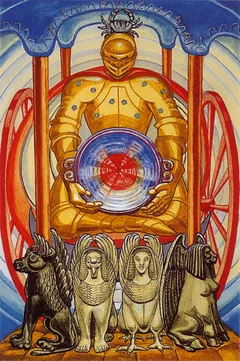
A knight in golden armour sits cross-legged in a chariot, his visor shut. A crab crowns his helmet, and small blue stars stud his breastplate. In both hands he holds a round dish whose centre is red and whose rim swirls blue and white. Four red pillars hold up a blue canopy edged with lettering, and great red wheels turn at the sides. Rings of blue and white light spread behind him. Four winged sphinxes crouch in front of the chariot: one dark with a bull's head, one with an eagle's head, one with a man's face and one with a lion's body.
The card stands on the eighteenth path, which joins Binah, Understanding, to Geburah, the fifth sphere. Its letter is Cheth, the fence, with the value eight. Its sign is Cancer, the Crab, a sign of Water, ruled by the Moon, with Jupiter exalted in it. The path is the Intelligence of the House of Influence, through whose abundance good things flow down to created beings.
The crab on the helmet is the sign, and the closed armour is its shell. The armour shuts the knight in as a fence shuts in a field, and Cheth, the fence, is the letter of the path. The round dish at the centre swirls blue and white, the water of the sign. The sphinx is among the animals of the path, and the four here take the forms of the bull, the eagle, the man and the lion. The golden armour shines with the amber of the King scale.
The secret title of the card is The Child of the Powers of the Waters; the Lord of the Triumph of Light. Cancer is Khephra in Egypt and Apollo the Charioteer among the Greeks. Its plant is the lotus and its stone amber. In the year it is the month Tammuz.
The card is The Chariot in the Thoth and Rider-Waite decks and Le Chariot in the Marseille deck. The Rider-Waite charioteer stands under a starry canopy with a black and a white sphinx before him; the Marseille chariot is drawn by two horses.
In a reading
Triumph, victory, health, which is sometimes unstable.
The path
In Waite’s Pictorial Key
The Pictorial Key to the Tarot · A. E. Waite · 1911An erect and princely figure carrying a drawn sword and corresponding, broadly speaking, to the traditional description which I have given in the first part. On the shoulders of the victorious hero are supposed to be the Urim and Thummim. He has led captivity captive; he is conquest on all planes--in the mind, in science, in progress, in certain trials of initiation. He has thus replied to the sphinx, and it is on this account that I have accepted the variation of Éliphas Lévi; two sphinxes thus draw his chariot. He is above all things triumph in the mind.
It is to be understood for this reason (a) that the question of the sphinx is concerned with a Mystery of Nature and not of the world of Grace, to which the charioteer could offer no answer; (b) that the planes of his conquest are manifest or external and not within himself; (c) that the liberation which he effects may leave himself in the bondage of the logical understanding; (d) that the tests of initiation through which he has passed in triumph are to be understood physically or rationally; and (e) that if he came to the pillars of that Temple between which the High Priestess is seated, he could not open the scroll called Tora, nor if she questioned him could he answer. He is not hereditary royalty and he is not priesthood.
Read in the book
Liber 777 · the row of Cheth
Letter and path
- Letter
- Cheth · Fence · 8 ח
- Attribution
- Cancer
- Heaven of Assiah
- Sarton, Cancer
- Mystic number
- 171
- Elements and rulers
- Water; ruled by Mars
- Sepher Yetzirah
- Intelligence of the House of Influence
- Order of Qliphoth
- Shichiriron
Tarot
- Trump
- VII The Chariot
- Title
- The Child of the Powers of the Waters: the Lord of the Triumph of Light
- Correct design
- A young and holy king under the starry canopy
Colours
- King scale
- Amber
- Queen scale
- Maroon
- Emperor scale
- Rich bright russet
- Empress scale
- Dark greenish brown
Gods
- Egyptian
- Khephra
- Egyptian (practical)
- Hormakhu
- Buddhist meditation
- Worm-eaten corpse
- Greek
- Apollo the Charioteer
- Roman
- Mercury
Nature and magick
- Animals
- Crab, Turtle, Sphinx
- Plants
- Lotus
- Precious stones
- Amber
- Magical weapon
- The Furnace
- Perfume
- Onycha
- Vegetable drugs
- Watercress
- Magical power
- Power of casting enchantments
- Geomancy and lineal figure
- Populus and Via
- Geomantic intelligence
- Muriel
- Human body
- Stomach
- Legendary orders of being
- Vampires
The sign of Cancer
- Ruling planet
- The Moon
- Exalted planet
- Jupiter
- Tribe of Israel
- Issachar
- Angel ruling the house
- Kael
- Lesser assistant angel
- Pakiel
- Lord of the triplicity by day
- Raadar
- Lord of the triplicity by night
- Akel
- Angels of the decans
- Mathravash · Rahadetz · Alinkir
- Image of the first decan
- A man with distorted face and hands, a horse's body, white feet, and a girdle of leaves
- Image of the second decan
- A beautiful woman wreathed with myrtle; she holds a lyre and sings of love and gladness
- Image of the third decan
- A swift-footed person, with a viper in his hand, leading dogs
- Goetic demons by day
- Buer · Gusion · Sitri
- Goetic demons by night
- Bifrons · Uvall · Haagenti
- Egyptian gods of the decans
- Apoltun (Sothis) · Hecate (Syth) · Mercophta (Thuismis)
- Mansions of the Moon
- Nasrah (the Lion's nose), Tarf (the Lion's eye), and 0°–10° Jabhah (the Lion's forehead)
- Genii of the hours
- Phalgus, Thagrinus, Eistibus, Pharzuph, Sislau, Schiekron, Aclahayr
Elsewhere
Sources
- Liber 777 (1909), the public-domain table of correspondences; the columns added in the 1955 revision are not included.
- Book T · The Equinox I:8 · 1912
- The Pictorial Key to the Tarot · A. E. Waite · 1911
- Sepher Yetzirah · W. Wynn Westcott’s translation · 1887
- Thoth · 1944 · Lady Frieda Harris and Aleister Crowley, painted 1938 to 1943
- Rider-Waite · 1909 · Pamela Colman Smith and A. E. Waite, 1909, public domain
- Tarot de Marseille · the traditional pattern, public domain
Through the yearsCheth
Through the years Cheth
18 texts of the archive speak of it, by 11 authors, from 1613 to 1929.
1613 · Thomas Hill · A Pleasant History declaring the Whole Art of PhysiognomyThe Philosopher Pt[••]lomeus paruus writeth, that if one line re[•]cheth along the forehead, as from the right side vnto the left, dooth then promise such a person (after nature) to liue thréescore yeares.
Read in the book
1929 · Arthur Edward Waite · The Holy KabbalahHE ets ata NE, VAD We ae itt Mea rina (Sse iebt: Daan ty Zi Smell Eiibleight CHETH | =n,\Ch Speech’; |B.…
Read in the book
First named beside itAleph1874 · Beth1874 · Lamed1874 · Daleth1874 · Gimel1874
Open in the BrainOpen this place on the Tree of Life, with the other arrangements