The Hiramic Legend
WHEN Solomon--the beloved of God, builder of the Everlasting House, and Grand Master of the Lodge of Jerusalem--ascended the throne of his father David he consecrated his life to the erection of a temple to God and a palace for the kings of Israel. David's faithful friend, Hiram, King of Tyre, hearing that a son of David sat upon the throne of Israel, sent messages of congratulation and offers of assistance to the new ruler. In his History of the Jews, Josephus mentions that copies of the letters passing between the two kings were then to be seen both at Jerusalem and at Tyre. Despite Hiram's lack of appreciation for the twenty cities of Galilee which Solomon presented to him upon the completion of the temple, the two monarchs remained the best of friends. Both were famous for their wit and wisdom, and when they exchanged letters each devised puzzling questions to test the mental ingenuity of the other. Solomon made an agreement with Hiram of Tyre promising vast amounts of barley, wheat, corn, wine, and oil as wages for the masons and carpenters from Tyre who were to assist the Jews in the erection of the temple. Hiram also supplied cedars and other fine trees, which were made into rafts and floated down the sea to Joppa, whence they were taken inland by Solomon's workmen to the temple site.
Because of his great love for Solomon, Hiram of Tyre sent also the Grand Master of the Dionysiac Architects, CHiram Abiff, a Widow's Son, who had no equal among the craftsmen of the earth. CHiram is described as being "a Tyrian by birch, but of Israelitish descent," and "a second Bezaleel, honored by his king with the title of Father." The Freemason's Pocket Companion (published in 1771) describes CHiram as "the most cunning, skilful and curious workman that ever lived, whose abilities were not confined to building alone, but extended to all kinds of work, whether in gold, silver, brass or iron; whether in linen, tapestry, or embroidery; whether considered as an architect, statuary [sic]; founder or designer, separately or together, he equally excelled. From his designs, and under his direction, all the rich and splendid furniture of the Temple and its several appendages were begun, carried on, and finished. Solomon appointed him, in his absence, to fill the chair, as Deputy Grand-Master; and in his presence, Senior Grand-Warden, Master of work, and general overseer of all artists, as well those whom David had formerly procured from Tyre and Sidon, as those Hiram should now send." (Modem Masonic writers differ as to the accuracy of the last sentence.)
Although an immense amount of labor was involved in its construction, Solomon's Temple--in the words of George Oliver--"was only a small building and very inferior in point of size to some of our churches." The number of buildings contiguous to it and the vast treasure of gold and precious stones used in its construction concentrated a great amount of wealth within the temple area. In the midst of the temple stood the Holy of Holies, sometimes called the Oracle. It was an exact cube, each dimension being twenty cubits, and exemplified the influence of Egyptian symbolism. The buildings of the temple group were ornamented with 1,453 columns of Parian marble, magnificently sculptured, and 2,906 pilasters decorated with capitals. There was a broad porch facing the east, and the sanctum sanctorum was upon the west. According to tradition, the various buildings and courtyards could hold in all 300,000 persons. Both the Sanctuary and the Holy of Holies were entirely lined with solid gold plates encrusted with jewels.
King Solomon began the building of the temple in the fourth year of his reign on what would be, according to modern calculation, the 21st day of April, and finished it in the eleventh year of his reign on the 23rd day of October. The temple was begun in the 480th year after the children of Israel had passed the Red Sea. Part of the labor of construction included the building of an artificial foundation on the brow of Mount Moriah. The stones for the temple were hoisted from quarries directly beneath Mount Moriah and were trued before being brought to the surface. The brass and golden ornaments for the temple were cast in molds in the clay ground between Succoth and Zeredatha, and the wooden parts were all finished before they reached the temple site. The building was put together, consequently, without sound and without instruments, all its parts fitting exactly "without the hammer of contention, the axe of division, or any tool of mischief."
Anderson's much-discussed Constitutions of the Free-Masons, published in London in 1723, and reprinted by Benjamin Franklin in Philadelphia in 1734, thus describes the division of the laborers engaged in the building of the Everlasting House:
"But Dagon's Temple, and the finest structures of Tyre and Sidon, could not be compared with the Eternal God's Temple at Jerusalem, * * * there were employed about it no less than 3,600 Princes, or Master-Masons, to conduct the work according to Solomon's directions, with 80,000 hewers of stone in the mountain, or Fellow Craftsmen, and 70,000 labourers, in all 153,600 besides the levy under Adoniram to work in the mountains of Lebanon by turns with the Sidonians, viz., 30,000, being in all 183,600." Daniel Sickels gives 3,300 overseers, instead of 3,600, and lists the three Grand Masters separately. The same author estimates the cost of the temple at nearly four thousand millions of dollars.
The Masonic legend of the building of Solomon's Temple does not in every particular parallel the Scriptural version, especially in those portions relating to CHiram Abiff. According to the Biblical account, this Master workman returned to his own country; in the Masonic allegory he is foully murdered. On this point A. E. Waite, in his New Encyclopædia of Freemasonry, makes the following explanatory comment:
"The legend of the Master-Builder is the great allegory of Masonry. It happens that his figurative story is grounded on the fact of a personality mentioned in Holy Scripture, but this historical background is of the accidents and not the essence; the significance is in the allegory and not in any point of history which may lie behind it."
CHiram, as Master of the Builders, divided his workmen into three groups, which were termed Entered Apprentices, Fellow-Craftsmen, and Master Masons. To each division he gave certain
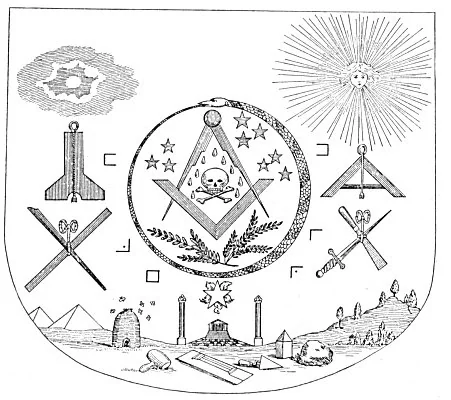
A MASONIC APRON WITH SYMBOLIC FIGURES.
From an early hand-painted Masonic apron.
While the mystic symbolism of Freemasonry decrees that the apron shall be a simple square of white lambskin with appropriate flap, Masonic aprons are frequently decorated with curious and impressive figures. "When silk cotton, or linen is worn," writes Albert Pike, "the symbolism is lost. Nor is one clothed who blots, defaces, and desecrates the white surface with ornamentation, figuring, or colors of any kind." (See Symbolism.)
To Mars, the ancient plane of cosmic energy, the Atlantean and Chaldean "star gazers" assigned Aries as a diurnal throne and Scorpio as a nocturnal throne. Those not raised to spiritual life by initiation are described as "dead from the sting of a scorpion," for they wander in the night side of divine power. Through the mystery of the Paschal Lamb, or the attainment of the Golden Fleece, these soul are raised into the constructive day Power of Mars in Aries--the symbol of the Creator.
When worn over the area related to the animal passions, the pure lambskin signifies the regeneration of the procreative forces and their consecration to the service of the Deity. The size of the apron, exclusive of the flap, makes it the symbol of salvation, for the Mysteries declare that it must consist of 144 square inches.
The apron shown above contains a wealth of symbolism: the beehive, emblematic of the Masonic lodge itself, the trowel, the mallet, and the trestleboad; the rough and trued ashlars; the pyramids and hills of Lebanon; the pillars, the Temple, and checkerboard floor; and the blazing star and tools of the Craft. The center of the apron is occupied by the compass and square, representative of the Macrocosm an the microcosm, and the alternately black and white serpent of astral light. Below is an acacia branch with seven sprigs, signifying the life Centers of the superior and the inferior man. The skull and cross bones are a continual reminder that the spiritual nature attains liberation only after the philosophical death of man's sensuous personality.
passwords and signs by which their respective excellence could be quickly determined. While all were classified according to their merits some were dissatisfied, for they desired a more exalted position than they were capable of filling. At last three Fellow-Craftsmen, more daring than their companions, determined to force CHiram to reveal to them the password of the Master's degree. Knowing that CHiram always went into the unfinished sanctum sanctorum at high noon to pray, these ruffians--whose names were Jubela, Jubelo, and Jubelum--lay in wait for him, one at each of the main gates of the temple. CHiram, about to leave the temple by the south gate, was suddenly confronted by Jubela armed with a twenty-four-inch gauge. Upon CHiram's refusal to reveal the Master's Word, the ruffian struck him on the throat with the rule, and the wounded Master then hastened to the west gate, where Jubelo, armed with a square, awaited him and made a similar demand. Again CHiram was silent, and the second assassin struck him on the breast with the square. CHiram thereupon staggered to the east gate, only to be met there by Jubelum armed with a maul. When CHiram, refused him the Master's Word, Jubelum struck the Master between the eyes with the mallet and CHiram fell dead.
The body of CHiram was buried by the murderers over the brow of Mount Moriah and a sprig of acacia placed upon the grave. The murderers then sought to escape punishment for their crime by embarking for Ethiopia, but the port was closed. All three were finally captured, and after admitting their guilt were duly executed. Parties of three were then sent out by King Solomon, and one of these groups discovered the newly made grave marked by the evergreen sprig. After the Entered Apprentices and the Fellow-Craftsmen had failed to resurrect their Master from the dead he was finally raised by the Master Mason with the "strong grip of a Lion's Paw."
To the initiated Builder the name CHiram Abiff signifies "My Father, the Universal Spirit, one in essence, three in aspect." Thus the murdered Master is a type of the Cosmic Martyr--the crucified Spirit of Good, the dying god--whose Mystery is celebrated throughout the world. Among the manuscripts of Dr. Sigismund Bastrom, the initiated Rosicrucian, appears the following extract from von Welling concerning the true philosophic nature of the Masonic CHiram:
"The original word חירם, CHiram, is a radical word consisting of three consonants ח ר and ם i. e. Cheth, Resh and Mem. (1) ח, Cheth, signifies Chamah, the Sun's light, i. e. the Universal, invisible, cold fire of Nature attracted by the Sun, manifested into light and sent down to us and to every planetary body belonging to the solar system. (2) ר, Resh, signifies ריח Ruach, i. e. Spirit, air, wind, as being the Vehicle which conveys and collects the light into numberless Foci, wherein the solar rays of light are agitated by a circular motion and manifested in Heat and burning Fire. (3) ם, or מ Mem, signifies majim, water, humidity, but rather the mother of water, i. e. Radical Humidity or a particular kind of condensed air. These three constitute the Universal Agent or fire of Nature in one word, חירם, CHiram, not Hiram."
Albert Pike mentions several forms of the name CHiram: Khirm, Khurm, and Khur-Om, the latter ending in the sacred Hindu monosyllable OM, which may also be extracted from the names of the three murderers. Pike further relates the three ruffians to a triad of stars in the constellation of Libra and also calls attention to the fact that the Chaldean god Bal--metamorphosed into a demon by the Jews--appears in the name of each of the murderers, Jubela, Jubelo, and Jubelum. To interpret the Hiramic legend requires familiarity with both the Pythagorean and Qabbalistic systems of numbers and letters, and also the philosophic and astronomic cycles of the Egyptians, Chaldeans, and Brahmins. For example, consider the number 33. The first temple of Solomon stood for thirty-three years in its pristine splendor. At the end of that time it was pillaged by the Egyptian King Shishak, and finally (588 B.C.) it was completely destroyed by Nebuchadnezzar and the people of Jerusalem were led into captivity to Babylon. (See General History of Freemasonry, by Robert Macoy.) Also King David ruled for thirty-three years in Jerusalem; the Masonic Order is divided into thirty-three symbolic degrees; there are thirty-three segments in the human spinal column; and Jesus was crucified in the thirty-third year of His life.
The efforts made to discover the origin of the Hiramic legend show that, while the legend in its present form is comparatively modem, its underlying principles run back to remotest antiquity. It is generally admitted by modem Masonic scholars that the story of the martyred CHiram is based upon the Egyptian rites of Osiris, whose death and resurrection figuratively portrayed the spiritual death of man and his regeneration through initiation into the Mysteries. CHiram is also identified with Hermes through the inscription on the Emerald Table. From these associations it is evident that CHiram is to be considered as a prototype of humanity; in fact he is Plato's Idea (archetype) of man. As Adam after the Fall symbolizes the Idea of human degeneration, so CHiram through his resurrection symbolizes the Idea of human regeneration.
On the 19th day of March, 1314, Jacques de Molay, the last Grand Master of the Knights Templars, was burned on a pyre erected upon that point of the islet of the Seine, at Paris, where afterwards was erected the statue of King Henry IV. (See The Indian Religions, by Hargrave Jennings.) "It is mentioned as a tradition in some of the accounts of the burning," writes Jennings, "that Molay, ere he expired, summoned Clement, the Pope who had pronounced the bull of abolition against the Order and had condemned the Grand Master to the flames, to appear, within forty days, before the Supreme Eternal judge, and Philip [the king] to the same awful tribunal within the space of a year. Both predictions were fulfilled." The close relationship between Freemasonry and the original Knights Templars has caused the story of CHiram to be linked with the martyrdom of Jacques de Molay. According to this interpretation, the three ruffians who cruelly slew their Master at the gates of the temple because he refused to reveal the secrets of his Order represent the Pope, the king, and the executioners. De Molay died maintaining his innocence and refusing to disclose the philosophical and magical arcana of the Templars.
Those who have sought to identify CHiram with the murdered King Charles the First conceive the Hiramic legend to have been invented for that purpose by Elias Ashmole, a mystical philosopher, who was probably a member of the Rosicrucian Fraternity. Charles was dethroned in 1647 and died on the block in 1649, leaving the Royalist party leaderless. An attempt has been made to relate the term "the Sons of the Widow" (an appellation frequently applied to members of the Masonic Order) to this incident in English history, for by the murder of her king England became a Widow and all Englishmen Widow's Sons.
To the mystic Christian Mason, CHiram. represents the Christ who in three days (degrees) raised the temple of His body from its earthly sepulcher. His three murderers were Cæsar's agent (the state), the Sanhedrin (the church), and the incited populace (the mob). Thus considered, CHiram becomes the higher nature of man and the murderers are ignorance, superstition, and fear. The indwelling Christ can give expression to Himself in this world only through man's thoughts, feelings, and actions. Right thinking, right feeling, and right action--these are three gates through which the Christ power passes into the material world, there to labor in the erection of the Temple of Universal Brotherhood. Ignorance, superstition, and fear are three ruffians through whose agencies the Spirit of Good is murdered and a false kingdom, controlled by wrong thinking, wrong feeling, and wrong action, established in its stead. In the material universe evil appears ever victorious.
"In this sense," writes Daniel Sickels, "the myth of the Tyrian is perpetually repeated in the history of human affairs. Orpheus was murdered, and his body thrown into the Hebrus; Socrates was made to drink the hemlock; and, in all ages, we have seen Evil temporarily triumphant, and Virtue and Truth calumniated, persecuted, crucified, and slain. But Eternal justice marches surely and swiftly through the world: the Typhons, the children of darkness, the plotters of crime, all the infinitely varied forms of evil, are swept into oblivion; and Truth and Virtue--for a time laid low--come forth, clothed with diviner majesty, and crowned with everlasting glory!" (See General Ahiman Rezon.)
If, as there is ample reason to suspect, the modern Freemasonic Order was profoundly influenced by, if it is not an actual outgrowth of, Francis Bacon's secret society, its symbolism is undoubtedly permeated with Bacon's two great ideals: universal education and universal democracy. The deadly enemies of universal education are ignorance, superstition, and fear, by which the human soul is held in bondage to the lowest part of its own constitution. The arrant enemies of universal democracy have ever been the crown, the tiara, and the torch. Thus CHiram symbolizes that ideal state of spiritual, intellectual, and physical emancipation which has ever been sacrificed upon the altar of human selfishness. CHiram is the Beautifier of the Eternal House. Modern utilitarianism, however, sacrifices the beautiful for the practical, in the same breath declaring the obvious lie that selfishness, hatred, and discord are practical.
Dr. Orville Ward Owen found a considerable part of the first
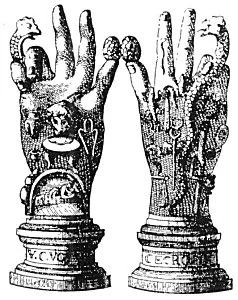
THE EMBLEMATIC HAND OF THE MYSTERIES.
From Montfaucon's Antiquities.
A hand covered with numerous symbols was extended to the neophytes when they entered into the Temple of Wisdom. An understanding of the embossed upon the surface of the hand brought with it Divine power and regeneration Therefore, by means of these symbolic hands the candidate was said to be raised from the dead.
thirty-two degrees of Freemasonic ritualism hidden in the text of the First Shakespeare Folio. Masonic emblems are to be observed also upon the title pages of nearly every book published by Bacon. Sir Francis Bacon considered himself as a living sacrifice upon the altar of human need; he was obviously cut down in the midst of his labors, and no student of his New Atlantis can fail to recognize the Masonic symbolism contained therein. According to the observations of Joseph Fort Newton, the Temple of Solomon described by Bacon in that utopian romance was not a house at all but the name of an ideal state. Is it not true that the Temple of Freemasonry is also emblematic of a condition of society? While, as before stated, the principles of the Hiramic legend are of the greatest antiquity, it is not impossible that its present form may be based upon incidents in the life of Lord Bacon, who passed through the philosophic death and was raised in Germany.
In an old manuscript appears the statement that the Freemasonic Order was formed by alchemists and Hermetic philosophers who had banded themselves together to protect their secrets against the infamous methods used by avaricious persons to wring from them the secret of gold-making. The fact that the Hiramic legend contains an alchemical formula gives credence to this story. Thus the building of Solomon's Temple represents the consummation of the magnum opus, which cannot be realized without the assistance of CHiram, the Universal Agent. The Masonic Mysteries teach the initiate how to prepare within his own soul a miraculous powder of projection by which it is possible for him to transmute the base lump of human ignorance, perversion, and discord into an ingot of spiritual and philosophic gold.
Sufficient similarity exists between the Masonic CHiram and the Kundalini of Hindu mysticism to warrant the assumption that CHiram may be considered a symbol also of the Spirit Fire moving through the sixth ventricle of the spinal column. The exact science of human regeneration is the Lost Key of Masonry, for when the Spirit Fire is lifted up through the thirty-three degrees, or segments of the spinal column, and enters into the domed chamber of the human skull, it finally passes into the pituitary body (Isis), where it invokes Ra (the pineal gland) and demands the Sacred Name. Operative Masonry, in the fullest meaning of that term, signifies the process by which the Eye of Horus is opened. E. A. Wallis Budge has noted that in some of the papyri illustrating the entrance of the souls of the dead into the judgment hall of Osiris the deceased person has a pine cone attached to the crown of his head. The Greek mystics also carried a symbolic staff, the upper end being in the form of a pine cone, which was called the thyrsus of Bacchus. In the human brain there is a tiny gland called the pineal body, which is the sacred eye of the ancients, and corresponds to the third eye of the Cyclops. Little is known concerning the function of the pineal body, which Descartes suggested (more wisely than he knew) might be the abode of the spirit of man. As its name signifies, the pineal gland is the sacred pine cone in man--the eye single, which cannot be opened until CHiram (the Spirit Fire) is raised through the sacred seals which are called the Seven Churches in Asia.
There is an Oriental painting which shows three sun bursts. One sunburst covers the head, in the midst of which sits Brahma with four heads, his body a mysterious dark color. The second sunburst--which covers the heart, solar plexus, and upper abdominal region--shows Vishnu sitting in the blossom of the lotus on a couch formed of the coils of the serpent of cosmic motion, its seven-hooded head forming a canopy over the god. The third sunburst is over the generative system, in the midst of which sits Shiva, his body a grayish white and the Ganges River flowing out of the crown of his head. This painting was the work of a Hindu mystic who spent many years subtly concealing great philosophical principles within these figures. The Christian legends could be related also to the human body by the same method as the Oriental, for the arcane meanings hidden in the teachings of both schools are identical.
As applied to Masonry, the three sunbursts represent the gates of the temple at which CHiram was struck, there being no gate in the north because the sun never shines from the northern angle of the heavens. The north is the symbol of the physical because of its relation to ice (crystallized water) and to the body (crystallized spirit). In man the light shines toward the north but never from it, because the body has no light of its own but shines with the reflected glory of the divine life-particles concealed within physical substance. For this reason the moon is accepted as the symbol of man's physical nature. CHiram is the mysterious fiery, airy water which must be raised through the three grand centers symbolized by the ladder with three rungs and the sunburst flowers mentioned in the description of the Hindu painting. It must also pass upward by means of the ladder of seven rungs-the seven plexuses proximate to the spine. The nine segments of the sacrum and coccyx are pierced by ten foramina, through which pass the roots of the Tree of Life. Nine is the sacred number of man, and in the symbolism of the sacrum and coccyx a great mystery is concealed. That part of the body from the kidneys downward was termed by the early Qabbalists the Land of Egypt into which the children of Israel were taken during the captivity. Out of Egypt, Moses (the illuminated mind, as his name implies) led the tribes of Israel (the twelve faculties) by raising the brazen serpent in the wilderness upon the symbol of the Tau cross. Not only CHiram but the god-men of nearly every pagan Mystery ritual are personifications of the Spirit Fire in the human spinal cord.
The astronomical aspect of the Hiramic legend must not be overlooked. The tragedy of CHiram is enacted annually by the sun during its passage through the signs of the zodiac.
"From the journey of the Sun through the twelve signs," writes Albert Pike, "come the legend of the twelve labors of Hercules, and the incarnations of Vishnu and Buddha. Hence came the legend of the murder of Khurum, representative of the Sun, by the three Fellow-Crafts, symbols of the Winter signs, Capricornus, Aquarius, and Pisces, who assailed him at the three gates of Heaven and slew him at the Winter Solstice. Hence the search for him by the nine Fellow-Crafts, the other nine signs, his finding, burial, and resurrection." (See Morals and Dogma.)
Other authors consider Libra, Scorpio, and Sagittarius as the three murderers of the sun, inasmuch as Osiris was murdered by Typhon, to whom were assigned the thirty degrees of the constellation of Scorpio. In the Christian Mysteries also Judas signifies the Scorpion, and the thirty pieces of silver for which he betrayed His Lord represent the number of degrees in that sign. Having been struck by Libra (the state), Scorpio (the church), and Sagittarius (the mob), the sun (CHiram) is secretly home through the darkness by the signs of Capricorn, Aquarius, and Pisces and buried over the brow of a hill (the vernal equinox). Capricorn has for its symbol an old man with a scythe in his hand. This is Father Time--a wayfarer--who is symbolized in Masonry as straightening out the ringlets of a young girl's hair. If the Weeping Virgin be considered a symbol of Virgo, and Father Time with his scythe a symbol of Capricorn, then the interval of ninety degrees between these two signs will be found to correspond to that occupied by the three murderers. Esoterically, the urn containing the ashes of CHiram represents the human heart. Saturn, the old man who lives at the north pole, and brings with him to the children of men a sprig of evergreen (the Christmas tree), is familiar to the little folks under the name of Santa Claus, for he brings each winter the gift of a new year.
The martyred sun is discovered by Aries, a Fellow-Craftsman, and at the vernal equinox the process of raising him begins. This is finally accomplished by the Lion of Judah, who in ancient times occupied the position of the keystone of the Royal Arch of Heaven. The precession of the equinoxes causes various signs to play the rôle of the murderers of the sun during the different ages of the world, but the principle involved remains unchanged. Such is the cosmic story of CHiram, the Universal Benefactor, the Fiery Architect: of the Divine House, who carries with him to the grave that Lost Word which, when spoken, raises all life to power and glory. According to Christian mysticism, when the Lost Word is found it is discovered in a stable, surrounded by beasts and marked by a star. "After the sun leaves Leo," writes Robert Hewitt Brown, "the days begin to grow unequivocally shorter as the sun declines toward the autumnal equinox, to be again slain by the three autumnal months, lie dead through the three winter ones, and be raised again by the three vernal ones. Each year the great tragedy is repeated, and the glorious resurrection takes place." (See Stellar Theology and Masonic Astronomy.)
CHiram is termed dead because in the average individual the cosmic creative forces are limited in their manifestation to purely physical--and correspondingly materialistic--expression. Obsessed by his belief in the reality and permanence of physical existence, man does not correlate the material universe with the blank north wall of the temple. As the solar light symbolically is said to die as it approaches the winter solstice, so the physical world may be termed
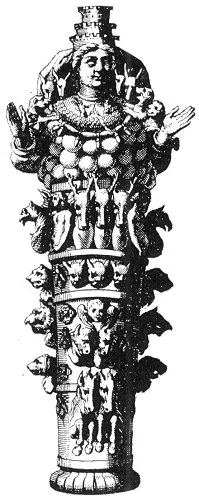
DIANA OF EPHESUS.
From Montfaucon's Antiquities.
Crowned with a triple tower-like tiara and her form adorned with symbolic creatures representative of her spiritual powers, Diana stood for the source of that imperishable doctrine which, flowing from the bosom of the Great Multimammia, is the spiritual food of those aspiring men and women who have consecrated their lives to the contemplation of reality. As the physical body of man receives its nutriment from the Great Earth Mother, so the spiritual nature of man is fed from the never failing fountains of Truth pouring outward from the invisible worlds.
the winter solstice of the spirit. Reaching the winter solstice, the sun apparently stands still for three days and then, rolling away the stone of winter, begins its triumphal march north towards the summer solstice. The condition of ignorance may be likened to the winter solstice of philosophy; spiritual understanding to the summer solstice. From this point of view, initiation into the Mysteries becomes the vernal equinox of the spirit, at which time the CHiram in man crosses from the realm of mortality into that of eternal life. The autumnal equinox is analogous to the mythological fall of man, at which time the human spirit descended into the realms of Hades by being immersed in the illusion of terrestrial existence.
In An Essay on the Beautiful, Plotinus describes the refining effect of beauty upon the unfolding consciousness of man. Commissioned to decorate the Everlasting House, CHiram Abiff is the embodiment of the beautifying principle. Beauty is essential to the natural unfoldment of the human soul. The Mysteries held that man, in part at least, was the product of his environment. Therefore they considered it imperative that every person be surrounded by objects which would evoke the highest and noblest sentiments. They proved that it was possible to produce beauty in life by surrounding life with beauty. They discovered that symmetrical bodies were built by souls continuously in the presence of symmetrical bodies; that noble thoughts were produced by minds surrounded by examples of mental nobility. Conversely, if a man were forced to look upon an ignoble or asymmetrical structure it would arouse within him a sense of ignobility which would provoke him to commit ignoble deeds. If an ill-proportioned building were erected in the midst of a city there would be ill-proportioned children born in that community; and men and women, gazing upon the asymmetrical structure, would live inharmonious lives. Thoughtful men of antiquity realized that their great philosophers were the natural products of the æsthetic ideals of architecture, music, and art established as the standards of the cultural systems of the time.
The substitution of the discord of the fantastic for the harmony of the beautiful constitutes one of the great tragedies of every civilization. Not only were the Savior-Gods of the ancient world beautiful, but each performed a ministry of beauty, seeking to effect man's regeneration by arousing within him the love of the beautiful. A renaissance of the golden age of fable can be made possible only by the elevation of beauty to its rightful dignity as the all-pervading, idealizing quality in the religious, ethical, sociological, scientific, and political departments of life. The Dionysiac Architects were consecrated to the raising of their Master Spirit--Cosmic Beauty--from the sepulcher of material ignorance and selfishness by erecting buildings which were such perfect exemplars of symmetry and majesty that they were actually magical formulæ by which was evoked the spirit of the martyred Beautifier entombed within a materialistic world.
In the Masonic Mysteries the triune spirit of man (the light Delta) is symbolized by the three Grand Masters of the Lodge of Jerusalem. As God is the pervading principle of three worlds, in each of which He manifests as an active principle, so the spirit of man, partaking of the nature of Divinity, dwells upon three planes of being: the Supreme, the Superior, and the Inferior spheres of the Pythagoreans. At the gate of the Inferior sphere (the underworld, or dwelling place of mortal creatures) stands the guardian of Hades--the three--headed dog Cerberus, who is analogous to the three murderers of the Hiramic legend. According to this symbolic interpretation of the triune spirit, CHiram is the third, or incarnating, part--the Master Builder who through all ages erects living temples of flesh and blood as shrines of the Most High. CHiram comes forth as a flower and is cut down; he dies at the gates of matter; he is buried in the elements of creation, but--like Thor--he swings his mighty hammer in the fields of space, sets the primordial atoms in motion, and establishes order out of Chaos. As the potentiality of cosmic power within each human soul, CHiram lies waiting for man by the elaborate ritualism of life to transmute potentiality into divine potency. As the sense perceptions of the individual increase, however, man gains ever greater control over his various parts, and the spirit of life within gradually attains freedom. The three murderers represent the laws of the Inferior world--birth, growth, and decay--which ever frustrate the plan of the Builder. To the average individual, physical birch actually signifies the death of CHiram, and physical death the resurrection of CHiram. To the initiate, however, the resurrection of the spiritual nature is accomplished without the intervention of physical death.
The curious symbols found in the base of Cleopatra's Needle now standing in Central Park, New York, were interpreted as being of first Masonic significance by S. A. Zola, 33° Past Grand Master of the Grand Lodge of Egypt. Masons' marks and symbols are to be found on the stones of numerous public buildings not only in England and on the Continent but also in Asia. In his Indian Masons' Marks of the Moghul Dynasty, A. Gorham describes scores of markings appearing on the walls of buildings such as the Taj Mahal, the Jama Masjid, and that: famous Masonic structure, the Kutab Minar. According to those who regard Masonry as an outgrowth of the secret society of architects and builders which for thousands of years formed a caste of master craftsmen, CHiram Abiff was the Tyrian Grand Master of a world-wide organization of artisans, with headquarters in Tyre. Their philosophy consisted of incorporating into the measurements and ornamentation of temples, palaces, mausoleums, fortresses, and other public buildings their knowledge of the laws controlling the universe. Every initiated workman was given a hieroglyphic with which he marked the stones he trued to show to all posterity that he thus dedicated to the Supreme Architect of the Universe each perfected product of his labor. Concerning Masons' marks, Robert Freke Gould writes:
"It is very remarkable that these marks are to be found in all countries--in the chambers of the Great Pyramid at Gizeh, on the underground walls of Jerusalem, in Herculaneum and Pompeii, on Roman walls and Grecian temples, in Hindustan, Mexico, Peru, Asia Minor--as well as on the great ruins of England, France, Germany, Scotland, Italy, Portugal and Spain." (See A Concise History of Freemasonry.)
From this viewpoint the story of CHiram may well represent the incorporation of the divine secrets of architecture into the actual parts and dimensions of earthly buildings. The three degrees of the Craft bury the Grand Master (the Great Arcanum) in the actual structure they erect, after first having killed him with the builders' tools, by reducing the dimensionless Spirit of Cosmic Beauty to the limitations of concrete form. These abstract ideals of architecture can be resurrected, however, by the Master Mason who, by meditating upon the structure, releases therefrom the divine principles of architectonic philosophy incorporated or buried within it. Thus the physical building is actually the tomb or embodiment of the Creative Ideal of which its material dimensions are but the shadow.
Moreover, the Hiramic legend may be considered to embody the vicissitudes of philosophy itself. As institutions for the dissemination of ethical culture, the pagan Mysteries were the architects of civilization. Their power and dignity were personified in CHiram Abiff--the Master Builder--but they eventually fell a victim to the onslaughts of that recurrent trio of state, church, and mob. They were desecrated by the state, jealous of their wealth and power; by the early church, fearful of their wisdom; and by the rabble or soldiery incited by both state and church. As CHiram when raised from his grave whispers the Master Mason's Word which was lost through his untimely death, so according to the tenets of philosophy the reestablishment or resurrection of the ancient Mysteries will result in the rediscovery of that secret teaching without which civilization must continue in a state of spiritual confusion and uncertainty.
When the mob governs, man is ruled by ignorance; when the church governs, he is ruled by superstition; and when the state governs, he is ruled by fear. Before men can live together in harmony and understanding, ignorance must be transmuted into wisdom, superstition into an illumined faith, and fear into love. Despite statements to the contrary, Masonry is a religion seeking to unite God and man by elevating its initiates to that level of consciousness whereon they can behold with clarified vision the workings of the Great Architect of the Universe. From age to age the vision of a perfect civilization is preserved as the ideal for mankind. In the midst of that civilization shall stand a mighty university wherein both the sacred and secular sciences concerning the mysteries of life will be freely taught to all who will assume the philosophic life. Here creed and dogma will have no place; the superficial will be removed and only the essential be preserved. The world will be ruled by its most illumined minds, and each will occupy the position for which he is most admirably fitted.
The great university will be divided into grades, admission to which will be through preliminary tests or initiations. Here mankind will be instructed in the most sacred, the most secret, and the most enduring of all Mysteries--Symbolism. Here the initiate will be taught that every visible object, every abstract thought, every emotional reaction is but the symbol of an eternal principle. Here mankind will learn that CHiram (Truth) lies buried in every atom of Kosmos; that every form is a symbol and every symbol the tomb of an eternal verity. Through education--spiritual, mental, moral, and physical--man will learn to release living truths from their lifeless coverings. The perfect government of the earth must be patterned eventually after that divine government by which the universe is ordered. In that day when perfect order is reestablished, with peace universal and good triumphant, men will no longer seek for happiness, for they shall find it welling up within themselves. Dead hopes, dead aspirations, dead virtues shall rise from their graves, and the Spirit of Beauty and Goodness repeatedly slain by ignorant men shall again be the Master of Work. Then shall sages sit upon the seats of the mighty and the gods walk with men.
The Pythagorean Theory of Music and Color
HARMONY is a state recognized by great philosophers as the immediate prerequisite of beauty. A compound is termed beautiful only when its parts are in harmonious combination. The world is called beautiful and its Creator is designated the Good because good perforce must act in conformity with its own nature; and good acting according to its own nature is harmony, because the good which it accomplishes is harmonious with the good which it is. Beauty, therefore, is harmony manifesting its own intrinsic nature in the world of form.
The universe is made up of successive gradations of good, these gradations ascending from matter (which is the least degree of good) to spirit (which is the greatest degree of good). In man, his superior nature is the summum bonum. It therefore follows that his highest nature most readily cognizes good because the good external to him in the world is in harmonic ratio with the good present in his soul. What man terms evil is therefore, in common with matter, merely the least degree of its own opposite. The least degree of good presupposes likewise the least degree of harmony and beauty. Thus deformity (evil) is really the least harmonious combination of elements naturally harmonic as individual units. Deformity is unnatural, for, the sum of all things being the Good, it is natural that all things should partake of the Good and be arranged in combinations that are harmonious. Harmony is the manifesting expression of the Will of the eternal Good.
THE PHILOSOPHY OF MUSIC
It is highly probable that the Greek initiates gained their knowledge of the philosophic and therapeutic aspects of music from the Egyptians, who, in turn, considered Hermes the founder of the art. According to one legend, this god constructed the first lyre by stretching strings across the concavity of a turtle shell. Both Isis and Osiris were patrons of music and poetry. Plato, in describing the antiquity of these arts among the Egyptians, declared that songs and poetry had existed in Egypt for at least ten thousand years, and that these were of such an exalted and inspiring nature that only gods or godlike men could have composed them. In the Mysteries the lyre was regarded as the secret symbol of the human constitution, the body of the instrument representing the physical form, the strings the nerves, and the musician the spirit. Playing upon the nerves, the spirit thus created the harmonies of normal functioning, which, however, became discords if the nature of man were defiled.
While the early Chinese, Hindus, Persians, Egyptians, Israelites, and Greeks employed both vocal and instrumental music in their religious ceremonials, also to complement their poetry and drama, it remained for Pythagoras to raise the art to its true dignity by demonstrating its mathematical foundation. Although it is said that he himself was not a musician, Pythagoras is now generally credited with the discovery of the diatonic scale. Having first learned the divine theory of music from the priests of the various Mysteries into which he had been accepted, Pythagoras pondered for several years upon the laws governing consonance and dissonance. How he actually solved the problem is unknown, but the following explanation has been invented.
One day while meditating upon the problem of harmony, Pythagoras chanced to pass a brazier's shop where workmen were pounding out a piece of metal upon an anvil. By noting the variances in pitch between the sounds made by large hammers and those made by smaller implements, and carefully estimating the harmonies and discords resulting from combinations of these sounds, he gained his first clue to the musical intervals of the diatonic scale. He entered the shop, and after carefully examining the tools and making mental note of their weights, returned to his own house and constructed an arm of wood so that it: extended out from the wall of his room. At regular intervals along this arm he attached four cords, all of like composition, size, and weight. To the first of these he attached a twelve-pound weight, to the second a nine-pound weight, to the third an eight-pound weight, and to the fourth a six-pound weight. These different weights corresponded to the sizes of the braziers' hammers.
Pythagoras thereupon discovered that the first and fourth strings when sounded together produced the harmonic interval of the octave, for doubling the weight had the same effect as halving the string. The tension of the first string being twice that of the fourth string, their ratio was said to be 2:1, or duple. By similar experimentation he ascertained that the first and third string produced the harmony of the diapente, or the interval of the fifth. The tension of the first string being half again as much as that of the third string, their ratio was said to be 3:2, or sesquialter. Likewise the second and fourth strings, having the same ratio as the first and third strings, yielded a diapente harmony. Continuing his investigation, Pythagoras discovered that the first and second strings produced the harmony of the diatessaron, or the interval of the third; and the tension of the first string being a third greater than that of the second string, their ratio was said to be 4:3, or sesquitercian. The third and fourth strings, having the same ratio as the first and second strings, produced another harmony of the diatessaron. According to Iamblichus, the second and third strings had the ratio of 8:9, or epogdoan.
The key to harmonic ratios is hidden in the famous Pythagorean tetractys, or pyramid of dots. The tetractys is made up of the first four numbers--1, 2, 3, and 4--which in their proportions reveal the intervals of the octave, the diapente, and the diatessaron. While the law of harmonic intervals as set forth above is true, it has been subsequently proved that hammers striking metal in the manner
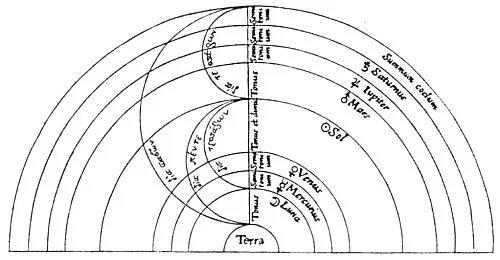
THE INTERVALS AND HARMONIES OF THE SPHERES.
From Stanley's The History of Philosophy.
In the Pythagorean concept of the music of the spheres, the interval between the earth and the sphere of the fixed stars was considered to be a diapason--the most perfect harmonic interval. The allowing arrangement is most generally accepted for the musical intervals of the planets between the earth and the sphere of the fixed stars: From the sphere of the earth to the sphere of the moon; one tone; from the sphere of the moon to that of Mercury, one half-tone; from Mercury to Venus, one-half; from Venus to the sun, one and one-half tones; from the sun to Mars, one tone; from Mars to Jupiter, one-half tone; from Jupiter to Saturn, one-half tone; from Saturn to the fixed stars, one-half tone. The sum of these intervals equals the six whole tones of the octave.
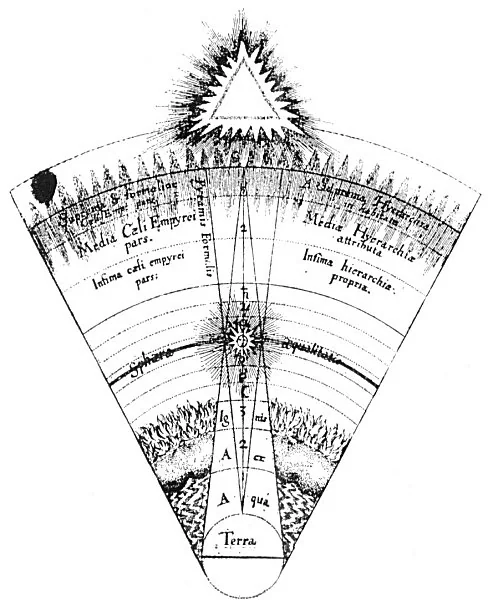
THE CONSONANCES OF THE MUNDANE MONOCHORD.
From Fludd's De Musica Mundana.
This diagrammatic sector represents the major gradations of energy and substance between elemental earth and absolute unconditioned force. Beginning with the superior, the fifteen graduated spheres descend in the following order: Limitless and Eternal Life; the superior, the middle, and the inferior Empyrean; the seven planets; and the four elements. Energy is symbolized by Fludd as a pyramid with its base upon the concave surface of the superior Empyrean, and substance as another Pyramid with its base upon the convex surface of the sphere (not planet) of earth. These pyramids demonstrate the relative proportions of energy and substance entering into the composition of the fifteen planes of being. It will be noted that the ascending pyramid of substance touches but does not pierce the fifteenth sphere--that of Limitless and Eternal Life. Likewise, the descending pyramid of energy touches but does not pierce the first sphere--the grossest condition of substance. The plane of the sun is denominated the sphere of equality, for here neither energy nor substance predominate. The mundane monochord consists of a hypothetical string stretched from the base of the pyramid of energy to the base of the pyramid of substance.
described will not produce the various tones ascribed to them. In all probability, therefore, Pythagoras actually worked out his theory of harmony from the monochord--a contrivance consisting of a single string stretched between two pegs and supplied with movable frets.
To Pythagoras music was one of the dependencies of the divine science of mathematics, and its harmonies were inflexibly controlled by mathematical proportions. The Pythagoreans averred that mathematics demonstrated the exact method by which the good established and maintained its universe. Number therefore preceded harmony, since it was the immutable law that governs all harmonic proportions. After discovering these harmonic ratios, Pythagoras gradually initiated his disciples into this, the supreme arcanum of his Mysteries. He divided the multitudinous parts of creation into a vast number of planes or spheres, to each of which he assigned a tone, a harmonic interval, a number, a name, a color, and a form. He then proceeded to prove the accuracy of his deductions by demonstrating them upon the different planes of intelligence and substance ranging from the most abstract logical premise to the most concrete geometrical solid. From the common agreement of these diversified methods of proof he established the indisputable existence of certain natural laws.
Having once established music as an exact science, Pythagoras applied his newly found law of harmonic intervals to all the phenomena of Nature, even going so far as to demonstrate the harmonic relationship of the planets, constellations, and elements to each other. A notable example of modern corroboration of ancient philosophical reaching is that of the progression of the elements according to harmonic ratios. While making a list of the elements in the ascending order of their atomic weights, John A. Newlands discovered at every eighth element a distinct repetition of properties. This discovery is known as the law of octaves in modern chemistry.
Since they held that harmony must be determined not by the sense perceptions but by reason and mathematics, the Pythagoreans called themselves Canonics, as distinguished from musicians of the Harmonic School, who asserted taste and instinct to be the true normative principles of harmony. Recognizing, however, the profound effect: of music upon the senses and emotions, Pythagoras did not hesitate to influence the mind and body with what he termed "musical medicine."
Pythagoras evinced such a marked preference for stringed instruments that he even went so far as to warn his disciples against allowing their ears to be defiled by the sounds of flutes or cymbals. He further declared that the soul could be purified from its irrational influences by solemn songs sung to the accompaniment of the lyre. In his investigation of the therapeutic value of harmonics, Pythagoras discovered that the seven modes--or keys--of the Greek system of music had the power to incite or allay the various emotions. It is related that while observing the stars one night he encountered a young man befuddled with strong drink and mad with jealousy who was piling faggots about his mistress' door with the intention of burning the house. The frenzy of the youth was accentuated by a flutist a short distance away who was playing a tune in the stirring Phrygian mode. Pythagoras induced the musician to change his air to the slow, and rhythmic Spondaic mode, whereupon the intoxicated youth immediately became composed and, gathering up his bundles of wood, returned quietly to his own home.
There is also an account of how Empedocles, a disciple of Pythagoras, by quickly changing the mode of a musical composition he was playing, saved the life of his host, Anchitus, when the latter was threatened with death by the sword of one whose father he had condemned to public execution. It is also known that Esculapius, the Greek physician, cured sciatica and other diseases of the nerves by blowing a loud trumpet in the presence of the patient.
Pythagoras cured many ailments of the spirit, soul, and body by having certain specially prepared musical compositions played in the presence of the sufferer or by personally reciting short selections from such early poets as Hesiod and Homer. In his university at Crotona it was customary for the Pythagoreans to open and to close each day with songs--those in the morning calculated to clear the mind from sleep and inspire it to the activities of the coming day; those in the evening of a mode soothing, relaxing, and conducive to rest. At the vernal equinox, Pythagoras caused his disciples to gather in a circle around one of their number who led them in song and played their accompaniment upon a lyre.
The therapeutic music of Pythagoras is described by Iamblichus thus: "And there are certain melodies devised as remedies against the passions of the soul, and also against despondency and lamentation, which Pythagoras invented as things that afford the greatest assistance in these maladies. And again, he employed other melodies against rage and anger, and against every aberration of the soul. There is also another kind of modulation invented as a remedy against desires." (See The Life of Pythagoras.)
It is probable that the Pythagoreans recognized a connection between the seven Greek modes and the planets. As an example, Pliny declares that Saturn moves in the Dorian mode and Jupiter in the Phrygian mode. It is also apparent that the temperaments are keyed to the various modes, and the passions likewise. Thus, anger--which is a fiery passion--may be accentuated by a fiery mode or its power neutralized by a watery mode.
The far-reaching effect exercised by music upon the culture of the Greeks is thus summed up by Emil Nauman: "Plato depreciated the notion that music was intended solely to create cheerful and agreeable emotions, maintaining rather that it should inculcate a love of all that is noble, and hatred of all that is mean, and that nothing could more strongly influence man's innermost feelings than melody and rhythm. Firmly convinced of this, he agreed with Damon of Athens, the musical instructor of Socrates, that the introduction of a new and presumably enervating scale would endanger the future of a whole nation, and that it was not possible to alter a key without shaking the very foundations of the State. Plato affirmed that music which ennobled the mind was of a far higher kind than that which merely appealed to the senses, and he strongly insisted that it was the paramount duty of the Legislature to suppress all music of an effeminate and lascivious character, and to encourage only s that which was pure and dignified; that bold and stirring melodies were for men, gentle and soothing ones for women. From this it is evident that music played a considerable part in the education of the Greek youth. The greatest care was also to be taken in the selection of instrumental music, because the absence of words rendered its signification doubtful, and it was difficult to foresee whether it would exercise upon the people a benign or baneful influence. Popular taste, being always tickled by sensuous and meretricious effects, was to be treated with deserved contempt. (See The History of Music.)
Even today martial music is used with telling effect in times of war, and religious music, while no longer developed in accordance with the ancient theory, still profoundly influences the emotions of the laity.
THE MUSIC OF THE SPHERES
The most sublime but least known of all the Pythagorean speculations was that of sidereal harmonics. It was said that of all men only Pythagoras heard the music of the spheres. Apparently the Chaldeans were the first people to conceive of the heavenly bodies joining in a cosmic chant as they moved in stately manner across the sky. Job describes a time "when the stars of the morning sang together," and in The Merchant of Venice the author of the Shakesperian plays
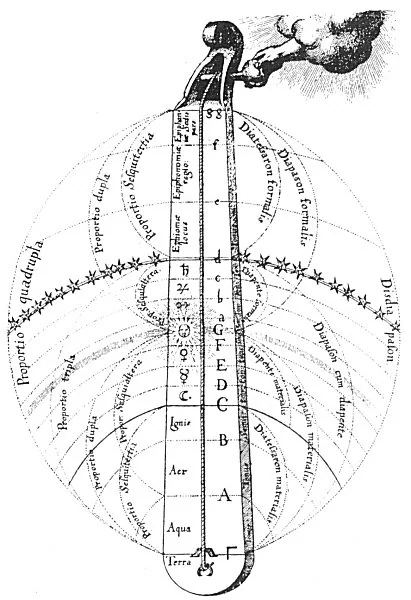
THE MUNDANE MONOCHORD WITH ITS PROPORTIONS AND INTERVALS.
From Fludd's De Musica Mundana.
In this chart is set forth a summary of Fludd's theory of universal music. The interval between the element of earth and the highest heaven is considered as a double octave, thus showing the two extremes of existence to be in disdiapason harmony. It is signifies that the highest heaven, the sun, and the earth have the same time, the difference being in pitch. The sun is the lower octave of the highest heaven and the earth the lower octave of the sun. The lower octave (Γ to G) comprises that part of the universe in which substance predominate over energy. Its harmonies, therefore, are more gross than those of the higher octave (G to g) wherein energy predominates over substance. "If struck in the more spiritual part," writes Fludd, "the monochord will give eternal life; if in the more material part, transitory life." It will be noted that certain elements, planets, and celestial spheres sustain a harmonic ratio to each other, Fludd advanced this as a key to the sympathies and antipathies existing between the various departments of Nature.
writes: "There's not the smallest orb which thou behold'st but in his motion like an angel sings." So little remains, however, of the Pythagorean system of celestial music that it is only possible to approximate his actual theory.
Pythagoras conceived the universe to be an immense monochord, with its single string connected at its upper end to absolute spirit and at its lower end to absolute matter--in other words, a cord stretched between heaven and earth. Counting inward from the circumference of the heavens, Pythagoras, according to some authorities, divided the universe into nine parts; according to others, into twelve parts. The twelvefold system was as follows: The first division was called the empyrean, or the sphere of the fixed stars, and was the dwelling place of the immortals. The second to twelfth divisions were (in order) the spheres of Saturn, Jupiter, Mars, the sun, Venus, Mercury, and the moon, and fire, air, water, and earth. This arrangement of the seven planets (the sun and moon being regarded as planets in the old astronomy) is identical with the candlestick symbolism of the Jews--the sun in the center as the main stem with three planets on either side of it.
The names given by the Pythagoreans to the various notes of the diatonic scale were, according to Macrobius, derived from an estimation of the velocity and magnitude of the planetary bodies. Each of these gigantic spheres as it rushed endlessly through space was believed to sound a certain tone caused by its continuous displacement of the æthereal diffusion. As these tones were a manifestation of divine order and motion, it must necessarily follow that they partook of the harmony of their own source. "The assertion that the planets in their revolutions round the earth uttered certain sounds differing according to their respective 'magnitude, celerity and local distance,' was commonly made by the Greeks. Thus Saturn, the farthest planet, was said to give the gravest note, while the Moon, which is the nearest, gave the sharpest. 'These sounds of the seven planets, and the sphere of the fixed stars, together with that above us [Antichthon], are the nine Muses, and their joint symphony is called Mnemosyne.'" (See The Canon.)This quotation contains an obscure reference to the ninefold division of the universe previously mentioned.
The Greek initiates also recognized a fundamental relationship between the individual heavens or spheres of the seven planets, and the seven sacred vowels. The first heaven uttered the sound of the sacred vowel Α (Alpha); the second heaven, the sacred vowel Ε (Epsilon); the third, Η (Eta); the fourth, Ι (Iota); the fifth, Ο (Omicron); the sixth, Υ (Upsilon); and the seventh heaven, the sacred vowel Ω (Omega). When these seven heavens sing together they produce a perfect harmony which ascends as an everlasting praise to the throne of the Creator. (See Irenæus' Against Heresies.) Although not so stated, it is probable that the planetary heavens are to be considered as ascending in the Pythagorean order, beginning with the sphere of the moon, which would be the first heaven.
Many early instruments had seven Strings, and it is generally conceded that Pythagoras was the one who added the eighth string to the lyre of Terpander. The seven strings were always related both to their correspondences in the human body and to the planets. The names of God were also conceived to be formed from combinations of the seven planetary harmonies. The Egyptians confined their sacred songs to the seven primary sounds, forbidding any others to be uttered in their temples. One of their hymns contained the following invocation: "The seven sounding tones praise Thee, the Great God, the ceaseless working Father of the whole universe." In another the Deity describes Himself thus: "I am the great indestructible lyre of the whole world, attuning the songs of the heavens. (See Nauman's History of Music.)
The Pythagoreans believed that everything which existed had a voice and that all creatures were eternally singing the praise of the Creator. Man fails to hear these divine melodies because his soul is enmeshed in the illusion of material existence. When he liberates himself from the bondage of the lower world with its sense limitations, the music of the spheres will again be audible as it was in the Golden Age. Harmony recognizes harmony, and when the human soul regains its true estate it will not only hear the celestial choir but also join with it in an everlasting anthem of praise to that Eternal Good controlling the infinite number of parts and conditions of Being.
The Greek Mysteries included in their doctrines a magnificent concept of the relationship existing between music and form. The elements of architecture, for example, were considered as comparable to musical modes and notes, or as having a musical counterpart. Consequently when a building was erected in which a number of these elements were combined, the structure was then likened to a musical chord, which was harmonic only when it fully satisfied the mathematical requirements of harmonic intervals. The realization of this analogy between sound and form led Goethe to declare that "architecture is crystallized music."
In constructing their temples of initiation, the early priests frequently demonstrated their superior knowledge of the principles underlying the phenomena known as vibration. A considerable part of the Mystery rituals consisted of invocations and intonements, for which purpose special sound chambers were constructed. A word whispered in one of these apartments was so intensified that the reverberations made the entire building sway and be filled with a deafening roar. The very wood and stone used in the erection of these sacred buildings eventually became so thoroughly permeated with the sound vibrations of the religious ceremonies that when struck they would reproduce the same tones thus repeatedly impressed into their substances by the rituals.
Every element in Nature has its individual keynote. If these elements are combined in a composite structure the result is a chord that, if sounded, will disintegrate the compound into its integral parts. Likewise each individual has a keynote that, if sounded, will destroy him. The allegory of the walls of Jericho falling when the trumpets of Israel were sounded is undoubtedly intended to set forth the arcane significance of individual keynote or vibration.
THE PHILOSOPHY OF COLOR
"Light," writes Edwin D. Babbitt, "reveals the glories of the external world and yet is the most glorious of them all. It gives beauty, reveals beauty and is itself most beautiful. It is the analyzer, the truth-teller and the exposer of shams, for it shows things as they are. Its infinite streams measure off the universe and flow into our telescopes from stars which are quintillions of miles distant. On the other hand it descends to objects inconceivably small, and reveals through the microscope objects fifty millions of times less than can be seen by the naked eye. Like all other fine forces, its movement is wonderfully soft, yet penetrating and powerful. Without its vivifying influence, vegetable, animal, and human life must immediately perish from the earth, and general ruin take place. We shall do well, then, to consider this potential and beautiful principle of light and its component colors, for the more deeply we penetrate into its inner laws, the more will it present itself as a marvelous storehouse of power to vitalize, heal, refine, and delight mankind." (See The Principles of Light and Color.)
Since light is the basic physical manifestation of life, bathing all creation in its radiance, it is highly important to realize, in part at least, the subtle nature of this divine substance. That which is called light is actually a rate of vibration causing certain reactions upon the optic nerve. Few realize how they are walled in by the limitations
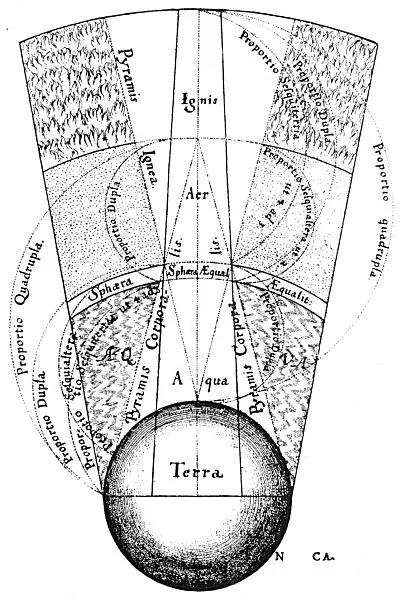
THE THEORY OF ELEMENTAL MUSIC.
From Fludd's De Musica Mundana.
In this diagram two interpenetrating pyramids are again employed, one of which represents fire and the other earth. It is demonstrated according to the law of elemental harmony that fire does not enter into the composition of earth nor earth into the composition of fire. The figures on the chart disclose the harmonic relationships existing between the four primary elements according to both Fludd and the Pythagoreans. Earth consists of four parts of its own nature; water of three parts of earth and one part of fire. The sphere of equality is a hypothetical point where there is an equilibrium of two parts of earth and two parts of fire. Air is composed of three parts of fire and one part of earth; fire, of four parts of its own nature. Thus earth and water bear to each other the ratio of 4 to 3, or the diatessaron harmony, and water and the sphere of equality the ratio of 3 to 2, or the diapente harmony. Fire and air also bear to each other the ratio of 4 to 3, or the diatessaron harmony, and air and the sphere of equality the ratio of 3 to 2, or the diapente harmony. As the sum of a diatessaron and a diapente equals a diapason, or octave, it is evident that both the sphere of fire and the sphere of earth are in diapason harmony with the sphere of equality, and also that fire and earth are in disdiapason harmony with each other.
of the sense perceptions. Not only is there a great deal more to light than anyone has ever seen but there are also unknown forms of light which no optical equipment will ever register. There are unnumbered colors which cannot be seen, as well as sounds which cannot be heard, odors which cannot be smelt, flavors which cannot be tasted, and substances which cannot be felt. Man is thus surrounded by a supersensible universe of which he knows nothing because the centers of sense perception within himself have not been developed sufficiently to respond to the subtler rates of vibration of which that universe is composed.
Among both civilized and savage peoples color has been accepted as a natural language in which to couch their religious and philosophical doctrines. The ancient city of Ecbatana as described by Herodotus, its seven walls colored according to the seven planets, revealed the knowledge of this subject possessed by the Persian Magi. The famous zikkurat or astronomical tower of the god Nebo at Borsippa ascended in seven great steps or stages, each step being painted in the key color of one of the planetary bodies. (See Lenormant's Chaldean Magic.) It is thus evident that the Babylonians were familiar with the concept of the spectrum in its relation to the seven Creative Gods or Powers. In India, one of the Mogul emperors caused a fountain to be made with seven levels. The water pouring down the sides through specially arranged channels changed color as it descended, passing sequentially through all shades of the spectrum. In Tibet, color is employed by the native artists to express various moods. L. Austine Waddell, writing of Northern Buddhist art, notes that in Tibetan mythology "White and yellow complexions usually typify mild moods, while the red, blue, and black belong to fierce forms, though sometimes light blue, as indicating the sky, means merely celestial. Generally the gods are pictured white, goblins red, and devils black, like their European relative." (See The Buddhism of Tibet.)
In Meno, Plato, speaking through Socrates, describes color as "an effluence of form, commensurate with sight, and sensible." In Theætetus he discourses more at length on the subject thus: "Let us carry out the principle which has just been affirmed, that nothing is self-existent, and then we shall see that every color, white, black, and every other color, arises out of the eye meeting the appropriate motion, and that what we term the substance of each color is neither the active nor the passive element, but something which passes between them, and is peculiar to each percipient; are you certain that the several colors appear to every animal--say a dog--as they appear to you?"
In the Pythagorean tetractys--the supreme symbol of universal forces and processes--are set forth the theories of the Greeks concerning color and music. The first three dots represent the threefold White Light, which is the Godhead containing potentially all sound and color. The remaining seven dots are the colors of the spectrum and the notes of the musical scale. The colors and tones are the active creative powers which, emanating from the First Cause, establish the universe. The seven are divided into two groups, one containing three powers and the other four a relationship also shown in the tetractys. The higher group--that of three--becomes the spiritual nature of the created universe; the lower group--that of four--manifests as the irrational sphere, or inferior world.
In the Mysteries the seven Logi, or Creative Lords, are shown as streams of force issuing from the mouth of the Eternal One. This signifies the spectrum being extracted from the white light of the Supreme Deity. The seven Creators, or Fabricators, of the inferior spheres were called by the Jews the Elohim. By the Egyptians they were referred to as the Builders (sometimes as the Governors) and are depicted with great knives in their hands with which they carved the universe from its primordial substance. Worship of the planets is based upon their acceptation as the cosmic embodiments of the seven creative attributes of God. The Lords of the planets were described as dwelling within the body of the sun, for the true nature of the sun, being analogous to the white light, contains the seeds of all the tone and color potencies which it manifests.
There are numerous arbitrary arrangements setting forth the mutual relationships of the planets, the colors, and the musical notes. The most satisfactory system is that based upon the law of the octave. The sense of hearing has a much wider scope than that of sight, for whereas the ear can register from nine to eleven octaves of sound the eye is restricted to the cognition of but seven fundamental color tones, or one tone short of the octave. Red, when posited as the lowest color tone in the scale of chromatics, thus corresponds to do, the first note of the musical scale. Continuing the analogy, orange corresponds to re, yellow to mi, green to fa, blue to sol, indigo to la, and violet to si (ti). The eighth color tone necessary to complete the scale should be the higher octave of red, the first color tone. The accuracy of the above arrangement is attested by two striking facts: (1) the three fundamental notes of the musical scale--the first, the third, and the fifth--correspond with the three primary colors--red, yellow, and blue; (2) the seventh, and least perfect, note of the musical scale corresponds with purple, the least perfect tone of the color scale.
In The Principles of Light and Color, Edwin D. Babbitt confirms the correspondence of the color and musical scales: "As C is at the bottom of the musical scale and made with the coarsest waves of air, so is red at the bottom of the chromatic scale and made with the coarsest waves of luminous ether. As the musical note B [the seventh note of the scale] requires 45 vibrations of air every time the note C at the lower end of the scale requires 24, or but little over half as many, so does extreme violet require about 300 trillions of vibrations of ether in a second, while extreme red requires only about 450 trillions, which also are but little more than half as many. When one musical octave is finished another one commences and progresses with just twice as many vibrations as were used in the first octave, and so the same notes are repeated on a finer scale. In the same way when the scale of colors visible to the ordinary eye is completed in the violet, another octave of finer invisible colors, with just twice as many vibrations, will commence and progress on precisely the same law."
When the colors are related to the twelve signs of the zodiac, they are arranged as the spokes of a wheel. To Aries is assigned pure red; to Taurus, red-orange; to Gemini, pure orange; to Cancer, orange-yellow; to Leo, pure yellow; to Virgo, yellow-green; to Libra, pure green; to Scorpio, green-blue; to Sagittarius, pure blue; to Capricorn, blue-violet; to Aquarius, pure violet; and to Pisces, violet-red.
In expounding the Eastern system of esoteric philosophy, H. P, Blavatsky relates the colors to the septenary constitution of man and the seven states of matter as follows:
|
COLOR |
PRINCIPLES OF MAN |
STATES OF MATTER |
|
Violet |
Chaya, or Etheric Double |
Ether |
|
Indigo |
Higher Manas, or Spiritual Intelligence |
Critical State called Air |
|
Blue |
Auric Envelope |
Steam or Vapor |
|
Green |
Lower Manas, or Animal Soul |
Critical State |
|
Yellow |
Buddhi, or Spiritual Soul |
Water |
|
Orange |
Prana, or Life Principle |
Critical State |
|
Red |
Kama Rupa, or Seat of Animal Life |
Ice |
This arrangement of the colors of the spectrum and the musical notes of the octave necessitates a different grouping of the planets in order to preserve their proper tone and color analogies. Thus do becomes Mars; re, the sun; mi, Mercury; fa, Saturn; sol, Jupiter; la, Venus; si (ti) the moon. (See The E. S. Instructions.)
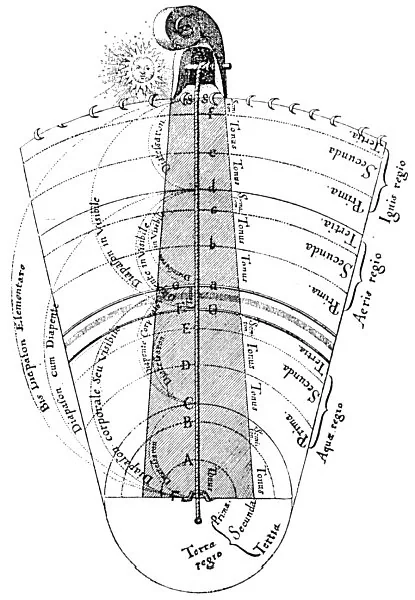
THE FOUR ELEMENTS AND THEIR CONSONANTAL INTERVALS.
From Fludd's De Musica Mundana.
In this diagram Fludd has divided each of the four Primary elements into three subdivisions. The first division of each element is the grossest, partaking somewhat of the substance directly inferior to itself (except in the case of the earth, which has no state inferior to itself). The second division consists of the element in its relatively pure state, while the third division is that condition wherein the element partakes somewhat of the substance immediately superior to itself. For example the lowest division of the element of water is sedimentary, as it contains earth substance in solution; the second division represents water in its most common state--salty--as in the case of the ocean; and the third division is water in its purest state--free from salt. The harmonic interval assigned to the lowest division of each element is one tone, to the central division also a tone, but to the higher division a half-tone because it partakes of the division immediately above it. Fludd emphasizes the fact that as the elements ascend in series of two and a half tones, the diatessaron is the dominating harmonic interval of the elements.
Fishes, Insects, Animals, Reptiles and Birds
Part One
THE creatures inhabiting the water, air, and earth were held in veneration by all races of antiquity. Realizing that visible bodies are only symbols of invisible forces, the ancients worshiped the Divine Power through the lower kingdoms of Nature, because those less evolved and more simply constituted creatures responded most readily to the creative impulses of the gods. The sages of old studied living things to a point of realization that God is most perfectly understood through a knowledge of His supreme handiwork--animate and inanimate Nature.
Every existing creature manifests some aspect of the intelligence or power of the Eternal One, who can never be known save through a study and appreciation of His numbered but inconceivable parts. When a creature is chosen, therefore, to symbolize to the concrete human mind some concealed abstract principle it is because its characteristics demonstrate this invisible principle in visible action. Fishes, insects, animals, reptiles, and birds appear in the religious symbolism of nearly all nations, because the forms and habits of these creatures and the media in which they exist closely relate them to the various generative and germinative powers of Nature, which were considered as prima-facie evidence of divine omnipresence.
The early philosophers and scientists, realizing that all life has its origin in water, chose the fish as the symbol of the life germ. The fact that fishes are most prolific makes the simile still more apt. While the early priests may not have possessed the instruments necessary to analyze the spermatozoon, they concluded by deduction that it resembled a fish.
Fishes were sacred to the Greeks and Romans, being connected with the worship of Aphrodite (Venus). An interesting survival of pagan ritualism is found in the custom of eating fish on Friday. Freya, in whose honor the day was named, was the Scandinavian Venus, and this day was sacred among many nations to the goddess of beauty and fecundity. This analogy further links the fish with the procreative mystery. Friday is also sacred to the followers of the Prophet Mohammed.
The word nun means both fish and growth, and as Inman says: "The Jews were led to victory by the Son of the Fish whose other names were Joshua and Jesus (the Savior). Nun is still the name of a female devotee" of the Christian faith. Among early Christians three fishes were used to symbolize the Trinity, and the fish is also one of the eight sacred symbols of the great Buddha. It is also significant that the dolphin should be sacred to both Apollo (the Solar Savior) and Neptune. It was believed that this fish carried shipwrecked sailors to heaven on its back. The dolphin was accepted by the early Christians as an emblem of Christ, because the pagans had viewed this beautiful creature as a friend and benefactor of man. The heir to the throne of France, the Dauphin, may have secured his title from this ancient pagan symbol of the divine preservative power. The first advocates of Christianity likened converts to fishes, who at the time of baptism "returned again into the sea of Christ."
Primitive peoples believed the sea and land were inhabited by strange creatures, and early books on zoology contain curious illustrations of composite beasts, reptiles, and fishes, which did not exist at the time the mediæval authors compiled these voluminous books. In the ancient initiatory rituals of the Persian, Greek, and Egyptian Mysteries the priests disguised themselves as composite creatures, thereby symbolizing different aspects of human consciousness. They used birds and reptiles as emblems of their various deities, often creating forms of grotesque appearance and assigning to them imaginary traits, habits, and places of domicile, all of which were symbolic of certain spiritual and transcendental truths thus concealed from the profane. The phœnix made its nest of incense and flames. The unicorn had the body of a horse, the feet of an elephant, and the tail of a wild boar. The upper half of the centaur's body was human and the lower half equine. The pelican of the Hermetists fed its young from its own breast, and to this bird were assigned other mysterious attributes which could have been true only allegorically.
Though regarded by many writers of the Middle Ages as actual living creatures, none of these--the pelican excepted--ever existed outside the symbolism of the Mysteries. Possibly they originated in rumors of animals then little known. In the temple, however, they became a reality, for there they signified the manifold characteristics of man's nature. The mantichora had certain points in common with the hyena; the unicorn may have been the single-horned rhinoceros. To the student of the secret wisdom these composite animals. and birds simply represent various forces working in the invisible worlds. This is a point which nearly all writers on the subject of mediæval monsters seem to have overlooked. (See Vlyssis Aldrovandi's Monstrorum Historia, 1642, and Physica Curiosa, by P. Gaspare Schotto, 1697.)
There are also legends to the effect that long before the appearance of human beings there existed a race or species of composite creatures which was destroyed by the gods. The temples of antiquity preserved their own historical records and possessed information concerning the prehistoric world that has never been revealed to the uninitiated. According to these records, the human race evolved from a species of creature that partook somewhat of the nature of an amphibian, for at that time primitive man had the gills of a fish and was partly covered with scales. To a limited degree, the human embryo demonstrates the possibility of such a condition. As a result of the theory of man's origin in water, the fish was looked upon as the progenitor of the human family. This gave rise to the ichthyolatry of the Chaldeans, Phœnicians, and Brahmins. The American Indians believe that the waters of lakes, rivers, and oceans are inhabited by a mysterious people, the "Water Indians."
The fish has been used as an emblem of damnation; but among the Chinese it typified contentment and good fortune, and fishes appear on many of their coins. When Typhon, or Set, the Egyptian evil genius, had divided the body of the god Osiris into fourteen parts, he cast one part into the river Nile, where, according to Plutarch, it was devoured by three fishes--the lepidotus (probably the lepidosiren), the phagrus, and the oxyrynchus (a form of pike). For this reason the Egyptians would not eat the flesh of these fishes, believing that to do so would be to devour the body of their god. When used as a symbol of evil, the fish represented the earth (man's lower nature) and the tomb (the sepulcher of the Mysteries). Thus was Jonah three days in the belly of the "great fish," as Christ was three days in the tomb.
Several early church fathers believed that the "whale" which swallowed Jonah was the symbol of God the Father, who, when the hapless prophet was thrown overboard, accepted Jonah into His own nature until a place of safety was reached. The story of Jonah is really a legend of initiation into the Mysteries, and the "great fish" represents the darkness of ignorance which engulfs man when he is thrown over the side of the ship (is born) into the sea (life). The custom of building ships in the form of fishes or birds, common in ancient times, could give rise to the story, and mayhap Jonah was merely picked up by
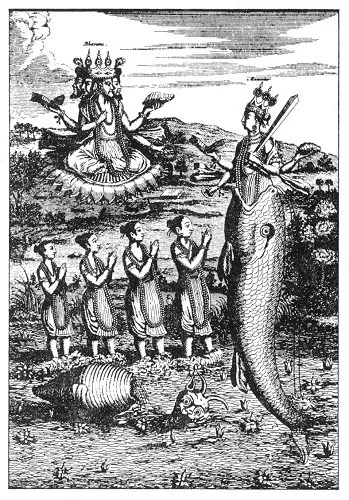
THE FIRST INCARNATION, OR MATSYA AVATAR, OF VISHNU.
From Picart's Religious Ceremonials.
The fish has often been associated with the World Saviors. Vishnu, the Hindu Redeemer, who takes upon himself ten forms for the redemption of the universe, was expelled from the mouth of a fish in his first incarnation. Isis, while nursing the infant Horus, is often shown with a fish on her headdress. Oannes, the Chaldean Savior (borrowed from the Brahmins), is depicted with the head and body of a fish, from which his human form protrudes at various points. Jesus was often symbolized by a fish. He told His disciples that they should became "fishers of men." The sign of the fish was also the first monogram of the Christians. The mysterious Greek name of Jesus, ΙΧΘΥΣ, means "a fish." The fish was accepted as a symbol of the Christ by a number of early canonized church fathers. St. Augustine likened the Christ to a fish that had been broiled, and it was also pointed out that the flesh of that Fish was the food of righteous and holy men.
another vessel and carried into port, the pattern of the ship causing it to be called a "great fish." ("Veritatis simplex oratio est!") More probably the "whale" of Jonah is based upon the pagan mythological creature, hippocampus, part horse and part dolphin, for the early Christian statues and carvings show the composite creature and not a true whale.
It is reasonable to suppose that the mysterious sea serpents, which, according to the Mayan and Toltec legends, brought the gods to Mexico were Viking or Chaldean ships, built in the shape of composite sea monsters or dragons. H. P. Blavatsky advances the theory that the word cetus, the great whale, is derived from keto, a name for the fish god, Dagon, and that Jonah was actually confined in a cell hollowed out in the body of a gigantic statue of Dagon after he had been captured by Phœnician sailors and carried to one of their cities. There is no doubt a great mystery in the gigantic form of cetus, which is still preserved as a constellation.
According to many scattered fragments extant, man's lower nature was symbolized by a tremendous, awkward creature resembling a great sea serpent, or dragon, called leviathan. All symbols having serpentine form or motion signify the solar energy in one of its many forms. This great creature of the sea therefore represents the solar life force imprisoned in water and also the divine energy coursing through the body of man, where, until transmuted, it manifests itself as a writhing, twisting monster---man's greeds, passions, and lusts. Among the symbols of Christ as the Savior of men are a number relating to the mystery of His divine nature concealed within the personality of the lowly Jesus.
The Gnostics divided the nature of the Christian Redeemer into two parts--the one Jesus, a mortal man; the other, Christos, a personification of Nous, the principle of Cosmic Mind. Nous, the greater, was for the period of three years (from baptism to crucifixion) using the fleshly garment of the mortal man (Jesus). In order to illustrate this point and still conceal it from the ignorant, many strange, and often repulsive, creatures were used whose rough exteriors concealed magnificent organisms. Kenealy, in his notes on the Book of Enoch, observes: "Why the caterpillar was a symbol of the Messiah is evident; because, under a lowly, creeping, and wholly terrestrial aspect, he conceals the beautiful butterfly-form, with its radiant wings, emulating in its varied colors the Rainbow, the Serpent, the Salmon, the Scarab, the Peacock, and the dying Dolphin * * *.
INSECTS
In 1609 Henry Khunrath's Amphitheatrum Sapientiæ Æternæ was published. Eliphas Levi declared that within its pages are concealed all the great secrets of magical philosophy. A remarkable plate in this work shows the Hermetic sciences being attacked by the bigoted and ignorant pedagogues of the seventeenth century. In order to express his complete contempt for his slanderers, Khunrath made out of each a composite beast, adding donkey ears to one and a false tail to another. He reserved the upper part of the picture for certain petty backbiters whom he gave appropriate forms. The air was filled with strange creatures--great dragon flies, winged frogs, birds with human heads, and other weird forms which defy description--heaping venom, gossip, spite, slander, and other forms of persecution upon the secret arcanum of the wise. The drawing indicated that their attacks were ineffectual. Poisonous insects were often used to symbolize the deadly power of the human tongue.
Insects of all kinds were also considered emblematic of the Nature spirits and dæmons, for both were believed to inhabit the atmosphere. Mediæval drawings showing magicians in the act of invoking spirits, often portray the mysterious powers of the other world, which the conjurer has exorcised, as appearing to him in composite part-insect forms. The early philosophers apparently held the opinion that the disease which swept through communities in the form of plagues were actually living creatures, but instead of considering a number of tiny germs they viewed the entire plague as one individuality and gave it a hideous shape to symbolize its destructiveness. The fact that plagues came in the air caused an insect or a bird to be used as their symbol.
Beautiful symmetrical forms were assigned to all natural benevolent conditions or powers, but to unnatural or malevolent powers were assigned contorted and abnormal figures. The Evil One was either hideously deformed or else of the nature of certain despised animals. A popular superstition during the Middle Ages held that the Devil had the feet of a rooster, while the Egyptians assigned to Typhon (Devil) the body of a hog.
The habits of the insects were carefully studied. Therefore the ant was looked upon as emblematic of industry and foresight, as it stored up supplies for the winter and also had strength to move objects many times its own weight. The locusts which swept down in clouds, and in some parts of Africa and Asia obscured the sun and destroyed every green thing, were considered fit emblems of passion, disease, hate, and strife; for these emotions destroy all that is good in the soul of man and leave a barren desert behind them. In the folklore of various nations, certain insects are given special significance, but the ones which have received world-wide veneration and consideration ate the scarab, the king of the insect kingdom; the scorpion, the great betrayer; the butterfly, the emblem of metamorphosis; and the bee, the symbol of industry.
The Egyptian scarab is one of the most remarkable symbolic figures ever conceived by the mind of man. It was evolved by the erudition of the priestcraft from a simple insect which, because of its peculiar habits and appearance, properly symbolized the strength of the body, the resurrection of the soul, and the Eternal and Incomprehensible Creator in His aspect as Lord of the Sun. E. A. Wallis Budge says, in effect, of the worship of the scarab by the Egyptians:
"Yet another view held in primitive times was that the sky was a vast meadow over which a huge beetle crawled, pushing the disk of the sun before him. This beetle was the Sky-god, and, arguing from the example of the beetle (Scarabæus sacer), which was observed to roll along with its hind legs a ball that was believed to contain its eggs, the early Egyptians thought that the ball of the Sky-god contained his egg and that the sun was his offspring. Thanks, however, to the investigations of the eminent entomologist, Monsieur J. H. Fabre, we now know that the ball which the Scarabæus sacer rolls along contains not its eggs, but dung that is to serve as food for its egg, which it lays in a carefully prepared place."
Initiates of the Egyptian Mysteries were sometimes called scarabs; again, lions and panthers. The scarab was the emissary of the sun, symbolizing light, truth, and regeneration. Stone scarabs, called heart scarabs, about three inches long, were placed in the heart cavity of the dead when that organ was removed to be embalmed separately as part of the process of mummifying. Some maintain that the stone beetles were merely wrapped in the winding cloths at the time of preparing the body for eternal preservation. The following passage concerning this appears in the great Egyptian book of initiation, The Book of the Dead: "And behold, thou shalt make a scarab of green stone, which shalt be placed in the breast of a man, and it shall perform for him, 'the opening of the mouth.'" The funeral rites of many nations bear a striking resemblance to the initiatory ceremonies of their Mysteries.
Ra, the god of the sun, had three important aspects. As the Creator of the universe he was symbolized by the head of a scarab and was called Khepera, which signified the resurrection of the soul and a new life at the end of the mortal span. The mummy cases of the Egyptian dead were nearly always ornamented with scarabs. Usually one of these beetles, with outspread wings, was painted on the mummy case directly over the breast of the dead. The finding of such great numbers of small stone scarabs indicates that they were a favorite article of adornment among the Egyptians. Because of its relationship to the sun, the scarab symbolized the divine part of man's nature. The fact that its beautiful wings were concealed under its glossy shell typified the winged soul of man hidden within its earthly sheath. The Egyptian soldiers were given the scarab as their special symbol because the ancients believed that these creatures were all of the male sex and consequently appropriate emblems of virility, strength, and courage.
Plutarch noted the fact that the scarab rolled its peculiar ball of dung backwards, while the insect itself faced the opposite direction. This made it an especially fitting symbol for the sun, because this orb (according to Egyptian astronomy) was rolling from west to east, although apparently moving in the opposite direction. An Egyptian allegory states that the sunrise is caused by the scarab unfolding
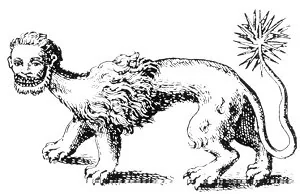
THE MANTICHORA.
From Redgrove's Bygone Beliefs.
The most remarkable of allegorical creatures was the mantichora, which Ctesias describes as having aflame-colored body, lionlike in shape, three rows of teeth, a human head and ears, blue eyes, a tail ending in a series of spikes and stings, thorny and scorpionlike, and a voice which sounded like the blare of trumpets. This synthetic quadruped ambled into mediæval works on natural history, but, though seriously considered, had never been seen, because it inhabited inaccessible regions and consequently was difficult to locate.
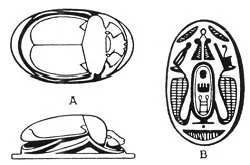
ROYAL EGYPTIAN SCARAB.
From Hall's Catalogue of Egyptian Scarabs, Etc., in the British Museum.
The flat under side of a scarab usually bears an inscription relating to the dynasty during which it was cut. These scarabs were sometimes used as seals. Some were cut from ordinary or precious stones; others were made of clay, baked and glazed. Occasionally the stone scarabs were also glazed. The majority of the small scarabs are pierced as though originally used as beads. Some are so hard that they will cut glass. In the picture above, A shows top and side views of the scarab, and B and B the under surface with the name of Men-ka-Ra within the central cartouche.
its wings, which stretch out as glorious colors on each side of its body--the solar globe--and that when it folds its wings under its dark shell at sunset, night follows. Khepera, the scarab-headed aspect of Ra, is often symbolized riding through the sea of the sky in a wonderful ship called the Boat of the Sun.
The scorpion is the symbol of both wisdom and self-destruction. It was called by the Egyptians the creature accursed; the time of year when the sun entered the sign of Scorpio marked the beginning of the rulership of Typhon. When the twelve signs of the zodiac were used to represent the twelve Apostles (although the reverse is true), the scorpion was assigned to Judas Iscariot--the betrayer.
The scorpion stings with its tail, and for this reason it has been called a backbiter, a false and deceitful thing. Calmet, in his Dictionary of the Bible, declares the scorpion to be a fit emblem of the wicked and the symbol of persecution. The dry winds of Egypt are said to be produced by Typhon, who imparts to the sand the blistering heat of the infernal world and the sting of the scorpion. This insect was also the symbol of the spinal fire which, according to the Egyptian Mysteries, destroyed man when it was permitted to gather at the base of his spine (the tail of the scorpion).The red star Antares in the back of the celestial scorpion was considered the worst light in the heavens. Kalb al Akrab, or the heart of the scorpion, was called by the ancients the lieutenant or deputy of Mars. (See footnote to Ptolemy's Tetrabiblos.) Antares was believed to impair the eyesight, often causing blindness if it rose over the horizon when a child was born. This may refer again to the sand storm, which was capable of blinding unwary travelers.
The scorpion was also the symbol of wisdom, for the fire which it controlled was capable of illuminating as well as consuming. Initiation into the Greater Mysteries among the pagans was said to take place only in the sign of the scorpion. In the papyrus of Ani (The Book of the Dead), the deceased likens his soul to a scorpion, saying: "I am a swallow, I am that scorpion, the daughter of Ra!" Elizabeth Goldsmith, in her treatise on Sex Symbolism, states that the scorpions were a "symbol of Selk, the Egyptian goddess of writing, and also [were] revered by the Babylonians and Assyrians as guardians of the gateway of the sun. Seven scorpions were said to have accompanied Isis when she searched for the remains of Osiris scattered by Set" (Typhon).
In his Chaldean Account of the Genesis, George Smith, copying from the cuneiform cylinders, in describing the wanderings of the hero Izdubar (Nimrod), throws some light on the scorpion god who guards the sun. The tablet which he translated is not perfect, but the meaning is fairly clear: "* * * who each day guard the rising sun. Their crown was at the lattice of heaven, under hell their feet were placed [the spinal column]. The scorpion man guarded the gate, burning with terribleness, their appearance was like death, the might of his fear shook the forest. At the rising of the sun and the setting of the sun, they guarded the sun; Izdubar saw them and fear and terror came into his face." Among the early Latins there was a machine of war called the scorpion. It was used for firing arrows and probably obtained its name from a long beam, resembling a scorpion's tail, which flew up to hurl the arrows. The missiles discharged by this machine were also called scorpions.
The butterfly (under the name of Psyche, a beautiful maiden with wings of opalescent light) symbolizes the human soul because of the stages it passes through in order to unfold its power of flight. The three divisions through which the butterfly passes in its unfoldment resemble closely the three degrees of the Mystery School, which degrees are regarded as consummating the unfoldment of man by giving him emblematic wings by which he may soar to the skies. Unregenerate man, ignorant and helpless, is symbolized by the stage between ovum and larva; the disciple, seeking truth and dwelling in medication, by the second stage, from larva to pupa, at which time the insect enters its chrysalis (the tomb of the Mysteries); the third stage, from pupa to imago (wherein the perfect butterfly comes forth), typifies the unfolded enlightened soul of the initiate rising from the tomb of his baser nature.
Night moths typify the secret wisdom, because they are hard to discover and are concealed by the darkness (ignorance). Some are emblems of death, as Acherontia atropos, the death's-head moth, which has a marking on its body somewhat like a human skull. The death-watch beetle, which was believed to give warning of approaching death by a peculiar ticking sound, is another instance of insects involved in human affairs.
Opinions differ concerning the spider. Its shape makes it an appropriate emblem of the nerve plexus and ganglia of the human body. Some Europeans consider it extremely bad luck to kill a spider--possibly because it is looked upon as an emissary of the Evil One, whom no person desires to offend. There is a mystery concerning all poisonous creatures, especially insects. Paracelsus taught that the spider was the medium for a powerful but evil force which the Black Magicians used in their nefarious undertakings.
Certain plants, minerals, and animals have been sacred among all the nations of the earth because of their peculiar sensitiveness to the astral fire--a mysterious agency in Nature which the scientific world has contacted through its manifestations as electricity and magnetism. Lodestone and radium in the mineral world and various parasitic growths in the plant kingdom are strangely susceptible to this cosmic electric fire, or universal life force. The magicians of the Middle Ages surrounded themselves with such creatures as bats, spiders, cats, snakes, and monkeys, because they were able to appropriate the life forces of these species and use them to the attainment of their own ends. Some ancient schools of wisdom taught that all poisonous insects and reptiles are germinated out of the evil nature of man, and that when intelligent human beings no longer breed hate in their own souls there will be no more ferocious animals, loathsome diseases, or poisonous plants and insects.
Among the American Indians is the legend of a "Spider Man," whose web connected the heaven worlds with the earth. The secret schools of India symbolize certain of the gods who labored with the universe during its making as connecting the realms of light with those of darkness by means of webs. Therefore the builders of the cosmic system who held the embryonic universe together with threads of invisible force were sometimes referred to as the Spider Gods and their ruler was designated The Great Spider.
The beehive is found in Masonry as a reminder that in diligence and labor for a common good true happiness and prosperity are found. The bee is a symbol of wisdom, for as this tiny insect collects pollen from the flowers, so men may extract wisdom from the experiences of daily life. The bee is sacred to the goddess Venus and, according to mystics, it is one of several forms of life which came to the earth from the planet Venus millions of years ago. Wheat and bananas are said to be of similar origin. This is the reason why the origin of these three forms of life cannot be traced. The fact that bees are ruled by queens is one reason why this insect is considered a sacred feminine symbol.
In India the god Prana--the personification of the universal life force--is sometimes shown surrounded by a circle of bees. Because of its importance in pollenizing flowers, the bee is the accepted symbol of the generative power. At one time the bee was the emblem of the French kings. The rulers of France wore robes embroidered with bees, and the canopies of their thrones were decorated with gigantic figures of these insects.
The fly symbolizes the tormentor, because of the annoyance it causes to animals. The Chaldean god Baal was often called Baal-Zebul, or the god of the dwelling place. The word zebub, or zabab, means a fly, and Baal-Zebul became Baalzebub, or Beelzebub, a word which was loosely translated to mean Jupiter's fly. The fly was looked upon as a form of the divine power, because of its ability to destroy decaying substances and thus promote health. The fly may have obtained its name Zebub from its peculiar buzzing or humming. Inman believes that Baalzebub, which the Jews ridiculed as My Lord of Flies, really means My Lord Who Hums or Murmurs.
Inman recalls the singing Memnon on the Egyptian desert, a tremendous figure with an Æolian harp on the top of its head. When the wind blows strongly this great Statue sighs, or hums. The Jews changed Baalzebub into Beelzebub, and made him their prince of devils by interpreting dæmon as "demon." Naudæus, in defending Virgil from accusations of sorcery, attempted a wholesale denial of the miracles supposedly performed by Virgil and produced enough evidence to convict the poet on all counts. Among other strange fears, Virgil fashioned a fly out of brass, and after certain mysterious ceremonies, placed it over one of the gates of Naples. As a result, no flies entered the city for more than eight years.
REPTILES
The serpent was chosen as the head of the reptilian family. Serpent worship in some form has permeated nearly all parts of the
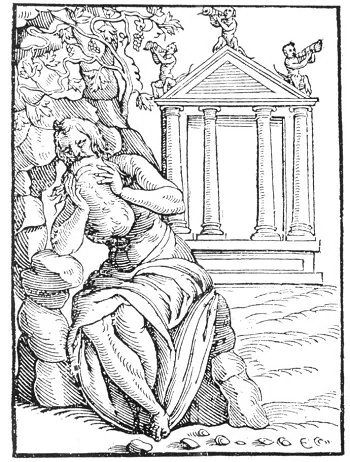
THE FLEUR-DE-LIS.
The bee was used as, a symbol of royalty by the immortal Charlemagne, and it is probable that the fleur-de-lis, or lily of France, is merely a conventionalized bee and not a flower. There is an ancient Greek legend to the effect that the nine Muses occasionally assumed the form of bees.
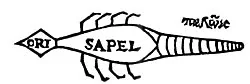
THE SCORPION TALISMAN.
From Paracelsus' Archidoxes Magica.
The scorpion often appears upon the talismans and charms of the Middle Ages. This hieroglyphic Arachnida was supposed to have the power of curing disease. The scorpion shown above was composed of several metals, and was made under certain planetary configurations. Paracelsus advised that it be worn by those suffering from any derangement of the reproductive system.
earth. The serpent mounds of the American Indian; the carved-stone snakes of Central and South America; the hooded cobras of India; Python, the great snake o the Greeks; the sacred serpents of the Druids; the Midgard snake of Scandinavia; the Nagas of Burma, Siam, and Cambodia; the brazen serpent of the Jews; the mystic serpent of Orpheus; the snakes at the oracle; of Delphi twining themselves around the tripod upon which the Pythian priestess sat, the tripod itself being in the form of twisted serpents; the sacred serpents preserved in the Egyptian temples; the Uræus coiled upon the foreheads of the Pharaohs and priests;--all these bear witness to the universal veneration in which the snake was held. In the ancient Mysteries the serpent entwining a staff was the symbol of the physician. The serpent-wound staff of Hermes remains the emblem of the medical profession. Among nearly all these ancient peoples the serpent was accepted as the symbol of wisdom or salvation. The antipathy which Christendom feels towards the snake is based upon the little-understood allegory of the Garden of Eden.
The serpent is true to the principle of wisdom, for it tempts man to the knowledge of himself. Therefore the knowledge of self resulted from man's disobedience to the Demiurgus, Jehovah. How the serpent came to be in the garden of the Lord after God had declared that all creatures which He had made during the six days of creation were good has not been satisfactorily answered by the interpreters of Scripture. The tree that grows in the midst of the garden is the spinal fire; the knowledge of the use of that spinal fire is the gift of the great serpent. Notwithstanding statements to the contrary, the serpent is the symbol and prototype of the Universal Savior, who redeems the worlds by giving creation the knowledge of itself and the realization of good and evil. If this be not so, why did Moses raise a brazen serpent upon a cross in the wilderness that all who looked upon it might be saved from the sting of the lesser snakes? Was not the brazen serpent a prophecy of the crucified Man to come? If the serpent be only a thing of evil, why did Christ instruct His disciples to be as wise as serpents?
The accepted theory that the serpent is evil cannot be substantiated. It has long been viewed as the emblem of immortality. It is the symbol of reincarnation, or metempsychosis, because it annually sheds its skin, reappearing, as it were, in a new body. There is an ancient superstition to the effect that snakes never die except by violence and that, if uninjured, they would live forever. It was also believed that snakes swallowed themselves, and this resulted in their being considered emblematic of the Supreme Creator, who periodically reabsorbed His universe back into Himself.
In Isis Unveiled, H. P. Blavatsky makes this significant statement concerning the origin of serpent worship: "Before our globe had become egg-shaped or round it was a long trail of cosmic dust or fire-mist, moving and writhing like a serpent. This, say the explanations, was the Spirit of God moving on the chaos until its breath had incubated cosmic matter and made it assume the annular shape of a serpent with its tail in its month--emblem of eternity in its spiritual and of our world in its physical sense."
The seven-headed snake represents the Supreme Deity manifesting through His Elohim, or Seven Spirits, by whose aid He established His universe. The coils of the snake have been used by the pagans to symbolize the motion and also the orbits of the celestial bodies, and it is probable that the symbol of the serpent twisted around the egg--which was common to many of the ancient Mystery schools--represented both the apparent motion of the sun around the earth, and the bands of astral light, or the great magical agent, which move about the planet incessantly.
Electricity was commonly symbolized by the serpent because of its motion. Electricity passing between the poles of a spark gap is serpentine in its motion. Force projected through atmosphere was called The Great Snake. Being symbolic of universal force, the serpent was emblematic of both good and evil. Force can tear down as rapidly as it can build up. The serpent with its tail in its mouth is the symbol of eternity, for in this position the body of the reptile has neither beginning nor end. The head and tail represent the positive and negative poles of the cosmic life circuit. The initiates of the Mysteries were often referred to as serpents, and their wisdom was considered analogous to the divinely inspired power of the snake. There is no doubt that the title "Winged Serpents" (the Seraphim?) was given to one of the invisible hierarchies that labored with the earth during its early formation.
There is a legend that in the beginning of the world winged serpents reigned upon the earth. These were probably the demigods which antedate the historical civilization of every nation. The symbolic relationship between the sun and the serpent found literal witness in the fact that life remains in the snake until sunset, even though it be cut into a dozen parts. The Hopi Indians consider the serpent to be in close communication with the Earth Spirit. Therefore, at the time of their annual snake dance they send their prayers to the Earth Spirit by first specially sanctifying large numbers of these reptiles and then liberating them to return to the earth with the prayers of the tribe.
The great rapidity of motion manifested by lizards has caused them to be associated with Mercury, the Messenger of the Gods, whose winged feet traveled infinite distances almost instantaneously. A point which must not be overlooked in connection with reptiles in symbolism is clearly brought out by the eminent scholar, Dr. H. E. Santee, in his Anatomy of the Brain and Spinal Cord: "In reptiles there are two pineal bodies, an anterior and a posterior, of which the posterior remains undeveloped but the anterior forms a rudimentary, cyclopean eye. In the Hatteria, a New Zealand lizard, it projects through the parietal foramen and presents an imperfect lens and retina and, in its long stalk, nerve fibers."
Crocodiles were regarded by the Egyptians both as symbols of Typhon and emblems of the Supreme Deity, of the latter because while under water the crocodile is capable of seeing--Plutarch asserts--though its eyes are covered by a thin membrane. The Egyptians declared that no matter how far away the crocodile laid its eggs, the Nile would reach up to them in its next inundation, this reptile being endowed with a mysterious sense capable of making known the extent of the flood months before it took place. There were two kinds of crocodiles. The larger and more ferocious was hated by the Egyptians, for they likened it to the nature of Typhon, their destroying demon. Typhon waited to devour all who failed to pass the judgment of the Dead, which rite took place in the Hall of Justice between the earth and the Elysian Fields. Anthony Todd Thomson thus describes the good treatment accorded the smaller and tamer crocodiles, which the Egyptians accepted as personifications of good: "They were fed daily and occasionally had mulled wine poured down their throats. Their ears were ornamented with rings of gold and precious stones, and their forefeet adorned with bracelets."
To the Chinese the turtle was a symbol of longevity. At a temple in Singapore a number of sacred turtles are kept, their age recorded by carvings on their shells. The American Indians use the ridge down the back of the turtle shell as a symbol of the Great Divide between life and death. The turtle is a symbol of wisdom because it retires into itself and is its own protection. It is also a phallic symbol, as its relation to long life would signify. The Hindus symbolized the universe as being supported on the backs of four great elephants who, in turn, are standing upon an immense turtle which is crawling continually through chaos.
The Egyptian sphinx, the Greek centaur, and the Assyrian man-bull have much in common. All are composite creatures combining human and animal members; in the Mysteries all signify the composite nature of man and subtly refer to the hierarchies of celestial beings that have charge of the destiny of mankind. These hierarchies are the twelve holy animals now known as constellations--star groups which are merely symbols of impersonal spiritual impulses. Chiron, the centaur, teaching the sons of men, symbolizes the intelligences of the constellation of Sagittarius, who were the custodians of the secret doctrine while (geocentrically) the sun was passing through the sign of Gemini. The five-footed Assyrian man-bull with the wings of an eagle and the head of a man is a reminder that the invisible nature of man has the wings of a god, the head of a man, and the body of a beast. The same concept was expressed through the sphinx--that armed guardian of the Mysteries who, crouching at the gate of the temple, denied entrance to the profane. Thus placed between man and his divine possibilities, the sphinx also represented the secret doctrine itself. Children's fairy stories abound with descriptions of symbolic monsters, for nearly all such tales are based upon the ancient mystic folklore.
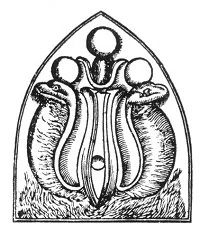
THE URÆUS.
From Kircher's Œdipus Ægyptiacus.
The spinal cord was symbolized by a snake, and the serpent coiled upon the foreheads of the Egyptian initiates represented the Divine Fire which had crawled serpentlike up the Tree of Life.
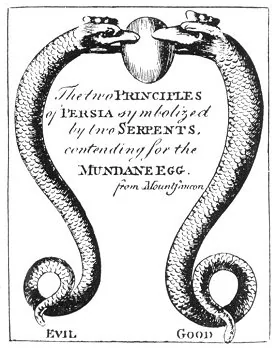
GOOD AND EVIL CONTENDING FOR THE UNIVERSAL EGG.
From Maurice's Indian Antiquities.
Both Mithras, the Persian Redeemer, and Serapis, the Egyptian God of the Earth, are symbolized by serpents coiled about their bodies. This remarkable drawing shows the good and evil principles of Persia--Ahura-Mazda and Ahriman--contending for the Egg of the Earth, which each trying to wrench from the teeth of the other.
Fishes, Insects, Animals, Reptiles and Birds
(Part Two)
AS appropriate emblems of various human and divine attributes birds were included in religious and philosophic symbolism that of pagans and of Christians alike. Cruelty was signified by the buzzard; courage by the eagle; self-sacrifice by the pelican; and pride by the peacock. The ability of birds to leave the earth and fly aloft toward the source of light has resulted in their being associated with aspiration, purity, and beauty. Wings were therefore often added to various terrene creatures in an effort to suggest transcendency. Because their habitat was among the branches of the sacred trees in the hearts of ancient forests, birds were also regarded as the appointed messengers of the tree spirits and Nature gods dwelling in these consecrated groves, and through their clear notes the gods themselves were said to speak. Many myths have been fabricated to explain the brilliant plumage of birds. A familiar example is the story of Juno's peacock, in whose tail feathers were placed the eyes of Argus. Numerous American Indian legends also deal with birds and the origin of the various colors of feathers. The Navahos declare that when all living things climbed to the stalk of a bamboo to escape the Flood, the wild turkey was on the lowest branch and his tail feathers trailed in the water; hence the color was all washed out.
Gravitation, which is a law in the material world, is the impulse toward the center of materiality; levitation, which is a law in the spiritual world, is the impulse toward the center of spirituality. Seeming to be capable of neutralizing the effect of gravity, the bird was said to partake of a nature superior to other terrestrial creation; and its feathers, because of their sustaining power, came to be accepted as symbols of divinity, courage, and accomplishment. A notable example is the dignity attached to eagle feathers by the American Indians, among whom they are insignia of merit. Angels have been invested with wings because, like birds, they were considered to be the intermediaries between the gods and men and to inhabit the air or middle kingdom betwixt heaven and earth. As the dome of the heavens was likened to a skull in the Gothic Mysteries, so the birds which flew across the sky were regarded as thoughts of the Deity. For this reason Odin's two messenger ravens were called Hugin and Munin--thought and memory.
Among the Greeks and Romans, the eagle was the appointed bird of Jupiter and consequently signified the swiftly moving forces of the Demiurgus; hence it was looked upon as the mundane lord of the birds, in contradistinction to the phœnix, which was symbolic of the celestial ruler. The eagle typified the sun in its material phase and also the immutable Demiurgic law beneath which all mortal creatures must bend. The eagle was also the Hermetic symbol of sulphur, and signified the mysterious fire of Scorpio--the most profoundly significant sign of the zodiac and the Gate of the Great Mystery. Being one of the three symbols of Scorpio, the eagle, like the Goat of Mendes, was an emblem of the theurgic art and the secret processes by which the infernal fire of the scorpion was transmuted into the spiritual light-fire of the gods.
Among certain American Indian tribes the thunderbird is held in peculiar esteem. This divine creature is said to live above the clouds; the flapping of its wings causes the rumbling which accompanies storms, while the flashes from its eyes are the lightning. Birds were used to signify the vital breath; and among the Egyptians, mysterious hawklike birds with human heads, and carrying in their claws the symbols of immortality, are often shown hovering as emblems of the liberated soul over the mummified bodies of the dead. In Egypt the hawk was the sacred symbol of the sun; and Ra, Osiris, and Horns are often depicted with the heads of hawks. The cock, or rooster, was a symbol of Cashmala (Cadmillus) in the Samothracian Mysteries, and is also a phallic symbol sacred to the sun. It was accepted by the Greeks as the emblem of Ares (Mars) and typified watchfulness and defense. When placed in the center of a weather vane it signifies the sun in the midst of the four corners of creation. The Greeks sacrificed a rooster to the gods at the time of entering the Eleusinian Mysteries. Sir Francis Bacon is supposed to have died as the result of stuffing a fowl with snow. May this not signify Bacon's initiation into the pagan Mysteries which still existed in his day?
Both the peacock and the ibis were objects of veneration because they destroyed the poisonous reptiles which were popularly regarded as the emissaries of the infernal gods. Because of the myriad of eyes in its tail feathers the peacock was accepted as the symbol of wisdom, and on account of its general appearance it was often confused with the fabled phœnix of the Mysteries. There is a curious belief that the flesh of the peacock will not putrefy even though kept for a considerable time. As an outgrowth of this belief the peacock became the emblem of immortality, because the spiritual nature of man--like the flesh of this bird--is incorruptible.
The Egyptians paid divine honors to the ibis and it was a cardinal crime to kill one, even by accident. It was asserted that the ibis could live only in Egypt and that if transported to a foreign country it would die of grief. The Egyptians declared this bird to be the preserver of crops and especially worthy of veneration because it drove out the winged serpents of Libya which the wind blew into Egypt. The ibis was sacred to Thoth, and when its head and neck were tucked under its wing its body closely resembled a human heart. (See Montfaucon's Antiquities.) The black and white ibis was sacred to the moon; but all forms were revered because they destroyed crocodile eggs, the crocodile being a symbol of the detested Typhon.
Nocturnal birds were appropriate symbols of both sorcery and the secret divine sciences: sorcery because black magic cannot function in the light of truth (day) and is powerful only when surrounded by ignorance (night); and the divine sciences because those possessing the arcana are able to see through the darkness of ignorance and materiality. Owls and bats were consequently often associated with either witchcraft or wisdom. The goose was an emblem of the first primitive substance or condition from which and within which the worlds were fashioned. In the Mysteries, the universe was likened to an egg which the Cosmic Goose had laid in space. Because of its blackness the crow was the symbol of chaos or the chaotic darkness preceding the light of creation. The grace and purity of the swan were emblematic of the spiritual grace and purity of the initiate. This bird also represented the Mysteries which unfolded these qualities in humanity. This explains the allegories of the gods (the secret wisdom) incarnating in the body of a swan (the initiate).
Being scavengers, the vulture, the buzzard, and the condor signified that form of divine power which by disposing of refuse and other matter dangerous to the life and health of humanity cleanses and purifies the lower spheres. These birds were therefore adopted as symbols of the disintegrative processes which accomplish good while apparently destroying, and by some religions have been mistakenly regarded as evil. Birds such as the parrot and raven were accorded veneration because, being able to mimic the human voice, they were looked upon as links between the human and animal kingdoms.
The dove, accepted by Christianity as the emblem of the Holy Ghost, is an extremely ancient and highly revered pagan yonic emblem. In many of the ancient Mysteries it represented the third person of the Creative Triad, or the Fabricator of the world. As the lower worlds were brought into existence through a generative process, so the dove has been associated with those deities identified with the procreative functions. It is sacred to Astarte, Cybele, Isis, Venus, Juno, Mylitta, and Aphrodite. On account of its gentleness and devotion to its young, the dove was looked upon as the embodiment of the maternal instinct. The dove is also an emblem of wisdom, for it represents the power and order by which the lower worlds are maintained. It has long been accepted as a messenger of the divine will, and signifies the activity of God.
The name dove has been given to oracles and to prophets. "The true name of the dove was Ionah or Iönas; it was a very sacred emblem, and atone time almost universally received; it was adopted by the Hebrews; and the mystic Dove was regarded as a symbol
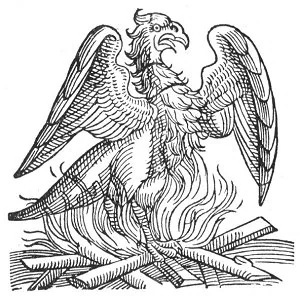
THE PHŒNIX ON ITS NEST OF FLAMES.
From Lycosthenes' Prodigiorum, ac Ostentorum Chronicon.
The phœnix is the most celebrated of all the symbolic creatures fabricated by the ancient Mysteries for the purpose of concealing the great truths of esoteric philosophy. Though modern scholars of natural history declare the existence of the phœnix to be purely mythical, Pliny describes the capture of one of these birds and it exhibition in the Roman Forum during the reign of the Emperor Claudius.
from the days of Noah by all those who were of the Church of God. The prophet sent to Ninevah as God's messenger was called Jonah or the Dove; our Lord's forerunner, the Baptist, was called in Greek by the name of Ioannes; and so was the Apostle of Love, the author Of the fourth Gospel and of the Apocalypse, named Ioannes." (Bryant's Analysis of Ancient Mythology.)
In Masonry the dove is the symbol of purity and innocence. It is significant that in the pagan Mysteries the dove of Venus was crucified upon the four spokes of a great wheel, thus foreshadowing the mystery of the crucified Lord of Love. Although Mohammed drove the doves from the temple at Mecca, occasionally he is depicted with a dove sitting upon his shoulder as the symbol of divine inspiration. In ancient times the effigies of doves were placed upon the heads of scepters to signify that those bearing them were overshadowed by divine prerogative. In mediæval art, the dove frequently was pictured as an emblem of divine benediction.
THE PHŒNIX
Clement, one of the ante-Nicæan Fathers, describes, in the first century after Christ, the peculiar nature and habits of the phœnix, in this wise: "There is a certain bird which is called a Phœnix. This is the only one of its kind and lives five hundred years. And when the time of its dissolution draws near that it must die, it builds itself a nest of frankincense, and myrrh, and other spices, into which, when the time is fulfilled, it enters and dies. But as the flesh decays a certain kind of worm is produced, which, being nourished by the juices of the dead bird, brings forth feathers. Then, when it has acquired strength, it takes up that nest in which are the bones of its parent, and bearing these it passes from the land of Arabia into Egypt, to the city called Heliopolis. And, in open day, flying in the sight of all men, it places them on the altar of the sun, and having done this, hastens back to its former abode. The priests then inspect the registers of the dates, and find that it has returned exactly as the five hundredth year was completed."
Although admitting that he had not seen the phœnix bird (there being only one alive at a time), Herodotus amplifies a bit the description given by Clement: "They tell a story of what this bird does which does not seem to me to be credible: that he comes all the way from Arabia, and brings the parent bird, all plastered with myrrh, to the temple of the sun, and there buries the body. In order to bring him, they say, he first forms a ball of myrrh as big as he finds that he can carry; then he hollows out the ball, and puts his parent inside; after which he covers over the opening with fresh myrrh, and the ball is then of exactly the same weight as at first; so he brings it to Egypt, plastered over as I have said, and deposits it in the temple of the sun. Such is the story they tell of the doings of this bird."
Both Herodotus and Pliny noted the general resemblance in shape between the phœnix and the eagle, a point which the reader should carefully consider, for it is reasonably certain that the modern Masonic eagle was originally a phœnix. The body of the phœnix is described as having been covered with glossy purple feathers, while its long tail feathers were alternately blue and red. Its head was light in color and about its neck was a circlet of golden plumage. At the back of its head the phœnix had a peculiar tuft of feathers, a fact quite evident, although it has been overlooked by most writers and symbolists.
The phœnix was regarded as sacred to the sun, and the length of its life (500 to 1000 years) was taken as a standard for measuring the motion of the heavenly bodies and also the cycles of time used in the Mysteries to designate the periods of existence. The diet of the bird was unknown. Some writers declare that it subsisted upon the atmosphere; others that it ate at rare intervals but never in the presence of man. Modern Masons should realize the special Masonic significance of the phœnix, for the bird is described as using sprigs of acacia in the manufacture of its nest.
The phœnix (which is the mythological Persian roc) is also the name of a Southern constellation, and therefore it has both an astronomical and an astrological significance. In all probability, the phœnix was the swan of the Greeks, the eagle of the Romans, and the peacock of the Far East. To the ancient mystics the phœnix was a most appropriate symbol of the immortality of the human soul, for just as the phœnix was reborn out of its own dead self seven times seven, so again and again the spiritual nature of man rises triumphant from his dead physical body.
Mediæval Hermetists regarded the phœnix as a symbol of the accomplishment of alchemical transmutation, a process equivalent to human regeneration. The name phœnix was also given to one of the secret alchemical formula. The familiar pelican of the Rose Croix degree, feeding its young from its own breast, is in reality a phœnix, a fact which can be confirmed by an examination of the head of the bird. The ungainly lower part of the pelican's beak is entirely missing, the head of the phœnix being far more like that of an eagle than of a pelican. In the Mysteries it was customary to refer to initiates as phœnixes or men who had been born again, for just as physical birth gives man consciousness in the physical world, so the neophyte, after nine degrees in the womb of the Mysteries, was born into a consciousness of the Spiritual world. This is the mystery of initiation to which Christ referred when he said, "Except a man be born again, he cannot see the kingdom of God" (John iii. 3). The phœnix is a fitting symbol of this spiritual truth.
European mysticism was not dead at the time the United States of America was founded. The hand of the Mysteries controlled in the establishment of the new government, for the signature of the Mysteries may still be seen on the Great Seal of the United States of America. Careful analysis of the seal discloses a mass of occult and Masonic symbols, chief among them the so-called American eagle--a bird which Benjamin Franklin declared unworthy to be chosen as the emblem of a great, powerful, and progressive people. Here again only the student of symbolism can see through the subterfuge and realize that the American eagle upon the Great Seal is but a conventionalized phœnix, a fact plainly discernible from an examination of the original seal. In his sketch of The History of the Seal of the United States, Gaillard Hunt unwittingly brings forward much material to substantiate the belief that the original seal carried the Phœnix bird on its obverse surface and the Great Pyramid of Gizeh upon its reverse surface. In a colored sketch submitted as a design for the Great Seal by William Barton in 1782, an actual phœnix appears sitting upon a nest of flames. This itself demonstrates a tendency towards the use of this emblematic bird.
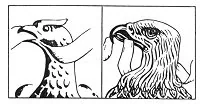
PHŒNIX OR EAGLE, WHICH?
On the left is the bird's head from the first Great Seal of the United States (1782) and on the right the Great Seal of 1902. When the first great Seal was actually cut, the bird represented upon it was very different from the eagle which now appears; the neck was much longer and the tuft of feathers, at the upper back part of the head was quite noticeable; the beak bore little resemblance to that of the eagle; and the entire bird was much thinner and its wings shorter. It requires very little imagination to trace in this first so-called eagle the mythological Phœnix of antiquity. What is more, there is every reason why a phœnix bird should be used to represent a new country rising out of an old, while as Benjamin Franklin caustically noted, the eagle was not a bird of good moral character!
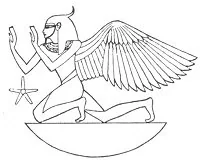
AN EGYPTIAN PHŒNIX.
From Wilkinson's Manners and Customs of the Ancient Egyptians.
The Egyptians occasionally represented the Phœnix as having the body of a man and the wings of a bird. This biform, creature had a tuft of feathers upon its head and its arms were upraised in an attitude of prayer. As the phœnix was the symbol of regeneration, the tuft of feathers on the back of its head might well symbolize the activity of the Pineal gland, or third eye, the occult function of which was apparently well understood by the ancient priestcraft.
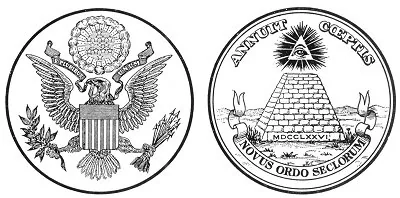
THE OBVERSE AND REVERSE OF THE GREAT SEAL OF THE UNITED STATES OF AMERICA.
From Hunt's History of the Seal of the United States.
The significance of the mystical number 13, which frequently appears upon the Great Seal of the United States, is not limited to the number of the original colonies. The sacred emblem of the ancient initiates, here composed of 13 stars,, also appears above the head of the "eagle." The motto, E Pluribus Unum, contains 13 letters, as does also the inscription, Annuit Cœptis. The "eagle" clutches in its right talon a branch bearing 13 leaves and 13 berries and in its left a sheaf of 13 arrows. The face of the pyramid, exclusive of the panel containing the date, consists of 72 stones arranged in 13 rows.
If any one doubts the presence of Masonic and occult influences at the time the Great Seal was designed, he should give due consideration to the comments of Professor Charles Eliot Norton of Harvard, who wrote concerning the unfinished pyramid and the All-Seeing Eye which adorned the reverse of the seal, as follows: "The device adopted by Congress is practically incapable of effective treatment; it can hardly (however artistically treated by the designer) look otherwise than as a dull emblem of a Masonic fraternity." (The History of the Seal of the United States.)
The eagles of Napoleon and Cæsar and the zodiacal eagle of Scorpio are really phœnixes, for the latter bird--not the eagle--is the symbol of spiritual victory and achievement. Masonry will be in a position to solve many of the secrets of its esoteric doctrine when it realizes that both its single- and double-headed eagles are phœnixes, and that to all initiates and philosophers the phœnix is the symbol of the transmutation and regeneration of the creative energy--commonly called the accomplishment of the Great Work. The double-headed phœnix is the prototype of an androgynous man, for according to the secret teachings there will come a time when the human body will have two spinal cords, by means of which vibratory equilibrium will be maintained in the body.
Not only were many of the founders of the United States Government Masons, but they received aid from a secret and august body existing in Europe, which helped them to establish this country for a peculiar and particular purpose known only to the initiated few. The Great Seal is the signature of this exalted body--unseen and for the most part unknown--and the unfinished pyramid upon its reverse side is a trestleboard setting forth symbolically the task to the accomplishment of which the United States Government was dedicated from the day of its inception.
ANIMALS
The lion is the king of the animal family and, like the head of each kingdom, is sacred to the sun, whose rays are symbolized by the lion's shaggy mane. The allegories perpetuated by the Mysteries (such as the one to the effect that the lion opens the secret book) signify that the solar power opens the seed pods, releasing the spiritual life within. There was also a curious belief among the ancients that the lion sleeps with his eyes open, and for this reason the animal was chosen as a symbol of vigilance. The figure of a lion placed on either side of doors and gateways is an emblem of divine guardianship. King Solomon was often symbolized as a lion. For ages the feline family has been regarded with peculiar veneration. In several of the Mysteries--most notably the Egyptian--the priests wore the skins of lions, tigers, panthers, pumas, or leopards. Hercules and Samson (both solar symbols) slew the lion of the constellation of Leo and robed themselves in his skin, thus signifying that they represented the sun itself when at the summit of the celestial arch.
At Bubastis in Egypt was the temple of the famous goddess Bast, the cat deity of the Ptolemies. The Egyptians paid homage to the cat, especially when its fur was of three shades or its eyes of different colors. To the priests the cat was symbolic of the magnetic forces of Nature, and they surrounded themselves with these animals for the sake of the astral fire which emanated from their bodies. The cat was also a symbol of eternity, for when it sleeps it curls up into a ball with its head and tail touching. Among the Greeks and Latins the cat was sacred to the goddess Diana. The Buddhists of India invested the cat with special significance, but for a different reason. The cat was the only animal absent at the death of the great Buddha, because it had stopped on the way to chase a mouse. That the symbol of the lower astral forces should not be present at the liberation of the Buddha is significant.
Regarding the cat, Herodotus says: "Whenever a fire breaks out, cats are agitated with a kind of divine motion, which they that keep them observe, neglecting the fire: The cats, however, in spite of their care, break from them, leaping even over the heads of their keepers to throw themselves into the fire. The Egyptians then make great mourning for their death. If a cat dies a natural death in a house, all they of that house shave their eyebrows: If a dog, they shave the head and all the body. They used to embalm their dead cats, and carry them to Bubastis to be interred in a sacred house. (Montfaucon's Antiquities.)
The most important of all symbolic animals was the Apis, or Egyptian bull of Memphis, which was regarded as the sacred vehicle for the transmigration of the soul of the god Osiris. It was declared that the Apis was conceived by a bolt of lightning, and the ceremony attendant upon its selection and consecration was one of the most impressive in Egyptian ritualism. The Apis had to be marked in a certain manner. Herodotus states that the bull must be black with a square white spot on his forehead, the form of an eagle (probably a vulture) on his back, a beetle upon (under) his tongue, and the hair of his tail lying two ways. Other writers declare that the sacred bull was marked with twenty-nine sacred symbols, his body was spotted, and upon his right side was a white mark in the form of a crescent. After its sanctification the Apis was kept in a stable adjacent to the temple and led in processionals through the streets of the city upon certain solemn occasions. It was a popular belief among the Egyptians that any child upon whom the bull breathed would become illustrious. After reaching a certain age (twenty-five years) the Apis was taken either to the river Nile or to a sacred fountain (authorities differ on this point) and drowned, amidst the lamentations of the populace. The mourning and wailing for his death continued until the new Apis was found, when it was declared that Osiris had reincarnated, whereupon rejoicing took the place of grief.
The worship of the bull was not confined to Egypt, but was prevalent in many nations of the ancient world. In India, Nandi--the sacred white bull of Siva--is still the object of much veneration; and both the Persians and the Jews accepted the bull as an important religious symbol. The Assyrians, Phœnicians, Chaldeans, and even the Greeks reverenced this animal, and Jupiter turned himself into a white bull to abduct Europa. The bull was a powerful phallic emblem signifying the paternal creative power of the Demiurgus. At his death he was frequently mummified and buried with the pomp and dignity of a god in a specially prepared sarcophagus. Excavations in the Serapeum at Memphis have uncovered the tombs of more than sixty of these sacred animals.
As the sign rising over the horizon at the vernal equinox constitutes the starry body for the annual incarnation of the sun, the bull not only was the celestial symbol of the Solar Man but, because the vernal equinox took place in the constellation of Taurus, was called the breaker or opener of the year. For this reason in astronomical symbolism the bull is often shown breaking the annular egg with his horns. The Apis further signifies that the God-Mind is incarnated in the body of a beast and therefore that the physical beast form is the sacred vehicle of divinity. Man's lower personality is the Apis in which Osiris incarnates. The result of the combination is the creation of Sor-Apis (Serapis)-the material soul as ruler of the irrational material body and involved therein. After a certain period (which is determined by the square of five, or twenty-five years), the body of the Apis is destroyed and the soul liberated by the water which drowns the material life. This was indicative of the washing away of the material nature by the baptismal waters of divine light and truth. The drowning of the Apis is the symbol of death; the resurrection of Osiris in the new bull is the symbol of eternal renovation. The white bull was also symbolically sacred as the appointed emblem of the initiates, signifying the spiritualized material bodies of both man and Nature.
When the vernal equinox no longer occurred in the sign of Taurus, the Sun God incarnated in the constellation of Aries and the ram then became the vehicle of the solar power. Thus the sun rising in the sign of the Celestial Lamb triumphs over the symbolic serpent of darkness. The lamb is a familiar emblem of purity because of its gentleness and the whiteness of its wool. In many of the pagan Mysteries it signified the Universal Savior, and in Christianity it is the favorite symbol of Christ. Early church paintings show a lamb standing upon a little hill, and from its feet pour four streams of living water signifying the four Gospels. The blood of the lamb is the solar life pouring into the world through the sign of Aries.
The goat is both a phallic symbol and also an emblem of courage or aspiration because of its surefootedness and ability to scale the loftiest peaks. To the alchemists the goat's head was the symbol of sulphur. The practice among the ancient Jews of choosing a scapegoat upon which to heap the sins of mankind is merely an allegorical
From Kircher's Sphinx Mystagoga.
THE SACRED BULL, OR APIS.
The importance of the bull as the symbol of the sun at the vernal equinox is discussed in the chapter on The Zodiac and Its Signs. The bull and the ox are ancient emblems of the element of earth--consequently of the planet itself. They also signify the animal nature of man, and for this reason were sacrificed upon the altars of such ancient Mysteries as the Jewish and Druidic. Plutarch wrote: "The Apis ought to be regarded by us, as a fair and beautiful image of the soul of Osiris." Osiris represents the spiritual nature of the lower world which is murdered and distributed throughout the substance of the physical spheres; Apis is the emblem of the material world within which is the spiritual nature--Osiris. The Apis is also the symbol of the exoteric (or profane) doctrine, in contradistinction to the esoteric (or divine) teachings represented by the uræus worn upon the foreheads of the priests. Front this is derived the mythological allegory of Serapis, who in a certain sense is not only the composite figure of Osiris and the lower world in which he is incarnated but also of the Mysteries, which are the terrestrial bodies containing the secret teachings, or the spiritual soul.
depiction of the Sun Man who is the scapegoat of the world and upon whom are cast the sins of the twelve houses (tribes) of the celestial universe. Truth is the Divine Lamb worshiped throughout pagandom and slain for the sins of the world, and since the dawn of time the Savior Gods of all religions have been personifications of this Truth. The Golden Fleece sought by Jason and his Argonauts is the Celestial Lamb--the spiritual and intellectual sun. The secret doctrine is also typified by the Golden Fleece--the wool of the Divine Life, the rays of the Sun of Truth. Suidas declares the Golden Fleece to have been in reality a book, written upon skin, which contained the formulæ for the production of gold by means of chemistry. The Mysteries were institutions erected for the transmutation of base ignorance into precious illumination. The dragon of ignorance was the terrible creature set to guard the Golden Fleece, and represents the darkness of the old year which battles with the sun at the time of its equinoctial passage.
Deer were sacred in the Bacchic Mysteries of the Greeks; the Bacchantes were often clothed in fawnskins. Deer were associated with the worship of the moon goddess and the Bacchic orgies were usually conducted at night. The grace and speed of this animal caused it to be accepted as the proper symbol of esthetic abandon. Deer were objects of veneration with many nations. In Japan, herds of them are still maintained in connection with the temples.
The wolf is usually associated with the principle of evil, because of the mournful discordance of its howl and the viciousness of its nature. In Scandinavian mythology the Fenris Wolf was one of the sons of Loki, the infernal god of the fires. With the temple of Asgard in flames about them, the gods under the command of Odin fought their last great battle against the chaotic forces of evil. With frothing jowls the Fenris Wolf devoured Odin, the Father of the Gods, and thus destroyed the Odinic universe. Here the Fenris Wolf represents those mindless powers of Nature that overthrew the primitive creation.
The unicorn, or monoceros, was a most curious creation of the ancient initiates. It is described by Thomas Boreman as "a beast, which though doubted of by many writers, yet is by others thus described: He has but one horn, and that an exceedingly rich one, growing out of the middle of his forehead. His head resembles an hart's, his feet an elephant's, his tail a boar's, and the rest of his body an horse's. The horn is about a foot and half in length. His voice is like the lowing of an ox. His mane and hair are of a yellowish colour. His horn is as hard as iron, and as rough as any file, twisted or curled, like a flaming sword; very straight, sharp, and every where black, excepting the point. Great virtues are attributed to it, in expelling of poison and curing of several diseases. He is not a beast of prey. " (See Redgrove's Bygone Beliefs.)
While the unicorn is mentioned several times in Scripture, no proof has yet been discovered of its existence. There are a number of drinking horns in various museums presumably fashioned from its spike. It is reasonably certain, however, that these drinking vessels were really made either from the tusks of some large mammal or the horn of a rhinoceros. J. P. Lundy believes that the horn of the unicorn symbolizes the hem of salvation mentioned by St. Luke which, pricking the hearts of men, turns them to a consideration of salvation through Christ. Mediæval Christian mystics employed the unicorn as an emblem of Christ, and this creature must therefore signify the spiritual life in man. The single horn of the unicorn may represent the pineal gland, or third eye, which is the spiritual cognition center in the brain. The unicorn was adopted by the Mysteries as a symbol of the illumined spiritual nature of the initiate, the horn with which it defends itself being the flaming sword of the spiritual doctrine against, which nothing can prevail.
In the Book of Lambspring, a rare Hermetic tract, appears an engraving showing a deer and a unicorn standing together in a wood. The picture is accompanied by the following text: "The Sages say truly that two animals are in this forest: One glorious, beautiful, and swift, a great and strong deer; the other an unicorn. * * * If we apply the parable of our art, we shall call the forest the body. * * * The unicorn will be the spirit at all times. The deer desires no other name but that of the soul; * * *. He that knows how to tame and master them by art, to couple them together, and to lead them in and our of the form, may justly be called a Master."
The Egyptian devil, Typhon, was often symbolized by the Set monster whose identity is obscure. It has a queer snoutlike nose and pointed ears, and may have been a conventional hyena. The Set monster lived in the sand storms and wandered about the world promulgating evil. The Egyptians related the howling of the desert winds with the moaning cry of the hyena. Thus when in the depths of the night the hyena sent forth its doleful wail it sounded like the last despairing cry of a lost soul in the clutches of Typhon. Among the duties of this evil creature was that of protecting the Egyptian dead against: grave robbers.
Among other symbols of Typhon was the hippopotamus, sacred to the god Mars because Mars was enthroned in the sign of Scorpio, the house of Typhon. The ass was also sacred to this Egyptian demon. Jesus riding into Jerusalem upon the back of an ass has the same significance as Hermes standing upon the prostrate form of Typhon. The early Christians were accused of worshiping the head of an ass. A most curious animal symbol is the hog or sow, sacred to Diana, and frequently employed in the Mysteries as an emblem of the occult art. The wild boar which gored Atys shows the use of this animal in the Mysteries.
According to the Mysteries, the monkey represents the condition of man before the rational soul entered into his constitution. Therefore it typifies the irrational man. By some the monkey is looked upon as a species not ensouled by the spiritual hierarchies; by others as a fallen state wherein man has been deprived of his divine nature through degeneracy. The ancients, though evolutionists, did not trace man's ascent through the monkey; the monkey they considered as having separated itself from the main stem of progress. The monkey was occasionally employed as a symbol of learning. Cynocephalus, the dog-headed ape, was the Egyptian hieroglyphic symbol of writing, and was closely associated with Thoth. Cynocephalus is symbolic of the moon and Thoth of the planet Mercury. Because of the ancient belief that the moon followed Mercury about the heavens the dog-ape was described as the faithful companion of Thoth.
The dog, because of its faithfulness, denotes the relationship which should exist between disciple and master or between the initiate and his God. The shepherd dog was a type of the priestcraft. The dog's ability to sense and follow unseen persons for miles symbolized the transcendental power by which the philosopher follows the thread of truth through the labyrinth of earthly error. The dog is also the symbol of Mercury. The Dog Star, Sirius or Sothis, was sacred to the Egyptians because it presaged the annual inundations of the Nile.
As a beast of burden the horse was the symbol of the body of man forced to sustain the weight of his spiritual constitution. Conversely, it also typified the spiritual nature of man forced to maintain the burden of the material personality. Chiron, the centaur, mentor of Achilles, represents the primitive creation which was the progenitor and instructor of mankind, as described by Berossus. The winged horse and the magic carpet both symbolize the secret doctrine and the spiritualized body of man. The wooden horse of Troy, secreting an army for the capture of the city, represents man's body concealing within it those infinite potentialities which will later come forth and conquer his environment. Again, like Noah's Ark, it represents the spiritual nature of man as containing a host of latent potentialities which subsequently become active. The siege of Troy is a symbolic account of the abduction of the human soul (Helena) by the personality (Paris) and its final redemption, through persevering struggle, by the secret doctrine--the Greek army under the command of Agamemnon.
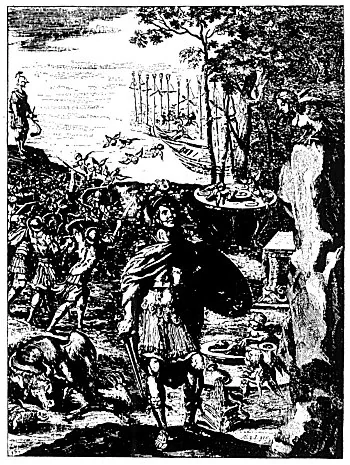
ÆNEAS AND THE HARPIES.
From Virgil's Æneid. (Dryden's translation.)
Among the mythological creatures of the Mysteries were the harpies--projections into material substance of beings existing in the invisible world of Nature. They were described the Greeks as being composite, with the heads of maidens and the bodies of birds. The wings of the harpies were composed of metal and their flight was, accompanied by a terrible clanging noise. During his wanderings, Æneas, the Trojan hero, landed on the island of the harpies, where he and his followers vainly battled with these monsters. One of the harpies perched upon a cliff and there prophesied to Æneid that his attack upon them would bring dire calamity to the Trojans.
Flowers, Plants, Fruits, and Trees
THE yoni and phallus were worshiped by nearly all ancient peoples as appropriate symbols of God's creative power. The Garden of Eden, the Ark, the Gate of the Temple, the Veil of the Mysteries, the vesica piscis or oval nimbus, and the Holy Grail are important yonic symbols; the pyramid, the obelisk, the cone, the candle, the tower, the Celtic monolith, the spire, the campanile, the Maypole, and the Sacred Spear are symbolic of the phallus. In treating the subject of Priapic worship, too many modern authors judge pagan standards by their own and wallow in the mire of self-created vulgarity. The Eleusinian Mysteries--the greatest of all the ancient secret societies--established one of the highest known standards of morality and ethics, and those criticizing their use of phallic symbols should ponder the trenchant words of King Edward III, "Honi soit qui mal y pense."
The obscene rites practiced by the later Bacchanalia and Dionysia were no more representative of the standards of purity originally upheld by the Mysteries than the orgies occasionally occurring among the adherents of Christianity till the eighteenth century were representative of primitive Christianity. Sir William Hamilton, British Minister at the Court of Naples, declares that in 1780, Isernia, a community of Christians in Italy, worshiped with phallic ceremonies the pagan god Priapus under the name of St. Cosmo. (See Two Essays on the Worship of Priapus, by Richard Payne Knight.)
Father, mother, and child constitute the natural trinity. The Mysteries glorified the home as the supreme institution consisting of this trinity functioning as a unit. Pythagoras likened the universe to the family, declaring that as the supreme fire of the universe was in the midst of its heavenly bodies, so, by analogy, the supreme fire of the world was upon its hearthstones. The Pythagorean and other schools of philosophy conceived the one divine nature of God to manifest itself in the threefold aspect of Father, Mother, and Child. These three constituted the Divine Family, whose dwelling place is creation and whose natural and peculiar symbol is the 47th problem of Euclid. God the Father is spirit, God the Mother is matter, and God the Child--the product of the two--represents the sum of living things born out of and constituting Nature. The seed of spirit is sown in the womb of matter, and by an immaculate (pure) conception the progeny is brought into being. Is not this the true mystery of the Madonna holding the Holy Babe in her arms? Who dares to say that such symbolism is improper? The mystery of life is the supreme mystery, revealed in all of its divine dignity and glorified as Nature's per feet achievement by the initiated sages and seers of all ages.
The prudery of today, however, declares this same mystery to be unfit for the consideration of holy-minded people. Contrary to the dictates of reason, a standard has been established which affirms that innocence bred of ignorance is more to be desired than virtue born of knowledge. Eventually, however, man will learn that he need never be ashamed of truth. Until he does learn this, he is false to his God, to his world, and to himself. In this respect, Christianity has woefully failed in its mission. While declaring man's body to be the living temple of the living God, in the same breath it asserts the substances and functions of this temple to be unclean and their study defiling to the sensitive sentiments of the righteous. By this unwholesome attitude, man's body--the house of God--is degraded and defamed. Yet the cross itself is the oldest of phallic emblems, and the lozenge-shaped windows of cathedrals are proof that yonic symbols have survived the destruction of the pagan Mysteries. The very structure of the church itself is permeated with phallicism. Remove from the Christian Church all emblems of Priapic origin and nothing is left, for even the earth upon which it stands was, because of its fertility, the first yonic symbol. As the presence of these emblems of the generative processes is either unknown or unheeded by the majority, the irony of the situation is not generally appreciated. Only those conversant with the secret language of antiquity are capable of understanding the divine significance of these emblems.
Flowers were chosen as symbols for many reasons. The great variety of flora made it possible to find some plant or flower which would be a suitable figure for nearly any abstract quality or condition. A plant might be chosen because of some myth connected with its origin, as the stories of Daphne and Narcissus; because of the peculiar environment in which it thrived, as the orchid and the fungus; because of its significant shape, as the passion flower and the Easter lily; because of its brilliance or fragrance, as the verbena and the sweet lavender; because it preserved its form indefinitely, as the everlasting flower; because of unusual characteristics as the sunflower and heliotrope, which have long been sacred because of their affinity for the sun.
The plant might also be considered worthy of veneration because from its crushed leaves, petals, stalks, or roots could be extracted healing unctions, essences, or drugs affecting the nature and intelligence of human beings--such as the poppy and the ancient herbs of prophecy. The plant might also be regarded as efficacious in the cure of many diseases because its fruit, leaves, petals, or roots bore a resemblance in shape or color to parts or organs of the human body. For example, the distilled juices of certain species of ferns, also the hairy moss growing upon oaks, and the thistledown were said to have the power of growing hair; the dentaria, which resembles a tooth in shape, was said to cure the toothache; and the palma Christi plant, because of its shape, cured all afflictions of the hands.
The blossom is really the reproductive system of the plant and is therefore singularly appropriate as a symbol of sexual purity--an absolute requisite of the ancient Mysteries. Thus the flower signifies this ideal of beauty and regeneration which must ultimately take the place of lust and degeneracy.
Of all symbolic flowers the locus blossom of India and Egypt and the rose of the Rosicrucians are the most important. In their symbolism these two flowers are considered identical. The esoteric doctrines for which the Eastern lotus stands have been perpetuated in modern Europe under the form of the rose. The rose and the lotus are yonic emblems, signifying primarily the maternal creative mystery, while the Easter lily is considered to be phallic.
The Brahmin and Egyptian initiates, who undoubtedly understood the secret systems of spiritual culture whereby the latent centers of cosmic energy in man may be stimulated, employed the lotus blossoms to represent the spinning vortices of spiritual energy located at various points along the spinal column and called chakras, or whirling wheels, by the Hindus. Seven of these chakras are of prime importance and have their individual correspondences in the nerve ganglia and plexuses. According to the secret schools, the sacral ganglion is called the four-petaled lotus; the prostatic plexus, the six-petaled lotus; the epigastric plexus and navel, the ten-petaled lotus; the cardiac plexus, the twelve-petaled lotus; the pharyngeal plexus, the sixteen-petaled locus; the cavernous plexus, the two-petaled lotus; and the pineal gland or adjacent unknown center, the thousand-petaled locus. The color, size, and number of petals upon the
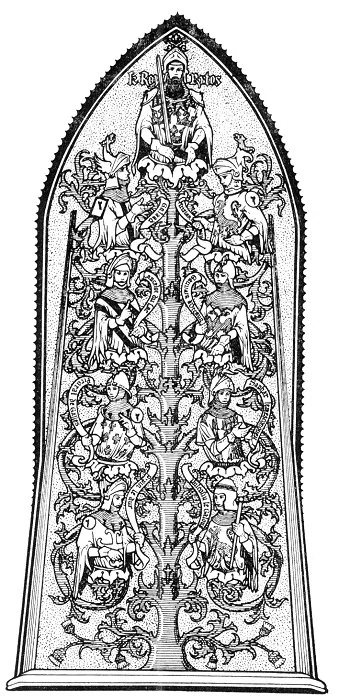
THE TREE OF THE KNIGHTS OF THE ROUND TABLE.
This remarkable example of the use of the tree in symbolism is from the Chateau de Pierrefonds in the little town of Pierrefonds, northern France. The eight side branches end in conventional cup-like flowers, from each of which rises the body of a knight carrying in his hand a ribbon bearing his name. The central stem is surmounted by a larger flower, from which emerges the body of King Arthur himself. The tree is a favorite motif in heraldry. The one trunk with its multitude of branches caused the tree to be frequently used in diagramming family lineage, from which practice has arisen the custom of terming such tables "family trees."
lotus are the keys to its symbolic import. A hint concerning the unfoldment of spiritual understanding according to the secret science of the Mysteries is found in the story of Aaron's rod that budded, and also in Wagner's great opera, Tannhäuser, where the budding staff of the Pope signifies the unfolding blossoms upon the sacred rod of the Mysteries--the spinal column.
The Rosicrucians used a garland of roses to signify the same spiritual vortices, which are referred to in the Bible as the seven lamps of the candlestick and the seven churches of Asia. In the 1642 edition of Sir Francis Bacon's History of Henry the Seventh is a frontispiece showing Lord Bacon with Rosicrucian roses for shoe buckles.
In the Hindu system of philosophy, each petal of the lotus bears a certain symbol which gives an added clue to the meaning of the flower. The Orientals also used the lotus plant to signify the growth of man through the three periods of human consciousness--ignorance, endeavor, and understanding. As the lotus exists in three elements (earth, water, and air) so man lives in three worlds--material, intellectual, and spiritual. As the plant, with its roots in the mud and the slime, grows upward through the water and finally blossoms forth in the light and air, so the spiritual growth of man is upward from the darkness of base action and desire into the light of truth and understanding, the water serving as a symbol of the ever-changing world of illusion through which the soul must pass in its struggle to reach the state of spiritual illumination. The rose and its Eastern equivalent, the lotus, like all beautiful flowers, represent spiritual unfoldment and attainment: hence, the Eastern deities are often shown seated upon the open petals of the lotus blossoms.
The lotus was also a universal motif in Egyptian art and architecture. The roofs of many temples were upheld by lotus columns, signifying the eternal wisdom; and the lotus-headed scepter--symbolic of self-unfoldment and divine prerogative--was often carried in religious processions. When the flower had nine petals, it was symbolic of man; when twelve, of the universe and the gods; when seven, of the planets and the law; when five, of the senses and the Mysteries; and when three, of the chief deities and the worlds. The heraldic rose of the Middle Ages generally has either five or ten petals thereby showing its relationship to the spiritual mystery of man through the Pythagorean pentad and decad.
CULTUS ARBORUM
The worship of trees as proxies of Divinity was prevalent throughout the ancient world. Temples were often built in the heart of sacred groves, and nocturnal ceremonials were conducted under the wide-spreading branches of great trees, fantastically decorated and festooned in honor of their patron deities. In many instances the trees themselves were believed to possess the attributes of divine power and intelligence, and therefore supplications were often addressed to them. The beauty, dignity, massiveness, and strength of oaks, elms, and cedars led to their adoption as symbols of power, integrity, permanence, virility, and divine protection.
Several ancient peoples--notably the Hindus and Scandinavians---regarded the Macrocosm, or Grand Universe, as a divine tree growing from a single seed sown in space. The Greeks, Persians, Chaldeans, and Japanese have legends describing the axle tree or reed upon which the earth revolves. Kapila declares the universe to be the eternal tree, Brahma, which springs from an imperceptible and intangible seed--the material monad. The mediæval Qabbalists represented creation as a tree with its roots in the reality of spirit and its branches in the illusion of tangible existence. The Sephirothic tree of the Qabbalah was therefore inverted, with its roots in heaven and its branches upon the earth. Madam Blavatsky notes that the Great Pyramid was considered to be a symbol of this inverted tree, with its root at the apex of the pyramid and its branches diverging in four streams towards the base.
The Scandinavian world-tree, Yggdrasil, supports on its branches nine spheres or worlds,--which the Egyptians symbolized by the nine stamens of the persea or avocado. All of these are enclosed within the mysterious tenth sphere or cosmic egg--the definitionless Cipher of the Mysteries. The Qabbalistic tree of the Jews also consists of nine branches, or worlds, emanating from the First Cause or Crown, which surrounds its emanations as the shell surrounds the egg. The single source of life and the endless diversity of its expression has a perfect analogy in the structure of the tree. The trunk represents the single origin of all diversity; the roots, deeply imbedded in the dark earth, are symbolic of divine nutriment; and its multiplicity of branches spreading from the central trunk represent the infinity of universal effects dependent upon a single cause.
The tree has also been accepted as symbolic of the Microcosm, that is, man. According to the esoteric doctrine, man first exists potentially within the body of the world-tree and later blossoms forth into objective manifestation upon its branches. According to an early Greek Mystery myth, the god Zeus fabricated the third race of men from ash trees. The serpent so often shown wound around the trunk of the tree usually signifies the mind--the power of thought--and is the eternal tempter or urge which leads all rational creatures to the ultimate discovery of reality and thus overthrows the rule of the gods. The serpent hidden in the foliage of the universal tree represents the cosmic mind; and in the human tree, the individualized intellect.
The concept that all life originates from seeds caused grain and various plants to be accepted as emblematic of the human spermatozoon, and the tree was therefore symbolic of organized life unfolding from its primitive germ. The growth of the universe from its primitive seed may be likened to the growth of the mighty oak from the tiny acorn. While the tree is apparently much greater than its own source, nevertheless that source contains potentially every branch, twig, and leaf which will later be objectively unfolded by the processes of growth.
Man's veneration for trees as symbols of the abstract qualities of wisdom and integrity also led him to designate as trees those individuals who possessed these divine qualities to an apparently superhuman degree. Highly illumined philosophers and priests were therefore often referred to as trees or tree men--for example, the Druids, whose name, according to one interpretation, signifies the men of the oak trees, or the initiates of certain Syrian Mysteries who were called cedars; in fact it is far more credible and probable that the famous cedars of Lebanon, cut down for the building of King Solomon's Temple, were really illumined, initiated sages. The mystic knows that the true supports of God's Glorious House were not the logs subject to decay but the immortal and imperishable intellects of the tree hierophants.
Trees are repeatedly mentioned in the Old and New Testaments, and in the scriptures of various pagan nations. The Tree of Life and the Tree of the Knowledge of Good and Evil mentioned in Genesis, the burning bush in which the angel appeared to Moses, the famous vine and fig tree of the New Testament, the grove of olives in the Garden of Gethsemane where Jesus went to pray, and the miraculous tree of Revelation, which bore twelve manners of fruit and whose leaves were for the healing of the nations, all bear witness to the esteem in which trees were held by the scribes of Holy Writ. Buddha received his illumination while under the bodhi tree, near Madras in India, and several of the Eastern gods are pictured sitting in meditation beneath the spreading branches of mighty trees. Many of the great sages and saviors carried wands, rods, or staves cut from the wood of sacred trees, as the rods of Moses and Aaron; Gungnir--the spear of Odin--cut from the Tree of Life; and the consecrated rod of Hermes, around which the fighting serpents entwined themselves.
The numerous uses which the ancients made of the tree and its products are factors in its symbolism. Its worship was, to a certain degree, based upon its usefulness. Of this J. P. Lundy writes: "Trees occupy such an important place in the economy of nature by way of attracting and retaining moisture, and shading the water-sources and the soil so as to prevent barrenness and desolation; the), are so
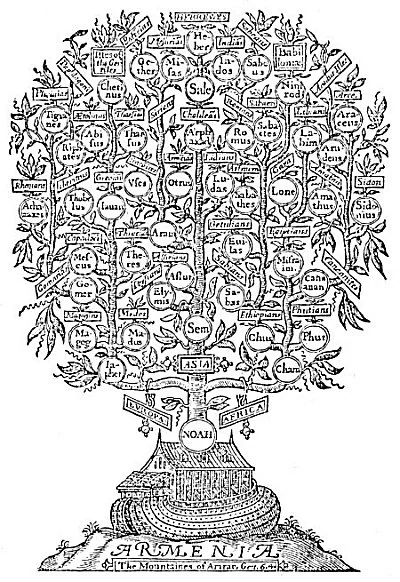
THE TREE OF NOAH.
From the "Breeches" Bible of 1599.
Most Bibles published during the Middle Ages contain a section devoted to genealogical tables showing the descent of humanity from Father Adam to the advent of Jesus Christ. The tree growing from the roof of the Ark represents the body of Noah and its three branches, his sons--Shem, Ham, and Japheth. The nations by the descendents of Noah's three sons are appropriately shown in the circles upon the branches of the tree. While such tables are hopelessly incorrect from a historical point of view, to the symbolist their allegorical interpretations are of inestimable importance.
useful to man for shade, for fruit, for medicine, for fuel, for building houses and ships, for furniture, for almost every department of life, that it is no wonder that some of the more conspicuous ones, such as the oak, the pine, the palm, and the sycamore, have been made sacred and used for worship." (See Monumental Christianity.)
The early Fathers of the church sometimes used the tree to symbolize Christ. They believed that ultimately Christianity would grow up like a mighty oak and overshadow all other faiths of mankind. Because it annually discards its foliage, the tree was also looked upon as an appropriate emblem of resurrection and reincarnation, for though apparently dying each fall it blossomed forth again with renewed verdure each ensuing spring.
Under the appellations of the Tree of Life and the Tree of the Knowledge of Good and Evil is concealed the great arcanum of antiquity--the mystery of equilibrium. The Tree of Life represents the spiritual point of balance--the secret of immortality. The Tree of the Knowledge of Good and Evil, as its name implies, represents polarity, or unbalance--the secret of mortality. The Qabbalists reveal this by assigning the central column of their Sephirothic diagram to the Tree of Life and the two side branches to the Tree of the Knowledge of Good and Evil. "Unbalanced forces perish in the void," declares the secret work, and all is made known. The apple represents the knowledge of the procreative processes, by the awakening of which the material universe was established. The allegory of Adam and Eve in the Garden of Eden is a cosmic myth, revealing the methods of universal and individual establishment. The literal story, accepted for so many centuries by an unthinking world, is preposterous, but the creative mystery of which it is the symbol is one of Nature's profoundest verities. The Ophites (serpent worshipers) revered the Edenic snake because it was the cause of individual existence. Though humanity is still wandering in a world of good and evil, it will ultimately attain completion and eat of the fruit of the Tree of Life growing in the midst of the illusionary garden of worldly things. Thus the Tree of Life is also the appointed symbol of the Mysteries, and by partaking of its fruit man attains immortality.
The oak, the pine, the ash, the cypress, and the palm are the five trees of greatest symbolic importance. The Father God of the Mysteries was often worshiped under the form of an oak; the Savior God--frequently the World Martyr--in the form of a pine; the world axis and the divine nature in humanity in the form of an ash; the goddesses, or maternal principle, in the form of a cypress; and the positive pole of generation in the form of the inflorescence of the mate date palm. The pine cone is a phallic symbol of remote antiquity. The thyrsus of Bacchus--a long wand or staff surmounted by a pine cone or cluster of grapes and entwined with ivy or grape-vine leaves, sometimes ribbons--signifies that the wonders of Nature may only be accomplished by the aid of solar virility, as symbolized by the cone or grapes. In the Phrygian Mysteries, Atys--the ever-present sun-savior--dies under the branches of the pine tree (an allusion to the solar globe at the winter solstice) and for this reason the pine tree was sacred to his cult. This tree was also sacred in the Mysteries of Dionysos and Apollo.
Among the ancient Egyptians and Jews the acacia, or tamarisk, was held in the highest religious esteem; and among modern Masons, branches of acacia, cypress, cedar, or evergreen are still regarded as most significant emblems. The shittim-wood used by the children of Israel in the construction of the Tabernacle and the Ark of the Covenant was a species of acacia. In describing this sacred tree, Albert Pike has written: "The genuine acacia, also, is the thorny tamarisk, the same tree which grew around the body of Osiris. It was a sacred tree among the Arabs, who made of it the idol Al-Uzza, which Mohammed destroyed. It is abundant as a bush in the desert of Thur; and of it the 'crown of thorns' was composed, which was set on the forehead of Jesus of Nazareth. It is a fit type of immortality on account of its tenacity of life; for it has been known, when planted as a door-post, to take root again and shoot out budding boughs above the threshold." (See Morals and Dogma.)
It is quite possible that much of the veneration accorded the acacia is due to the peculiar attributes of the mimosa, or sensitive plant, with which it was often identified by the ancients. There is a Coptic legend to the effect that the sensitive plant was the first of all trees or shrubs to worship Christ. The rapid growth of the acacia and its beauty have also caused it to be regarded as emblematic of fecundity and generation.
The symbolism of the acacia is susceptible of four distinct interpretations: (1) it is the emblem of the vernal equinox--the annual resurrection of the solar deity; (2) under the form of the sensitive plant which shrinks from human touch, the acacia signifies purity and innocence, as one of the Greek meanings of its name implies; (3) it fittingly typifies human immortality and regeneration, and under the form of the evergreen represents that immortal part of man which survives the destruction of his visible nature; (4) it is the ancient and revered emblem of the Mysteries, and candidates entering the tortuous passageways in which the ceremonials were given carried in their hands branches of these sacred plants or small clusters of sanctified flowers.
Albert G. Mackey calls attention to the fact that each of the ancient Mysteries had its own peculiar plant sacred to the gods or goddesses in whose honor the rituals were celebrated. These sacred plants were later adopted as the symbols of the various degrees in which they were used. Thus, in the Mysteries of Adonis, lettuce was sacred; in the Brahmin and Egyptian rites, the lotus; among the Druids, the mistletoe; and among certain of the Greek Mysteries, the myrtle. (See Encyclopædia of Freemasonry.)
As the legend of CHiram Abiff is based upon the ancient Egyptian Mystery ritual of the murder and resurrection of Osiris, it is natural that the sprig of acacia should be preserved as symbolic of the resurrection of CHiram. The chest containing the body of Osiris was washed ashore near Byblos and lodged in the roots of a tamarisk, or acacia, which, growing into a mighty tree, enclosed within its trunk the body of the murdered god. This is undoubtedly the origin of the story that a sprig of acacia marks the grave of CHiram. The mystery of the evergreen marking the grave of the dead sun god is also perpetuated in the Christmas tree.
The apricot and quince are familiar yonic symbols, while the bunch of grapes and the fig are phallic. The pomegranate is the mystic fruit of the Eleusinian rites; by eating it, Prosperine bound herself to the realms of Pluto. The fruit here signifies the sensuous life which, once tasted, temporarily deprives man of immortality. Also on account of its vast number of seeds the pomegranate was often employed to represent natural fecundity. For the same reason, Jacob Bryant in his Ancient Mythology notes that the ancients recognized in this fruit an appropriate emblem of the Ark of the Deluge,
THE SUNFLOWER.
From Kircher's Magnes sive de Arte Magnetica Opus Tripartitum.
The above diagram illustrates a curious experiment in plant magnetism reproduced with several other experiments in Athanasius Kircher's rare volume on magnetism. Several plants were sacred to the ancient Egyptians, Greeks, and Hindus because of the peculiar effect which the sun exerted over them. As it is difficult for man to look upon the face of the sun without being blinded by the light, those plants which turned and deliberately faced the solar orb were considered typical of very highly advanced souls. Since the sun was regarded as the personification of the Supreme Deity, those forms of life over which it exercised marked influence were venerated as being sacred to Divinity. The sunflower, because of its plainly perceptible affinity for the sun, was given high rank among sacred plants.
which contained the seeds of the new human race. Among the ancient Mysteries the pomegranate was also considered to be a divine symbol of such peculiar significance that its true explanation could not be divulged. It was termed by the Cabiri "the forbidden secret." Many Greek gods and goddesses are depicted holding the fruit or flower of the pomegranate in their hands, evidently to signify that they are givers of life and plenty. Pomegranate capitals were placed upon the pillars of Jachin and Boaz standing in front of King Solomon's Temple; and by the order of Jehovah, pomegranate blossoms were embroidered upon the bottom of the High Priest's ephod.
Strong wine made from the juice of the grape was looked upon as symbolic of the false life and false light of the universe, for it was produced by a false process--artificial fermentation. The rational faculties are clouded by strong drink, and the animal nature, liberated from bondage, controls the individual--facts which necessarily were of the greatest spiritual significance. As the lower nature is the eternal tempter seeking co lead man into excesses which inhibit the spiritual faculties, the grape and its product were used to symbolize the Adversary.
The juice of the grape was thought by the Egyptians to resemble human blood more closely than did any other substance. In fact, they believed that the grape secured its life from the blood of the dead who had been buried in the earth. According to Plutarch, "The priests of the sun at Heliopolis never carry any wine into their temples, * * * and if they made use of it at any time in their libations to the gods, it was not because they looked upon it as in its own nature acceptable to them; but they poured it upon their altars as the blood of those enemies who formerly had fought against them. For they look upon the vine to have first sprung out of the earth after it was fattened with the carcasses of those who fell in the wars against the gods. And this, say they, is the reason why drinking its juice in great quantities makes men mad and beside themselves, filling them as it were with the blood of their own ancestors." (See Isis and Osiris.)
Among some cults the state of intoxication was viewed as a condition somewhat akin to ecstasy, for the individual was believed to be possessed by the Universal Spirit of Life, whose chosen vehicle was the vine. In the Mysteries, the grape was often used to symbolize lust and debauchery because of its demoralizing effect upon the emotional nature. The fact was recognized, however, that fermentation was the certain evidence of the presence of the solar fire, hence the grape was accepted as the proper symbol of the Solar Spirit--the giver of divine enthusiasm. In a somewhat similar manner, Christians have accepted wine as the emblem of the blood of Christ, partaking of it in Holy Communion. Christ, the exoteric emblem of the Solar Spirit, said, "I am the vine." He was therefore worshiped with the wine of ecstasy in the same manner as were his pagan prototypes--Bacchus, Dionysos, Arys, and Adonis.
The mandragora officinarum, or mandrake, is accredited with possessing the most remarkable magical powers. Its narcotic properties were recognized by the Greeks, who employed it to deaden pain during surgical operations, and it has been identified also with baaras, the mystic herb used by the Jews for casting out demons. In the Jewish Wars, Josephus describes the method of securing the baaras, which he declares emits flashes of lightning and destroys all who seek to touch it, unless they proceed according to certain rules supposedly formulated by King Solomon himself.
The occult properties of the mandrake, while little understood, have been responsible for the adoption of the plant as a talisman capable of increasing the value or quantity of anything with which it was associated. As a phallic charm, the mandrake was considered to be an infallible cure for sterility. It was one of the Priapic symbols which the Knights Templars were accused of worshiping. The root of the plant closely resembles a human body and often bore the outlines of the human head, arms, or legs. This striking similarity between the body of man and the mandragora is one of the puzzles of natural science and is the real basis for the veneration in which this plant was held. In Isis Unveiled, Madam Blavatsky notes that the mandragora seems to occupy upon earth the point where the vegetable and animal kingdoms meet, as the zoophites and polypi do in die sea. This thought opens a vast field of speculation concerning the nature of this animal-plant.
According to a popular superstition, the mandrake shrank from being touched and, crying out with a human voice, clung desperately to the soil in which it was imbedded. Anyone who heard its cry while plucking it either immediately died or went mad. To circumvent this tragedy, it was customary to dig around the roots of the mandrake until the plant was thoroughly loosened and then to tie one end of a cord about the stalk and fasten the other end to a dog. The dog, obeying his master's call, thereupon dragged the root from the earth and became the victim of the mandragora curse. When once uprooted, the plant could be handled with immunity.
During the Middle Ages, mandrake charms brought great prices and an art was evolved by which the resemblance between the mandragora root and the human body was considerably accentuated. Like most superstitions, the belief in the peculiar powers of the mandrake was founded upon an ancient secret doctrine concerning the true nature of the plant. "It is slightly narcotic," says Eliphas Levi, "and an aphrodisiacal virtue was ascribed to it by the ancients, who represented it as being sought by Thessalian sorcerers for the composition of philtres. Is this root the umbilical vestige of our terrestrial origin, as a certain magical mysticism has suggested? We dare not affirm it seriously, but it is true all the same that man issued from the slime of earth and his first appearance must have been in the form of a rough sketch. The analogies of Nature compel us to admit the notion, at least as a possibility. The first men were, in this case, a family of gigantic, sensitive mandrogores, animated by the sun, who rooted themselves up from the earth." (See Transcendental Magic.)
The homely onion was revered by the Egyptians as a symbol of the universe because its rings and layers represented the concentric planes into which creation was divided according to the Hermetic Mysteries. It was also regarded as possessing great medicinal virtue. Because of peculiar properties resulting from its pungency, the garlic plant was a powerful agent in transcendental magic. To this day no better medium has been found for the treatment of obsession. Vampirism and certain forms of insanity--especially those resulting from mediumship and the influences of elemental larvæ--respond immediately to the use of garlic. In the Middle Ages, its presence in a house was believed to ward off all evil powers.
Trifoliate plants, such as the shamrock, were employed by many religious cults to represent the principle of the Trinity. St. Patrick is supposed to have used the shamrock to illustrate this doctrine of the triune Divinity. The reason for the additional sanctity conferred by a fourth leaf is that the fourth principle of the Trinity is man, and the presence of this leaf therefore signifies the redemption of humanity.
Wreaths were worn during initiation into the Mysteries and the reading of the sacred books to signify that these processes were consecrated to the deities. On the symbolism of wreaths, Richard Payne Knight writes: "Instead of beads, wreaths of foliage, generally of laurel, olive, myrtle, ivy, or oak, appear upon coins, sometimes encircling the symbolical figures, and sometimes as chaplets upon their heads. All these were sacred to some peculiar personifications of the deity, and significant of some particular attributes, and, in general, all evergreens were Dionysiac planes; that is, symbols of the generative power, signifying perpetuity of youth and vigor, as the circles of beads and diadems signify perpetuity of existence. (See Symbolical Language of Ancient Art and Mythology.)
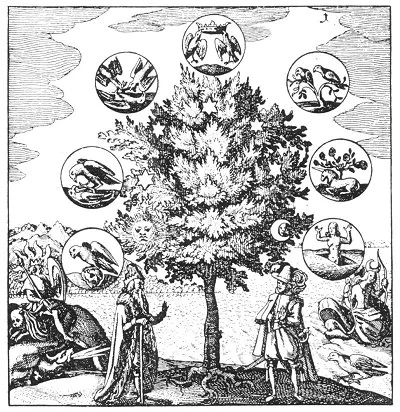
THE TREE OF ALCHEMY.
From Musæum Hermeticum Reformatum et Amplificatum.
The alchemists were went to symbolize their metals by means of a tree, to indicate that all seven were branches dependent upon the single trunk of solar life. As the Seven Spirits depend upon God and are branches of a tree of which He is the root, trunk, and the spiritual earth from which the root derives its nourishment, so the single trunk of divine life and power nourishes all the multitudinous forms of which the universe is composed.
In Gloria Mundi, from which the above illustration is reproduced, there is contained an important thought concerning the plantlike growth of metals: "All trees, herbs, stones, metals, and minerals grow and attain to perfection without being necessarily touched by any human hand: for the seed is raised up from the ground, puts forth flowers, and bears fruit, simply through the agency of natural influences. As it is with plants, so it is with metals. While they lie in the heart of the earth, in their natural ore, they grow and are developed, day by day, through the influence of the four elements: their fire is the splendor of the Sun and Moon; the earth conceives in her womb the splendor of the Sun, and by it the seeds of the metals are well and equally warmed, just like the grain in the fields. * * * For as each tree of the field has its own peculiar shape, appearance, and fruit, so each mountain bears its own particular ore; those stones and that earth being the soil in which the metals grow." (See Translation of 1893.)
Stones, Metals and Gems
EACH of the four primary elements as taught by the early philosophers has its analogue in the quaternary terrestrial constitution of man. The rocks and earth correspond to the bones and flesh; the water to the various fluids; the air to the gases; and the fire to the bodily heat. Since the bones are the framework that sustains the corporeal structure, they may be regarded as a fitting emblem of the spirit--that divine foundation which supports the composite fabric of mind, soul, and body. To the initiate, the skeleton of death holding in bony fingers the reaper's scythe denotes Saturn (Kronos), the father of the gods, carrying the sickle with which he mutilated Ouranos, his own sire.
In the language of the Mysteries, the spirits of men are the powdered bones of Saturn. The latter deity was always worshiped under the symbol of the base or footing, inasmuch as he was considered to be the substructure upholding creation. The myth of Saturn has its historical basis in the fragmentary records preserved by the early Greeks and Phœnicians concerning a king by that name who ruled over the ancient continent of Hyperborea. Polaris, Hyperborea, and Atlantis, because they lie buried beneath the continents and oceans of the modern world, have frequently been symbolized as rocks supporting upon their broad surfaces new lands, races, and empires. According to the Scandinavian Mysteries, the stones and cliffs were formed from the bones of Ymir, the primordial giant of the seething clay, while to the Hellenic mystics the rocks were the bones of the Great Mother, Gæa.
After the deluge sent by the gods to destroy mankind at the close of the Iron Age, only Deucalion and Pyrrha were left alive. Entering a ruined sanctuary to pray, they were directed by an oracle to depart from the temple and with heads veiled and garments unbound cast behind them the bones of their mother. Construing the cryptic message of the god to mean that the earth was the Great Mother of all creatures, Deucalion picked up loose rocks and, bidding Pyrrha do likewise, cast them behind him. From these rocks there sprang forth a new and stalwart race of human beings, the rocks thrown by Deucalion becoming men and those thrown by Pyrrha becoming women. In this allegory is epitomized the mystery of human evolution; for spirit, by ensouling matter, becomes that indwelling power which gradually but sequentially raises the mineral to the status of the plant; the plant to the plane of the animal; the animal to the dignity of man; and man to the estate of the gods.
The solar system was organized by forces operating inward from the great ring of the Saturnian sphere; and since the beginnings of all things were under the control of Saturn, the most reasonable inference is that the first forms of worship were dedicated to him and his peculiar symbol--the stone. Thus the intrinsic nature of Saturn is synonymous with that spiritual rock which is the enduring foundation of the Solar Temple, and has its antitypc or lower octave in that terrestrial rock--the planet Earth--which sustains upon its jagged surface the diversified genera of mundane life.
Although its origin is uncertain, litholatry undoubtedly constitutes one of the earliest forms of religious expression. "Throughout all the world, " writes Godfrey Higgins, "the first object of Idolatry seems to have been a plain, unwrought stone, placed in the ground, as an emblem of the generative or procreative powers of nature." (See The Celtic Druids.) Remnants of stone worship are distributed over the greater part of the earth's surface, a notable example being the menhirs at Carnac, in Brittany, where several thousand gigantic uncut stones are arranged in eleven orderly rows. Many of these monoliths stand over twenty feet out of the sand in which they are embedded, and it has been calculated that some of the larger ones weigh as much as 250,000 pounds. By some it is believed that certain of the menhirs mark the location of buried treasure, but the most plausible view is that which regards Carnac as a monument to the astronomical knowledge of antiquity. Scattered throughout the British Isles and Europe, these cairns, dolmens, menhirs, and cistvaens stand as mute but eloquent testimonials to the existence and achievements of races now extinct.
Of particular interest are the rocking or logan stones, which evince the mechanical skill of these early peoples. These relics consist of enormous boulders poised upon one or two small points in such a manner that the slightest pressure will sway them, but the greatest effort is not sufficient to overthrow them. These were called living stones by the Greeks and Latins, the most famous one being the Gygorian stone in the Strait of Gibraltar. Though so perfectly balanced that it could be moved with the stalk of a daffodil, this rock could not be upset by the combined weight of many men. There is a legend that Hercules raised a rocking stone over the graves of the two sons of Boreas whom he had killed in combat. This stone was so delicately poised that it swayed back and forth with the wind, but no application of force could overturn it. A number of logan stones have been found in Britain, traces of one no longer standing having been discovered in Stonehenge. (See The Celtic Druids.) It is interesting to note that the green stones forming the inner ring of Stonehenge are believed to have been brought from Africa.
In many cases the monoliths are without carving or inscription, for they undoubtedly antedate both the use of tools and the art of writing. In some instances the stones have been trued into columns or obelisks, as in the runic monuments and the Hindu lingams and sakti stones; in other instances they are fashioned into rough likenesses of the human body, as in the Easter Island statues, or into the elaborately sculptured figures of the Central American Indians and the Khmers of Cambodia. The first rough-stone images can hardly be considered as effigies of any particular deity but rather as the crude effort of primitive man to portray in the enduring qualities of stone the procreative attributes of abstract Divinity. An instinctive recognition of the stability of Deity has persisted through all the intervening ages between primitive man and modem civilization. Ample proof of the survival of litholatry in the Christian faith is furnished by allusions to the rock of refuge, the rock upon which the church of Christ was to be founded, the corner stone which the builders rejected, Jacob's stony pillow which he set up and anointed with oil, the sling stone of David, the rock Moriah upon which the altar of King Solomon's Temple was erected, the white stone of Revelation, and the Rock of Ages.
Stones were highly venerated by prehistoric peoples primarily because of their usefulness. Jagged bits of stone were probably man's first weapons; rocky cliffs and crags constituted his first fortifications, and from these vantage points he hurled loose boulders down upon marauders. In caverns or rude huts fashioned from slabs of rock the first humans protected themselves from the rigors of the elements. Stones were set up as markers and monuments to primitive achievement; they were also placed upon the graves of the dead, probably as a precautionary measure to prevent the depredations of wild beasts. During migrations, it was apparently customary for primitive peoples to carry about with them stones taken from their original habitat. As the homeland or birthplace of a race was considered sacred, these stones were emblematic of that universal regard shared by all nations for the place of their geniture. The discovery that fire could be produced by striking together two pieces of stone augmented man's reverence for stones, but ultimately the hitherto unsuspected world of wonders opened by the newly discovered element of fire caused pyrolatry to supplant stone worship. The dark, cold Father--stone--gave birth out of itself to the bright, glowing Son-fire; and the newly born flame, by displacing its parent, became the most impressive and mysterious of all religio-philosophic symbols, widespread and enduring through the ages.
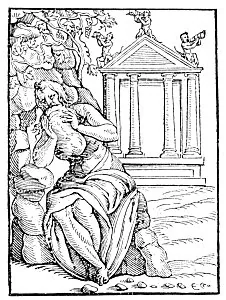
SATURN SWALLOWING THE STONE SUBSTITUTED FOR JUPITER.
From Catrari's Imagini degli Dei degli Antichi.
Saturn, having been warned by his parents that one of his own children would dethrone him, devoured each child at birth. At last Rhea, his wife, in order to save Jupiter, her sixth child substituted for him a rock enveloped in swaddling clothes--which Saturn, ignorant of the deception practiced upon him, immediately swallowed. Jupiter was concealed on the island of Crete until he attained manhood, when he forced his father to disgorge the five children he had eaten. The stone swallowed by Saturn in lieu of his youngest son was placed by Jupiter at Delphi, where it was held in great veneration and was daily anointed.
The body of every thing was likened to a rock, trued either into a cube or more ornately chiseled to form a pedestal, while the spirit of everything was likened to the elaborately carved figure surmounting it. Accordingly, altars were erected as a symbol of the lower world, and fires were kept burning upon them to represent that spiritual essence illuminating the body it surmounted. The square is actually one surface of a cube, its corresponding figure in plane geometry, and its proper philosophic symbol. Consequently, when considering the earth as an element and not as a body, the Greeks, Brahmins, and Egyptians always referred to its four corners, although they were fully aware that the planet itself was a sphere.
Because their doctrines were the sure foundation of all knowledge and the first step in the attainment of conscious immortality, the Mysteries were often represented as cubical or pyramidal stones. Conversely, these stones themselves became the emblem of that condition of self-achieved godhood. The unchangeability of the stone made it an appropriate emblem of God--the immovable and unchangeable Source of Existence--and also of the divine sciences--the eternal revelation of Himself to mankind. As the personification of the rational intellect, which is the true foundation of human life, Mercury, or Hermes, was symbolized in a like manner. Square or cylindrical pillars, surmounted by a bearded head of Hermes and called hermæ, were set up in public places. Terminus, a form of Jupiter and god of boundaries and highways, from whose name is derived the modern word terminal, was also symbolized by an upright stone, sometimes ornamented with the head of the god, which was placed at the borders of provinces and the intersections of important roads.
The philosopher's stone is really the philosophical stone, for philosophy is truly likened to a magic jewel whose touch transmutes base substances into priceless gems like itself. Wisdom is the alchemist's powder of projection which transforms many thousand times its own weight of gross ignorance into the precious substance of enlightenment.
THE TABLETS OF THE LAW
While upon the heights of Mount Sinai, Moses received from Jehovah two tablets bearing the characters of the Decalogue traced by the very finger of Israel's God. These tables were fashioned from the divine sapphire, Schethiyâ, which the Most High, after removing from His own throne, had cast into the Abyss to become the foundation and generator of the worlds. This sacred stone, formed of heavenly dew, was sundered by the breath of God, and upon the two parts were drawn in black fire the figures of the Law. These precious inscriptions, aglow with celestial splendor, were delivered by the Lord on the Sabbath day into the hands of Moses, who was able to read the illumined letters from the reverse side because of the transparency of the great jewel. (See The Secret Doctrine in Israel or The Zohar for details of this legend.)
The Ten Commandments are the ten shining gems placed by the Holy One in the sapphire sea of Being, and in the depths of matter the reflections of these jewels are seen as the laws governing the sublunary spheres. They are the sacred ten by which the Supreme Deity has stamped His will upon the face of Nature. This same decad was celebrated by the Pythagoreans under the form of the tetractys--that triangle of spermatic points which reveals to the initiated the whole working of the cosmic scheme; for ten is the number of perfection, the key to creation, and the proper symbol of God, man, and the universe.
Because of the idolatry of the Israelites, Moses deemed the people unworthy to receive the sapphire tables; hence he destroyed them, that the Mysteries of Jehovah should not be violated. For the original set Moses substituted two tablets of rough stone into the surface of which he had cut ten ancient letters. While the former tables--partaking of the divinity of the Tree of Life--blazed forth eternal verities, the latter--partaking of the nature of the Tree of Good and Evil--revealed only temporal truths. Thus the ancient tradition of Israel returned again to heaven, leaving only its shadow with the children of the twelve tribes.
One of the two tables of stone delivered by the Lawgiver to his followers stood for the oral, the other for the written traditions upon which the Rabbinical School was founded. Authorities differ widely as to the size and substance of the inferior tables. Some describe them as being so small that they could be held in the hollow of a man's hand; others declare that each table was ten or twelve cubits in length and of enormous weight. A few even deny that the tables were of stone, maintaining that they were of a wood called sedr, which, according to the Mohammedans, grows profusely in Paradise.
The two tables signify respectively the superior and the inferior worlds--the paternal and the maternal formative principles. In their undivided state they represent the Cosmic Androgyne. The breaking of the tables signifies obscurely the separation of the superior and the inferior spheres and also the division of the sexes. In the religious processionals of the Greeks and Egyptians an ark or ship was carried which contained stone tablets, cones, and vessels of various shapes emblematic of the procreative processes. The Ark of the Israelites--which was patterned after the sacred chests of the Isiac Mysteries--contained three holy objects, each having an important phallic interpretation: the pot of manna, the rod that budded, and the Tablets of the Law--the first, second, and third Principles of the Creative Triad. The manna, the blossoming staff, and the stone tables are also appropriate images respectively of the Qabbalah, the Mishna, and the written law--the spirit, soul, and body of Judaism. When placed in King Solomon's Everlasting House, the Ark of the Covenant contained only the Tablets of the Law. Does this indicate that even at that early date the secret tradition had been lost and the letter of the revelation alone remained?
As representing the power that fabricated the lower, or Demiurgic, sphere, the tablets of stone were sacred to Jehovah in contradistinction to the tablets of sapphire that signified the potency that established the higher, or celestial, sphere. Without doubt the Mosaic tablets have their prototype in the stone pillars or obelisks placed on either side of the entrance to pagan temples. These columns may pertain to that remote time when men worshiped the Creator through His zodiacal sign of Gemini, the symbol of which is still the phallic pillars of the Celestial Twins. "The Ten Commandments, writes Hargrave Jennings, "are inscribed in two groups of five each, in columnar form. The five to the right (looking from the altar) mean the 'Law'; the five to the left mean the 'Prophets.' The right stone is masculine, the left stone is feminine. They correspond to the two disjoined pillars of stone (or towers) in the front of every cathedral, and of every temple in the heathen times." (See The Rosicrucians: Their Rites and Mysteries.) The same author states that the Law is masculine because it was delivered direct from the Deity, while the Prophets, or Gospels, were feminine because born through the nature of man.
The right Tablet of the Law further signifies Jachin--the white pillar of light; the left Tablet, Boaz--the shadowy pillar of darkness. These were the names of the two pillars cast from brass set up on the porch of King Solomon's Temple. They were eighteen cubits in height and beautifully ornamented with wreaths of chainwork, nets, and pomegranates. On the top of each pillar was a large bowl--now erroneously called a ball or globe--one of the bowls probably containing fire and the other water. The celestial globe (originally the bowl of fire), surmounting the right-hand column (Jachin), symbolized the divine man; the terrestrial globe (the bowl of water), surmounting the left-hand column (Boaz), signified the earthly man. These two pillars respectively connote also the active and the passive expressions of Divine Energy, the sun and the moon, sulphur and salt, good and bad, light and darkness. Between them is the door leading into the House of God, and standing thus at the gates of Sanctuary they are a reminder that Jehovah is both an androgynous and an anthropomorphic deity. As two parallel columns they denote the zodiacal signs of Cancer and Capricorn, which were formerly placed in the chamber of initiation to represent birth and death--the extremes of physical life. They accordingly signify the summer and the winter solstices, now known to Freemasons under the comparatively modern appellation of the "two St. Johns."
In the mysterious Sephirothic Tree of the Jews, these two pillars symbolize Mercy and Severity. Standing before the gate of King Solomon's Temple, these columns had the same symbolic import as the obelisks before the sanctuaries of Egypt. When interpreted Qabbalistically, the names of the two pillars mean "In strength shall
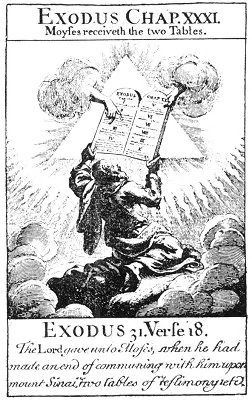
MOSES RECEIVING THE TABLES OF THE LAW.
From an old Bible.
Moses Maimonides, the great Jewish Philosopher of the twelfth century, in describing the Tables of the Law written by the finger of God, divides all productions into two general orders: products of Nature and products of art. God works through Nature and man through art, he asserts in his Guide for the Perplexed. Thus the Word of the Lord is the hand, or active principle, by which the will of the Creator is traced upon the face of His creation. The Tannaim, or initiates of the Jewish Mystery School, alone possessed a complete understanding of the significance of the Ten Commandments. These laws are esoterically related to the ten degrees of contemplation constituting the Path of Ecstasy, which winds upward through he four worlds and ends in the effulgence of AIN SOPH.
My House be established. "In the splendor of mental and spiritual illumination, the High Priest stood between the pillars as a mute witness to the perfect virtue of equilibrium--that hypothetical point equidistant from all extremes. He thus personified the divine nature of man in the midst of his compound constitution--the mysterious Pythagorean Monad in the presence of the Duad. On one side towered the stupendous column of the intellect; on the other, the brazen pillar of the flesh. Midway between these two stands the glorified wise man, but he cannot reach this high estate without first suffering upon the cross made by joining these pillars together. The early Jews occasionally represented the two pillars, Jachin and Boaz, as the legs of Jehovah, thereby signifying to the modern philosopher that Wisdom and Love, in their most exalted sense, support the whole order of creation--both mundane and supermundane.
THE HOLY GRAIL
Like the sapphire Schethiyâ, the Lapis Exilis, crown jewel of the Archangel Lucifer, fell from heaven. Michael, archangel of the sun and the Hidden God of Israel, at the head of the angelic hosts swooped down upon Lucifer and his legions of rebellious spirits. During the conflict, Michael with his flaming sword struck the flashing Lapis Exilis from the coronet of his adversary, and the green stone fell through all the celestial rings into the dark and immeasurable Abyss. Out of Lucifer's radiant gem was fashioned the Sangreal, or Holy Grail, from which Christ is said to have drunk at the Last Supper.
Though some controversy exists as to whether the Grail was a cup or a platter, it is generally depicted in art as a chalice of considerable size and unusual beauty. According to the legend, Joseph of Arimathea brought the Grail Cup to the place of the crucifixion and in it caught the blood pouring from the wounds of the dying Nazarene. Later Joseph, who had become custodian of the sacred relics--the Sangreal and the Spear of Longinus--carried them into a distant country. According to one version, his descendants finally placed these relics in Glastonbury Abbey in England; according to another, in a wonderful castle on Mount Salvat, Spain, built by angels in a single night. Under the name of Preston John, Parsifal, the last of the Grail Kings, carried the Holy Cup with him into India, and it disappeared forever from the Western World. Subsequent search for the Sangreal was the motif for much of the knight errantry of the Arthurian legends and the ceremonials of the Round Table. (See the Morte d'Arthur.)
No adequate interpretation has ever been given to the Grail Mysteries. Some believe the Knights of the Holy Grail to have been a powerful organization of Christian mystics perpetuating the Ancient Wisdom under the rituals and sacraments of the oracular Cup. The quest for the Holy Grail is the eternal search for truth, and Albert G. Mackey sees in it a variation of the Masonic legend of the Lost Word so long sought by the brethren of the Craft. There is also evidence to support the claim that the story of the Grail is an elaboration of an early pagan Nature myth which has been preserved by reason of the subtle manner in which it was engrafted upon the cult of Christianity. From this particular viewpoint, the Holy Grail is undoubtedly a type of the ark or vessel in which the life of the world is preserved and therefore is significant of the body of the Great Mother--Nature. Its green color relates it to Venus and to the mystery of generation; also to the Islamic faith, whose sacred color is green and whose Sabbath is Friday, the day of Venus.
The Holy Grail is a symbol both of the lower (or irrational) world and of the bodily nature of man, because both are receptacles for the living essences of the superior worlds. Such is the mystery of the redeeming blood which, descending into the condition of death, overcomes the last enemy by ensouling all substance with its own immortality. To the Christian, whose mystic faith especially emphasizes the love element, the Holy Grail typifies the heart in which continually swirls the living water of eternal life. Moreover, to the Christian, the search for the Holy Grail is the search for the real Self which, when found, is the consummation of the magnum opus.
The Holy Cup can be discovered only by those who have raised themselves above the limitations of sensuous existence. In his mystic poem, The Vision of Sir Launfal, James Russell Lowell discloses the true nature of the Holy Grail by showing that it is visible only to a certain state of spiritual consciousness. Only upon returning from the vain pursuit of haughty ambition did the aged and broken knight see in the transformed leper's cup the glowing chalice of his lifelong dream. Some writers trace a similarity between the Grail legend and the stories of the martyred Sun Gods whose blood, descending from heaven into the earth, was caught in the cup of matter and liberated therefrom by the initiatory rites. The Holy Grail may also be the seed pod so frequently employed in the ancient Mysteries as an emblem of germination and resurrection; and if the cuplike shape of the Grail be derived from the flower, it signifies the regeneration and spiritualization of the generative forces in man.
There are many accounts of stone images which, because of the substances entering into their composition and the ceremonials attendant upon their construction, were ensouled by the divinities whom they were created to resemble. To such images were ascribed various human faculties and powers, such as speech, thought, and even motion. While renegade priests doubtless resorted to trickery--an instance of which is related in a curious apocryphal fragment entitled Bel and the Dragon and supposedly deleted from the end of the Book of Daniel--many of the phenomena recorded in connection with sanctified statues and relics can hardly be explained unless the work of supernatural agencies be admitted.
History records the existence of stones which, when struck, threw all who heard the sound into a state of ecstasy. There were also echoing images which whispered for hours after the room itself had become silent, and musical stones productive of the sweetest harmonies. In recognition of the sanctity which the Greeks and Latins ascribed to stones, they placed their hands upon certain consecrated pillars when taking an oath. In ancient times stones played a part in determining the fate of accused persons, for it was customary for juries to reach their verdicts by dropping pebbles into a bag.
Divination by stones was often resorted to by the Greeks, and Helena is said to have foretold by lithomancy the destruction of Troy. Many popular superstitions about stones survive the so-called Dark Ages. Chief among these is the one concerning the famous black stone in the seat of the coronation chair in Westminster Abbey, which is declared to be the actual rock used by Jacob as a pillow. The black stone also appears several times in religious symbolism. It was called Heliogabalus, a word presumably derived from Elagabal, the Syro-Phœnician sun god. This stone was sacred to the sun and declared to possess great and diversified properties. The black stone in the Caaba at Mecca is still revered throughout the Mohammedan world. It is said to have been white originally and of such brilliancy that it could be seen many days' journey from Mecca, but as ages passed it became blackened by the tears of pilgrims and the sins of the world.
THE MAGIC OF METALS AND GEMS
According to the teachings of the Mysteries, the rays of the celestial bodies, striking the crystallizing influences of the lower world, become the various elements. Partaking of the astral virtues of their source, these elements neutralize certain unbalanced forms of celestial activity and, when properly combined, contribute much to the well-being of man. Little is known today concerning these magical properties, but the modern world may yet find it profitable to consider the findings of the early philosophers who determined these relationships by extensive experimentation. Out of such research arose the practice of identifying the metals with the bones of the various deities. For example, the Egyptians, according to Manetho, considered iron to be the bone of Mars and the lodestone the bone of Horus. By analogy, lead would be the physical skeleton of Saturn, copper of Venus, quicksilver of Mercury, gold of the sun, silver of the moon, and antimony of the earth. It is possible that uranium
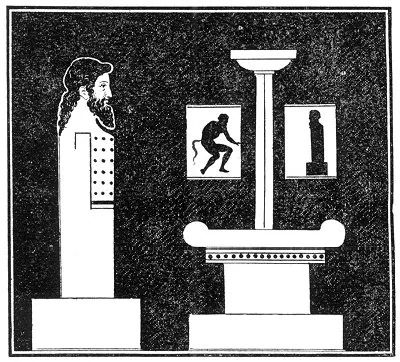
EXAMPLES OF HERMÆ.
From Christie's Disquisitions upon the Painted Greek Vases.
The Primitive custom of worshiping the gods in the form of heaps of stones gave place to the practice of erecting phallic pillars, or cones, in their honor. These columns differed widely in size and appearance. Some were of gigantic proportions and were richly ornamented with inscriptions or likenesses of the gods and heroes; others--like the votive offerings of the Babylonians--were but a few inches high, without ornament, and merely bore a brief statement of the purpose for which they had been prepared or a hymn to the god of the temple in which they were placed. These small baked clay cones were identical in their symbolic meaning with the large hermæ set up by the roadside and in other public places. Later the upper end of the column was surmounted by a human head. Often two projections, or tenons, corresponding to shoulders were placed, one on either side, to support the wreaths of flowers adorning the columns. Offerings, usually of food, were placed near the hermæ. Occasionally these columns were used to uphold roofs and were numbered among the art objects ornamenting the villas of wealthy Romans.
will prove to be the metal of Uranus and radium to be the metal of Neptune.
The four Ages of the Greek mystics--the Golden Age, the Silver Age, the Bronze Age, and the Iron Age--are metaphoric expressions referring to the four major periods in the life of all things. In the divisions of the day they signify dawn, midday, sunset, and midnight; in the duration of gods, men, and universes, they denote the periods of birth, growth, maturity, and decay. The Greek Ages also bear a close correspondence to the four Yugas of the Hindus: Krita-Yuga, Treta-Yuga, Dvapara-Yuga, and Kali-Yuga. Their method of calculation is described by Ullamudeian as follows: "In each of the 12 signs there are 1800 minutes; multiply this number by 12 you have 21600; e.g. 1800 X 12=21600. Multiply this 21600 by 80 and it will give 1,728,000, which is the duration of the first age, called Krita-Yuga. If the same number be multiplied by 60, it will give 1,296,000, the years of the second age, Treta-Yuga. The same number multiplied by 40 gives 864,000, the length of the third age, Dvapara-Yuga. The same multiplied by 20 gives 432,000, the fourth age, Kali-Yuga." (It will be noted that these multipliers decrease in inverse ratio to the Pythagorean tetractys: 1, 2, 3, and 4.)
H. P. Blavatsky declares that Orpheus taught his followers how to affect a whole audience by means of a lodestone, and that Pythagoras paid particular attention to the color and nature of precious stones. She adds: "The Buddhists assert that the sapphire produces peace of mind, equanimity, and chases all evil thoughts by establishing a healthy circulation in man. So does an electric battery, with its well-directed fluid, say our electricians. 'The sapphire,' say the Buddhists, 'will open barred doors and dwellings (for the spirit of man); it produces a desire for prayer, and brings with it more peace than any other gem; but he who would wear it must lead a pure and holy life."' (See Isis Unveiled.)
Mythology abounds with accounts of magical rings and talismanic jewels. In the second book of his Republic, Plato describes a ring which, when the collet was turned in ward, rendered its wearer invisible. With this Gyges, the shepherd, secured for himself the throne of Lydia. Josephus also describes magical rings designed by Moses and King Solomon, and Aristotle mentions one which brought love and honor to its possessor. In his chapter dealing with the subject, Henry Cornelius Agrippa not only mentions the same rings, but states, upon the authority of Philostratus Jarchus, that Apollonius of Tyana extended his life to over 20 years with the aid of seven magical rings presented to him by an East Indian prince. Each of these seven rings was set with a gem partaking of the nature of one of the seven ruling planets of the week, and by daily changing the rings Apollonius protected himself against sickness and death by the intervention of the planetary influences. The philosopher also instructed his disciples in the virtues of these talismanic jewels, considering such information to be indispensable to the theurgist. Agrippa describes the preparation of magical rings as follows: "When any Star [planet] ascends fortunately, with the fortunate aspect or conjunction of the Moon, we must take a stone and herb that is under that Star, and make a ring of the metal that is suitable to this Star, and in it fasten the stone, putting the herb or root under it-not omitting the inscriptions of images, names, and characters, as also the proper suffumigations." (See Three Books of Occult Philosophy.)
The ring has long been regarded as the symbol of attainment, perfection, and immortality-the last because the circlet of precious metal had neither beginning nor end. In the Mysteries, rings chased to resemble a serpent with its tail in its mouth were worn by the initiates as material evidence of the position reached by them in the order. Signet rings, engraved with certain secret emblems, were worn by the hierophants, and it was not uncommon for a messenger to prove that he was the official representative of a prince or other dignitary by bringing with his message either an impression from his master's ring or the signet itself. The wedding ring originally was intended to imply that in the nature of the one who wore it the state of equilibrium and completion had been attained. This plain band of gold therefore bore witness of the union of the Higher Self (God) with the lower self (Nature) and the ceremony consummating this indissoluble blending of Divinity and humanity in the one nature of the initiated mystic constituted the hermetic marriage of the Mysteries.
In describing the regalia of a magician, Eliphas Levi declares that on Sunday (the day of the sun) he should carry in his right hand a golden wand, set with a ruby or chrysolite; on Monday (the day of the moon) he should wear a collar of three strands consisting of pearls, crystals, and selenites; on Tuesday (the day of Mars) he should carry a wand of magnetized steel and a ring of the same metal set with an amethyst, on Wednesday (the day of Mercury) he should wear a necklace of pearls or glass beads containing mercury, and a ring set with an agate; on Thursday (the day of Jupiter) he should carry a wand of glass or resin and wear a ring set with an emerald or a sapphire; on Friday (the day of Venus) he should carry a wand of polished copper and wear a ring set with a turquoise and a crown or diadem decorated with lapis lazuli and beryl; and on Saturday (the day of Saturn) he should carry a wand ornamented with onyx stone and wear a ring set with onyx and a chain about the neck formed of lead. (See The Magical Ritual of the Sanctum Regnum.)
Paracelsus, Agrippa, Kircher, Lilly, and numerous other magicians and astrologers have tabulated the gems and stones corresponding to the various planets and zodiacal signs. The following list has been compiled from their writings. To the sun is assigned the carbuncle, ruby, garnet---especially the pyrope--and other fiery stones, sometimes the diamond; to the moon, the pearl, selenite, and other forms of crystal; to Saturn, the onyx, jasper, topaz, and sometimes the lapis lazuli; to Jupiter, the sapphire, emerald, and marble; to Mars, the amethyst, hyacinth, lodestone, sometimes the diamond; to Venus, the turquoise, beryl, emerald, and sometimes the pearl, alabaster, coral, and carnelian; to Mercury, the chrysolite, agate, and variegated marble.
To the zodiac the same authorities assigned the following gems and stones: To Aries the sardonyx, bloodstone, amethyst, and diamond; to Taurus the carnelian, turquoise, hyacinth, sapphire, moss agate, and emerald; to Gemini the topaz, agate, chrysoprase, crystal, and aquamarine; to Cancer the topaz, chalcedony, black onyx, moonstone, pearl, cat's-eye, crystal, and sometimes the emerald; to Leo the jasper, sardonyx, beryl, ruby, chrysolite, amber, tourmaline, sometimes the diamond; to Virgo the emerald, camelian, jade, chrysolite, and sometimes the pink jasper and hyacinth; to Libra the beryl, sardius, coral, lapis lazuli, opal, and sometimes the diamond; to Scorpio the amethyst, beryl, sardonyx, aquamarine, carbuncle, lodestone, topaz, and malachite; to Sagittarius die hyacinth, topaz, chrysolite, emerald, carbuncle, and turquoise; to Capricorn the chrysoprase, ruby, malachite, black onyx, white onyx, jet, and moonstone; to Aquarius the crystal, sapphire, garnet, zircon, and opal; to Pisces the sapphire, jasper, chrysolite, moonstone, and amethyst
Both the magic mirror and the crystal ball are symbols little understood. Woe to that benighted mortal who accepts literally the stories circulated concerning them! He will discover--often at the cost of sanity and health--that sorcery and philosophy, while often confused, have nothing in common. The Persian Magi carried mirrors as an emblem of the material sphere which reflects Divinity from its every part. The crystal ball, long misused as a medium for the cultivation of psychical powers, is a threefold symbol: (1) it signifies the crystalline Universal Egg in whose transparent depths creation exists; (2) it is a proper figure of Deity previous to Its immersion in matter; (3) it signifies the ætheric sphere of the world in whose translucent essences is impressed and preserved the perfect image of all terrestrial activity.
Meteors, or rocks from heaven, were considered tokens of divine favor and enshrined as evidence of a pact between the gods and the community in which they fell. Curiously marked or chipped natural stones are occasionally found. In China there is a slab of marble the grain of which forms a perfect likeness of the Chinese dragon. The Oberammergau stone, chipped by Nature into a close resemblance to the popular conception of the face of Christ, is so remarkable that even the crowned heads of Europe requested the privilege of beholding it. Stones of such nature were held in the highest esteem among primitive peoples and even today exert a wide influence upon the religiously-minded.
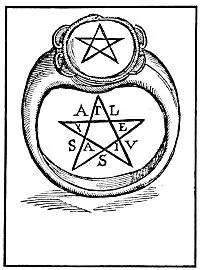
THE PYTHAGOREAN SIGNET RING.
From Cartari's Imagini degli Dei degli Antichi.
The number five was peculiarly associated by the Pythagoreans with the art of healing, and the pentagram, or five-pointed star, was to them the symbol of health. The above figure represents a magical ring set with a talismanic gem bearing the pentalpha, or star formed by five different positions of the Greek Alpha. On this subject Mackey writes: "The disciples of Pythagoras, who were indeed its real inventors, placed within each of its interior angles one of the letters of the Greek word ΥΓΕΙΑ, or the Latin one SALUS, both of which signify health; and thus it was made the talisman of health. They placed it at the beginning of their epistles as a greeting to invoke a secure health to their correspondent. But its use was not confined to the disciples of Pythagoras. As a talisman, it was employed all over the East as a charm to resist evil spirits."
CEREMONIAL MAGIC AND SORCERY
CEREMONIAL magic is the ancient art of invoking and controlling spirits by a scientific application of certain formulæ. A magician, enveloped in sanctified vestments and carrying a wand inscribed with hieroglyphic figures, could by the power vested in certain words and symbols control the invisible inhabitants of the elements and of the astral world. While the elaborate ceremonial magic of antiquity was not necessarily evil, there arose from its perversion several false schools of sorcery, or black magic.
Egypt, a great center of learning and the birthplace of many arts and sciences, furnished an ideal environment for transcendental experimentation. Here the black magicians of Atlantis continued to exercise their superhuman powers until they had completely undermined and corrupted the morals of the primitive Mysteries. By establishing a sacerdotal caste they usurped the position formerly occupied by the initiates, and seized the reins of spiritual government. Thus black magic dictated the state religion and paralyzed the intellectual and spiritual activities of the individual by demanding his complete and unhesitating acquiescence in the dogma formulated by the priestcraft. The Pharaoh became a puppet in the hands of the Scarlet Council--a committee of arch-sorcerers elevated to power by the priesthood.
These sorcerers then began the systematic destruction of all keys to the ancient wisdom, so that none might have access to the knowledge necessary to reach adeptship without first becoming one of their order. They mutilated the rituals of the Mysteries while professing to preserve them, so that even though the neophyte passed through the degrees he could not secure the knowledge to which he was entitled. Idolatry was introduced by encouraging the worship of the images which in the beginning the wise had erected solely as symbols for study and meditation. False interpretations were given to the emblems and figures of the Mysteries, and elaborate theologies were created to confuse the minds of their devotees. The masses, deprived of their birthright of understanding and groveling in ignorance, eventually became the abject slaves of the spiritual impostors. Superstition universally prevailed and the black magicians completely dominated national affairs, with the result that humanity still suffers from the sophistries of the priestcrafts of Atlantis and Egypt.
Fully convinced that their Scriptures sanctioned it, numerous mediæval Qabbalists devoted their lives to the practice of ceremonial magic. The transcendentalism of the Qabbalists is founded upon the ancient and magical formula of King Solomon, who has long been considered by the Jews as the prince of ceremonial magicians.
Among the Qabbalists of the Middle Ages were a great number of black magicians who strayed from the noble concepts of the Sepher Yetzirah and became enmeshed in demonism and witchcraft. They sought to substitute magic mirrors, consecrated daggers, and circles spread around posts of coffin nails, for the living of that virtuous life which, without the assistance of complicated rituals or submundane creatures, unfailingly brings man to the state of true individual completion.
Those who sought to control elemental spirits through ceremonial magic did so largely with the hope of securing from the invisible worlds either rare knowledge or supernatural power. The little red demon of Napoleon Bonaparte and the infamous oracular heads of de Medici are examples of the disastrous results of permitting elemental beings to dictate the course of human procedure. While the learned and godlike dæmon of Socrates seems to have been an exception, this really proves that the intellectual and moral status of the magician has much to do with the type of elemental he is capable of invoking. But even the dæmon of Socrates deserted the philosopher when the sentence of death was passed.
Transcendentalism and all forms of phenomenalistic magic are but blind alleys--outgrowths of Atlantean sorcery; and those who forsake the straight path of philosophy to wander therein almost invariably fall victims to their imprudence. Man, incapable of controlling his own appetites, is not equal to the task of governing the fiery and tempestuous elemental spirits.
Many a magician has lost his life as the result of opening a way whereby submundane creatures could become active participants in his affairs. When Eliphas Levi invoked the spirit of Apollonius of Tyana, what did he hope to accomplish? Is the gratification of curiosity a motive sufficient to warrant the devotion of an entire lifetime to a dangerous and unprofitable pursuit? If the living Apollonius refused to divulge his secrets to the profane, is there any probability that after death he would disclose them to the curious-minded? Levi himself did not dare to assert that the specter which appeared to him was actually the great philosopher, for Levi realized only too well the proclivity of elementals to impersonate those who have passed on. The majority of modern mediumistic apparitions are but elemental creatures masquerading through bodies composed of thought substance supplied by the very persons desiring to behold these wraiths of decarnate beings.
THE THEORY AND PRACTICE OF BLACK MAGIC
Some understanding of the intricate theory and practice of ceremonial magic may be derived from a brief consideration of its underlying premises.
First. The visible universe has an invisible counterpart, the higher planes of which are peopled by good and beautiful spirits; the lower planes, dark and foreboding, are the habitation of evil spirits and demons under the leadership of the Fallen Angel and his ten Princes.
Second. By means of the secret processes of ceremonial magic it is possible to contact these invisible creatures and gain their help in some human undertaking. Good spirits willingly lend their assistance to any worthy enterprise, but the evil spirits serve only those who live to pervert and destroy.
Third. It is possible to make contracts with spirits whereby the magician becomes for a stipulated time the master of an elemental being.
Fourth. True black magic is performed with the aid of a demoniacal spirit, who serves the sorcerer for the length of his earthly life, with the understanding that after death the magician shall become the servant of his own demon. For this reason a black magician will go to inconceivable ends to prolong his physical life, since there is nothing for him beyond the grave.
The most dangerous form of black magic is the scientific perversion of occult power for the gratification of personal desire. Its less complex and more universal form is human selfishness, for selfishness is the fundamental cause of all worldly evil. A man will barter his eternal soul for temporal power, and down through the ages a mysterious process has been evolved which actually enables him to make this exchange. In its various branches the black art includes nearly all forms of ceremonial magic, necromancy, witchcraft, sorcery, and vampirism. Under the same general heading are also included mesmerism and hypnotism, except when used solely for medical purposes, and even then there is an element of risk for all concerned.
Though the demonism of the Middle Ages seems to have disappeared, there is abundant evidence that in many forms of modern thought--especially the so-called "prosperity" psychology, "willpower-building" metaphysics, and systems of "high-pressure" salesmanship--
BAPHOMET, THE GOAT OF MENDES.
From Levi's Transcendental Magic.
The practice of magic--either white or black--depends upon the ability of the adept to control the universal life force--that which Eliphas Levi calls the great magical agent or the astral light. By the manipulation of this fluidic essence the phenomena of transcendentalism are produced. The famous hermaphroditic Goat of Mendes was a composite creature formulated to symbolize this astral light. It is identical with Baphomet the mystic pantheos of those disciples of ceremonial magic, the Templars, who probably obtained it from the Arabians.
black magic has merely passed through a metamorphosis, and although its name be changed its nature remains the same.
A well-known magician of the Middle Ages was Dr. Johannes Faustus, more commonly known as Dr. Faust. By a study of magical writings he was enabled to bind to his service an elemental who served him for many years in various capacities. Strange legends are told concerning the magical powers possessed by Dr. Faust. Upon one occasion the philosopher, being apparently in a playful mood, threw his mantle over a number of eggs in a market-woman's basket, causing them to hatch instantly. At another time, having fallen overboard from a small boat, he was picked up and returned to the craft with his clothes still dry. But, like nearly all other magicians, Dr. Faust came at length to disaster; he was found one morning with a knife in his back, and it was commonly believed that his familiar spirit had murdered him. Although Goethe's Dr. Faust is generally regarded as merely a fictional character, this old magician actually lived during the sixteenth century. Dr. Faust wrote a book describing his experiences with spirits, a section of which is reprinted below. (Dr. Faust must not be confused with Johann Fust, the printer.)
EXTRACT FROM THE BOOK OF DR. FAUST, WITTENBERG, 1524
(An abridged translation from the original German of a book ordered destroyed.)
"From my youth I followed art and science and was tireless in my reading of books. Among those which came to my hand was a volume containing all kinds of invocations and magical formulæ. In this book I discovered information to the effect that a spirit, whether he be of the fire, the water, the earth or the air, can be compelled to do the will of a magician capable of controlling him. I also discovered that according as one spirit has more power than another, each is adapted for a different operation and each is capable of producing certain supernatural effects.
"After reading this wonderful book, I made several experiments, desiring to rest the accuracy of the statements made therein. At first I had little faith that what was promised would take place. But at the very first invocation which I attempted a mighty spirit manifested to me, desiring to know why I had invoked him. His coming so amazed me that I scarcely knew what to say, but finally asked him if he would serve me in my magical investigations. He replied that if certain conditions were agreed upon he would. The conditions were that I should make a pact with him. This I did not desire to do, but as in my ignorance I had not protected myself with a circle and was actually at the mercy of the spirit, I did not dare to refuse his request and resigned myself to the inevitable, considering it wisest to turn my mantle according to the wind.
"I then told him that if he would be serviceable to me according to my desires and needs for a certain length of time, I would sign myself over to him. After the pact had been arranged, this mighty spirit, whose name was Asteroth, introduced me to another spirit by the name of Marbuel, who was appointed to be my servant. I questioned Marbuel as to his suitability for my needs. I asked him how quick he was, and he answered, 'As swift as the winds.' This did not satisfy me, so I replied, 'You cannot become my servant. Go again whence you have come.' Soon another spirit manifested itself, whose name was Aniguel. Upon asking him the same question he answered that he was swift as a bird in the air. I said, 'You are still too slow for me. Go whence you came.' In the same moment another spirit by the name of Aciel manifested himself. For the third time I asked my question and he answered, 'I am as swift as human thought.' 'You shall serve me,' I replied. This spirit was faithful for a long time, but to tell you how he served me is not possible in a document of this length and I will here only indicate how spirits are to be invoked and how the circles for protection are to be prepared. There are many kinds of spirits which will permit themselves to be invoked by man and become his servant. Of these I will list a few:
"Aciel: The mightiest among those who serve men. He manifests in pleasing human form about three feet high. He must be invoked three times before he will come forth into the circle prepared for him. He will furnish riches and will instantly fetch things from a great distance, according to the will of the magician. He is as swift as human thought.
"Aniguel: Serviceable and most useful, and comes in the form of a ten-year-old boy. He must be invoked three times. His special power is to discover treasures and minerals hidden in the ground, which he will furnish to the magician.
"Marbuel: A true lord of the mountains and swift as a bird on the wing. He is an opposing and troublesome spirit, hard to control. You must invoke him four times. He appears in the person of Mars [a warrior in heavy armor]. He will furnish the magician those things which grow above and under the earth. He is particularly the lord of the spring-root. [The spring-root is a mysterious herb, possibly of a reddish color, which mediæval magicians asserted had the property of drawing forth or opening anything it touched. If placed against a locked door, it would open the door. The Hermetists believed that the red-capped woodpecker was specially endowed with the faculty of discovering spring-root, so they followed this bird to its nest, and then stopped up the hole in the tree where its young were. The red-crested woodpecker went at once in quest of the spring-root, and, discovering it, brought it to the tree. It immediately drew forth the stopper from the entrance to the nest. The magician then secured the root from the bird. It was also asserted that because of its structure, the etheric body of the spring-root was utilized as a vehicle of expression by certain elemental spirits which manifested through the proclivity of drawing out or opening things.]
"Aciebel: A mighty ruler of the sea, controlling things both upon and under the water. He furnishes things lost or sunk in rivers, lakes, and oceans, such as sunken ships and treasures. The more sharply you invoke him, the swifter he is upon his errands.
"Machiel: Comes in the form of a beautiful maiden and by her aid the magician is raised to honor and dignity. She makes those she serves worthy and noble, gracious and kindly, and assists in all matters of litigation and justice. She will not come unless invoked twice.
"Baruel: The master of all arts. He manifests as a master workman and comes wearing an apron. He can teach a magician more in a moment than all the master workmen of the world combined could accomplish in twenty years. He must be invoked three times.
"These are the spirits most serviceable to man, but there are numerous others which, for lack of space, I am unable to describe. Now, if you desire the aid of the spirit to get this or that, then you must first draw the sign of the spirit whom you desire to invoke. The drawing must be made just in front of a circle made before sunrise, in which you and your assistants will stand. If you desire financial assistance, then you must invoke the spirit Aciel. Draw his sign in front of the circle. If you need other things, then draw the sign of the spirit capable of furnishing them. On the place where you intend to make the circle, you must first draw a great cross with a large sword with which no one ever has been hurt. Then you must make three concentric circles. The innermost circle is made of a
A MAGICAL SWORD.
From Levi's The Magical Ritual.
Eliphas Levi describes the preparation of a magical sword in substance as follows: The steel blade should be forged in the hour of Mars, with new tools. The pommel should be of hollow silver containing quicksilver, and the symbols of Mercury and the moon and the signatures of Gabriel and Samael should be engraved upon it. The hilt should be encased with tin, with the symbol of Jupiter and the signature of Michael engraved upon it. A copper triangle should extend from the hilt along the blade a short distance on each side: these should bear the symbols of Mercury and Venus. Five Sephiroth should be engraved upon the handle, as shown. The blade itself should have the word Malchut upon one side and Quis ut Deus upon the other. The sword should be consecrated on Sunday.
A MAGIC CIRCLE.
From The Complete Book of Magic Science (unpublished).
The above figure is a complete and faithful representation of a magic circle as designed by mediæval conjurers for the invocation of spirits. The magician accompanied by his assistant takes his place at the point formed by the crossing of the central lines marked MAGISTER. The words about the circle are the names of the invisible intelligences, and the small crosses mark points at which certain prayers and invocations are recited. The small circle outside is prepared for the spirit to be invoked, and while in use has the signature of the desired intelligence traced within the triangle.
long narrow strip of virgin parchment and must be hung upon twelve crosses made of the wood of cross-thorn. Upon the parchment you must write the names and symbols according to the figure which follows. Outside this first circle make the second as follows:
"First secure a thread of red silk that has been spun or twisted to the left instead of the right. Then place in the ground twelve crosses made of laurel leaves, and also prepare a long strip of new white paper. Write with an unused pen the characters and symbols as seen on the second circle. Wind this latter strip of paper around with the red silken thread and pin them upon the twelve crosses of laurel leaves. Outside this second circle make a third one which is also of virgin parchment and pinned upon twelve crosses of consecrated palm. When you have made these three circles, retire into them until at last you stand in the center upon a pentagram drawn in the midst of the great cross first drawn. Now, to insure success, do everything according to the description, and when you have read off the sacred invocation pronounce the name of the spirit which you desire to appear. It is essential that you pronounce the name very distinctly. You must also note the day and the hour, for each spirit can only be invoked at certain times."
While the black magician at the time of signing his pact with the elemental demon maybe fully convinced that he is strong enough to control indefinitely the powers placed at his disposal, he is speedily undeceived. Before many years elapse he must turn all his energies to the problem of self-preservation. A world of horrors to which he has attuned himself by his own covetousness looms nearer every day, until he exists upon the edge of a seething maelstrom, expecting momentarily to be sucked down into its turbid depths. Afraid to die--because he will become the servant of his own demon--the magician commits crime after crime to prolong his wretched earthly existence. Realizing that life is maintained by the aid of a mysterious universal life force which is the common property of all creatures, the black magician often becomes an occult vampire, stealing this energy from others. According to mediæval superstition, black magicians turned themselves into werewolves and roamed the earth at night, attacking defenseless victims for the life force contained in their blood.
MODUS OPERANDI FOR THE INVOCATION OF SPIRITS
The following condensed extract from an ancient manuscript is reproduced herewith as representative of the ritualism of ceremonial magic. The extract is from The Complete Book of Magic Science, an unpublished manuscript (original in the British Museum), with pentacles in colors, mentioned by Francis Barrett in his Magus.
"Opening Prayer
"Omnipotent and Eternal God who hath ordained the whole creation for thy praise and glory and for the salvation of man, I earnestly beseech thee that thou wouldst send one of thy spirits of the order of Jupiter, one of the messengers of Zadkiel whom thou hast appointed governor of thy firmament at the present time, most faithfully, willingly, and readily to show me these things which I shall ask, command or require of him, and truly execute my desires. Nevertheless, O Most Holy God, thy will and not mine be done through JC, thine only begotten Son our Lord. Amen.
"The Invocation.
[The magician, having properly consecrated his vestments and utensils and being protected by his circle, now calls upon the spirits to appear and accede to his demands.]
"Spirits, whose assistance I require, behold the sign and the very Hallowed Names of God full of power. Obey the power of this our pentacle; go out your hidden caves and dark places; cease your hurtful occupations to those unhappy mortals whom without ceasing you torment; come into this place where the Divine Goodness has assembled us; be attentive to our orders and known to our just demands; believe not that your resistance will cause us to abandon our operations. Nothing can dispense with your obeying us. We command you by the Mysterious Names Elohe Agla Elohim Adonay Gibort. Amen.
"I call upon thee, Zadkiel, in the Name of the Father, and of the Son, and of the Holy Ghost, blessed Trinity, unspeakable Unity.
"I invoke and intreat thee, Zadkiel, in this hour to attend to the words and conjurations which I shall use this day by the Holy Names of God Elohe El Elohim Elion Zebaoth Escerehie Iah Adonay Tetragrammaton.
"I conjure thee, I exorcise thee, thou Spirit Zadkiel, by these Holy Names Hagios O Theos Iscyros Athanatos Paracletus Agla on Alpha et Omega Ioth Aglanbroth Abiel Anathiel Tetragrammaton: And by all other great and glorious, holy and unspeakable, mysterious, mighty, powerful, incomprehensible Names of God, that you attend unto the words of my mouth, and send unto me Pabiel or other of your ministering, serving Spirits, who may show me such things as I shall demand of him in the Name of the Father, and of the Son, and of the Holy Ghost. Amen.
"I intreat thee, Pabiel, by the whole Spirit of Heaven, Seraphim, Cherubim, Thrones, Dominations, Witnesses, Powers, Principalities, Archangels, and Angels, by the holy, great, and glorious Angels Orphaniel Tetra-Dagiel Salamla Acimoy pastor poti, that thou come forthwith, readily show thyself that we may see you and audibly hear you, speak unto us and fulfil our desires, and by your star which is Jupiter, and by all the constellations of Heaven, and by whatsoever you obey, and by your character which you have given, proposed, and confirmed, that you attend unto me according to the prayer and petitions which I have made unto Almighty God, and that you forthwith send me one of your ministering Spirits, who may willingly, truly, and faithfully fulfil all my desires, and that you command him to appear unto me in the form of a beautiful Angel, gently, courteously, affably, and meekly, entering into communication with me, and that he neither permitting any evil Spirit to approach in any sort of hurt, terrify or affright me in any way nor deceiving me in any wise. Through the virtue of Our Lord JC, in whose Name I attend, wait for, and expect thy appearance. Fiat, fiat, fiat. Amen, Amen, Amen.
"Interrogatories.
[Having summoned the spirit unto his presence, the magician shall question him as follows:]
"'Comest thou in peace in the Name of the Father and of the Son and of the Holy Ghost?' [And the spirit shall answer:] 'Yes.'
"'Thou art welcome, noble Spirit. What is thy Name?' [And the spirit shall answer:] 'Pabiel.'
"'I have called thee in the Name of Jesu of Nazareth at whose Name every knee doth bow in heaven, earth, and hell, and every tongue shall confess there is no name like unto the Name of Jesus, who hath given power unto man to bind and to loose all things in his most Holy Name, yea even unto those that trust in his salvation.
"'Art thou the messenger of Zadkiel?' [And the spirit shall answer:] 'Yes.'
"'Wilt thou confirm thyself unto me at this time and henceforth reveal all things unto me that I shall desire to know, and teach me how I may increase in wisdom and knowledge and show unto me all the secrets of the Magic Art, and of all liberal sciences, that I may thereby set forth the glory of Almighty God?' [And the spirit shall answer:] 'Yes.'
"'Then I pray thee give and confirm thy character unto me whereby I may call thee at all times, and also swear unto me this oath and I will religiously keep my vow and covenant unto Almighty God and will courteously receive thee at all times where thou dost appear unto me.'
"License to Depart.
"'Forasmuch as thou comest in peace and quietness and hath answered
THE PENTAGRAM.
From Levi's Transcendental Magic.
THE PENTAGRAM. The pentagram is the figure of the microcosm--the magical formula of man. It is the one rising out of the four--the human soul rising from the bondage of the animal nature. It is the true light--the "Star of the morning." It marks the location of five mysterious centers of force, the awakening of which is the supreme secret of white magic.
FORM OF PACT WITH THE SPIRIT OF JUPITER.
From The Complete Book of Magic Science.
The aforesaid Bond of spirits, together with the seal and character of the planetary angel, must be written m virgin Parchment and laid before the Spirit [for signature] when he appears; at that time the invocant must not lost confidence but be patient, firm, bold, and Persevering, and take care that he asks nor requires nothing of the Spirit but with a view to the glory of God and the well-being fellow creatures. Having obtained his desires of the Spirit, the invocant may license him to depart."
unto my petitions, I give humble and hearty thanks unto Almighty God in whose Name I called and thou camest, and now thou mayest depart in peace unto thine orders and return unto me again at what time soever I shall call thee by thine oath, or by thy name or by thine order, or by thine office which is granted thee from the Creator, and the power of God be with me and thee and upon the whole issue of God, Amen.
"'Glory be to the Father, and to the Son, and to the Holy Ghost.'
[Note.] "It would be advisable for the invocant to remain in the circle for a few minutes after reciting the license, and if the place of operation be in the open air, let him destroy all traces of the circle, etcetera, and return quietly to his home. But should the operation be performed in a retired part of a house, cc cetera, the circle may remain, as it might serve in alike future operation, but the room or building must be locked up to avoid the intrusion of strangers."
The agreement set forth above is purely ceremonial magic. In the case of black magic, it is the magician and not the demon who must sign the pact. When the black magician binds an elemental to his service, a battle of wits ensues, which the demon eventually wins. With his own blood the magician signs the pact between himself and the demon, for in the arcanum of magic it is declared that "he controls the soul who controls the blood of another." As long as the magician does not fail, the elemental will fulfil to the letter his obligation under the pact, but the demon will try in every possible way to prevent the magician from carrying out his part of the contract. When the conjurer, ensconced within his circle, has evoked the spirit he desires to control and has made known his intention, the spirit will answer somewhat as follows: "I cannot accede to your request nor fulfil it, unless after fifty years you give yourself to me, body and soul, to do with as I may please."
If the magician refuses, other terms will be discussed. The spirit may say: "I will remain in your service as long as on every Friday morning you will go forth upon the public street giving alms in the name of Lucifer. The first time you fail in this you belong to me."
If the magician still refuses, realizing that the demon will make it impossible for him to fulfil his contract, other terms will be discussed, until at last a pact is agreed upon. It may read as follows: "I hereby promise the Great Spirit Lucifuge, Prince of Demons, that each year I will bring unto him a human soul to do with as it may please him, and in return Lucifuge promises to bestow upon me the treasures of the earth and fulfil my every desire for the length of my natural life. If I fail to bring him each year the offering specified above, then my own soul shall be forfeit to him. Signed . . . . . . . . . . . . . " [Invocant signs pact with his own blood.]
THE PENTAGRAM
In symbolism, an inverted figure always signifies a perverted power. The average person does not even suspect the occult properties of emblematic pentacles. On this subject the great Paracelsus has written: "No doubt many will scoff at the seals, their characters and their uses, which are described in these books, because it seems incredible to them that metals and characters which are dead should have any power and effect. Yet no one has ever proved that the metals and also the characters as we know them are dead, for the salts, sulphur, and quintessences of metals are the highest preservatives of human life and are far superior to all other simples." (Translated from the original German.)
The black magician cannot use the symbols of white magic without bringing down upon himself the forces of white magic, which would be fatal to his schemes. He must therefore distort the hierograms so that they typify the occult fact that he himself is distorting the principles for which the symbols stand. Black magic is not a fundamental art; it is the misuse of an art. Therefore it has no symbols of its own. It merely takes the emblematic figures of white magic, and by inverting and reversing them signifies that it is left-handed.
A good instance of this practice is found in the pentagram, or five-pointed star, made of five connected lines. This figure is the time-honored symbol of the magical arts, and signifies the five properties of the Great Magical Agent, the five senses of man, the five elements of nature, the five extremities of the human body. By means of the pentagram within his own soul, man not only may master and govern all creatures inferior to himself, but may demand consideration at the hands of those superior to himself.
The pentagram is used extensively in black magic, but when so used its form always differs in one of three ways: The star may be broken at one point by not permitting the converging lines to touch; it may be inverted by having one point down and two up; or it may be distorted by having the points of varying lengths. When used in black magic, the pentagram is called the "sign of the cloven hoof," or the footprint of the Devil. The star with two points upward is also called the "Goat of Mendes," because the inverted star is the same shape as a goat's head. When the upright star turns and the upper point falls to the bottom, it signifies the fall of the Morning Star.
THE PENTACLES OF THE SEVEN PLANETS AND THE SEALS AND CHARACTERS OF THE PLANETARY ANGELS.
From a mediæval Book of Spirits (unpublished).
The seven large circle are the planets, while the two small circles under each contain the seal and the character of the controlling intelligence of the planet.
The Elements and Their Inhabitants
FOR the most comprehensive and lucid exposition of occult pneumatology (the branch of philosophy dealing with spiritual substances) extant, mankind is indebted to Philippus Aureolus Paracelsus (Theophrastus Bombastus von Hohenheim), prince of alchemists and Hermetic philosophers and true possessor of the Royal Secret (the Philosopher's Stone and the Elixir of Life). Paracelsus believed that each of the four primary elements known to the ancients (earth, fire, air, and water) consisted of a subtle, vaporous principle and a gross corporeal substance.
Air is, therefore, twofold in nature-tangible atmosphere and an intangible, volatile substratum which may be termed spiritual air. Fire is visible and invisible, discernible and indiscernible--a spiritual, ethereal flame manifesting through a material, substantial flame. Carrying the analogy further, water consists of a dense fluid and a potential essence of a fluidic nature. Earth has likewise two essential parts--the lower being fixed, terreous, immobile; the higher, rarefied, mobile, and virtual. The general term elements has been applied to the lower, or physical, phases of these four primary principles, and the name elemental essences to their corresponding invisible, spiritual constitutions. Minerals, plants, animals, and men live in a world composed of the gross side of these four elements, and from various combinations of them construct their living organisms.
Henry Drummond, in Natural Law in the Spiritual World, describes this process as follows: "If we analyse this material point at which all life starts, we shall find it to consist of a clear structureless, jelly-like substance resembling albumen or white of egg. It is made of Carbon, Hydrogen, Oxygen and Nitrogen. Its name is protoplasm. And it is not only the structural unit with which all living bodies start in life, but with which they are subsequently built up. 'Protoplasm,' says Huxley, 'simple or nucleated, is the formal basis of all life. It is the clay of the Potter.'"
The water element of the ancient philosophers has been metamorphosed into the hydrogen of modern science; the air has become oxygen; the fire, nitrogen; the earth, carbon.
Just as visible Nature is populated by an infinite number of living creatures, so, according to Paracelsus, the invisible, spiritual counterpart of visible Nature (composed of the tenuous principles of the visible elements) is inhabited by a host of peculiar beings, to whom he has given the name elementals, and which have later been termed the Nature spirits. Paracelsus divided these people of the elements into four distinct groups, which he called gnomes, undines, sylphs, and salamanders. He taught that they were really living entities, many resembling human beings in shape, and inhabiting worlds of their own, unknown to man because his undeveloped senses were incapable of functioning beyond the limitations of the grosser elements.
The civilizations of Greece, Rome, Egypt, China, and India believed implicitly in satyrs, sprites, and goblins. They peopled the sea with mermaids, the rivers and fountains with nymphs, the air with fairies, the fire with Lares and Penates, and the earth with fauns, dryads, and hamadryads. These Nature spirits were held in the highest esteem, and propitiatory offerings were made to them. Occasionally, as the result of atmospheric conditions or the peculiar sensitiveness of the devotee, they became visible. Many authors wrote concerning them in terms which signify that they had actually beheld these inhabitants of Nature's finer realms. A number of authorities are of the opinion that many of the gods worshiped by the pagans were elementals, for some of these invisibles were believed to be of commanding stature and magnificent deportment.
The Greeks gave the name dæmon to some of these elementals, especially those of the higher orders, and worshiped them. Probably the most famous of these dæmons is the mysterious spirit which instructed Socrates, and of whom that great philosopher spoke in the highest terms. Those who have devoted much study to the invisible constitution of man realize that it is quite probable the dæmon of Socrates and the angel of Jakob Böhme were in reality not elementals, but the overshadowing divine natures of these philosophers themselves. In his notes to Apuleius on the God of Socrates, Thomas Taylor says:
"As the dæmon of Socrates, therefore, was doubtless one of the highest order, as may be inferred from the intellectual superiority of Socrates to most other men, Apuleius is justified in calling this dæmon a God. And that the dæmon of Socrates indeed was divine, is evident from the testimony of Socrates himself in the First Alcibiades: for in the course of that dialogue he clearly says, 'I have long been of the opinion that the God did not as yet direct me to hold any conversation with you.' And in the Apology he most unequivocally evinces that this dæmon is allotted a divine transcendency, considered as ranking in the order of dæmons."
The idea once held, that the invisible elements surrounding and interpenetrating the earth were peopled with living, intelligent beings, may seem ridiculous to the prosaic mind of today. This doctrine, however, has found favor with some of the greatest intellects of the world. The sylphs of Facius Cardin, the philosopher of Milan; the salamander seen by Benvenuto Cellini; the pan of St. Anthony; and le petit homme rouge (the little red man, or gnome) of Napoleon Bonaparte, have found their places in the pages of history.
Literature has also perpetuated the concept of Nature spirits. The mischievous Puck of Shakespeare's Midsummer Night's Dream; the elementals of Alexander Pope's Rosicrucian poem, The Rape of the Lock, the mysterious creatures of Lord Lytton's Zanoni; James Barrie's immortal Tinker Bell; and the famous bowlers that Rip Van Winkle encountered in the Catskill Mountains, are well-known characters to students of literature. The folklore and mythology of all peoples abound in legends concerning these mysterious little figures who haunt old castles, guard treasures in the depths of the earth, and build their homes under the spreading protection of toadstools. Fairies are the delight of childhood, and most children give them up with reluctance. Not so very long ago the greatest minds of the world believed in the existence of fairies, and it is still an open question as to whether Plato, Socrates, and Iamblichus were wrong when they avowed their reality.
Paracelsus, when describing the substances which constitute the bodies of the elementals, divided flesh into two kinds, the first being that which we have all inherited through Adam. This is the visible, corporeal flesh. The second was that flesh which had not descended from Adam and, being more attenuated, was not subject to the limitations of the former. The bodies of the elementals were composed of this transubstantial flesh. Paracelsus stated that there is as much difference between the bodies of men and the bodies of the Nature spirits as there is between matter and spirit.
"Yet," he adds, "the Elementals are not spirits, because they have flesh, blood and bones; they live and propagate offspring; they cat and talk, act and sleep, &c., and consequently they cannot be properly called 'spirits.' They are beings occupying a place between men and spirits, resembling men and spirits, resembling men and women in their organization and form, and resembling spirits in the rapidity of their locomotion." (Philosophia Occulta, translated by Franz Hartmann.) Later the same author calls these creatures composita, inasmuch as the substance out of which they are composed seems to be a composite of spirit and matter. He uses color to explain the idea. Thus, the mixture of blue and red gives purple, a new color, resembling neither of the others yet composed of both. Such is the case with the Nature spirits; they resemble neither spiritual creatures nor material beings, yet are composed of the substance which we may call spiritual matter, or ether.
Paracelsus further adds that whereas man is composed of several natures (spirit, soul, mind, and body) combined in one unit, the elemental has but one principle, the ether out of which it is composed and in which it lives. The reader must remember that by ether
A SALAMANDER, ACCORDING TO PARACELSUS.
From Paracelsus' Auslegung von 30 magischen Figuren.
The Egyptians, Chaldeans, and Persians often mistook the salamanders for gods, because of their radiant splendor and great power. The Greeks, following the example of earlier nations, deified the fire spirits and in their honor kept incense and altar fire, burning perpetually.
is meant the spiritual essence of one of the four elements. There areas many ethers as there are elements and as many distinct families of Nature spirits as there are ethers. These families are completely isolated in their own ether and have no intercourse with the denizens of the other ethers; but, as man has within his own nature centers of consciousness sensitive to the impulses of all the four ethers, it is possible for any of the elemental kingdoms to communicate with him under proper conditions.
The Nature spirits cannot be destroyed by the grosser elements, such as material fire, earth, air, or water, for they function in a rate of vibration higher than that of earthy substances. Being composed of only one element or principle (the ether in which they function), they have no immortal spirit and at death merely disintegrate back into the element from which they were originally individualized. No individual consciousness is preserved after death, for there is no superior vehicle present to contain it. Being made of but one substance, there is no friction between vehicles: thus there is little wear or tear incurred by their bodily functions, and they therefore live to great age. Those composed of earth ether are the shortest lived; those composed of air ether, the longest. The average length of life is between three hundred and a thousand years. Paracelsus maintained that they live in conditions similar to our earth environments, and are somewhat subject to disease. These creatures are thought to be incapable of spiritual development, but most of them are of a high moral character.
Concerning the elemental ethers in which the Nature spirits exist, Paracelsus wrote: "They live in the four elements: the Nymphæ in the element of water, the Sylphes in that of the air, the Pigmies in the earth, and the Salamanders in fire. They are also called Undinæ, Sylvestres, Gnomi, Vulcani, &c. Each species moves only in the element to which it belongs, and neither of them can go out of its appropriate element, which is to them as the air is to us, or the water to fishes; and none of them can live in the element belonging to another class. To each elemental being the element in which it lives is transparent, invisible and respirable, as the atmosphere is to ourselves." (Philosophia Occulta, translated by Franz Hartmann.)
The reader should be careful not to confuse the Nature spirits with the true life waves evolving through the invisible worlds. While the elementals are composed of only one etheric (or atomic) essence, the angels, archangels, and other superior, transcendental entities have composite organisms, consisting of a spiritual nature and a chain of vehicles to express that nature not unlike those of men, but not including the physical body with its attendant limitations.
To the philosophy of Nature spirits is generally attributed an Eastern origin, probably Brahmanic; and Paracelsus secured his knowledge of them from Oriental sages with whom he came in contact during his lifetime of philosophical wanderings. The Egyptians and Greeks gleaned their information from the same source. The four main divisions of Nature spirits must now be considered separately, according to the teachings of Paracelsus and the Abbé de Villars and such scanty writings of other authors as are available.
THE GNOMES
The elementals who dwell in that attenuated body of the earth which is called the terreous ether are grouped together under the general heading of gnomes. (The name is probably derived from the Greek genomus, meaning earth dweller. See New English Dictionary.)
Just as there are many types of human beings evolving through the objective physical elements of Nature, so there are many types of gnomes evolving through the subjective ethereal body of Nature. These earth spirits work in an element so close in vibratory rate to the material earth that they have immense power over its rocks and flora, and also over the mineral elements in the animal and human kingdoms. Some, like the pygmies, work with the stones, gems, and metals, and are supposed to be the guardians of hidden treasures. They live in caves, far down in what the Scandinavians called the Land of the Nibelungen. In Wagner's wonderful opera cycle, The Ring of the Nibelungen, Alberich makes himself King of the Pygmies and forces these little creatures to gather for him the treasures concealed beneath the surface of the earth.
Besides the pygmies there are other gnomes, who are called tree and forest sprites. To this group belong the sylvestres, satyrs, pans, dryads, hamadryads, durdalis, elves, brownies, and little old men of the woods. Paracelsus states that the gnomes build houses of substances resembling in their constituencies alabaster, marble, and cement, but the true nature of these materials is unknown, having no counterpart in physical nature. Some families of gnomes gather in communities, while others are indigenous to the substances with and in which they work. For example, the hamadryads live and die with the plants or trees of which they are a part. Every shrub and flower is said to have its own Nature spirit, which often uses the physical body of the plant as its habitation. The ancient philosophers, recognizing the principle of intelligence manifesting itself in every department of Nature alike, believed that the quality of natural selection exhibited by creatures not possessing organized mentalities expressed in reality the decisions of the Nature spirits themselves.
C. M. Gayley, in The Classic Myths, says: "It was a pleasing trait in the old paganism that it loved to trace in every operation of nature the agency of deity. The imagination of the Greeks peopled the regions of earth and sea with divinities, to whose agency it attributed the phenomena that our philosophy ascribes to the operation of natural law." Thus, in behalf of the plant it worked with, the elemental accepted and rejected food elements, deposited coloring matter therein, preserved and protected the seed, and performed many other beneficent offices. Each species was served by a different but appropriate type of Nature spirit. Those working with poisonous shrubs, for example, were offensive in their appearance. It is said the Nature spirits of poison hemlock resemble closely tiny human skeletons, thinly covered with a semi-transparent flesh. They live in and through the hemlock, and if it be cut down remain with the broken shoots until both die, but while there is the slightest evidence of life in the shrub it shows the presence of the elemental guardian.
Great trees also have their Nature spirits, but these are much larger than the elementals of smaller plants. The labors of the pygmies include the cutting of the crystals in the rocks and the development of veins of ore. When the gnomes are laboring with animals or human beings, their work is confined to the tissues corresponding with their own natures. Hence they work with the bones, which belong to the mineral kingdom, and the ancients believed the reconstruction of broken members to be impossible without the cooperation of the elementals.
The gnomes are of various sizes--most of them much smaller than human beings, though some of them have the power of changing their stature at will. This is the result of the extreme mobility of the element in which they function. Concerning them the Abbé de Villars wrote: "The earth is filled well nigh to its center with Gnomes, people of slight stature, who are the guardians of treasures, minerals and precious stones. They are ingenious, friends of man, and easy to govern."
Not all authorities agree concerning the amiable disposition of the gnomes. Many state that they are of a tricky and malicious nature, difficult to manage, and treacherous. Writers agree, however, that when their confidence is won they are faithful and true. The philosophers and initiates of the ancient world were instructed concerning these mysterious little people and were taught how to communicate with them and gain their cooperation in undertakings of importance. The magi were always warned, however, never to betray the trust of the elementals, for if they did, the invisible creatures, working through the subjective nature of man, could cause them endless sorrow and probably ultimate destruction. So long as the mystic served others, the gnomes would serve him, but if he sought to use their aid selfishly to gain temporal power they would turn upon him with unrelenting fury. The same was true if he sought to deceive them.
The earth spirits meet at certain times of the year in great conclaves, as Shakespeare suggests in his Midsummer Night's Dream, where the elementals all gather to rejoice in the beauty and harmony of Nature and the prospects of an excellent harvest. The gnomes are ruled over by a king, whom they greatly love and revere. His name is Gob; hence his subjects are often called goblins. Mediæval mystics gave a corner of creation (one of the cardinal points) to each of the four kingdoms of Nature spirits, and because of their earthy character the gnomes were assigned to the North--the place recognized by the ancients as the source of darkness and death. One of the four main divisions of human disposition was also assigned to the gnomes, and because so many of them dwelt in the darkness of caves and the gloom of forests their temperament was said to be melancholy, gloomy, and despondent. By this it is not meant that they themselves are of such disposition, but rather that they have special control over elements of similar consistency.
The gnomes marry and have families, and the female gnomes are called gnomides. Some wear clothing woven of the element in which they live. In other instances their garments are part of themselves and grow with them, like the fur of animals. The gnomes are said to have insatiable appetites, and to spend a great part of the rime eating, but they earn their food by diligent and conscientious
CONVENTIONAL GNOMES.
From Gjellerup's Den Ældre Eddas Gudesange.
The type of gnome most frequently seen is the brownie, or elf, a mischievous and grotesque little creature from twelve to eighteen inches high, usually dressed in green or russet brown. Most of them appear as very aged, often with long white beards, and their figures are inclined to rotundity. They can be seen scampering out of holes in the stumps of trees and sometimes they vanish by actually dissolving into the tree itself.
labor. Most of them are of a miserly temperament, fond of storing things away in secret places. There is abundant evidence of the fact that small children often see the gnomes, inasmuch as their contact with the material side of Nature is not yet complete and they still function more or less consciously in the invisible worlds.
According to Paracelsus, "Man lives in the exterior elements and the Elementals live in the interior elements. The latter have dwellings and clothing, manners and customs, languages and governments of their own, in the same sense as the bees have their queens and herds of animals their leaders." (Philosophia Occulta, translated by Franz Hartmann.)
Paracelsus differs somewhat from the Greek mystics concerning the environmental limitations imposed on the Nature spirits. The Swiss philosopher constitutes them of subtle invisible ethers. According to this hypothesis they would be visible only at certain times and only to those en rapport with their ethereal vibrations. The Greeks, on the other hand, apparently believed that many Nature spirits had material constitutions capable of functioning in the physical world. Often the recollection of a dream is so vivid that, upon awakening, a person actually believes that he has passed through a physical experience. The difficulty of accurately judging as to the end of physical sight and the beginning of ethereal vision may account for these differences of opinion.
Even this explanation, however, does not satisfactorily account for the satyr which, according to St. Jerome, was captured alive during the reign of Constantine and exhibited to the people. It was of human form with the horns and feet of a goat. After its death it was preserved in salt and taken to the Emperor that he might testify to its reality. (It is within the bounds of probability that this curiosity was what modern science knows as a monstrosity.)
THE UNDINES
As the gnomes were limited in their function to the elements of the earth, so the undines (a name given to the family of water elementals) function in the invisible, spiritual essence called humid (or liquid) ether. In its vibratory rate this is close to the element water, and so the undines are able to control, to a great degree, the course and function of this fluid in Nature. Beauty seems to be the keynote of the water spirits. Wherever we find them pictured in art or sculpture, they abound in symmetry and grace. Controlling the water element--which has always been a feminine symbol--it is natural that the water spirits should most often be symbolized as female.
There are many groups of undines. Some inhabit waterfalls, where they can be seen in the spray; others are indigenous to swiftly moving rivers; some have their habitat in dripping, oozing fens or marshes; while other groups dwell in clear mountain lakes. According to the philosophers of antiquity, every fountain had its nymph; every ocean wave its oceanid. The water spirits were known under such names as oreades, nereides, limoniades, naiades, water sprites, sea maids, mermaids, and potamides. Often the water nymphs derived their names from the streams, lakes, or seas in which they dwelt.
In describing them, the ancients agreed on certain salient features. In general, nearly all the undines closely resembled human beings in appearance and size, though the ones inhabiting small streams and fountains were of correspondingly lesser proportions. It was believed that these water spirits were occasionally capable of assuming the appearance of normal human beings and actually associating with men and women. There are many legends about these spirits and their adoption by the families of fishermen, but in nearly every case the undines heard the call of the waters and returned to the realm of Neptune, the King of the Sea.
Practically nothing is known concerning the male undines. The water spirits did not establish homes in the same way that the gnomes did, but lived in coral caves under the ocean or among the reeds growing on the banks of rivers or the shores of lakes. Among the Celts there is a legend to the effect that Ireland was peopled, before the coming of its present inhabitants, by a strange race of semi-divine creatures; with the coming of the modem Celts they retired into the marshes and fens, where they remain even to this day. Diminutive undines lived under lily pads and in little houses of moss sprayed by waterfalls. The undines worked with the vital essences and liquids in plants, animals, and human beings, and were present in everything containing water. When seen, the undines generally resembled the goddesses of Greek statuary. They rose from the water draped in mist and could not exist very long apart from it.
There are many families of undines, each with its peculiar limitations, it is impossible to consider them here in detail. Their ruler, Necksa, they love and honor, and serve untiringly. Their temperament is said to be vital, and to them has been given as their throne the western corner of creation. They are rather emotional beings, friendly to human life and fond of serving mankind. They are sometimes pictured riding on dolphins or other great fish and seem to have a special love of flowers and plants, which they serve almost as devotedly and intelligently as the gnomes. Ancient poets have said that the songs of the undines were heard in the West Wind and that their lives were consecrated to the beautifying of the material earth.
THE SALAMANDERS
The third group of elementals is the salamanders, or spirits of fire, who live in that attenuated, spiritual ether which is the invisible fire element of Nature. Without them material fire cannot exist; a match cannot be struck nor will flint and steel give off their spark without the assistance of a salamander, who immediately appears (so the mediæval mystics believed), evoked by friction. Man is unable to communicate successfully with the salamanders, owing to the fiery element in which they dwell, for everything is resolved to ashes that comes into their presence. By specially prepared compounds of herbs and perfumes the philosophers of the ancient world manufactured many kinds of incense. When incense was burned, the vapors which arose were especially suitable as a medium for the expression of these elementals, who, by borrowing the ethereal effluvium from the incense smoke, were able to make their presence felt.
The salamanders are as varied in their grouping and arrangement as either the undines or the gnomes. There are many families of them, differing in appearance, size, and dignity. Sometimes the salamanders were visible as small balls of light. Paracelsus says: "Salamanders have been seen in the shapes of fiery balls, or tongues of fire, running over the fields or peering in houses." (Philosophia Occulta, translated by Franz Hartmann.)
Mediæval investigators of the Nature spirits were of the opinion that the most common form of salamander was lizard-like in shape, a foot or more in length, and visible as a glowing Urodela, twisting and crawling in the midst of the fire. Another group was described as huge flaming giants in flowing robes, protected with sheets of fiery armor. Certain mediæval authorities, among them the Abbé de Villars, held that Zarathustra (Zoroaster) was the son of Vesta (believed to have been the wife of Noah) and the great salamander Oromasis. Hence, from that time onward, undying fires have been maintained upon the Persian altars in honor of Zarathustra's flaming father.
One most important subdivision of the salamanders was the Acthnici. These creatures appeared only as indistinct globes. They were supposed to float over water at night and occasionally to appear as forks of flame on the masts and rigging of ships (St. Elmo's fire). The salamanders were the strongest and most powerful of the elementals, and had as their ruler a magnificent flaming spirit called Djin, terrible and awe-inspiring in appearance. The salamanders were dangerous and the sages were warned to keep away from them, as the benefits derived from studying them were often not commensurate with the price paid. As the ancients associated heat with the South, this corner of creation was assigned to the salamanders as their drone, and they exerted special influence over all beings of fiery or tempestuous temperament. In both animals and men, the salamanders work through the emotional nature by means of the body heat, the liver, and the blood stream. Without their assistance there would be no warmth.
THE SYLPHS
While the sages said that the fourth class of elementals, or sylphs, lived in the element of air, they meant by this not the natural atmosphere of the earth, but the invisible, intangible, spiritual medium--an ethereal substance similar in composition to our atmosphere, but far more subtle. In the last: discourse of Socrates, as preserved by Plato in his Phædo, the condemned philosopher says:
"And upon the earth are animals and men, some in a middle region, others (elementals] dwelling about the air as we dwell about the sea; others in islands which the air flows round, near the continent; and in a word, the air is used by them as the water and the sea are by us, and the ether is to them what the air is to us. More over, the temperament of their seasons is such that they have no disease [Paracelsus disputes this], and live much longer than we do,
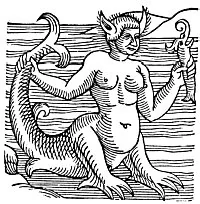
A MERMAID.
From Lycosthenes' Prodigiorum ac Ostentorum Chronicon.
Probably the most famous of the undines were the mythological mermaids, with which early mariners peopled the Seven Seas. Belief in the existence of these creatures, the upper half of their bodies human in form and the lower half fishlike, may have been inspired by flocks of penguins seen at great distance, or possibly seals. In mediæval descriptions of mermaids, it was also stated that their hair was green like seaweed and that they wore wreaths twisted from the blossoms of subaqueous plants and sea anemones.
and have sight and bearing and smell, and all the other senses, in far greater perfection, in the same degree that air is purer than water or the ether than air. Also they have temples and sacred places in which the gods really dwell, and they hear their voices and receive their answers, and are conscious of them and hold converse with them, and they see the sun, moon, and stars as they really are, and their other blessedness is of a piece with this." While the sylphs were believed to live among the clouds and in the surrounding air, their true home was upon the tops of mountains.
In his editorial notes to the Occult Sciences of Salverte, Anthony Todd Thomson says: "The Fayes and Fairies are evidently of Scandinavian origin, although the name of Fairy is supposed to be derived from, or rather [is] a modification of the Persian Peri, an imaginary benevolent being, whose province it was to guard men from the maledictions of evil spirits; but with more probability it may be referred to the Gothic Fagur, as the term Elves is from Alfa, the general appellation for the whole tribe. If this derivation of the name of Fairy be admitted, we may date the commencement of the popular belief in British Fairies to the period of the Danish conquest. They were supposed to be diminutive aerial beings, beautiful, lively, and beneficent in their intercourse with mortals, inhabiting a region called Fairy Land, Alf-heinner; commonly appearing on earth at intervals--when they left traces of their visits, in beautiful green-rings, where the dewy sward had been trodden in their moonlight dances."
To the sylphs the ancients gave the labor of modeling the snowflakes and gathering clouds. This latter they accomplished with the cooperation of the undines who supplied the moisture. The winds were their particular vehicle and the ancients referred to them as the spirits of the air. They are the highest of all the elementals, their native element being the highest in vibratory rate. They live hundreds of years, often attaining to a thousand years and never seeming to grow old. The leader of the sylphs is called Paralda, who is said to dwell on the highest mountain of the earth. The female sylphs were called sylphids.
It is believed that the sylphs, salamanders, and nymphs had much to do with the oracles of the ancients; that in fact they were the ones who spoke from the depths of the earth and from the air above.
The sylphs sometimes assume human form, but apparently for only short periods of time. Their size varies, but in the majority of cases they are no larger than human beings and often considerably smaller. It is said that the sylphs have accepted human beings into their communities and have permitted them to live there for a considerable period; in fact, Paracelsus wrote of such an incident, but of course it could not have occurred while the human stranger was in his physical body. By some, the Muses of the Greeks are believed to have been sylphs, for these spirits are said to gather around the mind of the dreamer, the poet, and the artist, and inspire him with their intimate knowledge of the beauties and workings of Nature. To the sylphs were given the eastern corner of creation. Their temperament is mirthful, changeable, and eccentric. The peculiar qualities common to men of genius are supposedly the result of the cooperation of sylphs, whose aid also brings with it the sylphic inconsistency. The sylphs labor with the gases of the human body and indirectly with the nervous system, where their inconstancy is again apparent. They have no fixed domicile, but wander about from place to place--elemental nomads, invisible but ever-present powers in the intelligent activity of the universe.
GENERAL OBSERVATIONS
Certain of the ancients, differing with Paracelsus, shared the opinion that the elemental kingdoms were capable of waging war upon one another, and they recognized in the battlings of the elements disagreements among these kingdoms of Nature spirits. When lightning struck a rock and splintered it, they believed that the salamanders were attacking the gnomes. As they could not attack one another on the plane of their own peculiar etheric essences, owing to the fact that there was no vibratory correspondence between the four ethers of which these kingdoms are composed, they had to attack through a common denominator, namely, the material substance of the physical universe over which they had a certain amount of power.
Wars were also fought within the groups themselves; one army of gnomes would attack another army, and civil war would be rife among them. Philosophers of long ago solved the problems of Nature's apparent inconsistencies by individualizing and personifying all its forces, crediting them with having temperaments not unlike the human and then expecting them to exhibit typical human inconsistencies. The four fixed signs of the zodiac were assigned to the four kingdoms of elementals. The gnomes were said to be of the nature of Taurus; the undines, of the nature of Scorpio; the salamanders exemplified the constitution of Leo; while the sylphs manipulated the emanations of Aquarius.
The Christian Church gathered all the elemental entities together under the title of demon. This is a misnomer with far-reaching consequences, for to the average mind the word demon means an evil thing, and the Nature spirits are essentially no more malevolent than are the minerals, plants, and animals. Many of the early Church Fathers asserted that they had met and debated with the elementals.
As already stated, the Nature spirits are without hope of immortality, although some philosophers have maintained that in isolated cases immortality was conferred upon them by adepts and initiates who understood certain subtle principles of the invisible world. As disintegration takes place in the physical world, so it takes place in the ethereal counterpart of physical substance. Under normal conditions at death, a Nature spirit is merely resolved back into the transparent primary essence from which it was originally individualized. Whatever evolutionary growth is made is recorded solely in the consciousness of that primary essence, or element, and not in the temporarily individualized entity of the elemental. Being without man's compound organism and lacking his spiritual and intellectual vehicles, the Nature spirits are subhuman in their rational intelligence, but from their functions--limited to one element--has resulted a specialized type of intelligence far ahead of man in those lines of research peculiar to the element in which they exist.
The terms incubus and succubus have been applied indiscriminately by the Church Fathers to elementals. The incubus and succubus, however, are evil and unnatural creations, whereas elementals is a collective term for all the inhabitants of the four elemental essences. According to Paracelsus, the incubus and succubus (which are male and female respectively) are parasitical creatures subsisting upon the evil thoughts and emotions of the astral body. These terms are also applied to the superphysical organisms of sorcerers and black magicians. While these larvæ are in no sense imaginary beings, they are, nevertheless, the offspring of the imagination. By the ancient sages they were recognized as the invisible cause of vice because they hover in the ethers surrounding the morally weak and continually incite them to excesses of a degrading nature. For this reason they frequent the atmosphere of the dope den, the dive, and the brothel, where they attach themselves to those unfortunates who have given themselves up to iniquity. By permitting his senses to become deadened through indulgence in habit-forming drugs or alcoholic stimulants, the individual becomes temporarily en rapport with these denizens of the astral plane. The houris seen by the hasheesh or opium addict and the lurid monsters which torment the victim of delirium tremens are examples of submundane beings, visible only to those whose evil practices are the magnet for their attraction.
Differing widely from the elementals and also the incubus and succubus is the vampire, which is defined by Paracelsus as the astral body of a person either living or dead (usually the latter state). The vampire seeks to prolong existence upon the physical plane by robbing the living of their vital energies and misappropriating such energies to its own ends.
In his De Ente Spirituali Paracelsus writes thus of these malignant beings: "A healthy and pure person cannot become obsessed by them, because such Larvæ can only act upon men if the later make room for them in their minds. A healthy mind is a castle that cannot be invaded without the will of its master; but if they are allowed to enter, they excite the passions of men and women, they create cravings in them, they produce bad thoughts which act injuriously upon the brain; they sharpen the animal intellect and suffocate the moral sense. Evil spirits obsess only those human beings in whom the animal nature is predominating. Minds that are illuminated by the spirit of truth cannot be possessed; only those who are habitually guided by their own lower impulses may become subjected to their influences." (See Paracelsus, by Franz Hartmann.)
A strange concept, and one somewhat at variance with the conventional, is that evolved by the Count de Gabalis concerning the immaculate conception, namely, that it represents the union of a human being with an elemental. Among the offspring of such unions he lists Hercules, Achilles, Æneas, Theseus, Melchizedek, the divine Plato, Apollonius of Tyana, and Merlin the Magician.
A SYLPH.
From sketch by Howard Wookey.
The sylphs were changeable entities, passing to and fro with the rapidity of lightning. They work through the gases and ethers of the earth and are kindly disposed toward human beings. They are nearly always represented as winged, sometimes as tiny cherubs and at other times as delicate fairies.
Hermetic Pharmacology, Chemistry, and Therapeutics
THE art of healing was originally one of the secret sciences of the priestcraft, and the mystery of its source is obscured by the same veil which hides the genesis of religious belief. All higher forms of knowledge were originally in the possession of the sacerdotal castes. The temple was the cradle of civilization. The priests, exercising their divine prerogative, made the laws and enforced them; appointed the rulers and controlled than; ministered to the needs of the living, and guided the destinies of the dead. All branches of learning were monopolized by the priesthood, who admitted into their ranks only those intellectually and morally qualified to perpetuate their arcanum. The following quotation from Plato's Statesman is apropos of the subject: " * * * in Egypt, the King himself is not allowed to reign, unless he have priestly powers; and if he should be one of another class, and have obtained the throne by violence, he must get enrolled in the priestcraft."
Candidates aspiring to membership in the religious orders underwent severe tests to prove their worthiness. These ordeals were called initiations. Those who passed them successfully were welcomed as brothers by the priests and were instructed in the secret teachings. Among the ancients, philosophy, science, and religion were never considered as separate units: each was regarded as an integral part of the whole. Philosophy was scientific and religious; science was philosophic and religious I religion was philosophic and scientific. Perfect wisdom was considered unattainable save as the result of harmonizing all three of these expressions of mental and moral activity.
While modern physicians accredit Hippocrates with being the father of medicine, the ancient therapeutæ ascribed to the immortal Hermes the distinction of being the founder of the art of healing. Clemens Alexandrinus, in describing the books purported to be from the stylus of Hermes, divided the sacred writings into six general classifications, one of which, the Pastophorus, was devoted to the science of medicine. The Smaragdine, or Emerald Tablet found in the valley of Ebron and generally accredited to Hermes, is in reality a chemical formula of a high and secret order.
Hippocrates, the famous Greek physician, during the fifth century before Christ, dissociated the healing art from the other sciences of the temple and thereby established a precedent for separateness. One of the consequences is the present widespread crass scientific materialism. The ancients realized the interdependence of the sciences. The moderns do not; and as a result, incomplete systems of learning are attempting to maintain isolated individualism. The obstacles which confront present-day scientific research are largely the result of prejudicial limitations imposed by those who are unwilling to accept that which transcends the concrete perceptions of the five primary human senses.
THE PARACELSIAN SYSTEM OF MEDICAL PHILOSOPHY
During the Middle Ages the long-ignored axioms and formulæ of Hermetic wisdom were assembled once more, and chronicled, and systematic attempts were made to test their accuracy. To Theophrastus of Hohenheim, who called himself Paracelsus (a name meaning "greater than Celsus"), the world is indebted for much of the knowledge it now possesses of the ancient systems of medicine. Paracelsus devoted his entire life to the study and exposition of Hermetic philosophy. Every notion and theory was grist to his mill, and, while members of the medical fraternity belittle his memory now as they opposed his system then, the occult world knows that he will yet be recognized as the greatest physician of all times. While the heterodox and exotic temperament of Paracelsus has been held against him by his enemies, and his wanderlust has been called vagabondage, he was one of the few minds who intelligently sought to reconcile the art of healing with the philosophic and religious systems of paganism and Christianity.
In defending his right to seek knowledge in all parts of the earth, and among all classes of society, Paracelsus wrote: "Therefore I consider that it is for me a matter of praise, not of blame, that I have hitherto and worthily pursued my wanderings. For this will I bear witness respecting nature: he who will investigate her ways must travel her books with his feet. That which is written is investigated through its letters, but nature from land to land-as often a land so often a leaf. Thus is the Codex of Nature, thus must its leaves be turned." (Paracelsus, by John Maxson Stillman.)
Paracelsus was a great observationalist, and those who knew him best have called him "The Second Hermes" and "The Trismegistus of Switzerland." He traveled Europe from end to end, and may have penetrated Eastern lands while running down superstitions and ferreting out supposedly lost doctrines. From the gypsies he learned much concerning the uses of simples, and apparently from the Arabians concerning the making of talismans and the influences of the heavenly bodies. Paracelsus felt that the healing of the sick was of far greater importance than the maintaining of an orthodox medical standing, so he sacrificed what might otherwise have been a dignified medical career and at the cost of lifelong persecution bitterly attacked the therapeutic systems of his day.
Uppermost in his mind was the hypothesis that everything in the universe is good for something--which accounts for his cutting fungus from tombstones and collecting dew on glass plates at midnight. He was a true explorer of Nature's arcanum. Many authorities have held the opinion that he was the discoverer of mesmerism, and that Mesmer evolved the art as the result of studying the writings of this great Swiss physician.
The utter contempt which Paracelsus felt for the narrow systems of medicine in vogue during his lifetime, and his conviction of their inadequacy, are best expressed in his own quaint way: "But the number of diseases that originate from some unknown causes is far greater than those that come from mechanical causes, and for such diseases our physicians know no cure because not knowing such causes they cannot remove them. All they can prudently do is to observe the patient and make their guesses about his condition; and the patient may rest satisfied if the medicines administered to him do no serious harm, and do not prevent his recovery. The best of our popular physicians are the ones that do least harm. But, unfortunately, some poison their patients with mercury, others purge them or bleed them to death. There are some who have learned so much that their learning has driven out all their common sense, and a there are others who care a great: deal more for their own profit than for the health of their patients. A disease does not change its state to accommodate itself to the knowledge of the physician, but the physician should understand the causes of the disease. A physician should be a servant of Nature, and not her enemy; he should be able to guide and direct her in her struggle for life and not throw, by his unreasonable interference, fresh obstacles in the way of recovery." (From the Paragranum, translated by Franz Hartmann.)
The belief that nearly all diseases have their origin in the invisible nature of man (the Astrum) is a fundamental precept of Hermetic medicine, for while Hermetists in no way disregarded the physical body, they believed that man's material constitution was an emanation from, or an objectification of, his invisible spiritual principles. A brief, but it is believed fairly comprehensive, résumé of the Hermetic principles of Paracelsus follows.
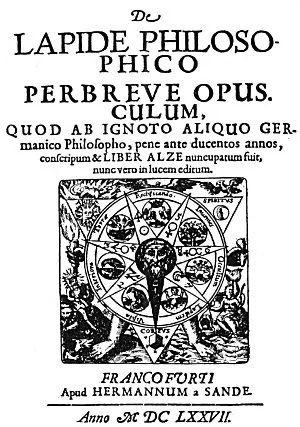
THE TITLE PAGE OF THE BOOK OF ALZE.
From Musæum Hermeticum Reformatum et Amplificatum.
This title page is a further example of Hermetic and alchemical symbolism. The seven-pointed star of the sacred metals is arranged that one black point is downward, thus symbolizing Saturn, the Destroyer. Beginning in the space immediately to the left of the black point, reading clockwise discloses the cryptic word VITRIOL formed by the capital letters of the seven Latin words in the outer circle.
There is one vital substance in Nature upon which all things subsist. It is called archæus, or vital life force, and is synonymous with the astral light or spiritual air of the ancients. In regard to this substance, Eliphas Levi has written: "Light, that creative agent, the vibrations of which are the movement and life of all things; light, latent in the universal ether, radiating about absorbing centres, which, being saturated thereby, project movement and life in their turn, so forming creative currents; light, astralized in the stars, animalized in animals, humanized in human beings; light, which vegetates all plants, glistens in metals, produces all forms of Nature and equilibrates all by the laws of universal sympathy--this is the light which exhibits the phenomena of magnetism, divined by Paracelsus, which tinctures the blood, being released from the air as it is inhaled and discharged by the hermetic bellows of the lungs." (The History of Magic.)
This vital energy has its origin in the spiritual body of the earth. Every created thing has two bodies, one visible and substantial, the other invisible and transcendent. The latter consists of an ethereal counterpart of the physical form; it constitutes the vehicle of archæus, and may be called a vital body. This etheric shadow sheath is not dissipated by death, but remains until the physical form is entirely disintegrated. These "etheric doubles, "seen around graveyards, have given rise to a belief in ghosts. Being much finer in its substances than the earthly body, the etheric double is far more susceptible to impulses and inharmonies. It is derangements of this astral light body that cause much disease. Paracelsus taught that a person with a morbid mental attitude could poison his own etheric nature, and this infection, diverting the natural flow of vital life force, would later appear as a physical ailment. All plants and minerals have an invisible nature composed of this "archæus," but each manifests it in a different way.
Concerning the astral-light bodies of flowers, James Gaffarel, in 1650, wrote the following: "I answer, that though they be chopt in pieces, brayed in a Mortar, and even burnt to Ashes; yet do they neverthelesse retaine, (by a certaine Secret, and wonderfull Power of Nature), both in the Juyce, and in the Ashes, the selfe same Forme, and Figure, that they had before: and though it be not there Visible, yet it may by Art be drawne forth, and made Visible to the Eye, by an Artist. This perhaps will seem a Ridiculous story to those, who reade only the Titles of Bookes: but, those that please, may see this truth confirmed, if they but have recourse to the Workes of M. du Chesne, S. de la Violette, one of the best Chymists that our Age hath produced; who affirmes, that himselfe saw an Excellent Polich Physician of Cracovia, who kept, in Glasses, the Ashes of almost all the Hearbs that are knowne: so that, when any one, out of Curiosity, had a desire to see any of them, as (for example) a Rose, in one of his Glasses, he tooke That where the Ashes of a Rose were preserved; and holding it over a lighted Candle, so soone as it ever began to feele the Heat, you should presently see the Ashes begin to Move; which afterwards rising up, and dispersing themselves about the Glasse, you should immediately observe a kind of little Dark Cloud; which dividing it selfe into many parts, it came at length to represent a Rose; but so Faire, so Fresh, and so Perfect a one, that you would have thought it to have been as Substancial, & as Odoriferous a Rose, as growes on the Rose-tree." (Unheard-of Curiosities Concerning Talismanical Sculpture of the Persians.)
Paracelsus, recognizing derangements of the etheric double as the most important cause of disease, sought to reharmonize its substances by bringing into contact with it other bodies whose vital energy could supply elements needed, or were strong enough to overcome the diseased conditions existing in the aura of the sufferer. Its invisible cause having been thus removed, the ailment speedily vanished.
The vehicle for the archæus, or vital life force, Paracelsus called the mumia. A good example of a physical mumia is vaccine, which is the vehicle of a semi-astral virus. Anything which serves as a medium for the transmission of the archæus, whether it be organic or inorganic, truly physical or partly spiritualized, was termed a mumia. The most universal form of the mumia was ether, which modern science has accepted as a hypothetical substance serving as a medium between the realm of vital energy and that of organic and inorganic substance.
The control of universal energy is virtually impossible, save through one of its vehicles (the mumia). A good example of this is food. Man does not secure nourishment from dead animal or plant organisms, but when he incorporates their structures into his own body he first gains control over the mumia, or etheric double, of the animal or plant. Having obtained this control, the human organism then diverts the flow of the archæus to its own uses. Paracelsus says: "That which constitutes life is contained in the Mumia, and by imparting the Mumia we impart life." This is the secret of the remedial properties of talismans and amulets, for the mumia of the substances of which they are composed serves as a channel to connect the person wearing them with certain manifestations of the universal vital life force.
According to Paracelsus, in the same way that plants purify the atmosphere by accepting into their constitutions the carbon dioxid exhaled by animals and humans, so may plants and animals accept disease elements transferred to them by human beings. These lower forms of life, having organisms and needs different from man, are often able to assimilate these substances without ill effect. At other times, the plant or animal dies, sacrificed in order that the more intelligent, and consequently more useful, creature may survive. Paracelsus discovered that in either case the patient was gradually relieved of his malady. When the lower life had either completely assimilated the foreign mumia from the patient, or had itself died and disintegrated as the result of its inability to do so, complete recovery resulted. Many years of investigation were necessary to determine which herb or animal most readily accepted the mumia of each of various diseases.
Paracelsus discovered that in many cases plants revealed by their shape the particular organs of the human body which they served most effectively. The medical system of Paracelsus was based on the theory that by removing the diseased etheric mumia from the organism of the patient and causing it to be accepted into the nature of some distant and disinterested thing of comparatively little value, it was possible to divert from the patient the flow of the archæus which had been continually revitalizing and nourishing the malady. Its vehicle of expression being transplanted, the archæus necessarily accompanied its mumia, and the patient recovered.
THE HERMETIC THEORY CONCERNING THE CAUSATIONS OF DISEASE
According to the Hermetic philosophers, there were seven primary causes of disease. The first was evil spirits. These were regarded as creatures born of degenerate actions, subsisting on the vital energies of those to whom they attached themselves. The second cause was a derangement of the spiritual nature and the material nature: these two, failing to coordinate, produced
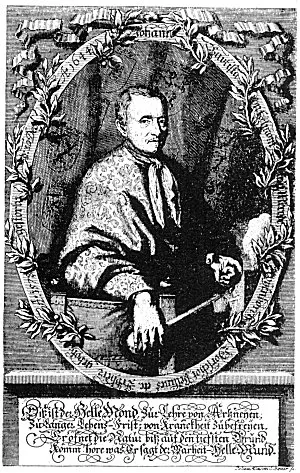
JOHANNIS BAPTISTAE VON HELMONT.
From von Helmont's Ausgang der Artznen-Kunst.
At the beginning of the seventeenth century von Helmont, the Belgian alchemist (to whom incidentally, the world is indebted for the common term gas, as distinguished from other kinds of air), while experimenting with the root of A---, touched it to the tip of his tongue, without swallowing any of the substance. He himself describes the result in the following manner:
"Immediately my head seemed tied tightly with a string, and soon after there happened to me a singular circumstance such as I had never before experienced. I observed with astonishment that I no longer felt and thought with the head, but with the region of the stomach, as if consciousness had now taken up its seat in the stomach. Terrified by this unusual phenomenon, I asked myself and inquired into myself carefully; but I only became the more convinced that my power of perception was became greater and more comprehensive. This intellectual clearness was associated with great pleasure. I did not sleep, nor did I dream; I was perfectly sober; and my health was perfect. I had occasionally had ecstasies, but these had nothing in common with this condition of the stomach, in which it thought and felt, and almost excluded all cooperation of the head. In the meantime my friends were troubled with the fear that I might go mad. But my faith to God, and my submission to His will, soon dissipated this fear. This state continued for two hours, after which I had same dizziness. I afterwards frequently tasted of the A---, but I never again could reproduce these sensations." (Van Helmont, Demens idea. Reprinted by P. Davidson in The Mistletoe and Its Philosophy.)
Von Helmont is only one of many who have accidentally hit upon the secrets of the early priestcrafts, but none in this age give evidence of an adequate comprehension of the ancient Hermetic secrets. From the description von Helmont gives, it is probable that the herb mentioned by him paralyzed temporarily the cerebrospinal nervous system, the result being that the consciousness was forced to function through the sympathetic nervous system and its brain--the solar plexus.
mental and physical subnormality. The third was an unhealthy or abnormal mental attitude. Melancholia, morbid emotions, excess of feeling, such as passions, lusts, greeds, and hates, affected the mumia, from which they reacted into the physical body, where they resulted in ulcers, tumors, cancers, fevers, and tuberculosis. The ancients viewed the disease germ as a unit of mumia which had been impregnated with the emanations from evil influences which it had contacted. In other words, germs were minute creatures born out of man's evil thoughts and actions.
The fourth cause of disease was what the Orientals called Karma, that is, the Law of Compensation, which demanded that the individual pay in full for the indiscretions and delinquencies of the past. A physician had to be very careful how he interfered with the workings of this law, lest he thwart the plan of Eternal justice. The fifth cause was the motion and aspects of the heavenly bodies. The stars did not compel the sickness but rather impelled it. The Hermetists taught that a strong and wise man ruled his stars, but that a negative, weak person was ruled by them. These five causes of disease are all superphysical in nature. They must be estimated by inductive and deductive reasoning and a careful consideration of the life and temperament of the patient.
The sixth cause of disease was a misuse of faculty, organ, or function, such as overstraining a member or overtaxing the nerves. The seventh cause was the presence in the system of foreign substances, impurities, or obstructions. Under this heading must be considered diet, air, sunlight, and the presence of foreign bodies. This list does not include accidental injuries; such do not belong under the heading of disease. Frequently they are methods by which the Law of Karma expresses itself.
According to the Hermetists, disease could be prevented or successfully combated in seven ways. First, by spells and invocations, in which the physician ordered the evil spirit causing the disease to depart from the patient. This procedure was probably based on the Biblical account of the man possessed of devils whom Jesus healed by commanding the devils to leave the man and enter into a herd of swine. Sometimes the evil spirits entered a patient at the bidding of someone desiring to injure him. In these cases the physician commanded the spirits to return to the one who sent them. It is recorded that in some instances the evil spirits departed through the mouth in the form of clouds of smoke; sometimes from the nostrils as flames. It is even averred that the spirits might depart in the form of birds and insects.
The second method of healing was by vibration. The inharmonies of the bodies were neutralized by chanting spells and intoning the sacred names or by playing upon musical instruments and singing. Sometimes articles of various colors were exposed to the sight of the sick, for the ancients recognized, at least in part, the principle of color therapeutics, now in the process of rediscovery.
The third method was with the aid of talismans, charms, and amulets. The ancients believed that the planets controlled the functions of the human body and that by making charms out of different metals they could combat the malignant influences of the various stars. Thus, a person who is anæmic lacks iron. Iron was believed to be under the control of Mars. Therefore, in order to bring the influence of Mars to the sufferer, around his neck was hung a talisman made of iron and bearing upon it certain secret instructions reputed to have the power of invoking the spirit of Mars. If there was too much iron in the system, the patient was subjected to the influence of a talisman composed of the metal corresponding to some planet having an antipathy to Mars. This influence would then offset the Mars energy and thus aid in restoring normality.
The fourth method was by the aid of herbs and simples. While they used metal talismans, the majority of the ancient physicians did not approve of mineral medicine in any form for internal use. Herbs were their favorite remedies. Like the metals, each herb was assigned to one of the planets. Having diagnosed by the stars the sickness and its cause, the doctors then administered the herbal antidote.
The fifth method of healing disease was by prayer. All ancient peoples believed in the compassionate intercession of the Deity for the alleviation of human suffering. Paracelsus said that faith would cure all disease. Few persons, however, possess a sufficient degree of faith.
The sixth method--which was prevention rather than cure--was regulation of the diet and daily habits of life. The individual, by avoiding the things which caused illness, remained well. The ancients believed that health was the normal state of man; disease was the result of man's disregard of the dictates of Nature.
The seventh method was "practical medicine," consisting chiefly of bleeding, purging, and similar lines of treatment. These procedures, while useful in moderation, were dangerous in excess. Many a useful citizen has died twenty-five or fifty years before his time as the result of drastic purging or of having all the blood drained out of his body.
Paracelsus used all seven methods of treatment, and even his worst enemies admitted that he accomplished results almost miraculous in character. Near his old estate in Hohenheim, the dew falls very heavily at certain seasons of the year, and Paracelsus discovered that by gathering the dew under certain configurations of the planets he obtained a water possessing marvelous medicinal virtue, for it had absorbed the properties of the heavenly bodies.
HERMETIC HERBALISM AND PHARMACOLOGY
The herbs of the fields were sacred to the early pagans, who believed that the gods had made plants for the cure of human ills. When properly prepared and applied, each root and shrub could be used for the alleviation of suffering, or for the development of spiritual, mental, moral, or physical powers. In The Mistletoe and Its Philosophy, P. Davidson pays the following beautiful tribute to the plants: "Books have been written on the language of flowers and herbs, the poet from the earliest ages has held the sweetest and most loving converse with them, kings are even glad to obtain their essences at second hand to perfume themselves; but to the true physician--Nature's High-Priest--they speak in a far higher and more exalted strain. There is not a plant or mineral which has disclosed the last of its properties to the scientists. How can they feel confident that for every one of the discovered properties there may not be many powers concealed in the inner nature of the plant? Well have flowers been called the 'Stars of Earth,' and why should they not be beautiful? Have they not from the time of their birth smiled in the splendor of the sun by day, and slumbered under the brightness of the stars by night? Have they not come from another and more spiritual world to our earth, seeing that God made 'every plant of the field BEFORE it was in the earth, and every herb of the field BEFORE IT GREW'?"
Many primitive peoples used herbal remedies, with many remarkable cures. The Chinese, Egyptians, and American Indians cured with herbs diseases for which modern science knows no remedy. Doctor Nicholas Culpeper, whose useful life ended in 1654, was probably the most famous of herbalists. Finding that the medical systems of his day were unsatisfactory in the extreme, Culpeper turned his attention to the plants of the fields, and discovered a medium of healing which gained for him national renown.
In Doctor Culpeper's correlation of astrology and herbalism, each plant was under the jurisdiction of one of the planets or luminaries. He believed that disease was also controlled by celestial configurations. He summed up his system of treatment as follows: "You may oppose diseases by Herbs of the planet opposite to the planet that causes them: as diseases of Jupiter by Herbs of Mercury, and the contrary; diseases of the Luminaries by the Herbs of Saturn, and the contrary; diseases of Mars by Herbs of Venus and the contrary. * * * There is a way to cure diseases sometimes by Sympathy, and so every planet cures his own disease; as the Sun and Moon by their Herbs cure the Eyes, Saturn the Spleen, Jupiter the Liver, Mars the Gall and diseases of choler, and Venus diseases in the Instruments of Generation." (The Complete Herbal.)
Mediæval European herbalists rediscovered only in part the ancient Hermetic secrets of Egypt and Greece. These earlier nations evolved the fundamentals of nearly all modern arcs and sciences.
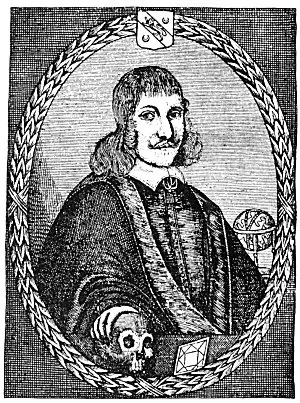
NICHOLAS CULPEPER.
From Culpeper's Semeiotica Uranica.
This famous physician, herbalist, and astrologer spent the greater part of his useful life ranging the hills and forests of England and cataloguing literally hundreds of medicinal herbs. Condemning the unnatural methods of contemporaneous medicos, Culpeper wrote: "This not being pleasing, and less profitable tome, I consulted with my two brothers, DR. REASON and DR. EXPERIENCE, and took a voyage to visit my mother NATURE, by whose advice, together with the help of Dr. DILIGENCE, I at last obtained my desire; and, being warned by MR. HONESTY, a stranger in our days, to publish it to the world, I have done it." (From the Introduction to the 1835 Edition of The Complete Herbal.) Doctor Johnson said of Culpeper that he merited the gratitude of posterity.
At that time the methods used in healing were among the secrets imparted to initiates of the Mysteries. Unctions, collyria, philters, and potions were concocted to the accompaniment of strange rites. The effectiveness of these medicines is a matter of historical record. Incenses and perfumes were also much used.
Barrett in his Magus describes the theory on which they worked, as follows: "For, because our spirit is the pure, subtil, lucid, airy and unctuous vapour of the blood, nothing, therefore, is better adapted for collyriums than the like vapours which are more suitable to our spirit in substance; for then, by reason of their likeness, they do more stir up, attract and transform the spirit."
Poisons were thoroughly studied, and in some communities extracts of deadly herbs were administered to persons sentenced to death--as in the case of Socrates. The infamous Borgias of Italy developed the art of poisoning to its highest degree. Unnumbered brilliant men and women were quietly and efficiently disposed of by the almost superhuman knowledge of chemistry which for many centuries was preserved in the Borgia family.
Egyptian priests discovered herb extracts by means of which temporary clairvoyance could be induced, and they made use of these during the initiatory rituals of their Mysteries. The drugs were sometimes mixed with the food given to candidates, and at other times were presented in the form of sacred potions, the nature of which was explained. Shortly after the drugs were administered to him, the neophyte was attacked by a spell of dizziness. He found himself floating through space, and while his physical body was absolutely insensible (being guarded by priests that no ill should befall it) the candidate passed through a number of weird experiences, which he was able to relate after regaining consciousness. In the light of present-day knowledge, it is difficult to appreciate an art so highly developed that by means of draughts, perfumes, and incenses any mental attitude desired could be induced almost instantaneously, yet such an art actually existed among the priestcraft of the early pagan world.
Concerning this subject, H. P. Blavatsky, the foremost occultist of the nineteenth century, has written: 'Plants also have like mystical properties in a most wonderful degree, and the secrets of the herbs of dreams and enchantments are only lost to European science, and useless to say, too, are unknown to it, except in a few marked instances, such as opium and hashish. Yet, the psychical effects of even these few upon the human system are regarded as evidences of a temporary mental disorder. The women of Thessaly and Epirus, the female hierophants of the rites of Sabazius, did not carry their secrets away with the downfall of their sanctuaries. They are still preserved, and those who are aware of the nature of Soma, know the properties of other plants as well." (Isis Unveiled.)
Herbal compounds were used to cause temporary clairvoyance in connection with the oracles, especially the one at Delphi. Words spoken while in these imposed trances were regarded as prophetic. Modem mediums, while under control as the result of partly self-imposed catalepsy, give messages somewhat similar to those of the ancient prophets, but in the majority of cases their results are far less accurate, for the soothsayers of today lack the knowledge of Nature's hidden forces.
The Mysteries taught that during the higher degrees of initiation the gods themselves took part in the instruction of candidates or at least were present, which was in itself a benediction. As the deities dwelt in the invisible worlds and came only in their spiritual bodies, it was impossible for the neophyte to cognize them without the assistance of drugs which stimulated the clairvoyant center of his consciousness (probably the pineal gland). Many initiates in the ancient Mysteries stated emphatically that they had conversed with the immortals, and had beheld the gods.
When the standards of the pagans became corrupted, a division took place in the Mysteries. The band of truly enlightened ones separated themselves from the rest and, preserving the most important of their secrets, vanished without leaving a trace. The rest slowly drifted, like rudderless ships, on the rocks of degeneracy and disintegration. Some of the less important of the secret formulæ fell into the hands of the profane, who perverted them--as in the case of the Bacchanalia, during which drugs were mixed with wine and became the real cause of the orgies.
In certain parts of the earth it was maintained that there were natural wells, springs, or fountains, in which the water (because of the minerals through which it coursed) was tinctured with sacred properties. Temples were often built near these spots, and in some cases natural caves which chanced to be in the vicinity were sanctified to some deity.
"The aspirants to initiation, and those who came to request prophetic dreams of the Gods, were prepared by a fast, more or less prolonged, after which they partook of meals expressly prepared; and also of mysterious drinks, such as the water of Lethe, and the water of Mnemosyne in the grotto of Trophonius; or of the Ciceion in the mysteries of the Eleusinia. Different drugs were easily mixed up with the meats or introduced into the drinks, according to the state of mind or body into which it was necessary to throw the recipient, and the nature of the visions he was desirous of procuring.'' (Salverte's The Occult Sciences.) The same author states that certain sects of early Christianity were accused of using drugs for the same general purposes as the pagans.
The sect of the Assassins, or the Yezidees as they are more generally known, demonstrated a rather interesting aspect of the drug problem. In the eleventh century this order, by capturing the fortress of Mount Alamont, established itself at Irak. Hassan Sabbah, the founder of the order, known as the "Old Man of the Mountain, " is suspected of having controlled his followers by the use of narcotics. Hassan made his followers believe that they were in Paradise, where they would be forever if they implicitly obeyed him while they were alive. De Quincey, in his Confessions of an Opium Eater, describes the peculiar psychological effects produced by this product of the poppy, and the use of a similar drug may have given rise to the idea of Paradise which filled the minds of the Yezidees.
The philosophers of all ages have taught that the visible universe was but a fractional part of the whole, and that by analogy the physical body of man is in reality the least important part of his composite constitution. Most of the medical systems of today almost entirely ignore the superphysical man. They pay but scant attention to causes, and concentrate their efforts on ameliorating effects. Paracelsus, noting the same proclivity on the part of physicians during his day, aptly remarked: "There is a great difference between the power that removes the invisible causes of disease, and which is Magic, and that which causes merely external effects [to] disappear, and which is Physic, Sorcery, and Quackery." (Translated by Franz Hartmann.)
Disease is unnatural, and is evidence that there is a maladjustment within or between organs or tissues. Permanent health cannot be regained until harmony is restored. The outstanding virtue of Hermetic medicine was its recognition of spiritual and psychophysical derangements as being largely responsible for the condition which is called physical disease. Suggestive therapy was used with marked success by the priest-physicians of the ancient world. Among the-American Indians, the Shamans--or "Medicine Men"--dispelled sickness with the aid of mysterious dances, invocations, and charms. The fact that in spite of their ignorance of modern methods of medical treatment these sorcerers effected innumerable cures, is well worthy of consideration.
The magic rituals used by the Egyptian priests for the curing of disease were based upon a highly developed comprehension of the complex workings of the human mind and its reactions upon the physical constitution. The Egyptian and Brahmin worlds undoubtedly understood the fundamental principle of vibrotherapeutics. By means of chants and mantras, which emphasized certain vowel and consonant sounds, they set up vibratory reactions which dispelled congestions and assisted Nature in reconstructing broken members and depleted organisms. They also applied their knowledge of the laws governing vibration to the spiritual constitution of man; by their intonings, they stimulated latent centers of consciousness and thereby vastly increased the sensitiveness of the subjective nature.
In the Book of Coming Forth by Day, many of the Egyptian secrets have been preserved to this generation. While this ancient scroll has been well translated, only a few understand the secret: significance of its magical passages. Oriental races have a keen realization of the dynamics of sound. They know that every spoken word has tremendous power and that by certain arrangements of words they can create vortices of force in the invisible universe about them and thereby profoundly influence physical substance. The Sacred Word by which the world was established, the Lost Word which Masonry is still seeking, and the threefold Divine Name symbolized by A. U. M.--the creative tone of the Hindus--all are indicative of the veneration accorded the principle of sound.
The so-called "new discoveries" of modern science are often only rediscoveries of secrets well known to the priests and philosophers of ancient pagandom. Man's inhumanity to man has resulted in the loss of records and formula: which, had they been preserved, would have solved many of the greatest problems of this civilization. With sword and firebrand, races obliterate the records of their predecessors, and then inevitably meet with an untimely fate for need of the very wisdom they have destroyed.
CHEMICAL SYLLABLES.
From De Monte-Snyders' Metamorphosis Planetarum.
De Monte-Snyders declares that each of the above characters forms one syllables of a word having seven syllables, the word itself representing the materia prima, or first substance of the universe. As all substance is composed of seven powers combined according to certain cosmic laws, a great mystery is concealed within the sevenfold constitution of man, and the universe. Of the above seven characters, De Monte-Snyder writes:
Whoever wants to know the true name and character of the materia prima shall know that out of the combination of the above figures syllables are produced, and out of these the verbum significativum."
The Qabbalah, the Secret Doctrine of Israel
ALBERT PIKE, quoting from Transcendental Magic, thus sums up the importance of Qabbalism as a key to Masonic esotericism: "One is filled with admiration, on penetrating into the Sanctuary of the Kabalah, at seeing a doctrine so logical, so simple, and at the same time so absolute. The necessary union of ideas and signs, the consecration of the most fundamental realities by the primitive characters; the Trinity of Words, Letters, and Numbers; a philosophy simple as the alphabet, profound and infinite as the Word; theorems more complete and luminous than those of Pythagoras; a theology summed up by counting on one's fingers; an Infinite which can be held in the hollow of an infant's hand; ten ciphers and twenty-two letters, a triangle, a square, and a circle,--these are all the elements of the Kabalah. These are the elementary principles of the written Word, reflection of that spoken Word that created the world!" (Morals and Dogma.)
Hebrew theology was divided into three distinct parts. The first was the law, the second was the soul of the law, and the third was the soul of the soul of the law. The law was taught to all the children of Israel; the Mishna, or the soul of the law, was revealed to the Rabbins and teachers; but the Qabbalah, the soul of the soul of the law, was cunningly concealed, and only the highest initiates among the Jews were instructed in its secret principles.
According to certain Jewish mystics, Moses ascended Mount Sinai three times, remaining in the presence of God forty days each time. During the first forty days the tables of the written law were delivered to the prophet; during the second forty days he received the soul of the law; and during the last forty days God instructed him in the mysteries of the Qabbalah, the soul of the soul of the law. Moses concealed in the first four books of the Pentateuch the secret instructions that God had given him, and for centuries students of Qabbalism. have sought therein the secret doctrine of Israel. As the spiritual nature of man is concealed in his physical body, so the unwritten law--the Mishna and the Qabbalah--is concealed within the written teachings of the Mosaic code. Qabbalah means the secret or hidden tradition, the unwritten law, and according to an early Rabbi, it was delivered to man in order that through the aid of its abstruse principles he might learn to understand the mystery of both the universe about him and the universe within him.
The origin of Qabbalism is a legitimate subject for controversy. Early initiates of the Qabbalistic Mysteries believed that its principles were first taught by God to a school of His angels before the fall of man. The angels later communicated the secrets to Adam, so that through the knowledge gained from an understanding of its principles fallen humanity might regain its lost a estate. The Angel Raziel was dispatched from heaven to instruct Adam in the mysteries of the Qabbalah. Different angels were employed to initiate the succeeding patriarchs in this difficult science. Tophiel was the teacher of Shem, Raphael of Isaac, Metatron of Moses, and Michael of David. (See Faiths of the World.)
Christian D. Ginsburg has written: "From Adam it passed over to Noah, and then to Abraham, the friend of God, who emigrated with it to Egypt, where the patriarch allowed a portion of this mysterious doctrine to ooze out. It was in this way that the Egyptians obtained some knowledge of it, and the other Eastern nations could introduce it into their philosophical systems. Moses, who was learned in all the wisdom of Egypt, was first initiated into it in the land of his birth, but became most proficient in it during his wanderings in the wilderness, when he not only devoted to it the leisure hours of the whole forty years, but received lessons in it from one of the angels. * * * Moses also initiated the seventy Elders into the secrets of this doctrine and they again transmitted them from hand to hand. Of all who formed the unbroken line of tradition, David and Solomon were most initiated into the Kabbalah." (See The Kabbalah.)
According to Eliphas Levi, the three greatest books of Qabbalism are the Sepher Yetzirah, The Book of Formation; the Sepher ha Zohar, The Book of Splendor; and the Apocalypse, The Book of Revelation. The dates of the writing of these books are by no means thoroughly established. Qabbalists declare that the Sepher Yetzirah was written by Abraham. Although it is by far the oldest of the Qabbalistic books, it was probably from the pen of the Rabbi Akiba, A.D. 120.
The Sepher ha Zohar presumably was written by Simeon ben Jochai, a disciple of Akiba. Rabbi Simeon was sentenced to death about A.D. 161 by Lucius Verus, co-regent of the Emperor Marc Aurelius Antoninus. He escaped with his son and, hiding in a cave, transcribed the manuscript of the Zohar with the assistance of Elias, who appeared to them at intervals. Simeon was twelve years in the cave, during which time he evolved the complicated symbolism of the "Greater Face" and the "Lesser Face." While discoursing with disciples Rabbi Simeon expired, and the "Lamp of Israel" was extinguished. His death and burial were accompanied by many supernatural phenomena. The legend goes on to relate that the secret doctrines of Qabbalism had been in existence since the beginning of the world, but that Rabbi Simeon was the first man permitted to reduce them to writing. Twelve hundred years later the books which he had compiled were discovered and published for the benefit of humanity by Moses de León. The probability is that Moses de León himself compiled the Zohar about A.D. 1305, drawing his material from the unwritten secrets of earlier Jewish mystics. The Apocalypse, accredited to St. John the Divine, is also of uncertain date, and the identity of its author has never been satisfactorily proved.
Because of its brevity and because it is the key to Qabbalistic thought, the Sepher Yetzirah is reproduced in full in this chapter. So far as is
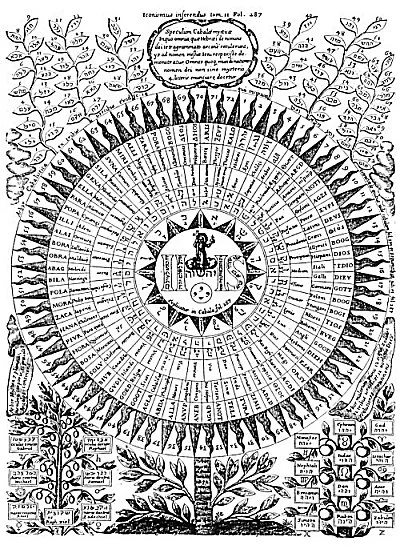
THE SEVENTY-TWO NAMES OF GOD.
From Kircher's Œdipus Ægyptiacus.
This rare cut shows the name of God in seventy-two languages inscribed upon the petals of a symbolic sunflower. Above the circle are the seventy-two powers of God according to the Hebrew Qabbalah. Below two trees, that on the left bearing the symbols of the planets and that on the right the signs of the zodiac and the names of the tribes of Israel. The esoteric doctrines of the Qabbalah are in alignment with the secret teachings of all the schools of philosophy, but the method by which its secrets are revealed to the wise and concealed from the ignorant is most unusual. As the religious world interprets its scriptures with twentieth-century educational facilities, it becomes ever more apparent that the sacred books were not historical documents, but that the kings, sages, prophets, and saviors whom Bible students ham revered for ages as once-existing personalities are in reality only personified attributes of man himself.
known, the Sepher ha Zohar has never been completely translated into English, but it can be obtained in French. (S. L. MacGregor-Mathers translated three books of the Zohar into English.) The Zohar contains a vast number of philosophical tenets, and a paraphrase of its salient points is embodied in this work.
Few realize the influence exerted by Qabbalism over mediæval thought, both Christian and Jewish. It taught that there existed within the sacred writings a hidden doctrine which was the key to those writings. This is symbolized by the crossed keys upon the papal crest. Scores of learned minds began to search for those arcane truths by which the race should be redeemed; and that their labor was not without its reward, their subsequent writings have demonstrated.
The theories of Qabbalism are inextricably interwoven with the tenets of alchemy, Hermeticism, Rosicrucianism, and Freemasonry. The words Qabbalism and Hermeticism are now considered as synonymous terms covering all the arcana and esotericism of antiquity. The simple Qabbalism of the first centuries of the Christian Era gradually evolved into an elaborate theological system, which became so involved that it was next to impossible to comprehend its dogma.
The Qabbalists divided the uses of their sacred science into five sections. The Natural Qabbalah was used solely to assist the investigator in his study of Nature's mysteries. The Analogical Qabbalah was formulated to exhibit the relationship which exists between all things in Nature, and it revealed to the wise that all creatures and substances were one in essence, and that man--the Little Universe--was a replica in miniature of God--the Great Universe. The Contemplative Qabbalah was evolved for the purpose of revealing through the higher intellectual faculties the mysteries of the celestial spheres. By its aid the abstract reasoning faculties cognized the measureless planes of infinity and learned to know the creatures existing within them. The Astrological Qabbalah instructed those who studied its lore in the power, magnitude, and actual substance of the sidereal bodies, and also revealed the mystical constitution of the planet itself. The fifth, or Magical Qabbalah, was studied by such as desired to gain control over the demons and subhuman intelligences of the invisible worlds. It was also highly valued as a method of healing the sick by talismans, amulets, charms, and invocations.
The Sepher Yetzirah, according to Adolph Franck, differs from other sacred books in that it does not explain the world and the phenomena of which it is the stage by leaning on the idea of God or by setting itself up as the interpreter of the supreme will. This ancient work rather reveals God by estimating His manifold handiwork. In preparing the Sepher Yetzirah for the consideration of the reader, five separate English translations have been compared. The resulting form, while it embodies the salient features of each, is not a direct translation from any one Hebrew or Latin text. Although the purpose was to convey the spirit rather than the letter of the ancient document, there are no wide deviations from the original rendition. So far as known, the first translation of the Sepher Yetzirah into English was made by the Rev. Dr. Isidor Kalisch, in 1877. (See Arthur Edward Waite.) In this translation the Hebrew text accompanies the English words. The work of Dr. Kalisch has been used as the foundation of the following interpretation, but material from other authorities has been incorporated and many passages have been rewritten to simplify the general theme.
At hand also was a manuscript copy in English of the Book of the Cabalistick Art, by Doctor John Pistor. The document is undated; but judging from the general type of the writing, the copy was made during the eighteenth century. The third volume used as a reference was the Sepher Yetzirah, by the late Win. Wynn Westcott, Magus of the Rosicrucian Society of England. The fourth was the Sepher Yetzirah, or The Book of Creation, according to the translation in the Sacred Books and Early Literature of the East, edited by Prof. Charles F. Horne. The fifth was a recent publication, The Book of Formation, by Knut Stenring, containing an introduction by Arthur Edward Waite. At hand also were four other copies--two German, one Hebrew, and one Latin. Certain portions of the Sepher Yetzirah are considered older and more authentic than the rest, bur the controversy regarding them is involved and nonproductive that it is useless to add further comment. The doubtful passages are therefore included in the document at the points where they would naturally fall.
THE SEPHER YETZIRAH, THE BOOK OF FORMATION
Chapter One
1. YAH, the Lord of Hosts, the living Elohim, King of the Universe, Omnipotent, the Merciful and Gracious God, Supreme and Extolled, Dweller in the Height whose habitation is Eternity, who is Sublime and Most-Holy, engraved His name and ordained (formed) and created the Universe in thirty-two mysterious paths (stages) of wisdom (science), by three Sepharim, namely, Numbers, Letters, and Sounds, which are in Him one and the same.
2. Ten Sephiroth (ten properties from the Ineffable One) and twenty-two letters are the Foundation of all things. Of these twenty-two letters three are called "Mothers," sewn "Double," and twelve "Simple."
3. The ten numbers (Sephiroth) out of Nothing are analogous to the ten fingers and the ten toes: five over against five. In the center between them is the covenant with the Only One God. In the spiritual world it is the covenant of the voice (the Word), and in the corporeal world the circumcision of the flesh (the rite of Abraham).
4. Ten are the numbers (of the Sephiroth) out of Nothing, ten--not nine; ten--not eleven. Comprehend this great, wisdom, understand this knowledge and be wise. Inquire into the mystery and ponder it. Examine all things by means of the ten Sephiroth. Restore the Word to Its Creator and lead the Creator back to His throne again. He is the only Formator and beside Him there is no other. His attributes are ten and are without limit.
5. The ten ineffable Sephiroth have ten infinitudes, which are as follows:
The infinite beginning and the infinite end;
The infinite good and the infinite evil;
The infinite height and the infinite depth;
The infinite East and the infinite West;
The infinite North and the infinite South;
and over them is the Lord Superlatively One, the faithful King. He rules over all in all from His holy habitation for ages of ages.
6. The appearance of the ten spheres (Sephiroth) out of Nothing is as a flash of lightning or a sparkling flame, and they are without beginning or end. The Word of God is in them when they go forth and when they return. They run by His order like a whirlwind and prostrate themselves before His throne.
7. The ten Sephiroth have their end linked to their beginning and their beginning linked to their end, cojoined as the flame is wedded to the live coal, for the Lord is Superlatively One and to Him there is no second. Before One what can you count?
8. Concerning the number (10) of the spheres of existence (Sephiroth) out of Nothing, seal up your lips and guard your heart as you consider them, and if your month opens for utterance and your heart turns towards thought, control them, returning to silence. So it is written: "And the living creatures ran and returned." (Ezekiel i. 14.) And on this wise was the covenant made with us,
9. These are the ten emanations of number out of Nothing:
1st. The spirit of the living Elohim, blessed and more than blessed be the living Elohim of ages. His Voice, His Spirit, and His Word are the Holy Spirit.
2nd. He produced air from the spirit and in the air. He formed and established twenty-two sounds--the letters. Three of them were fundamental, or mothers; seven were double; and twelve were simple (single); but the spirit is the first one and above all.
3rd. Primordial water He extracted from the air. He formed therein twenty-two letters and established them out of mud and loam, making them like a border, putting them up like a wall, and surrounding them as with a rampart. He poured snow upon them and it became earth, as it reads: "He said to the snow be thou earth." (Job. xxxvii. 6.)
4th. Fire (ether) He drew forth from the water. He engraved and established by it the Throne of Glory. He fashioned the Seraphim, the Ophanim, and the Holy Living Creatures (Cherubim?), as His ministering angels; and with (of) these three He formed His habitation, as it reads: "Who made His angels spirits, His ministers a flaming fire." (Psalms civ. 4.)
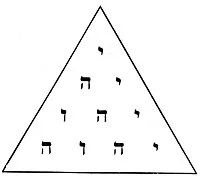
THE TETRAGRAMMATON.
By arranging the four letters of the Great Name, י ה ו ה, (I H V H), in the form of the Pythagorean Tetractys, the 72 powers of the Great Name of God are manifested. The key to the problem is as follows:
|
. |
= |
I |
= |
10 |
= |
10 |
|
. . |
= |
H I |
= |
5+10 |
= |
15 |
|
. . . |
= |
V H I |
= |
6+5+10 |
= |
21 |
|
. . . . |
= |
H V H I |
= |
5+6+5+10 |
= |
26 |
|
The Great Name of God |
= |
72 |
5th. He selected three consonants (I, H, V) from the simple ones--a secret belonging to the three mothers, or first elements; א מ ש (A, M, Sh), air, water, fire (ether). He sealed them with His spirit and fashioned them into a Great Name and with this sealed the universe in six directions. He turned towards the above and sealed the height with י ה ו (I, H, V).
6th. He turned towards the below and sealed the depth withה י ו (H, I, V).
7th. He turned forward and sealed the East with ו י ה (V, I, H).
8th. He turned backward and sealed the West with ו ה י (V H, I).
9th. He turned to the right and sealed the South with י ו ה (I, V, H).
10th. He turned to the left and sealed the North with ה ו י (H, V, I).
NOTE. This arrangement of the letters of the Great Name is according to the Rev. Dr. Isidor Kalisch.
10. These are the ten ineffable existences out of nothing; From the spirit of the Living God emanated air; from the air, water; from the water, fire (ether); from the fire, the height and the depth, the East and the West, the North and the South.
Chapter Two
1. There are twenty-two basic (sounds and) letters. Three are the first elements (water, air, fire), fundamentals, or mothers; seven are double letters; and twelve are simple letters. The three fundamental letters א מ ש have as their basis the balance. At one end of the scale are the virtues and at the other the vices, placed in equilibrium by the tongue. Of the fundamental letters מ (M) is mute like the water, ש (Sh) hissing like fire, א (A) a reconciling breath between them. t
2. The twenty-two basic letters having been designed, appointed, and established by God, He combined, weighed, and exchanged them (each with the others), and formed by them all beings which are in existence, and all which will be formed in time to come.
3. He established twenty-two basic letters, formed by the voice and impressed upon the air by the breath. He set them to be audibly uttered in five different parts of the human mouth: namely, Gutturals, א ה ח ע; Palatals, ג י כ ק; Linguals, ד ט ל נ ת Dentals, ז ש ס ר ץ; Labials, ב ו מ ף.
4. He fixed the twenty-two basic letters in a ring (sphere) like a wall with two hundred and thirty-one gates, and turned the sphere forward and backward. Turned forward, the sphere signified good; when reversed, evil. Three letters may serve for an illustration: There is nothing better than ע נ ג (O, N, G), pleasure (joy), and nothing worse than נ ג ע (N, G, O), plague (sorrow).
5. How was it all accomplished? He combined, weighed, and changed: the א (A) with all the other letters in succession, and all the others again with א (A), and all again with ב (B); and so with the whole series of letters. Hence it follows that there are two hundred and thirty-one formations, or gates, through which the powers of the letters go forth; every creature and every language proceeded from One Name and the combinations of its letters.
6. He created a reality out of Nothing. He called the nonentity into existence and hewed colossal pillars from intangible air. This has been shown by the example of combining the letter א (A) with all the other letters, and all the other letters with א. By speaking He created every creature and every word by the power of One Name. As an illustration, consider the twenty-two elementary substances from the primitive substance of א. The production of every creature from the twenty-two letters is proof that they are in reality the twenty-two parts of one living body.
Chapter Three
1. The first three elements (the Mother letters, א מ ש) resemble a balance, in one scale virtue and in the other vice, placed in equilibrium by the tongue.
2. The three Mothers, א מ ש, enclose a great, wonderful, and unknown mystery, and are sealed by six wings (or elementary circles), namely, air, water, fire--each divided into an active and a passive power. The Mothers, א מ ש, gave birth to the Fathers (the progenitors), and these gave birth to the generations.
3. God appointed and established three Mothers, א מ ש, combined, weighed, and exchanged them, forming by them three Mothers, in the universe, in the year, and in man (male and female).
4. The three Mothers, א מ ש, in the universe are: air, water, and fire. Heaven was created from the elementary fire (or ether) ש, the earth, comprising sea and land, from the elementary water, מ, and the atmospheric air from the elementary air, or spirit, א, which establishes the balance among them. Thus were all things produced.
5. The three Mothers, א מ ש, produce in the year heat, coldness, and the temperate state. Heat was created from fire, coldness from water, and the temperate state from air, which equilibrates them.
6. The three Mothers, א מ ש, produce in man (male and female) breast, abdomen, and head. The head was formed from the fire, ש; the abdomen from the water, מ; and the breast (thorax) from air, א, which places them in equilibrium.
7. God let the letter א (A) predominate in primordial air, crowned it, combined it with the other two, and sealed the air in the universe, the temperate state in the year, and the breast in man (male and female).
8. He let the letter מ (M) predominate in primordial water, crowned it, combined it with the other two, and sealed the earth in the universe (including land and sea), coldness in the year, and the abdomen in man (male and female).
9. He let the letter ש (Sh) predominate in primordial fire, crowned it, combined it with the other two, and sealed heaven in the universe, heat in the year, and the head of man (male and female).
Chapter Four
1. The seven double letters, ב ג ד כ פ ר ת (B, G, D, K, P, R, Th), have a duplicity of pronunciation (two voices), aspirated and unaspirated, namely: פּ ת, רּ ר, פּ פ, כּ כ, דּ ד, גּ גThey serve as a model of softness and hardness, strength and weakness.
2. The seven double letters symbolize wisdom, riches, fertility life, power, peace, and grace.
3. The seven double letters also signify the antitheses to which human life is exposed. The opposite of wisdom is foolishness; of riches, poverty; of fertility, sterility; of life, death; of power, servitude; of peace, war; and of beauty, deformity.
4. The seven double letters point out the six dimensions, height, depth, East and West, North and South, and the Holy Temple in the center, which sustains them all.
5. The double letters are seven and not six, they are seven and not eight; reflect upon this fact, search into it and reveal its hidden mystery and place the Creator on His throne again.
6. The seven double letters having been designed, established, purified, weighed, and exchanged by God, He formed of them seven planets in the universe, seven days in the Year, and seven gateways of the senses in man (male and female). From these seven He also produced seven heavens, seven earths, and seven Sabbaths. Therefore He loved seven more than any other number beneath His throne.
7. The seven planets in the universe are: Saturn, Jupiter, Mars, Sun, Venus, Mercury, and Moon. The seven days in the Year are the seven days of the week (possibly the seven creative days are meant). The seven gateways in man (male and female) are two eyes, two ears, two nostrils, and the mouth.
8. NOTE. Knut Stenring differs from other authorities in his arrangement of the planets and days of the week in the following seven stanzas. Kircher has still a different order. Rev. Dr. Isidor Kalisch, Wm. Wynn Westcott, and The Sacred Books and Early Literature of the East adopt the following arrangement.
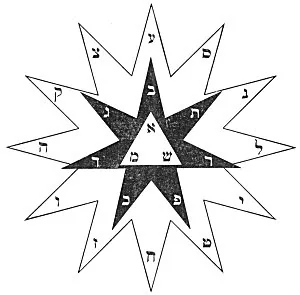
THE HEBREW LETTERS ACCORDING TO THE SEPHER YETZIRAH.
In the central triangle are the three Mother Letters from which come forth the seven Double Letters--the planets and the heavens. Surrounding the black star are the signs of the zodiac symbolized by the twelve Simple Letters. In the midst of this star is the Invisible Throne of the Most Ancient of the Ancients--the Supreme Definitionless Creator.
1st. He caused the letter. ב (B) to predominate in wisdom, crowned it, combined each with the others, and formed by them the Moon in the universe, the first day in the year, and the right eye in man (male and female).
2nd. He caused the letter ג (G) to predominate in riches, crowned it, combined each with the others, and formed by them Mars in the universe, the second day in the year, and the right ear in man (male and female).
3rd. He caused the letter ד (D) to predominate infertility, crowned it, combined each with the others, and formed by them the Sun in the universe, the third day in the year, and the right nostril in man (male and female).
4th. He caused the letterכ (K) to predominate in life, crowned it, combined each with the others, and formed by them Venus in the universe, the fourth day in the year, and the left eye in man (male and female).
5th. He caused the letter פ (P) to predominate in power, crowned it, combined each with the others, and formed by them Mercury in the universe, the fifth day in the year, and the left ear in man (male and female).
6th. He caused the letter ר (R) to predominate in peace, crowned it, combined each with the others, and formed by them Saturn in the universe, the sixth day in the year, and the left nostril in man (male and female).
7th. He caused the letter ת (Th) to predominate in grace, crowned it, combined each with the others, and formed by them Jupiter in the universe, the seventh day in the year, and the mouth of man (male and female).
9. With the seven double letters He also designed seven earths, seven heavens, seven continents, seven seas, seven rivers, seven deserts, seven days, seven weeks (from Passover to Pentecost), and in the midst of them His Holy Palace. There is a cycle of seven years and the seventh is the release year, and after seven release years is the Jubilee. For this reason God loves the number seven more than any other thing under the heavens.
10. In this manner God joined the seven double letters together. Two stones build two houses, three stones build six houses, four stones build twenty-four houses, five stones build 120 houses, six stones build 720 houses, and seven stones build 5,040 houses. Make a beginning according to this arrangement and reckon further than the mouth can express or the ear can hear.
Chapter Five
1. The twelve simple letters ה ו ז ח ט י ל נ ס ע צ ק (H, V, Z, Ch, T, I, L, N, S, O, Tz, Q) symbolize the twelve fundamental properties: speech, thought, movement, sight, hearing, work, coition, smell, sleep, anger, taste (or swallowing), and mirth.
2. The simple letters correspond to twelve directions: east height, northeast, east depth; south height, southeast, south depth; west height, southwest, west depth; north height, northwest, north depth. They diverge to all eternity and are the arms of the universe.
3. The simple letters having been designed, established, weighed, and exchanged by God, He produced by them twelve zodiacal signs in the universe, twelve months in the year, and twelve chief organs in ` human body (male and female).
4, The signs of the zodiac are: Aries, Taurus, Gemini, Cancer, Leo, Virgo, Libra, Scorpio, Sagittarius, Capricorn, Aquarius, and Pisces. The months of the year are: Nisan, liar, Sivan, Tammuz, Ab, Elul, Tisri, Marcheshvan, Kislev, Tebet, Sebat, and Adar. The organs of the human body are: two hands, two feet, two kidneys, gall, small intestine, liver, esophagus, stomach, and spleen.
5. NOTE. In the following twelve stanzas, Knut Stenring again differs, this time as to the arrangement of properties:
1st. God caused the letter ה (H) to predominate in speech, crowned it, combined it with the others, and fashioned by them Aries (the Ram) in the universe, the month Nisan in the year, and the right foot of the human body (male and female).
2nd. He caused the letter ו (V) to predominate in thought, crowned it, combined it with the others, and fashioned by them Taurus (the Bull) in the universe, the month liar in the year, and the right kidney of the human body (male and female).
3rd. He caused the letter ז (Z) to predominate in movement, crowned it, combined it with the others, and fashioned by them Gemini (the Twins) in the universe, the month Sivan in the year, and the left foot of the human body (male and female).
4th. He caused the letter ח (Ch) to predominate in sight, crowned it, combined it with the others, and fashioned by them Cancer (the Crab) in the universe, the month Tammuz in the year, and the right hand of the human body (male and female).
5th. He caused the letter ט (T) to predominate in hearing, crowned it, combined it with the others, and fashioned by them Leo (the Lion) in the universe, the month Ab in the year, and the left kidney of the human body (male and female).
6th. He caused the letter י (I) to predominate in work, crowned it, combined it with the others, and fashioned by them Virgo (the Virgin) in the universe, the month Elul in the year, and the left hand of the human body (male and female).
7th. He caused the letter ל (L) to predominate in coition, crowned it, combined it with the others, and fashioned by them Libra (the Balance) in the universe, the month Tisri in the year, and the gall of the human body (male and female).
8th. He caused the letter נ (N) to predominate in smell, crowned it, combined it with the others, and fashioned by them Scorpio (the Scorpion) in the universe, the month Marcheshvan in the year, and the small intestine in the human body (male and female).
9th. He caused the letter ס (S) to predominate in sleep, crowned it, combined it with the others, and fashioned by them Sagittarius (the Archer) in the universe, the month Kislev in the year, and the stomach in the human body (male and female).
10th. He caused the letter ע (O) to predominate in anger, crowned it, combined it with the others, and fashioned by them Capricorn (the Goat) in the universe, the month Tebet in the year, and the liver in the human body (male and female).
11th. He caused the letter צ (Tz) to predominate in taste (or swallowing), crowned it, combined it with the others, and fashioned by them Aquarius (the Water Bearer) in the universe, the month Sebat in the year, and the esophagus in the human body (male and female).
12th. He caused the letter ק (Q) to predominate in mirth, crowned it, combined it with the others, and fashioned by them Pisces (the Fishes) in the universe, the month Adar in the year, and the spleen in the human body (male and female).
6. He made them as a conflict, He arranged them as provinces and drew them up like a wall. He armed them and set one against another as in warfare. (The Elohim did likewise in the other spheres.)
Chapter Six
1. There are three Mothers or first elements, א מ ש (A, M, Sh), from which emanated three Fathers (progenitors)--primordial (spiritual) air, water, and fire--from which issued the seven planets (heavens) with their angels, and the twelve oblique points (zodiac).
2. To prove this there are three faithful witnesses: the universe, the year, and man. There are the twelve, the balance, and the seven. Above is the Dragon, below is the world, and lastly the heart of man; and in the midst is God who regulates them all.
3. The first elements are air, water, and fire; the fire is above, the water is below, and a breath of air establishes balance between them. The token is: the fire carries the water. The letterמ (M) is mute; ש (Sh) is hissing like fire; there is א (A) among them, a breath of air which reconciles the two.
4. The Dragon (Tali) is in the universe like a king upon his throne; the celestial sphere is in the year like a king in his empire; and the heart is in the body of men like a king in warfare.
5. God also set the opposites against each other: the good against the evil, and the evil against the good. Good proceeds from good, evil from evil; the good purifies the bad, the bad the good. The good is reserved for the good, and the evil for the wicked.
6. There are three of which each stands by itself: one is in the affirmative (filled with good), one is in the negative (filled with evil), and the third equilibrates them.
7. There are seven divided three against three, and one in the midst of them (balance). Twelve stand in warfare: three produce love and three hatred; three are life-givers and three are destroyers.
8. The three that cause love are the heart and the two ears; the three that produce hatred are the liver, the gall, and the tongues; the three life-givers are the two nostrils and the spleen; and the three destroyers are the mouth and the two lower openings of the body. Over all these rules God, the faithful king, from His holy habitation in all eternity. God is One above three, three are above seven, seven are above twelve, yet all are linked together.
9. There are twenty-two letters by which the I AM (YAH), the Lord of Hosts, Almighty and Eternal, designed and created by three Sepharim (Numbers, Letters, and Sounds) His universe, and formed by them all creatures and all those things that are yet to come.
10. When the Patriarch Abraham had comprehended the great truths, meditated upon them, and understood them perfectly, the Lord of the Universe (the Tetragrammaton) appeared to him, called him His friend, kissed him upon the head, and made with him a covenant. First, the covenant was between the ten fingers of his hands, which is the covenant of the tongue (spiritual); second, the covenant was between the ten toes of his feet, which is the covenant of circumcision (material); and God said of him, "Before Abraham bound the spirit of the twenty-two letters (the Thora) upon his tongue and God disclosed to him their secrets. God permitted the letters to be immersed in water, He burned them in the fire and imprinted them upon the winds. He distributed them among the seven planets and gave them to the twelve zodiacal signs.
Fundamentals of Qabbalistic Cosmogony
THE Qabbalists conceive of the Supreme Deity as an Incomprehensible Principle to be discovered only through the process of eliminating, in order, all its cognizable attributes. That which remains--when every knowable thing has been removed--is AIN SOPH, the eternal state of Being. Although indefinable, the Absolute permeates all space. Abstract to the degree of inconceivability, AIN SOPH is the unconditioned state of all things. Substances, essences, and intelligences are manifested out of the inscrutability of AIN SOPH, but the Absolute itself is without substance, essence, or intelligence. AIN SOPH may be likened to a great field of rich earth out of which rises a myriad of plants, each different in color, formation, and fragrance, yet each with its roots in the same dark loam--which, however, is unlike any of the forms nurtured by it. The "plants" are universes, gods, and man, all nourished by AIN SOPH and all with their source in one definitionless essence; all with their spirits, souls, and bodies fashioned from this essence, and doomed, like the plant, to return to the black ground--AIN SOPH, the only Immortal--whence they came.
AIN SOPH was referred to by the Qabbalists as The Most Ancient of all the Ancients. It was always considered as sexless. Its symbol was a closed eye. While it may be truly said of AIN SOPH that to define It is to defile It, the Rabbis postulated certain theories regarding the manner in which AIN SOPH projected creations out of Itself, and they also assigned to this Absolute Not-Being certain symbols as being descriptive, in part at least, of Its powers. The nature of AIN SOPH they symbolize by a circle, itself emblematic of eternity. This hypothetical circle encloses a dimensionless area of incomprehensible life, and the circular boundary of this life is abstract and measureless infinity.
According to this concept, God is not only a Center but also Area. Centralization is the first step towards limitation. Therefore, centers which form in the substances of AIN SOPH are finite because they are predestined to dissolution back into the Cause of themselves, while AIN SOPH Itself is infinite because It is the ultimate condition of all things. The circular shape given to AIN SOPH signifies that space is hypothetically enclosed within a great crystal-like globe, outside of which there is nothing, not even a vacuum. Within this globe--symbolic of AIN SOPH--creation and dissolution take place. Every element and principle that will ever be used in the eternities of Kosmic birth, growth, and decay is within the transparent substances of this intangible sphere. It is the Kosmic Egg which is not broken till the great day "Be With Us," which is the end of the Cycle of Necessity, when all things return to their ultimate cause.
In the process of creation the diffused life of AIN SOPH retires from the circumference to the center of the circle and establishes a point, which is the first manifesting One--the primitive limitation of the all-pervading O. When the Divine Essence thus retires from the circular boundary to the center, It leaves behind the Abyss, or, as the Qabbalists term it, the Great Privation. Thus, in AIN SOPH is established a twofold condition where previously had existed but one. The first condition is the central point--the primitive objectified radiance of the eternal, subjectified life. About this radiance is darkness caused by the deprivation of the life which is drawn to the center to create the first point, or universal germ. The universal AIN SOPH, therefore, no longer shines through space, but rather upon space from an established first point. Isaac Myer describes this process as follows: "The Ain Soph at first was filling All and then made an absolute concentration into Itself which produced the Abyss, Deep, or Space, the Aveer Qadmon or Primitive Air, the Azoth; but this is not considered in the Qabbalah as a perfect void or vacuum, a perfectly empty Space, but is thought of as the Waters or Crystalline Chaotic Sea, in which was a certain degree of Light inferior to that by which all the created [worlds and hierarchies] were made." (See The Qabbalah.)
In the secret teachings of the Qabbalah it is taught that man's body is enveloped in an ovoid of bubble-like iridescence, which is called the Auric Egg. This is the causal sphere of man. It bears the same relationship to man's physical body that the globe of AIN SOPH bears to Its created universes. In fact, this Auric Egg is the AIN SOPH sphere of the entity called man. In reality, therefore, the supreme consciousness of man is in this aura, which extends in all directions and completely encircles his lower bodies. As the consciousness in the Kosmic Egg is withdrawn into a central point, which is then called God--the Supreme One--so the consciousness in the Auric Egg of man is concentrated, thereby causing the establishment of a point of consciousness called the Ego. As the universes in Nature are formed from powers latent in the Kosmic Egg, so everything used by man in all his incarnations throughout the kingdoms of Nature is drawn from the latent powers within his Auric Egg. Man never passes from this egg; it remains even after death. His births, deaths, and rebirths all take place within it, and it cannot be broken until the lesser day "Be With Us," when mankind--like the universe--is liberated from the Wheel of Necessity.
THE QABBALISTIC SYSTEM OF WORLDS
On the accompanying circular chart, the concentric rings represent diagrammatically the forty rates of vibration (called by the Qabbalists Spheres) which emanate from AIN SOPH. The circle X 1 is the outer boundary of space. It circumscribes the area of AIN SOPH. The nature of AIN SOPH Itself is divided into three parts, represented by the spaces respectively between X 1 and X 2, X 2 and X 3, X 3 and A 1; thus:
|
X 1 to X 2, |
אין, |
AIN, the vacuum of pure spirit. |
|
X 2 to X 3, |
אין סוף, |
AIN SOPH, the Limitless and Boundless. |
|
X 3 to A 1, |
אין סוף אור, |
AIN SOPH AUR, the Limitless Light. |
It should be borne in mind that in the beginning the Supreme Substance, AIN, alone permeated the area of the circle; the inner rings had not yet come into manifestation. As the Divine Essence concentrated Itself, the rings X 2 and X 3 became apprehensible, for AIN SOPH is a limitation of AIN, and AIN SOPH AUR, or Light, is a still greater limitation. Thus the nature of the Supreme One is considered to be threefold, and from this threefold nature the powers and elements of creation were reflected into the Abyss left by the motion of AIN SOPH towards the center of Itself. The continual motion of AIN SOPH towards the center of Itself resulted in the establishment of the dot in the circle. The dot was called God, as being the supreme individualization of the Universal Essence. Concerning this the Zohar says:
"When the concealed of the Concealed wished to reveal Himself He first made a single point: the Infinite was entirely unknown, and diffused no light before this luminous point violently broke through into vision."
The name of this point is I AM, called by the Hebrews Eheieh. The Qabbalists gave many names to this dot. On this subject Christian D. Ginsberg writes, in substance: The dot is called the first crown, because it occupies the highest position. It is called the aged, because it is the first emanation. It is called the primordial or smooth point. It is called the white head, the Long Face--Macroprosophus--and the inscrutable height, because it controls and governs all the other emanations.
When the white shining point had appeared, it was called Kether, which means the Crown, and out of it radiated nine great globes, which arranged themselves in the form of a tree. These nine together with the first crown constituted the first system of Sephiroth. These ten were the first limitation of ten abstract points within the nature of AIN SOPH Itself. The power of AIN SOPH did not descend into these globes but rather was reflected upon them as the light of the sun is reflected upon the earth and planets. These ten globes were called the shining sapphires, and it is believed by many Rabbins that the word sapphire is the basis of the word Sephira (the singular of Sephiroth). The great area which had been privated by the withdrawal of AIN SOPH into the central point, Kether, was now filled by four concentric globes called worlds, or spheres, and the light of the ten Sephiroth was reflected down through each of these in turn. This resulted in the establishment of four symbolical
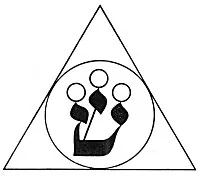
THE HEBREW TRIAD.
The Qabbalists used the letter ש, Shin, to signify the trinity of the first three Sephiroth. The central circle slightly above the other two is the first Sephira--Kether, the White Head, the Crown. The other two circles represent Chochmah, the Father, and Binah, the Mother. From the union of the Divine Father and the Divine Mother are produced the worlds and the generations of living things. The three flame-like points of the letter ש have long been used to conceal this Creative Triad of the Qabbalists.
trees, each hearing the reflections of the ten Sephirothic globes. The 40 spheres of creation out of AIN SOPH are divided into four great world chains, as follows:
A 1 to A 10, Atziluth, the Boundless World of Divine Names.
B 1 to B 10, Briah, the Archangelic World of Creations.
C 1 to C 10, Yetzirah, the Hierarchal World of Formations.
D 1 to D 10, Assiah, the Elemental World of Substances.
Each of these worlds has ten powers, or spheres--a parent globe and nine others which conic out of it as emanations, each globe born out of the one preceding. On the plane of Atziluth (A 1 to A 10), the highest and most divine of all the created worlds, the unmanifested AIN SOPH established His first point or dot in the Divine Sea--the three spheres of X. This dot--A 1--contains all creation within it, but in this first divine and uncontaminated state the dot, or first manifested. God, was not considered as a personality by the Qabbalists but rather as a divine establishment or foundation. It was called the First Crown and from it issued the other circles of the Atziluthic World: A 2, A 3, A 4, A 5, A 6, A 7, A 8, A 9, and A 10. In the three lower worlds these circles are intelligences, planers, and elements, but in this first divine world they are called the Rings of the Sacred Names.
The first ten great circles (or globes) of light which were manifested out of AIN SOPH and the ten names of God assigned to them by the Qabbalists are as follows:
From AIN SOPH came A 1, the First Crown, and the name of the first power of God was Eheieh, which means I Am [That I Am].
From A 1 came A 2, the first Wisdom, and the name of the second power of God was Jehovah, which means Essence of Being.
From A 2 came A 3, the first Understanding, and the name of the third power of God was Jehovah Elohim, which means God of Gods.
From A 3 came A 4, the first Mercy, and the name of the fourth power of God was El, which means God the Creator.
From A 4 came A 5, the first Severity, and the name of the fifth power of God was Elohim Gibor, which means God the Potent.
From A 5 came A 6, the first Beauty, and the name of the sixth power of God was Eloah Vadaath, which means God the Strong.
From A 6 came A 7, the first Victory, and the name of the seventh power of God was Jehovah Tzaboath, which means God of Hosts.
From A 7 came A 8, the first Glory, and the name of the eighth power of God was Elohim Tzaboath, which means Lord God of Hosts.
From A 8 came A 9, the first Foundation, and the name of the ninth power of God was Shaddai, El Chai, which means Omnipotent.
From A 9 came A 10, the first Kingdom, and the name of the tenth power of God was Adonai Melekh, which means God.
From A 10 came B 1, the Second Crown, and the World of Briah was established.
The ten emanations from A 1 to A 10 inclusive are called the foundations of all creations. The Qabbalists designate them the ten roots of the Tree of Life. They are arranged in the form of a great human figure called Adam Qadmon--the man made from the fire mist (red dirt), the prototypic Universal Man. In the Atziluthic World, the powers of God are most purely manifested. These ten pure and perfect radiations do not descend into the lower worlds and take upon themselves forms, but are reflected upon the substances of the inferior spheres. From the first, or Atziluthic, World they are reflected into the second, or Briatic, World. As the reflection always lacks some of the brilliancy of the original image, so in the Briatic World the ten radiations lose part of their infinite power. A reflection is always like the thing reflected, but smaller and fainter.
In the second world, B 1 to B 10, the order of the spheres is the Name as in the Atziluthic World, but the ten circles of light are less brilliant and more tangible, and are here referred to as ten great Spirits--divine creatures who assist in the establishment of order and intelligence in the universe. As already noted, B 1 is born out of A 10 and is included within all the spheres superior to itself. Out of B 1 are taken nine globes--B 2, B 3, B 4, B 5, B 6, B 7, B 8, B 9, and B 10--which constitute the World of Briah. These ten subdivisions, however, are really the ten Atziluthic powers reflected into the substance of the Briatic World. B 1 is the ruler of this world, for it contains all the other rings of its own world and also the rings of the third and fourth worlds, C and D. In the World of Briah the ten spheres of light are called the Archangels of Briah. Their order and powers are as follows:
From A 10 came B 1, the Second Crown; it is called Metatron, the Angel of the Presence.
From B 1 came B 2, the second Wisdom; it is called Raziel, the Herald of Deity who revealed the mysteries of Qabbalah to Adam.
From B 2 carne B 3, the second Understanding; it is called Tsaphkiel, the Contemplation of God.
From B 3 came B 4 ' the second Mercy; it is called Tsadkiel, the justice of God.
From B 4 came B 5, the second Severity; it is called Samael, the Severity of God.
From B 5 came B 6, the second Beauty; it is called Michael, Like Unto God.
From B 6 came B 7, the second Victory; it is called Haniel, the Grace of God.
From B 7 came B 8, the second Glory; it is called Raphael, the Divine Physician.
From B 8 came B 9, the second Foundation; it is called Gabriel, the Man-God.
From B 9 came B 10, the second Kingdom; it is called Sandalphon, the Messias.
From B 10 came C 1, the Third Crown, and the World of Yetzirah was established.
The ten Archangels of Briah are conceived to be ten great spiritual beings, whose duty is to manifest the ten powers of the Great Name of God existent in the Atziluthic World, which surrounds and interpenetrates the entire world of creation. All things manifesting in the lower worlds exist first in the intangible rings of the upper spheres, so that creation is, in truth, the process of making tangible the intangible by extending the intangible into various vibratory rates. The ten globes of Briatic power, while themselves reflections, are mirrored downward into the third or Yetziratic World, where still more limited in their expression they become the spiritual and invisible zodiac which is behind the visible band of constellations. In this third world the ten globes of the original Atziluthic World are greatly limited and dimmed, but they are still infinitely powerful in comparison with the state of substance in which man dwells. In the third world, C 1 to C 10, the globes become hierarchies of celestial creatures, called the Choirs of Yetzirah. Here again, all are included within the ring C 1, the power which controls the Yetziratic World and which includes within itself and controls the entire world D. The order of the globes and the names of the hierarchies composing them are as follows:
From B 10 came C 1, the Third Crown; the Hierarchy is the Cherubim, Chaioth Ha Kadosh, the Holy Animals.
From C 1 came C 2, the third Wisdom; the Hierarchy is the Cherubim, Orphanim, the Wheels.
From C 2 came C 3, the third Understanding; the Hierarchy is the Thrones, Aralim, the Mighty Ones.
From C 3 came C 4, the third Mercy; the Hierarchy is the Dominations, Chashmalim, the Brilliant Ones.
From C 4 came C 5, the third Severity; the Hierarchy is the Powers, Seraphim, the Flaming Serpents.
From C 5 came C 6, the third Beauty; the Hierarchy is the Virtues, Melachim, the Kings.
From C 6 came C 7, the third Victory; the Hierarchy is the Principalities, Elohim, the Gods.
From C 7 came C 8, the third Glory; the Hierarchy is the Archangels, Ben Elohim, the Sons of God.
From C 8 came C 9, the third Foundation; the Hierarchy is the Angels, Cherubim, the Scat of the Sons.
From C 9 came C 10, the third Kingdom; the Hierarchy is Humanity, the Ishim, the Souls of Just Men.
From C 10 came D 1, the Fourth Crown, and the World of Assiah was established.
From the Yetziratic World the light of the ten spheres is reflected into the World of Assiah, the lowest of the four. The ten globes of the original Atziluthic World here take upon themselves forms of physical matter and the sidereal system is the result. The World of Assiah, or the elemental world of substance, is the one into which humanity descended at the time of Adam's fall. The Garden of Eden is the three upper worlds, and for his sins man was forced into the sphere of substance and assumed coats of skin (bodies). All of the spiritual forces of the upper worlds, A, B, C, when they strike against the elements of the lower world, D, are distorted and perverted, resulting in the creation of hierarchies of demons to correspond with the good spirits in each of the higher worlds. In all the ancient Mysteries, matter was regarded as the source of all evil and spirit the source of all good, for matter inhibits and limits, often so clogging the inner perceptions that man is unable to recognize his own divine potentialities. Since matter thus prevents humanity from claiming its birthright, it is called the Adversary, the power of evil. The fourth world, D, is the world of solar systems,
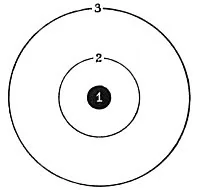
THE PLAN OF DIVINE ACTIVITY.
According to the Qabbalists, the life of the Supreme Creator permeates all substance, all space, and all time, but for diagrammatic purposes the Supreme, All-Inclusive Life is limited by Circle 3, which may be called "the boundary line of Divine existence." The Divine Life permeating the area bounded by Circle 3 is focused at Point 1, which thus becomes the personification of the impersonal life and is termed "the First Crown." The creative forces pouring through Point 1 come into manifestation as the objective universe in the intermediate space, Circle 2.
comprising not only the one of which the earth is a part but all the solar systems in the universe.
Opinions differ as to the arrangement of the globes of this last world, D 1 to D 10 inclusive. The ruler of the fourth world is D 1, called by some the Fiery Heaven; by others the Primum Mobile, or the First Motion. From this whirling fire emanates the material starry zodiac, D 2, in contradistinction to the invisible spiritual zodiac of the Yetziratic World. From the zodiac, D 2, are differentiated the spheres of the planets in concatenate order. The ten spheres of the World of Assiah are as follows:
From C 10 came D 1, the Fourth Crown; Rashith Ha-Galagalum, the Primum Mobile, the fiery mist which is the beginning of the material universe.
From D 1 came D 2, the fourth Wisdom; Masloth, the Zodiac, the Firmament of the Fixed Stars.
From D 2 came D 3, the fourth Understanding; Shabbathai, the sphere of Saturn.
From D 3 came D 4, the fourth Mercy; Tzedeg, the sphere of Jupiter.
From D 4 came D 5, the fourth Severity; Madim, the sphere of Mars.
From D 5 came D 6, the fourth Beauty; Shemesh, the sphere of the Sun.
From D 6 came D 7, the fourth Victory; Nogah, the sphere of Venus.
From D 7 came D 8, the fourth Glory; Kokab, the sphere of Mercury.
From D 8 came D 9, the fourth Foundation; Levanah, the sphere of the Moon.
From D 9 came D 10, the Fourth Kingdom; Cholom Yosodoth, the sphere of the Four Elements.
By inserting a sphere (which he calls the Empyrean) before the Primum Mobile, Kircher moves each of the other spheres down one, resulting in the elimination of the sphere of the elements and making D 10 the sphere of the Moon.
In the World of Assiah are to be found the demons and tempters. These are likewise reflections of the ten great globes of Atziluth, but because of the distortion of the images resulting from the base substances of the World of Assiah upon which they are reflected, they become evil creatures, called shells by the Qabbalists. There are ten hierarchies of these demons to correlate with the ten hierarchies of good spirits composing the Yetziratic World. There are
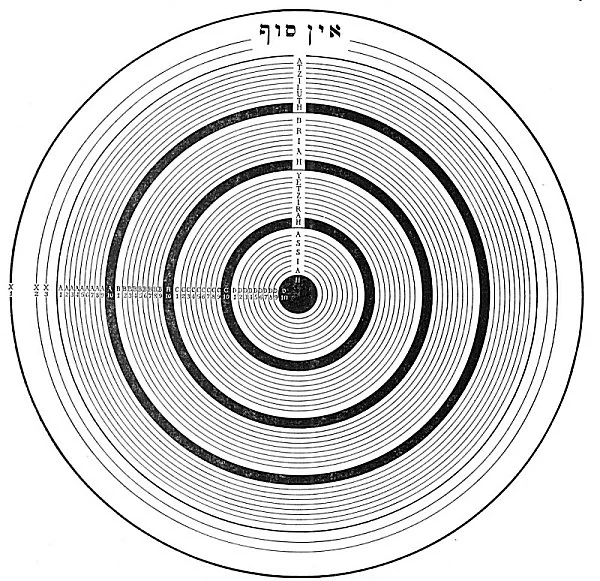
THE QABBALISTIC SCHEME OF THE FOUR WORLDS.
In the above chart the dark line between X 3 and A 1 constitutes the boundary of the original dot, while the concentric circles within this heavier line symbolize the emanations and the worlds which came forth from the dot. As this dot is contained within the outer rings X 1, X 2, and X 3, and represents the first establishment of an individualized existence, so the lower universe symbolized by the forty concentric circles within the dot represents the lower creation evolved out of and yet contained within the nature of the first Crown, which may be called God, within whom the divine powers, the celestial beings the sidereal worlds, and man, live and move and have their being. It is highly important that all the rings within A 1 be considered as being enclosed by the primitive dot, which is itself encircled by the great ring X 1, or the Auric Egg of AIN SOPH.
Each ring includes with in its own nature all the rings within itself and is included within the natures of all the rings outside of itself. Thus, A 1--the primitive dot--controls and contains the thirty-nine rings which it encloses, all of these partaking of its nature in varying degrees according to their respective dignities. Consequently, the entire area from A 1 to D 10 inclusive is the original dot, and the rings symbolize the divisions which took place with in it and the emanations which poured out from it after its establishment in the midst of the abstract nature of AIN SOPH. The powers of the rings decrease towards the center of the diagram, for Power is measured by the number of things controlled, and each ring controls the rings within it and is controlled by the rings outside of it. Thus, while A 1 controls thirty-nine rings besides itself, B 1 controls only twenty-nine rings besides its own. Therefore, A 1 is more powerful than B 1. As the greatest spiritual solidity, or permanence, is at the circumference and the greatest material density, or impermanence, is at the center of the diagram, the rings as they decrease in Power become more material and substantial until the center sphere, D 10, symbolizes the actual chemical elements of the earth. The rates of vibration are also lower as the rings approach the center. Thus, the vibration of A 2 is lower than A 1 but higher than A 3, and so on in decreasing scale towards the center, A 1 being the highest and D 10 the lowest sphere of creation. While A 1, the ruler of creation, controls the circles marked A, B, C, and D, it is less than the three rings of AIN SOPH--X 1, X2, and X3--and therefore bows before the throne of the ineffable Creator from whose substances it was individualized.
also ten Archdemons, corresponding to the ten Archangels of Briah. The black magicians use these inverted spirits in their efforts to attain their nefarious ends, but in time the demon destroys those who bind themselves to it. The ten orders of demons and the ten Archdemons of the World of Assiah are as follows:
D 1, the evil Crown; the hierarchy is called Thaumiel, the doubles of God, the Two-headed; the Archdemons are Satan and Moloch.
From D 1 came D 2, the evil Wisdom; the hierarchy is called Chaigidiel, those who obstruct; the Archdemon is Adam Belial.
From D 2 came D 3, the evil Understanding; the hierarchy is called Satharial, the concealment of God, the Archdemon is Lucifuge.
From D 3 came D 4, the evil Mercy; the hierarchy is called Gamchicoth, the disturber of things; the Archdemon is Astaroth.
From D 4 came D 5, the evil Severity; the hierarchy is called Golab, incendiarism and burning; the Archdemon is Asmodeus.
From D 5 came D 6, the evil Beauty; the hierarchy is called Togarini, the wranglers; the Archdemon is Belphegor.
From D 6 came D 7, the evil Victory; the hierarchy is called Harab Serap, the dispensing Raven; the Archdemon is Baal Chanan.
From D 7 came D 8, the evil Glory; the hierarchy is called Samael, the embroiler; the Archdemon is Adramelek.
From D 8 came D 9, the evil Foundation; the hierarchy is called Gamaliel, the obscene; the Archdemon is Lilith.
From D 9 came D 10, the evil Kingdom; the hierarchy is called Nahemoth, the impure; the Archdemon is Nahema.
The Qabbalists declare that the worlds, intelligences, and hierarchies were established according to the vision of Ezekiel. By the man of Ezekiel's vision is symbolized the World of Atziluth; by the throne, the World of Briah; by the firmament, the World of Yetzirah; and by the living creatures the World of Assiah. These spheres are the wheels within wheels of the prophet. The Qabbalists next established a human figure in each of the four worlds: A 1 was the head and A 10 the feet of the man of Atziluth; B 1 was the head and B 10 the feet of the man of Briah; C 1 was the head and C 10 the feet of the man of Yetzirah; D 1 was the head and D 10 the feet of the man of Assiah. These four are called the World Men. They are considered androgynous and are the prototypes of humanity.
The human body, like that of the universe, is considered to be a material expression of ten globes or spheres of light. Therefore man is called the Microcosm--the little world, built in the image of the great world of which he is a part. The Qabbalists also established a mysterious universal man with his head at A 1 and his feet at D 10. This is probably the secret significance of the great figure of Nebuchadnezzar's dream, with its head in the World of Atziluth, its arms and hands in the World of Briah, its generative system in the World of Yetzirah, and its legs and feet in the World of Assiah. This is the Grand Man of the Zohar, of whom Eliphas Levi writes:
"It is not less astonishing to observe at the beginning of the Zohar the profundity of its notions and the sublime simplicity of its images. It is said as follows: 'The science of equilibrium is the key of occult science. Unbalanced forces perish in the void. So passed the kings of the elder world, the princes of the giants. They have fallen like trees without roots, and their place is found no more. Through the conflict of unbalanced forces, the devastated earth was void and formless, until the Spirit of God made for itself a place in heaven and reduced the mass of waters. All the aspirations of Nature were directed then towards unity of form, towards the living synthesis (if equilibrated forces; the face of God, crowned with light, rose over the vast sea and was reflected in the waters thereof. His two eyes were manifested, radiating with splendour, darting two beams of light which crossed with those of the reflection. The brow of God and His eyes formed a triangle in heaven, and its reflection formed a second triangle in the waters. So was revealed the number six, being that of universal creation.' The text, which would be unintelligible in a literal version, is translated here by way of interpretation. The author makes it plain that the human form which he ascribes to Deity is only an image of his meaning and that God is beyond expression by human thought or representation by any figure. Pascal said that God is a circle, of which the center is everywhere and the circumference nowhere. But how is one to imagine a circle apart from its circumference? The Zohar adopts the antithesis of this paradoxical image and in respect of the circle of Pascal would say rather that the circumference is everywhere, while that which is nowhere is the center. It is however to a balance and not to a circle that it compares the universal equilibrium of things. It affirms that equilibrium is everywhere and so also is the central point where the balance hangs in suspension. We find that the Zohar is thus more forcible and more profound than Pascal. * * * The Zohar is a genesis of light; the Sepher Yetzirah is a ladder of truth. Therein are expounded the two-and-thirty absolute symbols of speech--being numbers and letters. Each letter produces a number, an idea and a form, so that mathematics are applicable to forms and ideas, even as to numbers, in virtue of an exact proportion, and a perfect correspondence. By the science of the Sepher Yetzirah, the human mind is rooted in truth and in reason; it accounts for all progress possible to intelligence by means of the evolution of numbers. Thus does the Zohar represent absolute truth, while the Sepher Yetzirah furnishes the method of its acquisition, its discernment and application." (History of Magic.)
By placing man himself at the point D 10, his true constitution is revealed. He exists upon four worlds, only one of which is visible. It is then made evident that his parts and members upon the material plane are, by analogy, hierarchies and intelligences in the higher worlds. Here, again, the law of interpenetration is evidenced. Although within man is the entire universe (the 43 spheres interpenetrating D 10), he is ignorant of its existence because he cannot exercise control over that which is superior to or greater than himself. Nevertheless, all these higher spheres exercise control over him, as his functions and activities demonstrate. If they did not, he would be an inert mass of substance. Death is merely the result of deflecting the life impulses of the higher rings away from the lower body.
The control of the transubstantial rings over their own material reflection is called life, and the spirit of man is, in reality, a name given to this great host of intelligences, which are focused upon substance through a point called the ego, established in the midst of themselves. X 1 is the outside boundary of the human Auric Egg, and the entire diagram becomes a cross section of the constitution of man, or a cross section of the Kosmic constitution, if correlated with the universe. By the secret culture of the Qabbalistic School, man is taught how to climb the rings (unfold his consciousness) until at last he returns to AIN SOPH. The process by which this is accomplished is called the Fifty Gates of Light. Kircher, the Jesuit Qabbalist, declares that Moses passed through forty-nine of the gates, but that Christ alone passed the fiftieth gate.
To the third edition of the Sepher Yetzirah translated from the Hebrew by Wm. Wynn Westcott are appended the Fifty Gates of Intelligence emanating from Binah, the second Sephira. The source of this information is Kircher's Œdipus Ægyptiacus. The gates are divided into six orders, of which the first four have each ten subdivisions, the fifth nine, and the sixth only one.
The first order of gates is termed Elementary and its divisions areas follows: (1) Chaos, Hyle, the First Matter; (2) Formless, void, lifeless; (3) The Abyss; (4) Origin of the Elements; (5) Earth (no seed germs); (6) Water;(7) Air;(8) Fire;(9) Differentiation of qualities; (10) Mixture and combination.
The second order of gates is termed Decad of Evolution and its divisions areas follows: (11) Minerals differentiate; (12) Vegetable principles appear; (13) Seeds germinate in moisture; (14) Herbs and Trees; (15) Fructification in vegetable life; (16) Origin of low forms of animal life; (17) Insects and Reptiles appear; (18) Fishes, vertebrate life in the waters; (19) Birds, vertebrate life in the air; (20) Quadrupeds, vertebrate earth animals.
The third order of gates is termed Decad of Humanity and its divisions are as follows: (21) Appearance of Man; (22) Material human body; (23) Human Soul conferred; (24) Mystery of Adam and Eve; (25) Complete Man as the Microcosm; (26) Gift of five human faces acting exteriorly; (27) Gift of five powers to the soul; (28) Adam Kadmon, the Heavenly Man; (29) Angelic beings, (30) Man in the image of God.
The fourth order of gates is termed World of Spheres and its divisions are as follows: (31) The Heaven of the Moon; (32) The Heaven of Mercury, (33) The Heaven of Venus; (34) The Heaven of the Sun; (35) The Heaven of Mars; (36) The Heaven of Jupiter; (37) The Heaven of Saturn; (38) The Firmament; (39) The Primum Mobile; (40) The Empyrean Heaven.
The fifth order of gates is termed The Angelic World and its divisions are as follows: (41) Ishim--Sons of Fire; (42) Orphanim--Cherubim; (43) Aralim--Thrones; (44) Chashmalim--Dominions; (45) Seraphim--Virtues; (46) Melachim--Powers; (47) Elohim--Principalities; (48) Ben Elohim--Angels; (49) Cherubim--Archangels. [The order of the Angels is a matter of controversy, the arrangement above differing from that accepted in other sections of this volume. The Rabbins disagree fundamentally as to the proper sequence of the Angelic names.]
The sixth order is termed The Archetype and consists of but one gate: (50) God, AIN SOPH, He whom no mortal eye hath seen. The fiftieth gate leads from creation into the Creative Principle and he who passes through it returns into the unlimited and undifferentiated condition of ALL. The fifty gates reveal a certain evolutionary process and it was declared by the Rabbins that he who would attain to the highest degree of understanding must pass sequentially through all of these orders of life, each of which constituted a gate in that the spirit, passing from the lower to the higher, found in each more responsive organism new avenues of self-expression.
The Tree of the Sephiroth
THE Tree of the Sephiroth may be considered an invaluable compendium of the secret philosophy which originally was the spirit and soul of Chasidism. The Qabbalah is the priceless heritage of Israel, but each year those who comprehend its true principles become fewer in number. The Jew of today, if he lacks a realization of the profundity of his people's doctrines, is usually permeated with that most dangerous form of ignorance, modernism, and is prone to regard the Qabbalah either as an evil to be shunned like the plague or as a ridiculous superstition which has survived the black magic of the Dark Ages. Yet without the key which the Qabbalah supplies, the spiritual mysteries of both the Old and the New Testament must remain unsolved by Jew and Gentile alike.
The Sephirothic Tree consists of ten globes of luminous splendor arranged in three vertical columns and connected by 22 channels or paths. The ten globes are called the Sephiroth and to them are assigned the numbers i to 10. The three columns are called Mercy (on the right), Severity (on the left), and, between them, Mildness, as the reconciling power. The columns may also be said to represent Wisdom, Strength, and Beauty, which form the triune support of the universe, for it is written that the foundation of all things is the Three. The 22 channels are the letters of the Hebrew alphabet and to them are assigned the major trumps of the Tarot deck of symbolic cards.
Eliphas Levi declared that by arranging the Tarot cards according to a definite order man could discover all that is knowable concerning his God, his universe, and himself. When the ten numbers which pertain to the globes (Sephiroth) are combined with the 22 letters relating to the channels, the resultant sum is 32--the number peculiar to the Qabbalistic Paths of Wisdom. These Paths, occasionally referred to as the 32 teeth in the mouth of the Vast Countenance or as the 32 nerves that branch out from the Divine Brain, are analogous to the first 32 degrees of Freemasonry, which elevate the candidate to the dignity of a Prince of the Royal Secret. Qabbalists also consider it extremely significant that in the original Hebrew Scriptures the name of God should occur 32 times in the first chapter of Genesis. (In the English translations of the Bible the name appears 33 times.) In the mystic analysis of the human body, according to the Rabbins, 32 spinal segments lead upward to the Temple of Wisdom--the skull.
The four Qabbalistic Trees described in the preceding chapter were combined by later Jewish scholars into one all-inclusive diagram and termed by them not only the Sephirothic but also the Archetypal, or Heavenly, Adam. According to some authorities, it is this Heavenly Adam, and not a terrestrial man, whose creation is described in the opening chapters of Genesis. Out of the substances of this divine man the universe was formed; in him it remains and will continue even after dissolution shall resolve the spheres back into their own primitive substance. The Deity is never conceived of as actually contained in the Sephiroth, which are purely hypothetical vessels employed to define the limits of the Creative Essence. Adolph Franck rather likens the Sephiroth to varicolored transparent glass bowls filled with pure light, which apparently assumes the color of its containers but whose essential nature remains ever unchanged and unchangeable.
The ten Sephiroth composing the body of the prototypic Adam, the numbers related to them, and the parts of the universe to which they correspond are as follows:
|
No. |
THE SEPHIROTH |
THE UNIVERSE |
ALTERNATIVE |
|
1 |
Kether--the Crown |
Primum Mobile |
The Fiery Heavens |
|
2 |
Chochmah--Wisdom |
The Zodiac |
The First Motion |
|
3 |
Binah--Understanding |
Saturn |
The Zodiac |
|
4 |
Chesed--Mercy |
Jupiter |
Saturn |
|
5 |
Geburah--Severity |
Mars |
Jupiter |
|
6 |
Tiphereth--Beauty |
Sun |
Mars |
|
7 |
Netsah--Victory |
Venus |
Sun |
|
8 |
Hod--Glory |
Mercury |
Venus |
|
9 |
Jesod--the Foundation |
Moon |
Mercury |
|
10 |
Malchuth--the Kingdom |
Elements |
Moon |
It must continually be emphasized that the Sephiroth and the properties assigned to them, like the tetractys of the Pythagoreans, are merely symbols of the cosmic system with its multitude of parts. The truer and fuller meaning of these emblems may not be revealed by writing or by word of mouth, but must be divined as the result of study and meditation. In the Sepher ha Zohar it is written that there is a garment--the written doctrine-which every man may see. Those with understanding do not look upon the garment but at the body beneath it--the intellectual and philosophical code. The wisest of all, however, the servants of the Heavenly King, look at nothing save the soul--the spiritual doctrine--which is the eternal and ever-springing root of the law. Of this great truth Eliphas Levi also writes declaring that none can gain entrance to the secret House of Wisdom unless he wear the voluminous cape of Apollonius of Tyana and carry in his hand the lamp of Hermes. The cape signifies the qualities of self-possession and self-reliance which must envelope the seeker as a cloak of strength, while the ever-burning lamp of the sage represents the illumined mind and perfectly balanced intellect without which the mystery of the ages can never be solved.
The Sephirothic Tree is sometimes depicted as a human body, thus more definitely establishing the true identity of the first, or Heavenly, Man--Adam Kadmon--the Idea of the Universe. The ten divine globes (Sephiroth) are then considered as analogous to the ten sacred members and organs of the Protogonos, according to the following arrangement. Kether is the crown of the Prototypic Head and perhaps refers to the pineal gland; Chochmah and Binah are the right and left hemispheres respectively of the Great Brain; Chesed and Geburah (Pechad) are the right and left arms respectively, signifying the active creative members of the Grand Man; Tiphereth is the heart, or, according to some, the entire viscera; Netsah and Hod are the right and left legs respectively, or the supports of the world; Jesod is the generative system, or the foundation of form; and Malchuth represents the two feet, or the base of being. Occasionally Jesod is considered as the male and Malchuth as the female generative power. The Grand Man thus conceived is the gigantic image of Nebuchadnezzar's dream, with head of gold, arms and chest of silver, body of brass, legs of iron, and feet of clay. The mediæval Qabbalists also assigned one of the Ten Commandments and a tenth part of the Lord's Prayer in sequential order to each of the ten Sephiroth.
Concerning the emanations from Kether which establish themselves as three triads of Creative Powers--termed in the Sepher ha Zohar three heads each with three faces--H. P. Blavatsky writes: "This [Kether] was the first Sephiroth, containing in herself the other nine ספּירות Sephiroth, or intelligences. In their totality and unity they represent the archetypal man, Adam Kadmon, the πρωτόγονος, who in his individuality or unity is yet dual, or bisexual, the Greek Didumos, for he is the prototype of all humanity. Thus we obtain three trinities, each contained in a 'head.' In the first head, or face (the three-faced Hindu Trimurti),

THE FOUR SEPHIROTHIC TREES.
The forty concentric circles shown in the large circular cut in the preceding chapter are here arranged as four trees, each consisting of ten circles. These trees disclose the organization of the hierarchies controlling the destinies of all creation. The trees are the same in each of the four world but the powers vested in the globes express themselves differently through the substances of each world, resulting in endless differentiation.
we find Sephira [Kether], the first androgyne, at the apex of the upper triangle, emitting Hachama [Chochmah], or Wisdom, a masculine and active potency--also called Jah, יה--and Binah, בינה, or Intelligence, a female and passive potency, also represented by the name Jehovah יהוה. These three form the first trinity or 'face' of the Sephiroth. This triad emanated Hesed, הסד, or Mercy, a masculine active potency, also called El, from which emanated Geburah גבורה, or justice, also called Eloha, a feminine passive potency; from the union of these two was produced Tiphereth טפּארת, Beauty, Clemency, the Spiritual Sun, known by the divine name Elohim; and the second triad, 'face,' or 'head,' was formed. These emanating, in their turn, the masculine potency Netzah, נצה, Firmness, or Jehovah Sabaoth, who issued the feminine passive potency Hod,הוד, Splendor, or Elohim Sabaoth; the two produced Jesod, יסוד, Foundation, who is the mighty living one El-Chai, thus yielding the third trinity or 'head.' The tenth Sephiroth is rather a duad, and is represented on the diagrams as the lowest circle. It is Malchuth or Kingdom, מלכות, and Shekinah, שכינה, also called Adonai, and Cherubim among the angelic hosts. The first 'Head' is called the Intellectual world; the second 'Head' is the Sensuous, or the world of Perception, and the third is the material or Physical world." (See Isis Unveiled.)
Among the later Qabbalists there is also a division of the Sephirothic Tree into five parts, in which the distribution of the globes is according to the following order:
(1) Macroprosophus, or the Great Face, is the term applied to Kether as the first and most exalted of the Sephiroth and includes the nine potencies or Sephiroth issuing from Kether.
(2) Abba, the Great Father, is the term generally applied to Chochmah--Universal Wisdom--the first emanation of Kether, but, according to Ibn Gebirol, Chochmah represents the Son, the Logos or the Word born from the union of Kether and Binah.
(3) Aima, the Great Mother, is the name by which Binah, or the third Sephira, is generally known. This is the Holy Ghost, from whose body the generations issue forth. Being the third person of the Creative Triad, it corresponds to Jehovah, the Demiurgus.
(4) Microprosophus, or the Lesser Face, is composed of the six Sephiroth--Chesed, Geburah, Tiphereth, Netsah, Hod, and Jesod. The Microprosophus is commonly called the Lesser Adam, or Zauir Anpin, whereas the Macroprosophus, or Superior Adam, is Arikh Anpin. The Lesser Face is properly symbolized by the six-pointed star or interlaced triangles of Zion and also by the six faces of the cube. It represents the directions north, east, south, west, up, and down, and also the first six days of Creation. In his list of the parts of the Microprosophus, MacGregor-Mathers includes Binah as the first and superior part of the Lesser Adam, thus making his constitution septenary. If Microprosophus be considered as sexpartite, then his globes (Sephiroth) are analogous to the six days of Creation, and the tenth globe, Malchuth, to the Sabbath of rest.
(5) The Bride of Microprosophus is Malchuth--the epitome of the Sephiroth, its quaternary constitution being composed of blendings of the four elements. This is the divine Eve that is taken out
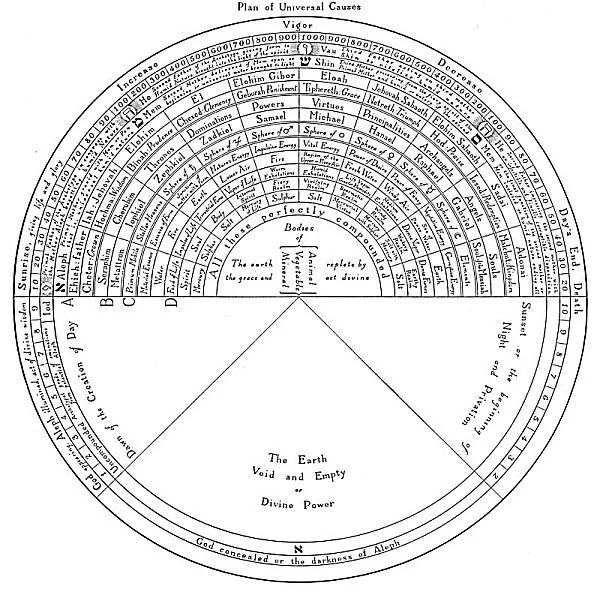
A TABLE OF SEPHIROTHIC CORRESPONDENCES.
From Fludd's Collectio Operum.
The above diagram has been specially translated from the Latin as being of unique value to students of Qabbalism and also as an example of Robert Fludd's unusual ability in assembling tables of correspondences. Robert Fludd ranks among the most eminent Rosicrucians and Freemasons; in fact, he has often been called "the first English Rosicrucian." He has written several valuable documents directly bearing upon the Rosicrucian enigma. It is significant that the most important of his works should be published at the same time as those of Bacon, Shakespeare, and the first Rosicrucian authors.
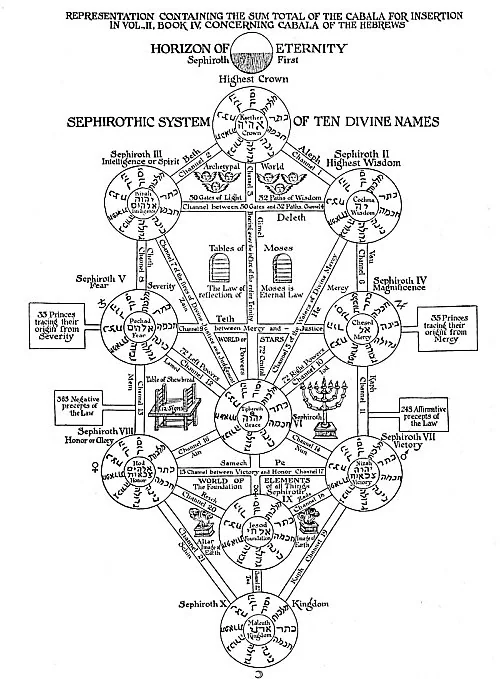
THE SEPHIROTHIC TREE OF THE LATER QABBALISTS.
Translated from Kircher's Œdipus Ægyptiacus.
Having demonstrated that the Qabbalists divided the universe into four worlds, each consisting of ten spheres, it is necessary to consider next how the ten spheres of each world were arranged into what is called the ''Sephirothic Tree." This Tree is composed of ten circles, representing the numbers 1 to 20 and connected together by twenty-two canals--the twenty-two letters of the Hebrew alphabet. The ten numbers plus the twenty-two letters result in the occult number 32, which, according to the Mishna, signifies the Thirty-two Paths of Wisdom. Letters and numbers, according to the Qabbalists, are the keys to all knowledge, for by a secret system of arranging them the mysteries of creation are revealed. For this reason they are called "the Paths of Wisdom." This occult fact is carefully concealed in the 32nd degree of Freemasonry.
There are four trees, one in each of the four worlds established in the preceding chapter. The first is in the Atziluthic World, the ten circles being the ten globes of light established in the midst of AIN SOPH. The powers and attributes of this Tree are reflected into each of the three lower worlds, the form of the Tree remaining the same but its power diminishing as it descends. To further complicate their doctrine, the Qabbalists created another tree, which was a composite of all four of the world trees but consisted of only ten globes. In this single tree were condensed all the arcana previously scattered through the voluminous archives of Qabbalistic literature.
of the side of Microprosophus and combines the potencies of the entire Qabbalistic Tree in one sphere, which may be termed man.
According to the mysteries of the Sephiroth, the order of the Creation, or the Divine Lightning Flash which zigzags through the four worlds according to the order of the divine emanations, is thus described: From AIN SOPH, the Nothing and All, the Eternal and Unconditioned Potency, issues Macroprosophus, the Long Face, of whom it is written, "Within His skull exist daily thirteen thousand myriads of worlds which draw their existence from Him and by Him are upheld." (See The Greater Holy Assembly.) Macroprosophus, the directionalized will of AIN SOPH, corresponding to Kether, the Crown of the Sephiroth, gives birth out of Himself to the nine lesser spheres of which He is the sum and the overbrooding cause. The 22 letters of the Hebrew alphabet, by the various combinations of which the laws of the universe are established, constitute the scepter of Macroprosophus which He wields from His flaming throne in the Atziluthic World.
From this eternal and ancient androgyne--Kether--come forth Chochmah, the great Father, and Binah, the great Mother. These two are usually referred to as Abba and Aima respectively--the first male and the first female, the prototypes of sex. These correspond to the first two letters of the sacred name, Jehovah, יהוה, IHVH. The Father is the י, or I, and the Mother is the ה, or H. Abba and Aima symbolize the creative activities of the universe, and are established in the creative world of Briah. In the Sepher ha Zohar it is written, "And therefore are all things established in the equality of male and female; for were it not so, how could they subsist? This beginning is the Father of all things; the Father of all Fathers; and both are mutually bound together, and the one path shineth into the other--Chochmah, Wisdom, as the Father; Binah, Understanding, as the Mother."
There is a difference of opinion concerning certain of the relationships of the parts of the first triad. Some Qabbalists, including Ibn Gebirol, consider Kether as the Father, Binah as the Mother, and Chochmah as the Son. In this later arrangement, Wisdom, which is the attribute of the Son, becomes the creator of the lower spheres. The symbol of Binah is the dove, a proper emblem for the brooding maternal instinct of the Universal Mother.
Because of the close similarity of their creative triad to the Christian Trinity, the later Qabbalists rearranged the first three Sephiroth and added a mysterious point called Daath--a hypothetical eleventh Sephira. This is located where the horizontal line connecting Chochmah and Binah crosses the vertical line joining Kether and Tiphereth. While Daath is not mentioned by the first Qabbalists, it is a highly important element and its addition to the Sephirothic Tree was not made without full realization of the significance of such action. If Chochmah be considered the active, intelligent energy of Kether, and Binah the receptive capacity of Kether, then Daath becomes the thought which, created by Chochmah, flows into Binah. The postulation of Daath clarifies the problem of the Creative Trinity, for here it is diagrammatically represented as consisting of Chochmah (the Father), Binah (the Mother, or Holy Ghost), and Daath, the Word by which the worlds were established. Isaac Myer discounts the importance of Daath, declaring it a subterfuge to conceal the fact that Kether, and not Chochmah; is the true Father of the Creative Triad. He makes no attempt to give a satisfactory explanation for the symbolism of this hypothetical Sephira.
According to the original conception, from the union of the Divine Father and the Divine Mother is produced Microprosophus--the Short Face or the Lesser Countenance, which is established in the Yetziratic World of formation and corresponds to the letter ו, or V, in the Great Name. The six powers of Microprosophus flow from and are contained in their own source, which is Binah, the Mother of the Lesser Adam. These constitute the spheres of the sacred planets; their name is Elohim, and they move upon the face of the deep. The tenth Sephira--Malchuth, the Kingdom--is described as the Bride of the Lesser Adam, created back to back with her lord, and to it is assigned the final, ה, or H, the last letter of the Sacred Name. The dwelling place of Malchuth is in the fourth world--Assiah--and it is composed of all the superior powers reflected into the elements of the terrestrial sphere. Thus it will be seen that the Qabbalistic Tree extends through four worlds, with its branches in matter and its roots in the Ancient of Ancients--Macroprosophus.
Three vertical columns support the universal system as typified by the Sephirothic Tree. The central pillar has its foundation in Kether, the Eternal One. It passes downward through the hypothetical Sephira, Daath, and then through Tiphereth and Jesod, with its lower end resting upon the firm foundation of Malchuth, the last of the globes. The true import of the central pillar is equilibrium. It demonstrates how the Deity always manifests by emanating poles of expression from the midst of Itself but remaining free from the illusion of polarity. If the numbers of the four Sephiroth connected by this column be added together (1 +6 +9 + 10), the sum is 26, the number of Jehovah. (See chapter on Pythagorean Mathematics.)
The column on the right, which is called Jachin, has its foundation on Chochmah, the outpouring Wisdom of God; the three globes suspended from it are all masculine potencies. The column at the left is called Boaz. The three globes upon it are feminine and receptive potencies, for it is founded in Understanding, a receptive and maternal potency. Wisdom, it will be noted, is considered as radiant or outpouring, and Understanding as receptive, or something which is filled by the flowing of Wisdom. The three pillars are ultimately united in Malchuth, in which all the powers of the superior worlds are manifested.
The four globes upon the central column reveal the function of the creative power in the various worlds. In the first world the creative power is Will--the one Divine Cause; in the second world, the hypothetical Daath--the Word coming forth from the Divine Thought; in the third world, Tiphereth--the Sun, or focal point between God and Nature; in the fourth world it is twofold, being the positive and negative poles of the reproductive system, of which Jesod is the male and Malchuth the female.
In Kircher's Sephirothic Tree it should be especially noted that the ornaments of the Tabernacle appear in the various parts of the diagram. These indicate a direct relationship between the sacred House of God and the universe--a relationship which must always be considered as existing between the Deity through whose activity the world is produced and the world itself, which must be the house or vehicle of that Deity. Could the modern scientific world but sense the true profundity of these philosophical deductions of the ancients, it would realize that those who fabricated the structure of the Qabbalah possessed a knowledge of the celestial plan comparable in every respect with that of the modern savant.
The Tetragrammaton, or the four-lettered Name of God, written thus יהוה, is pronounce Jehovah. The first letter is י, Yod, the Germ, the Life, the Flame, the Cause, the One, and the most fundamental of the Jewish phallic emblems. Its numerical value is 10, and it is to be considered as the 1 containing the 10. In the Qabbalah it is declared that the a Yod is in reality three Yods, of which the first is the beginning, the second is the center, and the third is the end. Its throne is the Sephira Chochmah (according to Ibn Gebirol, Kether), from which it goes forth to impregnate Binah, which is the first ה, He. The result of this union is Tiphereth, which is the ו Vau, whose power is 6 and which symbolizes the six members of the Lesser Adam. The final ה, He, is Malchuth, the Inferior Mother, partaking in part of the potencies of the Divine Mother, the first He. By placing the four letters of the Tetragrammaton in a vertical column, a figure closely resembling the human body is produced, with Yod for the head, the first He for the arms and shoulders, Vau for the trunk of the body, and the final He for the hips and legs. If the Hebrew letters be exchanged for their English equivalents, the form is not materially changed or the analogy altered. It is also extremely significant that by inserting the letter ש, Shin, in the middle of the name Jehovah, the word Jehoshua, or Jesus, is formed thus:
יהשוה
In the Qabbalistic Mysteries, according to Eliphas Levi, the name Jehovah is occasionally written by connecting together 24 dots--the 24 powers before the throne--and it is believed that the name of the Power of Evil is the sign of Jehovah reversed or inverted. (See Transcendental Magic.) Of the Great Word, Albert Pike writes: "The True Word of a Mason is to be found in the concealed and profound meaning of the Ineffable Name of Deity, communicated by God to Moses; and which meaning was long lost by the very precautions taken to conceal it. The true pronunciation of that name was in truth a secret, in which, however, was involved the far more profound secret of its meaning. In that meaning is included all the truth that can be known by us, in regard to the nature of God." (See Morals and Dogma.)
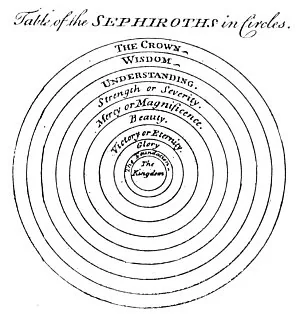
THE SEPHIROTH IN THE FORM OF THE SOLAR SYSTEM.
From Maurice's Indian Antiquities.
Thomas Maurice reproduces the above engraving, which is modification of the elaborate tree on the preceding page. The Sephiroth are here superimposed, decreasing in size as they decrease in power and dignity. Thus, the Crown is the greatest and the all-inclusive, and the Kingdom--which represents the physical universe--is the smallest and of least importance.
Qabbalistic Keys to the Creation of Man
HENRIE STEPHEN, in A World of Wonders, published in 1607, mentions a monk of St. Anthony who declared that while in Jerusalem the patriarch of that city had shown him not only one of the ribs of the Word made flesh and some rays from the Star of Bethlehem, but also the snout of a seraph, a finger nail of a cherub, the horns of Moses, and a casket containing the breath of Christ! To a people believing implicitly in a seraph sufficiently tangible to have its proboscis preserved, the more profound issues of Judaistic philosophy must necessarily be incomprehensible. Nor is it difficult to imagine the reaction taking place in the mind of some ancient sage should he hear that a cherub--which, according to St. Augustine, signifies the Evangelists; according to Philo Judæus, the outermost circumference of the entire heavens, and according to several of the Church Fathers, the wisdom of God--had sprouted finger nails. The hopeless confusion of divine principles with the allegorical figures created to represent them to the limited faculties of the uninitiated has resulted in the most atrocious misconceptions of spiritual truths. Concepts well-nigh as preposterous as these, however, still stand as adamantine barriers to a true understanding of Old and New Testament symbolism; for, until man disentangles his reasoning powers from the web of venerated absurdities in which his mind has lain ensnared for centuries, how can Truth ever be discovered?
The Old Testament--especially the Pentateuch--contains not only the traditional account of the creation of the world and of man, but also, locked within it, the secrets of the Egyptian initiators of the Moses concerning the genesis of the god-man (the initiate) and the mystery of his rebirth through philosophy. While the Lawgiver of Israel is known to have compiled several works other than those generally attributed to him, the writings now commonly circulated as the purported sixth and seventh books of Moses are in reality spurious treatises on black magic foisted on the credulous during the Middle Ages. Out of the hundreds of millions of pious and thoughtful students of Holy Writ, it is almost inconceivable that but a mere handful have sensed the sublimity of the esoteric teachings of Sod (the Jewish Mysteries of Adonai). Yet familiarity with the three Qabbalistical processes termed Gematria, Notarikon, and Temurah makes possible the discovery of many of the profoundest truths of ancient Jewish superphysics.
By Gematria is meant not only the exchange of letters for their numerical equivalents but also the method of determining by an analysis of its measurements the mystic purpose for which a building or other object was constructed. S. L. MacGregor-Mathers, in The Kabbalah Unveiled, gives this example of the application of Gematria: "Thus also the passage, Gen. xviii. 2 VHNH SHLSHH, Vehenna Shalisha, 'And lo, three men,' equals in numerical value 'ALV MIKAL GBRIAL VRPAL, Elo Mikhael Gabriel Ve-Raphael,' These are Mikhael, Gabriel and Raphael; 'for each phrase = 701." Assuming the sides of a scalene to be 11, 9, and 6 inches, a triangle of such dimensions would then be an appropriate symbol of Jehovah, for the sum of its three sides would be 26, the numerical value of the Hebrew word IHVH. Gematria also includes the system of discovering the arcane meaning of a word by analyzing the size and arrangement of the strokes employed in the formation of its various letters. Gematria was employed by the Greeks as well as the Jews. The books of the New Testament--particularly those attributed to St. John--contain many examples of its use. Nicephorus Callistus declared the Gospel according to St. John to have been discovered in a cavern under the Temple at Jerusalem, the volume having been secreted "long anterior to the Christian æra." The existence of interpolated material in the fourth Gospel substantiates the belief that the work was originally written without any specific reference to the man Jesus, the statements therein accredited to Him being originally mystical discourses delivered by the personification of the Universal Mind. The remaining Johannine writings--the Epistles and the Apocalypse--are enshrouded by a similar veil of mystery.
By Notarikon each letter of a word may become the initial character of a new word. Thus from BRASHITH, first word in the book of Genesis, are extracted six words which mean that "in the beginning the Elohim saw that Israel would accept the law." Mr. MacGregor-Mathers also gives six additional examples of Notarikon formed from the above word by Solomon Meir Ben Moses, a mediæval Qabbalist. From the famous acrostic ascribed to the Erythræan Sibyl, St. Augustine derived the word ΙΧΘΥΣ, which by Notarikon was expanded into the phrase, "Jesus Christ, Son of God, Savior." By another use of Notarikon, directly the reverse of the first, the initial, last, or middle letters of the words of a sentence may be joined together to form a new word or words. For example, the name Amen, ἁμήν, maybe extracted from ארנימלרנאטז, "the Lord is the faithful King." Because they had embodied these cryptic devices in their sacred writings, the ancient priests admonished their disciples never to translate, edit, or rewrite the contents of the sacred books. .
Under the general heading of Temurah several systems may be grouped and explained in which various letters are substituted for other letters according to prearranged tables or certain mathematical arrangements of letters, regular or irregular. Thus the alphabet may be broken into two equal parts and written in horizontal lines so that the letters of the lower row can be exchanged for those of the upper row, or vice versa. By this procedure the letters of the word Kuzu may be exchanged for those of IHVH, the Tetragrammaton. In another form of Temurah the letters are merely rearranged., שתיה is the stone which is found in the center of the world, from which point the earth spread out on all sides.
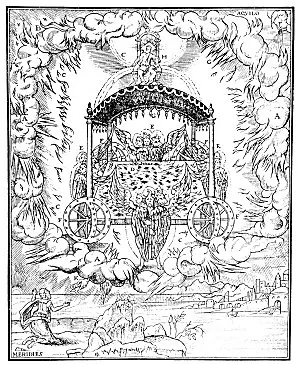
THE VISION OF EZEKIEL.
From The "Bear" Bible.
This plate, which is from the first Protestant Bible published in Spanish, shows the Mercavah, or chariot of Jehovah, which appeared to Ezekiel by the river Chebar. The prophet beheld four strange creatures (E), each having four heads, four wings, and brazen hoofs like those of a calf. And there were four wheels (F) filled with eyes. Where the cherubim went the wheels went also. The space between the cherubim and the wheels was filled with coals of fire. Upon the top of the chariot was a throne, upon which sat the likeness of a man (H). Ezekiel fell upon his knees when he beheld the Mercavah surrounded by a whirlwind of clouds and flames (A, B, C). A hand (K) reached out from the clouds and the prophet was ordered to eat of a scroll which the hand held forth.
According to the mystics, the wheels supporting the throne of God represent the orbits of the planets, and the entire solar system is properly the Mercavah, or chariot of God. One of the divisions of the Qabbalah--that dealing with the arts and sciences of those planes which are under the heavens--is called the Mercavah. In the Zohar it is written that the celestial throne or Ezekiel's vision signifies the traditional law; the appearance of a man sitting upon the throne represents the written law, Philo Judæus in describing the cherubim upon the Ark of the Covenant declares that the figures are an intimation of the revolutions of the whole heavens, one of the cherubim representing the outer circumference and the other the inner sphere. Facing each other, they represent the two hemispheres of the world. The flaming sword of the cherubim of Genesis is the central motion and agitation of the heavenly bodies. In all probability it also represents the solar ray.
When broken in two the stone is שת יה, which means "the placing of God."(See Pekudei Rakov, 71, 72.) Again, Temurah may consist of a simple anagram, as in the English word live, which reversed becomes evil. The various systems of Temurah are among the most complicated and profound devices of the ancient Rabbins.
Among theological scholars there is a growing conviction that the hitherto accepted translations of the Scriptural writings do not adequately express the spirit of the original documents.
"After the first copy of the Book of God," writes H. P. Blavatsky, "has been edited and launched on the world by Hilkiah, this copy disappears, and Ezra has to make a new Bible, which Judas Maccabeus finishes; * * * when it was copied from the horned letters into square letters, it was corrupted beyond recognition; * * * the Masorah completed the work of destruction; finally, we have a text, not 900 years old, abounding with omissions, interpolations, and premeditated perversions." (See Isis Unveiled.)
Prof. Crawford Howell Toy of Harvard notes: "Manuscripts were copied and recopied by scribes who not only sometimes made errors in letters and words, but permitted themselves to introduce new material into the text, or to combine in one manuscript, without mark of division, writings composed by different men; instances of these sorts of procedure are found especially in Micah and Jeremiah, and the groups of prophecies which go under the names of Isaiah and Zachariah." (See Judaism and Christianity.)
Does the mutilated condition of the Holy Bible--in part accidental--represent none the less a definite effort to confuse the uninitiated reader and thus better conceal the secrets of the Jewish Tannaim? Never has the Christian world been in possession of those hidden scrolls which contain the secret doctrine of Israel, and if the Qabbalists were correct in their assumption that the lost books of the Mosaic Mysteries have been woven into the fabric of the Torah, then the Scriptures are veritably books within books. In rabbinical circles the opinion is prevalent that Christendom never has understood the Old Testament and probably never will. In fact, the feeling exists--in some quarters, at least--that the Old Testament is the exclusive possession of the Jewish faith; also that Christianity, after its unrelenting persecution of the Jew, takes unwarranted liberties when it includes strictly Jewish writings in its sacred canon. But, as noted by one rabbi, if Christianity must use the Jewish Scriptures, it should at least strive to do so with some degree of intelligence!
In the opening chapter of Genesis it is stated that after creating light and separating it from darkness, the seven Elohim divided the waters which were under the firmament from the waters which were above the firmament. Having thus established the inferior universe in perfect accord with the esoteric teachings of the Hindu, Egyptian, and Greek Mysteries, the Elohim next turned their attention to the production of flora and fauna and lastly man. "And God said, Let us make man in our image, after our likeness. * * * So God created man in his own image, in the image of God created he him; male and female created he them. And God blessed them, and God said unto them, Be fruitful, and multiply, and replenish the earth, * * *."
Consider in thoughtful silence the startling use of pronouns in the above extract from "the most perfect example of English literature." When the plural and androgynous Hebrew word Elohim was translated into the singular and sexless word God, the opening chapters of Genesis were rendered comparatively meaningless. It may have been feared that had the word been correctly translated as "the male and female creative agencies," the Christians would have been justly accused of worshiping a plurality of gods in the face of their repeated claims to monotheism! The plural form of the pronouns us and our reveals unmistakably, however, the pantheistic nature of Divinity. Further, the androgynous constitution of the Elohim (God) is disclosed in the next verse, where he (referring to God) is said to have created man in his own image, male and female; or, more properly, as the division of the sexes had not yet taken place, male-female. This is a deathblow to the time-honored concept that God is a masculine potency as portrayed by Michelangelo on the ceiling of the Sistine Chapel. The Elohim then order these androgynous beings to be fruitful. Note that neither the masculine nor the feminine principle as yet existed in a separate state! And, lastly, note the word "replenish." The prefix re denotes "back to an original or former state or position," or "repetition or restoration." (See Webster's International Dictionary, 1926.) This definite reference to a humanity existing prior to the "creation of man" described in Genesis must be evident to the most casual reader of Scripture.
An examination of Bible dictionaries, encyclopedias, and commentaries discloses the plural form of the word Elohim to be beyond the comprehension of their respected authors and editors. The New Schaff-Herzog Encyclopedia of Religious Knowledge thus sums up the controversy over the plural form of the word Elohim: "Does it now or did it originally signify plurality of divine being?" A Dictionary of the Bible, edited by James Hastings, contains the following conclusion, which echoes the sentiments of more critical etymologists of the Bible: "The use of the plur. Elohim is also difficult to explain." Dr. Havernick considers the plural form Elohim to signify the abundance and super-richness existing in the Divine Being. His statement, which appears in The Popular and Critical Bible Encyclopædia, is representative of the efforts made to circumvent this extremely damaging word. The International Standard Bible Dictionary considers the explanations offered by modern theologians--of which Dr. Havernick's is a fair example--to be too ingenious to have been conceived by the early Hebrews and maintains that the word represents the survival of a polytheistic stage of Semitic thought. The Jewish Encyclopedia supports the latter assumption with the following concise statement: "As far as epigraphic material, traditions, and folk-lore throw light on the question, the Semites are shown to be of polytheistic leanings."
Various schools of philosophy, both Jewish and Gentile, have offered explanations erudite and otherwise of the identity of Adam. In this primordial man the Neo-Platonists recognized the Platonic Idea of humanity--the archetype or pattern of the genus homo. Philo Judæus considered Adam to represent the human mind, which could understand (and hence give names to) the creatures about it, but could not comprehend (and hence left nameless) the mystery of its own nature. Adam was also likened to the Pythagorean monad which by virtue of its state of perfect unity could dwell in the Edenic sphere. When through a process akin to fission the monad became the duad--the proper symbol of discord and delusion--the creature thus formed was exiled from its celestial home. Thus the twofold man was driven from the Paradise belonging to the undivided creation and cherubim and a flaming sword were placed on guard at the gates of the Causal World. Consequently, only after the reestablishment of unity within himself can man regain his primal spiritual state.
According to the Isarim, the secret doctrine of Israel taught the existence of four Adams, each dwelling in one of the four Qabbalistic worlds. The first, or heavenly, Adam dwelt alone in the Atziluthic sphere and within his nature existed all spiritual and material potentialities. The second Adam resided in the sphere of Briah. Like the first Adam, this being was androgynous and the tenth division of its body (its heel, Malchuth) corresponded to the church of Israel that shall bruise the serpent's head. The third Adam--likewise androgynous--was clothed in a body of light and abode in the sphere of Yetzirah. The fourth Adam was merely the third Adam after the fall into the sphere of Assiah, at which time the spiritual man took upon himself the animal shell or coat of skins. The fourth Adam was still considered as a single individual, though division had taken place within his nature and two shells or physical bodies existed, in one of which was incarnated the masculine and in the other the feminine potency. (For further details consult Isaac Myer.)
The universal nature of Adam is revealed in the various accounts concerning the substances of which he was formed. It was originally ordained that the "dirt" to be used in fashioning him was to be derived from the seven worlds. As these planes, however, refused to give of their substances, the Creator wrenched from them by force the elements to be employed in the Adamic constitution. St. Augustine discovered a Notarikon in the name of Adam. He showed that the four letters, A-D-A-M, are the first letters of the four words Anatole Dysis Arktos Mesembria, the Greek names for the four corners of the world. The same author also sees in Adam a prototype of Christ, for he writes: "Adam sleeps that Eve may be formed: Christ dies, that the Church may be formed. While Adam sleeps, Eve is formed from his side. When Christ is dead, His side is smitten with a spear, that there flow forth sacraments to form the church. * * * Adam himself was the figure of Him that was to come."
In his recent work, Judaism, George Foote Moore thus describes the proportions of the Adamic man: "He was a huge mass that filled the whole world to all the points of the compass. The dust of which his body was formed was gathered from every part of the world, or from the site of the future altar. Of greater interest is the notion that man was created androgynous, because it is probably a bit of foreign lore adapted to the first pair in Genesis. R. Samuel bar Nahman (third century), said, when God created Adam, He created him facing both ways (דיו פרעופים); then He sawed him in two and made two backs, one for each figure.
The Zohar holds the concept of two Adams: the first a divine being who, stepping forth from the highest original darkness, created the second, or earthly, Adam in His own image. The higher, or celestial, man was the Causal sphere With its divine potencies and potentialities considered as a gigantic personality; its members, according to the Gnostics, being the basic elements of existence. This Adam may have been symbolized as facing both ways to signify that with one face it looked upon the proximate Cause of itself and with the other face looked upon the vast sea of Cosmos into which it was to be immersed.
Philosophically, Adam may be regarded as representative of the full spiritual nature of man--androgynous and nor subject to decay.
Of this fuller nature the mortal man has little comprehension. Just as spirit contains matter within itself and is both the source and ultimate of the state denominated matter, so Eve represents the lower, or mortal, portion that is taken out of, or has temporal existence in the greater and fuller spiritual creation. Being representative of the inferior part of the individual, Eve is the temptress who, conspiring with the serpent of mortal knowledge, caused Adam to sink into a trancelike condition in which he was unconscious of his own higher Self. When Adam seemingly awoke, he actually sank into sleep, for he no longer was in the spirit but in the body; division having taken place within him, the true Adam rested in Paradise while his lesser part incarnated in a material organism (Eve) and wandered in the darkness of mortal existence.
The followers of Mohammed apparently sensed more accurately than the uninitiated of other sects the true mystic import of Paradise, for they realized that prior to his fall the dwelling place of man was not in a physical garden in any particular part of the earth but rather in a higher sphere (the angelic world) watered by four mystical streams of life. After his banishment from Paradise, Adam alighted on the Island of Ceylon, and this spot is sacred to certain Hindu sects who recognize the old Island of Lanka--once presumably connected with the mainland by a bridge--as the actual site of the Garden of Eden from which the human race migrated. According to the Arabian Nights (Sir Richard Burton's translation), Adam's footprint may still be seen on the top of a Ceylonese mountain. In the Islamic legends, Adam was later reunited with his wife and after his death his body was brought to Jerusalem subsequent to the Flood for burial by Melchizedek. (See the Koran.)
The word ADM signifies a species or race and only for lack of proper understanding has Adam been considered as an individual. As the Macrocosm, Adam is the gigantic Androgyne, even the Demiurgus; as the Microcosm, he is the chief production of the Demiurgus and within the nature of the Microcosm the Demiurgus established all the qualities and powers which He Himself possessed. The Demiurgus, however, did not possess immortality and, therefore, could not bestow it upon Adam. According to legend, the Demiurgus strove to keep man from learning the incompleteness of his Maker. The Adamic man consequently partook of the qualities and characteristics of the angels who were the ministers of the Demiurgus. It was affirmed by the Gnostic Christians that the redemption of humanity was assured through the descent of Nous (Universal Mind), who was a great spiritual being superior to the Demiurgus and who, entering into the constitution of man, conferred conscious immortality upon the Demiurgic fabrications.
That phallic symbolism occupies an important place in early Jewish mysticism is indisputable. Hargrave Jennings sees in the figure of Adam a type of the lingam of Shiva, which was a stone representative of the creative power of the World Generator. "In Gregorie's works * * *," writes Jennings, "is a passage to the effect that 'Noah daily prayed in the Ark before the Body of Adam,' i.e., before the Phallus--Adam being the primitive Phallus, great procreator of the human race. 'It may possibly seem strange,' he says, 'that this orison should be daily said before the body of Adam,' but 'it is a most confessed tradition among the eastern men that Adam was commanded by God that his dead body should be kept above ground till a fullness of time should come to commit it פדככאלאועto the middle of the earth by a priest of the Most High God.' This means Mount Moriah, the Meru of India. 'This body of Adam was embalmed and transmitted from father to son, till at last it was delivered up by Lamech into the hands of Noah.'" (See Phallicism.)
This interpretation somewhat clarifies the Qabbalistic assertion that in the first Adam were contained all the souls of the Israelites. (See Sod.) Though according to the Aurea Legenda Adam was buried with the three seeds of the Tree of Knowledge in his mouth, it should be borne in mind that apparently conflicting myths were often woven around a single individual. One of the profound mysteries of Qabbalism is that set forth in the Notarikon based upon the letters of the name Adam (ADM). These three letters form the initials of the names Adam, David, and the Messiah, and these three personalities were said to contain one soul. As this soul represents the World Soul of humanity, Adam signifies the involving soul, the Messiah the evolving soul, and David that condition of the soul termed epigenesis.
In common with certain philosophic institutions of Asia, the Jewish Mysteries contained a strange doctrine concerning the shadows of the Gods. Gazing down into the Abyss, the Elohim beheld their own shadows and from these shadows patterned the inferior creation. "In the dramatic representation of the creation of man in the Mysteries," writes the anonymous Master of Balliol College, "the Aleim [Elohim] were represented by men who, when sculpturing the form of an Adamite being, of a man, traced the outline of it on their own shadow, or modelled it on their own shadow traced on the wall. This is how the art of drawing originated in Egypt, and the hieroglyphic figures carved on the Egyptian monuments have so little relief that they still resemble a shadow."
In the ritualism of the early Jewish Mysteries the pageantry of creation was enacted, the various actors impersonating the Creative Agencies. The red dirt from which the Adamic man was fashioned may signify fire, particularly since Adam is related to the Yod, or fire flame, which is the first letter of the sacred name Jehovah. In John ii. 20 it is written that the Temple was forty and six years in the building, a statement in which St. Augustine sees a secret and sacred Gematria; for, according to the Greek philosophy of numbers, the numerical value of the name Adam is 46. Adam thus becomes the type of the Temple, for the House of God-like primitive man--was a microcosm or epitome of the universe.
In the Mysteries, Adam is accredited with having the peculiar power of spiritual generation. Instead of reproducing his kind by the physical generative processes, he caused to issue from himself--or, more correctly, to be reflected upon substance--a shadow of
NOAH AND HIS ZODIACAL ARK.
From Myer's Qabbalah.
The early Church Father--notably Tertullian, Firmilian, St. Cyprian, St. Augustine, and St. Chrysostom--recognized in the ark a type or symbol of the Holy Catholic Church. Bede the Venerable, declared that Noah in all things typified Christ as Noah alone of his generation was just, so Christ alone was without sin. With Christ there was a sevenfold spirit of grace: with Noah seven righteous Persons. Noah by water and wood saved his own family Christ by baptism and the cross saves Christians. The ark was built of wood that did not decay. the church is composed of men who will live forever, for this ark means the church which floats upon the waves of the world.
The diagram shown above is also reproduced in The Rosicrucians, by Hargrave Jennings. This author adds to the original diagram appearing in Antiquitatum Judaicarum Libri IX the signs of the zodiac, placing Aries at the head and continuing in sequential order to Leo, which occupies the fifth cross section of the ark. Jennings assigns the panel containing the door to the undivided constellation of Virgo-Libra-Scorpio (which is continued into the first subdivision of the second section) and the remaining four cress sections to the constellations of Sagittarius to Pisces inclusive. A study of the plate discloses the ark to be divided into eleven main sections, and along the base and roof of each section are shown three subdivisions, thus making in all the sacred number 33. Occupying the position corresponding to the generative system of the human body will also be noted the cross upon the door of the central section. Two openings are shown in the ark: one--the main door representing the orifice through which the animal lives descend into physical existence; the other a small window proximate to the crown of the head through which the spirit gains liberty according to the ancient rites.
"When the androgenic Scorpio-Virgo was separated and the Balance or Harmony made from Scorpio, and placed between Scorpio, i.e., male, and Virgo, i.e., female, then appeared the 32 constellations or signs, as we now have them. The ark is three stories high (perhaps to symbolize Heaven, Man, Earth). In the figure of the Man, notice the parting of the hair in the middle of the forehead and the arrangement of the beard, whiskers, moustache and the hair, on the back of the neck and shoulders." (See The Qabbalah by Isaac Myer.)
himself. This shadow he then ensouled and it became a living creature. These shadows, however, remain only as long as the original figure of which they are the reflections endures, for with the removal of the original the host of likenesses vanish with it. Herein is the key to the allegorical creation of Eve out of the side of Adam; for Adam, representative of the idea or pattern, is reflected into the material universe as a multitude of ensouled images which collectively are designated Eve. According to another theory, the division of the sexes took place in the archetypal sphere; hence the shadows in the lower world were divided into two classes consistent with the orders established in the Archetype. In the apparently incomprehensible attraction of one sex for the other Plato recognized a cosmic urge toward reunion of the severed halves of this archetypal Being.
Exactly what is to be inferred by the division of the sexes as symbolically described in Genesis is a much-debated question. That man was primarily androgynous is quite universally conceded and it is a reasonable presumption that he will ultimately regain this bisexual state. As to the manner in which this will be accomplished two opinions are advanced. One school of thought affirms that the human soul was actually divided into two parts (male and female) and that man remains an unperfected creature until these parts are reunited through the emotion which man calls love. From this concept has grown the much-abused doctrine of "soul mates" who must quest through the ages until the complementary part of each severed soul is discovered. The modern concept of marriage is to a certain degree founded upon this ideal.
According to the other school, the so-called division of the sexes resulted from suppression of one pole of the androgynous being in order that the vital energies manifesting through it might be diverted to development of the rational faculties. From this point of view man is still actually androgynous and spiritually complete, but in the material world the feminine part of man's nature and the masculine part of woman's nature are quiescent. Through spiritual unfoldment and knowledge imparted by the Mysteries, however, the latent element in each nature is gradually brought into activity and ultimately the human being thus regains sexual equilibrium. By this theory woman is elevated from the position of being man's errant part to one of complete equality. From this point of view, marriage is regarded as a companionship in which two complete individualities manifesting opposite polarities are brought into association that each may thereby awaken the qualities latent in the other and thus assist in the attainment of individual completeness. The first theory may be said to regard marriage as an end; the second as a means to an end. The deeper schools of philosophy have leaned toward the latter as more adequately acknowledging the infinite potentialities of divine completeness in both aspects of creation.
The Christian Church is fundamentally opposed to the theory of marriage, claiming that the highest degree of spirituality is achievable only by those preserving the virginal state. This concept seemingly originated among certain sects of the early Gnostic Christians, who taught that to propagate the human species was to increase and perpetuate the power of the Demiurgus; for the lower world was looked upon as an evil fabrication created to ensnare the souls of all born into it--hence it was a crime to assist in bringing souls to earth. When, therefore, the unfortunate father or mother shall stand before the Final Tribunal, all their offspring will also appear and accuse them of being the cause of those miseries attendant upon physical existence. This view is strengthened by the allegory of Adam and Eve, whose sin through which humanity has been brought low is universally admitted to have been concerned with the mystery of generation. Mankind, owing to Father Adam its physical existence, regards its progenitor as the primary cause of its misery; and in the judgment Day, rising up as a mighty progeny, will accuse its common paternal ancestor.
Those Gnostic sects maintaining a more rational attitude on the subject declared the very existence of the lower worlds to signify that the Supreme Creator had a definite purpose in their creation; to doubt his judgment was, therefore, a grievous error. The church, however, seemingly arrogated to itself the astonishing prerogative of correcting God in this respect, for wherever possible it continued to impose celibacy, a practice resulting in an alarming number of neurotics. In the Mysteries, celibacy is reserved for those who have reached a certain degree of spiritual unfoldment. When advocated for the mass of unenlightened humanity, however, it becomes a dangerous heresy, fatal alike to both religion and philosophy. As Christendom in its fanaticism has blamed every individual Jew for the crucifixion of Jesus, so with equal consistency it has maligned every member of the feminine sex. In vindication of Eve philosophy claims that the allegory signifies merely that man is tempted by his emotions to depart from the sure path of reason.
Many of the early Church Fathers sought to establish a direct relationship between Adam and Christ, thereby obviously discounting the extremely sinful nature of man's common ancestor, since it is quite certain that when St. Augustine likens Adam to Christ and Eve to the church he does not intend to brand the latter institution as the direct cause of the fall of man. For some inexplicable reason, however, religion has ever regarded intellectualism--in fact every form of knowledge--as fatal to man's spiritual growth. The Ignaratitine Friars are an outstanding example of this attitude.
In this ritualistic drama--possibly derived from the Egyptians--Adam, banished from the Garden of Eden, represents man philosophically exiled from the sphere of Truth. Through ignorance man falls; through wisdom he redeems himself. The Garden of Eden represents the House of the Mysteries (see The Vision of Enoch) in the midst of which grew both the Tree of Life and the Tree of the Knowledge of Good and Evil.
Man, the banished Adam, seeks to pass from the outer court of the Sanctuary (the exterior universe) into the sanctum sanctorum, but before him rises a vast creature armed with a flashing sword that, moving slowly but continually, sweeps clear a wide circle, and through this "Ring Pass Not" the Adamic man cannot break.
The cherubim address the seeker thus: "Man, thou art dust and to dust thou shalt return. Thou wert fashioned by the Builder of Forms; thou belongest to the sphere of form, and the breath that was breathed into thy soul was the breath of form and like a flame it shall flicker out. More than thou art thou canst not be. Thou art a denizen of the outer world and it is forbidden thee to enter this inner place."
And the Adam replies: "Many times have I stood within this courtyard and begged admission to my Father's house and thou hast refused it me and sent me back to wander in darkness. True it is that I was fashioned out of the dirt and that my Maker could not confer upon me the boon of immortality. But no more shalt thou send me away; for, wandering in the darkness, I have discovered that the Almighty hath decreed my salvation because He hath sent out of the most hidden Mystery His Only Begotten who didst take upon Himself the world fashioned by the Demiurgus. Upon the elements of that world was He crucified and from Him hath poured forth the blood of my salvation. And God, entering into His creation, hath quickened it and established therein a road that leadeth to Himself. While my Maker could not give me immortality, immortality was inherent in the very dust of which I was composed, for before the world was fabricated and before the Demiurgus became the Regent of Nature the Eternal Life had impressed itself upon the face of Cosmos. This is its sign--the Cross. Do you now deny me entrance, I who have at last learned the mystery of myself?"
And the voice replies: "He who is aware, IS! Behold!"
Gazing about him, Adam finds himself in a radiant place, in the midst of which stands a tree with flashing jewels for fruit and entwined about its trunk a flaming, winged serpent crowned with a diadem of stars. It was the voice of the serpent that had spoken.
"Who art thou?" demands the Adam.
"I," the serpent answers, "am Satan who was stoned; I am the Adversary--the Lord who is against you, the one who pleads for your destruction before the Eternal Tribunal. I was your enemy upon the day that you were formed; I have led you into temptation; I have delivered you into the hands of evil; I have maligned you; I have striven ever to achieve your undoing. I am the guardian of the Tree of Knowledge and I have sworn that none whom I can lead astray shall partake of its fruits."
The Adam replies: "For uncounted ages have I been thy servant. In my ignorance I listened to thy words and they led me into paths of sorrow. Thou hast placed in my mind dreams of power, and when I struggled to realize those dreams they brought me naught but pain. Thou hast sowed in me the seeds of desire, and when I lusted after the things of the flesh agony was my only recompense. Thou hast sent me false prophets and false reasoning, and when I strove to grasp the magnitude of Truth I found thy laws were false and only dismay rewarded my strivings. I am done with thee forever, O artful Spirit! I have tired of thy world of illusions. No longer will I labor in thy vineyards of iniquity. Get thee behind me, rempter, and the host of thy temptations. There is no happiness, no peace, no good, no future in the doctrines of selfishness, hate, and passion preached by thee. All these things do I cast aside. Renounced is thy rule forever!"
And the serpent makes answer: "Behold, O Adam, the nature of thy Adversary!" The serpent disappears in a blinding sunburst of radiance and in its place stands an angel resplendent in shining, golden garments with great scarlet wings that spread from one corner of the heavens to the other. Dismayed and awestruck, the Adam falls before the divine creature.
"I am the Lord who is against thee and thus accomplishes thy salvation, " continues the voice. "Thou hast hated me, but through the ages yet to be thou shalt bless me, for I have led thee our of the sphere of the Demiurgus; I have turned thee against the illusion of worldliness; I have weaned thee of desire; I have awakened in thy soul the immortality of which I myself partake. Follow me, O Adam, for I am the Way, the Life, and the Truth!"
An Analysis of Tarot Cards
OPINIONS of authorities differ widely concerning the origin of playing cards, the purpose for which they were intended, and the time of their introduction into Europe. In his Researches into the History of Playing Cards, Samuel Weller Singer advances the opinion that cards reached Southern Europe from India by way of Arabia. It is probable that the Tarot cards were part of the magical and philosophical lore secured by the Knights Templars from the Saracens or one of the mystical sects then flourishing in Syria. Returning to Europe, the Templars, to avoid persecution, concealed the arcane meaning of the symbols by introducing the leaves of their magical book ostensibly as a device for amusement and gambling. In support of this contention, Mrs. John King Van Rensselaer states:
"That cards were brought by the home-returning warriors, who imported many of the newly acquired customs and habits of the Orient to their own countries, seems to be a well-established fact; and it does not contradict the statement made by some writers who declared that the gypsies--who about that time began to wander over Europe--brought with them and introduced cards, which they used, as they do at the present day, for divining the future." (See The Devil's Picture Books.)
Through the Gypsies the Tarot cards may be traced back to the religious symbolism of the ancient Egyptians. In his remarkable work, The Gypsies, Samuel Roberts presents ample proof of their Egyptian origin. In one place he writes: "When Gypsies originally arrived in England is very uncertain. They are first noticed in our laws, by several statutes against them in the reign of Henry VIII.; in which they are described as 'an outlandish people, calling themselves Egyptians,--who do not profess any craft or trade, but go about in great numbers, * * *.'" A curious legend relates that after the destruction of the Serapeum in Alexandria, the large body of attendant priests banded themselves together to preserve the secrets of the rites of Serapis. Their descendants (Gypsies) carrying with them the most precious of the volumes saved from the burning library--the Book of Enoch, or Thoth (the Tarot)--became wanderers upon the face of the earth, remaining a people apart with an ancient language and a birthright of magic and mystery.
Court de Gébelin believed the word Tarot itself to be derived from two Egyptian words, Tar, meaning "road," and Ro, meaning "royal." Thus the Tarot constitutes the royal road to wisdom. (See Le Monde Primitif.) In his History of Magic, P. Christian, the mouthpiece of a certain French secret society, presents a fantastic account of a purported initiation into the Egyptian Mysteries wherein the 22 major Tarots assume the proportions of trestleboards of immense size and line a great gallery. Stopping before each card in turn, the initiator described its symbolism to the candidate. Edouard Schuré, whose source of information was similar to that of Christian's, hints at the same ceremony in his chapter on initiation into the Hermetic Mysteries. (See The Great Initiates.) While the Egyptians may well have employed the Tarot cards in their rituals, these French mystics present no evidence other than their own assertions to support this theory. The validity also of the so-called Egyptian Tarots now in circulation has never been satisfactorily established. The drawings are not only quite modem but the symbolism itself savors of French rather than Egyptian influence.
The Tarot is undoubtedly a vital element in Rosicrucian symbolism, possibly the very book of universal knowledge which the members of the order claimed to possess. The Rota Mundi is a term frequently occurring in the early manifestoes of the Fraternity of the Rose Cross. The word Rota by a rearrangement of its letters becomes Taro, the ancient name of these mysterious cards. W. F. C. Wigston has discovered evidence that Sir Francis Bacon employed the Tarot symbolism in his ciphers. The numbers 21, 56, and 78, which are all directly related to the divisions of the Tarot deck, are frequently involved in Bacon's cryptograms. In the great Shakespearian Folio of 1623 the Christian name of Lord Bacon appears 21 times on page 56 of the Histories. (See The Columbus of Literature.)
Many symbols appearing upon the Tarot cards have definite Masonic interest. The Pythagorean numerologist will also find an important relationship to exist between the numbers on the cards and the designs accompanying the numbers. The Qabbalist will be immediately impressed by the significant sequence of the cards, and the alchemist will discover certain emblems meaningless save to one versed in the divine chemistry of transmutation and regeneration.' As the Greeks placed the letters of their alphabet--with their corresponding numbers--upon the various parts of the body of their humanly represented Logos, so the Tarot cards have an analogy not only in the parts and members of the universe but also in the divisions of the human body.. They are in fact the key to the magical constitution of man.
The Tarot cards must be considered (1) as separate and complete hieroglyphs, each representing a distinct principle, law, power, or element in Nature; (2) in relation to each other as the effect of one agent operating upon another; and (3) as vowels and consonants of a philosophic alphabet. The laws governing all phenomena are represented by the symbols upon the Tarot cards, whose numerical values are equal to the numerical equivalents of the phenomena. As every structure consists of certain elemental parts, so the Tarot cards represent the components of the structure of philosophy. Irrespective of the science or philosophy with which the student is working, the Tarot cards can be identified with the essential constituents of his subject, each card thus being related to a specific part according to mathematical and philosophical laws. "An imprisoned person," writes Eliphas Levi, "with no other book than the Tarot, if he knew how to use it, could in a few years acquire universal knowledge, and would be able to speak on all subjects with unequalled learning and inexhaustible eloquence. " (See Transcendental Magic.)
The diverse opinions of eminent authorities on the Tarot symbolism are quite irreconcilable. The conclusions of the scholarly Court de Gébelin and the bizarre Grand Etteila--the first authorities on the subject--not only are at radical variance but both are equally discredited by Levi, whose arrangement of the Tarot trumps was rejected in turn by Arthur Edward Waite and Paul Case as being an effort to mislead students. The followers of Levi--especially Papus, Christian, Westcott, and Schuré-are regarded by the "reformed Tarotists" as honest but benighted individuals who wandered in darkness for lack of Pamela Coleman Smith's new deck of Tarot cards with revisions by Mr. Waite.
Most writers on the Tarot (Mr. Waite a notable exception) have proceeded upon the hypothesis that the 22 major trumps represent the letters of the Hebrew alphabet. This supposition is based upon nothing more substantial than the coincidence that both consist of 22 parts. That Postel, St. Martin, and Levi all wrote books divided into sections corresponding to the major Tarots is an interesting sidelight on the subject. The major trump cards portray incidents from the Book of Revelation; and the Apocalypse of St. John is also divided into 22 chapters. Assuming the Qabbalah to hold the solution to the Tarot riddle, seekers have often ignored other possible lines of research. The task, however, of discovering the proper relationship sustained by the Tarot trumps to the letters of the Hebrew alphabet and the Paths of Wisdom thus far has not met with any great
EARLY PORTUGUESE CARDS.
From Chatto's Origin and History of Playing Cards.
In writing of the deck from which the four cavaliers (jacks) here reproduced were taken, William Andrew Chatto notes: "Some of the specimens of Portuguese cards given in the 'Jeux de Cartes, Tarots et de Cartes Numérales' have very much the appearance of having been originally suggested by, if net copied from, an Oriental type; more especially in the suits of Danari and Bastani,--Money and Clubs. In those cards the circular figure, generally understood as representing Danari, or Money, is certainly much more like the Chakra, or quoit of Vichnou [Vishnu], as seen in Hindostanic drawings, than a piece of coin; while on the top of the Club is a diamond proper, which is another of the attributes of the same deity." Also worthy of note are the Rosicrucian and Masonic emblems appearing on various mediæval decks. As the secrets of these organizations were often concealed in cryptic engravings, it is very probable that the enigmatic diagrams upon various decks of cards were used both to conceal and to perpetuate the political and philosophical arcana of these orders. The frontispiece of Mr. Chatto's books shows a knave of hearts bearing a shield emblazoned with a crowned Rosicrucian rose.
measure of success. The major trumps of the Tarot and the 22 letters of the Hebrew alphabet cannot be synchronized without first fixing the correct place of the unnumbered, or zero, card--Le Mat, the Fool. Levi places this card between the 20th and 21st Tarots, assigning to it the Hebrew letter Shin (ש). The same order is followed by Papus, Christian, and Waite, the last, however, declaring this arrangement to be incorrect. Westcott makes the zero card the 22nd of the Tarot major trumps. On the other hand, both Court de Gébelin and Paul Case place the unnumbered card before the first numbered card of the major trumps, for if the natural order of the numbers (according to either the Pythagorean or Qabbalistic system) be adhered to, the zero card must naturally precede the number 1.
This does not dispose of the problem, however, for efforts to assign a Hebrew letter to each Tarot trump in sequence produce an effect far from convincing. Mr. Waite, who reedited the Tarot, expresses himself thus: "I am not to be included among those who are satisfied that there is a valid correspondence between Hebrew letters and Tarot Trump symbols." (See introduction to The Book of Formation by Knut Stenring.) The real explanation may be that the major Tarots no longer are in the same sequence as when they formed the leaves of Hermes' sacred book, for the Egyptians--or even their Arabian successors--could have purposely confused the cards so that their secrets might be better preserved. Mr. Case has developed a system which, while superior to most, depends largely upon two debatable points, namely, the accuracy of Mr. Waite's revised Tarot and the justification for assigning the first letter of the Hebrew alphabet to the unnumbered, or zero, card. Since Aleph (the first Hebrew letter) has the numerical value of 1, its assignment to the zero card is equivalent to the statement that zero is equal to the letter Aleph and therefore synonymous with the number 1.
With rare insight, Court de Gébelin assigned the zero card to AIN SOPH, the Unknowable First Cause. As the central panel of the Bembine Table represents the Creative Power surrounded by seven triads of manifesting divinities, so may the zero card represent that Eternal Power of which the 21 surrounding or manifesting aspects are but limited expressions. If the 21 major trumps be considered as limited forms existing in the abstract substance of the zero card, it then becomes their common denominator. Which letter, then, of the Hebrew alphabet is the origin of all the remaining letters? The answer is apparent: Yod. In the presence of so many speculations, one more may not offend. The zero card--Le Mat, the Fool--has been likened to the material universe because the mortal sphere is the world of unreality. The lower universe, like the mortal body of man, is but a garment, a motley costume, well likened to cap and bells. Beneath the garments of the fool is the divine substance, however, of which the jester is but a shadow; this world is a Mardi Gras--a pageantry of divine sparks masked in the garb of fools. Was not this zero card (the Fool) placed in the Tarot deck to deceive all who could not pierce the veil of illusion?
The Tarot cards were entrusted by the illumined hierophants of the Mysteries into the keeping of the foolish and the ignorant, thus becoming playthings--in many instances even instruments of vice. Man's evil habits therefore actually became the unconscious perpetuators of his philosophical precepts. "We must admire the wisdom of the Initiates," writes Papus, "who utilized vice and made it produce more beneficial results than virtue." Does not this act of the ancient priests itself afford proof that the entire mystery of the Tarot is wrapped up in the symbolism of its zero card? If knowledge was thus entrusted to fools, should it not be sought for in this card?
If Le Mat be placed before the first card of the Tarot deck and the others laid out in a horizontal line in sequence from left to right, it will be found that the Fool is walking toward the other trumps as though about to pass through the various cards. Like the spiritually hoodwinked and bound neophyte, Le Mat is about to enter upon the supreme adventure--that of passage through the gates of the Divine Wisdom. If the zero card be considered as extraneous to the major trumps, this destroys the numerical analogy between these cards and the Hebrew letters by leaving one letter without a Tarot correspondent. In this event it will be necessary to assign the missing letter to a hypothetical Tarot card called the elements, assumed to have been broken up to form the 56 cards of the minor trumps. It is possible that each of the major trumps may be subject to a similar division.
The first numbered major trump is called Le Bateleur, the juggler, and according to Court de Gébelin, indicates the entire fabric of creation to be but a dream, existence a juggling of divine elements, and life a perpetual game of hazard. The seeming miracles of Nature are but feats of cosmic legerdemain. Man is like the little ball in the hands of the juggler, who waves his wand and, presto! the ball vanishes. The world looking on does not realize that the vanished article is still cleverly concealed by the juggler in the hollow of his hand. This is also the Adept whom Omar Khayyám calls "the master of the show." His message is that the wise direct the phenomena of Nature and are never deceived thereby.
The magician stands behind a table on which are spread out a number of objects, prominent among them a cup--the Holy Grail and the cup placed by Joseph in Benjamin's sack; a coin--the tribute money and the wages of a Master Builder, and a sword, that of Goliath and also the mystic blade of the philosopher which divides the false from the true. The magician's hat is in the form of the cosmic lemniscate, signifying the first motion of creation. His right hand points to the earth, his left holds aloft the rod of Jacob and also the staff that budded--the human spine crowned with the globe of creative intelligence. In the pseudo-Egyptian Tarot the magician wears an uræus or golden band around his forehead, the table before him is in the form of a perfect cube, and his girdle is the serpent of eternity devouring its own tail.
The second numbered major trump is called La Papesse, the Female Pope, and has been associated with a curious legend of the only woman who ever sat in the pontifical chair. Pope Joan is supposed to have accomplished this by masquerading in malt attire, and was stoned to death when her subterfuge was discovered. This card portrays a seated woman crowned with a tiara surmounted by a lunar crescent. In her lap is the Tora, or book of the Law (usually partly closed), and in her left hand are the keys to the secret doctrine, one gold and the other silver. Behind her rise two pillars (Jachin and Boaz) with a multicolored veil stretched between. Her throne stands upon a checker-hoard floor. A figure called Juno is occasionally substituted for La Papesse. like the female hierophant of the Mysteries of Cybele, this symbolic figure personifies the Shekinah, or Divine Wisdom. In the pseudo-Egyptian Tarot the priestess is veiled, a reminder that the full countenance truth is not revealed to uninitiated man. A veil also covers one-half of her book, thus intimating that but one-half of the mystery of being can be comprehended.
The third numbered major trump is called L'Impératrice, the Empress, and has been likened to the "woman clothed with the sun" described in the Apocalypse. On this card appears the winged figure of a woman seated upon a throne, supporting with her right hand a shield emblazoned with a phœnix and holding in her left a scepter surmounted by an orb or trifoliate flower. Beneath her left foot is sometimes shown the crescent. Either the Empress is crowned or her head is surrounded by a diadem of stars; sometimes both. She is called Generation, and represents the threefold spiritual world out of which proceeds the fourfold material world. To the graduate of the College of the Mysteries she is the Alma Mater out of whose body the initiate has "born again." In the pseudo-Egyptian Tarot the Empress is shown seated upon a cube filled with eyes and a bird is balanced upon the forefinger other left hand. The upper part of her body is surrounded by a radiant golden nimbus. Being emblematic of the power from which emanates the entire tangible universe, L'Impératrice is frequently symbolized as pregnant.
The fourth numbered major trump is called L'Empereur, the Emperor, and by its numerical value is directly associated with the great Deity revered by the Pythagoreans under the form of the tetrad. His symbols declare the Emperor to be the Demiurgus, the Great King of the inferior world. The Emperor is dressed in armor and his throne is a cube stone, upon which a phœnix is also clearly visible. The king has his legs crossed in a most significant manner and carries either a scepter surmounted by an orb or a scepter in his right hand and an orb n his left. The orb itself is evidence that he is supreme ruler of the world. Upon his right and left breasts respectively appear the symbols of the sun and moon, which in symbolism are referred to as the eyes of the Great King. The position of the body and legs forms the symbol of sulphur, the sign of the ancient alchemical monarch. In the pseudo-Egyptian Tarot the figure is in profile. He wears a Masonic apron and the skirt forms s right-angled triangle. Upon his head is the Crown of the North and his forehead is adorned wit the coiled uræus.
The fifth numbered major trump is called Le Pape, the Pope, and represents the high priest of a pagan or Christian Mystery school. In this card the hierophant wears the tiara and carries in his left hand the triple cross surmounting the globe of the world. His right hand, bearing upon its back the stigmata, makes "the ecclesiastic sign of esotericism," and before him kneel two suppliants or acolytes. The back of the papal throne is in the form of a celestial and a terrestrial column. This card signifies the initiate or master of the mystery of life and according to the Pythagoreans, the spiritual physician. The illusionary universe in the form of the two figures (polarity) kneels before the throne upon which sits the initiate who has elevated his consciousness to the plane of spiritual understanding and reality. In the pseudo-Egyptian Tarot the Master wears the uræus. A white and a black figure--life and death, light and darkness, good and evil--kneel before him. The initiate's mastery over unreality is indicated by the tiara and the triple cross, emblems of rulership over the three worlds which have issued from the Unknowable First Cause.
The sixth numbered major trump is called L'Amoureux, the Lovers. There are two distinct forms of this Tarot. One shows a marriage ceremony in which a priest is uniting a youth and a maiden (Adam and Eve?) in holy wedlock. Sometimes a winged figure above transfixes the lovers with his dart. The second form of the card portrays a youth with a female figure on either side. One of these figures wears a golden crown and is winged, while the other is attired in the flowing robes of the bacchante and on her head is a wreath of vine leaves. The maidens represent the twofold soul of man (spiritual and animal), the first his guardian angel and the second his ever-present demon. The youth stands at the beginning of mature life, "the Parting of the Ways," where he must choose between virtue and vice, the eternal and the temporal. Above, in a halo of light, is the genius of Fate (his star), mistaken for Cupid by the uninformed. If youth chooses unwisely, the arrow of blindfolded Fate will transfix him. In the pseudo-Egyptian Tarot the arrow of the genius points directly to the figure of vice, thereby signifying that the end of her path is destruction. This card reminds man that the price of free will--or, more correctly, the power of choice--is responsibility.
The seventh numbered major trump is called Le Chariot, the Chariot, and portrays a victorious warrior crowned and riding in a chariot drawn by black and white sphinxes or horses. The starry canopy of the chariot is upheld by four columns. This card signifies the Exalted One who rides in the chariot of creation. The vehicle of the solar energy being numbered seven reveals the arcane truth that the seven planers are the chariots of the solar power which rides victorious in their midst. The four columns supporting the canopy represent the four Mighty Ones who uphold the worlds represented by the star-strewn drapery. The figure carries the scepter of the solar energy and its shoulders are ornamented with lunar crescents--the Urim. and Thummim. The sphinxes drawing the chariot resent the secret and unknown power by which the victorious ruler is moved continuously through the various parts of his universe. In certain Tarot decks the victor signifies the regenerated man, for the body of the chariot is a cubic stone. The man in armor is not standing in the chariot but is rising out of the cube, thus typifying the ascension of the 3 out of the 4--the turning upward of the flap of the Master Mason's apron. In the pseudo-Egyptian Tarot the warrior carries the curved sword of Luna, is bearded to signify maturity, and wears the collar of the planetary orbits. His scepter (emblematic of the threefold universe) is crowned with a square upon which is a circle surmounted by a triangle.
The eighth numbered major trump is called La Justice, Justice, and portrays a seated figure upon a throne, the back of which rises in the form of two columns. Justice is crowned and carries in her right hand a sword and in her left a pair of scales. This card is a reminder of the judgment of the soul in the hall of Osiris. It teaches that only balanced forces can endure and that eternal justice destroys with the sword that which is unbalanced. Sometimes justice is depicted with a braid of her own hair twisted around her neck in a manner resembling a hangman's knot. This may subtly imply that man is the cause of his own undoing, his actions (symbolized by his hair) being the instrument of his annihilation. In the pseudo-Egyptian Tarot the figure of Justice is raised upon a dais of three steps, for justice can be fully administered only by such as have been elevated to the third degree. Justice is blindfolded, that the visible shall in no way influence its decision. (For reasons he considers beyond his readers' intelligence, Mr. Waite reversed the eighth and eleventh major trumps.)
The ninth numbered major trump is called L'Hermite, the Hermit, and portrays an aged man, robed in a monkish habit and cowl, leaning on a staff. This card was popularly supposed to represent Diogenes in his quest for an honest man. In his right hand the recluse carries a lamp which he partly conceals within the folds of his cape. The hermit thereby personifies the secret organizations which for uncounted centuries have carefully concealed the light of the Ancient Wisdom from the profane. The staff of the hermit is knowledge, which is man's main and only enduring support. Sometimes the mystic rod is divided by knobs into seven sections, a subtle reference to the mystery of the seven sacred centers along the human spine. In the pseudo-Egyptian Tarot the hermit shields the lamp behind a rectangular cape to emphasize the philosophic truth that wisdom, if exposed to the fury of ignorance, would be destroyed like the tiny flame of a lamp unprotected from the storm. Man's bodies form a cloak through which his divine nature is faintly visible like the flame of the partly covered lantern. Through renunciation--the Hermetic life--man attains depth of character and tranquility of spirit.
The tenth numbered major trump is called La Roue de Fortune, the Wheel of Fortune, and portrays a mysterious wheel with eight spokes--the familiar Buddhist symbol of the Cycle of Necessity. To its rim cling Anubis and Typhon--the principles of good and evil. Above sits the immobile sphinx, carrying the sword of Justice and signifying the perfect equilibrium of Universal Wisdom. Anubis is shown rising and Typhon descending; but when Typhon reaches the bottom, evil ascends again, and when Anubis reaches the top good wanes once more. The Wheel of Fortune represents the lower universe as a whole with Divine Wisdom (the sphinx) as the eternal arbiter between good and evil. In India, the chakra, or wheel, is associated with the life centers either of a world or of an individual. In the pseudo-Egyptian Tarot the Sphinx is armed with a javelin, and Typhon is being thrown from the wheel. The vertical columns, supporting the wheel and so placed that but one is visible, represent the axis of the world with the inscrutable sphinx upon its northern pole. Sometimes the wheel with its supports is in a boat upon the water. The water is the Ocean of Illusion, which is the sole foundation of the Cycle of Necessity.
The eleventh numbered major trump is called La Force, Strength, and portrays a girl wearing a hat in the form of a lemniscate, with her hands upon the mouth of an apparently ferocious lion. Considerable controversy exists as to whether the maid is dosing or opening the lion's mouth. Most writers declare her to be closing the jaws of the beast, but a critical inspection conveys the opposite impression. The young woman symbolizes spiritual strength and the lion either the animal world which the girl is mastering or the Secret Wisdom over which she is mistress. The lion also signifies the summer solstice and the girl, Virgo, for when the sun enters this constellation, the Virgin robs the lion of his strength. King Solomon's throne was ornamented with lions and he himself was likened to the king of beasts with the key of wisdom between its teeth. In this sense, the girl may be opening the lion's mouth to find the key contained therein for courage is a prerequisite to the attainment of knowledge. In the pseudo-Egyptian Tarot the symbolism is the same except that the maiden is represented as a priestess wearing an elaborate crown in the form of a bird surmounted by serpents and an ibis.
The twelfth numbered major trump is called Le Pendu, the Hanged Man, an portrays a young man hanging by his left leg from a horizontal beam, the latter supported by two tree trunks from each of which six branches have been removed. The right leg of the youth is crossed in back of the left and his arms are folded behind his back in such a way as to form a cross surmounting a downward pointing triangle. The figure thus forms an inverted symbol of sulphur and, according to Levi, signifies the accomplishment of the magnum opus. In some decks the figure carries under each arm a money bag from which coins are escaping. Popular tradition associates this card with Judas Iscariot, who is said to have gone forth and hanged himself, the money bags representing the payment he received for his crime.
Levi likens the hanged man to Prometheus, the Eternal Sufferer, further declaring that the upturned feet signify the spiritualization of the lower nature. It is also possible that the inverted figure denotes the loss of the spiritual faculties, for the head is below the level of the body. The stumps of the twelve branches are the signs of the zodiac divided into two groups--positive and negative. The picture therefore depicts polarity temporarily triumphant over the spiritual principle of equilibrium. To attain the heights of philosophy, therefore, man must reverse (or invert) the order of his life. He then loses his sense of personal possession because he renounces the rule of gold in favor of the golden rule. In the pseudo-Egyptian Tarot the hanged man is suspended between two palm trees and signifies the Sun God who dies perennially for his world.
The thirteenth numbered major trump is called La Mort, Death, and portrays a reaping skeleton with a great scythe cutting off the heads, hands, and feet rising out of the earth about it. In the course of its labors the skeleton has apparently cut off one of its own feet. Not all Tarot decks show this peculiarity, but this point well emphasizes the philosophic truth that unbalance and destructiveness are synonymous. The skeleton is the proper emblem of the first and supreme Deity because it is the foundation of the body, as the Absolute is the foundation of creation. The reaping skeleton physically signifies death but philosophically that irresistible impulse in Nature which causes every being to be ultimately absorbed into the divine condition in which it existed before the illusionary universe had been manifested. The blade of the scythe is the moon with its crystallizing power. The field in which death reaps is the universe, and the card discloses that all things growing out of the earth shall be cut down and return to earth again.
Kings, Queens, courtesans, and knaves are alike to death, the master of the visible and a parent parts of all creatures. In some Tarot decks death is symbolized as a figure in armor mounted on a white horse which tramples under foot old and young alike. In the pseudo-Egyptian Tarot a rainbow is seen behind the figure of death, thus signifying that the mortality of the body of itself achieves the immortality of the spirit. Death, though it destroys form, can never destroy life, which continually renews itself. This card is the symbol of the constant renovation of the universe--disintegration that reintegration may follow upon a higher level of expression.
The fourteenth numbered major trump is called La Temperance, Temperance, and portrays an angelic figure with the sun upon her forehead. She carries two urns, one empty and the other full, and continually pours the contents of the upper into the lower, In some Tarot decks the flowing water takes the form of the symbol of Aquarius. Not one drop, however, of the living water is lost in this endless transference between the superior vessel and the inferior. When the lower urn is filled the vases are reversed, thus signifying that life pours first from the invisible into the visible, then from the visible back into the invisible. The spirit controlling this flow is an emissary of the great Jehovah, Demiurgus of the world. The sun, or light cluster, upon the woman's forehead controls the flow of water, which, being drawn upward into the air by the solar rays, descends upon the earth as rain, to drawn up and fall again ad infinitum. Herein is also shown the passage of the human life forces back and forth between positive and negative poles of the creative system. In the pseudo-Egyptian Tarot the symbolism is the same, except that the winged figure is male instead of female. It is surrounded by a solar nimbus and pours water from a golden urn into a silver one, typifying the descent of celestial forces into the sublunary spheres.
The fifteenth numbered major trump is called Le Diable, the Devil, and portrays a creature resembling Pan with the horns of a ram or deer, the arms and body of a man, and the legs and feet of a goat or dragon. The figure stands upon a cubic stone, to a ring in the front of which are chained two satyrs. For a scepter this so-called demon carries a lighted torch or candle. The entire figure is symbolic of the magic powers of the astral light, or universal mirror, in which the divine forces are reflected in an inverted, or infernal, state. The demon is winged like a bar, showing that it pertains to the nocturnal, or shadow inferior sphere. The animal natures of man, in the form of a male and a female elemental, are chained to its footstool. The torch is the false light which guides unillumined souls to their own undoing. In the pseudo-Egyptian Tarot appears Typhon--a winged creature composed of a hog, a man, a bat, a crocodile, and a hippopotamus--standing in the midst of its own destructiveness and holding aloft the firebrand of the incendiary. Typhon is created by man's own misdeeds, which, turning upon their maker, destroy him.
The sixteenth numbered major trump is called Le Feu du Ciel, the Fire of Heaven, and portrays a tower the battlements of which, in the form of a crown, are being destroyed by a bolt of lightning issuing from the sun. The crown, being considerably smaller than the tower which it surmounts, possibly indicates that its destruction resulted from its insufficiency. The lighting bolt sometimes takes the form of the zodiacal sign of Scorpio, and the tower may be considered a phallic emblem. Two figures are failing from the tower, one in front and the other behind. This Tarot card is popularly associated with the traditional fall of man. The divine nature of humanity is depicted as a tower. When his crown is destroyed, man falls into the lower world and takes upon himself the illusion of materiality. Here also is a key to the mystery of sex. The tower is supposedly filled with gold coins which, showering out in great numbers from the rent made by the lightning bolt, suggesting potential powers. In the pseudo-Egyptian Tarot the tower is a pyramid, its apex shattered by a lightning bolt. Here is a reference to the missing capstone of the Universal House. In support of Levi's contention that this card is connected with the Hebrew letter Ayin, the failing figure in the foreground is similar in general appearance to the sixteenth letter of the Hebrew alphabet.
The seventeenth numbered major trump is called Les Etoiles, the Stars, and portrays a young girl kneeling with one foot in water and the other on and, her body somewhat suggesting the swastika. She has two urns, the contents of which she pours upon the land and sea. Above the girl's head are eight stars, one of which is exceptionally large and bright. Count de Gébelin considers the great star to be Sothis or Sirius; the other seven are the sacred planets of the ancients. He believes the female figure to be Isis in the act of causing the inundations of the Nile which accompanied the rising of the Dog Star. The unclothed figure of Isis may well signify that Nature does not receive her garment of verdure until the rising of the Nile waters releases the germinal life of plants and flowers. The bush and bird (or butterfly) signify the growth and resurrection which accompany the rising of the waters. In the pseudo-Egyptian Tarot the great star contains a diamond composed of a black and white triangle, and the flowering bush is a tall plant with a trifoliate head upon which a butterfly alights. Here Isis is in the form of an upright triangle and the vases have become shallow cups. The elements of water and earth under her feet represent the opposites of Nature sharing impartially in the divine abundance.
The eighteenth numbered major trump is called La Lune, the Moon, and portrays Luna rising between two towers--one light and the other dark. A dog and a wolf are baying at the rising moon, and in the foreground is a pool of water from which emerges a crawfish. Between the towers a path
A CARD FROM THE MANTEGNA PACK.
From Taylor's The History of Playing Cards.
Among the more curious examples of playing cards are those of the Mantegna deck. In 1820, a perfect deck of fifty cards brought the then amazing price of eighty pounds. The fifty subjects composing the Mantegna deck, each of which is represented by an appropriate figure, are: (1) A beggar; (2) A page; (3) A goldsmith; (4) A merchant; (5) A gentleman; (6) A knight; (7) The Doge; (8) A king; (9) An emperor, (10) The Pope; (11) Calliope; (12) Urania; (13) Terpsichore; (14) Erato; (15) Polyhymnia; (16) Thalia; (17) Melpomene; (18) Euterpe; (19) Clio; (20) Apollo; (21) Grammar, (22) Logic; (23) Rhetoric; (24) Geometry; (25) Arithmetic; (26) Music, (27) Poetry; (28) Philosophy; (29) Astrology; (30) Theology; (31) Astronomy; (32) Chronology (33) Cosmogony; (34) Temperance; (35) Prudence; (36) Fortitude; (37) Justice; (38) Charity; (39) Fortitude, (40) Faith; (41) the Moon; (42) Mercury; (43) Venus; (45) the Sun; (45) Mars; (46) Jupiter; (47) Saturn; (48) the eighth Sphere; (49) the Primum Mobile; (50) the First Cause. The Qabbalistic significance of these cards is apparent, and it is possible that they have a direct analogy to the fifty gates of light referred to in Qabbalistic writings.
winds, vanishing in the extreme background. Court de Gébelin sees in this card another reference to the rising of the Nile and states on the authority of Pausanius that the Egyptians believed the inundations of the Nile to result from the tears of the moon goddess which, falling into the river, swelled its flow. These tears are seen dropping from the lunar face. Court de Gébelin also relates the towers to the Pillars of Hercules, beyond which, according to the Egyptians, the luminaries never passed. He notes also that the Egyptians represented the tropics as dogs who as faithful doorkeepers prevented the sun and moon from penetrating too near the poles. The crab or crawfish signifies the retrograde motion of the moon.
This card also refers to the path of wisdom. Man in his quest of reality emerges from the pool of illusion. After mastering the guardians of the gates of wisdom he passes between the fortresses of science and theology and follows the winding path leading to spiritual liberation. His way is faintly lighted by human reason (the moon), which is but a reflection of divine wisdom. In the pseudo-Egyptian Tarot the towers are pyramids, the dogs are black and white respectively, and the moon is partly obscured by clouds. The entire scene suggests the dreary and desolate place in which the Mystery dramas of the Lesser Rites were enacted.
The nineteenth numbered major trump is called Le Soleil, the Sun, and portrays two children--probably Gemini, the Twins--standing together in a garden surrounded by a magic ring of flowers. One of these children should be shown as male and the other female. Behind them is a brick wall apparently enclosing the garden. Above the wall the sun is rising, its rays alternately straight and curved. Thirteen teardrops are falling from the solar face Levi, seeing in the two children Faith and Reason, which must coexist as long as the temporal universe endures, writes: "Human equilibrium requires two feet, the worlds gravitate by means of two forces, generation needs two sexes. Such is the meaning of the arcanum of Solomon, represented by the two pillars of the temple, Jakin and Bohas." (See Transcendental Magic.) The sun of Truth is shining into the garden of the world over which these two children, as personifications of eternal powers reside. The harmony of the world depends upon the coordination of two qualities symbolized throughout the ages as the mind and the heart. In the pseudo-Egyptian Tarot the children give place to a youth and a maiden. Above them in a solar nimbus is the phallic emblem of generation--a line piercing a circle. Gemini is ruled by Mercury and the two children personify the serpents entwined around the caduceus.
The twentieth numbered major trump is called Le Jugement, the judgment, and portrays three figures rising apparently from their tombs, though but one coffin is visible. Above them in a blaze of glory is a winged figure (presumably the Angel Gabriel) blowing a trumpet. This Tarot represents the liberation of man's threefold spiritual nature from the sepulcher of his material constitution. Since but one-third of the spirit actually enters the physical body, the other two-thirds constituting the Hermetic anthropos or overman, only one of the three figures is actually rising from the tomb. Court de Gébelin believes that the coffin may have been an afterthought of the card makers and that the scene actually represents creation rather than resurrection, In philosophy these two words are practically synonymous. The blast of the trumpet represents the Creative Word, by the intoning of which man is liberated from his terrestrial limitations. In the pseudo-Egyptian Tarot it is evident that the three figures signify the parts of a single being, for three mummies are shown emerging from one mummy case.
The twenty-first numbered major trump is called Le Monde, the World, and portrays a female figure draped with a scarf which the wind blows into the form of the Hebrew letter Kaph. Her extended hands--each of which holds a wand--and her left leg, which crosses behind the right, cause the figure to assume the form of the alchemical symbol of sulphur. The central figure is surrounded by a wreath in the form of a vesica piscis which Levi likens to the Qabbalistic crown Kether. The Cherubim of Ezekiel's vision occupy the corners of the card. This Tarot is called the Microcosm and the Macrocosm because in it are summed up every agency contributing to the structure of creation. The figure in the form Of the emblem of sulphur represents the divine fire and the heart of the Great Mystery. The wreath is Nature, which surrounds the fiery center. The Cherubim represent the elements, worlds, forces, and planes issuing out of the divine fiery center of life. The wreath signifies the crown of the initiate which is given to those who master the four guardians and enter into the presence of unveiled Truth. In the pseudo-Egyptian Tarot the Cherubim surround a wreath composed of twelve trifoliate flowers--the decanates of the zodiac. A human figure kneels below this wreath, playing upon a harp of three strings, for the spirit must create harmony in the triple constitution of its inferior nature before it can gain for itself the solar crown of immortality.
The four suits of the minor trumps are considered as analogous to the four elements, the four corners of creation, and the four worlds of Qabbalism. The key to the lesser Tarots is presumably the Tetragrammaton, or the four-letter name of Jehovah, IHVH. The four suits of the minor trumps represent also the major divisions of society: cups are the priesthood, swords the military, coins the tradesmen, and rods the farming class. From the standpoint of what Court de Gébelin calls "political geography," cups represent the northern countries, swords the Orient, coins the Occident, and rods the southern countries. The ten pip cards of each suit represent the nations composing each of these grand divisions. The kings are their governments, the queens their religions, the knights their histories and national characteristics, and the pages their arts and sciences. Elaborate treatises have been written concerning the use of the Tarot cards in divination, but as this practice is contrary to the primary purpose of the Tarot no profit can result from its discussion.
Many interesting examples of early playing cards are found in the museums of Europe, and there are also noteworthy specimens in the cabinets of various private collectors. A few hand-painted decks exist which are extremely artistic. These depict various important personages contemporary with the artists. In some instances, the court cards are portraitures of the reigning monarch and his family. In England engraved cards became popular, and in the British Museum are also to be seen some extremely quaint stenciled cards. Heraldic devices were employed; and Chatto, in his Origin and History of Playing Cards, reproduces four heraldic cards in which the arms of Pope Clement IX adorn the king of clubs. There have been philosophical decks with emblems chosen from Greek and Roman mythology, also educational decks ornamented with maps or pictorial representations of famous historic places and incidents. Many rare examples of playing-cards have been found bound into the covers of early books. In Japan there are card games the successful playing of which requires familiarity with nearly all the literary masterpieces of that nation. In India there are circular decks depicting episodes from Oriental myths. There are also cards which in one sense of the word are not cards, for the designs are on wood, ivory, and even metal. There are comic cards caricaturing disliked persons and places, and there are cards commemorating various human achievements. During the American Civil War a patriotic deck was circulated in which stars, eagles, anchors, and American flags were substituted for the suits and the court cards were famous generals.
Modern playing cards are the minor trumps of the Tarot, from each suit of which the page, or valet, has been eliminated, leaving 13 cards. Even in its abridged form, however, the modern deck is of profound symbolic importance, for its arrangement is apparently in accord with the divisions of the year. The two colors, red and black, represent the two grand divisions of the year--that during which the sun is north of the equator and that during which it is south of the equator. The four suits represent the seasons, the ages of the ancient Greeks, and the Yugas of the Hindus. The twelve court cards are the signs of the zodiac arranged in triads of a Father, a Power, and a Mind according to the upper section of the Bembine Table. The ten pip cards of each suit represent the Sephirothic trees existing in each of the four worlds (the suits). The 13 cards of each suit are the 13 lunar months in each year, and the 52 cards of the deck are the 52 weeks in the year. Counting the number of pips and reckoning the jacks, queens, and kings as 11, 12, and 13 respectively, the sum for the 52 cards is 364. If the joker be considered as one point, the result is 365, or the number of days in the year. Milton Pottenger believed that the United States of America was laid out according to the conventional deck of playing cards, and that the government will ultimately consist of 52 States administered by a 53rd undenominated division, the District of Columbia.
The court cards contain a number of important Masonic symbols. Nine are full face and three are profile. Here is the broken "Wheel of the Law," signifying the nine months of the prenatal epoch and the three degrees of spiritual unfoldment necessary to produce the perfect man. The four armed kings are the Egyptian Ammonian Architects who gouged out the universe with knives. They are also the cardinal signs of the zodiac. The four queens, carrying eight-petaled flowers symbolic of the Christ, are the fixed signs of the zodiac. The four jacks, two of whom bear acacia sprigs--the jack of hearts in his hand, the jack of clubs in his hat-are the four common signs of the zodiac. It should be noted also that the court cards of the spade suit will not look upon the pip in the corner of the card but face away from it as though fearing this emblem of death. The Grand Master of the Order of the Cards is the king of clubs, who carries the orb as emblematic of his dignity.
In its symbolism chess is the most significant of all games. It has been called "the royal game"--the pastime of kings. Like the Tarot cards, the chessmen represent the elements of life and philosophy. The game was played in India and China long before its introduction into Europe. East Indian princes were wont to sit on the balconies of their palaces and play chess with living men standing upon a checkerboard pavement of black and white marble in the courtyard below. It is popularly believed that the Egyptian Pharaohs played chess, but an examination of their sculpture and illuminations has led to the conclusion that the Egyptian game was a form of draughts. In China, chessmen are often carved to represent warring dynasties, as the Manchu and the Ming. The chessboard consists of 64 squares alternately black and white and symbolizes the floor of the House of the Mysteries. Upon this field of existence or thought move a number of strangely carved figures, each according to fixed law. The white king is Ormuzd; the black king, Ahriman; and upon the plains of Cosmos the great war between Light and Darkness is fought through all the ages. Of the philosophical constitution of man, the kings represent the spirit; the queens the mind; the bishops the emotions; the knights the vitality; the castles, or rooks, the physical body. The pieces upon the kings' side are positive; those upon the queens' side, negative. The pawns are the sensory impulses and perceptive faculties--the eight parts of the soul. The white king and his suite symbolize the Self and its vehicles; the black king and his retinue, the not-self--the false Ego and its legion. The game of chess thus sets forth the eternal struggle of each part of man's compound nature against the shadow of itself. The nature of each of the chessmen is revealed by the way in which it moves; geometry is the key to their interpretation. For example: The castle (the body) moves on the square; the bishop (the emotions) moves on the slant; the king, being the spirit, cannot be captured, but loses the battle when so surrounded that it cannot escape.
The Tabernacle in the Wilderness
THERE is no doubt that much of the material recorded in the first five books of the Old Testament is derived from the initiatory rituals of the Egyptian Mysteries. The priests of Isis were deeply versed in occult lore, and the Israelites during their captivity in Egypt learned from them many things concerning the significance of Divinity and the manner of worshiping It. The authorship of the first five books of the Old Testament is generally attributed to Moses, but whether or not he was the actual writer of them is a matter of controversy. There is considerable evidence to substantiate the hypothesis that the Pentateuch was compiled at a much later date, from oral traditions. Concerning the authorship of these books, Thomas Inman makes a rather startling statement: "It is true that we have books which purport to be the books of Moses; so there are, or have been, books purporting to be written by Homer, Orpheus, Enoch, Mormon, and Junius; yet the existence of the writings, and the belief that they were written by those whose name they bear, are no real evidences of the men or the genuineness of the works called by their names. It is true also that Moses is spoken of occasionally in the time of the early Kings of Jerusalem; but it is clear that these passages are written by a late hand, and have been introduced into the places where they are found, with the definite intention of making it appear that the lawgiver was known to David and Solomon." (See Ancient Faiths Embodied in Ancient Names.)
While this noted scholar undoubtedly had much evidence to support his belief, it seems that this statement is somewhat too sweeping in character. It is apparently based upon the fact that Thomas Inman doubted the historical existence of Moses. This doubt was based upon the etymological resemblance of the word Moses to an ancient name for the sun. As the result of these deductions, Inman sought to prove that the Lawgiver of Israel was merely another form of the omnipresent solar myth. While Inman demonstrated that by transposing two of the ancient letters the word Moses (משה) became Shemmah (שמה), an appellation of the celestial globe, he seems to have overlooked the fact that in the ancient Mysteries the initiates were often given names synonymous with the sun, to symbolize the fact that the redemption and regeneration of the solar power had been achieved within their own natures. It is far more probable that the man whom we know as Moses was an accredited representative of the secret schools, laboring--as many other emissaries have labored--to instruct primitive races in the mysteries of their immortal souls.
The true name of the Grand Old Man of Israel who is known to history as Moses will probably never be ascertained. The word Moses, when understood in its esoteric Egyptian sense, means one who has been admitted into the Mystery Schools of Wisdom and ~as gone forth to teach the ignorant concerning the will of the gods and the mysteries of life, as these mysteries were explained within the temples of Isis, Osiris, and Serapis. There is much controversy concerning the nationality of Moses. Some assert that he was a Jew, adopted and educated by the ruling house of Egypt; others hold the opinion that he was a full-blooded Egyptian. A few even believe him to be identical with the immortal Hermes, for both these illustrious founders of religious systems received tablets from heaven supposedly written by the finger of God. The stories told concerning Moses, his discovery in the ark of bulrushes by Pharaoh's daughter, his adoption into the royal family of Egypt, and his later revolt against Egyptian autocracy coincide exactly with certain ceremonies through which the candidates of the Egyptian Mysteries passed in their ritualistic wanderings in search of truth and understanding. The analogy can also be traced in the movements of the heavenly bodies.
It is not strange that the erudite Moses, initiated in Egypt, should teach the Jews a philosophy containing the more important principles of Egyptian esotericism. The religions of Egypt at the time of the Israelitic captivity were far older than even the Egyptians themselves realized. Histories were difficult to compile in those days, and the Egyptians were satisfied to trace their race back to a mythological period when the gods themselves walked the earth and with their own power established the Double Empire of the Nile. The Egyptians did not dream that these divine progenitors were the Atlanteans, who, forced to abandon their seven islands because of volcanic cataclysms, had immigrated into Egypt--then an Atlantean colony--where they established a great philosophic and literary center of civilization which was later to influence profoundly the religions and science of unnumbered races and peoples. Today Egypt is forgotten, but things Egyptian will always be remembered and revered. Egypt is dead--yet it lives immortal in its philosophy, and architectonics.
As Odin founded his Mysteries in Scandinavia, and Quexalcoatl in Mexico, so Moses, laboring with the then nomadic people of Israel's twelve tribes, established in the midst of them his secret and symbolic school, which has came to be known as The Tabernacle Mysteries. The Tabernacle of: the Jews was merely a temple patterned after the temples of Egypt, and transportable to meet the needs of that roving disposition which the Israelites were famous. Every part of the Tabernacle and the enclosure which surrounded it was symbolic of some great natural or philosophic truth. To the ignorant it was but a place to which to bring offerings and in which to make sacrifice; to the wise it was a temple of learning, sacred to the Universal Spirit of Wisdom.
While the greatest, minds of the Jewish and Christian worlds have realized that the Bible is a book of allegories, few seem to have taken the trouble to investigate its symbols and parables. When Moses instituted his Mysteries, he is said to have given to a chosen few initiates certain oral teachings which could never be written but were to be preserved from one generation to the next by word-of-mouth transmission. Those instructions were in the form of philosophical keys, by means of which the allegories were made to reveal their hidden significance. These mystic keys to their sacred writings were called by the Jews the Qabbalah (Cabala, Kaballah).
The modern world seems to have forgotten the existence of those unwritten teachings which explained satisfactorily the apparent contradictions of the written Scriptures, nor does it remember that the pagans appointed their two-faced Janus as custodian of the key to the Temple of Wisdom. Janus has been metamorphosed into St. Peter, so often symbolized as holding in his hand the key to the gate of heaven. The gold and silver keys of "God's Vicar on Earth," the Pope, symbolizes this "secret doctrine" which, when properly understood, unlocks the treasure chest of the Christian and Jewish Qabbalah.
The temples of Egyptian mysticism (from which the Tabernacle was copied) were--according to their own priests--miniature representations of the universe. The solar system was always regarded as a great temple of initiation, which candidates entered through the gates of birth; after threading the tortuous passageways of earthly existence, they finally approached the veil of the Great Mystery--Death--through whose gate they vanished back into the invisible world. Socrates subtly reminded his disciples that Death was, in reality, the great initiation, for his last words were: "Crito, I owe a cock to Asclepius; will you remember to pay the debt?" (As the rooster was sacred to the gods and the sacrifice of this bird accompanied a candidate's introduction into the Mysteries, Socrates implied that he was about to take his great initiation.)
Life is the great mystery, and only those who pass successfully through its tests and trials, interpreting them aright and extracting the essence of experience therefrom, achieve true understanding. Thus, the temples were built in the form of the world and their rituals were based upon life and its multitudinous problems. Nor only was the Tabernacle itself patterned according to Egyptian mysticism; its utensils were also of ancient and accepted form. The Ark
THE ANCIENT OF DAYS.
From Montfaucon's Antiquities.
It is in this form that Jehovah is generally pictured by the Qabbalists. The drawing is intended to represent the Demiurgus of the Greeks and Gnostics, called by the Greeks "Zeus," the Immortal Mortal, and by the Hebrews "IHVH."
of the Covenant itself was an adaptation of the Egyptian Ark, even to the kneeling figures upon its lid. Bas-reliefs on the Temple of Philæ show Egyptian priests carrying their Ark--which closely resembled the Ark of the Jews--upon their shoulders by means of staves like those described in Exodus.
The following description of the Tabernacle and its priests is based upon the account of its construction and ceremonies recorded by Josephus in the Third Book of his Antiquities of the Jews. The Bible references are from a "Breeches" Bible (famous for its rendering of the seventh verse of the third chapter of Genesis), printed in London in 1599, and the quotations are reproduced in their original spelling and punctuation.
THE BUILDING OF THE TABERNACLE
Moses, speaking for Jehovah, the God of Israel, appointed two architects to superintend the building of the Tabernacle. They were Besaleel, the son of Uri, of the tribe of Judah, and Aholiab, the son of Ahisamach, of the tribe of Dan. Their popularity was so great that they were also the unanimous choice of the people. When Jacob upon his deathbed blessed his sons (see Genesis xlix), he assigned to each a symbol. The symbol of Judah was a lion; that of Dan a serpent or a bird (possibly an eagle). The lion and the eagle are two of the four beasts of the Cherubim (the fixed signs of the zodiac); and the Rosicrucian alchemists maintained that the mysterious Stone of the Wise (the Soul) was compounded with the aid of the Blood of the Red Lion and the Gluten of the White Eagle. It seems probable that there is a hidden mystic relationship between fire (the Red Lion), water (the White Eagle), as they were used in occult chemistry, and the representatives of these two tribes whose symbols were identical with these alchemical elements.
As the Tabernacle was the dwelling place of God among men, likewise the soul body in man is the dwelling place of his divine nature, round which gathers a twelvefold material constitution in the same manner that the tribes of Israel camped about the enclosure sacred to Jehovah. The idea that the Tabernacle was really symbolic of an invisible spiritual truth outside the comprehension of the Israelites is substantiated by a statement made in the eighth chapter of Hebrews: "Who serve unto the paterne and shadowe of heavenly things, as Moses was warned by God, when he was about to finish the Tabernacle." Here we find the material physical place of worship called a "shadow" or symbol of a spiritual institution, invisible but omnipotent.
The specifications of the Tabernacle are described in the book of Exodus, twenty-fifth chapter: "Then the Lord spake unto Moses, saying, Speake unto the children of Israel that they receive an offering for me: of every man, whose heart giveth it freely, yee shall take the offering for me. And this is the offering which ye shall take of them, gold and silver, and brass, and blue silke, and purple, and scarlet, and fine linnen and goats haire. And rammes skinnes coloured red, and the skinnes of badgers, and the wood Shittim, oyle for the light, spices for anoynting oyle, and for the perfume of sweet favour, onix stones, and stories to be set in the Ephod, and in the breastplate. Also they shall make me a Sanctuary, that I may dwell among them. According to all that I shew thee, even so shall ye make the forme of the Tabernacle, and the fashion of all the instruments thereof."
The court of the Tabernacle was an enclosed area, fifty cubits wide and one hundred cubits long, circumscribed by a wall of linen curtains hung from brazen pillars five cubits apart. (The cubit is an ancient standard of measurement, its length being equal to the distance between the elbow and the extreme end of the index finger, approximately eighteen inches.) There were twenty of these pillars on each of the longer sides and ten on the shorter. Each pillar had a base of brass and a capital of silver. The Tabernacle was always laid out with the long sides facing north and south and the short sides facing east and west, with the entrance to the east, thus showing the influence of primitive sun worship.
The outer court served the principal purpose of isolating the tent of the Tabernacle proper, which stood in the midst of the enclosure. At the entrance to the courtyard, which was in the eastern face of the rectangle, stood the Altar of Burnt Offerings, made of brass plates over wood and ornamented with the horns of bulls and rams. Farther in, but on a line with this altar, stood the Laver of Purification, a great vessel containing water for priestly ablutions. The Laver was twofold in its construction, the upper part being a large bowl, probably covered, which served as a source of supply for a lower basin in which the priests bathed themselves before participating in the various ceremonials. It is supposed that this Laver was encrusted with the metal mirrors of the women of the twelve tribes of Israel.
The dimensions of the Tabernacle proper were as follows: "Its length, when it was set up, was thirty cubits, and its breadth was ten cubits. The one of its walls was on the south, and the other was exposed to the north, and on the back part of it remained the west. It was necessary that its height should be equal to its breadth (ten cubits)." (Josephus.)
It is the custom of bibliologists to divide the interior of the Tabernacle into two rooms: one room ten cubits wide, ten cubits high, and twenty cubits long, which was called the Holy Place and contained three special articles of furniture, namely, the Seven-Branched Candlestick, the Table of the Shewbread, and the Altar of Burnt Incense; the other room ten cubits wide, ten cubits high, and ten cubits long, which was called the Holy of Holies and contained but one article of furniture--the Ark of the Covenant. The two rooms were separated from each other by an ornamental veil upon which were embroidered many kinds of flowers, but no animal or human figures.
Josephus hints that there was a third compartment which was formed by subdividing the Holy Place, at least hypothetically, into two chambers. The Jewish historian is not very explicit in his description of this third room, and the majority of writers seem to have entirely overlooked and neglected this point, although Josephus emphatically states that Moses himself divided the inner tent into three sections. The veil separating the Holy Place from the Holy of Holies was hung across four pillars, which probably indicated in a subtle way the four elements, while at the entrance to the tent proper the Jews placed seven pillars, referring to the seven senses and the seven vowels of the Sacred Name. That later only five pillars are mentioned may be accounted for by the fact that at the present time man has only five developed senses and five active vowels. The early Jewish writer of The Baraitha treats of the curtains as follows:
"There were provided ten curtains of blue, of purple, and scarlet, and fine-twined linen. As is said, 'Moreover thou shall make the tabernacle with ten curtains of fine-twined linen, and blue, and purple, and scarlet.' * * * There were provided eleven curtains of goats' hair, and the length of every one of them was thirty cubits, * * *. Rabbi Judah said, 'There were two covers-the lower one of rams' skins dyed red, and the upper one of badgers' skins. '"
Calmet is of the opinion that the Hebrew word translated "badger" really means "dark purple" and therefore did not refer to any particular animal, but probably to a heavily woven waterproof fabric of dark and inconspicuous color. During the time of Israel's wanderings through the wilderness, it is supposed that a pillar of fire hovered over the Tabernacle at night, while a column of smoke traveled with it by day. This cloud was called by the Jews the Shechinah and was symbolic of the presence of the Lord. In one of the early Jewish books rejected at the time of the compiling of the Talmud the following description of the Shechinah appears:
"Then a cloud covered the tent of the congregation, and the glory of the Lord filled the Tabernacle. And that was one of the clouds of glory, which served the Israelites in the wilderness forty years. One on the right hand, and one on the left, and one before them, and one behind them. And one over them, and a cloud dwelling in their midst (and the cloud, the Shechinah which was in the tent), and the pillar of cloud which moved before them, making low before them the high places, and making high before them the low places, and killing serpents and scorpions, and burning thorns and briars, and guiding them in the straight way." (From The Baraitha, the Book of the Tabernacle.)
THE FURNISHINGS OF THE TABERNACLE
There is no doubt that the Tabernacle, its furnishings and ceremonials, when considered esoterically, are analogous to the structure, organs, and functions of the human body. At the entrance to the outer court of the Tabernacle stood the Altar of Burnt Offerings, five cubits long and five cubits wide but only three cubits high. Its upper surface was a brazen grill upon which the sacrifice was placed, while beneath was a space for the fire. This altar signified
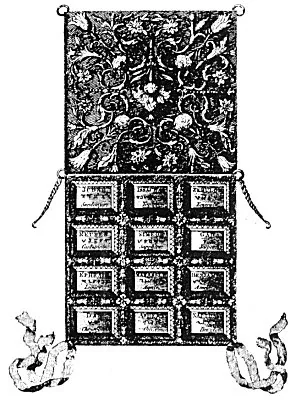
THE BREASTPLATE OF THE HIGH PRIEST.
From Calmet's Dictionary of the Holy Bible.
The order of the stones and the tribe over which each administered were, according to Calmet, as in the above diagram. These gems, according to the Rosicrucians, were symbolic of the twelve great qualities and virtues: Illumination, Love, Wisdom, Truth, Justice, Peace, Equilibrium, Humility, Faith, Strength, Joy, Victory.
that a candidate, when first entering the precincts of sanctuary, must offer upon the brazen altar not a poor unoffending bull or ram but its correspondence within his own nature. The bull, being symbolic of earthiness, represented his own gross constitution which must be burned up by the fire of his Divinity. (The sacrificing of beasts, and in some cases human beings, upon the altars of the pagans was the result of their ignorance concerning the fundamental principle underlying sacrifice. They did not realize that their offerings must come from within their own natures in order to be acceptable.)
Farther westward, in line with the Brazen Altar, was the Laver of Purification already described. It signified to the priest that he should cleanse not only his body but also his soul from all stains of impurity, for none who is not clean in both body and mind can enter into the presence of Divinity and live. Beyond the Laver of Purification was the entrance to the Tabernacle proper, facing the east, so that the first rays of the rising sun might enter and light the chamber. Between the encrusted pillars could be seen the Holy Place, a mysterious chamber, its walls hung with magnificent drapes embroidered with the faces of Cherubs.
Against the wall on the southern side of the Holy Place stood the great Candlestick, or lampstand, of cast gold, which was believed to weigh about a hundred pounds. From its central shaft branched out six arms, each ending in a cup-shaped depression in which stood an oil lamp. There were seven lamps, three on the arms at each side and one on the central stem. The Candlestick was ornamented with seventy-two almonds, knops, and flowers. Josephus says seventy, but wherever this round number is used by the Hebrews it really means seventy-two. Opposite the Candlestick, against the northern wall, was a table bearing twelve loaves of Shewbread in two stacks of six loaves each. (Calmet is of the opinion that the bread was not stacked up but spread out on the table in two rows, each containing six loaves.) On this table also stood two lighted incensories, which were placed upon the tops of the stacks of Shewbread so that the smoke of the incense might be an acceptable aroma to the Lord, bearing with it in its ascent the soul of the Shewbread.
In the center of the room, almost against the partition leading into the Holy of Holies, stood the Altar of Burnt Incense, made of wood overlaid with golden plates. Its width and length were each a cubit and its height was two cubits. This altar was symbolic of the human larynx, from which the words of man's mouth ascend as an acceptable offering unto the Lord, for the larynx occupies the position in the constitution of man between the Holy Place, which is the trunk of his body, and the Holy of Holies, which is the head with its contents.
Into the Holy of Holies none might pass save the High Priest, and he only at certain prescribed times, The room contained no furnishings save the Ark of the Covenant, which stood against the western wall, opposite the entrance. In Exodus the dimensions of the Ark are given as two and a half cubits for its length, one cubit and a half its breadth and one cubit and a half its height. It was made of shittim-wood, gold plated within and without, and contained the sacred tablets of the Law delivered to Moses upon Sinai. The lid of the Ark was in the form of a golden plate upon which knelt two mysterious creatures called Cherubim, facing each other, with wings arched overhead. It was upon this mercy seat between the wings of the celestials that the Lord of Israel descended when He desired to communicate with His High Priest.
The furnishings of the Tabernacle were made conveniently portable. Each altar and implement of any size was supplied with staves which could be put: through rings; by this means it could be picked up and carried by four or more bearers. The staves were never removed from the Ark of the Covenant until it was finally placed in the Holy of Holies of the Everlasting House, King Solomon's Temple.
There is no doubt that the Jews in early times realized, at least in part, that their Tabernacle was a symbolic edifice. Josephus realized this and while he has been severely criticized because he interpreted the Tabernacle symbolism according to Egyptian and Grecian paganism, his description of the secret meanings of its drapes and furnishings is well worthy of consideration. He says:
"When Moses distinguished the tabernacle into three parts, and allowed two of them to the priests, as a place accessible and common, he denoted the land and the sea, these being of general access to all; but he set apart the third division for God, because heaven is inaccessible to men. And when he ordered twelve loaves to be set on a table, he denoted the year, as distinguished into so many months. By branching out the candlestick into seventy parts, he secretly intimated the Decani, or seventy divisions of the planets; and as to the seven lamps upon the candlesticks, they referred to the course of the planets, of which that is the number. The veils too, which were composed of four things, they declared the four elements; for the plain linen was proper to signify the earth, because the flax grows out of the earth; the purple signified the sea, because that color is dyed by the blood of a sea shell-fish; the blue is fit to signify the air; and the scarlet will naturally be an indication of fire.
"Now the vestment of the high-priest being made of linen, signified the earth; the blue denoted the sky, being like lightning in its pomegranates, and in the noise of the bells resembling thunder. And for the Ephod, it showed that God had made the universe of four (elements); and as for the gold interwoven, * * * it related to the splendor by which all things are enlightened. He also appointed the breastplate to be placed in the middle of the Ephod, to resemble the earth, for that has the very middle place of the world. And the girdle which encompassed the high-priest round signified the ocean, for that goes round about and includes the universe. Each of the sardonyxes declares to us the sun and the moon, those, I mean, that were in the nature of buttons on the high-priest's shoulders. And for the twelve stones, whether we understand by them the months, or whether we understand the like number of the signs of that circle which the Greeks call the Zodiac, we shall not be mistaken in their meaning. And for the mitre, which was of a blue colour, it seems to me to mean heaven; for how otherwise could the name of God be inscribed upon it? That it was also illustrated with a crown, and that of gold also, is because of that splendour with which God is pleased." It is also symbolically significant that the Tabernacle was built in seven months and dedicated to God at the time of the new moon.
The metals used in the building of the Tabernacle were all emblematic. Gold represents spirituality, and the golden plates laid over the shittim-wood were emblems of the spiritual nature which glorifies the human nature symbolized by the wood. Mystics have taught that man's physical body is surrounded by a series of invisible bodies of diverse colors and great splendor. In the majority of people the spiritual nature is concealed and imprisoned in the material nature, but in a few this internal constitution has been objectified and the spiritual nature is outside, so that it surrounds man's personality with a great radiance.
Silver, used as the capitals for the pillars, has its reference to the moon, which was sacred to the Jews and the Egyptians alike. The priests held secret ritualistic ceremonies at the time of the new and the full moon, both of which periods were sacred to Jehovah. Silver, so the ancients taught, was gold with its sun-ray turned inward instead of objectified. While gold symbolized the spiritual soul, silver represented the purified and regenerated human nature of man.
The brass used in the outer altars was a composite substance consisting of an alloy of precious and base metals. Thus, it represented the constitution of the average individual, who is a combination of both the higher and the lower elements.
The three divisions of the Tabernacle should have a special interest to Freemasons, for they represent the three degrees of the Blue Lodge, while the three orders of priests who served the Tabernacle are preserved to modern Masonry as the Entered Apprentice, the Fellow Craftsman, and the Master Mason. The Hawaiian Islanders built a Tabernacle not unlike that of the Jews, except that their rooms were one above another and not one behind another, as in the case of the Tabernacle of the Israelites. The three rooms are also the three important chambers of the Great Pyramid of Gizeh.
THE ROBES OF GLORY
As explained in the quotation from Josephus, the robes and adornments of the Jewish priests had a secret significance, and even to this day there is a religious cipher language concealed in the colors, forms, and uses of sacred garments, not only among the Christian and Jewish priests but also among pagan religions. The vestments of the Tabernacle priests were called Cahanææ; those of the High Priest were termed Cahanææ Rabbæ. Over the Machanese, an undergarment resembling short trousers, they wore the Chethone, a finely woven linen robe, which reached to the ground and had long sleeves tied to the arms of the wearer. A brightly embroidered sash, twisted several times around the waist (a little higher than is customary), with one end pendent in front, and a closely fitting linen cap, designated Masnaemphthes, completed the costume of the ordinary priest.
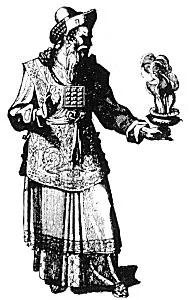
THE GARMENTS OF GLORY.
From Mosaize Historie der Hebreeuwse Kerke.
Th. robe of the High Priest of Israel were often called "The Garments of Glory", for they resembled the regenerated and spiritualized nature of man, symbolized by a vestment which all must weave from the threads of character and virtue before they can become High Priests after the Order of Melchizedek.
The vestments of the High Priest were the same as those of the lesser degrees, except that certain garments and adornments were added. Over the specially woven white linen robe the High Priest wore a seamless and sleeveless habit, sky-blue in color and reaching nearly to his feet. This was called the Meeir and was ornamented with a fringe of alternated golden bells and pomegranates. In Ecclesiasticus (one of the books rejected from the modern Bible), these bells and their purpose are described in the following words: "And he compassed him with pomegranates, and with many golden bells round about, that as he went, there might be a sound and a noise that might be heard in the temple, for a memorial to the children of his people." The Meeir was also bound in with a variegated girdle finely embroidered and with gold wire inserted through the embroidery.
The Ephod, a short vestment described by Josephus as resembling a coat or jacket, was worn over the upper part of the Meeir. The threads of which the Ephod was woven were of many colors, probably red, blue, purple, and white, like the curtains and coverings of the Tabernacle. Fine gold wires were also woven into the fabric. The Ephod was fastened at each shoulder with a large onyx in the form of a button, and the names of the twelve sons of Jacob were engraven upon these two stones, six on each. These onyx buttons were supposed to have oracular powers, and when the High Priest asked certain questions, they emitted a celestial radiance. When the onyx on the right shoulder was illuminated, it signified that Jehovah answered the question of the High Priest: in the affirmative, and when the one on the left gleamed, it indicated a negative answer to the query.
In the middle of the front surface of the Ephod was a space to accommodate the Essen, or Breastplate of Righteousness and Prophecy, which, as its name signifies, was also an oracle of great power. This pectoral was roughly square in shape and consisted of a frame of embroidery into which were set twelve stones, each held in a socket of gold. Because of the great weight of its stones, each of which was of considerable size and immense value, the breastplate was held in position by special golden chains and ribbons. The twelve stones of the breastplate, like the onyx stones at the shoulders of the Ephod, had the mysterious power of lighting up with Divine glory and so serving as oracles. Concerning the strange power of these flashing symbols of Israel's twelve tribes, Josephus writes:
"Yet will I mention what is still more wonderful than this: For God declared beforehand, by those twelve stones which the High Priest bare upon his breast and which were inserted into his breastplate, when they should be victorious in battle; for so great a splendor shone forth from them before the army began to march, that all the people were sensible of God's being present for their assistance. Whence it came to pass that those Greeks, who had a veneration for our laws, because they could not possibly contradict this, called the breastplate, 'the Oracle'." The writer then adds that the stones ceased to light up and gleam some two hundred years before he wrote his history, because the Jews had broken the laws of Jehovah and the God of Israel was no longer pleased with His chosen people.
The Jews learned astronomy from the Egyptians, and it is not unlikely that the twelve jewels of the breastplate were symbolic of the twelve constellations of the zodiac. These twelve celestial hierarchies were looked upon as jewels adorning the breastplate of the Universal Man, the Macroprosophus, who is referred to in the Zohar as The Ancient of Days. The number twelve frequently occurs among ancient peoples, who in nearly every case had a pantheon consisting of twelve demigods and goddesses presided over by The Invincible One, who was Himself subject to the Incomprehensible All-Father. This use of the number twelve is especially noted in the Jewish and Christian writings. The twelve prophets, the twelve patriarchs, the twelve tribes, and the twelve Apostles--each group has a certain occult significance, for each refers to the Divine Duodecimo, or Twelvefold Deity, whose emanations are manifested in the tangible created Universe through twelve individualized channels. The secret doctrine also caught the priests that the jewels represented centers of life within their own constitutions, which when unfolded according to the esoteric instructions of the Temple, were capable of absorbing into themselves and radiating forth again the Divine light of the Deity. (The East Indian lotus blossoms have a similar meaning.) The Rabbis have taught that each twisted linen thread used in weaving the Tabernacle curtains and ornamentations consisted of twenty-four separate strands, reminding the discerning that the experience, gained during the twenty-four hours of the day (symbolized in Masonry by the twenty-four-inch rule) becomes the threads from which are woven the Garments of Glory.
THE URIM AND THUMMIM
In the reverse side of the Essen, or breastplate, was a pocket containing mysterious objects--the Urim and Thummim. Aside from the fact that they were used in divination, little is now known about these objects. Some writers contend that they were small stones (resembling the fetishes still revered by certain aboriginal peoples) which the Israelites had brought with them out of Egypt because of their belief that they possessed divine power. Others believe that the Urim and Thummim were in the form of dice, used for deciding events by being cast upon the ground. A few have maintained that they were merely sacred names, written on plates of gold and carried as talismans. "According to some, the Urim and the Thummim signify 'lights and perfections,' or 'light and truth' which last present a striking analogy to the. two figures of Re (Ra) and Themi in the breastplate worn by the Egyptians." (Gardner's The Faiths of the World.)
Not the least remarkable of the vestments of the High Priest was his bonnet, or headdress. Over the plain white cap of the ordinary priest this dignitary wore an outer cloth of blue and a crown of gold, the crown consisting of three bands, one above the other like the triple miter of the Persian Magi. This crown symbolized that the High Priest was ruler not only over the three worlds which the ancients had differentiated (heaven, earth, and hell), but also over the threefold divisions of man and the universe--the spiritual, intellectual, and material worlds. These divisions were also symbolized by the three apartments of the Tabernacle itself.
At the peak of the headdress was a tiny cup of gold, made in the form of a flower. This signified that the nature of the priest was receptive and that he had a vessel in his own soul which, cuplike, was capable of catching the eternal waters of life pouring upon him from the heavens above. This flower over the crown of his head is similar in its esoteric meaning to the rose growing out of a skull, so famous in Templar symbology. The ancients believed that the spiritual nature escaping from the body passed upward through the crown of the head; therefore, the flowerlike calyx, or cup, symbolized also the spiritual consciousness. On the front of the golden crown were inscribed in Hebrew, Holiness unto the Lord.
Though robes and ornaments augmented the respect and veneration of the Israelites for their High Priest, such trappings meant nothing to Jehovah. Therefore, before entering the Holy of Holies, the High Priest removed his earthly finery and entered into the presence of the Lord God of Israel unclothed. There he could be robed only in his own virtues, and his spirituality must adorn him as a garment.
There is a legend to the effect that any who chanced to enter the Holy of Holies unclean were destroyed by a bolt of Divine fire from the Mercy Seat. If the High Priest had but one selfish thought, he would be struck dead. As no man knows when an unworthy thought may flash through his mind, precautions had to be taken in case the High Priest should be struck dead while in the presence of Jehovah. The other priests could not enter the sanctuary therefore, when their leader was about to go in and receive the commands of the Lord, they tied a chain around one of his feet so that if he were struck down while behind the veil they could drag the body out.
THE HEADDRESS OF THE PRIESTS.
From Mosaize Historie der Hebreeuwse Kerke.
Over the plain white cap of the ordinary priests the High Priest wore an overcloth of blue and a band of gold. On the front of the golden band were inscribed the Hebrew words "Holiness unto the Lord." This illustration shows the arrangement of the bonnet both with and without the golden crown.
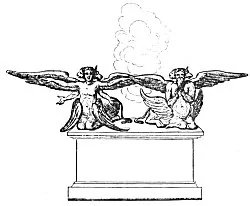
THE ARK WITH ITS CHERUBIM.
From Calmet's Dictionary of the Holy Bible.
Josephus tells its that the Cherubim were flying creatures but different in appearance, from anything to be seen on earth; therefore impossible to describe. Moses is supposed to have seen these beings kneeling at the footstool of God when he was picked up and brought into the Presence of Jehovah. It is probable that they resembled, at least in general appearance, the famous Cherubim of Ezekiel.
The Fraternity of the Rose Cross
WHO were the Rosicrucians? Were they an organization of profound thinkers rebelling against the inquisitional religious and philosophical limitations of their time or were they isolated transcendentalists united only by the similarity of their viewpoints and deductions? Where was the "House of the Holy Spirit, " in which, according to their manifestoes, they met once a year to plan the future activities of their Order? Who was the mysterious person referred to as "Our Illustrious Father and Brother C.R.C."? Did those three letters actually stand for the words "Christian Rosie Cross"? Was Christian Rosencreutz, the supposed author of the Chymical Nuptials, the same person who with three others founded "The Society of the Rose Cross"?
What relationship existed between Rosicrucianism and mediæval Freemasonry? Why were the destinies of these two organizations so closely interwoven? Is the "Brotherhood of the Rose Cross" the much-sought-after link connecting the Freemasonry of the Middle Ages with the symbolism and mysticism of antiquity, and are its secrets being perpetuated by modern Masonry? Did the original Rosicrucian Order disintegrate in the latter part of the eighteenth century, or does the Society still exist as an organization, maintaining the same secrecy for which it was originally famous? What was the true purpose for which the "Brotherhood of the Rose Cross" was formed? Were the Rosicrucians a religious and philosophic brotherhood, as they claimed to be, or were their avowed tenets a blind to conceal the true object of the Fraternity, which possibly was the political control of Europe? These are some of the problems involved in the study of Rosicrucianism.
There are four distinct theories regarding the Rosicrucian enigma. Each is the result of a careful consideration of the evidence by scholars who have spent their lives ransacking the archives of Hermetic lore. The conclusions reached demonstrate clearly the inadequacy of the records available concerning the genesis and early activities of the "Brethren of the Rose Cross."
THE FIRST POSTULATE
It is assumed that the Rosicrucian Order existed historically in accordance with the description of its foundation and subsequent activities published in its manifesto, the Fama Fraternitatis, which is believed to have been written in the year 1610, but apparently did not appear in print until 1614, although an earlier edition is suspected by some authorities. Intelligent consideration of the origin of Rosicrucianism requires a familiarity with the contents of the first and most important of its documents. The Fama Fraternitatis begins with a reminder to all the world of God's goodness and mercy, and it warns the intelligentsia that their egotism and covetousness cause them to follow after false prophets and to ignore the true knowledge which God in His goodness has revealed to them. Hence, a reformation is necessary, and God has raised up philosophers and sages for this purpose.
In order to assist in bringing about the reformation, a mysterious person called "The Highly Illuminated Father C.R.C.," a German by birth, descended of a noble family, but himself a poor man, instituted the "Secret Society of the Rose Cross." C.R.C. was placed in a cloister when only five years of age, but later becoming dissatisfied with its educational system, he associated himself with a brother of Holy Orders who was setting forth on a pilgrimage to the Holy Land. They started out together, but the brother died at Cyprus and C.R.C! continued alone to Damascus. Poor health prevented him from reaching Jerusalem, so he remained at Damascus, studying with the philosophers who dwelt there.
While pursuing his studies, he heard of a group of mystics and Qabbalists abiding in the mystic Arabian city of Damcar. Giving up his desire to visit Jerusalem, he arranged with the Arabians for his transportation to Damcar. C.R.C. was but sixteen years of age when he arrived at Damcar. He was received as one who had been long expected, a comrade and a friend in philosophy, and was instructed in the secrets of the Arabian adepts. While there, C.R.C. learned the Arabic tongue and translated the sacred book M into Latin; and upon returning to Europe he brought this important volume with him.
After studying three years in Damcar, C.R.C. departed for the city of Fez, where the Arabian magicians declared further information would be given him. At Fez he was instructed how to communicate with the Elementary inhabitants [probably the Nature spirits], and these disclosed to him many other great secrets of Nature. While the philosophers in Fez were not so great as those in Damcar, the previous experiences of C.R.C. enabled him to distinguish the true from the false and thus add greatly to his store of knowledge.
After two years in Fez, C.R.C. sailed for Spain, carrying with him many treasures, among them rare plants and animals accumulated during his wanderings. He fondly hoped that the learned men of Europe would receive with gratitude the rare intellectual and material treasures which he had brought for their consideration. Instead he encountered only ridicule, for the so-called wise were afraid to admit their previous ignorance lest their prestige be impaired. At this point in the narrative is an interpolation stating that Paracelsus, while not a member of the "Fraternity of the Rose Cross," had read the book M and from a consideration of its contents had secured information which made him the foremost physician of mediæval Europe.
Tired, but not discouraged, as the result of the fruitlessness of his efforts, C.R.C. returned to Germany, where he built a house in which he could quietly carry on his study and research. He also manufactured a number of rare scientific instruments for research purposes. While he could have made himself famous had he cared to commercialize his knowledge, he preferred the companionship of God to the esteem of men.
After five years of retirement he decided to renew his struggle for a reformation of the arts and sciences of his day, this time with the aid of a few trusted friends. He sent to the cloister where his early training had been received and called to himself three brethren, whom he bound by an oath to preserve inviolate the secrets he should impart and to write down for the sake of posterity the information
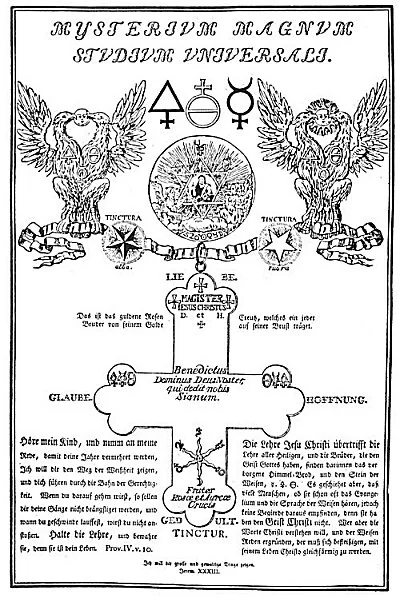
THE GOLDEN AND ROSY CROSS.
From Geheime Figuren der Rosenkreuzer.
It is said of this cross that it is made of spiritual gold and that each Brother wears it upon his breast. It bears the alchemical symbols of salt, sulphur, and mercury; also a star of the planets; and around it are the four words FAITH, HOPE, LOVE, and PATIENCE. The double-headed eagle, or Phœnix, subtly foreshadows the ultimate androgynous state of the human creature. Rosicrucian alchemy was not concerned with metals alone. Man's own body was the alchemical laboratory, and none could reach Rosicrucian adeptship until he had performed the supreme experiment of transmutation by changing the base metals of ignorance into the pure gold of wisdom and understanding.
he should dictate. These four founded the "Fraternity of the Rose Cross." They prepared its secret cipher language and, according to the Fama, a great dictionary in which all forms of wisdom were classified to the glorification of God. They also began the work of transcribing the book M, but found the task too difficult because of the demands of the great numbers of sick who came to them for healing.
Having completed a newer and larger building, which they called the "House of the Holy Spirit," they decided to include four new members in the Fraternity, thus increasing the number to eight, seven of whom were German. All were unmarried. Working industriously together, they speedily completed the arduous labor of preparing the documents, instructions, and arcana of the Order. They also put the house called "Sancti Spiritus" in order.
They then decided to separate and visit the other countries of the earth, not only that their wisdom might be given to others who deserved it but also that they might check and correct any mistakes existing in their own system. Before separating, the Brethren prepared six rules, or by-laws, and each bound himself to obey them. The first rule was that they should take to themselves no other dignity or credit than that they were willing to heal the sick without charge. The second was that from that time on forever they should wear no special robe or garment, but should dress according to the custom of the country wherein they dwelt. The third stated that every year upon a certain day they should meet in the "House of the Holy Spirit," or, if unable to do so, should be represented by an epistle. The fourth decreed that each member should search for a worthy person to succeed him at his own demise. The fifth stated that the letters "R.C." should be their seal, mark, and character from that time onward. The sixth specified that the Fraternity should remain unknown to the world for a period of one hundred years.
After they had sworn to this code five of the Brothers departed to distant lands, and a year later two of the others also went their way, leaving Father C.R. C. alone in the "House of the Holy Spirit." Year after year they met with great joy, for they had quietly and sincerely promulgated their doctrines among the wise of the earth.
When the first of the Order died in England, it was decided that the burial places of the members should be secret. Soon afterward Father C.R.C. called the remaining six together, and it is supposed that then he prepared his own symbolic tomb. The Fama records that none of the Brothers alive at the time of its writing knew when Father C.R.C. died or where he was buried. His body was accidentally discovered 120 years after his death when one of the Brothers, who possessed considerable architectural skill, decided to make some alterations in the "House of the Holy Spirit." [It is only suspected that the tomb was in this building.]
While making his alterations, the Brother discovered a memorial tablet upon which were inscribed the names of the early members of the Order. This he decided to transfer to a more imposing chapel, for at that time no one knew in what country Father C.R.C. had died, this information having been concealed by the original members. In attempting to remove the memorial tablet, which was held in place by a large nail, some stones and plastering were broken from the wall, disclosing a door concealed in the masonry. The members of the Order immediately cleared away the rest of the débris and uncovered the entrance to a vault. Upon the door in large letters were the words: POST CXX ANNOS PATEBO. This, according to the mystic interpretation of the Brethren, meant, "In 120 years I shall come forth."
The following morning the door was opened and the members entered a vault with seven sides and seven corners, each side five feet broad and eight feet high. Although the sun never penetrated this tomb, it was brilliantly illuminated by a mysterious light in the ceiling. In the center was a circular altar, upon which were brass plates engraved with strange characters. In each of the seven sides was a small door which, upon being opened, revealed a number of boxes filled with books, secret instructions, and the supposedly lost arcanum of the Fraternity.
Upon moving the altar to one side a brass cover was disclosed. Lifting this revealed a body, presumedly that of C.R.C., which, although it had lain there 120 years, was as well preserved as though it had just been interred. It was ornamented and attired in the robes of the Order, and in one hand was clasped a mysterious parchment which, next to the Bible, was the most valued possession of the Society. After thoroughly investigating the contents of the secret chamber, the brass plate and altar were put back in place, the door of the vault was again sealed, and the Brothers went their respective ways, their spirits raised and their faith increased by the miraculous spectacle which they had beheld.
The document ends by saying in effect, "In accordance with the will of Father C.R.C., the Fama has been prepared and sent forth to the wise and learned of all Europe in five languages, that all may know and understand the secrets of the august Fraternity. All of sincere soul who labor for the glory of God are invited to communicate with the Brethren and are promised that their appeal shall be heard, regardless of where they are or how the messages are sent. At the same time, those of selfish and ulterior motives are warned that only sorrow and misery will attend any who attempt to discover the Fraternity without a clean heart and a pure mind."
Such, in brief, is the story of the Fama Fraternitatis. Those who accept it literally regard Father C.R.C. as the actual founder of the Brotherhood, which he is believed to have organized about 1400. The fact that historical corroboration of the important points of the Fama has never been discovered is held against this theory. There is no proof that Father C.R.C. ever approached the learned men of Spain. The mysterious city of Damcar cannot be found, and there is no record that anywhere in Germany there existed a place where great numbers of the halt and sick came and were mysteriously healed. A. E. Waite's The Secret Tradition in Freemasonry contains a picture of Father C.R.C. showing him with a long beard upon his breast, sitting before a table upon which burns a candle. One hand is supporting his head and the other is resting the tip of its index finger on the temple of a human skull. The picture, however (see plate at head of chapter), proves nothing. Father C.R.C. was never seen by other than members of his own Order, and they did not preserve a description of him. That his name was Christian Rosencreutz is most improbable, as the two were not even associated until the writing of the Chymical Nuptials.
THE SECOND POSTULATE
Those Masonic brethren who have investigated the subject accept the historical existence of the "Brotherhood of the Rose Cross" but are divided concerning the origin of the Order. One group holds the society originated in mediæval Europe as an outgrowth of alchemical speculation. Robert Macoy, 33°, believes that Johann Valentin Andreæ, a German theologian, was the true founder, and he also believes it possible that this divine merely reformed and amplified an existing society which had been founded by Sir Henry Cornelius Agrippa. Some believe that Rosicrucianism represented the first European invasion of Buddhist and Brahmin culture. Still others hold the opinion that the "Society of the Rose Cross" was founded in Egypt during n the philosophic supremacy of that empire, and that it also perpetuated the Mysteries of ancient Persia and Chaldea.
In his Anacalypsis, Godfrey Higgins writes: "The Rosicrucians of Germany are quite ignorant of their origin; but, by tradition, they suppose themselves descendants of the ancient Egyptians, Chaldeans, Magi, and Gymnosophists." (The last was a name given by the followers of Alexander the Great to a caste of naked Wise Men whom they found meditating along the river banks in India.) The consensus among these factions is that the story of Father C.R.C., like the Masonic legend of Hiram Abiff, is an allegory and should not be considered literally. A similar problem has confronted students of the Bible, who have found not only difficult, but in the majority of cases impossible, their efforts to substantiate the historical interpretation of the Scriptures.
Admitting the existence of the Rosicrucians as a secret society with both philosophic and political ends, it is remarkable that an organization with members in all parts of Europe could maintain absolute secrecy throughout the centuries. Nevertheless, the "Brothers of the Rose Cross" were apparently able to accomplish this. A great number of scholars and philosophers, among them Sir Francis Bacon and Wolfgang von Goethe, have been suspected of affiliation with the Order, but their connection has not been established to the satisfaction of prosaic historians. Pseudo-Rosicrucians abounded, but the true members of the "Ancient and Secret Order of The Unknown Philosophers" have successfully lived up to their name; to this day they remain unknown.
During the Middle Ages a number of tracts appeared, purporting to be from the pens of Rosicrucians. Many of them, however, were spurious, being issued for their self-aggrandizement by unscrupulous persons who used the revered and magic name Rosicrucian in the hope of gaining religious or political power. This has greatly complicated
THE CRUCIFIED ROSE.
The original symbol of the Rosicrucian Fraternity was a hieroglyphic rose crucified upon a cross. The cross was often raised upon a three-stepped Calvary. Occasionally the symbol of a cross rising from a rose was used in connection with their activities. The Rosicrucian rose was drawn upon the Round Table of King Arthur, and is the central motif for the links forming the chain from which the "Great George" is suspended among the jewels of The Order of the Garter. Hargrave Jennings suspects this Order of having some connection with the Rosicrucians.
the work of investigating the Society. One group of pseudo-Rosicrucians went so far as to supply its members with a black cord by which they were to know each other, and warned them that if they broke their vow of secrecy the cord would be used to strangle them. Few of the principles of Rosicrucianism have been preserved in literature, for the original Fraternity published only fragmentary accounts of its principles and activities.
In his Secret Symbols of the Rosicrucians, Dr. Franz Hartmann describes the Fraternity as "A secret society of men possessing superhuman--if not supernatural--powers; they were said to be able to prophesy future events, to penetrate into the deepest mysteries of Nature, to transform Iron, Copper, Lead, or Mercury into Gold, to prepare an Elixir of Life, or Universal Panacea, by the use of which they could preserve their youth and manhood; and moreover it was believed that they could command the Elemental Spirits of Nature, and knew the secret of the Philosopher's Stone, a substance which rendered him who possessed it all-powerful, immortal, and supremely wise."
The same author further defines a Rosicrucian as "A person who by the process of spiritual awakening has attained a practical knowledge of the secret significance of the Rose and the Cross. * * * To call a person a Rosicrucian does not make him one, nor does the act of calling a person a Christian make him a Christ. The real Rosicrucian or Mason cannot be made; he must grow to be one by the expansion and unfoldment of the divine power within his own heart. The inattention to this truth is the cause that many churches and secret societies are far from being that which their names express."
The symbolic principles of Rosicrucianism are so profound that even today they are little appreciated. Their charts and diagrams are concerned with weighty cosmic principles which they treat with a philosophic understanding decidedly refreshing when compared with the orthodox narrowness prevalent in their day. According to the available records, the Rosicrucians were bound together by mutual aspirations rather than by the laws of a fraternity. The "Brothers of the Rose Cross" are believed to have lived unobtrusively, laboring industriously in trades and professions, disclosing their secret affiliation to no one--in many cases not even to their own families. After the death of C.R.C., most of the Brethren apparently had no central meeting place. Whatever initiatory ritual the Order possessed was so closely guarded that it has never been revealed. Doubtless it was couched in chemical terminology.
Efforts to join the Order were apparently futile, for the Rosicrucians always chose their disciples. Having agreed on one who they believed would do honor to their illustrious fraternity, they communicated with him in one of many mysterious ways. He might receive a letter, either anonymous or with a peculiar seal, usually bearing the letters "C.R.C. "or "R.C. "upon it. He would be instructed to go to a certain place at an appointed time. What was disclosed to him he never revealed, although in many cases his later writings showed that a new influence had come into his life, deepening his understanding and broadening his intellect. A few have written allegorically concerning what they beheld when in the august presence of the "Brethren of the Rose Cross."
Alchemists were sometimes visited in their laboratories by mysterious strangers, who delivered learned discourses concerning the secret processes of the Hermetic arts and, after disclosing certain processes, departed, leaving no trace. Others declared that the "Brothers of the Rose Cross" communicated with them through dreams and visions, revealing the secrets of Hermetic wisdom to them while they were asleep. Having been instructed, the candidate was bound to secrecy not only concerning the chemical formulæ which had been disclosed to him but also concerning the method by which he had secured them. While these nameless adepts were suspected of being ''Brothers of the Rose Cross," it could never be proved who they were, and those visited could only conjecture.
Many suspect the Rosicrucian rose to be a conventionalization of the Egyptian and Hindu lotus blossom, with the same symbolic meaning as this more ancient symbol. The Divine Comedy stamps Dante Alighieri as being familiar with the theory of Rosicrucianism. Concerning this point, Albert Pike in his Morals and Dogma makes this significant statement: "His Hell is but a negative Purgatory. His heaven is composed of a series of Kabalistic circles, divided by a cross, like the Pantacle of Ezekiel. In the center of this cross blooms a rose, and we see the symbol of the Adepts of the Rose-Croix for the first time publicly expounded and almost categorically explained."
Doubt has always existed as to whether the name Rosicrucian came from the symbol of the rose and cross, or whether this was merely a blind to deceive the uninformed and further conceal the true meaning of the Order. Godfrey Higgins believes that the word Rosicrucian is not derived from the flower but from the word Ros, which means dew. It is also interesting to note that the word Ras means wisdom, while Rus is translated concealment. Doubtless all of these meanings have contributed to Rosicrucian symbolism.
A. E. Waite holds with Godfrey Higgins that the process of forming the Philosopher's Stone with the aid of dew is the secret concealed within the name Rosicrucian. It is possible that the dew referred to is a mysterious substance within the human brain, closely resembling the description given by alchemists of the dew which, falling from heaven, redeemed the earth. The cross is symbolic of the human body, and the two symbols together--the rose on the cross--signify that the soul of man is crucified upon the body, where it is held by three nails.
It is probable that Rosicrucian symbolism is a perpetuation of the secret tenets of the Egyptian Hermes, and that the Society of Unknown Philosophers is the true link connecting modern Masonry, with its mass of symbols, to ancient Egyptian Hermeticism, the source of that symbolism. In his Doctrine and Literature of the Kabalah, A. E. Waite makes this important observation: "There are certain indications which point to a possible connection between Masonry and Rosicrucianism, and this, if admitted, would constitute the first link in its connection with the past. The evidence is, however, inconclusive, or at least unextricated. Freemasonry per se, in spite of the affinity with mysticism which I have just mentioned, has never exhibited any mystic character, nor has it a clear notion how it came by its symbols."
Many of those connected with the development of Freemasonry were suspected of being Rosicrucians; some, as in the case of Robert Fludd, even wrote defenses of this organization. Frank C. Higgins, a modern Masonic symbolist, writes: "Doctor Ashmole, a member of this fraternity [Rosicrucian], is revered by Masons as one of the founders of the first Grand Lodge in London." (See Ancient Freemasonry.) Elias Ashmole is but one of many intellectual links connecting Rosicrucianism with the genesis of Freemasonry. The Encyclopædia Britannica notes that Elias Ashmole was initiated into the Freemasonic Order in 1646, and further states that he was "the first gentleman, or amateur, to be 'accepted'."
On this same subject, Papus, in his Tarot of the Bohemians, has written: "We must not forger that the Rosicrucians were the Initiators of Leibnitz, and the founders of actual Freemasonry through Ashmole." If the founders of Freemasonry were initiated into the Great Arcanum of Egypt--and the symbolism of modern Masonry would indicate that such was the case--then it is reasonable to suppose that they secured their information from a society whose existence they admitted and which was duly qualified to teach them these symbols and allegories.
One theory concerning the two Orders is to the effect that Freemasonry was an outgrowth of Rosicrucianism; in other words, that the "Unknown Philosophers" became known through an organization which they created to serve them in the material world. The story goes on to relate that the Rosicrucian adepts became dissatisfied with their progeny and silently withdrew from the Masonic hierarchy, leaving behind their symbolism and allegories, but carrying away the keys by which the locked symbols could be made to give tip their secret meanings. Speculators have gone so far as to state that, in their opinion, modern Freemasonry has completely absorbed Rosicrucianism and succeeded it as the world's greatest secret society. Other minds of equal learning declare that the Rosicrucian Brotherhood still exists, preserving its individuality as the result of having withdrawn from the Masonic Order.
According to a widely accepted tradition, the headquarters of the Rosicrucian Order is near Carlsbad, in Austria (see Doctor Franz Hartmann). Another version has it that a mysterious school, resembling in general principles the Rosicrucian Fraternity, which calls itself "The Bohemian Brothers," still maintains its individuality in the Schwarzwald (Black Forest) of Germany. One thing is certain: with the rise of Freemasonry, the Rosicrucian Order in Europe practically disappeared, and notwithstanding existing statements to the contrary, it is certain that the 18th degree (commonly known as the Rose-Croix) perpetuates many of the symbols of the Rosicrucian Fire Alchemists.
In an anonymous unpublished manuscript of the eighteenth century bearing the earmarks of Rosicrucian Qabbalism appears this
THE ROSICRUCIAN ROSE.
From Geheime Figuren der Rosenkreuzer.
The rose is a yonic symbol associated with generation, fecundity, and purity. The fact that flowers blossom by unfolding has caused them to be chosen as symbolic of spiritual unfoldment. The red color of the rose refers to the blood of Christ, and the golden heart concealed within the midst of the flower corresponds to the spiritual gold concealed within the human nature. The number of its petals being ten is also a subtle reminder of the perfect Pythagorean number. The rose symbolizes the heart, and the heart has always been accepted by Christians as emblematic of the virtues of love and compassion, as well as of the nature of Christ--the personification of these virtues. The rose as a religious emblem is of great antiquity. It was accepted by the Greeks as the symbol of the sunrise, or of the coming of dawn. In his Metamorphosis, or Golden Ass, Apuleius, turned into a donkey because of his foolishness, regained his human shape by eating a sacred rose given to him by the Egyptian priests.
The presence of a hieroglyphic rose upon the escutcheon of Martin Luther has been the basis of much speculation as to whether any connection existed between his Reformation and the secret activities of the Rose Cross.
statement: "Yet will I now give the over-wise world a paradox to be solved, namely, that some illuminated men have undertaken to found Schools of Wisdom in Europe and these for some peculiar reason have called themselves Fratres Rosa: Crucis. But soon afterwards came false schools into existence and corrupted the good intentions of these wise men. Therefore, the Order no longer exists as most people would understand existence, and as this Fraternity of the Seculo Fili call themselves Brothers of the Rosie Cross, so also will they in the Seculo Spiritus Sancti call themselves Brothers of the Lily Cross and the Knights of the White Lion. Then will the Schools of Wisdom begin again to blossom, but why the first one chose their name and why the others shall also choose theirs, only those can solve who have understanding grounded in Nature."
Political aspirations of the Rosicrucians were expressed through the activities of Sir Francis Bacon, the Comte de St.-Germain, and the Comte di Cagliostro. The last named is suspected of having been an emissary of the Knights Templars, a society deeply involved in transcendentalism, as Eliphas Levi has noted. There is a popular supposition to the effect that the Rosicrucians were at least partial instigators of the French Revolution. (Note particularly the introduction to Lord Bulwer-Lytton's Rosicrucian novel Zanoni.)
THE THIRD POSTULATE
The third theory takes the form of a sweeping denial of Rosicrucianism, asserting that the so-called original Order never had any foundation in fact but was entirely a product of imagination. This viewpoint is best expressed by a number of questions which are still being asked by investigators of this elusive group of metaphysicians. Was the "Brotherhood of the Rose Cross" merely a mythical institution created in the fertile mind of some literary cynic for the purpose of deriding the alchemical and Hermetic sciences? Did the "House of the Holy Spirit" ever exist outside the imagination of some mediæval mystic? Was the whole Rosicrucian story a satire to ridicule the gullibility of scholastic Europe? Was the mysterious Father C.R.C. a product of the literary genius of Johann Valentin Andreæ, or another of similar mind, who, attempting to score alchemical and Hermetic philosophy, unwittingly became a great power in furthering the cause of its promulgation? That at least one of the early documents of the Rosicrucians was from the pen of Andreæ there is little doubt, but for just what purpose he compiled it still remains a matter of speculation. Did Andreæ himself receive from some unknown person, or persons, instructions to be carried out? If he wrote the Chymical Nuptials of Christian Rosencreutz when only fifteen years old, was he overshadowed in the preparation of that book?
To these vital questions no answers are forthcoming. A number of persons accepted the magnificent imposture of Andreæ as absolute truth. It is maintained by many that, as a consequence, numerous pseudo-societies sprang up, each asserting that it was the organization concerning which the Fama Fraternitatis and the Confessio Fraternitatis were written. Beyond doubt there are many spurious orders in existence today; but few of them can offer valid claims that their history dates back farther than the beginning of the nineteenth century.
The mystery associated with the Rosicrucian Fraternity has resulted in endless controversy. Many able minds, notable among them Eugenius Philalethes, Michael Maier, John Heydon, and Robert Fludd, defended the concrete existence of "The Society of Unknown Philosophers." Others equally qualified have asserted it to be of fraudulent origin and doubtful existence. Eugenius Philalethes, while dedicating books to the Order, and himself writing an extended exposition of its principles, disclaims all personal connection with it. Many others have done likewise.
Some are of the opinion that Sir Francis Bacon had a hand in the writing of the Fama and Confessio Fraternitatis, on the basis that the rhetorical style of these works is similar to that of Bacon's New Atlantis. They also contend that certain statements in the latter work point to an acquaintance with Rosicrucian symbology. The elusiveness of the Rosicrucians has caused them to be favorite subject's for literary works. Outstanding among the romances which have been woven around them is Zanoni. The author, Lord Bulwer-Lytton, is regarded by some as a member of the Order, while others assert that he applied for membership but was rejected. Pope's Rape of the Lock, &c. Comte de Gabalis by Abbé de Villars, and essays by De Quincy, Hartmann, Jennings, Mackenzie, and others, are examples of Rosicrucian literature. Although the existence of these mediæval Rosicrucians is difficult to prove, sufficient evidence is at hand to make it extremely probable that there existed in Germany, and afterwards in France, Italy, England, and other European countries, a secret society of illuminated savants who made contributions of great import to the sum of human knowledge, while maintaining absolute secrecy concerning their personalities and their organization.
THE FOURTH POSTULATE
The apparent incongruities of the Rosicrucian controversy have also been accounted for by a purely transcendental explanation. There is evidence that early writers were acquainted with such a supposition--which, however, was popularized only after it had been espoused by Theosophy. This theory asserts that the Rosicrucians actually possessed all the supernatural powers with which they were credited; that they were in reality citizens of two worlds: that, while they had physical bodies for expression on the material plane, they were also capable, through the instructions they received from the Brotherhood, of functioning in a mysterious ethereal body not subject to the limitations of time or distance. By means of this "astral form" they were able to function in the invisible realm of Nature, and in this realm, beyond reach of the profane, their temple was located.
According to this viewpoint, the true Rosicrucian Brotherhood consisted of a limited number of highly developed adepts, or initiates, those of the higher degrees being no longer subject to the laws of mortality; candidates were accepted into the Order only after long periods of probation; adepts possessed the secret of the Philosopher's Stone and knew the process of transmuting the base metals into gold, but taught that these were only allegorical terms concealing the true mystery of human regeneration through the transmutation of the "base elements" of man's lower nature into the "gold" of intellectual and spiritual realization. According to this theory, those who have sought to record the events of importance in connection with the Rosicrucian controversy have invariably failed because they approached their subject from a purely physical or materialistic angle.
These adepts were believed to have been able to teach man how to function away from his physical body at will by assisting him to remove the "rose from the cross." They taught that the spiritual nature was attached to the material form at certain points, symbolized by the "nails" of the crucifixion; but by three alchemical initiations which took place in the spiritual world, in the true Temple of the Rose Cross, they were able to "draw" these nails and permit the divine nature of man to come down from its cross. They concealed the processes by which this was accomplished under three alchemical metaphoric expressions: "The Casting of the Molten Sea," "The Making of the Rose Diamond," and "The Achieving of the Philosopher's Stone."
While the intellectualist flounders among contradictory theories, the mystic treats the problem in an entirely different manner. He believes that the true Rosicrucian Fraternity, consisting of a school of supermen (not unlike the fabled Mahatmas of India), is an institution existing not in the visible world bur in its spiritual counterpart, which he sees fit to call the "inner planes of Nature"; that the Brothers can be reached only by those who are capable of transcending the limitations of the material world. To substantiate their viewpoint, these mystics cite the following significant statement from the Confessio Fraternitatis: "A thousand times the unworthy may clamour, a thousand times may present themselves, yet God hath commanded our ears that they should hear none of them, and hath so compassed us about with His clouds that unto us, His servants, no violence can be done; wherefore now no longer are we beheld by human eyes, unless they have received strength borrowed from the eagle." In mysticism the eagle is a symbol of initiation (the spinal Spirit Fire), and by this is explained the inability of the unregenerated world to understand the Secret Order of the Rose Cross.
Those professing this theory regard the Comte de St.-Germain as their highest adept and assert that he and Christian Rosencreutz were one and the same individual. They accept fire as their universal symbol because it was the one element by means of which they could control the metals. They declared themselves the descendants of Tubal-cain and Hiram Abiff, and that the purpose of their existence was to preserve the spiritual nature of man through ages of materiality. "The Gnostic sects, the Arabs, Alchemists, Templars, Rosicrucians, and lastly the Freemasons, form the Western chain in the transmission of occult science." (See The Tarot of the Bohemians translated by A. E. Waite from the French of Papus.)
Max Heindel, the Christian mystic, described the Rosicrucian Temple as an "etheric structure" located in and around the home of a European country gentleman. He believed that this invisible building would ultimately be moved to the American continent. Mr. Heindel referred to the Rosicrucian Initiates as so advanced in the science of life that "death had forgotten them."
THE CREST OF JOHANN VALENTIN ANDREÆ.
From Chymische Hochzeit.
The reference to four red roses and a white cross in the Chymical Marriage of Christian Rosencreutz identified Johann Valentin Andreæ as its author, for his family crest, shown above, consisted of four red roses and a white cross.
Rosicrucian Doctrines and Tenets
TRUSTWORTHY information is unavailable concerning the actual philosophical beliefs, political aspirations, and humanitarian activities of the Rosicrucian Fraternity. Today, as of old, the mysteries of the Society are preserved inviolate by virtue of their essential nature; and attempts to interpret Rosicrucian philosophy are but speculations, anything to the contrary notwithstanding.
Evidence points to the probable existence of two distinct Rosicrucian bodies: an inner organization whose members never revealed their identity or teachings to the world, and an outer body under the supervision of the inner group. In all probability, the symbolic tomb of Christian Rosencreutz, Knight of the Golden Stone, was in reality this outer body, the spirit of which is in a more exalted sphere. For a period of more than a century subsequent to 1614, the outer body circulated tracts and manifestoes under either its own name or the names of various initiated members. The purpose of these writings was apparently to confuse and mislead investigators, and thus effectively to conceal the actual designs of the Fraternity.
When Rosicrucianism became the philosophical "fad" of the seventeenth century, numerous documents on the subject were also circulated for purely commercial purposes by impostors desirous of capitalizing its popularity. The cunningly contrived artifices of the Fraternity itself and the blundering literary impostures of charlatans formed a double veil behind which the inner organization carried on its activities in a manner totally dissimilar to its purposes and principles as publicly disseminated. The Fratres Rosa Crucis naively refer to the misunderstandings which they have for obvious reasons permitted to exist concerning themselves as being "clouds" within which they labor and behind which they are concealed.
An inkling of the substance of Rosicrucianism--its esoteric doctrines--can be gleaned from an analysis of its shadow--its exoteric writings. In one of the most important of their "clouds," the Confessio Fraternitatis, the Brethren of the Fraternity of R.C. seek to justify their existence and explain (?) the purposes and activities of their Order. In its original form the Confessio is divided into fourteen chapters, which are here epitomized.
The Secret Teachings of All Ages. San Francisco, 1928. Hermetic Cloud, https://hermeticcloud.com/library/hall-secret-teachings-of-all-ages/. Public-domain text reproduced in full; markup only.