CONFESSIO FRATERNITATIS R. C. AD ERUDITOS EUROPÆ
Chapter I. Do not through hasty judgment or prejudice misinterpret the statements concerning our Fraternity published in our previous manifesto--the Fama Fraternitatis. Jehovah, beholding the decadence of civilization, seeks to redeem humanity by revealing to the willing and by thrusting upon the reluctant those secrets which previously He had reserved for His elect. By this wisdom the godly shall be saved, but the sorrows of the ungodly shall be multiplied. While the true purpose of our Order was set forth in the Fama Fraternitatis, misunderstandings have arisen through which we have been falsely accused of heresy and treason. In this document we hope so to clarify our position that the learned of Europe will be moved to join with us in the dissemination of divine knowledge according to the will of our illustrious founder.
Chapter II. While it is alleged by many that the philosophic cide of our day is sound, we declare it to be false and soon to die of its own inherent weakness. just as Nature, however, provides a remedy for each new disease that manifests itself, so our Fraternity has provided a remedy for the infirmities of the world's philosophic system. The secret philosophy of the R.C. is founded upon that knowledge which is the sum and head of all faculties, sciences, and arts. By our divinely revealed system--which partakes much of theology and medicine but little of jurisprudence--we analyze the heavens and the earth; but mostly we study man himself, within whose nature is concealed the supreme secret. If the learned of out day will accept our invitation and join themselves to our Fraternity, we will reveal to them undreamed-of secrets and wonders concerning the hidden workings of Nature.
Chapter III. Do not believe that the secrets discussed in this brief document are lightly esteemed by us. We cannot describe fully the marvels of our Fraternity lest the uninformed be overwhelmed by our astonishing declarations and the vulgar ridicule the mysteries which they do not comprehend. We also fear that many will be confused by the unexpected generosity of our proclamation, for not understanding the wonders of this sixth age they do nor realize the great changes which are to come. Like blind men living in a world full of light, they discern only through the sense of feeling. [By sight is implied spiritual cognition: by feeling, the material senses.]
Chapter IV. We firmly believe that through deep meditation on the inventions of the human mind and the mysteries of life, through the cooperation of the angels and spirits, and through experience and long observation, our loving Christian Father C.R.C. was so fully illumined with God's wisdom that were all the books and writings of the world lost and the foundations of science overturned, the Fraternity of R.C. could reestablish the structure of world thought upon the foundation of divine truth and integrity. Because of the great depth and perfection of our knowledge, those desiring to understand the mysteries of the Fraternity of R. C. cannot attain to that wisdom immediately, but must grow in understanding and knowledge. Therefore, our Fraternity is divided into grades through which each must ascend step by step to the Great Arcanum. Now that it has pleased God to lighten unto us His sixth candelabrum, is it not better to seek truth in this way than to wander through the labyrinths of worldly ignorance?
Furthermore, those who receive this knowledge shall become masters of all arts and crafts; no secret shall be hidden from them; and all good works of the past, present, and future shall be accessible to them. The whole world shall become as one book and the contradictions of science and theology shall be reconciled. Rejoice, O humanity! for the time has come when God has decreed that the number of our Fraternity shall be increased, a labor that we have joyously undertaken. The doors of wisdom are now open to the world, but only to those who have earned the privilege may the Brothers present themselves, for it is forbidden to reveal our knowledge even to our own children. The right to receive spiritual truth cannot be inherited: it must be evolved within the soul of man himself.
Chapter V. Though we may be accused of indiscretion in offering our treasures so freely and promiscuously--without discriminating between the godly, the wise, the prince, the peasant--we affirm that we have not betrayed our trust; for although we have published our Fama in five languages, only those understand it who have that right. Our Society is not to be discovered by curiosity
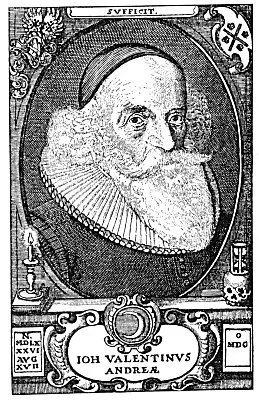
JOHANN VALENTIN ANDREÆ.
From a rare print.
In certain esoteric circles there are vague rumors which intimate that the humble personality of Johann Valentin Andreæ masked an exalted emissary of the Rose Cross. While there is sufficient evidence at hand to establish the actual existence of a German theologian by the name of Andreæ, there are many discrepancies in his biography which have net been cleared up to the satisfaction of critical investigators. A comparison of the face shown above with that of Sir Francis Bacon discloses striking resemblances in spite of the differences due to age. If Lord Bacon borrowed the name and identity of William Shakspere, he could also assume, after his mock funeral in England, the personality of Johann Valentin Andreæ. The crescent below the bust is significant, as it also appears upon the crest of Lord Bacon; to denote that he was the second son of Sir Nicholas Bacon. Further, the four letters (O MDC) in the frame at the lower right corner of the plate, by a very simple Baconian cipher, can be changed into number whose sum gives 33--the numerical equivalent of the name Bacon. These several points of interest, when considered together, go far towards clearing up the mystery surrounding the authorship of the first Rosicrucian manifestoes.
seekers, but only by serious and consecrated thinkers; nevertheless we have circulated our Fama in five mother tongues so that the righteous of all nations may have an opportunity to know of us, even though they be not scholars. A thousand times the unworthy may present themselves and clamor at the gates, but God has forbidden us of the Fraternity of R.C. to hear their voices, and He has surrounded us with His clouds and His protection so that no harm may come to us, and God has decreed that we of the Order of R.C. can no longer be seen by mortal eyes unless they have received strength borrowed from the eagle. We further affirm that we shall reform the governments of Europe and pattern them according to the system applied by the philosophers of Damcar. All men desirous of securing knowledge shall receive as much as they are capable of understanding. The rule of false theology shall be overthrown and God shall make His will known through His chosen philosophers.
Chapter VII. Because of the need of brevity, it is enough to say that our Father C.R.C. was born in the year 1378 and departed at the age of 106, leaving to us the labor of spreading die doctrine of philosophic religion to the entire world. Our Fraternity is open to all who sincerely seek for truth; but we publicly warn the false and impious that they cannot betray or injure us, for God has protected our Fraternity, and all who seek to do it harm shall have their evil designs return and destroy them, while the treasures of our Fraternity shall remain untouched, to be used by the Lion in the establishment of his kingdom.
Chapter VII. We declare that God, before the end of the world, shall create a great flood of spiritual light to alleviate the sufferings of humankind. Falsehood and darkness which have crept into the arts, sciences, religions, and governments of humanity--making it difficult for even the wise to discover the path of reality--shall be forever removed and a single standard established, so that all may enjoy the fruitage of truth. We shall not be recognized as those responsible for this change, for people shall say that it is the result of the progressiveness of the age. Great are the reforms about to take place; but we of the Fraternity of R.C. do not arrogate to ourselves the glory for this divine reformation, since many there are, not members of our Fraternity but honest, true and wise men, who by their intelligence and their writings shall hasten its coming. We testify that sooner the stones shall rise up and offer their services than that there shall be any lack of righteous persons to execute the will of God upon earth.
Chapter VIII. That no one may doubt, we declare that God has sent messengers and signs in the heavens, namely, the i new stars in Serpentarius and Cygnus, to show that a great Council of the Elect is to take place. This proves that God reveals in visible nature--for the discerning few--signs and symbols of all things that are coming to pass. God has given man two eyes, two nostrils, and two ears, but only one tongue. Whereas the eyes, the nostrils, and the ears admit the wisdom of Nature into the mind, the tongue alone may give it forth. In various ages there have been illumined ones who have seen, smelt, tasted, or heard the will of God, but it will shortly come to pass that those who have seen, smelt, tasted, or heard shall speak, and truth shall be revealed. Before this revelation of righteousness is possible, however, the world must sleep away the intoxication of her poisoned chalice (filled with the false life of the theological vine) and, opening her heart to virtue and understanding, welcome the rising sun of Truth.
Chapter IX. We have a magic writing, copied from that divine alphabet with which God writes His will upon the face of celestial and terrestrial Nature. With this new language we read God's will for all His creatures, and just as astronomers predict eclipses so we prognosticate the obscurations of the church and how long they shall last. Our language is like unto that of Adam and Enoch before the Fall, and though we understand and can explain our mysteries in this our sacred language, we cannot do so in Latin, a tongue contaminated by the confusion of Babylon.
Chapter X. Although there are still certain powerful persons who oppose and hinder us--because of which we must remain concealed--we exhort those who would become of our Fraternity to study unceasingly the Sacred Scriptures, for such as do this cannot be far from us. We do not mean that the Bible should be continually in the mouth of man, but that he should search for its true and eternal meaning, which is seldom discovered by theologians, scientists, or mathematicians because they are blinded by the opinions of their sects. We bear witness that never since the beginning of the world has there been given to man a more excellent book than the Holy Bible. Blessed is he who possesses it, more blessed he who reads it, most blessed he who understands it, and most godlike he who obeys it.
Chapter XI. We wish the statements we made in the Fama Fraternitatis concerning the transmutation of metals and the universal medicine to be lightly understood. While we realize that both these works are attainable by man, we fear that many really great minds may be led away from the true quest of knowledge and understanding if they permit themselves to limit their investigation to the transmutation of metals. When to a man is given power to heal disease, to overcome poverty, and to reach a position of worldly dignity, that man is beset by numerous temptations and unless he possess true knowledge and full understanding he will become a terrible menace to mankind. The alchemist who attains to the art of transmuting base metals can do all manner of evil unless his understanding be as great as his self-created wealth. We therefore affirm that man must first gain knowledge, virtue, and understanding; then all other things may be added unto him. We accuse the Christian Church of the great sin of possessing power and using it unwisely; therefore we prophesy that it shall fall by the weight of its own iniquities and its crown shall be brought to naught.
Chapter XII. In concluding our Confessio, we earnestly admonish you to cast aside the worthless books of pseudo-alchemists and philosophers (of whom there are many in our age), who make light of the Holy Trinity and deceive the credulous with meaningless enigmas. One of the greatest of these is a stage player, a man with
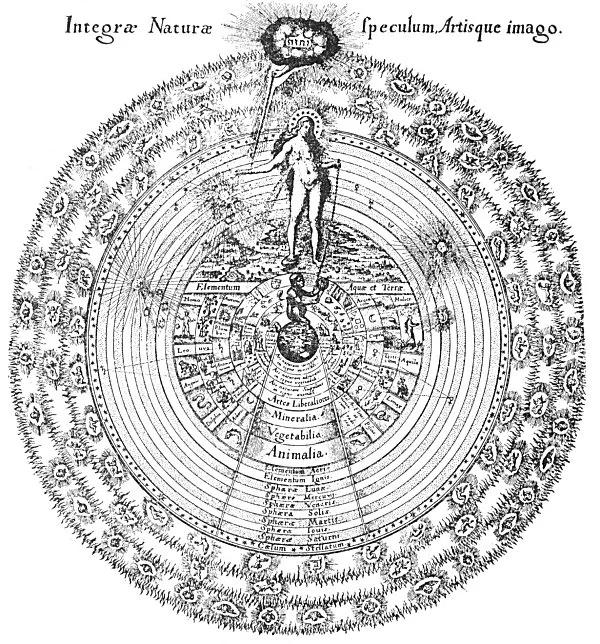
A SYMBOLIC DIAGRAM OF THE OPERATIONS OF NATURE.
From Fludd's Collectio Operum.
This plate, engraved by de Bry, is the most famous of the diagrams illustrating the philosophic principles of Robert Fludd (Robertus de Fluctibus). Three figures are outstanding links between Rosicrucianism and Freemasonry: Michael Maier, Elias Ashmole, and Robert Fludd. De Quincey considers Robert Fludd to be the immediate father of Freemasonry. (See The Rosicrucians and Freemasons.) Edward Waite considers Robert Fludd as second to none of the disciples of Paracelsus, even going as far as to declare that Fludd far surpassed his master. He further adds, "The central figure of Rosicrucian literature, towering as an intellectual giant above the crowd of souffleurs, theosophists, and charlatanic Professors of the magnum opus, who, directly or otherwise, were connected with the mysterious Brotherhood, is Robertus de Fluctibus, the great English mystical philosopher of the seventeenth century, a man of immense erudition, of exalted mind, and, to judge by his writings, of extreme personal sanctity. " (See The Real History of the Rosicrucians.) Robert Fludd was born in 1574 and died in 1637.
The de Bry diagram shown above is almost self-explanatory. Outside the circle of the starry heavens are the three fiery rings of the empyreum--the triple fire of the Supreme Creator--in which dwell the celestial creatures. Within he, of the stars are the circles of the planets and elements. After the element of air comes the circle of the world (earth). The circle of animals is followed by the circle of plants, which, in turn is followed by the circle of he minerals. Then come various industries and in the center is a terrestrial globe with an ape-man sitting upon it, measuring a sphere with a pair of compasses. This little figure represents the animal creation. In the outer ring of fire, above is the sacred name of Jehovah surrounded by clouds. From these clouds issues a hand holding a chain. Between the divine sphere and the lower world personified by the ape is the figure of a woman. It is to be specially noted that the female figure is merely holding the chain connecting her with the lower world, but the chain connecting her with the higher world ends in a shackle about her wrist. This female figure is capable of several interpretations: she may represent humanity suspended between divinity and the beast; she may represent Nature as the link between God and the lower world; or she may represent the human soul--the common denominator between the superior and the inferior.
sufficient ingenuity for imposition. Such men are mingled by the Enemy of human welfare among those who seek to do good, thus making Truth more difficult of discovery. Believe us, Truth is simple and unconcealed, while falsehood is complex, deeply hidden, proud, and its fictitious worldly knowledge, seemingly a glitter with godly luster, is often mistaken for divine wisdom. You that are wise will turn from these false teachings and come to us, who seek not your money but freely offer you our greater treasure. We desire not your goods, but that you should become partakers of our goods. We do not deride parables, but invite you to understand all parables and all secrets. We do not ask you to receive us, but invite you to come unto our kingly houses and palaces, not because of ourselves but because we are so ordered by the Spirit of God, the desire of our most excellent Father C.R.C., and the need of the present moment, which is very great.
Chapter XIII. Now that we have made our position clear that we sincerely confess Christ; disavow the Papacy; devote our lives to true philosophy and worthy living; and daily invite and admit into our Fraternity the worthy of all nations, who thereafter share with us the Light of God: will you not join yourselves with us to the perfection of yourselves, the development of all the arts, and the service of the world? If you will take this step, the treasures of every part of the earth shall be at one time given unto you, and the darkness which envelopes human knowledge and which results in the vanities of material arts and sciences shall be forever dispelled.
Chapter XIV. Again we warn those who are dazzled by the glitter of gold or those who, now upright, might be turned by great riches to a life of idleness and pomp, not to disturb our sacred silence with their clamorings; for though there be a medicine which will cure all diseases and give unto all men wisdom, yet it is against the will of God that men should attain to understanding by any means other than virtue, labor, and integrity. We are not permitted to manifest ourselves to any man except it be by the will of God. Those who believe that they can partake of our spiritual wealth against the will of God or without His sanction will find that they shall sooner lose their lives in seeking us than attain happiness by finding us.
FRATERNITAS R.C.
Johann Valentin Andreæ is generally reputed to be the author of the Confessio. It is a much-mooted question, however, whether Andreæ did not permit his name to be used as a pseudonym by Sir Francis Bacon. Apropos of this subject are two extremely significant references occurring in the introduction to that remarkable potpourri, The Anatomy of Melancholy. This volume first appeared in 1621 from the pen of Democritus junior, who was afterwards identified as Robert Burton, who, in turn, was a suspected intimate of Sir Francis Bacon. One reference archly suggests that at the time of publishing The Anatomy of Melancholy in 1621 the founder of the Fraternity of R.C. was still alive. This statement--concealed from general recognition by its textual involvement--has escaped the notice of most students of Rosicrucianism. In the same work there also appears a short footnote of stupendous import. It contains merely the words: "Job. Valent. Andreas, Lord Verulam." This single line definitely relates Johann Valentin Andreæ to Sir Francis Bacon, who was Lord Verulam, and by its punctuation intimates that they are one and the same individual.
Prominent among Rosicrucian apologists was John Heydon, who inscribes himself "A Servant of God, and a Secretary of Nature." In his curious work, The Rosie Cross Uncovered, he gives an enigmatic but valuable description of the Fraternity of R.C. in the following language:
"Now there are a kind of men, as they themselves report, named Rosie Crucians, a divine fraternity that inhabit the suburbs of heaven, and these are the officers of the Generalissimo of the world, that are as the eyes and ears of the great King, seeing and hearing all things: they say these Rosie Crucians are seraphically illuminated, as Moses was, according to this order of the elements, earth refin'd to water, water to air, air to fire." He further declares that these mysterious Brethren possessed polymorphous powers, appearing in any desired form at will. In the preface of the same work, he enumerates the strange powers of the Rosicrucian adepts:
"I shall here tell you what Rosie Crucians are, and that Moses was their Father, and he was Θεοῦ παῖς; some say they were of the order of Elias, some say the Disciples of Ezekiel; * * * For it should seem Rosie Crucians were not only initiated into the Mosaical Theory, but have arrived also to the power of working miracles, as Moses, Elias, Ezekiel, and the succeeding Prophets did, as being transported where they please, as Habakkuk was from Jewry to Babylon, or as Philip, after he had baptized the Eunuch to Azorus, and one of these went from me to a friend of mine in Devonshire, and came and brought me an answer to London the some day, which is four days journey; they caught me excellent predictions of Astrology and Earthquakes; they slack the Plague in Cities; they silence the violent Winds and Tempests; they calm the rage of the Sea and Rivers; they walk in the Air, they frustrate the malicious aspects of Witches; they cure all Diseases."
The writings of John Heydon are considered a most important contribution to Rosicrucian literature. John Heydon was probably related to Sir Christopher Heydon, "a Seraphically Illuminated Rosie Crucian, " whom the late F. Leigh Gardner, Hon. Secretary Sec. Ros. in Anglia, believes to have been the source of his Rosicrucian knowledge. In his Bibliotheca Rosicruciana he makes the following statement concerning John Heydon: "On the whole, from the internal evidence of his writings, he appears to have gone through the lower grade of the R. C. Order and to have given out much of this to the world." John Heydon traveled extensively, visiting Arabia, Egypt, Persia, and various parts of Europe, as related in a biographical introduction to his work, The Wise-Mans Crown, Set with Angels, Planets, Metals, etc., or The Glory of the Rosie Cross--a work declared by him to be a translation into English of the mysterious book M brought from Arabia by Christian Rosencreutz.
Thomas Vaughan (Eugenius Philalethes), another champion of the Order, corroborates the statement of John Heydon concerning the ability of the Rosicrucian initiates to make themselves invisible at will: "The Fraternity of R.C. can move in this white mist. 'Whosoever would communicate with us must be able to see in this light, or us he will never see unless by our own will.'"
The Fraternity of R.C. is an august and sovereign body, arbitrarily manipulating the symbols of alchemy, Qabbalism, astrology, and magic to the attainment of its own peculiar purposes, but entirely independent of the cults whose terminology it employs. The three major objects of the Fraternity are:
1. The abolition of all monarchical forms of government and the substitution therefor of the rulership of the philosophic elect. The present democracies are the direct outgrowth of Rosicrucian efforts to liberate the maws from the domination of despotism. In the early part of the eighteenth century the Rosicrucians turned their attention to the new American Colonies, then forming the nucleus of a great nation in the New World. The American War of Independence represents their first great political experiment and resulted in the establishment of a national government founded upon the fundamental principles of divine and natural law. As an imperishable reminder of their
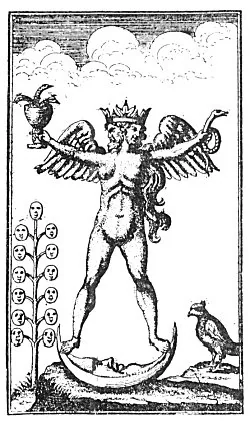
THE ALCHEMICAL ANDROGYNE
From the Turbæ Philosophorum.
The Turbæ Philosophorum is one of the earliest known documents on alchemy in the Latin tongue. Its exact origin is unknown. It is sometimes referred to as The Third Pythagorical Synod. As its name implies, it is an assembly of the sages and sets forth the alchemical viewpoints of many of the early Greek philosophers. The symbol reproduced above is from a rare edition of the Turbæ Philosophorum published in Germany in 1750, and represents by a hermaphroditic figure the accomplishment of the magnum opus. The active and passive principles of Nature were often depicted by male and female figures, and when these two principle, were harmoniously conjoined in any one nature or body it was customary to symbolize this state of perfect equilibrium by the composite figure above shown.
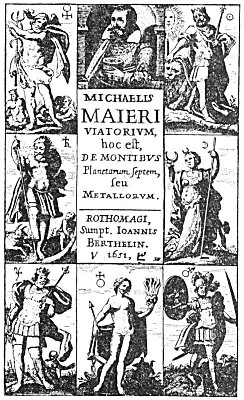
A ROSICRUCIAN TITLE PAGE.
From Maier's Viatorium.
Count Michael Maier, physician to Rudolph II., was an outstanding figure in the Rosicrucian controversy. There is little doubt that he was an initiated member of the Rosicrucian Fraternity, empowered by the Order to promulgate its secrets among the philosophic elect of Europe. The above title page shows the seven planets represented by appropriate figures. Behind the central figure in each case is a smaller emblem, signifying the zodiacal sign in which the planet is enthroned. In the arch over the title itself is a portrait of the learned Maier. The volume of which this is the title page is devoted to an analysis of the nature and effect of the seven planets, and is couched in alchemical terminology throughout. Michael Maier concealed his knowledge so cunningly that it is exceedingly difficult to tract from his writings the secrets which he possessed. He was profuse in his use of emblems and the greater part of his philosophical lore is concealed in the engravings which illustrate his books.
sub rosa activities, the Rosicrucians left the Great Seal of the United States. The Rosicrucians were also the instigators of the French Revolution, but in this instance were not wholly successful, owing to the fact that the fanaticism of the revolutionists could not be controlled and the Reign of Terror ensued.
2. The reformation of science, philosophy, and ethics. The Rosicrucians declared that the material arts and sciences were but shadows of the divine wisdom, and that only by penetrating the innermost recesses of Nature could man attain to reality and understanding. Though calling themselves Christians, the Rosicrucians were evidently Platonists and also profoundly versed in the deepest mysteries of early Hebrew and Hindu theology. There is undeniable evidence that the Rosicrucians desired to reestablish the institutions of the ancient Mysteries as the foremost method of instructing humanity in the secret and eternal doctrine. Indeed, being in all probability the perpetuators of the ancient Mysteries, the Rosicrucians were able to maintain themselves against the obliterating forces of dogmatic Christianity only by absolute secrecy and the subtlety of their subterfuges. They so carefully guarded and preserved the Supreme Mystery--the identity and interrelationship of the Three Selves--that no one to whom they did not of their own accord reveal themselves has ever secured any satisfactory information regarding either the existence or the purpose of the Order. The Fraternity of R.C., through its outer organization, is gradually creating an environment or body in which the Illustrious Brother C.R.C. may ultimately incarnate and consummate for humanity the vast spiritual and material labors of the Fraternity.
3. The discovery of the Universal Medicine, or panacea, for all forms of disease. There is ample evidence that the Rosicrucians were successful in their quest for the Elixir of Life. In his Theatrum Chemicum Britannicum, Elias Ashmole states that the Rosicrucians were not appreciated in England, but were welcomed on the Continent. He also states that Queen Elizabeth was twice cured of the smallpox by the Brethren of the Rosy Cross, and that the Earl of Norfolk was healed of leprosy by a Rosicrucian physician. In the quotations that follow it is .hinted by John Heydon that the Brothers of the Fraternity possessed the secret of prolonging human existence indefinitely, but not beyond the time appointed by the will of God:
"And at last they could restore by the same course every Brother that died to life again, and so continue many ages; the rules you find in the fourth book. * * * After this manner began the Fraternity of the Rosie Cross, first by four persons, who died and rose again until Christ, and then they came to worship as the Star guided them to Bethlehem of Judea, where lay our Saviour in his mother's arms; and then they opened their treasure and presented unto him gifts, gold, frankincense, and myrrh, and by the commandment of God went home to their habitation. These four waxing young again successively many hundreds of years, made a magical language and writing, with a large dictionary, which we yet daily use to God's praise and glory, and do find great wisdom therein. * * * Now whilst Brother C.R. was in a proper womb quickening, they concluded to draw and receive yet others more into their Fraternity."
The womb herein referred to was apparently the glass casket, or container, in which the Brothers were buried. This was also called the philosophical egg. After a certain period of time the philosopher, breaking the shell of his egg, came forth and functioned for a prescribed period, after which he retired again into his shell of glass, The Rosicrucian medicine for the healing of all human infirmities may be interpreted either as a chemical substance which produces the physical effects described or as spiritual understanding--the true healing power which, whet a man has partaken of it, reveals truth to him. Ignorance is the worst form of disease, and that: which heals ignorance is therefore the most potent of all medicines. The perfect Rosicrucian medicine was for the healing of nations, races, and individuals.
In an early unpublished manuscript, an unknown philosopher declares alchemy, Qabbalism, astrology, and magic to have been divine sciences originally, but that through perversion they had become false doctrines, leading seekers after wisdom ever farther from their goal. The same author gives a valuable key to esoteric Rosicrucianism by dividing the path of spiritual attainment into three steps, or schools, which he calls mountains. The first and lowest of these mountains is Mount Sophia; the second, Mount Qabbalah; and the third, Mount Magia. These three mountains are sequential stages of spiritual growth. The unknown author then states:
"By philosophy is to be understood the knowledge of the workings of Nature, by which knowledge man learns to climb to those higher mountains above the limitations of sense. By Qabbalism is to be understood the language of the angelic or celestial beings, and he who masters it is able to converse with the messengers of God. On the highest of the mountains is the School of Magia (Divine Magic, which is the language of God) wherein man is taught the true nature of all things by God Himself."
There is a growing conviction that if the true nature of Rosicrucianism were divulged, it would cause consternation, to say the least. Rosicrucian symbols have many meanings, but the Rosicrucian meaning has not yet been revealed. The mount upon which stands the House of the Rosy Cross is still concealed by clouds, in which the Brethren hide both themselves and their secrets. Michael Maier writes: "What is contained in the Fama and Confessio is true. It is a very childish objection that the brotherhood have promised so much and performed so little. With them, as elsewhere, many are called but few are chosen. The masters of the order hold out the rose as the remote prize, but they impose the cross on those who are entering." (See Silentium post Clamores, by Maier, and The Rosicrucians and the Freemasons, by De Quincey.)
The rose and the cross appear upon the stained glass windows of Lichfield Chapter House, where Walter Conrad Arensberg believes Lord Bacon and his mother to have been buried. A crucified rose within a heart is watermarked into the dedication page of the 1628 edition of Robert Burton's Anatomy of Melancholy.
The fundamental symbols of the Rosicrucians were the rose and the cross; the rose female and the cross male, both universal phallic emblems. While such learned gentlemen as Thomas Inman, Hargrave Jennings, and Richard Payne Knight have truly observed that the rose and the cross typify the generative processes, these scholars seem unable to pierce the veil of symbolism; they do not realize that the creative mystery in the material world is merely a shadow of the divine creative mystery in the spiritual world. Because of the phallic significance of their symbols, both the Rosicrucians and the Templars have been falsely accused of practicing obscene rites in their secret ceremonials. While it is quite true that the alchemical retort symbolizes the womb, it also has a far more significant meaning concealed under the allegory of the second birth. As generation is the key to material existence, it is natural that the Fraternity of R.C. should adopt as its characteristic symbols those exemplifying the reproductive processes. As regeneration is the key to spiritual existence, they therefore founded their symbolism upon the rose and the cross, which typify the redemption of man through the union of his lower temporal nature with his higher eternal nature. The rosy cross is also a hieroglyphic figure representing the formula of the Universal Medicine.
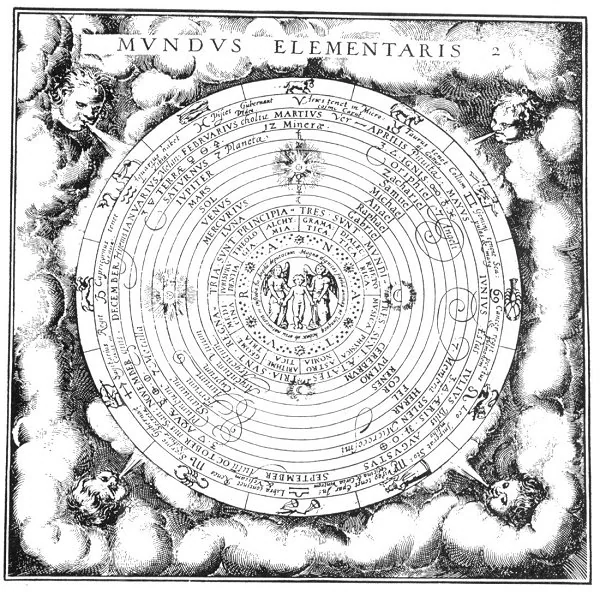
THE ELEMENTARY WORLD.
From Musæum Hermeticum Reformatum et Amplificatum.
The outer circle contains the figures of the Zodiac; the second, their signs and that part of the human body which they rule; the third, the months of the year, with brief notes concerning temperaments, etc. The fourth circle contains the elements accompanied by their appropriate symbols, and the following seven circles mark the orbits of the planets; also the planetary angels, the seven major members of the Universal Man, and the seven metals, each division appearing under its appropriate element according to the elemental names in the fourth circle. In the twelfth circle appear the words: "There are Three Principles, Three Worlds, Three Ages, and Three Kingdoms." In the thirteenth circle appear the names of the twelve arts and sciences which are considered essential to spiritual growth. In the fourteenth circle is the word Nature. The fifteenth circle contains the following words. "It is the great honour of faithful souls, that from their very birth an angel is appointed to preserve and keep each of them." (See first English translation, London, 1893.)
Fifteen Rosicrucian and Qabbalistic Diagrams
IN his well-known work, The Rosicrucians, Their Rites and Mysteries, Hargrave Jennings reproduces five Qabbalistic charts which he declares to be genuine Rosicrucian drawings. He gives no information concerning their origin nor does he attempt an elucidation of their symbolism. A recent writer who reproduced one of these charts correlated it to the emblematic tomb of Father C.R.C., thus exposing the true nature of Christian Rosencreutz.
The five plates reproduced in Hargrave Jennings' book are part of a series of fifteen diagrams which appear in The Magical, Qabbalistical, and Theosophical Writings of Georgius von Welling, on the Subject of Salt, Sulphur, and Mercury. This extremely rare volume was published at Frankfort and Leipzig in 1735 and 1760. The numbers and figures on the charts refer to the chapters and sections of the Writings. These fifteen charts constitute a remarkable and invaluable addition to the few other known admittedly authentic Qabbalistic and Rosicrucian diagrams.
Lucifer is the greatest mystery of symbolism. The secret knowledge of the Rosicrucians concerning Lucifer is nowhere so plainly set forth as in these plates, which virtually reveal his true identity, a carefully guarded secret about which little has been written. Lucifer is represented by the number 741.
Von Welling does not give a complete exposition of the fifteen charts; to have done so would have been contrary to the principles of Qabbalistic philosophy. The deeper significance of the symbols is revealed only by profound study and contemplation.
TABLE I, Figures 1-11. Figure 1 is a Ptolemaic chart showing the true relationship existing between the primordial elements. Its secret significance is as follows: The outer ring enclosed by the lines A and B is the region of Schamayim, a Qabbalistic name for the Supreme Deity, signifying the expanse of the heavens, or a spiritual fiery water. Schamayim is "The Ocean of Spirit, " within which all created and uncreated things exist and by the life of which they are animated. In the lower worlds Schamayim becomes the astral light.
The space between B and C marks the orbits or planes of the seven Spiritual Intelligences called the Divine Planets (not the visible planets). According to the Mysteries, the souls of men enter the lower worlds through ring B, the fixed stars. All creation reflects the glory of Schamayim, the energy that filters into the spheres of the elements through the windows of the stars and planets. Between C and D lies the region of the subtle, spiritual air, a subdivision of ether. D to E marks the surface of the earth and sea, by which are also meant grades of ether. E to F marks the lower region, called "The Gathering of the Waters and the Production of the Virgin Earth, " or "Ares. " The alchemists called this "quicksand," the true mystic foundation of the solid earth. F to G marks the circle of the subterranean air, which is more dense and coarse than that in the outer space, C to D. In this denser atmosphere the stellar influences and celestial impulses are crystallized into corporeal spirits, thus forming the multitude of forms which exist without knowledge of their own fiery source. G is the region of the central fire of the element earth, a coarse fire in contradistinction to the divine fiery Schamayim. The sphere of the starry heavens likewise has its opposite in the sphere of the subterranean air; and the sphere of the upper air (or subtle vaporous water) has its opposite in the sphere E to F. The focal point, D to E, between the three higher and the three lower spheres, is called "The Reservoir." It receives impressions from both the superior and the inferior regions and is common to both.
Figure 2 is the Qabbalistic symbol of elemental water; Figure 9 represents the spiritual invisible water. Figure 3 is the Qabbalistic symbol of elemental air; Figure 7 represents the spiritual and invisible air. Figure 4 is the Qabbalistic sign of the elemental earth; Figure 8 represents the spiritual and invisible earth. Figure 5 is the Qabbalistic sign of the elemental fire; Figure 6 represents the spiritual and invisible fire. Figures 6, 7, 8, and 9 symbolize the four elements before the descent of Lucifer. They are the four rivers spoken of in Genesis, having their source in the one river, Figure W, which represents the elements superimposed on one another. The golden ball in the center is Schamayim, the fiery source of all elements. Figure 11 is the emblem of the beginning and the end of all creatures. From it all things proceed and to it all must return again, to become one with the fiery water of divine understanding.
TABLE II, Figures 12-51. Figures 12, 13, 14 demonstrate the sphere as a symbol of motion to be emblematic of fire, water, and air; and the cube as a symbol of weight to be emblematic of earth. The sphere rests upon a point, the cube upon a surface; the sphere is therefore used to symbolize spirit, and the cube, matter. Figure 14 demonstrates that atmosphere rushing in behind a falling object increases its velocity and apparently adds to its weight. The essential nature of each element is occultly signified by the peculiar symbol and character assigned to it.
Of Figure 15, the symbol of salt, von Welling writes, in substance: The cube has six sides, corresponding to the six days of creation, with the point of rest (the seventh day) in the center of the cube. On each surface of the cube appear the signs of the four elements [triangles]. The alchemists declared that salt was the first created substance produced by the fire (Schamayim) which flowed out of God. In salt all creation is concentrated; in salt are the beginning and end of all things. The cube, furthermore, is composed of twelve bodies, each of which has six sides. These bodies are the twelve fundamental pillars of the true invisible church, and when these twelve bodies are multiplied by their six sides the magical number 72 results. The wise have said that nothing is perfect until it has been dissolved, separated, and again united so that it becomes a body composed of twelve bodies, like the cube. The cube also consists of six pyramids with the six surfaces of the cube as their bases. The points of these six pyramids meet at the center of the cube. These six pyramids, each consisting of four triangles, signify the elements, and produce the magical number 24, which refers to the Elders before the Throne. The six surfaces and the point constitute the magical number 7. If 7 be multiplied by 7 again, and so on 7 times, the answer will reveal the method used by the ancients for measuring the periods of eternity; thus: (1) 7 X 7 = 49; (2) 49 X 7 = 343; (3) 343 X 7 = 2,401; (4) 2,401 X 7 = 16,807; (5):16,807 X 7 = 117,649; (6) 117,649 X 7 = 823,543; (7) 823,543 X 7 = 5,764,801. (This is not to be taken as earth years or times.) The 5,000, 000 represents the great hall year; the 700,000 the great Sabbath year, wherein all human beings gradually gain true understanding and become heirs to their original and eternal inheritance, which was lost when they were enmeshed in the lower elements. The 64,800 is the number of the fallen angels, and the last one year signifies the liberation of Lucifer and return to his original estate.
Figure 16 is another symbol of salt, while Figure 17 (the dot) is the sign of spirit, gold, the sun, or the germ of life. If the dot be moved before itself it becomes a line, Figure 18. This motion of the dot is the first motion. The beginning and end of every line is a dot. Figure 19 is the circle. It is the second motion and the most perfect of all lines. Out of it are formed all figures and bodies
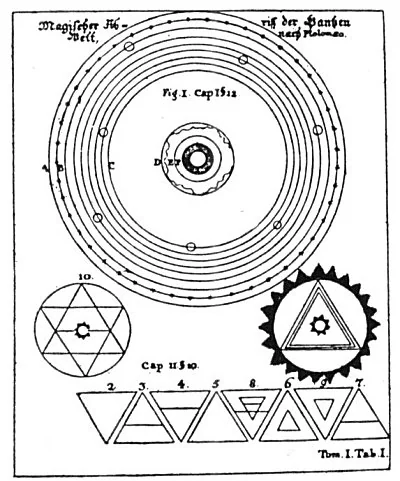
TABLE I, Figures 1-11.
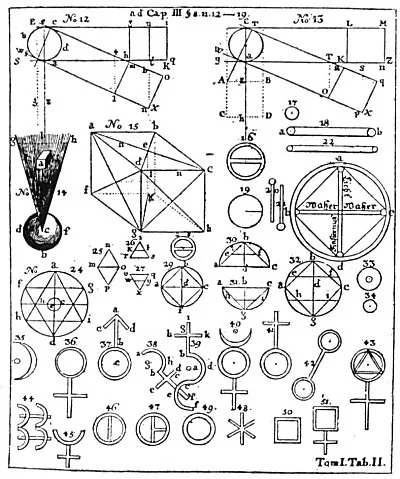
TABLE II, Figures 12-51.
imaginable. Figure 20 represents the outpouring of the upper and spiritual life into manifestation. Figure 21 represents darkness, for it is the loosening of the subterrene destructive principle. Figure 20 is also the symbol of day, and Figure 21 of night.
Figure 22 is a symbol of water; Figure 23 is the complete universal character of light and darkness. The upright triangle represents Schamayim; the inverted triangle the dark earth which imprisons the infernal subterranean fire. It is "The First Day of Creation," or the time of the separation of Schamayim and Ares. Figure 24 represents the six days of creation and proves that the elements are an outflow of the Divine Fire which, breaking up, becomes the substances of the tangible universe, as signified in Figure 25.
Figure 26 is the character of the air, showing that air is born out of the Eternal Light and the ethereal water. Figure 27 is the character of water. It is the inversion of Figure 26, indicating that its origin is from the lower fire and not the higher. Its upper part signifies that water does not lack the Divine element, but as a universal mirror reflects the heavenly influences. Figures 28 and 29 are symbols of salt, showing that it is both fire and water in one. Figure 30 is the character of fire in all its attributes, and Figure M (the same inverted), water in all its powers. Figure 32 is the character of salt in all its attributes. Figure 33 represents both gold and the sun. Their essential natures are identical, being formed from the first fire out of Schamayim. They are perfect, as can be seen from their symbol, for no more perfect form can be produced out of the dot than the circle.
Figure 34 is the character of the greater and lesser worlds; as the dot is surrounded by its circumference, this world is surrounded by Schamayim. Man (the Little World) is included in this symbol because his inner nature is potential gold (Aphar Min Haadamah), which gold is his eternal indestructible spiritual body. Gold is the masculine principle of the universe.
Figure 35 is the character of silver and the moon. It signifies that silver (like gold) is a perfect metal, except that the red part of its nature is turned inward. Silver is the feminine principle of the universe.
Figure 36 is the character of copper and Venus; Figure 37, of iron and Mars; Figure 38, of tin and Jupiter; Figure 39, of lead and Saturn; Figure 40, of Mercury (both the planet and the element); Figure 41, of antimony, the key metal of the earth itself; Figure 42, of arsenic; Figure 43, of sulphur; Figure 44, of cinnabar; Figure 45, of quicklime; Figure 46, of nitre; and Figure 47, of vitriol. Figure 48 is the character of sal ammoniac, which element derives its name from the Temple of Jupiter Ammon in an Egyptian desert, where it was found. Figure 49 is the character of alum; Figure 50, of alkali, a name of Arabian origin; and Figure 51, of sal tartar, a substance possessing great occult virtue.
TABLE Ill, Figure 52. The eight globes and the central square represent the seven days of creation. The three worlds wherein creation occurs are symbolized by three concentric rings. The German words in the outer ring are extracts from the first chapter of Genesis. The words around the outside of the outer ring are The First Day. The four small globes inside the outer ring deal with the abstract phases of creation. The upper globe containing the triangle encloses the words Heaven and Earth. The globe to the right contains the word Light, and the one to the left, Jehovah Elohim in the upper part and Darkness in the lower part. The globe at the bottom contains the word Day in the upper half and Night in the lower.
The four globes within the second ring depict the second, third, fourth, and fifth days of creation. The white globe above divided by a dotted line is designated The Second Day; the globe to the left with the mountains, The Third Day; the globe to the right with the planetary rings, The Fourth Day; and the globe below bisected by a dotted line, The Fifth Day. The square in the central ring containing the human form is marked The Sixth Day. This chart is a diagrammatic exposition of the three layers of the macrocosmic and microcosmic auric eggs, showing the forces active within them.
TABLE IV, Figure. 53. Figure 53 has been designated the symbolic tomb of Christian Rosencreutz. The upper circle is the first world--the Divine Sphere of God. The triangle in the center is the throne of God. The small circles at the points of the star symbolize the seven great Spirits before the throne, mentioned in the Book of Revelation, in the midst of which walks the Alpha and Omega--the Son of God. The central triangle contains three flames--the Divine Trinity. From the lowest of these flames proceeds the first divine outflow, shown by two parallel lines descending through the throne of Saturn (the Spirit Orifelis, through whom God manifested Himself). Passing through the boundary of the celestial universe and the 22 spheres of the lower system, the lines end at point B, the throne of Lucifer, in whom the divine outpouring is concentrated and reflected. From him the divine light irradiates in succession to d (Capricorn), e (Gemini), f (Libra), g (Taurus), h (Pisces), i (Aquarius), k (Cancer), l (Virgo), m (Aries), n (Leo), o (Scorpio), p (Sagittarius), thence back to d. The zodiacal circles represent twelve orders of great and beneficent Spirits, and the smaller circles within the ring of fixed stars mark the orbits of the sacred planets.
TABLE V, Figure 54. Figure 54 is similar to Figure 53, but represents the universe at the time God manifested Himself through the character of Jupiter, the Spirit Sachasiel. Von Welling gives no reason for the change in the order of influx into the twelve orders of spirits, for the third world, for the adding of another circle and the interlaced triangles in the upper world, or for the letters Y and Z. In the upper triangle,
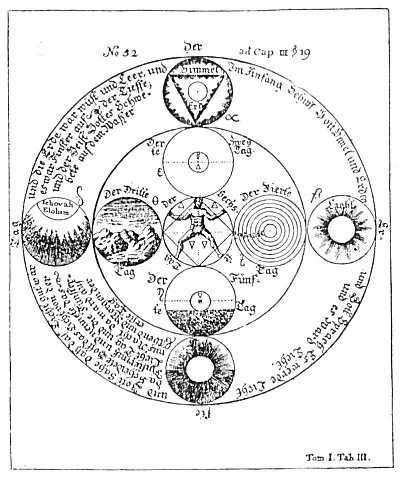
Table III, Figure 52
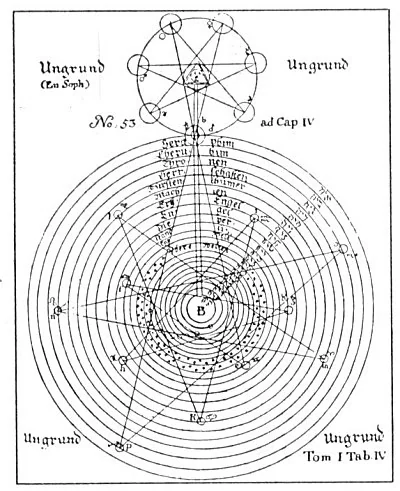
Table IV, Figure 53
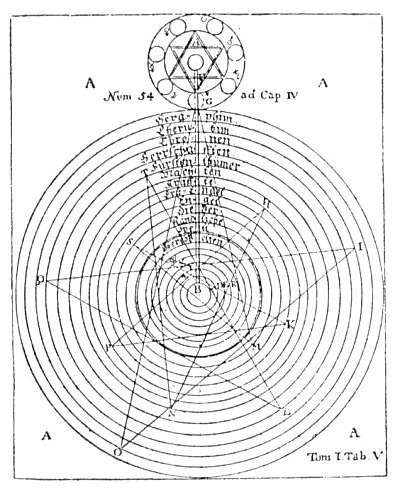
Table V, Figure 54
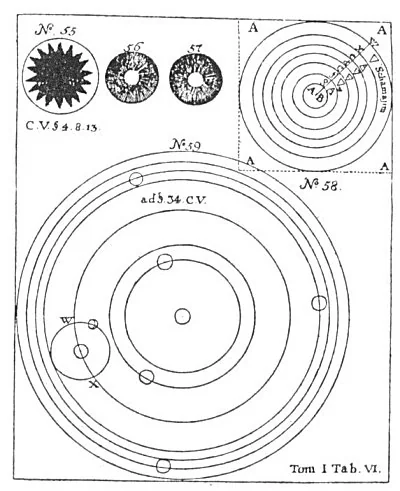
Table VII, Figures 1-5, 7 and 8
A represents the Father Principle, F the divine outflow, G the point of influx into the twelve orders of spirits (probably Sagittarius). The letters H, I, J, K, L, M, N, O, P, Q, S, and T denote the sequential points of irradiations to each other; W and X, the World of the Sons of God; and B, C, D, and E, the World of Lucifer. This plate shows the universe after the descent of Lucifer into matter. According to von Welling, when Lucifer wanted to control power, the influx of the divine light instantly ceased. Lucifer's world (which later became the solar system), with all its legions of spirits (who in their essence were Schamayim) reflecting his ideas and inverting the divine light, was turned into darkness. Lucifer's Schamayim thereupon became a contracted disc, a tangible substance; and Chaos came into existence.
TABLE VI, Figures 55-59. Figure 55 symbolizes the Chaos of Lucifer; Figure 56, the separation of light from darkness; Figure 57, the light in the midst of the darkness; and Figure 58, the regions of the elements and their inhabitants. The four A's signify the Abyss surrounding all things. The A B is the fiery throne of Lucifer. The plane of g is the subterranean air; f, the subterranean water; c, the earth region; d, the outer water; e, the outer air, W and X the region of Schamayim. The elemental inhabitants of the planes differ in goodness according to their proximity to the center of wickedness (A B). The earth's surface (c) divides the subterranean elementals from those of the outer water, air, and fire (d, c, and X). The elementals of the upper strata (the upper half of c, and all of d, e, and X) represent an ascending scale of virtue, while those of the lower strata (the lower half of c, and all of f, g, and A B) represent a descending scale of depravity.
The region of air (e) is a partial exception to this order. While air is close to the light and filled with beautiful spirits, it is also the habitation of Beelzebub, the Evil Spirit of the air, with his legion of elemental demons. Upon the subtle element of air are impressed the influences of the stars; the thoughts, words, and deeds of man; and a myriad of mysterious influences from the various planes of Nature. Man inhales these impressions, and they produce diverse effects upon his mind. In air are suspended also the seed germs by which water is impregnated and made capable of bringing forth forms of organic and inorganic life. The grotesque figures seen in crystal caves and frost pictures upon windows are caused by these aerial impressions. While the air elementals are great and wise, they are treacherous and confused because amenable to both good and evil impressions. The mighty elemental beings who inhabit the watery light fire of the region X cannot be deceived by the spirits of darkness. They love the creatures of the waters, for the watery element (d) proceeded from the fiery water (X). Mortal man cannot endure the society of these fiery spirits, but gains wisdom from them through the creatures of the waters in which they continually mirror themselves. Figure 59 represents this solar system, with W and X as the locality of the Garden of Eden.
TABLE VII, Figures 1-5, 7, 8. (Table VIII has Figure 6.) Figure 1 is the triune divine sulphur, the All-Perfect out of the All-Perfect, the Soul of creatures. The threefold Divine One is symbolized by three interlaced circles designated alchemically salt, sulphur, and mercury. In the central triangle is the divine name Ehieh. Geist means spirit. The other words require no translation. Figure 2 is common destructive sulphur. A bar placed in the triangle makes it the character of earth. Figure 3 is true oil of vitriol, composed of a circle with two diameters and two reversed half-circles hanging below. In this are hidden the characters of all metals. Tin is symbolized by Figure 4 and iron by Figure 5. Figure 7 is the solar system according to Copernicus. Figure 8 is the last judgment. The sun is removed from the center of the solar system and replaced by the earth. This changes the respective positions of all the other planets except Mars, Jupiter, and Saturn, which retain their respective circles. The letter a signifies the circle of the sun; b, that of Mercury; c, that of Venus; d, (sic) that of the moon; and E, that of the earth. Inward from the sphere h are the great circles of damnation.
TABLE VII., Figure 6. In Figure 6 the letter a marks the center of eternity. The motion of the rays toward b, d, and c was the first divine manifestation and is symbolized by the equilateral triangle, b, d, c. The eternal world within the inner circle became manifest in the water (salt), the light (mercury), and the fire (sulphur) of the archetypal world, represented by the three circles (f, e, g) within the triangle of complete equality (h, i, k), which is in turn surrounded by the circle of the high throne. The circle f is named understanding; e, wisdom; g, reason. In circle i is the word Father; in circle h, Son; in circle k, Spirit. The seven outer circles are the seven spirits before the throne. The lower part of the figure is similar to Figures 53 and 54. The outer circles are the angelic world ending in the cognizable world of the Sons of God. Then comes the circle of the visible constellations and fixed stars; within this is the solar system with the sun as the center (l). Ungrund means the Abyss.
TABLE IX, Figure 9. Figure 9 is a synthesis of the Old and New Testaments and represents the interblending planes of being. In the right margin the seven outer circles contain the names of the planetary angels. The words in the graduated circles from the top triangle downward read: (1) Abyss of Compassion; (2) Zion; (3) The New Heaven and the New Earth; (4) The New Jerusalem; (5) Paradise; (6) The Bosom of Abraham; (7) The Outer Courts of the Lord. From below the circles of darkness reach upward, each divine principle being opposed by an infernal opposite. The small circle on the left containing a triangle and cross is named The Tree of Life, and that on the right The Tree of the Knowledge of Good and Evil. In the center of the diagram is the Trinity, joined with the superior and inferior planes by lines of activity.
TABLE X, Figures 10-15. Figure 10 shows the New Jerusalem in form of a cube, with the names of the twelve tribes of Israel written on the twelve lines of the cube. In the center is the eye of God. The words round the outer circle are from the Book of Revelation. Figures 11, 12, 13, 14, and 15 possibly are cipher symbols of the angels of the plagues, the name of the Antichrist, the signature of the beast of Babylon, and the name of the woman riding on the beast of blasphemy.
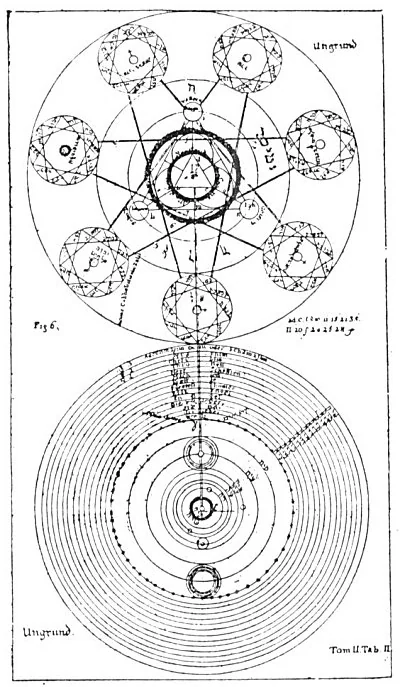
Table VIII, Figure 6.
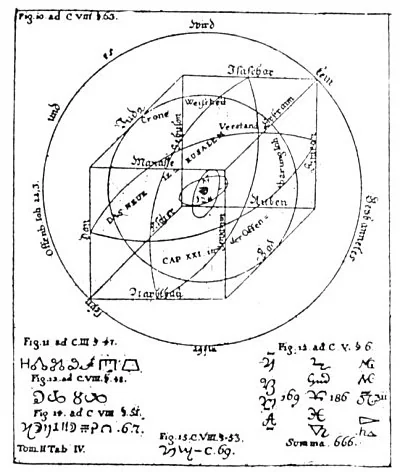
Table X, Figures 10-15.
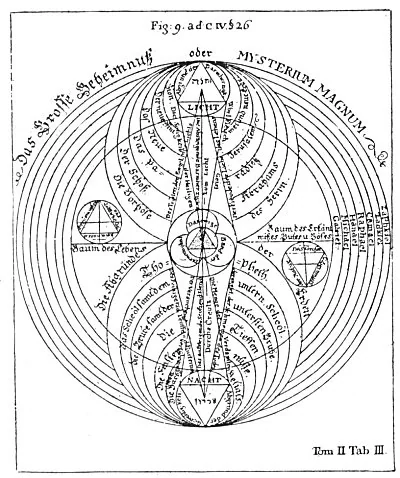
Table IX, Figure 9.
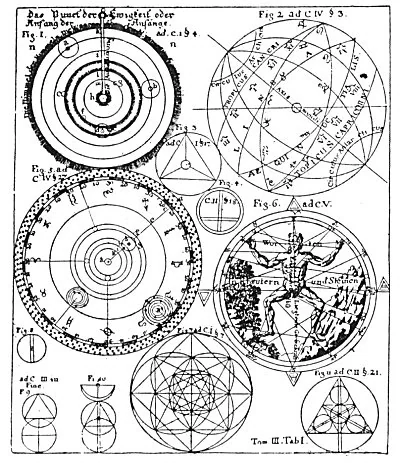
Table XI, Figures 1-11
TABLE XI, Figures 1.-11. Figure 1 is the solar system according to Genesis. The o on top of the radius of the circle is the dot of Eternity--the Beginning of Beginnings. The whole diameter is the outflow of God, manifesting first in the heaven of heavens--the Schamayim, in which region human understanding cannot function. The space from k to i contains the heavens of Saturn, Jupiter, and Mars; l to m, the heavens of Venus and Mercury; m to h, the heavens of the sun. The letter e is the moon, the circle of the earth.
Figure 2 is the globe of the earth, showing the houses and signs of the zodiac. Figure 3 is the character of the Universal Mercury (Divine Life) in its triune aspect of mercury, sulphur, and salt. Figure 4 is true saltpetre purified with quicklime and alkali. Figure 5 shows the exact degree or angle of the planets' places as well as the individual fixed stars in the zodiac. The letter a is the sun and b is the earth. From k to i are the circles of Mercury and Venus; g to h, the circles of earth and moon; f to e and e to c, of Jupiter and Saturn; c to d, the starry belt or zodiac. Figure 6 is the Microcosm, with the planets and signs of the zodiac corresponding to the different parts of its form. The words upon the figure read: Know thyself. In words, herbs, and stones lies a great power. Figure 7 is the universal character from which all characters have been taken. Figures 8, 9, and 10 are left to the solution of the reader. Figure 11 is the radiating Universal Mercury.
TABLE XII, Figures 12-19. Figure 12 is called A Mirror of Astrological Aspects. Below it is an astrologer's wheel. Figure 13 is similar to Figure 12. Figure 14 is a secret alchemical formula. The words around the circle read: Out of one in all is all. Figure 15 is an unsatisfactory attempt to show the comparative sizes of the suns and planets and their distances from each other. Figure 16 is the solar system with its internal and spiritual heavens. A B is the solar system; C is the sphere of fixed stars; D, E, F, G are the systems of the spiritual worlds; H is the throne of the living God; J, K, L, M, and N are the Great Beyond, unmeasurable.
Figure 17 shows the creation of the solar system out of the ring of the Divine Eternity. The four A's are the Abyss, B is the first revelation of God out of the Abyss, and from this revelation C, D, E, F, and G were created. C and D represent the spiritual hierarchies; D and E, the upper worlds, or constellations; E and F, the distance from Jupiter to the upper worlds; F and G, the solar system with its planets and their heavens; B and C the throne of Christ.
Figure 18 describes the division according to Genesis of the waters above the heavens (D) from the waters below (A, B, and C). Figure 19 is the mercury of the philosophers, essential to material existence.
TABLE XIII, Figures 1-4. Figure 1 is Ain Soph, the Incomprehensible Abyss of Divine Majesty, an endless welling up, limitless in time and space. Figure 2 symbolizes the three Divine Principles--Father, Son, and Holy Ghost. Around the triangle is written: I Shall Be That I Shall Be. At the apex of the triangle is the word Crown; in the left point, Wisdom; in the right point, Understanding. Figure 3 represents the Trinity with its outflow. The words above the upper sphere are Revelation of the Divine Majesty in Jehovah Elohim. The lower circles contain the names of the Hierarchies controlling the lower worlds. The words within the circle of stars read: Lucifer the Son of the Aurora of the morning. The letter C represents the Universal Mercury. The words within the circle read: The first beginning of all creatures. Figure 4 represents the abode of Lucifer and his angels, the Chaos spoken of in Genesis.
TABLE XIV, Figures 5, 7, 8. Figure 5 shows the triangle of triune Divinity in the midst of a cross. At the left is a small triangle containing the words The Secrets of Elohim, and at the right is another inscribed The Secrets of Nature. On the horizontal arms of the cross are the words The Tree of Life and The Tree of the Knowledge of Good and Evil. The plate explains the interblending of the spiritual and infernal powers in the creation of the universe. Figure 7 is called The Road to Paradise. It probably indicates the positions of the sun, moon, and planets at the moment of their genesis. Figure 8 is the earth before the flood, when it was watered by a mist or vapor. The words at the left are The Tree of Life; those at the right, The Tree of the Knowledge of good and Evil. The diagram with the symbol of Mars is devoted to a consideration of the rainbow.
TABLE XV, Figures 6, 9, 10. Figure 6 is similar to Figure 5 and is called The Secret of Nature. An interesting diagram is shown on either side of the central figure, each consisting of a triangle with circles radiating from its points. The diagram on the left is called The Secrets of the Upper World, and the one on right The Secrets of the Underworld.
Figure 9 is the solar system. Around the central part are the words The Place of the Damned. Figure 10 shows the dot, or point of rest, surrounded by a triangle enclosing a circle containing the names of the twelve tribes of Israel. It represents completion of the process of regeneration and the consummation of the Great Work.
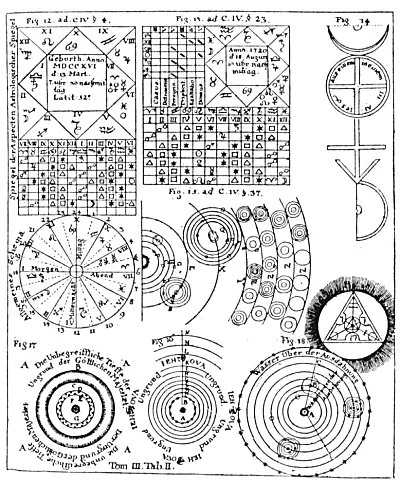
Table XII, Figures 12-19
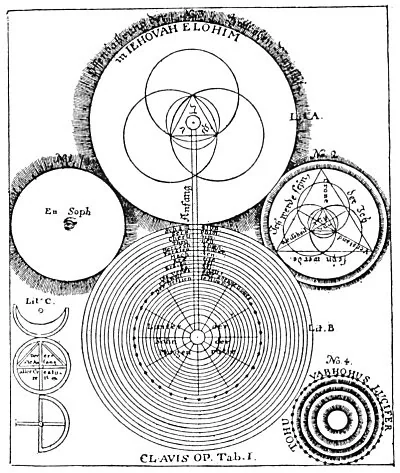
Table XIII, Figures 1-4
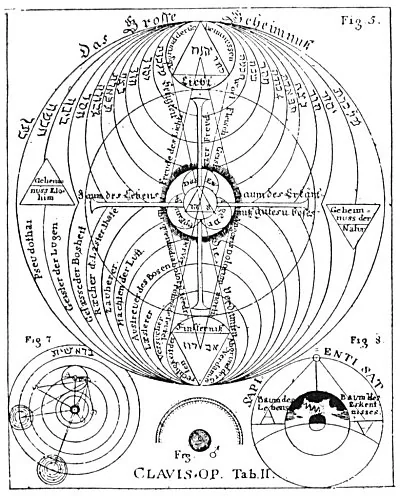
Table XIV, Figures 5, 7, and 8
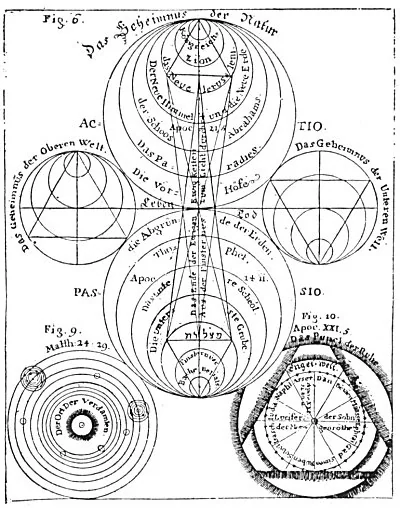
Table XV, Figures 6, 9, and 10
Alchemy and Its Exponents
IS the transmutation of base metals into gold possible? Is the idea one at which the learned of the modern world can afford to scoff? Alchemy was more than a speculative art: it was also an operative art. Since the time of the immortal Hermes, alchemists have asserted (and not without substantiating evidence) that they could manufacture gold from tin, silver, lead, and mercury. That the galaxy of brilliant philosophic and scientific minds who, over a period of two thousand years, affirmed the actuality of metallic transmutation and multiplication, could be completely sane and rational on all other problems of philosophy and science, yet hopelessly mistaken on this one point, is untenable. Nor is it reasonable that the hundreds declaring to have seen and performed transmutations of metals could all have been dupes, imbeciles, or liars.
Those assuming that all alchemists were of unsound mentality would be forced to put in this category nearly all the philosophers and scientists of the ancient and mediæval worlds. Emperors, princes, priests, and common townsfolk have witnessed the apparent miracle of metallic metamorphosis. In the face of existing testimony, anyone is privileged to remain unconvinced, but the scoffer elects to ignore evidence worthy of respectful consideration. Many great alchemists and Hermetic philosophers occupy an honored niche in the Hall of Fame, while their multitudinous critics remain obscure. To list all these sincere seekers after Nature's great arcanum is impossible, but a few will suffice to acquaint the reader with the superior types of intellect who interested themselves in this abstruse subject.
Among the more prominent names are those of Thomas Norton, Isaac of Holland, Basil Valentine (the supposed discoverer of antimony), Jean de Meung, Roger Bacon, Albertus Magnus, Quercetanus Gerber (the Arabian who brought the knowledge of alchemy to Europe through his writings), Paracelsus, Nicholas Flarnmel, John Frederick Helvetius, Raymond Lully, Alexander Sethon, Michael Sendivogius, Count Bernard of Treviso, Sir George Ripley, Picus de Mirandola, John Dee, Henry Khunrath, Michael Maier, Thomas Vaughan, J. B. von Helmont, John Heydon, Lascaris, Thomas Charnock, Synesius (Bishop of Ptolemais), Morieu, the Comte di Cagliostro, and the Comte de St.-Germain. There are legends to the effect that King Solomon and Pythagoras were alchemists and that the former manufactured by alchemical means the gold used in his temple.
Albert Pike takes sides with the alchemical philosophers by declaring that the gold of the Hermetists was a reality. He says: "The Hermetic science, like all the real sciences, is mathematically demonstrable. Its results, even material, are as rigorous as that of a correct equation. The Hermetic Gold is not only a true dogma, a light without Shadow, a Truth without alloy of falsehood; it is also a material gold, real, pure, the most precious that can be found in the mines of the earth." So much for the Masonic angle.
William and Mary jointly ascended the throne of England in 1689, at which time alchemists must have abounded in the kingdom, for during the first year of their reign they repealed an Act made by King Henry IV in which that sovereign declared the multiplying of metals to be a crime against the crown. In Dr. Sigismund Bacstrom's Collection of Alchemical Manuscripts is a handwritten copy of the Act passed by William and Mary, copied from Chapter 30 of Statutes at Large for the first year of their reign. The Act reads as follows: "An Act to repeal the Statute made in the 5th year of King Henry IV, late king of England, [wherein] it was enacted, among other things, in these words, or to this effect, namely: 'that none from henceforth should use to multiply Gold or Silver or use the craft of multiplication, and if any the same do they shall incur the pain of felony.' And whereas, since the making of the said statute, divers persons have by their study, industry and learning, arrived to great skill & perfection in the art of melting and refining of metals, and otherwise improving and multiplying them and their ores, which very much abound in this realm, and extracting gold and silver our of the same, but dare not to exercise their said skill within this realm, for fear of falling under the penalty of the said statute, but exercise the said art in foreign parts, to the great loss and detriment of this realm: Be it therefore enacted by the King's and Queen's most excellent Majesties, by and with the advice and consent of the Lords spiritual and temporal and Commons in this present parliament assembled, that from henceforth the aforesaid branch, article, or sentence, contained in the said act, and every word, matter and thing contained in the said branch or sentence, shall be repealed, annulled, revoked, and for ever made void, any thing in the said act to the contrary in any wise whatsoever notwithstanding. Provided always, and be it enacted by the authority aforesaid, that all the gold and silver that shall be extracted by the aforesaid art of melting or refining of metals, and otherwise improving and multiplying of them and their ores, as before set forth, be from henceforth employed for no other use or uses whatsoever but for the increase of monies; and that the place hereby appointed for the disposal thereof shall be their Majesties mint, within the Tower of London, at which place they are to receive the full and true value of their gold and silver, so procured, from time to time, according to the assay and fineness thereof, and so for any greater or less weight, and that none of that metal of gold and silver so refined and procured be permitted to be used or disposed of in any other place or places within their Majesties dominions." After this repealing measure had become effective, William and Mary encouraged the further study of alchemy.
Dr. Franz Hartmann has collected reliable evidence concerning four different: alchemists who transmuted base metals into gold not once but many times. One of these accounts concerns a monk of the Order of St. Augustine named Wenzel Seiler, who discovered a small amount of mysterious red powder in his convent. In the presence of Emperor Leopold I, King of Germany, Hungary, and Bohemia, he transmuted quantities of tin into gold. Among other things which he dipped into his mysterious essence was a large silver medal. That part of the medal which came in contact with the gold-producing substance was transmuted into the purest quality of the more precious metal. The rest remained silver. With regard to this medal, Dr. Hartmann writes:
"The most indisputable proof (if appearances can prove anything) of the possibility of transmuting base metals into gold, may be seen by everyone who visits Vienna; it being a medal preserved in the Imperial treasury chamber, and it is stated that this medal, consisting originally of silver, has been partly transformed into gold, by alchemical means, by the same Wenzel Seiler who was afterwards made a knight by the Emperor Leopold I. and given the title Wenzeslaus Ritter von Reinburg. "(In the Pronaos of the Temple of Wisdom.)
Space limitations preclude a lengthy discussion of the alchemists. A brief sketch of the lives of four should serve to show the general principles on which they worked, the method by which they obtained their knowledge, and the use which they made of it. These four were Grand Masters of this secret science; and the stories of
PARACELSUS.
From The Complete Writings of Paracelsus, of Hohenheim.
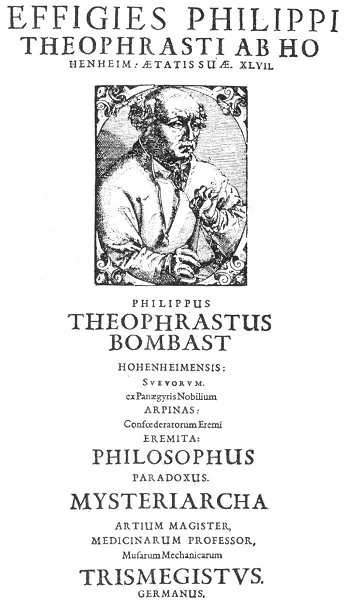
In his Biographia Antiqua, Francis Barrett appends to the name of Paracelsus the following titles of distinction: "The Prince of Physicians and Philosophers by Fire; Grand Paradoxical Physician; The Trismegistus of Switzerland; First Reformer of Chymical Philosophy; Adept in Alchymy, Cabala, and Magic; Nature's Faithful Secretary; Master of the Elixir of Life and The Philosopher's Stone," and the "Great Monarch of Chymical Secrets"
their wanderings and strivings, as recorded by their own pens and by contemporaneous disciples of the Hermetic art, are as fascinating as any romance of fiction.
PARACELSUS OF HOHENHEIM
The most famous of alchemical and Hermetic philosophers was Philippus Aureolus Theophrastus Bombastus von Hohenheim. This man, who called himself Paracelsus, declared that some day all the doctors of Europe would turn from the other schools and, following him, revere him above every other physician. The accepted date of the birth of Paracelsus is December 17, 1493. He was an only child. Both his father and mother were interested in medicine and chemistry. His father was a physician and his mother the superintendent of a hospital. While still a youth, Paracelsus became greatly interested in the writings of Isaac of Holland, and determined to reform the medical science of his day.
When twenty years old he began a series of travels which continued for about twelve years. He visited many European countries, including Russia. It is possible that he penetrated into Asia. It was in Constantinople that the great secret of the Hermetic arts was bestowed upon him by Arabian adepts. His knowledge of the Nature spirits and the inhabitants of the invisible worlds he probably secured from the Brahmins of India with whom he came in contact either directly or through their disciples. He became an army physician, and his understanding and skill brought him great success.
Upon his return to Germany, he began his long-dreamed-of reformation of the medical arts and sciences. He was opposed on every hand and criticized unmercifully. His violent temper and tremendously strong personality undoubtedly precipitated many storms upon his head which might have been avoided had he been of a less caustic disposition. He flayed the apothecaries, asserting that they did not use the proper ingredients in their prescriptions and did not consider the needs of their patients, desiring only to collect exorbitant fees for their concoctions.
The remarkable cures which Paracelsus effected only made his enemies hate him more bitterly, for they could not duplicate the apparent miracles which he wrought. He not only treated the more common diseases of his day but is said to have actually cured leprosy, cholera, and cancer. His friends claimed for him that he all but raised the dead. His systems of healing were so heterodox, however, that slowly but surely his enemies overwhelmed him and again and again forced him to leave the fields of his labors and seek refuge where he was not known.
There is much controversy concerning the personality of Paracelsus. That he had an irascible disposition there is no doubt. His barred for physicians and for women amounted to a mania; for them he had nothing but abuse. As far as can be learned, there was never a love affair in his life. His peculiar appearance and immoderate system of living were always held against him by his adversaries. It is believed that his physical abnormalities may have been responsible for much of the bitterness against society which he carried with him throughout all his intolerant and tempestuous life.
His reputed intemperance brought upon him still more persecution, for it was asserted that even during the time of his professorship in the University of Basel he was seldom sober. Such an accusation is difficult to understand in view of the marvelous mental clarity for which he was noted at all times. The vast amount of writing which he accomplished (the Strassburg Edition of his collected works is in three large volumes, each containing several hundred pages) is a monumental contradiction of the tales regarding his excessive use of alcoholics.
No doubt many of the vices of which he is accused were sheer inventions by his enemies, who, not satisfied with hiring assassins to murder him, sought to besmirch his memory after they had revengefully ended his life. The manner in which Paracelsus met his death is uncertain, but: the most credible account is that he died as the indirect result of a scuffle with a number of assassins who had been hired by some of his professional enemies to make away with the one who had exposed their chicanery.
Few manuscripts are extant in the handwriting of Paracelsus, for he dictated the majority of his works to his disciples, who wrote them down. Professor John Maxson Stillman, of Stanford University, pays the following tribute to his memory: "Whatever be the final judgment as to the relative importance of Paracelsus in the upbuilding of medical science and practice, it must be recognized that he entered upon his career at Basel with the zeal and the self-assurance of one who believed himself inspired with a great truth, and destined to effect a great advance in the science and practice of medicine. By nature he was a keen and open-minded observer of whatever came under his observation, though probably also not a very critical analyst of the observed phenomena. He was evidently an unusually self-reliant and independent thinker, though the degree of originality in his thought may be a matter of legitimate differences of opinion. Certainly once having, from whatever combination of influences, made up his mind to reject the sacredness of the authority of Aristotle, Galen and Avicenna, and having found what to his mind was a satisfactory substitute for the ancient dogmas in his own modification of the neo-Platonic philosophy, he did not hesitate to burn his ships behind him.
"Having cut loose from the dominant Galenism of his time, he determined to preach and teach that the basis of the medical science of the future should be the study of nature, observation of the patient, experiment and experience, and not the infallible dogmas of authors long dead. Doubtless in the pride and self-confidence of his youthful enthusiasm he did not rightly estimate the tremendous force of conservatism against which he directed his assaults. If so, his experience in Basel surely undeceived him. From that time on he was to be a wanderer again, sometimes in great poverty, sometimes in moderate comfort, but manifestly disillusioned as to the immediate success of his campaign though never in doubt as to its ultimate success--for to his mind his new theories and practice of medicine were at one with the forces of nature, which were the expression of God's will, and eventually they must prevail."
This strange man, his nature a mass of contradictions, his stupendous genius shining like a star through the philosophic and scientific darkness of mediæval Europe, struggling against the jealousy of his colleagues as well as against the irascibility of his own nature, fought for the good of the many against the domination of the few. He was the first man to write scientific books in the language of the common people so that all could read them.
Even in death Paracelsus found no rest. Again and again his bones were dug up and reinterred in another place. The slab of marble over his grave bears the following inscription: "Here lies buried Philip Theophrastus the famous Doctor of Medicine who cured Wounds, Leprosy, Gout, Dropsy and other incurable Maladies of the Body, with wonderful Knowledge and gave his Goods to be divided and distributed to the Poor. In the Year 1541 on the 24th day of September he exchanged Life for Death. To the Living Peace, to the Sepulchred Eternal Rest."
A. M. Stoddart, in her Life of Paracelsus, gives a remarkable testimonial of the love which the masses had for the great physician. Referring to his tomb, she writes: "To this day the poor pray there. Hohenheim's memory has 'blossomed in the dust' to sainthood, for the poor have canonized him. When cholera threatened Salzburg in 1830, the people made a pilgrimage to his monument and prayed him to avert it from their homes. The dreaded scourge passed away from them and raged in Germany and the rest of Austria."
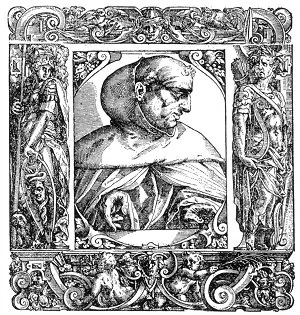
ALBERTUS MAGNUS.
From Jovius' Vitae Illustrium Virorum.
Albert de Groot was born about 1206 and died at the age of 74. It has been said of him that he was "magnus in magia, major in philosophia, maximus in theologia." He was a member of the Dominican order and the mentor of St. Thomas Aquinas in alchemy and philosophy. Among other positions of dignity occupied by Albertus Magnus was that of Bishop of Regensburg. He was beatified in 1622. Albertus was an Aristotelian philosopher, an astrologer, and a profound student of medicine and physics. During his youth, he was considered of deficient mentality, but his since service and devotion were rewarded by a vision in which the Virgin Mary appeared to him and bestowed upon him great philosophical and intellectual powers. Having become master of the magical sciences, Albertus began the construction of a curious automaton, which he invested with the powers of speech and thought. The Android, as it was called, was composed of metals and unknown substances chosen according to the stars and endued with spiritual qualities by magical formulæ and invocations, and the labor upon it consumed over thirty years. St. Thomas Aquinas, thinking the device to be a diabolical mechanism, destroyed it, thus frustrating the labor of a lifetime. In spite of this act, Albertus Magnus left to St. Thomas Aquinas his alchemical formulæ, including (according to legend) the secret of the Philosopher's Stone.
On one occasion Albertus Magnus invited William II, Count of Holland and King of the Romans, to a garden party in midwinter. The ground was covered with snow, but Albertus, had prepare a sumptuous banquet in the open grounds of his monastery at Cologne. The guests were amazed at the imprudence of the philosopher, but as they sat down to eat Albertus, uttered a few words, the snow disappeared, the garden was filled with flowers and singing birds, and the air was warm with the breezes of summer. As soon as the feast was over, the snow returned, much to the amazement of the assembled nobles. (For details, see The Lives of Alchemystical Philosophers.)
It was supposed that one early teacher of Paracelsus was a mysterious alchemist who called himself Solomon Trismosin. Concerning this person nothing is known save that after some years of wandering he secured the formula of transmutation and claimed to have made vast amounts of gold. A beautifully illuminated manuscript of this author, dated 1582 and called Splendor Solis, is in the British Museum. Trismosin claimed to have lived to the age of 150 as the result of his knowledge of alchemy. One very significant statement appears in his Alchemical Wanderings, which work is supposed to narrate his search for the Philosopher's Scone: "Study what thou art, whereof thou art a part, what thou knowest of this art, this is really what thou art. All that is without thee also is within, thus wrote Trismosin."
RAYMOND LULLY
This most famous of all the Spanish alchemists was born about the year 1235. His father was seneschal to James the First of Aragon, and young Raymond was brought up in the court surrounded by the temptations and profligacy abounding in such places. He was later appointed to the position which his father had occupied. A wealthy marriage ensured Raymond's financial position, and he lived the life of a grandee.
One of the most beautiful women at: the court of Aragon was Donna Ambrosia Eleanora Di Castello, whose virtue and beauty had brought her great renown. She was at that time married and was not particularly pleased to discover that young Lully was rapidly developing a passion for her. Wherever she went Raymond followed, and at last over a trivial incident he wrote some very amorous verses to her, which produced an effect quite different from what he had expected. He received a message inviting him to visit the lady. He responded with alacrity. She told him that it was only fair that he should behold more of the beauty concerning which he wrote such appealing poems and, drawing aside part of her garments, disclosed that one side of her body was nearly eaten away by a cancer. Raymond never recovered from the shock. It turned the entire course of his life. He renounced the frivolities of the court and became a recluse.
Sometime afterwards while doing penance for his worldly sins a vision appeared to him in which Christ told him to follow in the direction in which He should lead. Later the vision was repeated. Hesitating no longer, Raymond divided his property among his family and retired to a hut on the side of a hill, where he devoted himself to the study of Arabic, that he might go forth and convert the infidels. After six years in this retreat he set out with a Mohammedan servant, who, when he learned that Raymond was about to attack the faith of his people, buried his knife in his master's back. Raymond refused to allow his would-be assassin to be executed, but later the man strangled himself in prison.
When Raymond regained his health he became a teacher of the Arabic language to those who intended traveling in the Holy Land. It was while so engaged that he came in contact: with Arnold of Villa Nova, who taught him the principles or alchemy. As a result of this training, Raymond learned the secret of the transmutation and multiplication of metals. His life of wandering continued, and during the course of it he arrived at Tunis, where he began to debate with the Mohammedan teachers, and nearly lost his life as the result of his fanatical attacks upon their religion. He was ordered to leave the country and never to return again upon pain of death. Notwithstanding their threats he made a second visit to Tunis, but the inhabitants instead of killing him merely deported him to Italy.
An unsigned article appearing in Household Words, No. 273, a magazine conducted by Charles Dickens, throws considerable light on Lully's alchemical ability. "Whilst at Vienna he [Lully] received flattering letters from Edward the Second, King of England, and from Robert Bruce, King of Scotland, entreating him to visit them. He had also, in the course of his travels, met with John Cremer, Abbot of Westminster, with whom he formed a strong friendship; and it was more to please him than the king, that Raymond consented to go to England. [A tract by John Cremer appears in the Hermetic Museum, but there is no record in the annals of Westminster of anyone by that name.] Cremer had an intense desire to learn the last great secret of alchemy--to make the powder of transmutation--and Raymond, with all his friendship, had never disclosed it. Cremer, however, set to work very cunningly; he was not long in discovering the object that was nearest to Raymond's heart--the conversion of the infidels. He told the king wonderful stories of the gold Lully had the art to make; and he worked upon Raymond by the hope that King Edward would be easily induced to raise a crusade against the Mahommedans, if he had the means.
"Raymond had appealed so often to popes and kings that he had lost all faith in them; nevertheless, as a last hope, he accompanied his friend Cremer to England. Cremer lodged him in his abbey, treating him with distinction; and there Lully at last instructed him in the powder, the secret of which Cremer had so long desired to know. When the powder was perfected, Cremer presented him to the king, who received him as a man may be supposed to receive one who could give him boundless riches. Raymond made only one condition; that the gold he made should not be expended upon the luxuries of the court or upon a war with any Christian king; and that Edward himself should go in person with an army against the infidels. Edward promised everything and anything.
"Raymond had apartments assigned him in the Tower, and there he tells us he transmuted fifty thousand pounds weight of quicksilver, lead, and tin into pure gold, which was coined at the mint into six million of nobles, each worth about three pounds sterling at the present day. Some of the pieces said to have been coined out of this gold are still to be found in antiquarian collections. [While desperate attempts have been made to disprove these statements, the evidence is still about equally divided.] To Robert Bruce he sent a little work entitled Of the Art of Transmuting Metals. Dr. Edmund Dickenson relates that when the cloister which Raymond occupied at Westminster was removed, the workmen found some of the powder, with which they enriched themselves.
"During Lully's residence in England, he became the friend of Roger Bacon. Nothing, of course, could be further from King Edward's thoughts than to go on a crusade. Raymond's apartments in the Tower were only an honorable prison; and he soon perceived how matters were. He declared that Edward would meet with nothing but misfortune and misery for his breach of faith. He made his escape from England in 1315, and set off once more to preach to the infidels. He was now a very old man, and none of his friends could ever hope to see his face again.
"He went first to Egypt, then to Jerusalem, and thence to Tunis a third time. There he at last met with the martyrdom he had so often braved. The people fell upon him and stoned him. Some Genoese merchants carried away his body, in which they discerned some feeble signs of life. They carried him on board their vessel; but, though he lingered awhile, he died as they came in sight of Majorca, on the 28th of June, 1315, at the age of eighty-one. He was buried with great honour in his family chapel at St. Ulma, the viceroy and all the principal nobility attending."
NICHOLAS FLAMMEL
In the latter part of the fourteenth century there lived in Paris one whose business was that of illuminating manuscripts and preparing deeds and documents. To Nicholas Flammel the world is indebted for its knowledge of a most remarkable volume, which he bought for a paltry sum from some bookdealer with whom his profession of scrivener brought him in contact. The story of this curious document, called the Book of Abraham the Jew, is best narrated
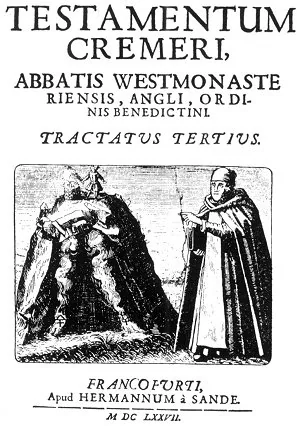
TITLE PAGE OF ALCHEMICAL TRACT ATTRIBUTED TO JOHN CREMER.
From Musæum Hermeticum Reformatum et Amplificatum.
John Cremer, the mythical Abbot of Westminster, is an interesting personality in the alchemical imbroglio of the fourteenth century. As it is not reasonably certain that m abbot by such a name ever occupied the See of Westminster, the question naturally arises, "Who was the person concealing his identity under the Pseudonym of John Cremer?" Fictitious characters such as John Cremer illustrate two important practices of mediæval alchemists: (1) many persons of high political or religious rank were secretly engaged in Hermetic chemical research but, fearing persecution and ridicule, published their findings under various pseudonyms; (2) for thousands of years it was the practice of those initiates who possessed the true key to the great Hermetic arcanum to perpetuate their wisdom by creating imaginary persons, involving them in episodes of contemporaneous history and thus establishing these beings as prominent members of society--in some cases even fabricating complete genealogies to attain that end. The names by which these fictitious characters were known revealed nothing to the uniformed. To the initiated, however, they signified that the personality to which they were assigned had no existence other than a symbolic one. These initiated chroniclers carefully concealed their arcanum in the lives, thoughts, words. and acts ascribed to these imaginary persons and thus safely transmitted through the ages the deepest secrets of occultism as writings which to the unconversant were nothing more than biographies.
in his own words as preserved in his Hieroglyphical Figures: "Whilst therefore, I Nicholas Flammel, Notary, after the decease of my parents, got my living at our art of writing, by making inventories, dressing accounts, and summing up the expenses of tutors and pupils, there fell into my hands for the sum of two florins, a guilded book, very old and large. It was not of paper, nor of parchment, as other books be, but was only made of delicate rinds (as it seemed to me) of tender young trees. The cover of it was of brass, well bound, all engraven with letters, or strange figures; and for my part I think they might well be Greek characters, or some such like ancient language. Sure I am. I could not read them, and I know well they were not notes nor letters of the Latin nor of the Gaul, for of them we understand a little.
"As for that which was within it, the leaves of bark or rind, were engraven and with admirable diligence written, with a point of iron, in fair and neat Latin letters colored. It contained thrice seven leaves, for so were they counted in the top of the leaves, and always every seventh leaf there was painted a virgin and serpent swallowing her up. In the second seventh, a cross where a serpent was crucified; and the last seventh, there were painted deserts, or wildernesse, in the midst whereof ran many fair fountains, from whence there issued out a number of serpents, which ran up and down here and there. Upon the first of the leaves, was written in great capital letters of gold, Abraham the Jew, Prince, Priest, Levite, Astrologer, and Philosopher, to the Nation of the Jews, by the Wrath of God dispersed among the Gauls, sendeth Health. After this it was filled with great execrations and curses (with this word Maranatha, which was often repeated there) against every person that should cast his eyes upon it, if he were not Sacrificer or Scribe.
"He that sold me this book knew not what it was worth nor more than I when I bought it; I believe it had been stolen or taken from the miserable Jews, or found in some part of the ancient place of their abode. Within the book, in the second leaf, he comforted his nation, counselling them to fly vices, and above all idolatry, attending with sweet patience the coming of the Messias, Who should vanquish all the kings of the earth and should reign with His people in glory eternally. Without doubt this had been some very wise and understanding man.
"In the third leaf, and in all the other writings that followed, to help his captive nation to pay their tributes unto the Roman emperors, and to do other things, which I will not speak of, he taught them in common words the transmutation of metals; he painted the vessels by the sides, and he advertised them of the colors, and of all the rest, saving of the first agent, of the which he spake not a word, but only (as he said) in the fourth and fifth leaves entire he painted it, and figured it with very great cunning and workman ship: for although it was well and intelligibly figured and painted, yet no man could ever have been able to understand it, without being well skilled in their Cabala, which goeth by tradition, and without having well studied their books.
"The fourth and fifth leaves therefore, were without any writing, all full of fair figures enlightened, or as it were enlightened, for the work was very exquisite. First he painted a young man with wings at his ancles, having in his hand a Caducean rod, writhen about with two serpents, wherewith he struck upon a helmet which covered his head. He seemed to my small judgment, to be the God Mercury of the pagans: against him there came running and flying with open wings, a great old man, who upon his head had an hour glass fastened, and in his hand a book (or syrhe) like death, with the which, in terrible and furious manner, he would have cut off the feet of Mercury. On the other side of the fourth leaf, he painted a fair flower on the top of a very high mountain which was sore shaken with the North wind; it had the foot blue, the flowers white and red, the leaves shining like fine gold: and round about it the dragons and griffons of the North made their nests and abode.
"On the fifth leaf there was a fair rose tree flowered in the midst of a sweet garden, climbing up against a hollow oak; at the foot whereof boiled a fountain of most white water, which ran headlong down into the depths, notwithstanding it first passed among the hands of infinite people, who digged in the earth seeking for it; but because they were blind, none of them knew it, except here and there one who considered the weight. On the last side of the fifth leaf there was a king with a great fauchion, who made to be killed in his presence by some soldiers a great multitude of little infants, whose mothers wept at the feet of the unpitiful soldiers: the blood of which infants was afterwards by other soldiers gathered up, and put in a great vessel, wherein the sun and the moon came to bathe themselves.
"And because that this history did represent the more part of that of the innocents slain by Herod, and that in this book I learned the greatest part of the art, this was one of the causes why I placed in their church-yard these Hieroglyphic Symbols of this secret science. And thus you see that which was in the first five leaves.
"I will not represent unto you that which was written in good and intelligible Latin in all the other written leaves, for God would punish me, because I should commit a greater wickedness, than he who (as it is said) wished that all the men of the World had but one head that he might cut it off with one blow. Having with me therefore this fair book, I did nothing else day nor night, but study upon it, understanding very well all the operations that it showed, but not knowing with what matter I should begin, which made me very heavy and solitary, and caused me to fetch many a sigh. My wife Perrenella, whom I loved as myself, and had lately married was much astonished at this, comforting me, and earnestly demanding, if she could by any means deliver me from this trouble. I could not possibly hold my tongue, but told her all, and showed this fair book, whereof at the same instant that she saw it, she became as much enamoured as myself, taking extreme pleasure to behold the fair cover, gravings, images, and portraits, whereof notwithstanding she understood as little as I: yet it was a great comfort to me to talk with her, and to entertain myself, what we should do to have the interpretation of them."
Nicholas Flammel spent many years studying the mysterious book. He even painted the pictures from it all over the walls of his house and made numerous copies which he showed to the learned men with whom he came in contact, but none could explain their secret significance. At last he determined to go forth in quest of an adept, or wise man, and after many wanderings he met a physician--by name Master Canches--who was immediately interested in the diagrams and asked to see the original book. They started forth together for Paris, and or, the way the physician adept explained many of the principles of the hieroglyphics to Flammel, but before they reached their journey's end Master Canches was taken ill and died. Flammel buried him at Orleans, but having meditated deeply on the information he had secured during their brief acquaintance, he was able, with the assistance of his wife, to work out the formula for transmuting base metals into gold. He performed the experiment several times with perfect success, and before his death caused a number of hieroglyphic figures to be painted upon an arch of St. Innocent's churchyard in Paris, wherein he concealed the entire formula as it had been revealed to him from the Book of Abraham the Jew.
COUNT BERNARD OF TREVISO
Of all those who sought for the Elixir of Life and the Philosopher's Scone, few passed through the chain of disappointments that beset Count Bernard of Treviso, who was born in Padua in 1406 and died in 1490. His search for the Philosopher's Stone and the secret of the transmutation of metals began when he was but fourteen years of age. He spent not only a lifetime but also a fortune in his quest. Count Bernard went from one alchemist and philosopher to another, each of whom unfolded some pet theorem which he eagerly accepted and experimented with but always without the desired result. His family believed him to be mad and declared that he was disgracing his house by his experiments, which were rapidly reducing him to a state of penury. He traveled in many countries, hoping that in distant places he would find wise men capable of assisting him. At last as he was approaching his seventy-sixth year, he was rewarded with success. The great secrets of the Elixir of Life, the Philosopher's Stone, and the transmutation of metals were revealed to him. He wrote a little book describing the results of his labors, and while he lived only a few years to enjoy the fruitage of his discovery he was thoroughly satisfied that the treasure he had found was worth the lifetime spent in search of it. An example of the industry and perseverance displayed by him is to be found in one of the processes which some foolish pretender coaxed him to attempt and which resulted in his spending twenty years calcining egg shells and nearly an equal period distilling alcohol and other substances. In the history of alchemical research there never was a more patient and persevering disciple of the Great Arcanum.
Bernard declared the process of dissolution, accomplished not with fire but with mercury, to be the supreme secret of alchemy,
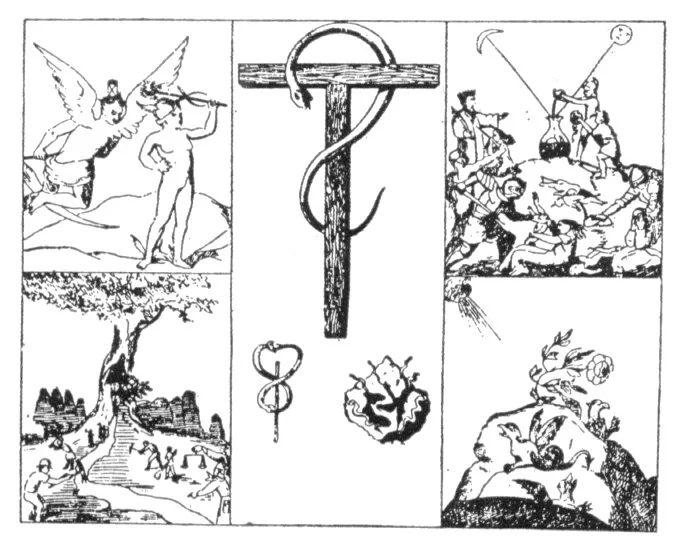
THE SYMBOLS OF ABRAHAM THE JEW.
From Flammel's Hieroglyphical Figures.
Robert H. Fryar, in a footnote to his reprint of the Hieroglyphical Figures by Nicholas Flammel, says: "One thing which seems to prove the reality of this story beyond dispute, is, that this very book of Abraham the Jew, with the annotations of 'Flammel,' who wrote from the instructions he received from this physician, was actually in the hands of Cardinal Richelieu, as Borel was told by the Count de Cabrines, who saw and examined it."
The Theory and Practice of Alchemy
Part One
ALCHEMY, the secret art of the land of Khem, is one of the two oldest sciences known to the world. The other is astrology. The beginnings of both extend back into the obscurity of prehistoric times. According to the earliest records extant, alchemy and astrology were considered as divinely revealed to man so that by their aid he might regain his lost estate. According to old legends preserved by the Rabbins, the angel at the gate of Eden instructed Adam in the mysteries of Qabbalah and of alchemy, promising that when the human race had thoroughly mastered the secret wisdom concealed within these inspired arts, the curse of the forbidden fruit would be removed and man might again enter into the Garden of the Lord. As man took upon himself "coats of skins" (physical bodies) at the time of his fall, so these sacred sciences were brought by him into the lower worlds incarnated in dense vehicles, through which their spiritual transcendental natures could no longer manifest themselves. Therefore they were considered as being dead or lost.
The earthly body of alchemy is chemistry, for chemists do not realize that half of The Book of Torah is forever concealed behind the veil of Isis (see the Tarot), and that so long as they study only material elements they can at best discover but half of the mystery. Astrology has crystallized into astronomy, whose votaries ridicule the dreams of ancient seers and sages, deriding their symbols as meaningless products of superstition. Nevertheless, the intelligentsia of the modern world can never pass behind the veil which divides the seen from the unseen except in the way appointed--the Mysteries.
What is life? What is intelligence? What is force? These are the problems to the solution of which the ancients consecrated their temples of learning. Who shall say that they did not answer those questions? Who would recognize the answers if given? Is it possible that under the symbols of alchemy and astrology lies concealed a wisdom so abstruse that the mind of this race is not qualified to conceive its principles?
The Chaldeans, Phœnicians, and Babylonians were familiar with the principles of alchemy, as were many early Oriental races. It was practiced in Greece and Rome; was the master science of the Egyptians. Khem was an ancient name for the land of Egypt; and both the words alchemy and chemistry are a perpetual reminder of the priority of Egypt's scientific knowledge. According to the fragmentary writings of those early peoples, alchemy was to them no speculative art. They implicitly believed in the multiplication of metals; and in the face of their reiterations both the scholar and the materialist should be more kindly in their consideration of alchemical theorems. Evolutionists trace the unfoldment of the arts and sciences up through the growing intelligence of the prehistoric man, while others, of a transcendental point of view, like to consider them as being direct revelations from God.
Many interesting solutions to the riddle of alchemy's origin have been advanced. One is that alchemy was revealed to man by the mysterious Egyptian demigod Hermes Trismegistus. This sublime figure, looming through the mists of time and bearing in his hand the immortal Emerald, is credited by the Egyptians as being the author of all the arts and sciences. In honor of him all scientific knowledge was gathered under the general title of The Hermetic Arts. When the body of Hermes was interred in the Valley of Ebron (or Hebron), the divine Emerald was buried with it. Many centuries afterward the Emerald was discovered--according to one version, by an Arabian initiate; according to another, by Alexander the Great, King of Macedon. By means of the power of this Emerald, upon which were the mysterious inscriptions of the Thrice Great Hermes--thirteen sentences in all--Alexander conquered all the then known world. Not having conquered himself, however, he ultimately failed. Regardless of his glory and power, the prophecies of the talking trees were fulfilled, and Alexander was cut down in the midst of his triumph. (There are persistent rumors to the effect that Alexander was an initiate of high order who failed because of his inability to withstand the temptations of power.)
E. Y. Kenealy, quoting from the Cosmodromium of Doctor Gobelin Persona, describes the incident of Alexander and the talking trees, into the presence of which the King of Macedon is said to have been brought while on his campaign in India: "And now Alexander marched into other quarters equally dangerous; at one time over the tops of mountains, at another through dark valleys, in which his army was attacked by serpents and wild beasts, until after three hundred days he came into a most pleasant mountain, on whose sides hung chains or ropes of gold. This mountain had two thousand and fifty steps all of purest sapphire, by which one could ascend to the summit, and near this Alexander encamped. And on a day, Alexander with his Twelve Princes, ascended by the aforenamed steps to the top of the Mountain, and found there a Palace marvellously beautiful, having Twelve Gates, and seventy windows of the purest gold, and it was called the Palace of the Sun, and there was in it a Temple all of gold, before whose gates were vine trees bearing bunches of carbuncles and pearls, and Alexander and his Princes having entered the Palace, found there a Man lying on a golden bedstead; he was very stately and beautiful in appearance, and his head and beard were white as snow. Then Alexander and his princes bent the knee to the Sage who spake thus: 'Alexander, thou shalt now see what no earthly man hath ever before seen or heard.' To whom Alexander made answer: 'O, Sage, most happy, how dost thou know me?' He replied: 'Before the wave of the Deluge covered the face of the earth I knew thy works.' He added: 'Wouldst thou behold the most hallowed Trees of the Sun and Moon, which announce all future things?' Alexander made answer: 'It is well, my lord; greatly do we long to see them.' * * *
"Then the Sage said: 'Put away your rings and ornaments, and take off your shoes, and follow me.' And Alexander did so, and choosing out three from the Princes, and leaving the rest to await his return, he followed the Sage, and came to the Trees of the Sun and Moon. The Tree of the Sun has leaves of red gold, the Tree of the Moon has leaves of silver, and they are very great, and Alexander, at the suggestion of the Sage questioned the Trees, asking if he should return in triumph to Macedon? to which the Trees gave answer, No, but that he should live yet another year and eight months, after which he should die by a poisoned cup. And when he inquired, Who was he who should give him that poison? he received no reply, and the Tree of the Moon said to him, that his Mother, after a most shameful and unhappy death, should lie long unburied, but that happiness was in store for his sisters." (See The Book of Enoch, The Second Messenger of God.)
In all probability, the so-called talking trees were merely strips of wood with tables of letters upon them, by means of which oracles were evoked. At one time books written upon wood were called "talking trees." The difficulty in deciding the origin of alchemy is directly due to ignoring the lost continent of Atlantis. The Great Arcanum was the most prized of the secrets of the Atlantean priestcraft. When the land of Atlas sank, hierophants of the Fire Mystery brought the formula to Egypt, where it remained for centuries in the possession of the sages and philosophers. It gradually moved into Europe, where its secrets are still preserved intact.
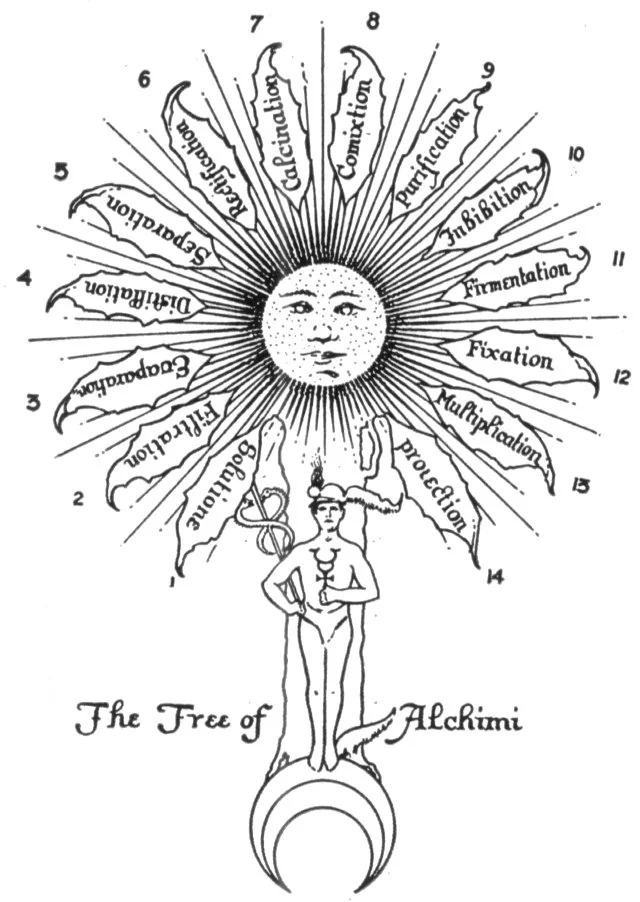
THE LEAVES OF HERMES' SACRED TREE.
Redrawn from an original manuscript dated 1577.
In his Key to Alchemy, Samuel Norton divides into fourteen parts the processes or states through which the alchemical substances pass from the time they are first placed in the test tube until ready as medicine for plants, minerals, or men:
1. Solution, the act of passing from a gaseous or solid condition, into one of liquidity.
2. Filtration, the mechanical separation of a liquid from the undissolved particles suspended in it.
3. Evaporation, the changing or converting from a liquid or solid state into a vaporous state with the aid of heat.
4. Distillation, an operation by which a volatile liquid may be separated from substances which it holds in solution.
5. Separation, the operation of disuniting or decomposing substances.
6. Rectification, the process of refining or purifying any substance by repeated distillation.
7. Calcination, the conversion into a powder or calx by the action of heat; expulsion of the volatile substance from a matter.
8. Commixtion, the blending of different ingredients into new compounds or mass.
9. Purification (through putrefaction), disintegration by spontaneous decomposition; decay by artificial means.
10. Inhibition, the process of holding back or restraining.
11. Fermentation, the conversion of organic substances into new compounds in the presence of a ferment.
12. Fixation, the act or process of ceasing to be a fluid and becoming firm; state of being fixed.
13. Multiplication, the act or process of multiplying or increasing in number, the state of being multiplied.
14. Projection, the process of turning the base Metals into gold.
Those disagreeing with the legend of Hermes and his Emerald Tablet see in the two hundred angels who descended upon the mountains, as described by the Prophet: Enoch, the first instructors in the alchemical art. Regardless of its originator, it was left to the Egyptian priests to preserve alchemy for the modern world. Egypt, because of the color of its earth, was called "the black empire" and is referred to in the Old Testament as "the land of darkness." By reason of its possible origin there, alchemy has long been known as "the black art, " not in the sense of evil but in the sense of that darkness which has always enshrouded its secret processes.
During the Middle Ages, alchemy was not only a philosophy and a science but also a religion. Those who rebelled against the religious limitations of their day concealed their philosophic teachings under the allegory of gold-making. In this way they preserved their personal liberty and were ridiculed rather than persecuted. Alchemy is a threefold art, its mystery well symbolized by a triangle. Its symbol is 3 times 3--three elements or processes in three worlds or spheres. The 3 times 3 is part of the mystery of the 33rd degree of Freemasonry, for 33 is 3 times 3, which is 9, the number of esoteric man and the number of emanations from the root of the Divine Tree. It is the number of worlds nourished by the four rivers that pour out of the Divine Mouth as the verbum fiat. Beneath the so-called symbolism of alchemy is concealed a magnificent concept, for this ridiculed and despised craft still preserves intact the triple key to the gates of eternal life. Realizing, therefore, that alchemy is a mystery in three worlds--the divine, the human, and the elemental--it can easily be appreciated why the sages and philosophers created and evolved an intricate allegory to conceal their wisdom.
Alchemy is the science of multiplication and is based upon the natural phenomenon of growth. "Nothing from nothing comes," is an extremely ancient adage. Alchemy is not the process of making something from nothing; it is the process of increasing and improving that which already exists. If a philosopher were to state that a living man could be made from a stone, the unenlightened would probably exclaim, "Impossible!" Thus would they reveal their ignorance, for to the wise it is known that in every stone is the seed of man. A philosopher might declare that a universe could be made out of a man, but the foolish would regard this as an impossibility, not realizing that a man is a seed from which a universe may be brought forth.
God is the "within" and the "without" of all things. The Supreme One manifests Himself through growth, which is an urge from within outward, a struggle for expression and manifestation. There is no greater miracle in the growing and multiplication of gold by the alchemist than in a tiny mustard seed producing a bush many thousands of times the size of the seed. If a mustard seed produces a hundred thousand times its own size and weight when planted in an entirely different substance (the earth), why should not the seed of gold be multiplied a hundred thousand times by art when that seed is planted in its earth (the base metals) and nourished artificially by the secret process of alchemy?
Alchemy teaches that God is in everything; that He is One Universal Spirit, manifesting through an infinity of forms. God, therefore, is the spiritual seed planted in the dark earth (the material universe). By arc it is possible so to grow and expand this seed that the entire universe of substance is tinctured thereby and becomes like unto the seed--pure gold. In the spiritual nature of man this is termed regeneration; in the material body of the elements it is called transmutation. As it is in the spiritual and material universes, so it is in the intellectual world. Wisdom cannot be imparted to an idiot because the seed of wisdom is not within him, but wisdom may be imparted to an ignorant person, however ignorant he may be, because the seed of wisdom exists in him and can be developed by art and culture. Hence a philosopher is only an ignorant man within whose nature a projection has taken place.
Through art (the process of learning) the whole mass of base metals (the mental body of ignorance) was transmuted into pure gold (wisdom), for it was tinctured with understanding. If, then, through faith and proximity to God the consciousness of man may be transmuted from base animal desires (represented by the masses of the planetary metals) into a pure, golden, and godly consciousness, illumined and redeemed, and the manifesting God within that one increased from a tiny spark to a great and glorious Being; if also the base metals of mental ignorance can, through proper endeavor and training, be transmuted into transcendent genius and wisdom, why is the process in two worlds or spheres of application not equally true in the third? If both the spiritual and mental elements of the universe can be multiplied in their expression, then by the law of analogy the material elements of the universe can also be multiplied, if the necessary process can be ascertained.
That which is true in the superior is true in the inferior. If alchemy be a great spiritual fact, then it is also a great material fact. If it can take place in the universe, it can take place in man; if it can take place in man, it can take place in the plants and minerals. If one thing in the universe grows, then everything in the universe grows. If one thing can be multiplied, then all things can be multiplied, "for the superior agrees with the inferior and the inferior agrees with the superior." But as the way for the redemption of the soul is concealed by the Mysteries, so the secrets for the redemption of the metals are also concealed, that they may not fall into the hands of the profane and thereby become perverted.
If any would grow metals, he must first learn the secrets of the metals: he must realize that all metals--like all stones, plants, animals, and universes--grow from seeds, and that these seeds are already in the body of Substance (the womb of the World Virgin); for the seed of man is in the universe before he is born (or grows), and as the seed of the plant exists for all time though the plant live but a part of that time, so the seeds of spiritual gold and material gold are ever present in all things. The metals grow throughout the ages, because life is imparted to them from the sun. They grow imperceptibly, in form like tiny shrubs, for everything grows in some way. Only the methods of growth differ, according to kind and magnitude.
One of the great axioms is, "Within everything is the seed of everything," although by the simple processes of Nature it may remain latent for many centuries, or its growth may be exceedingly slow. Therefore, every grain of sand contains not only the seed of the precious metals as well as the seed of the priceless gems, but also the seeds of sun, moon, and stars. As within the nature of man is reflected the entire universe in miniature, so in each grain of sand, each drop of water, each tiny particle of cosmic dust, are concealed all the parts and elements of cosmos in the form of tiny seed germs so minute that even the most powerful microscope cannot detect them. Trillions of times smaller than the ion or electron, these seeds--unrecognizable and incomprehensible--await the time assigned them for growth and expression. (Consider the monads of Leibnitz.)
There are two methods whereby growth may be accomplished. The first is by Nature, for Nature is an alchemist forever achieving the apparently impossible. The second is by art, and through art is produced in a comparatively short time that which requires Nature almost endless periods to duplicate. The true philosopher, desiring to accomplish the Magnum Opus, patterns his conduct according to the laws of Nature, recognizing that the art of alchemy is merely a method copied from Nature but with the aid of certain secret formulæ greatly shortened by being correspondingly intensified. Nature, in order to achieve her miracles, must work through either extensiveness; or intensiveness. The extensive processes of Nature are such as are used in the transmutation of the pitch of black carbon into diamonds, requiring millions of years of natural hardening. The intensive process is art, which is ever the faithful servant of Nature (as Dr. A. Dee says), supplementing her every step and cooperating with her in all her ways. "So, in this philosophical work, Nature and Art ought so lovingly to embrace each other, as that Art may not require what Nature denies, nor Nature deny what may be perfected by Art. For Nature assenting, she demeans herself obediently to every artist, whilst by their industry she is helped, not hindered. " (Dr. A. Dee in his Chemical Collections.)
By means of this art the seed which is within the soul of a stone may be made to germinate so intensively that in a few moments a diamond is grown from the seed of itself. If the seed of the diamond were not in the marble, granite, and sand, a diamond could not be grown therefrom. But as the seed is within all these things, a diamond may be grown out of any other substance in the universe. In some substances, however, it is easier to perform this miracle because in them these germs have already been long fertilized and are thus more nearly prepared for the vivifying process of the art. Likewise, to teach some men wisdom is easier than to teach others, for some already have a foundation upon which to work, while in others the thinking faculties are entirely dormant. Alchemy, therefore, should be regarded as the art of increasing and bringing into perfect flower with the greatest possible expedition. Nature may accomplish her desired end or, because of the destructiveness exercised by one element over another, she may not; but with the aid of the true art, Nature always accomplishes her end, for this art is not subject either to the wastings of time or to the vandalism of elemental reactions.
In his History of Chemistry, James Campbell Brown, late professor of chemistry in the University of Liverpool, sums up the ends which alchemists sought to achieve, in the following paragraphs:
"This, therefore, was the general aim of the alchemists--to carry out in the laboratory, as far as possible, the processes which Nature carried out in the interior of the earth. Seven leading problems occupied their attention:--
"1. The preparation of a compound named elixir, magisterium medicine, or philosopher's stone, which possessed the property of transmuting the baser metals into gold and silver, and of performing many other marvelous operations. * * *
"2. The creation of homunculi, or living. beings, of which many wonderful but incredible tales are told.
"3. The preparation of the alcahest or universal solvent, which dissolved every substance which was immersed in it. * * *
"4. Palingenesis, or the restoration of a plant from its ashes. Had they succeeded in this, they would have hoped to be able to raise the dead. [Professor Brown takes a great deal for granted.]
"5. The preparation of spiritus mundi, a mystic substance possessing many powers, the principal of which was its capacity of dissolving gold.
"6. The extraction of the quintessence or active principle of all substances.
"7. The preparation of aurum potabile, liquid gold, a sovereign remedy, because gold being itself perfect could produce perfection in the human frame."
ALCHEMICAL SYMBOLISM
In alchemy there are three symbolic substances: mercury, sulphur, and salt. To these was added a fourth mysterious life principle called Azoth. Concerning the first three, Herr von Welling has written: "There are three basic chemical substances which are called by the philosophers salt, sulphur, and mercury, but which are not to be confounded in any way with the crude salt, sulphur, and mercury taken from the earth or secured from the apothecary. Salt, sulphur, and mercury each has a triune nature, for each of these substances contains, in reality, also the other two substances, according to the secret arcanum of the wise. The body of salt is, therefore, threefold, namely salt, sulphur, and mercury; but in the body of salt one of the three (salt) predominates. Mercury is likewise composed of salt, sulphur, and mercury with the latter element predominating. Sulphur, similarly, is actually salt, sulphur, and mercury, with sulphur predominating. These nine divisions--3 times 3, plus Azoth (the mysterious universal life force), equals 10, the sacred decad of Pythagoras. Concerning the nature of Azoth there is much controversy. Some view it as the invisible, eternal fire; others as electricity; still others as magnetism. Transcendentalism refer to it as the astral light.
"The universe is surrounded by the sphere of the stars. Beyond that sphere is the sphere of Schamayim, which is the Divine fiery water, the first outflow of the Word of God, the flaming river pouring from the presence of the Eternal. Schamayim, the fiery androgynous water, divides. The fire becomes the solar fire and the water becomes the lunar water. Schamayim is the universal mercury--sometimes called Azoth--the measureless spirit of life. The spiritual fiery original water--Schamayim--comes through Eden (in Hebrew, vapor) and pours itself into four main rivers [the elements]. This is the river of living water--Azoth [the fiery mercurial essence] that flows out from the throne of God and the Lamb. In this Eden [vaporous essence or mist] is the spiritual earth [incomprehensible and intangible], or the dust Aphar, out of which God formed Adam min Haadamah, the spiritual body of man, which body must sometime become revealed."
In another part of his writings von Welling also says that there was no material universe until Lucifer, attempting to perform the cosmic alchemy, misused the Schamayim, or the Divine Fire. In order to reestablish the Schamayim which Lucifer had perverted, this universe was formed as a means of liberating it from the dark cloud within which it was locked by the failure of Lucifer's attempt to control it. These statements clearly emphasize the fact that the early philosophers recognized in the Bible a book of chemical and alchemical formulæ. It is essential that this point be kept in mind at all times. Woe to that seeker who accepts as literal the rambling allegories of the alchemists. Such a one can never enter the inner sanctuary of truth. Elias Ashmole in his Theatrum Chemicum Britannicum thus describes the methods employed by the alchemists to conceal their true doctrines: "Their chiefest study was to wrap up their Secrets in Fables, and spin out their Fancies in Vailes and shadows, whose Radii seems to extend every way, yet so, that they meet in a Common Center, and point onely at One thing."
The fact that the Scriptures reveal a hidden knowledge, if considered allegorically, is clearly demonstrated by a parable describing King Solomon, his wives, concubines, and virgins, which parable occurs in Geheime Figuren der Rosenkreuzer, published in Ultona in 1785. Dr. Hartmann, who translated part of this work into English, declared that the wives of Solomon represented the arts, the concubines the sciences, and the virgins the still unrevealed secrets of Nature. By order of the King the virgins were forced to remove their veils, thus signifying that by means of wisdom (Solomon) the mystic arts were forced to disclose their hidden parts to the philosopher, while to the uninitiated world only the outside garments were visible. (Such is the mystery of the veil of Isis.)
As the alchemist must do his work in four worlds simultaneously if he would achieve the Magnum Opus, a table showing the analogies of the three principles in the four worlds may clarify the relationship which the various parts bear to each other. The early masters of the art of alchemical symbolism did not standardize either their symbols or their terms. Thus it required great familiarity with the subject combined with considerable intuitive power to unravel some of their enigmatical statements. The third and fourth divisions of the following table are given alternative renderings, owing to the fact that some authors did not draw a clear line between spirit and soul. According to the Scriptures, spirit is indestructible, but soul is destructible. Obviously, then, they are not synonymous. It is clearly stated that "the soul that sinneth, it shall die," but "the spirit shall return unto God who gave it." The table of analogies, as nearly as they can be established, is as follows:
The Triune Power in Four Worlds
|
WORLD OF |
Father |
Son |
Mother |
|
1. God |
Father |
Son |
Holy Ghost |
|
2. Man |
Spirit |
Soul |
Body |
|
3. Elements |
Air |
Fire |
Water |
|
4. Chemicals |
Mercury |
Sulphur |
Salt |
The alternative renderings of 3 and 4 are:
|
WORLD OF |
Father |
Son |
Mother |
|
3. Elements |
Fire |
Air |
Water |
|
4. Chemicals |
Sulphur |
Mercury |
Salt |
Paracelsus made a different arrangement, somewhat Aristotelian, in which the three phases of the Triune God are omitted, combining only the elements of the second, third, and fourth worlds:
|
WORLD OF |
Father |
Son |
Mother |
|
2. Man |
Spirit |
Soul |
Body |
|
3. Elements |
Air |
Water |
Earth |
|
4. Chemicals |
Sulphur |
Mercury |
Salt |
The main point, however, is proved: the alchemical philosophers used the symbols of salt, sulphur, and mercury to represent not only chemicals but the spiritual and invisible principles of God, man, and the universe. The three substances (salt, sulphur, and mercury) existing in four worlds, as shown in the table, sum up to the sacred number 12. As these 12 are the foundations of the Great Work, they are called in Revelation the twelve foundation stones of the sacred city. In line with the same idea Pythagoras asserted that the dodecahedron, or twelve-faced symmetrical geometric solid, was the foundation of the universe. May there not be a relation also between this mysterious 3 times 4 and the four parties of three which in the legend of the third degree of Freemasonry go forth to the four angles of the cherubim, the composite creature of four parts?
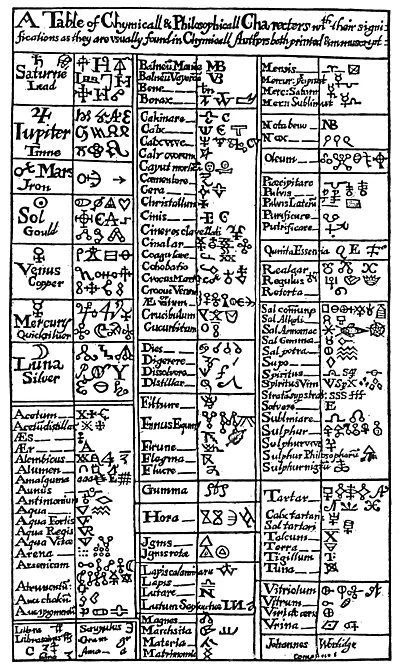
A TABLE OF MEDIÆVAL ALCHEMICAL SYMBOLS.
From Valentine's The Last Will and Testament.
Hermetists used the curious symbols shown in this rare table to represent various chemical elements and alchemical processes. The full meaning of these strange characters has never been revealed, the characters concealing effectually within their own forms the occult secrets regarding the spiritual nature of the metals and elements which they represent.
In their allegories the alchemists also wed human, animal, and plant emblems; sometimes weird composite figures, such as the dragon, the winged serpent, the unicorn, and the phœnix. In almost every case they symbolized gold as a king with a crown on his head and often with a scepter in his hand. Sometimes they depicted him with the ace of the solar disc surrounded by rays. Silver was personified as a woman who they called the queen. She wore no crown but often stood upon a lunar crescent: much after the fashion of the Madonna. Mercury was typified as a youth with wings, often with two heads, carrying serpents or sometimes the caduceus. Lead they symbolized by an old man with a scythe in his hand; iron by a soldier dressed in armor. To aqua fortis was given the curious name "the ostrich's stomach," and to the attainment of the "Great Work" they assigned the symbol of the phœnix sitting upon a nest of fire. The union of elements they symbolized by a marriage, the Process of putrefaction by a skull, antimony by a dragon.
The following table shows the angles to which the parties of three (salt, sulphur, and mercury) go in search of CHiram:
|
The Four "Corners" of Creation |
East |
South |
West |
North |
|
The Fixed Signs of the Zodiac |
Aquarius |
Leo |
Scorpio |
Taurus |
|
The Parts of the Cherubim |
Man |
Lion |
Eagle |
Bull |
|
The Four Seasons |
Spring |
Summer |
Autumn |
Winter |
|
The Ages of Man |
Childhood |
Youth |
Maturity |
Age |
|
The Stages of Existence |
Birth |
Growth |
Maturity |
Decay |
|
The Parts of Man's Constitution |
Spirit |
Soul |
Mind |
Body |
|
The Four Elements |
Air |
Fire |
Water |
Earth |
One more table should prove of interest to Masonic scholars: one showing the relationship existing between the three substances, salt, sulphur, and mercury, and certain symbols with which Masons are familiar. This table also has an alternative rendering, based on the interblending of philosophic principles, which are difficult--if not impossible--to separate into chronological order.
|
1. The Three Lights |
Stellar Fire |
Solar Fire |
Lunar Fire |
|
2. The Three Grand Masters |
Hiram |
Solomon |
Hiram of Tyre |
|
3. The Geometric Solids |
Sphere |
Pyramid |
Cube |
|
4. Alchemical Substances |
Mercury |
Sulphur |
Salt |
The alternative rendering of No. 2 is:
|
2. The Three Grand Masters |
Solomon |
Hiram |
Hiram of Tyre |
In alchemy is found again the perpetuation of the Universal Mystery; for as surely as Jesus died upon the cross, Hiram (CHiram) at the west gate of the Temple, Orpheus on the banks of the river Hebros, Christna on the banks of the Ganges, and Osiris in the coffin prepared by Typhon, so in alchemy, unless the elements first die, the Great Work cannot be achieved. The stages of the alchemical processes can be traced in the lives and activities of nearly all the world Saviors and teachers, and also among the mythologies of several nations. It is said in the Bible that "except a man be born again, he cannot see the kingdom of God." In alchemy it is declared that without putrefaction the Great Work cannot be accomplished. What is it that dies on the cross, is buried in the tomb of the Mysteries, and that dies also in the retort and becomes black with putrefaction? Also, what is it that does this same thing in the nature of man, that he may rise again, phœnix-like, from his own ashes (caput mortuum)?
The solution in the alchemical retort, if digested a certain length of time, will turn into a red elixir, which is called the universal medicine. It resembles a fiery water and is luminous in the dark. During the process of digestion it passes through many colors which has given rise to its being called the peacock because of its iridescence during one of the periods of its digestion. If the augmentations of its power be carried too far, the test tube containing the substance will explode and vanish as dust. This commonly occurs and is the greatest danger involved in the preparation of the medicine for men and metals. If developed too far, it will also seep through the glass, for there is no physical container sufficiently strong to hold it, The reason for this is that it is no longer a substance but a divine essence partaking of the interpenetrative power of Divinity. When it is properly developed, this universal solvent in liquid form will dissolve into itself all other metals. In this high state the universal salt is a liquid fire. This salt dissolved with the proper amount of any metal and run through the different stages of digestion and rotations; of augmentations will eventually become a medicine for the transmuting of inferior metals.
The True Way of Nature by Hermes Trismegistus, given out by a genuine Freemason, I.C.H., describes the danger of over-augmenting the universal salt: "But this multiplication cannot be carried on ad infinitum but it attains completeness in the ninth rotation. For when this tincture has been rotated nine times it cannot be exalted any further because it will not permit any further separation. For as soon as it perceives only the smallest degree of material fire it goes instantly into a flux and passes through the glass like hot oil through paper."
In classifying the processes through which the chemical elements must pass before the Hermetic medicine is produced, lack of uniformity in terminology is evidenced, for in The True Way of Nature seven stages are given, while in the Dictionnaire Mytho-Hermétique twelve are noted. These twelve are linked with the signs of the zodiac in a manner worthy of consideration.
|
1. Aries, Calcination |
5. Leo, Digestion |
9. Sagittarius, Incineration |
|
2. Taurus, Congelation |
6. Virgo, Distillation |
10. Capricorn, Fermentation |
|
3. Gemini, Fixation |
7. Libra, Sublimation |
11. Aquarius, Multiplication |
|
4. Cancer, Dissolution |
8. Scorpio, Separation |
12. Pisces, Projection |
This arrangement opens an interesting field of speculation which may be of great service if intelligently carried out. These twelve "steps" leading up to the accomplishment of the Magnum Opus are a reminder of the twelve degrees of the ancient Rosicrucian Mysteries. To a certain degree, Rosicrucianism was chemistry theologized and alchemy philosophized. According to the Mysteries, man was redeemed as the result of his passage in rotation through the twelve mansions of the heavens. The twelve processes by means of which the "secret essence" may be discovered remind the student forcibly of the twelve Fellow Craftsmen who are sent forth in search of the murdered Builder of the Universe, the Universal Mercury.
According to Solomon Trismosin, the stages through which matter passes in its journey towards perfection are divided into twenty-two parts, each of which is represented by an appropriate drawing. There is an important connection between the twenty-two emblems of Trismosin, the twenty-two major cards of the Tarot, and the twenty-two letters of the Hebrew alphabet. These mysterious Tarot cards are themselves an alchemical formula, if properly interpreted. As if to substantiate the claims of mediæval philosophers that King Solomon was a master of alchemy, Dr. Franz Hartmann has noted that the much-abused and misunderstood Song of Solomon is in reality an alchemical formula. The student of natural philosophy will immediately recognize the "dark maid of Jerusalem," not as a person but as a material sacred to the sages. Dr. Hartmann writes: "The 'Song of Solomon,' in the Old Testament, is a description of the processes of Alchemy. In this Song the Subjectum is described in Cant. i., 5; the Lilium artis in C. ii., 1; the Preparation and Purification in C. ii., 4; the Fire in C. ii., 7, and C. iv., 16, the Putrefaction in C. iii., 1; Sublimation and Distillation in C. iii., 6, Coagulation and Change of Colors, C. v., 9 to 14; Fixation, C. ii., 12, and C. viii., 4; Multiplication, C. vi., 7; Augmentation and Projection, C. viii., 8, etc., etc."
A tiny particle of the Philosopher's Scone, if cast upon the surface of water, will, according to an appendix to the work on the universal salt by Herr von Welling, immediately begin a process of recapitulating in miniature the history of the universe, for instantly the tincture--like the Spirits of Elohim--moves upon the face of the waters. A miniature universe is formed which the philosophers have affirmed actually rises out of the water and floats in the air, where it passes through all the stages of cosmic unfoldment and finally disintegrates into dust again. Not only is it possible to prepare a medicine for metals; it is also possible to prepare a tincture for minerals by means of which pieces of granite and marble can be turned into precious stones; also stones of inferior quality may be improved.
As one of the great alchemists fittingly observed, man's quest for gold is often his undoing, for he mistakes the alchemical processes, believing them to be purely material. He does not realize that the Philosopher's Gold, the Philosopher's Stone, and the Philosopher's Medicine exist in each of the four worlds and that the consummation of the experiment cannot be realized until it is successfully carried on in four worlds simultaneously according to one formula. Furthermore, one of the constituents of the alchemical formula exists only within the nature of man himself, without which his chemicals will not combine, and though he spend his life and fortune in chemical experimentation, he will not produce the desired end. The paramount reason why the material scientist is incapable of duplicating the achievements of the mediæval alchemists--although he follow every step carefully and accurately--is that the subtle element which comes out of the nature of the illuminated and regenerated alchemical philosopher is missing in his experimentation.
On this subject Dr. Franz Hartmann in a footnote to his translation of extracts from Paracelsus clearly expresses the conclusions of a modern investigator of alchemical lore: "I wish to warn the reader, who might be inclined to try any of the alchemical prescriptions * * *, not to do so unless he is an alchemist, because, although I know from personal experience that these prescriptions are not only allegorically but literally true, and will prove successful in the hands of an alchemist, they would only cause a waste of time and money in the hands of one who has not the necessary qualifications. A person who wants to be an alchemist must have in himself the 'magnesia', which means, the magnetic power to attract and 'coagulate' invisible astral elements."
In considering the formulæ on the following pages, it must be recognized that the experiments cannot be successfully conducted unless the one who performs them be himself a Magus. If two persons, one an initiate and the other unilluminated in the supreme art, were to set to work, side by side, using the same vessels, the same substances, and exactly the same modus operandi, the initiate would produce his "gold" and the uninitiated would not. Unless the greater alchemy has first taken place within the soul of man, he cannot perform the lesser alchemy in the retort. This is an invariable rule, although it is cunningly hidden in the allegories and emblems of Hermetic philosophy. Unless a man be "born again" he cannot accomplish the Great Work, and if the student of alchemical formulæ will remember this, it will save him much sorrow and disappointment. To speak of that part of the mystery which is concerned with the secret life principle within the actual nature of man, is forbidden, for it is decreed by the Masters of the art that each shall discover that for himself and on this subject it is unlawful to speak at greater length.
The Theory and Practice of Alchemy
Part Two
All true Philosophers of the natural or Hermetic sciences begin their labors with a prayer to the Supreme Alchemist of the Universe, beseeching His assistance in the consummation of the Magnum Opus. The prayer that follows, written in a provincial German centuries ago by an adept now unknown, is representative: "O holy and hallowed Trinity, Thou undivided and triple Unity! Cause me to sink into the abyss of Thy limitless eternal Fire, for only in that Fire can the mortal nature of man be changed into humble dust, while the new body of the salt union lies in the light. Oh, melt me and transmute me in this Thy holy Fire, so that on the day at Thy command the fiery waters of the Holy Spirit draw me out from the dark dust, giving me new birth and making me alive with His breath. May I also be exalted through the humble humility of Thy Son, rising through His assistance out of the dust and ashes and changing into a pure spiritual body of rainbow colors like unto the transparent, crystal-like, paradisiacal gold, that my own nature may be redeemed and purified like the elements before me in these glasses and bottles. Diffuse me in the waters of life as though I were in the wine cellar of the eternal Solomon. Here the fire of Thy love will receive new fuel and will blaze forth so that no streams can extinguish it. Through the aid of this divine fire, may I in the end be found worthy to be called into the illumination of the righteous. May I then be sealed up with the light of the new world that I may also attain unto the immortality and glory where there shall be no more alternation of light and darkness. Amen."
THE ORIGIN OF ALCHEMICAL FORMULÆ
Apparently but few of the mediæval alchemists discovered the Great Arcanum without aid, some authors declaring that none of them attained the desired end without the assistance of a Master or Teacher. In every instance the identity of these Masters has been carefully concealed, and even during the Middle Ages speculation ran rife concerning them. It was customary to call such illuminated sages adepts, a title which indicated that they possessed the true secrets of transmutation and multiplication. These adepts were polyonymous individuals who unexpectedly appeared and disappeared again, leaving no trace of their whereabouts. There are indications that a certain degree of organization existed among them. The most powerful of the alchemical organizations were the Rosicrucians, the Illuminati, and certain Arabian and Syrian sects.
I n the documents which follow, references are made to the "Brethren "or "Brothers. " These are to signify that those who had actually accomplished the Magnum Opus were banded together and known to each other by cipher codes and secret signs or symbols. Apparently a number of these illuminated adepts dwelt in Arabia, for several of the great European alchemists were initiated in Asia Minor. When a disciple of the alchemical arts had learned the supreme secret, he guarded it jealously, revealing to no man his priceless treasure. He was not permitted to disclose it even to the members of his immediate family.
As the years passed, one who had discovered the secret--or, more properly, one to whom it had been revealed--sought for some younger man worthy to be entrusted with the formulæ. To this one, and to this one only, as a rule, the philosopher was permitted to disclose the arcanum. The younger man then became the "philosophical son" of the old sage, and to him the latter bequeathed his secrets. Occasionally, however, an adept, on finding a sincere and earnest seeker, would instruct him in the fundamental principles of the art, and if the disciple persisted, he was quietly initiated into the august fraternity of the Brethren. In such manner the alchemical processes were preserved, but the number of those who knew them did not increase rapidly.
During the sixteenth, seventeenth, and eighteenth centuries a considerable number of alchemical adepts made their way from place to place throughout Europe, appearing and disappearing apparently at will. According to popular tradition, these adepts were immortal, and kept themselves alive by means of the mysterious medicine that was one of the goals of alchemical aspiration. It is asserted that some lived hundreds of years, taking no food except this elixir, a few drops of which would preserve their youth for a long period of time. That such mysterious men did exist there can be little doubt, as their presence is attested by scores of reliable witnesses.
It is further asserted that they are still to be found by those who have qualified themselves to contact them. The philosophers taught that like attracts like, and that when the disciple has developed a virtue and integrity acceptable to the adepts they will appear to him and reveal those parts of the secret processes which cannot be discovered without such help. "Wisdom is as a flower from which the bee its honey makes and the spider poison, each according to its own nature." (By an unknown adept.)
The reader must bear in mind at all times that the formulæ and emblems of alchemy are to be taken primarily as allegorical symbols; for until their esoteric significance has been comprehended, their literal interpretation is valueless. Nearly every alchemical formula has one element purposely omitted, it being decided by the mediæval philosophers that those who could not with their own intelligence discover that missing substance or process were not qualified to be entrusted with secrets which could give them control over great masses of humanity and likewise subject to their will the elemental forces of Nature.
THE EMERALD TABLE OF HERMES
The oldest and most revered of all the alchemical formulæ is the sacred Emerald Tablet of Hermes. Authorities do not agree as to the genuineness of this Table, some declaring it to be a post-Christian fraud, but there is much evidence that, regardless of its author, the Table is of great antiquity. While the symbol of the Emerald Table is of special Masonic import--relating as it does to the personality of CHiram (Hiram)--it is first and fundamentally an alchemical formula, relating both to the alchemy of the base metals and the divine alchemy of human regeneration.
In Dr. Sigismund Bacstrom's collection of alchemical manuscripts is a section devoted to the translations and interpretations of this remarkable Tablet, which was known to the ancients as the Tabula Smaragdina. Dr. Bacstrom was initiated into the Brotherhood of the Rose Cross on the island of Mauritius by one of those unknown adepts who at that time called himself Comte de Chazal. Dr. Bacstrom's translations and notes on the Emerald Tablet are, in part, as follows, the actual text being reproduced in capital letters:
"The Emerald Table, the Most Ancient Monument of the Chaldeans concerning the Lapis Philosophorum (the stone of the philosophers).
"The Emerald Table furnishes the origin of the allegorical history of King Hiram (rather Chiram). The Chaldeans, Egyptians, and Hebrews in what concerns Chiram have taken their knowledge from one and the same fountain; Homerus, who relates this history in a different manner, followed that original, and Virgil followed
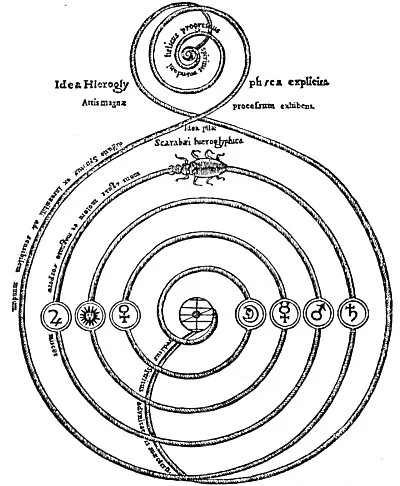
THE KEY TO ALCHEMY ACCORDING TO THE EGYPTIANS.
From Kircher's Œdipus Ægyptiacus.
The priests of Egypt not only used the scarab as a symbol of regeneration but also discovered in its habits many analogies to the secret process whereby base metals could be transmuted into gold. They saw in the egg of the scarab the seed of the metals, and the above figure shows the path of this seed through the various planetary bodies until, finally reaching the center, it is perfected and then returns again to its source. The words in the mall spiral at the top read: "The spiral Progress of the mundane spirit." After the scarab has wound its way around the spiral to the center of the lower part of the figure, it returns to the upper world along the path bearing the words: "Return of the spirit to the center of unity."
Homerus, as Hesiodus took the subject for his Theogony likewise from thence, which Ovidius took afterwards for a pattern for his Metamorphosis. The knowledge of Nature's secret operations constitutes the principal sense of all these ancient writings, but ignorance framed out of it that external or veiled mythology and the lower class of people turned it into idolatry.
"The Genuine Translation from the Original Very Ancient Chaldee is as Follows:
"THE SECRET WORKS OF CHIRAM ONE IN ESSENCE, BUT THREE IN ASPECT.
"(The two first large words mean the Secret Work.)
"(The second line in large letters, reads: Chiram Telat Machasot, i.e. Chiram the Universal Agent, One in Essence but three in aspect.)
'IT IS TRUE, NO LIE, CERTAIN, AND TO BE DEPENDED UPON, THE SUPERIOR AGREES WITH THE INFERIOR, AND THE INFERIOR WITH THE SUPERIOR, TO EFFECT THAT ONE TRULY WONDERFUL WORK. AS ALL THINGS OWE THEIR EXISTENCE TO THE WILL OF THE ONLY ONE, SO ALL THINGS OWE THEIR ORIGIN TO THE ONE ONLY THING, THE MOST HIDDEN, BY THE ARRANGEMENT OF THE ONLY GOD. THE FATHER OF THAT ONE ONLY THING IS THE SUN, ITS MOTHER IS THE MOON, THE WIND CARRIES IT IN ITS BELLY; BUT ITS NOURSE IS A SPIRITUOUS EARTH. THAT ONE ONLY THING (after God) IS THE FATHER OF ALL THINGS IN THE UNIVERSE. ITS POWER IS PERFECT, AFTER IT HAS BEEN UNITED TO A SPIRITUOUS EARTH.
"(Process--First Distillation.) SEPARATE THAT SPIRITUOUS EARTH FROM THE DENSE OR CRUDE BY MEANS OF A GENTLE HEAT, WITH MUCH ATTENTION.
"(Last Digestion.) IN GREAT MEASURE IT ASCENDS FROM THE EARTH UP TO HEAVEN, AND DESCENDS AGAIN, NEWBORN, ON THE EARTH, AND THE SUPERIOR AND THE INFERIOR ARE INCREASED IN POWER. The Azoth ascends from the Earth, from the bottom of the Glass, and redescends in Veins and drops into the Earth and by this continual circulation the Azoth is more and more subtilized, Volatilizes Sol and carries the volatilized Solar atoms along with it and thereby becomes a Solar Azoth, i.e. our third, and genuine Sophic Mercury, and this circulation of the Solar Azoth must continue until it ceases of itself, and the Earth has sucked it all in, when it muse become the black pitchy matter, the Toad [the substances in the alchemical retort and also the lower elements in the body of man], which denotes complete putrefaction or Death of the Compound.
"BY THIS THOU WILT PARTAKE OF THE HONOURS OF THE WHOLE WORLD. Without doubt as the black, pitchy matter will and must of necessity become White and Red, and the Red having been carried to perfection, medicinally and for Metals, is then fully capable to preserve mentem sanam in corpore sano until the natural period of Life and promise us ample means, in infinitum multipliable, to be benevolent and charitable without any diminution of our inexhaustible resources, therefore well may it be called the Glory [Honours] of the Whole World, as truly the study and contemplation of the L. P. [Lapis Philosophorum], harmonising with Divine Truths, elevates the mind to God our Creator and merciful Father, and if He should permit us to possess it practically must eradicate the very principle of Avarice, Envy, and Evil Inclinations, and cause our hearts to melt in gratitude toward Him that has been so kind to us! Therefore the Philosophers say with great Truth, that the L. P. either finds a good man or makes one.
"AND DARKNESS WILL FLY FROM THEE. By invigorating the Organs the Soul makes use of for communicating with exterior objects, the Soul must acquire greater powers not only for conception but also for retention, and therefore if we wish to obtain still more knowledge, the organs and secret springs of physical life being wonderfully strengthened and invigorated, the Soul must acquire new powers for conceiving and retaining, especially if we pray to God for knowledge, and confirm our prayers by faith, all Obscurity must vanish of course. That this has not been the case with all possessors, was their own fault, as they contented themselves merely with the Transmutation of Metals.
"(Use.) THIS IS THE STRENGTH OF ALL POWERS. This is a very strong figure, to indicate that the L. P. positively does possess all the Powers concealed in Nature, not for destruction but for exaltation and regeneration of matter, in the three Departments of Nature.
"WITH THIS THOU WILT BE ABLE TO OVERCOME ALL THINGS, AND TO TRANSMUTE ALL WHAT IS FINE (☉☽) AND WHAT IS COARSE (♃♄ ♀ ♂ ☿
 ). It will conquer every subtil Thing, of course, as it refixes the most subtil Oxygen into its own fiery Nature and that with more power, penetration and virtue, in a tenfold ratio, at every multiplication, and each time in a much shorter period, until its power becomes incalculable, which multiplied power also penetrates [overcomes] every Solid Thing, such as unconquerable Gold and Silver, the otherwise unalterable Mercury, Crystals and Glass Fluxes, to which it is able to give natural hardness and fixity, as Philaletha does attest, and is proved by an artificial Diamond, in my father's time, in possession of Prince Lichtenstein in Vienna, valued at Five Hundred Thousand Ducats, fixed by the Lapis [Philosopher's Stone].
"IN THIS MANNER THE WORLD WAS CREATED; THE ARRANGEMENTS TO FOLLOW THIS ROAD ARE HIDDEN. FOR THIS REASON I AM CALLED CHIRAM TELAT MECHASOT, ONE IN ESSENCE, BUT THREE IN ASPECT. IN THIS TRINITY IS HIDDEN THE WISDOM OF THE WHOLE WORLD (i.e., in Chiram and its Use). It is thought that Hermes was Moses or Zoroaster, otherwise Hermes signifies a Serpent, and the Serpent used to be an Emblem of Knowledge or Wisdom. The Serpent is met with everywhere amongst the Hieroglyphics of the ancient Egyptians, so is the Globe with Wings, the Sun and Moon, Dragons and Griffins, whereby the Egyptians denoted their sublime knowledge of the Lapis Philosophorum, according to Suidas, the hints in the Scriptures, and even De Non where he speaks of the sanctuaries of the ancient Egyptian Temples.
"IT IS ENDED NOW, WHAT I HAVE SAID CONCERNING THE EFFECTS OF THE SUN. FINISH OF THE TABULA SMARAGDINA. What I have said or taught of the Solar Work, is now finished. The perfect Seed, fit for multiplication.
"This I know is acknowledged to be the genuine Tabula Smaragdina Hermetis."
A LETTER FROM THE
BROTHERS OF R. C. (ROSE CROSS)
Although Eugenius Philalethes disclaimed membership in the Rosicrucian Fraternity, it is believed that for a number of years he was the head of that Order. In a little work called Lumen de Lumine, or A New Magical Light Discovered and Communicated to the World, published in London in 1651, Eugenius Philalethes gives a remarkable letter, presumably from the Rosicrucian Order. Accompanying the letter is an emblematic figure setting forth in symbolic form the processes and formulæ of the Philosopher's Stone. This epistle is an excellent example of the Rosicrucian system of combining abstract theological speculations with concrete chemical formulæ. With the aid of the material contained in various parts of this present book the student would do well to set himself the task of solving the riddle contained in this hieroglyph.
"A Letter from the Brothers of R. C. Concerning the Invisible, Magical Mountain, And the Treasure therein Contained.
"Every man naturally desires a superiority, to have treasures of Gold and Silver [intellect and soul], and to seem great in the eyes of the world. God indeed created all things for the use of man, that he might rule over them, and acknowledge therein the singular goodness and omnipotence of God, give Him thanks for His benefits, honor Him and praise Him. But there is no man looks after these things, otherwise than by spending his days idly; they would enjoy them without any previous labor and danger; neither do they look them out of that place where God hath treasured them up, Who expects also that man should seek for them there, and to those that seek will He give them. But there is not any that labors for a possession in that place, and therefore these riches are not found: For the way to this place, and the place itself hath been unknown for a long time, and it is hidden from the greatest part of the world. But notwithstanding it be difficult and laborious to find Out this way and place, yet the place should be sought after.
"But it is not the will of God to conceal anything from those that are His, and therefore in this last age, before the final judgment comes, all these things shall be manifested to those that are worthy: As He Himself (though obscurely, lest it should be manifested to, the unworthy) hath spoken in a certain place: There is nothing covered that shall not be revealed, and hidden that shall not be known. We therefore being moved by the Spirit of God, do declare the will of God to the world, which we have also already performed and published in several languages. But most men either revile, or contemne that, our Manifesto, (the Fama and Confessio Fraternitatis) or else waiving the Spirit of God, they expect the proposals thereof from us, supposing we will straightway teach them how to make gold by Art, or furnish them with ample treasures, whereby they may live pompously in the face of the world, swagger, and make wars, turn usurers, gluttons, and drunkards, live unchastely, and defile their whole life With several other sins, all which things are contrary to the blessed will of God. These men should have learnt from those Ten Virgins (whereof five that were foolish demanded oil for their lamps, from those five that were wise) how that the case is much otherwise.
"It is expedient that every man should labor for this treasure by the assistance of God, and his own particular search and industry. But the perverse intentions of these fellows we understand out of their own writings, by the singular grace and revelation of God. We do stop our ears, and wrap ourselves as it were in clouds, to avoid the bellowings and howlings of those men, who in vain cry out for gold. And hence indeed it comes to pass that they brand us with infinite calumnies and slanders, which notwithstanding we do not resent but God in His good time will judge them for it. But after that we had well known (though unknown to you) and perceived also by your writing how diligently you are to peruse the Holy Scripture, and seek the true knowledge of God: we have also above many thousands, thought you worthy of some answer, and we signify this much to you by the will of God and the admonition of the Holy Ghost.
"There is a mountain situated in the midst of the earth, or center of the world, which is both small and great. It is soft, also above measure hard and stony. It is far off, and near at hand, but by the providence of God, invisible. In it are hidden most ample treasures, which the world is not able to value. This mountain by envy of the devil, who always opposeth the glory of God and the happiness of man, is compassed about with very cruel beasts and other [sic] ravenous birds, which make the way thither both difficult and dangerous; and therefore hitherto, because the time is not yet come, the way thither could not be sought after nor found out. But now at last the way is to be found by those that are worthy, but notwithstanding by every man's self-labor and endeavors.
"To this mountain you shall go in a certain night (when it: comes) most long and most dark, and see that you prepare yourselves by prayer. Insist upon the way that: leads to the mountain, but ask not of any man where the way lies: only follow your Guide, who will offer himself to you, and will meet you in the way but you shall not know him. This Guide will bring you to the mountain at midnight, when all things are silent and dark. It is necessary that you arm yourselves with a resolute heroic courage, lest you fear those things that will happen, and so fall back. You need no sword, nor any other bodily weapons, only call upon God sincerely and heartily.
"When you have discovered the mountain, the first miracle that will appear is this. A most vehement and very great wind, that will shake the mountain and shatter the rocks to pieces. You shall be encountered also by lions and dragons and other terrible beasts, but fear not any of these things. Be resolute and rake heed that you return not, for your Guide who brought you thither will not suffer any evil to befall you. As for the treasure, it is not yet discovered but it is very near. After this wind will come an earthquake, that will overthrow those things which the wind hath left and make all flat. But be sure that you fall not off.
"The earthquake being past, there shall follow afire, that will consume the earthly rubbish, and discover the treasure, but as yet you cannot see it. After all these things and near the daybreak there shall be a great calm, and you shall see the Day-Star arise and the dawning will appear, and you shall perceive a great treasure. The chiefest thing in it, and the most perfect, is a certain exalted tincture, with which the world (if it served God and were worthy of such gifts) might be tinged and turned into most pure gold.
"This tincture being used, as your Guide shall reach you, will make you young when you are old, and you shall perceive no disease in any part of your bodies. By means of this tincture also you shall find pearls of that excellency which cannot be imagined. But do not you arrogate anything to yourselves because of your present power, but be contented with that which your Guide shall communicate to you. Praise God perpetually for this His gift, and have a special care that you use it not for worldly pride, but employ it in such works which are contrary to the world. Use it rightly and enjoy it so, as if you had it not. Live a temperate life, and beware of all sin, otherwise your Guide will forsake you, and you shall be deprived of this happiness. For know this of a truth, whosoever abuseth this tincture and lives not exemplarly, purely, and devoutly before men he shall lose this benefit, and scarce any hope will there be left ever to recover it afterwards."
If, as transcendentalists believe, the initiations into the Fraternity of the Rose Cross were given in the invisible worlds which surround and interpenetrate the visible universe, it is not beyond the range of possibility that this allegory is to be considered in the light of an initiatory ritual as well as an alchemical formula.
As has been noted, it is difficult to secure a complete formula for any of the alchemical operations. The one presented here is the most nearly complete of any available. The collecting of the rays and energies of the celestial bodies as precipitated in dew is a process which Paracelsus used with great success. Bear constantly in mind that these processes are only for those who have been properly instructed in the secret art.
"A TRUE REVELATION OF THE MANUAL OPERATION FOR THE UNIVERSAL MEDICINE COMMONLY CALLED 'THE PHILOSOPHER'S STONE.' By the celebrated philosopher of Leyden, as attested upon his deathbed with his own Blood, Anno Domini 1662. To my Loving Cousin and Son, the True Hermetic Philosopher--
"Dear Loving Cousin and Son:
"Although I had resolved never to give in writing to any person the secret of the Ancient Sages, yet notwithstanding out of peculiar affection and love to you, I have taken it upon me, to which the nearness of our relation obliges me, and especially because this temporal life is short, and Art is very dark and you may therefore not attain the wished for end;--but my Son because so precious a jewel belongs not to swine; and also this so great a gift of God may be treated carefully and Christianlike, in consideration thereof I do so largely declare myself to thee.
"I conjure thee with hand and mouth sacredly;
"1st. That most especially thou faithfully keep the same from all wicked, lustful and criminal persons.
"2dly. That thou exalt not thyself in any way.
"3dly. That thou seek to advance the honor of thy Creator of all things and the good of thy neighbor, preserve it sacredly that thy Lord may not have cause to complain of thee at the last day. I have written here in this treatise such a part of the Kingdom of Heaven, just as I myself have worked this treasure and finished it with my fingers, therefore I have subscribed all this work with my blood, lying on my deathbed in Leyden.
"THE PROCESS--In the Name of God, take of the purest and cleanest salt, sea salt, so as it is made by the sun itself, such as is brought by shipping from Spain, (I used salt that came from St. Uber) let it be dried in a warm stove, grind it in a stone mortar, as fine as possible to a powder that it may be so much the easier dissolve and taken up by our Dew-water, which is thus to be had in the months of May or June: When the Moon is at the full, observe when the dew falls with an East or South East wind. Then you must have sticks about one and a half feet high above the ground when driven in the Earth. Upon two or three such sticks, lay some four square plates of glass, and as the dew falls it easily fastens on the glass like a vapour, then have glass Vessels in readiness, let the dew drain from the sides of the glasses into your vessels. Do this until you have enough. The full of the Moon is a good season, afterwards it will be hard."
The solar rays descending from the sun carry with them solar sulphur--the Divine Fire. These rays are crystallized by contact with
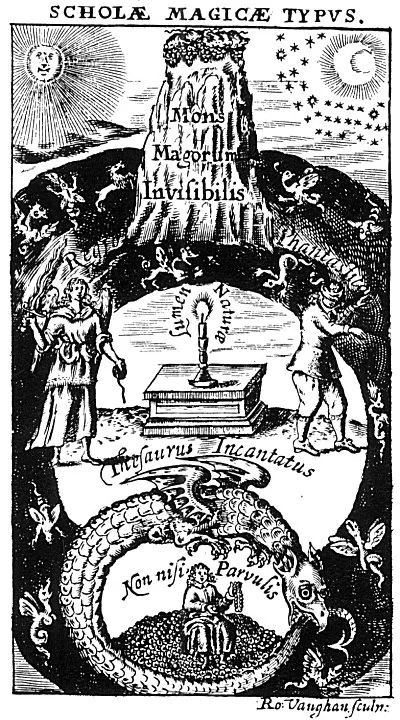
THE INVISIBLE MAGICAL MOUNTAIN.
From Phililethales' Lumen de Lumine.
On Page 24 of Lumen de Lumine, Eugenius Philalethes describes the magical mountain as follows:
"This is that emblematical magical type, which Thalia delivered to me in the invisible Guiana. The first and superior Part of it represents the Mountains of the Moon. The philosophers commonly call them the Mountains of India, on whose tops grows their secret and famous Lunaria. It is an Herb easy to be found, but [for the fact] that men are blind discovers itself and shines after night like pearl. The earth of these mountains is very red and soft beyond all expression. It is full of crystalline rocks, which the philosophers call their glass and their stone: birds and fish (say they) bring it to them. Of these mountains speaks Hali the Arabian, a most excellent judicious author: 'Go, my son, to the Mountains of India, and to their quarries or caverns, and take thence our precious stones which dissolve or melt in water, when they are mingled therewith. Much indeed might be spoken of these mountains, if it were lawful to publish their mysteries, but one thing I shall not forbear to tell you. They are very dangerous places after night, for they are haunted with fires and other strange apparitions, (as a I am told by the Magi) by certain spirits, which dabble lasciviously with the sperm of the world and imprint their imaginations in, producing many times fantastic and monstrous generations. The access and pilgrimage to this place, with the difficulties which attend them, are faithfully and magisterially described by the Brothers of R.C." (Set accompanying letter.)
the lunar rays. The solar rays are also met by the emanations pouring upward from the earth's surface and are thus still further crystallized into a partly tangible substance, which is soluble in pure water. This substance is the "Magical Mountain of the Moon" referred to in the R. C. letter. The crystallization of the solar and lunar rays in water (dew) produces the virgin earth--a pure, invisible substance, uncontaminated by material matter. When the virgin earth crystals are wet, they appear green; when dry, white.
Von Welling makes a suggestion for the extraction of the solar life from stagnant water, but is reticent both as to naming the essence extracted and also as to the various processes through which it must pass to be refined and increased in power. His hint, however, is both valuable and unusual:
"Take sweet clean water and seal it in a large bottle, leaving about one-fourth empty. Place the bottle in the sun for some weeks until it rots, showing a precipitation in the bottom. This precipitation, when properly manipulated by distillation, will produce a clear, fiery, burning oil, the constituents and use of which are only known to the wise."
The philosopher of Leyden continues: "Now when you have enough of your dew close your glasses exactly, and keep it till you use it, that none of its spirits may evaporate, which may easily happen. Set it therefore in a cool place, that no warmth may come to it, or else the subtle spirit will rise and be gone; which will not so happen if after you have filled your glasses with Dew quite full, you close them very well with wax.
"Now in the Name of God, take of this Dew-water as much as thou wilt, put in a clean dissolving glass, then cast a little of your forementioned powdered salt into it to be dissolved, and continue to put it in till your Dew-water will dissolve no more or till the salt lies in it four days without being dissolved, then it has enough, and unto your Dew is given its proper powder. Of this compounded water, take as much as thou wilt, I took about a pound and a half, and put it into a round vial with a short neck, fill it with out water and lute it with a good lute, a cover and stopple that fits it well, that the subtle and living spirit of the dew may not fume away, for if they should the soul of the salt will never be stirred up, nor the work ever brought to a right end. Let the lute dry very well of itself, and set it in the furnace of B. M. to putrefy. Make a slow fire and let it digest for forty days or fifty, and that the fume of the water be continually round about it, and you will see your matter grow black, which is a token of its putrefaction.
"As soon as you have taken it out, have your dry furnace ready. Set your glass with the matter into an inner globe to coagulate, give it a slow degree of fire, continue it equally for twelve or fifteen days, and your matter will begin to coagulate and to fasten round about your glass like a gray salt, which as soon as you see and before it be two days, slacken the fire that it may cool leisurely. Then have in readiness your putrefying furnace as before. Set your glass therein and give the same degree of fire as before. Let it stand twelve days, and again you will see the matter resolve and open as before, and open itself, but you must every time see that the lute and your glass is not hurt. When you set your glass in the putrefying furnace, take care that the neck of your glass is covered with a wooden or glass stopper that fits it exactly, that the moisture of the water may not come at it.
"When you see it black set your glass as before to coagulate and when it begins to be of a grayish color and whitish, set it in a third time to putrefy, and coagulate to the fifth time, until you see that your water in its dissolution is clean, pellucid and clear, and that it appears in its Calcination of a fine white like Snow. Then it is prepared and becomes a Salt fixed which will melt on hot Silver plate like wax; but before you set this your Salt out, set it again [in] the furnace of putrefaction that it may dissolve of itself, then let it cool, open your Glass and you will find your Matter lessened a third part. But instead of your former Salt Water you will have a fine Sweet and very penetrating Water which the Philosophers have hid under very wonderful Names--It is the Mercury of all true Philosophers, the Water out of which comes Gold and Silver, for they say its Father is Gold and its Mother is Silver. Thus hast thou the strength of both these Luminaries conjoined in this Water, most true, in its right Pondus.
"Prescription. 5 Drops of this Water taken inwardly strengthens the understanding and memory, and opens to us most wonderful and sweet things, of which no man hath heard, and of which I dare not further write, because of the Oath I made God to the contrary. Time and the holy use of this blessed Water will teach us, as soon as you have taken it inwardly such influence will happen to thee as if the whole heavens and all the stars with their powers are working in thee. All Knowledge and secret Arts will be opened to thee as in a dream, but the most excellent of all is, you will perfectly learn rightly to know all creatures in their Nature, and by means thereof, the true understanding of God, the Creator of us, Heaven and Earth, like David and Moses and all the Saints of God, for the wisdom of our fountain of living Water will instruct thee as it did Solomon and the Brethren of our fraternity."
In his rare treatise on Salt, Sulphur and Mercury, von Welling discloses a secret: not generally revealed in alchemical writings, namely, that the alchemists were concerned not only with the transmutation of metals but had a complete cosmological and philosophical system based upon the Qabbalah.
According to von Welling, the universal salt (in watery form) is a positive cure for all the physical ailments of mankind; it is in every living thing, but from some things it is more easily secured than from others: especially is this true of virgin earth; it is the universal solvent, the alkahest. The same writer also states that in the first stages of its preparation this salt will cure any and all diseases of the heart. The anonymous philosopher of Leyden continues:
"Would you now proceed further with our blessed Water to the forementioned intention of preparing a Tincture for Metals, hearken my Son--
"Take in the NAME of the Lord, of thy Paradisiacal Water, of heavenly Water of Mercury, as much as thou wilt, put it into a glass to dissolve, and set it in a slow heat of Ashes, that it may just feel the warmth, then have ready well purified Gold for the Red, or Silver for the White Elixir, for in both the Processes are the same. Let your Gold or Silver be beaten as thin as leaf Gold, cast it by degrees into your dissolving Glass, that contains your blessed Water, as you did in the beginning with your Salt, and it will melt like Ice in Warm Water, and continue so to do till your Gold or Silver lie therein four days without dissolving, then it has received its due Pondus. Then put this dissolution as before into a round Glass, fill it two thirds parts full, seal it hermetically as before, let your Sigillum be well dried. Set it in the furnace of Balneum Vapori, make a fire and let it remain forty days, as before, then will the Gold or Silver be dissolved radically and will turn of the deepest black in the world, which as soon as you see, have your other drying furnace in readiness."
Continuing: "Philosophers say there is no true solution of the body without a proceeding coagulation of the spirit, for they are interchangeably mixed in a due proportion, whereby the bodily essence becomes of a spiritual penetrating nature. On the other hand, the incomprehensible spiritual essential virtue is also made corporeal by the fire, because there is made between them so near a relation or friendship, like as the heavens operate to the very Depth of Earth, and producing from thence all the treasures and riches of the whole World.
"Admirandum Naturæ Operationem in Archidoxes Cognitam.
"With this Powder--You may as follows project on metals. Take five parts of fine Gold or Silver according as you work, and melt it in a Crucible. Wrap up your Medicine in Wax, cast it therein, give a strong fire for an hour, then take the Crucible out, as it were, calcined, then cast one part on ten parts of imperfect metals, be it what it will, and the same will be immediately changed into purer Metal, than what is brought out of the Mines and produced by Melting; and when you augment it in strength and virtue by resolving and coagulating, the fifth time it will resolve itself in three days and be coagulated in twenty-four hours time, to an incredible and most highly pellucid Stone or Red Shining burning Coal. For the white work it will become like a white stream of Lightning.
"Of this last coagulation take one part, cast it upon five thousand of melted Gold or Silver as before. It changes the same into perfect Medicine, one part whereof will tinge one hundred thousand parts of melted imperfect Metals into the very finest Gold or Silver. So far I have brought and further I would not come, for as I would set in the matter [to distill] six times in twelve hours, it subtilized so highly that the most part (like somewhat most wonderful to behold) past through the Glass causing an inexpressible odoriferous Smell. Take heed that it happens not to you.
"Many more wonders of this holy Art might be added, namely how to prepare therewith all sorts of precious Stones, and other most admirable things, but it would require too great a book to express the whole as it ought to be, especially as the Art is endless and not to be apprehended with one view, and my purpose has been, Loving Cousin and Son, devoutly to lead thee into the Mysteries of Nature and this holy Science, and I have faithfully performed it."
In conclusion, the letter states: "Go thou to work as I have done before thee, fear God, Love thy neighbour from the bottom of thy Soul sincerely. So will in the Manual operation, everything to thee, and when thou art at work therein many of our brethren will reveal themselves to thee, of our holy order, privately; For I have on my part by the Eternal God wrote the truth which I found out by prayer and searching into Nature, which work I have seen with my eyes, and with my hands extracted. Therefore also I have subscribed this Testament with my own blood, the last day of my Life on my deathbed. Actum Leyden, 27 March 1662."
p. A1
THE HERMETIC AND ALCHEMICAL FIGURES OF CLAUDIUS DE DOMINICO CELENTANO VALLIS NOVI FROM A MANUSCRIPT WRITTEN AND ILLUMINATED AT NAPLES A.D. 1606
No better way can be found of introducing to the "Royal Art" a seeker after the mysteries of symbolical philosophy than to place at his disposal an actual example of alchemical writing. The text of this manuscript is as enigmatic as are its diagrams; but to him who will meditate upon the profound significance of both, the deeper issues of mysticism in due time will be made clear. An unknown person through whose hands this manuscript passed wrote thus of it:
"Because of its drawings and illustrated expositions, the manuscript is of preeminent importance to the Rosicrucians and the contemporary order of Freemasons. The first, and larger, part of the illustrations deals with the Hermetic philosophy, explaining its teachings and doctrines. Interspersed among these are portraits of great teachers and satirical representations of bunglers and their mistaken views. The systematically arranged part shows with wonderful clearness the color development of the alchemical processes from blue-gold over black to white and rose. Throughout it treats of the change in human beings and not of the making of gold. Ever upon the Grade of Black (the return into Chaos from which new creations are possible) follows the Grade of the Neophytes, the New Birth, which is often repeated with impressive lucidity. The black stage occurs as usual through fire. This unopened and unpublished manuscript belongs to the order of the most important Precepts and Documents of the Rosicrucians, and Freemasons. A search through the museums and library collections of Germany has failed to reveal any item of even a similar character."
In addition to the 26 leaves here reproduced there are ten bottles or retorts, each half filled with varicolored substances. These bottles can be so easily described that it is unnecessary to reproduce them. The first bottle (from the mouth of which issues a golden shrub with three blossoms) contains a bluish-gray liquid, the entire figure being called "Our Quicksilver." Under the vessel is a verse containing the significant words: "He will have white garments for black and then red." The second bottle (from the neck of which rise four golden flowers) also contains the bluish-gray substance termed quicksilver. Below the bottle is the admonition to "make spirit of the body and grace of the gross, that the corporeal may become incorporeal."
The third bottle is entirely black save for a golden tree trunk having six lopped-off branches and terminating in five branches which end in knobs and protrude from the neck of the bottle. The state of the substance is termed "Blackness showing through the Head of the Raven." Under the bottle occurs the statement that "the tincture of the Philosophers is hidden in the air like the soul in the human body." The fourth bottle is of the deepest blackness and is called "The Head of the Raven." Nothing rises from the neck of the vessel, for the earth (its contents) is described as "submerged in Chaos." The bottom of the fifth bottle contains a bluish-gray, spotted liquid, the upper part being filled with a brick-colored substance. Above are the words: "Sixth Raven's Head"; below is added: "At the bottom of the vessel worms are born."
The lower half of the sixth bottle is of a bluish-gray, the u per half black, the entire figure being termed "Seventh Raven's Head." A child is seated beside the bottle, concerning whom it is written: "This newly-born, black son is called Elixir and will be made perfectly white." The seventh bottle is black below and black spotted with red above. The process is thus described: "Black blacker than black, for many divers colors will appear. Those black clouds will [descend] to the body whence they came, and the junction of body, soul, and spirit has been completed and turned to ashes."
The eighth bottle is divided horizontally by a golden band, from which rises a golden stem ending in five leaves protruding from the neck of the bottle. The contents of the vessel are transparent, and it is written that "the black clouds are past and the great whiteness has been completed." The ninth bottle (from the neck of which rises a golden white rose) is also partly filled with a transparent liquid. The rose is made to say: "He who blanches me makes me red." The tenth and last bottle represents the consummation of the Great Work. The lower half of the vessel is filled with the blood-red Elixir and from the neck rises a red rose with many petals and of extreme beauty. After declaring all the planets to have been present at the consummation of the Great Work, the author of the document concludes: "I gave to the Master [spirit] so much silver and gold that be can never be poor."
In his dedication the author and illustrator of the manuscript declares that he has set forth all the operations of the Great Work. He prays to the Holy Spirit that he may be included in the number of those who have pursued this most noble of the sciences and that he may be set always in the path of righteousness. Exclusive of his own researches, the main sources of his information are said to be the writings of St. Thomas Aquinas, Raymond Lully, and Arnold of Villa Nova.
To protect themselves from the persecution of despotic theology the mediæval alchemists couched their philosophy in Christian terminology, although the great secrets of the Art were derived largely from Egyptian or Arabian adepts. The Mohammedans were masters of the Hermetic secrets and even the great Paracelsus secured from them the major part of his knowledge. In their manifestoes the Rosicrucians also disclose the Arabian source of their secret doctrine. Hence it should be borne in mind that the relating of the alchemical teachings to Biblical symbolism was a gesture of expediency. In their search of the Scriptures for the arcana of Israel, the Qabbalists substantiated in great measure the alchemical interpretations of the Bible, for the soul of alchemy is one with that of Qabbalism. Both schools have a common end, being who concerned with the mystery of human regeneration, despite apparent discrepancies in their symbolism.
The publication of this manuscript places at the student's disposal the most profound secrets of the Hermetic Art. At first the task of decipherment may seem hopeless and the superficially-minded will be tempted to scoff at the possibility of real knowledge being perpetuated in such unconventional fashion. The scoffer will not realize that one of the purposes of the document is to awaken ridicule and thus preserve more effectually its arcana from the profane. A few sheets (such as those here reproduced) represent the life work of one who has consecrated himself to the task of tearing aside the veil of the World Virgin. Years of research and experimentation, days of incessant labor, nights of prayer and meditation, and at last comes the realization of accomplishment! This is the real story told by the grotesque figures drawn so painstakingly upon the faded, worm-eaten pages. Those who have glimpsed the greater realities of being realize that the fundamental verities of life find at best only imperfect expression through physical symbols. Only those who have passed through the travail of spiritual birth can adequately comprehend and properly reverence the pathetic efforts to portray for others that knowledge necessarily locked within the heart of the one who knows.
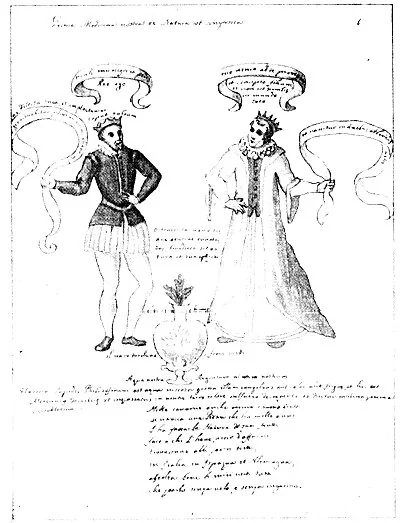
Leaf 1. The top line reads: "Our earliest medicine was made of natural objects." About the king and queen appears the statement that to them a son shall be born "in two trees of the vine," resembling his father and without equal in all the world. About the vase is written: "Green and white." "The vase flame color, the flowers green." "Our water, our silver." The lines below read: "The material of the Philosopher's Stone is that thick, viscous water, which either heat or cold congeals. It is Mercury boiled down and thickened, cooked in neutral earth with sulphurous heat and is called the Prime Material of the metals. In caverns yet dark, and forbidding mountains, if a Stone be found which a thousand years ago Nature made out of her fruits, it will bring him that has it out of trouble. * * * Listen carefully to all my verses; I speak them without veil and without deception.
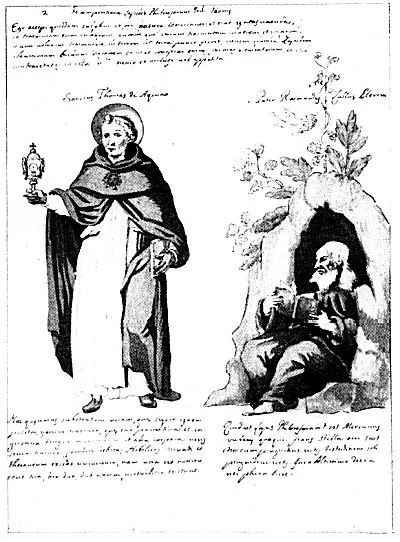
Leaf 2. At the top is a quotation from St. Thomas Aquinas concerning the composition of the Philosopher's Stone, which is described as of the purest transparency; in it all the forms of the elements and their contrarieties were visible. Beneath the figure of St. Thomas Aquinas is a short paragraph praising the excellence of the Philosophic Stone, declaring that from the one substance can be derived three and from the three, two. To the right of St. Thomas Aquinas is a likeness of Raymond Lully seated in the door of his hermitage. Under his feet appears a quotation from this celebrated alchemist, beginning with the question, "What is the Philosopher's Stone?" After declaring it to be a reddish, fixed mercury, Lully swears to the Almighty that he has told the truth and that it is not permissible to say more. (The original manuscript is mutilated at this point.)
p. A2
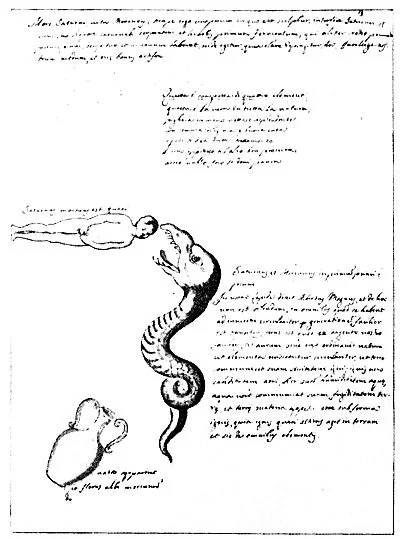
Leaf 3. The writing at the top of the page reads: "Death of Saturn; life of Mercury." After describing the use of the saturnine substances, the key to the process is declared to be depicted below. The verse reads "This [the stone] is made of four elements. This is the truth in all Nature. Take it in hand, bright and shining, with all diligence and great care and then try to bind all securely together side by side, so the fire may cause alarm." Above the human figure is written: "Saturn is almost dead." To the right if the devouring serpent is a statement of Albertus Magnus that Saturn and Mercury are the first principles of the Stone. It also declares that Nature wisely provided a mixture of elements so that earth can communicate its dryness to fire, fire its heat to air, air its moisture to water, and water its coldness to earth. (Text about the vase is illegible in original.)
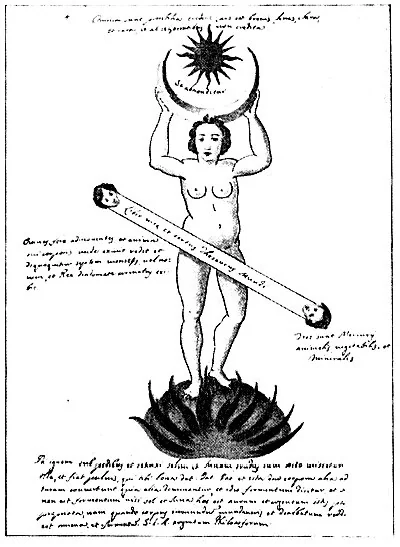
Leaf 4. At the top: "Let them believe that . everything is possible. The art is fleeting, bright and rare, and not believed by the foolish." The words between the sun and crescent read "It is hidden," and on the panel across the body "The Book of life and true Treasury of the World." The panel to the left of the figure says "Moving almost all, and the soul of its body returns to the place from which it had fled, and ripens seven months or nine, and the King crowned with his diadem appears." The right panel states: "There are three Mercuries: animal, vegetable, and mineral." The text below is of such a cryptic nature that to translate it is well nigh impossible. It declares that by putting fire beneath the feet of the symbolic figure it is possible to extract therefrom the sun and the moon which the human body is shown elevating to a position of dignity above its head.
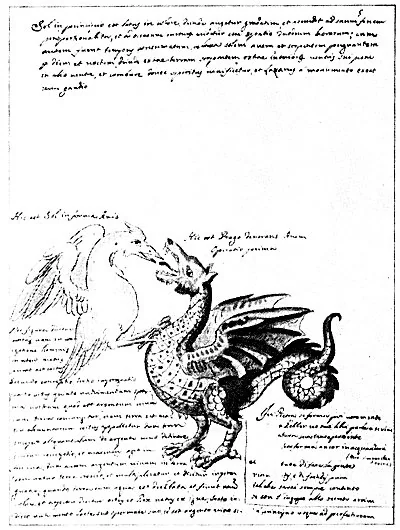
Leaf 5. In the upper panel it is declared that the sun-bird battles with the earth-serpent, who, tearing out his own entrails, gives them to the bird. The spirit is vivified and Lazarus with joy is raised from the dead. Above the bird is written: "This is the sun in the form of a bird," and above the dragon "This is the dragon devouring the bird. The first operation." The panel of text at the lower left reads in substance: "When our sperm (quicksilver) is mixed with the mother of elements (earth), the action is called coitus. The detention by the earth of a bit of quicksilver is called conception. The earth grows and multiplies and the operation is called impregnation. When earth is whitened with water and made of uniform color and appearance, it is called birth and the King is born out of fire." The text at lower right was deliberately mutilated to conceal a too evident secret.
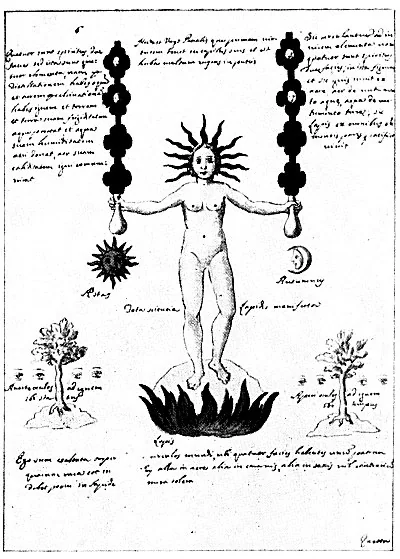
Leaf 6. This plate shows all the secrets of the great Stone. In the center stands the Paschal Virgin, in her hair the prime virtue which is described as an herb flourishing in wells. The hands hold the symbols of the spiritual and material elements. The statement at the upper left is to the effect that there are four spirits with two faces, which are called the elements. At the upper right it is written that fire lives on air, air on water, water on earth, and thus the Stone lives Peacefully on all the pure elements. Under the sun appears the word Summer; under the moon, Autumn. About the tree on the left with its attendant eyes are the words: "Turn away your eyes to [from?] the fire. There is space [?]." About the tree to the right. "Open your eyes to the fire. There is time." The lower panel opens with this sentence "I am exalted above the circles of world."
p. A3
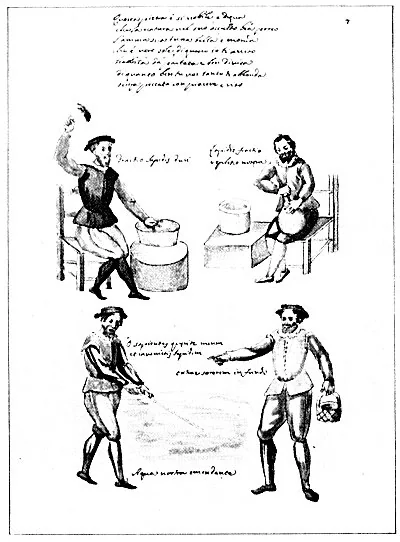
Leaf 7. The verse at the top reads:," This Stone is so noble and worthy that Nature has hidden it in her recesses. Its soul is all fair, and pure, for it is the true sun. I inform you of this. Keep it removed, apart and separated. Whatever boon you crave, it will come to you bounteously. without sin, with pleasure and delight." The seated figure on the left holding aloft the hammer is described as breaking hard stone, while the words beside the man with the retort read: "Breaking of stone our replenishment." Between the standing figures below is the exclamation; "O Sages, seek and ye shall find my Stone!" Under the outstretched hand of the man with a basket appear the words: "Draw out sorerem [?] in the bottom." Below the pool which the man on the left is stirring appears the simple statement: "Our healing water." The faces of the four men are extremely well drawn.
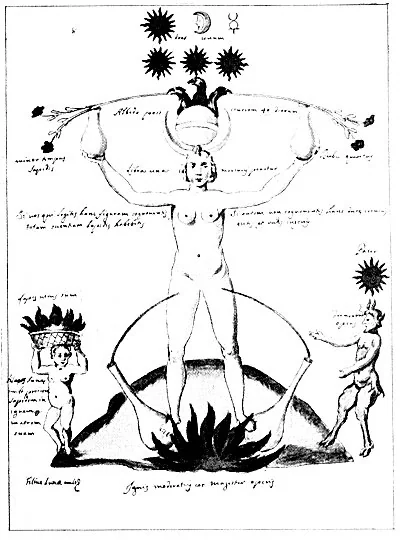
Leaf 8. Under the sun, moon, and Mercury are the words Three and One, an inference that the three are one. The words under the flower stems read: "Whiteness forty days after ashes." Under the blossoms is written: (left) "Minor time of the Stone"; (right) "The selected red." Between the arms of the central figure appears: "Let one pound of Mercury be placed." To the left is written: "If you who read shall have known this figure, you will possess the whole science of the Stone"; to the right: "And if you do not acknowledge it, you will be stiff-necked and dull." Above the sun is the word Father; above the satyr, "Ferment of the work." Beside the child is the sentence: "The son of the moon would threw the Stone into the fire--his mother." Above the flaming basket is written: "I am the true Stone." Under the central figure are the words: "A moderate fire is the master of the work."
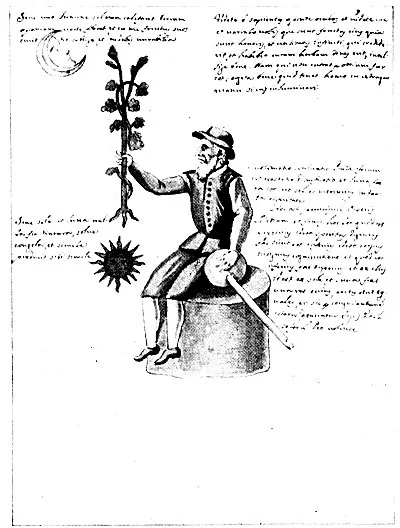
Leaf 9. In the upper left it is written that without the light of the Moon the Sun does not heat the earth and that into the Moon the Sun emits its fruits. In the upper right the true herb of the philosophers is described, and it is declared that whoever believes in and it shall be [spiritually] rich. The panel concludes thus: "Understand thoroughly what it is that the man has in either hand if you wish to be enlightened." The text to the left above the sun reads: "Entirely without the Sun and Moon, make dye; dissolve, congeal, and like produces for itself like." The words to the right of the man holding the Philosopher's herb declare sublimation to be the beginning, the middle and the end of the Great Work. The last sentence reads: "Out of the Sun and Moon make a thing of equal parts, and by their union, God willing, let the Philosopher's Stone be made."
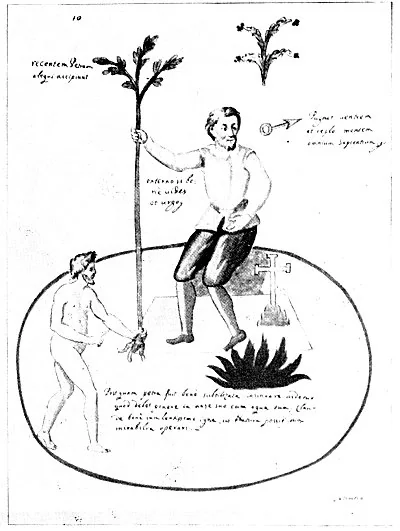
Leaf 10. The two short lines of text at upper left read: "Some take a recent stone." The lines to the right of the symbol of Mars (iron) admonish the student to control his appetites and apply his mind to the accumulation of knowledge. No satisfactory translation can be found for the words under the outstretched arm of the man holding the upper part of the tree. The lower panel reads thus: "After the Stone has been well refined it will appear to penetrate thoroughly. It should be put into its vessel with its water. Close it well with a little fire, and await the wonders of Nature." The large red oval filling the lower half of the leaf is evidently the egg or vessel of the Sages. The tree is a symbol of the growth of the sacred metals, for the alchemists affirmed that the metals are like plants and grow in the rocks, spreading their branches (veins) through the interstices.
p. A4
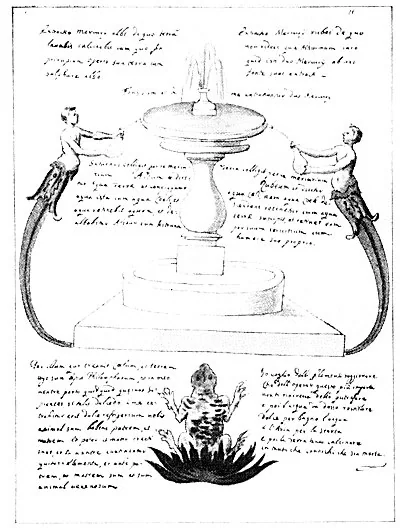
Leaf 11. The fount is described as that from which the two Mercuries of the Philosophers are extracted. At the upper left is described the white Mercury and at the right the red Mercury. The text about the fountain declares that Saturn collects the white Mercury, which is called the Water of Earth; and the Earth collects the red Mercury, which is called the Water of Heaven. The text to the left of the frog reads: "Through Him who created the Heavens and the Earth I am the Philosopher's Stone, and in my body I carry something the wise seek. If such a charm be extracted from me, it will be a sweet refreshment for you. I am an animal having father and mother, and father and mother were created; and in my body are contained the four elements, and I am before father and mother and I am a poisonous animal." The lines at the right describe distilling and calcining processes.
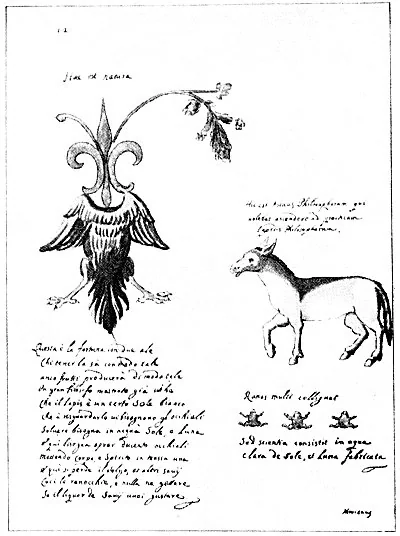
Leaf 12. The three words at the top read: "This is Nature." The lines above the donkey read: "This is the Philosophers' donkey who wished to rise to the practice of the Philosopher's Some." The three lines below the animal are translated: "Frogs gather in multitudes but science consists of clear water made from the Sun and Moon." The text under the symbolic bird is as follows: "This is fortune with two wings. Whosoever has it knows that fruit will in such away be produced. A great philosopher has shown that the stone is a certain white sun, to see which needs a telescope. To dissolve it in water requires the Sun and Moon, and here one must open 200 telescopes, putting body and soul in one mass. And here is lost the mass; other sages cook the frogs and add nothing, if the juice of the Wise you wish to enjoy." To the Greeks the frog symbolized both metempsychosis and earthly humidity.
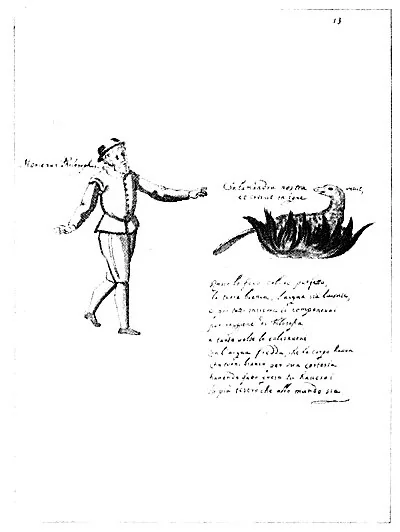
Leaf 13. This Page contains but two figures. At the left stands Morienus, the philosopher, pointing towards the salamander who "lives and grows in fire." Morienus, who was born in the twelfth century, became the disciple of the great Arabian alchemist Adfar, from whom he learned the Hermetic arts. Morienus prepared the Philosophical Elixir for the Sultan of Egypt, inscribing upon the vase in which he placed the precious substance the words: "He who possesses all has no need of others." He spent many years as a hermit near Jerusalem. The lines below the salamander are: "Let the fire be of a perfect red color; the earth white, the water clear. Then compound them by philosophical means and calcine them as many times with the water which the body had as to turn it white by its kindness. Having done this, you will have the greatest treasure in the world."
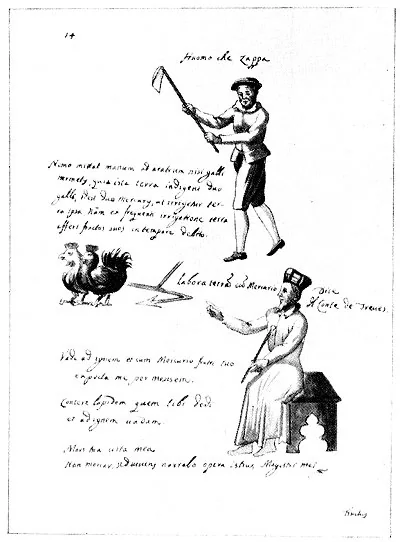
Leaf 14. The three words at the top of the left page are translated: "The man that digs." Above the birds it is declared that none but the cocks of Hermes, the two Mercuries, shall put hand to the plow, and only after irrigation will the earth bring forth her fruits. The seated man is Count Bernard of Treviso, who says: "Work the earth with Mercury." (See chapter on Alchemy and Its Exponents.) The three sentences to the Count's left read: "Go to the fire and with Mercury, thy brother, await me for a month. Crumble the stone I gave thee and I shall go to the fire. Thy death, my life. I shall net die but, living, tell of the works of this, my master." Bernard of Treviso in his alchemical speculation emphasized the necessity of meditation upon the philosophical writings of the great adepts rather than chemical experimentation. He ultimately discovered the "Stone."
p. A5
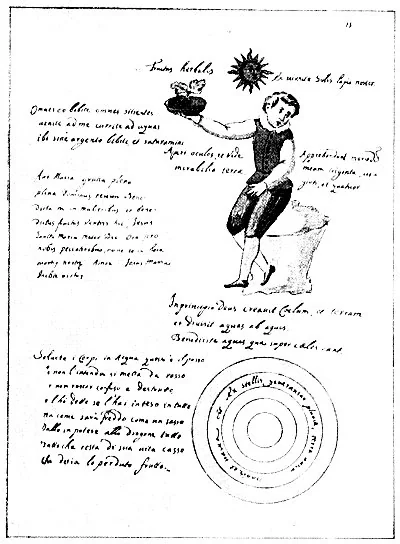
Leaf 15. The first sentence reads: "The fruit of plants by virtue of the Sun, our Stone." The boy holding the dish is made to say: "Drink here all ye that are athirst. Come unto me, run to the waters. Here drink, without price, and drink your fill. Open your eyes and see the wonders of the earth. They learn, my thirsty twenty and four." Beneath the boy are the words: "In the beginning God created the Heavens and the Earth, and divided the waters from the waters. Bless the waters which are above the Heavens." The circle contains this statement: "The earth without form and void. Out of the stars come the rains." The lower left panel continues the alchemical process, ending with admonition to renounce the misery of worldly existence. Above is a prayer to the Virgin Mary which opens thus: "Hail Mary, full of grace, the Lord be with thee. Blessed thou among women."
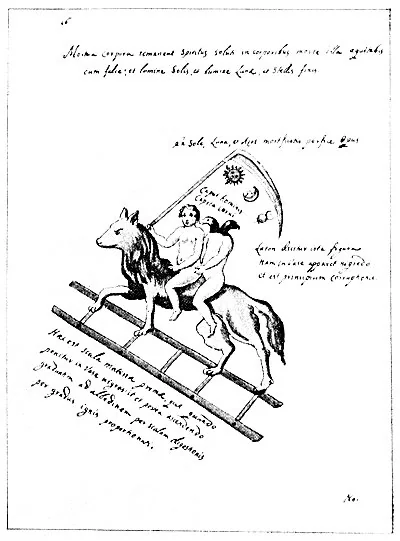
Leaf 16. The first sentence reads: "The dead bodies remain; the spirits are freed by the death in the bodies. You will ride with that death with a scythe, and the light of the Sun, the Moon, and the fixed stars." Over the scythe is written: "Subject to the Sun, the Moon and Azoth, complete the Work." The four words in the curve of the scythe blade say: "Man's head, head of raven." The three lines to the right are interpreted thus: "This figure is called Laton, for it looks black in a vessel, and is the beginning of corruption." The text below the ladder states: "This is the ladder of primitive matter which when placed in a vessel turns black, the gradually changes to white by the scale [ladder] of digestion, according to the degree of heat." Here a ladder is used to signify the natural steps up which matter must ascend before it can attain to a truly spiritual state.
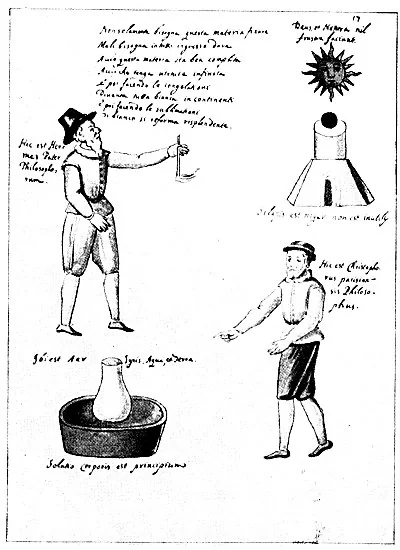
Leaf 17. The verse at the top of the page reads: "Not only must this material be fixed, but it must be allowed to enter into everything so that this material may be well completed and have infinite virtue. Then by making it thick, it becomes at once all white, sublimation from white it becomes shining." Above the sun are the words: "God and Nature do nothing in vain." The man on the left is a mediæval conception of Hermes, the great Egyptian philosopher; the one on the right is Christopher, the philosopher of Paris. Above the latter is written: "If the Stone is black, it is not useless." The words over the retort are: "There is air, fire, water, and earth." Below is added: "A dissolution of the body is the first step. " The curious chemical apparatus must be considered purely symbolic in this work and, as its author himself says, is intended to give only a hint of the "Art."
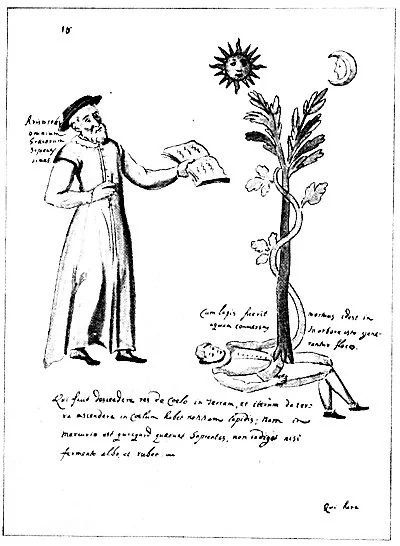
Leaf 18. At the left holding a book stands Aristotle, who is described as the most learned of all the Greeks. The tree surmounted by the Sun and Mon. is accompanied by the wards: "When the Stone is dead, that is changed to water, in this it will produce flowers." Beneath Aristotle and the prostrate human figure from which rises the flowering tree are these statements: "He who makes everything descend from heaven to earth, and then ascend from earth to heaven, has information about the Stone. For in Mercury there is something the wise seek, not invoked except by white or red ferment." The first part of this quotation is based upon the Emerald Tablet of Hermes (which see). In ordinary man, the spirit is figuratively absorbed by the body; but in the true philosopher, the spirit is so greatly increased in power that it absorbs into itself and is nourished by man's corporeal body.
p. A6
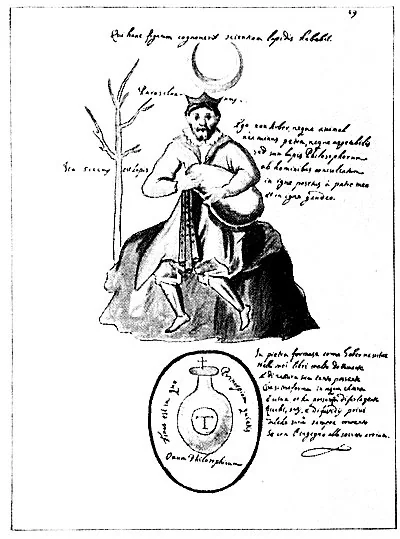
Leaf 19. At the top it reads: "He that comes to know this figure will have knowledge of the Stone." The seated man probably represents Paracelsus. To his right are the words: "I am neither tree nor animal, nor stone nor vegetable, but the Philosopher's Stone, trampled on by men, cast into the fire by my father, and in fire I rejoice." The four words to the left say "In dryness is the Stone." Below the man is the Philosophic Egg containing the words: "It is the end in which the beginning rests." The capital T stands for "Tincture." The text to the right states: "In Stone it is formed, as Gerber writes in his book very learnedly, and possessing so much of its nature that it changes into clear, living water; and it has the power to make folks rich, satisfied, and free from all cares, so they will be always happy if they attain by their wit to the secret."
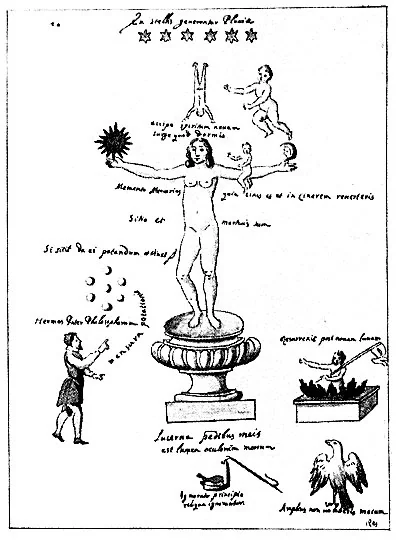
Leaf 20. At the top is written: "Rains are made by six stars." Under the inverted man it reads: "Receive new spirit. Arise, for you are asleep." The two sentences about the large figure read: "Remember Mercury, for ashes thou art and unto ashes thou shalt return. I thirst and am dead." Above the seven globes at the left is the admonition: "If he thirst, give him a drink and he shall live." Over the small man is written: "Hermes, the father of philosophers." The curved line of writing to which Hermes points says: "The measure of the drink." Under the central pedestal appears: "The light of my eyes is a lantern to my feet." Below is added: "If the beginning is unknown, the rest is unknown." Above the figure rising from the flames on the right is the statement: "He was resurrected after new Moon," and under the eagle: "Thou shalt not fly further with me."
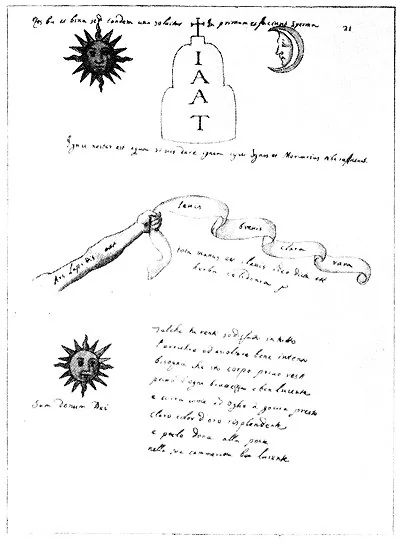
Leaf 21. The upper line reads: "Two things and double, but finally one is dissolved into the first and they make sperm." The four capitals. I A A T, are the initial letters of the names of the elements: Ignis, Aer, Aqua, and Terra. The writing under them reads: "Our fire is water; if you can give fire to fire, fire and Mercury will suffice." Along the arm appear the words: "The Art of the Stone is," and on the ribbon: "Swift, brief, bright, and rare." The two lines under the ribbon read: "Every hand is a key, because it was called the herb celandine"; under the Sun: "I am the gift of God " The verse reads: "So that you remain contented in all matters, I must listen attentively. My body [is] naked, clean, and shining, and I run like oil ready to drop, resplendent like bright gold, and then succumb to the plague in its bright and cheerful little chamber [retort]."
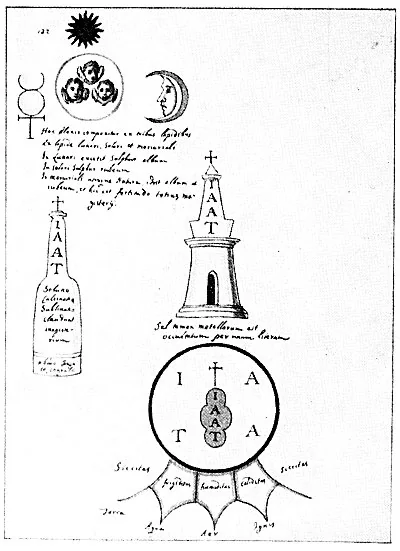
Leaf 22. The verse in the upper left is as follows: "This group is composed of three stones: lunar, solar, and mercurial. In the lunar is white sulphur; in the solar, red sulphur, in the mercurial, both; i.e. white and red, and this is the strength of all instruction." In the bottle at the left are the words: "Dissolving, calcination, sublimation complete the instruction"; and at the base: "Wash, congeal, and coagulate. " Under the central tower is written: "Metallic salts, however, are hidden by one letter"; around the bottom of the red circle: "Dryness, coldness, humidity, heat, and dryness." On the points below are the names of the four elements. The initial, I A A T appear four times with the same meaning as that already given. The three powers of the Philosopher's Stone are symbolized by the heads of the cherubs in the circle in the upper left corner.
p. A7
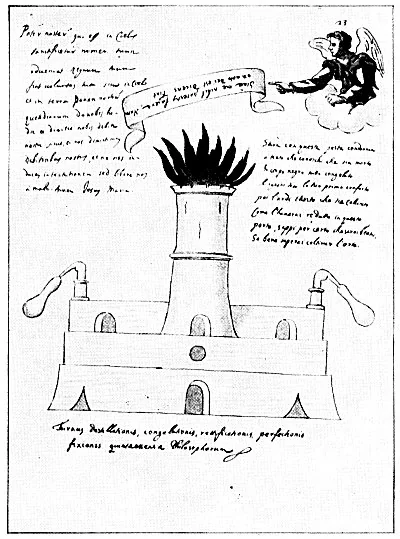
Leaf 23. The writing at the upper left is, in substance, the Lord's Prayer, with the addition of the words Jesus and Mary at the end. The inverted words in the banner read: "Ye can do nothing without me, for God has so promised, saying 'So be it.'" The text under the angel reads: "By this plague he will be damned who knows he is dead, all cold in a black body. And let this be thy first comfort: then he will burn unto calcination. When I have reduced him within this door, know for certain that I shall be blessed if I shall know how to cultivate the garden." The main part of the leaf is devoted to an elaborate symbolic drawing of alchemical equipment, under which are the words: "The furnace of distillation, congealing, rectification, perfection, fixation: quintessence of the Philosophers." By "quintessence" should be understood the "fifth essence" of the most wise.
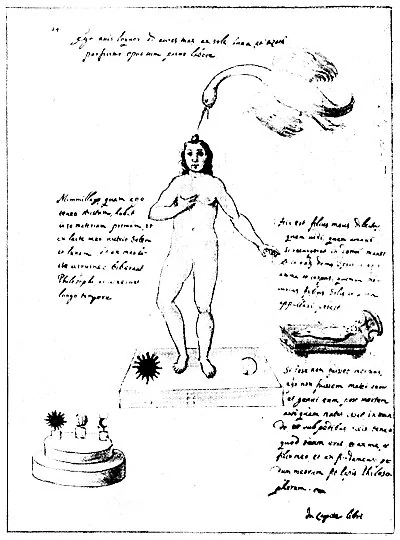
Leaf 24. The words at the top read: "I, the bird [the adept], speak into thine ears from the Sun, Moon and Azoth. The work is perfected with little labor." The panel to the left describes the nature of primordial matter and the drink of the Philosophers. The text to the right reads: "This is my beloved Son whom I saw and loved. If he be resurrected, He will remain at home, and in that house the spirit will be the soul and the body; for Mercury may be called the son of the Sun and the Moon." Under the child's figure is added: "If he were not dead, I should not have been his mother. I bore him after death before he was born in the world; under my feet I have what was his, and out of me and my Son and the foundation of my feet the Philosopher's Stone is made." At the lower left the three constituents of the Stone are shown elevated upon a pedestal to signify their dignity.
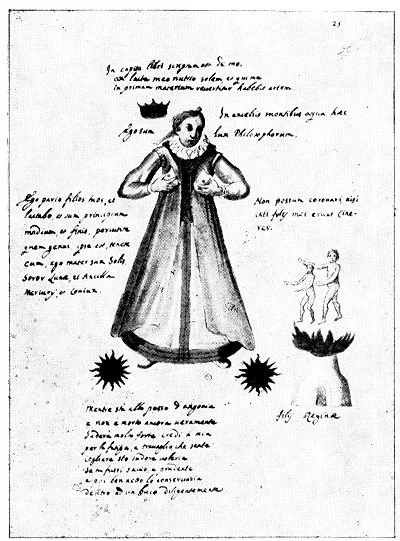
Leaf 25. Above the figure of the Queen are three lines stating, in substance, that in the beginning of the book it was written of her that from her maternal breasts she nourished the Sun, and that he who was capable of converting her into Primal matter possessed rare skill. Opposite the Queen's head are the words: "In the highest mountains this water" and "I am the light of the Philosophers." To the left of the Queen is an admonition to strike the sons whom she bears. She calls herself "The mother of the Sun, the sister of the Moon, and the servant and spouse of Mercury." On the right she is made to exclaim: "I cannot be crowned unless these sons of mine become ashes. " The sons are shown directly below. The verse under the Queen continues the alchemical processes, describing the method in which the exudations from the substance should be preserved.
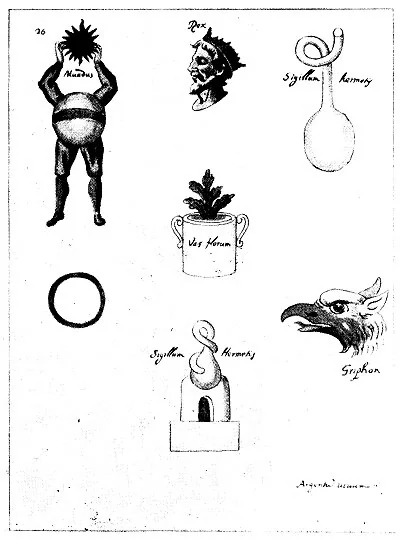
Leaf 26. This page, which concludes that part of the Hermetic manuscript bearing the symbols of the Secret Work, contains a number of emblems not directly correlated. At the top is the head of the King--the most common of alchemical figures. To the right of the King is an alchemical vessel designated the Hermetic Seal. Below is the head of a ferocious bird, here designated a griffon. To the left of the King is a headless figure elevating a Sun, or spiritual face. This figure is the world, which must be headless, since its spiritual and rational part is not material and consequently, is invisible. Below is a circle unaccompanied by descriptive matter. Directly under the King's head is a vase of flowers, in which rises the golden plant of the Philosophers. At the bottom of the page is additional alchemical equipment, this also being termed a Hermetic Seal.
The Chemical Marriage
THE self-admitted author of The Chemical Marriage, Johann Valentin Andreæ, born in Württemberg in 1586, was twenty-eight years of age when that work was first published. It was presumably written about twelve years prior to its publication--or when the author was fifteen or sixteen years old. The fact is almost incredible that one so young could produce a volume containing the wealth of symbolic thought and philosophy hidden between the lines of The Chemical Marriage. This book makes the earliest known reference to Christian Rosencreutz, and is generally regarded as the third of the series of original Rosicrucian manifestoes. As a symbolic work, the book itself is hopelessly irreconcilable with the statements made by Andreæ concerning it. The story of The Chemical Marriage relates in detail a series of incidents occurring to an aged man, presumably the Father C.R.C. of the Fama and Confessio. If Father C.R.C. was born in 1378, as stated in the Confessio, and is identical with the Christian Rosencreutz of The Chemical Marriage, he was elevated to the dignity of a Knight of the Golden Stone in the eighty-first year of his life (1459). In the light of his own statements, it is inconceivable that Andreæ could have been Father Rosy Cross.
Many figures found in the various books on symbolism published in the early part of the seventeenth century bear a striking resemblance to the characters and episodes in The Chemical Marriage. The alchemical wedding may prove to be the key to the riddle of Baconian Rosicrucianism. The presence in the German text of The Chemical Marriage of some words in English indicates its author to have been conversant also with that language. The following summary of the main episodes of the seven days of The Chemical Marriage will give the reader a fairly comprehensive idea of the profundity of its symbolism.
THE FIRST DAY
Christian Rosencreutz, having prepared in his heart the Paschal Lamb together with a small unleavened loaf, was disturbed while at prayer one evening before Easter by a violent storm which threatened to demolish not only his little house but the very hill on which it stood. In the midst of the tempest he was touched on the back and, turning, he beheld a glorious woman with wings filled with eyes, and robed in sky-colored garments spangled with stars. In one hand she held a trumpet and in the other a bundle of letters in every language. Handing a letter to C.R.C., she immediately ascended into the air, at the same time blowing upon her trumpet a blast which shook the house. Upon the seal of the letter was a curious cross and the words In hoc signo vinces. Within, traced in letters of gold on an azure field, was an invitation to a royal wedding.
C.R.C. was deeply moved by the invitation because it was the fulfillment of a prophecy which he had received seven years before, but so unworthy did he feel that he was paralyzed with fear. At length, after resorting to prayer, he sought sleep. In his dreams he found himself in a loathsome dungeon with a multitude of other men, all bound and fettered with great chains. The grievousness of their sufferings was increased as they stumbled over each other in the darkness. Suddenly from above came the sound of trumpets; the cover of the dungeon was lifted, and a ray of light pierced the gloom. Framed in the light stood a hoary-headed man who announced that a rope would be lowered seven times and whoever could cling to the rope would be drawn up to freedom.
Great confusion ensued. All sought to grasp the rope and many were pulled away from it by others. C.R.C. despaired of being saved, but suddenly the rope swung towards him and, grasping it, he was raised from the dungeon. An aged woman called the "Ancient Matron" wrote in a golden yellow book the names of those drawn forth, and each of the redeemed was given for remembrance a piece of gold bearing the symbol of the sun and the letters D L S. C.R.C., who had been injured while clinging to the rope, found it difficult to walk. The aged woman bade him not to worry, but to thank God who had permitted him to come into so high a light. Thereupon trumpets sounded and C.R.C. awoke, but so vivid was the dream that he was still sensible of the wounds received while asleep.
With renewed faith C. R. C. arose and prepared himself for the Hermetic Marriage. He donned a white linen coat and bound a red ribbon crosswise over his shoulders. In his hat he stuck four roses and for food he carried bread, water, and salt. Before leaving his cottage, he knelt and vowed that whatever knowledge was revealed to him he would devote to the service of his neighbor. He then departed from his house with joy.
THE SECOND DAY
As he entered the forest surrounding his little house, it seemed to C.R.C. that all Nature had joyously prepared for the wedding. As he proceeded singing merrily, he came to a green heath in which stood three great cedars, one bearing a tablet with an inscription describing the four paths that led to the palace of the King: the first short and dangerous, the second circuitous, the third a pleasant and royal road, and the fourth suitable only for incorruptible bodies. Weary and perplexed, C.R.C. decided to rest and, cutting a slice of bread, was about to partake thereof when a white dove begged it from him. The dove was at once attacked by a raven, and in his efforts to separate the birds C.R.C. unknowingly ran a considerable distance along one of the four paths--that leading southward. A terrific wind preventing him from retracing his steps, the wedding guest resigned himself to the loss of his bread and continued along the road until he espied in the distance a great gate. The sun being low, he hastened towards the portal, upon which, among other figures, was a tablet bearing the words Procul hinc procul ite profani.
A gatekeeper in sky-colored habit immediately asked C.R.C. for his letter of invitation and, on receiving it, bade him enter and requested that he purchase a token. After describing himself as a Brother of the Red Rosie Cross, C.R.C. received in exchange for his water bottle a golden disk bearing the letters S C. Night drawing near, the wanderer hastened on to a second gate, guarded by a lion, and to which was affixed a tablet with the words Date et dabitur volis, where he presented a letter given him by the first gatekeeper. Being urged to purchase a token bearing the letters S M, he gave his little package of salt and then hastened on to reach the palace gates before they were locked for the night.
A beautiful virgin called Virgo Lucifera was extinguishing the castle lights as C.R.C. approached, and he was barely able to squeeze through the closing gates. As they closed they caught part of his coat, which he was forced to leave behind. Here his name was written in the Lord Bridegroom's little vellum book and he was presented with a new pair of shoes and also a token bearing the letters S P N. He was then conducted by pages to a small chamber where the "ice-grey locks" were cut from the crown of his head by invisible barbers, after which he was ushered into a spacious hall where a goodly number of kings, princes, and commoners were assembled. At the sound of trumpets each seated himself at the table, taking a position corresponding to his dignity, so that C.R.C. received a very humble seat. Most of the pseudo-philosophers present being vain pretenders, the banquet became an orgy, which, however, suddenly ceased at the sound of
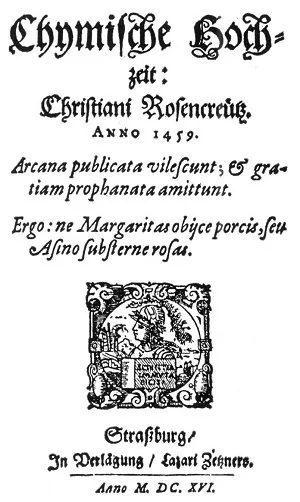
TITLE PAGE OF 1616 EDITION OF CHYMISCHE HOCHZEIT: CHRISTIAN ROSENCREUTZ.
From Rosencreutz' Chemical Marriage.
The most remarkable of all the publications involved in the Rosicrucian controversy is that of The Chemical Marriage, published in Strasbourg. This work, which is very rare, should be reproduced in exact facsimile to provide students with the opportunity of examining the actual text for the various forms of cipher employed. Probably no other volume in the history or literature created such a profound disturbance as this unpretentious little book. Immediately following its publication the purpose for which the volume was intended became the subject of popular speculation. It was both attacked and defended by theologians and philosophers alike, but when the various contending elements are simmered down the mysteries surrounding the book remain unsolved. That its author was a man of exceptional learning was admitted, and it is noteworthy that those minds which possessed the deepest understanding of Nature's mysteries were among those profoundly impressed by the contents of The Chemical Marriage.
stately and inspired music. For nearly half an hour no one spoke. Then amidst a great sound the door of the dining hall swung open and thousands of lighted tapers held by invisible hands entered. These were followed by the two pages lighting the beautiful Virgo Lucifera seated on a self-moving throne. The white-and-gold-robed Virgin then rose and announced that to prevent the admission of unworthy persons to the mystical wedding a set of scales would be erected the following day upon which each guest would be weighed to determine his integrity. Those unwilling to undergo this ordeal she stated should remain in the dining hall. She then withdrew, but many of the tapers stayed to accompany the guests to their quarters for the night.
Most of those present were presumptuous enough to believe that they could be safety weighed, but nine--including C.R.C.--felt their shortcomings so deeply that they feared the outcome and remained in the hall while the others were led away to their sleeping chambers. These nine were bound with ropes and left alone in darkness. C.R.C. then dreamed that he saw many men suspended over the earth by threads, and among them flew an aged man who, cutting here and there a thread, caused many to fall to earth. Those who in arrogance had soared to lofty heights accordingly fell a greater distance and sustained more serious injury than the more humble ones who, falling but a short distance, often landed without mishap. Considering this dream to be a good omen, C.R.C. related it to a companion, continuing in discourse with him until dawn.
THE THIRD DAY
Soon after dawn the trumpets sounded and the Virgo Lucifera, arrayed in red velvet, girded with a white sash, and crowned with a laurel wreath, entered accompanied by two hundred men in red-and-white livery. She intimated to C.R.C. and his eight companions that they might fare better than the other, self-satisfied guests. Golden scales were then hung in the midst of the hall and near them were placed seven weights, one good-sized, four small, and two very large. The men in livery, each carrying a naked sword and a strong rope, were divided into seven groups and from each group was chosen a captain, who was given charge of one of the weights. Having remounted her high throne, Virgo Lucifera ordered the ceremony to begin. The first to step on the scales was an emperor so virtuous that the balances did not tip until six weights had been placed upon the opposite end. He was therefore turned over to the sixth group. The rich and poor alike stood upon the scales, but only a few passed the test successfully. To these were given velvet robes and wreaths of laurel, after which they were seated upon the steps of Virgo Lucifera's throne. Those who failed were ridiculed and scourged.
The "inquisition" being finished, one of the captains begged Virgo Lucifera to permit the nine men who had declared themselves unworthy also to be weighed, and this caused C.R.C. anguish and fear. Of the first seven one succeeded and was greeted with joy. C.R.C. was the eighth and he not only withstood all the weights but even when three men hung on the opposite end of the beam he could not be moved. A page cried out: "THAT IS HE!" C.R.C. was quickly set at liberty and permitted to release one of the captives. He chose the first emperor. Virgo Lucifera then requested the red roses that C.R.C. carried, which he immediately gave her. The ceremony of the scales ended about ten o'clock in the forenoon.
After agreeing upon the penalties to be imposed upon those whose shortcomings had been thus exposed, a dinner was served to all. The few successful "artists," including C.R.C., were given the chief seats, after which the Golden Fleece and a Flying Lion were bestowed upon them in the name of the Bridegroom. Virgo Lucifera then presented a magnificent goblet to the guests, stating that the King had requested all to share its contents, Following this, C.R.C. and his companions were taken out upon a scaffolding where they beheld the various penalties suffered by those who failed. Before leaving the palace, each of the rejected guests was given a draught of forgetfulness. The elect then returned to the castle, where to each was assigned a learned page, who conducted them through the various parts of the edifice. C.R.C. saw many things his companions were not privileged to behold, including the Royal Sepulcher, where he learned "more than is extant in all books." He also visited a magnificent library and an observatory containing a great globe thirty feet in diameter and with all the countries of the world marked upon it.
At supper the various guests propounded enigmas and C.R.C. solved the riddle which Virgo Lucifera asked concerning her own identity. Then entered the dining hall two youths and six virgins beautifully robed, followed by a seventh virgin wearing a coronet. The latter was called the Duchess, and was mistaken for the Hermetic Bride. The Duchess told C.R.C. that he had received more than the others, therefore should make a greater return. The Duchess then asked each of the virgins to pick up one of the seven weights which still remained in the great room. To Virgo Lucifera was given the heaviest weight, which was hung in the Queen's chamber during the singing of a hymn. In the second chamber the first virgin hung her weight during a similar ceremony; thus they proceeded from room to room until the weights had been disposed of. The Duchess then presented her hand to C. R. C. and his companions and, followed by her virgins, withdrew. Pages then conducted the guests to their sleeping chambers. The one assigned to C.R.C. was hung with rare tapestries and with beautiful paintings.
THE FOURTH DAY
After washing and drinking in the garden from a fountain which bore several inscriptions--among them one reading, "Drink, brothers, and live"--the guests, led by Virgo Lucifera, ascended the 365 steps of the royal winding stairs. The guests were given wreaths of laurel and, a curtain being raised, found themselves in the presence of the King and Queen. C.R.C. was awestruck by the glory of the throne room and especially by the magnificence of the Queen's robes, which were so dazzling that he could not gaze upon them. Each guest was presented to the King by one of the virgins and after this ceremony the Virgo Lucifera made a short speech in which she recited the achievements of the honest "artists" and begged that each be questioned as to whether she had properly fulfilled her duty. Old Atlas then stepped forward and in the name of their Royal Majesties greeted the intrepid band of philosophers and assured Virgo Lucifera that she should receive a royal reward.
The length of the throne room was five times its width. To the west was a great porch in which stood three thrones, the central one elevated. On each throne sat two persons: on the first an ancient king with a young consort; on the third a black king with a veiled matron beside him; and on the central throne two young persons over whose heads hung a large and costly crown, about which hovered a little Cupid who shot his arrows first at the two lovers and then about the hall. Before the Queen a book bound in black velvet lay on a small altar, on which were golden decorations. Beside this were a burning candle, a celestial globe, a small striking-watch, a little crystal pipe from which ran a stream of clear blood-red liquor, and a skull with a white serpent crawling in and out of the orbits. After their presentations, the guests retired down the winding stairs to the great hall.
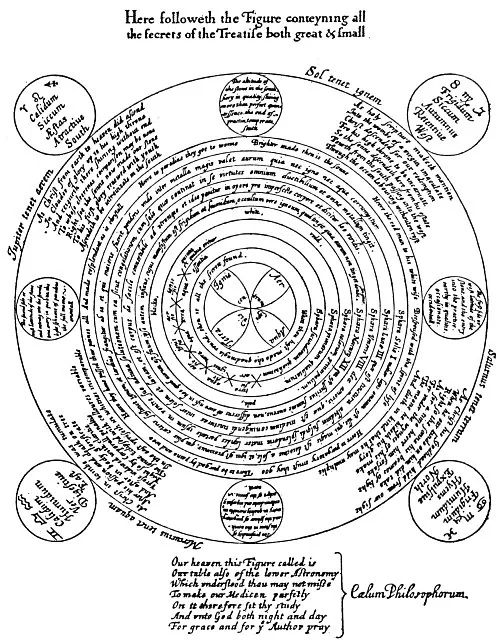
KEY TO THE GREAT PHILOSOPHICAL SECRET.
From Ashmole's Theatrum Chemicum Britannicum.
This plate, which is the key to mystic Christian alchemy, is missing from almost every copy of the Theatrum Chemicum Britannicum, a work compiled by Elias Ashmole and containing about a score of pieces by English poets treating of the Philosopher's Stone and the Hermetic mysteries. In view of the consistent manner in which the plate disappeared, it is possible that the diagram was purposely removed because it revealed too plainly the Rosicrucian arcana. Worthy of notice also is the care with which owners' names have been effaced from early books pertaining to alchemy and Hermeticism. The original names are usually rendered illegible being covered with heavy ink lines, the procedure often seriously defacing the volume, While an occasional exception is found, in practically every instance the mutilated books either deal with Rosicrucianism or contain cryptic writings of suspected Rosicrucian origin. It is presumed that this Practice of obliterating the owners names was to prevent the early Rosicrucians and Hermetists from being discovered through the volumes composing their libraries. Elias Ashmole's plate shows the analogies between the life of Christ and the four grand divisions of the alchemical process. Herein is also revealed the teaching that the Philosopher's Stone itself is a macrocosm and a microcosm, embodying the principles of astronomy and cosmogony, both universal and human.
Later the Virgo Lucifera announced that a comedy was to be performed for the benefit of the six royal guests in a building called the House of the Sun. C.R.C. and his companions formed part of the royal procession, which after a considerable walk arrived at the theater. The play was in seven acts, and after its happy ending all returned through the garden and up the winding stairs to the throne room. C.R.C. noticed the young King was very sad and that at the banquet following he often sent meat to the white serpent in the skull. The feast over, the young King, holding in his hand the little black book from the altar, asked the guests if they would all be true to him through prosperity and adversity, and when they tremblingly agreed he asked that each should sign his name in the little black book as proof of his fealty. The royal persons then drank from the little crystal fountain, the others afterwards doing likewise. This was called the "Draught of Silence." The royal persons then sadly shook hands with all present. Suddenly a little bell tinkled and immediately the kings and queens took off their white garments and donned black ones, the room was hung in sable draperies, and the tables were removed. The eyes of the royal persons were bound with six black taffeta scarfs and six coffins were placed in the center of the room. An executioner, a Moor, robed in black and bearing an axe, entered, and beheaded in turn each of the six royal persons. The blood of each was caught in a golden goblet, which was placed in the coffins with the body. The executioner was also decapitated and his head placed in a small chest.
The Virgo Lucifera, after assuring C.R.C. and his companions that all should be well if they were faithful and true, ordered the pages to conduct them to their rooms for the night while she remained to watch with the dead. About midnight C.R.C. awakened suddenly and, looking from his window, beheld seven ships sailing upon a lake. Above each hovered a flame; these he believed to be the spirits of the beheaded. When the ships reached shore, the Virgo Lucifera met them and on each of six of the vessels was placed a covered coffin. As soon as the coffins had been thus disposed of, the lights were extinguished and the flames passed back over the lake so that there remained but one light for a watch in each ship. After beholding this strange ceremony, C.R.C. returned to his bed and slept till morning.
THE FIFTH DAY
Rising at daybreak and entreating his page to show him other treasures of the palace, C.R.C. was conducted down many steps to a great iron door bearing a curious inscription, which he carefully copied. Passing through, he found himself in the royal treasury, the light in which came entirely from some huge carbuncles. In the center stood the triangular sepulcher of Lady Venus. Lifting a copper door in the pavement, the page ushered C.R.C. into a crypt where stood a great bed upon which, when his guide had raised the coverlets, C.R.C. beheld the body of Venus. Led by his page, C.R.C. then rejoined his companions, saying nothing to them of his experience.
Virgo Lucifera, robed in black velvet and accompanied by her virgins, then led the guests out into the courtyard where stood six coffins, each with eight pallbearers. C.R.C. was the only one of the group of "artists" who suspected the royal bodies were no longer in these coffins. The coffins were lowered into graves and great stones rolled over them. The Virgo Lucifera then made a short oration in which she exhorted each to assist in restoring the royal persons to life, declaring that they should journey with her to the Tower of Olympus, where the medicines necessary to the resurrection of the six royal persons could alone be found. C.R.C. and his companions followed Virgo Lucifera to the seashore, where all embarked on seven ships disposed according to a certain strange order. As the ships sailed across the lake and through a narrow channel into the open sea, they were attended by sirens, nymphs, and sea goddesses, who in honor of the wedding presented a great and beautiful pearl to the royal couple. When the ships came in sight of the Tower of Olympus, Virgo Lucifera ordered the discharge of cannon to signal their approach. Immediately a white flag appeared upon the tower and a small gilded pinnace, containing an ancient man--the warden of the tower--with his white-clad guards came out to meet the ships.
The Tower of Olympus stood upon an island which was exactly square and was surrounded by a great wall. Entering the gate, the group was led to the bottom of the central tower, which contained an excellent laboratory where the guests were fain to beat and wash plants, precious stones, and all sorts of things, extract their juice and essence, and put these latter into glasses. Virgo Lucifera set the "artists" to work so arduously that they felt they were mere drudges. When the day's work was finished, each was assigned a mattress on the stone floor. Being unable to sleep, C.R.C. wandered about contemplating the stars. Chancing upon a flight of steps leading to the top of the wall, he climbed up and looked out upon the sea. Remaining here for some time, about midnight he beheld seven flames which, passing over the sea towards him, gathered themselves on the top of the spire of the central tower. Simultaneously the winds arose, the sea became tempestuous, and the moon was covered with clouds. With some fear C.R.C. ran down the stairs and returned to the tower and, lying down on his mattress, was lulled to sleep by the sound of a gently flowing fountain in the laboratory.
THE SIXTH DAY
The next morning the aged warden of the tower, after examining the work performed by the wedding guests in the laboratory and finding it satisfactory, caused ladders, ropes, and large wings to be brought forth, and addressed the assembled "artists" thus: "My dear sons, one of these three things must each of you this day constantly bear about with him." Lots were cast and to C.R.C., much to his chagrin, fell a heavy ladder. Those who secured wings had them fastened to their backs so cunningly that it was impossible to detect that they were artificial. The aged warden then locked the "artists" in the lower room of the tower, but in a short time a round hole was uncovered in the ceiling and Virgo Lucifera invited all to ascend. Those with wings flew at once through the opening, those with ropes had many difficulties, while C.R.C. with his ladder made reasonable speed. On the second floor the wedding guests, musicians, and Virgo Lucifera gathered about a fountain-like contrivance containing the bodies of the six royal persons.
Virgo Lucifera then placed the if Moor's head in a kettle-like receptacle in the upper part of the fountain and poured upon it the substances prepared on the previous day in the laboratory. The virgins placed lamps beneath. These substances when they boiled passed out through holes in the sides of the kettle and, falling upon the bodies in the fountain below, dissolved them. The six royal bodies having been reduced thus to a liquid state, a tap was opened in the lower end of the fountain and the fluid drained into an immense golden globe, which, when filled, was of great weight. All but the wedding guests then retired and shortly a hole in the ceiling opened as before and the guests ascended pell-mell to the third floor. Here the globe were suspended by a strong chain. The walls of the apartment were of glass, and mirrors were so arranged that the sun's rays were concentrated upon the central globe, thus causing it to become very hot. Later the sun's rays were deflected and the globe permitted to cool, after which it was cut open with a diamond, revealing a beautiful white egg. Carrying this with her, Virgo Lucifera departed.
The guests, having ascended through another trap door, found
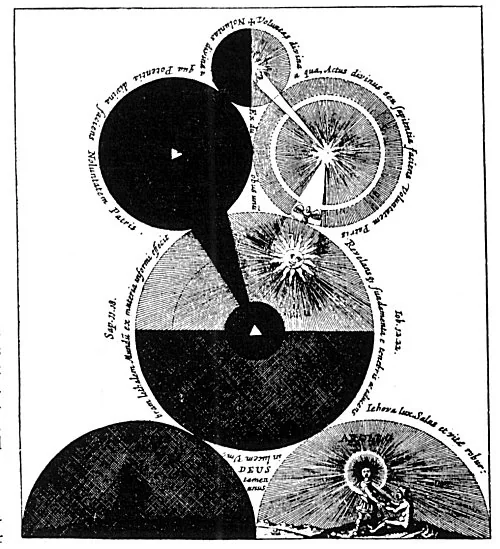
THE UNIVERSE CREATED BY THE DUAL PRINCIPLE OF LIGHT AND DARKNESS.
From Fludd's Philosophia Mosaica.
The Supreme Deity is symbolized by the small globe at the top, which is divided into two hemispheres, the dark half representing the divine darkness with which the Deity surround Himself and which serves as His hiding place. The radiant hemisphere signifies the divine light which is in God and which, pouring forth, manifests as the objective creative power. The large dark globe to the left and beneath the dark half of the upper sphere signifies the potential darkness which was upon the face of the primordial deep and within which moved the Spirit of God. The light globe to the right is the Deity who is revealed out of the darkness. Here the shining Word has dissipated the shadows and a glorious universe has been formed. The divine power of this radiant globe is cognizable to man as the sun. The large light and a dark section represents the created universes partaking of the light and darkness which are in the nature of the Creator. The dark half represents the Deep, or Chaos, the Eternal Waters pouring forth out of the Deity; the light half-circle containing the figure of Apollo represents the diurnal hemisphere of the world, which in the ancient Mysteries was ruled over by Apollo. The dark half-circle is the nocturnal hemisphere ruled over by Dionysius (Dionysos), whose figure is faintly visible in the gloom.
themselves upon the fourth floor, where stood a square kettle filled with silver sand warmed by a gentle fire. The great white egg was placed upon the warm sand to mature. In a short time it cracked and there emerged an ugly, ill-tempered bird, which was fed with the blood of the beheaded royal persons diluted with prepared water. At each feeding its feathers changed color; from black they turned to white and at last they became varicolored, the disposition of the bird improving the while. Dinner was then served, after which Virgo Lucifera departed with the bird. The guests ascended with ropes, ladders, and wings to the fifth floor, where a bath colored with fine white powder had been prepared for the bird, which enjoyed bathing in it until the lamps placed beneath the bath caused the water to become uncomfortably warm. When the heat had removed all the bird's feathers it was taken out, but the fire continued until nothing remained in the bath save a sediment in the form of a blue stone. This was later pounded up and made into a pigment; with this, all of the bird except the head was painted.
The guests thereupon ascended to the sixth floor, where stood a small altar resembling that in the King's throne room. The bird drank from the little fountain and was fed with the blood of the white serpent which crawled through the openings in the skull. The sphere by the altar revolved continuously. The watch struck one, two, and then three, at which time the bird, laying its neck upon the book, suffered itself to be decapitated. Its body was burned to ashes, which were placed in a box of cypress wood. Virgo Lucifera told C.R.C. and three of his comrades that they were lazy and sluggish "labourators" and would therefore be excluded from the seventh room. Musicians were sent for, who with cornets were to "blow" the four in ridicule from the chamber. C.R.C. and his three companions were disheartened until the musicians told them to be of good cheer and led them up a winding stair to the eighth floor of the tower directly beneath the roof. Here the old warden, standing upon a little round furnace, welcomed them and congratulated them upon being chosen by Virgo Lucifera, for this greater work. Virgo Lucifera then entered, and after laughing at the perplexity of her guests, emptied the ashes of the bird into another vessel, filling the cypress box with useless matter. She thereupon returned to the seventh floor, presumably to mislead those assembled there by setting them to work upon the false ashes in the box.
C.R.C. and his three friends were set to work moistening the bird's ashes with specially prepared water until the mixture became of doughlike consistency, after which it was heated and molded into two miniature forms. Later these were opened, disclosing two bright and almost transparent human images about four inches high (homunculi), one male and the other female. These tiny forms were laid upon satin cushions and fed drop by drop with the blood of the bird until they grew to normal size and of great beauty. Though the bodies had the consistency of flesh, they showed no signs of life, for the soul was not in them. The bodies were next surrounded with torches and their faces covered with silk. Virgo Lucifera then appeared, bearing two curious white garments. The virgins also entered, among them six bearing great trumpets. A trumpet was placed upon the mouth of one of the two figures and C.R.C. saw a tiny hole open in the dome of the tower and a ray of light descend through the tube of the trumpet and enter the body. This process was repeated three times on each body. The two newly ensouled forms were then removed upon a traveling couch. In about half an hour the young King and Queen awakened and the Virgo Lucifera presented them with the white garments. These they donned and the King in his own person most graciously returned thanks to C.R.C. and his companions, after which the royal persons departed upon a ship. C.R.C. and his three privileged friends then rejoined the other "artists," making no mention of that which they had seen. Later the entire party were assigned handsome chambers, where they rested till morning.
THE SEVENTH DAY
In the morning Virgo Lucifera announced that each of the wedding guests had become a "Knight of the Golden Stone. " The aged warden then presented each man with a gold medal, bearing on one side the inscription "At. Nat. Mi. " and on the other, "Tem. Na. F." The entire company returned in twelve ships to the King's palace. The flags on the vessels bore the signs of the zodiac, and C.R.C. sat under that of Libra. As they entered the lake, many ships met them and the King and Queen, together with their lords, ladies, and virgins, rode forth on a golden barge to greet the returning guests. Atlas then made a short oration in the King's behalf, also asking for the royal presents. In reply the aged warden delivered to Cupid, who hovered about the royal pair, a small, curious-shaped casket. C.R.C. and the old lord, each bearing a snow-white ensign with a red cross on it, rode in the carriage with the King. At the first gate stood the porter with blue clothes, who, upon seeing C.R.C., begged him to intercede with the King to release him from that post of servitude. The King replied that the porter was a famous astrologer who was forced to keep the gate as a punishment for the crime of having gazed upon Lady Venus reposing upon her couch. The King further declared that the porter could be released only when another was found who had committed the same crime. Upon hearing this, C.R.C.'s heart sank, for he realized himself to be the culprit, but he remained silent at that time.
The newly created Knights of the Golden Stone were obliged to subscribe to five articles drawn up by His Royal Highness: (1) That they would ascribe their Order only to God and His handmaid, Nature. (2) That they should abominate all uncleanness and vice. (3) That they should always be ready to assist the worthy and needy. (4) That they should not use their knowledge and power for the attainment of worldly dignity. (5) That they should not desire to live longer than God had decreed. They were then duly installed as Knights, which ceremony was ratified in a little chapel where C. R. C. hung up his Golden Fleece and his hat for an eternal memorial, and here he inscribed the following: Summa Scientia nihil Scire, Fr. Christianus Rosencreutz. Eques aurei Lapidis. Anno 1459.
After the ceremony, C.R.C. admitted that he was the one who had beheld Venus and consequently must become the porter of the gate. The King embraced him fondly and he was assigned to a great room containing three beds--one for himself, one for the aged lord of the tower, and the third for old Atlas.
The Chemical Marriage here comes to an abrupt end, leaving the impression that C.R.C. was to assume his duties as porter on the following morning. The book ends in the middle of a sentence, with a note in italics presumably by the editor.
Under the symbolism of an alchemical marriage, mediæval philosophers concealed the secret system of spiritual culture whereby they hoped to coordinate the disjecta membra of both the human and social organisms. Society, they maintained, was a threefold structure and had its analogy in the triune constitution of man, for as man consists of spirit, mind, and body, so society is made up of the church, the state, and the populace. The bigotry of the church, the tyranny of the state, and the fury of the mob are the three murderous agencies of society which seek to destroy Truth as recounted in the Masonic legend of Hiram Abiff. The first six days of The Chemical Marriage set forth the processes of philosophical "creation" through which every organism must pass. The three kings are the threefold spirit of man and their consorts the corresponding vehicles of their expression in the lower world. The executioner is the mind, the higher part of which--symbolized by the head--is necessary to the achievement of the philosophical labor. Thus the parts of man--by the alchemists symbolized as planets and elements--when blended together according to a certain Divine formula result in the creation of two philosophic "babes" which, fed upon the blood of the alchemical bird, become rulers of the world.
From an ethical standpoint, the young King and Queen resurrected at the summit of the tower and ensouled by Divine Life represent the forces of Intelligence and Love which must ultimately guide society. Intelligence and Love are the two great ethical luminaries of the world and correspond to enlightened spirit and regenerated body. The bridegroom is reality and the bride the regenerated being who attains perfection by becoming one with reality through a cosmic marriage wherein the mortal part attains immortality by being united with its own immortal Source. In the Hermetic Marriage divine and human consciousness are united in holy wedlock and he in whom this sacred ceremony takes place is designated as "Knight of the Golden Stone"; he thereby becomes a divine philosophic diamond composed of the quintessence of his own sevenfold constitution.
Such is the true interpretation of the mystical process of becoming "a bride of the Lamb." The Lamb of God is signified by the Golden Fleece that Jason was forced to win before he could assume his kingship. The Flying Lion is illumined will, an absolute prerequisite to the achievement of the Great Work. The episode of weighing the souls of men has its parallel in the ceremony described in the Egyptian Book of the Dead. The walled city entered by C.R.C. represents the sanctuary of wisdom wherein dwell the real rulers of the world--the initiated philosophers.
Like the ancient Mysteries after which it was patterned, the Order of the Rose Cross possessed a secret ritual which was lived by the candidate for a prescribed number of years before he was eligible to the inner degrees of the society. The various floors of the Tower of Olympus represent the orbits of the planets. The ascent of the philosophers from one floor to another also parallels certain rituals of the Eleusinian Mysteries and the rites of Mithras wherein the candidate ascended the seven rungs of a ladder or climbed the seven steps of a pyramid in order to signify release from the influences of the Planetary Governors. Man becomes master of the seven spheres only when he transmutes the impulses received from them. He who masters the seven worlds and is reunited with the Divine Source of his own nature consummates the Hermetic Marriage.
Bacon, Shakspere, and the Rosicrucians
THE present consideration of the Bacon--Shakspere--Rosicrucian controversy is undertaken not for the vain purpose of digging up dead men's bones but rather in the hope that a critical analysis will aid in the rediscovery of that knowledge lost to the world since the oracles were silenced. It was W. F. C. Wigston who called the Bard of Avon "phantom Captain Shakespeare, the Rosicrucian mask." This constitutes one of the most significant statements relating to the Bacon-Shakspere controversy.
It is quite evident that William Shakspere could not, unaided, have produced the immortal writings bearing his name. He did not possess the necessary literary culture, for the town of Stratford where he was reared contained no school capable of imparting the higher forms of learning reflected in the writings ascribed to him. His parents were illiterate, and in his early life he evinced a total disregard for study. There are in existence but six known examples of Shakspere's handwriting. All are signatures, and three of them are in his will. The scrawling, uncertain method of their execution stamps Shakspere as unfamiliar with the use of a pen, and it is obvious either that he copied a signature prepared for him or that his hand was guided while he wrote. No autograph manuscripts of the "Shakespearian" plays or sonnets have been discovered, nor is there even a tradition concerning them other than the fantastic and impossible statement appearing in the foreword of the Great Folio.
A well-stocked library would be an essential part of the equipment of an author whose literary productions demonstrate him to be familiar with the literature of all ages, yet there is no record that Shakspere ever possessed a library, nor does he make any mention of books in his will. Commenting on the known illiteracy of Shakspere's daughter Judith, who at twenty-seven could only make her mark, Ignatius Donnelly declares it to be unbelievable that William Shakspere if he wrote the plays bearing his name would have permitted his own daughter to reach womanhood and marry without being able to read one line of the writings that made her father wealthy and locally famous.
The query also has been raised, "Where did William Shakspere secure his knowledge of modern French, Italian, Spanish, and Danish, to say nothing of classical Latin and Greek?" For, in spite of the rare discrimination with which Latin is used by the author of the Shakespearian plays, Ben Jonson, who knew Shakspere intimately, declared that the Stratford actor understood "small Latin and less Greek"! Is it not also more than strange that no record exists of William Shakspere's having ever played a leading rôle in the famous dramas he is supposed to have written or in others produced by the company of which he was a member? True, he may have owned a small interest in the Globe Theatre or Blackfriars, but apparently the height of his thespian achievements was the Ghost in Hamlet!
In spite of his admitted avarice, Shakspere seemingly made no effort during his lifetime to control or secure remuneration from the plays bearing his name, many of which were first published anonymously. As far as can be ascertained, none of his heirs were involved in any manner whatsoever in the printing of the First Folio after his death, nor did they benefit financially therefrom. Had he been their author, Shakspere's manuscripts and unpublished plays would certainly have constituted his most valued possessions, yet his will--while making special disposition of his second-best bed and his "broad silver gilt bowl" neither mentions nor intimates that he possessed any literary productions whatsoever.
While the Folios and Quartos usually are signed "William Shakespeare," all the known autographs of the Stratford actor read "William Shakspere." Does this change in spelling contain any significance heretofore generally overlooked? Furthermore, if the publishers of the First Shakespearian Folio revered their fellow actor as much as their claims in that volume would indicate, why did they, as if in ironical allusion to a hoax which they were perpetrating, place an evident caricature of him on the title page?
Certain absurdities also in Shakspere's private life are irreconcilable. While supposedly at the zenith of his literary career, he was actually engaged in buying malt, presumably for a brewing business! Also picture the immortal Shakspere--the reputed author of The Merchant of Venice--as a moneylender! Yet among those against whom Shakspere brought action to collect petty sums was a fellow townsman--one Philip Rogers--whom he sued for an unpaid loan of two shillings, or about forty-eight cents! In short, there is nothing known in the life of Shakspere that would justify the literary excellence imputed to him.
The philosophic ideals promulgated throughout the Shakespearian plays distinctly demonstrate their author to have been thoroughly familiar with certain doctrines and tenets peculiar to Rosicrucianism; in fact the profundity of the Shakespearian productions stamps their creator as one of the illuminati of the ages. Most of those seeking a solution for the Bacon-Shakspere controversy have been intellectualists. Notwithstanding their scholarly attainments, they have overlooked the important part played by transcendentalism in the philosophic achievements of the ages. The mysteries of superphysics are inexplicable to the materialist, whose training does not equip him to estimate the extent of their ramifications and complexities. Yet who but a Platonist, a Qabbalist, or a Pythagorean could have written The Tempest, Macbeth, Hamlet, or The Tragedy of Cymbeline? Who but one deeply versed in Paracelsian lore could have conceived, A Midsummer Night's Dream?
Father of modern science, remodeler
HEADPIECE SHOWING LIGHT AND SHADED A's.
From Shakespeare's King Richard The Second, Quarto of 1597.
The ornamental headpiece shown above has long been considered a Baconian or Rosicrucian signature. The light and the dark A's appear in several volumes published by emissaries of the Rosicrucians. If the above figure be compared with that from the Alciati Emblemata on the following pages, the cryptic use of the two A's will be further demonstrated.
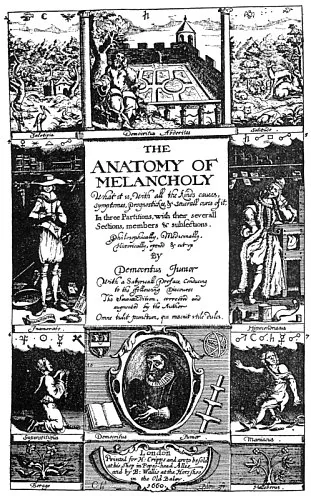
THE TITLE PAGE OF BURTON'S ANATOMY OF MELANCHOLY.
From Burton's Anatomy of Melancholy.
Baconian experts declare Burton's Anatomy of Melancholy to be in reality Francis Bacon's scrapbook in which he gathered strange and rare bits of knowledge during the many years of eventful life. This title page has long been supposed to contain a cryptic message. The key to this cipher is the pointing figure of the maniac in the lower right-hand corner of the design. According to Mrs. Elizabeth Wells Gallup, the celestial globe at which the maniac is pointing is a cryptic symbol of Sir Francis Bacon. The planetary signs which appear in the clouds opposite the marginal figures 4, 5;, 6, and 7 signify the planetary configurations, which produce the forms of mania depicted. The seated man, with his head resting upon his hand. is declared by Baconian enthusiasts to represent Sir Francis Bacon.
of modern law, editor of the modem Bible, patron of modem democracy, and one of the founders of modern Freemasonry, Sir Francis Bacon was a man of many aims and purposes. He was a Rosicrucian, some have intimated the Rosicrucian. If not actually the Illustrious Father C.R.C. referred to in the Rosicrucian manifestoes, he was certainly a high initiate of the Rosicrucian Order, and it is his activities in connection with this secret body that are of prime importance to students of symbolism, philosophy, and literature.
Scores of volumes have been written to establish Sir Francis Bacon as the real author of the plays and sonnets popularly ascribed to William Shakspere. An impartial consideration of these documents cannot but convince the open-minded of the verisimilitude of the Baconian theory. In fact those enthusiasts who for years have struggled to identify Sir Francis Bacon as the true "Bard of Avon" might long since have won their case had they emphasized its most important angle, namely, that Sir Francis Bacon, the Rosicrucian initiate, wrote into the Shakespearian plays the secret teachings of the Fraternity of R.C. and the true rituals of the Freemasonic Order, of which order it may yet be discovered that he was the actual founder. A sentimental world, however, dislikes to give up a traditional hero, either to solve a controversy or to right a wrong. Nevertheless, if it can be proved that by raveling out the riddle there can be discovered information of practical value to mankind, then the best minds of the world will cooperate in the enterprise. The Bacon-Shakspere controversy, as its most able advocates realize, involves the most profound aspects of science, religion, and ethics; he who solves its mystery may yet find therein the key to the supposedly lost wisdom of antiquity.
It was in recognition of Bacon's intellectual accomplishments that King James turned over to him the translators' manuscripts of what is now known as the King James Bible for the presumable purpose of checking, editing, and revising them. The documents remained in his hands for nearly a year, but no information is to be had concerning what occurred in that time. Regarding this work, William T. Smedley writes: " It will eventually be proved that the whole scheme of the Authorised Version of the Bible was Francis Bacon's." (See The Mystery of Francis Bacon.) The first edition of the King James Bible contains a cryptic Baconian headpiece. Did Bacon cryptographically conceal in the Authorized Bible that which he dared not literally reveal in the text--the secret Rosicrucian key to mystic and Masonic Christianity?
Sir Francis Bacon unquestionably possessed the range of general and philosophical knowledge necessary to write the Shakespearian plays and sonnets, for it is usually conceded that he was a composer, lawyer, and linguist. His chaplain, Doctor William Rawley, and Ben Jonson both attest his philosophic and poetic accomplishments. The former pays Bacon this remarkable tribute: "I have been enduced to think that if there were a beame of knowledge derived from God upon any man in these modern times, it was upon him. For though he was a great reader of books; yet he had not his knowledge from books but from some grounds and notions from within himself. " (See Introduction to the Resuscitado.)
Sir Francis Bacon, being not only an able barrister but also a polished courtier, also possessed that intimate knowledge of parliamentary law and the etiquette of the royal court revealed in the Shakespearian plays which could scarcely have been acquired by a man in the humble station of the Stratford actor. Lord Verulam furthermore visited many of the foreign countries forming the background for the plays and was therefore in a position to create the authentic local atmosphere contained therein, but there is no record of William Shakspere's ever having traveled outside of England.
The magnificent library amassed by Sir Francis Bacon contained the very volumes necessary to supply the quotations and anecdotes incorporated into the Shakespearian plays. Many of the plays, in fact, were taken from plots in earlier writings of which there was no English translation at that time. Because of his scholastic acquirements, Lord Verulam could have read the original books; it is most unlikely that William Shakspere could have done so.
Abundant cryptographic proof exists that Bacon was concerned in the production of the Shakespearian plays. Sir Francis Bacon's cipher number was 33. In the First Part of King Henry the Fourth, the word "Francis" appears 33 times upon one page. To attain this end, obviously awkward sentences were required, as: "Anon Francis? No Francis, but tomorrow Francis: or Francis, on Thursday: or indeed Francis when thou wilt. But Francis."
Throughout the Shakespearian Folios and Quartos occur scores of acrostic signatures. The simplest form of the acrostic is that whereby a name--in these instances Bacon's--was hidden in the first few letters of lines. In The Tempest, Act I, Scene 2, appears a striking example of the Baconian acrostic:
"Begun to tell me what I am, but stopt
And left me to a bootelesse Inquisition,
Concluding, stay: not yet.
The first letters of the first and second lines together with the first three letters of the third line form the word BACon. Similar acrostics appear frequently in Bacon's acknowledged writings.
The tenor of the Shakespearian dramas politically is in harmony with the recognized viewpoints of Sir Francis Bacon, whose enemies are frequently caricatured in the plays. Likewise their religious, philosophic, and educational undercurrents all reflect his personal opinions. Not only do these marked similarities of style and terminology exist in Bacon's writings and the Shakespearian plays, but there are also certain historical and philosophical inaccuracies common to both, such as identical misquotations from Aristotle.
"Evidently realizing that futurity would unveil his full genius, Lord Verulam in his will bequeathed his soul to God above by the oblations of his Savior, his body to be buried obscurely, his name and memory to men's charitable speeches, to foreign nations, to succeeding ages, and to his own countrymen after some time had elapsed. That portion appearing in italics Bacon deleted from his will, apparently fearing that he had said too much.
That Sir Francis Bacon's subterfuge was known to a limited few during his lifetime is quite evident. Accordingly, stray hints regarding the true author of the Shakespearian plays may be found in many seventeenth century volumes. On page 33 (Bacon's cipher number) of the 1609 edition of Robert Cawdry's Treasurie or Storehouse
A BACONIAN SIGNATURE.
From Alciati Emblemata.
The curious volume from which this figure is taken was published in Paris in r618. The attention of the Baconian student is immediately attracted by the form of the hog in the foreground. Bacon often used this animal as a play upon his own name, especially because the name Bacon was derived from he word beech and the nut of this tree was used to fatten hogs. The two pillars in the background have considerable Masonic interest. The two A's nearly in the center of the picture--one light and one shaded--are alone almost conclusive proof of Baconian influence. The most convincing evidence, however, is the fact that 17 is the numerical equivalent of the letters of the Latin farm of Bacon's name (F. Baco) and there are 17 letters in the three words appearing in the illustration.
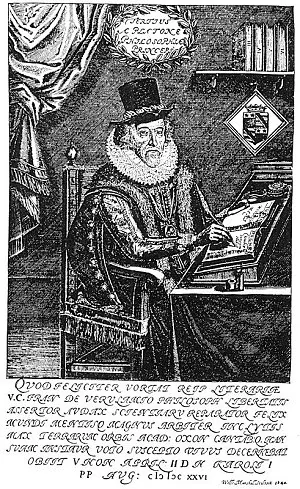
FRANCIS BACON, BARON VERULAM, VISCOUNT ST. ALBANS.
From Bacon's Advancement of Learning.
Lord Bacon was born in 1561 and history records his death in 1626. There are records in existence, however, which would indicate the probability that his funeral was a mock funeral and that, leaving England, he lived for many years under another name in Germany, there faithfully serving the secret society to the promulgation of whose doctrines he had consecrate his life. Little doubt seems to exist in the minds of impartial investigators that Lord Bacon was the legitimate son of Queen Elizabeth and the Earl of Leicester.
of Similes appears the following significant allusion: "Like as men would laugh at a poore man, if having precious garments lent him to act and play the part of some honourable personage upon a stage, when the play were at an ende he should keepe them as his owne, and bragge up and downe in them."
Repeated references to the word hog and the presence of cryptographic statements on page 33 of various contemporary writings demonstrate that the keys to Bacon's ciphers were his own name, words playing upon it, or its numerical equivalent. Notable examples are the famous statement of Mistress Quickly in The Merry Wives of Windsor: "Hang-hog is latten for Bacon, I warrant you"; the title pages of The Countess of Pembroke's Arcadia and Edmund Spenser's Faerie Queene; and the emblems appearing in the works of Alciatus and Wither. Furthermore, the word honorificabilitudinitatibus appearing in the fifth act of Love's Labour's Lost is a Rosicrucian signature, as its numerical equivalent (287) indicates.
Again, on the title page of the first edition of Sir Francis Bacon's New Atlantis, Father Time is depicted bringing a female figure out of the darkness of a cave. Around the device is a Latin inscription: "In time the secret truth shall be revealed." The catchwords and printer's devices appearing in volumes published especially during the first half of the seventeenth century were designed, arranged, and in some cases mutilated according to a definite plan.
It is evident also that the mispaginations in the Shakespearian Folios and other volumes are keys to Baconian ciphers, for re-editions--often from new type and by different printers--contain the same mistakes. For example, the First and Second Folios of Shakespeare are printed from entirely different type and by different printers nine years apart, but in both editions page 153 of the Comedies is numbered 151, and pages 249 and 250 are numbered 250 and 251 respectively. Also in the 1640 edition of Bacon's The Advancement and Proficience of Learning, pages 353 and 354 are numbered 351 and 352 respectively, and in the 1641 edition of Du Bartas' Divine Weeks pages 346 to 350 inclusive are entirely missing, while page 450 is numbered 442. The frequency with which pages ending in numbers 50, 51, 52,53, and 54 are involved will he noted.
The requirements of Lord Verulam's biliteral cipher are fully met in scores of volumes printed between 1590 and 1650 and in some printed at other times. An examination of the verses by L. Digges, dedicated to the memory of the deceased "Authour Maister W. Shakespeare," reveals the use of two fonts of type for both capital and small letters, the differences being most marked in the capital T's, N's, and A's, (Seethe First Folio.) The cipher has been deleted from subsequent editions.
The presence of hidden material in the text is often indicated by needless involvement of words. On the sixteenth unnumbered page of the 1641 edition of Du Bartas' Divine Weeks is a boar surmounting a pyramidal text. The text is meaningless jargon, evidently inserted for cryptographic reasons and marked with Bacon's signature--the hog. The year following publication of the First Folio of Shakespeare's plays in 1623, there was printed in "Lunæburg" a remarkable volume on cryptography, avowedly by Gustavus Selenus. It is considered extremely probable that this volume constitutes the cryptographic key to the Great Shakespearian Folio.
Peculiar symbolical head- and tail-pieces also mark the presence of cryptograms. While such ornaments are found in many early printed books, certain emblems are peculiar to volumes containing Baconian Rosicrucian ciphers. The light and dark shaded A is an interesting example. Bearing in mind the frequent recurrence in Baconian symbolism of the light and dark shaded A and the hog, the following statement by Bacon in his Interpretation of Nature is highly significant: "If the sow with her snout should happen to imprint the letter A upon the ground, wouldst thou therefore imagine that she could write out a whole tragedy as one letter?"
The Rosicrucians and other secret societies of the seventeenth century used watermarks as mediums for the conveyance of cryptographic references, and books presumably containing Baconian ciphers are usually printed upon paper bearing Rosicrucian or Masonic watermarks; often there are several symbols in one book, such as the Rose Cross, urns, bunches of grapes, and others.
At hand is a document which may prove a remarkable key to a cipher beginning in The Tragedy of Cymbeline. So far as known it has never been published and is applicable only to the 1623 Folio of the Shakespearian plays. The cipher is a line-and-word count involving punctuation, especially the long and short exclamation points and the straight and slanting interrogation points. This code was discovered by Henry William Bearse in 1900, and after it has been thoroughly checked its exact nature will be made public.
No reasonable doubt remains that the Masonic Order is the direct outgrowth of the secret societies of the Middle Ages, nor can it be denied that Freemasonry is permeated by the symbolism and mysticism of the ancient and mediæval worlds. Sir Francis Bacon knew the true secret of Masonic origin and there is reason to suspect that he concealed this knowledge in cipher and cryptogram. Bacon is not to be regarded solely as a man but rather as the focal point between an invisible institution and a world which was never able to distinguish between the messenger and the message which he promulgated. This secret society, having rediscovered the lost wisdom of the ages and fearing that the knowledge might be lost again, perpetuated it in two ways: (1) by an organization (Freemasonry)
A CRYPTIC HEADPIECE.
From Ralegh's History of the World.
Many documents influenced by Baconian philosophy--or intended m conceal Baconian or Rosicrucian cryptograms--use certain conventional designs at the beginning and end of chapters, which reveal to the initiated the presence of concealed information. The above ornamental has long been accepted as of the presence of Baconian influence and is to be found only in a certain number of rare volumes, all of which contain Baconian cryptograms. These cipher messages were placed in the books either by Bacon himself or by contemporaneous and subsequent authors belonging to the same secret society which Bacon served with his remarkable knowledge of ciphers and enigmas. Variants of this headpiece adorn the Great Shakespearian Folio (1623); Bacon's Novum Organum (1620); the St. James Bible (1611); Spencer's Faerie Queene (1611); and Sir Walter Ralegh's History of the World (1614) (See American Baconiana.)
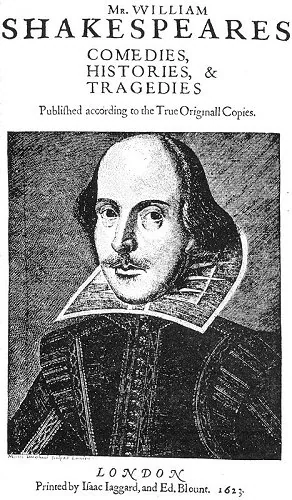
THE DROESHOUT PORTRAIT OF SHAKSPERE.
From Shakespeare's Great Folio of 1623.
There are no authentic portraits of Shakspere in existence. The dissimilarities the Droeshout, Chandos, Janssen, Hunt, Ashbourne, Soest, and Dunford portraits prove conclusively that the artists were unaware of Shakspere's actual features. An examination of the Droeshout portrait discloses several peculiarities. Baconian enthusiasts are convinced that the face is only a caricature, possibly the death mask of Francis Bacon. A comparison of the Droeshout Shakspere with portraits and engravings of Francis Bacon demonstrates the identity of the structure of the two faces, the difference in expression being caused by lines of shading. Not also the peculiar line running from the ear down to the chin. Does this line subtly signify that the face itself a mask, ending at the ear? Notice also that the head is not connected with the body, but is resting on the collar. Most strange of all is the coat: one-half is on backwards. In drawing the jacket, the artist has made the left arm correctly, but the right arm has the back of the shoulder to the front. Frank Woodward has noted that there are 157 letters on the title page. This is a Rosicrucian signature of first importance. The date, 1623, Plus the two letters "ON" from the word "LONDON," gives the cryptic signature of Francis Bacon, by a simple numerical cipher. By merely exchanging the 26 letters of the alphabet for numbers, 1 became A, 6 becomes F, 2 becomes B, and 3 becomes C, giving AFBC. To this is added the ON from LONDON, resulting in AFBCON, which rearranged forms F. BACON.
to the initiates of which it revealed its wisdom in the form of symbols; (2) by embodying its arcana in the literature of the day by means of cunningly contrived ciphers and enigmas.
Evidence points to the existence of a group of wise and illustrious Fratres who assumed the responsibility of publishing and preserving for future generations the choicest of the secret books of the ancients, together with certain other documents which they themselves had prepared. That future members of their fraternity might not only identify these volumes bur also immediately note the significant passages, words, chapters, or sections therein, they created a symbolic alphabet of hieroglyphic designs. By means of a certain key and order, the discerning few were thus enabled to find that wisdom by which a man is "raised" to an illumined life.
The tremendous import of the Baconian mystery is daily becoming more apparent. Sir Francis Bacon was a link in that great chain of minds which has perpetuated the secret doctrine of antiquity from its beginning. This secret doctrine is concealed in his cryptic writings. The search for this divine wisdom is the only legitimate motive for the effort to decode his cryptograms.
Masonic research might discover much of value if it would turn its attention to certain volumes published during the sixteenth and seventeenth centuries which bear the stamp and signet of that secret society whose members first established modern Freemasonry but themselves remained as an intangible group controlling and directing the activities of the outer body. The unknown history and lost rituals of Freemasonry may be rediscovered in the symbolism and cryptograms of the Middle Ages. Freemasonry is the bright and glorious son of a mysterious and hidden father. It cannot trace its parentage because that origin is obscured by the veil of the superphysical and the mystical. The Great Folio of 1623 is a veritable treasure house of Masonic lore and symbolism, and the time is at hand when that Great Work should be accorded the consideration which is its due.
Though Christianity shattered the material organization of the pagan Mysteries, it could not destroy the knowledge of supernatural power which the pagans possessed. Therefore it is known that the Mysteries of Greece and Egypt were secretly perpetuated through the early centuries of the church, and later, by being clothed in the symbolism of Christianity, were accepted as elements of that faith. Sir Francis Bacon was one of those who had been entrusted with the perpetuation and dissemination of s the arcana of the superphysical originally in the possession of the pagan hierophants, and to attain that end either formulated the Fraternity of R.C. or was admitted into an organization already existing under that name and became one of its principal representatives.
For some reason not apparent to the uninitiated there has been a continued and consistent effort to prevent the unraveling of the Baconian skein. Whatever the power may be which continually blocks the efforts of investigators, it is as unremitting now as it was immediately following Bacon's death, and those attempting to solve the enigma still feel the weight of its resentment.
A misunderstanding world has ever persecuted those who understood the secret workings of Nature, seeking in every conceivable manner to exterminate the custodians of this divine wisdom. Sir Francis Bacon's political prestige was finally undermined and Sir Walter Ralegh met a shameful fate because their transcendental knowledge was considered dangerous.
The forging of Shakspere's handwriting; the foisting of fraudulent portraits and death masks upon a gullible public; the fabrication of spurious biographies; the mutilation of books and documents; the destruction or rendering illegible of tablets and inscriptions containing cryptographic messages, have all compounded the difficulties attendant upon the solution of the Bacon-Shakspere-Rosicrucian riddle. The Ireland forgeries deceived experts for years.
According to material available, the supreme council of the Fraternity of R.C. was composed of a certain number of individuals who had died what is known as the "philosophic death." When the time came for an initiate to enter upon his labors for the Order, he conveniently "died" under somewhat mysterious circumstances. In reality he changed his name and place of residence, and a box of rocks or a body secured for the purpose was buried in his stead. It is believed that this happened in the case of Sir Francis Bacon who, like all servants of the Mysteries, renounced all personal credit and permitted others to be considered as the authors of the documents which he wrote or inspired.
The cryptic writings of Francis Bacon constitute one of the most powerful tangible elements in the mysteries of transcendentalism and symbolic philosophy. Apparently many years must yet pass before an uncomprehending world will appreciate the transcending genius of that mysterious man who wrote the Novum Organum, who sailed his little ship far out into the unexplored sea of learning through the Pillars of Hercules, and whose ideals for a new civilization are magnificently expressed in the Utopian dream of The New Atlantis. Was Sir Francis Bacon a second Prometheus? Did his great love for the people of the world and his pity for their ignorance cause him to bring the divine fire from heaven concealed within the contents of a printed page?
In all probability, the keys to the Baconian riddle will be found in classical mythology. He who understands the secret of the Seven-Rayed God will comprehend the method employed by Bacon to accomplish his monumental labor. Aliases were assumed by him in accordance with the attributes and order of the members of the planetary system. One of the least known--but most important--keys to the Baconian enigma is the Third, or 1637, Edition, published in Paris, of Les Images ou Tableaux de platte peinture des deux Philostrates sophistes grecs et les statues de Callistrate, by Blaise de Vigenere. The title page of this volume--which, as the name of the author when properly deciphered indicates, was written by or under the direction of Bacon or his secret society--is one mass of important Masonic or Rosicrucian symbols. On page 486 appears a plate entitled "Hercules Furieux," showing a gigantic figure shaking a spear, the ground before him strewn with curious emblems. In his curious work, Das Bild des Speershüttlers die Lösung des Shakespeare-Rätsels, Alfred Freund attempts to explain the Baconian symbolism in the Philostrates. Bacon he reveals as the philosophical Hercules, whom time will establish as the true "Spear-Shaker" (Shakespeare).
TITLE PAGE OF THE FAMOUS FIRST EDITION OF SIR WALTER RALEGH'S HISTORY OF THE WORLD.
From Ralegh's History of the World.
What was the mysterious knowledge which Sir Walter Ralegh possessed and which was declared to be detrimental to the British government? Why was he executed when the charges against him could not be proved? Was he a member of me of those feared and hated secret societies which nearly overthrew political and religious Europe during the sixteenth and seventeenth centuries? Was Sir Walter Ralegh an important factor in the Bacon-Shakspere-Rosicrucian-Masonic enigma? By those seeking the keys to this great controversy, he seems to have been almost entirely overlooked. His contemporaries are unanimous in their praise of his remarkable intellect, and he has long been considered me of Britain's most brilliant sons.
Sir Walter Ralegh--soldier, courtier, statesman, writer, poet, philosopher, and explorer--was a scintillating figure at the court of Queen Elizabeth. Upon this same man, King James--after the death of Elizabeth--heaped every indignity within his power. The cowardly James, who shuddered at the mention of weapons and cried like a child when he was crossed, was insanely jealous of the brilliant courtier. Ralegh's enemies, Playing upon the king's weakness, did not cease their relentless persecution until Ralegh had been hanged and his decapitated, quartered, and disemboweled body lay at their feet.
The title page reproduced above was used by Ralegh's political foes as a powerful weapon against him. They convinced James I that the face of the central figure upholding the globe was a caricature of his own, and the enraged king ordered every copy of the engraving destroyed. But a few copies escaped the royal wrath; consequently the plate is extremely rare. The engraving is a mass Rosicrucian and Masonic symbols, and the figures on the columns in all probability conceal a cryptogram. More significant still is the fact that the page facing this plate is a headpiece identical with that used in the 1623 Folio of "Shakespeare" and also in Bacon's Novum Organum.
The Cryptogram as a factor in Symbolic Philosophy
NO treatise which deals with symbolism would be complete without a section devoted to the consideration of cryptograms. The use of ciphers has long been recognized as indispensable in military and diplomatic circles, but the modern world has overlooked the important rôle played by cryptography in literature and philosophy. If the art of deciphering cryptograms could be made popular, it would result in the discovery of much hitherto unsuspected wisdom possessed by both ancient and mediæval philosophers. It would prove that many apparently verbose and rambling authors were wordy for the sake of concealing words. Ciphers are hidden in the most subtle manner: they may be concealed in the watermark of the paper upon which a book is printed; they may be bound into the covers of ancient books; they may be hidden under imperfect pagination; they may be extracted from the first letters of words or the first words of sentences; they may be artfully concealed in mathematical equations or in apparently unintelligible characters; they may be extracted from the jargon of clowns or revealed by heat as having been written in sympathetic ink; they may be word ciphers, letter ciphers, or apparently ambiguous statements whose meaning could be understood only by repeated careful readings; they may he discovered in the elaborately illuminated initial letters of early books or they may be revealed by a process of counting words or letters. If those interested in Freemasonic research would give serious consideration to this subject, they might find in books and manuscripts of the sixteenth and seventeenth centuries the information necessary to bridge the gap in Masonic history that now exists between the Mysteries of the ancient world and the Craft Masonry of the last three centuries.
The arcana of the ancient Mysteries were never revealed to the profane except through the media of symbols. Symbolism fulfilled the dual office of concealing the sacred truths from the uninitiated and revealing them to those qualified to understand the symbols. Forms are the symbols of formless divine principles; symbolism is the language of Nature. With reverence the wise pierce the veil and with clearer vision contemplate the reality; but the ignorant, unable to distinguish between the false and the true, behold a universe of symbols. It may well be said of Nature--the Great Mother--that she is ever tracing strange characters upon the surface of things, but only to her eldest and wisest sons as a reward for their faith and devotion does she reveal the cryptic alphabet which is the key to the import of these tracings.
The temples of the ancient Mysteries evolved their own sacred languages, known only to their initiates and never spoken save in the sanctuary. The illumined priests considered it sacrilege to discuss the sacred truths of the higher worlds or the divine verities of eternal Nature in the same tongue as that used by the vulgar for wrangling and dissension. A sacred science must needs be couched in a sacred language. Secret alphabets also were invented, and whenever the secrets of the wise were committed to writing, characters meaningless to the uninformed were employed. Such forms of writing were called sacred or Hermetic alphabets. Some--such as the famous angelic writing--are still retained in the higher degrees of Masonry.
Secret alphabets were not entirely satisfactory, however, for although they rendered unintelligible the true nature of the writings, their very presence disclosed the fact of concealed information--which the priests also sought to conceal. Through patience or persecution, the keys to these alphabets were eventually acquired and the contents of the documents revealed to the unworthy. This necessitated employment of more subtle methods for concealing the divine truths. The result was the appearance of cryptic systems of writing designed to conceal the presence of both the message and the cryptogram. Having thus devised a method of transmitting their secrets to posterity, the illuminati encouraged the circulation of certain documents specially prepared through incorporating into them ciphers containing the deepest secrets of mysticism and philosophy. Thus mediæval philosophers disseminated their theories throughout Europe without evoking suspicion, since volumes containing these cryptograms could be subjected to the closest scrutiny without revealing the presence of the hidden message.
During the Middle Ages scores of writers--members of secret political or religious organizations--published books containing ciphers. Secret writing became a fad; every European court had its own diplomatic cipher, and the intelligentsia vied with one another in devising curious and complicated cryptograms. The literature of the fifteenth, sixteenth, and seventeenth centuries is permeated with ciphers, few of which have ever been decoded. Many of the magnificent scientific and philosophic intellects of this period dared not publish their findings, because of the religious intolerance of their day. In order to preserve the fruitage of their intellectual labors for mankind, these pioneers of progress concealed their discoveries in ciphers, trusting that future generations, more kindly than their own, would discover and appreciate their learning.
Many churchmen, it is interesting to note, used cryptograms, fearing excommunication or a worse fate should their scientific researches be suspected. Only recently an intricate cipher of Roger Bacon's has been unraveled, revealing the fact that this early scientist was well versed in the cellular theory. Lecturing before the American Philosophical Society, Dr. William Romaine Newbold,
A FAMOUS CRYPTIC TITLE PAGE.
From Selenus' Cryptomenytices et Cryptographiæ.
One year after the publication of the first Great "Shakespearian" Folio, a remarkable volume on cryptogram, and ciphers was published. The title page of the work is reproduced above. The year of its publication (1624) was during the Rosicrucian controversy. The translation of the title page is as follows:
"The Cryptomenysis and Cryptography of Gustavus Selenus in nine books, to which is added a clear explanation of the System of Steganography of John Trithemius, Abbot of Spanheim and Herbipolis, a man of admirable genius. Interspersed with worthy inventions of the Author and others, 1624." The author of this volume was believed to be Augustus, Duke of Brunswick. The symbols and emblems ornamenting the title page, however, are conclusive evidence that the fine hand of the Rosicrucians was behind its publication. At the bottom of the picture is a nobleman (Bacon?) placing his hat on another man's head. In the oval at the top of the plate, it is possible that the lights are beacons, or a play upon the name Bacon. In the two side panels are striking and subtle "Shakespearian" allusions. On the left is a nobleman (possibly Bacon) handing a paper to another man of mean appearance who carries in his hand a spear. At the right, the man who previously carried the spear is shown in the costume of an actor, wearing spurs and blowing a horn. The allusion to the actor blowing his horn and the figure carrying the spear suggest much, especially as spear is the last syllable of the name "Shakespeare."
who translated the cipher manuscript of the friar, declared: "There are drawings which so accurately portray the actual appearance of certain objects that it is difficult to resist the inference that Bacon had seen them with the microscope. * * * These are spermatozoa, the body cells and the seminiferous tubes, the ova, with their nuclei distinctly indicated. There are nine large drawings, of which one at least bears considerable resemblance to a certain stage of development of a fertilized cell." (See Review of Reviews, July, 1921.) Had Roger Bacon failed to conceal this discovery under a complicated cipher, he would have been persecuted as a heretic and would probably have met the fate of other early liberal thinkers. In spite of the rapid progress made by science in the last two hundred and fifty years, it still remains ignorant concerning many of the original discoveries made by mediæval investigators. The only record of these important findings is that contained in the cryptograms of the volumes which they published. While many authors have written on the subject of cryptography, the books most valuable to students of philosophy and religion are: Polygraphia and Steganographia, by Trithemius, Abbot of Spanheim; Mercury, or The Secret and Swift Messenger, by John Wilkins, Bishop of Chester; Œdipus Ægyptiacus and other works by Athanasius Kircher, Society of Jesus; and Cryptomenytices et Cryptographiæ, by Gustavus Selenus.
To illustrate the basic differences in their construction and use, the various forms of ciphers are here grouped under seven general headings:
1. The literal cipher. The most famous of all literal cryptograms is the famous biliteral cipher described by Sir Francis Bacon in his De Augmentis Scientiarum. Lord Bacon originated the system while still a young man residing in Paris. The biliteral cipher requires the use of two styles of type, one an ordinary face and the other specially cut. The differences between the two fonts are in many case so minute that it requires a powerful magnifying glass to detect them. Originally, the cipher messages were concealed only in the italicized words, sentences, or paragraphs, because the italic letters, being more ornate than the Roman letters, offered greater opportunity for concealing the slight but necessary variations. Sometimes the letters vary a trifle in size; at other times in thickness or in their ornamental flourishes. Later, Lord Bacon is believed to have had two Roman alphabets specially prepared in which the differences were so trivial that it is almost impossible for experts to distinguish them.
A careful inspection of the first four "Shakespeare" folios discloses the use throughout the volumes of several styles of type differing in minute but distinguishable details. It is possible that all the "Shakespeare" folios contain ciphers running through the text. These ciphers may have been added to the original plays, which are much longer in the folios than in the original quartos, full scenes having been added in some instances.
The biliteral cipher was not confined to the writings of Bacon and "Shakespeare," however, but appears in many books published during Lord Bacon's lifetime and for nearly a century after his b death. In referring to the biliteral cipher, Lord Bacon terms it omnia per omnia. The cipher may run through an entire book and be placed therein at the time of printing without the knowledge of the original author, for it does not necessitate the changing of either words or punctuation. It is possible that this cipher was inserted for political purposes into many documents and volumes published during the seventeenth century. It is well known that ciphers were used for the same reason as early as the Council of Nicæa.
The Baconian biliteral cipher is difficult to use today, owing to the present exact standardization of type and the fact that so few books are now hand set. Accompanying this chapter are facsimiles of Lord Bacon's biliteral alphabet as it appeared in the 1640 English translation of De Augmentis Scientiarum. There are four alphabets, two for the capital and two for the small letters. Consider carefully the differences between these four and note that each alphabet has the power of either the letter a or the letter b, and that when reading a word its letters are divisible into one of two groups: those which correspond to the letter a and those which correspond to the letter b. In order to employ the biliteral cipher, a document must contain five times as many letters as there are in the cipher message to be concealed, for it requires five letters to conceal one. The biliteral cipher somewhat resembles a telegraph code in which letters are changed into dots and dashes; according to the biliteral system, however, the dots and dashes are represented respectively by a's and b's. The word biliteral is derived from the fact that all letters of the alphabet may be reduced to either a or b. An example of biliteral writing is shown in one of the accompanying diagrams. In order to demonstrate the working of this cipher, the message concealed within the words "Wisdom and understanding are more to be desired than riches" will now be deciphered.
The first step is to discover [he letters of each alphabet and replace them by their equivalent a or b in accordance with the key given by Lord Bacon in his biliteral alphabet (q.v.). In the word wisdom, the W is from the b alphabet; therefore it is replaced by a b. The i is from the a alphabet; therefore an a is put in its place. The s is also from the a alphabet, but the d belongs to the b alphabet. The o and the m both belong to the a alphabet is replaced by a. By this process the word WISDOM become baabaa. Treating the remaining words of the sentence in a similar manner, AND becomes aba; UNDERSTANDING, aaabaaaaaabab; ARE, aba; MORE, abbb; TO, ab; BE, ab; DESIRED, abaabaa; THAN, aaba; RICHES, aaaaaa.
The next step is to run all the letters together; thus: baabaaabaaaabaaaaaabababaabbbabababaabaaaabaaaaaaa. All the combinations used in the Baconian biliteral cipher consist of groups containing five letters each. Therefore the solid line of letters must be broken into groups of five in the following manner: baaba aabaa aabaa aaaab ababa abbba babab aabaa aabaa aaaaa. Each of these groups of five letters now represents one letter of the cipher, and the actual letter can now be determined by comparing the groups with the alphabetical table, The Key to the Biliteral Cipher, from De Augmentis Scientiarum (q.v.): baaba = T, aabaa = E, aabaa = E; aaaab = B; ababa = L; abbba = P; babab = X; aabaa = E, aabaa = E; aaaaa = A; but the last five letters of the word riches being set off by a period from the initial r, the last five a's do not count in the cipher. The letters thus extracted are now brought together in order, resulting in TEEBLPXEE.
At this point the inquirer might reasonably expect the letters to make intelligible words; but he will very likely be disappointed, for, as in the case above, the letters thus extracted are themselves a cryptogram, doubly involved to discourage those who might have a casual acquaintance with the biliteral system. The next step is to apply the nine letters to what is commonly called a wheel (or disc) cipher (q.v.), which consists of two alphabets, one revolving around the other in such a manner that numerous transpositions of letters are possible. In the accompanying cut the A of the inner alphabet
AN EXAMPLE OF BILITERAL WRITING.
In the above sentence note carefully the formation of the letters. Compare each letter with the two types of letters in the biliteral alphabet table reproduced from Lord Bacon's De Augmentis Scientiarum. A comparison of the "d" in "wisdom" with the "d" in "and" discloses a large loop at the top of the first, while the second shows practically no loop at all. Contrast the "i" in "wisdom" with the "i" in "understanding." In the former, the lines are curved and in the latter angular. A similar analysis of the two "r's" in "desired" reveals obvious differences. The "o" in "more" differs only from the "o" in "wisdom" in that it a tiny line continues from the top over towards the "r." The "a" in "than" is thinner and more angular than the "a" in "are," while the "r" in "riches" differs from that in "desired" in that the final upright stroke terminates in a ball instead of a sharp point. These minor differences disclose the presence of the two alphabets employed in writing the sentence.
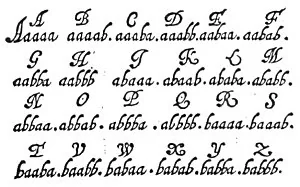
THE KEY TO THE BILITERAL CIPHER.
From Bacon's De Augmentis Scientiarum.
After the document to be deciphered has been reduced to its "a" and "b" equivalents, it is then broken up into five-letter groups and the message read with the aid of the above table.
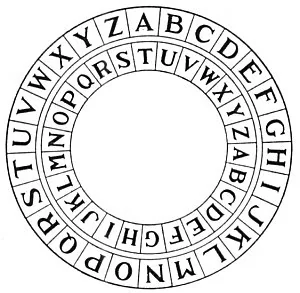
A MODERN WHEEL, OR DISC, CIPHER.
The above diagram shows a wheel cipher. The smaller, or inner, alphabet moves around so that any one of its letters may be brought opposite any me of he letters on the larger, or outer, alphabet. In some, cases the inner alphabet is written backwards, but in the present example, both alphabets read the same way.
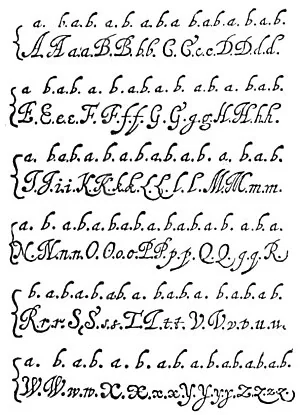
THE BILITERAL ALPHABET.
From Bacon's De Augmentis Scientiarum.
This Plate is reproduced from Bacon's De Augmentis Scientiarum, and shows the two alphabets as designed by him for the purpose of his cipher. Each capital and small letter has two distinct forms which are designated "a" and "b". The biliteral system did not in every instance make use of two alphabets in which the differences were as perceptible as in the example here given, but the two alphabets were always used; sometimes variations are so minute that it requires a powerful magnifying glass to distinguish the difference between the "a" and "b" types of letters.
is opposite the H of the outer alphabet, so that for cipher purposes these letters are interchangeable. The F and M, the P, and Y, the W and D, in fact all the letters, may be transposed as shown by the two circles. The nine letters extracted by the biliteral cipher may thus be exchanged for nine others by the wheel cipher. The nine letters are considered as being on the inner circle of the wheel and are exchanged for the nine letters on the outer circle which are opposite the inner letters. By this process the T becomes A; the two E's become two L's; the B becomes I, the L becomes S; the P becomes W; the X becomes E; and the two E's become two L's. The result is ALLISWELL, which, broken up into words, reads: "All is well."
Of course, by moving the inner disc of the wheel cipher, many different combinations in addition to the one given above can be made of the letters, but this is the only one which will produce sense, and the cryptogrammatist must keep on experimenting until he discovers a logical and intelligible message. He may then feel reasonably sure that he has deciphered the system. Lord Bacon involved the biliteral cipher in many different ways. There are probably a score of different systems used in the "Shakespeare" folio alone, some so intricate that they may forever baffle all attempts at their decipherment. In those susceptible of solution, sometimes the a's and b's have to be exchanged; at other times the concealed message is written backwards; again only every other letter is counted; and so on.
There are several other forms of the literal cipher in which letters are substituted for each other by a prearranged sequence. The simplest form is that in which two alphabets are written thus:
|
A |
B |
C |
D |
E |
F |
G |
H |
I |
K |
L |
M |
N |
|
Z |
Y |
X |
W |
U |
T |
S |
R |
Q |
P |
O |
N |
M |
|
O |
P |
Q |
R |
S |
T |
U |
W |
X |
Y |
Z | ||
|
L |
K |
I |
H |
G |
F |
E |
D |
C |
B |
A |
By substituting the letters of the lower alphabet for their equivalents in the upper one, a meaningless conglomeration results, the hidden message being decoded by reversing the process. There is also a form of the literal cipher in which the actual cryptogram is written in the body of the document, but unimportant words are inserted between important ones according to a prearranged order. The literal cipher also includes what are called acrostic signatures--that is, words written down the column by the use of the first letter of each line and also more complicated acrostics in which the important letters are scattered through entire paragraphs or chapters. The two accompanying alchemical cryptograms illustrate another form of the literal cipher involving the first letter of each word. Every cryptogram based upon the arrangement or combination of the letters of the alphabet is called a literal cipher.
2. The pictorial cipher. Any picture or drawing with other than its obvious meaning may be considered a pictorial cryptogram. Instances of pictorial cipher are frequently found in Egyptian symbolism and early religious art. The diagrams of alchemists and Hermetic philosophers are invariably pictorial ciphers. In addition to the simple pictorial cipher, there is a more technical form in which words or letters are concealed by the number of stones in a wall, by the spread of birds' wings in flight, by ripples on the surface of water, or by the length and order of lines used in shading. Such cryptograms are not obvious, and must be decoded with the aid of an arbitrary measuring scale, the length of the lines determining the letter or word concealed. The shape and proportion of a building, the height of a tower, the number of bars in a window, the folds of a man's garments--even the proportions or attitude of the human body--were used to conceal definite figures or characters which could be exchanged for letters or words by a person acquainted with the code.
Initial letters of names were secreted in architectural arches and spans. A notable example of this practice is found on the title page of Montaigue's Essays, third edition, where an initial B is formed by two arches and an F by a broken arch. Pictorial cryptograms are sometimes accompanied by the key necessary for their decipherment. A figure may point toward the starting point of the cipher or carry in its hand some implement disclosing the system of measurement used. There are also frequent instances in which the cryptographer purposely distorted or improperly clothed some figure in his drawing by placing the hat on backwards, the sword on the wrong side, or the shield on the wrong arm, or by employing some similar artifice. The much-discussed fifth finger on the Pope's hand in Raphael's Sistine Madonna and the sixth toe on Joseph's foot in the same artist's Marriage of the Virgin are cunningly concealed cryptograms.
3. The acroamatic cipher. The religious and philosophical writings of all nations abound with acroamatic cryptograms, that is, parables and allegories. The acroamatic is unique in that the document containing it may be translated or reprinted without affecting the cryptogram. Parables and allegories have been used since remote antiquity to present moral truths in an attractive and understandable manner. The acroamatic cryptogram is a pictorial cipher drawn in words and its symbolism must be so interpreted. The Old and New Testaments of the Jews, the writings of Plato and Aristotle, Homer's Odyssey and Iliad, Virgil's Æneid, The Metamorphosis of Apuleius, and Æsop's Fables are outstanding examples of acroamatic cryptography in which are concealed the deepest and most sublime truths of ancient mystical philosophy.
The acroamatic cipher is the most subtle of all, for the parable or allegory is susceptible of several interpretations. Bible students for centuries have been confronted by this difficultly. They are satisfied with the moral interpretation of the parable and forget that each parable and allegory is capable of seven interpretations, of which the seventh--the highest--is complete and all-inclusive, whereas the other six (and lesser) interpretations are fragmentary, revealing but part of the mystery. The creation myths of the world are acroamatic cryptograms, and the deities of the various pantheons are only cryptic characters which, if properly understood, become the constituents of a divine alphabet. The initiated few comprehend the true nature of this alphabet, but the uninitiated many worship the letters of it as gods.
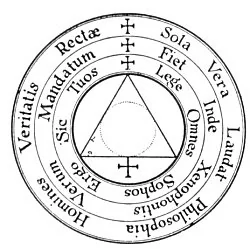
AN ALCHEMICAL CRYPTOGRAM.
From Brown's History of Chemistry.
James Campbell Brown reprints a curious cipher from Kircher. The capital letters of the seven words in the outer circle read clockwise, form the word SVLPHVR. From the words in the second circle, when read in a similar manner, is derived FIXVM. The capitals of the six words in the inner circle, when properly arranged, also read ESTSOL. The following cipher is thus extracted: "Sulphur Fixum Est Sol," which when translated is: "Fixed sulphur is gold."
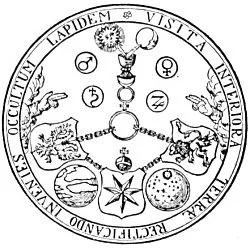
AN ALCHEMICAL CRYPTOGRAM.
From Geheime Figuren der Rosenkreuzer.
Beginning with the word VISITA and reading clockwise, the seven initial letters of the seven words inscribed in the outer circle read: VITRIOL. This is a very simple alchemical enigma, but is a reminder that those studying works on Hermeticism, Rosicrucianism, alchemy, and Freemasonry should always be on the lookout for concealed meanings hidden either in Parables and allegories or in cryptic arrangements of numbers, letters, and words.
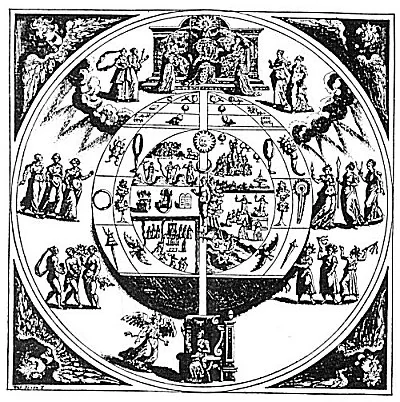
A CRYPTIC DEPICTION OF DIVINE AND NATURAL JUSTICE.
From Selenus' Cryptomenytices et Cryptographiæ.
The first circle portrays the divine antecedents of justice, the second the universal scope of justice, and the third the results of human application of justice. Hence, the first circle deals with divine principles, the second circle with mundane affairs, and the third circle with man. On the at the top of the picture sits Themis, the presiding spirit of law, and at her feet three other queens--Juno, Minerva, and Venus--their robes ornamented with geometric figures. The axis of law connects the throne, of divine justice above with the throne of human judgment at the bottom of the picture. Upon the latter throne is seated a queen with a scepter in her hand, before whom stands the winged goddess Nemesis--the angel of judgment.
The second Circle is divided into three parts by two sets of two horizontal lines. The upper and light section is called the Supreme Region and is the abode of the gods, the good spirits, and the heroes. The lower and dark section is the abode of lust, sin, and ignorance. Between these two extremes is the larger section in which are blended the powers and impulses of both the superior and the inferior regions.
In the third or inner circle is man, a tenfold creature, consisting of nine parts--three of spirit, three of intellect, and three of soul--enclosed within one constitution. According to Selenus, man's three spiritual qualities are thought, speech, and action; his three intellectual qualities are memory, intelligence, and will; and his three qualities of soul are understanding, courage, and desire. The third circle is further divided into three parts called ages: the Golden Age of spiritual truth in the upper right section, the Iron Age of spiritual darkness in the lower right section and the Bronze Age--a composite of the two occupying the entire left half of the inner circle and itself divided into three parts. The lowest division of the Bronze Age depicts ignorant man controlled by force, the central the partly awakened man controlled by jurisprudence, and the upper the spiritually illuminated man controlled by love. Both the second and third circles revolve upon the axis of law, but the divine source, of law--Heavenly Justice--is concealed by clouds. All of the symbols and figures ornamenting the plate are devoted to a detailed amplification of the principles here outlined.
4. The numerical cipher. Many cryptograms have been produced in which numbers in various sequences are substituted for letters, words, or even complete thoughts. The reading of numerical ciphers usually depends upon the possession of specially arranged tables of correspondences. The numerical cryptograms of the Old Testament are so complicated that only a few scholars versed in rabbinical lore have ever sought to unravel their mysteries. In his Œdipus Ægyptiacus, Athanasius Kircher describes several Arabian Qabbalistic theorems, and a great part of the Pythagorean mystery was concealed in a secret method in vogue among Greek mystics of substituting letters for numbers.
The most simple numerical cipher is that in which the letters of the alphabet are exchanged for numbers in ordinary sequence. Thus A becomes 1, B 2, C 3, and so on, counting both I and J as 9 and both U and V as 20. The word yes by this system would be written 23-5-18. This cipher can be made more difficult by reversing the alphabet so that Z becomes 1, Y 2, X 3, and so on. By inserting a non-significant, or uncounted, number after each of the significant numbers the cipher is still more effectively concealed, thus: 23-16-5-9-18. The word yes is found by eliminating the second and fourth numbers. By adding 23, 5, and 18 together the sum 46 results. Therefore 46 is the numerical equivalent of the word yes. According to the simple numerical cipher, the sum 138 is equal to the words Note carefully. Therefore in a book using this method, line 138, page 138, or paragraph 138 may contain the concealed message. In addition to this simple numerical cipher there are scores of others so complicated that no one without the key can hope to solve them.
Authors sometimes based their cryptograms upon the numerical value of their own names; for example, Sir Francis Bacon repeatedly used the cryptic number 33--the numerical equivalent of his name. Numerical ciphers often involve the pagination of a book. Imperfect pagination, though generally attributed to carelessness, often conceals important secrets. The mispaginations found in the 1623 folio of "Shakespeare" and the consistent recurrence of similar errors in various volumes printed about the same period have occasioned considerable thought among scholars and cryptogrammatists. In Baconian cryptograms, all page numbers ending in 89 seem to have a special significance. The 89th page of the Comedies in the 1623 folio of "Shakespeare" shows an error of type in the pagination, the "9" being from a considerably smaller font than the "8." The 189th page is entirely missing, there being two pages numbered 187; and page 188 shows the second " 8 " scarcely more than half the size of the first one. Page 289 is correctly numbered and has no unusual features, but page 89 of the Histories is missing. Several volumes published by Bacon show similar errors, page 89 being often involved.
There are also numerical ciphers from which the cryptic message may be extracted by counting every tenth word, every twentieth word, or every fiftieth word. In some cases the count is irregular. The first important word may be found by counting 100, the second by counting 90, the third by counting 80, and so on until the count of 10 is reached. The count then returns to 100 and the process is repeated.
5. The musical cipher. John Wilkins, afterwards Bishop of Chester, in 1641 circulated an anonymous essay entitled Mercury, or the Secret and Swift Messenger. In this little volume, which was largely derived from the more voluminous treatises of Trithemius and Selenus, the author sets forth a method whereby musicians can converse with each other by substituting musical notes for the letters of the alphabet. Two persons understanding the code could converse with each other by merely playing certain notes upon a piano or other instrument. Musical cryptograms can be involved to an inconceivable point; by certain systems it is possible to take an already existing musical theme and conceal in it a cryptogram without actually changing the composition in any way. The pennants upon the notes may conceal the cipher, or the actual sounds of the notes may be exchanged for syllables of similar sound. This latter method is effective but its scope is somewhat limited. Several musical compositions by Sir Francis Bacon are still in existence. An examination of them might reveal musical cryptograms, for it is quite certain that Lord Bacon was well acquainted with the manner of their construction.
6. The arbitrary cipher. The system of exchanging letters of the alphabet for hieroglyphic figures is too easily decoded to be popular. Albert: Pike describes an arbitrary cipher based upon the various parts of the Knights Templars' cross, each angle representing a letter. The many curious alphabets that have been devised are rendered worthless, however, by the table of recurrence. According to Edgar Allan Poe, a great cryptogrammatist, the most common letter of the English language is E, the other letters in their order of frequency are as follows: A, O, I, D, H, N, R, S, T, V, Y, C, F, Q L, M, W, B, K, P, Q, X, Z. Other authorities declare the table of frequency to be: E, T, A, O, N, I, R, S, H, D, L, C, W, U, M, F, Y, G, P, B, V, K, X, Q, J, Z. By merely counting the number of times each character appears in the message, the law of recurrence discloses the English letter for which the arbitrary character stands. Further help is also rendered by the fact that if the cryptogram be split up into words there are only three single letters which may form words: A, I, O. Thus any single character set off from the rest of the text must be one of these three letters. For details of this System see The Gold Bug, by Edgar Allan Poe.
To render more difficult the decoding of arbitrary ciphers, however, the characters are seldom broken up into words, and, further, the table of recurrence is partly nullified by assigning two or more different characters to each letter, thereby making it impossible to estimate accurately the frequency of recurrence. Therefore, the greater the number of arbitrary characters used to represent any single letter of the alphabet, the more difficult it is to decipher an arbitrary cryptogram. The secret alphabets of the ancients are comparatively easy to decode, the only requisites being a table of frequency, a knowledge of the language in which the cryptogram was originally written, a moderate amount of patience, and a little ingenuity.
7. The code cipher. The most modem form of cryptogram is the code system. Its most familiar form is the Morse code for use in telegraphic and wireless communication. This form of cipher may be complicated somewhat by embodying dots and dashes into a document in which periods and colons are dots, while commas and semicolons are dashes. There are also codes used by the business world which can be solved only by the use of a private code book. Because they furnish an economical and efficient method of transmitting confidential information, the use of such codes is far more prevalent than the average person has any suspicion.
In addition to the foregoing classifications there are a number of miscellaneous systems of secret writing, some employing mechanical devices, others colors. A few make use of sundry miscellaneous objects to represent words and even complete thoughts. But as these more elaborate devices were seldom employed by the ancients or by the mediæval philosophers and alchemists, they have no direct bearing upon religion and philosophy. The mystics of the Middle Ages, borrowing the terminology of the various arts and sciences, evolved a system of cryptography which concealed the secrets of the human soul under terms generally applied to chemistry, biology, astronomy, botany, and physiology. Ciphers of this nature can only be decoded by individuals versed in the deep philosophic principles upon which these mediæval mystics based their theories of life. Much information relating to the invisible nature of man is concealed under what seem to be chemical experiments or scientific speculations. Every student of symbolism and philosophy, therefore, should be reasonably well acquainted with the underlying principles of cryptography; in addition to serving him well in his researches, this art furnishes a fascinating method of developing the acuteness of the mental faculties. Discrimination and observation are indispensable to the seeker after knowledge, and no study is equal to cryptography as a means of stimulating these powers.
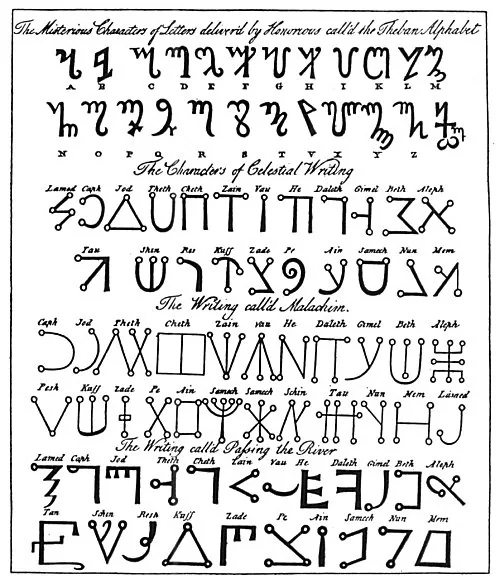
QABBALISTIC AND MAGIC ALPHABETS.
From Barrett's Magus.
Curious alphabets were invented by the early and mediæval philosophers to conceal their doctrines and tenets from the profane. Some of these alphabets are still used to a limited extent in the higher degrees of Freemasonry. Probably the most famous is the angelic writing, termed in the above plate "The Writing called Malachim." Its figures are supposedly derived from the constellations. Advanced students of occult philosophy will come upon many valuable documents in which these figures are used. Under each letter of the first alphabet above is its equivalent in English. Above each letter of the other three alphabets is its Hebrew letter equivalent.
Freemasonic Symbolism
IN several early Masonic manuscripts--for example, the Harleian, Sloane, Lansdowne, and Edinburgh-Kilwinning--it is stated that the craft of initiated builders existed before the Deluge, and that its members were employed in the building of the Tower of Babel. A Masonic Constitution dated 1701 gives the following naive account of the origin of the sciences, arts, and crafts from which the major part of Masonic symbolism is derived:
"How this worthy Science was first begunne, I shall tell. Before Noah's Flood, there was a man called Lameck as it is written in the 4 Chap. of Gen.: and this Lameck had two Wives. The one was called Adah, and the other Zillah; by the first wife Adah he gott two Sons, the one called Jaball, and the other Juball, and by the other wife Zillah he got a Son and Daughter, and the four children found the beginning of all Crafts in the world. This Jaball was the elder Son, and he found the Craft of Geometric, and he parted flocks, as of Sheep and Lambs in the fields, and first wrought Houses of Stone and Tree, as it is noted in the Chap, aforesaid, and his Brother Juball found the crafte of Musick, of Songs, Organs and Harp. The Third Brother [Tubal-cain] found out Smith's craft to work Iron and steel, and their sister Naamah found out the art of Weaving. These children did know thatt God would take Vengeance for Sinne, either by fire or water, wherefor they wrote these Sciences which they had found in Two Pillars of stone, thatt they might be found after the Flood. The one stone was called Marbell--cannott burn with Fire, and the other was called Laturus [brass?], thatt cannott drown in the Water." The author of this Constitution there upon declares that one of these pillars was later discovered by Hermes, who communicated to mankind the secrets thereon inscribed.
In his Antiquities of the Jews, Josephus writes that Adam had forewarned his descendants that sinful humanity would be destroyed by a deluge. In order to preserve their science and philosophy, the children of Seth there fore raised two pillars, one of brick and the other of stone, on which were inscribed the keys to their knowledge. The Patriarch Enoch--whose name means the Initiator--is evidently a personification of the sun, since he lived 365 years. He also constructed an underground temple consisting of nine vaults, one beneath the other, placing in the deepest vault a triangular tablet of gold bearing upon it the absolute and ineffable Name of Deity. According to some accounts, Enoch made two golden deltas. The larger he placed upon the white cubical altar in the lowest vault and the smaller he gave into the keeping of his son, Methuseleh, who did the actual construction work of the brick chambers according to the pattern revealed to his father by the Most High. In the form and arrangement of these vaults Enoch epitomized the nine spheres of the ancient Mysteries and the nine sacred strata of the earth through which the initiate must pass to reach the flaming Spirit dwelling in its central core.
According to Freemasonic symbolism, Enoch, fearing that all knowledge of the sacred Mysteries would be lost at the time of the Deluge, erected the two columns mentioned in the quotation. Upon the metal column in appropriate allegorical symbols he engraved the secret reaching and upon the marble column placed an inscription stating that a short distance away a priceless treasure would be discovered in a subterranean vault. After having thus faithfully completed his labors, Enoch was translated from the brow Of Mount Moriah. In time the location of the secret vaults was lost, but after the lapse of ages there came another builder--an initiate after the order of Enoch--and he, while laying the foundations for another temple to the Great Architect of the Universe, discovered the long-lost vaults and the secrets contained within.
John Leylande was appointed by King Henry VIII to go through the archives of the various religious institutions dissolved by the king and remove for preservation any books or manuscripts of an important character. Among the documents copied by Leylande was a series of questions and answers concerning the mystery of Masonry written by King Henry VI. In answer to the question, "How came Masonry into England?" the document States that Peter Gower, a Grecian, traveled for knowledge in Egypt, Syria, and every land where the Phœnicians had planted Masonry; winning entrance in all lodges of Masons, he learned much, and returning, dwelt in Greater Greece. He became renowned for his wisdom, formed a great lodge at Groton, and made many Masons, some of whom journeyed in France, spreading Masonry there; from France in the course of time the order passed into England.
To even the superficial student of the subject it must be evident that the name of Peter Gower, the Grecian, is merely an Anglicized form of Pythagoras; consequently Groton, where he formed his lodge, is easily identified with Crotona. A link is thus established between the philosophic Mysteries of Greece and mediæval Freemasonry. In his notes on King Henry's questions and answers, William Preston enlarges upon the vow of secrecy as it was practiced by the ancient initiates. On the authority of Pliny he describes how Anaxarchus, having been imprisoned in order to extort from him some of the secrets with which he had been entrusted, bit out his own tongue and threw it in the face of Nicocreon, the tyrant of Cyprus. Preston adds that the Athenians revered a brazen statue that was represented without a tongue to denote the sanctity with which they regarded their oath-bound secrets. It is also noteworthy that, according to King Henry's manuscript, Masonry had its origin in the East and was the carrier of the arts and sciences of civilization to the primitive humanity of the western nations.
Conspicuous among the symbols of Freemasonry are the seven liberal arts and sciences. By grammar man is taught to express in noble and adequate language his innermost thoughts and ideals; by rhetoric he is enabled to conceal his ideals under the protecting cover of ambiguous language and figures of speech; by logic he is trained
THE MYSTERY OF THE MACROCOSM.
Redrawn from Cesariano's Edition of Vitruvius.
Summarizing the relationship between the human body and the theory of architectonics, Vitruvius writes:
"Since nature has designed the human body so that its members are duly proportioned to the frame as a whole, it appears that the ancients had good reason for their rule, that in perfect building the different members must be in exact symmetrical relations to the whole general scheme. Hence, while transmitting to us the proper arrangements for buildings of all kinds, they were particularly careful to do so in the case of temples of the gods, buildings in which merits and faults usually last forever. * * * Therefore, if it is agreed that number was found out from the human fingers, and that there is a symmetrical correspondent between the members separately and the entire form of the body, in accordance with a certain part selected as standard, we can have nothing but respect for those who, in constructing temples of the immortal gods, have so arranged the members of the works that both the separate parts and the whole design may harmonize in their proportions and symmetry." (See The Ten Books on Architecture)
By some it is believed that St. Paul was initiated into the Dionysiac Mysteries, for in the tenth verse of the third chapter of First Corinthians he calls himself a "master-builder" or adept: "According to the grace of God which is given into me, as a wise master-builder, I have laid the foundation and another buildeth thereon. " As survivals of the ancient Dionysiac rites, the two diagrams of Cesariano, accompanying this chapter are of incalculable value to the modern mystic architect.
in the organization of the intellectual faculties with which he has been endowed; by arithmetic he not only is instructed in the mystery of universal order but also gains the key to multitude, magnitude, and proportion; by geometry he is inducted into the mathematics of form, the harmony and rhythm of angles, and the philosophy of organization; by music he is reminded that the universe is founded upon the laws of celestial harmonics and that harmony and rhythm are all-pervading; by astronomy he gains an understanding of the immensities of time and space, of the proper relationship between himself and the universe, and of the awesomeness of that Unknown Power which is driving the countless stars of the firmament through illimitable space. Equipped with the knowledge conferred by familiarity with the liberal arts and sciences, the studious Freemason therefore finds himself confronted by few problems with which he cannot cope.
THE DIONYSIAC ARCHITECTS
The most celebrated of the ancient fraternities of artisans was that of the Dionysiac Architects. This organization was composed exclusively of initiates of the Bacchus-Dionysos cult and was peculiarly consecrated to the science of building and the art of decoration. Acclaimed as being the custodians of a secret and sacred knowledge of architectonics, its members were entrusted with the design and erection of public buildings and monuments. The superlative excellence of their handiwork elevated the members of the guild to a position of surpassing dignity; they were regarded as the master craftsmen of the earth. Because of the first dances held in honor of Dionysos, he was considered the founder and patron of the theater, and the Dionysians specialized in the construction of buildings adapted for the presentation of dramatic performances. In the circular or semicircular orchestra they invariably erected an altar to Æschylus, the famous Greek poet, that while appearing in one of his own plays he was suspected by a mob of angry spectators of revealing one of the profound secrets of the Mysteries and was forced to seek refuge at the altar of Dionysos.
So carefully did the Dionysiac Architects safeguard the secrets of their craft that only fragmentary records exist of their esoteric teachings. John A. Weisse thus sums up the meager data available concerning the order:
"They made their appearance certainly not later than 1000 B.C., and appear to have enjoyed particular privileges and immunities. They also possessed secret means of recognition, and were bound together by special ties only known to themselves. The richer of this fraternity were bound to provide for their poorer brethren. They were divided into communities, governed by a Master and Wardens, and called γυνοικιαι (connected houses). They held a grand festival annually, and were held in high esteem. Their ceremonials were regarded as sacred. It has been claimed that Solomon, at the instance of Hiram, King of Tyre, employed them at his temple and palaces. They were also employed at the construction of the Temple of Diana at Ephesus. They had means of intercommunication all over the then known world, and from them, doubtless, sprang the guilds of the Traveling Masons known in the Middle Ages." (See The Obelisk and Freemasonry.)
The fraternity of the Dionysiac Architects spread throughout all of Asia Minor, even reaching Egypt and India. They established themselves in nearly all the countries bordering on the Mediterranean, and with the rise of the Roman Empire found their way into Central Europe and even into England. The most stately and enduring buildings in Constantinople, Rhodes, Athens, and Rome were erected by these inspired craftsmen. One of the most illustrious of their number was Vitruvius, the great architect, renowned as the author of De Architectura Libri Decem. In the various sections of his book Vitruvius gives several hints as to the philosophy underlying the Dionysiac concept of the principle of symmetry applied to the science of architecture, as derived from a consideration of the proportions established by Nature between the parts and members of the human body. The following extract from Vitruvius on the subject of symmetry is representative:
"The design of a temple depends on symmetry, the principles of which must be most carefully observed by the architect. They are due to proportion, in ἀναλογία. Proportion is a correspondence among the measures of the members of an entire work, and of the whole to a certain part selected as standard. From this result the principles of symmetry. Without symmetry and proportion there can be no principles in the design of any temple; that is, if there is no precise relation between its members, as in the case of those of a well shaped man. For the human body is so designed by nature that the face, from the chin to the top of the forehead and the lowest roots of the hair, is a tenth part of the whole height; the open hand from the wrist to the tip of the middle finger is just the same; the head from the chin to the crown is an eighth, and with the neck and shoulder from the top of the breast to the lowest roots of the hair is a sixth; from the middle of the breast to the summit of the crown is a fourth. If we take the height of the face itself, the distance from the bottom of the chin to the under side of the nostrils [and from that point] to a line between the eyebrows is the same; from there to the lowest roots of the hair is also a third, comprising the forehead. The length of the foot is one sixth of the height of the body; of the forearm, one fourth; and the breadth of the breast is also one fourth. The other members, too, have their own symmetrical proportions, and it was by employing them that the famous painters and sculptors of antiquity attained to great and endless renown."
The edifices raised by the Dionysiac Builders were indeed "sermons in stone." Though unable to comprehend fully the cosmic principles thus embodied in these masterpieces of human ingenuity and industry, even the uninitiated were invariably overwhelmed by the sense of majesty and symmetry resulting from the perfect coordination of pillars, spans, arches, and domes. By variations in the details of size, material, type, arrangement, ornamentation, and color, these inspired builders believed it possible to provoke in the nature of the onlooker certain distinct mental or emotional reactions. Vitruvius, for example, describes the disposition of bronze vases about a room so as to produce certain definite changes in the tone and quality of the human voice. In like manner, each chamber in the Mysteries through which the candidate passed had its own peculiar acoustics. Thus in one chamber the voice of the priest was amplified until his words caused the very room to vibrate, while in another the voice was diminished and softened to such a degree that it sounded like the distant tinkling of silver bells. Again, in some of the underground passageways the candidate was apparently bereft of the power of speech, for though he shouted at the top of his voice not even a whisper was audible to his ears. After progressing a few feet, however, he would discover that his softest sigh would be reechoed a hundred times.
The supreme ambition of the Dionysiac Architects was the construction of buildings which would create distinct impressions consistent with the purpose for which the structure itself was designed. In common with the Pythagoreans, they believed it possible by combinations of straight lines and curves to induce any desired mental attitude or emotion. They labored, therefore, to the end of producing a building perfectly harmonious with the structure of the universe itself. They may have even believed that an edifice so constructed because it was in no respect at variance with any existing reality would not be subject to dissolution but would endure throughout the span of mortal time. As a logical deduction from their philosophic trend of thought, such a building--en rapport with Cosmos--would also have become an oracle. Certain early works on magical philosophy hint that the Ark of the Covenant was oracular in character because of specially prepared chambers in its interior. These by their shape and arrangement were so attuned to the vibrations of the invisible world that they caught and amplified the voices of the ages imprinted upon and eternally existent in the substance of the astral light.
Unskilled in these ancient subtleties of their profession, modern architects often create architectural absurdities which would cause their creators to blush with shame did they comprehend their actual symbolic import. Thus, phallic emblems are strewn in profusion among the adornments of banks, office buildings, and department stores. Christian churches also may be surmounted with Brahmin or Mohammedan domes or be designed in a style suitable for a Jewish synagogue or a Greek temple to Pluto. These incongruities may be considered trivial in importance by the modern designer, but to the trained psychologist the purpose for which a building was erected is frustrated in large measure by the presence of such architectural discordances. Vitruvius thus defines the principle of propriety as conceived and applied by the Dionysians:
"Propriety is that: perfection of style which comes when a work is authoritatively constructed on approved principles. It arises from prescription (Greek θεματισμῷ), from usage, or from nature. From prescription, in the case of hypæthral edifices, open to the sky, in honour of Jupiter Lightning, the Heaven, the Sun, or the Moon: for these are gods whose semblances and manifestations we behold before our very eyes in the sky when it is cloudless and bright. The temples of Minerva, Mars, and Hercules will be Doric, since the virile strength of these gods makes daintiness entirely inappropriate to their houses. In temples to Venus, Flora, Proserpine, Spring-Water, and the Nymphs, the Corinthian order will be found to have peculiar significance, because these are delicate divinities and so its rather slender outlines, its flowers, leaves, and ornamental volutes will lend propriety where it is due. The construction of temples of the Ionic order to Juno, Diana, Father Bacchus, and the other gods of that kind, will be in keeping with the middle position which they hold; for the building of such will be an appropriate combination of the severity of the Doric and the delicacy of the Corinthian."
In describing the societies of Ionian artificers, Joseph Da Costa declares the Dionysiac rites to have been founded upon the science of astronomy, which by the initiates of this order was correlated to the builder's art. In various documents dealing with the origin of architecture are found hints to the effect that the great buildings erected by these initiated craftsmen were based upon geometrical patterns derived from the constellations. Thus, a temple might be planned according to the constellation of Pegasus or a court of judgment modeled after the constellation of the Scales. The Dionysians evolved a peculiar code by which they were able to communicate with one another in the dark and both the symbols and the terminology of their guild were derived, in the main, from the elements of architecture.
While stigmatized as pagans by reason of their philosophic principles, it is noteworthy that these Dionysiac craftsmen were almost universally employed in the erection of early Christian abbeys and cathedrals, whose stones even to this very day bear distinguishing marks and symbols cut into their surfaces by these illustrious builders. Among the ornate carvings upon the fronts of great churches of the Old World are frequently found representations of compasses, squares, rules, mallets, and clusters of builders' tools skillfully incorporated into mural decorations and even placed in the hands of the effigies of saints and prophets standing in exalted niches. A great mystery was contained in the ancient portals of the Cathedral Of Notre Dame which were destroyed during the French Revolution, for among their carvings were numerous Rosicrucian and Masonic emblems; and according to the records preserved by alchemists who studied their bas-reliefs, the secret processes for metallic transmutation were set forth in their grotesque yet most significant figures.
The checkerboard floor upon which the modern Freemasonic lodge stands is the old tracing board of the Dionysiac Architects, and while the modern organization is no longer limited to workmen's guilds it still preserves in its symbols the metaphysical doctrines of the ancient society of which it is presumably the outgrowth. The investigator of the origin of Freemasonic symbolism who desires to trace the development of the order through the ages will find a practical suggestion in the following statement of Charles W. Heckethorn:
"But considering that Freemasonry is a tree the roots of which spread through so many soils, it follows that traces thereof must be found in its fruit; that its language and ritual should retain much of the various sects and institutions it has passed through before arriving at their present state, and in Masonry we meet with Indian, Egyptian, Jewish, and Christian ideas, terms therefrom the supreme ambition of their craft and symbols." (See The Secret Societies of All Ages and Countries.)
The Roman Collegia of skilled architects were apparently a subdivision of the greater Ionian body, their principles and organization being practically identical with the older Ionian institution. It has been suspected that the Dionysians also profoundly influenced early Islamic culture, for part of their symbolism found its way into the Mysteries of the dervishes. At one time the Dionysians referred to themselves as Sons of Solomon, and one of the most important of their symbols was the Seal of Solomon--two interlaced triangles. This motif is frequently seen in conspicuous parts of Mohammedan mosques. The Knights Templars--who were suspected of anything and everything--are believed to have contacted these Dionysiac artificers and to have introduced many of their symbols and doctrines into mediæval Europe. But Freemasonry most of all owes to the Dionysiac cult the great mass of its symbols and rituals which are related to the science of architecture. From these ancient and illustrious artisans it also received the legacy of the unfinished Temple of Civilization-that vast, invisible structure upon which these initiated builders have labored continuously since the inception of their fraternity. This mighty edifice, which has fallen and been rebuilt time after time but whose foundations remain unmoved, is the true Everlasting House of which the temple on the brow of Mount Moriah was but an impermanent symbol.
Aside from the operative aspect of their order, the Dionysiac Architects had a speculative philosophic code. Human society they considered as a rough and untrued ashlar but lately chiseled from the quarry of elemental Nature. This crude block was the true object upon which these skilled craftsmen labored--polishing it, squaring it, and with the aid of fine carvings transforming it into a miracle of beauty. While mystics released their souls from the bondage of matter by meditation and philosophers found their keenest joy in the profundities of thought, these master workmen achieved liberation from the Wheel of Life and Death by learning to swing their hammers with the same rhythm that moves the swirling forces of Cosmos. They venerated the Deity under the guise of a Great Architect and Master Craftsman who was ever gouging rough ashlars from the fields of space and truing them into universes. The Dionysians affirmed constructiveness to be the supreme expression of the soul, and attuning themselves with the ever-visible constructive natural processes going on around them, believed immortality could be achieved by thus becoming a part of the creative agencies of Nature.
SOLOMON, THE PERSONIFICATION OF UNIVERSAL WISDOM
The name Solomon may be divided into three syllables, SOL-OM-ON, symbolizing light, glory, and truth collectively and respectively. The Temple of Solomon is, therefore, first of all "the House of Everlasting Light," its earthly symbol being the temple of stone on the brow of Mount Moriah. According to the Mystery teachings, there are three Temples of Solomon--as there are three Grand Masters, three Witnesses, and three Tabernacles of the Transfiguration. The first temple is the Grand House of the Universe, in the midst of which sits the sun (SOL) upon his golden throne. The twelve signs of the zodiac as Fellow-Craftsmen gather around their shining lord. Three lights--the stellar, the solar, and the lunar--illuminate this Cosmic Temple. Accompanied by his retinue of planets, moons, and asteroids, this Divine King (SOLomon), whose glory no earthly monarch shall ever equal, passes in stately pomp down the avenues of space. Whereas CHiram represents the active physical light of the sun, SOLomon signifies its invisible but all-powerful, spiritual and intellectual effulgency.
The second symbolic temple is the human body-the Little House made in the image of the Great Universal House. "Know ye not," asked the Apostle Paul, "that ye are the temple of God, and that the Spirit of God dwelleth in you?" Freemasonry within a temple of stone cannot be other than speculative, but Freemasonry within the living temple of the body is operative. The third symbolic temple is the Soular House, an invisible structure, the comprehension of which is a supreme Freemasonic arcanum. The mystery of this intangible edifice is concealed under the allegory of the Soma Psuchicon, or Wedding Garment described by St. Paul, the Robes of Glory of the High Priest of Israel, the Yellow Robe of the Buddhist monk, and the Robe of Blue and Gold to which Albert Pike refers in his Symbolism. The soul, constructed from an invisible fiery substance, a flaming golden metal, is cast by the Master Workman, CHiram Abiff, into the mold of clay (the physical body) and is called the Molten Sea. The temple of the human soul is built by three Master Masons personifying Wisdom, Love, and Service, and when constructed according to the Law of Life the spirit of God dwells in the Holy Place thereof. The Soular Temple is the true Everlasting House, and he who can raise
THE MYSTERY OF THE MICROCOSM.
Redrawn from Cesariano's Edition of Vitruvius.
Herein is depicted the mysterious Word of Plato which was crucified in space before the foundation of the world. The anonymous author of The Canon writes:
"The Logos or soul of the world, according to Plato, the Greek Hermes, and the Christ, according to the Christian Gnostics, are all one and the same as the Hebrew Adam Kadmon, who is the second person of the cabalistic triad. The Cyllenian Hermes, described by Hippolytus, so exactly resembles the lesser man found in Cesariano's edition of Vitruvius, that they may be justifiably considered to be identical."
After relating the figure to Dionysus because of the vine leaves wound in the hair, the same writer concludes: "Here we have clearly and distinctly a curious survival of the cosmic deity of Greece, copied and disfigured by the crude draughtsmen of the Middle Ages, but faithfully preserved, and recognizable to the last." Similar figures are to be found in Agrippa's De Occulta Philosophia. Like Cesariano's diagrams, however, the key given for their interpretation is most inadequate. Agrippa declares that, being a type of the lesser world, man contains in himself all numbers, measures, weights, motions, and elements. The secret doctrine of Freemasonry, like that of the Dionysiac Architects, is concerned primarily with the effort to measure or estimate philosophically the parts and proportions of the microcosm, so that by the knowledge derived therefrom the supreme ambition of their craft might be realized--the creation of a perfect man.
or cast it is a Master Mason indeed! The best-informed Masonic writers have realized that Solomon's Temple is a representation in miniature of the Universal Temple. Concerning this point, A. E. Waite, in A New Encyclopædia of Freemasonry, writes: "It is macrocosmic in character, so that the Temple is a symbol of the universe, a type of manifestation itself."
Solomon, the Spirit of Universal Illumination--mental, spiritual, moral, and physical--is personified in the king of an earthly nation. While a great ruler by that name may have built a temple, he who considers the story solely from its historical angle will never clear away the rubbish that covers the secret vaults. The rubbish is interpolated matter in the form of superficial symbols, allegories, and degrees which have no legitimate part in the original Freemasonic Mysteries. Concerning the loss of the true esoteric key to Masonic secrets, Albert Pike writes:
"No one journeys now 'from the high place of Cabaon to the threshing floor of Oman the Yebusite,' nor has seen, 'his Master, clothed in blue and gold;' nor are apprentices and Fellow-crafts any longer paid at their respective Columns; nor is the Master's working tool the Tracing Board, nor does he use in his work 'Chalk, Charcoal, and an Earthen Vessel,' nor does the Apprentice, becoming a Fellow Craft, pass from the square to the compass; for the meanings of these phrases as symbols have long been lost."
According to the ancient Rabbins, Solomon was an initiate of the Mystery schools and the temple which he built was actually a house of initiation containing amass of pagan philosophic and phallic emblems. The pomegranates, the palm-headed columns, the Pillars before the door, the Babylonian cherubim, and the arrangement of the chambers and draperies all indicate the temple to have been patterned after the sanctuaries of Egypt and Atlantis. Isaac Myer, in The Qabbalah, makes the following observation:
"The pseudo-Clement of Rome, writes: 'God made man male and female. The male is Christ: the female, the Church.' The Qabbalists called the Holy Spirit, the mother, and the Church of Israel, the Daughter. Solomon engraved on the walls of his Temple, likenesses of the male and female principles, to adumbrate this mystery; such, it is said, were the figures of the cherubim. This was, however, not in obedience to the words of the Thorah. They were symbolical of the Upper, the spiritual, the former or maker, positive or male, and the Lower, the passive, the negative or female, formed or made by the first."
Masonry came to Northern Africa and Asia Minor from the lost continent of Atlantis, not under its present name but rather under the general designation Sun and Fire Worship. The ancient Mysteries did not cease to exist when Christianity became the world's most powerful religion. Great Pan did not die! Freemasonry is the proof of his survival. The pre-Christian Mysteries simply assumed the symbolism of the new faith, perpetuating through its emblems and allegories the same truths which had been the property of the wise since the beginning of the world. There is no true explanation, therefore, for Christian symbols save that which is concealed within pagan philosophy. Without the mysterious keys carried by the hierophants of the Egyptian, Brahmin, and Persian cults the gates of Wisdom cannot be opened. Consider with reverent spirit, therefore, the sublime allegory of the Temple and its Builders, realizing that beneath its literal interpretation lies hidden a Royal Secret.
According to the Talmudic legends, Solomon understood the mysteries of the Qabbalah. He was also an alchemist and a necromancer, being able to control the dæmons, and from them and other inhabitants of the invisible worlds he secured much of his wisdom. In his translation of Clavicula Salomonis, or The Key of Solomon the King, a work presumably setting forth the magical secrets gathered by Solomon and used by him in the conjuration of spirits and which, according to Frank C. Higgins, contains many sidelights on Masonic initiatory rituals, S. L. MacGregor-Mathers recognizes the probability that King Solomon was a magician in the fullest sense of that word. "I see no reason to doubt," he affirms, "the tradition which assigns the authorship of the 'Key' to King Solomon, for among others Josephus, the Jewish historian, especially mentions the magical works attributed to that monarch; this is confirmed by many Eastern traditions, and his magical skill is frequently mentioned in the Arabian Nights."
Concerning Solomon's supernatural powers, Josephus writes in his Eighth Book of the Antiquities of the Jews:
"Now the sagacity and wisdom which God had bestowed on Solomon was so great that he exceeded the ancients, in so much that he was no way inferior to the Egyptians, who are said to have been beyond all men in understanding; * * * God also enabled him to learn that skill which expelled demons, which is a science useful and sanative to him. He composed such incantations also by which distempers are alleviated. And he left behind him the manner of using exorcisms, by which they drive away demons, so that they never return; and this method of cure is of great force unto this day."
The mediæval alchemists were convinced that King Solomon understood the secret processes of Hermes by means of which it was possible to multiply metals. Dr. Bacstrom writes that the Universal Spirit (CHiram) assisted King Solomon to build his temple, because Solomon being wise in the wisdom of alchemy knew how to control this incorporeal essence and, setting it to work for him, caused the invisible universe to supply him with vast amounts of gold and silver which most people believed were mined by natural methods.
The mysteries of the Islamic faith are now in the keeping of the dervishes--men who, renouncing worldliness, have withstood the test of a thousand and one days of temptation. Jelal-ud-din, the great Persian Sufic poet and philosopher, is accredited with having founded the Order of Mevlevi, or the "dancing dervishes," whose movements exoterically signify the motions of the celestial bodies and esoterically result in the establishment of a rhythm which stimulates the centers of spiritual consciousness within the dancer's body.
"According to the mystical canon, there are always on earth a certain number of holy men who are admitted to intimate communion with the Deity. The one who occupies the highest position among his contemporaries is called the 'Axis' (Qūtb) or 'Pole' of his time. * * * Subordinate to the Qūtb are two holy beings who bear the title of 'The Faithful Ones,' and are assigned places on his right and left respectively. Below these is a quartette of 'Intermediate Ones' (Evtād); and on successively lower planes ate five 'Lights' (Envār), and seven 'Very Good' (Akhyār). The next rank is filled by forty 'Absent Ones' (Rijal-i-ghaib), also termed 'Martyrs' (Shuheda). When an 'Axis' quits this earthly existence, he is succeeded by the 'Faithful One' who has occupied the place at his right hand. * * * For to these holy men, who also bear the collective titles of 'Lords of Souls,' and 'Directors,' is committed a spiritual supremacy over mankind far exceeding the temporal authority of earthly rulers." (See Mysticism and Magic in Turkey, by L. M. J. Garnett.)
The Axis is a mysterious individual who, unknown and unsuspected, mingles with mankind and who, according to tradition, has his favorite seat upon the roof of the Caaba. J. P. Brown, in The Dervishes, gives a description of these "Master Souls."
FREEMASONRY'S PRICELESS HERITAGE
The sanctum sanctorum of Freemasonry is ornamented with the gnostic jewels of a thousand ages; its rituals ring with the divinely inspired words of seers and sages. A hundred religious have brought their gifts of wisdom to its altar; arts and sciences unnumbered have contributed to its symbolism. Freemasonry is a world-wide university, teaching the liberal arts and sciences of the soul to all who will hearken to its words. Its chairs are seats of learning and its pillars uphold an arch of universal education. Its trestleboards are inscribed with the eternal verities of all ages and upon those who comprehend its sacred depths has dawned the realization that within the Freemasonic Mysteries lie hidden the long-lost arcana sought by all peoples since the genesis of human reason.
The philosophic power of Freemasonry lies in its symbols--its priceless heritage from the Mystery schools of antiquity. In a letter to Robert Freke Gould, Albert Pike writes:
"It began to shape itself to my intellectual vision into something more imposing and majestic, solemnly mysterious and grand. It seemed to me like the Pyramids in their loneliness, in whose yet undiscovered chambers may be hidden, for the enlightenment of coming generations, the sacred books of the Egyptians, so long lost to the world; like the Sphynx half buried in the desert. In its symbolism, which and its spirit of brotherhood are its essence, Freemasonry is more ancient than any of the world's living religions. It has the symbols and doctrines which, older than himself, Zarathustra inculcated; and ii seemed to me a spectacle sublime, yet pitiful--the ancient Faith of our ancestors holding out to the world its symbols once so eloquent, and mutely and in vain asking for an interpreter. And so I came at last to see that the true greatness and majesty of Freemasonry consist in its proprietorship of these and its other symbols; and that its symbolism is its soul."
Though the temples of Thebes and Karnak be now but majestic heaps of broken and time-battered stone, the spirit: of Egyptian philosophy still marches triumphant through the centuries. Though the rock-hewn sanctuaries of the ancient Brahmins be now deserted and their carvings crumbled into dust, still the wisdom of the Vedas endures. Though the oracles be silenced and the House of the Mysteries be now but rows of ghostly columns, still shines the spiritual glory of Hellas with luster undiminished. Though Zoroaster, Hermes, Pythagoras, Plato, and Aristotle are now but dim memories in a world once rocked by the transcendency of their intellectual genius, still in the mystic temple of Freemasonry these god-men live again in their words and symbols; and the candidate, passing through the initiations, feels himself face to face with these illumined hierophants of days long past.
Mystic Christianity
THE true story of the life of Jesus of Nazareth has never been unfolded to the world, either in the accepted Gospels or in the Apocrypha, although a few stray hints may be found in some of the commentaries written by the ante-Nicene Fathers. The facts concerning His identity and mission are among the priceless mysteries preserved to this day in the secret vaults beneath the "Houses of the Brethren." To a few of the Knights Templars, who were initiated into the arcana of the Druses, Nazarenes, Essenes, Johannites, and other sects still inhabiting the remote and inaccessible fastnesses of the Holy Land, part of the strange story was told. The knowledge of the Templars concerning the early history of Christianity was undoubtedly one of the main reasons for their persecution and final annihilation. The discrepancies in the writings of the early Church Fathers not only are irreconcilable, but demonstrate beyond question that even during the first five centuries after Christ these learned men had for the basis of their writings little more substantial than folklore and hearsay. To the easy believer everything is possible and there are no problems. The unemotional person in search of facts, however, is confronted by a host of problems with uncertain factors, of which the following are typical:
According to popular conception, Jesus was crucified during the thirty-third year of His life and in the third year of His ministry following His baptism. About A.D. 180, St. Irenæus, Bishop of Lyons, one of the most eminent of the ante-Nicene theologians, wrote Against Heresies, an attack on the doctrines of the Gnostics. In this work Irenæus declared upon the authority of the Apostles themselves that Jesus lived to old age. To quote: "They, however, that they may establish their false opinion regarding that which is written, 'to proclaim the acceptable year of the Lord,' maintain that He preached for one year only, and then suffered in the twelfth month. [In speaking thus], they are forgetful of their own disadvantage, destroying His whole work, and robbing Him of that age which is both more necessary and more honourable than any other; that more advanced age, I mean, during which also as a teacher He excelled all others. For how could He have had His disciples, if He did not teach? And how could He have taught, unless He had reached the age of a Master? For when He came to be baptised, He had not yet completed His thirtieth year, but was beginning to be about thirty years of age (for thus Luke, who has mentioned His years, has expressed it: 'Now Jesus was, as it were, beginning to be thirty years old,' when He came to receive baptism); and, (according to these men,) He preached only one year reckoning from His baptism. On completing His thirtieth year He suffered, being in fact still a young man, and who had by no means attained to advanced age. Now, that the first stage of early life embraces thirty years, and that this extends onward to the fortieth year, every one will admit; but from the fortieth and fiftieth year a man begins to decline towards old age, which Our Lord possessed while He still fulfilled the office of a Teacher, even as the Gospel and all the elders testify; those who were conversant in Asia with John, the disciple of the Lord, (affirming) that John conveyed to them that information. And he remained among them up to the time of Trajan. Some of them, moreover, saw not only John, but the other apostles also, and heard the very same account from them, and bear testimony as to the'(validity of) the statement. Whom then should we rather believe? Whether such men as these, or Ptolemæus, who never saw the apostles, and who never even in his dreams attained to the slightest trace of an apostle?"
Commenting on the foregoing passage, Godfrey Higgins remarks that it has fortunately escaped the hands of those destroyers who have attempted to render the Gospel narratives consistent by deleting all such statements. He also notes that the doctrine of the crucifixion was a vexata questio among Christians even during the second century. "The evidence of Irenæus," he says, "cannot be touched. On every principle of sound criticism, and of the doctrine of probabilities, it is unimpeachable."
It should further be noted that Irenæus prepared this statement to contradict another apparently current in his time to the effect that the ministry of Jesus lasted but one year. Of all the early Fathers, Irenæus, writing within eighty years after the death of St. John the Evangelist, should have had reasonably accurate information. If the disciples themselves related that Jesus lived to advanced age in the body, why has the mysterious number 33 been arbitrarily chosen to symbolize the duration of His life? Were the incidents in the life of Jesus purposely altered so that His actions would fit more closely into the pattern established by the numerous Savior-Gods who preceded Him? That these analogies were recognized and used as a leverage in converting the Greeks and Romans is evident from a perusal of the writings of Justin Martyr, another second-century authority. In his Apology, Justin addresses the pagans thus:
"And when we say also that the Word, who is the first-birth of God, was produced without sexual union, and that He, Jesus Christ, Our Teacher, was crucified and died, and rose again, and ascended into heaven, we propound nothing different from what you believe regarding those whom you esteem sons of Jupiter. * * * And if we assert that the Word of God was born of God in a peculiar manner, different from ordinary generation, let this, as said above, be no extraordinary thing to you, who say that Mercury is the angelic word of God. But if any one objects that He was crucified, in this also He is on a par with those reputed sons of Jupiter of yours, who suffered as we have now enumerated."
From this it is evident that the first missionaries of the Christian Church were far more willing to admit the similarities between their faith and the faiths of the pagans than were their successors in later centuries.
In an effort to solve some of the problems arising from any attempt to chronicle accurately the life of Jesus, it has been suggested that there may have lived in Syria at that time two or more religious teachers bearing the name Jesus, Jehoshua or Joshua, and that the lives of these men may have been confused in the Gospel stories. In his Secret Sects of Syria and the Lebanon, Bernard H. Springett, a Masonic author, quotes from an early book, the name of which he was not at liberty to disclose because of its connection with the ritual of a sect. The last part of his quotation is germane to the subject at hand:
"But Jehovah prospered the seed of the Essenians, in holiness and love, for many generations. Then came the chief of the angels, according to the commandment of GOD, to raise up an heir to the Voice of Jehovah. And, in four generations more, an heir was born, and named Joshua, and he was the child of Joseph and Mara, devout worshippers of Jehovah, who stood aloof from all other people save the Essenians. And this Joshua, in Nazareth, reestablished Jehovah, and restored many of the lost rites and ceremonies. In the thirty-sixth year of his age he was stoned to death in Jerusalem * * *"
THE ROUND TABLE OF KING ARTHUR.
From Jennings' The Rosicrucians, Their Rites and Mysteries.
According to tradition, Arthur, when a boy of fifteen, was crowned King of Britain, in A.D. 516. Soon after his ascension to the throne he founded the Order of the Knights of the Round Table at Windsor. Thereafter the Knights met annually at Carleon, Winchester, or at Camelot, to celebrate Pentecost. From all parts of Europe came the brave and the bold, seeking admission into this noble order of British knighthood. Nobility, virtue, and valor were its requirements, and those possessing these qualities to a marked degree were welcomed to King Arthur's court at Camelot. Having gathered the bravest and noblest Knights of Europe about him, King Arthur chose twenty-four who excelled all the others in daring and integrity and formed of them his Circle of the Round Table. According to legend, each of these Knights was so great in dignity and power that none could occupy a more exalted seat than another, so when they gathered at the table to celebrate the anniversary of their foundation it was necessary to use a round table that all might occupy chairs of equal importance.
While it is probable that the Order of the Round Table had its distinctive rituals and symbols, the knowledge of them has not survived the ages. Elias Ashmole, in his volume on the Order of the Garter, inserted a double-page plate showing the insignia of all the orders of knighthood, the block set aside for the symbol of the Round Table being left blank. The chief reason for the loss of the symbolism of the Round Table was the untimely death of King Arthur upon the field of Kamblan (A.D. 542) in the forty-first year of his life. While he destroyed his bitter enemy, Mordred, in this famous battle, it cast him not only his own life but the lives of nearly all his Knights of the Round Table, who died defending their commander.
Within the last century several books have been published to supplement the meager descriptions in the Gospels of Jesus and His ministry. In some instances these narratives claim to be founded upon early manuscripts recently discovered; in others, upon direct spiritual revelation. Some of these writings are highly plausible, while others are incredible. There are persistent rumors that Jesus visited and studied in both Greece and India, and that a coin struck in His honor in India during the first century has been discovered. Early Christian records are known to exist in Tibet, and the monks of a Buddhist monastery in Ceylon still preserve a record which indicates that Jesus sojourned with them and became conversant with their philosophy.
Although early Christianity shows every evidence of Oriental influence, this is a subject the modern church declines to discuss. If it is ever established beyond question that Jesus was an initiate of the pagan Greek or Asiatic Mysteries, the effect upon the more conservative members of the Christian faith is likely to be cataclysmic. If Jesus was God incarnate, as the solemn councils of the church discovered, why is He referred to in the New Testament as "called of God an high prim after the order of Melchizedek"? The words "after the order" make Jesus one of a line or order of which there must have been others of equal or even superior dignity. If the "Melchizedeks" were the divine or priestly rulers of the nations of the earth before the inauguration of the system of temporal rulers, then the statements attributed to St. Paul would indicate that Jesus either was one of these "philosophic elect" or was attempting to reestablish their system of government. It will be remembered that Melchizedek also performed the same ceremony of the drinking of wine and the breaking of bread as did Jesus at the Last Supper.
George Faber declares the original name of Jesus was Jescua Hammassiah. Godfrey Higgins has discovered two references, one in the Midrashjoholeth and the other in the Abodazara (early Jewish commentaries on the Scriptures), to the effect that the surname of Joseph's family was Panther, for in both of these works it is stated that a man was healed "in the name of Jesus ben Panther." The name Panther establishes a direct connection between Jesus and Bacchus--who was nursed by panthers and is sometimes depicted riding either on one of these animals or in a chariot drawn by them. The skin of the panther was also sacred in certain of the Egyptian initiatory ceremonials. The monogram IHS, now interpreted to mean Iesus Hominum Salvator (Jesus Savior of Men), is another direct link between the Christian and the Bacchic rites. IHS is derived from the Greek ΥΗΣ, which, as its numerical value (608) signifies, is emblematic of the sun and constituted the sacred and concealed name of Bacchus. (See The Celtic Druids by Godfrey Higgins.) The question arises, Was early Roman Christianity confused with the worship of Bacchus because of the numerous parallelisms in the two faiths? If the affirmative can be proved, many hitherto incomprehensible enigmas of the New Testament will be solved.
It is by no means improbable that Jesus Himself originally propounded as allegories the cosmic activities which were later con fused with His own life. That the Χριστός, Christos, represents the solar power reverenced by every nation of antiquity cannot be controverted. If Jesus revealed the nature and purpose of this solar power under the name and personality of Christos, thereby giving to this abstract power the attributes of a god-man, He but followed a precedent set by all previous World-Teachers. This god-man, thus endowed with all the qualities of Deity, signifies the latent divinity in every man. Mortal man achieves deification only through at-one-ment with this divine Self. Union with the immortal Self constitutes immortality, and he who finds his true Self is therefore "saved." This Christos, or divine man in man, is man's real hope of salvation--the living Mediator between abstract Deity and mortal humankind. As Atys, Adonis, Bacchus, and Orpheus in all likelihood were originally illumined men who later were confused with the symbolic personages whom they created as personifications of this divine power, so Jesus has been confused with the Christos, or god-man, whose wonders He preached. Since the Christos was the god-man imprisoned in every creature, it was the first duty of the initiate to liberate, or "resurrect, " this Eternal One within himself. He who attained reunion with his Christos was consequently termed a Christian, or Christened, man.
One of the most profound doctrines of the pagan philosophers concerned the Universal Savior-God who lifted the souls of regenerated men to heaven through His own nature. This concept was unquestionably the inspiration for the words attributed to Jesus: "I am the way, the truth, and the life: no man cometh unto the Father but by me." In an effort to make a single person out of Jesus and His Christos, Christian writers have patched together a doctrine which must be resolved back into its original constituents if the true meaning of Christianity is to be rediscovered. In the Gospel narratives the Christos represents the perfect man who, having passed through the various stages of the "World Mystery" symbolized by the thirty-three years, ascends to the heaven sphere where he is reunited with his Eternal Father. The story of Jesus as now preserved is--like the Masonic story of Hiram Abiff--part of a secret initiatory ritualism belonging to the early Christian and pagan Mysteries.
During the centuries just prior to the Christian Era, the secrets of the pagan Mysteries had gradually fallen into the hands of the profane. To the student of comparative religion it is evident that these secrets, gathered by a small group of faithful philosophers and mystics, were reclothed in new symbolical garments and thus preserved for several centuries under the name of Mystic Christianity. It is generally supposed that the Essenes were the custodians of this knowledge and also the initiators and educators of Jesus. If so, Jesus was undoubtedly initiated in the same temple of Melchizedek where Pythagoras had studied six centuries before.
The Essenes--the most prominent of the early Syrian sects--were an order of pious men and women who lived lives of asceticism, spending their days in simple labor and their evenings in prayer. Josephus, the great Jewish historian, speaks of them in the highest terms. "They teach the immortality of the soul," he says, "and esteem that the rewards of righteousness are to be earnestly striven for." In another place he adds, "Yet is their course of life better than that of other men and they entirely addict themselves to husbandry. " The name Essenes is supposed to be derived from an ancient Syrian word meaning "physician," and these kindly folk are believed to have held as their purpose of existence the healing of the sick in mind, soul, and body. According to Edouard Schuré, they had two principal communities, or centers, one in Egypt on the banks of Lake Maoris, the other in Palestine at Engaddi, near the Dead Sea. Some authorities trace the Essenes back to the schools of Samuel the Prophet, but most agree on either an Egyptian or Oriental origin. Their methods of prayer, meditation, and fasting were not unlike those of the holy men of the Far East. Membership in the Essene Order was possible only after a year of probation. This Mystery school, like so many others, had three degrees, and only a few candidates passed successfully through all. The Essenes were divided into two distinct communities, one consisting of celibates and the other of members who were married.
The Essenes never became merchants or entered into the commercial life of cities, but maintained themselves by agriculture and the raising of sheep for wool; also by such crafts as pottery and carpentry. In the Gospels and Apocrypha, Joseph, the father of Jesus, is referred to as both a carpenter and a potter. In the Apocryphal Gospel of Thomas and also that of Pseudo-Matthew, the child Jesus is described as making sparrows out of clay which came to life and flew away when he clapped his hands. The Essenes were regarded as among the better educated class of Jews and there are accounts of their having been chosen as tutors for the children of Roman officers stationed in Syria. The fact that so many artificers were listed among their number is responsible for the order's being considered as a progenitor of modern Freemasonry. The symbols of the Essenes include a number of builders' tools, and they were secretly engaged
THE GREAT GEORGE AND COLLAR OF THE GARTER.
From Ashmole's Order of the Garter.
The Order of the Garter was probably formed by Edward III in imitation of King Arthur's Knights of the Round Table, which institution was hopelessly scattered after the battle of Kamblan. The popular story to the effect that the Countess of Salisbury's garter was the original inspiration for the foundation of the order is untenable. The motto of the Order of the Carter is "Honi soit qui mal y pense" (Shamed be he who thinks evil of it). St. George is looked upon as the Patron of the order, for he typifies the higher nature of man overcoming the dragon of his own lower nature. While St. George is supposed to have lived during the third century, it is probable that he was a mythological personage borrowed from pagan mythology.
in the erection of a spiritual and philosophical temple to serve as a dwelling place for the living God.
Like the Gnostics, the Essenes were emanationists. One of their chief objects was the reinterpretation of the Mosaic Law according to certain secret spiritual keys preserved by them from the time of the founding of their order. It would thus follow that the Essenes were Qabbalists and, like several other contemporary sects flourishing in Syria, were awaiting the advent of the Messiah promised in the early Biblical writings. Joseph and Mary, the parents of Jesus, are believed to have been members of the Essene Order. Joseph was many years the senior of Mary. According to The Protevangelium, he was a widower with grown sons, and in the Gospel of Pseudo-Matthew he refers to Mary as a little child less in age than his own grandchildren. In her infancy Mary was dedicated to the Lord, and the Apocryphal writings contain many accounts of miracles associated with her early childhood. When she was twelve years old, the priests held counsel as to the future of this child who had dedicated herself to the Lord, and the Jewish high priest, bearing the breastplate, entered into the Holy of Holies, where an angel appeared to him, saying, "Zacharias, go forth and summon the widowers of the people and let them take a rod apiece and she shall be the wife of him to whom the Lord shall show a sign." Going forth to meet the priests at the head of the widowers, Joseph collected the rods of all the other men and gave them into the keeping of the priests. Now Joseph's rod was but half as long as the others, and the priests on returning the rods to the widowers paid no attention to Joseph's but left it behind in the Holy of Holies. When all the other widowers had received back their wands, the priests awaited a sign from heaven, but none came. Joseph, because of his advanced age, did not: ask for the return of his rod, for to him it was inconceivable that he should be chosen. But an angel appeared to the high priest, ordering him to give back the short rod which lay unnoticed in the Holy of Holies. As the high priest handed the rod to Joseph, a white dove flew from the end of it and rested upon the head of the aged carpenter, and to him was given the child.
The editor of The Sacred Books and Early Literature of the East calls attention to the peculiar spirit with which the childhood of Jesus is treated in most of the Apocryphal books of the New Testament, particularly in one work attributed to the doubting Thomas, the earliest known Greek version of which dates from about A.D. 200: "The child Christ is represented almost as an imp, cursing and destroying those who annoy him." This Apocryphal work, calculated to inspire its readers with fear and trembling, was popular during the Middle Ages because it was in full accord with the cruel and persecuting spirit of mediæval Christianity. Like many other early sacred books, the book of Thomas was fabricated for two closely allied purposes: first, to outshine the pagans in miracle working; second, to inspire all unbelievers with the "fear of the Lord." Apocryphal writings of this sort have no possible basis in fact. At one time an asset, the "miracles" of Christianity have become its greatest liability. Supernatural phenomena, in a credulous age interpolated to impress the ignorant, in this century have only achieved the alienation of the intelligent.
In The Greek Gospel of Nicodemus it is declared that when Jesus was brought into the presence of Pilate the standards borne by the Roman guards bowed their tops in homage to him in spite of every effort made by the soldiers to prevent it. In The Letters of Pilate the statement also appears that Cæsar, being wroth at Pilate for executing a just man, ordered him to be decapitated. Praying for forgiveness, Pilate was visited by an angel of the Lord, who reassured the Roman governor by promising him that all Christendom should remember his name and that when Christ came the second time to judge His people he (Pilate) should come before Him as His witness.
Stories like the foregoing represent the incrustations that have attached themselves to the body of Christianity during the centuries. The popular mind itself has been the self-appointed guardian and perpetuator of these legends, bitterly opposing every effort to divest the faith of these questionable accumulations. While popular tradition often contains certain basic elements of truth, these elements are usually distorted out of all proportion. Thus, while the generalities of the story may be fundamentally true, the details are hopelessly erroneous. Of truth as of beauty it may be said that it is most adorned when unadorned. Through the mist of fantastic accounts which obscure the true foundation of the Christian faith is faintly visible to the discerning few a great and noble doctrine communicated to the world by a great and noble soul. Joseph and Mary, two devout and holy-minded souls, consecrated to the service of God and dreaming of the coming of a Messiah to serve Israel, obeyed the injunctions of the high priest of the Essenes to prepare a body for the coming of a great soul. Thus of an immaculate conception Jesus was born. By immaculate is meant clean, rather than supernatural.
Jesus was reared and educated by the Essenes and later initiated into the most profound of their Mysteries. Like all great initiates, He must travel in an easterly direction, and the silent years of His life no doubt were spent in familiarizing Himself with that secret teaching later to be communicated by Him to the world. Having consummated the ascetic practices of His order, He attained to the Christening. Having thus reunited Himself with His own spiritual source, He then went forth in the name of the One who has been crucified since before the worlds were and, gathering about Him disciples and apostles, He instructed them in that secret teaching which had been lost--in part, at least--from the doctrines of Israel. His fate is unknown, but in all probability He suffered that persecution which is the lot of those who seek to reconstruct the ethical, philosophical, or religious systems of their day.
To the multitudes Jesus spoke in parables; to His disciples He also spoke in parables, though of a more exalted and philosophic nature. Voltaire said that Plato should have been canonized by the Christian Church, for, being the first propounder of the Christos mystery, he contributed more to its fundamental doctrines than any other single individual. Jesus disclosed to His disciples that the lower world is under the control of a great spiritual being which had fashioned it according to the will of the Eternal Father. The mind of this great angel was both the mind of the world and also the worldly mind. So that men should not die of worldliness the Eternal Father sent unto creation the eldest and most exalted of His powers--the Divine Mind. This Divine Mind offered Itself as a living sacrifice and was broken up and eaten by the world. Having given Its spirit and Its body at a secret and sacred supper to the twelve manners of rational creatures, this Divine Mind became a part of every living thing. Man was thereby enabled to use this power as a bridge across which he might pass and attain immortality. He who lifted up his soul to this Divine Mind and served It was righteous and, having attained righteousness, liberated this Divine Mind, which thereupon returned again in glory to Its own divine source. And because He had brought to them this knowledge, the disciples said one to another: "Lo, He is Himself this Mind personified!"
THE ARTHURIAN CYCLE AND LEGEND OF THE HOLY GRAIL
According to legend, the body of the Christos (the Spiritual Law) was given into the keeping of two men, of whom the Gospels make
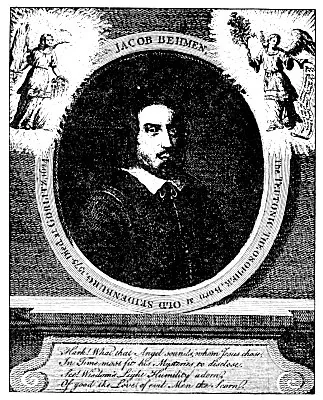
JAKOB BÖHME, THE TEUTONIC THEOSOPHER.
From William Law's Translation of The Works of Jakob Böhme.
Jakob Böhme was born in the year 1575 in a village near Gorlitz, and died in Silesia in 1624. He had but little schooling and was apprenticed at an early age to a shoemaker. He later became a journeyman shoemaker, married and had four children One day while tending his master's shoe shop, a mysterious stranger entered who while he seemed to possess but little of this world's goods, appeared to be most wise and noble in spiritual attainment. The stranger asked the price of a pair of shoes, but young Böhme did not dare to name a figure, for fear that he would displease his master. The stranger insisted and Böhme finally placed a valuation which he was all that his master possibly could hope to secure for the shoes. The stranger immediately bought them and departed. A short distance down the street the mysterious stranger stopped and cried out in a loud voice, "Jakob, Jakob come forth." In amazement and fright, Böhme ran out of the house. The strange man fixed his yes upon the youth--great eyes which sparkled and seemed filled with divine light. He took the boy's right hand and addressed him as follows--"Jakob, thou art little, but shalt be great, and become another Man, such a one as at whom the World shall wonder. Therefore be pious, fear God, and reverence His Word. Read diligently the Holy Scriptures, wherein you have Comfort and Instruction. For thou ust endure much Misery and Poverty, and suffer Persecution, but be courageous and persevere, far God loves, and is gracious to thee." Deeply impressed by the prediction, Böhme became ever more intense in his search for truth. At last his labors were reworded. For seven days he remained in a mysterious condition during which time the mysteries of the invisible world were revealed to him. It has been said of Jakob Böhme that he revealed to all mankind the deepest secrets of alchemy. He died surrounded by his family, his last words being "Now I go hence into Paradise."
but brief mention. These were Nicodemus and Joseph of Arimathea, both devout men who, though not listed among the disciples or apostles of the Christos, were of all men chosen to be custodians of His sacred remains. Joseph of Arimathea was one of the initiated brethren and is called by A. E. Waite, in his A New Encyclopædia of Freemasonry, "the first bishop of Christendom." just as the temporal (or visible) power of the Holy See was established by St. Peter(?), so the spiritual (or invisible) body of the faith was entrusted to the "Secret Church of the Holy Grail" through apostolic succession from Joseph of Arimathea, into whose keeping had been given the perpetual symbols of the covenant--the ever-flowing cup and the bleeding spear.
Presumably obeying instructions of St. Philip, Joseph of Arimathea, carrying the sacred relics, reached Britain after passing through many and varied hardships. Here a site was allotted to him for the erection of a church, and in this manner Glastonbury Abbey was founded. Joseph planted his staff in the earth and it took root, becoming a miraculous thorn bush which blossomed twice a year and which is now called the Glastonbury thorn. The end of the life of Joseph of Arimathea is unknown. By some it is believed that, like Enoch, he was translated; by others, that he was buried in Glastonbury Abbey. Repeated attempts have been made to find the Holy Grail, which many believe to have been hidden in a crypt beneath the ancient abbey. The Glastonbury chalice recently discovered and by the devout supposed to be the original Sangreal can scarcely be accepted as genuine by the critical investigator. Beyond its inherent interest as a relic, like the famous Antioch chalice it actually proves nothing when it is realized that practically little more was known about the Christian Mysteries eighteen centuries ago than can be discovered today.
The origin of the Grail myth, as of nearly every other element in the great drama, is curiously elusive. Sufficient foundation for it may be found in the folklore of the British Isles, which contains many accounts of magic cauldrons, kettles, cups, and drinking horns. The earliest Grail legends describe the cup as a veritable horn of plenty. Its contents were inexhaustible and those who served it never hungered or thirsted. One account states that no matter how desperately ill a person might be he could not die within eight days of beholding the cup. Some authorities believe the Holy Grail to be the perpetuation of the holy cup used in the rites of Adonis and Atys. A communion cup or chalice was used in several of the ancient Mysteries, and the god Bacchus is frequently symbolized in the form of a vase, cup, or urn. In Nature worship the ever-flowing Grail signifies the bounty of the harvest by which the life of man is sustained; like Mercury's bottomless pitcher, it is the inexhaustible fountain of natural re source. From the evidence at hand it would indeed be erroneous to ascribe a purely Christian origin to the Grail symbolism.
In the Arthurian Cycle appears a strange and mysterious figure--Merlin, the magician. In one of the legends concerning him it is declared that when Jesus was sent to liberate the world from the bondage of evil, the Adversary determined to send an Antichrist to undo His labors. The Devil therefore in the form of a horrible dragon overshadowed a young woman who had taken refuge in sanctuary to escape the evil which had dcstroyed her family. When Merlin, her child, was born he partook of the characteristics of his human mother and demon father. Merlin, however, did not serve the powers of darkness but, being converted to the true light, retained only two of the supernatural powers inherited from his father: prophecy and miracle working. The story of Merlin's infernal father must really be considered as an allegorical allusion to the fact that he was a "philosophical son" of the serpent or dragon, a title applied to all initiates of the Mysteries, who thus acknowledge Nature as their mortal mother and wisdom in the form of the serpent or dragon as their immortal Father. Confusion of the dragon and serpent with the powers of evil has resulted as an inevitable consequence from misinterpretation of the early chapters of Genesis.
Arthur while an infant was given into the keeping of Merlin, the Mage, and in his youth instructed by him in the secret doctrine and probably initiated into the deepest secrets of natural magic. With Merlin's assistance, Arthur became the leading general of Britain, a degree of dignity which has been confused with kingship. After Arthur had drawn the sword of Branstock from the anvil and thus established his divine right to leadership, Merlin further assisted him to secure from the Lady of the Lake the sacred sword Excalibur. After the establishment of the Round Table, having fulfilled his duty, Merlin disappeared, according to one account vanishing into the air, where he still exists as a shadow communicating at will with mortals; according to another, retiring of his own accord into a great stone vault which he sealed from within.
It is reasonably certain that many legends regarding Charlemagne were later associated with Arthur, who is most famous for establishing the Order of the Round Table at Winchester. Reliable information is not to be had concerning the ceremonies and initiatory rituals of the "Table Round." In one story the Table was endowed with the powers of expansion and contraction so that fifteen or fifteen hundred could be seated around it, according to whatever need might arise. The most common accounts fix the number of knights who could be seated at one time at the Round Table at either twelve or twenty-four. The twelve signified the signs of the zodiac and also the apostles of Jesus. The knights' names and also their heraldic arms were emblazoned upon their chairs. When twenty-four are shown seated at the Table, each of the twelve signs of the zodiac is divided into two parts--a light and a dark half--to signify the nocturnal and diurnal phases of each sign. As each sign of the zodiac is ascending for two hours every day, so the twenty-four knights represent the hours, the twenty-four elders before the throne in Revelation, and twenty-four Persian deities who represent the spirits of the divisions of the day. In the center of the Table was the symbolic rose of the Passion of Our Lord Jesus Christ, the symbol of resurrection in that He "rose" from the dead. There was also a mysterious empty seat called the Siege Perilous in which none might sit except he who was successful in his quest for the Holy Grad.
In the personality of Arthur is to be found a new form of the ever-recurrent cosmic myth. The prince of Britain is the sun, his knights are the zodiac, and his flashing sword may be the sun's ray with which he fights and vanquishes the dragons of darkness or it may represent the earth's axis. Arthur's Round Table is the universe; the Siege Perilous the throne of the perfect man. In its terrestrial sense, Arthur was the Grand Master of a secret Christian-Masonic brotherhood of philosophic mystics who termed themselves Knights. Arthur received the exalted position of Grand Master of these Knights because he had faithfully accomplished the withdrawal of the sword (spirit) from the anvil of the base metals (his lower nature). As invariably happens, the historical Arthur soon was confused with the allegories and myths of his order until now the two are inseparable. After Arthur's death on the field of Kamblan his Mysteries ceased, and esoterically he was borne away on a black barge, as is so beautifully described by Tennyson in his Morte d'Arthur. The great sword Excalibur was also cast back into the waters of eternity--all of which is a vivid portrayal of the descent of cosmic night at the end of the Day of Universal Manifestation. The body of the historical Arthur was probably interred at Glastonbury Abbey, a building closely identified with the mystic rites of both the Grail and the Arthurian Cycle.
The mediæval Rosicrucians were undoubtedly in possession of the true secret of the Arthurian Cycle and the Grail legend, much of their symbolism having been incorporated into that order. Though the most obvious of all keys to the Christos mystery, the Grail legend has received the least consideration.
THE NIMBUS AND AUREOLE IN SYMBOLISM.
From Audsley's Handbook of Christian Symbolism.
The golden halos around the heads of pagan gods and Christian saints refer both to their being bathed in the glory of the sun and also to the fact that a spiritual sun within their own natures is radiating its glow-ray and surrounding them with celestial splendor. Whenever the nimbus is composed of straight radiant lines, it is solar in significance; whenever curved lines are used for beams, it partakes lunar nature; whenever they are united, it symbolizes a, harmonious blending of both principles. The circular nimbus is solar and masculine, while the lozenge-shaped nimbus, or vesica piscis, is lunar and feminine. The same symbolism is preserved in the circular and lozenge-shaped windows of cathedrals. There is a complete science contained in the shape, color, and adornments of the halos of saints and martyrs. A plain golden ring usually surrounds the head of a canonized saint, while God the Father and God the Son have a far more ornate aureole, usually adorned with a St. George Cross, a flowered cross, or a lilied cross, with only three of the arms visible.
The Cross and the Crucifixion
ONE of the most interesting legends concerning the cross is that preserved in Aurea Legenda, by Jacobus de Vorgaine. The Story is to the effect that Adam, feeling the end of his life was near, entreated his son Seth to make a pilgrimage to the Garden of Eden and secure from the angel on guard at the entrance the Oil of Mercy which God had promised mankind. Seth did not know the way; but his father told him it was in an eastward direction, and the path would be easy to follow, for when Adam and Eve were banished from the Garden of the Lord, upon the path which their feet had trod the grass had never grown.
Seth, following the directions of his father, discovered the Garden of Eden without difficulty. The angel who guarded the gate permitted him to enter, and in the midst of the garden Seth beheld a great tree, the branches of which reached up to heaven. The tree was in the form of a cross, and stood on the brink of a precipice which led downward into the depths of hell. Among the roots of the tree he saw the body of his brother Cain, held prisoner by the entwining limbs. The angel refused to give Seth the Oil of Mercy, but presented him instead with three seeds from the Tree of Life (some say the Tree of Knowledge). With these Seth returned to his father, who was so overjoyed that he did not desire to live longer. Three days later he died, and the three seeds were buried in his mouth, as the angel had instructed. The seeds became a sapling with three trunks in one, which absorbed into itself the blood of Adam, so that the life of Adam was in the tree. Noah dug up this tree by the roots and took it with him into the Ark. After the waters subsided, he buried the skull of Adam under Mount Calvary, and planted the tree on the summit of Mount Lebanon.
Moses beheld a visionary being in the midst of this tree (the burning bush) and from it cut the magical rod with which he was able to bring water out of a stone. But because he failed to call upon the Lord the second time he struck the rock, he was not permitted to carry the sacred staff into the Promised Land; so he planted it in the hills of Moab. After much searching, King David discovered the tree; and his son, Solomon, tried to use it for a pillar in his Temple, but his carpenters could not cut it so that it would fit; it was always either too long or too short. At last, disgusted, they cast it aside and used it for a bridge to connect Jerusalem with the surrounding hills. When the Queen of Sheba came to visit King Solomon she was expected to walk across this bridge. Instead, when she beheld the tree, she refused to put her foot upon it, but, after kneeling and praying, removed her sandals and forded the stream. This so impressed King Solomon that he ordered the log to be overlaid with golden places and placed above the door of his Temple. There it remained until his covetous grandson stole the gold, and buried the tree so that the crime would not be discovered.
From the ground where the tree was buried there immediately bubbled forth a spring of water, which became known as Bethesda. To it the sick from all Syria came to be healed. The angel of the pool became the guardian of the tree, and it remained undisturbed for many years. Eventually the log floated to the surface and was used as a bridge again, this time between Calvary and Jerusalem; and over it Jesus passed to be crucified. There was no wood on Calvary; so the tree was cut into two parts to serve as the cross upon which the Son of Man was crucified. The cross was set up at the very spot where the skull of Adam had been buried. Later, when the cross was discovered by the Empress Helena, the wood was found to be of four different varieties contained in one tree (representing the elements), and thereafter the cross continued to heal all the sick who were permitted to touch it.
The prevalent idea that the reverence for the cross is limited to the Christian world is disproved by even the most superficial investigation of its place in religious symbolism. The early Christians used every means possible to conceal the pagan origin of their symbols, doctrines, and rituals. They either destroyed the sacred books of other peoples among whom they settled, or made them inaccessible to students of comparative philosophy, apparently believing that in this way they could stamp out all record of the pre-Christian origin of their doctrines. In some cases the writings of various ancient authors were tampered with, passages of a compromising nature being removed or foreign material interpolated. The supposedly spurious passage in Josephus concerning Jesus is an example adduced to illustrate this proclivity.
THE LOST LIBRARIES OF ALEXANDRIA
Prior to the Christian Era seven hundred thousand of the most valuable books, written upon parchment, papyrus, vellum, and wax, and also tablets of stone, terra cotta, and wood, were gathered from all parts of the ancient world and housed in Alexandria, in buildings specially prepared for the purpose. This magnificent repository of knowledge was destroyed by a series of three fires. The parts that escaped the conflagration lighted by Cæsar to destroy the fleet in the harbor were destroyed about A.D. 389 by the Christians in obedience to the edict of Theodosius, who had ordered the destruction of the Serapeum, a building sacred to Serapis in which the volumes were kept. This conflagration is supposed to have destroyed the library that Marcus Antonius had presented to Cleopatra to compensate in part for that burned in the fire of the year 51.
Concerning this, H. P. Blavatsky, in Isis Unveiled, has written: "They [the Rabbis of Palestine and the wise men] say that not all the rolls and manuscripts, reported in history to have been burned by Cæsar, by the Christian mob, in 389, and by the Arab General Amru, perished as it is commonly believed; and the story they tell is the following: At the time of the contest for the throne, in 51 B. C., between Cleopatra and her brother Dionysius Ptolemy, the Bruckion, which contained over seven hundred thousand rolls all bound in wood and fire-proof parchment, was undergoing repairs and a great portion of the original manuscripts, considered among the most precious, and which were not duplicated, were stored away in the house of one of the librarians. * * *Several hours passed between the burning of the fleet, set on fire by Cæsar's order, and the moment when the first buildings situated near the harbor caught fire in their turn; and * * * the librarians, aided by several hundred slaves attached to the museum, succeeded in saving the most precious of the rolls." In all probability, the books which were saved lie buried either in Egypt or in India, and until they are discovered the modern world must remain in ignorance concerning many great philosophical and mystical truths. The ancient world more clearly understood these missing links--the continuity of the pagan Mysteries in Christianity.
THE CROSS IN PAGAN SYMBOLISM
In his article on the Cross and Crucifixion in the Encyclopædia Britannica, Thomas Macall Fallow casts much light on the antiquity of this ideograph. "The use of the cross as a religious symbol in pre-Christian times, and among non-Christian peoples, may
HISTORY OF THE HOLY CROSS.
From Berjeau's History of the Holy Cross.
(1) Adam directing Seth how to reach the Garden of Eden. (2) Seth placing the three seeds from the Tree of Life under the tongue of the dead Adam. (3) The Queen of Sheba, refusing to place her feet upon the sacred tree, forded the stream. (4) Placing the sacred tree over the door of Solomon's Temple. (5) The crucifixion of Christ upon a cross made from the wood of the holy tree. (6) Distinguishing the true cross from the other two by testing its power to raise a corpse to life.
probably be regarded as almost universal, and in very many cases it was connected with some form of nature worship."
Not only is the cross itself a familiar object in the art of all nations, but the veneration for it is an essential part of the religious life of the greater part of humanity. It is a common symbol among the American Indians--North, Central, and South. William W. Seymour states: "The Aztec goddess of rain bore a cross in her hand, and the Toltecs claimed that their deity, Quetzalcoatl, taught them the sign and ritual of the cross, hence his staff, or sceptre of power, resembled a crosier, and his mantle was covered with red crosses." (The Cross in Tradition, History and Art.)
The cross is also highly revered by the Japanese and Chinese. To the Pythagoreans the most sacred of all numbers was the 10, the symbol of which is an X, or cross. In both the Japanese and Chinese languages the character of the number 10 is a cross. The Buddhist wheel of life is composed of two crosses superimposed, and its eight points are still preserved to Christendom in the peculiarly formed cross of the Knights Templars, which is essentially Buddhistic. India has preserved the cross, not only in its carvings and paintings, but also in its architectonics; a great number of its temples--like the churches and cathedrals of Christendom--are raised from cruciform foundations.
On the mandalas of the Tibetans, heaven is laid out in the form of a cross, with a demon king at each of the four gates. A remarkable cross of great antiquity was discovered in the island caves of Elephanta in the harbor of Bombay. Crosses of various kinds were favorite motifs in the art of Chaldea, Phœnicia, Egypt, and Assyria. The initiates of the Eleusinian Mysteries of Greece were given a cross which they suspended about their necks on a chain, or cord, at the time of initiation. To the Rosicrucians, Alchemists, and Illuminati, the cross was the symbol of light, because each of the three letters L V X is derived from some part of the cross.
THE TAU CROSS
There are three distinct forms of the cross. The first is called the TAU (more correctly the TAV). It closely resembles the modern letter T, consisting of a horizontal bar resting on a vertical column, the two arms being of equal length. An oak tree cut off some feet above the ground and its upper part laid across the lower in this form was the symbol of the Druid god Hu. It is suspected that this symbol originated among the Egyptians from the spread of the horns of a bull or ram (Taurus or Aries) and the vertical line of its face. This is sometimes designated as the hammer cross, because if held by its vertical base it is not unlike a mallet or gavel. In one of the Qabbalistic Masonic legends, CHiram Abiff is given a hammer in the form of a TAU by his ancestor, Tubal-cain. The TAU cross is preserved to modern Masonry under the symbol of the T square. This appears to be the oldest form of the cross extant.
The TAU cross was inscribed on the forehead of every person admitted into the Mysteries of Mithras. When a king was initiated into the Egyptian Mysteries, the TAU was placed against his lips. It was tattooed upon the bodies of the candidates in some of the American Indian Mysteries. To the Qabbalist, the TAU stood for heaven and the Pythagorean tetractys. The Caduceus of Hermes was an outgrowth of the TAU cross. (See Albert Pike.)
THE CRUX ANSATA
The second type was that of a T, or TAU, cross surmounted by a circle, often foreshortened to the form of an upright oval. This was called by the ancients the Crux Ansata, or the cross of life . It was the key to the Mysteries of antiquity and it probably gave rise to the more modern story of St. Peter's golden key to heaven. In the Mysteries of Egypt the candidate passed through all forms of actual and imaginary dangers, holding above his head the Crux Ansata, before which the powers of darkness fell back abashed. The student is reminded of the words In hoc signo vinces. The TAU form of the cross is not unlike the seal of Venus, as Richard Payne Knight has noted. He states: "The cross in this form is sometimes observable on coins, and several of them were found in a temple of Serapis [the Serapeum], demolished at the general destruction of those edifices by the Emperor Theodosius, and were said by the Christian antiquaries of that time to signify the future life."
Augustus Le Plongeon, in his Sacred Mysteries Among the Mayas and Quiches, notes that the Crux Ansata, which he calls The Key to the Nile and the Symbol of Symbols, either in its complete form or as a simple TAU, was to be seen adorning the breasts of statues and bas-reliefs at Palenque, Copan, and throughout Central America. He notes that it was always associated with water; that among the Babylonians it was the emblem of the water gods; among the Scandinavians, of heaven and immortality; and among the Mayas, of rejuvenation and freedom from physical suffering.
Concerning the association of this symbol with the waters of life, Count Goblet d'Alviella, in his Migration of Symbols, calls attention to the fact that an instrument resembling the Crux Ansata and called the Nilometer was used by the ancient Egyptians for measuring and regulating the inundations of the river Nile. It is probable that this relationship to the Nile caused it to be considered the symbol of life, for Egypt depended entirely upon the inundations of this river for the irrigation necessary to insure sufficient crops. In the papyrus scrolls the Crux Ansata is shown issuing from the mouths of Egyptian kings when they pardoned enemies, and it was buried with them to signify the immortality of the soul. It was carried by many of the gods and goddesses and apparently signified their divine benevolence and life-giving power. The Cairo Museum contains a magnificent collection of crosses of many shapes, sizes, and designs, proving that they were a common symbol among the Egyptians.
THE ROMAN AND GREEK CATHOLIC CROSSES
The third form of the cross is the familiar Roman or Greek type, which is closely associated with the crucifixion of Jesus Christ, although it is improbable that the cross used resembled its more familiar modern form. There are unlimited sub-varieties of crosses, differing in the relative proportions of their vertical and horizontal sections. Among the secret orders of different generations we find compounded crosses, such as the triple TAU in the Royal Arch of Freemasonry and the double and triple crosses of both Masonic and Roman Catholic symbolism.
To the Christian the cross has a twofold significance. First, it is the symbol of the death of his Redeemer, through whose martyrdom he feels that he partakes of the glory of God; secondly, it is the symbol of humility, patience, and the burden of life. It is interesting that the cross should be both a symbol of life and a symbol of death. Many nations deeply considered the astronomical aspect of religion, and it is probable that the Persians, Greeks, and Hindus looked upon the cross as a symbol of the equinoxes and the solstices, in the belief that at certain seasons of the year the sun was symbolically crucified upon these imaginary celestial angles.
The fact that so many nations have regarded their Savior as a personification of the sun globe is convincing evidence that the cross must exist as an astronomical element in pagan allegory. Augustus Le Plongeon believed that the veneration for the cross was partly due to the rising of a constellation called the Southern Cross, which immediately preceded the annual rains, and as the natives of those latitudes relied wholly upon these rains to raise their crops, they viewed the cross as an annual promise of the approaching storms, which to them meant life.
There are four basic elements (according to both ancient philosophy and modern science), and the ancients represented them by the four arms of the cross, placing at the end of each arm a mysterious Qabbalistic creature to symbolize the power of one of these elements. Thus, they symbolized the element of earth by a bull; water by a scorpion, a serpent, or an eagle; fire by a lion; and air by a human head surrounded by wings. It is significant that the four letters inscribed upon parchment (some say wood) and fastened to the top of the cross at the time of the crucifixion should be the first letters of four Hebrew words which stand for the four elements: "Iammin, the sea or water; Nour, fire; Rouach, the air; and Iebeschah, the dry earth." (See Morals and Dogma, by Albeit Pike.)
That a cross can be formed by opening or unfolding the surfaces of a cube has caused that symbol to be associated with the earth. Though a cross within a circle has long been regarded as a sign of the planet Earth, it should really be considered as the symbol of the composite element earth, since it is composed of the four triangles of the elements. For thousands of years the cross has been identified with the plan of salvation for humanity. The elements--salt, sulphur, mercury, and Azoth--used in making the Philosopher's Scone in Alchemy, were often symbolized by a cross. The cross of the four cardinal angles also had its secret significance, and Masonic parties of three still go forth to the four cardinal points of the compass in search of the Lost Word.
The material of which the cross was formed was looked upon as being an essential element in its symbolism. Thus, a golden cross symbolized illumination; a silver cross, purification; a cross of base metals, humiliation; a cross of wood, aspiration. The fact that
THE EASTER ISLAND FIGURE SHOWING CRUX ANSATA ON REVERSE
That the Crux Ansata migrated to many parts of the earth is proved by the fact that it was sculptured upon the back of at least one of the mysterious stone figures found on Easter Island in the south Pacific. The statue in question--one of the smallest in the group--was brought to London by a sailing ship, and is now in the British Museum; the Crux Ansata on the reverse side is plainly visible.
among many nations it was customary to spread the arms in prayer has influenced the symbolism of the cross, which, because of its shape, has come to be regarded as emblematic of the human body. The four major divisions of the human structure--bones, muscles, nerves, and arteries--are considered to have contributed to the symbolism of the cross. This is especially due to the fact that the spinal nerves cross at the base of the spine, and is a reminder that "Our Lord was crucified also in Egypt."
Man has four vehicles (or mediums) of expression by means of which the spiritual Ego contacts the external universe: the physical nature, the vital nature, the emotional nature, and the mental nature. Each of these partakes in principle of one of the primary elements, and the four creatures assigned to them by the Qabbalists caused the cross to be symbolic of the compound nature of man.
THE CRUCIFIXION--A COSMIC ALLEGORY
Saviors unnumbered have died for the sins of man and by the hands of man, and through their deaths have interceded in heaven for the souls of their executioners. The martyrdom of the God-Man and the redemption of the world through His blood has been an essential tenet of many great religions. Nearly all these stories can be traced to sun worship, for the glorious orb of day is the Savior who dies annually for every creature within his universe, but year after year rises again victorious from the tomb of winter. Without doubt the doctrine of the crucifixion is based upon the secret traditions of the Ancient Wisdom; it is a constant reminder that the divine nature of man is perpetually crucified upon the animal organism. Certain of the pagan Mysteries included in the ceremony of initiation the crucifixion of the candidate upon a cross, or the laying of his body upon a cruciform altar. It has been claimed that Apollonius of Tyana (the Antichrist) was initiated into the Arcanum of Egypt in the Great Pyramid, where he hung upon a cross until unconscious and was then laid in the tomb (the coffer) for three days. While his body was unconscious, his soul was thought to pass into the realms of the immortals (the place of death) After it had vanquished death (by recognizing that life is eternal) it returned again to the body, which then rose from the coffer, after which he was hailed as a brother by the priests, who believed that he had returned from the land of the dead. This concept was, in substance, the teaching of the Mysteries.
THE CRUCIFIED SAVIORS
The list of the deathless mortals who suffered for man that he might receive the boon of eternal life is an imposing one. Among those connected historically or allegorically with a crucifixion are Prometheus, Adonis, Apollo, Arys, Bacchus, Buddha, Christna, Horus, Indra, Ixion, Mithras, Osiris, Pythagoras, Quetzalcoatl, Semiramis, and Jupiter. According to the fragmentary accounts extant, all these heroes gave their lives to the service of humanity and, with one or two exceptions, died as martyrs for the cause of human progress. In many mysterious ways the manner of their death has been designedly concealed, but it is possible that most of them were crucified upon a cross or tree. The first friend of man, the immortal Prometheus, was crucified on the pinnacle of Mount Caucasus, and a vulture was placed over his liver to torment him throughout eternity by clawing and rending his flesh with its talons. Prometheus disobeyed the edict of Zeus by bringing fire and immortality to man, so for man he suffered until the coming of Hercules released him from his ages of torment.
Concerning the crucifixion of the Persian Mithras, J. P. Lundy has written: "Dupuis tells us that Mithra was put to death by crucifixion, and rose again on the 25th of March. In the Persian Mysteries the body of a young man, apparently dead, was exhibited, which was feigned to be restored to life. By his sufferings he was believed to have worked their salvation, and on this account he was called their Savior. His priests watched his tomb to the midnight of the vigil of the 25th of March, with loud cries, and in darkness; when all at once the light burst forth from all parts, the priest cried, Rejoice, O sacred initiated, your God is risen. His death, his pains, and sufferings, have worked your salvation." (See Monumental Christianity.)
In some cases, as in that of the Buddha, the crucifixion mythos must be taken in an allegorical rather than a literal sense, for the manner of his death has been recorded by his own disciples in the Book of the Great Decease. However, the mere fact that the symbolic reference to death upon a tree has been associated with these heroes is sufficient to prove the universality of the crucifixion story.
The East Indian equivalent of Christ is the immortal Christna, who, sitting in the forest playing his flute, charmed the birds and beasts by his music. It is supposed that this divinely inspired Savior of humanity was crucified upon a tree by his enemies, but great care has been taken to destroy any evidence pointing in that direction. Louis Jacolliot, in his book The Bible in India, thus describes the death of Christna: "Christna understood that the hour had come for him to quit the earth, and return to the bosom of him who had sent him. Forbidding his disciples to follow him, he went, one day, to make his ablutions on the banks of the Ganges * * *. Arriving at the sacred river, he plunged himself three times therein, then, kneeling, and looking to heaven, he prayed, expecting death. In this position he was pierced with arrows by one of those whose crimes he had unveiled, and who, hearing of his journey to the Ganges, had, with generation. a strong troop, followed with the design of assassinating him * * *. The body of the God-man was suspended to the branches of a tree by his murderer, that it might become the prey of vultures. News of the death having spread, the people came in a crowd conducted by Ardjouna, the dearest of the disciples of Christna, to recover his sacred remains. But the mortal frame of the redeemer had disappeared--no doubt it had regained the celestial abodes * * * and the tree to which it had been attached had become suddenly covered with great red flowers and diffused around it the sweetest perfume." Other accounts of the death of Christna declare that he was tied to a cross-shaped tree before the arrows were aimed at him.
The existence in Moor's The Hindu Pantheon of a plate of Christna with nail wounds in his hands and feet, and a plate in Inman's Ancient Faiths showing an Oriental deity with what might well be a nail hole in one of his feet, should be sufficient motive for further investigation of this subject by those of unbiased minds. Concerning the startling discoveries which can be made along these lines, J. P. Lundy in his Monumental Christianity presents the following information: "Where did the Persians get their notion of this prophecy as thus interpreted respecting Christ, and His saving mercy and love displayed on the cross? Both by symbol and actual crucifix we see it on all their monuments. If it came from India, how did it get there, except from the one common and original centre of all primitive and pure religion? There is a most extraordinary plate, illustrative of the whole subject, which representation I believe to be anterior to Christianity. It is copied from Moor's Hindu Pantheon, not as a curiosity, but as a most singular monument of the crucifixion. I do not venture to give it a name, other than that of a crucifixion in space. * * * Can it be the Victim-Man, or the Priest and Victim both in one, of the Hindu mythology, who offered himself a sacrifice before the worlds were? Can it be Plato's second God who impressed himself on the universe in the form of the cross? Or is it his divine man who would be scourged, tormented, fettered, have his eyes burnt out; and lastly, having suffered all manner of evils, would be crucified? Plato learned his theology in Egypt and the East, and must have known of the crucifixion of Krishna, Buddha, Mithra [et al]. At any rate, the religion of India had its mythical crucified victim long anterior to Christianity,
THE TAU CROSS.
The TAU Cross was the sign which the Lord told the people of Jerusalem to mark on their foreheads, as related by the Prophet Ezekiel. It was also placed as a symbol of liberation upon those charged with crimes but acquitted.
THE CRUX ANSATA.
Both the cross and the circle were phallic symbols, for the ancient world venerated the generative powers of Nature as being expressive of the creative attributes of the Deity. The Crux Ansata, by combining the masculine TAU with the feminine oval, exemplified the principles of generation.
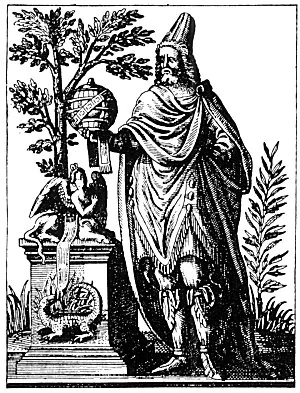
APOLLONIUS OF TYANA.
From Historia Deorum Fatidicorum.
Concerning Apollonius and his remarkable Powers, Francis Barrett, in his Biographia Antiqua, after describing how Apollonius quelled a riot without speaking a word, continues: "He traveled much, professed himself a legislator; understood all languages, without having learned them; he had the surprising faculty of knowing what was transacted at an immense distance, and at the time the Emperor Domitian was stabbed, Apollonius being at a vast distance and standing in the market-place of the city, exclaimed, 'Strike! strike!--'tis time, the tyrant is no more.' He understood the language of birds; he condemned dancing and other diversions of that sort. he recommended charity and piety; he traveled over almost all the countries of the world; and he died at a very great age."
as a type of the real one [Pro Deo et Ecclesia!], and I am inclined to think that we have it in this remarkable plate."
The modern world has been misled in its attitude towards the so-called pagan deities, and has come to view them in a light entirely different from their true characters and meanings. The ridicule and slander heaped by Christendom upon Christna and Bacchus are excellent examples of the persecution of immortal principles by those who have utterly failed to sense the secret meaning of the allegories. Who was the crucified man of Greece, concerning whom vague rumors have been afloat? Higgins thinks it was Pythagoras, the true story of whose death was suppressed by early Christian authors because it conflicted with their teachings. Was it true also that the Roman legionaries carried on the field of battle standards upon which were crosses bearing the crucified Sun Man?
THE CRUCIFIXION OF QUETZALCOATL
One of the most remarkable of the crucified World Saviors is the Central American god of the winds, or the Sun, Quetzalcoatl, concerning whose activities great secrecy was maintained by the Indian priests of Mexico and Central America. This strange immortal, whose name means feathered snake, appears to have come out of the sea, bringing with him a mysterious cross. On his garments were embellished clouds and red crosses. In his honor, great serpents carved from stone were placed in different parts of Mexico.
The cross of Quetzalcoatl became a sacred symbol among the Mayas, and according to available records the Maya Indian angels had crosses of various pigments painted on their foreheads. Similar crosses were placed over the eyes of those initiated into their Mysteries. When Cortez arrived in Mexico, he brought with him the cross. Recognizing this, the natives believed that he was Quetzalcoatl returned, for the latter had promised to come back in the infinite future and redeem his people.
In Anacalypsis, Godfrey Higgins throws some light on the cross and its symbolism in America: "The Incas had a cross of very fine marble, or beautiful jasper, highly polished, of one piece, three-fourths of an ell in length, and three fingers in width and thickness. It was kept in a sacred chamber of a palace, and held in great veneration. The Spaniards enriched this cross with gold and jewels, and placed it in the cathedral of Cuzco. Mexican temples are in the form of a cross, and face the four cardinal points. Quexalcoatl is represented in the paintings of the Codex Borgianus nailed to the cross. Sometimes even the two thieves are there crucified with him. In Vol. II. plate 75, the God is crucified in the Heavens, in a circle of nineteen figures, the number of the Metonic cycle. A serpent is depriving him of the organs of generation. In the Codex Borgianus, (pp. 4, 72, 73, 75,) the Mexican God is represented crucified and nailed to the cross, and in another place hanging to it, with a cross in his hands. And in one instance, where the figure is not merely outlined, the cross is red, the clothes are coloured, and the face and hands quite black. If this was the Christianity of the German Nestorius, how came he to teach that the crucified Savior was black? The name of the God who was crucified was Quexalcoatl.
The crucifixion of the Word in space, the crucifixion of the dove often seen in religious symbolism--both of these are reminders of pagan overshadowing. The fact that a cross is formed by the spread wings of a bird in relation to its body is no doubt one of the reasons why the Egyptians used a bird to symbolize the immortal nature of man, and often show it hovering over the mummified body of the dead and carrying in one of its claws the sign of life and in the other the sign of breath.
THE NAILS OF THE PASSION
The three nails of the Passion have found their way into the symbolism of many races and faiths. There are many legends concerning these nails. One of these is to the effect that originally there were four nails, but one was dematerialized by a Hebrew Qabbalist and magician just as they were about to drive it through the foot of the Master. Hence it was necessary to cross the feet. Another legend relates that one of the nails was hammered into a crown and that it still exists as the imperial diadem of a European house. Still another story has it that the bit on the bridle of Constantine's horse was a Passion nail. It is improbable, however, that the nails were made of iron, for at that time it was customary to use sharpened wooden pegs. Hargrave Jennings, in his Rosicrucians, Their Rites and Mysteries, calls attention to the fact that the mark or sign used in England to designate royal property and called the broad arrow is nothing more nor less than the three nails of the crucifixion grouped together, and that by placing them point to point the ancient symbol of the Egyptian TAU cross is formed.
In his Ancient Freemasonry, Frank C. Higgins reproduces the Masonic apron of a colossal stone figure at Quirigua, Guatemala. The central ornament of the apron is the three Passion nails, arranged exactly like the British broad arrow. That three nails should be used to crucify the Christ, three murderers to kill CHiram Abiff, and three wounds to slay Prince Coh, the Mexican Indian Osiris, is significant.
C. W. King, in his Gnostics and Their Remains, thus describes a Gnostic gem: "The Gnostic Pleroma, or combination of all the Æons [is] expressed by the outline of a man holding a scroll * * *. The left hand is formed like three bent spikes or nails; unmistakably the same symbol that Belus often holds in his extended hand on the Babylonian cylinders, afterwards discovered by the Jewish Cabalists in the points of the letter Shin, and by the mediæval mystics in o the Three Nails of the Cross." From this point Hargrave Jennings continues King's speculations, noting the resemblance of the nail to an obelisk, or pillar, and that the Qabbalistic value of the Hebrew letter Shin, or Sin, is 300, namely, 100 for each spike.
The Passion nails are highly important symbols, especially when it is realized that, according to the esoteric systems of culture, there are certain secret centers of force in the palms of the hands and in the soles of the feet.
The driving of the nails and the flow of blood and water from the wounds were symbolic of certain secret philosophic practices of the Temple. Many of the Oriental deities have mysterious symbols on the hands and feet. The so-called footprints of Buddha are usually embellished with a magnificent sunburst at the point where the nail pierced the foot of Christ.
In his notes on the theology of Jakob Böhme, Dr. Franz Hartmann thus sums up the mystic symbolism of the crucifixion: "The cross represents terrestrial life, and the crown of thorns the sufferings of the soul within the elementary body, but also the victory of the spirit over the elements of darkness. The body is naked, to indicate that the candidate for immortality must divest himself of all desires for terrestrial things. The figure is nailed to the cross, which symbolizes the death and surrender of the self-will, and that it should not attempt to accomplish anything by its own power, but merely serve as an instrument wherein the Divine will is executed. Above the head are inscribed the letters: I. N. R. J. whose most important meaning is: In Nobis Regnat Jesus (Within ourselves reigns Jesus). But this signification of this inscription can be practically known only to those who have actually died relatively to the world of desires, and risen above the temptation for personal existence; or, to express it in other words, those who have become alive in Christ, and in whom thus the kingdom of Jesus (the holy love-will issuing from the heart of God) has been established." One of the most interesting interpretations of the crucifixion allegory is that which identifies the man Jesus with the personal consciousness of the individual. It is this personal consciousness that conceives of and dwells in the sense of separateness, and before the aspiring soul can be reunited with the ever-present and all-pervading Father this personality must be sacrificed that the Universal Consciousness may be liberated.
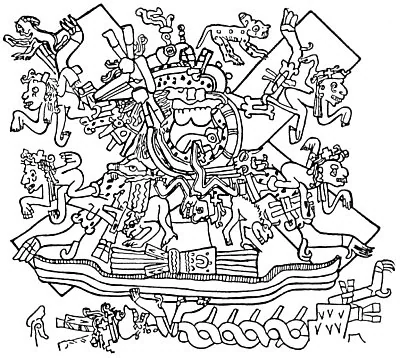
THE CRUCIFIXION OF QUETZALCOATL.
(From the Codex Borgianus.)
From Kingsborough's Antiquities of Mexico.
Lord Kingsborough writes: "May we not refer to the seventy-third page of the Borgian MS., which represents Quexalcoatl both crucified, and as it were cut in pieces for the cauldron, and with equal reason demand, whether anyone can help thinking that the Jews of the New World (Lord Kingsborough sought to prove that the Mexicans were descendants of the Jews] applied to their Messiah not only all the prophecies contained in the Old Testament relating to Christ, but likewise many of the incidents recorded of him in the Gospels."
THE CRUCIFIXION IN SPACE.
From Higgins' Anacalypsis.
Of this remarkable Oriental drawing, J. P. Lundy has written:----It looks like a Christian crucifix in many respects, and in some others it does not. The drawing, attitude, and the nail-marks in hands and feet, indicate a Christian origin; while the Parthian coronet of seven points, the absence of the wood and of the usual inscription, and the rays of glory above seem to point to some Christian origin. Can it be the Victim, Man, or the Priest and Victim both in one, of the Hindu mythology, who offered himself a sacrifice before the worlds were?"
The Mystery of the Apocalypse
THE presence of the Temple of Diana at Ephesus marked that city as sacred to the Mystery religion, for the Seven Wonders of the ancient world were erected to indicate the repositories of recondite knowledge. Of Ephesus, H. P. Blavatsky writes:
"It was a focus of the universal 'secret' doctrines; the weird laboratory whence, fashioned in elegant Grecian phraseology, sprang the quintessence of Buddhistic, Zoroastrian, and Chaldean philosophy. Artemis, the gigantic concrete symbol of theosophico-pantheistic abstractions, the great mother Multimamma, androgyne and patroness of the 'Ephesian writings,' was conquered by Paul; but although the zealous converts of the apostles pretended to burn all their books on 'curious arts, τα περιεργα, enough of these remained for them to study when their first zeal had cooled off." (See Isis Unveiled.)
Being a great center of pagan learning, Ephesus has been the locale for many early Christian myths. The assertion has been made that it was the last domicile of the Virgin Mary; also that the tomb of St. John the Divine was located there. According to legend, St. John did not depart from this life in the usual manner but, selecting his vault, entered it while still alive, and closing the entrance behind him, vanished forever from mortal sight. A rumor was current in ancient Ephesus that St. John would sleep in his tomb until the return of the Savior, and that when the apostle turned over on his sepulchral couch the earth above moved like the coverlets of a bed.
Subjected to more criticism than any other book now incorporated in the New Testament, the Apocalypse--popularly accredited to St. John the Divine--is by far the most important but least understood of the Gnostic Christian writings. Though Justin Martyr declared the Book of Revelation to have been written by "John, one of Christ's apostles," its authorship was disputed as early as the second century after Christ. In the third century these contentions became acute and even Dionysius of Alexandria and Eusebius attacked the Johannine theory, declaring that both the Book of Revelation and the Gospel according to St. John were written by one Cerinthus, who borrowed the name of the great apostle the better to foist his own doctrines upon the Christians. Later Jerome questioned the authorship of the Apocalypse and during the Reformation his objections were revived by Luther and Erasmus. The once generally accepted notion that the Book of Revelation was the actual record of a "mystical experience" occurring to St. John while that seer was an exile in the Isle of Parmos is now regarded with disfavor by more critical scholars. Other explanations have therefore been advanced to account for the symbolism permeating the volume and the original motive for its writing. The more reasonable of these theories may be summed up as follows:
First, upon the weight of evidence furnished by its own contents the Book of Revelation may well be pronounced a pagan writing--one of the sacred books of the Eleusinian or Phrygian Mysteries. As a corollary, the real author of a work setting forth the profundities of Egyptian and Greek mysticism must have been an initiate himself and consequently obligated to write only in the symbolic language of the Mysteries.
Second, it is possible that the Book of Revelation was written to reconcile the seeming discrepancies between the early Christian and pagan religious philosophies. When the zealots of the primitive Christian Church sought to Christianize pagandom, the pagan initiates retorted with a powerful effort to paganize Christianity. The Christians failed but the pagans succeeded. With the decline of paganism the initiated pagan hierophants transferred their base of operations to the new vehicle of primitive Christianity, adopting the symbols of the new cult to conceal those eternal verities which are ever the priceless possession of the wise. The Apocalypse shows clearly the resultant fusion of pagan and Christian symbolism and thus bears irrefutable evidence of the activities of these initiated minds operating through early Christianity.
Third, the theory has been advanced that the Book of Revelation represents the attempt made by the unscrupulous members of a certain religious order to undermine the Christian Mysteries by satirizing their philosophy. This nefarious end they hoped to attain by showing the new faith to be merely a restatement of the ancient pagan doctrines, by heaping ridicule upon Christianity, and by using its own symbols toward its disparagement. For example, the star which fell to earth (Rev. viii. 10-11) could be construed to mean the Star of Bethlehem, and the bitterness of that star (called Wormwood and which poisoned mankind) could signify the "false" teachings of the Christian Church. While the last theory has gained a certain measure of popularity, the profundity of the Apocalypse leads the discerning reader to the inevitable conclusion that this is the least plausible of the three hypotheses. To those able to pierce the veil of its symbolism, the inspired source of the document requires no further corroborative evidence.
In the final analysis, true philosophy can be limited by neither creed nor faction; in fact it is incompatible with every artificial limitation of human thought. The question of the pagan or Christian origin of the Book of Revelation is, consequently, of little importance. The intrinsic value of the book lies in its magnificent epitome of the Universal Mystery--an observation which led St. Jerome to declare that it is susceptible of seven entirely different interpretations. Untrained in the reaches of ancient thought, the modem theologian cannot possibly cope with the complexities of the Apocalypse, for to him this mystic writing is but a phantasmagoria the divine inspiration of which he is sorely tempted to question. In the limited space here available it is possible to sketch but briefly a few of the salient features of the vision of the seer of Patmos. A careful consideration of the various pagan Mysteries will assist materially also in filling the inevitable gaps in this abridgment.
In the opening chapter of the Apocalypse, St. John describes the Alpha and Omega who stood in the midst of the seven golden candlesticks. Surrounded by his flaming planetary regents, this Sublime One thus epitomizes in one impressive and mysterious figure the entire sweep of humanity's evolutionary growth--past, present, and future.
"The first stages of man's earthly development," writes Dr. Rudolph Steiner, "ran their course at a period when the earth was still 'fiery'; and the first human incarnations were formed out of the element of fire; at the end of his earthly career man will himself radiate his inner being outwards creatively by the force of the element of fire. This continuous development from the beginning to the end of the earth reveals itself to the 'seer,' when he sees on the astral plane the archetype of evolving man. * * * The beginning of earthly evolution stands forth in the fiery feet, its end in the fiery countenance, and the complete power of the 'creative word,' to be finally won, is seen in the fiery source coming out of the mouth." (See Occult Seals and Columns.)
In his Restored New Testament, James Morgan Pryse traces the
THE THRONE OF GOD AND OF THE LAMB.
From Jacob Behmen's Works.
Before the throne of God was the crystal sea representing the Schamayim, or the living waters which are above the heavens. Before the throne also were four creatures--a bull, a lion, an eagle, and a man. These represented the four corners of creation and the multitude of eyes with which they were covered are the stars of the firmament. The twenty-four elders have the same significance as the priests gathered around the statue of Ceres in the Greater Eleusinian Rite and also the Persian Genii, or gods of the hours of the day, who, casting away their crowns, glorify the Holy One. As symbolic of the divisions of time, the elders adore the timeless and enduring Spirit in the midst of them.
relationship of the various parts of the Alpha and Omega to the seven sacred planets of the ancients. To quote:
"The Logos-figure described is a composite picture of the seven sacred planets: he has the snowy-white hair of Kronos ('Father Time'), the blazing eyes of 'wide-seeing' Zeus, the sword of Arcs, the shining face of Helios, and the chiton and girdle of Aphrodite; his feet are of mercury, the metal sacred to Hermes, and his voice is like the murmur of the ocean's waves (the 'many waters'), alluding to Selene, the Moon-Goddess of the four seasons and of the waters."
The seven stars carried by this immense Being in his right hand are the Governors of the world; the flaming sword issuing from his mouth is the Creative Fiat, or Word of Power, by which the illusion of material permanence is slain. Here also is represented, in all his symbolic splendor, the hierophant of the Phrygian Mysteries, his various insignia emblematic of his divine attributes. Seven priests bearing lamps are his attendants and the stars carried in his hand are the seven schools of the Mysteries whose power he administers. As one born again out of spiritual darkness, into perfect wisdom, this archimagus is made to say: "I am he that liveth, and was dead; and, behold, I am alive forever more, Amen; and have the keys of hell and of death."
In the second and third chapters St. John delivers to the "seven churches which are in Asia" the injunctions received by him from the Alpha and Omega. The churches are here analogous to the rungs of a Mithraic ladder, and John, being "in the spirit," ascended through the orbits of the seven sacred planets until he reached the inner surface of the Empyrean.
"After the soul of the prophet," writes the anonymous author of Mankind: Their Origin and Destiny, "in his ecstatic state has passed in its rapid flight through the seven spheres, from the sphere of the moon to that of Saturn, or from the planet which corresponds to Cancer, the gate of men, to that of Capricorn, which is the gate of the gods, a new gate opens to him in the highest heaven, and in the zodiac, beneath which the seven planets revolve; in a word, in the firmament, or that which the ancients called crystallinum primum, or the crystal heaven."
When related to the Eastern system of metaphysics, these churches represent the chakras, or nerve ganglia, along the human spine, the "door in heaven" being the brahmarandra, or point in the crown of the skull (Golgotha), through which the spinal spirit fire passes to liberation. The church of Ephesus corresponds to the muladhara, or sacral ganglion, and the other churches to the higher ganglia according to the order given in Revelation. Dr. Steiner discovers a relationship between the seven churches and the divisions of the Aryan race. Thus, the church of Ephesus stands for the Arch-Indian branch; the church of Smyrna, the Arch-Persians; the church of Pergamos, the Chaldean-Egyptian-Semitic; the church of Thyatira, the Grecian-Latin-Roman; the church of Sardis, the Teuton-Anglo-Saxon; the church of Philadelphia, the Slavic; and the church of Laodicea, the Manichæan. The seven churches also signify the Greek vowels, of which Alpha and Omega are the first and the last. A difference of opinion exists as to the order in which the seven planers should be related to the churches. Some proceed from the hypothesis that Saturn represents the church of Ephesus; but from the fact that this city was sacred to the moon goddess and also that the sphere of the moon is the first above that of the earth, the planets obviously should ascend in their ancient order from the moon to Saturn. From Saturn the soul would naturally ascend through the door in the Empyrean.
In the fourth and fifth chapters St. John describes the throne of God upon which sat the Holy One "which was and is, and is to come." About the throne were twenty-four lesser seats upon which sat twenty-four elders arrayed in white garments and wearing crowns of gold. "And out of the throne proceeded lightnings and thunderings and voices: and there were seven lamps of fire burning before the throne, which are the seven Spirits of God." He who sat upon the throne held in His right hand a book sealed with seven seals which no man in heaven or earth had been found worthy to open. Then appeared a Lamb (Aries, the first and chief of the zodiacal signs) which had been slain, having seven horns (rays) and seven eyes (lights). The Lamb took the book from the right hand of Him that sat upon the throne and the four beasts and all the elders fell down and worshiped God and the Lamb. During the early centuries of the Christian Church the lamb was universally recognized as the symbol of Christ, and not until after the fifth synod of Constantinople (the "Quinisext Synod," A.D. 692) was the figure of the crucified man substituted for that of Agnus Dei. As shrewdly noted by one writer on the subject, the use of a lamb is indicative of the Persian origin of Christianity, for the Persians were the only people to symbolize the first sign of the zodiac by a lamb.
Because a lamb was the sin offering of the ancient pagans, the early mystic Christians considered this animal as an appropriate emblem of Christ, whom they regarded as the sin offering of the world. The Greeks and the Egyptians highly venerated the lamb or ram, often placing its horns upon the foreheads of their gods. The Scandinavian god Thor carried a hammer made from a pair of ram's horns. The lamb is used in preference to the ram apparently because of its purity and gentleness; also, since the Creator Himself was symbolized by Aries, His Son would consequently be the little Ram or Lamb. The lambskin apron worn by the Freemasons over that part of the body symbolized by Typhon or Judas represents that purification
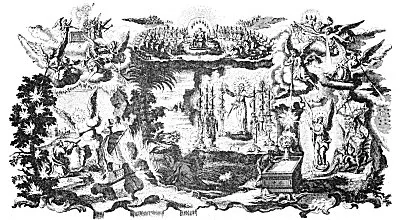
EPISODES FROM THE MYSTERIES OF THE APOCALYPSE.
From Klauber's Historiae Biblicae Veteris et Novi Testamenti.
In the central foreground, St. John the Divine is kneeling before the apparition of the Alpha and Omega standing in the midst of the seven lights and surrounded by an aureole of flames and smoke. In the heavens above the twenty-four elders with their harps and censers bow before the throne of the Ancient One, from whose hand the Lamb is taking the book sealed with seven seals. The seven spirit, of God, in the form of cups from which issue tongues of fire, surround the head of the Ancient One, and the four beasts (the cherubim) kneel at the corners of His throne. In the upper left-hand corner are shown the seven angels bearing the trumpets and also the altar of God and the angel with the censer. In the upper right are the spirits of the winds; below them is the virgin clothed wit h the sun, to whom wings were given that she might fly into the wilderness. To her right is a scene representing the spirits of God hurling the evil serpent into the bottomless pit. At the lower left St. John is shown receiving from the angelic figure, whose legs are pillars of fire and whose face is a shining sun, the little book which he is told to eat if he would understand the mysteries of the spiritual life.
The plate also contains a number of other symbols, including episodes from the destruction of the world and the crystal sea pouring forth from the throne of God. By the presentation of such symbolic conceptions in the form of rituals and dramatic episodes the secrets of the Phrygian Mysteries were perpetuated. When these sacred pageantries were thus revealed to all mankind indiscriminately and each human soul was appointed it own initiator into the holy rite, of the philosophic life, a boon was conferred upon humanity which cannot be fully appreciated until men and women have grown more responsive to those mysteries which are of the spirit.
of the generative processes which is a prerequisite to true spirituality. In this allegory the Lamb signifies the purified candidate, its seven horns representing the divisions of illuminated reason and its seven eyes the chakras, or perfected sense-perceptions.
The sixth to eleventh chapters inclusive are devoted to an account of the opening of the seven seals on the book held by the Lamb. When the first seal was broken, there rode forth a man on a white horse wearing a crown and holding in his hand a bow. When the second seal was broken, there rode forth a man upon a red horse and in his hand was a great sword. When the third seal was broken there rode forth a man upon a black horse and with a pair of balances in his hand. And when the fourth seal was broken there rode forth Death upon a pale horse and hell followed after him. The four horsemen of the Apocalypse may be interpreted to signify the four main divisions of human life. Birth is represented by the rider on the white horse who comes forth conquering and to conquer; the impetuosity of youth by the rider on the red horse who took peace from the earth; maturity by the rider on the black horse who weighs all things in the scales of reason; and death by the rider on the pale horse who was given power over a fourth part of the earth. In the Eastern philosophy these horsemen signify the four yugas, or ages, of the world which, riding forth at: their appointed times, become for a certain span the rulers of creation.
Commenting on the twenty-fourth allocution of Chrysostom, in The Origin of all Religious Worship, Dupuis notes that each of the four elements was represented by a horse bearing the name of the god "who is set over the element." The first horse, signifying the fire ether, was called Jupiter and occupied the highest place in the order of the elements. This horse was winged, very fleet, and, describing the largest circle, encompassed all the others. It shone with the purest light, and on its body were the images of the sun, the moon, the stars, and all the bodies in the ethereal regions. The second horse, signifying the element of air, was Juno. It was inferior to the horse of Jupiter and described a smaller circle; its color was black but that part exposed to the sun became luminous, thus signifying the diurnal and nocturnal conditions of air. The third horse, symbolizing the element of water, was sacred to Neptune. It was of heavy gait and described a very small circle. The fourth horse, signifying the static element of earth, described as immovable and champing its bit, was the steed of Vesta. Despite their differences in temperature, these four horses lived harmoniously together, which is in accord with the principles of the philosophers, who declared the world to be preserved by the concord and harmony of its elements. In time, however, the racing horse of Jupiter burned the mane of the horse of earth; the thundering steed of Neptune also became covered with sweat, which overflowed the immovable horse of Vesta and resulted in the deluge of Deucalion. At last the fiery horse of Jupiter will consume the rest, when the three inferior elements--purified by reabsorption in the fiery ether--will come forth renewed, constituting "a new heaven and a new earth."
When the fifth seal was opened St. John beheld those who had died for the word of God. When the sixth seal was broken there was a great earthquake, the sun being darkened and the moon becoming like blood. The angels of the winds came forth and also another angel, who sealed upon their foreheads 144,000 of the children of Israel that they should be preserved against the awful day of tribulation. By adding the digits together according to the Pythagorean system of numerical philosophy, the number 144,000 is reduced to 9, the mystic symbol of man and also the number of initiation, for he who passes through the nine degrees of the Mysteries receives the sign of the cross as emblematic of his regeneration and liberation from the bondage of his own infernal, or inferior, nature. The addition of the three ciphers to the original sacred number 1.44 indicates the elevation of the mystery to the third sphere.
When the seventh seal was broken there was silence for the space of half an hour. Then came forth seven angels and to each was given a trumpet. When the seven angels sounded their trumpets--intoned the seven-lettered Name of the Logos--great catastrophes ensued. A star, which was called Wormwood, fell from heaven, thereby signifying that the secret doctrine of the ancients had been given to men who had profaned it and caused the wisdom of God to become a destructive agency. And another star--symbolizing the false light of human reason as distinguished from the divine reason of the initiate--fell from heaven and to it (materialistic reason) was given the key to the bottomless pit (Nature), which it opened, causing all manner of evil creatures to issue forth. And there came also a mighty angel who was clothed in a cloud, whose face was as the sun and his feet and legs as pillars of fire, and one foot was upon the waters and the other upon the land (the Hermetic Anthropos). This celestial being gave St. John a little book, bidding him eat it, which the seer did. The book is representative of the secret doctrine--that spiritual food which is the nourishment of the spirit. And St. John, being "in the spirit," ate his fill of the wisdom of God and the hunger of his soul was appeased.
The twelfth chapter treats of a great wonder appearing in the heavens: a woman clothed with the sun, the moon under her feet, and upon her head a crown of twelve stars. This woman represents the constellation of Virgo and also the Egyptian Isis, who, about to be delivered of her son Horus, is attacked by Typhon, the latter attempting to destroy the child predestined by the gods to slay the
JOHN'S VISION OF THE NEW JERUSALEM.
From Klauber's Historiae Biblicae Veteris et Novi Testamenti.
In the upper left-hand corner is shown the destruction of Babylon, also the angel which cast the great millstone into the sea, saying, "Thus with violence shall that great city Babylon be thrown down and shall be found no more at all." Below is the horseman, called Faithful and True, casting the beast into the bottomless pit. At the lower right is the angel with the key to the bottomless pit, who with a great chain binds Satan for a thousand years. In the heavens above is represented one like unto the Son of Man, who carries a great sickle with which he reaps the harvest of the world. In the center is the Holy City, the New Jerusalem, with its twelve gates and the mountain of the Lamb rising in the midst thereof. From the throne of the Lamb pours the great river of crystal, or living water, signifying the spiritual doctrine: upon all who discover and drink of its waters are conferred immortality. Kneeling upon a high cliff, St. John gazes down upon the mystic city, the archetype of the perfect civilization yet to be. Above the New Jerusalem, in a great sunburst of glory, is the throne of the Ancient One, which is the light of those who dwell in the matchless empire of the spirit. Beyond the recognition of the uninitiated world is an ever-increasing aggregation composed of the spiritual elect. Though they walk the earth as ordinary mortals, they are of a world apart and through their ceaseless efforts the kingdom of God is being slowly but surely established upon earth. These illumined souls are the builders of the New Jerusalem, and their bodies are the living stones in its walls. Lighted by the torch of truth they carry on their work, through their activities the golden age will return to the earth and the power of sin and death will be destroyed. For this reason the declare that virtuous and illumined men, instead of ascending to heaven, will bring heaven down and establish it in the midst of earth itself.
Spirit of Evil. The war in heaven relates to the destruction of the planet Ragnarok and to the fall of the angels. The virgin can be interpreted to signify the secret doctrine itself and her son the initiate born out of the "womb of the Mysteries." The Spirit of Evil thus personified in the great dragon attempted to control mankind by destroying the mother of those illumined souls who have labored unceasingly for the salvation of the world. Wings were given to the Mysteries (the virgin) and they flew into the wilderness; and the evil dragon tried to destroy them with a flood (of false doctrine) but the earth (oblivion) swallowed up the false doctrines and the Mysteries endured.
The thirteenth chapter describes a great beast which rose out of the sea, having seven heads and ten horns. Faber sees in this amphibious monster the Demiurgus, or Creator of the world, rising out of the Ocean of Chaos. While most interpreters of the Apocalypse consider the various beasts described therein as typical of evil agencies, this viewpoint is the inevitable result of unfamiliarity with the ancient doctrines from which the symbolism of the book is derived. Astronomically, the great monster rising out of the sea is the constellation of Cetus (the whale). Because religious ascetics looked upon the universe itself as an evil and ensnaring fabrication, they also came to regard its very Creator as a weaver of delusions. Thus the great sea monster (the world) and its Maker (the Demiurgus), whose strength is derived from the Dragon of Cosmic Power, came to be personified as a beast of horror and destruction, seeking to swallow up the immortal part: of human nature. The seven heads of the monster represent the seven stars (spirits) composing the constellation of the Great Dipper, called by the Hindus Rishis, or Cosmic Creative Spirits. The ten horns Faber relates to the ten primordial patriarchs. These may also denote the ancient zodiac of ten signs.
The number of the beast (666) is an interesting example of the use of Qabbalism in the New Testament and among early Christian mystics. In the following table Kircher shows that the names of Antichrist as given by Iranæus all have 666 as their numerical equivalent.
|
Τ |
300 |
Λ |
30 |
Λ |
1 |
Λ |
30 |
|
ε |
5 |
α |
1 |
ν |
50 |
α |
1 |
|
ι |
10 |
μ |
40 |
τ |
300 |
τ |
300 |
|
τ |
300 |
π |
80 |
ε |
5 |
ε |
5 |
|
α |
1 |
ε |
5 |
μ |
40 |
ι |
10 |
|
ν |
50 |
τ |
300 |
ο |
70 |
ν |
50 |
|
ι |
10 |
ς |
200 |
ο |
70 | ||
|
ς |
200 |
ς |
200 | ||||
|
666 |
666 |
666 |
666 |
James Morgan Pryse also notes that according to this method of figuring, the Greek term ἡ φρην, which signifies the lower mind, has 666 as its numerical equivalent. It is also well known to Qabbalists that Ἰησους, Jesus, has for its numerical value another sacred and secret number--888. Adding the digits of the number 666 and again adding the digits of the sum gives the sacred number--9 the symbol of man in his unregenerate state and also the path of his resurrection.
The fourteenth chapter opens with the Lamb standing on Mount Zion (the eastern horizon), about Him gathered the 144,000 with the name of God written in their foreheads. An angel thereupon announces the fall of Babylon--the city of confusion or worldliness. Those perish who do not overcome worldliness and enter into the realization that spirit--and not matter--is enduring; for, having no interests other than those which are material, they are swept to destruction with the material world. And St. John beheld One like unto the Son of Man (Perseus) riding upon a cloud (the substances of the invisible world) and bearing in his hand a sharp sickle, and with the sickle the Shining One reaped the earth. This is a symbol of the Initiator releasing into the sphere of reality the higher natures of those who, symbolized by ripened grain, have reached the point of liberation. And there came another angel (Boötes)--Death--also with a sickle (Karma), who reaped the vines of the earth (those who have lived by the false light) and cast them into the winepress of the wrath of God (the purgatorial spheres).
The fifteenth to eighteenth chapters inclusive contain an account of seven angels (the Pleiades) who pour their vials upon the earth. The contents of their vials (the loosened energy of the Cosmic Bull) are called the seven last plagues. Here also is introduced a symbolic figure, termed "the harlot of Babylon, "which is described as a woman seated upon a scarlet-colored beast having seven heads and ten horns. The woman was arrayed in purple and scarlet and bedecked with gold, precious stones, and pearls, having in her hand a golden cup full of abominations. This figure may be an effort (probably interpolated) to vilify Cybele, or Artemis, the Great Mother goddess of antiquity. Because the pagans venerated the Mater Deorum through symbols appropriate to the feminine generative principle they were accused by the early Christians of worshiping a courtesan. As nearly all the ancient Mysteries included a test of the neophyte's moral character, the temptress (the animal soul) is here portrayed as a pagan goddess.
In the nineteenth and twentieth chapters is set forth the preparation of that mystical sacrament called the marriage of the Lamb. The bride is the soul of the neophyte, which attains conscious immortality by uniting itself to its own spiritual source. The heavens opened once more and St. John saw a white horse, and the rider (the illumined mind) which sat upon it was called Faithful and True. Out of his mouth issued a sharp sword and the armies of heaven followed after him. Upon the plains of heaven was fought the mystic Armageddon--the last great war between light and darkness. The forces of evil under the Persian Ahriman battled against the forces of good under Ahura-Mazda. Evil was vanquished and the beast and the false prophet cast into a lake of fiery brimstone. Satan was bound for a thousand years. Then followed the last judgment; the books were opened, including the book of life. The dead were judged according to their works and those whose names were not in the book of life were cast into a sea of fire. To the neophyte, Armageddon represents the last struggle between the flesh and the spirit when, finally overcoming the world, the illumined soul rises to union with its spiritual Self. The judgment signifies the weighing of the soul and was borrowed from the Mysteries of Osiris. The rising of the dead from their graves and from the sea of illusion represents the consummation of the process of human regeneration. The sea of fire into which those are cast who fail in the ordeal of initiation signifies the fiery sphere of the animal world.
In the twenty-first and twenty-second chapters are pictured the new heaven and the new earth to be established at the close of Ahriman's reign. St. John, carried in the spirit to a great and high mountain (the brain), beheld the New Jerusalem descending as a bride adorned for her husband. The Holy City represents the regenerated and perfected world, the trued ashlar of the Mason, for the city was a perfect cube, it being written, "the length and the breadth and the height of it are equal." The foundation of the Holy City consisted of a hundred and forty-four stones in twelve rows, from which it is evident that the New Jerusalem represents the microcosm, patterned after the greater universe in which it: stands. The twelve gates of this symbolic dodecahedron are the signs of the zodiac through which the celestial impulses descend into the inferior world; the jewels are the precious stones of the zodiacal signs; and the transparent golden streets are the streams of spiritual light along which the initiate passes on his path towards the sun. There is no material temple in that city, for God and the Lamb are the temple; and there is neither sun nor moon, for God and the Lamb are the light. The glorified and spiritualized initiate is here depicted as a city. This city will ultimately be united with the spirit of God and absorbed into the Divine Effulgency.
And St. John beheld a river, the Water of Life, which proceeded out of the throne of the Lamb. The river represents the stream pouring from the First Logos, which is the life of all things and the active cause of all creation. There also was the Tree of Life (the spirit) bearing twelve manner of fruit, whose leaves were for the healing of the nations. By the tree is also represented the year, which every month yields some good for the maintenance of existing creatures. Jesus then tells St. John that He is the root and the offspring of David and the bright and morning star (Venus). St. John concludes with the words, "The grace of our Lord Jesus Christ be with you all. Amen."
THE FOUR HORSEMEN OF THE APOCALYPSE.
From Solis' Biblische Figuren.
In the allegory of the four horsemen--according to the mysteries of philosophy--is set forth the condition of man during the stages of his existence. In his first and spiritual state he is crowed. As he descend into the realm of experience he carries the sword. Reaching physical expression--which is his least spiritual state--he carries the scales, and by the "philosophic death" is released again into the highest spheres. In the ancient Roman games the chariot of the sun was drawn by four horses of different colors and the horsemen of the Apocalypse may be interpreted to represent the solar energy riding upon the four elements which serve as media for its expression.
The Faith of Islam
REPRESENTATIVE of the attitude of Christendom toward Islam, till recent years at least, is Alexander Ross's postscript to the Anglicized version, published in 1649, of Sieur Du Ryer's French translation of the Koran. The author of the postscript directs the following invective against Mohammed and the Koran:
"Good Reader, the great Arabian Impostor now at last after a thousand years, is by the way of France arrived in England, and his Alcoran, or gallimaufry of errors, (a brat as deformed as the parent, and as full of heresies as his scald head was of scurvy) hath learned to speak English. * * * If you will take a brief view of the Alcoran, you shall find it a hodgepodge made up of these four ingredients: 1. Of Contradictions. 2. Of Blasphemy. 3. Of ridiculous Fables. 4. Of Lies."
The accusation of blasphemy is emphasized against Mohammed because he affirmed that God, being unmarried, was incapable of having a Son! The fallacious argument, however, is apparent from the Prophet's own views of the nature of God as contained in the second sura of the Koran:
"To Allah [God] belongeth the east and the west; therefore, whithersoever ye turn yourselves to pray, there is the face of Allah; for Allah is omnipresent and omniscient. They say, Allah hath begotten children: Allah forbid! To him belongeth whatever is in heaven, and on earth; all is possessed by him, the Creator of heaven and earth; and when he decreeth a thing, he only saith unto it, Be, and it is." In other words, the God of Islam has but to desire and the object of that desire at once comes into being, whereas the God of Alexander Ross must proceed in accord with the laws of human generation!
Mohammed, Prophet of Islam, "the desired of all nations," was born in Mecca, A.D. 570 (?) and died in Medina, A.D. 632, or in the eleventh ),ear after the Hegira. Washington Irving thus describes the signs and wonders accompanying the birth of the Prophet:
"His mother suffered none of the pangs of travail. At the moment of his coming into the world a celestial light illumined the surrounding country, and the new born child, raising his eyes to heaven, exclaimed: 'God is great! There is no God bur God, and I am his prophet!' Heaven and earth, we are assured, were agitated at his advent. The Lake Sawa shrank back to its secret springs, leaving its borders dry; while the Tigris, bursting its bounds, overflowed the neighboring lands. The palace of Khosru the king of Persia shook t on its foundations, and several of its towers were toppled to the earth. * * * In the same eventful night the sacred fire of Zoroaster, which, guarded by the Magi, had burned without interruption for upward of a thousand years, was suddenly extinguished, and all the idols in the world fell down." (See Mahomet and His Successors.)
While the Prophet was still but a toddling babe, the Angel Gabriel with seventy wings came to him, and cutting open the child, withdrew the heart. This Gabriel cleansed of the black drop of original sin which is in every human heart because of the perfidy of Adam and then returned the organ to its proper place in the Prophet's body. (See footnote in E. H. Palmer's translation of the Qur'an.)
In his youth Mohammed traveled with the Meccan caravans, on one occasion acted as armor-bearer for his uncle, and spent a considerable time among the Bedouins, from whom he learned many of the religious and philosophic traditions of ancient Arabia. While traveling with his uncle, Abu Taleb, Mohammed contacted the Nestorian Christians, having encamped on a certain night near one of their monasteries. Here the young Prophet-to-be secured much of his information concerning the origin and doctrines of the Christian faith.
With the passing years Mohammed attained marked success in business and when about twenty-six years old married one of his employers, a wealthy widow nearly fifteen years his senior. The widow, Khadijah by name, was apparently somewhat mercenary, for, finding her young business manager most efficient, she resolved to retain him in that capacity for life! Khadijah was a woman of exceptional mentality and to her integrity and devotion must be ascribed the early success of the Islamic cause. By his marriage Mohammed was elevated from a position of comparative poverty to one of great wealth and power, and so exemplary was his conduct that he became known throughout Mecca as "the faithful and true."
Mohammed would have lived and died an honored and respected Meccan had he not unhesitatingly sacrificed both his wealth and social position in the service of the God whose voice he heard while meditating in the cavern on Mount Hira in the month of Ramadan. Year after year Mohammed climbed the rocky and desolate slopes of Mount Hira (since called Jebel Nur, "the Mountain of light") and here in his loneliness cried out to God to reveal anew the pure religion of Adam, that spiritual doctrine lost to mankind through the dissensions of religious factions. Khadijah, solicitous over her husband's ascetic practices which were impairing his physical health, sometimes accompanied him in his weary vigil, and with womanly intuition sensed the travail of his soul. At last one night in his fortieth year as he lay upon the floor of the cavern, enveloped in his cloak, a great light burst upon him. Overcome with a sense of perfect peace and understanding in the blessedness of the celestial presence, he lost consciousness. When he came to himself again the Angel Gabriel stood before him, exhibiting a silken shawl with mysterious characters traced upon it. From these characters Mohammed gained the basic doctrines later embodied in the Koran. Then Gabriel spoke in a clear and wonderful voice, declaring Mohammed to be the Prophet of the living God.
In awe and trembling, Mohammed hastened to Khadijah, fearing the vision to have been inspired by the same evil spirits who served the pagan magicians so greatly despised by him, Khadijah
MOHAMMED'S NIGHT JOURNEY TO HEAVEN.
From D'Ohsson's Tableau Général de l'Empire Othoman.
In the seventeenth sura of the Koran it is written that upon a certain night Mohammed was transported from the temple at Mecca to that of Jerusalem, but no details are given of the strange journey. In the Mishkāteu ’l-Masabih, Mohammed is made to describe his ascent through the seven heavens into the icy presence of the may-veiled God and his subsequent return to his own bed, all in a single night. Mohammed was awakened in the night by the Angel Gabriel, who, after removing the Prophet's heart, washed the cavity with Zamzam water, and filled the heart itself with faith and science. A strange creature, called Alborak, or the lightning bolt, was brought for the conveyance of the Prophet. Alborak is described as white animal of the shape and size of a mule, with the head of a woman and the tail of a peacock. According to some versions, Mohammed merely rode Alborak to Jerusalem, where, dismounting upon Mount Moriah, he caught hold of the lower rung of a golden ladder lowered from heaven and, accompanied by Gabriel, ascended through the seven spheres separating he earth from the inner surface of the empyrean. At the gate of each sphere stood me of the Patriarchs, whom Mohammed saluted as he entered the various planes. At the gate of the first heaven stood Adam; at the gate of the second, John and Jesus (sisters' sons); at the third, Joseph; at the fourth, Enoch; at the fifth, Aaron; at the sixth, Moses; and at the seventh, Abraham. Another order of the Patriarchs and prophets is given which places Jesus at the gate of the seventh heaven, and upon reaching this Point Mohammed is said to have requested Jesus to intercede for him before the throne of God.
assured him that his own virtuous life would be his protection and that he need fear no evil. Thus reassured, the Prophet awaited further visitations from Gabriel. When these did not come, however, such a despair filled his soul that he attempted self-destruction, only to be stopped in the very act of casting himself over a cliff by the sudden reappearance of Gabriel, who again assured the Prophet that the revelations needed by his people would be given to him as necessity arose.
Possibly as a result of his lonely periods of meditation, Mohammed seemingly was subject to ecstatic swoons. On the occasions when the various suras of the Koran were dictated he is said to have fallen unconscious, and, regardless of the chill of the surrounding air, to have been covered with beads of perspiration. Often these attacks came without warning; at other times he would sit wrapped in a blanket to prevent a chill from the copious perspiration, and while apparently unconscious would dictate the various passages which a small circle of trusted friends would either commit to memory or reduce to writing. On one occasion in later life when Abu Bekr referred to the gray hairs in his beard, Mohammed, lifting the end of his beard and looking at it, declared its whiteness to be due to the physical agony attendant upon his periods of inspiration.
If the writings attributed to Mohammed be considered as merely the hallucinations of an epileptic--and for that reason discounted--his Christian detractors should beware lest with the doctrines of the Prophet they also undermine the very teachings which they themselves affirm, for many of the disciples, apostles, and saints of the early church are known to have been subject to nervous disorders. Mohammed's first convert was his own wife, Khadijah, who was followed by other members of his immediate family, a circumstance which moved Sir William Muir to note:
"It is strongly corroborative of Mohammed's sincerity that the earliest converts to Islam were not only of upright character, but his own bosom friends and people of his household; who, intimately acquainted with his private life, could not fail otherwise to have detected those discrepancies which ever more or less exist between the professions of the hypocritical deceiver abroad and his actions at: home." (See The Life of Mohammad.)
Among the first to accept the faith of Islam was Abu Bekr, who became Mohammed's closest and most faithful friend, in fact his alter ego. Abu Bekr, a man of brilliant attainments, contributed materially to the success of the Prophet's enterprise, and in accord with the express wish of the Prophet became the leader of the faithful after Mohammed's death. A’isha, the daughter of Abu Bekr, later became the wife of Mohammed, thus still further cementing the bond of fraternity between the two men. Quietly, but industriously, Mohammed promulgated his doctrines among a small circle of powerful friends. When the enthusiasm of his followers finally forced his hand and he publicly announced his mission, he was already the leader of a strong and well-organized faction. Fearing Mohammed's growing prestige, the people of Mecca, waiving the time-honored tradition that blood could not be spilt within the holy city, decided to exterminate Islam by assassinating the Prophet. All the different groups combined in this undertaking so that the guilt for the crime might thereby be more evenly distributed. Discovering the danger in time, Mohammed left his friend Ali in his bed and fled with Abu Bekr from the city, and after adroitly eluding the Meccans, joined the main body of his followers that had preceded him to Yathrib (afterwards called Medina). Upon this incident-called the Hegira or "flight"--is based the Islamic chronological system.
Dating from the Hegira the power of the Prophet steadily grew until in the eighth year Mohammed entered Mecca after practically a bloodless victory and established it as the spiritual center of his faith. Planting his standard to the north of Mecca, he rode into the city, and after circling seven times the sacred Caaba, ordered the 360 images within its precincts to be hewn down. He then entered the Caaba itself, cleansed it of its idolatrous associations, and rededicated the structure to Allah, the monotheistic God of Islam. Mohammed next granted amnesty to all his enemies for their attempts to destroy him. Under his protection Mecca increased in power and glory, becoming the focal point of a great annual pilgrimage, which even to this day winds across the desert in the months of pilgrimage and numbers over threescore thousand in its train.
In the tenth year after the Hegira, Mohammed led the valedictory pilgrimage and for the last time rode at the head of the faithful along the sacred way leading to Mecca and the Black Stone. As the premonition of death was strong upon him, he desired this pilgrimage to be the perfect model for all the thousands that would follow.
"Conscious that life was waning away within him," writes Washington Irving, "Mahomet, during this last sojourn in the sacred city of his faith, sought to engrave his doctrines deeply in the minds and hearts of his followers. For this purpose he preached frequently in the Caaba from the pulpit, or in the open air from the back of his camel. 'Listen to my words,' would he say, 'for I know not whether, after this year, we shall ever meet here again. Oh, my hearers, I am but a man like yourselves; the angel of death may at any time appear, and I must obey his summons."' While thus preaching, the very heavens are said to have opened and the voice of God spoke, saying: "This day I have perfected your religion, and accomplished in you my grace." When these words were uttered the multitude fell down in adoration and even Mohammed's camel knelt. (See Mahomet and His Successors.) Having completed the valedictory pilgrimage, Mohammed returned to Medina.
In the seventh year after the Hegira (A.H. 7) an attempt was made at Kheibar to poison the Prophet. As Mohammed took the first mouthful of the poisoned food, the evil design was revealed to him either by the taste of the meat or, as the faithful believe, by divine intercession. He had already swallowed a small portion of the food, however, and for the remainder of his life he suffered almost constantly from the effects of the poison. In A.H. 11, when his final illness came upon him, Mohammed insisted that the subtle effects of the poison were the indirect cause of his approaching end. It is related that during his last sickness he rose one night and visited a burial ground on the outskirts of Medina, evidently believing that he, too, would soon be numbered with the dead. At this time he told an attendant that the choice had been offered him of continuing his physical life or going to his Lord, and that he had chosen to meet his Maker.
Mohammed suffered greatly with his head and side and also from fever, but on June 8th seemed convalescent. He joined his followers in prayer and, seating himself in the courtyard, delivered a lecture to the faithful in a clear and powerful voice. Apparently he overtaxed his strength, for it was necessary to assist him into the house of A’isha, which opened into the court of the mosque. Here upon a tough pallet laid on the bare floor the prophet of Islam spent his last two hours on earth. When she saw that her aged husband was suffering intense pain, A’isha--then but a girl of twenty--lifting the gray head of the man she had known from infancy and who must have seemed more like a father than a husband, supported him in her arms until the end. Feeling that death was upon him, Mohammed prayed: "O Lord, I beseech Thee, assist me in the agonies of death." Then almost in a whisper he repeated three times: "Gabriel, come close unto me." (For details consult The Life of Mohammad by Sir William Muir.) In The Hero as Prophet, Thomas Carlyle writes thus of the death of Mohammed: "His last words were a prayer, broken ejaculations of a heart struggling-up in trembling hope towards its Maker."
Mohammed was buried under the floor of the apartment in which he died. The present condition of the grave is thus described:
"Above the Hujrah is a green dome, surmounted by a large gilt crescent, springing from a series of globes. Within the building are the tombs of Muhammad, Abū Bakr, and ’Umar, with a space reserved for the grave of our Lord Jesus Christ, who Muslims say will again visit the earth, and die and be buried at al-Madīnah. The grave of Fātimah, the Prophet's daughter, is supposed to be in a separate part of the building, although some say she was buried in Baqī’. The Prophet's body is said to be stretched full length on the right side, with the right palm supporting the right check, the face fronting Makkah. Close behind him is placed Abū Bakr, whose face fronts Muhammad's shoulder, and then ’Umar, who occupies the same position with respect to his predecessor. Amongst Christian historians there is a popular story to the effect that Muhammadans believed the coffin of their Prophet to be suspended in the air, which has no foundation whatever in Muslim literature, and Niebuhr thinks the story must have arisen from the rude pictures sold to strangers. (See A Dictionary of Islam.)
Concerning the character of Mohammed there have been the grossest misconceptions. No evidence exists to support the charges of extreme cruelty and licentiousness laid at his door. On the other hand, the more closely the life of Mohammed is scrutinized by dispassionate investigators, the more apparent become the finer qualities of his nature. In the words of Carlyle:
"Mahomet himself, after all that can be said about him, was nor, a sensual man. We so err widely if we consider this man as a common voluptuary, intent mainly on base enjoyments--nay, on enjoyments of any kind. His household was of the frugalest, his common diet barley bread and water. Sometimes for months there was not a fire once lighted on his hearth. * * * A poor, hard-working, ill-provided man; careless of what vulgar man toiled for. * * * They called him a Prophet, you say? Why, he stood there face to face with them; there, not enshrined in any mystery, visibly clouting his own cloak, cobbling his own shoes, fighting, counselling, ordering in the midst of them, they must have seen what kind of a man he was, let him be called what you like! No emperor with his tiaras was obeyed as this man in a cloak of his own clouting."
Confused by the apparently hopeless task of reconciling the life of the Prophet with the absurd statements long accepted as authentic, Washington Irving weighs him in the scales of fairness.
"His military triumphs awakened no pride nor vainglory, as they would have done had they been effected for selfish purposes. In the time of his greatest power, he maintained the same simplicity of manners and appearances as in the days of his adversity. * * * It is this perfect abnegation of self, connected with this apparent heartfelt piety, running throughout the various phases of his fortune, which perplex one in forming a just estimate of Mahomet's character. * * * When he hung over the death-bed of his infant son Ibrahim, resignation to the will of God was exhibited in his conduct under this keenest of afflictions; and the hope of soon rejoining his child in Paradise was his consolation." (See Mahomet and His Successors.)
A'isha, questioned after the death of the Prophet concerning his habits, replied that he mended his own clothes, cobbled his own shoes, and helped her in the household duties. How far removed from Western concepts of Mohammed's sanguinary character is A’isha's simple admission that he loved most of all to sew! He also accepted the invitations of slaves and sat at meals with servants, declaring himself to be a servant. Of all vices he hated lying the most. Before his death he freed all his slaves. He never permitted his family to use for personal ends any of the alms or tithe money given by his people. He was fond of sweetmeats and used rain water for drinking purposes. His time he divided into three parts, namely: the first he gave to God, the second to his family, and the third to himself. The latter portion, however, he later sacrificed to the service of his people. He dressed chiefly in white but also wore red, yellow, and green. Mohammed entered Mecca wearing a black turban and
bearing a black standard. He wore only the plainest of garments, declaring that rich and conspicuous raiment did not become the pious, and did not remove his shoes at prayer. He was particularly concerned with the cleanliness of his teeth and at the time of his death, when too weak to speak, indicated his desire for a toothpick. When fearful of forgetting something, the Prophet tied a thread to his ring. He once had a very fine gold ring but, noting that his followers had taken to wearing similar rings in emulation of him, he removed his own and threw it away lest his followers form an evil habit. (See The Life of Mohammad.)
The most frequent, and apparently the most damaging, accusation brought against Mohammed is that of polygamy. Those who sincerely believe the harem to be irreconcilable with spirituality should with consistency move for the expurgation of the Psalms of David and the Proverbs of Solomon from the list of inspired writings, for the harem of Islam's Prophet was insignificant compared with that maintained by Israel's wisest king and the reputed favorite of the Most High! The popular conception that Mohammed taught that woman had no soul and could attain heaven only through marriage is not substantiated by the words and attitude of the Prophet during his lifetime. In a paper entitled The Influence of Islam on Social Conditions, read at the World's Parliament of Religions held in Chicago, in 1893, Mohammed Webb states the charge and answers it thus:
"it has been said that Mohammed and the Koran denied a soul to woman and ranked her with the animals. The Koran places her
THE CAABA, THE HOLY PLACE OF ISLAM.
Section from panorama of Mecca in D'Ohsson's Tableau Général de l'Empire Othman.
The Caaba, or cube-shaped building in the midst of the great court of the mosque at Mecca, is the most holy spot in the Islamic world. Toward it the followers of the Prophet must face five times a day at the appointed hours of prayer. Like the devotees of nearly all other faiths, the Mussulman originally faced the East while in prayer, but by a later decree he was ordered to turn his face toward Mecca.
Little is known of the history of the Caaba prior to its rededication as a Mohammedan mosque, other than that the building was a pagan temple. At the time the Prophet captured Mecca, the Caaba and surrounding court contained 360 idols, which were destroyed by Mohammed before he actually gained access to the shrine itself. The "Ancient House," as the Caaba is called, is an irregular cube measuring about 38 feet in length, 35 feet in height, and 30 feet in width. The length of each side wall varies slightly and that of the end walls over a foot. In the southeast corner of the wall at a convenient distance above the ground (about five feet) is embedded the sacred and mysterious black stone or aerolite of Abraham. When first given to that patriarch by the Angel Gabriel this stone was of such strong whiteness as to be visible from every part of the earth, but late, it became black because of the sins of man. This black stone, oval in shape and about seven inches in diameter, was broken in the seventh century and is now held together by a silver mounting.
According to tradition, 2,000 years before the creation of the world the Caaba was first constructed in heaven, where a model of it still remains. Adam erected the Caaba on earth exactly below the spot in heaven occupied by the original, and selected the stones from the five sacred mountains Sinai, al-Judī, Hirā, Olivet, and Lebanon. Ten thousand angels were appointed to guard the structure. At the time of the Deluge the sacred house was destroyed, but afterward was rebuilt by Abraham and his son Ishmael. (For details see A Dictionary of Islam). It is probable that the site of the Caaba was originally occupied by a prehistoric stone altar or ring of uncut monoliths similar to those of Stonehenge. Like the temple at Jerusalem, the Caaba has undergone many vicissitudes, and the present structure does not antedate the seventeenth century of the Christian Era. When Mecca was sacked in A.D. 930, the famous black stone was captured by the Carmathians, in whose possession it remained over twenty years and it is a moot question whether the stone finally returned by them in exchange far a princely ransom was actually the original block or a substitute.
The side of the Caaba are the supposed graves of Hagar and Ishmael, and near the door (which is about seven feet above the ground) is the stone upon which Abraham stood while rebuilding the Caaba. Various coverings have always been thrown over the cube-shaped structure; the present drape, which is replaced annually, is a black brocade embroidered in a gold. Small pieces a the old drape are cherished by pilgrims as holy relics.
Entrance to the Caaba is effected by a movable flight of steps. The interior is lined with varicolored marble, silver, and gilt. Although the building is generally conceived to be windowless, this point is disputed. Access to the roof is had through a silver-plated door. In addition to the sacred books the Caaba contains thirteen lamps. The great courtyard around the building contains a number of holy objects, and is bounded by a colonnade which originally consisted of 360 pillars. Opening into the courtyard are nineteen gates, the sacred and significant number of the Metonic Cycle and also the number of stones in the inner ring of Stonehenge. Seven great minarets tower above the Caaba, and one of the sacred ceremonials in connection with the building includes seven circumambulations about the central Caaba in an apparent effort to portray the motion of the celestial bodies.
on a perfect and complete equality with man, and the Prophet's teachings often place her in a position superior to the male in some respects." Mr. Webb justifies his stand by quoting from the thirty-fifth verse of the thirty-third sura of the Koran:
"Verily the Moslems of either sex, and the true believers of either sex, and the devout men, and the devout women, and the men of veracity, and the women of veracity, and the patient men, and the patient women, and the humble men, and the humble women, and the alms-givers of either sex, and the men who fast, and the women who fast, and the chaste men, and the chaste women, and those of either sex who remember Allah frequently: for them hath Allah prepared forgiveness and a great reward." Here the attainment of heaven is clearly set forth as a problem whose only solution is that of individual merit.
On the day of his death Mohammed told Fatima, his beloved daughter, and Safiya, his aunt: "Work ye out that which shall gain acceptance for you with the Lord: for I verily have no power with Him to save you in any wise." The Prophet did not advise either woman to rely upon the virtues of her husband nor in any manner did he indicate woman's salvation to be dependent upon the human frailty of her spouse.
Everything to the contrary notwithstanding, Mohammed is not responsible for the contradictions and inconsistencies in the Koran, for the volume was not compiled and did not assume its present form until over twenty years after his death. In its present state the Koran is, for the major part, a jumble of hearsay through which occasionally shines forth an example of true inspiration. From what is known of the man Mohammed, it is reasonable to suppose that these nobler and finer portions represent the actual doctrines of the Prophet; the remainder are obvious interpolations, some arising from misunderstanding and others direct forgeries calculated to satisfy the temporal ambitions of conquering Islam. On this subject, Godfrey Higgins speaks with his usual perspicacity:
"Here we have the Koran of Mohammed and the first four sincere and zealous patriarchs, and the Koran of the conquering and magnificent Saracens--puffed up with pride and vanity. The Koran of the eclectic philosopher was not likely to suit the conquerors of Asia. A new one must be grafted on the old, to find a justification for their enormities." (See Anacalypsis.)
To the discerning few it is evident that Mohammed had a knowledge of that secret doctrine which must needs constitute the core of every great philosophical, religious, or ethical institution. Through one of four possible avenues Mohammed may have contacted the ancient Mystery teachings: (1) through direct contact with the Great School in the invisible world; (2) through the Nestorian Christian monks; (3) through the mysterious holy man who appeared and disappeared at frequent intervals during the period in which the suras of the Koran were revealed; (4) through a decadent school already existing in Arabia, which school in spite of its lapse into idolatry still retained the secrets of the Ancient Wisdom cult. The arcana of Islam may yet be demonstrated to have been directly founded upon the ancient pagan Mysteries performed at the Caaba centuries before the birth of the Prophet; in fact it is generally admitted that many of the ceremonials now embodied in the Islamic Mysteries are survivals of pagan Arabia.
The feminine principle is repeatedly emphasized in Islamic symbolism. For example, Friday, which is sacred to the planer Venus, is the Moslem's holy day; green is the color of the Prophet and, being symbolic of verdure, is inevitably associated with the World Mother; and both the Islamic crescent and the scimitar may be interpreted to signify the crescent shape of either the moon or Venus.
"The famous 'Stone of Cabar,' Kaaba, Cabir, or Kebir, at Mecca," says Jennings, "which is so devoutly kissed by the Faithful, is a Talisman. It is said that the figure of Venus is seen to this day engraved upon it with a crescent. This very Caaba itself was at first an idolatrous temple, where the Arabians worshipped Al-Uzza (God and Issa), that is Venus." (See Kenealy's Enoch, The Second Messenger of God.)
"The Mussulmans," writes Sir William Jones, "are already a sort of heterodox Christians: they are Christians, if Locke reasons justly, because they firmly believe the immaculate conception, divine character, and miracles of the MESSIAH; but they are heterodox, in denying vehemently his character of Son, and his equality, as God, with the Father, of whose unity and attributes they entertain and express the most awful ideas; while they consider our doctrine as perfect blasphemy, and insist that our copies of the Scriptures have been corrupted both by Jews and Christians."
The following lines are declared by the followers of the Prophet to have been deleted from the Christian Gospels: "And when Jesus, the Son of Mary, said, O children of Israel, verily I am the apostle of God sent unto you, confirming the law which was delivered before me, and bringing good tidings of an apostle who shall come after me, and whose name shall be AHMED." In the present text containing the prophecy of Jesus concerning a comforter to come after Him, it is further claimed that the word comforter should be translated illustrious and that it had a direct reference to Mohammed; also that the tongues of flame that descended upon the apostles on the day of Pentecost in no way could be interpreted as signifying the promised comforter. When asked, however, for definite proof that the original Gospels contained these so-called expurgated references to Mohammed, the Moslems make a counter-demand for production of the original documents upon which Christianity is founded. Until such writings are discovered, the point under dispute must remain a source of controversy.
To ignore the heritage of culture received from Islam would be an unpardonable oversight, for when the crescent triumphed over the cross in Southern Europe it was the harbinger of a civilization which had no equal in its day. In Studies in a Mosque, Stanley Lane-Poole writes:
"For nearly eight centuries under her Mohammedan rulers Spain set to all Europe a shining example of a civilized and enlightened state. * * * Art, literature and science prospered as they then prospered nowhere else in Europe. Students flocked from France and Germany and England to drink from the fountains of learning which flowed only in the cities of the Moors. The surgeons and doctors of Andalusia were in the van of science; women were encouraged to devote themselves to serious study, and a lady doctor was not unknown among the people of Cordova. Mathematics, astronomy and botany, history, philosophy and jurisprudence, were to he mastered in Spain and in Spain alone."
The Library of Original Sources thus sums up the effects of Islam:
"The results of Mohammedism have been greatly underestimated. In the century after Mohammed's death it wrested Asia Minor, Africa, and Spain from Christianity, more than half of the civilized world, and established a civilization, the highest in the world during the Dark Ages. It brought the Arabian race to their highest development, raised the position of women in the East, though it retained polygamy, was intensively monotheistic, and until the Turks gained control for the most part encouraged progress."
In the same work, among the great Islamic scientists and philosophers who have made substantial contributions to human knowledge are listed Gerber, or Djafer, who in the ninth century laid the foundations for modern chemistry; Ben Musa, who in the tenth century introduced the theory of algebra; Alhaze, who in the eleventh century made a profound study of optics and discovered the magnifying power of convex lenses; and in the eleventh century also, both Avicenna, or Ibn Sina, whose medical encyclopedia was the standard of his age, and the great Qabbalist Avicebron, or Ibn Gebirol.
"Looking back upon the science of the Mohammedans," resumes the authority just quoted, "it will be seen that they laid the first foundations of chemistry, and made important advances in mathematics and optics. Their discoveries never had the influence they should have had upon the course of European civilization, but this was because Europe itself was not enlightened enough to grasp and make use of them. Gerber's observation that oxidized iron weighs heavier than before oxidation had to be made over again. So had some of their work in optics, and many of their geographical discoveries. They had rounded Africa long before Vasco da Gama. The composition of gunpowder came into Northern Europe from them. We must never forget that the dark ages in Christian Europe were the bright ones of the Mohammedan world. In the field of philosophy the Arabs started by adopting the neo-Platonism they found in Europe, and gradually working back to Aristotle."
What means the subtle mystery of the phœnix reborn every six hundred years? Faintly from within the sanctuary of the World Mysteries is whispered the answer. Six hundred years before Christ the phœnix of wisdom (Pythagoras?) spread its wings and died upon the altar of humanity, consumed by the sacrificial fire. In Nazareth the bird was again reborn from its own ashes, only to die upon the tree which had its roots in Adam's skull. In A.D. 600 appeared Ahmed (Mohammed). Again the phœnix suffered, this time from the poison of Kheibar, and from its charred ashes rose to spread its wings across the face of Mongolia, where in the twelfth century Genghis Khan established the rule of wisdom. Circling the mighty desert of Gobi, the phœnix again gave up its form, which now lies buried in a glass sarcophagus under a pyramid bearing upon it the ineffable figures of the Mysteries. After the lapse of six hundred years from the death of Genghis Khan, did Napoleon Bonaparte--who believed himself to be the man of destiny--contact in his wanderings this strange legend of the continual periodic rebirth of wisdom? Did he feel the spreading wings of the phœnix within himself and did he believe the hope of the world had taken flesh in him? The eagle on his standard may well have been the phœnix. This would explain why he was moved to believe himself predestined to establish the kingdom of Christ on earth and is, perhaps, the clue to his little-understood friendliness toward the Moslem.
American Indian Symbolism
THE North American Indian is by nature a symbolist, a mystic, and a philosopher. Like most: aboriginal peoples, his soul was en rapport with the cosmic agencies manifesting about him. Not only did his Manidos control creation from their exalted seats above the clouds, but they also descended into the world of men and mingled with their red children. The gray clouds hanging over the horizon were the smoke from the calumets of the gods, who could build fires of petrified wood and use a comet for a flame. The American Indian peopled the forests, rivers, and sky with myriads of superphysical and invisible beings. There are legends of entire tribes of Indians who lived in lake bottoms; of races who were never seen in the daytime but who, coming forth from their hidden caves, roamed the earth at night and waylaid unwary travelers; also of Bat Indians, with human bodies and batlike wings, who lived in gloomy forests and inaccessible cliffs and who slept hanging head downward from great branches and outcroppings of rock. The red man's philosophy of elemental creatures is apparently the outcome of his intimate contact with Nature, whose inexplicable wonders become the generating cause of such metaphysical speculations.
In common with the early Scandinavians, the Indians of North America considered the earth (the Great Mother) to be an intermediate plane, bounded above by a heavenly sphere (the dwelling place of the Great Spirit) and below by a dark and terrifying subterranean world (the abode of shadows and of submundane powers). Like the Chaldeans, they divided the interval between the surface of earth and heaven into various strata, one consisting of clouds, another of the paths of the heavenly bodies, and so on. The underworld was similarly divided and like the Greek system represented to the initiated the House of the Lesser Mysteries. Those creatures capable of functioning in two or more elements were considered as messengers between the spirits of these various planes. The abode of the dead was presumed to be in a distant place: in the heavens above, the earth below, the distant corners of the world, or across wide seas. Sometimes a river flows between the world of the dead and that of the living, in this respect paralleling Egyptian, Greek, and Christian theology. To the Indian the number four has a peculiar sanctity, presumably because the Great Spirit created His universe in a square frame. This is suggestive of the veneration accorded the tetrad by the Pythagoreans, who held it to be a fitting symbol of the Creator. The legendary narratives of the strange adventures of intrepid heroes who while in the physical body penetrated the realms of the dead prove beyond question the presence of Mystery cults among the North American red men. Wherever the Mysteries were established they were recognized as the philosophic equivalents of death, for those passing through the rituals experienced all after-death conditions while still in the physical body. At the consummation of the ritual the initiate actually gained the ability to pass in and out of his physical body at will. This is the philosophic foundation for the allegories of adventures in the Indian Shadow Land, or World of Ghosts.
"From coast to coast," writes Hartley Burr Alexander, "the sacred Calumet is the Indian's altar, and its smoke is the proper offering to Heaven." (See Mythology of All Paces.) In the Notes on the same work is given the following description of the pipe ceremony:
"The master of ceremonies, again rising to his feet, filled and lighted the pipe of peace from his own fire. Drawing three whiffs, one after the other, he blew the first towards the zenith, the second towards the ground, and the third towards the Sun. By the first act he returned thanks to the Great Spirit for the preservation of his life during the past year, and for being permitted to be present at this council. By the second, he returned thanks to his Mother, the Earth, for her various productions which had ministered to his sustenance. And by the third, he returned thanks to the Sun for his never-failing light, ever shining upon all."
It was necessary for the Indian to secure the red stone for his calumet from the pipestone quarry where in some remote past the Great Spirit had come and, after fashioning with His own hands a great pipe, had smoked it toward the four corners of creation and thus instituted this most sacred ceremony. Scores of Indian tribes--some of them traveling thousands of miles--secured the sacred stone from this single quarry, where the mandate of the Great Spirit had decreed that eternal peace should reign.
The Indian does not worship the sun; he rather regards this shining orb as an appropriate symbol of the Great and Good Spirit who forever radiates life to his red children. In Indian symbolism the serpent--especially the Great Serpent--corroborates other evidence pointing to the presence of the Mysteries on the North American Continent. The flying serpent is the Atlantean token of the initiate; the seven-headed snake represents the seven great Atlantean islands (the cities of Chibola?) and also the seven great prehistoric schools of esoteric philosophy. Moreover, who can doubt the presence of the secret doctrine in the Americas when he gazes upon the great serpent mound in Adams County, Ohio, where the huge reptile is represented as disgorging the Egg of Existence? Many American Indian tribes are reincarnationists, some are transmigrationists. They even called their children by the names supposed to have been borne by them in a former life. There is an account of an instance where a parent by inadvertence had given his infant the wrong name, whereupon the babe cried incessantly until the mistake had been rectified! The belief in reincarnation is also prevalent among the Eskimos. Aged Eskimos not infrequently kill themselves in order to reincarnate in the family of some newly married loved one.
The American Indians recognize the difference between the ghost and the actual soul of a dead person, a knowledge restricted to initiates of the Mysteries. In common with the Platonists they also understood the principles of an archetypal sphere wherein exist the
NAVAHO SAND PAINTING.
From an original drawing by Hasteen Klah.
The Navaho dry or sand paintings are made by sprinkling varicolored ground pigment upon a base of smooth sand. The one here reproduced is encircled by the rainbow goddess, and portrays an episode from the Navaho cosmogony myth. According to Hasteen Klah, the Navaho sand priest who designed this painting, the Navahos do not believe in idolatry, hence they make no images of their gods, but perpetuate only the mental concept of them. Just as the gods draw pictures upon the moving clouds, so the priests make paintings on the sand, and when the purpose of the drawing has been fulfilled it is effaced by a sweep of the hand. According to this informant, the Zuni, Hopi, and Navaho nations had a common genesis; they all came out of the earth and then separated into three nations.
The Navahos first emerged about 3,000 years ago at a point now called La Platte Mountain in Colorado. The four mountains sacred to the Navahos are La Platte Mountain, Mount Taylor, Navaho Mountain, and San Francisco Mountain. While these three nations were under the earth four mountain ranges were below with them. The eastern mountains were white, the southern blue, the western yellow, and the northern black. The rise and fall of these mountains caused the alternation of day and night. When the white mountains rose it was day under the earth; when the yellow ones rose, twilight; the black mountains brought night, and the blue, dawn. Seven major deities were recognized by the Navahos, but Hasteen Klah was unable to say whether the Indians related these deities to the planets. Bakochiddy, one of these seven major gods, was white in color with light reddish hair and gray eyes. His father was the sun ray and his mother the daylight. He ascended to heaven and in some respects his life parallels that of Christ. To avenge the kidnapping of his child, Kahothsode, a fish god, caused a great flood to arise. To escape destruction, the Zunis, Hopis, and Navahos ascended to the surface of the earth.
The sand painting here reproduced is part of the medicine series prepared far the healing of disease. In the healing ceremony the patient is placed upon the drawing, which is made in a consecrated hogan, and all outsiders excluded. The sacred swastika in the center of the drawing is perhaps the most nearly universal of religious emblems and represents the four corners of the world. The two hunchback god, at the right and left assume their appearance by reason of the great clouds borne upon their backs. In Navaho religious art, male divinities are always shown with circular heads and female divinities with square heads.
patterns of all forms manifesting in the earth plane, The theory of Group, or Elder, Souls having supervision over the animal species is also shared by them. The red man's belief in guardian spirits would have warmed the heart of Paracelsus. When they attain the importance of being protectors of entire clans or tribes, these guardians are called totems. In some tribes impressive ceremonies mark the occasion when the young men are sent out into the forest to fast and pray and there remain until their guardian spirit manifests to them. Whatever creature appears thereupon becomes their peculiar genius, to whom they appeal in time of trouble.
The outstanding hero of North American Indian folklore is Hiawatha, a name which, according to Lewis Spence, signifies "he who seeks the wampum-belt." Hiawatha enjoys the distinction of anticipating by several centuries the late Woodrow Wilson's cherished dream of a League of Nations. Following in the footsteps of Schoolcraft, Longfellow confused the historical Hiawatha of the Iroquois with Manabozho, a mythological hero of the Algonquins and Ojibwas. Hiawatha, a chief of the Iroquois, after many reverses and disappointments, succeeded in uniting the five great nations of the Iroquois into the "League of the Five Nations." The original purpose of the league--to abolish war by substituting councils of arbitration--was not wholly successful, but the power of the "Silver Chain" conferred upon the Iroquois a solidarity attained by no other confederacy of North American Indians. Hiawatha, however, met the same opposition which has confronted every great idealist, irrespective of time or race. The shamans turned their magic against him and, according to one legend, created an evil bird which, swooping down from heaven, tore his only daughter to pieces before his eyes. When Hiawatha, after accomplishing his mission, had sailed away in his self-propelled canoe along the path of the sunset, his people realized the true greatness of their benefactor and elevated him to the dignity of a demigod. In Longfellow's Song of Hiawatha the poet has cast the great Indian statesman in a charming setting of magic and enchantment; yet through the maze of symbol and allegory is ever faintly visible the figure of Hiawatha the initiate--the very personification of the red man and his philosophy.
THE POPOL VUH
No other sacred book sets forth so completely as the Popol Vuh the initiatory rituals of a great school of mystical philosophy. This volume alone is sufficient to establish incontestably the philosophical excellence of the red race.
"The Red 'Children of the Sun,'" writes James Morgan Pryse, "do not worship the One God. For them that One God is absolutely impersonal, and all the Forces emanated from that One God are personal. This is the exact reverse of the popular western conception of a personal God and impersonal working forces in nature. Decide for yourself which of these beliefs is the more philosophical. These Children of the Sun adore the Plumèd Serpent, who is the messenger of the Sun. He was the God Quetzalcoatl in Mexico, Gucumatz in Quiché; and in Peru he was called Amaru. From the latter name comes our word America. Amaruca is, literally translated, 'Land of the Plumèd Serpent.' The priests of this God of Peace, from their chief centre in the Cordilleras, once ruled both Americas. All the Red men who have remained true to the ancient religion are still under their sway. One of their strong centres was in Guatemala, and of their Order was the author of the book called Popol Vuh. In the Quiché tongue Gucumatz is the exact equivalent of Quetzalcoatl in the Nahuatl language; quetzal, the bird of Paradise; coatl, serpent--'the Serpent veiled in plumes of the paradise-bird'!"
The Popol Vuh was discovered by Father Ximinez in the seventeenth century. It was translated into French by Brasseur de Bourbourg and published in 1861. The only complete English translation is that by Kenneth Sylvan Guthrie, which ran through the early files of The Word magazine and which is used as the basis of this article. A portion of the Popol Vuh was translated into English, with extremely valuable commentaries, by James Morgan Pryse, but unfortunately his translation was never completed. The second book of the Popol Vuh is largely devoted to the initiatory rituals of the Quiché nation. These ceremonials are of first importance to students of Masonic symbolism and mystical philosophy, since they establish beyond doubt the existence of ancient and divinely instituted Mystery schools on the American Continent.
Lewis Spence, in describing the Popol Vuh, gives a number of translations of the title of the manuscript itself. Passing over the renditions, "The Book of the Mat" and "The Record of the Community," he considers it likely that the correct title is "The Collection of Written Leaves," Popol signifying the "prepared bark" and Vuh, "paper" or "book" from the verb uoch, to write. Dr. Guthrie interprets the words Popol Vuh to mean "The Senate Book," or "The Book of the Holy Assembly"; Brasseur de Bourbourg calls it "The Sacred Book"; and Father Ximinez designates the volume "The National Book." In his articles on the Popol Vuh appearing in the fifteenth volume of Lucifer, James Morgan Pryse, approaching the subject from the standpoint of the mystic, calls this work "The Book of the Azure Veil." In the Popol Vuh itself the ancient records from which the Christianized Indian who compiled it derived his material are referred to as "The Tale of Human Existence in the Land of Shadows, and, How Man Saw Light and Life."
The meager available native records contain abundant evidence that the later civilizations of Central and South America were hopelessly dominated by the black arts of their priestcrafts. In the convexities of their magnetized mirrors the Indian sorcerers captured the intelligences of elemental beings and, gazing into the depths of these abominable devices, eventually made the scepter subservient to the wand. Robed in garments of sable hue, the neophytes in their search for truth were led by their sinister guides through the confused passageways of necromancy. By the left-hand path they descended into the somber depths of the infernal world, where they learned to endow stones with the power of speech and to subtly ensnare the minds of men with their chants and fetishes. As typical of the perversion which prevailed, none could achieve to the greater Mysteries until a human being had suffered immolation at his hand and the bleeding heart of the victim had been elevated before the leering face of the stone idol fabricated by a priestcraft the members of which realized more fully than they dared to admit the true nature of the man-made demon. The sanguinary and indescribable rites practiced by many of the Central American Indians may represent remnants of the later Atlantean perversion of the ancient sun Mysteries. According to the secret tradition, it was during the later Atlantean epoch that black magic and sorcery dominated the esoteric schools, resulting in the bloody sacrificial rites and gruesome idolatry which ultimately overthrew the Atlantean empire and even penetrated the Aryan religious world.
THE MYSTERIES OF XIBALBA
The princes of Xibalba (so the Popol Vuh recounts) sent their four owl messengers to Hunhun-ahpu and Vukub-hunhun-ahpu, ordering them to come at once to the place of initiation in the fastnesses of the Guatemalan mountains. Failing in the tests imposed by the princes of Xibalba, the two brothers--according to the ancient custom--paid with their lives for their shortcomings. Hunhun-ahpu and Vukub-hunhun-ahpu were buried together, but the head of Hunhun-ahpu was placed among the branches of the sacred calabash tree which grew in the middle of the road leading to the awful Mysteries of Xibalba. Immediately the calabash tree covered itself with fruit and the head of Hunhun-ahpu "showed itself no more; for it reunited itself with the other fruits of the calabash tree." Now Xquiq was the virgin daughter of prince Cuchumaquiq. From her father she had learned of the marvelous calabash tree, and desiring to possess some of its fruit, she journeyed alone to the somber place where it grew. When Xquiq put forth her hand to pick the fruit of the tree, some saliva from the mouth of Hunhun-ahpu fell into it and the head spoke to Xquiq, saying: "This saliva and froth is my posterity which I have just given you. Now my head will cease to speak, for it is only the head of a corpse, which has no more flesh."
Following the admonitions of Hunhun-ahpu, the young girl returned to her home. Her father, Cuchumaquiq, later discovering that she was about to become a mother, questioned her concerning the father of her child. Xquiq replied that the child was begotten while she was gazing upon the head of Hunhun-ahpu in the calabash tree and that she had known no man. Cuchumaquiq, refusing to believe her story, at the instigation of the princes of Xibalba, demanded her heart in an urn. Led away by her executioners, Xquiq pleaded with them to spare her life, which they agreed to do, substituting for her heart the fruit of a certain tree (rubber) whose sap was red and of the consistency of blood. When the princes of Xibalba placed the supposed heart upon the coals of the altar to be consumed, they were all amazed by the perfume which rose therefrom, for they did not know that they were burning the fruit of a fragrant plant.
Xquiq gave birth to twin sons, who were named Hunahpu and Xbalanque and whose lives were dedicated to avenging the deaths of Hunhun-ahpu and Vukub-hunhun-ahpu. The years passed, and the two boys grew up to manhood and great were their deeds. Especially did they excel in a certain game called tennis but somewhat resembling hockey. Hearing of the prowess of the youths, the princes of Xibalba asked: "Who, then, are those who now begin again to play over our heads, and who do not scruple to shake (the earth)? Are not Hunhun-ahpu and Vukub-hunhun-ahpu dead, who wished
FRAGMENT OF INDIAN POTTERY.
Courtesy of Alice Palmer Henderson
This curious fragment was found four feet under the ground beneath a trash pile of broken early Indian pottery not far from the Casa Grande ruins in Arizona. It is significant because of its striking to the Masonic compass and square. Indian baskets pottery, and blankets frequently bear ornamental designs of especial Masonic and philosophic interest.
to exalt themselves before our face?" So the princes of Xibalba sent for the two youths, Hunahpu and Xbalanque, that they might destroy them also in the seven days of the Mysteries. Before departing, the two brothers bade farewell to their grandmother, each planting in the midst of the house a cane plant, saying that as long as the cane lived she would know that they were alive. "O, our grandmother, O, our mother, do not weep; behold the sign of our word which remains with you. " Hunahpu and Xbalanque then departed, each with his sabarcan (blowpipe), and for many days they journeyed along the perilous trail, descending through tortuous ravines and along precipitous cliffs, past strange birds and boiling springs, cowards the sanctuary of Xibalba.
The actual ordeals of the Xibalbian Mysteries were seven in number. As a preliminary the two adventurers crossed a river of mud and then a stream of blood, accomplishing these difficult feats by using their sabarcans as bridges. Continuing on their way, they reached a point where four roads converged--a black road, a white road, a red road, and a green road. Now Hunahpu and Xbalanque knew that their first test would consist of being able to discriminate between the princes of Xibalba and the wooden effigies robed to resemble them; also that they must call each of the princes by his correct name without having been given the information. To secure this information, Hunahpu pulled a hair from his leg, which hair then became a strange insect called Xan; buzzing along the black road, the Xan entered the council chamber of the princes of Xibalba and stung the leg of the figure nearest the door, which it discovered to be a manikin. By the same artifice the second figure was proved to be of wood, but upon stinging the third, there was an immediate response. By stinging each of the twelve assembled princes in turn the insect thus discovered each one's name, for the princes called each other by name in discussing the cause of the mysterious bites. Having secured the desired information in this novel manner, the insect then flew back to Hunahpu and Xbalanque, who thus fortified, fearlessly approached the threshold of Xibalba and presented themselves to the twelve assembled princes.
When told to adore the king, Hunahpu and Xbalanque laughed, for they knew that the figure pointed out to them was the lifeless manikin. The young adventurers thereupon addressed the twelve princes by name thus: "Hail, Hun-came; hail, Vukub-came; hail, Xiquiripat; hail, Cuchumaquiq; hail, Ahalpuh; hail, Ahalcana; hail, Chamiabak; hail, Chamiaholona; hail, Quiqxic; hail, Patan; hail, Quiqre; hail, Quiqrixqaq." When invited by the Xibalbians to seat themselves upon a great stone bench, Hunahpu and Xbalanque declined to do so, declaring that they well knew the stone to be heated so that they would he burned to death if they sat upon it. The princes of Xibalba then ordered Hunahpu and Xbalanque to rest for the night in the House of Shadows. This completed the first degree of the Xibalbian Mysteries.
The second trial was given in the House of Shadows, where to each of the candidates was brought a pine torch and a cigar, with the injunction that both must be kept alight throughout the entire night and yet each must be returned the next morning unconsumed. Knowing that death was the alternative to failure in the test, the young men burnt aras-feathers in place of the pine splinters (which they closely resemble) and also put fireflies on the tips of the cigars. Seeing the lights, those who watched felt certain that Hunahpu and Xbalanque had fallen into the trap, but when morning came the torches and cigars were returned to the guards unconsumed and still burning. In amazement and awe, the princes of Xibalba gazed upon the unconsumed splinters and cigars, for never before had these been returned intact.
The third ordeal took place presumably in a cavern called the House of Spears. Here hour after hour the youths were forced to defend themselves against the strongest and most skillful warriors armed with spears. Hunahpu and Xbalanque pacified the spearmen, who thereupon ceased attacking them. They then turned their attention to the second and most difficult part of the test: the production of four vases of the rarest flowers but which they were not permitted to leave the temple to gather. Unable to pass the guards, the two young men secured the assistance of the ants. These tiny creatures, crawling into the gardens of the temple, brought back the blossoms so that by morning the vases were filled. When Hunahpu and Xbalanque presented the flowers to the twelve princes, the latter, in amazement, recognized the blossoms as having been filched from their own private gardens. In consternation, the princes of Xibalba then counseled together how they could destroy the intrepid neophytes and forthwith prepared for them the next ordeal.
For their fourth test, the two brothers were made to enter the House of Cold, where they remained for an entire night. The princes of Xibalba considered the chill of the icy cavern to be unbearable and it is described as "the abode of the frozen winds of the North." Hunahpu and Xbalanque, however, protected themselves from the deadening influence of the frozen air by building fires of pine cones, whose warmth caused the spirit of cold to leave the cavern so that the youths were not dead but full of life when day dawned. Even greater than before was the amazement of the princes of Xibalba when Hunahpu and Xbalanque again entered the Hall of Assembly in the custody of their guardians.
The fifth ordeal was also of a nocturnal nature. Hunahpu and Xbalanque were ushered into a great chamber which was immediately filled with ferocious tigers. Here they were forced to remain throughout the night. The young men tossed bones to the tigers, which they ground to pieces with their strong jaws. Gazing into the House of the Tigers, the princes of Xibalba beheld the animals chewing the bones and said one to the other: "They have at last learned (to know the power of Xibalba), and they have given themselves up to the beasts. " But when at dawn Hunahpu and Xbalanque emerged from the House of the Tigers unharmed, the Xibalbians
MIDEWIWIN RECORD ON BIRCH BARK.
Courtesy of Alice Palmer Henderson.
The birch-bark roll is one of the most sacred possessions of an initiate of the Midewiwin, or Grand Medicine Society, of the Ojibwas. Concerning these rolls, Colonel Carrick Mallery writes: "To persons acquainted with secret societies, a good comparison for the Midewiwin charts would be what is called a trestleboard of a Masonic order, which is printed and published and publicly exposed without exhibiting any secrets of the order; yet it is net only significant, but useful to the esoteric in assistance to their memory as to the details of ceremony." A most complete and trustworthy account of the Midewiwin is that given by W. J. Hoffman in the Seventh Annual Report of the Bureau of Ethnology. He writes:
The Midewiwin--Society of the Mide or Shaman--consists of an indefinite number of Mide of both sexes. The society is graded into four separate and distinct degrees, although there is a general impression prevailing even among certain members that any degree beyond the first is practically a mere repetition. The greater power attained by one in making advancement depends upon the fact of his having submitted to 'being shot at with the medicine sacks' in the hands of the officiating priests. * * * It has always been customary for the Mide priests to preserve birch-bark records, bearing delicate incised lines to represent pictorially the ground plan of the number of degrees to which the owner is entitled. Such records or charts are sacred and are never exposed to the public view."
The two rectangular diagrams represent two degrees of the Mide lodge and the straight line through the center the spiritual path, or "straight and narrow way," running through the degrees. The lines running tangent to the central Path signify temptations, and the faces at the termini of the lines are manidos, or powerful spirits. Writing of the Midewiwin, Schoolcraft, the great authority on the American Indian, says: "In the society of the Midewiwin the object is to teach the higher doctrines of spiritual existence, its nature and mode of existence, and the influence it exercises among men. It is an association of men who profess the highest knowledge known to the tribes."
According to legend, Manabozho, the great Rabbit, who was a servant of Dzhe Manido, the Good Spirit, gazing down upon the progenitors of the Ojibwas and perceiving them to be without spiritual knowledge, instructed an otter in the mysteries of Midewiwin. Manabozho built a Midewigan and initiated the otter, shooting the sacred Migis (a small shell, the sacred symbol of the Mide) into the body of the otter. He then conferred immortality upon the animal, and entrusted to it the secrets of the Grand Medicine Society. The ceremony of initiation is preceded by sweat baths and consists chiefly of overcoming the influences of evil manidos. The initiate is also instructed in the art of healing and (judging from Plate III of Mr. Hoffman's article) a knowledge of directionalizing the forces moving through the vital centers of the human body. Though the cross is an important symbol in the Midewiwin rites, it is noteworthy that the Mide Priests steadfastly refused to give up their religion and be converted to Christianity.
cried: "Of what race are those?" for they could not understand how any man could escape the tigers' fury. Then the princes of Xibalba prepared for the two brothers a new ordeal.
The sixth test consisted of remaining from sunset to sunrise in the House of Fire. Hunahpu and Xbalanque entered a large apartment arranged like a furnace. On every side the flames arose and the air was stifling; so great was the heat that those who entered this chamber could survive only a few moments. But at sunrise when the doors of the furnace were opened, Hunahpu and Xbalanque came forth unscorched by the fury of the flames. The princes of Xibalba, perceiving how the two intrepid youths had survived every ordeal prepared for their destruction, were filled with fear lest all the secrets of Xibalba should fall into the hands of Hunahpu and Xbalanque. So they prepared the last ordeal, an ordeal yet more terrible than any which had gone before, certain that the youths could not withstand this crucial test.
The seventh ordeal took place in the House of the Bats. Here in a dark subterranean labyrinth lurked many strange and odious creatures of destruction. Huge bars fluttered dismally through the corridors and hung with folded wings from the carvings on the walls and ceilings. Here also dwelt Camazotz, the God of Bats, a hideous monster with the body of a man and the wings and head of a bat. Camazotz carried a great sword and, soaring through the gloom, decapitated with a single sweep of his blade any unwary wanderers seeking to find their way through the terror-filled chambers. Xbalanque passed successfully through this horrifying test, but Hunahpu, caught off his guard, was beheaded by Camazotz.
Later, Hunahpu was restored to life by magic, and the two brothers, having thus foiled every attempt against their lives by the Xibalbians, in order to better avenge the murder of Hunhun-ahpu and Vukub-hunhun-ahpu, permitted themselves to be burned upon a funeral pyre. Their powdered bones were then cast into a river and immediately became two great man-fishes. Later taking upon themselves the forms of aged wanderers, they danced for the Xibalbians and wrought strange miracles. Thus one would cut the other to pieces and with a single word resurrect him, or they would burn houses by magic and then instantly rebuild them. The fame of the two dancers--who were in reality Hunahpu and Xbalanque--finally came to the notice of the twelve princes of Xibalba, who thereupon desired these two miracle-workers to perform their strange fears before them. After Hunahpu and Xbalanque had slain the dog of the princes and restored it to life, had burned the royal palace and instantly rebuilt it, and given other demonstrations of their magical powers, the monarch of the Xibalbians asked the magicians to destroy him and restore him also to life. So Hunahpu and Xbalanque slew the princes of Xibalba but did not return them to life, thereby avenging the murder of Hunhun-ahpu and Vukub-hunhun-ahpu. These heroes later ascended to heaven, where they became the celestial lights.
KEYS TO THE MYSTERIES OF XIBALBA
"Do not these initiations," writes Le Plongeon, "vividly recall to mind what Henoch said he saw in his visions? That blazing house of crystal, burning hot and icy cold--that place where were the bow of fire, the quiver of arrows, the sword of fire--that other where he had to cross the babbling stream, and the river of fire-and those extremities of the Earth full of all kinds of huge beasts and birds--or the habitation where appeared one of great glory sitting upon the orb of the sun--and, lastly, does not the tamarind tree in the midst of the earth, that he was cold was the Tree of Knowledge, find its simile in the calabash tree, in the middle of the road where those of Xibalba placed the head of Hunhun Ahpu, after sacrificing him for having failed to support the first trial of the initiation? * * * These were the awful ordeals that the candidates for initiation into the sacred mysteries had to pass through in Xibalba. Do they not seem an exact counterpart of what happened in a milder form at the initiation into the Eleusinian mysteries? and also the greater mysteries of Egypt, from which these were copied? Does not the recital of what the candidates to the mysteries in Xibalba were required to know, before being admitted, * * * recall to mind the wonderful similar feats said to be performed by the Mahatmas, the Brothers in India, and of several of the passages of the book of Daniel, who had been initiated to the mysteries of the Chaldeans or Magi which, according to Eubulus, were divided into three classes or genera, the highest being the most learned?" (See Sacred Mysteries among the Mayas and the Quiches.)
In his introductory notes to the Popol Vuh, Dr. Guthrie presents a number of important parallelisms between this sacred book of the Quichés and the sacred writings of other great civilizations. In the tests through which Hunahpu and Xbalanque are forced to pass he finds the following analogy with the signs of the zodiac as employed in the Mysteries of the Egyptians, Chaldeans, and Greeks:
"Aries, crossing the river of mud. Taurus, crossing the river of blood. Gemini, detecting the two dummy kings. Cancer, the House of Darkness. Leo, the House of Spears. Virgo, the House of Cold (the usual trip to Hell). Libra, the House of Tigers (feline poise). Scorpio, the House of Fire. Sagittarius, the House of Bats, where the God Camazotz decapitates one of the heroes. Capricorn, the burning on the scaffold (the dual Phœnix). Aquarius, their ashes being scattered in a river. Pisces, their ashes turning into man-fishes, and later back into human form."
It would seem more appropriate to assign the river of blood to Aries and that of mud to Taurus, and it is not at all improbable that in the ancient form of the legend the order of the rivers was reversed. Dr. Guthrie's most astonishing conclusion is his effort to identify Xibalba with the ancient continent of Atlantis. He sees in the twelve princes of Xibalba the rulers of the Atlantean empire, and in the destruction of these princes by the magic of Hunahpu and Xbalanque an allegorical depiction of the tragic end of Atlantis. To the initiated, however, it is evident that Atlantis is simply a symbolic figure in which is set forth the mystery of origins.
Concerned primarily with the problems of mystical anatomy, Mr. Pryse relates the various symbols described in the Popol Vuh to the occult centers of consciousness in the human body. Accordingly, he sees in the elastic ball the pineal gland and in Hunahpu and Xbalanque the dual electric current directed along the spinal column. Unfortunately, Mr. Pryse did not translate that portion of the Popol Vuh dealing directly with the initiatory ceremonial. Xibalba he considers to be the shadowy or etheric sphere which, according to the Mystery teachings, was located within the body of the planet itself. The fourth book of the Popol Vuh concludes with an account of the erection of a majestic temple, all white, where was preserved a secret black divining stone, cubical in shape. Gucumatz (or Quetzalcoatl) partakes of many of the attributes of King Solomon: the account of the temple building in the Popol Vuh is a reminder of the story of Solomon's Temple, and undoubtedly has a similar significance. Brasseur de Bourbourg was first attracted to the study of religious parallelisms in the Popol Vuh by the fact that the temple together with the black stone which it contained, was named the Caabaha, a name astonishingly similar to that of the Temple, or Caaba, which contains the sacred black stone of Islam.
The exploits of Hunahpu and Xbalanque take place before the actual creation of the human race and therefore are to be considered essentially as spiritual mysteries. Xibalba doubtless signifies the inferior universe of Chaldean and Pythagorean philosophy; the princes of Xibalba are the twelve Governors of the lower universe; and the two dummies or manikins in their midst may be interpreted as the two false signs of the ancient zodiac inserted in the heavens to make the astronomical Mysteries incomprehensible to the profane. The descent of Hunahpu and Xbalanque into the subterranean kingdom of Xibalba by crossing over the rivers on bridges made from their blowguns has a subtle analogy to the descent of the spiritual nature of man into the physical body through certain superphysical channels that may be likened to the blowguns or tubes. The sabarcan is also an appropriate emblem of the spinal cord and the power resident within its tiny central opening. The two youths are invited to play the "Game of Life" with the Gods of Death, and only with the aid of supernatural power imparted to them by the "Sages" can they triumph over these gloomy lords. The tests represent the soul wandering through the sub-zodiacal realms of the created universe; their final victory over the Lords of Death represents the ascension of the spiritual and illumined consciousness from the tower nature which has been wholly consumed by the fire of spiritual purification.
That the Quichés possessed the keys to the mystery of regeneration is evident from an analysis of the symbols appearing upon the images of their priests and gods. In Vol. II of the Anales del Museo Nacional de México is reproduced the head of an image generally considered to represent Quetzalcoatl. The sculpturing is distinctly Oriental in character and on the crown of the head appear both the thousand-petaled sunburst of spiritual illumination and the serpent of the liberated spinal fire. The Hindu chakra is unmistakable and it frequently appears in the religious art of the three Americas. One of the carved monoliths of Central America is adorned with the heads of two elephants with their drivers. No such animals have existed in the Western Hemisphere since prehistoric times and it is evident that the carvings are the result of contact with the distant continent of Asia. Among the Mysteries of the Central American Indians is a remarkable doctrine concerning the consecrated mantles or, as they were called in Europe, magic capes. Because their glory was fatal to mortal vision, the gods, when appearing to the initiated priests, robed themselves in these mantles, Allegory and fable likewise are the mantles with which the secret doctrine is ever enveloped. Such a magic cape of concealment is the Popol Vuh, and deep within its folds sits the god of Quiché philosophy. The massive pyramids, temples, and monoliths of Central America may be likened also to the feet of gods, whose upper parts are enshrouded in magic mantles of invisibility.
The Mysteries and Their Emissaries
DID that divine knowledge which constituted the supreme possession of the pagan priestcrafts survive the destruction of their temples? Is it yet accessible to mankind, or does it lie buried beneath the rubbish of ages, entombed within the very sanctuaries that were once illuminated by its splendor? "In Egypt," writes Origen, "the philosophers have a sublime and secret knowledge respecting the nature of God. What did Julian imply when he spoke of the secret initiations into the sacred Mysteries of the Seven-Rayed God who lifted souls to salvation through His own nature? Who were the blessed theurgists who understood them profundities concerning which Julian dared not speak? If this inner doctrine were always concealed from the masses, for whom a simpler code had been devised, is it not highly probable that the exponents of every aspect of modern civilization--philosophic, ethical, religious, and scientific-are ignorant of the true meaning of the very theories and tenets on which their beliefs are founded? Do the arts and sciences that the race has inherited from older nations conceal beneath their fair exterior a mystery so great that only the most illumined intellect can grasp its import? Such is undoubtedly the case.
Albert Pike, who has gathered ample evidence of the excellence of the doctrines promulgated by the Mysteries, supports his assertions by quoting from the writings of Clement of Alexandria, Plato, Epictetus, Proclus, Aristophanes, and Cicero, all of whom unite in lauding the high ideals of these institutions. From the unqualified testimony of such reputable authorities no reasonable doubt can exist that the initiates of Greece, Egypt, and other ancient countries possessed the correct solution to those great cultural, intellectual, moral, and social problems which in an unsolved state confront the humanity of the twentieth century. The reader must not interpret this statement to mean that antiquity had foreseen and analyzed every complexity of this generation, but rather that the Mysteries had evolved a method whereby the mind was so trained in the fundamental verities of life that it was able to cope intelligently with any emergency which might arise. Thus the reasoning faculties were organized by a simple process of mental culture, for it was asserted that where reason reigns supreme, inconsistency cannot exist. Wisdom, it was maintained, lifts man to the condition of Godhood, a fact which explains the enigmatical statement that the Mysteries transformed "roaring beasts into divinities."
The preeminence of any philosophical system can be determined only by the excellence of its products. The Mysteries have demonstrated the superiority of their culture by giving to the world minds of such overwhelming greatness, souls of such beatific vision, and lives of such outstanding impeccability that even after the lapse of ages the teachings of these individuals constitute the present spiritual, intellectual, and ethical standards of the race. The initiates of the various Mystery schools of past ages form a veritable golden chain of supermen and superwomen connecting heaven and earth. They are the links of that Homeric "golden chain" with which Zeus boasted he could bind the several parts of the universe to the pinnacle of Olympus. The sons and daughters of Isis are indeed an illustrious line--founders of sciences and philosophies, patrons of arts and crafts, supporting by the transcendency of their divinely given power the structures of world religions erected to do them homage. Founders of doctrines which have molded the lives of uncounted generations, these Initiate-Teachers bear witness to that spiritual culture which has always existed--and always will exist--as a divine institution in the world of men.
Those who represent an ideal beyond the comprehension of the masses must face the persecution of the unthinking multitude who are without that divine idealism which inspires progress and those rational faculties which unerringly sift truth from falsehood. The lot of the Initiate-Teacher is therefore almost invariably an unhappy one. Pythagoras, crucified and his university burned; Hypatia, torn from her chariot and rended limb from limb; Jacques de Molay, whose memory survives the consuming flame; Savonarola, burned in the square of Florence; Galileo, forced to recant upon bended knee; Giordano Bruno, burned by the Inquisition; Roger Bacon, compelled to carry on his experiments in the secrecy of his cell and leave his knowledge hidden under cipher; Dante Alighieri, dying in exile from his beloved city; Francis Bacon, patient. under the burden of persecution; Cagliostro, the most vilified man of modern times--all this illustrious line bear unending witness of man's inhumanity to man. The world has ever been prone to heap plaudits upon its fools and calumny upon its thinkers. Here and there notable exceptions occur, as in the case of the Comte de St.-Germain, a philosopher who survived his inquisitors and through the sheer transcendency of his genius won a position of comparative immunity. But even the illustrious Comte--whose illumined intellect merited the homage of the world--could not escape being branded an impostor, a charlatan, and an adventurer. From this long fist of immortal men and women who have represented the Ancient Wisdom before the world, three have been chosen as outstanding examples for more detailed consideration: the first the most eminent woman philosopher of all ages; the second the most maligned and persecuted man since the beginning of Christian Era; the third the most brilliant and the most successful modern exponent of this Ancient Wisdom.
HYPATIA
Sitting in the chair of philosophy previously occupied by her father, Theon the mathematician, the immortal Hypatia was for many years the central figure in the Alexandrian School of Neo-Platonism. Famed alike for the depth of her learning and the charm of her person, beloved by the citizens of Alexandria, and frequently consulted by the magistrates of that city, this noble woman stands out from the
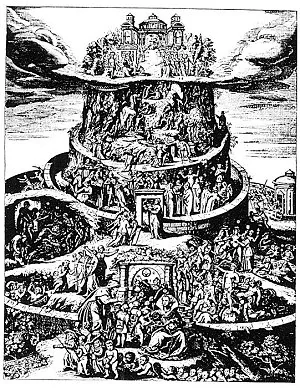
THE TABLE OF CEBES.
From Vænius' Theatro Moral de la Vida Humana.
There is legend to the effect that the Tablet of Cebes, a dialogue between Cebes and Gerundio, was based upon an ancient table set up in the Temple of Kronos at Athens or Thebes which depicted the entire progress of human life. The author of the Tablet of Cebes was a disciple of Socrates, and lived about 390 B.C. The world is represented as a great mountain. Out of the earth at the base of it come he myriads of human creatures who climb upward in search of truth and immortality. Above the clouds which conceal the summit of the mountain is the goal of human attainment--true happiness. The figures and groups are arranged as follows: (1) the door of the wall of life; (2) the Genius or Intelligence; (3) deceit (4) opinions, desires, and pleasures; (5) fortune; (6) the strong; (7) venery, insatiability, flattery; (8) sorrow; (9) sadness; (10) misery; (11) grief, (12) rage or despair; (13) the house of misfortune; (14) penitence; (15) true opinion; (16) false opinion; (17) false doctrine; (18) poets, orators, geometers, et. al.; (19) incontinence, sexual indulgence, and opinion; (20) the road of the true doctrine (21) continence and patience; (22) the true doctrine; (23) truth and persuasion; (24) science and the virtues; (25) happiness, (26) the highest (first) pleasure of the wise man; (27) the lazy and the strays.
pages of history as the greatest of the pagan martyrs. A personal disciple of the magician Plutarch, and versed in the profundities of the Platonic School, Hypatia eclipsed in argument and public esteem every proponent of the Christian doctrines in Northern Egypt. While her writings perished at the time of the burning of the library of Alexandria by the Mohammedans, some hint of their nature may be gleaned from the statements of contemporaneous authors. Hypatia evidently wrote a commentary on the Arithmetic of Diophantus, another on the Astronomical Canon of Ptolemy, and a third on the Conics of Apollonius of Perga. Synesius, Bishop of Ptolemais, her devoted friend, wrote to Hypatia for assistance in the construction of an astrolabe and a hydroscope. Recognizing the transcendency of her intellect, the learned of many nations flocked to the academy where she lectured.
A number of writers have credited the teachings of Hypatia with being Christian in spirit; in fact she removed the veil of mystery in which the new cult had enshrouded itself, discoursing with such clarity upon its most involved principles that many newly converted to the Christian faith deserted it to become her disciples. Hypatia not only proved conclusively the pagan origin of the Christian faith but also exposed the purported miracles then advanced by the Christians as tokens of divine preference by demonstrating the natural laws controlling the phenomena.
At this time Cyril--later to be renowned as the founder of the doctrine of the Christian Trinity and canonized for his zeal--was Bishop of Alexandria. Seeing in Hypatia a continual menace to the promulgation of the Christian faith, Cyril--indirectly at least--was the cause of her tragic end. Despite every later effort to exonerate him from the stigma of her murder, the incontrovertible fact remains that he made no effort to avert the foul and brutal crime. The only shred of excuse which might be offered in his defense is that, blinded by the spell of fanaticism, Cyril considered Hypatia to be a sorceress in league with the Devil. In contrast to the otherwise general excellence of the literary works of Charles Kingsley maybe noted his puerile delineation of character of Hypatia in his book by that name. Without exception, the meager historical references to this virgin philosopher attest her virtue, integrity, and absolute devotion to the principles of Truth and Right.
While it is true that the best minds of the Christianity of that period may readily be absolved from the charge of participes criminis, the implacable hatred of Cyril unquestionably communicated itself to the more fanatical members of his faith, particularly to a group of monks from the Nitrian desert. Led by Peter the Reader, a savage and illiterate man, they attacked Hypatia on the open street as she was passing from the academy to her home. Dragging the defenseless woman from her chariot, they took her to the Cæsarean Church. Tearing away her garments, they pounded her to death with clubs, after which they scraped the flesh from her bones with oyster shells and carried the mutilated remains to a place called Cindron, where they burned them to ashes.
Thus perished in A.D. 415 the greatest woman initiate of the ancient world, and with her fell also the Neo-Platonic School of Alexandria. The memory of Hypatia has probably been perpetuated in the hagiolatry of the Roman Catholic Church in the person of St. Catherine of Alexandria.
THE COMTE DI CAGLIOSTRO
The "divine" Cagliostro, one moment the idol of Paris, the next a lonely prisoner in a dungeon of the Inquisition, passed like a meteor across the face of France. According to his memoirs written by him during his confinement in the Bastille, Alessandro Cagliostro was born in Malta of a noble but unknown family. He was reared and educated in Arabia under the tutelage of Altotas, a man well versed in several branches of philosophy and science and also a master of the transcendental arts. While Cagliostro's biographers generally ridicule this account, they utterly fail to advance in its stead any logical solution for the source of his magnificent store of arcane knowledge.
Branded as an impostor and a charlatan, his miracles declared to be legerdemain, and his very generosity suspected of an ulterior motive, the Comte di Cagliostro is undoubtedly the most calumniated man in modem history. "The mistrust," writes W. H. K. Trowbridge, "that mystery and magic always inspire made Cagliostro with his fantastic personality an easy target for calumny. After having been riddled with abuse till he was unrecognizable, prejudice, the foster child of calumny, proceeded to lynch him, so to speak. For over one hundred years his character has dangled on the gibbet of infamy, upon which the sbirri of tradition have inscribed a curse on any one who shall attempt to cut him down. His fate has been his fame. He is remembered in history, not so much for anything he did, as for what was done to him." (See Cagliostro, the Splendour and Misery of a Master of Magic.)
According to popular belief Cagliostro's real name was Giuseppe Balsamo, and he was a Sicilian by birth. Within recent years, however, doubts have arisen as to whether this belief is in accord with the facts. It may yet be proved that in part, at least, the tirades of abuse heaped upon the unfortunate Comte have been directed against the wrong man. Giuseppe Balsamo was born in 1743 of honest but humble parentage. From boyhood he exhibited selfish, worthless, and even criminal tendencies, and after a series of escapades disappeared. Trowbridge(loc. cit.) presents ample proof that Cagliostro was not Giuseppe Balsamo, thus disposing of the worst accusation against him. After six months' imprisonment in the Bastille, on his trial Cagliostro was exonerated from any implication in the theft of the famous "Queen's Necklace," and later the fact was established that he had actually warned Cardinal de Rohan of the intended crime. Despite the fact, however, that he was discharged as innocent by the French trial court, a deliberate effort to vilify Cagliostro was made by an artist--more talented than intelligent--who painted a picture showing him holding the fatal necklace in his hand. The trial of Cagliostro has been called the prologue of the French Revolution. The smoldering animosity against Marie Antoinette and Louis XVI engendered by this trial later burst forth as the holocaust of the Reign of Terror. In his brochure, Cagliostro and His Egyptian Rite of Freemasonry, Henry R. Evans also ably defends this much persecuted man against the infamies so unjustly linked with his name.
Sincere investigators of the facts surrounding the life and mysterious "death" of Cagliostro are of the opinion that the stories circulated against him may be traced to the machinations of the Inquisition, which in this manner sought to justify his persecution. The basic charge against Cagliostro was that he had attempted to found a Masonic lodge in Rome--nothing more. All other accusations are of subsequent date. For some reason undisclosed, the Pope commuted Cagliostro's sentence of death to perpetual imprisonment. This act in itself showed the regard in which Cagliostro was held even by his enemies. While his death is believed to have occurred several years later in an Inquisitional dungeon in the castle of San Leo, it is highly improbable that such was the case. There are rumors that he escaped, and according to one very significant story Cagliostro fled to India, where his talents received the appreciation denied them in politics-ridden Europe.
After creating his Egyptian Rite, Cagliostro declared that since women had been admitted into the ancient Mysteries there was no reason why they should be excluded from the modem orders. The Princesse de Lamballe graciously accepted the dignity of Mistress of Honor in his secret society, and on the evening of her initiation the most important members of the French court were present. The brilliance of the affair attracted the attention of the Masonic lodges in Paris. Their representatives, in a sincere desire to understand the Masonic Mysteries, chose the learned orientalist Court de Gébelin as their spokesman, and invited Comte di Cagliostro to attend a conference to assist in clearing up a number of important questions concerning Masonic philosophy. The Comte accepted the invitation.
On May 10, 1785, Cagliostro attended the conference called for that purpose, and his power and simplicity immediately won for him the favorable opinion of the entire gathering. It took but a few words for the Court de Gébelin to discover that he was talking nor only to a fellow scholar but to a man infinitely his superior. Cagliostro immediately presented an address, which was so unexpected, so totally different from anything ever heard before by those assembled, that all were speechless with amazement. Cagliostro declared the Rose-Cross to be the ancient and true symbol of the Mysteries and, after a brief description of its original symbolism, branched out into a consideration of the symbolic meaning of letters, predicting to the assembly the future of France in a graphic manner that left no room for doubt that the speaker was a man of insight and supernatural power. With a curious arrangement of the letters of the alphabet, Cagliostro foretold in detail the horrors of the coming revolution and the fall of the monarchy, describing minutely the fate of the various members of the royal family. He also prophesied the advent of Napoleon and the rise of the First Empire. All this he did to demonstrate that which can be accomplished by superior knowledge.
Later when arrested and sent to the Bastille, Cagliostro wrote on the wall of his cell the following cryptic message which, when interpreted, reads: "In 1789 the besieged Bastille will on July 14th be pulled down by you from top to bottom." Cagliostro was the mysterious agent of the Knights Templars, the Rosicrucian initiate whose magnificent store of learning is attested by the profundity of the Egyptian Rite of Freemasonry. Thus Comte di Cagliostro remains one of the strangest characters in history--believed by his friends to have lived forever and to have taken part in the marriage feast of Cana, and accused by his enemies of being the Devil incarnate! His powers of prophecy are ably described by Alexandre Dumas in The Queen's Necklace. The world he sought to serve in his own
strange way received him not, but has followed with relentless persecution down through the centuries even the very memory of this illustrious adept who, unable to accomplish the great labor at hand, stepped aside in favor of his more successful compatriot, the Comte de St-Germain.
THE COMTE DE ST.-GERMAIN
During the early part of the eighteenth century there appeared in the diplomatic circles of Europe the most baffling personality of history--a man whose life was so near a synonym of mystery that the enigma of his true identity was as insolvable to his contemporaries as it has been to later investigators. The Comte de St.-Germain was recognized as the outstanding scholar and linguist of his day. His versatile accomplishments extended from chemistry and history to poetry and music. He played several musical instruments with great skill and among his numerous compositions was a short opera. He was also an artist of rare ability and the remarkably luminous effects which he created on canvas are believed to have been the result of his mixing powdered mother-of-pearl with his pigments. He gained worldwide distinction for his ability to reproduce in his paintings the original luster of the precious stones appearing upon the costumes of his subjects. His linguistic proficiency verged on the supernatural. He spoke German, English, Italian, Portuguese, Spanish, French with a Piedmontese accent, Greek, Latin, Sanskrit, Arabic, and Chinese with such fluency that in every land he visited he was accepted as a native. He was ambidextrous to such a degree that: he could write the same article with both hands simultaneously. When the two pieces of paper were afterwards placed together with a light behind them, the writing on one sheet exactly covered, letter for letter, the writing on the other.
As a historian, the Comte de St.-Germain possessed uncanny knowledge of every occurrence of the preceding two thousand years, and in his reminiscences he described in intimate detail events of previous centuries in which he had played important rôles. He assisted Mesmer in developing the theory of mesmerism, and in all probability was the actual discoverer of that science. His knowledge of chemistry was so profound that he could remove flaws from diamonds and other precious stones--a feat which he actually performed at the request of Louis XV in 1757. He was also recognized as an art critic without a peer and was often consulted regarding paintings accredited to the great masters. His claim to the possession of the fabled elixir of life was home witness to by Madame de Pompadour, who discovered, she declared, that he had presented a lady of the court with a certain priceless liquid which had had the effect of preserving her youthful vivacity and beauty for over twenty-five years beyond the normal term.
The startling accuracy of his prophetic utterances gained for him no small degree of fame. To Marie Antoinette he predicted the fall of the French monarchy, and he was also aware of the unhappy fate of the royal family years before the Revolution actually took place. The crowning evidence, however, of the Comte's genius was his penetrating grasp of the political situation of Europe and the consummate skill with which he parried the thrusts of his diplomatic adversaries. He was employed by a number of European governments, including the French, as a secret agent, and at all times bore credentials which gave him entrée to the most exclusive circles.
In her excellent monograph, The Comte de St.-Germain, the Secret of Kings, Mrs. Cooper-Oakley lists the most important names under which this amazing person masqueraded between the years 1710 and 1822. "During this time," she writes, "we have M. de St.-Germain as the Marquis de Montferrat, Comte Bellamarre or Aymar at Venice, Chevalier Schoening at Pisa, Chevalier Weldon at Milan and Leipzig, Comte Soltikoff at Genoa and Leghorn, Graf Tzarogy at Schwalbach and Triesdorf, Prinz Ragoczy at Dresden, and Comte de St.-Germain at Paris, The Hague, London, and St. Petersburg." It is evident that M. de St.-Germain adopted these various names in the interests of the political secret service work which historians have presumed to be the major mission of his life.
The Comte de St.-Germain has been described as of medium height, well proportioned in body, and of regular and pleasing features. His complexion was somewhat swarthy and his hair dark, though often shown powdered. He dressed simply, usually in black, but his clothes were well fitting and of the best quality. He had apparently a mania for diamonds, which he wore not only in rings but also in his watch and chain, his snuff box, and upon his buckles. A jeweler once estimated the value of his shoe buckles at 200,000 francs. The Comte is generally depicted as a man in middle life, entirely devoid of wrinkles and free from any physical infirmity. He ate no meat and drank no wine, in fact seldom dined in the presence of any second person. Although he was looked upon as a charlatan and impostor by a few nobles at the French court, Louis XV severely reprimanded a courtier who made a disparaging remark concerning him. The grace and dignity that characterized his conduct, together with his perfect control of every situation, attested the innate refinement and culture of one "to the manner born." This remarkable person also had the surprising and impressive ability to divine, even to the most minute details, the questions of his inquisitors before they were asked. By something akin to telepathy he was also able to feel when his presence was needed in some distant city or state, and it has even been recorded of him that he had the astonishing habit not only of appearing in his own apartment and in those of friends without resorting to the conventionality of the door but also of departing therefrom in a similar manner.
M. de St.-Germain's travels covered many countries. During the reign of Peter III he was in Russia and between the years 1737 and 1742 in the court of the Shah of Persia as an honored guest. On the subject: of his wanderings Una Birch writes: "The travels of the Comte de Saint-Germain covered a long period of years and a great range of countries. From Persia to France and from Calcutta to Rome he was known and respected. Horace Walpole spoke with him in London in 1745; Clive knew him in India in 1756; Madame d'Adhémar alleges that she met him in Paris in 1789, five years after his supposed death; while other persons pretend to have held conversations with him in the early nineteenth century. He was on familiar and intimate terms with the crowned heads of Europe and the honoured friend of many distinguished persons of all nationalities. He is even mentioned in the memoirs and letters of the day, and always as a man of mystery. Frederick the Great, Voltaire, Madame de Pompadour, Rousseau, Chatham, and Walpole, all of whom knew him personally, rivalled each other in curiosity as to his origin. During the many decades in which he was before the world, however, no one succeeded in discovering why he appeared as a Jacobite agent in London, as a conspirator in Petersburg, as an alchemist and connoisseur of pictures in Paris, or as a Russian general at Naples. * * * Now and again the curtain which shrouds his actions is drawn aside, and we are permitted to see him fiddling in the music room at Versailles, gossiping with Horace Walpole in London, sitting in Frederick the Great's library at Berlin, or conducting illuminist meetings in caverns by the Rhine." (See The Nineteenth Century, January, 1908.)
The Comte de St.-Germain has been generally regarded as an important figure in early activities of the Freemasons. Repeated efforts, however, probably with an ulterior motive, have been made to discredit his Masonic affiliations. An example of this is the account appearing in The Secret Tradition in Freemasonry, by Arthur Edward
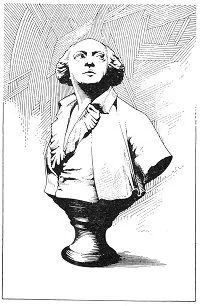
THE ''DIVINE'' CAGLIOSTRO.
From Houdon's Bust of Cagliostro.
The Comte di Cagliostro is described as a man not overly tall, but square shouldered and deep of chest. His head, which was large, was abundantly covered with black hair combed back from his broad and noble forehead. His eyes were black and very brilliant, and when he spoke with great feeling upon some profound subject the pupils dilated, his eyebrows rose, and he shook his head like a maned lion. His hands and feet were small--an indication of noble birth--and his whole bearing was one of dignity and studiousness. He was filled with energy, and could accomplish a prodigious amount of work. He dressed somewhat fantastically, gave so freely from an inexhaustible purse that he received the title of "Father of the Poor," accepted nothing from anyone, and maintained himself in magnificence in a combined temple and palace in the Rue d, la Sourdière. According to his own statement he was initiated into the Mysteries by none other than the Comte de St.-Germain. He had traveled through all parts of the world, and in the ruins of ancient Babylon and Nineveh had discovered wise men who understood all the secrets of human life.
Waite. This author, after making several rather disparaging remarks on the subject, amplifies his article by reproducing an engraving of the wrong Comte de St.-Germain, apparently being unable to distinguish between the great illuminist and the French general. It will yet be established beyond all doubt that the Comte de St.-Germain was both a Mason and a Templar; in fact the memoirs of Cagliostro contain a direct statement of his initiation into the order of the Knights Templars at the hands of St.-Germain. Many of the illustrious personages with whom the Comte de St.-Germain associated were high Masons, and sufficient memoranda have been preserved concerning the discussions which they held to prove that he was a master of Freemasonic lore. It is also reasonably certain that he was connected with the Rosicrucians--possibly having been the actual head of that order.
The Comte de St.-Germain was thoroughly conversant with the principles of Oriental esotericism. He practiced the Eastern system of meditation and concentration, upon several occasions having been seen seated with his feet crossed and hands folded in the posture of a Hindu Buddha. He had a retreat in the heart of the Himalayas to which he retired periodically from the world. On one occasion he declared that he would remain in India for eighty-five years and then would return to the scene of his European labors. At various times he admitted that he was obeying the orders of a power higher and greater than himself. What he did not say was that this superior power was the Mystery school which had sent him into the world to accomplish a definite mission. The Comte de St.-Germain and Sir Francis Bacon are the two greatest emissaries sent into the world by the Secret Brotherhood in the last thousand years.
E. Francis Udny, a Theosophical writer, is of the belief that the Comte de St.-Germain was not the son of Prince Rákóczy of Transylvania, but because of his age could have been none other than the prince himself, who was known to be of a deep philosophic and mystic nature. The same writer believes the Comte de St.-Germain passed through the "philosophic death" as Francis Bacon in 1626, as François Rákóczy in 1735, and as Comte de St.-Germain in 1784. He also feels that the Comte de St.-Germain was the famous Comte de Gabalis, and as Count Hompesch was the last Grand Master of the Knights of Malta. It is well known that many members of the European secret societies have feigned death for various purposes. Marshal Ney, a member of the Society of Unknown Philosophers, escaped the firing squad and under the name of Peter Stuart Ney lived and taught school for over thirty years in North Carolina. On his deathbed, P. S. Ney told Doctor Locke, the attending physician, that he was Marshal Ney of France.
In concluding an article on the identity of the inscrutable Comte de St.-Germain, Andrew Lang writes: "Did Saint-Germain really die in the palace of Prince Charles of Hesse about 1780-85? Did he, on the other hand, escape from the French prison where Grosley thought he saw him, during the French Revolution? Was he known to Lord Lytton about 1860? * * * Is he the mysterious Muscovite adviser of the Dalai Lama? Who knows? He is a will-o'-the-wisp of the memoir-writers of the eighteenth century. " (See Historical Mysteries.)
EPISODES FROM AMERICAN HISTORY
Many times the question has been asked, Was Francis Bacon's vision of the "New Atlantis" a prophetic dream of the great civilization which was so soon to rise upon the soil of the New World? It cannot be doubted that the secret societies of Europe conspired to establish upon the American continent "a new nation, conceived in liberty and dedicated to the proposition that all men are created equal." Two incidents in the early history of the United States evidence the influence of that silent body which has so long guided the destinies of peoples and religions. By them nations are created as vehicles for the promulgation of ideals, and while nations are true to these ideals they survive; when they vary from them they vanish like the Atlantis of old which had ceased to "know the gods."
In his admirable little treatise, Our Flag, Robert Allen Campbell revives the details of an obscure, but most important, episode of American history--the designing of the Colonial flag of 1775. The account involves a mysterious man concerning whom no information is available other than that he was on familiar terms with both General George Washington and Dr. Benjamin Franklin. The following description of him is taken from Campbell's treatise:
"Little seems to have been known concerning this old gentleman; and in the materials from which this account is compiled his name is not even once mentioned, for he is uniformly spoken of or referred to as 'the Professor.' He was evidently far beyond his threescore and ten years; and he often referred to historical events of more than a century previous just as if he had been a living witness of their occurrence; still he was erect, vigorous and active--hale, hearty, and clear-minded--as strong and energetic every way as in the prime of his life He was tall, of fine figure, perfectly easy, and very dignified in his manners; being at once courteous, gracious and commanding. He was, for those times and considering the customs of the Colonists, very peculiar in his method of living; for he ate no flesh, fowl or fish; he never used for food any 'green thing,' any roots or anything unripe; he drank no liquor, wine or ale; but confined his diet to cereals and their products, fruits that were ripened on the stem in the sun, nuts, mild tea and the sweets of honey, sugar or molasses.
"He was well educated, highly cultivated, of extensive as well as varied information, and very studious. He spent considerable of his time in the patient and persistent conning of a number of very rare old books and ancient manuscripts which he seemed to be deciphering, translating or rewriting. These books and manuscripts, together with his own writings, he never showed to anyone; and he did not even mention them in his conversations with the family, except in the most casual way; and he always locked them up carefully in a large, old-fashioned, cubically shaped, iron-bound, heavy, oaken chest, whenever he left his room, even for his meals. He took long and frequent walks alone, sat on the brows of the neighboring hills, or mused in the midst of the green and flower-gemmed meadows. He was fairly liberal--but in no way lavish--in spending his money, with which he was well supplied. He was a quiet, though a very genial and very interesting, member of the family; and be was seemingly at home upon any and every topic coming up in conversation. He was, in short, one whom everyone would notice and respect, whom few would feel well acquainted with, and whom no one would presume to question concerning himself--as to whence he came, why he tarried, or whither he journeyed. "
By something more than a mere coincidence the committee appointed by the Colonial Congress to design a flag accepted an invitation to be guests, while in Cambridge, of the same family with which the Professor was staying. It was here that General Washington joined them for the purpose of deciding upon a fitting emblem. By the signs which passed between them it was evident that both General Washington and Doctor Franklin recognized the Professor, and by unanimous approval he was invited to become an active member of the committee. During the proceedings which followed, the Professor was treated with the most profound respect and all of his suggestions immediately acted upon. He submitted a pattern which he considered symbolically appropriate for the new flag, and this was unhesitatingly accepted by the other six members of the committee, who voted that the arrangement suggested by the Professor be forthwith adopted. After the episode of the flag the Professor quietly vanished, and nothing further is known concerning him.
Did General Washington and Doctor Franklin recognize the Professor as an emissary of the Mystery school which has so long controlled the political destinies of this planet? Benjamin Franklin was a philosopher and a Freemason--possibly a Rosicrucian initiate. He and the Marquis de Lafayette--also a man of mystery--constitute two of the most important links in the chain of circumstance that culminated in the establishment of the original thirteen American Colonies as a free and independent nation. Doctor Franklin's philosophic attainments are well attested in Poor Richard's Almanac, published by him for many years under the name of Richard Saunders. His interest in the cause of Freemasonry is also shown by his republication of Anderson's Constitutions of Freemasonry, a rare and much disputed work on the subject.
It was during the evening of July 4, 1776, that the second of these mysterious episodes occurred. In the old State House in Philadelphia a group of men were gathered for the momentous task of severing the last tie between the old country and the new. It was a grave moment and not a few of those present feared that their lives would be the forfeit for their audacity. In the midst of the debate a fierce voice rang out. The debaters stopped and turned to look upon the stranger. Who was this man who had suddenly appeared in their midst and transfixed them with his oratory? They had never seen him before, none knew when he had entered, but his tall form and pale face filled them with awe. His voice ringing with a holy zeal, the stranger stirred them to their very souls. His closing words rang through the building: "God has given America to be free!" As the stranger sank into a chair exhausted, a wild enthusiasm burst forth. Name after name was placed upon the parchment: the Declaration of Independence was signed. But where was the man who had precipitated the accomplishment of this immortal task--who had lifted for a moment the veil from the eyes of the assemblage and revealed to them a part at least of the great purpose for which the new nation was conceived? He had disappeared, nor was he ever seen again or his identity established. This episode parallels others of a similar kind recorded by ancient historians attendant upon the founding of every new nation. Are they coincidences, or do they demonstrate that the divine wisdom of the ancient Mysteries still is present in the world, serving mankind as it did of old?
Conclusion
PHILIP, King of Macedon, ambitious to obtain the teacher who would be most capable of imparting the higher branches of learning to his fourteen-year-old son, Alexander, and wishing the prince to have for his mentor the most famous and learned of the great philosophers, decided to communicate with Aristotle. He dispatched the following letter to the Greek sage: "PHILIP TO ARISTOTLE, HEALTH: Know that I have a son. I render the gods many thanks; not so much for his birth, as that he was born in your time, for I hope that being educated and instructed by you, he will become worthy of us both and the kingdom which he shall inherit." Accepting Philip's invitation, Aristotle journeyed to Macedon in the fourth year of the 108th Olympiad, and remained for eight years as the tutor of Alexander. The young prince's affection for his instructor became as great as that which he felt for his father. He said that his father had given him being, but that Aristotle had given him well-being.
The basic principles of the Ancient Wisdom were imparted to Alexander the Great by Aristotle, and at the philosopher's feet the Macedonian youth came to realize the transcendency of Greek learning as it was personified in Plato's immortal disciple. Elevated by his illumined teacher to the threshold of the philosophic sphere, he beheld the world of the sages--the world that fate and the limitations of his own soul decreed he should not conquer.
Aristotle in his leisure hours edited and annotated the Iliad of Horner and presented the finished volume to Alexander. This book the young conqueror so highly prized that he carried it with him on all his campaigns. At the time of his triumph over Darius, discovering among the spoils a magnificent, gem-studded casket of unguents, he dumped its contents upon the ground, declaring that at last he had found a case worthy of Aristotle's edition of the Iliad!
While on his Asiatic campaign, Alexander learned that Aristotle had published one of his most prized discourses, an occurrence which deeply grieved the young king. So to Aristotle, Conqueror of the Unknown, Alexander, Conqueror of the Known, sent this reproachful and pathetic and admission of the insufficiency of worldly pomp and power: "ALEXANDER TO ARISTOTLE, HEALTH: You were wrong in publishing those branches of science hitherto not to be acquired except from oral instruction. In what shall I excel others if the more profound knowledge I gained from you be communicated to all? For my part I had rather surpass the majority of mankind in the sublimer branches of learning, than in extent of power and dominion. Farewell." The receipt of this amazing letter caused no ripple in the placid life of Aristotle, who replied that although the discourse had been communicated to the multitudes, none who had not heard him deliver the lecture (who lacked spiritual comprehension) could understand its true import.
A few short years and Alexander the Great went the way of all flesh, and with his body crumbled the structure of empire erected upon his personality. One year later Aristotle also passed into that greater world concerning whose mysteries he had so often discoursed with his disciples in the Lyceum. But, as Aristotle excelled Alexander in life, so he excelled him in death; for though his body moldered in an obscure tomb, the great philosopher continued to live in his intellectual achievements. Age after age paid him grateful tribute, generation after generation pondered over his theorems until by the sheer transcendency of his rational faculties Aristotle--"the master of those who know," as Dante has called him--became the actual conqueror of the very world which Alexander had sought to subdue with the sword.
Thus it is demonstrated that to capture a man it is not sufficient to enslave his body--it is necessary to enlist his reason; that to free a man it is not enough to strike the shackles from his limbs--his mind must be liberated from bondage to his own ignorance. Physical conquest must ever fail, for, generating hatred and dissension, it spurs the mind to the avenging of an outraged body; but all men are bound whether willingly or unwillingly to obey that intellect in which they recognize qualities and virtues superior to their own.
That the philosophic culture of ancient Greece, Egypt, and India excelled that of the modern, world must be admitted by all, even by the most confirmed of modernists. The golden era of Greek æsthetics, intellectualism, and ethics has never since been equaled. The true philosopher belongs to the most noble order of men: the nation or race which is blessed by possession of illumined thinkers is fortunate indeed, and its name shall be remembered for their sake. In the famous Pythagorean school at Crotona, philosophy was regarded as indispensable to the life of man. He who did not comprehend the dignity of the reasoning power could not properly be said to live. Therefore, when through innate perverseness a member either voluntarily withdrew or was forcibly ejected from the philosophic fraternity, a headstone was set up for him in the community graveyard; for he who had forsaken intellectual and ethical pursuits to reenter the material sphere with its illusions of sense and false ambition was regarded as one dead to the sphere of Reality. The life represented by the thraldom of the senses the Pythagoreans conceived to be spiritual death, while they regarded death to the sense-world as spiritual life.
Philosophy bestows life in that it reveals the dignity and purpose of living. Materiality bestows death in that it benumbs or clouds those faculties of the human soul which should be responsive to the enlivening impulses of creative thought and ennobling virtue. How inferior to these standards of remote days are the laws by which men live in the twentieth century! Today man, a sublime creature with infinite capacity for self-improvement, in an effort to be true to false standards, turns from his birthright of understanding--without realizing the consequences--and plunges into the maelstrom of material illusion. The precious span of his earthly years he devotes to the pathetically futile effort to establish himself as an enduring power in a realm of unenduring things. Gradually the memory of his life as a spiritual being vanishes from his objective mind and he focuses all his partly awakened faculties upon
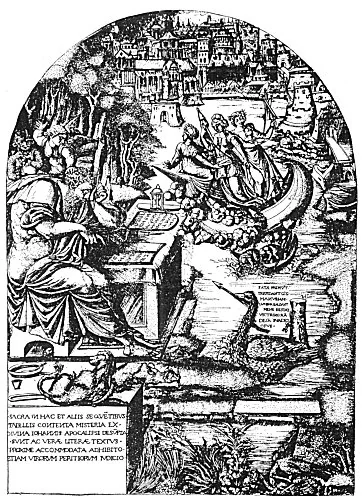
JOHN AND THE VISION OF THE APOCALYPSE.
From an engraving by Jean Duvet.
Jean Duvet of Langres (who was born in 1485 and presumably died sometime after 1561, the year in which his illustrations to the Apocalypse were printed in book form) was the oldest and greatest of French Renaissance engravers. Little is known concerning Duvet beyond the fact that he was the goldsmith to the King of France. His engravings for the Book of Revelation, executed after he had passed his seventieth year, were his masterpiece. (For further information regarding this obscure master, consult article by William M. Ivins, Jr., in The Arts, May, 1926.) The face of John is an actual portrait of Duvet. This plate, like many others cut by Duvet, is rich in philosophical symbolism.
the seething beehive of industry which he has come to consider the sole actuality. From the lofty heights of his Selfhood he slowly sinks into the gloomy depths of ephemerality. He falls to the level of the beast, and in brutish fashion mumbles the problems arising from his all too insufficient knowledge of the Divine Plan. Here in the lurid turmoil of a great industrial, political, commercial inferno, men writhe in self-inflicted agony and, reaching out into the swirling mists, strive to clutch and hold the grotesque phantoms of success and power.
Ignorant of the cause of life, ignorant of the purpose of life, ignorant of what lies beyond the mystery of death, yet possessing within himself the answer to it all, man is willing to sacrifice the beautiful, the true, and the good within and without upon the blood-stained altar of worldly ambition. The world of philosophy--that beautiful garden of thought wherein the sages dwell in the bond of fraternity--fades from view. In its place rises an empire of stone, steel, smoke, and hate-a world in which millions of creatures potentially human scurry to and fro in the desperate effort to exist and at the same time maintain the vast institution which they have erected and which, like some mighty, juggernaut, is rumbling inevitably towards an unknown end. In this physical empire, which man erects in the vain belief that he can outshine the kingdom of the celestials, everything is changed to stone, Fascinated by the glitter of gain, man gazes at the Medusa-like face of greed and stands petrified.
In this commercial age science is concerned solely with the classification of physical knowledge and investigation of the temporal and illusionary parts of Nature. Its so-called practical discoveries bind man but more tightly with the bonds of physical limitation, Religion, too, has become materialistic: the beauty and dignity of faith is measured by huge piles of masonry, by tracts of real estate, or by the balance sheet. Philosophy which connects heaven and earth like a mighty ladder, up the rungs of which the illumined of all ages have climbed into the living presence of Reality--even philosophy has become a prosaic and heterogeneous mass of conflicting notions. Its beauty, its dignity, its transcendency are no more. Like other branches of human thought, it has been made materialistic--"practical"--and its activities so directionalized that they may also contribute their part to the erection of this modern world of stone and steel.
In the ranks of the so-called learned there is rising up a new order of thinkers, which may best be termed the School of the Worldly Wise Men. After arriving at the astounding conclusion that they are the intellectual salt of the earth, these gentlemen of letters have appointed themselves the final judges of all knowledge, both human and divine. This group affirms that all mystics must have been epileptic and most of the saints neurotic! It declares God to be a fabrication of primitive superstition; the universe to be intended for no particular purpose; immortality to be a figment of the imagination; and an outstanding individuality to be but a fortuitous combination of cells! Pythagoras is asserted to have suffered from a "bean complex"; Socrates was a notorious inebriate; St. Paul was subject to fits; Paracelsus was an infamous quack, the Comte di Cagliostro a mountebank, and the Comte de St.-Germain the outstanding crook of history!
What do the lofty concepts of the world's illumined saviors and sages have in common with these stunted, distorted products of the "realism" of this century? All over the world men and women ground down by the soulless cultural systems of today are crying out for the return of the banished age of beauty and enlightenment--for something practical in the highest sense of the word. A few are beginning to realize that so-called civilization in its present form is at the vanishing point; that coldness, heartlessness, commercialism, and material efficiency are impractical, and only that which offers opportunity for the expression of love and ideality is truly worth while. All the world is seeking happiness, but knows not in what direction to search. Men must learn that happiness crowns the soul's quest for understanding. Only through the realization of infinite goodness and infinite accomplishment can the peace of the inner Self be assured. In spite of man's geocentricism, there is something in the human mind that is reaching out to philosophy--not to this or that philosophic code, but simply to philosophy in the broadest and fullest sense.
The great philosophic institutions of the past must rise again, for these alone can tend the veil which divides the world of causes from that of effects. Only the Mysteries--those sacred Colleges of Wisdom--can reveal to struggling humanity that greater and more glorious universe which is the true home of the spiritual being called man. Modern philosophy has failed in that it has come to regard thinking as simply an intellectual process. Materialistic thought is as hopeless a code of life as commercialism itself. The power to think true is the savior of humanity. The mythological and historical Redeemers of every age were all personifications of that power. He who has a little more rationality than his neighbor is a little better than his neighbor. He who functions on a higher plane of rationality than the rest of the world is termed the greatest thinker. He who functions on a lower plane is regarded as a barbarian. Thus comparative rational development is the true gauge of the individual's evolutionary status.
Briefly stated, the true purpose of ancient philosophy was to discover a method whereby development of the rational nature could be accelerated instead of awaiting the slower processes of Nature, This supreme source of power, this attainment of knowledge, this unfolding of the god within, is concealed under the epigrammatic statement of the philosophic life. This was the key to the Great Work, the mystery of the Philosopher's Stone, for it meant that alchemical transmutation had been accomplished. Thus ancient philosophy was primarily the living of a life; secondarily, an intellectual method. He alone can become a philosopher in the highest sense who lives the philosophic life. What man lives he comes to know. Consequently, a great philosopher is one whose threefold life--physical, mental, and spiritual--is wholly devoted to and completely permeated by his rationality.
Man's physical, emotional, and mental natures provide environments of reciprocal benefit or detriment to each other. Since the physical nature is the immediate environment of the mental, only that mind is capable of rational thinking which is enthroned in a harmonious and highly refined material constitution. Hence right action, right feeling, and right thinking are prerequisites of right knowing, and the attainment of philosophic power is possible only to such as have harmonized their thinking with their living. The wise have therefore declared that none can attain to the highest in the science of knowing until first he has attained to the highest in the science of living. Philosophic power is the natural outgrowth of the philosophic life. Just as an intense physical existence emphasizes the importance of physical things, or just as the monastic metaphysical asceticism establishes the desirability of the ecstatic state, so complete philosophic absorption ushers the consciousness of the thinker into the most elevated and noble of all spheres--the pure philosophic, or rational, world.
In a civilization primarily concerned with the accomplishment of the extremes of temporal activity, the philosopher represents an equilibrating intellect capable of estimating and guiding the cultural growth. The establishment of the philosophic rhythm in the nature of an individual ordinarily requires from fifteen to twenty years. During that entire period the disciples of old were constantly subjected to the most severe discipline. Every activity of life was gradually disengaged from other interests and focalized upon the reasoning part. In the ancient world there was another and most vital factor which entered into the production of rational intellects and which is entirely beyond the comprehension of modern thinkers: namely, initiation into the philosophic Mysteries. A man who had demonstrated his peculiar mental and spiritual fitness was accepted into the body of the learned and to him was revealed that priceless heritage of arcane lore preserved from generation to generation. This heritage of philosophic truth is the matchless treasure of all ages, and each disciple admitted into these brotherhoods of the wise made, in turn, his individual contribution to this store of classified knowledge.
The one hope of the world is philosophy, for all the sorrows of modern life result from the lack of a proper philosophic code. Those who sense even in part the dignity of life cannot but realize the shallowness apparent in the activities of this age. Well has it been said that no individual can succeed until he has developed his philosophy of life. Neither can a race or nation attain true greatness until it has formulated an adequate philosophy and has dedicated its existence to a policy consistent with that philosophy. During the World War, when so-called civilization hurled one half of itself against the other in a frenzy of hate, men ruthlessly destroyed something more precious even than human life: they obliterated those records of human thought by which life can be intelligently directionalized. Truly did Mohammed declare the ink of philosophers to be more precious than the blood of martyrs. Priceless documents, invaluable records of achievement, knowledge founded on ages of patient observation and experimentation by the elect of the earth--all were destroyed with scarcely a qualm of regret. What was knowledge, what was truth, beauty, love, idealism, philosophy, or religion when compared to man's desire to control an infinitesimal spot in the fields of Cosmos for an inestimably minute fragment of time? Merely to satisfy some whim or urge of ambition man would uproot the universe, though well he knows that in a few short years he must depart, leaving all that he has seized to posterity as an old cause for fresh contention.
War--the irrefutable evidence of irrationality--still smolders in the hearts of men; it cannot die until human selfishness is overcome. Armed with multifarious inventions and destructive agencies, civilization will continue its fratricidal strife through future ages, But upon the mind of man there is dawning a great fear--the fear that
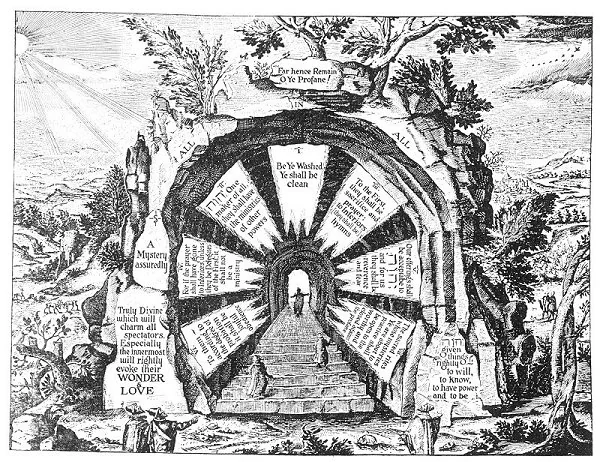
THE ENTRANCE TO THE HOUSE OF THE MYSTERIES.
From Khunrath's Amphitheatrum Sapientiæ, etc.
This symbolic figure, representing the way to everlasting life, is described by Khunrath in substance as follows: "This is the Portal of the amphitheatre of the only true and eternal Wisdom--a narrow one, indeed, but sufficiently august, and consecrated to Jehovah. To this portal ascent is made by a mystic, indisputably prologetic, flight of steps, set before it as shown in the picture. It consists of seven theosophic, or, rather, philosophic steps of the Doctrine of the Faithful Sons. After ascending the steps, the path is along the way of God the Father, either directly by inspiration or by various mediate means. According to the seven oracular laws shining at the portal, those who are inspired divinely have the power to enter and with the eyes of the body and of the mind, of seeing, contemplating and investigating in a Christiano-Kabalistic, divino-magical, physico-chemical manner, the nature of the Wisdom: Goodness, and Power of the Creator; to the end that they die not sophistically but live theosophically, and that the orthodox philosophers so created may with sincere philosophy expound the works of the Lord, and worthily praise God who has thus blessed these friend, of God." The above figure and description constitute one of the most remarkable expositions ever made of the appearance of the Wise Man's House and the way by which it must be entered.
____________________________
eventually civilization will destroy itself in one great cataclysmic struggle. Then must be reenacted the eternal drama of reconstruction. Out of the ruins of the civilization which died when its idealism died, some primitive people yet in the womb of destiny must build a new world. Foreseeing the needs of that day, the philosophers of the ages have desired that into the structure of this new world shall be incorporated the truest and finest of all that has gone before. It is a divine law that the sum of previous accomplishment shall be the foundation of each new order of things. The great philosophic treasures of humanity must be preserved. That which is superficial may he allowed to perish; that which is fundamental and essential must remain, regardless of cost.
Two fundamental forms of ignorance were recognized by the Platonists: simple ignorance and complex ignorance. Simple ignorance is merely lack of knowledge and is common to all creatures existing posterior to the First Cause, which alone has perfection of knowledge. Simple ignorance is an ever-active agent, urging the soul onward to the acquisition of knowledge. From this virginal state of unawareness grows the desire to become aware with its resultant improvement in the mental condition. The human intellect is ever surrounded by forms of existence beyond the estimation of its partly developed faculties. In this realm of objects not understood is a never-failing source of mental stimuli. Thus wisdom eventually results from the effort to cope rationally with the problem of the unknown.
In the last analysis, the Ultimate Cause alone can be denominated wise; in simpler words, only God is good. Socrates declared knowledge, virtue, and utility to be one with the innate nature of good. Knowledge is a condition of knowing; virtue a condition of being; utility a condition of doing. Considering wisdom as synonymous with mental completeness, it is evident that such a state can exist only in the Whole, for that which is less than the Whole cannot possess the fullness of the All. No part of creation is complete; hence each part is imperfect to the extent that it falls short of entirety. Where incompleteness is, it also follows that ignorance must be coexistent; for every part, while capable of knowing its own Self, cannot become aware of the Self in the other parts. Philosophically considered, growth from the standpoint of human evolution is a process proceeding from heterogeneity to homogeneity. In time, therefore, the isolated consciousness of the individual fragments is reunited to become the complete consciousness of the Whole. Then, and then only, is the condition of all-knowing an absolute reality.
Thus all creatures are relatively ignorant yet relatively wise; comparatively nothing yet comparatively all. The microscope reveals to man his significance; the telescope, his insignificance. Through the eternities of existence man is gradually increasing in both wisdom and understanding; his ever-expanding consciousness is including more of the external within the area of itself. Even in man's present state of imperfection it is dawning upon his realization that he can never be truly happy until he is perfect, and that of all the faculties contributing to his self-perfection none is equal in importance to the rational intellect. Through the labyrinth of diversity only the illumined mind can, and must, lead the soul into the perfect light of unity.
In addition to the simple ignorance which is the most potent factor in mental growth there exists another, which is of a far more dangerous and subtle type. This second form, called twofold or complex ignorance, may be briefly defined as ignorance of ignorance. Worshiping the sun, moon, and stars, and offering sacrifices to the winds, the primitive savage sought with crude fetishes to propitiate his unknown gods. He dwelt in a world filled with wonders which he did not understand. Now great cities stand where once roamed the Crookboned men. Humanity no longer regards itself as primitive or aboriginal. The spirit of wonder and awe has been succeeded by one of sophistication. Today man worships his own accomplishments, and either relegates the immensities of time and space to the background of his consciousness or disregards them entirely.
The twentieth century makes a fetish of civilization and is overwhelmed by its own fabrications; its gods are of its own fashioning. Humanity has forgotten how infinitesimal, how impermanent and how ignorant it actually is. Ptolemy has been ridiculed for conceiving the earth to be the center of the universe, yet modern civilization is seemingly founded upon the hypothesis that the planet earth is the most permanent and important of all the heavenly spheres,
and that the gods from their starry thrones are fascinated by the monumental and epochal events taking place upon this spherical ant-hill in Chaos.
From age to age men ceaselessly toil to build cities that they may rule over them with pomp and power--as though a fillet of gold or ten million vassals could elevate man above the dignity of his own thoughts and make the glitter of his scepter visible to the distant stars. As this tiny planet rolls along its orbit in space, it carries with it some two billion human beings who live and die oblivious to that immeasurable existence lying beyond the lump on which they dwell. Measured by the infinities of time and space, what are the captains of industry or the lords of finance? If one of these plutocrats should rise until he ruled the earth itself, what would he be but a petty despot seated on a grain of Cosmic dust?
Philosophy reveals to man his kinship with the All. It shows him that he is a brother to the suns which dot the firmament; it lifts him from a taxpayer on a whirling atom to a citizen of Cosmos. It teaches him that while physically bound to earth (of which his blood and bones are part), there is nevertheless within him a spiritual power, a diviner Self, through which he is one with the symphony of the Whole. Ignorance of ignorance, then, is that self-satisfied state of unawareness in which man, knowing nothing outside the limited area of his physical senses, bumptiously declares there is nothing more to know! He who knows no life save the physical is merely ignorant; but he who declares physical life to be all-important and elevates it to the position of supreme reality--such a one is ignorant of his own ignorance.
If the Infinite had not desired man to become wise, He would not have bestowed upon him the faculty of knowing. If He had not intended man to become virtuous, He would not have sown within the human heart the seeds of virtue. If He had predestined man to be limited to his narrow physical life, He would not have equipped him with perceptions and sensibilities capable of grasping, in part at least, the immensity of the outer universe. The criers of philosophy call all men to a comradeship of the spirit: to a fraternity of thought: to a convocation of Selves. Philosophy invites man out of the vainness of selfishness; out of the sorrow of ignorance and the despair of worldliness; out of the travesty of ambition and the cruel clutches of greed; out of the red hell of hate and the cold tomb of dead idealism.
Philosophy would lead all men into the broad, calm vistas of truth, for the world of philosophy is a land of peace where those finer qualities pent up within each human soul are given opportunity for expression. Here men are taught the wonders of the blades of grass; each stick and stone is endowed with speech and tells the secret of its being. All life, bathed in the radiance of understanding, becomes a wonderful and beautiful reality. From the four corners of creation swells a mighty anthem of rejoicing, for here in the light of philosophy is revealed the purpose of existence; the wisdom and goodness permeating the Whole become evident to even man's imperfect intellect. Here the yearning heart of humanity finds that companionship which draws forth from the innermost recesses of the soul that great store of good which lies there like precious metal in some deep hidden vein.
Following the path pointed out by the wise, the seeker after truth ultimately attains to the summit of wisdom's mount, and gazing down, beholds the panorama of life spread out before him. The cities of the plains are but tiny specks and the horizon on every hand is obscured by the gray haze of the Unknown. Then the soul realizes that wisdom lies in breadth of vision; that it increases in comparison to the vista. Then as man's thoughts lift him heavenward, streets are lost in cities, cities in nations, nations in continents, continents in the earth, the earth in space, and space in an infinite eternity, until at last but two things remain: the Self and the goodness of God.
While man's physical body resides with him and mingles with the heedless throng, it is difficult to conceive of man as actually inhabiting a world of his own-a world which he has discovered by lifting himself into communion with the profundities of his own internal nature. Man may live two lives. One is a struggle from the womb to the tomb. Its span is measured by man's own creation--time. Well may it be called the unheeding life. The other life is from realization to infinity. It begins with understanding, its duration is forever, and upon the plane of eternity it is consummated. This is called the philosophic life. Philosophers are nor born nor do they die; for once having achieved the realization of immortality, they are immortal. Having once communed with Self, they realize that within there is an immortal foundation that will not pass away. Upon this living, vibrant base--Self--they erect a civilization which will endure after the sun, the moon, and the stars have ceased to be. The fool lives but for today; the philosopher lives forever.
When once the rational consciousness of man rolls away the stone and comes forth from its sepulcher, it dies no more; for to this second or philosophic birth there is no dissolution. By this should not be inferred physical immortality, but rather that the philosopher has learned that his physical body is no more his true Self than the physical earth is his true world. In the realization that he and his body are dissimilar--that though the form must perish the life will not fail--he achieves conscious immortality. This was the immortality to which Socrates referred when he said: "Anytus and Melitus may indeed put me to death, but they cannot injure me." To the wise, physical existence is but the outer room of the hall of life. Swinging open the doors of this antechamber, the illumined pass into the greater and more perfect existence. The ignorant dwell in a world bounded by time and space. To those, however, who grasp the import and dignity of Being, these are but phantom shapes, illusions of the senses-arbitrary limits imposed by man's ignorance upon the duration of Deity. The philosopher lives and thrills with the realization of this duration, for to him this infinite period has been designed by the All-Wise Cause as the time of all accomplishment.
Man is not the insignificant creature that he appears to be; his physical body is not the true measure of his real self. The invisible nature of man is as vast as his comprehension and as measureless as his thoughts. The fingers of his mind reach out and grasp the stars; his spirit mingles with the throbbing life of Cosmos itself. He who has attained to the state of understanding thereby has so increased his capacity to know that he gradually incorporates within himself the various elements of the universe. The unknown is merely that which is yet to be included within the consciousness of the seeker. Philosophy assists man to develop the sense of appreciation; for as it reveals the glory and the sufficiency of knowledge, it also unfolds those latent powers and faculties whereby man is enabled to master the secrets of the seven spheres.
From the world of physical pursuits the initiates of old called their disciples into the life of the mind and the spirit. Throughout the ages, the Mysteries have stood at the threshold of Reality--that hypothetical spot between noumenon and phenomenon, the Substance and the shadow. The gates of the Mysteries stand ever ajar and those who will may pass through into the spacious domicile of spirit. The world of philosophy lies neither to the right nor to the left, neither above nor below. Like a subtle essence permeating all space and all substance, it is everywhere; it penetrates the innermost and the outermost parts of all being. In every man and woman these two spheres are connected by a gate which leads from the not-self and its concerns to the Self and its realizations. In the mystic this gate is the heart, and through spiritualization of his emotions he contacts that more elevated plane which, once felt and known, becomes the sum of the worth-while. In the philosopher, reason is the gate between the outer and the inner worlds, the illumined mind bridging the chasm between the corporeal and the incorporeal. Thus godhood is born within the one who sees, and from the concerns of men he rises to the concerns of gods.
In this era of "practical" things men ridicule even the existence of God. They scoff at goodness while they ponder with befuddled minds the phantasmagoria of materiality. They have forgotten the path which leads beyond the stars. The great mystical institutions of antiquity which invited man to enter into his divine inheritance have crumbled, and institutions of human scheming now stand where once the ancient houses of learning rose a mystery of fluted columns and polished marble. The white-robed sages who gave to the world its ideals of culture and beauty have gathered their robes about them and departed from the sight of men. Nevertheless, this little earth is bathed as of old in the sunlight of its Providential Generator. Wide-eyed babes still face the mysteries of physical existence. Men continue to laugh and cry, to love and hate; Some still dream of a nobler world, a fuller life, a more perfect realization. In both the heart and mind of man the gates which lead from mortality to immortality are still ajar. Virtue, love, and idealism are yet the regenerators of humanity. God continues to love and guide the destinies of His creation. The path still winds upward to accomplishment. The soul of man has not been deprived of its wings; they are merely folded under its garment of flesh. Philosophy is ever that magic power which, sundering the vessel of clay, releases the soul from its bondage to habit and perversion. Still as of old, the soul released can spread its wings and soar to the very source of itself.
The criers of the Mysteries speak again, bidding all men welcome to the House of Light. The great institution of materiality has failed. The false civilization built by man has turned, and like the monster of Frankenstein, is destroying its creator. Religion wanders aimlessly in the maze of theological speculation. Science batters itself impotently against the barriers of the unknown. Only transcendental philosophy knows the path. Only the illumined reason can carry the understanding part of man upward to the light. Only philosophy can teach man to be born well, to live well, to die well, and in perfect measure be born again. Into this band of the elect--those who have chosen the life of knowledge, of virtue, and of utility--the philosophers of the ages invite YOU.
The Secret Teachings of All Ages. San Francisco, 1928. Hermetic Cloud, https://hermeticcloud.com/library/hall-secret-teachings-of-all-ages/. Public-domain text reproduced in full; markup only.