HISTORY OF UTAH
1540-1886
by Hubert Howe Bancroft
San Francisco : History Co.,
Preface
In the history of Utah we come upon a new series of social phenomena, whose multiformity and unconventionality awaken the liveliest interest. We find ourselves at once outside the beaten track of conquest for gold and glory; of wholesale robberies and human slaughters for the love of Christ; of encomiendas, repartimientos, serfdoms, or other species of civilized imposition; of missionary invasion resulting in certain death to the aborigines, but in broad acres and well filled storehouses for the men of practical piety; of emigration for rich and cheap lands, or for colonization and empire alone; nor have we here a hurried scramble for wealth, or a corporation for the management of a game preserve. There is the charm of novelty about the present subject, if no other; for in our analyses of human progress we never tire of watching the behavior of various elements under various conditions.
There is only one example in the annals of America of the organization of a commonwealth upon principles of pure theocracy. There is here one example only where the founding of a state grew out of the founding of a new religion. Other instances there have been of the occupation of wild tracts on this continent by people flying before persecution, or desirous
of greater religious liberty; there were the quakers, the huguenots, and the pilgrim fathers, though their spiritual interests were so soon subordinated to political necessities; religion has often played a conspicuous part in the settlement of the New World, and there has at times been present in some degree the theocratic, if not indeed the hierarchal, idea; but it has been long since the world, the old continent or the new, has witnessed anything like a new religion successfully established and set in prosperous running order upon the fullest and combined principles of theocracy, hierarchy, and patriarchy.
With this new series of phenomena, a new series of difficulties arises in attempting their elucidation: not alone the perplexities always attending unexplored fields, but formidable embarrassments which render the task at once delicate and dangerous.
If the writer is fortunate enough to escape the many pitfalls of fallacy and illusion which beset his way; if he is wise and successful enough to find and follow the exact line of equity which should be drawn between the hotly contending factions; in a word, if he is honest and capable, and speaks honestly and openly in the treatment of such a subject, he is pretty sure to offend, and bring upon himself condemnation from all parties. But where there are palpable faults on both sides of a case, the judge who unites equity with due discrimination may be sure he is not in the main far from right if he succeeds in offending both sides. Therefore, amidst the multiformity of conflicting ideas and evidence, having abandoned all hope of satisfying others, I fall back upon the next most reasonable proposition left—that of satisfying myself.
In regard to the quality of evidence I here encounter, I will say that never before has it been my lot to meet with such a mass of mendacity. The attempts of almost all who have written upon the subject seem to have been to make out a case rather than to state the facts. Of course, by any religious sect dealing largely in the supernatural, fancying itself under the direct guidance of God, its daily doings a standing miracle, commingling in all the ordinary affairs of life prophecies, special interpositions, and revelations with agriculture, commerce, and manufactures, we must expect to find much written which none but that sect can accept as true.
And in relation to opposing evidence, almost every book that has been put forth respecting the people of Utah by one not a Mormon is full of calumny, each author apparently endeavoring to surpass his predecessor in the libertinism of abuse. Most of these are written in a sensational style, and for the purpose of deriving profit by pandering to a vitiated public taste, and are wholly unreliable as to facts. Some few, more especially among those first appearing, whose data were gathered by men upon the spot, and for the purpose of destroying what they regarded as a sacrilegious and pernicious fanaticism, though as vehement in their opposition as any, make some pretensions to honesty and sincerity, and are more worthy of credit. There is much in government reports, and in the writings of the later residents in Utah, dictated by honest patriotism, and to which the historian should give careful attention. In using my authorities, I distinguish between these classes, as it is not profitable either to pass by anything illustrating principles or affecting progress, or
to print pages of pure invention, palpable lies, even for the purpose of proving them such. Every work upon the subject, however, receives proper bibliographical notice.
The materials for Mormon church history are exceptionally full. Early in his career the first president appointed a historiographer, whose office has been continuous ever since. To his people he himself gave their early history, both the inner and intangible and the outer and material portions of it. Then missionaries to different posts were instructed to make a record of all pertinent doings, and lodge the same in the church archives. A sacred obligation seems to have been implied in this respect from the beginning, the Book of Mormon itself being largely descriptive of such migrations and actions as usually constitute the history of a people. And save in the matters of spiritual manifestations, which the merely secular historian cannot follow, and in speaking of their enemies, whose treatment we must admit in too many instances has been severe, the church records are truthful and reliable. In addition to this, concerning the settlement of the country, I have here, as in other sections of my historical field, visited the people in person, and gathered from them no inconsiderable stores of original and interesting information.
Upon due consideration, and with the problem fairly before me, three methods of treatment presented themselves from which to choose: first, to follow the beaten track of calumny and vituperation, heaping upon the Mormons every species of abuse, from the lofty sarcasm employed by some to the vulgar scurrility applied by others; second, to espouse
the cause of the Mormons as the weaker party, and defend them from the seeming injustice to which from the first they have been subjected; third, in a spirit of equity to present both sides, leaving the reader to draw his own conclusions. The first course, however popular, would be beyond my power to follow; the second method, likewise, is not to be considered; I therefore adopt the third course, and while giving the new sect a full and respectful hearing, withhold nothing that their most violent opposers have to say against them.
Anything written at the present day which may properly be called a history of Utah must be largely a history of the Mormons, these being the first white people to settle in the country, and at present largely occupying it. As others with opposing interests and influences appear, they and the great principles thereby brought to an issue receive the most careful consideration. And I have deemed it but fair, in presenting the early history of the church, to give respectful consideration to and a sober recital of Mormon faith and experiences, common and miraculous. The story of Mormonism, therefore, beginning with chapter iii., as told in the text, .is from the Mormon standpoint, and based entirely on Mormon authorities; while in the notes, and running side by side with the subject-matter in the text, I give in full all anti-Mormon arguments and counter-statements, thus enabling the reader to carry along both sides at once, instead of having to consider first all that is to be said on one side, and then all that is to be said on the other.
In following this plan, I only apply to the history of Utah the same principles employed in all my historical efforts, namely, to give all the facts on every
side pertinent to the subject. In giving the history of the invasion and occupation of the several sections of the Pacific States from Panamá to Alaska, I have been obliged to treat of the idiosyncrasies, motives, and actions of Roman catholics, methodists, presbyterians, episcopalians, and members of the Greek church: not of the nature or validity of their respective creeds, but of their doings, praising or blaming as praise or blame were due, judged purely from a standpoint of morals and humanity according to the highest standards of the foremost civilization of the world. It was not necessary—it was wholly outside the province of the historian, and contrary to my method as practised elsewhere—to discuss the truth or falsity of their convictions, any more than when writing the history of Mexico, California, or Oregon to advance my opinions regarding the inspiration of the scriptures, the divinity of Christ, prophecies, miracles, or the immaculate conception. On all these questions, as on the doctrines of the Mormons and of other sects, I have of course my opinions, which it were not only out of place but odious to be constantly thrusting upon the attention of the reader, who is seeking for facts only.
In one respect only I deem it necessary to go a little further here: inasmuch as doctrines and beliefs enter more influentially than elsewhere into the origin and evolution of this society, I give the history of the rise and progress of those doctrines. Theirs was not an old faith, the tenets of which have been fought for and discussed for centuries, but professedly a new revelation, whose principles are for the most part unknown to the outside world, where their purity is severely questioned. The settlement of this section sprung
primarily from the evolution of a new religion, with all its attendant trials and persecutions. To give their actions without their motives would leave the work obviously imperfect; to give their motives without the origin and nature of their belief would be impossible.
In conclusion, I will say that those who desire a knowledge of people and events impartially viewed, a statement of facts fairly and dispassionately presented, I am confident will find them here as elsewhere in my writings.
CONTENTS OF THIS VOLUME.
|
CHAPTER I. | |
|
DISCOVERIES OF THE SPANIARDS. | |
|
1540-1777. | |
|
PAGE | |
|
Francisco Vazquez de Coronado at Cibola—Expedition of Pedro de Tobar and Father Juan de Padilla—They Hear of a Large River—Garcia Lopez de Cardenas Sent in Search of It—The First Europeans to Approach Utah—Route of Cardenas—Mythical Maps—Part of the Northern Mystery—Journey of Dominguez and Escalante—The Course They Followed—The Rivers They Crossed—The Comanches—Region of the Great Lakes—Rivers Timpanogos, San Buenaventura, and Others—The Country of the Yutas—Route from Santa Fé to Monterey—The Friars Talk of the Lake Country—Return of the Spaniards to Zuñi and March to Santa Fe |
1 |
|
| |
|
ADVENT OF TRAPPERS AND TRAVELLERS. | |
|
1778-1846. | |
|
Invasion by Fur-hunters—Baron la Hontan and his Fables—The Popular Geographic Idea—Discovery of the Great Salt Lake—James Bridger Deciding a Bet—He Determines the Course of Bear River, and Comes upon the Great Lake—Henry, Ashley, Green, and Beckwourth on the Ground—Fort Built at Utah Lake—Peter Skeen Ogden—Journey of Jedediah S. Smith—A Strange Country—Pegleg Smith—Wolfskill, Yount, and Burton Traverse the Country—Walker's Visit to California—Some Old Maps—The Bartleson Company—Statements of Bidwell and Belden Compared—Whitman and Lovejoy—Frémont—Pacific Coast Immigrations of 1845 and 1846—Origin of the Name Utah |
18 |
|
| |
|
THE STORY OF MORMONISM. | |
|
1820-1830. | |
|
A Glance Eastward—The Middle States Sixty Years Ago—Birth and Parentage of Joseph Smith—Spiritual Manifestations—Joseph Tells | |
|
PAGE | |
|
his Vision—And is Reviled—Moroni Appears—Persecutions—Copying the Plates—Martin Harris—Oliver Cowdery—Translation—The Book of Mormon—Aarouic Priesthood Conferred—Conversions—The Whitener Family—The Witnesses—Spaulding Theory—Printing of the Book—Melchisedec Priesthood Conferred—Duties of Elders and Others—Church of Latter-day Saints Organized—First Miracle—First Conference—Oliver Cowdery Ordered to the West |
36 |
|
| |
|
THE STORY OF MORMONISM. | |
|
1830-1835. | |
|
Parley Pratt's Conversion—Mission to the Lamanites—The Missionaries at Kirtland—Conversion of Sidney Rigdon—Mormon Success at Kirtland—The Missionaries in Missouri—Rigdon Visits Smith—Edward Partridge—The Melchisedec Priesthood Given—Smith and Rigdon Journey to Missouri—Bible Translation—Smith's Second Visit to Missouri—Unexampled Prosperity—Causes of Persecutions—Mobocracy—The Saints are Driven from Jackson County—Treachery of Boggs—Military Organization at Kirtland—The Name Latter-day Saints—March to Missouri |
71 |
|
| |
|
THE STORY OF MORMONISM. | |
|
1835-1840. | |
|
President Smith at Kirtland—First Quorum of Twelve Apostles—The Kirtland Temple Completed—Kirtland Safety Society Bank—In Zion Again—The Saints in Missouri—Apostasy—Zeal and Indiscretion—Military Organization—The War Opens—Depredations on Both Sides—Movements of Atchison, Parks, and Doniphan—Attitude of Boggs—Wight and Gilliam—Death of Patten—Danite Organization—Order Lodge—Haun Mill Tragedy—Mobs and Militia—The Tables Turned—Boggs’ Exterminating Order—Lucas and Clark at Far West—Surrender of the Mormons—Prisoners—Petitions and Memorials—Expulsion—Gathering at Quincy—Opinions |
111 |
|
| |
|
THE STORY OF MORMONISM. | |
|
1840-1844. | |
|
The City of Nauvoo—Its Temple and University—The Nauvoo Legion—The Mormons in Illinois—Evil Reports—Revelation on Polygamy—Its Reception and Practice—The Prophet a Candidate for the Presidency—The Nauvoo Expositor—Joseph Arrested—Governor Ford and his Measures—Joseph and Hyrum Proceed to Carthage—Their Imprisonment—The Governor's Pledge—Assassination of the Prophet | |
|
PAGE | |
|
and his Brother—Character of Joseph Smith—A Panic at Carthage—Addresses of Richards and Taylor—Peaceful Attitude of the Mormons |
143 |
|
| |
|
BRIGHAM YOUNG SUCCEEDS JOSEPH. | |
|
1844-1845. | |
|
The Question of Succession—Biography of Brigham Young—His Early Life—Conversion—Missionary Work—Made President of the Twelve—His Devotion to the Prophet—Sidney Rigdon and Brigham Young Rival Aspirants for the Presidency—Rigdon's Claims—Public Meetings—Brigham Elected President of the Church—His Character—Temple-building—Fresh Disasters—The Affair at Morley—The Men of Quincy and the Men of Carthage—The Mormons Consent to Abandon their City |
193 |
|
| |
|
EXPULSION FROM NAUVOO. | |
|
1845-1846. | |
|
A Busy City—Meeting in the Temple—Sacrifice of Property—Detachments Move Forward—A Singular Exodus—The First Encampment—Cool Proposal from Brother Brannan—The Journey—Courage and Good Cheer—Swelling of their Numbers—The Remnant of the Saints in Nauvoo—Attitude of the Gentiles—The Mormons Attacked—Continued Hostilities—The Final Departures—The Poor Camp—A Deserted City |
214 |
|
| |
|
AT THE MISSOURI. | |
|
1846-1847. | |
|
Native Races of the Missouri—The Pottawattamies and the Omahas—The Mormons Welcomed as Brethren—War with Mexico—California Territory—Mexican Boundaries—Application to the United States Government for Aid—An Offer to Serve as Soldiers Accepted—Organization of the Mormon Battalion—Departure of the Battalion—Bounty Money—March across the Continent—The Battalion in California—Matters on the Missouri |
236 |
|
| |
|
MIGRATION TO UTAH. | |
|
1547. | |
|
Camp Near the Missouri—Preparations at Winter Quarters—Departure of the Pioneer Band—Elkhorn Rendezvous—Route and Routine—Incidents of Journey—Approach to Zion—In the Cation—Hosannal | |
|
PAGE | |
|
Hallelujah!—Entry into the Valley of the Great Salt Lake—Ploughing and Planting—Raying and Praising—Site for a City Chosen Temple Block Selected—Return of Companies to Winter Quarters—Their Meeting with the Westward-bound—General Epistle of the Twelve |
252 |
|
| |
|
IN THE VALLEY OF THE GREAT SALT LAKE. | |
|
1848. | |
|
Food and Raiment—Houses—Home Manufactures—The Fort—Wild Beasts—Cannon from Sutter's Fort—Indian Children for Sale—Measles—Population—Mills and Farming Machinery—The Plague of Crickets—They are Destroyed by Gulls—Scarcity of Provisions—The Harvest Feast—Immigration—Five Thousand Saints Gathered in the Valley—Fencing and Farming—Distribution of Lots—Organization of County Government—Association for the Extermination of Wild Beasts |
275 |
|
| |
|
IN THE VALLEY OF THE GREAT SALT LAKE. | |
|
1849. | |
|
Food Supply and Shelter—Building Lots—Currency Issue—Bank Notes and Coinage—Private and Public Buildings—Wide Area of the City—Second Anniversary of the Pioneers—Festivals and Amusements—Labor a Duty among the Saints—Effect of the California Gold Discovery—Immigration—Carrying Company—California-bound Emigrants—Their Traffic with the Mormons—Products and Prices—Gold-hunting Frowned upon by the Church |
288 |
|
| |
|
SETTLEMENT AND OCCUPATION OF THE COUNTRY. | |
|
1847-1852. | |
|
Founding of Centreville—Bountiful—Ogden—Lynne—Easton—Marriotsville—San Pete—Provo—Indian War—Walled Cities—Evansville—Lehi—Battle Creek—Pleasant Grove—American Fork—Payson—Nephi—Manti—Chief Walker—Fillmore—Site Chosen for the Capital—Tooele—Grantsville—Kaysville—Little Salt Lake—Parowan—Cedar City—Paragoonah—Forts Walker and Harmony—Box Elder Creek—Brigham City—Willard City—San Bernardino in California. |
305 |
|
| |
|
EDUCATION, MANUFACTURES, COMMERCE, AGRICULTURE, SOCIETY. | |
|
1850-1852. | |
|
Boundaries and Extent of Utah—Configuration and Physical Features of the Country—Its Lands and Waters—Flora and Fauna—State University— | |
|
PAGE | |
|
Curriculum—Educational Ideas—Library—Periodicals—Tabernacle and Temple—New Fort—Progress of the Useful Arts—Mills, Factories, and Manufactures—Farm Products—Traffic—Population—Revenue—Mortality—Healthful Airs and Medicinal Springs. |
321 |
|
| |
|
MORMONISM AND POLYGAMY. | |
|
What is Mormonism?—Tenets of the Church—Sacred Books and Personages—Organization—Priesthood—First Presidency—The Twelve Apostles—Patriarchs—Elders, Bishops, Priests, Teachers, and Deacons—The Seventies—Stakes and Wards—Marriage—Temple-building—Tabernacle—Political Aspect—Polygamy as a Church Tenet—Celestial Marriage—Attitude and Arguments of Civilization—Polygamy's Reply—Ethics and Law—The Charge of Disloyalty—Proposed Remedies |
333 |
|
| |
|
MISSIONS AND IMMIGRATION. | |
|
1830-1883. | |
|
Mormon Missionaries—Parley Pratt and his Colleagues—Missionary Labor in Canada—In Great Britain—Missionaries in Europe—And in Other Parts of the World—The Perpetual Emigration Fund—A General Epistle of the Twelve—From Liverpool to Salt Lake City for Fifty Dollars—Emigrant Ships—Report of a Liverpool Manager—The Passage to New Orleans—Overland Travel—Classes of Emigrants—George A. Smith's Companies at South Pass—The Handcart Emigration—Biographical |
397 |
|
| |
|
UTAH AS A TERRITORY. | |
|
1849-1858. | |
|
Need of Civil Government—The State of Deseret Organized—Memorials for Admission into the Union—Proposed Consolidation with California—Administration of Justice—Proceedings of the Legislature—Babbit's Reception at Washington—The State of Deseret before Congress—Act to Establish a Territorial Government—Appointment of Officials—Ill Feeling between Them and the Mormons—The Officials Depart for Washington—Measures of the Legislative Assembly—Stansbury's Survey—The Gunnison Massacre—Indian Outbreaks—The Walker War—Mexican Slave-traders |
439 |
|
| |
|
THE GOVERNMENT IN ARMS. | |
|
1853-1857. | |
|
Brigham as Dictator—Utah Seeks Admission as a State—Dissatisfaction among the Saints—Conflicting Judiciaries—The New Federal Officials— | |
|
PAGE | |
|
Disputes with Judge Drummond—Colonel Steptoe—An Expedition Ordered to Utah—Official Blunders—The Troops Assemble at Fort Leavenworth—Hockaday and Magraw's Mail Contract—The Brigham Young Express—Celebration of the Pioneer Anniversary—News of the Coming Invasion—Its Effect on the Mormons—Arrival of Major Van Vliet—The Nauvoo Legion—Mormon Tactics |
481 |
|
| |
|
TIIE UTAH WAR. | |
|
1857-1858. | |
|
Opening of the Campaign—Burning of Supply Trains—Strategic Movement of Colonel Alexander—His Retreat—Arrival of Albert Sidney Johnston—The March to Fort Bridger—Winter at Camp Scott—Mission of Colonel Kane—Governor Cumming at Salt Lake City—Pardon Proclaimed—The Peace Commissioners—The Army of Utah Advances on Lion—The City Deserted—The Mormons Return to Their Homes—The Troops Cantoned at Camp Floyd—Conduct of the Soldiery and Camp Followers—Judges Sinclair and Cradlebaugh—The Reformation in Utah |
512 |
|
| |
|
THE MOUNTAIN MEADOWS MASSACRE. | |
|
1857. | |
|
An Arkansas Emigrant Party Arrives at Salt Lake City—Assassination of Parley P. Pratt—Ill Feeling against the Emigrants—Alleged Outrages—Their Arrival at Mountain Meadows—They are Attacked by Indians—A Flag of Truce—Plan of the Massacre—Surrender of the Emigrants—The Butchery—Burial of the Slain—The Survivors—Judge Cradlebaugh's Investigation—The Aiken Massacre—John D. Lee on Trial—The Jury Disagree—The Second Trial—Lee Convicted, and Sentenced—His Confession and Execution |
543 |
|
| |
|
POLITICAL, SOCIAL, AND INSTITUTIONAL. | |
|
1859-1862. | |
|
Brigham Threatened with Arrest—The Federal Judges Reproved—Departure of Governor Cumming—And of the Army of Utah—Population of the Territory—Mortality—Wealth—Industries—PricesWages—Trade—Salt Lake City in 1860—The Temple Block—Social Gatherings—Theatricals—Scientific and Other Institutions—Char.acter of the Population—Carson Valley—San Bernardino—Summit County and Its Settlements—Purchase of Fort Bridger—Wasatch County—Morgan County—Cache Valley—Settlements in Southern Utah |
572 |
|
PAGE | |
|
CHAPTER XXII. | |
|
PROGRESS OF EVENTS, | |
|
1861-1869. | |
|
Governor Dawson's Gallantry—Utah Refused Admission as a State—Passage of a Bill against Polygamy—Measures of the Legislature—Arrival of Governor Harding—Disputes between Brigham and the Federal Officials—Arrival of the California Volunteers—A False Alarm—The Morrisite Troubles—Governors Doty and Durkee—The Limits of Utah Curtailed—Celebration of Lincoln's Second Inauguration—The Brassfield and Robinson Murders—Indian Outbreaks—The Battle of Bear River—Disturbances in Southern Utah—Treaties with Indian Tribes—The Uintah Valley Reservation—Bibliographical |
604 |
|
| |
|
SCHISMS AND APOSTASIES. | |
|
1844-1869. | |
|
The Strangites—The Gatherers—Brannan's Followers—The Gladdenites—The Reorganized Church of Latter-day Saints—Alexander and David Hyrum Smith—The Utah Magazine—Trial of Godbe and Harrison—Success of the Godbeite Movement—The Struggle for Commercial Control—Persecution of Gentile Merchants—Zion's Cooperative Mercantile Institution—Extent of its Operations—Disastrous Effect on Gentile Trade—Reaction in Favor of the Reformers |
641 |
|
| |
|
THE LAST DAYS OF BRIGHAM YOUNG. | |
|
1869-1877. | |
|
Visit of Schuyler Colfax—Godbe's Interview with President Grant—Governor Shaffer—Military Riot at Provo—Governor Woods—Judge McKean—Burlesque of Justice—Arrest of Brigham Young and Others—George Q. Cannon Chosen Delegate—Axtell's Administration—Governor Emery—Death of Brigham—His Obsequies—His Character—His Will |
656 |
|
| |
|
CHURCH AND STATE. | |
|
1877-1885. | |
|
Conference of the Church—Reorganization of the First Presidency—John Taylor Appointed President—His Appearance and Mien—The Edmunds Bill—Its Penalties—An Ex Post Facto Law—Polygamists Disfranchised—Utah again Refused Admission as a State—Operations of the Utah Commission—Governor Murray's Message—His Administration |
677 |
|
PAGE | |
|
| |
|
SETTLEMENT, SOCIETY, AND EDUCATION. | |
|
1862-1886. | |
|
Population and Statistics—Salt Lake City—The Temple—The New Tabernacle—The Museum—Condition of the Inhabitants—Distinctive Features—Salt Lake County—Davis County—Ogden—Cache County—Rich County—Summit County—Brigham City—Nephi—Provo—Uintah, Emery, San Juan, Garfield, and Piute Counties—Sanpete and Sevier Counties—Iron, Kane, and Washington Counties—Schools—The University of Deseret—The Deseret Alphabet—Libraries—Journals and Journalism |
691 |
|
| |
|
AGRICULTURE, STOCK-RAISING, MANUFACTURES, AND MINING. | |
|
1852-1886. | |
|
Agricultural Products and Yield per Acre—Irrigation—Character of the Soil—Fruit Culture—Viticulture—Sericulture—Timber and Timberlands—Bunch-grass—Cattle-raising—Dairy Products—Horses—Sheep—Woollen Manufactures—Leather—Other Manufactures—Iron-mining—Coal-mining—Copper—Sulphur—Gypsum and Mica—Other Minerals—Building Stone—Gold and Silver—The West Mountain District—The Rush Valley District—The Cottonwood District—The American Fork District—The Tintic District—The Ontario Mine—Other Mining Districts—Mining Products—Milling, Smelting, and Reduction-works |
720 |
|
| |
|
COMMERCE AND COMMUNICATION. | |
|
1852-1885. | |
|
Common Roadways—Railroads—The Union and Central Pacific—The Utah Central—The Utah Southern—The Utah and Northern—The Utah Eastern—The Salt Lake and Western—The Utah and Nevada—The Denver and Rio Grande Western—Imports and Exports—Commerce and Trade—Banking—Insurance—Taxation and Revenue—Mails and Mail Services—The First Telegraphic Message—The Deseret Telegraph Company |
751 |
|
785 |
Authorities Consulted
in the
History of Utah
Adams (G. J.), A Few Plain Facts, etc. Bedford (Eng.), 1841; Letter to President John Tyler. New York, 1844.
Address by a Minister of the Church of Jesus Christ of Latter-day Saints to the People of the United States. Printed while the Mormons were at Nauvoo. Philadelphia, n.d.
A Friendly Warning to the Latter-day Saints. London, 1860.
Albany (Or.), Journal.
Aldrich (Hazen), The Olive Branch, monthly. Kirtland (O.), 1851-2.
Alegre, Hist. Comp. Jesus, i. 233-8.
Alexander (W. C.), Princ. Mag., xxiv. 687.
Alta (Utah), Times.
Amberley, in Fortnightly Rev., xii. 511.
American Almanac. Boston and New York, 1830 et seq.
American Geog. and Statis. Soc. Mag. New York, 1850 et seq.
American Quarterly Register and Magazine. Philadelphia, 1848 et seq.
American Whig Review. New York, 1845-51. 13 vols.
Among the Mormons, in All the Year Round. x. 1863.
Among the Mormons, in Gent. Mag., new ser., vii.
Ampere (J. J.), Promenade en Amérique, etc. Paris, 1855. 2 vols. Paris, 1860. 2 vols.
Ancient American Records. n.d.
Ancient and Modern Michilimackinac. (History of James J. Strang's Movement.) n.d.
Anderson (R. R.), Salt Lake City Street-Railroad, MS. Andouard, Far West.
Andree (Karl), Die Mormonen und ihr Land. Dresden, 1859.
An Exposure of Mormonism. Dunstable (Eng.), n.d.
Anti-Mormon Almanac. New York, 1842.
Antioch (Cal.), Ledger.
A Plan to Solve the Utah Problem. Salt Lake City, 1880.
Apples of Sodom. Cleveland (O.), 1883.
Appleton (D. & Co.), Amer. Cycloped., N.Y., 1873, 1875; Journal, N.Y.
Appleton's Illustrated Hand-book of Amer. Travel. New York, 1856 et seq.
Arch. Cal., Prov. Rec. MS., i. 47-8, vi. 59.
Archives du Christianisme (1852-3).
Ashland (Or.), Tidings.
Astoria (Or.), Astorian.
Athrawiaeth a Chyfammodau (Wales). n.d.
Atlantic Monthly. Boston, 1858 et seq.
Austin (Nev.), Reese River Reveille.
Authentic History of Remarkable Persons, etc. New York, 1849.
A Visit to the Mormons, in Westin. Rev., lxxvi. 1861.
A Voice from the Mountains. Salt Lake City, 1881.
Balch (W. R.), Mines of the U.S. Philadelphia, 1882.
Ballantyne (Richard), Proclamation of the Gospel. Madras (Hind.), 1853; Only Way to be Saved. Madras (Hind.), 1853; Replies to Rev. J. Richards. Madras (Hind.), 1853; Millennial Star. Madras (Hind.), 1854.
Bancroft (H. H.), History of California; History of Nevada; History of New Mex.; History of North Mex. States; History of Northwest Coast; Native Races, etc.
Barber (F. C.), in De Bow, Comml. Rev., xvi. 368.
Barber (J. W.), History of the Western States, etc. Cincinnati, 1867.
Barclay (Jas W.), Mormonism Exposed. London, 1884.
Barfoot (J. L.), Brief History of the Deseret Museum. MS.; Hand-book Guide to the Salt Lake Museum. Salt Lake City, 1880.
Barneby (W. H.), Life and Labor in the Far, Far West. London, Paris, and New York, 1884.
Barnes (D.), From the Atlantic to the Pacific, Overland. New York, 1866.
Barr, Treatise on the Atonement, etc.
Bates (Geo. C.), Argument on Jurisdiction of Probate Courts, etc. Salt Lake City, n.d.
Battle of Bear River, 1863.
Bays (Joseph), The Blood of Christ. Chatteris (Eng.), 1849.
Beadle (J. H.), Bill Hickman, Brigham's Destroying Angel. New York, 1872; Life in Utah. Philadelphia, 1870; Undevel. West. Philadelphia, 1873; Western Wilds. Cincinnati, 1879; in Harper's Mag., liii. 641; Pop. Sci. Monthly, ix. 479; Scribner's Monthly, xiv. 397.
Beatie (A. S.), The First in Nevada. MS.
Beaumont, Hist. Mich. MS., 407-22, etc.
Beaver City (Utah) Chronicle; Enterprise.
Beckwith (E. G.), Report on Route, etc. Washington, 1855; Washington, 1856.
Belden (J.), Statement. MS.
Bell (J. F.), Reply to John Theobald. Liverpool, n.d.
Belmont (Nev.), Courier.
Bennett (J. C.), History of the Saints, or Mormonism Exposed. Boston, 1842.
Benton (Thos H.), Speech in U. S. Senate, 1861.
Benzoni, Hist. Mundo Nuevo, 107.
Bernal Diaz, Hist. Verdad., 235.
Bertrand (L. A.), Autorité Divine, ou Réponse, etc. Paris, 1853; Mémoires d'un Mormon. Paris, 1862.
Bidwell, Cal., 184-8. MS.
Bigamy and Polygamy, Review of the Opinion of the Supreme Court of the U.S., Oct. 1878.
Bigler (Henry W.), Diary of a Mormon. MS., passim.
Bill to Establish a Territorial Government for Utah. Liverpool, 1852.
Bingham (Utah), Pioneer.
Bird (Isabella L.), Lady's Life in the Rocky Mountains. New York, 1881.
Bishop (Gladden), Address to the Sons and Daughters of Zion, etc. Kirtland, (O.), 1851.
Black (Judge), Argument on Federal Jurisdiction in the Territories. Salt Lake City, 1883.
Bliss (C. H.), Is Baptism Essential ? Baptism for the Remission of Sins. Salt Lake City, n.d.
Blodget (L.), Meteorological Report. Washington, 1855.
Boadicea, The Mormon Wife. New York, etc., 1855.
Boisé (Idaho), News; Statesman.
Boller (H. A.), Among the Indians. Philadelphia, 1868.
Bonanza City (Idaho), Yankee Fork Herald.
Bonner (T. D.), Life and Advent. of James P. Beckwourth, 71-3.
Benwick (J.), The Mormons and the Silver Mines. London, 1872.
Book of Commandments. Independence, Missouri, 1833.
Book of Mormon. Kirtland, 1837; Liverpool, 1841, 1852, 1854, 1883; New York, n.d. Salt Lake City (First Utah ed.), 1871; Salt Lake City, 1879, and many others.
Book of Mormon Examined, etc. (Anon.) n.d.
Book of Mormon; Littell's Museum of For. Lit., xlii.
Boston Christ. Exam., 5th ser. ii., 1858. Boston Journal.
Bowes (John), in Christian Magazine, nos. 13-18; Mormonism. London, Manchester, Glasgow, and Edinburgh, 1848; Mormonism Exposed, 1851.
Bowles (S.), Across the Continent. Springfield (Mass.), 1866; Our New West. Hartford, 1869.
Bowne, Jr. (A. G.), in Atlantic Monthly, iii., 361, 474, 570.
Boyer (Lanson), From Orient to Occident. New York, 1878.
Brackett (A. G.), History of the U.S. Cavalry. New York, 1865.
Bradford (W. J. A.), Origin and Fate of Mormonism, in Christ. Exam., liii. 201.
Brewster (James C.), Address to the Church of Latter-day Saints. Springfield (Ill.), 1848; Very Important to the Mormon Money-diggers. Springfield (Ill.), 1843.
Briggs (E. C.), and Artwood (R. M.), Address to the Saints in Utah and California. Plano (Ill.), 1869.
Brigham (C. H.), in No. Amer. Rev., xcv. 189; Old and New, i. 628, ii. 320.
Brigham (Wm J.), The Church of Latter-day Saints, in Old and New. Sept. and Oct. 1870.
Brigham Young Academy—Circulars.
Brigham Young and his Women, in Galaxy, Dec. 1866.
Brigham Young's Will.
Brighamism; Its Promises and Failure. Plano (Ill.)
British and American Commercial Joint-stock Company, Deed of Settlement. Liverpool, 1846.
Brit. Quat. Rev., xxxv. 175.
Bromfield (Edward T.), Picturesque Journeys, etc. New York, 1883.
Brother Bertrand's Conversion, in All the Year Round, ix. 68.
Brotherton (Edward), Mormonism, etc. Manchester (Eng.), n.d.
Brown (Albert G. ), The Utah Expedition, in Atlantic Monthly, March, April, and May, 1859.
Brown (Benjamin), Testimonies for the Truth, etc. Liverpool, 1853.
Brown (Joseph E.), Speech in U. S. Senate. Washington, 1884.
Brown (Mrs M.), Letter. MS.
Brown's Statement. MS.
Brown (Thos D.), Utah! Its Silver Mines, etc.
Browne (Charles F.), Artemus Ward's Lecture. London, 1882.
Browne (J. R.), Report upon the Mineral Resources of the States and Territories west of the Rocky Mountains. Washington, 1867, 1868. San Francisco, 1868; Resources of the Pacific Slope. San Francisco, 1869.
Budge (Wm), Views of the Latter-day Saints on Marriage. Liverpool, 1879; The Gospel Message. Liverpool, 1879; The Only True Gospel. Liverpool, 1878.
Bulfinch (S. G.), The Mormons, in Christ. Exam., lxiv. 421.
Burchard (H. C.), Director, Report upon the Statistics of the Production of the Precious Metals in the U.S. Washington, 1881.
Burgess (J. M.), The Book of Mormon. Liverpool, 1850.
Burnett (Peter H.), Recollections, etc., of an Old Pioneer. New York, 1880.
Burton (R. F.), The City of the Saints. London, 1861. New York, 1862.
Burton's City of the Saints, Review of, Edinb. Rev., cxv. 185; Littell's Liv. Age, lxxi. 630.
Busch (M.), Die Mormonen. Leipzig, 1855; Geschichte der Mormonen, Liepzig, 1870.
Bush (C. S.), Plain Facts. Macclesfield (Eng.), 1840.
Byers (W. N.), The Mormons at the Missouri. MS.
California: Its Past History, etc. London, 1850.
California Journals of Assembly and Senate, 1850-1881.
Californian. San Francisco, 1880 et seq.
Call (Anson), and Others, Fragments of Experience. Salt Lake City.
Call to the Unconverted, etc. Liverpool, n.d.
Camp (D. W.), The American Year-Book, 1869 et seq. Hartford.
Campbell (A.), Analysis of the Book of Mormon. Boston, 1832; Mormonism Weighed in the Balances. London, Edinburgh, and Nottingham, n.d. The Millennial Harbinger. Bethany, Va.
Campbell (A.), and Hines (J. V.), Delusions, and Mormon Monstrosities. Boston, 1842.
Campbell (J. H.), My Circular Notes. London, 1876.
Campbell (J. L.), Idaho; Six Mouths in the New Gold-diggings. Chicago, 1864.
Campbell (Robt), in Pac. R. Rept, xi. 35.
Cannon (Geo. Q.), Speeches in the U.S. House of Rep. for his admission to a seat. Salt Lake City, 1882; The Western Standard. San Francisco, Cal., 1856 et seq; Sunday Schools in Utah. MS.; Juvenile Instructor, Ills. Salt Lake City, 1866 et seq.; Review of Decision of U.S. Supreme Court in the case of Geo. Reynolds. Salt Lake City, 1879; Speech in U.S. House of Rep. Washington, 1882; Utah and its People in No. Amer. Rev., cxxxii. 451; George Q. Pukuniahi He Olelo Hoolaha, etc.San Francisco, 1855; My First Mission. Salt Lake City, 1879; The Life of Nephi. Salt Lake City, 1883; Writings from the Western Standard. Liverpool, 1864.
Carson (Nev.), Appeal; State Register.
Carvalho (S. N.), Incidents of Travel and Adventure in the Far West. New York, 1858.
Carver (J.), Travels through the interior parts of North America. London, 1778.
Caswall (Henry), The City of the Mormons, etc. London, 1843; The Prophet of the 19th Century, etc. London, 1843; Joseph Smith and the Mormons, etc. London, 1851; Mormonism and its Author, etc. London, 1852.
Catechism Cards. Salt Lake City.
Cavo, Tres Siglos, i. 127-9.
Chalmers, Jr (E. B.), Mormonism a Delusion. London, 1852.
Chambers, History of the Mormons. Edinburgh and London, n.d.; History and Ideas of the Mormons, in Westm. Rev., Jan. 1853; Religious Im- postors. Edinburgh, n.d.
Champagnac (J. B. L. ), Le Jeune Voyageur en Californie. Paris, n.d.
Chandless (W.), A Visit to Salt Lake. London, 1857.
Cherry Creek (Nev.), White Pine News.
Chicago (Ill.), Inter-Ocean; Journal.
Christ or Barabbas? Weston—super mare. London and Bristol, n.d.
Cincinnati (O.), Commercial Advertiser; Gazette; Inquirer.
Circular of the First Presidency. Salt Lake City, July 11, 1877.
Circular from the Twelve Apostles. Salt Lake City, 1880.
Clagett (Wm H.), Speech in House of Rep., Jan. 28, 29, 1873. Washington, 1873.
Clark (John A.), Gleanings by the Way. New York and Philadelphia, 1842.
Clarke (F. W.), The Mormon Widow's Lament, in Galaxy, May 1871.
Clarke (Mrs H. T.), The Emigrant Trail. MS.
Clarke, The Mormons in a Fix. London, n.d, Clarke (R.), Mormonism Unmasked. n.d.
Clavigero, Storia Cal., 153.
Clay (Edmund), Tracts on Mormonism. London, Leamington, and Liver- pool, 1851, 1852.
Clayton (W.), Journal. MS.
Clemens (S. L.), (Mark Twain), Roughing It. Hartford, etc., 1874.
Coast Review. San Francisco, 1871-80. 15 vols.
Cobb (J. J.), The Mormon Problem. MS.
Codman (J.), in Intern. Rev., xi. 1881; The Round Trip. New York, 1879; Through Utah, in The Galaxy, xx. 1875, in Intl. Rev., ii. 227; The Mormon Country. New York, 1874.
Coffin (C. C.), Our New Way round the World. Boston, 1869.
Colburn's United Service Mag., etc. London, 1829 et seq.
Cole (Wm L.), California, etc. New York, 1871.
Colfax (Schuyler), Speech at Salt Lake City, Oct. 5, 1869; Letter in New York Independent, Dec. 2, 1869.
Col. Doc., xiv. 321-3.
Comettant (O.), Les Civilisations Inconnues. Paris, 1863.
Como (Nev.), Lyon County Sentinel.
Concordance and Reference Guide to the Book of Doctrine and Covenants. Plano (Ill.), 1870.
Congressional Globe. Washington, 1836 et seq.
Constitution of State of Deseret, and Memorial to Congress. S. L City, 1872.
Constitution of the State of Utah. Salt Lake City, 1882.
Contested Election. Maxwell vs Cannon. Argument. n.d.
Contributor. Salt Lake City, 1879 et seq.
Convbeare (J. W.), Mormonism. London, 1854.
Conyer (Josiah B.), The Leading Causes of the Hancock Mob, etc. Quincy (Ill.), 1846.
Cook (Joseph), Speeches, etc. n.d.
Cooke (Mrs S. A.), Theatrical and Social Affairs in Utah. MS.
Cooper (A. R.), Polygamy and Prostitution. MS.
Copenhagen Skandinavisk Stjerne. Ungdommens Raadgiver.n.d.
Copperopolis (Cal.), Courier.
Corinne (Utah), Enterprise; Reporter.
Cornabv (H.) Autobiography and Poems. Salt Lake City, 1881.
Correspondence between Joseph Smith and Col John Wentworth, Gen. Jas A. Bennett, and Hon. John C. Calhoun. New York, 1844.
Correspondence, Orders, etc., in Relation to the Disturbances with the Mormons. Fayette (Mo.), 1841.
Corrill (John), Brief History of the Church, etc. St. Louis, 1839.
Cortez (J.), Report on Indian Tribes. Washington, 1856.
Country Clergyman's Warning to his Parishioners. London, n.d.
Coyner (J. M.), Letters to Best. Educ. Jour. Salt Lake City, 1878-9; Hand-book of Mormonism. Salt Lake City, 1882.
Cradlebaugh (John), Mormonism. S. L. City, 1877; Nevada Biography. MS.; Speech in House of Rep., Feb. 7, 1863. Washington, 1863.
Cragin (Aaron H.), Speech in U. S. Senate, May 18, 1870, on Execution of Laws in Utah. Washington, 1870.
Cram (Capt. T. J.), Topog. Memoir on the Department of the Pacific. Washington, 1859; 35th cong. 2d sess., H. Ex. Dec. 114.
Crawford (P. W.), Narrative. MS.; Overland to Oregon. 2 vols. MS.
Crimes of Latter-day Saints. San Francisco, 1884.
Crocheron (A. J.), Representative Women of Deseret. Salt Lake City, 1884; Wild Flowers of Deseret. Salt Lake City, 1881.
Crofutt (G. A.), New Overland Tourist. Chicago, 1879.
Crouise (T. F.), Nat. Wealth of Cal. San Francisco, 1868.
Culmer (H. L. A.). Tourists' Guide-book to Salt Lake City. Salt Lake City, 1879; Utah Directory and Gazetteer. Salt Lake City, 1879.
Curtis (W. E.), in Amer. Christ. Rev., viii. 367.
Dall (Caroline H.), My First Holiday. Boston, 1881.
Dallas (Tex.), Herald.
Dalles (Or.), Mountaineer.
Dalton (Mrs L. L.), Autobiography. MS.
Damon (S. C.), The Friend. Honolulu, 1843-7.
Dana (C. W.), The Great West. Boston, 1861.
Daniels (Wm N.), A Correct Account of the Murder of Generals Joseph and Hyrum Smith. Nauvoo, 1844.
Das Buch Mormon. n.d.
Davies (John), Yr hyn sydd o ran, etc.; Epistol Cyffredinol Cyntaf; Traethawd ar Wyrthiau; Etto Adolygiad, etc.; Chwech Rhifyn; Pregethu i'r Ysbrydion yn Ngharchar, etc.; Ewch a Dysgwch; Darlithiau ar Ffydd; Y Doniau Ysbrydol yn Mrawdlys y Gelyn; Tracthawd ar Fedydd; Corff Crist; neu yr Eglwys; Ffordd y Bywyd Tragywyddol; Yr Achos Mawr Cyntaf, gan O. Pratt; Profivch Bob Peth, etc.; Athraniaeth Iachus; Ymddyddanion yn Gymraeg a Saesonaeg; Llythyron Capt. Jones o Ddyffryn y li. H. Mawr, yn desgrifio arderchawgrwydd Seion: no dates (pub. in Wales).
Davis (E. J.), Manufacture and Sale of Intoxicating Liquors. MS. Davis (Geo. T. M.), Massacre of Joseph Smith, etc. St Louis, 1844.
Davis (John E.), Mormonism Unveiled. Bristol (Eng.), 1856, second edition.
Dawson's Hist. Mag., new series, vi. 1869.
Dayton (Nev.), Lyon County Sentinel.
De Bow (J. D. B.), De Bow's Review and Industrial Resources. New Orleans, etc., 1854-7. 7 vols.
Declarations of Principles of Utah Territorial Convention, People's Party. Salt Lake City, 1882.
Deck (J. G.), The Mormons, etc. Bombay, 1853.
Deer Lodge (Mont.), New Northwest.
Defence of the Constitutional and Religious Rights of the People of Utah, 1882.
De Groot (Henry), Report on Mineral Deposits, etc. San Francisco, 1871; Sketches of Washoe Silver Mines. San Francisco, 1860.
Delano (A.), the Plains. New York, 1861.
Democrat, Bear River, 1880 et seq.
Democratic Review.
Demoralizing Doctrines and Disloyal Teachings of the Mormon Hierarchy. New York, 1866.
Denver (Col.), News.
Derby (E. H.), The Over land Route to the Pacific. Boston, 1869.
Der Mormonismus. Bern (Switz.), 1872.
De Rupert (A. E. D.), Californians and Mormons. New York, 1881.
Description of Huntsville, Weber Co., Utah. MS.
Deseret Agric. and Manufac. Soc. Reports. Salt Lake City, 1867 et seq.; List of Premiums. Salt Lake City, 1878.
Deseret Alphabet: The following works printed in—Deseret First Book, by the Regents of the Deseret University, 1868; Book of Mormon, part i. New York, 1869; Book of Mormon. New York, 1869.
Deseret and Nauvoo, Natl. Mag., iv. 481, v. 343.
Deseret Home, A Monthly Journal. Salt Lake City, Jan. 1882 et seq.
Deseret News. Salt Lake City, 1850 et seq.; Extra, Sept. 14, 1852.
Deseret Sunday-school: Catechism, no. i., Joseph the Prophet. Salt Lake City, 1882; Reader, First and Second Books. Salt Lake City, 1880, 1881, and 1883; Union Music Book. Salt Lake City, 1884.
Deseret Telegraph Company. Memoranda. MS.
De Smet (P. J.), Western Missions and Missionaries New York, 1868.
D'Haussonville, One Day in Utah. Salt Lake City, 1883.
Dialogues: Between Joseph Smith and the Devil. Salt Lake City and New York, 1844; between Tradition, Reason, and Scriptus. n.d. (Liverpool).
Diamond (Utah), Rocky Mountain Husbandman.
Diario, in Doc. Hist. Mex., ser. ii. tom. i. 378, 392.
Dickeson (M. W.), The American Numismatic Manual. Philadelphia, 1860.
Dickinson (E. E.), in Scribner's Monthly, xx. 613.
Diehl (C.), History of the Masonic Fraternity in Utah. MS.
Dilke (C. W.), Greater Britain. Philadelphia, 1869. 2 vols. Directories: Utah, Pacific Coast, San Francisco, Nevada.
Discourses delivered by Joseph Smith (30th June, 1843) and Brigham Young (18th February, 1855) on the Relation of the Mormons to the Government of the U.S. Salt Lake City.
Dixon, in All the Year Round. No. 17,252.
Dixon (W. H.), New America. London and New York, 1867; White Conquest. London, 1876. 2 vols.
Doctrine and Covenants, etc. Nauvoo, 1846; Liverpool, 1854; Liverpool, n.d.; Liverpool, 1882; Salt Lake City, 1876.
Doctrines of Mormonism. London, n.d.
Documentos Historicos Mexicanos, three set. Mexico, 1853, 1854, 1856.
Documentos Historicos Mexicanos. MS.
Domenech (Abbé Em.), Seven Years' Residence in the Great Deserts of North America. London, 1860.
Dooly (J. E.), History of the Express and Banking Business in Utah. MS.
D'Orbigny (A.), Voyage dans les deux Amèriques. Paris, 1859.
Douglas' Private Papers. MS. 2d ser., i.
Drummond (P.), Mormonism an Imposture. n.d.; The Mormons’ Only Way to be Saved not the Way to be Saved. Stirling (Scot.), 1854.
Duffus-Hardy (Lady), Through Cities and Prairie Lands. London, 1881.
Dunbar (E. E.), The Romance of the Age. New York, 1867.
Dunn (B. S.), How to Solve the Mormon Problem. New York, 1877.
Dutton (J. R.), in Gent. Meg., new ser., vii. 675.
Early Scenes in Church History. Salt Lake City, 1882.
East Portland (Or.), Democratic Era.
Eaton (Mrs), Origin of Mormonism. Ebey's Journal. MS.
Eckman (E.), Medicinal Herbs and their Use. MS.
Edinburgh Review. Edinburgh, 1850 et seq.
Eine Gottliche Offenbarung; und Belchrung uber den Chestand. n.d.
Elder's Journal, Kirtland, Ohio, and Far West, Missouri, 1838-9.
Elko (Nev.) Independent.
Engelmann (H.), Geolog. Survey of Utah. Washington, 1860.
Enoch's Advocate, 1874.
Epistle of the Twelve Apostles, etc. Salt Lake City, 1877.
Epitome of the Faith and Doctrines of the Reorganized Church of Jesus Christ of Latter-day Saints. Plano (Ill.)
Epitre du President de la Mission Francaise á l'Eglise des Saints des Derniers-jours en France et dans les Iles de la Manche. n.d.
Erb (G. S.), Recollections. MS.
Escalante, Carta de 28 Oct., 1775. MS.
Etourneau (M.), Lea Mormons. Paris, 1856.
Eureka (Nev.), Leader; Sentinel.
Eustis (W. T.), Rev. of Ferris, Utah, etc., in New Englander, xii. 553.
Evidence Taken on the Trial of Mr Smith, before the Municipal Court of Nauvoo, on Saturday, July 1, 1843. Nauvoo.
Exposures of a Rotten Priesthood. Salt Lake City, 1878.
Eyring (Henry), Ein Wort der Vertherdigung, etc. Bern (Switz.), 1875.
F. (W. B.), The Mormons, the Dream and the Reality, etc. London, 1857.
Fabian (B.), Statistics concerning Utah. Salt Lake City, 1874.
Farmer (E. J.), The Resources of the Rocky Mountains.
Farnham (A.), The Zion's Watchman. Sidney (N. S. W.), Aug. 1853 et seq.
Farnham (T. J.), Travels in the Great Western Prairies. Poughkeepsie, 1841; New York, 1843.
Far West (Mo.), Elder's Journal.
Faulconer (M. A.), Fulness of the Atonement. Plano (Ill.); Questions for the Use of Scholars in the Latter-day Saints Sunday-schools. Plano (Ill.), 1869.
Favez, Fragments sur J. Smith et les Mormons. n.d.
Female Life among the Mormons. New York, 1855.
Ferris (B. G.), Utah and the Mormons. New York, 1854, 1856.
Ferris (Mrs G. B.), The Mormons at Home. New York, 1856.
Fiftieth Annual Conference of the Church of Jesus Christ of Latter-day Saints. Salt Lake City, 1880.
Findlay (Hugh), The Mormons, or Latter-day Saint. Bombay (India), 1853.
Fire Department, Report of Chief Engineer. Salt Lake City, 1880.
Fisher (L. P.), Advertiser's Guide. San Francisco, 1870.
Fisher (R. S.) and Colby (C.), American Statistical Annual. N.Y., 1854.
Fitch (Mrs Thos), in Overland Monthly, vii. 235.
Fitch (Thos), Speeches in House of Rep., Feb. 23, 1870, and April 29, 1870. Washington, 1870; Speech in Utah Constitutional Convention, Feb. 20, 1872. Salt Lake City, 1872; Argument before House Judiciary Committee, Feb. 10, 1873. Washington, 1873.
Flanigan (J. H.), Reply to Palmer's Internal Evidence against the Book of Mormon. Liverpool, 1849.
Font's Journal. MS.
Forbes' Hist. Cal., 157-62.
Ford (Thomas), Message, Dec. 23, 1844, to Illinois Senate, etc. Springfield, 1844; History of Illinois. Chicago, 1854.
Fort Jones (Utah), Scott Valley News.
Foster (J. E.), Prehistoric Races of U.S. of America. Chicago, 1873.
Fraser's Magazine. London, 1830 et seq.
Fremont (J. C.), Narrative of Exploring Expedition. New York, 1849; Report of Exploring Expedition. Washington, 1845.
Friendly Warnings on the Subject of Mormonism. London, 1850, Frignet, La Californie, 58-60.
Frisco (Utah), Times.
Froiseth (Jennie Anderson), Women of Mormonism. Detroit (Mich.). 1882.
Frost (W.), Dialogue between a Latter-day Saint and a Methodist. Aylsham (Eng.), 1849.
Fry (F.), Traveler's Guide, etc. Cincinnati, 1865.
Fuller (Metta Victoria), (M. F. Victor), Lives of Female Mormons. Philadelphia, 1860; Mormon Wives, etc. New York, 1856.
Fullmer (John s.), Assassination of Joseph and Hyrum Smith, etc. Liverpool, 1855; Expulsion from Nauvoo. Liverpool, n.d.
Gapers, Diario, 246-348.
Garden of the World. Boston, 1856.
Gardener (A.), Mormonism Unmasked. Rochdale (Eng.), 1841.
Gardner (J. G.), Iron Ore and Iron Manufacture. MS.
Geese of Ganderica. Salt Lake City, 1883.
Geikie (A.), in Nature, xxii. 324.
Gems for the Young Folks. Salt Lake City, 1881.
General Epistle from the Council of the Twelve Apostles, etc., dated at Winter Quarters, Omaha Nation (now Florence, Neb.), Dec. 23, 1847.
Geneva, (Switzerland), Le Reflecteur.
Genoa (Carson Valley), Territorial Enterprise, 1858 et seq.
Gerstäcker (Freidrich), Adventures d'une Colorite d'émigrants en Amèrique, Paris, 1855; Travels, London, 1854; Western Lands and Western Waters. London, 1864.
Gibbon (J. G.), in Phila. Cath. Quart. Rev., iv. 664.
Gibson (Wm), Three Nights' Public Discussion, etc. Liverpool, 1851.
Glad Tidings of Great Joy. Salt Lake City.
Goddard (F. B.), Where to Emigrate, and Why. New York, 1869.
Gold Hill (Nev.), News.
Gomara, Hist. Ind., 272-4.
Gooch (Daniel W.), Speech in the U. S. House of Rep. April 4, 1860, on Polygamy in Utah. Washington.
Goodrich (E. S.), Mormonism Unveiled; The Other Side. Salt Lake City, 1884.
Goodrich (L. D.), Rocky Mountain Rovings. MS.
Good Tidings, eta. Liverpool, n.d.
Goodwin (C. C.), in Harpers Mag., lxiii. 756; No, Amer. Rev., cxxxii. 276.
Gordon (J. B.), Historical and Geographical Memoir of the N. A. Continent. Dublin, 1820.
Gospel, The [broadsheet]. Plano (Ill.)
Gospel Witness (Anon.) Liverpool, 1848.
Graham (J. C.), Utah Directory. Salt Lake City, 1883-4.
Grant (J. M.), A Collection of Facts Relative to the Course of Sidney Rigdon. Philadelphia, 1844, 1884; Three Letters to the "N.Y. Herald," etc., 1852; Letter to the President (of the U. S.), May 1, 1852.
Grass Valley (Cal.), Republican.
Gray (J. H.), Principles and Practices of the Mormons. Douglas (Isle of Man), 1853.
Gray (W. H.), History of Oregon. Portland, S. F., and N. Y., 1870.
Great Contrast, etc. Liverpool, n.d.
Great Proclamation, etc. Liverpool, n.d.
Greeley (H.), Overland Journey. New York, 1860.
Green (N. W.), Fifteen Years among the Mormons; New York, 1858; Mormonism, etc. Hartford, 1870; Narrative of Mrs Mary Ettie V. Smith. New York, 1860.
Greene (John P.), Facts Relative to the Expulsion of the Mormons from Missouri. Cincinnati, 1839.
Greenhow (R.), History of Oregon and California. Boston and London, 1844; New York, 1845; Boston, 1845; Boston, 1847.
Greenlagh (James), Narrative, To Nauvoo and Back. Liverpool, 1842.
Greenwood (Grace), New Life in New Lands. New York, 1873.
Guers, L'Irvingisme et le Mormonisme jugés par la parole de Dieu. n.d.
Gunnison (J. w.), The Mormons, or Latter-day Saints. Philadelphia, 1852, 1857, 1860.
Gurley (Z. H.), The Polygamic Revelation. Lamoni {Iowa), 1882.
Gurley (Z. H.) and Kelley (E. L.), The Utah Problem and the Solution. Washington, 1882.
Gwin (W. M.), Memoirs on History. MS.
Haefeli (L.), One Day in Utah. Ogden, 1883.
Haefeli (L.) and Cannon (F. J.), Directory of Ogden City and Weber County. Ogden City, 1883.
Haefer, Biographie Générale. 1858.
Haintug (Samuel), Mormonism Weighed, etc. Douglas (Isle of Man), 1840.
Hakluyt's Voy., iii. 373-9.
Hall (E. H.), Guide to the Great West. New York, 1865; New York, 1866.
Hall (William), Abominations of Mormonism. Cincinnati, 1852.
Hand-book Guide to Salt Lake Museum. Salt Lake City, 1881.
Hand-book on Mormonism. Salt Lake City, Chicago, and Cincinnati, 1882.
Hand-book of Reference. Salt Lake City, 1884.
Hardy (J. D.), in Gent. Mag., xxv. 233.
Harper (C.), Agricultural Products of Utah. MS.
Harper's New Month. Mag. New York, 1856 et seq.
Harris (W.), Mormonism Portrayed, etc. Warsaw (Ill.), 1841.
Hartley (R.) and Rich (B. E.), Public Discussion. Salt Lake City, 1884.
Hassard (J. R. G.), in Cath. World, xxvi. 227.
Hastings (L. W.), Emigrants' Guide to Oregon and California. Cin. 1845.
Have You Read the Book of Mormon? n.d.
Havilah (Cal.), Courier.
Hawthornwaite, Adventures among the Mormons. Manchester (Eng.), 1857.
Hay (John), The Mormon Prophet's Tragedy, in Atlantic Monthly, xxiv. 669.
Hayden (F. V.), Survey. Meteor. Obsver., by Gannett. Washington, 1872; Report. Washington, 1872.
Hayden (—), Early History of the Disciples in the Western Reserve.
Hayes (Benjamin), Diary of a Journey Overland, 1849-50. MS.; Emigrant Notes. MS., and Scraps; California Politics (Scraps); Utah (Scraps).
Haynes (John), The Book of Mormon Examined. Brighton and London, 1853; Refutation of the Mormon Doctrines. Brighton and London, 1853.
Hays (Rev.), Addresses on Mormonism. Douglas (Isle of Man), 1839.
Head (F. H.), in Overland Monthly, v. 270; Chamb. Jour., xxxvii. 29.
Healdsburg (Cal.) Enterprise; Russian River Flag.
Heap (G. H.), Central Route to the Pacific. Philadelphia, 1854.
Helena (Mont.), Independent.
Hepburn (A. B.), Mormonism Exposed. London and Swansea, 1855.
Herrera, dec. vi. lib. ix. cap. xi.-xii.
Hewill (w.), Exposure of the Errors and Fallacies of the Self-named Latter-day Saints. Staffordshire, n.d.
Hewlett (Alfred), One Wife, or Many Wives. Manchester and London, n.d.
Hickman (Edward B.), Mormonism Sifted. London, Norwich, and Brandon, 1850.
Higbie (Rev. A.), Polygamy vs Christianity. San Francisco, 1857.
Hill (H. A.), in Penn. Monthly, ii. 129.
Hill (H. C.), Remarks on Mines and Mining in Utah. MS.
Hines (G.), Voyage round the World. Buffalo, 1850.
Hist. Nevada. Oakland (Cal.), 1881.
Historical Magazine, and Notes and Queries. Boston, etc., 1857-69. 15 vols.
Hittell (John S.), Comm. and Indus. of the Pac. Coast. San Francisco, 1882. Scraps.
Hollister (O. J.), Resources and Attractions of Utah. Salt Lake City, 1882.
Holman (J.), The Peoria Party. MS.
'Homespun,' Lydia Knight's History. Salt Lake City, 1883.
Honolulu Friend. Polynesian, 1845 et seq.
Hooper (W. H.), Speeches in House of Rep., Feb. 25, 1869, March 23, 1870: and 28th and 29th Jan., 1873. Washington, 1870, 1873.
Hopper, Narrative. MS.
Horn (H. B.), The Overland Guide. New York, 1852.
Horne (Mrs J.), Migration and Settlement of the Latter-day Saints. MS.
Hours at Home. New York, 1865 et seq.
Howe (E. D.), Mormonism Unvailed. Painesville (O.), 1834, 1841.
Howe (Mrs J.), Migration and Settlement of the Latter-day Saints. MS.
Howitt (Mary), History of the U.S. New York, 1860.
Hoyt (J.P.), Arizona Events. MS.
Hübner (Le Baron de), A Ramble round the World. New York, 1874.
Huffaker's Early Cattle Trade. MS.
Hughes (Elizabeth), Voice from the West to the Scattered People of the Twelve, and all the Seed of Abraham. San Francisco, 1879.
Hunt (J. H.), Mormonism: Origin, Rise, and Progress. St Louis, 1844.
Hunt's Merchants' Magazine. New York, 1839 et seq.
Huntington (D. B.), Vocabulary of the Utah and Shoshone Dialects. Salt Salt Lake City, 1872.
Hurlburt, Mormonism Unveiled. n.d.
Hutchings’ Illus. Cal. Mag. San Francisco, 1857-61.
Hyde, Jr (John), Mormonism: Its Leaders and Designs. York, 1857.
Hyde (Mrs M. A. P.), Autobiograhpy. MS.
Hyde (Orson), Address to the Hebrews. Rotterdam (Holland), 1841; Cry out of the Wilderness, 1842 (first published in Germany and in German); News from the Old World; Sketch of Travels and Ministry. Salt Lake City, 1869; Speech on Sidney Rigdon. Nauvoo, 1844.
Hyde (Mrs Orson), Workings of Mormonism. MS.
Hygiene of U. S. Army, etc. Washington, 1875.
Hymns, A Collection of Sacred. Voree (Wis.), 1850, second edition; New York, 1838; The Saints’ Harp, etc. Plano (Ill.), 1870; Of Latter-day Saints. Liverpool, 1841, 1881; London, 1851; Salt Lake City, 1st Utah ed. (14th ed.), 1871.
Idaho City, Idaho World.
Idolatry. Plano (Ill.)
L'Illustration. Journal Universel, 1858 et seq.
Important Documents Bearing on Political Questions in Utah. Logan, 1882.
Independence (Mo.), Elder's Journal; Evening and Morning Star, 1832 et seq.; Upper Missouri Advertiser, 1832.
Indian Hostilities: Letter Sec. of War. 41st cong. 2d sess., H. Ex. Doc. 44; Memorial Leg. Assemb. Utah. 41st cong. 1st sess., H. Misc. Doc. 19. 1869.
Indictment for the Murder of James Monroe, etc. Liverpool, 1851.
Insane Ayslum of Utah, Report of Board of Directors. Salt Lake City, 1884.
Intemperance. Salt Lake City, 1881.
Internal. Rev. New York, 1870 et seq.
Interview between Pres. John Taylor and U. S. Int. Rev. Col. O. J. Hollister. Salt Lake City, Jan. 13, 1879.
Investigation into the Murder of Dr J. K. Robinson. Salt Lake City, 1866.
Irving (Edward), and the Catholic and Apostolic Church. London and Liverpool, 1856.
Irving (Wash.), Bonneville's Adven., 186.
Is Mormonism True or Not? (Religious Tract Society.) London, n.d.
Items of Church History. Salt Lake City, 1884.
J. (H. S.), The Latter-day Saints, and their Spiritual Views. n. d.
Jackson (D. J.), Early Overland Emigration. MS.
Jackson (Helen H.), (H. H.), Bits of Travel at Home. Boston, 1878.
Jacksonville (Or.), Dem. Times.
Jacob (May), Peace-maker. Nauvoo (Ill.), 1842.
Jacob (U. H.), Extract from a Manuscript Entitled The Peace-maker. Nauvoo, n.d.
Jaques (John), Der Kateehismus für Kinder. Bern (Switz.), 1872; Catechism for Children. Salt Lake City, 1870, 1877; Exclusive Salvation; Salvation: A Dialogue in Two Parts. n.d.; The Church of Jesus Christ of Latter-day Saints, etc. Salt Lake City, 1882.
Jenkins (H. D.), The Mormon Hymn-book, in Our Monthly, Dec. 1870.
Jennings (Wm), Carson Valley. MS. Material Progress of Utah. MS.
Jepson (Ring), Among the Mormons. San Francisco, 1879.
Johnson (Benjamin F.), Why the Latter-day Saints Marry a Plurality of Wives, etc. San Francisco, 1854.
Johnson (J. H.), Voice from the Mountains. Salt Lake City, 1881.
Johnston (James F. W.), Joe Smith and the Mormons, in Harper's Mag., June 1851.
Jones (Dan.), Yr Eurgrawn Ysgrythyrol; Pwy yw Duw y Saint; Yr Hen Grefvdd Newydd; Annerchiad i'r Peirch, etc.; Gwrthbrofion i'r Spaulding Story am Lyfr Mormon; Anmhoblogrwydd Mormoniacth; Arweinydd i Seion; Pa beth yw Mormoniaeth? Pa beth yw gras Cadwedigol? Dadl ar Mormoniaeth? Anffyddiaeth Sectyddiaeth; Amddiffyniad rhag Camgyhuddiadau; Y Lleidr ar y Groes; "Peidiwch a'u Gwrando;" Egwyddorion Cyntaf a Gwahoddiadau; Ai duw a Ddanfonodd Joseph Smith; Llofruddiad Joseph a Hyrum Smith; Tarddiad Llfyr Mormon; Dammeg y Pren Ffrwythtawn; Darlun o'r Byd Crefyddol. n.d. (Pub. in Wales.)
Jones (Nathaniel V.), Reply to 'Mormonism Unveiled.' Calcutta, 1853.
Jones (Wm A.), Reconnoissance of Northwestern Wyoming. 1873. Washington, 1875.
Jonveaux L'Amérique Actuelle. Paris, 1869.
Kane (Thos. L.), The Mormons: Discourse before Hist. Soc. of Penn., March 26, 1850. Philadelphia.
Kanesville (Iowa), Frontier Guardian.
Kelley (E. L.) and Braden (c.), Public Discussion. St Louis, 1884.
Kelly (Wm.), An Excursion to Cal. London, 1851. 2 vols.; The Pretensions of Mormonism. Guernsey (Chan. Isles), 1848.
Kelson (J. H.), Seth's Work is Done. Salt Lake City, 1883.
Kendall (H.), A Week in Great Salt Lake City, in Hours at Home, i. 63.
Kidder (Dan'l P.), Mormonism and the Mormons. New York, 1842.
Kimball (David C.), Fireside Visiter. Liverpool, n.d.
Kimball (H. C.), Journal. Salt Lake City, 1882; Journal. MS.
Kimball (H. C.) and Woodruff (W.), The Word of our Lord to the Citizens of London. 1839.
King (Hannah Tapfield), An Epic Poem. Salt Lake City, 1884; Brief Memoir of Early Mormon Life of. MS.; Songs of the Heart. Salt Lake City, 1876; Women of the Scriptures. Salt Lake City, 1874.
Kinney (John F.), Speech in House of Rep., Jan. 27, 1864, on Loyalty of Utah to U.S.; Speech on March 17, 1864, on Territories and Settlement of Utah. Washington, 1864.
Kirchhoff (Theodor), Reisebilder und skissen aus Amerika. New York, 1875-6. 2 vols.
Kirtland (Ohio), Latter-day Saints Messenger and Advocate; Northern Times.
Kneeland (S.), The Wonders of Yosemite. Boston, 1871.
Labors in the Vineyard. Salt Lake City, 1884.
Lapham (F.), in Dawson's Hist. Mag., 2d ser., vii. 1870.
Latter-day Saints. Cape Town (Africa).
Latter-day Saints in Utah. Opinion of Judge Snow, etc. n.d.
Lausanne (Switzerland) Reflecteur.
Lawrence (C. W.), A Few Words from a Pastor. n.d.
Laws concerning Naturalization, etc., quoted from statutes, etc.
Lee (John D.), Trial. Salt Lake City, 1875.
Leslie (Mrs Frank), California: A Pleasure Trip from Gotham to the Golden Gate. New York, 1877.
L'Éoile du Dèseret. Paris, 1851-2.
Lewis (M. G.), Coöperation in Theory and Practice. MS.
Liberty (No.), Missouri Enquirer.
Libro de Mormon, Trozos Selectos. Salt Lake City, 1875.
Libro di Mormon. n.d.
Lieber (F.), in Putnam's Monthly, v. 225.
Life among the Mormons, in Putnam's Monthly, Aug. to Dec. 1855.
Life among the Mormons. By an Officer of the U.S.A. New York, 1868.
Life of Bill Hickman, Brigham Young's Destroying Angel. New York, 1872.
Linforth (James), Reply to "Few Words from a Pastor," etc. Liverpool, n.d.; Route from Liverpool to Great Salt Lake Valley. Liverpool, 1855.
Lippincott's Magazine, etc. Philadelphia, 1868 et seq.
Littell's Living Age Boston, 1844 et seq.
Little (F.), Mail Service across the Plains. MS.
Little (J. A.), Jacob Hamlin. Salt Lake City, 1881.
Littlefield (L. O.), Narrative of the Massacre of Joseph and Hyrum Smith. Nauvoo, 1844; The Martyrs. Salt Lake City, 1882.
Liverpool Mormon.
Livesey (Richard), An Exposure of Mormonism. Preston (Eng.), 1838.
Livre de Mormon. n.d.
Llyfr Hymnau (Wales). n.d.
Llyfr Mormon (Wales). n.d.
Logan (Utah), Journal; Leader.
London Monthly Rev., new. ser., iii. 1842, vi. 1852, Lorenzana, in Cortés, Hist. Mex., 325. Los Angeles Herald; News; Star.
Lossing (B. J.), The Mormons, in Harper's Mag., vi. 605.
Louisville Courier-Journal.
Lovejoy (A. L.), Founding of Portland. MS.
Lowe (J. B.), Mormonism Exposed. Liverpool, 1852.
Ludlow (F. H.), Among the Mormons, in Atlantic Monthly, xiii. 479; The Heart of the Continent. New York, 1870.
Lynn (Catherine Lewis), Narrative of Some of the Proceedings of the Mormons, etc. 1848.
Lyon (J.), The Harp of Zion. London and Liverpool, 1853.
Mac (R. W.), Mormonism in Illinois, in Amer. Whig Review, April, June, and Dec. 1352.
Mackay (Chas), The Mormons, or Latter-day Saints. London, 1851; London, 1852; Auburn, N. Y., 1853; London, 1854. London. 2 vols. n. impr.
Madan (M.), Thelyphthora; or, A Treatise on Federal Ruin. London, 1781.
Magasin Pittoresque. Paris, 1859 et seq.
Marcy (Col R. B.), Thirty Years of Army Life on the Border. N. Y., 1866.
Mariposa (Cal.), Gazette.
Marsh (R. K.), Cotton Growing and Manufacture. MS.
Marshall (C.), Characteristics of Mormonism, in Transatlantic Mag., Aug. 1871; Id., in Frazer's Mag., no. 83, 692; no. 84, 97.
Marshall (W. G.), Through America. London, 1881.
Martin (Moses), A Treatise on the Fulness of the Everlasting Gospel. New York, 1842.
Martin (T. S.), Narrative of Fremont's Expedition. 1845-7. MS.
Marurier (X.), Les Voyageurs Nouveaux. Paris, 1860.
Marysville (Cal.), Appeal.
Mather (F. G.), Early Days of Mormonism, in Lippincott's Mag. August, 1880.
Mayer (B.), Mexico, Aztec, Spanish, and Republican. Hartford, 1852.
Mayhew (H.), The Mormons. London, 1851, 1852.
McBride (J. R.), The Route by Which the Mormons Entered Salt Lake Valley in 1847. MS.; Utah and Mormonism, in Internat. Rev. New York, February, 1882.
McCabe, Jr (J. D.), A Comprehensive View of our Country and its Resources. Philadelphia, 1876.
McCarthy (Justin), Brigham Young, in Galaxy, Feb. 1870.
McCauley (I. H.), History of Franklin County, Pennsylvania.
McChesney (James), An Antidote to Mormonism. New York, 1838.
McClellan (R. G.), The Golden State. San Francisco, 1872.
McClure (A. K.), Three Thousand Miles through the Rocky Mountains. Philadelphia, 1869.
McGlashan (C. F.), History of the Donner Party. Truckee, 1879; San Francisco, 1880.
McGrorty vs Hooper; 40th cong. 2d sess., H. Com. Rept, 79.
McKinley (Henry J.), Brigham Young, etc. San Francisco, 1870.
McLaughlin (A. C.), Mormonism Measured by the Gospel Rule. Covington (Ky.), 1842.
McNierce (R. G.), in Presb. Rev., ii. 331.
Memoir of the Mormons. South. Lit. Messenger, Nov. 1848.
Memorial of Citizens of Salt Lake City, March 31, 1870, against "Cullom" Bill. Washington, 1870.
Memorial of Legislative Assembly of Utah. Salt Lake City, 1882; Washington (D. C.), 1884.
Memorial to Congress. Plano (Ill.), 1870.
Mendocino (Cal.), Democrat.
Merewether (H. A.), By Sea and by Land. London, 1874.
Merrish (W. J.), The Latter-day Saints, etc. Ledbury, n.d.
Meteor. Observations. Washington, 1826.
Meteor. Register. Washington, 1851.
Mexico, Anales del Ministerio de Fomento. Mex. 1854, vol. 1, 1855, vol. 2.
Miles (J.) vs The U. S.
Millennial Star. Manchester, 1841; Liverpool, 1842-54; Liverpool and London, 1855 et seq.
Miller (Joaquin), Danites in the Sierras. Chicago, 1881; First Families of the Sierras. Chicago, 1876.
Miller (N. K.), Federal Affairs in Utah. MS.
Miller (Reuben), James J. Strang Weighed in the Balances, etc. Burlington (Iowa), 1846.
Mines of Utah, List of. Salt Lake City, 1882.
Missions, Reports of the Scandinavian, Italian, and Prussian. Liverpool, 1853.
Mokelumne Hill (Cal.), Calaveras Chronicle.
Möllhausen (B.), Tagebauch einer Reise vom Mississippi, etc. Liepzig, 1858; Der Halbindianes. Leipzig, 1861; Des Mormonmädchen. Jena and Leipzig, 1864.
Monogamy and Polygamy. Boston, 1882.
Montonus (A.), De Nieuwe Weereld. Amsterdam, 1671.
Moore (Aug.), Pioneer Experience. MS.
Morgan (J.), Doctrines of the Church; Plan of Salvation. Salt Lake City, n.d.
Morgan (Martha M.), A Trip across the Plains. San Francisco, 1864.
Morgan (Wm B.), Mormonism and the Bible. London and Bristol, n.d.
Mormon Battalion, Report of the First General Festival of the Renowned. Salt Lake City, n.d.
Mormon Doctrine. Salt Lake City.
Mormon Hymn-book. Liverpool and London, 1851.
Mormonism: Additional Articles on in the following magazines: All the Year Round, x. 247; Amer. Bib. Repos., 2d ser., ix.; Amer. Ch. Rev., viii.; Amer. Natur., ix.; Bentley, Miscel., xxxviii. 61; Brit. Quart. Rev., xxiii. 62, xxxv., cxxii. 450; Chamb. Jour., xxxvii., liii. 193; Christ. Exam., liii.; Christ. Obser., lxii. 183; Christ. Rememb., iv. 278, xxxiii. 257, xlv. 185; Colburn Monthly, cxiv. 239, cxxi. 253, cxxxvi. 369; Cong. Mag., xxvii. 641; De Bow, Com. Rev., xvi.; Dem. Rev., xl. 184, xliii. 294; Dub. Rev. xxxiii. 77; Dub. Univ. Mag., xxi. 288, lviii.; Eclec. Mag., xxi. 400, xcvii. 773; Eclec. Rev., xcvi. 669, xcviii. 479; Edinb. Rev., xcix.; Evan. Rev., x.; Every Sat. xi. 291, 541; Fraser Mag., lxxxiii., lxxxiv.; Galaxy, ii., iv., xiv. 677, 822; Gent. Mag., new ser., vii. xxv.; Hogg, Instruc., viii. 107, 321; Hours at Home, i.; Lakeside Monthly, i.; Lippincott, Mag., vi. 41; Littell, Liv. Age, xxx. 429, xlii. 99, 147, xlix. 602, 1, 429, lvi. 494, lxxviii. 124, 2d ser., xx.; Id., Mus. For. Lit., xlii., xlv.; Lond. Quart. Rev., ii. 95, xviii. 351; Meth. Quart., iii.; Monthly Rev., clix. 190; Museum For. Lit., xlii. 370; Natl. Mag., ix,., v.; Natl. Quart. Rev., xxxix.; New Englander, xii.; New Quart. Rev., iv.; No. Brit. Rev., xxxix. 207, 485; Penn. Monthly, ii.; Potter, Amer. Monthly, xvii. 298; Presbt. Rev., ii.; Princeton Rev., xxiv.; Putnam Mag., v. 641, vi. 144, 602; Sharpe, London Mag., xx. 55, 1, 29; South Lit. Messen., x. 526, xiv. 641, xvii. 170; South. Rev., new ser., xx. 438; Tait, Edinb. Mag., xxiv. 763; Temp. Bar, iv. 181; U. S. Cath. Mag., iv. 354; U. S. Westm. lxxxvii. 401; Westminst. Rev., lix., lxxvi. 360, lxxxvii.
Mormonism. Cuttack (Ind.), 1855.
Mormonism Examined, etc. Birmingham, 1855.
Mormonism, Its Character, Origin, and Tendency. n.d.
Mormonism. London, n.d.
Mormonism or the Bible, etc. Cambridge and London, 1852.
Mormonism, Past and Present. Nor. Brit. Review, Aug. 1863.
Mormonism Self-refuted (by D. K.) London, n.d.
Mormonism Unveiled. Calcutta, 1852.
Mormonism Unveiled, etc. London, 1855.
Mormonism Unveiled, Life and Confessions of John D. Lee. St Louis, 1877.
Mormonismen och Swedenborgianismen. Upsala, 1854.
Mormon Pamphlets. A collection of thirteen brochures referred to by titles.
Mormon Politics and Policy in San Bernardino Co., Cal. Los Angeles, 1856.
Mormons Bog. n.d.
Mormons (The), History of their Leading Men, in Phren. Jour., Nov. 1866.
Mormons (The), in Utah. Bentley's Miscel., Jan. 1855.
Mormons (The). London, 1851, 1852.
Mormons: their Politics and Policy. Los Angeles, 1856.
Mormon's Wife (The), in Putnam's Monthly, June 1855.
Mormon Women in Mass Meeting. Salt Lake City, Nov. 16, 1878.
Morris (Annie), A Week among the Mormons. Lipp. Mag., July 1870.
Morrish (W. J.), Latter-day Saints and Book of Mormon. Ledbury (Eng.), 1840.
Morse, Washington Territory. MS.
Mota-Padilla, Conq. N. Gal., iii. 14, 158-69.
Mountain Meadows Massacre. Trial of John D. Lee. Salt Lake City, 1875.
Mountain of the Lord's House. Plano (Ill.)
Muhlenpfordt (E.), Versuch einer getreuen Schilder. Repub. Mex. Hanover, 1844. 3 vols.
Mulholland (James), An Address to Americans. Nauvoo, 1841.
Murdock (John), Persecutions of the Latter-day Saints, etc.; Sydney (Australia), 1852; Zion's Watchman. Sydney, 1852.
Murphy (J. R.), Mineral Resour. of Utah. San Francisco, 1872.
Murray (Eli H.), Message to the Legislative Assembly, 1884; Remarks on the Way out of the Difficulty. MS.
Musser (A.M.), Defence of our People. Philadelphia, 1877; Fruits of Mormonism. Salt Lake City, 1878.
Napa County Reporter.
Narrative of Some of the Proceedings of the Mormons. n.d.
Narrative of the Massacre of Joseph and Hyrum Smith. (Anon.) n.d.
Natl. Almanac. Phila., San Francisco, London, and Paris, 1863 et seq.
Natl. Democ. Quart. Rev. Washington, 1859 et seq.
Nauvoo (Ill.), Ensign and Zarahemla Standard; L'Étoile du Deseret; Expositor; Neighbor; Patriot; Wasp.
Nebeker (John), Early Justice. MS.
Neill (E. D.), in Hist. Mag., xvi. 68.
Nelson's Picture Guide Books. New York, n.d.
Nevada (Cal.), Journal.
Nevada, Journals of Assembly and Senate, 1864 et seq Nevers, Nevada Pioneers. MS.
New Amer., in All the Year Round, xvii. 1867.
New Amer. Religions, in Lend. Quart. Rev., cxxii. 1867.
Newman (J. P.), A Sermon with an Answer by O. Pratt. Salt Lake City, 1870.
New Orleans Picayune.
Newspapers of Utah and other territories of the Pacific U.S., etc. The most important are cited under the name of the town where published, and many of them named in this list.
New York Courier and Enquirer; Herald; Mail; Mormon Intelligence; Observer; Prophet; Sun; Times; Wall St Journal.
Nicholay (C. G.), Oregon Territory. London, 1846.
Nicholson (John), Comprehensive Salvation. Liverpool, 1880; The Latter-day Prophet. Salt Lake City, n.d.; The Means of Escape. Liverpool, 1878; The Modern Prophet; The Preceptor. Salt Lake City, 1883.
Nickerson (Freeman), Death of the Prophet. Boston, 1844.
Nidever, Life and Adv. MS.
Niles' Register, Baltimore, etc., 1847 et seq.
Nineteenth Century. London, 1884.
Nordoff (Chas), California for Health, Pleasure, etc. New York, 1873. North American Review. Boston, 1850 et seq.
Noticias, in Doc. Hist. Mex., 671-2.
Nouvelles Annales des Voyages. Paris, 1847 et seq.
Oakland Monthly Review; Tribune.
O'Bit O Tauk between Two Berry Chaps obeawt th' Latter-day Saints, etc. Bury (Eng.), 1848.
Observations in Utah. MS.
Ogden (Utah), Freeman; Herald; Junction; Times.
Olive Branch. Kirtland (O.), and Springfield (Ill.), 1848-50. Olshausen (Theeder), Geschichte der Mormonen, etc. Göttingen, 1856. Olympia (Wash.), Pioneer and Democrat; Puget Sound Courier; Puget Sound Herald; Washington Standard.
Omaha (Neb.), New West, Republican. Onderdonk (J. L.), in Nat. Quart. Rev., xxxix. 80.
Ontario Mining Company, Report, 1881-3.
Origin and History of the Mormonites, in Eclectic Mag., Nov. 1850.
Origin of the Morm. Imposture, in Littell's Liv. Age, xxx. 1851.
Orr (Adrian), Mormonism Dissected. Bethania (Pa.), 1841.
Overland Monthly. San Francisco, 1868 et seq. Oviedo, iv. 19.
Oxford, Idaho Enterprise.
Pacific Railroad Reports. Washington, 1855-60. 13 vols.
Paddock (Comelia), Fate of Madame La Tour. New York, 1881; In the Toils, etc. Chicago, 1879.
Page (John E.), The Spaulding Story, etc., Exposed. Plano (Ill.), 1866.
Palmer (Joel), Journal of Travels over the Rocky Mountains, 1845-6. Cincinnati, 1852.
Palmer (W.), Mormonism Briefly Examined. London, n.d.
Palou, Not., ii. 281-2.
Panama, Star and Herald.
Park (J. R.), Educational Affairs in Utah. MS.
Parker (Samuel), Journey beyond the Rocky Mountains. Ithaca (N. Y.), etc., 1840, 1842, 1846.
Parry (C. C.), in Amer. Natural., ix. 14-346.
Parry (J. H.), The Mormon Metropolis. Salt Lake City, 1883.
Parsons (T.), Mormon Fanaticism Exposed. Boston, 1841.
Patterson (R.), History of Washington County, Pa. Philadelphia, 1882.
Patterson (Robt), Who Wrote the Book of Mormon? Philadelphia, 1882.
Pearl of Great Price. Salt Lake City, 1878.
Peck (G.), in Meth. Quart., iii. 111.
Penrose (C. W.), Mormon Doctrine. Salt Lake City, 1882.
Perpetual Emigrating Fund. MS.
Petaluma (Cal.), Argus; Crescent; Journal and Argus.
Peters (De W. C.), Life and Adventures of Kit Carson. New York, 1859.
Phelps (W. W.), Deseret Almanac, 1851 et seq.
Philadelphia (Pa), Gospel Reflector.
Philip Harry, in Simpson's Explor., 490.
Pierrepont (Edward), Fifth Avenue to Alaska. N. Y. and Lend. 1884.
Pioche (Nev.), Record.
Pittsburg (Pa), Baptist Witness; Latter-day Saints Messenger and Advocate.
Placer (Cal.), Herald; Times.
Placerville (Cal.), Tri-weekly Register, June 24, 1858.
Plain Questions for Mormonites. By One Who Knows They are not Saints. London, 1852.
Plano (Ill.), True Latter-day Saints’ Herald; Saints’ Advocate.
Player-Frowd (J. G.), Six Months in California. London, 1872.
Political Pamphlets. A collection of twenty brochures referred to by title and number. Salt Lake City, 1879.
Polygamy and Monogamy Compared. The History and Philosophy of Marriage. Boston, 1875.
Popular Science Monthly. New York, 1872 et seq.
Portland (Or.), Bee; Deutsch Zeitnng; Herald; Lantern; Oregonian; Standard. Port Townsend (Wash.), Democratic Press.
Powell (J. W.), Explor. of the Colorado River of the West. Washington, 1875; Geol. of East. Uinta Mountains. Wash., 1876; Geol. Surv. of Rocky Mountains. Wash., 1877; Rept on Lands of Arid Region. Wash., 1879.
Pratt (Belinda Marden), Defence of Polygamy by a Lady of Utah. Salt Lake City, 1854. Republished in Millennial Star of July 29, 1854.
Pratt (Orson), Remarkable Visions. Edinburgh, 1840; Liverpool, 1848; Account of Several Remarkable Visions. New York, 1841, 1842; Was Joseph Smith Sent of God? Liverpool, 1848; Kingdom of God, in 4 parts. Liverpool, 1848-9; New Jerusalem, etc. Liverpool, 1849; Divine Authenticity of the Book of Mormon. 6 nos. Liverpool, 1850-1; Reply to "Remarks on Mormonism," etc. Liverpool, 1849; Reply to T. W. P. Taylder. Liverpool, 1849; Great First Cause, etc. Liverpool, 1851; Twenty-four Miracles Liverpool, 1857; Spiritual Gifts. Liverpool and London, 1857; Universal Apostacy, etc. Liverpool, 1857; The Seer, vol. i. 12 numbers, ii. 8 numbers. Washington, 1853 et seq.; A Series of Pamphlets on Faith, Repentance, Baptism, Holy Spirit, Spiritual Gifts, etc. Liverpool, 1851, 1857; Reply to Newman's Sermon. Salt Lake City, 1870; Bible and Polygamy. Salt Lake City, 1877; Cubic and Biquadratic Equations. London and Liverpool, 1866; Key to the Universe. London and Liverpool, (—); Salt Lake City, 1879; Works, A Series of Pamphlets on the Doctrines of the Gospel. Salt Lake City, 1884.
Pratt (Orson) and Newman (J. P.), Discussion on Polygamy. Salt Lake City, Aug. 12-14, 1870.
Pratt (Orson), Smith (G. A.), and Cannon (G. Q.), Discourses on Celestial Marriage. Salt Lake City, Oct. 7, 1869.
Pratt (Parley P.), Journal of the Eiders and their Missions. Liverpool, 1837-8; The Millennium and Other Poems, etc. New York, 1840; Late Persecution. New York, 1840; Appeal to the Inhabitants of New York State. Nauvoo (Ill.), 1841; Letter to Queen Victoria. Manchester, 1841; Heaven on Earth. Liverpool, 1841; Voice of Warning and Instruction. New York, 1837; Liverpool (—); London, 1854; Salt Lake City, 1874; Mormon Herald. San Francisco (Cal.), 1855 et seq.; Voix d'Avertissement. n.d.; Fountain of Knowledge. n.d.; Intelligence and Affection. n.d.; Immortality of the Body. n.d.; Priodas a Moesau yn Utah (Wales). n.d.; Key to the Science of Theology. Liverpool and London, 1855; Salt Lake City, 1874; Marriage and Morals in Utah. Liverpool, 1856; Autobiography. New York, 1874; An Address to the People of England, etc. Manchester, 1840; Mormonism Unveiled, etc New York, 1838; Proclamation, etc. Sydney (N. S. W.), 1852; Repent, Ye People of California. San Francisco, 1854; Scriptural Evidences in Favor of Polygamy. San Francisco, 1856; The Angel of the Prairies. Salt Lake City, 1880; Treatise on the Regeneration and Eternal Duration of Matter. New York, 1840.
Prescott (Ariz.), Miner.
Price (R. L.), The Two Americas. Philadelphia, 1877.
Prichard (Jas C.), Researches into the Physical History of Mankind. London, 1836; London, 1847. 5 vols.
Prieto (G.), Viaje à los Estados Unides. Mexico, 1877-9. 3 vols.
Prime (E. D. G.), Around the World. New York, 1872.
Proclamation of the Twelve Apostles, etc. N.Y. and Liverpool, 1845.
Prophwyd y Jubili. Merthyr Tydvil, South Wales.
Provo (Utah), Enquirer; Times.
Putnam's Magazine. New York, 1863 et seq.
Quigley (Hugh), The Irish Race in California, etc. San Francisco, 1878.
Rae (W. F.), Westward by Rail. London, 1870.
Raffensperger (Mrs), in Scribner's Monthly, iii. 672.
Ramustc, Viaggi, iii. 359-63.
Randolph's Oration, 313-14.
Raymond (Rossiter w.), Mining Industry of the States and Territories of the Rocky Mountains. New York, 1874; Silver and Gold. New York, 1873; Statistics of Mines and Mining. Washington, 1873.
Reasons Why I cannot Become a Mormonite. London, n.d.
Red Bluff (Cal.), Independent; Sentinel.
Reese (J.), Mormon Station. MS.
Reid (Mayne), The Mormon Monsters, in Onward, Nov. 1869.
Rejection of the Church. Plano (Ill.)
Relacion de Castañeda. Ternaux-Compans, serie i. tom. ix. 61-5.
Religious Pamphlets. A collection of 25 pamphlets. S. L. City, 1879.
Remarks on Mormonism. Glasgow (Scot.), n.d.
Remé, Orientale et Americane. n.d.
Remonstrance and Resolutions adopted by a mass meeting of the citizens of Utah against the Cullom Bill. Salt Lake City, 1870.
Remy (Jules), Voyage au pays des Mormons. Paris, 1860. 2 vols.
Remy (Jules) and Julius Brenchley, A Journey to Great Salt Lake City. London, 1861. 2 vols.
Reno (Nev.), Gazette; State Journal.
Reorganization of the Legislative Power of Utah Territory. Minority Report of Committee on Territories. Washington, 1884.
Report of the First General Festival of the Renowned Mormon Battalion. Salt Lake City, 1855.
Report of the Grand Jury, 1878.
Report of Three Nights' Public Discussion in Bolton (Eng.), etc. Liverpool, 1851.
Report of Utah Commission. Washington, 1884.
Report on Governor's Message. Salt Lake City, 1882.
Review of the Opinion of the U.S. Supreme Court in Reynolds vs U. S. Salt Lake City, 1878.
Revised Laws of the Nauvoo Legion. Nauvoo, 1844.
Revised Ordinances of Provo City. Salt Lake City, 1877.
Révoil, Les Harems du Nouveau Monde. Paris, 1850.
Revue des Deux Mondes. Paris, 1839 et seq.
Revue Orientale et Americaine. Paris, 1859 et seq.
Reynolds (George), Are We of Israel? Salt Lake City, 1883; Myth of the Manuscript Found. Salt Lake City, 1883; The Book of Abraham. Salt Lake City, 1879; Plaintiff in Error vs U. S. n.d.
Rhinehart Memoranda. MS.
Ribas, Hist. Triumphos, 26-7.
Richards (Franklin D.), Bibliography of Utah. MS.; European Emigration to Utah. MS.; Compendium of the Faith and Doctrines of the Church, etc. Liverpool, 1857. Narrative. MS.; Private Journal. MS.; The Book of Mormon. MS.; The Pearl of Great Price. Liverpool, 1851; Revised. Salt Lake City, 1878; Tracts.
Richards (F. D.) and Little (James A.), Compendium of the Doctrines of the Gospel. Salt Lake City, 1882, 1884.
Richards (Franklin S.), Bennett, Harkness, and Kirkpatrick, Argument on the Elections in Utah. Salt Lake City, 1884.
Richards (J.), What is Mormonism? Madras (Hind.), 1853.
Richards (Mrs F. D.), Reminiscences. MS.; The Inner Facts of Social Life in Utah. MS.
Richards (Willard), Address to Chancellor and Regents of Deseret University. Great Salt Lake City, April 17, 1850.
Richardson (A.D.), Beyond the Mississippi. Hartford, 1867.
Richardson (D.), Preëxistence of Man, etc. n.d.; Faith of the Latter-day Saints.
Richardson (David M.), Address to Congress. Detroit (Mich.), 1882.
Rise and Progress of the Mormon Faith and People, in South. Lit. Messenger, Sept. 1844.
Roberts (C. M.), Politics and Religion: MS.
Robinson (Phil.), Sinners and Saints. Boston, 1883.
Rockwell (O. P. ), The Destroying Angels, etc. San Francisco, 1878.
Rockwood (A. P.), Report on Zion Coöp. Fish Association. S. L. City, 1878.
Rodenbough (Theo. F.), From Everglade to Cañon with the Second Dragoons. New York, 1875.
Relic (J. B.), Mormonism Exposed. Edinburgh, 1841.
Ross (James) and George Gary, From Wisconsin to Cal. and Return. Madison, 1869.
Ruby City (Idaho), Avalanche.
Ruby Hill (Nev.), Mining News.
Ruffner (E. H.), Report of Reconnais. in the Ute Country. Wash., 1876.
Rules and Practice of the District Court, etc. Salt Lake City, 1868.
Rusling (Jas F.), Across America. New York, 1874.
Ruxton (Geo. F.), Life in the Far West. New York, 1855.
Sacramento (Cal.), Bee; Record-Union; Union.
Safford (A. K. P.), Narrative. MS.
Saint Abe and his Seven Wives. A Tale of Salt Lake City. (Poem.) London, 1872.
Sala (George A.), America Revisited. London, 1882. 2 vols.
Salem (Or.), Oregon Argus; Oregon Statesman.
Salmeron, in Doc. Hist. Mex., 3d set., pt iv. 7-9.
Salt Lake City (Utah), Newspapers: Anti-Polygamy Standard; Birkuben (Scandinavian); Christian Advocate; City Review; College Lantern; Contributor; Deseret News; Educational Journal; Footlights; Grocer; Herald; Independent; Journal; Juvenile Instructor; Leader; Mail; Miner; Monthly Record; Mormon Expositor; Mormon Tribune; Mountaineer; New Endowment; News; Peep o' Day; Press; Real Estate Circular; Rocky Mountain Christian Advocate; Skandinav; Telegraph; Tribune; Union Vidette; Utah Commercial; Utah Magazine; Utah Mining Gazette; Utah Mining Journal; Utah Musical Tinms; Utah Posten (Danish); Utah Reporter; Utah Review; Valley Tan; Western Magazine (Utah ed. ); Woman's Exponent.
Salt Lake Fruit. Boston, 1884.
Samson (G. w.), in Scribner's Monthly, iii. 1872.
San Bernadino Guardian.
San Buenaventura Ventura Free Press.
San Diego News; Union.
San Francisco (Cal.), Newspapers: Abend Post; Alta California; Cal. Christian Advocate; Cal. Courier; Cal. Farmer; Cal. Mercantile Journal; Cal. Star; Cal. Teacher; Call; Chronicle; Commercial Herald and Market Review; Despatch and Vanguard; Echo du Pacifique; Evening Bulletin; Examiner; Golden Era; Herald; Mercantile Gazette; Mercantile Journal; Mining Review, etc.; Mining and Scientific Press; Monitor; News Letter; Occident; Pacific Baptist; Pacific Churchman; Pacific News; Pacific Observer; Pacific Rural Press; Picayune; Pioneer; Post; Scientific Press; Stock Exchange; Stock Report; Times; Town Talk; Visitor; Western Standard, 1856-8; Wide West.
San José (Cal.), Argus; Mercury; Pioneer; Times.
San Luis Obispo Tribune.
Santa Barbara Index.
Santa Cruz Sentinel.
Santa Rosa Times.
Sargent (A. A.), Speech in House of Rep., Feb. 23, 1870. Washington, 1870.
Saxon (Isabella), Five Years within the Golden State. Philadelphia, 1868.
Scenes in the Rocky Mountains. Philadelphia, 1846.
Schiel (Doct. J.), Reise durch die Felsengebirge Schaffhausen. 1859.
Schott (Chas A.), Tables of Temperature, etc. Washington, 1876; Tables of Rain and Snow, etc. Washington, 1872.
Scribner's Monthly Magazine (later the Century). New York, 1871 et seq.
Seattle (Wash.), Intelligencer; Pacific Tribune; Puget Sound Despatch.
Second General Epistle of the Presidency of the Church of Jesus Christ of Latter-day Saints. Salt Lake City, 1849; Third ditto. Salt Lake City, 1850.
Seeley (R. H.), The Mormons and their Religion, in Scribner's Monthly, iii. 396.
Seer (The). Washington and Liverpool.
Serra, Memorial, March 1873. MS.
Sexton (Geo.), A Portraiture of Mormonism. London, 1849.
Shearer (Joel), Mysteries Revealed. Council Bluffs (Iowa), 1854.
Shearer (Joel) and Swett (Wm), Comments on the Kingdom of God. Council Bluffs (Iowa), 1854.
Shearer, Journal of a Trip to California. 1849. MS.
Sheen (Isaac), The Narrow Way. Plano (Ill.); The Plan of Salvation. Plano (Ill.)
Shepherd (M. L.), Colonizing of San Bernardino. MS.
Shuck (O. T.), Cal. Scrap-book. San Francisco, 1869; Rep. Men. San Francisco, 1870, 1875.
Silliman (Benjamin), Amer. Jour. of Science and Art. New Haven, 1846 et seq.
Silver City (Idaho), Avalanche.
Silver Reef (Utah), Echo; Miner.
Simonin (L.), Le Grand-Ouest des Etats-Unis. Paris, 1869; Lea Mines d'Or et d'Argent aux Etats-Unis, in Reveue des Deux Mondes. Nov. 1875.
Simons (John), A Few More Facts, etc. Dymock (Eng.), 1840.
Simpson (J. H.), On the Change of Route West from Omaha, proposed by the U. P. Railroad. Washington, 1865; Rept. on U. P. Railroad and Branches. Washington, 1865; Shortest Route to Cal. Philadelphia, 1869; Report of Explorations across the Great Basin, etc. Washington, 1876.
Simpson (S.), Mormonism: Its History, Doctrine, etc. London, n.d.
Siskiyou Couuty Affairs. MS.
Skelton (Robt) and Meik (J. P.), Defence of Mormonism. Calcutta, 1855.
Sketches of Mormonism, as Drawn by Brigham Young and the Elders, in Western Lit. Messenger, July 1856.
Slater (N.), Fruits of Mormonism. Coloma (Cal.), 1851.
Slosh (E. L.), Gazetteer of Utah. Salt Lake City, 1874.
Sloan (R. W.), Utah Gazetteer. Salt Lake City, 1884.
Sloan (Robt W.), and Others, Utah, Her Attractions and Resources. S. L. City, 1881.
Smith (Alexander H.), Polygamy, etc. Piano (Ill.)
Smith (Charles H.), The Mormonites. Bristol (Eng.), 1849.
Smith (Clark), Mystery and Crime in the Land of the Ute. Cornelius (Or.), 1878.
Smith (David H.), The Bible versus Polygamy. Plano (Ill.)
Smith (Emma), Selection of Hymns. Independence (Mo.), 1832.
Smith (Geo. A.), Plea on Trial of Howard Egan. Liverpool, 1852; Rise, Progress, etc., of Latter-day Saints. Salt Lake City, 1869, 1872; Liverpool and London, 1873; Discourse on Celestial Marriage. Oct. 8, 1869.
Smith (J.), Items of Church History, etc. Salt Lake City, 1884.
Smith (J. L.), Einige Worte on die Heiligen der Lezten Tage. Zurich (Switz.), 1861.
Smith (Joseph), Reply to Orson Pratt. Plano (Ill.); "Who then can be Saved?" Plano (Ill.)
Smith, Jr (Joseph), Book of Mormon. Palmyra (N. Y.), 1830; Completely Revised by the Translator. Nauvoo (Ill.), 1840; Liverpool, 1852; New York, (—); Salt Lake City, 1871, 1879; The Holy Scriptures Translated and Corrected by the Spirit of Revelation. Piano (Ill.), 1867; Book of Doctrine and Covenants, etc. Nauvoo, 1846; Liverpool, 1854; Liverpool, n.d.; Liverpool, 1882; Salt Lake City, 1876; Views of the Powers and Policy of the Government of the United States. Nauvoo, 1844.
Smith, Jr (Joseph), Correspondence between, and John Wentworth, James A. Bennett, and John C. Calhoun. New York, 1844; and Young (Brigham), Discourses on the Relation of the Mormons to the Government. Salt Lake City, 1855.
Smith (Lucy), Biog. Sketches of Joseph Smith, etc. Liverpool, 1853.
Smith (Mary Ettie V.), Fifteen Years among the Mormons. N. Y., 1858. Smith, Narrative of the Assassination of Joseph and Hyrum. By an Eye-witness.
Smith (The Prophet Joseph), Questions and Answers. Salt Lake City, 1882.
Smith (T. W.), Spiritualism Viewed from a Scriptural Standpoint. Plano (Ill.); The "One Baptism," etc. Plano (Ill.) The "One Body." Plano (Ill.)
Smith (Wm), Revelation Given to. Philadelphia, 1848; Slanders Refuted, etc., n.d.
Smithsonian Institution, Annual Reports. Washington, 1853 et seq.
Smoot (Margaret S.), Experience of a Mormon Wife. MS.
Smucker (Sam'l H.), The Religious, Social, and Political History of the Mormons. N. Y., 1856, 1860.
Smyth (John H.), Homestead Law, etc.
Snow (Eliza R.), Hymns and Songs. Salt Lake City, 1880; Poems, Religious, Historical, and Political. Liverpool and London, 1856. vol. i.; Salt Lake City, 1877. vol. ii.; Women's Organizations in Utah. MS.; Bible Questions and Answers. Salt Lake City, 1881 and 1884; Brief Sketch. MS.; Biography of Lorenzo Snow. Salt Lake City, 1884; Children's Primary Hymn Book. Salt Lake City, 1880 and 1882; Correspondence of Palestine Tourists. Salt Lake City, 1875; Recitations for the Primary Associations, Books nos. 1 and 2. Salt Lake City, 1882; Sketch of my Life. MS.; Time Book. Salt Lake City, 1880.
Snow (Erastus), En röst från lander Zion. Copenhagen (Den.), 1852; One Year in Scandinavia, etc. n.d.; Skandinabieus Stierne. Copenhagen, 1851.
Snow (E.) and Winchester (B.), Address to the Citizens of Salem (Mass.), 1841.
Snow (Lorenzo), Voice of Joseph, etc. Liverpool and Lond. 1852.; Only Way to be Saved. London, 1851; Madras, 1853; Italian Mission. n.d.; La Voix de Joseph, etc. Turin (Italy), 1851; Exposition des Premier Principes de la Doctrine de l'Eglise de Jesus Christ, etc. Turin (Italy), 1851.
Snow (Z.) (Atty-Genl.), Communications to Utah Legislature. Salt Lake City, 1872; Salt Lake City, 1874; Correspondence with Wm Clayton (Auditor, etc.) Salt Lake City, 1872; Opinion on Brigham Young. Liverpool, 1852.
Sonoma (Cal.), Democrat.
Southern Quarterly Review. New Orleans, etc., 1842 et seq.
Spaulding (Samuel J.), Spaulding Memorial; A Genealogical History, etc. Boston, 1872.
Spence (Thos), Settlers' Guide. New York, 1862.
Spencer (Orson), Letters Exhibiting the Most Prominent Doctrines of the Church, etc. Liverpool, 1848; London, 1852; Patriarchal Order, or Plurality of Wives, etc. Liverpool, 1853; Report to President Young on the Prussian Mission. Liverpool and London, 1853; Most Prominent Doctrines of the Latter-day Saints. Salt Lake City, 1874.
Spiritual Courtship and Marriage of the Mormons. London, n.d.
Spiritual-Wife Doctrine of the Mormons. Report of the Judges of Utah Territory. Cheltenham (Eng.), 1852.
Spring Lake Villa (Utah), Farmer's Oracle.
Stanford (Jos), Sketch of Weber County. MS.; Ogden City. MS.
Stansbury (Howard), Die Mormonen, etc. Stuttgart, 1854; Exped. to Valley of Great Salt Lake. Philadelphia, 1855. 2 vols.
Staples (Day. J.), Incidents and Information. MS.
Statistical Report of Stakes of Zion. MS.
Stayner (Arthur), Report on the Manufacture of Sugar. Salt Lake City, 1884.
Staynor (C. W.), Farmers' and Miners' Manual. Salt Lake City, 1883.
St Clair (D. L.), To the Followers of the Latter-day Saints. Cheltenham (Eng.), 1840.
Stenhouse (T. B. H.), Exposé of Polygamy. New York, 1872; Les Mormons, etc. Lausanne, 1854; The Rocky Mountain Saints. New York, 1873.
Stenhouse (Mrs T. B. H.), Tell it All, etc. Hartford, 1879; An Englishwoman in Utah. London, 1880; A Lady's Life among the Mormons. New York, 1872.
Stevenson (H.), Lecture on Mormonism. Newcastle (Eng.), 1839.
St George (Utah), Pomologist and Gardener.
Stillman (Jas W.), Speech on the Mormon Question. Boston, 1884.
St Louis Democrat; Luminary.
Stockton (Cal.), Herald; Independent.
Stone (W. F.), The Mormon Problem. MS.; The Saints at Pueblo. MS.
Sturtevant (J. M.), Review of Mormonism in All Ages, in Amex. Bib. Repos., 2d set., ix. 109.
Successor in the Prophet's Office, etc. Plano (Ill.) Suisun (Cal.), Republican.
Sunday-school Dialogues and Recitations, Book no. 1. Salt Lake City, 1884.
Sunderland (L.), Mormonism Exposed, 1841; New York, 1842.
Sutter Co. Hist. 17.
Sweet (J. B.), The Book of Mormon and the Latter-day Saints. London, 1857.
Talmage (De Witt), Speeches, etc.
Tanner (Mary J.), Fugitive Poems. Salt Lake City, 1880.
Taylder (T. W. P.), Mormon's Own Book, etc. London, 1845, 1857; Materialism of the Mormons, etc. Woolwich (Eng.), 1849.
Taylor (B. F.), Summer Savory, etc. Chicago, 1879.
Taylor (John), Three Nights' Public Discussion, at Boulogne-sur-mer. Liverpool, 1850; Aux Amis de la Vérité Religieuse. n.d.; De la Necessité de Nouvelles Révélations prouvée par la Bible. n.d.; Traité sur le Baptême. n.d; Buch der Mormonen. Hamburg, 1851; Zion's Panier, Hamburg, 1851; Government of God. Liverpool and London, 1852; Replies to Vice-President Colfax. Salt Lake City, 1870; On the decision of the Supreme Court of the U.S. in the case of Geo. Reynolds. Jan. 13, 1879, Salt Lake City; Discourse at the General Conference. Salt Lake City, April 9, 1882; Early Recollections. MS.; Epistle to the Presidents of Stakes, etc. Salt Lake City, 1882; Items on Priesthood. Salt Lake City, 1881, 1882; On Marriage and Succession in the Priesthood. Salt Lake City, 1882; Reminiscences of the First Year's Journey across the Plains. MS.; The Mediation and Atonement of Our Lord and Savior Jesus Christ. Salt Lake City, 1882; Truth Defended, etc. Liverpool, 1840.
Taylor (John) and Others, Epistle of the Twelve Apostles, etc. S. L. City, 1877; Circular from the Twelve Apostles. S. L. City, April 16, 1880; A String of Pearls. Salt Lake City, 1882.
T. C. R., What I Saw in Utah. MS.
Testimony of the Great Prophet, etc. Liverpool, n. impt.
The Book of Mormon a Forgery. London and Leamington, 1850.
The Book of Mormon, History and Contents. London and Leamington, 1850.
The Church of Latter-day Saints, in Old and New, ii. 1870.
The City of the Saints, in Littell's Liv. Age, lxxi. 1861.
The Delegate from Utah (Geo. Q. Cannon). n.d.
The Diamond. Voree (Wis.), 1848.
The Doctrine of the Latter-day Saints. London, n.d.
The Doctrines of Mormonism. London, n.d.
The Emigrant Caravan, in Chambers's Jour., liii. 1876.
The External Evidences of the Book of Mormon Examined. London, n.d.
The Fowlers' Snare. London, 1860.
The Galaxy. New York, 1866 et seq.
The Gates of the Mormon Hell Opened. London, n.d.
The Hand-book of Reference to History, etc., of Latter day Saints. Salt Lake City, 1884.
The Latter-day Saints, in Fortnightly Rev., xii. 1869.
The Life and Character of Joseph Smith. London and Leamington, 1850.
The Mining Industry. Denver (Col.), 1881.
The Mormon Doctrine of Polygamy. London, 1853.
The Mormon Imposture, etc. London, 1851.
The Mormon Metropolis. Salt Lake City, 1883.
The Mormon Problem, in Old and New, i. 1870.
The Mormonites, in Lond. Month. Rev., new ser., iii. 1842.
The Mormons in Utah, in Littell's Liv. Age, xlvi. 1855.
The Mormons or Latter-day Saints, with Memoirs of the Life of Joseph Smith, the American Mahomet. London (—).
The Mormons, or Life in Utah. Birmingham, n.d.
The Mysteries of Mormonism. New York, 1882.
The Restorer (in English and Welsh), Monthly; Merthyr Tydfil. Wales, 1864.
The Spiritual-Wife Doctrine of the Mormons. Manchester (Eng.), n.d.
The Two Prophets of Mormonism, in Cath. World, xxvi. 1878.
The Utah Magazine, 1868-69.
The Voice of Truth, etc. Nauvoo, 1844.
The Yankee Mahomet, in Am. Whig Rev., new ser., vii. 1851.
Theobald (J.), Mormonism Dissected.
Thomas (E. A.), in No. Amer. Rev.; 1884. Fortnightly Rev., xxxvi. 414; Potter's Amer. Monthly, xvii. 298.
Thomas (John), Rise, Progress, and Dispersion of the Mormons. London, Edinburgh, and Nottingham.
Thompson (Charles), Evidences in Proof of the Book of Mormon; Batavia (N.Y.) and New York, 1841; Proclamation and Warning to the Inhabitants of America.
Thornton (J. Q.), Oregon and California in 1848. N. Y., 1849. 2 vols. Three Nights' Public Discourse at Boulogne-sur-mer, etc. Liverpool, 1850.
Tice (J. H.), Over the Plains, etc. St Louis, 1872.
Times and Seasons. Commerce (Ill.), 1830; Nauvoo (Ill.), 1840-46. 6 vols. in 2.
Tithing. Plano (Ill.)
Todd (John), The Sunset Land. Boston, 1870.
Torquemada, i. 609-10.
Townsend (G. A.), The Mormon Trials at Salt Lake City. New York, 1871.
Townsend (J. K.), Narrative of a Journey, etc. Philadelphia, 1839.
Townsend, Mormon Trials. n.d.
Townshend (F. T.), Ten Thousand Miles of Travel, etc. London, 1869.
Tracy (Mrs N. N.), Narrative. MS.
Trial of Jos Smith, Jr, and Others, for High Treason and Other Crimes against the State of Missouri. 26th cong. 2d sess., Sen. Doc. 189, Feb. 15, 1841.
Trial of the Witnesses to the Resurrection of Jesus. Plane (Ill.), 1870.
Tribune Almanac. N. Y., 1838 et seq.
Triplett (Frank), Conquering the Wilderness. New York and St Louis, 1883.
True Latter-day Saints’ Herald. Cincinnati (O.) and Plano (Ill.), 1860-72.
Truth by Three Witnesses: A Warning Voice. Plano (Ill.)
Truth made Manifest: A Dialogue. Plano (Ill.)
Tucker (Pomeroy), Origin, Rise, etc., of Mormonism. New York, 1867.
Tullidge (Edward W.), Life of Brigham Young. N.Y., 1876; Life of Joseph the Prophet. Salt Lake City, 1878; Women of Mormondom. N.Y., 1877; Quarterly Magazine. S. L. City, 1880 et seq.; Morm. Commonwealth, in Galaxy, ii. 356. Morm. Theco., in Id., ii. 209, iv. 541; Reformation, etc., Harper's Mag., xliii. 602; Autobiograhpy. MS.; Brigham Young and Mormonism, in Galaxy, Sept. 1867; Views of Mormonism, in Id., Oct. 1, 1866; Leaders in the Mormon Reform Movement, in Phren. Jour., July 1871; The Mormons, etc., in Id., Jan. 1870; The Utah Gentiles, etc., in Id., May 1871; Wm H. Hooper, of Utah, in Id., Nov. 1870; History of Salt Lake City.
Tullidge's Quarterly Magazine. Salt Lake City, 1880 et seq. Turnbull (W.), A Call to the Unconverted. Liverpool, n.d.
Turner (J. B.), Mormonism in All Ages. New York, 1842.
Turner (O.), Origin of the Mormon Imposture, in Littell's Liv. Age, Aug. 30, 1851.
Tuscarora (Nev.), Times; Review.
Tuthill, Colorado.
Tuthill, Hist. Cal. San Francisco, 1866.
Tyler (Daniel), History of the Mormon Battalion. Salt Lake City, 1881.
Tyson (Thomas), Joseph Smith, the Great American Impostor. London, 1852.
Udgorn Scion. Wales.
Unionville (Nev.), Silver State.
United States Geolog. Explor. of 40th Parallel, by Clarence King. Washington, 1870.
United States Geolog. Surv. West of 100th Merid. (Geo. W. Wheeler); Bulletins; Reports and Various Publications. Washington, 1874 et seq. 4to. Atlas sheets. Maps.
United States Government Documents: Accounts; Agriculture; Army Regulations; Army Meteorological Register; Banks; Bureau of Statistics; Census; Commerce, Foreign and Domestic; Commerce and Navigation; Commercial Relations; Congressional Directory; Education; Engineers; Finance; Indian Affairs; Interior; Land Office; Meteorological Reports; Mint; Ordnance; Pacific Railroad; Patent Office; Postmaster-General; Post-offices; Quartermaster-general; Revenue; U.S. Official Register—cited by their dates.
United States Government Documents: House Exec. Doc.; House Journal; House Miscel. Doc.; House Com. Reports; Message and Documents; Senate Exec. Doc.; Journal; Miscel. Doc; Com. Repts—cited by congress and session. Many of these documents have, however, separate titles, for which see author or topic.
University of Deseret. Annual Catalogues, 1868 et seq.; Circulars; Biennial Reports.
Upper Missouri Advertiser. 1838.
U. P. R. R., Report of Saml B. Reed.
U. S. Charters and Constitutions. Washington, 1877. 2 vols.
Utah: A Bill to Establish a Territorial Government. Washington, 1850.
Utah Almanac.
Utah and its People. New York, 1882.
Utah and the Mormons, in The New Englander, vi. 1854.
Utah Board of Trade, Resources and Attractions, etc. Salt Lake City, 1879.
Utah Central R. R. Company, Grants, Rights and Privileges, etc. Salt Lake City, 1871.
Utah Commission, Special Report. Washington, 1884.
Utah Commission, the Edmunds Act, Reports of the Commissioners, Rules, Regulations, etc. Salt Lake City, 1884.
Utah, Constitution of the State of. Salt Lake City, 1882.
Utah, County Sketches by various authors. MS.
Utah, Election Laws. Salt Lake City. n.d.
Utah, in Beadle's Monthly, July 1866.
Utah: Its Silver Mines and Other Resources. n.d.
Utah Journals of Council and House, 1851 et seq., together with the other Public Documents printed by the territory, which are cited in my notes by their titles and dates, the title consisting of 'Utah,' followed by one of the following headings: Act; Adjutant General's Report; Agricultural; Chancellor of University Reports; Corporations; Council and House Bills, County Financial Reports, Deseret Agric. and Manufac. Society; Stat. Reports; Domestic Relations; Elections, Fisheries; Inaugural Addresses of Governors, Messages and Documents; Joint Resolutions; Land Acts; Laws; Memorials; Militia; Mines and Mining; Political Code; Revenue Laws; School Law; Secretary of Territory Reports; Superintendent of District Schools Reports; Territorial Auditor Reports; Territorial Librarian Reports; Transportation; Warden of Penitentiary Reports.
Utah Miscellany. MS.
Utah Notes. MS.
Utah Pamphlets, Political, containing the following: Argument before Commr of Intl Revenue, etc.; Bates (George C.), Argument in Baker habeas corpus case; Cannon (Geo. Q.), Review of decision of U. S. Supreme Court; Clagett (Win H.), Speech against admission of Utah as a state; Constitution of State of Deseret said Memorial; Cragin (A. H.), Speech on execution of laws in Utah; Fitch (Thos), Speech on Utah Bill; Speech on Land Grants and Indian Policy; Speech on the Utah Problem; Reply to Memorial of Salt Lake Bar; Hooper (W. H.), Speech against the "Cullom Bill;" Reply to Clagett; Kinney (Jno. F.), Reply to Fernando Wood; Laws concerning Naturalization, etc.; Memorial of Citizens of Salt Lake City; Musser (A. M.), Fruits of Mormonism; Paine (H. E.), Argument in Contested Election, etc.; Review of Opinion of U. S. Supreme Court by an old Lawyer; Reynolds (Geo.), vs U. S.; Snow (Z.), (Terrtl Atty.-Genl.), Communication to Legislative Assembly; Communication to Terr. House of Rep.; Taylor (John), Interview with O. J. Hollister, etc.
Utah Pamphlets, Religious, containing the following: Minutes of Special Conference of August 28, 1852, at Salt Lake City; Extract from a MS. entitled The Peace-maker; Skelton (Robt) and Meik (J. P.), A Defence of Mormonism; Pratt (O.), Smith (Geo. A.), and Cannon (Geo. Q.), Discourses on Celestial Marriage; Hyde (O.), Sketch of Travels and Ministry; Colfax (S.), The Mormon Question; Taylor (John), Reply to Colfax; Newman (Rev. Dr.), A Sermon on Plural Marriage; Pratt (O.), Reply to Newman; Zion's Cöoperative Mercantile Institution, Constitution and By-laws; Utah Central R. R. Grants, Rights and Privileges; Smith (Geo. A.), Rise, Progress, and Travels of the Church, etc.; Young (B.), The Resurrection; Circular of the First Presidency; Death and Funeral of Brigham Young; Young, Sen. (Joseph), History of the Organization of the Seventies; Gibbs (G. F.), Report of Convention of Mormon Women, etc.; The Great Proclamation, etc.; Good Tidings, etc.; The Testimony of the Great Prophet; The Great Contrast; Death of the Prophets Joseph and Hyrum Smith; Smith (Jos), Pearl of Great Price; Reynolds (Geo.), Book of Abraham.
Utah. Perpetual Emigration Fund. MS.
Utah Pioneers, Anniversary Meetings; Proceedings 33d Anniversary. Salt Lake City, 1880.
Utah, Speeches on the Edmunds Bill.
Utah Tracts, A collection of eleven pamphlets cited by titles and dates. Salt Lake City, 1879.
Vancouver (Wash.), Register.
Van Deusen (Increase and Maria), Hidden Orgies of Mormonism. Nottingham (Eng.), n.d.; Spiritual Delusions. New York, 1855; Startling Disclosures of the Great Mormon Conspiracy. New York, 1849; Sublime and Ridiculous Blended. New York, 1848.
Van Dyke (Walter), Recollections of Utah. MS.
Van Sickles (H.), Utah Desperadoes.
Van Tramp (John C.), Prairies and Rocky Mountains. St Louis, 1860.
Venegas, Not. Cal., i. 167-9.
Vest, Morgan, Call, Brown, Pendleton, and Lamar, in U.S. Senate. Salt Lake City, 1882.
Vetromile (Eugene), Tour in Both Hemispheres. New York, etc., 1880.
Victor (Frances F.), All Over Oregon and Washington. San Francisco, 1872; River of the West. Hartford, 1870.
"Vidette" (The Union). Camp Douglas and Salt Lake City, 1864 to 1867.
Villagrã, Hist. N. Mex., 19 et seq.
Virginia (Mont.), Madisonian.
Virginia and Helena (Mont.), Post.
Virginia City (Nev.), Chronicle; Territorial Enterprise.
Visit of the Wyoming Legislature to Utah. Salt Lake City, 1884.
Visit to the Crazy Swede. MS.
Visit to the Mormons, in Westmin. Rev., Oct. 1861.
Voice from the West, etc.; History of the Morrisites. San Francisco, 1879.
Voice of the Good Shepard. Plano (Ill.)
Wadsworth (W.), National Wagon-road Guide. San Francisco, 1858.
Waite (C. B.), The Western Monthly. Salt Lake City, 1869 et seq.; in Lakeside, i. 290.
Waite (Mrs C. V.), Adventures in the Far West, etc. Chicago, 1882; The Mormon Prophet and his Harem. Chicago, 1857; Cambridge, 1866.
Walker (W.), Industrial Progress and Prospects of Utah. MS.
Walla Walla (Wash.), Statesman.
Wendell (C. W.), History of the Persecutions Endured by the Church, etc. Sidney (N. S. W.), 1852; Reply to "Shall we Believe in Mormon?" Sidney (N. S. W.), 1852.
Ward (Austin N.), Husband in Utah. New York, 1857; Male Life among the Mormons. Philadelphia, 1863.
Ward (J. H.), Gospel Philosophy. Salt Lake City, 1884; The Hand of Providence. Salt Lake City, 1883.
Ward (Maria), Female Life among the Mormons. New York, 1855; The Mormon Wife, etc. Hartford, 1873.
Warner, Rem. MS., 21-9.
Warren (G. K.), Preliminary Report, etc. Washington, 1875.
Warsaw (Ill.), Signal.
Washington (D. C.), Natl Intelligencer; Seer; Star.
Waters (—), Life among the Mormons. New York, 1868.
Watsonville (Cal.), Pajaronian; Pajaro Times.
Way to End the Mormon War, in Littell's Liv. Age, 2d ser., xx. 1858.
Webster (Thomas), Extracts from the Doctrine and Covenants. Preston (Eng.), n.d.
Wedderburn (D.), Mormonism from a Mormon Point of View, in Fortnightly Rev., 1876; Pop. Scien. Monthly, x. 156.
Weightman (Hugh), Mormonism Exposed; The Other Side. Salt Lake City, 1884.
Weiser (R.), in Evang. Rev., x. 80.
Wells (D. H.), Journal. MS.
Wells (E. B.) and Williams (Z. Y.), Memorial to U.S. Congress. Washington, 1879.
Wells (J. F.), The Contributor, A Monthly Magazine, Salt Lake City, Oct, 1879 et seq.
Wells (Samuel R.), The Mormon Question, in Phren. Jour., Dec, 1871; Our Visit to Salt Lake City, in Id., Dec. 1870.
Wentworth, Great West.
West (P. R.), The Brewing Business. MS.
Westbrook (G. W.), Appendix to Hunt's Mormonism. St Louis, 1844; The Mormons in Illinois. St Louis, 1844.
West Coast Reporter, iv. 415.
Westmins. Rev., lix. 196.
Whatcom (Wash.), Bellingham Bay Mail.
White (F. P.), Cattle Raising and Grazing. MS.
Whitney (H.), Journal. MS.
Whitney (H. M.), Plural Marriage. Salt Lake City, 1882.
Whittier (J. G.), in Howitt, Journal, ii. 157; Littell's Liv. Age, xv. 461.
Why We Practise Plural Marriage. Salt Lake City, 1884.
Wight (Lyman), Abridged Account of my Life. n.d.
Willard (Emma), Last Leaves of American History. New York, 1853.
Willes (W.), What is Mormonism? Calcutta, n.d.; The Mountain Warbler. Salt Lake City. 1872.
Williams (H. T.), Pacific Tourist. New York, 1876.
Williams (S.), Mormonism Exposed. 1842.
Willmore (Benj.), Mormonism Unmasked. West Bromwich (Eng.), 1855.
Winchester (Benj.), A History of the Priesthood. Philadelphia, 1843; Origin of the Spaulding Story. Philadelphia, 1840; Synopsis of the Holy Scriptures, etc. Philadelphia, 1842.
Winnemucca (Nev.), Silver State.
With the False Prophet, in Scrib. Monthly, iii. 1872.
Wolfe (J. M.), Gazetteer. Omaha, 1878.
Woodruf (W.) and Richards (F. D.), Historial Events of Mormonism. MS.
Woodruff (Phebe W.), Autobiog. Sketch. MS.
Woodruff (W.), Leaves from my Journal. Salt Lake City, 1881, 1882; Overland to Utah. MS.; Private Journal. MS.
Woods (C. L.), Recollections. MS.
Worthington (C. J.), The Woman in Battle, etc. Hartford, 1876.
Wray (G. W.), Mormonism Exhibited in its Own Minor. Middlesbrough (Eng.), 1854.
Yankee Mahomet (The), in Amer. Whig Rev., June 1851.
Year of Jubilee, etc. Salt Lake City, 1880.
Young (Ann Eliza), Wife No. 19, etc. Hartford, 1876.
Young (Brigham), Resurrection: A Discourse. Salt Lake City, 1875; Death of, etc. Salt Lake City, 1877; History and Private Journal. MS.
Young (Brigham) and Others, Circular of the First Presidency, etc. Salt; Lake City, July 11, 1877; Journal of Discourses. Liverpool and London, 1854 et seq.
Young (L.), Early Experiences. MS.
Young (Mrs C. D.), A Woman's Experiences with the Pioneer Band. MS.
Young, Sen. (Jos), Organization of the Seventies, etc. Salt Lake City, 1878. Y Perl o Fawr Bris. n.d. (Wales).
Yr Curgrawn Ysgrythyrol. Mcrthyr Tydvil, South Wales.
Yuma (Arizona), Sentinel.
Zabriskie (Jas C.), Public Land Laws of the U.S. San Francisco, 1870.
Zion's Coöperative Mercantile Institution; Constitution, By-Laws, and Articles Of Incorporation. S. L. City, 1870. MS.; Argument before U. S. Commissioner of Internal Revenue. S. L. City, 1878; Mercantile and Manufacturing Establishments. S. L. City, 1884; Semi-annual Statement. S. L. City, 1880; Wholesale Price List. S. L. City, 1880.
Zion's Watchman (Australia and New Zealand).
HISTORY OF UTAH.
CHAPTER I.
DISCOVERIES OF THE SPANIARDS.
1540-1777.
Francisco Vazquez De Coronado at Cíbola—Expedition of Pedro De Tobar and Father Juan De Padilla—They Hear of a Large River—García Lopez De Cárdenas Sent in Search of It—The First Europeans to Approach Utah—Route of Cárdenas—Mythical Maps—Part of the Northern Mystery—Journey of Dominguez and Escalante—the Course They Followed—The Rivers They Crossed—the Comanches—Region of the Great Lakes—Rivers Timpanogos, San Buenaventura, and Others—the Country of the Yutas—Route From Santa Fé to Monterey—the Friars Talk of the Lake Country—Return of the Spaniards to Zuñi and March to Santa Fé.
As Francisco Vazquez de Coronado was journeying from Culiacan to the north and east in 1540, he rested at Cíbola, that is to say Zuñi, and while waiting for the main army to come forward, expeditions were sent out in various directions. One of these, consisting of twenty men under Pedro de Tobar, and attended by Father Juan de Padilla, proceeded north-westward, and after five days reached Tusayan, or the Moqui villages, which were quickly captured. Among other matters of interest, information was here given of a large river yet farther north, the people who lived upon its banks being likewise very large.
Returning to Cíbola, Tobar reported what had been said concerning this river; whereupon Captain García Lopez de Cárdenas was sent with twelve men to explore it, Pedro de Sotomayor accompanying to
chronicle the expedition. Obtaining at Tusayan, where he was well received, guides and carriers, with an ample supply of provisions, Cárdenas marched for twenty days, probably in a north-westerly direction, 1
through a desert country until he discovered the river, but from such high banks that he could not reach it. It was the river called the Tizon, and it flowed from the north-east toward the south-west. It seemed to the Spaniards when they first descried it that they were on mountains through which the river had cut
a chasm only a few feet wide, but which if they might believe the natives was half a league across. In vain for several days, with their faces toward the south and west, they sought to escape from the mountains that environed them, and descend to the river, for they were suffering from thirst. At length
one morning three of the lightest and most active of the party crept over the brink and descended until they were out of sight. They did not return till toward evening, when they reported their failure to reach the bottom, saying that the river, and distances and objects, were all much larger than they seemed to the beholder above, rocks apparently no higher than a man being in fact larger than the cathedral at
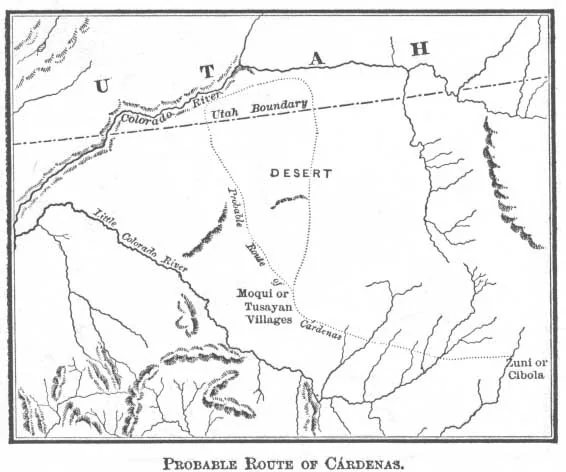
PROBABLE ROUTE OF CÁRDENAS.
Seville. Compelled by thirst they retired from the inhospitable stream, and finally returned to Tusayan and Cíbola.
It was not necessary in those days that a country should be discovered in order to be mapped; even now we dogmatize most about what we know least. It is a lonely sea indeed that cannot sport mermaids and monsters; it were a pity to have so broad an extent of land without a good wide sheet of water in it; so the Conibas Regio cum Vicinis Gentibvs shows a large lake, called Conibas, connecting by a very wide
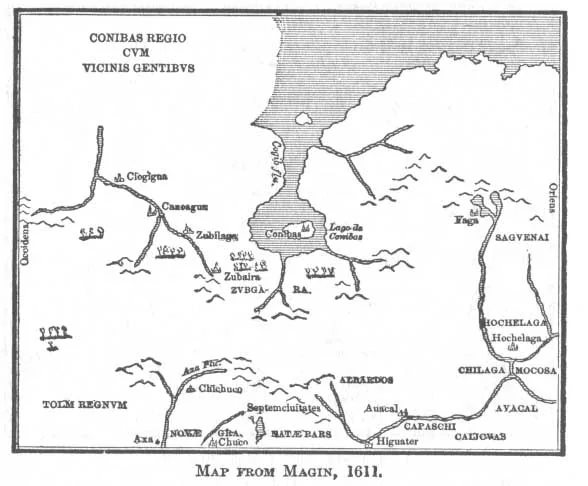
MAP FROM MAGIN, 1611.
river apparently with a northern sea. I give herewith another map showing a lake large enough to swallow
Utah and Idaho combined, and discharging its waters by two great rivers into the Pacific. This species of geography was doubtless entirely satisfactory to the wise men of this world until they came to know better about it. If the reader will look over the chapters on the Northern Mystery in my History of the
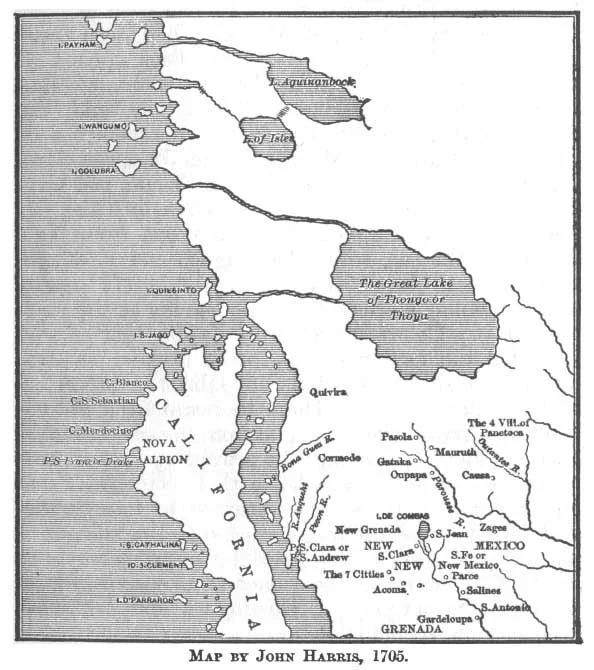
MAP BY JOHN HARRIS, 1705.
Northwest Coast he may learn further of absurdities in map-making.
A more extended and pronounced exploration was that of two Franciscan friars, one the visitador comisario
of New Mexico, Francisco Atanasio Dominguez, and the other ministro doctrinero of Zuñi, Silvestre Velez de Escalante, who set out from Santa Fé July 29, 1776, for the purpose of discovering a direct route to Monterey, on the seaboard of Alta California. New Mexico had now been known nearly two and a half centuries; the city of Santa Fé had been founded over a century and a half, Monterey had been occupied since 1770, and yet there had been opened no direct route westward with the sea, communication between Mexico and Santa Fé being by land, the road following the Rio Grande. In his memorial of March 1773, while in Mexico, Father Junípero Serra had urged that two expeditions be made, one from Sonora to California, which was carried out the following year by Captain Anza, and one froth New Mexico to the sea, which Dominguez and Escalante now proposed to undertake. Again in 1775 Anza made a similar journey, this time leaving at the junction of the Colorado and Gila Father Garcés who ascended the former stream to the Mojave country, whence crossing to Mission San Gabriel he proceeded to the Tulare Valley. There he heard from the natives of a great river coming in from the east or northeast. 2 Indeed it was long the prevailing opinion that there existed such a stream in that vicinity. From the Tulare country Garcés returned to San Gabriel and Mojave, and thence proceeded to the villages of the Moquis. From this place he probably wrote to Santa Fé concerning the rumor of this river; for all through the journey of Dominguez and Escalante they were in search of it. 3
The party consisted in all of nine persons. Besides the two priests there were Juan Pedro Cisneros, alcalde mayor of Zuñi, Bernardo Miera y Pacheco, capitan miliciano of Santa Fé, and five soldiers. 4 Having implored divine protection, on the day before named they took the road to Abiquiú, passed on to the Rio Chama, and on the 5th of August reached a point called Nieves, on the San Juan River, three leagues below the junction of the Navajo. Thence they passed down the north bank of the San Juan, crossing the several branches, until on the 10th they found themselves on a branch of the Mancos, some distance from the San Juan, and beyond the line of the present state of Colorado. 5 The 12th they camped on the north bank of the Rio Dolores, in latitude 38° 13´, 6 and were there joined by two natives from Abiquiú, who had deserted their homes to follow the expedition. 7
They now followed the general course of the Dolores 8 until the 23d, when they left the San Pedro, which flows into the Dolores near La Sal, and crossed
over north-east to Rio San Francisco, 9 and again to the Rio San Javier 10 on the 28th, their course being for some distance east of north.
Not far from their path was a ranchería of Yutas, which the Spaniards visited, endeavoring to obtain guides to the land of the Timpanogos, Timpangotzis, or Lagunas, where they had been told to look for
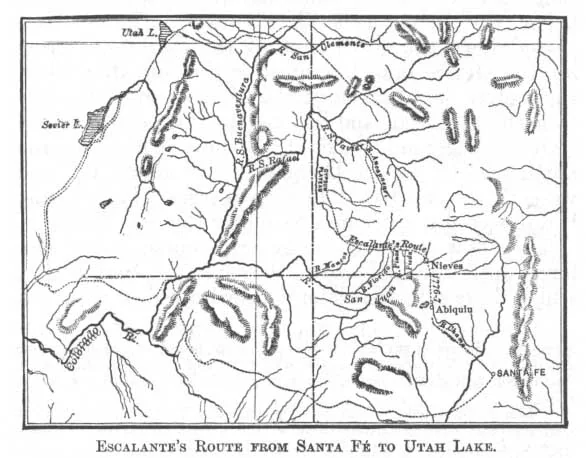
ESCALANTE'S ROUTE FROM SANTA FÉ TO UTAH LAKE
Pueblo towns. A Laguna guide was there, but the Yutas did all in their power to dissuade the explorers
from proceeding, pretending ignorance of the country and danger from the Comanches. But the 3d of September saw them again on their way. Pursuing a north-west course, the second day they crossed and camped on the north bank of the Rio San Rafael, or Colorado, 11 in latitude 41° 4´. Their course thence was north-westerly, and on the 9th they crossed a river called San Clemente, 12 flowing west. Signs of buffaloes were abundant, and on the 11th they killed one. Two days afterward they crossed the Rio de San Buenaventura, 13 the boundary between the Yutas and the Comanches, in latitude 41° 19´, at a place which the priests call Santa Cruz. Here were six large black poplars, on one of which they left an inscription. After resting two days they took the course of the San Buenaventura south-west ten leagues, and from a hill saw the junction of the San Clemente. Descending a little farther they found a river flowing in from the west, following which they reached a branch the 17th, naming it the San Cosme. 14
From this point they proceeded westward, following up the Uintah, across the Duchesne, and over the mountains, with no small difficulty, to a river which they called Purísima, 15 and which they followed till on the 23d they came in sight of the lake which the natives called Timpanogos, but which is known now as Utah Lake.
Several reasons combined to bring the Spaniards so far to the north of what would be a direct road
from Santa Fé to Monterey. First, Escalante entertained a theory that a better route to the Pacific could be found northward than toward the south. Then there was always a fascination attending this region, with its great and perpetual Northern Mystery; perhaps the Arctic Ocean came down hereabout, or at least an arm of the Anian Strait might be found; nor were forgotten the rivers spoken of by different persons on different occasions as flowing hence into the Pacific. And last of all it may be that the rumor of Pueblo villages in this quarter carried the explorers further north than otherwise they would have gone.
However this may have been, they were now of opinion that they had penetrated far enough in a northerly direction, and from this point must take a southerly course. There were here no town builders like the Moquis and Zuñis, as the priests had been led to suppose, but there were wild Indians, and the first they had seen in this vicinity. At first these savages manifested fear, but when assured that the strangers had not come to harm them, and were in no way leagued with the dreaded Comanches, they welcomed them kindly and gave them food. They were simple-minded and inoffensive, these native Yutas, very ready to guide the travellers whithersoever they would go; but they begged them to return and establish a mission in their midst; in token of which, and of their desire to adopt the Christian faith, they gave the priests a kind of hieroglyphic painting on deerskin. 16
Then the Spaniards talk of the country, and of the people about them. They are in the valley and by the lake of Nuestra Señora de la Merced de los
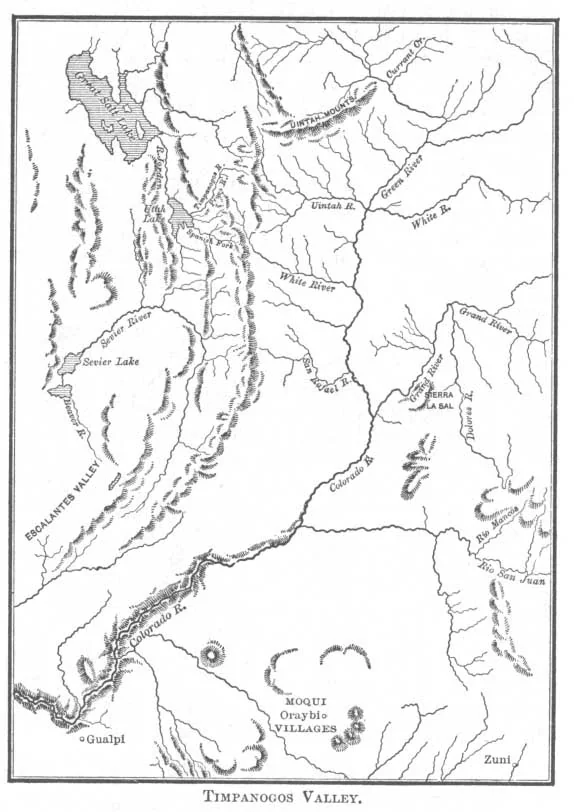
TIMPANOGOS VALLEY.
Timpanogos, 17 and north of the river San Buenaventura are the mountains which they have just crossed, extending north-east and south-west some seventy leagues, and having a width of forty leagues. From the surrounding heights flow four rivers of medium size, discharging their waters into the lake, where thrive fish and wild fowl. The valley which surrounds this lake extends from south-east to north-west sixteen Spanish leagues; it is quite level, and has a width of ten or twelve leagues. Except the marshes on the lake borders the land is good for agriculture. Of the four rivers which water the valley the southernmost, which they call Aguas Calientes, passes through rich meadows capable of supporting two large towns. The second, three leagues from the first, flowing northerly, and which they call the San Nicolás, fertilizes enough good land to support one large town or two smaller ones. Before reaching the lake it divides into two branches, on the banks of which grow tall poplars and alders. The third river, which is three and a half leagues to the north-east, and which they call the San Antonio de Padua, carries more water than the others, and from its rich banks, which would easily support three large towns, spring groves of larger trees. Santa Ana, they call the fourth river, which is north-west of the San Antonio, and not inferior to the others 18—so they are told, for they do not visit it. Besides these rivers, there are good springs of water both on plain and mountain-side; pasture lands are abundant, and in parts the fertile soil yields such quantities of flax and hemp that it seems they must have been planted there by man. On the San Buenaventura the Spaniards had been
troubled by the cold; but here the climate is so delightful, the air so balmy, that it is a pleasure to breathe it, by day and by night. In the vicinity are other valleys equally delightful. Besides the products of the lake the Yutas hunt hares, and gather seeds from which they make atole. They might capture some buffaloes in the north-north-west but for the troublesome Comanches. 19 They dwell in huts of osier, of which, likewise, many of their utensils are made; some of them wear clothes, the best of which are of the skins of rabbits and antelopes. There are in this region many people, of whom he who would know more may consult the Native Races.
The Spaniards are further told by the Yutas of a large and wonderful body of water toward the northwest, and this is what Father Escalante reports of it. "The other lake, with which this communicates," he says, "occupies, as they told us, many leagues, and its waters are injurious and extremely salt; because the Timpanois 20 assure us that he who wets any part of his body with this water, immediately feels an itching in the wet part. We were told that in the circuit of this lake there live a numerous and quiet nation, called Puaguampe, which means in our language Sorcerers; they speak the Comanche language, feed on herbs, and drink from various fountains or springs of good water which are about the lake; and they have their little houses of grass and earth, which latter forms the roof. They are not, so they intimated, enemies of those living on this lake, but since a certain time when the people there approached and killed a man, they do not consider them as neutral as before.
On this occasion they entered by the last pass of the Sierra Blanca de los Timpanogos, which is the same in which they are, by a route north one fourth north-west, and by that same way they say the Comanches make their raids, which do not seem to be very frequent." 21
Continuing their journey the 26th of September with two guides, the Spaniards bend their course south-westwardly in the direction of Monterey, through the Sevier lake and river region, which stream they call Santa Isabel. The 8th of October they are in latitude 38° 3´ with Beaver River behind them. Passing on into what is now Escalante Valley they question the natives regarding a route to the sea, and as to their knowledge of Spaniards in that direction. The savages know nothing of either. Meanwhile winter is approaching, provisions are becoming low, the way to the sea must be long and difficult; therefore the friars resolve to abandon the attempt; they will continue south, turning perhaps to the east until they come to the Colorado, when they will return to Santa Fé by way of the Moqui and Zuñi villages.
Some of the party object to this abandonment of
purpose. They have come far; they can surely find a way: why turn back? To determine the matter prayers are made and lots cast, the decision being against Monterey. As they turn eastward, the 11th, in latitude 36° 52´, they are obliged to make bread of seeds purchased from the natives, for their supplies are wholly exhausted. Reaching the Colorado the 26th, twelve days are passed in searching for a ford, which they find at last in latitude 37°, the line dividing Utah from Arizona. Their course is now south-east, and the 16th of November they reach Oraybi, as they call the residence of the Moquis. There they are kindly received; but when for food and shelter they offer presents and religious instruction the natives refuse. Next day the Spaniards visit Xongopabi, and the day after Gualpi, at which latter place they call a meeting and propose to the natives temporal and spiritual submission. The Moquis will be friendly they say, but the further proposals they promptly decline. Thereupon the friars continue their way, reaching Zuñi November 24th and Santa Fé the 2d of January 1777. 22
Footnotes
2:1 I say probably, though in my own mind there is little doubt. The Spaniards were exploring northward. They had lately traversed the region to their south-west, and instead of wishing to retrace their steps they would be likely to keep up well away from their former track. It is true that one narrative gives the direction as west; but then the same writer places Tusan, or Tusayan, west of Cíbola, which if the latter be Zuñi, and the former Moqui, is incorrect. Then, if their direction from the Moqui towns was the same as this writer declares it to have been in travelling to that place, the Spaniards at this time certainly struck the Colorado within the limits of the present Utah. Escalante, Carta de 28 Oct. 1775, MS., placed Moqui west of Zuñi, but a little north of west, with the Yutas their neighbor on the north. It is sufficiently plain that Cíbola was Zuñi, and Tusayan Moqui, and as a matter of fact the latter is in a north-westerly direction from the former. That they went due west and crossed the Little Colorado without any mention of that stream is not likely; because, first, it is not twenty days distant from the Moquis, and the stream when reached does not answer to their description. It was the great river they wished to find, and a northwest course would be the most direct. Further than this, it is stated plainly that the point at which they discovered the river was much nearer its source than where the Spaniards had previously seen it. Upon the direction then taken hangs the question as to the first Europeans to enter Utah. I deem the matter of sufficient importance to give both the originals and the translations of two of the most complete and reliable narratives of the expedition. The first and fullest we find in the Relation de Castañeda of Coronado's expedition, Ternaux-Compans, série i. tom. ix. 61-5, which reads as follows:
'Comme don Pédro de Tobar avait rempli sa mission, il revint sur ses pas et rendit compte au général de ce qu’il avait vu. Celui-ci fit partir sur-le-champ don Garci-Lopez de Cardenas et douze autres personnes pour aller visiter cette rivière; cet officier fur très-bien reçu et parfaitement traité par les indiens de Tusayan, qui lui donnèrent des guides pour continuer sa route. Nos soldats partirent chargés de vivres, les indiens les ayant avertis qu’il fallait traverser un désert de vingt journées de long avant d’entrer dans un pays habité. Après ces vingt journées de marche ils arrivérent en effet á cette rivière, dent les bords sont tellement élevés qu’ils croyaient être á trois ou quatre lieues en l’air. Le pays est couvert de pins bas et rabougris; il est exposé au nord, et le froid y est si violent, que, quoique l’on fût en été, ou pouvait á peine le supporter. Les Espagnols marchèrent pendant trois jours le long de ces montagnes, espérant toujours trouver une descente pour arriver ne paraissait pas avoir plus d’une brasse de large, la rivière qui, d’en haut, et qui, selon les Indiens, avait plus d’une demi-lieue; mais il fut impossible de s’y rendre. étant parvenus deux ou trois jours après dans un endroit où la descente leur parut plus facile, le capitaine Melgosa, Juan Galeras et un soldat qui étaient les plus légers de la bande, résolurent de faire une tentative. Ils descendirent jusqu’á ce que ceux qui étaient restés en haut les eussent perdus de ven. Ils revinrent vers les quatre heures du soir, disant qu’ils avaient trouvé tant des difficultés, qu’ils n’avaient pu arriver jusqu’en bas; car ce qui d’en haut semblait facile, ne l’était pas du tout quand en approchait. Ils ajoutèrent qu’ils étaient parvenus á environ un tiers de la descente, et que de là, la rivière paraissait déjà très grande, ce qui confirmait ce que les indiens avaient dit. Ils assurèrent que quelques rochers que l’on voyait d’en haut, et qui paraissait à peine de la hauteur d’un homme étaient plus hauts que la tour de la cathédrale de Séville. Les Espagnols cessèrent de suivre les rochers qui bordent la rivière, parce qu’on y manquait d’eau. Jusque-là ils avaient été obligés chaque soir de s’avancer une lieue ou deux dans l’intérieur pour en trouver. Quand ils eurent marché pendant trois ou passaient cette route, ils emmenaient avec eux des femmes chargées de calebasses remplies d’eau, et qu’ils en enterraient une partie pour les retrouver au retour; que d’ailleurs ils parcouraient en un jour autant de chemin que les Espagnols en deux. Cette rivière était celle del Tizon. On arriva beaucoup plus près de sa source que de l’endroit oú Melchior Diaz et ses gens l’avaient traversée, et l’on sut plus tard que les Indiens dont on avant parlé taitent de la même nation que ceux que Diaz avait vus. Les Espagnols revinrent donc sur leurs pas, et cette expédition n’eut pas d’autre résultat. Pendant la marche, ils arrivèrent à une cascade qui tombait d’un rocher. Los guides dirent que les cristaux blancs qui pendaient à l’entour étaient du sel. On en recueillit une quantité que l’on emports, et qu’on distribua à Cíbola, où l’on rendit compte par crit au général de tout ce que l’on avait vu. Garci-Lopez avait emmené avec lui un certain Pédro de Sotomayor, qui était chroniqueur de l’expédition. Tous les villages de cette province sont restés nos alliés, mais on ne les a pas visités depuis, et l’on n’a tenté aucune découverte de ce côté.'
As soon as Don Pédro de Tobar had fulfilled his mission, he returned and gave the general an account of what he had seen. The latter immediately ordered Don Garci-Lopez de Cárdenas, and 12 other persons, to go and visit that river; this officer was well received and politely treated by the Indians of Tusayan, who furnished him with guides to continue his journey. Our soldiers departed loaded with provisions, the Indians having notified them that it was necessary to travel 20 days through a desert before entering any inhabited country. After this 20 days march, they arrived at that river whose banks are of such a height that it seemed to them that they were three or four leagues up in the air. The country is covered with low and stunted pines, exposed to the north, and the cold is so violent that, although it was summer, one could hardly endure it. The Spaniards during three days skirted those mountains, always in the hope of finding a descent to reach the river, which from above appeared to be no more than a fathom in width, and which, according to the Indians, was more than half a league wide; but all their efforts were vain. Two or three days later, they arrived at a place where the descent seemed easier; Captain Melgosa Juan Galeras and a soldier who were the lightest men of the band, resolved to make an attmept. They descended until those who had remained on the top had lost sight of them. They returned at about four o'clock in the afternoon, saying they had found so many difficulties that they could not reach the bottom; for, what seemed easy from above was not at all so when approaching the water. They added that they came down about one third of the descent, and that even from there the river seemed very large. This statement confirmed what the Indians had said. The three men affirmed that some rocks seen from above and which appeared to he of the height of a man, were higher than the tower of the cathedral of Seville. The Spaniards stopped following the rocks that bordered the river on account of the lack of water. Until then, they had been obliged to advance one or two leagues in the interior to find some. When they had marched during three or four days, the guides declared to them that it was impossible to go further, that water would not be found before four days; that when the Indians travelled on this road, they took with them women who carried calabashes filled with water, and they buried a certain part, so that they might find it when returning; and besides they made in one day as many miles as the Spaniards would in two. This was the river del Tizon. They arrived much nearer to its source than the place Where Melchor Diaz anti his people had crossed, and it was known later that the Indians spoken of belonged to the same nation as those seen by Diaz. The Spaniards therefore came back, and the expedition had no other result. While marching, they arrived at a cascade falling from a rock. The guides affirmed that the white crystals hanging around were salt. A quantity of it was gathered, carried away, and distributed at Cíbola, where a written account of all that had been seen was sent to the general. Garci-Lopez had taken with him a certain Pedro de Sotomayor, who was the chronicler of the expedition. All the villages of this province have remained our allies, but they have not been visited since, and no attempt at discovery has been made in that direction.
The other is from a relation by an unknown author, found in the archives of the Indies, and printed in Pacheco and Cárdenas, Col. Doc., xiv. 321-3, under title of Relacion del suceso de la Jornada que Francisco Vazquez hizo en el descubrimiento de Cíbola, and from which I give the extract covering the same incident:
'Vuelto D. Pedro de Tobar, é dada relacion de aqueños pueblos, luego despachó á D. García Lopez de Cárdenas, maestre de campo, por el mesmo camino que habia venido D. Pedro, é que pasase de aquella provincia de Tuzan, al Poniente, é para ida é vuelta de la jornada é descobrimiento, le señalo ochenta dias de término de ida é vuelta, el qual fué echado adelante de Tuzan con guias de los naturales que decian que habia adelante, poblado, aunque lejos, andadas cincuenta leguas de Tuzan al Poniente, é ochenta de Cíbola, halló una barranca de un rio que fué imposible por una parte ni otra hallarle baxada para caballo, ni aun para pié, sino por una parte muy traba-xosa, por donde tenia casi dos leguas de baxada. Estaba la barranca tan scantillada de peñas, que apenas podian ver el rio, el cual, aunque es segun dicen, tanto ó mucho mayor que el de Sevilla, de arriba aparescia un arroyo; pot manera que aunque con harta diligencia se buscó pasada, é por muchas partes no se halla, en la cual estuvieron artos dias con mucha necesidad de agua, que no la hallaban, é la del rio no se podian aprovechar della aunque la vian; é á esta causa le fué forzado á don Garcia Lopez volverse á donde hallaron; este rio venia del Nordeste é volvia al Sur Sudueste, por manera que sin falta ninguna es aquel donde Ilegó Melchor Diaz.'
Don Pedro de Tobar having returned, and having made a report concerning those towns, D. García Lopez de Cárdenas, maestre de campo, was ordered to take the same route by which Don Pedro had come, and to go on from the province of Tuzan to the westward. He was given 80 days in which to make the journey, from his departure until his return. He went on beyond Tuzan, accompanied by Indian guides, who told him that farther on there was a settlement. Having gone 50 leagues to the westward of Tuzan, and 80 from Cíbola, he came to the cañon of a river adown the side of which there was no descent practicable for home, nor even for those on foot, except by a way full of difficulties, and nearly two leagues in length. The side of the cañon was of rock so steep that the river was barely discernible, although, according to report, it is as great as the river of Seville, or greater; and from above appeared a brook. During many days, and in many places, a way by which to pass the river was sought in vain. During this time there was much suffering from a lack of water, for although that of the river was in view, it was unattainable. For this reason Don García Lopez was forced to return. This river comes from the north-east, and makes a bend to the south-south-eastward; hence, beyond a doubt, it must be that reached by Melchor Diaz.
Thus the reader will be able to determine the matter for himself as clearly as may be. For details on Coronado's expedition see the following authorities, though comparatively few of them make mention of the adventures of Captain Cárdenas on the Colorado: Ramusio, Viaggi, iii. 359-63; Hakluyt's Voy., iii. 373-9; Mota-Padilla, Conq. N. Gal., iii. 14, 158-69; Torquemada, i. 609-10; Herrera, dec. vi. lib. ix. cap. xi.-xii.; Beaumont, Hist. Mich., MS., 407-22, 482-546, 624-5; Oviedo, iv. 19; Villagrd, Hist. N. Mex., 19 et seq.; Gomara, Hist. Ind., 272-4; Bernal Diaz, Hist. Verdad., 235; Benzoni, Hist. Mundo Nuovo, 107; Ribas, Hist. Triumphos, 26-7; Venegas, Not. Cal., i. 167-9; Clavigero, Storia Cal., 153; Alegre, Hist. Comp. Jesus, i. 233-8; Salmeron, in Doc. Hist. Mex., 3d ser. pt. iv. 7-9; Noticias, in Id., 671-2; Cavo, Tres Siglos, i. 127-9; Lorenzana, in Cortés, Hist. Mex., 325. These might be followed by a long list of modem writers, for which I will refer the reader to Hist. North Mexican States, this series.
8:2 On Father Font's map, 1777, are laid down two rivers entering the region of the Tulare lakes from the north-east, one the Rio de San Phelipe, and the other called the Rio de que se Viene Noticia por el P. Garces. See Font's Journal, MS.; Serra, Memorial, March 1773, MS.; Garcés, Diario, 246-348; Forbes' Hist. Cal., 157-62; Arch. Cal., Prov. Rec., MS., i. 47-8, vi. 59; Palou, Not., ii. 281-2; Hist. Cal.; Hist..New Mew.; Hist. North Mex. States, this series.
8:3 Probably it was the San Joaquin, or the Sacramento, of which they heard. Concerning a route from New Mexico to California Humboldt says: 'En considerant les voyages hardis des premiers conquerans espagnols au Mexique, an Pérou, et sur la rivière des Amazones, on est étonné de voir que depuis deux sièclcs cette même nation n’a pas su trouver un chemin de terre dans la Nouvelle-Espagne, depuis Taos au port de Monterey.' Essai Pol., i. 317.
9:4 Don Joaquin Lain, vecino de la misma villa, Lorenzo Olivares de la villa del Paso, Lucrecio Muñiz, Andrés Muñiz, Juan de Aguilar y Simon Lucero.' Diario, in Doc. Hist. Mex., ser. ii. tom. i. 378.
9:5 At the beginning of the journey their route was identical with what was later known as the old Spanish trail from Santa Fé to Los Angeles. Their course was at first north-west, but shortly after passing Abiquiú it pointed due north into Colorado, then west, and again north-west into Utah, being about the same as was later called the old Spanish trail from Santa Fé to Great Salt Lake. Captain J. N. Macomb of the topographical engineers has surveyed and mapped essentially the same trail.
9:6 Probably not so far north by some 40´.
9:7 Esta tarde nos alcanzaron un coyote y un genízaro de Abiquiú, nombrados el primero Felipe y el segundo Juan Domingo; por vagar entre los gentiles, se huyeron sin permiso de sus superiores del dicho pueblo, pretestando querer acompañarnos. No necesitábamos de ellos; mas por evitar las culpas, que ó por su ignorancia ó por su malicia podian cometer andando mas tiempo solos entre los yutas, si intentabamos que regresasen, los admitimos por compañeros.' Disrio, Doc. Hist. Mex., ser. ii. tom. i. 392.
9:8 These streams are doubtless those emptying into the Colorado not far from its junction with the Bunkara: Latitude 39° 13´ is here given, but that must be too high. Philip Harry, in Simpson's Explor., 490, says that up to the point first touched on the Dolores the priests' path and Macomb's survey are identical, but that they here diverge.
10:9 An affluent of the San Javier, or Grand River.
10:10 Called by the Yutas Tomiche; to-day Grand River. It may here be observed that the route toward this region had been visited by Spaniards before, notably by Juan María de Ribera in 1761, and Spanish names had been given to places, though the present Utah was probably not entered by him. Escalante states that the San Javier is formed by four small streams coming in above the point at which he crossed, and these, says Harry, Simpson's Explor., 490, correspond 'remarkably with the Uncompagre River, Grand River, Smith's Fork, and another large fork…It seems evident that after crossing the San Xavier he follows up stream a different fork from what we call Grand River, but which fork he calls the main river, or San Xavier.' Gunnison maps his explorations, showing the mouth of this last named stream. In Simpson's Explor., 489, is given a map of the present expedition, but it does not conform in every particular to Escalante's text.
11:11 Grand River; but the latitude given was about 1° 30´ too high.
11:12 White River, the point of crossing being near the Utah line.
11:13 Green River. The latitude given is at least 50´ too high. The crossing was above the junctions of White River and the Uintah with Green River. See Rep. Fr. Alonso de Posada, custodio de N. Mex., in Doc. Hist. Mex., i. 439.
11:14 This is the north branch of the Uintah. Indeed the narrative of the explorers makes their route in this vicinity unmistakable.
11:15 Now the Timpanogos. 'Proseguimos al noroeste media legua, pasamos á la otra bands del rio, subimos una corta cuesta y divisamos la laguna y dila-tado valle de Nuestra Señora de la Merced de los Timpanogotzis—así lo nom-bramos desde aquí.' Diario, Doc. Hist. Mex., série ii. tom. i. 454.
12:16 The Spaniards asked from them some token to show that they wished them to return, and the day after they brought them one; 'pero al traer la seña vió un compañero, que no sabia el órden dado, á las figuras de ella, y rnostrándole la cruz del rosario, les dió á entender, que la pintasen sobre una de las figuras, y entonces la volvieron á llevar, y sobre cada una pintaron una cruz pequeña; lo demas quedó como antes y nos la dieron diciendo que la figura que per uno y otro lade tenia mas almagre, ó como ellos decian, sangre, representaba al capitan mayor, porque en las batalias con los cumanches habia recibido mas heridas: las otras dos que no estaban tan ensangren-tadas, a los otros dos capitanes inferiores al primero, y la que no tenia sangre ninguna, á uno que no era capitan de guerra, pero era, do autoridad entre ellos. Estas cuatro figuras de hombres estaban rudamente pintadas con tierra y almagre en un corto pedazo de gamuza.' Diario, Doc. Hist. Mex.. série ii. tom. i. 462-3.
14:17 Or, as it was also called, Timpagtzis, Timpanoautzis, ó Come Pescado. Doc. Hist. Mex., série ii. tom. i. 464.
14:18 There is no difficulty in recognizing these land-marks, the Uintah Mountains, the San Buenaventura, or Green River; and in the four streams of the valley, their Aguas Calientes is Currant Creek; the second, their San Nicolás, though more than three leagues from the first, and not corresponding in every other particular, is the Spanish River; the San Antonio is the Provo; and the Santa Aria, the River Jordan.
15:19 This is directly opposite the direction in which we would expect to find the Comanches of to-day; but the Utes applied the term comanche to all hostile Indians. Buffaloes were common in aboriginal times in Cache and Powder River valleys as well as in eastern Oregon and Boisé valley.
15:20 Yet another form for the name Timpanogos, as indeed before the end of the following page we have 'Timpanosis,' 'Timpanogotzis,' and 'Timpanogo.' See note 17 this chapter. On Froisett's map, published at Salt Lake City in 1875, is the 'Provo, or Timponayas' river.
16:21 As this is the first account we have of the Great Salt Lake and its people I will give the original entire: 'La otra laguna con quien esta se cominica, ocupa, segun nos informaron, muchas leguas y sus aguas son nocivas ó estre-madamente saladas; porque nos aseguran los timpanois que el que se mojaba alguna parle del cuerpo con ellas, al punto sentia mucha comenzon en la parte mojada. En su circuito nos dijeron habita una nacion numerosa y quieta, que se nombra Puaguampe, que en nuestro vulgar dice hechiceros; la cual usa el idioma cumanche; se alimenta de las yervas, bebe de varias fuentes ú ojos de buena agua, qne están en el circuito de la laguna, y tienen sus casitas de zacate y tierra, que era et techo de ellas. No son enemigos de los lagunas, segun insinuaron, pero desde cierta ocasion que se acercaron y les mataron un hombre, no los tienen por tan neutrales como antes. En esta ocasion entraron por la puerta final de la Sierra Blanca de los Timpanosis, que es la misma en que están, por el norte cuarta al noroeste, y por aquí mismo dicen hacer sus entradas los cumanches, las que no parecieron ser muy frecuentes.' Diario, Doc. Hist. Mex., série ii. tom. i. 468.
Mr Harry is evidently not very thoroughly versed in the Spanish language, or his manuscript copy of Escalante's journey is defective. For example he translates echizeros—which being old Spanish he could not find in his modern dictionary—'throwers or slingers' when the word "witches,' or rather 'sorcerers' is clearly implied. Again he queries sacate, not knowing its meaning—a common enough Mexican word, formerly written zacate, and signifying hay or grass. For further inaccuracies see his summary in Simpson's Explor., 494. Warren, Pacific Railroad Report, xi. 35, examined the same copy of Escalante's narrative, then in the Peter Force library, which was used by Harry.
17:22 The journey into Utah of Dominguez and Escalante, as given in Doc. Hist. Mex., série ii. tom. i. 375-558, under title of Diario y derrotero de los R. R. PP. Fr. Francisco Atanasio Dominguez y Fr. Silvestre Velez de Escalante, para descubrir el camino desde el Presidio de Santa Fé del Nuevo Mexico, al de Monterey, en la California Septentrional, is full and clear as to route and information regarding the country and its inhabitants. As must be expected in all such narratives it is tull of trivial detail which is tiresome, but which we can readily excuse for the worth of the remainder. The priests were close and intelligent observers, and have much to say regarding configuration, soil, climate, plants, minerals, animals, and people. A summary is given in Simpson's Explor., app. R by Philip Harry, from a manuscript copy of the original in the archives in the city of Mexico which answers the purpose therein required, but is not sufficiently reliable or exact for historical purposes. The map accompanying the summary is better, being for the most part correct. Of the two padres and what riley saw Humboldt says, Essai Pol.: 'Ce terrain est la continuation de la Cordillère des Gruës, qui se prolonge vers la Sierra Verde et vers le lac de Timpanogos, célèbre dans l'histoire mexicaine. Le Rio S. Rafaël et le Rio S. Xavier sont les sources principales du fleuve Zaguananas, qui, avec le Rio de Nabajoa, forme le Rio Colorado: ce dernir a son embouchure dans le golfe de Californie. Ces régions abondantes en sel gemme out été examinees, en 1777, par deux voyageurs remplis de zéle et d'intrépidité, moines de l'order de S. Francois, le père Escalante et le pere Antonio Velez.' From the last clause it is clear that Humboldt was confused as to names, Velez and Escalante belonging to the same person. Simpson, Explor., 13, enters upon a long dissertation over a simple and very transparent mistake. See also Hist. North Mex. States; Hist. New Mex.; and Hist. Cal., this series.
CHAPTER II.
ADVENT OF TRAPPERS AND TRAVELLERS.
1778-1846.
Invasion By Fur Hunters—Baron La Hontan and His Fables—the Popular Geographic Idea—Discovery of the Great Salt Lake—James Bridger Deciding a Bet—He Determines the Course of Bear River and Comes Upon the Great Lake—Henry, Ashley, Green, and Beckwourth on the Ground—Fort Built at Utah Lake—Peter Skeen Ogden—Journey of Jedediah S. Smith—a Strange Country—Pegleg Smith—Wolfskill, Yount, and Burton Traverse the Country—Walker's Visit to California—Some Old Maps—the Bartleson Company—Statements of Bidwell and Belden Compared—Whitman and Lovejoy—Frémont—Pacific Coast Immigrations of 1845 and 1846—Origin of the Name Utah.
Half a century passes, and we find United States fur hunters standing on the border of the Great Salt Lake, tasting its brackish waters, and wondering if it is an arm of the sea. 1
First among these, confining ourselves to authentic records, was James Bridger, to whom belongs the honor of discovery. It happened in this wise. During the winter of 1824-5 a party of trappers, who had ascended the Missouri with Henry and Ashley, found
themselves on Bear River, in Cache, or Willow Valley. A discussion arose as to the probable course of Bear River, which flowed on both sides of them. A wager was made, and Bridger sent to ascertain the truth. Following the river through the mountains the first view of the great lake fell upon him, and when he went to the margin and tasted the water he found that it was salt. Then he returned and reported to his companions. All were interested to know if there emptied into this sheet other streams on which they might find beavers, and if there was an outlet; hence in the spring of 1826 four men explored the lake in skin boats. 2
During this memorable year of 1825, when Peter
Skeen Ogden with his party of Hudson's Bay Company trappers was on Humboldt River, and James P. Beckwourth was pursuing his daring adventures, and the region round the great lakes of Utah first became familiar to American trappers, William H. Ashley, of the Rocky Mountain Fur Company, at the head of one hundred and twenty men and a train of well packed horses, came out from St Louis, through the South Pass and down by Great Salt Lake to Lake Utah. There he built a fort, and two years later brought from St Louis a six-pounder which thereafter graced its court. Ashley was a brave man, shrewd and honest; he was prosperous and commanded the respect of his men. Nor may we impute to him lack of intelligence, or of common geographical knowledge, when we find him seriously considering the project of descending the Colorado in boats, by means of which he would eventually reach St Louis, Mr Green, who gave his name to Green River, had been with Ashley the previous year; and now for three years after the establishing of Fort Ashley at Utah Lake, Green with his trappers occupied the country to the west and north. 3
From Great Salt Lake in August, 1826, Jedediah S. Smith sets out on a trapping and exploring tour with fifteen men. Proceeding southward he traverses Utah Lake, called for a time Ashley Lake, 4 and after ascending Ashley River, which, as he remarks, flows into the lake through the country of the Sam-patches, he bends his course to the west of south, passes over some mountains running south-east and northwest, and crosses a river which he calls Adams, 5 in
honor of the president. After ten days' march, still in a south-westerly direction, through the country of the Pah Utes, he recrosses the same stream, and after two days comes to the junction of the Adams with what he calls the Seedskeeder, or Siskadee, river, 6 a stream full of shallows and rapids and flowing through a sterile country. Then he reaches a fertile wooded valley which belongs to the Amajabes, or Mojaves, where the party rests fifteen days, meeting with the kindest treatment from the natives, who provide food and horses. Thence they are guided by two neophytes westward through a desert country, and reach the mission of San Gabriel in December, their appearance causing no small commotion in California. After many strange adventures, fully narrated in my History of California, Smith works his way northward up the San Joaquin Valley, and in May 1827 crosses the Sierra Nevada and returns eastward to Great Salt Lake. With Jedediah Smith, during some part of his stay in Utah, was Thomas L. Smith, whom we must immortalize in history as Pegleg Smith. He did not possess a very estimable character, as, I am sorry to say, few of his class did in those days. The leaders of American fur companies, however, were exceptions, and in points of intelligence, integrity, and daring were in no wise behind their British brethren. 7
From south-east to north-west a portion of Utah was traversed in the autumn of 1830 by a trapping party under William Wolfskill. The company was fitted out in New Mexico, and the great valley of California was their objective point. Wolfskill had been a partner of Ewing Young, who was then in California. Leaving Taos in September they struck
north-westerly, crossing the Colorado, Grande, Green, and Sevier rivers, and then turned south to the Rio Virgen, all the time trapping on the way. Then passing down by the Mojaves they reached Los Angeles in February 1831. George C. Yount and Louis Burton were of the party. 8
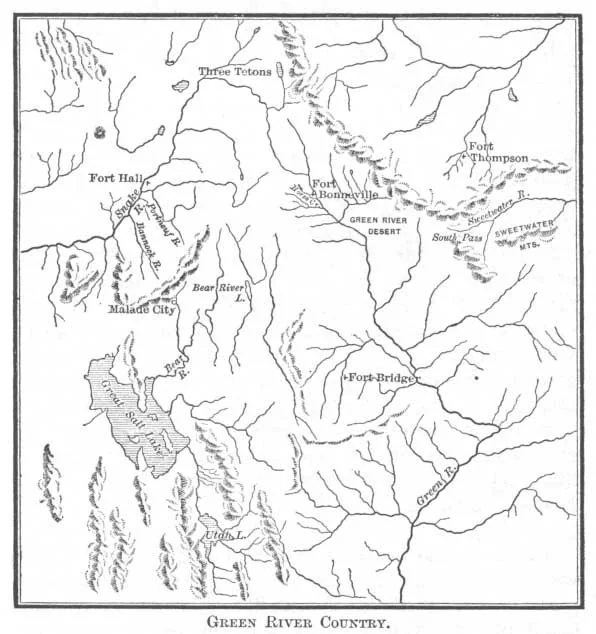
GREEN RIVER COUNTRY.
During the winter of 1832-3 B. L. E Bonneville made his camp on Salmon River, and in July following was at the Green River rendezvous. 9 Among the several trapping parties sent by him in various directions
was one under Joseph Walker, who with some thirty-six men, among them Joe Meek, went to trap on the streams falling into the Great Salt Lake.
Bonneville affirms that Walker's intention was to pass round the Great Salt Lake and explore its borders; but George Nidever who was of Walker's company, and at the rendezvous while preparations were made, says nothing of such purpose, and it was probably not thought of by Bonneville until afterward. Nidover had suffered severely from the cold during the previous winter, and had come to the Green River rendezvous that season for the express purpose of joining some party for California or of forming such a party himself, having been informed that the climate there was milder than in the mountains where he had been. 10
If the intention was, as Bonneville asserts, that this party should pass round the great lake, in their endeavor they presently found themselves in the midst of desolation, between wide sandy wastes and broad brackish waters; and to quench their thirst; they hastened westward where bright snowy mountains promised cooling streams. The Ogden River 11 region being to them so new, and the thought of California so fascinating, they permitted themselves to stray from original intentions, and cross the Sierra Nevada to Monterey. All that is known of their doings before reaching the Snowy Range is given in my History of Nevada, and their exploits after reaching California are fully narrated in that part of this series devoted to the history of the latter country. 12
In Winterbotham's history published in New York in 1795 is given a map of North America showing an enormous nameless inland sea above latitude 42° with small streams running into it, and south of said parallel and east of the meridian of the inland sea is a smaller body of water with quite a large stream flowing in from the west, besides three smaller ones from the south and north. As both of these bodies of
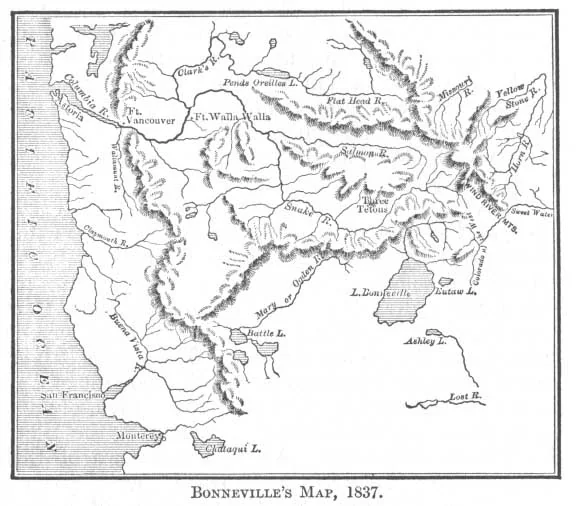
BONNEVILLE'S MAP, 1837.
water were laid down from the imaginations of white men, or from vague and traditionary reports of the natives, it may be that only the one Great Salt Lake was originally referred to, or it may be that the original description was applied to two lakes or inland seas. The native village on one of the southern tributaries, Taguayo, refers to the habitations of the Timpanogos, and may have been derived from the Spaniards; but more probably the information was obtained through
natives who themselves had received it from other natives.
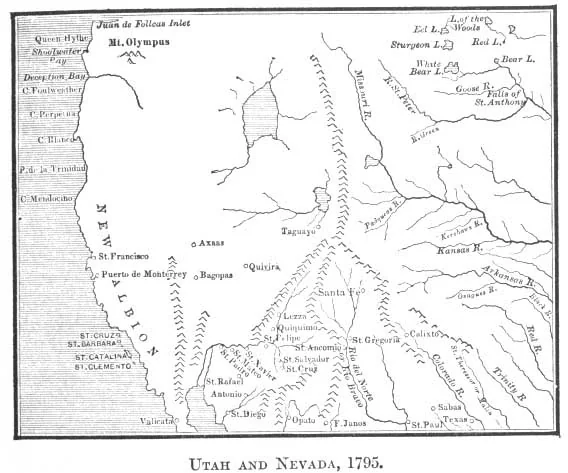
In the map of William Rector, a surveyor in the service of the general government, Utah has open and easy communication with the sea by way of the
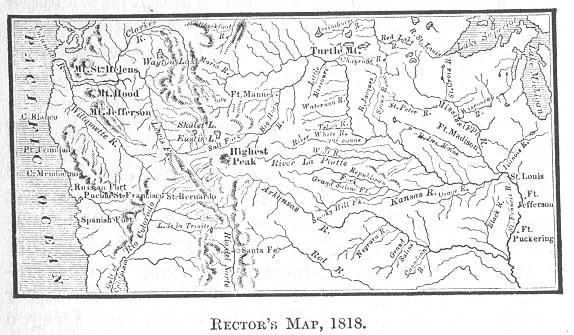
RECTOR'S MAP, 1818.
valley of the Willamette River, whose tributaries drain the whole of Nevada and Utah.
Mr Finley in his map of North America claimed to have included all the late geographical discoveries, which claim we may readily allow, and also accredit him with much not yet and never to be discovered. The mountains are artistically placed, the streams made to run with remarkable regularity and directness, and they are placed in positions affording the best
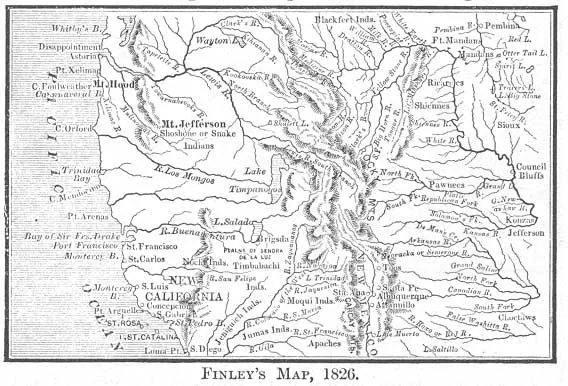
FINLEY'S MAP, 1826.
facilities for commerce. The lakes and rivers Timpanogos, Salado, and Buenaventura, by their position, not to say existence, show the hopeless confusion of the author's mind.
A brief glance at the later visits of white men to Utah is all that is necessary in this place. The early emigrants to Oregon did not touch this territory, and those to California via Fort Bridger for the most part merely passed through leaving no mark. the emigrants to Oregon and California in 1841 came together by the usual route up the Platte, along the Sweet-water, and through the South Pass to Bear River Valley. When near Soda Springs those for Oregon
went north to Fort Hall, while those for California followed Bear River southward until within ten miles of Great Salt Lake, when they turned westward to find Ogden River. Of the latter party were J. Bartleson, C. M. Weber, Talbot H. Green, John Bidwell, Josiah Belden, and twenty-seven others. Their adventures while in Utah were not startling. Little was known of the Salt Lake region, 13 particularly of the country to the west of it.
Mr Belden in his Historical Statement, which I number among my most valuable manuscripts, says: "We struck Bear River some distance below where the town of Evanston now is, where the coal mines are, and the railroad passes, and followed the river down. It maked a long bend to the north there, and comes down to Salt Lake. We arrived at Soda Springs, on Bear River, and there we separated from the company of missionaries, who were going off towards Snake River or Columbia. There we lost the services of the guide Fitzpatrick. Several of our party who had started to go with us to California also left us there, having decided to go with the missionaries. Fitzpatrick advised us to give up our expedition and go with them to Fort Hall, one of the Hudson's Bay stations, as there was no road for us to follow, nothing was known of the country, and we had nothing to guide us, and so he advised us to give up the California project. He thought it was doubtful if we ever got there, we might get caught in the snow of the mountains and perish there, and he considered it very hazardous to attempt it. Some four or five of our party withdrew and went with the missionaries.
About thirty-one of us adhered to our original intention and declined to give up our expedition."
While the party were slowly descending Bear River four of them rode over to Fort Hall to obtain if possible a "pilot to conduct us to the gap in the California Mountains, or at least to the head of Mary's River," and to make inquiries of Mr Grant, then in charge. No guide could be found, and Grant was not able greatly to enlighten them. The fur-trader could have told them much concerning the route to Oregon, but this way to California as an emigrant road had hardly yet been thought of.
"As we approached Salt Lake," writes Bidwell, 14 "we were misled quite often by the mirage. The country too was obscured by smoke. The water in Bear River became too salt for use. The sage brush on the small hillocks of the almost level plain became so magnified as to look like trees. Hoping to find water, and supposing these imaginary trees to be growing on some stream, and knowing nothing about the distance to Salt Lake, we kept pushing ahead mile after mile. Our animals almost perished for want of water while we were travelling over this salt plain, which grew softer and softer till our wagons cut into the ground five or six inches, and it became impossible to haul them. We still thought we saw timber but a short distance ahead, when the fact; really was there was no timber, and we were driving straight for the Great Salt Lake."
The truth is they had wandered from their course; they had passed Cache Valley where they intended to rest and hunt; they were frequently obliged to leave
the river, turned aside by the hills. It was past mid-summer, and the sun's rays beat heavily on the white salted plain. The signal fires of the Shoshones illuminated the hills at night. "In our desperation we turned north of east a little and struck Bear River again a few miles from its mouth. the water here was too salt to quench thirst; our animals would scarcely taste it, yet we had no other." The green fresh-looking grass was stiffened with salt. Mr Belden says: "After separating from the missionaries we followed Bear River down nearly to where it enters Salt Lake, about where Corinne is now. We had some knowledge of the lake from some of the trappers who had been there. We turned off more to the west and went round the northerly end of Salt Lake. There we found a great difficulty in getting water for several days, all the water near the lake being very brackish. We had to make it into strong coffee to drink it."
On the 20th of August the company rested while two of their number went out to explore. They found themselves encamped ten miles from the mouth of the river. Thence next day, Sunday, they took a north-west course, crossing their track of the Thursday previous; on the 23d they were in full view of Salt Lake. Men and animals were almost dying of thirst, and "in our trouble," says Bidwell, "we turned directly north toward some high mountains, and in the afternoon of the next day found springs of good water and plenty of grass." This was the 27th, and here the company remained while two of their number again advanced and discovered a route to Ogden River. What befell them further on their way across to the mountains the reader will find in my History of Nevada. 15
In 1842 Marcus Whitman and A. L. Lovejoy, on their way from Oregon to the United States, passed through Utah from Fort Hall, by way of Uintah, Taos, and Santa Fé. For further information concerning them, and the object of their journey, I would refer the reader to my History of Oregon.
In 1843 John C. Frémont followed the emigrant trail through the south pass, and on the 6th of September stood upon an elevated peninsula on the east side of Great Salt Lake, a little north of Weber River, beside which stream his party had encamped the previous night. Frémont likens himself to Balboa discovering the Pacific; but no one else would think of doing so. He was in no sense a discoverer; and though he says he was the first to embark on that inland sea, he is again in error, trappers in skin boats having performed that feat while the pathfinder was still studying his arithmetic, as I have before mentioned. It is certainly a pleasing sight to any one, coming upon it from either side, from the cover of rolling mountains or the sands of desert plains, and under almost any circumstance the heart of the beholder is stirred within him. A number of large islands raised their rocky front out of dense sullen waters whose limit the eye could not reach, while myriads of wild fowl boat the air, making a noise "like distant thunder."
Black clouds gathered in the west, and soon were pouring their floods upon the explorers. Camping sonic distance above the mouth on Weber River, they made a corral for the animals, and threw up a small fort for their own protection. Provisions being scarce, seven of the party under Francois Lajeunesse were sent to Fort Hall, which place they reached with
difficulty, after separation from each other and several days' wanderings.
Leaving three men in camp, with four others, including Kit Carson who was present, Frémont on the 8th embarked in a rubber boat and dropped down to the mouth of the stream, which the party found shallow and unnavigable. Next morning they were out on the lake, fearful every moment lest their air-blown boat should collapse and let them into the saline but beautiful transparent liquid. At noon they reached one of the low near islands and landed. They found there, washed up by the waves, a dark brown bank, ten or twenty feet in breadth, composed of the skins of worms, about the size of oats, while the rocky cliffs were whitened by incrustations of salt. Ascending to the highest point attainable they took a surrounding view, and called the place Disappointment Island, 16 because they had failed to find the fertile lands and game hoped for. Then they descended to the edge of the water, constructed lodges of drift-wood, built fires, and spent the night there, returning next day in a rough sea to their mainland camp. Thence they proceeded north to Bear River, and Fort Hall, and on to Oregon. 17 On his return by way of Klamath and Pyramid lakes, Frémont crossed the Sierra to Sutter Fort, proceeded up the San Joaquin into Southern California, and taking the old Spanish trail to the Rio Vírgen followed the Wahsatch Mountains to Utah Lake.
There was a party under Frémont in Utah also in 1845. Leaving Bent Fort in August they ascended the Arkansas, passed on to Green River, followed its left bank to the Duchesne branch, and thence crossed to the head-waters of the Timpanogos, down which stream they went to Utah Lake. Thence
they passed on to Great Salt Lake, made camp near where Great Salt Lake City is situated, crossed to Antelope Island, and examined the southern portion of the lake. After this they passed by way of Pilot Peak into Nevada. 18
Of the six companies comprising the California immigration of 1845, numbering in all about one hundred and fifty, five touched either Utah or Nevada, the other being from Oregon. But even these it is not necessary to follow in this connection, Utah along the emigrant road being by this time well known to travellers and others. With some it was a question while on the way whether they should go to Oregon or California. Tustin, who came from Illinois in 1845, with his wife and child and an ox team, says in his manuscript Recollections: "My intention all the way across the plains was to go on to Oregon; but when I reached the summit of the Rocky Mountains where the trail divides, I threw my lash across the near ox and struck off on the road to California."
For the Oregon and California emigrations of 1846, except when they exercised some influence on Utah, or Utah affairs, I would refer the reader to the volumes of this series treating on those states. An account of the exploration for a route from southern Oregon, over the Cascade Mountains, and by way of Klamath and Goose lakes to the Humboldt River, and thence on to the region of the Great Salt Lake by Scott and the Applegates in 1846, is given in both the History of Oregon, and the History of Nevada, to which volumes of this series the reader is referred. 19
Footnotes
18:1 There are those who soberly refer to the Baron la Hontan and his prodigious falsehoods of 1689 for the first information of Great Salt Lake. Because among the many fabulous wonders reported he somewhere on the western side of the continent placed a body of bad-tasting water, Stansbury, Exped., 151, does not hesitate to affirm 'that the existence of a large lake of salt water somewhere amid the wilds west of the Rocky Mountains seems to have been known vaguely as long as 150 years since.' Perhaps it was salt, and not silver that the Winnebagoes reported to Carver, Travels, 33-6, as coming down in caravans from the mountains lying near the heads of the Colorado River.' Warren, in Pacific Railroad Report, xi. 34, repeats and refutes the La Hontan myth. He says, 'the story of La Hontan excited much speculation, and received various additions in his day; and the lake finally became represented on the published English maps'. Long before this date, however, reliable information had been received by the Spaniards, and the same may have come to English trappers; so that by 1826 reports of the existence of such a sheet may have reached civilization. It is needless to say that neither La Hontan nor Carver ever received information from the natives, or elsewhere, sufficient to justify map-makers in placing a large lake in that vicinity. In Gordon's Historical and Geographical Memoir of the North American Continent, published in Dublin in 1820, it is written: 'Concerning the lakes and rivers of this as yet imperfectly explored region we have little to say. Of the former we have no certain account. Two have been noticed in the western parts, a salt lake about the thirty-ninth degree of latitude, the western limits of which are unknown, and the lake of Timpanogos, about the forty-first degree, of great but unascertained extent.'
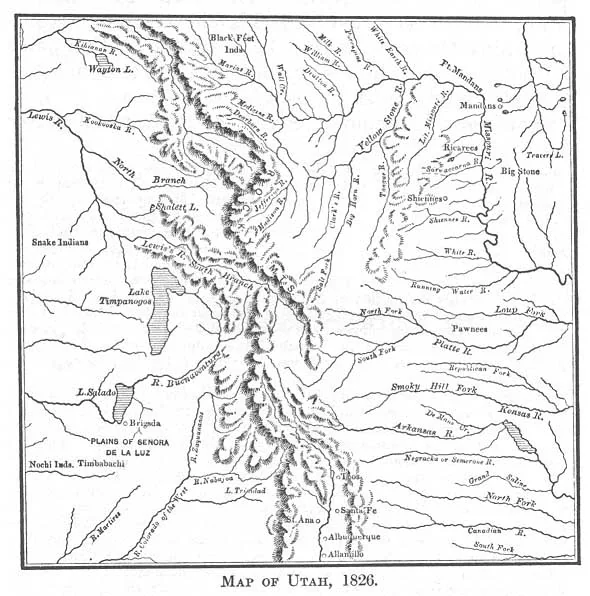
MAP OF UTAH, 1826.
In a report submitted to congress May 15, 1826, by Mr Baylies it is stated that 'many geographies have placed the Lake Timpanogos in latitude 40, but they have obviously confounded it with the Lake Theguayo, which extends from 39° 40´ to 41°, and from which it appears separated by a neck or peninsula; the two lakes approaching in one direction as near as 20 miles.' 19th Cong., 1st Sess., House Rept. No. 213. Such statements as this amount to nothing—the honorable gentleman, with all due respect, not knowing what he was writing about—except as going to show the vague and imperfect impression of the popular mind concerning this region at that time.
I will give for what it is worth a claim, set up in this same congressional report, by one Samuel Adams Ruddock, that in the year 1821 he journeyed from Council Bluff to Santa Fé, and thence with a trading party proceeded by way of Great Salt Lake to Oregon. The report says: 'On the 9th of June this party crossed the Rio del Norte, and pursuing a north-west direction on the north bank of the river Chamas, and over the mountains, reached Lake Trinidad; and then pursuing the same direction across the upper branches of the Rio Colorado of California, reached Lake Timpanagos, which is intersected by the 42d parallel of latitude, the boundary between the United States of America anti the United States of Mexico. This take is the principal source of the river Timpanagos, and the Multnomah of Lewis and Clarke. They then followed the course of this river to its junction with the Columbia, and reached the mouth of the Columbia on the first day of August, completing the journey from the Council Bluffs in seventy-nine days.'
20:2 This, upon the testimony of Robert Campbell, Pac. R. Rept., xi. 35, who was there at the time 'and found the party just returned from the exploration of the lake, and recollect their report that it was without any outlet.' Bridger's story of his discovery was corroborated by Samuel Tullock in Campbell's counting-room in St Louis at a later date. Campbell pronounces them both 'men of the strictest integrity and truthfulness.' Likewise Ogden's trappers met Bridger's party in the summer of 1825 and were told of the discovery. See Hist. Nevada, this series. Irving, Bonneville's Adv., 186, says it was probably Sublette who sent out the four men in the skin canoe in 1826. Bonneville professes to doubt this exploration because the men reported that they suffered severely from thirst, when in fact several fine streams flow into the lake; but Bonneville desired to attach to his name the honor of an early survey, and detract from those entitled to it. the trappers in their canoes did not pretend to make a thorough survey, and as for scarcity of fresh water in places Stansbury says, Exped., 103, that during his explorations he frequently was obliged to send fifty miles for water. Other claimants appear prior to Bridger's discovery. W. M. Anderson writing to the National Intelligencer under date of Feb. 26, 1860, says that Provost trapped in this vicinity in 1820, and that Ashley was there before Bridger. Then it was said by Seth Grant that his partner, Vazquez, discovered the great inland sea, calling it an arm of the ocean because the water was salt. That no white man ever saw the Great Salt Lake before Bridger cannot be proven; but his being the only well authenticated account, history must rest there until it finds a better one.
21:3 See Hist. Northwest Coast, ii. 447-8, this series. T. D. Bonner in his Life and Adventures of James P. Beckwourth, 71-3, gives what purports to be an account of Ashley's descent of Green River to Great Salt Lake on a certain occasion in Ashley's own language. There may be some truth in it all, though Beckwourth is far astray in his dates, as he places the occurrence in 1822. Beckwourth goes on to say that one day in June a beautiful Indian girl offered him a pair of moccasins if he would shoot for her an antelope and bring her the brains, that with them she might dress a deer-skin. Beckwourth started out, but failing to secure an antelope, and seeing as he supposed an Indian coming, he thought he would shoot the Indian and take his brains to the girl, who would not know the difference. Just as he was about to fire he discovered the supposed Indian to be Ashley, who thereupon told him of his adventures down Green River and through the carton to Great Salt Lake. I have no doubt it is three fourths fiction, and what there is of fact must be placed forward four years. 'We had a very dangerous passage down the river,' said Ashley to Beckwourth, 'and suffered more than I ever wish to see men suffer again. You are aware that we took but little provision with us, not expecting that the cation extended so far. In passing over the rapids, where we lost two boats and three guns, we made use of ropes in letting down our boats over the most dangerous places. Our provisions soon gave out. We found plenty of beaver in the cation for some miles, and, expecting to find them in as great plenty all the way, we saved none of their carcasses, which constituted our food. As we proceeded, however, they became more and more scarce, until there were none to be seen, and we were entirely out of provisions. To trace the river was impossible, and to ascend the perpendicular cliffs, which hemmed us in on either side, was equally impossible. Our only alternative was to go ahead. After passing six days without food, the only men were weak and dishearted. I listened to all their murmurings and heart-rending complaints. They often spoke of home and friends, declaring they would never see them more. Some spoke of wives and children whom they dearly loved, and who must shortly become widows and orphans. They had toiled, they said, through every difficulty; had risked their lives among wild beasts and hostile Indians in the wilderness, all of which they were willing to undergo; but who could bear up against actual starvation? I encouraged them all in my power, telling them that I bore an equal part in their sufferings; that I too was toiling for those I loved, and whom I yet hoped to see again; that we should all endeavor to keep up our courage, and not add to our misfortunes by giving way to despondency. Another night was passed amid the barren rocks. The next morning the fearful proposition was made by some of the party for the company to cast lots, to see which should be sacrificed to afford food for the others, without which they must inevitably perish. My feelings at such a proposition cannot be described. I begged of them to wait one day more, and make all the way they could meanwhile. By doing so, I said, we must come to a break in the cañon, where we could escape. They consented, and moving down the river as fast as the current would carry us, to our inexpressible joy we found a break, and a camp of trappers therein. All now rejoiced that they had not carried their fearful proposition into effect. We had fallen into good hands, and slowly recruited ourselves with the party, which was under the charge of one Provo, a man with whom I was well acquainted. By his advice we left the river and proceeded in a north-westerly direction. Provo was well provided with provisions and horses, and he supplied us with both. We remained with his party until we arrived at the Great Salt Lake. Here I fell in with a large company of trappers, composed of Canadians and Iroquois Indians, under the command of Peter Ogden, in the service of the Northwest Fur Company. With this party I made a very good bargain, as you will see when they arrive at our camp, having purchased all their peltry on very reasonable terms.'
22:4 Jedediah Smith in 1826 calls the lake Utah, and the stream flowing into it from the south Ashley River. 'Je traversai le petit lac Utâ, et je remontai le cours de l’Ashley qu’il recoit.' Extrait d'une lettre, in Nouvelles An. des Voy., xxxvii. 208. For an account of this journey see Hist. Cal., this series, where are fully discussed the several conflicting authorities. Warner's Rem., MS., 21-9, dates the journey 1824, and carries the company from Green River, south of Salt Lake, and over the mountains near Walker Pass. Accounts in Cruise's Nat. Wealth Cal.; Hutchings’ Mag., v. 351-2; S. F. Times, June 14, 1867; Randolph's Oration, 313-14; Tuthill's Hist. Cal., 124-5; Frignet, La Californie, 58-60; Douglas' Private Papers, MS., 2d ser. i.; Victor's River of the West, 34; Hines' Voy., 110, are mentioned.
22:5 The Sevier; or possibly he crossed from the Sevier to the Virgen and supposed them to be one stream.
23:6 The Adams now is clearly the Rio Virgen, and the Seedskeeder, or Siskadee, the Colorado. See Hist. Northwest Coast, ii. 583, this series.
23:7 P. W. Crawford, Nar., MS., 27, says he saw Pegleg Smith in 1847 on Ham Fork, in a beautiful valley of the Bear River Mountains, where he then lived with his native wife and a few savage retainers.
24:8 There was little of importance to Utah history in this expedition, for full particulars of which see Hist. Cal., this series.
24:9 For an account of Bonneville and his several excursions see Hist. Northwest Coast, ii. chap. xxv.; Hist. Cal., and Hist. Nevada, this series.
25:10 Such being the case he would hardly have joined Walker's expedition had it been understood that the exploration of Salt Lake was intended. See Nidever's Life and Adv:, MS., 58.
25:11 Previously called the Mary River, and now the Humboldt. See Hist. Nevada; Hist. Northwest Coast; and Hist. Cal., this series.
25:12 See Nidever's Life and Adv., MS.; Warner's Mem., in Pac. R. Report, xi. pt. i. 31-4. In giving his dictation to Irving, Bonneville professed great interest in the exploration of Great Salt Lake though he had done nothing to speak of in that direction. Irving, however, humored the captain, whose vanity prompted him to give his own name to the lake, although he had not a shadow of title to that distinction.
29:13 'Previous to setting out,' says Bidwell, California, 1841-8, MS., 24-5, 'I consulted maps so as to learn as much as possible about the country…As for Salt Lake, there was a large lake marked in that region, but it was several hundred miles long from north to south, with two large rivers running from either end, diverging as they ran west, and entering the Pacific Ocean.' it was Finley's map of North America, 1826, herein reproduced, which he alludes to. 'My friends in Missouri advised me to bring tools, and in case we could not get through with our wagons to build canoes and go down one of these rivers.' The region to the west of Salt Lake was indeed a terra incognita to these explorers.
30:14 California, 1841-8, MS., 33—4. The author, then little more than boy, being but 21, has a long story to tell about straying from camp one day in company witch a comrade, James John, bent on a visit to the adjacent heights for a handful of snow; and how they slept in the mountains in a bear's nest, and reached next day their company, some of whom had spent the night in search. They had been given up as slain by the Blackfeet; and there were those so ungracious as to say that it would have served them right had it been so.
31:15 The expedition entire is given in Hist. Cal., this series. See also Belden's Hist. Statement, MS.; Hopper's Narrative, MS.; Taylor's Dis. and Founders, i. No. 7; Satter Co. Hist., 17; S. F. Bulletin, July 27, 1868; S. F. Alta, Aug. 5, 1856, and Sept 1868; Santa Cruz Sentinel, Aug. 29, 1868; Los Angeles News, Sept. 1, 1868; San Diego Union, Jan. 16, 1869; San José Pioneer, Feb. 1877; Shuck's Scrap Book, 182-4; Petaluma Crescent, Sept. 10, 1872; Santa Clara News, Feb. 6, 1869; Hayes’ Scrap Books, Cal. Notes, iii. 171; Napa Reporter, March 23, Sept. 21, 1872; S. F. Bulletin, July 19, 1860; Shuck's Rep. Men, 920-1.
33:16 Now Castle Island, or as some call it Frémont Island.
33:17 For an account of Frémont's Oregon adventures see Hist. Oregon.; and for his doings in California see Hist. Cal., this series. We also meet with him again in our History of Nevada.
34:18 Frémont's Expl. Ex., 151-60. Warner in Pac. R. Rep., xi. 49-50.
34:19 The word Utah originated with the people inhabiting that region. Early in the 17th century. when New Mexico was first much talked of by the Spaniards, the principal nations of frequent mention as inhabiting the several sides of the locality about that time occupied were the Navajos, the Yutas, the Apaches, and the Comanches. Of the Utah nation, which belongs to the Shoshone family, there were many tribes. See Native Races, i. 422, 463-8, this series. There were the Pah Utes, or Pyutes, the Pi Edes, the Gosh Utes, or Goshutes, the Uinta Utes, the Yam Pah Utes, and many others. Pah signifies water; pah guampe, salt water, or salt lake; Pah Utes, Indians that live about the water. The early orthography of the word Utah is varied. Escalante, prior to his journey to Utah Lake, Carts de 23 Oct. 1775, MS., finds the 'Yutas' inhabiting the region north of the Moquis. This was a common spelling by the early Spaniards, and might be called the proper one, Later we have 'Youta,' 'Eutaw,' 'Utaw,' and 'Utah.'
CHAPTER III.
THE STORY OF MORMONISM.
1820-1830.
A Glance Eastward—the Middle States Sixty Years Ago—Birth and Parentage of Joseph Smith—Spiritual Manifestations—Joseph Tells His Vision—and is Reviled—Moroni Appears—Persecutions—Copying the Plates—Martin Harris—Oliver Cowdery—Translation—the Book of Mormon—Aaronic Priesthood Conferred—Conversions—the Whitmer Family—the Witnesses—Spaulding Theory—Printing of the Book—Melchisedec Priesthood Conferred—Duties of Elders and Others—Church of Latter-Day Saints Organized—First Miracle—First Conference—Oliver Cowdery Ordered to the West.
Let us turn now to the east, where have been evolving these several years a new phase of society and a new religion, destined presently to enter in and take possession of this far-away primeval wilderness. For it is not alone by the power of things material that the land of the Yutas is to be subdued; that mysterious agency, working under pressure of high enthusiasm in the souls of men, defying exposure, cold, and hunger, defying ignominy, death, and the destruction of all corporeal things in the hope of heaven's favors and a happy immortality, a puissance whose very breath of life is persecution, and whose highest glory is martyrdom—it is through this subtile and incomprehensible spiritual instrumentality, rather than from a desire for riches or any tangible advantage that the new Israel is to arise, the new exodus to be conducted, the new Canaan to be attained.
Sixty years ago western New York was essentially a new country, Ohio and Illinois were for the most
part a wilderness, and Missouri was the United States limit, the lands beyond being held by the aborigines. There were some settlements between Lake Erie and the Mississippi River, but they were recent and rude, and the region was less civilized than savage. The people, though practically shrewd and of bright intellect, were ignorant; though having within them the elements of wealth, they were poor. There was among them much true religion, whatever that may be, yet they were all superstitious—baptists, methodists, and presbyterians; there was little to choose between them. Each sect was an abomination to the others; the others were of the devil, doomed to eternal torments, and deservedly so. The bible was accepted literally by all, every word of it, prophecies, miracles, and revelations; the same God and the same Christ satisfied all; an infidel was a thing woful and unclean. All the people reasoned. How they racked their brains in secret, and poured forth loud logic in public, not over problems involving intellectual liberty, human rights and reason, and other like insignificant matters appertaining to this world, but concerning the world to come, and more particularly such momentous questions as election, justification, baptism, and infant damnation. Then of signs and seasons, God's ways and Satan's ways; likewise concerning promises and prayer, and all the rest, there was a credulity most refreshing. In the old time there were prophets and apostles, there were visions and miracles; why should it not be so during these latter days? It was time for Christ to come again, time for the millennial season, and should the power of the almighty be limited? There was the arch-fanatic Miller, and his followers, predicting the end and planning accordingly. "The idea that revelation from God was unattainable in this age, or that the ancient gifts of the gospel had ceased forever, never entered my head," writes a young quaker; and a methodist of that epoch says: "We believed in the gathering of Israel, and in the restoration
of the ten tribes; we believed that Jesus would come to reign personally on the earth; we believed that there ought to be apostles, prophets, evangelists, pastors, and teachers, as in former days, and that the gifts of healing and the power of God ought to be associated with the church." These ideas, of course, were not held by all; in many respects the strictly orthodox evangelical churches taught the contrary; but there was enough of this literal interpretation and license of thought among the people to enable them to accept in all honesty and sincerity any doctrine in harmony with these views.
Such were the people and the place, such the atmosphere and conditions under which was to spring up the germ of a new theocracy, destined in its development to accomplish the first settlement of Utah—a people and an atmosphere already sufficiently charged, one would think, with doctrines and dogmas, with vulgar folly and stupid fanaticism, with unchristian hate and disputation over the commands of God and the charity of Christ. All this must be taken into account in estimating character, and in passing judgment on credulity; men of one time and place cannot with justice be measured by the standard of other times and places.
Before entering upon the history of Mormonism, I would here remark, as I have before said in the preface to this volume, that it is my purpose to treat the subject historically, not as a social, political, or religious partisan, but historically to deal with the sect organized under the name of the Church of Jesus Christ of Latter-day Saints as I would deal with any other body of people, thus carrying over Utah the same quality of work which I have applied to my entire field, whether in Alaska, California, or Central America. Whatever they may be, howsoever righteous or wicked, they are entitled at the hand of those desirous of knowing the truth to a dispassionate and
respectful hearing, which they have never had. As a matter of course, where there is such warmth of feeling, such bitterness and animosity as is here displayed on both sides, we must expect to encounter in our evidence much exaggeration, and many untruthful statements. Most that has been written on either side is partisan—bitterly so; many of the books that have been published are full of vile and licentious abuse—disgustingly so. Some of the more palpable lies, some of the grosser scurrility and more blasphemous vulgarity, I shall omit altogether.
Again, the history of the Mormons, which is the early history of Utah, is entitled in its treatment to this consideration, as differing from that of other sections of my work, and to this only—that whereas in speaking of other and older sects, as of the catholics in Mexico and California, and of the methodists and presbyterians in Oregon, whose tenets having long been established, are well known, and have no immediate bearing aside from the general influence of religion upon the subjugation of the country, any analysis of doctrines would be out of place, such analysis in the present instance is of primary importance. Ordinarily, I say, as I have said before, that with the religious beliefs of the settlers on new lands, or of the builders of empire in any of its several phases, social and political, the historian has nothing to do, except in so far as belief influences actions and events. As to attempting to determine the truth or falsity of any creed, it is wholly outside of his province.
Since the settlement of Utah grew immediately out of the persecution of the Mormons, and since their persecutions grew out of the doctrines which they promulgated, it seems to me essential that the origin and nature of their religion should be given. And as they are supposed to know better than others what they believe and how they came so to believe, I shall let them tell their own story of the rise and progress of their religion, carrying along with it the commentaries
of their opponents; that is, giving in the text the narrative proper, and in the notes further information, elucidation, and counter-statements, according to my custom. All this by no means implies, here or elsewhere in my work, that when a Mormon elder, a catholic priest, or a baptist preacher says he had a vision, felt within him some supernatural influence, or said a prayer which produced a certain result, it is proper or relevant for me to stop and dispute with him whether he really did see, feel, or experience as alleged.
As to the material facts connected with the story of Mormonism, there is but little difference between the Mormons and their opposers; but in the reception and interpretation of acts and incidents, particularly in the acceptation of miraculous assertions and spiritual manifestations, they are as widely apart as the two poles, as my text and notes clearly demonstrate. And finally, I would have it clearly understood that it is my purpose, here as elsewhere in all my historical efforts, to impart information rather than attempt to solve problems.
In Sharon, Windsor county, Vermont, on the 23d of December, 1805, was born Joseph Smith junior, presently to be called translator, revelator, seer, prophet, and founder of a latter-day dispensation. When the boy was ten years old, his father, who was a farmer, moved with his family to Palmyra, Wayne county, New York, and four years afterward took up his abode some six miles south, at Manchester, Ontario county. Six sons and three daughters comprised the family of Joseph and Lucy Smith, namely, Alvin, Hyrum, Joseph junior, Samuel Harrison, William, Don Carlos, Sophronia, Catharine, and Lucy. 1
There was much excitement over the subject of religion in this section at the time, with no small discussion of doctrines, methodist, baptist, and the rest; and about a year later, the mother and four of the children joined the presbyterians.
But young Joseph was not satisfied with any of the current theologies, and he was greatly troubled what to do. Reading his bible one day, he came upon the passage, "If any of you lack wisdom, let him ask of God." He retired to the woods and threw himself upon his knees. It was his first attempt at prayer.
While thus engaged a vision fell upon him. Suddenly he was seized by some supernatural power of evil import, which bound him body and soul. He could not think; he could not speak; thick darkness gathered round. Presently there appeared above his head a pillar of light, which slowly descended and enveloped him. Immediately he was delivered from the enemy; and in the sky he saw two bright personages, one of whom said, pointing to the other, "This is my beloved son; hear him." Then he asked what he should do; to which sect he should unite himself.
And he was told to join none of them, that all were corrupt, all were abomination in the eyes of the Lord. When he came to himself he was still gazing earnestly up into heaven. This was in the spring of 1820, and Joseph was yet scarcely fifteen.
When the young prophet began to proclaim his vision, the wise men and preachers of the several sects laughed at him; called him a silly boy, and told him that if his mind had really been disturbed. it was the devil's doing. "Signs and revelations," said they, "are of by-gone times; it ill befits one so young to lie before God and in the presence of his people." "Nevertheless," replied Joseph, "I have had a vision." Then they reviled him, and the boy became disheartened and was entangled again in the vanities of the world, under the heavy hand of their oppression.
But the spirit of the Lord could not thus be quenched. The young man repented, and sought and found forgiveness. Retiring to his bed, midst prayer and supplication, on the night of September 21, 1823, presently the room grew light, and a figure robed in exceeding whiteness stood by the bedside, the feet not touching the floor. And a voice was heard, saying, "I am Moroni, and am come to you, Joseph, as a messenger from God." Then the angel told the youth that the Lord had for him a great work to do, that his name should be known to all people, and of him should be spoken both good and evil. He told him of a book written on plates of gold, and containing an account of the early inhabitants of this continent, and the gospel as delivered to them by Christ. He said that deposited with those plates were two stones in silver bows, which, fastened to a breastplate, constituted the Urim and Thummim; and that now as in ancient times the possession and use of the stones constituted a seer, and that through them the book might be translated. After offering many scriptural quotations from both the old and the new testament, and charging the young man that when the book and the breastplate were delivered
to him he should show them to no one, under pain of death and destruction—the place where the plates were deposited meanwhile being clearly revealed to his mental vision—the light in the room grew dim, as Moroni ascended along a pathway of glory into heaven, and finally darkness was there as before. The visit was made three times, the last ending with the dawn, when Joseph arose greatly exhausted and went into the field to work.
His father, observing his condition, sent him home; but on the way Joseph fell in a state of unconsciousness to the ground. Soon, however, the voice of Moroni was heard, commanding him to return to his father, and tell him all that he had seen and heard. The young man obeyed. The father answered that it was of God; the son should do as the messenger had said. Then Joseph, knowing from the vision where the plates were bidden, went to the west side of a hill, called the hill Cumorah, near the town of Manchester, and beneath a large stone, part of whose top appeared above the ground, in a stone box, 2 he found the plates, 3 the urim and
thummim, 4 and the breastplate. 5 But when he was about to take them out Moroni stood beside him and said, "Not yet; meet me here at this time each year for four years, and I will tell you what to do." Joseph obeyed.
The elder Smith was poor, and the boys were sometimes obliged to hire themselves out as laborers. It was on the 22d of September, 1823, that the plates were found. The following year Alvin died, and in October 1825 Joseph went to work for Josiah Steal, in Chenango county. This man had what he supposed to be a silver mine at Harmony, Pennsylvania, said to have been once worked by Spaniards. Thither Joseph went with the other men to dig for silver, 6
boarding at the house of Isaac Hale. After a month's fruitless effort Stoal was induced by Joseph to abandon the undertaking; but meanwhile the youth had fallen in love with Hale's pretty daughter, Emma, and wished to marry her. Hale objected, owing to his continued assertions that he had seen visions, and the resulting persecutions; so Joseph took Emma to the house of Squire Tarbill, at South Bainbridge, where they were married the 18th of January, 1827, and thence returned to his father's farm, where he worked during the following season. 7
Every year went Joseph to the hill Cumorah to hold communion with the heavenly messenger, and on the 22d of September, 1827, Moroni delivered to him the plates, 8 and the urim and thummim with which to translate them, charging him on pain of dire disaster
to guard them well until he should call for them. Persecutions increased when it was known that Joseph had in his possession the plates of gold, and every art that Satan could devise or put in force through the agency of wicked men was employed to
wrest them from him. But almighty power and wisdom prevailed, and the sacred relies were safely kept till the day the messenger called for them, when they were delivered into his hands, Joseph meanwhile haying accomplished by them all that was required of him.
And now so fierce becomes the fiery malevolence of the enemy that Joseph is obliged to fly. 9 He is very poor, having absolutely nothing, until a farmer named Martin Harris has pity on him and gives him fifty dollars, 10 with which he is enabled to go with his wife to her old home in Pennsylvania. 11 Immediately after his arrival there in December, he begins copying the
characters on the plates, Martin Harris coming to his assistance, and by means of the urim and thummim manages to translate some of them, which work is continued till February 1828. Harris' wife is exceedingly curious about the matter, and finally obtains possession through her husband of a portion of the manuscript. 12 About this time Harris takes a copy
of some of the characters to New York city, where he submits them to the examination of Professor Anthon and Dr Mitchell, who pronounce them to be Egyptian, Syriac, Chaldaic, and Arabic. 13 Then
Joseph buys of his wife's father a small farm and goes to work on it. In February 1829 he receives a visit from his own father, at which time a revelation comes to Joseph Smith senior, through the son, calling him to faith and good works. The month following Martin Harris asks for and receives a revelation, by the mouth of the latter, regarding the plates, wherein the said Harris is told that Joseph has in his possession the plates which he claims to have, that they were delivered to him by the Lord God, who likewise gave him power to translate them, and that he, Harris, should bear witness of the same. Three months later, Harris having meanwhile acted as his scribe, Joseph is commanded to rest for a season in his work of translating until directed to take it up again.
The tenor of the book of Mormon 14 is in this wise: Following the confusion of tongues at the tower of Babel, the peoples of the earth were scattered abroad, one colony being led by the Lord across the ocean to America. Fifteen hundred years after, or six hundred years before Christ, they were destroyed for their wickedness. Of the original number was Jared, among whose descendants was the prophet Ether, who was their historian. Ether lived to witness the extinction of his nation, and under divine direction he deposited his history in a locality where it was found by a second colony, Israelites of the tribe of Joseph, who came from Jerusalem about the time of the destruction of the first colony, namely, six hundred years before Christ. Thus was America repeopled; the second colony occupied the site of the first, multiplied and became rich, and in time divided into two nations, the Nephites and the Lamanites, so called from their respective founders, Nephi and Laman. The former advanced in civilization, but the Lamanites lapsed into barbarism, and were the immediate progenitors of the American aboriginals.
The Nephites were the beloved of the Lord. To them were given visions and angels' visits; to them the Christ appeared with gifts of gospel and prophecy. It was, indeed, the golden age of a favored people; but in a time of temptation, some three or four centuries after Christ, they fell, and were destroyed by
the wicked Lamanites. The greatest prophet of the Nephites, in the period of their declension, was Mormon, their historian, who after having completed his abridgment of the records of his nation, committed it to his son Moroni, and he, that they might not fall into the hands of the Lamanites, deposited them in the hill of Cumorah, where they were found by Joseph Smith.
On the 5th of April, 1829, there comes to Joseph Smith a school-teacher, Oliver Cowdery by name, to whom the Lord had revealed himself at the house of the elder Smith, where the teacher had been boarding. Inquiring of the Lord, Joseph is told that to Oliver shall be given the same power to translate the book of Mormon, 15 by which term the writing on
the golden plates is hereafter known, and that he also shall bear witness to the truth.
Two days after the arrival of Oliver, 16 Joseph and he begin the work systematically, the former translating while the latter writes; 17 for Oliver has a vision, meanwhile,
telling him not to exercise his gift of translating at present, but simply to write at Joseph's dictation. Continuing thus, on the 15th of May the two men go into the woods to ask God concerning baptism, found mentioned in the plates. Presently a messenger descends from heaven in a cloud of light. It is John the Baptist. And he ordains them, saying, "Upon you, my fellow-servants, in the name of messiah, I confer the priesthood of Aaron." Baptism by immersion is directed; the power of laying-on of hands for the gift of the holy ghost is promised, but not now bestowed; then they are commanded to be baptized, each one baptizing the other, which is done, each in turn laying his hands upon the head of the other, and ordaining him to the Aaronic priesthood. As they come up out of the water the holy ghost falls upon them, and they prophesy.
Persecutions continue; brethren of Christ threaten to mob them, but Joseph's wife's father promises protection. Samuel Smith comes, and is converted, receiving baptism and obtaining revelations; and later Joseph's father and mother, Martin Harris, and others. Food is several times charitably brought to the translators by Joseph Knight, senior, of Colesville, New York, concerning whom is given a revelation. In June comes David Whitmer with a request from his father, Peter Whitmer, of Fayette, New York, that the translators should occupy his house thenceforth until the completion of their work, and brings with him a two-horse wagon to carry them and their effects. Not only is their board to be free, but one of the brothers Whitmer, of whom there are David, John, and Peter junior, will assist in the writing. Thither they go, and find all as promised; David and Peter Whitmer and Hyrum Smith are baptized, and receive revelations through Joseph, who inquires of the Lord for them by means of the urim and thummim. The people thereabout being friendly, meetings are held, and the new revelation taught, many believing,
certain priests and others disputing. Three special witnesses are provided by Christ, namely, Oliver Cowdery, David Whitmer, and Martin Harris, 18 to whom the plates are shown by an angel after much prayer and meditation in the woods. These are the three witnesses. And there are further eight witnesses, namely, Christian Whitmer, Jacob Whitmer, Peter Whitmer junior, John Whitmer, Hiram Page, Joseph Smith senior, Hyrum Smith, and Samuel H. Smith, who testify that the plates were shown to them by Joseph Smith junior, that they handled them with their hands, and saw the characters engraven thereon. 19
The translation of the book of Mormon being finished, Smith and Cowdery go to Palmyra, secure the copyright, and agree with Egbert B. Grandin to print five thousand copies for three thousand dollars. Meanwhile, a revelation comes to Martin Harris, at Manchester, in March, commanding him to pay for the printing of the book of Mormon, under penalty of destruction of himself and property. 20 The title-page
is not a modern production, but a literal translation from the last leaf of the plates, on the left-hand side, and running like all Hebrew writing.
And now in a chamber of Whitmer's house Smith, Cowdery, and David Whitmer meet, and earnestly ask God to make good his promise, and confer on them the Melchisedec priesthood, which authorizes the laying-on of hands for the gift of the holy ghost. Their prayer is answered; for presently the word of the Lord comes to them, commanding that Joseph Smith should ordain Oliver Cowdery to be an elder in the church of Jesus Christ, and Oliver in like manner should so ordain Joseph, and the two should ordain others as from time to time the will of the Lord should be made known to them. 21 But this ordination must not take place until the baptized brethren assemble and give to this act their sanction, and accept the ordained as spiritual teachers, and then only after the blessing and partaking of bread and wine. It is next revealed that twelve shall be called to be the disciples of Christ, the twelve apostles of these last days, who shall go into all the world preaching and baptizing.
By the spirit of prophecy and revelation it is done. The rise of the church of Jesus Christ in these last days is on the 6th of April, 1830, at which date the church was organized under the provisions of the statutes of the state of New York by Joseph Smith junior, Hyrum Smith, Oliver Cowdery, David Whitmer, Samuel H. Smith, and Peter Whitmer. Joseph Smith, ordained an apostle of Jesus Christ, is made by the commandment of God the first elder of this church, and Oliver Cowdery, likewise an apostle, is made the second elder. Again the first elder falls into worldly entanglements, but upon repentance and self-humbling he is delivered by an angel.
The duties of elders, priests, teachers, deacons, and members are as follow: All who desire it, with honesty and humility, may be baptized into the church; old covenants are at an end, all must be baptized anew. An apostle is an elder; he shall baptize, ordain other elders, priests, teachers, and deacons, administer bread and wine, emblems of the flesh and blood of Christ; he shall confirm, teach, expound, exhort, taking the lead at meetings, and conducting them as he is taught by the holy ghost. The priest's duty is to preach, teach, expound, exhort, baptize, administer the sacrament, and visit and pray with members; he may also ordain other priests, teachers, and deacons, giving a certificate of ordination, and lead in meetings when no elder is present. The teacher's duty is to watch over and strengthen the members, preventing evil speaking and all iniquity, to see that the meetings are regularly held, and to take the lead in them in the absence of elder or priest. The deacon's duty is to assist the teacher; teacher and deacon may warn, expound, exhort, but neither of them shall baptize, administer the sacrament, or lay on hands. The elders are to meet in council for the transaction of church business every three months, or oftener should meetings be called. Subordinate officers will receive from the elders a license defining their authority; elders will
receive their license from other elders by vote of church or conference. There shall be presidents, bishops, high counsellors, and high priests; the presiding elder shall be president of the high priesthood, and he, as well as bishops, high counsellors, and high priests, will be ordained by high council or general conference. The duty of members is to walk in holiness before the Lord according to the scriptures, to bring their children to the elders, who will lay their hands on them and bless them in the name of Jesus Christ. The bible, that is to say, the scriptures of the old and new testaments, is accepted wholly, save such corruptions as have crept in through the great and abominable church; the book of Mormon is a later revelation, supplementary thereto. Thus is organized the Church of Jesus Christ of Latter-Day Saints, 22 in accordance with special revelations and commandments, and after the manner set forth in the new testament.
The first public discourse, following the meetings held in Whitmer's house, was preached on Sunday, the 11th of April, 1830, by Oliver Cowdery, who the
same day baptized in Seneca Lake several persons, among whom were Hyrum and Katherine Page, some of the Whitmers, and the Jolly family. The first miracle likewise occurred during the same month, Joseph Smith casting out a devil from Newel Knight, son of Joseph Knight, who with his family had been universalists. Newel had been a constant attendant at the meetings, and was much interested; but when he attempted to pray the devil prevented him, writhing his limbs into divers distortions, and hurling him about the room. "I know that you can deliver me from this evil spirit," cried Newel. Whereupon Joseph rebuked the devil in the name of Jesus Christ, and the evil spirit departed from the young man. Seeing this, others came forward and expressed their belief in the new faith, and a church was established at Colesville.
On the 1st of June the first conference as an organized church was held, there being thirty members. The meeting was opened by singing and prayer, after which they partook of the sacrament, which was followed by confirmations and further ordinations to the several offices of the priesthood. The exercises were attended by the outpouring of the holy ghost, and many prophesied, to the infinite joy and gratification of the elders. Some time after, on a Saturday previous to an appointed sabbath on which baptism was to be performed, the brethren constructed, across a stream of water, a dam, which was torn away by a mob during the night. The meeting was held, however, though amid the sneers and insults of the rabble, Oliver preaching. Present among others was Emily Coburn, Newel Knight's wife's sister, formerly a presbyterian. Her pastor, the Rev. Mr Shearer, arrived, and tried to persuade her to return to her father. Failing in this, he obtained from her father a power of attorney, and bore her off by force; but Emily returned. The dam was repaired, and baptism administered to some thirteen persons the following morning; whereupon fifty
men surrounded Mr Knight's house, threatening violence. The same night Joseph was arrested by a constable on a charge of disorderly conduct, and for preaching the book of Mormon. It was the purpose of the populace to capture Joseph from the constable and use him roughly, but by hard driving he escaped. At the trial which followed, an attempt was made to prove certain charges, namely, that he obtained a horse from Josiah Stoal, and a yoke of oxen from Jonathan Thompson, by saying that in a revelation he was told that he was to have them; also as touching his conduct toward two daughters of Mr Stoal; but all testified in his favor, and he was acquitted. As he was leaving the court-room, he was again arrested on a warrant from Broome county, and taken midst insults and buffetings to Colesville for trial. The old charges were renewed, and new ones preferred. Newel Knight was made to testify regarding the miracle wrought in his behalf, and a story that the prisoner had been a money digger was advanced by the prosecution. Again he was acquitted, and again escaped from the crowd outside the court-house, whose purpose it was to tar and feather him, and ride him on a rail. These persecutions were instigated, it was said, chiefly by presbyterians.
While Joseph rested at his home at Harmony further stories were circulated, damaging to his character, this time by the methodists. One went to his father-in-law with falsehoods, and so turned him and his family against Joseph and his friends that he would no longer afford them protection or receive their doctrine. This was a heavy blow; but proceeding in August to Colesville, Joseph and Hyrum Smith and John and David Whitmer continued the work of prayer and confirmation. Fearing their old enemies, who lay in wait to attack them on their way back, they prayed that their eyes might be blinded; and so it came to pass. Then they held service and returned safely, although five dollars reward had been offered
for notification of their arrival. Removing his family to Fayette, Joseph encountered further persecutions, to which was added a fresh grief. Hiram Page was going astray over a stone which he had found, and by means of which he had obtained revelations at variance with Joseph's revelations and the rules of the new testament. It was thought best not to agitate the subject unnecessarily, before the meeting of the conference to be held on the 1st of September; but the Whitmer family and Oliver Cowdery seeming to be too greatly impressed over the things set forth by the rival stone, it was resolved to inquire of the Lord concerning the matter; whereupon a revelation came to Oliver Cowdery, forbidding such practice; and he was to say privately to Hiram Page that Satan had deceived him, and that the things which he had written from the stone were not of God. Oliver was further commanded to go and preach the gospel to the Lamanites, 23 the remnants of the house of Joseph living in the west, 24 where he was to establish
a church and build a city, 25 at a point to be designated later.
"Behold, I say unto thee, Oliver, that it shall be given unto thee that thou shalt be heard by the church in all things whatsoever thou shalt teach them by the comforter concerning. the revelations and commandments which I have given. But behold, verily, verily, I say unto thee, no one shall be appointed to receive commandments and revelations in this church, excepting my servant Joseph Smith, Jr, for he receiveth them even as Moses; and thou shalt be obedient unto the things which I shall give unto him, even as Aaron, to declare faithfully the commandments and the revelations with power and authority unto the church. And if thou art led at any time by the comforter to speak or teach, or at all times by the way of commandment unto the church, thou mayest do it. But thou shalt not write by way of commandment, but by wisdom; and thou shalt not command him who is at thy head and at the head of the church; for I have given him the keys of the mysteries and the revelations which are sealed, until I shall appoint unto them another in his stead."
Footnotes
40:1 Much has been said by the enemies of Mormonism against the Smith family. 'All who became intimate with them during this period [1820 to 1830] unite in representing the general character of old Joseph and wife, the parents of the pretended prophet, as lazy, indolent, ignorant, and superstitious, having a firm belief in ghosts and witches; the telling of fortunes; pretending to believe that the earth was filled with hidden treasures, buried there by Kid or the Spaniards. Being miserably poor, and not much disposed to obtain an honest livelihood by labor, the energies of their minds seemed to be mostly directed toward finding where these treasures were concealed, and the best mode of acquiring their possession.' Howe's Mormonism Unveiled, 11. In the towns of Palmyra and Manchester, in 1833, documents defamatory to the family were circulated for signature, one receiving 11 and another 51 names. Given with signatures in Howe's Mormonism Unveiled, 251-2, and in Kidder's Mormonism, 20-1. See also Olshausen, Gesch. d. Morm., 9-14, 103-10, 200-1; Gazette of Utah, 1874, 17; Tucker's Origin and Prog. Mor., 11-20. In one of these documents, signed and sworn to by Peter Ingersoll, he said that the Smith family employed most of their time in gold-digging. At one time Joseph Smith senior told Ingersoll to hold a mineral rod in his hand, a piece of witch-hazel, and selected a place to stand where he was to whisper directions to the rod; Smith stood apart, throwing himself into various shapes, but was unable to produce the desired effect. Again he took a stone that Ingersoll had picked up and exclaimed that it was invaluable; looking at it earnestly, he said it revealed to him chests of gold and silver at the back of his house; and putting it into his hat, threw himself into various attitudes, and soon appeared exhausted; then in a faint voice, said, 'If you only knew what I had seen you would believe.' Some time before Joseph's discovery of the gold plates, the elder Smith told Ingersoll that a book had been found in Canada in a hollow tree which treated of the discovery of this continent.
43:2 Oliver Cowdery stated that he visited the spot, and that 'at the bottom of this [hole] lay a stone of suitable size, the upper surface being smooth. At each edge was placed a large quantity of cement and into this cement at the four edges of this stone were placed erect four others, their lower edges resting in the cement at the outer edges of the first stone. The four last named when placed erect formed a box, the corners, or where the edges of the four came in contact, were also cemented so firmly that the moisture from without was prevented from entering. It is to be observed also that the inner surfaces of the four erect or side stones were smooth. The box was sufficiently large to admit a breastplate. From the bottom of the box or from the breastplate arose three small pillars, composed of the same description of cement as that used on the edges; and upon these three pillars were placed the records. The box containing the records was covered with another stone, the lower surface being flat and the upper crowning.' Mackay's The Mormons, 20.
43:3 Orson Pratt thus describes the plates, Visions, 14: 'These records were engraved on plates which had the appearance of gold. Each plate was not far from seven by eight inches in width and length, being not quite as thick as common tin. They were filled on both sides with engravings in Egyptian characters, and bound together in a volume, as the leaves of a book, and fastened at one edge with three rings running through the whole. This volume was about six inches in thickness, and a part of it was sealed. the characters or letters upon the unsealed part were small and beautifully engraved. The whole book exhibited many marks of antiquity in its construction, as well as much skill in the art of engraving.' In the introduction to the Book of Mormon (New York ed.), viii., is given essentially the same description. See also Bonwick's Mormons and Silver Mines, 61; Bertrand, Mem. d'un Mor., 25; Olshausen, Gesch. d. Morm., 12-29; Stenhouse, Les Mormons, i.-vii.; Ferris’ Utah and The Mormons, 58; Mackay's The Mormons, 15-22; Smucker's Hist. Mormons, 13-28. For facsimile of writing on golden plates, see Beadle's Life in Utah, 25. For illustrations of the hill, finding the plates, etc., see Mackay's The Mormons, 15; Smucker's Hist. Mormons, 24; Tucker's Origin and Prog. Mor., frontispiece. When sceptics ask, Why are not the plates forthcoming? believers ask in turn, Why are not forthcoming the stone tables of Moses? And yet the ten commandments are to-day accepted.
44:4 'With the book were found the urim and thummim, two transparent crystals set in the rims of a bow. These pebbles were the seer's instrument whereby the mystery of hidden things was to be revealed!' Introduction to Book of Mormon (New York ed.), viii. 'The best attainable definition of the ancient urim and thummim is quite vague and indistinct. An accepted biblical lexicographer gives the meaning as "light and perfection," or the "shining and the perfect." The following is quoted from Butterworth's Concordance: "There are various conjectures about the urim and thummim, whether they were the stones in the high-priest's breastplate, or something distinct from them; which it is not worth our while to inquire into, since God has left it a secret. It is evident that the urim and thummim were appointed to inquire of God by, on momentous occasions, and continued in use, as some think, only till the building of Solomon's temple, and all conclude that this was never restored after its destruction."' Tucker's Origin and Prog. Mor., 32.
44:5 'A breastplate such as was used by the ancients to defend the chest from the arrows and weapons of their enemy.' Mackay's The Mormons, 20.
44:6 'Hence arose the very prevalent story of my having been a money digger.' Hist. Joseph Smith, in Times and Seasons, May 2, 1842. It seems from this, or some other cause, that the followers of Smith have never regarded mining with favor, although some of them at times have engaged in that occupation. Upon the discovery of gold in California, the Mormons were among the first in the field, at Coloma, at Mormon Bar, and elsewhere. Left there a little longer, they would soon have gathered barrels of the precious dust; but promptly upon the call they dropped their tools, abandoned their brilliant prospects, and crossing the Sierra, began to build homes among their people in the untenanted desert.
45:7 Among the many charges of wrong-doing ascribed to Smith from first to last, was that of having stolen Hale's daughter. In answer it is said that the young woman was of age, and had the right to marry whom and as she chose.
45:8 'When the appointed hour came, the prophet, assuming his practised air of mystery, took in hand his money-digging spade and a large napkin, and went off in silence and alone in the solitude of the forest, and after an absence of some three hours, returned, apparently with his sacred charge concealed within the folds of the napkin. Reminding the (Smith) family of the original "command" as revealed to him, strict injunction of non-intervention and non-inspection was given to them, under the same terrible penalty as before denounced for its violation. Conflicting stories were afterwards told in regard to the manner of keeping the book in concealment and safety, which are not worth repeating further than to mention that the first place of secretion was said to be under a heavy hearthstone in the Smith family mansion. Smith told a frightful story of the display of celestial pyrotechnics on the exposure to his view of the sacred book—the angel who had led him to the discovery again appearing as his guide and protector, and confronting ten thousand devils gathered there, with their menacing sulphurous flame and smoke, to deter him from his purpose! This story was repeated and magnified by the believers, and no doubt aided the experiment upon superstitious minds which eventuated so successfully.' Tucker's Orig. and Prog. Mor., 30-31. 'A great variety of contradictory stories were related by the Smith family before they had any fixed plan of operation, respecting the finding of the plates from which their book was translated. One is, that after the plates were taken from their hiding-place by Jo he again laid them down, looked into the hole, where he saw a toad, which immediately transformed itself into a spirit and gave him a tremendous blow. Another is, that after he had got the plates, a spirit assaulted him with the intention of getting them from his possession, and actually jerked them out of his hands. Jo, nothing daunted, seized them again, and started to run, when his Satanic majesty, or the spirit, applied his foot to the prophet's seat of honor which raised three or four feet from the ground.' Howe's Mormonism Unveiled, 275-6. The excavation was at the time said to be 160 feet in extent, though that is probably an exaggeration. It had a substantial door of two-inch plank, and a secure lock. Lapse of time and other causes have almost effaced its existence. Tucker's Origin and Prog. Mor., 48. 'In 1843, near Kinderhook, Illinois, in excavating a large mound, six brass plates were discovered of a bell-shape four inches in length and covered with ancient characters. They were fastened together with two iron wires almost entirely corroded, and were found along with charcoal, ashes, and human bones, more than twelve feet below the surface of a mound of the sugar-loaf form, common in the Mississippi Valley. Large trees growing upon these artificial mounds attest their great antiquity…No key has yet been discovered for the interpretation of the engravings upon these brass plates, or of the strange gylphs upon the ruins of Otolum in Mexico.' Daniel Wedderburn, in Popular Science Monthly, Dec. 1876; see also Times and Seasons, iv. 186-7, and engraved cuts in Taylor's Discussions, and in Mackay's The Mormons, 26-7. On the authority of Kidder, Mormonism, 23-6, Willard Chase, a carpenter, said: 'In the fore part of September (I believe) 1827, the prophet requested me to make him a chest, informing me that he designed to move back to Pennsylvania, and expecting soon to get his gold book, he wanted a chest to lock it up, giving me to understand, at the same time, that if I would make the chest he would give me a share in the book. I told him my business was such that I could not make it; but if he would bring the book to me, I would lock it up for him. He said that would not do, as he was commanded to keep it two years without letting it come to the eye of any one but himself. This commandment, however, he did not keep, for in less than two years twelve men said they had seen it. I told him to get it and convince me of its existence, and I would make him a chest; but he said that would not do; as he must have a chest to lock the book in as soon as he took it out of the ground. I saw him a fews days after, when he told me I must make the chest. I told him plainly that I could not, upon which he told me that I could have no share in the hook. A few weeks after this conversation he came to my house and related the following story: That on the 22d of September he arose early in the morning and took a one-horse wagon of some one that had stayed over night at their house, without leave or license; and, together with his wife, repaired to the hill which contained the book. He left his wife in the wagon, by the road, and went alone to the hill, a distance of thirty or forty rods from the road; he said he then took the book out of the ground and hid it in a tree-top and returned home. He then went to the town of Macedon to work. After about ten days, it having been suggested that some one had got his book, his wife went utter him; he hired a horse, and went home in the afternoon, stayed long enough to drink one cup of tea, and then went for his book, found it safe, took off his frock, wrapt it round it, put it under his arm, and ran all the way home, a distance of about two miles. He said he should think it would weigh sixty pounds, and was sure it would weigh forty. On his return home he said he was attacked by two men in the woods, and knocked them both down and made his escape, arrived safe, and secured his treasure. He then observed that if it had not been for that stone (which he acknowledged belonged to me) he would not have obtained the book. A few days afterward he told one of my neighbors that he had not got any such book, and never had; but that he told the story to deceive the damned fool (meaning me), to get him to make a chest.' Others give other accounts, but it seems to me not worth while to follow them further.
47:9 'Soon the news of his discoveries spread abroad throughout all those parts…The house was frequently beset by mobs and evil-designing persons. Several times he was shot at, and very narrowly escaped. Every device was used to get the plates away from him. And being continually in danger of his life from a gang of abandoned wretches, he at length concluded to leave the place, and go to Pennsylvania; and accordingly packed up his goods, putting the plates into a barrel of beans, and proceeded upon his journey. He had not gone far before he was overtaken by an officer with a search-warrant, who flattered himself with the idea that he should surely obtain the plates; after searching very diligently, he was sadly disappointed at not finding them. Mr Smith then drove on, but before he got to his journey's end he was again overtaken by an officer on the same business, and after ransacking the wagon very carefully, he went his way as much chagrined as the first at not being able to discover the object of his research. Without any further molestation, he pursued his journey until he came to the northern part of Pennsylvania, near the Susquehanna River, in which part his father-in-law resided.' Pratt's Visions, 15.
47:10 'In the neighborhood (of Smith's old home) there lived a farmer possessed of some money and more credulity. Every wind of doctrine affected him. tie had been in turn a quaker, a Wesleyan, a baptist, a presbyterian. His heterogeneous and unsettled-views admirably qualified him for discipleship where novelty was paramount, and concrete things were invested with the enchantment of mystery. He was enraptured with the young prophet, and offered him fifty dollars to aid in the publication of his new bible.' Tayldler's Mormons, xxviii.-ix.
47:11 'Soon after Smith's arrival at Harmony, Isaac Hale (Smith's father-in-law) heard he had brought a wonderful box of plates with him. Hale "was shown a box in which it is said they were contained, which had to all appearances been used as a glass box of the common window-glass. I was allowed to feel the weight of the box, and they gave me to understand that the book of plates was then in the box—into which, however, I was not allowed to look. I inquired of Joseph Smith, Jr., who was to be the first who would be allowed to see the book of plates. He said it was a young child. After this I became dissatisfied, and informed him that if there was anything in my house of that description, which I could not be allowed to see, he must take it away; if he did not, I was determined to see it. After that the plates were said to be hid in the woods."' Howe's Mormonism Unveiled, 264.
48:12 Martin Harris 'says he wrote a considerable part of the book as Smith dictated; and at one time the presence of the Lord was so great that a screen was hung up between him and the prophet; at earlier times the prophet would sit in a different room, or up stairs, while the Lord was communicating to him the contents of the plates. He does not pretend that he ever saw the wonderful plates but once, although he and Smith were engaged for months in deciphering their contents.' Mormonism Unveiled, 14. 'Harris rendered Smith valuable assistance by transcribing for him, since he could not write himself. Poor Martin was unfortunately gifted with a troublesome wife. Her inquisitive and domineering nature made him dread unpleasant results from his present engagement. His manuscript had reached 116 pages, and he therefore begged permission to read it to her "with the hope that it might have a salutary effect upon her feelings." His request was at length granted; but through carelessness or perfidy, while in his house, the precious document was irrecoverably lost. Joseph suffered greatly in consequence of this hinderance, but more from the anger of heaven which was manifested against him. As soon as possible, he resumed his task, having secured the services of another scribe, Oliver Cowdery, a school-master in the neighborhood. Martin Harris, earnest as he was, had never yet been favored with a sight of the golden plates. He had not attained to sufficient purity of mind; but a copy of a small portion of their contents was placed in his hands, and this he was told he might show to any scholar in the world, if he wished to be satisfied. Accordingly he started for New York, sought Professor Anthon (Charles Anthon, LL.D., then adjunct professor of ancient languages in Columbia College), and requested his opinion.' Taylder's Mormons, xxxviii.-ix. 'She (Harris's wife) contrived in her husband's sleep to steal from him the particular source of her disturbance, and burned the manuscript to ashes. For years she kept this incendiarism a profound secret to herself, even until after the book was published. Smith and Harris held her accountable for the theft, but supposed she had handed the manuscript to some "evil-designing persons," to be used somehow in injuring their cause. A feud was thus produced between husband and wife which was never reconciled. Great consternation now pervaded the Mormon circles. The reappearance of the mysterious stranger (who had before visited the Smiths) was again the subject of inquiry and conjecture by observers, from whom was withheld all explanation of his identity or purpose. It was not at first an easy task to convince the prophet of the entire innocency of his trusted friend Harris in the matter of tills calamitous event, though mutual confidence and friendship were ultimately restored.' Tucker's Orig. and Prog. Mor., 46. Of this lost manuscript Smith afterward wrote: 'Some time after Mr Harris had begun to write for me he began to tease me to give him liberty to carry the writings home and show them, and desired of me that I would inquire of the Lord through the urim and thummim if he might not do so.' To two inquiries the reply was no, but a third application resulted in permission being granted under certain restrictions, which were, that Harris might show the papers to his brother, his wife, her sister, his father and mother, and to no one else. Accordingly Smith required Harris to bind himself in a covenant to him in the most solemn manner that he would not do otherwise than had been directed. 'He did so,' says Smith. 'He bound himself as I required of him, took the writings, and went his way. Notwithstanding…he did show them to others, and by stratagem they got them away from him.' Smith, in Times and Seasons, iii. 785-6.
49:13 In a letter to E. D. Howe, printed in his book, and in the introduction to the New York edition of the Book of Mormon, Prof. Anthon, among other statements, denies that he ever gave a certificate. The letter reads as follows:
'NEW YORK, February 17, 1834.
'DEAR SIR: I received your letter of the 9th, and lose no time in making a reply. The whole story about my pronouncing the Mormon inscription to be reformed Egyptian hierogylphies is perfectly false. Some years ago, a plain, apparently simple-hearted farmer called on me with a note from Dr Mitchell, of our city, now dead, requesting me to decipher, if possible, the paper which the farmer would hand me. Upon examining the paper in question, I soon came to the conclusion that it was all a trick—perhaps a hoax. When I asked the person who brought it how he obtained the writing, he gave me the following account: A gold book consisting of a number of plates, fastened together by wires of the same material, had been dug up in the northern part of the state of New York, and along with it an enormous pair of spectacles. These spectacles were so large that if any person attempted to look through them, his two eyes would look through one glass only, the spectacles in question being altogether too large for the human face. "Whoever," he said, "examined the plates through the glasses was enabled not only to read them, but fully to understand their meaning." All this knowledge, however, was confined to a young man, who had the trunk containing the book and spectacles in his sole possession. This young man was placed behind a curtain in a garret in a farm-house, and being thus concealed from view, he put on the spectacles occasionally, or rather looked through one of the glasses, deciphered the characters in the book, and having committed some of them to paper, handed copies from behind the curtain to those who stood outside· Not a word was said about their being deciphered by the gift of God. Everything in this way was effected by the large pair of spectacle. The farmer added that he had been requested to contribute a sum of money toward the publication of the golden book, the contents of which would, as he was told, produce an entire change in the world, and save it from ruin. So urgent had been these solicitations, that he intended selling his farm and giving the amount to those who wished to publish the plates. As a last precautionary step, he had resolved to come to New York, and obtain the opinion of the learned about the meaning of the paper which he brought with him, and which had been given him as part of the contents of the book, although no translation had at that time been made by the young man with spectacles. On hearing this odd story, I changed my opinion about the paper, and instead of viewing it any longer as a hoax, I began to regard it as part of a scheme to cheat the farmer of his money, and I communicated my suspicions to him, warning him to beware of rogues. He requested an opinion from me in writing, which, of course, I declined to give, and he then took his leave, taking his paper with him. This paper in question was, in fact. a singular scroll. It consisted of all kinds of singular characters disposed in columns, and had evidently been prepared by some person who had before him at the time a book containing various alphabets, Greek and Hebrew letters, crosses and flourishes; Roman letters inverted or placed sideways were arranged and placed in perpendicular columns, and the whole ended in a rude delineation of a circle, divided into various compartments, arched with various strange marks, and evidently copied after the Mexican calendar given by Humboldt, but copied in such a way as not to betray the source whence it was derived. I am thus particular as to the contents of the paper, inasmuch as I have frequently conversed with friends on the subject since the Mormon excitement began, and well remember that the paper contained anything else but Egyptian hieroglyphics. Some time after, the farmer paid me a second visit. He brought with him the gold book in print, and offered it to me for sale. I declined purchasing. He then asked permission to leave the book with me for examination. I declined receiving it, although his manner was strangely urgent. I adverted once more to the roguery which, in my opinion, had been practised upon him, and asked him what had become of the gold plates. He informed me they were in a trunk with the spectacles. I advised him to go to a magistrate and have the trunk examined. He said the curse of God would come upon him if he did. On my pressing him, however, to go to a magistrate, he told me he would open the trunk if I would take the curse of God upon myself. I replied I would do so with the greatest willingness, and would incur every risk of that nature, provided I could only extricate him from the grasp of the rogues. He then left me. I have given you a full statement of all that I know respecting the origin of Mormonism, and must beg of you, as a personal favor, to publish this letter immediately, should you find my name mentioned again by these wretched fanatics.
Yours respectfully,
'CHARLES ANTHON.'
It is but fair to state that Smith never claimed that the characters were the ordinary Greek or Hebrew, but were what he called Reformed Egyptian. Harris says: 'He gave me a certificate which I took and put into my pocket, and was just leaving the house when Mr Anthon called me back, and asked me how the young man found out that there were gold plates in the place where he found them. I answered that an angel of God had revealed it unto him. He then said unto me, Let me see that certificate. I accordingly took it out of my pocket and gave it to him, when he took it and tore it to pieces, saying that there was no such thing now as ministering of angels, and that if I would bring the plates to him he would translate them. I informed him that part of the plates were sealed, and that I was forbidden to bring them; he replied, "I cannot read a sealed book." I left him and went to Dr Mitchell, who sanctioned what Professor Anthon had said respecting both the characters and the translation.' Pearl of Great Price, xiii. 54.
51:14 'The word "Mormon," the name given to his book, is the English termination of the Greek word mormoo, which we find defined in an old, obsolete dictionary to mean bugbear, hobgoblin, raw head, and bloody bones.' Howe's Mormonism Unveiled, 21. 'The word "Mormon" is neither Greek nor derived from the Greek, but from the "reformed Egyptian."' Bell's Reply to Theobald, 2. In Times and Seasons, Mr Smith writes as follows with regard to the meaning of the word 'Mormon:' 'We say from the Saxon, good; the Dane, god; the Goth, goda; the German, gut; the Dutch, good; the Latin, bonus; the Greek, kalos; the Hebrew, tob; and the Egyptian, mon. Hence, with the addition of more, or the contraction mor, we have the word "Mormon," which means, literally more good.' 'Joseph Smith, annoyed at the profane wit which could derive the word "Mormon" from the Greek mormo, a bugbear, wrote an epistle on the subject, concluding with an elaborate display of his philological talent such as he was accustomed to make on every possible occasion.' Taylder's Mormon's Own Book, xxxiv., xxxv.
52:15 The Book of Mormon; an account written by The Hand of Mormon, upon plates taken from the plates of Nephi. Wherefore it is an abridgment of the record of the people of Nephi, and also of the Lamanites, who are a remnant of the house of Israel; and also to Jew and Gentile; written by way of commandment, and also by the spirit of prophecy and of revelation. Written and sealed up, and hid up unto the Lord, that they might not be destroyed; to come forth by the girl and power of God unto the interpretation thereof; sealed by the hand of Moroni, and hid up unto the Lord, to come forth in due time by the way of Gentile; the interpretation thereof by the gift of God. An abridgment taken from the Book of Ether also; which is a record of the people of Jared; who were scattered at the time the Lord confounded the language of the people when they were building a tower to get to heaven; which is to show unto the remnant of the House of Israel what great things the Lord hath done for their fathers; and that they may know the covenants of the Lord, that they are not east off forever; and also to the convincing of the Jew and Gentile that Jesus is the Christ, the Eternal God, manifesting himself unto all nations. And now if there are faults, they are the mistakes of men; wherefore condemn not the things of God, that ye may be found spotless at the judgment-seat of Christ. By Joseph Smith, Jun., Author and Proprietor. (Printed by E. B. Grandin, for the author, Palmyra, New York, 1830.) Several editions followed. This first edition has 588 pages, and is prefaced among other things by an account of 117 pages, which Mrs Harris burned. This preface is omitted in subsequent editions. The testimony of three witnesses, and also of eight witnesses which in subsequent editions is placed at the beginning, is here at the end. The testimony of witnesses affirms that the signers saw the plates and the engravings thereon, having been shown them by an angel from heaven; they knew of the translation, that it had been done by the gift and power of God, and was therefore true. The book was reprinted at Nauvoo, at New York, at Salt Lake City, and in Europe. An edition printed by Jas O. Wright & Co., evidently by way of speculation, contains eight pages of introduction, and an advertisement asserting that it is a reprint from the third American edition, and that the work was originally published at Nauvoo, which latter statement is incorrect. The publishers further claim that at the time of this printing, 1848, the book was out of print, notwithstanding the several preceding editions. The edition at present in common use was printed at Salt Lake City, at the Deseret News office, and entered according to act of congress in 1879, by Joseph F. Smith. It is divided into chapters and verses, with references by Orson Pratt, senior. The arrangement is as follows.
The first book of Nephi, his reign and ministry, 22 chapters; the second book of Nephi, 33 chapters; the book of Jacob, the brother of Nephi, 7 chapters; the book of Enos, 1 chapter; the book of Jarom, 1 chapter; the book of Omni, 1 chapter; the words of Mormon, 1 chapter; the book of Mosiah, 29 chapters; the book of Alma, the son of Alma, 63 chapters; the book of Helaman, 16 chapters; the book of Nephi, the son of Nephi, who was the son of Helaman, 30 chapters; the book of Nephi, who is the son of Nephi, one of the disciples of Jesus Christ, 1 chapter; book of Mormon, 9 chapters; book of Ether, 15 chapters; the book of Moroni, 10 chapters. In all 239 chapters.
I give herewith the contents of the several books. The style, like that of the revelations, is biblical.
'First Book of Nephi. Language of the record; Nephi's abridgment; Lehi's dream; Lehi departs into the wilderness; Nephi slayeth Laban; Sariah complains of Lehi's vision; contents of the brass plates; Ishmael goes with Nephi; Nephi's brethren rebel, and bind him; Lehi's dream of the tree, rod, etc.; Messiah and John prophesied of; olive branches broken off; Nephi's vision of Mary; of the crucifixion of Christ; of darkness and earthquake; great abominable church; discovery of the promised land; bible spoken of; book of Mormon and holy ghost promised; other books come forth; bible and book of Mormon one; promises to the gentiles; two churches; the work of the Father to commence; a man in white robes (John); Nephites come to knowledge; rod of iron; the sons of Lehi take wives; director found (ball); Nephi breaks his bow; directors work by faith; Ishmael died; Lehi and Nephi threatened; Nephi commanded to build a ship; Nephi about to be worshipped by his brethren; ship finished and entered; dancing in the ship; Nephi bound; ship driven back; arrived on the promised land; plates of ore made; Zenos, Neum, and Zenock; Isaiah's writing; holy one of Israel.
'Second Book of Nephi. Lehi to his sons; opposition in all things; Adam fell that man might be; Joseph saw our day; a choice seer; writings grow together; prophet promised to the Lamanites; Joseph's prophecy on brass plates; Lehi buried; Nephi's life sought; Nephi separated from Laman; temple built; skin of blackness; priests, etc., consecrated; make other plates; Isaiah's words by Jacob; angels to a devil; spirits and bodies reunited; baptism; no kings upon this land; Isaiah prophesieth; rod of the stem of Jesse; seed of Joseph perisheth not; law of Moses kept; Christ shall shew himself; signs of Christ, birth and death; whisper from the dust; book sealed up; priestcraft forbidden; sealed book to be brought forth; three witnesses behold the book; the words (read this; I pray thee); seal up the book again; their priests shall contend; teach with their learning, and deny the holy ghost; rob the poor; a bible, a bible; men judged of the books; white and a delightsome people; work commences among all people; lamb of God baptized; baptism by water and holy ghost.
'Book of Jacob. Nephi anointeth a king; Nephi dies; Nephites and Lamanites; a righteous branch from Joseph; Lamanites shall scourge you; more than one wife forbidden; trees, waves, and mountains obey us; Jews look beyond the mark; tame olive tree; nethermost part of the vineyard; fruit laid up against the season; another branch; wild fruit had overcome; lord of the vineyard weeps; branches overcome the roots; wild branches plucked off; Sherein, the anti-Christ; a sign, Sherem smitten; Enos takes the plates from his father.
'The Book of Enos. Enos, thy sins are forgiven; records threatened by Lamanites; Lamanites eat raw meat.
'The Book of Jarom. Nephites wax strong; Lamanites drink blood; fortify cities; plates delivered to Omni.
'The Book of Omni. Plates given to Amaron; plates given to Chemish; Mosiah warned to flee; Zarahemla discovered; engravings on a stone; Coriantumr discovered; his parents come from the tower; plates delivered to King Benjamin.
'The words of Mormon. False Christs and prophets.
'Book of Mosiah. Mosiah made king; the plates of brass, sword, and director; King Benjamin teacheth the people; their tent doors toward the temple; coming of Christ foretold; beggars not denied; sons and daughters; Mosiah began to reign; Ammon, etc., bound and imprisoned; Limhi's proclamation; twenty-four plates of gold; seer and translator.
'Record of Zeniff. A battle fought; King Laman died; Noah made king; Abinadi the prophet; resurrection; Alma believed Abinadi; Abinadi cast into prison and scourged with fagots; waters of Mormon; the daughters of the Lamanites stolen by King Noah's priests; records on plates of ore; last tribute of wine; Lamanites' deep sleep; King Limhi baptized; priests and teachers labor; Alma saw an angel; Alma fell (dumb); King Mosiah's sons preach to the Lamanites; translation of records; plates delivered by Limhi; translated by two stones; people back to the Tower; records given to Alma; judges appointed; King Mosiah died; Alma died; Kings of Nephi ended.
'The Book of Alma. Nehor slew Gideon; Amlici made king; Amlici slain in battle; Amlicites painted red; Alma baptized in Sidon; Alma's preaching; Alma ordained elders; commanded to meet often; Alma saw an angel; Amulek saw an angel; lawyers questioning Amulek; coins named; Zeesrom the lawyer; Zeesrom trembles; election spoken of; Melchizedek priesthood; Zeesrom stoned; records burned; prison rent; Zeesrom healed and baptized; Nehor's desolation; Lamanites converted; flocks scattered at Sebus; Ammon smote off arms; Ammon and King Lamoni; King Lamoni fell; Ammon and the queen; king and queen prostrate; Aaron, etc., delivered; Jerusalem built; preaching in Jerusalem; Lamoni's father converted; land desolation and bountiful; anti-Nephi-Lehies; general council; swords buried; 1,005 massacred; Lamanites perish by fire; slavery forbidden; anti-Nephi-Lehies removed to Jershon, called Ammonites; tremendous battle; anti-Christ, Korihor; Korihor struck dumb; the devil in the form of an angel; Korihor trodden down; Alma's mission to Zoramites; Rameumptom (holy stand); Alma on hill Onidah; Alma on faith; prophecy of Zenos; prophecy of Zenock; Amulek's knowledge of Christ; charity recommended; same spirit possess your body; believers cast out; Alma to Helaman; plates given to Helaman; twenty-four plates; Gazelem, a stone (secret); Liahona, or compass; Alma to Shiblon; Alma to Corianton; unpardonable sin; resurrection; restoration; justice in punishment; if, Adam, took, tree, life; mercy rob justice; Moroni's stratagem; slaughter of Lamanites; Moroni's speech to Zerahamnah; prophecy of a soldier; Lamanites' covenant of peace; Alma's prophecy 400 years after Christ; dwindle in unbelief; Alma's strange departure; Amalickiah leadeth away the people destroyeth the church; standard of Moroni; Joseph's coat rent; Jacob's prophecy of Joseph's seed; fevers in the land, plants and roots for diseases; Amalickiah's plot; the king stabbed; Amalickiah marries the queen, and is acknowledged king; fortifications by Moroni; ditches filled with dead bodies; Amalickiah's oath; Pahoran appointed judge; army against king-men; Amalickiah slain; Ammoron made king; Bountiful fortified; dissensions; 2,000 young men; Moroni's epistle to Ammoron; Ammoron's answer; Lamanites made drunk; Moroni's stratagem; Helaman's epistle to Moroni; Helaman's stratagem; mothers taught faith; Lamanites surrendered; city of Antiparah taken; city of Cumeni taken; 200 of the 2,000 fainted; prisoners rebel, slain; Manti taken by stratagem; Moroni to the governor; governor's answer; King Pachus slain; cords and ladders prepared; Nephihah taken; Teancum's stratagem, slain; peace established; Moronihah made commander; Helaman died; sacred things, Shiblon; Moroni died; 5,400 emigrated north; ships built by Hagoth; sacred things committed to Helaman; Shiblon died.
'The Book of Helaman. Pahoran died; Pahoran appointed judge; Kishkumen slays Pahoran; Pacumeni appointed judge; Zarahemla taken; Pacumeni killed; Coriantumr slain; Lamanites surrendered; Helaman appointed judge; secret signs discovered and Kishkumen stabbed; Gadianton fled; emigration northward; cement houses; many books and records; Helaman died; Nephi made judge; Nephites become wicked; Nephi gave the judgment-seat to Cezoram; Nephi and Lehi preached to the Lamanites; 8,000 baptized; Alma and Nephi surrounded with fire; angels administer; Cezoram and son murdered; Gadianton robbers; Gadianton robbers destroyed; Nephi's prophecy; Gadianton robbers are judges; chief judge slain; Seantum detected; keys of the kingdom; Nephi taken away by the spirit; famine in the land; Gladianton band destroyed; famine rendered; Samuel's prophecy; tools lost; two days and a night, light; sign of the crucifixion; Samuel stoned, etc.; angels appeared.
'Third Book of Nephi. Lachoneus chief judge; Nephi receives the records; Nephi's strange departure; no darkness at night; Lamanites become white; Giddianhi to Lachoneus; Gidgiddoni chief judge; Giddianhi slain; Zemnarihah hanged; robbers surrendered; Mormon abridges the records; church begins to be broken up; government of the land destroyed; chief judge murdered; divided into tribes; Nephi raises the dead; sign of the crucifixion; cities destroyed, earthquakes, darkness, etc.; law of Moses fulfilled; Christ appears to Nephites; print of the nails; Nephi and others called; baptism commanded; doctrine of Christ; Christ the end of the law; other sheep spoken of; blessed are the Gentiles; Gentile wickedness on the land. of Joseph; Isaiah's words fulfilled; Jesus heals the sick; Christ blesses children; little ones encircled with fire; Christ administers the sacrament; Christ teaches his disciples; names of the twelve; the twelve teach the multitude; baptism, holy ghost, and fire; disciples made white; faith great; Christ breaks bread again; miracle, bread and wine; Gentiles destroyed (Isaiah); Zion established; from Gentiles, to your seed; sign, Father's work commenced; he shall be marred; Gentiles destroyed (Isaiah); New Jerusalem built; work commence among all the tribes; Isaiah's words; saints did arise; Malachi's prophecy; faith tried by the book of Mormon; children's tongues loosed; the dead raised; baptism and holy ghost; all things common; Christ appears again; Moses, church; three Nephites tarry; the twelve caught up; change upon their bodies.
'Book of Nephi, son of Nephi. Disciples raise the dead; Zarahemia rebuilt; other disciples are ordained in their stead; Nephi dies; Amos keeps the records in his stead; Amos dies, and his son Amos keeps the records; prisons rent by the three; secret combinations; Ammaron hides the records.
'Book of Mormon. Three disciples taken away; Mormon forbidden to preach; Mormon appointed leader; Samuel's prophecy fulfilled; Mormon makes a record; lands divided; the twelve shall judge; desolation taken; women and children sacrificed; Mormon takes the records hidden in Shim; Mormon repents of his oath and takes command; coming forth of records; records hid in Cumorah; 230,000 Nephites slain; shall not get gain by the plates; these things shall come forth out of the earth; the state of the world; miracles cease, unbelief; disciples go into all the world and preach; language of the book.
'Book of Ether. Twenty-four plates found; Jared cries unto the Lord; Jared goes down to the valley of Nimrod; Deseret, honey-bee; barges built; decree of God, choice land; free from bondage; four years in tents at Moriancumer; Lord talks three hours; barges like a dish; eight vessels, sixteen stones; Lord touches the stones; finger of the Lord seen; Jared's brother sees the Lord; two stones given; stones sealed up; goes aboard of vessels; furious wind blows; 344 days’ passage; Orihah anointed king; King Shule taken captive; Shule's sons slay Noah; Jared carries his father away captive; the daughters of Jared dance; Jared anointed king by the hand of wickedness; Jared murdered and Akish reigns in his stead; names of animals; poisonous serpents; Riplakish's cruel reign; Morianton anointed king; poisonous serpents destroyed; many wicked kings; Moroni on faith; miracles by faith; Moroni sees Jesus; New Jerusalen spoken of; Ether cast out; records finished in the cavity of a rock; secret combinations; war in all the land; King Gilead murdered by his high priest; the high priest murdered by Lib; Lib slain by Coriantumr; dead bodies cover the land and none to bury them; 2,000,000 men slain; hill Ramah; cries rend the air; sleep on their swords; Coriantumor slays Shiz; Shiz falls to the earth; records hidden by Ether.
'Book of Moroni. Christ's words to the twelve; manner of ordination; order of sacrament; order of baptism; faith, hope and charity; baptism of little children; women fed on their husbands' flesh; daughters murdered and eaten; sufferings of women and children; cannot recommend them to God; Moroni to the Lamanites; 420 years since the sign; records sealed up (Moroni); gifts of the spirits; God's word shall hiss forth.'
From a manuscript furnished at my request by Franklin D. Richards, entitled The Book of Mormon, I epitomize as follows: Several families retaining similar forms of speech were directed by God to America, where they became numerous and prosperous. They lived righteously at first, but afterward became sinful, and about 600 B.C. broke up as a nation, leaving records by their most eminent historian Ether. During the reign of Zedekiah, king of Judah, two men, Lehi and Mulek, were warned of God of the approaching destruction of Jerusalem, and were directed how they and their families could make their escape, and were led to this land where they found the records of the former people. Lehi landed at Chili. His people spread to North America, became numerous and wealthy, lived under the law of Moses which they had brought with them, and had their judges, kings, prophets, and temples. Looking confidently for the coming of Christ in the flesh, in due time he came, and afar his crucifixion organized the church in America as he had done in Judea, an account of which, together with their general history, was preserved on metallic plates in the language of the times. An abridgment was made on gold plates about A. D. 400 by a prophet named Mormon, from all the historical plates that had come down to him. Thus were given not only the histories of the Nephites and Lamanites—his own people—but of the Jaredites, who had occupied the land before them, and his book was called the Book of Mormon. Destruction coming upon the people, Mormon's son, Moroni, was directed of God where to deposit the plates, the urim and thummim being deposited with them so that the finder might be able to read them. And as Moroni had left them so were they found by Joseph Smith. The Book of Mormon was translated in 1851 into Italian, under the auspices of Lorenzo Snow, and into Danish under the direction of Erastus Snow; in 1852 John Taylor directed its translation into French and German, and Franklin D. Richards into Welsh. In 1855 George Q. Cannon brought out an edition in the Hawaiian language at San Francisco; in 1878 N. C. Flygare supervised its publication in the Swedish, and Moses Thatcher in 1884 in the Spanish language.
In December 1874, Orson Pratt, at that time church historian, prepared an article for insertion in the Universal Cyclopedia, a portion of which is as follows: 'The first edition of this wonderful book was published early in 1830. It has since been translated and published in the Welsh, Danish, German, French, and Italian languages of the east, and in the language of the Sandwich Islands of the west. It is a volume about one third as large as the bible, consisting of sixteen sacred books…One of the founders of the Jaredite nation, a great prophet, saw in vision all things from the foundation of the world to the end thereof, which were written, a copy of which was engraved by Moroni on the plates of Mormon, and then sealed up. It was this portion which the prophet, Joseph Smith, was forbidden to translate or to unloose the seal. In due time this also will be revealed, together with all the sacred records kept by the ancient nations of this continent, preparatory to the time when the knowledge of God shall cover the earth as the waters cover the great deep.' Deseret News, Sept. 27, 1876. Orson Pratt afterward stated that the book of Mormon had been translated into ten different languages. Deseret News, Oct. 9, 1878. See also Taylder's Mormons, 10. For further criticisms on the book of Mormon, see Millennial Star, xix., index v.; Times and Seasons, ii. 305-6; Pratt's Pamphlets, i. to vi. 1-96; Hyde's Mormonism, 210-83; Olshausen Gesch. der Mormen, 15-29; Howe's Mormonism Unveiled, 17-123; Salt Lake City Tribune, Apr. 11, June 5 and 6, and Nov. 5, 1879; Juvenile Instructor, xiv. 2-3; Reynolds' Myth of the Manuscript Found, passim; Lee's Mormonism, 119-26; Clements' Roughing It, 127-35; Pop. Science Monthly, lvi. 165-73; Bennett's Mormonism Exposed, 103-40. See letter from Thurlow Weed, also statement by Mrs Matilda Spaulding McKinstry in Scribner's Mag., Aug. 1880, 613-16.
57:16 Oliver Cowdery 'is a blacksmith by trade, and sustained a fair reputation until his intimacy commenced with the money digger. He was one of the many in the world who always find time to study out ways and means to live without work. He accordingly quit the blacksmithing business, and is now the editor of a small monthly publication issued under the directions of the prophet, and principally filled with accounts of the spread of Mormonism, their persecutions, and the fabled visions and commands of Smith.' He was 'chief scribe to the prophet, while transcribing, after Martin had lost 116 pages of the precious document by interference of the devil. An angel also has shown him the plates from which the book of Mormon proceeded, as he says.' Howe's Mormonism Unveiled, 15, 265; see also Pearl of Great Price, xiii. 54; Smucker's Hist. Mor., 28; Taylder's Mormons, xxxii.
57:17 'Instead of looking at the characters inscribed upon the plates, the prophet was obliged to resort to the old peep-stone which he formerly used in money digging. This he placed in a hat, or box, into which he also thrust his face…Another account they give of the transaction is, that it was performed with the big spectacles,' which enabled 'Smith to translate the plates without looking at them.' Howe's Mormonism Unveiled, 17-18. 'These were days never to be forgotten,' Oliver remarks, 'to sit under the sound of a voice dictated by the inspiration of heaven, awakened the utmost gratitude of this bosom! Day after day I continued, uninterrupted, to write from his mouth, as he translated with the urim and thummim, or, as the Nephites would have said, "interpreters," the history or record called the "Book of Mormon,"' Pearl of Great Price, 55. See also Mackay's The Mormons, 30-31; Millennial Star, iii. 148; Smucker's Hist. Mormons, 35; Pratt's Pamphlets, iv. 58-9; Ferris’ Utah and the Mormons, 61-2. In relation to the peep-stone alluded to, Williard Chase says in his sworn testimony that he discovered a singular stone while digging a well in the year 1822. Joseph Smith was assisting him, and borrowed the stone from him, alleging that he could see into it. After he obtained the stone Smith published abroad the wonders that he could see in the stone, and made much disturbance among the credulous members of the community. See Howe's Mormonism Unveiled, 241. 'This stone attracted particular notice on account of its peculiar shape, resembling that of a child's foot. It was of a whitish, glassy appearance, though opaque, resembling quartz…He (Joseph Jr) manifested a special fancy for this geological curiosity; and he carried it home with him, though this act of plunder was against the strenuous protestations of Mr Chase's children, who claimed to be its rightful owners. Joseph kept this stone, and ever afterward refused its restoration to the claimants Very soon the pretension transpired that he could see wonderful things by its aid. The idea was rapidly enlarged upon from day to day and in a short time his spiritual endowment was so developed that he asserted the gift and power (with the stone at his eyes) of revealing both things existing and things to come.' Tucker's Mormonism, 19-20.
59:18 The objections raised against this testimony are, first, there is no date nor place; second, there are not three separate affidavits, but one testimony signed by three men; third, compare with Smith's revelation Doctrine and Covenants, p. 173, and it appears that this testimony is drawn up by Smith himself. But who are these witnesses? Sidney Rigdon, at Independence, Missouri, in 1838, charged Cowdery and Whitmer with 'being connected with a gang of counterfeiters, thieves, liars, blacklegs of the deepest dye, to deceive and defraud the saints.' Joseph Smith (Times and Seasons, vol. i. pp. 81, 83-4) charges Cowdery and Whitmer with being busy in stirring up strife and turmoil among the brethren in 1838 in Missouri; and he demands, 'Are they not murderers then at the heart? Are not their consciences seared as with a hot iron?' These men were consequently cut off from the church. In 1837 Smith prints this language about his coadjutor and witness: 'There are negroes who have white skins as well as black ones—Granny Parish and others, who acted as lackeys, such as Martin Harris! But they are so far beneath my contempt that to notice any of them would be too great a sacrifice for a gentleman to make.' Hyde's Mormonism, 252-5. Of David Whitmer, Mr Howe says: 'He is one of five of the same name and family who have been used as witnesses to establish the imposition, and who are now head men and leaders in the Mormonite camp. They were noted in their neighborhood for credulity and a general belief in witches, and perhaps were fit subjects for the juggling arts of Smith. David relates that he was led by Smith into an open field, on his father's farm, where they found the book of plates lying upon the ground. Smith took it up and requested him to examine it, which he did for the space of half an hour or more, when he returned it to Smith, who placed it in its former position, alleging that it was in the custody of an angel. He describes the plates as being about eight inches square, the leaves being metal of a whitish yellow color, and of the thickness of tin plates.' Mormonism Unveiled, 16. See also Kidder's Mormons, 49-51; Tucker's Origin and Prog. Mor., 69-71; Smucker's Hist. Mor., 29-30; Bertrand's Mémoires d'un Mormon, 29-31.
59:19 'It will be seen that the witnesses of this truth were principally of the two families of Whitmer and Smith. The Smiths were the father and brothers of Joseph. Who the Whitmers were is not clear, and all clew to their character and proceedings since this date, though probably known to the Mormons themselves, is undiscoverable by the profane vulgar.' Mackay's The Mormons, 23.
The theory commonly accepted at present by those not of the Mormon faith, in regard to the origin of the book of Mormon, is thus given in the introduction to the New York edition of the Book of Mormon, essentially the same as that advanced previously by E. D. Howe, and subsequently elaborated by others: 'About the year 1809, the Rev. Solomon Spaulding, a clergy-man who had graduated from Dartmouth college, and settled in the town of Cherry Valley, in the State of New York, removed from that place to New Salem (Conneaut). Ashtubula county, Ohio. Mr Spaulding was an enthusiastic archaeologist. The region to which he removed was rich in American antiquities. The mounds and fortifications which have puzzled the brains of many patient explorers attracted his attention, and he accepted the theory that the American continent was peopled by a colony of the ancient Israelites. The ample material by which he was surrounded, full of mythical interest and legendary suggestiveness, led him to the conception of a curious literary project. He set himself the task of writing a fictitious history of the race which had built the mounds. The work was commenced and progressed slowly for some time. Portions of it were read by Mr Spaulding's friends, as its different sections were completed, and after three years’ labor, the volume was sent to the press, bearing the title of The Manuscript Found. Mr Spaulding had removed to Pittsburgh, Pa., before his book received the final revision, and it was in the hands of a printer named Patterson, in that city, that the manuscript was placed with a view to publication. This was in the year 1812. The printing, however, was delayed in consequence of a difficulty about the contract, until Mr Spaulding left Pittsburgh, and went to Amity, Washington county, New York, where in 1816 he died. The manuscript seems to have lain unused during this interval. But in the employ of the printer Patterson was a versatile genius, one Sidney Rigdon, to whom no trade came amiss, and who happened at the time to be a journeyman at work with Patterson. Disputations on questions of theology were the peculiar delight of Rigdon, and the probable solution of the mystery of the book of Mormon is found in the fact that, by this man's agency, information of the existence of the fictitious record was first communicated to Joseph Smith. Smith's family settled in Palmyra, New York, about the year 1815, and removed subsequently to Ontario county, where Joseph became noted for supreme cunning and general shiftlessness. Chance threw him in the company of Rigdon soon after Spaulding's manuscript fell under the eye of the erratic journeyman, and it is probable that the plan of founding a new system of religious imposture was concocted by these two shrewd and unscrupulous parties. The fact that the style of the book of Mormon so closely imitates that of the received version of the bible—a point which seems to have been constantly kept in view by Mr Spaulding, probably in order to invest the fiction with a stronger character of reality—answered admirably for the purposes of Rigdon and Smith.' Mr Howe testifies that 'an opinion has prevailed to a considerable extent that Rigdon has been the Iago, the prime mover of the whole conspiracy. Of this, however, we have no positive proof.' Mormonism Unveiled, 100.
To prove the foregoing, witnesses are brought forward. John Spaulding, brother of Solomon, testifies: 'He then told me that he had been writing a book, which he intended to have printed, the avails of which he thought would enable him to pay all his debts. The book was entitled The Manuscript Found, of which he read to me many passages. It was an historical romance of the first settlers of America,' etc. He goes on to speak of Nephi and Lehi as names familiar, as does also Martha Spaulding, John's wife. Henry Lake, formerly Solomen's partner, testifies to the same effect; also John N. Miller, who worked for Lake and Spaulding in building their forge; also Aaron Wright, Oliver Smith, and Nahum Howard, neighbors; also Artemas Cunningham, to whom Spaulding owed money. To these men Solomon Spaulding used to talk about and read from his Manuscript Found, which was an account of the ten lost tribes in America, which he wanted to publish and with the profits pay his debts. After the book of Mormon was printed, and they saw it, or heard it read, they were sure it was the same as Spaulding's Manuscript Found. Id., 278-87.
Who Wrote the Book of Mormon? is the title of a 4to pamphlet of 16 pages by Robert Patterson of Pittsburgh. Reprinted from the illustrated history of Washington county, Philadelphia, 1882. This Patterson is the son of printer Patterson, to whose office the Spaulding MS. is said to have been sent. Little new information is brought out by this inquisition. First he extracts passages from Howe's Mormonism Unveiled, quoting at secondhand from Kidder's Mormonism and the Mormons, in the absence of the original, stating erroneously that Howe's book was first printed in 1835. I give elsewhere an epitome of the contents of Howe's work. Ballantyne in his Reply to a Tract, by T. Richards, What is Mormonism? wherein is advanced the Spaulding theory, asserts in answer that Spaulding's manuscript was not known to Smith or Rigdon until after the publication of the Book of Mormon, and that the two were not the same, the latter being about three times larger than the former. 'Dr Hurlburt,' he says, 'and certain other noted enemies of this cause, having heard that such a manuscript existed, determined to publish it to the world in order to destroy the book of Mormon, but after examining it, found that it did not read as they expected, consequently declined its publication.' The Spaulding theory is advanced and supported by the following, in addition to the eight witnesses whose testimony was given by Howe in his Mormonism Unveiled. Mrs Matilda Spaulding Davidson, once wife of Solomon Spaulding, said to Rev. D. R. Austin, who had the statement printed in the Boston Recorder, May 1839, that Spaulding was in the habit of reading portions of his romance to his friends and neighbors. When John Spaulding heard read for the first time passages from the book of Mormon he 'recognized perfectly the work of his brother. He was amazed and afflicted that it should have been perverted to so wicked a purpose. His grief found vent in a flood of tears, and he arose on the spot and expressed to the meeting his sorrow and regret that the writings of his deceased brother should be uses for a purpose so vile and shocking.' Statements to the same effect are given as coming from Mrs McKinstry, daughter of Spaulding, printed in Scribner's Monthly, August 1880; W. H. Sabine, brother of Mrs Spaulding; Joseph Miller, whose statements were printed in the Pittsburgh Telegraph, Feb. 6, 1879; Redick McKee in the Washington Reporter, April 21, 1869; Rev. Abner Jackson in a communication to the Washington County Historical Society, printed in the Washington Reporter, Jan. 7, 1881, and others. See also Kidder's Mormonism, 37-49; California—Its Past History, 198-9; Ferris’ Utah and Mormons, 50-1; Gunnison's Mormons, 93-7; Bertrand's Mémoires d'un Mormon, 33-44; Hist. of Mormons, 41-50; Bennett's Mormonism, 115-24; Howe's Mormonism, 289-90.
Robert Patterson, in his pamphlet entitled Who Wrote the Book of Mormon? thus discusses the case of Sidney Rigdon: 'It was satisfactorily proven that Spaulding was the author of the book of Mormon; but how did Joseph Smith obtain a copy of it? The theory hitherto most widely published,' says Patterson, 'and perhaps' generally accepted, has been that Rigdon was a printer in Patterson's printing-office when the Spaulding manuscript was brought there in 1812-14, and that he either copied or purloined it. Having it thus in his possession, the use made of it was an after thought suggested by circumstances many years later. More recently another theory has been advanced, that Rigdon obtained possession of the Spaulding manuscript during his pastorate of the first baptist church or soon thereafter, 1822-4, without any necessary impropriety on his part, but rather through the courtesy of some friend, in whose possession it remained unclaimed, and who regarded it as a literary curiosity. The friends of Rigdon, in response to the first charge, deny that he ever resided in Pittsburgh previous to 1822, or that he ever was a printer, and in general answer to both charges affirm that he never at any time had access to Spaulding's manuscript.' Rigdon denies emphatically that he ever worked in Patterson's printing-office or knew of such an establishment; and the testimony, produced by Patterson of Carvil Rigdon, Sidney's brother, Peter Boyer, his brother-in-law, Isaac King, Samuel Cooper, Robert Dubois, and Mrs Lambdin points in the same direction. On the other hand, Mrs Davidson, Joseph Miller, Redick McKee, Rev. Cephas Dodd, and Mrs Eichbaum are quite positive that either Rigdon worked in the printing office, or had access to the manuscript. 'These witnesses,' continues Patterson, 'are all whom we can find, after inquiries extending through some three years, who can testify at all to Rigdon's residence in Pittsburgh before 1816, and to his possible employment in Patterson's printing-office or bindery. Of this employment none of them speak from personal knowledge. In making inquiries among two or three score of the oldest residents of Pittsburgh and vicinity, those who had any opinion on the subject invariably, so far as now remembered, repeated the story of Rigdon's employment in Patterson's office as if it were a well known and admitted fact; they could tell all about it, but when pressed as to their personal knowledge of it or their authority for the conviction, they had none.' Nevertheless he concludes, 'after an impartial consideration of the preceding testimony, that Rigdon as early as 1823 certainly had possession of Spaulding's manuscript; how he obtained it is unimportant for the present purpose; that during his career as a minister of the Disciples church in Ohio, he carefully preserved under lock and key this document, and devoted an absorbed attention to it; that he was aware of the forthcoming book of Mormon and of its contents long before its appearance; that the said contents were largely Spaulding's romance, and partly such modifications as Rigdon had introduced; and that, during the preparation of the book of Mormon, Rigdon had repeated and long interviews with Smith, thus easily supplying him with fresh instalments of the pretended revelation.' In a letter to the editors of the Boston Journal, dated May 27, 1839, Rigdon says: 'There was no man by the name of Patterson during my residence at Pittsburgh who had a printing-office; what might have been before I lived there I know not. Mr Robert Patterson, I was told, had owned a printing-office before I lived in that city, but had been unfortunate in business, and failed before my residence there. This Mr Patterson, who was a presbyterian preacher, I had a very slight acquaintance with during my residence in Pittsburgh. He was then acting under an agency in the book and stationery business, and was the owner of no property of any kind, printing-office or anything else, during the time I resided in the city.' Smucker's Mormons, 45-8.
In Philadelphia, in 1840, was published The Origin of the Spaulding Story, concerning the Manuscript Found; with a short biography of Dr P. Hulbert, the originator of the same; and some testimony adduced, showing it to be a sheer fabrication so far as its connection with the Book of Mormon is concerned. By B. Winchester, minister of the Gospel. The author goes on to say that Hulbert, a methodist preacher at Jamestown, N. Y., joined the Mormons in 1833, and was expelled for immoral conduct, whereupon he swore vengeance and concocted the Spaulding story. Hearing of a work written by Solomon Spaulding entitled The Manuscript Found, he sought to prove to those about him that the book of Mormon was derived from it, 'not that any of these persona had the most distant idea that this novel had ever been converted into the book of Mormon, or that there was any connection between them. Indeed Mr Jackson, who had read both the book of Mormon and Spaulding's manuscript, told Mr H. when he came to get his signature to a writing testifying to the probability that Mr S.'s manuscript had been converted into the book of Mormon, that there was no agreement between them; for, said he, Mr S.'s manuscript was a very small work, in the form of a novel, saying not one word about the children of Israel, but professed to give an account of a race of people who originated from the Romans, which Mr S. said he had translated from a Latin parchment that he had found.' Winchester states further that Hurlburt, or Hulbert, wrote Mormonism Unveiled and sold it to Howe for $500.
The Myth of the Manuscript Found; or the absurdities of the Spaulding story; By Elder George Reynolds, was published at Salt Lake City in 1883. It is a 12mo vol. of 104 pages, and gives first the history of the Spaulding manuscript and names Hurlburt as the originator of the story. Chap. iii. is entitled 'the bogus affidavit,' referring to the alleged sworn statement of Mrs Davison, the widow of Spaulding, published by Storrs, but denied by Mrs Davison. Rigdon's connection, or rather lack of connection with the manuscript is next discussed. Then is answered an article in Scribner's Magazine by Mrs Dickenson, grand niece of Mr Spaulding, and probably the most shallow treatment of the subject yet presented on either side. Further discussions on the book are followed by an analysis of the life of Joseph, and finally internal evidences and prophecies are considered. 'It is evident,' Mr Reynolds concludes, 'that if Mr Spaulding's story was what its friends claim, then it never could have formed the ground-work of the book of Mormon; for the whole historical narrative is different from beginning to end. And further, the story that certain old inhabitants of New Salem, who, it is said, recognized the book of Mormon, either never made such a statement, or they let their imagination run away with their memory into the endorsement of a falsehood and an impossibility.'
63:20 Speaking of Martin Harris, E. D. Howe says: 'Before his acquaintance with the Smith family he was considered an honest, industrious citizen by his neighbors. His residence was in the town of Palmyra, where he had accumulated a handsome property. He was naturally of a very visionary turn of mind on the subject of religion, holding one sentiment but a short time.' Mortgaged his farm for $3,000, and printed the Book of Mormon, as he said, to make money. The price first was $1.75, then $1.25, afterward whatever they could get. 'Since that time the frequent demands on Martin's purse have reduced it to a very low state. He seems to have been the soul and body of the whole imposition, and now carries the most incontestable proofs of a religious maniac…Martin is an exceedingly fast talker. He frequently gathers a crowd around in bar-rooms and in the streets. Here he appears to be in his element, answering and explaining all manner of dark and abstruse theological questions…He is the source of much trouble and perplexity to the honest portion of his brethren, and would undoubtedly long since have been cast off by Smith were it not for his money, and the fact that he is one of the main pillars of the Mormon fabric.' Mormonism Unveiled, 13-15. 'The wife of Martin Harris instituted a lawsuit against him [Joseph Smith, Jr], and stated in her affidavit that she believed the chief object he had in view was to defraud her husband of all his property. the trial took place at New York, and the facts, as related even by the mother of the prophet, are strongly condemnatory of his conduct…Harris denied in solemn terms that Smith had ever, in any manner, attempted to get possession of his money, and ended by assuring the gentlemen of the court that, if they did not believe in the existence of the plates, and continued to resist the truth, it would one day be the means of damning their souls.' Taylder's Mormons, xxxi.-ii. 'In the beginning of the printing the Mormons professed to hold their manuscripts as sacred, and insisted upon maintaining, constant vigilance for their safety during the progress of the work, each morning carrying to the printing-office the instalment required for the day, and withdrawing the same at evening. No alteration from copy in any manner was to be made. These things were "strictly commanded," as they said. Mr John H. Gilbert, as printer, had the chief operative trust of the type-setting and press-work of the job. After the first day's trial he found the manuscripts in so very imperfect a condition, especially in regard to grammar. that he became unwilling further to obey the "command," and so announced to Smith and his party; when finally, upon much friendly expostulation, he was given a limited discretion in correcting, which was exercised in the particulars of syntax, orthography, punctuation, capitalizing, paragraphing, etc. Many errors under these heads, nevertheless, escaped correction, as appear in the first edition of the printed book. Very soon, too—after some ten days—the constant vigilance by the Mormons over the manuscripts was relaxed by reason of the confidence they came to repose in the printers. Mr Gilbert has now (1867) in his possession a complete copy of the book in the original sheets, as laid off by him from the press in working…Meanwhile, Harris and his wife had separated by mutual arrangement, on account of her persistent unbelief in Mormonism and refusal to be a party to the mortgage. The family estate was divided, Harris giving her about eighty acres of the farm, with a comfortable house and other property, as her share of the assets; and she occupied this property until the time of her death.' Tucker's Origin and Prog. Mor., 50-7.
64:21 Speaking of the manner in which Smith delivered these revelations, Howe says: 'In this operation he abandoned his spectacles, or peep-stone, and merely delivered it with his eyes shut. In this manner he governs his followers, by asking the Lord, as he says, from day to day.' Mormonism Unveiled, 102.
66:22 The church was not at that time so called, nor indeed until after the 4th of May, 1834. See chap. iv., note 50; also Millennial Star, iv. 115; Burton's City of the Saints, 671-2. Kidder, Mormonism, 68, affirms that this name was not adopted till some years later. Mather is only a year and a day astray when he says, 'The conference of elders on May 3, 1833, repudiated the name of "Mormons" and adopted that of "Latter-Day Saints."' Lippincott's Mag., Aug. 1880. The term 'Mormons,' as first applied by their enemies to members of the church of Latter-Day Saints, was quite offensive to them, though later they became somewhat more reconciled to it. As at present popularly employed, it is by no means a term of reproach, though among themselves they still adhere to the appellation 'Saints,' just as quakers speak of themselves as the 'Society of Friends.' The term 'Mormon' seems to me quite fitting for general use, fully as much so as presbyterian, reformed Dutch, universalist, and others, few of which were of their own choosing. 'Mormon was the name of a certain man, and also of a particular locality upon the American continent; but was never intended to signify a body of people. The name by which we desire to be known and to walk worthy of is Saints. Bell's Reply to Theobald, 2. At the time of the riots in Missouri, in addressing communications to the governor, and in many other instances, they designate themselves as members of the church of Christ, vulgarly called Mormons.' See also De Smet's Western Missions, 393; Mackay's The Mormons, 41-2. The term 'gentile' was generally applied to unbelievers of the white race. The Indians, originally, were denominated 'of the house of Israel,' 'of the house of Joseph,' or 'of the house of Jacob,' also the Lamanites.
69:23 'The Lamanites originally were a remnant of Joseph, and in the first year of the reign of Zedekiah, King of Judah, were led in a miraculous manner from Jerusalem to the eastern borders of the Red Sea, thence for some time along its borders in a nearly south-east direction, after which they altered their course nearly eastward, until they came to the great waters, where by the command of God they built a vessel in which they were safely brought across the great Pacific Ocean, and landed upon the western coast of South America. The original party included also the Nephites, their leader being a prophet called Nephi; but soon after landing they separated, because the Lamanites, whose leader was a wicked man called Laman, persecuted the others. After the partition the Nephites, who had brought with them the old testament down to the time of Jeremiah, engraved on plates of brass, in the Egyptain language, prospered and built large cities. But the bold, bad Lamanites, originally white, became dark and dirty, though still retaining a national existence. They became wild, savage, and ferocious, seeking by every means the destruction of the prosperous Nephites, against whom they many times arrayed their hosts in battle; but were repulsed and driven back to their own territories, generally with great loss to both sides. The slain, frequently amounting to tens of thousands, were piled together in great heaps and overspread with a thin covering of earth, which will satisfactorily account for those ancient mounds filled with human bones, so numerous at the present day, both in North and South America.' Pratt (Orson), Series of Pamphlets, vi. 7-8; Pratt (P. P.), Voice of Warning, 81-117.
69:24 'The attention of the little band was directed, from the very commencement of their organization, to the policy and expediency of fixing their headquarters in the far west, in the thinly settled and but partially explored territories belonging to the United States, where they might squat upon or purchase good lands at a cheap rate, and clear the primeval wilderness. They required elbow-room, and rightly judged that a rural population would be more favorable than an urban one to the reception of their doctrine.' Mackay's The Mor., 63.
70:25 The most ancient prophecy which the saints are now in possession of relating to the New Jerusalem was one delivered by Enoch, the seventh from Adam. This was revealed anew to Joseph Smith in December 1830. In it the Lord is represented as purposing 'to gather out mine own elect from the four quarters of the earth unto a place which I shall prepare…But this revelation does not tell in what part of the earth the New Jerusalem should be located. The book of Mormon, which the Lord has brought out of the earth, informs us that this holy city is to be built upon the continent of America, but it does not inform us upon what part of that vast country it should be built.' Pratt's Series of Pamphlets, vii. 4; Pratt's Interesting Account, 16-25; First Book of Nephi in Book of Mormon.
CHAPTER IV.
THE STORY OF MORMONISM.
1830-1835.
Parley Pratt's Conversion—Mission to the Lamanites—the Missionaries at Kirtland—Conversion of Sidney Rigdon—Mormon Success at Kirtland—the Missionaries in Missouri—Rigdon Visits Smith Edward Partridge—the Melchisedec Priesthood Given—Smith and Rigdon Journey to Missouri Bible Translation Smith's Second Visit to Missouri—Unexampled Prosperity—Causes of Persecutions—Mobocracy—the Saints Are Driven From Jackson County—Treachery of Boggs—Military Organization at Kirtland—the Name Latter-Day Saints—March to Missouri.
One evening as Hyrum Smith was driving cows along the road toward his father's house, he was overtaken by a stranger, who inquired for Joseph Smith, translator of the book of Mormon. "He is now residing in Pennsylvania, a hundred miles away," was the reply.
"And the father of Joseph?"
"He also is absent on a journey. That is his house yonder, and I am his son.'
The stranger then said that he was a preacher of the word; that he had just seen for the first time a copy of the wonderful book; that once it was in his hands he could not lay it down until he had devoured it, for the spirit of the Lord was upon him as he read, and he knew that it was true; the spirit of the Lord had directed him thither, and his heart was full of joy.
Hyrum gazed at him in amazement; for converts of this quality, and after this fashion, were not common in those days of poverty and sore trial. He was little more than a boy, being but twenty-three,
and of that fresh, fair innocence which sits only on a youthful face beaming with high enthusiasm. But it was more than a boy's soul that was seen through those eyes of deep and solemn earnestness; it was more than a boy's strength of endurance that was indicated by the broad chest and comely, compact limbs; and more than a boy's intelligence and powers of reasoning that the massive brow betokened.
Hyrum took the stranger to the house, and they passed the night in discourse, sleeping little. The convert's name was Parley P. Pratt. He was a native of Burlington, New York, and born April 12, 1807. His father was a farmer of limited means and education, and though not a member of any religious society, had a respect for all. the boy had a passion for books; the bible especially he read over and over again with deep interest and enthusiasm. He early manifested strong religious feeling; mind and soul seemed all on fire as he read of the patriarchs and kings of the old testament, and of Christ and his apostles of the new. In winter at. school, and in summer at work, his life passed until he was sixteen, when he went west with his father William, some two hundred miles on foot, to Oswego, two miles from which town they bargained for a thickly wooded tract of seventy acres, at four dollars an acre, paying some seventy dollars in cash. After a summer's work for wages back near the old home, and a winter's work clearing the forest farm, the place was lost through failure to meet the remaining payments. Another attempt to make a forest home, this time in Ohio, thirty miles west of Cleveland, was more successful; and after much tell and many hardships, he found himself; in 1827, comfortably established there, with Thankful Halsey as his wife.
Meanwhile religion ran riot through his brain. His mind, however, was of a reasoning, logical caste. "Why this difference," he argued, "between the ancient and modern Christians, their doctrines and their
practice? Had I lived and believed in the days of the apostles, and had so desired, they would have said, 'Repent, be baptized, and receive the holy ghost.' The scriptures are the same now as then; why should not results be the same?" In the absence of anything better, he joined the baptists, and was immersed; but he was not satisfied. In 1829 Sidney Rigdon, of whom more hereafter, preached in his neighborhood; he heard him and was refreshed. It was the ancient gospel revived—repentance, baptism, the gift of the holy ghost. And yet there was something lacking—the authority to minister; the power which should accompany the form of apostleship. At length he and others, who had heard Rigdon, organized a society on the basis of his teachings, and Parley began to preach. The spirit working in him finally compelled him to abandon his farm and go forth to meet his destiny, he knew not whither. In this frame of mind he wandered eastward, and while his family were visiting friends, he came upon the book of Mormon and Hyrum Smith. Now did his soul find rest. Here was inspiration and revelation as of old; here was a new dispensation with attendant signs and miracles.
As he left Smith's house the following morning, having an appointment to preach some thirty miles distant, Hyrum gave him a copy of the sacred book. Travelling on foot, and stopping now and then to rest, he read at intervals, and found to his great joy that soon after his ascension Christ had appeared in his glorified body to the remnant of the tribe of Joseph in America, that he had administered in person to the ten lost tribes, that the gospel had been revealed and written among nations unknown to the apostles, and that thus preserved it had escaped the corruptions of the great and abominable church.
Returning to Smith's house, Parley demanded of Hyrum baptism. They went to Whitmer's, where they were warmly welcomed by a little branch of the church there assembled. The new convert was baptized
by Cowdery, and was ordained an elder. He continued to preach in those parts with great power. Congregations were moved to tears, and many heads of families came forward and accepted the faith. Then he went to his old home. His father, mother, and some of the neighbors believed only in part; but his brother Orson, nineteen years of age, embraced with eagerness the new religion, and preached it from that time forth. Returning to Manchester, Parley for the first time met Joseph Smith, who received him warmly, and asked him to preach on Sunday, which he did, Joseph following with a discourse.
Revelations continued, now in the way of command, and now in the spirit of prophecy. In Harmony, to the first elder it was spoken: "Magnify thine office; and after thou hast sowed thy fields and secured them, go speedily unto the churches which are in Colesville, Fayette, and Manchester, and they shall support thee; and I will bless them, both spiritually and temporally; but if they receive thee not, I will send on them a cursing instead of a blessing, and thou shalt shake the dust off thy feet against them as a testimony, and wipe thy feet by the wayside." And to Cowdery, thus: "Oliver shall continue in bearing lily name before the world, and also to the church; and he shall take neither purse nor scrip, neither staves nor even two coats." To Emma, wife of Joseph: "Thy sins are forgiven thee, and thou art an elect lady, whom I have called; and thou shalt comfort thy husband, my servant Joseph, and shalt go with him, and be unto him as a scribe in the absence of my servant Oliver, and he shall support thee." Emma was also further directed to make a selection of hymns to be used in church. 1
In the presence of six elders, at Fayette, in September 1880, came the voice of Jesus Christ, promising them every blessing, while the wicked should be destroyed. The millennium should come; but first dire destruction should fall upon the earth, and the great and abominable church should be cast down. Hiram Page renounced his stone. David Whitmer was ordered to his father's house, there to await further instructions. Peter Whitmer junior, Parley P. Pratt, and Ziba Peterson were directed to go with Oliver and assist him in preaching the gospel to the Lamanites, that is to say, to the Indians in the west, the remnant of the tribe of Joseph. Thomas B. Marsh was promised that he should begin to preach. Miracles were limited to casting out devils and healing the sick. Wine for sacramental purposes must not be bought, but made at home. 2
Taking with them a copy of the revelation assigning to them this work, these first appointed missionaries set out, and continued their journey, preaching in the villages through which they passed, and stopping at Buffalo to instruct the Indians as to their ancestry, until they came to Kirtland, Ohio. There they remained some time, as many came forward and embraced their faith, among others Sidney Rigdon, a preaching elder in the reformed baptist church, who presided over a congregation there, a large portion of whom likewise became interested in the latter-day church. 3
Rigdon was a native of Pennsylvania, and was now thirty-seven years of age. He worked on his father's farm until he was twenty-six, when he went to live with the Rev. Andrew Clark, and the same year, 1819, was licensed to preach. Thence he went to Warren, Ohio, and married; and after preaching for a time he was called to take charge of a church at Pittsburgh, where he met with success, and soon became very popular. But his mind was perplexed over the doctrines he was required to promulgate, and in 1824 he retired from his ministry. There were two friends who had likewise withdrawn from their respective churches, and with whom he conferred freely, Alexander Campbell, of his own congregation, and one Walter Scott, of the Scandinavian church of that city. Campbell had formerly lived at Bethany, Virginia, where was issued under his auspices a monthly journal called the Christian Baptist. Out of this friendship and association arose a new church, called the Campbellites, its doctrines having been published by Campbell in his paper. During the next two years Rigdon was obliged to work in a tannery to support his family; then he removed to Bainbridge, Ohio, where he again began to preach, confining himself to no creed, but leaning toward that of the Campbellites. Crowds flocked to hear him, and a church was established in a neighboring town through his instrumentality. After a year of this work he accepted a call to Mentor, thirty miles distant. Slanderous reports followed him, and a storm of persecution set in against him; but by his surpassing eloquence and deep reasoning it was not only soon allayed, but greater multitudes than ever waited on his ministrations.
Rigdon was a cogent speaker of imposing mien and impassioned address. As a man, however, his character seems to have had a tinge of insincerity. He was fickle, now and then petulant, irascible, and sometimes domineering. Later, Joseph Smith took occasion more than once to rebuke him sharply, fearing that he might assume the supremacy.
Upon hearing the arguments of Pratt and Cowdery, and investigating the book of Mormon, Rigdon was convinced that he had not been legally ordained, and that his present; ministry was without the divine authority. In regard to the revival of the old dispensation, he argued thus: "If we have not familiarity enough with our creator to ask of him a sign, we are no Christians; if God will not give his creatures one, he is no better than Juggernaut." The result was, that he and others accepted the book and its teachings, 4 received baptism and the gift of the holy ghost, and were ordained to preach.
On one occasion Cowdery preached, followed by Rigdon. After service they went to the Chagrin River to baptize. Rigdon stood in the stream and poured forth his exhortations with eloquent fervor. One after another stepped forward until thirty had been baptized. Present upon the bank was a hard-headed lawyer, Varnem J. Card, who as he listened grew pale with emotion. Suddenly he seized the arm of a friend and whispered, Quick, take me away, or in a moment more I shall be in that water!" One hundred and twenty-seven converts at once, the number
afterward increasing to a thousand, were here gathered into the fold. 5
After adding to their number one Frederic G. Williams, the missionaries continued on their way, arriving first at Sandusky, where they gave instructions to the Indians in regard to their forefathers, as they had done at Buffalo, and thence proceeded to Cincinnati and St Louis. In passing by his old forest home, Pratt was arrested on some trivial charge, but made his escape. The winter was very severe, and it was some time before they could continue their journey. At length they set out again, wading in snow knee-deep, carrying their few effects on their backs, and having to eat corn bread and frozen raw pork; and after travelling in all fifteen hundred miles, most of the way on foot, preaching to tens of thousands by the way, and organizing hundreds into churches, they reached Independence, Missouri, in the early part of 1831. There Whitmer and Peterson went to work as tailors, while Pratt and Cowdery passed over the
border, crossed the Kansas River, and began their work among the Lamanites, or Indians, thereabout.
The chief of the Delawares was sachem of ten tribes. He received the missionaries with courtesy, and set food before them. When they asked him to call a council before which they might expound their doctrines, he at first declined, then assented; whereupon Cowdery gave them an account of their ancestors, as contained in the wonderful book, a copy of which he left with the chief on taking his departure, which soon occurred; for when it was known upon the border settlements what the missionaries were doing, they were ordered out of the Indian country as disturbers of the peace. 6 After preaching a short time in Missouri, the five brethren thought it best that one of their number should return east and report. The choice fell on Pratt. Starting out on foot, he reached St Louis, three hundred miles distant, in nine days. Thence he proceeded by steamer to Cincinnati, and from that point journeyed on foot to Strongville, forty miles from Kirtland. Overcome by fatigue and illness, he was forced to remain at this place some ten days, when he continued his journey on horseback. He was welcomed at Kirtland by hundreds of the saints, Joseph Smith himself being present.
In December 1830 comes Sidney Rigdon to Joseph Smith at Manchester, and with him Edward Partridge, to inquire of the Lord; and they are told what they shall do; they shall preach thereabout, and also on the Ohio. 7
The year 1831 opens with flattering prospects. On the 2d of January a conference is held at Fayette, attended by revelations and prophecy. James Colville, a baptist minister, accepts the faith, but shortly recants, being tempted of Satan, and in fear of persecution. 8 Smith and his wife go with Rigdon and
Partridge to Kirtland, arriving there early in February, and taking up their residence with N. K. Whitney, who shows them great kindness. Among the hundred believers there at the time, certain false doctrines have crept in; these are quickly overcome, and a plan for community of goods which the family of saints had adopted is abolished. Commandment comes by revelation that a house shall be built for Joseph; that Sidney shall live as seems to him good, for his heart is pure; that Edward Partridge shall be ordained a bishop; 9 that all but Joseph and Sidney shall go forth, two by two, into the regions westward and preach the gospel. 10
"And now, behold, I speak unto the church: thou shalt not kill; thou shalt not steal; thou shalt not lie; thou shalt love thy wife, cleaving unto her and to none else; thou shalt not commit adultery; thou shalt not speak evil of thy neighbor, nor do him any harm. Thou knowest my laws, given in my scriptures; he that sinneth and repenteth not shall be east out. And behold, thou wilt remember the poor, and consecrate of thy properties for their support, laying the same before the bishop of my church, the residue not to be taken back, but to be used by the church in buying lands and building houses of worship, for I will consecrate of the riches of those who embrace my gospel among the gentiles unto the poor of my people who are of the house of Israel. Let him that goeth to
the east tell them that shall be converted to flee to the west. And again, thou shalt not be proud; let thy garments be plain, the work of thine own hand, and cleanly. Thou shalt not be idle. And whosoever among you is sick, and has faith, shall be healed; and if he has not faith to be healed, but believe, he shall be nourished with all tenderness. If thou wilt ask, thou shalt receive revelation and knowledge. Whosoever hath faith sufficient shall never taste death. Ye shall live together in love; that whether ye live ye may live in me, or if ye die ye may die in me. So saith the Lord."
Edward Partridge was born at Pittsfield, Massachusetts, August 27, 1793. At the age of sixteen he was apprenticed to a hatter. His was an earnest, thoughtful nature, and his mind much troubled about religion. In 1828 he entered Sidney Rigdon's Campbellite church, and in that faith remained until met by the missionaries Pratt, Cowdery, and the others, when he accepted the new revelation, and was subsequently baptized by Joseph in the Seneca River. He had a profitable business at the time; but when it was revealed that he should leave his merchandise and devote his whole time to the church, he obeyed without a murmur.
Joseph and Sidney were much together now in their revelations and rulings. A woman attempted prophesying and was rebuked. Sarcasm was employed, and scurrilous stories were printed in the newspapers; an account of a great Asiatic earthquake was headed "Mormonism in China." Revelations during March were frequent. In one of them John Whitmer was appointed church historian; and it was revealed that he should keep the church records, write and keep a regular history, and act as secretary to Joseph, as had Oliver Cowdery formerly. 11 Lands might be bought
for immediate necessity; but remember the city to be presently built, and be prudent. 12 And now from the shaking quakers came one Lemon Copley and accepted the gospel, though not in its fullness, as he retained
somewhat of his former faith; whereupon a revelation ordered him to go with Parley P. Pratt and preach to the shakers, not according to his old ideas, but as Parley should direct.
"And again, I say unto you that whoso forbiddeth to marry is not ordained of God, for marriage is ordained of God unto man; wherefore it is lawful that he should have one wife, and they twain shall be one flesh. Beware of false spirits. Given May 1831."
The saints from New York began to come in numbers, and Bishop Partridge was ordered to look after them and attend to their requirements. It was ordered that if any had more than they required, let them give to the church; if any had less, let the church relieve their necessities. The 6th of June a conference of elders was held at Kirtland, and several received the authority of the Melchisedec priesthood. The next conference should be held in Missouri, whither Joseph and Sidney should proceed at once, and there it would be told them what to do. And to the same place others should go, two by two, each couple taking different routes and preaching by the way. Among those who went forth were Lyman Wight and John Corrill, John Murdock and Hyrum Smith by the way of Detroit, Thomas B. Marsh and Selah J. Griffin, Isaac Morley and Ezra Booth, David Whitmer and Harvey Whitlock, Parley P. Pratt and Orson Pratt, Solomon Hancock and Simeon Carter, Edson Fuller and Jacob Scott, Levi Hancock and Zebedee Coltrin, Reynolds Cahoon and Samuel H. Smith, Wheeler Baldwin and William Carter, Joseph Wakefield and Solomon Humphrey. With Joseph and Sidney were to go Martin Harris and Edward Partridge, taking with them a letter of recommendation from the church. 13 "And thus, even as I have
said, if ye are faithful, ye shall assemble yourselves together to rejoice upon the land of Missouri, which is the land of your inheritance, which is now the land of your enemies. Behold, I the Lord will hasten the city in its time, and will crown the faithful with joy and with rejoicing. Behold I am Jesus Christ the son of God, and I will lift them up at the last day. Amen."
While preparing for the journey to Missouri, a letter was received from Oliver Cowdery, reporting on his missionary work, and speaking of another tribe of Lamanites, living three hundred miles west of Santa Fé, called the Navarhoes (Navajoes), who had large flocks of sheep and cattle, and who made blankets. W. W. Phelps, 14 with his family joining the society, was commissioned to assist Oliver Cowdery in selecting, writing, and printing books for schools. Thus the move from Ohio to Missouri was begun, Joseph and his party starting from Kirtland the 19th of June, going by wagon, canal-boat, and stage to Cincinnati, by steamer to St Louis, and thence on foot to Independence, arriving about the middle of July.
"Harken, O ye elders of my church, saith the Lord your God, who have assembled yourselves together, according to my commandments, in this land, which is the land of Missouri, which is the land which I have appointed and consecrated for the gathering of the saints; wherefore this is the land of promise, and the place for the city of Zion. And thus saith the Lord your God, if you will receive wisdom here is wisdom. Behold the place which is now called Independence is the centre place, and the spot for the temple is lying westward upon a lot which is not far from the court-house: wherefore it is wisdom that the land should be purchased by the saints; and also every tract lying westward, even unto the line running directly between jew and gentile; and also every tract bordering by the prairies, inasmuch as my disciples are enabled to buy lands."
Further, Sidney Gilbert was made church agent, to receive money and buy lands; he was also directed to establish a store. Partridge was to partition the lands purchased among the people; Phelps was made church printer. But the last two becoming a little headstrong on entering upon their new duties, Joseph found it necessary to reprimand and warn them. Harris was held up as an example to emulate, for he had given much to the church. It was ordered that an agent be appointed to raise money in Ohio to buy lands in Missouri, and Rigdon was commissioned to write a description of the new land of Zion for the same purpose. Ziba Peterson was dispossessed of his lands, and made to work for others, in punishment for his misdemeanors.
Thus the latter-day saints had come to the border line of civilization, and looking over it into the west they thought here to establish themselves forever. Here was to be the temple of God; here the city of refuge; here the second advent of the savior. Meanwhile their headquarters were to be at the town of Independence.
In Kaw township, twelve miles west of Independence, the Colesville branch of the church built a log house; the visible head of the church, on the 2d of August, laying the first log, brought thither by twelve men, in honor of the twelve tribes of Israel. Next day the ground for the temple, situated a little west of Independence, 15 was dedicated, and the day following was held the first conference in the land of Zion. 16
It was now commanded that Smith, Rigdon, Cowdery, and others should return east, and make more proselytes, money for the purpose to be furnished them out of the general fund. 17 Accordingly on the
9th Joseph and ten elders started down the river in sixteen canoes, the leaders arriving at Kirtland the 27th, 18 after having suffered hardship and mortification through disaffection among the elders. Titus Billings, who had charge of the church property there, was ordered to dispose of the lands, and prepare to remove to Missouri in the following spring, together with part of the people, and such money as could be raised. It was provided that those wishing to buy land in Zion could do so by forwarding the purchase-money. The account of the new country written by Sidney Rigdon did not please Joseph, and he was ordered to write another; if that should not prove satisfactory, he was to be deprived of office. 19
On the 12th of September Joseph removed to the town of Hiram, thirty miles away, and prepared to begin again the translation of the bible, with Rigdon as scribe. The farm of Isaac Morley was ordered sold, while Frederic G. Williams should retain his, for it was desirable to keep a footing at Kirtland yet for
five years. The store kept by Newel K. Whitney and Sidney Gilbert should likewise be continued. A system of tithes should be established. Ezra Booth apostatized, and wrote letters against the church. 20 Orson Hyde, clerk in Gilbert and Whitney's store, was baptized, and later make an elder. Phelps was told to buy at Cincinnati a printing-press and type, and start a monthly paper at Independence, to be called the Evening and Morning Star, which was done. Oliver Cowdery was instructed in November to return to Missouri, and with him John Whitmer, the latter to visit the several stations, and gather further materials for church history. Newel K. Whitney
was appointed bishop, to receive and account for church funds collected by the various elders. Many of the eiders who went to Missouri were by this time at work in different parts of the east and the west. 21
On the 16th of February, 1832, while Smith and Rigdon were translating the gospel of St John, they were favored by a glorious vision from the Lord, 22 which gave them great comfort and encouragement. The revelations about this time were frequent and lengthy, their purport being in great part to direct the movements of missionaries. Simonds Rider and Eli, Edward, and John Johnson now apostatized.
On the night of the 25th of March, Smith and Rigdon were seized by a mob, composed partly of the Campbellites, methodists, and baptists of Hiram, twelve or fifteen being apostate Mormons. The captives were roughly treated, and expected to be killed; but after they had been stripped, beaten, and well covered with tar and feathers, they were released. Smith preached and baptized as usual the next day, Sunday, but Rigdon was delirious for some time afterward. 23 This broke up for the present the translation
of the bible; Rigdon went to Kirtland, and on the 2d of April, in obedience to a revelation, Smith started for Missouri, having for his companions Whitney, Peter Whitmer, and Gause. The spirit of mobocracy was aroused throughout the entire country. Joseph even feared to go to Kirtland, and escaped by way of Warren, where he was joined by Rigdon, whence the two proceeded to Cincinnati and St Louis by way of Wheeling, Virginia, a mob following them a good part of the way. The brethren at Independence and vicinity welcomed their leaders warmly, but the unbelievers there as elsewhere hourly threatened violence. 24 In May the first edition of the Book of Commandments 25 was ordered printed; the following month, published
in connection with the Upper Missiouri Advertiser, appeared the first number of the Evening and Morning Star, under the auspices of W. W. Phelps, whose printing-press was the only one within a hundred and twenty miles of Independence. On the 6th of May Smith, Rigdon, and Whitney again set out on their return to Kirtland. 26 On the way Whitney broke his leg. Smith was poisoned, and that so badly that he dislocated his jaw in vomiting, and the hair upon his head became loosened; Whitney, however, laid his hands on him, and administered in the name of the Lord, and he was healed in an instant. 27
Some three or four hundred saints being now gathered in Missouri, most of them settled on their own inheritances in this land of Zion, besides many others scattered abroad throughout the land, who were yet to come hither, it was deemed best to give the matter of schools some attention. Parley P. Pratt was laboring in Illinois. Newel K. Whitney was directed in September to leave his business in other hands, visit
the churches, collect money, and administer to the wants of the poor. The new translation of the bible was again taken up and continued through the winter, the new testament being completed and sealed up, not to be opened till it reached Zion. 28
On January 23, 1833, the ceremony of washing feet is instituted after John's gospel. Each elder washes his own feet first, after which Joseph girds himself with a towel and washes the feet of them all. "Behold, verily, thus saith the Lord unto you, in consequence of evils and designs, which do and will exist in the hearts of conspiring men in the last days, I have warned you, and forewarned you, by giving unto you this word of wisdom by revelation, that inasmuch as any man drinketh wine or strong drink among you, behold it is not good, nor meet in the sight of your father. And again, tobacco is not for the body, neither for the belly, and it is not good for man. And again, hot drinks are not for the body or belly."
The first presidency is organized on the 8th of March, Sidney Rigdon and Frederick G. Williams being Smith's councillors. Money flows in, and a council of high priests, March 23d, orders the purchasing for $11,100 of three farms at Kirtland, upon which the saints may build a stake, or support, in Zion, 29 and the foundations of the temple are laid, for here they will remain for five years and make money until the western Zion shall be made ready and a temple built there also. On the land is a valuable quarry of stone, and good clay for bricks; they also buy a tannery. In April the school of the prophets closes, to reopen in the autumn. Shederlaomach is made by revelation a member of the united firm. It is not the will of the Lord to print any of the new translation in the Star; but when it is published, it will all go to the world together, in a volume by itself, and the new testament and the book of Mormon will be printed together. Those preparing to go to Zion should organize.
Commandment comes to lay at Kirtland the foundation of the city of the stake in Zion, with a house of the Lord, a school-house for the instruction of elders, a house for the presidency, a house of worship and for the school of the prophets, an endowment house with a room for the school of apostles, and a house in which to print the translation of the scriptures. A church is established in Medina county,
Ohio, by Sidney Rigdon, who sometimes proves himself unruly. Dr Hurlbut is tried before the bishop's council of high priests on a charge of unchristian-like conduct with the female sex, and condemned, but on confession is pardoned. 30
Temples are ordered built in the city of Zion, in Missouri, as follow: a house of the Lord for the presidency of the high and most holy priesthood after the order of Melchisedec; the sacred apostolic repository,
for the use of the bishop; the holy evangelical house, for the high priesthood of the holy order of God; house of the Lord for the elders of Zion; house of the Lord for the presidency of the high priesthood; house of the Lord for the high priesthood after the order of Aaron; house of the Lord for the teachers in Zion; house of the Lord for the deacons in Zion; and others. There are also to be farms, barns, and dwellings. The ground secured for the purpose is a mile square, and will accommodate fifteen or twenty thousand people. 31
Affairs in Missouri were very prosperous. "Immigration had poured into the county of Jackson in great numbers," says Parley P. Pratt, "and the church
in that county now numbered upward of one thousand souls. These had all purchased lands and paid for them, and most of them were improving in buildings and in cultivation. Peace and plenty had crowned their labors, and the wilderness became a fruitful field, and the solitary place began to bud and blossom as the rose. They lived in peace and quiet, no lawsuits with each other or with the world; few or no debts were contracted, few promises broken; there were no thieves, robbers, or murderers; few or no idlers; all seemed to worship God with a ready heart. On Sundays the people assembled to preach, pray, sing, and receive, the ordinances of God. Other days all seemed busy in the various pursuits of industry. In short, there has seldom, if ever, been a happier people upon the earth than the church of the saints now were." They were for the most part small farmers, tradesmen, and mechanics, and were not without shrewdness in the management of their secular affairs.
But all this must now be changed. The saints of God must be tried as by fire. Persecutions such as never before were witnessed in these latter days, and the coming of which were foretold by Joseph, are upon them; they shall be buffeted for five years, and the end is not yet. "Political demagogues were afraid we should rule the country," says Parley, "and religious priests and bigots felt that we were powerful rivals." 32 Moreover, there is no doubt that they were indiscreet; they were blinded by their prosperity; already the kingdom of God and the kingdom of this world had come unto them; now let the gentiles tremble! 33
And the gentiles did tremble, as they saw so rapidly increasing their unwelcome neighbors, whose compact organization gave them a strength disproportionate to their numbers. Since there was no law to stop their coming, they determined to face the issue without law. 34
In April the people held consultations as to the best way of disposing of the Mormons; and again about the middle of July three hundred persons met at Independence to form a plan for driving them out. A declaration, in substance as follows, was drawn up and signed by nearly all present. The citizens of Jackson county fear the effect upon society of a pretended religious sect, fanatics or knaves, settling among them, and mean to get rid of them at any hazard, and for the following reasons: They blasphemously pretend to personal intercourse with the deity, to revelations, miracles, healing the sick, casting out devils, and other delusions; they are the dregs of society, held together by the acts of designing leaders, and are idle and vicious. They are poor. They tamper with the slaves and free negroes. They declare the Indian region to be theirs by heavenly inheritance.
In answer, Parley P. Pratt asks if their supernatural pretensions are more extravagant than those of the old and new testament; if it is anywhere written that there shall be no more spiritual manifestations as of old; does the word of God or the law of man make poverty a crime? and have they not paid for all the land they occupy? They are no more dregs than their neighbors, and the charge of fraternizing with the blacks is not true; neither is that of vice or crime, as
the county records will show. In regard to the lands of the Indians, no violence or injustice is contemplated; and if it were, what record of robbery, murder, and treacherous betrayal could excel that already made by the people of Missouri and others in the United States for our example? 35
On the 20th the people again met according to appointment. The old charges were reiterated, and the old resolutions renewed, with some additions. 36 To put them into action the men of Jackson county
sallied forth for the office of the Star, 37 and demanded that the publication be discontinued. Compliance being refused, Phelps' house, containing the printing-office, was torn down, materials and paper destroyed, 38 and Bishop Partridge and Elder Allen were tarred and feathered. 39 Meanwhile, clergymen of other denominations, and officers of the state and county, looked on, saying, "Mormons are the common enemies of mankind, and ought to be destroyed," and "You now know what our Jackson boys can do, and you must leave the country." 40
Again the mob appeared on the morning of the 23d, bearing a red flag, and demanding the departure of the Mormons. Seeing no way of escape, the elders entered into treaty with the assailants, and promised to leave the county within a certain time. 41 Cowdery
was despatched to Kirtland to consult as to what was best to be done. Meanwhile, incendiary articles appeared in the Western Monitor, printed at Fayette, Missouri. "Two years ago," said that journal, "some two or three of this people made their appearance on the upper Missouri, and they now number some twelve hundred souls in this county." They look at the land as theirs to inherit, by either fair means or foul; and when the officers of law and government shall be Mormon, we must go. "One of the means resorted to by them, in order to drive us to emigrate, is an indirect invitation to the free brethren of color in Illinois to come up like the rest to the land of Zion." True, they deny this, but that is only subterfuge. So it is resolved that no more Mormons shall be permitted to come; that those here must go within a reasonable time; and that the Star printing-office shall be declared confiscated.
An appeal was made to the governor, Daniel Dunklin, for redress, and while awaiting the answer matters were continued much in the usual way. The brethren were instructed by their elders not to retaliate, but to bear all with meekness and patience. At length a letter came from the governor, assuring them of his protection, and advising them to resort to the courts for damages. The church leaders ordered that none should leave Independence except those who had signed an agreement to that effect. Four lawyers were engaged for one thousand dollars to carry the matter into the courts. No sooner was this known than the whole country rose in arms and made war upon the Mormons. On the nights of October 30th, 31st, and November 1st, armed men attacked branches of the church west of Big Blue, and at the prairie unreeled the houses and beat the men. Almost simultaneously attacks were made at other points. Stones flew freely in Independence, and houses were destroyed and the inmates wounded. Gilbert's store was broken open, and the goods scattered
in the streets. On November 2d thirty saints retired with their families and effects to a point half a mile from town. Next day four of the brethren went to Lexington for a peace warrant, but the circuit judge refused to issue one through fear of the mob. "You had better fight it out and kill the outlaws if they come upon you," said the judge. 42 The saints then armed, and on the 4th there was a fight, in which two gentiles and one Mormon were killed, and several on both sides wounded. One of the store-breakers was brought before the court, and during the trial the populace became so furious that Gilbert, Morley, and Corrill were thrust into jail for protection. The morning of the 5th broke with signs of yet more bloody determination on both sides. The militia were called out to preserve the peace, but this only made matters worse. The lieutenant-governor, Boggs, pretending friendship, got possession of the Mormons’ arms, and seized a number to be tried for murder. 43 Further and yet more violent attacks were made; hope was abandoned; the now defenceless saints were forced to fly in every direction, some out into the open prairie, some up and some down the river. "The struggle was over," writes Pratt, "our liberties were gone!" On the 7th both banks were lined with men, women, and children, with wagons, provisions, and personal effects. Cold weather came on with wind and rain, to which most of the fugitives were exposed, few of them having tents. Some took refuge in Clay county, some in Lafayette county, and elsewhere. 44
Throughout all these trying scenes, Governor
Dunklin endeavored to uphold the law, but Boggs, lieutenant-governor, was with the assailants. Wells, attorney-general, wrote to the council for the church, the 21st, saying that if they wished to replace their houses in Jackson county the governor would send them an adequate force, and if they would organize themselves into companies, he would supply them with arms. Application was made accordingly. "It is a disgrace to the state," writes Judge Ryland, "for such acts to happen within its limits, and the disgrace will attach to our official characters if we neglect to take proper means to insure the punishment due such offenders." In view of this advice from the state authorities, the saints resolved to return to their homes as soon as protection should be afforded them, and it was ordered by revelation that they should do so, but with circumspection and not in haste. 45
All this time President Joseph Smith was at Kirtland, harassed with anxiety over affairs in Missouri, still pursuing the usual tenor of his way, and not knowing what moment like evils might befall him and his fold there. 46 It was resolved by the first presidency that the Star should be published at Kirtland
until it could be reinstated in Missouri; another journal, the Latter-day Saints’ Messenger and Advocate, was also established at Kirtland, and a mission organized for Canada. 47
The work of proselyting continued east and west without abatement through the year 1834. Two by two and singly the elders went forth: Lyman Johnson and Milton Holmes to Canada, also Zebedee Coltrin and Henry Harriman; John S. Carter and Jesse Smith should go eastward together, also James Durfee and Edward Marvin. Elders Oliver Granger, Martin Harris, and Brigham Young preferred to travel alone. To redeem the farm on which stood the house of the Lord, elders Orson Hyde and Orson Pratt were sent east to solicit funds. The movements of many others of the brethren are given. Parley Pratt and Lyman Wight were instructed not to return to Missouri until men were organized into companies of
ten, twenty, fifty, or one hundred. Thereupon these and others went out in various directions to raise men and means for a religio-military expedition to Missouri. There were churches now in every direction, and the brethren were scattered over a broad area.
Several appeals for redress were made by the saints at Independence to the governor of Missouri, and to the president of the United States. The president said it was a matter for the governor to regulate, and the governor did not see what could be done except through the courts. A court of inquiry was instituted, which decided, but to little purpose, that there was no insurrection on the 5th of November, 1833, and therefore the arms taken by the militia from the Mormons on that occasion must be restored to them. 48 "And now a commandment I give unto you concerning Zion, that you shall no longer be bound as an united order to your brethren of Zion, only in this wise; after you are organized you shall be called the united order of this stake of Zion, the city of Shinehah, 49 and your brethren, after they are organized, shall be called the united order of the city of Zion."
On the 7th of May, 1834, a military company was organized at Kirtland under the name of Zion's camp, consisting of one hundred and fifty brethren, mostly young men, elders, priests, teachers, and deacons, with
F. G. Williams paymaster and Zerubbabel Snow commissary general. They had twenty wagons loaded with arms and effects, and next day set out for Missouri, President Smith joining them, leaving Rigdon and Cowdery to look after matters in Ohio. They passed through Ohio, Indiana, and Illinois, reaching Missouri 50 in June, Pratt and others still continuing
their efforts en route as recruiting officers. It was an army of the Lord; they would not be known as Mormons, which was a name they hated; moreover, they would be incognito; and the better to accomplish all these purposes, three days before they started, Sidney Rigdon proposed in conference that the name by which hereafter they would call themselves should be The Church of Jesus Christ of Latter-day Saints, which proposal was adopted. 51 On the way the brethren
learned of the outrages which had again occurred in Jackson county.
Just before his arrival in Clay county, Missouri, a committee of citizens waited on President Smith and proposed the purchase of the lands in Jackson county from which the Mormons had been driven. The offer was declined, the president and council making the following proposal in return: Let each side choose six men, and let the twelve determine the amount of damages due to the Mormons, and also the value of the possessions of all those who do not wish to live near them in peace, and the money shall be paid within a year. The offer was not accepted. 52
On the 3d of July a high council of twelve was organized by the head of the church, with David Whitmer as president and W. W. Phelps and John Whitmer as assistant presidents. The twelve were: Simeon Carter, Parley P. Pratt, Wm E. McLellan, Calvin Beebe, Levi Jackman, Solomon Hancock, Christian Whitmer, Newel Knight, Orson Pratt, Lyman Wight, Thomas B. Marsh, and John Murdock. Later Phelps became president of the church in Missouri. In company with his brother Hyrum, F. G. Williams, and W. E. McLellan, President Joseph returned to Kirtland, arriving about the 1st of August.
"Now, that the world may know that our faith in the work and word of the Lord is firm and unshaken, and to shew all nations, kindreds, tongues, and peoples that our object is good, for the good of all, we come before the great family of mankind for peace, and ask their hospitality and assurance for our comfort, and the preservation
of our persons and property, and solicit their charity for the great cause of God. We are well aware that many slanderous reports and ridiculous stories are in circulation against our religion and society; but as wise men will hear both sides and then judge, we sincerely hope and trust that the still small voice of truth will be heard, and our great revelations read and candidly compared with the prophecies of the bible, that the great cause of our redeemer may be supported by a liberal share of public opinion, as well as the unseen power of God. The faith and religion of the latter-day saints are founded upon the old scriptures, the book of Mormon, and direct revelation from God."
Thus far have I given the History of Joseph Smith, in substance as written by himself in his journal, 53 and
printed in the Times and Seasons, which ends here. It is taken up in the Millennial Star, in diary form, beginning with volume xv. and continuing to the day of his death.
Footnotes
74:1 The hymn-book of Emma Smith does not appear to have been published, but a little book containing hymns selected by Brigham Young passed through eight editions up to 1849, the eighth being published in Liverpool in that year. Smucker's Hist. of Mor., 57-61; Millenial Star, iv. 150-1. The preface to the first edition was signed by Brigham Young, Parley P. Pratt, and John Taylor. The preface to the ninth edition, published at Liverpool and London in 1851, is by Franklin D. Richards, who states that 54,000 copies of the several editions have been sold in the European missions alone within eleven years. Several editions have since been published in Europe and America.
75:2 Smith says: 'In order to prepare for this (confirmation) I set out to go to procure some wine for the occasion, but had gone only a short distance when I was met by a heavenly messenger, and received the revelation.' Millennial Star, iv. 151; Times and Seasons, iv. 117-18.
75:3 At the town of Kirtland, two miles from Rigdon's residence, was a number of the members of his church who lived together, and had all things in common, from which circumstance, Smith says, the idea arose that this was the case with the Mormon believers. To these people the missionaries repaired and preached with some success, gathering in seventeen on the first occasion. Rigdon after spending some time in the study of the book of Mormon concluded to accept its doctrines, and together with his wife was baptized into the church, which now numbered about twenty in this section. Millennial Star, iv. 181-4; v. 4-7, 17; Times and Seasons, iv. 177, 193-4. Rigdon had for nearly three years already taught the literal interpretation of scripture prophecies, the gathering of the Israelites to receive the second coming, the literal reign of the saints on earth, and the use of miraculous gifts in the church. Gunnison's Mormons, 101.
77:4 Howe intimates that Rigdon knew more of the book and the people than he pretended. Of the proselytes made in his church he says: 'Near the residence of Rigdon, in Kirtland, there had been for some time previous a few families belonging to his congregation, who had formed themselves into a common stock society, and had become considerably fanatical, and were daily looking for some wonderful event to take place in the world. Their minds had become fully prepared to embrace Mormonism, or any other mysteriousism that should first, present itself. Seventeen in number of these persons readily believed the whole story of Cowdery about the finding of the golden plates and the spectacles. They were all reimmersed in one night by Cowdery.' Mormonism Unveiled, 103.
78:5 Speaking of the doings at Kirtland after the departure of the Lamanite mission, Mr Howe says: 'Scenes of the most wild, frantic, and horrible fanaticism ensued. They pretended that the power of miracles was about to be given to all those who embraced the new faith, and commenced communicating the holy spirit by laying their hands upon the heads of the converts, which operation at first produced an instantaneous prostration of body and mind. Many would fall upon the floor, where they would lie for a long time apparently lifeless. They thus continued these enthusiastic exhibitions for several weeks. The fits usually came on during or after their prayer meetings, which were held nearly every evening. The young men and women were more particularly subject to this delirium. They would exhibit all the apish actions imaginable, making the most ridiculous grimaces, creeping upon their hands and feet, rolling upon the frozen ground, go through with all the Indian modes of warfare, such as knocking down, scalping, ripping open and tearing out the bowels. At other times they would run through the fields, get upon stumps, preach to imaginary congregations, enter the water and perform all the ceremony of baptizing, etc. Many would have fits of speaking all the different Indian dialects, which none could understand. Again, at the dead hour of night the young men might be seen running over the fields and hills in pursuit, as they said, of the balls of fire, light, etc., which they saw moving through the atmosphere…On the arrival of Smith in Kirtland he appeared astonished at the wild enthusiasm and scalping performances of his proselytes there. He told them that he had inquired of the Lord concerning the matter, and had been informed that it was all the work of the devil, as heretofore related. The disturbance therefore ceased.' Mormonism Unveiled, 104, 116.
79:6 'One of their leading articles of faith is, that the Indians of North America, in a very few years, will be converted to Mormonism, and through rivers of blood will again take possession of their ancient inheritance.' Howe's Mormonism Unveiled, 145.
79:7 'We before had Moses and Aaron in the persons of Smith and Cowdery, and we now have John the Baptist, in the person of Sidney Rigdon. Their plans of deception appear to have been more fully matured and developed after the meeting of Smith and Rigdon. The latter being found very intimate with the scriptures, a close reasoner, and as fully competent to make white appear black and black white as any other man; and at all times prepared to establish, to the satisfaction of great numbers of people, the negative or affirmative of any and every question from scripture, he was forthwith appointed to promulgate all the absurdities and ridiculous pretensions of Mormonism, and call on the holy prophets to prove all the words of Smith. But the miraculous powers conferred upon him we do not learn have yet been put in requisition. It seems that the spirit had not, before the arrival of Rigdon, told Smith anything about the promised land, or his removal to Ohio. It is therefore very questionable what manner of spirit it was which dictated most of the after movements of the prophet. The spirit of Rigdon, it must be presumed, however, generally held sway; for a revelation was soon had that Kirtland, the residence of Rigdon and his brethren, was to be the eastern border of the promised land, and from thence to the Pacific Ocean· On this land the New Jerusalem, the city of refuge, was to be built. Upon it all true Mormons were to assemble, to escape the destruction of the world which was so soon to take place.' Howe's Mormonism Unveiled, 109-10. Tucker, Origin and Prog. Mor., 76-8, thus speaks of the first appearance of this first regular Mormon preacher before a Palmyra congregation: 'Rigdon introduced himself as the messenger of God, declaring that he was commanded from above to proclaim the Mormon revelation. After going through with a ceremonious form of prayer, in which he expressed his grateful sense of the blessings of the glorious gospel dispensation now opening to the world, and the miraculous light from heaven to be displayed through the instrumentality of the chosen revelator, Joseph Smith Jr,…he announced his text as follows: First book of Nephi, chapter iv.—"And the angel spoke unto me, saying, These last records which thou hast seen among the gentiles shall establish the truth of the first, which is of the twelve apostles of the lamb, and shall make known the plain and precious things which have been taken away from them; and shall make known to all kindreds, tongues, and people that the lamb of God is the son of the eternal father and saviour of the world; and that all men must come unto him or they cannot be saved." The preacher assumed to establish the theory that the book of Mormon and the old bible were one in inspiration and importance, and that the precious things now revealed had for wise purposes been withheld from the book first promulgated to the world, and were necessary to establish its truth. In the course of his argument he applied various quotations from the two books to prove his position. Holding the book of Mormon in his right hand, and the bible in his left hand, he brought them together in a manner corresponding to the emphatic declaration made by him, that they were both equally the word of God; that neither was perfect without the other; and that they were inseparably necessary to complete the everlasting gospel of the saviour Jesus Christ.' It is said that Rigdon, after his return to Kirtland from his visit to Smith, in one of his eloquent discourses on the new faith, 'gave a challenge to the world to disprove the new bible, and the pretensions of its authors.' Rigdon's old friend, Thomas Campbell, hearing of it, wrote him from Mentor accepting, at the same time enclosing an outline of what his line of argument would be. There the matter dropped.
80:8 See Millennial Star, v. 33-5; Times and Seasons, iv. 352-4. Mather, in Lippincott's Mag., Aug. 1880, states that to escape persecution sixty believers abandoned their homes in the Susquehanna valley and moved westward. 'Some of the followers,' he says, 'were moved by a spirit of adventure, while others placed their property in the common lot and determined to accompany the prophet to his earthly as well as to his heavenly kingdom. Smith Baker was one of the teamsters, and reports that the train consisted of three baggage and eleven passenger wagons. The exodus was along the old state road, north of Binghamton, to Ithaca, and thence across Cayuga Lake to Palmra.'
81:9 'Smith had appointed as his bishop one Edward Partridge, a very honest and industrious hatter of Painesville, Ohio, who had withal a comfortable stock of the good things of the world. He was stationed at Independence, and had the sole control of all the temporal and spiritual affairs of the colony, always obedient, however, to the revelations promulgated by Smith.'
81:10 'Some of the members pretended to receive parchment commissions miraculously, which vanished from their sight as soon as they had been copied.' For a copy of one of these, with seal attached, see Howe's Mormonism Unveiled, 107; Kidder's Mormonism, 73.
82:11 'Since the organization of the church on the sixth day of April, 1830, there has been a record kept in our church of its general transactions, of its persecutions and general history. The one in charge of this duty is called by us "the historian and general church recorder. The first who occupied this position was John Whitmer, until 1838, when he was excommunicated from the church for transgression, and took portions of the church records with him.' Richards’ Bibliography of Utah, MS., 2. 'The earliest clerk service rendered the prophet Joseph, of which there is any account, was by Martin Harris; Joseph's wife, Emma, then Oliver Cowdery, who, as is claimed, wrote the greater portion of the original manuscript of the Book of Mormon, as he translated it from the gold plates by the urim and thummim which he obtained with the plates. In March 1831 John Whitmer was appointed to keep the church record and history continually, Oliver having been appointed to other labors. Whitmer was assisted, temporarily, on occasions of absence or illness by Warren Parrish. At a meeting of high council at Kirtland, Sept. 14, 1835, it was decided that "Oliver Cowdery be appointed, and that he act hereafter as recorder for the church," Whitmer having just been called to be editor of the Messenger and Advocate. At a general conference held in Far West April 6, 1838, John Corrill and Elias Higbee were appointed historians, and George W. Robinson "general church recorder and clerk for the first presidency." On the death of Elder Robert B. Thompson, which occurred at Nauvoo on the twenty-seventh of August 1841, in his obituary it is stated: "Nearly two years past he had officiated as scribe to President Joseph Smith and clerk for the church, which important stations he filled with that dignity and honor befitting a man of God." During the expulsion from Missouri, and the early settlement of Nauvoo, James Mulholland, William Clayton, and perhaps others rendered temporary service in this line until the 13th of December, 1841 when Willard Richards was appointed recorder, general clerk, and private secretary to the prophet, which offices he occupied until his death, in March 1854, when he was succeeded by George A. Smith, who held it until his death on the first of September, 1875, with Wilford Woodruff as his assistant. Soon after, Orson Pratt succeeded to the office, retaining Woodruff as his assistant, until his demise on the third of October, 1881. Directly after President Woodruff was appointed to the office, and in January 1884, Apostle Franklin D. Richards was appointed his assistant.' See Times and Seasons, v. 401; Millennial Star, v. 82; Richards’ Narrative, MS., 94-8.
83:12 Of the future of this city there were many revelations and many conjectures. 'It was said that it would in a few years exceed in splendor everything known in ancient times. Its streets were to be paved with gold; all that escaped the general destruction which was soon to take place would there assemble with all their wealth; the ten lost tribes of Israel had been discovered in their retreat in the vicinity of the north pole, where the had for ages been secluded by immense barriers of ice, anti became vastly rich; the ice in a few years was to be melted away, when those tribes, with St John and some of the Nephites, which the book of Mormon bad immortalized, would be seen making their appearance in the new city, loaded with immense quantities of gold and silver. Whether the prophet himself ever declared nat these things bad been revealed to him, or that he had seen them through his magic stone or silver spectacles, we will not say; but that such stories and hundreds of others equally absurd were told by those who were in daily Intercourse with him, as being events which would probably take place, are susceptible of proof.' Howe's Mormonism Unveiled, 127-8. 'Kirtland was never intended to be the metropolis of Mormonism; it was selected as a temporary abiding place, to make money in reference to a removal farther west.' Ferris’ Utah and the Mormons, 72.
84:13 'From this point in the history of this delusion,' says Howe, 'it began to spread with considerable rapidity. Nearly all of their male converts, however ignorant and worthless, were forthwith transformed into elders, and sent forth to proclaim, with all their wild enthusiasm, the wonders and mysteries of Mormonism. All those having a taste for the marvellous and delighting in novelties flocked to hear them. Many travelled fifty and a hundred miles to the throne of the prophet in Kirtland, to hear from his own mouth the certainty of his excavating a bible and spectacles. Many, even in the New England states, after hearing the frantic story of some of these elders, would forthwith place their all into a wagon, and wend their way to the promised land, in order, as they supposed, to escape the judgments of heaven, which were soon to be poured out upon the land. The state of New York, they were privately told, would most probably be sunk, unless the people thereof believed in the pretensions of Smith.' Mormonism Unveiled, 115-16.
85:14 Howe writes thus of Phelps: 'Before the rise of Mormonism he was an avowed infidel; having a remarkable propensity for fame and eminence, he was supercilious, haughty, and egotistical. His great ambition was to embark in some speculation where he could shine preëminent. He took an active part for several years in the political contests of New York, and made no little display as an editor of a partisan newspaper, and after being foiled in his desires to become a candidate for lieutenant-governor of that state, his attention was suddenly diverted by the prospects which were held out to him in the gold-bible speculation. In this he was sure of becoming a great man, and made the dupes believe he was master of fourteen different languages, of which they frequently boasted. But he soon found that the prophet would suffer no growing rivalships, whose sagacity he had not well calculated, until he was met by a revelation which informed him that he could rise no higher than a printer.' Mormonism Unveiled, 274.
87:15 Of Independence one of them says: 'It is a new town, containing a court-house built of brick, two or three merchants' stores, and 15 or 20 dwelling-houses built mostly of logs hewed on both sides; and is situated on a handsome rise of ground about three miles south of Missouri River, and about 12 miles east of the dividing line between the United States and the Indian reserve, and is the county scat of Jackson county.' Booth's letter in Howe's Mormonism Unveiled, 196. On the south side of the Missouri, Parley Pratt says, Autobiography, 78, some families were entirely dressed in skins, without any other clothing, including ladies young and old. Buildings were generally without glass windows, and the door open in winter for a light.'
87:16 Booth, in Howe's Mormonism Unveiled, 196-9, says: 'The designation of the site where the city of Zion was to begin was attended with considerable parade and an ostentatious display of talents, both by Rigdon and Cowdery. And the next day the ground for the temple was consecrated, Smith claiming the honor of laying the corner-stone himself. The location of the stone was marked by a sapling from which the bark was removed on the north and east sides: on the south side a letter T was cut, which stood for temple, and on the east side Zom., for Zomas; which Smith said is the original word for Zion. This stone was placed near the foot of the sapling and covered with bushes cut for the purpose; the spot being on an elevation half a mile from Independence.' 'The Colesville branch was among the first organized by Joseph Smith, and constituted the first settlers of the members of the church in Missouri. They had arrived late in the summer and cut some hay for their cattle, sowed a little grain, prepared some ground for cultivation, and were engaged during the fall and winter in building log cabins, etc. The winter was cold, and for some time about 10 families lived in one cabin, which was open and unfinished, while the frozen ground served for a floor. Our food consisted of beef, and a little bread made of corn which had been grated into coarse meal by rubbing the ears on a tin grater.' Pratt's Autobiography, 76. See also Millennial Star, v. 131. It was revealed through Joseph the seer that the property of the Colesville branch should be held in common, and that Partridge (its bishop) have charge and distribute from the community storehouse according to the needs of each. Smith's Doctrine and Covenants (1876), 187-8 Smith in the beginning of the church attempted establish communism, each giving their all to the bishop, and only drawing out of the office sufficient to live upon. This was found to be impracticable, and it was silently permitted to glide into the payment of tithing. Hyde's Mormonism, 37.
87:17 'This year, 1831, passed off with a gradual increase, and considerable wealth was drawn in, so that they began to boast of a capital stock of ten or fifteen thousand dollars. Their common-stock principles appear to be somewhat similar to those of the shakers.' Howe's Mormonism Unveiled, 128-9.
88:18 Booth intimates that Smith and Rigdon preferred living in Ohio to enduring the hardships of Missouri. 'Before they went to Missouri their language was, "We shall winter in Ohio but one winter more;" and when in Missouri, "It will be many years before we come here, for the lord has a great work for us to do in Ohio." And the great work is to make a thorough alteration of the bible, and invent new revelations, and these are to be sent to Missouri in order to be printed.' Letter in Howe's Mormonism Unveiled, 199.
88:19 'Some dispute, of which the nature is not clearly known, appears to have arisen between Joseph and his friend Sidney Rigdon before their return. It is probable, from the course of subsequent events, that Sidney, even at this time, aspired to greater power in the church than suited the prophet,… who saw fit to rebuke him by a revelation accusing him of "being exalted in his heart, and despising the counsel of the lord. They afterward became reconciled."' Smucker's Mormons, 75-6, confirmed by Millennial Star, v. 149; Times and Seasons, v. 467. From this time till January 1832, Joseph continued preaching in various parts of the United States, making converts with great rapidity. He found it necessary, however, further to check the presumption of some new and indiscreet converts who also had revelations from the Lord, which they endeavored to palm off upon the public. Among others, one W. E. McLellan was rebuked for endeavoring to 'write a commandment like unto one of the least of the Lord's.' Mackay's Mormons, 67-8. See anecdote of 'The Swamp Angel;' also account of raising the dead by Smith, about this time. Ward's Mormon Wife, 10-11, 15-24. For text of rebuke, where the name of the offender is given William E. M’Lellin, see Millennial Star, v. 185-6; Times and Seasons, v. 496.
89:20 Booth's letters were first printed at Ravenna, in the Ohio Star, and afterward by E. D. Howe in his book, Mormonism Unveiled, 175-221. They are nine in number, and are full of general denunciation and sorrow over his past blindness, and an account of the hardships and disappointments attending his journey to and from Missouri. I quote the more pertinent points. When I embraced Mormonism I conscientiously believed it to be of God.' 'The relation in which Smith stands to the church is that of a prophet, seer, revealer, and translator; and when he speaks by the spirit, or says he knows a thing by the communication of the spirit, it is received as coming directly from the mouth of the Lord.' 'This system, to some, carries the force of plausibility, and appears under an imposing form. It claims the bible for its patron, and proffers the restoration of the apostolic church, with all the gifts and graces with which the primitive saints were endowed.' 'Many of them have been ordained to the high priesthood, or the order of Melchisedec, and profess to be endowed with the same power as the ancient apostles were. But they have been hitherto unsuccessful in finding the lame, the halt, and the blind who had. the faith sufficient to become the subjects of their miracles, and it is now concluded that this work must be postponed until they get to Missouri; for the Lord will not show those signs to this wicked and adulterous generation. In the commandment given to the churches in the state of New York to remove to the state of Ohio, they were assured that these miracles should be wrought in the state of Ohio; but now they must be deferred until they are settled in Missouri.' 'Everything in the church is done by commandment; and yet it is said to be done by the voice of rite church. For instance. Smith gets a commandment that he shall be the head of the church, or that he shall rule the conference, or that the church shall build him an elegant house and give him 1,000 dollars. For this the members of the church must vote, or they will be cast off for rebelling against the commandments of the Lord.' 'Smith describes an angel as having the appearance of a tall, slim, well built, handsome man, with a bright pillar upon his head.' The bishop's 'business is to superintend the secular concerns of the church. He holds a deed el the lands; and the members receive a writing from him signifying that they are to possess the land as their own so long as they are obedient to Smith's commandments.' 'The Lord's storehouse is to be furnished with goods suited to the Indian trade, and persons are to obtain license from the government to dispose of them to the Indians in their own territory; at the Same time they are to disseminate the principles of Mormonism among them.'
90:21 'Thirty or forty elders were sent off in various directlens in pursuit of proselytes, and the year passed off with a gradual increase.' Howe's Mormonism Unveiled, 128-9. The men, after baptism, are elders, and are empowered to perform the ceremony upon others. Carvalho's Incidents of Travel, 148. For names of apostates at this time, see Smucker's Hist. Mor., 77. For instances of young women induced to unite with the sect about this time, see Ward's Mormon Wife, 42-81. Mackay erroneously states that the number of saints in Kirtland at this time, including women and children, was but 150. The Mormons, 71-2.
90:22 In January it was revealed that the work of translating should be proceeded with by Smith and Rigdon until finished; and that several of the elders, among whom was Orson Hyde, a recent convert, should go forth in various directions in pairs as before, and preach. Smith and some of the elders attended a conference at Amherst, Loraine Co., after returning from which both himself and Rigdon were shown the devil in a vision, and had the revelation of St John explained to them. In March it was revealed that steps should be taken to regulate and establish storehouses for the benefit of the poor, both at Kirtland and at Zion. More missionaries were sent out, and word was received that the emigrants had safely reached Missouri. Times and Seasons, v. 576-7, 592-6, 608-9.
90:23 Times and Seasons, v. 611-12. Mackay, Mormons, 68-71, erroneously dates the outrage Jan. 25th. One account says aqua-fortis was poured into Smith's mouth. Deseret News Aug. 6, 1862. Smith says 'they tried to force a vial into my mouth, and broke it in my teeth.' One reason assigned for this treatment was that they were attempting to establish communism and dishonorable dealing, forgery, and swindling. Burton's City of the Saints, 672. Smith merely says that Rigdon was mad; but his mother asserts that he counterfeited the madness in order to mislead the saints into the belief that the keys of the kingdom had been taken from the church, and would not be restored, as he said, until they had built him a new house. This, she says, gave rise to great scandal, which Joseph however succeeded in silencing. Rigdon repented and was forgiven. He stated that as a punishment for his fault, the devil had three times thrown him out of his bed in one night. Remy's Journey to Great Salt Lake, i. 283 (note).
91:24 The 26th of April Smith called a general council, which acknowledged him as president of the high priesthood, to which he had been ordained at the Amherst conference in January, and Bishop Partridge and Rigdon, who had quarrelled, were reconciled, probably by Smith, as Rigdon was supposed to be at Kirtland at the time. This greatly rejoiced Smith; and he immediately received a revelation, in which it was announced that the stakes must be strengthened, and all property was to be held in common. Times and Seasons, v. 624-5; Mackay's The Mormons, 71.
91:25 The first edition of Doctrine and Covenants presents the following title page: A Book of Commandments for the Government of the Church of Christ organized according to law on the 6th of April, 1830. Zion: Published by W. W. Phelps & Co., 1833. This edition contains the revelations given up to September, 1831. There were 3,000 copies printed of this edition. Then there was The Book of Doctrine and Covenants of the Church of Jesus Christ of Latter-Day Saints; Selected from the Revelations of God. By Joseph Smith, President. First European Edition, Liverpool, no date. The preface, however, by Thomas Ward, is dated Liverpool, June 14, 1845. There are two principal divisions and an appendix. The first consists of seven lectures on faith, delivered by Sidney Rigdon before a class of elders at Kirtland; the second is called Covenants and Commandments, and consists chiefly of revelations given 1830-42, to Joseph Smith, the same for the most part that are also printed in Times and Seasons, under title of History of Joseph Smith. There are also rules, minutes of council, visions, and expositions. The appendix contains rules on marriage, a dissertation on government and laws, and a brief account of Joseph and Hyrum Smith. 'The book of Mormon, although most known, is not the chief book of the sect. The Book of Teachings and Covenants, containing some of the revelations which Smith pretended to have re ceived from heaven, is regarded by his disciples as a book of the law which God has given this generation. Smith also published other revelations, which are contained in a little book called The Pearl of Great Price.' De Smet's Western Missions, 393. 'This book abounds in grammatical inaccuracies, even to a greater extent than the book of Mormon.' Mackay's The Mormons, 43. A bungling statement is made by Mather, Lippincott's Mag., Aug. 1880, to the effect that in 1835 'Rigdon's Book of Doctrine and Covenants and his Lectures on Faith were adopted.'
92:26 Arrangements were early made for the establishment of a store. Ferris’ Utah and Mormons, 75. When the printing press was bought—see Deseret News, June 30, 1869—a supply of goods was purchased; and arrangements were made at the May council to keep up the supply, which, with few exceptions, were considered satisfactory. On April 27th considerable business was transacted 'for the salvation of the saints who were settling among a ferocious set of mobbers, like lambs among wolves.' On the 28th and 29th Smith visited the settlement above Big Blue River in Kaw township, 12 miles west of Independence, including the Colesville branch, and returned on the 30th, when it was revealed that all minors should be supported by their parents, but after becoming of age 'they had claims upon the church, or in other words, the Lord's storehouse,' as was also the case with widows left destitute. Times and Seasons, v. 625-6.
92:27 On May 6th, leaving affairs as he supposed in a flourishing condition, Smith started for Kirtland to look after the mill, store, and farm in that neighborhood, but owing to an accident which resulted in the breaking of Whitney's leg, Smith was delayed 4 weeks en route. Rigdon, who was also of the party, proceeded through without stopping, and the other two arrived some time in June. The season was passed by Smith in his work of translating the scriptures, and in attending to business affairs. Times and Seasons, v. 626.
93:28 Hardly had President Smith turned his back upon Zion, when dissensions broke out among the saints there. He corresponded regularly with the Star, giving advice and warning, but matters apparently grew worse, for in January 1833 a conference of twelve high priests was held at Kirtland, or Kirtland Mills, as they now called their settlement, at which Orson Hyde and Hyrum Smith were appointed to write an epistle to the brotherhood of Zion. The document was dated Jan. 14th, and began: 'From a conference of 12 high priests to the bishop, his council, and the inhabitants of Zion.' After premising that Smith and certain others had written on this all-important subject, and that the replies received had not given satisfactory assurances of confession and repentance, charges were made that old grievances, supposed to be settled, had been again brought up in a censorious spirit, and that they had accused Brother Smith of seeking after monarchical power and authority. This complaint was made by Carroll in a letter dated June 2d. Again, Brother Gilbert, on Dec. 10th, wrote a letter which contained 'low, dark, and blind insinuations, which they declined to entertain, though the writer's claims and pretensions to holiness were great.' Brother Phelps, Dec. 15th, Wrote a letter betraying 'a lightness of spirit that ill becomes a man placed in the important and responsible station that he is placed in.' To a request that Smith should come to Zion, made by Phelps in a previous letter, it was answered that 'Brother Smith will not settle in Zion until she repent and purify herself…and remember the commandments that have been given her to do them as well as say them.' Finally, it was threatened that unless these disturbances should cease, they should all be cut off, and the Lord would seek another place. Brother Ziba Peterson was delivered 'over to the buffetings of Satan, in the name of the Lord, that he may learn not to transgress the commandments of God.' Times and Seasons, v. 801.
94:29 'The church that was to be established in Jackson county was called Zion, the centre of gathering, and those established by revelation in other places were called stakes of Zion, or stakes; hence the stake at Kirtland, the stake at Far West, etc. Each stake was to have a presidency, consisting of three high priests, chosen and set apart for that purpose, whose jurisdiction was confined to the limits of the stake over which they took the watch care.' Kidder's Mormonism, 121-2. A stake of Zion is an organization comprising a presidency, high priests, and its council of 12 high priests. The latter is a tribunal for the trial of brethren. It is a court of appeal from the bishops, and has also jurisdiction in spiritual matters. Richards’ Narrative, MS., 55. For origin of name, see Doctrine and Convenants (1876), 263. 'The next year, 1833, commenced with something like a change of operations. Instead of selling their possessions in Ohio, they again began to buy up improved land, mills, and water privileges. It would seem that the Missouri country began to look rather dreary to the prophet and his head men, supposing that they could not enjoy their power there as well as in Ohio.' Howe's Mormonism Unveiled, 130.
95:30 Four years after the first printing of the Book of Mormon, at Palmyra, New York, was issued in Ohio the following work: Mormonism Unveiled: or, A faithful account of that singular Imposition and Delusion, from its rise to the present time. With sketches of the characters of its Propagators, and a full detail of the manner in which the famous Golden Bible was brought before the World. To which are added inquiries into the probability that the historical part of the said bible was written by one Solomon Spaulding, more than twenty years ago, and by him intended to have been published as a romance. By E. D. Howe. Painesville, Printed and Published by the Author, 1834. 12mo, 290 pages. Painesville is situated but a short distance from Kirtland, then the headquarters of Mormonism, where about that time was ordained the first quorum of the twelve apostles, and Sidney Rigdon was delivering Joseph Smith's famous lectures on faith, subsequently printed in Doctrine and Covenants, already noticed. Here also, shortly afterward, the first Mormon temple was dedicated. Great excitement prevailed throughout that section regarding religion, and the book was widely circulated. It was a powerful weapon, and promptly and skillfully handled; yet it seems to have been no serious barrier to the dissemination of the new doctrines. The work is well written; and while not vehement in its denunciations, it brings forward a large mass of evidence to prove, as he says, 'the depths of folly, degradation, and superstition to which human nature can be carried.' He observes that 'the difficulty of procuring, or arriving at the whole truth, in relation to a religious imposition which has from its birth been so studiously veiled in secrecy, and generally under a belief that the judgments of God would follow any disclosures of what its votaries had seen or heard, will be readily discovered.' The author begins with some account of the Smith family. Their thoughts turned greatly toward gaining possession of hidden treasures. Young Joseph 'had become very expert in the arts of necromancy, juggling, the use of the divining rod, and looking into what they termed a peep-stone, by which means he soon collected about him a gang of idle, credulous young men, to perform the labor of digging into the hills and mountains, and other lonely places in that vicinity in search of gold.' After comments on Cowdery, Harris, and Whitmer, Mr Howe gives a commentary on the golden bible. Some 63 pages are devoted to this, and to observations on the credibility of the three and the eight witnesses. Sarcasm is the weapon employed, and generally with effect; the exposition in regard to contradictions and historical inaccuries might apply with equal force to the bible, the koran, or any other sacred book. Mention is next made of Pratt's conversion, which, he intimates, was not accidental, followed by an account of the expedition to the Lamanites. Thus the line of events is followed by Mr Howe to the time of the publication of his book, at the end of which are given letters amid testimonials to disprove the statements and doctrines of the Mormons, and also to prove that the book of Mormon was the work of Spaulding. On the whole, besides being the first book published in opposition to the Mormons, it is also one of the most ably written, the most original, and the most respectable.
96:31 A plan and specifications for the new city of Zion were sent out from Kirtland. The plot was one mile square, drawn to a scale of 660 feet to one inch. Each square was to contain ten acres, or 660 feet fronts. Lots were to be laid out alternately in the squares; in one, fronting north or south; in the next east or west; each lot extending to the centre line of its square, with a frontage of 66 feet and a depth of 330 feet, or half an acre. By this arrangement in one square the houses would stand on one street, and in the square opposite on another street. Through the middle of the plot ran a range of blocks 660 feet by 990 feet set apart for the public buildings, and in these the lots were all laid off north and south, the greatest length of the blocks being from east to west: thus making all the lots equal in size. The whole plot was supposed to be sufficient for the accommodation of from 15,000 to 20,000 people. All stables, barns, etc., were to be built north or south of the plot, none being permitted in the city among the houses. Sufficient adjoining ground on all sides was to be reserved for supplying the city with vegetables, etc. All streets were to be 132 feet (8 perches) wide, and a like width was to be laid off between the temple and its surrounding streets. But one house was to be built on a lot, and that must front on a line 25 feet from the street, the space in front to be set out with trees, shrubs, etc., according to the builder's taste. All houses to be of either brick or stone. The house of the Lord for the presidency was to be 61 feet by 87 feet, 10 feet of the length for a stairway. The interior was so arranged as to permit its division into 4 parts by curtains. At the east and west ends were to be pulpits arranged for the several grades of president and council, bishop and council, high priests and elders, at the west; and the lesser priesthood, comprising presidency, priests, teachers, and deacons, at the east. Provision was also made to seat visiting officers according to their grades. The pews were fitted with sliding seats, so that the audience could face either pulpit as required. There was to be no gallery, but the house was to be divided into 2 stories of 14 feet each. A bell of very large size was also ordered. Finally, on each public building must be written, Holiness to the Lord. When this plot was settled, another was to be laid out, and so on. Times and Seasons, vi. 785-7, 800. Zion City—its prototype in Enoch's City. Young's History of the Seventies, 9-15, no. 10, in Mormon Pamphlets. It was revealed to Smith that the waters of the gulf of Mexico covered the site of a prehistoric city, built by and named for Enoch; and that it was translated because its inhabitants had become so far advanced that further earthly residence was unnecessary. Zion, Smith's ideal city, was finally to reach a like state of perfection.
97:32 Autobiography, 103.
97:33 'Their prophet had declared that Zion should be established, and should put down her enemies under her feet. Why, then, should they hesitate to proclaim their anticipations? They boasted openly that they should soon possess the whole country, and that the unbelievers should be rooted out from the land.' Edinburgh Review, April 1854. 'We have been, credibly informed that Rigdon has given it as his opinion that the Mormons will be able to elect a member of congress in five years, and that in three years they would take the offices in the town of Kirtland. They say that when they get the secular power into their hands, everything will be performed by immediate revelations from God. We shall then have Pope Joseph the First and his hierarchy.' Howe's Mormonism Unveiled, 145.
98:34 'So early as April 1832, the saints were made to feel themselves unwelcome sojourners in Jackson co. Stones and brickbats were thrown through the windows of their houses, and they were otherwise annoyed and insulted. Meetings were held during that year and the early part of 1833, at which resolutions were sometimes passed, and sometimes the assembly indulged in a fight among its members; but nothing more serious resulted. Stoning houses, however, was resumed in the early summer of the last-mentioned year.' Times and Season, i. 17; vi. 851.
99:35 Persecution of the Saints, 21-8. Mackay, The Mormons, 72-4, says 'the manner in which the Mormons behaved in their Zion was not calculated to make friends. The superiority they assumed gave offense, and the rumors that were spread by some false friends, who had been turned out of the church for misconduct, excited against them an intense feeling of alarm and hatred. They were accused of communism, and not simply a community of goods and chattels, but of wives…Joined to the odium unjustly cast upon them for these reasons, they talked so imprudently of their determination to possess the whole state of Missouri, and to suffer no one to live in it who would not conform to their faith, that a party was secretly formed against them, of which the object was nothing less than their total and immediate expulsion from their promised Zion…The anti-Mormon press contained at the same time an article entitled "Beware of false prophets," written by a person whom Joseph called a black rod in the hand of Satan. This article was distributed from house to house in Independence and its neighborhood, and contained many false charges against Smith and his associates, reiterating the calumny about the community of goods and wives.' Smith calls this man 'one Pixley,' and says he was sent by the missionary society, to civilize and christianize the heathen of the west, and that he was not only a black red, but 'a poisoned shaft in the power of our foes, to spread lies and falsehoods'…It is also probable that the more indolent Missourians gazed with jealous eyes as the new-comers exhibited that agricultural thrift which has always characterized them as a people; for we find the twelve high priests, through Hyde and Hyrum Smith, reprimanding Brother Phelps as follows: "If you have fat beef and potatoes, eat them in singleness of heart, and boast not yourselves in these things."' Times and Seasons, v. 721; vi. 816. 'It was conjectured by the inhabitants of Jackson county that the Mormonites as a body are wealthy, and many of them entertain fears that next December, when the list of land is exposed for sale, they will outbid others, and establish themselves as the most powerful body in the county.' Booth, in Howe's Mormonism Unveiled, 195.
99:36 It was further declared: '1st, That no Mormon shall in future move and settle in this county. 2d, That those nowhere, who shall give a definite pledge of their intention, within a reasonable time, to remove out of the county, shall be allowed to remain unmolested until they shall have sufficient time to sell their property and close their business without any sacrifice. 3d, That the editor of the Star be required forthwith to close his office, and discontinue the business of printing in this county; and as to all other stores and shops belonging to the sect, their owners must in every case comply with the terms strictly agreeably to the 2d article of this declaration; and upon failure, prompt and efficient measures will be taken to close the same. 4th, That the Mormon leaders here are required to use their influence in preventing any further emigration of their distant brethren to this county, and counsel and advise their brethren to comply with the above requisitions. 5th, That those who fail to comply with the above requisitions be referred to those of their brethren who have the gift of tongues, to inform them of the lot that awaits them.' Howe's Mormonism Unveiled, 141.
100:37 'Six of the principal elders met the mob's committee. The latter demanded that the printing-office, the shops, and the store, be closed forthwith, and that the society leave the county immediately. The elders asked for three months' delay, which was refused; then for ten days, which was also refused; the latter refusal being accompanied with a notification that fifteen minutes was the longest time that could be granted. Each elder having declined to accede to the terms, one of the mob remarked on leaving that he was sorry, for, said he, "the work of destruction will commence immediately."' Times and Seasons, i. 18. Phelps, the editor, Partridge, the bishop, and Gilbert, the store-keeper, are mentioned. Smucker's Hist. Mor., 89.
100:38 'In a short time time hundreds of the mob gathered around the printing-office (a two-story brick building), which they soon threw down. The press was thrown from the upper story, and all the books, stock, and material scattered through the streets. After destroying the printing house, they proceeded to Gilbert and Whitney's store for the same purpose, but Gilbert agreeing to shut it, and box the goods soon, they concluded to let it alone.' Times and Seasons, i. 18; Pratt's Persecution of the Saints, 29.
100:39 'A number more were taken, but succeeded in escaping through the over-anxiety of their keepers, who crowded forward to enjoy the sport.' Times and Seasons, i. 18. Phelps the editor was one. Smucker's Hist. Mor., 89. Partridge says the mob was led by George Simpson. Times and Seasons, vi. 819.
100:40 Spoken by Lilburn W. Boggs, lieutenant-governor, a man who thenceforward appears to have persecuted the Mormons with unrelenting hostility. He 'was in the immediate neighborhood of the riot, but declined to take any part in preserving the peace.' Smucker's Hist. Mor., 89-90; Times and Seasons, vi. 819.
100:41 Six persons signed the agreement that one half of the Mormons should leave in January and one half in April 1834, the publication of the paper to be discontinued. Mackay's The Mormons, 76; Pratt's Persecution, 30.
102:42 Pratt's Autobiography, 105; Mackay's The Mormons, 77-8; Pratt's Persecution, 31-6.
102:43 In a memorial to the legislature of Missouri, dated Far West, Dec. 10, 1838, and signed by nine prominent Mormons, is this statement: 'A battle took place in which some two or three of the mob and one of our people were killed. This raised, as it were, the whole county in arms, and nothing could satisfy them but an immediate surrender of the arms of our people, and they forthwith had to leave the county. Fifty-one guns were given up, which have never been returned or paid for to this day.'
102:44 'About 1,500 people were expelled from Jackson co. in Nov. 1833, and about 300 of their houses burned.' Geo. A. Smith, in Deseret News, June 30, 1869, 247. 'Several women thus driven from their homes gave birth to children in the woods and on the prairies.' Greene's Facts, 18. Pratt says 203 houses were burned, according to the estimate of the enemy.
103:45 On Dec. 15th, Phelps writes to Smith from Clay co.: 'The situation of the saints, as scattered, is dubious, and affords a gloomy prospect…We are in Clay, Ray, Lafayette, Jackson, Van Buren, etc. [countres], and cannot hear from each other oftener than we do from you…The governor is willing to restore us, but as the constitution gives him no power to guard us when back, we are not willing to go. The mob swear if we come we shall die! Our people fare very well, and when they are discreet, little or no persecution is felt. The militia in the upper counties is in readiness at a moment's warning, having been ordered out by the governor, to guard a court-martial and court of inquiry etc., but we cannot attend a court of inquiry on account of the expense, until we are restored and protected.' Times and Seasons, vi. 944.
103:46 Smith wrote to the saints about this time that he had heard they had surrendered their arms and fled across the river. If this report was true, he advised them not to recommence hostilities; but if they were still in possession, they should 'maintain the ground as long as there is a man left.' They were also advised to prosecute to the extent of the law; but must not look for pecuniary assistance from Kirtland, for matters there were by no means in a flourishing condition. It was recommended that a tract of land be purchased in Clay co. for present necessaries. Times and Seasons, vi. 914-15.
104:47 'Concerning our means of diffusing the principles we profess, we have used the art of printing almost from the beginning of our work. At Independence, Missouri in 1832-3-4 two volumes of the Evening and Morning Star were issued by William W. Phelps and Oliver Cowdery. This was a monthly octavo of 16 pages, devoted to the faith and doctrines of the church, and was continued from Independence from June 1832 until July 1833, when its publication was transferred to Kirtland, Ohio, from whence it was continued until September 1834, when it gave place to the Latter-day Saints’ Messenger and Advocate, which continued to cheer the prospectus saints until August 1837, when there appeared in its columns a prospectus for a new paper to be published at Kirtland, called the Elders’ Journal of the Church of Latter-day Saints, also a monthly, the first number of which bore date October 1837. The gathering of the people from Kirtland to Far West in Missouri transferred the publication of the journal also to that place, from whence it issued until stopped by the persecution and extermination of the saints in the fall and winter of 1838 from the state of Missouri. The first number of the Millennial Star was issued at Liverpool in May 1840, at first a monthly, then fortnightly, and for many years a weekly, with at one time a circulation of 22,000 copies, edited and published variously by elders appointed and sent to edit the paper, manage the emigration, and preside over the work generally in the European countries. This work is still issued weekly, and greatly aids the cause in Europe. The Skandinaviens’ Stjerne has been published in Copenhagen nearly thirty years in the Danish language, edited by those who have from time to time presided over the Scandinavian missions. The first number was issued in 1851, and is well supported, being a great aid in the missionary service in northern Europe. For several years a periodical entitled the Udgorn Seion was published at Merthyr Tydfil, and was continued until the number of saints in the Welsh mission was so reduced by emigration as to render its further publication impracticable.' Richards’ Bibliography of Utah, MS., 7-9.
105:48 'About this time a court of inquiry held at Liberty for the purpose of investigating the action of Col Pitcher in connection with the expulsion of the saints from Jackson co., found sufficient evidence against that officer to result in his being placed in arrest for trial by court-martial. The plant of the printing-office was given by the citizens to Davis & Kelly, who removed it to Liberty, where they commenced the publication of a weekly paper called the Missouri Enquirer.' 'The citizens also paid $300 on the $1,000 note given by the elders to their lawyers, thus acknowledging their action had been wrong.' Times and Seasons, vi. 961. 'The governor also ordered them to restore our arms which they had taken from us, but they never were restored.' Pratt's Persecution, 52. See also Tayler's Mormons, xliii.-xlvi.; Deseret News, Dec. 27, 1851, and June 30, 1860; Utah Tracts, no. 4, 56-64; Millennial Star, xxv. 535-6, 550-2; Gunnison's Mormons, 104-14; Ferris’ Utah and Mormons, 87-8.
105:49 They 'called their Kirtland colony Shinahar.' Gunnison's Mormons, 167.
106:50 'They were trying times, requiring the combined wisdom of the prophet and his head men…But the prophet more readily discovered the new advantages that would ultimately accrue to his cause by a little perseverance. He well knew that the laws could not continue to be violated in our country for any length of time, and that he and his followers would, in the end, be the greatest gainers by the cry of persecution which they could raise…A revelation was printed in the form of a handbill. it was taken up by all their priests and carried to all their congregations, some of which were actually sold for one dollar per copy. Preparations immediately began to be made for a crusade to their holy land to drive out the infidels…Old muskets, rifles, pistols, rusty swords, and butcher knives were soon put in a state of repair and scoured up. Some were borrowed and some were bought, on a credit if possible, and others were manufactured by their own mechanics…About the first of May the grand army of fanatics commenced its march in small detachments from the different places of concentration. On the 3d the prophet, with a life guard of about 80 men, the elite of his army, left his quarters in Kirtland with a few baggage wagons, containing their arms, ammunition, stores, etc. …On arriving at Salt Creek, Illinois, they were joined by Lyman Wight and Hyrum Smith, brother of the prophet, with a reinforcement of twenty men, which they had picked up on the way. Here the grand army, which being fully completed, encamped for the space of three days. the whole number was now estimated at 220, rank and file. During their stay here the troops were kept under a constant drill of manual exercise with guns and swords, and their arms put in a state of repair; the prophet became very expert with a sword, and felt himself equal to his prototype Coriantumr. He had the best sword in the army; probably a true model of Laban's, if not the identical one itself, an elegant brace of pistols, which were purchased on a credit of six months, a rifle, and four horses. Wight was appointed second in command, or fighting general, who, together with the prophet, had an armor-bearer appointed, selected from among the most expert tacticians, whose duty it was to be in constant attendance upon their masters with their arms.' Howe's Mormonism Unveiled, 147-59. ' Cholera broke out in his camp on the 24th of June, and Joseph attempted to cure it by laying on of hands and prayer…Joseph lost thirteen of his band by the ravages of the disease… He arrived in Clay co. on the 2d, and started back for Kirtland on the 9th… Short as was the time he stayed, he did not depart without organizing and encouraging the main body…and establishing the community in Clay co. on a better footing than when he arrived.' Mackay's The Mormons, 85. Churches were visited in New York, Pennsylvania, and the New England States, about 100 recruits obtained, and 50 more in the vicinity of Kirtland. the first detachment, about 160 strong, left Kirtland May 5th, and by the next Sunday about 60 more had joined, part from Ohio and part from the east. The body was organized in companies of tens, each being furnished with camp equipage. Messes for cooking purposes were formed, and guards mounted at night. Deseret News, Oct. 10, 1869. These men were well armed. A detachment of twenty men had preceded them as an advanced guard. Remy's Journey, i. 297. They were divided into companies of 12, consisting of 2 cooks, 2 fire-men, 2 tent-makers, 2 watermen, one runner or scout, one commissary, and 2 wagoners. 20 wagons accompanied them, and they had fire-arms and all sorts of munitions of war of the most portable kind for self-defence. Smucker's Hist. Mor., 95; Times and Seasons, vi. 1074. On June 3d, when in camp on the Illinois River, Smith had a mound opened and took out a skeleton, between whose ribs an arrow was sticking. A revelation followed, in which the prophet was informed that the bones were those of a white Lamanite, a warrior named Zelph, who served under the great prophet Omandagus. Times and Seasons, vi. 1076; Smucker's Hist. Mor., 95-6; Remy's Journey, i. 297; Ferris’ Utah and the Mormons, 83-4. June 4th to 6th was occupied in crossing the Mississippi, there being but one boat. The company now consisted of 205 men and 25 wagons, with 2 or 3 horses each. The company camped on Rush Creek, Clay co., on June 23d, and on the night of the 24th the cholera broke out among them, causing several deaths. On the 25th Smith broke up his command, and the men were scattered among their neighbors. Times and Seasons, vi. 1076, 1088, 1105-6; Deseret News, Oct. 19, 1864. Up to June 22d, Smith had travelled incognito, apparently fearing assassination. Times and Seasons, vi. 1104. A list of the members of Zion's camp will be found in Deseret News, Oct. 19, 1864, and those living in 1876 in Id., Apr. 26, 1876. Smith disbanded his forces in obedience to a revelation. Doctrine and Covenants, 345-9. As the prophet approached Missouri he selected a body-guard of 20 men, appointing his brother Hyrum as their captain, and another brother, George, his armor-bearer. He also appointed a general, who daily inspected the army and drilled them. Smucker's Hist. Mor., 99. On April 10, 1834, the president was again petitioned from Liberty, Mo. (a petition had been sent on in October 1833); the persecutions were recounted, it was related that an unavailing appeal had been made to the state executive, and it was asked that they be restored to the lands in Jackson co. they had purchased from the U.S. For text of correspondence, etc., see Times and Seasons, vi. 1041-2, 1056-9, 1071-8, 1088-92, 1103, 1107-9, 1120-4. On the march Pratt still acted as recruiting officer, and visited the churches in Ohio, Indiana, Illinois, and Missouri, obtaining men and money which he forwarded to the main betty from time to time. Pratt's Autobiog., 122-3. The band finally numbered 205 in all. Utah Pioneers, 33d Anniversary, 17. The march to Clay co., Mo., occupied 46 days, 9 of which were spent in camp. During the existence of the body 2 deserted because they could not fight the mob, and one left without a discharge; the rest remained faithful. Deseret News, Oct. 19, 1864. Further details of the march will be found in Mackay's Mormons, 80-5; Kidder's Mormonism, 111-167 Howe's Mormonism Unveiled, 156-63. Campbell and others who threatened to attack Smith were drowned by the upsetting of a boat whilst attempting to cross the Missouri. Campell's vow, and what became of it. Smucker's Hist. Mor., 100. When the prophet returned to Kirtland, in August, the council met and proeeeded to investigate charges against Smith and others on this march. Deseret News, Nov. 15 and 29, 1851.
107:51 The society never styled themselves Mormons; it is a name popularly attached to them. The true name is Latter-day Saints. Pratt's Persecution, 21. Hyde, Mormonism, 202, states that the sect was first called The Church of Jesus Christ of Latter-day Saints by Sidney Rigdon at a convention at Kirtland May 4, 1834. See chap. iii., note 22.
108:52 When the camp arrived near Salt River, Orson Hyde and Parley P. Pratt were despatched to Jefferson City to request military aid from Gov. Dunklin, in repossessing the saints of their lands in Jackson co., which aid was refused. Pratt's Autobiog., 123-4. Upon the approach of Smith and his party the people of Jackson co. held a meeting and sent a committee to Smith with proposals to buy all the Mormon property in the county. The offer was declined, and the Mormons in turn offered to buy out the Missourians. See correspondence in Howe's Mormonism, 164-76.
109:53 The most complete history of the early Mormon church is the Journal of Joseph Smith, extracts from which were made by himself, so as to form a consecutive narrative, under title of History of Joseph Smith, and published in Times and Seasons, beginning with vol. iii. no. 10, March 15, 1842, and ending Feb. 15, 1846, after the prophet's death. The narrative would fill a good-sized 12mo volume. It is composed largely of revelations, which, save in the one point of commandment which it was the purpose specially to give, are all quite similar. Publication of the Times and Seasons was begun at Commerce, afterward called Nauvoo, Illinois, Nov. 1839, and issued monthly. The number for May 1840 was dated Nauvoo. Later it was published semi-monthly, and was so continued till Feb. 1846. It is filled with church proceedings, movements of officers, correspondence of missionaries, history, and general information, with some poetry. To write a complete history of the Mormons down to 1846 without these volumes would not be possible. The names of E. Robinson and D. C. Smith first appear as publishers, then Robinson alone, then D. C. Smith, then E. Robinson and G. Hills, next Joseph Smith, and finally John Taylor. The organ of that branch of the church which remained in Iowa was the Frontier Guardian, published by Orson Hyde at Potawatamie, or Kanesville, 1849-52, and of the church in Utah the Deseret News, which was first issued at Salt Lake City in June 1850.
'At the organization of this church, the Lord commanded Joseph the prophet to keep a record of his doings in the great and important work that he was commencing to perform. It thus became a duty imperative. After John Whitmer anti others had purloined the records in 1838, the persecution and expulsion from Missouri soon followed. When again located, now in Nauvoo, Illinois, and steamboat loads of emigrants were arriving from England via New Orleans, the sound thereof awakened an interest in the country that led Hon. John Wentworth of Chicago to write to the prophet, Joseph Smith, making inquiries about the rise, progress, persecution, and faith of the Latter-day Saints, the origin of this work, the Book of Mormon, the plates from which the record was translated, etc.; and it is the answer to this letter contained in Times and Seasons, March 1, 1842, that precedes or prefaces the present history of Joseph Smith, which is the history of the Church of Jesus Christ of Latter-day Saints. This request of Mr Wentworth's seethed to forcibly remind the prophet of the importance of having the history of his wonderful work restored to such a condition that correct information could be given to editors, authors, publishers, and any or all classes of inquirers that might apply, and be undertook with his clerks, recorder, and all available aid from private journals, correspondence, and his own indelible memory, and made it a labor to get his own history, which was indeed that of the church in all the stages of its growth, while he remained with his people, compiled and written up to date, which with his own current journal enabled the historian to complete the history to the time of his assassination, with the utmost fidelity to facts as they occurred. Our method of verification, afar compilation and rough draft, was to read the same before a session of the council, composed of the First Presidency and Twelve Apostles, and there scan everything under consideration.' Richards’ Bibliography of Utah, MS., 2-6.
CHAPTER V.
THE STORY OF MORMOMISM.
1835-1840.
President Smith at Kirtland—First Quorum of Twelve Apostles—the Kirtland Temple Completed—Kirtland Safety Society Bank—in Zion Again—the Saints in Missouri—Apostasy—Zeal and Indiscretion—Military Organization—the War Opens—Depredations on Both Sides—Movements of Atchison, Parks, and Doniphan—Attitude of Boggs—Wight and Gilliam—Death of Patten—Danite Organization—Order Lodge—Haun Mill Tragedy—Mobs and Militia—the Tables Turned—Boggs' Exterminating Order—Lucas and Clark at Far West—Surrender of the Mormon's—Prisoners—Petitions and Memorials—Expulsion—Gathering at Quincy—Opinions.
Meanwhile, although the frontier of Zion was receiving such large accessions, the main body of the church was still at Kirtland, where President Smith remained for some time.
On the 14th of February, 1835, twelve apostles were chosen at Kirtland, Brigham Young, Orson Hyde, and Heber C. Kimball being of the number; likewise a little later Parley P. Pratt. Thence, the following summer, they took their departure for the east, holding conferences and ordaining and instructing elders in the churches throughout New York and New England, and the organization of the first quorum of seventies was begun. Classes for instruction, and a school of prophets were commenced, and Sidney Rigdon delivered six lectures on faith, of which Joseph Smith was author. 1 Preaching on the steps of a
Campbellite church at Mentor, Parley P. Pratt was mobbed midst music and rotten eggs.
The temple at Kirtland being finished, was dedicated on the 27th of March, 1836, and on the 3d of April Joseph and Oliver had interviews with the messiah, Moses, Elias, and Elijah, and received from them the several keys of priesthood, which insured to their possessors power unlimited in things temporal and spiritual for the accomplishment of the labors assigned by them for him to perform. 2 The building of this structure by a few hundred persons, who, during the period between 1832 and 1836, contributed voluntarily of their money, material, or labor, the women knitting and spinning and making garments for the men who worked on the temple, was regarded with wonder throughout all northern Ohio. It was 60 by 80 feet, occupied a commanding position, and cost $40,000.
During its erection the saints incurred heavy debts for material and labor. They bought farms at high prices, making part payments, and afterward forfeiting them. They engaged in mercantile pursuits,
buying merchandise in New York and elsewhere in excess of their ability to pay. They built a steam-mill, which proved a source of loss, and started a bank, but were unable to obtain a charter; they issued bills without a charter, however, in consequence of which they could not collect the money loaned, and after a brief struggle, and during a period of great apostasy, the bank failed. It was called the Kirtland Safety Society Bank, of which Rigdon was president and Smith cashier. All this time, writes Corrill, "they suffered pride to arise in their hearts, and became desirous of fine houses and fine clothes, and indulged too much in these things, supposing for a few months that they were very rich." Upon the failure of the bank in 1838, Smith and Rigdon went to Missouri, leaving the business in the hands of others to wind up. 3
An endowment meeting, or solemn assembly, held in 1836 in the temple at Kirtland, is thus described by William Harris: "It was given out that those who were in attendance at that meeting should receive an endowment, or blessing, similar to that experienced by the disciples of Christ on the day of pentecost.
When the day arrived great numbers convened from the different churches in the country. They spent the day in fasting and prayer, and in washing and perfuming their bodies; they also washed their feet, and anointed their heads with what they called holy oil, and pronounced blessings. In the evening they met for the endowment. The fast was then broken."
Midsummer of 1837 saw Parley P. Pratt in New York city, where he printed the first edition of his Voice of Warning, 4 and where he labored with great earnestness, at first under many discouragements, later with signal success. After that he went once more to Missouri. Others were going in the same direction from Kirtland and elsewhere during the entire period between 1831 and 1838. The Messenger and Advocate having been discontinued, the Elder's Journal was started by Joseph Smith in Kirtland in October 1837.
After the émeutes which occurred in Jackson county in the autumn of 1833, as before related, the saints escaped as best they were able to Clay county, where they were kindly received. Some took up their abode in Lafayette and Van Buren counties, and a few in Ray and Clinton counties. 5 For their lands, stock, furniture, buildings, and other property destroyed in Jackson county, they received little or no compensation; on the contrary, some who went back for their effects were caught and beaten. 6 Nevertheless, there
were three years of comparative rest for the people of God, the effect of which soon appeared in Zion's wilderness.
The men of Missouri were quite proud of what they had done; they were satisfied on the whole with the results, and though their influence was still felt, no further violence was offered till the summer of 1836. Then the spirit of mobocracy again appeared. The Jackson-county boys had served themselves well; why should they not help their neighbors? So they crossed the river, in small squads at first, and began to stir up enmity, often insulting and plundering their victims, until the people of Clay county, fearing actions yet worse, held a meeting, and advised the saints to seek another home. 7
For their unrelenting hostility toward the latter-day saints, for the services rendered to their country in defying its laws and encouraging the outrages upon citizens at Independence and elsewhere during the first Mormon troubles in Missouri, Boggs was made governor of that state, Lucas major-general, and Wilson brigadier-general. 8 After his election, as before, Boggs did not hesitate to let it be known that
any reports of misconduct, however exaggerated, would, if possible, be accepted as reliable. Such reports were accordingly circulated, and without much regard to truth. Right or wrong, law or no law, and whether in accord with the letter or spirit of the constitution or government of the United States or not, the people of Missouri had determined that they would go any length before they would allow the saints to obtain political ascendency in that quarter. It was well understood that war on the Mormons, war on their civil, political, and religious rights, nay, on their presence as members of the commonwealth, or if need be on their lives, was part of the policy of the administration.
Thereupon the Mormons petitioned the legislature to assign them a place of residence, and the thinly populated region afterward known as Caldwell county was designated. Moving there, they bought the claims of most of the inhabitants, and entered several sections of government lands. Almost every member of the society thus became a landholder, some having eighty acres, and some forty. A town was laid out, called Far West, which was made the county seat; they were allowed to organize the government of the county, and to appoint from among their own people the officers. 9 Again they found peace for a season, during which their numbers increased, while settlements were made in Daviess county, and elsewhere. 10 Those in Daviess county were on terms of amity with their gentile neighbors. Wight was there, and when Smith and Rigdon arrived from the east they laid out a town named Diahman, 11 which soon rivalled Gallatin, and gradually the
people of Daviess, like the rest, began to war upon the Mormons. 12
To add to the ever-thickening troubles of the prophet, a schism broke out in the church about this time, and there were apostates and deserters, some because of disappointed ambition, and some from shame of what they now regarded as a delusion, but all carrying away with them vindictive feelings toward their former associates, whom they did not hesitate to denounce as liars, thieves, counterfeiters, and everything that is vile. Among these were Joseph's old friends Martin Harris, Oliver Cowdery, and David Whitmer, the three witnesses to the book of Mormon; Orson Hyde, Thomas B. Marsh, and W. W. Phelps also seceding. 13
At Far West on the 4th of July, 1838, assemble from the surrounding districts thousands of the saints, to lay the corner-stone of a temple of God, and to declare their rights as citizens of the commonwealth to safety and protection, as promised by the constitution. They are hated and despised, though they break not the laws of God; they are hunted down and killed, though they break not the laws of the land. To others their faith is odious, their words are odious, their persons and their actions are altogether detestable. They are not idlers, or drunkards, or thieves, or murderers; they are diligent in business as well as fervent in spirit, yet they are devils; they worship what they choose and in their own way, like the dissenters in Germany, the quakers in Pennsylvania, and the pilgrims from England, yet their spiritual father is Satan. And now, though thus marked for painful oppression by their fellow-citizens, they come together on the birthday of the nation to raise the banner of the nation, and under it to declare their solemn prerogative to the enjoyment of life, liberty, and the pursuit of happiness, to the maintainance of which they stand ready to pledge their lives, their fortunes, and their sacred honor. This they do. They raise the pole of liberty; they unfold the banner of liberty; they register their vows. Is it all in irony? Is it all a mockery? Or is it the displeasure of omnipotence, which is now displayed because of the rank injustice wrought by the sons of belial under this sacred emblem? God knoweth. We know only that out of heaven conics fire, blasting the offering of the saints! 14
Sidney Rigdon delivered the oration on this occasion; and being an American citizen, and one of the founders of an American religion, it was perhaps natural for him to indulge in a little Fourth-of-July oratory; it was natural, but under the circumstances it was exceedingly impolitic. "We take God to witness," cries Sidney, "and the holy angels to witness this day, that we warn all men, in the name of Jesus Christ, to come on us no more forever. The man or the set of men who attempt it, do it at the expense of their lives; and that mob that comes on us to disturb us, there shall be between us and them a war of extermination, for we will follow them till the last drop of their blood is spilled, or else they will have to exterminate us; for we will carry the war to their own houses, and their own families, and one party or the other shall be utterly destroyed."
On the 8th of July there was a revelation on tithing. Early in August a conference was held at Diahman, and a military company, called the Host of Israel, was organized after the manner of the priesthood, including all males of eighteen years and over. There were captains of ten, of fifty, and of a hundred; the organization included the entire military force of the church, as had the Kirtland army previously a part of it. 15
At length the storm burst. The state election of 1838 was held in Daviess county at the town of Gallatin on the 6th of August. Soon after the polls were opened, William Peniston, candidate for the legislature, mounted a barrel and began to speak, attacking the Mormons with degrading epithets, calling them horse-thieves and robbers, and swearing they should not vote in that county. Samuel Brown, a Mormon, who stood by, pronounced the charges untrue, and said that for one he should vote. Immediately Brown was struck by one Weldin, whose arm, in attempting to repeat the blow, was caught by
another Mormon, named Durfee. Thereupon eight or ten men, with clubs and stones, fell upon Durfee, whose friends rallied to his assistance, and the fight became general, but with indecisive results. The Mormons voted, however, and the rest of the day passed quietly.
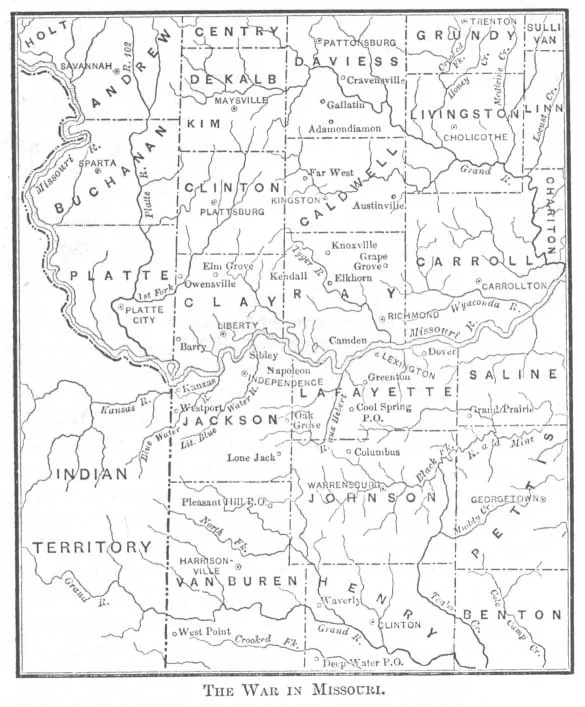
THE WAR IN MISSOURI.
On the next day two or three of Peniston's party, in order it was said to stir up the saints to violence, rode over to Far West, one after another, and reported
a battle as having been fought at Gallatin, in which several of the fraternity were killed. Considerable excitement followed the announcement, and several parties went to Diahman to learn the truth of the matter. Ascertaining the facts, and being desirous of preventing further trouble, one of the brethren went to the magistrate, Adam Black, and proposed bonds on both sides to keep the peace. the proposition was accepted, Joseph Smith and Lyman Wight signing for the Mormons, and Black for the gentiles. The Mormons then returned to Far West; but the people of Daviess county, not approving the action of the magistrate, disputed Black's right to bind them; whereupon, to appease them, Black went to the circuit judge and obtained a writ for the arrest of Smith and Wight on a charge of having forced him, by threats of violence, to sign the agreement. Brought before Judge King at Gallatin, Smith and Wight were released on their own recognizances.
Nevertheless the excitement increased. In Daviess and adjacent counties, three hundred gentiles met and armed. The Mormons say that the gentiles made prisoners, and shot and stole cattle, and the gentiles say that the Mormons did the same. 16 Finally affairs became so alarming that Major-General Atchison concluded to call out the militia of Ray and Clay counties, under command of generals Doniphan and Parks, the latter being stationed in Daviess county. 17 Their purposes in that quarter being thus defeated, the men of Missouri threw themselves on a small settlement of saints at Dewitt, where they were joined by a party with a six-pounder from Jackson county. Setting fire
to the houses, they drove off the inmates and destroyed their property. General Parks then moved his troops to Dewitt, but found the mob too many for him. They openly defied him, would make no compromise, and swore "they would drive the Mormons from Daviess to Caldwell, and from Caldwell to hell." General Atchison then went to Dewitt and told the Mormons that his men were so disaffected 18 that they had better apply for protection to Governor Boggs. This official returned answer that, as they had brought the war upon themselves, they must fight their own battles, and not look to him for help. Thereupon they abandoned the place, and fled to Far West.
In order to intercept the mob General Doniphan entered Daviess county with two hundred men, and thence proceeded to Far West, where he camped for the night. In consultation with the civil and military officers of the place, who, though Mormons, were nevertheless commissioned by the state, Doniphan advised them to arm and march to Daviess county and defend their brethren there. Acting on this advice, all armed, some going to Daviess county and some remaining at Far West. 19 The former were met by Parks, who inquired of them all particulars. Shortly afterward some families came in from beyond Grand River, who stated that they had been driven away and their houses burned by a party under C. Gilliam. 20 Parks then ordered Colonel Wight, who held a commission under him as commander of the
Mormon militia, to disperse the party, which was done, and the cannon in their possession seized, without firing a shot. Spreading into other counties, Gilliam's men raised everywhere the cry that the Mormons were killing people and burning property.
Soon afterward the Mormon militia returned from Daviess county to Far West, where they learned that a large force under Samuel Bogart, a methodist clergyman, was plundering and burning houses south of that point, in Ray county, and had taken three men prisoners, one only of whom was a Mormon. Elias Higbee, county judge, ordered the Mormon militia under Captain Patten 21 to retake the prisoners. In passing through a wood Patten came without knowing it upon the encampment of Bogart, whose guard fired without warning, killing one of Patten's men. Patten then attacked, routing Bogart's force, but not preventing the shooting of the Mormon prisoner, though he afterward recovered. In the charge one man was killed, and Patten and one other were mortally wounded. The company captured forty wagons. 22
About this time arose the mysterious and much dreaded band that finally took the name of Danites, or sons of Dan, concerning which so much has been said while so little is known, some of the Mormons even denying its existence. But of this there is no question. Says Burton: "The Danite band, a name of fear in the Mississippi Valley, is said by anti-Mormons to consist of men between the ages of seventeen and forty-nine. They were originally termed Daughters of Gideon, Destroying Angels—the gentiles say devils—and, finally, Sons of Dan, or Danites, from one of whom was prophesied he should be a serpent in the path. They were organized about 1837 under
D. W. Patten, popularly called Captain Fearnot, for the purpose of dealing as avengers of blood with gentiles; in fact, they formed a kind of death society, desperadoes, thugs, hashshashiyun—in plain English, assassins in the name of the Lord. The Mormons declare categorically the whole and every particular to be the calumnious invention of the impostor and arch apostate, Mr John C. Bennett." 23
John Hyde, a seceder, states that the Danite band, or the United Brothers of Gideon, was organized on the 4th of July, 1838, and was placed under the command of the apostle David Patten, who for the purpose assumed the name of Captain Fearnot. 24
It is the opinion of some that the Danite band, or Destroying Angels as again they are called, was organized at the recommendation of the governor of Missouri as a means of self-defense against persecutions in that state. 25 Thomas B. Marsh, late president of the twelve apostles, and president of the church at Far West, but now a dissenter, having "abandoned the faith of the Mormons from a conviction of their immorality and impiety," testifies that in October, 1838, they "had a meeting at Far West, at which they appointed a company of twelve, by the name of the Destruction Company, for the purpose of burning and destroying." 26
The apostate Bennett gives a number of names by which the same society, or divisions of it, were known, such as Daughter of Zion, Big Fan, 27 "inasmuch as it fanned out the chaff from the wheat," Brother of Gideon, Destructive, Flying Angel. The explanation of Joseph, the prophet, was that one Doctor Sampson Arvard, who after being a short time in the church, in order to add to his importance and influence secretly initiated the order of Danites, and held meetings
organizing his men into companies of tens and fifties, with captains. Then he called the officers together and told them that they were to go forth and spoil the gentiles; but they rejected the proposal, and Arvard was cut off from the church. All the present leaders of the Mormon church deny emphatically the existence of any such band or society as a part of or having anything to do with their organization. 28
Meanwhile was being matured the bloody tragedy which occurred on the 30th of October near Haun's 29 mill, on Shoal creek, about twenty miles below Far West. Besides the Mormons living there, were a number of emigrants awaiting the cessation of hostilities before proceeding on their journey. It had been agreed between the Mormons and Missourians of that locality that they would not molest each other, but live together in peace. But the men of Caldwell and Daviess counties would not have it so. Suddenly and without warning, on the day above mentioned, mounted and to the number of two hundred and forty, they fell upon the fated settlement. While the men were at their work out of doors, the women in the house, and the children playing about the yards, the crack of a hundred rifles was heard, and before the firing ceased, eighteen of these unoffending people were stretched dead upon the ground, while many more were wounded. I will not enter upon the sickening details, which are copious and fully proven; suffice it to say, that never in savage or other warfare was there perpetrated an act more dastardly and brutal. 30 Indeed, it was openly avowed by the men of Missouri that it was no worse to shoot a Mormon than to shoot an Indian, and killing Indians was no worse than killing wild beasts.
A somewhat singular turn affairs take at this juncture. It appears that Boggs, governor, and sworn enemy of the saints, does not like the way the war is going on. Here are his own soldiers fighting his own voters, the state forces killing the men who have put
him in office! This will not do. There is bad blundering somewhere. It is the Mormons only that are to be killed and driven off, and not the free and loyal American Boggs voters. Ho, there! Let the state arms be turned against these damned saints! On what pretext? Any. Say that they are robbing, and burning, and killing right and left, and that they swear they will never stop until they have the country. Easy enough. No doubt they do kill and burn; the men of Missouri are killing them and burning; why should they not retaliate? No doubt there are thieves and bad men among them, who take advantage of the time to practise their vile calling. No doubt there are violent men among them, who swear roundly at those who are hunting them to death, who swear that they will drive them off their lands and kill them if they can. But this does not make insurrectionists and traitors of the whole society. No matter; down with the Mormons! And so Boggs, the governor, seats himself and coolly writes off to his generals to drive out or exterminate the vermin. 31
Thus it appears that the Missouri state militia, called out in the first instance to assist the Mormon state militia in quelling a Missouri mob, finally joins the mob against the Mormon militia. In none of their acts had the saints placed themselves in an attitude of unlawful opposition to the state authorities; on the other hand, they were doing all in their power to defend themselves and support law and order, save in the matter of retaliation.
The first the saints of Caldwell county know of the new tactics is the appearance, within half a mile of Far West, 32 of three thousand armed men, under General Lucas, generals Wilson and Doniphan being present, and General Clark with another army being a few days’ march distant. General Lucas states that the main business there is to obtain possession of three individuals, whom he names, two of them not Mormons; and for the rest he has only to inform the saints that it is his painful duty either wholly to drive them from the state or to exterminate them. 33 Gilliam and his comrades, who as disguised Indians and white men had been fighting the Mormons, now that the state espouses their cause, join Lucas. 34 General Atchison was at Richmond, in Ray county, when the governor's exterminating order was issued. "I will have nothing to do with so infamous a proceeding," he said, and immediately resigned.
The day following his arrival General Lucas orders George M. Hinckle, colonel commanding the Mormon militia, to bring before him Joseph Smith, junior, Hyrum Smith, Lyman Wight, Sidney Rigdon, Parley P. Pratt, Caleb Baldwin, and Alexander McRae, which is done, though not without charge of fraud and treachery on the part of Hinckle. A court-martial is immediately held; the prisoners are all condemned, and sentenced to be shot next morning at eight o'clock. "In the name of humanity I protest against any such cold-blooded murder," says General Doniphan who further threatens to withdraw his men if such a course is persisted in; whereupon the sentence is not executed. All the Mormon troops in Far West, however, are required to give up their arms and consider themselves prisoners of war. 35 They are further required to execute a deed of trust pledging all Mormon property to the payment of the entire cost of the war, and to give a promise to leave the state before the coming spring.
Thus in the name of law and justice the Mormon soldiery, whose chief crime it would seem was that, in common with the rest of the militia, they had assisted
the state in putting down a mob, were forced at the point of the bayonet to sign an obligation, binding not only themselves but the civilians within their settlements to defray the entire expense of the war. This proceeding was sufficiently peculiar; but, as a climax to their conduct, some of the officers and men laid hands on the Mormons’ property wherever they could find it, taking no thought of payment.
General Clark 36 now comes forward, and entering the town of Far West, collects the saints in the public square, reads them a lecture, 37 and selecting fifty of their number, thrusts them into prison. Next day forty-six of the fifty are taken to Richmond, 38 and after a fortnight's confinement half are liberated, 39
most of the remainder being set free a week later on giving bail. Lucas 40 then retires with his troops, leaving the country to be ravaged by armed squads that burn houses, insult women, and drive off stock ad libitum. 41 The faint pretext of justice on the part of the state, attending forced sales and forced settlements, might as well have been dispensed with, as it was but a cloak to cover official iniquity. 42
It did not seem possible to a community convicted of no crime, and living in the nineteenth century, under the flag of the world's foremost republic, that such flagrant wrongs as the Boggs exterminating order, and the enforced treaty under which they were deprived of their property, could be carried into effect. They appealed, therefore, to the legislature, 43 demanding justice. But that body was too much with the people and with Boggs to think of justice. To make a show of decency, a committee was appointed and sent to Caldwell and Daviess counties, to look into the matter, but of course did nothing. Another was appointed with like result. Debates continued with more or less show of interest through the month of December. In January, 1839, the Mormons were plainly told that they need expect no redress at the hand of the legislature or other body of Missouri.
There was no help for them; they must leave the state or be killed; of this they were assured on all sides, publicly and privately.
And now begins another painful march—painful in the thought of it, painful in the telling of it. It is midwinter; whither can they go, and how? They have homes, but they may not enjoy them; land which they have bought, houses which they have built, and barns and cattle and food, but hereabout they are hunted to death. Is it Russia or Tartary or Hindostan, that people are thus forced to fly for opinion's sake? True, the people of the United States do not like such opinions; they do not like a religious sect that votes solid, or a class of men whom they look upon as fools and fanatics talking about taking the country, claimed as theirs by divine right; but in any event this was no way to settle the difficulty. Here are men who have been stripped in a moment of the results of years of toil—all that they have in the world gone; here are women weighed down with work and care, some whose husbands are in prison, and who are thus left to bear the heavy burden of this infliction alone; here are little children, some comfortably clad, others obliged to encounter the wind and frozen ground with bare heads and bleeding feet.
Whither can they go? There is a small following of the prophet at Quincy, Illinois; some propose to go there, some start for other places. But what if they are not welcome at Quincy, and what can they do with such a multitude? There is no help for it, however, no other spot where the outcasts can hope for refuge at the moment. Some have horses and cattle and wagons; some have none. Some have tents and bedding; some have none. But the start is made, and the march is slowly to the eastward. In the months of February and March 44
over one hundred and thirty families are on the west bank of the Mississippi unable to cross the river, which is full of floating ice. There they wait and suffer; they scour the country for food and clothing for the destitute; many sicken and die.
Finally they reach Quincy, and are kindly received. Not only the saints but others are there who have human hearts and human sympathies. Indeed, upon the expulsion of the Mormons from Missouri the
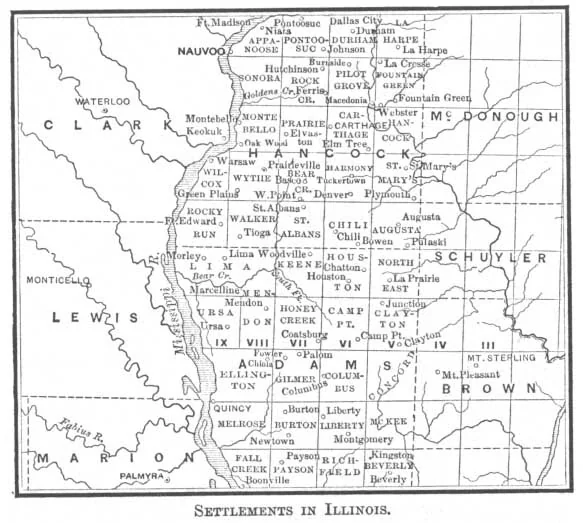
SETTLEMENTS IN ILLINOIS.
people of Illinois took a stand in their favor. The citizens of Quincy, in particular, offered their warmest sympathy and aid, on the ground of humanity. A select committee, appointed to ascertain the facts in the case, reported, on the 27th of February, 1839, "that the
strangers recently arrived here from the state of Missouri, known by the name of latter-day saints, are entitled to our sympathy and kindest regard." The working-men of the town should be informed "that these people have no design to lower the wages of the laboring class, but to procure something to save them from starving." Finally it was resolved: "That we recommend to all the citizens of Quincy, in all their intercourse with the strangers, that they use and observe a becoming decorum and delicacy, and be particularly careful not to indulge in any conversation or expressions calculated to wound their feelings, or in any way to reflect upon those who, by every law of humanity, are entitled to our sympathy and commiseration." 45
How in regard to neighboring states? In case the people of Illinois soon tire of them, what will they then do? From Commerce, Isaac Galland writes to Robert Lucas, governor of Iowa, asking about it. The answer is such as one would expect from the average American citizen—neither better nor worse. It is such, however, as to condemn throughout all time the conduct of the people of Missouri. 46
During these trying times the prophet was moving about among his people, doing everything in his power to protect and encourage thorn. Late in September he was in the southern part of Caldwell county, whence in October he passed into Carroll county, where he soon found himself hemmed in by an enraged populace. He appealed to the people, he applied to the governor, but all to no purpose. Afterward he went to Daviess county, and then back to Far West, where he was arrested and incarcerated with the others. Shortly afterward the prisoners, now
consisting of the prophet Joseph Smith, with Sidney Rigdon, Hyrum Smith, Parley P. Pratt, Lyman Wight, Amass Lyman, and George W. Robinson, were removed to Independence; why they did not know, but because it was the hot-bed of mobocracy, they said, and peradventure they might luckily be shot or hanged. A few days later they were taken to Richmond and put in irons, and later to Liberty jail in Clay county, where they were kept confined for four months. Habeas corpus was tried, and many petitions were forwarded to the authorities on their behalf, but all to no purpose. At length they obtained a hearing in the courts, with a change of venue to Boone county where they were still to be incarcerated. Rigdon had been previously released on habeas corpus, and one night, when the guard was asleep, Smith and the others escaped and made their way to Quincy.
"I was in their hands as a prisoner," says Smith, "about six months; but notwithstanding their determination to destroy me, with the rest of my brethren who were with me, and although at three different times we were sentenced to be shot without the least shadow of law, and had the time and place appointed for that purpose, yet through the mercy of God, in answer to the prayers of the saints, I have been preserved, and delivered out of their hands." 47
Notwithstanding their enormous losses, and the extreme indigence of many, the saints were not all as destitute of credit as they were of ready means, if we may judge by their business transacted during the year 1839. Bishop Knight bought for the church part of the town of Keokuk, Iowa, situated on the west bank of the Mississippi, forty miles above Quincy, Illinois. He also purchased the whole of another town-site called Nashville, six miles above Keokuk. Four miles above Nashville was a settlement called Montrose, part of which Knight bought, together with thirty thousand acres of land. 48
Opposite Montrose, on the east bank of the Mississippi where was a good landing, stood a village
called Commerce, where were some twenty houses. This was purchased by the saints, with the lands surrounding, and a town laid out which was named Nauvoo, "from the Hebrew, which signifies fair, very beautiful, and it actually fills the definition of the word; for nature has not formed a parallel on the banks of the Mississippi from New Orleans to Galena." The post-office there was first called Commerce, after the Mormons had purchased the village, but the name was changed to that of Nauvoo in May, 1840. 49 The place was started by a company from New York, but it was so sickly that when the agent for the Mormons came they were glad to sell. The Mormons drained it and made the place comparatively healthy.
On his escape from prison, Smith visited Commerce among other places, and seeing at once the advantages of its site, determined to establish there the headquarters of the church. For so great had his power now become, so extensive his following, that he might choose any spot whereon to call into existence a city, had but to point his finger and say the word to transform a wilderness into a garden. During the winter of 1840 the church leaders applied to the legislature of Illinois for several charters, one for the city of Nauvoo, one for agricultural and manufacturing purposes, one for a university, and one for a military body called the Nauvoo Legion. The privileges asked were very extensive, but were readily granted; for the two great political parties were pretty equal in numbers in Illinois at this time, and the leaders of the party in office, perceiving what a political power these people were, determined to secure them.
There were now saints everywhere, all over the United States, particularly throughout the western portion; there were isolated believers, and small clusters, and small and great congregations. There were also many travelling preachers, men full of the holy ghost, or believing themselves so, who travelled without purse or scrip, whom no buffetings, insults, hunger, or blows could daunt, who feared nothing that man could do, heaven's door being always open to them. See now the effects of these persecutions in Missouri. Twelve thousand were driven from their homes and set moving by Boggs and his generals; three fourths of them found new homes at Quincy, Nauvoo, and elsewhere; but three thousand, who, but for the persecutions, would have remained at home and tilled their lands, were preaching and proselyting, making new converts and establishing new churches wherever they went. One of their number, William Smith, was a member of the Illinois legislature. In the very midst of the war they were preaching in Jackson county, among their old enemies and spoilers, striving with all their souls to win back their Zion, their New Jerusalem. From New York, February 19, 1840, Brigham Young, H. C. Kimball, Orson Pratt, and Parley P. Pratt indited a letter to the saints at Commerce, speaking of the wonderful progress of the faith, and of their own intended departure for England. 50
Thus, despite persecution, the saints increased in number year by year. Before the end of 1840 there were fifteen thousand souls at Nauvoo, men, women, and children, not all of them exiles from Missouri, but from every quarter, old believers and new converts from different parts of the United States, from Canada, and from Europe; hither came they to the city of their God, to the mountain of his holiness.
Footnotes
111:1 They were printed and bound in Doctrine and Covenants. See Hyde's Mormonism, 202; Remy's Journey, 504; Pratt's Auobiography, 139. Mather, in Lippincott's Mag., Aug. 1880, states that the twelve apostles started in May.
112:2 'A square mile was laid out in half-acre lots, and a number of farms were bought, the church farm being half a mile down one of the most beautiful valleys which it is possible to conceive in a range of country so uniformly level.' Mather, in Lippincott's Mag., Aug. 1880. In May 1833 it was revealed that building should begin. Two houses 55 by 65 feet each were ordered, one for the presidency, the other for printing. Hyrum Smith and two others were presented with lots, and directions were sent to the faithful to subscribe money to aid in building a temple at Kirtland. Times and Seasons, vi. 769-70. Before its completion, private assemblies were held at the houses of the faithful, frequently at Smith's. When partly finished, schools were opened in several of the apartments. It was begun in June 1833, and dedicated March 27, 1836. A brief dcscription of the building, arrangement of interior, etc., and a full account of the dedication and ordinary services are given in Tullidge's Women; 76, 80-95, 99-101. Daniel Tyler, in Juvenile Intructor, xiv. 283; Busch, Gesch. der Morm., 74; Kidder's Mormonism, 124-6. Probably but little work was done on it in 1833, for about the front entrances the gilded inscription, 'Built by the church of Jesus Christ, 1834,' still shines bright as ever. Salt Lake Herald, June 6, 1877. See also Smith's account in Times and Seasons, vi. 708-11, 723-6, and Remy's Journey, i. 302-4. For cuts of building, see Young's Hist. of the Seventies, 8; Juvenile Instructor, xiv. 283; Pratt's Autobiog., 140. When nearly finished there was a debt on the building of from $15,000 to $20,000. Kidder's Mormonism, 124-6. Most of the workmen were dependent upon their labor for their daily food, which often consisted of corn meal alone, and that had been donated. Juvenile Instructor, 283. Writing in 1880, Mather says: 'The residences of Smith and Rigdon are almost under the eaves of the temple, and the theological seminary is now occupied by the methodists for a church.' Lippincott's Mag., Aug. 1880.
113:3 'They also suffered jealousies to arise among them, and several persons dissented from the church, and accused the leaders of the church with bad management, selfishness, etc…On the other hand, the leaders of the church accused the dissenters with dishonesty, want of faith and righteousness,…and this strife or opposition arose to a great height, until Smith and Rigdon were obliged to leave Kirtland.' Corrill, in Kidder's Mormonism, 126-7. 'Subsequently they had a revelation,' another says, 'commanding them to establish a bank, which should swallow up all other banks. This was soon got into operation on a pretended capital of four millions of dollars, made up of real estate round about the temple.' John Hyde, Mormonism, 201, says that the bank, a store, and. mill were started in Aug. 1831. Before me is one of their bills, dated Jan. 17, 1837, payable to C. Scott, or bearer. Mather says, Lippincott's Mag., Aug. 1880: 'Richard Hilliard, a leading merchant of Cleveland, received their bills for a few days, and then took possession of all their available assets. They were also in debt for their farms, and for goods bought in New York. The bubble burst, and many in the vicinity of Kirtland were among the sufferers. Smith and Rigdon fled to Far West, after having been tarred and feathered for their peculiar theories of finance.' 'Chauneey G. Webb (father of Ann Eliza Young) assisted in founding this bank, giving Smith all he possessed outside of his house and simp toward completing the amount necessary for a capital on which to start the new enterprise. With the failure of the bank Webb lost everything.' Young's Wife No. 19, 33, 40-41; see account of formation of bank in Bennett's Mormonism, 135-6. 'Smith had a sort of bank issue on what was then called the wild-cat principle. His circulating medium had no redeeming basis, and was worthless in the hands of the people.' Tucker's Mormonism, 154-5. 'Smith had a revelation from the Lord, to the effect that his bank would be a pattern of all the banks in the United States, that it would speedily break, and that all the rest would follow the example. The bank was closed the same day.' Hall's Mormonism, 19. The bank failed in Nov. 1837. Remy's Journey, i. 504; Busch, Gesch. der Morm., 84. 'By means of great activity and an actual capital of about $5,000, they succeeded in setting afloat from $50,000 to $100,000. the concern was closed up after flourishing 3 or 4 weeks.' Kidder's Mormonism, 128. The building is now occupied by a private family. Salt Lake S. W. Herald, June 6, 1877. 'In order to pay the debt on the temple, they concluded to try mercantile business, and ran in debt in New York and elsewhere some $30,000 for goods, and shortly after, $50,000 or $60,000 more. In consequence of their ignorance of business and extravagance, the scheme proved a failure.' Kidder's Mormonism, 126, 128; Smucker's Hist. Mor., 76. 'Gilbert and Whitney's store is still used for original purposes.' Salt Lake Herald, June 6, 1877. 'A poorly furnished country store, where commerce looks starvation in the face.' Id., Nov. 17, 1877. 'Smith's store was seized and goods sold in Nov. 1839.' Hyde's Mormonism, 203; Bennett's Mormonism, 135. They also spent some thousands of dollars in building a steam-mill, which never profiled them anything. Kidder's Mormonism, 126. 'The skeleton of a superannuated engine and its contrivances half buried in a heap of ashes—the shed that covered it having recently burned to the ground—marks the spot where stood the ashery and its successor, the Mormon saw-mill, at the foot of Temple hill.' Salt Lake Herald, Nov. 17, 1877. Heber C. Kimball, who went to Nauvoo in 1839, built a pottery at Kirtland, the ruins of which were to be seen in 1877. Ibid. 'After the temple was dedicated, the Kirtland high school was taught in the attic story by H. M. Hawes, prof. of Greek and Latin. There were from 130 to 140 students, divided into three departments—the classic, where only languages were taught; the English, where mathematics, common arithmetic, geography, English grammar, and reading and writing were taught; and the juvenile department. The last two departments were under assistant instructors. The school was begun in Nov. 1836.' Tullidge's Women, 99. 'On the 3d floor are a succession of small rooms containing crippled benches, blackboards, ruined walls, and other paraphernalia, which indicated that at some period of the temple's history this part had been used as a primary school.' Salt Lake S. W. Herald, June 6, 1877. A Hebrew professorship is also mentioned. Remy's Journey, i. 504. 'Immediately after the closing of the bank, and before the news of its failure had time to spread, Smith with some 4 or 5 terriers (understrappers in the priesthood) went to Toronto, Canada, where he preached, whilst his followers circulated the worthless notes of the defunct bank. Brigham Young also succeeded in spreading about $10,000 of the paper through several states.' Hall's Mormonism, 19-20. 'In January 1838 Smith and Rigdon, being at Kirtland together, were both arrested on charges of swindling in connection with their worthless paper bank,' etc. 'The prisoners, however, escaped from the sheriff in the night and made their way on horseback to Missouri.' Tucker's Mormonism, 155-6. Smith and Rigdon ran away on the night of Jan. 12, 1838. Hyde's Mormonism, 203. 'A new year dawned upon the church at Kirtland,' writes Smith, 'in all the bitterness of the spirit of apostate mobocracy, which continued to rage anti grow hotter and hotter, until Elder Rigdon and myself were obliged to flee from its deadly influence, as did the apostles and prophets of old, anti as Jesus said, "When they persecute you in one city, flee ye to another;" and on the evening of the 12th of January, about ten o'clock, we left Kirtland on horseback to escape mob violence, which was about to burst upon us, under the color of legal process to cover their hellish designs and save themselves from the just judgment of the law.'
115:4 It consisted of 4,000 copies. The author states that 'it has since been published and republished in America and Europe, till some 40,000 or 50,000 copies have not been sufficient resupply the demand.' Pratt's Autobiography, 184.
115:5 Most of these fled into Clay co., where they were received with some degree of kindness, and encamped on the banks of the Missouri. Those who went into Van Buren and Lafayette counties were soon expelled, and had to move. Pratt's Persecution, 51; Mackay's Mormons, 78; Times and Seasons, vi. 913. The Missouri River bends to the east as it enters the state, and runs in a generally east direction through the western counties. Jackson co. is immediately south of Clay—the river being the dividing line—and Van Buren lies next south of Jackson. All west of the state line was Indian territory, as I have said. See map, p. 121 this vol.
115:6 The Jackson co. exiles being in a destitute condition, a conference was held at P. P. Pratt's house in Clay co. some time during the winter of 1833-4—date not given), at which it was resolved to appeal to Smith, at Kirtland, for aid and counsel; and P. P. Pratt and Lyman Wight, having volunteered their services, were despatched with the message. Starting from Liberty on Feb. 1, 1834, on horseback, but penniless, on a journey of from 1,080 to 1,500 miles through a country but partially settled, they arrives at their destination early in the spring with plenty of money received from friends along their route. Pratt's Autobiog., 114-161; Utah Pioneers, 33d Aniversary, 17; Horne's Migrations, MS., 3; Young's Woman's Experiences, MS., 2.
116:7 'From threats, public meetings were called, resolutions were passed, vengeance and destruction were threatened, and affairs again assumed a fearful attitude.' Cor. Joseph Smith, etc., 5. See also Greene's Facts, 12. 'A meeting of the citizens was held at Liberty on the 29th of June, 1836, in which these matters were taken into consideration. The Mormons were reminded of the circumstances under which they were received, and requested to leave, time being given them to harvest their crops and dispose of their property. Fortunately for all concerned, the saints…agreed to leave on the terms proposed, denying strenuously that they had ever tampered with the slaves, or had any idea of exciting an Indian war.' Ferris’ Utah and the Mormons, 82-3.
116:8 These officers 'all very readily received their commissions from their accomplice, Gov. Boggs; and thus corruption, rebellion, and conspiracy had spread on every side, being fostered and encouraged by a large majority of the state; and thus treason became general.' Pratt's Persecution, 55-6.
117:9 John Hyde, Mormonism, 203, says that on their arrival in Missouri, Smith and Rigdon began 'to scatter the saints in order to obtain political ascendency in other counties.'
117:10 Of the officers then appointed, two of the judges, thirteen magistrates, all the military officers, and the county clerk were Mormons. 'These steps were taken, be it carefully observed, by the advice of the state legislature, and the officers were appointed in the manner directed by law.' Greene's Facts, 18. The gentiles murmur because of their being under Mormon rule. Hyde's Mormonism, 203.
117:11 'Smith gave it the name of Adamondiamon, which he said was formerly given to a certain valley where Adam, previous to his death, called his children together and blessed them.' Corrill's Brief History, in Kidder's Mormonism, 131. 'The earth was divided,' says Mr Richards, 'all the land being together and all the water. Adam dwelt there with his people for some time previous to his death. Adam constructed an altar there, and it was there that he bestowed his final blessings upon his descendants.' The place was also called Adam-On-Diahman, Adam-on-di-ahman, and again Diahman. The second of these names appears to have been the one in use among the saints. After the foundations of the temple at Far West were relaid, between midnight of the 25th and dawn of the 26th of April, 1839, the quorum sang the song which they called Adam-on-di-ahman. Tullidge's Life of Brigham Young.
118:12 They were afraid the Mormons would 'rule the county, and they did not like to live under the laws and administration of Jo Smith.' Ibid.
118:13 The first three were themselves accused of counterfeiting coin, and defaming Smith's character; and others charged Smith with 'being accessory to several murders and many thefts, and of designing to rule that part of the state of Missouri, and eventually the whole republic.' Hyde's Mormonism, 204; Mackay's The Mormons, 86. 'At Independence, Rigdon publicly charged Oliver Cowdery and David Whitmer with being connected with a gang of counterfeiters, etc. Cowdery was afterward arraigned before the church, and found guilty of "disgracing the church by being connected with the bogus business, as common report says."' Tucker's Origin and Prog. Mor., 158-9. 'Brother Turley could not be surpassed at "bogus." A press was prepared, and the money, composed of zinc, glass, etc., coated with silver, was executed in the best style. Imitations both of gold and silver were in general circulation and very difficult to detect. In fact, for a time, scarcely any other circulating medium was to be found among them.' When leaving Illinois for Council Bluffs, Hall carried in his wagon for some distance on the way a bogus press, which was afterwards sold on credit in Missouri, but the seller never got his money, being afraid to go for it. Hall's Mor., 20-1. Hall, who was a Mormon from 1840 to 1847, mentions this counterfeiting in connection with the Kirtland bank swindle, but does not state when the work was begun. It may have originated in Kirtland, but probably was not carried on to any great extent before the migration to Illinois. These rambling and general charges should be received with every allowance. 'From some distant bank,' continued Hall, 'they would buy quantities of its unsigned bank notes, which they took home, and after having them signed by competent artists, placed in circulation. In procuring these bills, no persons met. the package would be left by a window of the bank, with a pane out, and the package taken and its price left by the purchaser.'
119:14 'In a day or two after these transactions, the thunder rolled in awful majesty over the city of Far West, and the arrows of lightning fell from the clouds, and shivered the liberty pole from top to bottom; thus manifesting to many that there was an end to liberty and law in that state, and that our little city strove in vain to maintain the liberties of a country which was ruled by wickedness and rebellion.' Pratt's Persecution, 57.
120:15 'Every man obeyed the call.' Lee's Mormonism, 57.
122:16 In Daviess county the saints killed between 100 and 200 hogs and a number of cattle, took at least forty or fifty stands of honey, and at the same time destroyed several fields of corn. The word was out that the Lord had consecrated through the bishop the spoils unto his host. Harris' Mormonism Portrayed, 30-1.
122:17 'One thousand men were then ordered into service under the command of Major-General Atchison and brigadier-generals Parks and Doniphan. These marched to Daviess co., and remained in service thirty days. But judging from the result, they had no intention of coming in contact with the mob, but only to make a show of defending one neighborhood while the mob was allowed to attack another.' Pratt's Autobiography, 191.
123:18 'At length the general (Atchison) informed the citizens that his forces were so small, and many of them so much in favor of the insurrectionists, that it was useless to look any longer to theta for protection…After the evacuation of Dewitt, when our citizens were officially notified that they must protect themselves, they assembled in Far West to the number of one thousand men, or thereabout, and resolved to defend their rights to the last.' Pratt's Autobiography, 192-3.
123:19 'The Mormons in Caldwell were the regular state militia for that county, and were at the time acting under the legal authorities of the county.' Greene's Facts, 20.
123:20 'A noted company of banditti, under the command of Cornelius Gilliam, who had long infested our borders and been notorious for their murders and daring robberies anti who painted themselves as Indian warriors, came pouring in from the west to strengthen the camp of the enemy.' Pratt's Autobiography, 202.
124:21 Pratt, Persecution, 68, says that the detachment was under the command of Captain Durphey, aided by Patten.
124:22 'The enemy had left their horses, saddles, camp, and baggage in the confusion of their flight, which fell into our hands.' Pratt's Persecutions, 72. 'We delivered the horses and spoils of the enemy to Col. Hinckle, the commanding officer of the regiment.' Id., 74.
125:23 John Corrill says that some time in June a secret society was formed of a few individuals who should be agreed in all things, and stand by each other, right or wrong, under all circumstances. Next to God was the first presidency; and they bound themselves by the most solemn covenants before the almighty that the presidency should be obeyed. 'Who started this society I know not,' writes Corrill; 'but Doctor Samson Arvard was the most prominent leader and instructor, and was assisted by others. The first presidency did not seem to have much to do with it,…but I thought they stood as wire-workers behind the curtain.' 'Arvard was very forward and indefatigable in accomplishing their purposes, for he devoted his whole talents to it, and spared no pains; and, I thought, was as grand a villain as his wit and ability would admit of…They ran into awful extremes,' seeming to think that they were called upon to execute the judgments of God on all their enemies. 'Dr Arvard received orders from Smith, Rigdon, and company to destroy the paper containing the constitution of the Danite society, as, if it should be discovered, it would be considered treasonable. He did not, however, obey the orders, but after he was made prisoner he handed it to General Clark.' Kidder's Mormonism, 143. The constitution is published in Bennett's Mormonism Exposed, 265. 'The oath by which the Danites were bound in Missouri was altered in a secret council of the inquisition at Nauvoo so as to read: "In the name of Jesus Christ, the Son of God, I do solemnly obligate myself ever to regard the prophet and first presidency of the church of Jesus Christ of Latter-Day Saints, as the supreme head of the church on earth and to obey them in all things the same as the supreme God; that I will stand by my brethren in danger or difficulty, and will uphold the presidency, right or wrong; and that I will ever conceal, and never reveal, the secret purposes of this society, called the Daughter of Zion. Should I ever do the same, I hold my life as the forfeiture, in a caldron of boiling oil."' Id., 267. The origin of the name Daughter of Zion may be found in Micah iv. 13.
125:24 Hyde's Mormonism, 104. In Id., 104-5, Hyde writes as follows: 'When the citizens of Carroll and Daviess counties, Mo., began to threaten the Mormons with expulsion in 1838, a death society was organized under the direction of Sidney Rigdon, and with the sanction of Smith. Its first captain was Captain Fearnot, alias David Patten an apostle. Its object was the punishment of the obnoxious. Some time elapsed before finding a suitable name. They desired one that should seem to combine spiritual authority with a suitable stored. Micah iv. 13, furnished the first name. "Arise and thresh, O daughter of Zion! for I will make thy horn iron, and thy hoofs brass; and thou shall beat in pieces many people; and I will consecrate their gain unto the Lord, and their substance unto the Lord of the whole earth." This furnished them with a pretext; it accurately described their intentions, and they called themselves the Daughters of Zion. Some ridicule was made at these bearded and bloody daughters, and the name did not sit easily. Destroying Angels came next; the Big Fan of the thresher that should thoroughly purge the floor was tried and dropped. Genesis, xlix. 17, furnished the name that they finally assumed. The verse is quite significant: "Dan shall be a serpent by the way, an adder in the path, that biteth the horse's heels, so that his rider shall fall backward." The sons of Dan was the style they adopted; and many have been the times that they have been adders in the path, and many a man has fallen backward, and has been seen no more.'
126:25 See Smucker's Hist. Mor., 108.
126:26 'The members of this order were placed under the most sacred obligations that language could invent…to stand by each other unto death, to sustain, protect, defend, and obey the leaders of the church under any and all circumstances unto death.' To divulge a Danite secret was death. There were signs and tokens, the refusal to respect which was death. 'This signs or token of distress is made by placing the right hand on the right side of the face, with the points of the fingers upwards, shoving the hand upwards until the ear is snug up between the thumb and forefinger.' Lee's Mormonism, 57-8.
126:27 'The society was instituted for the purpose of driving out from the holy land, their earthly paradise, in Missouri, all apostates or dissenters…They make no scruple whatever to commit perjury, when deemed requisite for the welfare of their church…The number of Danites is now, 1842, about 2,000 or 2,500. From the élite of the Danites, or Daughters of Zion, twelve men are selected, who are called Destructives, or Destroying Angels, or Flying Angels.' Mormonism Exposed, 265-9.
127:28 'It was intended to enable him,' Smith, 'more effectually to execute his clandestine purposes.' '"Milking the gentiles" is a kind of vernacular term of the Mormons, and signifies the obtaining of money or property from these who are not members of the Mormon church.' Id., 272-8. 'In an examination before Judge King Samuel (Samson?) Arvard testified that the first object of the Danite band was to drive from the county of Caldwell all those who dissented from the Mormon church, in which they succeeded admirably…The prophet Joseph Smith, Jr, together with his two counsellors Hyrum Smith and Sidney Rigdon, were considered the supreme head of the church, and the Danite band felt themselves as much bound to obey them as to obey the supreme God.' John Corrill swore: 'I think the original object of the Danite band was to operate on the dissenters; but afterwards it grew into a system to carry out the designs of the presidency, and if it was necessary, to use physical force to uphold the kingdom of God.' John Cleminson said: 'Whoever opposed the presidency in what they said or desired done should be expelled the county or have their lives taken.' Wm W. Phelps, for a season an apostate, testified: 'If any person spoke against the presidency they would hand him over to the hands of the Brothers of Gideon.' 'The object of the meeting seemed to be to make persons confess and repent of their sins to God and the presidency.' 'Wight asked Smith, Jr, twice if it had come to the point now to resist the laws. Smith replied the time had come when he should resist all law.' Ferris’ Utah and the Mormons, 92-3. Arvard 'swore false concerning a constitution, as he said, that was introduced among the Danites, and made many other lying statements in connection therewith.' Mem. to Leg., in Greene's Facts, 32-3. Says John Corrill in his Brief History, 'A company, called the Fur Company, was raised for the purpose of procuring provisions, for pressing teams, and even men sometimes, into the army in Caldwell.' Reed Peck testified that small companies were sent out on various plundering expeditions; that he 'saw one of these companies on its return. It was called a fur company. Some had one thing, some another; one had a feather-bed; another some spun yarn, etc. This fur they were to take to the bishop's store, where it was to be deposited, and if they failed to do this it would be considered stealing.' Kidder's Mormonism, 147-8. Affidavit of the city council, Nauvoo: 'We do further testify that there is no such thing as a Danite society in this city, nor any combination other than the Masonic of which we have any knowledge.' Signed by Wilson Law, John Taylor, Wilford Woodruff, and 10 others. Millennial Star, xix. 614. References to authorities speaking of the Danites: Mackay's The Mormons, 89-90, 116; Lee's Mormonism, 57-8, 156-60; Olshausen, Gesch. d. Morm., 48; Ferris’ Utah and the Mormons, 89; Beadle's Life in Utah, 389-90; Burton's City of the Saints, 359; Smucker's Hist. Mor., 108-9; Young's Wife No 19, 47-8, 268; Busch, Gesch. der Morm., 87; Marshall's Through Am., 215-16; Hyde's Mormonism, 104-5; Bennett's Mormonism Exposed, 263-72; Miller's First Families, 64-5; Hickman's Brigham's Destroying Angel; Hall's Mormonism, 94-5; E. M. Webb, in Utah County Sketches, MS., 49-50, the last named referring to the rules and principles of the order of Enoch.
128:29 Spelled also Hahn, Hohn, Hawn.
128:30 'Immediately after this, there came into the city a messenger from Haun's mill, bringing the intelligence of an awful massacre of the people who were residing in that place, and that a force of two or three hundred, detached from the main body of the army, under the superior command of Col. Ashley, but under the immediate command of Capt. Nehemiah Compstock, who, the day previous, had promised them peace and protection, but on receiving a copy of the governor's order to exterminate or to expel, from the hands of Col. Ashley, he returned upon them the following day, and surprised and massacred the whole population, and then came on to the town of Far West, and entered into conjunction with the main body of the army.' Mackay's The Mormons, 88-9.
129:31 Several of them write to Boggs: 'There is no crime, from treason down to petit larceny, but these people, or a majority of them, have been guilty of; all, too, under the counsel of Joseph Smith, Jr, the prophet. They have committed treason, murder, arson, burglary, robbery, larceny, and perjury. They have societies formed under the most binding covenants in form, and the most horrid oaths, to circumvent the laws and put them at defiance; and to plunder and burn and murder, and divide the spoils for the use of the church.' Tucker's Mormonism, 164.
And thus Boggs makes answer, Oct. 27th: 'Since the order of the morning to you directing you to cause four hundred mounted men to be raised within your division, I have received by Amos Rees, Esq., and Wiley E. Williams, Esq., one of my aids, information of the most appalling character, which changes entirely the face of things, and places the Mormons in the attitude of an open and avowed defiance of the laws, and of having made open war upon the people of this state. Your orders are therefore to hasten your operations, and endeavor to reach Richmond in Pray county, with all possible speed. The Mormons must be treated as enemies, and must be exterminated or driven from the state if necessary, for the public good. Their outrages are beyond all description. If you can increase your force, you are authorized to do so to any extent you may think necessary. I have just issued orders to Maj.-Gen. Wollock of Marion county to raise 500 men, and to march them to the northern part of Daviess, and there unite with Gen. Doniphan of Clay, who has been ordered with 500 men to proceed to the same point for the purpose of intercepting the retreat of the Mormons to the north. They have been directed to communicate with you by express. You can also communicate with them if you find it necessary. Instead, therefore, of proceeding as at first directed, to reinstate the citizens of Daviess in their homes, you will proceed immediately to Richmond and there operate against the Mormons. Brig.-Gen. Parks of Ray has been ordered to have 400 men of his brigade in readiness to join you at Richmond. The whole force will be placed under your command.'
130:32 'The governor's orders and these military movements were kept an entire secret from the citizens of Caldwell and Daviess…even the mail was withheld from Far West.' Pratt's Autobiography, 200.
130:33 'This letter of the governor's was extremely unguarded, and seems to have been too literally construed…Making all due allowance for the exasperated state of the public mind, these threats of extermination sound a little too savage in Anglo-Saxon ears…But they were impolitic, because they gave plausibility to the idea that the saints were the victims of a cruel and unrelenting religious persecution, and furnished them with one of the surest means of future success.' Ferris’ Utah and the Mormons, 90-1.
130:34 'About the time that Lucas came out to Far West, Smith assembled the Mormon troops, and said that for every one they lacked in number of those who came out among them, the Lord would send angels, who would fight for them, and they should be victorious.' Kidder's Mormonism, 143.
131:35 They were 'confined to the limits of the town for about a week.' During this time much property was destroyed, and women abused. The number of arms taken was 630, besides swords and pistols, worth between $12,000 and $15,000. Mem. to Leg., in Greene's Facts, 15. 'General Lucas demanded the Caldwell militia to give up their arms, which was done to the number of upward of 500, the rest of the troops having fled during the night. After the troops had surrendered, the city of Far West was surrounded by the robbers, and all the men detained as prisoners, none being permitted to pass out of the city, although their families were starving for want of sustenance.' Pratt's Persecution, 84. 'We determined not to resist anything in the shape of authority, however tyrannical or unconstitutional might be the proceedings against us. 'With this request (to surrender ourselves as prisoners we readily complied as soon as we were assured by the pledge of the honor of the principal officers that our lives should be safe…We were marched into camp, surrounded by thousands of savage-looking beings, many of whom were painted like Indian warriors. These all set up a constant yell, like so many blood-hounds let loose on their prey…A hint was given us that the general officers held a secret council…in which we were all sentenced to be shot.' Pratt's Persecution, 80-2. 'If the vision of the infernal regions could suddenly open to the mind, with thousands of malicious fiends, all clamoring, exulting, deriding, blaspheming, mocking, railing, raging, and foaming like a troubled sea, then could some idea be formed of the hell which we had entered.' Pratt's Autobiography, 204. See Young's Woman's Experience, MS.; Horne's Migrations, MS.
132:36 Pratt says that Clark has been commended by some writers for his heroic merciful, and prudent conduct toward the Mormons, but that the truth is that he openly avowed his approval of all the proceedings of Gen. Lucas, and said that he should not alter his decrees. Autobiography, 227-8.
132:37 It runs as follows: 'Gentlemen, You whose names are not attached to this list of names will now have the privilege of going to your fields to obtain corn for your families, wood, etc. Those that are now taken will go from thence to prison, to be tried, and receive the due demerit of their crimes, but you are now at liberty, all but such as charges may be hereafter preferred against. It now devolves upon you to fulfil the treaty that you have entered into, the leading items of which I now lay before you. The first of these you have already complied with, which is, that you deliver up your leading men to be tried according to law. Second, that you deliver up your arms; this has been attended to. The third is, that you sign over your property to defray the expenses of the war; this you have also done. Another thing yet remains for you to comply with, that is, that you leave this state forthwith, and whatever your feelings concerning this affair, whatever your innocence, it is nothing to me. Gen. Lucas, who is equal in authority with me, has made this treaty with you. I am determined to see it executed. The orders of the governor to me were, that you should be exterminated, and not allowed to continue in the state, and had your leaders not been given up and the treaty complied with before this, you and your families would have been destroyed, and your houses in ashes.'
132:38 Pratt says in his Autobiography, p. 210, that a revelation to Joseph Smith buoyed up their spirits continually during their captivity. 'As we arose and commenced our march on the morning of the 3d of November, Joseph Smith spoke to me and the other prisoners in a low but cheerful and confidential tone; said he, "Be of good cheer, brethren; the word of the Lord came to me last night that our lives should be given us, and that whatever we may suffer during this captivity, not one of our lives should be taken."' 'When we arrived in Richmond as prisoners there were some fifty others, mostly heads of families, who had been marched from Caldwell on foot, distance thirty miles, and were now penned up in a cold, open, unfinished court-house, in which situation they remained for some weeks, while their families were suffering severe privations.' Id., 227.
132:39 A court of inquiry was instituted at Richmond before Judge Austin A. King, lasting from the 11th to 28th of November. Pratt says: 'The judge could not be prevailed on to examine the conduct of the murderers and robbers who had desolated our society, nor would he receive testimony except against us…The judge in open court, while addressing a witness, proclaimed that if the members of the church remained on their lands to put in another crop they should be destroyed indiscriminately, and their bones be left to bleach on the plains without a burial…Mr Doniphan, attorney for the defence, and since famed as a general in the Mexican war, finally advised the prisoners to offer no defence; "for," said he, "though a legion of angels from the opening heavens should declare your innocence, the court and populace have decreed your destruction." Joseph and Hyrum Smith, Sidney Rigdon, Lyman Wight, Caleb Baldwin, and Alexander McRay were committed to the jail of Clay co. on charge of treason; and Morris Phelps, Lyman Gibbs, Darwin Chase, Norman Shearer, and myself were committed to the jail of Richmond, Ray co., for the alleged crime of murder, said to be committed in the act of dispersing the bandit Bogart and his gang.' Id., 230-3.
133:40 Ingloriously conspicuous in the Missouri persecutions were generals Clark, Wilson, and Lucas, Colonel Price, Captain Bogart, and Cornelius Gilliam, 'whose zeal in the cause of oppression and injustice,' says Smith, 'was unequalled, and whose delight has been to rob, murder, and spread devastation among the saints…All the threats, murders, and robberies which these officers have been guilty of are entirely ignored by the executive of the state, who to hide his own iniquity must of course shield and protect those whom he employed to carry into effect his murderous purposes.' Times and Seasons, i. 7.
133:41 Pages of evidence, both Mormon and anti-Mormon, might be given, and can indeed at any time be produced, to prove the commission of innumerable wrongs and revolting atrocities on the part of the people of Missouri, while abetted therein by state forces, commanded by state officers, and all under guidance of the state governor.
133:42 There is abundance of testimony from disinterested sources, even from the opposers of Mormonism themselves, to prove the persecution on the part of the people of Missouri unjust and outrageous. I will quote only three from many similar comments that have been made on this subject, and all, be it remembered, emanating from the open and avowed enemies of this religion.
Says Prof. Turner of Illinois college: 'Who began the quarrel? Was it the Mormons? Is it not notorious, on the contrary, that they were hunted like wild beasts, from county to county, before they made any desperate resistance? Did they ever, as a body, refuse obedience to the laws, when called upon to do so, until driven to desperation by repeated threats and assaults from the mob? Did the state ever make one decent effort to defend them as fellow-citizens in their rights, or to redress their wrongs? Let the conduct of its governors, attorneys, and the fate of their final petitions answer. Have any who plundered and openly massacred the Mormons ever been brought to the punishment due to their crimes? Let the boasting murderers of begging and helpless infancy answer. Has the state ever remunerated even those known to be innocent, for the loss of either their property or their arms? Did either the pulpit or the press through the state raise a note of remonstrance or alarm? Let the clergymen who abetted and the editors who encouraged the mob answer.' Correspondence Joseph Smith, 2. On the 16th of March, 1839, the editor of the Quincy Argus wrote as follows: 'We have no language sufficiently strong for the expression of our indignation and shame at the recent transaction in a sister state, and that state Missouri, a state of which we had long been proud, alike for her men and history, but now so fallen that we could wish her star stricken out from the bright constellation of the Union. We say we know of no language sufficiently strong for the expression of our shame and abhorrence of her recent conduct. She has written her own character in letters of blood, and stained it by acts of merciless cruelty and brutality that the waters of ages cannot efface. it will be observed that an organized mob, aided by many of the civil and military officers of Missouri, with Gov. Boggs at their head, have been the prominent actors in this business, incited, too, it appears, against the Mormons by political hatred, and by the additional motives of plunder and revenge. They have but too well put in execution their threats of extermination and expulsion, and fully wreaked their vengeance on a body of industrious and enterprising men who had never wronged nor wished to wrong them, but on the contrary had ever comported themselves as good and honest citizens, living under the same laws, and having the same right with themselves to the sacred immunities of life, liberty, and property.' 'By enlightened people the Mormons were regarded as the victims of misguided vengeance in Missouri. The ruffianly violence they encountered at the hands of lawless mobs, in several instances eventuating in deliberate murder, finds no extenuation in any alleged provocation. The due process of law might have afforded adequate redress for the criminalities of which they should be found guilty on legal trial. Such was the view of the subject rightly taken by the people of Illinois and of the world, though it may have been wrongfully applied in favor of the cause of the persecuted.' Tucker's Mormonism, 166.
134:43 A memorial was sent to the legislature of Missouri, dated Far West, Dec. 10, 1838, setting forth these facts, and praying that the governor's novel, unlawful, tyrannical, and oppressive order be rescinded. It was signed by Edward Partridge, Heber C. Kimball, John Taylor, Theodore Turley, Brigham Young, Isaac Morley, George W. Harris, John Murdock, John M. Burk.
135:44 'On the 20th of April, 1839, the last of the society departed from Far West. Thus had a whole people, variously estimated at from ten to fifteen thousand souls, been driven from houses and lands and reduced to poverty, and had removed to another state, daring one short winter and part of a spring. The sacrifice of property was immense.' Pratt's Autobiography, 245.
137:45 Pratt's Persecution of the Saints, 185.
137:46 'On my return to this city,' writes Lucas from the executive office at Burlington, Iowa, 'after a few weeks' absence in the interior of the territory, I received your letter of the 25th ult. [Feb. 1839], in which you give a short account of the sufferings of the people called Mormons, and ask whether they could be permitted to purchase lands and settle upon them in the territory of Iowa, and there worship Almighty God according to the dictates of their own consciences, secure from oppression, etc. In answer to your inquiry, I would say that I know of no authority that can constitutionally deprive them of this right. They are citizens of the United States, and are all entitled to all the rights and privileges of other citizens. The 2d section of the 4th article of the constitution of the United States (which all are solemnly bound to support) declares that "the citizens of each state shall be entitled to all the privileges and immunities of citizens in the several states;" this privilege extends in full force to the territories of the United States. The first amendment to the constitution of the United States declares that "congress shall make no law respecting an establishment of religion or prohibiting the free exercise thereof." The ordinances of congress of the 13th July, 1787, for the government of the territory north-west of the river Ohio, secures to the citizens of said territory and the citizens of the states thereafter to be formed therein, certain privileges which were by the late act of congress organizing the territory of Iowa extended to the citizens of this territory. The first fundamental article in that ordinance, which is declared to be forever unalterable except by common consent, reads as follows, to wit: No person demeaning himself in a peaceable and orderly manner shall ever be molested on account of his mode of worship or religious sentiments in said territory. These principles I trust will ever be adhered to in the territory of Iowa. They make no distinction between religious sects. They extend equal privileges and protection to all; each must rest upon its own merits and will prosper in proportion to the purity of its principles, and the fruit of holiness and piety produced thereby. With regard to the peculiar people mentioned in your letter, I know but little. They had a community in the northern part of Ohio for several years, and I have no recollection of ever having heard in that state of any complaint against them of violating the laws of the country. Their religious opinions I conceive have nothing to do with our political transactions. They are citizens of the United States, and are entitled to the same political rights and legal protection that other citizens are entitled to. The foregoing are briefly my views on the subject of your inquiries.'
In a memorial sent to Washington in the autumn of 1839, it was claimed by the Mormons that their property destroyed in Jackson co. was worth $120,000; that 12,000 souls were banished; that they purchased and improved lands in Clay co., and in three years were obliged to leave there with heavy loss; that they then purchased and improved lands in Daviess and Carroll counties; that for the most part these counties were wild and uncultivated; that they had converted them into large and well improved farms, well stocked, which were rapidly advancing in cultivation and wealth; and that they were finally compelled to fly from these counties. In a petition presented by Sidney Rigdon to the state of Pennsylvania, it is stated that 'Lilburn Boggs, governor of the state, used his executive influence to have us all massacred or driven into exile; and all this because we were not lawless and disobedient. For if the laws had given them a sufficient guaranty against the evils complained of…then would they bare had recourse to the laws. If we had been transgressors of laws, our houses would not have been rifled, our women ravished, our farms desolated, and our goods and chattels destroyed, our men killed, our wives and children driven into the prairies, and made to suffer all the indignities that the most brutal barbarity could inflict; but would only have had to suffer that which the laws would inflict, which were founded in justice, framed in righteousness, and administered in humanity… Why, then, all this cruelty? Answer: because the people had violated no law; and they could not be restrained by law, nor prevented from exercising the rights according to the laws, enjoyed, and had a right to be protected in, in any state of file Union.' Mr Corrill remarks: 'My opinion is, that if the Mormons had been let alone by the citizens, they would have divided and subdivided, so as to have completely destroyed themselves and their power as a people in a short time.'
139:47 In 1839 Carlin was governor of Illinois, and on him the governor of Missouri made a formal demand for the surrender to the authorities of Smith and Rigdon, but little attention was paid to it. One of the most complete documents extant covering this period is, Facts Relative to the Expulsion of the Mormons, or Latter-day Saints, from the State of Missouri under the Exterminating Order. By John P. Greene, an authorized representative of the Mormons (Cincinnati, 1839). The work consists of 43 8vo pages, and was written for the purpose of showing to what wrongs the Mormons had been subjected at the hands of the people and politicians of Missouri, and also to obtain contributions for the destitute. The contents are largely documentary, and if we allow for some intensity of feeling, bear the impress of truth.
Pointing in the same direction but less pretentious and less important is Correspondence between Joseph Smith, the prophet, and Col. John Wentworth, editor of the 'Chicago Democrat,' and member of congress from Illinois; General James Arlington Bennett, of Arlington House, Long Island; and the Honorable John C. Calhoun, Senator from South Carolina, in which is given a sketch of the life of Joseph Smith, Rise and Progress of the Church of Latter-day Saints, and their persecution by the state of Missouri; with the peculiar views of Joseph Smith in relation to Political and Religious matters generally; to which is added a concise account of the present state and prospects of the city of Nauvoo. (New York, 1844). With a title-page from which so much information is to be derived, we must not expect too much from the book itself. A portion of this correspondence was published in the Times and Seasons.
Late Persecution of the Church of Jesus Christ of Latter-day Saints. Ten thousand American citizens robbed, plundered, and banished; others imprisoned, and others martyred for their Religion. With a sketch of their Rise, Progress, and Doctrine. By P. P. Pratt, Minister of the Gospel. Written in prison (New York, 1840). This is a 16mo vol. of 215 pages, most of which is devoted to the Missouri persecutions, with but little other history, except what is thrown in incidentally. All appendix of 37 pages is made up mostly from Greene's Facts. Pratt gives a graphic account of his life in prison, and of the means whereby, with the coöperation of his wife, he rescued from jail the manuscript of this book, which was written there. After mentioning them, he says: 'Thus, kind reader, was this little book providentially, and I may say miraculously, preserved, and by this means you have it to read.' The first edition was published at Detroit, Michigan, the book consisting then of 84 pages.
Full reference for the persecutions of the Mormons in 1831-39. Memorial to Legislature Mass. in 1844, against such conduct, in Times and Seasons, i. 17-20, 33-6, 49-56, 65-6, 81-6, 94, 97-104, 113-16, 128-34, 145-50, 161-7, 177; v. 514-19; Pratt's Persecution of the Saints, 21-215; Utah Tracts, no. 4, 56-64; Pratt's Autobiography, 190-237, 311-22, 336-40; Smucker's Hist. Mor., 86; Deseret News, Dec. 27, 1851, Nov. 29 and Dec. 27, 1851, June 30, 1869; Mackay's The Mormons, 106-14; Tucker's Origin and Prog. Mor., 160-6; Howe's Mormonism Unveiled, 133-76; Ferris’ Utah and the Mormons, 87-8, 90; White's Ten Years in Or., 144; Taylder's Mormon's Own Book, xliii.-xlvi.; Gunnison's Mormons, 104-14; Millennial Star, xxv., 535-6, 550-2, 599-600, 614-16, 631; Burnett's Rec., 56; Beadle's Life in Utah, 60; Lee's Mormonism, 55-96; Tullidge's Women, 116-74; Richards’ Narrative, MS., 6-9; Young's Wife No. 19, 43-53; Atlantic Monthly, Dec. 1869; Stenhouse, Les Mormons, 154-71; Liberty Tribune; Margaret Smoot's Eperiences of a Mormon Wife, MS., 2-3: Farnham's Travels Rocky Mts., 6; Bertrand's Mem. Mor., 51; Busch, Gesch. der Mor., 85-7, 90-7; Juvenile Instructor, xv. 78; Kidder's Mormonism, 133-5; Iowa Frontier Guardian, March 21, 1849; Rabbison's Growth of Towns, MS, 2-5.
140:48 'Since their expulsion from Missouri a portion of them, about one hundred families, have settled in Lee county, Iowa Territory, and are generally considered industrious, inoffensive, and worthy citizens.' Letter from Robert Lucas, governor of Iowa, to A. Ripley, dated Jan. 4, 1840.
141:49 'Nauvoo was one of the names of one of the numerous petty chiefs in British India.' Ferris’ The Mor., 97. 'Nauvoo is a Hebrew word, and signifies a beautiful habitation for man, carrying with it the idea of rest; it is not, however, considered by the Mormons their final home, but a resting place only; for they only intend to remain there until they have gathered force sufficient to enable them to conquer Independence in Jackson co., Missouri, which is one of the most fertile, pleasant, and desirable countries on the face of the earth, possessing a soil unsurpassed in any region. Independence they consider their Zion, and there they intend to rear their great temple, the corner-stone of which is already laid. There is to be the great gathering place for all the saints, and in that delightful country they expect to find their Eden, and build the New Jerusalem.' Bennett's Mormonism Exp., 192-3.
142:50 See J. D. Hunter's letter of Dec. 26, 1839, from Jackson county, Ill., in Times and Seasons, i. 59.
CHAPTER VI.
THE STORY OF MORMONISM.
1840-1844.
The City of Nauvoo—Its Temple and University—the Nauvoo Legion—the Mormons in Illinois—Evil Reports—Revelation on Polygamy—Its Reception and Practice—the Prophet a Candidate for the Presidency—the 'Nauvoo Expositor'—Joseph Arrested—Governor Ford and His Measures—Joseph and Hyrum Proceed to Carthage—Their Imprisonment—the Governor's Pledge—Assassination of the Prophet and His Brother—Character of Joseph Smith—a Panic at Carthage—Addresses of Richards and Taylor—Peaceful Attitude of the Mormons.
To the saints it is indeed a place of refuge, the city of Nauvoo, the Holy City, the City of Joseph. 1 It stands on rolling land, covering a bed of limestone yielding excellent building material, and bordered on three sides by the river which here makes a majestic curve, and is nearly two miles in width. The aborigines were not indifferent to the advantages of the spot, as the presence of their mounds testifies. In area it is three miles by four. The city is regularly laid out in streets at right angles, of convenient width, along which are scattered neat, whitewashed log cabins, also frame, brick, and stone houses, with grounds and gardens. It is incorporated by charter, 2 and contains the best institutions of the latest civilization; in the
country are hundreds of tributary farms and plantations. The population is from seven to fifteen thousand, varying with the ebb and flow of new converts and new colonizations. 3
Conspicuous among the buildings, and chief architectural feature of the holy city, is the temple, glistening in white limestone upon the hill-top, a shrine in the western wilderness whereat all the nations of the earth may worship, whereat all the people may inquire of God and receive his holy oracles. 4 Next in
the City of Joseph in prominence and importance is the house of Joseph, hotel and residence, called the Nauvoo House, 5 which is to the material man as the
temple to the spiritual man. Unfortunately both the one and the other are destined to an occupancy and enjoyment all too brief in view of the vast labor bestowed upon them. Besides these buildings are the Hall of Seventies, in which is a library, the Masonic Hall, and Concert Hall; also there a university and other institutions are established, though having as yet no separate edifices.
The president of the university and professor of mathematics and English literature is James Kelly, a graduate of Trinity College, Dublin, and a ripe scholar; Orson Pratt, a man of pure mind and high order of ability, who without early education and amidst great difficulties had to achieve learning as best he could, and in truth has achieved it; professor of languages, Orson Spencer, graduate of Union College and the Baptist Theological Seminary, New York; professor of church history, Sidney Rigdon, versed in history, belles-lettres, and oratory. In the board of regents we find the leading men of the church; 6 connected with the university were four common-school wards, with three wardens to each.
In 1840 all the male members of the church between the ages of sixteen and fifty were enrolled in a military organization known as the Nauvoo Legion, which eventually numbered some four thousand men, and constituted part of the state militia. It was divided into two cohorts, and then into regiments, battalions, and companies, Lieutenant-general Joseph Smith being commander-in-chief. 7 The organization
was modelled after the Roman legion. The men were well disciplined, brave, and efficient. These troops carried their name to Utah, where they were reörganized in May 1857.
Though all are soldiers, there are no dandy warriors in their midst. Each one returns after drill to his occupation—to his farm, factory, or merchandise. Among other workshops are a porcelain factory established by a Staffordshire company, two steam sawmills, a steam flouring-mill, a foundry, and a tool-factory. A joint-stock company is organized under the style of the Nauvoo Agricultural and Manufacturing Association. Just outside the city is a community farm, worked by the poor for their own benefit; to each family in the city is allotted one acre of ground; the system of community of property does not obtain.
Most of the people in and about Nauvoo are Mormons, but not all. The population is made up chiefly from the farming districts of the United States and the manufacturing districts of England; though uneducated, unpolished, and superstitious, they are for the most part intelligent, industrious, competent, honest, and sincere. 8 With a shrewd head to direct,
like that of the prophet, a wisdom like his to concentrate, a power like his to say to ten thousand men, do this, and it is done, with plenty of cheap, virgin land, with a collective knowledge of all arts, and with habits of economy and industry, it were a wonder if they did not rapidly accumulate property, and some of them acquire wealth. This they do, though tithed by the church, and detested by the gentiles, and they prosper in a remarkable degree. Of course, in political, as in spiritual and pecuniary affairs, the prophet's word is law.
"Nauvoo is the best place in the world!" exclaims an enthusiastic saint. Nauvoo, the beautiful indeed! And "as to the facilities, tranquillities, and virtues of the city, they are not equalled on the globe." Here the saints find rest. "No vice is meant to be tolerated; no grog-shops allowed; nor would we have any trouble, if it were not for our lenity in suffering the world, 9 as I shall call them, to come in and trade, and
enjoy our society, as they say." "They are a wonderfully enterprising people, writes a gentile. "Peace and harmony reign in the city. The drunkard is scarcely ever seen, as in other cities, neither does the awful imprecation or profane oath strike upon your ear; but while all is storm and tempest and confusion abroad respecting the Mormons, all is peace and harmony at horne." 10
About this time there comes to Joseph Smith a somewhat, singular individual making somewhat singular advances. He is a yankee huckster of the first class, only for his merchandise, instead of patent clocks and wooden nutmegs, he offers for sale theology, medicine, and a general assortment of political and military wares. The thing is a fraud, and before long he openly announces himself as such. As his manhood is far inferior to his duplicity, so his name—the Reverend General John C. Bennett, M. D., U.S.A., president, chancellor, and master in chancery—as we may observe, is subordinate to his titles. He has ability, he has brains and fingers; but
he has no soul. He comes to Joseph and says, "Hail, master!" and worships him. He professes all that the Mormons profess, and more; he does all that the Mormons do, and more. So the prophet makes him general of his legion, mayor of the city, chancellor of the university, not to mention his functions as attorney, doctor, and privy counsellor. All this is done with quick despatch; and the result is that the great man soon tires of his greatness, or thinks to become yet greater by turning renegade, and writing a book against his late friends and associates. 11
There is another individual of similar name, and yet more similar character, James Arlington Bennett,
also called general, whom Mackay, Smucker, a reviewer in the Edinburgh, and others have
mistaken for the original. The quality of impudence appears as fully in the second Bennett as in the first. 12
As I have before observed, the misfortunes of the saints by no means dampened their ardor, or impoverished them as a society. Some lost their all; in that case the others helped them. Old scores were
cancelled, old debts forgiven. 13 There were no great riches among them; yet he who had nothing could not be called poor amid such surroundings. Head over all, temporal and spiritual, was Joseph Smith, not only prophet and president, but general and mayor. 14 He had now approached the summit of his career, and for a brief space was permitted to enjoy his fame, wealth, and power in some degree of quiet.
They were salutary lessons that the prophet and his people had received in Missouri, and for a time their speech and manner were less arrogant than of old. But soon prosperity was far greater here than ever before, and as with Israel of old the chastisements of the Lord were soon forgotten. From the moment they crossed the river from Missouri into Illinois their position as men and members of the commonwealth was changed. In the one state they were regarded as fanatics, dangerous to the government and to the people, having associated assassins to do their bidding, and holding to a doctrine of divine inheritance with regard to all that country; in the
other they were esteemed as hard-working and thrifty American citizens, whose votes, to the party in power, were worth as much as those of the baptist or the methodist.
Such was their past and present status in the community. They were now treated, politically and socially, with consideration, especially by politicians. Thomas Carlin, governor of Illinois, was their friend, and granted them all the privileges they asked; Robert Lucas, governor of Iowa, was their friend, and promised them the protection due to every citizen of the United States, of whatsoever religion, creed, superstition, fanaticism, craze, or whatever people might choose to call it.
But soon there came a governor, named Thomas Ford, who knew not Joseph. He was a well meaning man enough, not blood-thirsty like Boggs, nor strong and cool-headed like Carlin, nor yet a man of positive action and opinion like Lucas; still, Ford was not a bad man, and if the saints had conducted themselves according to the wisdom of the world, they might in time, perhaps, have overcome the prejudices of the people. But prosperity seemed as fatal to them as adversity was profitable. All the best of heaven and earth was now theirs, and again Jeshurun waxed fat and kicked, revelations becoming less frequent as the cares of this world, the lusts of the flesh, and the pride of life crept in among the people.
The city charter of Nauvoo 15 allowed the enactment of any laws not in conflict with those of the State or of the United States, and particularly that a writ of habeas corpus might be issued in all cases arising under city ordinance. In the interpretation of this
provision the saints allowed themselves rattler a wide latitude, even assuming authority opposed to superior powers, and sometimes questioning the validity of state documents not countersigned by the mayor of Nauvoo. The counties surrounding Hancock, in which was Nauvoo, were fearful of the prosperity of the saints, and of their political influence; there were angry words and bickerings between the opposing societies, and then blows. The old Missouri feud was kept alive by suits instituted against Smith and others. 16 All attempt made to assassinate Governor Boggs was, of course, charged to the Mormons, and probably with truth. In fact, if we may believe their enemies, they did not deny it. Boggs had unlawfully ordered all the Mormons in Missouri killed if they did not leave the state: why had not they the same right, they argued, to break the law and kill him? 17
Among the reports circulated, besides those of assassination and attempted assassination, the following will serve as specimens: That the plan of Smith
was to take the county, then the state, after that the United States, and finally the whole world; that any section making a move against the saints should be destroyed by the Danites; that Smith declared his prophecies superior to law, and threatened that if not let alone he would prove a second Mahomet, and send streams of blood from the Rocky Mountains to the sea.
In an address to the saints at Nauvoo, September 1, 1812, Joseph stated that on account of the enemies in pursuit of him, both in Missouri and in Illinois, he deemed it best to retire for a time, and seek safety. He ordered his debts paid as they fell due, his property to be sold if necessary to meet requirements, and exhorted all officers to be faithful to their trust. "When the storm is past I will return," he said; "and as for perils, they seem small things to me, for the envy and wrath of man have been my common lot all the days of my life." And again: "Verily thus saith the Lord, let the work of my temple, and all the works which I have appointed unto you, be continued and not cease. Let all the records be had in order, that they may be put in the archives of my holy temple. I will write the word of the Lord from time to time and send it to you by mail. I now close my letter for the present, for the want of more time, for the enemy is on the alert; and as the savior said, the prince of this world cometh, but he hath nothing in me."
Five days later the prophet sent an address to the saints, mainly touching the baptism for the dead, of which more hereafter. "Now what do we hear in the gospel which we have received? A voice of gladness! A voice of mercy from heaven; and a voice of truth out of the earth, glad tidings for the dead; a voice of gladness for the living and dead; glad tidings of great joy. And again what do we hear? Glad tidings from Cumorah! Moroni, an angel from heaven, declaring the fulfilment of the prophets—the book to be revealed. A voice of the Lord in the wilderness
of Fayette, Seneca county, declaring the three witnesses to bear record of the book. The voice of Michael on the banks of the Susquehanna, detecting the devil when he appeared as an angel of light. The voice of Peter, James, and John in the wilderness between Harmony, Susquehanna county, and Colesville, Boone county, on the Susquehanna River, declaring themselves as possessing the keys of the kingdom, and of the dispensation of the fulness of times. And again, the voice of God in the chamber of old Father Whitmer, in Fayette, Seneca county, and at sundry times and in divers places, through all the travels and tribulations of this church of Jesus Christ of Latter-day Saints."
We come now to a most momentous epoch in the history of the church, to the most important act of the prophet during the entire course of his wonderful life, to the act of all others pregnant with mighty results, if we except the primary proceedings relative to the sacred book and its translation.
Twenty years had passed since the plates of Mormon had been revealed to Joseph, during which time he had suffered divers and continued persecution. lie and his followers had been reviled and spit upon from the beginning; some of them had been robbed, and beaten, hunted down, imprisoned, and slain. Yet they had prospered; the church had rapidly increased, and its members were blessed with plenty. Their neighbors spoke much evil of them and committed many violent acts. The saints were exceedingly annoying; they voted solid and claimed the whole world as theirs, including Jackson county, Missouri; they were wild in their thoughts, extravagant in their pretensions, and by no means temperate in the use of their tongues; they were not always prudent; they were not always without reproach.
Just how far certain members or leaders erred, bringing evil on all, it is impossible at this day to
determine. The evidence comes to us in the form of rumors, general assertions, and bold statements from the mouths of men filled with deadly hate, and cannot be altogether trusted. Some of these have said that the leaders of the church, finding their power over the minds and bodies of their female associates so greatly increased, so rapidly becoming absolute, could not resist temptation, but fell into grievous sins like Jeroboam and David, and were thereby obliged to adopt some plan either to cover or make right their conduct.
It was easy for the gentiles to make such a charge appear plausible, in view of the fact that about this time the doctrine of plurality of wives as practised and promulgated in the scriptures attracted much attention. Most of the other acts, customs, and ordinances of the old and new testaments had been adopted in common with those contained in the book of Mormon by the latter-day church; why should not this? Wives and concubines without restriction had been permitted to the worthy men of old; the holy scriptures had nowhere condemned the custom; God had at no time ordered otherwise. On the contrary, it seemed in the line of example and duty; it seemed necessary to make the holy fabric symmetrical and complete. True, it was not now in vogue with either Jews or Christians; but neither were miracles nor special revelations. Surely, if God disapproved, he would have so declared; his commands he makes clear; particularly acts heinous in his sight he denounces loudly and with many repetitions.
Thus argued the elders. They did not consider, nor indeed care for, the fact that, viewed from the standpoint of intellectual progress, the revival of polygamy, or concubinage, in common with other practices of the half-savage Hebrews, was a retrogression, a turning back toward savagism. They found it sanctioned in the holy book in use by the most civilized nations of the earth, and they felt themselves able to make
it appear plausible. If any had the right to adopt part of the bible as their rule of conduct, accepting it all as true, they claimed the right to adopt the whole of it for their rule of conduct if they chose. It was civilization, and not the holy scriptures, that forbade polygamy, and they cared very little comparatively for civilization.
Finally, on the 12th of July, 1843, while the chief men of the church were thinking the matter over, though saying little even among themselves, it is stated that there came to Joseph a revelation, the last of the prophet's revelations of which there is any record.
"Verily, thus saith the Lord unto you, my servant Joseph, that inasmuch as you have inquired of my hand to know and understand wherein I, the Lord, justified my servants Abraham, Isaac, and Jacob; as also Moses, David, and Solomon, my servants, as touching the principles and doctrine of their having many wives and concubines: Behold! and lo, I am the Lord thy God. and will answer thee, as touching this matter.
"Abraham received concubines, and they bare him children, and it was accounted unto him for righteousness, because they were given unto him, and he abode in my law; as Isaac also, and Jacob, did none other things than that which they were commanded. David also received many wives and concubines, as also Solomon, and Moses, my servant, as also many others of my servants, from the beginning of creation until this time, and in nothing did they sin, save in those things which they received not of me.
"David's wives and concubines were given unto him of me by the hand of Nathan, my servant, and others of the prophets who had the keys of this power; and in none of these things did he sin against me, save in the case of Uriah and his wife: and, therefore, he hath fallen from his exaltation, and received his portion; and he shall not inherit them out of the world, for I gave them unto another, saith the Lord.
"Verily, I say unto you, a commandment I give unto mine handmaid, Emma Smith, your wife, whom I have given unto you, that she stay herself, and partake not of that which I commanded you to offer unto her; for I did it, saith the Lord, to prove you all, as I did Abraham, and that I might require an offering at your hand by convenant and sacrifice; and let mine handmaid, Emma Smith, receive all those that have been given unto my servant Joseph, and who are virtuous and pure before me.
"And I command mine handmaid, Emma Smith, to abide and cleave unto my servant Joseph, and to none else. And again, verily, I say, let mine handmaid forgive my servant Joseph his trespasses, and then shall she be forgiven her trespasses, wherein she hath trespassed against me; and I, the Lord thy God, will bless her and multiply her, and make her heart to rejoice.
"And again, as pertaining to the law of the priesthood: if any man espouse a virgin, and desire to espouse another, and the first give her consent; and if he espouse the second, and they are virgins, and have vowed to no other man, then he is justified; he cannot commit adultery, for they are given unto him; for he cannot commit adultery with that belonging unto him, and to none else; and if he have ten virgins given unto him by this law he cannot commit adultery, for they belong to him, and they are given unto him; therefore he is justified."
It is said that as early as 1831 the will of the Lord in this respect had been revealed to Joseph. In translating the bible he had come upon the passages relating to plural wives and concubines, and had inquired of the Lord what he should do. He was told to wait, and not make the matter public then, the people not yet having faith to receive it. It was one of the severest trials the church had yet been called upon to undergo, and the wisest circumspection was necessary lest Joseph should be repudiated by his followers
as a false prophet. So he approached persons singly, first the man of the family and then the woman. In 1841 Joseph began to take to himself plural wives, and his example was followed by some of the others. Finally, in order that all might know that he was not acting on his own responsibility alone, the revelation came, sanctioning and enforcing the system. This, as I have given it, is the orthodox and authorized explanation of the matter.
Thus came to the saints the doctrine of polygamy, first to the leaders and for a time kept secret, and finally to the whole church, as one of its most prominent tenets. 18 For years it was known only to a few, and it was not formally promulgated until after the great exodus, when the church had become well established in the valleys of the Yutas. 19
There were several reasons for adopting this course. First, the hate and obloquy which would be engendered by its publication, and the wide-spread and bitter opposition it would meet. The work of missionaries in the field would greatly suffer. Many in the church would oppose it; women would rebel, while their sisters throughout christendom would hold them in derision. It was all so new and strange. Even in theory it was startling enough; but put it in practice, and who could foretell the result? The very foundations of
the church might thereby be broken up. If it must needs be, then let discretion be used. Let the matter be broken to the church as it is able to receive it; let the system be introduced gradually, and practised secretly; by the chief men at first, and later by all. 20
It was indeed a heavy load that the saints thus took upon themselves, willingly or unwillingly, in the service of God or in the service of Satan. Up to this
time, though citizens of the commonwealth, they had not been in sympathy with other citizens; though religionists, they were in deadly opposition to all other religions; as a fraternity, bound by friendly compact, not alone spiritually but in temporal matters, in buying and selling, in town-building, farming, and stock-raising, in all trades and manufactures, they stood on vantage-ground. They were stronger than their immediate neighbors—stronger socially, politically, and industrially; and the people about them felt this, and while hating, feared them.
It is true, that on their first arrival in Zion they were not wealthy; neither were their neighbors. They were not highly educated or refined or cultured; neither were their neighbors. They were sometimes loud and vulgar of speech: so were their neighbors. Immorality cropped out in certain quarters; so it did among the ancient Corinthians and the men of modern Missouri; there was some thieving among them; but they were no more immoral or dishonest than their persecutors who made war on them, and as they thought without a shadow of right.
There is no doubt that among the Mormons as among the gentiles, perhaps among the Mormon leaders as among the gentile leaders, fornication and adultery were practised. It has been so in other ages and nations, in every age and nation; it is so now, and is likely to be so till the end of the world. But when the testimony on both sides is carefully weighed, it must be admitted that the Mormons in Missouri and Illinois were, as a class, a more moral, honest, temperate, hard-working, self-denying, and thrifty people than the gentiles by whom they were surrounded. Says John D. Lee on entering the Missouri fraternity and, at the time of this remarking, by no means friendly to the saints, "The motives of the people who composed my neighborhood were pure; they were all sincere in their devotions, and tried to square their actions through life by the golden rule…
The word of a Mormon was then good for all it was pledged to or for. I was proud to be an associate with such honorable people." And thus Colonel Kane, a disinterested observer, and not a Mormon: As compared with the other "border inhabitants of Missouri, the vile scum which our society, like the great ocean, washes upon its frontier shores," the saints were "persons of refined and cleanly habits and decent language."
Nevertheless the sins of the entire section must be visited on them. Were there any robberies for miles around, they were charged by their enemies upon the Mormons; were there any house-burnings or assassinations anywhere among the gentiles, it was the Danites who did it. Of all that has been laid at their door I find little proved against them. The charges are general, and preferred for the most part by irresponsible men; in answer to them they refer us to the records. On the other hand, the outrages of their enemies are easily followed; for they are not denied, but are rather gloried in by the perpetrators. To shoot a Mormon was indeed a distinction coveted by the average gentile citizen of Illinois and Missouri, and was no more regarded as a crime than the shooting of a Blackfoot or Pawnee. Of course the Mormons retaliated.
Polygamy was a heavy load in one sense; in another sense it was a bond of strength. While in the eyes of the world its open avowal placed the saints outside the pale of respectability, and made them amenable to the law, among themselves as law-breakers, openly defying the law, and placing themselves and their religion above all law, the very fact of being thus legal offenders, subject to the penalties and punishments of the law, brought the members of the society so acting into closer relationship, cementing them as a sect, and making them more dependent on each other and on their leaders. It is plain that while thus bringing upon themselves ignominy and reproach,
while laying themselves open to the charge of being law-breakers, and assuming an attitude of defiance toward the laws and institutions of the country in which they lived, this bond of sympathy, of criminality if you will, particularly when made a matter of conscience, when recognized as a mandate from the almighty, higher than any human law, and in whose obedience God himself was best pleased, and would surely afford protection, could but prove in the end a bond of strength, particularly if permitted to attain age and respectability among themselves, and assume the form of a concrete principle and of sacred obligation.
If instead of falling back upon the teachings of the old testament, and adopting the questionable practices of the half-civilized Jews; if instead of taking for their models Abraham, David, and Solomon, the saints at Nauvoo had followed the advice of Paul to the saints at Ephesus, putting away fornication and all uncleanness, and walking worthy of their vocation, in all lowliness and meekness, as children of light, they would probably have remained in their beautiful city, and come into the inheritance of their Missouri Zion as had been prophesied. Had they consulted more closely the signs of the times, had they been less orthodox in their creed, less patriarchal in their practices, less biblical in their tenets, less devoted in their doctrines—in a word, had they followed more closely the path of worldly wisdom, and, like opposing christian sects, tempered religion with civilization, giving up the worst parts of religion for the better parts of civilization, I should not now be writing their history, as one with the history of Utah.
But now was brought upon them this overwhelming issue, which howsoever it accorded with ancient scripture teachings, and as they thought with the rights of man, was opposed to public sentiment, and to the conscience of all civilized nations. Forever after they must have this mighty obstacle to contend with; forever
after they must live under the ban of the christian world; though, with unshaken faith in their prophet and his doctrine of spiritual wedlock, they might scorn the world's opinion, and in all sincerity and singleness of heart thank God that they were accounted worthy to have all manner of evil spoken of them falsely.
During this period of probation the church deemed it advisable to deny the charge, notably by Elder Pratt in a public sermon, and also by Joseph Smith. "Inasmuch as this Church of Christ has been reproached with the crime of fornication and polygamy, we declare that we believe that one man should have one wife, and one woman but one husband, except in case of death, when either is at liberty to marry again." 21 In the Times and Seasons of February 1, 1844, we have a notice signed by Joseph and Hyrum Smith: "As we have lately been credibly informed that an elder of the Church of Jesus Christ of Latter-day Saints, by the name of Hiram Brown, has been preaching polygamy and other false and corrupt doctrines in the county of Lapeer, state of Michigan, this is to notify him and the church in general that he has been cut of from the church for his iniquity."
Notwithstanding these solemn denials and denunciations in high places, the revelation and the practices which it sanctioned were not easily concealed. 22 As yet, however, the calumny of the gentiles and the bickering of the saints vexed not the soul of Joseph. He was now in the zenith of his fame and power; his followers in Europe and America numbered
more than a hundred thousand; his fortune was estimated at a million dollars; he was commander-in-chief of the Nauvoo Legion, a body of troops "which," remarks an artillery officer, from his own observation, "would do honor to any body of armed militia in any of the states, and approximates very closely to our regular forces;" he was mayor of the city; and now, as the crowning point of his earthly glory, he was announced in February 1844 as a candidate for the presidency of the United States, while Sidney Rigdon was named for vice-president. Whether this was done for effect or in earnest is somewhat doubtful, for it appears that the prophet's head was a little turned about this time; but it is certain that the people of Illinois and Missouri believed him to be in earnest. Addressing letters to Clay and Calhoun, near the close of 1843, he asked each of them what would be his rule of action toward the Mormons as a people should he be elected to the presidency. The reply in both cases was non-committal and unsatisfactory; 23 whereupon Joseph issues an address setting forth his views on the government and policy of the United States, and foreshadows his own policy, in which we find many excellent features and many absurdities. "No honest man can doubt. for a moment," he says, "but the glory of American liberty is on the wane; and that calamity and confusion will sooner or later destroy the peace of the people. Speculators will urge a national bank as a savior of credit and comfort. A hireling pseudo-priesthood will plausibly push abolition doctrines and doings and 'human rights' into congress, and into every other place where conquest smells of fame or opposition swells to popularity." 24
The aspirations of the prophet, pretended or otherwise, to the highest office in the republic, together with renewed, and at this juncture exceedingly dangerous, claims, pointing toward almost universal empire, 25 brought upon him afresh the rage of the surrounding gentile populace, and resulted in an awful tragedy, the circumstances of which I am now about to relate. "The great cause of popular fury," writes Governor Ford shortly after the occurrence, "was that the Mormons at several preceding elections had cast their vote as a unit; thereby making the fact; apparent that no one could aspire to the honors or offices of the country, within the sphere of their influence, without their approbation and votes."
Indeed, a myriad of evils about this time befell the church, all portending bloody destruction. There were
suits and counter-suits at law; arrests and rearrests; schisms, apostasies, and expulsions; charges one against another of vice and immorality, Joseph himself being implicated. Here was one elder unlawfully trying his hand at revelations, and another preaching polygamy. Many there were whom it was necessary not only to cut off from the church, but to eradicate with their evil influences from society. Among the prophet's most inveterate enemies were William Law, who sought to betray Smith into the hands of the Missourians, and almost succeeded—Doctor Foster and Francis M. Higbee, who dealt in scandal, charging Joseph, Hyrum, Sidney, and others with seducing women, and having more wives than one. Suits of this kind brought by the brethren against each other, but more particularly by the leaders against high officials, were pending in the Nauvoo municipal court for over two years.
Early in June 1844 was issued the first number of the Nauvoo Expositor, the publishers being apostate Mormons and gentiles. 26 The primary object of the publication was to stir up strife in the church, and aid its enemies in their work of attempted extermination. Its columns were at once filled with foul abuse of the prophet and certain elders of the church, assailing their character by means of affidavits, and charging them with all manner of public and private crimes, and abusing and misrepresenting the people. The city council met, and pronouncing the journal a nuisance, ordered its abatement. Joseph Smith being mayor, it devolved on him to see the order executed, and he issued instruction to the city marshal and the policemen accordingly. The officers of the law forthwith entered the premises, and destroyed
the establishment, tearing down the presses and throwing the type into the street. 27 For this act the proprietors obtained from the authorities of the town of Carthage, some twenty miles distant, a warrant for the arrest of Joseph Smith, which was placed in the hands of the Carthage constable to be served.
It was a proceeding not at all to the taste of the Mormons that their mayor should be summoned for misdemeanor before the magistrate of another town, and Smith refused to go. He was willing to be tried before a state tribunal. Meanwhile the offenders were brought before the municipal court of Nauvoo, on a writ of habeas corpus, and after examination were discharged. The cry was then raised throughout the country that Joseph Smith and associates, public offenders, ensconced among their troops in the stronghold of Nauvoo, defied the law, refusing to respond to the call of justice; whereupon the men of Illinois, to the number of two or three thousand, some coming even from Missouri, rallied to the support of the Carthage constable, and stood ready, as they said, not only to arrest Joe Smith, but to burn his town and kill every man, woman, and child in it.
As the forces of the enemy enlarged and grew yet more and more demonstrative in their wrath, the town prepared for defence, the Nauvoo Legion being called out and placed under arms, by instructions from Governor Ford to Joseph Smith, as general in command. This gave rise to a report that they were about to make a raid on the neighboring gentile settlements. 28
In consequence of these rumors and counter-rumors the governor went to Carthage. Previous to this, frequent communications were sent to him at Springfield by Joseph Smith, informing him of the position of affairs in and around Nauvoo. The governor in his History of Illinois, referring to these times, writes: "These also were the active men in blowing up the fury of the people, in hopes that a popular movement might be set on foot, which would result in the expulsion or extermination of the Mormon voters. For this purpose public meetings had been called, inflammatory speeches had been made, exaggerated reports had been extensively circulated, committees had been appointed, who rode night and day to spread the reports and solicit the aid of neighboring counties, and at a public meeting at Warsaw resolutions were passed to expel or exterminate the Mormon population. This was not, however, a movement which was unanimously concurred in. The county contained a goodly number of inhabitants in favor of peace, or who at least desired to be neutral in such a contest. These were stigmatized by the name of Jack Mormons, and there were not a few of the more furious exciters of the people who openly expressed their intention to involve them in the common expulsion or extermination."
Thomas Ford, governor of Illinois, was as a man rather above the average politician usually chosen among these American states to fill that position. Not specially clear-headed, and having no brain power to spare, he was quite respectable and had some conscience, as is frequently the case with mediocre men. He had a good heart, too, was in no wise vindictive, and though he was in no sense a strong man, his sense of right and equity could be quite stubborn upon occasion.
Small in body, he was likewise small in mind; indeed, there was a song current at the time that there was no room in his diminutive organism for such a thing as a soul. Nevertheless, though bitterly censured by some of the Mormons, I do not think Ford intended to do them wrong. That he did not believe all the rumors to their discredit is clearly shown in his statement of what was told him during the days he was at Carthage. He says: "A system of excitement and agitation was artfully planned and executed with tact. It consisted in spending reports and rumors of the most fearful character. As examples: On the morning before my arrival at Carthage, I was awakened at an early hour by the frightful report, which was asserted with confidence and apparent consternation, that the Mormons had already commenced the work of burning, destruction, and murder, and that every man capable of bearing arms was instantly wanted at Carthage for the protection of the county. We lost no time in starting; but when we arrived at Carthage we could hear no more concerning this story. Again, during the few days that the militia were encamped at Carthage, frequent applications were made to me to send a force here, and a force there, and a force all about the country, to prevent murders, robberies, and larcenies which, it was said, were threatened by the Mormons. No such forces were sent, nor were any such offences committed at that time, except the stealing of some provisions, and there was never the least proof that this was done by a Mormon."
On the morning to which he refers, the report was brought to him with the usual alarming accompaniments of fears being expressed of frightful carnage, and the like. Hastily dressing, he assured the crowd collected outside of the house in which he had lodged that they need have no uneasiness respecting the matter, for he was very sure he could settle the difficulty peaceably. The Mormon prophet knew him well,
and would trust him. What he purposed doing was to demand the surrender of Joseph Smith and others. He wished them to promise him that they would lend their assistance to protect the prisoners from violence, which they agreed to do.
After his arrival at Carthage the governor sent two men to Nauvoo as a committee to wait on Joseph Smith, informing him of his arrival, with a request that Smith would inform him in relation to the difficulties that then existed in the county. Dr J. M. Bernhisel and Elder John Taylor were appointed as a committee by Smith, and furnished with affidavits and documents in relation both to the proceedings of the Mormons and those of the mob; in addition to the general history of the transaction they took with them a duplicate of those documents which had previously been forwarded by Bishop Hunter, Elder James, and others. This committee waited on the governor, who expressed an opinion that Joseph Smith and all parties concerned in passing or executing the city law in relation to the press had better come to Carthage; however repugnant it might be to their feelings, he thought it would have a tendency to allay public excitement, and prove to the people what they professed, that they wished to be governed by law. The next day the constable and a force of ten men were despatched to Nauvoo to make the arrests. The accused were told that if they surrendered they would be protected; otherwise the whole force of the state would be called out, if necessary, to take them.
Upon the arrival of the constable and his posse, the mayor and the members of the city council declared that they were willing to surrender. Eight o'clock was the hour appointed, but the accused failed to make their appearance; whereupon the constable returned, and reported that they had fled. The governor was of opinion that the constable's action was part of a plot to get the troops into Nauvoo and exterminate the Mormons. He called a council of officers and proposed to
march on the town with the small force under his command, but was dissuaded. He hesitated to make a further call on the militia, as the harvest was nigh and the men were needed to gather it. Meanwhile, ascertaining that the Mormons had three pieces of cannon and two hundred and fifty stand of arms belonging to the state, the possession of which gave offence to the gentiles, he demanded a surrender of the state arms, again promising protection.
On the 24th of June 29 Joseph and Hyrum Smith, the members of the council, and all others demanded, proceeded to Carthage, gave themselves up, and were charged with riot. All entered into recognizances before the justice of the peace to appear for trial, and were released from custody. Joseph and Hyrum, however, were rearrested, and, says Ford, were charged with overt treason, having ordered out the legion to resist the posse comitatus, though, as he states, the degree of their crime would depend on circumstances. The governor's views on this matter are worthy of note. "The overt act of treason charged against them," he remarks, "consisted in the alleged levying of war against the state by declaring martial law in Nauvoo, and in ordering out the legion to resist the posse comitatus. Their actual guiltiness of the charge would depend upon circumstances. If their opponents had been seeking to put the law in force in good faith, and nothing more, then an array of a military force in open resistance to the posse comitatus and the militia of the state most probably would have amounted to treason. But if those opponents merely intended to use the process of the law, the militia of the state, and the posse comitatus as cat's-paws to compass the possession of their persons for the purpose of murdering them afterward, as the
sequel demonstrated the fact to be, it might well be doubted whether they were guilty of treason."
With the Nauvoo Legion at their back, the two brothers voluntarily placed themselves in the power of the governor who, demanding and accepting their surrender, though doubting their guilt, nevertheless declared that they were not his prisoners, but the prisoners of the constable and jailer. Leaving two companies to guard the jail, he disbanded the main body of his troops, and proceeding to Nauvoo, addressed the people, beseeching them to abide by the law. "They claimed," he says, "to be a law-abiding people; and insisted that as they looked to the law alone for their protection, so were they careful themselves to observe its provisions. Upon the conclusion of my address, I proposed to take a vote on the question, whether they would strictly observe the laws, even in opposition to their prophet and leaders. The vote was unanimous in favor of this proposition." The governor then set forth for Carthage, and such in substance is his report when viewed in the most favorable light. 30
It is related that as Joseph set forth to deliver himself up to the authorities he exclaimed: "I am going like a lamb to the slaughter; but I am calm as a summer's morning; I have a conscience void of offence toward God and toward all men. I shall die innocent, and it shall yet be said of me, He was murdered in cold blood." 31 Nevertheless, for a moment he hesitated. Should he offer himself a willing sacrifice, or should he endeavor to escape out of their hands? Thus meditating, he crossed the river thinking
to depart. On reaching the opposite bank he turned and gazed upon the beautiful city, the holy city, his own hallowed creation, the city of Joseph, with its shining temple, its busy hum of industry, and its thousand happy homes. And they were his people who were there, his very own, given to him of God; and he loved them! Were he to leave them now, to abandon them in this time of danger, they would be indeed as sheep without a shepherd, stricken, and scattered, and robbed, and butchered by the destroyer. No, he could not do it. Better die than to abandon them thus! So he recrossed the river, saying to his brother Hyrum, "Come, let us go together, and let God determine what we shall do or suffer."
Bidding their families and friends adieu, the two brothers set out for Carthage. Their hearts were very heavy. There was dire evil abroad; the air was oppressive, and the sun shot forth malignant rays. Once more they returned to their people; once more they embraced their wives and kissed their children, as if they knew, alas! that they should never see them again.
The party reached Carthage about midnight, and on the following day the troops were formed in line, and Joseph and Hyrum passed up and down in company with the governor, who showed them every respect—either as guests or victims—introducing them as military officers under the title of general. Present were the Carthage Greys, who showed signs of mutiny, hooting at and insulting the prisoners—for such in fact they were, being committed to jail the same afternoon until discharged by due course of law.
A few hours later Joseph asked to see the governor, and next morning Ford went to the prison. "All this is illegal," said the former. "It is a purely civil matter, not a question to be settled by force of arms." "I know it," said the governor, "but it is better so; I did not call out this force, but found it assembled; I pledge you my honor, however, and the faith and honor of
the state, that no harm shall come to you while undergoing this imprisonment." The governor took his departure on the morning of the 27th of June. Scarcely was he well out of the way when measures were taken for the consummation of a most damning deed. The prison was guarded by eight men detailed from the Carthage Greys, their company being in camp on the public square a quarter of a mile distant, while another company under Williams, also the sworn enemies of the Mormons, was encamped eight miles away, there awaiting the development of events.
It was a little after five o'clock in the evening. Joseph and Hyrum Smith were confined in an upper room. With the prisoners were John Taylor and Willard Richards, other friends having withdrawn a few moments before. At this juncture a band of a hundred and fifty armed men with painted faces appeared before the jail, and presently surrounded it. The guard shouted vociferously and fired their guns over the heads of the assailants, who paid not the slightest attention to them. 32 I give what followed from Burton's City of the Saints, being the statement of President John Taylor, who was present and wounded on the occasion.
"I was sitting at one of the front windows of the jail, when I saw a number of men, with painted faces, coming around the corner of the jail, and aiming toward the stairs. The other brethren had seen the same, for, as I went to the door, I found Brother Hyrum Smith and Dr Richards already leaning against it. They both pressed against the door with their shoulders to prevent its being opened, as the lock and latch were comparatively useless. While in this position, the mob, who had come up stairs, and tried to open the door, probably thought it was
locked, and fired a ball through the keyhole; at this Dr Richards and Brother Hyrum leaped back from the door, with their faces toward it; almost instantly another ball passed through the panel of the door, and struck Brother Hyrum on the left side of the nose, entering his face and head. At the same instant, another ball from the outside entered his back, passing through his body and striking his watch. The ball came from the back, through the jail window, opposite the door, and must, from its range, have been fired from the Carthage Greys, who were placed there ostensibly for our protection, as the balls from the fire-arms, shot close by the jail, would have entered the ceiling, we being in the second story, and there never was a time after that when Hyrum could have received the latter wound. Immediately, when the balls struck him, he fell flat on his back, crying as he fell, 'I am a dead man!' He never moved afterward.
"I shall never forget the deep feeling of sympathy and regard manifested in the countenance of Brother Joseph as he drew nigh to Hyrum, and, leaning over him, exclaimed, 'Oh! my poor, dear brother Hyrum!' He, however, instantly arose, and with a firm, quick step, and a determined expression of countenance, approached the door, and pulling the six-shooter left by Brother Wheelock from his pocket, opened the door slightly, and snapped the pistol six successive times; only three of the barrels, however, were discharged. I afterward understood that two or three were wounded by these discharges, two of whom, I am informed, died. 33 I had in my hands a large, strong hickory stick, brought there by Brother Markham, and left by him, which I had seized as soon as I saw the mob approach; and while Brother Joseph was firing the pistol, I stood close behind him. As soon
as he had discharged it he stepped back, and I immediately took his place next to the door, while he occupied the one I had done while he was shooting. Brother Richards, at this time, had a knotty walking-stick in his hands belonging to me, and stood next to Brother Joseph, a little farther from the door, in an oblique direction, apparently to avoid the rake of the fire from the door. The firing of Brother Joseph made our assailants pause for a moment; very soon after, however, they pushed the door some distance open, and protruded and discharged their guns into the room, when I parried them off with my stick, giving another direction to the balls.
"It certainly was a terrible scene: streams of fire as thick as my arm passed by me as these men fired, and, unarmed as we were, it looked like certain death. I remember feeling as though my time had come, but I do not know when, in any critical position, I was more calm, unruffled, energetic, and acted with more promptness and decision. It certainly was far from pleasant to be so near the muzzles of those fire-arms as they belched forth their liquid flames and deadly balls. While I was engaged in parrying the guns, Brother Joseph said, 'That's right, Brother Taylor, parry them off as well as you can.' These were the last words I ever heard him speak on earth.
"Every moment the crowd at the door became more dense, as they were unquestionably pressed on by those in the rear ascending the stairs, until the whole entrance at the door was literally crowded with muskets and rifles, which, with the swearing, shouting, and demoniacal expressions of those outside the door and on the stairs, and the firing of the guns, mingled with their horrid oaths and execrations, made it look like pandemonium let loose, and was, indeed, a fit representation of the horrid deed in which they were engaged.
"After parrying the guns for some time, which now protruded thicker and farther into the room, and
seeing no hope of escape or protection there, as we were now unarmed, it occurred to me that we might have some friends outside, and that there might be some chance to escape in that direction, but here there seemed to be none. As I expected them every moment to rush into the room—nothing but extreme cowardice having thus far kept them out—as the tumult and pressure increased, without any other hope, I made a spring for the window which was right in front of the jail door, where the mob was standing, and also exposed to the fire of the Carthage Greys, who were stationed some ten or twelve rods off. The weather was hot, we had our coats off, and the window was raised to admit air. As I reached the window, and was on the point of leaping out, I was struck by a ball from the door about midway of my thigh, which struck the bone and flattened out almost to the size of a quarter of a dollar, and then passed on through the fleshy part to within about half an inch of the outside. I think some prominent nerve must have been severed or injured, for, as soon as the ball struck me, I fell like a bird when shot, or an ox when struck by a butcher, and lost entirely and instantaneously all power of action or locomotion. I fell upon the window-sill, and cried out, 'I am shot!' Not possessing any power to move, I felt myself falling outside of the window, but immediately I fell inside, from some, at that time, unknown cause. When I struck the floor my animation seemed restored, as I have seen it sometimes in squirrels and birds after being shot. As soon as I felt the power of motion I crawled under the bed, which was in a corner of the room, not far from the window where I received my wound. While on my way and under the bed I was wounded in three other places; one ball entered a little below the left knee, and never was extracted; another entered the forepart of my left arm, a little above the wrist, and passing down by the joint, lodged in the fleshy part of my hand, about
midway, a little above the upper joint of my little finger; another struck me on the fleshy part of my left hip, and tore away the flesh as large as my hand, dashing the mangled fragments of flesh and blood against the wall.
"It would seem that immediately after my attempt to leap out of the window, Joseph also did the same thing, of which circumstance I have no knowledge only from information. The first thing that I noticed was a cry that he had leaped out of the window. A cessation of firing followed, the mob rushed down stairs, and Dr. Richards went to the window. Immediately afterward I saw the doctor going toward the jail door, and as there was an iron door at the head of the stairs adjoining our door which led into the cells for criminals, it struck me that the doctor was going in there, and I said to him, 'Stop, doctor, and take me along.' He proceeded to the door and opened it, and then returned and dragged me along to a small cell prepared for criminals.
"Brother Richards was very much troubled, and exclaimed, 'Oh! Brother Taylor, is it possible that they have killed both Brothers Hyrum and Joseph? it cannot surely be, and yet I saw them shoot them;' and, elevating his hands two or three times, he exclaimed, 'Oh Lord, my God, spare thy servants!' He then said, 'Brother Taylor, this is a terrible event;' and he dragged me farther into the cell, saying, 'I am sorry I can not do better for you;' and, taking an old filthy mattress, he covered me with it, and said, 'That may hide you, and you may yet live to tell the tale, but I expect they will kill me in a few moments.' While lying in this position I suffered the most excruciating pain. Soon afterward Dr. Richards came to me, informed me that the mob had precipitately fled, and at the same time confirmed my worst fears that Joseph was assuredly dead." It appears that Joseph, thus murderously beset and in dire extremity, rushed to the window and threw himself
out, receiving in the act several shots, and with the cry, "O Lord, my God!" fell dead to the ground. 34 The fiends were not yet satiated; but setting up the lifeless body of the slain prophet against the well-curb, riddled it with bullets. 35
Where now is the God of Joseph and of Hyrum, that he should permit this most iniquitous butchery? Where are Moroni and Ether and Christ? What mean these latter-day manifestations, their truth and efficacy, if the great high priest and patriarch of the new dispensation can thus be cruelly cut off by wicked men? Practical piety is the doctrine! Prayer
and faith must cease not though prayer be unanswered; and they ask where was the father when the son called in Gethsemane? It was foreordained that Joseph and Hyrum should die for the people; and the more of murder and extermination on the part of their enemies, the more praying and believing on the part of saints, and the more praise and exultation in the heavenly inheritance.
The further the credulity of a credulous people is taxed the stronger will be their faith. Many of the saints believed in Joseph; with their whole mind and soul they worshipped him. He was to them as God; he was their deity present upon earth, their savior from evil, and their guide to heaven. Whatever he did, that to his people was right; he could do no wrong, no more than king or pope, no more than Christ or Mahomet. Accordingly they obeyed him without question; and it was this belief and obedience that caused the gentiles to fear and hate. There are still open in the world easier fields than this for new religions, which might recommend themselves as a career to young men laboring under a fancied inexorable necessity.
Whatever else may be said of Joseph Smith, it must be admitted that he was a remarkable man. His course in life was by no means along a flowery path; his death was like that which too often comes to the founder of a religion. What a commentary on the human mind and the human heart, the deeds of those who live for the love of God and man, who die for the love of God and man, who severally and collectively profess the highest holiness, the highest charity, justice, and humanity, higher far than any held by other sect or nation, now or since the world began—how lovely to behold, to write and meditate upon their disputings and disruptions, their cruelties and injustice, their persecutions for opinion's sake, their ravenous hate and bloody butcheries!
The founder of Mormonism displayed a singular genius for the work he gave himself to do. He made thousands. believe in him and in his doctrines, howsoever good or evil his life, howsoever true or false his teachings. The less that can be proved the more may be asserted. Any one possessing the proper abilities may found a religion and make proselytes. His success will depend not on the truth or falsity of his statements, nor on their gross absurdity or philosophic refinement, but on the power and skill with which his propositions are promulgated. If he has not the natural and inherited genius for this work, though his be otherwise the greatest mind that ever existed, he is sure to fail. If he has the mental and physical adaptation for the work, he will succeed, whatever may be his abilities in other directions.
There was more in this instance than any consideration short of careful study makes appear: things spiritual and things temporal; the outside world and the inside workings. The prophet's days were full of trouble. His people were often petulant, his elders quarrelsome, his most able followers cautious and captious. While the world scoffed and the neighbors used violence, his high priests were continually asking him for prophecies, and if they were not fulfilled at once and to the letter, they stood ready to apostatize. Many did apostatize; many behaved disgracefully, and brought reproach and enmity upon the cause. Moreover, Joseph was constantly in fear for his life, and though by no means desirous of death, in moments of excitement he often faced danger with apparent indifference as to the results. But without occupying further space with my own remarks, I will give the views of others, who loved or hated him and knew him personally and well.
Of his physique and character, Parley P. Pratt remarks: "President Joseph Smith was in person tall and well built, strong and active; of a light complexion, light hair, blue eyes, very little beard, and of an
expression peculiar to himself, on which the eye naturally rested with interest, and was never weary of beholding. His countenance was ever mild, affable, and beaming with intelligence and benevolence, mingled with a look of interest and an unconscious smile of cheerfulness, and entirely free from all restraint, or affectation of gravity; and there was something connected with the serene and steady, penetrating glance of his eye, as if he would penetrate the deepest abyss of the human heart, gaze into eternity, penetrate the heavens, and comprehend all worlds. He possessed a noble boldness and independence of character; his manner was easy and familiar, his rebuke terrible as the lion, his benevolence unbounded as the ocean, his intelligence universal, and his language abounding in original eloquence peculiar to himself."
And thus a female convert who arrived at Nauvoo a year or two before the prophet's death: "The first time I ever saw Joseph Smith I recognized him from a vision that once appeared to me in a dream. His countenance was like that of an angel, and such as I had never beheld before. He was then thirty-seven years of age, of ordinary appearance in dress and manner, but with a child-like innocence of expression. His hair was of a light brown, his eyes blue, and his complexion light. His natural demeanor was quiet; his character and disposition were formed by his life-work; he was kind and considerate, taking a personal interest in all his people, and considering every one his equal." 36
On the other hand, the author of Mormonism Unveiled says: "The extreme ignorance and apparent stupidity of this modern prophet were by his early followers looked upon as his greatest merit, and as furnishing the most incontestable proof of his divine mission…His followers have told us that he could not at the time he was chosen of the Lord even write his own name. But it is obvious that all these deficiencies
are fully supplied by a natural genius, strong inventive powers of mind, a deep study, and an unusually correct estimate of the human passions and feelings. In short, he is now endowed with all the requisite traits of character to pursue most successfully the humbug which he has introduced. His address is easy, rather fascinating and winning, of a mild and sober deportment when not irritated. But he frequently becomes boisterous by the impertinence or curiosity of the skeptical, and assumes the bravado, instead of adhering to the meekness which he professes. His followers, of course, can discover in his very countenance all the certain indications of a divine mission."
One more quotation will serve to show the impression that Joseph Smith's doctrines and discourse made not only on his own followers but on the gentiles, and even on gentile divines. In 1843 a methodist minister, named Prior, visited Nauvoo and was present during a sermon preached by the prophet in the temple. "I took my seat," he remarks, "in a conspicuous place in the congregation, who were waiting in breathless silence for his appearance. While he tarried, I had plenty of time to revolve in my mind the character and common report of that truly singular personage. I fancied that I should behold a countenance sad and sorrowful, yet containing the fiery marks of rage and exasperation. I supposed that I should be enabled to discover in him some of those thoughtful and reserved features, those mystic and sarcastic glances, which I had fancied the ancient sages to possess. I expected to see that fearful faltering look of conscious shame which from what I had heard of him he might be expected to evince. He appeared at last; but how was I disappointed when, instead of the head and horns of the beast and false prophet, I beheld only the appearance of a common man, of tolerably large proportions.
"I was sadly disappointed, and thought that,
although his appearance could not be wrested to indicate anything against him, yet he would manifest all I had heard of him when he began to preach. I sat uneasily and watched him closely. He commenced preaching, not from the book of Mormon, however, but from the bible; the first chapter of the first of Peter was his text. He commenced calmly, and continued dispassionately to pursue his subject, while I sat in breathless silence, waiting to hear that foul aspersion of the other sects, that diabolical disposition of revenge, and to hear that rancorous denunciation of every individual but a Mormon. I waited in vain; I listened with surprise; I sat uneasy in my seat, and could hardly persuade myself but that he had been apprised of my presence, and so ordered his discourse on my account, that I might not be able to find fault with it; for instead of a jumbled jargon of half-connected sentences, and a volley of imprecations, and diabolical and malignant denunciations heaped upon the heads of all who differed from him, and the dreadful twisting and wresting of the scriptures to suit his own peculiar views, and attempt to weave a web of dark and mystic sophistry around the gospel truths, which I had anticipated, he glided along through a very interesting and elaborate discourse, with all the care and happy facility of one who was well aware of his important station and his duty to God and man." 37
No event, probably, that had occurred thus far in the history of the saints gave to the cause of Mormonism so much of stability as the assassination of Joseph Smith. Not all the militia mobs in Illinois, in Missouri, or in the United States could destroy this cause, any more than could the roundheads in the
seventeenth century destroy the cause of monarchy. The deed but reacted on those who committed it.
When two miles on his way from Nauvoo, the governor was met by messengers who informed him of the assassination, and, as he relates, he was "struck with a kind of dumbness." At daybreak the next morning all the bells in Carthage were ringing. It was noised abroad throughout Hancock county, he says, that the Mormons had attempted the rescue of Joseph and Hyrum; that they had been killed in order to prevent their escape, and that the governor was closely besieged at Nauvoo by the Nauvoo Legion, and could hold out only for two days. Ford was convinced that "those whoever they were who assassinated the Smiths meditated in turn his assassination by the Mormons," thinking that they would thus rid themselves of the Smiths and the governor, and that the result would be the expulsion of the saints, for Ford had shown a determination to defend Nauvoo, so far as lay in his power, from the threatened violence. Arriving at Carthage at ten o'clock at night, he found the citizens in flight with their families and effects, one of his companies broken up, and the Carthage Greys also disbanding, the citizens that remained being in instant fear of attack. At length he met with John Taylor and Willard Richards, who, notwithstanding the ill-usage they had received, came to the relief of the panic-stricken magistrate, and addressed a letter to their brethren at Nauvoo, exhorting them to preserve the peace, the latter stating that he had pledged his word that no violence would be used.
The letter of Richards and Taylor, signed also by Samuel H. Smith, a brother of the deceased, who a few weeks afterward died, as the Mormons relate, of a broken heart, prevented a threatened uprising of the saints. 38 On the 29th of June, the day after the news was received, the legion was called out, the letter read,
and the fury of the citizens allayed by addresses from Judge Phelps, Colonel Buckmaster, the governor's aid, and others. In the afternoon the bodies of Joseph and Hyrum arrived in wagons guarded by three men. They were met by the city council, the prophet's staff, the officers of the legion, and a vast procession of citizens, crying out "amid the most solemn lamentations and wailings that ever ascended into the ears of the Lord of hosts to be avenged of their enemies." Arriving at the Nauvoo House, the assemblage, numbering ten thousand persons, was again addressed, and "with one united voice resolved to trust to the law for a remedy of such a high-handed assassination, and when that failed, to call upon God to avenge them of their wrongs. Oh I widows and orphans! Oh Americans! weep, for the glory of freedom has departed!"
Meanwhile the governor, fearing that the Mormons would rise in a body to execute vengeance, issued an address to the people of Illinois, in which he attempted to explain his conduct, 39 and again called out the militia. Two officers were despatched to Nauvoo, with orders to ascertain the disposition of the citizens, and to proceed thence to Warsaw, where were the headquarters of the anti-Mormon militia, and forbid violent measures in the name of the state. On arriving at the former place they laid their instructions before the members of the municipality. A meeting of the council was summoned, and it was resolved that the saints rigidly sustain the laws and the governor, so long as they are themselves sustained in their constitutional rights; that they discountenance vengeance on the assassins of Joseph and Hyrum Smith; that instead of an appeal to arms, they appeal to the majesty of the law, and, should the law fail, they
leave the matter with God; that the council pledges itself that no aggressions shall be made by the citizens of Nauvoo, approves the course taken by the governor, and will uphold him by all honorable means. A meeting of citizens was then held in the public square; the people were addressed, the resolutions read, and all responded with a hearty amen.
The two officers then returned to Carthage and reported to the governor, who was so greatly pleased with the forbearance of the saints that he officially declared them "human beings and citizens of the state." He caused writs to be issued for the arrest of three of the murderers—after they had taken refuge in Missouri. 40 The assassins escaped punishment, however; and now that order was restored, the chief magistrate disbanded the militia, after what he termed "a campaign of about thirteen days."
On the afternoon of July 1st a letter was addressed by Richards, Taylor, and Phelps to the citizens of Nauvoo, and a fortnight later, an epistle signed by the same persons and also by Parley P. Pratt was despatched to all the saints throughout the world. "Be peaceable, quiet citizens, doing the works of righteousness; and as soon as the twelve and other authorities can assemble, or a majority of them, the onward course to the great gathering of Israel, and the final consummation of the dispensation of the fulness of times, will be pointed out, so that the murder of Abel, the assassination of hundreds, the righteous blood of all the holy prophets, from Abel to Joseph, sprinkled with the best blood of the son of God, as the crimson sign of remission, only carries conviction to the business and bosoms of all flesh, that the cause is just and will continue; and blessed are they that hold out faithful to the end, while apostates, consenting to the shedding of innocent blood, have no forgiveness in this world nor in the world to come…Let no vain
and foolish plans or imaginations scatter us abroad and divide us asunder as a people, to seek to save our lives at the expense of truth and principle, but rather let us live or die together and in the enjoyment of society and union." 41
At this time the saints needed such words of advice and consolation. Some were already making preparations to return to the gentiles; some feared that their organization as a sect would soon corec to an end. To reassure them, one more address was issued on August 15th, in the name of the twelve apostles, 42 and signed by Brigham Young, the president of the apostles. The saints were told that though they were now without a prophet present in the flesh, the twelve would administer and regulate the affairs of the church; and that even if they should be taken away, there were still others who would insure the triumph of their cause throughout the world.
In 1830, as will be remembered, the church of Jesus Christ of Latter-day Saints was organized in a chamber by a few humble men; in 1811 the prophet's followers mustered scores of thousands. Speedy dissolution was now predicted by some, while others argued that as all his faults would lie buried in the tomb, while on his virtues martyrdom would stied its lustre, the progress of the sect would be yet more remarkable. The latter prediction was verified, and after the Mormons had suffered another period of persecution, Joseph Smith the martyr became a greater power in the land than Joseph Smith the prophet.
Footnotes
143:1 'Among the more zealous Mormons, it became the fashion at this time (1845) to disuse the word Nauvoo, and to call the place the holy city, or the city of Joseph.' Mackay's The Mormons, 191.
143:2 The charter granted by the legislature was signed by Gov. Carlin Sept. 16, 1840, to take effect Feb. 1, 1841. 'So artfully framed that it was found that the state government was practically superseded within the Mormon corporation. Under the judicial clause its courts were supreme.' McBride in International Review, Feb. 1882. Charters were also granted to the university and the Nauvoo legion. Times and Seasons, ii. 281.
144:3 The blocks contain 'four lots of eleven by twelve rods each, making all corner lots…For three or four miles upon the river, and about the same distance back in the country, Nauvoo presents a city of gardens, ornamented with the dwellings of those who have made a covenant by sacrifice…It will be no more than probably correct, if we allow the city to contain between 700 and 800 houses, with a population of 14,000 or 15,000.' Times and Seasons, iii. 936. A correspondent of the New York Herald is a little wild when lie writes about this time: 'The Mormons number in Europe and America about 150,000, and are constantly pouring into Nauvoo and the neighboring country. There are probably in and about this city and adjacent territories not far from 30,000.' Fifteen thousand in 1840 is the number given in Mackay's The Mormons, 115, as I mentioned in the last chapter. A correspondent's estimate in the Times and Seasons, in 1842, was for the city 7,000, and for the immediate surroundings 3,000. Phelps, in The Prophet, estimates the population during the height of the city's prosperity in 1844 at 14,000, of whom nine tenths were Mormons. Some 2000 houses were built the first year. Joseph Smith in Times and Seasons, March 1842, says: 'We number from six to eight thousand here, besides vast numbers in the county around, and in almost every county in the state.'
144:4 The structure was 83 by 128 feet, and 60 feet high. The stone was quarried within city limits. There was an upper story and basement; and in the latter a baptismal font wrought after the manner of King Solomon's brazen sea. A huge tank, upon whose panels were painted various scenes, and ascent to which was made by stairs, was upborne by twelve oxen, beautifully carved, and overlaid with gold. 'The two great stories,' says a Mormon eye-witness, 'each have two pulpits, one at each end, to accommodate the Melchizedek and Aaronic priesthoods, graded into four rising seats, the first for the president of the ciders and his two counsellors, the second for the president of the high priesthood and his two counsellors, and the third for the Melchizedek president and his two counsellors, and the fourth for the president of the whole church and his two counsellors. There are thirty hewn stone pilasters which cost about $3,000 apiece. The base is a crescent new moon; the capitals, near 50 feet high; the sun, with a human face in bold relief, about two and a half feet broad, ornamented with rays of light and waves, surmounted by two hands holding two trumpets.' All was crowned by a high steeple surmounted with angel and trumpet. The cost was nearly $1,000,000, and was met by tithes contributed by some in money or produce, and by others in labor. The four corner-stones of the temple were laid with much ceremony on the 6th of April, 1841, on the celebration of the anniversary of the church. Sidney Rigdon delivered the address, and upon the placing of the first stone, said: 'May the persons employed in the erection of this house be preserved from all harm while engaged in its construction, till the whole is completed—in the name of the father, and of the son, and of the holy ghost; even so, amen.' Times and Seasons, ii. 376. A revelation was published in Jan. 1841. 'Let all my saints come from afar, and send ye swift messengers, yea, chosen messengers, and say unto them: "Come ye with all your gold and your silver and your precious stones, and with all your antiquities, and with all who have knowledge of antiquities, that will come, may come; and bring the box-tree and the fir-tree and the pine-tree, together with all the precious trees of the earth, and with iron and with copper and with brass and with zinc and with all your precious things of the earth, and build a house to my name for the most high to dwell therein."' Smucker's Hist. Mor., 132. For reference notes on temple: minutes of conference, relating to building a church, etc., see Times and Seasons, i. 185-7. Laying the foundation stone, Id., ii. 375-7, 380-2; Mackay's The Mormons, 118-20; Smucker's Hist. Mor., 133. Laying of the capstone, Times and Seasons, vi. 926. Progress of its building, Id., iii. 775-6; iv. 10-11; The Prophet, in Mackay's The Mormons, 189-91. Description of the temple with cut, Smucker's Mormons, 129; Ferris’ The Mormons, 137-9; Pratt's Autobiography, 378; without cut, Smucker's Mormons, 202-4; Bertrand Mem. Morm., 61; Cincinnati Times; Deseret News, March 22, 1876; church claims, Times and Seasons, iii. 735-8; 767-9; v. 618-20; Kimball, in Times and Seasons, vi. 972-3; misappropriation of funds, Hall's Mormonism Exposed, 7-8. 'One of the most powerful levers which he had invented for moving his disciples in temple building was the doctrine of baptism for the dead…which baptism must be performed in the temple; no other place would give it the requisite efficacy.' Ferris’ The Mormons, 97-8. 'Another mode of making the dimes was that of giving the blessing, as it was said, from heaven. This was the sole province of the patriarch, which office, till his death, was exercised by Hiram Smith. No blessing could be obtained for less than one dollar; but lie frequently received for this service twenty, thirty, and even forty dollars.' Hall's Mormonism, 22.
145:5 It was ordered by revelation given to Joseph Smith, Jan. 19, 1841, that a hotel should be built and called the Nauvoo House; that it should be erected under the supervision of George Miller, Lyman Wight, John Snider, and Peter Haws, one of whom should be president of a joint-stock company to be formed for the purpose, and that stock subscriptions should be for not less than Jiffy dollars nor more than fifteen thousand dollars by any one man, and that only by a believer in the book of Mormon. Vinson Knight, Hyrum Smith, Isaac Galland, William Marks, Henry G. Sherwood, and William Law were directed by name to take stock. 'And now I say unto you, as pertaining to my boarding-house, which I have commanded you to build for the boarding of strangers, let it be built unto my name, and let my name be names upon it, and let my servant Joseph and his house have place therein from generation to generation.' The Nauvoo House Associaton was incorporated Feb. 23, 1841, by George Miller, Lyman Wight, John Snider, and Peter Haws, and associates. Copy of act in Bennett's Hist. Saints, 204-5. Plan of city, with cuts of temple baptismal font, and Nauvoo Legion, with description, in Bennett's Hist. Saints, 188-91, which is quite erroneous, the building being then not completed. I have taken this account chiefly from Phelps' description in The Prophet. The Nauvoo House, says Bennett, though intended chiefly for the reception and entertainment of strangers and travellers, contains, or rather when completed is to contain, a splendid suite of apartments for the special accommodation of the prophet Joe Smith, and heirs and descendants forever.' Cut of temple, and best description of Nauvoo institutions, in Mackay's The Mormons, 115, 190-1. The Nauvoo House, in form of an L, had a frontage on two streets of 120 feet each, by a depth of 49 feet; the estimated cost was $100,000. Times and Seasons, ii. 369. Another building opened in Nov. 1843 was the Nauvoo mansion.
146:6 Chancellor, John C. Bennett; registrar, William Law; regents, Joseph Smith, Sidney Rigdon, Hyrum Smith, William Marks, Samuel H. Smith, Daniel H. Wells, N. K. Whitney, Charles C. Rich, John T. Barnett, Wilson Law, John P. Greene, Vinson Knight, Isaac Galland, Elias Higbee, Robert D. Foster, James Adams, Samuel Bennett, Ebenezer Robinson, John Snider, George Miller, Lenos M. Knight, John Taylor, Heber C. Kimball. The tuition fees were five dollars per quarter, payable twice each quarter in advance.
146:7 Among his generals were Robert D. Foster, George W. Robinson, Charles C. Rich, W. P. Lyon, Davison Hibbard, Hirum Kimball, A. P. Rockwood; majors, Willard Richards, Hosea Stout; colonels, John F. Weld, Orson Pratt, Francis M. Higbee, Carlos Gove, C. L. Higbee, James Sloan, George Schindle, Amass Lyman, D. B. Smith, George Coulson, Alexander McRea, J. R. Backenstos, L. Woodworth; captains, D. B. Huntington, Samuel Hicks, Amos Davis, Marcellus Bates, Charles Allen, L. N. Scovil, W. M. Allred, Justus Morse, John F. Olney, Darwin Chase, C. M. Kreymyer, and others. 'Col. A. P. Rockwood was drill-master. Rockwood was then a captain, but was afterward promoted to colonel of the militia, or host of Israel. I was then fourth corporal of a company. The people were regularly drilled and taught military tactics, so that they would be ready to act when the time came for returning to Jackson county, the promised land of our inheritance.' Lee's Mormonism, 112. 'Reviews were held from time to time, and flags presented, and Joseph appeared on all those occasions with a splendid staff, in all the pomp and circumstance of a full-blown military commander.' Ferris’ Utah and the Mormons, 100-1. 'At the last dress parade of the legion, he was accompanied in the field by display of ten of his spiritual wives or concubines, dressed in a fine uniform, and mounted on elegant white horses.' Tucker's Mormonism, 170. After the force reached Utah it was 'regularly drilled by competent officers, many of whom served in Mexico with the Mormon battalion under Gen. W. Scott. They are well armed, and perfectly fearless.' Hyde's Mormonism, 183. See further Times and Seasons, ii. 321-2, 417-18, 435, 517; iii. 654, 700-1, 718, 733-4, 921; Stenhouse's Tell It All, 306; Deseret News, April 15 and July 1, 1857, July 6, 1859; Gunnison's Mormons, 183; Smucker's Hist. Mor., 149; Kidder's Mormonism, 182-9.
147:8 Says the St Louis Atlas of September 1841: The people of Nauvoo 'have been grossly misunderstood and shamefully libelled…The present population is between eight and nine thousand, and of course it is the largest town in Illinois. The people are very enterprising, industrious, and thrifty. They are at least quite as honest as the rest of us in this part of the world, and probably in any other. Some peculiarities they have, no doubt. Their religion is a peculiar one; that is, neither Buddhism, nor Mahometanism, nor Judaism, nor Christianity, but it is a faith which they say encourages no vice nor immorality, nor departure from established laws and usages; neither polygamy, nor promiscuous intercourse, nor community of property…Ardent spirits as a drink are not in use among them…Tobacco, also, is a weed which they seem almost universally to despise. We don't know but that the Mormons ought to be expatriated for refusing to drink whiskey and chew tobacco; but we hope the question will not be decided hastily, nor until their judges have slept off the fumes of their own liquor and cigars.' 'They have enclosed large farms on the prairie ground, on which they have raised corn, wheat, hemp, etc., and all this they have accomplished within the short space of four years. I do not believe there is another people in existence who could have made such improvements in the same length of time under the same circumstances. And here allow me to remark, that there are some here who have lately emigrated to this place, who have built themselves large and convenient homes in the town; others on their farms on the prairie, who, if they had remained at home, might have continued to live in rented houses all their days, and never once have entertained the idea of building one for themselves at their own expense.' Smucker's Mormonism, 159.
148:9 Gentiles were not excluded from the holy city. In Bennett's Hist. Saints, 158, is given an ordinance, dated March 1, 1841, running as follows: 'Be it ordained by the city council the city of Nauvoo, that the catholics, presbyterians, methodists, baptists, latter-day saints, quakers, episcopalians, universalists, unitarians, mohammedans, and all other religious sects and denominations whatever, shall have toleration and equal privileges in this city; and should any person be guilty of ridiculing, abusing, or otherwise depreciating another in consequence of his religion, etc., he shall be fined and imprisoned.' On the 17th of March, 1842, the Female Relief Society of Nauvoo was organized.
149:10 In the Salem Advertiser was published an account of the visit to Nauvoo in 1843 of one Newhall, a lecturer, who says: 'I sought in vain for anything that bore the marks of immorality, but was both astonished and highly pleased at my ill success. I could see no loungers about the streets nor any drunkards about the taverns. I did not meet with those distorted features of ruffians, or with the ill-bred and impudent. I heard not an oath in the place, I saw not a gloomy countenance; all were cheerful, polite, and industrious.' Smucker's Mormons, 154-5. 'The mayor of Nauvoo deserves praise for the stand he has taken in favor of temperance. The retailing of ardent spirits is not permitted within the bounds of the corporation.' Kidder's Mormons, 189. For city ordinance prohibiting the sale of intoxicating liquors in less quantity then a quart except as a physician's prescription, see Bennett's Hist. Saints, 27. On the 12th of Nov. 1841, B. Winchester writes from Nauvoo: 'You would be astonished, if you were here, at the vast improvement made in so short space of time…You will see nothing like idleness, but will hear the hum of industry, nay, may I not say more, the voice of merriment…Now as to the morality of the people here:…you know if you should throw cold water into melted iron the scene would be terrific, because the contrast would be so great; so it is with the saints: if a small portion of wickedness happens among them, the contrast between the spirit of Christ and that of darkness is so great that it makes a great upstir and tremendous excitement; this is the case here; but in other communities the same amount of crime would hardly be noticed.'
150:11 Representative of a class of anti-Mormon literature, not altogether creditable to either its authors or supporters, are the following:
The History of the Saints; or, An Exposé of Joe Smith and Mormonism. By John C. Bennett. (Boston, 1842.)
The Abominations of Mormonism Exposed; containing many Facts and Doctrines concerning that singular people during seven years’ membership with them, from 1840 to 1847. By William Hall. (Cincinnati, 1852.)
Mormonism: Its Leaders and Designs. By John Hyde, Jun., formerly a Mormon elder and resident of Salt Lake City. (New York, 1857.)
Mormonism Unveiled; or, The Life and Confessions of the late Mormon bishop, John D. Lee; Written by Himself; Embracing a history of Mormonism from its inception down to the present time, with an exposition of the secret history, signs, symbols, and crimes of the Mormon Church; also the true history of the horrible butchery known as the Mountain Meadow Massacre. (St Louis, 1877.)
The role of traitor is not one which in any wise brings credit to the performer, either from one side or the other. However great the service he may render us, we cannot but feel that he is false-hearted and vile. Many of the apostates, though they may not have written books, declare that they joined the sect only to learn their secrets and then expose them. These are the most contemptible of all. There may be cases where a young or inexperienced person, through ignorance or susceptibility, has been carried away for a time contrary to the dictates of cooler judgment; but the statements of such persons are justly regarded with more or less suspicion. Far better is it, far more honest and praiseworthy, for him who, having unwittingly made a mistake, seeks to rectify it, to go his way and say nothing about it; for if he talks of writing a book for the good of others, as a warning, and that they may avoid his errors, few will believe him. 'If he has proved traitor once,' they say, 'he will deceive again; and if he is sincere, we cannot more than half believe him, for such an individual is never sure of himself.' John C. Bennett, general, doctor, methodist preacher, and quack, is from his own showing a bad man. He devotes some fifty pages to the vindication of his character, which would not be necessary were he honest; other fifty are given to defaming his late worshipful patron Joseph Smith, which would never have been written were he true. When a man thrusts in your face three-score certificates of his good character, each signed by from one to a dozen persons, you may know that he is a very great rascal. Nor are we disappointed here. This author is a charlatan, pure and simple; such was he when he joined the Mormons, and before and after. We may credit him fully when he says, 'I never believed in them or their doctrines;' although in a letter to Dr Dyer, dated Nauvoo, Jan. 20, 1842, he declares: 'My heart is filled with indignation, and my blood boils within me, when I contemplate the vast injustice and cruelty which Missouri has meted out to the great philanthropist and devout Christian, General Joseph Smith, and his honest and faithful adherents.' When, however, he affects patriotism and lofty devotion to the welfare of his fellow-men, pretending to have joined the society in order to frustrate 'a daring and colossal scheme of rebellion and usurpation throughout the north-western states,…a despotic military and religious empire, the head of which, as emperor and pope, was to be Joseph Smith,' we know that the writer is well aware that it is all nonsense. Nor do we believe that he was induced to print his book 'by a desire to expose the enormous iniquities which have been perpetrated by one of the grossest and most infamous impostors that ever appeared upon the face of the earth.' We have heard and are still hearing so much of that kind of talk from some of the worst men in the community that it is becoming somewhat stale, and if the general really does not know better than this why he wrote his book, perhaps he will excuse me for telling him that it was, first, for notoriety; second, for money; and third, in order to make people think him a better and greater man than he is. When a man's ambition is pitched so low, it is a pity that he should not have the gratification of success. Bravely, then, the general proceeded to offer himself on the altar of his country, 'to overthrow the impostor and expose his iniquity' by 'professing himself a convert to his doctrines;' for 'the fruition of his hopeful project would, of course, have been preceded by plunder, devastation, and bloodshed, and by all the countless horrors which invariably accompany civil war.' We are still more impressed when we read: 'I was quite aware of the danger I ran'—that of being kicked out of some back door—'but none of these things deterred me.' Without wasting more time and space upon the man, we are well enough prepared to place a proper estimate upon his statements, particularly when we take into account that, in May of the very year in which his book was published, he went before Alderman Wells and made affidavit that Joseph Smith was an honest, virtuous, sincere, high-minded, and patriotic man. He says himself that he solemnly swore to be true to the Mormons and not reveal their secrets, and now in breaking that oath he has the audacity to ask us to regard him as an honest and truthful man! In some measure, at least, the statements of such men as this, taken up by the press and people, and reiterated throughout the land, have given the latter-day saints a worse name than they deserve. Some of his charges are too coarse and filthy for repetition. I will cite a few specimens, however, to show how far mendacity is sometimes carried in this direction.
Joseph Smith is a 'monster who is using the power he possesses to gratify a brutal lust;' 'a Giovanni of some dozens of mistresses;' 'must be branded as a consummate knave;' one 'of the most heaven-daring liars the world ever saw;' 'notoriously profane;' 'gets most gloriously drunk,' etc. In the most vulgar and licentious language, he goes on to describe what he calls the 'Mormon seraglio,' 'the female inquisition,' 'Joe's cloistered, chambered, and cyprian maids.' He revels in all the wickedness of this kind during past ages which he can make up, rolling it as a sweet morsel under his tongue, finally affirming that 'the holy Joe outdoes them all!' He says that any woman belonging to the society who lapses from virtue is condemned to a life of secret prostitution, the most trustworthy members of the church having knowledge of it; another class indulge in illicit intercourse by special permission of the prophet; another class are the spiritual wives. All this is said, be it remembered, within two or three months of the time he made oath that Smith was one of the best and purest of men. Next comes an exposé of several secret societies, the Danites, Destroying Angel, etc., and finally a list of murders and robberies perpetrated in that section during a certain time, all of which are charged to these agencies. Sidney Rigdon is praised by Bennett; so much the worse for Sidney. Doubtless this book played its part in bringing about the assassination of Joseph Smith. Says John Taylor of John C. Bennett: 'At one time he was a good man, but fell into adultery, and was cut off from the church for his iniquity;…he was also expelled from the municipal court, of which he was a member.' Public Discussion, 5-6.
William Hall was an old gentleman of simple mind and manners when he wrote his book; he appears to be earnest and truthful. As he says of the saints, so I should say of him: he meant well, but he should beware of bad leaders. Hall was not a great man in the church, like Bennett; nevertheless, like Bennett he wrote a book, but unlike Bennett's, his book reads like that of an honest man, although it is full of bitter accusations against the Mormons. All such works should be taken with some degrees of allowance; for when a person begins to rail against any people or individual, he is apt to be carried away and misrepresent, intentionally or unintentionally. The period that Hall's experiences cover is quite an important one, including as it does the Illinois expulsion and the exodus to Great Salt Lake.
Quite different from any of his brother apostates is John Hyde, Jr. who cannot by right be placed in the category of vulgar ranter or hypocritical reformer. I regard him as an able and honest man, sober and sincere. He does not denounce the sect as hypocrites. 'I know your sincerity; I know also your delusion,' he writes. He does not even denounce all the leaders; even to Brigham Young, whom he mercilessly scourges, he gives credit for ability and sincerity. 'That you are sincere in your confidence in Joseph Smith, and in your own pretensions,' he writes to him, 'I believe and acknowledge; but at the same time, that you are leading confiding thousands to misery and ruin is evident…I admire your genius, but I deplore its exercise…I admire the industry of your people, their notable labors, and their general sincerity; but I deplore their delusion, and I denounce their deceivers.' His book is dedicated 'To the honest believers in Mormonism,' and he says to them: 'In writing the following work I was not actuated by the base design of helping to malign an unpopular people, nor by the unworthy one of administering to a mere idle curiosity.' John Hyde was born in England, in 1833, and joined the Mormons there when fifteen years of age. He was almost immediately ordained a priest and began to preach. In 1851 he was ordained one of the seventies, an office of equal power but inferior jurisdiction to that of one of the twelve, and joined John Taylor in France. With about 400 Mormon converts he sailed from Liverpool in Feb. 1853, visited Nauvoo, and thence crossed the plains in company with 2,500 brethren to Salt Lake City, where he married and began teaching school. In Feb. 1854 he was 'initiated into the mysteries of the Mormon endowment,' became shaken in the faith, and the following year, having accepted a mission to the Hawaiian Islands, he threw off Mormonism and preached and wrote against it instead of for it. In his book he gives a description of Salt Lake City in 1853-4, a chapter entitles 'Practical Polygamy,' and others on Mormon Mysteries, Education, Brigham Young, Book of Mormon, Theoretical Polygamy, and Suppression of Mormonism. Hyde's book would be quite useful were he not so more about his dates; it would appear from the way he throws statements together that in the absence of a date he guessed at it.
Still another style of book is that of John D. Lee, purporting to have been written by him, but as a matter of fact written for the most part by W. W. Bishop while Lee was in prison condemned to death. The work, therefore, though the story of a Mormon, and of one who under the circumstances could not be expected to be very friendly, is not by a Mormon. The book is not essentially different from the matter published in the newspapers about the time of Lee's execution, under the title of 'Confessions.' Lee gives the story of his life, simply and honestly enough; to this is added an account of the Mountain Meadow massacre, and of the arrest, trial, and execution of Lee. He was a native of Illinois, born in 1812, worked hard and with success while a young man, became an enthusiastic Mormon in 1837, and went to Missouri. With everything there he was highly delighted; he attended devoutly all the services of the church, and was duly promoted. He was with his people at Nauvoo, migrated with them to Utah, and was adopted by Brigham Young. In 1877 he was executed for participation in the Mountain Meadow massacre, excusing himself while cursing others.
Mormonism and the Mormons; A Historical View of the rise and progress of the sect self-styled Latter-day Saints; by Daniel P. Kidder, is the title of a 16mo vol. of 342 pages, published in New York, and bearing no date, though entered for copyright in the year 1842. Mr Kidder certainly wrote a book on short acquaintance with the subject; as he says up to Nov. 1840, he knew little about it. On the 13th of that month he found himself on board a Mormon steamboat called the Fulton City, on the Mississippi River, bound for Nauvoo. Nearly all the passengers and crew were Mormons. Desirous of knowing more of them, and holding to the maxim that by teaching most is to be learned, he procured copies of the Book of Mormon, Doctrine and Covenants, Howe's Mormonism Unveiled, and Corrill's Brief History, and seating himself before them made his book, which consists chiefly of extracts from the above sources tied together with occasional remarks neither startling nor original. In Nauvoo, without date, but probably about 1841, were published two chapters of nonsense about women and their relations and duties to men, entitled, An Extract from a Manuscript entitled The Peace-maker, or the Doctrines of the Millennium, being a Treatise on Religion and Jurisprudence, or a New System of Religion and Politics. For God, my Country, and my Rights. By Adney Hay Jacob, an Israelite, and a Shepherd of Israel. Nauvoo, Ill. J. Smith, Printer. In a preface the reader is told: 'The author of this work is not a Mormon although it is printed by their press.'
153:12 In a letter to the prophet dated October 24, 1843 which has become quite famous, James A. Bennett pretends to have been baptized by Brigham Young, a ceremony that he alludes to as 'a glorious frolic in the clear blue ocean' with 'your most excellent and worthy friend, President B. Young.' 'Nothing of this kind,' he goes on to say, 'would in the least attach me to your person or cause. I am capable of being a most undeviating friend, without being governed by the smallest religious influence…I say, therefore, go ahead, you have my good wishes. You know Mahomet had his right-hand man,' etc. Smith replied at length in a religio-philosophic strain. More has been made of this correspondence than it deserves. It was printed in Times and Seasons, iv. 371-3, in Cor. between Joseph Smith… Wentworth… and… Calhoun, as well as in Mackay's The Mormons, and Smucker's Hist. Mor. See also Edinburgh Review, April 1854, 334. Mackay observes: 'Joseph's reply to this singular and too candid epistle was quite as singular and infinitely more amusing. Joseph was too cunning a man to accept, in plain terms, the rude but serviceable offer; and he rebuked the vanity and presumption of Mr Bennett, while dexterously retaining him for future use.' All this would have some signigicance if Smith had been in the least deceived, or had the writer of this letter and the original rascal been one.
154:13 'At the conference in April 1840, the prophet delivered a lengthy address upon the history and condition of the saints. He reminded the brethren that all had suffered alike for the sake of the gospel. The rich and the poor had been brought to a common level by persecution; that many of the brethren were owing debts that they hail been forced to contract in order to get out of Missouri alive. He considered it was unchristian-like for the brethren to demand the payment of such debts; that he did not wish to screen any one from the just payment of his debts, but he did think that it would be for the glory of the kingdom if the people would, of their own will, freely forgive each other for all their existing indebtedness, one to the other, then renew their covenants with almighty God and with each other; refrain from evil, and live their religion; by this means, God's holy spirit would support and bless the people. The people were then asked if they were in favor of thus bringing about the year of jubilee. All that felt so inclined were asked to make it known by raising their hands; every hand in the audience was raised.' The prophet then declared all debts of the saints, to and from each other, forgiven and cancelled. He then gave the following words of advice to the people: 'I wish you all to know that because you were justified in taking property from your enemies while engaged in war in Missouri, which was needed to support you, there is now a different condition of things existing. We are no longer at war, and you must stop stealing. When the right time comes we will go in force and take the whole state of Missouri. It belongs to us as an inheritance; but I want no more petty stealing.' Lee's Mormonism, 110-11.
154:14 Smith was first mayor. Feb. 1, 1841, Bennett was elected mayor and so continued till May 19, 1842, when Smith again assumed the office.
155:15 Describing Nauvoo at this period, Linforth remarks: 'Before the close of 1842 a vast improvement had taken place. The city, which then extended 3 or 4 miles on the river, and about the same distance back, had been regularly laid off into blocks, containing 4 lots of 11 by 12 rods each, between 700 and 800 houses had been erected, and the population numbered about 15,000. Two steam-mills and 2 printing-presses existed, and buildings for various manufactures were rapidly going up. In the mean time the temple and Nauvoo House were progressing.' Route from Liverpool to G. S. L. Vally, 62.
156:16 When on his return from Quincy, to which place he had accompanied Hyrum Smith and William Law, who were on a mission to the east, Joseph was arrested the 5th of June, 1841, on a warrant from Gov. Carlin to deliver him to the Missouri state authorities. In return, Joseph Smith brought suit against J. H. Reynolds and H. G. Wilson for false imprisonment. This as well as other affairs of the kind kept up a bitter excitement.
156:17 On the 6th of May, 1842 Gov. Boggs was fired at through a window, and narrowly escaped being killed. The crime was charged to O. P. Rockwell, 'with the connivance and under the instructions of Joseph Smith.' Hyde's Mormonism, 105, 206. Boggs swore he believed Smith a party to the attempted assassination, and instituted legal proceedings. Mackay's The Mormons, 139. Bennett, Hist. Saints, 281-2, labors hard to prove that Smith wanted Boggs killed, and said as much, which it seems to me few would deny. Bennett states that in 1841 Smith prophesied that Boggs would die by violent hands within a year. 'In the spring of the year 1842 Smith offered a reward of $500 to any man who would secretly assassinate Gov. Boggs.' Joseph O. Boggs, brother of the governor, writes Bennett, Sept. 12, 1842, 'We have now no doubt of the guilt of Smith and Rockwell.' Id., 286. Rockwell was arrested, discharged, and went to Utah. 'Brigham has had him into the pulpit,' says Hyde, 'to address the meetings.' We read: 'Orin Porter Rockwell, the Mormon confined in our county jail some time since for the attempted assassination of ex-governor Boggs, was indicted by our last grand jury for escaping from the county jail some weeks since, and sent to Clay county for trial. Owing, however, to some informality in the proceedings, he was remanded to this county again for trial. There was not sufficient proof adduced against him to justify an indictment for shooting at ex-governor Boggs; and the grand jury, therefore, did not indict him for that offence.' Independent Expositor; Niles' Register, Sept. 30, 1843.
162:18 John Hyde mentions a previous revelation. He says that about the year 1838 'Smith pretended to obtain a revelation from God authorizing him to practise polygamy, and began to practise it accordingly.' Mormonism, 203. See also Slater's Mormonism, 84, and Deseret News, Oct. 22, 1879. There is no truth whatever in this assertion. And yet John Hyde is regarded as pretty good authority; but in this loose way thousands of false statements have been made regarding the secrets of the saints.
162:19 This revelation was first published in the Deseret News in 1852, and next in the Millennial Star at Liverpool, England, in 1853. It is given entire elsewhere in this volume. The Edinburgh Review of April 1854, 335, says, 'Not many months have yet passed since the Mormon leaders have decided on a bolder policy and have publicly avowed this portion of the system,' which shows that the fact of publication was not generally known to the gentile European world until two years after the official notice in Salt Lake City appeared. epics of it will also be found in Doc. and Cov., 423-32; Young's Wife No. 19, 77-86; Ferris’ Utah and the Mormons, app.; Burton's City of the Saints, 451-7; Tucker's Mormonism, 172-82; Smith's Rise, Prog. and Travels, 42-8; Pearl of Great Price, 64-70; Stenhouse's Tell It All, 135-8; and Stenhouse's Exposé of Polygamy, 207-15.
163:20 It is denied by some that polygamy was practised by the Mormons at this date. In the Deseret News of Oct. 22, 1879, are several statements under oath to the effect that between 1840 and 1843 Joseph taught the doctrine of celestial or plural marriage, that several women were sealed to him according to this doctrine, and this with the consent of Joseph's wife, Emma Smith. On the other hand, it is stated in the Salt Lake City Tribune, Oct. 3, 1879, that Emma denied that her husband was ever married to another, or that, so far as she knew, he ever had improper relations with any woman. Elder Pratt reported at Plano, Ill., in the summer of 1878, several instances of Joseph's having had wives sealed to him, one at least as early as April 5, 1841. 'Smith introduced (at Nauvoo) the system of spiritual wifeism, and had largely increased his household by celestial ensealment. This was the preliminary step of polygamy, or its practical adoption, though it had not yet been revealed as a tenet in the Mormon creed.' Tucker's Mormonism, 170. The revelation was written after he had taken other wives. Stenhouse's Exposé of Polygamy, 70. Jos. Smith adopts it and is sealed to Eliza Snow. Tullidge's Life of Young, Suppl. 22. In a letter to the Deseret News, Oct. 22, 1879, Eliza R. Snow signs her name as 'a wife of Joseph Smith the prophet.' 'Brigham Young delivered over to Jo Smith all his wives except one, and soon after Smith had a revelation that Young should be his successor as head of the church.' Slater's Mormonism, 84. John D. Lee says: 'I understood that Brig. Young's wife was sealed to Joseph. After his death Brig. Young told me that Joseph's time on earth was short, and that the Lord allowed him privileges that we could not have.' Mormonism, 147. Jos. Smith had taken some more wives, but the revelation required that he should do it without publicity (for fear of the mob). Richards’ Reminiscences, MS., 18. 'Joseph Smith lost his life entirely through attempting to persuade a Mrs Dr Foster, at Nauvoo, that it was the will of God she should become his spiritual wife; not to the exclusion of her husband, Dr Foster, but only to become his in time for eternity. This nefarious offer she confessed to her husband. Some others of a similar nature were discovered, and Dr Foster, William Law, and others began to expose Smith. Their paper was burned, type and press demolished, for which Smith was arrested, and afterward shot by Missourians, at Carthage, Ill.' Hyde's Mormonism, 85.
'Smith and Noble repaired by night to the banks of the Mississippi, where Noble's sister was sealed to Smith by Noble, said the latter to another woman by Smith. These were the first plural marriages, and a son born to Noble the first child born in polygamy.' Young's Wife No. 19, 72-3. 'That polygamy existed at Nauvoo, and is now a mater scarcely attempted to be concealed among the Mormons, is certain.' Gunnison's Mormons, 120. On the other side, in Times and Seasons, iv. 143 (March 15, 1843), we read, 'The charge of advocating a plurality of wives is as false as the many other ridiculous charges brought against us.' In Id., v. 474 (March 15, 1844), Hyrum Smith declares that no such doctrine is taught or practised; and on p. 715 it is declared that 'the law of the land and the rules of the church do not allow one man to have more than one wife alive at once.' For additional denials by Parley Pratt, John Taylor, and others, see S. L. Tribune, Nov. 11, 1879.
167:21 Doctrine and Covenants, app. 331.
167:22 'It is believed,' writes Governor Ford not long afterward to the Illinois legislature, 'that Joseph Smith had announced a revelation from heaven sanctioning polygamy, by some kind of spiritual-wife system, which I never could well understand; but at any rate, whereby a man was allowed one wife in pursuance of the laws of the country, and an indefinite number of others, to be enjoyed in some mystical and spiritual mode; and that he himself, and many of his followers, had practised upon the precepts of this revelation, by seducing a large number of women.' Message to Ill. Sen.; 14th Ass. 1st Sess., 6. A copy of Ford's message will be found in Utah Tracts, no. 11.
168:23 Copies of the correspondence may be found in Times and Sections, v. 393-6, 544-8; Mackay's The Mormons, 151-62; Olshausen, Geschichte der Mormonen, 202-19.
168:24 'Now, oh people !' he continues, 'turn unto the Lord and live; and reform this nation. Frustrate the designs of wicked men. Reduce congress at least one half. Two senators from a state and two members to a million of population will do more business than the army that now occupy the halls of the national legislature. Pay them two dollars and their board per diem, except Sundays; that is more than the farmer gets, and he lives honestly. Curtail the offices of government in pay, number, and power, for the philistine lords have shorn our nation of its goodly locks in the lap of Delilah. Petition your state legislature to pardon every convict in their several penitentiaries, blessing them as they go, and saying to them in the name of the Lord, Go thy way and sin no more…Petition also, ye goodly inhabitants of the slave states, your legislators to abolish slavery by the year 1850, or now, and save the abolitionist from reproach and ruin, infamy and shame. Pray congress to pay every man a reasonable price for his slaves out of the surplus revenue arising from the sale of public lands, and from the deduction of pay from the members of congress…Give every man his constitional freedom, and the president full power to send an army to suppress mobs; and the states authority to repeal and impugn that relic of folly which makes it necessary for the governor of a state to make the demand of the president for troops in cases of invasion or rebellion. The governor himself may be a mobber, and instead of being punished as he should be for murder and treason, he may destroy the very lives, rights, and property he should protect. Like the good Samaritan, send every lawyer as soon as he repents and obeys the ordinances of heaven, to preach the gospel to the destitute, without purse or scrip, pouring in the oil and the wine…Were I the president of the United States, by the voice of a virtuous people, I would honor the old paths of the venerated fathers of freedom; I would walk in the tracks of the illustrious patriots, who carried the ark of the government upon their shoulders with an eye single to the glory of the people…When a neighboring realm petitioned to join the union of the sons of liberty, my voice would be, Come; yea, come Texas; come Mexico; come Canada; and come all the world—let us be brethren; let us be one great family; and let there be universal peace.' A full copy of the address is given in Times and Seasons, 528-533; Mackay's The Mormons, 141-51; Remy's Jour. to G. S. L. City, 353-71.
169:25 Two months after announcing himself a candidate for the presidency, Joseph again publicly declared that all America, from north to south, constituted the Zion of the saints, theirs by right of heavenly inheritance.
170:26 In Remy's Jour. to G. S. Lake City, i. 388, it is stated that, among others, a renegade catholic priest, J. H. Jackson by name, 'conceived the idea of starting at Nauvoo a newspaper called the Expositor, with the avowed object of opposing the Mormons.' I find no confirmation of this statement. The first number of the Nauvoo Neighbor had been issued May 3, 1843, in place of the Wasp, suspended.
171:27 Letter of John S. Fullmer to the New York Herald, dated Nauvoo, Oct. 30, 1844 (but not published until several years later). A copy of it will be found in Utah Tracts, ix. p. 7. Smith had been elected mayor on the resignation of John C. Bennett April 19, 1842. Mackay, The Mormons, 168, says 'A body of the prophet's adherents, to the number of two hundred and upward, sallied forth in obedience to this order and proceeding to the office of the Expositor, speedily razed it to the ground.' Remy states that 'an order to destroy the journal signed by Joseph was immediately put into execution by a police officer, who proceeded the same day to break up the presses.' Journey, i. 389. Ford declares that the marshal aided by a portion of the legion executed his warrant by destroying the press and scattering the type and other materials of the office. Message to Ill. Sen., 14th Ass. 1st Sess., 4.
171:28 'At a meeting of the citizens of Hancock co. held at Carthage, on the 6th inst, it was resolved to call in the people of the surrounding counties and states, to assist them in delivering up Joe Smith, if the governor of Illinois refused to comply with the requisition of the governor of Missouri. The meeting determined to avenge with blood any assaults made upon citizens by the Mormons. It was also resolved to refuse to obey officers elected by the Mormons, who have complete control of the country, being a numerical majority.' Missouri Reporter, in Niles Register, lxv. 70, Sept. 30, 1843.
175:29 Report, ut supra, 10-11. In Times and Seasons, v. 560, it is stated that 'on Monday, June 24th, after Ford had sent word that eighteen persons demanded on a warrant, among whom were Joseph Smith and Hyrum Smith, should be protected by the militia of the state, they in company with ten or twelve others start for Carthage.'
176:30 Message, ut supra. The above appear to be the facts of the case, so far as they can be sifted from a lengthy report, which consists mainly of apology or explanation of what the governor did or left undone.
176:31 Smith's Doc. and Cov., app. 335. The same morning he read in the fifth chapter of Ether, 'And it came to pass that I prayed unto the Lord that he would give unto the gentiles grace, that they might have charity. And it came to pass that the Lord said unto me, If they have not charity it mattereth not unto you, thou hast been faithful; wherefore thy garments are clean. And because thou hast seen thy weakness, thou shalt be made strong, even unto the sitting down in the place which I have prepared in the mansions of my father.'
178:32 Littlefield says the Carthage Greys were marched in a body, 'within about eight rods of the jail, where they halted, in plain view of the whole transaction, until the deed was executed.' Narrative, 9.
179:33 'He wounded three of them, two mortally, one of whom, as he rushed down out of the door, was asked if he was badly hurt. He replied, "Yes; my arm is shot all to pieces by old Joe; but I don't care, I've got revenge; and I shot Hyrum!"' Id., 11.
183:34 Joseph dropped his pistol, and sprang into the window; but just as he was preparing to descend, he saw such an array of bayonets below, that he caught by the window casing, where he hung by his hands and feet, with his head to the north, feet to the south, and his body swinging downward. He hung in that position three or four minutes, during which time he exclaimed two or three times, 'O Lord, my God!' and fell to the ground. While he was hanging in that situation, Col. Williams halloed, 'Shoot him! God damn him! shoot the damned rascal!' However, none fired at him. He seemed to fall easy. He struck partly on his right shoulder and back, his neck and head reaching the ground a little before his feet. He rolled instantly on his face. From this position he was taken by a young man who sprung to him from the other side of the fence, who held a pewter fife in his hand, was barefooted and bareheaded, having on no coat, with his pants rolled above his knees, and shirt-sleeves above his elbows. He set President Smith against the south side of the well-curb that was situated a few feet from the jail. While doing this the savage muttered aloud, 'This is old Jo; I know him. I know you, old Jo. Damn you; you are the man that had my daddy shot'—intimating that he was a son of Boggs, and that it was the Missourians who were doing this murder. Littlefield's Narrative, 13.
183:35 After President Taylor's account in Burton's City of the Saints, the best authorities on this catastrophe are: Assassination of Joseph and Hyrum Smith, the Prophet and the Patriarch of the Church of Jesus Christ of Latter-day Saints; also a Condensed History of the Expulsion of the Saints from Nauvoo, by Elder John S. Fullmer (of Utah, U.S.A.), Pastor of the Manchester, Liverpool, and Preston Conferences. Liverpool and London, 1855; Message of the Governor of the State of Illinois, in relation to the disturbances in Hancock County, December 23, 1844. Springfield, 1844; Awful assassination of Joseph and Hyrum Smith; the pledged faith of the State of Illinois stained with innocent blood by a mob, in Times and Seasons, v. 560-75; A Narrative of the Massacre of Joseph and Hyrum Smith by an Outsider and an Eye-witness, in Utah Tracts, i.; and The Martyrdom of Joseph Smith, by Apostle John Taylor, a copy of which is contained in Burton's City of the Saints, 625-67. Brief accounts will be found in Utah Pamphlets, 23; Lee's Mormonism, 152-5; Remy's Jour. to G. S. L. City, 388-96; Hall's Mormonism Exposed, 15-16; Green's Mormonism, 36-7; Tullidge's Women, 297-300; Olshausen, Gesch. der Mor., 100-3; Tucker's Mormonism, 189-92; Mackay's The Mormons, 169-72; Smucker's Hist. Mor., 177-9; Ferris’ Utah and Mormons, 120-5, and in other works on Mormonism. In the Atlantic Monthly for Dec. 1869 ia an article entitled 'The Mormon Prophet's Tragedy,' which, however justly it may lay claim to Boston 'smart' writing, so far as the facts are concerned is simply a tissue of falsehoods.
186:36 Another account says that at 36 he weighed 212 lbs, stood 6 feet in his pumps, was robust, corpulent, and jovial, but when roused to anger his expression was very severe.
188:37 Mackay's The Mormons, 131-3. Of course views as to Joseph Smith's character are expressed in nearly all the works published on Mormonism. With the exception, perhaps, of Mahomet, no one has been so much bespattered with praise by his followers and with abuse by his adversaries as the founder of this faith.
189:38 To the letter was appended a postscript from the governor, bidding the Mormons defend themselves until protection could be furnished, and one from General Deming, telling them to remain quiet, that the assassination would be condemned by three fourths of the people of Illinois, but that they were in danger of attack from Missouri, and 'prudence might obviate material destruction.' Times and Seasons, v. 561.
190:39 Copies of it will be found in Id., v. 564-5; Mackay's The Mormons, 178-9; and Smucker's Hist. Mor., 1867.
191:40 In Message to Ill. Legis., 20, it is stated that some of the murderers afterward surrendered on the understanding that they should be admitted to bail. There was not sufficient proof to convict them.
192:41 The full text of both letters is given in Times and Seasons, v. 568, 586-7; Mackay's The Mormons, 180-2; Smucker's Hist. Mormons, 189-92.
192:42 Who are thus described in a letter addressed by Phelps to the editor of the New York Prophet, a small journal established to promulgate the views of the sect: 'Brigham Young, the lion of the Lord; Heber C. Kimball, the herald of grace; Parley P. Pratt, the archer of paradise; Orson Hyde, the olive branch of Israel; Willard Richards, the keeper of the rolls; John Taylor, the champion of right; William Smith, the patriarchal staff of Jacob; Wilford Woodruff, the banner of the gospel; George A. Smith, the entablature of truth; Orson Pratt, the gauge of philosophy; John E. Page, the sun-dial; and Lyman Wight, the wild ram of the mountains. They are good men; the best the Lord can find.' See Mackay's The Mormons. 186.
CHAPTER VII.
BRIGHAM YOUNG SUCCEEDS JOSEPH.
1844-1845.
The Question of Succession—Biography of Brigham Young—His Early Life—Conversion—Missionary Work—Made President of the Twelve—His Devotion to the Prophet—Sidney Rigdon and Brigham Young Rival Aspirants for the Presidency—Rigdon's Claims—Public Meetings—Brigham Elected President of the Church—His Character—Temple- Building—Fresh Disasters—the Affair at Morley—the Men of Quincy and the Men of Carthage—the Mormons Consent to Abandon Their City.
Upon the death of Joseph Smith, one of the questions claiming immediate attention was, Who shall be his successor? It was the first time the question had arisen in a manner to demand immediate solution, and the matter of succession was not so well determined then as now, it being at present well established that upon the death of the president of the church the apostle eldest in ordination and service takes his place.
Personal qualifications would have much to do with it; rules could be established later. The first consideration now was to keep the church from falling in pieces. None realized the situation better than Brigham Young, who soon made up his mind that he himself was the man for the emergency. Then to make it appear plain to the brethren that God would have him take Joseph's place, his mind thus works: "The first thing that I thought of," he says, "was whether Joseph had taken the keys of the kingdom with him
from the earth. Brother Orson Pratt sat on my left; we were both leaning back on our chairs. Bringing my hand down on my knee, I said, 'The keys of the kingdom are right here with the church.'" But who held the keys of the kingdom? This was the all-absorbing question that was being discussed at Nauvoo when Brigham and the other members of the quorum arrived at that city on the 6th of August, 1844.
Brigham Young was born at Whitingham, Windham county, Vermont, on the 1st of June, 1801. His father, John, a Massachusetts farmer, served as a private soldier in the revolutionary war, and his grandfather as surgeon in the French and Indian war. 1 In 1804 his family, which included nine children, 2 of whom he was then the youngest, removed to Sherburn, Chenango county, New York, where for a time hardship and poverty were their lot. Concerning Brigham's youth there is little worthy of record. Lack of means compelled him, almost without education, to earn his own livelihood, as did his brothers, finding employment as best they could. Thus, at the age of twenty-three, when he married he had learned how to work as farmer, carpenter, joiner, painter, and glazier, in the last of which occupations he was an expert craftsman.
In 1829 he removed to Mendon, Monroe county, where his father then resided; and here, for the first time, he saw the book of Mormon at the house of his brother Phineas, who had been a pastor in the reformed methodist church, but was now a convert to Mormonism. 3
About two years later he himself was converted 4 by the preaching of Elder Samuel H. Smith, brother of the prophet; on the 14th of April, 1832, he was baptized, and on the same night ordained an elder, his father 5 and all his brothers afterward becoming proselytes. During the same month he set forth to meet the prophet at Kirtland, where he found him and several of his brethren chopping wood. "Here," says Brigham, "my joy was full at the privilege of shaking the hand of the prophet of God…He was happy to see us and bid us welcome. In the evening a few of the brethren came in, and we conversed together upon the things of the kingdom. He called upon me to pray. In my prayer I spoke in tongues. As soon as we rose from our knees, the brethren flocked around him, and asked his opinion…He told them it was the pure Adamic language;…it is of God, and the time will come when Brother Brigham Young will preside over this church." In 1835 he was chosen, as will be remembered, one of the quorum of the twelve, and the following spring set forth on a missionary tour to the eastern states. Returning early in the winter, he saved the life of the prophet, and otherwise rendered good service during the great apostasy of 1836, when the church passed through its darkest hour. 6
Brigham was ever a devoted follower of the prophet, and at the risk of his own life, shielded him against the persecutions of apostates. At the close of 1837 he was driven by their machinations from Kirtland, 7
and took refuge at Dublin, Indiana, where he was soon afterward joined by Joseph Smith and Sidney Rigdon. Thence, in company with the former, he went to Missouri, arriving at Far West a short time before the massacre at Haun's Mill. Once more Brigham was compelled to flee for his life, and now betook himself to Quincy, where he raised means to aid the destitute brethren in leaving Missouri, 8 and directed the first settlement of the saints in Illinois, the prophet Joseph, Parley P. Pratt, and others being then in prison.
By revelation of July 8, 1838, 9 it was ordered that eleven of the quorum should "depart to go over the great waters, and there promulgate my gospel, the fulness thereof, and bear record of my name. Let them take leave of my saints in the city Far West, on the 26th day of April next; on the building spot of my house, saith the Lord." As the twelve had been banished from Missouri and could not return with safety, many of the church dignitaries urged that the latter part of this revelation should not be fulfilled. "But," says Brigham, "I felt differently, and so did those of the quorum who were with me." The affairs of the church were now in the hands of the twelve, and their president was not the man to shrink from danger. "The Lord had spoken, and it was their duty to obey."
The quorum started forth, and reaching Far West toward the end of April, hid themselves in a grove. Between midnight of the 25th and dawn of the 26th
they held a conference, relaid the foundation of the house of the Lord, 10 and ordained Wilford Woodruff and George A. Smith as apostles in place of those who had fallen from grace. "Thus," says Brigham, "was this revelation fulfilled, concerning which our enemies said, if all the other revelations of Joseph Smith came to pass, that one should not be fulfilled."
Upon the excommunication of Thomas B. Marsh, in 1839, the office of president of the twelve devolved by right on Brigham by reason of his seniority of membership. On the 14th of April, 1840, he was publicly accepted by the council as their head, and at the reorganization of the church councils at Nauvoo he was appointed by revelation on the 19th of January, 1843, president of the twelve travelling council.
After the founding of Nauvoo, the president, together with three others of the quorum, 11 sailed for Liverpool, where they arrived on the 6th of April, 1840, the tenth anniversary of the organization of the church. Here he was engaged for about a year in missionary work, of which more hereafter. Taking ship for New York on the 20th of April, 1841, he reached Nauvoo on the 1st of July, and was warmly welcomed by the prophet, who a few days afterward 12 received the following revelation: "Dear and well-beloved brother Brigham Young, verily thus saith the Lord unto you, my servant Brigham, it is no more required at your hand to leave your family as in times past, for your offering is acceptable to me; I have seen your labor and toil in journeyings for my name. I therefore command you to send my word abroad, and take special care of your family from this time henceforth and forever. Amen."
Already the mantle of the prophet was falling upon the president of the twelve; already the former had
foretold his own death; but notwithstanding the revelation, Brigham was sent as a missionary to the eastern states, and at Peterborough, New Hampshire, received news of the tragedy at Carthage jail.
When Governor Ford and his militia were preparing to march on Nauvoo for the purpose of forestalling civil war, the only course open to the prophet and his followers was a removal from Illinois. In 1842 an expedition had been planned to explore the country toward or beyond the Rocky Mountains; but when Joseph Smith put himself forward as a candidate for the presidency of the United States, all other matters were for the time forgotten. Brigham claimed that had he been present the assassination would never have occurred; he would not have permitted the prophet's departure for Carthage: rather would he have sent him to the mountains under a guard of elders. But Brigham had no reason to complain of the dispensation of providence which was now to bring his clear, strong judgment and resolute will to the front.
Prominent among the aspirants for the presidency of the church was Sidney Rigdon, one of the first and ablest to espouse the cause, and not altogether without grounds for his pretensions. He had performed much labor, had encountered many trials, and had received scanty honors, being at present nothing more than preacher, and professor of history, belles-lettres, and oratory. By revelation of January 19, 1841, he had been offered the position of counsellor to the prophet, 13
if he would consent to humble himself. But Sidney would not humble himself. Soon after Joseph's death, at which he was not present, he had a revelation of his own, bidding him conduct the saints to pittsburgh. 14 Visiting that city, he found the time not yet ripe for this measure; and meanwhile returning to Nauvoo, the 3d of August, he offered himself on the following day as a candidate for the presidency, aided by Elder Marks.
Sidney now put forth all his strength to gain influence and secure retainers. He must have Joseph's mantle; he must have the succession, or henceforth he would be nothing. It was a momentous question, not to be disposed of in a day. To substantiate his claim, Sidney could now have visions with the best of them; on various occasions he told how the Lord had through him counselled the people to appoint him as their guardian. He requested that a meeting should be held on the following sabbath, the 8th of August, for the further consideration of the matter. But prior to this meeting Parley Pratt and two others of the twelve bade the candidate go with them to the house of John Taylor, who yet lay prostrate with his wounds. Taylor expostulated with him, but to no purpose. Sidney continued to press his claims, even assuming the sacred office, prophesying and ordaining. On the sabbath named, according to appointment, Sidney and his supporters met in the grove near the temple; but were confronted by the apostles, with Brigham at their head. Standing before them, Sidney addressed the
brethren for nearly two hours. Yet he seemed to make no impression. "The Lord has not chosen him," said one to another. The assembly then adjourned to two o'clock, when the saints in and about Nauvoo gathered in great numbers. After singing and prayer, through the vast assemblage was heard a voice, strikingly clear, distinct, and penetrating. 15 It was the voice of Brigham, who said: "Attention, all! For the first time in my life I am called to act as chief of the twelve; for the first time in your lives you are called to walk by faith, your prophet being no longer present in the flesh. I desire that every one present shall exercise the fullest liberty. I now ask you, and each of you, if you want to choose a guardian, a prophet, evangelist, or something else as your head to lead you. All who wish to draw away from the church, let them do it, but they will not prosper. If any want Sidney Rigdon to lead them, let them have him; but I say unto you that the keys of the kingdom are with the twelve." 16
It was then put to vote, Brigham meanwhile saying, "All those who are for Joseph and Hyrum, the book of Mormon, book of Doctrine and Covenants, the temple, and Joseph's measures, they being one party, will be called upon to manifest their principles boldly, the opposite party to enjoy the same liberty." 17 The result was ten votes for Sidney, the quorum with Brigham at their head getting all the rest. Elder Philips then motioned that all "who have voted for Sidney Rigdon be suspended until they can have a trial before the high council." 18
The truth is, Sidney was no match for Brigham. It was a battle of the lion and the lamb; only Brigham
did not know before that he was a lion, while Sidney received the truth with reluctance that he was indeed a lamb. Something more than oratory was necessary to win in this instance; and of that something, with great joy in his heart, Brigham found himself in possession. It was the combination of qualities which we find present primarily in all great men, in all leaders of men—intellectual force, mental superiority, united with personal magnetism, and physique enough to give weight to will and opinion; for Brigham Young was assuredly a great man, if by greatness we mean one who is superior to others in strength and skill, moral, intellectual, or physical. The secret of this man's power—a power that within a few years made itself felt throughout the world—was this: he was a sincere man, or if an impostor, he was one who first imposed upon himself. He was not a hypocrite; knave, in the ordinary sense of the term, he was not; though he has been a thousand times called both. If he was a bad man, he was still a great man, and the evil that he did was done with honest purpose. He possessed great administrative ability; he was far-seeing, with a keen insight into human nature, and a thorough knowledge of the good and evil qualities of men, of their virtues and frailties. His superiority was native to him, and he was daily and hourly growing more powerful, developing a strength which surprised himself, and gaining constantly more and more confidence in himself, gaining constantly more and more the respect, fear, and obedience of those about him, until he was able to consign Sidney to the buffetings of Satan for a thousand years, while Brigham remained president and supreme ruler of the church. 19
Thus Brigham Young succeeded Joseph Smith. The work of the latter was done. It was a singular work, to which he was singularly adapted; the work yet to be done is no less remarkable, and a no less remarkable agent is raised up at the right moment. Matters assume now a more material turn, and a more material nature is required to master them—if coarser-grained, more practical, rougher, more dogmatical, dealing less in revelations from heaven and more in self-protection and self-advancement here on earth, so much the better for the saints. "Strike, but hear me!" Joseph with Themistocles used to cry; "I will strike, and you shall hear me," Brigham would say.
No wonder the American Israel received Brigham as the gift of God, the Lion of the Lord, 20 though the explanation of the new ruler himself would have been nearer that of the modern evolutionist, who would account for Brigham's success as the survival of the fittest. It was fortunate for the saints at this juncture that their leader should be less prophet than priest and king, less idealist than business manager, political economist, and philosopher. Brigham holds communion with spiritual powers but distantly, perhaps distrustfully; at all events, he commands the spirits rather than let them command him; and the older he grows the less he has to do with them; and the less he has to do with heavenly affairs, the more his mind dwells on earthly matters. His prophecies are eminently practical; his people must have piety that will pay. And later, and all through his life, his position is a strange one. If the people about Nauvoo are troublesome, God orders him west; and then he tells
him if roads are opened and canals constructed it will please him. From these practical visions come actions, and on a Sunday the great high-priest rises in the tabernacle and says: "God has spoken. He has said unto his prophet, 'Get thee up, Brigham, and build me a city in the fertile valley to the south, where there is water, where there are fish, where the sun is strong enough to ripen the cotton plants, and give raiment as well as food to my saints on earth. Brethren willing to aid God's work should come to me before the bishop's meeting.'" "As the prophet takes his seat again," says an eye-witness, "and puts on his broad-brimmed hat, a hum of applause runs around the bowery, and teams and barrows are freely promised."
To whatsoever Brigham applied himself he directed his whole strength, provided his whole strength was necessary to the accomplishment of his purpose. There were others in the field against him, aspirants for the late prophet's place, besides Sidney; but directing his efforts only against the most powerful of them, the president of the twelve summoned the quorum and the people, as we have seen, crushed Rigdon and his adherents by one of the master-strokes which he was now learning, declared the revelations of Rigdon to be of the devil, cut him off, cursed him, and was himself elected almost without a dissenting voice, giving all ostensibly the fullest liberty to act, yet permitting none of them to do so, and even causing ten to be tried for dissenting. Henceforth none dared to gainsay his authority; he became not only the leader of the Mormons, but their dictator; holding authority for a time as president of the twelve apostles, and finally in the capacity of the first presidency, being made president of the whole church in December 1847.
Brigham Young was now in his forty-third year, in the prime of a hale and vigorous manhood, with exuberant vitality, with marvelous energy, and with unswerving faith in his cause and in himself. In stature
he was a little above medium height; in frame well-knit and compact, though in later years rotund and portly; in carriage somewhat stately; presence imposing, even at that time, and later much more so; face clean shaven now, but afterward lengthened by full beard except about the mouth; features all good, regular, well formed, sharp, and smiling, and wearing an expression of self-sufficiency, bordering on the supercilious, which later in life changed to a look of subdued sagacity which he could not conceal; deep-set, gray eyes, cold, stern, and of uncertain expression, lips thin and compressed, and a forehead broad and massive—his appearance was that of a self-reliant and strong-willed man, of one born to be master of himself and many others. In manner and address he was easy and void of affectation, deliberate in speech, conveying his original and suggestive ideas in apt though homely phrase. 21 When in council he was cool and imperturbable, slow to decide, and in no haste to act; but when the time for action came he worked with an energy that was satisfied only with success.
Like his predecessor, he was under all circumstances naturally a brave man, possessing great physical strength, and with nerves unshaken by much excess or sickness. That he was given to strong drink has often been asserted by his enemies, but never by his friends, and rarely by impartial observers. He was always in full possession of himself, being far too wise a man to destroy himself through any indiscretion.
He was undoubtedly the man for the occasion, however, for no other could, at this juncture, save the Mormons from dissolution as a sect and as a people. If the saints had selected as their leader a man less resolute, less confident, less devoted to his cause and to his people, a man like Sidney Rigdon,
for example, Mormonism would have split into half a dozen petty factions, the strongest of which would hardly be worthy of notice.
Discussing the great Mormon leaders, Hyde, who though an apostate was one of the most impartial of writers, says: "Brigham Young is far superior to Smith in everything that constitutes a great leader. Smith was not a man of genius; his forte was tact. He only embraced opportunities that presented themselves. He used circumstances, but did not create them. The compiling genius of Mormonism was Sidney Rigdon. Smith had boisterous impetuosity, but no foresight. Polygamy was not the result of his policy, but of his passions. Sidney gave point, direction, and apparent consistency to the Mormon system of theology. He invented its forms and many of its arguments. He and Parley Pratt were its leading orators and polemics. Had it not been for the accession of these two men, Smith would have been lost, and his schemes frustrated and abandoned. That Brigham was superior not only to Smith but also to Rigdon is evident."
Burton says: "His manner is at once affable and impressive, simple and courteous,…shows no sign of dogmatism,…impresses a stranger with a certain sense of power; his followers are, of course, wholly fascinated by his superior strength of brain." Temper even and placid, manner cold, but he is neither morose nor methodistic. Often reproves in violent language; powers of observation acute; has an excellent memory, and is a keen judge of character. "If he dislikes a stranger at the first interview, he never sees him again. Of his temperance and sobriety there is but one opinion. His life is ascetic; his favorite food is baked potatoes with a little buttermilk, and his drink water." 22
Further: though he made his people obey him, he shared their privations. Soon we shall find him rousing his followers from the lethargy of despair, when their very hearts had died within them, and when all cheeks blanched but his; speaking words of cheer to the men, and with his own sick child in his arms, sharing his scant rations with women and children who held out their hands for bread.
For a brief space after the election of Brigham the saints had rest. The city of Nauvoo continued to thrive; 23 a portion of the temple was finished and dedicated, 24 the building of the Nauvoo house and council-house was progressing rapidly.
Their buildings were erected with great sacrifice of time, and amidst difficulties and discouragement in consequence of poverty. Money was exceedingly scarce. 25 The revelation requiring tithing, made in 1838, was first practically applied in Nauvoo; the tenth day was regularly given to work on the temple; the penny subscriptions of the sisters are mentioned, which was a weekly contribution, and was intended for the purchase of glass and nails. Every effort was made to encourage manufacture, and to utilize their water-power. At a meeting of the trades delegates
there was intelligent discussion as to the place becoming a great manufacturing centre. 26
In January 1845 it was proposed that a building for the high-priests should be erected, to cost $15,000, and the work was cheerfully undertaken. There were frequent entertainments given in the way of dances and public dinners in the Nauvoo mansion and in the bowery six miles out of the city. 27 At their conference in April, thousands gathered. The temple was pushed forward, as the people were counselled to receive their endowments there as early as possible. On the 24th of May the walls were finished, and the event was duly celebrated. 28 On the 5th of October their first meeting in the temple was held. 29 From mites and tithings it was estimated that a million dollars had been raised. Brigham, Parley, and others of the quorum administered in the temples to hundreds of people, the services often continuing all day and night. 30 At the end of December one thousand of the people had received the ordinances. And all this was done midst renewed persecutions, and while the people were making preparations to evacuate the city.
The masons withdrew the dispensation previously granted to Nauvoo, and to this day they refuse to admit Mormons into their order.
Fresh disaster now approached Nauvoo. The whigs and the democrats of Illinois had both sought to secure the Mormon vote, until finally they began to declare that Mormonism signified a government not in accord with that of the United States. The city charter had been repealed in January 1845, and Daniel Spencer, who had been elected to fill the remainder of the term of the murdered mayor, was deposed, as were all the other city officers; a new charter was before the legislature, but never granted. These and like measures, followed as they were by the discharge of Joseph Smith's assassins, imparted to the gentiles renewed courage. The crimes of the whole country were laid at the door of the saints. Nauvoo was denounced as a den of counterfeiters, cattle-thieves, and assassins, 31 the leaders of the gang being men who in the name of religion outraged all sense of decency. The smuts retaliated in kind; and shortly it came about that in sections settled by Mormons gentiles feared to travel, and in sections settled by gentiles Mormons feared to travel. In view of this state of affairs, which was more like old-time feudalism than latter-day republicanism, Governor Ford made an inspection of the city, and declared that fewer thefts were committed in Nauvoo in proportion to population than in any other town in the state. The cause of this, however, may have lain in the fact that the population of Nauvoo was chiefly Mormon, and whatever might be their depredations upon the gentiles, the saints were not accustomed to steal from each other.
At a place called the Morley settlement, in Hancock county, in September 1845, the people held a meeting to devise means for the prevention of thievery. Though few definite charges were advanced, there was much said derogatory to Mormon honesty. Presently the discharge of a gun was heard, once or twice, perhaps more. It was said the shots were fired
by Mormons, and that they took aim at the house in which the meeting was held. Soon the cry went abroad that the Mormons were in arms, and there were quickly volunteers at hand to help the men of Morley. A meeting was held, and it was resolved to expel the saints. At the time appointed, armed bands appeared and burned some twenty Mormon dwellings, driving the inmates into the bushes. 32 The people of Illinois were evidently now determined to adopt the previous policy of the men of Missouri. This was not all. Word had come that forces from Nauvoo were moving to the aid of the Mormons at Morley, whereupon the gentiles throughout all that region banded, threatening to burn and drive out the saints until not one should remain. As a beginning, Buel's flouring mill and carding machine, near Lima, the property of a Mormon, was reduced to ashes. 33
And now the men of Quincy, their old friends and benefactors, turned against them; and though not manifesting the deadly hate displayed in some quarters, were nevertheless resolved that the Mormons should depart from the stake. On the 22d the citizens met and agreed that further efforts to live in peace with the Mormons were useless. 34
Indeed, the saints themselves had reached the
same conclusion. It was no new idea to them, seeking a home elsewhere. It was a rough element, that by which they were surrounded, an element which brought upon them more of evil than of good. Comparatively few additions were made to their number from the bold border men of Missouri and Illinois, most of their proselytes coming from other parts of the United States and from Europe. The whole great west was open to them; even during the days of Joseph there had been talk of some happy Arcadian retreat far away from every adverse influence; 35 and in the fertile brain of Brigham the idea assumed proportions yet broader and of more intensified form, significant of western empire and isolation somewhere in California or the Pacific isles, with himself as leader, and followers drawn from every quarter of the globe.
A general council was held on the 9th of September, at which it was resolved that a company of fifteen hundred men be selected to go to Salt Lake Valley, and a committee of five was appointed to gather information relative to the subject. 36 There were frequent meetings of the authorities and consultations in regard to emigrating to California. 37
The saints would go, they said, but they must have a reasonable time in which to dispose of their property
and leave the country. 38 The meeting at Quincy, notice of which with a copy of the resolutions was sent to Nauvoo, named six months as the time within which the Mormons must depart. In answer, the council of the church replied, on the 24th of September, that they could not set forth so early in the spring, when there would be neither food for man or beast, nor even running water, but that it was their full intention to depart as soon as possible, and that they would go far enough, God helping them, forever thereafter to be free from their enemies. Meanwhile all they asked was that they should not be further molested by armed bands or suits at law, but rather assisted in selling their property and collecting their effects. 39
To this the men of Quincy gave assent; at the same time pledging themselves to prompt action in case of failure oil the part of the saints to keep their promise, and taking measures to secure a military organization of the people of Adams county. 40
It was not to be expected that Carthage would remain idle while other towns were acting. A convention of delegates from nine surrounding counties was held there about the end of September, and four commissioners, among whom were Hardin, commander of the state militia, and Douglas, senator, 41 were sent to Nauvoo to demand the departure of the Mormons. The deputation was met by the council of the twelve with the president at their head, and answer was promptly made that the removal would
take place as speedily as possible. "What guarantee will you give us?" asked Hardin. "You have our all as guarantee," answered Brigham. "Young is right," said Douglas. But this reply would not satisfy all the commissioners, and the twelve were requested to submit their intentions in writing, in order that they might be laid before the governor and people of the state. This was done. 42
The commissioners then returned home; but not even yet were the men of Carthage content. To the resolutions passed at Quincy were added others of similar nature, and the whole adopted. A plan of organization was agreed upon, and arrangements were made for calling meetings and securing volunteers, who were to select their own officers and report to the Quincy military committee. The judge of Hancock county was requested by this convention not to hold
court during that autumn, for fear of collision between saints and gentiles, and the governor was recommended to station in that vicinity a small military force to keep peace during the winter.
During the height of the troubles at Nauvoo, Orson Pratt was in New York, where on the 8th of November, 1845, he addressed a farewell message to the brethren in the east, calling upon such of them as had means to sell their property, buy teams, and join the overland emigration, and those who had none to take passage in the ship Brooklyn, chartered for the purpose by Elder Samuel Brannan, and which was to sail round Cape Horn, via the Hawaiian Islands, for California. Shortly after, the Brooklyn sailed with 238 emigrants, the price of passage being $50 for adults, with $25 additional for subsistence. The details of this expedition, with names of the emigrants, their doings in California, and the departure for the Great Salt Lake of a large portion of them, is given in volume V. chapter XX. of my History of California. Upon his return to Nauvoo, Pratt brought $400 worth of Allen's six-shooting pistols.
Footnotes
194:1 Waite's The Mormon Prophet and his Harem. Linforth, Route from Liverpool, 112, note, states that his grandfather was an officer in the revolutionary war; this is not confirmed by Mrs Waite, who quotes from Brigham's autobiography. Again, Nabby Howe was the maiden name of Brigham's mother, as given in his autobiography; while Linforth reads Nancy Howe; and Remy, Jour. to G. S. L. City, i. 413, Naleby Howe.
194:2 Born as follow: Nancy, Aug. 6, 1786, Fanny, Nov. 8, 1787, Rhoda, Sept. 10, 1789, John, May 22, 1791, Nabby, Apr. 23, 1793, Susannah, June 7, 1795, Joseph, Apr. 7, 1797, Phineas, Feb. 16, 1799, and Brigham, June 1, 1801. Two others were born later: Louisa, Sept. 25, 1804, and Lorenzo Dow, Oct. 19, 1807.
194:3 In Ibid., it is mentioned that before the organization of the latter-day church, Phineas had wrought a miracle, 'whereby a young girl on the point of death had been restored to life.' Remy does not give his authority.
195:4 At a branch of the church at Columbia, Penn. Tullidge's Life of Young, 78.
195:5 John Young was made first patriarch of the church. He died at Quincy, Ill., Oct. 12, 1839. Waite's The Mormon Prophet, 2.
195:6 Tullidge's Life of Brigham Young, 83. In a speech delivered after he became president, Brigham says: 'Ascertaining that a plot was laid to waylay Joseph for the purpose of taking his life, on his return from Monroe, Michigan, to Kirtland, I procured a horse and buggy, and took brother William Smith along to meet Joseph, whom we met returning in the stage-coach. Joseph requested William to take his seat in the stage, and he rode with me in the buggy. We arrived at Kirtland in safety.'
195:7 'On the morning of Dec. 22d I left Kirtland in consequence of the fury of the mob, and the spirit that prevailed in the apostates, who threatened to destroy me because I would proclaim publicly and privately that I knew, by the power of the holy ghost, that Joseph Smith was a prophet of the most high God, and had not transgressed and fallen, as apostates declared.' Id., 84.
196:8 I held a meeting with the brethren of the twelve and the members of the church in Quincy, on the 17th of March, when a letter was read to the people from the committee, on behalf of the saints at Far West, who were left destitute of the means to move. Though the brethren were poor and stripped of almost everything, yet they manifested a spirit of willingness to do their utmost, offering to sell their hate, coats, and shoes to accomplish the object. At the close of the meeting $50 was collected in money and several teams were subscribed to go and bring the brethren.' Id., 89-90.
196:9 This is the date given in Doctrine and Covenants, 381 (ed. S. L. City, 1876). See also Linforth's Route from Liverpool, 112, note. Tullidge gives July 8, 1836. Life of Brigham Young, 90.
197:10 'Elder Cutler, the master workman of the house, recommenced laying the foundation by rolling up a large stone near the south-east corner. Id., 92.
197:11 Heber C. Kimball, George A. Smith, and Parley P. Pratt. Reuben Hedlock also accompanied them.
197:12 On July 9th. Doctrine and Covenants, 409.
198:13 Doctrine and Covenants, 406. In this same revelation the officers of the priesthood were likewise named: Hyrum Smith, patriarch; Joseph Smith, presiding elder over the whole church, also translator, revelator, seer, and prophet, with Sidney Rigdon and William Law as councillors, the three to constitute a quorum and first presidency. Brigham Young, president over the twelve travelling council, who were Heber C. Kimball, Parley P. Pratt, Orson Pratt, Orson Hyde, William Smith, John Taylor, John E. Page, Wilford Woodruff, Willard Richards, George A. Smith, and some one to be appointed in place of David Patten; a high council, Samuel Bent, H. G. Sherwood, George W. Harris, Charles C. Rich, Thomas Grover, Newel Knight, David Dort, Dunbar Wilson, Aaron Johnson, David Fulmer, Alpheus Cutler, William Huntington; president over a quorum of high priests, Don Carlos Smith, with Amasa Lyman and Noah Packard for counsellors; a priesthood to preside over the quorum of elders, John A. Hicks, Samuel Williams, and Jesse Baker; to preside over the quorum of seventies, Joseph Young, Josiah Butterfield, Daniel Miles, Henry Herriman, Zera Pulsipher, Levi Hancock, James Foster—this for elders constantly travelling, while the quorum of elders was to preside over the churches from time to time; to preside over the bishopric, Vinson Knight, Samuel H. Smith, and Shadrach Roundy, and others.
199:14 See his memorial to the Pennsylvania legislature, in Times and Seasons, v. 418-23. Remy says that he was also instructed to pay a visit; to Queen Victoria, and overthrow her if she refused to accept the gospel. Jour. to G. S. L. City, i. 411; a statement for which I find no authority.
200:15 'He [Brigham] said, as he stood on the stand, he would rather sit in sackcloth and ashes for a month than appear before the people, but he pitied their loneliness, and was constrained to step forward, and we know he was, because he had the voice and manner of Joseph, as hundreds can testify.' Reminiscences of Mrs F. D. Richards, MS., p. 14.
200:16 Woodruff's Journal, MS., Aug. 8, 1844.
200:17 Hist. Brigham Young, 1844, MS., 25.
200:18 Wifford Woodruff states that Rigdon did not receive a single vote. Reminiscences, MS., 2.
201:19 Sidney had a trial, and was convicted and condemned. Sidney Rigdon was a native of Saint Clair, Penn., where he was born in 1793. Until his 26th year he worked on his father's farm, but in 1819 received a license to preach, from the society known as the regular baptists, being appointed in 1822 to the charge of the first baptist church in Pittsburgh, where he became very popular. In 1824 he resigned his position, from conscientious motives, and joined the Campbellites, supporting himself by working as a journeyman tanner. Two years later he accepted a call as a Campbellite preacher at Bainbridge, O., and afterward built up churches at Mantua and Mentor in that state. In 1830 he joined the Mormon church, being converted by the preaching of Parley. Further particulars will be found in Times and Seasons, iv. 177-8, 193-4, 209-10; Cobb's Mormon Problem, MS., 12; Tucker's Mormonism, 123-7; Pittsburgh Gaz., in S. F. Bulletin, Aug. 4, 1876. Returning to Pittsburgh after his excommunication, Sidney led a life of utter obscurity, and finally died at Friendship, Allegheny County, N. Y., July 14, 1876. Lippincott's Mag., Aug. 1880.
202:20 See note 41, p. 192, this vol.
204:21 Bowles, Across the Continent, 86, says that even at 64 he spoke ungrammatically. This criticism is a fair commentary on the difference between a Bowles and a Brigham.
205:22 City of the Saints, 292—3,; Mormonism, 170. Hyde is by no means one of Brigham's flatterers, but appears to speak from conviction. On the same page he remarks: 'Brigham may be a great man, greatly deceived, but he is not a hypocrite;' and on the next page: 'Brigham, however deceived, is still a bad man, and a dangerous man; and as much more dangerous, being sincere in thinking he is doing God's work, as a madman is than an impostor.' In Id., 136-40, we have a short and succinct narrative of Brigham's career up to the assassination of Joseph Smith, probably the best that has yet been written in such brief space.
206:23 'Almost every stranger that enters our city is excited with astonishment that so much has been done in so short a time.' Likewise there was always work enough for them among the gentiles, who 'did not know how to make a short johnny-cake until our girls taught them.' Speech of Elder Kimball, April 8, 1845, in Id., vi. 973. Says John Taylor: 'When we first settled in Nauvoo,…farming lands out of the city were worth from $1.25 to $5 per acre; when we left they were worth from $5 to $50 per acre. We turned the desert into a city, and the wilderness into a fruitful field or fields and gardens.' Millennial Star, viii. 115. Bennett mentions a community farm near Nauvoo, which was cultivated in common by the poorer classes. History of the Saints, 191.
206:24 It was dedicated May 1, 1846, by Wilford Woodruff and Orson Hyde. Two days later they held their last meeting there. Woodruff's Rem., MS., 3.
206:25 'When corn was brought to my door at ten cents a bushel, and sadly needed, the money could not be raised.' Utah Notes, MS., p. 6.
207:26 There was $500 or $600 already collected from the penny subscriptions, which was drawn by order of Brigham to meet a debt on land which must be immediately paid. Hist. B. Young MS., Dec. 5, 1844. John Taylor says it was intended to establish manufactures at Nauvoo on a large scale, for which the services of English emigrants were to be secured. At the head of the rapids, near Nauvoo, stood an island, to which it was proposed to build a dam, leaving spaces for water-wheels, and thus securing power for mills. Rem., MS., 19-20.
207:27 In Hist. B. Young, MS., July 9, 1845, is a description of a public dinner for the benefit of the church, where Young, Kimball, Taylor, and others officiated at the table.
207:28 At six o'clock in the morning the people assembled. The 'Capstone March,' composed for the occasion, was played by Pitt's band; Brigham laid on the last stone and pronounced the benediction, and the whole congregation shouted, Hosanna! hosanna to God and the lamb! amen, amen, and amen!' Hist, B. Young, MS., 83.
207:29 The first stone was laid April 6, 1841.
207:30 'I commenced administering the ordinances of endowment at five o'clock and continued until half-past three in the morning.' Id., MS., Dec. 10, 1845.
208:31 For specimens of the accusations brought against them, see Hall's Mormonism Exposed, 24-34.
209:32 Says the Quincy Whig: 'If the Mormons have been guilty of crime, why, punish them; but do not visit their sins on defenceless women and children. This is as bad as the savages.' Sheriff Backenstos thus testifies: 'It is proper to state that the Mormon community have acted with more than ordinary forbearance, remaining perfectly quiet, and offering no resistance when their dwellings, other buildings, stacks of grain, etc., were set on fire in their presence, and they have forborne until forbearance is no longer a virtue.' Fullmer's Expulsion, 19.
209:33 'Mobs commenced driving out the Mormons in the lower part of Hancock co., and burning their houses and property…The burning was continued from settlement to settlement for ten or eleven days without any resistance whatever. The people at Nauvoo sent out wagons and teams to bring those people in whom the mob had driven out of their homes.' Wells’ Narrative, MS., 35-6. 'The mob said they would drive all into Nauvoo, and all Nauvoo into the Mississippi.' Richards, Rem., MS., 16.
209:34 'It is a settled thing that the public sentiment of the state is against the Mormons, and it will be in vain for them to contend against it; and to prevent bloodshed and the sacrifice of so many lives on both sides it is their duty to obey the public will, and leave the state as speedily as possible. That they will do this, we have a confident hope, and that, too, before the last extreme is resorted to, that of force.' Fullmer's Expulsion, 20.
210:35 On the 20th of Feb., 1844, according to the Millennial Star, xxii. 819, Joseph counselled the twelve to send out a delegation and 'investigate the locations of California and Oregon, and hunt out a good location where we can remove to after the temple is completed, where we can build a city in a day and have a government of our own.' In Taylor's Reminiscences, MS., 19, is the following: 'A favorite song in Nauvoo, and of my own composition, was entitled "The Upper California, O that's the land for me!" what is now Utah being known by that name. Joseph Smith was the first who talked of the latter-day saints coming to this region. As early as August 1842 he prophesied that the saints would be driven to the Rocky Mountains, and there become a mighty people.'
210:36 See Hist. B. Young, 1845, MS., 19.
210:37 F. D. Richards read Fremont's Journal to the twelve, and later Hastings’ account of California was read. Hist. B. Young, MS., 308-16. A letter was also read to the authorities from Brother Sam Brannan, stating that the secretary of war and others of the cabinet were planning to prevent their moving west—alleging that it was against the law for an armed body to go from the U.S. to any other government; that it would not do to let them go to California or Oregon, but that they must be obliterated. Hist. B. Young, MS., 305.
211:38 One thousand families, including 5,000 or 6,000 souls, would remove in the spring. Hist. B. Young, MS., 1845, 234. Hundreds of farms and some 2,000 houses were offered for sale in Nauvoo city and county. 'There was grain enough growing within 10 miles of Nauvoo, raised by the Mormons, to feed the whole population for two years, if they were to do nothing but gather it in and feast upon it.' Id., MS., 35.
211:39 A lengthy communication to this effect was drawn up and signed by Brigham Young, president, and Willard Richards, clerk. Printed in full in Fullmer's Expulsion, 20-1.
211:40 Answer in full in Id., 22.
211:41 The other two were W. B. Warren and J. A. McDougal. Tullidge's Life of Young, 8.
212:42 In answer to the letter of the commissioners, the saints on the same day said, after referring to their communication of the 24th to the Quincy committee: 'In addition to this, we would say that we had commenced making arrangements to remove from the country previous to the recent disturbances; that we have four companies of 100 families each, and six more companies now organizing, of the same number each, preparatory to a removal. That 1,000 families, including the twelve, the high council, the trustees, and general authorities of the church, are fully determined to remove in the spring, independent of the contingencies of selling our property; and this company will comprise from 5,000 to 6,000 souls. That the church, as a body, desire to remove with us, and will if sales can be effected so as to raise the necessary means. That the organization of the church we represent is such that there never can exist but one head or presidency at any one time. And all good members wish to be with the organization; and all are determined to remove to some distant point, where we shall neither infringe nor be infringed upon, so soon as time and means will permit. That we have some hundreds of farms and some 2,000 houses for sale in this city and county, and we request all good citizens to assist in the disposal of our property. That we do not expect to find purchasers for our temple and other public buildings; but we are willing to rent them to a respectable community who may inhabit the city. That we wish it distinctly understood that although we may not find purchasers for our property, we will not sacrifice it, nor give it away, or suffer it illegally to be wrested from us. That we do not intend to sow any wheat this fall, and should we all sell, we shall not put in any more crops of any description. That as soon as practicable we will appoint committees from the city, La Harpe, Macedonia, Bear Creek, and all necessary places in the country, to give information to purchasers. That if these testimonies are not sufficient to satisfy any people that we are in earnest, we will soon give them a sign that cannot be mistaken—we will leave them.' In Hist. B. Young, MS., Nov. 1845, it is stated that there were families organized 3,285: wagons on hand 1,508; wagons commenced 1,892.
CHAPTER VIII.
EXPULSION FROM NAUVOO.
1845-1846.
A Busy City—Meeting in the Temple—Sacrifice of Property—Detachments Move Forward—a Singular Exodus—the First Encampment—Cool Proposal From Brother Brannan—the Journey—Courage and Good Cheer—Swelling of Their Numbers—the Remnant of the Saints in Nauvoo—Attitude of the Gentiles—the Mormons Attacked—Continued Hostilities—the Final Departures—the Poor Camp—a Deserted City.
The holy city now presented an exciting scene. Men were making ready their merchandise, and families preparing to vacate their homes. Hundreds were making tents and wagon covers out of cloth bought with anything they happened to have; companies were organized and numbered, each of which had its own wagon-shop, wheelwrights, carpenters, and cabinetmakers, who were all busily employed. 1 Green timber was prepared for spokes and felloes, some kiln-dried, and some boiled in salt and water. it the Nauvoo house shops were established as well as at the mason's hall and arsenal. Iron was brought from different parts of the country, and blacksmiths were at work night and day. 2
Some three years previous, the prophet Joseph had ordered that there should not be another general conference
until it could be held in the temple. And now, on the 5th of October, 1845, five thousand persons assembled, and on the following day began the great conference, which lasted three days. The saints, however, were permitted but short enjoyment of their beautiful structure, a meagre reward for all the tell and money expended. Holiness to the Lord was the motto of it; and there was little else they could now carry hence; the hewn stone, the wood-work, and the brass they must leave behind. This building was to them as a temple "where the children of the last kingdom could come together to praise the Lord." As they cast one last gaze on their homes and the monuments reared to their faith, they asked, "Who is the God of the gentiles? Can he be our God?" 3
In the same number of the Times and Seasons in which appeared a notice of this meeting was published a circular signed by Brigham Young, and addressed to the brethren scattered abroad throughout America, informing them of the impending change. "The exodus of the nations of the only true Israel from these United States to a far distant region of the west, where bigotry, intolerance, and insatiable oppression will have lost its power over them, forms a new epoch, not only in the history of the church, but of this nation." 4
The arbitrary acts of the people of Illinois in forcing the departure of the saints lays them open to the grave charge, among others, of a desire to possess their property for less than its value. Houses and lots, farms and merchandise, could not be turned into money, or even into wagons and live-stock, in a moment, except at a ruinous sacrifice. Granted that the hierarchy was opposed to American institutions, that the Mormons wished to gain possession of the United States and rule the world: no one feared the immediate consummation of their pretentious hopes. Granted that among them were adulterers, thieves, and murderers: the gentiles were the stronger, and had laws by which to punish the guilty. It was not a noble sentiment which had actuated the people of Missouri; it was not a noble sentiment which now actuated the people of Illinois, thus to continue their persecutions during the preparations for departure, and drive a whole cityful from their homes out upon the bleak prairie in the dead of winter.
In January 1846 the council ordered that a detachment should set forth at once, and that the remainder of the saints should follow as soon as possible. "Beloved brethren," said their leader, "it now remains to be proven whether those of our family and friends who are necessarily left behind for a season, to obtain an outfit through the sale of property, shall be mobbed, burned, and driven away by force. Does any American want the honor of doing it? or will any Americans suffer such acts to be done, and the disgrace of them to remain on their character, under existing circumstances. If they will, let the world know it."
The world was soon to know it. Driven almost at the point of the sword, a large number of the saints, soon afterward followed by the president, the twelve, the high council, and other companies, gathered on the eastern bank of the Mississippi early in February.
There was but little money in circulation throughout
the west at this time. Over vast wild sections skins were the only currency, and at the settlements traffic for the most part assumed the form of barter or exchange of labor. It was, therefore, exceedingly difficult, as I have said, for the saints to get their property into portable form, even after selling their lands at half or quarter their value. The gentiles, of course, could pay what they pleased, being the only buyers, and the saints being forced to sell. Moreover, there was more property thrown upon the market than could be taken at once, and the departure of so large and thrifty a portion of the population was of itself sufficient to depreciate property. The best they could do was to exchange their lands for wagons and horses and cattle, and this they did to as large an extent as possible, scouring the country for a hundred miles around in search of live-stock. 5
And now, putting upon their animals and vehicles such of their household effects as they could carry, in small detachments the migratory saints began to leave Nauvoo. 6 Before them was the ice-bound river, and beyond that the wilderness.
There is no parallel in the world's history to this migration from Nauvoo. The exodus from Egypt was from a heathen land, a land of idolaters, to a fertile region designated by the Lord for his chosen people, the land of Canaan. The pilgrim fathers in flying to America came from a bigoted and despotic people—a
people making few pretensions to civil or religious liberty. It was from these same people who had fled from old-world persecutions that they might enjoy liberty of conscience in the wilds of America, from their descendants and associates, that other of their descendants, who claimed the right to differ from them in opinion and practice, were now fleeing. True, the Mormons in various ways had rendered themselves abominable to their neighbors: so had the puritan fathers to their neighbors. Before this the Mormons had been driven to the outskirts of civilization, where they had built themselves a city; this they must now abandon, and throw themselves upon the mercy of savages.
The first teams crossed about the 10th, in flat boats, which were rowed over, and which plied forth and back from early dawn until late into the night, skiffs and other river craft being also used for passengers and baggage. The cold increased. On the 16th snow fell heavily; and the river was frozen over, so that the remainder of the emigration crossed on the ice. Their first camp, the camp of the congregation, was on Sugar Creek, a few miles from Nauvoo and almost within sight of the city. 7 All their movements were directed by Brigham, who with his family and a quorum of the twelve, John Taylor, George A. Smith, Heber C. Kimball, Willard Richards, Orson Hyde, Orson Pratt, Parley P. Pratt, and Amasa Lyman, joined the brethren on Sugar Creek on the 15th. Wilford Woodruff, who had been sent to preside over the mission to England, joined the emigration later at Mount Pisgah.
On the morning of the 17th, all the saints in camp being assembled near the bridge to receive their leader's instructions, the president stood upright in his wagon, and cried with a loud voice, "Attention! the
whole camp of Israel." 8 He then went on to say that as the Lord had been with them in times past, howsoever singular had been his method of proving his presence, so would he be with them in the future. His empire, the empire of his people, was established, and the powers of hell should not prevail against it. 9
After this, with comparatively light hearts, they broke camp, and slowly wending their way westward, disappeared at length beyond the horizon, in pursuit once more of the ever-mocking phantom of home. Whither they journeyed they were as yet uncertain. They knew only that they were to search out, probably beyond the Rocky Mountains, if not indeed among them, some isolated spot, where, far away from the land of boasted freedom, the soil, the skies, and mind and manners were free. If they were offensive to the laws, if the laws of the land were offensive to them, they would go where they might have land and laws of their own.
Considering their situation, and what they had been lately called to undergo—ignominy, insult, the loss of property, the abandonment of home—there was little complaint. It was among their opponents, and in the midst of a general recital of their wrongs, that the saints were accustomed to put on a long face and strike into a doleful strain. Among themselves there were
few people more free from care, or more light-hearted and happy.
In the present instance, though all were poor and some destitute, and though man and beast were exposed to driving rain and hail, and the chill blasts of a western winter often sweeping down upon them unchecked from the limitless prairie, they made the best of it, and instead of wasting time in useless repining, set themselves at work to make the most of their joys and the least of their sorrows. On the night of March 1st, when the first camp was pitched beyond Sugar Creek, after prayer they held a dance, and as the men of Iowa looked on they wondered how these homeless outcasts from Christian civilization could thus praise and make merry in view of their near abandoning of themselves to the mercies of savages and wild beasts. 10 Food and raiment were provided for all; for shelter they had their tents and wagons, and after the weather had spent somewhat of its ruggedness, no extreme hardships were suffered. Without attempting long distances in a single day, they made camp rather early, and after the usual manner of emigrants, the wagons in a circle or semicircle round the camp-fire, placed so as best to shield them from the wind and wild beasts and Indians, with the animals at a convenient distance, some staked, and some running loose, but all carefully guarded. The country through which they passed was much of it well wooded; the land was fertile and afforded abundant pastures, the grass in summer being from one to ten feet high. Provisions were cheap: corn twelve cents and wheat twenty-five to thirty cents a bushel,
beef two cents a pound, and all payable in labor at what was then considered good wages, say forty or fifty cents a day.
Into the wilderness they went, journeying day after day on toward the setting sun, their hearts buoyant, their sinews strengthened by a power not of this world. Forever fades the real before the imaginary. There is nothing tougher than fanaticism. What cared they for wind and rain, for comfortless couches or aching limbs?—the kingdom of the Lord was with them. What cared they for insults and injustice when the worst this world could do was to hasten heaven to them? So on toward the west their long train of wagons rolled, leaving each day farther and farther behind the old, cold, fanatical east, with its hard, senseless dogmas, and its merciless civilization, without murmurings, without discord, the man above any other on earth they most loved and feared riding at their head, or standing with uplifted and extended hands as his people passed by, blessing and comforting them. "We were happy and contented," says John Taylor, "and the songs of Zion resounded from wagon to wagon, reverberating through the woods, while the echo was returned from the distant hills." 11
There were brass or stringed instruments in every company, and night and morning all were called to prayers 12 at the sound of the bugle. Camp-fires drew around them the saints when their day s work was finished, and singing, dancing, and story-telling enlivened the hour.
As they went on their way their ranks were swelled by fresh bands, until there were brought together 3,000 wagons, 30,000 head of cattle, a great number of mules and horses, and immense flocks of sheep.
Richardson Point 13 they made their second stationary camp, the third at Chariton River, the fourth at Locust Creek, where a considerable time was spent. Then there were—so named by the saints—Garden Grove, 14 a large timbered tract which had been burned over, Mount Pisgah, 15 and finally Winter Quarters, in Nebraska, on the west side of the Missouri, a little above the modern Omaha, on the site of the present town of Florence. 16 At Garden Grove and Mount Pisgah were established farming settlements for the benefit of those who were to follow. In July the main body reached the Missouri at the spot now known as Council Bluffs, and soon afterward many crossed the river in a ferry-boat of their own construction, and pitched their tents at Winter Quarters. Other large encampments
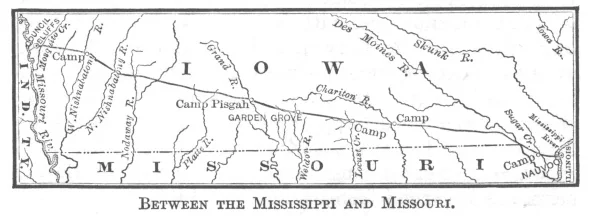
BETWEEN THE MISSISSIPPI AND MISSOURI.
were formed on both banks of the river, or at points near by, where grass was plentiful. In early autumn about 12,000 Mormons were assembled in this neighborhood, or were on their way across the plains.
Leaving here the advance portion of the emigration, let us return to Nauvoo and see how it fared with those who were still engaged in preparations for their pilgrimage. It had been stipulated, the reader will remember, that the Mormons should remove from the state in the spring, or as soon afterward as they could sell their property, and that meanwhile they should not be molested. Long before spring, thousands had crossed the Mississippi, among whom were all the more obnoxious members of the sect. Meanwhile, how had the gentiles kept their faith?
But passing the cause, what a picture was now presented by the deserted city and its exiled inhabitants!—the former, as Colonel Kane viewed it—but which view must be regarded as ideal rather than strictly historical—with "its bright new dwellings set in cool green gardens, ranging up around a stately dome-shaped hill, which was crowned by a noble marble edifice, whose high tapering spire was radiant with white and gold. The city appeared to cover several miles; and beyond it, in the background, there rolled off a fair country, checkered by the careful lines of fruitful husbandry."
To the Nauvoo Eagle Major Warren sent notice from Carthage, on the 16th of April, that he had been directed by the governor to disband on the 1st of May the force which had been kept there ostensibly for the protection of the saints, as the time appointed for their departure would expire on that day. 17 The day arrived, and there were yet many Mormons remaining, many who had found it impossible to remove on
account of sickness, failure to dispose of their property, or other adverse fortune; whereat the men of Illinois began to bluster and threaten annihilation. Warren, who had disbanded his troops on the 1st, received an order from the governor on the following day to muster them into service again. This he did; for he would, if possible, see the treaty between the Mormons and the governor faithfully carried out, and while urging the saints to haste, he endeavored to stand between them and the mob which now threatened their lives and the destruction of their property. 18
Major Warren appears to have performed his duty firmly and well, and to have done all that lay in his power to protect the Mormons. In a letter to the Quincy Whig, dated May 20th, he writes: "The Mormons are leaving the city with all possible despatch. During the week four hundred teams have crossed at three points, or about 1,350 souls. The demonstrations made by the Mormon people are unequivocal. They are leaving the state, and preparing to leave, with every means God and nature have placed in their hands." It was but the lower class of people that clamored for the immediate expulsion of the remnant of the saints—the ignorant, the bigoted, the brutal, the vicious, the lawless, and profligate, those who hated their religion and coveted their lands.
On the 6th of June the people of Hancock county met at Carthage to arrange for celebrating the 4th of July. One of the citizens rose and said that since the Mormons were not all removed they could not rejoice as freemen. Mormon affairs then took precedence, and another meeting was appointed for the 12th, an invitation being sent to the gentiles at Nauvoo who had occupied the deserted dwellings of the saints. It happened that this was the day appointed for the assembling of the militia, with a view to raise volunteers for the Mexican war; and now, it was thought, was a good opportunity to show the Mormons the military strength of the county. The officers conferred, and without authority from the governor, marched their troops, some three or four hundred in number, to a place called Golden Point, five miles from Nauvoo, where they encamped, and opened communication with the city. It happened, however, at this juncture, that Colonel Markham and others had returned with teams from Council Bluffs for some of the church property, and arming a force of six or eight hundred, prepared to sally forth; the name of Colonel Markham was a terror to evil-doers, and the militia fled, no one pursuing them.
There were yet remaining, as late as August, certain sturdy saints who, having committed no crime, would not consent to be driven from their homes or barred from their occupations. Among these was a party engaged in harvesting wheatat a settlement eight miles from Nauvoo, in company with one or two of the gentiles, although it was forbidden by the men of Illinois that any Mormon should show himself outside the city, except en route for the west. The harvesters were seized and beaten with clubs, whereupon the people of Nauvoo, both Mormons and gentiles, took up the matter. Some arrests were made, and the culprits taken to Nauvoo, but by writ of habeas corpus were removed to Quincy, where they met with little trouble. While in Nauvoo, a gun in the hands
of a militia officer was recognized by William Pickett as belonging to one of the harvesters. Pickett took possession of the weapon, and a warrant was issued against him for theft; when an officer came to arrest him, he refused to surrender. As the Mormons stood by him in illegal attitude, the affair caused considerable excitement.
In short, from the let of May until the final evacuation of the city, the men of Illinois never ceased from strife and outrage. Of the latter I will mention only two instances: "A man of near sixty years of age," writes Major Warren in the letter just referred to, "living about seven miles from this place, was taken from his house a few nights since, stripped of his clothing, and his back out to pieces with a whip, for no other reason than because he was a Mormon, and too old to make a successful resistance. Conduct of this kind would disgrace a horde of savages." In August a party consisting of Phineas H. Young, his son Brigham, and three others who were found outside the city, were kidnapped by a mob, hurried into the thickets, passed from one gang to another—men from Nauvoo being in hot pursuit—and for a fortnight were kept almost without food or rest, and under constant threat of death.
Fears are now entertained that, by reason of the popular feeling throughout the country, Nauvoo city will be again attacked; the gentile citizens therefore ask Governor Ford for protection, whereupon Major Parker is sent to their relief. 19 All through August
troubles continue, the anti-Mormons almost coming to blows among themselves. Before the end of the month about six hundred men are assembled at Carthage, by order of Thomas Carlin, a special constable, ostensibly to enforce the arrest of Pickett, but in reality to enforce the expulsion of the Mormons. Major Parker orders the constable's posse to disperse, otherwise he threatens to treat them as a mob. The constable replies that if the major should attempt to molest them in discharge of their duty he will regard him and his command as a mob and so treat them. "Now, fellow-citizens," declares a committee selected from four counties, 20 in a proclamation issued at Carthage, "an issue is fairly raised. On the one hand, a large body of men have assembled at Carthage, under the command of a legal officer, to assist him in performing legal duties. They are not excited—they are cool, but determined at all hazards to execute the law in Nauvoo, which has always heretofore defied it. They are resolved to go to work systematically and with ample precaution, but under a full knowledge that on their good and orderly behavior their character is staked. On the other hand, in Nauvoo is a blustering Mormon mob, who have defied the law, and who are now organized for the purpose of arresting the arm of civil power. Judge ye which is in the right."
Intending, as it seems, to keep his word, Carlin places his men under command of Colonel Singleton, who at once throws off the mask, and on the 7th of September announces to Major Parker that the Mormons must go. On the same day a stipulation is made, granting to the saints sixty days' extension of time, and signed by representatives on both sides. 21
But to the terms of this stipulation the men of Illinois would not consent. They were sore disgusted, and rebelled against their leaders, causing Singleton, Parker, and others to abandon their commands, the posse being left in charge of Constable Carlin, who summoned to his aid one Thomas Brockman, a clergyman of Brown county, and for the occasion dubbed general. On the 10th of September the posse, now more than a thousand strong, with wagons, equipments, and every preparation for a campaign, approached Nauvoo and encamped at Hunter's farm.
At this time there were in the city not more than a hundred and fifty Mormons, and about the same number of gentiles, or, as they were termed, 'new citizens,' capable of bearing arms, the remainder of the population consisting of destitute women and children and of the sick. Many of the gentiles had departed, fearing a general massacre, and those who remained could not be relied upon as combatants, for they were of course unwilling to risk their lives in a conflict which, if successful, would bring them no credit. Nothing daunted, the little band, under command of colonels Daniel H. Wells 22 and William Cutler, took up its position on the edge of a wood in the suburbs of Nauvoo, and less than a mile from the enemy's camp. 23
Before hostilities commenced, a deputation from Quincy 24 visited the camp of the assailants, and in vain attempted to dissuade them from their purpose. No sooner had they departed than fire was opened on the Mormons from a battery of six-pounders, but without effect. Here for the day matters rested. At sunrise the posse changed their position, intending to take the city by storm, but were held in cheek by
Captain Anderson 25 at the head of thirty-five men, termed by the saints the Spartan band. The enemy now fired some rounds of grape-shot, forcing the besieged to retire out of range; and after some further cannonading, darkness put an end to the skirmish, the Mormons throwing up breastworks during the night. 26
On the morning of the 12th the demand of unconditional surrender was promptly rejected; whereupon, at a given signal, several hundred men who had been stationed in ambush, on the west bank of the river, to cut off the retreat of the Mormons, appeared with red flags in their hands, thus portending massacre. The assailants now opened fire from all their batteries, and soon afterward advanced to the assault, slowly, and with the measured tramp of veterans, at their head being Constable Carlin and the Reverend Brockman, and unfurled above them—the stars and stripes. When within rifle-range of the breastworks the posse wheeled toward the south, attempting to outflank the saints and gain possession of the temple square. But this movement had been anticipated, and posted in the woods to the north of the Mormon position lay the Spartan band. Leading on his men at double-quick, Anderson suddenly confronted the enemy and opened a brisk fire from revolving rifles. 27 The posse advanced no farther, but for an hour and a half held their ground bravely against the Spartan band, the expense of ammunition in proportion to casualties being greater than has yet been recorded in modern warfare. Then they retreated in excellent order to the camp. The losses of the Mormons were three killed and a few slightly wounded; the losses of the gentiles are variously
stated. 28 Among those who fell were Captain Anderson and his son, a youth of sixteen, the former dying, as he had vowed that he would die, in defence of the holy sanctuary.
The following day was the sabbath, and hostilities were not renewed; but on that morning a train of wagons, despatched by the posse for ammunition and supplies, entered the town of Quincy. It was now evident that, whether the men of Illinois intended massacre or forcible expulsion, it would cost them many lives to effect either purpose. With a view, therefore, to prevent further bloodshed, a committee of one hundred proceeded to Nauvoo and attempted mediation. At the same time the Reverend Brockman sent in his ultimatum, the terms being that the Mormons surrender their arms, and immediately cross the river or disperse, and that all should be protected from violence. 29 There was no alternative. The armed mob in their front was daily swelling in number, while beyond the river still appeared the red flag; their own ranks, meanwhile, were being rapidly thinned by defection among the new citizens. 30
On the 17th of September the remnant of the Mormons crossed the Mississippi, and on the same day the gentiles took possession of Nauvoo. 31
It was indeed a singular spectacle, as I have said, this upon the western border of the world's great republic in the autumn of 1846. A whole cityful, with other settlements, and thousands of thrifty
agriculturists in the regions about, citizens of the United States, driven beyond the border by other citizens: not by reason of their religion alone, though this was made a pretence; not for breaking the laws, though this was made a pretence; not on account of their immorality, for the people of Illinois and Missouri were not immaculate in this respect; nor was it altogether on account of their solid voting and growing political power, accompanied ever by the claim of general inheritance and universal dominion, though this last had more to do with it probably than all the rest combined, notwithstanding that the spirit of liberty and the laws of the republic permitted such massing of social and political influence, and notwithstanding the obvious certainty that any of the gentile political parties now playing the role of persecutors would gladly and unscrupulously have availed themselves of such means for the accomplishment of their ends. It was all these combined, and so combined as to engender deadly hate. It gave the Mormons a power in proportion to their numbers not possessed by other sects or societies, which could not and would not endure it; a power regarded by the others as unfairly acquired, and by a way and through means not in accord with the American idea of individual equality, of equal rights and equal citizenship. In regard to all other sects within the republic, under guard of the constitution, religion was subordinated to politics and government; in regard to the Mormons, in spite of the constitution, politics and government were subordinated to religion.
And in regard to the late occupants of the place, the last of the Mormon host that now lay huddled to the number of 640 on the western bank of the river in sight of the city: 32 if the first departures from Nauvoo escaped extreme hardships, not so these. It was the
latter part of September, and nearly all were prostrated with chills and fevers; 33 there at the river bank, among the dock and rushes, poorly protected, without the shelter of a roof or anything to keep off the force of wind or rain, little ones came into life and were left motherless at birth. 34 They had not food enough to satisfy the cravings of the sick, nor clothing fit to wear. For months thereafter there were periods when all the flour they used was of the coarsest, the wheat being ground in coffee and hand mills, which only cut the grain; others used a pestle; the finer meal was used for bread, the coarser made into hominy. Boiled wheat was now the chief diet for sick and well. For ten days they subsisted on parched corn. Some mixed their remnant of grain with the pounded bark of the slippery elm which they stripped from the trees along their route.
This encampment was about two miles above Montrose on the Mississippi, and was called the Poor Camp. Aid was solicited, and within three weeks a little over one hundred dollars was collected, mostly in Quincy, with provisions and clothing, though the prejudice against them was deep and strong. 35 Some of the people were crowded into tents, made frequently of quilts and blankets; others in bowers made of brush; others had only wagons for shelter. They suffered from heavy thunder-storms, when the rain was bailed out with basins from their beds. Mothers huddled their children in the one dress which often was all they possessed, and shaking with ague or burning with fever, took refuge from the pitiless storms under wagons and bushes. 36
"While the people for the most part were ill with chills and fever," says Wells, "quail fell into camp and were picked up with ease. 37 This supply was looked upon as miraculous by the half famished people. So long had they been lashed by the fierce winds of misfortune, that now they accepted with gratitude this indication of providential care.
Wagons were sent from Winter Quarters for the removal of the people from Poor Camp; and gradually all reached the various stations in which the Mormons had gathered. 38
Of their long journey many painful incidents are recorded. Weakened by fever or crippled with rheumatism, and with sluggish circulation, many were severely frost-bitten. Women were compelled to drive the nearly worn-out teams, while tending on their knees, perhaps, their sick children. The strength of the beasts was failing, as there were intervals when they could be kept froth starving only by the browse or tender buds and branches of the cotton-wood, felled for the purpose. 39
At one time no less than two thousand wagons could be counted, it was said, along the three hundred miles of road that separated Nauvoo from the Mormon encampments. Many families possessed no wagons,
and in the long procession might be seen vehicles of all descriptions, from the lumbering cart, under whose awning lay stretched its fever-stricken driver, to the veriest makeshifts of poverty, the wheelbarrow or the two-wheeled trundle, in which was dragged along a bundle of clothing and a sack of meal—all of this world's goods that the owner possessed.
On arriving at the banks of the Missouri, the wagons were drawn up in double lines and in the form of squares. Between the lines, tents were pitched at intervals, space being left between each row for a passage-way, which was shaded with awnings or a lattice-work of branches, and served as a promenade for convalescents and a playground for children.
And what became of Nauvoo? The temple was destroyed by fire and tempest, 40 and all the wood-work consumed, while the rock was utilized for miles around as foundations of houses, for door-steps, and other purposes. A French company coming in later bought the stone from those in possession, and built wine-vaults. Foundations of buildings were broken up, and houses once surrounded by carefully tended flower-gardens, pillaged of all that was valuable, were now abandoned by their ruthless destroyers. 41 "At present," writes Linforth, "the Icarians form the most important part of the population of Nauvoo…They live in a long ugly row of buildings, the architect of which and of the school-house was a cobbler." In the house built for the prophet and his family dwelt in 1854 the prophet's widow, his mother, and his family. 42
Footnotes
214:1 Parley Pratt's calculation for an outfit of every family of 5 persons was 1 good wagon, 3 yoke cattle, 2 cows, 2 beef cattle, 3 sheep, 1,000 lbs flour, 20 lbs sugar, 1 rifle and ammunition, a tent and tent-poles, from 10 to 20 lbs seed to a family, from 25 to 100 lbs tools for farming, and a few other items, the cost being about $250, provided they had nothing else but bedding and cooking utensils. Hist. B. Young, MS., 125.
214:2 In December the drying-house of emigrating company no. 18 was burned to the ground, consuming $300 worth of wagon timber. Id., MS., Dec, 1845.
215:3 Kane, with the carelessness usual in his statements, says that the temple was completed and consecrated in May, and that the day after its consecration its ornaments were carried away. 'For that one day the temple shone resplendent in all its typical glories of sun, moon, and stars, and other abounding figured and lettered signs, hieroglyphs, and symbols; but that day only. The sacred rites of consecration ended, the work of removing the sacrasancta proceeded with the rapidity of magic. It went on through the night; and when the morning of the next day dawned,' all the ornaments and furniture, everything that could provoke a sneer, had been carried off; and except some fixtures that would not bear removal, the building was dismantled to the bare walls. It was this day saw the departure of the last elders, and the largest hand that moved in one company together. The people of Iowa have told me that from morning to night they passed westward like an endless procession. They did not seem greatly out of heart, they said; but at the top of every hill, before they disappeared, were to be seen looking back, like banished Moors, on their abandoned homes and the far-seen temple and its glittering spire.' The Mormons, 21.
215:4 Times and Seasons, vi. 1018. In this number is a notice, signed by Willard Richards, cutting off William Smith, the prophet's brother, for apostasy.
217:5 'The Mormons went up and down with their furniture, etc., and traded for anything that could travel, such as an animal or a wagon…Another company went out in May, but they did not sell their property, leaving it in the hands of trustees to sell.' Wells’ Narrative, MS., 37. Their two-story brick house, which they had occupied but three months, and which they had denied themselves in every way to build, Mrs Richards says was sold for 'two yoke of half-broken cattle and an old wagon.' Reminiscences, MS., 20.
217:6 When we were to leave Mo., the saints entered into a covenant not to cease their exertions until every saint who wished to go was removed, which was done…We are better off now than we were then;…he [B. Y.] wants to see this influence extend from the west to the east sea.' Brigham moved: 'That we take all the saints with us, to the extent of our ability, that is, our influence and property; seconded by Elder Kimball, and carried unanimously.' This covenant was entered into Oct. 6, 1845. Times and Seasons, vi. 1011.
218:7 'We encamped at Sugar Creek, in the snow, while two of my children were very ill. We slept in our wagons, which were placed close to our tents.' Horne's Migrations, MS., 16.
219:8 The camp of Israel was wherever the president and apostles were.
219:9 It has been stated that after dismissing his congregation on the 17th the president led several of the twelve aside to a valley east of the camp, and held a council. A letter was then read from Samuel Brennan, a Mormon elder then in New York, together with a copy of an agreement between him and one A. G. Benson. Brennan was at that time in charge of a company of saints bound for the Pacific coast by way of Cape Horn, and the agreement which he forwarded for Brigham's signature required the pioneers to transfer to A. G. Benson and company the odd numbers of all the town lots that they might acquire in the country where they settled. 'I shall select,' writes Brennan, 'the most suitable spot on the bay of San Francisco for the location of a commercial city.' the council refused to take any action in the matter. In case they refused to sign the agreement, Tullidge soberly relates, Life of Brigham Young, 19-23, the president, it was said, would issue a proclamation, setting forth that it was the intention of the Mormons to take sides with either Mexico or Great Britain against the United States, and order them to be disarmed or dispersed! Further mention of this matter is made in History of California, vol. v. cap. xx., this series.
220:10 'In the latter part of March we started for Council Bluffs, 400 miles distant, and were three months on the way. Crossing a long prairie in a fearful storm, the mud became so soft that we could not travel, and we were obliged to encamp; the water was several inches deep all over our camping-ground; we had no wood for a fire, and no means of drying our soaked clothing. In the morning everything was frozen fast; and a squirrel was found frozen…Frequently boughs were laid on the ground before the teams could pass…We had to camp in mad until the roads were dry enough to travel.' Horne's Migrations, MS., 18-19.
221:11 'It is true,' he writes, 'that in our sojourning we do not possess all the luxuries and delicacies of old-established countries and cities, but we have abundance of the staple commodities, such as flour, meal, beef, mutton, pork, milk, butter, and in some instances cheese, sugar, coffee, tea, etc.' Letter in Millennial Star, viii. 114.
221:12 Each family had prayers separately. Taylor's Rem., MS., 9.
222:13 In Lee County, Iowa, three weeks from their staging-point.
222:14 About 150 miles from Nauvoo, on the east fork of the Grand River. 'Many located there, ploughing and sowing, and preparing homes for their poor brethren for a longer period.' Horne's Migrations, MS., 19. 'On the morning of the 27th of April the bugle sounded at Garden Grove, and all the men assembled to organize for labor. Immediately hundreds of men were at work, cutting trees, splitting rails, making fences, cutting logs for houses, building bridges, making ploughs, and herding cattle. Quite a number were sent into the Missouri settlements to exchange horses for oxen, valuable feather-beds and the like for provisions and articles most needed in the camp, and the remainder engaged in ploughing and planting. Messengers were also despatched to call in the bands of pioneers scattered over the country seeking work, with instructions to hasten them up to help form the new settlements before the season had passed; so that, in a scarcely conceivable space of time, at Garden Grove and Mount Pisgah, industrious settlements sprung up almost as if by magic.' Tullidge's Life of Brigham Young, 41.
222:15 This site was discovered by Parley, who was sent forward to reconnoitre by Brigham. It was situated on a branch of Grand River, and for years was the resting-place for the saints on their way to Utah. Autobiog. P. Pratt, 381.
222:16 Here 700 log cabins and 150 dugouts (cabins half under ground) were built. A large quantity of hay was cut, and a flouring mill erected. Id., 383.
223:17 'The removal of the entire population,' the major adds, has been looked forward to as an event that could alone restore peace and quiet to this portion of our state,' Fullmer's Expulsion, 24.
224:18 'Thus while with one hand he pushed the saints from their possessions across the river to save their lives, with the other he kept at bay the savage fiends who thirsted for blood, and who would fain have washed their hands in the blood of innocence, and feasted their eyes on the smoking ruins of their martyred victims.' Id., 24-5. From Nauvoo, May 11, 1846, Warren writes: 'To the Mormons I would say, Go on with your preparations, and leave as fast as you can. Leave the fighting to be done by my detachment. If we are overpowered, then recross the river and defend yourselves and property. The neighboring counties, under the circumstances, cannot and will not lend their aid to an unprovoked and unnecessary attack upon the Mormons at this time; and without such aid the few desperadoes in the county can do but little mischief, and can be made amenable to the law for that little. The force under my command is numerically small; but backed as I am by the moral force of the law, and possessing as I do the confidence of nine tenths of the respectable portion of the old citizens, my force is able to meet successfully any mob which can be assembled in the county, and if any such force does assemble, they or I will leave the field in double-quick time.'
226:19 'Sir—I have received information that another effort is to be made on Monday next to drive out the inhabitants of Nauvoo, new as well as old, and destroy the city. I am informed that it is believed in the surrounding counties that the new citizens in Nauvoo are all Mormons, and that the remnant of the old Mormon population are determined to remain there, although I am assured that the contrary in both particulars is the truth. You are therefore hereby authorized and empowered to repair to Nauvoo, and there remain until you are relieved. You will immediately inquire how many of the inhabitants are new citizens, and how many of them are Mormons; how many of the old Mormon population remain, and what the prospect is of their removal in a reasonable time; and in case an attack on the city should be attempted or threatened, you are hereby authorized to take command of such volunteers as may offer themselves, free of cost to the state, to repel it and defend the city.' Fullmer's Expulsion, 29-30.
227:20 Among the members was the Rev. Thomas S. Brockman, who afterward took command of the posse.
227:21 Hostilities to cease; the city to be evacuated in 60 days, 25 men remaining to see the stipulation carried out. Id., 34-5.
228:22 Who afterward became lieut-gen. of the Nauvoo legion in Utah.
228:23 There were about 300 Mormons and new citizens who could then bear arms against the mob, but on the day of the fight no more than 100 could be found to go, as the Mormons were continually leaving.' Wells’ Narrative, MS., 39.
228:24 John Wood, the mayor, Major Flood, Dr Conyera, and Joel Rice. See Wells’ Narrative, MS., passim.
229:25 He was more than brave, he was presumptuous. Wells, in Utah Notes, MS., p. 7.
229:26 'Many of our log houses were torn down by the mob, which numbered 1,000 men; we made barricades of corn-stalks stacked up.' Wells, in Utah Notes, MS., 7.
229:27 Elder John S. Fullmer, then a colonel in the Nauvoo legion, claims that he directed this movement. Expulsion, 38.
230:28 'But three in all were killed…Meetings were held to stop the effusion of blood,…but there was no necessity for such action, when no blood was shed.' Wells, in Utah Notes, 7.
230:29 '1st. The city of Nauvoo will surrender. The force of Reverend Brockman to enter and take possession of the city to-morrow, the 17th of September, at three o'clock P.M. 2d. The arms to be delivered to the Quincy committee, to be returned on crossing the river. 3d. The Quincy committee pledge themselves to use their influence for the protection of persons and property, and the officers of the camp and the men likewise pledge themselves. 4th. The sick and helpless to be protected and treated with humanity. 5th. The Mormon population of the city to leave the state or disperse as soon as they can cross the river. 6th. Five men, including the trustees of the church, and five clerks with their families (William Pickett not one of the number), to be permitted to remain in the city for the disposition of property, free from all molestation and personal violence. 7th. Hostilities to cease immediately, and ten men of the Quincy committee to enter the city in the execution of their duty as soon as they think proper.' It will be observed that nothing is said about the surrender of Pickett. He was not even arrested.
230:30 'The mob entered the temple, instituted an inquisition, and regardless of the Mormons or new citizens, went from house to house plundering cow-yards, pig-pens, hen-roosts, and bee-stands indiscriminately; thus turning some of their best friends into enemies, bursting open trunks and cheats, searching for arms, keys, etc.' p. 343. 'In the temple ringing the bells, shouting, and hallooing; they took several to the river and baptized them, swearing, throwing them backward, then on to their faces, saying: "The commandments must be fulfilled, and God damn you."'. Hist. B. Young, MS., 345.
231:31 The best narrative, and indeed the only one that enters circumstantially into all the details of the expulsion from Nauvoo, is contained in the Assassination of Joseph and Hyrum Smith, the Prophet and the Patriarch of the Church of Latter-day Saints. Also a Condensed History of the Expulsion of the Saints from Nauvoo by Elder John S. Fullmer (of Utah, U. S. A.), Pastor of the Manchester, Liverpool, and Preston Conferences. Liverpool and London, 1855. The work is written from a Mormon standpoint, but including as it does copies of the despatches of Illinois officers and officials, of the stipulations between the belligerents, and of some comments made by the Quincy Whig, appears in the main reliable. The author's comments on the gentiles are sufficiently bitter, and his description of the fight at Nauvoo and the valor of the saints militant must of course be taken with due allowance. For instance: 'Seeing our men take possession of some vacant buildings on the line of their approach, they took a position on an elevated spot of ground, and opened a heavy cannonade at a distance of something less than half a mile. This was returned with great spirit on our part from guns made of steam shafts that carried six-pound balls. Many were the balls that we picked up as they came rolling and bounding among us, and we sent them back with as much spirit and precision as they were first sent.' p. 37. Col Kane says: 'A vindictive war was waged upon them, from which the weakest tied in scattered parties, leaving the rest to make a reluctant and almost ludicrously unavailing defence.' The Mormons, 54. In the General Epistle of the Twelve, Dec. 23, 1847, in Snow's Voice of Joseph, 14-15, we read: 'In September 1846 an infuriated mob, clad in all the horrors of war, fell on the saints who had still remained in Nauvoo for want of means to remove, murdered some, and drove the remainder across the Mississippi into Iowa, where, destitute of houses, tents, food, clothing, or money, they received temporary assistance from some benevolent souls in Quincy, St Louis, and other places, whose names will ever be remembered with gratitude. Their property in Hancock co., Illinois, was little or no better than confiscated; many of their houses were burned by the mob, and they were obliged to leave most of those that remained without sale; and those who bargained sold almost for a song; for the influence of their enemies was to cause such a diminution in the value of property that for a handsome estate was seldom realized enough to remove the family comfortably away; and thousands have since been wandering to and fro, destitute, afflicted, and distressed for the common necessaries of Life, or unable to endure, have sickened and died by hundreds; while the temple of the Lord is left solitary in the midst of our enemies, an enduring monument of the diligence and integrity of the saints.' Mention of the expulsion from Nauvoo is of course made in most of the books published on Mormonism, but in none of them, except perhaps in one or two of the meet rabid anti-Mormon works, which I have not thought it worth while to notice, is the conduct of the Illinois mob defended.
232:32 A few months before, Nauvoo with the neighboring Mormon settlements had contained some 20,000 saints, of whom in July about 15,000 were encamped on the Missouri River, or were scattered through the western states in search of employment.
233:33 While at Montrose, Heber C. Kimball writes thus in his journal of the condition of his family, his wife having a babe a few days old, and he himself ill with ague. 'I went to the bed; my wife, who was shaking with the ague, having two children lying sick by her side;…the only child well was little Heber Parley, and it was with difficulty he could carry a two-quart pail full of water from a spring at the bottom of the hill.'
233:34 'Such deaths occurred from exposure and fright in Nauvoo. The camp journalist recorded: Effect of persecution by the Illinois mob.'
233:35 The trustees from Nauvoo also distributed clothing, and molasses, salt, and salt pork. Hist. B. Young, MS., 1846, 383.
233:36 Mrs Clara Young's Experience, MS., 3.
234:37 'On the 9th of October, while our teams were waiting on the banks of the Miss. for the poor saints…left without any of the necessaries of life,…and nothing to start their journey with, the Lord sent flocks of quail, which lit upon their wagons and on their empty tables, and upon the ground within their reach, which the saints, and even the sick, caught with their hands until they were satisfied.' Hist. B. Young, MS., 1847, 9. This phenomenon extended some 30 or 40 miles along the river, and was generally observed. The quail in immense quantities had attempted to cross the river, but it being beyond their strength, had dropped into the river boats or on the bank.' Wells, in Utah Notes, MS., 7.
234:38 See The Mormons: A Discourse delivered before the Historical Society of Pennsylvania, March 26, 1850, by Thomas L. Kane. Philadelphia, 1850. A copy of it will be found at the end of Orson Pratt's Works, and in Mackay's The Mormons, 200-45. The story of the Mormon exodus, as handed down to us by a man of Colonel Kane's powers of observation, would have been a valuable record were it not plainly apparent that truth is too often sacrificed to diction. Among Mormon writers we find no detailed narrative of this exodus, and among others little that is not borrowed from the colonel's discourse.
234:39 Snow's Biography, 89.
235:40 The temple was half destroyed by fire on Nov. 19, 1848. Nauvoo Patriot, in Millennial Star, xi. p. 46; and on May 27, 1850, further damaged by a tornado. Hancock Patriot, in Mackay's The Mormons, 210. For cut of remnants, see Linforth's Route from Liverpool to G. S. L. Valley, 62, and Hyde's Mormonism, 140. See also George Q. Cannon, in Juvenile Instuctor, vol. ix. no. 5, and Wells’ Narrative, MS., 41; Deseret News, Aug. 24, 1850; Frontier Guardian, July 24, 1850.
235:41 As James Linforth describes in writing of Nauvoo in 1858.
235:42 Route from Liverpool to G. S. L. Valley, 63.
CHAPTER IX.
AT THE MISSOURI.
1846-1847.
Native Races of the Missouri—the Pottawattamies and the Omahas—the Mormons Welcomed As Brethren—War With Mexico—Californila Territory—Mexican Boundaries—Application to the United States Government for Aid—An Offer to Serve As Soldiers Accepted—Organization of the Mormon Battalion—Departure of the Battalion—Bounty Money—March Across the Continent—the Battalion in California—Matters on the Missouri.
Among the savages on either side of the Missouri, the Pottawattamies on the east side and the Omahas on the west side, the outcasts from Nauvoo were warmly welcomed. "My Mormon brethren," said the chief Pied Riche, 1 "the Pottawattamie came sad and tired into this unhealthy Missouri bottom, not many years back, when he was taken from his beautiful country beyond the Mississippi, which had abundant game and timber and clear water everywhere. Now you are driven away in the same manner from your lodges and lands there, and the graves of your people. So we have both suffered. We must help one another, and the great spirit will help us both."
Extreme care was taken not to infringe in any way upon the rights of the Indians or the government. Brigham counselled the brethren to regard as sacred the burial customs of the natives; frequently their dead were deposited in the branches of trees, wrapped in buffalo robes and blankets, with pipes and trinkets
beside them. At Cutler Park there were friendly negotiations made with Big Elk, chief of the Omahas, who said: "I am willing you should stop in my country, but I am afraid of my great father at Washington." 2
As the United States pretended to hold the title to the land, it was thought that the Pottawattamies had no right to convey their timber to others; so Brigham enjoined that there should be no waste of timber within these limits, but that as much as was necessary might be used. A permit for passing through their territory, and for remaining while
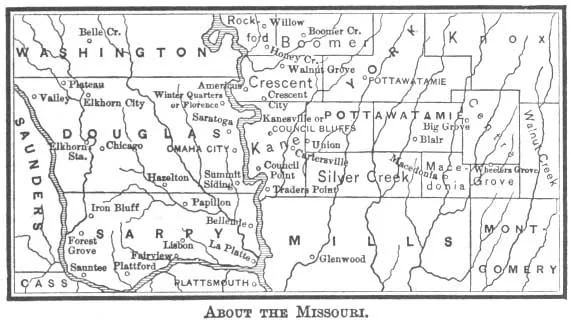
ABOUT THE MISSOURI.
necessary, was obtained from Colonel Allen, who was acting for the United States. 3
Although it was late in the season when the first bands of emigrants crossed the Missouri, some of them still moved westward as far as the Pawnee villages on Grand Island, intending to select a new home before winter. But the evil tidings from Nauvoo, and the destitute condition in which other parties of the
saints reached the Mormon encampments, forbade further progress, and all prepared to spend the winter on the prairie. To the Mormon encampment on the site of the present town of Council Bluffs was afterward given the name of Kanesville. 4
While the saints were undergoing their infelicities at Nauvoo, war had broken out between the United States and Mexico. At that time New Mexico and California were a part of Mexico, and Utah and Nevada were a part of California. 5 Journeying west from Nauvoo, California or Oregon would be reached. The latter territory was already secured to the United States; people were there from the United States, composing religious sects and political parties as jealous of their holdings as any in Missouri or Illinois. Vancouver Island 6 was practically unoccupied, but the Hudson's Bay Company would scarcely regard with favor its occupation by a large body of American citizens whose government was at that moment crowding them out of the Oregon territory and across the Columbia River.
But had the Mormons known their destination, had they known what point among the mountains or
beside the sea was to be their final resting-place, they would not have told it. When they turned their back on Nauvoo, the whole western coast was before them, with its multitudinous mountains and valleys, its rivers and lakes, and long line of seaboard. Of the several parts of this immense territory, ownership and right of occupation were not in every instance determined. The question of the boundary line between England's possessions and those of the United States had stirred up no small discussion and feeling, and out of the present war with Mexico would doubtless arise some changes. 7 It was a foregone conclusion in the minds of many, before ever the migratory saints had reached the Missouri River, that when the present troubles with Mexico were ended the United States would have California. But however this might be, the saints had a firm reliance on an overruling providence, and once adrift upon the vast untenanted west, their God and their sagacity would point out to them their future home. Thus it was that while the Mormons in the western states took the route overland, another portion living at the east took passage round Cape Horn, the intention being that the two bodies of brethren should come together somewhere upon the Pacific slope, which indeed they did. 8
The national title to what is now the Pacific United States being at this time thus unsettled, and the Mormons having been driven from what was then
the United States, it was considered but natural, as indeed it seemed to be a necessity, that they would take possession of such unoccupied lands in the region toward the Pacific as best suited them. But it was not necessary that they should hold possession of such lands in opposition to the government of the United States, as they have been charged with doing.
They now applied to the government at Washington for work, offering to open roads, transport military stores, or perform any other service which the government might require in this farthest west, even to assist in fighting its battles. Such occupation would be of the greatest advantage to them in this new country, where land was fertile and plenty and free, and possessing as they did large herds of cattle and horses and sheep, with no market and but little money. And on the other hand, being on the ground, accustomed to work, and having every facility at hand without long and expensive transportation, they could give more and better work for the pay than the government could obtain by any other means.
They even asked for aid direct about the time the exodus began, being represented at Washington by Elder Jesse C. Little, 9 who, aided by Colonel Kane, Amos Kendall, and others, brought the matter before President Polk. While negotiations were yet in progress, news arrived that General Taylor had already won two victories over the Mexicans; whereupon the elder addressed a petition to the president, stating that from twelve to fifteen thousand Mormons had set forth from Nauvoo for California, while some had departed by sea, and in Great Britain alone were forty thousand converts, all resolved to join the saints in their promised land. Many of them were without means; they were compelled to go; they wanted assistance
either in the way of work or otherwise. The Mormons were true-hearted Americans, the memorial went on to say, and if the government would assist them in their present emergency, the petitioner stood ready to pledge himself as their representative to answer any call the government might make upon them for service on the field of battle.
Elder Little was taken at his word. At a cabinet meeting, held a day or two after his petition was presented, the president advised that the elder be sent at once to the Mormon camps, and there raise a thousand men to take possession of California in the name of the United States, while a thousand more be sent by way of Cape Horn for the same purpose, on board a United States transport. It was finally arranged that the elder, in company with Kane, should proceed westward, the latter bearing despatches to Kearny, then at Fort Leavenworth, with a view to raising a corps of about five hundred men.
On the 19th of June, Kearny issued an order to Captain James Allen of the 1st dragoons to proceed to the Mormon camp, and there raise four or five companies of volunteers, to be mustered into the service of the United States and receive the pay and rations of other infantry volunteers. They were then to be marched to Fort Leavenworth, where they would be armed; after which they would proceed to California by way of Santa Fé. They were to enlist for twelve months, after which time they were to be discharged, retaining as their own property the arms furnished them.
In pursuance of his orders, Captain Allen proceeded to Mount Pisgah, where on the 26th he made known his mission. After a conference with the church council at that point, Allen went to Council Bluffs, where on the 1st of July it was determined by President Young that the battalion should be raised. In two weeks the corps was enrolled, and mustered in on the 16th of July, the president of the church
promising to look after the wants of the families of those enlisting.
Though in reality a great benefit to the brethren, there were some hardships connected with the measure. 10 As Brigham and others were on their way from Council Bluffs to Pisgah to aid in obtaining these recruits, they passed 800 west-bound wagons. At their encampments on each side the river there was much serious illness, and as many of the teamsters had been withdrawn for this campaign, much heavy work fell upon the women and children, and the aged and infirm. 11
After a ball on the afternoon of the 19th, the volunteers next day bade farewell to their families and friends, and accompanied by eighty women and children, 12 set forth on their march, 13 on the 1st of August arriving at Fort Leavenworth. Here the men received
their arms and accoutrements, and to each was given a bounty of forty dollars, most of the money being sent back to the brethren by the hands of elders Hyde, Taylor, and others, who accompanied the battalion to that point, and there bade them God speed. 14
About the middle of August the corps resumed its march toward Santa Fé, a distance of seven hundred miles, arriving at that place in two parties on the 9th and 12th of October. There eighty-eight men were invalided and sent back to Pueblo for the winter, and later a second detachment of fifty-five, being found unfit for service, was also ordered to Pueblo. 15 Many of them found their way during the following year to the valley of Great Salt Lake.
From Santa Fé the remainder of the troops set forth for San Diego, a journey of more than eleven hundred miles, the entire distance between that, town and the Mormon camps on the Missouri exceeding two thousand miles. Much of the route lay through a pathless desert; at few points could food be obtained in sufficient quantity for man or beast, and sometimes even water failed. Wells were sunk in the wilderness; but on one occasion, at least, the men travelled for a hundred miles without water. 16 Before leaving Santa
Fé rations were reduced, 17 and soon afterward further reduced to one half and finally to one quarter allowance, the meat issued to the troops being the flesh of such animals as were unable to proceed further, though their hides and entrails were eagerly devoured, being gulped down with draughts of water, when water could be had. 18 While suffering these hardships the men were compelled to carry their own knapsacks, muskets, and extra ammunition, and sometimes to push the wagons through heavy sand, or help to drag them over mountain ranges.
Passing through a New Mexican pueblo on the 24th of October, some of the men were almost as naked as on the day of their birth, except for a breech-clout, or as their colonel termed it, a 'centre-clothing,' tied around the loins. In this plight, near the middle of December, the battalion reached the San Pedro River, some three hundred and forty strong, and here occurred the only battle which the saints militant fought during their campaign—an encounter with a
herd of wild bulls. Thence, without further adventure worthy of note, they continued their march, and reaching the Pacific coast on the 29th of January, 1847, found the stars and stripes floating peacefully over the town of San Diego. 19
A more detailed account of the career of the Mormon battalion will be found in my History of California. It remains only to add here that about one hundred of the men reached Salt Lake City in the winter of 1847, while some remained on the Pacific coast. 20
The alacrity displayed by the Mormon president in raising this battalion has been ascribed to various causes; to the fear of further persecution should the levy be refused, and to a desire of showing that, notwithstanding their maltreatment, the saints were still
unswerving in their loyalty to the United States. While all this carried weight, the bounty of twenty thousand dollars was no insignificant consideration, nor the hope that this battalion might serve as vanguard to Brigham's host, provided he carried out his partially formed purpose to settle in California.
At the close of 1846, about twelve thousand souls had assembled in the Mormon camps, a portion of them being yet stationed as far eastward as Garden Grove. Of the rest a few had made their way to some Atlantic port and taken ship for California; many had dispersed throughout the country, some of whom were now gathering at the rendezvous. Though the first bands that crossed the Mississippi encountered no very severe hardships, as I have said, the sufferings of those who set forth later have few parallels, even among the pioneers, who, a year or two afterward, followed their track westward in search of gold. 21
Mount Pisgah, the next encampment west of Garden Grove, was on the middle fork of Grand River. Through this winter of 1846-7, which was one of severest struggle, there was great lack of food and clothing. They could not go on because they had no teams, most of them being employed in bringing forward the emigration from the Mississippi. Many
families were entirely out of provisions, and their destitute neighbors were sorely taxed. 22 A fatal sickness swept through the camp, and soon there were not sufficient persons to nurse the sick; frequently burials were hastened with little ceremony. In the spring of 1847, Lorenzo Snow was made president of the camp. The men were put to work wherever they could get it. Seed was planted, and the result was enough not only for themselves, but they were enabled to send supplies to the camp at Council Bluffs. 23 Snow instituted religious ceremonies and amusements to brighten and encourage them. He describes a dance in his log cabin, where clean straw was spread over the ground floor, and the walls draped with sheets. Turnips were scooped out and in them were placed lighted candles, which, suspended from the ceiling of earth and cane, or fastened on the walls, imparted a picturesque effect. Dancing, speeches, songs, and recitations varied the exercises, which opened and closed with prayer.
On each side of the hills where now stands Council Bluffs could be seen the white canvas tents of a Mormon encampment, from which arose at sunrise the smoke of hundreds of fires. After the morning meal, the men employed themselves in tending herds, in planting grain and vegetables, or in building houses for winter. Many of them were excellent craftsmen, and could fell a tree, and split its trunk into boards, scantling, rails, posts, or whatever were needed, as
readily as the most expert backwoodsmen of their day. 24
During the summer and autumn months of 1846, the Papillon camp, near the Little Butterfly River, in common with the others, was stricken with fever, and with a scorbutic disease which the Mormons termed the black canker. In the autumn drought, the streams that discharge into the Missouri at this point are often little better than open sewers, pestilential as open cesspools, and the river, having lost more than half its volume, flows sluggishly through its channel of slime and sedge. Of the baked mud on either bank is formed the rich soil on which lay the encampments, the site being called, in their own phrase, Misery Bottom. In the year previous the Indians in this neighborhood had lost one ninth of their number; and now that the earth was for the first time upturned by the plough, the exhalations from this rank and steaming soil were redolent of disease and death.
In the camp nearest to Papillon more than one third of the company lay sick at the beginning of August; elsewhere matters were even worse; and as the season advanced there were in some of the encampments not one who escaped the fever, the few who were able to stagger from tent to tent carrying food and water to their comrades. For several weeks it was impossible to dig graves quickly enough for the burial of the dead, 25 and one might see in the open tents the wasted forms of women brushing away the flies from the putrefying corpses of their children.
Through all these months building was continually going on at Winter Quarters. 26 The axe and saw were
incessantly at work night and day. It was a city of mud and logs; the houses had puncheon floors and roofs of straw and dirt, or of turf and willows; they were warm and nat unwholesome, but would not endure the thaw, rain, and sunshine. 27
There was a camp at Cutler Park which was moved to Winter Quarters. Great difficulty was experienced in getting flour and meal; a little grain was ground at the government mill, and the rest was obtained in Missouri, a hundred and fifty miles distant. 28 Brigham kept everybody busy, and everything was well organized and systematically executed. 29 Schools were soon established, officers of the church appointed, and men sent on missions. The whole machinery was apparently in as active operation as it had been at Nauvoo. The gathering continued through the summer,
but it was deemed inexpedient to move forward that year. Some twelve hundred cattle were herded on the rush bottoms, about a hundred miles up the river.
The building of a water flouring mill was in process of construction, and Brigham superintended the work. As the camp journalist writes: "He sleeps with one eye open and one foot out of bed, and when anything is wanted he is on hand." The tithing collected was distributed among the destitute at Mount Pisgah. To the gentiles who visited their camps such hospitality was extended as their means permitted, which though often scant was never stinted.
Within the camp the women attended not only to their ordinary household duties, but were busily occupied spinning, knitting, making leggings from deer and elk skins, and in weaving willow baskets for market. 30 With cheerfulness and courage they adapted themselves to their many vicissitudes, their faith in their religion never swerving, and supported by it to a patient endurance beyond human strength. Most of them had exchanged their household treasures and personal effects, even to their table and bed furniture, for stores of maize or flour, which with milk were their only articles of diet. As evening approached, the tinkling of cattle bells announced the return of the men, when the women went forth to meet them, and welcome them back to their log hut and frugal meal. Then a little later all sounds were hushed, save that on the still night arose the strains of the evening hymn and the murmur of the evening prayer, the day closing, as it had commenced, with a supplication for the blessing of the Almighty, and with heartfelt thanksgiving that he had been pleased to deliver his people from the hands of their persecutors.
During the latter part of the winter and toward the early spring matters assumed a brighter look.
New-year's day was ushered in at Winter Quarters by the firing of cannon. 31 There were frequent assemblies for dancing, and in February several picnics were held. In inaugurating these festivities, Brigham told the people he would show them how to go forth in the dance in an acceptable manner before the Lord, 32 and to the sound of music led the dance. A picnic lasting for three days was also given, at which three hundred of the poor were feasted. 33
Footnotes
236:1 Surnamed Le Clerc, on account of his scholarship.
237:2 'The Omahas caused them some trouble, as they would steal with one hand while we fed them with the other.' Hist. B. Young, MS., 46, Oct. 18th.
237:3 Hist. B. Young, MS., 1846, 98-9. Maj. Harvey brought the Mormons at Winter Quarters letters from Washington, expecting them to leave the Pottawattamie lands in the spring. See cor., Hist. B. Young, MS., 441-52.
238:4 So called after Thomas L. Kane. Here was first issued on Feb. 7, 1849, the Frontier Guardian, and its publication was continued till March 22, 1852. Richards’ Narr., MS,, 65; Richards’ Bibliog. of Utah, MS., 13. The paper was edited by Orson Hyde, and makes a very creditable appearance. The subscription was $2 per year. In the second number we read: 'Flour nicely put up in sacks of from 50 to 100 lbs each will be received in exchange for the Guardian at the rate of $2 per hundred pounds, if good.' The last number of the Times and Seasons bears date Feb. 15, 1846.
238:5 I frequently find California and Utah confounded by writers of this early period. The limits of California on the east were not then defined, and it was not uncommon, nor indeed incorrect, to apply that term to territory east of the sierra. I find this written in Snow's Voice of the Prophet, 15: 'The pioneers discovered a beautiful valley beyond the pass of the great Rocky Mts, being a portion of the great basin of Upper California.' As we shall see later, the Mormons knew even less about Utah than they did about California.
238:6 Brigham Young at first suggested Vancouver Island. 'There are said to be many good locations for settlements on the Pacific, especially at Vancouver Island.' Circular to the brethren, in Times and Seasons, vi. 1019. In 1845 the report was current that the Mormons of Illinois had chosen V. I. as their future home, the metropolis to be situated at Nootka. Niles' Register, lxix. 134. The Quincy Whig thinks the Mormons intend to settle at Nootka Sound. Polynesian, ii. 1846.
239:7 In a letter to Pres. Polk, dated near Council Bluffs, Aug. 9, 1846, the determination was expressed, 'that as soon as we are settled in the great basin, we design to petition the U.S. for a territorial govt, bounded on the north by the British and south by the Mexican dominions, east and west by the summits of the Rocky and Cascade Mts.' And again elsewhere: 'We told Col Kane we intended settling in the great basin on Bear River Valley; that those who went round by water would settle in S. F. That was in council with the twelve and Col Kane.' Hist. B. Young, MS., 133, 140.
239:8 In his address to the saints in Great Britain, dated Liverpool, 1849, Elder John Taylor says: 'When we arrive in California, according to the provisions of the Mexican government, each family will be entitled to a large tract of land, amounting to several hundred acres; but as the Mexican and American nations are now at war, should Cal. fall into the hands of the American nation, there has been a bill before congress in relation to Or., which will undoubtedly pass, appropriating 640 acres of land to every male settler.' Millennial Star, viii. 115.
240:9 In the letter appointing and giving instructions to Elder Little is the following: 'If our government should offer facilities for emigrating to the western coast, embrace these facilities if possible. As a wise and faithful man, take every advantage of the times you can.' Tullidge's Life of Brigham Young, 48.
242:10 So ingrafted in their minds was the idea of persecution, and so accustomed were they now to complaining, that when the government acceded to their request, there were many who believed, and so expressed themselves, that this was but an act of tyranny on the part of the United States, whose people, after driving them from their borders, had now come upon them to make a draft on their healthiest and hardiest men, forcing them to separate from their wives and children now in the time of their extremest need, under penalty of extermination in case of refusal. And this idea, which was wholly at variance with the facts, is present in the minds of some even to this day. In order to facilitate enlisting, or for some other cause best known to himself, Brigham deemed it best to preserve this idea rather than wholly disabuse their minds of it; for in his address to the brethren on the 15th of July he said: 'If we want the privilege. of going where we can worship God according to the dictates of our consciences, we must raise the battalion.' In his address at the gathering of the pioneers on the 24th of July, 1880, Wilford Woodruff said: 'Our government called upon us to raise a battalion of 500 men to go to Mexico to fight the battles of our country. This draft was ten times greater, according to the population of the Mormon camp, than was made upon any other portion of our nation…Whether our government expected we would comply with the request or not, is not for me to say. But I think I am safe in saying that plan was laid by certain parties for our destruction if we did not comply.' Utah Pioneers, 33d Ann., 20.
242:11 'Most of our people were sick; in fact, the call for 500 able-bodied men from Council Bluffs for Mexico, by the government, deprived us of about all our strength.' Richards’ Rem., MS., 25.
242:12 Compare official report in U. S. House Ex. Doc., no. 24, 31st Cong., 1st Sess., and Tyler's Hist. Mormon Battalion, and note discrepancies in regard to numbers enlisted and discharged. The names of those who reached California will be found in my pioneer register, Hist. Cal., this series.
242:13 'The members started upon their pilgrimage cheerfully,' says Woodruff, 'understanding that they occupied the place of a ram caught in a thicket, and were making a sacrifice for the salvation of Israel.' Utah Pioneers, 20.
243:14 'Here they received 100 tents, one for every 6 privates.' 'The paymaster remarked that every one of the Mormon battalion could write his own name, but only about one third of the volunteers he had previously paid could do so.' Hist. B. Young, MS., 1846, 18. 'Five thousand eight hundred and sixty dollars was brought in by Parley Pratt from Ft Leavenworth, being a portion of the allowance for clothing paid the battalion. It was counselled that this money be expended in St Louis for the families; three prices have to be paid here;…we wish they should all act voluntarily, so that they may have no reflections to cast upon themselves or counsellors.' Id., MS., 1846, 150. 'When the goods were bought, prices had advanced and ferriage was very high, all of which brought the goods higher than was anticipated, and produced some grumbling in camp.' Id., MS., 1847, 12.
243:15 Families accompanying the battalion were ordered to Pueblo for winter quarters. Hist. B. Young, MS., 1S46, 260. A detachment was sent to Pueblo consisting of 89 men and 18 laundresses. Later in this vol., I refer to affairs at Pueblo as furnished me in a very valuable manuscript by Judge Stone of Colorado.
243:16 In a general order issued at San Diego on Jan. 30, 1847, by command of Lieut-col St George Cooke, then in charge of the battalion, vice Col Allen, deceased, the men are thus complimented on their safe arrival at the shores of the Pacific: 'History may be searched in vain for an equal march of infantry; nine tenths of it through a wilderness, where nothing but savages and wild beasts are found; or deserts where, for the want of water, there is no living creature. There, with almost hopeless labor, we have dug deep wells, which the future traveller will enjoy. Without a guide who had traversed them, we have ventured into trackless prairies, where water was not found for several marches. With crowbar and pickaxe in hand, we have worked our way over mountains which seemed to defy aught save the wild goat, and hewed a passage through a chasm of living rock, more narrow than our wagons.' Smith's Rise, Progress, and Travels, 10.
244:17 'Until further orders, three fourths pound of flour, also three fourths rations sugar and coffee will be issued. Beef, one and a half pounds will be issued for a day's ration.' Order No. 11, Headquarters Mormon Battalion, Santa Fé. A copy of it will be found in Tyler's Hist. Mor. Battalion, 175-6.
244:18 During the march from Santa Fé to San Diego a song was composed by Levi W. Hancock, a musician belonging to company E. It was entitled the 'Desert Route,' and commences:
While here beneath a sultry sky,
Our famished mules and cattle die;
Scarce aught but skin and bones remain;
To feed poor soldiers on the plain.
Chorus: How hard to starve and wear us out
Upon this sandy desert route.
We sometimes now for lack of bread,
Are less than quarter rations fed,
And soon expect, for all of meat,
Naught else than broke-down mules to eat.
Now half-starved oxen, over-drilled,
Too weak to draw, for beef are killed;
And gnawing hunger prompting men,
To eat small entrails and the skin.
Id., 181-2.
245:19 In A Concise History of the Mormon Battalion in the Mexican War, 1846-1847, by Sergeant Daniel Tlyer, (Salt Lake City,) 1881, 8vo, 376 pp., we have a most valuable hook, and one that forms the leading authority on this subject. Though written, of course, from a Mormon standpoint, and marked by the credulity of his sect, the execution of the work is all that its title-page promises. In the introduction, occupying 109 pages, we have President John Taylor's account of the martyrdom of Joseph Smith, Colonel Kane's discourse on the Mormons, and a poem by Eliza R. Snow, entitled The Mormon Battalion, and First Wagon Load over the Great American Desert. The remainder of the volume consists of original matter. Tyler was a member of company C in the battalion, and no doubt speaks the truth when he says in his preface that 'neither labor, pains, nor expense has been spared in the effort to make this a just and authentic history.' Among other authorities may be mentioned Horne's Migr. and Settlem't, L, D. Saints, MS., 32-3; Nebeker's Early Justice, MS., 3; Woodruff's Rem., MS., 76; Henry W. Bigler's Diary of a Mormon in California, MS., in which last we have a faithful and interesting record of the Mormon battalion and Mr Bigler's account of the discovery of gold in California. The Conquest of New Mexico and California: an Historical and Personal Narrative, by P. St. George Cooke, Brigadier and Brevet Major-general U.S.A., N.Y., 1878, 12mo, gives some additional matter, as do the journal and report of that officer in U.S. Sen. Doc. No. 2, 30th Cong., Special Sess., and in House Ex. Doc., 30th Cong., 1st Sess., no. 41, pp. 549-63. Cooke, it will be remembered, was in command of the battalion. Items have also been gathered from U.S. House Ex. Doc., 31st Cent., 1st Sess., no. 24, p. 22; Apostle Wilford Woodruff's Speech, in Utah Pioneers, 33d ann., 19-22; Smith's Rise, Progress, and Travels, 8-11; Tullidge's Life of Brigham Young, 41-76; Olshausen, Gesch. de Mor., 142-4; and Kane's The Mormons, 27-9. Biographical notices of some of the members, and the names of the women who accompanied the battalion, are given in Tullidge's Women, 427, 432, 443-4.
245:20 In the Frontier Guardian, March 7, 1849, is a notice copied from the St Joseph Gazette, stating that the members of the battalion can at once receive their extra pay at Fort Leavenworth. The notice is signed by Paymaster Thos S. Bryant.
246:21 Instance the experiences of Mrs Richards, Reminiscences, MS., passim. While on their journey toward the Missouri, having parted from her husband who was about starting on a mission to England, her little daughter was taken dangerously ill, and the mother was prematurely confined in a wagon with a son, who died soon after. 'Our situation was pitiable; I had no suitable food for myself or my child; the severe rain prevented our having any fire; on the third day we resumed our journey. In ten days we reached Mt Pisgah: my little girl was very ill, and I was also. We continued our journey till we reached my mother at Cutler Park, and here, after weeks of almost incredible suffering, my little daughter died. A few days previously she had asked for some potato soup, the first thing she had shown any desire for for weeks, and as we were then travelling, we came in sight of a potato-field. One of the sisters eagerly asked for a single potato. A rough woman impatiently heard her story through, and putting her hands on her shoulders, marched her out of the house, saying, "I won't give or sell a thing to one of you damned Mormons." I turned on my bed and wept, as I heard them trying to comfort my little one in her disappointment. When she was taken from me I only lived because I could not die.'
247:22 It cannot be said that any considerable number died of starvation. 'Only those died of it outright,' says Kane in The Mormons, 'who fell in out-of-the-way places that the hand of brotherhood could not reach…If but part of a group were supplied with provisions, the whole went on half or quarter ration.' 'Articles of diet, such as tea, coffee, sugar, with every species of clothing, were eagerly stored up, as possibly the last we should ever see.' Brown's Testimonies, MS., 24. 'When starting from Nauvoo, a gentile neighbor gave me a pound of tea, which through sickness and great suffering was about all the sustenance I had for some time.' Mrs Richards’ Rem., MS., 20.
247:23 'Parties were sent to the gentile settlements to look for work, food, and clothing, and elders Dana and Campbell collected about $600 from the rich gentiles in Ohio and elsewhere.' Snow's Biography, 91.
248:24 'There were among them many skilled mechanics, who could work at forge, loom, or turning-lathe. A Mormon gunsmith is the inventor of the excellent repeating rifle that loads by slides instead of cylinders; and one of the neatest finished fire-arms I have ever seen was of this kind, wrought from scraps of old iron, and inlaid with the silver of a couple of half-dollars.' Kane's The Mormons, 36.
248:25 At the camp situated on the site of the town of Florence, there were over 600 burials. Kane's The Mormons, 51.
248:26 'Here we suffered terribly from scurvy, for want of vegetables. I was a victim, and even my little children as young as three years of age. The first relief experienced was when a bag of potatoes was brought in from Missouri…It was observed that those who had milk escaped the trouble.' Horne's Migrations, MS., 20.
249:27 'The buildings were generally of logs from 12 to 18 feet long, a few were split, and made from lynn and cotton-wood timber; many roofs were made by splitting oak timber into boards, called shakes, about 3 ft long and 6 in. wide, and kept in place by weights and poles; others were made of willows, straw, and earth, about a foot thick; some of puncheon. Many cabins had no floors; there were a few dugouts on the sidehills—the fireplace was cut out at the upper end. The ridge-pole roof was supported by two uprights in the centre and roofed with straw and earth, with chimneys of prairie sod. The doors were made of shakes, with wooden hinges and string latch; the inside of the log houses was daubed with clay; a few had stoves.' Hist. B. Young, MS., 1846, 534. 'The roofs were made of logs laid across with flags spread over them, and earth spread over these. This was partial protection from the rain, but when once it was soaked through in a heavy storm, we were at the mercy of the rain.' Richards’ Rem., MS., 27. In Dec. 1846, at Winter Quarters there were '538 log houses and 83 sod houses, inhabited by 3,483 souls, of whom 334 were sick.' Church Chronology, 65.
249:28 '$8,000 was sent by Whitney to St Louis to purchase stones and machinery for flouring mills; and through A. H. Perkins a carding machine was ordered from Savannah.' Hist. B. Young, MS., Aug. 30, 1846. 'Sugar and coffee were 16 2/3 cts per lb.; domestics and calicoes from 18 to 25 cts; $3 a cwt. for flour,' etc.; all of which could be purchased in St Louis for a third of these rates. These prices seemed exorbitant to the Mormons, though in reality they were not unreasonable. In transporting the goods from St Louis later, ferriage became so high and prices were so advanced that the brethren burst forth: 'Woe unto you, Missourians! but we are independent of them and can live without them, for we have thousands of cattle left.'
249:29 'At a meeting of the council July 14th, it was voted that colonies be established on the east side of the river to put in buckwheat, and winter; that a fort be built on Grand Island and a settlement made there; and that Bishop Miller and a company go over the mountains.' Hist. B. Young, MS., 1846, 50.
250:30 Several loads of willow baskets were manufactured. Hist. B. Young, MS., 534.
251:31 The thermometer was during that week from 2° to 8° below zero, later falling several degrees lower.
251:32 'I then knelt down and prayed to God in behalf of the meeting,…and dedicated the meeting and house to the Lord,…and led forth in the dance.' Hist. B. Young, MS., 1847, 27. In an address Brigham said: 'For some weeks past I could not wake up at any time of the night but I heard the axe at work,…and now my feelings are, dance all night if you desire to do so.' p. 48. 'The "Silver Greys" and spectacled dames,…some nearly a hundred years old, dancing like ancient Israel.' p. 49.
251:33 'There were 117 poor adults,…divided into three wards…Shortly after noon I met with 66 of my family, including my adopted children.' Id., p. 53.
History of Utah, 1540-1886. 1889. Hermetic Cloud, https://hermeticcloud.com/library/bancroft-history-of-utah-1540-1886/. Public-domain text reproduced in full; markup only.