CHAPTER XX.
THE MOUNTAIN MEADOWS MASSACRE.
1857.
An Arkansas Emigrant Party Arrives at Salt Lake City—Assassination of Parley P. Pratt—Ill Feeling Against the Emigrants—Alleged Outrages—Their Arrival at Mountain Meadows—They Are Attacked By Indians—a Flag of Truce—Plan of the Massacre—Surrender of the Emigrants—the Butchery—Burial of the Slain—the Survivors—Judge Cradlebaugh's Investigation—the Aiken Massacre—John D. Lee on Trial—the Jury Disagree—the Second Trial—Lee Convicted and Sentenced—His Confession and Execution.
The threat uttered by Brigham during his interview with Captain Van Vliet, on the 9th of September, 1857, was speedily fulfilled—so speedily that, at first sight, its execution would appear to have been predetermined. "If, he declared, the government dare to force the issue, I shall not hold the Indians by the wrist any longer." "If the issue comes, you may tell the government to stop all emigration across the continent, for the Indians will kill all who attempt it." Two days later occurred the Mountain Meadows massacre, 1 at a point about three hundred miles south of Salt Lake City.
The threat and the deed came so near together as to lead many to believe that one was the result of the other. But a moment's reflection will show that they were too nearly simultaneous for this to be the case; that in the absence of telegraph and railroad, it would be impossible to execute such a deed three hundred miles away in two days. Indeed, it may as well be understood at the outset that this horrible crime, so often and so persistently charged upon the Mormon church and its leaders, was the crime of an individual, the crime of a fanatic of the worst stamp, one who was a member of the Mormon church, but of whose intentions the church knew nothing, and whose bloody acts the members of the church, high and low, regard with as much abhorrence as any out of the church. Indeed, the blow fell upon the brotherhood with threefold force and damage. There was the cruelty of it, which wrung their hearts; there was the odium attending its performance in their midst; and there was the strength it lent their enemies further to malign and molest them. The Mormons denounce the Mountain Meadows massacre, and every act connected therewith, as earnestly and as honestly as any in the outside world. This is abundantly proved, and may be accepted as a historical fact.
I will now proceed to give the incidents as they occurred. In the spring of 1857 a party of one hundred and thirty-six Arkansas emigrants, 2 among whom were a few Missourians, 3 set forth for southern California.
It included about thirty families, most of them related by marriage or kindred, and its members were of every age, from the grandsire to the babe in arms. They belonged to the class of settlers of whom California was in need. Most of them were farmers by occupation; they were orderly, sober, thrifty, and among them was no lack of skill and capital. 4 They travelled leisurely and in comfort, stopping at intervals to recruit their cattle, and about the end of July arrived at Salt Lake City, 5 where they hoped to replenish their stock of provisions.
For several years after the gold discovery the arrival of an emigrant party was usually followed, as we have seen, by friendly traffic between saint and gentile, the former thus disposing, to good advantage, of his farm and garden produce. But now all was changed. The army of Utah was advancing on Zion, and the Arkansas families reached the valley at the very time when the Mormons first heard of its approach, perhaps while the latter were celebrating their tenth anniversary at Big Cottonwood Cañon. Moreover, wayfarers from Missouri and Arkansas were regarded with special disfavor; the former for reasons that have already appeared, the latter on account of the murder of a well-beloved apostle of the Mormon church.
In May of 1857 Parley P. Pratt was arraigned before the supreme court at Van Buren, Arkansas, on a charge of abducting the children of one Hector McLean, a native of New Orleans, but then living in California. He was acquitted; but it is alleged by anti-Mormon writers, and tacitly admitted by the saints, that he was sealed to Hector McLean's wife, who had been baptized into the faith years before, while living in San Francisco, and in 1855 was living in Salt Lake City. 6 McLean swore vengeance against the apostle, who was advised to make his escape, and set forth on horseback, unarmed, through a sparsely settled country, where, under the circumstances, escape was almost impossible. His path was barred by two of McLean's friends until McLean himself with three others overtook the fugitive, when he fired six shots at him, the balls lodging in his saddle or passing through his clothes. McLean then stabbed him twice
with a bowie-knife under the left arm, whereupon Parley dropped from his horse, and the assassin, after thrusting his knife deeper into the wounds, seized a derringer belonging to one of his accomplices, and shot him through the breast. The party then rode off, and McLean escaped unpunished. 7
Thus, when the Arkansas families arrived at Salt Lake City, they found the Mormons in no friendly mood, and at once concluded to break camp and move on. They had been advised by Elder Charles C. Rich to take the northern route along the Bear River, but decided to travel by way of southern Utah. Passing through Provo, Springville, Payson, Fillmore, and intervening settlements, they attempted everywhere to purchase food, but without success. Toward the end of August they arrived at Corn Creek, 8 some fifteen miles south of Fillmore, where they encamped for several days. In this neighborhood, on a farm set apart for their use by the Mormons, lived the Pah Vants, whom, as the saints allege, the emigrants attempted to poison by throwing arsenic into one of the springs and impregnating their own dead cattle with strychnine. It has been claimed that this charge was disproved; and what motive the Arkansas party could have had for thus surrounding themselves with treacherous and blood-thirsty foes has never been explained. In the valleys throughout the southern portion of the territory grows a poisonous weed, and it is possible that the cattle died from eating of this
weed. 9 It has been intimated that those who accused the emigrants of poisoning the Pah Vants were not honest in their belief, and that the story of the poisoning was invented, or at least grossly exaggerated, for the purpose of making them solely responsible for the massacre. 10 The fact has never been so established, notwithstanding the report of the superintendent of Indian affairs, who states that none of this tribe were present at the massacre.
Continuing their journey, the emigrants proceeded to Beaver City, and thence to Parowan. Grain was scarce this year, and the emigrants were unable to purchase all they desired for their stock, though for their own immediate necessities they obtained what they required at this place. Arriving at Cedar City, they succeeded in purchasing about fifty bushels of wheat, which was ground at a mill belonging to John D. Lee, formerly commander of the fort at Cedar, but then Indian agent, and in charge of an Indian farm near Harmony.
It is alleged by the Mormons, and on good authority, that during their journey from Salt Lake
City to Cedar the emigrants were guilty of further gross outrage. If we can believe a statement made in the confession of Lee, a few days before his death, Isaac C. Haight, president of the stake at Cedar, accused them of abusing women, of poisoning wells and streams at many points on their route, of destroying fences and growing crops, of violating the city ordinances at Cedar, and resisting the officers who attemped to arrest them. These and other charges, even more improbable, 11 have been urged in extenuation of the massacre; but little reliance can be placed on Lee's confession, and most of them appear to be unfounded. 12 It must be admitted, however, that rather than see their women and children starve, they perhaps took by force such necessary provisions as they were not allowed to purchase.
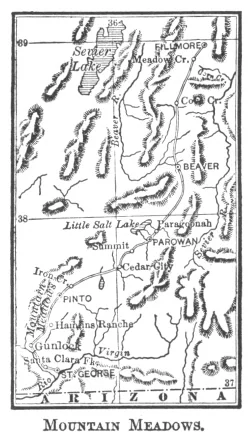
Near Cedar City the Spanish trail to Santa Fé branched off from what was then known as Frémont's route. About thirty miles to the south-west of Cedar, and within fifteen of the line of the route, are the Mountain Meadows, which form the divide between the waters of the great basin and those that flow into the Colorado. At the southern end of the meadows, which are four to five miles in length and one in width, but here run to a narrow point, is a large stream, the banks of which are about ten feet in height. Close to this stream the emigrants were encamped on the 5th of September, almost midway between two
ranges of hills, some fifty feet high and four hundred yards apart. On either side of their camp were ravines connected with the bed of the stream.
It was Saturday evening when
 |
The emigrants were now in a state of siege, and though they fought bravely, had little hope of escape. All the outlets of the valley were guarded; their ammunition
was almost exhausted; of their number, which included a large proportion of women and children, many were wounded, and their sufferings from thirst had become intolerable. Down in the ravine, and within a few yards of the corral, was the stream of water; but only after sundown could a scanty supply be obtained, and then at great risk, for this point was covered by the muskets of the Indians, 14 who lurked all night among the ravines waiting for their victims.
Four days the siege lasted; on the morning of the fifth a wagon was seen approaching from the northern end of the meadow, and with it a company of the Nauvoo legion. When within a few hundred yards of the intrenchment, the company halted, and one of them, William Bateman by name, was sent forward with a flag of truce. In answer to this signal a little girl, dressed in white, appeared in an open space between the wagons. Half-way between the Mormons and the corral, Bateman was met by one of the emigrants named Hamilton, to whom he promised protection for his party on condition that their arms were surrendered, assuring him that they would be conducted safely to Cedar City. After a brief parley, each one returned to his comrades.
By whose order the massacre was committed, or for what reasons other than those already mentioned, has never yet been clearly ascertained; but as to the incidents and the plan of the conspirators, we have evidence that is in the main reliable. During the week of the massacre, Lee, with several other Mormons, was encamped at a spring within half a mile of the emigrants’ camp; and, as was alleged, though not distinctly proven at his trial, induced the Indians by promise of booty to make the attack; but, finding the resistance stronger than he anticipated, had sent for
aid to the settlements of southern Utah. 15 Thus far the evidence is somewhat contradictory. There is sufficient proof, however, that, in accordance with a programme previously arranged at Cedar, a company of militia, among whom were Isaac C. Haight and Major John M. Higbee, and which was afterward joined by Colonel William H. Dame, bishop of Parowan, 16 arrived at Lee's camp on the evening before the massacre.
It was then arranged that Lee should conclude terms with the emigrants, and, as soon as they had delivered themselves into the power of the Mormons, should start for Hamblin's rancho, on the eastern side of the meadows, with the wagons and arms, the young children, and the sick and wounded. The men and women, the latter in front, were to follow the wagons, all in single file, and on each side of them the militia were to be drawn up, two deep, and with twenty paces between their lines. Within two hundred yards of the camp the men were to be brought to a halt, until the women approached a copse of scrub-oak, about a mile distant, and near to which Indians lay in ambush. The men were now to resume their march, the militia forming in single file, each one walking by the side of an emigrant, and carrying his musket on the left arm. As soon as the women were close to the ambuscade, Higbee, 17 who was in charge of the detachment, was to give the signal by saying to his command, "Do your duty;" whereupon the militia were to shoot down the men, the Indians were to
slaughter the women and children, sparing only those of tender age, and Lee with some of the wagoners was to butcher the sick and wounded. Mounted troopers were to be in readiness to pursue and slay those who attempted to escape, so that, with the exception of infants, no living soul should be left to tell the tale of the massacre.
Entering the corral, Lee found the emigrants engaged in burying two of their party who had died of wounds. Men, women, and children thronged around him, some displaying gratitude for their rescue, some distrust and terror. The brother played his part well. Bidding the men pile their arms in the wagons, to avoid provoking the Indians, he placed in them the women, the small children, and a little clothing. While thus engaged, one Daniel McFarland rode up, with orders from Major Higbee to hasten their departure, as the Indians threatened to renew the attack. The emigrants were then hurried away from the corral, the men, as they passed between the files of militia, cheering their supposed deliverers. Half an hour later, as the women drew near the ambuscade, the signal was given, and the butchery commenced. Most of the men were shot down at the first fire. Three only escaped from the valley; of these two were quickly run down and slaughtered, and the third was slain at Muddy Creek, some fifty miles distant. 18
The women and those of the children who were on foot ran forward some two or three hundred yards, when they were overtaken by the Indians, among whom were Mormons in disguise. The women fell on their knees, and with clasped hands sued in vain
for mercy; clutching the garments of their murderers, as they grasped them by the hair, children pleaded for life, meeting with the steady gaze of innocent childhood the demoniac grin of the savages, who brandished over them uplifted knives and tomahawks. Their skulls were battered in, or their throats cut from ear to ear, and, while still alive, the scalp was torn from their heads. Some of the little ones met with a more merciful death, one, an infant in arms, being shot through the head by the same bullet that pierced its father's heart. Of the women none were spared, and of the children only those who were not more than seven years of age. 19
To two of Lee's wagoners, McMurdy and Knight, was assigned the duty, as it was termed, of slaughtering the sick and wounded. Carrying out their instructions, they stopped the teams as soon as firing was heard, and with loaded rifles approached the wagons where lay their victims, McMurdy being in front. "O Lord, my God," he exclaimed, "receive their spirits, it is for thy kingdom that I do this." Then, raising his rifle to his shoulder, he shot through the brain a wounded man who was lying with his head on a sick comrade's breast. The Mormons were aided in their work 20 by Indians, who, grasping the helpless men by the hair, raised up their heads and cut their throats. The last victim was a little girl who came running up to the wagons, covered with
blood, a few minutes after the disabled men had been murdered. She was shot dead within sixty yards of the spot where Lee was standing. The massacre was now completed, and after stripping the bodies of all articles of value, 21 Brother Lee and his associates went to breakfast, 22 returning after a hearty meal to bury the dead.
It was a ghastly sight that met them at this Wyoming of the west, amid the peaceful vales of Zion, and one that caused even the assassins to sicken and turn pale. The corpses had been entirely stripped by the Indians, who had also carried off the clothing, provisions, wagon-covers, and even the bedding of the emigrants. In one group were the naked bodies of six or seven women, in another those of ten young children, some of them horribly mangled and most of them scalped. The dead were now dragged to a ravine near by and piled in heaps; a little earth was scattered over them, but so little that it was washed away by the first rains, leaving the remains to be devoured by wolves and coyotes, the imprint of whose teeth was afterward found on their bones. It was not until nearly two years later that they were decently interred by a detachment of troops, sent for that purpose from Camp Floyd. On reaching Mountain Meadows, the men found skulls and bones scattered for the space of a mile around the ravine, whence they had been dragged by wild beasts. Nearly all the bodies had been gnawed by wolves, so that few could be recognized, and their dismembered skeletons were bleached by long exposure. Many of the skulls were crushed in with the but-ends of muskets or cleft with tomahawks; others were shattered by fire-arms, discharged close to the head. A few remnants of apparel, torn from the backs of women and children as they ran from the clutch of their pursuers, still fluttered among the bushes, and near by were masses of human hair, matted and trodden in the mould. 23
Over the last resting-place of the victims was built a cone-shaped cairn, some twelve feet in height, and leaning against its northern base was placed a rough slab of granite, with the following inscription: "Here 120 men, women, and children were massacred in cold blood, early in Sept. 1857. They were from Arkansas." The cairn was surmounted by a cross of cedar, on which were inscribed the words: "Vengeance is mine: I will repay, saith the Lord." 24
The survivors of the slaughter were seventeen children, from two months to seven years of age, who were carried, on the evening of the massacre, by John D. Lee, Daniel Tullis, and others to the house of Jacob Hamblin, 25 and afterward placed in charge of Mormon families at Cedar, Harmony, and elsewhere. All of them were recovered in the summer of 1858, with the exception of one who was rescued a few months later, and though thinly clad, they bore no marks of ill usage. 26 In the following year they were
conveyed to Arkansas, the sum of $10,000 having been appropriated by congress for their recovery and restoration. 27
To Brigham Young, as governor and superintendent of Indian affairs, belonged the duty of ordering an investigation into the circumstances of the massacre and of bringing the guilty parties to justice. His reasons for evading this duty are best explained in his own words. In his deposition at the trial of John D. Lee, when asked why he had not instituted proceedings, he thus made answer: "Because another governor had been appointed by the president of the United States, and was then on the way here to take my place, and I did not know how soon he might arrive; and because the United States judges were not in the territory. Soon after Governor Cumming arrived I asked him to take Judge Cradlebaugh, who belonged to the southern district, with him, and I would accompany them with sufficient aid to investigate the matter and bring the offenders to justice." 28
The Mormons concerned in the massacre had pledged themselves by the most solemn oaths to stand by each other, and always to insist that the deed was done entirely by Indians. For several months it was believed by the federal authorities that this was the case; when it became known, however, that some of the children had been spared, suspicion at once pointed elsewhere, for among all the murders committed by the Utahs, there was no instance of their having shown any such compunction. Moreover, it was soon ascertained that an armed party of Mormons had left Cedar City, had returned with spoil, and that the Indians complained of being unfairly treated in the division of the booty. Notwithstanding their utmost efforts, some time elapsed before the United States officials procured evidence sufficient to bring home the charge of murder to any of the parties implicated, and it was not until March 1859 that Judge Cradlebaugh held a session of court at Provo. At this date only six or eight, persons had been committed for trial, and were now in the guard-house at Camp Floyd, 29 some of them being accused of taking part in the massacre and some of other charges.
Accompanied by a military guard, as there was no jail within his district and no other means of securing the prisoners, the judge opened court on the 8th. In his address to the grand jury he specified a number of crimes that had been committed in southern Utah, including the massacre. "To allow these things to pass over," he observed, "gives a color as if they were done by authority. The very fact of such a case as the Mountain Meadows shows that there was some person high in the estimation of the people, and it was done by that authority…You can know no law but the laws of the United States and the laws you have here. No person can commit crimes and say
they are authorized by higher authorities, and if they have any such notions they will have to dispel them." 30 The grand jury refused to find bills against any of the accused, and, after remaining in session for a fortnight, were discharged by Cradlebaugh as "a useless appendage to a court of justice," the judge remarking: "If this court cannot bring you to a proper sense of your duty, it can at least turn the savages held in custody loose upon you." 31
Judge Cradlebaugh's address was ill advised. The higher authority of which he spoke could mean only the authority of the church, or in other words, of the first presidency; and to contemn and threaten to impeach that authority before a Mormon grand jury was a gross judicial blunder. Though there may have been cause for suspicion, there was no fair color of testimony, and there is none yet, that Brigham or his colleagues were implicated in the massacre. Apart from the hearsay evidence of Cradlebaugh and of an officer in the army of Utah, 32 together with the statements of John D. Lee, 33 there is no basis on which to frame a charge of complicity against them. That the massacre occurred the day after martial law was proclaimed, and within two days of the threat uttered by Brigham in the presence of Van Vliet; that Brigham, as superintendent of Indian affairs, failed to embody in his report any mention of the massacre;
that for a long time afterward no allusion to it was made in the tabernacle or in the Deseret News—the church organ of the saints—and then only to deny that the Mormons had any share in it; 34 and that no mention was made in the Deseret News of the arrival or departure of the emigrants;—all this was, at best, but presumptive evidence, and did not excuse the slur that was now cast on the church and the church dignitaries. "I fear, and I regret to say it," remarks the superintendent of Indians affairs, in August 1859, "that with certain parties here there is a greater anxiety to connect Brigham Young and other church dignitaries with every criminal offence than diligent endeavor to punish the actual perpetrators of crime." 35
The judge's remarks served no purpose, except to draw forth from the mayor of Provo a protest against the presence of the troops, as an infringement of the rights of American citizens. The judge replied that good American citizens need have no fear of American troops, whereupon the citizens of Provo petitioned Governor Cumming to order their removal. Cumming, who was then at Provo, was officially informed by the mayor that the civil authorities were prepared and ready to keep in safe custody all prisoners arrested for trial, and others whose presence might be necessary. He therefore requested General Johnston to withdraw the force which was then encamped at the court-house, stating that its presence was unnecessary. The general refused to comply, being sustained in his
action by the judges; 36 and on the 27th of March Cumming issued a proclamation protesting against all movements of troops except such as accorded with his own instructions as chief executive magistrate. 37 A few days later the detachment was withdrawn.
Notwithstanding the contumacy of the grand jury, Cradlebaugh continued the sessions of his court, still resolved to bring to justice the parties concerned in the Mountain Meadows massacre, and in crimes committed elsewhere in the territory. Bench-warrants, based on sworn information, were issued against a number of persons, and the United States marshal, aided by a military escort, succeeded in making a few arrests. 38
Among other atrocities laid to the charge of the Mormons was one known as the Aiken massacre, which also occurred during the year 1857. Two brothers of that name, with four others, returning from California to the eastern states, were arrested in southern Utah as spies, and, as was alleged, four of the party were escorted to Nephi, where it was arranged that Porter Rockwell and Sylvanus Collett should assassinate them. While encamped on the Sevier River they were attacked by night, two of them being killed
and two wounded, the latter escaping to Nephi, whence they started for Salt Lake City, but were murdered on their way at Willow Springs. Although the guilty parties were well known, it was not until many years later that one of them, named Collett, was arrested, and in October 1878 was tried and acquitted at Provo. 39 All the efforts of Judge Cradlebaugh availed nothing, 40 and soon afterward he discharged the prisoners and adjourned his court sine die, entering on his docket the following minute: "The whole community presents a united and organized opposition to the proper administration of justice."
This antagonism between the federal and territorial authorities continued until 1874, at which date an act
was passed by congress "in relation to courts and judicial officers in the territory of Utah," and commonly known as the Poland bill, 41 whereby the summoning of grand and petit juries was regulated, and provision made for the better administration of justice. The first grand jury impanelled under this law was instructed by Jacob S. Boreman, then in charge of the second judicial district, to investigate the Mountain Meadows massacre and find bills of indictment against the parties implicated. A joint indictment for conspiracy and murder was found against John D. Lee, William H. Dame, Isaac C. Haight, John M. Higbee, Philip Klingensmith, and others. 42 Warrants were issued for their arrest, and after a vigorous search Lee and Dame were captured, the former being found concealed in a hog-pen at a small settlement named Panguitch, on the Sevier River. 43
After some delay, caused by the difficulty in procuring evidence, the 12th of July, 1875, was appointed for the trial at Beaver City in southern Utah. 44 At eleven o'clock on this day the court was opened, Judge Boreman presiding, but further delay was caused by the absence of witnesses, and the fact that Lee had promised to make a full confession, and thus turn state's evidence. In his statement the prisoner detailed minutely the plan and circumstances of the
tragedy, from the day when the emigrants left Cedar City until the butchery at Mountain Meadows. He avowed that Higbee and Haight played a prominent part in the massacre, which, he declared, was committed in obedience to military orders, but said nothing as to the complicity of the higher dignitaries of the church, by whom it was believed that these orders were issued. 45 The last was the very point that the prosecution desired to establish, its object, compared with which the conviction of the accused was but a minor consideration, being to get at the inner facts of the case. The district attorney 46 refused, therefore, to accept the confession, on the ground that it was not made in good faith. Finally the case was brought to trial on the 23d of July, and the result was that the jury, of whom eight were Mormons, failed to agree, after remaining out of court for three days. 47 Lee was then remanded for a second trial, which was held before the district court at Beaver City between the 13th and 20th of September, 1876, Judge Boreman again presiding. 48
The court-room was crowded with spectators, who cared little for the accused, but listened with rapt attention to the evidence, which, as they supposed, would certainly implicate the dignitaries of the church. They listened in vain. In opening the case to the jury, the district attorney 49 stated that he came there to try John D. Lee, and not Brigham Young and the Mormon church. He proposed to prove that Lee had acted in direct opposition to the feelings and wishes of the officers of the Mormon church; that by means of a flag of truce Lee had induced the emigrants to give up their arms; that with his own hands the prisoner had shot two women, and brained a third with the but-end of his rifle; that he had cut the throat of a wounded man, whom he dragged forth from one of the wagons; and that he had gathered up the property of the emigrants and used it or sold it for his own benefit. 50
These charges, and others relating to incidents that have already been mentioned, were in the main substantiated. The first evidence introduced was documentary, and included the depositions of Brigham Young and George A. Smith, and a letter written by Lee to the former, wherein he attempted to throw the entire responsibility of the deed upon the Indians. Brigham alleged that he heard nothing about the massacre until some time after it occurred, and then only by rumor; that two or three months later Lee called at his office and gave an account of the slaughter, which he charged to Indians; that he gave no directions as to the property of the emigrants, and knew nothing about its disposal; that about the 10th of September, 1857, he received a communication from Isaac C. Haight of Cedar City, concerning the Arkansas party, and in his answer had given orders
to pacify the Indians as far as possible, and to allow this and all other companies of emigrants to pass through the territory unmolested. George A. Smith, who had been suspected of complicity, through attending a council at which Dame, Haight, and others had arranged their plans, denied that he was ever an accessary thereto. He also deposed that he had met the emigrants at Corn Creek, some eighty miles north of Cedar, on the 25th of August, while on his way to Salt Lake City, and that when he first heard of the massacre he was in the neighborhood of Fort Bridger.
The first witness examined was Daniel H. Wells, who merely stated that Lee was a man of influence among the Indians, and understood their language sufficiently to converse with them. James Haslem testified that between five and six o'clock on Monday, September 7, 1857, he was ordered by Isaac C. Haight to start for Salt Lake City and with all speed deliver a letter or message to Brigham Young. He arrived at 11 A. M. on the following Thursday, and four hours later was on his way back with the answer. As he set forth, Brigham said to him: "Go with all speed, spare no horse-flesh. The emigrants must not be meddled with, if it takes all Iron county to prevent it. They must go free and unmolested." 51
Samuel McMurdy testified that he saw Lee shoot one of the women, and two or three of the sick and wounded who were in the wagons. Jacob Hamblin alleged that soon after the massacre he met Lee within a few miles of Fillmore, when the latter stated that two young girls, 52 who had been hiding in the underbrush at Mountain Meadows, were brought into his presence by a Utah chief. The Indian asked what should be done with them. "They must be shot," answered Lee; "they are too old to be spared."
"They are too pretty to be killed," answered the chief. "Such are my orders," rejoined Lee; whereupon the Indian shot one of them, and Lee dragged the other to the ground and cut her throat. 53
On the testimony which we have now before us I will make but one comment. If Haslem's statement was true, Brigham was clearly no accomplice; if it was false, and his errand to Salt Lake City was a mere trick of the first presidency, it is extremely improbable that Brigham would have betrayed his intention to Van Vliet by using the remarks that he made only two days before the event. Moreover, apart from other considerations, it is impossible to reconcile the latter theory with the shrewd and far-sighted policy of this able leader, who well knew that his militia were no match for the army of Utah, and who would have been the last one to rouse the vengeance of a great nation against his handful of followers. 54
Lee was convicted of murder in the first degree, and being allowed to select the mode of his execution, was sentenced to be shot. The case was appealed to the supreme court of Utah, but the judgment was sustained, and it was ordered that the sentence should be carried into effect on the 23d of March, 1877. 55 William H. Dame, Isaac C. Haight, and others who had also been arraigned for trial, were soon afterward discharged from custody.
A few days before his execution, Lee made a confession, 56
in which he attempts to palliate his guilt, to throw the burden of the crime on his accomplices, especially on Dame, Haight, and Higbee, and to show that the massacre was committed by order of Brigham and the high-council. He also makes mention of other murders, or attempts to murder, which, as he alleges, were committed by order of some higher authority. 57 "I feel composed, and as calm as a summer morning," he writes on the 13th of March. "I hope to meet my fate with manly courage. I declare my innocence. I have done nothing designedly wrong in that unfortunate and lamentable affair with which I have been implicated. I used my utmost endeavors to save them from their sad fate. I freely would have given worlds, were they at my command, to have averted that evil. Death to me has no terror. It is but a struggle, and all is over. I know that I have a reward in heaven, and my conscience does not accuse me."
Ten days later he was led to execution at the Mountain Meadows. Over that spot the curse of the almighty seemed to have fallen. The luxuriant herbage that had clothed it twenty years before had disappeared; the springs were dry and wasted, and now there was neither grass nor any green thing, save here and there a copse of sage-brush or of scrub-oak, that
served but to make its desolation still more desolate. Around the cairn that marks their grave still flit, as some have related, the phantoms of the murdered emigrants, and nightly reënact in ghastly pantomime the scene of this hideous tragedy.
About ten o'clock on the morning of the 23d a party of armed men alighting from their wagons approached the site of the massacre. Among them were the United States marshal, William Nelson, the district attorney, a military guard, and a score of private citizens. In their midst was John Doyle Lee. Over the wheels of one of the wagons blankets were placed to serve as a screen for the firing party. Some rough pine boards were then nailed together in the shape of a coffin, which was placed near the edge of the cairn, and upon it Lee took his seat until the preparations were completed. The marshal now read the order of the court, and, turning to the prisoner, said: "Mr Lee, if you have anything to say before the order of the court is carried into effect, you can do so now." Rising from the coffin, 58 he looked calmly around for a moment, and then with unfaltering voice repeated in substance the statements already quoted from his confession. "I have but little to say this morning," he added. "It seems I have to be made a victim; a victim must be had, and I am the victim. I studied to make Brigham Young's will my pleasure for thirty years. See now what I have come to this day! I have been sacrificed in a cowardly, dastardly manner. I cannot help it; it is my last word; it is so. I do not fear death; I shall never go to a worse place than I am now in. I ask the Lord my God, if my labors are done, to receive my spirit." A Methodist clergyman, 59 who acted as his spiritual adviser, then knelt by his side and offered a brief prayer, to which he listened attentively. After shaking hands
with those around him, he removed a part of his clothing, handing his hat to the marshal, who bound a handkerchief over his eyes, his hands being free at his own request. Seating himself with his face to the firing party, and with hands clasped over his head, he exclaimed: "Let them shoot the balls through my heart. Don't let them mangle my body." The word of command was given; the report of rifles rang forth on the still morning air, and without a groan or quiver the body of the criminal fell back lifeless on his coffin. God was more merciful to him than he had been to his victims. 60
Footnotes
543:1 In Forney's Rept, in Sen. Doc., 36th Cong. 1st Sess., ii. no. 42, p. 79, and the Hand-Book of Reference, p. 75, Sept. 9th is given as the date of the massacre. Forney, as superintendent of Indian affairs, made a close investigation into the details of this tragedy, the result of which is given in his report ut supra, pp. 87-9, and elsewhere in this document, which occupies 139 pages, and contains all the official information then to be had on the subject. His reports are dated Salt Lake City, 1859. He states that the attack began on Monday, Sept. 5th, and lasted till Friday, Sept. 9th, when the massacre occurred; but Friday of that week fell on Sept. 11th. Burton, City of the Saints, 411-12, note, also quotes an official report, in which Sept. 4th or 5th is given as the date of the first attack. See also Lee's confession in Mormonism Unvailed, 218, 237, 239, where Lee states that the massacre occurred on Friday, and that the attack began on Tuesday. At Lee's trial James Haslem testified, as we shall see later, that he was sent from Cedar City by Isaac C. Haight, with a letter to Brigham, on Monday, Sept. 7th, and that he reached S. L. City at 11 A. M. on Thursday. Deseret News, Sept. 20, 1876. The next day was the 11th. Other accounts differ slightly as to date.
544:2 U.S. Attorney Wilson, in his report in Sen. Doc., 36th Cong. 1st Sess., ii. no. 42, p. 102, states that 119 were killed, and it is certain that 17 children were rescued. Forney and Burton say that 115 to 120 were massacred; Waite, The Mormon Prophet, 66, that the party consisted of 150 men and women, besides a number of children. Stenhouse, Tell It All, 324, mentions 120 to 130. Other reports vary from 120 to 150.
544:3 Stenhouse, Rocky Mountain Saints, 424-8, says that the Arkansas and Missouri emigrants formed two separate parties, the latter naming themselves Missouri 'wild-cats,' and that the Arkansas party was advised by a friend of his to keep clear of the Missourians while passing through the Utah settlements and the portion of that territory occupied by Indians. I find no confirmation of this in other authorities, though, according to Mrs Stenhouse, Tell It All, 325, her husband's friend, whose name was Eli B. Kelsey, 'said that the train was divided into two parts, the first a rough-and-ready set of men—regular frontier pioneers; the other a picked community.' The truth appears to be, that there were a few Missourians in the Arkansas party, as stated in Hutchings’ Cal. Mag., iv. 345.
545:4 They had about 600 head of cattle, 30 wagons, and 30 horses and mules. Forney's Rept, ut supra, p. 75. Stenhouse mentions that they had also several travelling-carriages. Rocky Mountain Saints, 424. At least $30,000 worth of plunder was collected after the massacre, besides what was appropriated by the Indians. Cradlebaugh estimated the value of their property at $60,000 to $70.000.
545:5 I find no mention of their arrival in the files of the Deseret News, although the names of passing emigrants were registered in that paper at a nominal charge; and when the party was a large one, its passage was usually noticed among the local items of news.
546:6 The account given in the Millennial Star, xix. 417-18, is that McLean, after treating his wife in a brutal manner for several years, turned her into the streets of San Francisco, and secretly conveyed the children on board a steamer for New Orleans, where the woman followed him; but finding that her parents were in the plot, set forth for Salt Lake City. Returning to New Orleans in 1856, she rescued her children and fled to Texas; but was followed by her husband, who had previously returned to California, and now regained possession of the children. Parley, who had already befriended Mrs McLean, had written to inform her that her husband was in pursuit. Hence the prosecution. McLean and his wife finally separated in San Francisco in 1855. See also Autobiog. of Parley P. Pratt, app. Stenhouse relates that Mrs McLean was married or sealed to Pratt in Utah, that she met Pratt in Arkansas on her way to Utah, and that the apostle was acquitted on account of her assuming the responsibility for the abduction. He admits, however, that the apostle did not abduct the children. Rocky Mountain Saints, 429. Burton says that Pratt converted Mrs McLean and took her to wife, but on what authority he does not state. City of the Saints, 412. The fact, however, that Mrs McLean arrived on the scene of the apostle's assassination just before his death, as mentioned in the Millennial Star, xix. 478, wears a suspicious look. In the S. F. Bulletin of March 24, 1877, it is stated that the apostle made the acquaintance of Mrs McLean while engaged in missionary work in San Francisco; that her husband, who was a custom-house official and a respectable citizen, ordered him to discontinue his visits, and kicked him out of the house for continuing them surreptitiously; and that the woman was so infatuated with the Mormon Elder that she devoutly washed his feet whenever he visited her. On arriving at Fort Smith (near Van Buren), McLean found letters from Parley Pratt addressed to his wife, one of them signed 'Your own,——. 'The McLean residence in San Francisco, on the corner of Jones and Filbert streets, was in 1877 a dilapidated frame building, a story and a half in height. As to the apostle's assassination, the Bulletin merely states that he was overtaken by McLean and shot within eight miles of Van Buren, and that he died of his wounds an hour afterward.
547:7 This account of Parley's murder is based on the testimony of Geo. Higginson and Geo. Crouch, whose letter, dated Flint, Arkansas, May 17, 1857, was first published in a New York paper. Copies of it will be found in the Millennial Star, xix. 478, and Burton's City of the Saints, 419,-13, note. They state that the tragedy occurred close to the residence of a farmer named Win, and was witnessed by two men who were in the house at the time, and from whose evidence at the coroner's jury the above version is taken. Pratt lived long enough to give instructions as to his burial and the disposition of his property. The account given by Stenhouse, in Rocky Mountain Saints, 429-30, does not differ materially, except that he makes no mention of any accomplices.
547:8 In his deposition at the trial of John D. Lee and others, George A. Smith, the prophet's cousin, states that he found them at Corn Creek on Aug. 25th. Millennial Star. xxxvii. 675; Lee's Mormonisrn Unvailed 307.
548:9 Sen. Doc., 36 Cong. 1st Sess., ii. no. 42, p. 76. Forney mentions that an ox belonging to a Dr Ray of Fillmore died from this cause while the emigrants were in that neighborhood, that his wife was taken ill while rendering the tallow, and that a boy who was assisting her died a few days afterward. One or two Indians who ate some of the meat were also poisoned.
548:10 John D. Lee, living 150 miles south of Fillmore, informed me that about twenty Indians and some cattle died from drinking of the poisoned water, and Indians from eating the poisoned meat.' Forney's Rept, in Id., p. 75. This report was dated S. L. City, Aug. 1859. In a letter to Brigham, dated Harmony, Nov. 20, 1857, Lee writes: 'The company there [at Corn Creek] poisoned the meat of an ox, which they gave the Pah Vant Indians to eat, causing four of them to die immediately, besides poisoning a number more. The company also poisoned the water where they encamped, killing the cattle of the settlers. This letter was used in evidence at Lee's trial in 1876.' Mormonism Unvailed, 254-5. At this trial was also placed in evidence a letter from Brigham to the commissioner of Indian affairs, dated Jan. 6, 1858, in which Lee's statement is repeated almost verbatim. Id., 313-15. In his confession, made a few months after his trial, Lee declares that President Isaac C. Haight told him of the poisoning and other atrocities committed by the emigrants, and gave him instructions as to the part he should take in the massacre. After that event Lee states (still in his confession), 'I thought over the matter, and made up my mind to write the letter to Brigham Young and lay it all to the Indians.' Id., 254.
549:11 'They proclaimed that they had the very pistol with which the prophet Joseph Smith was murdered, and had threatened to kill Brigham and all of the apostles. That when in Cedar City they said they would have friends in Utah, who would hang Brigham by the neck until he was dead, before snow fell again in the territory. They also said that Johnston was coming with his army from the east, and they were going to return from California with soldiers, as soon as possible, and would then desolate the land, and kill every damned Mormon man, woman, and child that they could find in Utah.' Lee's Mormonism Unvailed, 218-19.
549:12 'Conflicting statements were made to me of the behavior of this company,' says the superintendent of Indian affairs. 'I have accordingly made it a matter of material importance to make a strict inquiry to ascertain reliable information on this subject…The result of my inquiries enables me to say that the company conducted themselves with propriety.' Forney's Rept, ut supra, p. 88.
550:13 Seven were killed and sixteen wounded. Lee's Confession, in Mormonism Unvailed, 226-7; see also Forney's Rept, in Sen. Doc., 36th Cong. 1st Sess., ii. no. 42, p. 88.
551:14 'Thursday morning I saw two men start from the corral with buckets, and run to the spring and fill their buckets with water, and go back again. The bullets flew around them thick and fast, but they got into their corral in, safety.' Lee's Mormonism Unvailed, 230.
552:15 See the district attorney's opening address to the jury, in the Deseret News, Sept. 2, 1877. Lee states that his object in sending for aid was to protect the emigrants. Confession, in Mormonism Unvailed, 229.
552:16 A full list of the company is given in Id., 379-80, and a list of all the Mormons who took part in the massacre in the S. L. City Tribune, June 2, 1877. See also the speech delivered by Judge Cradlebaugh in the house of representatives, Feb. 7, 1863. Cong. Globe, 1862-3, app. 119. The speech was afterward published in pamphlet form, one copy of it being entitled Mormonism, and another Utah and the Mormons. The former was reprinted from the S. L. Daily Tribune, Apr. 8, 1877. The parts of it relating to the massacre will be found in Waite's The Mormon Prophet, 65, and Stenhouse's Rocky Mountain Saints, 447-50.
552:17 First councillor to Haight.
553:18 Forney's Rept, ut supra, 89; Burton's City of the Saints, 412, note. Lee also says that three escaped, but were overtaken and killed before reaching the settlements in California. Mormonism Unvailed, 244. Cradlebaugh states that two escaped and were overtaken in the desert 150 miles distant. Mormonism, 12. Beadle mentions three, one of whom starved to death in the desert, another was murdered by Indians, 90 miles south of the desert, and a third was killed on the Colorado River by persons unknown. Life in Utah, 184.
554:19 In the official report quoted by Burton, City of the Saints, 419, it is stated that a girl 16 years of age knelt before one of the Mormons imploring mercy, but he led her away into a thicket, violated her, and then cut her throat. Beadle attributes this deed to President Haight, and says that after violating the girl he beat out her brains with a club. He also accuses Lee of selecting one of the young women for his harem, and relates that, when he made known his purpose, she attempted to stab him, whereupon he shot her through the head. Life in Utah, 183-4.
554:20 Lee, in his confession, denied having killed any of them, but admits that he intended to do his part. He says: 'I drew my pistol and cocked it, but somehow it went off prematurely, and I shot McMurdy across the thigh, my pistol-ball cutting his buckskin pants. McMurdy turned to me and said: "Brother Lee, keep cool; you are excited."' Mormonism Unvailed, 242. As we shall see later, it was clearly proved at his trial that he killed several of the wounded.
555:21 Lee states that only a little money and a few watches were found on them. Id., 244. This is improbable, and other accounts show that the Mormons gathered considerable booty.
555:22 'After breakfast,' says Lee, 'we all went back in a body to the meadows, to bury the dead and take care of the property that was left there.' The above account of the Mountain Meadows massacre is taken mainly from Forney's Rept, in Sen. Doc., 35th Cong. 1st Sess., ii. no. 42, pp. 87-9; Cradlebauqh's Mormonism, 12; the affidavit of Philip Klingon Smith (Klingensmith), bishop of Cedar City, who was present at the massacre, made in 1871 before the clerk of court of the seventh judicial district of Nevada, in Stenhouse's Rocky Mountain Saints, 439-42; the confession of Lee, in Mormonism Unvailed, 244, and his trial in Id., 302-78. In the S. F. Call, July 30, 1881, it is stated that Bishop Klingensmith was murdered in Mexico. There is no important discrepancy in the several versions. Forney and Cradlebaugh officially investigated the matter in 1859. The statements of both are very brief, and why the investigation was not made sooner does not appear. News of the massacre was first received in Washington in Feb. 1858. See letter of C. E. Mix, acting commissioner of Indian affairs, to Senator W. K. Sebastian, and of the secretary of war to Representative A. B. Greenwood, in Sen. Doc., 35th Cong. 1st Sess., ii. no. 42, pp. 4, 42. On the 18th of this month Senator Gwin of California moved that the secretary of war be called upon to report what steps had been taken to bring the offenders to justice. Gwin's Memoirs, MS., 138 a, 138 e. No steps had been taken, and for reasons that will presently appear, none were taken—or none that were effectual—until nearly 20 years later. For other accounts of the massacre, see Stenhouse's Rocky Mountain Saints, 435-9; Stenhouse's Tell It All, 328-37; Beadle's Life in Utah, 180-4; Waite's The Mormon Prophet, 60-9; Beadles' Western Wilds, 306-7, 496-501; Young's Wife No. 19, 228 et seq.; Bowle's Our New West, 266-8; Ruslinq, Across America, 188-90; Hayes’ Scraps, Los Angeles, viii. 228-31, xvii. 3-7; Hutching's Cal. Mag., iv. 345-9; Utah Review, Feb. 1882, 243-6. The story of the massacre has, of course, been related thousands of times in the magazines and newspapers of Europe and America. Some of these accounts are substantially correct and some are absurd. One writer, for instance, attemps to throw new light on the subject by giving what is claimed to be a copy of the original order for the massacre, signed 'Daniel G. Wells,' and dated S. L. City, Apr. 9, 1858. The massacre occurred, as we have seen, on Sept. 11, 1857. For statements and comments of the press of the Pacific slope, see, among others, the Deseret News, Dec. 1, 1869; S. L. City Tribune, Jan. 3, Aug. 22, Oct. 3, Nov. 28, 1874; Aug. 14, 1875; Sept. 9, 1876; Apr. 23, 1879; S. F. Bulletin, Oct. 12, 27, Nov. 12, 1857; Apr. 13, May 14, Aug. 12, 1858; Apr. 23, Aug. 25, Oct. 28, 1859; Sept. 23, 27, Nov. 27, 1872; Nov. 17, 1874; July 26, 1875; March 24, Apr. 12, 1877; S. F. Call, July 21, 1866; May 23, Sept. 23, 1872; Oct. 14, 1874; July 18, 22, 25, 1875; Feb. 16, March 9, 24, 25, May 29, 1877; S. F. Alta, Oct. 12, 21, 1857; Aug. 13, 1858; Jan. 6, May 8, June 26, 1859; Feb. 9, 1873; July 28, Aug. 23, 1875; March 24, Apr. 7, 1877; S. F. Chronicle, March 22, 23, 31, Apr. 8, 1877; S. F. Post, March 22, 23, 1877; S. F. Herald, Oct. 12, 27, Nov. 2, 1857; Mining and Scientific Press, July 31, 1875, March 31, 1877; Pacific Rural Press, March 31, 1877; Oakland Tribune, Apr. 9, 1877; Sac. Daily Union, Oct. 13, Dec. 18, 1857; March 1, Aug. 14, 1858; Apr. 14, 25, 1859; Jan. 29, 1867; Nov. 28, 1872; Nov. 24, 1874; Cal. Mercantile Journal, 1860, pp. 153-4; Stockton Independent, June 11, 1879; San José Weekly Arqus, Dec. 5, 1874; Santa Cruz Sentinel, May 12, 1877; San Buenaventura Signal, June 23, 1877; Winnemucca Silver State, July 19, 1875; Antioch Ledger, Nov. 21, 1875; Austin Reese River Reveille, July 12, 1564; Gold Hill News, Sept. 21, 1872; Feb. 1, 1875; Sept. 12, 1876; Carson State Register, Sept. 26, 1872; Prescott Miner, Dec. 12, 1874, Apr. 11, 1879; Idaho World, Oct. 1, 1875; Portland Weekly Standard, Apr. 6, 1577; Or. Argus, Dec. 12, 1857, July 16, 1858; Or. Statesman, Nov. 3, 1857. For cuts of the massacre, see Beadle's Western Wilds, 495; Beadle's Life in Utah, facing p. 183; Stenhouse's Rocky Mountain Saints, facing p. 424; Lee's Mormonism Unvailed, facing p. 240.
556:23 Rept of Assistant Surgeon Brewer, dated Mountain Meadows, May 6, 1859, in Sen. Doc., 36th Cong. 1st Sess., ii. no. 42, pp. 16-17; Captain Campbell's rept, in Mess. and Doc., 1859-60, pt 2, p. 207; Hutchings’ Cal. Mag., iv. 346-7. A correspondent of the New York Herald, writing from S. L. City, Nov. 8, 1574, states that William H. Rogcrs, Indian agent, was ordered to proceed from Camp Floyd with a party of cavalry and bury the remains in the summer of 1558. I find no mention of this in the official documents, though the massacre was known to Sup. Forney at least as early as June 22d of that year. See his letter to C. E. Mix, in Sen. Doc., ut supra, pp. 44-5.
557:24 Cuts will be found in Stenhouse's Tell It All, 335; Hutchings’ Cal. Mag., iv. 347. The cairn, cross, and slab are said to have been destroyed by order of Brigham. Cradlebaugh's Mormonism, 14.
557:25 Forney's rept, in Sen. Doc., 36th Cong. 1st Sess., ii. no. 42, pp. 79-80, where their names are given; see also p. 87; Lee's Mormonism Unvailed, 243. Bishop Smith's statement, in Stenhouse's Rocky Mountain Saints, 441-2. In giving the result of his investigation, Forney states (p. 76) that Hamblin had left; his home several weeks before the massacre, and did not return until several days after it occurred. This statement was confirmed, at the trial of Lee, in the deposition of George A. Smith, who alleged that Hamblin was encamped with him at Corn Creek on Aug. 25, 1857. Millennial Star, xxxvii. 675. See also Little's Jacob Hamblin, 45. Nevertheless Hamblin was accused of complicity. Affidavit of Capt. Jas Lynch, in i., 36th Cong. 1st Sess., ii. no. 42, p. 83.
557:26 'I succeeded in getting sixteen children, all, it is said, that remain of this butchering affair. I have the children with me; they seem contented and happy; poorly clad, however.' Forney's letter to General Johnston, in Sen. Doc., ut supra, p. 8. 'The seventeenth child was recovered last April.' (1859.) 'It is proper to remark that when I obtained the children they were in a better condition than children generally in the settlements in which they lived.' Forney's Rept, in Id., pp. 87, 89. On the other hand, Captain James Lynch, who accompanied Forney's party, states under oath that when he first saw them the children were 'with little or no clothing, covered with filth and dirt.' Id., p. 81. Judge Cradlebaugh says nothing about their being ill treated. It was at first supposed that the children had been left in the hands of Indians, but this is denied by all the officers and officials whose reports are given in Id., passim. 'No one can depict the glee of these infants,' remarks Cradlebaugh, 'when they realized that they were in the custody of what they called "the Americans"—for such is the designation of those not Mormons. They say they never were in the custody of the Indians. I recollect one of them, John Calvin Sorrow, after he found he was safe, and before he was brought away from Salt Lake City, although not yet nine years of age, sitting in a contemplative mood, no doubt thinking of the extermination of his family, saying: "Oh, I wish I was a man! I know what I would do: I would shoot John D. Lee. I saw him shoot my mother." I shall never forget how he looked.' Mormonism, 13.
558:27 For further particulars as to the treatment and disposition of the children, see Sen. Doc., 36th Cong. 1st Sess., ii. no. 42, passim; S. F. Alta, Feb. 23, March 12, May 29, July 10, 20, 1859; S. F. Bulletin, May 30, 31, June 6, Aug. 13, 1859; Sac. Union, July 19, 1859. Cradlebaugh says that on their way back they frequently pointed out carriages and stock that had belonged to the train, and stated whose property they were. Mormonism, 14.
558:28 The Lee Trial, 37; Lee's Mormonism Unvailed, 305-6; Millennial Star, xxxvii. 675; Tullidge's Hist. S. L. City, 243. In a conversation with Governor Cumming, George A. Smith remarked: 'If the business had not been taken out of our hands by a change of officers in the territory, the Mountain Meadows affair is one of the first things we should have attended to when a U. S. court sat in southern Utah. We should see whether or not white men were concerned in the affair with the Indians.' Little's Jacob Hamblin, 57.
559:29 Cradlebaugh's letter in Mess. and Doc., 1859-60, pt ii. 140.
560:30 A copy of the judge's charge will be found in Stenhouse's Rocky Mountain Saints, 403-6.
560:31 Cradlebaugh's Mormonism, 11; The Lee Trial, 6.
560:32 Major Carleton, of the first dragoons. In a despatch to the assistant adjutant-general at San Francisco, dated Mountain Meadows, May 25, 1859, he says: 'A Pah Ute chief of the Santa Clara band, named Jackson, who was one of the attacking party, and had a brother slain by the emigrants from their corral by the spring, says that orders came down in a letter from Brigham Young that the emigrants were to be killed; and a chief of the Pah Utes, named Touche, new living on the Virgin River, told me that a letter from Brigham Young to the same effect was brought down to the Virgin River band by a man named Huntingdon.' A copy of the major's despatch will be found in the Hand-book of Mormonism, 67-9. Cradlebaugh says that after the attack had been made, one of the Indians declared that a white man came to their camp with written orders from Brigham to 'go and help to whip the emigrants.' Mormonism, 11.
560:33 Lee's confession, in Mormonism Unvailed, passim.
561:34 The massacre is thus mentioned for the first time in the Millennial Star, xxxix. 785 (Dec. 3, 1877). 'The reader cannot fail to perceive that any overt act—much less the terrible butchery at Mountain Meadows—was farthest from Brigham Young's policy at that time, to say nothing of humanitarian considerations. There can be but one just view of that melancholy event—that it was an act of retaliation by the Indians.' The emigrants are then accused of the poisoning at Corn Creek, and blamed for taking the southern route contrary to the advice of the Mormons. Forney states that the names of the guilty parties were published in the Valley Tan. Sen. Doc., 36th Cong. 1st Sess., ii. no. 42, p. 86.
561:35 Letter to the commissioner of Indian affairs, in Sen. Doc., 36th Cong. 1st Sess., ii. no. 42, p. 74. Capt. Lynch, Id., p. 84, calls Forhey 'a veritable old granny,' but, with the exception of Gov. Cumming, he appears to be the only one who kept his head at this juncture.
562:36 Copies of all the correspondence in this matter, which is somewhat voluminous, will be found in Mess. and Doc., 1859-60, ii. 139 et seq. The action of Cumming was afterward sustained by the secretary of war, in a letter addressed to Johnston, in Id., p. 157. The judges also received a sharp rebuke at the hands of Attorney-general Black, who thus sums up the case: 'On the whole, the president is very decidedly of opinion: 1. That the governor of the territory alone has power to issue a requisition upon the commanding general for the whole or part of the army; 2. That there was no apparent occasion for the presence of the troops at Provo; 3. That if a rescue of the prisoners in custody had been attempted, it was the duty of the marshal, and not of the judge, to summon the force which might be necessary to prevent it; 4. That the troops ought not to have been sent to Provo without the concurrence of the governor, nor kept there against his remonstrance; 5. That the disregard of these principles and rules of action have been in many ways extremely unfortunate.'
562:37 For copy of protest see Deseret News, March 30, 1859, where is also a protest from the grand jury against their dishonorable discharge.
562:38 Cradlebaugh relates that when these arrests were made a general stampede occurred among the Mormons, especially among the church dignitaries, who fled to the mountains. Mormonism, 11.
563:39 Deseret News, Oct. 16, 23, 1878, where is a report of Collett's trial. A sensational account of this affair is given in Hickman's Destroying Angel, 205-9. It is there stated that the party had with them money and other property to the amount of $25,000. See also Young's Wife No. 19, 270-6; S. F. Bulletin, May 30, 1859; S. F. Post, Oct. 11, 1878; S. L. City Tribune, Oct. 12, 1878. In the report of the trial I find no mention of the murdered men's property.
563:40 Among others, an attempt was made to investigate what were known as the Potter and Parrish murders at Springville, an account of which is given in Stenhouse's Rocky Mountain Saints, 462-7. The proceedings in these cases will be found in the Deseret News, Apr. 6, 1859. In his address to the grand jury, Cradlebaugh states that three persons were killed on this occasion, and that young Parrish, who was among the intended victims but made his escape, could certainly identify the parties. The judge also mentions the cases of Henry Fobbs, murdered near Fort Bridger while on his way from California, and of Henry Jones, said to have been castrated at S. L. City, and afterward shot at Pond Town, near Payson. Stenhouse's Rocky Mountain Saints, 404-5. This writer relates that the marshal and his posse approached Springville before daylight and surrounded that settlement, but on entering the houses, it was found that the culprits had already escaped, and after searching the cañon some few miles farther on, the party returned, having accomplished nothing. See also Deseret News, Apr. 6, 1859. For reports of other murders committed about this period, some of them being attributed to Mormons, see Sen. Doc., 36th Cong. 1st Sess., xi. no. 42, passim; Burton's City of the Saints, 274; Hickman's Destroying Angel, 122 et seq.; Bowles’ Our New West, 266. At this date the newspapers of the Pacific coast were teeming with accounts of atrocities said to have been committed by Mormons, for which I refer the reader to the S. F. Bulletin, May 20, Nov. 26, Dec. 21, 1858; Jan. 4, 24, Apr. 25, May 9, 30, Aug. 8, 24, 25, 30, 1859; S. F. Alta, May 15, Oct. 28, Nov. l, 1857; Jan. 25, Nov. 4, 1858; Jan. 13, May 9, Aug. 30, 31, Sept. 14, Nov. 20, 1859; Sac. Union, May 15, 1857; Jan. 6, 18, May 11, 14, Sept. 8, 1859; Jan. 16, 1860. Most of the murders committed appear to have been those of desperadoes who defied the law. On May 17, 1860, for instance, two men of this stamp were shot in the streets of Salt Lake City. Commenting on this affair, the Deseret News of May 23d remarks: 'Murder after murder has been committed with impunity within the precincts of Salt Lake City, till such occurrences do not seemingly attract much attention, particularly when the murdered have had the reputation of being thieves and murderers or of associating with such characters.'
564:41 Approved June 23, 1874. See Deseret News, July 8, 1874.
564:42 The Lee Trial, 6. Forney states that Smith, Lee, Higby, Bishop Davis, Ira Hatch, and David Tullis were the most guilty. Letter to the commissioner of Indian affairs, in Sen. Doc., 36th Cong. let Sess., ii. no. 42, p. 86.
564:43 A detailed account of the arrest of John D. Lee by Wm Stokes, deputy U.S. marshal, is given in Lee's Mormonism Unvailed, 293-301. See also Beadle's Western Wilds, 490-2, where is a cut showing the scene of this incident. The two versions differ somewhat, Beadle stating that the arrest was made by Marshal Owens.
564:44 More than 100 subpoenas had been issued, but though many obeyed the summons, several material witnesses were not forthcoming—among them being Philip Klingensmith, Joel White, and William Hawley, all of whom were present at the massacre. Klingensmith, who had promised to make a confession, arrived a day or two later, in custody of a deputy, and Joel White was induced to trust himself to the notorious Bill Hickman, then acting as special deputy marshal. The Lee Trial, 8.
565:45 Portions of this first confession will be found in Id., 8-9; S. F. Call, July 21, 1875; S. F. Bulletin, July 21, 1875.
565:46 William C. Carey, who was assisted by R. N. Baskin. Sutherland and Bates, Judge Hoge, Wells Spicer, John McFarlane, and W. W. Bishop appeared for the prisoner. Sutherland and Bates were the attorneys of the first presidency.
565:47 For names of jurors, see The Lee Trial, 11. On p. 52, it is stated that the foreman, who was a gentile, sided with the Mormons, the three remaining gentiles being in favor of a conviction. In The Lee Trial, published in pamphlet form by the S. L. Daily Tribune-Reporter (S. L. City, 1875), we have a fair account of the proceedings at the first trial, except that the publishers seem unduly anxious to cast the onus of the charge on the first presidency. Other reports will be found in the files of the Deseret News, commencing July 28, 1875; Beadle's Western Wilds, 504-13; Young's Wife No. 19, 256-60; the Elko Independent, Aug. 7, 1875; the Helena Independent, July 29, 1875.
565:48 For names of jurors, see Deseret News, Sept. 20, 1876. Lee had been cut off from the church in 1871, and among anti-Mormon writers it is stated that the church authorities now withdrew all assistance and sympathy, and determined to sacrifice him. Lee's Mormonism Unvailed, 32; Beadle's Western Wilds, 515. In his introduction to the Mormonism Unvailed, W. W. Bishop says that the attorneys for the defendant were furnished with a list of jurymen, and that the list was examined by a committee of Mormons, who marked with a dash those who would convict, with an asterisk those who would probably not convict, and with two asterisks those who would certainly not convict. The names of the jurors accepted were, of course, marked with two asterisks, but they found Lee guilty, as directed by the church authorities.
566:49 Sumner Howard, who was assisted by Presley Denny. The prisoner's counsel were Wells Spicer, J. C. Foster, and W. W. Bishop. The trial of John Lee, in Mormonism Unvailed, 302.
566:50 A summary of Howard's opening address to the jury, which was forcible and well studied, will be found in the Deseret News, Sept. 20, 1876.
567:51 Ibid. Haslem's testimony, together with other evidence tending to exculpate the dignitaries of the church, is omitted in the account of the trial given in Lee's Mormonism Unvailed.
567:52 From 13 to 15 years of age.
568:53 Deseret News, Sept. 20, 1876; confirmed in the trial of John D. Lee, in Mormonism Unvailed, 361, 365-7.
568:54 In a sworn statement made at S. L. City, Oct. 24, 1884, Wilford Woodruff states that he was present when Lee had an interview with Brigham Young in the autumn of 1857; that the latter was deeply affected, shed tears, and said he was sorry that innocent blood had been shed. A copy of it will be found in The Mountain Meadows Massacre, 51-3, a republished lecture by Elder C. W. Penrose (S. L. City, 1884).
568:55 Reports of the proceedings at the second trial will be found in Lee's Mormonism Unvailed, 302-78; The Deseret News, Sept. 20, 27, 1876; Beadle's Western Wilds, 515-19. In passing sentence, Judge Boreman remarked: 'The men who actually participated in the deed are not the only guilty parties. Although the evidence shows plainly that you were a willing participant in the massacre, yet both trials taken together show that others, and some high in authority, inaugurated and decided upon the wholesale slaughter of the emigrants.'
568:56 It will be found entire in Lee's Mormonism Unvailed, 213-92; and in part in Beadle's Western Wilds, 519-23, Stenhouse's Tell It All, 633-48, the last of these versions being somewhat garbled. For other accounts and comments, see Deseret News, March 28, 1877; S. F. Post, March 22, 23, 24, 1877; San Buenaventura Signal, March 31, 1877; Sonoma Democrat, March 31, 1877; Napa County Reporter, Apr. 7, 1877; Los Angeles Weekly Express, March 24, 1877; Los Angeles Herald, March 24, 1877; Anaheim Gazette, March 24, 1877; Western Oregonian, Apr. 7, 1877; Portland Weekly Oregonian, Apr. 7, 1877.
569:57 He mentions the case of an Irishman, whose throat was cut by John Weston, near Cedar City, in the winter of 1857-8; of Robert Keyes, whose assassination was attempted about the same time by Philip Klingensmith; of three California-bound emigrants, who were suspected of being spies and were slain at Cedar in 1857. An attempt was made, he says, to assassinate Lieut Tobin in the same year. A young man (name not given) was murdered near Parowan in 1854. At the same place William Laney narrowly escaped murder, his skull being fractured with a club by Barney Carter, son-in-law to William H. Dame. Rosmos Anderson, a Dane, had his throat cut at midnight by Klingensmith and others near Cedar City. Lee's Confession, in Mormonism Unvailed, 272-83. Some of these cases are imputed to the Danites, but I find no mention of them in Hickman's Destroying Angel, whose narrative covers the period 1850-65.
570:58 He first requested one James Fennemore, who was taking photographs of the group in which Lee formed the central figure, to send a copy to each of his three wives, Rachel, Sarah, and Emma. Fennemore promised to do so.
570:59 The Rev. George Stokes.
571:60 The body was afterward inferred by relatives at Cedar City. Accounts of the execution will be found in Lee's Mormonism Unvailed, 383-90; Stenhouse's Tell It All, 627-31; Stenhouse's Western Wilds, 524-5; S. L. City Tribune, March 31, 1877; S. L. Herald, March 28, 1877; S. F. Bulletin, March 24, 1877; S. F. Post, March 24, 1877; Oakland Tribune, March 24, 1877; Los Angeles Weekly Express, March 31, 1877; Los Angeles Reporter, March 23, 24, 1877; Sonoma Democrat, March 31, 1877; Anaheim Gazette, March 31, 1877; Mariposa Gazette, March 31, 1877; Jacksonville (Or.) Dem. Times, March 31, 1877. Portraits of Lee will be found in the frontispiece of Lee's Mormonism Unvailed, and in Stenhouse's Tell It All, facing p. 632; cuts representing the execution in Id., facing p. 630; Beadle's Western Wilds, 525; Lee's Mormonism Unvailed, facing p. 384.
John Doyle Lee was a native of Kaskaskia, Ill., where he was born in 1812. After engaging in the several occupations of mail-carrier, stage-driver, farmer, soldier, and clerk, he joined the Mormon church at Far West in 1837. At Nauvoo he was employed as a policeman, one of his duties being to guard the person and residence of Jos. Smith. After the migration he was one of those who laid out and built up the city of Parowan. He was later appointed probate judge of Iron co., and elected a member of the territorial legislature, holding the former position at the time of the massacre.
CHAPTER XXI.
POLITICAL, SOCIAL, AND INSTITUTIONAL.
1859-1862.
Brigham Threatened With Arrest—the Federal Judges Reproved—Departure of Governor Cumming—and of the Army of Utah—Population of the Territory—Mortality—Wealth—Industries—Prices—Wages—Trade—Salt Lake City in 1860—the Temple Block—Social Gatherings—Theatricals—Scientific and Other Institutions—Character of the Population—Carson Valley—San Bernardino—Summit County and Its Settlements—Purchase of Fort Bridger—Wasatch County—Morgan County—Cache Valley—Settlements in Southern Utah.
During the disputes between Governor Cumming and General Johnston, the latter being aided, as we have seen, by the federal judges, there was constant fear that the troops would come into collision with the territorial militia. Though the Mormon authorities had no cause for complaint as to the conduct of the soldiery, they regarded their presence as a menace, and condemned the proceedings of the general and the judges as a personal insult to the governor.
After the arrival of the army, Brigham never appeared in public without a body-guard of his own intimate friends; 1 and for many months he attended no public assemblies. At the door of his residence sentries kept watch by day, and at night a strong guard was stationed within its walls. Nor were these precautions unnecessary. About the end of March 1859 a writ was issued for his apprehension on a groundless charge of complicity in forging notes on
the United States treasury. 2 The officers deputed to make the arrest repaired to the governor's quarters and besought his coöperation, but were promptly refused, Cumming protesting against the measure as an unjustifiable outrage, 3 whereupon they returned in discomfiture to Camp Floyd.
But the trouble was not yet ended. In May, Judge Sinclair was to open his court at Salt Lake City, and threatened to station there a detachment of troops. On Sunday the 17th of April it was reported that two regiments were on their way to the city for the purpose of making arrests, whereat General Wells at once ordered out the militia, and within a few hours five thousand men were under arms. 4 It was now expected
and almost hoped that the Nauvoo legion would measure its strength with the army of Utah, but by a little timely forbearance on both sides the threatened encounter was averted. Soon afterward the judges were instructed as to their duty in an official letter from the attorney-general, and were ordered to confine themselves within their official sphere, which was to try causes, and not to intermeddle with the movements of the troops—the latter responsibility resting only with the governor. "In a territory like Utah," he remarked, "the person who exercises this power can make war and peace when he pleases, and holds in his hands the issues of life and death for thousands. Surely it was not intended to clothe each one of the judges, as well as the marshal and all his deputies, with this tremendous authority. Especially does this construction seem erroneous when we reflect that these different officers might make requisitions conflicting with one another, and all of them crossing the path of the governor." 5 The judges were superseded a few months later; 6 and thus the matter was finally set at rest, the action of the governor being sustained, although he became so unpopular with the cabinet that for a time his removal was also under consideration. 7 Though his resignation was not demanded,
he set forth from Salt Lake City in May 1861, about two months before his term of office expired. He had entered that city amid a forced display of welcome, but he left it with the sincere regrets of a people whose hearts he had won by kind treatment. 8
In 1860 most of the troops were removed to Mexico and Arizona, and about a year later, war between north and south being then almost a certainty, the remainder of the army was ordered to the eastern states. The government stores at Camp Floyd, valued at $4,000,000, were sold at extremely low prices, greatly to the relief of the saints, who could now purchase provisions, clothing, wagons, live-stock, and other articles of which they were in need, at their own rates. Flour, which had cost the nation $570 per ton, sold for less than $11 per ton, and other stores in the same proportion; the entire proceeds of the sale did not exceed $100,000, or little more than two per cent of the outlay; and of this sum $40,000 was contributed by Brigham. 9
At the sale at Camp Floyd some of the leading
merchants of Salt Lake City laid the basis of their fortunes; to the rest of the community its main benefit was that it gave them a good supply of warm clothing at cheap rates. For years afterward the members of the Nauvoo legion were attired in military uniforms, which now took the place of the sombre gray clothing that the saints were accustomed to wear. The ammunition and spare arms were destroyed, some of the cannon being exploded and others thrown into wells, though the latter were recovered by the Mormons, and are still used on the 4th and 24th of July, and other of their festivities. 10
We have now arrived at a period in the history of Utah when it may be of interest to give a brief description of the industrial and social condition of the Mormons. Between the years 1850 and 1862 they had increased in number from 11,380 to about 65,000, a gain that has seldom been equalled in any of the states or territories of the republic. 11 They were a very healthy community, the number of deaths recorded in the census report for the year ending June 1860 being little more than nine per thousand, 12 though this is doubtless a mistake, the actual death rate being probably at least twelve per thousand. 13 Of the mortality,
about twenty-six per cent occurred among infants, 14 the most prominent diseases among adults being consumption and enteriris. It is worthy of note that up to this date there occurred in the territory but one case of suicide among the Mormons. 15 There was little pauperism in their midst, and there was little crime, or such crime as was punished by imprisonment. 16
The saints were now a fairly prosperous community. The value of their real and personal property was reported in 1860 at $5,596,118, of improved farm lands at $1,333,355, of farming implements $242,889, of live-stock $1,516,707, and of manufactures $900,153. To these figures about 50 per cent must be added in order to obtain the actual value. Among the list of premiums bestowed in this year by the Deseret Agricultural and Manufacturing Society, 17 we find prizes and diplomas awarded for agricultural and gardening implements of all kinds, for steam-engines and fire-engines, for leathern manufactures of every description from heavy harness to ladies' kid boots of many
buttons, for woollen and cotton goods, including carpets, blankets, flannels, jeans, linseys, kerseys, and cassimeres, for many articles of furniture, and for the most needed articles of cutlery and hardware. 18
The prices of most necessaries of life were moderate throughout the territory, but on account of high freights—averaging from the eastern states about $28 and from the Pacific seaboard $50 to $60 per ton—imported commodities were inordinately dear. 19 The cost of luxuries mattered but little, however, to a community that subsisted mainly on the fruits and vegetables of their own gardens, and the bread, milk, and butter produced on their own farms.
Wages were somewhat high at this period, common laborers receiving $2 per day and domestic servants $30 to $40 per month. Lumbermen, wood-choppers, brick-makers, masons, carpenters, plasterers, and painters were in demand at good rates; though until 1857, and perhaps for a year or two later, their hire was usually paid in kind, as there was still but little money in circulation. Thus, a mechanic might be required to receive his wages in hats, boots, or clothing, whether he needed such articles or not, and must probably submit to a heavy discount in disposing of his wares for cash or for such goods as he might require. Some commodities, however, among which were flour, sugar, coffee, and butter, could usually be sold at their par value, and some could not even be bought for cash in large quantities. Most of the stores divided their stock into two classes of wares, which they termed cash-goods and shelf-goods, and the tradesman objected to sell any considerable amount of the former unless he disposed, at the same time, of a portion of
the latter. If, for instance, one should tender $50 for a bag of sugar without offering to make other purchases, the store-keeper would probably refuse; "for," he would argue, "if I sell all my cash-goods for cash, without also getting rid of my shelf-goods, I shall not be able to dispose of the latter for cash at all. I must dole out the one with care that I may be able to get rid of the other." 20
In some of the shop windows on Main Street were displayed costly imported commodities—silks, velvets, and shawls of diverse pattern, jewelry, laces, and millinery; 21 near by were less pretentious stores, where home-made and second-hand articles were retailed. In some of the latter might be seen a curious collection of dilapidated merchandise, and people almost as singular as the wares over which they chaffered. Here was a group of women holding solemn conclave over a superannuated gown that to other eyes would seem worthless; there a sister in faded garb cheapening a well-battered bonnet of Parisian make that had already served as covering and ornament for half a dozen heads.
Approaching Zion from the direction of Fort Bridger, after days of travel through sage-brush and buffalo-grass, the traveller would observe that within a score of leagues from Salt Lake City nature's barrenness began to succumb to the marvellous energy of the saints. The cañons had been converted by irrigation into fertile lands, whose emerald tint soothed the eye wearied with the leaden monotony of the desert landscape.
The fields were billowing with grain, the cattle sleek and thriving, the barns well filled, the windmills buzzing merrily. Nevertheless, among these smiling settlements a painful deficiency might be noticed. Everything that industry and thrift could accomplish had been done for the farm, but nothing for the home. Between the houses of the poor and the rich there was little difference, except that one was of logs and the other of boards. Both seemed like mere enclosures in which to eat and sleep, and
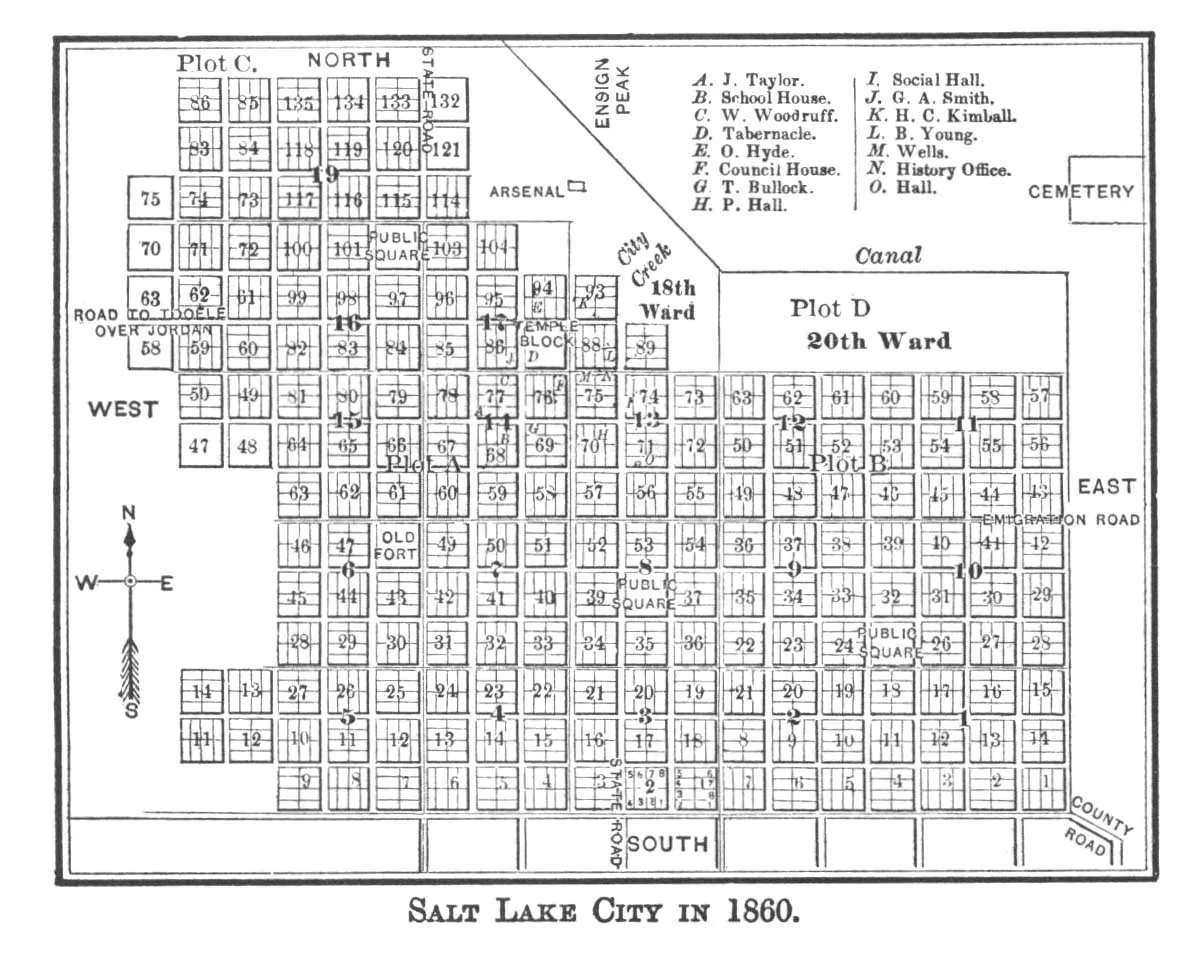
SALT LAKE CITY IN 1860.
around neither was there any sign that the inmates took a pride in their home. One might pass three dwellings enclosed by a common fence, and belonging to one master, but nowhere could be seen any of those simple embellishments that cost so little and mean so much—the cultivated garden plat, the row of shade trees, the rose-bush at the doorway, or the trellised creeper at the porch.
The city itself wore a different aspect. The streets,
though unpaved and without sidewalks, were lined with cotton-wood and locust trees, acacias, and poplars. Most of the private houses were still of wood or adobe, some few only being of stone, and none pretentious as to architecture; but nearly all were surrounded with gardens in which fruit and shade trees were plentiful. Many of them were of the same pattern, barn-shaped, with wings and tiny casements, for glass was not yet manufactured by the Mormons. A few of the better class were built on a foundation of sandstone, and somewhat in the shape of a bungalow, with trellised verandas, and low flat roofs supported by pillars. Those of the poor were small hut-like buildings, most of them one-storied, and some with several entrances. At this date the entire city, except on its southern side, was enclosed by a wall some ten or twelve feet high, with semi-bastions placed at half musket-range, and pierced here and there with gateways. 22
In driving through the suburbs the visitor would find the thoroughfares in bad condition, dusty in summer, and in winter filled with viscid mud. On either side were posts and rails, which, as the heart of the city was approached, gave way to neat fences of palings. On Main Street were the abodes of some of the leading Mormon dignitaries and the stores of prominent gentile merchants. On the eastern side, nearly opposite the post-office, and next door to a small structure that served for bath-house and bakery, stood the principal hostelry, the Salt Lake House, a large pent-roofed building, in front of which was a veranda supported by painted posts, and a sign-board swinging from a tall flag-staff. Here fair accommodation
could be had at very moderate charges. 23 Even in its business portion, Main Street had at this date many vacant lots, being then in the embryo condition through which all cities must pass, the log building standing side by side with the adobe hut and the stone or brick store, with here and there a few shanties, relics of the days of 1848.
Among the principal attractions was the temple block, surrounded in 1860 with a wall of red sandstone, on which were placed layers of adobe, fashioned in imitation of some richer substance, and raising it to a height of ten feet. On each face of the wall were thirty pilasters, also of adobe, protected by sandstone copings, but without pedestals or entablatures. Up to the year 1860 the cost of the wall and the foundations of the edifice already amounted to $1,000,000, a sum equal to the entire outlay on the temple at Nauvoo. The block was consecrated on the 3d of February, 1853, and the corner-stones laid with imposing ceremonies on the 6th of the following April. 24 In August 1860, the foundations, which were sixteen feet deep and of gray granite, had been completed, but no further progress had been made. I shall reserve until later a description of the building as it now stands. Of the tabernacle which occupied the southwest corner of the block, and the bowery immediately north of the tabernacle, mention has already been made. 25 In the north-west corner, and separated from
the tabernacle by a high fence, stood the endowment house, 26 where, as evil-minded gentiles declared, human sacrifices were offered. The ceremonies that actually took place within its walls have been described elsewhere in this volume.
In the blocks adjacent to the tabernacle were the residences of Brigham, Heber, Orson Hyde, George A. Smith, Wilford Woodruff, John Taylor, and Daniel H. Wells, the first two occupying entire blocks. 27 South of temple block was the council-house, 28 south of Brigham's dwelling and adjoining that of Wells was the historian's office, where the church records were kept, and in the next plat to the east was the social hall, 29 where the fashion of the city held festivities.
Balls held at the social hall were extremely select, and sometimes a little expensive, tickets for the more pretentious fêtes costing ten dollars for each couple, and the invitations, which were difficult to obtain even at that price, 30 being issued on embossed and bordered
paper. Dancing commenced about four P.M., the president of the church pronouncing a blessing with uplifted hands, and then leading off the first cotillon. All joined vigorously in the dance, and the prophet, his apostles, and bishops set the example, the saltations not being in the languid gliding pace then fashionable in other cities, but elaborately executed steps requiring severe muscular exercise. At eight came supper, a substantial repast, with four courses, 31 after which dancing was resumed, varied at intervals with song until four or five o'clock in the morning, when the party broke up, the entertainment closing with prayer and benediction.
Besides these fashionable gatherings held from time to time by the élite of Zion, there were ward parties, elders' cotillon parties, and picnic parties, the last being sometimes held at the social hall, where rich and poor assembled, bringing with them their children, and setting their own tables, or ordering dainties from an adjoining kitchen provided for that purpose. Here, also, until 1862, when the first theatre was built, theatrical entertainments were given in winter, 32 and these of no mean order, for among the Mormons there was no lack of amateur talent. 33 Among those who participated
were several of the wives and daughters of Brigham. 34 All the actors attended rehearsal each night in the week, except on Wednesdays and Saturdays, when the performances took place; most of them found their own costumes, and none received any fixed remuneration. 35
While the amusements of the people were thus cared for, there was no lack of more solid entertainment. All had access to the public library under proper restrictions, and in the council-house was opened, in 1853, the first reading-room, which was supplied with newspapers and magazines from all parts of the world. Among the scientific associations may be mentioned the Universal Scientific Society, established in 1854, with Wilford Woodruff as president, and the Polysophical Society, over which Lorenzo Snow presided. 36 The musical talent of Salt Lake City formed themselves, in 1855, into the Deseret Philharmonic Society, and in June of that year a music hall was in course of construction. 37 In the same
year the Deseret Theological Institute was organized, its purpose being to make known the principles of light and truth which its members claimed to have received from the priesthood, in the belief that "the science of theology embraces a knowledge of all intelligence, whether in heaven or on the earth, moral, scientific, literary, or religious"!
Prominent among the charitable associations was the Relief Society, originally organized by Joseph Smith at Nauvoo in 1842, and discontinued after his assassination until 1855, when it was reëstablished in Salt Lake City. After that date its operations gradually extended from ward to ward and from settlement to settlement, until it became a powerful influence for good throughout the land. Its main purpose was the relief of the poor, and by its efforts it prevented the necessity for poor-houses, which are still unknown among the latter-day saints, and otherwise it rendered good service—by educating orphans, by promoting home industries, and by giving tone and character to society through its moral and social influence. 38
To the student of humanity there were few richer fields for study than could be found at this period in the Mormon capital, where almost every state in the union and every nation in Europe had its representatives. There were to be seen side by side the tall, sinewy Norwegian, fresh from his pine forests, the phlegmatic Dane, the stolid, practical German, the dapper, quick-minded Frenchman, the clumsy, dogmatic Englishman, and the shrewd, versatile American. So little did the emigrants know of the land in which their lot was cast that some of them, while crossing the plains, were not aware that they trod on American soil, and others cast away their blankets and warm clothing, under the impression that perpetual summer reigned in Zion. A few years’ residence
in the land of the saints accomplishes a wonderful change, the contrast in mien and physique between the recruits and the older settlers being very strongly marked. Especially is this the case among the women. "I could not but observe in those born hereabouts," writes an English traveller in 1860, "the noble, regular features, the lofty, thoughtful brow, the clear, transparent complexion, the long, silky hair, and, greatest charm of all, the soft smile of the American woman when she does smile." 39
Much has been said about race deterioration arising
from polygamous unions. It has never been shown that physical development suffers from the polygamous system, especially when regulated by religion, as in the case of the Mormons. The children of saints are much like other children. In the streets of the capital, however, during the period under review, might be seen youths of eighteen or twenty, some of them the children of church dignitaries, whose highest ambition was satisfied when they could ride through the streets, hallooing and shouting, fantastically attired in fringed and embroidered buckskin leggings, gaudily colored shirt, and slouched hat, and with the orthodox revolver and bowie-knife conspicuously displayed. 40 They resembled somewhat the cow-boy of the present day; but their presence was barely felt amid this staid and order-loving community, 41 the forwardness of the second generation of the saints being attributed, not without show of reason, to the corrupting influence of the gentiles.
In order to estimate fairly the character of the population of Salt Lake City, which numbered in 1860 about 14,000, 42 the visitor should attend the bowery or tabernacle, where according to the season of the year about 3,000 of the populace assembled on Sunday. The men appeared, in warm weather, without coats and with open vests, but always in decent and cleanly garb, most of them being clad in gray tweed, though some of the elders and dignitaries wore black broadcloth. 43 The women wore silks, woollen stuffs,
or calicoes, as they were able to afford, usually of plain pattern and dark color, though a few were dressed in gaudy attire, and with a little faded finery. 44 The congregation was seated on long rows of benches opposite the platform, from which they were separated by the space allotted to the orchestra, then consisting of a violin and bass viol, vocal music being rendered by two female and four male singers. The oratory was somewhat of the Boanerges stamp, and contained much round abuse of the gentiles; but looking at the audience, which consisted, in the main, of a thriving, contented, and industrious class of people, light-hearted and ever ready to laugh at the somewhat broad jokes of the church dignitaries, it was impossible to believe all the hard things spoken and written of them by their enemies. Moreover, about one third of the population consisted at this date of emigrants from Great Britain, and at least two fifths were foreigners of other nationalities, most of them Danes, Swedes, or Norwegians. They were fair types of their race, and it is not very probable
that they had so quickly changed their national characteristics as already to forfeit the good opinion of their fellow-men.
Such was Zion in 1860, and such its population. Of the progress and condition of other settlements established soon after the Mormon occupation, and the founding of which has already been mentioned, I shall have occasion to speak later. During the thirteen years that had now elapsed since first they entered the valley, the saints had pushed forward their colonies in all directions almost to the verge of their territory. Especially was this the case toward the west, where, at an early date, they came into antagonism with settlers from California. In 1850 a few persons from that state had settled in Carson valley for trading purposes, the migration of gold-seekers, some of whom wintered in that region, being then very considerable. During the following year several Mormons entered the valley, John Reese, who arrived there in the spring with thirteen wagon-loads of provisions, building the first house, known for several years as the Mormon station, on the site of the present village of Genoa. 45 Reese first came to the valley alone, his nearest neighbor, James Fennimore, living in Gold Cañon, some twenty-five miles distant, in a "dug-out," or hole scooped out of the bank, the front part covered in this instance with rags and strips of canvas, the man being thriftless and a dram-drinker. He was nicknamed Virginia, and after him was named the city whence more bullion has been shipped in a single year than would now replace the floating capital of the states of California and Nevada. 46
By an act of the Utah legislature, approved January 17, 1854, the limits of Carson county were defined, 47 and the governor was authorized to appoint for it a probate judge whose duty it should be to organize the county, by dividing it into precincts, holding an election, filling the various offices, and locating the county seat. The choice fell on Orson Hyde, who with Judge Styles, the United States marshal, and an escort of thirty-five men, reached the settlement of John Reese in June 1855, other parties of Mormons arriving during this and the following year. Meanwhile miners, farmers, and herdsmen from California and the Atlantic states had settled in the valley and elsewhere on the eastern side of the Sierra Nevada in such numbers as to alarm the Mormons, who now desired them to leave the territory. This they refused to do, and some pretended fears of a resort to force. The gentiles fortified themselves, and assumed an aggressive attitude, and for two weeks the opposing forces were en-camped almost within sight of each other, but without coming to blows. News of the disturbance reached the mining camps on the other side of the mountains, and numbers prepared to go in aid of their comrades. The aggressors now feared that they would be themselves expelled from the country, and proposed a truce, under which all should be allowed to remain on their lands.
As soon as the matter became known to the authorities, the county organization was repealed, the probate judge recalled, and the records, which contained several criminal indictments of a serious
nature, 48 were removed to Salt Lake City. When news arrived of the approach of the army of Utah, the Carson Mormons were ordered, as we have seen, to return to Zion and aid in its defence, though a few remained in the valley. In 1859 the gentile inhabitants, after several fruitless appeals to congress, formally declared their independence, 49 and demanded admission as a territory. Two years later the request was granted, and the territory of Nevada was cut off from Utah, its eastern limit being fixed at the thirty-ninth meridian, but extended by act of 1862 to the thirty-eighth, and by act of 1866 to the thirty-seventh meridian. Reluctantly the Mormons relinquished these portions of the public domain.
In Eagle and Washoe valleys they had also established small settlements in 1854 and 1855, remaining until recalled in 1857, at which latter date, as will be remembered, the colony at San Bernardino in California was also abandoned. During the Mormon occupation the county of San Bernardino was cut off from that of Los Angeles, the former assuming its proportion of the liabilities. A city was built, with substantial dwellings, saw and grist mills, and surrounded
with thriving farms; 50 a road was constructed as far as the timber belt in the neighboring mountains, each man working incessantly until it was completed, and all this was accomplished without incurring debt, a small balance remaining in the county treasury when the settlers were ordered by Brigham to Salt Lake City. 51
Of Elder Samuel Brannan's party which arrived in San Francisco, as will be remembered, in the summer of 1846, mention is made in connection with my History of California. 52 During this year, a settlement named New Hope was founded by a portion of the company on the north bank of the Stanislaus River, near its junction with the San Joaquin, but was abandoned when news was received that the brethren had resolved to remain in the valley of Great Salt Lake. Most of the Mormons still remained, however, in California, betaking themselves to farming and lumbering until the time of the gold discovery, when they gathered at the mines on Mormon Island. Between 1848 and 1850 about a hundred and forty of them found their way to Utah; the remainder cast in their lot with the gentiles, and most of them, among whom was their leader, apostatized, though a few afterward joined the Mormon communities at San Bernardino and in Arizona. 53
Within the territory of Utah many new colonies were established. In 1853 the first settlement was made in Summit county by one Samuel Snider, who built a number of sawmills in Parley Park. In 1861 the county was organized, and soon became noted for
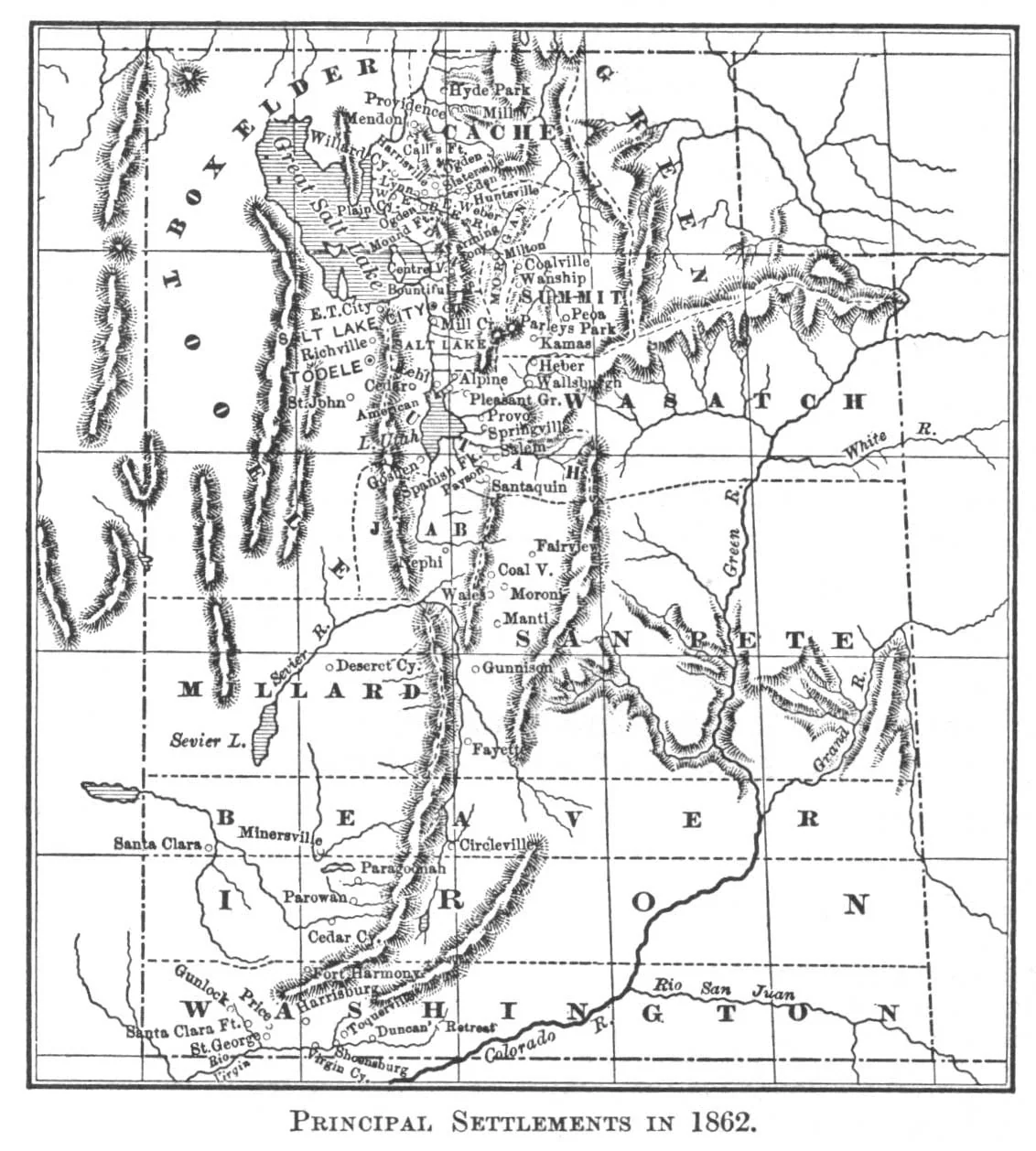
PRINCIPAL SETTLEMENTS IN 1862.
its mineral resources, among them being gold, silver, lead, copper, coal, iron, and mica. Its coal-fields first
brought it into prominence, and to aid in their development a short line of railroad was built, 54 but afterward dismantled and abandoned. Coalville, the present county seat, was first settled in 1859. 55 In 1858 the site of the present town of Kamas was occupied as a grazing ground by Thomas Rhoads, and was then known as Rhoads Valley. Two years later a few families settled there, and in 1862 a ward was organized, with William G. Russell as presiding elder. 56
About seven miles north-west of Kamas, and on the east bank of the Weber, the village of Peoa was founded in 1860 by a party of ten settlers. 57
In 1853 Fort Bridger, with its Mexican grant of thirty square miles of land, on which stood a few cabins, was sold for $8,000 to the Mormons, 58 who during the following year expended an equal sum in improvements. This was the first property owned by the saints in Green River county. At Fort Supply, in this neighborhood, a settlement was formed about the same time by John Nebeker, Isaac Bullock, and about fifty others from Salt Lake and Utah counties. In 1862 the first settlement was made in Wasatch county, south of Green River and Summit counties, on the site of the present village of Wallsburg. 59 Situated for the most part at an elevation of about seven thousand feet, with a heavy snow-fall and prolific of streams, this section of the territory was and is yet mainly used for stock-ranges, though in the
north-western portion there is farming land of good quality.
Morgan county, west of Summit, was named after Jedediah Morgan Grant, who with Thomas J. Thurston and others first occupied it in the spring of 1855. In 1862 it was organized, the county seat, Morgan City, being incorporated six years later. The village of Milton was settled by Thurston in 1856, and Enterprise, which together with Morgan is now on the line of the Union Pacific, in 1862.
In 1856 a party of six brethren settled in Cache Valley on the site of the present town of Wellsville, Cache county, north of Weber, being organized during the following year. Except toward the north, the valley is surrounded by mountains, on which the snow lingers late into autumn, thus affording water for irrigation throughout the year. Though the first attempt at agriculture resulted in failure on account of the severity of the climate, excellent crops were afterward raised, and soon this section became known as the granary of Utah. Amid the ranges are vast belts of timber, so dense that there are places where the sunlight never penetrates, and where the foot of man has never trod. Minerals are also abundant, though little utilized at present. During the year 1856 a fort was built at Wellsville, the site of the town being laid out in 1862, when a hundred and fifty families were gathered there. 60 Logan City, about six miles north of Wellsville, and the capital of Cache county, was located by Peter Maughan in the spring of 1859, the spot being selected on account of its rich soil and pasture, and the ample water power afforded by the Logan River. The first settlers drew lots for their
land, 61 and in 1860 the site was surveyed, the city being divided into four wards in 1861, and incorporated five years later. About five miles to the west of Wellsville the settlement of Mendon was commenced in 1857, 62 the settlers removing to Wellsville in the winter of 1858-59 for protection against Indians, and returning the following year in greater number. The first buildings were of logs, with roofs and floors of mud, timber being scarce in that neighborhood. 63
In 1859 Seth and Robert Langton, Robert and John Thornley, travelled northward from Salt Lake City in search of an agricultural site. Arriving at Summit creek, they settled within half a mile of the present town of Smithfield, Cache county. In November the settlement was organized as a ward, with John G. Smith as bishop, and in March 1860 a survey was begun. A few weeks later troubles arose with the Indians, 64 compelling the settlers to build and take refuge in a fort, in which they remained until late in the following year. At the close of 1861 there were in operation a lumber-mill, a molasses-mill, and a tannery, 65 and the town had then been laid out in its present form. Other settlements in Cache county were Hyde Park, five miles north of Logan, and now on the line of the Utah and northern railroad, where, in 1860, sixteen families were gathered; 66 Providence, two miles south of Logan,
where the first settlers 67 took up their abode in April 1859; Millville, two miles farther south, located in June 1860; 68 Paradise, at the southern extremity of the valley, containing in 1861 about thirty inhabitants, 69 and Hyrum, settled in 1860 by about twenty families. 70
Thus far the progress of Mormon colonization in the north, east, and west. Toward the south, the first settlement in Beaver county, between Millard and Iron counties, dates from 1856, at which time Simeon F. Howd, James P. Anderson, and Wilson G. Mowers arrived in Beaver Valley, commenced to build a log cabin, and made preparations for farming and stock-raising. Soon afterward they were joined by others, making in all some thirty or forty families, and in the spring of 1858 the site of Beaver City was laid out. 71 The appearance of the valley was not inviting. Situated at an altitude of 6,500 feet, frosty and barren, its surface covered in parts with sage-brush and its soil everywhere impregnated with alkali, it was at first considered unfit for occupation. Its main attraction was the volume of water afforded by Beaver River, which courses through the valley from east to west, its source being at an altitude
of nearly twelve thousand feet. Within recent years, as we shall presently see, this district has proved itself rich in minerals. Next in importance to Beaver City, and about twenty miles to the southwest, was Minersville, first settled in 1859, with J. H. Rollins as bishop of the ward.
The principal settlement in Kane county, which lay south of Iron and east of Washington county, and at one time included a portion of the latter, was Virgin City, founded in 1858, on the upper Virgin River. 72 Its site is in a valley about seven miles in width, and enclosed by mountains, their foothills, seamed and broken by the rains, leaving but a narrow margin for cultivation on the banks of the stream, covered with a dense growth of cotton-woods and an undergrowth of sage and rabbit brush. Five or six miles west of Virgin City was the town of Toquerville, established in 1858 by several families front Cedar City. 73
In 1854 Jacob Hamblin and two others were sent as missionaries to the Lamanites in the valley of the Virgin and Santa Clara rivers in Washington county, with orders to establish a settlement in that neighborhood. They found the Indians peaceably disposed, and in a measure civilized, many of them being engaged in planting corn, wheat, and squashes, but depending mainly for bread on the seeds of wild grasses. 74
In 1857 other missionaries joined the party, together with a number of families from Salt Lake City, and in May of this year a settlement was formed, to which was given the name of Washington.
In October 1861 three hundred of the saints, under the direction of Orson Pratt and Erastus Snow, were ordered to proceed to this district, and build a city, to be named St George, near the junction of the Virgin and Santa Clara rivers in Washington county. In January 1862 a site was selected and surveyed, the city incorporated, 75 though yet unbuilt, and the people took possession of their lots. Before doing so it was decided by unanimous vote that the first building erected should be a social hall, to be used for educational and other purposes. 76 In September Brigham visited the settlers, and advised them to build, as soon as possible, a substantial, commodious, and well-finished meeting-house, or tabernacle, large enough to seat at least two thousand persons, and one that would be an ornament to their city and a credit to their enterprise. The foundation stones were laid on the 1st of June, 1873, the prophet's birthday, and the building completed eight years later, at a cost of $110,000. Before its settlement, the valley of St George presented a barren appearance, its surface being strongly impregnated with mineral salts, even the bottom-lands of the Virgin and Santa Clara showing large strips of alkaline soil. Its climate was mild, and, with irrigation, crops of many kinds could be raised; but water was scarce, an artesian well sunk in 1862, at a cost of $5,000, being abandoned as a failure, after attaining a depth of more than two hundred feet. 77 Notwithstanding these drawbacks, the city became
the county seat of Washington, and is to-day the leading town in southern Utah. 78
Of the counties organized between 1850 and 1852, and the settlements founded therein up to the latter date, mention has already been made. 79 During the next decade many small villages and towns were located in the older counties, 80 and I shall describe later
those that afterward attained prominence. They differed but little in outward appearance from the pioneer settlements in other parts of the United States, except in one particular. Throughout the entire territory, there was rarely to be seen, except in Salt Lake City, a store or a mechanic's sign, traffic being carried on from house to house, and the few extraneous wants of the settlers being mainly supplied by peddlers. 81
Nevertheless the traveller who might chance to visit any of the larger settlements in 1862 could purchase, at reasonable rates, all the necessaries of life, and could perhaps supply himself with luxuries, provided he were willing to pay from three to five fold their value. Though there was no indication that trade in its ordinary sense existed among these communities, and one might search in vain for a hotel, or even for a bath-house or a barber's shop, most of the ordinary crafts were represented, and all that was needful could be obtained for money.
Footnotes
572:1 Stenhouse's Rocky Mountain Saints, 419-20; S. F. Alta, Sept. 29, 1858.
573:2 Stenhouse says that a counterfeit plate was engraved at S. L. City, resembling the one used by the quartermaster at Camp Floyd for drafts drawn on the assistant U.S. treasurers at New York and St Louis. When the fraud was discovered the culprit turned state's evidence, and testified that a person in the employ of Brigham had furnished the paper. It was supposed that the latter was implicated, and thereupon the writ was issued. Rocky Mountain Saints, 410-11. Cradlebaugh says that the plate was seized by Marshal Dotson, by order of Judge Eckles, and that Brigham afterward obtained judgment against the former for $2,600 damages, the marshal's house being sold to satisfy the judgment. Mormonism, 15. See also Burton's City of the Saints, 507. I find nothing about this matter in the files of the Deseret News; but the fact that the writ was issued is mentioned by Tullidge Hist S. L. City, 228, and in the Hand-book of Reference. 77. Peter K. Dotson, a native of Virginia, came to Salt Lake City in 1851, and was first employed by Brigham as manager of a distillery, afterward becoming express and mail agent. In 1855 he was appointed U.S. marshal for Utah, and in 1857 proceeded to Washington, returning with the army during that year. Dotson's Doings, MS.
573:3 In a conversation with Stenhouse, the governor stated that, in case of resistance, the wall surrounding Brigham's premises was to be battered down with artillery, and the president taken by force to Camp Floyd. So, at least, said the officers. 'I listened to them, sir as gravely as I could,' continued Cumming, 'and examined their papers. They rubbed their hands and were jubilant; "they had got the dead-wood on Brigham Young." I was indignant, sir, and told them, "By—, gentlemen, you can't do it! When you have to take Brigham Young, gentlemen, you shall have him without creeping through walls. You shall enter by his door with heads erect, as becomes representatives of your government. But till that time, gentlemen, you can't touch Brigham Young while I live.' Rocky Mountain Saints, 411. Wells, Narr., MS., 63-5, states that Brigham attended court, though his followers were very unwilling to allow it, as they feared a repetition of the Carthage-jail tragedy, but that no proceedings were taken against him.
573:4 A correspondent of the New York Herald, writing from S. L. City, May 23, 1859, says that the governor notified Wells to hold the militia in readiness to resist the troops. A copy of his letter will be found in Tullidge's Hist. S. L. City, 228-30. See also Hand-book of Reference, 77. It is very improbable that Cumming would have taken such an extreme measure, and I find no mention of it in his official despatches, in those of General Johnston, or in the files of the Deseret News. Gen. Wells himself gives the following account of the matter: 'I told Cumming myself that we didn't intend the Carthage scene reinacted, and he knew that we intended to resist the troops, which we did. I went to see Cumming frequently, and talked the matter over with him, and he declared himself that he could not recommend Gov. Young to trust himself to that military mob; but he did say he could not see how bloodshed could be hindered. I told him we would not let them come; that if they did come, they would never get out alive if we could help it. He said he did not know what to do.' 'They knew that if they did come, we were ready for them, and that we were ready to cut off their retreat. It gave us a good deal of trouble, and anxiety as well, to prepare against it, as it occurred at a time when we were putting in our crops.' Narr., MS., 634.
574:5 Soon after a mass-meeting of gentiles was held at Camp Floyd, at which the judges took a prominent part. An address was drawn up, rehearsing all the crimes imputed to Mormons, stating that they were still disloyal to the government, and censuring the president for his interference.
574:6 Their successors are mentioned in the next chapter. Cradlebaugh, refusing to recognize the right of the president to remove him, continued in office for a short time, but finding himself unsupported by the government, left Utah and settled in Nevada, whence he was twice sent as delegate to congress. Waite's The Mormon Prophet, 75-6.
574:7 Stenhouse's Rocky Mountain Saints, 413; Tullidge's Hist. S. L. City, 233. Both these authorities claim that Cumming was aided by Col Kane, who about this time delivered a lecture before the historical society of New York on the situation of Utah, in which he spoke of Cumming as a clear-headed, resolute, but prudent executive, and the very man for the trying position. Stenhouse was present at the lecture as reporter for the New York Herald, and notices of it were widely published throughout the country.
575:8 Before his departure the citizens desired to show their respect by some public demonstration, but this he declined, slipping away so quietly that his departure was not known until it was published in the Deseret News of May 22d. His conduct received the approval of the territorial legislature. Utah Jour. Legisl., 1860-1, p. 161.
Gov. Cumming was a native of Georgia, his wife being the daughter of a prominent Boston physician, and an accomplished lady. In 1830 he was mayor of Augusta, Ga, and during the cholera epidemic of that year used his utmost effort to save the lives of the citizens. During a portion of the Mexican war he was attached to the staff of Gen. Scott, and was afterward appointed by government to visit several Indian tribes in the far west. Waite's The Mormon Prophet, 75.
575:9 Through his business agent, H. B. Clawson. As Horace Greeley remarks in his Overland Jour., 254, the live-stock would have brought much better prices had it been driven to California, or even to Fort Leavenworth. He states that, in 1859, 30,000 bushels of corn, which could have been bought in Utah for $2 per bushel, were sent from the eastern states at a cost of more than $11 per bushel. Greeley visited the territory in this year, but his observations, apart from his account of an interview with Brigham, already mentioned, contain little of historical value. His reception at S. L. City is described in the Deseret News, July 20, 1859.
576:10 For descriptions of public festivities, between 1855 and 1865, see Deseret News, Jan. 4, July 18, 1855; July 9, 30, Aug. 6, 1856; July 8, 15, 22, 1857; July 11, Aug. 1, 1860; July 10, 1861; July 9, 30, 1862; July 8, 1863; July 6, 20, 27, 1864; July 5, Aug. 5, 1865; Tullidge's Life of Young; 247-9, Burton's City of the Saints, 424-5; S. F. Alta, Sept. 10, 1856; S. F. Bulletin, Dec. 2, 1858; Sac. Union, July 11, 1861. A thanksgiving proclamation issued by Gov. Harding in 1862 was ignored throughout the territory. 'The non-observance of this thanksgiving day,' remarks Tullidge, 'brought Stephen S. Harding to the full realization of the fact that, though he was governor of Utah, Brigham Young was governor of the Mormon people.'
576:11 I have already mentioned that the census report for 1860 gives the population at only a little over 40,000, and stated my reasons for supposing this to be an error. Beadle says that a judge who travelled extensively throughout the territory about 1864-5 estimated it at 85,000, and thinks the judge's estimate too low. He himself places it, in 1867, at 100,000. Life in Utah, 483. Bowles, Our New West, about the same date, at 100,000 to 125,000. See also S. F. Herald, Jan. 30, 1861; Sac. Union, Feb. 11, 1860. In the census of 1870 the population is given at 86,786.
576:12 U.S. Census Rept, for 1860, li. 43. The total number of deaths reported is 374.
576:13 For the year ending June 1, 1850, it was about 22 per 1,000, the rate being then greater on account of the hardships and exposure incidental to new settlements. The following extracts from the sanitary report of Assistant-surgeon Robert Bartholow of Utah terr., dated Sept. 1858, and published in Sen. Doc., 36th Cong. 1st Sess., xiii. 301-2, may serve as a specimen of the prejudice of U.S. officials on matters relating to the territory, and help to account for their blunders: 'The Mormon, of all the animals now walking this globe, is the most curious in every relation.' 'Isolated in the narrow valleys of Utah, and practising the rites of a religion grossly material, of which polygamy is the main element and cohesive force, the Mormons have arrived at a physical and mental condition, in a few years of growth, such as densely populated communities in the older parts of the world, hereditary victims of all the vices of civilization, have been ages in reaching. If Mormonism received no addition from outside sources, these influences continuing, it is not difficult to see that it would eventually die out.'
577:14 From cholera infantum 4, croup 23, infantile 57, measles 1, scarlatina 2, teething 11. Id. 43.
577:15 After the railroad connected the territory with the Altantic and Pacific states, suicides became not infrequent.
577:16 In Compend. Ninth Census, 533, the table of pauperism and crime shows only one person receiving support as a pauper, and eight criminals. At the time of Burton's visit, in 1860, there were only six prisoners in the penitentiary at S. L. City, of whom two were Indians. City of the Saints, 329. In the Deseret News of June 18, 1856, it is stated, however, that there were many beggars among the women and children.
577:17 Incorporated by act approved Jan. 17, 1856, 'with a view of promoting the arts of domestic industry, and to encourage the production of articles from the native elements in this territory.' A copy of it will be found in Utah Acts Legisl. (ed. 1866), 111.
578:18 For list of premiums and diplomas, see Burton's City of the Saints, 384-7.
578:19 From the list of prices-current at the tithing-office in 1860, we learn that cereals were rated in Salt Lake City at $1.50 per bushel, butcher's meat at 3 to 12½ cents per pound, chickens and ducks at 10 to 25 cents each, eggs at 18 cents per dozen, milk at 10 cents per quart, and butter at 25 cents per pound; but sugar worth in New York about 6 cents per pound cost in Utah 35 to 60 cents, while tea ranged in price from $1.50 to $3.50, and coffee from 40 to 60 cents per pound, or at least fivefold their cost in the Atlantic states.
579:20 William Chandless, who visited Salt Lake City in the winter of 1855-6, states that, if one wanted to sell anything, he could get nothing for it, because of the scarcity of money; while if an offer were made to buy the same article for cash, a very high price must be paid on account of the rarity of the article. Visit to S. L. City, 223. For many years afterward, this system of traffic prevailed in a measure. Thus, in the Deseret News of Feb. 22, 1860, J. C. Little advertises that he will exchange his store of furniture for wheat and flour; George B. Wallace that he will give five gallons of molasses per cord for wood; and Felt and Allen that they pay cash and store goods for wheat delivered at the Jordan mills.
579:21 In 1860 there were three milliner's stores, thirteen dry-goods and two variety stores. Burton's City of the Saints, 277-8.
581:22 Woodruff's Journal, MS.; Richards’ Hist. Incidents of Utah, MS., 28-91 Wells’ Narr., MS., 60; Chandless, Visit to S. L., 153; Sloan's Utah Gazetteer, 25. The wall was built in 1853. Chandless remarks that for defensive purposes it would be useless, as any one could climb it with ease. Burton, City of the Saints, 245, states that it was built as a defence against Indians, though gentiles said that it was constructed only because the people wanted work. It was of mud mixed with hay and gravel; in 1860 it had already begun to crumble, and in 1883 there were few traces of it remaining.
582:23 Burton relates that at the time of his visit, in Aug. 1860, the Salt Lake House was kept by a Mr Townsend, a Mormon convert from Maine, who had been expelled from Nauvoo, where he sold his house, land, and furniture, for $50. City of the Saints, 248. His charge for 24 days’ board and lodging was $34.25. The bill, which is curiously worded, is given in full in Id., 537. Among its items are '14 Bottle Beer 600' (cents), '2 Bottles Branday 450.'
582:24 The original plans will be found in the Millennial Star, xvi. 635, and Linforth's Route from Liverpool, 109-10. Those given by Truman O. Angell, the architect, in the Deseret News, Aug. 17, 1854, differ somewhat from the above, but both agree that the edifice was to cover a space of 21,850 sq. feet, or about half an acre. For descriptions of the consecration and laying of the corner-stones, see Woodruff's Journal, MS.; Tucker's Mormonism, 222; Ferris’ Utah and the Mormons, 167-9; S. L. City Contributor, iii. 79; Deseret News, Feb. 19, Apr. 16. 1853. Seven thousand four hundred and seventy-eight tons of rock were used for the foundation. Richards’ Incidents in Utah Hist., MS., 81.
582:25 Burton describes the tabernacle, in 1860, as an adobe building, capable of accommodating 2,000 to 3,000 persons, the interior of which was spanned by an elliptical arch. Over the entrances were carvings in wood, 'representing the sun with his usual coiffure of yellow beams, like a Somali's wig, or the symbol of the Persian empire.' City of the Saints, 270. A few years later the tabernacle was enlarged, and had a seating capacity of 7,000. Utah Notes, MS., 2.
583:26 Cuts of the tabernacle and endowment house will be found in City of the Saints, facing p. 271.
583:27 The residences of Young, Kimball, and Wells were on Main St, properly East Temple St, which runs past the temple block. Remy says that one of Brigham's houses was 80 x 40 ft, built of granite and other kinds of stones, with long salient ogives, that adjoining it being the dwelling which he usually occupied. Near by were the governor's offices, the tithing-office, and the court-house. Jour. to S. L. City, i. 193-4. In Id., i. 193-200; Greeley's Overland Jour., 206-7; Atlantic Monthly, iii. 573-5; Schiel, Reise durch Felsengebirge, 100-2, are descriptions of S. L. City about this date.
583:28 This building, which was begun in 1849, and haa already been described, was afterward destroyed by fire. Nebeker's Early Justice, MS., 3. Except for a small structure used as a post-office, this was the first public building erected in S. L. City. See also Wells’ Narr., MS., 42.
583:29 The opening of the social hall is described in the Deseret News, Jan. 22, 1853. Among other buildings worthy of note were the arsenal, built on the bench north of the city, the penitentiary in the south-eastern suburb, and the hall of seventies on the 'states road.' Linforth's Route from Liverpool, 110; Burton's City of the Saints, 279-80. The court-house was yet unfinished. Atlantic Monthly, iii. 574.
583:30 They were issued on special occasions only for 75 or 80 guests, including a few of the more prominent gentiles.
584:31 Copies of the card of invitation and the ménu at a 'territorial and civil ball' held at the social hall, Feb. 7, 1860, will be found in Burton's City of the Saints, 231-2. Among the dishes are bear, beaver-tails, slaw, mountain, pioneer, and snowballs. What the names all signify I am unable to state. Otherwise the bill of fare contains a large and choice variety of viands.
584:32 Cooke's Theatr. and Soc. Affairs in Utah, MS., 9. In summer they were held at the bowery. The S. L. theatre, or as it was usually termed the opera-house, was dedicated March 6th of this year. Sloan's Utah Gazetteer, 1884, p. 28. A gentleman who visited the city two or three years later states that its interior resembled the opera-house at New York, having seats for 2,500 and capacity for 500 more. Externally the building was a plain but not ungraceful structure of stone, brick, and stucco. Atlantic Monthly, Apr. 1864, p. 490.
584:33 Among others Burton mentions H. B. Clawson, B. Snow, and W. C. Dunbar. During his stay the 'Lady or Lyons' was performed. City of the Saints, 280. See also Deseret News, March 2, 1864; Busch, Gesch. Morm., 311-12, 330; The Mormons at Home, 149-51. Chandless, who visited the social hall one evening in the winter of 1855-6, when the third act of Othello and a two-act drama were performed, mentions that the parts of Othello and Iago were fairly rendered, but that the other characters were beneath criticism. Desdemona, he says, 'was a tall, masculine female, with cheeks painted beyond the possibility of a blush. Even worse was Emilia—an old dowdy, she looked, who might have been a chambermaid at a third-rate hotel for a quarter of a century…The afterpiece was, on the contrary, very well performed.' Visit to S. Lake, 224.
585:34 Three of Brigham's daughters, Alice, Emily, and Zina, were on the stage. Hepworth Dixon, who was well acquainted with Alice, the youngest wife of Elder Clawson, says that she remarked to him one day at dinner, 'I am not myself very fond of playing, but my father desires that my sister and myself should act sometimes, as he does not think it right to ask any poor man's child to do anything which his own children would object to do.' New America, 144.
585:35 Cooke's Theatr. and Soc. Affairs in Utah, MS., 9-10; Stenhouse's Tell It All, 380-1. Mrs Cooke states that the performers often remained at rehearsal until 12 or 1 o'clock, and that after a hard day's work. Occasionally a benefit was given to the lady actors, and the proceeds divided among them. Her share during the twelve years that she played amounted to $150. In Theatrical and Social Affairs in Utah, by Mrs S. A. Cooke, MS., we have, besides the information which the title-page suggests, a number of items relating to church matters and the workings of polygamy. Mrs Cooke was well acquainted with the wife of Heber C. Kimball, Eliza Snow, and other prominent women among the Mormons. Of English birth, she was for eight years a teacher of music in the city of New York, and in 1852 set forth for California, reaching S. L. City in July, where she purposed to remain only until the following spring, but was converted to Mormonism. For 16 years she was employed as a teacher, among her pupils in Zion being the children of Brigham Young.
585:36 There was also a horticultural society, organized in connection with the American Pomological Society, and the Deseret Typographical Association formed for the advancement of their art. Linforth's Route from Liverpool, 111.
585:37 By the members of Capt. Ballo's band. Deseret News, June 27, 1855.
586:38 In 1880 this society had nearly 300 branches. Snow's Brief Sketch of Organizations, MS., 1-2.
587:39 Burton's City of the Saints, 278. Burton attributes this improvement in the race to climate. In amusing contrast with Burton's remarks are those of Surgeon Bartholow, who in his sanitary report says: 'It is a curious fact that Mormonism makes its impress upon the countenance,…an expression compounded of sensuality, cunning, suspicion, and a smirking self-conceit. The yellow, sunken, cadaverous visage; the greenish colored eyes; the thick, protuberant lips; the low forehead; the light yellowish hair; and the lank, angular person—constitute an appearance so characteristic of the new race, the production of polygamy, as to distinguish them at a glance. The women of this territory, how fanatical and ignorant soever, recognize their wide departure from the normal standard in all christian countries, and from the degradation of the mother follows that of the child.' Sen. Ex. Doc., 52, 36th Cong. 1st Sess., 302.
The City of the Saints, and across the Rocky Mountains to California, by Richard F. Burton, London, 1861, ranks among the best of gentile works on Mormonism. Less philosophical than that of Gunnison, it is equally impartial, and gives many details as to the social and industrial condition of the Mormons for which one may search in vain elsewhere. His stay in S. L. City lasted less than four weeks (from Aug. 25 to Sept. 20, 1860), excursions being made during his visit to points of interest in the neighborhood, but he saw more during that time than many others have done in four years. Travelling in company with Lieut Dana of the U.S. artillery, and procuring introductions to Gov. Cumming, Brigham Young, and several of the church dignitaries, he had every opportunity to note the different phases of Mormon life. The first and last portions of the work are taken up with his travels from St Joseph, Mo., to San Francisco, the middle chapters only relating to Utah. In style and tone the writer is sketchy and interesting, good-natured, but somewhat disposed to regard matters in their ludicrous aspect, for which he offers in his preface the excuse—sic me natura fecit.
A Visit to Salt Lake; being a Journey across the Plains and a Residence in the Mormon Settlements at Utah, by William ChandIess, London, 1857, is the title of a less entertaining and reliable work. As Mr Chandless remarks in his preface, even at that date, 'fictions enough have been written about the Mormons;' but it does not appear that his own work is less fictitious than those of which he complains. There are chapters about religion, government, settlements, morals, institutions, and some that appear to be about nothing in particular, unless it be Mr Chandless. Nevertheless, items of interest may be gleaned from them, as the author made a tour of the principal counties in 1855, and travellers in those parts were rare at this period. After informing us where he slept, and where he dined, and what he had for dinner, he occasionally finds time to tell us something about the condition of the settlements through which he journeyed.
588:40 Jennings’ Mat. Progr. of Utah, MS., 3-4. Mr W. Jennings, ex-mayor of S. L. City, who supplied me with the above MS. in 1884, says that this condition of affairs came to an end when the railroad reached Utah.
588:41 'There were no lamps in any but Main Street, yet the city is as safe as St James Square, London. There are perhaps not more than 25 or 35 constables or policemen in the whole place.' Burton's City of the Saints, 273. 'The few policemen that have been on duty during the summer were discharged on Monday last.' Deseret News, Sept. 12, 1860.
588:42 In 1863 Brigham stated its population at 16,000. Atlantic Monthly, Apr. 1864, p. 492; Burton, in 1860, 9,000. City of the Saints, 284; Bowles, in 1865, 25,000 to 30,000. Our New West, 227. The last two are wide of the mark.
588:43 Before this date Brigham attempted to lead the fashion, appearing in a yellow slouched hat, much too large for his head, green frock-coat, pants large and loose, and white socks and slippers. His fashion was followed by some of the elders. Ward's Husband in Utah, 34-5. Burton says that the prophet was dressed in gray homespun, and wore a tall steeple-crowned hat, as did most of the elders. Describing one of his addresses, he writes: 'Brigham Young removed his hat, advanced to the end of the tribune, and leaning slightly forward upon both hands, propped on the green baize of the tribune, addressed his followers. The discourse began slowly, word crept titubantly after word, and the opening phrases were hardly audible; but as the orator warmed, his voice rose high and sonorous, and a fluency so remarkable succeeded falter and hesitation, that although the phenomenon is not rare in strong speakers, the latter seemed almost to have been a work of art. The manner was pleasing and animated, and the matter fluent, impromptu, and well turned, spoken rather than preached; if it had a fault, it was rather rambling and disconnected…The gestures were easy and rounded, not without a certain grace, though evidently untaught; one, however, must be excepted, namely that of raising the forefinger…The address was long. God is a mechanic. Mormonism is a great fact. Religion has made him, the speaker, the happiest of men. He was ready to dance like a shaker. At this sentence the prophet, who is a good mimic and has much of the old New English quaint humor, raised his right arm, and gave, to the amusement of the congregation, a droll imitation of Anne Lee's followers.' City of the Saints, 317.
589:44 For many years after their arrival in the valley the women dressed in homespun linseys, as there was nothing else to wear. At one time Brigham, in order to discourage extravagance, decreed that the men must not dance with women who were dressed in other than homespun garments. Jennings, Mat. Progress, MS., 1.
590:45 It served as hotel and store, and was a two-story log building, 50 x 30 ft. Reese's Mormon Station, MS.; Taylor's Rem., MS.
590:46 Reese states that Virginia had a flume in the cañon for gold-washing, and that Comstock, who came to Carson Valley in 1856, bought him out, the latter living but a short time afterward. Id., 5. In Jennings’ Carson Valley, MS., 3, it is related that Comstock came to the valley in the autumn of 1856, in charge of a herd of sheep, but in a destitute condition. In 1852 Rese was engaged in farming on a considerable scale, selling his produce readily and at high prices to emigrants who, as he says, would pay almost any price for provisions, a small bunch of turnips selling for a dollar. Reese lived later at S. L. City, while S. A. Kinsey, his former partner remained at Genoa. Van Sickles' Utah Desperadoes, MS. Among the earliest settlers were three persons named Lee, and others named Condie and Gibson. Early Hist. Carson Valley, MS., 1. The place was first known as 'the Mormon station,' Genoa being laid out in 1856. Id., 3.
591:47 It was bounded on the north by Deseret co., east by the 118th meridian, south by the boundary line of Utah, and west by California. Utah Acts Legisl. (ed. 1855), 261.
592:48 A letter of James B. Crane, dated Washington, Jan. 17, 1859, and of which copies will be found in Waite's The Mormon Prophet, 31-5, and Tucker's Mormonism, 226-9, gives a detailed account of the Carson-valley troubles. The letter, which is somewhat bitter in tone, was written with a view to the admission of Nevada as a territory. Life and property were somewhat insecure in Carson valley about this date, and vigilance committees were constantly on the alert. See Sac. Union, Aug. 26, 1857, June 17, 22, July 2, Aug. 2, Dec. 21, 1858, June 1, 1859, Sept. 24, 1860. On the 14th of June, 1858, William Thorington, better known as 'Lucky Bill,' Luther Olds, William Edwards, and four others were arrested by a party of 30 men, and tried for the murder of a Frenchman named Godier, at Honey Lake. Lucky Bill was hanged, Olds was released on payment of $1,000 fine and promising to leave the valley never to return, and Edwards probably escaped by bribing his captors. The rest were released. Van Sickles' Utah Desperadoes, MS.; Placerville Tri-weekly Register, June 24, 1858; Popular Tribunals, this series.
592:49 The declaration contains a number of charges against the Mormons, which will be found in Remy's Jour. to G. S. L. City, i. 493-4. On May 6, 1856, joint resolutions of the California legislature were read in the U.S. senate, setting forth that a large number of settlers in Carson valley had, for good reasons, petitioned congress that this portion of Utah be attached to California, and had asked the coöperation of the California legislature, that the latter body acquiesced, and urged the passage of a law to that effect, Cong. Globe, 1855-6, 1089.
593:50 Elder Rich, who arrived at S. L. City from San Bernardino in April 1852, reported 1,800 acres in grain, and about 1,000 in vegetables. Deseret News, May l, 1852.
593:51 Shepherd's Colonizing of San Bernardino, MS. See also letter of Amasa Lyman, in Millennial Star, xiv. 491-2; and extract from N. Y. Herald, in Id., xv. 61; Richards’ Hist. Incidents of Utah, MS., 23; S. F. Herald, Aug. 21, 1852; Hughes, in Hastings' Or. and Cal., 96; Utah Scraps, 11.
593:52 Vol. v., 544-54. On pp. 543-4 (note 35) is a list of the members.
593:53 Frisbie states that after the gold discovery the Mormons, many of whom had now become wealthy, refused to pay tithes, whereupon Brannan appealed to their sense of duty, but finding them fixed in their resolve, frankly told them they were sensible, and had been damned fools for paying tithes so long. From that time he ceased to be an elder. Rem., 33-4. For further details as to Brannan's party, see Glover's Mormons in Cal., MS., passim; Larkin's Doc., MS., iv. 55; Olvera Doc., MS., 14-15; Larkin's Off: Corresp., MS., ii. 42; Millennial Star, ix. 39-40, 306-7; Times and Seasons, vi., 1126-7. Sutter spoke of them in the highest terms. 'So long as these people have been employed by me,' he says, 'they have behaved very well, and were industrious and faithful laborers.' Hutchings’ Cal. Mag., ii. 196. In Jan. 1847 Brannan had established a newspaper styled the Yerba Buena California Star, with the press, type, and fixtures brought from the office of The Prophet, in New York. It was continued until the close of 1848. See Hist. Cal., v. 552, this series. Richards’ Bibliog. of Utah, MS., 12-13. In Feb. 1856 Geo. Q. Cannon commenced the issue in San Francisco of a weekly paper named the Western Standard. It was discontinued in Sept. 1857, when the brethren were recalled to Utah, Id., 14.
595:54 The Summit County Railroad.
595:55 By H. B. Wild, A. B. Williams, W. H. Smith, and others. It was incorporated in 1867. Sloan's Utah Gazetteer, 1884, 149. Summit co. was so named from the fact that it included the summit of the Wasatch range. Richards’ Utah Misc., MS., 1.
595:56 The settlers lived in a fort until 1870, when a city survey was made, and they moved out to their lots.
595:57 The first house was built by Henry Barnum and Jacob M. Truman. Id., 150.
595:58 The deeds are now in the possession of the church officials at S. L. City. Trans. Wyom. Acad. Sciences, 1882, pp. 81-2. Miles Goodyear, the owner, was married to a sister of the Indian chief Walker. Young's Early Exper., MS., 5.
595:59 By Wm Wall, E. Garr, and Jas Laird. Sloan's Utah Gazetteer, 1884, p. 158. In 1866 Wallsburg was organized as a ward.
596:60 Cache co. was so called from the fact that certain trappers or emigrants cached some goods there as they passed through; Wellsville was named for Gen. Wells. Richards’ Utah Miscell., MS., 4. The first house was built at Wellsville by Peter Maughan, the first saw-mill by Esaias Edwards, Francis Gunnell, and Wm H. Maughan, and the first grist-mill by Dan. Hill & Co. A school-house, which served also for meeting-house, was constructed in 1857. William H. Maughan, in Utah Sketches, MS., 33.
597:61 The first house was built by W. B. Preston and John and Aaron Thatcher, who have since been the prominent men in Cache Valley. Sloan's Utah Gazetteer, 1884, p. 332. Hezekiah, the father of the Thatchers, had made money at the mines in California, and was then esteemed the richest man in Utah, next to Brigham. In 1879 his son Moses was ordained an apostle.
597:62 The first settlers were Wm Gardener and Alex. and Robt Hill. Walter Paul, in Utah Sketches, 41.
597:63 The first stone dwelling was begun in 1866 by Jos. Baker; others soon followed. Id., 41-2.
597:64 Caused by their stealing a horse. In a fight which ensued, Ira Merrill of Smithfield and an Indian chief were killed. Another of the settlers was wounded.
597:65 In 1861 a lumber-mill was completed, and in 1864 a grist-mill. Francis Sharp, in Id., 117.
597:66 At this date they lived in a fort. The town site was laid out in 1864. Robt Daines, in Id., 120.
598:67 Ira Rich, John F. Maddison, and five others. Sloan's Utah Gazetteer, 1884, p. 128.
598:68 By Ezra T. Benson, P. Maughan, and several others. George O. Pitkin, the present bishop, was appionted March 12, 1862. Ibid.
598:69 A. M. Montierth from Box Elder co. was the first settler in Paradise. H. C. Jackson built the first saw-mill in 1860, and the first grist-mill in 1864, in which latter year the town site was laid out under the direction of Ezra T. Benson. A log meeting-house was built in 1861. In 1868 the settlement was removed three miles father to the north, for better protection against Indians. Orson Smith, in Utah Sketches, MS., 1-2.
598:70 Those of Alva Benson, Ira Allen, and others. It is related that the settlers brought the waters of Little Bear River to their farms in 21 working-days, by means of a canal eight feet wide, which afterward furnished the water supply of Hyrum. While at this work many of them lived on bread and water, and their tools consisted only of a few old shovels and spades. Some of them dwelt for several years in holes or cellars dug in the ground.
598:71 In the winter of 1856-7 the first log school-house was built, but gave place in 1862 to a brick building known as the Beaver Institute. In 1867, also, the first saw-mill was erected on the site now occupied by the coöperative woollen-mills. Jas H. Glines, in Utah Sketches, MS., 18. Beaver city and co. were so named from the beaver dams found there. Richards’ Utah Misc., MS., 7.
599:72 The city was laid out by Nephi Johnson and others. The first school was organized in 1860, and the first meeting-house built in 1861. John Parker, in Id., 8. Kane co. was so named after Col Thos L. Kane. Richards’ Utah Misc., MS., 7.
599:73 Among them was the family of Phillip Klingensmith, of Mountain-Meadows fame. John Steele, in Utah Sketches, MS., 9. Mr Steele went to Southern Utah in 1850, in company with Geo. A. Smith.
599:74 On account of the warm climate, it was supposed that cotton might be raised in the valley of the Santa Clara. About one quart of cotton-seed was planted in the spring of 1855, yielding enough to produce 30 yards of cloth. The ginning and spinning were done by hand, and the weaving on a treadle-loom. James G. Bleak, in Utah Sketches, MS., 69. In 1857, 30 lbs were planted, but the crop was a failure, the seed being bad. In 1858-9 other experiments were made, the cotton raised the first year costing $3.40 per lb., and the second year $1.90. The industry was found to be unprofitable. Id., 70-1; Jennings’ Mat. Progress of Utah, MS., 1. The attempt was made with a view to producing in the territory all that was needed for its population. Harrison's Crit. Notes on Utah, MS., 25.
600:75 By act approved Jan. 17, 1862. See Utah Acts Legisl. (ed. 1866), pp. 166-7. It was named St George after Pres. Geo. A. Smith. Richards’ Utah Misc., MS., 4.
600:76 The foundation stone was laid March 22, 1862, and when completed, at a cost of more than $6,000, it was named St George Hall. James G. Bleak, in Utah Sketches, MS., 73-4.
600:77 The people farmed on the joint enclosure system, the first enclosed field, named the St George, being irrigated by the 'Virgin ditch,' the cost of which between Dec. 1861 and Aug. 1866 was $26,611.59. Id., 76.
601:78 Other settlements in Washington co. were Santa Clara, on the river of that name, and about five miles north-west of St George, settled in 1853 by Jacob Hamblin and a company of missionaries; Gunlock, founded by W. Hamblin on the Santa Clara, in 1857; Price, occupied in 1858 as a cotton plantation, submerged by the flood of 1861, and reoccupied for general farming purposes in 1863; Harrisburg, twelve miles north-east of St George, settled in 1S60 by Moses Harris and 13 others; Duncan's Retreat, on the north bank of the Virgin, first settled in 1861 by Chapman Duncan, who abandoned it, and resettled by William Theobald and six others; and Shoensburg, also on the Virgin, located in Jan. 1862, by Oliver De Mill and others. Sloan's Utah Gazetteer, 1884, 161-2. In this and other counties, settled between 1852 and 1862, were numerous small settlements, some of which will be mentioned later.
601:79 See chaps xiii. and xvii., this vol.
601:80 In 1852 Call's Fort, in Box Elder co., now on the line of the Utah and Northern railway, was built by Anson Call and two others. In 1883 it contained about 35 families. Deseret, near the centre of Millard co., now having a station on the Utah Central, was founded in 1858, abandoned in 1867, and reoccupicd in 1875 by J. S. Black and others. Scipio, in the north-eastern part of the same county was settled in March 1860 by T. F. Robins and six others. Circleville, in what is now Piute co., was settled about the same time, several previous attempts having failed, on account of trouble with Indians. In the same year, also, Fort Gunnison was founded in the south-western part of San Pete co. In 1861 it was organized as a ward, with Jacob Kudger-son as bishop. About 30 miles to the north was Moroni, so called after the prophet of that name in the book of Mormon, located in March 1859 by G. W. Bradley and others, and incorporated in 1866. Fairview, farther to the north, and first known as North Bend, was founded in the winter of 1859-60 by James N. Jones and others, and was incorporated in 1872. Wales, the present terminus of the San Pete railway, was first settled in 1857 by John E. Rees and others, Rees being bishop of the ward in 1883; Fayette, on the west bank of the Sevier, but still in San Pete co., in 1861, by James Bartholomew and four others, Bartholomew being now ward bishop. In Tooele co., St John was founded in 1858 by Luke Johnson, and Lake View in 1860 by Orson Pratt, George Marshall, Moses Martin, and. four others, Martin being the present bishop. In Utah co., Spanish Fork, now on the line of the Utah Central railroad, was incorporated in 1855; Salem, a little to the north-east of Payson, and first known as Pond Town, was founded in 1856 by Robt Durfee and six others; and Goshen, in the south-western part of the county, in the same year by Phineas Cook and a few others. The present site of Goshen was located in 1869 by Brigham, a few miles south of the old settlement. In Weber county, Plain City was located in March 1859 on the Weber River, about nine miles north-west of Ogden, by J. Spiers and a few others; West Weber, a little farther south, about the same date, by Wm McFarland and 14 others; Eden, ten miles north-east of Ogden, in 1860, by John Beddle and Joseph Grover; and Huntsville, twelve miles east of Ogden, in the same year, by Jefferson Hunt and others. Taylor's Rem., MS.; Woodruff's Journal, MS.; Hist. B. Young, MS.; Sloan's Utah Gazetteer, 1884, 122-65; Utah Sketches, MS., passim; Hand-Book of Reference, 71-8. In July 1855 a settlement was founded on the left bank of the Grand River, in the Elk Mountain region, by Alfred N. Billings. Richards’ Incidents in Utah Hist., MS., 80.
602:81 Among other works consulted in this chapter are the Route from Liverpool to Great Salt Lake Valley: Illustrated with Steel Engravings and Wood-cuts from Sketches made by Frederick Piercy, together with a Geographical and Historical Description of Utah, and a Map of the Overland Routes to that Territory from the Missouri River. Also an Authentic History of the Latter-Day Saints’ Emigration from Europe from the Commencement up to the Close of 1855, with Statistics. Edited by James Linforth. Liverpool and London, 1855. Though this book was written mainly for the purpose of giving a review of the latter-day saints’ emigration from Liverpool to Salt Lake City, together with statistics to date, it contains much historical and statistical information on other subjects, drawn, as the editor says, 'from sources far and wide.' Mr Linforth acknowledges that he was assisted in his work by missionaries, whose position and acquaintance with affairs gave him access to many valuable documents. In chap. xvii., we find a description of Nauvoo, of the Carthage-jail tragedy, the persecutions in Missouri and Illinois, and many details concerning the life of the prophet. In chaps xxi.-xxii. is an account of the territory and its settlements, and the industrial condition of the saints. In the last chapters are brief biographies of some of the leading elders. All of this information is contained in notes, the text merely relating the travels of the artists by whom the sketches were made. The engravings are well executed, and among them are portraits of several church dignitaries.
A Journey to Great Salt Lake City, by Jules Remy and Julius Brenchley, M. A.: With a Sketch of the History, Religion, and Customs of the Mormons, and an introduction on the Religious Movement in the United States, by Jules Remy. 2 vols. London, 1861. In addition to incidents of travel and descriptions of the places visited, we have in these volumes a sketch of Mormon history to 1859, together with chapters on the Mormon church and hierarchy, polygamy, education, and propagandism. At one time it was considered the standard gentile authority on Mormonism, and is freely quoted by other writers, though greatly inferior to Burton's work published two years later. 'The greater part of the matter,' remarks the author, 'was written from day to day, often in the open air, upon the slopes or the crests of mountains, in the heart of deserts, among the occupations and frequently the perils which are the necessary accompaniments of so long a journey.' Hence Mr Remy lays no claim to literary finish, a defect which he hopes may be atoned for by superior accuracy. Though there are many interesting passages and some interesting chapters, one cannot but feel that he might have said twice as much in half the space.
The Husband in Utah; or Sights and Scenes among the Mormons: With Remarks on their Moral and Social Economy, by Austin N. Ward. Edited by Maria Ward. New York, 1857. Here and there in this work will be found some interesting sketches of Mormon life as Mrs Ward observed it in 1855. Among them are descriptions of the industrial and social condition of the Mormons, the stores, manufactures, streets, street scenes, costumes, the theatre, the tabernacle. In style the work is sketchy and entertaining, and written in more friendly mood than could be expected from one who, as Mrs Ward declares, 'escaped from Mormondom.' At the end of the work is 'Joseph's Smith's revelation on polygamy,' and several discourses by leading elders. Another edition was issued in 1863, under title of Male Life among the Mormons.
CHAPTER XXII.
PROGRESS OF EVENTS.
1861-1869.
Governor Dawson's Gallantry—Utah Refused Admission As a State—Passage of a Bill Against Polygamy—Measures of the Legislature—Arrival of Governor Harding—Disputes Between Brigham and the Federal Officials—Arrival of the California Volunteers—a False Alarm—the Morrisite Troubles—Governors Doty and Durkee—the Limits of Utah Curtailed—Celebration of Lincoln's Second Inauguration—the Brassfield and Robinson Murders—Indian Outbreaks—the Battle of Bear River—Disturbances in Southern Utah—Treaties With Indian Tribes—the Uintah Valley Reservation—Bibliographical.
The first appointments made by President Lincoln for the territory of Utah were John W. Dawson as governor, 1 John F. Kinney as chief justice, R. P. Flenniken and J. R. Crosby associate judges, Frank Fuller secretary, and James Duane Doty superintendent of Indian affairs. A few weeks after his arrival, the governor was accused of making improper advances to one of the Mormon women, and on new-year's eve of 1861 was glad to make his escape from Zion, being waylaid at Mountain Dell on his return journey and soundly beaten by a party of saints. 2
A month later the associate judges also left the territory, Thomas J. Drake and Charles B. Waite, appointed in their stead, with Stephen S. Harding as governor, arriving in July. Meanwhile the secretary, by virtue of his office, became the chief magistrate. 3
Now came an opportunity for Brigham to put forth once more the claim which he had several times asserted: "I am and will be governor." At this period another effort was being made to obtain admission as a state, and on the 17th of March, 1862, the legislature being then in session, a proclamation was issued, in which, styling himself governor-elect, Brigham convened the general assembly and ordered the election of senators to congress. 4 Soon afterward he telegraphed to Washington that no assistance was needed in subduing the Indians, who, as will presently appear, were somewhat troublesome at this date; for "the militia were ready and able, as they had ever been, to take care of them, and were able and willing to protect the mail line if called upon to do so." Fuller meekly indorsed this statement, and was authorized by the war department to call out ninety men for three months' service between forts Bridger and Laramie. General Wells was ordered to take command of the party, and in three days it was ready to march.
The choice for senators fell on William H. Hooper and George Q. Cannon. The former had been elected delegate in 1859, when he obtained a partial settlement of the outstanding claims of the territory, including a portion of the expenses for the Indian war of 1850, and for the sessions of the assembly under
the provisional government. He was at once despatched to Washington, with a memorial and constitution of the inchoate state of Deseret, and Cannon, who was then in England, was instructed to join him without delay. The two elders labored diligently in their cause, but failed of success. 5 It was claimed, however, on the part of the Mormons, that they won the respect of congress by accepting their defeat and adhering to the union at a time when it was believed throughout Europe that the war would result in favor of the south, and when the sympathies of England and France were strongly in favor of the southern states. Moreover, the attitude of the saints throughout this struggle, and especially the tone of their church organ, the Deseret News, were not adverse to the union cause. On the Sunday preceding the surrender at Appomattox their prophet foretold in the tabernacle that there would be yet four years of civil war.
Though the saints may have had some few friends in congress at this time, it is certain that they had numerous and bitter enemies, who were constantly working against their interests. In April 1862 a bill was introduced by Justin S. Morrill of Vermont "to punish and prevent the practice of polygamy in the territories of the United States, and for other purposes, and to disapprove and annul certain acts of the territorial legislature of Utah." The objectionable acts referred to included all those which tended to establish or support polygamy, and especially an
ordinance incorporating the church of Jesus Christ of Latter-day Saints, passed in 1851, and reinacted in 1855, whereby all members of the church were included in the body corporate, trustees being appointed to control the church property, and the church empowered to make laws with regard to marriage. 6 It was further provided by the same act of congress that no corporation or association for religious purposes should hold real estate in any of the territories of a greater value than $50,000. 7
In other respects the proceedings of the Utah legislature at this period and for many years afterward contained few objectionable features, most of them relating to municipal affairs, as did those of previous sessions. In 1854 and 1855 acts were passed providing for the construction of canals between Utah Lake, Big Cottonwood Creek, and Great Salt Lake. 8
In 1862 an ordinance was approved, regulating the fisheries of the Jordan River. In 1865 laws were enacted amending the charter of Salt Lake City, 9 and prescribing the mode of assessing and collecting territorial and county taxes, which must not exceed one per cent of the assessed value of property. 10 In 1866 statutes were framed defining the boundaries of counties, locating the county seats, 11 and providing for the establishment and maintenance of common schools. 12 Between 1854 and 1866 numerous acts were also passed incorporating agricultural, manufacturing, irrigation, and road companies, 13 and
granting to individuals certain water and grazing rights, and the privilege of building toll-roads and bridges. 14
In July 1862, Governor Harding, with judges Waite and Drake, arrived in Salt Lake City, and for the first time in his career Brigham declared himself satisfied with the United States officials. Matters worked smoothly until the meeting of the legislature in December, when the saints took offence at the governor's message, wherein he reproved them sharply for disloyalty and the practice of polygamy, and called their attention to the recent act of congress. "I am aware," he said, "that there is a prevailing opinion here that said act is unconstitutional, and therefore it is recommended by those in high authority that no regard whatever should be paid to the same…I take this occasion to warn the people of this territory against such dangerous and disloyal council." 15
Thus was aroused afresh the antagonism of the Mormons, and the trouble was further increased by the action of Judge Waite, who was appointed to the second, or southern district, 16 Drake being assigned to the first, or central district, and the chief justice to the third, or northern circuit. Early in 1863 Waite drew up a bill amending the organic act, providing that juries be selected by the United States marshal, authorizing the governor to appoint militia officers, and restricting the powers of the probate courts to their proper functions, though with a limited criminal jurisdiction. The bill was approved by the governor and by Judge Drake, and, being forwarded to congress, was referred to committee. On hearing of this measure, Brigham called a meeting at the tabernacle for the 3d of March, when many inflammatory speeches were made, and resolutions passed, condemning the governor's message and the action of the judges. A committee was appointed to wait on the officials and request their resignation, and a petition drawn up requesting the president to remove them. 17
To the committee, among whom was John Taylor, Drake replied: "Go back to Brigham Young, your
master—that embodiment of sin and shame and disgust—and tell him that I neither fear him, nor love him, nor hate him—that I utterly despise him. Tell him, whose tools and tricksters you are, that I did not come here by his permission, and that I will not go away at his desire or by his directions. I have given no cause of offence to any one. I have not entered a Mormon's house since I came here; your wives and daughters have not been disturbed by me, and I have not even looked upon your concubines and lewd women." "We have our opinions," remarked one of the committee as they rose to depart. "Yes," replied Drake, "thieves and murderers can have opinions." The governor made answer to the committee in language hardly less injudicious, though somewhat uneasy as to his own personal safety, but Waite responded in more seemly and temperate phrase. 18 The Mormons resented the conduct of the judges as an outrage. Men gathered in groups at the street corners and discussed the matter with angry gestures; one of the judges was threatened with personal violence, and it is probable that an émeute was only prevented by the fact that a party of California volunteers was now encamped near Salt Lake City.
Ostensibly for protection against Indians, though in fact because the mail route and telegraph line were not considered secure in the hands of the saints, and perhaps also for the purpose of holding the territory under military surveillance, Colonel Connor was ordered to Utah in May 1862, his command consisting of the third California infantry and a part of the second California cavalry, afterward joined by a few companies from Nevada, and mustering in all about seven hundred strong. The men had volunteered in the expectation of being ordered to the seat of war, and great was their disgust when it became known that Zion was their destination. 19 In October the troops reached Camp
Floyd, or, as it was now termed, Fort Crittenden. 20 Here it was supposed that the volunteers would encamp, and their commanding officer was informed that no nearer approach to the capital would be permitted. The colonel paid no heed to this warning. "He would cross the Jordan," he declared, "though all hell should yawn beneath it." On the next day his men, after passing through Salt Lake City with fixed bayonets, loaded rifles, and shotted cannon, encamped on the brow of a hill 21 east of the city, their artillery being pointed at Brigham's residence. To this spot was given the name of Camp Douglas, the site being afterward declared a military reservation. 22
The presence of the volunteers, though they were not sufficient in number to overawe the populace, and could have been readily annihilated by the Nauvoo legion, was a source of constant irritation. The Mormons were not backward in their denunciations, while mischief-makers were constantly spreading reports that served to increase the mutual distrust. An elder who was passing Waite's residence, while the judge was in
conversation with Colonel Connor, overheard the latter remark: "These three men must be surprised." "Colonel, you know your duty," answered the judge. It was now believed that the first presidency was in danger; 23 a flag was hoisted over Brigham's residence as a signal, and within an hour two thousand men were under arms, the prophet's dwelling being strongly guarded, scaffolding built against the surrounding walls, to enable the militia to fire down on the volunteers, and cannon planted on the avenues of approach.
Night and day for several weeks armed men kept watch over the prophet, for it was now rumored that Connor intended to seize him at night and carry him off to Camp Douglas before the saints could rally to his aid. 24 The citizens were instructed that, if the attempt were made, alarm guns would be fired from the hillside east of Brigham's residence. On the night of the 29th of March they were roused from sleep by the booming of cannon, and, as quickly as they could don their garments and seize their weapons, all ran forth from their homes, intent on exterminating the foe. As they rushed through the streets, the strains of martial music were heard, to which, as was supposed, the troops were marching on Zion. The alarm was unfounded, the music and salute being in honor of the colonel's promotion to the rank of brigadier-general, of which news had just arrived at Camp Douglas.
Although it is probable that Connor never intended
to risk his slender force in an encounter with the territorial militia, there was a possibility of a collision, and it is probable that hostilities were prevented by the prevailing of better counsels on both sides. Brigham was always strongly opposed to the shedding of blood, though he wished these men out of the city limits, on which the reservation slightly intrenched. 25 The grand jury had already voted the camp a nuisance, 26 and on the mayor devolved the duty of seeing it abated. But before taking action that official began to count the cost. To rid the city of the volunteers might be no difficult task, but if their blood was shed, others would come in tenfold numbers to take their place. 27 By a little judicious delay the mayor gave time for the prophet's cooler judgment to assert itself, and thus averted an issue which might have resulted in the final dispersion of his people.
The condition of affairs was now similar to that which had obtained during the presence of the army of Utah, Judge Kinney shielding the church dignitaries from molestation by his colleagues, as Governor Cumming had done from the measures of judges Sinclair and Cradlebaugh. When it was believed that the arrest of Brigham was contemplated, on the ground that he had recently married another wife, the chief justice, as a safeguard, and at his own request, ordered him into custody for violating the act for the suppression of polygamy. The writ was served by the marshal, without the aid of a posse, and the prisoner, attended by a few intimate friends, promptly appeared at the state-house, where an investigation was held,
and the accused admitted to bail, awaiting the action of the grand jury. Although the prophet's recent marriage was well known throughout the city, and had long furnished food for gossip, the judges afterward refused to find a bill against him, on the ground that there was no sufficient evidence. 28
During its session the grand jury indicted, for armed resistance to the laws, certain apostates known as Morrisites. In November 1860 an ignorant and simple-minded Welshman, Joseph Morris by name, made his way to the capital on foot, from an obscure settlement in Weber county. He had two letters, the contents of which were, as he claimed, inspired, their purport being to warn Brigham of his sin. 29 His despatches were unheeded, or answered in befitting phrase, 30 whereupon this new seer and revelator turned his face homeward. Reaching Kington Fort, on the Weber River, some thirty miles north of the city, 31 he found favor with the bishop and certain of his neighbors, who embraced the new doctrine, believing that Morris was appointed by the Lord to deliver Israel from bondage, and that the Lord's coming was nigh at hand. Other proselytes gathered from far and near, and all held their effects in common, for Christ was about to descend and would provide for his elect. 32
But the Lord tarried; and meanwhile provisions ran short and the enthusiasm of the converts began to wane, some desiring to withdraw, demanding a restitution of their property, and refusing to contribute anything to the common stock, even for their own support. It was decided to let the dissenters go in peace; but some of them selected from the common herd the choicest cattle, and laying in wait for their brethren's teams, pounced on them while on their way to the mill laden with wheat. Three of the offenders were seized and imprisoned at Kington Fort, their friends in vain asking the interference of the sheriff and of Brigham. An appeal was then made to Judge Kinney, who at once issued warrants for the arrest of the Morrisite leaders, and writs of habeas corpus for the men held in custody. No heed was paid to these documents, for Morris had already appointed the day for the second advent, assuring his followers that there would no longer be seedtime or harvest, and that meanwhile they had grain and cattle sufficient for their needs. Colonel Burton, sheriff of Salt Lake county, was then ordered to enforce the writs, and on the 13th of June, 1862, appeared on the heights above their camp at the Weber settlement with a posse of three hundred or four hundred men and five pieces of artillery.
A summons was now sent to the leaders, 33 demanding their surrender within thirty minutes, and warning them of the consequences if they should refuse. Morris withdrew to his dwelling, to consult the Lord, and a few minutes later returned with a written revelation, promising that not one of his people should be harmed,
but that their enemies should be smitten before them. The faithful were then assembled, and after prayer and reading of the revelation were told to choose which part they would take. A moment later the report of artillery was heard, and two women were struck dead by a cannon-ball, the lower jaw of a young girl being shattered by the same shot. The firing was continued almost without intermission, the assailants opening with musketry as they approached the camp.
At first the Morrisites, both men and women, took refuge in their cellars, or wherever else they could find cover, all being unarmed and the attack unexpected; but presently, recovering from their panic, the men seized their weapons and organized for defence. The camp consisted mainly of tents and covered wagons, with a few huts built of willows, woven together and plastered. Behind this frail protection the besieged maintained for three days an unequal fight, the cannon and long-range rifles of their assailants raking the enclosure, 34 while their own weapons consisted only of shot-guns and a few Mexican fire-locks. At intervals Morris was besought to intercede with the Lord, but his only answer was: "If it be his will, we shall be delivered, and our enemies destroyed; but let us do our duty." On the evening of the third day a white flag was raised, whereupon he exclaimed: "Your faith has gone and the Lord has forsaken us. I can now do nothing more."
After the surrender, the Morrisites were ordered to stack their arms, the men being separated from the women, and most of the former placed under arrest. The prophet, his lieutenant, and two of the women were shot, as the survivors relate, by the sheriff, 35 ten
of their party and two of the posse having been killed during the fight. 36 The camp was then plundered, and the dead conveyed to Salt Lake City, where the bodies of Morris and his lieutenant were exposed at the city hall, the robe, crown, and rod of the former being laid in mockery by his side, and his fate regarded by the saints as the just punishment of one who "had set himself up to teach heresy in Zion, and oppose the Lord's anointed." The prisoners were brought before Judge Kinney, placed under bonds, and at the next session of court, in March 1863, seven were convicted of murder in the second degree and sentenced to various terms of imprisonment, while sixty-six others were fined $100, being committed to jail until the titles were paid, and two were acquitted. 37 Against
the sheriff and other members of the posse no proceedings were taken at this date, though it was alleged by the Morrisites that his course was severe, and that the arrests might have been made without the loss of a single life. In 1879, however, Burton, who in consideration of his services had meanwhile been promoted to offices of trust, holding among others the post of collector of internal revenue for Utah, 38 was indicted for the murder of one of the women. 39 He was acquitted after a trial lasting several weeks, for he was a good and responsible man in every respect, and there was no evidence that he was guilty of the crime alleged.
To Governor Harding and judges Waite and Drake the law appeared to have been strained against the Morrisites, even though they may have been guilty of resisting a legal process, and petitions for their pardon being signed by the federal officials, the officers
at Camp Douglas, and other gentiles, 40 the chief magistrate released the prisoners and remitted the fines. 41 For thus turning loose on the community a number of persons whom the Mormon rulers classed as dangerous criminals, only three days after conviction, and before any investigation had been made, Harding was severely censured by the grand jury. "Therefore we present his 'Excellency' Stephen S. Harding, governor of Utah, as we would an unsafe bridge over a dangerous stream—jeopardizing the lives of all who pass over it—or as we would a pestiferous cesspool in our district breeding disease and death." Meanwhile the bonds of such offenders as had failed to appear for trial were declared forfeited by the chief justice, and execution issued against their property. The homestead of one of them named Abraham Taylor was sold for a trifling sum, 42 and his family turned into the street. By the advice of Judge Waite, who investigated the matter, and found that no judgment had been recorded, Taylor applied to the chief justice for an injunction. The application was refused, on the ground that "if there was no judgment, he could render one, as the court had not permanently adjourned, but only to meet on his own motion."
Of the further career of the Morrisites it remains only to be said that a few who were possessed of means at once left the territory, while most of the remainder found refuge and employment at Camp Douglas. A few weeks later Connor established a military post at Soda Springs, on Bear River, immediately
beyond the northern limit of Utah, 43 offering to furnish conveyance for all who wished to form a settlement at that point. More than two hundred of the Morrisites availed themselves of this offer, removing with their effects under the escort of a company of volunteers.
This feud between the saints and the federal officials was brought to an end in June 1863, Harding being superseded as governor 44 by James Duane Doty, with Amos Reed as secretary, and John Titus of Pennsylvania being appointed chief justice in place of Kinney, who at the next general election was chosen delegate to congress. 45 Thus the president endeavored to restore peace by making concessions on both sides. In the spring of 1864 Judge Waite resigned in disgust, after holding a term of court, at which there was not a single case on the docket. 46 His successor was a Missourian, named Solomon McCurdy. Judge Drake still remained at his post, 47 though merely going through the form of holding court, all attempts to administer justice proving futile among a community that had never willingly submitted, and had not yet been compelled to submit, to gentile domination.
The administration of Governor Doty lasted only for two years, and during this period little worthy of note is recorded in the annals of Utah, this being perhaps the best evidence that some degree of harmony
at length prevailed between the federal and territorial authorities. The new magistrate was a conservative ruler, liberal and tolerant in his policy, an able and experienced statesman, and on terms of friendship with many of the most eminent men of his day. His youth had been passed among the frontier settlements of Wisconsin and Michigan, and in early manhood he had held prominent positions in state and national councils. 48 During his residence in the territory he had made many friends and scarcely a single enemy, his intercourse with the citizens being always marked by the cordiality and freedom from constraint characteristic of western life and manners. At his decease, which occurred, after a painful illness, on the 13th of June, 1865, a city draped in mourning gave token of the respect in which he was held by the Mormon community. 49
Governor Dory was succeeded by Charles Durkee, a native of Wisconsin, who held office until late in 1869. 50 At the time of his appointment he was aged and infirm, and was selected perhaps for that reason, his orders being to pursue a negative and conciliatory policy. "I was sent out to do nothing," he once remarked to an intimate friend, 51 and his instructions were faithfully executed. 52
During Durkee's administration the territory of
Wyoming was organized, 53 and included the portion of Utah north of the 41st parallel and east of the 111th meridian, a surface of 8,000 square miles. Idaho, admitted in 1863, also contained, on its southern border, a narrow belt claimed by the Mormons, though merely by right of possession. 54 In 1861, on the organization of Colorado, the eastern boundary of Utah was placed at the 109th meridian. 55 By these partitions the area of the latter was reduced to about 85,000 square miles, its limits being identical with those which now exist. 56
The antagonism between General Connor and the Mormon authorities 57 was for the moment relieved,
when, in 1865, all joined in celebrating the second inauguration of Abraham Lincoln and the success of the union arms. Though his party was strongly opposed to Mormonism, Lincoln had little to say on the so-called Mormon question, and that little was expressed in three words: Let them alone. To be left alone was all that the people asked and all that they had struggled for, since Utah was first admitted as a territory. The occasion was therefore one of rejoicing, honest and heart-felt, and the pageant more imposing than anything that had yet been witnessed in the city of the saints. 58 In the centre of Main Street a platform was erected, and here, on the morning of the 4th of March, the federal officers, civil and military, exchanged greetings with the church dignitaries. Past them filed a procession of tradesmen and working men, a mile in length, the sidewalks, the windows, and house-tops being crowded with an eager and boisterous throng. The buildings were draped with flags, the carriages and sleighs decorated with streamers, the men and women with rosettes, while the bands of the 3d infantry and the Nauvoo legion furnished music, and Mormon banners, with their manifold devices, appeared side by side with the stars and stripes.
Later the concourse assembled in front of the stand, the provost guard 59 facing the platform, the militia companies forming in the rear, and the volunteers drawn up on their right, four deep and with arms at rest. Addresses were delivered, the bands playing and the multitude cheering lustily during the intervals. The troops were then escorted to their camp by the cavalry of the legion, and General Connor and his staff
invited to a banquet at the city hall, the invitation being accepted, although the general, who had now received orders to take charge of the department of the Platte, was unable to attend in person. 60 In the evening the party again met at the theatre, and the festivities concluded at a late hour, with a display of fire-works, the federal officials being well pleased, and perhaps a little surprised at the exuberant loyalty of the Mormons.
A few weeks after this gala-day citizens and soldiers again united in fraternal gathering to mourn the loss of their president. 61 When news of his assassination was first received, the volunteers could with difficulty be controlled from venting their fury on the inhabitants, who, as they imagined, were exulting over this deed of infamy. Soon, however, they were forced to acknowledge themselves in error, for Lincoln had ever been friendly toward the Mormons, and by none was he more respected. On the 19th of April, the day set apart for the funeral solemnities at Washington, business was suspended in Salt Lake City; the flags on the public buildings were hung at half-mast and covered with crape; many of the stores and residences were dressed in mourning, and long before the appointed hour more than three thousand persons, among them being many gentiles, were assembled at the tabernacle. The platform was occupied by the civil and military functionaries and a number of prominent
citizens, the stand and organ being draped in black. The exercises commenced with an anthem by the choir, followed by a prayer from Franklin D. Richards. Then came an eloquent address from Amasa Lyman, and an impressive eulogy on the life, character, and services of Lincoln by Norman McLeod, the chaplain at Camp Douglas, the funeral rites concluding with a benediction by Wilford Woodruff.
Soon after the departure of Connor, orders were received to disband the volunteers; but the alarm caused among gentile citizens by further Mormon troubles caused a portion of them to be retained until they could be replaced by regular troops. Of the many crimes laid to the charge of the saints at this period, and by some ascribed to the agency of the church, the murders of Newton Brassfield and King Robinson were the most notorious. 62 In the spring of 1866 Brassfield, formerly a citizen of California and more recently of Nevada, married the wife of one of the elders, then employed on a foreign mission. Application was made and granted for a writ of habeas corpus to obtain possession of the children, the case being still pending when the assassination occurred. On the 2d of April he was shot dead by some unknown person while about to enter his hotel. 63 A reward of $4,500 was offered by the
gentile community, but without success, for the arrest of the murderer, who was probably a relative of the elder's, as the sentiment of the Mormon community required that the nearest of kin should avenge the wrongs of an absent husband. 64
King Robinson, a native of Maine, and in 1864 a resident of California, was appointed in that year assistant surgeon at Camp Douglas. 65 When the volunteers were mustered out of service he practised his profession in Salt Lake City, and in the spring of 1866 married the daughter of a physician, Dr Kay, who in his life-time had been a pillar of the church, but whose wife and children were apostates. The doctor was an intimate friend of Norman McLeod, and at the time of his assassination a superintendent of the gentile Sunday-school. 66 While at Camp Douglas, he ascertained that certain ground in the neighborhood of Warm Springs was unoccupied, and supposing it to be a portion of the public domain, took possession of it, and erected a building thereon. The city council claimed that the land belonged to the corporation, and ordered the marshal to destroy the improvements and eject the claimant. The doctor brought the matter before the court, but the chief
justice decided against him. 67 Soon afterward other property belonging to Robinson was destroyed at midnight by a gang of twenty or thirty men, some of them in disguise, Alexander Burr, of the police force, with several others as accomplices, being accused, though not identified. By the advice of his counsel, Robinson gave notice that he intended to hold the city responsible for damages. Two days later he was aroused near midnight to attend a patient, and when a short distance from his dwelling was struck on the head with a sharp instrument, and then shot through the brain. The murder was committed at a corner of Main Street in bright moonlight, the doctor's cries were heard by his neighbors, and seven persons were seen running away from the spot, but no arrests were made, 68 the verdict of the coroner's jury being that the deceased had died by the hands of parties unknown. 69 By the gentiles the doctor's assassination was attributed to his contest with the city authorities, though in fact the murder may have been neither ordered nor premeditated. If it were so, it would seem improbable that seven persons should have been intrusted with the secret, and that such time and place should have been selected.
Other murders and outrages were ascribed to the Mormons about this date, some of gentiles and some of their own apostate countrymen. 70 So great was
the alarm among gentile merchants, that, with a few exceptions, they signed an agreement to leave the territory, on condition that their property should be purchased by the authorities at a low valuation. The answer was that they had not been asked to come, and were not now asked to depart; they could stay as long as they pleased, and would not be molested if they did not molest others. No further deeds of violence occurred, the excitement gradually died away, and with the approaching completion of the overland railroad a better feeling prevailed. Contracts had been awarded without distinction to Mormon and gentile; travel had increased, and with it traffic and the circulation of money, and for a brief space all felt a common interest in the country's prosperity.
Not least among the benefits caused by the building of the railroad was the gradual cessation of Indian hostilities, which had continued, with little intermission, from the date of the Mountain Meadows massacre. The natives had no alternative but to steal or starve; the white man was in possession of their pastures; game was rapidly disappearing; in the depth of winter they were starving and almost unclad, sleeping in the snow and sleet, with no covering but a cape of rabbit's fur and moccasons lined with cedar bark; even in summer they were often compelled to subsist on
reptiles, insects, roots, and grass seeds. Farm reservations had been opened for their benefit, 71 and in 1859 it was stated by the superintendent of Indian affairs that an appropriation of $150,000 would enable him to provide for all the destitute among the 18,000 natives then inhabiting the territory. No appropriation was made at this date, though, as will presently appear, liberal provision was made a few years later for certain of the Utah tribes.
Between 1857 and the close of 1862 outbreaks were of frequent occurrence, 72 and until the arrival of the
volunteers, no effectual curb was placed on the hostile tribes. On the 29th of January, 1863, the battle of Bear River was fought, twelve miles north of Franklin, between some three hundred of the Shoshones and Banhacks, under their chiefs Bear Hunter, Pocatello, and Sanpitch, and about two hundred then of Connor's command, its result effectually putting a stop to hostilities in Northern Utah. For fifteen years the northern tribes had infested the overland mail route, slaughtering and plundering emigrants and settlers, until their outrages had become unbearable. Reaching Franklin by forced marches, during an intensely cold winter, the snow being so deep that their howitzers did not arrive in time to be of service, the troops approached the enemy's camp at daylight on the 29th, and found them posted in a ravine through which Battle Creek enters Bear River. Their position was well chosen, the ravine being six to twelve feet deep, about forty in width, with steep banks, under which willows had been densely interwoven, and whence they could deliver their fire without exposing themselves. Attacking simultaneously in flank and front, Connor routed them after an engagement lasting four hours, and, their retreat being cut off by cavalry, the band was almost annihilated. 73 Among the slain was Bear Hunter, 74 the other chieftains making their escape. Had the savages committed
this deed, it would pass into history as a butchery or a massacre.
Of Connor's command, which consisted of 300 volunteers, but of whom not more than two thirds were engaged, 75 fourteen were killed and forty-nine wounded. A number of rifles and nearly 200 horses were captured, and more than seventy lodges, together with a large quantity of provisions, destroyed. This defeat completely broke the power and spirit of the Indians, and the result was immediately felt throughout Northern Utah, especially in Cache county, where flocks and herds were now comparatively safe, and where settlements could be made on new and favorable sites hitherto considered insecure. 76
During the spring of this year an outbreak occurred among the Utahs in the neighborhood of the Spanish Fork reservation. A party of volunteers, under Colonel G. S. Evans, defeated them in two engagements. 77 In April 1865 an Indian war broke out in Sanpete county, spreading to adjacent districts, and lasting without intermission until the close of 1867, under the leadership of a chieftain named Blackhawk. Although the militia of the southern counties were constantly in the field, and reënforcements were sent from Salt Lake City under General Wells, the California volunteers being then disbanded, more than fifty of the Mormon settlers were massacred, an immense quantity of live-stock captured, 78 and so wide
spread was the alarm that many of the southern settlements were for the time abandoned, 79 the loss to the community exceeding $1,100,000. 80 Of this sum no portion was voted by congress, the memorials of the Utah legislature asking for reimbursements being ignored, although the militia had served for more than two years without pay, and the governor had declared that their claims were just and their services necessary. 81
After the affair of Bear River treaties were concluded with the Shoshones and Bannacks on the 12th and 14th of October, 1863, 82 whereby travel on the principal routes to Nevada and California was rendered secure, the stipulations being faithfully observed, and the Indians receiving in return annuity goods to the value of $21,000 for a term of twenty years. 83 In June 1865 a treaty was made with a number of the Utah tribes, whereby they agreed to remove within one year to a reservation in the Uintah Valley, relinquishing their claim to all other lands within the territory, receiving as compensation $25,-000 annually for the first ten years, $20,000 for the next twenty years, and $15,000 for thirty years thereafter. 84 Annuities were also to be granted to the chiefs, dwellings erected for them, and lands ploughed, enclosed, and supplied with live-stock and farming implements. A school was to be maintained for ten years, during nine months in the year; grist and lumber mills and mechanics’ shops were to be built and equipped at the expense of the government, and $7,000 voted annually for ten years in aid of various industries. The Indians were to be protected on their reservation; must not make war except in self-defence; and must not steal, or if they did, the stolen
property must be returned, or its value deducted from their annuities. 85 Under these stipulations, though the treaty was not formally ratified, many of the Utahs, among whom was the chief Blackhawk, were gathered and dwelt in peace on the reservation.
In 1864 a memorial had been presented by the Utah legislature, asking that the Indians be removed from their smaller reservations, 86 and in the same year acts were passed by congress authorizing the appointment of a surveyor-general for Utah, providing that the Indian title to agricultural and mineral lands be extinguished, and the lands laid open to settlement, ordering the superintendent of Indian affairs to collect as many of the tribes as possible in the Uintah Valley, and appropriating for agricultural improvements the sum of $30,000. 87 The site was well selected, being remote from routes and settlements, and enclosed by mountain ranges, which were impassable for loaded teams during nine or ten months in the year. It contained at least two millions of acres, 88 portions of it being well adapted for agriculture and grazing, and was well supplied with timber and water-power. In the summer of 1868 about 130 acres were under cultivation, and it was estimated that the value of the produce would reach $15,000; but on the 1st of July swarms of grasshoppers settled
on the land, and within a week nine tenths of the crop were destroyed. In other years the result was fairly encouraging, when it is considered that the Indian is by nature a hunter, averse to all manual labor, and subsists mainly on meat. For the year ending June 30, 1869, the amount appropriated for the Uintah agency was but $5,000. 89 Small as this sum was, it served to prevent any serious depredations, 90 for a bale of blankets or a few sacks of flour, distributed in proper season, accomplished more than their weight in gold expended in military operations and military surveillance.
Footnotes
604:1 After Cumming's departure, Secretary Wooton became acting governor, but resigned as soon as the southern secession was announced. Stenhouse's Rocky Mountain Saints, 445, 591.
604:2 In Waite's The Mormon Prophet, 76; Beadle's Life in Utah, 201; Stenhouse's Rocky Mountain Saints, 592, it is stated that Dawson was entrapped into this affair; in Tucker's Mormonism, 239; Tullidge's Hist. S. L. City, 249; Deseret News, Jan. 1, 1862, that it was of his own seeking. In Id., Jan. 14th, is a letter from Dawson to the editor of the Deseret News, dated Bear River Station, Utah Terr., wherein the governor states that he was badly wounded in the head and kicked in the chest and loins. A copy of his first and only message to the legislature will be found in Utah Jour. Legisl., 1861-2, 12-26.
605:3 For the seeond time, as he arrived before Gov. Dawson, and on the resignation of Wooton filled the vacancy. In Utah Jour. Legisl., 1861-2, is a joint resolution approving his first administration, which was, however, in fact a nullity. A day or two before Cumming left the territory Stenhouse asked him, 'How will Wooton get along?' 'Get along?' he replied; 'well enough, if he will do nothing.' Rocky Mountain Saints, 445, note. Some years later he was elected a representative conditional upon the admission of Utah as a state. Harrison's Crit. Notes on Utah, MS., 29.
605:4 A copy of it will be found in the Deseret News, March 19, 1862.
606:5 It would appear that the Mormons hoped to succeed on this occasion. In a letter to Cannon, dated Dec. 16, 1860, Hooper writes: 'I think three-quarters of the republicans of the house would vote for our admission.' For copies of the memorial and constitution, see House Misc. Doc., 78, 37th Cong. 2d Sess.; Deseret News, Jan. 29, 1862. They were referred to the committee on territories. In the Millennial Star, xxiv. 241-5, 257-61, is a synopsis of the proceedings relating to the constitution and state government. See also Deseret News, Jan. 22, 1862; Sac. Union, Feb. 14, 17, 1802. Meetings in favor of this measure were held at Provo, Santaquin (a small settlement in Utah co.), Spanish Fork, Grantsville, and Tooele, for an account of which, see Id., Jan. 15, 1862. Prominent among those who opposed the admission of Utah was Judge Cradlebaugh, afterward representative from Nevada, whose speech in the house, on Feb. 7, 1803, has already been mentioned.
607:6 And regulations as to solemnities, sacraments, ceremonies, consecrations, endowments, tithings, fellowship, and all matters relating to 'the religious duties of man to his maker.' Utah Acts Legisl. (ed. 1855), 104.
607:7 A copy of the act will be found in Cong. Globe, 1861-2, app. 385. In 1855 a bill was introduced for the suppression of polygamy and in the debates which ensued Morrill took an active part. It was referred to a committee of the whole. See Cong. Globe, 1855-6, pp. 895, 1491, 1501. In 1859 a bill passed the representatives. Id., 1859-60, pp. 1559. For other measures and discussions in congress between 1853 and 1862, relating to roads, surveys, mails, appropriations, boundaries, public buildings, Indian troubles and other matters, see Cong. Globe, 1853-4, pp. 286, 1437, 1440, 1472, 1621, 1701, 2236-9, passim; Id., 1854-5, pp. 5, 341, 540, passim; 1855-6, pp. 19, 39, 1451-2, 1473, 1491, 1495, 1497; 1856-7, pp. 284, 392, 408, 418, 608; 1857-8, pp. 553, 564, 572-3, passim; 1858-9, pp. 119, 335, 341, 658, 1066; 1859-60, pp. 187-98, 474, 486, 500; 1866-1, pp. 326, 336, 840, 1132, 1159, 1195, 1197, 1288, 1302; Sen. Jour., 33d Cong., 1st Sess., 1003; Id., 33d Cong., 2d Sess., 574-5; 34th Cong., 2d Sess., 943; 34th Cong., 3d Sess., 63; 35th Cong., 2d Sess., 450, 590, 660; 36th Cong., 1st Sess., 1041, 1045-6; 37th Cong., 2d Sess., 1161; H. Jour., 33d Cong., 1st Sess., 1563; Id., 33d Cong., 2d Sess., 723; 34th Cong., 1st Sess., 1837; 34th Cong., 3d Sess., 376; 35th Cong., 1st Sess., 1325, 1366; 35th Cong., 2d Sess., 323, 745, 759, 761; 36th Cong., 1st Sess., 1410, 1455-6; 36th Cong., 2d Sess., 580; 37th Cong., 2d Sess., 1271, 1318-19. In H. Misc. Doc., 100, 35th Cong., 1st Sess., is a memorial stating the grievances of the Mormons, and asking that they be allowed a voice in the selection of their rulers. In the senate, resolutions were submitted that committees should inquire into the propriety of the Mormons electing their own officials and no longer submitting their enactments to congress Sen. Misc. Doc., 12, 36th Cong., 1st Sess. The committees reported adversely.
607:8 The first was to commence above the rapids of the Jordan, where a dam was to be built, and thence following the base of the mountains, on the east of G. S. Lake Valley, to S. L. City, with depth sufficient for boats drawing two and a half feet of water. Utah Acts Legisl. (ed. 1866), 175-6. The Cottonwood canal was to divert half the waters of the creek and conduct them to S. L. City. Id. (ed. 1855), 277-8.
608:9 Among other matters, the city council was empowered to build and control hospitals, and to direct the location of medical colleges, railroad tracks, depot-grounds, gas-works, canals, and telegraph-poles within the city limits; and to collect taxes on real estate for grading, paving, repairing, and lighting streets, and for drainage purposes. Id. (ed. 1866), 119.
608:10 One half per cent for territorial tax, and for county tax a rate to be prescribed by the county court, but not exceeding a half per cent. Id., 84.
608:11 Id., 207-9. The following is a complete list of the county seats in 1866, some of which have already been mentioned. Grafton was the county seat of Kane co., St George of Washington co., Parowan of Iron co., Salt Lake City, Beaver, and Tooele of the counties of the same name, Circleville of Piute co., Fillmore of Millard co., Richfield of Sevier co., Nephi of Juab co., Manti of Sanpete co., Provo of Utah co., Heber City of Wasatch co., Farmington of Davis co., Ogden of Weber co., Brigham City of Box Elder co., Wanship of Summit co., Littleton of Morgan co., Logan City of Cache co., St Charles of Richland co., and Fort Bridger of Green River co. A portion of Richland, later Rich, co., including the site of St Charles, Paris, Bloomington, and other settlements, was afterward included in Idaho. The county was first settled in 1863 by C. C. Rich. Sloan's Utah Gazetteer, 1884, 29, 141.
608:12 Utah Acts Legisl. (ed. 1866), 219-23. For school purposes, a tax not exceeding one fourth per cent was to be levied by the trustees of each district; but this might be increased to as much as three per cent by vote of two thirds of the tax-payers.
608:13 By act of 1856, the Deseret Agricultural and Manufacturing Society was incorporated, 'with a view of promoting the arts of domestic industry, and to encourage the production of articles from the native elements in this territory.' The society was required to hold an annual exhibition of the agricultural products, live-stock, and articles of domestic manufacture. By act of 1862, amended in 1865, the Jordan Irrigation Company was incorporated, with power to construct dams across the Jordan, and divert its waters at any point not more than twelve miles above Jordan bridge. By acts of 1865 and 1866, the Ogden Cañon, Uintah, and Logan Cañon road companies were incorporated; the first with the right of building a toll-road from the mouth of the cañon to Ogden Valley, with privilege for thirty years; the second with permission to construct a similar road from Utah Lake, throurh Uintah Valley, to the eastward boundary of the territory, connecting with the road to Denver, Colorado; the third with power to build a toll-road from Logan City to the summit of the mountains dividing Cache and Rich counties, their rights lasting 14 years. Ben. Holladay, Wm H. Hooper, and W. L. Halsey were the body corporate of the Uintah Road Co., with privilege for 15 years. By act of 1865 the Overland Mail Company was authorized to make a road across the Dugway Mountain, 105 miles west of S. L. City, and to erect a toll-gate at or near the eastern Base of the mountain, with privilege for ten years.
609:14 By act of 1854, repealing acts of the previous year, Brigham Young was empowered to establish and control ferries and bridges at the Weber and Bear rivers for an indefinite term. Utah Acts Legisl. (ed. 1855), 267-8. By acts of 1855 Parley Park and an adjacent valley to the south were granted for 20 years as herd-grounds to Heber C. Kimball, Jedediah M. Grant, Sam. Snyder, and their associates, and certain lands in Utah co. to Miles and Franklin Weaver for the same purpose. By acts of the same year, Kimball and his partners were authorized to make a toll-road from Big Cañon, S. L. co., to Kamas prairie, Utah co., passing through Parley Park, and Orson Hyde and others to build a toll-road and bridges in Carson co., which were to become the property of the territory after five years. Id., 284-6. In 1857 John L. Butler and Aaron Johnson were granted the control of one fourth of the waters of the Spanish Fork River for irrigation purposes, during the pleasure of the legislative assembly. Id. (ed. 1866), 179. In 1866 Alvin Nichols and Wm S. Godbe were allowed to establish toll-bridges across the Bear and Malade rivers, the privilege being for eight years. Other proceedings of the legislature between 1854 and 1866 will be found in Utah Acts Legisl., and Utah Jour. Legisl., passim, and in the files of the Deseret News. The names of members are also given in Utah Jour. Legisl., for each year.
609:15 A full copy of the message will be found in Utah Jour. Legisl., 1862-3, app.; and of parts of it in Waite's The Mormon Prophet, 79-82. It was at first suppressed by the Utah legislature. Sen. Misc. Doc., 37, 37th Cong. 3d Sess.; but a senate committee ordered it printed. Sen. Com. Rept., 87, 37th Cong. 3d Sess. Other messages of the several governors will be found in the Utah Jour. Legisl., for each year. See also Deseret News, Dec. 14, 1854, Dec. 19, 1855, Dec. 23, 1857, Dec. 22, 1858, Dec. 14, 1859, Apr. 16, 1862, Jan. 21, Dec. 16, 1863, Jan. 25, Dee. 11, 1865; S. F. Alta, March 10, 1854; Sac. Union, Feb. 12, 1855, Feb. 12, 1856.
610:16 In Waite's The Mormon Prophet, 85-6, it is stated that the legislature ordered court to be opened at St George on the third Monday in May, but as they did not wish the session to take place until autumn, passed a second bill, appointing the third Monday in October for the beginning of the term. Waite preferred to open court in May, and having occasion to examine the bill, found that the word 'May' had been erased and 'October' substituted. This had been done by a clerk in the house, and presumably by the order of members. The governor, who had inadvertently returned the bill, ordered the record corrected, and sent a message to the legislature, calling their attention to the forgery. Issue was taken with him on the matter, one member producing a paper which, he averred, was the original draught, and where October was the month appointed. In the Deseret News, March 25, 1863, Waite is sharply censured for holding court in the third district, where he had no jurisdiction.
610:17 For copies of some of the speeches, the resolutions, and petition, see Waite's The Mormon Prophet, 88-95; Tullidge's Hist S. L. City, 307-11 The petition was signed by several thousand persons. A counter-petition, signed by the officers of Connor's command, will be found in Waite's The Mormon Prophet, 95-7.
611:18 The answers of the governor and judges will be found in Id., 97-9.
611:19 A correspondent of the S. F. Bulletin writes under date Sept. 24, 1862: 'The third infantry California volunteers wants to go home—not for the purpose of seeing the old folks, but for the purpose of tramping upon the sacred soil of Virginia, and of swelling the ranks of the brave battlers for the brave old flag.' About $25,000 was subscribed by the men on condition that they were sent east, one private named Goldthaite, in company G., contributing $5,000. On the same date Colonel Connor wrote to General Halleck, stating that the men had enlisted for the purpose of fighting traitors, that the infantry was of no service in the territory, as cavalry alone could act effectually against Indians, and there were enough men of that arm to protect the mail route. 'Brigham Young,' writes the colonel, 'offers to protect the entire line with 100 men. Why we were sent here is a mystery. It could not be to keep Mormondon in order, for Brigham can thoroughly annihilate us with the 5,000 to 25,000 frontiersmen always at his command.'
612:20 By order of Col Cook, his purpose being to disconnect it with the name of Floyd, who was a secessionist. Stenhouse mentions a story current among the volunteers to the effect that Brigham, on hearing of their approach, had ordered the flag-staff at Fort Crittenden to be cut down and left on the public road. This was not the case. The flag was hoisted on the brow of a hill east of Brigham's residence. Stenhouse's Rocky Mountain Saints, 422, 602.
612:21 Termed the bench.
612:22 Stenhouse's Rocky Mountain Saints, 603; Harrison's Crit. Notes on Utah, MS., 20; Rae's Westward by Rail, 140; Gazetteer of Utah, 182. The site at first included one square mile, but was afterward enlarged to 2,560 acres. The men passed the winter of 1862-3 in dug-outs—in this instance holes dug in the earth and covered with a frame-work of logs—permanent quarters being built the following summer, without expense to the government, except for the nails and shingles.
613:23 Letter of David O. Calder in Millennial Star, xxv. 301-2; Harrison's Crit. Notes on Utah, MS., 20. Colonel Connor denied that he had any designs against the first presidency. In Stenhouse's Rocky Monntain Saints, 607, it is related that one of the parties to whom Waite referred was a Mormon, who had recently married the three widows of a wealthy merchant in S. L. City. It was thought that this would furnish a good test of the law against polygamy. No arrest was made, however, as it was feared that difficulties might arise if Waite should try a case that lay within Kinney's jurisdiction.
613:24 The Mormons feared that Brigham might be taken to Washington for trial. For several days hundreds of men kept watch in and around his residence. Elders were also instructed to visit the various wards and warn the saints of the danger to person and property, from the lawless conduct of the troops. Parties patrolled the streets at night to protect the citizens; the movements of the soldiery were carefully watched, and all trade with the camp was for a time forbidden. Harrison's Crit. Notes on Utah, MS.
614:25 Though its centre was two and a half miles from the city hall, it lapped over the municipal boundary. Id., 609, note.
614:26 It was reported that the waters of Red Butte cañon had been purposely fouled, being passed through the stables of the volunteers. The troops were stationed near the head of the stream, but it was denied that they had been guilty of any such act, though doubtless the Mormons believed it. Later in the year there may have been cause for complaint, as the supply for irrigation was curtailed during the dry season.
614:27 When Connor heard of Brigham's order, he remarked to Stenhouse: 'I know, sir, that Brigham Young could use up this handful of men; but there are sixty thousand men in California who would avenge our blood.' Ibid.
615:28 In his Crit. Notes on Utah, MS., 18-20, Harrison states that the anti-polygamy act was considered by the Mormons as directed mainly against Brigham Young and the heads of the church. 'I will take the wind out of their sails,' the former remarked, and at once caused himseft to be arrested and taken before Judge Kinney. The witnesses were all his friends, among them being some of his own clerks, and he was simply bound over, to appear when called upon. It was not until nine years later that Brigham's name appeared again in any case of the kind, and the act of 1862 had then become void by virtue of the statute of limitations. See also Deseret News, March 11, 1863; S. F. Alta, March 11, 14, 1863; Sac. Union, March 12, 1863.
615:29 Waite says that Morris had received many previous revelations, which he had communicated to Brigham and the apostles, that his life had been threatened, and that he now appealed to the prophet for protection. The Mormon Prophet, 122.
615:30 Ibid.; Stenhouse's Rocky Mountain Saints, 594. Stenhouse also says that Brigham answered them with a brief and filthy response.
615:31 Near the point where the Union Pacific railroad issues from Weber Cañon.
615:32 Waite says that when the Morrisites increased m number, Brigham ordered John Taylor and Wilford Woodruff to investigate the matter. Summoning a meeting at South Weber, they asked whether there were any present who believed in the new prophet. Seventeen persons arose and declared their faith, stating that they would adhere to it though it should cost them their lives. They were excommunicated, but nevertheless the number of converts increased rapidly, and in a few months mustered about 500 persons. The Mormon Prophet, 122-4.
616:33 Joseph Morris, John Banks, Richard Cook, John Parsons, and Peter Klemgard. A copy of the summons is given in Stenhouse's Rocky Mountain Saints, 596-7.
617:34 The cannon were loaded with musket-balls, which tore down the huts and pierced the sandy hillocks, wounding some of the women and children, who had taken refuge behind them. Beadle's Life in Utah, 417.
617:35 In a sworn statement made before Judge Waite, Apr. 18, 1863, Alex. Dow deposed: 'In the spring of 1861 I joined the Morrisites, and was present when Joseph Morris was killed.' 'Robert T. Burton and Joseph L. Stoddard rode in among the Morrisites. Burton was much excited. He said: "Where is the man? I don't know him." Stoddard replied, "That's him," pointing to Morris. Burton rode his horse upon Morris, and commanded him to give himself up in the name of the Lord. Morris replied: "No never, never!" Morris said he wanted to speak to the people. Burton said: "Be damned quick about it." Morris said: "Brethren I've taught you true principles—he had scarcely got the words out of his mouth before Burton fired his revolver. The ball passed in his neck or shoulder. Burton exclaimed: "There's your prophet!" He fired again, saying: "What do you think of your prophet now?" Burton then turned suddenly and shot Banks (the prophet's lieutenant), who was standing five or six paces distant. Banks fell. Mrs Bowman, wife of James Bowman, came running up, crying: "Oh! you blood-thristy wretch." Burton said: "No one shall tell me that and live," and shot her dead. A Danish woman then came running up to Morris crying, and Burton shot her dead also.' Stenhouse's Rocky Mountain Saints, 598-9; Waite's Mormon Prophet, 127; Beadle's Life in Utah, 418-19. Beadle throws doubt on portions of Dow's testimony, and says that according to the statements of members of the posse, Morris was killed because, after the surrender, he ordered his followers to take up their arms and renew the fight. Stenhouse relates that Banks was wounded at the time of Morris’ death, but not fatally. In the evening he was well enough to sit up and enjoy his pipe, but died suddenly, though whether by poison, pistol, or knife is doubtful.
618:36 Waite's The Mormon Prophet, 126. Stenhouse says, six of the Morrisites killed and three wounded. Rocky Mountain Saints, 599; Tullidge, six casualties only. Life of Brigham Young, 339; Beadle, ten killed and a very large number wounded. Life in Utah, 420.
618:37 A nolle prosequi was entered against one of the accused. Those condemned to the penitentiary were loaded with ball and chain, and made to work on the roads. Harding, in Hickman's Destroying Angel, 215. A detailed, but condensed account of the Morrisite massacre, and perhaps one of the best, will be found in Waite's The Mormon Prophet, 122-7. For other versions, see A Voice from the West, 5-12; Stenhouse's Rocky Mountain Saints, 593-600; Beadle's Life in Utah, 413-21; Tullidge's Life of Brigham Young, 336-9; Hickman's Destroying Angel, 211-14; Virginia City (Mont.) Madisonian, Nov. 24, 1877; :Deseret News, June 18, 1862, March 12, 1879; S. L. City Tribune, Aug. 11, 18, 1877. There are few material discrepancies in the above accounts, except in the one given by the Deseret News, though Beadle's work contains some details that do not appear elsewhere. He states, for instance, that when the prisoners were first brought before Judge Kinney, only five of them would sign bonds, and of the rest only a few could speak English, the latter protesting against the entire proceedings, and declaring that they would lie in jail till the devil's thousand years were out' before they would admit that they were legally dealt with. The account given in A Voice from the West, San Francisco, 1879, is written by one of the sect, and is purely from a Morrisite standpoint. In the Deseret News, March 12, 1879, it is stated that Morris had been excommunicated for adultery, that his followers boasted that they would soon occupy the houses and farms of the Mormons, and that Burton took command of the posse with great reluctance, after the Morrisites had frequently defied the officers of the law. 'The Morrisites,' says the church organ, 'commenced to fire upon the posse with their long-range rifles, and having torn up the floors of their log cabins and wickeups, dug np the earth and threw it against the walls. They lay in these cellars firing through port-holes at the posse. There were very close upon 200 men in these fortifications.' After the arms were stacked, Burton, Stoddard, and some fifteen others entered the camp, and Morris, being allowed at his own request to speak to the people, cried out: 'All who are for me and my God in life or in death follow me.' A rush was then made for the arms, whereupon the posse opened fire, the sheriff firing two shots at Morris, Stoddard also firing two or three shots, and two women being killed, though by whom is not stated.
619:38 Beadle states that when he visited Utah in 1868, Burton was also assessor of S. L. co., a general in the Nauvoo legion, a prominent elder in the church, and one of the chiefs of the secret police. Life in Utah, 398.
619:39 He was arrested in Aug. 1876, and his bail fixed at $20,000. Deseret News, March 12, 1879; in July 1877, with bail at $10,000. S. L. City Tribune, July 28, 1877. A former indictment had been found in the Sept. term of 1870, but the constitution of the grand jury was declared illegal by the U. S. sup. court.
620:40 And by some of the Mormons. Beadle's Life in Utah, 421; Hickman's Destroying Angel, 163. Harding, in Id., 216, says that no Mormon signatures except that of Hickman appeared on the petitions, but that several of the saints called at his quarters after dark to intercede for the Morrisites.
620:41 Beadle states that Bishop Woolley called on Harding to remonstrate against the pardon, saying, as he took his leave, that if it were granted, 'the people might proceed to violence.' Life in Utah, 421. On pp. 423-5, he relates an improbable story of a visit paid to the governor by Banks' widow, to warn him of a plot against his life.
620:42 To Joseph A. Johnson, clerk of Kinney's court, for $200. Beadle's Life in Utah, 425. In 1868 Taylor recovered his property, with back rents for five years.
621:43 At a point about 175 miles north of S. L. City and now in Idaho Ter. It was named Camp Connor.
621:44 He left S. L. City on June 11th, being appointed consul at Valparaiso. Deseret News, June 17, 1863. Harding was a native of Milan, Ind., and when appointed governor of Utah was about 50 years of age. He was an able lawyer, and a man of energy and personal courage; but during his administration he labored rather to win the approval of the American people than to deal out strict justice. Waite's The Mormon Prophet, 107.
621:45 Tullidge's Hist. S. L. City, 325; Stenhouse's Rocky Mountain Saints, 609, where it is stated that Kinney's removal was caused by his subservience to the will of Brigham. In the Deseret News, Apr. 27, 1864, are reports of his first speeches in congress.
621:46 He afterward followed his profession in Idaho City. Waite's The Mormon Prophet, 105, 111.
621:47 Before his appointment to Utah, Drake had lived for many years at Pontiac, Mich. At this date he was a man of thin, wiry frame, aged about sixty, of nervous temperament, vigorous mind, and blameless life.
622:48 Doty, a native of Salem, N Y, was admitted to the supreme court of Michigan in 1818, in which year he began to practice law at Detroit, being then only 19 years of age. In 1819 he was appointed secretary to the Mich. legislature; in 1834-5 he was a member of the Mich. legislative council, and introduced a measure providing for a state government, which was adopted by the council; in 1837 he was elected delegate to congress, and in 1849, representative in congress from Wisconsin. Waite's The Mormon Prophet, 108-9; Beadle's Life in Utah, 214-15; Deseret News, June 21, 1865.
622:49 On the day of his funeral business was suspended in S. L. City. Deseret News, June 21, 1865.
622:50 In the first half of 1869 Secretary E. P. Higgins acted as governor, during Durkee's absence. His message to the legislature, while in that capacity, was regarded as one of the most able ever presented to that body.
622:51 J. H. Beadle author of Life in Utah.
622:52 Gov. Durkee was born at Royalton, Vt, in 1802. He was one of the earliest settlers and most prominent men in Wisconsin, and a member of its first legislature. In 1855 he was elected U.S. senator, and was a stanch adherent of the anti-slavery party. He died at Omaha on the 14th of Jan., 1870. Deseret News, Jan. 26, 1870; Beadle's Life in Utah, 215.
623:53 For organic act, see Laws of Wyoming, 1869, 18-24.
623:54 In the organic act, the southern boundary of Idaho was fixed at the 42d parallel. Idaho Laws, 1863-4, p. 28. In 1850, when Utah was defined, it was bounded on the north by Oregon, of which the southern boundary was the same parallel.
623:55 Colorado Laws, 1861, p. 23.
623:56 In 1865 memorials of the Utah legislature were presented to congress for the annexation of territory in Colorado and Arizona. Utah Acts, 1865, pp. 91-2; H. Misc. Doc., 53, 38th Cong. 2d Sess. For further proceedings in congress relating to Utah, see i., 37th Cong. 3d Sess., 737; Id., 38th Cong. 2d Sess., 562; 39th Cong. 1st Sees., 1339, 1383; Sen. Jour., 37th Cong. 3d Sees., 618; 38th Cong. 1st Sess., 1009, 1029, 1159; 38th Cong. 2d Sess., 503; Gong. Globe, 1862-3, 26, 60, 166, 210, 228-9, 1121; Id., 1864-5, 117, 124, 157, 596, 942, 967, 996, 1028, 1172; 1865-6, 1494, 3509, 3522, 4190.
623:57 Hickman states that in the autumn of 1863 Brigham offered him a large bribe to assassinate Connor. Destroying Angel, 167. The ill feeling had been considerably intensified by the appearance in The Union Vedette, a newspaper first published at Camp Douglas, Nov. 20, 1863, of a number of circulars signed by Connor and relating to the mining interests of the territory. The general states his belief that Utah abounds in rich veins of gold, silver, copper, and other minerals, invites miners and prospectors to explore and develop them, and threatens the Mormon leaders with martial law in case of interference. In a letter to Col Drum, asst adjt-general at San Francisco, he writes: 'My policy in this territory has been to invite hither a large gentile and loyal population, sufficient by peaceful means and through the ballot-box to overwhelm the Mormons by mere force of numbers, and thus wrest from the church—disloyal and traitorous to the core—the absolute and tyrannical control of temporal and civil affairs.' The Daily Telegraph, the first number of which appeared July 4, 1864, with T. B. H. Stenhouse as editor and proprietor, waged fierce war with the Vedette, which was issued at Camp Douglas in Jan. 1864, as a daily paper. Early in 1865 Gen. Connor stopped its publication. Stenhouse's Rocky Mountain Saints, 612; Sloan's Utah Gazetteer, 1884, p. 29. It was again published, however, in June of this year at S. L. City, and continued till Nov. 27, 1867. The Telegraph was afterward moved to Ogden, where the last number appeared in July 1869. Richards’ Bibliog. of Utah, MS., 15. In Aug. 1859 a newspaper named The Mountaineer was published in S. L. City by Seth M. Blair, James Ferguson, and Hosea Stout, being intended for secular news and for general circulation, though friendly in its tone toward the saints. It lasted only one year. Ibid.
624:58 A meeting of officers and prominent citizens was held at Camp Douglas on the 28th of Feb., and a committee of arrangements appointed.
624:59 Organized by Connor with a view, as Tullidge says, to establishing a military dictatorship in Utah. In a strongly anti-Mormon report to J. Bidwell, rep. from Cal., dated Feb. 1867, Gen. Hazen admits that Connor was unduly harsh toward the saints, remarking that his zeal as a catholic may account for his rigor. House Misc. Doc., 75, 39th Cong. 2d Sess., 4.
625:60 Stenhouse mentions that before his departure a ball was given at the social hall, which Brigham and his councillors declined to attend, the officers’ wives of Camp Douglas also refusing to meet the Mormon women. Rocky Mountain Saints, 612. Gen. P. Edward Connor, an Irishman by birth, came to the U.S. early in life, and enlisted in the regular army, serving for five years as a private soildier on the frontier. During the Mexican war he raised a company of volunteers in Texas, and led them as their captain at Buena Vista, where he was wounded, and received honorable mention in the official despatches. At the close of the war he settled in California, where in ten years he accumulated a fortune. At the beginning of the civil war he was offered the colonelcy of the third Cal. volunteers. Waite's The Mormon Prophet, 112-13.
625:61 On the 18th of April a meeting of federal, civil, and military officers was held at S. L. City, when arrangements were made for the funeral exercises. It is worthy of note that Col Burton was appointed one of the committee of arrangements. See Tullidge's Hist. S. L. City, 335.
626:62 Gen. Hazen remarks in his report: 'There is no doubt of their murder from Mormon church influences, although I do not believe by direct command.' He recommends that in future the commanding officer at Camp Douglas be ordered to send one of the Mormon leaders to the state prison at Jefferson, Mo., for each man that is assassinated, and that he be retained there until the culprit is surrendered. House Misc. Doc., 75, 39th Cong. 2d Sess., 4. Beadle states that, when most of the volunteers had been withdrawn, all gentiles who had taken up land west of the Jordan were whipped, tarred and feathered, or ducked in the Jordan, and their improvements destroyed, and that Weston of the Union Vedette was seized, carried to the temple block by night, and cruelly beaten. Life in Utah, 203-4. See also The Union Vedette, in Virginia and Helena (Mont.) Post, Oct 9, 1866.
626:63 Deseret News, April 5, 12, 1866. In the former number it is stated that two other cases of shooting had occurred within less than three weeks, one of the parties, named Mayfield, being dangerously wounded by a soldier who mistook him for a gambler with whom he had had some difficultyThe account of Brassfield's murder and its cause as related in the Deseret News agrees essentially with the one given in Stenhouse's Rocky Mountain Saints, 615, except that according to Stenhouse's version no attempt was made to arrest the murderer, while in the Deseret News it is stated that he was pursued and several shots fired at him. Beadle, Life in Utah, 204-5, says that the woman had repudiated her former marriage, that Brassfield, who had taken her trunk and clothing from her former residence, was arrested for larceny, and a day or two later, while in the street in custody of the marshal, was shot in the back by a hidden assassin, no special effort being made to arrest him.
627:64 Stenhouse relates that General Sherman, on hearing of the assassination, telegraphed to Brigham that he hoped to hear of no more murders of gentiles in Utah, and reminded him that there were plenty of soldiers, recently mustered out of service, who would be glad to pay him a visit. Brigham replied that Brassfield had seduced a man's wife, and that life in S. L. City was as safe as elsewhere if people attended to their own business. Stenhouse's Rocky Mountain Saints, 616. See also The Dalles Daily Mountaineer, May 17, 1866.
627:65 He was afterward sent to Camp Connor. The Union Vedette, Oct. 25, 1866, in Beadle's Life in Utah, 206.
627:66 McLeod was at this time preaching at Independence Hall in opposition to Mormonism, and the doctor no doubt shared his sentiments. Both were heartily disliked by the Mormons. Stenhouse's Rocky Mountain Saints, 616-17.
628:67 During the trial Robinson's counsel raised the point that the city, on account of the non-performance of certain acts, had no legal existence. Deseret News, Nov. 14, 1866.
628:68 Parties were indicted for the murder by the grand jury, in 1871, but there was no evidence against them except that, they had been seen in the neighborhood. Stenhouse's Rocky Mountain Saints, 617-18.
628:69 Deseret News, Nov. 14, 1866; Stenhouse's Rocky Mountain Saints, 616-20, 735-41, where are copies of the speeches of counsel. In commenting on the case, the Deseret News remarks that the investigation was conducted without the least effort to discover the assassins, unless it could be shown that they were Mormons. For other accounts, see Beadle's Life in Utah, 206-9; Richardson's Beyond the Mississippi, 363; Rusling's Across America, 183-9; Virginia and Helena Post, Oct. 30, 1866; Boisé City Statesman, Nov. 3, 1866; Austin, Reese River Reveillé, Oct. 29, 1866; Virginia City Post, Nov. 3, 1866. A large reward was subscribed for the arrest of the murderers, at the head of the list being the name of Brigham Young for $500.
628:70 Among the latter, Beadle mentions the cases of three apostates named Potter, Wilson, and Walker—the first a brother of those murdered at Springville in 1857—who were arrested at Coalville, Weber co., for stealing a cow, and placed in charge of a party of policemen, one of them a Danite named Hinckley. Walker escaped to Camp Douglas, but Wilson and Potter were killed by the officers. The murderers were arrested, but escaped from the marshal. Soon afterward a colored man, known as Negro Tom, called on the federal officials to state that he could give important evidence concerning certain murders. A few days later he was found with his throat cut and his body horribly mangled, about two miles east of the city. Life in Utah, 211-12. See also Stenhouse's Rocky Mountain Saints, 621. The latter relates that Judge Titus caused the arrests, in consequence of which one of the apostles, to mark his contempt for the judge, had a chemise made, about ten feet in length, and ordered it to be handed to the judge as a present. Titus regarded the matter as a threat, as well as an insult, considering that the night garment was intended as a shroud. In 1866 a man named Beanfield, from Austin, Nev., had some difficulty with the Mormons and was shot. Bowles, Our New West, 266. See also S. F. Call, Nov. 1, 16, 1866, April 14, 1867; S. F. Times, Aug. 15, Oct. 25, 1867; Sac. Union, Oct. 31, 1866.
630:71 Among them the Spanish Fork reservation, including nearly 13,000 acres, was opened in 1855 in Utah Valley. Here about 2,500 bushels of wheat were raised in 1859. There were others on Sanpete Creek, in the valley of that name, on Corn Creek, in Fillmore Valley, and at Deep Creek and Ruby valleys. On each there were about 25 acres in wheat, and a small quantity of vegetables were raised. J. Forney, in Ind. Aff. Rept, 1859, pp. 367-9. In these reports for the years 1856-63, and in Sen. Doc., 36th Cong. 1st Sess., xi. no. 42, are many statements and suggestions as to the character of the Indians, their condition, treatment, reservation work, and intercourse with the white population. As they were little heeded, it is unnecessary to mention them in detail. The names of the various superintendents of Indian affairs and Indian agents will be found in the American Almanac.
630:72 For troubles in southern Utah in 1857-8, see Little's Jacob Hamblin, 47 et seq. In Oct. 1858, Hamblin with eleven others left the Santa Clara settlement to visit the Moquis on the eastern side of the Colorado, thus paving the way for Mormon colonization in that direction. On Feb. 25, 1858, a descent was made on one of the northern settlements by 250 Shoshones. Two settlers were killed, five wounded, and a large number of cattle and horses driven off. On the 1st and 9th of March the herds of the settlers in Rush Valley were raided and a quantity of stock stolen. On the 7th, 100 horses and mules were taken from the farm of John C. Naile at the north end of Utah Lake. House Ex. Doc., 35th Cong. 2d Sess., ii. pt ii. pp. 74-5, 80-2. On Sept. 10th, Utah Indians violated the persons of a Danish woman and her daughter, near the Spanish Fork reservation. Id., 152; Ind. Aff. Rept, 1859, p. 362. In the summer of 1859 an emigrant party, en route for California, was surprised in the neighborhood of the Goose Creek mountains, and at least five men and two women killed, the massacre being caused by the slaughter of two Indians who entered the camp for trading purposes. Ind. Aff. Rept, 1859-60, pt ii. 210-11. On Aug. 14th, this body of Indians was attacked by Lieut Gay with a company of dragoons, and about 20 of them killed. In his message to the Utah legislature, dated Dec. 12, 1860, Gov. Cumming states that though a suitable force had been appointed for the protection of the northern emigrant route, many persons had been murdered presumably by roving bands of Shoshones and Bannacks. Utah Jour. Legisl., 1859-60, p. 8. In the summer of 1860, Mayor Ormsby, with a party of Carson Valley militia, was decoyed into a cañon and perished with all his command, the cause of the outbreak being the slaying by emigrants of a chief, named Winnemucca. Burton's City of the Saints, 582. See also Moore's Pion. Exper., MS., 15-19. For further Indian depredations up to 1863, measures taken to prevent and punish them, and remarks thereon, too voluminous to be mentioned in detail, see Ind. Aff. Rept, 1859-60, pt ii., 231-44, 1861, 21, 1862, 210-14, 1863, 419-20; Sen. Doc., 36th Cong. 2d Sess., ii. no. 1, pp. 69-73; House Ex. Doc., 37 Cong. 3d Sess., iv. no. 3, pp. 78-80, 82-5, v. no. 30; Hayes’ Scraps, Los Angeles, iv. 96; Deseret News, March 17, Apr. 14, July 7, Nov. 3, 17, 1858, Feb. 16, Aug. 3, 24, 31, Sept. 21, Nov. 16, 1859, May 30, Aug. 1, Oct. 3, 1860, Feb. 13, 1861, Apr. 16, June 11, Aug. 13, Sept. 17, 24, Oct. 8, Nov. 26, Dec. 10, 31, 1862; S. F. Alta, May 11, Aug. 16, 17, Sept. 6, Oct. 20, 28, 29, 1858, Jan. 18, March 29, 30, July 6, Sept. 8, 12, 16, 21, 22, 28, Oct. 6, 28, 1859; S. F. Bulletin, May 8, Aug. 18, Oct. 28, 29, Nov. 26, 1858, Aug. 24, 30, Oct. 31, Nov. 19, 1859, Oct. 4, 8, 1862; Sac. Union, Aug. 10, 12, Sept. 28, Oct. 2, 5, 12, 19, 31, Nov. 2, 11, 14, Dec. 7, 1857, March 3, July 21, 29, Aug. 17, Sept. 4, Oct. 20, Nov. 16, 25, 31, 1858, Feb. 18, 23, March 16, Apr. 15, May 10, Aug. 11, 31, Sept. 17, 19, 22, 30, Oct. 5, 7, 27, Dec. 2, 19, 1859, Apr. 6, May 4, 9, 10, 11, 14, 15, 21, 23, 24, 28, 30, 31, June 1, 4, 5, 8, 9, 12, 14, 16, 20, 26, July 6, 7, 9, 12, 13, 14, 21, 31, Aug. 1, 21, 23, Oct. 2, 1860, Apr. 4, 24, 29, May 8, 9, 31, June 7, 11, Aug. 15, 18, Sept. 3, 18, 22, Oct. 2, Dec. 26, 1862.
631:73 Connor states that he found 224 bodies on the field, and how many more were killed he was unable to say. A copy of his official despatch will be found in Tullidge's Hist. S. L. City, 283-6.
631:74 And two inferior chiefs, named Sagwitch and Lehi, Id., 286.
632:75 Seventy-six were disabled by frozen feet. Letter of General Halleck in Id., 287.
632:76 In addition to the official despatches of Col Connor and Gen. Halleck, Tullidge gives in his Hist. S. L. City, 289-90, two other accounts of the battle at Bear River, one copied from a historical note in the Logan Branch records, and the other from Col Martineau's sketch of the military history of Cache co. Both differ from the official reports as to the number killed, the former placing it at 200, and a great many wounded, the latter stating that the dead, as counted by an eye-witness from Franklin, amounted to 368, besides the wounded who afterward died, and that about 90 of the slain were women and children. For other versions, see Hayes’ Scraps, Indians, v. 214-17.
632:77 The volunteers numbered 140. Among the killed was Lieut F. A. Teale. Sloan's Utah Gazetteer, 1884, 29.
632:78 Accounts of the various massacres and depredations Will be found in Wells’ Narr., MS.; Smith's Rise, Progress, and Travels, 29-30; Utah Sketches, MS., 13-14, 43, 136-48, 153-7; see also Robinson's Sinners and Saints, 162-5; Codman's Round Trip, 219-20, 243-5. The leading incidents are briefly as follow: On the 9th of April, 1865, Blackhawk and his band visited Manti, where they boasted of having stolen some cattle at a neighboring settlement, and wanted to hold a 'big talk.' On the next day some of the Manti citizens, who rode forth to ascertain the truth of the matter, were fired upon and one of them killed, the Indians retiring up Salt Creek Cañon in Sevier co., where they killed two herdsmen. A party sent in pursuit a few days later was overpowered with the loss of two men. On May 29th the savages massacred a family of six persons at Thistle Valley in Sanpete co., slaying two others about the same time. In July three settlers were murdered, and several wounded. Many cattle had now been driven off, and the people of Sanpete, Sevier, Millard, Piute, Beaver, Iron, Washington, and Kane counties kept guard over their stock with armed and mounted men. Between Jan. and the beginning of April 1866 several raids were made in Kane co., five settlers being killed, and a man named Peter Shirts with his family sustaining a siege for several weeks until relieved by militia. Between April 22d and the end of June six persons were killed and others wounded in Sanpete and Piute counties, two of them while attempting to recover cattle driven off from the Spanish Fork reservation. Early in 1867 James J. Peterson with his wife and daughter were killed near Glenwood, Sevier co., and their bodies mutilated. The vigilance of the militia kept the Indians in check for the remainder of this year, and only three other settlers were killed, the soldiery also losing three of their number. F. H. Head, sup. of Indian affairs, in Ind. Aff. Rept, 1866, p. 124, states that the number of marauders was not more than 50 or 60.
633:79 Sevier and Piute counties were entirely abandoned, together with the settlements of Berrysville, Winsor, upper and lower Kanab, Shunesburg, Springdale, Northup, and many ranches in Kane co., and Pangwitch and Fort Sanford in Iron co. Smith's Rise, Progress, and Travels, 30. Six flourishing settlements in Piute co., four on the borders of Sanpete, and fifteen in Iron, Kane, and Washington counties, were entirely abandoned. Joint memorial of legislature, in Laws of Utah, 1878, p. 167.
633:80 For newspaper reports of Indian depredations, difficulties, expeditions, and battles between 1863 and 1867, see, among others, The Deseret News, Jan. 21, 28, Feb. 11, March 18, Apr. 8, 15, 22, May 13, 20, July 1, 1863, June 7, 1865, May 10, 1866, June 5, 12, 1867; Union Vedette, July 8, 13, 31, Aug. 4, 17, Nov. 5, 9, 1865; S. F. Bulletin, Jan. 26, Apr. 14, 15, May 4, June 9, July 10, 1863, Aug. 8, 1864, Apr. 20, 1866; S. F. Alta, Feb. 17, 19, May 8, June 11, 12. July 6, 7, 1863, Aug. 12, Sept. 3, 1864, July 8, 1865, May 1, 16, 22, June 10, 14, 15, July 31, Aug. 8, 1867; S. F. Call, Jan. 5, March 22, June 8, 14, 21, Aug. 10, 11, Oct. 29, 1865, May 14, June 2, 4, 5, 9, 11, July 24, Aug. 1, 3, 8, 9, 1867; Sac. Union, Jan. 31, Feb. 12, 13, 17, Apr. 14, 28, May 16, 30, June 13, 1863, Apr. 20, July 30, Aug. 20, 31, 1864, Feb. 7, June 9, Aug. 4, 26, 31, 1865, Aug. 5, 1867; Gold Hill News, March 17, July 8, 1865; Carson Appeal, June 10, Aug. 2, 1865; Boisé Statesman, June 8, Dec. 12, 1865, Nov. 9 1867; Watsonville Pajaro Times, May 16, 1863.
633:81 See the certificate of Gov. Charles Durkee, appended in 1869 to the joint memorial, in Laws of Utah, 1878, p. 167. Geo. W. Emery, who was governor in Feb. 1878, stated that he knew nothing of the facts, and had no recommendation to make. Two former memorials had been forwarded, the first in 1868. House Misc. Doc., 99, 40th Cong. 2d Sess., 19; the second in 1869. Id., 41st Cong. 1st Sess.
634:82 The first in Tooele Valley and the second at Soda Springs. They were confirmed by the senate, but with amendments which were forwarded to Gov. Doty, with instructions to obtain the consent of the Indians. Ind. Aff. Rept, 1864, p. 16. On the 30th of July, 1863, a treaty had been made with Pocatello and others whereby the roads to the Beaver Head and Boisé River gold mines and the northern California and southern Oregon roads were made secure. Another treaty was concluded with the western Shoshones at Ruby Valley, Oct. 1st. Rept of James Duane Doty, in Id., 1864, p. 175.
634:83 Id., 176. In his message to the legislature, dated Dec. 12, 1861, Gov. Doty remarks: 'These are the first treaties ever made by the U.S. with the bands of Shoshones; and it is somewhat remarkable that they have adhered to their stipulations with a fidelity equal to that of most civilized nations.' Utah Jour. Legisl., 1864-5, pp. 11-12.
634:84 The appropriations were to be made on the supposition that the Indian tribes would muster 5,000 souls, and were to be increased or diminished in proportion to their numbers. Ind. Aff. Rept, 1865, p. 151.
635:85 A synopsis of the provisions of this treaty, which was negotiated by O. H. Irish, superintendent of Indian affairs in 1865, will be found in Id., 150-1. See also Deseret News, June 14, 1865.
635:86 Utah Acts, 1863-4, pp. 7-10, 13.
635:87 U.S. Acts, 38th Cong. 1st Sess., 67-8; 38th Cong. 2d Sess., 16-17; House Ex. Doc., 46 Cong. 3d Sess., xxvi. 971-3. The salary of the surveyor-general was to be $3,000 a year, and his powers and duties similar to these of the surveyor-general of Oregon. The usual school reservations were made. By act of July 16, 1868, it was ordered that the public lands of the territory should constitute a new land district, to be named the Utah district, and that the preemption, homestead, and other laws of the U.S. should be extended over it. Id., 973-4. In 1862 this district was merged with that of Colorado. U.S. Acts, 37th Cong. 2d Sess., 51, 100-1. In Ind. Aff. Rept, 1864, p. 16, Commissioner Wm P. Dale states that the Uintah Valley had been set apart for an Indian reservation as early as Oct. 1861, but that on account of the imperfect geographical knowledge of the country its exact limits could not then be defined.
635:88 Id., 17. The tract enclosed the whole region drained by the Uintah River and its upper branches, as far as its junction with the Green River.
636:89 Pardon Dodds, in Ind. Aff. Rept, 1868, 156. Dodds, who was then Indian agent at Uintah, states that at least $20,000 was needed.
636:90 During the summer of 1868 a few unimportant raids were made in Sanpete co., whereupon Col Head and others repaired to Strawberry Valley, Uintah, and a treaty of peace was concluded. Deseret News, Aug. 26, 1868.
Among the most recent works on Utah is The History of Salt Lake City and its Founders, by Edward W. Tullidge. The first volume, which is a reprint from Tullidge's Quarterly Magazine, was issued in 1884, and relates the leading incidents of Mormon history between 1845 and 1865, the purpose being to continue it to a more recent date, adding thereto the records of other towns and counties, and forming when completed a history of the entire territory. The work is somewhat in the nature of a compilation, and consists largely of copies of official reports and documents, together with numerous extracts from other works, more especially from Stenhouse's Rocky Mountain Saints. Mr Tullidge follows the text of Stenhouse very closely in portions of his work, though writing from a different standpoint, and sometimes borrows his language with very slight alterations and without acknowledgment. The chapters relating to the Utah war occupy a large portion of the first volume. They are carefully considered, and contain much that is not found elsewhere. The work is published by authority of the city council, and under supervision of its committee on revision.
The Rocky Mountain Saints: A Full and Complete History of the Mormons, from the First Vision of Joseph Smith to the Last Courtship of Brigham Young, by T. B. H. Stenhouse. New York, 1873. This work, as its title indicates, carries the story of Mormonism from its earliest inception up to within a few years of the death of Brigham. Besides giving a complete outline of the political history of the latter-day saints, it contains chapters on the Mormon theocracy and priesthood, on polygamy, and on the book of Mormon, together with descriptions of the domestic and social condition of the Mormons, and of the various outrages commonly ascribed to them, more especially of the Mountain Meadows massacre. The book is profusely illustrated, entertaining in style, and though containing 761 pages of printed matter, can be read with interest throughout. The author was for 25 years a Mormon missionary and elder, during which period he was on familiar terms with the apostles, and for twelve years held daily intercourse with the president of the church. As he relates, he 'has no pet theories to advance, no revelations to announce, no personal animosity to satisfy. He has simply outgrown the past.' Though at times unduly severe, it is in the main one of the most impartial works yet published by anti-Mormon writers. Stenhouse, a Scotchman by birth, was converted to Mormonism in 1846, being then 21 years of age. He afterward labored as a missionary in England, Scotland, and various parts of Europe, founding the Southampton conference, and being for three years president of the Swiss and Italian missions. In 1869 he apostatized, and soon afterward removed to the city of New York, where he found employment as a journalist and wrote the above work. His decease occurred in 1882. See Stenhouse's Tell it All, preface; Burton's Rocky Mountain Saints, 272; S. F. Bulletin, March 7, 1882.
Exposé of Polygamy in Utah: A Lady's Life among the Mormons, by Mrs T. B. H. Stenhouse.New York, 1872. Tell It All: The Story of a Life's Experience in Mormonism. An Autobiography; by Mrs T. B. H. Stenhouse. Hartford, Conn., 1879. An Englishwoman in Utah: The Story of a Life's Experience in Mormonism. An Autobiography; by Mrs T. B. H. Stenhouse. London, 1880. The last two of these works are almost identical, except that one or two chapters of the former are omitted in the latter volume. Beginning with her first introduction to Mormonism about the year 1849, until the date of her own and her husband's apostasy, some 20 years later, the authoress gives what is claimed to be a plain, unvarnished record of facts which have come under her own notice. A few months after the publication of the Exposé of Polygamy, Mrs Stenhouse was asked to lecture on that subject, and wherever she spoke was requested to give her narrative more circumstantially and in more detail. Finally she accepted the suggestion of a gentile newspaper, published at S. L. City, to 'tell it all.' Hence the title and subject-matter of this work. Though claiming no literary merit, it is well told, and certainly tells enough, while containing nothing that can be termed positively indelicate.
The Mormon Prophet and his Harem: or, An Authentic History of Brigham Young, his Numerous Wives and Children, by Mrs G. V. Waite. Cambridge, 1866. Apart from the opening chapter, which contains the early life of Brigham, the first half of this work is devoted to the political history of Utah. Its main interest centres, however, in the information given in the latter portion, as to the family and social relations of the Mormon leader. There is the inevitable chapter on polygamy, written, the authoress remarks, as dispassionately as the writer's utter abhorrence of the system will permit. There is also a chapter where the mysteries of the endowment house are described in the form of a burlesque, and others where Brigham is set forth as prophet, seer, revelator, and grand archee. The volume is compact and well written; but though many of the facts may have been gathered, as is claimed, from original sources, they contain little that is not well known at the present day.
Life in Utah: or, The Mysteries and Crimes of Mormonism, being an Exposé of the Sacred Rites and Ceremonies of the Latter-Day Saints, with a Full and Authentic History of Polygamy and the Mormon Sect from its Origin to the Present Time, by J. H. Beadle. Philadelphia, etc., 1870. Though the author claims to have had access to valuable personal records and other private sources of information, his book has no special value. There are chapters on Mormon society, Mormon theology and theocracy, Mormon mysteries, theoretical and practical polygamy, but all these matters have been better treated by others, while the historical portions of the work are far inferior to those of Stenhouse. In relating the crimes of the Mormons, Mr Beadle claims that the statements for and against them have been equally presented. The reader need only turn to his account of the Mountain Meadows massacre to find that this is not the case. Here, and elsewhere, in the usual vein of looseness and exaggeration, crimes are alleged against the saints that have never been sustained, and all extenuating circumstances are omitted. Murders are laid to their charge of which there is no evidence, and which are not even mentioned by the leading authorities. The volume forms one of the many works that have been written on Mormonism with a view to pander to the vicious tastes of a certain class of readers rather than to furnish information.
The following is a more complete list of the authorities consulted in the preceding chapters: Taylor's Rem., MS.; Wells’ Narr., MS.; Utah Notes, MS.; Jennings’ Mat. Progr., MS.; Early Hist. Carson Valley, MS.; Little's Mail Service, MS.; Incidents in Utah Hist., MS.; Nebeker's Early Justice, MS.; U. S. Acts and Res., 31st Cong. 1st Sess., 53-8, 111, 307, 453-8; 33d Cong. 2d Sess., 611; 35th Cong. 1st Sess., 368, app. iii.-iv.; 37th Cong. 2d Sess., 51, 100-1; 38th Cong. 1st Sess., 67; Id., 2d Sess., 16-17; 46th Cong. 3d Sess., H. Ex. Doc., 47, pt 3, 947, 972-3; H. Jour., 31st Cong. 1st Sess., 458, 1804; Id., 2d Sess. 602; 32d Cong. 2d Sess., 72, 104, 232, 243-4, 780; 33d Cong. 1st Sess., 1563; Id., 2d Sess., 164, 246; 34th Cong. 3d Sess., 253, 376; 35th Cong. 1st Sess., 1325, 1366; Id., 2d Sess., 323, 745, 759, 761; 36th Cong. 1st Sess., 1455; 37th Cong. 2d Sess., 1271, 1318-19; Id., 3d Sess., 737; 38th Cong. 2d Sess., 562; 39th Cong. 1st Sess., 1339, 1383; H. Misc. Doc., 31st Cong. 1st Sess., no. 18; 33d Cong. 1st Sess., no. 58; 35th Cong. 1st Sess., no. 100; 36th Cong. 1st Sess., no. 32; Id., 2d Sess., no. 10; 37th Cong. 2d Sess., no. 78; 38th Cong. 2d Sess., no. 53; 39th Cong. 2d Sess., no. 75; 40th Cong. 2d Sess., no. 99; 41st Cong. 1st Sess., no. 19; H. Ex. Doc., 31st Cong. 1st Sess., no. 5, 1002-4; 32d Cong. 1st Sess., no. 2, 272, 444-6; Id., no. 25, 1-4, 7-8, 14-33: Id., 2d Sess., no. 1, 299-300, 437-45; 33d Cong. 1st Sess., no. 1, pt 1, 12, 441-7, pt 3, 821; Id., no. 18; Id., 2d Sess., no. 1, pt 1, 224, pt 2, 63; 34th Cong. 1st Sess., no. 1, pt 1,504, 515-26, 568-76, pt 2, 166-8; Id., 3d Sess., no. 1, 6-7, no. 37, 2-3, 128, 142-3; 35th Cong. 1st Sess., no. 2, pt 1, 23-6, pt 2, 6-9, 21-38; Id., no. 33, passim; no. 71, passim; no. 93, 40-9, 77, 86-96; no. 99, passim; no. 138, passim; Id., 2d Sess., no. 2, pt 1, 8-10, 69-92, 77; pt 2, passim; pt 3, 780 2; 36th Cong. 1st Sess., no. 1, pt 2, 14-15, 121-256, 608; Id., no. 78; 37th Cong. 2d Sess., no. 58, no. 97; Id., no. 3, 78-85, no. 30, passim; 39th Cont. 2d Sess., no. 1, pt 2, 14-26; no. 20, 7-10; 41st Cong. 2d Sess., passim; Id., 3d Sess., no. 1, pt 2, it. 72; H. Com. Rept, 33d Cong. 2d Sess., no, 39, passim; 36th Cong. 1st Sess., no. 201, passim; S. Jour., 31st Cong. 2d Sess., 406; 33d Cong. 1st Sess., 1003; Id., 2d Sess., 574-5; 34th Cong. 1st and 2d Sess., 943; Id., 3d Sess., 63, 298; 35th Cong. 1st Sess., 338, 1007-8; Id., 2d Sess., 450, 590, 660, 36th Cont. 2d Sess., 521-59; 37th Cong. 2d Sess., 1161; Id., 3d Sess., 618; 38th Cong. 1st Sess., 1009, 1029; Id., 2d Sess., 503; S. Ex. Doc., 32d Cong. 2d Sess., no. 33, passim; 33d Cont. 2d Sess., no. 33, 1-11; 35th Cong. 1st Sess., no. 67; passim; Id., 2d Sess., no. 36, 68-73; 36th Cong. 1st Sess., no. 32, passim; no. 42, passim; no. 52, 301-6; Id., 2d Sess., no. 1, 69-73, 224; 37th Cont. 1st Sess., no. 1, 58; S. Misc. Doc., 35th Cong. 1st Sess., no. 201, passim; no. 240, passim; 36th Cong. 1st Sess., no. 12, passim; 37th Cong. 3d Sess., no. 37; S. Com. Rept, 37th Cong. 3d Sess., no. 87, passim; 45th Cont. 2d Sess., no. 142, passim; Cong. Globe, 1849-50, 1850-1, 1851-2, 1853-4, 1854-5, 1855-6, 1856-7, 1857-8, 1858-9, 1859-60, 1860-1, 1861-2, 1862-3, 1863-4, 1864-5, 1865-6, passim; Sec. Inter. Rept, 40th Cong. 2d Sess., 10-11, 173-89, 361-95; Sec. Treas. Rept, 1865, 326; 1866, 391; 1867, 442-3; Com. Ind. Aff. Rept, 1856, 227-9, 267; 1857, 306-8, 324, 380; 1859, 22, 365-73; 1861, 21; 1862, 210-14; 1863, 419-20; 1864, 16, 175-8; 1865, 143-4, 147-53; 1866, 124-5, 128-9; 1868, 5-6, 151-2; 1869, 270-1; 1870, 141-4, 191-2, 330-59; 1871, 545-51, 606-51, 683; Wilson, Ind. Agt at G. S. L., Rept, Sept. 4, 1849, passim; Chart. and Const., ii. 1236-40; Stat. 8th Census, passim; Rept Corn. Land-Office, 1864, 20; Millen. Star, xx. 107-9, 125, 186-9, 532, xxii. 348, 453-4, xxiv. 241-5, 257-61, xxvii. 118-20, 133-6, 150-2, 165-6, xxxii. 744-5, xxxvii. 673-6; S. Jour. (Cal.), 1850, 429-42, 1296; 1853, 645; S. Jour. (Nev.), 1867, 64-5; Utah Gov. Mess., 1870, 7-18; Jour. Legis., 1851-68; Acts, 1855-68; Tullidge's Hist. S. L. City, 5, 24-32, 56-8, 63, 336; Id., Quart. Mag., i. 190-8, 479, 526-8, 536-7; Id., Life of Young, 30-1; 196-212, 239-318, 329-55, 385-7; Id., Women, etc., 244, 353-8, 414-22, 441-8; Stenhouse's R. M. Saints, p. xxi., 262-471, passim, 591-621, 713; Id., Les Mormons, 39-41, 148-50, 172-202; Stenhouse's (Mrs) Tell It All, 248, 266-9, 324-39, 380-5, 462-3, 486-7, 496-8, 500-26, 548-9, 627-52; Id., Englishwoman, passim; Burton's City of the Saints, 2, 5, 21-5, 209-32, 265-99, 304-59, 406-32, 506-82; Lee's Morm., 16-35, 132-3, 218-50, 232, 240, 269-87, 379 -84; Remy's Journey to G. S. L., i. 189-200, 214-18, 446-52, 470-95, ii. 212-14, 240-5; Richards’ Narr., MS., 22-4, 35, 123-4; Richards’ (Mrs) Remin., MS., 39-46; Revue des Deux Mondes, 194-211; Rusling's Across Amer., 183-90; Robinson's Sinners and Saints, 162-5, 180; Rae's Westward by Rail, 127-8, 140, 169-82; Paddock's La Tour, 301-2, 323, 348-9; Hunt's Merch. Mag., xxx. 639; Hickman's Dest. Angel, 57-68, 107-12, 118-49, 158, 166-7, 205-9; Hyde's Morm., 28-49, 121-3, 147-50, 177-82; Greeley's Overland Jour., 206-57; Gun-nison's Morm., vii.-xiv., 83, 141-3, 146-7; Gwin's Mem., MS.; Green's Morm., 453-4; Glines (J. H.), in Utah Co. Sketches, MS., 21-2; Llewellyn, in Id., 43; Jones, in Id., 54-6; Morrison, in Id., 136-48; McFadyen, in Id., 153-7; Teas-dale, in Id., 100-11; Olshausen's Gesch. Morm., 153-89, 237-44; Ferris’ Utah and Morm., 167-9, 185-90; Kirchoff's Reisb., etc., i. 107-8; Marshall's Through Amer., 177, 192; McClure's Three Thousand Miles, etc., 150, 435; Waite's The Morm. Prophet, 23-59, 60-113, 122-31, 214-46, 266-72, 278; Murphy's Min. Res., 87; Little's Jacob Hamblin, 45-7, 56-7, 75, 140; Linforth's Route, etc., 75-77, 104-16; Ludlow's Heart of Cont., 301-2; Mackay's The Morm., 176, 199-200, 233, 238-48, 258-9, 276; Ebey's Jour., MS., i. 146, v. 154, 219; Car-valho's Incid. of Trav., 141-3, 151-9, 188-99; Beadle's Life in Utah, 168-266, 390-485; Id., Western Wilds, 300-9, 490-530; ld., Uudevel. West, 646-53; Codman' s Round Trip, 171-2, 210-45; Cradlebaugh' s Speech, passim; Bertrand's Mem. Morm., 97-133, 246-8; Busch, Die Morm., 53-5; Id., Gesch. Morm., 46-158, 307-30; Dana's Great West, 271; Schiel's Reise, etc., 81-94, 100-2; Bowles’ Our New West, 226, 266-8; Young's Wife No. 19, 228-61, 270-6, 341-8, 382-4; Townsend's Morm. Trials, 32-4; Wadsworth's Wagon Road, 12; Campbell's Idado, 11-12; Corr. Hist. Soc. Mont., 44-5; Comittant's Civili. Inconnues, 29; Clark's Statement, MS., 10; Dixon's White Conquest, i. 188-98; Siskiyou Co. Affairs, MS., 21; Revue Orient. et Amer., v. 299-306; Cradlebaugh's Nev. Biog., MS., 1; Kinney's (J. .F.) Speech, Mar. 17, 1864; Doc. Hist. Mex., 3d ser., 100-12; Moore's Pion. Explor., MS., 15-19; Marcy's Thirty Years, 267-75; De Lacy's Montana as It Is, 81; Brackett's U.S. Cavalry, 177-9; Hutchings’ Cal. Mag., ii. 196, iv. 345-9; Hygiene U.S. Army, 332-3; Atlantic Monthly, iii. 573-84; De Smet's West. Missions, 396; Boadicea's The Morm. Wife; Frisbie's Retain., MS., 32-4; Chandless' Visit to Salt Lake, 154, 157 et seq.; Trans. Wyom. Acad. Sciences, 1882, 81-2; Simpson, Explor., 23; Life among the Morm., 186-93; Smith's Rise, Prog., etc., 19-30; Saxon's Five Years, 292-4; Snow's Poems, i. 225-6, 265-6; Stansbury's Explor. and Surv., 130-5, 148-50; Spence's Settler's Guide, 251, 259-60; Tucker's Morm., 222-46, 277, 280-7; Times and Seasons, v. 692; Utah Pamph., Polit., no. 14, 6-8; Stanford's Weber Co., MS., 23; Ward's Husband in Utah, 19-60, 178-290; Hughes' Voice from West, passim; Lee (J. D.), Trial, passim; Smith's Mystery and Crime, 30; Hollister's Resour. of Utah, 8; Huntington's Vocab. Utah and Shoshone Dialects, 27-9; Hand-book on Morm., 67-72; Hittell's Scrapbook, 94; Hayes’ Scraps, Cal. Pol., vii. 57; Id., Indians, v. 214-17; ]d., Los Angeles, iv. 96, viii. 228-31, xvii. 3, 7; Id., S. Bernardino, i. 53, 58, 60; Id., Utah, passim; Rodenbough's Second Dragoons, 172-3; Richardson's Beyond the Mississ., 347-8, 362-3; Shelton (R.) and Meik's Def. of Morm., passim; Cram's Topog. Mem., 25-32; Crimes of L. D. Saints, 48-82; Möllhausen's Tagebuch, 429-30; Id., Reisen, etc., 25, 141, 410; Id., Das Mormon., 35-7, 102-7; Pratt's Autobiog., 483; Morse's Wash. Ter., MS., ii. 15-18; Smucker's Hist. of Morm., 216; Rinehart's Mem., MS., 3; Harper's Mag., xliv. 602; Pac. R. R. Repts, ii. 26-7; Putnam's Mag., ii. 263, v. 225-36; Utah Rev., Feb. 1882, 243-6; Trib. Alman., 1850, 51; 1854, 67; Amer. Alman., 1850, 109; 1851, 297; 1852, 116; 1853-61, passim; Fisher's Amer. Stat. Ann., 1854, 120; Sloan's Utah Gazett., 24-8; Amer. Quart. Reg., iii. 588-95; S. L. Direc., 1869, 64, 173; Des. News, 1855-77, too numerous to quote; Vidette, July 31, 1865; Review, Jan. 27, 1872; Contributor, v. 312-13, 446; S. F. Alta, 1849-76, too numerous to quote; Chronicle, June 17, 1877; Jan. 13, 1881; Examiner, Nov. 8, 1871; Jan. 10, 1872; July 21, 1875; Times, 1867, Feb. 2, June 4, 6, 13, Aug. 9, 15, Oct. 25; 1868, May 8, July 13, Sept. 29, Oct. 10, Dec. 17; 1869, Jan. 4, Mar. 23, May 20, Sept. 16; Post, 1877, Mar. 13, 22, 23, 24; 1878, Oct. 11; Herald, 1851, Nov. 2, 4; 1852, Aug. 21; 1853, June 12, Sept. 30, Dec. 3, 24; 1854, Feb. 22, May 31, June 25, Aug. 23, Oct. 1, 19; 1855, Mar. 14, Apr. 6, May 7, July 3; 1856, May 12, Nov. 11, 13; 1857, Feb. 25, May 14, June 19, Oct. 6, 12, 27, Nov. 2, 12, 25, 30, Dec. 1, 7, 17, 30; 1858, Jan. 12, 15, Mar. 11, Apr. 1, May 11, 27, June 29, July 10, Aug. 13; 1861, Jan. 30; Bulletin, too numerous to quote; Call, 1864, June 25, Aug. 17; 1865, Jan. 5, Mar. 3, May 6, June 1, July 29, Aug. 10, Oct. 3, Nov. 1; 1866, Nov. 1; 1867, Apr. 14, May 14, June 2, July 24, Aug. 1; 1869, Sept. 3; 1872, May 23, Sept. 23, Oct. 14, Nov. 19; 1875, July 18, 21; 1877, Feb. 16, Mar. 9, Apr. 1, May 3; 1881, July 30; Stock Rept, 1874, July 30, Nov. 27; 1875, July 24, 31; 1876, Sept. 23; 1879, May 2; Stock Exchange, Mar. 24, 1877; Californian, Jan. 26, 1848; Min. and Scien. Press, July 31, 1375; Mar. 31, ]877; Courier de S. F., Mar. 26, 1869; Spirit of the Times, July 14, 1877; Pac. Rural Press, Mar. 31, 1877; Wide West, Jan. 3, 1858; Cal. Star, Jan. 29, 1848; Golden Era, May 18, 1856; Oakland Tribune, Mar. 24, 1877; Appleton's Jour., xi. 592-3, 623; Cal., Its Past Hiptory, 211-16; Cal. Mercant. Jour., 1860, 183-4; Sac. Union, 1855-67, too numerous to quote; Bee, May 24, Nov. 2, 1869; Antioch (Cal.) Ledger, Nov. 21, 1875; June 12, 1877; Napa Co. Reporter, Apr. 7, 1877; Calaveras Chron., Mar. 31, 1877; Mariposa Gazette, Mar. 31, 1877; Wilmington Jour., Dec. 9, 1866; Havilah Courier, Apr. 27, 1867; Copperopolis Courier, Mar. 23, 1867; Watsonville, Pajaro Times, May 16, 1863; Petaluma Argus, Mar. 16; 1877; Sonoma Democrat, Mar. 31, 1877; Stockton Herald, Sept. 28, 1871; Independent, June 15, 1867; Nov. 4, 1875; June 11, 1879; San José Argus, Dec. 5, 1874; Herald, June 6, 1877; Times, Nov. 23, 1879; Lassen Advocate, Mar. 31, 1877; Anaheim Gazette, Mar. 24, 31, 1877; Sta Cruz Sentinel, May 12, June 30, 1877; Los Angeles Express, Mar. 24, 31, 1877; Herald, Mar. 24, 1877; Republican, Mar. 23, 24, 1877; San Buenaven-tura, Ventura Signal, Mar. 31, 1877; June 24, 1877; Free Press, Apr. 7, 1877; Winnemucca (Nev.) Silver State, July 19, 1875; Eureka Sentinel, July 17, 1875; Belmont Courier, Oct. 28, 1873; May 5, 1877; Prescott Miner, Dec. 18, 1874; Apr. 11, 1879; Austin, Reese Riv. Reveil., July 12, 1864; Aug. 18, 1865; Oct. 29, 1866; Jan. 22, 1867; Gold Hill News, 1864, Dec. 20; 1865, Mar. 17, July 8; 1872, Sept. 21; 1875, Feb. 1, Apr. 10, July 21, Aug. 4; 1876, Sept. 12; 1877, Mar. 12, May 25; Dayton, Lyon Co. Sentinel, July 16, 1864; Times, Mar. 24, 1877; Elko Independent, Aug. 7, 1875; Apr. 15, 1882; Carson Appeal, June 10, Aug. 2, 1865; Nov. 19, 1874; July 18, 1875; Oct. 27, 1876; State Register, Sept. 10, 1871; Sept. 26, 1872; Kanesville (Iowa) Front. Guard., 1849, Feb. 7, Oct. 3, 17, 31, Nov. 14; 1850, Mar. 6, May 29, June 26, Aug. 21; 1851, Mar. 21, Apr. 18, Aug. 22, Sept. 22; 1852, Feb. 6, 20, Mar. 4, 11, 18, 25; Boisé (Idaho) News, Dec. 5, 1863; Feb. 20, Mar. 5, 1864; Statesman, 1865, June 8, Dec. 12; 1866, Nov. 3; 1867, June 16, Sept. 14, Nov. 2; Idaho City, Idaho World, Oct. 1, 1875; Honolulu (Hawaii) Friend, July 1, 1846; Virginia (Mont.) Madisonian, Nov. 24, 1877; Post, 1866, Oct. 8, 30, Nov. 3; Helena Independent, July 29, 1875; Apr. 5, 1877; Herald, Jan. 6, 1876; Walla Walla (Wash.) Statesman, Oct. 10, 1863; Olympia Pion. and Democ., Aug. 8, 1856; Puget Sound Courier, Sept. 22, 1876; Seattle, Puget Sound Herald, Sept. 15, 1858; Whatcom, Bellingham Bay Mail, Apr. 3, 1875; Portland (Or.) Standard, Apr. 6, 1877; Bee, Oct. 31, 1878; Oregonian, 1859, Oct. 15; 1863, June 10; 1865, Feb. 7, July 8, 13, Aug. 4, 17, Oct. 6, Nov. 9, 11; 1877, Apr. 7; Salem, Oregon Statesman, 1854, Jan. 24, May 2; 1857, July 28, Aug. 11, 18, Sept. 15, 29, Oct. 20, Nov. 3, Dec. 1, 29; 1858, Jan. 5, 12, Feb. 16, Mar. 16, 30, June 15, July 13, Oct. 12; 1862, Apr. 14, June 30; Jacksonville Democ. Times, Mar. 31, 1877; Oregon City, Oregon Argus, 1857, Feb. 27, Dec. 12, 26; 1858, Jan. 2, 23, Feb. 13, 20, 27, Mar. 6, 13, Apr. 24, June 19, July 16, 30, Aug 7, 14, 28, Sept. 11; 1866, Dec. 22; 1868, Sept. 11; Spectator, 1846 Aug. 6 20; Astoria Astorian, July 20, 1878; Roseburg Plaindealer, Apr. 28, 1877; The Dalles Mountaineer, 1866, May 17, June 8; 1867, Feb. 22.
CHAPTER XXIII.
SCHISMS AND APOSTASIES.
1844-1869.
The Strangites—the Gatherers—Brannan's Followers—the Gladdenites—the Reorganized Church of Latter-Day Saints—Alexander and David Hyrum Smith—the Utah Magazine—Trial of Godbe and Harrison—Success of the Godbeite Movement—the Struggle for Commercial Control—Persecution of Gentile Merchants—Zion's Coöperative Mercantile Institution—Extent of Its Operations—Disastrorous Effect on Gentile Trade—Reaction in Favor of the Reformers.
During the life-time of Joseph Smith there was but one organized secession from the church, though, as we have seen, apostasies were frequent during his later years. If the words of the prophet were not the living truth, then could no faith be placed in Mormonism, for he and none other was regarded as the fountain-head of inspiration. But with his death the source of infallibility was removed, and thus the way was opened for schism and dissension, few of the diverging sects, however, having sufficient faith in their leaders to preserve them from final dissolution. The saints who followed Sidney Rigdon to Pittsburgh in 1844 became gradually scattered among the gentiles, a few of them, with William Marks at their head, afterward rejoining the church. To J. J. Strang, a prominent elder, were vouchsafed, as he claims, numerous revelations that in Wisconsin was the true Zion, and several thousands accompanied him to that state. Strang afterward settled at Beaver Island, in Lake Michigan, where he retained a small
following until the time of his death. Parties also accompanied William Smith, the only surviving brother of the prophet, to northern Illinois, Elder Brewster to western Iowa, Bishop Heddrick to Missouri, and Bishop Cutler to northern Iowa. All of them were soon afterward dissolved, the remnants of Brewster's and Heddrick's disciples forming themselves into a new sect, under the name of the Gatherers, and settling in Jackson county, where they published a weekly periodical, styled the Truthteller. During the year 1846 a large Mormon settlement was made in Texas; and under the leadership of Apostle Lyman Wight the colony prospered and increased rapidly. Until 1852 they acknowledged allegiance to the first presidency, but when the doctrine of polygamy was proclaimed, they separated from the church. After the death of Wright, which occurred a few years later, his flock was scattered. A small portion of the members of most of these sects found their way to Salt Lake City, while others joined the reorganized church, as will be mentioned later, and the remainder cast in their lot with the gentiles.
Of the party that sailed with Brother Sam. Brannan for California, in the Brooklyn, in 1846, about one fourth apostatized; their leader laying the basis of a fine fortune by investing in real estate funds, to a great extent at least, belonging to the Latter-day Saints. 1 Of the Mormon colony, founded, as we have seen, at San Bernardino, in 1851, a considerable number fell into apostasy, though many joined the parent organization, and a few became members of the reorganized church.
In addition to the various sects already mentioned and to be mentioned, numerous parties and individuals
fell away during the migration from Nauvoo, many of the stakes becoming settlements of recusant Mormons, while numbers of the saints settled at Omaha, Nebraska City, and other towns on the Missouri and its tributaries. Some, as I have said, merely remained in the western states to obtain means for their journey to Zion, but of the twenty thousand persons who followed the apostles from Nauvoo, it is probable that nearly one third were eventually absorbed among gentile communities.
In Utah, between 1852 and 1869, four distinct and organized attempts were made to throw off the yoke of Brigham, and establish what the apostates claimed to be a more perfect faith. These were the Gladdenite secession in 1852, the Josephite schism in 1860, the Morrisite movement in 1861, and the Godbe-Harrison schism in 1869.
When the doctrine of polygamy was openly avowed in 1852, some of the saints were sorely offended, and accusing the hierarchy of having fallen from grace in other respects, formed themselves into a new sect, appointing as their leader Gladden Bishop, whence the name of Gladdenites. Together with other recusants, Gladden, who was several times disfellowshipped and readmitted on profession of repentance, had again rejoined the church, 2 but being now disgusted with this new feature in the policy of the church dignitaries, worked with heart and soul against them. Among his followers was one Alfred Smith from St Louis, a man of great tenacity of purpose, and a bitter foe of Brigham, by whom, as he alleged, he had been stripped of his property. For a time the cause flourished, but on Sunday, the 20th of March, 1853, while Smith was holding services in front of the council-house, the gathering, though orderly and peaceable, was dispersed by the city marshal. Another meeting
called for the following sabbath was dispersed, Smith being taken into custody, and detained until he promised to desist. On the same day Brigham spoke a few words concerning the apostates in the tabernacle. The whole matter was regarded of no great consequence by the church; nevertheless it was deemed best to shun the very appearance of evil, and consequently the president gave the people clearly to understand that there must be no more of it. 3 Such warnings from the president of the church were never uttered in vain, and now the days of the Gladdenites were numbered. A few months later most of them set forth for California, the rest recanted, and after the year 1854 we hear no more of this apostasy.
The most successful of the recusant sects was the one established by Joseph Smith, the prophet's son, who, with his brothers Alexander H. and David Hyrum, remained a Nauvoo after the exodus. 4 A few years later the remnants of the Strangites and Cutlerites, being in search of a leader, organized a new church and requested Joseph to become their head. He at first refused, but in 1860, the number of members being then considerably increased by the breaking-up of other parties, he accepted the call as prophet, and began to preach the faith of his father, as he affirmed, in its original purity, repudiating the claims of Brigham and the doctrine of polygamy. The schism spread rapidly throughout Illinois, Missouri, and Iowa, the apostates being termed Josephites by the followers of Brigham, but styling themselves the Reorganized
Church of Latter-day Saints. In Utah it was checked by fear of persecution, and not until the summer of 1863 did the movement become pronounced. In July of that year two Josephite missionaries, named E. C. Briggs and Alexander McCord, arrived in Salt Lake City, having crossed the plains, they said, as heralds of the gospel, and calling on Brigham, told him the object of their mission, and asked permission to preach in the tabernacle. This was, of course, refused; 5 nor were they allowed the use of any other public building, whereupon the missionaries visited from house to house, offering up prayers for the inmates, and exhorting them to join the true faith.
At first singly, then by dozens, and afterward by scores, converts were gathered into this fold, and in the spring of 1864 the Josephites in Zion mustered more than three hundred, the number of proselytes elsewhere being at this date between two and three thousand. 6 Persecution followed, as they claimed; and in early summer about one half of the Josephites in Salt Lake City started eastward, so great being the excitement that General Connor ordered a strong escort to accompany them as far as Green River. To those who remained protection was also afforded by the authorities.
The excitement caused by the evangelism of Briggs and McCord was renewed in the summer of 1869, when Alexander H. and David Hyrum Smith arrived at Salt Lake City as advocates of the reformed faith. Their meetings were held at Independence Hall, then the principal public building belonging to the gentiles, and at the first service a vast audience assembled, among the number being several of the wives of Brigham. At first the followers of Brigham trembled
for the supremacy of their leader, and opposition meetings were organized under the management of Joseph F., the son of Hyrum Smith. 7 But the mantle of the prophet had not fallen on his offspring; they were men almost without force of character, of lamb-like placidity, and of hopelessly mediocre ability; not shrewd enough to contend with their opponents, and not violent enough to arouse the populace. They accomplished little for the cause of the reorganized church.
In 1860 the headquarters of the Josephites were established at Plano, Illinois, where, between 1860 and 1875, was published by this sect The True Latter-day Saint's Herald, and where in 1877 their leader still resided, 8 Joseph being at that date president of the church, and Briggs the president of the twelve. A branch was also established at Malad in Idaho; a few of the sect gathered at Kirtland, 9 and the remainder were scattered throughout the states. They rapidly increased, mustering in 1870 not less than twenty thousand in the United States, while in Europe entire churches joined the reformed faith, the name of the sect, and the more conventional morality of its doctrines, being among the causes of its success. 10
While the controversy between the prophet's sons and the prophet's nephew was at its height, an article appeared in the Utah Magazine, a periodical first issued in 1867, and of which elders W. S. Godbe and E. L. T. Harrison were proprietors, wherein appeared the following passage: "If we know the true feeling of our brethren, it is that they never intend Joseph Smith's nor any other man's son to preside over them simply because of their sonship. The principle of heirship has cursed the world for ages, and with our brethren we expect to fight it till, with every other relic of tyranny, it is trodden under foot." While speaking thus boldly, the magazine essayed the part of umpire between the disputants, and otherwise gave sore offence to the church dignitaries. 11 About the same time an article was published urging the development of the mineral resources of Utah, a measure which found no favor with Brigham, for thus would the flood-gates be opened to the gentiles, while the saints might be tempted to worship at the shrine of Mammon, "I want to make a wall so thick and so high around the territory," he once exclaimed in the tabernacle, "that it would be impossible for the gentiles to get over or through it." 12 Finally the elders were summoned before the school of prophets, by
which offenders are examined before being sent for trial by the high council, and though the most serious charge against them was the publication of the article on mineral developments, both Godbe and Harrison were expelled from the church. 13
That the elders should have openly advocated the development of the rich mineral resources of Utah may appear from a gentile standpoint a slight provocation for so extreme a measure; but it should be remembered that from the earliest occupation of the territory mining for the precious metals had been strongly discountenanced by the priesthood. This was in fact a most essential part of the policy in accordance with which the Mormons had sought for seclusion in the vales of Deseret, in order to preserve their liberty and individuality as a religious community. From the day when news arrived of the gold discovery, their leaders had denounced all emigration to California. Gold-seekers were indiscriminately classed as worldlings and apostates, or at least held to be weak in the faith. Nevertheless, the accounts received from members of the Mormon battalion, who had witnessed the discovery and shared in the excitement which followed it, produced a crisis that threatened their very existence as a people, and one which, perhaps, none but the Mormons could have withstood. When, in later years, mineral prospects were disclosed in Utah, and prospecting largely carried on by gentiles, all such efforts were discouraged; for they could result only in drawing into the territory a class of men dangerous to its institutions, and might even seduce from their allegiance the members of the church. Thus in the light of its full history must the policy of the Mormon hierarchy be considered in excluding from its fold this disturbing element.
No attempt was made, however, by either of the elders to excuse this portion of the charges brought against them. Their defence was confined merely to the question of their alleged apostasy, and to the authority
of the priesthood. When their case was handed to the high council, the recusants, instead of pleading their cause, merely read a series of resolutions touching measures of church reform, Godbe denying Brigham's right to enforce obedience, whether in matters secular or spiritual, and Harrison stating that if it was apostasy to differ conscientiously from the priesthood, then he must be considered an apostate. "We claim," they said, "the right of respectfully but freely discussing all measures upon which we are called to act. And if we are cut off from this church for asserting this right, while our standing is dear to us, we will suffer it to be taken from us sooner than resign the liberties of thought and speech to which the gospel entitles us; and against any such expulsion we present our solemn protest before God and angels." It remained only to pass sentence of excommunication, and in due form the elders were delivered over to the buffetings of Satan for a thousand years.
But a few days later there appeared in the Utah Magazine an account of the trial, together with a protest and appeal to the brethren, afterward copied in the New York Herald and other leading journals. "It had been argued," remarked the recusants, "that we must passively and uninquiringly obey the priesthood, because otherwise we could not build up Zion. A nation built up on such a principle could be no Zion. The only glory or beauty there could be in a Zion must result from its being composed of people all of whom acted intelligently in all their operations." Supported as it was by a portion of the wealth and intelligence of Utah, the Walker brothers, the Tullidge brothers, Stenhouse, Lawrence, and Eli B. Kelsey, 14 the reformation gathered weight. On Sunday, the 19th of December, 1869, services were held for the first time by the reformers, in the chapel of the assembly-rooms in the thirteenth ward, and in the
evening at the Masonic hall. 15 Before a dense audience, was sung by the choir the first hymn in the Mormon hymn-book, composed by Parley P. Pratt:
"The morning breaks, the shadows flee,
Lo! Zion's standard is unfurled;
The dawning of a brighter day,
Majestic rises on the world."
Then followed speeches by Godbe, Harrison, and Lawrence, in which the gentiles, who formed one-third of the audience, were assured that the reformation would be continued with a purpose that would swerve not before Brigham and his apostles.
The so-called Godbeite movement, however, though for a time it excited considerable interest in business circles, was a matter of small moment to the church generally, producing little effect on the masses of the members. The movement in its incipiency was the immediate occasion rather than the real cause of Godbe and his adherents leaving the church. No man can consistently be continued a member of any church if he persists in refusing to submit to the final decisions of the church authorities. His arrival at that point of insubordination is almost always the result of a growth of greater or less rapidity, and occupying more or less time in development. Godbeism at first professed to be an attempt to reform and purify the church, in part by the aid of spiritualism, but the reform pretensions were evanescent, quickly fading away, so that for many years nobody has looked upon the movement as a religious one in any respect. In fact with the fleeting religious pretensions the very name of the movement soon died out, and the prominent persons connected with it early manifested a skeptical spirit toward religion of every kind, and directed their energies more completely into channels of business and money-making. "I have been instrumental," writes Godbe in 1884, "in establishing and conducting enterprises that have required an outlay of
$1,000 a day for ten years, and have given employment to many hundreds of people." 16
The struggle for the commercial control of Utah began at an early date in its history. Among the Mormons there were few men of business training, and until the advent of the overland railroad made it certain that Salt Lake City would become a commercial centre, the policy of Brigham was to discourage commerce and commercial intercourse. Nevertheless, gentile merchants, by whom traffic was mainly conducted, as late as 1860 were subject to a running fire of ridicule and condemnation directed against them from the tabernacle. The objection to them was twofold: first, the dislike to the presence of gentiles, in whatever capacity; and second, the fact that they absorbed the small amount of floating capital that the brethren possessed. He who should hold traffic with a gentile was considered weak in the faith, but as goods could be purchased from gentile merchants
to advantage, the saints were tempted sometimes to trade with them, and frequently did so, and that without the severe censure on the part of the church, which has been often alleged.
Among those who had transactions with gentile merchants were the Walker Brothers, who in 1868 were among the prominent merchants of Salt Lake City, and had contributed in no small degree to its commercial prosperity. The firm subscribed liberally for all the purposes to which the church funds were applied, but refused to pay tithes or to recognize the right of the church to collect tithing. 17
During this year, and partly with a view to placing the trade of Utah under church control, so far at least as the brethren were concerned, the Zion's Coöperative Mercantile Institution was organized. 18 Aside from such motives, however, there were good reasons for securing to the country the benefits of the cooperative system, for, as we shall see later, the prices of imported commodities were still extravagantly high. 19 To protect the people from these high prices by importing from first hands and in large quantities was the professed, and perhaps the main, purpose of the promoters. After passing through some financial difficulties, the enterprise seems to have obtained a permanent foothold, and is yet a successful competitor with gentile tradesmen, supplying at wholesale many of the settlements in Utah, in addition to its local and retail trade. In 1883 the total sales exceeded $4,000,000, a half-yearly dividend of five per cent being paid in October of that year. At this date the association had a reserve fund of about $125,000, and
a capital of $1,000,000, divided into $100 shares, and distributed among 700 or 800 stockholders. 20 The head of the church continued president of the institution after it was no longer under control of the church, but managed simply on business principles, representing Mormon as against gentile trading interests. 21 Branches were established at Ogden, Logan, 22 and Soda Springs, and, as we shall see later, the coöperative movement spread rapidly throughout the country, though most of these ventures resulted in failure, many of the stores being compelled to close during the commercial panic of 1873.
The first effect of this movement on the trade of gentile merchants was disastrous, the sales of the Walker Brothers, for instance, decreasing in a brief space from $60,000 to $5,000 per month, 23 while those of the Auerbach Brothers fell off in like ratio, 24 these two firms, among others, offering to dispose of their entire property to the directors of the Zion's Coöperatire Institute for fifty cents on the dollar, and leave the territory. 25 The offer was refused. Hence, perhaps, as will presently appear, the rapid development of the mining resources of the country after 1869, toward which purpose several prominent merchants, among them Godbe and the Walker Brothers, applied the remnants of their fortunes. Soon, however, even the Mormons began to disregard the warnings of their leaders against trading with gentiles or apostates. The spell was broken, and during the conference of 1870 the stores of the latter, and especially of the Walker Brothers, were so crowded with purchasers that it was almost impossible for them to serve their patrons. The reformers preached against and wrote against the president, and the better to support their cause, established a newspaper named the Salt Lake Tribune, at first a weekly and afterward a daily publication,
in which the church dignitaries and their policy were severely criticised. Thus of all the apostasies the Godbeite movement, with its attendant incidents, was the most formidable, and wrought more harm in Zion than any which had preceded it, appealing, as it did, to the common sense and the self-interest of the community.
Footnotes
642:1 Beadle, Life in Utah, 404—5, states that Brannon afterward repaid the money with interest, but it would be difficult to make the early Californians believe it. About 45 adults and 65 children of the Brooklyn party remained in California, a few afterward joining Mormon communities at San Bernardino or in Arizona. Nearly 100 adults and some 40 children reached Utah, most of them in 1848-50. See Hist. Cal., v. 544, this series.
643:2 Ferris states that Gladden was cut off and rebaptized nine times. Utah and the Mormons, 326. See also Olshausen, Mormonen, 182.
644:3 Jour. of Disc., i. 82; Deseret News, Apr. 2, 1853; Waite's The Mormon Prophet, 120-1; Beadle's Life in Utah, 408-9; Ferris, Utah and the Mormons, 328-30. Brigham was followed by Parley Pratt, who said that he had known Gladden for 20 years, and had seldom heard his name mentioned, except in connection with some imposition or falsehood in the name of the Lord.
644:4 Beadle says that the prophet left a considerable fortune, mostly in houses and lands at Nauvoo. Life in Utah, 428. Even if this is true, we well know that the houses and lands of the Mormons in Nauvoo were worth little to them when the expulsion came.
645:5 In Waite's The Mormon Prophet, 129, it is stated that Brigham said he would not be responsible for Briggs’ safety if he remained in the city.
645:6 Bowles, Our New West, 268, his work being published in 1869, incorrectly places the entire number at 1,500. In Waite's The Mormon Prophet, 129 (published in 1866), we read: 'In the states, those who have gone back to their first love are to be numbered by thousands.'
646:7 Stenhouse says that debates between the two parties were held in public. Rocky Mountain Saints, 629 (note).
646:8 S. Lake Herald, June 6, 1877.
646:9 Ibid.; McClure's Three Thousand Miles, 435.
646:10 The Josephite creed will be found in Waite's The Mormon Prophet, 130-1; Utah Scraps, 16. It contains the following: 'We believe that the church in Utah, under the presidency of Brigham Young, have apostatized from the true order of the gospel. We believe that the doctrines of polygamy, human sacrifice, or killing men to save them, Adam being God, Utah being Zion, or the gathering place for the saints, are doctrines of devils.' In other respects their creed was almost identical with the Mormon articles of faith. Codman, who attended their services, remarks: 'They use the same religious books in their worship, and argue from them the prohibition of polygamy with as much earnestness as Orson Pratt displays in its advocacy.' The Round Trip, 210.
The second Joseph Smith, junior, was born at Kirtland Nov. 6, 1832. His early life was spent in Missouri and Illinois, whither he went with his parents. F. G. Mather received a letter from him in 1879, saying: 'I am now pretty widely recognized as the leader of that wing of the Mormon church declaring positive Mormonism, but denying and opposing polygamy and Utah Mormonism.' I give herewith a copy of an inscription on one of the pillars of the temple at Kirtland, as reported by Mather, Lippincott's Mag., Aug. 1880. 'The Salt Lake Mormons. When Joseph Smith was killed on June 27, 1844, Brigham Young assumed the leadership of the church, telling the people in the winter of 1846 that all the God they wanted was him, and all the bible they wanted was in his heart. He led or drove about two thousand people to Utah in 1847, starting for upper California and landing at Salt Lake, where in 1852 Brigham Young presented the polygamic revelation to the people. The true church remained disorganized till 1860, when Joseph Smith took the leadership or presidency of the church at Amboy, Illinois. We [thirty thousand] have no affiliation with the Mormons whatever. They are to us an apostate people, working all manner of abomination before God and man. We are no part or parcel of them in any sense whatever. Let this be distinctly understood, we are not Mormons. Truth is truth, wherever it is found.' For further particulars as to apostate sects before the year 1869, see S. F. Alta, May 21, 1857, July 3, Aug. 2, 1867; S. F. Bulletin, May 22, 1857, Aug. 10, Nov. 15, 1867; Sacramento Union, Apr. 22, May 20, June 8, Sept. 3, 18, 1857, Dec. 3, 1859, June 28, Aug. 5, 1867.
647:11 In the Deseret News of Nov. 3, 1869, is a notice signed by the members of the first presidency and three other apostles, cautioning the saints against its teachings, and stating that it is unfit for perusal.
647:12 Godbe's Statement, MS., 2.
648:13 Ibid.; Harrison's Crit. Notes on Utah, MS., 48.
649:14 Kelsey, who voted against their expulsion, was also excommunicated. Stenhouse's Rocky Mountain Saints, 640.
650:15 For account of secret, benefit, and benevolent societies in Utah, see Utah Gazetteer, 1884, 218-26.
651:16 Godbe's Statement, MS., 29. For further mention of the Godbe schism and incidents connected with it, see Tullidge's Mag., i. 14-55; Stenhouse's Exposé of Polygamy, 132-45; Dixon's White Conquest, i. 208-12.
William S. Godbe, an Englishman by birth, began his career as a sailor; but after being twice shipwrecked, tired of seafaring life, and while yet a lad, betook himself to America. Having made the acquaintance of several Mormons, and being charmed with the story of their adventures, he decided to cast in his lot with them, and journeyed nearly the whole distance on foot between New York and Salt Lake City, where he arrived in 1851, and found employment with a merchant named Thomas Williams, in a few years becoming himself a leading merchant. Between 1857 and 1884 Mr Godbe crossed the Atlantic 21 times, and the plains over 50 times. After his excommunication from the church, and the consequent loss of his business, finding himself, as he says, $100,000 in debt, whereas a year before he had been worth $100,000, he followed mining as an occupation, and in 1873 organized in London the Chicago Silver Mining Co., one of the few English companies that have proved successful in Utah. Of his ventures in mining, mention will be made later. Of Mr Harrison, he remarks that he is 'a man of unusual mental qualities, of earnest nature, and has an overruling love of truth, honesty, and straightforwardness.'
The Statement of William Godbe, MS., contains, in addition to matter relating to the Godbeite movement and personal memoirs, some valuable information on mining, together with much adverse comment on the Mormon hierarchy, terse and well put, though hurriedly written. 'They don't make many converts in the United States,' he remarks; 'they don't look for them. They make a few in the south, where the condition of things is analagous, more or less, with that which exists in Europe; but they make most of their converts in the latter country.'
652:17 Walker's Merchants and Miners of Utah, MS., 2.
652:18 On the 16th of October. Business was opened March 1, 1869, and the company was incorporated Dec. l, 1870. Zion's Coöp. Merc. Inst., MS., 1. Brigham Young was the principal stockholder, and Geo. Q. Cannon, Geo. A. Smith, Wm Jennings, H. S. Eldredge, and Wm H. Hooper were among the first directors. For constitution, by-laws, form of certificates of stock, and incorporation, see Utah Religious Pamphlets, 9, 10.
652:19 See cap. 28, notes 29 and 31, this vol.
653:20 Deseret Ev. News, Jan. 2, 1884. The main building, on East Temple street, S. L. City, was 318 by 100 ft, the front being of iron, and the roof fireproof. It was furnished with hydraulic elevators, fire and burglar proof vaults, and all modern appliances. Zion's Coöp. Merc. Inst., MS., 1-2. In connection with the institution was a tannery and shoe-factory, in which about 170 hands were employed in 1883.
653:21 Harrison's Crit. Notes on Utah, MS., 58-9. For further mention of the institution and its origin, see Marshall's Through Amer., 176-7; Stenhouse's Englishwoman, 371-3; Townsend's Mormon Trials, 41-2; Tullidge's Mag., 1. 363-8; for cut of buildings, Id., facing p. 385. In connection with it, it may be mentioned that Horace S. Eldredge, who has been connected with the institute from its inception, was appointed president in 1872, and in 1884 was superintendent. Mr Eldredge, a native of New York, arrived in Utah in 1848, after passing through all the tribulations of Far West, Nauvoo, and Winter Quarters. In 1868, being then in partnership with H. B. Clawson, he sold out his stock of goods to the institute.
Hiram B. Clawson, a native of Oneida co., N.Y., was educated at the Utica academy. In 1841, his father being then deceased, and the rest of the family having joined the Mormon church, he moved with them to Nauvoo, and in 1848 to the valley of Great Salt Lake. Though only 22 years of age, he was looked upon as a man of mark, and was employed in superintending the construction of some of the first buildings erected by the church in Salt Lake City. During the Utah war he figured prominently as adjutant-general of the Nauvoo legion, and just before the departure of the troops from Camp Floyd effected a complete reconciliation between the military and the church authorities. Appointed superintendent of Zion's Coöperative Mercantile Institute, in 1873 he was sent east in company with H. S. Eldredge to ask for an extension of credit, in view of the panic then prevailing in commercial circles. He met everywhere with a favorable response, and within eight months the company redeemed its obligations, amounting to $1,100,000. During his management Mr Clawson states that the losses of the institution by bad debts did not exceed a quarter of one per cent. In 1875 he resigned the superintendency, having purchased from the directors the agricultural department of the Z.C.M.I., to which he added a machinery department, furnishing grist and saw mills and steam-engines complete, together with all the different kinds of machines commonly in use throughout the territory. During the earlier part of his career Mr Clawson took a leading part in theatrical affairs, and to him and John T. Caine are largely due the success and prosperity of the Salt Lake theatre. Tullidge's Mag., i. 678-84.
653:22 For 1883 the sales of the Ogden branch were about $800,000, and of the Logan branch, of which Aaron Farr was manager, about $600,000.
654:23 Walker's Merchants and Miners of Utah, MS., 3. Samuel Sharp, Joseph Robinson, David, Frederick, and Matthew Henry Walker were in 1883 the members of this firm. Englishmen by birth, being the sons of a Yorkshire squire, possessed in 1846 of a considerable landed estate, but who, like thousands of others, suffered financial shipwreck during the railroad panic of the following year, they arrived at S. L. City in 1852, at which date there were only five business houses on Main street. They laid the basis of their fortune during the presence of the army at Camp Floyd, soon making their mark among the commercial community, and being classed a few years later among the leading merchants of Utah. After 1869 their attention was chiefly given to mining, in which connection further mention will be made of the firm. Autobiog. of the Walker Bros., MS.
654:24 The Auerbach Bros., a dry-goods firm, state that at this time ruin stared them in the face, and but for the mining developments which followed almost immediately afterward they could not have remained in the territory. Fred. H. and Sam. H. Auerbach, natives of eastern Prussia, came to S. L. City in 1864, after suffering heavy business reverses in Austin, Nev., where they afterward paid their debts in full in gold coin. Their sales for 1885 amounted to about $500,000. Auerback's Edmunds Bill, MS.; Utah Biogr. Sketches, MS., 9-10.
654:25 Harrison's Crit. Notes on Utah, MS., 52; Walker's Merchants and Miners of Utah, MS., 3.
CHAPTER XXIV.
THE LAST DAYS OF BRIGHAM YOUNG.
1869-1877.
Visit of Schuyler Colfax—Godbe's Interview With President Grant—Governor Shaffer—Military Riot at Provo—Governor Woods—Judge Mckean—Burlesque of Justice—Arrest of Brigham Young and Others—George Q. Cannon Chosen Delegate—Axtell's Administration—Governor Emery—Death of Brigham—His Obsequies—His Character—His Will.
"Will Brigham Young fight?" inquired Schuyler Colfax of Elder Stenhouse, during his sojourn at Salt Lake City in 1869. 1 "For God's sake, Mr Colfax." answered the elder, "keep the United States off. If the govermnent interferes and sends troops, you will spoil the opportunity, and drive the thousands back into the arms of Brigham Young who are ready to rebel against the one-man power. Leave the elders alone to solve their own problems. We can do it; the government cannot." But with the exception of Abraham Lincoln, none of the presidents were of the opinion that it was best to leave the Mormons alone. At this date there is little doubt that Grant was resolved on the suppression of polygamy, even if need be at the cost of war. Meanwhile the famous Cullom
anti-polygamy bill 2 was before the representatives, and the honorable Thomas Fitch was amusing congress with his speeches on the prospect of another Mormon war. 3 Early in 1870 mass-meetings were held at the tabernacle, by men and women, to protest against the bill, and to draw up a remonstrance against its provisions. A memorial was also prepared and forwarded to congress, setting forth the revelation on polygamy and the duties of the Mormon church in that connection, wherein it was declared that the church would stand by its faith and polygamy institutions in spite of all human will and law. 4 During this year, also, an act was passed by the territorial legislature, granting the right of suffrage to women, but the measure subsequently adopted in Wyoming and elsewhere seemed to be in advance of the times, 5 or was in some way unpopular, and little use has ever been made of the privilege. 6
Among those who realized the danger of the situation were the leaders of the Godbeite movement, who well knew that, in the event of another Mormon war, the dramatic farce of Buchanan's administration could not be reinacted, and that if the United States government again entered into the controversy, it would never withdraw from it until it had cut with its sword the Gordian knot of Mormonism.
Already the apostles had declared their intention of laying the settlements of Utah in ashes and leading their people in another exodus; but an effort was made to save them, and from a source somewhat unexpected. It was resolved by the leaders of the Godbeite faction that William Godbe should proceed to Washington and state to the president the true condition of affairs. "Mr Godbe," remarked the latter, after listening to his arguments, "I am as solicitous as you can possibly be to preserve the Mormon people;" and then he declared that he would save them from their leaders by checkmating their policy. During his visit Godbe also sought an interview with Cullom, and discussed with him the provisions of the bill, section by section, pleading his cause with such warmth and earnestness that all the animus of the congressman gave way, and the bill was not brought up for action in the senate. The substance of the policy recommended by the emissary of the liberal party in Utah was to establish over Utah a firm and efficient federal rule, rather than resort to special legislation or armed interference; and in these views the president heartily concurred.
J. Wilson Shaffer of Illinois, an old comrade of Rawlins, then secretary of war, was the man selected for the occasion, and on the resignation of Durkee, was appointed in his stead. 7 At this time Shaffer was suffering from an incurable disease, and knew that he had but a few months to live. Nevertheless he accepted office as a trust from the president. "Never after me," he declared, "shall it be said that Brigham Young is governor of Utah." On the 15th of September, 1870, the annual muster of the Nauvoo legion being then at hand, he issued a proclamation forbidding all musters, drills, or gatherings of the militia, and all gatherings of armed persons of whatever
description, except as a posse comitatus ordered forth by himself or by the United States marshal. 8
After some correspondence with General Wells, the musters in the various districts were postponed until further notice, by command of the latter, though they had been regularly held for eighteen years, and returns duly made, in accordance with an act of congress approved in 1803. In 1870 the militia, which has never since been assembled, included about 13,000 men, most of them efficiently armed, drilled, and equipped, while the United States troops stationed at Camp Douglas, Camp Rawlins in Utah county, and elsewhere in the territory, numbered only a few hundred. 9
The proclamation was ill-advised, and for what purpose it was issued, save as a puerile expression of the
governor's authority, does not appear. The result, however, was most unfortunate; for the soldiery, among whom discipline appears to have been somewhat lax at this period, now supposed themselves masters of the situation. At midnight on the 23d of September a party of forty or fifty men from Camp Rawlins entered the town of Provo, armed with needle-guns, bayonets, and revolvers, and crazed with whiskey. Surrounding the residence of Alderman W. Miller, they fired several shots into his bedroom window, smashed in his doors, and dragged him from his chamber. Thence passing up Centre street, they tore down the sign and stove in the doors of the coöperative store, and then proceeded to the house of Councillor A. F. McDonald, which they completely demolished, scattering its contents on the sidewalk. After some further outrages, as parading defenceless citizens through the streets, beating them with rifles and pricking them with bayonets, yelling, meanwhile, as they passed along the thoroughfares, "Come out, you God damned Mormons and Mountain Meadows massacreers," they returned to camp. 10
The only provocation for this disturbance appears to have been the fact that Miller refused to grant the soldiers, at their own terms, the use of a hall in which to hold a social gathering, and that the bishops had counselled the people of their wards, and especially the young women, not to hold intercourse with them. An effort was made to bring the offenders to justice, but, as during the administration of Governor Cumming, there was no harmony between the chief magistrate and the commander of the forces. After waiting several days for action to be taken by the military, Shaffer despatched to General De Trobriand, at Camp Douglas, a letter, in which he stated that if the soldiery could not be restrained, it were better for
the territory to be left to itself. To this the general replied that he was perfectly agreed; that it would be the best thing for all if the territory, its governor, legislature, municipalities, and militia, were left to themselves; and that if the troops had also been left alone, instead of being poisoned physically with bad whiskey and morally with bad influences, there would have been no trouble with them. Both letters were published in the Deseret News, 11 and of course drew forth much comment from the saints, who were probably of opinion that, if the soldiers had such proclivities, it was at least the business of their commanding officer to restrain them.
No further incident remains to be chronicled as to the career of Governor Shaffer, whose decease occurred in October 1870, 12 his successor being Vernon H. Vaughan, 13 a mild and conservative ruler, concerning whose brief administration there is nothing worthy of record. 14 To him succeeded George L. Woods, a Missourian by birth, a pronounced anti-Mormon, and one who, as a ferryman in Idaho, 15 and judge and politician in eastern Oregon, had accumulated and lost a considerable fortune. He was a man who, though by no means of the highest and purest morality himself, was, it seems, exceedingly jealous
for the morality of the nation. On the 10th of March, 1871, Woods took the oath of office, and about six weeks later arrived at Salt Lake City, James B. McKean of New York being appointed about this date chief justice, with C. M. Hawley of Illinois and O. F. Strickland of Michigan as associate judges. 16
The administration of Governor Woods lasted for about four years, but during that period he sought no opportunity of making the acquaintance of Brigham Young. When invited by the first councillor to call, as had been the custom with his predecessors, 17 he replied that the lowest subordinate in the United States ranked higher than any ecclesiastic on earth, and that he should not call until the president first called on him. The reader may judge the chief magistrate by his own words. "My first conflict with the church occurred," he says, "July 4, 1871. The organic act of the territory made the governor commander-in-chief of the militia. The Mormon legislature, prior to that time, usurped that authority, and invested it in Daniel H. Wells, the third in the church. (They had a pantomime, in which B. Young played God the Father, Daniel H. Wells God the Son, and John H. Smith the Holy Ghost.) That law was in force on my arrival. On July 1, 1871, Wells issued an order as commander-in-chief to the militia of the territory to assemble at Salt Lake City July 4th to participate in the celebration. I resented this usurpation, and forbade them to assemble, but my prohibition was disregarded. Thereupon I ordered to the rendezvous three companies of infantry, one of cavalry, and a battery of artillery, and dispersed them at the point of the bayonet. This practically ended the Nauvoo legion. Immediately thereafter,
by concerted action of the federal officials, an effort was made to punish judicially the church criminals." 18
The governor was ably seconded by the chief justice. In October Brigham Young, George Q. Cannon, and others were arrested for lascivious cohabitation. Motion made to quash the indictment was overruled by McKean; "for," he remarked, "while the case at bar is called the people versus Brigham Young, its other and real title is Federal Authority versus Polygamic Theocracy." In the indictment were sixteen counts, extending back to the year 1854, thus attempting to give an ex post facto interpretation to the act of 1862. The president's health was feeble at this time, and on the application of his attorney, a continuance was granted until the March term. One Thomas Hawkins, however, was convicted during this term, on the evidence of his first or legal wife, sentenced under this act to three years’ imprisonment with hard labor, and fined $500. But the severest portion of the sentence was the homily. "Thomas Hawkins," commenced the chief justice, "I am sorry for you—very sorry. You may not think so now, but I shall try to make you think so by the mercy which I shall show you…The law gives me large discretion in passing sentence upon you. I might both fine and imprison you, or I might fine you only or imprison you only…It is right that you should be fined, among other reasons to help to defray the expense of enforcing the laws." 19
Two or three days before sentence was passed on Hawkins, this being of course a test case, Daniel H. Wells and Hosea Stout were arrested on a charge of murder, Brigham Young, William H. Kimball, and others being indicted on a similar charge. 20 Wells
was admitted to bail, 21 Stout and Kimball were handed over to the authorities at Camp Douglas, and Brigham, hearing that his case was set for the 8th of January, 1872, immediately set out from southern Utah, where he was sojourning, and travelling over 350 miles of mountainous country in midwinter, delivered himself into custody. He was placed in charge of the marshal, bail being refused even in the sum of $500,000, and detained a prisoner in his own house, until discharged on the 25th of April, by Justice White, on a writ of habeas corpus. 22
In sore disgust, the people of Utah adopted yet another constitution, which was forwarded to congress, together with a memorial for admission as a state, but without result. 23 A bill was passed appropriating $50,000 toward the expenses of the constitutional convention, but was vetoed by the governor, who gave, among other reasons, the open violation of the act of 1862, and the crimes committed against law and public decency in the name of religion. 24 So far, indeed, did the governor push his privilege, that he insisted even on nominating the territorial librarian and the superintendent of common schools. 25
Meanwhile the condition of affairs in the superior courts of Utah was simply lamentable. During a
portion of McKean's term of office there were no funds wherewith to defray expenses, and the so-called administration of justice was openly burlesqued. In 1872 the removal of the chief justice was urged by the legislature. 26 This was not yet to be; but after some further judicial blunders, 27 he was finally superseded in March 1875 by David T. Lowe. 28
For ten years William H. Hooper had been delegate to congress, and was in need of rest. He had done his duty faithfully; more acceptably, perhaps, to members of congress than any of his predecessors, and it was no easy task to fill his place. George Q. Cannon was the man selected, although an apostle and a practical polygamist. The election of Cannon was contested by George R. Maxwell, registrar of the land-offlce, 29 who in 1870 had received a few hundred votes, as against 26,000 in favor of Hooper; but in that year and again in 1874 had no well-grounded hope of success, save his reliance on popular prejudice. At the first session of the forty-third congress he prevailed on one of the members from New York to introduce a resolution embodying a number of charges against the apostle. The reading of his certificate was then demanded, in which it appeared that he had a majority of 20,000 votes, and thereupon he was admitted. 30
The contest between Cannon and Maxwell was sharp but decisive, a thorough canvass being made by the latter, and its results showing how completely the saints were in unison with their church leaders. Many persons could have been found better qualified than the apostle, notwithstanding his great ability, but Brigham had so willed it. At this election, if we can believe the chief magistrate, freedom of speech was first used in Utah, and by Governor Woods. Here as on other occasions 31 he intermeddled, playing
the part rather of a sergeant of militia than of a ruler. A woman who appeared at the polls and offered her ballot was refused, and insisting on her privilege, was removed by the police, by order of Jeter Clinton, judge of election. Woods protested, whereupon Clinton threatened to arrest him, but after an unseemly altercation, the latter, according to the governor's account, narrowly escaping being lynched by the gentiles, was dragged fainting by the chief magistrate into a gentile store, while the life of Woods was also threatened by the Mormons. The matter was settled without bloodshed. 32 What business the chief magistrate had at the polls he does not explain, though he closed the proceedings by a defiance of the Mormons and their threats, while illustrating what he considered freedom of speech in phrase which contained at least considerable freedom of language.
At the close of 1874 Woods retired from office, 33 his successor being S. B. Axtell of California, whose policy brought on him the censure of the gentile press, by which he was accused of complicity with the Mormon leaders in their political and other designs. 34 He was removed in June 1875, his successor being George B. Emery of Tennessee, who held office until January 1880. Emery's policy was strictly neutral,
and therefore he was roundly abused by the gentile press. 35 It is worthy of note, however, that as the Mormons were now for the first time left undisturbed, there was little which needs record in their annals as a body politic, 36 except that from their midst passed one whose place never could be filled. At the obsequies of the great president who had cut the cords of slavery, and being asked to banish its sister institution, said "Let them alone," believing that in time it would banish itself, none felt the nation's loss more grievously than did the Mormons. And now on the 29th of August, 1877, Brigham Young was summoned to render his account at the great tribunal before which all must appear.
Although for several years he had been in feeble health, he was able to attend to his manifold duties until six days before his death. Retiring at eleven o'clock on the night of Thursday, the 23d of August, after delivering an address before the bishops’ meeting in the council-house, he was seized with an attack of cholera-morbus, and suffered severely till the morning of the following Saturday, when he obtained a few hours' sleep, opiates being administered to relieve the pain caused by cramping of the muscles. During the afternoon, however, inflammation of the bowels set in, and throughout this and the following day he continued to moan at intervals, though when asked whether he was in pain he invariably replied, "No, I don't know that I am." On Monday morning there were strong symptoms of nervous prostration, among which was a constant moving of the hands and twitching of the
muscles. During all this time his only nourishment was a tablespoonful of milk and brandy, administered at brief intervals, in the proportion of one ounce of the latter to eight of the former. At 10 o'clock on Monday night he sank into a comatose condition, from which he was aroused with difficulty by stimulating injections, and early on the following morning he sank down on his bed apparently lifeless. Artificial respiration was resorted to, and hot poultices were placed over the heart to stimulate its action. 37 Thus his life was preserved for a few hours longer; but at five o'clock on the afternoon of the 29th of August, 1877, being then in his seventy-seventh year, he passed away quietly, surrounded by his family and intimate friends, the last rites of the church being administered by several of the apostles, to whom he responded in a clear and unfaltering voice, "Amen!" 38
At eight o'clock on the morning of the 1st of September the remains of President Youug, escorted by members of his own family, by members of the twelve, and by others of the priesthood, were conveyed to the tabernacle, the coffin being enclosed in a metallic case draped in white and wreathed with flowers. The funeral rites were appointed for noon on the following day, and during each hour of the interval a constant stream of visitors, numbering in all some twenty-five thousand, passed through the great aisle of the building, all being allowed to stop and gaze for a moment
on the features of him who had been to them for so many years as their God on earth, their faithful guide and counsellor. Throughout the territory flags were hung at half-mast, and civic and religious societies united in rendering tribute to one who had gained the respect and almost outlived the hatred of the civilized world. It was indeed a day of mourning in Israel, of grievous and heart-felt mourning, for to all his followers he had been a friend and benefactor, so far as they would accept his aid and receive his teachings. From Europe, also, and from various portions of the United States, came messages of condolence, and in every quarter of the globe the death of Brigham Young excited more remark than would that of a great monarch.
Throughout the entire day clouds lowered in heavy masses over the city of the saints, and from them fell light but frequent showers, as if in sympathy with the multitudes that thronged the tabernacle; but on the morning of the 2d the sun rose over a clear, unruffled sky, ushering in one of the calmest and brightest sabbaths that had ever been seen in Zion. Long before the hour appointed for the services, more than thirty thousand persons were gathered in or around the tabernacle, the aisles, the doorways, and every inch of space being occupied. The building was tastefully decorated. From the immense arch which spans the interior depended strands and garlands of flowers grouped in rich profusion, in their midst being a massive floral centre-piece. Under the entire gallery wreaths were festooned between the pillars with baskets pendent, the front of the platform, the stands, and the organ being draped in black. The coffin, constructed according to the late president's orders, 39
decked with chaplets, but stripped of its case and drapery, stood on a plain catafalque in view of the congregation. On the president's stand were his councillors, John W. Young and Daniel H. Wells. The apostles, of whom ten were present, occupied their accustomed seats, the north side of the platform being set apart for the bishops and councillors of stakes, and the south front for the city council, the band, and glee club; while to the family of the deceased were allotted the seats immediately facing the stands, his four brothers being in front.
Precisely at noon the vast assemblage was called to order by George Q. Cannon, who, at the request of the president's family, presided over the ceremonies. First was sung by a choir of two hundred voices the hymn commencing:
"Hark from afar a funeral knell,"
to a tune composed for the obsequies of George A. Smith, whose decease occurred in 1875, 40 and now
used for the second time. Then followed prayer by Franklin D. Richards, after which addresses were delivered by Daniel H. Wells, Wilford Woodruff, Erastus Snow, George Q. Cannon, and John Taylor. A second funeral hymn was sung, 41 a benediction pronounced by Orson Hyde, the congregation was dismissed, and the remains of Brigham Young were conveyed to their resting-place at his private cemetery in the suburbs of the city, where thousands gathered to witness the closing ceremonies. 42
Some thirty years had now elapsed since the president of the church, stricken with mountain fever and seeking for the remnant of his followers an abiding-place, had stood enwrapped in vision on the Pisgah of the west, and as he gazed for the first time on the desert and dead sea that lay beneath, forecast the future glory of Zion. 43 And who shall say that he had not lived to see his vision realized? During these years, which compassed scarce the span of a single generation, he had built cities and temples; he had converted the waste lands of Deseret into gardens and grain-fields; he had laid the basis of a system of manufactures and commerce that was already the envy of older and more favored communities; he had sent forth his missionaries to all the civilized countries of the earth, and gathered the chosen of Israel from many nations; he had rescued myriads from the sorest depths of poverty, giving to all a livelihood, and to
the deserving and capable a competence. All this he had accomplished, beginning wellnigh without a dollar, 44 and in a region forsaken by mankind for its worthlessness, struggling at times almost hopelessly against the unkindliness of nature and the unkindliness of man.
Esteemed by his followers as an angel of light, and considered by his foes as a minister of evil, an impostor, a hypocrite, a murderer, he was in fact simply an enthusiast, a bigoted and egotistical enthusiast, as the world believes, but a practical and farsighted man, one who by his will, ability, and intuitive knowledge of human nature was fitted to combat the difficulties that beset each step in his path of life, and to give cohesion to the heterogeneous elements of which his people was composed. "As I sat near his bed," remarked George Q. Cannon, "and thought of his death, if it should occur, I recoiled from the contemplation of the view. It seemed to me that he was indispensable. What could we do without him? He has been the brain, the eye, the ear, the mouth, and hand for the entire people of the Church of Jesus Christ of Latter-day Saints. From the greatest details connected with the organization of this church down to the smallest minutiæ connected with the work, he has left upon it the impress of his great mind." 45
Not least among the traits in the character of Brigham was the faculty for accumulating wealth; and this he did, not, as his enemies have asserted, by
foul means, 46 but by economy and close attention to his business interests. Of all the business men in Utah he was perhaps the most capable, but in the art of making money he had no set system; merely the ability for turning money to account and for taking care of it. He purchased saw-mills and thrashing-machines, for instance, and let them out on shares; he supplied settlers and emigrants with grain and provisions; from the lumber and firewood which he sold to the troops at Camp Floyd he is supposed to have netted some $200,000, and from other contracts a much larger sum. By many he is accused of enriching himself from the appropriations of tithes, and by plundering alike both saint and gentile, whereas none paid his church dues more punctually or subscribed to charities more liberally than did the president. That with all his opportunities for making money honestly and with safety he should put in peril his opportunities and his high position by stooping to such fraud as was commonly practised among United States officials of exalted rank, is a charge that needs no comment. 47 He had a great advantage in being able to command men and dictate measures, but he did not rob the brethren, as many have asserted. At his decease the value of his estate was estimated at $2,500,000, 48 though as trustee for the church he controlled a much larger amount.
Brigham was certainly a millionaire, but his fortune barely sufficed to provide for his family a moderate competence, for he had married twenty wives, 49 and unto him were born more than fifty children, of whom 16 boys and 29 girls survived him. In the body of his will the wives were divided into classes, and to each of them was given a homestead, the sum of $25, payable one month after his decease, and such amount payable in monthly instalments as in the opinion of his executors might be needed for their comfortable support. 50
Footnotes
656:1 Colfax also visited Utah in 1865. For reception and purpose of visit, see Richardson's Beyond the Miss., 345-6, 348-9; Bowles’ Our New West, 203-4; Tullidge's Life of Brigham Young, 355-8; Stenhouse's Rocky Mountain Saints, 613-15. For speech of Colfax, in 1869, in which, probably, the sentence most acceptable to the Mormons was the concluding line, 'I bid you all good night and good by.' see The Mormon Question (S. L. City, 1870), wherein is also a reply by John Taylor, an article on the Mormon question by the vice-president, published in the New York Independent, and a rejoinder by Taylor.
657:2 For debate and amendments when the bill passed the representatives, see Cong. Globe, 1869-70, 2180-1.
657:3 For career of Thomas Fitch in Utah, see Elliott & Co.'s Hist. Arizona, 289.
657:4 For copy of memorial and resolutions, see Sen. Misc. Doc., 41st Cong. 2d Sess., no. 112, The Utah Bill, 33-40, wherein is a speech by delegate W. H. Hooper, delivered before the representatives March 23, 1870, and published in pamphlet form, as was also the speech of Aaron H. Cragin before the senate, May 18, 1870, the two forming nos. 4 and 5 in Utah Pamphlets, Political. The memorial and resolutions were referred to a committee which of course reported adversely. H. Corn. Rept, 41st Cong. 2d Sess., i. no. 21.
657:5 Woods’ Recollections, MS., 67. See, for report in favor of female suffrage, Utah Jour. Legisl., 1870, 81-2; for act granting right of suffrage, Utah Acts Legisl., 1870, p. 8; Utah Pamphlets, Polit., no. 14, 8; Deseret News, Feb. 16, 1870.
657:6 At the municipal election held two days after the passage of the act only a few of the women voted, the first one being Seraph Young, a niece of the president. Tullidge's Women, 498.
658:7 The interregnum between Durkee's resignation and the arrival of Shaffer was filled by secretaries Edwin Higgins and S. A. Mann, to the latter of whom the women of Utah tendered their thanks for signing the female-suffrage bill. See Deseret News, March 2, 1870. For complimentary resolutions from legislature, see Utah Jour. Legisl., 1870, 183.
659:8 For copy of proclamation, see Millennial Star, xxxii. 668; Smith's Rise, Progress, and Travels, 63.
659:9 In 1875 the U.S. government called for bids for the rebuilding of Camp Douglas, or as it is now termed, Fort Douglas. The contract was awarded to the Watson Brothers. For description of buildings, see Surgeon-Gen. Circ. 8, 1875, 332-46. In 1872 a military post was established near Beaver City. For reasons and descriptions, see H. Ex. Doc., 42d Cong. 2d Sess., xv. 285; Sen. Doc., 42d Cong. 2d Sess., i. 12. For list of military reservations in 1882, see H. Ex. Doc., 47th Cong. 2d Sess., xviii. no. 45, p. 1181. For military organization for protection against Indians in Cache county in 1859-76, see Tullidge's Mag., ii. 122-31. For Indian raid on Kanarra, Iron co., see Utah Hand-book of References, 81; for Indian depredations in 1870, Utah Co. Sketches, MS., 78-80; S. F. Bulletin, June 30, July 6, 8, 1870; for troubles in San Juan co. on account of miners' encroachments, H. Ex. Doc., 43d Cong. 1st Sess., xii. pt 2, p. 193; Ind. Aff. Rept, 1872, p. 93; Sacramento Union, Oct. 1, 1872; S. L. C. Tribune, Sept. 14, 1872; Deseret News, Sept. 25, 1872. A brief report on the condition of Indians at this date, with statistics, will be found in U. S. H. Com. Rept, 42d Cong. 3d Sess., 365-72, 246-56, 325-6, 414-58. For remarks on the condition, management, and wants of Indians in 1872, see Wheeler's Surveys, Progress Rept, 1872; H. Ex. Doc., 43d Cong. 1st Sess., xii. no. 157; for condition and treatment of Indians on reservation in 1873-4, Sen. Doc. 43d Cong. 1st Sess., no. 42; Ind. Aff. Rept, 1874, 3-4, 52-3, 104-79, 270-1, 276-7; for Indian uprising at Corinne in 1875, S. F. Chronicle, Aug. 2, 3, 12, 1875, Sept. l, 2, 3, 4, 5, 7, 8, 9, 17, 1875; for cause, Id., Sept. 6, 1875; for Indian outbreak in 1875, S. F. Alta, Aug. 11, 1875; Chico (Butte) Record, Sept. 4, 1875. Reports of agents on reservation Indians in 1876-7 will be found in H. Ex. Doc., 45th Cong. 2d Sess., viii. 550-60, 577-82. 642-62, 677-717. In 1878 congress paid to Ben Holladay $526,789 for property destroyed by Indians and losses sustained by change of mail-route. Portland Oregonian, June 21, 1878. For Indian troubles in 1879, see Or. Deutsche Zeitung, Oct. 25, 1879; in 1881, Deseret News, July 6, 1881; for information relating to Indian tribes and reservations in 1881-2, see H. Ex. Doc., 47th Cong. 1st Sess., x. 327, 344. For acts concerning Indians in 1882, see Utah Laws, 1882, pp. 32, 40. In August 1884 Gov. Murray made a requisition for troops to protect citizens against Utes. S. L. C. Tribune, Aug. 14, 1884.
660:10 A despatch from A. O. Smoot, mayor of Provo, giving an account of the outrage, together with the depositions of the injured parties, will be found in the Deseret News, Sept. 28, 1870.
661:11 Of Oct. 5, 1870, and also in the Deseret Evening News, the publication of which will be mentioned later. De Trobriand states that, as there was no organization of military districts in the department of the Platte (which included Utah), the commanders of the several posts must communicate with the department headquarters, and that as soon as he received the requisite authority he proceeded to Provo and held an investigation. His letter is extremely insulting and indecorous.
661:12 On the 24th of this month Wm H. McKay, with whom the governor had resided, and two others, robbed the U.S. mail about 100 miles south of S. L. City, in Juab co. They were captured the next day, and McKay was sentenced to five years’ imprisonment. This was the first mail-coach robbery in Utah. Smith's Rise, Progress, and Travels, 64. For argument between J. P. Newman and Orson Pratt at the tabernacle on the polygamy question during the autumn of this year, see Millennial Star, xxxii. 599-604, passim.
661:13 Shaffer's secretary, and about a month after his decease appointed governor. Geo. A. Black, secretary to Woods, was also acting governor in 1871. Paul's Utah Incidents, MS.; Harrison's Crit. Notes on Utah, MS.
661:14 Harrison's Crit. Notes on Utah, MS., 32.
661:15 At Lewiston, where he and his two partners made from $250 to $300 a day. Woods’ Recoll., MS., 3.
662:16 Chas C. Wilson succeeded Titus as chief justice. Harrison's Crit. Notes on Utah, MS. Geo. C. Bates, who in 1870 succeeded C. H. Hempstead, appointed in 1868, was now district attorney. For his argument in the Baker habeas corpus case on the jurisdiction of probate courts, see Utah Pamphlets, Political, no. 12. A list of federal officials between 1851 and 1884 is given in Utah Gazetteer, 254-8.
662:17 With the exception of Shaffer. Woods’ Recoll., MS., 45.
663:18 Id., 46-7.
663:19 Deseret News, Nov. 1, 1871. For adverse comments of the press on the Hawkins case, see Austin Reese River Reveillé, Carson Daily Register, Sacramento Reporter, Omaha Alta, in Millennial Star, xxxiii. 764-5. In Townsend's Mormon Trials is an impartial account of McKean's anti-Mormon crusade.
663:20 Wells and Stout were arrested for the murder of Rich. Yates, at the mouth of Echo cañon; Young, Kimball, Wm A. Hickman, O. P. Rockwell, G. D. Grant, and Simon Dutton, for the murder of a man named Buck, at Warm Springs. Woods’ Recoll., MS., 47; Millennial Star, xxxiii. 744, 808-9.
664:21 The prosecuting attorney asked that the bail fixed at $500;000, but the judge said he would be satisfied with two sureties each of $50,000. Deseret News, Nov. 1, 1871.
664:22 Millennial Star, xxxvii. 788-91. In the case of Clinton et al. vs Englebrecht et al., the judgment rendered for $60,000 against the municipal officers of S. L. City it for suppressing an unlicensed liquor store was reversed by the supreme court. Millennial Star, xxxiv. 296. For grounds, see Smith's Rise, Progress, and Travels, 68-9. This decision annulled indictments against more than 120 persons.
664:23 A copy of the memorial and constitution is contained in Utah Pamphlets, Political, no. 8. See also Deseret News, March 6, 1872; House Misc. Doc., 42d Cong. 2d Sess., iii. no. 165. For counter-petitions, see Id., iv. no. 208; Sen. Misc. Doc., 42d Cong. 2d Sess., ii. no. 118.
664:24 Woods’ Recoll., MS., 50; Millennial Star, xxxiv. 117-80; Deseret News, Jan. 31, 1872; House Misc. Doc., 42d Cong. 2d Sess., iii. no. 155; Utah Jour. Legisl., 1872, pp. 85-7. For resolution censuring veto, and in favor of convention and election of delegates, see Id., 1872, pp. 104-5.
664:25 Utah Jour. Legisl., 1872, p. 36.
665:26 Utah Jour. Legisl., 1872, p. 231.
665:27 In his charge to the grand jury, October term, 1874, MeKean, after quoting Montesquieu, 'I shall first examine the relation which laws have to the nature and principle of each government,' 'and if I can but once establish it, the laws will soon appear to flow from thence as from their source,' stigmatizes the Mormons in more vile and insulting phrase than had been used even by judges Brocchus and Drummond. See Deseret News, Oct. 14, 1874; Millennial Star, xxxiii. 550.
665:28 Harrison's Crit. Notes on Utah, MS., 38. See, for opinions of press on McKean's removal, Millennial Star, xxxvii. 282-5; for message of the president on judicial administration in Utah, Sen. Doc., 42d Cong. 3d Sess., no. 44; for act in relation to judiciary, House Ex. Doc., 46th Cong. 3d Sess., xxvi. 997.
665:29 Maxwell entered the union army when 17 years of age, and at 21 was a brigadier-general. During the war he had both legs broken, his right arm fractured, lost three fingers of his left hand by a sabre-cut, and had his collarbone broken by grape-shot, besides receiving several flesh wounds. Woods’ Recollections, MS., 39-49.
665:30 For further particulars as to the Cannon-Maxwcel contest, see House Misc. Doc., 43d Cong. 1st Sess., no. 49; House Com. Rept, 43d Cong. 1st Sess., 484; Argument of Halbert E. Paine, in Utah Pamphlets, Political, no. 13; Millennial Star, 99-100, 104-6; Paddock's La Tour, 292; S. L. C. Tribune, Nov. 30, 1872. In 1867 Hooper's election was disputed by William McGrorty. For papers in the case, see House Misc. Doc., 40th Cong. 2d Sess., no. 35; for comments, Deseret News, May 27, 1868. At the opening of the 44th congress Cannon's seat was also disputed by a man named Baskin.
William H. Hooper was born at the old homestead known as Warwick Manor, Eastern Shore, Md, in 1813, his father, who died during William's infancy being of English descent, and his mother of Scotch extraction. When 14 years of age he obtained a position in a store; and from this beginning rose step by step, until in 1836 we find him a member of a leading commercial firm at Galena, Ill. During the crash of 1838 the firm suspended, their debts, amounting to $200,000, being afterward paid in full. In 1850 he moved to Salt Lake City under engagement to Messrs Holliday & Warner, commencing business on his own account some four years later. In 1856 he was temporarily appointed secretary of the territory after the death of Almon W. Babbitt, and in 1859, as we have seen, was chosen delegate for Utah at the 36th congress, serving in the same capacity during the 39th, 40th, and 41st congresses. In 1808 Mr Hooper was appointed a director of Zion's Coöperative Mercantile Institution, and in 1877 became its president, retaining that position until his decease at the close of 1882. For further particulars, see Tullidge's Mag., i. 369-85, 427-30; Contributor, iv. 184-6, suppl. 25-7; Beadle's Western Wilds, 91-2; Deseret News, Feb. 8, 1860. Hooper was an able speaker, terse, to the point, and forensic. 'If,' he replied in answer to a memorial of the Salt Lake gentile lawyers, 'congress declined to enact a law that would have enabled Chief Justice Chase to pick out a jury that should convict Jefferson Davis of treason, ought it now to enable Chief Justice McKean to pick out a jury to convict Brigham Young of polygamy? It seems to me that the law would be a greater offence against the spirit of democratic republican institutions than is the existence of the evil thus sought to be reached.'
666:31 In consequence of the military riot above mentioned, the police were instructed to arrest disorderly or drunken soldiers on slight provocation, and fine them or put them to work in chain-gangs. After protesting without avail, Woods reported the matter to the war department, and thereupon a general order was issued to the commanders of military posts, instructing them not to allow the arrest of their men except for violation of the known laws of the land. Soon afterward a soldier was arrested on a trifling charge, whereat, his release being refused, the governor proceeded to the jail with Major Gordon and a detachment of troops, knocked out the wall with a battering-ram, and 'amid hurrahs for the American flag, set the prisoner free.' Woods’ Recoll., MS., 53-5.
667:32 Id., 55-9.
667:33 See for the memorial presented by the gentiles, setting forth the immorality and despotism of the Mormons and the insecurity of life among the gentiles, House Misc. Doc., 43d Cong. 1st Sess., no. 120; for opinion of various newspapers on the Mormon question, Deseret News, Jan. 17, 1872; for denial by gentile merchants of the disturbed condition of affairs, as alleged in various newspapers, Id., May 8, 1872. In 1867, and again during the administration of Woods, it was proposed to annex Utah to Nevada without consulting much the wishes of either. For reports of committee of the senate of Nevada on the matter, see Nev. Jour. Ass., 1867, 183-4, 195-7; Nev. Jour. Sen., 1871, 160-2; Millennial Star, xxxiii. 161-2.
Samuel Paul, a native of Londonderry, Ireland, who served for four years as a volunteer during the war, and came to Utah in 1865, says that while the Mormons would render no assistance to the governor or his so-called ring, he was well treated in all the settlements which he visited. Paul's Utah Incidents, MS. For description of and comments on the political ring from a Mormon standpoint, see Millennial Star, xxxiv. 68-70; xxxvi. 120-2; for Vorhees’ and Wheeler's bill, introduced April 1, 1872, 'to aid the enforcement of the laws of the territory of Utah,' see Deseret News, April 17, 1872.
667:34 Harrison's Crit. Notes on Utah, MS., 32.
668:35 See S. L. C. Tribune, April 14, June 2, 1877.
668:36 On the 22d of April, 1876, Dom Pedro, emperor of Brazil, visited Salt Lake City on his way eastward; and on October 3, 1875, President Grant, this being the first occasion on which a president of the United States set foot in the territory. For account of these visits, and also those of General Sheridan, Henri Rochefort, Jay Gould, and William Hepworth Dixon in 1874, James G. Blaine in 1873, generals Garfield and McClellan and the Japanese embassy in 1872, see files of the Deseret News; Utah Jour. Legisl., 1872; Ventromiles' Tour, 74-5; Tullidge's Life of Young, 441. Sheridan's visit was mainly for the purpose of establishing another military post in Utah, Provo being the point selected.
669:37 On the evening of Tuesday a consultation was held by his physicians, S. B. Young, W. F. Anderson, J. M. Benedict, and F. D. Benedict, and it was resolved to fill up the lower portion of the bowels by injection, for the purpose of causing an action through the alimentary canal; but this treatment was discontinued on account of fainting symptoms. The coma was attributed to the pressure of the swollen bowels, which checked the circulation to the heart and lungs. Deseret Ev. News, Aug. 31, 1877.
669:38 Francis Dorr, who crossed the plains in 1850, and rendering assistance to the Mormon trains, was told by Brigham that he would ever be welcome to Salt Lake City, paid the Mormons avisit in 1877, and was kindly received by their prominent men. He is of opinion that Brigham's last illness was partly caused by fear of being arrested and tried for complicity in the Mountain Meadows massacre. Dorr's Statement, MS., 3. I find no confirmation of this theory, which is extremely improbable, in view of the evidence and the statements of the counsel for the prosecution at the Lee trial. See pp. 566-8, this vol.
670:39 Nearly four years before his death, Brigham gave instructions as to his funeral, and at the same time a number of elders gave orders as to their own interment. 'I, Brigham Young, wish my funeral services to be conducted after the following manner: When I breathe my last I wish my friends to put my body in as clean and wholesome state as can conveniently be done, and preserve the same for one, two, three, or four days, or as long as my body can be preserved in a good condition. I want my coffin made of plump 1¼-inch redwood boards, not scrimped in length, but two inches longer than I would measure, and from two to three inches wider than is commonly made for a person of my breadth and size, and deep enough to place me on a little comfortable cotton bed, with a good suitable pillow for size and quality; my body dressed in my temple clothing, and laid nicely into my coffin, and the coffin to have the appearance that if I wanted to turn a little to the right or left I should have plenty of room to do so.' After giving instructions as to the services and place and method of interment, he concludes: 'I wish this to be read at the funeral; providing, that if I should die anywhere in the mountains, I desire the above directions respecting my place of burial to be observed; but if I should live to go back with the church to Jackson county, I wish to be buried there.' Address of Geo. Q. Cannon, in Deseret News, Aug. 31, 1877.
671:40 George Albert Smith, cousin to the prophet on the father's side, his mother being descended from the Lymans of revolutionary fame, was born at Potsdam, N. Y., in 1817. In the spring of 1833 the family started for Kirtland, where they were heartily welcomed, and during the summer George was employed in quarrying and hauling rock, and other duties in connection with the building of the Kirtland temple. He was also one of those who went up to redeem Zion in Jackson co., Mo., returning three months later after travelling some 2,000 miles, most of the way on foot. Of his missionary labors mention has already been made. Ordained a member of the first quorum of seventies in 1835 and an apostle in 1839, he was one of the pioneer band at the exodus from Nauvoo, and almost until the day of his death took a prominent part in settling and redeeming the vales of Deseret. Elected member for Iron co. under the provisional state government, he was afterward appointed church historian, and represented the same constituency during several sessions of the territorial legislature. After the death of Heber C. Kimball in 1868, he was appointed first councillor to Brigham, having previously been elected president of the legislative council, which latter office he held during six consecutive sessions. For further particulars as to his life, character, and abilities, see Utah Jour. Legisl., 1876, pp. 65-8; Richards’ Narr., MS., 94; Deseret News, Aug. 11, 18, 1858, June 16, Sept. 8, 1875; S. L. C. Tribune, Sept. 4, 11, 1875; Tullidge's Life of Young, suppl., 7, 13; Townsend's Mormon Trials, 47; S. L. C. Contributor, 1882, passim; Codman's Round Trip, 230-3; Beadle's Western Wilds, 92-3 (with cut). In 1860 the son of Geo. A. Smith was killed by Navajos. Deseret News, Dec. 5, 1860.
672:41 Composed for the occasion by Charles W. Penrose.
672:42 In accordance with his father's instructions, a stone vault had been built by John W. Young in the south-east corner of the cemetery. It was of cut stone, dowelled and bolted with steel and laid in cement. The interior was also cemented and whitened. Deseret News, Aug. 29, 1877, where is a full description of the obsequies, afterward published in pamphlet form, and entitled Death of President Brigham Young.
672:43 See pp. 261-2, this vol.
673:44 He had about $50, then almost the only money in Utah.
673:45 For sketches of the character, physique, and policy of Brigham Young, see, among others, Hist. Brigham Young, MS; Utah Early Records, MS., passim; Richards’ Rem., MS 15; Richards Narr., MS., 83-4; Burton's City of the Saints, 290-4, 300; Hyde's Mormonism, 137-8; Tullidge's a Life of Young, 456-8; Utah Pamphlets, Religious, no. 3, p. 19; Bowles’ Across the Continent, 86-7; Mackay's The Mormons, 286; Stenhouse's Englishwoman, 163-7; Young's Wife No. 19, 162-5; Beadle's Life in Utah, 265-7,362; Richardson's Beyond the Mississippi, 352-3; Rae's Westward by Rail, 106-7; Ludlow's Heart of the Continent, 366-9, 371-3; Rusling, Across America, 177-8. Mention is made of these points in more detail on pp. 200-6, this vol. A history of Brigham Young is published in the Deseret News, commencing with the issue of Jan. 27, 1858, and continued in subsequent numbers.
674:46 Stenhouse, for instance, relates that in 1852 he balanced his account with the church, amounting to $200,000, by directing his clerk to place this sum to his credit for services rendered, and that in 1867 he discharged his liabilities, amounting to $967,000, in a similar manner. Rocky Mountain Saints, 665. Such statements are pure fiction.
674:47 In the records of the internal revenue office at Washington his total income for 1870 is stated at $25,500, in 1871 at $111,680, and in 1872 at $39,952.
674:48 It has been stated in several books and many newspaper paragraphs that Brigham had large deposits in the Bank of England, the amount being placed as high as $20,000,000. This is entirely untrue. Stenhouse, for instance, says that a New York journalist who visited him in 1871 inquired as to this report, the sum being then stated at $17,000,000. Brigham replied that he had not a dollar outside of Utah, but that the church had some small amount abroad for its use. The following extract from Richards’ Narr., MS., may serve to explain the matter: 'The rumor that President Young ever had any money in the Bank of England is entirely false. When I was in Liverpool I opened an account with the branch of the Bank of England in that city, but finding their charges too high, transferred it to the Royal Bank of Liverpool, where it remained between 1850 and 1867. On the failure of the bank I was fortunate enough to get my money. There was a time in our business when there was $20,000, or $30,000 to our credit. This money came from the profits on publications, and from the deposits of people who wished to emigrate. Donations were also remitted to us from Utah, and the company's fund was sustained by the emigration business.' Franklin D. Richards, the author of this manuscript, was nephew to Willard Richards, who, as will be remembered, was appointed secretary of the Perpetual Emigration Fund Company. See p. 415, this vol.
675:49 In 1869, at which date the Boston board of trade visited S. L. City, Brigham said that he had 16 living and 4 deceased wives, and 49 surviving children. This was the first time that Mormon or gentile knew how many his family mustered. Utah Notes, MS., 1-2. In Waite's The Mormon Prophet, 191-214, is a burlesqued description of some of his wives, and of their treatment. Wife No. 19, or the Story of a Life in Bondage, being a Complete Exposé of Mormonism, by Ann Eliza Young, is, though the writer affects to be impartial, rather a discharge of venom by a woman scorned. She was of mature age when married, and if she had not then sense enough to understand the responsibilities she was assuming, one would think that, some years later, she ought at least to have had discretion enough to abstain from inflicting her book and lectures on the public. The most valuable part of the work, if it can be said to have any value, is the chapter on the case of Young vs Young, in which Judge McKean awarded to the plaintiff $500 a month as alimony, and committed defendant to jail for refusing to pay it. His decision was reversed by Judge Lowe.
675:50 For copy of will, see S. L. C. Tribune, Aug. 19, 1883. It has been alleged that Brigham claimed to be a prophet. This he distinctly denied. In Utah Notes, MS., it is stated that the lame, halt, and blind flocked to him to be healed, and that he used great tact in dealing with them. One man who had lost a leg came to him to be made whole. Brigham said it should be as he wished; but those created with two legs would have two legs in heaven; hence, if he casused a new one to be framed, the man would have three for all eternity.
Patriarch and President John Young, brother to Brigham, died April 27, 1870. For biographical sketch, see Deseret News, May 4, 1870. The decease of Joseph A., Brigham's eldest son, occurred Aug. 10, 1875. For biography, see Utah Jour. Legisl., 1876, pp. 206-8. On July 10th of this year died Martin Harris, one of the three witnesses to the authenticity of the book of Mormon. His age was 92. Among others whose decease occurred during the period to which this chapter refers may be mentioned Ezra Taft Benson, a native of Mendon, Mass., who worked on his father's farm until he was 16 years of age, afterward becoming hotel-keeper, and later proprietor of a cotton-mill in the same state. In 1839 we find him at Quincy, Ill., whither he had gone in search of a home, and where, during the following year, he was converted by the preaching of Orson Hyde and John E. Page. In the autumn of 1849 he was ordained an elder, and in the summer of 1845 an apostle, most of th interval being passed in missionary work in the eastern states. In April 1847 he accompanied the pioneers, finally settling in the valley two years later. After some further missionary work, he was appointed, in 1860, brigadier-general of militia in the Cache Valley district, where he lived until the dare of his decease, Sept. 3, 1869, his death being probably caused by heart disease. When the provisional government was established be represented Salt Lake county in the legislature, and when Utah was made a territory was chosen a member, first of the representatives for Salt Lake county, and for the last ten years of his life, of the council for Tooele county. Deseret News, Sept. 8, 1869. At his death joint resolutions were passed in the assembly as a tribute of respect, for which see Utah Jour. Legisl., 1870, 185-6.
CHAPTER XXV.
CHURCH AND STATE.
1877-1885.
Conference of the Church—Reorganization of the First Presidency—John Taylor Appointed President—His Appearance and Mien—the Edmunds Bill—Its Penalties—An Ex Post Facto Law—Polygamists Disfranchised—Utah Again Refused Admission As a State—Operations of the Utah Commission—Govenor Murray's Message—His Administration.
Many years before the death of Brigham Young it was predicted that whenever that event should happen dissensions would occur among the Mormons, if not entire disintegration of the sect; for die when he would, or succeed him who might, such absolute power as he possessed would never be tolerated in another. He was elected at a time when his people were in distress, and accepting him as their deliverer, they had almost sunk their individuality, vesting him with all the powers of pope and potentate. But now, it was said, all was changed. Contact with the gentile world, the establishment of gentile schools and churches, together with other influences that had long been at work, were telling gradually upon their faith. Already they had grown weary of the yoke, and once Brigham was laid in the tomb, his followers would no longer exist as a people. Never was anticipation so ill-founded. The world was now to learn that the inherent vitality of Mormonism depended not on the existence of any one man or body of men, not even on the existence of the twelve. "If every apostle was slain but one," remarked George Q. Cannon at
the October conference of 1877, "that one had the right and authority to organize the church, and ordain other apostles and a first presidency to build up the kingdom of God."
On the decease of the president of the church, there was for the second time in its history no quorum of the first presidency, to which authority, and to no other, as the prophet Joseph had declared, the twelve were subject. Once more, therefore, until the presidency was reorganized, the apostles must step forward and take its duties upon themselves. 1 At a meeting of the quorum, held two days after the obsequies of Brigham, ten of the number being present, 2 it was unanimously resolved that John Taylor, the senior apostle and acting president of the apostles, should be sustained in his office, and that the quorum should be the presiding authority of the church. 3 But this resolution, as well as the election of all the authorities of the church, from the twelve down to the deacons and teachers, must be indorsed by a vote of each quorum of the priesthood and of the people assembled in conference.
The forty-eighth semi-annual conference of the church was held, as was now the custom, in the great tabernacle; 4 and in addition to the general congregation, there were present more than five thousand of the priesthood. First was presented the name of John Taylor; then in their order and separately those of each member of the twelve, together with councillors John W. Young and Daniel H. Wells, 5 the
patriarch of the church, 6 the presidents of the seventies, and other church dignitaries, concluding with the lesser priesthood. The votes were cast first by the twelve, then by the patriarchs, presidents of stakes, and high councils, after whom followed the high priests, the seventies, the elders, the bishops, with their councillors, the priests, deacons, and teachers,
and finally the entire congregation. During the proceedings there was no haste. Ample time was allowed for objection to be made to any of the names proposed or to any of the propositions offered; but throughout this vast gathering there was not a dissenting vote. As the quorums rose to their feet, and with uplifted hand vowed to sustain those whom their leaders had chosen, the choice was in every instance confirmed by assembled Israel. It was evident that, as yet, the church was in no danger of dissolution. 7
Addressing the congregation, President Taylor remarked that the apostles were thankful for the confidence and faith that had been manifested. For several reasons he had said little since the death of the president, who for thirty-three years had stood prominently before the church. In common with the rest of the community, he felt sad at heart. Moreover, a multiplicity of cares now devolved upon the twelve, and, so far as his position was concerned, he did not wish to say anything that might influence their choice, but desired to leave the minds of all perfectly unbiased. "If," he said, "we could carry out in our lives what we have made manifest this day by our votes, the kingdom of God would roll forth, and the favor and blessing of God would rest upon us." "No man need think this work would stop. It would go on and increase until the purposes of Jehovah were accomplished, and no power on earth or in hell could stay its progress." Three years afterward 8 John Taylor was elected president of the Church of Jesus Christ of Latter-day Saints, with George Q. Cannon and Joseph F. Smith as councillors. The vacancies which thus occurred in the quorum of the twelve were partially filled by the election of Francis M. Lyman 9 and
John Henry Smith, 10 George Teasdale and Heber J. Grant being chosen to the apostolate on the death of Orson Pratt, which occurred in October 1881. 11
Says Mr Burton in 1861: "Austin Ward describes John Taylor as 'an old man, deformed and crippled,' and Mrs. Ferris as a 'heavy, dark colored, beetle-brewed man.' Of course I could not recognize him from these descriptions—a stout, good-looking, somewhat elderly personage, with a kindly gray eye, pleasant expression, and a forehead of the superior order." 12 When I was introduced to him in 1884, Mr Taylor being then in his seventy-seventh year, there stepped forward with a quick, decisive, nervous tread, greeting me with a smile and a cordial shake of the hand, a white-haired, benevolent-looking man of medium height and well-knit figure, long, oval face, gray, deep-set, penetrating eye, square, broad forehead, and firmly clasped lips, displaying a fixed determination, slightly tinged with melancholy, such as might be expected from one who had passed through many trying scenes, not the least among which was the escape, as by a miracle, from the tragedy of Carthage jail, and who knew that he had still many trials to undergo. 13
Days of tribulation were indeed at hand. The saints, who for so many years had been buffeted, afflicted, tormented for opinion's sake, were again, after a brief respite, to be subjected to so-called christian influence. The anti-polygamy law of 1862 was, as we have seen, inoperative, although declared constitutional
by the supreme court of the United States. Under the Poland bill only one conviction was made, that of George Reynolds, private secretary to Brigham, the man being sentenced to fine and imprisonment. 14 Both these measures were sufficiently ill-advised, and rank, perhaps, among the clumsiest specimens of legislation as yet devised by man; but it remained for the Edmunds bill to cap the climax of absurdity by virtually setting aside the statute of limitations, and providing for the punishment of persons living at any time with other than their legal wives.
By the provisions of this bill, approved March 22, 1882. and of which brief mention has already been made, 15 polygamists were made liable to punishment by fine not exceeding $500 and imprisonment not exceeding five years, the president being authorized to grant amnesty on such conditions as he saw fit to those who might have offended before the passage of the act, provided the conditions were afterward complied with. Cohabitation with more than one woman in any territory of the United States, whether in the marriage relation or otherwise, was declared a misdemeanor, punishable by a fine of not more than $300, or by imprisonment for not more than six months, or by both, at the discretion of the court. In all prosecutions for bigamy, polygamy, or unlawful cohabitation—the three offenses being classed together, though differing widely in law—it was to be deemed sufficient cause for challenge that a juryman lived or had ever lived in these practices, or believed it right for one so to live. No polygamist was to be entitled to vote at
any election, or to hold any position of public trust, honor, or emolument.
All the registration and election offices throughout the territory were declared vacant, and all duties relating to the registration of voters, the conduct of elections, the receiving, rejection, canvassing, and return of votes, and the issuing of certificates, were to be performed by persons selected by a board of five commissioners, of whom three might belong to the same political party. 16 After scrutiny by the board of the returns of all votes for members of the legislative assembly, certificates were to be issued to those who had been legally elected, and on or after the first meeting of an assembly, the members of which had been so elected, that body might make such laws as it saw fit concerning the offices declared vacant, provided they were not inconsistent with the organic act and with the laws of the United States. 17
The Edmunds act, intended to be supplementary to the act of 1862 and to the Poland bill, is virtually a penal statute, as indicated by its title, "A bill to amend section 5352 of the revised statutes of the United States, in reference to bigamy, and for other purposes." It is also an ex post facto law, a bill of pains and penalties, wherein the judicial function, after being misinterpreted, is usurped by the legislature and the executive—one that might not have
been amiss in the days of the star-chamber, but is directly at variance with the spirit and letter of the American constitution; and the more so when we consider that the Mormons, driven by persecution out of the United States, settled in what was then no portion of the territory of the United States, though aiding in the conquest and settlement of that territory, as did the colonists of Rhode Island, in 1636, when they fled from the sectional intolerance of Massachusetts.
But not only were the Mormons to be judged as criminals by an ex post facto law—one that barred the statute of limitations, and if strictly enforced would bring within its pale no inconsiderable portion of the adult male population of the United States—they were also to be stripped of the franchise, and made ineligible for office. It was argued in the senate that this was no penalty, and it may be admitted that, as a rule, to deprive men of the suffrage, and disqualify them for office, is not a severe punishment; but in Utah, where at least five hundred lucrative positions would have been laid open to a hungry horde of gentile office-seekers, the suffrage was worth more than houses and lands, for by the ballot alone could be held in check the greed of demagogues, who sought the control of the territory as a field for plunder and oppression. The bill virtually proposed to disfranchise a people, and to govern them by a committee of five men, or at least to create a government by a minority over a large majority; for it was not to be expected that these five men, of whom a quorum belonged to the same political faction, would decide impartially on the electoral qualifications of the people. It was so expressed, and its measures were indorsed by the congress and president of the United States, the question being not whether congress had power to repeal any or all of the laws in each of the territories, and intrust the legislative, executive, and judicial functions to whomsoever it pleased—this was
not disputed—but whether it was at liberty to violate for any purpose the rights guaranteed in the constitution.
If there be anything sacred in the American constitution, or in the annals of American jurisprudence, it is that in criminal prosecutions the accused should be tried by an impartial, and not by a packed, jury—by men opposed to him through interest or prejudice, and on whom a religious test is imposed as a qualification. Under the Poland bill it was ordered that grand and petit juries should, if possible, be composed in equal proportions of Mormons and gentiles, or non-Mormons. The latter included, in 1874, about twenty-two per cent of the entire population, and as this measure gave to them the same representation in juries as was allowed to the remaining seventy-eight per cent, its injustice is sufficiently apparent. But under the Edmunds act juries might be composed entirely of gentiles, thus giving to twenty-two, or at that date perhaps twenty-five, per cent of the population the control of the entire criminal proceedings in Utah, although more than seven eighths of the arrests made in the territory were among gentile citizens. 18
Before striving to regenerate the Mormons, it would seem that congress should have attempted the regeneration of the gentile portion of the population of Utah. At the time when the Edmunds bill was passed, all the keepers of brothels, and nearly all the gamesters and saloon-keepers, were gentiles. Two hundred out of the two hundred and fifty towns and villages in the territory contained not a single bagnio. 19 Until gentiles settled in Salt Lake City there were seldom heard in its streets or dwellings oaths, imprecations, or expletives; there were no place-hunters or beggar-politicians; there was no harlotry;
and there was neither political nor judicial prostitution. The Mormons were a people singularly free from vice—unless that can be called a vice which forms part of the tenets of their church—and they were one of the most industrious, sober, and thrifty communities in the world.
Partly with a view to avoid the operation of the Edmunds act, the Mormons once more asked that Utah be admitted as a state. Seventy-two delegates from the different counties met at Salt Lake City, and during a nine days’ session drew up a constitution, 20 which was duly presented by Delegate John T. Caine, but with the usual result; and now the Mormons were left to the tender mercies of the commission. The members 21 went to work vigorously; between 1882 and 1884 some twelve thousand persons were disfranchised, 22 and at the latter date all the municipal and other officers in the territory living in polygamy or unlawful cohabitation were superseded, each elector being also required to swear that he was not so living. It would be a curious subject for speculation to estimate how many voters would be disqualified if the law against illicit cohabitation were enforced in other portions of the United States.
The commission was seconded by Governor Eli H. Murray, who succeeded Emery, arriving in Salt Lake
City on the 28th of February, 1880, and in 1884 was again appointed. His message for 1882 was in the mood of former governors of Utah. "In no sense, even in the slightest degree," he remarked, "is the sovereignty of church over state in unison with the language or spirit of the constitution, or your country's laws. That political power is wielded by church authority throughout Utah is a fact; that officers of the church exercise authority in temporal affairs is a fact; that the sovereignty of the church is supreme, and its practices followed, the laws and courts of the United States to the contrary, is a fact. These being true in whole or in part, I submit: Do you believe that the government of the United States, with all its humanity, will much longer forbear to assert its authority in support of its absolute and undoubted sovereignty? Abiding peace, so much needed, and abundant prosperity, with its attendant blessings, can never belong to the good people of Utah until the symbol of the United States is universally regarded as the symbol of absolute sovereignty." Touching the matter of tithing, he said: "The poor man who earns a dollar by the sweat of his brow is entitled to that dollar. It is the reward of honest toil, and he should be protected in the full enjoyment of it. Any exaction or undue influence to dispossess him of any part of it, in any other manner than in payment of a legal obligation, is oppression." 23 One would think that after two years’ residence in Utah the governor ought to have learned at least that, among the saints, the payment of tithes is an optional matter.
Among the first important acts of Governor Murray was to grant to Allan G. Campbell a certificate of election as delegate to congress, although he received only 1,350 votes as against 18,568 polled for George Q. Cannon, 24 and to declare that the latter
was not a citizen of the United States, 25 notwithstanding that he held a certificate of citizenship. Thus the chief magistrate took upon himself a function altogether
outside the intent of the national legislature as expressed in the Edmunds act, which was at best but a temporary and ill-judged measure, and one that in the opinion of some of the ablest lawyers in the United States was unconstitutional.
Not content with this puerile display of authority, the governor, at the conclusion of what he terms "the faithful labors of the commissioners appointed under the Edmunds act," recommended that the legislature be abolished, and that Utah be placed entirely under control of a commission to be selected by the president, not as was done with the territory of Louisiana and the District of Columbia, but to reduce its inhabitants to the condition of serfs; "for," he remarks, "I confidently believe that from such action by congress and a council composed of men loyal to the constitution and the laws, there would come that adjustment of wrongs and termination of contentions so earnestly prayed for by those in Utah who possess the intelligence and one third of the wealth of the territory." 26 To the Mormons, as it would seem, he denied the attribute of intelligence; and by such rulers, with scarce an exception, has this people been misgoverned—a people which to impartial observers has been subjected to abuse, calumny, and persecution such as are almost without parallel, even in their Hebrew prototype.
Footnotes
678:1 At the conference above mentioned, George Q. Cannon remarked that some had been much exercised about the organization of a first presidency, 'but he wished them distinctly to understand that whenever God commanded a first presidency to be appointed it would not be revealed through any one but his servant, who was now God's mouthpiece.' Deseret News, Oct. 10, 1877.
678:2 Apostles Orson Pratt and Joseph F. Smith were in England at the time. Millennial Star, xxxix. 682. They arrived two or three weeks later. See Deseret News, Oct. 10, 1877.
678:3 General Epistle of the Twelve, in Millennial Star, xxxix. 680-4. See also Deseret News, September 12, 1877; Mormon Pamphlets, Religious, no. 16.
678:4 Completed in 1870. A description of it is given elsewhere in this vol.
678:5 Daniel H. Wells was a native of Oneida co., N.Y., his father, who was a direct descendant of the fourth governor of Connecticut, having served in the war of 1812, while his mother, née Catherine Chapin, was the daughter of a revolutionary soldier who fought under Washington. In the spring of 1834, being then in his twentieth year, he settled at Commerce (Nauvoo), and purchased a tract of 80 acres, a portion of which he afterward donated to the Mormons as a site for their temple. He was among the foremost to aid and welcome the saints after their expulsion from Nauvoo, and indignation at their maletreatment, rather than sympathy with their sect, caused him to join the church a few weeks before the commencement of the exodus. Arriving in the valley of Great Salt Lake in September 1848, he was appointed superintendent of public works, and was chosen a member of the legislative council of the provisional state of Deseret. In 1857 he was elected second councillor to Brigham Young. In 1864-5 he was in charge of the European missions, and was afterward mayor of Salt Lake City for several terms. The part that he played in the history of Utah as lieut-gen. of the Nauvoo legion is mentioned elsewhere in these pages. Wells’ Narr., MS., 1-8; Tullidge's Life of Brig. Young, suppl. 13-17; The Mormons at Home, 114-15; Beadle's Western Wilds, 93.
679:6 John Smith, son of Hyrum Smith, was a native of Kirtland, where he was born in 1832. Nearly two years after the assassination of his father in Carthage jail the boy set forth from Nauvoo in company with Heber C. Kimball's family. Reaching the encampment on the Little Papillon, he became acquainted with Col Thos L. Kane, whom he nursed through a dangerous sickness, probably saving his life. In April 1848 he started for Great Salt Lake in company with his brothers and sisters, and though only 15 years of age, performed a man's work, or rather the work of several men, driving a team composed of wild steers, cows, and oxen, with two wagons tied together, standing guard sometimes day and night, bringing in wood and water, herding cows, or assisting other teams as occasion needed. In the spring of 1850 he was enrolled in the battalion of life-guards, and for several years thereafter was frequently called on at dead of night to set forth in pursuit of marauding Indians. In 1852 occurred the decease of his step-mother, whereby he was left alone to provide for a family of eight persons, three of them being aged and infirm. In 1855 he was ordained patriarch, this being the only office in the church which is handed down from father to son in direct lineage. Ten years later he was sent on a mission to Scandinavia, and arriving in Liverpool with a single guinea in his pocket, about sufficient to procure him a meal and pay his railroad fare to London, borrowed the money for the remainder of his passage. After two years of missionary labor he returned to Salt Lake City, taking charge of a company of 300 emigrants on board the ship Monarch of the Sea. During his journey across the plains he had under his care a large party of Scandinavian emigrants, and was frequently urged by the officers at government posts which he passed en route to remain with them for a season, as the Indians were at that time extremely troublesome. His answer was: 'I am used to Indian warfare, and have only provisions enough to take us home if we keep moving; We had better run the risk of fighting Indians than starve on the plains.' After his return the patriarch was engaged in the duties of his calling and in attending to his business interests. Autobiog. of John Smith, MS.
680:7 For account of this conference, see Deseret News, Oct. 10, 17, 1877.
680:8 At the general conference, commencing on the 6th of October, 1880.
680:9 Francis Marion, the eldest son of Amasa Lyman, a pioneer, who was excommunicated in 1870, was but seven years of age at the date of the exodus from Nauvoo. As an instance of the experience of Mormon evangelists, it may be mentioned that when ordered on mission to England in 1859, he was compelled to leave his newly married wife almost destitute, building for her with his own hands a log hut of green timber. In the spring of 1863 he settled at Fillmore, and there remained until 1877, when he was appointed president of the Tooele stake. In 1860 he was elected a member of the legislature, and on the death of Orson Pratt was appointed speaker of the house of representatives.
681:10 The son of George A. Smith, and a native of Winter Quarters, where he was born Sept. 18, 1848. The first portion of his life was spent mainly at Provo, where he worked on a farm until 1874, when he was sent on a mission to Europe, returning the following year on account of the sickness of his father, whose decease occurred a few days after his arrival. In 1875, also, he was ordained bishop of the 17th ward at S. L. City, in which capacity he served until called to the apostolate. For six years he was a member of the city council, and in August 1881 was elected a member of the legislature, where he soon became one of the most prominent debaters.
681:11 Orson Pratt, in 1881 the only surviving member of the first quorum of the twelve, was accounted one of the most eloquent preachers in the church; and for his championship of the cause, as a speaker and writer, was known as the Paul of Mormonism. At a general conference held in 1874 he was appointed church historian and recorder, retaining this position until his decease, and was also speaker of the legislative assembly. He was well versed in the sciences, including that of the pure mathematics, and in addition to several elementary works, published A New and Easy Method of Solution of the Cubic and Biquadratic Equations, and left in MS. a treatise on the differential calculus. S. L. C. Contributor, iii. 58-61. For resolutions of respect to his memory, see Utah Jour. Legisl.
George Teasdale, a native of London, and an episcopalian by training, joined the church in 1852 being then in his 21st year. After several years of missionary labor, during which he was appointed in 1858 to the pastoral care of three English conferences, and in 1859 to the charge of the Scottish mission, which comprised the Edinburgh, Glasgow, and Dundee conferences, he was ordered to set forth for Zion. Borrowing the necessary funds, he took a steerage passage for New York, and journeying over the plains from Florence, accompanied by his wife, a refined and delicate woman, arrived in Salt Lake City in 1861, and looked about him for something to do. He was offered the 20th ward school, a position which he at once accepted, laboring faithfully for nearly a twelvemonth, after which he accepted a position as manager of one of Brigham Young's stores, under the direction of Hyrum B. Clawson. In 1867 he was intrusted with the charge of the general tithing office, but the following year was ordered on a mission to England, in company with Albert Carrington, and, among other duties, filled that of sub-editor to the Millennial Star. Returning to Utah in 1869, he narrowly escaped death from a railroad accident, in which several persons were killed or fatally injured. After further labors as merchant, missionary, and contractor, being chosen meanwhile a high-priest, he was elected a member of the legislative council for the sessions of 1882 and 1884. In 1885, being then in his 56th year, he was still actively engaged in forwarding the interests of his church. Autobiog. of Geo. Teasdale, MS., passim.
Heber Jeddy Grant, the son of Jedediah M. Grant, whose decease occurred when the former was but nine days old, is a native of S. L. City, where he was born in 1856. At fifteen, the family being then in straitened circumstances, he obtained a position in an insurance office, and four years later started an agency for himself. Since that time he has been engaged in various enterprises, in all of which he has been successful, his income ranging from $3,000 to $8,000 a year, though in 1881 he met with a serious reverse through the destruction by fire of the Utah vinegar-works at Ogden, of which he was proprietor. In 1884 he was a member of the legislature and of the S. L. City council. After being called to the apostolate, he travelled extensively, in the interest of the church, in Arizona, Idaho, Colorado, and New Mexico. Though still but 30 years of age and in feeble health, his average weight being only 145 lbs, while in stature he was considerably over six feet, Mr Grant affords a striking example of the energy displayed by the descendants of the Mormon patriarchs. Autobiog. of Heber J. Grant, MS.
682:12 City of the Saints, 328.
682:13 Descriptions of President Taylor's appearance will be found in many of the books written on Mormonism, some of them fair and accurate, as is Burton's, and others varying in degrees of absurdity from that of Lady Duffus-Hardy, who speaks of him as a man 'with a rather large, loose mouth, and cunning gray eyes, which look as though they would never let you see what was going on behind them,' down to the one given by a correspondent of the New York Sun, who in 1879 stated that he was six feet high, and that his appearance, manner, and speech were those of a member of the British parliament. See Duffus-Hardy's Through Cities and Prairie Lands, 117; Deseret News, Nov. 12, 1879.
683:14 He was indicted and convicted at S. L. City in 1874. An appeal was taken to the supreme court of Utah, and the case dismissed on the ground that the grand jury had been illegally constituted. In October 1875 he was again indicted, convicted, and sentenced to two years’ imprisonment and fine of $500. After a long but useless struggle, the case being argued before the supreme court by the attorney-general for the prosecution, and by Sheeks & Rawlins of S. L. City for appellant, Reynolds was finally committed to jail in Jan. 1879. For review of the decision of the supreme court by George Q. Cannon, see Utah Pamphlets, Political, no. 19.
683:15 See p. 395, this volume.
684:16 The secretary of the territory was to be the secretary of the board, keep a journal of its proceedings, and attest its action.
684:17 For copy of the Edmunds act, see United States Statutes, 47th Cong. 1st Sess., 30-2; Utah Commission, 1-5; S. F. Call, Feb. 17, 1882. As soon as its passage became known in Utah, petitions asking congress to send a deputation to investigate matters before enforcing hostile legislation were signed by 75,000 persons, some refusing to sign the petition, among them Fred. H. and Sam. H. Auerbach, who, though declining merely on the ground that they did not wish to interfere with politics, suffered in consequence. On the other hand, a mass-meeting called by the anti-polygamy society was held at the methodist church, among the speakers being Gov. Murray and Judge Boreman. For resolutions, see Hand-Book of Mormonism, 87. For principles adopted by the liberal party at their convention in October 1882, see Important Doc. Bearing on Polit Quest. in Utah, 10-13; for declaration of principles by people's party, Id., 7-9. The speeches of Vest, Morgan, Call, Brown, Pendleton, and Lamar against the bill during the final debate in the senate were afterward published in the form of a pamphlet entitled Defence of the Constitutional and Religious Rights of the People of Utah.
686:18 For criminal statistics, taken mainly from the census of 1880, see p. 394, this vol.
686:19 Utah and its People, 21. Of the gamblers 98 per cent were gentiles, and of the saloon-keepers 94 per cent.
687:20 For copy, see Constit. State of Utah. Its provisions were directed mainly against the Edmunds bill.
687:21 Their names were Alex. Ramsey of Minnesota, Algernon S. Paddock of Nebraska, G. F. Godfrey of Iowa, Ambrose B. Carleton of Indiana, and James R. Pettigrew of Arkansas. For brief biographical sketches of these men, see Contrib., iii. 315-16.
687:22 Special Rept Utah Commission, 1884, p. 18. In Barclay's Mormonism Exposed, 18, the number is erroneously given at 16,000. Mormonism Exposed, The Other Side, an English View of the Case, by James W. Barclay, is a pamphlet originally published in the Nineteenth Century Magazine, and containing a brief and impartial statement of affairs. Mr Barclay was a member of the British parliament. Though, as he admits, he went to Utah with strong prejudices, he comes to this conclusion: 'Mormonism, apart from polygamy, which seems to me a temporary excrescence, will, in my opinion, grow, and probably be the religion of the settlers or farming classes in the mountainous country between the great plains east of the Rocky Mountains and California on the west.'
688:23 The governor's messages for each year will be found in Utah Jour. Legisl., and of late years have been printed in pamphlet form. See also the files of the Deseret News, and other Utah journals.
688:24 Barclay's Mormonism Exposed, 18-19. The certificate was rejected by congress. For papers in the case, see House Misc. Doc., 47th Cong. 1st Sess., no. 25. The seat was declared vacant, and in 1882 John T. Caine was elected. In 1884 he was reë1ected. Mr Caine was a native of Kirk Patrick, in the Isle of Man, where he was born in 1829. Arriving in New York in 1846, not as a proselyte, but as an emigrant, he joined the church in the spring of 1847, about the time when the pioneers set forth from Council Bluffs. In September 1852 he reached Salt Lake City, and found occupation as a school-teacher at Big Cottonwood. Soon afterward he was employed in the office of the trustee in trust, and in that capacity won the confidence of Brigham Young. Sent on a mission to the Sandwich Islands in 1854, he was appointed after his return assistant secretary of the legislative council. In 1874 he was elected a member of that body, being reëlected for the three ensuing terms. Tullidge's Mag., ii. 468-73.
For laws regulating elections, see Utah Election Laws, 1878, 1882. In 1884 the Utah legislature consisted of 12 counsellors and 24 representatives, elected biennially on the first Monday in August of every odd year, the sessions commencing on the second Monday in January of every even year, and lasting for not more than 60 days. For list of members elected in 1883, see Utah Gazetteer, 1884, p. 268. In 1878 a criminal procedure act was passed, and in 1870 a civil practice act, the text of which is given in Utah Laws, 1878, 60-165; Utah Acts Legisl., 17-124. For further acts, proceedings, and memorials of the Utah legislature, see Utah Laws and Utah Acts Legisl., 1870, pp. 11-12, 133, 146, 148; 1872, 25-6, 41-2; 1878, 27-37, 169-70; 1880, 45, 95-6; 1882, 106, passim; Utah Jour. Legisl., 1872, pp. 234, 1876, 24-5, 31, 104-5; 1878, 36, 45-6, 225-6, 339, passim.
689:25 S. F. Call, Jan. 9, 1881. As the reader is probably aware, the Edmunds act was declared constitutional by the supreme court of the United States. For decision, see S. F. Alta, March 24, 1885. For arguments against the act, see, among others, the speech of Gen. Jos. E. Brown of Georgia, Jan. 11, 1884, in Cong. Globe; Utah Defence Constit. and Religious Rights; Stillman's The Mormon Question; Barclay's Mormonism Exposed; Utah and its People (by an ex-U. S. official); Goodrich s Mormonism Unveiled, Black's Federal Jurisdiction in the Territories. Senator Brown's argument is very forcible, though perhaps a little strained. Quoting the clause in the constitution, which reads, 'Nor shall any person be deprived of life, liberty, or property without due process of law,' he cites Blackstone's Comm., 36, 'Offices which are a right to exercise a public or private employment, and to take the fees and emoluments thereto belonging, are also incorporeal hereditaments,' etc. So the chief justice in 2 Ala., N. S., p. 31, remarks, 'An office is as much a species of property as anything else capable of being held or owned.' Comparing other provisions of the act with the U.S. constitution, he quotes Judge Strong in the case of Huber vs Reily, in Smith's Pennsylvania Repts, iii. 117. 'There are, it is true, many things which they [judges of election] may determine, such as age and residence of a person offering to vote, whether he has paid taxes.' 'But whether he has been guilty of a criminal offence, and as a consequence forfeited his right, is an inquiry of a different character. Neither our constitution nor our law has conferred upon the judges of elections any such judicial functions.' Thus with other features of the bill. As the senator remarks, 'There are probably twenty times as many persons practicing prostitution, or illegal sexual intercourse, in the other parts of the union as the whole number who practice it in Utah.' For arrests, prosecutions, and convictions under the Edmunds act, and cases of persons committed for contempt for refusing to answer questions under Chief Justice Zane's ruling, see S. L. C. Tribune, Nov. 4, 7, 1884; S. F. Alta, Oct. 4, 8, 1884; Jan. 25, Apr. 14, 1885; S. F. Chronicle, Jan. 31, Apr. 30, May 10, 23, 1885; S. F. Call, Nov. 8, May 23, 1884, May 11, 26, 1885; S. F. Bulletin, Apr. 21, 1885; Sacrarnento Rec.-Union, Apr. 25, May 23, Oct. 7, 1884; Jan. 21, 22, 30, Feb. 6, 9, 11, March 13, 16, Apr. 27, 28, 30, May 1, 12, 14, 15, 20, 21, 22, 29, 30, June 4, 29, 1885. For prosecutions in Arizona, see Id., Sept. 29, Nov. 28, 1884; Apr. 8, 13, 1885. At Paris, Id., polygamists resisted arrest. Id., May 12, 15, 21, 1885. In 1880 further alterations were made in the first and third judicial districts, for which, see Utah Laws, 1880, pp. 67-8.
690:26 S. L. City Tribune, Nov. 28, 1883. The governor's policy was indorsed by President Arthur, and of course by the gentile community of Utah. See Id., Dec. 23, 1883.
CHAPTER XXVI.
SETTLEMENTS, SOCIETY, AND EDUCATION.
1862-1886.
Population and Statistics—Salt Lake City—The Temple—The New Tabernacle—The Museum—Condition of the Inhabitants—Distinctive Features—Salt Lake County—Davis County—Ogden—Cache County—Rich County—Summit County—Brigham City—Nephi—Provo—Uintah, Emery, San Juan, Garfield, and Piute Counties—Sanpete and Sevler Counties—Iron, Kane, and Washington Counties—Schools—The University of Deseret—The Deseret Alphabet—Libraries—Journals and Journalism.
In all the stages of her existence, Utah has been constantly expanding, her growth, far from depleting her resources, only adding to her strength. Originally one of the most barren spots on the face of nature, with nothing to attract even attention, the land has become as fruitful a field, and her people as busy a commonwealth, as can be found, with few exceptions, elsewhere on the Pacific slope. With her unkindly soil, her extremes of temperature, the thermometer varying between 110° above and 20° below zero, 1 her slight and uncertain rainfall, without foliage, except such as was found here and there in narrow, rock-ribbed gorges, with fuel almost inaccessible at points where habitation was possible, with no nearer sources of general supply than the small and scattered communities on the Pacific coast, and with all sources of supply often practically cut off—amid this forbidding and
inhospitable region, the Mormons built up their settlements, which, nevertheless, grew with a steady and stalwart growth. As year followed year, the magic wand of progress touched into life these barren and sand-girt solitudes, and in their place sprang up a country teeming with the wealth of gardens and granaries, of mines and mills, of farms and factories. To show how this has been accomplished, and more especially to explain the industrial and social condition of the people during the first years of the present decade, will be my task in the concluding chapters of this volume.
At the close of 1883 the population of Utah was estimated at 178,121, of whom 92,081 were males, 86,040 females, 123,506 of native and 54,615 of foreign birth. 2 In 1880 there were 14,550 persons employed in agriculture, 4,149 in trade, and 10,212 miners, mechanics, and factory operatives; though notwithstanding the industrial activity of the settlers, the percentage of bread-winners was smaller than in any state or territory of the union with the exception of West Virginia, this fact being due mainly to the large proportion of women and young children. A noteworthy feature in the community was the small amount of debt, crime, and pauperism, the entire public debt, city, county, and territorial, being in 1879 only $116,251, and the number of criminals and paupers being, as elsewhere noticed, much below the average throughout the United States. 3 The death-rate for a series of years averaged about sixteen per thousand, though for 1880 it was somewhat higher on account of the prevalence of diphtheria. 4
Of the progress of settlement up to the close of 1862 mention has already been made. 5 At that date nearly all the available land in Utah had been taken up, and in 1883 colonies had been pushed forward into adjoining territories, until they extended from north to south in an unbroken line of about 1,000 miles, all of them under the religious and political control of the Mormon priesthood. 6
As Paris is said to be France, so it has been said of Salt Lake City that it is Utah, for there the commerce,
arts, industries, and interests of the territory are mainly centred. In 1883 the capital contained a fixed population of about 25,000, its corporate limits including about fifty square miles, 7 divided into five municipal and twenty-one ecclesiastical wards. The city was well supplied with all modern comforts and conveniences, including gas and electric lights, 8 street-railroads, 9 hotels, 10 markets, libraries, theatres, 11 clubs, and saloons, where men might drink, smoke, and discuss politics and religion. Through all the streets, which were about double the usual width, ran the limpid waters of City Creek, the Jordan, Red Butte,
and Emigration cañons, 12 cooling the air, cleansing the thoroughfares, and giving life to verdure. The adjacent lands were cultivated, and most of the houses were surrounded with orchards, so that in early summer Zion wore the appearance of Eden in bloom. The flowers were full of beauty and fragrance, surpassing, if possible, in this respect, the ancient towns of Mexico, or the modern capital in the days of Cortés.
Aside from the temple and the tabernacle, Salt Lake City thus far had little to boast of in the way of architecture, nor was that little interesting. The temple, when finished, was to cost several millions, 13 and the walls of gray granite, more than six feet in thickness, with a length of 200 and a width of 100 feet, were to reach a height of 100 feet. 14 It was determined that this building should be of elegant design, magnificent proportions, and unique pattern, a marvel of beauty, strength, and solidity. 15 As a structure in which a vast assemblage can see and hear, the new tabernacle, west of the temple, completed in 1870, is a remarkable edifice. It is elliptical in shape, with a primitive diameter of 233 feet, a conjugate of 133 feet, and a height of 70 feet, its huge dome-shaped, or as some term it, dish-cover roof of heavy, bolted lattice-work resting on sandstone pillars.
Its seating capacity is about 9,000, 16 and in the building are twenty doors, some nine feet in width, and all of them opening outward, so that in case of fire a full congregation can make its exit in three or four minutes. As was the case in the old tabernacle, 17 the acoustic properties are remarkably good, and it is said that one standing in the east end of the gallery and uttering a few words in his lowest tone can be distinctly heard in the amphitheatre where the church dignitaries are seated, at the opposite end of the building. 18
On the site of the old tabernacle now stands the new assembly hall, 19 which is also the stake house for the Salt Lake stake of Zion. It is built of rough-hewn granite, the rock being taken from the same quarry that supplies material for the temple, and with frescoed ceiling, representing important events in church history. Though church-like in appearance, it is considered one of the most sightly structures in the city. 20 Of the endowment house and other buildings on temple block mention has been made elsewhere.
On South Temple street is the museum, where are specimens of home art, in painting and sculpture, also home products and manufactures, as in cotton, wool, silk, cloth, paper; gold and silver bullion and coins, with samples of the ores and minerals of Utah;
petrifactions, fossils, and obsidian; Indian weapons, scalps, ornaments, pottery, wampum, and the boat in which Kit Carson crossed the waters of great Salt Lake—the first craft launched by white man into the Dead Sea of the West. 21
Other prominent buildings in Salt Lake City, and many points of interest within easy reach of the capital, as Great Salt Lake, the mineral springs, Fort Douglas, Parley's park, the Cottonwoods, Ensign and Twin peaks, Echo cañon, American Fork cañon—the so called Yosemite of Utah—have been described for the most part in other portions of this volume, and in many of the countless volumes that have been written concerning the Mormons.
In order to see Salt Lake City at its best, one should stroll about three o'clock in the afternoon through Main and Temple streets, which are to this city what Market and Kearny streets are to San Francisco. At that time the spacious sidewalks are crowded with well-dressed women passing to and fro among the shops, prominent among which stands out the Zion's coöperative store, or, as it is usually termed, "Zion's Coöp." In no part of the city, or elsewhere in Utah, are there signs of abject poverty, and there are few beggars, tramps, or drones, the idle and dissolute being discountenanced by the community. 22
While not communists, the elements of socialism enter strongly into all their relations, public and private, social, commercial, and industrial, as well as religious and political. This tends to render them exclusive, independent of the gentiles and their government, and even in some respects antagonistic to them. They have assisted each other until nine out of ten own their farms, while commerce and manufacturing are to a large extent coöperative. The rights of property are respected; but while a Mormon may sell his farm to a gentile, it would not be deemed good fellowship for him to do so.
Salt Lake county contained, in 1883, nearly one fifth of the population of Utah, the eastern side of the valley, where the streams of the Wasatch Mountains are utilized for irrigation, being the principal farming section; while the western portion, in the neighborhood of the Oquirrh Range, was but sparsely settled. In this county were found, with the exception perhaps of coal, nearly all the minerals that contribute to the wealth of communities. Alta, the mining town of Little Cottonwood, contained a considerable population until the spring of 1878, when it was almost destroyed by fire. Bingham, about thirty miles south-west of the capital, was surrounded by productive mines; and Sandy, where the Bingham cañon and Cottonwood ores were forwarded for sampling, was a thriving village. 23
Of the establishment and progress of other settlements, up to the close of 1862, mention has already been made. 24 Davis county, north of Salt Lake, was settled by quiet pastoral and agricultural communities of the old-fashioned type. Farmington, Centreville, Kaysville, 25 and the three towns named Bountiful, 26 were, in 1886, reasonably prosperous, resembling somewhat small English villages, except for the fact that no ale-houses were to be seen in their midst.
Ogden, or, as it was sometimes erroneously called, Junction City, the site of which was purchased, as the reader will remember, in 1848, for some $2,000 or $3,000, ranked in 1883 next to Salt Lake City in population. 27 In the centre of a network of railroads and of a prosperous agricultural region, with excellent
manufacturing facilities, and with many of the attractions and conveniences of modern cities, including a theatre 28 and one of the best hotels in the country, with gentile churches and schools, both protestant and catholic, the western terminus of the Union Pacific was probably the most cosmopolitan town in Utah. 29 Among the other settlements of Weber county the most prominent were North Ogden, 30 Harrisville, Huntsville, 31 Lynne, 32 Slaterville, Uintah, Plain City, Hooperville, and West Weber. 33
In Cache county were added to the settlements already mentioned Richmond, a farming town 34 on the line of the Utah and Northern railroad; Lewiston on the west bank of Bear River, opposite Richmond; Benson, eight miles south-west of Logan; and Newton, a thriving village a little to the north-west of the same town. 35 The corner-stones of the Logan temple were laid in 1877, its site being chosen by Brigham a few weeks before his death. The structure is of stone, painted and plastered in variegated tints, and capped with an iron roof. 36
Rich, or as it was first termed Richland, county, in the north-eastern corner of the territory, was organized in 1864, being carved out of Cache county, 37 Randolph, the county seat, near its centre, and surrounded with excellent pasture-land, Garden City at its extreme north-west, and Woodruff 38 on Bear River, being now the principal settlements. The limits of Summit county on the south were extended in 1872 by an act of the Utah legislature, and in 1886 it was bounded on the north by Wyoming and Morgan county, and on the south, east, and west by Uintah, Wasatch, Morgan, and Salt Lake counties. In 1883 Park City, the centre of supply for the Ontario and other mines, was the most considerable town. 39
Brigham City, the county seat of Box Elder, west of Cache county, and on the line of the Utah and
Northern railroad, together with Willard City, seven miles farther to the south, had in 1886 become places of note. The site of the former was remarkably picturesque. 40 Tooele and Grantsville, in Tooele county, south of Box Elder, had each in 1880 a population of about 1,200, and Corinne, incorporated in 1870, about 400. 41 Nephi, the county seat of Juab county, 42 contained in 1880 a thriving population of about 2,500, most of them farmers, though the manufacturing interests of this town were not inconsiderable, the Tintic mines furnishing a market for surplus lumber and produce. 43
Utah county, with two lines of railroad, 44 excellent farming-lands 45 and manufacturing facilities, and the largest fresh-water lake in the territory, 46 ranked second in population to Salt Lake county, 47 and first in its yield of cereals and fruits. By persistent effort, the
inhabitants of Provo, the county seat, built up a settlement that ranked among the leading towns of Utah, with handsome public and private buildings, a theatre, a large tabernacle, and, as will presently be mentioned, the largest woollen-mill in the territory. Prominent among its industries was the drying of fruit, of which several hundred tons were forwarded yearly to market. 48 In 1883 the other principal towns were fairly prosperous, several of them, as Payson, 49 Spanish Fork, 50 and Springville, 51 having wealth and population sufficient to support a number of schools and churches, a theatre, 52 and the inevitable young men's and young women's mutual improvement associations. 53
Uintah county, in the eastern portion of Utah, was organized in 1880, 54 with Ashley as the county seat.
In the same year Emery and San Juan counties, and in 1882 Garfield county, were organized, with Castle Dale, Bluff City, and Panguitch as their several seats. 55 Emery county was noted as an agricultural and mineral district, full of inherent wealth and resource. In Garfield county, below the junction of the Green and Grand rivers, is first encountered the weird scenery of the Colorado. Toward the south and in San Juan county the traveller, standing on the cliffs that overhang its banks, after making his way over leagues of sandstone, where there is no blade of grass or drop of water, sees below him the stream which Captain Cárdenas discovered in 1540, 56 still gliding peaceably, after a lapse of more than three centuries, through valleys as yet untrodden by man. Near the point below which the waters of the Green and Grand are named the Colorado, ran the eastern boundary line of Piute county, organized in 1865, 57 and of which Junction was the county seat. 58 Beaver City, in the county of that name west of Piute, had in 1883 a population of about 2,000, and was one of the principal manufacturing centres of southern Utah. 59
In Sanpete county, 60 south of Utah and Uintah counties, Manti was in 1883 the largest and one of the most prosperous towns. Built on a solid rock near its suburbs, and at an elevation of several hundred feet, stood the walls of an unfinished temple, facing toward the west, and destined when finished to be one
of the finest in existence. 61 Ephraim City, incorporated in 1868, 62 contained in 1883 about 2,500 inhabitants, and rivalled the county seat in aggregate wealth, all its citizens being men of means, though none very rich. Among other towns and villages may be mentioned Spring City, nine miles north-east of Ephraim, incorporated in 1870; Mount Pleasant, second to Manti in population, incorporated in 1868; and Fairview, in the northern section of the county, incorporated in 1872, with an area of twenty square miles. 63
In 1864 Albert Lewis and ten other citizens from Manti pitched their tents on a spot later forming a portion of Main street in Richfield, Sevier county, Lewis soon afterward building a hut of cottonwood logs, cedar posts, and mud. During this and the following year it is related that 600 bushels of wheat were harvested from 10 acres of land. In 1865, the settlement being then reënforced, a canal was made, eleven miles in length, tapping the waters of the Sevier. In this year, also, Sevier county was organized. 64 After the cessation of Indian raids in 1865-6, of which mention has already been made, other portions were occupied, several villages, among them Salina, Glenwood, Vermilion, and Joseph, being built on the banks of the river.
Parowan, the seat of Iron county, south of Sevier, had in 1883 a population of 800, the leading interests being farming and lumbering. Cedar City had about the same number, 65 and Summit, six miles south-west of Parowan, and Kanarra, formerly in Washington
county, were prosperous farming villages. In Kane county, south of Iron, the first settlement, named Kanab, was established in 1870. 66 St George, the county seat 67 of Washington, and a few miles north of the Arizona line, was in 1886 one of the principal cities in southern Utah, and though built on alkaline sands and artificial soil, was one of the garden spots of the country. In its suburbs was a temple built of red sandstone, and dedicated in 1875, its baptismal font being presented by Brigham. 68
In common with all the leading towns of Utah, St George was well supplied with schools, containing in 1883 no less than five school-houses, one of which belonged to the presbyterian mission. At that date there were in the territory 411 district schools, 69 and the total expenditure for school purposes was in 1879 about $293,500, or some $6 per capita of the school children, 70 the term lasting on an average little more than four months in the year.
Upon the establishment of schools belonging to other religious denominations, or as they were usually termed in Utah, mission schools, educational results were more satisfactory, and if much was professed, much was actually taught. The Saint Mark's grammar-school, founded in 1867 in connection with the
episcopal church, the Salt Lake seminary, established by the methodists in 1870, and others founded later by various denominations, 71 received so much of patronage that it became necessary for the Mormons to bestir themselves in the matter, and there was afterward more efficiency in the school system, private institutions being also founded by the saints, among them the academy at Provo, 72 and the Brigham Young college at Logan. 73
For many years a great advantage to Mormon as against gentile schools was the fact that they were allowed to use their meeting-houses for public school purposes. In 1880, when the legislature passed an act creating school districts, 74 and authorized a tax for the erection and repair of school buildings, these meeting-houses were constituted legal district schools, though retained for religious purposes, the gentiles, none of whose children, with rare exceptions, attended them, being also axed for this purpose. Hence, legal conflicts arose, the decision of the courts being that Mormon school trustees could not collect such taxes
while the buildings stood on record as church property. Many of the ward meeting-houses, therefore, were transferred to school trustees. 75
The University of Deseret, founded, as we have seen, in 1850, and incorporated the same year, 76 the curriculum of which was to include all living languages and sciences, had but a nominal existence until 1869. At the former date there were no efficient private schools in the territory, no public-school law had as yet been passed by the legislature, and there were few competent teachers. As the university
could be of little service without preparatory schools, and the grant of $5,000 a year had been made from an empty treasury, it was converted into a parent school, of which mention has before been made, 77 the attendance being invited of all who wished to qualify themselves as teachers, or for other reasons to acquire a somewhat liberal education. 78 In 1852 the parent school was closed for lack of funds, 79 and from that date until fifteen years later nothing further was attempted, although meanwhile valuable tracts of land had been set apart for the future state by congress for the establishment of a university. 80 During most of this interval, however, the board of regents exercised a general supervision over the schools of the territory. 81
In the autumn of 1867 an educational institute was established by the board, and conducted at the council-house, mainly as a commercial academy, 82 until 1869, when classical, scientific, and normal departments were added, though at this date it was in fact rather a high-school than a university. 83 Students of
both sexes were admitted, the total attendance in 1870 being 546, 84 while in 1884 the number was but 298, the decrease being due to want of sufficient appropriations, suitable buildings, 85 and preparatory schools. In 1882 the university included an academic, a normal, and a preparatory department. In the first the courses included elementary mathematics, a little Greek and Latin, and a smattering of ancient, mediæval, modern, and natural history, physical science, political economy, logic, and English literature. On completing any one course, and keeping only three terms, the student was entitled to a certificate of graduation. In the normal department the curriculum, apart from the theory of teaching, was about the same as in the junior classes of a San Francisco high-school, and in the preparatory department almost identical with the subjects usually taught in the lower grades of a grammar-school. 86 Although the standard is somewhat low, it is probable that in the University of Deseret more has been accomplished, at an average cost for each pupil of $50 or $60 a year per capita, than in many similar institutions, where the pretensions were greater and the expense in proportion. 87
At a meeting of the board of regents, held in October 1853, Parley P. Pratt, Heber C. Kimball, and George D. Watt were appointed a committee to prepare a small school-book in characters founded on some new system of orthography, whereby the spelling and pronunciation of the English language might be made uniform and easily acquired. A further object was exclusiveness, a separate people wishing to have a separate language, and perhaps in time an independent literature. After some previous discussion, it was agreed that each regent should prepare an alphabet of his own contrivance and present it to the board. Parley Pratt was in favor of adopting one in which each letter should represent a single sound, but as some of the letters represent no sound except when in combination with other letters, and others are of uncertain sound, depending on such combination, the task would seem a difficult one. Finally, at a session held in December of this year, characters were adopted, under the style of the Deseret alphabet, the number of letters, or rather sounds, being thirty-two, of which the so-called vocal sounds were eleven, including six long, with short sounds to correspond, four double and one aspirate, and twenty-one articulate sounds. Thus the long sound of the letter e in meter was represented by a character resembling the Greek sigma reversed, the double sound of woo in wood by one resembling omega, the aspirate by phi, and the articulate sound of f by rho. While these characters are apparently borrowed from the Greek, this is also the case in the plates
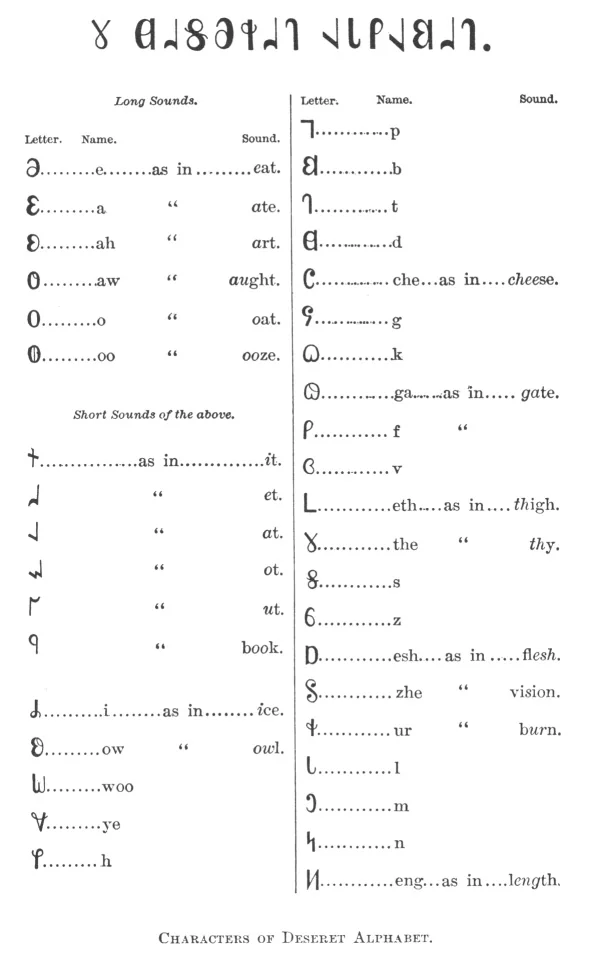
CHARACTERS OF THE DESERET ALPHABET.
from which the book of Mormon is said to have been translated, where the letters pi, rho, tau, phi, chi, some of them as in manuscript, and others as in printed Greek, can be distinctly traced.
Type was ordered, and with a view to durability, made so as to contain neither the top nor tail extensions of the letters. At a meeting of the board of regents, held in March 1854, some of it was presented to the members; and between that date and 1869 were published in the Deseret alphabet a primer, the book of Mormon, and the first book of Nephi. Some attempt was made to introduce into the public schools books thus printed, but without success. The tailless characters, and the monotonous evenness of the lines, made the words difficult to distinguish, and it was found impossible to insure uniform pronunciation and orthography. Within a few years the alphabet fell into disuse, and is now remembered only as a curiosity. 88
In connection with the university may also be mentioned its library, containing at the close of 1875 about 10,000 volumes, later reserved for the use of students, but for many years open to the public. 89 The territorial library, for which, as we have seen, an appropriation was made by congress in 1850, further grants being made by the Utah legislature from time to
time, 90 contained in 1883 about 4,500 volumes. At the same date the masonic library, established in 1873, contained nearly 6,000 volumes, the odd-fellows’ about 1,500, and there were smaller libraries in connection with various literary, benefit, secret, and mutual improvement societies. 91
Like citizens of the United States elsewhere, the settlers of Utah have always been patrons of newspapers—and except that their columns are cumbered with church matters, interesting only to the saints, their journals compare very favorably with others published on the Pacific slope. The news is fairly reliable, but the editorial and other comments must be taken at the reader's own valuation. In freedom from journalistic scandal-mongering, they certainly rank among the foremost, and if sometimes dull, they are never silly or obscene. As a rule, the Mormon journals are less rabid in politics and religion than the gentile newspapers. Of several of the former mention has already been made. In 1867 was first published and issued daily the Deseret Evening News, the weekly having been first issued in 1850. The Daily Telegraph first appeared on the 4th of July, 1864, under the parentage of T. B. H. Stenhouse, 92 and in 1869 was removed to Ogden, where it expired during that year. The Juvenile Instructor, an illustrated Sunday-school periodical published semi-weekly at Salt Lake City, was established by George Q. Cannon, the first number appearing January 1, 1866. The Salt Lake Daily Herald came into existence in June 1870,
Edward L. Sloan being the first editor. The Woman's Exponent, a semi-monthly woman's-rights paper, was first issued June 1, 1872, under the care of Mrs Louise L. Green Richards, and afterward transferred to Mrs Emeline B. Wells. The Salt Lake Daily Times, a theatrical and advertising sheet of which John C. Graham was editor and proprietor, commenced December 24, 1875, and in March 1881 its publication ceased. The first number of Tullidge's Quarterly Magazine appeared in October 1880. This publication is embellished with steel engravings, and has been favorably received, not only in Utah, but in the eastern states and in England. Considerable sums have been subscribed for the publication therein of city and county histories.
The Ogden Junction was first issued as a semiweekly in charge of F. D. Richards on the 1st of January 1870. Mr Richards associated with himself C. W. Penrose, to whom he resigned the editorship, subsequent editors being John Nicholson, Joseph Hall, and Leo Haefli. Soon after its first appearance the paper became a daily and its name was changed to the Ogden Herald. 93 The Provo Daily Times, which started into being August 1, 1873, has had a varied experience, being successively called the Provo Tri-Weekly Times, the Utah County Times, the Utah County Advertiser, and the Territorial Inquirer, the last being its present name. 94 The Beaver Enterprise was instituted early in 1874, Joseph Field being editor; the Southern Utonian was also published at Beaver City in March 1881, with F. R. Clayton as editor, 95 and the Beaver County Record, at first a
weekly and afterward a semi-weekly, in 1883, with F. R. Clayton and R. Maeser as editors. In addition to the above, and to those already mentioned, numerous daily, weekly, monthly, semi-weekly, and semi-monthly publications were issued at the capital and elsewhere in the territory, some of them having but an ephemeral existence, and some being in existence to-day. For an account of them, I refer the reader to the note subjoined, 96 where it will be seen that
about one hundred newspapers and periodicals have been published since June 15, 1850, when the first
number of the Deseret News announced to the saints the death of John C. Calhoun. 97
Footnotes
691:1 On Feb. 5, 1849, the mercury stood at 33° below zero at S. L. City. The mean temperature for 19 years was 51° 9´, and the highest 104° in 1871. For meteorological tables, see Meteor Reg., passim; Surgeon-Gen. Circ. 8, 1875, pp. 339-40, 345; Wheeler's Surveys, ii. 535 et seq.
692:2 Utah Gazetteer, 1884, p. 300, where the population is given by counties. In the census report for 1880 the total population is given at 143,963, nearly 20,000 of the foreigners being English, and about 8,000 Scandinavians.
692:3 In 1879 there were 33 paupers and 60 criminals. The number of prisoners at the Utah penitentiary for each year, with various statistics, will be found in the reports of the warden and directors in Utah Jour. Legisl., passim. In later years we hear little of such outrages as were alleged to have been committed about the time of the Utah war.
692:4 In 1877-8 diphtheria was also common. See Utah Sketches, MS., 27. Description of Huntstville, MS., 6. For mortality in S. L. City between 1870 and 1878, see Deseret News, Jan. 8, 1879. In 1870 there were 281 deaths in S. L. City, in 1878, 497, the latter being the largest number recorded during the interval. The principal hospitals at S. L. City were the Deseret, Holy Cross, and St Mark's, the last two being mainly supported by the contributions of miners, who are entitled to its benefits. It was not until 1880 that a territorial insane asylum was established, though one was projected in 1869. See Utah Laws, 1880, 57-65; Utah Jour. Legisl., 1869, 124-5; and for grand jury report on asylum, which is built on a high bluff of the Wasatch near Provo, S. L. C. Tribune, Nov. 22, 1884.
693:5 See caps. xiii. and xxii., this vol.
693:6 In 1880 there were, according to the census report, 3,205 Mormons in Idaho, 1,338 in Arizona, 800 in Nevada, 234 in Washington Terr., and 241 in Colorado. There were also 1,131 in California, 451 in Wyoming, 554 in Montana, 394 in Iowa, 208 in Nebraska, and 260 in New York. These are probably below the actual figures at that date, and certainly much below the figures for 1885. The Bannack stake, in the Snake River country, Idaho, alone contained, for instance, on January 31, 1885, 1,770 souls, being divided into eight wards—Louisville, Menan, Lyman, Rexburg, Teton, Wilford, Parker, and Salem. The first Mormon who visited the Snake River country with a view to settlement was John R. Poole of Ogden, who went there in Feb. 1879, and on his return reported favorably to Franklin D. Richards. The first family to settle there was that of Jos. C. Fisher, who in March 1879 located at Cedar Buttes Island, being joined soon afterward by Poole and others. Ricks, Banaack Stake, MS., passim. For account of Mormons in Oneida co., see Silver City Avalanche, Sept. 17, 1870, March 27, 1875; in Bear Lake Valley, Boisé City Statesman, Oct. 16, 1879; for agitation on the polygamy question in Idaho, Id., Sept. 3, 1870, Dec. 6, 19, 1879; Ogden Freeman, Feb. 28, 1879. The first attempt to settle the country bordering on the Little Colorado in Arizona was made in 1873, but the party returned, discouraged by the forbidding aspect of the place. Some three years later missionaries were ordered to make permanent settlements in this region, and at a meeting held at Salt Lake City in January 1876, companies were organized and captains appointed for this purpose. The first teams arrived at the Sunset crossing of the Little Colorado on the 23d of March, and after the brethren had explored the neighborhood, W. C. Allen and his company resolved to form a settlement about 20 miles to the south-east of the crossing, to be named after the captain; Geo. Lake and his band settled on the opposite side of the river, two miles to the south-west of Allen, on a spot which they called Obed, near which were springs and meadow-land; Lot Smith and his company formed a colony three miles north-east of the crossing, at a place which was called Sunset, and Jesse O. Ballinger, with his party, settled about four miles north of the crossing on the west side of the river, the settlement being named Ballinger. The brethren proceeded to plough, construct dams, and put in crops, but encountered many difficulties, the river-bottom being treacherous and full of quicksands. At Obed chills and fever prevailed, the settlers being forced to abandon the place and join the other colonies. In November 1877 a number of proselytes arrived from the southern states in a destitute condition; but though all the camps were scantily supplied, their wants were at once relieved. During this season sufficient grain had been raised to last with economy until the following harvest, and meanwhile other settlements had been started, one 25 miles up the river from Allen, to which was given the name of Woodruff, and one 50 miles south of Woodruff, which was called Forest Dale, the name Ballinger being now changed to Brigham City, and Allen to St Joseph. In this year, also, the colonies of eastern Arizona were divided into two presidencies, those on the Little Colorado being west of the dividing line. According to a stake report, dated Aug. 31, 1878, there were at Sunset 114 souls, at Brigham City 230, at St Joseph and Woodruff each 67, and including other small settlements, a total of 587. The harvest of 1878 was severely damaged by floods, but that of 1879 was a bountiful one. In 1880 the crops again suffered from excessive rains and freshets. Settlements on the Little Colorado. MS. The St Joseph stake at Pima, Ar., was organized in Feb. 1883, the place being first settled in 1879 by families from eastern Arizona. St David was founded in 1878, Philemon C. Merrill being the first settler; Curtis in 1881 by the Curtis family; Graham, so named from the peak a few miles to the south, in 1881; Thatcher, named after Apostle Moses Thatcher, in 1882, by John M. Moody; Central, in the same year, by Joseph Cluff and others; McDonald, named in honor of A. F. McDonald, president of the Maricopa stake, by Henry J. Horne and others; Layton, named after President C. Layton, by John and Adam Welker, Ben. Peel, and a few others. All these settlements are in Arizona. The Mesa settlement, belonging to the Maricopa stake, was founded by companies from Bear Lake co., Id., and S. L. co., Utah. Leaving S. L. City immediately after the death of Brigham Young, they reached Salt River in Jan. 1878, and soon afterward began the construction of a canal to the present site of the town. After a year's labor, only a small stream of water was obtained, barely sufficient for planting gardens, as the ditch was cut through a very difficult formation. The settlers persevered, however, their labors diminishing as their numbers increased, and in 1885 a canal had been built carrying 5,000 inches of water, at a cost of $43,000. Lehi, formerly Jonesville, also near Salt River, was founded in 1877 by a party of 71 settlers. In the autumn of this year a few members of the company became dissatisfied with the location, and set forth for San Pedro River, where they founded the settlement of St David, so named by Prest A. F. McDonald after David Patten, whom the Mormons regard as a martyr. Maricopa Stake, MS. In the Gila Valley the settlers bought squatter claims of Mexicans, and in 1885 had constructed over 60 miles of canals from 8 to 16 feet wide, besides a number of smaller ditches. The soil is a fertile, sandy loam, producing two crops or more a year, excellent for grapes and fruit, and of fair quality for all farm products. Sorghum produces three cuttings from one planting, and lucern is cut five or six times a year. Not more than five per cent of the land is arable, the remainder being grazing-land. Martineau's Settlements in Arizona, MS. For monogamic settlements in Montana, see Galveston News, Dec. 1, 1884. In the fall of 1877 Elder John Morgan led a colony of saints from the southern states to Pueblo, Colorado, where they wintered. In March of the following year, James G. Stuart, being ordered to visit the colonists, found them living as best they could, and working at whatever they could find to do. Mainly through the elder's efforts, two settlements were founded, to which were afterward given the names of Ephraim and Manassa. Stuart's Colonization in Colorado, MS. In 1884 the Mormons established a colony at Las Cruces, Sonora, Mex. At the same time their leaders issued a proclamation stating that no general migration to Mexico was intended. The Mexican Financier, Jan. 31, 1885. In La Nueva Era, Paso del Norte, Chihuahua, Apr. 8, 1885, p. 2, it is stated that 200 Mormons had established a colony at Corralitos, Galeana, in that state.
695:7 Ten from east to west, and five from north to south, allowing for two square miles occupied by the Fort Douglas reservation. By act of Jan. 18, 1867, the western boundary was removed from the banks of the Jordan to a line running due north and south about two miles west of the river. By act of 1872 the south line was removed to Tenth South street.
695:8 In 1877 George Erb organized the Rocky Mountain Electric Light Co. at Salt Lake City, afterward extending his operations to Ogden, Albuquerque, Cheyenne, Silver City, and Tucson, where, in 1884, all the works were in successful operation. Erb's Electric Lights, MS. Erb, a native of Penn., enlisted as a volunteer in the union army in 1861, being then 18 years of age. After serving for three years he removed to southern Utah, and in 1877 to S. L. City. For account of city gas-works, see Deseret News, Aug. 27, 1873. The city was first lighted by gas July 7, 1873.
695:9 In 1872 the S. L. C. Street Railroad Co. was organized. It was in running order in June of the same year, its length being about seven miles. R. R. Anderson, in Utah Jottings, MS. In 1883 horse-cars ran every half-hour in eight different directions. Graham's Utah Direct., 1883-4, 184.
695:10 Among the principal hotels in S. L. City in 1883 were the Walker House and the Continental, formerly the Townsend House. The former was built in 1872, at a cost of $140,000. Walker's Merchants and Miners of Utah, MS. For description, see Deseret News, Sept. 4, 1872; S. L. C. Tribune, Sept. 7, 1872; Sala's America Revisited, 290-4; for mention of the Garde House, sometimes nicknamed the Amelia Palace, see Dall's First Holiday, 101-3; Duffus-Hardy's Through Cities and Prairie, 113.
695:11 An account of the various libraries is given later in this chapter. The theatre at the corner of First South and First East streets was 175 by 80 ft, with a stage 62 by 32 ft. It was of rock and adobe, with granite finish, fluted pillars, and massive cornices, cost $200,000, and had a seating capacity of at least 1,500. In 1882 the Walker Bros built the opera-house, at a cost of $136,000, within a few yards of their bank. Its dimensions were 167 by 67 feet, with a height of 60 feet. The interior was tastefully decorated and upholstered, and the stage well supplied with scenery and appointments, the drop-scene being remarkably handsome. Walker's Merchants and Miners of Utah, MS.; Graham's Utah Direct., 1883-4, 193. For further mention of theatres and theatricals, see p. 584-5, this vol.; Cooke's Theatr. and Soc. Affairs in Utah, MS.; Ward's Lectures, 40; Hubner's Round the World, 80; Bowles’ Our New West, 229-31; Richardson's Beyond the Mississippi, 358-9; Rusling's Across Amer., 178-81; Beadle's Life in Utah, 245-6; Ludlow's Heart of the Continent, 334-7, 365-7; Rae' s Westward by Rail, 108-10; Millennial Star, xxix. 70-3; Deseret News, March 27, 1867; Overland Monthly, v. 276-9.
696:12 By act of Feb. 20, 1880, in Utah Laws, 1880, 55-6, amending the city charter, the city council was authorized to borrow $250,000 for the construction of a canal, tapping the Jordan at a point 25 miles south of the city, for irrigation purposes, thus releasing nearer and better sources of supply for domestic use. It was finished in 1881, at a cost of $200,000. In 1884 there were 13 miles of main pipes, which were tapped at regular intervals by hydrants, so as to insure a sufficient supply in case of fire. The city had a very efficient fire department. See Utah Direct. and Gaz., 1874, 177, 1879-80, 56.
696:13 In 1886 it had already cost some $2,500,000.
696:14 In 1884 they were over 60 feet above the ground.
696:15 Under President Taylor's administration more work in the same time was done on the temple than ever before. Utah Notes, MS. For condition of the temple building in 1860, see p. 582, this vol.; at other dates, Deseret News, Nov. 20, 1867, Aug. 20, 1873, May 27, 1874, Aug. 23, 1876, July 3, Nov. 20, 1878; Millennial Star, xxxvi. 273-5; Harper's Mag., Aug. 1883. In quarrying the granite at Little Cottonwood cañon, the workmen dislodged huge bowlders from the mountain side, and sent them crashing down to the railroad track, a descent of 700 feet. One of these bowlders weighed 21,000 tons.
697:16 Richards’ Utah Miscell., MS. In Utah Notes, MS., 2, it is given as low as 7,000. Other authorities say 12,000 to 13,000, but recent estimates show this to be an exaggeration, though including standing-room, the former figure is about correct.
697:17 For mention of the old tabernacle and its organ, see p. 292, this vol.
697:18 For further descriptions of this tabernacle, see, among others, Sala's Amer. Revisited, 296-8; Bonwick's Mormons and Silver Mines, 10-17; Marshall's Through Amer., 1658; Duffus-Hardy's Through Cities and Prairie, 113-15; De Rupert's Cal. and Morm., 138-46; Deseret News, May 4, 1870, on which date were delivered the inaugural addresses.
697:19 The corner-stones were laid Sept. 28, 1877, and it was dedicated Jan. 9, 1882, though public meetings were held in it as early as Apr. 4, 1880. Until Apr. 1879 it was called the new or little tabernacle, its name being changed at that date to the Salt Lake Assembly Hall. It is 120 by 68 feet, and can seat 3,033 people. Richards’ Utah Miscell., MS.
697:20 Utah Notes, MS., 2; Sloan's Utah Gazetteer, 1884, 204. The building is 120 by 68 ft, the height of the tower which rises from the centre being 130 ft. It has excellent acoustic properties, contains a large organ, rich and sweet in tone, and was dedicated in the spring of 1880.
698:21 Sala's America Revisited, ii. 295; Bonwick's Mormons and Silver Mines, 18-21; Gaz. of Utah, 1874, 178; S. L. C. Tribune, Jan. 1, 5, 1878; S. L. C. Herald, Sept. 13, 1878. In 1882 occurred the death of Joseph L. Barfoot, for several years curator of the museum. Born at Warwick Castle, England, and, as he claimed before his decease, legitimate heir to one of the greatest earldoms in the realm, his ancestry being traced back on the father's side to Robert Bruce of Scotland, and on the mother's to Bishop Ridley, he enlisted in the marines, probably on account of some family quarrel. His discharge being procured, he joined his father, who was superintendent of the Mormon Mission in London, and in 1856 Joseph joined the Mormon church. S. L. City Contributor, iii. 250-2; Campbell, Circular Notes, i. 62, states that his father was merely tutor at Warwick Castle.
698:22 For descriptions of S. L. City in 1883-4, see The Mormon Metropolis; in 1881, Sala's Amer. Revisited, 290-317 (with cut); Hollister's Res. and Attract. of Utah, 73-6; in 1879, N. Y. Observer, in Portland Wkly Christ. Advoc., Feb. 6, 1879; in 1878, Marshall's Through Amer., 163-82; in 1877, Boyer's from Orient to Occident, 61-3; Musser's Fruits of Mormonism, 3, 11; Leslie's Cal., 74-5, 91-5, 103; Taylor's Summer Savory, 20-1; in 1876, Jackson's Bits of Travel at Home, 19-22; in 1875, Williams’ Pac. Tourist, 132-40, 150-2; Curtis' Dottings, 18-28; in 1872, Bonwick's Mormons and Silver Mines, 8-10; Washington Star, in Deseret News, July 10, 1872; Oakland Monthly Rev., i. no. l, 18-19; in 1871, Hubner's Round the World, 76-80; Greenwood's New Life, 137-8, 142-4; in 1870, Nordhoff"s Cal., 40-2; Nelson's Pict. Guide-Book, 10-25; Kneeland's Wonders of Yosemite, 19-21; Overland Monthly, v. 270-3, 275; in 1869, Rae's Westward by Rail, 104-12; in 1868, Goddard's Where to Emigrate, 152-3; Bowles’ Pac. Railroad, 40-51; Ludlow's Heart of the Continent, 315-28; Beadle's Life in Utah, 240-7; in 1867, Hepworth Dixon's New Amer., 133-41; McClure's 3,000 Miles Through the Rocky Mts, 165-6 (with cut); in 1866, Rusling's Across Amer., 163-6; Life among the Mormons, 88-97; in 1865, Bowles’ Our New West, 202-3, 206, 219-22 (with cut); Barnes' From Atlantic to Pacific, 54-5; Richardson's Beyond the Mississippi, 347 (with cut); in 1860-2, pp. 577-90, this vol. (with plan).
699:23 Among other growing settlements in Salt Lake co. at this time were Mill Creek, East Mill Creek, Big Cottonwood, South Cottonwood, Union, North Jordan, South Jordan, West Jordan, Brighton, Butlerville, Granite, Draper, Herriman, Mountain Dell, and Pleasant Green.
700:24 See caps xiii., xxi., this vol.
700:25 So called after a bishop and early settler named William Kay, who owned a large portion of its site. About the year 1857 the bishop's interest was purchased by John S. Smith, an Englishman by birth, who, landing in Canada in 1841, afterward proceeded to Nauvoo, and was one of those who took part in the exodus. Mr Smith is now one of the principal farmers in Davis co. Among other prominent men in that county may be mentioned the following: Joseph Barton, a native of St Helens, Lancashire, England, settled at Kaysville, his present home, in 1862, being then only 14 years of age. In 1869 he was elected county surveyor, and since that date has held the appointments of city recorder of Kaysville, county clerk, and prosecuting attorney, the last two of which offices he filled in 1885. In 1884 he was a member of the territorial legislature, and almost throughout his career in Utah has occupied positions of trust, though they have come to him unsought, and somewhat against his will. N.T. Porter, a native of Vermont, was one of the first settlers in Centreville, where he took up his abode in 1849, after suffering all the hardships of the expulsion, and of a long residence at Winter Quarters. Jos. Egbert, a native of Salina co., Ind., was a pioneer, sharing the blanket of Orson Pratt during the jonrney, and driving the first team that entered the valley. John R. Baines of Kaysville, a native of Bedfordshire, England, arrived in Utah with a capital of l0 cents, and afterward accumulated a fortune of $100,000 by farming and traffic. The president of the Davis stake was W. R. Smith, who was for several years a member of the legislature, and for nine years probate judge. He was born in Ontario, Canada.
700:26 South, East, and West Bountiful. The last was sometimes called Wood's Cross. Bountiful was a city in the book of Mormon. Richards’ Utah Misc., MS., 4-5. Prominent among the citizens of West Bountiful was W. S. Muir, a Scotchman by birth, who, accepting the Mormon faith, set forth for Nauvoo, and in 1847 was a corporal in the Mormon battalion. In the following year he started, in connection with Sam. Brannan, the first store ever opened at the mines of California.
700:27 In 1883 it contained about 8,000 inhabitants.
701:28 Opened Jan. 4, 1870. Stanford's Ogden, MS., 10.
701:29 For act to incorporate Ogden, see Utah Compiled Laws, 746-54; Deseret News, Jan. 30, 1861. For act amending charter of incorporation, see Utah Laws, 1880, 4-5. In 1885 the mayor of Ogden was David H. Peery, a Virginian, who during the civil war served as assistant commissary under General Marshall. In 1864, after being honorably discharged from the confederate army, he arrived in Utah with the sum of $1,400, saved from the wreck of his property. In 1885 he was the owner of several blocks of business buildings, and was worth about $150,000, being at that date a member of the territorial legislature. In 1880 the city and county built a bridge over the Weber, at a cost of $16,000, and in the same year the city constructed a reservoir on Court-house hill to collect the waters of several small springs which were conveyed in pipes to Main street. Stanford's Ogden, MS., 15-16. For sketch of the business growth of Ogden, see Tullidge's Mag., i 478-84. For description of town at various dates, see Bonwick's Silver Mines, 22-3; Millennial Star, xxxi. 518; S. L. C. Tribune, Jan. 1, 1878, July 6, 1879, Jan. 1, 1881; Telegraph, May 18, July 8, Dec. 19, 1869; Herald, Dec. 12, 1877. Topographical plan, in Wheeler's Surveys, ii. 471.
701:30 With a population in 1880 of 956. Stanford's Ogden, MS., 8; about 900. Amos Maycock, in Utah Sketches, MS., 115. In 1883 it was about 1,200, and in 1886 some 1,500.
701:31 Harrisville was an agricultural Settlement containing in 1880 about 60 families, most of them Scandinavians. Though subject to early frosts, cereals were raised, with the exception of wheat, and in the neighborhood was good pasture. A considerable income was also derived from the sale of shingles and railroad ties. Stanford's Weber Co., MS., 5, 11-12. In the Description of Huntsville, MS., 1-6, and Utah Sketches, MS., are particulars as to the resources and growth of Huntsville from 1860, when it was founded, until 1880.
701:32 An agricultural settlement two miles north of Ogden, containing in 1880 about 500 inhabitants. Stanford's Weber Co., MS., 1.
701:33 Slaterville was organized as a county precinct in 1864. Population in 1880 about 400. Uintah, at the western entrance of Weber cañon, was first known as East Weber, the name being changed to Easton early in 1867, and in the same year to Uintah. At Plain City the raising of fruit and vegetables, especially strawberries, was the principal industry. Hooperville, settled in 1869, had in 1880 about 100 families. West Weber, organized as a ward in 1877, mustered at the same date nearly 700 inhabitants. There were also small settlements at Mound Fort, a mile north of the Weber; Eden, near Huntsville; Marriotsville, three miles north-west of Ogden; Riverdale, two miles south of Ogden; and several others. Id., passim.
In the Brief Historical Sketch of the Settlements in Weber County, by Joseph Stanford, MS., are given in minute detail the leading incidents in the history of all the principal settlements of Weber co. from their foundation until the year 1880. The Historical Sketch of Ogden City, MS., by this author, covers the same period, commencing with the time when its site was purchased by Captain Brown from Miles Goodyear.
702:34 Incorporated Feb. 6, 1868.
702:35 At the southern end of Cache Valley is the town of Paradise, and scattered throughout the valley are several small settlements. For descriptive sketch of Cache co. settlements, see S. L. C. Herald, Nov. 3, 10, 1877. In 1880 Paradise had 490 inhabitants. Orson Smith, in Utah Sketches, MS., 1-2.
702:36 See, for ceremony of laying the corner-stones, Deseret News, Sept. 26, 1877; for dedication, Biog. Lorenzo Snow, 452-3; for act incorporating Logan City, Utah Compiled Laws, 711-18; for description of the city, Deseret News, Oct. 15, 1873, July 23, 1879; S. L. Weekly Herald, March 31, 1881.
702:37 For organic act, see Utah Acts Legisl., 1863-4, 18-19. The county was named after Apostle Chas C. Rich.
702:38 Named after Apostle Wilford Woodruff. Richards’ Utah Miscell., MS., 4.
702:39 The other principal settlements besides those mentioned elsewhere were Echo and Wanship, both on the line of the Utah Eastern railroad. Wanship was named after an Indian who was much respected. Richards’ Utah Miscell., MS., 3.
703:40 Willard City is named after Willard Richards. Richards’ Utah Miscell. MS., 7; Brigham, of course, after President Young. Both were incorporated in 1867. See Utah Compiled Laws, 737-9, 743-5. At Brigham City choice fruit was raised in abundance. In 1880 there was a large tannery and a woollen factory in operation. Near Willard City grain, fruit, and vegetables were raised, but the facilities for manufacture were meagre. A. Christensen and G. W. Ward, in Utah Sketches, MS., 45-104. For descriptions of Brigham City at various dates, see McClure's 3,000 Miles beyond the Rocky Mountains; Deseret News, July 24, 1862, Jan. 16, 1878. In 1883 Call's Fort, already mentioned, had only 35 families. Among other settlements were Honeyville on the line of the Utah and Northern railway, organized as a ward in 1877, and Snowville, a stock-raising centre, fifty miles north-west of Corinne, settled by A. Goodliffe and others in 1876.
703:41 For acts incorporating these towns, see Utah Compiled Laws, 740, 843-52. Grantsville was named after Col. Geo. D. Grant. Richards’ Utah Miscel., MS., 6. In the neighborhood of Tooele many kinds of farm and orchard products were raised. At Grantsville, also a farming settlement, there were 25 artesian wells. F. M. Lyman, John Rowberry, and Harrison Severe, in Utah Sketches, MS., 29, 151. For historical sketch of Corinne, see Tullidge's Mag., ii. 243-6.
703:42 Juab is Indian or Spanish-Indian for flat. For acts defining and extending the limits of the county, see Utah Acts Legisl., 1868, pp. 41-2; 1870, 127.
703:43 Mona, eight miles north of Nephi, Juab, on the Utah Central, and Levan, seven miles east of Juab, were also promising settlements. At Nephi there were in 1880 two hotels, a furniture factory, and a large coöperative store. Geo. Teasdale, in Utah Sketches, MS., 112.
703:44 The Utah Central and Denver and Rio Grande.
703:45 In 1880 there were over 40,000 acres in tilth.
703:46 Utah Lake is 40 miles in length, with an average width of 10 miles.
703:47 In 1883 Salt Lake co. had 41,890 and Utah co. 23,472 inhabitants. Utah Gazetteer, 1884, 300.
704:48 See, for act incorporating Provo, Utah Acts Legisl., 1866, 120-5; for names of municipal officers between 1861 and 1877, see Provo City Revised Ordinances, iv.-v.; in 1880, Utah Sketches, MS., where is a brief historical sketch of the town. Among the most prominent men in Provo may be mentioned Abraham O. Smoot, a native of Owen co., Ky, who joined the church in 1835, being then in his 21st year, and a few months later was ordained an elder. Of his missionary labors, and the part that he played during the exodus and the Utah war, mention has already been made. Chosen mayor of Salt Lake City in 1857, he was reappointed to that office at each election until 1866, when, declining the mayoralty, he served for twelve years in the legislature. In 1868 he removed to Provo, where he was also elected mayor, holding that office for twelve years, and receiving no pay for his services in that capacity in either city. In 1884 he was president of the Provo Manufacturing Company, the Provo Bank, the Provo branch of Zion's Coöporative Mercantile Institute, and the Utah county stake. Utah Early Scenes in Church Hist., 17-31; Tullidge's Mag., iii. 297-9.
704:49 At Payson there was a coöperative store established, mainly by the efforts of Wm Douglas, who arrived in Utah in 1848. See for act incorporating Payson, Utah Acts Legisl., 1865, 42; for act extending limits, Utah Laws, 1882, pp. 18-19.
704:50 Among the prominent citizens of Spanish Fork may be mentioned the bishop of ward, Geo. D. Snell, a descendant of one of the pilgrim fathers and a native of New Brunswick, whence he removed to Utah in 1854. In 1878 he was elected a member of the legislature. Wm Creer of the same city, and an Englishman by birth, was also a member of the legislature in 1883, and served on some of the most important committees. In 1882 the limits of Spanish Fork City were altered. Utah Laws, 1882, 8.
704:51 The first mayor of Springville was G. D. Wood, who came to Utah in 1848, and in 1884 was still mayor, though 76 years of age. His son, L. S. Wood, was also one of the prominent men of Springville.
704:52 The Payson theatre was the second largest in Utah, and had a seating capacity of 800.
704:53 Midway between Payson and Utah Lake, on the line of the Utah Central, the settlement of Benjamin was founded in 1870. Utah Gazetteer, 1884, 156.
704:54 For organic act, see Utah Laws, 1880, 11-12.
705:55 For organic acts, see Utah Laws, 1880, 4-5, 10-11, 1882, 98-101. Emery co. was named after Gov. Emery, and Garfield after President Garfield. Emery and San Juan were both bounded on the east by Colorado.
705:56 See p. 1-5, this vol.
705:57 Utah Acts Legisl., 1865, 16.
705:58 Utah Laws, 1878, 48. Circleville, settled in 1860, was the county seat until 1868, when it was removed to Bullion. Utah Acts Legisl., 1874, 6; thence to Marysville, and again to Junction.
705:59 Beaver was incorporated in 1867. Utah Acts Legisl., 1867, 4-5. For plan, see Wheeler's Geog. Surveys, ii. 491.
705:60 For act changing the limits of Sanpete, Utah, and Wasatch counties, see Utah Laws, 1880, 18-19. By act of 1864 the county seat of Sanpete co. was removed from Manti to Moroni, and by act of 1865 again fixed at Manti. Utah Acts Legisl., 1863-4, 21; 1865, 16.
706:61 The site of Manti temple was chosen by Brigham, and ground was broken Apr. 30, 1877. The corner-stones were laid Apr. 14, 1879. Deseret News, May 7, 1879. For condition in 1882, see Robinson's Sinners and Saints, 163-5.
706:62 Utah Compiled Laws, 828.
706:63 Chester, about four miles west of Spring City, was settled in 1882 by R. N. Allred and others; Mayfield, ten miles south of Manti, by families from Ephraim and Fort Gunnison in 1873-5. In 1880 there were 16 considerable towns and villages in Sanpete co. J.B. Maiben, in Utah Sketches, MS., 173.
706:64 Wm Morrison, Paul Poulson, and James M. Peterson, in Utah Sketches, MS., 134-6; Utah Acts Legisl., 1865, 16.
706:65 For acts incorporating Parowan and Cedar, Bee Utah Compiled Laws, 1868, 808-11.
707:66 Utah Sketches, MS., 100. Among other settlements were Johnson, some ten miles east of Kanab, Pahreah, near the junction of Pahreah River and Cottonwood Creek, settled in 1872, and Orderville, on the west bank of the Virgen, in 1875. In 1869 the seat of Kane co. was removed from Rockville to Toquerville. Utah Acts, 1869, 17.
707:67 For act to incorporate St George, see Utah Compiled Laws, 814-20. It was made the county seat in 1863. Utah Acts Legisl., 1862-3, 5-6.
707:68 For dedication and description, see Millennial Star, xxxvi. 252-5; Deserst News, Apr. 8, 1874, Jan. 17, Apr. 26, Sept. 13, 1876. For plan of St George, see Wheeler's Geog. Surveys, it. 491. Six miles from St George was the village of Washington. and three miles north of Harrisburg the town of Leeds, first settled in 1868-9 by R. H. Ashley and others. Pinto, in the northern part of the county, was settled by Jacob Hamblin and others in 1856. The mining camp of Silver Reef was about one mile from Leeds.
707:69 Of these 111 were primary, 60 intermediate, and 240 mixed. Utah Gazetteer, 1884, 293.
707:70 Rept Dist Schools, 1880, p. 11. The value of district school property was in 1879 $393,984.57, of private school property $175,000.
708:71 Presbyterians, congregationalists, and catholics. Harrison's Crit. Notes on Utah, MS., 63. Among them was the Salt Lake Collegiate Institute founded by the presbyterians, the Salt Lake Academy by the congregationalists, and St Mary's Academy by the catholics. The presbyterians a one had in 1883 33 schools and 2,200 pupils. Utah Gazetteer, 1884, 280.
708:72 Opened Jan. 1876, burned Jan. 1884, and rebuilt the same year. Id., 278-9, Albert Jones, in Utah Co. Sketches, MS., 59-60, 64, states that it was founded for the children of members of the church in good standing, though others are admitted, and that in 1880 it had 431 pupils. See also, for faculty, course of instruction, etc., Contributor, ii. 179-80, 241-2, 272-3; Deseret News, April 17, 1878, Feb. 5, 1879; Utah Jour. Legisl., 1880, 461-5, 489-93. among the professors in 1883 was Elder Karl G. Mæser, formerly of the Budig institute, Dresden. While presiding over the European mission in 1855, F. D. Richards heard that he was desirous of being informed as to the fath and doctrine of the saints, and a few months later visited that city by invitation in company with elders Win H. Kimball and Wm Budge, baptizing eight persons and organizing the first branch of the church in Saxony. Mæser was left in charge, and when the government banished the saints from fatherland, as we have seen, he and most of the other converts gathered to Utah. Richards’ Miscell., MS. Mr Richards states that the B. Y. academy is one of the best and most popular educational institutes in the territory.
708:73 Opened in Sept. 1878, the number of pupils in 1880-1 being 160. In 1877 a tract of nearly 10,000 acres south of Logan City was deeded for this purpose to a board of trustees by Brigham. Utah Gazetteer, 1884, 283-4. In 1883 Mariner W. Merrill presided over the educational affairs of Logan temple.
708:74 A copy of it will be found in Rept Dist Schools, 1880, 71-80.
709:75 Harrison's Crit. Notes on Utah, MS., 67-71. The first gentile elected school trustee in Utah was Benjamin Grundy Raybold, a native of Birmingham, England, who came to Utah in 1862. Finding no other occupation, he began his career among the saints as a hod-carrier; then he turned carpenter; then postmaster; then journalist; and finally, in 1866, found employment with the Walker Bros, to whom in 1885 he was confidential clerk. A brief history of the Mormon school system from 1850 to 1875 will be found in U.S. Educ. Rept, 44th Cong. 2d Sess., 458-60. See also, for further information, Id., 42d Cong. 2d Sess., 21, 383-4, 600-4; 42d Cong. 3d Sess., 377-80, 416, 608-13, 942-97; 43d Cong. 1st Sess., xxii.-cxxiii. 460-3, 475, 510-12, 728; 43d Cong. 3d Sess., xiii., cxxv., 500-2, 507, 526-34, 733; 44th Cont. 1st Sess., xxvi.-ccxxiii. 510-14, 548-54; 44th Cong. 2d Sess., passim; H. Ex. Doc., 46th Cong. 2d Sess., vol. xi., cxxvii.; Utah Jour. Legisl., 1859-60, 22-6; 1860-1, 78-9; 1861-2, 65; 1863-4, 96-9; 1864-5, 110-14; 1865-6, 17-18, 170 -3; 1869, 14-15, 108, 176-8; 1870, 191-9; 1872, 228-30; 1876, 28-9, 78-9; 1878, 33-4, 345-80; 1880, 442-60; Utah School Bepts, passim; Bien. Rept Supt Dist Schools, 1880, 1882, 1884; Utah Sketches, MS., passim; Stanford's Weber Co., MS., 1-23; Linforth's Route from Liverpool, 104, l10-11; Remy's Jour. to G. S. L. City, ii. 177-94; Burton's City of the Saints, 512-16; Gunnison's The Mormons, 80-1; Ward's Husb. in Utah, 264-6; Hollister's Res. of Utah, 72-3; Utah Pioneers, 33d ann., 30-4; Utah Besources, 55-8; Todd's Sunset Land, 179; Utah Gazetteer, 39-40, 175-6; 1884, 278-94; Contributor, i. 84; ii. 240, 270; iv. 182-3, 352-3; Millennial Star, xxxiii. 551; Deseret News, Oct. 19, Nov. 16, 1850, Feb. 22, 1851, March 19, 1853, Jan. 11, 1855, Apr. l, 1857, Apr. 11, Oct. 24, Dec. 5, 1860, Jan. 15, 1868, Apr. 17, 1872, Feb. 13, 1878, March 26, 1879; S. L. C. Tribune, Nov. 1, 1873, March 25, Aug. 29, 1876, March 3, 20, Apr. 21, 1877, March 20, Sept. 21, 1878, Apr. 23, May 22, Sept. 6, Nov. 20, 1879; Herald, Jan. 30, Apr. 13, 1878. For disbursement of school revenue, see Utah Jour. Legisl., 1880, 469-81; for evening-schools, Deseret News, Dec. 28, 1854, Dec. 5, 12, 1860; Sunday-schools, Harrison's Crit. Notes on Utah, MS., 71-3; Cannon's Sunday-schools in Utah, MS., 3; Juv. Inst., xv. 89; Deseret News, Apr. 14, 1869. Mr Harrison states that until there were gentile churches in Utah the Sunday-school was almost unknown. This the Mormons deny, saying that Sunday-schools have been taught in Salt Lake City since 1857, the Sunday-school Union being established in 1866. For gentile churches and missionary work in Utah, see Hand-Book of Mormonism, 77-86; Utah Gaz., 208-11; Marshall's Through Amer., 230.
709:76 With Orson Spencer as chancellor, Dan. Spencer, Orson Pratt, Jno. M. Bernhisel, Sam. W. Richards, W. W. Phelps, Albert Carrington, Wm I. Appleby, Dan. H. Wells, Robt L. Campbell, Hosea Stout, Elias Smith, and Zerubbabel Snow as regents, and David Fullmer as treasurer. Des. Univ., MS., 3.
710:77 See p. 324, this vol.
710:78 It was opened Nov. 11, 1850, at the house of Mr Pack, in the 17th ward of S. L. City, Cyrus Collins being appointed teacher, but succeeded the same year by Orson Spencer and W. W. Phelps. The terms were $3 a quarter. Id., 6, 10; Utah Gazetteer, 1884, 287.
710:79 Des. Univ., MS., 24; Utah Jour. Legisl., 1853-4, 115.
710:80 By act of 1855 a grant was confirmed of nearly a section of land lying east of S. L. City. By contributions of labor and produce, nearly all of it was enclosed with a stone wall. A building was also commenced in the 13th ward for the use of the parent school. Des. Univ., MS., 8-9; Utah Acts Legisl., 1866, 110. By act of congress, approved Jan. 21, 1855, two sections, including 46,080 acres, were reserved for a university, said lands to be disposed of under the direction of the territorial legislature. Utah Laws, 1878, 172. In 1859 the legislature passed an act to provide for the selection of two townships for this purpose. Utah Acts Legisl., 1866, 93-4.
710:81 By act of 1851 the chancellor and board of regents were authorized to appoint a superintendent of primary schools, to be under their control, his salary not to exceed $1,000 a year. By act of 1866 the right of making such appointment was transferred to the legislature. Des. Univ., MS., 4-5, 24.
710:82 Of which David O. Calder was principal.
710:83 The course lasted four years in the classical and two in the normal department. In connection with the normal department was a 'model school,' where pupils were prepared for the college course. The charges were $20 per term for the classical, $15 for the normal and commercial, and $8 for the preparatory course, with extra charges for modern languages, music, etc. The rates for tuition were afterward reduced. For studies and faculty, see Catal. Univ. of Deseret, 1868-9, 5, 14-16; for list of text-books, Id., 1869-70, 25-6.
711:84 There were 307 males and 239 females. Id., 1869-70, 21. Des. Univ., MS., 27.
711:85 At the session of 1879-80 the legislature appropriated $20,000 for the university, and soon afterward the city council donated to the regents the finest public square in the city. A building was at once commenced, but the appropriation was almost expended before the basement was finished, under the expectation that the legislature of 1881-2 would vote a sum sufficient to complete it. Such a bill was passed, but failed to receive the governor's signature. At the beginning of 1884 the walls and roof had been completed, and a portion of the building was ready to be occupied, the money being raised by contribution. For the two years ending Dec. 31, 1879, the receipts were $18,151.44, of which $9,200 was from territorial appropriations, and $5,986.80 from tuition fees. The salary of the president, J.R. Park, was $2,400 a year. At this date the institution was $5,384.14 in debt. Bienn. Rept Chancellor Univ. Deseret, 1878-9, 11-13. In 1854 Orson Hyde was appointed chancellor, in 1857 and 1861 Albert Carrington, the interim being filled by Orson Pratt, elected in 1858; in 1869 Dan. H. Wells and in 1878 Geo. Q. Cannon were appointed. Des. Univ., MS., 35.
711:86 See Circ. Acad. Dept Univ. of Deseret, 1880-2, 9-10.
711:87 In 1870 a school in connection with the university was established at Provo, with Myron Tanner of that city, A. K. Thurber of Spanish Fork, and L. E. Harrington of American Fork as executive committee, and Warren Dusenberry principal. It lasted only a few years. Deseret Univ., MS., 27-8. In 1884 a deaf-mute department was opened in connection with the university. Annual of Univ. of Deseret, 1884-5, 36-7. For further items concerning the university, see the circulars and reports above quoted. Deseret Univ., MS., passim; Utah Jour. Legisl., 1870, 168-72, 1876, 121-7, 1878, 295-6, 355-7, 381-91; Ann. Univ. Deseret, 1884-5, 7-38; Smith's Rise, Progress, and Travels, 24-5; S. L. C. Contributor, ii. 13-16, 48, 82, 110, 142; Deseret News, June 9, 1869, Jan. 5, 1871: S. L. C. Tribune, Aug. 13, 1876, March 9, 1878; Herald, Nov. 17, 1877, Nov. 22, 1878, Jan. 30, 1881.
Most of the details given in the text are taken from the Deseret University, MS., 1-35, which, besides a brief historical sketch of that institution, contains some valuable items concerning the district schools and the district school system of Utah.
714:88 Richards’ Utah Misc., MS., 13-16; Des. Univ., MS., 16-18; Richards’ Incidents in Utah Hist., MS., 63. The preparation and use of the alphabet were ordered, or at least suggested, by Brigham Young, who, in his address to the legislature of 1853, thus gives his reasons: 'While the world is progressing with steam-engine power and lightning speed in the accumulation of wealth, extension of science, communication, and dissemination of letters and principle, why may not the way be paved for the easier acquisition of the English language, combining, as it does, great extension and varied expression with beauty, simplicity, and power, and being unquestionably the most useful and beautiful in the world. But while we freely admit this, we also have to acknowledge that it is perhaps as much abused in its use, and as complex in its attainment, as any other.' In the Deseret News, Aug. 19, 1868, the weeding-out of objectionable literature is stated as an additional reason. In 1855 $2,500 was voted by the legislature for the new type and for printing books in the Deseret characters. Utah Acts Legisl., 110-11. In 1859-60 the Deseret alphabet was used in keeping Brigham's ledger, and to some extent in the historian's office and in journalism. In 1877 an attempt was made to have the book of Mormon printed in Pitman's phonoype, and Orson Pratt started for England for this purpose, but returned at the death of Brigham in August of that year. No further effort was made.
714:89 Des. Univ., MS., 29; Utah Gazetteer, 228.
715:90 The last one in 1882.
715:91 For mention of such societies, see Contributor, ii. 27-9, 31-2, 61, 92-4, 159, 222, 287, 350; Deseret News, Aug. 7, Nov. 20, 1878; Utah Gazetteer, 1884, 218-25. For further details as to libraries, see Id., 228-30; Burton's City of the Saints, 286-7; Deseret News, Aug. 20, 1862; S. L. C. Tribune, March 15, Nov. 22, 1873, Dec. 18, 1875; Reno Gazette, Dec. 6, 1880; Bonanza City (Id.), Yankee Fork Her., Sept. 25, 1879; observatories, Wheeler's Geog. Surveys, ii. 7-9, 461-7, 469-71. The office of superintendent of meteorological observations created by act of 1857 was abolished by act of 1870. Utah Jour. Legisl., 1876, 179-80.
715:92 The author of Rocky Mountain Saints. His decease occurred in 1882.
716:93 Among those who early took an interest in newspapers may be mentioned Sidney Stevens, who in 1885 was still one of the largest proprietors of the Herald. Mr Stevens, a native of Somersetshire, England, came to Utah in 1863, settling two years later at North Ogden, where, and at Ogden City, he has ever since been actively engaged in business. Among other ventures, he has been largely interested in the shipment of produce to the eastern states, forwarding as many as 470 car-loads in a single year. To his enterprise the terminus of the Union Pacific is in no small degree indebted for its recent growth.
716:94 It has been edited at various dates by R. T. McEwan, R. G. Sleater, J. T. McEwan, and John C. Graham. Richards’ Bibliog. of Utah, MS., 18.
716:95 Later Dan. Tyler became editor. Ibid.
717:96 Additional list of publications, showing name, where located, frequency of issue, and, where possible, date of establishment and suspension:
|
Location. |
Name. |
Established. |
|
Alta City |
Cottonwood Observer, s.w. |
1870 et seq. |
|
Beaver |
Enterprise, w. |
1873. |
|
” |
Beaver County Record, s.w |
June 8, 1883, et seq. |
|
” |
The Southern Utonian, w. |
March 1881 et seq. |
|
Bear Lake |
Democrat, w. (Mor. pub., but pub. in Idaho) |
Oct. 1880 et seq. |
|
Bloomington. |
The Union and Village Echo, m. |
1882. |
|
Camp Douglas |
Union Vedette, d. (trans. to S. L. City) |
1864-7. |
|
Corinne |
Daily Reporter, d. |
1867. |
|
” |
Daily Journal, d. |
1871. |
|
” |
Mail, d. | |
|
” |
Utah Reporter, d., s.w. (changed to) | |
|
” |
Corinne Republican, t.w., w | |
|
Diamond |
Rocky Mountain Husbandman, w | |
|
Frisco |
Times, w. | |
|
Logan |
Leader, w. (changed to) |
Sept. 1879-82. |
|
” |
Utah Journal, s.w |
Aug. 1, 1882, et seq. |
|
” |
The Northern Light, w |
May 1879. |
|
(Transferred and changed to) | ||
|
Oxford, Id. |
Idaho Banner, w. |
1879. |
|
Ogden |
Amateur | |
|
” |
Daily Morning Rustler, d. | |
|
” |
Evening Dispatch, d. | |
|
” |
Ogden Herald, d., s.w. |
1881 et seq. |
|
” |
Ogden Freeman, d., s.w | |
|
” |
Ogden Junction, d., s.w |
Jan. 1870. |
|
” |
Ogden Pilot, d. | |
|
” |
Ogden Telegraph, s.w. | |
|
” |
Ogden Times, s.w. | |
|
” |
Utah Talsmand | |
|
Park City |
Record, w. | |
|
Provo City |
Territorial Inquirer, s.w. | |
|
” |
Times, d. | |
|
” |
Utah County Times, t.w. | |
|
” |
The Utah County Advertiser |
Jan. 13, 1876. |
|
Richfield |
Sevier Valley Echo, w |
Aug. 1884 et seq. |
|
Salt Lake City |
Anti-Polygamy Standard, m. |
Apr. ’80 to Sept. ’82. |
|
” |
Bikuben, w. |
Aug. 1, 1876 et seq. |
|
” |
Circular, w |
1874. |
|
” |
City Review | |
|
” |
College Lantern, m. |
May, 1870. |
|
” |
Deseret News, d., s.w., w. |
June 1850 et seq. |
|
” |
Deseret Home, in |
Jan. ’82 to Aug. ’84. |
|
” |
Diogenes |
Jan. 1871. |
|
Location. |
Name. |
Established. |
|
Salt Lake City |
Enoch's Advocate |
1874. |
|
” |
Evening Chronicle, d | |
|
” |
Evening Mail, d | |
|
” |
Foot-Lights | |
|
” |
Grocer and Trade Journal, m |
May 1,1881, et seq. |
|
” |
Juvenile Instructor, s.m. |
Jan. 1, 1866, et seq. |
|
” |
Keep-a-Pitchin-in, s.m |
1869. |
|
” |
Kirk Anderson's Valley Tan, w. |
Nov. ’58 to Feb. ’60. |
|
” |
Life and Home, m. |
Aug. 1884. |
|
” |
Mining Gazette, w. |
1873 et seq. |
|
” |
Monthly Record, m. | |
|
” |
Morgenstjernen, s.m |
1882 et seq. |
|
” |
Mormon Expositor | |
|
” |
Mormon Tribune, w. | |
|
” |
Mountaineer, w. |
Aug. 27, 1859. |
|
” |
Mormonen Zeitung, w. |
Aug. 26, 1882. |
|
” |
New Endowment, d. |
Feb. 17, 1873. |
|
” |
Parry's Literary Journal, m. |
Oct. 1884 et seq. |
|
” |
Peep O’Day, w. |
Oct. 20, 1864. |
|
” |
Press, d. |
1874. |
|
” |
Real Estate Circular | |
|
” |
Real Estate and Min’g Gazette, s.m., m. | |
|
” |
Rocky Mt Christian Advocate, m. |
1876. |
|
” |
Salt Lake Herald, d., s.w. |
June 5, 1870, et seq. |
|
” |
Salt Lake Independent, d. | |
|
” |
Lake Journal, d. |
1872. |
|
” |
Salt Lake Leader, w. | |
|
” |
Lake Reporter, d. |
May 11, 1868. |
|
” |
Salt Lake Review, d. |
1871. |
|
” |
Salt Lake Telegraph, d., s.w., w. |
July 4, 1864. |
|
” |
Salt Lake Times, d. | |
|
” |
Salt Lake Tribune, d., w. |
1870 et seq. |
|
” |
Skandinav | |
|
” |
The Contributor, m. |
Oct. 1879 et seq. |
|
” |
The Utah Farmer, m. |
Feb. ’80 to Sept. ’81. |
|
” |
Tullidge's Quarterly Magazine, qty. |
1880 et seq. |
|
” |
Union Vedette, d., w |
1864. |
|
” |
(Trans. fr. Camp Douglas in 1867.) | |
|
” |
Commercial, m. | |
|
” |
Utah Educational Journal, m. |
July 1875. |
|
” |
Utah Mail, d. | |
|
” |
Utah Magazine, w. |
1867. |
|
” |
Utah Miner | |
|
” |
Mining Journal, d. |
June, 1872. |
|
” |
Utah Posten |
Dec. 1873. |
|
” |
Woman's Exponent, s.m. |
June 1, 1872, et seq. |
|
Silver Reef |
Silver Reef Echo, s.w | |
|
” |
Reef Miner, s.w., chgd to w. |
1879. |
|
Spring Lake Villa. |
Farmer's Oracle, s.m. |
May 22, 1863. |
|
St George. |
Cactus, w. |
1862. |
|
” |
Enterprise, m. |
1869. |
|
” |
Our Dixie Times, w. (changed to) |
Jan. 22, 1868. |
|
” |
Rio Virgen Times, w. | |
|
” |
Pendologist, m. | |
|
” |
Pomologist and Gardener, m. |
1870. |
|
” |
The Union |
1878. |
719:97 For further mention of Utah journalism, see Richards’ Bibliog. of Utah, MS.; Millennial Star, xxxvi. 731-2; xxxix. 127; Remy's Jour. to G. S. L. City, i. 189-90; Beadle's Life in Utah, 534-8; Richardson's Beyond the Mississippi, 351; Smith' s Rise, Progress, and Travels, 27; Bonwick' s Mormons and Silver Mines, 160-2; Tucker's Mormonism, 246-7; S. L. C. Contributor, ii. 209-10, iv. 352; Pettengell's Newsp. Direct., 1856.
In connection with Utah literature may be mentioned Eliza R. Snow, the sister of Apostle Lorenzo Snow, and the second of the seven children of Oliver Snow, a native of Mass., and a farmer by occupation, though one much occupied by public business and holding many responsible positions. While still almost a young girl, Sister Snow commenced writing for various publications, under an assumed signature, and later in life published nine volumes, two of them being of poetry, and several reaching a second edition. Miss Snow was baptized as a Mormon in 1835, and the following year removed to Kirtland, residing in the family of Joseph Smith and teaching his children. After a brief residence at Adam-on-Diahman and Quincy, she repaired to Nauvoo, and, at the expulsion, crossed the Mississippi with the first parties, reaching the valley of Great Salt Lake with Parley P. Pratt's companies. Snow's Autobiog., MS., passim; Richards’ Narr., MS., 116-7; Tullidge's Mag., 116-17.
In connection with the press of Utah may be mentioned Chas W. Penrose, who was called to the ministry at the London conference of 1850, being then only in his 18th year. Mr Penrose commenced his literary career as a contributor to the Millennial Star, of which he was editor about 1867, having before that date passed several years in Utah, where, however, he found little encouragement as a journalist. Returning in 1870, he was appointed to the editorial charge of the Ogden Junction, which position he filled for seven years, after which he became editor of the Deseret News. In 1876 he was elected member of the legislature for Weber co., in which body he was for several sessions a tireless worker. Among the measures that he introduced was one to remove the political disabilities of women, which passed both houses, but failed to receive the governor's signature. Tullidge's Mag., ii. 27-30.
CHAPTER XXVII.
AGRICULTURE, STOCK-RAISING, MANUFACTURES, AND MINING.
1852-1886.
Agricultural Products and Yield Per Acre—Irrigation—Character of the Soil—Fruit Culture—Viticulture—Sericulture—Timber and Timber-Lands—Bunch-Grass—Cattle-Raising—Dairy Products—Horses—Sheep—Woollen Manufactures—Leather—Other Manufactures—Iron-Mining—Coal-Mining—Copper—Sulphur—Gypsum and Mica—Other Minerals—Building Stone—Gold and Silver—the West Mountain District—the Rush Valley District—the Cottonwood District—the American Fork District—the Tintic District—the Ontario Mine—Other Mining Districts—Mining Products—Milling, Smelting, and Reduction-Works.
The progress of agriculture in Utah will best be understood from the following figures: In 1849, as we have seen, nearly 130,000 bushels of cereals were raised from about 17,000 acres of land, 1 then valued at $6.50 per acre. In 1883, which was by no means a favorable year, more than 1,600,000 bushels of wheat, and some 722,000 of oats, 305,000 of barley, 193,000 of corn, together with 215,000 tons of hay, and 800,000 bushels of potatoes, were produced from about 215,000 acres, 2 the value of which varied according to location from $25 to $100 per acre; the yield
of wheat being in 1883 about 20 bushels, of oats 33, of barley 25, and of corn 16 bushels, to the acre; though in Willard county the average of wheat was 57, 3 of oats in Cache and Utah counties 53 and 58 bushels, and of barley in the latter nearly 41 bushels. 4 When the pioneers entered the valley in 1847 their hearts sank within them at the hopeless prospect. The land seemed barren beyond redemption; but from less than seventeen acres of its soil were raised, in 1880, more than 1,250 bushels of grain. 5
According to the census returns for 1880, there were 9,452 farms in Utah, with a total area of 655, 524 acres, of which 416,105 were in tilth, their value, including improvements, being estimated at $14,015,178; the total value of all farm products at $3,337,410, and of farming implements and machinery at $946,-753. The agricultural products of Utah in 1883 more than sufficed for her needs, 6 and as there was no very reliable market for the surplus, there was little incentive to further exertion in this direction. It was claimed, however, that with more careful cultivation the yield could be at least doubled on the same acreage, and it is certain that there were several million acres of farming land untouched and almost unthought of, on
account of an insufficient rainfall, 7 or through lack of irrigation.
There are few parts of the world where irrigation has been pushed forward more systematically and with better results than in Utah. In 1865, 277 canals had already been constructed, at a cost, including dams, of $1,766,939, with a total length of 1,043 miles, irrigating 153,949 acres; and there were others in progress at this date, the cost of which was estimated at $877,730. 8 During each succeeding year thousands of acres, before considered worthless, were brought under cultivation, canals being built in all directions, the waters that had run to waste down the mountain sides and through the cañons depositing
on the farm-lands rich particles of fertile soil. 9 Two or three waterings a year would, in most localities, secure good crops, and the millions devoted to purposes of irrigation throughout the territory paid better interest, directly and indirectly, than capital invested in any other description of enterprise. Nevertheless, the supply was insufficient, more water being still allowed to run to waste during the spring and winter months than was utilized. 10
The winter rains swell the streams, sometimes to overflowing, when considerable damage occurs to farming-lands along the river-bottoms. Snow falls to a depth of from two to twenty-five feet, but does not usually melt before summer is well advanced. Wind-storms are often violent, and occasionally destroy growing crops. 11 The altitude of Utah renders the high lands liable to night frosts during the summer months, and on the more elevated plateaus no attempt is made to plant, the surface being devoted entirely to grazing purposes. At times in winter a very low temperature is registered. Often the valleys are colder at night than the more elevated adjacent regions, and
growing crops are occasionally nipped by frost when those on the bench-lands escape altogether. 12
The havoc wrought, as we have seen, by crickets and grasshoppers among the growing crops of the first settlers, and again in 1855-6, 13 was repeated at brief intervals in later years. Seldom was a harvest gathered in Utah that was not more or less injured by this scourge. 14
Of the nature of the soil, slight mention has already been made. 15 The early settlers discoursed in glowing terms of its fertility, though passing emigrants spoke of it as a "mean land," hard, dry, and fit only for the plodding, thrifty, sober Mormon. The main drawback was the alkaline matter, which was so abundant in spots as to form a white efflorescence on the surface, and wherever this efflorescence appeared, vegetation died. Otherwise its composition was favorable to fertility, being formed principally of the disintegrated feldspathie rocks of the mountain ranges, mingled with the débris and decomposed limestone of the valleys. 16
At the annual fairs held by the Deseret Agricultural and Manufacturing Society, discontinued after 1881 on account of inability to secure permanent grounds and buildings, prizes were awarded for nearly all the varieties of grain, fruits, and vegetables that
were raised in California and Oregon. 17 With the exception of Indian corn, all the cereals raised in Utah thrive vigorously when under irrigation, fall wheat requiring only one watering a year. In the basin of Great Salt Lake the fruits of the temperate zone grow to good size, and are of excellent flavor, the crop being remarkably sure. The value of orchard products in 1883, including apples, of which there were at least ninety varieties, pears, quinces, cherries, peaches, currants, plums, and berries of many descriptions, was estimated at $157,000. The yield of apples was about 90 bushels to the acre, of pears 75, of peaches 120, of plums 165, and of cherries 75. 18 Production was largely in excess of the demand, most of the surplus being dried for shipment, though for want of a market thousands of tons were fed to hogs, or allowed to rot on the ground. 19
On the Rio Virgen and elsewhere in southern Utah below the rim of the basin were, in 1883, a few vineyards, but viticulture was not a profitable industry, as both grapes and wine were slow of sale, the latter
on account of its inferior quality, and because the Mormons seldom use stimulants. In 1875 there were only 544 acres in grapes, the total yield being about 1,700 tons, and the average a little more than three tons per acre. 20
In 1883 nearly 700,000 bushels of potatoes were raised from about 8,500 acres of land, the value of market-garden produce for this year being less than $65,000. The small volume of business in these and in orchard products is due to the fact that most of the settlers raised their own fruit and vegetables.
Of experiments in the raising of cotton in southern Utah between 1855 and 1859, mention has already been made. 21 Of flax fibre there were raised in 1879 a few thousand pounds in Washington county, and of flax straw about 1,170 tons in various counties.
That sericulture will eventually become a leading feature in the industries of Utah seems almost beyond a peradventure, as portions of the country are well adapted to this industry, and nowhere else in the United States can the labor of women and children be obtained so cheaply and in such abundance. In 1868 a large cocoonery was built some four miles south of Salt Lake City, 22 and about thirty acres planted in mulberry-trees, but through mismanagement, and also on account of the dampness of the building, which was of adobe, the first experiments resulted in failure. After some further efforts, a company was organized, styled the Utah Silk Association, and incorporated under the laws of the territory. 23 Ground was leased
at the mouth of City Creek, where a neat brick building was erected and fitted with machinery for the manufacturing purposes. Samples of raw silk were sent to New York, to Florence in Italy, and Florence in Massachusetts, and were found to be well reeled and of good strength and quality. Though the industry is as yet in its infancy, the Mormons are confident that it will soon develop into a source of wealth. 24
One of the main drawbacks to the industries of Utah has been the scarcity of timber for hard and finishing woods. In the mountains and cañons there was a fair supply of common timber for ordinary use, though in the valleys and plains there was no forest growth, sage-brush having been often used for fuel during the first years of settlement, willow brush for fencing, and adobes for building. In later times the black balsam and red pine, indigenous to the Oquirrh and other ranges, were largely used for posts and railroad ties, the scrub cedar and piñon pine, found in many portions of southern and western Utah, being made to serve the same purpose. Though the people were not allowed to acquire title to timber-lands, and were even nominally forbidden to use the timber except on mineral lands, and then only for domestic purposes, they obtained all that they needed without even paying stumpage, except in a few localities. In 1883 there were a hundred or more saw-mills in operation in various parts of Utah, the price of building and fencing lumber generally ruling at from $20 to $25, and of flooring and finishing lumber $40 to $45, per thousand feet. 25
Bunch-grass, on which the countless flocks and herds of Utah mainly subsist, first makes its appearance on the western slope of the Black Hills, and thence is found at intervals as far as the eastern slope of the Sierra Nevada. Growing in clumps, as its name implies, and on the most unkindly soil, in thirsty sand or on barren hills, it gives value to millions of acres which would otherwise be absolutely worthless. Its growth commences in early spring, and though in May or June it dries up, it is still nutritious, having then the appearance of a light-yellow straw. Within its withered stalk it puts forth a green shoot after the first autumnal rains, and its pyriform seed, resembling the oat but of smaller size, is the favorite food of cattle. In winter it gathers juice and nourishment beneath the snow, and except in the late summer months, when it is still of fair quality on the mountains and high in the cañon ravines, 26 serves as pasture for stock the year round, producing large, sinewy limbs and strong, elastic muscles, and giving to the beef and mutton an excellent flavor. 27
As elsewhere on the Pacific slope, before 1886 the range for cattle decreased, lands once common for grazing 28 being taken up for agriculture, while sheep-raising was found to be a more profitable industry. Hence the introduction of alfalfa, in which many thousands of acres were seeded, the yield being three to four tons on inferior and poorly irrigated land, and ten tons under more favorable conditions.
The herds which the Utah settlers brought with them from Illinois were largely increased, as we have seen, during the California-bound migration, especially between 1849 and 1854, when thousands of steers and cows, broken-down and sore-footed, but of excellent breed, were bartered for provisions, mules, and Indian ponies. The emigrant roads from the Sweet-water to the Humboldt were lined with enterprising traders, who secured this lame stock on their own terms; and after fattening their cattle on the rich grasses of Utah, sent them to California, where they were exchanged for gold-dust or for Mexican mustangs, which were again traded off for cattle. Thus herds multiplied rapidly in the land of the saints; moreover, the natural increase was enormous, for as yet pasture was abundant and the inhabitants consumed but little meat. There was no difficulty, however, in disposing of the surplus. When California became overstocked, large numbers were driven to Nevada, 29 afterward to Idaho and Montana, and still more recently to Wyoming and Colorado. Gradually, however, some of these markets became glutted, though there was still a considerable demand, and in later years farmers who had before paid little attention to grading, as they found that an inferior beast sold for almost as much as a well-bred animal, made some effort toward raising better and larger stock, such as would find ready sale in eastern cities. 30 Short-horn, Devon, Hereford, Jersey, or Ayrshire cattle crossed with other breeds were then to be found on most of the principal ranges. In 1883 the total number of cattle was estimated at about 160,000, 31 and their value, at an average of $30 per head, at $4,800,000. At that
date there were fewer cattle in Utah than for several preceding years, 32 the operations of large stock companies 33 having forced the price to a maximum figure, and caused large droves to be sent out of the country. 34
The dairy products of Utah for 1883 were about 630,000 gallons of milk, 1,300,000 pounds of butter, and 125,000 pounds of cheese. Of eggs the yield was more than 1,100,000 dozen, of honey more than 130,000 pounds, and of wax about 2,300 pounds. The home consumption of all these articles was very large, yet heavy consignments of eggs were made to San Francisco, where they sold at much higher rates than eastern eggs. Some of the butter found a market in Idaho and Montana, though imports of eastern butter were still considerable.
The number of horses and mules in the territory at this date was estimated at not less than 75,000, 35 the most prominent breeds of horses being the Norman, Clydesdale, and Hambleton. From the cross of the mustang with the American horse were produced animals
with remarkable powers of endurance; and it was claimed that those raised in Utah had better lungs, hoofs, and muscles than could be found in most parts of the United States. The lungs gain strength from the mountain air, the hoofs from the dry climate, and the muscles from the distance to be travelled for grass and water. 36
Until 1870 most of the sheep gathered in Utah, apart from the few herds which the early settlers brought with them, came from New Mexico. Since that date ewes of the Spanish-merino breed have been introduced from California, together with long-wool bucks from Canada, and fine-wool rams from Ohio, the Cotswold, Kentucky, and other breeds being also represented. 37 Though Utah wool sold at higher rates than that produced in neighboring states, the breed still might be better. The fleece was dry and dusty, readily absorbing alkali, though after the introduction of the merino the wool improved considerably as to fineness of texture. In value it usually ranged from 15 to 20 cents a pound, and as the number of sheep in Utah was estimated, in 1883, at not less than 450,000, 38 the clip, allowing five pounds per fleece, 39 may be estimated at about $500,000. For many years sheep were exempt from taxation, and hence large amounts of capital were invested in this industry, some of the largest ranges being in Cache Valley, where they get little fodder in winter, and under favorable conditions this industry yielded a profit of 40 per cent a year. 40
About one fourth of the total clip was used for manufacturing purposes, supplying not more than one eighth of the demand for textile fabrics, most of the remaining three fourths being sent out of the territory, not only unworked but even unwashed, to be returned in the shape of clothing and blankets, with all the added charges of freight, commissions, and manufacture. In 1882 Utah possessed ten woollen-mills, which were worked only to half their capacity, one of which—the Rio Virgen Manufacturing Company—also produced cotton fabrics. They contained at that date about twenty sets of cards, with 120 looms and perhaps 5,000 spindles, the value of goods produced being estimated at $300,000. For several years the Provo Manufacturing Company had the largest woollen-mill west of the Missouri. It was built in 1872, on the coöperative plan, the people of Utah county being asked to contribute money or labor for the purpose, and the material obtained at small expense. 41 Utah also claims to have established the pioneer woollen-mill of the Pacific slope, for in the Deseret News of April 19, 1853, we read that Mr Gaunt "has commenced weaving satinets at his factory at Western Jordan, and very soon he will full and finish some cloth." 42
The volume of manufactures in Utah increased from about $300,000 in 1850 to at least $5,000,000 in 1883, the value of all materials used at the latter date being estimated at about $2,400,000, of labor at $700,000, the number of hands employed at 2,500, and the amount of capital invested at $3,000,000. The chief items apart from textile fabrics were flour, lumber, furniture, leather and leathern products, machinery, lead and leaden pipes, and malt liquors. 43 There were at least seventy-five flour and grist mills, 100 lumber-mills, eighteen furniture factories, twenty boot and shoe factories, and seven founderies and machine-shops. 44
A great drawback to the leather interests is that nearly all the materials used for tanning have to be imported in the shape of extracts, at a cost that leaves
little profit for the manufacturer. Pine barks are used to a small extent, but chestnut, oak, hemlock, and sumac are not found in Utah. Nevertheless there were in 1883 about 25 tanneries in operation, producing leather valued at $250,000. During this year some 200 car-loads of hides and pelts were shipped to the eastern states, sufficient to supply almost the entire demand of Utah for leathern products. The leather used for harness and saddlery, trunks and valises, of which the manufacture amounts to not less than $150,000, is almost entirely imported. The same condition of affairs exists among the furniture and carriage and wagon factories, which import nearly all of their material, paying for it the same rates of freight as on imported vehicles and furniture, while labor is considerably higher than in the eastern states. 45
Under such disadvantages, it was greatly to the credit of the settlers that they undertook to compete to any considerable extent with eastern manufacturers, and that the production of goods should increase steadily from year to year, with occasional set-backs caused by dull markets and over-production. Manufacturing is seldom a profitable industry in new countries, even from materials native to them, and under the most favorable conditions. It is doubtful whether this branch of enterprise, throughout the Pacific slope, yielded, on an average, six per cent on the entire capital invested, and it is doubtful whether even this average was obtained in Utah.
The production of iron—not only of pig-iron, but of iron and steel rails—and of mill, mining, smelting, and railroad machinery, bids fair in 1886 to be foremost
among the manufactures of Utah. In 1883 the product of her founderies and machine-shops was estimated at over $360,000, being second only to that of her flouring and grist mills. With suitable and abundant fuel, there is probably no state west of the Missouri with better facilities in this direction, among them being a great variety of rich and pure ores, labor and supplies at moderate rates, a climate that seldom interferes with out-door work, a central location, a network of railroads, a fair demand, and a freight tariff 46 that almost prohibits the shipment of crude or manufactured iron from more distant sources of supply, whether to Utah or the surrounding states.
At a very early date it was ascertained, as will be remembered, that there were immense deposits of iron in various parts of Utah. At Smithfield, in Cache county, there were beds of hematite sixty feet in thickness. On the Provo near Kamas, on the Weber in the neighborhood of Ogden, on the Wasatch near Willard and Bountiful, at Tintic, at City Creek cañon in the Cottonwoods, on many of the mountain slopes, and on much of the desert land, ores were found in almost every variety except in the form of carbonates. The largest deposits were in Iron county, and in what may be termed the southern prolongation of the Wasatch Range, about two hundred miles south of Salt Lake City. The most remarkable outcrops were in the neighborhood of Iron Springs, Iron City, and Oak City. In the Big Blowout, as it is termed, a solid mass of magnetic ore near Iron Springs, with a length of 1,000 feet and half that width, it is estimated that there are 3,000,000 tons near the surface. Other deposits have each 1,000,000 in sight, and in this district there are probably some 50,000,000 tons above or near the surface, while the ledges are practically inexhaustible and of excellent quality. 47
Between 1872 and 1882 about 70,000 tons of coke were brought into Utah at a cost of $1,800,000, and during the same period 500,000 tons of coal were brought from Wyoming at a cost of nearly $4,000,000. The future of the iron interests of Utah appears to depend mainly on the question whether coking coal call be produced of sufficient consistency for the smelting of pig-iron. As yet it has not been produced, or not in considerable quantity; but the coal regions are of vast extent, have been but slightly explored, and it would seem almost a certainty that deposits will somewhere be found that answer the purpose. It is well known that the best coal for coking is that which has been subjected for ages to pressure under the application of heat. The coal-beds of Utah are of recent and not of what is termed the true coal formation, but such coal sometimes makes excellent coke. At Wales, in Sanpete Valley, in Pleasant and Castle valleys to the east and south, on Cedar Mountain, and elsewhere, coking coal has been found which serves for the smelting of lead, but not for iron, 48 though it is believed that coke will soon be produced that can bear the weight of the charges in pig-iron smelting.
In January 1854 the Utah legislature offered a reward of $1,000 to any resident who would open a vein of coal not less than 18 inches thick within 40
miles of Salt Lake City, and where it could be profitably worked. 49 Between that date and 1880, 126,000 acres of coal-lands had been surveyed in various counties, 50 and in 1883 the total area of such lands was estimated at 20,000 square miles. The largest deposits are found on the eastern slope of the Wasatch, extending at intervals from the Uintah reservation through Sanpete, Pleasant, and Castle valleys, as far south as Kanab, and its vicinity. In considerable areas the formation is broken or destroyed by erosion, among others, in the neighborhood of Iron City, where veins are plentiful, though too small to be profitably worked. On the Weber and its tributaries in Summit county, for 12 or 15 miles above Echo City, there is coal of fair quality for household and steam-making purposes, which has been worked since 1867, some of the mines being opened in 1883 to a depth of 1,100 or 1,200 feet. From the Coalville mines, a few miles south of Echo, were drawn until recent years most of the supplies needed for Salt Lake City and the northern settlements. At, Evanston, also in Summit county and on the line of the Union Pacific, there is a vein of bituminous coal from 17 to 19 feet in thickness. In 11 out of the 24 counties of Utah coal-lands had been surveyed in 1880, varying in extent from 120 to 35,696 acres, and in several others it was known that coal existed. Perhaps the most valuable deposits are in the Sanpete Valley, where the seams vary from 6 inches to 6 feet of bituminous coal, which, when a better plant is used in the mines, may produce a serviceable coke, while in the mountains to the
south and east veins are being worked from 10 to 12 feet in width. 51
In estimating the value of these deposits, it must be remembered that veins less than three or four feet wide can seldom be worked at a profit, except when near to market and under favorable circumstances, and that the Utah veins are of smaller average width. Thus the yield for 1869, though there were several mines in operation at that date, was but 4,500 tons, in 1876 and 1877 45,000 tons, and in 1878 60,000 tons, 52 or little more than one half of the consumption, even for the last of these years. It will be observed, however, that there are large coal-beds in close proximity to the principal iron deposits; and with a ready market, cheap and reliable labor and supplies, access by railroad, and other advantages, it is probable that the coal and iron industries of the territory, far removed as it is from the manufacturing centres of Europe and America, will rank among the foremost.
There are few of the metals or minerals known to science which are not represented in Utah. 53 Copper is found, usually in connection with other metals, in
most of her mining districts, from the Weber to the Colorado, where, in the sandstone formations, some very rich ores have been discovered. It is most abundant in southern Utah, but the only mines developed in 1883 were in the extreme north-western portion of the territory, where veins averaging seven or eight feet in width, enclosed in micacious shale and intermingled with porphyry, yielded in spots as much as fifty per cent of metal. 54
Beds of sulphur were found both in northern and southern Utah, the largest, with an area of about 300 acres and a depth of not less than twenty feet, being in Millard county. In the hills of Beaver county, some fourteen miles south of Frisco, there are also large deposits of singular purity among fissures of silicious flint; but though much of it would yield fifty per cent, and some even 98 per cent, of pure brimstone, it has no commercial value, and is not even utilized for local consumption. Near Brigham City there are sulphurets of antimony, averaging at least four feet in thickness, and yielding from twenty to thirty per cent of metal. In Pluto and Garfield counties are purer and larger deposits. Gypsum and mica abound in southern Utah, the latter being found also in Salt Lake and Davis counties. East of Nephi, in Juab county, is a vein of gypsum 1,200 feet long and 100 in width. In Washington and Sanpete counties it is also encountered, both in the crystallized and oxydized state. Cinnabar, cobalt, and bismuth, the last in paying quantities, are met with in Beaver county and at Tintic. 55 Near Salt Lake is a solid mountain of rock salt. 56 West of the lake are large deposits of saleratus.
At Emigration cañon carbonate of soda is found on the surface, and was used by the first settlers for making bread. In the iron-beds red and yellow ochre are abundant. Under the shale-beds, which cover a surface of 1,000 square miles, occurs what is termed mineral wax, some of it being rich in gases and paraffine. 57 At Promontory Range, so called because it projects into Great Salt Lake, and in Sanpete county, are vast beds of alum shale, alum in combination with other minerals being found in all parts of Utah, though as yet without value.
Building stone is exceedingly plentiful throughout the territory, and in great variety. At Little Cottonwood there is granite; at the Red Buttes near Salt Lake City there is red sandstone; in Sanpete county is white sandstone; and at Logan, limestone, easily quarried and strongly impregnated with iron. Marbles, black, white gray, cream-colored, variegated, and some of them capable of receiving a fine polish, are found among other points on the islands of Great Salt Lake, near Provo, at Logan, Tooele, Frisco, Alpine City, and Dry cañon, the Logan marbles being in most demand. On Antelope Island, also in Great Salt Lake, there is a large quarry of green and purple slate, which for some purposes is preferred to eastern slate. Clays of various descriptions, as brick clays, potter's clays, and porcelain clays, are found in Beaver, Davis, and Sevier counties, west of Utah Lake, and at several of the mines.
Mining of most descriptions, and especially of gold and silver, was discouraged, as we have seen, by the dignitaries of the church, partly with a view to prevent the rush of gentiles which would surely follow the discovery of gold, and also because the very existence of the Mormons as a community depended on their unremitting exertions in producing the necessaries
of life. The first systematic efforts at prospecting, made by permission of General Connor, when in command at Camp Douglas, were ridiculed in the tabernacle; 58 and later, when mining projects were brought forward by gentiles, they were steadily discountenanced. In 1863 Captain A. Heitz and a party from Camp Douglas discovered argentiferous galena and copper in Bingham cañon, on the east slope of the Oquirrh Range, near the Jordan, and about thirty miles south of Salt Lake City. A mine was located in September of that year by a man named Ogilbie, and in December following, a mining district was established, named the West Mountain, and including the portion of the range between Black Rock, at the southern end of Great Salt Lake, and the fortieth parallel. In 1871 this district contained thirty-five mines. 59
The first shipment of ore from Utah was a car-load of copper ore from Bingham cañon, hauled to Uintah on the Union Pacific, and forwarded by the Walker Brothers to Baltimore in June 1868. In 1864 free gold was discovered in this district by a party of Californians returning from Montana to pass the winter in Salt Lake City. Between 1865 and 1872 the production of gold was estimated at $1,000,000, and up to 1882 the total product was 500,000 tons of ore and 100,000 of bullion, from which was extracted $1,500,000 in gold, $8,800,000 in silver, and $5,000,000 in lead. The surface was a broken quartzite formation, the mineral belt broad and containing many fissure veins believed to be permanent, the ore being partly galena, largely silicious, and decomposed on or near the surface. 60
On the western side of the Oquirrh Range, on the margin of Rush Lake, in Tooele county, the Rush Valley district was organized in 1863, being segregated from the West Mountain district, and two years later about 400 claims had been taken up, 40 of them being in what was afterward known as the Ophir district, though both were more commonly termed the Stockton mines, from the town built near their location. 61 The ores were sulphurets and carbonates of argentiferous lead, with occasionally a trace of gold, selected specimens assaying over $1,200 per ton, and the average being $50 to $60. In the Ophir district rich chloride ores, assaying in spots $500 to $5,000, were afterward discovered. 62
The first discovery of silver-bearing rock in the Wasatch Range was made by General Connor in person, at the head of Little Cottonwood cañon. The first ore encountered was galena, and afterward carbonate of lead, both being found in chimneys. The first shipment was made by the Walker Brothers in July 1868; but it was not until the completion of the Utah Central to Salt Lake City, early in 1870, that the mines were systematically opened. Among them were the Emma, of evil fame, and the Flagstaff, the latter producing up to the close of 1882 more than 100,000 tons of ore, averaging $30 to the ton. 63 The former was located in 1869, the vein for the first 100 feet being only eight to twelve inches wide, but increasing with depth to thirty-five feet, and yielding from $135 to $250 per ton in silver, the output for the eighteen months ending with the close of 1872 being over $2,000,000. 64 The unsavory transactions connected
with it after its sale to a party of English capitalists, for the sum of $5,000,000, have no parallel in the history of mining swindles, except perhaps in connection with the Comstock lode. 65 The Big Cottonwood district lay immediately to the north of its namesake, both being near Alta, in Salt Lake county, and from 8,000 to 9,000 feet above the sea-level. In 1871 none of the mines promised well, but a year later several were yielding largely, and some hundreds of claims were located. 66
In the American Fork district, south of Little Cottonwood, many locations were taken up in 1870 and 1871, some of considerable value—one mine, named the Pittsburg, being afterward sold for $20,000, and one called the Miller for $190,000. The most prominent mine in 1882 was the Silver Bell, in which a strong vein of milling ore was encountered at a depth of 300 feet. In geologic features this district resembled the Cottonwoods, and was on the same mineral belt. 67 In connection with it may be mentioned the Silver Lake district, on Deer Creek, containing several promising locations, and now merged in the American Fork district.
On the extreme southern end of the Oquirrh Range, and on its western face, was the Tintic district, overlooking the Tintic Valley, where the first mine, named the Sunbeam, was located in 1869, the district being organized a few months later. On the Sunbeam
ledge there were in 1882 nine locations, selected ores from all of them carrying 80 to 100 ounces of silver, besides gold, copper, and lead. Among the leading mines at that date were the Crismon, Mammoth, and Eureka Hill, the former with an ore-chimney 100 feet wide, averaging about $35 per ton in gold and silver, and 7 or 8 per cent of copper, the latter producing ores of several descriptions, which yielded about the same average, and paying occasional dividends. 68
In the Uintah and Blue Ledge districts, both at Park City, near tributaries of the Weber and Provo rivers, is the famous Ontario mine, discovered in 1872, 69 and in 1883 developed to a depth of 800 feet. the vein is in a quartzite formation, the pay-chute being several hundred feet in length, and about three in width. Up to the close of 1883 the total output exceeded $17,000,000, of which about $6,250,000 had been disbursed in dividends, the ore producing on an average about, $106 per ton in silver, and the yield being remarkably uniform. The cost of mining and milling, with other expenses, was $33 to $34 per ton, and was largely increased by the flow of water, which was at the rate of 2,000 gallons per minute. A huge pumping-engine of the Cornish pattern had been erected at the mine, with power to drive a double line of 20-inch pumps at a depth of 2,000 feet. 70
In the San Francisco district in Beaver county, fifteen miles west of Milford and about 240 south of Salt Lake City, the leading mine was the Horn Silver, the outcrop of which resembled the top of a hay-cock,
and was discovered by accident. 71 In 1882 it had been opened to a depth of 500 feet, the ore being a decomposed argentiferous galena, some 50 feet in thickness, from which at the close of that year about $6,000,000 worth of silver and lead had been extracted, 72 and $1,500,000 paid in dividends. The Frisco Mining and Smelting Company, in the same district, owned the Carbonate mine at the town of Frisco, the Cave, Bigelow, and other locations in Granite Range, and a large tract of auriferous ground in Osceola county, Nevada. The vein of the Carbonate was found to be composed of one part of rich argentiferous galena to three or four of trachyte, and it was of course necessary to concentrate the ores. The Cave mine, which was in the neighborhood of the Horn Silver, and consisted of a series of limestone caves, containing limonite ore near the surface and argentiferous galena at greater depth, produced a considerable amount of bullion, and in 1884 was capable of yielding 100 tons a day, but was not worked to its full capacity pending the construction of a branch railroad. 73 The mine in Osceola county covered an area of 700 acres, and was believed to contain very rich deposits of gold, but lay idle for lack of water, the nearest supply being 17 miles distant. During the year 1885 it was expected that arrangements would be made for working the ground by the hydraulic process. 74
The Harrisburg or Silver Reef district was in Washington
county, south of Milford, and in the basin of the Colorado. The town of Silver Reef in this district was so named from a silver-bearing sandstone reef 100 miles in length, and yielding in places $30 to the ton. The Leeds Silver Mining Company, a San Francisco organization, was the pioneer location of this district, and from its ground about $800,000 have been extracted. From the Christy Mill and Mining Company's locations, 16 in number, about 50,000 tons were taken out during the four and a half years ending with the close of 1882, the yield of bullion being over $1,275,000. At that date the Stormont Silver Mining Company and the Barbee and Walker Mill and Mining Company, both New York organizations, had produced each a round million, the former having disbursed $145,000 in dividends. The silver-bearing part of the reef was at least 15 miles in length, and there were hundreds of locations as yet unworked, which, if consolidated and provided with mills, could probably be developed into dividend-paying properties. 75
For 1869 the product of all the Utah mines in gold, silver, and lead did not exceed $200,000. In 1871 it had risen to $3,000,000, and in 1875 to $7,000,000. For 1883 it was $7,017,682. Between 1870 and 1883 there were produced $2,150,000 in gold, $45,790,272 in silver, 258,000 tons of lead, worth at the Atlantic seaboard $23,220,000, and 1,000 tons of copper which sold in New York for about $300,000. The total output for this period was $71,502,772, or an average of more than $5,500,000 a year. 76 At the close of 1883 there were at least 95 districts in Utah where mining of various descriptions was in progress, all of them contributing more or less to the total yield, though the great volume of production was confined to a few. The entire annual expense of these districts may be roughly estimated at $10,000,000, while the output is far below that figure. It does not follow, of course, that this industry has proved unprofitable, for the amount of capital invested was trifling when compared with other states on the Pacific slope, and the difference between output and outlay may be fairly considered as so much money expended on
developments. That as a rule "it requires a mine to develop a mine," of whatever nature, is, however, no less true of Utah than of other mineral sections.
Of mining at Carson Valley and other districts in Nevada which were formerly portions of Utah, mention is made in my History of Nevada. It is worthy of note that from the tailings of the Raymond and Ely mine, near Pioche, W. S. Godbe and his associates had extracted bullion to the amount of $750,000 up to the close of 1884, and it was believed that the value of that which remained in the pit exceeded $1,250,000. The tailings were worked by Russell's leaching process, the distinctive feature of which is the use of sulphate of copper as an extract solution. By this process, which has now been in use for several years, it is claimed that a very high percentage of metal can be extracted, and that ores of low grade can be profitably worked. 77 At an earlier date Kustel's process of leaching chloridized ores with a solution of hyposulphide of soda was somewhat in favor, and it is the opinion of many practical miners that the leaching process will eventually be substituted for the usual pan amalgamation. 78
At the close of 1883 there were seventeen smelting and reduction works in Utah, producing more than 2,000 tons of bullion per month, and twenty quartz-mills, with at least 350 stamps, the cost of a chloridizing-mill being $3,000 to $4,000 per stamp, and of a gold-mill perhaps $1,000 per stamp. 79 All of the
smelting and reducing works were of modern pattern, and with modern improvements, their capacity varying from 20 to 250 tons of ore per day. The largest in operation at this date were the Germania lead-works, where most of the base bullion was refined, and the Francklyn smelting-works. The former were at South Cottonwood, seven miles from Salt Lake City, and on the line of the Utah Central and Denver and Rio Grande railroads. Their refining capacity was forty tons a day, and they contained all the apparatus needed for converting galena ores into Doré bars, litharge, and marketable lead. 80 The refining capacity of the Francklyn works, a mile distant, was 55 tons a day, or about 250 tons of crude ore. 81
The average cost of mining and hauling in Utah, including dead-work, up to 1884, was probably not less than $10 per ton; and of milling silver ore at least as much, though there were districts where it did not exceed $4 per ton. 82 When purchased at the smelting-works, the silver and lead in the base bullion were estimated at New York prices. Five per cent on silver and ten per cent on lead were deducted for loss in smelting; $10 to $12 per ton for the cost of smelting, $16 to $18 for refining, and about $25 per ton for freight to New York. When it is remembered that
the average yield of galena ores, which form the bulk of the deposits, is less than $30 per ton, it will be seen that they could not be worked at a profit. With the exception of the Ontario, Horn Silver, and perhaps one or two others where the ore was exceptionally rich, none of the mines paid steady dividends of any considerable amount.
Footnotes
720:1 See p. 328, this vol. Three fourths of the crop was wheat, and there were 10,000 bushels each of corn and oats. Most of it was produced on the banks of Jordan River and its affluents, and in the neighborhood of Utah Lake. In Utah Sketches, MS., passim, it is stated that land was cultivated in Sanpete co. in 1848, and in Tooele and Utah cos. in 1849. Some 45,000 bushels of potatoes were also raised in 1849, besides other vegetables, together with 40 pounds of hops and 70 of tobacco.
720:2 For tabulated statement of cereal and farm products for each county in 1883, see Utah Gazeteer, 1884, 297-8.
721:3 Utah co. produced over 30 and Cache over 29 bushels per acre.
721:4 Agricultural statistics for Utah will be found in the census reports for 1850, 1860, 1870, 1880. For intervening years, see the files of the Utah Directory and Gazetteer; Utah Gazetteer; Deseret News; Smith's Rise, Progress, and Travels, 23; Fabian's Utah, 6, 8-9; Utah Resources and Attractions, 18-19; Sac. Union, Jan. 9, 1873; S. L. C. Tribune, March 30, 1879; Deseret News, Nov. 9, 1881; House Ex. Doc., 46th Cong. 2d Sess., 46, 503.
721:5 By S. A. Woolley. Of wheat, 426 bushels were obtained from 6⅔ acres, 517 of barley from 5⅔ acres, and 310 of oats from 3½ acres. Sloan's Utah, 4. For an essay entitled Utah: Her Attractions and Resources, as Inviting the Attention of Tourists and Those Seeking Permanent Homes, a prize was awarded in 1881 by a committee of Mormons, among whom were Joseph R. Walker and Wm Jennings, to Robt W. Sloan of the S. L. C. Herald. It was afterward published as a pamphlet, and contains much reliable information in a compact form. Mr Sloan is also the compiler of the Utah Gazetteer, and Directory of Logan, Ogden, Provo, and Salt Lake Cities for 1884, in which is a valuable compendium of the agricultural, manufacturing, mining, railroad, and commercial interests of Utah, together with a chronological table and description and brief historical sketch of the various counties and settlements.
721:6 The consumption of wheat was estimated at 900,000 to 1,000,000 bushels a year, or about 6¼ bushels per capita of the population.
722:7 The average annual precipitation at several places and periods covered by observation is as follows: S. L. City and Camp Douglas 15.72 inches for 19 years; Harrisburg 13.74 inches, 2 years; Saint George 11.39 inches, 3 years; Camp Floyd 7.33 inches, 2½ years. Consult Sloan's Utah Gazetteer, 1884, p. 189; Powell's Lands of the Arid Region, in H. Ex. Doc., 45th Cong. 2d Sess., 73, 49, 79; also Schott's Tables of Precipitation, 72, 116. In the year ending June 30, 1879, 37.71 inches of rain are reported at S. L. City. U.S. Signal Officer, in H. Ex. Doc., 46th Cong. 2d Sess., i. pt 1, 92. The greater rain-falls at S. L. City and Camp Douglas are due to the modifying influence of G. S. Lake, which is only local. From May to October there is almost a total absence of rain. Stansbury's Expedition, 140. Burton, who visited Great Salt Lake City in 1860, says the rain that year extended to the middle of June, and attributes the change to cultivation and settlement. City of the Saints, 335. About two thirds of the districts under cultivation require irrigation. Utah Direc., 1879-80, 17.
722:8 Smith's Rise, Progress, and Travels, 23. For act incorporating the Big Cottonwood Canal Co., see Utah Acts Legisl., 1855, 277-9; for progress of work, Deseret News, Aug. 29, 1855, March 25, 1857. In 1856 the Davis Co. Canal Co. was incorporated. Utah Acts Legisl., 1855-6, 34-5. For an account of the Weber River canal, see Deseret News, Aug. 20, 1856, Oct. 10, 1860; of the Logan canal, Tullidge's Mag., i. 534-5; and of the Jordan cañon canal, Id., Sept. 21, 1864. In this year it was first proposed to bring the waters of Utah Lake into Salt Lake co., where there was not one third of the water needed for irrigation. The cost of making a canal for this purpose, 32 miles in length, 20 feet broad at the bottom, 3 feet deep, and capable of irrigating about 30,000 acres per week, was estimated at $485,580. Id., Nov. 30, 1864. The enterprise was termed the Deseret Irrigation and Navigation Co. The governor refused to grant a franchise. See Utah Jour. Legisl., 1864-5, 116-17; but it was incorporated in 1867. The act of incorporation will be found in Utah Acts Legisl., 1867, pp. 30-2. See, for statistics of irrigation for each county in 1865, Pac. Coast Direct., 1867, 151-3; for reports on extent, cost, and value of canals at this date, with other statistics, Utah Jour. Legisl., 1864-5, 130-3, 1865-6, 149-53; for various acts regulating irrigation, Utah Compiled Laws, 879; for act to provide right of way for S. L. City canals, Utah Laws, 1880, 85-8; for act regulating water rights, Id., 36-41; for other acts concerning irrigation, Id., 1882, 119; for names, length, and cost of canals in Weber co., Stanford's Brief Hist. Sketch of Weber Co., MS., 22.
723:9 The necessity for irrigation of course reduces the size of farms, which in 1883 probably did not average more than 25 acres. See Hollister's Res. and Attract. of Utah, 16.
723:10 See, for remarks on facilities for irrigation, Wheeler's Surveys, Progress Rept, 1872, 28-33; for report on water supply, character and quantity of irrigated and irrigable land, etc., in 1876, House Ex. Doc., 45th Cong. 2d Sess., 73, passim; for report on existing system of irrigation and needed improvements, Powell's Lands of the Arid Region, passim.
723:11 The Kings of Kingston, in Piute county, one year sowed 300 acres with wheat, and the wind blew the crop away. What was not actually displaced was kept cut close to the ground by the perpetual passage of waves of sand. They planted an orchard, but some gooseberry bushes alone remained. Shade trees were set out about their houses, but the wind worked them around so that they could not take root. Robinson, Sinners and Saints, 209. In 1880 occurred the most violent storm ever known in Utah. A description of it is given in the S. L. C. Herald, July 29, 1880. For account of flood at Parowan in 1857, see Deseret News, Sept. 30, 1857. In Nov. 1860 there was a violent hurricane which caused great destruction of property. See Deseret News, Nov. 21, 28, 1860; Sac. Union, Dec. 1, 1860. In 1860 there were heavy floods in various parts of Utah. See Little's Jacob Hamblin, 75-7; Deseret News, Jan. 15, 22, Feb. 12, May 7, July 9, 1862; Utah Jour. Legisl., 1863-4. For other remarkable storms, see S. F. Bull., May 25, 1877; S. F. Chron., Apr. 25, 1883. The prevailing winds are westerly. Powell's Lands of the Arid Region, in H. Ex. Doc., 45th Cong. 2d Sess., 73, 68.
724:12 Says Burton: 'The spring vegetation is about a fortnight later on the hanks of Jordan than above them;' and he also asserts that the presence of saleratus or alkaline salts is another cause of cold. City of the Saints, 345.
724:13 See pp. 279-81, 498 (note 36), this vol.
724:14 In 1859 great injury was done to the crops in Juab co. and elsewhere. Deseret News, June 29, 1859; and in Carson Valley. Sac. Union, June 23, 1859. For damage by crickets and grasshoppers in other years, see Deseret News, May 2, 1860; S. F. Call, July 22, 1864; Deseret News, Aug. 7, 14, Sept. 4, 1867, May 13, 1868; S. F. Bull., May 21, June 30, 1868; Huntsville, Descript. of MS., 6; Utah Sketches, MS., 27; S. F. Times, Aug. 10, 1869; S. F. Call, Aug. 18, 1869; Deseret News, June 29, 1870, May 17, 1871; S. F. Bull., Oct. 4, 1872. In the Second Rept Entomol. Comm., 45th Cong. 2d Sess., there is also a report on their ravages, with suggestions as to their extermination.
724:15 See p. 322, this vol.
724:16 For further mention of the soil of Utah, see U.S. Agr. Rept, 1869, p. 617, 1870, 557 et seq., H. Ex. Doc., 42d Cong. 2d Sess., 325; Mess. and Doc., 1868-9 (abridg.), 831; U.S. Land-Off. Rept, 1869, 170-1; King's Geol. Survey, v., p. xlviii.; Ludlow's Heart of the Continent, 202-3; Marshall's Through Amer., 237; S. L. Wkly Tribune, Feb. 14, 1880; Musser's Fruits of Mormonism, 27.
725:17 See, for list of prizes awarded in 1879, Deseret News, Oct. 22, 1879; for report of directors in 1860, Id., Oct. 17, 1860; for exhibition in that year, Sac. Union, Oct. 20, 1860; for condition, operations, and financial exhibits, Utah Jour. Legisl., 1863-4, pp. 59-60; 1864-5, 79-81; 1865-6, 82-4, 123; 1870, 177 -8; 1876, 133-4; for rules and regulations, Deseret Agr. and Man. Soc.—List of Premiums; S. L. Dy Herald, July 19, Aug. 9, 1879; for description of last fair, S. L. Wkly Herald, Oct. 6, 1881; for agricultural fair held at Provo in 1870, Deseret News, Oct. 12, 1870; for Utah co. fair in 1860, Id., Oct. 3, 1860; for fairs at various settlements and prizes awarded, Id., Oct. 8, 1862; for complete list of agricultural societies, Id. Aug. 21, 1872. In 1865 lands and funds were appropriated for an agricultural college. See Utah Jour. Legisl., 1865-6, p. 40; Utah Acts Legisl, 1865, p. 88.
725:18 Utah Gazetteer, 1884, p. 46. These figures are for 1875. Of late years apples, peaches, vegetables, and grain have been infected with worms, and the trees with noxious insects, four or five large worms being sometimes found in a single ear of corn. Jennings’ Mat. Progr. of Utah, MS., 7; Hollister's Res. and Attract. of Utah (1882), 18.
725:19 See, for review of fruit culture in Utah, Deseret News, March 20, 1861; for tables showing area under fruit, product, yield per acre, and sketch of fruit-growing interest for 1875-9, S. L. C. Tribune, Apr. 2, 1879; for other statistics and reports on horticulture, Deseret News, Dec. 31, 1856; Utah Jour. Legisl., 1866-7, pp. 159-62; 1868, 163-8. Among the leading men engaged in the wholesale fruit business may be mentioned H. L. Griffin, who commenced operations in 1881 and met with fair success. Mr Griffin, a Pennsylvanian by birth, came to Utah in 1879, having previously resided for many years in Kansas, to which state he removed after his father was crippled in the war of the rebellion. Griffin's Fruit Cult., MS.
726:20 Sloan, Utah, 11, says that grapes yield five tons to the acre, but this is doubtless an exaggeration. For grape culture in Utah, see Ogden Freeman, Feb. 21, 1879; for wine-making, see Sac. Union, Nov. 2, 1861; for viticulture at St George in 1882, see Robinson's Sinners and Saints, 218.
726:21 See p. 599, note 74, this vol. A little cotton was raised until 1864. See Deseret News, Oct. 9, 1861; Sac. Union, March 4, 1869; Cal. Farmer, March 11, 1864; but after that date its culture seems to have been practically discontinued.
726:22 Experiments were made before this date. In the S. F. Bulletin, Aug. 21, 1863, a correspondent states that he saw the first silk fabric made in Utah—a small scarf from silk raised at Centreville.
726:23 In 1880 William Jennings was president, Eliza R. Snow vice-president, A. M. Musser secretary, and Paul A. Schettler treasurer, the first three being directors. The other members of the board were Wm H. Hooper, Zina D. Young, Alex. C. Pyper, and M. I. Horne. S. L. C. Contributor, ii. 115. In 1878 $1,500 was appropriated by the legislature for the purchase of machinery. Snow's Autobiog., MS.; Utah Laws, 1878, 56.
727:24 For further mention of sericulture in Utah, see Id., 115-16; S. L. Dy Tel., Dec. 5, 1868; S. F. Bulletin, July 22, 1868; Sac. Union, Nov. 25, 1868.
727:25 Hollister's Res. and Attract. of Utah, 18; Utah Gaz., 11. See, for remarks on the scarcity of timber, Utah Early Records, MS., 20; House Ex. Doc., 46th Cong. 2d Sess., xxii., p. 504; Beadle's Life in Utah, 461-2; for extent, character, and statistics of timber-lands, Powell's Lands of the Arid Region, in House Ex. Doc., 45th Cong. 2d Sess., xiii. no. 73, pp. 14-19, 27-8, 98-102; U.S. Agr. Rept, 1875, 331-2; for tenure of timber-lands, House Ex. Doc., 46th Cong. 2d Sess., xxii., pp. 497-8; for depredations committed on timber-lands, S. L. C. Tribune, June 26, 1875.
728:26 L. B. Adams, in 1884 a resident of Ogden and the owner of one of the best winter ranges for stock about 20 miles south of Rozel, says that feed is plentiful throughout the summer.
728:27 Burton's City of the Saints, 171-2; Beadle's Life in Utah. For further mention of pasture-lands in Utah, see House Ex. Doc., 42d Cong. 2d Sess., 325, 233 et seq., no. 326, 243 et seq. In 1877 the islands of Great Salt Lake were used as herd-grounds.
728:28 In 1856 several acts were passed granting 'herd-grounds' to various parties. See Utah Acts, 1855-6, passim. In 1860 more than 30 of these grants were revoked. Id., 1856-60, 26-30.
729:29 As early as 1856 cattle were driven to Truckee. Huffaker's Early Cattle Trade, MS., 1-2.
729:30 Stock-Raising in Utah, MS., 5. Burton remarks that stock-breeding was one of Brigham's hobbies, and that the difference between Utah cattle and the old Spanish herds of California was very remarkable. City of the Saints, 285.
729:31 According to a carefully compiled table in Sloan's Utah Gazetteer, 1884, 296. In the governor's message of 1882 the number was placed at 200,000, probably too high; in the census report for 1880 at 93,581, certainly too low.
730:32 According to statistics compiled by order of the legislative assembly in 1875, there were at that date over 170,000 head. Utah Jour. Legisl., 1876, 285.
730:33 Among them may be mentioned the Weber Co. Land and Live-Stock Co., organized in 1884 by J. M. Langsdorf, of which F. A. Hammond was president, and J. W. Guthrie vice-president, with Langsdorf as secretary and treasurer. They secured a large tract some 15 miles from Ogden, intending to raise the Hereford breed of cattle. Langsdorf's Stock-Raising in Weber Co., MS.
730:34 For further particulars as to the cattle interests of Utah, see Stock-Raising in Utah, MS., passim; Land-Office Rept, 1869, 173; Utah Gazetteer, 1884, 47-8; Hollister's Res. and Attract. of Utah, 19-20; for cattle-raising on Green River, in northern Utah, and Tooele co., see House Ex. Doc., 46th Cong. 2d Sess., xxii. 500, 509, 514-16; in eastern Utah and Col., Id., 42d Cong. 2d Sess., xv. 248-57; for general sketch of cattle and sheep interests, S. L. C. Tribune, Apr. 2, July 18, 1879; for act equalizing taxes on passing herds, Utah Laws, 1878, 49. In 1860 there was a recorder of marks and brands, who rendered annual accounts to the legislature. Utah Jour. Legisl., 1869, 68. In 1874 the church owned large herds of stock. Tullidge's Mag., i. 560. In 1879 church sales of stock amounted to $58,557.85. S. L. C. Tribune, Apr. 7, 1880. In 1873 the epizootic appeared in Utah. S. F. Alta, Jan. 25, 1873. Among the prominent stockmen of Utah may be mentioned Ezra T. Clark of Farmington, Davis co. Mr Clark came to Utah in 1848, crossing the plains in charge of a company, and the same year settled on his farm. About 1869 he engaged in stock-raising in Idaho. He was the owner of a fiouring mill in Morgan co. He crossed the plains eleven times, and travelled 50,000 miles as a missionary, always paying his own expenses.
730:35 In Stock-Raising in Utah, MS., 4, the number of homes alone is given at 70,000.
731:36 In a letter of H. J. Faust to the Spirit of the Times, it is stated that one of these horses travelled 113 miles in 14 hours, over plains and mountains where there was no road; another made 65 miles in 6½ hours, and a third, belonging to the pony express, 22 miles in 1 hr 20 min. Stock-Raising in Utah, MS.
731:37 In 1869 $5,000 was appropriated for importing improved breeds. Utah Compiled Laws, 186.
731:38 Utah Gazetteer, 1884, 296. Hollister's Res. and Attract. of Utah, 1882, 20, places the number at about 400,000; the governor, in his message of 1882, at 600,000. In Stock-Raising in Utah, MS., 6,800,000 is given as the number.
731:39 Although there are many herds that shear 10 lbs to the fleece. Id., 6, where the average is placed at 6 lbs. For wool-clip of 1884, see S. L. Dy Tribune, Aug. 16, 1884.
731:40 In former years, especially in 1860-1, sheep were sometimes almost destroyed in winter. Later, people learned how to take care of them. Jennings’ Mat. Progr. of Utah, MS., 3. For clip and value between 1875 and 1879, see Hollister's Res. and Attract. of Utah, 1879, 21-2; for account of the sheep industry between 1870 and 1879, S. L. Dy Tribune, Apr. 2, 1879; for sheep-raising on White River, House Ex. Doc., 46th Cong. 2d Sess., xxii., p. 495; for damage done by wolves, Deseret News, March 12, 1862. In 1871 the Utah Cashmere Goat Company was organized. For description of its operations, see Deseret News, Oct. 28, 1874.
732:41 For further mention of the Provo Manufacturing Company, see Stanford' s Ogden,, MS., 7; Hittell's Com. and Ind. Pac. Coast, 447-8; Utah Sketches, MS., 60-1; for grant of water rights, Provo City Revised Ordinances, 129-30.
732:42 For further mention of woolien-mills, see Deseret News, Sept. 14, 1881. In Sloan's Utah Gazetteer, 1884, 53, it is stated that Brigham brought the first carding-machine into Utah in 1849. Others were imported between 1852-4. After the latter date they were manufactured in the country. The Deseret mills, located in Parley Cañon, were built by Brigham Young; the Wasatch woollen-mills by A. O. Smoot, Jolla Sharp, and R. T. Burton. In 1870 mills were built at Brigham City and Beaver. John R. Murdock took a prominent part in establishing the latter. Mr Murdock came from California in 18t7, having been honorably discharged from service in the Mexican war. In 1883 he was president of the Beaver stake. In 1871 there was a factory in operation at Ogden, owned by Randall, Pugsley, & Co. There were also mills in Cache co., in which John Stoddard was largely interested. Mr Stoddard, a Scotchman by birth, came to Utah in 1850, settling in Iron co., whence he moved to Cache Valley in 1860, where he also engaged in the lumber business, removing to Ogden in 1884, to follow the same business. During his career he was four years employed in fighting Indians, suffering great hardships, and was also one of those who went out to meet Johnston's army in June 1858.
733:43 The Utah breweries by 1886 made about 20,000 barrels a year. In 1864 Henry Wagener started the first large brewery in the territory, about a mile and a half from Fort Douglas. The first year he made only 400 barrels, and in 1884 7,000 barrels. Mr Wagener, a German by birth, came to Utah in 1864, having previously resided in California and Nevada.
733:44 According to the census returns between 1850 and 1880, which cannot, however, be accepted as the exact figures, there were in the former year 14 manufacturing establishments, with 51 hands, $44,400 of capital, and $291,223 of products; in 1860, 48 establishments, with 389 hands, $443,356 of capital, and $900,153 of products; in 1870, 533 factories employing 1,534 hands, $1,491,848 of capital, and producing $2,248,519 of goods; and in 1880, 1,066 factories, 3,221 operatives, $2,839,463 of capital, and $4,217,434 of products. See, for list of saw-mills in 1865, Pac. Coast Direct., 1867, 153-4; of gristmills in 1869, Id., 1871-3, 151-2; for further mention of saw and grist mills and lumber manufactures, Utah Sketches, MS., passim; S. L. Dy Tel., Dec. 16, 1868; Tullidge's Mag., i. 558-9, iii. 34-6. As early as 1850 there was a machine-shop in the temple building. Deseret News, Sept. 14, 1850. For account of the Deseret Iron Co. in 1852, see Bertrand's Mem. Morm., 81-2; of wagon and carriage manufactory in 1868, S. L. Dy Tel., Dec. 12, 1868; of soap factory in 1878, S. L. C. Herald, Dec. 29, 1878; of boot and shoe factories, Deseret Ev. News, Jan. 2, 1884; S. L. C. Herald, May 2, 1879; Tullidge's Mag., i. 205-8. The first nail factory in Utah worthy the name was built under the superintendence of James Finlayson in 1859, a little south of S. L. City. Before this date nails sold at 50 cents a pound. Mr Payson, a Scotchman by birth and a millwright by occupation, came to the country during this year and settled at Payson, of which town he was elected mayor in 1882.
734:45 Nevertheless James B. Glass, who opened a carriage manufactory and repository at S. L. City in 1879, reports that between that date and 1884 his sales increased eightfold. For further general mention of Utah manufactures, see Hollister's Res. and Attract. of Utah (1882), 55-6; Gov. Message, 1882, pp. 7-8; S. L. Wkly Herald, Nov. 17, 1881; Dy Telegraph, Dec. 1, 1868; Tribune, May 3, 24, 1873; Sloan's Utah, 7, 13-14; Utah Gazetteer, 1884, 50, 299. In March 1882, $5,000 was appropriated by the legislature as a premium to be paid to the producer of 7,000 lbs of merchantable brown sugar, made in Utah from material produced in the country. Utah Laws, 1882, 44-5.
735:46 Varying from $20 to $40 per ton.
735:47 Blodgett Brittan, a prominent Philadelphia iron-master, who analyzed five specimens of ore from this district, the analyses being only for iron, phosphorus, and sulphur, reports that they averaged 64 per cent of iron, 12 per cent of phosphorus, and of sulphur a trace. W. A. Hedges of S. L. City obtained from a specimen of magnetic ore 62.60 of iron, .12 of sulphur, and 4.8 of silica; from a specimen of hematite, 60.90 of iron, .08 of sulphur, and 5.7 of silica. Hollister's Res. and Attract. of Utah, 45. For description of Great Western iron-works at Iron City, incorporated in 1873, see Deseret News, Oct. 13, 1875; of the Ogden iron-works, at which operations were commenced systematically in 1882, Hollister's Res. and Attract. of Utah, 51; for further mention of iron deposits in Utah, see Deseret News, Aug. 26, 1874, Aug. 17, 1881; S. L. Wkly Herald, June 23, 1881; S. L. C. Tribune, Oct. 24, 1874, Apr. 10, 13, 17, Nov. 2, 1879, Dec. 3, 1880, Jan. 1, 1881; S. F. Bull., Jan. 17, 1882; S. F. Alta, Sept. 4, 1873; Austin Reese River Reveille, Nov. 21, 1866; Murphy's Min. Res. of Utah, 8.
736:48 From an analysis of Castle Valley coal, Mr Brittan reported 48.21 per cent of fixed carbon, 1.88 of ash, and 40.61 of volatile matter; from coke produced from this coal, 94.05 of fixed carbon, 3.25 of ash, and 2.70 of volatile matter. From an analysis of Sanpete Valley coal, the samples being taken 40 feet below the surface, A. P. Bouton obtained 50.7 per cent of coke, 34.2 of bitumen, 13.3 of ash, and 1.8 of moisture. Hollister's Res. of Utah, 47.
737:49 Utah Acts Legisl., 1855, 393. The reward was claimed in 1860 by Wm H. Kimball and John Spriggs, whose petition was referred to a committee and refused, on the ground that the mine was more than 40 miles distant and the coal of inferior quality. See Utah Jour. Legisl., 1860-1, 73, 1862-3, 65-6. In 1863 a mine had been opened 40 miles from the capital, the coal selling at $40 per ton.
737:50 For list of counties, locations, and number of acres in each, see Utah Gazetteer, 1884, 62. For coal-lands taken up in 1876-9, according to the surveyor-general's report, see S. L. C. Herald, Nov. 26, 1879.
738:51 For act incorporating the Sanpete Coal Co., see Utah Acts, 1855-6, 33-4; for further mention of Sanpete mines, S. L. C. Tribune, May 29, 1875; for report on condition of Utah coal mines in 1859, Utah Jour. Legisl., 1859-60, 32, 64-5; for discovery of coal near Provo, Deseret News, March 14, 1860; near Ogden, Id., Aug. 13, 1862; at Farmington, Id., May 16, 1860; for extent of coal strata in Green River basin, King's Surveys, iii. 455-8; for mines opened at Coalville and their operations in 1870, Id., iii. 467-73; for Pleasant Valley mines, Reno Gazette, Nov. 12, 1881; for additional details as to coal mines, lands, discoveries, and interests, Murphy's Min. Res. of Utah, 8; Hollister's Res. and Attract. of Utah, 45-51; Utah Gazetteer, 1884, 61-2; S. L. C. Tribune, Jan. 18, 1873, Oct. 27, 1879; S. L. C. Herald, May 12, Dec. 22, 1877, March 30, 1878, Jan. 28, 1880; Herald, Nov. 17, 1881; S. L. Mail, May 17, 1876; S. F. Bull., Jan. 17, 1882; Alta, March 15, 1873, April 6, 1875; Stock Report, April 26, 1875; Sac. Union, May 30, 1860, Dec. 19, 1863; Austin Reese River Reveille, July 19, 1864.
738:52 House Ex. Doc., 46th Cong. 1st Sess., 3, 157. In Balch's The Mines, Miners, and Mining Int. of the U.S. in 1882, 1040, the output for 1880 and 1881 is given at 275,000 tons. This statement is taken from Saward's Coal Trade, and is no doubt very much above the actual figures.
738:53 In Utah Gazetteer, 1884, 67-8, is a complete list of the minerals and metals found in Utah. It does not include tin, which, however, is said to have been discovered near Ogden in 1871. See S. L. Rev., Oct. 27, 1871; S. F. Call, Oct. 10, 24, 1871; Scient. Press, Oct. 28, 1871. Other lists will be found in Wheeler's Surveys, iii. 652-61; S. L. Semi-Wkly Herald, Jan. 3, 1880; Silver Reef Miner, Jan. 10, 1880.
739:54 Among other localities, copper was found in the San Francisco district, Big Cottonwood, the Snake district, Copper gulch, Red Butte and Bingham cañons, Antelope Island in G. S. Lake, in many parts of Beaver co., and in the granite range between Ogden and S. L. City. For account of copper mines near Milford and at Grand gulch, see Silver Reef Miner, June 8, Oct. 15, 1881. Murphy states that in 1872 the only places where it would pay to work were in the Bingham, Tintic, and Lucin districts, the last being partly in Box Elder co. and partly in Nevada. Min. Res. of Utah, 8.
739:55 For further mention of bismuth deposits, see S. F. Bulletin, Apr. 27, 1872.
739:56 For description, see Niles' Register, lxxv.
740:57 Hollister's Res. and Attract. of Utah, 52; S. L. C. Tribune, May 27, 1879; S. F. Post, March 18, 1879; Silver Reef Miner, Jan. 10, 1880.
741:58 Harrison's Crit. Notes on Utah, MS., 48. In 1857, and perhaps at an earlier date, it was known that there were silver mines near G. S. Lake. See Surgeon-Gen. Circ. 8, 1875, 338-9; Sac. Union, Nov. 30, 1858.
741:59 A list of them with particulars will be found in Murphy's Min. Res. of Utah, facing p. 14.
741:60 For further information as to this district, see Id., 2; Hollister's Res. and Attract. of Utah, 28-30; S. L. C. Tribune, July 13, Aug. 3, 13, 1879, Jan. 3, 1880; S. L. C. Herald, July 18, 1879; Mining and Scientific Press, July 17, 1875.
742:61 For list and plan, with developments, etc., in 1872, see Murphy's Min. Res. of Utah, facing p. 20.
742:62 For further mention of the Rush Valley and Ophir district, see Id., 20-1, 29-31; Hollister' s Res. and Attract. of Utah, 31; Utah Gazetteer, 1884, 89-91. In 1882 the town of Stockton was destroyed by fire. S. F. Call, Sept. 5, 1882.
742:63 In 1872 the production was about 80 tons a day. Paul's Utah Incid., MS.
742:64 The first year it paid in dividends $1,000,000. Godbe's Statement, MS., 4-5. The Walker Bros purchased a fourth-interest for $30,000, and furnished money and supplies for opening it. Walker's Merchants and Miners of Utah, MS., 4.
743:65 See further, for history and description of Emma mine, Beadle's Western Wilds, 120; S. F. Call, March 11, 1876; S. L. C. Tribune, Jan. 11, 1872, March 25, April 8, 1876; of swindle, Id., Nov. 30, 1875; of lawsuit, Coast Rev., 1872, vol. ii., no. 5, 192, no. 6, 230-1; S. F. Bull., Jan. 7, 1875; S. F. Post, June 8, 1872.
743:66 For further mention of the Cottonwood mines, see Godbe's Statement, MS., 4-5; Paul's Utah Incid., MS.; S. L. C. Tribune, Jan. 1, 1881; Tribune, Jan. 3, 1880; S. L. Herald, Jan. 3, 1880; S. F. Alta, Feb. 9, 26, 1873; Hayden's Geol. Surv. Rept, 1872, 106-8.
743:67 For further details, see Murphy's Min. Res. of Utah, 32-4. In this work are descriptions of all the mining districts of Utah up to 1872, and of the leading districts to 1882, in Hollister's Res. and Attract. of Utah, 1882, 22-41. In the former are also the names of the productive mines in each district, with no. of feet, assays, etc. In Utah Gazetteer, 1884, 73-104, there is also a description of the various districts.
744:68 The Tintic mines are further described in the S. L. C. Tribune, Aug. 5, 19, 1871, Feb. 29, 1880, Jan. 1, 1881; Wkly Tribune, March 6, 1880.
744:69 For account of discovery, see Balch's The Mines, Miners, and Mining Int. of the U.S. in 1882, 788; S. L. Wkly Tribune, Dec. 4, 1880.
744:70 In Aug 1885 this mine paid its 110th monthly dividend, the amount being $75,000, and the total to that date $6,650,000. S. F. Bulletin, Aug. 28, 1885. Additional items relating to the Ontario mine will be found in Rept Ontario Silver Mg Co., Apr. 1, 1881, to Nov. 30, 1883; Robinson's Sinners and Saints, 249-59; Utah Gaz., 6; Vallejo Chronicle, May 14, 1880. For other mines in these districts, see S. L. Tribune, Jan. 3, 1880.
745:71 The discovery of this mine is mentioned in the Silver Reef Miner, July 30, 1879.
745:72 J. E. Dooly, express agent at S. L. City, gives as the product for 1881, 1,259,903 oz. of silver and 16,343,995 lbs of lead, valued at $1,807,092.20. After losing his property, W. S· Godbe obtained a contract for smelting ore from this mine, rcducing in all some 20,000 tons. Godbe's Statement, MS., 7.
745:73 The Cave mine originally belonged to Mr Godbe, who in 1885 was still largely interested in it. Id., 7, 9. In 1884 there were 300 men employed by the Frisco company. Rock was shipped to the reduction-works near Salt Lake City, and most of the bullion to Chicago. Hill's Mines and Mg in Utah, MS. In 1881 the company's mines at Frisco produced 221,846 oz. of silver and 2,023,213 lbs of lead, worth $330,329.38. For further particulars, see S. L. Wkly Tribune, Jan. 3, 1880.
745:74 The owners of this mine were W. S. Godbe and three others, the former being confident that the deposit was worth several millions of dollars. Godbe's Statement, MS., 10-11.
746:75 Silver Reef City was incorporated in 1878. Utah Laws, 1878, 23-6. For further mention of Silver Reef mines, see S. L. C. Tribune, March 30, 1879; Wkly Tribune, Jan. 3, 1880; Ruby Hill Mg News, Sept. 19, 1881; S. F. Chronicle, Nov. 14, 1880. In the Lucia district, on the dividing line between Utah and Nevada, there were several good locations. Among other gold and silver milling districts in Utah may be mentioned the Lincoln, where was discovered the first silver mine in Utah, named the Rollins, and containing a heavy deposit of argentiferous galena. The Star District, a few miles west of Milford, formerly produced considerable bullion, but the exhaustion of the surface deposits, distance from railroads, and the fall in the price of lead caused smelting operations to be suspended, though in 1883 development was still progressing with good results. The Rocky and Beaver Lake districts, north of the Star, abounded in ores containing gold, silver, and copper, the O.K. and Old Hickory being the prominent mines in 1882. In the Timmons or Nebo district in Juab county there were large bodies of low-grade galena ore. At the Pine Grove district, 30 or 40 miles west of Frisco, the Carrie Lucille mine had been opened at that date to a depth of 200 feet and showed strong veins of high-grade ore. In the Ohio and Mount Baldy districts, at Marysvale, in Plate county, the leading mine was the Deer Trail, at which there were 100,000 tons of ore in sight in 1882, averaging about an ounce of gold and 15 oz. of silver to the ton. There were several other good mines and prospects, but capital was needed for their development. For further mention of this district, see Silver Reef Miner, May 14, 1879; for account of Clifton mining district, S. L. C. Tribune, Aug. 15, 1874; of Camp Floyd district, Utah Gazetteer. 1884, 80-1; of Walker River placer mines in 1857-9, Sac. Union, Aug. 1, 29, Sept. 7, 1857; Apr. 26, 29, May 24, 26, Dec. 11, 17, 1858; July 23, 1859; of Ruby mines, S. F. Alta, Apr. 4, 1873; for gold discoveries on Bear River, S. F. Bulletin, Apr. 30, 1864; on New River, Sac. Union, Apr. 5, 1858; on the Sweetwater, Deseret News, Sept. 11, 1867; for description of Willard mines, S. L. C. Tribune, Aug. 8, 1880; of silver mines near Pahraganat Valley, U. S. Ind. Aff. Rept, 1865, 156-7. For historical sketches of mining in Utah, see Tullidge's Mag., i. 179-90; Stenhouse's Rocky Mountain Saints, 713-34; for lists and reports of various districts between 1870 and 1880, with operations, prospects, etc., Wheeler's Surveys, Progress Rept, 1872, 13-26, 51; Sec. Int. Rept, 42d Cong. 3d Sess., pt i. 166-7; Fabian's Utah, 4-5, 7-8; Raymond's Stat. of Mines, 1873, 242-64; Coast Rev. 1872-9, passim; Utah Direct. and Gaz., 1879-80, passim; Raymond's ann. repts, in House Ex. Doc., 42d Cong. 1st Sess., no. 10, 218-23; 43d Cong. 1st Sess., 141, 218-23; 43d Cong. 1st Sess., 141, 255-83; 43d Cong. 2d Sess., 177, 328-57; 44th Cong. 1st Sess., 159, 269-81; Professor Newberry's reports, in S. L. C. Tribune, Aug. 21, 26, 1879; Aug. 28, 1880; Delegate Cannon's statement, in House Misc. Doc., 45th Cong. 2d Sess., 54, 97-100; Wheeler's Geog. Surveys Rept, 1878, 90-1; Codman's Round Trip, 185-93, 203-6, 222-3, 250-1. For Utah mines placed on the London market, see London Times, July 24, 1871; for legislation concerning mines, see Utah Laws, 1878, 8, 42.
747:76 Professor J. E. Clayton, in Utah Gazetteer, 1884, 56. In Gov. Mess., for 1882, 8, the average output of gold, silver, and lead between 1870 and 1882 is given at $6,500,000. This is probably too high, as between 1870 and 1874 inclusive it was less than $3,000,000 and in no year did the product much exceed $7,000,000. For other estimates during portions of this period, see Balch's The Mines, Miners, and Mining Int. of the U. S. in 1882, passim; Hayden's Gt West, 317-18; New Mex. Mg World, Dec. l, 1882, 83, Nov. l, 1884, 136; S. F. Bulletin, Jan. 3, 1882; Utah Direct. and Gaz., 1879-80, 36.
748:77 Godbe's Statement, MS., 8-9. Mr Godbe is of opinion that the leaching process will, when its merits are better known, be of vast benefit to the mining world.
748:78 In 1871 Joshua R. Nichols, who came to S. L. City with the exclusive right for Krom's patent separating and concentrating machinery, organized a company for the introduction of this process in connection with smelting, amalgamation, and chlorination. Mr Nichols, a native of Onondaga co. , N.Y., followed at Detroit, Mich., the several occupations of farm-boy, errand-boy, clerk, and store-keeper until 1865, when he engaged in the railroad-supply business until July 1869, being then appointed assistant superintendent on the Union Pacific. Removing to Utah in 1871, he became engaged in mining and railroad enterprises. Nichols' Minting Mach., MS.
748:79 The Pioneer quartz-mill of 15 stamps, for the reduction of silver ore, the first one in Utah, was built by Walker Bros, at the Ophir mining district. When that district was considered a failure the mill was removed to the Alice mine in Montana, five stamps being added, and a 60-stamp mill erected by its side. Walker's Merchants and Miners of Utah, MS., 5. Nevertheless, at the close of 1883 there were three mills in this district, named the Pioneer, Enterprise, and Fairview. At this date the Ontario mill, at Park City, Uintah district, had 40 stamps, and the Marsac mill at the same city, 30 stamps. Among others may be mentioned the McHenry mill at Parley Park, the Stewart mills in the West Mountain district, and one belonging to the Tintic Mining and Milling Co., the last with 10 stamps.
749:80 Including common, refined, white, sheet, pipe, shot, and test lead. Hollister's Res. and Attract. of Utah, 43. For further mention of the Germanin works, see S. L. C. Tribune, Dec. 14, 1872, Jan. 4, 1873.
749:81 For description of other smelting and refining works, see Utah Gazetteer, 1884, 70-1. The first smelting furnace was erected by Gen. Connor at Stockton in 1864. Murphy's Min. Res. of Utah, 2. Among the sampling-works may be mentioned these of J. C. Conklin at S. L. City, and Scott & Anderson at Sandy, the former with a capacity of 200 and the latter of 500 tons a day.
749:82 As in the Silver Reef district.
CHAPTER XXVIII.
COMMERCE AND COMMUNICATION.
1852-1885.
Common Roadways—Railroads—the Union and Central Pacific—The Utah Central—The Utah Southern—The Utah and Northern—The Utah Eastern—The Salt Lake and Western—The Utah and Nevada—The Denver and Rio Grande Western—Imports and Exports—Commerce and Trade—Banking—Insurance—Taxation and Revenue—Mails and Mail Services—The First Telegraphic Message—The Deseret Telegraph Company.
In 1860 the principal route from the Missouri to Utah was still the old emigrant-road which had been mainly used during the Utah and California migrations, and which was traversed by the army of Utah in 1857. Between Utah and California there were three principal lines of travel—the northern, the central, and the southern. The first skirted the upper edge of Great Salt Lake, and thence after crossing an intervening stretch of desert followed the valleys of the Humboldt and Carson rivers, being, in fact, almost identical with the Frémont route of 1845. Notwithstanding its length, it was still preferred by travellers, as pasture and water were fairly plentiful, and only two small tracts of desert land were met with. 1 The central, better known to the settlers of Utah by the name of Egan's and to the California-bound emigrants as the Simpson route, though the two were by no means coincident, varied but a few miles from the fortieth parallel until reaching the
Hastings pass in the Humboldt Mountains, where it branched off in a south-westerly direction toward Carson lake and river, and from Carson City south to Genoa. 2 The southern route was by way of the Sevier, Santa Clara, and Virgen rivers, striking the Frémont trail near Las Vegas, thence partly across desert tracts to the junction of Indian River and the Colorado, and from that point to San Bernardino. 3 On neither of the last two were grass and water abundant, but the southern route had the advantage of being rarely blocked with snow, except for the portion of it that lay between Salt Lake and the Rio Virgen.
At the close of 1883 there were more than 3,000 miles of common roadway in Utah, 4 and 1,143 miles
of railroad, 5 of which 297 belonged to the Union Pacific, 150 to the Central Pacific, 386 to the Denver and Rio Grande, 280 to the Utah Central, and 30 to the Sanpete Valley.
In 1854, as we have seen, a memorial was addressed to congress by the territorial legislature, urging the construction of an overland railroad. In 1860 a second memorial was presented, to the same purport, 6 and though neither of them was regarded, none rejoiced more heartily over the advent of the railroad than did the settlers of Utah. They felt now strong enough to have let in on them the advancing tide of civilization without being swept away by it. Brigham had long foreseen that the railroad would bring with it a new and manifest destiny to his people. Being himself a man of destiny, he quickly adapted himself to the altered condition of affairs, and declared that he believed in it. As all Utah believed in Brigham, it followed that his people would do their utmost to help it to completion. They were for the most part too poor to subscribe money, but whatever of aid or material their land and labor could supply was cheerfully furnished.
In May 1868 a contract was made between Brigham
and a superintendent of construction on the Union Pacific, for grading and other work on the road between the head of Echo cañon and the terminus of the line, yet to be located. At Weber cañon, through which point it entered the valley, there was much tunnelling, blasting, and mason-work to be done, including the heavy stone-work of the bridge abutments. The contract amounted to about $1,000,000, gave employment to 500 or 600 men, and, according to its terms, 7 eighty per cent of the payments were to be made monthly as the work progressed, and the remainder when it was completed and accepted. As soon as the contract was closed, the superintendent urged that the work be commenced immediately, promising that if men and teams were collected he would have the line surveyed and made ready for them within a few days. On this understanding, workmen were concentrated at various points on the line, but weeks passed, and still the line was not surveyed. Many of the sub-contractors were thus compelled to wait until the cost of their operations was largely increased by the severity of the weather, and to incur debt from bankers, merchants, and farmers, who supplied them with funds, goods, grain, and material, thinking that the money due from the promoters of the Union Pacific would be promptly paid; but the payments were not made as specified.
Notwithstanding these drawbacks, the contracts were faithfully executed, and it was acknowledged by all railroad men that nowhere on the line could the grading compare in completeness and finish with the work done by the people of Utah. Before the last tie was laid, 8 all the contracts with the Union and
Central Pacific, including forty miles of road between Ogden and the promontory, had been completed and accepted; but on the 10th of May, 1869, it was claimed by the saints that the former company was indebted to them in the sum of $1,000,000, and the two companies about $1,250,000. Toward the close of the year John Taylor, Joseph A. Young, and John Sharp 9 went eastward, with a view to bringing the
matter to an issue, and so vigorously and adroitly did they press their claim, that, in the absence of funds, rolling stock and material to the value of $600,000 were assigned to them in payment.
On the 17th of May, one week after the completion of the transcontinental railroad, ground was broken near the Weber River for a line between Ogden and Salt Lake City, to be named the Utah Central. 10 The road was built and equipped mainly with the material and rolling stock transferred from the Union Pacific; for even at this date there was little money in Utah, mining and traffic being as yet undeveloped, and the entire floating currency of the community was probably less than $5,000,000. This, the pioneer line of Utah, is the only one which has preserved its original identity, and that it has done so is perhaps due to the fact that it forms the main connecting link between the route of transcontinental traffic and the principal distributing point for the country.
In May 1871 ground was broken at Salt Lake City for the Utah Southern, 11 the line being pushed forward at intervals both north and south through some of the richest lands in Utah, until, in June 1879, its northern terminus was at Provo, 12 and its southern limit at Juab, 105 miles south of the capital. 13 Later
during this year the Utah Southern Extension was commenced at the latter point, completed during the following spring as far as Milford, 14 and a few weeks later to Frisco, the location of the Horn Silver mine, its distance from Juab being 138 miles. 15 In 1881 both these lines were incorporated with the Utah Central. 16
The Utah and Northern was organized in 1871, ground being broken at Brigham City in September of that year, and the road completed to Logan at the close of January 1873, and to Franklin, Idaho, by way of Ogden, early in the following year. 17 The means for building this line were raised by the people of northern Utah with great difficulty, and after being maintained for years, first at a loss and then with meagre returns, it was sold to the Union Pacific for an insignificant sum, in February 1877, 18 extended through Idaho into western Montana, and in 1883 had become one of its most profitable branches.
During Emery's administration a bill passed the legislature authorizing the counties of Salt Lake, Davis, Summit, and Tooele to issue bonds for the purpose of constructing a road from Coalville to
Salt Lake City, the main object being to obtain a supply of coal at cheaper rates than was charged for fuel taken from the Wyoming mines of the Union Pacific. The bill was vetoed by the governor; but in 1880 an effort was made to build the line by private enterprise, among the subscribers being many who could ill afford such a venture. Like others of the Utah lines, it was thus commenced on a slender capital, but through the aid of wealthy stockholders in the Ontario mine, it was completed as, far as Park City, a distance of twenty-five miles from Coalville. Soon afterward a parallel branch, named the Echo and Park City, was built by the Union Pacific, and in 1883 the control of the former, which was known as the Utah Eastern, fell into the hands of the latter. 19
The Salt Lake and Western, fifty-seven miles in length, and later a branch of the Union Pacific, was built in 1874-5 from Lehi junction, a mile north of Lehi City, to the Tintic mines. It was at first intended to push the line through to California, tapping some of the rich mining districts of Nevada; but this project was abandoned. In 1883 it was used mainly for hauling gold, silver, and iron ore. 20 the Utah and Nevada, first named the Salt Lake, Sevier Valley, and Pioche Railroad, was commenced in 1872, the intention being to build the line through the mining and agricultural lands of the Sevier Valley as far as Pioche, in south-eastern Nevada. After some twenty miles had been completed, work was abandoned in 1873, but resumed later, and the road completed as far as Stockton, in Tooele county, its terminus in 1883, at which date it was also under control of the Union Pacific. On account of the failure of the Pioche mines, and for other reasons, there seems little prospect of the original project being executed. The Sanpete Valley Railroad, built in 1880, between Nephi, in Juab
county, and Wales, in Sanpete county, its length being thirty miles, was constructed by an English company for the purpose of securing a market for the output of its coal mines. 21
The Denver and Rio Grande Western, the Utah division of the Denver and Rio Grande system of railroads, first began work here in 1881, and in 1883 had 386 miles of road in operation, running through Emery, Utah, Salt Lake, Davis, and a portion of Weber counties, with branch lines named the Little Cottonwood and Bingham Cañon, the former running east into the Wasatch Mountains and the latter west into the Oquirrh Range, both being built solely to facilitate mining operations. 22 Ninety miles of the Denver and Rio Grande Western were built entirely by local enterprise, including fifty miles of the main line extending through Spanish Fork cañon, completed by the citizens of Springville, and first known as the Utah and Pleasant Valley Railroad. 23
During the years immediately preceding the completion of the overland railroad, the imports of Utah seldom exceeded 12,000 tons, while the exports were of trifling amount. Commerce with the east and west was entirely insignificant, supplies being drawn mainly from St Louis and San Francisco, and paid for in part with the money received for surplus grain, stock, and garden produce from passing emigrants, who, together with the soldiery and the stage lines, furnished almost
the principal cash receipts of Utah. 24 In 1871 the volume of domestic imports and exports had increased to 80,000 tons, and since that date has averaged about 125,000 tons, of which two thirds were imports, and nearly one half consisted of material needed for mining operations.
The total value of imports for 1882 was estimated at $11,410,000, and of exports at $11,525,000, the chief items among the former being dry goods, groceries, clothing, lumber and other building material, agricultural implements, leather and leathern manufactures; among the latter, gold, silver, lead, copper matte, live-stock, beef, wool, hides, pelts, furs, and tallow, 25 the exports of metals alone amounting to $9,000,000. The shipment of iron ore and charcoal to Utah, which at one time were important factors in the imports, has now practically ceased; but the territory must always import more or less of lumber, agricultural implements, wagons, and furniture; for there are no hard or finishing woods of native growth, and lumber of good quality cut from native timber is scarce and difficult to obtain. Imports of leathern and woollen goods will doubtless decrease with the growth of manufactures, though for reasons that are explained elsewhere, the leather produced in Utah is of inferior quality.
While Utah could without difficulty produce a large surplus of many agricultural products, distance from market and an exorbitant freight tariff make it almost impossible for her to compete with the Pacific and western states. Several efforts have been made in this direction, but the results were not satisfactory, and it is doubtful whether Utah has yet sent away in all more than 1,000,000 bushels of grain. The experiment
was first tried on a large scale in 1878, when a ship was laden at San Francisco with 64,000 bushels of Utah wheat, the cargo being sold before the vessel put to sea. A few months later a ship was chartered for England with 78,000 bushels, 26 but though a small profit was realized, it was not sufficient to encourage further operations.
If to the $11,410,000 of imports there be added 25 per cent as the profits of jobbers and retailers, we have a total of about $14,250,000, which represents approximately the general business of Utah. It is worthy of note that while this large amount of business is transacted, the average number of failures for the eight years ending 1883 did not exceed fourteen, with liabilities averaging about $11,000. 27 The credit of Utah merchants is for the most part exceptionally good; not that they are considered more upright than other merchants, but because a very large proportion of cash is now employed in their transactions; and while many import on a small scale, the bulk of the business is done by a few large firms, which trade on a sufficient capital and do not require much credit.
In 1883 it was estimated that the Zion's Coöperative Mercantile Institution, with its 800 stockholders, its cash capital of $1,000,000, its surplus of $150,000, and its branches at Ogden and Logan, imported at least one third of all the merchandise consumed in Utah. Soon after this association was established, coöperative stores were opened in every large town, and in nearly every village and farming settlement, all of them purchasing from the so-called parent institution, and through its agency disposing of the produce received in barter. Every one who could purchase or earn a share of stock contributed his labor or capital, and though many of them succumbed through opposition or over-anxiety to disburse
large dividends, it is probable that at least two thirds of the settlers patronize them at this day. 28
The progress and development of trade in Utah froth the days of 1848, when probably the entire cash capital of the community did not amount to $3,000, present some interesting and anomalous features. At first, as we have seen, the Mormons desired to avoid all traffic with the outside world; but as emigrants passed over their roads and through their settlements, goods were exchanged with advantage to both sides. It was not until two years after the pioneers entered the valley that the first store was opened at an adobe house, in the seventeenth ward of Salt Lake City, by the firm of Livingston & Kinkead, 29 whose stock was worth some $20,000. In 1850 the firm of Holliday & Warner established a branch of their business in the capital, through their agent, William H. Hooper, who opened a store in a building erected for school purposes, on the block occupied by Brigham Young, thence removing to the structure later occupied by the museum. 30
Soon the unerring scent of commerce discovered the direction which business must take, and Main
street, then dubbed Whiskey street, the denizens of which were often rebuked in the tabernacle for their iniquities, rapidly became the business quarter of the city, John and Enoch Reese, the third firm in historic date, building a store on the ground later occupied by the express office, and J M. Horner & Co., the fourth, occupying a portion of the premises of the Deseret News. 31 Among the men who had become prominent at the time of the Utah war were Gilbert & Gerrish and William Nixon, the latter being still termed the father of Utah merchants. 32
Before the Utah war and for several years afterward, internal trade was conducted mainly by barter and the due-bill system. At this period the settlers had little use for money, and preferred taking in exchange for their commodities something that they could eat, or drink, or wear, and which could not be had at home. Thus scores of well-to-do farmers, with families to clothe and educate, while living in greater comfort perhaps than those of the western or Pacific states, seldom possessed a dollar in coin. Should one of them, for instance, require clothing for wife or child, he consulted the store-keeper, who agreed, perhaps, to supply him for so many loads of wood. If he should have no spare wood, he searched out some neighbor who had a surplus and offered him its equivalent in butter or poultry. Perhaps, however, this neighbor did not need butter or poultry, but required a few loads of gravel or adobes. In that case the farmer must find some one who was willing to exchange
for his poultry or butter, gravel or adobes, which he delivered in return for wood, hauled the wood to the store, and thus, at length, wife and child were clad. For the tuition of his children he would pay, perhaps, so many dozens of eggs per quarter; for admission to the theatre, a score of cabbages; for the services of a laborer or mechanic, a certain number of watermelons per day; and his tithes were usually, but not always, paid in kind.
In this primitive fashion, until the advent of the railroad, trade was for the most part conducted in Utah; and notwithstanding the wisdom and economic system of their rulers, there were times, as will be remembered, when the settlers were really needy. The country was relieved only by a train of fortunate, or as the settlers believed providential, circumstances. These were, first, the presence of the army of Utah, which after disbursing large sums among the community sold them its substance at nominal rates; second, the arrival of a second army under Colonel Connor, with the interchange of traffic and demand for labor thereby occasioned; third, the needs of the overland mail and telegraph lines.
In part through such adventitious aid, the merchants of Utah, putting forth their might, built up a commerce as wonderful in its growth and development as that of any of the states on the Atlantic or Pacific seaboard. As early as 1864 there were several houses in Salt Lake City that purchased in New York, St Louis, or Chicago goods to the value of $250,000 or more at a time, among them being William Jennings, 33 Godbe & Mitchell, the Walker Brothers,
and Kimball & Lawrence, than whom few firms throughout the United States, outside, perhaps, of Boston, ranked higher as to commercial integrity. After the founding of Zion's Coöperative Mercantile Institution, mentioned elsewhere, and the development of its banking system, the trade and commerce of Utah assumed a more homogeneous character. 34
In 1883 there were twelve private and five national banks in operation in Utah, of which six were at the capital, three at Ogden, two at Logan, and one each at the several towns of Provo, Corinne, St George, Richfield, Silver Reef, and Park City. Their aggregate paid-up capital was estimated at $1,000,000, their loans at $3,000,000, their deposits at $3,500,000, and the amount of their exchange business at from $12,000,000 to $15,000,000. 35
At this date there were some fifty insurance agencies having business with Salt Lake City and Ogden, their risks on buildings amounting to $500,000, and on merchandise in stock to $3,500,000. 36
Thus with her 1,143 miles of railroad, her agricultural and stock-raising interests, now valued at $12,000,000 a year, her manufactures at $5,000,000, her mining output at $7,000,000 or $8,000,000, her commerce at $23,000,000, and her seventeen national and commercial banks, it will be seen that Utah compares
not unfavorably with the states of the Pacific slope. She is practically free from debt, and nowhere is taxation lighter or more equitably adjusted. In 1865, as we have seen, the territorial and county taxes were not allowed in any case to exceed one per cent of the assessed value of property, while for school purposes they seldom exceeded one fourth of one per cent. 37 In 1883 the rate was but six mills on the dollar for both territorial and school purposes, 38 counties being allowed discretion as to their rate of levy, provided that it should never exceed six mills on the dollar. 39 Cities were limited to five mills on the dollar for municipal expenses, and five mills for the making and repair of streets. The assessed value of all property in the territory was, in 1883, $30,834,425, 40 and this was considerably less than 50 per cent of the real value, the total revenue from territorial and school tax being $185,000, 41 or little more than $1 per capita of the population. That this sum was expended economically for the public benefit is shown by the number of public buildings, roads, bridges, and other improvements in the cities and counties of Utah. 42
This amount does not of course include the income from tithes, which in 1880 was estimated at $458,000, 43 a sum not larger in proportion to population than is expended for religious and charitable purposes in other states and territories of the union.
The receipts of the United States internal revenue from Utah were for 1883 about $48,000, and for the twenty preceding years averaged about $40,000. Neither tobacco nor spirituous liquors were manufactured in the country, though 230,000 cigars and some 18,000 barrels of malt liquors made during the fiscal year ending June 30, 1883, yielded revenue to the amount of $18,097. Apart from these items, most of the internal revenue receipts were derived from license taxes. 44
The United States land-office at Salt Lake City was opened in the year 1869. Up to the 31st of March, 1884, the total payments made through this office were $831,209.08, this amount representing almost the entire sum paid for lands disposed of by government. During this period 6,388 homestead entries were made, covering an area of 844,159 acres, and 2,773 final proofs. The number of mineral-land entries was 1,023, and their area 8,656 acres; of coal-land entries 72, with an area of 10,423 acres. 45
The receipts of the post-office at Salt Lake City for the year ending March 31, 1884, amounted to $39,294, and the expenses to $12,871, leaving a surplus in this department of $26,423. The first post-office was established in March 1849, letters being usually delivered before that date at the conclusion of divine service on the sabbath at the several places of worship. Of mail contracts and services up to the close of 1856 mention has already been made. 46 At that date, it will be remembered, there was a monthly service, when not interrupted by severity of weather or unforeseen casualties, connecting eastward with Independence and westward with Sacramento. After the reopening of postal communication, interrupted by the Utah war, there was little regard to regularity or promptness in the delivery of the mails, letters and papers being often lost, mail-bags wetted, thrown carelessly to the ground, and sometimes purposely destroyed.
As for magazines and newspapers, the saints considered themselves fortunate if they received them four months after date. The establishment of the pony express in 1860, and the persistence with which the Mormons advertised their grievances, improved matters considerably; and with the building of railroads, lines of postal route were of course established throughout the territory. In 1879 there were 109 routes, the subsidies for which amounted to nearly $200,000 47 and about 200 postmasters, whose compensation varied from 18 cents to $2,800 a year. 48
On October 18, 1861, a message from Brigham Young was received by the president of the Pacific Telegraph Company at Cleveland, Ohio, of which the following is a portion: "Utah has not seceded, but is firm for the constitution and laws of our once happy country." 49 The message was courteously answered. the same day Secretary and Acting Governor Frank Fuller thus saluted President Lincoln: "Utah, whose citizens strenuously resist all imputations of disloyalty, congratulates the president upon the completion of an enterprise which spans a continent…May the whole system speedily thrill with the quickened pulsations
of the heart, as the parricide hand is palsied, treason is punished, and the entire sisterhood of states join hands in glad reunion around the national fireside." The president answered: "The government reciprocates your congratulations." 50 In the autumn of this year the line was completed westward to California. 51 The charge for messages to New York was in 1861 at the rate of $7.50 for 10 words, as against $1.50 in 1880. 52
At the former date Brigham had already resolved to connect the leading settlements of Utah by means of a home telegraph system. It was not, however, until the autumn of 1865 that the matter was brought prominently before the people. They responded cheerfully and promptly, as they ever did to his behests, contributing funds and labor, and about a year later the Deseret Telegraph Co. was in operation, the line opening for business in December 1866, connecting first with Ogden, and soon afterward with Brigham City and Logan, its northern terminus. In January 1867, 500 miles of wire had been laid, extending northward to Cache Valley and southward to St George, with a branch line running through Sanpete Valley. 53 During this month the company was organized under charter from the legislature, with a capital of $500,000. 54 The line was afterward continued
through Sevier county to Monroe, and from Toquerville to the Kanab country in south-eastern Utah, to Tintic, Cottonwood, and Bingham, and to Pioche and other towns in south-eastern Nevada. In 1880 it had been further extended to Paris, Idaho, to the mining towns of Frisco, Silver City, and Alta, and toward the south-east as far as Ordenville, touching Arizona in its route. At this date there were 955 miles of pole line, 1,130 of wire, and 68 offices in operation. The capital stock was held entirely by Mormons, and though much of the route lay through a sparsely settled country, where the expenses were out of all proportion to the receipts, the enterprise was self-supporting. 55
In 1882 there were 2,647 miles of telegraph and 600 of telephone wire, with 560 instruments in Utah, 56 and communication with the adjacent states and territories was being rapidly pushed forward.
The people of the United States seem now determined that polygamy shall be suppressed. During the years 1885-7, fines and imprisonments were of constant occurrence, and hundreds of heads of families went into hiding. Some voluntarily came forward, gave themselves up, and stood their trial. Whether or not the system is destined thus to be wholly rooted out, it is impossible to say. But in answer to the
oft-repeated accusations of those who regard the Mormons merely as an ulcer in the body politic, there are many points which to the impartial observer would seem worthy of being noted in their favor. Laying aside the questions of religion and polygamy, we find recorded in their annals one of the greatest achievements of modern times, and one that sheds a lustre on the dark cloud which, to gentile gaze, hangs like a funeral-pall over the genius of this singular and long-suffering community. Driven from Far West, from Kirtland, from Nauvoo, they found at length, amid the farthest west, an abiding-place—one then as remote from civilization as the wilds of Senegambia. There, within forty years, has been established a thriving community; there has been built one of the most sightly capitals west of the Mississippi, an oasis amid the great American desert, and with hundreds of settlements depending upon it. There farms and orchards, flocks and herds, factories and warehouses, cover the formerly unpeopled solitude, abandoned but a few decades ago to the savage, the coyote, and the wolf. The men and women who compose this community, drawn for the most part from the lower strata of European society, have not been slow to learn the practical lessons which their church has taught them; to learn how to exercise forethought, frugality, and other qualities which lead to success in life. 57
Footnotes
751:1 For descriptions of this route, see Horn's Overl. Guide; Kelly's Excurs. to Cal., Remy's Jour. to G. S. L. City, passim.
752:2 In 1859 J. H. Simpson of the topographical engineers received instructions from Gen. Johnson to explore the great basin, with a view to find a direct wagon route from Camp Floyd to Genoa, in Carson Valley· An account of the expedition will be found in his Rept Explor. Gt Basin. For about 300 miles his route was identical with Egan's, except for a few unimportant deviations; but soon after reaching Ruby Valley it tended more toward the south. Egan's line was preferred, however, as on the one taken by Simpson grass and water were scarce. Howard Egan, a major in the Nauvoo legion, and a well-known guide and mountaineer, was for some years engaged in driving stock to Cal. in the service of Livingston & Kinkead, and afterward became a mail agent. Burton's City of the Saints, 550. See, for an account of the explorations of E. F. Beales between Fort Defiance and the Colorado, and F. W. Lander between Green and Bear rivers in 1857, Warren's mem. in Pac. R. R. Rept, xi. 91; for remarks on the advantages of different routes, Wheeler's Surveys, Progress Rept, 1872, 33-6; for J. W. Powell's exploring and surveying expeditions, Appleton's Jour., xi.; Smithsonian Rept, 1877, 67-82; for further matters relating to government roads, House Ex. Doc., 341h Cong. 1st Sess., i., pt 2, 504-7; 35th Cong. 2d Sess., ii., pt 2, 12, 149-51, 202-6, pt. 3, 1300-3; 36th Cong. 1st Sess., Mess and Doc., pt 2, 13-15, 131-2, 194-5, 200-4, 221-30; House Rept, 34th Cong. let Sees., i. 185; Sen. Doc., 35th Cong. 2d Sess., nos. 39, 40. Appropriations were made at various dates for the building and repair of bridges, for which see Utah Jour. Legisl. and Utah Laws, passim. In 1882 the sum of $5,000 was appropriated toward building a bridge across the Weber at Riverdale, and $1,000 for a bridge across the Provo at Provo City. For description of Provo cañon bridge in 1858, see Deseret News, Oct. 13, 1858; for condition of bridges and roads in 1859, Id., July 6, 1859.
752:3 Portions of this route were traversed by Chandlees and Remy, by whom it is described in their respective works.
752:4 For reports of commissioners, appropriations, work done, condition, and other matters relating to local roads, see Utah Acts, 1855-6, 44-6; Utah Jour. Legisl., 1859-60, 96-8; 1860-1, 58-9, 113-14, 149, 165, 168; 1861-2, 59, 70, 73, 104, 116-17, 121, 132, 144; 1862-3, 29-30, 45, 51, 63; 1863-4, 54-5, 85, 108, 131-2: 1864-5, 53-6, 73, 140-1; 1865-6, 20-3, 29, 53, 70-1, 102, 122, 156-7; 1866-7, 20, 23-5, 28-9, 61-3, 66; 1868, 21-2, 25, 44-6, 75-6, 92, 116-18, 129; 1869, 20-1, 23-4, 55-6, 71-2, 79-80, 82-3, 88, 93-4, 102, 112, 172; 1870, 63-4, 79, 84-8, 108, 118; 1876, 29-30; Utah Laws, 1878, 57; 1882, 102-4; Deseret News, Nov. 23, 1859, Jan. 22, 1862; Rae's Westward by Rail, 99.
753:5 In 1860 there was a weekly stage to S. L. City, conducted by Russell & Waddell, who during the same year started a pony express. In 1861 they were bought out by Ben Holliday, and in that or the following year a daily line was established to S. L. City. In 1866 Wells, Fargo, & Co. purchased Holliday's interest, believing that the railroad would not be completed for six or seven years. They lost by the transaction, among their purchases being $70,000 worth of new coaches which they never used, and afterward sold to Gilmer & Salisbury for one fourth of the cost. John T. Gilmer commenced staging in 1859 under Russell & Waddell. In 1864 he was appointed division agent at Bitter Creek by Ben Holliday. About 1876 he began mining in the Black Hills, Utah, and afterward in Nev., Id., Ariz., and Cal. He was also connected with the Stewart mine in Bingham cañon, and others. In 1884 he was conducting a staging business in Utah, Id., Ariz., and Cal. Gilmer's Mails and Staging in Utah, MS. Descriptions of stage-coach travel in Utah in the years before the opening of the railroad will be found in almost every book that treats of Mormonism up to that thee. Among others, see Burton's City of the Saints; Remy's Jour. to G. S. L. City; Chandler's Visit to S. Lake; Bowles’ Across the Continent; Dilke's Greater Britain; Greeley's Overl. Jour.
753:6 See Utah Acts, 1858-9, 37-8; House Misc. Doc., 36th Cong. 2d Sess., 34.
754:7 Particulars will be found in the Deseret News, May 27, 1868. See also S. F. Call, May 22, 1868; S. F. Times, May 22, 1868. At this date it was yet uncertain where the junction between the U. P. and C. P. R. R. would be located. For act to fix the point of junction, see House. Ex. Doc., 46th Cong. 3d Sess., 973.
754:8 For celebration at S. L. City on the completion of the railroad, see Deseret News, May 12, 1866. On March 8th a railroad celebration was held at Ogden, an account of which is given in Id., March 8, 1869; Tullidge's Mag., i. 476-7. In 1868 Gen. Connor built and launched a small steamer, named the Kate Connor, for carrying railroad ties and telegraph poles from the southern to the northern shore of the G. S. Lake. Res. and Attract. of Utah, 63. The ties were for the Union Pacific. This appears to have been the first steamer that navigated the lake, though in the S. F. Bulletin, July. 29, 1856, it is stated that there was one at that date. In 1869 an excursion steamer was built, and in 1870 a boat costing $45,000, first named the City of Corinne and then the General Garfield. In 1879 the latter was still used mainly for excursions, as there was little freight to be had. At this date there was a considerable yachting fleet on the lake, the first, and for some years the only yacht, being built by the Walker Bros. For description of excursions on G. S. Lake in 1879, see Marshall's Through Amer., 191; for navigation on the Colorado in 1865, Austin Reese River Reveillé, June 27, 1865; in 1873, Prescott Miner, Jan. 18, 1873.
755:9 Bishop Sharp, known in Utah also as the railroad bishop, was born in 1820 at the Devon iron-works, Scotland, and when eight years of age went to work in a coal-pit. In 1847, being then a coal-miner in Clackmannanshire, he was converted to Mormonism, and the following year sailed for New Orleans with his two brothers, who had also joined the faith. They reached S. L. City in 1850. Here Sharp was first employed in quarrying stone for the tabernacle and tithing-office, and was soon afterward made superintendent of the quarry. In 1854 he was ordained a bishop, and ten years later was appointed assistant superintendent of public works. When the contract was made with the Union Pacific by Brigham, as above mentioned, Sharp was one of the principal sub-contractors. In 1871 he became superintendent of the Utah Central, and in 1873 president, having previously been elected vice-president of the Utah Southern. While employed as purchasing agent for the latter company in the eastern states, he became associated with the directors of the Union Pacific, by whom he was afterward elected a member of the board. Among those who were awarded contracts by the Central Pacific was Lorin Farr, who, with Benson and West as partners, graded 200 miles of the road, Aaron F. Farr being employed as superintendent. Lorin Farr also took an active part in the building of the Utah Central and Utah Northern, of which more later, and was one of the prime movers in bringing the Denver and Rio Grande into Ogden. In 1868 he built the Ogden woollen-mills in conjunction with Randall Pugsley and Neil, and for 20 years was mayor of that city. Aaron F. Farr was for six years probate judge of Weber co., and was elected a member of the Utah legislature.
In connection with the Central Pacific may be mentioned the name of James Forbes, their agent at Ogden between 1869 and 1884, and in connection with the Union Pacific, A. G. Fell, at the latter date superintendent of division in the same city. Forbes, a native of Conn., came to Cal. when 16 years of age, and after being engaged in mining for several years, was appointed agent for the C. P. R. R. at Elko, Nev., soon after the line was opened, removing thence to Utah a few months later. Fell, a native of Ontario, Can., and in 1867 employed in the train-despatcher's office at Montreal, also removed to Utah in 1867.
Joshua R. Nichols, appointed assist super. U. P. R. R. in July 1869, says that for three months after that date no director or manager dare travel on the line without a body-guard. Nichols' Mining Mach., MS.
756:10 For act granting right of way, see House Ex. Doc., 46th Cong. 3d Sess., xxvi. 974; Cong. Globe, 1870-1, p. 329; Zabriskie's Land Laws, 1877, suppl. 19; Grant's Rights and Priv. Utah Cent. R. R. Co., in which last are the articles of association, by-laws, and a copy of the mortgage executed by the company to secure its first-mortgage bonds. Brigham Young was president, W. Jennings vice-president, Dan. H. Wells treasurer, and John W. Young secretary; the first three, together with Feramorz Little and Christ. Layton, forming the board of directors. The original capital was $1,500,000, divided into 15,000 shares of $100 each. It does not appear that the directors had much faith in the undertaking, for none of them, except Brigham, subscribed for more than twenty shares, while Layton took only 10, and Little 5 shares. For celebration when ground was broken, see S. F. Bulletin, May 19, 1869; Tullidge's Mag., i. 477; for ceremonies, etc., when the road was completed, Deseret News, Jan. 12, 1870; S. F. Abend Post, Jan. 12, 1876; Scientific Press, Jan. 15, 1870; Tullidge's Life of Young, 362-3.
756:11 Deseret News, May 3, 1871.
756:12 For bill granting right of way, see Cong. Globe, 1874-5; for special privileges, Provo City Revised Ordin., 127-9.
756:13 For further items as to the Utah Southern, see Williams’ Pac. Tourist, 131-2; Deseret News, Dec. 3, 1873, Jan. 27, 1875, Jan. 26, 1876; S. L. C. Herald, March 20, 1878; S. F. Alta, May 11, 1872; S. F. Post, Nov. 11, 1873; Prescott Miner, Jan. 26, 1877.
757:14 The first train ran through to Milford in May. S. L. Wkly Tribune, May 22, 1880.
757:15 Utah Gazetteer, 1884, 108. See also S. L. Herald, Jan. 1, 1879; S. L. C. Tribune, July 8, 1879.
757:16 In the Contributor, iv. 182, is a report of freights received and forwarded over the Utah Central for eleven and a half months in 1882.
757:17 The road from Ogden to Franklin was built entirely by the settlers. Doddridge's U. & N. R. R., MS. For act granting right of way through public lands of Utah, Idaho, and Montana in 1873, see Zabriskie's Land Laws, suppl., 1877, p. 57; House Ex. Doc., 46th Cong. 3d Sess., 47, pt 2, 976-7. In 1772 an act was passed granting right of way through to the Utah, Idaho, and Montana road, which was to connect with the Utah and Northern. Id., 975.
757:18 During 1879 the income had increased to about $80,000 a month. Deseret News, July 16, 1879. For further items concerning the Utah and Northern, see Id., Oct. 10, 1877; S. L. C. Herald, Nov. 21, 1877; Portland Ev. Telegram, May 3, July 24, 1879; Utah Gazetteer, 1884, 108-9; Doddridge's U. & N. R. R., MS. W. B. Doddridge, a native of Circleville, O., came to Ogden in 1867, and though only 19 years of age, readily obtained employment on the U. P. R. R. In 1882 he was appointed to the charge of the Idaho division.
758:19 S. L. C. Tribune, Dec. 28, 1879.
758:20 Williams’ Pac. Tourist, 147; S. L. C. Tribune, Dec. 19, 1874; S. F. Bulletin, July 6, 1881; Utah Gazetteer, 1884, p. 110.
759:21 S. L. C. Herald, June 17, 1880; Utah Gazetteer, 1884, 110.
759:22 Companies were organized to build both these roads in 1872, and they were constructed by local enterprise, afterward becoming tributary to the Denver and Rio Grande.
759:23 In addition to the above roads, there were two short lines, formerly in operation, and known as the Summit County and American Fork. Both have been abandoned. For further particulars as to the Utah railroads, see Hollister's Res. and Attract. of Utah, 58-65; Utah Gazetteer, 1884, 105-11; Crofutt's Overl. Tourist, 126-42; Utah Res., 43-8; Hayden's Gt West, 319; Duffus-Hardy's Through Cities, 97; Utah Laws, 1878, 13, 1882, 12-18; Utah Jour. Legisl., 1880, 135-7; Sec. Int. Rept, 42d Cong. 3d Sess., pt i., 167; Sen. Ex. Doc., 45th Cong. 2d Sees., 40. In 1883 the bonded debt of the Utah Central was $4,900,000, of the Utah Eastern $400,000, of the Utah and Northern $972,000, of the Salt Lake and Western $1,080,000, of the Sanpete Valley, $750,000. The Utah and Nevada had no bonded debt.
760:24 Flour, meat, and vegetables were also exchanged for groceries, clothing, etc. Brown's Statement, MS., 3. In 1849 the settlers were anxious to open a highway to San Diego, whence they intended to obtain supplies. In 1867 it was proposed to use the Colorado route for traffic. See Hayes’ Scraps, San Diego, ii. 171-93.
760:25 Hollister's Res. and Attract. of Utah, 67-8; Utah Gazetteer, 1884, 113, where are tables of imports and exports for 1882.
761:26 The names of the vessels were the Maulsden and Ivy, both being chargered by S. W. Sears.
761:27 See reports of R. G. Dun & Co.'s agency.
762:28 For further details as to commerce in Utah, and the development of the coöperative system, see Hollister's Res. and Attract. of Utah, 48-52, 67-9; Tullidge's Mag., Apr. 1881, passim; Contributor, iv. 182; Fabian's Utah, 11-13; S. L. C. Tribune, Jan. 4, 1872; S. L. Herald, in S. F. Call, Feb. 24, 1872; S. F. Alta, Apr. 10, 27, May 13, 1872; S. F. Bulletin, Feb. 22, 1872; S. F. Chronicle, Oct. 6, 1873; S. F. Post, Apr. 12, 1875; for commercial law, Utah Gazetteer, 1884, 273-7.
762:29 Richards’ Reminiscences, MS., 31. At this date the firm occupied what was considered the most convenient house in the city. Later it was pulled down. In the Deseret News of Sept. 28, 1854, it is stated that Capt. Grant of Fort Hall was the first outsider who brought goods to the Utah market for sale, offering sugar and coffee at $1 a pint, calico at 50 to 75 cents a yard, and other articles in proportion. Livingston & Kinkead, who came with the intention of trading for five years, realizing a certain net profit, and then returning to Egypt, which they did, sold coffee and sugar at 40 cents a pound (a little more than a pint), calico at 25 cents a yard, etc. At this date there were few eastern, or, as they were termed, states goods in the market; and if we can believe Beadle's Life in Utah, 197, the firm took in $10,000 in gold the first day their store was opened. As this amount then probably represented almost the entire floating capital of the Mormons, the statement must be taken for what it is worth.
762:30 In 1851 David Smith and E. N. Cook, bound for Oregon with a large band of stock from St Joseph, stopped at Salt Lake City for three weeks, trading dry goods, etc., for additional cattle. Clark's Sights, MS., 11.
763:31 Horner & Co. reduced the price of sugar to three pounds for $1, whereupon Livingston & Kinkead sold it at 30 ccnts a pound, calico at 18 3/4 cents a yard, and marked all their goods 25 per cent below former prices, giving a guarantee never to exceed these rates. Deseret News, Sept. 28, 1854. In 1855, however, coffee and moist sugar were still selling at 40 cents per lb., and domestics at 25 cents a yard, tea being worth $2.25 per lb., flour $6.25 per 100 lbs., bacon and cheese each 30 cents, and butter 36 to 40 cents. Chandler's Visit to S. Lake, 345. Horner & Co. continued but a short time in business, being succeeded by Hooper & Williams.
763:32 Gilbert & Gerrish were a gentile firm, and William Nixon was a Mormon of English descent, who began his commercial career at St Louis. Among his pupils were the Walker brothers.
764:33 Isaac, the father of William Jennings, a wealthy butcher of Yardley, Worcester, England, was better known to fame as one of the claimants in the Jennings chancery suit, in which millions of pounds were at stake; but though he proved himself a lawful claimant, his efforts won for him no substantial result. In 1847 William Jennings, then some 14 years of age, took ship for New York, where, during the ensuing winter, he was employed by a pork-packer at a wage of $6 a week. After some adventures, being at one time robbed of his all and glad to find work as a journeyman butcher, and on another occasion attacked with cholera, which left him with a shattered constitution and $200 in debt, he chanced to make the acquaintance of a catholic priest, from whom he borrowed $50. With this capital Jennings made his first real start in life, and turning every dollar to account, soon paid off his debt and laid the basis of his fortune. In 1851 we find him at St Joseph, where he was married to Jane Walker, a Mormon emigrant girl. In the autumn of 1852 he arrived at Salt Lake City, having first invested all his means in three wagon-loads of groceries, from which he realized a considerable profit. Joining the church, he engaged in business as a butcher, and in 1855-6 as a tanner, boot and shoe manufacturer, and saddle and harness maker. In 1856 he was sent on a mission to Carson Valley, and, returning in the summer of 1857, commenced business some three years later as a dry-goods merchant in Salt Lake City, soon becoming the leading business man in Utah. In 1864 his purchases in New York and St Louis amounted to $500,000, and in Salt Lake City to $350,000, his business thereafter averaging about $2,000,000 per annum. Mr Jennings assisted in organizing the Utah Central R. R., of which he became vice-president, and succeeded Brigham as president of the Utah Southern. He was also one of the founders and directors of the Deseret National Bank, and a member of the legislature under Governor Doty.
765:34 Until the advent of the railroad, the prices of all commodities continued extremely high. At a convention held at the Bowery, S. L. City, Oct. 4, 1864, the price of flour was fixed at $12 her 100 lbs of wheat corn and beans at $5, $4, and $10 per bushel respectively, of pork at 30 cents, and of dried apples at 75 cents per lb., all in gold. Deseret News, Oct. 19, 1864. Bowles says that in June of the following year lumber was worth $100 per thousand feet, sugar 75 to 85 cents, coffee $1 to $1.10 and tea 3.50 to $5 per lb. Across the Continent, 101-2. These prices were in currency.
765:35 Utah Gazetteer, 1884, 115. The firm of Hooper, Eldredge, & Co.—W. H. Hooper, H. S. Eldredge, and L. S. Hills—commenced business at S. L. City May 1, 1869, with a capital of $40,000. They were succeeded by the Bank of Deseret, incorporated under territorial law Sept. 1, 1871, with a capital of $100,000, Brigham Young being president, H. S. Eldredge vice-president, and W. H. Hooper, W. Jennings, F. Little, and J. Sharp the remaining directors. L. S. Hills was cashier. this institution was again succeeded by the Deseret National Bank, organized under the act of Nov. 1, 1872, with a capital of $200,000, and with the same directors and officials, its deposits in 1880 being about $500,000. the Walker Bros' bank was established in 1871, the firm having at that date large deposits of cash and bullion to their credit, notwithstanding the losses caused by the coöperative movement and by the opposition of the church dignitaries. Walker's Merchants and Miners of Utah, MS., 4. The remaining banks at S. L. City in 1873 were those of Jones & Co., McCornick & Co., Wells, Fargo, & Co., and the Zion's Savings Bank, the last having a capital of $50,000, and of which John Taylor was president.
The Ogden banks were the Commercial National Bank, the Utah National Bank of Ogden, and the First National, of which last H. S. Eldredge was president in 1885. The business of the Commercial National was purchased from J. M. Langsdorf and H. O. Harkness, the former organizing the firm of J. W. Guthrie & Co. at Corinne in 1874. J. M. Langsdorf, a native of Pittsburg, Pa, came to Utah in 1869. His first occupation was to sweep out the bank at Corinne, of which he was soon made book-keeper, and afterward manager. Langsdorf's Stock-raising in Weber Co., MS. Guthrie & Co.'s business afterward fell into the hands of R. M. Dooly, by whom the Utah National Bank of Ogden was organized in 1883. Dooly, a native of Ill., came to Cal. in 1872, removing to Utah the following year, and being employed by Wells, Fargo, & Co. until Oct. 1881. In 1878 he was married to Mary Eliza Helfrich, a native of Grass Valley, Cal. Dooly's Ogden Banks, MS. Among the bankers of Ogden may also be mentioned Watson N. Shilling, a native of Ohio, where he was born in 1840. Removing to Michigan when he was twelve years of age, he enlisted in 1861 in the 1st Michigan cavalry, serving throughout the war, and being mustered out, in 1865, at Fort Collins, Col. Two years later he proceeded to Oneida co., Id., where he engaged in farming, trading, and stock-raising, and where in 1884 he still retained his interests, his residence in Ogden being mainly with a view to the education of his family. In 1883 he was a delegate to the national republican convention, throwing in his influence to secure the nomination of Blaine. Utah Biog. Sketches, MS., 56. The Logan banks were those of Charles Frank and Thatcher Bros & Co., the latter having a capital of $75,000. The bank at Provo was named the First National, its capital being $50,000, with A. O. Smoot as president; the one at St George was conducted by Woolley, Lund, & Judd; the one at Richfield by Jas M. Peterson; and the one at Silver Reef by R. T. Gillespie. For further particulars concerning Utah banks, see Tullidge's Mag., i. 522-3; House Ex. Doc., 46th Cong. 3d Sess., cxciii. 713; Deseret News, Nov. 6, 1872, Aug. 27, 1873; S. L. C. Tribune, Jan. 11, 1873; S. F. Post, Aug. 9, Oct. 21, 1873; S. F. Chronicle, July 17, 1877; Silver Reef Miner, Jan. 21, 1883.
766:36 Alex. Daul of Ogden opened the first fire-insurance agency in Utah. Mr Daul, a native of Germany, came to the U.S. in 1862, and on arriving at S. L. City was for the most part employed as a missionary until 1873.
767:37 See p. 608, this vol.
767:38 A property tax, not exceeding two per cent, might be levied, however, for school buildings and improvements.
767:39 For amount of property and taxes, and financial reports of the several counties at various dates, see Utah Jour. Legisl., 1859-60, 12-15; 1860-1, 19; 1861-2, 29; 1862-3, 35; 1865-6, 24; 1866-7, 22-3; 1868, 20, 66-73, 135 -6, 141-2; 1869, passim; 1876, 35-6, 45-6, 271-7; 1878, 51-2, 403-64; 1880, 151-205; Utah Fin. Repts of Cos.; Mess. of Gov., 1870, 10.
767:40 As shown in the office of Auditor Clayton. Utah Gazetteer, 1884, 116. In S. L. C. Contributor, Feb. 1883, 183, it is given at $34,000,000.
767:41 Mines and mining products were exempt, though machinery and improvements were liable to taxation. The county assessors were allowed to make their own standard, the result being that the tax was but 20 to 50 per cent of the cash valuation. Thus a steer was valued in one county at $15, in another at $6 or $8, whereas the cash value of cattle was in 1883 $25 to $30 per head. Roads bonded at $20,000 per mile were assessed at about $2,000, and others in the same proportion, the rate never exceeding one sixth of the indebtedness.
767:42 For governors', auditors', and treasurers' reports and statements as to territorial revenue, expenditure, and appropriations, see Utah Jour. Legisl. 1851-2 (joint sess.), 110-13; 1853-4 (joint sess.), 118-20; 1854-5, 94, 100-1, 109-12; 1859-60, 9-16; 1860-1, 16-25; 1861-2, 27-33; 1862-3, 33-9, app xiii. -xv.; 1863-4, 21-6; 1864-5, 14-19; 1865-6, 23-33; 1866-7, 22-31; 1868, 20-7; 1869, 20-7; 1876, 35-48, 266-79; 1878, 51-64, 316, 321-2; 1880, 23-46; Utah Acts Legisl., 1866, 84-6; Utah Laws, 1878, 11-23; 1880, 41-4; Mess. of Gov., 1870, 9-15. For miscellaneous matters relating to taxation and revenue, see Utah Jour. Legisl., 1860-1, 76-7, 83-8; 1870, 111-13; 1876, 254-6; Utah Acts, 1859-60, 33; 1872, 2; 1878, 11-12; Deseret News, Feb. 1, 1855, Feb. 13, 1856, Dec. 21, 1865; Utah Directory, 1869, 67; S. L. C. Directory, 1869, 67.
768:43 Utah Hand-Book of Mormonism, 6, 40, where it is stated that the total income of the priesthood exceeded $1,000,000.
768:44 Utah Gazetteer, 1884, 117. For other matters relating to internal revenue, see Rev. Rept Com., 1863, 1804, passim; Deseret News, March 8, 1871. In 1862 a memorial was presented for a remission of direct federal taxation, for which see Utah Acts Legisl., 1861-2, 59-60. In 1878 a memorial was presented to congress asking that a mint be established in S. L. City. H. Misc. Doc., 45th Cong. 2d Sess., 54, 97. In 1868 the Mormons again issued a currency of their own. S. F. Call, Nov. 29, 1868; Gold Hill News, Nov. 14, 1868; S. F. Bulletin, April 12, 1872.
768:45 Utah Gazetteer, 1884, 117. For list of Utah land-offices in 1882, see H. Ex. Doc., 47th Cong. 2d Sess., x. 42. For patents issued to gentile as against Mormon applicants, see Sen. Dec., 46th Cong. 2d Sess., v., no. 181. The total number of acres disposed of in each year will be found in H. Ex. Doc., 47th Cong. 2d Sess., xix., no. 72, 146. For town sites patented in 1878-80, see H. Ex. Doc., 47th Cong. 1st Sess., ix., pt 5, 187. For surveys and statistics between 1869 and 1880, see U.S. Land-Off. Rept, 1869, 168-74, 225-42, 256-62, 326-31, 400-5; Sec. Interior Repts, 42d Cong. 2d Sess., pt i., 42, 219-23; 42d Cong. 3d Sess., pt i., 12-13, 18; 43d Cong. 1st Sess., i. 149-57, 257-93; 43d Cong. 2d Sess., i. 155-68, 268-84, 300-3; 44th Cong. 1st Sess., 37-40, 248-60, 377-424; 44th Cong. 2d Sess., 32-3, 30-39, 130-52, 166-85, 277-93; H. Ex. Doc., 45th Cong. 2d Sess., viii. 69, 155-217, 299-311; 45th Cong. 3d Sess., p. x., x.-xvi., 18-19, 55, 86-7, 95-6, 161, 213, 215, 319-33; Id., 46th Cong. 2d Sess., v. 2206-8, 2213-15; Sen. Doc., 46th Cong. 3d Sess., no. 12, 50, 67. For portions of surveyor-general's reports touching Utah, see H. Ex. Doc., 46th Cong. 2d Sess., ix. 871-897; 47th Cong. 1st Sess., ix., pt 5, 141, 882-915; 47th Cong. 2d Sess., x. 75-7. For legislation of congress upon which title to land in Utah depends, see Id., 47th Cong. 2d Sess., xviii., no. 45, 971-8. For laws relating to preemption, homestead, timber-land, desert, and other lands, see U. S. Stat., 44th Cong. 2d Sess., 377; 45 Cong. 2d Sess., 88-9; Stayner, Farmers' and Miners' Manual. For further discussions, measures, proceedings, and appropriations of congress for Utah, see Cong. Globe, 1868-9, 687, 754, 781; 1869-70, passim; 1872-3, cclv., iii.-ix., ccxc., 221, 353; 1873-4, 21, 51, 84-5, 187, 204, 506, 1838; U. S. Acts, 40th Cong. 3d Sess., 224; 42d Cong. 2d Sess., 40, 223, 363, 530; House Jour., 40th Cong. 3d Sess., 617; 41st Cong. 1st Sess., 317; 41st Cong. 3d Sess., 624-5, 650-1; 42d Cong. 2d Sess., 657, 699, 701, 713, 725, 1219, 1290, 1302-5, 1345-7; 43d Cong. 1st Sess., 1545, 1559, 1582-3; 43d Cong. 2d Sess., 793, 800, 810, 812; 44th Cong. 1st Sess., 1736, 1775; 45th Cong. 1st Sess., 408, 431; 45th Cong. 2d Sess., 1654-5, 1708; Sen. Jour., 41st Cong. 2d Sess., 1490, 1527-8; 41st Cong. 3d Sess., 603, 673; 42d Cong. 1st Sess., 239, 249, 266, 277, 279; 42 Cong. 2d Sess., 1234, 1380-2, 1419-20; 42d Cong. 3d Sess., 856, 870, 886; 43d Cong. 1st Sess., 1121, 1141-2; 45th Cong. 1st Sess., 168; 45th Cong. 2d Sess., 977-8, 990, 1021; H. Comm. Rept, 45th Cong. 2d Sess., iv., no. 708, v., no. 949.
769:46 See pp. 500-502, this vol.
770:47 For list, with annual payments to each, see U. S. Off. Reg., 1876, ii.; P. O. Dept, 118-19.
770:48 Names of post-offices, postmasters, and the compensation paid to each will be found in Id., 351-2. For further items concerning mail services, see Richards’ Incidents of Utah Hist., MS., passim; for statistics, House Ex. Doc., 35th Cong. 2d Sess., ii., pt iv., pp. 757, 783, 819, 833; 37th Cong. 3d Sess., iv. 152-5, 170, 214; 38th Cong. 1st Sess., v., pt ii., 73; 38th Cong. 2d Sess., v. 802, 822, 829-30, 861; 41st Cong. 2d Sess., i. 43, 66, 88-9, 104, 114; 41st Cong. 3d Sess., i., pt iii., vol. iii., 46, 73, 147-9, 156, 169-71; 42d Cong. 3d Sess., i., pt iv., vol. iv., 54, 136, 140, 228, 237-43; 45th Cong. 2d Sess., vii., pt ii., 6-7, 20, 56, 65, 218; Sen. Ex. Doc., 36th Cong. 1st Sess., i., vol. iii., pt i., 1432-1440; 37th Cong. 2d Sess., i., vol. iii., 585-6, 601-3, 621, 644; Mess. and Doc., 36th Cong. 1st Sess., pt iii., 1432-72; 39th Cong. 1st Sess. (abridged), 48-53; 39th Cong. 2d Sess., P. M. Genl Rept, 18-19, 24, 50, 87; 40th Cong. 2d Sess. (abridged), 772-9. For routes, expenses, subsidies, etc., see Postmaster-Gen. Rept, 1858, pp. 45, 69, 71, 12l; 1859, 46, 54, 86; 1860, 74, 76, 140; 1865, 25, 40, 58-9, 83-4; 1868, 42, 64, 261-2, 278; 1871, 17, 40, 47, 85-6, 116, 126-8; 1873, 33, 69, 184-5, 198, 208-20; 1875, 77, 83, 210, 230, 241-51; 1876, 20, 41-5, 81, 89, 182-3, 198, 204-9; H. Ex. Doc., 47th Cong. 2d Sess., xxii., no. 93, pp. 255-7; Id., 48th Cong. 1st Sess., pt 4, no. 2, pp. 252, 292, 612.
770:49 Deseret News, Oct. 23, 1861.
771:50 Id. See also Tullidge's Hist. S. L. City, 249-51; S. F. Bulletin, Oct. 21, 1851; Sac. Union, Oct. 25, Nov. 2, 1861.
771:51 Deseret Tel. of. Co. Mem., in Utah Jottings, MS. In 1859 an act was passed to incorporate the Placerville, Humboldt, and S. L. C. Tel. Co. See Utah Acts, 1858-9, 26.
771:52 For day rate. The night rate was 75 cents. Deseret Tel. Co. Mem., in Utah Jottings, MS.
771:53 Id. On this the first circuit 320 pounds of wire were used per mile, the cost being 35 cents per lb and $150 per mile. Tullidge's Life of Brigham Young, suppl. 67. In the Deseret News of Jan. 23, 1867, the line is termed the Deseret State Telegraph.
771:54 The officers were Brigham Young president, Dan. H. Wells viee-president, Geo. Q. Cannon treasurer, and Wm Clayton secretary, the two first being ex officio members of the board; the remaining directors were Edward Hunter, Geo. A. Smith, A. O. Smoot, A. H. Raleigh, John Sharp, Jos. A. Young, Erastus Snow, Ezra T. Benson, and A. M. Musser, the last named being appointed superintendent. Deseret Tel. Co. Mem., in Utah Jottings, MS.
Amos Milton Musser, a Pennsylvanian by birth, joined the Mormons in 1844, and together with his mother and sister settled at Nauvoo in 1846, remaining in that neighborhood after the expulsion until 1851, in which year be arrived in Utah and was appointed to the general tithing-office. In 1852 he was sent on mission to Hindostan, where he labored for three years, principally in Calcutta and Bombay, and was afterward employed as a missionary in England. Returning to Utah in 1857, he took an active part in promoting the home industries of the territory; he was also travelling agent of the church, assisted in emigration matters, temple building, the coöperative movement, and was, in brief, one of Brigham's most trustworthy agents.
772:55 In 1880 John Taylor was president, Dan. H. Wells vice-president, Jas Jack treasurer, and W. B. Dougall secretary, all of them being directors. The other members of the board were John Sharp, F. Little, Ed. Hunter, H. P. Kimball, and Geo. Reynolds. Musser having resigned the superintendency in 1876, Dougall was appointed in his stead. Id. In 1878 the wires were laid to the houses of many bishops of wards throughout the territory. Conyer's letters to Boston Educ. Jour.
772:56 Contributor, iv. 182. For list of telegraph offices, see Utah Gazetteer, 1884, 269.
773:57 I give herewith some further biographical notices. Orson Hyde, a native of Oxford, Conn., was born in 1805, commenced life by working in an iron-foundery for six dollars a month, afterward serving for a year or two as clerk to the firm of Gilbert & Whitney of Kirtland. While at Kirtland, Hyde, who was then a stanch methodist, and a class-leader in a camp-meeting at that point, heard that a golden bible had been dug out of a rock in the state of New York. A few months later he was converted to Mormonism, and set forth as a missionary, being a member of the English mission of 1837, when he was accompanied by Heber C. Kimball, Willard Richards, and others. In 1840 he went to Jerusalem, where he held service at the mount of Olives, and consecrated the holy land, being appointed to this duty by the prophet, who declared him to be of the house of Judah. After the prophet's assassination, he again proceeded, in company with Parley Pratt and John Taylor, to Great Britain, where he set the churches in order, having now been chosen one of the twelve. He arrived at Winter Quarters a few weeks after the departure of the pioneer band, and on their return labored to reorganize the first presidency, Brigham Young being appointed Joseph's successor, partly by his efforts. After the saints were gathered in Utah, he remained in that territory as presiding apostle at various settlements, maintaining robust health until about his 70th year, and continuing to labor in the ministry until his decease in November 1878. For further details, see Autobiog. of Mrs M. A. P. Hyde, MS., 4; Hyde's Travels and Ministry, passim; Tullidge's Life of Brigham Young, 69-71; Millennial Star, v. 163; Deseret News, May 5, 12, 1858, March 25, 1874, Dec. 4, 11, 1878; Smucker's Hist. Mormons, 297; S. L Herald, Nov. 30, 1878; Prescott Miner, Dec. 13, 1878.
Edward Hunter, a native of Newtown, Pa, was descended on the father's side from John Hunter, who served as lieutenant of cavalry under William III. at the battle of the Boyne, his mother's lineage being traced back to one Robert Owen, a Welsh quaker, who, refusing to take the oath of allegiance after the restoration in 1685, was imprisoned, and afterward emigrating to America, purchased an estate near Philadelphia. On his father's death, Edward, who was then only 22 years of age, was offered his position as justice of the peace, but refused it on account of his youth. A few years afterward he purchased a farm in Chester co., Pa, where he was visited by three Mormon elders, who were invited to make his house their home, though he had not yet joined the faith. In 1839 he entertained as his guest the prophet Joseph, who was then returning from his errand to Washington. In the following year he was baptized by Orson Hyde, then on his way to Jerusalem. In the summer of 1841 he proceeded to Nauvoo and purchased a farm from the prophet, contributing the first year no less than $15,000 to the church. In 1847 he entered the valley of Great Salt Lake with the first companies that followed the pioneers, and on the death of Newel K. Whitney was appointed presiding bishop of the church.
Of the early career of Franklin D. Richards mention has already been made in these pages. In March 1869 he was appointed probate judge of Weber co., and removed with his family to Ogden, his sons Franklin S. and Charles being in 1885 prosecuting attorney, and county clerk and recorder. With the advent of the railroad Ogden was clearly destined to become a city second in importance only to the capital, and one that must soon contain a large gentile element, whereby the commercial and political control of northern Utah would be imperilled. At this juncture, also, it became advisable that the Weber stake should be raised to the dignity of an apostolic see, and for the purpose no better selection could have been made than that of Franklin D. Richards. Brought into contact with the business world during the many years when he directed the immense European migration to Utah, a man without political ambition, kindly, placable, and tolerant, his administration was no less acceptable to the gentile than to the Mormon community. At the close of 1855, though at that date in his 65th year, he still discharged his manifold duties with all the vigor of a man yet in the prime of life, and throughout his long career he has made not a single enemy. As I have already stated, I am under deep obligations to Mr Richards for his kindness in furnishing much valuable material for this volume that would else have been inaccessible.
Lorenzo Snow, a native of Mantua, Ohio, but of New England parentage, first made the acquaintance of the Latter-day Saints while visiting his sisters at Kirtland, Lorenzo having just completed his course at Oberlin college. Convinced of the truth of their doctrines, he was baptized, ordained an elder, and scut forth to preach. As a missionary, none remained longer in the field, or travelled more, his journeys between 1836 and 1872 extending over 150,000 miles. In Feb. 1846 he crossed the Mississippi in company with the twelve, being himself ordained an apostle some three years later. When Box Elder co. was organized, he was made president of the stake at Brigham City, and afterward member of the council for Box Elder and Weber, both of which positions he held for many years. He was an active promoter of the coöperative movement, establishing in 1863-4 a coöperative store, and afterward a tannery, a woollen factory, and several coöperative farms, the employés having the privilege of counting the value of their labor as so much capital invested in the concern. In the Biography and Family Records of Lorenzo Snow, Written and Compiled by his Sister, Eliza R. Snow Smith (S. L. City, 1884), we have an account of his travels and missionary labors, together with a description of various incidents in the early career of the saints. The book was written, however, as the authoress states, for the purpose of being handed down in lineal descent from generation to generation, to be preserved as a family memorial.
Erastus Snow, who, with Orson Pratt, was, as the reader will remember, the first of the pioneer band that entered the valley of Great Salt Lake, joined the Mormon church in 1833, and two years afterward was ordained an elder, though at this time only 17 years of age. Bidding adieu to his parents at St Johnsbury, Vt—his birthplace—he journeyed to Kirtland, and thenceforward became prominently identified with the church, sharing in all its tribulations. In the winter of 1848-9 he was chosen an apostle, filling, with Lorenzo Snow, F. D. Richards, and C. C. Rich, the vacancies caused by the reorganization of the first presidency, and the apostasy of Lyman Wight. Soon afterward he was sent on a mission to Scandinavia, and through the branches of the church which he established in that country it has been claimed that nearly 20,000 converts were gathered into the fold. After the close of his missionary career his labors were directed to the founding and development of various settlements in southern Utah, over which he presided as their spiritual head, being also a member of council in the territorial legislature.
Like Heber C. Kimball, Charles Coulson Rich came of puritan stock, though a native of Kentucky, where he was born in 1809 He was baptized into the church in 1832, receiving his endowments at Kirtland, where he was ordained a high-priest by Hyrum Smith. Moving to Far West in 1836, he rendered good service during the persecutions in Missouri, being afterward forced, to rice for his life through the wilderness, and making his way to Nauvoo, where he was appointed a member of the high council. In the winter of 1816-7 he was president of the stake at Mount Pisgah, and set forth from Winter Quarters in June of the latter year in charge of a company of saints. In 1849 he was chosen an apostle, and set out on a mission to California, returning in Nov. 1850, and the following year taking charge of the San Bernardino colony. His first mission to Europe was in 1860, when he labored for two years in England, again reaching Zion in 1863, when he settled in Bear Lake Valley, where he resided for the most part until his decease in 1883, serving for several terms as a member of the legislature. Contributor. Dec. 1883, 114-15.
Albert Carrington, a native of Royalton, Vt, and a graduate of Dartmouth college, joined the Mormon church in Wiota, Wis., in 1841, and removed to Nauvoo in 1844, a few weeks before the prophet's assassination. A member of the pioneer band, he returned with Brigham Young to gather up the main body of the saints, and journeyed with them to the valley in 1848. After the admission of Utah as a territory, he was several times elected a member of the council until 1868, when he was sent to England to preside over the European missions. For twenty years, when not on some mission, he acted as private secretary to Brigham, and his ability gained for him among anti-Mormons the sobriquet of 'The Mormon Wolsey.' In 1870 he was ordained an apostle, and for several years afterward presided over the British mission.
Elias Smith, nephew to Joseph Smith, the prophet's father, was born at Royalton, Vt, near the birthplace of the former. Joining the Mormon faith in 1834, being then 30 years of age, he removed in 1836 to Kirtland, and thence to Nauvoo, where he was business manager of the Times and Seasons and Nauvoo Neighbor, filling the same position on the staff of the Deseret News after his arrival in Salt Lake City. In 185l he was appointed probate judge of Salt Lake county, which office he retained for many years; and throughout his public career it may be said that he was almost without an enemy; in such respect were his decisions held, both in law and in equity, while his private life was also beyond reproach.
In connection with the judiciary of Utah may be mentioned Alexander Pyper, a native of Ayrshire, Scotland, who in 1874 was appointed police court judge of Salt Lake City. His administration of justice was somewhat in contrast with that which prevailed in the third judicial district, James B. McKean being in office during the same year. At that date the questions asked by the prosecuting attorney of jurors and applicants for citizenship were of such a nature that they frequently excluded persons who were not polygamists but simply believed in the Mormon faith, among them being, 'Are you a Mormon?' 'Have you been through the Mormon Endowment House?' 'Do you believe that polygamy is a divine revelation?' 'My education and religion,' remarked Judge Pyper, 'have taught me to deal fairly and justly toward all men, under the law, irrespective of their conditions or opinions.'
David O. Calder, a native of Thurso, Caithness, Scotland, joined the Mormon church in 1840, and in 1851 started for Utah, accompanied by his mother and her family. A man of excellent business ability, his talents were quickly recognized. In 1857 he was appointed chief clerk to the trustee in trust of the church, and in that position organized a system of accounts and records in all the departments of the church. Between 1859 and 1870 he held office as territorial treasurer, and after a visit to his native country, where he also labored as a missionary, was chosen business manager and managing editor of the Deseret News, and a director of Zion's Coöperative Mercantile Institute, which latter position he held until his decease in July 1884.
Among the presidents of the Utah stake of Zion may be mentioned Harvey Harris Cluff, a native of Kirtland, whose ancestors settled at Durham, N. H., a few years after the arrival of the Mayflower, and whose father, David Cluff, served in the American army during the war of 1812. Removing from Durham to Ohio in 1830, David and his family joined the Mormon faith, and proceeding thence to Nauvoo, shared in all the hardships of the exodus, arriving in the autumn of 1850 in the valley of Great Salt Lake, where they cast in their lot at Provo. On the 6th of October, 1856, when Brigham Young announced before a general conference of the church the threatened disaster to the hand-cart emigrants, Harvey Cluff, then only in his twentieth year, was one of the first who volunteered to go to their aid. On this occasion he states that the provisions and clothing furnished before nightfall were more than sufficent to lead 22 teams. In 1859 Mr Cluff was elected city councillor, and in 1875, after his missionary labors, principally in Europe and the Sandwich Islands, was ordained bishop, and assigned two years later to the charge of the fourth ward of Provo City. Biog. Sketch of H. H. Cluff, MS.
Biographies of other prominent men are given in Richards’ Bibliog. of Utah, MS.; Utah Biog. Sketches, MS.; Contributor; Tullidge's Mag.; Deseret News; S. L. C. Tribune; S. L C. Herald, passim.
For further references to authorities consulted in the last chapters of this volume, see 34th Cong. 1st Sess., H. Ex. Doc., l, pt 2, 504-7; pt 3, 375, 431; Doc., 10, 235; H. Rept, 185; S. Doc., 96, vol. xviii., 559; Id., 3d Sess., S. Doc., 5, 837, 877; 35th Cong. 1st Sess., H Ex. Doc., 2, pt 2, 1053, 1096; Id., 2d Sess., 1, pt 2, 12, 149-51, 202-6; pt 3, 1300-3; pt 4, 757, 783, 819, 833; S. Ex. Doc., 39, 1-73; 40, passim; 36th Cong. 1st Sess., Mess. and Doc., pt 2, 13-15, 121, 131-2, 194-5, 200-4, 207-20, 221-44, 589; pt 3, 1432, 72; Id., S. Ex. Doc., 1, vol. iii., pt 1, 490-2, 556; 52, 417-98; Id., 2d Sess., H. Misc. Doc., 34; H. Ex. Doc., 63, vol. ix.; 37th Cong. 2d Sess., S. Doc., 1, vol. iii., 585-6, 601-3, 621, 644; Acts and Res., 209; Id., 3d Sess., H. Ex. Doc., 1, vol. iv., 152-5, 170, 214; 38th Cong. 1st Sess., H. Ex. Doc., 1, vol. v., pt 2, 73; Id., 45, vol. ix.; Id., 2d Sess., 802, 822, 829-30, 861; 39th Cong. 1st Sess., Mess. and Doc., 48-53; H. Com. Rept, 96; ld., 2d Sess., Mess. and Doc., 18-19, 24, 50, 87; H. Jour., 523, 733-5, 765; S. Jour., 624; Acts and Res., 303; 40th Cong. 1st Sess., S. Jour., 307; H. Jour., 365; H. Misc. Doc., 26; Id., 2d Sess., Mess. and Doc. Abridg., 772-6; H. Misc. Doc., 35; Doc., 153, 25-8; H. Com. Rept, 8, 79; H. Jour., 1407; S. Jour., 1240-1; Cong. Direc., 41; Id., 3d Sess., H. Jour., 671; Mess. and Doc. Abridg., 829-34, 1109, 1114, 1130, 1134, 1220-1; H. Ex. Doc., 54, 168; S. Jour., 617, 621; Acts and Res., 224; 41st Cong. 1st Sess., H. Jour., 317; H. Misc. Doc., 20; 22; 23; Id., 2d Sess., H. Ex. Doc., 1, pt 1, 43, 66, 88-9, 104, 114; Doc. 68; Doc. 207, 319-21; Doc. 230; H. Com. Rept, 21, pts 1 and 2; S. Jour., 1490, 1527-8; S. Misc. Doc., 112; S. Com. Rept, 72; H. Jour., 1539, 1542-3, 1600-1; Id., 3d Sess., H. Jour., 624-5, 650-1; H. Ex. Doc., 1, pt 3, 46, 73, 147-9, 156, 169-71; pt 4, iv.; pt 1, 139-45, 443-6; Doc. 52; Doc. 71; Rept Com. Educ., 328-83, 351, 558; S. Jour., 603, 673; S. Com. Rept, 302; 42d Cong. 1st Sess., H. Jour., 279; H. Ex. Doc., 10, 218-23; S. Jour., 239, 249, 266, 277, 279; Id., 2d Sess., H. Jour., 1219, 1270, 1302-5, 1345-7; H. Ex. Doc., 211, 300-30; Doc. 256; Doc. 258; Doc. 325, 179-86; Doc. 326; Rept Sec. Int., pt 1, 51-2; H. Misc. Doc., 155; Doc. 165; Doc. 208; Rept Com. Educ., 21, 383-4, 600-4; S. Jour., 1234, 1380-2, 1419-20; S. Ex. Doc., 12; S. Misc. Doc., 118; Doc. 126; Acts and Res., 40, 223, 363, 530; Id., 3d Sess., H. Jour., 657, 699-701, 713, 725; H. Ex. Doc., 1, pt 4, 54, 136, 140, 228, 237-45, 21; H. Misc. Doc., 95; H. Com. Rept, 98, 246-56, 325-6, 365-7, 377, 414-58; S. Jour., 856, 870, 886; S. Ex. Doc., 44; S. Misc. Doc., 73; Rept Com. Educ., 24-41, 55; 379-89, 416, 608-13, 942-97; 43d Cong. 1st Sess., H. Jour., 1545, 1559, 1582-3, H. Ex. Doc., 96; Doc. 141, 255-83; Doc. 157; Doc. 193; Doc. 197; Doc. 193; Rept Com. Educ., xxii.-cxxiii., 460-3, 475, 510-12, 728; Id., 2d Sess., H. Jour., 793, 800, 810, 812; H. Misc. Doc., 49; Doc. 120; Doc. 139; H. Com. Rept, 484; S. Jour., 593, 1121, 1141-2; S. Ex. Doc., 42; Id., 2d Sess., H. Ex. Doc., 177, 328-57; Rept Com. Educ., xiii.-cxxv., 500-2, 507, 526-34, 733; P. M. Genl Rept, 69, 264-5, 278, 287-300; 44th Cong. 1st Sess., H. Jour., 1775, 1736; H. Ex. Doc., 159, 267-81; Rept Com. Educ., xxvi.-cxxiii., 510-14, 548-54; H. Misc. Doc., 42; Sec. Intr Rept, 591-2, 606-44, 675-80, 859-62; Sec. War Rept, 44, 119-20, 148; Id., 2d Sess., H. Jour., 871; S. Jour., 552-3; Rept Com. Educ., xx.-xxix., lix.-clv., 458-61, 500-7, 760; S. Com. Rept, 608; Sec. Intr Rept, 532-5, 604, 610-58, 675-85; Sec. War Rept, 48, 67; 45th Cong. 1st Sess., S. Jour., 168; Id., 2d Sess., H. Jour., 431, 408, 1654-5, 1708; H. Ex. Doc., 45, 971-8; Doc. 72, 146; Doc. 73, 1-163; H. Misc. Doc., 54, 97-100; H. Com. Rept, 708, 949; S. Jour., 977-8, 990, 1021; S.. Ex. Doc., 40; Entom. Com. Second Rept, 322, 380; Id., 3d Sess., H. Ex. Doc., 88, passim; 46th Cong. 2d Sess., H. Ex. Doc., 46, 475-522, 632-7; H. Com. Rept, 1710; S. Ex. Doc., 181; Id., 3d Sess., S. Ex. Doc., 12, 50, 67; 47th Cong. 1st Sess., 79, 94; H. Misc. Doc., 38, 98-9, 126, 197-9; Id., 2d Sess., H. Ex. Doc., 45, 1181; Doc. 72, 153-5, 158; Doc. 77, 64; Doc. 93, 255-7, 1157-74; H. Misc. Doc., 44, 4-7; H. Com. Rept, 1865; S. Ex. Doc., 45; S. Misc. Doc., 8, pt 2, 86; Doc. 46, 70; 48th Cong. 1st Sess., H. Misc. Doc., 1, pt 4, no. 2, 252, 292, 612; Poore's Cong. Direc., 97, 102; Census Rept, 1870; Indus., passim; Id., 1880, i. 3-45, 351-3, 378-456; Id., iii. 3-10, 25-9, 94, 136, 173, 208, 244, 318; See. Intr Rept, 1871, pt 1, 166-7, 219-20; Id., 1873, pt 1, 150-1; Id., 1874, pt 1, 44-50, 156-60; Id., 1875, pt 1, 89-100, 251-3; Cong. Globe, 1868-9, 687, 754, 781, 1364, 1620; Id., 1869, 83, 86, 195; App., 47; Id., 1869-70, 41; Id., 1870-1, 329; Id., 1871-2, 127, 300; Id., 1872-3, clviii.-ix., clx-i., clxxvi.-lxxxii., cclxvi.-lxxii., ccxc., 221, 353; App., xxxii.; Id., 1874, 21, 43, 51, 85, 187, 204, 2183, 2835; Id., 1874-5, 144; Id., 1875-6, 44; Id., 241877-8, 176, 529; Id., 1878-9, 45-53, 565, 1873; Ind. Affrs Rept, 1869, 20-1, 226-34, 270-6, 460-532; Id., 1871, 683; Id., 1872, 78, 91, 93; Id., 1873, 336-46; Id., 1874, 52-4, 104-79, 270-1, 276-7; Com. Genl Land-Office Rept, 1869, 168-74, 225-42, 256-62, 326-31, 400-5; Direc. Mint Rept, 1881, 19; Id., 1882, 14; Surg.-Gen. Circ., no. 8, 1875, 328-32, 338-40, 345; Hayden, Geolog. Surv., 1872, 106-8, 659-792; Hague in King's Surv. iii., 455-73; King's Surv., v., passim; Gilbert's Rept, in Powell's Geolog. Surv. Rocky Mtns, 1876, passim, Wheeler's Surv., 1872; Progress Rept, passim; Id., 1878, ii., iii., passim; Smithsonian Inst. Rept, 1877, 67-82; Meteorol. Regis., 1813-54; U. S. Offic. Register, 1817; Id., 1879; Comptr of Currency Rept, 1878, 52, 759; Id., 1881, 94-107, 112-19, 212; Id., 1884, 128-41, 250; Com. of Educ. Rept, 1871, 8, 21, 383, 404; Id., 1875, 510-14; Id., 1875, 510-14; Id., 1877, 291-2; Id., 289-91; Id., 1879, 285-6; Id., 1880, 382-5; Id., 1881, 301-2; Id., 1882-3, 302-3. Utah Pub. Doc., as follows: Jour. Legis., 1869, 13, 28-9, 101-2, 131-4; Id., 1869, 158-9; Id., 1870, 81-2, 183, 185-71 Id., 1872, 36, 85-7, 104-5, 122, 149, 182, 231, 237-9; Id., 1876, 24-5, 31, 65-8, 104-5, 112-15, 197, 199-201, 206-8, 213, 239, 292; Id., 1877, 31, 35-6, 39-40, 161-4, 323, 392-402; Id., 1878, 339; Id., 1880, 1-8, 21-2, 241-31 Acta and Res., 1869, 2, 7, 17, 20-2; Id., 1870, 2, 4, 8, 12, 127-81 Id., 1872, 2, 28-33, 40-2; Id., 1874, 6; Id., 1878, 8, 11-26, 38, 41, 43, 481 Utah Laws, 1878, i., 28-37, 46, 60-165, 167-81 Id., 1880, iv., 2-5, 10-19, 26-44, 55-65, 67-81, 84-8, 95-6; Id., 1882, 2-3, 23-4, 30-6, 40, 102, 106-7; Compiled Laws, 184-896, passim; Gov. Message, 1869, passim; Id., 1870, 6-7, 9-15; Id., 1876, 5-8, 10, 12-13, 20-2, 23-4, 26-71 Utah Election Laws, 1878, 1882, passim; Com. Rept on Gov. Mess., 1882, passim; Constitution State of Utah, passim; Memors of Legislature, 1882, 1-81 Memor. to Congress, 1882, passim; Supt Schools, Rept, 1867-9, passim; Id., 1874-5, 1-42, 61-70; Id., 1876, 1878, passim; Finance Rept of Counties, 1869, passim; Supm. Court Decis., 1879, in Reynolds' Case, passim; Black, Argument for Utah, 1883, passim; Hopt vs People of Utah, 1884, passim; Cannon, in House of Rep., 1-15; Defence Constit. and Relig. Rights, passim; Bigamy and Polygamy, passim; Relief Soc. L. D. Saints, 1884, passim; Burchard's Rept, 1880, 127-32; Id., 1881, 237-48; Id., 1882, 253-69; Id., 1883, 617-41. Other authorities as mentioned below: Taylor and Woodruff, Reminiscences, MS., passim; Richards’ Crime in Utah, MS., 1-15; Id., Europ. Emigration, MS., passim; Id., Narrative, MS., 59-60, 64-6, 74, 78, 82-6, 94, 96-105, 110-18; ld., Utah Miscellany, MS., passim; Id., Bib. of Utah, MS., 15-23; Incidents in Utah History, MS., 5, 81; Richards, Mrs, Remilliscences, MS., 9, 11, 15, 17, 30, 44, 50-1; Godbe, Statement, MS., 12, 15, et seq., 19, 20; Id., Mining Mem., MS., 7-11; Smoot, Margaret S., Experience of a Mormon Wife, MS., 8-9; Cluff's Overland in Winter, MS., 1-14; Tracy, Mrs N. N., Narrative, MS., 8; Glidden's Statement, MS., 1, 6-7, 11-12; Utah Bios. Sketches, MS., 1-55, 60-1; Harrison's Critical Notes, MS., 30-42, 51-91 Woods’ Recollections, MS., 39, 52-5, 59-60, 66-70; Utah Notes, MS., passim; Hoyt's Arizona, MS., 29-311 Stanford's Brief Historical Sketch, etc., MS., passim; Woodruff, Phebe, Autobiog. Sketch, MS., passim; King, Hannah T., Brief Memoir, etc., MS., passim; Cobb's Mormon Problem, MS., passim; Bleak, in Utah Co. Sketches, MS., 78-80; Madsen, in Id., 12-13; Powers, in Id., 19; Huntsville Described, MS., 6; Utah Miscellany, MS., 12; Brown, Statement, MS., 3-4; Hill, Mines and Mining, MS., 1; Stanford, Ogden City, MS., 1-16; Id., Brief Hist. Sketch of Weber Co., MS., 1-23; Id., Hist. Deseret University, MS., passim; Dotson's Doings, MS., 1-21 Dalton's Autobiog., MS., 4; Ebey's Journal, MS., i. 1771 Clark's Sights, MS., pt 4, 7-9, 11-12; Cradlebaugh's Nev. Biog., MS., 4; Chambers' Hist. Ft Bridger, MS., 2; Bar-foot, Brief Hist. of Des. Museum, MS., passim; Utah Sketches, MS., 27, 47-100; Utah Early Records, MS., 5, 12, 17, 20, 24-9; Description of Huntsville, MS., 6; Jones, Albert, in Utah Co.. Sketches, MS., 1-170; Anderson, R. R., Letter on Salt Lake City Street-Railroad, MS., passim; Statistical Report of the Stakes of Zion, MS., passim; Huffaker, Early Cattle-Trade, MS., 1-4; Rept of Stakes, etc., 1880, MS., passim; Utah Merchants and Mines, MS., passim; Cannon, Geo. Q., Sunday-schools in Utah, MS., passim; Id., Life of Nephi, passim; Snow, Eliza R., Incidents in My Life, MS., passim; Deseret Telegraph Co., MS., passim; Dorr's Statement, MS., 3; Millennial Star, ii. 1-5, v. 195; ld., viii. 176; Id., xii. 159-60; Id., xvi. 109; Id., xviii. 315, 3191 Id., xix. 8-9; Id., xxv. 743, 760, 792, 8191 Id., xxix. 70-3; Id., xxxi. 518-19; Id., xxxii. 120, 400, 467, 624, 668; Id., xxxiii. 529-35, 550-1, 643-4; Id., xxxiv. 6-7, 68, 70, 177-80, 296-8, 334-5; Id., xxxv. 68-70, 72-4, 99-100, 104-6, 122, 135-8, 148-9, 191, 527, 580-3, 587-8, 671; Id., xxxvi. 11-12, 88-90, 93-5, 252-5, 263, 273-5, 424-6, 741-2; Id., xxxvii. 204-5, 282-5, 510-11, 532-3, 545-54, 576, 788-91; Id., xxxviii. 366; Id., xxxix. 127; Id., xli. 196-8, 666, 698, 811; Times and Seasons, i. 32, 96, 120-3, 139-40, 168, 179, 469; Id., ii. 467; Id. iii. 585, 710: Id., iv. 162-3, 288, 369-61; Id., v. 398-9; Id., vi. 850, 914-15, 989; Id., vii. 63; Pratt, P. P., Antobiog., 334-5, 374, 376, 387-93, 498-502; Id., Voice of Warning, passim; Id., in Times and Seasons, i. 64, 111; iv. 162-3; Id., Key to the Science of Theology, passim; Provo City, Rev. Ordinances, iii.-v. 1-145; Powell's Lands of the Arid Reticle, passim; Pacific R. R. Report, ii. 77-88; Murphy's Mineral Re-sour., 1-7; Niles' Register, lxxv. 383; Zabriskie's Land Laws, sup. 19, 43, 57, 86; Warren's Mem., in Pac. R. R. Rept, xi. 911 Burton's City of the Saints, 5, 15-17, 171-2, 187-8, 200-87, passim; 300-54, 426, 433, 509-50, 600-24; Browne's Min. Resources, 130-1, 240, 256, 482-6; Greeley, Horace, Overland Journey, 191-257; Gunnison, The Mormons, 26, 80-1, 84-160; Simpson, Explorations, 44-55; Id., Shortest Route to Cal., 30-3; Schott, Distribution and Variation, etc., 82-31 Id., Precipitation, etc., 62-73, 116; Smith, Rise, Progress, etc., 23-6, 27, 33-4, 36-7, 59-62, 65; Stenhouse, Mrs, Exposé of Polyg., 132-45, 181, 198-205; Id., Englishwoman in Utah, 107-8, 122, 209-23, 368-73; Id., Tell It All, 59, 186-8, 231-2, 260-70, 272, 291-4, 338-9, 337-9, 552-3, 554-5, 577, 608-9; Stenhouse, T. B. H., Rocky Mtn Saints, 567-80, 613-15, 622-68, 671-88, 691-6, 698, 701-6, 741-01 Green, Mormonism, 465, 468, 470; Todd, Sunset Land, 178, 184-2, 184-51 Townsend's Mormon Trials, 16-27, 29-30, 46-9; Tucker, Mormonism, 156-8, 246-7, 250-9, 299-302; Tullidge, Women of Mormonism, 265, 278-82, 498-9, 501-15; Id., Hist. S. L. City, 247, 249-59; Id., Life of Brig. Young, 99, 203-4, 207-8, 359-82, 406-34, 436-40, 442-4, 448-9, 456-8; Supplement, 37, 66-8; Id., Quart. Magazine, i. 1-6, 14-86, 96-110, 111-17, 177-90, 201-28, 244-50, 353-432, 475-84, 496-501, 522-3, 529-75, 534-5, 537, 539-43, 548-52, 558-91, 654, 664-72, 678-84; Id., 1882, 1-8, 21-32, 34-8, 42-52, 62-7, 79-85, 91-2, 122-34, 157-232, 243-6, 260-2, 265-84, 390-413, 426-54; Id., 1883, 3-25, 34-7, 49-60, 450-80, 493-6, 506-8, 577-600, 662-4, 675-6; Id., 1884, 113, 137-70, 176-7, 225-86, 294-7; Utah, Resources and Attractions, 9-38, 43-69; McCabe, Our Country, 1106-16; Prime, Around the World, 30-1; Joureaux, L'Amé-rique, 228-30, 234-42; Ward, Husband in Utah, 163-8, 261-8; Id., Male Life among the Mormons, passim; Rae, Westward by Rail, 108-92; Dall, My First Holiday, 84, 88-91, 97-103, 105-9; Scribner's Magazine, 1880, 613-16; Chandess, Visit to Salt Lake, 345; Paddock, Fate of Madam La Tour, 286-92, 294-300, 308-30, 336-411 Quigley' s Irish Race, 545-6; Waite, Mrs, The Mormon Prophet, 31-5, 132-52, 177, 276-7, 279-80; Nordoff, Northern Cal., 38-43; Nelson, Pictorial Guide-Book, 14-25; National Almanac, 1863, 531; Nat. Quart. Rev., ix., 2d Ser., July 1879, 80-94; Nicholson, The Preceptor, passim; The Mining Industry, ii. 22; The Mines, Miners, etc., 365, 489, 507, 512-13, 569, 571, 574-5, 591, 597-682, 788-9, 959, 962-6, 984-95; New Mexico, Pointers on S. W., 54-5; New Mexican Mining World, Dec. 1882, 83; Id., Nov. 1884, 136; Mackay, The Mormons, 48-51, 189, 237, 286, 292-8, 307; McClure, Three Thousand Miles, etc., 144, 146, 155, 165-6, 186, 446; Marshall, Through America, 150, 160, 163-82, 191, 195-7, 206-12, 219, 227-8, 231-4, 237, 394-6, 409-24; Utah, Mercantile and Manuf. Estab. of Z. C. M. I., 3-13; Miller, First Families, etc., 63; Wentworth, Great West, 269-76; Mormon, Politics and Policy, passim; Mormons at Home, 215-161 Lyon, Harp of Zion, 23-7, 29-30, 31-3, 39-40, 44-9, 67-8, 70-81, 84-7, 93-4, 116-17, 135-42, 156; Ludlow, Heart of the Continent, 302-3, 307-8, 315-22, 322-5, 328-32, 333-7, 341-3, 365-73; Linforth, Route from Liverpool, 69-75, 78, 97, 90-101, 103-4, 110-15; Life among the Mormons, 88-103, 179-80; Leslie, Overland Trip to Cal., 74-5, 78, 91-5, 103; Little, Jacob Hamblin, 36; Young, Ann Eliza, Wife No. 19, 266-7, 349-51, 371-2, 378-82, 446-52, 522-4, 532-6, 603; Kelly, Excursion to Cal., ii. 231; Kneeland, Wonders of Yosemite, 19-21; Lydia Knight's History, passim; Kirchhoff, Reisebilder, i., passim; Jaques, John, Catechism for Children, passim; Goddard, George, in Juvenile Instructor, xv. 89; Olshausen, Mormonen, 149-51, 154-8, 163, 166-70; Worthington, Women in Battle, 587-8, 594-5; Wolfe, Mercantile Guide, 185-200, 202-57, 327-411 Williams, Pac. Tourist, 116-72, 295; Wells, Fargo, and Co., Statement, 1883, passim; Western Monthly, i. 290-3; Ward, Artemus, Chas F. Brown, Lectures, 20-40; Utah Miscel. Pamphlets, no. v., vi., vii., viii., ix., passim. Mormon Pamphlets, as follows: Circular from the Twelve Apostles, no. 3, passim; Epistle of the Twelve Apostles and Counsellors, no. 4, passim; Hughes, Elizabeth, Voice from the West, etc., no. 7, passim; Musser, Fruits of Mormonism, no. 8, 3-11, 32-5; Young, History of the Seventies, no. 10, passim; Circular of the First Presideuey, no. 12, 5-9; Utah, Pamphlets, Political, no. 3; Fitch, Thos, Speech, passim; Id., no. 5, Speech of A. H. Cragin, in U. S. Senate, 1870; Id., no. 6, Correspondence Relating to Expenses of U. S. Dis. Courts, passim; Id., no. 7, Fitch, Course of Judge McKean, 3-15; Id., no. 8, Constitution of State of Deseret, passim; Id., no. 9, Hooper, W. H., Vindication of the People of Utah, passim; Id., no. 10, Clagett, W. H., Speech against Admission of Utah as a State, passim; Id., no. 12, Bates, Geo. C., Argument on Jurisdiction of Probate Courts, passim; Id., no. 13, Opinion of U. S. Justice Bradley, etc., passim; Id., Paine, H. E., Argument in Case of Contested Election, passim; Id., no. 14, Woman Suffrage, Act Relating to, 8; Id., U. S. Marshals and Deputies, Duties of, 11-14; Id., no. 16, Int. Rev. Tax and Z. C. M. I.; Id., Religious, no. 3, Read, L. H., Character of Brig. Young, 19; Id., 9, Z. C. M. I., Constitution and By-laws, passim; Id., no. 10, Articles of Incorporation, passim; Id., no. 11, Legislation Concerning Railroads, 1-40; Vetromile, A Tour, etc., 72-5; Busch, Mormonen, 64-71; Id., Gesch. Mormon., 299, 314, 327-32, 334-9; Appleton, Guide, 357; Id., Illus. Hand-Book, 1861, 1867, passim; Id., Journal, 1874, passim; Atlantic Mouthly, iii. 571, 583-4; Annals of University of Deseret, 1884-5, passim; Bowles, Across the Continent, 100-102; Id., Our New West, 202-3, 206-70; Id. Pac. Railroad, 49-5; Bonwick, Mormons and Silver Mines, 1-219, 283-97, 339-41, 357-62; Boadicea, The Mormon Wife, passim; Bertrand, Mem. Mormon., 70-1, 76-7, 81-2, 84-90, 219-20, 261-2; Beadle, Life in Utah, 59, 196-200, 222-50, 281-8, 435-70, 508-16, 532-8; Id., Undeveloped West, 108-690, passim; Id., Western Wilds, 53-5; Utah Pioneers, 33d Anniv., 1-40; Utah Review, Feb. 1882, 243; Crocheron, Augusta J., Women of Deseret, 1-9; Brown, J. .E., Speech in U. S. Senate, 1884, passim; Annuals University of Deseret, 1882-3, 1883-4, 1884-5, passim; Bennett's Hist. of the Saints, passim; Clemens, S. C. (Mark Twain), Roughing It, 120-6; Culmer, in S. L. Grocer, ii., no. 2, 1, 3; Daly's Address, in Amer. Geog. Soc. Repts, 1873, 15; Dixon's White Conquest, i. 198-200, 206-14; Del Mar's Hist. Prec. Metals, 168; Elliott & Co., Hist. Arizona, 1, 87, 151-2, 206, 282-4, 289; Faithful's Three Visits to Amer., 159 et seq.; Goodrich's Mormon Kingdom, 6-12; Green's Mormonism, etc., passim; Stillman, J. W., Speech at Boston, 1882, passim; Harris, L., Faith of the Zuñis, in Spencer's Labors in the Vineyard, 614; Internat. Review, Feb. 1882, 181; Kimball, A. A., Finding a Father, in Do's Gems for Young Folks, 1-18; Lee, John D., Mormonism, etc., 276, 294, 318; McClellan's Golden State, 586-7, 592; Merewether's By Sea and by Land, 264-71; Musser, A. M., Defence of Our People, passim; Nelson's Pict. Guide-Book, passim; Head, Frank H., in Overland Monthly, v. 277; Oakland Mouthly Review, i. 16-22; Pratt, Orson, and Newman, J. P., Public Discussion, 1877, passim; Player-Frowd, Six Months in California, 36-7; Proceedings First Natl Conv. Cattlemen, 12-13; Preble's Hist. Steam Navigation, 244; Pilling's Bib. of N. Amer. Languages, nos. 84, 217, 266, 267, 508, 509, 527, 528, 840, 1391, 1924, 1955, 2212, 2216, 2645, 2859, 3079, 3084, 3085, 3088, 3575, 3608, 3609, 3610, 4272; Pop. Science Monthly, lii. 486-90; Id., lvi. 156-62, 171; Porter's Ceusus of the West, 1880, 437-46; Ross' From Wis. to Cal., 29-32, 37-44, 48; Gary, The Roaming Badger, in Id., 91-5, 117-23; Sturgis' The Ute War of 1879, 7-8; Smyth, John H., Law of Homestead and Exemptions, 467; Spencer, Orson, Letters, etc., passim; Stay-ner's Farmers' and Miners' Manual, 1-20; Colfax's Mormon Question, passim; Young, Brig., Death, etc., 2-9, 12-35; Woodruff's Leaves from My Journal, passim; Wells' Woman's Exponent, Sept. 1, 1884, 53; Id., 15th, 63-4, 90-102, 117-28, 164-81, 333, 470-606; Barclay, Mormonism Exposed, 13, 15-16, 20, 25-6; Id., New View of Morm., 25-6; Hyde, Mormonism, 115-35, 137-8, 185-6; Hubner, Round the World, 72-125; Hollister, Resources of Utah, passim; Hickman's Destroying Angel, 48, 112-17; Hittell, Wash. Scrap-Book, 75-6; Head, in Overland Monthly, v. 270-9; Hayes, Scraps, Emigrant Notes, 653; Id., Los Angeles, ii. 186-7, viii. 416, xvii. 45, xviii. 13-16; Id., Mining, i. 19, 61-3, xi., passim; Id., Railroads, ii. 7, 17-19, 25, iv. 16-17, 53; Id., San Bernardino, i. 47-9; Id., San Diego, i. 202, 213, 215, ii. 171-93; Riggs, in Bienn. Rept Terrtl Supt Educ., 1874-5, 43-60; Bienn. Repts Terrtl Supt Schools, 1874-5, 1878-9, 1880-1, 1882-3, passim; Brigham Young Academy, Circular, 1880, passim; Hayden, Great West, 86, 316-19, 325-8; Duffus-Hardy, Lady, Through Cities and Prairie, 97-100, 108-9, 113-15, 117-19; Harper's Magazine, Oct. 1876, 642-4, 650-1; Id., Oct. 1883, 705; Id., Aug. 1884, 388; Jackson, Helen, Bits of Travel, etc., 17-22; Boyer, From Orient to Occident, 58-63; Barnes, From Atlantic to Pacific, 54-60; Prieto, Viage, etc., i. 551-3; Hall, Great West, 19-93; Greenwood, Grace, New Life, etc., 137-8, 140-4; Sala, America Revisited, 274-317; Simonin, in Revue des Deux Mondes, Nov. 1875, 305; Seward, Wm II., Travels, etc., 16-25; Smith, Joseph, Doctrine and Covenants, passim; Smith, Mystery and Crime, etc., passim; Snow, Eliza R., Hymns and Songs, passim; Id., Recitations, etc., i., passim; Id., Biog. of Lorenzo Snow, 167-8, 449-53; Id., Poems, i., ii., passim; Utah, Scraps, 1-5, 11-14, 24; Rept Ontario Silv. Ming Co., passim; Univ. Deseret, Annual, 1884-5, passim; Id., Circulars, 1868-71, 1874-5, 1878-9, 1880-2, passim; Smucker, Hist. of Mormons, 1, 83-4, 131, 174-5, 263-6, 273, 321-3, 349, 355, 433-5; Sacred Hymns, etc., passim; Sandette, My Queen, passim; Taylor, Summer Savory, 17-30; Culmer, Tourist's Guide-Book, passim; Garden of the World, 274; Goddard, Where to Emigrate, 148, 152-5; Codman, Round Trip, 173-4, 176, 182-255 et seq.; Cole, California, 16-9; Curtis, Dottings, 18-28; Coyner's Letters, etc., i.-v., passim; Id., Hand-Book of Mormonism, passim; Campbell, Circular Notes, i. 61-3; Cornaby, Autobiog. and Poems, passim; Camp, Year-Book, 1869, 502-4; Cradlebaugh, Mormonism, passim; Crofutt, Overland Tourist, 55, 65, 114-51; Froiseth, Women of Mormondom, 315-16, 327, 372-9, 382, 384-9, 392-3, 390, 398, 412-16; Ferris, Utah and the Mormons, 34-7, 39-40, 45-6, 75, 117, 204, 264-84, 289-302; Tanner, Mary J., Fugitive Poems, passim; Fabian, Utah, 4-15; Emerald Hill Ming Co., By-laws, passim; Dilke, Greater Britain, i. 122-7, 131-2, 142; Deseret Sunday-school Music-Book, passim; Deseret Agric. and Manufac. Soc., List of Premiums, 1878, passim; Dickeson, Amer. Numismatic Manual, 225; De Rupert, California and Morm., 123-46; Hand-Book to Salt Lake Museum, passim; Mormon Metropolis, 7-16; Horn Silver Ming Co. Rept, 1884, passim; University of Deseret, Catalogue, 1850, passim; Cummings, B. F., in Utah Pion 33d Anniversary, 30-4; Robinson, Sinners and Saints, 71-3, 110-30, 137, 139-43, 177, 183-4, 186-7, 189-90, 193-5, 234, 239, 243-5, 249-59; Richardson, Beyond the Mississippi, 347, 351, 358-9, 364; Rusling, Across America, 163-6; Richards, Willard, with Taylor's Govt of God, no. 26, passim; U. P. R. R. R., Rept of Sam. B. Reed, passim; Remy, Journey to G. S. Lake City, i. 53-4, 176, 189-90, 268-75, 450, 453-70; Id., ii. 177-94, 239, 264-8, 283-4, 323-4, 336, 343-4, 360-4; Raymond, Min. Resources, passim; Id., Statistics of Mines, 1873, 242-64; Sloan, Gazetteer of Utah, 1874, 1884, passim; Salt Lake Contributor, i., passim; Id., ii. 13-16, 27-32, 48-86, 92, 94, 110, 115-16, 142, 159, 179-80, 209-10, 222, 239-46, 270-3, 287, 302, 333, 350, 367-9; Id., iii. 61-3; Id., iv. 181-3, 276-8, 320, 352-3, 383-8; Juvenile Instructor, 1869, et seq.; California Ann. Mng Review, 154; Cal. and Nev. R. R. Prospectus, 9; Cal. State Register, 1857, 116; Coast Review, 1872-9, passim; Mining Review, 1876, 25; Fisher, Advertiser's Guide, 100-1; Id., Amer. Statis. Annual, 1854, 101, 103, 114; Directory Salt Lake City, 1869, passim; Id., Utah, 1879-80, passim; Graham, Utah Directory, passim; Directory Pac. Coast, 1871-3, 38-42, 149-53, 413-29; Histor. Magazine, iii. 85; Price, Two Americas, 259-63; Patterson, Who Wrote the Book of Mormon? Pettengill, Newspaper Directory, 185-6. From hundreds of newspapers, I select the following: S. L. City, Deseret News, 1869-81; Tribune, 1871-84; both too voluminous to be quoted in detail; Herald, 1877, Mar. 24, May 12, June 13, 16, Sept. 12, 29, Oct. 31, Nov. 3, 7, 17, 21, Dec. 12, 22; 1878, Jan. 9, 16, 30, Mar. 20, 23, 30, Apr. 13, 17, Sept. 10, 13, 14, 26, Oct. 3, Nov. 22, Dec. 8, 15, 22, 29; 1879, Jan. 1, Apr. 1, 3, 6, May 2, 24, 29, June 21, July 18, 19, Aug. 9, Sept. 2, 6, 7, 21, 24, 25, 26, Oct. 14, 17, 18, 22, Nov. 9, 12, 26, Dec. 6, 16, 19, 28; 1880, Jan. 1, 3, 10, 17, 28, Feb. 4, 12, June 17, July 19, Aug. 12, 19, 22, 26, Sept. 16; 188l, Mar. 17, 24, 31, June 2, 23, 30, July 23, Oct. 6, Nov. 17; 1882, Jam 12; Daily Independent, 1878, Feb. 22; Daily Telegraph, 1869, Jan. 21, Mar. 22, May 16, 18, 29, July 8, 20, 25, Nov. 30, Dec. 19; 1870, Mar. 23, Apr. 14; 1878, Jan. 1; Western Mining Gazette, 1889, Aug. 23, Sept. 1, 8, 15 20, Oct. 6, 20, 27, Nov. 10, 20, Dec. 23; Daily Mail, 1876, Jan. 6, 15, 23; Anti-Polygamy Standard, June 1, 1880; Grocer, 1882, June 1, 3; Utah Review, 1871, May 9, 10, Aug. 1, Sept. 2, 4, 5, 13, 16, 18, 21, 23, 24, 25, 26, Oct. 27; 1872, Jan. 4, 11, 30, Feb. 10, 13; Corinne, Utah, Reporter, July 17, 1869; Ogden Freeman, 1879, Feb. 21, 28; Junction, 1879, Aug. 27, Sept. 30; Silver Reef Miner, 1879, May 14, June 1, 4, 14, 25, July 9, 19, 30, Aug. 13, Dec. 27; 1880, Jan. 10, 17, Feb. 14, 28; 1881, June 8, Oct. 15, 23, Dec. 31; 1882, Jan. 21, Mar. 15; San Francisco, Alta, 1869-85; Bulletin, 1869-85; Call, 1869-85; all too volumiuous to quote in detail; Chronicle, 1869, Jan. 23, 30; 1872, Aug. 25, Sept. 29; 1873, Oct. 6; 1878, July 17; 1880, July 24, Oct. 14, Nov. 6, 14, 28; 1881, Sept. 4; 1882, Jan. 1, 17, Feb. 25, Aug. 22; 1883, Apr. 25, Aug. 28; 1884, Jan. 16, 27, Feb. 21, June 2, Nov. 23; 1835, Jan. 13, 20, 31, Feb. 3, 15, Mar. 5, 24, Apr. 21, 30, May 3, 10, 23; Examiner, 1869, Jan. 30, June 11, Oct. 24, 30, Nov. 1, 4, 18; 1871, Feb. 1, 17, 21, Mar. 2; 1872, Jan. 27, Mar. 4, 7; 1874, Nov. 13, Dec. 19; 1877, Nov. 30; 1879, Mar. 6, May 7; Daily Herald, 1869, Jan. 23, Feb. 5, 11, 21, May 5, 9, 13, 19, June 20, Aug. 17; Golden Era, 1869, July 17, 24; 1871, Oct. 8; 1872, Mar. 31, Sept. 22; 1874, Sept. 27; 1878, Jan. 12; 1879, Dec. 27; 1880, May 15; Monitor, 1869, Mar. 27; News Letter, 1869, May 15; 1870, Dec. 17; 1874, June 27; Abend Post, 1869, Feb. 19, June 10; 1870, Jan. 12; 1872, May 25, June 8, Dec. 24; 1873, Jan. 15, Apr. 23, Aug. 9, Sept. 8, 16, 26, Oct. 2, 7, 17, 21, Nov. 11, Dec. 29; 1874, Jan. 29, Apr. 4, June 3, Sept. 22; 1873, Jan. 22, Mar. 18. Apr. 12, May 28, June 10; 1876, Mar. 9, Apr. 6, Dec. 13; 1877, Feb. 21, 1878, Feb. 18, Nov. 13, 30; 1879, Mar. 18, Dec. 22; Occident, 1876, Apr. 29; Stock Report, 1874, Aug. 4; 1875, Apr. 26; 1876, Sept. 17; 1879, Jan. 17, Aug. 9, Nov. 13, 27; 1880, Jan. 1, Feb. 5, June 8, July 21; 1881, Feb. 10; Times, 1869, Jan. 1, 8, 12, 15, 26, Feb. 11, 19, Mar. 2, 6, 10, 11, 17, 23, 30, Apr. 21, May 8, 10, 11, 15, 17, 18, 19, 29, 21, 22, 24, 25, 26, June 9, July 6, 9, 28, 30, Aug. 19, 17, 19, 24, Sept. 6, 17, 23, Oct. 9, 15; Courier de San Francisco, 1869, Dec. 15; 1870, June 11; 1871, Mar. 4; Journal of Commerce, 1876, Nov. 8; Pacific, 1873, Mar. 13, Apr. 3; Pacific Rural Press, 1879, May 3; Directory, 1873, 36-7; Scientific and Mining Press, 1870, Jan. 15, Sept. 3, Nov. 26; 1871, Oct. 8, 28; 1872, Feb. 3, Mar. 9, 30, Apr. 13, Oct. 19; 1873, Jan. 18, Feb. 15, 22, Mar. 1, 8, Apr. 5, May 31, July 17, Aug. 9, Oct. 4, 11; Commercial Herald and Market Review, 1871, Mar. 24, Aug. 11;1874, June 18; 1877, Sept 6; Pacific Baptist, 1875, May 6, 13, 20, Nov. 11; Pacific Churchman, 1870, Aug. 25; Christian Union, Jan. 14, 1875; Pac. Advertiser, Dec. 21, 1872; Pioneer, 1872, Aug. 15, Nov. 21, Dec. 5; Post, 1872, Apr. 11, 12, May 8, July 3; 1873, Apr. 9, Aug. 7, 16, Sept. 25, Oct. 9; 1875, Jan. 22, Mar. 11, Apr. 13, 24; 1876, Jan. 11, Apr. 1, May 3, July 13, 1877; Apr. 4, May 3, 4, Aug. 30, Sept. 1, 17, 29; 1878, Apr. 4; 1879, May 17, Nov. 24, Dec. 30; 1884, Mar. 27; Stock Exchange, Apr. 10, Sept. 6, 1877; Vanity Fair, Nov. 12, 1881; Visitor, May 21, 1873; Cal. Christ. Advocate, 1869, Nov. 11; 1870, Apr. 28, Aug. 4; 1871, Jan. 19; 1872, Aug. 15; 1874, Aug. 27, Sept. 3; Sacramento Union, 1869-85, too voluminous to be quoted in detail; Sacramento Bee, 1869, May 24, 25; 1878, Nov. 2; 1879, Dec. 6; 1880, Feb. 28; San Rafael Wy Herald, 1877, Jan. 11; Sonora Union Democrat, Nov. 15, 1879; San Mercury, Nov. 23, 1871; Id., Pioneer, Mar. 3, 1877; Dec. 11, 1879, Jan. 1, 1880; Id., Herald, 1877, Apr. 12, 13, 16, May 8, Aug. 29, 30; Castroville Argus, Mar. 27, 1869; Independence Inyo Independent, Nov. 2, 1878; Mariposa Gazette, Apr. 3, 1875, Sept. 8, 1877, Oct. 12, 1878, Jan. 23, 1879; Vallejo Daily Chronicle, May 14, 29, 1880; Truckee Republican, May 11, 1872; Bakersfield Californian, Nov. 25, 1880; Chico Butte Record, Sept. 4, 1875; Crescent City Courier, 1879, Feb. 19, Dec. 17; Dutch Flat Forum, Sept. 6, 1877; Gilroy Advocate, May 12, 1877, Nov. 2, 1878; Healdsburg Enterprise, Feb. 9, Sept. 6, 1867; Id., Russian River Flag, Sept. 13, 1877; Lakeport Lake Democrat, 1877, Sept. 6, 22; Los Angeles Wy Star, Sept. 8, 1877; Id., Wy Express, 1877, May 26, Sept. 1; Id., Evening Express, 1879 Sept. 18; 1884, Jan. 2, Mar. 31, Apr. 5; Marin Co Journal Aug. 21, 1879; Marysville Dy Appeal, Sept. 6, 1879; Monterey Democrat, Sept. 1, 1877; Napa Register, 1877, Sept. 1, 8, 29; 1878, Feb. 9; Oakland Tribune, Jan. 9, 1877; Petaluma Argus, July 27, 1877; Id., Courier, Sept. 6, 1877; Red Bluff Sentinel, Sept. 8, 1877, Jan. 26, 1878; San Buenaventura Free Press, Sept. 8, 1877, Jan. 19, 1878, June 28, 1879; San Diego News, 1877, Apr. 17, May 7, Aug. 20, 30, Sept. 6, 11; Id., Union, Dec. 25, 1873, May 31, 1877; Santa Cruz Courier, Sept. 7, 1877; ld., Sentinel, Sept. 8, 1877; Santa Rosa Wy Times, Sept. 6, 1877; Sonoma Democrat, June 29, 1878, July 19, 1879; Stockton Independent, 1877, May 12, June 16, July 14, Aug. 4, Sept. 1, Nov. 24, 1878, June 29; 1879, Apr. 2, Aug. 8, Nov. 18, Dec. 6; 1881, Sept. 30, Oct. 3, Nov. 1; 1883, Jan. 1; Suisun Republican, Sept. 6, 1877, Sept. 4, 1879; Ukiah Democrat, 1877, Sept. 8, 29; Yuba Wy Banner, Nov. 2, 1878; Anaheim Gazette, 1877, May 12, June 2, Sept. 8, 15; Antioch Ledger, 1874, Nov. 14; 1877, May 12, 26, Sept. 1; Jackson Amador Ledger, 1877, Sept. 8, 22; Roseburg Plaindealer, 1877, May 26, Oct. 6; 1879, Aug. 16; Yuma Sentinel, Sept. 8, 22, 1877, July 26, 1879; Quincy Plumes National, July 16, 1870; Austin, Nev., Reese Riv. Reveille, Sept. 13, 1872, Aug. 9, 1879; Lyon Co. Times, Sept. 4, 1877; Carson Valley News, May 30, 1879; Carson Appeal, 1873, Feb. 9, Mar. 21, Apr. 20; 1874, June 3; 1875, Mar. 18, July 27; 1880, Apr. 1; Belmont Courier, Nov. 11, 1876; Carson State Register, 1871, Mar. 4, 11, Oct. 27, Nov. 12, 23; 1872, Feb. 6, Apr. 16, Oct. 11, Nov. 8; Id., City Tribune, Sept. 26, 1879; Cherry Creek White Pine News, Mar. 19, 1881; Como Sentinel, July 9, 1864; Dayton Lyon County Sentinel, July 16, 1864; Elko Independent, 1869, Aug. 18, Sept. 22, Oct. 6, 13, Nov. 10; 1870, Jan. 26, May 4, June 4, 25; 1871, July 15, Sept. 9, 30, Nov. 11, Dec. 23; 1872, Mar. 2, Aug. 10, Dec. 28; 1873, Jan. 18, June 22; 1879, Jan. 31, Aug. 17; Eureka Daily Leader, 1880, June 28; Id., Sentinel, 1871, June 13, 27, Oct. 31; 1872, Mar. 17; 1875, Jan. 23; 1878, Nov. 9; 1879, Jan. 30; 1882, Feb. 11, Mar. 7, July 14; Gold Hill News, 1869, June 5; 1871, May 8; 1874, Jan. 30; 1875, Feb. 24, Mar. 14; 1876, Apr. 10; 1877, Apr. 7, 16, May 17, June 1, 8, July 17, Aug. 29, 30, Sept. 1, 19, 27; 1878, Mar. 15, Apr. 22, July 31; 1881, June 24, July 19, Oct. 23; Pioche Journal, July 29, 1875; Id., Daily Record, 1873, Feb. 18, 25; Reno Gazette, 1877, May 5, Sept. 15, 22; 1878, Jan. 4, Nov. 14; 1880, Dec. 6; 1881, Nov. 12; 1882, Jan. 24, Mar. 30, Apr. 13, Aug. 5, 26; 1883, Jan. 24, 31, Apr. 17; ld., State Journal, 1876, Dec. 23; 1877, Sept. 22; 1879, June 18; 1880, Aug. 3, 20; Ruby Hill Mining News, Sept. 19, 1881; Tuscarora Times-Review, 1879, Feb. 1, 2, 3, 4, 23, May 10, June 17, Aug. 29; Unionville Silver State, Dec. 23, 1871; Virginia City Event Chronicle, 1877, May 4, 15, Aug. 30, Sept. 3, 8, 10; Territorial Enterprise, Nov. 25, 1869; Winnemucca Silver State, Apr. 3, 1876, Mar. 1879, Aug. 1882; 1878, Nov. 16; 1879, July 11, Aug. 29; Boise, Id., Republican, Sept. 20, 1884; Id., Statesman, 1870, June 25, Sept. 24; 1872, Jan. 6, June 1; 1873, Jan. 4, Feb. 1, 15, July 12; 1874, July 11; 1876, Mar. 18; 1879, Mar. 4, Aug. 16, Nov. 29; Bonanza City Yankee Fork Herald, Sept. 25, 1879; Oxford Idaho Enterprise, 1879, Sept. 11, 18, Oct. 16, 30; Silver City Avalanche, 1870, Sept. 17; 1872, May 4; 1873, Dec. 6; 1875, Mar. 2; 1876, Feb. 22, 26; 1877, Sept. 8, 15; Omaha, Neb., New West, Dec. 1879; Prescott, Ariz., Miner, 1872, May 4; 1873, Jan. 18, 25, Mar. 8, May 17; 1875, June 4, Aug. 27; 1876, Dec. 22; 1877, Jan. 26, May 18, June 15, Aug. 31, Sept. 14, Oct. 26; 1878, Dec. 13; 1879, May 9; Tucson Fronterizo, Jan. 27, 1882; Calveston, Tex., Daily News, Dec. 1, 1884; Id., Herald, in Watsonville Pajaronian, Apr. 4, 1878; Walla Walla Statesman, May 24, 1879; Port Townsend Democ. Press, Sept. 4, Oct. 3, 1879; Seattle Intelligencer, Nov. 15, 1869; Puget Sound Wy Courrier, Sept. 7, 1877; Olympia, Wash., Standard, Sept. 8, 1877, Aug. 15, 1879: Id., Transcript, Aug. 15, 1874; Vancouver Register, June 11, 1875; Portland, Or., Deutsche Zeitung, 1871, Sept. 23, Oct. 28; 1872, Aug. 31; 1876, Oct. 21; 1877, Apr. 28, June 2, 23, July 14, Oct. 6; 1879, Mar. 8, Oct. 25, Dec. 13, 20; Id., Wy Standard, 1877, Apr. 27, Sept. 7; Id., Herald, July 10, 1870, Mar. 21, 1872, Oct. 27, 1874, June 29, 1878; Id., Eveng Telegram, 1879, Sept. 8, Dec. 8; Id., Pac. Christ. Advocate, July 24, 1879; Ashland Tidings, Sept. 7, 1877, Nov. 15, 1878; Astoria Astorian, 1880, Apr. 23, Oct. 20; Eugene City, Or., State Journal, Aug. 23, 1879; Jacksonville Democ. Times, 1877, Sept. 7, 28, Oct. 5; Albany States Rights Democ., Sept. 5, 1879; Salem, Or., Statesman, Mar. 13, 1875, May 18, 1877, May 12, 1879; Virginia City, Monta, Madisonian, June 23, 1877; Deer Lodge New Northwest, 1870, Sept. 23; 1873, Feb. 22; Helena Dy Gazette, 1872, Feb. 17, Apr. 30, May 1; 1873, Nov. 25; Id., Herald, 1873, Dec. 11; 1876, Mar. 23, Sept. 14; N. Y. Tribune, in Cala-veras Chronicle, Oct. 6, 1877; N. Y. Herald, 1882, Jan. 30, Feb. 13; Id., in Independence Independent, Aug. 16, 1879; Panamá Star and Herald, Nov. 18, 1869, June 7, 1873, Apr. 1, 1875, Nov. 14, 1877; Mexico Diario Oficial, 2d fol., 1880, passim.
INDEX.
A
Aaronic, priesthood of, 341-2.
Abiquiu, natives with expedt. 1776, 9.
Abrahams, Levi, assault on, 691.
Adams, Barnabas L., pioneer of ’47, 272.
Adams, Ezra, laid out town site, 312; grist-mill of, 327.
Adams, Geo. J., missionary, 402.
Adams, James, regent of university, 146.
Adams, J. M., missionary, 402.
Adoption for eternity, dogma of, 361.
Agricultural and Manufacturing co. incorporated, 608.
Agriculture, community farm, 147; irrigation, 579-80, 722-4; products and yield, 720-2; character of soil, 724; annual fairs, 724-5.
Aguas Calientes. See Currant Creek.
Aitken, murder of, 1857, 562-3.
Alexander, Col, strategic movement of, 515; his retreat, 515-16.
Allen, Elder, tarred and feathered 1833, 100.
Allen, Capt., raises Mormon battl., 241.
Allen, Charles, capt. in legion, 147.
Allen, Ira, settler at Hyrum, 598.
Allen, Rufus, pioneer of ’47, 272.
Allen, W. C., settles in Arizona, 693.
Allred, James, at Sevier River, 316.
Allred, W. M., capt. in legion, 147.
Alpine City founded, 318.
Alta, mining town, 699.
American Fork founded, 312; mill at, 337; incorporated, 450.
American Fork dist, mines of, value, 743.
Amherst, conference at, 1832, 90.
Ancient Bluff Ruins, Mormons at, 255.
Anderson, Capt., acts in fight at Nauvoo, 229; death of, 230.
Anderson, Andrew, miss. to Australia, 410.
Anderson, James P., settler in Beaver co., 598.
Anderson, Kosmos, murder of, 569.
Angel, Truman O., pioneer of ’47, 272.
Anthon, Prof., characters submitted to, 1828, 49; letter from, 1834, 49-50.
Anza, Capt., expeds of, 1774-5, 8.
Apostles, first quorum chosen, 1835, 111; duties, 344-6.
Appleby, Wm J., univ. regent, 709.
Arizona, Mormon settlements, 693-4.
Arkansas, emigrant party at S. L., 545; ill feeling towards, 547; massacre of, 1857, 550-9.
Armstrong, G. W., Ind. agent, 478; promotes canal co., 483.
Arvard, De S., excom., 126-7.
Ashley, Col, acts in Haun's mill tragedy, 128.
Ashley, Wm H., trapping expedt. 1825, 21-2.
Atchison, Maj.-gen., acts against Mormons, 122-3; resigns, 130.
Attwood, Millen, pioneer of ’47, 272.
Auerbach Bros, merchants, persecution of, 654.
Australia, miss. work in, 410.
Authorities quoted, 332, 336, 388-93, 436-8, 637-40, 776-84.
Axtell, S. B., apptd govr, 667.
B
Babbitt, Almon, missionary, 402.
Babbitt, A. W., del. to congress, 444; seat refused, 452; sec. of ter., 462.
Backenstos, J. R., col of legion, 147.
Badger, Rodney, pioneer of ’47, 272.
Baines, John R., biog., 700.
Baker Jesse, presdt of elders, 199.
Baker, Jos., settler at Mendon, 597.
Baldwin, Caleb, trial of, and sentence, 131.
Baldwin, Wheeler, sent to Missouri 1831, 84.
Ball, Jos., missionary, 402.
Ballantine Rich., miss. to Calcutta, 410.
Ballinger, Jesse O., settles in Arizona, 693.
Banking, 765-6.
Banks, Jno., presdt of Edinburgh conference, 409.
Bannacks, the, defeat of, 1863, 631; treaty with, 634.
Baptism, ceremony, 337-8.
Barker, John D., sheriff 1848, 287.
Barnes, L., missionary, 402.
Barnett John T., regent of university, 146.
Barney, Lewis, pioneer of ’47, 272.
Barnham, C. D., pioneer of ’47, 272.
Barnum, Henry, house at Peva, 595.
Baron la Houtan, fables of, 1689, 18, 19.
Barrett, Wm, miss. to Australia, 410.
Bartholomew, James, founds Fayette, 601.
Bartleson, J., expedt. of, 1841, 29.
Barton Joseph, biog., 700.
Baskin, R. N., atty in Lee trial, 565.
Bateman, Wm, at Mtn Meadows massacre, 551.
Bates, atty in Lee trial, 565.
Bates, Marcellus, capt. in legion, 147.
Battle Creek. See Pleasant Grove.
Beadle, J. H., Life in Utah, 637.
Beanfield, shooting of, 629.
Bear Hunter, Chief, killed, 631.
Bear River, course, 20; saltness, 30 battle at, 1863, 631-2.
Bear River Bay, surveyed, 465.
Beaumont, Charles, trader, 255.
Beaver City, emigrants at, 548; Lee trial, 565; founding, 598; coty seat, 609; population, 1880, 705.
Beaver coty, judicial dist, 539; settlements, 598-9; sulphur-beds, 739.
Beaver Coty Record, newspaper, 716.
Beaver Enterprise, newspaper, 716.
Beaver River, attraction of, 598.
Beckwith, Lt E. G., in Gunnison party, 468.
Beddle, John, founds Eden, 601.
Beebe, Calvin, of council of twelve, 108.
Belden, Josiah, in Bartleson party 1841, 29; Hist. Statement, 29, 30.
Bellows, John, of Gunnison party, 470.
Belnap, Gilbert, marshal at Ogden 1851, 308.
Bennett, J. C., chancellor of university, 146; Hist. of the Saints, crit. on, 149-53.
Bennett, Samuel, regent of university, 146.
Benson, Alva, settles at Hyrum, 598.
Benson, Ezra Taft, holds service, 1847, 263; messenger to Pratt, 268; pioneer of ’47, 282; lays out town site, 312; apostle 1844-69, 345; grant to, 451; of council 1851, 458; promotes water co., 483; settles at Millville, 598; biog., 675-6.
Bent, Samuel, of high council, 198; missionary, 402.
Bernhisel, D., special agent 1850, 325.
Bernhisel, J. M., to draught constitution, 440; del. to congress, 484; university regent, 709.
Berry, John, attacked by Inds, 474.
Berubisel, Dr J. M., committee to govr, 174.
Bidwell, J., in Bartleson party 1841, 29; California, 1841-8, 29-30.
Big Blowout Mine, iron deposits, 735.
Big Canon Creek, woollen-mills on, 732.
Big Elk, Chief, negotiations with, 237.
Bigler, Jacob G., magistrate 1848, 287.
Billings, Alfred N., founds settlement, 601.
Billings, G. P., pioneer of ’47, 272.
Billings, Titus, to dispose of church property 1831, 88.
Bingham, mining town, 699.
Birmingham, work at, 406-7.
Bishop, Francis G., missionary, 402.
Bishop, W. W., atty in Lee trial, 465.
Black, Adam, acts towards Mormons, 122.
Black, Geo. A., sec. of ter., 661.
Black Hill, Mormons arrive at, 255.
Black, J. S., settles at Deseret, 601.
Black, priest, miss. to Ireland, 410.
Blair, Seth M., U. S. atty of ter., 456.
Blakslee, Jas, missionary, 402.
Blodgett, Edgar, del. to Wash., 447.
Blood atonement, theory of, 340.
Booth, Ezra, sent to Missouri 1831, 84; apostatizes, 89.
Boggs, Francis, pioneer of ’47, 272.
Boggs, L. W., hostility to Mormons, 100; treachery of, 102-3; govr of Mo., 116; refuses help to Mormons, 123-4; tactics of, 128-9; attempt to assassinate, 156.
Bolton, Curtis E., miss. to France, 411.
Bordeaux, James, occupying Fort Laramie 1847, 255.
Boreman, Judge, presdt at trials of J. Lee, 564-5.
Botsford, Dan., missionary, 402.
Bountiful, town, 700.
Box Elder coty, organized, 450; judicial dist, 539; coty seat, 609.
Box Elder Creek, settlement at, 317.
Boyer, Peter, testimony of, 61.
Boynton, John F., apostle 1835-8, 344-5.
Bracken, Levi, magistrate 1848, 287.
Bradley, G. W., founds Moroni, 601.
Braman, S., missionary, 402.
Brandebury, L. H., chief justice of ter., 456; disputes with, 458-60.
Brandon, G. H., missionary, 402.
Brannan, Sam., letter of, 210; colony of, 213, 593, 642; meets party to Utah, 256.
Brassfield, Newton, murder of, 626-7.
Brewster, Elder, goes to Iowa, 642.
Bridger, James, discovers Great Salt Lake, 19-20; trading post of, 258.
Briggs, E. C., Josephite missionary, 645.
Brigham City, founded, 318; coty seat, 618, 702.
Brigham Young Express Co., 501-2.
Brimhall, Geo., representative 1851, 458.
British India, miss. work in, 410.
Brocchus, Perry E., associate judge of ter., 456; disputes with, 456-60.
Brockman, Rev., acts in a fight at Nauvoo, 228-31.
"Brooklyn," chartered for Cal., 213.
Brown, Capt., with detachment in valley, 1847, 264.
Brown, Benj., missionary, 402.
Brown, Geo., pioneer of ’47, 272.
Brown, Hiram, excommunicated, 167.
Brown, J., ascent of Twin Peaks 1847, 265.
Brown, James, bishop, 290; purchases Goodyear tract, 307; legislator, 458.
Brown, John, pioneer of ’47, 272; cut off from church, 300.
Brown, N. T., pioneer of ’47, 272.
Brown, P., missionary, 402.
Brown, Samuel, acts at election, 120.
Browning, James G., representative 1851, 438.
Buchanan, Presdt, policy of, 529.
Buckmaster, Col, allays fury of citizens, 190.
Buffington, Jos., chief justice of ter., 456.
Bullion production, 741.
Bullock, Isaac, settles at Fort Supply, 595.
Bunch-grass, value of, 728.
Burgess, Harrison, councillor S. L. City 1851, 450.
Burk, John M., signs memorial, 134.
Burnham Jas, missionary to Wales 1840, 409.
Burns, Lt, attacked by Inds, 475.
Burr, David H., surveyor-general, 485.
Burton, Louis, in Wolfskill expedt. 1830, 24.
Burton, Col. R., corps of observation, 512; actions in Morrisite defeat, 616-18; collector internal revenue, 619.
Burton, R. F., works of, 587.
Burton, R. T., built woollen-mills, 732.
Busby, Jos., grant to, 483.
Butler, John L., grant to, 609.
Butterfield, Josiah, presdt of seventies, 199.
Byard, R., pioneer of ’47, 272.
C
Cache coty, judicial dist, 539; origin of name, 596; coty seat, 608; settlements in, 702.
Cache Valley surveyed, 464.
Cahoon. Reynolds, sent to Missouri 1831, 84.
Caine, John T., sec. of order of Enoch, 361; presents constitution to congress, 687.
Cairns, Jno., miss. to Scotland 1843, 409.
Calder, D. O., sec. of order of Enoch, 361; biog., 776.
Caldwell coty, Mormons remove to, 117.
California, emigrations to, 210, 213, 297-304, 320; Mormon settlements in, 592-3, 693; Gladdenites leave for, 644.
California volunteers, arrival of, 1862, 611-12.
Call, Anson, settles at Fillmore, 314; builds fort, 601.
Campbell, murder of, 472.
Campbell, A. G., del. to congress, 447; certificate granted to, 688.
Campbell, Robt L., university regent, 709.
Camp Douglas, U. S. troops at, 659.
Camp Floyd, troops at, 537; sale of supplies, 575-6; Cal. vols at, 612.
Camp Rawlins, U. S. troops at, 659; bad conduct of, 660.
Camp Scott, winter at, 520-1.
Canada, missionary work in, 403-5.
Canals, acts to construct, 607.
Cannon, Geo. Q., apostle, 345; biog., 434; chosen senator, 605; director Z. C. M. I., 652; arrested, 663; del. to congress, 665; presided at B. Young's funeral, 671-2; on Young's character, 673; elected councillor, 680; certificate of election refused, 688; publishes Juvenile Instructor, 715.
Carbonate mine, 745.
Cardenas, Garcia Lopez de, expedt. of, 1540, 1-5; map of route, 5.
Carey, Wm C., atty in Lee trial, 565.
Carlin, Gov. T., friendly to Mormons, 155.
Carlin, Thomas, causes trouble at Nauvoo, 227-9.
Carn, Elder, ord. to leave Berlin, 411.
Carrington, Albert, ascends Twin Peaks, 265; pioneer ’47, 272; apostle, 345; draughts constitution, 440; assessor, 443; university regent, 709; biog., 775.
Carrying co. established 1849, 298.
Carson, Geo., attacked by Inds, 477.
Carson, Kit, in Fremont's expedt. 1843, 33.
Carson coty defined, 591.
Carson Valley, colony at, 505; settlements in, 590-2; mines of, 748.
Carthage, actions of authorities, 170-1; death of J. Smith at, 175-83; meeting at, 211; trouble at, 225.
Carthage Greys act at death of Smith, 178-81.
Carter, John S., sent on mission 1834, 104.
Carter, Simeon, sent to Missouri 1831, 84; of council of twelve, 108.
Carter, Wm, sent to Missouri 1831, 84; turns first furrow at Salt Lake, 261; pioneer ’47, 272.
Carter, Wm F., miss. to Calcutta, 410.
Case, James, pioneer of ’47, 272.
Castle Valley, coal deposits in, 737.
Caulfield, of Gunnison party, 470.
Cave mine, 745.
Cedar City, furnace at, 317; ironworks, 327; incorporated, 450; emigrants at, 548; population, 706.
Central Pacific R. R., building of, 753-5.
Centreville, founded, 305-7; mills at, 327.
Chama River, expedt. at, 1776, 9.
Chamberlain, S., pioneer of ’47, 272.
Chapman, Jacob K., missionary, 402.
Chariton River, Mormons at, 1846, 222.
Charter for Nauvoo granted 1840, 141.
Chase, Darwin, capt. in legion, 147.
Chessley, A. P., pioneer of ’47, 272.
Chipman, Stephen, laid out town site, 312.
Church, H. W., missionary, 402.
Cibola. See Zuni.
Cincinnati, missionaries at, 78, 399.
Circleville, founded, 601; coty seat, 608.
Cisneros, I. P., in expedt 1776-7, 9.
Civil govmt, need of, 439.
Clapp Benj., missionary, 402; councillor, 450.
Clark, Gen., persecution of Mormons, 130-3.
Clark, Isaac, judge of probate 1848, 287.
Clark, W. O., missionary, 402.
Clawson, H. B., biog., 653.
Clay coty, refuge taken in, 1833, 102; treatment, 115.
Clayton, F. R., editor, 716.
Clayton, Wm, clerk to Smith, 83; pioneer of ’47, 272.
Climate, 691.
Clinton, Jeter, councillor S. L. City 1851, 450.
Cloward, T. P., pioneer of ’47, 272.
Cluff, Harvey H., biog., 776.
Coal discovered 1851, 317; Green River basin, 322; Summit coty, 594.
Coal mines of ter., value, 736-8.
Coalville, settlement of, 1859, 595.
Coalville Mines, coal deposits, 737.
Colesville, Joe Smith and others at, 1830, 68.
Colfax, Schuyler, visits Utah, 656.
Colonization, system of, 319-20.
Collett, Sylvanus, murder, Atkins party, 562-3.
Collins, Lyons, teacher at Salt Lake, 324.
Colorado, Mormons in, 1880, 693.
Colorado River, expedt. at, 1776, 11.
Coltrin, Zebedee, sent to Missouri 1831, 84; on mission, 104; pioneer ’47, 272.
Colville, James, accepts the faith and recants 1831, 80.
Commerce, pioneer, 602-3; struggle for control, 651-5; of ter., 762-5.
Commandments, Book of, printed 1832, 91.
Common roadways, 751-2.
Compstock, Capt. N., acts in Haun's mill tragedy, 128.
Conferences, the first, 1830, 69; at Fayette, 80; at Amherst, 90; at Nauvoo, 215.
Confirmation, ceremony of, 338.
Connor, Col, comd. of Cal. vols, 611; actions toward Mormons, 612-13; defeats Inds, 631-2; discovers silver mine, 742.
Conover, Col, expedt. against Inds, 474.
Consecrated oil, ceremony of anointing, 336-7.
Constitution, commt. appointed to draught, 1849, 440.
Convention at Salt Lake City, 440.
Conyers, Dr, in Quincy deputation, 228.
Cook, Fred, missionary to Wales 1840, 409.
Cook, P. W., promotes water co., 483; founds Goshen, 601.
Cook, Lt-col St George, general order of, 243-4; arrival, 519.
Coon, Jos., missionary, 402,
Cooper, Samuel, testimony of, 61.
Copley, Lemon, conversion of, 1831, 83-4.
Copper, discoveries of, 738-9.
Coray, Howard, sec. of the council, 1851, 459.
Corinne, bank at, 765.
Corn Creek, emigrants at, 547.
Corrill, John, historian, 83; sent to Missouri, 84; in jail, 102.
Cotton, attempt to raise, 1855-9, 599.
Coulson, Geo., col of legion, 146; coty commisr, 287.
Council Bluffs, Mormons at, 1846, 222; Mormon battle raised, 241; named, 274.
Council of twelve, organized 1834, 108.
Counties, boundaries defined, 608.
Court conflicts, 486-8.
Covey, Benj., bishop, 290.
Cowdery, Oliver, conversion 1829, 52; aids in translating plates, 57-9; ordained elder 1830, 64-5; ordered West, 69-70; Work of, 77-9, 85-9; secedes, 118.
Cox, Orville S., bishop 1849, 290.
Cradlebaugh, John, assoc. judge, 500; actions of, 539-40; opposes admission, 606.
Cragun, James, sergt-at-arms, 459.
Craig, James, pioneer of ’47, 272.
Creutzfeldt, F., in Gunnison party, killed, 468-70.
Crickets as Ind. food, 262; plague of, 279-82.
Crismon, Charles, builds grist-mill, 279.
Crismon mine, 744.
Critchellow, Wm, justice of peace at Ogden, 308.
Crosby, J. R., apptd associate judge, 604.
Crosby, Jesse W., missionary, 402.
Crosby, Oscar, pioneer of ’47, 272.
Cullom, anti-polygamy bill, 656-7.
Cumming, Alfred, apptd gov. 1857, 500; at Salt Lake City, 526-7; departure, 575.
Cunningham, Artemas, testimony of, 60.
Currant Creek, expedt. at, 1776, 14.
Currency, issue 1849, 290-2.
Curtis Lyman, pioneer of ’47, 272.
Curtis: Theodore, miss. to Ireland, 410.
Cushing, Hosea, pioneer of ’47, 272.
Cutler, Alpheus, of high council, 198.
D
Daily Telegraph, hist. of, 715.
Dairy products, value of, 730.
Dame, Wm H., at Mtn Meadows massacre, 552; indicted for murder, 564.
Dana, Chas R., legislator, 458.
Dana, R., councillor, 308.
Danites, rise of, 1837-8, 124-7; murders imputed to, 569.
Davenport, James, pioneer of ’47, 272.
Davidson, Mrs, testimony of, 62.
Davis, Amos, capt. in legion, 147.
Daviess coty, Mo., Mormon persecutions, 122-4.
Davis coty, boundaries defined, 450; judicial dist, 539, coty seat, 608; settlement in, 700.
Davis, Elisha H., missionary, 402.
Davis, Lysander M., missionary, 402.
Dawson, John W., apptd govr, gallantry of, 604.
Day, Henry R., Ind. sub-agent 1851, 478,
Dean, Henry, missionary, 402.
Decker, C. F., mail service, 501.
Delawares, the Mormons among, 1831, 79, 400.
De Mill, Oliver, founds Shoensburg, 601.
Denmark, miss. work in, 411.
Denny, Presley, atty in Lee trial, 566.
Denver and Rio Grande R. R. in Utah, 759.
Deseret, meaning of, 440.
Deseret alphabet, hist. of, 712-14; characters, 713.
Deseret Evening News, first newspaper, 715.
Deseret Iron Co. incorporated, 483.
'Deseret News,' published 1850, 326.
Deseret, state organized 1849, 440; fails to receive recognition, 452.
Deseret Telegraph Co., 771.
De Trobriand, Gen., commun. on conduct of troops, 660.
Devil's Gate, army of Utah at, 513.
Dewey, Benj. F., pioneer of ’47, 272.
Diahman, town laid out, 117.
Dillie, David B., councillor, 308; legislator, 458.
Dinwiddie, Thos, director of order of Enoch, 361.
Dixon, John, pioneer of ’47, 272.
Dodd, Rev. Cephas, testimony of, 62.
Dodd, E., grave of, 422.
Dolores River, expedt. at, 1776, 9.
Dominguez, Franc A., expedt. of, 1776-7, 8-18.
Donaldson, Wm, miss. to Calcutta, 410.
Doniphan, Gen., acts towards Mormons, 122-4, 131.
Dooly, R. M., biog., 766.
Dort, David, of high council, 198.
Dotson, Peter K., U. S. marshal 1857, 539.
Doty, Gov., rule of, 1863-4, 621-2; biog., 622.
Doty, James D., superdt of Ind. affairs, 604.
Douglas, Senator, commis. to Nauvoo, 211-12; speech, 492.
Drake, Thomas I., assoc. judge, 605; indignation of, 610-11.
Driggs, Starling, pioneer of ’47, 272.
Drummond, W. W., assoc. judge, 462; character and actions, 490-2.
Dubois, Robt, testimony of, 61.
Duchesne River, expedt. at, 1777, 11.
Duncan Chapman, founds Duncan's Retreat, 601.
Duncan's Retreat, founded 1861, 601.
Dunklin, Gov. D., Mormons appeal to, 1833, 101; actions of, 103.
Dunyon, John L.. councillor S. L. City, 450.
Durfee, James, sent on mission, 104.
Durfee, Robt, founds Salem, 601.
Durkee, Charles, govr 1865-9, biog., 622; resigns, 658.
Dutton, Simon, arrested, 664.
Dykes, Wm, pioneer of ’47, 272.
E
Eagle Val., settlements in, 592.
Earl, S. H., pioneer of ’47, 272.
Eastman, Ozro, pioneer of ’47, 272.
Easton, settlement at, 308.
Echo Cañon, Gen. Wells at, 513.
Eckles, D. R., chief justice, 500, 539.
Eden, founded, 601.
Edmunds law, 395-6, 683.
Edwards, Esaias, grist-mills, 315, 327; saw-mill, 596.
Edwards, F. M., missionary, 402.
Edwards, Wm, arrest of, 592.
Egbert, Joseph, pioneer of ’47, 272; biog., 700.
Egan, Howard, pioneer of ’47, 272.
Egan's route, 751.
Eichbaum, Mrs, testimony of, 62.
Elders, duties of, 65.
Elder's Journal, issue of, 1837, 115.
Eldredge, H. S., marshal of immigrant co., 282; brig.-gen. of militia, 442; elected marshal, 443; Ind. expedt., 472-3; director Z. C. M. I., 652.
Eldredge, J. S., pioneer of ’47, 272.
Eldridge, H. J., director of Enoch order, 361.
Elkhorn River, rendezvous at, 253, 282; ferry on, 274.
Ellerbeck, Thos W., sec. of order of Enoch, 361.
Ellsworth, E., pioneer of ’47, 272.
Emery coty, organized, 705.
Emery, Geo. B., apptd gov., policy of, 667.
Emigration Cañon, Mormons encamp at, 258; carbonate of soda found, 740.
Emma mine, production of, 742; swindles connected with, 742-3.
Empey, Wm A., pioneer of ’47, 272.
Endowment, ceremony of, 357-8.
England, miss. to, 405-410; number of proselytes, 406.
Enoch, order of, description and members, 359-61.
Ensign, Datus, pioneer of ’47, 272.
Ensign Peak, named, 263.
Enterprise, founded 1862, 596.
Ephraim City, acct of, 706.
Episcopal church, school of, 707-8.
Escalante, S. V. de, expedt. of, 1776-7, 8-17.
Eureka Hill mine, 744.
Evans, David, legislator, 458.
Evans, Col G. S., defeats Indians, 632.
Evanstown, bituminous coal found, 737.
Evansville. See Lehi.
Evening and Morning Star, started 1831, 89-92.
Everett, Addison, pioneer of ’47, 272; bishop, 290.
Expenses of terr. 1853, 482.
Exports, 759-761.
F
Fackrell, James, settler, 307.
Fairbanks, David, bishop, 290.
Fairbanks, pioneer of ’47, 272.
Fairview, founded, 601; incorporated, 706.
Farmington, founded, 318; coty seat, 608.
Farnham, A., miss. to New Zealand, 410.
Farr, Aaron, pioneer of ’47, 272; miss. to Jamaica, 410; biog., 755.
Farr, Lorin, mayor of Ogden, 308; grist-mill, 327; legislator, 458; biog., 755.
Far West, town laid out, 117; celebration at, 119-20; persecutions, 132, 138; Mormons arrested, 138; conference at, 196.
Fauna of ter., 323.
Fayette, conference at, 1831, 80; city founded, 601.
Fell, A. G., biog., 755.
Felt, N. H., alderman, 450; legislator, 458.
Fennemore, James, photographer at Lee's execution, 570.
Fennimore, James, settled in Carson Val., 590.
Ferguson, James, lawyer, 489.
Ferguson, T. H., execution of, 540.
Ferries on Missouri, 274; acts relating to, 483.
Ferris, Benj. G., Utah and the Mormons, 329; sec. of ter., 461.
Festivities at Salt Lake 1849, 295.
Field, Joseph, editor, 716.
Fielding, Joseph, miss. to England 1837, 405.
Fillmore founded, 314; incorporated, 450; capital, 462; immigrants at, 547; coty seat, 608.
Finance, revenue and expenses 1853, 482.
Fish and fisheries of ter., 322; acts regulating, 608.
Fisher, Jos. C., settled at Snake River, 693.
Fitzgerald, Perry, pioneer of ’47, 272.
Flagstaff mine, productions of, 742.
Flake, Green, pioneer of ’47, 272.
Fleming, Josiah W., miss. to New Zealand, 410.
Flenniken, R. P., assoc. judge, 604.
Flood, Maj., in Quincy deputation, 228.
Florence, Mormons at, 222; named, 274.
Fobbs, Henry, murder of, 563.
Food, poverty of, 275-6; supply, 288-9.
Foote, T. B., settler at Nephi, 313.
Forbes, James, biog., 755.
Ford, Gov., character, 155, 172; acts in arrest and death of Smith, 172-90.
Fordham, Elijah, missionary, 401.
Forney, Jacob, superdt of Ind. affairs, 539.
Fort Ashley, established 1825, 21.
Fort Bridger, Mormons at, 257; severe winter, 287; march to, 519-20; purchased, 595; coty seat, 608.
Fort Calls, founded, 601.
Fort Gunnison, founded, 601.
Fort Hall, route to, explored, 464.
Fort Supply, settlement at, 595.
Fort Utah, settlement of, 309.
Fort Walker, building of, 318.
Foster, Dr, enmity to Smith, 170.
Foster, J. C., attorney in Lee trial, 566.
Foster, James, president of seventies, 199.
Foster, Robt D., regent of university, 146.
Fotheringham, Wm, miss. to Calcutta, 410.
Fowler, John S., pioneer of ’47, 272.
Fox, Jesse W., surveys town site, 314; teacher, 324.
Fox, Samuel, pioneer of ’47, 272.
France, miss. work in, 411.
Francklyn smelting-works, capacity, 749.
Freeman, John M., pioneer of ’47, 272.
Fremont, J. C., expedts 1843-5, 32-4; at Salt Lake, 297.
Frink, H. M., pioneer of ’47, 272.
Frontier Guardian, newspaper, 325.
Frost, Burr, pioneer of ’47, 272; starts manufacture of iron, 317; miss. to New Zealand, 410.
Frost, Sam. B., missionary, 402.
Fruit culture, value of, 725-6.
Fuller, E. K., left for Cal., 273.
Fuller, Edson, sent to Missouri, 84.
Fuller, Frank, apptd sec. of ter., 604.
Fullmer, David, high council, 198; draughts constitution, 440; legislator, 458; university treasurer, 709.
Fullmer, John S., of carrying co., 298; draughts constitution, 440; col of militia, 442; legislator, 458.
G
Galeras, Capt. M. J., in expedt. 1540, 3.
Galland, Isaac, stockholder in Nauvoo, 145; university regent, 146.
Gallatin, Mormons attacked at, 120-2.
Garces, Father, expedt. of 1775, 8.
Garden Grove, Mormons at, 1846, 222.
Gardiner, Arch., saw-mill of, 279.
Gardiner, Robt, saw-mill of, 279.
Gardner, Wm, settler at Mendon, 597.
Garfield coty, organized, 705; sulphur-beds, 739.
Garr, E., settler at Wallsburg, 595.
Gates, Jacob, missionary, 402.
Gatherers, the, sect of, 642.
Gay, Lt, attack on Inds, 630.
General election, the first, 1849, 443.
General Epistle of the Twelve, 1852, 416-17.
Gentiles, persecution of, 651-4.
Germania lead-works, capacity, 749.
Germany, miss. work in, 411.
Gibbons, Andrew S., pioneer of ’47, 272.
Gift of tongues, exercise of, 339-40.
Gilbert & Gerrish, merchants, 763.
Gilbert, Sidney, apptd church agent 1831, 86; in jail 1833, 102.
Gilliam, C., attack on Mormons, 123-4, 130-3.
Gilmer, John T., stage business of, 753.
Gladden, Bishop, forms new sect, 643.
Gladdenites, the, sect of, 643-4; denounced by Young, 644.
Glasgow, work at, 406.
Gleason, John S., pioneer of ’47, 272.
Glenwood, settlement, 706.
Glines, Eric., pioneer of ’47, 272.
Godbe, W. S., grant to, 609; trial 647-9; biog., 651; interview with Prest Grant, 638.
Godbeite movement, success of, 647-51.
Goddard, Geo., sec. of order of Enoch, 361.
Goddard, S. H., pioneer of ’47, 272.
Godier, murder of, 592.
Gold discovered in Cal., 301-2.
Goodson, John, miss. to England 1837, 405.
Goodyear, M. M., Spanish grant of, 307.
Goshen, founded 1856, 601.
Gove, Carlos, col of legion, 146.
Grafton, coty seat, 608.
Grandin, Egbert B., prints Mormon book 1830, 63.
Granger, Oliver, sent on mission 1834, 104.
Grant, Presdt, Godbe's interview with, 658.
Grant, Capt., attempt to open trade, 273; H. B. Co. trader, 328.
Grant, David, pioneer of ’47, 272.
Grant, Geo. D., of carrying co., 298; Ind. expedt., 309-10; overtakes immigrants, 425; capt. of militia, 442; arrested, 664.
Grant, Geo. R., pioneer of ’47, 272.
Grant, Heber J., apostle, 343, 681; biog., 681.
Grant, J. M., of carrying co., 298; brig.-gen. of militia, 442; mayor of S. L. City, 450; legislator, 458; promotes water co., 483; biog., 503; occupies Morgan coty, 596; grant to, 609.
Grant, Joshua, missionary, 402.
Grantsville, population 1880, 703.
Grasshoppers, damages by, 635, 636, 724.
Grattan, Lt I. L., killed with party, 476-7.
Great Salt Lake, first acct of, 16; discovery 1824-5, 19-20; immigrants at, 1841, 29-31; Fremont at, 32-4; Mormons in valley, 275-304; map of fort, 277; survey of, 466.
Green, Mr, gives name to river 1825, 21; trapping expedt. 1825-8, 21.
Green, John H., founds Kaysville, 315.
Green, Evan M., recorder, 287; school at Provo, 324.
Greene, John P., regent of university, 146.
Greene, John Y., pioneer of ’47, 272.
Green River, expedt. at, 1776, 11; Fremont at, 33; ferries on, 483; burning of supply trains, 515-16.
Green River coty, judicial dist, 539; coty seat, 608.
Greenwood, Wm, laid out town site, 312.
Griffin, S. J., sent to Missouri 1831, 84.
Grouard, Benj. F., miss. to Sandwich Isl., 412.
Grover, Joseph, founds Eden, 601.
Grover, Thomas, of high council, 198; pioneer ’47, 272; founds Centreville, 305.
Groves, Elisha, H., legislator, 458.
Gualpi, Spaniards at, 1776, 17.
Gulls destroy crickets 1848, 280-1.
Gully, S., missionary, 402.
Gunnell, Francis, saw-mill of, 596.
Gunnison, Lt J. W., in Stansbury's survey 1849-50, 463-467; survey expedt. and massacre 1853, 467-71; The Mormons, 464.
Gunlock, founded 1857, 601.
H
Hadlock, Reuben, presdt of English mis., 408.
Haefle, Leo, editor, 716.
Haight, Isaac C., missionary, 402; at Mtn Meadows massacre, 552; accuses immigrants, 549; indicted, 564.
Hale, Emma, marries Joe Smith 1826, 45.
Hale, Isaac, daughter marries Joe Smith 1826, 45.
Hall, Alfred, missionary, 402.
Hall, Joseph, editor, 716.
Hall, Wm, Abominations of Mormonism, crit., 150, 152.
Halsey, W. L., of Uintah Road Co., 609.
Hamblin, Jacob, witness in Lee trial, 567; miss. of, 599; founded Sta Clara, 601.
Hamblin, W., founded Gunlock, 601.
Hamilton, church organized 1836, 403.
Hamilton, of Mtn Meadow party, 551.
Hancock, Joseph, pioneer of ’47, 272.
Hancock, Levi, sent to Missouri, 84; pres. of seventies, 199; song by, 244; legislator, 458.
Hancock, Oliver, sent to Missouri, 84.
Hancock, Solomon, of council of twelve, 108.
Hand-cart emigration, acct of, sufferings and mishaps, 422-430.
Hanks, E. K., mail service, 501.
Hanks, Sidney A., pioneer of ’47, 272.
Hanson, Hans C., pioneer of ’47, 272.
Hardin, commis. to Nauvoo, 211-12.
Harding, S. S., apptd gov., 605; rule, 609; superseded, 621.
Harmon, A. M., pioneer of ’47, 272.
Harmon, Jesse P., capt. of militia, 442; alderman, 450.
Harney, Brig.-gen., comd of expedt., 497; remarks, 512.
Harper, C. A., pioneer of ’47, 272.
Harriman, H., sent on miss. 1834, 104.
Harrington, L. E., laid out town site, 312.
Harris, B. D., sec. of ter., 456; disputes with, 458-60.
Harris, G. W., signs memorial, 134; of high council, 198.
Harris, Martin, aids J. Smith, 47-50; plates shown to, 59; character, 63; pays for printing Mormon book, 63-4; sent on miss., 104; secedes, 118; death, 675.
Harris, Moses, founded Harrisburg, 601.
Harrisburg, founded 1860, 601.
Harrison, E. L. T., trial of, 647-9.
Harrisville, founded, 318.
Hartnett, John, sec. of ter., 539.
Harvest feast in 1848, 282.
Haslem, James, testimony of, 544; witness at Lee trial, 567.
Haun's mill, tragedy at, 1838, 128.
Hawkins, Thos, convicted of polygamy, 393, 663.
Hawks, Nathan, at Salt Lake from Cal., 285.
Hawks, Wm, at Salt Lake from Cal., 285.
Hawley, C. M., assoc. judge, 662.
Haws, Peter, supervised buildings at Nauvoo, 145; missionary, 402.
Head, Norwell M., missionary, 402.
Heber City, coty seat, 608.
Heddrick, Bishop, goes to Missouri, 612.
Hedlock, Reuben, miss. to England, 197.
Heitz, Capt. A., discovers copper mine, 741.
Hendrix, James, bishop 1849, 290.
Henrie, Wm, pioneer of ’47, 272.
Herriman, H., presdt of seventies, 199.
Hewd, Simeon, pioneer of ’47, 272.
Heywood, J. L., bishop, 290; settles at Nephi, 313; draughts constitution, 440; supervisor of roads, 443; U. S. marshal, 456.
Hibbard, Davison, general of legion, 146.
Hickenlooper, Wm, bishop, 290.
Hickman, Wm A., arrested, 663.
Hicks, John A., presdt of elders, 199.
Hicks, Samuel, capt. in legion, 147.
Higbee, C. L., col. of legion, 146.
Higbee, Elias, apptd histn 1838, 83; coty judge, 124; university regent, 146.
Higbee, F. M., col of legion, 146; enmity to Smith, 170.
Higbee, Isaac, bishop, 290; rept on Inds, 309; grist-mill, 327.
Higbee, John M., at Mtn Meadows massacre, 552-3; indicted, 564.
Higbee John S., pioneer of ’47, 272.
Higbee, Joseph, killed in Ind. fight, 310.
Higgins, Alfred, in charge of mail, 501.
Higgins, Edwin, sec. of ter., 658.
Hill, Alex., settler at Mendon, 597.
Hill, Robt, settler at Mendon, 597.
Hills, G., publisher of Times and Seasons, 109.
Hinckle, G. M., acts of, accusations against, 131.
Hiram, Smith removes to, 1831, 88.
Hockaday & Magraw, mail contract, 501-2.
Hoffman, Col, at Camp Scott, 628.
Hoge, Judge. atty in Lee trial, 565.
Holladay, Ben, of Uintah Road Co., 609.
Holland, miss. work in, 411.
Holman, Jacob H., Ind. agent 1851-4, 478.
Holman, John G., pioneer of ’47, 272.
Holmes, Milton, sent on mission 1834, 104.
Holmes, Nathan, missionary, 402.
Homans, Sheppard, in Gunnison party, 468.
Homer, Russell, of carrying co., 298.
Hooper, Wm H., chosen senator, 605; Uintah Road Co., 609; director Z. C. M. I., 652; del. to Congress, 665; biog., 666; director silk assoc., 727.
Hooperville, settlement, 701.
Hopkins, Chas, grant to, 483.
Horne, M. J., director Silk Assoc., 727.
Horner, J. M. & Co., merchants, 763.
Horn Silver mine, outcrop, 744.
Houses at Salt Lake 1847, 276-7; description of, 292.
Houston, Isaac, founds Alpine City, 318.
Howard, Nahum, testimony of, 60.
Howard, Sumner, dist atty in Lee trial, 566.
Howd, Simeon F., settler in Beaver coty, 598.
Howell, Wm, miss. to France, 411.
Hudson's Bay Co., traders 1848-51, 327.
Huitt, W., missionary, 402.
Humphrey, S., sent to Missouri, 84.
Hunt, Jefferson, pilots co. to Cal., 299; founds Huntsville, 601,
Hunter, Edw., bishop, 290; order of Enoch treasurer, 361; biog., 774.
Hunter, J. D., missionary, 402.
Huntington, D. B., capt. in legion, 147; trader with Inds, 310.
Huntington, Wilford, of high council, 199.
Huntsville founded, 601; settlement, 701.
Hurlbut, Dr, trial of, 95.
Hurt, Garland, report on Inds, 477; Ind. agent, 478.
Huston, J., missionary, 402.
Hyde, John, Mormonism, crit., 125, 150-2.
Hyde, Orson, baptized, 89; apostle, 111, 344; secedes, 118; address, 192; of travelling council, 198; dedicates temple, 206; joins immigrants, 218; missionary work, 253; lays out Ogden, 307; editor Frontier Guardian, 325; missionary, 402; promotes canal co., 483; probate judge, 591; biog., 773.
Hyde Park founded, 597.
Hyde, Wm, miss. to New Zealand, 410.
Hyrum founded, 598.
I
Idaho, Josephites in, 646; Mormon settlements, 693.
Illinois, settlements in, 136; arbitrary acts, 216; schism spreads to, 644.
Immigration, Perpetual Fund Co., 415; ships, 419; overland travel, 420-2; classes of emigrants, 421; hand-cart emigration, 423-33.
Imports, 759-61.
Independence, Mormons at, 1831-2, 78, 85, 86; presecutions at, 1833, 101-2; Mormons in prison, 139.
Indian agencies established, 455.
Indians, complaints of, 273; sell children, 278; measles among, 278; ill feeling, 309; attack on, 309-10; fight with, 312; council at S. L. City, 313; outbreaks, 472-80, 630-2; treaties with, 477, 634; in Mtn Meadow massacre, 550-5; reservation, 634-6.
Industries of ter., 279, 327-8.
Ingersoll, Peter, testimony against Smiths, 41.
Insurance, 766.
Iowa, Mormons in, 140, 693; schism spreads to, 644.
Iowa City, point of outfit, 423.
Ireland, miss. work in, 409.
Iron, deposits in ter., 322, 735.
Iron coty, organized, 449; judicial dist, 539; coty seat, 608; iron deposits, 735.
Iron-works, 734-5.
Irrigation, co. for, incorporated, 608; results of, 722-4.
Ivory, Matt., pioneer of ’47, 272.
J
Jack, James, sec. of order of Enoch, 361.
Jackman, Levi, of council of twelve, 108; pioneer ’47, 272.
Jackson coty, persecutions in, 1833, 98-104.
Jackson, H. C., saw-mill of, 598.
Jacobs, Norton, pioneer of ’47, 272.
Jacobs, Sanford, at Salt Lake from Cal., 285.
James, Saml, missionary, 402.
Jennings, Wm, Material Progress of Utah, 331; director Z. C. M. I., 625; prest silk assoc., 726; vice-prest U. Cent. R. R., 756; biog., 764-5.
Jerusalem, Mormonism preached at, 413.
Johnson, Aaron, of high council, 198; legislator, 458; grant to, 609.
Johnson, Artemas, pioneer of ’47, 272.
Johnson, Ben. F., legislator, 458.
Johnson, Edward, apostatized, 90.
Johnson, Eli, apostatized, 90.
Johnson, Joel H., bishop, 290.
Johnson, John, apostatized, 90.
Johnson, Luke, pioneer of ’47, 272; apostle, 344; founds St John, 601.
Johnson, L. E., apostle, 344.
Johnson, Lyman, sent oil mission, 104.
Johnson, Nephi, laid out Virgin City, 599.
Johnson, Philo, pioneer of ’47, 272.
Johnson, Col Sidney, in comd of expedt. 1837, 512; arrival of, 518.
Jones, Capt. Dan., emigrant party of, 297.
Jones, D. W., mission to Mexico, 412.
Jones, Henry, murder of, 563.
Jones, James N., founds Fairview, 601.
Jones, Nathaniel V., miss. to Calcutta, 410; alderman, 450.
Jordan River, naming of, 266; bridge over, 279; surveyed, 466.
Joseph, settlement, 706.
Juab Coty, organized, 449; judicial dist, 539; coty seat, 608.
Jubilee at Sweetwater, 1847, 269.
Justice, administration of, 447-8.
Juvenile Instructor, newspaper, 715.
K
Kamas, settlement of, 595.
Kanab, settlement, 707.
Kane, Col, aids Mormons, 241; The Mormons, 330; mission of, 524-9.
Kane coty, judicial dist, 539; settlements in, 599, 707; coty seat, 608.
Kanesville, founding of, 273.
Kanosh, Chief, trial of, 493.
Kay, John, attempt to coin, 291.
Kay, Wm, founds Kaysville, 315; legislator, 458.
Kaysville, founded, 315; conference at, 540; origin of name, 700.
Kearns, Saml, wounded in Ind. fight, 310.
Kearny, Gen., orders raising of battle, 241.
Keele, Alex., murder of, 474.
Keller, Alex., settles at Slaterville, 318.
Kelly, James, presdt of univer., 146.
Kelsey, Eli B., supports Godbeite movement, 649.
Kelsey, Stephen, pioneer of ’47, 282.
Kendall, Levi N., pioneer of ’47, 272.
Keokuk, Mormons settle at, 140.
Kern, R. H., in Gunnison party, killed, 468, 470.
Keyes, Robt, attempt. murder of, 569.
Kimball, Ellen S., pioneer of ’47, 272.
Kimball, H. C., apostle, 111, 344-5; signs memorial, 134; at New York, 142; university regent, 146; address, 192; miss. to England, 197, 405; of travelling council, 198; joins immigrants, 218; holds service in valley, 263; at Salt Lake, 283; lays out Ogden, 307; biog., 436; chief justice, 443; grant to, 451, 609; legislator, 458; promotes water co., 483; mail contract, 500-3.
Kimball, W. H., overtakes emigrants, 425; arrested, 663.
King, Judge A. A., holds court of inquiry, 122, 132.
King, Isaac, testimony of, 61.
King, Wm A., pioneer of ’47, 272.
Kinnamon, R. H., missionary, 402.
Kinney, John F., chief justice, 462, 604.
Kirtland, missionaries at, 75-8; conference, 84; persecutions, 91; temple, 94, 112; mil. co. organized, 105; Safety Soc. Bk established, 113; Josephites at, 646.
Klineman, Conrad, pioneer of ’47, 272.
Klingensmith, P., indicted for murder, 564; settles at Toquerville, 599.
Knight, at Mtn Meadows massacre, 554.
Knight, Joseph, aids Joe Smith 1829, 58.
Knight, Lenos M., regent of university, 146
Knight, Newel, of council of twelve, 108, 198.
Knight, Vinson, stockholder in Nauvoo, 145; university regent, 146; presdt of bishopric, 199.
Kreymyer, C. M., captain in legion, 147.
Kudgerson, Jacob, bishop at Fort Gunnison, 601.
L
Lafayette coty, refuge taken in, 1833, 102.
Lain, Joaquin, in expedt. 1776-7, 9.
Laird, Jas, settler at Wallsburg, 595.
Lajeunesse, F., in Fremont's expedt. 1843, 32.
Lake, Geo., settles in Arizona, 693.
Lake, Henry, testimony of, 60.
Lake View founded, 601.
Lamanites, hist. of, 51-4, 69; miss. to, 75, 79, 599.
Lamareaux, A. L., missionary, 402.
Lambdin, Mrs, testimony of, 61.
Lambson, A. B., missionary to Jamaica, 410.
Lamoreaux, Capt., trading post of, 298.
Lamoreaux, A. L., legislator, 458.
Laney, Wm, attempted murder of, 569.
Langton, Robt, settles in Cache coty, 547.
Langton, Seth, settles in Cache coty, 597.
Laramie, hand-cart emigrants at, 425.
Lark, Hark, pioneer of ’47, 272.
Lathrop, A. A., left for Cal., 273.
Latter-day Saints, church organized, 65; name adopted, 107.
Latter-day Saints Messenger and Advocate, established 1833, 104.
Law, Wm, stockholder in Nauvoo, 145; enmity to Smith, 170; councillor, 198.
Law, Wilson, regent of university 146.
Lawrence supports Godbeite movement, 649.
Layton, Christ., director Utah Cent. R. R., 756.
Lee, John D., Mormonism Unveiled, crit., 150-3; comd of hunting co., 287; store at Tooele, 315, locates ranch, 318; missionary, 402; Mtn Meadows massacre, 548-55; trial, 564-8; confession, 569; execution, 570-1; biog., 571.
Legislature, actions of, 483, 607-9.
Lehi, founded 1851, 311; incorporated, 450.
Leonard, Truman, miss. to Calcutta, 410.
Lewis, Albert, founded Richfield, 706.
Lewis, Tarlton, pioneer of ’47, 272.
Lewiston, settlement, 702.
Library in Salt Lake City, 325.
Lincoln, Presdt, first appointments, 604; funeral exercises at S. L. City, 625-6.
Lindforth, James, works of, 602.
Liptoote, of Gunnison party, 470.
Little, Andrew, major of militia, 442.
Little, Ferezmore, direc. of order of Enoch, 361; mail contract, 501, direc. U. Cent. R. R., 756.
Little, Jesse C., seeks U. S. aid, 240; pioneer ’47, 272; promotes water co., 483; atty, 489.
Little Salt Lake, explored 1849-50, 315.
Littleton, coty seat, 608.
Liverpool, work at, 197, 407;
Locust Creek, Mormons at 1846, 222.
Logan City, founded, 596; coty seat, 608; Zion's Cooperative Mercantile Institution, branch at, 653; college, 708; banks, 765.
London, work at, 407.
Losee, John G., pioneer of ’47, 272.
Loup River, Mormons cross, 255; Pratt's co. at, 267; ferry, 274.
Lovejoy, A. L., in Utah 1842, 32.
Loveland, Chancey, pioneer of ’47, 272.
Lowe, David T., apptd chief justice, 665.
Lowry, John, bishop, 290.
Lucas, Gen., persecution of Mormons, 130-3.
Lucas, Gov. Robt, friendly to Mormons, 155.
Lucero, Juan de A. y S., in expedt 1776-7, 9.
Luddington, E., missionary, 402.
Lumber, scarcity of, 262-3.
Lyman, Amasa, in jail, 139; col of legion, 146; councillor, 199; with immigrants, 218; pioneer of ’47, 272; apostle, 345; missionary, 402; at Lincoln's funeral exercises, 626.
Lyman, Francis M., apostle, 345, 680.
Lynne, settlement at, 1849, 308.
Lyon, W. P., general of legion, 146.
Lytle, Andrew, expedt against Inds 1850, 309, 310.
M
Mackley, Jeremiah, missionary, 402.
Maddison, John F., settler at Providence, 598.
Maeser, R., editor, 717.
Mail service, 320, 500-4, 769-70.
Mallory, Elisha, grist-mill at Willard, 318.
Mallory, Lemuel, grist-mill at Willard, 318.
Mammoth mine, 744.
Manchester, work at, 1839, 406-7.
Mann, S. A., sec. of ter., 658.
Manti, founded, 313; grist-mills, 327; incorporated, 450; coty seat, 608; hist. of, 705-6.
Manufactures, acct and value of, 733-4.
Maps, mythical, 1605, 1611, 6, 7; Escalante's route 1776-7, 10; Timpanogos Val., 13; Utah 1826, 19; Green River country, 24; Bonneville's, 26; Utah and Nev. 1795, 27; Rector's, 1818, 27; Finley's, 1826, 28; war in Missouri, 121; settlements in Illinois, 136: Mormon route 1846, 222; about the Missouri, 237; Mormon route 1847, 254; corral of wagons, 255; fort at Salt Lake 1848, 277; settlements 1852, 306; seal of ter., 406; Gunnison massacre, site, 469; Utah campaign, 513; Mtn Meadows, 550; Salt Lake City 1860, 580; settlements 1862, 594; Deseret alphabet, characters, 713.
Marble, Saml H., pioneer of ’47, 272.
Markham, Stephen, actions at Nauvoo, 225; col of pioneer band, 253; pioneer ’47, 272.
Marks, Wm, stockholder in Nauvoo, 145; university regent, 146; rejoins church, 641.
Marriage, ceremony of, 353, 354.
Marrion, Francis, biog., 680.
Marriotsville, settlement at, 308.
Marsh, T. B., allowed to preach, 75; sent to Missouri, 84; of council of twelve, 108; secedes, 118; excommunicated, 197; apostle, 344.
Marshall, gold discovery in Cal., 302.
Marshall, Geo., founds Lake View, 602.
Martial law, declared 1857, 509.
Martin, Moses, founds Lake View, 601.
Marvin, Edward, sent on mission 1834, 104.
Matthews, Joseph, pioneer of ’47, 272.
Maugham, Peter, locates Wellsville, 596.
Maugham, Wm H., saw-mill of, 596. Maxwell, Geo. R., contests election to congress, 665.
McArthur, Duncan, missionary, 402.
McAuley, Jno., miss. to Scotland, 409.
McCord, Alex., Josephite missionary, 645.
McCreary, M., settler at Willard, 318.
McCue, Peter, presdt of Glasgow conference, 409.
McCulloch, Maj. B., apptd peace commis., 531.
McCurdy, Solomon, asso. judge, 621.
McDonald, A. F., treatment by Military, 660.
McDougal, J. A., commis. to Nauvoo, 211.
McFarland, Dan., at Mtn Meadows massacre, 553.
McFarland, Wm, founds West Weber, 601.
McFarlane, John, atty in Lee trial, 565.
McGaffee, Elder, miss. to Ireland, 410.
McKay, Wm H., stage robbery by, 661.
McKean, James B., apptd chief justice, 662; actions and blunders of, 663-5.
McKee, Redick, testimony of, 62.
McKenzie, David, sec. of order of Enoch, 361.
McKenzie, T., store of, 312.
McLean, Hector, murders P. P. Pratt, 546.
McClellan, W. E., rebuked, 88; of council of twelve, 108; apostle, 344.
McLeod, Rev. Norman, at Lincoln's funeral exercises, 626.
McMurdy, Sam., at Mtn Meadows massacre, 554; witness at Lee's trial, 567.
McRae, Alex., trial of, and sentence, 131; col of legion, 146.
Meeyers, Geo., settler, 307.
Mehrteens, of Gunnison party, 470.
Melchisedec priesthood, conferred 1830, 64, 84; acct of, 341.
Mendon, settlement at, 597.
Merrill, Ira, killed by Inds, 597.
Merrill, Philemon C., settled in Arizona, 694.
Methodists, school, 708.
Mexico, miss. work in, 412; settlement, 694.
Miera y Pacheco, B., in expedt. 1776-7, 9.
Miles, Albert, wounded in Ind. fight, 310.
Miles, Daniel, presdt of seventies, 199.
Mill Creek, bridge built 1848, 279.
Millard coty, organized, 449-50; judicial dist, 539; coty seat, 608; settlements, 702.
Miller, D. A., founds Farmington, 318.
Miller, George, supervised buildings at Nauvoo, 145; university regent, 146.
Miller, John N., testimony of, 60.
Miller, Joseph, testimony of, 62.
Miller, W., legislator, 458; treatment by military, 660.
Mills, Geo., pioneer of ’47, 272.
Mills, Wm, killed, 475.
Mills, W. G., song by, 523.
Millville, founded 1860, 598.
Milton founded 1856, 596.
Minerals, list of, 322.
Mineral springs, analyses, 330.
Minersville founded, 599.
Mining, resources of Summit coty, 594; Cache coty, 596; hist. of, 734-50; discouraged by church, 740.
Miracles, the first, 68; limited, 75.
Mirage, description of, 30.
Missionaries sent to Europe, 197, 270; duties of, 354-6.
Missions, labor of missionaries and work done, 397-415.
Missouri, missionaries in, 78-9, 236-251; property in, 96; persecutions, 98-105, 126-136; march to, 1834, 105-8; map of war, 121; expulsion from, 136; affairs in, 1847, 273-4; schism spreads to, 644.
Mitchell, Dr, characters submitted to, 49.
Mitchell, A. J., left on Missouri, 274.
Mojaves, the, treatment of explorers 1826, 23.
Montana, Mormons in, 1880, 693.
Montierth, A. M., settler at Paradise, 598.
Montrose, Mormons at, 1846, 233.
Moore, David, recorder at Ogden, 308.
Moquis, the, expedt. recd by, 1776, 17.
Morgan coty, judicial dist, 539; origin of name, 596; coty seat, 608.
Morley, riot at, 1845, 208-9.
Morely, Isaac, sent to Missouri, 84; farm sold, 88; in jail, 102; signs memorial, 134; settles in S. Pete Val., 308; grist-mill, 327; legislator, 458.
Mormon battalion, organization of, 1846, 241; in Cal. 1846-7, 242-5.
Mormon book, plates discovered 1823, 43; translated, 47-51; contents, 60-2; printing of, 1830, 63; translation continued, 88.
Mormon Island, gold discovered, 302.
Mormons, church organized, 64-6; first conference, 67; period of prosperity, 80-2; persecutions, 98-104; expulsion from Missouri, 135; at Nauvoo, 143-93; expulsion from Nauvoo, 209-35; at the Missouri, 236-51; received by natives, 236; apply for U. S. aid, 240; organize battl., 241-2; sufferings, 246-9; migration to Utah, 252-74; map of route, 254; jubilee 1847, 269; affairs at Pueblo, 273-4; emigration to Cal., 301; prosperity 1850-52, 321-30; first mission, 399; work in foreign countries, 405-15; accused of Gunnison massacre, 470; treatment of Inds, 471-80; tactics 1857, 511; industrial and social condition, 576-90; conference 1877, 677-80; disfranchised, 685; population 1880, 693.
Mormonism, story of, 1820-44, 36-192; what is it, 333-4; tenets of church, 334-41; sacred books, 341; priesthood, 341-9; tithing, 349-52; polygamy, 352-96.
Moroni, appearances of, 1820-7, 42-6.
Moroni City, founded 1859, 601.
Morrill, Justin S., bill against polygamy, 606.
Morris, Capt. R. M., in Gunnison party, 468-9.
Morrisite troubles 1862-3, 615-21.
Morris, Joseph, doctrine of, 615; warrant against, 616; defeat and death of, 617-18.
Morse, Justus, captain in legion, 147.
Moses, Julian, missionary, 402.
Mott, Stephen, laid out town site, 312.
Mountain Meadows massacre, acct of, 1857, 543-71.
Mount Pisgah, Mormons at, 1846, 222; camp at, 246-8.
Mount Pleasant incorporated, 706.
Mowers, Wilson G., settler in Beaver coty, 598.
Muir, W. S., biog., 700.
Mulholland, James, clerk to Smith, 83.
Mulliner, Sam., missionary to Scotland, 409.
Muniz, Andres, in expedt. 1776-7, 9.
Muniz, Lucrecio, in expedt. 1776-7, 9.
Munroe, James, murder of, 460.
Murdock, John, sent to Missouri, 85; of council of twelve, 108; signs memorial, 134; bishop, 290; miss. to Australia., 410.
Murry, Carlos, pioneer of ’47, 272; massacred with family, 477.
Murray, Gov. E. H., arrival of, 687; official actions of, 688-90.
Musser, Amos Al., miss. to Calcutta, 310; sec. of silk assoc. 726; biog., 771-2.
N
Naile, John C., farm attacked by Inds, 630.
Nails, manufacture of, 317.
National aid, appropriations granted, 485-6.
Nauvoo founded, 141; meaning, 141; described 143-8; population, 144; Smith's death, acts of citizens, 190-2; prosperity, 206; disasters, 207; charter repealed, 208; preparations to leave, 209-13; expulsion from, 214-35; fight at, 228-30; condition 1848-50, 235.
Nauvoo House, building of, 145-6.
Nauvoo Legion organized, 146-7, 509; called out, 171; end of, 658.
Nebeker, John, Early Justice, 331; settles at Ft Supply, 595.
Nebraska, Mormons in, 693.
Neff, John, built flouring mill, 279; founds Mill Creek, 318.
Nephi, first settlement at, 312-13; school, 324; incorporated, 450; coty seat, 608; population 1880, 703.
Nephites, history of, 51-5.
Nevada, Mormons in, 1880, 693.
Newman, Elijah, pioneer of ’47, 272.
New Mexico, trading parties from, trouble with, 475-6.
New Orleans, emigration from, 1851-2, 274.
Newspapers, 89, 92, 104, 115, 325-6, 715-19; list of, 717-18.
Newton, settlement, 702.
New York, Mormons in, 401, 693.
Nichols, Alvin, grant to, 609.
Nichols, Joshua R., biog., 748.
Nicholson, John, editor, 716.
Nidever, George, in Walker expedt. 1832-3, 25.
Nixon, Wm, merchant, 763.
North Ogden, town, 701.
Norton, J. W., pioneer of ’47, 272.
Norwich, work at, 407.
Newland, Jabez, wounded in Ind. fight, 310.
O
Ogden founded, 307-8; incorporated, 450; coty seat, 608; Z. M. C. I. branch at, 653; account of, 700; banks, 765.
Ogden Junction, newspaper, 716.
Ogden, Peter Skeen, with party on Humboldt River 1825, 21.
Ogilbie locates mine, 741.
Ohio, church established in, 1833, 94-5.
Olivares, Lorenzo, in expedt. 1776-7, 9.
Olney, John F., capt in legion, 147.
Olds, Luther, arrest of, 592.
Omahas, the treatment of Mormons, 236; land of, 274.
Ontario mine, value of, 744.
Ophir dist, value of ores, 742.
Order, Loge, establishment of, 361-2.
Ormsby, Mayor, attacked by Inds, 630.
Orr, wounded in Ind. fight, 310.
Owen, Robt, miss. to Calcutta, 410.
Owen, Seely, pioneer of ’47, 272.
P
Pace, James, settler at Payson, 312.
Pack, John, major of pioneer band, 253; pioneer ’47, 272; hunting co., 287; miss. to France, 411.
Packard, Noah, councillor, 199.
Padilla, Father Juan de, exped. of, 1540, 1.
Page, Edwin, settler, 307.
Page, John E., address, 192; of travelling council, 198; apostle, 345; missionary, 402.
Page, Hiram, plates shown to, 1829, 59; controversy with Smith, 69.
Pah Utes, massacre by, 1853, 468-70. Palmyra founded, 312; school, 324; incorporated, 450.
Papillon Camp, fever at, 248.
Paradise founded, 598.
Paragoonah founded, 318.
Parish, Saml, grist-mill, 327.
Park City, settlement, 702.
Parker, Zadock, missionary, 402.
Parks, Gen., acts towards Mormons, 122-3.
Parowan founded, 216; iron-works, 327; incorporated, 450; immigrants at 548; coty seat, 609; leading industries, 706.
Parowan agency, 455.
Partridge, Edw., conversion and hist., 81; miss. work, 84-5; tarred and feathered, 100; signs memorial, 134.
Parvan, agency, 455.
Patrick, Mr, meetings at house of, 404.
Patten, D. W., organizer of the Danites, 124-5; apostle, 344.
Patterson, Robert, testimony of, 60; Who Wrote the Book of Mormon? 61.
Payson, migration to Cal. from, 304; founded, 312; incorporated, 450; immigrants at, 547.
Peace commissioners, 531.
Peery, David H., biog., 701.
Peniston, Wm, attacks Mormons, 120.
Penrose, C. W. biog., 719.
Peoa founded 1860, 595.
Perkins, Andrew H., coty commisr 1848, 287.
Perkins, Wm G., councillor S. L. City 1851, 450.
Perkins, Wm J., bishop 1849, 290.
Perpetual Emigration Fund Co. organized, work of, 415-16.
Peterson, James J., killed by Inds, 633.
Peterson, Ziba, miss. work, 75-8; punishment, 86.
Pettigrew, David, bishop 1849, 290.
Petty, A., missionary, 402.
Phelps, Judge, allays fury of citizens, 190.
Phelps, W. W., joins church, 85; church printer, 89; starts newspaper, 89, 92; of council of twelve, 108; secedes, 118; draughts constitution, 440; legislator, 458; university regent, 709.
Philharmonic Society, 585.
Phillips, Edw., founds Kaysville, 315.
Pickett, Wm, conduct at Nauvoo, 226-7.
Pied Riche, Chief, reception of Mor. mons, 236.
Pierce, Eli H., pioneer of ’47, 272.
Piercy, Fred., miss. to France, 411.
Pioneer anniversary, celebrations of, 293-4, 504.
Pitkin, Geo. O., bishop, 598.
Pittsburg, Rigdon at, 641.
Pittsburg mine, sale of, 743.
Piute coty, judicial dist, 539; coty seat, 608; organized, 705; sulphur-beds, 739.
Plain City founded, 601.
Plano, headquarters of Josephites, 646.
Plates, the, finding and description of, 42-4; witnesses to, 59.
Pleasant Grove founded, 312; incorporated, 450.
Pleasant Valley, coal deposits in, 737.
Police statistics 1882, 393-4.
Polk, Presdt, Mormons seek aid from, 240.
Polygamy, revelation on, reception and practice 1843, 158-68; revelation to J. Smith, 160; as a, church tenet, 370; celestial marriage, 370-1; argument of civilization, 371-5; reply, 375-95; proposed remedies, 395-6; bills against, 606-7, 682-7; attempts to suppress, 772-3.
Polysophical Society, 585.
Pomeroy, Francis M., pioneer of ’47, 272.
Poole, John R., visit to Snake River, 693.
Population, census returns 1850, 328-9; 1854-60, 484.
Porter, James, saw-mill, 327.
Porter, W. T., biog., 700.
Post, Stephen, missionary, 402.
Pottawattamies, the, treatment of Mormons, 236.
Potter, arrest and killing of, 628-9.
Potter, Wm, of Gunnison party, 470.
Powell, David, pioneer of ’47, 272.
Powell, L. W., apptd peace commisr, 531.
Pratt, Addison, miss. to Sandwich Isl., 412.
Pratt, Orson, recorder, 83; sent to Missouri, 84; of council of twelve, 108; at New York, 142, 213; prof. at university, 146; address, 192; of travelling council, 198; with immigrants 1846-7, 218, 258; enters Salt Lake Val., 260; holds service, 263; takes observations, 264; apostle, 344-5; miss. work, 402-5; founded St George, 600; death, 681; university regent, 709.
Pratt, Parley, conversion and hist., 71-4; miss. work, 75, 84, 92, 197, 253, 400-5, 408; arrested, 78; of council of twelve, 100; apostle, 111, 344-5; trial and sentence, 131; in jail, 139; at New York, 142; address, 192; joins immigrants 1846, 218; companies of, 266-7; in charge of camp, 271; letter of, 1848, 284; explores Little Salt Lake, 315; murdered, 546-7; denounces Gladdenites, 644.
Presidency organized 1833, 94.
Preston, W. B., settler at Logan City, 597.
Price founded, 601.
Priesthood, officers of, 1841, 198-9; order, 341-9.
Prior, opinion of Smith, 187-8.
Provo founded, 310, school, 324, 708; incorporated, 450; immigrants at, 547; troops, conduct at, 660.
Provo Canal Co. incorporated, 483.
Provo Manufacturing Co. incorporation of, 483.
Provo river, expedt. at, 1776, 14.
Public buildings at Salt Lake 1849, 292-3.
Pueblo, Mormon detachment at, 243; affairs at, 1847, 273.
Pulsipher, Zera, presdt of seventies, 199; councillor, 450.
Purisima River, expedt. at, 1776, 11.
Pyper, Alex. C., director silk assoc., 727; biog., 775-6.
Q
Quincy, Mormons at, 1839, 136; actions of citizens 1845, 209-11.
R
Railroad overland, mem. for, 462-3.
Randall, Pugsley, & Co., facty of, 733.
Randolph, settlement, 702.
Rappelye, Tunis, pioneer of ’47, 272.
Rayboult, Benj. G., biog., 709.
Real and personal property, value 1860, 577.
Reddin, Jackson, pioneer of ’47, 272.
Reed, Amos, sec. of ter., 621.
Reese, John, settles in Carson Val., 590.
Reese, John and Enoch, business of, 763.
Reid, Lazarus H., ch. jus. of ter., 461.
Remy, Jules, works of, 602.
Reorganized Church of Latter-day Saints, creation of, 644-6; headquarters, 646; creed of, 646.
Revenue of ter. 1853, 482.
Reynolds, Geo., conviction of, 683.
Rice, Joel, in Quincy deputation, 228.
Rich, C. C., gen. of legion, 146; of high council, 198; apostle, 345; draughts constitution, 440; advice to emigrants, 547; biog., 775.
Rich coty, judicial dist, 539; settlements, 702.
Richards, F. D., asst recorder, 83; Narrative, 330; apostle, 345; pres. of church in Scotland, 409; overtakes immigrants, 425; biog., 436, 774; director of Iron co., 483; at Lincoln's funeral exercises, 626; newspaper, 716.
Richards, Mrs F. D., Reminiscences of, 246, 330.
Richards, Jos., miss. to Calcutta, 410.
Richards, Phineas, missionary, 402; legislator, 458.
Richards, Sam., miss. in Scotland, 409, 416; councillor, 450; university regent, 709.
Richards, Willard, recorder, 83; maj. of legion, 146; confined with Smith, 178-82; address, 189, 191-2; of travelling council, 198; joins immigrants 1846, 218; holds service in valley, 263; city named after, 318; editor Deseret News, 326, 715; apostle, 344-5; biog., 435; elected sec. of state, 443; legislator, 458.
Richardson, Darwin, miss. to Jamaica, 410.
Richardson Point, Mormons at, 1846, 222.
Richfield, founding of, 706.
Richland coty, coty seat of, 608.
Richmond, Mormons in prison at, 139.
Rider, Simonds, apostatized 1832, 90.
Rigdon, Sidney, conversion 1830, 75; miss. work, 76-87; vision, 90; persecution, 90; apptd councillor, 94-5; lectures by, 111; oration, 120; trial and sentence, 131; in prison, 139; prof. at university, 146; aspirations, trial, excommunicated, biog., death, 198-202.
Rivers of ter., 322.
Road companies incorporated, 608-9.
Roberts, Clark, attacked by Inds, 474.
Robins, T. F., founds Scipio, 601.
Robinson, E., publisher of Times and Seasons, 109; university regent, 146.
Robinson, G. W., church recorder, 83; in prison, 139; gen. of legion, 146.
Robinson, King, murder of, 627-8.
Robinson, Lewis, councillor S. L. City, 450.
Rock Salt, mountain of, 739.
Rockwell, O. P., attempts assassination Gov. Boggs, 156; pioneer ’47, 272; left for Cal., 273; murders by, 562-3; arrested, 663.
Rockwood, A. P., gen. of legion, 146; pioneer ’47, 272; legislator, 458.
Rogers, David, conversion of, 401.
Rogers, Noah, miss. to Sandwich Isl., 412.
Rogers, Ross R., house at Provo, 311.
Rolfe, Benj. W., pioneer of ’47, 272.
Rollins, J. H., bishop at Minersville, 599.
Rooker, Joseph, pioneer of ’47, 272.
Rose, Stephen B., Ind. sub-agent, 478.
Roseborough, Judge, disgust of, 362-5.
Roundy, Shadrach, presdt of bishopric, 199; in charge of cattle, 265; pioneer ’47, 272; of carrying co., 298.
Rowberry, John, explores Jordan Val., 314; legislator, 458.
Royle, Henry, miss. to Wales, 409.
Ruddock, S. A., claim of, 20.
Rush Valley dist, mines of, 742.
Russell, Amasa, erects carding-machine, 279.
Russell, Isaac, miss. to England, 405.
Russell, Wm G., settles at Kamas, 595.
Rust, W. W., ascent of Twin Peaks, 265.
S
Safety Society Bank, hist. of, 1836-8, 113-14.
St Charles, coty seat, 608.
St George founded, 600; coty seat, 608; described, 707; banks, 765.
St John founded, 601.
St Louis, Mormons at, 79, 399.
San Antonio de Padua River. See Provo River.
San Bernardino, Mormon colony at, 505, 592-3, 642.
San Buenaventura River. See Green River,
San Clemente River. See White River.
San Cosme River named 1776, 11.
San Diego, Mormon battal. at, 245.
Sandusky, missionaries at, 78.
Sandwich Islands, missionary work in, 412.
San Francisco, Mormons at, 285.
San Francisco dist, mines of, 744-5.
San Juan coty organized, 705.
San Juan River, expedt. at, 1776, 9.
San Pete coty organized, 449; judicial dist, 539; coty seat, 608; settlements, 705-6.
San Pete Valley, settlements in, 313-14; coal deposits, 737.
Santa Clara founded, 601.
Santa Fe, expedt. from, 1775, 9; return to, 1776, 17; Mormon battal. at, 243.
Santa Isabel River named 1776, 16.
Santaquin founded 318.
Salem founded, 601.
Salina settlement, 706.
Salt Lake City, site chosen, 264; named, 265; immigrants at, 297-301, 547; population 1850, 328; warm spring baths, 330; hand-cart immigrants, 428; convention, 440; election, 1849, 443; incorporated, 450; peace commis. at, 531; advance of army, 533; city deserted, 535; description of, 580-5, 694-9; charter amended, 608; Lincoln's funeral exercises, 626; Josephite movement, 645-6; Godbeite meeting, 648-9; constitutional convention, 687; hospitals, 693; banks, 765.
Salt Lake coty organized, 449; acct of, 699.
Salt Lake Daily Herald, 715.
Salt Lake Daily Times, 716.
Salt Lake Tribune established, 654.
Salt Lake Valley, co. selected to go to, 1845, 215.
Salt Lake water-works, co. incorporated, 483.
Salt Lake and Western R. R., building of, 758.
'Saluda' steamer blown up 1852, 274.
Savage, Levi, opposition of, 424.
Saw-mills at Salt Lake 1848, 279.
Sayers, H., missionary, 402.
Schettler, P. A., sec. of order of Enoch, 361; treasurer silk assoc., 726.
Schiel, Dr James, in Gunnison party, 468.
Schindle, George, col of legion, 146.
Schisms and apostasies 1844-69, 641-55.
Schofield, Joseph S., pioneer of ’47, 272.
Schoes, Geo., pioneer of ’47, 272.
Schools, hist. of, 707-13.
Scientific society, 585.
Scipio founded, 601.
Scotland, miss. work in, 409.
Scott, Capt., fight with Inds, 312.
Scott, Jacob, sent to Missouri 1831, 84.
Scott, John, col of militia, 442.
Scott, Gen. Winfield, opinion of expedt., 497.
Scovil, L. N., capt. in legion, 147.
Searle, John C., settler at Payon, 312.
Sericulture, value of, 726.
Serra, Junipero, memorial of 1773, 8.
Sessions, Peregrine, founds Bountiful, 307.
Seventies, duties of, 346, 347.
Sevier coty, judicial dist, 539; coty seat, 608; organized, 706.
Sevier Lake, expedt. at, 1776, 16.
Sevier River, Gunnison party at, 468; Aitken murder, 562.
Shaffer, J. Wilson, apptd gov., 658; career, 658-661; death, 661.
Sharp, John, director order of Enoch, 361; woollen-mills, 732; biog., 755.
Shaver, Leonidas, asso. judge, 461.
Shearer, Dan., missionary, 402.
Shearer, Norman B., missionary, 402.
Sheets, Elijah, direc. of order of Enoch, 361.
Sherwood, Henry G., stockholder in Nauvoo, 145; of high council, 198; pioneer ’47, 272; legislator, 458.
Shilling, W. N., biog., 766.
Shirtleff, Vincent, councillor S. L. City, 450.
Shirtliff, L. A., missionary, 402.
Shirts, Peter, besieged by Inds, 633.
Shoensburg, founded, 601.
Shoshones, hostility, 472; treaties, 477, 634; attack settlements, 630; defeated, 631.
Shumway, A. P., pioneer of ’47, 272.
Shumway, C., pioneer ’47, 272; at Sevier River, 316; saw-mill, 327; legislator, 458.
Silver Bell mine, richness of, 743.
Silver Reef City, incorporated, 746.
Simpson, G., leads mob against Mormons, 1833, 100.
Simpson, J. H., explor. expedt., 752.
Simpson's route, 751.
Sinclair, C. E., assoc. judge, 500; actions, 539-40.
Singleton, Col, actions against Mormons, 227-8.
Sioux, the, robberies by, 268-9.
Sirrine, M., missionary, 402.
Skelton, Robt, miss. to Calcutta, 410.
Slater, Rich., at S. L. from Cal., 285.
Slaterville, settlement, 308, 318, 701.
Sloan, Edw. L., editor, 716.
Sloan, James, col of legion, 146; dist clerk, 287; miss. to Ireland, 410.
Smelting-works, production of, 748-9.
Smith, Capt., pilots co. to Cal. 1849, 299.
Smith, A. J., left on Missouri, 274.
Smith, Alexander, at Nauvoo after exodus, 644; Josephite missionary, 645-6.
Smith, Alfred, joins Gladdenites, 643; arrested, 644.
Smith, Alvin, death of, 1825, 44.
Smith, D. B., col of legion, 146.
Smith, D. C., publisher of Times and Seasons, 109.
Smith, Dan., settles at Uintah, 319.
Smith, David Hyrum, at Nauvoo after exodus, 644; Josephite missionary, 645-6.
Smith, Don Carlos, presdt of highpriests, 199.
Smith, Elias, university regent, 709; biog., 775.
Smith, Emma, hymn-book of, 74.
Smith, Geo. A., recorder, 83; address, 192; ordained elder, 197; of travelling council, 198; joins immigrants, 218; holds service in valley, 263; pioneer ’47, 272; building at Provo, 311; lays out town site, 312; builds fort, 316; apostle, 345; promotes canal co., 483; grant to, 451; legislator, 450; director Z. C. M. I., 652; biog., 671-2.
Smith, Hyrum, baptized, 58; plates shown to, 59; receives P. Pratt, 71-4; sent to Missouri, 84; trial and sentence, 131; in prison, 139; stockholder in Nauvoo, 145; university regent, 146; arrested, 175; death, 179; patriarch, 198.
Smith, James A., grist-mill, 327.
Smith, Jedediah S., trapping expedt. 1826, 22-3.
Smith, Jesse, sent on mission, 104.
Smith, John, biog., 679.
Smith, John G., bishop, 597.
Smith, John H., apostle, biog., 345, 681.
Smith, John S., biog., 700.
Smith, Joseph, parentage and birth, 40; spiritual manifestations, marriage, persecutions, translates plates, organizes church, 1820-30, 40-70; missionary work 1830-34, 74-110; tarred and feathered, 92; banking operations, 113; starts newspaper, 115; persecuted, 122-31; in prison, 139; founds Nauvoo, 141; actions at, 1840-4, 143-88; revelation on polygamy, 160; candidate for presidency, 168; arrest and murder, 175-83; character, 184-88.
Smith, Joseph, Sr, character and family, 40, 41; revelation to, 50; conversion, 58; plates shown to, 59.
Smith, Jos., Jr, missionary, 402; establishes reorganized church, 644; pres. Josephites, 646.
Smith, Joseph F., apostle, 345; biog., 434; actions against Josephites, 646; councillor, 680.
Smith, Maj. Lot, operations of, 515-16.
Smith, Oliver, testimony of, 60.
Smith (Peg-leg), in J. S. Smith's expedt., 23.
Smith, S. H., sent to Missouri, 84; university regent, 146; death, 189; converts B. Young, 195; pres. of bishopric, 199.
Smith, Samuel, baptized 1829, 58; plates shown to, 59.
Smith, T. L., mountaineer, offer of, 291.
Smith, Wm, legislator, 142; address, 192; of travelling council, 198; apostle, 344-5; goes to Illinois, 642.
Smith, W. H., settler at Coalville, 595.
Smithfield, founded, 597; hematite beds, 735.
Smoot, A. O., assists immigrants, 283; bishop, 290; meets army, 503; woollen-mill, 732.
Smoot, Wm C., pioneer of ’47, 272.
Snake River, first Mormon visit to, 693.
Snell, Geo. D., biog., 704.
Snider, J., supervised buildings at Nauvoo, 145; university regent, 146; miss. to England, 405.
Snider, Sam., settles in Summit coty, 594.
Snow, B., amateur actor, 584.
Snow, Eliza R., biog. and bibliog., 719; vice-presdt silk assoc., 726.
Snow, Erastus, enters Salt Lake Val., 260; pioneer ’47, 272; apostle, 345; missionary, 402-11; draughts constitution, 440; director iron co., 483; founds St George, 600; biog., 775.
Snow, Lorenzo, presdt of camp, 247; aids immigrants, 283; founds Brigham City, 318; apostle, 345; miss. to Switzerland, 412; presdt Polysophical Sec., 585; biog., 774.
Snow, Willard, maj. of militia, 442; legislator, 443, 458.
Snow, Wm, magistrate, 287; alderman, 450.
Snow, Zerubbabel, assoc. judge, 456; university regent, 709.
Snyder, J. A., in Gunnison party, 468.
Snyder, Sam., grant to, 609.
Soda Springs, military post-at, 620; Z. C. M. I. branch, 653.
Soil, character of, 322, 724.
Sorrow, John C., survivor of Mtn Meadows massacre, 558.
Sotomayor, Pedro de, in Cardena's expedt., 1, 4.
Southern Utonian, newspaper, 716.
South Pass, Mormons arrive at, 256.
South Weber, first located, 318.
Spaniards, discoveries of, 1540-1777, 1-17.
Spanish Fork incorporated, 450: founded, 601; settlers at, 704.
Spanish Fork reservation, 630.
Spanish River, expedt. at, 1776, 14.
Spaulding, John, testimony of, 60.
Spaulding, Rev. S., fictitious hist. by, 60-2; The Manuscript Found, 60.
Spencer, Daniel, deposed as mayor, 206; legislator, 458; university regent, 709.
Spencer, Orson, professor at university, 146, 709; legislator, 458.
Spicer, Wells, atty in Lee trial, 565.
Spiers, J., founds Plain City, 601.
Spring City, incorporated, 706.
Springville, founded, 318; incorporated, 450; immigrants at, 547.
Staines, A. W. C., adopted by Brigham Young, 361.
Staines, Wm C., librarian 1852, 325.
Stakes of Zion, division, 347-8.
Stansbury, Capt. H., survey expedt. 1849-50, 463-7; An Expedt. to the Valley of the Gt. S. L., 465.
Stayner, Arthur, miss. to France, 411.
Stenhouse, T. B. H., works of, 636-7; supports Godbeites, 649; editor D. Telegraph, 715.
Steptoe, Lt-col, investigations by, 492-4.
Stevens, wounded in Ind. fight, 310.
Stevens, Roswell, pioneer of ’47, 272.
Stevens, Sidney, biog., 716.
Stewart, And. J., settler at Payon, 312.
Stewart, Benj. F., pioneer of ’47, 272.
Stewart, Ivin, occupies Harrisville, 318,
Stewart, Levi, missionary, 402.
Stewart, James W., pioneer of ’47, 272.
Stiles, Geo. P., assoc. judge, 462; chief justice, 488; character, 489.
Stoal, Josiah, Joe Smith works for, 1825, 44.
Stock-raising, description and value of, 729-32.
Stoddard, John, biog., 733.
Stokes, Rev. G., at Lee's execution, 570.
Stoker, John, representative 1851, 458.
Stout, Hosea, maj. of legion, 146; capt. night guard, 282; legislator, 458; atty, 489; arrested, 663-4; university regent, 709.
Strang, J. J., revelations of, 641.
Strangites, the, sect of, 641.
Strickland, O. F., assoc. judge, 662.
Stringham, Briant, pioneer of ’47, 272.
Sugar Creek, first Mormon camp 1846, 218.
Sulphur, discoveries of, 739.
Summe, Gilburd, pioneer of ’47, 272.
Summit coty, judicial dist, 539; coty seat, 608; limits, 702; coal deposits, 737.
Supply trains, burning of, 515-16.
Sutherland, atty in Lee trial, 565.
Sutter's Mill, gold discovery 1848, 301-2.
Sutter's Fort, cannon from, 278.
Sweden, miss. work in, 411.
Sweetwater, emigrants encamp at, 426.
Switzerland, miss. work in, 412.
T
Tabernacle, services in, 358, 588-9.
Taft, Seth, pioneer of ’47, 272; bishop, 290.
Tanner, Thomas, pioneer of ’47, 272.
Taxation, 767-8.
Taylor, John, signs memorial, 134; university regent, 146; confined with J. Smith, wounded, 1844, 178-83; address, 189-92; of travelling council, 198; joins immigrants, 218; missionary work, 253, 408, 410-11; in charge of camp, 271; Reminiscences, 330; apostle, 345; conversion, 403-5; biog., 433; draughts constitution, 440; assoc. judge, 443; elected pres. of church, 678-80; appearance and mien, 682.
Taylor, Norman, pioneer of ’47, 272.
Taylor, P. G., reoccupies Harrisville, 318.
Teasdale, Geo., apostle, 345, 681; biog., 681.
Telegraphs, first message, 770; lines in operation, 771-2.
Temple at Kirtland, 94, 112-13; Zion, 95-6; Nauvoo, 144, 206-7; Salt Lake City, 264, 582.
Territorial Inquirer, newspaper, 716.
Territory, admission as, 453-4; seal of, 460.
Texas, Mormon settlement in, 642.
Thatcher, Aaron, settler at Logan City, 597.
Thatcher, Hezekiah, wealth of, 597.
Thatcher, John, settler at Logan City, 597.
Thatcher, Moses, apostle, 345; director order of Enoch, 361.
Theatricals at Salt Lake, 1849, 295.
Theobald, Wm, relocates Duncan's retreat, 601.
'The Revenue Cutter,' leathern boat, 255.
The True Latter-day Saint's Herald, Josephite newspaper, 646.
Thompson, Chas, missionary, 402.
Thompson, Elder R. B., death of, 1841, 83.
Thomas, Robt T., pioneer of ’47, 272.
Thorington, Wm, execution of, 592.
Thornley, John, settles in Cache coty, 597.
Thornton, H. M., pioneer of ’47, 272.
Thorpe, M. B., pioneer of ’47, 272.
Thurston, T. J., occupies Morgan coty, 596.
Timber, scarcity of, 323, 727.
Times and Seasons, hist. of, 109.
Timpanogos Lake. See Utah Lake.
Tintic dist, mines in, value, 743-4.
Tippitts, I. H., pioneer of ’47, 272.
Tithing, law of, 349-52.
Titus, John, chief justice, 621.
Tizon River discovery of, 1540, 3, 4.
Tobar, Pedro de, expedt. of, 1540, 1-4.
Tobin, Lt, attempted murder of, 569.
Tolman, Cyrus, explores Jordan Val., 314.
Tooele City founded, 315; mills, 327; incorporated, 450; population 1880, 703.
Tooele coty organized, 449; judicial dist, 539.
Toquerville founded, 599.
Townsend, hotel-keeper, 582.
Trade, 578-9.
Trappers, expedts of, 1778-1846, 18-35.
Truman, Jacob house at Peoa, 595.
Truthteller, periodical, 642.
Tullidge Bros support Godbeite movement, 649.
Tullidge, E. W., works of, 636.
Tullidge's Quarterly Magazine, first appearance, 716.
Turley, Theodore, signs memorial, 134.
Turpin, Jesse, miss. to Jamaica, 410.
Tusayan, Spaniards at, 1540, 1, 2.
Twin Peaks, ascent of, 1847, 265.
Tyler, Daniel, Hist. of Mormon Battl., 245; missionary, 402.
U
Uintah, settlement, 319, 701.
Uintah agency, 455.
Uintah coty organized, 704.
Uintah dist, mines of, 744.
Uintah reservation, Indians at, 635-6.
Uintah River, expedition at, 1776, 11.
University at Nauvoo, officers, 146; Deseret, 323-4, 709-15.
Utah, origin of name, 34-5; migration to, 1847, 252-74; settlement and occupation, 1847-52, 305-20; boundaries, 321; physical features, 322; land and waters, 322; flora and fauna, 323; as a ter. 1849-53, 439-80; seeks state admission, 483-4; 687; expedt. to, 1857, 496-8; martial law, 509; war 1857-8, 512-40; reformation, 540-2; map of settlements, 594; refused state admission; 606; limits curtailed, 623; disturbances, 626-9; commercial control, 651-5; climate, 691; population, 1880-3, 692-4; towns and settlements, 694-707; schools, 707-15; journalism, 715-19; agriculture, 720-8; stockraising, 729-32; manufactures, 733-4; mining, 734-50.
Utah Central R. R., building of, 756.
Utah coty organized, 449; judicial dist, 539; coty seat, 608; description of, 703-4.
Utah Eastern R. R., building of, 758.
Utah Lake, expedt. at, 1776, 11-13; fort built, 1825, 21; Fremont at, 33; outlet, 263; surveyed, 465.
Utah Magazine, offence to church dignitaries, 647; acct of Godbe trial, 649.
Utah and Northern R. R., building of, 757.
Utahs attack settlers, 305-6; disturbances with, 474-6; outbreak of, 632-3; treaty with, 634.
Utah Silk Association incorporated, 726.
Utah Southern R. R., building of, 756-7.
V
Vance, Wm P., pioneer of ’47, 272.
Van Cott, John, marshal of Pratt's comps, 267.
Van Cott, James, direc. of order of Enoch, 361.
Van Vliet, Capt., at S. L., actions of, 505-9.
Vaughn, Vernon H., appointed gov., 661.
Vazquez de Coronado, Francisco, journey of, 1540, 1.
Vermilion, settlement, 706.
Virgin City founded, 599.
Virginia City, origin of name, 590.
Voice of Warning, issue of 1837, 115.
W
Wadsworth, A., bishop at Easton, 308.
Wages, 578.
Waite, Chas B., associate judge, 605; resigns, 621.
Waite, Mrs C. V., The Mormon Prophet, 637.
Wakefield, Joseph, sent to Missouri, 84.
Wales, miss. work in, 409.
Walker, arrest and escape of, 628, 629.
Walker, chief of Utes, 313; character, 473-4; treatment of Mormons, 474; war with, 474-5; death, 477.
Walker Bros support Godbeite movement, 649; persecution of, 652, 654; first shippers of ore, 741.
Walker, Henson, pioneer of ’47, 272.
Walker, Joseph, expedt. of 1832-3, 25.
Walker war, 1853, 473-5; cost of, 479.
Wall, Wm, settler at WalIsburg, 595.
Wallsburg, settlement at, 595.
Walton, Alfred, settler at Willard, 318.
Walton, Mrs, conversion of, 404.
Wandell, C. W., miss. to Australia, 410.
Wandell, Wesley, missionary, 402.
Wanship, coty seat, 608.
Ward, Austin N., The Husband in Utah, 602.
Ward, Elijah, at Sevier River, 316.
Wardel, Geo., pioneer of ’47, 272.
Wadsworth, Abiah. grant to, 483.
Warner, John E., killed, 475,
Warren, Major, protects Mormons, 223-4.
Warren, W. B., com. to Nauvoo, 211.
Wasatch coty, judicial dist, 539.
Washington coty organized 1852, 450; judicial dist, 539; settlements in, 600-1; coty seat, 608.
Washington ter., Mormons in 1880, 693.
Washoe Val., settlement in, 592.
Watts, Robt, settles at South Weber, 319.
Weaver, Franklin, grant to, 609.
Webb, Edw. M., missionary, 402.
Weber, C. M., in Bartleson party, 29.
Weber coty organized, 449; judicial dist, 539; coty seat, 608; settlements in, 700-1.
Weber River, Fremont's expedt. at, 32.
Weiler, Jacob, pioneer of ’47, 272.
Weld, John F., col of legion, 146.
Wells, Daniel H., university regent, 146, 709; comd of Mormons at Nauvoo, 228; call for vols, 309; Narrative, 331; vice-pres. order of Enoch, 361; in jail, 393; maj.-gen. of militia, 442; atty-gen. 443; legislator, 458; ferry right, 483; actions at Echo Canon, 513-15; witness in Lee trial, 567; postpones militia mustering, 659; arrested, 663-4; at B. Young's funeral, 671-2; biog., 678-9.
Wells, J. S., settles at Willard, 318.
Wells, Lyman B., settler at Willard, 318.
Wellsville, founded, 596.
West Indies. miss. work in, 410.
Western Monitor, incendiary articles of, 1833, 101.
Weston, John, murder by, 569.
West Weber founded, 601.
Wheeler, John, pioneer of ’47, 272.
White, O., missionary, 402.
White River, expedt. at, 1776, 11.
Whitlock, Harvey, sent to Missouri, 84.
Whitman, Marcus, in Utah 1842, 32.
Whitmer, Christian, plates shown to, 50; of council of twelve, 108.
Whitmer, David, baptized 1829, 58; plates shown to, 59; sent to Missouri, 84; pres. council of twelve, 108; secedes, 118.
Whitmer, Jacob, plates shown to, 59.
Whitmer, John, plates shown to, 59; church historian, 82; excommunicated, 83; asst pres. council of twelve, 108.
Whitmer, Peter, baptized, 58.
Whitmer, Peter, Jr, plates shown to, 59; miss. work, 75, 78.
Whitney, Horace K., pioneer of ’47, 272.
Whitney, N. K., at Kirtland, 89; bishop, 89-90; university regent, 146; treasurer of ter., 443.
Whitney, Orson K., pioneer of ’47, 272.
Whipple, Edson, pioneer of ’47, 272.
Wight, Lyman, sent to Missouri, 84; of council of twelve, 108; arrested and released, 122; disperses mob, 123-4; trial and sentence, 131; supervises Nauvoo buildings , 145; address, 192; apostle, 345; leader of Texas colony, 642.
Wild, H. B., settler at Coalville, 595.
Wild beasts, depredations by, 277-8.
Willard City founded, 318.
Willes, Wm, miss. to Calcutta, 410.
Williams, acts at assassination of Smith, 178-83.
Williams, A. B., settler at Coalville, 595.
Williams, Alex., trading with Inds, 309; in Ind. fight, 310; saw-mill, 327; legislator, 458.
Williams, Almon K., pioneer of ’47, 272.
Williams, Christopher, bishop, 290.
Williams, F. G., conversion, 78; remains at Kirtland, 88; councillor, 94; paymaster Kirtland co., 106.
Williams S., presdt of elders, 199.
Williams, Thomas, murder of, 489.
Willie, James G., capt. of hand-cart co., 423-7.
Willow Creek, emigrants buried at, 427.
Wilson, arrest and killing of, 628-9.
Wilson, Alex., U. S. atty, 539.
Wilson, Dunbar, of high council, 198.
Wilson, G., ascent Twin Peaks, 265.
Wilson, Gen. J., consultation with Young, 446; Ind. agent, 478.
Winchester, Benjamin, missionary, 402.
Wolfskill, Wm, trapping expedt. 1830, 23-4.
Mormon's Exponent, woman's right paper, 716.
Woman suffrage, first instance, 282; granted, 657.
Wood, G. D., mayor of Springville, 704.
Wood, John, in Quincy deputation, 228.
Woodward Geo., pioneer of ’47, 272.
Woodruff, Wilford, asst recorder, 83; address, 192; ordained elder, 197; of travelling council, 198; dedicates temple, 206; joins immigrants, 218; holds service in valley, 263; pioneer ’47, 272; Journal, 331; apostle, 345; biog. 435; legislator, 458; pres. scientific soc., 585.
Woods, Geo. L., apptd gov., 661; character, 661-2; career, 662-4; retired from office, 667.
Woodson, Sam. H., mail contract, 501.
Woodworth, L., col of legion, 147.
Wool business, value of, 731-2.
Woollen-mills, hist. of, 732-3.
Woolley, Sam. A., miss. to Calcutta, 410.
Woolley, Edwin D., missionary, 402; legislator, 458.
Woolsey, Thomas, pioneer of ’47, 272.
Wordsworth, Wm, pioneer of ’47, 272.
Workman, Oliver G., delegate to Wash., 447.
Wright, Aaron, testimony of, 60.
Wright, Alex., miss. to Scotland, 409.
Wright, Jonathan C., magistrate, 287.
Wyandos, the, miss. labors among, 399.
Wyoming ter. organized, 623; Mormons in, 693.
X
Xongopabi, Spaniards at, 1776, 17.
Y
Yates, Rich., Murder of, 393.
Yearsley, David D., coty com., 287.
Young, A., missionary, 402.
Young, Ann Eliza, suit for divorce, 393.
Young, Brigham, sent to Missouri, 104; apostle, 111, 344-5; signs memorial, 134; at New York, 142; issues address, 192; pres. of church, biog., actions of, 1844-5, 193-213; circular, 215; joins immigrants, 218; activity, 249-51; at Salt Lake, 1847, 261, 283; rebaptized, 265; revelation, 267; supt of camps, 282; thanks battl., 286; issues currency, 291; denounces Cal. emigration, 303-4; founds Ogden, 307; message, 1852, 327; grist-mill, 327; in England, 406; gov. of ter., 443, 455-6; grants to, 451, 609; opposes U. S. survey, 464; as a dictator, 481-2; promotes co., 483; reappointed gov., 493; actions for defence, 503; reception of Van Vliet, 505-9; proclamation, 509; investigates Mtn Meadows massacre, 558; threatened arrest, 572-3; dispute, with U. S. officials, 610; denounces Gladdenites and Godbeite movement, 644-8; last days of, 656-76; arrested, 663; death, 669; character, 672-4; will, 675-6; woollen-mill, 732; pres. U. Cent. R. R., 756.
Young, Brigham, Jr, apostle, 345.
Young, Mrs C. D., pioneer ’47, 272; A Woman's Experience, 331; biog., 331.
Young, Harriet P., pioneer of ’47, 272.
Young, Isaac P. D., pioneer of ’47, 272.
Young, John, first patriarch, 195; pres. of Pratt's companies, 267; death, 675.
Young, John W., at Brigham Young's funeral, 671; sec. U. Cent. R. R., 756.
Young, Joseph, presdt of seventies, 199; legislator, 458.
Young, Lorenzo D., pioneer of ’47, 272.
Young, Lorenzo Z.. pioneer of ’47, 272.
Young, Phineas H., pioneer of ’47, 272.
Young, Seraph, first woman voter, 657.
Young, Zina D., director silk assoc., 727.
Yount, Geo. C., in Wolfskill expedt. 1830, 24.
Yutas, the, reception of Spaniards 1776, 10-13.
Z
Zion City founded, 87.
Zion's Cooperative Mercantile Institution, extent of operations, 652-3.
Zuni, Spaniards at, 1540, 1-5; expedt. at, 1776, 17.
History of Utah, 1540-1886. 1889. Hermetic Cloud, https://hermeticcloud.com/library/bancroft-history-of-utah-1540-1886/. Public-domain text reproduced in full; markup only.