CHAPTER X.
MIGRATION TO UTAH.
1847.
Camp Near the Missouri—Preparations at Winter Quartrs—Departure of the Pioneer Band—Elkhorn Rendezvous—Route and Routine—Incidents of Journey—Approach to Zion—in the Cañon—Hosanna! Hallelujah!—Entry Into the Valley of the Great Salt Lake—Ploughing and Planting—Praying and Praising—Site for a City Chosen—Temple Block Selected—Return of Companies to Winter Quarters—Their Meeting With the Westward-Bound—General Epistle of the Twelve.
In the spring of 1847 we find the saints still in camp in the vicinity of the Missouri. Considering what they had been called upon to undergo, they were in good health and spirits. There is nothing like the spiritual in man to stimulate and sustain the physical; and this result is equally accomplished by the most exalted piety of the true believer, or by the most stupid fanaticism or barbaric ignorance; for all of us are true believers, in our own eyes. There is nothing like religion to sustain, bear up, and carry men along under trying circumstances. They make of it a fight; and they are determined that the world, the flesh, and the devil shall not conquer.
In the present instance it was of course a miracle in their eyes that so many of their number were preserved; it was to this belief, and to the superhuman skill and wisdom of their leader, and partly to their own concert of action, that their preservation was due.
Frequent meetings had been held by the council to consider plans for further explorations by a pioneer
band. 1 A call was made for volunteers of young and able-bodied men, and in April a company was organized, with Brigham Young as lieutenant-general, Stephan Markham colonel, John Pack major, and fourteen captains. The company consisted of 143 persons, including three women, wives of Brigham Young, Lorenzo Young, and Heber C. Kimball. They had 73 wagons drawn by horses and mules, and loaded chiefly with grain and farming implements, 2 and with provisions which were expected to last them for the return journey.
Early in April a detachment moved out of Winter Quarters for the rendezvous on the Elkhorn, and on the 14th the pioneer band, accompanied by eight members of the council, 3 began the long journey westward in search of a site for their new Zion. If none were found, they were to plant crops and establish a settlement at some suitable spot which might serve as a base for future explorations. 4
The route was along the north branch of the Platte, and for more than 500 miles the country was bare of
vegetation. Roused by the call of the bugle at five o'clock in the morning, they assembled for prayers; then they breakfasted, and upon a second call of the bugle at seven o'clock they started, and travelled about twenty miles for the day. At night the note of the bugle sent each to his own wagon to prayers and at nine o'clock to bed. They rested on Sunday, giving up the day to fasting and prayer. They were careful in marching to preserve order, with loaded guns and powder-horn ready. And the better to present a compact front, the wagons were kept well together, usually two abreast where the ground would permit, and the men were required to walk by the wagons.
They felled cotton-wood trees for their horses and
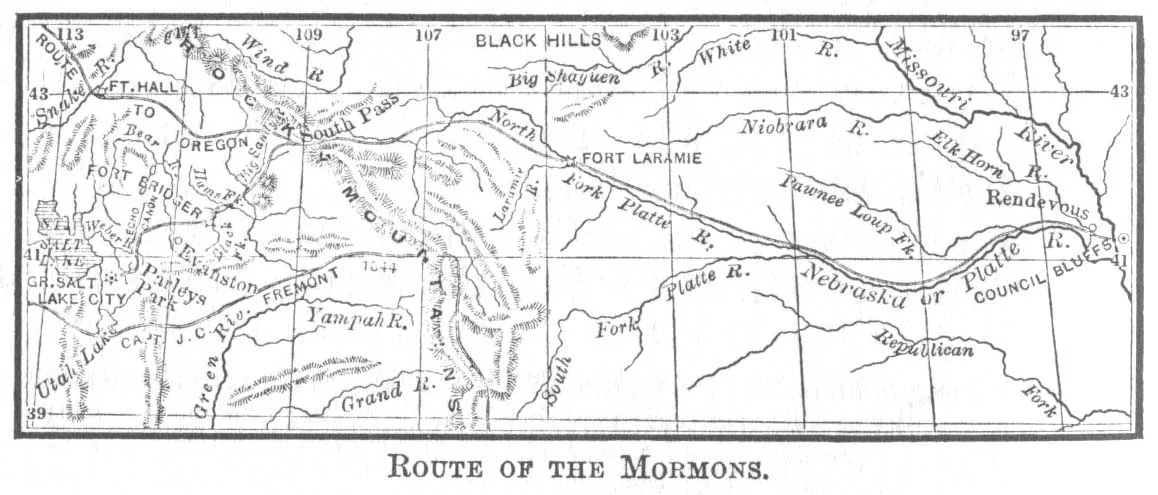
ROUTE OF THE MORMONS.
cattle to browse upon, and at last were obliged to feed them from the grain, flour, and biscuit they carried, subsisting meanwhile themselves on game and fish. In the valley of the Platte roamed such vast herds of buffaloes that it was often necessary to send parties in advance and clear the road before the teams could pass. At night the wagons would be drawn up in a semicircle on the bank, the river forming a defence upon one side. The tongues of the wagons were on the outside, and a fore wheel of each was placed against the hind wheel of the wagon before it; all the horses and cattle were brought inside of the enclosure. The corral thus formed was oblong, with an
opening at either end, where was stationed a guard. The tents were pitched outside of the corral. 5
In crossing the Loup River on the 24th, they used a leathern boat made for this expedition, and called The Revenue Cutter. On the 4th of May letters were sent back to Winter Quarters by a trader named Charles Beaumont. On the 22d they encamped at Ancient Bluff Ruins. Here the spirits of the people reached such high hilarity that their commanding
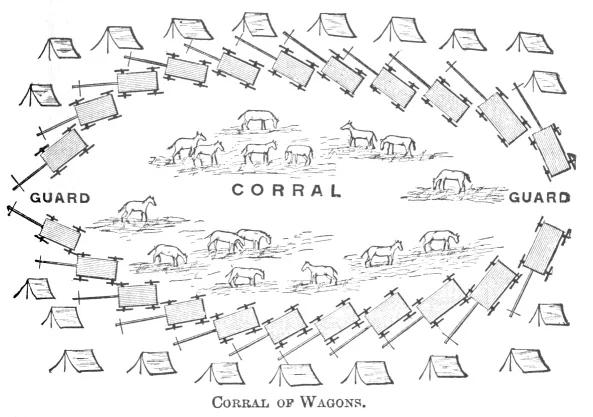
CORRAL OF WAGONS.
officer was obliged to rebuke them, whereupon all covenanted to humble themselves. 6
Early in June they reached the Black Hills by way of Fort Laramie. 7 Here they rested for two or three
weeks to build ferry-boats and recruit their animals. Grass was now plentiful; most of the brethren depended upon their rifles for food, and after having prepared sufficient dried meat for the rest of the journey, they continued on their way.
No sooner had they crossed the river than a horseman, who had followed their trail from Laramie, rode up and begged them to halt, as near by was a large company bound for Oregon, for which he asked conveyance over the stream. The pioneers consented, stipulating that they should receive payment in provisions. Other parties following, the larder of the saints was replenished. 8
Travelling rapidly, and a little to the south of what was known as the Oregon track, 9 the Mormons arrived at South Pass in the latter part of June, about the time when the tide of emigration usually passed the Missouri. Thence skirting the Colorado desert and reaching the Green River country, the monotony was broken. Here the brethren were met by Elder Brannan, who had sailed from New York for California in the ship Brooklyn, the previous February, with 238 saints, as before mentioned. He reported that they were all busy making farms and raising grain on the San Joaquin River. 10 As several of the present
company were ill with mountain fever, they encamped for a few days. Thirteen battalion brethren who were out searching for stolen cattle now surprised them, and Brigham led in three hearty cheers. 11 Again en route, passing through the Green River country, they reached Fort Bridger. Soon after leaving this point the real difficulties of the journey commenced. Led, as the saints relate, only by the inspiration of the Almighty. 12 Brigham and his band crossed the rugged spurs of the Uintah range, now following the rocky bed of a mountain torrent, and now cleaving their way through dense and gnarled timber until they arrived at Echo Cañon, near the eastern slope of the Wasatch Mountains, where for a brief space the main body rested, the president and many others being attacked with mountain fever. 13
Impatient of the delay, Brigham, after a formal
meeting, directed Orson Pratt 14 to take the strongest of their number and cut through the mountains into the valley, making roads and bridges as they went. After crossing what were designated as Big and Little mountains, the party, consisting of some forty-two men having twenty-three wagons, encamped in Emigration Cañon. 15
Thus the saints are reaching their resting-place. Their new Zion is near at hand; how near, they are as yet all unaware. But their prophet has spoken; their way is plain; and the spot for them prepared from the foundation of the earth will presently be pointed out to them. The great continental chain is penetrated. In the heart of America they are now upon the border of a new holy land, with its Desert
and Dead Sea, its River Jordan, Mount of Olives, and Gallilee Lake, and a hundred other features of its prototype of Asia.
Through the western base of the mountains extends the cañon, the two sides of which are serrated by a narrow stream, which along the last five miles flings itself from one side to the other a score or two of times, in places tumbling over bowlders, again quietly threading its way over a pebbly bottom, but everywhere cutting up the narrow and rugged gorge so as to make it most difficult and dangerous of passage.
The primeval silence is now broken; the primeval songs are now disturbed by sounds strange to the surrounding hills, accustomed only to the music of running water and the notes of birds and wild beasts. There is the rumbling of the caravan as it comes slowly picking its way down the dark ravine, the tramping of the horses upon the hard ground, and the grinding of the wheels among the rocks as they plunge down one bank and climb another, or thread their way along the narrow ledge overhanging an abyss, the songs of Israel meanwhile being heard, and midst the cracking of whips the shouts now and then breaking forth of a leader in Israel awe-struck by the grandeur of the scene, "Hosanna to the Lord! hosanna to the creator of all I hallelujah! hallelujah!"
Emerging from the ravine upon a bench or terrace, they behold the lighted valley, the land of promise, the place of long seeking which shall prove a place of rest, a spot whereon to plant the new Jerusalem, a spot of rare and sacred beauty. Behind them and on either hand majestic mountains rear their proud fronts heavenward, while far before them the vista opens. Over the broad plain, through the clear thin air, bathed in purple sunlight, are seen the bright waters of the lake, dotted with islands and bordered by glistening sands, the winding river, and along the creek the broad patches of green cane which look like waving corn. Raising their hats in reverence
from their heads, again hosannas burst from their lips, while praise to the most high ascends from grateful hearts.
It was near this terrace, being in fact a mile and a half up the cañon, that Orson Pratt and Erastus Snow, with their detachment of pioneers, encamped on the 20th of July, 1847. Next day, the ever-memorable 21st, to reach this bench, whence was viewed with such marvellous effect the warm, pulsating panorama before them, Pratt and Snow crept on their hands and knees, warned by the occasional rattle of a snake, through the thick underbrush which lined the south side of the mountain and filled the cañon's mouth, leaving their companions on the other side of the brush. After drinking in the scene to the satisfaction of their soils, they descended to the open plain, Snow on horseback, with his coat thrown loosely upon his saddle, and Pratt on foot. They journeyed westward three miles, when Snow missing his coat turned back, and Pratt continued alone. After traversing the site of the present city, and standing where later was temple block, he rejoined his comrade at the mouth of the cañon. Together they then returned to camp late in the evening and told of their discoveries.
The following morning the advance company, composed of Orson Pratt, George A. Smith, 16 and seven others, entered the valley and encamped on the bank of Cañon Creek. They explored the valley toward the lake, and about three miles from the camp found two fine streams with stony bottoms, whose banks promised sufficient pasturage. Proceeding northward, they found hot springs at the base of the mountain spur. Upon their return they were greeted by the working camp five miles from the mouth of the cañon, at what was subsequently known as Parley Cañon
creek. 17 On the 23d the camp moved some two or three miles northward, the site chosen being near the two or three dwarf cotton-woods, 18 which were the only trees within sight, and on the bank of a stream of pure water now termed City Creek, overgrown with high grass and willows. Pratt called the men together, dedicated the land to the Lord, and prayed for his blessing on the seeds about to be planted and on the labors of the saints. Before noon a committee returned a report that they had staked off land suitable for crops; that the soil was friable, and composed of loam and gravel. The first furrow was thereupon turned by William Carter, and through the afternoon three ploughs and one harrow were at work. A dam was commenced and trenches cut to convey water to the fields. Toward evening their energetic labors were interrupted by a thunder-storm. 19 The ground was so dry that they found it necessary to irrigate it before ploughing, some ploughs having been broken; and it was not until after the arrival of Brigham that planting was begun.
The coming of the leader had been impatiently awaited, although in their ambition to have as much as possible accomplished, the time quickly passed. Brigham was slowly following with the remainder of the company, and was still so weak as to be obliged to be carried on a bed in Wilford Wordruff's carriage. As they reached a point on Big Mountain where the view was unbroken, the carriage was turned into proper position, and Brigham arose from his bed and surveyed the country. He says: "The spirit of light rested upon me and hovered over the valley, and I felt that there the saints would find protection and
safety." 20 Woodruff in describing the scene says of Brigham: "He was enwrapped in vision for several minutes. He had seen the valley before in vision, and upon this occasion he saw the future glory of Zion…planted in the valley." 21 Then Brigham said: "It is enough. This is the right place. Drive on." Toward noon on the 24th they reached the encampment. Potatoes were planted in a five-acre patch of ploughed ground, and a little early corn. 22
Their first impressions of the valley, Lorenzo Young says, were most disheartening. 23 But for the two or three cotton-wood trees, not a green thing was in sight. And yet Brigham speaks almost pathetically of the destruction of the willows and wild roses growing thickly on the two branches of City Creek, destroyed because the channels must be changed, and leaving nothing to vary the scenery but rugged mountains, the sage bush, and the sunflower. The ground was covered with millions of black crickets which the Indians were harvesting for their winter food. 24 An unusual number of natives had assembled for this purpose, and after dinner gathered about the new-comers, evincing great curiosity as to their plans.
Lumber was made in the cañons, or from logs drawn thence, with whip-saws, through the entire winter;
afterward, on account of alarm at the apparent scarcity of timber, restrictions were put upon the manner of cutting and quantity used. Certain fines were imposed as a penalty for disobedience; for fuel only dead timber was allowed, and while there was sufficient, the restraint excited some opposition. 25
The next day was the sabbath; and as had been the custom at Nauvoo, two services were held, George A. Smith, followed by Heber C. Kimball and Ezra T. Benson, preaching the first sermon, and in the afternoon the meeting was addressed by Wilford Woodruff, Orson Pratt, and Willard Richards. One cause for thankfulness was that not a man or an animal had died on the journey. The sacrament was administered, and before dismissing the saints, the president bade them refrain from labor, hunting, or fishing. "You must keep the commandments of God," he said, "or not dwell with us; and no man shall buy or sell land, but all shall have what they can cultivate free, and no man shall possess that which is not his own."
On the 27th, 26 the president, the apostles, and six others crossed a river which was afterward found to be the outlet of Utah Lake, and thence walked dry-shod over ground subsequently covered by ten feet of water to Black Rock, where all bathed in the lake, Brigham being the first to enter it. 27 The party returned to camp on the following day, when a council was held, after which the members walked to a spot midway between the north and south forks of a neighboring creek, where Brigham stopped, and striking the ground with his cane, exclaimed, "Here will
be the temple of our God." 28 This was about five o'clock in the afternoon. An hour later it was agreed that a site should be laid out for a city in blocks or squares of ten acres, and in lots of an acre and a quarter, the streets to be eight rods wide, with sidewalks of twenty feet.
At eight o'clock on the same evening a meeting was held on the temple square, and it was decided by vote that on that spot the temple should be built, 29 and from that spot the city laid out.
On the 29th of July a detachment of the battalion, which had wintered at Pueblo, 30 to the number of 150, under Captain James Brown, arrived in the valley; they were accompanied by fifty of the brethren who had started the year previous from the Mississippi. On the following evening a praise service for their safe arrival was held in the brush bowery, 31 hastily
constructed for the purpose by the battalion brethren.
During the next three weeks all were busily at work, tilling the soil, cutting and hauling timber, making adobes, and building, ambitious to accomplish as much as possible before the main body of the pioneer band should start on its return journey to report to the brethren and to promote further emigration. The battalion brethren moved their wagons and formed a corral between the forks of City Creek. Brigham exhorted the brethren to be rebaptized, himself setting the example, and reconfirming the elders. On the 8th of August three hundred were immersed, the services commencing at six o'clock in the morning. During the month twenty-nine log houses had been built, either with roofs or ready for the usual substitute, a covering of poles and dirt. These huts were so arranged as to carry out their plan of forming a rectangular stockade, 32 the president and Heber C. Kimball being the first to take possession of their dwellings.
On the 17th of August twenty-four pioneers and forty-six of the battalion set out on their return to Winter Quarters. 33
On the afternoon of the 22d a conference was held, at which it was resolved that the place should be called the City of the Great Salt Lake. The term 'Great' was retained for several years, until changed by legislative enactment. It was so named in contradistinction to Little Salt Lake, a term applied
to a body of water some two hundred miles to the south, situated in what was later known as Iron county, near Parowan, and which has since almost disappeared. The stream connecting the two great lakes was named the Western Jordan, now called the Jordan, and the whole region whose waters flow into the lake was distinguished as the great basin. 34 On the 26th a second company, consisting of 107 persons, 35 started for Winter Quarters. Brigham Young and Heber C. Kimball set forth on horseback a little in advance of the others, but turning back, they waved their hats with a cheery "Good-by to all who tarry," and then rode on.
"We have accomplished more this year," writes Wilford Woodruff, "than can be found on record concerning an equal number of men in the same time since the days of Adam. We have travelled with heavily laden wagons more than a thousand miles, over rough roads, mountains, and curious, searching out a land, a resting-place for the saints. We have laid out a city two miles square, and built a fort of hewn timber drawn seven miles from the mountains, and of sun-dried bricks or adobes, surrounding ten acres of ground, forty rods of which were covered with block-houses, besides planting about ten acres of corn and vegetables. All this we have done in a single month." 36
At Winter Quarters active preparations had been making for following the pioneers at the earliest opportunity. Throughout the spring all was activity. Every one who had teams and provisions to last a year and a half was preparing to move, and assisting those who were to remain to plough and sow. Parley P. Pratt, having returned 37 from England shortly
before Brigham's departure, was left in charge of the first companies ordered westward. On the 4th of July, 1847, they set forth for the Rocky Mountains, numbering in all 1,553 persons. 38
A complete organization of the people was effected, according to a revelation of the Lord made through Brigham on the 14th of January, 1847. 39 They were divided into companies, each with one hundred wagons, and these into companies of fifty wagons, and ten wagons, every company under a captain or commander. Two fifties travelled in double columns if practicable. When a halt was called the wagons were arranged as in the march of the pioneers, forming a temporary fort, with its back opening upon the corral formed by the two semicircles. The cattle were then driven into the corral under charge of the herdsmen. When ready to march, the captain of each ten attended to his company, under the supervision of the captain of fifty. Advance parties each day selected the next camping-ground. In the absence of wood, fires were made from buffalo chips and sage brush. The wagons had projections extending over the sides, making the interior six feet wide. Hen-coops were carried at the end of each wagon, and a few young pigs were brought for use in the valley. Great care was used to prevent a stampede of the animals, as they appeared to recognize the peculiarities and dangers of the new country and
were easily alarmed. The organization and order in the camp was so perfect that not unfrequently half an hour after a halt the people sat down to a comfortable meal of fresh bread and broiled meat. 40
At the beginning of their journey, jealousy, bickering, and insubordination arose among them, and a halt was called for the purpose of holding a council and adjusting matters. For several hundred miles they followed the trail of the pioneers, and now were approaching the president and his men, who, encamped between Green River and the Sweetwater, had sent forward two messengers 41 to ascertain the progress and condition of the company. Upon hearing of the difficulties that had arisen, Brigham sent for Pratt and censured him severely for defects in the management of the party at the start, and for misunderstandings on the road. Pratt humbly acknowledged his faults and was forgiven. While the president and council were at prayer, the Sioux improved the occasion by stealing a number of horses, which proved a serious loss.
Pratt now returned to his command, and without special incident reached the Salt Lake settlement on the 19th of September; the companies arriving in detachments at intervals of several weeks.
Brigham's band was scantily provisioned for the journey to Winter Quarters. 42 The number that had already gathered at Salt Lake had drawn heavily on the pioneers' resources, and they set out depending for subsistence on game and fish. They travelled more rapidly in returning, 43 although most of them were compelled to walk. A few days after the Indian depredation
mentioned during the council, the Mormons were attacked by a large war party of Sioux, who again carried off many horses. The meeting of the battalion and pioneer brethren with Parley Pratt's company was an occasion of rejoicing to all. 44 On the 7th of September the former arrived at the Sweetwater. Here, with the assembled companies, a jubilee was held and a feast of good things prepared. While the men cut down brush and constructed a bowery, the women, with great trouble, unpacked their dishes and table furniture, delighted at the opportunity of assisting at such an event. A fat heifer was killed, and whatever luxuries were in camp were now produced. A slight snow fell, but in no degree marred their merriment; the feast was followed by music and dancing, and by accounts of the pioneers' experiences in entering upon and settling their new Zion; after prayer the company dispersed. 45 The remnants of the banquet were left with the eastern-bound train, and as they separated each bade the other God speed. A fortnight before reaching Winter Quarters a small delegation met Brigham's company with most welcome supplies. On the 31st of October, when within one mile of the settlement, Brigham called his men together, praised them for their good conduct, blessed and dismissed them. They drove into town in order an hour before sunset. The streets were crowded, and friends pressed forward, shaking hands as they passed through the lines. 46
During this season an abundant harvest had been gathered by the brethren at their encampments near
the Missouri, though sickness was an ever-present guest; and many of their number who could least be spared were scattered throughout the world as missionaries in Europe, and as far westward as the Sandwich Islands, as soldiers in California, or as laborers wherever they could find a livelihood in the western states. The winter was passed quietly and in content, most of the saints preparing for their migration in the spring. Meanwhile, on the 23d of December, 1847, a general epistle of the twelve was issued to the brethren and to the gentiles. In this it was stated that they were at peace with all the world, that their mission was to extend salvation to the ends of the earth, and an invitation was extended to "all presidents, and emperors, and kings, and princes, and nobles, and governors, and rulers, and judges, and all nations, kindreds, tongues, and people under the whole heaven, to come and help us to build a house to the name of the God of Jacob, a place of peace, a city of rest, a habitation for the oppressed of every clime." Then followed an exhortation for the saints to gather unto Zion, promising that their reward should be a hundred-fold and their rest glorious. They must bring "their gold, their silver, their copper, their zinc, their tin, and brass, and iron, and choice steel, and ivory, and precious stones; their curiosities of science,…or anything that ever was, or is, or is to be for the exaltation, glory, honor, and salvation of the living and the dead, for time and for all eternity." 47
Such a gathering of saints and gentiles would of itself have constituted an earthly Zion, especially for the president and the twelve, who held virtual control over their brethren's property. Among the gentiles one would think that such rhodomontade could not fail to bring discredit on the Mormon faith and the Mormon cause, but no such result followed. As will be mentioned later, their missions were never more prosperous than during the years when at their new
stake of Zion the saints were employed, not in adorning their temple with gold, silver, and precious stones, but in building rough shanties, hewing timber, hoeing corn, and planting potatoes.
The trite maxim commencing Æquam memento was one which the saints had taken well to heart, and on few was the mens æqua in arduis more firmly stamped than on the brow of him who, on christmas eve, the day after his invitation to the princes and potentates of all the earth, was appointed president of the church of Jesus Christ of latter-day saints. And while in adversity there were none more steadfast, it must be admitted there were few in whom success developed so little of pride and of vainglory. From this time forth Brigham Young was to the saints as a prophet—yea, and more than a prophet: one on whom the mantle had fallen not unworthily. By his foresight he had saved his people from dispersion, and perchance his faith from annihilation. Hounded by a mob, he had led his followers with consummate tact throughout their pilgrimage, and in a wilderness as vet almost untrodden by man had at length established for them an abiding-place.
After the departure of Brigham from Salt Lake, John Smith, the prophet's uncle, was nominally president of the camp; 48 but upon the arrival of John Taylor and Parley P. Pratt their precedence was acknowledged and they were placed in charge. 49 There were no laws until the latter part of this year, though certain penalties were assigned for certain crimes and executed by the people. As there was no jail, the whipping-post was substituted, but used only two or three times. In such cases the high council tried the
prisoner, and sentenced him. "President Young was decidedly opposed to whipping," 50 says George Q. Cannon, "but matters arose that we considered required punishment at the time." 51
During this period men and women voted by ballot in matters relating to government. Women had already voted in religious meetings by the uplifted hand, but this is probably the first instance in the United States where woman suffrage was permitted. Utah at that time, however, was not a part of the United States, and before its admission as a territory the privilege was withdrawn. 52
On the 16th of November, O. P. Rockwell, E. K. Fuller, A. A. Lathrop, and fifteen others set forth for California to buy cows, mules, mares, wheat, and seeds. They bought two hundred head of cows at six dollars each, with which they started from California, but lost forty head on the Mojave; being ninety days on the return trip. During the autumn, several parties of the battalion men arrived from California, bringing a quantity of wheat. Captain Grant came to Salt Lake City from Fort Hall in December to arrange for opening trade between the two points. After due discussion, the matter was referred to the headquarters of the Hudson's Bay Company.
In regard to affairs at Pueblo and on the Missouri, I am indebted for further and later information to my esteemed friends Wilbur F. Stone and William N. Byers of Colorado. A detachment of the Mormons that wintered at Pueblo underwent many hardships, and there have been found relics in that vicinity, in the shape of furnace and cinders, significant of their industrial occupation at the time.
On the Missouri, the Indians, who at first had so heartily welcomed the saints during the year 1847, complained to the government that they were intruding on their domain. The government therefore ordered away the Mormons, but gave them permission to occupy lands on the east bank of the river for five years. There they built a town, named Kanesville, opposite Omaha, and occupied the best part of the country up and down the left bank of the river for a distance of twenty miles in each direction. Many of them lived in dugouts, that is, artificial caves made by digging out a space for occupancy in the bank of the river or on the side of a bluff. Most
of them were farmers, and they had three or four grist-mills and two or three saw-mills.
The first emigrants did not stop on the east side of the river, but passed over at once on arrival, making their first settlement, as before mentioned, at Winter Quarters, situated six miles from the present city of Omaha, at the north end of the plateau, nearly all of which they ploughed up in the spring of 1847, and planted seed corn brought by those who the previous winter had returned to the Mississippi to work for wages. Hereabout they built many log houses, Brigham having a little cluster of them for his wives in a cosey nook apart from the others.
On their final departure for the west, the Mormons left a few of their number under A. J. Mitchell, who was assisted by A. J. Smith. They lived on the east side of the Missouri at first, and had a ferry across the river as early as 1851, with other ferries west, one at Loup Fork, and one on the Elkhorn. A large emigration up the river from New Orleans set in about this time. In the spring of 1852 the steamboat Saluda, having six hundred souls on board, was blown up at the mouth of the Platte.
In 1854 the lands of the Omahas, on the west side of the river, came into market, through a treaty made during the summer of that year with the natives, who ceded that section to the United States. Mitchell and Smith then moved to the western side, and changed the name of Winter Quarters to that of Florence, at the same time selling their interests on the eastern side to the gentiles, who changed the name of Kanesville to that of Council Bluffs.
Footnotes
253:1 The octagon house of Dr Richards in which the council met is described as a queer-looking thing, much resembling a New England potato-heap in time of frost. 'Council voted a load of wood for each day they met in his house.' Hist. B. Young, MS., 1847, 2.
253:2 Woodruff's Journal, MS., Apr. 17, 1847.
253:3 John Taylor, Parley Pratt, and Orson Hyde were engaged in missionary work abroad. Pratt's Autobiog., 383.
253:4 The impression was that they would reach as soon as possible 'the foot of the mountains somewhere in the region of the Yellowstone River, perhaps at the fork of Tongue River, say 2 days' ride north of the Oregon road, and a week's travel west of Ft Laramie…I informed Bishop Miller that when we moved hence it would be to the great basin.' Hist. B. Young, MS., 79. No one knew whither they were going, not even the leaders. 'We have learned by letter to Elder G. D. Watt that a company left Council Bluffs for the mountains on the 12th of April to seek a location for a stake in Zion.' Millennial Star, ix. 235. 'The pioneers started for the mountains to seek out a resting-place for the saints.' Brown's Testimonies for the Truth, 26. In Niles' Register, lxxii. 206 (May 29, 1847), we read: 'Their intention is to proceed as far as possible up to the period of necessary planting-time, when they will stop and commence a crop. The leaders will make but a short delay at this point, and will proceed over into California and communicate with or joia the disbanded forces of the Mormon battalion, whose period of service will expire about the 1st of July next.' 'When President Young was questioned by any of the pioneers as to the definite point of our destination, all he could say to them was, that he would know it when he should see it.' Erastus Snow, in Utah Pioneers, 33d ann., 44.
255:5 Woodruff's Journal, MS., April 19, 1847. On May 4th they 'established a post-office and guide system for the benefit of the next camp following. Every ten miles…we put up a guide-board.'
255:6 'I have told the few who did not belong to the church that they were not at liberty to introduce cards, dancing, or iniquity of any description.' Hist. B. Young, MS., 1847, 90.
255:7 Fort John, or Laramie, was occupied by 'James Bordeaux and about eighteen French half-breeds and a few Sioux…There had been no rain for the last two years…Two or three of us visited Mr Bordeaux at the fort. We paid him $15 for the use of his ferry-boat. Mr Bordeaux said that this was the most civil and best-behaved company that had ever passed the fort.' Id., MS., 1847, 91.
256:8 Snow, in Utah Pioneers, 44. 'Capt. Grover and eight others of the pioneers were left at North Platte ferry and ford to ferry the companies that should arrive, and especially to ferry the emigration from Winter Quarters.' Hist. B. Young, MS., 1847.
256:9 'Making a new road for a majority of more than one thousand miles westward, they arrived at the great basin in the latter part of July.' General Epistle of the Twelve, in Millennial Star, x. 82. 'He [Brigham] and the company arrived on the 24th of July, having sought out and made a new road 650 miles, and followed a trapper's trail nearly 400 miles Smith's Rise Progress, and Travels, 16; see also Tullidge s Life of Young, 161. Remy says that an odometer was attached to a wheel of one of the wagons, and careful notes taken of the distances. Jour. to G. S. L. City, i. 433-4. 'As I remember, there was no trail after leaving Laramie, going over the Black Hills, except very rarely. For a short distance before reaching the Sweetwater, we saw a wagon truck; it was a great surprise and a great curiosity.' Hist. B. Young, MS., 1848, 7.
256:10 Hist. B. Young, MS., 1847, 95; Tullidge's Life of Young, 166.
257:11 'I exclaimed, "Hosanna! hosanna! give glory to God and the lamb, amen!" in which they all joined.' Hist. B. Young, MS., 1847, 96. 'Left Phineas Young and four others, who had volunteered to return to guide the immigrants.'
257:12 Smith's Rise, Progress, and Travels, 16. 'For,' says the author, 'no one knew anything of the country.' Snow, in Utah Pioneers, 33d ann., 44, remarks: 'The president said we were to travel "the way the spirit of the Lord should direct us."' Snow states that James Bridger, who had a trading post which still bears the name of Fort Bridger, when he met the president on the Big Sandy River about the last of June, and learned that his destination was the valley of Great Salt Lake, offered $1,000 for the first car of corn raised there. 'Wait a little,' said the president, 'and we will show you.' Again, on p. 45 he says that, being encamped on what is now known as Tar Springs, the pioneers were met by a mountaineer named Goodyear, who had wintered on the site of the present city of Ogden, after planting brain and vegetables in the valley, but with meagre results. The mountaineer's report was very discouraging, but to him also Brigham replied, 'Give us time and we will show you.' There is no evidence that as yet the president knew anything about the Salt Lake Valley except what he heard from Bridger and Goodyear, or had gleaned from the reports of Frémont's expedition. 'On the 15th of June met James H. Grieve, Wm Tucker, James Woodrie, James Bouvoir, and six other Frenchmen, from whom we learned that Mr Bridger was located about 300 miles west, that the mountaineers could ride to Salt Lake from Fort Bridger in two days, and that the Utah country was beautiful.' Hist. B. Young, MS., 1847, 92. 'Half-mile west of Fort Bridger some traded for buckskins, their clothing being worn out.' Id., 97. Note also the following: 'Met Capt. Bridger, who said he was ashamed of Frémont's map of this country. Bridger considered it imprudent to bring a large population into the great basin until it was ascertained that grain could be raised.'
257:13 'We had to stop at Yellow Creek and again at the head of Echo Cañon, stopping and travelling as the sick were able to endure the journey, until we reached the Weber at the mouth of Echo Cañon, and shuck our camp a fear miles below, the present railroad station.' Utah Pioneers, 33d ann., 45.
258:14 'Voted, that Orson Pratt take charge of an expedition to go on and make a road down the Weber River.' Hist. B. Young, MS., 1847, 97. O. Pratt was appointed to take 23 wagons and 42 men, and precede the main company. Church Chron., 65. Erastus Snow says, in a discourse on the Utah pioneers, delivered in the tabernacle July 25, 1880: 'I well remember, as we called at the wagon to bid the president good-by, Brother Willard Richards…asking if he had any counsel to give to guide our movements…Resting his elbow on the pillow with his head in his hand, he spoke feebly,…"My impressions are," said he, "that when you emerge from the mountains into the open country you bear to the northward, and stop at the first convenient place for putting in your seed."'
258:15 'The emigration route previous to 1847 was via Laramie through South Pass to Big Sandy River. Then to avoid a desert stretch, down the Big Sandy to its junction with Green River, and across, then up Black's Fork to junction with Ham's Fork, and thence up Black's Fork to Fort Bridger. The Mormons here took the road made by Hastings and the Donner company in 1846, bearing almost due west, crossing Bear River, down Echo Cañon to junction with the Weber. The Mormons here chose the Donner trail, which passed up the Weber southerly from Echo about twelve miles, then westerly into Parley's Park, then across the hills northerly to the head of Emigration Cañon, then into the valley. As the Donner company had passed over this route more recently than any other, it seems to have been followed as probably the best, and was usually travelled for many years. In 1847, when the Mormons entered the valley, there were three wagon routes into it. The first, down Bear River from Soda Springs, through Cache Valley—Capt. Bartlett's route in 1841, followed by Frémont in 1843: the second, Hastings’ California emigration through Echo and Weber cañons in 1846; and the third, the Donner route of 1846, described. The Mormons found a plain road into a fertile, unoccupied country;…its isolation alone was the cause of its non-occupation.' McBride's Route of the Mormons, MS. This manuscript, to which among other favors I am indebted to Judge McBride, throws fresh light on the question of passes and routes in early times. The author, one of the first to enter Utah, was second to none in ability and position at a later period.
260:16 Geo. A. Smith says in his autobiography that on this journey he walked 1,700 miles and rode some 800 miles on horseback. He had 25 lbs of flour, which he used by the cupful for those who were ill; for six weeks he was without bread, and like the rest of the company, lived on buffalo meat and other game.
261:17 Parley was always quite popular among the brethren, though his judgment was not always the best.
261:18 'My poor mother was heart-broken because there were no trees to be seen; I don't remember a tree that could be called a tree.' Clara Young s Experiences, MS., 5.
261:19 'July 23d, 96° Fah. A company commenced mowing the grass and preparing a turnip-patch.' Hist. B. Young, MS., 1847, 99.
262:20 Hist. B. Young, MS., 1847, 99.
262:21 Woodruff, in Utah Pioneers, 1880, 23. See also Wroodruff's Journal, MS.; Clara Young's Experiences, MS.; Utah Early Record, MS.; Pioneer Women, MS.; Taylor's Rem., MS.
262:22 'I had brought a bushel of potatoes with me, and I resolved that I would neither eat nor drink until I had planted them.' Woodruff, in Utah Pioneers, 1880, 23. 'I planted the first potato…in Salt Lake Valley,' says Geo. A. Smith in his autobiography.
262:23 Mrs Clara Decker Young speaks of the distress she suffered at leaving Winter Quarters, where there were so many people and life so social; but that when she finally reached her destination she was satisfied. 'It didn't look so dreary to me as to the other two ladies. They were terribly disappointed because there were no trees, and to them there was such a sense of desolation and loneliness.' Experience of a Pioneer Woman, MS., 5.
262:24 'The Indians made a corral twelve or fifteen feet square, fenced about with sage brush and grease-wood, and with branches of the same drove them into the enclosure. Then they set fire to the brush fence, and going amongst them, drove them into the fire. Afterward they took them up by the thousand, rubbed off their wings and legs, and after two or three days separated the meat, which was, I should think, an ounce or half an ounce of fat to each cricket.' Early Experiences of Lorenzo Young, MS., 4.
263:25 'Taylor and Pratt took the lead; through them this understanding about the timber occurred.' Nebeker's Early Justice, MS., 4.
263:26 On Monday, the 26th, the president and his apostles ascended Ensign Peak, so called on account of a remark made by Brigham: 'Here is a proper place to raise an ensign to the nations.' Ibid. See also Utah Early Records, MS., 4; Woodruff's Journal, MS.; Nebeker's Early Justice, MS. Woodruff was the first who stood on the top of the peak.
263:27 On this day was commenced the first blacksmith's shop, the property of Burr Frost.
264:28 'This was about the centre of the site of the Temple we are now building.' Utah Pioneers, 33d ann., 23.
264:29 'Some wished for forty acres to be set apart for temple purposes, but it was finally decided to have ten acres;…the base line was on the south-east corner, and government officials afterward adopted it as the base meridian line.' Taylor's Reminiscences, MS., 21. When the elders arrived from England they brought with them to Winter Quarters, just before the starting of the pioneers, 'two sextants, two barometers, two artificial horizons, one circular reflector, several thermometers, and a telescope.' Hist. B. Young, MS., 1847, 82. Thus Orson Pratt was enabled to take scientific observations. He reported the latitude of the north line of temple square, which was ten acres in size, to be 40° 45´ 44″ N., and its longitude 111° 26´ 34″ W. From George W. Dean's Observations in 1869, taken at the temple block, the results were lat. 40° 46´ 2″, long. 111° 53´ 30″. Rept Coast Survey, 1869-70. In taking lunar distances for longitude, it is usual to have four observers, but Orson Pratt had no assistant; hence probably the discrepancy. On August 16th it was determined that the streets around the temple block should be called respectively North, South, East, arid West Temple streets, the others to be named, as required, First North street, Second North street, First South street, Second South street, etc.
264:30 Says Mrs Clara Young: 'Before reaching Laramie three of tire pioneers were sent to Pueblo to tell the families there to strike their trail and follow them to their settlement.' Ex. of a Pioneer Woman, MS., 7. 'The men of this detachment were on their way to San Francisco, but their wagons breaking down and their cattle being in very poor condition, they were compelled to turn aside and await further orders.' Utah Early Records, MS., 8.
264:31 For many years these boweries of trees and brush had been constructed when any large number of the people needed a temporary place of shelter. This one was 40 × 28 feet. Col Markham reported at this meeting 'that 13 ploughs and 3 harrows had been stocked during the past week, 3 lots of ground broken up, one lot of 35 acres planted in corn, oats, buckwheat, potatoes, beans, and garden seed.' Hist. B. Young, MS., 1847, 103-4. 'On the 20th H. G. Sherwood, in returning from an excursion to Cache Valley, brought an Englishman with him, named Wells, who had been living in New Mexico for some years.' Hist. B. Young, MS., 1847, 109. On the 21st A. Carrington, J. Brown, W. W. Rust, G. Wilson, and A. Calkins made the ascent of the Twin Peaks, 15 miles south-east of the stockade, and the highest mountain in the Wasatch Range, its elevation being, as they reported, 11,219 feet. These were probably the first white men who ascended this mountain.
265:32 They were 8 or 9 feet high, and 16 or 17 feet long, by 14 wide. Hist. B. Young, MS., 1847, 110. 'We were the first to move into the fort; our house had a door and a wooden window, which through the day was taken out for light, and nailed in at night…There was also a port-hole at the east end of the fort, which could be opened and closed at pleasure…We had adobe chimneys and a fire-place in the corner, with a clay hearth.' Young's Pioneer Women, MS., 6.
265:33 'With 34 wagons, 92 yoke of oxen, 18 horses, and 14 mules, in charge of Shadrach Roundy and Tunis Rappelye. Lt Wesley Willis was in charge of the battalion men.' Richards’ Narr., MS., 13-14.
266:34 'It was also called The Great North American Desert.' Taylor's Rem., MS., 22.
266:35 With 36 wagons, 71 horses, and 49 mules.
266:36 Woodruff's Journal, MS., 78.
266:37 'I found my family all alive and dwelling in a log cabin; they had, howerver, suffered much from cold, hunger, and sickness…The winter had been very severe, the snow deep, and consequently horses and cattle had been lost. …My wagons were overhauled and put in order, tires reset, chains repaired, yokes and bows arranged in order, wagon bows made and mended.' Pratt's Autobiog., 397-8. 'The companies were organized by Elder P. P. Pratt and myself, as near as we could in accordance with instructions left by Pres. Young.' Taylor's Rem., MS., 7.
267:38 This company is distinguished as the first immigration. It was supplied with 580 wagons, 2,213 oxen, 124 horses, 887 cows, 358 sheep, 716 chickens, and 35 hogs. Utah Early Records, MS., 17. Smith says about 700 wagons. Rise, Progress, and Travels, 16. Kearny's and Frémont's parties met Pratt's companies at Loup River; and according to Martin's Narr., '42 in Cal., MS., 122, John Young was appointed president and John Van Cott marshal.
267:39 This was called 'the word and will of the Lord concerning the camp of Israel.' Like all revelations, it was in scriptural phraseology, and very explicit in its directions. It was also read by Brigham to his people in Salt Lake City on the 1st of August.
268:40 From account of their journeyings furnished me in Taylor's Rem., 7-12.
268:41 O. P. Rockwell and E. T. Benson.
268:42 Among them was a party of battalion men who were entirely destitute except for a very small quantity of beef, which was soon exhausted. General Epistle of the Twelve, in Millennial Star, x. 83.
268:43 'Camped on the south side of the Platte. We were 42 days in going to the valley from this point, and only 23 days in returning.' Hist. B. Young, MS., 1847, 115.
269:44 'Met Spencer's advance company Sept. 3d, with 76 wagons; we had a joyful meeting; on the 4th met encampment of 75 wagons; on the 5th 162; and on the 8th met the last company of saints.' Hist. B. Young, MS., 1847.
269:45 'All felt greatly encouraged. We now knew for the first time our destination; we had talked of California, and knew not until now where we should settle.' Horne's Migrations, MS., 22.
269:46 'We were truly rejoiced once more to behold our wives, children, and old friends, after an absence of six months, having travelled over 2,000 miles… and accomplished the most important mission in this last dispensation.' Hist. B. Young, MS., 1847, 122.
270:47 The full text of this epistle is given in the Millennial Star, x. 81-8.
271:48 Affairs were controlled by the high council, consisting of twelve high-priests. Salt Lake City was a stake of Zion, with president and other officers. 'At the conference on Oct. 3d Father John Smith was elected president of the stake of Zion and patriarch of the church. Brigham Young was sustained as president of the whole church.' Hist. B. Young, MS., 117.
271:49 Nebeker's Early Justice, MS., 4.
272:50 'I had to chastise one in that way for stealing.' Id., MS., 4.
272:51 'For instance, one of our best men now, who was then young, was accused of riding on horseback with a girl in front of him. This was looked upon as indecorous. He and others guilty of the same thing were severely reprimanded.' G. Q. Cannon, in Taylor's Rem., MS., 12-13.
272:52 Taylor's Rem., MS., 14. Herewith I give a list of the Utah pioneers of 1847: Adams, Barnabas L.; Angel, Truman O.; Allen, Rufus; Attwood, Millen; Badger, Rodney; Barney, Lewis; Barnham, Charles D.; Benson, Ezra T.; Billings, Geo. P.; Boggs, Francis; Brown, Geo.; Brown, John; Brown, Nathaniel Thomas; Bullock, Thos; Burke, Charles; Burnham, Jacob D.; Byard, Robert; Carrington, Albert; Carter, William; Case, James; Chamberlin, Solomon; Chessley, Alexander P.; Clayton, William; Cloward, Thos P.; Coltrin, Zebedee; Craig, James; Crosby, Oscar; Curtis, Lyman; Cushing, Hosea; Davenport, James; Dewey, Benjamin F.; Dixon, John; Driggs, Starling; Dykes, William; Earl, Sylvester H.; Eastman, Ozro; Egan, Howard; Egbert, Joseph; Eldredge, John S.; Ellsworth, Edmund; Empey, William A.; Ensign, Datus; Everett, Addison; Fairbanks, Nathaniel; Farr, Aaron; Fitzgerald, Perry; Flake, Green (colored); Fowler, John S.; Fox, Samuel; Freeman, John M.; Frink, Horace M.; Frost, Burr; Gibbons, Andrew S.; Gleason, John S.; Glines, Eric; Goddard, Stephen H.; Grant, David; Grant, Geo. R.; Greene, John Y.; Grover, Thomas; Hancock, Joseph; Hanks, Sidney A.; Hanson, Hans C.; Harmon, Appleton M.; Harper, Charles A.; Henrie, William; Hewd, Simeon; Higbee, John S.; Holman, John G.; Ivory, Matthew; Jackman, Levi; Jacobs, Norton; Johnson, Artemas; Johnson, Luke; Johnson Philo; Kelsey, Stephen; Kendall, Levi N.; Kimball, Ellen S. (wife of H. C. K.); Kimball, Heber C.; King, William A.; Klineman, Conrad; Lark, Hark (colored); Lewis, Tarlton; Little, Jessie C.; Losee, John G.; Loveland, Chancey; Lyman, Amasa; Marble, Samuel H.; Markham, Stephen; Matthews, Joseph; Mills, George; Murray, Carlos; Newman, Elijah; Norton, John W.; Owen, Seely; Pack, John; Pierce, Eli H.; Pomeroy, Francis M.; Powell, David; Pratt, Orson; Reddin, Jackson; Rappelye, Tunis; Richards, Willard; Rockwell, Orrin P.; Rockwood, Albert P.; Rolfe, Benjamin W.; Rooker, Joseph; Roundy, Shadrach; Schofield, Joseph S.; Scholes, George; Sherwood, Henry G.; Shumway, Andrew P.; Shumway, Charles; Smith, George A.; Smoot, Wm C. A.: Snow, Erastus; Stevens, Roswell; Stewart, Benjamin F.; Stewart, James W.; Stringham, Briant; Summe, Gilburd; Taft, Seth; Tanner, Thomas; Taylor, Norman; Thomas, Robert T.; Thornton, Horace M.; Thorpe, Marcus B.; Tippitts, John H.; Vance, William P.; Walker, Henson; Wardel, George; Weiler, Jacob; Wheeler, John; Whipple, Edson; Whitney, Horace K.; Whitney, Orson K.; Williams, Almon L.; Woodard, George; Woodruff, Wilford; Woolsey, Thomas; Wordsworth,William; Young, Brigham; Clarissa D. (wife of B. Y.); Young, Harriet P. (wife of Lorenzo D.); Young, Isaac P. D.; Young, Lorenzo D.; Young, Lorenzo Z.; Young, Phineas H.
CHAPTER XI.
IN THE VALLEY OF THE GREAT SALT LAKE.
1848.
Food and Raiment—Houses—Home Manufactures—the Fort—Wild Beasts—Cannon From Sutter's Fort—Indian Children for Sale—Measles—Population—Mills and Farming Machinery—the Plague of Crickets—They Are Destroyed By Gulls—Scarcity of Provisions—the Harvest Feast—Immigration—Five Thousand Saints Gathered in the Valley—Fencing and Farming—Distribution of Lots—Organization of County Government—Association for the Extermination of Wild Beasts.
At the opening of January 1848, the saints were housed, clad, and fed in moderate comfort, and general content prevailed. 1 The season was exceptionally mild; there were occasional light falls of snow, but not enough to interfere with ploughing and sowing, 2 and a large tract of land was partially enclosed and planted with wheat and vegetables.
So many people were now in the valley that notwithstanding the abundant crops food at length became scarce. Families weighed out their flour and allowed themselves so much a day. The wheat was ground at a mill on City Creek, but as there was no bolting-cloth, the shorts and bran could not be separated. The beef was very poor, 3 as most of the cattle
had been worked hard while driven to the valley and after their arrival, while those turned out to range did not fatten quickly. Butter and tallow were needed. One wild steer, well fattened, was brought in from Goodyear's rancho. A herd of deer crossing from one range of mountains to another was startled by the unexpected obstruction of the fort, and one sprang into the enclosure and was killed. Wild sago and parsnip roots constituted the vegetable food of the settlers. A few deaths occurred from poisonous roots. The bracing air and hard work stimulated appetite as stores decreased. For coffee parched barley and wheat were used, and as their sugar gave out, they substituted some of home manufacture. 4 In the spring thistle tops were eaten, and became an important article of diet. 5
Anxiety began to be felt about clothing, and the hand-looms were now busily at work, although wool was scarce. 6 As shoes wore out, moccasins were substituted, and goat, deer, and elk skins were manufactured into clothing for men and women, though most unsuitable for use in rain and snow.
At the time of Parley P. Pratt's arrival, the city of Great Salt Lake consisted of a fort enclosing a block of ten acres, the walls of part of the buildings being of adobes and logs. There were also some tents. 7 As additional companies came in, they extended
the south divisions, which were connected with the old fort by gates. Wagon-boxes were also brought into line, and served for habitations until better accommodations were provided. The houses were built of logs, and were placed close together, the roofs slanting inward, and all the doors and windows being on the inside, with a loop-hole to each room on the outside. As everything indicated a dry climate, the roofs were made rather flat, and great inconvenience resulted. In March the rains were very heavy, and umbrellas were used to protect women and children while cooking, and even in bed. The clay found in the bottoms near the fort made excellent plaster, but would not stand exposure to rain, and quickly melted. All breadstuffs were carefully gathered into the centre of the rooms, and protected with buffalo skins obtained from the Indians. The rooms in the outer lines all adjoined, and many of the families had several rooms. On the interior cross-lines rooms were built on both sides, the streets being eight rods wide.
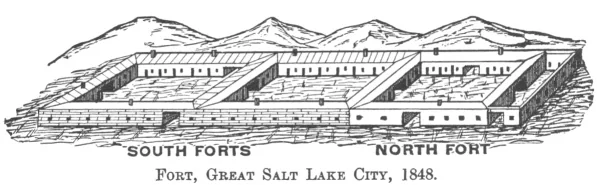
FORT, GREAT SLT LAKE CITY, 1848.
There were serious depredations committed by wolves, foxes, and catamounts, and great annoyance occasioned by the howling of some of these animals. 8 Further discomfort was caused by innumerable swarms of mice. Digging cavities and running about under the earthen floor, they caused the ground to tremble, and when the rain loosened the stones of the roofs,
scampered off in hordes. Frequently fifty or sixty had to be caught and killed before the family could sleep. 9
The furniture was home-made, and very little of it at that. The table was a chest, and the bedstead was built into the corner of the house, which formed two of its sides, rails or poles forming the opposite sides; pegs were driven into the walls and rails, and the bed-cord tightly wound around them. 10 The chimneys were of adobe, and sometimes there was a fireplace in the corner with a clay hearth.
In the early part of the year two brass cannon were purchased at Sutter's Fort for the church, by the battalion brethren. 11
During the winter of 1847-8, some Indian children were brought to the fort to be sold. At first two were offered, but the settlers peremptorily refused to buy them. The Indian in charge said that the children were captured in war, and would be killed at sunset if the white men did not buy them. Thereupon they purchased one of them, and the one not sold was shot. Later, several Indians came in with two more children, using the same threat; they were bought and brought up at the expense of the settlers. 12
Measles now appeared for the first time among the natives, who did not know where the disease came from or what to do. They assembled in large numbers at the warm springs, bathed in the waters, and died. 13
Public meetings were generally held near the liberty-pole in the centre of the fort; religious and secular meetings were also held in private houses. In March 1848 the population of the city was reported at 1,671, and the number of houses 423. 14 Bridges were built over Mill Creek and Jordan River. Daniel Spencer was appointed road-master, and authorized to call on men to assist in making roads. In order that the burden might fall equally on all, a poll and property tax were instituted.
There were several mills soon in working order. A small grist-mill on City Creek was built by Charles Crismon near the pioneer garden; then there were Chase's saw-mill and Archibald and Robert Gardiner's on Mill Creek, and Nebeker, Riter, and Wallace's in a cañon ten miles north of the city. A carding machine was erected near Gardiner's saw-mill by Amasa Russell, and a flouring mill during the summer by John Neff. Leffingwell constructed a threshing machine and fanning mill on City Creek, with a capacity of two hundred bushels per day. Mill-stones cut out of the basalt in the valley were of very good quality. Millions, mill-stones, printing-presses, type, paper, and the carding machine were brought by the first bands of emigrants in 1848. 15
The spring saw everybody busy, and soon there were many flourishing gardens, containing a good variety of vegetables. In the early part of March ploughing commenced. The spring was mild and rain plentiful, and all expected an abundant harvest. But in the latter part of May, when the fields had put on their brightest green, there appeared a visitation in the form of vast swarms of crickets, black and baleful as the locust of the Dead Sea. 16 In their track
they left behind them not a blade or leaf, the appearance of the country which they traversed in countless and desolating myriads being that of a land scorched by fire. 17 They came in a solid phalanx, from the direction of Arsenal Hill, darkening the earth in their passage. Men, women, and children turned out en masse to combat this pest, driving them into ditches or on to piles of reeds, which they would set on fire, striving in every way, until strength was exhausted, to beat back the devouring host. But in vain they toiled, in vain they prayed; the work of destruction ceased not, and the havoc threatened to be as complete as was that which overtook the land of Egypt in the last days of Israel's bondage. "Think of their condition," says Mr Cannon—"the food they brought with them almost exhausted, their grain and other seeds all planted, they themselves 1,200 miles from a settlement or place where they could get food on the east, and 800 miles from California, and the crickets eating up every green thing, and every day destroying their sole means of subsistence for the months and winter ahead." 18
I said in vain they prayed. Not so. For when everything was most disheartening and all effort spent, behold, from over the lake appeared myriads of snow-white gulls, their origin and their purpose alike unknown to the new-comers! Was this another scourge God was sending them for their sins? Wait and see. Settling upon all the fields and every part of them, they pounced upon the crickets, seizing and swallowing them. They gorged themselves. Even after their stomachs were filled they still devoured them. On Sunday the people, full of thankfulness, left the fields to the birds, and on the morrow found on the edges of the ditches great piles of dead crickets that had been swallowed and thrown up by the
greedy gulls. Verily, the Lord had not forgotten to be gracious!
To escape the birds, the crickets would rush into the lake or river, and thus millions were destroyed. Toward evening the gulls took flight and disappeared beyond the lake, but each day returned at sunrise, until the scourge was past. 19 Later grasshoppers seem to have taken the place of crickets. They were of a kind popularly called iron-clad, and did much mischief. 20
Though the crops of this year of 1848 were thus saved from total destruction, fears were entertained that there would not be food enough for those already in the valley, and the expected arrival of large additional numbers was looked upon as a calamity. 21 The stock of provisions was therefore husbanded with care, many living principally on roots and
thistles, to which fare was sometimes added a little flour or milk. The wheat crop, however, turned out better than was expected, and pumpkins, melons, and corn yielded good returns. 22
On the 10th of August, however, the harvest being then gathered, a feast was held in the bowery, at which the tables were loaded with a variety of viands, vegetables, beef, and bread, butter and cheese, with cakes and pastry. Sheaves of wheat and other grain were hoisted on harvest poles; "and," says Parley, "there was prayer and thanksgiving, congratulations, songs, speeches, music, dancing, smiling faces, and merry hearts."
The rendezvous for westward-bound brethren in the spring of 1848 was the Elkhorn River, and thither at the end of May came the president, who organized the people and gave them instructions to be observed on the way. Good order was to be preserved in camp; there must be no shouting; prayers were to be attended to, and lights put out at 9 o'clock. Drivers of teams must walk beside their oxen, and not leave them without permission. Brigham was general superintendent of the emigrating companies, with Daniel H. Wells as aide-de-camp, H. S. Eldredge marshal, and Hosea Stout captain of the night-guard. Moving west early in June, on the 14th the emigrants were fired on by Indians, two being wounded. At this time also there was sickness in the camp. To secure grass and water, the emigration was separated into divisions, of which there were two principal
ones, under Brigham Young and H. C. Kimball, with several subdivisions. 23
The first letters received at Great Salt Lake City from Brigham came twelve months after his departure from the valley, and were sent on in advance from the encampments. The excitement was great as Taylor and Green rode into the city and distributed the letters, without envelopes, tied round and round with buckskin thongs, and bearing the cheering news that a large body of brethren was on the way, and bringing plenty of food. 24
In June and July two small parties left the city to meet the immigration, and another in August. In September Brigham and the first companies arrived; and under the organization of the president and his two counsellors, Willard Richards and Heber C. Kimball, during the autumn months most of the brethren from Winter Quarters and other camps reached the valley. 25
Before the expiration of the year, there were nearly
three thousand, 26 and including the pioneers, the battalion men, and the companies that arrived under Parley, at least five thousand of the saints assembled in the valley.
Thus about one fourth of the exiles from Nauvoo were for the present beyond reach of molestation. That five thousand persons, including a very large proportion of women and children, almost without money, almost without provisions, excepting the milk of their kine and the grain which they had raised near their own camps, should, almost without the loss of a life, have accomplished this journey of more than twelve hundred miles, crossing range after range of mountains, bridging rivers, and traversing deserts, while liable at any moment to be attacked by roaming bands of savages, is one of the marvels that this century has witnessed. To those who met them on the route, the strict order of their march, their coolness and rapidity in closing ranks to repel assault, their method in posting sentries around camp and corral, suggested rather the movements of a well-organized army than the migration of a people; and in truth, few armies have been better organized or more ably led than was this army of the Lord. 27 To the skill of their leaders, and their own concert of purpose and action, was due their preservation. And now, at length, they had made good their escape from the land of their bondage to the promised land of their freedom, in which, though a wilderness, they rejoiced to dwell.
In a private letter written in September 1848, Parley writes' "How quiet, how still, how free from excitement we live! The legislation of our high council, the decision of some judge or court of
the church, a meeting, a dance, a visit, an exploring tour, the arrival of a party of trappers and traders, a Mexican caravan, a party arrived from the Pacific, 28 from the States, from Fort Bridger, a visit of Indians, or perhaps a mail from the distant world once or twice a year, is all that breaks the monotony of our busy and peaceful life…Here, too, we all are rich—there is no real poverty; all men have access to the soil, the pasture, the timber, the water power, and all the elements of wealth, without money or price." 29
On his arrival in the autumn, Brigham stirred up the people to the greatest activity. Fencing material being scarce, and the city lands all appropriated, it was proposed that a large field for farming purposes adjoining the city should be selected and fenced in common. By October there were 863 applications for lots, amounting to 11,005 acres.
A united effort was made to fence the city, which was done by enclosing each ward in one field, and requiring the owner of every lot to build his proportion of the fence. 30 No lots were allowed to be held for speculation, the intention, originally, being to assign them only to those who would occupy and improve them. The farming land nearest the city was surveyed in five-acre lots to accommodate the mechanics and artisans; next beyond were ten-acre lots, followed by forty and eighty acres, where farmers could build and reside. All these farms were enclosed in one Common fence, constituting what was called the 'big field,' before mentioned. 31
The streets were kept open, but were barely wide enough for travel, as the owners cultivated the space in front of their houses. At a meeting on the 24th of September, permission was granted to build on the lots immediately, all buildings to be at least twenty feet from the sidewalk; and a few days later it was voted "that a land record should be kept, and that $1.50 be paid for each lot; one dollar to the surveyor and fifty cents to the clerk for recording." A council-house was ordered to be built by tithing labor; and it was suggested that water from the Big Cottonwood be brought into the city; the toll for grinding grain was to be increased, 32 and a resolution was passed against the sale or use of ardent spirits. That all might be satisfied, the lots were to be distributed "by ballot, or casting lots, as Israel did in days of old." 33
On the 1st of October Brigham called the battalion brethren together, blessed them, and thanked them for the service they had rendered. "The plan of raising a battalion to march to California," he said, "by a call from the war department, was devised with a view to the total overthrow of this kingdom, and the destruction of every man, woman, and child." 34
Winter was now at hand, and there was sore need that the saints should bestir themselves. The president
and others of the church dignitaries worked indefatigably with their people, carrying mortar and making adobes, hauling timber and sawing it. There were but 450 log cabins within the stockade, and one thousand more well-filled wagons had arrived this season.
A county government was organized, and John D. Barker elected sheriff, Isaac Clark judge of probate, and Evan M. Green recorder and treasurer. 35 Two hunting companies in December were formed, under the leadership of John D. Lee and John Pack, for the extermination of wild beasts. There were eighty-four men in all, and their efforts were successful. 36 From the 1st of December until the end of February there were heavy snow-storms. On the coldest day the mercury fell below zero, 37 and on the warmest marked 21° of Fahrenheit. On account of the snow in the cañons it was difficult to bring in the necessary fuel. As the previous winter had been warm, the settlers were unprepared for such cold weather, and there was much suffering. 38
Footnotes
275:1 Parley P. Pratt says: 'Here life was as sweet as the holidays, as merry as in the Christian palaces and mansions of those who had driven us to the mountains.'
275:2 'It was a strange sight to see sometimes furrows on one side and snow on the other. In Feb. men worked out of doors in their shirt sleeves.' Horne's Migrations, MS., 24.
275:3 'It was so tough that Brother Taylor suggested we must grease the saw to make it work.' Horne's Migrations, MS., 26.
276:4 'We manufactured our own sugar and molasses from beets, corn-stalks, and watermelons, and made preserves for winter, which were excellent, by boiling the rinds of the melons in this molasses.' Horne's Migrations, MS., 30. 'I attempted to make sugar out of corn. A rude apparatus was made to squeeze the corn stalks, but the manufacture was not altogether a success. After this, beet molasses followed. The boiler I used this time I made out of some stove piping and lumber. Brother Cannon and I assisted to saw our lumber.' Taylor's Reminiscences, MS., 16.
276:5 Geo. Q. Cannon, in Juv. Inst., xix. no. 5, 68.
276:6 'They collected the hair of the buffalo from the sage brush as they travelled, and used also the hair of cows.' Horne's Migrations, MS., 35. From this blankets were woven and used in exchange with the Indians. Mrs Horne remarks that 'in Nauvoo there was a man dressed throughout in a suit made from the curly hair of his dog, which was sheared annually.'
276:7 It stood on what was later known as the 6th Ward Square.
277:8 'One night soon after our arrival I spread some strychnine about, and in the morning found fourteen white wolves dead.' Lorenzo Young's Ex., MS., 8.
278:9 'One contrivance for catching them was a bucketful of water with a board sloping at each end, greased and balanced on the edge. The first eat and her progeny were invaluable. The green timber from the mountains was full of bed-bugs, another serious trouble.' Horne's Migrations, MS., 31.
278:10 This describes the furniture of the first house occupied in the fort by Brigham Young's family. Mrs Clara Young's Pioneer Ex., MS., 8.
278:11 Forty-five of the battalion brethren contributing $512 for the purpose. Hist. B. Young, MS., 1848, 35.
278:12 'Charles Decker bought one of the prisoners, a girl, who was afterward brought up in President Young's family. She married an Indian chief named Kanosh.' Wells’ Narr., MS., 48.
278:13 'Some they buried, but not all. We buried thirty-six in one grave. They killed their dogs when their masters died.' Nebeker's Early Justice, MS., 2.
279:14 Juv. Inst., ix. no. 1, 9.
279:15 Hist. B. Young, MS.; Horne's Migrations, MS.; Geo. Q. Cannon, in Juv. Inst.; Taylor's Reminiscences, MS.; Woodruff's Journal, MS.; Young's Ex., MS.; Wells’ Narr., MS.; Richards’ Narr., MS.; Nebeker's Early Justice, MS.; Jenning's Material Progress, MS., passim.
279:16 Utah Early Records, MS., 29-30.
280:17 Autobiog. P. P. Pratt, 405; Smith's Rise, Progress, and Travels, 17.
280:18 Juv. Inst., ix. no. 2, 22.
281:19 Kane says that the gulls soon grew to be as tame as poultry, and that the children called them their pigeons. They had clear, dark eyes, small feet, and large wings that arched in flight. The Mormons, 67. 'No one is allowed to kill a gull in Utah, and they are consequently very tame.' Jenning's Material Progress, MS., 7. 'I am sure that the wheat was in head, and that it averaged two or three crickets on every head, bending them down. One couldn't step without crushing under foot as many as the foot could cover.' Mrs Clara Young's Experiences of a Pioneer, MS., 9. 'Channels were dug and filled with water to prevent their travel, but they would throw themselves across; it was impossible to fight them back.' Nebeker's Early Justice, MS., 2. 'In the spring, when thousands of young trees had been started and were several inches in height, came the crickets. The wheat, too, was well in head.' Horne's Migrations, MS., p. 28.
281:20 Says Mr Jennings: 'They would devastate hundreds of acres, and as they would rise and fly high in the air, the air would be darkened with them. They seemed to be massed together, and to take but one direction, flying eight or ten miles perhaps, then settling upon another field…The only exterminator seems to be the sea-gulls. They gorge themselves on this rich diet; they suddenly appear in the wake of the grasshoppers, and will swallow them, throw them up, and swallow them again…Sometimes the grasshoppers come like a cloud, and apparently alighting not knowing where; on one occasion a quarter of their number perhaps dropped rate the lake, and were blown on shore by the wind, in rows of sometimes two feet deep for a distance of two miles.' Material Progress, MS., 6-7.
281:21 'Word was sent back that probably no crops could be raised that year, and advising that no further emigrations should come in that season.' Mrs Clara Young's Experiences of a Pioneer MS., 9. John Young wished to send an express to his brother, the president, advising him not to bring any more people to the valley, as there was danger of starvation. Utah Early Records, MS., 30-2. Parley P. Pratt writes; 'I had a good harvest of wheat and rye without irrigation, but those who irrigated had double the quantity. Wheat harvest commenced early in July…Oats do extremely well, yielding sixty bushels for one.' Hist. B. Young, MS., 1848, 54.
282:22 'Wheat harvest good. Corn crop good. The worms ate some in the ear. Price of wheat, $2 a bushel. Population, 1,800; main fence, 12 miles long. Had a surplus of bread-stuff this year.' Hist. B. Young, MS., Aug. 1, 1848, 52. Parley states that he and his family, in common with many others, suffered much for want of food. He had ploughed and planted, in grain and vegetables, nearly 40 acres, nearly every women and child in his family toiling in the field so far as their age and strength would permit. Autobiog., 405. 'One family had nothing but milk to live upon;…they would let a portion thicken, and then mix it with new milk and eat it for bread. They lived upon it for six weeks, and thrived.' Eliza Snow, in Utah Notes, MS., 6.
283:23 The first division consisted of 1,229 persons, with 397 wagons, 74 horses, 91 mules, 1,275 oxen, 699 cows, 184 loose cattle, 411 sheep, 141 pigs, 605 chickens, 37 eats, 82 dogs, 3 goats, 10 geese, 2 hives of bees, 8 doves, and 1 crow; the second of 662 persons, with 226 wagons, 57 horses, 25 mules, 737 oxen, 284 cows, 150 loose cattle, 243 sheep, 96 pigs, 299 chickens, 17 eats, 52 dogs, 3 hives of bees, 3 doves, 5 ducks, and 1 squirrel.
283:24 As recorded in Mrs Clara Decker Young's very valuable manuscript. She shows now the first letter received, still tied with buckskin thongs.
283:25 The first companies under Brigham arrived on Sept. 20th; Kimball's party reached the valley a few days later. At the beginning of August Lorenzo Snow, A. O. Smoot, and others, with 47 wagons and 124 yoke of oxen, were sent from Salt Lake City to assist the emigrants. On the 28th of the same month a party well supplied with wagons and cattle was sent back to Winter Quarters from the camp of the president, then on the Sweet-water. Utah Early Records, MS., 33. The companies under Richards reached their destination toward the end of October. Richards’ Narr., MS., 38. In relating the incidents of his journey, Richards states that his was the last party to leave Winter Quarters during that summer. His men were ill supplied with provisions; feed was scarce, and many of the cattle died from drinking alkali water, so that he was compelled to yoke to the wagons even his yearlings and his milch-cows. Many families, including the children, were compelled to walk the entire distance; yet not a single death occurred. Id., 34-5. 'The companies behind were kept well informed of the progress of those in advance…Sometimes a copy of the camp journal was written and placed in a notch in a tree,…sometimes in a post stuck in the ground; but whenever a large buffalo skull or other suitable bone was found,…some particulars were written on them.' Cannon, in Juv. Inst., xix. no. 3, 36.
284:26 White persons 2,393, and 24 negroes, with 792 wagons, 2,527 oxen, about 1,700 cows, 181 horses, 1,023 sheep, and other live-stock. Utah Early Records, MS., 41.
284:27 'So well recognized were the results of this organization, that bands of hostile Indians have passed by comparatively small parties of Mormons to attack much larger but less compact bodies of other emigrants.' Kane's The Mormons, 34.
285:28 'In July 1848, William and Nathan Hawks, Sanford Jacobs, and Richard Slater came from California with copies of Brannan's Star of April 1st, and tidings that the brethren at San Francisco were doing well, and that those who had settled on the San Joaquin River had vacated in favor of the mosquitoes.' Hist. B. Young, MS., 1848, 46.
285:29 The letter was afterward published in part in Snow's Voice of Joseph, 16, and portions copied into Utah Early Pioneers, MS., 34-5.
285:30 'Every man is to help build a pole, ditch, or a stone fence…in proportion to the land he draws, also a canal on each side for the purpose of irrigation.' Hist. B. Young, MS., 1849, 55.
285:31 'The fence will be 17 miles and 53 rods long, and 8 ft high.' Hist. B. Young, MS., 1848, 68-9; Juv. Inst., ix. no. 3, 34. It had been decided by the high council in Jan. that fencing be commenced, and that the farm lands be located as near together as possible, and immediately south of the city. The line of the fence began at a steep point in the bluffs just south of the warm springs, thence straight to the north-west corner of the fort, then from the south-east corner of the fort, east of south, to some distance south of Mill Creek, thence east to the bluffs again, its entire length, including two sides of the fort, being 3,638 rods. Utah Early Records, MS., 20-1. The entire tract was 5,153 acres, of which 872 acres were sown with winter-wheat, the remainder being intended for spring and summer crops.
286:32 'Chas Crismon petitions that it be increased from 1-16 to 1-10; granted.' Hist. B. Young, MS., 1848, 64.
286:33 'The city plat is already allotted, and many families are at present without lots; therefore we have deemed it expedient to run off an addition to the city, commencing at the eastern line of the city and running east as far as the nature of the land will allow for building purposes. Not only is this addition necessary, but we are going to lay off a site for a city about ten miles north, and another site about ten miles to the south of our city.' Hist. B. Young, MS., 1848, 69.
286:34 Hist. B. Young, MS., 1848, 65. This was not the case. See Hist. Cal., vol. v. chap. xviii., this series.
287:35 'George Coulson, Andrew H. Perkins, and David D. Yearsley, county commissioners; James Sloan, district clerk; Jacob G. Bigler, William Snow, Levi Bracken, and Jonathan C. Wright, magistrates.' Hist. B. Young, MS., 77.
287:36 'The two hunting companies organized last Dec. report that they have killed 2 bears, 2 wolverenes, 2 wild-cats, 783 wolves, 409 foxes, 31 minks, 9 eagles, 530 magpies, hawks, and owls, and 1,026 ravens.' Hist. B. Young, MS., March 1849.
287:37 'To 33° below freezing-point on Feb. 5th.' General Epistle of the Twelve, in Frontier Guardian, May 30, 1849.
287:38 'At Fort Bridger the winter had been unusually severe, mad the traders, it was reported, had suffered almost starvation.' It was resolved that no corn should be made into whiskey, and that if any man was preparing to distil corn into whiskey or alcohol, the corn should be taken and given to the poor. Hist. B. Young, MS., 1849, 4.
CHAPTER XII.
IN THE VALLEY OF THE GREAT SALT LAKE.
1849.
Food Supply and Shelter—Building Lots—Currency Issue—Bank Notes and Coinage—Private and Public Buildings—Wide Area of the City—Second Anniversary of the Pioneers—Festivals and Amusements—Labor a Duty Among the Saints—Effect of the California Gold Discovery—Immigration—Carrying Company—California-Bound Emigrants—Their Traffic With the Mormons—Products and Prices—Gold-Hunting Frowned Upon By the Church.
Throughout the winter of 1848-9 food was scarce among the settlers. Many still subsisted mainly on roots, thistles, and even on rawhides. 1 Milk, flesh, and the small quantity of breadstuffs that remained were, however, distributed among the poor in such quantities as to prevent actual starvation. On April 1, 1849, each household was required to state the smallest allowance of breadstuffs that would suffice until the forth-coming harvest. Some received half a pound a day, and others four ounces. 2
Until the first fruits were reaped the famine continued, but the harvest of 1849 was a bountiful one, 3 and for six years thereafter none wanted for bread in the city of Salt Lake. 4
During part of this season many women and children were without shelter or fuel. To each family as it arrived was given a city lot, until the site was exhausted, as we have seen; but for most a wagon served for dwelling during the coldest months, and later an adobe hut, roofed with unseasoned lumber, and thatched with hay or frozen mud. 5 Before summer all were housed in log or adobe dwellings, 6 the fort
being rapidly broken up by the removal of the houses on to the city lots. The city was divided into nineteen bishops’ wards; 7 the ten-acre blocks were divided into allotments of an acre and a quarter, the five-acre lots in similar proportion, each building facing the garden of the one adjoining, the space of twenty feet left between the houses and the surrounding fence being afterward planted with trees and shrubbery. 8
The need of a circulating medium had been felt ever since the valley had been settled. 9 Their currency was blankets, grain, and seeds; and even after gold-dust was brought in by the miners great inconvenience was experienced in its use, and many refused to take it, as there was a waste in weighing it. To meet this emergency, bank bills for one dollar
were issued on the 1st of January, 1849, signed by Brigham Young, Heber C. Kimball, and Thomas Bullock, clerk. In September, Brigham had brought eighty-four dollars in small change into the valley, which had been distributed, but was no longer in circulation. On the 6th of January, resolutions were passed by the council to the effect that "the Kirtland bank bills be put into circulation for the accommodation of the people, thus fulfilling the prophecy of Joseph, that the Kirtland notes would one day be as good as gold." The first printing was in connection with the manufacture of paper money. 10
Previous to the issue of this currency an attempt was made by John Kay to coin gold-dust, but the crucibles broke in the attempt. All the dies and everything connected with the coining were made in Salt Lake City. 11 Subsequent attempts were more successful. The coin was made of pure gold, without alloy, which made it deficient in weight; it was therefore sold as bullion. Brigham then proposed the issue of paper currency until gold could be coined. 12 There was also a paper currency issued some years later by a company in Salt Lake City known as the Deseret Currency Association, its capital being in cattle, but this was merely a temporary convenience. 13 Currency,
in either gold or paper, was afterward designated as valley tan, a name synonymous with home-made or of Utah manufacture, the origin of which will be explained later. 14
Of the houses built early in 1849, few had more than two rooms, many had only board windows, and some were without doors. Several of the adobe houses in the fort had fallen down from the effects of the thaw. When at last they had learned how to make adobes, they were of the best kind. Alkali at first was mixed with the clay, which, when exposed to rain, would expand and burst the bricks. After this year more commodious structures were erected for public and private use, the means being supplied in part by traffic with emigrants for California. Conspicuous among them was the council-house on East Temple street, a two-story stone edifice, forty-five feet square, 15 used originally for church purposes, and afterward occupied by the state and territorial legislatures. In front of the council-house was temple block, on the south-west corner of which stood the tabernacle, built in 1851-2, on the ground now occupied by the assembly hall, with accommodation for 2,500 persons, 16 and consecrated on April 6th of the latter year. 17 During
its construction, the saints in every part of the world were urged to self-denial, and it was voted to dispense with the use of tea, coffee, snuff, and tobacco, the sums thus saved to be also used for the building of the temple, which was to stand on the same block. The latter was to be built of stone quarried in the mountains, and a railroad from temple block to the quarry was chartered for the conveyance of building material.
Adjoining the tabernacle was the bowery, 100 by 60 feet, made of posts and boarding, completed three or four years later, and large enough to contain 8,000 people, a temporary structure having been erected in 1848. Among other buildings may be mentioned the tithing office, the social hall, and the seventies’ hall of science. Several bridges were also built, which were paid for by the one per centum property tax. 18
Thus at the western base of the Wasatch Mountains was laid out the city of Great Salt Lake, its buildings being distributed over a greater area than that on which stood, in 1850, the commercial metropolis of the United States. 19 Its site was on a slope, barely perceptible except toward the north, where it was enclosed by the Wasatch Range and a spur trending to the westward. Resting on the eastern bank of the Jordan, it was watered by several creeks; a canal, twelve miles long, crossing three streams, being proposed to convey the waters of the Big Cottonwood to the farm-lands south of the city; and through each street flowed a rivulet of pure water, which was thence diverted into the garden plats.
On the 24th of July, 1849, was held the second anniversary of the arrival of the pioneers. 20 At day-break
cannon were fired and bands of music passed through the city, arousing the citizens for the great events of the day. A flag brought from Nauvoo was prominently displayed, and a larger flag was hoisted from the liberty-pole. A procession was formed of young men and maidens, who in appropriate costumes, bearing banners and singing, escorted Brigham to the bowery. They were received with shouts of "Hosanna to God and the Lamb!" While the governor and the church dignitaries were passing down the aisle cheers and shouts of "Hail to the governor of Deseret!" greeted them on every side. The declaration of independence and the constitution were then read, followed by patriotic addresses. The procession was then reformed and marched to the feast served on tables fourteen hundred feet in length. "The tables were heavily loaded," says Brigham, "with all the luxuries of field and garden, and with nearly all the vegetables of the world; the seats were filled and refilled by a people who had been deprived of those luxuries for years, and they welcomed to their table every stranger within their border." 21 A greater variety was provided, as the saints had exchanged for many luxuries their flour, butter, potatoes, and other produce, with passing emigrants.
Not only on the pioneer anniversary but on the 4th of July, 22 at christmas week, and on other occasions
festivities were held. 23 Sometimes the guests contributed toward the expense of the entertainment, the amount that each one was expected to pay being stated on the card of invitation. 24
In winter, theatrical performances were given by the Deseret Dramatic Association at the social hall, and in summer at the bowery, the parts being well sustained and the orchestra and decorations well appointed. 25 At the former, private parties were given when the gathering was too large for the residence of the host; in the basement were appliances for cooking, and adjoining was a dining-room with seats and tables sufficient for three hundred persons. All entertainments were opened with prayer; then came dancing, songs, and music, followed by supper, the guests being dismissed with a benediction at an early hour.
The public festivities of the Mormons were always conducted under the auspices of the church, and none were allowed to join in them who were not in good standing. To sing, dance, and rejoice before the Lord was regarded almost as a religious duty, but only those must rejoice whose hearts were pure and whose hands were clean. Thus, toward christmas of this year, 1849, regulations were issued by the high council for the observance of the approaching holidays. They were to commence on the 20th of December and last until the council should declare them at an end, officers being appointed to preside over the dances. No person who had been disfellowshipped
or excommunicated was allowed to go forth to the dance. Those who had sold liquor for gain, thereby corrupting the morals of society, were also disqualified. All friends and well-wishers to society, all who remembered the poor and needy, 26 were invited to participate, though not members of the church. But declares the council: "Woe unto them that dance with guile and malice in their hearts toward their neighbor! Woe unto them that have secretly injured their neighbor or his or her property! Woe unto them that are ministers of disorder and of evil! If these shall go forth in the dance without confessing and forsaking their guilt, the faith of the council is that they seal their doom by it."
After their festivities the people returned, each to his calling, with renewed zest. It was an article of faith among them that labor was honorable, and all who were not missionaries were expected to do their part. By revelation, Joseph Smith was released from this obligation, but Brigham Young worked as a carpenter in his own mills. Labor was regarded as a duty no less than prayer or temple service, each one working with his hands at whatsoever he found to do, and cheerfully contributing his tithes toward the church revenues, which were expended for public improvements, for the support of missions, and the relief of the sick and destitute. 27
Among the causes that led to the prosperity of the people of Utah at this period was the migration of gold-seekers to California. Hundreds of emigrants, turning aside to Salt Lake City, wearied and dispirited, their cattle worn out and their wagons broken, were glad to exchange them, together with their tools, household furniture, and spare clothing, for provisions and pack animals at very low rates. 28 Many were glad to remain during winter, and work for their livelihood. Though reports were freely circulated to the contrary, there is sufficient evidence that as a rule they were kindly treated, and not a few abandoned their search for gold to cast in their lot with the saints. 29
The arrival in November of the first pack-mule train from California, laden with many luxuries and necessities, was an important event. The people formed in line, waiting hours for their turn to buy the limited amount allowed. 30 When a sack of potatoes was
brought into the valley in the spring, they were eagerly bought at any price. From four small ones, costing fifty cents, was obtained a bushel of good-sized potatoes which were saved for seed.
The immigration during the season numbered some 1,400 souls, who were added to the settlers in the valley, 31 and who, with the number remaining of those originally bound for California, made a large population to clothe, feed, and shelter.
A carrying company was also established 32 in December for the purpose of conveying passengers and goods from the Missouri River to the gold regions of California. In their prospectus, the proprietors set forth that, residing as they did in the valley, and being acquainted with the route, they could provide fresh animals as they were needed and save the loss of hundreds and thousands of dollars that had been incurred by former parties through inexperience. For passengers to Sutter's Fort, the rate was $300, of which $200 must be paid in advance, and the remainder on reaching Salt Lake City. For freight, the terms were $250 per ton, of which two thirds must also be paid in advance.
A small company under Captain Lamoreaux left the valley for Green River, and there established a ferry and trading post; among them were wagon-makers and blacksmiths, whose services would be invaluable.
When the immigrants of this year arrived in the valley of the Great Salt Lake, many of them were
almost destitute of clothing, 33 bedding, and household furniture, such articles as they possessed having been exchanged for food during their journey. In 1848 it had been prophesied by Heber C. Kimball that the commodities, known among the brethren as 'states goods,' would be as cheap in Salt Lake City as in New York; while Brigham Young, soon after setting forth froth Nauvoo, had made a similar prediction, declaring that within five years his people would be more prosperous than they had ever been. Both prophecies were fulfilled, 34 when, during the first years of the gold fever, company after company came pouring into Utah, which might now be termed the half-way house of the nation. Several hundred California-bound emigrants arrived in the valley in 1849, too late to continue their journey on the northern route, and proposed to spend the winter in the valley. There was scarcely provision enough for those already there, and as Jefferson Hunt of the battalion offered to pilot the company over the southern route, they decided to undertake the trip, and started on the 8th of October, arriving in California on the 22d of December. 35 On the 1st of December nineteen men came into the city on foot, nearly famished, having been two days making their way over Big Mountain. Their wagons had been left on Echo Creek, and their animals at Willow Springs, where the snow, they said, was six feet deep on a level. Though many of these adventurers were poor, some of the trains were loaded with valuable merchandise, for which their owners
expected to find a ready market on reaching their destination. But while sojourning in the valley, news arrived that vessels laden with similar merchandise had arrived in San Francisco, or were far on their way, and that already the market was greatly overstocked. 36 The emigrants were therefore glad to exchange their costly outfits and their trading goods for whatever they could get in exchange, a single horse or a mule, with a small stock of provisions, being sometimes accepted as an equivalent for property that had cost the owner thousands of dollars. The cattle thus obtained by the settlers, in barter, after being fattened on the nutritious grasses of the valley, were driven to California, where a sure and profitable market was found.
As a result of the California-bound migration, there followed an enormous advance in the price of provisions, flour selling before the harvest of 1850 at one dollar per pound, and after harvest at twenty-five dollars per cental. 37 Throughout the autumn of this year the grist-mills were run to their utmost capacity, grinding wheat for the passing emigrants, who at any cost must procure sufficient to carry them to the gold mines. Some other articles of food were for a time equally scarce, sugar selling at the rate of three pounds for two dollars; 38 though beef was plentiful, and could be had for ten cents per pound. 39 It is probable,
however, that these rates represent the prices charged to passing emigrants, for at this period the wages of laborers did not exceed $2 per day, and of skilled mechanics $3. The saints prided themselves upon their honorable dealings with these strangers, and the moderate prices demanded, though frequently charged with swindling. 40 They could afford to part with their produce, because they had learned to dispense with many articles which among other communities were considered necessaries. For men who had fed during their first winter in the valley on hides and roots, it was no great hardship to dispense for a season with a portion of their provisions, their grain, beef, and butter, their coffee and sugar, in return for which they received such value.
It was not of course to be expected that while thousands of California-bound emigrants were passing each year through the Mormon settlements, the saints should themselves entirely escape the gold fever. In November 1848, several small parties of the battalion found their way to Salt Lake City, 41 some of them bringing considerable quantities of gold-dust, which, as they relate, had come into their possession in this wise.
In September 1847 about forty of the battalion men arrived at Sutter's Fort in search of employment and were hired by Sutter to dig the races for a flour mill about six miles from the fort and for a saw-mill some forty-five miles distant. 42 The latter work being completed in January 1848, and the frame of the
building erected, water was turned into the flume on the 24th, and the fall being considerable, washed out a hole near the base of the mill on reaching the tail-race, whereupon Marshall, Sutter's partner, and superintendent of the party, examined the spot, fearing that the water would undermine the foundations. While thus engaged, he observed there pieces of yellow glistening metal, and picking up a handful put them in his pocket, not knowing what they were, and supposing probably that he had found nothing more valuable than iron pyrites.
They were no iron pyrites, however, that Marshall had found, but, as it proved, nuggets of gold, the largest of them being worth about five dollars. The discovery was revealed in confidence to three of the saints, who unearthed a few more specimens, and soon afterward removed to a sand-bar in the Sacramento river, since known as Mormon Island. Here was gold in paying quantities, the average earnings of each man being twenty to thirty dollars per day. But though dust and nuggets were freely shown to the brethren, there were few who would believe their senses, and for weeks the matter caused no excitement. At length, however, the secret was disclosed, which soon transformed the peaceful valleys of California into busy mining camps, changing as if by magic the entire face of the country. How throughout the settlements on seaboard and on river the merchant abandoned his wares, the lawyer his clients, the parson his flock, the doctor his patients, the farmer his standing grain—all making one mad rush for the gold-fields, some on horseback, some with pack-mules, some with wheelbarrows, some with costly outfits, and some with no outfit save the clothes on their backs—is fully set forth in my History of California.
When the disbanded soldiers arrived in the valley of the Great Salt Lake and displayed their treasures, a cry was raised among the saints, "To California; to the land of Ophir that our brethren have discovered!"
But from the twelve came a stern rebuke. "The true use of gold is for paving streets, covering houses, and making culinary dishes; and when the saints shall have preached the gospel, raised grain, and built up cities enough, the Lord will open the way for a supply of gold to the perfect satisfaction of his people. Until then, let them not be over-anxious, for the treasures of the earth are in the Lord's storehouse, and he will open the doors thereof when and where he pleases." 43
President John Smith wrote to the saints in California in March 1848, urging them to gather at the Great Salt Lake, "that they might share in the blessings to be conferred on the faithful; and warned them against settling down at ease in California with an eye and a half upon this world and its goods, and half an eye dimly set towards Zion on account of the high mountains and the privations to be endured by the saints."
"If we were to go to San Francisco and dig up chunks of gold," said Brigham to the returned battalion on the 1st of October, 1848, "or find it in the valley, it would ruin us." In an address on the sabbath he said: "I hope the gold mines will be no nearer than eight hundred miles…There is more delusion and the people are more perfectly crazy on this continent than ever before…If you elders of Israel want to go to the gold mines, go and be damned. If you go, I would not give a picayune to keep you from damnation." 44 "I advise the corrupt, and all who want, to go to California and not come back, for I will not fellowship them…Prosperity and riches blunt the feelings of man. If the people were united, I would send men to get the gold who would care no more about it than the dust under their feet, and then we would gather millions into the church…
Some men don't want to go after gold, but they are the very men to go." 45
Thus the threatened migration was stayed; a few companies departed, 46 and were asked in all kindness never to return. "If they have a golden god in their hearts," said Brigham, "they had better stay were they are." But the majority of the settlers were well content to abide in the valley, building up towns, planting farms, and tending stock in their land of promise.
Footnotes
288:1 'Many were necessitated to eat rawhides, and to dig sago and thistle roots for mouths to subsist upon.' Hist. B. Young, MS., 1849, 95.
288:2 The committee on breadstuffs reported on the 8th of Feb. that there was 78/100 lb. per capita for the next five months. Utah Early Records, MS., 45. 'In the former part of Feb. the bishops took an inventory of the breadstuff in the valley, when was reported a little moro than ¾ lb. per day for each soul, until the 9th of July; and considerable was known to exist which was not reported. Hence while some were nearly destitute others had abundance. The price of corn since harvest has been $2; some has sold for $3; at present there is none in the market at any price. Wheat has ranged from $4 to $5, and potatoes from $6 to $20, a bushel; and though not to be bought at present, it is expected that there will be a good supply for seed by another year.' General Epistle of the Twelve, in Frontier Guardian, May 30, 1849. 'Those persons who had imparted measurably to these who had not, so that all extremity of suffering from hunger was avoided.' Hist. B. Young, MS., 1849, 95.
289:3 It was not injured by crickets. Kane's The Mormons, 67. 'Our prophet predicted that if we would exercise patience under our difficulties during the immediate future, our necessities would be supplied as cheaply as they could be in the city of St Louis; and this proved to be true, for in 1849 we raised fair crops.' Smoot's Mormon Wife, MS., 5-6.
289:4 The peculiar chemical formations in earth and water proved of great practical value when once understood. 'For two years all the salerufus used was obtained from Saleratus Lake, near Independence Rock; the salt from the lake became an article of value in local use and among their exports. The alkali swept down from the mountains, and composed of a great variety of ingredients, such as magnesia, soda, salt, etc., when once subdued, makes the most durable of soils, which needs no enriching.' Richards, in Utah Notes, MS., 8.
289:5 'Now as regards my beginning at Salt Lake. Soon after my arrival a city lot was assigned to me for a home and residence, on which I placed my wagon box or wagon bed, which contained our provisions, bedding, and all our earthly goods, placed them upon the ground, turned away our stock upon the winter range, and looked about us. I soon disposed of some of my clothing for some adobes, and put the walls up of a small room, which we covered with a tent-cloth, that answered us during the winter, until lumber could be procured next spring.' Richards’ Narr., MS., 38; Early Records, MS., 36-8.
289:6 On Feb. 18th the people began to move out of the fort to their city lots. Id., 47. A number of temporary farm buildings had been completed before this date. Pratt's Autobiography, 406; Millennial Star, x. 370. A correspondent of the New York Tribune, writing from Salt Lake City, July 8, 1849, gives an exaggerated account of the place, which has been copied by several writers on Mormonism. 'There were no hotels, because there was no travel; no barbers' shops, because every one chose to shave his neighbor; no stores, because they had no goods to sell nor time to traffic; no centre of business, because all were too busy to make a centre. There was abundance of mechanics’ shops, of dressmakers, milliners, and tailors, etc.; but they needed no sign, nor had they time to paint or erect one, for they were crowded with business. I this day attended worship with them in the open air. Some thousands of well-dressed, intelligent-looking people assembled, some on foot, some in carriages, and on horseback. Many were neatly and even fashionably clad. The beauty and neatness of the ladies reminded me of some of our congregations in New York.' The letter is in Mackay's The Mormons, 282. It is unnecessary to expose the absurdity of this description, as the reader is well aware that hundreds of California-bound emigrants passed through the valley this year. Harvesting began July 9th, and until that date the Mormons were often without their daily bread, as we have seen. The following is probably much nearer the truth: 'The houses are small, principally of brick (adobe), built up only as temporary abodes, until the more urgent and important matters of enclosure and cultivation are attended to; but I never saw anything to surpass the ingenuity of arrangement with which they are fitted up, and the scrupulous cleanliness with which they are kept. There were tradesmen and artisans of all descriptions, but no regular stores or workshops, except forges. Still, from the shoeing of a horse to the mending of a watch there was no difficulty in getting it done, as cheap and as well put out of hand as m any other city in America.' Kelly's Excursion to California, 226.
290:7 The bishops were David Fairbanks, John Lowry, Christopher Williams, William Hickenlooper, William J. Perkins, Addison Everett, Seth Taft, David Pettigrew, Benjamin Covey, Edward Hunter, John Murdock, Abraham O. Smoot, Isaac Higbee, Joseph L. Heywood, James Hendrix, Benjamin Brown, Orville S. Cox, and Joel H. Johnson. Utah Early Records, MS., 47-8, 69. The valley is settled for 20 miles south and 40 miles north, and divided into 19 wards. Hist. B. Young, MS., 1849, 57.
290:8 At a council held Feb. 17, 1849, the committee on fencing reported that the enclosure termed the big field would include 291 ten-acre lots, 460 five-acre lots, the church farm of 800 acres, and 17 acres of fractional lots, the whole requiring 5,240 rods of fencing, of which it was recommended that 3,216 should be of adobes, 663 of adobes or stone, and 1,361 of ditch, posts, and rails. 'When the Mormons first arrived they did not quarrel for best lands, but cultivated a whole district in common, dividing the harvest according to work done, seed supplied, and need of family. On dividing the town into lots, each received his plat, and so with fields, for south of the town lay a field of 6 square miles, cultivated in common; this was divided into 5-acre square lots and given to heads of families, by lot or distribution, in tracts of one to eight lots each. After the distribution some began to speculate with their lots, but to this the church objected, saying that none should sell his land for more than first cost and improvements, for it belonged to God, and was merely held in use by the holder. Still, secret speculations occurred.' Olshausen's Mormonen, 166-7.
290:9 'Owing to the absence of small change, the tax collector was instructed give due-bills for sums less than a dollar, and redeem them when presented in sufficient amount.' Hist. B. Young, MS., 1849, 23.
291:10 Fifty-cent and one-dollar paper currency was issued. Hist. B. Young, MS., 1849, 3. On the 22d, type was set for 50-cent bills—the first typesetting in the city. Id., 42-3; S. L. C. Contributor, ii. 209.
291:11 'Robert Campbell engraved the stamps for the coin.' Wells’ Narr., MS., 42. Brigham says, 'I offered the gold-dust back to the people, but they did not want it.' Hist. B. Young, MS., 1849, 1. 'Thos L. Smith, a mountaineer, wrote me from Bear River Valley, offering to sell me $200 or $300 in small coin…and take our currency for the same, and he would trade his skins, furs, robes, etc., with us.' Id., 79.
291:12 'John Kay coined $2.50, $5, and $20 pieces.' Nebeker's Early Justice, MS., 3. A description is given in Juv. Inst. of coins with beehive and spread eagle on one side, with inscription 'Deseret Assay Office, Pure Gold,' and at the base '5 D.' On the reverse is a lion, surrounded by 'Holiness to the Lord,' in characters known as the Deseret alphabet. Vol. ix. no. 4, p. 39. In 1849 and 1850, coins of the value of $20, $10, $5, and $2.50 were struck off. Their fineness was 899-1000, and no alloy was used except a little silver. S. L. C. Contributor, ii. 209. 'The gold-dust was sufficient in quantity for all ordinary purposes…In the exchange the brethren deposited the gold-dust with the presidency, who issued bills or a paper currency; and the Kirtland safety fund resigned it on a par with gold.' Id., 56.
291:13 See Taylor's Reminiscences, MS., 23.
292:14 See chap. xix., note 44, this vol.
292:15 'I was appointed superintendent of public works in the fall of 1848. The first house that was built was a little adobe place that was used for the church office…The little office that was the first place built was one story, about 18 by 12 feet, slanting roof covered with boards and dirt. This remained the church office for about two years…The foundation of the council-house was laid in the spring of 1849, and then the first story put up.' Wells’ Narr., MS., 41-2. Built by tithing. Hist. B. Young, MS., 1849, 55. At a meeting held Oct. 1, 1848, it was resolved to build a council-house, and on the 7th of November masons commenced laying the foundation. Utah Early Records, MS., 36, 38.
292:16 Linforth gives its dimensions at 126 ft by 64, and states that the roof was arched, without being supported by pillars. Route from Liverpool, 109. In Utah Early Records, MS., 125, 127, it is stated that the dimensions were 120 by 60 ft, and that work was begun May 21st. See also Deseret News, May 17, 1851; The Mormons at Home, 112-13, 147-9; Burton's City of the Saints, 270.
292:17 At a general conference, the proceedings of which are related in the Contributor, ii. 333. The conference lasted several days, and at its conclusion a collection was made to provide funds for a sacramental service, $149 being given in coin, together with several pounds’ weight of silver watch-cases, spoons, rings, and ornaments. From the silver, cups were made, which are still in use at the tabernacle.
293:18 Resolved that a tax of one per ct per annum be assessed on property to repair public highways. Hist. B. Young, MS., 1849, 5.
293:19 Kane's The Mormons, 74; New York Tribune, Oct. 7, 1849.
293:20 The 4th and 24th of July were at first celebrated together, but on the latter date because bread and vegetables were more plentiful at the end of month than at the beginning. Utah Early Records, MS., 91.
294:21 'The hospitalities of the occasion were not confined to the saints alone, but included several hundreds of California emigrants who had stopped to recruit, as well as threescore Indians,' says Eliza Snow. See Snow's Biography, 95-107, for description of the celebration; also Kane's The Mormons, 80-1; Hist. B. Young, MS., 108-116, 143; Mrs Horne's Migrations, MS., 30; Frontier Guardian, Sept. 19, 1849. After dinner four and twenty toasts were drunk, followed by volunteer toasts. President Young declared that he never saw such a dinner in his life. One of the elders remarked that it was almost a marvellous thing that everybody was satisfied, and…not an oath was uttered, not a man intoxicated, not a jar or disturbance occurred to mar the union, peace, and harmony of the day.' Frontier Guardian, Sept. 19, 1849. Among the guests was the Indian chief Walker, who, accompanied by Soweite, chief of the Utahs, and several hundred Indians, men, women, and children, had visited the city in Sept. 1848. Utah Early Records, MS., 33.
294:22 For a description of 4th of July festivities, see Frontier Guardian, July 10, 1850, Oct. 3, 1851; Deseret News, July 12, 1851, July 10, 1852; S. L. C. Contributor, ii. 271.
295:23 The christmas festival of 1851 is described in the Deseret News, Jan. 24, 1852. 'On the 24th,' writes Brigham in regard to another occasion, 'I invited the wives of the twelve apostles, and other elders who were on missions, with a number of my relatives, to dine at my house. Seventy ladies sat down at the first table. I employed five sleighs to collect the company; the day was stormy: near my house the snow drifted three feet deep.' Hist. B. Young, MS., 1850, 2.
295:24 Contributions were often made in the shape of eatables, and an in-door picnic extemporized. Ferris’ Utah and the Mormons, 306.
295:25 In May 1851, the second act of 'Robert Macaire' was performed at the bowery, the performance concluding with the farce of 'The Dead Shot.' Contributor, ii. 271.
296:26 'Bring all your tithes and offerings to the proper place for the poor, that there be none hungry among us, and let the poor rejoice; and then you may rejoice in the dance to your heart's content.' Regulations of the High Council, in Frontier Guardian, Nov. 28, 1849. Brigham, in an address at the state-house in 1852, at a party given to the legislature, said: 'I want it distinctly understood that fiddling and dancing are no part of our worship. My mind labors like a man logging. This is the reason why I am fond of these pastimes; they give me a privilege to throw everything off and shake myself, that my body may exercise and my mind rest.' And again: 'This company is controlled like the ship by the rudder in a gentle breeze, that can be turned hither and thither at the will and pleasure of him who commands.' Hist. B. Young, MS., 1852, 22.
296:27 Olshausen's Mormonen, 164-5. On July 28, 1850, the president writes to Orson Hyde, then at Kanesville. 'Our celebration was well attended. It is a general time of health with the saints, and peace and plenty of hard work, as every one has been so busy that they can hardly get time to eat or sleep. You speak about hurry and bustle at Kanesville; but if you were here, to see, feel, and realize the burdens, labors, and responsibilities, which are daily, hourly, momentarily, rolling, piling, tumbling, and thundering upon us, you would at least conclude that there was no danger of our getting the gout from idleness or too much jollity.' Frontier Guardian, Sept. 18, 1850. Mention of cholera on the Mississippi and Missouri rivers in the spring of 1849 is made by Brigham. 'Many Mormon brethren and sisters emigrating on those rivers died; 60 died going from St Louis to Kanesville, mostly from England and Wales, under Capt. Dan. Jones.' Hist. B. Young, MS., 1849, 85.
297:28 Horses, harnesses, carriages, wagons, etc., were bought of eager emigrantsat one fifth of their cost in the states. Utah Early Records, MS., 113.
297:29 In the autumn of 1849 many emigrants, while resting in Salt Lake City, wrote letters to their friends, in which they acknowledged the kindness and hospitality shown them by the saints. Extracts from these letters were published in newspapers throughout the states. Gunnison, The Mormons, 65, says: 'Their many deeds of charity to the sick and broken-down gold-seekers all speak loudly in their favor, and must eventually redound to their praise.' See also Kane's The Mormons, 76-7; Stansbury's Expedition to G. S. Lake, i. 134. In March 1851, numbers of emigrants were baptized, and most of them remained in Utah. Id., 123. D.J. Staples, who remained at S. L. City for two or three weeks with a Boston party bound for California in 1849, says: 'The Mormons showed their kindness in every possible way, supplying all wants and taking care of the sick.' Incidents and Inform., in Cal., MS., D. 1-3. See also Van Dyke's Statement, in Id., 1. Among later instances may be mentioned that of John C. Frémont, who with nine white men and twelve Indians arrived at Parowan Jan. 7, 1854, in a starving condition. He was supplied with provisions and fresh animals, setting forth eastward on the 20th.
297:30 Brown sugar was $1 a lb.; and everything else in proportion. No one was allowed more than one pound of anything. Mrs Horne's Migrations, MS., 30.
298:31 'Our cattle stampeded, and at the south pass of the Platte we were overtaken by a heavy storm, in which 70 animals were frozen. We made our journey to Salt Lake City, 1,034 miles, in 145 days, arriving Oct. 27th.' Geo. A. Smith's Autobiog., in Tullidge's Mag., July 1884. The cattle of the California Enterprise Company, under Judge Thos K. Owen of Ill., stampeded near the forks of the Platte and ran back 130 miles in about 26 hours; they were bronght alon g by Capt. Allen Taylor's company, which received from their owners a series of resolutions expressive of their gratitude. Hist. B. Young, MS., 1849, 157-8.
298:32 Termed the Great Salt Lake Valley Carrying Company. The proprietors were Shadrach Roundy, Jedediah M. Grant, John S. Fullmer, George D. Grant, and Russell Homer. Utah Early Records, MS., 101; Hist. B. Young, MS., 1849, 168.
299:33 Parley relates that during 1848 he and his family were compelled to go barefooted for several months, reserving their Indian moccasins for extra occasions. Autobiog., 405.
299:34 In the summer of 1849, almost every article except tea and coffee sold at 50 per cent below the prices ruling in eastern cities. Frontier Guardian, Sept. 5, 1849.
299:35 'The company became dissatisfied at the continued southern direction. At Beaver Creek, one Capt. Smith came up with a company of packers, saying that he had maps and charts of a new route, called Walker's cut-off. All the packers and most of Capt. Hunter's co. joined Smith. After wandering about the mountains for a time many turned back and took the southern route, while Capt. Smith and a few others struggled through and arrived in California on foot.' Hist. B. Young, MS., 1849, 167.
300:36 'Thousands of emigrants…have passed through Salt Lake City this season, exchanging domestic clothing, wagons, etc., for horses and mules.' Hist. B. Young, MS., 1849, 143.
300:37 Utah Early Records, MS., 112; Contributor, ii. 240. See also Frontier Guardian, Sept. 18, 1850, where is a copy of an address delivered by Brigham Young at the bowery, S. L. City. 'I say unto you, farmers, keep your wheat, for I foresee if you are not careful starvation will be on our heels.' It was not intended, however, that food should be withheld from the destitute; in another address from Brigham, published in the same paper, we read: 'I say to you, latter-day saints let no man go hungry from your doors; divide with them and trust in God for more.' 'Emigrants, don't let your spirits be worn down; and shame be to the door where a man has to go hungry away.'
300:38 On Nov. 21, 1849, Mr Vasquez opened a store in Salt Lake City, and met with ready sale for his sugar at this rate. Utah Early Records, MS., 100.
300:39 Fuel and building material were costly, firewood being worth, in 1850, ten dollars per cord, adobe bricks a dollar a hundred, and lumber five dollars the hundred feet. Two years later, 'states goods' had also become scarce throughout the territory, linen selling for 20 to 30 cents per yard, flannel for 30 to 40 cents, prints for 25 to 50 cents, and jeans for 75 cents to $1.25; while a bottle of ink cost $2, and a ream of writing-paper $10 to $12. Deseret News, Nov. 6, 1852, where it is stated that on some classes of goods traders realized from 200 to 10,000 per cent profit.
301:40 'I saved straw that spring and braided forty hats…I made one to order and sold to an emigrant at the usual price, $1. He was surprised at its cheapness, but in all our dealings with emigrants we took no advantage of them. I took boarders at five or six dollars a week.' Mrs Richards’ Rem., MS., 36.
301:41 Others had already arrived in June and Sept. of this year. Utah Early Records, MS., 30-1.
301:42 Their pay was to be 12½ cents per cubic yard, with rations and free pasture for their stock. Tyler's Hist. Mormon Battalion, 332.
303:43 Second General Epistle of the Twelve, dated Salt Lake City, Oct. 12, 1849, in Frontier Guardian, Dec. 26, 1849.
303:44 Hist. B. Young, MS., 1849, 100-2, 123.
304:45 On the 7th of December, 1848, Brigham writes in his journal: 'Some few have caught the gold fever; I counselled such, and all the saints, to remain in the valleys of the mountains, make improvements, build comfortable houses, and raise grain against the days of famine and pestilence with which the earth would be visited.'
304:46 The gold fever first broke out in June 1848, news of the discovery being brought by a party of battalion men that arrived from California in that month. In March 1849, about a dozen families departed or were preparing to depart for the mines. In March 1851, about 520 of the saints were gathered at Payson, Utah county, most of them for the purpose of moving to California. Utah Early Records, MS., 31, 69, 122.
CHAPTER XIII.
SETTLEMENT AND OCCUPATION OF THE COUNTRY.
1847-1852.
Founding of Centreville—Bountiful—Ogden—Lynne—Easton—Marriotsville—San Pete—Provo—Indian War—Walled Cities—Evansville—Lehi—Battle Creek—Pleasant Grove—American Fork—Payson—Nephi—Manti—Chief Walker—Fillmore—Site Chosen for the Capital—Tooele—Grantsville—Kaysville—Little Salt Lake—Parowan—Cedar City—Paragoonah—Forts Walker and Harmony—Box Elder Creek—Brigham City—Willard City—San Bernardino in California.
In the autumn of 1847 one Thomas Grover arrived with his family on the bank of a stream twelve miles north of Salt Lake City, and now called Centreville Creek. His intention was to pasture stock for the winter; and for this purpose a spot was chosen where the stream spreading over the surface forms plats of meadow-land, the soil being a black, gravelly loam. Here Grover, joined by others in the spring, resolved to remain, though in the neighborhood were encamped several bands of Indians, and this notwithstanding that as yet there was no white settlement north of Salt Lake City. Land was ploughed and sown in wheat and vegetables, the crops being more promising than those to the south. But in May of the following year the settlers were startled, not by the war-whoop of the Utahs, but by hordes of black monster crickets, swarming down from the bench-lands, as at Salt Lake City, and bringing destruction on field and garden. They turned out to do battle with the foe; ditches were dug around the grain-fields, and the
water of the stream diverted into them, while men, women, and children, armed with clubs, checked the advance of the devouring host. Enough of the crop was saved to supply the wants of the settlers, and their energy, on this occasion, coupled with a supposed
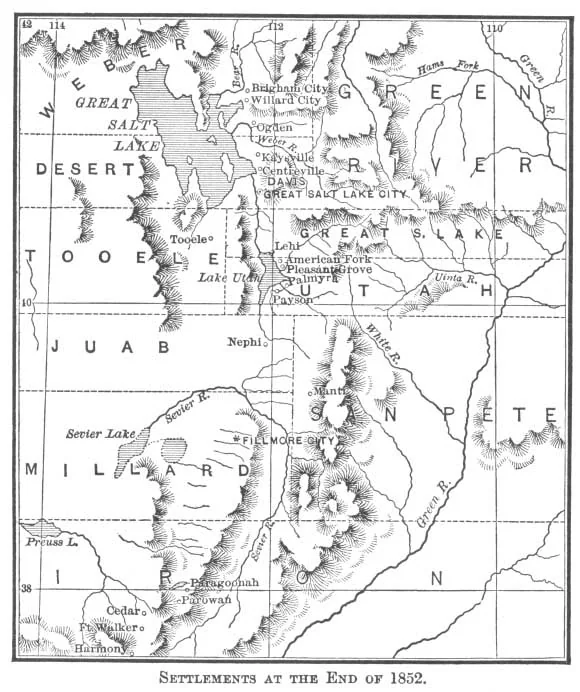
SETTLEMENTS AT THE END OF 1852.
miraculous visitation of gulls, probably saved a foretaste of the disaster of 1848. 1
A site for a town was
surveyed in the autumn of 1849, and the place was named Centreville.
Near Centreville, in what was afterward Davis county, a settlement was begun in the spring of 1848 by Peregrine Sessions, the place being called Bountiful. 2
As early as 1841 the country round where the city of Ogden was laid out was held as a Spanish grant by Miles M. Goodyear, who built a fort, consisting of a stockade and a few log houses, near the confluence of the Weber and Ogden rivers. 3 On the 6th of June, 1848, James Brown, of the battalion, coming from California with $5,000, mostly in gold-dust, purchased the tract from Goodyear. 4 As it was one of the most fertile spots in all that region, grain and vegetables being raised in abundance, not only numbers of the brethren from Salt Lake City, but after a while gentiles from the western states, settled there. In August 1850 Brigham Young, Heber C. Kimball, Orson Hyde, and others laid out the city of Ogden, so called from the name of the river. 5 The
president urged the people to move at once to their city lots, and to build for themselves substantial dwellings, a meeting-house, and a school-house, to fence their gardens and plant fruit-trees, so that the place might become a permanent settlement, and the headquarters of the northern portion of the territory. Before the end of the year a log structure was finished, which served for school and meeting house, and soon afterward the settlers commenced to build a wall for protection against the Indians, completing it about three years later at a cost of some $40,000. 6 So rapid was the growth of the town, that in 1851 it was made a stake of Zion, 7 divided into wards, and incorporated by act of legislature. 8
In 1848 Isaac Morley and two hundred others settled in the southern part of the valley of the San Pete 9—particulars to be mentioned hereafter.
In the spring of 1849 a stockade was built and log houses erected by the pioneer settlers of Utah county, numbering about thirty families, 10 near the Timpanogos or Provo River, and below the point where a small creek issuing from it discharges into Lake Utah. To
this settlement was given the name of Fort Utah. Within the space enclosed by the stockade was a mound, the top of which was levelled, and on a platform bulk thereon were mounted several twelve-pounders for the purpose of intimidating the Indians. But the Indians were not to be thus intimidated. In the autumn they began to steal the grain and cattle of the white men, and one of their number being killed while in the act of pilfering, hostilities broke out and the fort was soon in a state of siege.
Indeed, ill feeling on the part of the Indians had begun to show itself the previous year. Vasquez and Bridger wrote to Brigham on the 17th of April, 1849, that the Utes were badly disposed toward Americans, and that chiefs Elk and Walker were urging the Utes to attack the settlements in Utah Valley. The brethren were advised to protect themselves, but if the Indians were friendly, to teach them to raise grain, and "order them to quit stealing." Brigham was persuaded that Bridger was his enemy, and expressed the conviction that he and the other mountaineers were responsible for all the Indian trouble, and that he was watching every movement of the Mormons and reporting to Thomas H. Benton at Washington. 11 Alexander Williams and D. B. Huntington were empowered by the council to trade exclusively with the Indians on behalf of the community.
On the 31st of January, 1850, Isaac Higbee, of Fort Utah, reported at Salt Lake that the Indians of Utah Valley had stolen fifty or sixty head of cattle or horses, threatening further depredations, and asked permission to chastise them, which was granted. General Daniel H. Wells then called for volunteers from the militia, and on the 4th of February Captain George D. Grant started with a company for Utah Fort, followed soon after by Major Andrew Lytle.
The Indians were attacked on the 8th, and took refuge in a log house, whence they were dislodged next day, and driven into the thicket along the Provo River. In this encounter Joseph Higbee was killed, and Alexander Williams, Samuel Kearns, Albert Miles, Jabez Nowland, and two men named Orr and Stevens were wounded.
On the 11th the Indians fled from the thicket to Rock Cañon, whither the volunteers pursued them; but failing to find them, the white men proceeded to the west and south sides of Utah Lake, and shot all they could find there.
During the expedition twenty-seven warriors were killed. The women and children threw themselves upon the settlers for protection and support, and were fed and cared for in Salt Lake City until spring. Thus Utah Valley was entirely rid of hostile Indians. Until 1852 there was no further trouble with them of a serious nature; 12 and thus ended the first Indian war of Utah, which like all the others was rather a tame affair. It was the mission of the Mormons to convert the Indians, who were their brethren, and not to kill them.
Later in the year was founded the city of Provo, 13 somewhat to the eastward of Fort Utah, near the western base of the Wasatch Mountains, on a site where timber and pasture were abundant, 14 and where the gradual fall of the Timpanogos affords excellent water-power. In March 1851 it was organized as a stake of Zion. The settlement was pushed forward with the energy characteristic of the settlers. Before the close of 1850 more than twenty dwellings
had been completed; 15 and before the end of 1851 the place began to wear the appearance of a town, among the buildings in course of erection being a touring-mill and two hotels; manufactures were started; all were busy the livelong day at farm or workshop, and in the evening, writes Elder Isaac Higbee, in February 1852, "We have on Monday singing-school, on Tuesday lyceum, on Wednesday seventies' meeting, on Thursday prayer-meeting, on Friday spelling-school, and on Saturday the meeting of the lesser priesthood." 16
On Dry Creek, near the head of Lake Utah and about sixteen miles northwest of Provo, a settlement was formed in 1851, named Evansville. 17 The neighboring lands were surveyed in lots of forty acres, and to each new settler as he arrived was given a plat of this size until the tract was exhausted. The soil was rich; but here, as elsewhere in the northern part of Utah county, water was scarce. A supply was obtained by diverting a portion of the waters of American Fork creek, 18 and thereafter the affairs of the settlement prospered so rapidly that, in February 1852, the place was incorporated under the name of Lehi, or as it is sometimes written, Lehigh.
South-east of Lehi, on a plain about three miles east of Lake Utah, was founded, in 1850, a settlement
first known as Battle Creek, and afterward called Pleasant Grove. It was here that the first engagement with the natives occurred. Captain Scott with a band of thirty or forty men started south in pursuit of Indians who had stolen fourteen horses from Orr's herd, on Wilson Creek, in Utah Valley, and several cattle from Tooele Valley. The band was found encamped on a creek in the midst of willows and dense brushwood in a deep ravine. After a desultory fight of three or four hours, four Indians were killed, but none of the settlers. As was their custom, the women and children of the slain followed the victorious party to their camp. 19
In the neighborhood of Pleasant Grove were good farming land, good range for stock, and water-power, inducements which quickly attracted emigrants, and caused the place to thrive rapidly. In 1853 the present site was laid out, 20 and to this spot were transferred, on July 24th of that year, the effects of the community, then numbering seventy-five families.
Between Lehi and Pleasant Grove the village of American Fork was founded in 1850, on a site where were farming and grazing land of fair quality, a little timber, springs of fresh water, and a stream that could be easily diverted for purposes of irrigatiom. 21
About twenty miles south of Provo the settlement of Payson was laid out on the banks of the Peteetneet Creek; 22 a few miles to the north-east of Payson was founded a village named Palmyra, containing, at the close of 1852, fifty families; and in 1851, on Salt Creek,
twenty-five miles to the south, the site of Nephi, in Juab county, was first occupied by Joseph L. Heywood. Nephi was surveyed in the autumn of 1852, the spot being selected on account of its beauty and convenience. A fort was afterward built, surrounded by a wall twelve feet in height and six feet at the base. 23 Through this town passed the old California or southern road made by the pioneers in 1849; and here, in cabins built of mud and willows, lived, at the close of 1852, more than forty families. 24
I have mentioned that Isaac Morley with two hundred settlers went into the San Pete country in 1848. On the 14th of June, 1849, a council was held at Salt Lake City, at which were present a Ute chief named Walker, 25 and twelve of his tribe. After the pipe of peace had been passed around, Walker declared himself a friend of the settlers, and asked their sachem to send a party southward to the valley of San Pete, where they might teach his people how to build and farm. "Within six moons," answered Brigham, "I will send you a company." In the spring of this year the party sent to explore this valley had already selected the site of the present town of Manti, on a branch of the San Pete Creek, though there was little in the neighborhood to invite the settler, sage brush and rabbit brush, the red man and the coyote, being
the principal features. In November the town was laid out. 26 The name of Manti was suggested by Brigham, who declared that on this spot should be raised one of the cities spoken of in the book of Mormon, and here he built with his own hands an adobe house, which in 1883 was still pointed out to visitors as one of the curiosities of the place. 27
On Chalk Creek, in Pahvan Valley, south-west of Manti and about a hundred and fifty miles from Salt Lake City, a site was chosen by Brigham, in October 1851, for the capital of the territory, and named Fillmore, in honor of the president. 28 During 1852 the foundations of the state-house were laid, and many private buildings erected, the settlement numbering about seventy families at the close of the year.
In the autumn of 1849, John Rowberry, Cyrus Tolman, and others set forth from Salt Lake City to explore the country west of the Jordan Valley, in search of grazing lands whereon to pasture their stock. Crossing the mountain range which forms the western boundary of Cedar and Jordan valleys, 29 they discovered a spot where grass, timber, and water were abundant, and encamped for the winter on the banks of a stream now called Emigrant Cañon creek. Returning in the spring, they made their report to Brigham, who recommended them to form a settlement in that neighborhood. To this the men consented. "By what name will you call it?" asked the
president. Tolman suggested Cedar Valley, a large belt of cedar having been found there; but Brigham recommended Tule, as reeds were plentiful in that neighborhood. And so it was ordered; and this word, spelled Tooele by Thomas Bullock, the president's private secretary, is still applied to the town, the site of which was discovered by Rowberry and his comrades. 30
In the winter of 1849-50, Edward Phillips and John H. Green proceeded northward from Salt Lake City, intending to settle in the neighborhood of Ogden. When within twelve miles of that place, the snow-drifts prevented further progress, and turning aside to Sandy Creek, or as it was later termed, Kay Creek, where the land was covered with bunch-grass, they resolved to take up their abode in that neighborhood. After passing the winter in Salt Lake City, the two men set forth in the spring of 1850, accompanied by William Kay and others, and founded the settlement of Kaysville. 31 In September it was organized as a ward, Kay being appointed bishop, with Green and Phillips as councillors. 32
In the winter of 1849-50, it was ordered by the first presidency that Parley P. Pratt, with a company of fifty men, should explore the southern part of the territory in the neighborhood of Little Salt Lake. They found the brethren at Manti well pleased with their location, there being a good stone quarry and an abundance
of cedar at hand. At the Sevier River they met Charles Shumway, James Allred, and Elijah Ward; also Walker, the Utah war chief, and his people, many of whom were sick with the measles. They proceeded to explore the country for some distance round. On the 1st of January, 1850, they were on Virgen River, whence they passed up the Santa Clara, and came to "the valley subsequently named Mountain Meadows." One division of the party explored Little Salt Lake. Beaver Creek was pronounced an excellent place for a settlement. In a half-frozen condition they reached Provo the 30th, and next day some of them were in Salt Lake.
The report of Parley being favorable, a party of about one hundred and seventy persons, well supplied with wagons, implements, live-stock, seeds, and provisions, 33 set forth, in charge of George A. Smith, on the 7th of December, 1850, toward the south; and on Centre Creek, in a valley of the Wasatch Range, about two hundred and fifty miles from Salt Lake City, built a fort near the site of the present town of Parowan. 34 Pasture and timber were plentiful, the soil was of good quality, and in the season of 1851 a bountiful harvest was gathered from about one thousand acres of land. 35 The main attraction, however, was the immense deposits of magnetic iron ore found in the neighboring mountains. In May, Brigham and others visited Parowan and addressed the people in the fort. The Indian name Parowan was then recommended and adopted. Brigham
urged the people to buy up the Lamanite children as rapidly as possible, and educate them in the gospel, for though they would fade away, yet a remnant of the seed of Joseph would be saved. 36
At Cedar City—or, as it was then called, Cedar Fort—seventeen miles to the south-west of Parowan, a furnace was built in 1852, but at the close of the year stood idle for lack of hands. 37 Here, in May 1851, coal had been discovered near what was then known as the Little Muddy, now Coal Creek. In November of that year the site was occupied 38 by a company from Parowan. The winter was passed amid some privation, mainly from lack of warm clothing; but on the 30th of January a dry-goods pedler making his appearance—probably the first who had ventured so far south into the land of the Utahs—the settlers were soon clad in comfort. 39 In October it was resolved to move the settlement to a point farther to the west and south, and before the end of the year a number of iron-workers and farmers arrived from Salt Lake City. 40
In 1851 a party under Simeon A. Carter, sent to explore the country north of Ogden, founded a small settlement at Box Elder Creek. 41 The soil was of the
poorest, but near by were a few spots of meadow and farm land, on which, with irrigation, a fair crop could be raised. A number of emigrants, principally Welsh and Scandinavian, joined the party, and two years later a new site was surveyed 42 under the direction of Lorenzo Snow. To the town then laid out was afterward given the name of Brigham City.
A few weeks later a small settlement was formed about five miles south of this point, and in 1853 was removed to the present site of Willard City. 43
On Red Creek, about twenty miles north of Cedar City, a small settlement was formed in the autumn of 1852, named Paragoonah, the Pi-Ede name for Little Salt Lake. 44 Six miles south of Cedar City, Fort Walker was built, containing at the close of 1851 only nine men capable of bearing arms; and on Ash Creek, nineteen miles farther south, was Fort Harmony, the southernmost point in the valley occupied by white men, 45 and where John D. Lee located a rancho in 1852.
Thus we see that within less than two years after the founding of Salt Lake City, the population there had become larger than could be supported in comfort on the city lots and the lands in their vicinity, and it had been found necessary to form new settlements toward the north and south, the latter part of the territory being preferred, as water, pasture, and land fit for tillage were more abundant. Instead of merely adding suburb to suburb, all clustering around the parent centre, as might have been done by other communities, the church dignitaries, while yet Salt Lake City was but a village, ordered parties of the brethren, some of them still barely rested from their toilsome journey across the plains, to start afresh for remote and unprotected portions of a then unknown country. As new locations were needed, exploring parties were sent forth, and when a site was selected, a small company, usually of volunteers, was placed in charge of an elder and ordered to make ready the proposed settlement. Care was taken that the various crafts should be represented in due proportion, and that the expedition should be well supplied with provisions, implements, and live-stock.
When, for instance, at the close of 1850, it had been resolved to form a settlement in the neighborhood of Little Salt Lake, a notice appeared in the Deseret News of November 16th, giving the names of those who had joined the party, and calling for a hundred additional volunteers. They must take with them 30,000 pounds of breadstuffs, 500 bushels of seed wheat, 34 ploughs, 50 horses, 50 beef-cattle, 50 cows, and 25 pairs of holster pistols; each man must be supplied with an axe, spade, shovel, and hoe, 46 a gun and 200 rounds
of ammunition. Among them there should be five carpenters and joiners, a millwright, a surveyor, and two blacksmiths, shoemakers, and masons. Thus equipped and selected, the settlers, with their marvellous energy and thrift, made more progress and suffered less privation in reclaiming the waste lands of their wilderness than did the Spaniards in the garden spots of Mexico and Central America, or the English in the most favored regions near the Atlantic seaboard.
A company was organized in March 1851, at the suggestion of Brigham, to go to California and form the nucleus of a settlement in the Cajon Pass, where they should cultivate the olive, grape, sugar-cane, and cotton, gather around them the saints, and select locations on the line of a proposed mail route. 47 The original intention was to have twenty in this company, with Amasa M. Lyman and C. C. Rich in charge. The number, however, reached over five hundred, and Brigham's heart failed him as he met them at starting. "I was sick at the sight of so many of the saints running to California, chiefly after the god of this world, and was unable to address them:" 48
Footnotes
306:1 After this incident the water in the creek began to fail, thus for a time preventing the growth of the settlement. In 1880 there was a good flow of water, sufficient for the wants of forty families, with their orchards, gardens, and farm lands. N. T. Porter, in Utah Sketches, MS., 177.
307:2 A little to the south of Centreville was a small settlement which at first went by the name of Call's settlement, afterward taking the name Bountiful. Utah Early Records, MS., 132. In Sloan's Utah Gazetteer, 130-1, it is stated that there were three settlements of this name—East, West, and South Bountiful—West Bountiful being settled in 1848 by James Fackrell and his family, South Bountiful by George Meeyers and Edwin Page. All are now on the line of the Utah Central railroad. In January of this year Sessions also founded a settlement which bore his name, about 15 miles north of S. L. City. Harrison's Crit. Notes on Utah, MS., 45.
307:3 The tract is described as commencing at the mouth of Weber Cañon, following the base of the mountains north to the hot springs, thence westward to the Great Salt Lake, along the southern shore of the lake to a point opposite Weber Cañon, and thence to the point of beginning. Stanford's Ogden City, MS., l; Richards’ Narr., MS., passim.
307:4 Some say for $1,950; others place the amount at $3,000. See Richards’ Narr., MS.; Stanford's Ogden City, MS.
307:5 Utah Early Records, MS., 112. See also S. L. C. Contributor, ii. 240; and Deseret News, Sept. 7, 1850. Stanford's Ogden City, MS., 1-2. The site was selected as early as Sept. 1849, on the south side of the Ogden River, at the point of bench-land between the forks of the Ogden and Weber rivers, so that water from both streams might be used for irrigation. Utah Early Records, MS., 94. North Ogden, formerly called Ogden Hole, once the resort of a noted desperado, was laid out in 1851. Amos Maycock, in Utah Sketches, MS., 114. 'Heber C. Kimball, Willard Richards, J. M. Grant, Brigham Young, and several others ascended a sand hill, Sept. 3d, to discover the best location for a town, which we finally decided should be on the south side of Ogden…A dance was instituted in the evening.' Hist. B. Young, MS., 1849, 124.
308:6 Raised by taxation. Stanford's Ogden City, MS., 4.
308:7 Of which Lorin Farr was appointed president, and R. Dana and David B. Dillie councillors. Id., 3.
308:8 The first municipal election was held on Oct. 23d, Farr being chosen mayor, Gilbert Belnap marshal, David Moore recorder, and William Critchellow justice of the peace. Four aldermen and twelve councillors were also elected. Id., 4. According to the statement of John Brown, a resident of Ogden in 1884, there were 100 families in Ogden in 1852. Brown, a native of Yorkshire, England, came to Winter Quarters in 1849, remained in the church for 21 years, and was then cut off at his own request. In 1883 he was the proprietor of the hotel which bears his name. Two miles north of Ogden a settlement named Lynne was formed in 1849. Stanford's Weber Co., MS., 1. Near Lynne a few families formed a settlement named Slaterville in 1852-3, but on account of troubles with Indians, moved into Lynne in 1854. Id., 3. Eight miles south-east of Ogden, at the month of Weber Cañon, on the line of the railway, a small settlement named Easton was formed in 1852, a branch of the church organized, and A. Wadsworth appointed bishop. Three miles northwest of Ogden a settlement named Marriotsville was formed in 1850 by three families. The neighborhood was infested with wolves and bears, and near by were the lodges of 200 Indian warriors. Id., 10.
308:9 So called from the name of an Indian chief. Richards’ Narr., MS., 66.
308:10 Under the leadership of John and Isaac Higbee and Jefferson Hunt of the battalion. Albert Jones, in Utah Sketches, MS., 54.
309:11 'I believe that old Bridger is death on us, and if he knew that 400,000 Indians were coming against us, and any man were to let us know, he would cut his throat…His letter is all bubble and froth…Vasquez is a different sort of man.' Hist. B. Young, MS., 1849, 77.
310:12 'I was ordered not to leave that valley until every Indian was out of it.' Wells’ Narr., MS., 45-6.
310:13 At a general conference of the church, held in October 1849, it was ordered that a city be laid out in the Utah Valley, and called Provo. Utah Early Records, MS., 97.
310:14 A heavy growth of cotton-wood and box-elder covered the river bottom, with a large belt of cedar extending some four miles north from the river and about half a mile in width. Bunch-grass was very plentiful. Albert Jones, in Utah Sketches, MS., 55.
311:15 Deseret News, Jan. 24, 1852. Ross R. Rogers built the first adobe house in 1851. Albert Jones, in Utah Sketches, MS., 53. A large building was erected in 1852 for George A. Smith, the prophet's cousin, then president of Utah co. stake. It was afterward used as a school-house and known as the seminary. In 1851 an adobe wall was commenced, 14 feet in height and four feet at the base. Three sides of it, with bastions, port-holes, and gates, were completed in 1855, the finished length being then two and a half miles. A portion of this wall remained in 1880. Id., 57. These walls were built about several of the settlements. 'It was usual for our people to protect themselves by building what we call a fort—a place the people could get into in the event of a raid. Our wall was a kind of concrete. In Mount Pleasant their walls were built of cobble rock, parts of which are now standing. At that place they put a grist-mill inside, so the Indians couldn't cut them off. At Nephi the Indians did cut them off from their grist-mill.' Wells’ Narr., MS., 60.
311:16 Letter in Deseret News, Feb. 21, 1852.
311:17 A few houses were built on an adjacent site by David Savage and others in 1850. David Evans, in Utah Sketches, MS., 37.
311:18 By a ditch seven miles in length.
312:19 Hist. B. Young, MS., 1849, 24-5; John Brown, in Utah Sketches, MS., 30. The first Indian trouble was a little skirmish between some sheep-herders and Indians. Wells’ Narr., MS., 43.
312:20 By George A. Smith and Ezra T. Benson.
312:21 The site was laid out by George A. Smith, assisted by L. E. Harrington, Arza Adams, Stephen Chipman, William Greenwood, and Stephen Mott. A. J. Stewart was the surveyor. The first house was built by Adams and Chipman in 1850; the first grist-mill by Adams in 1851; and the first store was opened by Thomas McKenzie in the same year. L. E. Harrington, in Utah Sketches, MS., 121.
312:22 The first settlers were James Pace, Andrew Jackson Stewart, and John C. Searle, Joseph S. Tanner, in Utah Sketches, MS., 3.
313:23 Its length was 420 rods, and its cost $8,400. Portions of it remained in 1880. Geo. Teasdale, in Id., 111.
313:24 The first settler was Timothy B. Foote, who, with his wife and six children, took up his abode in this neighborhood in the autumn of 1851. Before the end of the year he was joined by seven other families. Id., 107; and before the end of 1852, 35 additional families settled at Nephi. Deseret News, Dec. 11, 1852.
313:25 'Walker was the chief of the Ute Indians…Uinta was the great chief of this region, and Ora was the head chief of the Ute nation…Walker's headquarters were the Sevier, generally; he would pay a visit to San Pete once a year.' Wells’ Narr., MS., 48, 56. 'Walker used to go into California to steal horses; had a place of concealment among the mountains. At one time, while there, people were so incensed that they turned out to capture him and his band. In the dead of night be quietly took possession of their horses and trappings and came into Utah triumphant. He would boast of his proceedings some time later. He never brought stolen goods into the settlements, but secreted them among his people.' Utah Notes, MS., 8.
314:26 Including 110 blocks, each 26 rods square, with eight lots to each block. Utah Early Records, MS., 111. The site was surveyed by Jesse W. Fox, under Brigham's direction. J. B. Maiben, in Utah Sketches, MS., 172.
314:27 In June 1852 a fort was completed, the walls being eight feet high and two feet thick. Deseret News, July 10, 1852.
314:28 In the Deseret News of Jan. 24, 1852, is a letter to Brigham from Anson Call, one of the first settlers, dated Nov. 24, 1851. 'We have had an addition of three to our camp since you left; have built a corral according to your instructions, including about two and a half acres of ground. We found, upon trial, that the ground was so dry and hard, being also rocky, that it was next to an impossibility to stockade or picket in our houses with the tools we have to work with; so we have built our houses in close order, having our doors or windows on the outside.'
314:29 Now called the Oquirrh Mountains, Oquirrh being probably an Indian word.
315:30 The site was surveyed by Jesse W. Fox, under Rowberry's direction. The first house was built by Tolman, who in partnership with Rowberry erected a saw-mill nine miles north of the settlement. The first grist-mill was built by Ezaias Edwards, and the first store opened by Isaac Lee. John Rowberry and F. M. Lyman, in Utah Sketches, MS., 150. A meeting-house 24 feet square had been finished in March 1852. Deseret News, April 17, 1852. Twelve miles to the west of Tooele was a small settlement named Grantsville.
315:31 From 5 bushels of club-wheat, planted during this year, 250 bushels were raised. Edward Phillips, in Utah Sketches, 81-2.
315:32 A mile and a half south of Sandy Creek was a herd-house, the property of S. O. Holmes. Near this spot a fort was built, surrounded with a mud wall.
316:33 John Urie, in Utah Sketches, MS., 88, says that there were 119 men and 48 women and children, with 101 wagons, 368 oxen, 146 cows, and about 22 tons of seed; that they were well supplied with implements, and had 300 lbs of flour per capita. Richards, in Utah Early Records, MS., 117, mentions 163 souls, of whom 30 were women.
316:34 James G. Bleak, in Utah Sketches, MS., 67-8. On the south-east corner of the fort a meeting-house in the shape of a St Andrew's cross was built of hewn logs. Utah Early Records, MS., 163. The name was first spelt Paroan. Frontier Guardian, Aug. 8, 1851. A view of the fort, with Little Salt Lake in the distance, painted by W. Majors, was presented by Brigham Young to the Deseret University in 1870. Contributor, ii. 270.
316:35 In the Deseret News of March 6, 1852, is an account of the pioneer anniversary celebrated at Parowan on July 24, 1851.
317:36 Hist. B. Young, MS., 1851, 46. On the same page is mentioned the first use in the country of the stone-coal at Parowan, used in blacksmith work.
317:37 George A. Smith, in Frontier Guardian, Aug. 8, 1851, and in Deseret News, Dec. 11, 1852.
317:38 This valley had been explored as early as 1847. In December of that year, a party of the pioneers passed through it, as already mentioned, on their way to California to purchase live-stock and provisions.
317:39 Building progressed rapidly, and during the following summer one Burr Frost, a blacksmith from Parowan, started the manufacture of iron, making nails enough to shoe a horse. Deseret News, Nov. 27, 1852.
317:40 John Urie, in Utah Sketches, MS., 93-4. See also Deseret News, July 24, 1852. The scarcity of nails hindered building. Workmen were brought from England to manufacture them from native ore, but the experiment failed; as the work could not be done on a sufficiently large scale to make it profitable, and it was abandoned. Years later, when the soldiers were ordered away from Camp Floyd, the settlers bought old iron cheap, and nails were manufactured to advantage. The price in market then was 30 or 40 cts a lb.; afterward the railroad brought them in and they were sold at 3 to 5 cents a pound.
317:41 About 60 miles north of Salt Lake City. A. Christensen, in Utah Sketches, MS., 102.
318:42 In blocks of six acres, each lot being half an acre.
318:43 The first settlers on the old site were Jonathan S. Wells, who built the first house, and was the first to commence farming, Elisha Mallory, who with his brother Lemuel built the first grist-mill, M. McCreary, Alfred Walton, and Lyman B. Wells. George W. Ward, in Utah Sketches, MS., 44-5. The city was named after Willard Richards. Richards’ Narr., MS., 67.
318:44 In December, 15 or 20 families had settled there. Deseret News, Dec. 11, 1852. On June 12, 1851, a company with a few wagons started for this point from Salt Lake City, Utah Early Records, MS., 128.
318:45 This settlement was 20 miles north of the Rio Virgen. It was thought that the route to California might be shortened by way of the fort about 35 miles. Deseret News, Dec. 11, 1852. In addition to those mentioned in the text, a number of small settlements had been made in various parts of the territory. Farmington, now the county seat of Davis co., and on the line of the Utah Central railroad, was first settled in 1848 by D. A. Miller and four others. In 1849 it was organized as a ward. Mill Creek, in S. Lake co., was settled in 1848-9 by John Neff and nine others; Alpine City and Springville, in Utah co., in 1850, the former by Isaac Houston with ten others, the latter by A. Johnson and three comrades. Santaquin, in the same county, was settled in 1852; abandoned in 1853 on account of Indian raids, and reoccupied in 1856 by B. F. Johnson and 23 associates. The site of Harrisville, a few miles north of Ogden, was occupied in the spring of 1850 by Ivin Stewart, abandoned the same autumn on account of an Indian outbreak, and resettled in 1851 by P. G. Taylor and others· In 1883 Taylor was bishop of this ward. Slaterville, in Weber county, was first settled in the fall of 1850 by Alex. Kelley, who was soon afterward joined by several families; in 1853—the year of the Walker war—it was abandoned, the inhabitants taking refuge in Bingham Fort, but was again occupied in 1854. South Weber, in the same county, was located in 1851 by Robt Watts and nine others. Uintah, at the mouth of Weber Cañon, was settled in 1850 by Dan. Smith and a few others. It was first called East Weber, and received its present name on the 4th of March, 1867, at which date the Union Pacific railroad was finished to this point. Sloan's Utah Gazetteer, 1884, passim. Of the above settlements, those which became prominent will be mentioned later.
319:46 The party must also have 17 sets of drag teeth, and of grain and grass scythes, sickles, and pitchforks, 50 each.
320:47 In Hist. B. Young, MS., 1851, 85, it is stated that, at the next session of congress, it was expected that a mail route would be established to San Diego by way of Parowan. At this date there was, as we shall see later, a monthly mail between S. L. City and Independence, Mo. There was also a mail to Sacramento, leaving that and S. L. City on the 1st of each month, a bi-monthly mail to The Dalles, Or., a weekly mail to the San Pete valley, and a semi-weekly mail to Brownsville.
320:48 Hist. B. Young, MS., 1851, 14. The object of the establishment of this colony was that the people gathering to Utah from the Islands, and even Europe, might have an outfitting post. In 1853, Keokuk, Iowa, on the Mississippi River, was selected by the western-bound emigrants as a rendezvous and place of outfitting.
CHAPTER XIV.
EDUCATION, MANUFACTURES, COMMERCE, AGRICULTURE, SOCIETY.
1850-1852.
Boundaries and Extent of Utah—Configuration and Physical Features of the Country—Its Lands and Waters—Flora and Fauna—State University—Curriculum—Educational Ideas—Library—Periodicals—Tabernacle and Temple—New Fort—Progress of the Useful Arts—Mills, Factories, and Manufactures—Farm Products—Traffic—Population—Revenue—Mortality—Healthful Airs and Medicinal Springs.
In the year 1850 Utah, bounded on the south and east by New Mexico, Kansas, and Nebraska, on the west by California, on the north by Oregon, which then included Idaho, was one of the largest territories in the United States. Its length from east to west was 650 miles, its breadth 350 miles, and its area 145,000,000 acres. The portion known as the great basin, beyond which were no settlements in 1852, has an elevation of 4,000 to 5,000 feet, and is surrounded and intersected by mountain ranges, the highest peaks of the Humboldt Range near its centre being more than 5,000 feet, and of the Wasatch on the east about 7,000 feet, above the level of the basin.
For 300 miles along the western base of the Wasatch Range is a narrow strip of alluvial land. 1 Elsewhere in the valley the soil is not for the most part fertile until water is conducted to it, and some of the alkali washed out. Rain seldom falls in spring
or summer, and during winter the snow-fall is not enough to furnish irrigating streams in sufficient number and volume. Throughout the valley, vegetation is scant except in favored spots. With the exception of the Santa Clara River in the south-west, the Green River in the east, the Grand and other branches of the Colorado in the south and east, the streams all discharge into lakes or are lost in the alkali soil of the bottom-lands. On the hillsides bunch-grass is plentiful the year round, and in winter there is pasture in the cañons. Around Salt Lake the soil is poor; in the north and east are narrow tracts of fertile land; toward the valleys of the Jordan and Tooele, separated by the Oquirrh Range, and on the banks of the Timpanogos and San Pete, is soil of good quality, that yielded in places from sixty to a hundred bushels of grain to the acre.
The Jordan and Timpanogos furnished good waterpower, and on the banks of the latter stream was built a woollen-mill that ranked as the largest factory of the kind west of the Missouri River. In the Green River basin, immense deposits of coal were known to exist, and the Iron Mountains near Little Salt Lake were so called from the abundance of ore found in their midst. Other valuable minerals were afterward discovered, among them being gold, silver, copper, zinc, lead, sulphur, alum, and borax; the waters of Great Salt Lake were so densely impregnated that one measure of salt was obtained from five of brine. 2
In the streams were fish of several varieties; 3 in
the mountains roamed the deer, elk, antelope, and bear, and on the marshy flats amid the plains were smaller game. 4 Timber was scarce and of poor quality, except in places difficult of access; 5 but with this exception there was no great lack of resources in the territory which the saints had made their abode.
During the first years that followed their migration, while yet engaged in building houses, fencing lands, planting crops, and tending herds, the Mormons provided liberally for the cause of education. In the third general epistle of the twelve, dated the 12th of April, 1850, it is stated that an appropriation of $5,000 per annum, for a period of twenty years, had been made for a state university 6 in Salt Lake City, branches to be established elsewhere throughout the territory as they were needed. In the curriculum the Keltic and Teutonic languages were to rank side by side with the Romanic, and all living languages spoken by men were to be included. Astronomy, geology, chemistry, agriculture, engineering, and other branches of science were to be studied; for having sought first the kingdom of heaven, the saints were now assured that knowledge and all other things should be added unto them. 7 The world of science was to be revolutionized;
the theories of gravitation, repulsion, and attraction overthrown, the motion of atoms, whether single or in mass, being ascribed to the all-pervading presence of the holy spirit. The planetary systems were to be rearranged, their number and relations modified, for in the book of Abraham it was revealed that in the centre of the universe was the great orb Kolob, the greatest of all the stars seen by that patriarch, revolving on its axis once in a thousand years, and around which all other suns and planets revolved in endless cycles. 8
At first, however, education among the settlers was mainly of an elementary nature. There were many, even among the adults, who could not write or spell, and not a few who could not read. A parents’ school was therefore established at Salt Lake City, for the heads of families and for the training of teachers, among the pupils being Brigham Young. 9 Primary and other schools were opened in all the principal settlements, 10 and for those who were sufficiently advanced, classes were organized as early as the winter of 1848-9, for the study of ancient and modern languages. 11
In 1850, by vote of congress, twenty thousand dollars were appropriated for the building of a state-house, and the sum of five thousand dollars was appropriated for the foundation of a library in Salt Lake City. The delegate from Utah was authorized to make a selection of books, and several thousand volumes were forwarded from the east during this and the following year. 12 Rooms were prepared in the council-house for their reception, and many periodicals, both Mormon and gentile, were added to the stock of reading matter. Among the former was the Millennial Star, already mentioned, and the Frontier Guardian, published bi-monthly at Kanesville, Iowa, between February 1849 and March 1852, and afterward as a weekly paper under the style of the Frontier Guardian and Iowa Sentinel. 13
On the 15th of June, 1850, was published at Salt Lake City, under the editorship of Willard Richards, the first number of the Deseret News, a weekly paper, and the church organ of the saints. 14 In this number, a copy of which I have before me, is a report of the conflagration which occurred in San Francisco on christmas eve of 1849, and of Zachary Taylor's message to the house of representatives relating to the admission of California as a state.
At Salt Lake City and elsewhere throughout the country manufactures began to thrive. Isolated, poor, having brought little or nothing with them, these settlers were peculiarly dependent for necessaries and comforts upon themselves, and what they could do with their hands. And it would be difficult to find anywhere in the history of colonization settlers who could do more. Among them were many of the best of Europe's artisans, workers in wood, iron, wool, and cotton, besides farmers, miners, and all kinds of laborers.
At Tooele and several other settlements gristmills and saw-mills were established before the close of 1852. 15 Near Salt Lake City, a small woollen-mill was in operation. 16 At Parowan and Cedar City, iron-works were in course of construction; at Paragoonah, a tannery had been built; and at Salt Lake City, in addition to other branches of manufacture, flannels, linseys, jeans, pottery, and cutlery were produced, 17 and sold at lower prices than were asked for eastern cods of inferior quality "Produce what you consume, writes Governor Brigham Young in his message of January 5, 1852; "draw from the native elements the necessaries of life; permit no vitiated taste to lead you into indulgence of expensive luxuries which can only be obtained by involving yourselves in debt; let home industry produce every article of home consumption." 18 This excellent advice
was not unheeded; but the supply of home-manufactured goods did not, of course, keep pace with the demand. Such commodities as were not the products of home industry were, for the most part, obtained by barter with passing emigrants, or were brought in wagon trains by way of Kanesville; 19 though already traffic had been opened with regions far to the westward on either side of the Sierra Nevada. 20
According to the United States census returns for the year 1850, the population of the valley of Great Salt Lake mustered 11,354 persons, of whom about 53 per cent were males, and 6,000 residents of Salt Lake City. 21 There were 16,333 acres under cultivation, on which were raised 128,711 bushels of grain. The value of live-stock was estimated at $546,698, and of farming implements at $84,288. At the close of 1852, the total population was variously estimated at from 25,000 to 30,000, 22 of whom perhaps 10,000 resided in the metropolis. The assessed value of
taxable property at the latter date was $1,160,883.80, or an average of more than $400 per capita. The entire revenue amounted to $26,690.58, 23 of which sum $9,725.87 was expended for public improvements, the encouragement of industries, or educational purposes.
Little more than five years had elapsed since the pioneer band entered the valley of Great Salt Lake, and now the settlers found themselves amidst plenty and comfort in the land of promise, where until their arrival scarce a human being was to be seen, save the Indians whose clothing was the skins of rabbits and whose food was roasted crickets. 24 There was no destitution in their midst; 25 there was little sickness. 26 In these and some other respects, the wildest misstatements have been made by certain gentile writers, among them Mr Ferris, who, as we shall see, was appointed secretary for Utah. 27 In this pure
mountain air, with its invigorating embrace, the aged and infirm regained the elasticity of a second youth. Here was no rank vegetation, here were no stagnant pools to generate miasma, no vapors redolent of death, like those amid which the saints encamped on the banks of the Missouri. In the valley were mineral springs, the temperature of which ranged from 36° to 150° of Fahrenheit, some of them being prized for their medicinal properties. From the warm spring 28 in the vicinity of Salt Lake City, waters which varied between 98° in summer and 104° in winter 29 were conducted by pipes to a large bath-house in the northern part of the city. 30
Footnotes
321:1 Gunnison's The Mormons, 15.
322:2 An analysis of the mineral matter forty years ago showed 97.8 per cent of chloride of sodium, 1.12 of sulphate of lime, .24 of magnesium, and .23 of sulphate of soda. Linforth's Route from Liverpool, 101. The specific gravity of the water is given by L. D. Gale, in Stansbury's Expedition to G. S. Lake, at 1.117. Out of 22.422 parts of solid matter Gale found 20.196 of common salt, 1.834 of soda, .252 of magnesium, and of chloride of calcium a trace. See also Sloan's Utah Gazetteer, 1884, 177-8; Hist. Nev., 11, this series. In chap. i. of that vol. is a further description of the great basin, its topography, climate, soil, springs and rivers, fauna and flora.
322:3 'The angler can choose his fish either in the swift torrents of the cañons, where the trout delights to live, or in the calmer currents on the plains, where he will find abundance of the pike, the perch, the bass, and the chub. Gunnison's The Mormons, 20.
323:4 Wild ducks and geese were abundant in 1852. Ibid. There were also quail and herons. In summer, boys filled their baskets with eggs found among the reeds on the banks of streams or on the islands in the Great Salt Lake.
323:5 'Hidden away in the profound chasms and along the streams, whose beds are deeply worn in the mountain-sides, are the cedar, pine, dwarf-maple, and occasionally oak, where the inhabitants of the vale seek their fuel and building timber, making journeys to obtain these necessaries twenty to forty miles from their abodes.' Id., 21.
323:6 Under the supervision and control of a chancellor, twelve regents, a secretary, and a treasurer. Frontier Guardian, June 12, 1850.
323:7 'But what,' says Phelps in an oration delivered July 24, 1851, 'will all the precious things of time, the inventions of men, the records, from Japheth in the ark to Jonathan in congress, embracing the wit and the gist, the fashions and the folly, which so methodically, grammatically and transcendentally grace the libraries of the élite of nations, really be worth to a saint, when our father sends down his regents, the angels, from the grand library of Zion above, with a copy of the history of eternal lives, the records of worlds, the genealogy of the gods, the philosophy of truth, the names of our spirits from the Lamb's book of life, and the songs of the sanctified?' Deseret News, July 26, 1851.
324:8 'I saw the stars that they were very great, and that one of them was nearest unto the throne of God; and there were many great ones that were near it; and the Lord said unto me, These are the governing ones: and the name of the great one is Kolob, because it is near unto me, for I am the Lord thy God; I have set this one to govern all those which belong to the same order of that upon which thou standest. And the Lord said unto me, By the urim and thummim, that Kolob was after the manner of the Lord, according to its times and seasons in the revolution thereof, that one revolution was a day unto the Lord, after his manner of reckoning, it being one thousand years according to the time appointed unto that whereon thou standest.' Reynolds’ Book of Abraham, 29. See also Orson Pratt's lecture on astronomy in Deseret News, Dec. 27, 1851.
324:9 The parent school is in successful operation in the council-house, and schools have been built in most of the wards. Hist. B. Young, MS., 1851, 32; Gunnison's The Mormons, 80; Utah Early Records, MS., 115. Lyons Collins was appointed teacher by the chancellor and board of regents.
324:10 Jesse W. Fox taught the first school at Manti in 1850. Utah Sketches, MS., 172. The first school at Nephi was opened in 1851. Id., 111. The best school-house in Utah county was at Palmyra; at Provo, Evan M. Greene opened a select school in the second ward. Deseret News, Dec. 11, 1852.
324:11 'There have been a large number of schools the past winter, in which the Hebrew, Greek, Latin, French, German, Tahitian, and English languages have been taught successfully. First General Epistle of the Twelve, in Utah Early Records, MS., 74, and Frontier Guardian, May 30, 1849. 'German books were bought in order that the elders might learn that language. 'Hist. B. Young, MS., 1849, 3.
325:12 Dr Bernhisel was appointed by the president of the U.S. as special agent to expend the U.S. appropriation of $5,000. Hist. B. Young, MS., 80. Many valuable donations of maps, papers, etc., were received. Contributor, 270; Gunnison's The Mormons, 83; Utah Early Records, MS., 130; Millennial Star, xii. 330-1. William C. Staines was appointed librarian. Deseret News, Feb. 21, 1852.
325:13 Of the Frontier Guardian, brief mention has already been made. The first number, published Feb. 7, 1849, with Orson Hyde as editor and proprietor, will bear comparison with many of the leading newspapers in eastern or European cities. In the prospectus Mr Hyde states that 'it will be devoted to the news of the day, to the signs of the times, to religion and prophecy, both ancient and modern; to literature and poetry; to the arts and sciences, together with all and singular whatever the spirit of the times may dictate.' Published, as was the Guardian, on the extreme frontier of the states, Mr Hyde was enabled to furnish the latest news from Salt Lake City, and many valuable items have been gleaned from its pages. Glancing at them for the first time, one asks, How did he contrive to bring out his newspaper in such creditable shape, at a place which one year before was only an encampment of emigrants en route for the valley? During this year, however, Kanesville—later Florence—had made very rapid progress, due, in part, to the migration to California. Glancing over the first numbers of the Guardian, we find advertised for sale dry goods, groceries, provisions, hardware, clothing, and most of the commodities needed by emigrants. There was a hotel, a fashionable tailor, a lawyer, a doctor, and of course a tabernacle, which served for social parties and religious worship. Provisions rose to very high rates, though not to the prices demanded in Salt Lake City. On Feb. 7, 1849, flour, beef, and pork were selling at Kanesville for about $2 per 100 lbs. On May 1, 1850, flour was worth $6 to $6.50, beef $3.50 to $4.50, and pork $5 to $6. Potatoes had risen meanwhile from 25 cents to $1, corn from 20 cents to $2.25, and wheat from 50 cents to $1.75, per bushel. On March 4, 1852, appeared the first number of the Frontier Guardian and Iowa Sentinel, the paper having then passed into the hands of Jacob Dawson & Co.
326:14 Until Aug. 19, 1851, it was issued as an eight-page quarto, the pages being about 8½ by 6½ in., and without column rules. After that date it was suspended for want of paper until Nov. 19th. 'We got short of type, and I happened to have some stereotyped plates,…which we melted down and used for type. We were short, too, of paper, and all went to work to make it. We collected all the rags we could and made the pulp, sifted it through a sieve, and pressed it as well as we could.' Taylor's Rem., MS., 17. The terms were $5 per year, payable half-yearly in advance, single copies being sold for fifteen cents. There seems to have been some difficulty in collecting subscriptions, for in the issue of November 15, 1851, the editor states that payment will be due at the office on receipt of the first number, 'and no one need expect the second number until these terms are complied with, as credit will not create the paper, ink, press, or hands to labor.' In his prospectus, Richards said that the Deseret News is designed 'to record the passing events of our state, and in connection refer to the arts and sciences, embracing general education, medicine, law, divinity, domestic and political economy, and everything that may fall under our observation which may tend to promote the best interest, welfare, pleasure, and amusement of our fellow-citizens…We shall ever take pleasure in communicating foreign news as we have opportunity; in receiving communications from our friends at home and abroad; and solicit ornaments for the News from our poets and poetesses.' In the first issue is the following, perhaps by Beta, who afterward wrote a number of papers styled the Chronicles of Utah in the Salt Lake City Contributor:
To my Friends in the Valley.
Let all who would have a good paper,
Their talents and time ne’er abuse;
Since ’tis said by the wise and the humored,
That the best in the world is the News.
Then ye who so long have been thinking
What paper this year you will choose,
Come trip gayly up to the office
And subscribe for the Deseret News.
And now, dearest friends, I will leave you;
This counsel, I pray you, don't lose;
The best of advice I can give you
Is, pay in advance for the News.
Fortunately for the prospects and reputation of the paper, such effusions were rare even in its early pages. The Deseret News was at first less ably edited, and inferior, as to type and paper, to the Frontier Guardian. It appears, indeed, to have lacked support, for in the first number are only two advertisements, one from a blacksmith and the other from a surgeon-dentist, who also professes to cure the scurvy. In Nov. 1851 it appeared in folio and in greatly improved form; for years it was the only paper, and is still the leading Mormon journal, in the territory.
327:15 The first grist-mill built at Tooele was erected by Ezaias Edwards; in 1849 a saw-mill was built at Provo by James Porter and Alex. Williams, and in 1850 a grist-mill, by James A. Smith and Isaac Higbee. At American Fork Ezra Adams built a grist-mill in 1851; at Mantia grist-mill was built by Brigham Young and Isaac Morley, and a saw-mill by Charles Shumway; in 1848 Samuel Parish built a grist-mill at Centreville. Utah Sketches, MS., passim. In Salt Lake county there were, in the autumn of 1851, four gristmills and five saw-mills. Utah Early Records, MS., 158. Near Ogden, Lorin Farr built a grist-mill and saw-mill in 1850. Stanford's Ogden City, MS., 3.
327:16 In March 1851 the general assembly appropriated $2,000 for this purpose. Utah Early Records, MS., 123.
327:17 'Our pottery is nearly completed;…cutlery establishments are completed.' Hist. B. Young, MS., 26.
327:18 In Id., Nov. 6, 1852, similar advice is given to the saints: 'Buy no article from the stores that you can possibly do without. Stretch our means, skill, and wisdom to the utmost to manufacture what we need, beginning with a shoestring (if we cannot begin higher).' 'When we have manufactured an article, sell it for cash or its equivalent, as low, or lower, than it can be bought for at the stores.' In the fifth general epistle is the following: 'Beach and Blair have opened a general manufacturing establishment;…are now making molasses and vinegar. Several grain and lumber mills have been erected in the various settlements,…chairs and various articles of furniture are multiplying,…two or three threshing-machines have been in successful operation.' Hist. B. Young, MS., 1851, 24. 'We are going in extensively for home manufactures. My own family alone have this season manufactured over 500 yds of cloth, and the home-made frequently makes its appearance in our streets'—a great blessing, 'if it will prove an inducement to the people to depend and rely upon their own resources for their own supplies.' Id., 1852, 16.
328:19 On May l, 1851, the first train of merchandise for the season arrived in the city, laden partly with sugar, coffee, and calicoes. Utah Early Records, MS., 127.
328:20 On Nov. 19, 1848, Capt. Grant of the Hudson's Bay Company arrived from Fort Hall with pack-horses laden with skins, groceries, and other goods. On April 17, 1851, a small party arrived from Fort Hall in search of provisions and Indian trading goods. On the 10th of the same month, Col Reese sent ten or twelve wagon-loads of flour to Carson Valley for trading purposes. Id., 39, 125, 127.
328:21 The returns were made under the direction of Brigham Young, who was appointed census agent. Utah Early Records, MS., 112; Deseret News, Oct. 5, 1850.
328:22 Early in 1853 the Deseret Almanac places the number at 30,000, while in Orson Pratt's Seer it is given at 30,000 to 35,000. Olshausen's Mormonen, 192. At this date it was estimated at 25,000 by the gentiles. Burton's City of the Saints, 357. Probably the Mormons exaggerated, as they desired to show as soon as possible a population of 100,000, which would entitle them to claim admission as a state.
329:23 Not more than one tenth was collected in cash, payment being usually made in grain. Contributor, 332. 'Securing a territorial revenue of $23,000, including merchants’ licenses and tax on liquors.' Hist. B. Young, MS, 1852, 2.
329:24 'The most exposed parts of the country are annually run over by the fires set by the Indians to kill and roast the crickets, which they gather in summer for winter food.' Gunnison's The Mormons, 21.
329:25 The country was canvassed to ascertain how many inmates there would be for a poor-house, then projected. Only two were found, and the Mormons concluded that it was not yet time for such an institution. Id., 34.
329:26 The number of deaths in the territory during the year ending June 1, 1850, was 239. U.S. Census, 1850, 997; and in Salt Lake county, which virtually meant Salt Lake City, 121; in both, the mortality was therefore less than 20 per thousand, or about the average death-rate in San Francisco during recent years. Moreover, the population of Utah included a very large proportion of infants. Of 64 deaths reported in the Deseret News of March 8, 1851, 34 occurred between the ages of one and ten.
329:27 Utah and the Morrmons: the History, Government, Doctrines, Customs, and Prospects of the Latter-day Saints; from personal observation during a six months’ residence at Great Salt Lake City. By Benjamin G. Ferris, late secretary of Utah Territory, New York, 1854. Mr Ferris is not the first one whom in his own opinion a six months’ residence in the west justifies in writing a book. It was the winter of 1852-3 which he spent there, and while professing that he writes wholly from an anti-Mormon standpoint, as a rule he is comparatively moderate in his expressions. The illustrations in this volume are many of them the same which are found in several other works. Beginning with the physical features of Utah, he goes through the whole range of Mormon history, and concludes with chapters on government, doctrines, polygamy, book of Mormon proselytizing, and society. While sometimes interesting, there is little original information; and aside from what the author saw during his residence in Utah, the book has no special value.
330:28 The water was analyzed in 1851 by L. D. Gale. Its specific gravity was found to be 1.0112; it was strongly impregnated with sulphur, and 100 parts of water yielded 1.082 of solid matter. The specific gravity of the hot spring in the same neighborhood was 1.013, and 100 parts yielded 1.1454 of solid matter. Detailed analyses are given in Stunsbury's Expedition to G. S. Lake, i. 419-20. An analysis of the warm spring given by Joseph T. Kingsbury in Contributor, iv. 59-60, differs somewhat from that of Gale. Further information on these and other springs and mineral waters will be found in Id., iv. 86-9; Hist. Nev., 17, this series; Salt Lake Weekly Herald, July 29, 1880; S. L. C. Tribune, Jan. 5, 1878; Wheeler's Surveys, iii. 105-17; Hollister's Resources of Utah, 83-5; Hardy's Through Cities and Prairie, 121; Burton's City of the Saints, 222; Sac. Union, Aug. 7, 1860.
330:29 Contributor, iv. 59. One of the brethren, writing to Orson Hyde from Salt Lake City, Sept. 10, 1850, says that the temperature stands, winter and summer, at about 92°. Frontier Guardian, Jan. 8, 1851.
330:30 On Nov. 27, 1850, the warm-spring bath-house was dedicated and opened with prayer, festival, and dance. Utah Early Records, MS., 116.
The material for the preceding chapters has been gathered mainly from a number of manuscripts furnished at intervals between 1880 and 1885. As I have already stated, to F. D. Richards I am especially indebted for his unremitting effort in supplying data for this volume. The period between Feb. 1846 and the close of 1851—say between the commencement of the exodus from Nauvoo and the opening of the legislature of Utah territory—is one of which there are few authentic printed records. From Kane's The Mormons, from Fullmer's Expulsion, and other sources, I have gleaned a little; but as far as I am aware, no work has yet been published that gives, or pretends to give, in circumstantial detail the fall story of this epoch in the annals of Mormonism. In the Utah Early Records, MS., I have been supplied with a brief but full statement of all the noteworthy incidents from the entrance of Orson Pratt and Erastus Snow into the valley of the Great Salt Lake to the close of the year 1851. In the Narrative of Franklin D. Richards, MS.; the Reminiscences of Mrs F. D. Richards, MS.; Inner Facts of Social Life in Utah, MS., by the same writer; History of Brigham Young, MS., which is indeed a continuation of the History of Joseph Smith, or the history of the church; Martin's Narrative, MS.—I have been kindly furnished with many details that it would have been impossible to obtain elsewhere. Some of them I have already noticed, and others I shall mention in their place.
In Reminiscences of President John Taylor, MS., we have an account of the migration from Nauvoo to Winter Quarters, the organization of the various companies, and much information of a miscellaneous nature, relating to house-building in Salt Lake City, the first manufactures, the location of the temple, and other matters. The manuscript also makes mention of his visit to England as a missionary in 1846, in company with Parley P. Pratt and Orson Hyde.
The Narrative of General Daniel H. Wells, MS., gives an account of the disturbances in Hancock county, the troubles at Nauvoo before the exodus, the journey to Winter Quarters, the organization of the Nauvoo legion, and of the state of Deseret; but perhaps the most valuable portion is a condensed narrative of all the Indian outbreaks between 1849 and 1864, a task for which General Wells, who during this period had charge of the Nauvoo legion and aided in suppressing some of the disturbances, is specially qualified.
Wilford Woodruff's Journal, MS., commencing with the claims of Sidney Rigdon to the guardianship of the church, in 1846, and closing with a summary of the operations of the pioneers in the following year. Mr Woodruff gives some valuable details concerning this most interesting period in the annals of Mormonism. Being himself a pioneer, he furnishes minute particulars as to their journey and their early labors in the valley.
In A Woman's Experiences with the Pioneer Band, by Mrs Clara Decker Young, MS., we have also some information as to the work accomplished during the single month that the pioneers remained in the valley, among other matters being the building of the old fort. Items of interest are also given concerning those who were left alone in the valley after the pioneers' departure, until the arrival of Parley Pratt's companies. Clara Decker Young, a native of Freedom, N.Y., moved with her parents to Daviess co., Mo., in 1837, the family being driven, during the persecutions of that year, to Far West, whence they removed to Quincy, and later to Nauvoo. When 16 years of age she became the fifth wife of Brigham Young.
From the Material Progress of Utah, by William Jennings, MS., I have gathered many details as to the industrial condition of the Mormons from the earliest settlement of S. L. City up to a recent date, among them being items relating to manufactures, agriculture, stock-raising, the grasshopper plague, and the influence of the railroad on the population of Utah.
Early Justice, by John Nebeker, MS., besides describing the punishment of offenders in the days of 1847, when, as I have already stated, the whipping-post was substituted for imprisonment, furnishes other material of value relating to early times. In his capacity of public complainer, Mr Nebeker prosecuted one culprit before the high council for stealing, and himself administered the flogging. Mr Nebeker, a native of Delaware, came to Nauvoo in the winter of 1846; crossed the plains with the first companies, and left Winter Quarters with Parley Pratt's detachment.
In The Migration and Settlements of the Latter-day Saints, by Mrs Joseph H. Horne, MS., is an account of her conversion, her experiences at Far West, Quincy, and Nauvoo, and the hardships suffered during the migration. Then follows a description of the first years in S. L. City, the food, dress, and dwellings of the saints, their make-shifts and privations, with some mention of the Mormon battalion, and the ill feeling caused by the withdrawal of 500 able-bodied men at this crisis in their affairs. Mrs Horne, a native of Rainham, England, moved with her parents to New York (now Toronto, Canada) when ten years of age. In 1836, the year of her marriage, she was converted by the preaching of Parley and Orson Pratt, her house being afterward open to the elders, who frequently held meetings there.
From the Utah Sketches, MS., I have gathered much information as to the founding of various settlements and their progress up to the year 1880, of which mention will be made later. Most of them were written by persons who were themselves among the earliest settlers, and of whom some are still prominent members of the several communities among which their lot was cast. In this connection may be mentioned the Brief Historical Sketch of the Settlements in Weber County, by Joseph Stanford, MS., and the Historical Sketch of Ogden City, by the same author.
In addition to the manuscripts and journals constituting the vast original sources upon which I have drawn, I would mention also the following printed and secondary authorities: Millen. Star, iv. 187-90, v. 174-7, vi. 41-2, vii. 71-2, 87-9, 103-4, 149-53, viii. 68-71, 97-8, 102-3, 113-21, 149-58, ix. 11-22, xi. 46-7; Times and Seasons, i. 30-1, 44, 185-7, 517, ii. 273-4, 281-6, 309, 319, 321-2, 336, 355-6, 370-1, 375-7, 380-2, 417-18, 435, 517, 567-70, iii. 630-1, 666, 638, 654, 683-6, 700, 718, 733-4, 743, 767-9, 775-6, 806-7, 831-2, 902-3, 919-21, 936-7, iv. 10-11, 33-6, 65-71, 154-7, 198-9, 241-78, v. 392-6, 418-23, 455, 471-2, 536-48, 560-75, 584-99, 618-22, vi. 762, 773-8O, 926, 972-3; Beadle, Life in Utah, 58-9, 63-121, 125-54, 161-2, 280; Bennett, Morm. Exposed, 5-10, 140-62, 188-214, 278-302, 307-40; Bertrand, Mem. Morm., 61, 65-70; Bonwick, Morm. and Silv. Mines, 3; Burton, City of Saints, 183-4, 433, 625-67; Busch, Gesch. Morm., 43-5, 97-113, 125-30, 205-17, 254-98; Death of the Prophets, with Offic. Doc., no. 23, in Utah Pamph. Relig.; Deseret News, 1851, Apr. 8, Nov. 29, Dee. 13, 27; 1867, July 24; 1868, July 1, Dec. 16, 30; 1869, Apr. 7, Sept. 1; 1876, Mar. 22; 1877, Nov. 14; Hall, Morm. Exposed, 7-8, 15-16, 24-7, 28-34, 55-70, 91-9, 106-7; Tucker, Morm., 37, 167-207; Tullidge, Life of Young, 6-191, 204; Women of Morm., 297-300, 425-32, 443-4, 488-95; Edinburg Rev., Apr. 1854, 319-83; Ford (Thos, Gov. Ill.), in Utah Tracts, no. 11; Ferris, Utah and Morm., 51, 92-107, 114-15, 137-46, 151-4, 120-30; Gunnison, Morm., 133, 115-39; Stansbury, Exped., 135-7; Green, Morm., 28-9, 36-7, 54-64; Hickman, Destroying Angel, 41-5; Hyde, Morm., 140, 144-6, 152-3, 155-7, 172-5, 183-5, 189-92; Kidder, Morm., 157-9, 182-92; Kanesville (Ia), Front. Guard., 1849, Feb. 7, 21, Mar. 7, June 27, Aug. 8, Nov. 14; Id., 1850, May 1, 29, Oct. 2, 30; Id., 1852, Mar. 18, 25; Linforth, Route from Liverpool, 61-9, 72-5; Lee, Morm., 109-12, 144-8, 152-5, 167-8, 173-4, 179-80; Mackay, The Morm., 115-206; Niles' Reg., lxix. 70, 134, lxx. 208, 211, 327, lxxii. 206, 370, lxxiii. 6; Olshausen, Gesch. Mormonen, 59-65, 88-90, 100-3, 144-51, 202-34; Hon. Polynesian, ii. 1846, 91; Pratt (P.), Autobiog., 378, 398-401,405-6; Remy, Journey to G. S. L. City, i. 336-406, 434-8, ii. 258-63; Smucker, Hist. Morm., 119-34, 148-276, passim; Snow (Eliza), in Utah Pioineers, 33d Ann., 41-50, in Times and Seasons, iv. 287; Snow (Lorenzo), with Taylor, Govt of God, no. 12, 9-11; Stenhouse, Tell It All, 306; Crimes of L. D. Saints, 11-15; Dunbar, Romance of Age, 45; Ebberts, Trapper's Life, MS., 18; Fullmer, in Utah Tracts, no. 9. 1-40; Mather, in Lippincott's Mag., Aug. 1880; McGlashen, Hist. Donner Party, 34-56; Spence, Settler's Guide, 268-9; Sala, Amer. Revisited, ii. 289; Salt Lake City, Contributor, ii. 86, 134-7, 195-8, 239, 301, 354-6, 366, iii. passim, iv. 370-6; Salt Lake City, Deseret News, 1850, July 27; 1851, July 26, Aug. 19; 1852, Feb. 7, Aug. 7, 21; 1854, July 27, Aug. 3; 1855, Sept. 26; 1857, July 29, Aug. 5; 1858, June 30; Salt Lake City, Herald, 1880, July 3, 29; Salt Lake City, Telegraph, 1868, May 30, Oct. 10, 12-14; Smith, Rise, Progress, etc., 6-18, 314-22, 334-6; Smoot (Margaret S.), Experience, etc., MS., 4-5; Cal., Its Past Hist., 218-19; Tracy (Mrs N. N.), Narr., MS., 10-19; Thornton, Or. and Cal., i. 158-9; Utah Pioneer, 33d Ann., 50-2; Narrative of the Murders of the Smiths, in Utah Tracts, no. 1, passim; The Murder of Jos Smith, in Utah Tracts, no. 1, 54-5; Tyler, Hist. Morm. Battalion, passim; U. S. Ex. Doc., 24, 31 Cong. 1st Sess.; Van Tramp, Adventures, 313-38; Woodruff (W.), in Utah Pion., 33d Ann., 19-24; Ward, Mormon Wife, 81-4, 109-40, 165; White (Mrs C. V.), The Mormon Prophet, etc., 4-8; Young (Ann Eliza), Wife No. 19, 54-7; Marshall, Through Amer., 184; Murphy, Mineral Resour., 84-5; Miller (J.), First Families, etc., 65-73; Martin (Thos S.), Narrative, etc., MS., 42; San Francisco, Alta Cal., 1851, Aug. 8; Id., Cal. Star, 1848, Feb. 26; Id., Call, 1869, Sept. 5, 1877, Aug. 31; Id., Chronicle, 1881, Jan. 9; Id., Herald, 1851, Oct. 12, 1859, Nov. 15; Sacramento, Placer Times, 1849, May 26; Id., Union, 1855, Sept. 10, 27, 1859, Aug. 24; Portland (Or.), Telegram, 1879, Mar. 15; Salem (Or.), Argus, 1858, Feb. 13, Aug. 28; Id., Statesman, 1851, Dec. 23; Or. City (Or.), Spectator, 1846, July 4; Ogden (Utah), Freeman, 1879, May 2; Gold Hill (Nev.), News, 1872, May 1, Oct. 24; Eureka (Nev.), Leader, 1880, July 24; Carson (Nev.), State Register, 1872, Nov. 24; Rae, Westward by Rail, 125-7.
CHAPTER XV.
MORMONISM AND POLYGAMY.
What is Mormonism?—Tenets of the Church—Sacred Books and Personages—Organization—Priesthood—First Presidency—the Twelve Apostles—Patriarchs—Elders, Bishops, Priests, Teachers, and Deacons—the Seventies—Stakes and Wards—Marriage—Temple Building—Tabernacle—Political Aspect—Polygamy As a Church Tenet—Celestial Marriage—Attitude and Arguments of Civilization—Polygamy's Reply—Ethics and Law—the Charge of Disloyalty—Proposed Remedies.
We are now prepared to ask the question with some degree of intelligence, What is Mormonism? In formulating an answer, we must consider as well the political as the religious idea. I will examine the latter first.
Mormonism in its religious aspect is simply the acceptation of the bible, the whole of it, literally, and following it to its logical conclusions.
As the Christian world has advanced in civilization and intelligence these two thousand years or so, it has gradually left behind a little and a little more of its religion, first of the tenets of the Hebraic record, and then somewhat even of those of the later dispensation. Long before religionists began to question as myths the stories of Moses, and Jonah, and Job, they had thrown aside as unseemly blood-sacrifice and burnt-offerings, sins of uncleanness, the stoning of sabbath-breakers, the killing in war of women, children, and prisoners, the condemnation of whole nations to perpetual bondage, and many other revolting customs of the half-savage Israelites sanctioned by holy writ.
This they did of their own accord, not because they were so commanded, but in spite of commandments, and by reason of a higher and more refined culture—a culture which had outgrown the cruder dogmas of the early ages. Then came the putting away of slavery and polygamy, the former but recently permitted in these American states, and the latter being here even now. Among the discarded customs taught and encouraged by the new testament are, speaking in tongues, going forth to preach without purse or scrip, laying on of hands for the healing of the sick, raising the dead, casting out devils, and all other miracles; and there will be further repudiations as time passes, further ignoring of portions of the scriptures by orthodox sects, a further weeding out of the unnatural and irrational from things spiritual and worshipful.
The tenets of the Mormon church are these:
The bible is the inspired record of God's dealings with men in the eastern hemisphere; the book of Mormon is the inspired record of God's dealings with the ancient inhabitants of this continent; the book of Doctrine and Covenants of the Church of Jesus Christ of Latter-day Saints consists of revelations from God concerning the present dispensation to Joseph Smith, who was inspired to translate the book of Mormon and organize the church of Christ anew. Joseph Smith to the present dispensation is as Moses was to Israel; there is no conflict, either in personages or books. The statements, assertions, promises, and prophecies of the books, and the precepts and practices of the personages, are accepted, all of them, and held to be the revealed will to man of one and the same God, whose will it is the duty and endeavor of his people to carry out in every particular to the best of their ability.
There are more gods than one. There are spiritual gifts. Not only must there be faith in Christ, but faith in the holy priesthood, and faith in continual
revelation. 1 Man is a free agent. The laying on of hands for ordination, and for the healing of the sick, descends from the early to the later apostles. 2 There will be a resurrection of the body and a second coming of Christ. Israel is a chosen people; there has been a scattering of Israel, and there will be a gathering. Joseph Smith was the fulfiller not only of bible prophecies, but of the book of Mormon prophecies, and of his own prophecies. Foreordination, election, and dispensation of the fulness of times are held. There was an apostasy of the primitive church, and now there is a return. There was the Jerusalem of the eastern hemisphere; on the continent of North America is planted the new Jerusalem. Miracles obtain; also visions and dreams, signs and tokens, and angels of light and darkness. There are free spirits and spirits imprisoned; the wicked will be destroyed, and there will be a millennial reign. The saints are largely of the house of Israel, and heirs to the promises made to Abraham, Isaac, and Jacob. The aboriginal inhabitants of America and the Pacific isles were the
seed of Joseph, divided into numerous nations and tribes. The Lamanites were of the house of Manasseh.
We believe, say their articles of faith, in God the father, in Jesus Christ the son, and in the holy ghost. For their own sins, and not for any transgression of Adam, men will be punished; but all may be saved, through the atonement, by obedience to the ordinances of the gospel, which are: faith in Christ, repentance, baptism by immersion, 3 and laying on of
hands for the gift of the holy ghost. We believe in the same organization and powers that existed in
the primitive church, namely, apostles, prophets, pastors, teachers, evangelists; in the gift of tongues, 4
prophecy, revelation, and visions. In the scriptures is found the law of tithing, which law is now revived, and the keeping of it made one of the first duties of the saints. The ten commandments, and all other commandments, ordinances, promulgations, and possibilities, are in force now as at the time they were given. Marriage is a sacred and an eternal covenant. Plural marriage, sanctioned under the old dispensation and revived under the new, is open to all, and is, in some instances, commanded, when it becomes a sacred obligation.
Seldom does a good Mormon appear in a court of law arrayed against a brother Mormon. And this is why, as the saints allege, the twenty-five or fifty lawyers in Utah who are compelled to derive their living almost entirely from the gentiles, are so bitter against the saints. When two Mormons disagree, they present themselves before the president of the stake, who with twelve councillors, six facing six, their selection having been agreed to by the litigants, is ready to try the case without delay. Plaintiff and defendant, each with his witnesses, take their places before the president, and between the rows of councillors. Prayer is then offered, almighty aid being asked in bringing the affair to a righteous and amicable conclusion. The litigants state the case, each from his own standpoint; the witnesses are heard; the councillors decide. Prayer is again offered. The adversaries shake hands; there is nothing to pay. Until the gentiles came, there were in Utah no police or police courts; no houses of drinking, or of gambling, or of prostitution. Of the administration of justice among the saints I shall speak more at length in a later chapter.
The doctrine of blood atonement was early inculcated by the church, as a sacrifice necessary for salvation, and not, as many have asserted, in order to legalize murder. There were the altars and the offerings of the old testament, and the great god-man sacrifice of the new. Christ made the atonement for the sins of the world by the shedding of his blood. By the laws of the land, he who commits murder must atone for it by his own death. 5 There are sins of various degrees
of heinousness; some requiring only public confession and promised reformation by way of atonement, whilst others are characterized by an enormity so vast that pardon on earth is impossible. Of the first class are all minor offences against church discipline, breach of which has been publicly acknowledged by nearly every leader, from Joseph himself down to the humblest official.
For the proper carrying out of the instructions revealed in the sacred books, an organization has been effected in these latter days, based upon books and on former organizations. There are two principal priesthoods, the Melchisedek and the Aaronic, the latter including the Levitical. The Melchisedek is the higher, comprising apostles, patriarchs, high-priests, seventies, and elders. It holds the right of presidency, with authority to administer in all the offices, ordinances, and affairs of the church. It holds the keys of all spiritual blessings, receives the mysteries of the kingdom of heaven, whose doors are ever open, and holds communion with God the father, Jesus Christ the mediator, Joseph Smith the prophet, and all departed saints. 6
The Aaronic is a subordinate priesthood, being an appendage to the Melchisedek, and acting under its
supervision. It comprises bishops, priests, teachers, and deacons, who hold the keys of the ministering angels, having power to administer in certain ordinances and in the temporal affairs of the church, baptizing and sitting as judges in Israel. The bishopric is the presidency of the Aaronic priesthood. The office of a bishop is to administer in temporal matters. First-born sons, lineal descendants of Aaron, and no others, have a legal right to the bishopric. But a high-priest of the order of Melchisedek may officiate in all lesser offices, including that of bishop, when no lineal descendant of Aaron can be found, and after he has been ordained to this power by the first presidency. There is also the patriarchal priesthood, 7
the patriarch to be the oldest man of the blood of Joseph or of the seed of Abraham. Likewise there are mothers in Israel. 8
Head over all is the First Presidency of the Church, known also as the First Presidency of the High-Priesthood, and consisting of a president and two councillors. 9 The first presidency presides over and governs
all the affairs of the church, temporal and spiritual; the first president is the prophet of God, seer, revelator, and translator.
Next in authority are twelve apostles, who are a travelling presiding high-council, and with whom, on the death of the president of the church, the supreme rulership rests until another first presidency is installed. 10 The president of the twelve, chosen in the
first instance by reason of seniority or ordination, usually becomes president of the church. The office of the twelve is to preach and teach throughout the world, regulating the affairs of the church everywhere under the direction of the first presidency, calling to their aid therein the seventies.
An apostle may administer in the several offices of the church, particularly in spiritual matters. 11 The office of a patriarch is to give patriarchal blessings; the office of a member of a seventy is to travel and preach the gospel; but a patriarch, a high-priest, a
member of a seventy, and an elder may, in common with an apostle, adtninister in other spiritual offices.
All superior officers are frequently called elders. Thus an apostle is an elder; and he may baptize, and ordain other elders, priests, teachers, and deacons. It is his calling to administer bread and wine, or bread and water, emblems of the flesh and blood of Christ; to confirm the baptized by the laying on of hands for the baptism of fire and the holy ghost; to teach, expound, exhort, and to lead in meetings as lie is led by the holy ghost.
A bishop who is a first-born and a lineal descendant of Aaron may sit as a common judge in the church without councillors, except in the trial of a president of the high-priesthood. But a bishop from the high-priesthood may not sit as a judge without his two councillors. Over all the bishops in the church there is a presiding bishop.
The duties of a priest are to preach, baptize, administer the sacrament, and visit families and pray with them. The duties of a teacher are to watch over and strengthen the church, and see that no iniquity creeps into it, and that every member performs his obligations and conducts himself without guile. The duties of the deacon are to assist the teacher and the bishop, attending to the temporal affairs of the church, looking after the houses of worship and the necessities of the poor. Teachers and deacons may instruct and exhort, but they are not authorized to baptize, lay on hands, or administer the sacrament. No one can hold office except by authoritative call and ordination, or by special appointment of God.
The seventies are organized into various councils of seventy, commonly called quorums. Each council of seventy has seven presidents, chosen out of the seventy, one of the seven presiding over the others and over the whole seventy. The seven presidents of the first council of seventies also preside over all the councils
of seventies. 12 According to Elder John Jaques, to whose little book on the priesthood I am indebted for this information, there were in 1882 seventy-six councils of seventies, with seventy members in each council when complete. Elders are organized in councils of ninety-six, each council having a president and two councillors. [Priests are organized in councils of forty-eight, each with a president—who must be a bishop—and two councillors. Teachers are organized in councils of twenty-four, and deacons in councils of twelve, each with a president and two councillors. 13
In the society of saints, there are territorial divisions into what are called Stakes of Zion. In Utah, these divisions correspond usually, but not necessarily, with the counties, each county being a stake.
Every stake has a president, with his two councillors, and a high-council, consisting of twelve high-priests. 14 The high-priests assemble in council, having its president and two councillors, at stated times, usually once a month, for conference and instruction. The president of a stake, with his two councillors, presides over the high-council of that stake, which has original and appellate jurisdiction, and whose decisions are usually, but not invariably, final. Appeals are had to a general assembly of the several councils of the priesthood, but such appeals are seldom taken. The jurisdiction of the several councils is ecclesiastical, affecting fellowship and standing only, the extreme penalty being excommunication.
Each stake is divided into wards, the number being according to territory and population; over each ward presides a bishop, with his two councillors. Each stake and each ward, as a rule, has its own meeting-house. There are about twenty-five stakes, divided into some three hundred wards. Salt Lake City is divided into twenty-one wards, each containing for the most part nine ten-acre blocks, though in the outskirts they are larger. Each stake holds a quarterly conference; and the church holds a general conference every April and October.
It will be observed that the orders of priesthood and organization of the church are copied essentially from the bible. As before remarked, the Mormons believe and practise what their sacred books teach, and all that they teach, without intended misinterpretation,
elimination, or repudiation. And as the book of Mormon is held to be a continuation of the historical portion of the bible, and equally with it the word of God; and as the ideas and instructions contained in the book of Doctrine and Covenants have been derived, for the most part, from a study and literal interpretation of the bible—though with something added—it is safe to say that in the main the Mormons believe what the bible teaches, and that Mormonism is the acceptation of the bible, the whole of it, literally, and following it to its logical conclusions.
Tithing, though enjoined by divine command, is a free-will offering. 15 The law of tithing in its
fulness requires the tenth of the surplus property of members coming to Zion to be paid into the church as a consecration, and after that one tenth of increase or earnings annually. This is to be used for the poor, for
building or other church purposes, and for the support of those engaged in church business. There are no salaried preachers. Tithing is paid in kind to the bishop, who renders a strict account, the whole financial
system being in the hands of the bishopric, but supervised by the trustee in trust through the aid of an auditing committee. The names of those who do not keep the law of tithing shall not be enrolled with the people of God; neither shall their genealogy be kept.
The doctrine of divine revelation is continued. God's ways are immutable; past and present to him are as one; what he has done, that he continues to do; what was right five thousand years ago is right now. If God spoke to Abraham and Solomon, and gave them more wives than one, even giving to David his neighbor's wives, there is no reason why he should not do the same with Joseph and Brigham. There is nothing which God has ever done and sanctioned that he may not do and sanction now; otherwise he is not an omniscient, omnipotent, unchangeable, all-wise, and perfect being. Every member of the church may hold communion with God relative to his own affairs; revelations for the church are only given through its head.
As through Christ alone man may be saved, in order that the souls of many millions who never heard of him may not be all of them lost, baptism for the dead, and thereby salvation, was revealed, as was also celestial marriage.
Nature is dual. An unmarried man or woman is and forever must be an imperfect creature. There are marriages for time and marriages for eternity. A celestial marriage is a marriage of God, and those thus
joined can never be divorced, except by the power of God. If a man's wife dies and he marries another, and she dies and he marries a third, believing in resurrection and a life of purity beyond the grave but repudiating polygamy, how will he manage with his plural wives in heaven? She who dies unmarried cannot enter into the full enjoyment of God; but as a man may be baptized for the dead and so save their souls, so he may be sealed to a husbandless woman in heaven. There is a difference between marriage and sealing; the former is secular, and the latter both secular and celestial, as it may be either for time or for eternity, in person or by proxy, and with the living or with the dead. A woman may be sealed to one man for time and to another for eternity, the former being still living. 16
A sacred duty is the constant effort to convert all men throughout the world to a belief in the divinity
of Joseph Smith's mission. To this end are sent forth proselyting ministers, elders of the church, selected by
the authorities and called by the saints assembled at the general semiannual conferences held in Salt Lake City. Neither age nor pecuniary condition governs the selection. They may be men or boys, rich or poor; but they must have faith and integrity, and go forth without purse or scrip, relying alone upon the hand of God to feed them. An elder is likewise selected by the church authorities to preside over each mission. Thus has been visited almost every quarter of the globe, the book of Mormon being meanwhile translated into many languages. And a Perpetual Emigration Fund Company has been established, which has advanced the funds to bring out thousands to Zion, the money being paid back by the immigrant after his arrival, as he has been able to earn it.
Temple building is a characteristic work, and is prompted by the belief that Jesus Christ will some day come suddenly to his temple. Hence the devotion and self-sacrifice practised by Christ's people in order to prepare for him a fitting place of reception. Wonders in this direction have been accomplished by a poor and wandering people, at Kirtland, at Nauvoo, at Salt Lake City, St George, Manti, and Logan.
In the north-west corner of Temple block, Salt Lake City, in which is the tabernacle, the smaller church building, and the new temple, stands a plain two-story adobe structure known as the Endowment House. Here are conducted the most secret and solemn mysteries of the church, which may be termed religio-masonic ceremonies, illustrative of the origin and destiny of man. Here also are performed the rites of baptism for the dead, anointing with oil, marriage, and other ceremonies, by which the convert is endowed with the special grace of God, receives his inheritance as a child of God, and is made a partaker of the fulness of all the blessings of religion. All these rites should properly be performed in the temple, which on its completion will supersede the endowment
house, and in which special apartments are being constructed for these purposes. 17
The order of exercises in the tabernacle, which seats seven thousand persons, is much the same as in orthodox evangelical churches, beginning and ending with prayer and singing, and sometimes singing and administering the sacrament in the middle of a discourse. The speaker seldom knows that he is to speak until called upon by the moderator, who regulates the services, and makes the selection under inspiration, announcing the name of the person sometimes without knowing whether he is in the house, or even in the city. The singing is very fine, the organ, constructed wholly by Mormon artisans, being the largest
and finest in America at the time it was built. The acoustic properties of the oval-shaped room and ceiling are wonderful; stationed at one point, a pin may be heard drop at the opposite end. The singers, thirty or forty in number, are stationed on the main stage, facing the audience in front of the organ. In front of them are the church officials, seated on a series of platforms according to their respective grades, the first presidency highest, next the twelve apostles, and finally the teachers, priests, and bishops, who have charge of administering the sacrament of the Lord's supper, which is done regularly every Sunday. In the first organization of the church, bread and wine were specified as the proper elements to be used, but it was soon after revealed that it makes no difference what the emblems are, and now bread and water are used. Tabernacle services are held Sunday afternoons; there are Sunday-schools at the ward meeting-houses Sunday mornings, and preaching at the same places in the evening by subordinate officials, who often repeat the main points of the morning tabernacle discourse. In the tabernacle, several rows of the best seats are reserved for gentile strangers, and are filled for the most part by travellers and tourists, American and European, who take no pains to hide their contempt for all about them, and return the courtesy extended by smiles and sneers, which, to say the least, is in bad taste for people pretending to a superior culture. 18
After all that can be said about Mormonism and polygamy in their social or moral relations, it is only when we come to consider them in their political aspect, in their relations to government and governing,
that we touch the core of the matter. Those who wax the hottest against the latter-day saints and their polygamous practices are not as a rule among the purest of our people. They care no more, indeed,
about the half-dozen wives of the Mormon than about the half-dozen mistresses of the congressman. As Judge Roseborough, in a very able dictation to my stenographer, remarks: "When I came here I was a
democrat. They pretended to be democrats, but, I found them such democrats as hell is full of. They are neither democrats nor republicans. I did not care about matters of belief, if they were American citizens.
They might worship the devil if they were citizens and discharged their duties as citizens. But I found that in a military way, in a political way, and in a judicial way they controlled matters; and nearly all of them
are aliens. I found that I had got out of the United States and come to Utah. I have never got over that feeling yet, and I think I will get out of Utah and back into the United States again."
Thus, notwithstanding the iniquities of the saints, together with their impudence and arrogance, as charged upon them by their enemies, the impossibility of others living with them as members of one community, of
one commonwealth, is the real difficulty—not their religion, their so-called blasphemies, their pretended revelations and miracles, their opposition bible, their latter-day dispensations, and the rest; nor yet their crimes and misdemeanors, their robberies and murders; nor even yet their secret ceremonies, their endowments, Danite bands, blood atonement, and the rest. The copy or counterpart of very many of these, in greater or smaller degree, is, or has been, practised by the gentiles; or if not, few care enough for any of them to go to war on their account. The trouble is this, and this will continue to be the trouble, in Utah or elsewhere in the United States, and that whether polygamy stands or falls—the saints are too exclusive, industrially and politically, for their neighbors.
The theory of government of this republic is numerical equality, each man and each hundred men being equal to every other man or every other hundred men as industrial and political factors. In this case, however, it is not so, and it never can be so. Spiritual manifestations and spiritual wives have nothing to do with it. A hundred or a thousand Mormons are a unit, socially, politically, and commercially, in a community organized theoretically upon the basis of only one man to the unit. And until the principles of the United States republic are remodelled, Mormons and gentiles cannot live together in peace and amity. It is folly for gentiles to enter a Mormon
community and think to rule, or to have any part in the government as at present existing, and following the line of law and order. This is why the people of Missouri and Illinois drove them out—not because of their religion or immorality, for their religion was nothing to the gentiles, and their morals were as good or better than those of their neighbors. It may as well be understood and agreed upon that, in the United States or out of the United States, the Mormons are, and ever will be, a people self-contained and apart.
Thus the matter continues to be discussed by the world at large, as a question of theology or morality, and not of active political and judicial control, or of the domination of a politico-religions organization, with aspirations and purposes diverse from those of the American people generally.
The theory and assumption of the Mormon church as a politico-religious organization is that the church is a government of God, and not responsible to any other government on earth conflicting with it, if not indeed bound from necessity to overturn and supplant all civil governments. This assumption lies at the very foundation of the Mormon creed; and from this point, in practical operation as well as in theory, there is a divergence between that organization and the United States government. Grant that any man believes what the Mormons believe, say their enemies, and where will his allegiance rest—with the government of the United States, or with this politico-religious organization which ought to and will, as they imagine, supplant all other governments? Many of them are alien born, and, from the treatment they receive on their arrival, learn to distrust the government of the United States, and to cling all the closer to the institutions of their sect.
"It is not consistent that the people of God," says Orson Pratt, "should organize or be subject to man-made governments. If it were so, they could never
be perfected. There can be but one perfect government,—that organized by God, a government by apostles, prophets, priests, teachers, and evangelists; the order of the original church of all churches acknowledged by God."
Early in this narrative we saw plainly, and remarked upon it as we proceeded, that it has been chiefly the political character and aspirations of the church that have brought it into all its difficulties everywhere—in Ohio, in Missouri, in Illinois. And its thirty years of isolation and independence in Utah, during which time it came in contact with the American people or with the government only in a limited degree, intensified its desire for control. The only way the Mormons can live in peace with gentile neighbors is for them to follow the example of their brethren, the Josephites—leave politics and government out of their ethics, and not combine for the purpose of controlling counties, states, or territories. But this strikes at the very root of their religion, which has already given them for an inheritance all counties and countries and peoples throughout the world, as they modestly claim.
There is here much more than the religious unity of ancient Israel. As a cooperative association, Mormonism has not its equal in the history of the world. In every conceivable relation, position, interest, and idea; in every sentiment of hope and fear, of joy and sorrow—there is mutual assistance and sympathy. It enters into all affairs, whether for time or eternity; there is an absolute unity in religion, government, and society, and to the fullest extent short of communism, internal assistance in agriculture, commerce, and manufactures. If a foreign convert wishes to come to America, he is helped hither; if he wants land, farming implements, seed, stock, he is helped to them; trade and manufactures are largely cooperative. And this bond of strength, whether it be called the holiness of saints or
the bigotry of fanatics, causes them to be feared and hated by their neighbors.
Polygamy, as a tenet of the Mormon church, is based upon scripture example, and if this is unlawful, it says, all is unlawful. Marriage is ordained of God, and essential to salvation. Christian sects hold up the patriarchs as examples in their sacred instruction, and yet condemn in these personages a practice which Christ nowhere condemns. While in polygamy, God blessed them and their polygamous seed, saying never a word about their plural wives. Polygamy was common in Asia at the time of the apostles; yet none of them preached against it, nor does John the revelator mention it, writing to the seven churches. In the days of Justin Martyr, the Jews practised polygamy. It is true that the emperor Theodosius, about A. D. 393, promulgated a law against polygamy, but it was repealed sixty years after by Valentinian. Nevertheless, as the civilized world, particularly Christian sects, regarded the practice with abhorrence, the prophet Joseph inquired of the Lord as to what he should do. And the Lord answered, commanding him to restore all things, the practice of polygamy among the rest. The revelation on this subject is given entire in note 19 of this chapter. The inferior order of wifehood, known in the sacred scriptures as concubinage, is not recognized in the Mormon church. By the marriage covenant, all are made wives, and all children are legitimate.
Celestial marriage and the plural-wife system, as incorporated parts of the Mormon religion, are essential to the fulness of exaltation in the eternal world. The space around us, it declares, is inhabited by spirits, thousands of years old, awaiting tabernacles in the flesh, which can be legitimately furnished them only by marriage and procreation; and bodies cannot be obtained for these spirits fast enough unless men have more wives than one. It is the will and glory of God
that these spirits have bodies as speedily as possible, that they become saints on earth and in his kingdom, those who keep this commandment thus to multiply being as gods; otherwise these spirits will take refuge in the bodies of unbelievers, and so sink to perdition.
But civilization has pronounced polygamy a curse and a crime, a retrogression, an offence against society and against morality, a beastly abomination, immoral, incestuous, degrading, a relic of barbarism, a sin, a shame, a vice, and as such has discarded it and passed laws against it. And the issue between polygamy and monogamy is one purely for civilization to determine; christianity has not a foot of ground to stand upon in the matter.
Culture cares nothing for religion; it is what a man does, not what he believes, that affects progress. It will not do to break the law in the name of religion. Suppose a man's religion authorizes him to commit murder: does that make it right? Civilization seeks the highest morality; and the highest morality, it says, is not that of the bible, of the book of Mormon, or of any other so-called holy book. The highest morality is based on nature, and by a study of nature's laws men may find it. Long before Christ, civilization awoke to the evils of this custom, which is not in accord with its morality. The religious reformer, Buddha, who died 470 years before Christ was born, and whose followers now number about one third of the whole human race, preached against polygamy. When Greece and Rome were the foremost nations of the world, they did not practise polygamy, nor has ever the highest civilization entertained it. Polygamy is to monogamy as Greece to China, or as England to India.
All very religious people, as well as science fanatics, are partially insane. This insanity may be passive and harmless, or aggressive and hurtful. We have innumerable instances of both kinds in the history of the Christian church. But as the world
progresses, religion becomes less dogmatic, and the insanity assumes more and more the milder form. Thus it is with the Mormons as with others; they would not feel justified in doing now some things which were done by their predecessors, any more than gentile Christians would wish to burn heretics, or slaughter millions in the name of the redeemer; or any more than they would accept Joseph Smith as a prophet from God, or believe in his metal book of Mormon, or his pretended revelations.
But admitting man's obligation to follow the precepts and example of the bible, which, if done literally, would lead him into all manner of contrarieties and absurdities, even as it does the Mormons to-day, the scriptural argument in support of polygamy does not go for much. Among the half-savage Israelites the custom obtained, but as they grew more civilized, it died out. The first apostles had none of them two wives, and St Paul maintained that it was best not to have any; the spirit of the new testament is all against plurality of wives, and, though it nowhere in so many words condemns the system, the books of Mormon and doctrine and covenants do.
Thus we see that holy books are contradictory and unreliable, not being consistent in themselves, or producing consistent followers. Codes of morality depending on the divine will are without foundation: are, indeed, not codes of morality, which to be genuine must be based on nature as the law-giver and punisher; for otherwise all men to whom the will of God has not been revealed, or who do not believe in any god or revelation, would be without any knowledge of right and wrong, or any standard of morality.
Innate perceptions, supernatural intuitions, or a conscience divinely given, instead of one evolved from the ever-increasing accumulation of human experiences, are not safe guides to right conduct, as the doctrines and doings of the Mormons clearly show. By the result of an act, not by supernatural revelation, we know
whether it is good or bad; and here, the result being bad, the act is wrong, immoral.
The result is bad because by reason of the act civilization takes a step backward, woman is degraded, and the progress of the race hampered. The mono-gamic is the highest type of family, and the highest type of society, yet evolved. Polygamy is better than promiscuity or polyandry, but it is not equal to monogamy. Polygamy springs from the desire to extend the sexual gratification at the expense of the better sense of the better part of the world's inhabitants. It is but a few removes from the old way among savages, where women were property, and bought by husbands to be used as slaves. To monogamy is due the fullest development of the emotions, of the higher sentiments, motherly tenderness, fatherly care, and the dutiful respect and obedience on the part of children. It is here that the passion of love assumes its most refined form; it is here that we find in family, social, and political relations, the greatest good to the greatest number.
For if we degrade woman, we degrade her children, her husband, and the whole community. Throughout all ages the position of woman has fixed the advancement of the nation in the scale of refinement and intelligence. Polygamy makes of woman, not the equal and companion of man, but his subordinate, if not indeed his serf or slave. The charm of her influence is gone; the family circle becomes incongruous and less cohesive; and there is an absence of those firm relations, filial and paternal, which, continued through successive generations, engender the highest type of society yet known. Make of American women Circassian slaves, and you will make of American men Turks.
The nations having the highest and best literature, laws, commerce, and religion, the nations that are enlightening the world with their books, telegraphs, steamboats, and railroads, are monogamic. Polygamy
encourages, if it does not necessitate, a domestic despotism, which, united with a religious and political despotism, constitutes one of the worst possible of social evils. It adds to the Mormons numbers and strength, banding them in a peculiar brotherhood, politically and socially.
The system is not an equitable one. There are born a tolerably even number of males and females, so that under this arrangement, where one man had a dozen wives, a dozen or so men would have none. Then, as to the relationships of the individual members, injustice is wrought, some of them being but little better than those existing among animals. There is an instinct in every woman which tells her that to be second or third is to be no wife at all. Neglect must exist. One man cannot properly care for so many women and children. Even if he is wealthy, he has not the time. Differences of origin and interests breed jealousies, foster selfishness, and are injurious to character. Then, when the reproductive age has passed, there is nothing left for the wife but a lonely and miserable old age.
Further than this, if reproduction be the chief incentive to the plural-wife system among the Mormons, and if it be true, as is often asserted, that as a rule the sexes are born numerically equal, then the system will in the end defeat its own object, for more children will be born and cared for where there is one man for every woman than where some women have to go without a husband, or with a fraction of one. It might pertinently be asked, in this connection, what is the benefit in multiplying the population? Are there not enough people already in the world? and is it not better to improve the stock than unduly to multiply it? This prevention is practised often for improper motives and by injurious methods; but millions do it because they think they cannot afford to raise children, and have no right to bring them into existence.
True, the evils of the practice are not so great under a theocratic and patriarchal system like that of the Mormons, as it would be if allowed to run riot round the world, giving libertines the widest opportunity to deceive and then desert women; in which case there would be no need of prostitution to satisfy men's passions, as the great barriers between the virtuous and the lewd would be for the most part broken down. Among the Mormons, this is prevented by strong religious feeling, and by the patriarchal influence of the leaders. But the majority of mankind in the great outside world are not controlled by religion or reason—they simply drift.
Whether for this reason or some other reason, Mormons are not loyal to the government, and the issue is between polygamic theocracy and American republicanism. Nor are the fears of the friends of the latter wholly groundless; for, as one writer said of it, "the Mormon church is one of the best organized systems in the world. The cunning of the devil and the sophistry of error are so mingled with truth as to make it one of the most powerful agencies to delude the ignorant." The truth is, the theocratic organization has already become absolute. Opposition stimulates propagandism, and persecution brings only defiance of federal authority and the moral sense of the nation. Legislation is defeated at every turn. The history of Utah is the history of the Mormon priesthood in its attempt to subordinate the state to the church, and make the authority of the priesthood superior to that of the United States government.
So says civilization.
In answer, polygamy reiterates scriptural example and divine command, and repudiates civilization wherever it interferes with religion. Culture and progress, which set at defiance God's law, are of the devil. There is no retrogression in keeping the commands of the most high. God blessed Abraham, and
David, and Solomon; polygamy is no curse. And that cannot be a sin which God commands; that cannot be a vice which has for its accomplishment only the highest and holiest purposes of the almighty; that cannot be against morality which is practised only by the righteous, and for the pure and eternal welfare of the human race. 19
Whatever may be the blessings attending civilization, they are insignificant as compared with the blessings of religion, a life of faith and holiness, and the pure worship of God. Civilization with its one-wife or no-wife system breeds licentiousness, fosters prostitution,
and brings much misery on the human race in this world, not to mention the world to come. The laws of God we know; civilization's laws we know not. Civilization has little to boast of in the
line of its moralities. It is true that monogamy was early enforced in Greece; but outside of marriage limits, there was gross indulgence in every form, which was as freely permitted and practised as among
the foremost nations of to-day. Plato even advocated plurality of wives, chiefly on patriotic grounds. In Rome, the one-wife system was more firmly established, though in the absence of marriage, chastity was little regarded. Marcus Aurelius, indeed, was eulogized by his biographer for bringing into his
house a concubine, upon the death of his wife, instead of inflicting upon his children a step-mother.
If monogamy is the only natural form of sexual relationship, how happens it that, throughout the lifetime of the race, there have been and still are so many other forms of relationship? From time immemorial polygamy has existed, and has been sanctioned by all religions. Bramin, Parsee, and Rajpoot all indulged in it. Though nothing is said of it in the new testament, we learn from the Talmud that it was lawful among the Jews about the time of Christ's coming. Among the early converts to christianity in Syria and Egypt were many polygamists who remained uncensured. The rabbies of the west prohibited it eight or nine centuries ago, but those of the east, where it is practised by nearly all nations, permit it even now. It is common to-day throughout a large part of the world. Take all the peoples of the earth, of all times and cultures, and those among whom plural wives obtained are far in excess of the others.
Pre-nuptial unchastity was scarcely censured either in Greece or Rome. "If there be any one," said Cicero, "who thinks that young men should be altogether restrained from the love of courtesans, he is indeed very severe." Even that most austere of Stoics, Epictetus, makes a wide distinction between what he regards as comparatively innocent pre-nuptial indulgences, and those which were regarded as adulterous and unlawful. While the utmost license was allowed the husband, the wife was held under close restrictions. Courtesans were the real companions of men, and the only free women in Athens. Apelles painted them; Pindar and Simonides sang their praises. Aspasia was worshipped before Pericles, and sage philosophers did not hesitate to pay homage at her shrine, and receive words of wisdom from her lips.
In imperial Rome, while the courtesan class never
attained to such distinction as in Greece, divorce was so easy and frequent as to render the marriage ceremony almost a nullity. There were periods when the term 'adultery' had no significance as applied to men; only women were punished for this crime. Persons five, ten, twenty times married and divorced were not uncommon. Though monogamy obtained, female life was lower there than in England under the restoration, or in France under the regency. Alexander Severus, the most persistent of all the Roman emperors, in vainly legislating against vice, provided his provincial governors, if unmarried, with a concubine as well as with horses and servants.
The privilege of royalty in having many mistresses, tolerated until all the people arose and usurped royalty, was but a modified form of polygamy, and is still secretly practised by individuals.
The question of sensualism has nothing to do with it. The polygamist, as a rule, is no more sensual than the monogamist. Your true sensualist does not marry at all. He holds himself free to taste pleasure as he can find it. The trammels of matrimony and the responsibilities of parentage he alike avoids. He is the most selfish of beings; for his own gratification he is willing to sacrifice society, debase manhood, and doom to perdition the highest inspirations and holiest affections of the race.
Beastliness is hardly a fit word to apply to the exercise of an animal impulse, the gratification of animal appetite. It too often maligns the brute creation. Eating and sleeping are in one sense beastly; while smoking and dram-drinking are worse than beastly. Beasts are natural in all things. In many respects they are less open to the charge of beastliness, as we commonly employ the term, than men; they indulge less in excess; they are sometimes gluttonish, but they do not intoxicate themselves; if they do not regulate intercourse by numbers, they do by seasons. Their passions are in subordination to the
laws of nature. Man's passions are not. Taking this charge of beastliness as it is meant, the polygamist is less beastly than the monogamist, who in the majority of cases is more beastly in his sexual intercourse than the beast, being less obedient to the laws of nature, less considerate for the health and strength of his one only wife. Millions of gentle, uncomplaining women have been killed by beastly husbands putting upon them more children than they should bear, not to mention innumerable cruelties of other kinds. In so far as any system is not in accordance with the laws of nature, nature will in due time assert her rights and put it down. It is said that the Mormon women are martyrs: so are other women; part of them because they are married, and part because they are not.
The readers must bear in mind that these are the assertions and arguments of polygamy, and must be prepared to take them for what they are worth, and answer them each according to the light of his own reason. I have already presented the current arguments against polygamy; these are the opinions and dogmas of the Mormons themselves, the doctrines they everywhere preach and print, teaching them to their children, inculcating them into the minds of young men and women, until they have fully imbibed them.
And thus they continue. How many husbandless women there are who drag out a miserable existence in the effort to sustain themselves without sin! how many fall into shame under the effort! Society lays no heavier burden on any of its members than on its poverty-stricken single women, reared in luxury, and unable to support themselves by work.
If you are so tender of woman, her position and morals, why not turn your batteries against the ten thousand of your own people of all classes, including preachers and legislators, who tamper with other men's wives, seduce and abandon innocent girls, keep mistresses, and frequent the haunts of prostitution?
That the race deteriorates under the polygamous system is not true, they say. The single wife is very often hurried to a premature grave by an inconsiderate or brutal husband, the offspring which she meanwhile bears being puny and ill-developed. And again, it is only the better class of men, the healthy and wealthy, the strongest intellectually and physically, who as a rule have a plurality of wives; and thus, by their becoming fathers to the largest number of children, the stock is improved.
The charge of immorality, as laid upon the Mormons as a community, is likewise untenable. Morality is the doctrine of right and wrong, the rule of conduct implying honesty and sobriety. In all honesty and sobriety the Mormons live up to their standard of right and wrong, they claim, more completely than any other people. They indulge in fewer vices, such as drunkenness, prostitution, gambling, and likewise fewer crimes. There is nothing necessarily immoral in the practice of polygamy; if it is not immoral for a man to take one wife, it is not for him to take twelve wives.
The Mormons are loyal to their consciences and convictions. They are essentially a moral people, moral in the highest sense of the term, more so, they claim, than the average American or European. They do not drink, cheat, or steal; adultery is scarcely known among them; they are not idle, profligate, or given to lying. They are true to themselves, true to their principles, and true to the world. Of what other society can you fairly say as much? They are honest in all things, and law-abiding when the law does not touch their rights or their religion; when it does, all who are not dastards will fight. Judge them by their fruits; if a sect is to be regarded from the standpoint of its imperfections and inconsistencies rather than from its results, what shall be said of christianity, which has butchered millions for the faith,
and has further committed all the wickedness flesh is heir to, or of which Satan could conceive?
It is not right to place the polygamist on a par with the bigamist. The one, without deception, and in conformity with the proclaimed tenets of his faith, takes to wife the second, or third, or twentieth—the more the better for all, it is said—promising to her the same life-long care and protection as to the first; the other breaks his contract with his first wife, and deserts her for another woman. Neither can the polygamist be justly placed on a level with the adulterer. Mormons abhor everything of the kind. The sacred ceremony of marriage signifies far more with them than with those who mark the difference between morality and immorality by a few insignificant rites.
The Mormons lay no small stress on the fact that there is always a large number of women who have no husbands, and can get none, on account of women being always so greatly in the preponderance. They deny that there are more men than women.
Whatever may be true with regard to the numerical equality or inequality of the sexes at birth, it is certain, dating back almost from the beginning, that there have always been more women than men in the world. Particularly in primitive times, owing to war or exposure, the death rate was much greater among the males than among the females. To obviate the evil—for it was early recognized that the sexes should be mated—in some instances the female children were killed, but more frequently the excess of women was divided among the men. Where wars were frequent and continuous, everything else being equal, the monogamous nation could not long stand before a polygamous neighbor.
Coming down to later times, it is safe to say that there are a million more women than men in christendom to-day; there are here five millions of women who would like to marry but cannot, being denied one of the fundamental rights of humanity by statutory law.
A large class of men refuse to take upon themselves the cost and cares of matrimony, preferring more free and cheaper indulgence. Of very many of these five millions thus left to themselves, unmated, unsupported, forbidden to become plural wives, Christian civilization makes prostitutes or paupers. And this is the orthodox idea of the elevation of woman! Make angels of light and happiness of one portion, while dooming the rest, under the hard heel of social despotism, to the depths of misery and despair. Nay, more: while the men are thus busied working upon the affections of women, taking advantage of their loneliness and poverty, and constantly adding to the numbers of the lost by seducing the pure from the paths of respectability, their sisters, mothers, wives, and daughters are applying the scourge with all their might to these unfortunates, hoping thereby to gain further favor with the men by showing how much better are they than their most foully wronged sisters.
Such are the men, such the society, in which the foulest wrongs to women are so universally and constantly committed—wrongs which would put to blush savages, yea, and all the devils of darkness; such are the men who wage war on the plural-wife system, which would give to this class and all classes of women home and honorable alliance.
Further than all this, polygamy claims that men or governments have no natural or moral right to forbid the practice, pass laws against it, and inflict punishments. Inherent human rights are above statutory law. Governments have no right to pass laws against gambling, prostitution, drunkenness, or any act of the individual resulting in injury only to himself. He who harms another may be punished, not he who harms himself; otherwise, who is to determine what is or what is not harmful? All men and women are every day doing things harmful to themselves, but which no one thinks of checking by legislation. By no line of logic can polygamy be rightly placed in the
criminal category. In its worst aspect, it can only be called a vice. Drunkenness is not a crime: it is a vice. Statutory law cannot justly make criminal that which by the law of human rights is only a vice. Governments may repress crime, but they never can uproot vice; and the sooner legislators realize and act upon this truth, the fewer failures they will have to record. Public sentiment and moral force are the only agencies which can be brought against this class of evils with any hope of success.
The right and wrong of the matter, as usually discussed, are not the right and wrong of nature and common sense, but of divine and human enactment, variously interpreted and viewed from different standpoints. The bible forbids prostitution, but permits polygamy; the supporters of the bible and its civilization forbid polygamy, but permit prostitution.
The Mormons are held to be a most unphilosophical sect, and yet the sentiment against them is more un-philosophical than their doctrines or practices. The American congress is not a Sunday-school, neither is it within the province of government to establish and enforce a code of ethics. Congress has no more right to legislate, against their consent, for the territories than it has for the states. I do not know that all Mormons hold to this opinion, but many of them do. The idea of political nonage is only an idea; it is not a fact. Murder, theft, breach of contract, malefeasance in office, unjust monopoly, cheating, slave-holding, adulteration, bigamy, etc., are crimes to be punished by law. Drunkenness, gambling, prostitution, and the like, are vices to be uprooted by precept and example. A crime is an injury to one's neighbor; a vice is an injury to one's self. I have no right to injure my neighbor, but I have the right to do as I will with my own and myself, howsoever foolish may be the act. Congress, indeed, would have its hands full were it to undertake to pass laws to keep men from making fools of themselves. If polygamy must be
placed in one category or the other, it must be denominated a vice, and not a crime. If one man and three women contract to live in a connubial relationship, neither God nor nature pronounces it a crime. In bigamy the marriage contract is broken; in polygamy it is kept. Admit that monogamy is best, that one man for one woman tends to the highest culture, it still does not prove that coercion in morals is better than precept and example. Is woman less chaste than in the days of feudalism, now that she is less watched? If the law has the right to limit a man to one wife, it may if it chooses deny him any wife, as many orders among the Greeks and Armenians, the heathens and christians, have declared. If one man is restricted by law to one woman, the least the law can do in common justice is to compel every man to marry one woman. Why does not the United States war upon the catholic priest or the unprincipled debauchee, who by refusing to take a wife repudiates the laws of nature, and sets an example which if universally followed would prove the strangulation of the race? Better punish those who denaturalize themselves rather than those who are too natural.
This is what Utah polygamy says to civilization. 20
In reply to the charge of disloyalty, of maintaining an anti-American attitude toward the people of America, of endeavoring by any illegal or indirect means to undermine the institutions of the country
and eventually usurp the government, the Mormons say that it is not true. It is not true that Mormons are not good citizens, law-abiding and patriotic. Even when hunted down and robbed and butchered by the
enemies to their faith, they have not retaliated.—On this point they are naturally very sore.—When deprived of those sacred rights given to them in common with all American citizens, when disfranchised, their
homes broken up, their families scattered, the husband and father seized, fined, and imprisoned, they have not defended themselves by violence, but have left their cause to God and their country.
Much has been said in terms of reproach against the unity and brotherhood of the Mormons, or as it is more often denominated, their exclusiveness or clannishness, as applied to their social, business, and religious relations. It is said that they hold to one another, band against all societies and interests except their own; that they hold all the agricultural lands, coöperate in commerce and manufactures, vote all one way, and so work into one another's hands in every way; that no other people can stand up in competition with them.
Grant it, they answer; is it a crime? May not people legally labor hard, practise frugality, worship God after their own fashion, and vote as they choose? Is this contrary to the free enlightenment of American institutions?
Of what are the people of the United States afraid, with their fifty millions of free, intelligent, progressive men and women, that they should deem it their duty to be seized with such a savage hate toward this handful of poor and despised religionists? In the evolution of society as an organism, the fittest is sure to remain. If this principle be true, it is perfectly safe to let the Mormons alone. Their evil practices, as well as those of their enemies, are sure in due time to be dissipated by the ever-increasing enlightenment of
civilization. The best will remain, while the rest will be destroyed.
As a remedy against the Mormon evil, many plans have been put forth. "Send an army and wipe them out," say the unthinking masses. An army was sent once, but when it came to Utah there was nothing at hand to wipe out. But should an army go and find them there, it would hardly be prepared to enter upon the wholesale slaughter of 140,000 men, women, and children while in pursuit of their daily vocations. Education has been urged. This means is already employed; but while there are gentile schools, the Mormons still teach Mormonism, and the more they educate, the stronger and more widely extended becomes their faith. Senator Hoar suggested seizing the perpetual emigration fund, but this appeared too much like robbery. Make marriage a civil compact, give the wife the right of dower, and so make her less dependent on the husband, some have said. Amend the constitution, prohibiting polygamy, others have urged. But if congressional enactment fails, what can constitutional amendment do? Admit Utah as a state, and let the people split into parties, and so fight out their own issues. But they will not split into parties, is the reply. If they were like other people, this might be the result; but they are not like other people. For the people to differ from their chiefs on matters of government, or on any other matters, would throw them outside the category of Mormons. Such a thing cannot be. Their government, ecclesiastical and civil, is a government of God; their chief is God's prophet and vicegerent, and his will is God's will and cannot be questioned.
By the Edmunds act, approved March 22, 1882, congress made polygamy punishable by disfranchisement, and a fine of not more than five hundred dollars, with imprisonment for not more than three years, the children to be deemed illegitimate. There have
been numerous convictions under this law, bringing serious injury upon individuals, and greatly alarming the entire brotherhood. Many other schemes have been urged. Cut up the territory and divide it among the adjacent states; permit the wife to testify against her husband; compel marriages to be registered; throw in more gentile population, establishing milliners' shops for the women and whiskey-shops for the men, so that the full force of civilization may be brought to bear upon them. A proposed remedy is for congress to assume the political powers, and govern the country by a commission of nine or thirteen members appointed for that purpose, and which, the majority being always gentiles, would adopt the necessary laws for the government of the territory, instead of congress or a legislature. Executive and judicial affairs would go on in the usual way; and as for the municipal, the commission as a legislature could make such regulations as they pleased, providing for the appointment of mayors by the governor if necessary. In such an event there would not be held ally elections of any kind. A board of five commissioners was appointed under act of congress of March 22, 1882, but nothing extraordinary came of it.
In conclusion, it is scarcely necessary to say that an intelligent and well-balanced mind, free from the bias of religion, and regarding the well-being and refinement of the race as most greatly to be desired, cannot look upon polygamy as conducive to the highest culture. On the other hand, it may as truthfully be said that coercion is not consistent with the highest type of morality, and that a social despotism, in the name of freedom and pure republicanism, can become the severest of tyrannies.
Footnotes
335:1 In 1853, Benjamin Brown, high-priest, and pastor of the London, Reading, Kent, and Essex conferences, published at Liverpool a tract entitled, Testimonies for the Truth; a Record of Manifestations of the Power of God, Miraculous and Providential, witnessed by him in his travels and experiences. The author was a native of New York, and born in 1794. He was a firm believer in latter-day revelations from God, and that the ancient gifts of the gospel still remained, long before he joined the Mormons. He labored long and in various places. He held property in Nauvoo when the saints were driven out, and was obliged to take $250 for what was worth $3,000. Afterward he underwent all the sufferings and vicissitudes of the overland journey to Salt Lake. Mr Brown was an earnest and honest man; his book is the record of his life, and is simple and attractive in style and substance.
335:2 Healing the sick. Joseph early laid it down as a rule that all diseases and sickness among them were to be cured by the elders, and by the use of herbs alone. Physicians of the world were denounced as enemies to mankind, and the use of their medicines was prohibited. Afterward, anointing with oil, prayer, and laying on hands were resorted to in addition to the first mentioned. Says Mrs Richards, 'In all sicknesses we used no medicines, with the exception of herb teas that we ourselves prepared, trusting exclusively to the efficacy of the anointing with oil and prayer.' Reminiscences, MS., 34. Joseph said, 'All wholesome herbs God hath ordained for the constitution, nature, and use of man. Every herb in the season thereof, and every fruit in the season thereof.' The use of flesh was not forbidden, but rather restricted to seasons of cold and famine. All grain was pronounced good for man, but wheat was particularly recommended with corn for the ox, oats for the horse, rye for fowls and swine, and barley for all useful animals, and for mild drinks; as also other grain. Times and Seasons, v. 736.
336:3 Baptism, a prerequisite to church membership, as well as to final salvation, to be of avail, must be by immersion, and performed by one of the sect. The person who is called of God, and has authority from Jesus Christ to baptize, shall go down into the water with the person to be baptized, and shall say, calling him or her by name: 'Having been commissioned of Jesus Christ, I baptize you in the name of the father, and of the son, and of the holy ghost. Amen.' Doctrine and Covenants, 115, 118. Baptisms are entered in the general church records, giving the name, place, and date of birth, quorum, date of baptism, first time or re-baptism, by whom baptized, when and by whom confirmed. Deseret News, Feb. 22, 1851. In 1844, complaints were made that members of the church, dismissed by the council, had been re-baptized by elders who were themselves excluded, and declaring such baptisms invalid. Times and Seasons, v. 458-9.
In 1836, Joseph introduced the ceremony of anointing with consecrated oil. He first anointed his father, who, having been blessed by the first presidency, anointed them in turn, beginning with the eldest. The bishops of Kirtland and Zion, together with their counsellors, were next anointed, and afterward the presiding officers of each quorum performed the ceremony on their subordinates, assisted in some instances by the Smith brothers. Joseph describes the ceremony of consecreting the oil, as follows: 'I took the oil in my left hand, Father Smith being seated before me, and the remainder of the presidency encircled him round about. We then stretched our right hands towards heaven, and blessed the oil, and consecrated it in the name of Jesus Christ.' Mil. Star, xv. 620. Olive-oil is commonly used. Mrs Richards, Reminiscences, MS., 34. Many remarkable cures are mentioned. A seaman, belonging to H. B. M. ship Terror, was rendered deaf and dumb by a stroke of lightning, at Bermuda. Several years after, he was baptized by elders in a canal in England, and instantly recovered both speech and hearing. Frontier Guardian, Jan. 23, 1850. In 1840, a young woman then living at Batavia, N.Y., who had been deaf and dumb for four and one half years, was first restored to her hearing by the laying on of the hands of the elders of the church, and a second ministration, some time afterward, enabled her to speak. Times and Seasons, ii. 516-17. During the building of Nauvoo, nearly every one was attacked with malarial fever, caused by breaking up the new land, and even the prophet himself succumbed for a time. But hearing the voice of the Lord calling on him, he arose and went through the camp healing all to whom he drew near. Woodruff (Mrs), Autobiog., 2-3. Brigham declares he was among the number healed at this time. Mil. Star, xxv. 646. While Joseph was in the midst of his sick, an unbeliever, living a few miles distant, came to him, beseeching him to come and heal his twin children, who were near death's door. The prophet was unable to go himself, but sent Wilford Woodruff in his place. Says the latter, 'He [Joseph] took a red silk handkerchief out of his pocket and gave it to me, and told me to wipe their faces with the handkerchief when I administered to them, and they should be healed.' He also said unto me: "As long as you will keep that handkerchief, it shall remain a league between you and me." I went with the man, and did as the prophet commanded me, and the children were healed. I have possession of the handkerchief unto this day [1881].' Leaves from my Journal, 65. F.D. Richards, who had been sick for several months, was baptized, anointed, and confirmed; immediately after which he was restored to health. Some time afterward, being then an elder, he cured a severe toothache by touching the tooth with his finger. Narrative, MS., 15-16. Mrs Richards’ brother, afterward Elder Snyder, was raised from a sick-bed after having been baptized and administered to by Elder John E. Page. Mrs Richards was taken by her brother from a sick-bed to a lake from the surface of which ice more than a foot thick had been removed, and there baptized, whereupon she immediately recovered. Similar cases might be given by the score.
Baptism for the dead is first alluded to by the prophet, who, in a revelation dated Jan. 19, 1841, declares, 'A baptismal font there is not upon the earth, that they, my saints, may be baptized for those who are dead.' It is intimated that a reasonable time will be allowed in which to build a temple and a permanent font, and that during this time a temporary substitute for the font may be employed; but after the completion of the temple, no baptisms for the dead will be of avail unless conducted within the building. See Doctrine and Covenants, 392, 395. Brigham says he first heard of the new doctrine when he was in Europe (1840), and that he believed in it before anything was said or done about it in the church. Times and Seasons, vi. 954. Daniel Tyler says the doctrine was first taught in Nauvoo, although Joseph told some of the elders in Kirtland that it was part of the gospel, and would yet be practised as such. Juvenile Instructor, xv. 56. He also says that before other provision was made, many were baptized in the Mississippi River. The first baptismal font, a temporary structure, intended for use only until the completion of the temple, was erected in the basement of that building, and dedicated on Nov. 8, 1841, Joseph being present and Brigham delivering the address. Joseph thus describes the font: It is constructed of pine staves, tongued and grooved, and is oval-shaped, 'sixteen feet long east and west, and twelve feet wide, seven feet high from the foundation, the basin four feet deep; the mouldings of the cap and base are formed of beautiful carved work in antique style. The sides are finished with panel-work. A flight of stairs in the north and south sides lead up and down into the basin, guarded by a side railing. The font stands upon twelve oxen, four on each side and two at each end, their heads shoulders, and fore legs projecting out from under the font; they are carved out of oak plank, glued together, and copied after the most beautiful five-year-old steer that could be found in the country, and they are an excellent striking likeness of the original; the horns were geometrically formed after the most perfect horn that could be procured. The oxen and the mouldings were carved by Elder Elijah Fordham, from the city of New York, the work occupying eight months. The whole was enclosed in a temporary frame building. Mil. Star, xviii. 744. On Sept. 6, 1842, Joseph writes to the church that all baptisms must be recorded by a person appointed for the purpose, and whose duty it will be to note every detail of the ceremony in each case. One of the officials is to be appointed in each ward, and his returns properly certified to are to be forwarded to the general recorder, who will enter them on the church records, together with the names of all witnesses, etc., and finally add his own certificate as to the genuineness of the signature of the ward recorder. This detail is necessary for the proper identification hereafter of those baptized, for the authority for which the prophet quotes Revelations, xx. 12. 'And I saw the dead, small and great, stand before God; and the books were opened,' etc. He also states that it was revealed to him on Sept. 1, 1842, that a general recorder must be appointed. Mil. Star, xx. 5-6; Doctrine and Covenants, 409-13. For the ceremony itself, he finds warrant in 1st Cor., xv. 29. 'Else what shall they do who are baptized for the dead? If the dead rise not at all, why are they then baptized for the dead?'
Confirmation follows baptism, with frequently an interval of a few days. Baptism may take place on any day in the week, and the confirmation be deferred until the church assembles on the following, or even a later, Sunday. Two or more elders commonly attend, all taking part in the ceremony. Mrs Stenhouse thus describes her own confirmation: 'Four elders placed their hands solemnly upon my head, and one of them said: "Fanny, by virtue of the authority vested in me, I confirm you a member of the church of Jesus Christ of latter-day saints; and inasmuch as you have been obedient to the command of God, through his servants, and have been baptized for the remission of your sins, I say unto you that those sins are remitted. And in the name of God I bless you, and say unto you, that inasmuch as you are faithful and obedient to the teachings of the priesthood, and seek the advancement of the kingdom, there is no good thing that your heart can desire that the Lord will not give unto you. You shall have visions and dreams, and angels shall visit you by day and by night. You shall stand in the temple in Zion, and administer to the saints of the most high God. You shall speak in tongues and prophecy; and the Lord shall bless you abundantly, both temporally and spiritually. These blessings I seal upon your head, inasmuch as you shall be faithful; and I pray heaven to bless you; and say unto you, be thou blessed, in the name of the father, and of the son, and of the holy ghost. Amen."' Englishwoman in Utah, 19-20.
338:4 The gift of tongues is the power to speak in a strange language, but not to translate. It first appeared about 1830, when it was pronounced of the devil. Howe says it was revived in the early part of 1833, and that at one meeting Joseph passed around the room laying his hand upon each one, and speaking as follows: 'Ak man, oh son, oh man, ah ne commene en holle goste en haben en glai hosanne en holle goste en esac milkea jeremiah, ezekiel, Nephi, Lehi, St John,' etc. Mormonism Unveiled, 132-6. In this year, it was suggested that 'no prophecy spoken in tongues should be made public, for this reason: many who pretend to have the gift of interpretation are liable to be mistaken, and do not give the true interpretation of what is spoken;… but if any speak in tongues a word of exhortation or doctrine, or the principles of the gospel, etc., let it be interpreted for the edification of the church.' Times and Seasons, vi. 865. The gift was not confined to men; many women were noted for eloquence when thus inspired. Says Mrs Stenhouse of a Sister Ellis: 'Her hands were clenched, and her eyes had that wild and supernatural glare which is never seen save in cases of lunacy or intense feverish excitement. Every one waited breathlessly, listening to catch what she might say; you might have heard a pin drop. They [her utterances] seemed to me chiefly the repetition of the same syllables, something like a child repeating la, la, la, le, lo; ma, ma, ma, mi, ma; dele, dele, dele, hela; followed, perhaps, by a number of sounds strung together, which could not be rendered in any shape by the pen.' Englishwoman in Utah, 27-8. Says Orson Hyde: 'We believe in the gift of the holy ghost being enjoyed now as much as it was in the apostles' days, and that it is imparted by the laying on of hands of those in authority; and that the gift of tongues, and also the gift of prophecy, are gifts of the spirit, and are obtained through that medium.' Frontier Guardian, Dec. 12, 1849. Mrs Stenhouse remarks that 'in later days, the exercise of this gift has been discouraged by the elders, and especially by Brigham.' Going to the Lion House one day, she was blessed by one of Brigham's wives, and the blessing interpreted by another wife; the latter, however, cautioned her not to repeat what had occurred, for 'Brother Brigham does not like to hear of these things.' Englishwoman in Utah, 29. Tullidge mentions the names of many women who were distinguished as possessing this gift, and relates an instance of a party whose wagon was surrounded by Indians, escaping with their lives and property; the captors being induced to abandon their prize by Jane Grover, a girl of seventeen, who addressed them in their own language. Women of Mormondom, 474-8.
340:5 The theory of blood atonement is that for certain sins the blood of the transgressor must be shed to save his soul. Among these sins are apostasy, the shedding of innocent blood, and unfaithfulness to marriage obligations on the part of the wife. Says Brigham, in a discourse delivered in Salt Lake City: 'There are sins which then commit for which they cannot receive forgiveness in this world, or in that which is to come, and if they had their eyes open to their true condition, they would be perfectly willing to have their blood spilled upon the ground, that the smoke thereof might ascend to heaven as an offering for their sins; and the smoking incense would atone for their sins; whereas, if such is not the case, they will stick to them and remain upon them in the spirit world. I know, when you hear my brethren telling about cutting people off from the earth, that you consider it is strong doctrine; but it is to save them, not to destroy them…I do know that there are sins committed, of such a nature that if the people did understand the doctrine of salvation they would tremble because of their situation. And furthermore, I know that there are transgressors who, if they knew themselves and the only condition upon which they can obtain forgiveness, would beg of their brethren to shed their blood, that the smoke thereof might ascend to God as an offering to appease the wrath that is kindled against them, and that the law might have its course. I will say further: I have had men come to me and offer their lives to atone for their sins…There are sins that can be atoned for by an offering upon an altar, as in ancient days; and there are sins that the blood of a lamb, of a calf, or of turtle-doves cannot remit, but they must be atoned for by the blood of the man.' And at another time: 'All mankind love themselves, and let these principles be known by an individual, and he would be glad to have his blood shed. That would be loving themselves, even unto an eternal exaltation. Will you love your brothers or sisters likewise when they have committed a sin that cannot be alerted for without the shedding of their blood? Will you love that man or woman well enough to shed their blood? That is what Jesus Christ meant…I could refer you to plenty of instances where men have been righteously slain in order to atone for their sins. I have seen scores and hundreds of people for whom there would have been a chance in the last resurrection if their lives had been taken and their blood spilled on the ground as a smoking incense to the almighty…I have known a great many men who have left this church for whom there is no chance whatever for exaltation; but if their blood had been spilled it would have been better for them. This is loving our neighbor as ourselves; if he needs help, help him; and if he wants salvation, and it is necessary to spill his blood on the earth in order that he may be saved, spill it.' Deseret News, Oct. 1, 1856, Feb. 18, 1857. Following Brigham's lead, Heber C. Kimball and Jedediah M. Grant taught the same doctrine during the religious revival, or so-called reformation, in Utah, in 1856-7, of which more later, Grant being the most vehement of the three. The reader will find these discourses reported at length in the Deseret News. the doctrine is very clearly explained in Penrose's Blood Atonement, passim. See also Lee's Morm., 282-3; Morm. Proph., 157-60; Young's Wife No. 19, 182-99; Paddock's La Tour, 305-8; Bertrand's Mem Morm., 139-72, 250-8, 296-316.
341:6 In regard to the two priesthoods, the Melchisedek and the Aaronic, or Levitical, all authority in the church is subordinate to the first, which holds the right of presidency and has power over all the offices in the church. The presidency of the high-priesthood of this order has the right; to officiate in all the offices of the church. High-priests are authorized to officiate m any lower positions in the church, as well as in their own office. Elders are of this priesthood, and are authorized to officiate instead of high-priests, in the absence of the latter. The twelve apostles are charged with the duty of ordaining all the subordinate officers of the church, and also with its missionary work. Together they form a quorum whose authority equals that of the first presidency, but action by either body must be unanimous. A majority may form a quorum when circumstances render it impossible to assemble the whole body. They also constitute a travelling, presiding high-council, under the direction of the presidency of the church, and it is their duty to ordain ministers in all large branches. The seventies are also missionaries—assistants to the twelve, and united they are equal in authority with the twelve.
342:7 About 1834, Joseph Smith had a revelation to the effect that it was the will of the Lord that every father should bless his own children, and that patriarchs should be set apart to bless those without a father in the church. This revelation was due to an expressed desire on the part of Brigham Young's father to bless his own children before dying, after the manner of the patriarchs of old. Young's Wife No. 19, 581. Several years before this, it had been directed that every member of the church having children should bring them to the elders before the church, who were to lay their hands upon them in the name of Jesus Christ, and bless them. Doctrine and Covenants, 72. During the life of the first patriarch—Jos. Smith, sen.—these blessings were nominally free to the recipients. A high-council held at Kirtland in Sept. 1835 decided that when the patriarch was occupied in blessing the church, he should be paid at the rate of ten dollars a week, and his expenses; also that Frederick G. Williams be appointed to attend blessing meetings, and record the proceedings, for which services he should receive the same compensation. The payment of twelve dollars for a book in which to record the blessings caused discussion in this council, and brother Henry Green, who had intimated that a suitable book could be procured for less money, was excluded from the church for his presumption. Mil. Star, xv. 308-9. In Jan. 1836, Smith, sen., was anointed with oil by the prophet, blessed by each of the presidency in turn, and was thenceforth known as Father Smith. Id., 620. In 1837, the pay of the patriarch was fixed at a dollar and fifty cents a day, and that of the recorder at ten cents for each 100 words. Mil. Star, xvi. 109. When Hyrum became patriarch, says the author of Young's Wife No. 19, 581, the demand for blessings had so increased that one dollar each was charged for them; and in 1875 the price had advanced to two dollars. Upon the death of his father in 1840, Hyrum Smith succeeded to the office of patriarch, pursuant to a revelation entailing it on the eldest son. The revelation is dated in Jan. 1841. Doctrine and Covenants, 305-6; Mil. Star, xviii. 363. The following notice appears in Times and Seasons, Nov. 1, 1841: 'The brethren are hereby notified that our well-beloved brother, Hyrum Smith, patriarch of the church, has erected a comfortable office opposite his dwelling-house [in Nauvoo], where himself, together with his scribe and recorder, James Sloan, will attend regularly every Monday, Wednesday, and Friday, during the entire day, or upon any other day if urgent circumstances require it, to perform the duties of his high and holy calling. A copy of the blessings can be received immediately after being pronounced, so that the brethren who live at a distance can have it to take with them.' Hyrum's successor was his brother William, who was disfellowshipped in 1845, John Smith, brother to the prophet, being ordained patriarch over the church, and holding that office until his death in 1854. In the following year Hyrum's son John was ordained patriarch, and since that date has been sustained in his office at each successive conference. A child is first blessed when eight days old, and again so soon as the mother is able to present her child on a regular fast-day. The first Thursday in each month is set apart for fasting. Mrs Richards’ Reminiscences, MS., 34-5. The second ceremony is usually attended by both parents, and in addition to a blessing, the child receives its name. Each birthday it is customary for the parents to hold a family gathering, when the child is again blessed, and prayers offered for its welfare. When eight years old, the child is baptized. See Horace's Migrations, MS., 37. The blessings are not only pronounced, but also written out. Id., 34. 'These blessings are rather wonderful affairs; they promise all sorts of things, in a vague, indefinite way, if only the recipient proves faithful. Some are assured they shall never taste death, but live until Christ comes, and be caught up to meet him in the air; others are assured that they are to have the privilege of redeeming their dead so far back that there shall not be a broken link in the chain. Absurd as this all seems, there are hundred of saints who believe that every word shall be fulfilled.' Young's Wife No. 19, 581.
343:8 Hall says there is a class of women, mothers in Israel, whose business it is to instruct females as to their duty in matters not suitable to be taught from the stand. Mormonism Exposed, 39-44.
343:9 Early in 1833 the first presidency was established, with Joseph Smith at the head, his associates in the management of affairs being Sidney Rigdon and Frederick G. Williams. The revelation creating this trium virate is dated March 8th, and in it Joseph's coadjutors are instructed first to finish the translation of the prophets, and afterward preside over the affairs of the church and the school. Times and Seasons, v. 736-7. William Hall, who was a member of the church for seven years, erroneously states that the presidency at first consisted of Smith, Rigdon, and William Law. Abominations, 8. At a conference held in Sept. 1837, Joseph appealed to the church to ascertain if he was still regarded as its head, when the vote was unanimous. He then introduced Rigdon and Williams as his councillors. According to the minutes of the conference, Williams was not accepted at first, but this action appears to have been rescinded afterward. Mil. Star, xvi. 56. Oliver Cowdery, Jos. Smith, sen., Hyrum Smith, and John Smith were accepted as assistant councillors, and these seven were henceforth to be regarded the heads of the church. At a general conference of the branch of the church at Far West in Nov. 1837, the action of the Kirtland conference was sustained so far as Smith and Rigdon were concerned, but Williams was rejected. Hyrum Smith was unanimously chosen in Williams’ place. Mil. Star, xvi. 106-7. At a conference held at Far West in April 1838, the first presidency was appointed to sign the licenses of the official members of the church. In Jan. 1841, Joseph had a revelation to the effect that he was presiding elder over all the church, translator, revelator, a seer, and prophet; and that his councillors were Sidney Rigdon and William Law. These three were to constitute a quorum and first presidency, to receive the oracles for the whole church. Law's selection was to fill the vacancy caused by the appointment of Hyrum Smith to be patriarch. Mil. Star, xviii. 363. In this same month Joseph notified the recorder of Hancock county that he (Joseph) had been elected sole trustee of the church of Jesus Christ of latter-day saints by the church at Nauvoo, to hold office during life. Id., 373. Smith, Rigdon, and Law were continued in office by the annual conference, convened in April 1843. After the murder of the Smiths in 1844, the first presidency lapsed, and for more than three years the church was governed by the quorum of the twelve apostles, of which Brigham was president. At a meeting of the twelve apostles, high-council, and high-priests at Nauvoo, in August 1844, Sidney Rigdon offered himself as guardian to the church, claiming that his action was in obedience to revelation. Young opposed Rigdon's claims, and the assembly decided that the twelve should govern the church, with Young at their head. Mil. Star, xxv. 215-17, 263-4. In Dec. 1847 Brigham Young, Heber C. Kimball, and Willard Richards were chosen to constitute the first presidency. Juv. Inst., xiv. 128. Young died in 1877, and the presidency remained vacant until October 1880, when John Taylor was chosen, with George Q. Cannon and Joseph F. Smith as councillors. Marshall, Through America, 161. This conference lasted five days. S. L. Tribune, Oct. 11, 1880. On the death of the president the quorum is dissolved, and its members, as a presidency, have no status. Richards’ Narr., MS., 51.
344:10 On Feb. 14, 1835, the church at Kirtland met for the purpose of choosing and ordaining the twelve apostles. The business occupied several days. Briefly, the ceremonies were as follows: The assemblage consented to accept the names presented by the three witnesses who had been appointed to make the selection. P.P. Pratt says, in his Autobiog., 127-28, the ceremonies were performed by Smith, Whitmer, and Cowdery, and that they acted in accordance with the revelation of June 1829; but in the history of Jos. Smith, Mil. Star, Mar. and Apr. 1853, the three witnesses only are mentioned. Martin Harris' name does not appear in the revelation referred to. See Doctrine and Covenants, 190-2. In an article by 'R. A.' in the Juv. Inst., xiv. 128, the selection is accredited to the three witnesses, who are mentioned by name. As Pratt was one of the ordained, it would seem that his account should be reliable. Each candidate came forward as summoned, and in return received a blessing, and a charge from one of the three. The order of ordination was as follows: On Feb. 14th, Lyman E. Johnson, Brigham Young, and Heber C. Kimball. On the next day, Orson Hyde, David W. Patten, Luke Johnson, Wm E. McLellin, John F. Boynton, and William Smith. On Feb. 21st, Parley P. Pratt, Orson Pratt, and Thos B. Marsh, who were absent on a mission, were ordained upon their return to Kirtland, which occurred later. Mil. Star, xv. 206-12. Shortly after, the names were arranged according to seniority, when they stood, Marsh, Patten, Young, Kimball, Hyde, McLellin, P. P. Pratt, Luke Johnson, Smith, O. Pratt, Boynton, and L. E. Johnson. Four of the above apostatized in 1838, viz.: McLellin, the Johnsons, and Boynton; John Taylor, John E. Page, Wilford Woodruff, and Willard Richards were appointed instead. Shortly after this, Marsh, the president of the twelve, apostatized, and in 1838 Patten was killed, which left Young at the head of the list, and he became president of the twelve. Geo. A. Smith was ordained in 1839, and Lyman Wight not long after. In 1844, according to Elder Phelps, the following names were on the roll: Young, Kimball, Parley P. Pratt, Hyde, Richards, Taylor, William Smith, Woodruff, George A. Smith, Orson Pratt, Page, and Wight. During this year Wm Smith and Page apostatized, and were replaced by Amasa M. Lyman and Ezra T. Benson. Early in 1845, Young, Kimball, and Richards were chosen to the first presidency, and Wight was disfellowshipped for apostasy; the vacancies thus caused were filled by appointing Chas C. Rich, Lorenzo and Erastus Snow, and Franklin D. Richards. In 1857, Geo. Q. Cannon was appointed, vice P. P. Pratt, deceased. In 1867, Lyman was dropped and Jos. F. Smith appointed. In 1868, Geo. A. Smith became one of the first presidency, and Brigham Young, jun., succeeded him. Albert Carrington was appointed in 1869 in place of Benson, deceased, and Moses Thatcher in 1879, vice Hyde, deceased in 1878; which left the twelve in the following order: John Taylor, Wilford Woodruff, Orson Pratt, Chas C. Rich, Lorenzo Snow, Erastus Snow, Franklin D. Richards, George Q. Cannon, Brigham Young, Joseph F. Smith, Albert Carrington, Moses Thatcher, Pratt being the only remaining member of the original twelve. Juv. Inst., xiv. 128-9. The vacancies caused by the elevation of John Taylor to the presidency in 1839, with George Q. Cannon and Joseph F. Smith as councillors, were partially filled by the appointment of Francis M. Lyman and John H. Smith. S. L. Tribune, Oct. 11, 1880. Orson Pratt died Oct. 1881, and a year later Geo. Teasdale and Heber J. Grant were elected. Handbook of Ref., 89-90. Up to 1877, the twelve received no pay for their services; but the conference of Oct. voted $1,500 a year to each apostle. 'This is the first sum that has ever been publicly appropriated to any council of the church for the performance of their duties to the people. When I went to Europe in 1866, I borrowed the means and gave my note; on my return I had to pay back my indebtedness.' Richards’ Narr., MS., 59-60.
345:11 In 1845 was issued at New York and Liverpool, Proclamation of the Twelve Apostles of the Church of Jesus Christ of Latter-day Saints; to all the Kings of the World; to the President of the Uuited States of Ammerica; to the Governors of the several states, and to the rulers and people of all nations, Greeting, 'Know ye that the kingdom of God has come,' etc. The tract goes on to say that 'Jehovah has been pleased once more to speak from the heavens,' by which means the apostleship of Christ has been restored, in preparation for his coming, which is now near at hand. Then are recited the leading points of faith, with allusions to the history of the church, and calls to repentance.
347:12 In February 1835, Joseph Smith, with the aid of the recently appointed apostles, proceeded to organize two quorums of the seventies, whose duties were to assist in the missionary work of the church. Each quorum had seven presidents, and these constituted the councils of the two organizations. Joseph Youngsen, who gives an account of the seventies, gives the names of the presidents of the first quorum only, as follows: Hazen Aldrich, Joseph Young, Levi W. Hancock, Leonard Rich, Zebedee Coltrin, Lyman Sherman, and Sylvester Smith. After noting the changes in the interval, he states that in 1878 the presidents were Young, sen., Hancock, Henry Herriman, Albert P. Rockwood, Horace S. Eldredge, Jacob Gates, and John Van Cott. Hist. of Organ. of Seventies, 1-8. In an account of the dedication of their hall at Nauvoo, in 1844, it is stated there were fifteen quorums—one thousand and fifty in all, if each quorum was full. Times and Seasons, vi. 794.
347:13 For act of incorporation of Mormon church, 1851, see Utah, Acts Legisl. (ed. 1866), 108; S.L.C. Contributor, ii. 270; number and wealth of churches, Seventh Census Rept, 1851-2, 45; prayer in the family, Robinson's Sinners and Sailors, 243-4; church property, and law regulating it, Richards’ Narr., MS., 83; church government, Ward's Husband in Utah, 16-17; Mil. Star, iii. 67; positions of church officials, Id., xv. 709. As showing the relative standing of the church dignitaries, the order of voting, as prescribed at the conference which elected Taylor to the presidency in 1880, is given. The twelve apostles and their councillor's; the patriarchs; presidents of stakes and their councillors, and the high-councils; the high-priests; the seventies; the elders; the bishops and their councillors; the lesser priesthood—priests, teachers, and deacons. The members of each order voted standing and with the right hand uplifted, and finally the congregation voted in tire same manner. S. L. City Tribune, Oct. 11, 1880. On faith and doctrine, see Jaques’ Church of Jesus Christ, passim; Hand-book of Reference, passim; Jaques’ Catechism, passim; Book of Doctrine and Covenants, passim; Richards’ and Little's Compendium, passim; Articles of Our Faith, passim; Pearl of Great Price, passim; Times and Seasons, passim; Millenial Star, passim; Deseret News, passim; Moffat's Catechism, passim; Pratt's Persecutions, passim; Pratt's Voice of Warning, passim; Reynolds’ Book of Abraham, passim; and many other books, pamphlets, and periodicals by various members and dignitaries of the church.
348:14 The standing high-council at the stakes of Zion forms a quorum equal in authority in the affairs of the church, in all its decisions, to the quorum of the presidency, or to the travelling high-council. Each order is governed as follows: the seventy, by seven presidents, one of whom presides over the other six; and as many additional seventies may be organized as the increase of the church shall demand. The president of the high-priests is to preside over the whole church; the president of the elders presides over ninety-six elders; the president of the Aaronic priesthood over forty-eight priests; the president of the teachers over twenty-four teachers, and the president of the deacons over twelve deacons. Should the president of the church transgress, he is to be tried before the common council of the church.
349:15 Upon the matter of tithing, Joseph Smith in 1831 had three several revelations, each containing a clause requiring money and other property to be set apart for general use in the church. The first was received in Feb., the second in May, and the last in Aug. See Times and Seasons, iv. 369; v. 416, 466. But it was not until several years later that an organized system was established, by revelation dated Far West, July 8, 1838. See Doctrine and Covenants, 382-3. During the progress of settlements at Far West, the question of taxation was brought up and referred to the prophet, who inquired of the Lord, and received answer that all surplus property must be turned over to the bishop as the first step, after which one lentil of each annual interest was also to be paid. These payments were to be devoted to the building of a place of worship, and for the debts of the presidency. In the Millennial Star, xxv. 474, it is denied that the priesthood receive any support from the tithing fund, and asserted that it is expended for general purposes solely, such as public buildings, roads, assisting immigration. The twelve apostles, in an epistle dated Nauvoo, Dec. 13, 1841, declare that the tithing required is 'one tenth of all any one possessed at the commencement of the building of the temple, and one tenth part of all his increase from that time till the completion of the same, whether it be money, or whatever he be blessed with. Many in this place are laboring every tenth day for the house, and this is the tithing of their income, for they have nothing else.' Times and Seasons, iii. 626. Says William Hall: 'When I came to Illinois, I gave, as was required, one tenth of the amount of my whole estate to be appropriated to the building of the temple. After this, annually, I gave one tenth of the products of my farm; even the chickens, cabbages, and other vegetables in kind were turned over, with a like share of the grain.' Mormonism Exposed, 6. Mrs Stenhouse, during her first winter in Salt Lake City, made bonnets for Brigham Young's wives, for which a bill of $250 was presented to Young, when the latter gave orders that the amount should be credited to the Stenhouses for tithing. Englishwoman in Utah, 187-8. There are two colonies of Mormons in Arizona that are free from territorial and county taxes. They are so isolated that the cost of collecting amounts to more than the taxes. They do not escape tithes, however. Elko (Nev.) Daily Independent, Jan. 28, 1882. During the construction of the railroad through Utah, Mormon agents collected tithings from the railroad laborers. Salt Lake Reporter, Feb. 9, 1869, in S. F. Times, Feb. 19, 1869. Should a laborer be idle thirty days, the tithing office claims three days from him, on the grounds that he may do as he pleases with twenty-seven days, but he has no right to idle away three days belonging to the Lord. Vedette, in San José Mercury, Mar. 14, 1867. Says Richards: 'If they do not pay their tithes, nothing is done to compel them to do it; they are only reminded of the case, as with neglect to attend meeting, or of any other duty.' Narr., MS., 60-1. At the conference held at Salt Lake City on April 6, 1880, it was reported that the total tithing receipts for the year ending Dec. 31, 1879, were $458,333; which amount it had cost $13,956.75—paid the bishops—to collect. S. L. C. Tribune, April 7, 1880. This report includes only the branches of the church in Utah. Coyner, in a letter to the Boston Educational Journal, dated S. L. City, Nov. 20, 1878, states that the church lies an income of about $1,000,000 from tithing. Numerous complaints are made from the church's pulpits against delinquents who have failed to pay. In a book of travels, entitled My First Holiday, Boston, 1881, Caroline H. Dall wrongly asserts that the Scandinavian Mormons refuse to pay tithes. In almost any number of the Deseret News the reader may find a notice calling upon delinquents to pay their tithing. In the issue of May 14, 1853, the bishop within whose jurisdiction a saw-mill is in operation is reminded that lumber is wanted at the public yard; and in the number of July 20, 1854, the first presidency calls on every bishop throughout the territory to furnish at once lists showing who have paid and who still owe. In a speech by Brigham, April 7, 1873, he said: 'When I reached here I could not pay one tenth, I could not pay my surplus, I could not give my all, for I had nothing.' Deseret News, April 23, 1873. Finally, at the jubilee conference, held in celebration of the semi-centennial of the church's organization, one half of the delinquent tithes throughout the whole church, the amount being about $75,900, was remitted. The deserving poor of the church were further assisted on this occasion by the gift of 6,000 head of milch-cows and sheep, and a loan of about 34,000 bushels of wheat until after harvest, without interest. Circulars from the Twelve Apostles, S. L. City, Apr. 16, 1880.
If tithing dues are satisfied by manual labor, the workman is paid from the public stores at rates which, though fixed from time to time, are probably never so low as those paid in ready money elsewhere. Captain Burton copies a price-current list for 1860, too long for me to repeat here, but which will be referred to again elsewhere, and remarks that wheat is quoted at $1.50 per bushel, more than double its current value at the time in the valley of the Mississippi. City of the Saints, 389. Mrs Waite states that when the poor clamored, in 1862-3, because the tithing-office price of flour was $6 per hundred, they were assured that though flour would undoubtedly still advance in price, the cost to them would be no greater. But the following winter, when, owing to the demand from the mining regions of Idaho and elsewhere, flour rose rapidly in price, the tithing-office charged $12 per hundred. This caused so great an excitement that Brigham deemed it necessary to interfere, and the price was reduced to $6 again. It is complained in the Deseret News of Jan. 10, 1852, that merchants are paying 33 per cent more for butter than tithing-house rates, and that this action had drawn the saints away from the tithing-house, and thus forced the laborers on the temple to eat their bread without butter. This was in the midst of winter, when such action might not be altogether unexpected; but we find six months later another complaint, reporting that from March 29th to July 11th there had only been received 5,115 3/4 pounds of butter, 2,534½ of cheese, and 1,182½ dozens of eggs, and inquiring how fast the work would proceed at this rate of supply. Id., July 24, 1852. The revelation establishing tithing was followed ten days later by another, in which it was declared that the church fund should be disposed of by a council composed of the first presidency, the bishop and his council, and the high-council. This revelation, which is not given in the earliest editions of Doctrine and Covenants, will be found, however, on p. 383 of the edition (if 1876, and also in the Mil. Star, xvi. 183. The twelve, in an epistle dated Nauvoo, Dec. 13, 1841, direct that all money and other property designed for tithings be paid to President Joseph Smith, trustee in trust. Times and Seasons, iii. 627. Smith had been chosen to this office some time before by a general conference, at Quincy, Ill. Id., ii. 579. After Smith, each president has held the position in turn. W. Richards, editor of the Deseret News, describes the system of accounts in use at the general tithing-office, in his number of Nov. 29, 1851. A debtor and credit account was kept on a ledger, with all persons who paid tithing. When an account was settled in full, the name was transferred to the general tithing record, or the book of 'The Law of the Lord,' and a certificate of non-in-debtedness given to the person paying, which was evidence in case of a demand from the bishop of his ward. Four kinds of certificates were issued at this time: one for property tithing due previous to Sept. 10, 1851; one for property tithing due in accordance with the vole of a conference of the date mentioned; and one each for labor and produce tithing. These were all for the year 1851, after which only the labor and produce tithes would be required until a future conference should authorize a new levy. the business of appraising property belongs of right to the presiding bishop, but he may send one of his clerks to attend to the matter. It has been charged against Joseph Smith that his entire wealth was acquired by the diversion of tithes. The prophet, at his own estimate, had property worth one million dollars about the time of his death. He was then at the head of affairs in planning and laying out the city of Nauvoo. His estimates, based upon his faith in the prosperity of the city, may have been not unreasonable; but with the crash of the falling walls of his temple came ruin to his estate. As the general conduct of the church under Brigham was peaceful, and therefore progressive compared with the disastrous rule of his predecessor, so opportunities increased, not only for augmenting private fortunes, but for the circulation of scandal. A writer in the Salt Lake Tribune of June 25, 1879, asserts that during Brigham's term of office he received about $13,000,000 in tithes, of which 'about $9,000,000 was squandered on his family,' and dying, left the remainder to be quarrelled over by his heirs and assigns, including the church. In July 1859 Horace Greeley visited Brigham, who said: 'I am the only person in the church who has not a regular calling apart from the church's service, and I never received one farthing from her treasury. If I obtain anything from the tithing-house, I am charged with and pay for it, just as any one else would…I am called rich, and consider myself worth $250,000; but no dollar of it was ever paid me by the church, nor for any service as a minister of the everlasting gospel. I lost nearly all I had when we were broken up in Missouri and driven from that state. I was nearly stripped again when Joseph Smith was murdered, and we were driven from Illinois; but nothing was ever made up to me by the church, nor by any one. I believe I know how to acquire property, and how to take care of it.' Overland Journey to California, 213-14. The governor, in his message to the legislature in 1882, stated that tithing should be prohibited. The message was referred to a committee, which reported that the question being one of a purely religious character did not call for legislative action. 'The payment of tithing, like contributions for missionary, charitable, and other church purposes, by the members of other religious bodies, is clearly an ecclesiastical matter, with which, as law-makers, we have nothing whatever to do, so long as the free exercise thereof does not interfere with the rights and liberties of others. Tithing is not, as we understand it, a new doctrine, for, as a religious privilege and duty, Abraham paid tithes to Melchisedek about four thousand years ago. We are not aware, however, that exactions of tithings are made in this territory, even by ecclesiastical authority; but supposing they were, there is no law by which payment can be enforced, nor is it likely there ever will be, for it is a matter not within the constitutional province of legislative enactment. If any citizen in the territory feels aggrieved by reason of the payment of tithes or other church donations, he holds the remedy in his own hands by simply renouncing connection with any religious body requiring such donations.'
353:16 Gentile marriage and divorce are not recognized as valid in the Mormon church. In its early days, the church had no marriage ordinances of its own, and the requirements, conditions, and ceremonies incident to the rite were similar to those of the various protestant sects. Nor had it officials legally qualified to marry, other, perhaps, than a few such men as Sidney Rigdon, wire, having been duly appointed to preside over churches of other denominations, were still competent to join in legal marriage. In 1836, when the church was three years old and the Kirtland temple about to be dedicated, we find Joseph petitioning the court of Medina county, Ohio, for licenses permitting his elders to perform marriage ceremonies, which authority had been refused them by the Geauga county court. Mil. Star, xv. 708.
Later, when the church had gained power, the result of more complete organization, Joseph announced, as its belief respecting marriage, that it 'should be solemnized in a public meeting, or feast, prepared for that purpose,' and that the celebrant should be 'a presiding high-priest, bishop, elder, or priest.' But no prohibition was issued against marriage by any other authority. Neither were church-members forbidden to marry out of the church, though any so doing would be considered weak in the faith. In the edition of Doctrine and Covenants, published at S. L. City in 1876, a revelation of the prophet's purporting to explain 1st Cor., vii. 14, is construed as forbidding marriages between believers and unbelievers. Ann Eliza Webb, who was twice married according to Mormon practice, once by Brigham, and afterward to him, thus describes the ceremonies: After registration, which includes name, age, place of birth, with county, state, or country, 'we went before Brigham Young, who was waiting for us,' and who asked, 'Do you, Brother James Dee, take Sister Ann Eliza Webb by the right hand, to receive her unto yourself, to be your lawful and wedded wife, and you to be her lawful and wedded husband, for time and eternity, with a covenant and promise on your part that you will fulfil all the laws, rights, and ordinances pertaining to this holy matrimony, in the new and everlasting covenant, doing this in the presence of God, angels, and these witnesses, of your own free will and accord?' 'Yes.' 'Do you, Sister Ann Eliza Webb take Brother James Dee by the right hand, and give yourself to him, to be his lawful and wedded wife, for time and for all eternity, with a covenant and promise on your part that you will fulfil all the laws, rights, and ordinances pertaining to this holy matrimony, in the new and everlasting covenant, doing this in the presence of God, angels, and these witnesses, of your own free will and accord?' 'Yes.' 'In the name of the Lord Jesus Christ, and by the authority of the holy priesthood, I pronounce you legally and lawfully husband and wife, for time and for all eternity. And I seal upon you the blessings of the holy resurrection, with power to come forth in the morning of the first resurrection, clothed with glory, immortality, and everlasting lives; and I seal upon you the blessings of thrones, and dominions, and principalities, and powers, and exaltations, together with the blessings of Abraham, Isaac, and Jacob. And I say unto you, Be fruitful, and multiply and replenish the earth, that you may have joy and rejoicing in your prosperity in the day of the Lord Jesus. All these blessings, together with all other blessings pertaining to the new and everlasting covenant, I seal upon your heads, through your faithfulness unto the end, by the authority of the holy priesthood, in the name of the father, and of the son, and of the holy ghost. Amen.' 'The scribe then entered the date of the marriage, together with the names of my mother and the one or two friends who accompanied us.' When the marriage is a polygamous one, the wife stands on the left of her husband, and the bride at her left hand. The president then puts this question to the wife: 'Are you willing to give this woman to your husband, to be his lawful and wedded wife for time and for all eternity? If you are, you will manifest it by placing her right hand within the right hand of your husband.' The right hands of the husband and bride being thus joined, the wife takes her husband by the left arm, as in walking, and the ceremony then proceeds as in the manner quoted above. Young's Wife No. 19, 388. Mrs Stenhouse, who gave a polygamous wife to her husband, states that in her case the ceremony was performed at the altar, her husband kneeling on one side, and the two women opposite him; the wife being required to join the hands of the contracting parties as in the other case; but it does not appear that she afterward took her husband's arm. Indeed, the position of the three would render this impracticable. See Tell It All, 453-4. Of course, as these ceremonies took place in the endowment house, the temple robes were worn.
But apart from ordinary marriage as known among gentiles, remarriage of converts and polygamous unions, the church in its beneficence, by an additional marriage rite, secures to her children eternal salvation accompanied with permanent positions of rank. This is effected by the ceremony known as spiritual marriage, based upon the following tenets: No unmarried man or woman can be eternally saved. One woman can save one man only; but a man can be instrumental in the salvation of an indefinite number of women. Scaling may be either for the dead, or for those yet alive. Persons sealed on earth need not necessarily live together. Brigham, in a discourse delivered in Nauvoo, Apr. 6, 1845, announces the doctrine in the following language: 'And I would say, as no man can be perfect without the woman, so no woman can be perfect without a man to lead her. I tell you the truth as it is in the bosom of eternity; and I say so to every man upon the face of the earth: if he wishes to be saved, he cannot be saved without a woman by his side. This is spiritual wifeism, that is, the doctrine of spiritual wives.' Times and Seasons, vi. 955. 'No woman can be scaled to two husbands; she must choose which it shall be whom she will marry for eternity. The man can be scaled to as many wives as he pleases. If the husband will be baptized for a former husband who perhaps died out of the church, then it leaves the wife at liberty to make that choice. If she feels that her second husband is her preference, she can be baptized for some dead female, and have her sealed to her dead husband, so as to secure his conjugal happiness forever.' Mrs Richards’ Inner Facts, MS., 5. 'If a husband has lost his wife by death, before he had the opportunity of attending to this holy ordinance, and securing her as his lawful wife for eternity, then it is the duty of the second wife, first, to be sealed or married to the husband, for and in the name of the deceased wife, for all eternity; and, secondly, to be married for time and eternity herself, to the same man. Thus, by this holy ordinance, both the dead and the living wife will be his in the eternal worlds. But if, previous to marriage for eternity, a woman lose her husband by death, and marry a second, and if her first husband was a good man, then it is the duty of the second husband to be married to her for eternity, not for herself, but in the name of her deceased husband, while he himself can only be married to her for time; and he is obliged to enter into a covenant to deliver her up, and all her children, to her deceased husband, in the morning of the first resurrection.' Waite's Mormon Prophet, 173. 'A man can either have a woman sealed to him as his cow sort for this world only, or he can have her sealed to him both for this world as well as for the world to come—she is A.'s wife while she is on earth, but she becomes B.'s as soon as she has reached heaven. Or again, a woman—a spinster, for instance—who has taken a particular fancy to any deceased saint, and who wishes to become his consort in the world to come, can be sealed to him by proxy by becoming the wife of some living saint. She has first to be sealed on earth before she can obtain the necessary introduction into heaven. When a woman is said to be sealed to a man, it does not necessarily imply that she is married to him. It may mean marriage, or it may simply amount to an arrangement to marry, to be consummated in the next world, made either directly between the two parties, or by proxy by another party in place of one of the two interested parties who is dead,…even if she prefers being the consort of Abraham, Isaac, Moses, Job, etc., for the Mormon spiritual-wife doctrine even ventures to go the length of this!' Marshall, Through America, 186. Mrs Stenhouse says President Heber C. Kimball upon one occasion introduced her to five of his wives in succession, and upon being asked, 'Are these all you have got?' replied, 'O dear! no. I have a few more at home, and about fifty more scattered over the earth somewhere. I have never seen them since they were sealed to me in Nauvoo, and I hope I never shall again.' Exposé of Polygamy in Utah, 91-2. See also, in this connection, Green's Mormonism, 180-92; Lee's Mormonism Unveiled, 166-72.
Brigham, as head of the church, claimed authority not only to marry, but also to divorce at will. No law's delay, mo filing of bills, summoning witnesses, or learned decision granting absolute or partial severance, accompanied by partial or impartial award of property and the custody of infants, was required. Given the approbation of the chief, and the rest followed as speedily as a clerk could write the certificate and receive the fee. In a district removed from the capital, only the consent of the bishop is necessary, and the bill of divorcement is a very simple writing. 'March 18, 1871. To whomsoever it may concern. This is to certify, in the beginning of 1869 when I gave a bill of divorce to Sarah Ann Lowry I gave to her for the good of her four children the following property, viz.: a parcel of land of about nine acres enclosed all around, with a house of two rooms and one cow and heifer. William C. Ritter.' The customary fee is ten dollars, and Mrs Waite relates an instance in which a woman who had been granted a divorce was told by Brigham that the act was null until the money was paid. The Mormon Prophet, 239. The following is copied from note G, app. to Paddock's Madame La Tour: 'An Englishwoman who abandoned her husband and children for the purpose of gathering with the saints to Zion has been divorced and remarried five times since she came to Utah. The present writer has lived within half a block of a woman who, after being divorced from five husbands, is now living in polygamy with the sixth; and one of our district judges reports the case of an elderly saintess, living near the place in which he holds court, who has been divorced fourteen times.'
357:17 The ceremony of Endowment, or as it is termed, going through the endowment house, occupies usually about eight hours. It has been described at length by several persons who have experienced it, and I give herewith a condensation of the most reliable accounts. Minor changes have been introduced since the days of Joseph Smith, but, in the main, the rites are as they were in the beginning. Certain days in each week, throughout the year, are set apart, upon which candidates present themselves at the endowment house, as early as seven o'clock A. M. Each is required to bring a bottle of the best olive-oil, and supposed to bring his robes also, although it is common to borrow the latter from friends, for the first appearance, after which every good Mormon possesses his own. These garments are described as follows: The temple robe, alike for both sexes, is a long, loose, flowing garment, made of white linen or bleached muslin, and reaching to the ankle. It is gathered to a band sufficiently long to pass around the body from the right shoulder underneath the left arm, thus leaving the latter free. A linen belt holds it in place. The women wear a head covering made of a large square of Swiss muslin, gathered in one corner so as to form a sort of cap to fit the head, the reminder falling down as a veil. For the men, a round piece of linen, drawn up with a string and a bow in front, something after the fashion of a Scotch cap, is used. The under garment, which is also alike for both sexes, is a sort of jacket and trousers together, something like the night-dresses made for children; and is worn night and day. When changed, only an arm or a leg must be removed at once, the fresh garment being thus put on as the other is taken off. This garment protects from disease, and even death, for the bullet of an enemy will not penetrate it. The prophet Joseph carelessly left off this garment on the day of his death, and had he not done so, he would have escaped unharmed. Over the inner garment the men wear an ordinary shirt, and the women a white skirt. White stockings and a pair of white linen slippers complete the costume. Entering the building, the candidate's own name and age are registered, and also the names of the parents. The candidates hand in their oil, remove their shoes, and pass with their bundles of clothing into a bath-room divided down the middle by a heavy curtain which separates the sexes. Here the ceremony of purification is performed, the women being washed by women, and the men by men. The person washed is informed that he or she is now cleansed from the blood of this generation, and if faithful, shall never be subject to the plagues and miseries which are about to come upon the earth. Next follows the anointing. The oil is poured from a large horn into the hand of the person officiating, and applied to the crown of the head, eyes, ears, mouth, and feet of the candidate. The eyes are touched, that they may be quick to see; the ears, that the hearing may be sharp; the mouth, to bestow wisdom upon speech; and the feet, that they be swift to run in the ways of the Lord. Then a new name, which is rarely to be mentioned, is whispered into the ear, and all are marched into room No. 2, where they are seated, the sexes on opposite sides of the room, and facing each other. Here they are told by a priest that any person not strong enough to proceed may retire; but if any portion of the ceremony is disclosed, the throat of the person so offending will be cut from ear to ear. Those faltering, if any, having retired, the remainder are taken into room No. 3, where a representation of the creation, the temptation, and fall is given. Each candidate then puts on over his robe an apron of white linen, upon which are sewn pieces of green silk representing fig-leaves, and also the cap or veil. All good Mormons are buried in their endowment robes, and the veil worn by the women covers their faces when they are consigned to the grave. In the morning of the resurrection, this veil is to be lifted by the husband; otherwise no woman can see the face of the almighty in the next world. This ends the first degree; and the initiated are now driven out of Eden into room No. 4, which represents the world, where they encounter many temptations, the chief of which is the false gospel preached by methodists, baptists, etc. Finally St James and St John appear and proclaim the true gospel of Mormonism, which all gladly embrace. After this they receive certain grips and pass-words, and all are arranged in a circle, kneel, and the women lower their veils. Then, with the right hand uplifted, an oath is taken to avenge the death of Joseph Smith, jun., upon the gentiles who had caused his murder, to teach the children of the church to do likewise, to obey implicitly and without murmur or question all commands of the priesthood, to refrain from adultery, and finally, eternal secrecy concerning all that transpired in the endowment house is promised. Then comes an address, after which another room is entered, leading from which is a door with a hole in it, covered with a piece of muslin. The men approach this door in turn and ask to enter. Then a person behind the door reaches through the opening, and with knife in hand cuts a certain mark on the left breast of the shirt, another over the abdomen, and one over the right knee, which marks are faithfully copied by the women in their own garments after returning to their homes. The man then mentions his new name, gives the grip of the third degree, and is permitted to pass in. This is called going behind the veil. When the men are all in, each woman is passed through by her husband, or having none, by one of the brethren. This concludes the ceremony, with the exception of marriage, which will be noticed elsewhere. Of these ceremonies Mrs Stenhouse, from whose account the foregoing is partly taken, says: 'About what was done in Nauvoo, I can only speak by hearsay, but have been told many strange and revolting stories about the ceremonies which were there performed. Of the endowments in Utah, everything was beautifully neat and clean, and I wish to say most distinctly that, although the initiation appears now to my mind as a piece of the most ridiculous absurdity, there was, nevertheless, nothing in it indecent or immoral. Englishwoman in Utah, 190-2. For more on endowment ceremonies, see Morm. at Home, 209; Stenhouse's Englishwoman, 155-201; Tell It All, 233-6, 514-15; Beadle's Life in Utah, 486-502; Hyde's Morm., 89-101, 108-9; Worthington's Woman in Battle, 591-2; Burton's City of Saints, 271-2; Young's Wife No. 19, 306-72; S. L. Herald, Mar. 31, 1881; Tribune, Nov. 16, 1878; Sept. 28, 1879; Utah Rev., Dec. 12, 1871; S. F. Bulletin, 1878, Nov. 16; 1879, May 5, Oct. 25; Herald, July 27, 1852; Red Bluff Sentinel, Nov. 30, 1878; Sac. Union, Sept. 25, 1858; Rec.-Union, Oct. 1, 1879; San José Argus, Sept. 15, 22, 1877; Sta Cruz Cour., May 10, 1878; Stockton Indep., May 6, 1879; Tehama Tocsin, Nov. 1, 1879; Yreka Union, Nov. 22, 1879; Salem (Or.) Statesman, Nov. 7, 1879; Carson City (Nev.) Tribune, Oct. 6, 1879; Elko Indep., Dec. 12, 1878; Gold Hill News, 1878, Oct. 29-31.
359:18 One or two other matters of belief I may mention here. There was early established the order of Enoch. The prophet Joseph not only indorsed the biblical account of the translation of Enoch, but added to it. There was not only one Enoch, but a whole city full. This city of Enoch was located where are now the waters of the gulf of Mexico, and its inhabitants were absolutely perfect. Many sought to reach this place, for its fame had become noised abroad; but none were successful, owing to wanderings and bickerings by the way. Within its gates all things were held in common, and unalloyed happiness reigned. And inasmuch as the people of Enoch were unfitted by their moral excellence to mingle with other earthly inhabitants, they were removed to celestial realms. Joseph's idea at this time seems to have been to induce his followers to surrender all rights, including that of property, into the hands of the church. In May 1831 it was revealed, 'And again, let the bishop appoint a storehouse unto this church, and let all things, both in money and in meat, which is more than is needful for the wants of this people, be kept in the hands of the bishop.' Times and Seasons, v. 416. This revelation was for the information and guidance of the first bishop, Partridge, who is authorized therein to take what he wants for himself and family. The prophet's revelation concerning the order of Enoch is without date, and is entitled 'Revelation given to Enoch concerning the order of the church for the benefit of the poor.' In it is prescribed that there shall be two treasuries: from the first, to be called 'the sacred treasury of the Lord,' nothing can be taken but by the voice of the order, or by commandment; into the second treasury are to be cast all moneys except those reserved for sacred purposes. It is also provided that general consent is necessary for the withdrawal of funds from this, as in the case of the first repository, but common consent in this case is construed to be, if any man shall say to the treasurer, 'I have need of a certain sum,' he shall receive it, provided the asker shall be in full fellowship. The revelation in full will be found in Doctrine and Covenants, 283-9. One of the grounds of complaint brought against the saints in Caldwell county, by the Missourians, was that the former were communists, as has been narrated already. Says the Salt Lake Tribune of May 9, 1874: 'The Mormons paid the United States authorities $318,000 for public lands in Missouri, but were not allowed to enjoy one acre of their purchase.' See also Deseret News, May 13, 1874. At Nauvoo, Joseph had himself appointed trustee in trust of the whole church, and thereafter we hear no more of the order of Enoch until some years subsequent to the establishment of the Deseret colonies. Soon after Joseph's death we find Brigham sole trustee of affairs. During the scenes following the murder of the Smiths, the expulsion from Illinois, and up to the settlement of the migratory saints in Utah, there was little property to care for; but after that, attention was again turned to the matter. Robinson, in his Sinners and Saints, gives a copy of a deed: 'Be it known by these presents, that I, Jessie W. Fox, of Great Salt Lake City, in the county of Great Salt Lake, and territory of Utah, for and in consideration of the sum of one hundred ($100) dollars and the good-will which I have to the church of Jesus Christ of latter-day saints, give and convey unto Brigham Young, trustee in trust for the said church, his successor in office and assigns, all my claims to and ownership of the following-described property, to wit: One house and lot, $1,000; one city lot, $100; east half of lot 1, block 12, $50; lot 1, block 14, $75; two cows, $50; two calves, $15; one mare, $100; one colt, $50; one watch, $20; one clock, $12; clothing, $300; beds and bedding, $125; one stove, $20; household furniture, $210; total, $2,127; together with all the rights, privileges, and appurtenances thereunto belonging or appertaining. I also covenant and agree that I am the lawful claimant and owner of said property, and will warrant and forever defend the same unto the said trustee in trust, his successor in office and assigns, against the claims of my heirs, assigns, or any person whomsoever.' Then follows the attestation of the witness, and the formal certificate of the judge of the probate court that the signer of the above transfer personally appeared before him on April 2, 1857, and made the customary acknowledgment. Robinson also gives a list of rules, which I have not room for in detail, but which the reader may find in pp. 223-5, in the work already quoted. William Hall, who was a member of the church from 1840 until 1847, says that at the time of the exodus from Nauvoo a mercantile firm was appointed to act as trustees, not only for the church property, but also for individuals. These trustees were to sell the property left behind, and account to the proper owners. Mormonism Exposed, 66-70. Says Ex-elder John Hyde, jun.: 'In 1854 Brigham Young commanded the people to consecrate by legal transfer all right and title to all personal property. Quitclaim deeds were drawn up, and from their land to their wearing apparel the maiority transferred everything to Brigham or his successor as trustee in trust for the latter-day saints; and some, in the exuberance of enthusiasm, threw in their wives and families.' Mormonism, 37-9. The legislature, by act approved Jan. 18, 1855, legalized these transfers, and provided a form in blank therefor. See Utah Laws (ed. 1855), 268-9; (ed. 1866), 92-3. At the semiannual conference held in Oct. 1873, the subject of reviving the order was again agitated. Elder David McKenzie touched upon the ultimate establishment of the order of Enoch in a very emphatic manner. Deseret News, Oct. 15, 1873. The Salt Lake Tribune of March 21, 1874, quotes the elder as follows: 'We should give thanks and praise to almighty God that there is a chance, a door opened, by which we may take a step towards establishing the order of Enoch.' Mrs Stenhouse says efforts were made to revive the order before the completion of the railways, which were not finished until 1869. Englishwoman in Utah, 371-2. Rev. Clark Smith, author of a 12mo pamphlet entitled Mystery and Crime in the Land of the Ute, states that the plan for reviving the order was matured during the winter of 1873-4 at St George, where Brigham and a few of his leaders were at that time. During the early part of 1874, scarcely a sermon was delivered without a reference to the order and an assurance that all joining would be benefited both spiritually and temporally. On May 9th an election of officers was held. Brigham was was chosen president; Geo. Smith, Danl H. Wells, and the twelve apostles, vice-presidents; David McKenzie, George Goddard, D.O. Calder, P. A. Schettler, John T. Caine, and James Jack, secretaries; Thos W. Ellerbeck, general book-keeper; Edward Hunter, treasurer; and Horace J. Eldridge, John Sharp, Ferezmore Little, James Van Cott, Moses Thatcher, Thos Dinwiddie, and Elijah Sheets, directors. S. L. C. Tribune, May 16, 1874.
The dogma of adoption for eternity originated after Joseph's time. Hall says he first heard of it about the date of the expulsion from Nauvoo. Mormonism Exposed, 70. It was ascertained that many of the saints had inter-married with gentile stock, and were thus debarred from a full enjoyment of the rights and privileges of the house and lineage of Abraham. But these lost blessings could be restored by ingraftment upon the stock of one of the twelve tribes of Israel, represented by the twelve apostles, each of whom was deemed as in lineal descent from Abraham, tracing his consanguinity to Isaac and Jacob, and thence to himself as a chief of one of the tribes. Romans, xi. 16, is quoted as authorizing the doctrine, which requires every member of the church, except the twelve, to choose a father fresh one of the latter. The father may be either younger or older than the son, but in any case assumes the character of guardian, with full control of the labor and estate of the adopted son Many young men give themselves over to the leaders as 'eternal sons,' in the hope of sharing the honor of their adopted parents. W.C. Statues was Brigham's adopted son, and D. Candland, Heber C. Kimball's. Hyde, Mormonism, 110. Witbert Earls is also mentioned as Kimball's son. Hall, Mormonism Exposed, 70.
About 1840, in obedience to a special revelation, Joseph Smith established a secret society known as the Order Lodge. None save persons of high standing in the church could gain admission, the avowed object of the organization being induction into the higher mysteries of the priesthood. J. C. Bennett writes as follows of this order: 'The lodge-room is carefully prepared and consecrated; and from 12 to 24 sprigs of cassia, olive branches, cedar boughs, or other evergreens, are tastefully arranged about it. These are intended to represent the eternal life and unmingled bliss, which, in the celestial kingdom, will be enjoyed by all who continue in full fellowship.'…The candidate is stripped naked, blindfolded, and in this condition marched around the lodge-room, the most excellent Grand Master repeating: 'I will bring the blind by a way they know not; I will lead them in paths that they have not known; I will make darkness light before them, and crooked things straight. These things will I do unto them, and not forsake them.' The candidate having knelt before the altar, the following oath is administered: 'In the name of Jesus Christ, the son of God, I now promise and swear, truly, faithfully, and without reserve, that I will serve the Lord with a perfect heart and a willing mind, dedicating myself, wholly and unreservedly, in my person and effects, to the upbuilding of his kingdom on earth, according to his revealed will. I furthermore promise and swear that I will regard the first president of the church of Jesus Christ of latter-day saints as the supreme head of the church on earth, and obey him the same as the supreme God, in all written revelations, given under the solemnities of a "thus saith the Lord," and that I will always uphold the presidency, right or wrong. I furthermore promise and swear that I will never touch a daughter of Adam unless she is given me of the Lord. I furthermore promise and swear that no gentile shall ever be admitted to the secrets of this holy institution, or participate in its blessings. I furthermore promise and swear that I will assist the Daughter of Zion in the utter destruction of apostates, and that I will assist in setting up the Kingdom of Daniel in these last days, by the power of the highest and the sword of his might. I furthermore promise and swear that I will never communicate the secrets of this degree to any person in the known world, except it be to a true and lawful brother, binding myself under no less a penalty than that of having melted lead poured into my ear. So help me God and keep me faithful.' Hist. of the Saints, 275-6.
I have thousands of references to articles written and sermons preached on the doctrines of the church. The tabernacle and bowery sermons have been reported and published in the Deseret News, from its first publication up to 1860. Besides President Young, the prominent speakers were Parley P. Pratt, Orson Hyde, Orson Pratt, Lorenzo Snow, Heber C. Kimball, George A. Smith, John Taylor, Franklin D. Richards, David Fullmer, J. W. Cummings, John Young, Wilford Woodruff, John D. McAllister, Joseph Young, Daniel H. Wells, Cyrus H. Wheelock, Robert T. Burton, Jacob Gates, Charles H. Bassett, and many others. For duties of bishops, see Deseret News, 1850, Aug. 10; patriarchal notice, Sept. 21; revelation, Dec. 28; 1851, for religious questions and answers, Jan. 11; minutes special conference of seventies, Jan. 25; appel. presidency and apostolate, Mar. 8; min. gen. con., 19; Patriarch Smith's letter to the saints throughout the world, and letter from P. P. Pratt to Brigham Young, Nov. 29; letter from Thos Bullock, president of seventies, Dec. 27; 1852, letter from O. Jones to Pres. Young, Jan. 10; offices in church, authority explained, Jan. 24; signs of the times, and advice to the saints, Feb. 7; disc. by Brigham, Feb. 9; letter, Patriarch Smith, Feb. 20; opinions about Mormonism (from Harper's Mag.), Feb. 21; min. con. new tabernacle, Apr. 17; Mormon question (N. Y. Tribune and Herald), May 1; letter of defence (in N. Y. Herald), May 15; reflections, O. Pratt, June 26; disc. by Kimball, Aug. 15; gen. funeral sermon by O. Pratt, Aug. 21; Brigham on apostles, News extra, p. 25; remarks by Taylor and Kimball, Sept. 4; speech by Kimball, Sept. 14; special con., Sept. 18; disc. by Brigham, Oct. 2; min. gen. con., Oct. 16 and Nov. 6; epistle by Young, Oct. 16; the Mormons the Mahometans of 19th cent. (N. Y. Herald), Nov. 2; remarks, Young, Aug. 26, Nov. 6; 1853, sermon by P. P. Pratt, Jan. 19; address by Taylor, Jan. 19; disc. by Benson, Feb. 1; sermon, Pratt, Mar. 2; Brigham and Pratt, address, Apr. 2; Brigham, disc., Apr. 13; min. gem con., Apr. 16, 30; epistle pres., rept quorum seventies, Apr. 16; ad., Hyde, May 14; ad., Brigham, May 14; disc., Brigham, July 6 and 20; speech, Hyde, July 30; disc., Brigham, Aug. 24, 31, and Oct. 1; min. gen. con., Oct. 15 and 29; ep. pres., Oct. 15; disc., Brigham, Sept. 7; ad., H. Kimball, Nov. 12; ad., tabernacle, Nov. 24; Mormon vs gentile, Nov. 24; ad., Brigham, Dec. 8; Mormonism, Dec. 8; sermon, Taylor, Dec. 22; 1854, disc., H. Kimball, Jan. 4; Smith, Jan. 18; reg. dialogue, and art. on restitution, Jan. 12; bible and Mormonism, Jan. 19; repts of quorums of seventies, Mar. 2, Apr. 13, Apr. 27; gen. epis., Apr. 13; gen. confer., Apr. 13; address, Hyde, Apr. 27; disc., Pratt, Apr. 27; address, Kimball, Apr. 27; disc., Taylor, May 11; Brigham, May 11; Smith, May 11; Grant, June 8; Brigham, July 27; Grant, July 27; Brigham, Aug. 3; Kimball, Aug. 17; epis. pres., Sept. 14; disc., Kimball, Sept. 14; a Mormon leader (from Sem. Wy. Jour., Tex.), Sept. 21; disc., Grant, Sept. 21; epis. against litigation, Sept. 21; remarks, Grant, Sept. 28; disc., Kimball, Sept. 28; Hyde, Oct. 5, Oct. 19; Kimball, Oct. 19; Benson, Oct. 19; Smith, Oct. 26; Pratt, Oct. 26; Brigham, Oct. 26; Hyde, Nov. 9; Grant. Nov. 2; Kimball, Nov. 23; Pratt, Nov. 30; Grant, Dec. 7; Kimball, Dec. 14; Pratt, Dec. 21; local recog. of Morm. (from Democracy), Dec. 21; disc., Pratt, Dec. 28; 1855, Grant, Jan. 25; testimony, Kimball, Jan. 25; disc., Brigham, Feb. 8; rept of 27 quor., Jan. 11; disc. on prophecies, Pratt, Feb. 22; Morm. worldliness, etc., Harrison; address, Brigham, Mar. 1; belief in superiority, Hyde, Mar. 14; sermon, Woodruff, Mar. 21; Hyde, Mar. 28; Smith, Apr. 4; testimony, faith, and confidence; gen. confer., Apr. 11; sermon, Grant, Apr. 11; gen. epist., Apr. 25; disc., Brigham, Apr. 25, May 9; remarks, Pratt, May 2; elders' corresp., May 16; disc., Pratt, May 16; on inspection, Brigham, May 23; elders' corresp., May 23, May 30; remarks, Brigham, June 6; disc., Brigham, June 20; the word of wisdom (in Doctrines and Covenants), June 27; sermon Smith, July 11; Morm., July 18; disc., Brigham, July 18; lecture, Grant, July 25; disc. Brigham, Aug. 1; Smith, Aug. 22; Benson, Aug. 22; Smith, Aug. 29; comments (N. Y. Papers), Sept. 12; remarks, Benson, Sept. 12; disc., Pratt, Sept. 12; remarks, Pratt, Sept. 19; disc., Brigham, Sept. 26; Smith, Oct. 10; gen. confer., Oct. 10; disc., Oct. 10; bowery meeting, Oct. 17; confer., Oct. 17, 24; tabernacle meeting, Oct. 24, 31; gen. epis., Oct. 31; sermon, Brigham, Oct. 31; to the truth-loving, Nov. 7; disc., Nov. 7; remarks, Grant, Nov. 7; tabernacle meeting, Nov. 7; remarks, Kimball, Nov. 7; sermon, Brigham, Nov. 21; disc., Kimball, Dec. 4; Pratt, Dec. 12, 19; Lyman, Dee. 19, 26; 1856, disc., Lyman, Jan. 2; Pratt, Jan. 30; Kimball, Feb. 6; Brigham, Feb. 6; Grant, Feb. 6; Lyman, Feb. 20; Brigham, Feb. 27; remarks, Kimball, Mar. 5; Brigham, Mar. 5, 12; cpis. to high priest's quorum, Mar. 12; disc., Kimball, Mar. 12; remarks, Grant, Mar. 12; fair weather disc., Mar. 12; disc., Wells, Mar. 19; Kimball, Mar. 19; Brigham, Mar. 26; Vernon, Mar. 26; remarks, Brigham, Mar. 26; disc., Grant, Apr. 2; Brigham, Apr. 2; Kimball, Apr. 2; gen. confer., Apr. 9; disc., Kimball, Apr. 9; sacrifice, Apr. 9; disc., Smith, Apr. 16; obedience, Apr. 23; disc., Pratt, Apr. 23; Brigham, Apr. 30; Pratt, May 14; the world and the saints May 28; remarks Brigham June 18 disc., Brigham, June 25; counsel, July 9; obedience, July 16; disc., Pratt, July 16; Kimball, Aug 20; sermon Brigham Aug. 27; confer. at Kayville. Sept. 24; disc., Pratt, Sept. 24; sermon, Brigham, Sept. 27; disc., Grant, Sept. 27; disc., Brigham, Oct. 1; meetings, Oct. 1; disc., Kimball, Oct. 1; Brigham, Oct. 1; remarks, Grant, Oct. 1; confer., Oct. 8; remarks, Kimball, Oct. 8; Brigham, Oct. 8, 15; disc., Richards, Oct. 15; confer., Oct. 15; remarks, Spencer, Oct. 15; condition of saints, Oct. 22; remarks, Kimball, Nov. 5; disc., Grant, Nov. 5; special confer., Nov. 5; quart. confer., Nov. 12; remarks, Nov. 12; disc., Brigham, Nov. 12; Grant, Nov. 12; appointments, Nov. 12; disc., Grant, :Nov. 19; Kimball, Nov. 19; remarks, Brigham, Nov. 19; Young (Jos. A.), Nov. 19; Woodruff, Nov. 28; Brigham, Nov. 26; Kimball, Nov. 26; address, Pratt, Dec. 1; remarks, Brigham, Dec. 10; gen. epist., Dec. 10; disc., Pratt. Dec. 24; high priest's meeting, Dec. 31; sermon, Kimball, Dee. 31; remarks, Woodruff, Dec. 31; 1857, disc., Kimball, Jan. 7: remarks, Grant, Jan. 7; disc., Snow, Jan. 14; Richards, Jan. 21; Kimball, Jan. 21; Snow, Jan. 28; remarks, Woodruff, Feb. 4; toleration, Feb. 4; remarks, Grant, Feb. 4; morals, Feb. 11; disc., Brigham, Feb. 11; Kimball, Feb. 11; Cummings, Feb. 18; Brigham, Feb. 18; remarks, Kimball, Feb. 25; Hyde, Mar. 4; disc., Richards, Mar. 4; Woodruff, Mar. 4; remarks, Wells, Mar. 4; disc., Brigham, Mar. 11; Kimball, Mar. 11; Snow, Mar. 11; remarks, Wells, Mar. 11; disc., Brigham, Mar. 18; Young (Jos.), Mar. 18; Brigham, Mar. 25; Kimball, Mar. 25; Grant, Mar. 25; remarks, McAllister, Mar. 25; Kimball, Apr. 1; Richards, Apr. 1; disc. Woodruff, Apr. 1; sermon, Brigham, Apr. 8; remarks, Burton, Apr. 8; gen. confer., Apr. 15; remarks, Wells, Apr. 15; Stout, Apr. 15; Wells, Apr. 15; disc., Kimball, Apr. 2-2; Brigham, Apr. 22, 29; remarks, Herriman, Apr. 29; Wheelock, Apr. 29; remarks, Snow, May 6; Brigham, May 6; Woodruff, May 13; disc., Brigham, May 13; disc., May 20; the bible, May 20; remarks, Brigham, May 20; Ferguson, May 29; Fullmer, May 20; Davis, May 20; McKnight, May 20; Bassett, May, 27; disc., Gates, May 27; remarks, Woodruff, May 27; disc., Woolley, June 3; Mills, June 3; remarks, Brigham, June 10; Smith, June 10; Kimball, June 10; disc., Kimball, June 17; remarks, Brigham, June 17, 24; Rich, June 24; Brigham, June 24; Hyde, June 24; Lyman, June 24; disc., Kimball, June 24; Chislett, July 8; remarks, Brigham, July 8; Cummings, July 8; Brigham, July 15; Kimball, July 15; Carn, July 15; Lyman, July 22; Ellsworth, July 22; Brigham, July 22; disc., Lyman, July 29; pol. move. against Utah, July 29; remarks, Brigham, Aug. 5; Smoot, Aug. 5; Smith, Aug. 5; disc., Hyde, Aug. 5; Smith, Aug. 12; Kimball, Aug. 12; Smith (E.), Aug. 12; remarks, Brigham, Aug. 12; Kimball, Aug. 12; Taylor, Aug. 19; Brigham, Aug. 19; Kimball, Aug. 26; Brigham, Aug. 26; disc., Hyde, Aug. 26; Taylor, Sept. 2; remarks, Brigham, Sept. 9; Stewart, Sept. 9; disc., Kimball, Sept. 9, 16; Taylor, Sept. 16, 23; remarks, Smith, Sept. 23; Brigham, Sept. 23; Kimball, Sept. 30; Brigham, Sept. 30; disc., Taylor, Sept. 30; remarks, Woodruff, Oct. 7; disc., Kimball, Oct. 7; sem. ann. confer., Oct. 14; remarks, Brigham, Oct. 14; Spencer, Oct. 14; Snow, Oct. 14; disc., Hyde, Oct. 14; Kimball, Oct. 14; Snow, Oct. 21; sermon, Lyman, Oct. 21; remarks, Spencer, Oct. 21; remarks, Brigham, Oct. 21; Rich, Oct. 21; Young, Oct. 21; Snow, Oct. 21; Brigham, Oct. 28; by bishops and elders, Oct. 28; Brigham, Nov. 11, 25, Dec. 2, 9, 30; 1858, confer., Apr. 14; 1859, Mar. 9, Apr. 13, Oct. 12, Dec. 28; disc., 1858, Jan. 27, Feb. 17, Apr. 14, July 14, 28; 1859, May 25, June 1, 8, 15, July 6, Aug. 10, 17, Nov. 10, 23, 30; 1860, remarks, Brigham, Mar. 14, Apr. 4, 25, May 2, 16, 30, June 6, 27, July 18, 25, Aug. 1, 8, 15, 22, 29, Sept. 5; 1864, June 15; 1865, Jan. 4; 1866, Mar. 15; 1867, Feb. 3; 1868, Jan. 15; 1869, Jan. 20, Feb. 2, Dec. 10; 1870, Mar. 30; 1871, Apr. 19; 1879, Feb. 12; confer., 1860, Feb. 8, Apr. 11, Oct. 10; 1861, Apr. 10, Oct. 23; 1862, Apr. 9, 16, 29, Oct. 15; 1863, Apr. 15, 22; 1864, Apr. 13, May 25, Oct. 12, Dec. 14; 1865, Apr. 12, Oct. 12; 1866, Mar. 8, Apr. 12, Oct. 10; 1867, Apr. 10, Oct. 9; 1868, Apr. 8, 15, Oct. 14; 1869, Apr. 14, July 7, Oct. 13; 1870, Apr. 13, May 11, Oct. 12, Nov. 2; 1871, Apr. 12, May 24, Oct. 11; 1872, Apr. 10, 17, 24, May 1, Aug. 28, Oct. 9, 16; 1873, Apr. 9, 16, May 7, Aug. 13, Oct. 8; 1874, Apr. 8, May 13, Oct. 14; 1875, Mar. 3, Apr. 14, 21, Oct. 13; 1876, Apr. 12, Oct. 11; 1877, May 16, June 6, 13, Oct. 10; 1878, Mar. 9, Apr. 10, Oct. 9, 16; 1879, Apr. 9, 16; Oct. 15; 1884, Apr. 7; high council, 1877, Oct. 24; meetings of priesthood, 1877, Oct. 10, Dec. 5; 1878, Feb. 6; 1879, Mar. 12; epist., 1879, Apr. 2; elders' disc., 1872, Jan. 24; 1873, Jan. 22, Apr. 16; 1874, Jan. 21, Apr. 22, May 6, 27; 1876, May 3, Oct. 11; 1877, May 16, 23; 1878, Feb. 13; hist. of Morm. (from St Louis Weekly Union), Dec. 27, 1851; miscel. (from St Louis Republican), S. F. Herald, Sept. 25, 1851.
For sermons and discourses, see also Millennial Star, passim; address, Kimball, Young's Journal of Discourses, ii. 354-7; sermons, Ferris, Utah and the Mormons, 217-32, 302-3; sermon, Brigham, Salem (Or.) Statesman, Feb. 5, 1856; repts of confer., among others, Frontier Guardian, 1851, June 13, Oct. 31, Nov. 28; gen. epist., in Id., Nov. 14; various sermons, Young's Jour. of Disc., ii. passim; disc., Pratt, Ward's Husband in Utah, 79-103; sermons, Brigham, Sac. Union, 1855, Oct. 25, Dec. 13; 1857, June 16; sermons by Brigham and Kimball, et al., S. F. Alta, 1854, May 16; 1S55, Apr. 6, May 1; 1857, Jan. 12, June 4, Oct. 14; S. F. Bulletin, 1857, May 2; 1866, Apr. 18; lecture, Hyde, S. F. Herald, 1857, Apr. 14; rites and ceremonies, Ferris, Utah and the Mormons, 311-17; Gunnison's Mormons, 37-8; Remy's Journey to G. S. L. City, ii. 4-82; Derby, Overland Route, 30-2; Rae's Westward by Rail, 123-4; Beadle's Life in Utah, 255-9; Rusling's Across America, 166-9; Life among the Mormons, 173-9; Boller's Among the Indians, 401-3; Bowles’ Our New West, 242-7; Stenhouse, Tell It All, 251, 387-9; Ward's Husband in Utah, 204-8; Schiel, Reise dutch Felsengeb, 103-24; Smith's Rise, Progress and Travels, 64-5; Utah Scraps, 5, 16; Burton's City of Saints, 365-75. On faith and doctrines, see Smith, Doc. and Cov., passim; S. F. Gol. Era, Dec. 1, 1867: Des. News, Sept. 14, 1864; Mackay's The Morm., 51-4; Ferris, Utah and Morm., 201-16; Gunnison's Morm., 39-63; Frontier Guardian, Feb. 20, 1850; Busch, Morm., 72-105; De Rupert's Cal. and Morm., 138-46; Times and Seasons, vi. 971; Tucker's Morm., 174-9; S. L C. Contributor, ii. 192-324; church gov., Tullidge, Hist. S. L. City, 57-8; Todd's Sunset Land, 185-93; S. L. Direc., 1869, 58; Head, in Overland Monthly, v. 275-7; Utah Seraps, 8-9; Mackay's Morm., 298-305; Ferris, Utah and Morm., 171-7; Stausbury's Expior. Exp., 135-9; Richards’ Narr., MS., 42; Smith's Rise, Prog., etc., 17-18, 27-8; Green's Morm., 150-66, 308-19; Hyde's Worm., 18, 25, 101-2, 188-9; The Morm. Proph., 120-1, 114-19; Beadle's Life in Utah, 381-9; Remy's Journey to G. S. L. City, ii. 229-34; Young's Wife No. 19, 577; Gunnison's Morm., 23-5, 57-61, 78-9; Sac. Union, June 26, 1857; theory of creation, Stenhouse's R. M. Saints, 485-94; order of Enoch, Id., 495-503; law of adoption, Id., 503-6; book of Abraham, Id., 507-20; res. of infants, 483-4; Washington bap. by prox., Id., 475-82; Hyde expelled, Id., 640; negro Mormons, S. F. Bulletin, Nov. 14, 1884; pub. discuss., Pratt, Ser. of Pamph., no. 10, 1-46, no. 11, 1-46; Taylor's Govt of God, passim; Morm. pro and con, Chandless' Visit to S. Lake, 156; Ward's Husband in Utah, 140-283; Gunnison's Morm., 35, 164; Salem (Or.) Statesman, Dec. 5, 1854; S. F. Herald, 1854, Jan. 26, Aug. 23, Sept. 27; Alta, 1851, July 24, Aug. 6, 7; 1852, Dec. 21; 1853, Nov. 26; 1854, June 25, 26; 1856, May 10, 15, June 13, Sept. 15, Dec. 17; 1858, Jan. 22; Cal. Chris. Advoc., Apr. 6, 1865; Bulletin, 1856, Aug. 21; 1877, Sept. 8; Sac. Union, 1855, Mar. 16, July 17, Dec. 13; 1856, June 14; Morm. at Home, 65, 122-3, 142-5, 220-1; N. Y. Jour. of Com., in Pan. Star and Her., Feb. 18, 1869; Smucker's Hist. Morm., 323-99; Young's Wife No. 19, 333-40; Olshausen, Morm., 170-5; Jonveaux, L’Amerique, 235-6, 244-8; Mackay's The Morm., 271-326; Ferris, Utah and Morm., 171-7; Young's Resurrection, 11; Smet's Western Missions, 390-7; 32 Cong. 1st Sess., H. Ex. Dec., 19-20; Frontier Guardian, 1850, Feb. 6, 20, Mar. 6, 20, June 12, July 10, Sept. 4, Oct. 30, Dec. 25; 1851, Jan. 8, Mar. 21, Apr. 18, May 16, 30, June 13, 27, July 25, Aug. 8, Sept. 5, Oct. 31, Dec. 12, 26; 1852, Jan. 9, 23, Feb. 6, 20; Ward's Husband in Utah, 283-9; Hyde's Morm., 50, 179-81, 306-30; Burton's City of Saints, 437-97; Hickman's Dest. Angel, 10-15.
In addition to these authorities, it is safe to assert that every gentile paper of importance in the U.S. has at some time extracted from the Salt Lake papers, and commented freely thereon. During the existence of the Kanes-ville (Iowa) Frontier Guardian, 1849-52, nearly every issue contained articles explanatory of the dogmas of the church, a few of which I have referred to. The Millennial Star, although devoted more especially to missionary effort abroad, has always copied freely from home publications. I append a few additional authorities, as follows: On religion, S. F. Alta, Jan. 19, 1860; Bulletin, June 19, 1871; S. L. Rev., Sept. 22, 1871; Gaz. Utah, 1874; S. L. Trib., Jan. 29, 1876, May 19, 1877; Juv. Inst., xv.; doc., Pratt, Key to Scien. Theol., passim; Bonwick, Morm. and Silv. Mines, 34-61; S. L. Trib., Jan. 25, 1872, Mar. 28, 1874; S. L. C. Contributor, ii. 39, 70, 135; bible and book of Morm., S. L. Trib., May 16, 1874; rev., Eureka Sent., Apr. 16, 1875; Silv. City Avalan., Mar. 31, 1876; S. L. Trib., June 2, Oct. 20, 1877; Sept. 24, Oct. 26, 1879; Silv. Reef Miner, June 11, 1879; Stenhouse, Englishwoman in Utah, 34, 74; S. F. Stock Rept, Jan. l, 1880; church, Sac. Union, Feb. 4, Sept. 1, 1860; S. F. Bulletin, Dec. 22, 1868, Oct. 10, 1870; Chronicle, Oct. 7, 1883; priesthood, Sac. Union, Oct. 20, 1860; S. L. Trib., in Unionville Silv. State, Mar. 23, 1872; Eureka Sent., Apr. 15, 1873; S. F. Alta, Apr. 14, 1873; S. L. Trib., July 4, 1874, July 10, 1875; Gold Hill News, Dec. 14, 1875; Smith's Mystery and Crime, 16-23, 27-30; Circulars of First Presid., 1877; Pratt's prophecy, Austin, Reese Riv. Rev., Apr. 23, 1880; worship and preachers, Burton, City of Saints, 316; sermons, Young, 1860; Burton, City of Saints, 320; Sac. Union, May 30, Oct. 9; Morm. Expos., i. no 1; S. F. Call, May 11, 1865; Bulletin, Oct. 17, 1867; Alta, July 19, 1860; S. L. Rev., Dec. 7, 1871; Hubner's Round the World, 109; The Resurr., S. L. City, 1875; Prescott Miner, Aug. 17, 1877; by elders, S. L. Tel., June 15, 1869; Corinne Reptr., in Elko Indpt, Aug. 21, 1869; Greenwood's New Life, 144-7; Taylor's Summer Savory, 21-5; S. L. Herald, 1878, Sept. 2, 17, 24, Oct. 1, 22, 29, Nov. 5, 12, 19; Marshall's Through Amer., 198-205; Silver Reef Min., June 18, 1879; character of, Sala's Amer. Revis., 296; Richardson's Beyond Miss., 356-7; Sac. Union, Feb. 28, 1861; relig. freedom, Cannon, Rev. of Decis. of Supm. Ct; confer., S. F. Alta, 1869, Oct. 9; 1872, Apr. 29; Bulletin, 1870, Apr. 12; 1871, Oct. 6, 7; 1872, Apr. 9, 29; 1873, Apr. 7, 9; 1874, Oct. 7; 1876, Nov. 3; 1877, Apr. 11, Oct. 8; 1879, Apr. 9; 1883, Oct. 6, 15; Call, 1864, Apr. 7; 1871, Apr. 11; 1872, Apr. 9; 1873, Apr. 7; Chronicle, 1883, Oct. 6; Post, 1875, Apr. 12; 1877, Apr. 6; Times, 1868, Apr. 21; Sac. Union, 1860, Oct. 20; Carson Union, Apr. 12, 1873; Jackson (Amador) Ledger, Dec. 29, 1877; S. L. Herald, 1878, Oct. 8; 1879, Apr. 9, 12, 22, May 20, June 10, 24, Oct. 7; 1880, Jan. 6; Telegraph, 1869, Apr. 6, 7, 8, 9; 1870, May 7, 8, 9; Tribune, 1873, May 10; 1874, Apr. 4; 1875, Apr. 17, Aug. 6, Oct. 9, 10, 12; 1876, Apr. 8-15, Oct. 7; 1877, May 19, 26, Oct. 13; 1878, Apr. 13, July 13, Oct. 12; 1879, Apr. 5, 8, Oct. 7; 1880, Apr. 10, Sept. 23; Townsend's Morm. Trials, 44; Beadle's Life in Utah, 278:-89; Robinson's Sinners and Saints; bishops, Des. News, Nov. 29, 185l; book of Abraham, Smith's Pearl of Gt Price, 25-30; Mil. Star, xv. 549-50, passim. For additional sermons on theology, see Mil. Star, i. passim, vi. 33-8, 49-56, 65-70, 97-9, viii. 35-8; Times and Seasons, ii., iii., iv., and v. passim, vi. 808-9, 823-5, 957-8, 1001-5; anal. of, Beadle's Life in Utah, 311-31; Townsend's Morm. Trials, 40; on creed and faith, Times and Seasons, i. 68-70, iii. 863-5, 931-3; Spencer's Letters, etc., 1-252; Young's Wife No. 19, 58-60; Bennett's Hist. of Saints, 103-32, 302-7, 340-1; Eden Rev., Apr. 1854, 352; Pratt, Inter. Acct, 27-36; Id., Series of Pamph., nos 2-6; Tucker's Morm., 139-52; Vetromile, A Tour, 70-1; Ferris’ Utah and Morm., 211-13, 299-300; Sten-house's Tell It All, 295-300; Reynolds' Bk of Abraham, 15; Grass Valley, Foothill Tidings, July 5, 1879; Pratt, in Des. News, Aug. 21, 1852; Smith, in Times and Seasons, iii. 709; Id., Pearl of Gt Price, 63; Smucker's Morm., 61-6; Pratt's Persecutions, iii.-v.; Id., Voice of Warn., passim; Dixon, White Conquest, 182-8, 193-7, 223-8; preachers and preaching, Greeley's Overland Jour., 218-22; Seventies, Mil. Star, xxxvi. 369-72; church charter, S. F. Bulletin, Nov. 26, 1858; sincerity of Morm., S. F. Alta, Mar. 30, 1858.
376:19 For a time, in so far as possible, the practice of polygamy in Illinois and Utah was kept secret by the missionaries in England and in Europe. Says Parley P. Pratt in Manchester, and in the Millennial Star of 1846, 'Such a doctrine is not held, known, or practised as a principle of the latter-day saints;' and John Taylor at the Boulogne discussion, in France, in July 1850, says, 'We are accused here of polygamy and actions the most indelicate, obscene, and disgusting, such as none but a corrupt heart could have conceived. these things are too outrageous to be believed.'
On the morning of Aug. 29, 1852, before a special conference in session at S. L. City, Orson Pratt preached on the subject of marriage, in which discourse he stated, 'It is well known, however, to the congregation before me, that the latter-day saints have embraced the doctrine of a plurality of wives as part of their religious faith.' In the evening, whilst the sacrament was being passed, Brigham addressed the audience, saying in the course of his remarks, 'Though that doctrine [polygamy] has not been preached by the elders, this people have believed in it for many years.' At the close of Brigham's address, the revelation of July 12, 1843, was read by Elder Thomas Bullock. The proceedings of this conferencc were published in full in all 8vo pamphlet of 48 pages, issued as an extra by the Deseret News, on Sept. 14, 1852, when the revelation first saw the light. It next appeared in the Millennial Star, and may now be found in the book of Doctrine and Covenants. Herewith I give the revelation entire.
Revelation given to Joseph Smith, at Nauvoo, July 12, 1843: 'Verily, thus saith the Lord unto you, my servant Joseph, that inasmuch as you have inquired of my hand to know and understand wherein I, the Lord, justified my servants Abraham, Isaac, and Jacob, as also Moses, David, and Solomon, my servants, as touching the principle and doctrine of their having many wives and concubines: behold, and lo! I am the Lord thy God, and will answer thee as touching this matter; therefore, prepare thy heart to receive and obey the instructions which I am about to give unto you; for all those who have this law revealed unto them must obey the same; for behold! I reveal unto you a new and an everlasting covenant, and if ye abide not that covenant, then are ye damned; for no one can reject this covenant and be permitted to enter into my glory; for all who will have a blessing at my hands shall abide the law which was appointed for that blessing, and the conditions thereof, as were instituted from before the foundations of the world; and as pertaining to the new and everlasting covenant, it was instituted for the fulness of my glory; and he that receiveth a fulness thereof must and shall abide the law, or he shall be damned, saith the Lord God. And verily I say unto you, that the conditions of this law arc these: All covenants, contracts, bonds, obligations, oaths, vows, performances, connections, associations, or expectations that are not made and entered into and sealed by the holy spirit of promise, of him who is anointed, both as well for time and for all eternity, and that, too, most holy, by revelation and commandment, through the medium of mine anointed, whom I have appointed on the earth to hold this power (and I have appointed unto my servant Joseph to hold this power in the last days, and there is never but one on the earth at a time on whom this power and the keys of this priesthood are conferred), are of no efficacy, virtue, or force in and after the resurrection from the dead: for all contracts that are not made unto this end have an end when men are dead. Behold mine house is a house of order, saith the Lord God, and not a house of confusion. Will I accept an offering, saith the Lord, that is not made in my name? Or will I receive at your hands that which I have not appointed? And will appoint unto you, saith the Lord, except it be by law, even as I and my father ordained unto you, before the world was? I am the Lord thy God, and I give unto you this commandment that no man shall come unto the father but by me, or by my word, which is my law, saith the Lord; and everything that is in the world, whether it be ordained of men, by thrones, or principalities, or powers, or things of name, whatsoever they may be that are not by me, or by my word, saith the Lord, shall be thrown down, and shall not remain after men are dead, neither in nor after the resurrection, saith the Lord your God; for whatsoever things remain are by me, and whatsoever things are not by me shall be shaken and destroyed. Therefore, if a man marry him a wife in the world, and he marry her not byrne, nor by my word, and he covenant with her so long as he is in the world, and she with him, their covenant and marriage are not of force when they are dead, and when they are out of the world; therefore, they are not bound by any law when they are out of the world; therefore, when they are out of the world, they neither marry nor are given in marriage, but are appointed angels in heaven, which angels are ministering servants, to minister for those who are worthy of a far more and an exceeding and an eternal weight of glory; for these angels did not abide my law, therefore they cannot be enlarged, but remain separately and singly, without exaltation, in their saved condition to all eternity, and from henceforth are not gods, but are angels of God forever and ever. And again, verily I say unto you, if a man marry a wife, and make a covenant with her for time and for all eternity, if that covenant is not by me or by my word, which is my law, and is not sealed by the holy spirit of promise, through him whom I have anointed and appointed unto this power, then it is not valid, neither of force when they are out of the world, because they are not joined by me, saith the Lord, neither by my word; when they are out of the world, it can not be received there because the angels and the gods are appointed there, by whom they cannot pass; they cannot, therefore, inherit my glory, for my house is a house of order, saith the Lord God. And again, verily I say unto you if a man marry a wife by my word, which is my law, and by the new and everlasting covenant, and it is sealed unto them by the holy spirit of promise, by him who is anointed, unto whom I have appointed this power and the keys of this priesthood, and it shall be said unto them, Ye shall come forth in the first resurrection; and if it be after the first resurrection, in the next resurrection; and shall inherit thrones, kingdoms, principalities, and powers, dominions, all heights and depths; then shall it be written in the Lamb's book of life, that he shall commit no murder whereby to shed innocent blood, and if lie abide in my covenant, and commit no murder whereby to shed innocent blood, it shall be done unto them in all things whatsoever my servant hath put upon them, in time and through all eternity; and shall be of full force when they are out of the world, and they shall pass by the angels and the gods which are set there, to their exaltation and glory in all things, as hath been sealed upon their heads, which glory shall be a fulness and a continuation of the seeds forever and ever. Then shall they be gods, because they have no end; therefore shall they be from everlasting to everlasting because they continue; then shall they be above all, because all things are subject unto them. Then shall they be gods, because they have all power, and the angels are subject unto them.
'Verily, verily, I say unto you, except ye abide my law ye cannot attain to this glory; for straight is the gate and narrow the way that leadeth unto the exaltation and continuation of the lives, and few there be that find it, because ye receive me not in the world, neither do ye know me. But if ye receive me in the world, then shall ye know me, and shall receive your exaltation, that where I am ye shall be also. This is eternal lives, to know the only wise and true God, and Jesus Christ whom he hath sent. I am he. Receive ye, therefore, my law. Broad is the gate and wide the way that leadeth to the deaths, and many there are that go in thereat, because they receive me not, neither do they abide in my law. Verily, verily, I say unto you, if a man marry a wife according to my word, and they are sealed by the holy spirit of promise, according to mine appointment, and he or she shall commit any sin or transgression of the new and everlasting covenant whatever, and all manner of blasphemies, and if they commit no murder wherein they shed innocent blood, yet they shall come forth in the first resurrection and enter into their exaltation; but they shall be destroyed in the flesh, and shall be delivered unto the buffetings of Satan, unto the day of redemption, saith the Lord God. The blasphemy against the holy ghost, which shall not be forgiven in the world nor out of the world, is in that ye commit murder wherein ye shed innocent blood, and assent unto my death, after ye have received my new and everlasting covenant, saith the Lord God; and he that abideth not this law can in no wise enter into my glory, but shall be damned, saith the Lord. I am the Lord thy God, and will give unto thee the law of my holy priesthood as was ordained by me and my Father before the world was. Abraham received all things whatsoever he received by revelation and commandment by my word, saith the Lord, and hath entered into his exaltation and sitteth upon his throne. Abraham received promises concerning his seed and of the fruit of his loins—from whose loins ye are, viz., my servant Joseph—which were to continue so long as they were in the world; and as touching Abraham and his seed out of the world, they should continue; both in the world and out of the world should they continue as innumerable as the stars, or if ye were to count the sand upon the seashore, ye could not number them. This promise is yours also, because ye are of Abraham, and the promise was made unto Abraham, and by this law are the continuation of the works of my father, wherein he glorifieth himself. Go ye, therefore, and do the works of Abraham; enter ye into my law, and ye shall be saved. But if ye enter not into my law, ye cannot receive the promise of my Father which he made unto Abraham. God commanded Abraham, and Sarah gave Hagar to Abraham to wife. And why did she do it? Because this was the law, and from Hagar sprang many people. This, therefore, was fulfilling, among other things, the promises. Was Abraham, therefore, under condemnation? Verily I say unto you, nay; for I, the Lord, commanded it. Abraham was commanded to offer his son Isaac; nevertheless it was written thou shalt not kill. Abraham, however, did not refuse, and it was accounted unto him for righteousness.
'Abraham received concubines, and they bare him children, and it was accounted unto him for righteousness, because they were given unto him and he abode in my law; as Isaac also, and Jacob, did none other things than that which they were commanded; and because they did none other things than that which they were commanded, they have entered into their exaltation, according to the promises, and sit upon thrones, and are not angels, but are gods. David also received many wives and concubines, as also Solomon and Moses, my servants, as also many others of my servants, from the beginning of creation until this time, and in nothing did they sin, save in those things which they received not of me. David's wives and concubines were given unto him of me by the hand of Nathan, my servant, and others of the prophets who had the keys of this power; and in none of these things did he sin against me, save in the case of Uriah and his wife; and therefore he hath fallen from his exaltation and received his portion; and he shall not inherit them out of the world, for I gave them unto another, saith the Lord. I am the Lord thy God, and I gave unto thee, my servant Joseph, an appointment, and restore all things; ask what ye will, and it shall be given unto you, according to my word; and as ye have asked concerning adultery, verily, verily, I say unto you, if a man receiveth a wife in the new and everlasting covenant, and if she be with another man, and I have not appointed unto her by the holy anointing, she hath committed adultery, and shall be destroyed. If she be not in the new and everlasting covenant, and she be with another man, she has committed adultery; and if her husband be with another woman, and he was under a vow, he hath broken his vow and hath committed adultery; and if she hath not committed adultery, but is innocent, and hath not broken her vow, and she knoweth it, and I reveal it unto you, my servant Joseph, then shall you have power, by the power of my holy priesthood, to take her and give her unto him that hath not committed adultery, but hath been faithful, for he shall be made ruler over many; for I have conferred upon you the keys and power of the priesthood, wherein I restore all things and make known unto you all things in due time. And verily, verily, I say unto you, that whatsoever you seal on earth shall be sealed in heaven, and whatsoever you bind on earth, in my name and by my word, saith the Lord, it shall be eternally bound in the heavens; and whosesoever sins you remit on earth shall be remitted eternally in the heavens, and whosesoever sins you retain on earth shall be retained in heaven. And again, verily I say, whomsoever you bless, I will bless; and whomsoever you curse, I will curse, saith the Lord; for I the Lord am thy God. And again, verily I say unto you, my servant Joseph, that whatsoever you give on earth, and to whomsoever you give any one on earth, by my word and according to my law, it shall be visited with blessings, and not cursings, and with my power, saith the Lord, and shall be without condemnation on earth and in heaven; for I am the Lord thy God, and will be with thee even unto the end of the world, and through all eternity; for verily I seal upon you your exaltation and prepare a throne for you in the kingdom of my father, with Abraham, your father. Behold! I have seen your sacrifices, and will forgive all your sins; I have seen your sacrifices, in obedience to that which I have told you; go, therefore, and I make a way for your escape, as I accepted the offering of Abraham, of his son Isaac.
'Verily I say unto you, a commandment I give unto mine handmaid, Emma Smith, your wife, whom I have given unto you, that she stay herself and partake not of that which I commanded you to offer unto her; for I did it, saith the Lord, to prove you all, as I did Abraham, and that I might require an offering at your hand by covenant and sacrifice; and let my handmaid Emma Smith receive all those that have been given unto my servant Joseph, and who are virtuous and pure before me; and those who are not pure, and have said they were pure, shall be destroyed, saith the Lord God; for I am the Lord thy God, and ye shall obey my voice; and I give unto my servant Joseph that he shall be made ruler over many things, for he hath been faithful over a few things, and from henceforth I will strengthen him. And I command mine handmaid Emma Smith to abide and cleave unto my servant Joseph and to none else. But if she will not abide this commandment, she shall be destroyed, saith the Lord, for I am the Lord thy God, and will destroy her if she abide not in my law; but if she will not abide this commandment, then shall my servant Joseph do all things for her even as he hath said, and I will bless him and multiply him, and give unto him a hundred-fold in this world, of fathers and mothers, brothers and sisters, houses and lands, wives and children, and crowns of eternal lives in the eternal worlds. And again, verily I say, let mine handmaid forgive my servant Joseph his trespasses, and then shall she be forgiven her trespasses, wherein she has trespassed against me, and I, the Lord thy God, will bless her and multiply her, and make her heart rejoice. And again, I say, let not my servant Joseph put his property out of his hands, lest an enemy come and destroy him—for Satan seeketh to destroy—for I am the Lord thy God, and he is my servant; and behold! and lo I am with him, as I am with Abraham, thy father, even unto his exaltation and glory. Now as touching the law of the priesthood, there are many things pertaining thereunto. Verily, if a man be called of my Father, as was Aaron, by mine own voice, and by the voice of him that sent me, and I have endowed him with the keys of the power of this priesthood, if he do anything in my name, and according to my law, and by my word, he will not commit sin, and I will justify him. Let no one, therefore, set on my servant Joseph, for I will justify him; for he shall do the sacrifice which I require at his hands, for his transgressions, saith the Lord your God. And again, as pertaining to the law of the priesthood; if any man esouse a virgin, and desire to espouse another, and the first give her consent, if and he espouse the second, and they are virgins, and have vowed to on other man, then is he justified; he cannot commit adultery, for they are given unto him; for he cannot commit adultery with that that belonged unto him, and to none else; and if he have ten virgins given unto him by this law, he cannot commit adultery, for they belong to him and they are given unto him; therefore is he justified. But if one or either of the ten virgins after she is espoused shall be with another man, she has committed adultery and shall be destroyed; for they are given unto him to multiply and replenish the earth, according to my commandment and to fulill the promise which was given by my father before the foundation of the world, and for their exaltation in the eternal worlds, that they may bear the souls of men; for herein is the work of my father continued, that he may be glorified. And again, verily, verily, I say unto you, if any man have a wife who holds the keys of this power, and he teaches unto her the law of my priesthood as pertaining to these things, then shall she believe and administer unto him, or she shall be destroyed, saith the Lord your God; for I will destroy her; for I will magnify my name upon all those who receive and abide in my law. Therefore it shall be lawful in me, if she receive not this law, for him to receive all things whatsoever I, the Lord his God, will give unto him, because she did not administer unto him according to my word; and she then becomes the transgressor, and be is exempt from the law of Sarah, who administered unto Abraham according to the law, when I commanded Abraham to take Hagar to wife. And now, as pertaining to this law, verily, verily, I say unto you, I will reveal more unto you hereafter; therefore let this suffice for the present. Behold I am Alpha and Omega. Amen.'
388:20 My references to articles, both printed and in manuscript, relating to polygamy, are no less voluminous than those touching upon other church matters. I note as follows: early polygamists, Ferris’ Utah and Morm., 117; Smucker's Hist. Morm., 161-2; Young's Wife No. 19, 150-5; Stenhouse's Exposé, 85-93; Atlantic Monthly, 1859, 576-7; denial of exist., Stenhouse's Tell It All, 103-4, 499-500; Pratt, in Millennial Star, vi. 22; Lee's Morm., 167; Young's Wife No. 19, 329-31; favored by women, Des. News, 1870, Jan. 12, 19; 1871, Nov. 8, Dec. 20; S. F. Gol. Era, June 13, 1868; Woodruff's Autobiog., MS., 4-6; The Morm. at Home, 145-7, 159; S. L. Herald, Feb. 1, 1879; Burton's City of Saints, 525-34; Ward's Husband in Utah, 130-4, 216-22; Tanner's Letter, MS., passim; Smoot's Experience, etc., MS., 4, 8-9; Tracy's Narr., MS., 30-2; Richards’ Retain., MS., 18-19, 36-7, 48-9; Pratt (Belinda M.), in Utah Pamph. Relig., no. 3, 27-33; Marshall's Through Amer., 185-8; Millennial Star, xvii. 36-7; Brown's Letter, MS., passim; arg. in favor of, Smith's Rise, Progress, etc., 48-56; Millennial Star, xix. 636-40, xxxvii. 340-1; Beadle's Life in Utah, 252-4; Paddock's La Tour, 324-5; Ferris’ Utah and Morm., 115-17; Johnson, in Utah Tracts, no. 10; Richardson, with Taylor's Govt of God, no. 19; Spencer, with Id., no. 18; Taylor vs Hollister, Sup. Ct Decis., no. 2, in Morm. Pamph.; Cannon's Rev. of Decis., no. 11, in Id.; Robinson's Sinners and Saints, 82-109; Dilke's Greater Brit., i. 130; Stenhouse's Exposé, 218-21; Tell It All, 256-8; Richards’ Narr., MS., 79-81; Worthington's Women, etc., 592-3; Busch, Gesch. Morm., 340-52, 407-44; Times and Seasons, vi. 798-9; Tullidge's Women, etc., 367-78; Boisé City Statesman, Sept. 30, 1879; S. F. Alta, Nov. 13, 1857; Chronicle, 1880, Dec. 12; 1882, Feb. 15, July 29; Stock Rept, Jan. 8, 1880; Des. News, 1857, May 13, July 16; 1866, Mar. 15; 1867, Apr. 17, 24; 1871, Oct. 11; S. L. Contrib., ii. 213; Tribune, 1875, July 17; 1879, Oct. 10, 11; S. F. Herald, 1852, Sept. 17; 1853, Mar. 1; 1869, Aug. 28; 1880, Jan. 6, 18; sermons, Young, Dilke's Greater Brit., i. 129; Young, Jour. of Disc., ii. 75-90; S. iv. Bulletin, 1856, Sept. 16; 1862, Sept. 10; 1866, Oct. 26; 1869, Mar. 3; 1874, Nov. 13; Call, 1867, Sept. 11; 1868, Sept. 5; Occident, July 10, 1873; Sac. Union, Jan. 12, 1856; Elko Indpt, Sept. 6, 1873; Pan. Star and Her., Jan. 1867; Boisé City Statesman, July 24, 1869; Salem (Or.)Statesman, May 5, 1857; S. L. Herald, June 6, 1877; Ward's Husband in Utah, 104-30, 245-6, 303-7; Des. News, May 25, 1870; Pratt, Smith, and Cannon, Discourses, passim; disc., Pratt, Des. News, Oct. 20, 1869; Hyde, S. F. Herald, Nov. 23, 1854; Des. News, May 9, 1860; Young (John), Id., Apr. 22, 1857; origin and prog., S. F. Bulletin, 1858, July 23; 1859, Apr. 16; 1868, July 18; 1869, Mar. 1; 1870, Nov. 12; 1871, July 6; 1872, Feb. 21, June 25; 1882, Mar. 3; Call, 1865, Aug. 2; 1868, Aug. 29; 1869, Feb. 28; 1874, July 15, Oct. 21; Gol. Era, July 3, 1869; Plac. Times, Feb. 2, 1850; N. Y. Her., in Watsonville Pajar., June 6, 1872; Cal. Chris. Advoc., Oct. 15, 1874; Cal. Farm., June 16, 1870; Des. News, 1866, Mar. 22, Apr. 19, May 17; 1879, May 7, 14; S. L. Contrib., iii. 61; Herald, May 23, 77; Review, 1871, Dee. 11, 19; Telegraph, May 26, 1868; Tribune, 1874, May 16; 1883, Oct. 20; Sac. Union, Nov. 26, Dec. 5, 1856; S. L. Herald, in Helena Gaz., Apr. 27, 1872; Cole, Cal., 18; Beadle's Letter, Jan. 1, 1869; Life in Utah, 346-7; The Morm. at Home, 94-5, 102, 111-12; Young's Wife No. 19, 124-6, 135-59; Olshausen, Gesch. Morm., 175-84; Smucker's Hist. Morm., 402-24; Bertrand's Mem. Morm., 173-217; Busch, Gesch. Morm., 105-33, 313-17; Marshall's Through Amer., 221; Stenhouse's Englishwoman in Utah, 38-9, 76-87, 153-4; Slater, Morm., 85-6; Burton's City of Saints, 217, 301-2; The Morm. Proph., 211-14; Ferris’ Utah and Morm., 239, 248-64, 309-11; Mackay's The Morm., 287; Olympia, Pion. and Dem., Feb. 6, 1857; women's opposition, Stenhouse's Exposé, 34-41, 72-84; Tell It All, 393-404, 420-58.
For arguments against polygamy, see Ward's Husband in Utah, 180, 303-5; Beadle's Life in Utah, 262-4, 354-80; Nouv. Ann. Voy., cxliii. 183-4; Carvallo's Inc. of Travel, 151-4, 166-71; Hall's Morm. Exp., 52-5; Overland Monthly, vii. 551-8; De Rupert, Cal. and Morm., 153-62; Todd's Sunset Land, 161-212; Dilke's Greater Brit., i. 144-52; Remy's Journey, etc., ii. 137-72; Young's Wife No. 19, 98-109, 591-7; Pop. Scien. Month., lii. 479-90, lvi. 160-5; Codman's Round Trip, 173-277; Froiseth's Women, etc., passim; Jonveaux, L'Amer., 230-49; Waite's Morm. Proph., 216-60; Book of Morm., 83, 132; Doc. and Cov., 218, 330; Tuckcr's Morm., 184-6, 267, 283; Times and Seasons, iv. 369; Ferris’ Utah and Morm., 309-10; Marshall's Through Amer., 178-9; Harper's Mag., liii. 647-51; Stansbury's Explor. Exp., 4-5; Life Among Morm., 123-59; Utah Scraps, 15-17; Townsend's Morm. Trials, 42-3; Greenwood's New Life, 131-71, 161-3; Hubner's Ramble, 90, 116; Olshausen, Morm., 175-82; McClure's Three Thous. Miles, etc., 158-9; Nordhoff's Cal., 43; Burton's City of Saints, 517-25; Crimes of L. D. Saints, 30-4; Hyde's Morm., 284-5; Dixon's White Conq., i. 200-14; Stenhouse's Exposé, 47-51, 146-53; Taylder's Morm., 148-83; Barnes' Atlan. to Pac., 56-8; Greeley's Overland Jour., 238-41; Howitt's Hist. Amer., ii. 356; Richardson's Beyond Miss., 360-2; S. F. Advocate, Aug. 4, 1870; Alta, Mar. 26, 1877; Feb. 7, 1882; Bulletin, 1856, Aug. 18; 1860, Apr. 28; 1864, Jan. 18; 1865, Aug, 24; 1867, Oct. 25; 1870, Apr. 22, Sept. 2; 1871, Nov. 6; 1872, Sept. 25; 1873, Jan. 17, Dec. 17; 1875, Apr. 9; 1877, June 1, Aug. 3; 1878, Jan. 8, Nov. 1; 1879, Jan. 7, 10, 21; 1881, Aug. 22; Call, 1870, Mar. 27; 1871, June 30, Aug. 9, 18; 1872, Feb. 21, Sept. 6; 1873, Feb. 11; 1874, Jan. 14; 1879, Aug. 11; Cal. Farm., Apr. 17, 1863; Chronicle, 1869, June 26, July 28, Aug. 11, 17, 18, 22, Nov. 12, 28, Dec. 14; 1870, Jan. 28, Feb. 27, May 8, 17; 1871, Sept. 21, Oct. 4, 8, 14, 17, 31, Nov. 5, Dec. 2; 1872, Feb. 3, 10, Apr. 20, Oct. 10; 1873, Apr. 11, 12, July 17, 27, 31, Aug. 1, 6, 26, Mar. 4; 1880, Oct. 14, 24, Nov. 6, 14, 28; 1881, Jan. 9; Gol. Era, Sept. 26, 1869; News Letter, Mar. 16, 1867; Pacif. Observ., Nov. 10, 1871; Pioneer, Sept. 15, 1873; Post, 1879, Sept. 11, Dec. 5; Times, 1869, Jan. 5, Mar. 25; Town Talk, Nov. 26, 1856; Sac. Union, May 11, 1859; San José Herald, Apr. 20, 1877; Jackson (Am.) Ledger, Dec. 15, 1877; Sta Barbara Index, Mar. 8, 1877; San Rafael Jour., Oct. 16, 1879; May 20, 1880; Red Bluff Sentinel, Nov. 16, 1878; Jan. 18, 1879; Ukiah Democ., Sept. 6, 1879; Cres. City Cour., Oct. 15, 1879; Roseburg Plaindealer, Dec. 20, 1879; Marin Co. Jour., Oct. 16, 1879; Monterey Cal., Feb. 4, 1879; Antioch Ledger, Nov. 23, 1878; Healdsburg, Russ. Riv. Flag, Aug. 22, 1872; Ogden (Utah) Freeman, Max. 28, 1879; S. L. Anti-Polyg. Standard, June 1880; Contributor, iii. passim; Des. News, 1854, Aug. 24, Oct. 5; 1858, Aug. 11, 25; 1866, Mar. 29; 1867, July 3; 1869, Aug. 5, Sept. 22; 1870, Feb. 2; 1871, Nov. 1; 1878, Nov. 20; 1884, Sept. 10; Utah Rev., 1871, Aug. 18, Dec. 5; 1872, Jan. 12, 26; Tribune, 1872, May 25, June 1; 1874, Mar. 21, Apr. 4, Oct. 24; 1875, Aug. 21; 1876, Jan. 5, Nov. 19; 1877, Apr. 14, Aug. 25; 1878, Oct. 1, Nov. 22, Dec. 21; Apr. 20, May 9, June 25, 29, July 17, Aug. 23, Sept. 24, Oct. 3, 10, 29, Nov. 16; 1883, June 7; 1884, Sept. 7, 14; Austin (Nev.) Reese Riv. Reveil., Feb. 15, 1866, Mar. 5, 1872; Carson State Regis., Oct. 24, 1871; Elko Indep., Aug. 11, 1879; Eureka Sentinel, Aug. 28, 1879; Gold Hill News, Dec. 6, 1878; Tuscarora Times-Rev., Nov. 22, 1878; Virg. City Chron., Dec. 12, 1877; Winnemucca, Silv. State, Apr. 26, 1880; Prescott (Ariz.) Miner, Aug. 15, 1879; Helena (Mont.) Indep., Mar. 12, 1875; Boisé (Idah.) News, Aug. 27, 1864; City Statesman, May 24, 1879; Oxford (Idah.) Enterprise, Oct. 9, 1879; Portland (Or.) Bee, Oct. 30, 1878; Oregonian, July 28, 1865; Ev. Telegram, May 1, 1879; Astoria, Astorian, Jan. 19, 1878; Eugene City Guard, Feb. 1, 1879; Salem Mercury, Oct. 29, 1870; Dy Talk, Nov. 7, 1879; socialism, Woods (J. O.), in N. Y. Church Union, Aug. 15, 1884; suggest. for suppress. polyg., Colfax, in Freiseth, Women, 360-2; Bliss in Id., 367-71; Ward's Husband in Utah, 55-62; Crimes of L .D. Saints, i.-iii.; Russling, Across Amer., 191-5; S. F. Alta, Jan. 8, 1880; Bulletin, Feb. 8, 1859; Nov. 29, 1883; Inyo Indep., July 27, 1872; sermons against, Smith (T. W.), in N. Y. Herald, Feb. 20, 1882; Higbee, A Discourse, etc., passim; Sac. Union, May 12, 1855; Nov. 15, 1856; S. L Review, Sept. 15, 1871; S. F. Alta, Nov. 8, 1878; Ogden Freeman, May 30, 1879; marriage, social and moral effects, Young's Wife No. 19, 388-9; S. F. Alta, Oct. 14, 1857; Pratt, in Des. News, Jan. 16, 1856; sealing for eternity, Chandless, Visit to S. L., 161-2; Stenhouse's Exposé, 69-70; Rocky Mtn Saints, 586-8; .Englishwoman in Utah, 120-1; Tell It All, 405-19, 550, 607; S. F. Bulletin, Jan. 27, 1872; Oct. 29, 1878; Ferris’ Utah and Mormons, 233-46; Young's Wife No. 19, 310-18; Ward's Husband in Utah, 12-38, 208-12; Hyde's Morm., 83-9; Tucker's Morm., 270-5; San Jose Herald-Argus, Nov. 22, 1878; Dall, My First Holiday, 91; first monog. marriage, S. F. Call, Feb. 8, 1865; divorce, Utah Laws, 1878, 1-2; Utah Scraps, 19; Stenhouse's Tell It All, 390-1, 554-8; S. F. Alta, 1873, July 31, Aug. 9, 23; Bulletin, 1877, Sept. 27, Oct. 11; Cal. Farm., May 12, 1870; Post, Feb. 13, 1873; Stock Exch., Feb. 23, 1878; Sta Rosa Times, Nov. 1, 1877; S. L. Tribune, 1874, Mar. 28; 1877, June 9, July 14, Sept. 29; Virg. City Chron., Sept. 27, 1877; dower, Paddock's La Tour, 293; Utah, Gov. Mess., 1882, 14; adultery, Dilke's Greater Brit., i. 127; Kanesville (Iowa) Front. Guard., June 13, 1851; Crimes of L. D. Saints, 2-6; condition of women, Duffus-Hardy's Through Cities, etc., 103-4; Leslie, California, etc., 76-102; Putnam's Mag., 144-607, passim; Utah Scraps, 18-19; Young's Wife No. 19, 224-531, passim; Cradlebaugh, Speech of, 4-7; Bowles’ Our New West, 249-53; Ward's Husband in Utah, 23-303, passim; The Morm. Proph., 218-77; Life Among Morm., 183-6; Prime's Around the World, 31-2; Dilke's Greater Brit., i. 129; Hyde's Morm., 51-82, 158-67; Hall's Morm., 113; Tucker's Morm., 173-82, 275-6; Appleton's Jour., xi. 547-8; Morm. at Home, 116-85; Clark's Sights, MS., 7-11; Mackay's The Morm., 298, 303; Smith's Mys. and Crimes, 38-43; Bonwick's Morm. and Silv. Mines, 110-140; Jackson's Bits of Trav. at Home, 22-7; Greenwood's New Life, 160-1; Gunnison's Morm., 75, 159-61; Stenhouse's Englishwoman, 202-339; Exposé, 96-190; Tell It All, passim; S. F. Alta, July 17, 1873; Call, Oct. 8, 1876; Bulletin, 1856, Nov. 24; 1858, Nov. 17; 1871, May 4, July 25; 1872, Sept. 30; 1872, Aug. 20; 1877, July 19; Herald, Nov. 24, 1856; Mail, Jan. 4, 1876; Pacif. Baptist, Sept. 17, 1874; Post, Nov. 18, 1872; Eureka Sentinel, Jan. 22, 1875; Placer Herald, Nov. 4, 1871; Red Bluff Indept, Apr. 3, 1867; Sac. Union, Aug. 25, 1855; Aug. 19, 1857; Bee, Nov. 9, 1878; S. L. Obispo Tribune, May 5, 1877; Stockton In-dept, Mar. 8, 1879; S. L. Des. News, Oct. 5, 1850; Jan. 15, 1868; Apr. 27, 1870; Herald, Nov. 12, 1878; June 25, 1879; Utah Rev., 1871, Aug, 21, Oct. 7, Dec. 7, 19; 1872, Jan. 17, 20, 24; Tribune, 1877, Apr. 28, May 19, 26, June 9; Kanesville (Iowa) Front. Guard., June 13, 1849; Belmont (Nev.) Cour., Jan. 12, 1878; Portland (Or.) Oregonian, Dec. 24, 1863; Ev. Telegram, May 5, 1879; Young's wives, Stenhouse's Englishwoman, 168-78; Exposé, 154-97; Tell It All, 510-14; Ward's Husband in Utah, 243-4; Morm. at Home, 130-1; Young's Wife No. 19, 598-605; S. L. Tribune, 1874, Apr. 25, May 23, July 18; S. F. Call, 1874, Aug. 27, Oct. 4; 1866, Mar. 29, Aug. 2; 1867, Feb. 1; Deer Lodge (Mont.) New N. West, Jan. 31, 1874. For references to polygamy in presidential messages, see S. F. Times, June 27, 1869; U.S. H. Ex. Doc., i., 42 Cong., 2d Sess.; S. F. Bulletin, Aug. 1, 1872; Post, Feb. 15, 1873; Elko Indept, Dec. 18, 1875; S. L. Herald, Dec. 8, 1881; N. Y. The Nation, Dec. 15, 1881.
In his message to the congress of 1883-4, the president favors a repeal of the organic act, and recommends a federal commission as a substitute. In commenting upon this, the Des. News declares that the destruction of the local government will fail to destroy polygamy, neither can 'commissions, edicts, or armies, or any other earthly powers,' for the plural marriages of the Mormons are ecclesiastical, perpetual, and eternal. Says W. S. Godbie, well-known writer on Mormonism, in a letter to the S. L. Tribune of Dec. 9, 1883, after first quoting George Q. Cannon as preaching in the tabernacle 'it is not vox populi vox Dei,' but 'vox Dei vox populi,' 'The essence of the whole Utah question lies couched in these telling words of the church organ and the leading apostle.'
For the messages of Utah governors touching polygamy, see Utah Jour. Legis., 1862-3, app. v.-viii.; 1872, 32-4; 1876, 31-3, 34, 240; 1878, 43, 44-5, 47-9; Utah, Gov. Mess., 1882, 11; S. F. Call, Jan. 28, 1872; Jan. 17, 1878; Prescott Miner, Apr. 30, 1875; Morm. Prophet, 79-84; Hazen's report, in Hayes’ Scraps, R. R. iii. 212; discussions in congress, S. F. Bulletin, Mar. 23, 1870; Call, 1870, Feb. 19, Mar. 24, Aug. 16; Chronicle, Feb. 16, 1882; Deer Lodge New N. West, Apr. 29, 1870; S. L .Dy Teletgraph, Mar. 23, 24, 1870; Des. News, May 16, 1860; Apr. 26, 1866; Apr. 3, 1867; Mar. 9, 1870; Apr. 6, 1870; Nov. 29, 1871; Mar. 6, 1872; Tribune, May 15, 1875; Millennial Star, xxxiv. 257-63, 268-71; Antioch Ledger, Jan. 17, 1874; Gooch's Speech, Apr. 1860; Green, Morm., 457-65; Beadle's Life in Utah, 523-6; Utah Pamph., Polit., no. 2; Id., Relig., no. 7; Colfax's Morm. Quest., passim; Prescott Miner, Apr. 30, 1875; also Cong. Globe, passim; bills introd. in congress, U. S. H. Jour., 34 Cong., 1st-2d Sess., 1117-18; U.S. Acts, 37 Cong., 2d Sess., 208-9; S. F. Bulletin, Apr. 1, 1870; S. L. Dy Telegraph, Mar. 25, 1870; Cong. Globe, 1870-1, 966; N. Y. Herald, Jan. 27, 1872; Utah, Jour. Legis., 1872, 84; 1878, 203-4; Nat. Quart. Rev., July 1879, 91-2; U. S. Dist Atty, in Froiseth's Women, etc., 334-5, 346 -51, 355; S. L. Herald, Dec. 15, 1881; Robinson's Sinners and Saints, 74-81; S. L. Contributor, iii. 204-13; S. F. Alta, 1874, Mar. 1, June 3, Dec. 6; S. F. Bulletin, Dec. 14, 1881; Call, Jan. 9, 1879; Feb. 17, 1882; Chronicle, 1881, Dec. 13; 1882, Jan. 25, Feb. 17; 1884, June 18; Post, Feb. 27, 1873; June 3, 1874; S. José Mercury, Dec. 1878; Austin, Reese Riv. Reveil., Aug. 12, 1879; Eureka Sentinel, Jan. 28, 1879; Gold Hill News, Jan. 3, 1878; S. L. Tribune, Feb. 2, 1878; U.S. Acts and Res., passim.
Arthur G. Sedgwick, in the Century Mag. for Jan. 1882, under the heading Leading Aspects of the Mormon Problem, refers to the various bills introduced, and mentions the most important prosecutions and their results: decis. of U.S. Supreme Ct, S. L. Herald, 1879, Jan. 8, May 23; Tribune, Aug. 2, 1879; S. F. Bulletin, 1879, Jan. 7, 8, Feb. 24; Eureka Sentinel, Jan. 16, 1879; evasion of the Edmunds law, S. F. Bulletin, 1883, Apr. 30, Sept. 29; grand juries, charges to, S. F. Bulletin, Dec. 9, 1858; Salem (Oregon) Argus, Aug. 28, 1858; Sac. Union, Apr. 20, 22, 1867; S. F. Call, Oct. 14, 1875; competency of polygamists as jurors, S. L. Utah Rev., 1871, Sept. 19, 27; report of, Deseret News, Oct. 3, 1877; rept of commission, Utah, Rept on Gov. Mess., 9-13; S. F. Bulletin, Dec. 7, 1882; Chronicle, Oct. 3, 1882; cause of trouble with U.S., Richards’ Narr., MS., 74; discuss. between Colfax and Morm., Bowles’ Our New West, 238-41; Des. News, Feb. 9, 1870; Chaplain Newman and others, Pratt and Newman, etc., 3-67; Tullidge's Life of Young, 403-6; Newman, Sermon, passim; Des. News, Aug. 17, 1870; corresp. Newman and Young, Id., 1870, Aug. 10, 17;mass-meetings, memorials, petitions, and protests, Tullidge's Life of Young, 389-413; Women of Morm., 379-402, 528-31; Coyner's Letters, etc., vii.; Stenhouse's Englishwoman, etc., 373-4; Tell It All, 606-7; U.S. H. Ex. Doc., 58, 45 Cong., 3d Sess., 1-6; Utah Pamph., Relig., no. 18; The Cullom Bill, in Morm. Pamph., no. 6; S. F. Alta, Apr. 22, 1872; Bulletin, Jan. 18, 1870; Nov. 9, 1878; Jan. 21, 1879; Feb. 17, 23, 1882; Call, Nov. 8, 1878; Chronicle, Feb. 3, 27, 1882; Petaluma Argus, Nov. 22, 1878; Sac. Bee, Nov. 16, 1878; Stockton Indept, Jan. 21, 1878; Elko Indept, Nov. 15, 1878; Eureka Sentinel, Nov. 17, 1878; Gold Hill News, Nov. 8, 1878; Reno Gazette, Nov. 21, 1878; S. L. Contributor, iii. 155-6; Des. News, 1867, Jan. 16; 1870, Apr. 6; 1872, May 22, 29; Herald, June 14, 1879; Telegraph, Apr. 1, 1870; Tribune, 1878, Nov. 16, 23; the Reynolds case, Froiseth's Women, 401-12; Utah Pamph., Polit., no. 17, 20; Review of Opin., etc., in Morm. Pamph., no. 1; S. F. Bulletins, Aug. 21, 1874; Call, Dec. 22, 1875; Dec. 10, 1878; Elko Indept, 1878, Oct. 30, Nov. 13; 1879, Jan. 8; Eureka Sentinel, Aug. 6, 1879; Gold Hill News, Nov. 15, 1878; Tuscarora Times-Rev., Nov. 21, 1878; S. L. Coutributor, ii. 154-7, 188-90; Des. News, 1874, Oct. 28; 1875, Apr. 7; 1878, Oct. 9; 1879, Jan. 15, 29, Dec. 3; Herald, July 19, 1879; the Miles case, S. F. Bulletin, May 7, 1879; Call, Oct. 31, 1878; Sac. Rec.-Union, May 5, 7, 1879; Elko Indept, June 5, 1879; Virg. City Eve. Chron., Oct. 30, 31, Nov. 8, 1878; S. L. Des. News, 1878, Nov. 6, 13; 1879, May 7, 14, June 4; Herald, 1878, Oct. 27, 29, Nov. 5; 1879, Apr. 29, 30, May 1-4, 6, 7.
On March 10, 1863, the president of the church was arrested, as we shall see later, the charge being polygamy, and brought under the act of July 1, 1862; the accused was placed under bonds in the sum of $2,000 to appear at the next sitting of the U.S. ct for the 3d judic. dist. On Oct. 2, 1871, he was again arrested on an indictment of the grand jury, found under the statutes of Utah; see Utah Laws, 58, sec. 32, which prohibits the cohabitation of persons not married to each other. On Jan. 2, 1872, Brigham was for the third time arrested, the accusation on this occasion being complicity in the murder of one Richard Yates in Echo Cañon, in 1857. There being no government jail, and the prisoner old and feeble, he was allowed to remain in his own house under charge of the U.S. marshal. It does not appear that, beyond the annoyance caused by restraint of liberty, Brigham suffered in consequence of either of these charges. For details of the arrests, I refer to Millennial Star, xxv. 273-4, xxxiii. 696-700, 708-14, 728, xxxiv. 58-60, 70-1, 120-3, 209-15; S. F. Alta, 1871, Oct. 3, 4, 8, 13, 28, 29, Nov. 1, 22, 24, 1872, Apr. 26; Bulletin, 1871, Oct. 3, 9, 13, 25, 27, 30, 31, Nov. 21, 28; 1872, Jan. 3, 8, Apr. 26; Call, 1870, Jan. 3; 1871, Oct. 3, 5, 11, 17, Nov. 22, 28; 1872, Apr. 26; Examiner, 1871, Oct. 6, 9, 13, 17, 19, 25, Nov. 2, 22, 28; 1872, Jan. 3, Feb. 14; Gol. Era, Nov. 12, 1871; Sac. Unions, 1871, Oct. 6, 18; S. L. Des. News, 1871, Oct. 11, 18, Nov. 1, 8, 22; 1872, May 1; Tribune, 1872, Feb. 1, Apr. 27; Utah Review, 1871, Oct. 12, 13, 20, 21, Nov. 25, 27, Dec. 1, 4; 1872, Jan. 16, Feb. 10; Carson State Regis., Oct. 14, 1871; Elko Indept, Jan. 6, 1872; Silver City (Id.) Avalanche, Oct. 7, 1871; Portland (Or.) Deutsche Zeit., Nov. 4, 1871.
On Oct. 28, 1871, Thomas Hawkins, of Salt Lake City, having been found guilty of adultery with two women, under a territorial statute approved by Gov. Young on Mar. 6, 1852, was sentenced to three years’ imprisonment and to pay $500 fine; see S. F. Alta, Oct. 4, 1871; Bulletin, Nov. 3, 1871; Sac. Unions, 1871, Oct. 24, 30, Nov. 1. On Mar. 6, 1879, Dan. H. Wells was imprisoned for two days and fined $100 for contempt of court in refusing to testify as to the garments worn during the endowment ceremonies. Juv. Inst., xiv. 114-15; McClellan, Golden State, 587-9. In 1873, Ann Eliza Young, known as Wife No. 19, began suit against Brigham for divorce, with alimony. About two years later she was awarded $500 per month, which decision was afterward set aside, but not, Tullidge says, until Brigham had been imprisoned for contempt of court, and had paid two months' alimony and $4,000 counsel fees; see Young's Wife No. 19, 553-65; Tullidge's Life of Young, 431-3; Helena (Mont.) Indept, Nov. 25, 1875; Virginia Madisonian, June 9, 1877; S. F. Bulletin, 1873, July 29, 31; 1875, Feb. 26, May 11; 1876, Nov. 1, 8; Call, July 10, 1875; Los Angeles Star, May 5, 1877; Dayton (Lyon co.) Times, May 2, 1877; Eureka Sentinel, Jan. 10, 1879; Gold Hill News, Apr. 28, 1877; S. L. Des. News, Apr. 24, 1872; Sept. 2, 1874; Mar. 3, Nov. 3, 24, 1875; Aug. 2, Nov. 8, 1876; Tribune, Nov. 16, 1875; July 22, 1876; Apr. 28, 1877.
Herewith I give a table, brought down to include 1882, compiled from census of 1880, police and penitentiary statistics, and report of commissioners appointed under the Edmunds bill, comparing the distribution of criminals between Mormon and non-Mormon. The table includes the Mormon settlements in Idaho.
|
Mormons |
Non-Mormon | |
|
Murder, manslaughter, and all assaults endangering life |
41 |
317 |
|
Rape |
1 |
5 |
|
Prostitution |
— |
95 |
|
Keeping brothels |
— |
27 |
|
Lewd conduct, insulting women, exposing person, nuisance, obscene and profane language |
4 |
47 |
|
Forgery and counterfeiting |
— |
8 |
|
Drunkenness, etc |
109 |
594 |
|
Violation of liquor ordinance |
— |
18 |
|
Gambling |
— |
52 |
|
Robbery and burglary |
4 |
62 |
|
Disturbing the peace |
34 |
111 |
|
Bigamy |
— |
1 |
|
Destroying property |
15 |
26 |
|
Arson |
— |
2 |
|
Obtaining property under false pretences |
— |
25 |
|
Opium-smoking, etc |
— |
16 |
|
Stealing railroad rides |
— |
19 |
|
Vagrancy |
— |
147 |
|
Violating prison rules |
— |
6 |
|
208 |
1,578 | |
|
Mormon |
Non-Mormon | |
|
Confined in Utah penitentiary |
6 |
22 |
|
Confined in S. L. co. jail |
14 |
97 |
|
Confined in Oneida co. jail |
1 |
30 |
|
Confined in Idaho penitentiary |
— |
6 |
|
Confined in Bear Lake co. jail |
— |
1 |
The prostitutes enumerated are those in S. L. City only; to these it will be safe to add as many more living in the outside towns and mining camps. In 1880, the population of Utah was 143,963, that of Oneida. co., Idaho, was 6,964, and there were 3,235 souls in Bear Lake county. About 7,000 women were in 1885 living in polygamy in Utah. See Richards’ Crime in Utah, MS., passim.
CHAPTER XVI.
MISSIONS AND IMMIGRATION.
1830-1883.
Mormon Missionaries—Parley Pratt and His Colleagues—Missionary Labor in Canada—In Great Britain—Missionaries in Europe—And in Other Parts of the World—The Perpetual Emigration Fund—A General Epistle of the Twelve—From Liverpool to Salt Lake City for Fifty Dollars—Emigrant Ships—Report of a Liverpool Manager—the Passage to New Orleans—Overland Travel—Classes of Emigrants—George A. Smith's Companies at South Pass—The Hand-Cart Emigration—Biographical.
Of the twenty-five or thirty thousand latter-day saints gathered in the valley of the Great Salt Lake at the close of the year 1852, less than one third came from Nauvoo; nearly seven thousand proselytes had arrived from various parts of Europe, and the remainder consisted principally of converts made in the United States. 1 As to the number of those who
had been baptized into the faith in various paris of the world, and were waiting for means or opportunity to emigrate, there are no reliable data; but they probably amounted to not less than 150,000, and possibly to a larger number.
Thus within little more than twenty years the church of Jesus Christ of latter-day saints had increased from a handful to an army. And theirs was a new religion, a new revelation, not an ancient faith; they chose for their proselytizing efforts civilized rather than savage fields. In their missionary adventures no sect was ever more devoted, more self-sacrificing, or more successful. The catholic friars in their new-world excursions were not more indifferent to life, wealth, health, and comfort, not more indifferent to scorn and insult, not more filled with high courage and lofty enthusiasm, than were the Mormon elders in their old-world enterprises. In all their movements they were circumspect, moderate, studying the idiosyncrasies of the several nations in which they labored, and careful about running unnecessarily counter to their prejudices.
On reaching the scene of his labors, the missionary earned his daily bread by some trade or handicraft, not even refusing domestic service, in order to provide for his wants, and meanwhile studying the language of the people among whom he lived. Many were cast into dungeons, where they were forced to live on bread and water; many travelled on foot from district to district, with no other food than the roots which they dug near the wayside; many journeyed under the rays of a tropical sun, the water trickling from the rocks and the berries hanging from the bushes forming at times their only sustenance. 2
The term of their labors had no certain limit, depending entirely on the will of the first presidency. For the more distant missions it was seldom less than two years or more than six. They must remain at
their post until ordered home; and when recalled, they were often forced to earn by their own labor the means of crossing seas and deserts. Restored at length to their families, they were ready to set forth at a day's notice to new fields of labor; and for all this self-denial they sought no earthly reward, esteeming it as their greatest privilege thus to give proof of their unfailing devotion to the church.
One of the first Mormon missions of which we have any record was sent forth in October 1830, in which year, as will be remembered, it was ordered that Pratt, Cowdery, Whitmer, and Peterson should go and preach the gospel to the Lamanites. During their progress they labored for a season among the Wyandots in western Ohio. Thence they journeyed to Cincinnati, but meeting there with little success, proceeded to St Louis, preaching at several points on their way to large congregations. Starting forth westward early in the spring, they travelled for 300 miles through the snow, sometimes knee-deep, their food being corn bread and raw frozen pork. After a journey of 1,500 miles, occupying about four months, they reached Independence, having preached the gospel to thousands of the gentiles, baptizing and confirming many hundreds, and establishing several churches. 3
For twenty-five years Parley labored at intervals as a missionary in various parts of the Union, 4 and in 1845 was appointed president of the churches in New England and the middle states. During his
career he made several thousand proselytes, and wheresoever he set foot, seldom failed of success.
"Of all the places in which the English language is spoken," writes Parley in 1838, "I find the city of New York to be the most difficult as to access to the minds or attention of the people. From July to January we preached, advertised, printed, published, 5 testified, visited, talked, prayed, and wept in vain." Elijah Fordham was with him, and for several weeks only six proselytes were made, of whom two or three sometimes met in a small upper room in an obscure street.
Sorely discouraged, the two elders invited their converts to a last prayer-meeting, intending to set forth for New Orleans. Each prayed in turn, when suddenly the room was filled with the holy spirit, and all began to prophesy and speak in tongues. "They should tarry in the city and go not thence as yet; for the Lord had many people in that city, and he had now come by the power of his holy spirit to gather them into his fold."
Among the converts was a chairmaker, named David Rogers, who now fitted up a large chamber at his own expense and invited the elders to preach. The room was crowded at the first meeting, and soon afterward the elders were ministering at fifteen different places throughout the city, all of which were crowded, sometimes preaching twice a day almost every day in the week, besides visiting from house to house. 6
Mention has already been made of the labors of Brigham Young and other missionaries in various
parts of the United States. To relate them in detail for each succeeding year would more than occupy the space alotted to this volume, and for further particulars I refer the reader to the note subjoined. 7 It
remains only to add that, throughout the Union, the Mormons were less successful in making proselytes than in some other parts of the world, especially in Great Britain and northern Europe.
In the year 1833, Orson Pratt was sent as a missionary to southern Canada, and 8 about the same date Joseph Smith and Sidney Rigdon organized a church near Hamilton. In 1836, Parley Pratt, brother to Orson, being then one of the twelve, was sent to Upper Canada 9 to preach and establish a church; and from this ministry it was foretold that the gospel should spread into England. With him went Brother Nickerson, who parted company at Hamilton. Left alone, knowing no one, having no money, what should he do? His destination was Toronto; fare by steamer two dollars; it would be a tedious journey on foot. He entered his closet and prayed to the Lord, then stepped out upon the street and began chatting with the people. Presently he was accosted by a stranger who asked his name, and whither he was going, and if he did not want money. Parley answered, explaining his position, whereupon the stranger gave him ten dollars, and a letter of introduction to John Taylor, a merchant of Toronto, where he arrived the same day. He was kindly received by Mr and Mrs
Taylor, but they could give him no direct encouragement; he took tea with them, and then sought lodgings at a public house. In the morning he visited the clergymen of the place, none of whom would open to him their dwellings or places of worship. Then he applied to the sheriff for the use of the court-house, then to the authorities for a public room in the market-place, and with no better result. The prospect was dark, considering the prophecies concerning this mission. Again and again he tried with no better success. His resources were exhausted; he could do nothing more; he must depart.
He retired to a grove just outside the town and prayed. His heart was very heavy. He returned to the house of John Taylor, where he had left his handful of baggage, and bade his friends farewell. Mr Taylor was touched with pity, and held him for a moment in conversation, during which a Mrs Walton entered and began talking in an adjoining room with Mrs Taylor, who spoke of Parley's failure, saying: "He may be a man of God, and I am sorry to have him depart." The visitor was at once deeply interested. "Indeed," she said, "I feel that it is so, and that I was directed hither by the spirit of the Lord. I am a widow; but I have a spare room and bed, and food in plenty. My son will come and guide him to my house, which shall be his home; and there are two large rooms to preach in." Parley gladly accepted the offer. His labors were thenceforth attended with success. Mrs Walton soon received baptism; a friend of hers, a poor widow, was miraculously cured of blindness, and many in consequence believed.
There was a Mr Patrick, a wealthy and influential man, whose custom it was every sabbath to hold in his house a meeting, wherein were discussed questions concerning salvation, without regard to doctrine or dogma. Both John Taylor and Mrs Walton were in the habit of attending these meetings, the former frequently taking a part in the discussions. On one occasion
Parley attended, and was invited to speak, but declined, preferring to give a special call, which he did. At the appointed hour the rooms were filled; at the close of a powerful discourse another meeting was called for, and then another. Taylor became more and more interested; he once accompanied Parley into the country where he had promised to preach; at length, with Mrs Taylor, he was baptized. Thus was a shining light brought into the church, a branch of which was now established in Toronto, and was the forerunner of the mission work in Great Britain. 10
During the year 1837, Heber C. Kimball and Orson Hyde, of the quorum of the twelve, accompanied by Willard Richards, were placed at the head of a mission to England, the members of which were drawn from elders of the church in Canada, and several of whom were English, or had friends in England. The elders chosen were Joseph Fielding, Isaac Russell, John Goodson, and John Snider. 11 Taking ship for Liverpool, where they arrived on the 20th of July, 12 apostles Kimball, Hyde, and Willard Richards landed without the means of paying for their first night's lodging; but the remainder of the party furnishing the funds, all secured apartments in the same dwelling, and two days later took coach for Preston. Here at Vauxhall Chapel, then in charge of the Rev. James Fielding, brother to Elder Fielding, the doctrines of Mormonism were first proclaimed in Great Britain, Kimball giving a brief account of the origin of the church, and of the teachings of the book of Mormon.
The work prospered, and within a few months about 1,500 converts were made, 13 not only at Preston, but also at Manchester, Leeds, Birmingham, and as we shall see later, in Glasgow and in the south of Wales. In April 1840, when was held, at Preston, the first council of the twelve in a foreign land, Brigham Young, who arrived in England during this year, 14 being elected their president, the church claimed in the British Islands nearly 2,000 proselytes, 15 in April 1841 more than 6,000, 16 and at the close of 1852 more than 32,000. According to a statistical report of the church throughout the United Kingdom for the half-year ending December 31, 1852, there were at that date 742 branches, 17 of the quorum of seventies, 10 high-priests, 1,913 priests, 2,752 elders, 1,446 teachers, and 856
deacons. 17 It is worthy of note that the number of members at this date was about the same as is stated in the report dated June 1, 1851, 18 no interval of this length having previously occurred during which the number of proselytes was not largely increased. Meanwhile, however, the number of branches had increased by 100, and during the last half of the year 1852 more than 2,000 members had emigrated.
Manchester conference, with its starved factory operatives, heads the list with 3,282 members, and those who have visited any of the great manufacturing towns of Lancashire, where in winter men, women, and children may be seen hastening from their ill-drained hovels through the snow and slush of the dark streets to the cotton-mill, returning exhausted with toil to their supper of bread and tea, will not wonder that these hapless human beings were glad to exchange their hard lot for the plenty of the promised land. In London the number of proselytes was 2,464, in Birmingham 1,883, in Norwich 1,061, and in Liverpool 1,041. In no other town or city does the number amount to one thousand, though most of the shires of England are represented in the list of branches.
At this period the British Islands were justly termed the stronghold of Mormonism; and that Mormon missionaries made in that country a deep and abiding impression is shown by the fact that their 32,000 proselytes, nearly all of them being mechanics, laborers, or factory operatives, expended of their scant earnings nearly one dollar per capita a year for the purchase of Mormon books, periodicals, and insignia. 19
In later-years a strong reaction set in, the members of the church at the close of 1878 mustering only 2,904, the number of branches having decreased to
98, of priests to 182, of elders to 521, of teachers to 105; and of deacons to 128. 20
In Wales and Scotland the Mormons were at first no less successful, the number of proselytes at the close of 1852 being in the former country nearly 5,000, 21 and in the latter more than 3,000; 22 but in these countries also a reaction occurred, the number of Welsh members at the close of 1878 having fallen to 325 and of Scotch to 351. 23 In Ireland, as in other catholic countries, their missionaries were regarded with little favor, the converts mustering in 1852 only 245, though between 1846 and 1852 Ireland was passing through the years of her sorest tribulation, and those of her people who accepted Mormonism
had an opportunity, as we shall see later, of improving their condition. 24
In British India, 25 Ceylon, British Guiana, at the cape of Good Hope, in the West Indies, 26 in Australia, Tasmania, New Zealand, 27 Malta, and Gibraltar, there were also branches of the church, though in none of the British colonies were the missionaries received so cordially as in the mother country.
In France and Germany few proselytes were made. In the former country there were, in June 1850, branches of the church at Paris, Boulogne, Calais, and Havre; but the total number of members was probably little more than a hundred. 28 In Germany the Mormons were even less successful. In 1853 Elder Carn, who, two years before, had been imprisoned and afterward expelled from the confederation for preaching Mormonism, applied at Berlin for permission to hold meetings. The answer was that he must leave the city immediately under pain of transportation. 29 In Holland, 30 Denmark, 31 Scandinavia, 32
Iceland, 33 where was published The Voice of Joseph, 34 in Italy, Switzerland, 35 in Mexico, 36 in Chili, in China, in Siam, 37 in the Sandwich and Society islands, 38
and even in Jerusalem, was the Mormon gospel preached. 39
It may be stated in general terms that the success of Mormon evangelism has been the most pronounced in countries where the climate is harsh, where wages are low, and the conditions of life severe, where there is freedom of conscience, and where there is a large class of illiterate men and women, prone to superstition and fanaticism. Elsewhere no lasting impression has been made. Thus for many years the stronghold of Mormonism was, as we have seen, in England, while in the British colonies, where for the most part food is cheap, labor is in demand at living rates, and the people are somewhat more enlightened than in the mother country, missionaries have met with little encouragement. In Norway, Sweden, and Denmark large numbers of proselytes have also been baptized; but in central and southern Europe, with the exception perhaps of Switzerland, the results have been meagre, and accomplished with great effort. The Scandinavian and British missions, the former including Denmark, claimed, at the close of 1878, nearly 8,000 members of the church; 40 and it is probable that in other parts of Europe there could not be
found more than 2,000 or 3,000 additional members. If to these figures be added 15,000 converts distributed throughout the United States, 4,000 in British America, 3,000 in the Sandwich and Society islands, and perhaps 2,000 elsewhere in the world, we have a total of 35,000 latter-day saints scattered among the gentiles; and estimating the population of Utah at 140,000, a total of 175,000 professing the Mormon faith. 41
Of the present population of Utah, about one third are of foreign birth, and at least another third of foreign parentage, converts having been gathered to Zion as speedily as the means could be furnished, from the earliest days of Mormon evangelism.
Between 1837 and 1851 about 17,000 proselytes set sail from England, 42 among them a considerable percentage belonging to other nationalities. In the latter year, not more than 3,000 persons arrived in the valley of the Great Salt Lake, including converts from the United States; although at this time it was published in American and copied in European papers that proselytes by the hundred thousand were on their way. In 1852 immigration was on a somewhat larger scale. 43 During a single month 352 converts
took ship from Liverpool, of whom 108 were laborers, the remainder being farmers, joiners, shoemakers, rope-makers, watch-makers, engine-makers, weavers, tailors, masons, butchers, bakers, painters, potters, dyers, iron-moulders, glass-cutters, nail-makers, basket-makers, sawyers, gun-makers, saddlers, miners, smiths, and shipwrights. 44 Of the total emigration between 1850 and 1854, it was estimated that 28 per cent were laborers, 14 per cent miners, and about 27 per cent mechanics, among every two hundred being found one domestic servant, a shepherd, and a printer, and among every five hundred a schoolmaster, with here and there a university graduate, usually of no occupation, a dancing-master, a doctor, a dentist, and a retired or cashiered army officer. 45 For each emigrant as he arrived was apportioned an allotment of ground, and thus all became landed proprietors; though few brought with them capital, save the ability to labor, and many had not the means wherewith to pay for their passage.
On October 6, 1849, was organized at Salt Lake City the Perpetual Emigration Fund Company, for the purpose of aiding the poor to remove from Europe and the United States. 46 The company has continued
in operation for nearly forty years, and through it fifty thousand persons have been assisted in removing to Utah. "The fund was gotten up," says Woodruff, "on the principle of perpetual succession, to continue increasing on condition of the people acting honestly, and in accordance with their covenants repaying the amounts…which had been advanced. 47 The sum thus loaned was usually refunded as soon as possible, for this obligation was held sacred by most of the saints, some working out their indebtedness at the public ateliers of the tithing office, and receiving meanwhile half the value of their labor, besides being supplied with food. There were many, however, who neglected or were unable to pay the advance, the amount due to the funds increasing gradually, until, in 1880, it had reached, with interest, $1,604,000. At the jubilee conference, held in April of this year, one half of the debt was remitted in favor of the most worthy and needy of the assisted emigrants. 48
On the 1st of May, 1852, Samuel W. Richards was placed in charge of the British mission, and on September 30th was appointed agent of the emigration company. During this and the following year emigration parties were organized with better system, and the benefits of the fund extended to larger numbers than during any previous period. On July 17, 1852, was published in the Millennial Star the seventh general epistle of the twelve. "Finally, brethren, fear God;
work righteousness, and come home speedily. Prepare against another season to come by tens of thousands; and think not that your way is going to be opened to come in chariots, feasting on the fat of all lands. We have been willing to live on bread and water, and many times very little bread too, for years, that we might search out and plant the saints in a goodly land. This we have accomplished, through the blessing of our heavenly father; and we now invite you to a feast of fat things, to a land that will supply all your wants with reasonable labor; therefore let all who can procure a bit of bread, and one garment on their back, be assured there is water plenty and pure by the way, and doubt no longer, but come next year to the place of gathering, and even in flocks, as doves fly to their windows before a storm."
These words were repeated by hundreds of elders throughout the United Kingdom, and no second invitation was needed. Men offered themselves by thousands, begging for passage to the land of the saints, promising to walk the entire way from St Louis to Salt Lake City, and to assist in hauling the provisions and baggage. To meet this demand, it was determined to despatch emigrants for the ensuing season at the low rate of £10 sterling per capita for the entire journey, 49 including provisions, and nearly one thousand persons availed themselves of the opportunity. There were now four classes of emigrants: first, those assisted from the fund by order from Salt Lake City; second, assisted emigrants selected in Great Britain; third, the £10 emigrants; fourth, emigrants who paid all their own expenses and sent forward money to procure teams. 50 The entire outlay
for the season's emigration was not less than £30,000. A year or two later it was found necessary to increase the minimum charge from £10 to £13, on account of the greater cost of provisions, wagons, and cattle, caused by the California emigration.
Of emigrant travel by sea and land we have interesting records. Excepting perhaps some parts of Soudan, there were, at this date, few places in the world more difficult to reach than the valley of the Great Salt Lake. After arriving at New Orleans, a journey of more than three thousand miles awaited the emigrants by way of St Louis and Council Bluffs, from which latter point they must proceed in wagons or on foot across the wilderness, travelling in this primitive fashion for three weary months before reaching their destination. Of all the thousands who set forth on this toilsome pilgrimage, few failed to reach the city of the saints, the loss of life, whether of man or beast, being very much below that which was suffered by parties bound for the gold-fields of California. While at sea, every provision was made for their health and comfort, and after reaching Council Bluffs none were allowed to start until their outfit was complete and their party fully organized.
The Liverpool manager of one of the New Orleans packet lines speaks in the highest terms of his intercourse with the Mormons during the year 1850. He states that they were generally intelligent and well behaved, and many of them highly respectable. After mentioning the vocations of the emigrants, he declares that the precautions taken for the preservation of order, decency, and cleanliness on board were admirable, and well worthy of imitation; and that from his observation of the slovenly and dirty habits of other classes of emigrants, it would not only conduce to their comfort and health, but would absolutely save the lives of many if similar regulations were introduced. 51
The Mormons objected to take passage in ships which carried other emigrants; or, if they embarked in such vessels, it was always arranged that a partition should be built to separate them from the gentiles. The dietary was on a scale 52 that gave to most of them better fare than that to which they had before been accustomed. Many of the vessels chartered for New Orleans were of large tonnage, some of them carrying as many as a thousand passengers. When on board, the brethren were divided into wards, each with its bishop and two councillors, who were implicitly obeyed. The centre of the ship was occupied by married couples, single men being placed in the bow and single women in the stern. Strict discipline was enforced on the voyage. 53 Divine service was held each day, morning and evening, when the weather was favorable, and on Sundays an awning was spread over the main deck, and spare spars so arranged as to furnish seats. Among many of the companies were excellent choirs, which rendered the church music; and during the passage there were frequent entertainments, concerts, and dance-parties, in which the captain and officers of the ship participated.
After landing, the same organization was maintained. Remaining for a few days at New Orleans, the emigrants were conveyed in companies by steamer to St Louis, and thence proceeded to Council Bluffs. 54 Here
they rested for a time to recruit themselves and their cattle, and those who were without funds worked for the means wherewith to continue their journey, or waited until supplied with money from the emigration fund.
When the brethren were ready to set forth for Salt Lake City, they were divided into companies of ten, fifty, and a hundred, and the order of march was the same as that adopted in 1848, during the migration from Nauvoo. For every party of ten, a wagon, two oxen, two milch cows, and a tent were provided. Each wagon was examined by one of the bishops, and none were allowed to start that did not contain the requisite quantity of provisions 55 and ammunition. All who were capable of bearing arms were required to carry a rifle or musket. Any surplus means that the members might possess was invested in breadstuffs, groceries, dry goods, clothing, cattle, seeds, or implements.
Of the journey of the emigrant trains from Council Bluffs to the city of the saints, little remains to be said, as mention of this matter has been made in a previous chapter. To each emigrant as he travelled his wagon served for bedroom, parlor, and kitchen, and sometimes even as a boat in which to convey his effects over river or swamp. The average day's journey did not exceed thirteen miles, though the trains were in motion almost from sunrise until even-fall, a halt being made for the mid-day meal, and in order to give the cattle time to graze. Many of the caravans consisted of several hundred wagons, some of them drawn by six or eight oxen, and with every company went large bands of live-stock. 56 The procession, as it moved
slowly along with its endless train of vehicles and its hundreds of cattle, sheep, horses, and mules, formed a picturesque and motley spectacle. Among the members of the party were to be found the New England man with his stock of trading goods, the southerner with his colored attendant, the Englishman with his box of mechanic's tools, the Dane, the Swiss, and the Scandinavian with their implements of agriculture. There were few trades and few nationalities not represented, and few professions save that of the lawyer. Among the proselytes were university graduates, physicians, ministers, army and navy officers, school-masters, merchants, storekeepers, and even pawnbrokers. Yet amidst all this heterogeneous gathering, throughout all the hardships and privations of the march, there was little strife or discord; and never did it happen, as was often the case with parties bound for the gold-fields, that a Mormon company broke up into fragments through the dissension of its members. 57
Those who set forth early in the season—not later than the middle of June—seldom met with any serious disaster; and it was recommended that none should leave Council Bluffs after that time of year, on account of the severe snow-storms that sometimes prevailed in the mountains during autumn. In October 1849, for instance, while crossing Rocky Ridge, near the summit of South Pass, a party in charge of George A. Smith, the prophet's cousin, encountered a storm, in which more than sixty of their cattle perished. Toward night on the 2d a strong wind set in from the north-east, accompanied with driving snow. The company encamped on a branch of the Sweetwater,
driving their cattle into a willow copse near by, as to build a corral was impossible. The wind freshened into a gale, and then into a hurricane, howling incessantly for thirty-six hours, and drifting the snow in every direction. For two nights women and children lay under their frail covering, exposed to the blast, with no food but a morsel of bread or biscuit. Tents and wagon-tops were blown away, and the wagons buried almost to the tops of their wheels in the snow-drifts. No fires could be lighted; little food could be had; no aid was nigh; and now, in this wintry solitude, though within a few days' march of the valley, the saints expected no other fate than to leave their bodies a prey to the wolves and the vultures.
At length the storm abated, and making their way toward the willow copse, the men found nearly half their cattle lying stiff amid the snow-banks, while others died from the effects of the storm. Not a human life was lost, however, though in this neighborhood many a grave was passed, some of friends near and dear, some of gold-seekers, whose bodies had been disinterred and half devoured by the wolves, and some of their persecutors in Illinois and Missouri, whose bones lay bleaching in the sun, a head-board with name, age, and date of decease being all that remained to mark their resting-place. 58
Until the year 1856 the poorer classes of emigrants were supplied with ox-teams for the overland portion of the trip, the total cost of the journey from Liverpool, including provisions, never exceeding sixty dollars. There were thousands of converts in Europe, however,
who were anxious to be gathered unto Zion, but could not command even this sum, and measures were now considered whereby the expense could be reduced. After much discussion, it was decided that parties should cross the plains with hand-carts, in which they were to carry their baggage, wagons being provided only for tents, extra provisions, and those who were unable to walk. Instructions to this effect were issued from Brigham Young, September 30, 1855, and in a general epistle of the twelve, dated October 29th, a circular being published in Liverpool about four months later by the presidency of the British Isles, in which the rate of passage was fixed at £9 sterling per capita. 59 "The Lord, through his prophet, says of the poor, 'Let them come on foot, with hand-carts or wheelbarrows; let them gird up their loins, and walk through, and nothing shall hinder them.'"
Iowa City was selected as the point of outfit, and there the hand-carts were built. They were of somewhat primitive fashion, the shafts being about five feet long and of hickory or oak, with cross-pieces, one of them serving for handle, forming the bed of the cart, under the centre of which was a wooden axle-tree, the wheels being also of wood, with a light iron band, and the entire weight of the vehicle about sixty pounds. 60 Better carts were provided in subsequent years. When the hand-cart emigrants, about thirteen hundred in number, set forth from Liverpool, they were assured that everything would be provided for them on their arrival at Iowa City; but on reaching that point many of them were delayed for weeks until the carts were built. Three companies started early in the season and made the journey without mishap. 61 The next company, under Captain James G. Willie,
was not in motion until the middle of July, and the last that season, under Captain Edward Martin, not until the end of that month. They were divided, as usual, into hundreds, Willie's company being somewhat below that number; and for each hundred were furnished twenty hand-carts, five tents, three or four milch cows, and a wagon with three yoke of oxen to convey the provisions and tents, the quantity of clothing and bedding being limited to seventeen pounds per capita, and the freight of each cart, including cooking utensils, being about one hundred pounds.
Willie's company reached Winter Quarters, or Florence, as it was now termed, near the middle of August, and here a meeting was held to decide whether they should continue their journey or encamp for the winter. They had yet more than a thousand miles to travel, and with their utmost effort could not expect to arrive in the valley until late in November. The matter was left with the elders, all of whom, except one named Levi Savage, counselled them to go forward and trust in the Lord, who would surely protect his people. Savage declared that they should trust also to such common sense as the Lord had given them. From his certain knowledge, the company, containing as it did so large a number of the aged and infirm, of women and children, could not cross the mountains thus late in the season, without much suffering, sickness, and death. He was overruled and rebuked for want of faith. "Brethren and sisters," he replied, "what I have said I know to be true; but seeing you are to go forward, I will go with you. May God in his mercy preserve us."
The company set forth from Florence on the 18th, and on each hand-cart was now placed a ninety-eight-pound sack of flour, as the wagons could not carry the entire load. At first they travelled about fifteen miles a day, although delays were caused by the breaking of wheels and axles, the heat and aridity of the plains and mountain country speedily making many of the cart-wheels rickety, and unable to sustain their
burdens without frequent repairs. Some shod the axles of their carts with old leather, others with tin from the plates and kettles of their mess outfit; and for grease they used their allowance of bacon, and even their soap, of which they had but little. On reaching Wood River, the cattle stampeded, 62 and thirty head were lost, the remainder being only sufficient to allow one yoke to each wagon. The beef cattle, milk cows, and heifers were used as draught animals, but were of little service, and it was found necessary to place another sack of flour on each hand-cart. The issue of beef was then stopped, the cows gave no milk, and the daily ration was reduced to a pound of flour, with a little rice, sugar, coffee, and bacon, an allowance which only furnished breakfast for some of the men, who fasted for the remainder of the day.
While encamped on the north fork of the Platte, the emigrants were overtaken by F. D. Richards, W. H. Kimball, G. D. Grant, and a party of elders, returning from foreign missions, who gave them what encouragement they could. "Though it might storm on their right and on their left, the Lord would keep open their way before them, and they would reach Zion in safety." After camping with them for one night, the elders went on their way, promising to leave provisions for them at Fort Laramie if possible, and to send aid from Salt Lake City. On reaching Laramie no provisions were found, and rations were again reduced, men able to work receiving twelve ounces of flour daily, women and old men nine ounces, and children from four to eight ounces.
As the emigrants travelled along the banks of the Sweetwater, the nights became severe, and their bed-covering was now insufficient. Before them were the mountains, clad almost to the base with snow, where already the storms of winter were gathering. Gradually the old and infirm began to droop, and soon deaths became frequent, the companies seldom leaving
their camping-ground without burying one or more of the party. Then able-bodied men began to succumb, a few of them continuing to pull their carts until the day before they died, and one or two even on the day of their death. On the morning when the first snowstorm occurred, the last ration of flour was issued, and a march of sixteen miles was before them to the nearest camping-ground on the Sweetwater. The task seemed hopeless; but at noon a wagon drove up, containing Joseph A. Young and Stephen Taylor, from Salt Lake City, who told them that a train of supplies was on the way, and would reach them in a day or two. Young and Taylor immediately went on to meet Martin's company, which it was feared was even in worse plight than that of Captain Willie. Thus encouraged, the emigrants pushed forward, and by doubling their teams, while the strongest of the party helped the weak to drag along their carts, all reached the camping-ground, though some of the cattle perished, and during the night five persons died of cold and exhaustion.
In the morning the snow was a foot deep; and now there remained only two barrels of biscuit, a few pounds of sugar and dried apples, and a quarter of a sack of rice. Two of the disabled cattle were killed, their carcasses issued for beef, and on this and a small dole of biscuit the emigrants were told that they must subsist until supplies reached them, the small remnant of provisions being reserved for the young children and the sick. It was now decided to remain in camp, while Captain Willie with one of the elders went in search of the supply trains. The small allowance of beef and biscuit was consumed the first day, and on the second day more cattle were killed and eaten without biscuit. On the next day there was nothing to eat, for no more cattle could be spared, and still the supplies came not, being delayed by the same storm which the emigrants had encountered. During these three
days many died and numbers sickened, some expiring in the arms of those who were themselves almost at the point of death, mothers clasping with their dying clutch the remnants of their tattered clothing around the wan forms of their perishing infants, and, most pitiful sight of all, strong men begging for the morsel of food that had been set apart for the sick and helpless.
It was now the evening of the third day, and the sun was sinking behind the snow-clad ranges, which could be traced far to the west amid the clear, frosty atmosphere of the desert. There were many who, while they gazed on this scene, did not expect to see the light of another day, and there were many who cared no longer for life, having lost all that makes life precious. They retired to their tents, and commending themselves to their maker, lay down to rest, perchance to die. But presently a shout of joy was raised, as from an eminence near the western portion of the camp covered wagons were seen approaching, with Willie at their head. In charge of the train were Kimball and Grant, who distributed to the companies about half of their provisions, together with a quantity of warm clothing, blankets, and buffalo-robes, the remainder being sent forward under charge of Grant for the use of Martin's company, while Kimball now took command of Willie's detachment.
But the troubles of the hand-cart emigrants were not yet at an end. Some were already beyond all human aid; some had lost their reason, and around others the blackness of despair had gathered, all efforts to rouse them from their stupor being unavailing. Each day the weather grew colder, and many were frost-bitten, losing fingers, toes, or ears, one sick man who held on to the wagon-bars, to avoid jolting, having all his fingers frozen. At a camping-ground on Willow Creek, a tributary of the Sweetwater, fifteen corpses were buried, thirteen of them being
frozen to death. Near South Pass another company of the brethren met them, with supplies from Salt Lake City, and from the trees near their camp several quarters of fat beef were suspended—"a picture," says Chislett, who had charge of one of the companies, "that far surpassed the paintings of the ancient masters." From this point warmer weather prevailed, and fresh teams from the valley constantly met them, distributing provisions sufficient for their needs, and then travelling eastward to meet Martin's company.
On reaching Salt Lake City on the 9th of November, it was found that sixty-seven out of a total of four hundred and twenty had died on the journey. Of the six hundred emigrants included in Martin's detachment, which arrived three weeks later, a small percentage perished, the storm which overtook Willie's party on the Sweetwater reaching them on the North Platte. There they encamped, and waited about ten days for the weather to moderate. Their rations were reduced to four ounces of flour per head per day, for a few days, until relief came. On arriving at Salt Lake, the survivors were received with the utmost kindness, arrangements being made with the bishops of wards to provide for those who had no relatives in the territory; and throughout the settlements, wherever it was known that a family had crossed the plains with the hand-cart companies, that alone was sufficient to insure for them substantial aid from the brethren. 63
There remains yet one more incident in the story of the hand-cart emigration. On arrival at Devil's Gate on the Sweetwater, twenty men, belonging to Martin's company, were left in charge of stock, merchandise, and baggage, with orders to follow in the spring. The snow fell deep, and many of the cattle were devoured by the wolves, while others perished from cold. The rest were slaughtered, and on their frozen carcasses the men subsisted, their small stock of flour and salt being now exhausted. Game was scarce in the neighborhood, and with their utmost care the supply of food could not hold out until spring. Two of the men, with the only horses that remained, were sent to Platte Bridge to obtain supplies; but the animals were lost, and they returned empty-handed. Presently the meat was all consumed; and then their only resource was the hides, which were cut into small pieces and soaked in hot water, after the hair had been removed. When the last hides had been eaten, nothing remained but their boot-tops and the scraps of leather around their wagons, even the neck-piece of a buffalo skin which had served as door-mat being used for food. Thus they kept themselves alive until spring, when they subsisted on thistle roots and wild garlic, until at length relief came from Salt Lake City.
Even the worst enemies of Brigham Young admit that he was in no sense to blame for this disaster, and that he spared no effort to prevent it. When tidings of the emigrants’ condition arrived in Salt Lake City, he at once suspended all other business, 64 and declared that nothing more should be done until every available team was sent to their relief. He himself set
the example by sending several of his best teams laden with provisions and clothing, other large supplies being forwarded by Heber C. Kimball and the more wealthy of the elders. Each one contributed according to his means, those who had no teams furnishing apparel, bedding, and food, and this at a time when, as will presently appear, the territory was almost in a state of famine, on account of a second plague of grasshoppers.
The catastrophe was due mainly to the error in starting so late in the season from Iowa City, and to the fact that the companies did not contain a sufficient number of able-bodied men in proportion to the infirm, the women, and children. 65 Moreover, the winter was one of the earliest and most severe that has ever been known in Utah. The hand-cart scheme was perfectly feasible, if carried out under proper management, as was proved by the success of the first companies, and, in the spring of 1857, by a party of seventy-four missionaries, who accomplished the trip to the Missouri in forty-eight days, or less than half the time needed when the journey was made by wagon. 66
After the hand-cart disaster, and perhaps partly on account of the reports sent home by the survivors, there was a gradual diminution in the rate of emigration, though with many fluctuations. In 1876 only 1,184 proselytes were despatched from Liverpool, this being one of the smallest movements recorded. In 1877 the number increased to 1,479, and in 1878 to 1,864, but in 1879 fell off to 1,456, about 55 per cent of the emigrants for the last of these years being of
British nationality, and 35 per cent Swedish, Norwegian, and Danish. 67 In the church records, the total emigration from foreign countries, between 1840 and 1883, is stated at 78,219 souls, or an average of nearly 2,000 a year, the proselytes taking passage in companies of from 12 to 800 in 243 different vessels, all of which reached their destination in safety. 68 Probably the main cause of the decrease in emigration during later years was the advance in the rate of fare, which in 1878 was fixed at £14-14, a sum for which passage could be secured to almost any portion of the world.
Between 1850 and 1856 the movement appears to have reached its culmination, proselytes being gathered by the thousand to the promised land, and thousands more preparing to follow. The elders were exhorted to "thunder the word of the almighty to the saints to arise and come to Zion." 69 The brethren were commanded to shake from their feet the dust of Babylon and hasten to the holy city. "Every saint who does not come home," says the sixth general epistle of the twelve, 70 "will be afflicted by the devil." "Every particle of our means that we use in Babylon," remarks Elder Erastus Snow, 71 "is a loss to ourselves; and it is so much means expended upon Babylon that shall perish." "O ye poor and oppressed saints!" writes Elder Samuel Richards, "and ye rich ones too, in these lands, do not your bosoms burn with the good spirit of God, which fills his saints always with a desire to congregate together, and become a holy and
peculiar people? Do you not long to gather to your brethren and sisters in the heights of Zion, where sinners cannot dwell? Do you not fondly wish to assemble with the elders of Israel in the sacred resting-places of the excellent of the earth, and there inherit the earth and enjoy the bountiful blessings of a munificent creator?"
Such sayings, freely circulated among the toiling myriads of Europe, where for twelve and fifteen hours a day men worked for a wage barely sufficient to supply their needs, were not without effect. Under such conditions, a new religion, which promised to exchange the penury and drudgery of its converts for plenty and moderate labor, could not fail to receive a hearing. Moreover, the story of the prophet's assassination and of the expulsion from Illinois was yet fresh in the minds of the people. The saints were still looked upon as martyrs, and as martyrs who, having boldly launched forth into an untrodden wilderness, had at length established for themselves an abiding-place, and now stretched forth the hand of christian fellowship to the weary and heavy-laden in all the earth. Never since the founding of the sect was their cause held in more esteem; never had they dwelt together in more perfect harmony, less disturbed by outside influences, or less mindful of the events that were transpiring in the great world beyond. The years that had elapsed since their departure from Nauvoo had witnessed the rise and fall of an empire, the crash of a throne, the great revolutions in the world of science and the world of commerce. But, except so far as they seemed to fulfil the predictions of their seer, all these matters concerned them less than did the building of a sawmill or a nail-factory in the land of which their prophet had foretold: "And they who are in the north countries shall come in remembrance before the Lord,…and a highway shall be made in the midst of the great deep,…and in the barren deserts there shall
come forth pools of living water; and the parched ground shall no longer be a thirsty land." 72
Footnotes
397:1 The pioneer band included, as we have seen, 143 members. Parley Pratt's companies, which arrived in Sept. 1847, mustered 1,540. In August 1848 the inhabitants at Salt Lake City were estimated at nearly 1,800, and there were at this date no other settlements with any considerable population. The emigrants from Winter Quarters during the autumn of this year numbered 2,393, and in 1849, 1,400. Smaller bands arrived from time to time, but with the close of the latter year the migration from Nauvoo practically came to an end. The number of Mormons from Nauvoo gathered in the valley at this date may be roughly estimated at not more than 8,000, for there were still large numbers scattered throughout the western states. According to the statistics of emigration from Great Britain and Europe, in Linforth's Route from Liverpool, 14-15, 2,877 proselytes left the United Kingdom between 1846 and 1849. This would make a total of 10,877. As the reader will remember, the entire population is stated at 11,380 in the U.S. Census Rept of 1850. Add to this number 3,714 emigrants who arrived from Great Britain and Europe between 1850 and 1852, as reported in Linforth's tables, we have a total of 15,094. The remainder were not all converts from the U.S., for there was a considerable number of persons who were not Mormons, probably 500 in all.
398:2 Remy, Jour. to G. S. L. City, ii. 199.
399:3 The Autobiography of Parley Parker Pratt, one of the Twelve Apostles of the Church of Jesus Christ of Latter-day Saints, embracing his Life, Ministry, and Travels, with Extracts, in Prose and Verse, from his Miscellaneous Writings, Edited by his son Parley P. Pratt, New York, 1874, is one of the most valuable works extant on the subject of Mormon missions. The author relates in simple phrase the hardships, persecutions, and adventures which he and other missionaries encountered in various parts of the United States, and though probably he makes the most of them, there can be little doubt that so far his narrative is in the main reliable. Chosen a member of the first quorum in 1835, he was on terms of intimacy with Joseph and Hyrum Smith, Brigham Young, Heber C. Kimball, and others of the church dignitaries, and as the editor remarks, his history, therefore, was so interwoven with that of the church, that many of the most interesting sketches of church history will be found therein.' In the autobiography, which covers a period of twenty years, from his early boyhood to his betrayal into the hands of his enemies, of which more hereafter, is an account of his life and travels, his missionary labors, and the labors of those with whom he was associated, together with some of his miscellaneous writings in prose and verse. Other works of this author are: An Appeal to the Inhabitants of the State of New York, a pamphlet of six pages calling for help and deliverance from the persecutions of the people of the United States, particularly from their enemies in Missouri; Letter to Queen Victoria is a dissertation on the fundamental principles of the faith, dated Manchester, May 22, 1841. The Fountain of Knowledge is a short essay on the scriptures. Immortality and Eternal Life of the Material Body is an attempt to prove the proposition as named. Intelligence and Affection comprises a few pages on these qualities in man, more particularly in regard to their immortality. The above five pamphlets, besides being published separately, were issued as one pamphlet at Nauvoo. The third son of Jared and Charity Pratt, Parley, was born at Burlington, Otsego co., N.Y., his ancestors being among the earliest settlers at Hartford, Conn., in 1839, and probably among the party that accompanied Thomas Hooker from Newtown, now Cambridge, Mass., in 1836. Of his conversion to Mormonism I have already spoken, and of the leading incidents in his life and the manner of his death mention is made elsewhere. One of those who set forth from Nauvoo in Feb. 1846, he was sent from Winter Quarters, as will be remembered, during the same year, on a mission to England. But for this circumstance his Autobiography would probably have included a complete and reliable account of the great Mormon exodus, and one that would have been a most valuable addition to the records of the latter-day saints. Parley was a man of many miracles and visions. In fact, with him all was miraculous; the voice of nature was the voice of God, and in one current ran revelation and human happenings. He was miraculously directed in the first instance to the book of Mormon and Joseph Smith. Myriads of false spirits were rebuked by him and driven back into the darkness. During an illness he had a dream. 'I thought I saw myself dressed in a clean and beautiful linen robe, white as snow,' on which was written the words 'holy prophet' and 'new Jerusalem.' At the elder's conference in Missouri, February 1832, he was obliged to keep his bed, as he had not yet recovered from his illness. At the close of it, he says, 'I requested the elders to lay their hands on me and pray. They did so. I was instantly healed.' Again, when detained by a severe fever, he whispered to Brother Murdock to lay hands on him unobserved while giving him water. I drank of it, he says, 'bounded on my feet, dressed myself, put on my shoes and hat, and told him I was ready to start.' Still travelling with Murdock, he was again taken ill, and again miraculously cured. While engaged in fencing and ploughing six acres for wheat, he heard a voice at night saying, Parley, Parley!' I answered, 'Here am I.' Said the voice, 'Cease splitting rails, for the Lord hath prepared you for a greater work.' He dreamed one night, during the troubles in Missouri, of an attack by enemies at a distance, and learned afterward that the vision was true. About to set out from Kirtland on a mission to Canada in April 1836, being in debt and deeply depressed, his wife sick and childless, Heber C. Kimball and other elders, filled with the spirit of prophecy, entered his house late one night and said: 'Brother Parley, thy wife shall be healed from this hour, and shall bear a son, and his name snail be Parley, and he shall be a chosen instrument in the hands of the Lord to inherit the priesthood and to walk in the steps of his father.' Instances might be multiplied. Scores of sick women and children in obedience to the command, 'In the name of Jesus Christ, be thou made whole,' arose and walked.
400:4 In 1831 among the Delawares; in 1832 in the states of Ohio, Indiana, Illinois, and Missouri; in 1833, after the exodus from Independence, in New York; in 1835 in New England, N.Y., and Penn.; in 1837 and 1845 in N.Y. city, where in the latter year he commenced the publication of The Prophet; and in 1856 in St Louis, Phil., N.Y., and elsewhere. Autobiog., passim.
401:5 'My first production in that city was a book of upwards of two hundred pages, entitled the Voice of Warning. The first edition of this work consisted of four thousand copies; it has since been published and republished in America and Europe till some forty or fifty thousand copies have not been sufficient to supply the demand.' Id., 184.
401:6 Branches of the church were formed during 1838 at Sing Sing and in New Jersey, also at Brooklyn and elsewhere on Long Island. Id., 188. In the S. L. Herald, June 16, 1877, is a sketch of the Mormon mission in New York at that date.
402:7 In Jan. 1838, B. Winchester left Ohio on a missionary tour, during which he preached in Md, Penn., and N.J. At this time Orson Pratt was in New York city, and L. Barnes and H. Sayers in the states of N.Y. and Penn. Times and Seasons, i. 9-11. About April 1, 1839, Jno. D. Lee and Levi Stewart started on foot from Vandalia, Ill., and, preaching as they went, passed through several towns in O., returning to their starting-point in October. During this journey they depended entirely on donations for subsistence. Lee's Mormonism, 97-108. During 1839, Lorenzo Barnes, H. Sayers, E. D. Woolly, Elisha H. Davis, J. Huston, Henry Dean, Benjamin Winchester, Jas Blakslee, and Saml James preached in O., Va, Del., Penn., N.J., and N.Y.; A. Petty, G. H. Brandon, J. D. Hunter, Benjamin Clapp, Jeremiah Mackley, Jno. E. Page, and Daniel and Norman B. Shearer, in Mo., Tenn., and Ill.; Almon Babbitt, Jacob K. Chapman, and Orson Hyde, in Ind.; Stephen Post, Julian Moses, and M. Sirrine, in Mich.; Nathan Holmes, in Mass.; and Lysander M. Davis, in S.C. Times and Seasons, i. 25-9, 39-40, 59-63, 71-4. Francis G. Bishop writes, under date Feb. 4, 1840, that since 1832, when he joined the church, he has preached in fourteen states, spending two years in Va and N. C. Jos. Smith, jr, made a visit of inspection through the middle states at this time and presided at several assemblies. Edward M. Webb, and others preached in Ill. and In; Duncan McArthur and others, in Me and N.H.; Orson Hyde, in Philadelphia and N.J.; and Geo. J. Adams, in Philadelphia, New York, and Brooklyn. Id., i. 77-80, 87-9, 108-10, 116-23, ii. 204-5, 220-1; Millennial Star, i. 274-6. In 1840-1, Elder Snyder and others established a church, baptizing about 100, in Laporte, Ind.; Richards’ Rem., MS., 8-9; and in northern Ind., Ohio, Penn., and N.Y. some converts were made. Id., Narr., MS., 11-12, 16-18, 20-1. At a conference held at Phil. Oct. 17, 1840, reports were received from various churches in N.Y., N.J., and Penn., showing a membership of 896 (details given). In 1840-1, Benj. C. Elsworth, Chas Thompson, and Isaac C. Haight were preaching in N.Y.; Erastus Snow, in Penn. and R. I.; Jos. Ball, Phineas Richards, and Saml Bent, in Mass. and Conn.; Zadock Parker and P. Brown, in Vt; Norwell M. Head, Danl Tyler, and others, in Tenn. and Miss.; E. Luddington and others, in N. O.; A. J. Lumereaux, in Ohio; and J. M. Adams, Amasa Lyman, and W. O. Clark, in Ill. Times and Seasons, ii. 215-17, 219-21, 253-4, 339-40, 348-50, 384-6, 399-402, 415-16, 451-2, 468, 515-16. In 1841-3, Erastus Snow and others were in Mass.; Joshua Grant, in Va and N. C.; Jacob Gates, in Ind.; Jas Blakeslee, in N.Y.; and A. Young and Saml B. Frost, in Tenn. Id., iii. 602-6, 620, 696-7, 792-8, 820-1. In 1842-3, A. L. Lamareaux was preaching in Ind.; E. M. Webb, M. Serrine, and several others, in Mich.; Edwin D. Woolley and L. A. Shirtlift, in Mass.; Wesley Wandell, in Conn.; F. M. Edwards, in Tenn.: and R. H. Kinnamon and O. White, in Ky. Id., iv. 89, 166-7, 194-5, 226-7, 280-1, 300, 302, 354, v. 508. In 1843—4, G. J. Adams was preaching in Penn.; Benj. Brown and Jesse W. Crosby, in N.Yddd Alfred Hall and S. Brainan, in Ind.; Benj. L. Clapp, W. Huitt, S. Gully, and H. W. Church, in Miss.; Danl Botsford, Jos. Coon, Levi Stewart, and W. O. Clark, in Ill.; W. O. Clark, in Iowa; R. H. Kinnamon, in Va and N. C.; and P. Haws and John Brown, in Alabama. Id., v. 387-8, 444, 460-1, 468-9, 484-5, 507-8, 520-2, 702-3. In the Frontier Guardian, July 25 and Oct. 17, 1851, also in the Deseret News, Dec. 13, 1851, are further reports from missionaries in various parts of the U.S. Between the date of Joseph—Smith's assassination and the settlement of the saints in the valley of the Great Salt Lake, missionary work was partially suspended. For further missionary work in New York, see S. L. Herald, June 16, 1877; S. F. Alta, Nov. 6, 1869; in Boston, S. F. Bulletin, Aug. 16, 1870; in Washington, Deseret News, Apr. 30, 1853; in Pa, S. F. Bulletin, July 22, 1881; in Va, Juvenile Instructor, xv. 128-9; in N. C., Id., xv. 21-2; in Georgia, S. F. Bulletin, Aug. 12, 1881; in Tex., Millennial Star, xxxviii. 588-9; in the southern states generally, Juvenile Instructor, xv. 63; in Iowa, Millennial Star, xxxviii. 381; Deseret News, Aug. 8, 1877; in Ark., Millennial Star, xxxviii. 380-1; in Col., S. F. Bull., Nov. 11, 1864; in Ar., S. F. Bulletin, Apr. 12, 1873; S. F. Call, July 14, 1873; Prescott Miner, Aug. 9, 1873; Millennial Star, xxxviii. 170-1; in Cal., S. F. Herald, June 26, 1854, Feb. 9, June 4, 1855; in Or., S. F. Alta, Jan. 21, 1858; Sac. Union, Aug. 12, 1857. In 1882 there were about 110 Mormon missionaries in the United States. Contributor, iii. 128.
403:8 Preaching in Potten, Canada, north of Vermont, the first sermon, so far as is known, that was ever delivered in the British dominions. Utah Pioneers, 33d Ann., 25.
403:9 After retiring to rest on a certain evening in April 1835 he was aroused by Heber C. Kimball, who, being filled with the spirit of prophecy, said: 'Thou shalt go to Upper Canada, even to the city of Toronto, the capital, and there thou shalt find a people prepared for the fulness of the gospel, and they shall receive thee.' Pratt's Autobiog., 141-2.
405:10 After ministering at Toronto and its neighborhood for about two months, the apostle announced that he must return toKirtland, and, as he relates, on the eve of his departure several hundred dollars were placed in his hands, though he had asked no one for money, and none knew that the main reason for returning was to arrange for the payment of his debts. Parley again visited Toronto in April 1836, and labored there until spring of the following year. Id., 166. In 1841, elders Morrison and Bates were preaching near Kingston. Times and Seasons, ii. 415. About two years later, Ben. Brown and Jesse W. Crosby preached in Montreal and Quebec. Id., vi. 766-7.
405:11 Utah Pioneers, 33d Ann., 26; Pratt's Autobiog., 183; Times and Seasons, iii. 879.
405:12 On board the Garrick.
406:13 Smith, Rise, Progress, and Travels, 30-1. In Tullidge's Women, 246, it is stated that 2,000 were baptized within eight months. This is probably exaggerated. The first converts, nine in number, were baptized in the Ribble, July 30, 1837. Names given in Id., 241.
406:14 On board the Patrick Hearty, together with Parley and Orson Pratt, Geo. A. Smith, Heber C. Kimball, and Reuben Hodlock. Brigham left his home in Montrose on Sept. 14, 1839. Being in feeble health, he was carried to the house of Heber C. Kimball, where he remained until the 18th, when they set forth together. Mrs Mary Ann Young was left with an infant only ten days old, and the youngest child of Mrs Kimball, who was then sick with chills and fever, was only three weeks old. Heber, who was also suffering from ague, relates that when he took leave of his family, it seemed as if his very heart would melt within him. 'This is pretty tough, is it not?' he remarked to Brigham. 'Let us rise up and give them a cheer.' They arose, and swinging their hats, cried, 'Hurrah, hurrah, hurrah for Israel!' Neither were in condition to travel, and both were almost penniless. Arriving at Kirtland, which place they visited on their way, Brigham had one New York shilling left, and Heber claims that meanwhile the necessary funds had been supplied by some heavenly messenger. The vessel sailed on the 19th of March, and reached Liverpool on the 6th of April, the tenth anniversary of the organization of the church. Brigham left the ship in company with Heber and Parley, and when he landed shouted with a loud voice, 'Hosanna!' On the next day they went to Preston by rail. Hist. B. Young, MS.; Young's Jour., in Millennial Star, xxv. 711-12; Times and Seasons, ii. 223; Whitney's Woman's Exper., MS. A parting hymn, composed by Parley a few days before the vessel sailed, will be found in Pratt's Autobiog., 332, and Times and Seasons, i. 111. On Dec. 8, 1839, elders Hiram Clark, Alex. Wright, and Sam. Mulliner had arrived at Preston, and on Jan. 13, 1840, elders Wilford Woodruff, John Taylor, and Theodore Turley. Id., iii. 884.
406:15 In the Millennial Star, i. 20, is a list of most of the towns in which branches were established, with the number of members in each.
406:16 In Id., i. 302, the number is given at 5,814, besides 800 who had emigrated to America during that season. These figures include the Welsh, Irish, Scotch, and Manx converts.
407:17 During that term 3,400 persons had been baptized, 85 had emigrated, and 234 had died. Id., xv. 78.
407:18 A copy of which will be found in Id., xiii. 207, and in condensed form in Mackay, The Mormons, 246-7.
407:19 In the Millennial Star, xiii. 208, it is stated that, between May 30 and June 16, 1851, £255–8–1 was received, or at the rate of about 80 cents per capita for that period. In Ibid. we have a list of £1,965–2–1¾ due from the various conferences for books, badges, etc.
The first number of the Millennial Star was published in May 1840, some few weeks after the arrival of Brigham Young and his party, Parley P. Pratt being the first editor. Issued originally as a monthly, and afterward as a bi-monthly and then as a weekly periodical, the circulation at one time teached 22,000 copies. Richards’ Bibliog. of Utah, MS., 8-9. But for this publication and the Frontier Guardian, it would be impossible to fill the gap which occurs in the records of the Mormon people between Feb. 15, 1846, the date of the last issue of the Times and Seasons, and June 15, 1850, when appeared the first number of the Deseret News. For conferences at which reports were received as to the condition of the church branches at Manchester and elsewhere in 1840-1, see Millennial Star, i. 67-71, 84-9, 165-8, 301-5; Times and Seasons, ii. 404, 463; Pratt's Autobiog., 341-2, 344, 348-50; in 1842, Millennial Star, iii. 28-32; Times and Seasons, iv. 76-80; in 1843, Millennial Star, iv. 32-6, 81-5; in 1845, Id., v. 166-7; in 1846-7, Id., vii. passim. For reports of church progress, giving minor details of no particular value between 1840 and 1846, see Times and Seasons, ii. 529, 543, 557; iii. 596-9, 618, 636-7, 682-3, 789-90, 843, 924-5; Millennial Star, iv. 129-30, 145-8, 161-2, 174-5, 203-4; v. 25-6, 195; vi. 6-7, 13-14, 23-4, 28-9, 39-40, 73-5. For condensed reports showing progress during latter half of 1840 and spring of 1841, see Kidder's Mormonism, 191-200. For missionary work in different towns in 1840-1, see Millennial Star, i. 71-2, 90-3, 184-5, 212-15, 238-40, 255-6, 283-6, 305-9. With the conference of April 6, 1841, the mission of Brigham Young and his associates ended in Eng., and soon afterward they returned home, first sending an epistle to the church in Great Britain, and leaving Parley in charge. For text of epistle, see Millenial Star, i. 309-12. Brigham, Heber, O. Pratt, Woodruff, Taylor, Smith, and Richards left for New York on the ship Rochester, on Apr. 20, 1841. Young arrived in Nauvoo July 1st. Tullidge's Life of Young, 99-100. Parley remained at the head of affairs until Oct. 29, 1842, when he sailed for the U.S. on the Emerald, arriving in New Orleans early in Jan. 1843, leaving Thomas Ward to succeed him, with Lorenzo Snow and Hiram Clark as assistants. During Parley's administration, several parties of emigrants were sent to the U.S. Pratt's Autobiog., 359, 361. The Times and Seasons of Feb. 1, 1843, announces Pratt's arrival at Nauvoo. In June 1843, Elder Reuben Hadlock was appointed president of the English mission, Id., iv. 232; and again in 1846, Millennial Star, vii. 42, where the name is spelled Hedlock. Ward was associated with Hedlock in the presidency. Id., v. 140, 142. In 1846-7 Orson Hyde was president of the European mission. Richards’ Narr., MS., 27. For 1879, 32 missionaries were appointed for the United States. A list is given in Millennial Star, xli. 692. Further mention of missionary work in England will be found in the pages of the Millennial Star, Frontier Guardian, Apr. 4, July 25, Sept. 19, 1849, July 24, Dec. 11, 1850, July 13, Aug. 8, 1851; Lyon's Harp of Zion, 64-6; Deseret News, Nov. 29, Dec. 27, 1851, July 24, 1852, Feb. 5. 1853, Oct. 5, 1854, July 25, 1855, Feb. 26, 1862, Sept. 9, 1863, March 9, Dec. 7, 1864, March 22, 1865, June 7, 1865, May 8, Nov. 20, 1867, March 15, 1871, July 15, 1874, June 30, 1870, Sept. 11, 1878; Utah Scraps, 5; S. F. Bulletin, June 11, Nov. 24, 1883; Sac. Union, July 2, 1855, May 14, 1869. In the autumn of 1846 John Taylor, Parley Pratt, and Orson Hyde were ordered to proceed to England, the saints being then encamped at Council Bluffs. Procuring a flat-bottomed boat, they voyaged down the Missouri River to Fort Leavenworth, where they met with some of the battalion men, and thence took the steamer for St Louis. From that city they reached England by way of New York, Parley, however, returning to Council Bluffs and Winter Quarters with money contributed by the saints in the eastern states for the assistance of their families and brethren, joining his comrades later. The missionaries visited the various churches in England, Scotland, and Wales, and were well received. Taylor relates that the converts were in the habit of getting up tea-parties, at which he was often requested to sing, one of the songs composed by himself being 'The Upper California, O that's the land for me!' He also states that a marked feeling among the English was the desire to emigrate. Reminiscences, MS., 18-19.
409:20 Millennial Star, xli. 110.
409:21 Millennial Star, xv. 78. On July 6, 1840, Henry Royle and Frederick Cook were appointed to Flintshire, and on Oct. 3Oth a church of 32 members was established there. Jas Burnhaul reported front Wrexham on Dec. 23, 1840, that there were about 100 saints in that neighborhood. On Feb. 10, 1841, the 2 churches had an aggregate membership of 150. Utah Pioneers, 33d Ann., 26. In 1844 Elder Henshaw was in South Wales and meeting with good success. Millennial Star, iv. 203. In 1845, Strutton and Henshaw were in Wales, the latter preaching in the south the language of the country. Capt. Dan. Jones was preaching in Wrexham. Times and Seasons, vi. 988-9. Jones writes from Rhyd-y-bont, Feb. 7, 1846, that he has more places to preach in than he can possibly attend to. Millennial Star, vii. 63. For several years a periodical entitled The Udgorn Scion was published at Merthyr Tydvil, and continued until emigration greatly reduced the numbers at the Welsh mission. Richard,s' Bibliog. of Utah, MS., 9.
409:22 Alexander Wright and Samuel Mulliner were sent to Scotland in Dec. 1839, shortly after their arrival in England. At the beginning of March, they had baptized a few converts at Paisley. Times and Seasons, i. 110; O. Pratt, in Utah Pioneers, 33d Ann., 26. At a general conference on Apr. 17, 1840, it was reported the Scotland branch had 3 elders and 21 members. Times and Seasons, i. 120. Elder H. Clark left Liverpool for Scotland July 27, 1840. Id., ii. 229. About May 1, 1840, Elder Orson Pratt was sent to Edinburgh. Id., ii. 91. At a conference at Glasgow April 6, 1841, the membership was 368. In 1842 Jno. McAuley was stationed there. In 1843, Elder Jno. Cairns was appointed to Scotland, and at the Glasgow conference of Nov. 5, 1843. the membership had increased to 768. Id., ii. 191, iv. 129-30; Times and Seasons, iv. 232. In 1845 Peter McCue was president of the Glasgow conference and Jno. Banks of the one at Edinburgh. Millennial Star, v. 182-3. In 1846 Franklin D. Richards was appointed to the presidency of the church in Scotland, assisted by his brother Samuel. Richards’ Narr., MS., 27.
409:23 Millennial Star, xli. 110.
410:24 On July 27, 1840, Apostle John Taylor, Elder McGaffe, and Priest Black sailed from Liverpool for Ireland, staying about a week at Newry and Lisburn. They were followed in Sept. by Elder Theodore Curtis. Utah Pioneers, 33d Ann., 26. On May 29, 1843, Elder Jas Sloan was appointed to Ireland. Times and Seasons, iv. 232. Mackay, The Mormons, 247, says that Mormonism was not preached in Dublin till 1850, but this statement is doubtful. In Sept. 1840 Taylor visited the Isle of Man, accompanied by Hiram Clark and one or two brethren from Liverpool. Utah Pioneers, 33d Ann., 26. Taylor remained but a short time, being replaced by J. Blakeslee in Nov. A church was organized at Douglas. Clark returned to Liverpool on Jan. 8, 1841, and Blakeslee on Feb. 16th, leaving a membership of 70. Times and Seasons, ii. 484; Millennial Star, iv. 147.
410:25 Wm Donaldson sailed from England for Calcutta early in August 1840. Times and Seasons, ii. 229. Wm Willes landed in Calcutta Dec. 25, 1851, and during his sojourn baptized some 300 natives and established a church of about 40 Europeans. Utah Pioneers, 33d Ann. 26. Jos. Richards was also in Calcutta in 1851. Id., 28. Elders Nathaniel V. Jones, Robert Skelton, Samuel A. WoolIey, Wm Fotheringham, Richard Ballantyne, Truman Leonard, Amos Milton Musser, Robert Owen, and Wm F. Carter arrived in Calcutta and held a conference in April 1853. Smith's Rise, Progress, and Travels, 34-5. For further items, see Deseret News, May 14, 1853, Jan. 5, Oct. 19, 1854, March 8, 1855; Sac. Union, May 17, 1856.
410:26 Elders Aaron F. Farr, Darwin Richardson, Jesse Turpin, and A. B. Lambson landed at Jamaica Jan. 10, 1853. They called on the American consul, who told them that the law extended toleration to all religious sects, and soon afterward held a meeting; but a mob gathered round the hall where service was being held and threatened to tear it down, as they had heard that the elders were polygamists. Two of the missionaries were shot at while making their escape from the island. Smith's Rise, Progress, and Travels, 36.
410:27 Wm Barrett was sent to Australia from Burslem, England, by Geo. A. Smith in July 1840. Smith's Rise, Progress, and Travels, 34. In 1845 Andrew Anderson had organized a church of 9 members at Montipeer township. Times and Seasons, vi. 989. In March 1852 Jno. Murdock and Chas W. Wandell had organized a church with a membership of 36 at Sydney. Early in 1853 Augustus Farnham, Wm Hyde, Burr Frost, Josiah W. Fleming, and others landed at Sydney, and afterward extended their labors to Van Dieman's Land and New Zealand. Utah Pioneers, 33d Ann., 26. Smith's Rise, Progress, and Travels, 34. In August of this year Farnham published the first number of Zion's Watchman at Sydney. It was continued until Apr. 1855. Richards’ Bibliog. of Utah, MS., 13. A brief account of the work in the above countries is given in Utah Pion., 26, and Smith's Rise, Progress, and Travels, 34-6. In 1852 the Australian missions were prosperous. Deseret News, May 28, 1853. In later years they were less successful. On the 6th of April, 1876, Elder Croxall writes from Sidney that the brethren are working faithfully in Australia, but meet with little encouragement Millennial Star, xxxviii. 381. In this year there were four Mormon missionaries at Christ Church, and one at Wellington, N.Z. There were also two or more at Hobart Town, Tasmania. Id., 379, 509.
411:28 An Elder, name not given, was in France in 1845 and baptized two. Times and Seasons, vi. 989. John Pack and Curtis E. Bolton left Salt Lake City in colnpany with Apostle Jno. Taylor, on Oct. 19, 1849, and arrived in Paris in June 1850, having been joined in England by Fred Piercy, Arthur Stayner, and Wm Howell, the last of whom had been in France before. For success, etc., see Utah Pioneers, 33d Ann., 27; Smith's Rise, Progress, and Travels, 32. Further information concerning the branches in France will be found in Frontier Guardian, Feb. 6, Aug. 21, 1850, June 13, Sept. 19, 1851; Deseret News, Jan. 10, Oct. 2, 1852. In 1861 a petition was presented to Napoleon III., asking for the privilege of preaching the gospel. Millennial Star, xxiii. 220-1.
411:29 For affairs in Germany and Prussia see Deseret News, Apr. 17, 1852, May 28, 1853, Aug. 14, 1867, Oct. 11, 1870; Spencer Orson, in Taylor's Govt of God's Tracts, no. 20; Bertrand, Mem. Morm., 285-6. At the close of 1878 the German mission claimed 152 members of the church. Millennial Star, xli. 111.
411:30 After several months’ labor, a church was organized at Amsterdam, numbering 14 members. Utah Pioneers, 33d Ann., 28. In 1866 the Dutch mission was fairly prosperous. See letter of Elder Joseph Weiler, in Deseret News, Oct. 24, 1866. In 1877 there was 72 merebers of the church at Amsterdam. Millenial Star, xl. 91.
411:31 Apostle Erastus Snow and three elders, appointed by Salt Lake conference of Oct. 1849, arrived at Copenhagen June 1, 1850. For results of early Danish mission, see Utah Pioneers, 33d Ann., 27; Smith's Rise, Progress, and Travels, 32-3; Deseret News, May 1, Dec. 11, 1852; Frontier Guardian, Sept. 18, Oct. 16, 1850, March 7, May 16, July 11, 1851, Jan. 10, Nov. 6, 1852. In 1851 the book of Mormon was translated into Danish, and later The Doctrine and Covenants. Richards’ Bibliog. of Utah, MS., 11. There were in 1851, 261 converts in Denmark, of whom 150 were at Copenhagen. Frontier Guardian, Aug. 22, 1851. About 600 are claimed in Utah Pioneers, 33d Ann., 27. In July 1877 the first two chapters of Joseph Smith the Prophet were published in Danish, bringing his history up to the time of the first publication of the book of Mormon.
411:32 By order of Apostle Snow, who had charge of the Scandinavian mission, Elder John Forsgren proceeded to northern Sweden in 1850, where, at Geffie, he baptized 20 persons, but was sent out of the country by the authorities. In 1851 Elder Peterson was ordered to Norway, and organized a branch at Bergen. Utah Pioneers, 33d Ann., 27. In 1879 the work had so greatly increased that 23 missionaries were appointed for Scandinavia. A list of them is given in Millennial Star, xli. 692-3. At the close of 1878 there were in this mission 40 branches, 467 elders, and 4,158 members of the church, 1,255 persons having been baptized during the year. Id., III. For further particulars, see Deseret News, July 19, 1865, May 3, 1866; Juvenile Instructor, xv. 92-3; Carson State Register, June 26, 1872. Several pamphets were published in the Swedish language, and in 1853 the Scandinavien Stjerne was established at Copenhagen, which 30 years later was still the organ of the Mormon church and was well supported. Richards’ Bibliog. of Utah, MS., 9.
412:33 Utah Pioneers, 33d Ann., 27; Deseret News, July 21, 1875, Sept. 20, 1876.
412:34 See letter of Francois Stoudeman, in Deseret News, Oct. 16, 1852. Lorenzo Snow, with three elders, arrived at La Tour Sept. 19, 1820. For results, see Id., 27; Millennial Star xii. 370-4; Smith's Rise, Progress, and Travels, 32; Frontier Guardian, Feb. 21, 1850. Further missionary items will be found in the Deseret News, Apr. 2, 1853, March 8, 1855, Aug. 14, 1867. The book of Mormon and other works were translated into Italian in 1852. The Voice of Joseph: A Brief Account of the Rise, Progress, and Persecutions of the Church of Jesus Christ of Latter-day Saints; with their present position and prospects in Utah Territory, together with American Exiles' Memorial to Congress, by Lorenzo Snow, one of the Twelve Apostles, Liverpool and London, 1852, abbreviated from the Italian edition, was published for general circulation in various languages, and is a well-written historical sketch, admirably adapted to the purpose. Besides the expulsion from Missouri and Illinois, a general view of their 'location, settlements, and government in Upper California' is well presented. There is also an account of the missionary labors of the ciders in the United States, Canada, England, Wales, Scotland, and elsewhere.
412:35 Branches of the church were established in Switzerland, under the direction of Lorenzo Snow, about the year 1850. Utah Pioneers, 33d Ann., 28. Soon afterward Elder T. B. H. Stenhouse published at Geneva a volume, entitled Le Reflecteur, and organized a branch of the church in the French quarter of that city. Richards’ Bibliog. of Utah, MS., 11. In 1856-7 Elder Jno. L. Smith published two volumes of a monthly periodical styled Der Darsteller der heiligen der letzen tage. Other books and pamphlets innumerable were published in Switzerland and elsewhere in Europe. Richards Bibliog. of Utah, MS., 11. For further mention of the Swiss mission, see Deseret News, Sept. 21, 1854, Aug. 14, 1867, Oct. 11, 1867. At the close of 1878 there were in Switzerland 17 branches, 31 elders, and 494 members of the church, 127 baptisms being recorded during that year. Millennial Star, xli. 111.
412:36 letter from Elder D. W. Jones, dated Concepcion, Chihuahua, Mex., Apr. 21, 1876, states that he and his fellow-missionaries were hard at work. About this time Jones preached at the theatre in the city of Chihuahua, but was ill received. Millennial Star, xxxviii. 381, 509. Portions of the book of Mormon were translated into Spanish for the use of Mexicans, and entitled Trozos Selectos del Libro de Mormon (S. L. City, 1875).
412:37 Smith's Rise, Progress, and Travels, 33, 35. The Chinese mission was a failure. See Deseret News, Oct. 29. Dec. 22, 1853.
412:38 Deseret News, Nov. 29, 1851, May 1, 15, July 24, Nov. 27, 1852. In 1856 the book of Mormon was published in Hawaiian by George Q. Cannon. See Honolulu Friend. An account of Cannon's mission to the Sandwich Islands in 1853-4 is given in his work entitled My First Mission. For further missionary labors in these islands, see Deseret News, Apr. 2, July 30, Oct. 29, Dec. 15, 1853, Aug. 6, 1856, Jan. 21, Dec. 9, 1857, June l, Aug. 17, Nov. 30, 1864, June 12, 1867, Aug. 19, 1868, July 3, 1874; Millennial Star, xxxviii. 380; Contributor, v. 240; Juvenile Instructor, xv. 21. In 1844 Addison Pratt was stationed on the island of Tooboui, Society group, where he had organized a church with about a dozen members. At the same time, Noah Rogers and Benj. F. Grouard were stationed at Tahiti, but met with little success. In Oct. Rogers went to the island of Huahiae. Millennial Star, v. 178-9, vi. 5-6, 57-60, vii. 14; Times and Seasons, vi. 812-14, 835-8, 882, 1019. These elders started in Oct. 1843, their passage being paid by P. B. Lewis as a donation to the mission. One of their number, K. F. Hanks, died on the voyage and was buried at sea. They baptized over 1,200 natives. Other missionaries at these islands were Jas S. Brown, Alva Hanks, and one Whittaker; but all were expelled by the French in 1851. Smith's Rise, Progress, and Travels, 31. See also Utah Early Records, MS., 35, 37, 84.
413:39 Orson Hyde was appointed by a general conference held at Nauvoo Apr. 6, 1840, to a mission to the Jews in London, Amsterdam, Constantinople, and Jerusalem. He arrived in the last-mentioned city Oct. 24, 1841, and returned to Nauvoo in 1842. Utah Pioneers, 33d Ann., 26. By his own efforts, he raised the money for his passage, often suffering great privation during his labors, his only food at times being snails. Of Jewish descent, he stirred up his unbelieving race in the towns to which he was sent to a livelier faith in the promises of their gathering, and consecrated their land anew to their restoration, when the glory of their latter house should be greater than the glory of their former house. Richards’ Utah Miscell., MS., 18. See also Smith's Rise, Progress, and Travels, 31; Millennial Star, ii. 166-9. For mission to Palestine in 1872, see Corresp. of Pal. Tourists, passim.
413:40 A statistical report is given in Millennial Star, xli, 110-11.
414:41 Remy, Jour. to G. S. L. City, ii. 212-13, gives a table of the approximate number of Mormons in each country in 1859. The total is 186,000, of whom 80,000 were in Utah, 40,000 in other states and territories, 32,000 in England and Scotland, 8,000 in British America, 5,000 in Norway, Sweden, and Denmark, and 7,000 in the Sandwich and Society islands. His figures are at least 20 per cent too high. The entire population of Utah, for instance, was not more than 60,000 at this date. A writer in the Hist. Mag., March 1859, p. 85, places the total at 126,000, of whom 38,000 were residents of Utah. Add 20,000 more for Utah, and we have a total of 146,000 which may be accepted approximately as the correct figures. Other estimates differ widely, the Mormons themselves, in an official statement published in the Deseret News, in 1856, claiming 480,000 members of the church in all parts of the world. See American Almanac, 1858, 338.
414:42 Linforth gives the number despatched by the British agency between 1840 and 1852 at 11,296. Route from Liverpool, 15. The first vessel sent from England was the North America, which sailed TJune 16, 1840. The ship started on another voyage Sept. 8th of the same year. In Burton's City of the Saints, 361-2, is a list of vessels that sailed between 1851 and 1861.
414:43 Estimated by Ezra T. Benson at 10,000 souls. It was probably less than half that number. The census of 1850 places the population of the territory at a little over 11,000; the reports of the bishops of wards at the Oct. conference in 1853, as given in Richards’ Hist. Incidents of Utah, MS., 39, at 18,206.
415:44 Mayhew, The Mormons, 245; Edinburgh Review, Apr. 1854, 351. In Linforth's Route from Liverpool, 16-17, is a table showing the occupations of emigrants sent through the British agency between 1849 and 1854.
415:45 Remy's Jour. to S. L. City, ii. 224-5.
415:46 Utah Perpetual Emigrating Fund, MS. On Sunday Sept. 9, 1849, it was voted that a perpetual fund be instituted in aid of the poor among the latter-day saints, and that Willard Snow, John D. Lee, Lorenzo Snow, Franklin D. Richards, and John S. Fullmer be appointed a committee. At a general conference of the church, held Oct. 6th and 7th, it was ordered that the committee should raise funds for this purpose, to be placed in charge of Edward Hunter, and that the control of the funds be under the direction of the first presidency. On Sept. 15th Brigham Young was chosen president and Willard Richards was afterward appointed secretary. Utah Early Records, MS., 95, 97, 113, 114. The company was incorporated by the provisional government of the state of Deseret, Sept. 14, 1850, and the act of incorporation was made legal Oct. 4, 1851, and amended and confirmed by the same body Jan. 12, 1856. The company began rendering material aid on the 13th of March, 1850. On Sept. 3, 1852, the first company of emigrants assisted by this fund arrived at S. L. City in charge of Abraham O. Smoot. Richards’ Hist. Incidents of Utah, MS., 18; Deseret News, Sept. 18, 1852; Utah Emigrating Fund, MS. For further particulars concerning the fund, see Snow's Voice of Joseph, 16; Frontier Guardian, Apr. 3, 1856; Deseret News, Sept. 18, 1852, Dec. l, 1853; Contributor, ii. 177; Ferris’ Utah and the Mormons, 163-4; Mackay's The Mormons, 260-2; Olshausen, Mormonen, 167; Bertrand, Mem. d'un Mormon, 73-4; Hist. B. Young, MS.; Linforth's Route from Liverpool, 13; Young's Jour. of Disc., ii. 49-74; Todd's Sunset Land, 182-4.
416:47 Utah Pioneers, 1880, p. 47. In a letter to Orson Hyde, Brigham says: 'When the saints thus helped arrive here, they will give their obligations to the church to refund the amount of what they have received as soon as circumstances will admit,…the funds to be appropriated as a loan rather than a gift.' Hist. B. Young, MS., 1849, 152-3. Immigrants nearly all came to Salt Lake and were distributed from this point.
416:48 Utah Emigrating Fund, MS.; Circular from the Twelve Apostles, in Mormon Pamphlets, no. 3.
417:49 Linforth's Route from Liverpool, 12. In the Millennial Star, xv. 618, is a notice that the first ship of the season would sail early in Jan. 1853. Each application must be accompanied by a statement of the name, age, occupation, and nativity of the applicant, and by a deposit of £1. Parties were to provide their own bedding and cooking utensils. Richards, Narr., MS., 32, remarks that vessels from New Orleans could be chartered at low rates, as they could seldom obtain return freight.
417:50 At this date the price of a team, including wagon, two yoke of oxen, and two milch cows, was about £40. Linforth's Route from Liverpool, 12.
418:51 Mackay, The Mormons, 270-3. 'The most scrupulous cleanliness was thought to be necessary; frequent fumigation and sprinkling with lime; and on warm days all sick persons, whether willing or not, were brought into the air and sunshine.' Linforth's Route from Liverpool, 25. 'For each party were appointed watchmen (or committeemen) to see that no improprieties occurred among the people, or between our people and the sailors.' Richards’ Narr., MS., 31. In 1855 the line of route was changed to Philadelphia and New York, and thence to Cincinnati. Richards’ Incidents in Utah Hist., MS., 6.
419:52 For each adult, weekly, 2½ lbs bread or biscuit, 1 lb. wheat flour, 5 lbs oatmeal, 2 lbs rice, ½ lb. sugar, 2 oz. tea, 2 oz. salt. Three quarts of water were allowed per diem. Linforth's Route from Liverpool, 20. Twenty pounds of breadstuffs per capita and an allowance of butter and cheese were provided by the Mormon superintendent. Mackay, The Mormons, 270. Meat was often issued in lieu of meal or bread.
419:53 All were required to be in their berths at 8 o'clock, and before 7 the beds were made and the decks swept. Mackay, The Mormons, 272.
419:54 In the Deseret News, May 29, June 12, 1852, and the Juvenile Instructor, xiv. 143, is an account of a boiler explosion that occurred on board a steamer from St Louis, with a list of those who were killed by the accident.
420:55 For those assisted by the emigration fund in 1853 was supplied for each wagon 1,000 lbs of flour, 50 lbs each of sugar, rice, and bacon, 30 of beans, 20 of dried apples or peaches, 25 of salt, 5 of tea, a gallon of vinegar, and 10 bars of soap. Linforth's Route from Liverpool, 19.
420:56 Describing one of these trains which he encountered in the valley of the Weber on Sept. 2, 1850, Capt. Stunsbury says: 'Ninety-five wagons were met to-day containing the advance of the Mormon emigration to the Valley of the Salt Lake. Two large flocks of sheep were driven before the train; and geese and turkeys had been conveyed in coops the whole distance without apparent damage…The appearance of this train was good, most of the wagons having from three to five yoke of cattle, and all in fine condition. The wagons swarmed with women and children, and I estimated the train at one thousand head of cattle, 100 head of sheep, and 500 human souls.' Exped. to G. S. Lake, 223.
421:57 For letters and news from emigrants on their way across the plains and matters concerning the organization of emigrant bands, see Frontier Guardian, Dec. 16, 1849, June 12, July 10, 24, Sept. 4, Oct. 2, 1850, Jan. 22, March 21, July 11, Aug. 8, 1851.
422:58 In a letter dated Muddy Fork—930 miles from Winter Quarters—Oct. 18, 1849, and published in the Frontier Guardian, Dec. 26th, of that year, George A. Smith writes: 'Among others we noticed at the South Pass of the Rocky Mountains the grave of one E. Dodd, of Gallatin, Mo., died on the 19th of July last of typhus fever. The wolves had completely disinterred him. The clothes in which he had been buried lay strewed around. His under jawbone lay in the grave, with the teeth complete, the only remains discernable of him. It is believed he was the same Dodd that took an active part, and a prominent mobocrat, in the murder of the saints at Haun's Mills, Mo. If so, it is a righteous retribution.'
423:59 The letter, epistle, and circular will be found in the Millennial Star, xvii. 812-15, xviii. 49-55, 121-3.
423:60 Stenhouse's Rocky Mountain Saints, 314. The construction of the cart will be seen in a cut facing this page.
423:61 The first arrived Sept. 26th, and were met by the first presidency and a large number of the citizens, with an escort of cavalry and the bands of the Nauvoo legion. Deseret News, Oct. 6, 1856.
425:62 At this point the country was alive with buffaloes.
428:63 My account of the hand-cart emigration is taken principally from Mr Chislett's narrative in Stenhouse's Rocky Mountain Saints, 312-338. The story as told in Stenhouse's Tell It All, 206-36, though it claims to have been written by one of the women of the party, and perhaps was so written, is merely an adaptation of the above. Another version will be found in Young's Wife No. 19, 206-21. For other mention of the hand-cart emigration, see Siskiyou Co. Affairs, MS., 18; Paddock's La Tour, 345; Deseret News, Nov. 12, 19, 30, 1856; S. L. Herald, Jan. 4, 1879; S. L. Alta, Nov. 12, 13, 1856; S. F. Bulletin, Jan. 12, 1857. In hundreds of newspapers and magazines appeared grossly exaggerated descriptions of this disaster, of which the following, taken from the Or. Statesman, June 15, 1857, may serve as a specimen: 'Of the 2,500 persons who started from the frontier, only about 200 frost-bitten, starving, and emaciated beings lived to tell the tale of their sufferings. The remaining 2,300 perished on the way of hunger, cold, and fatigue.' The emigrants were happy and content, until winter overtook them in the mountains, singing as they journeyed, one of their songs commencing:
'We're going to Zion with our carts,
And the spirit of God within our hearts;'
the chorus of another, sung to the tune of 'A little more cider:'
Hurrah for the camp of Israel!
Hurrah for the hand-cart scheme!
Hurrah! Hurrah! ’tis better far
Than wagon and ox-team.'
429:64 The October conference was then in session.
430:65 It was from Iowa City that the late start was made. Stenhouse and others delight in making out something horrible in the hand-cart business, and the leaders no better than the vilest criminals. It was an unfortunate affair, in which the leaders suffered with the rest, but nothing further than this can be justly charged to any one. Rocky Mountain Saints, 341-2. A biographical notice of Spencer and his funeral sermon, delivered by Brigham, will be found in S. Lake Tel., Dec. 9, 10, 1868.
430:66 Sloan's Utah Gazetteer, 1884, 26. In the Deseret News, Apr. 29, 1857, it is stated that they hoped to make the trip in 40 days.
431:67 Millennial Star, xli. 680; Deseret News, Nov. 19, 1879. There were also 90 Swiss, 34 Germans, and 8 of other nationalities.
431:68 Though some were driven back to port, and one was dismasted on the voyage to New Orleans, Richards’ Emigr. to Utah, MS., 1.
431:69 Millennial Star, xiv. 201.
431:70 Published July 15., 1852, in Id., xiv. 20.
431:71 At a special council, held at 23 Ratcliffe Terrace, Islington, London, on the 6th, 7th, 8th, and 9th of April. An account of the proceedings will be found in Id., xiv. 209-12, 225-8, 243-7. At the close of the conference a memorial was presented to Franklin D. Richards, who was then about to return to Salt Lake City.
433:72 Revelation of Joseph Smith, in Doctrine and Covenants, 327.
Among the Mormon works largely circulated throughout the British Isles and Europe was one published in 1852, and entitled The Government of God, by John Taylor, one of the Twelve Apostles of the Church of Jesus Christ of Latter-day Saints. In a preface by James Linforth, the writer states that it had been the author's intention to superintend the publication of this work, an 8vo volume of 118 pages, in person; but the cares pretaining to his missionary labors and literary work, then more urgently needed, prevented him. He therefore, on his departure for Salt Lake City in the spring of 1852, left with Mr Linforth the manuscript, the printing of which was superintended by him. As a dissertation on a general and abstract subject, it probably has not its equal in point of ability within the whole range of Mormon literature. The style is lofty and clear, and every page betokens the great learning of the author. As a student of ancient and modern history, theologian, and moral philosopher, President Taylor is justly entitled to the front rank; while his proficiency in foreign languages and his knowledge of men and of practical affairs rendered his services no less important as manager abroad than as executive officer at home.
I will here begin the biographical notices of the leading men of Utah, and of some of the pioneers, carrying the same along in the notes to the end of the volume as I have done in other cases in my historical works. The lives of some have already been fully given; and in regard to some of the others who have not yet finished playing their part in the history of the country, their biographies will be given here but partially, and finished as the work proceeds.
First after Joseph Smith and Brigham Young should be mentioned John Taylor, third president of the entire church. A native of Milnthorpe, England, where he was born in November 1808, Taylor emigrated in 1829 to Toronto, Canada, to which city his father had removed two years before. Here, joining a methodist society, he searched the scriptures earnestly, and became convinced that the churches had fallen from grace and were corrupt. With prayer and fasting he besought the Lord that if there were a true church on earth he would send a messenger to him. Shortly afterward he was visited by Parley P. Pratt, to whom he gave but a cool reception, as many evil reports concerning Mormonism were then current. But after close scrutiny, he and several of his friends believed and were baptized. In 1838 it was ordered by revelation that he should be appointed an apostle, and after the schism of that year he filled the vacancy in the quorum caused by the apostasy of John Boynton. In 1840 he arrived in England as a missionary, his labors extending to Ireland and to the Isle of Man, where he was the first to preach the doctrines of Mormonism. While on a visit to Scotland, he corrected the proof-sheets of the book of Mormon, and helped to prepare a hymn-book for the use of converts in the British Islands. He also wrote several pamphlets in reply to charges against the church. Returning to America in 1841, in company with Brigham Young, he proceeded to Nauvoo, where he was selected one of a committee to petition congress for a redress of wrongs, and presented the petition. He also purchased and took charge of the Times and Seasons, at the request of the prophet, the last three volumes being published under his direction, and was chosen a member of the city council, a regent of the university, and judge-advocate of the Nauvoo legion. He was firmly attached to the prophet, and at Carthage jail, as we have seen, almost lost his life in attempting to save him. After the expulsion he went, with others of the twelve, to Winter Quarters, where he assisted in organizing the Mormon battalion. At this juncture he was again ordered to England, in company with Parley P. Pratt and Orson Hyde, and returning the following spring, accompanied Pratt's companies to Salt Lake City. In October 1849 he was sent as a missionary to France, where he published a monthly paper, styled L'Etoile du Deseret. Before leaving Europe he translated the book of Mormon into the French language, and preached the gospel of the saints at Hamburg, where under his direction the same work was translated into German, and where he also published a monthly paper named Zion's Panier. Returning to Salt Lake City in 1852, he was elected, two years afterward, a member of the legislature, but resigning this office, went as a missionary to New York, where he superintended the affairs of the church in the eastern states, and established a journal, the first number of which appeared Feb. 17, 1855, under the title of The Mormon, the paper being discontinued in 1857, when Taylor was recalled at the outbreak of the Utah war. After that date, his labors were mainly confined to the territory, where he was partly engaged in literary work for the church, serving also for a brief term as probate judge of Utah county, and for several terms as a member of the Utah legislature and speaker of the house. In Oct. 1880 he was appointed, as we shall see later, president of the church of Jesus Christ of latter-day saints. Further details as to his early career will be found in Hist. B. Young, MS.; Woodruffs Journal, MS.; Richards’ Narr., MS., and many other manuscripts and books.
George Q. Cannon, a native of Liverpool, England, was trained in the Mormon faith, his parents having been converted in 1839, when he was twelve years of age, through the preaching of John Taylor, who some time before had married his father's sister. A short time before the assassination of Joseph Smith the family arrived at Nauvoo, where George found employment as a printer in the office of the Times and Seasons and Nauvoo Neighbor. In 1847 he set out for S. L. City with Parley Pratt's companies, and for two years was engaged in farming, house-building, and other labor incidental to new settlements. In the autumn of 1849 he went to California in company with Chas C. Rich, and there worked in the gold mines until the summer of 1850, when he was sent on a mission to the Sandwich Islands. On arriving at Honolulu he began to study the Hawaiian language, which he mastered in six weeks, and then travelled and preached among the natives, organizing several branches of the church. In 1854 he returned to Salt Lake City, and the following year went as a missionary to California, where he established and edited a newspaper called the Western Standard. When news arrived of the Utah war, he again returned to the valley, and during the exodus of 1858 took charge of the press and printing materials of the Deseret News, which were conveyed to Fillmore City. In October 1859 he was chosen an apostle to fill the vacancy caused by the death of Parley Pratt, and was afterward appointed president of the European mission. In 1862 he was ordered to Washington to support the claims of Utah to admission as a state, of which more later. After the adjournment of congress he repaired to England, where he labored until August 1864, 13,000 converts being forwarded to Zion during this period. Being then summoned home, he was elected a member of the legislative council, and was for three years private secretary to Brigham Young. In 1867 he became editor and publisher of the Deseret News, which was then a semiweekly paper, and started the Deseret Evening News, which was issued daily, his connection with the latter continuing until the autumn of 1872, when he was chosen delegate to congress. In 1880 Mr Cannon was appointed first councillor to President John Taylor. For further particulars, see authorities before quoted; also Sala's America Revisited, 302; Reno Daily Gazette, Jan. 24, 1882.
Joseph F., the son of Hyrum Smith, who with his brother, the prophet, was assassinated at Carthage jail, was born at Far West, Mo., in 1838. After passing his early youth among the vicissitudes attending the expulsion from Nauvoo and the colonization of Utah, he was ordered, when 16 years of age, to proceed as a missionary to the Sandwich Islands, where he labored earnestly and with marked success. 'By the blessing of the almighty,' he writes, 'I acquired the language of the islanders, and commenced my labors, preaching, baptizing, etc., among the natives, in one hundred days after my arrival at Honolulu.' At the beginning of the Utah war he returned to S. L. City and served in the militia up to the time when Johnston's army entered the valley. In 1860 he was sent on mission work to England, where he remained till 1863, being again ordered, the following year, to the Sandwich Islands in company with A. L. Smith, L. Snow, E. T. Benson, and W. W. Cluff. Returning in 1865, he was soon after elected an apostle and a member of the legislature, in which latter capacity he served until 1872. In 1874 and 1875 he presided over the British mission, and in 1880 was chosen second councillor to President Taylor. For additional items, see above authorities.
Wilford, the third son of Aphek and Beulah Thompson Woodruff, was born at Farmington (now Avon), Conn., in March 1807, his ancestors for at least three generations being residents of that neighborhood. In 1632 he was converted to Mormonism, together with his brother Azmon, and soon afterward cast in his lot at Kirtland, where, for a time, he was the guest of Joseph Smith. Two years later he started on a missionary tour in company with an elder named Brown, journeying on foot through southern Missouri, northern Arkansas, and western Tennessee. In 1837 he was appointed a member of the first quorum of the seventies, and in April of this year, was married to Phoebe W. Carter at the house of Joseph Smith. In 1839 he was chosen an apostle, and soon afterward was sent on a mission to England, where, in a few months, he and his fellow-missionaries baptized more than 1,800 proselytes, their success being so remarkable as to alarm the orthodox clergy, who brought the matter before the notice of parliament. In 1841 he was shipwrecked at Lake Michigan while on his way to Nauvoo, but escaped with his life and reached that city in October. A few weeks before the assassination of Joseph and Hyrum Smith, he was again ordered to England as a missionary, returning in 1846, when he crossed the plains with the pioneer band. In 1848 we find him once more a missionary, this time in the eastern states, whence he returned to Salt Lake City in 1850, being elected in December of that year a senator for the provisional state of Deseret. After that date he became one of the foremost men in Utah, the church annals being largely compiled from his records. In his public career he is regarded as one of the founders of the territory; his apostolic labors have earned for him among the saints the title of 'Wilford the faithful.' Woodruff's Leaves from Journal, 1-96; Millennial Star, xxvii. passim; Times and Seasons, v. 692; Deseret News, July 7, 14, 1858.
Among the pioneers was Willard Richards, born at Hopkinton, Middlesex county, Mass., on the 24th of June, 1804. Under the instruction of his parents, Joseph and Rhoda Richards, he applied himself during his youth to the study of theology, but could not discern in the doctrines of any of the sects around him the fulness of truth. In 1835 he obtained a copy of the book of Mormon, and reading it through twice in ten days, became convinced of its divine authenticity. At this date he was practising medicine at Boston, but at once resolved to remove to Kirtland, where a year later he was baptized and ordained an elder by his cousin, Brigham Young. Proceeding on a mission to England, he labored successfully, and in April 1840 was chosen by revelation one of the twelve. Returning to America, he was appointed historian and general recorder to the church, which offices he held until his decease in March 1854. He was an intimate friend of the prophet's, and, as will be remembered, was present at his assassination in Carthage jail. In 1848, after the return of the pioneer band, he was appointed second councillor to the president. He was also editor of the Deseret News, the official organ of the church, and wrote most of the general epistles of the twelve to the brethren throughout the world. After the organization of the state of Deseret he was made secretary of state, and afterward presided over the council of the legislative assembly. The last occasion on which he left his house was for the purpose of addressing the council at the close of its session. 'I will go and perform this duty,' he said, 'if, like John Quincy Adams, I die in the attempt; but no one knows the aggravated extent of my bodily malady. Death stares me in the face, waiting for his prey.' Further particulars will be found in The Millennial ,Star, xxvii. 118-20, 133-6, 150-2, 165-6; Linforth's Route from Liverpool, 75-6; Deseret News, March 16, 1854, June 23, 30, 1858, Dec. 9, 1874; Richards’ Narr., MS., 107-8.
Franklin Dewey Richards, nephew to Willard, was born at Richmond, Berkshire co., Mass., on April 2, 1821. After receiving a common-school education, he was employed at farm labor, or at his father's trade—that of carpenter. His attention was first called to Mormonism during a visit of Brigham to the house of his grandfather, Joseph Richards. On the 3d of June, 1838, he relates that after being baptized and anointed with oil, he was cured, by the efficacy of prayer, of a severe sickness. In October following, he set forth for Far West, but finding that Gen. Clark had issued an order requiring all Mormons to leave the state, he went to St Louis, where he found employment. In the spring of 1840 he attended a conference at Nauvoo, and was soon afterward sent as a missionary to Indiana, where he established a church. After some further missionary work in the United States, he repaired to Nauvoo where he married, and by great self-denial obtained the means of building a brick house in the eastern part of the city. This he sold before the expulsion for two yoke of oxen and an old wagon. In the spring of 1844 he was ordered with several others to proceed on a mission to England, but after reaching New York he heard of the assassination of the prophet, and returned to Nauvoo. In 1845 he assisted at the completion of the temple, working as a carpenter and painter. When the first bands of the saints crossed the Mississippi in Feb. 1856, Mr Richards accompanied them as far as their camping-ground on Sugar Creek, where he bade adieu to his wife and family, and soon afterward sailed for Liverpool in company with Parley P. Pratt and others. Of further incidents in his life, I shall have occasion to speak elsewhere.
Heber Chase Kimball was a native of Sheldon, Vt, where he was born in 1801. When ten years of age his family removed to West Bloomfield, N.Y., in which town he afterward worked as a blacksmith in his father's shop. In 1820, his father having lost his property, he was compelled to seek his own livelihood, and after suffering much hardship, found employment with his brother, who was a potter by trade, and removed with him to Mendon. He was converted to Mormonism by the preaching of Phiheas H. Young, and in 1832 was baptized, and soon afterward ordained an Elder. In Sept. of this year he went to Kirtland with Brigham and Joseph Young, and there met the prophet. In 1835 he was chosen a member of the first quorum of the twelve, and from that date until the expulsion from Nauvoo his time was mainly spent in missionary labors in the eastern states and in England. Returning from Salt Lake City to Winter Quarters with the main body of the pioneers, he was appointed first councillor to the president, which office he held until his decease, in June 1868. On the organization of the state of Deseret, he was elected lieutenant-governor and chief justice, and later became president of the council of the legislative assembly. A man of singular generosity, integrity, and purity of heart, there are few whose names are held in more esteem among the latter-day saints than that of President Kimball.
In March 1850 occurred the decease of Oliver Cowdery, at Richmond, Ray co., Mo. His connection with the church from its earliest days, and the part which he took in the translation of the book of Mormon, have already been mentioned. He was cut off, as we have seen, in 1838, but in 1848 was rebaptized. 'His relation of events,' remarks S. W. Richards, 'was of no ordinary character, maintaining unequivocally all those written testimonies he had furnished to the church in earlier days. Moroni, Peter, James, and John, and other heavenly messengers who had ministered to him in connection with the prophet, Joseph Smith, were familiarly but sacredly spoken of.' After his second conversion he devoted the brief remainder of his life entirely to the cause of the church, declaring his willingness to go forth among the nations and bear testimony of that which had been revealed to him—a testimony which none but he could bear. Contributor, 1884, p. 446.
In addition to the authorities already quoted on the subject of missions and immigration, I append the following: Millennial Star, i. 302, iv. 17-19, 33-6, viii. 142, ix. 244-5, x. and xi. passim, xiv. 618, xxi. 638, xxii. 18. xxiii. 220-1, xxiv. 510, xxv. 640, 744, 760, 807, xxix. 64, xxxvi. 666, xli. 545-680, passim; Times and Season, i. passim, ii. 273-7, iii. 593-6, 682-3, 895-6, iv. passim, v. 556, 558-9; S. L. Deseret News, 1850, Aug. 10, Oct. 5, Dec. 14; 1851, Mar. 22, June 14, Nov. 15, 29, Dec. 13, 27, 1852, passim; 1853, Feb. 5, 19, Mar. 19, May 14, July 9, Oct. 29, Dec. 1, 8; 1854, Jan. 5, Mar. 2, May 11, June 22, Aug. 10, Sept. 21, Oct. 5; 1855, Jan. 4, Feb. 22, Apr. 4, May 9, July 25, Oct. 17, Dec. 19; 1856, Feb. 27, Apr. 16, May 14, June 4, July 2, Aug. 6, Oct. 8; 1857, Jan. 21, Mar. 18, Apr. 15, May 13, Aug. 26, Dec. 9, 23; 1858, May 19, June 9, July 7, Oct. 27; 1859, Mar. 30, May 11, June 29, Aug. 3, Sept. 21; 1860, May 30, June 13, July 4, Aug. 15, Oct. 24, Nov. 21; 1861, Jan. 2, Mar. 6, Apr. 3, May 15, Sept. 11; 1862, Feb. 26, July 2, Sept. 17; 1863, Mar. 18, May 6, July 15, Sept. 16; 1864, Mar. 9, June 1, Aug. 17, Oct. 19, Nov. 30, Dec. 7; 1865, Mar. 22, June 7, July 12, Oct. 12; 1866, Mar. 8, Apr. 12, May 3, Aug. 30, Oct. 3, 24; 1867, Jan. 23, Feb. 13, May 8, June 12, Aug. 7, Dec. 25; 1868, Feb. 12, July 1, Aug. 19, Dec. 23; 1869, Feb. 10, Apr, 28, June 2, Sept. 29, Oct. 13; 1870, Jan. 26, June 8, Aug. 10; 1871, Mar. 15, June 14; 1872, Jan. 24, Mar. 6, June 12, July 31; 1873, Feb. 12, Aug. 27, Oct. 15, Nov. 19; 1874, Feb. 4, July 3, 15; 1875, Feb. 3, June 30, July 21, Oct. 20; 1876, Feb. 2, July 19, Sept. 20, Oct. 11, Nov. 29; 1877, Feb. 14, Apr. 11, July 4, Aug. 8, Sept. 26; 1868, Mar. 13, Sept. 11, Nov. 13; 1879, Mar. 12, Sept. 10, Nov. 19; Taylor's Remin., MS., 18-19; Woodruff's Pion. Incid., MS., 1; Utah Early Records, MS., passim; Richard's Bibliog. Utah, MS., 8-14; Richards’ Ear. Emig. to Utah, MS., 1-2; Cooke's Theatr. and Soc. Aff. in Utah, MS., 10-11; Hyde's Autobiog., MS., 2; Never's Nev. Pion., MS., 1-2; Richards’ Incidents in Utah Hist., MS., 82; Kanesville (Iowa) Frontier Guardian, 1849-51, passim; 1852, Jan. 9; Linforth's Route from Lirerpool, 1-22, 81-108, 117-20; Hall's Mormonism Exposed, 103-5; Smith' s Rise, Progress, and Travels, etc., 31, 33-7; Pratt (O.), in Utah Pioneers, 33d Ann., 27-8; Id., in Millennial Star, x. 244-5; Id., Series of Pamphlets, no. 7, 1-16; Pratt's (P. P.) Autobiog., 348-62, 383, 398, 414-26, 428-55, 458-65; Utah Pamphlets, Religions, no. 1, 9-14; Utah, Perpetual Emigrating Fund, MS., passim; Honolulu (H. I.) Friend, iv. 133, 151; Olshausen's Mormonen, 165-7, 192; Busch's Gesch. Mormonen, 320-36; Bertrand's Mem. Mormonen, 73-4, 284-90; Richards’ Narrative, MS., 30-8; Richards’ (Mrs) Reminiscences, MS., 34-5; Snow (Lorenzo), in Millennial Star, xii. 370-4; Mackay's The Mormons, 116, 246-7, 260-75; Smucker's Hist. of Mormons, 302-3; Stenhouse's (Mrs T. B. H.) Exposé of Polygamy, 19-25, 27-32; Id., Tell It All, 91, 101-2, 105-6, 118-19, 171-96, 216-18; Gunnison, The Mormons, 64-7, 143-4; Burton, City of the Saints, 5-7, 169-70, 275-9, 359-66; Beadle's Life in Utah, 159-67, 233-70, 527-32; Ferris’ Utah and the Mormons, 38-9, 163-4, 178, 318-22; Waite (Mrs C. V.), The Mormon Prophet, etc., 144-52; Kidder's Mormonism, etc., 200; Smucker's Hist. of Mormons, 131, 297-302, 438-9; Tucker, Mormonism, 168, 213-21, 277; Utah Scraps, 5, 13, 17; Lyon's Harp of Zion, 17-19, 41-2, 64-6; Snow (Eliza), Poems, i. 219, 260-70; Rae's Westward by Rail, 118—43; S. L. City Contributor, ii. 59-61, 147-8, 177, iii. 128; Ferris’ (Mrs G. B.) The Mormons at Home, 69-70, 163, 172-215; Robinson's Sinners and Saints, 167, 181, 196-205; Hedlock (R.), in Millennial Star, v. 154-5; Utah Pioneers, 33d Ann., passim; Juvenile Inst., xiv. 143, xv. 21-129, passim; Young (Ann Eliza), Wife No. 19, 166-80; Remy and Rrenchley, Journey to (G. S. L. City, it. 194-226, 314-15; Sac., Placer Times, Aug. 1, 1849; Lee (Jno. .D.), Morm. Unveiled, 97-108; Vetromile, A Tour, etc., 71-2; Amer. Almanac, 1857, 338; 1858, 338; McClure, Three Thousand Miles, etc., 184-6; U.S. Bur. of Statis., no. 2, 179-80, 188; Coyher's Letters, it. passim; Todd's Sunset Land, 182-4; Spencer (O.), in Taylor's Govt of God, passim; Circular from the Twelve, etc., 1, 3; Young's Jour. of Disc., ii. 49-74; A String of Pearls, passim; Spencer's Labors in the Vineyard, 9-61; Kimball's Gems for Young Folks, 26-9; U.S. Comr Ind. Aff. Rept, 1856, 229-30; 1871, 173, 188, 191-2; Utah, Jour. Legis., 1854-5, 102-3; Acts, 1855-6, 38-41; 1866, 111-12; Marshall's Through Amer., 225-7; Hist. Mag., iii. 85; Hyde's Mormon., 191-2; Stat. Rept Stakes of Zion, MS., passim; Nor. Amer. Rev., xcv. 191-2; Dall's First Holiday, 99-104; Bowles’ Our New West, 211-12; Life among the Mormons, 159-73; Jonveaux, L’Amerique, 242-3; Carvalho's Incid. of Travel, 144-5; Huber's Round the World, 100-5; Comettant's Civ. Inconnues, 20-5; Bonwick's Morm. and Silver Mines, 106; Codman's Round Trip, 274; Paddock's Fate of Mme. La Tour, 350-2; Ward's Husband in Utah, 36, 111-23, 278; Corres. Palestine Tourists, passim; S. L. Herald, 1877, June 16; 1878, Oct. 31; 1879, Mar. 22, Apr. 2, Aug. 10, Nov. 13; 1880, Feb. 6, June 17; Telegragh, 1868, Aug. 5, 17, 18, Sept. 15, 25; Tribune, 1876, Apr. 29; 1877, June 2, 6, Aug. 31, Oct. 25, Nov. 2; S. F. Alta, 1854, Mar. 10, Apr. 27; 1856, Nov. 17, Dec. 9; 1857, May 15, June 14, Sept. 7, Oct. 13; 1858, Jan. 6, 21, Apr. 13, May 29, June 13, 27, Aug. 3, 10; 1863, July 6; 1867, June 25; 1868, Aug. 4; 1869, May 14, Nov. 6; 1870, Oct. 9; 1873, Sept. 21; 1878, July 1; Bulletin, 1856, July 31; 1857, May 15, Oct. 21; 1861, Oct. 3; 1863, June 29, July 9, 11, Aug. 6; 1864, Aug. 22, Nov. 11; 1865, July 29; 1866, May 14; 1867, Sept. 13; 1868, May 25; 1870, Aug. 16; 1872, June 13, Nov. 20; 1873, Apr. 12; 1877, June 15, July 17; 1881, May 4, July 8, 22, Aug. 12, Nov. 3; 1883, June 11, July 2, Sept. 5, Nov. 14, 24; Call, 1863, Dec. 1; 1864, July 8, 23; 1865, Feb. 21, June 21, July 13; 1867, Feb. 15, Mar. 31; 1868, July 14, Sept. 5; 1869, Aug. 21; 1870, Oct. 6; 1871, Oct. 6; 1872, May 2; 1873, July 14; 1875; Chronicle, 1879, Aug. 6, 20; 1884, June 22; Examiner, 1878, July 22; Gold. Era, 1865, June 18, July 25; Herald, 1850, Aug. 1; 1851, July 25; 1852, June 4; 1853, Feb. 12; 1854, June 26, Aug. 6; 1855, Feb. 9, June 4; Pac. Churchman, 1868, Nov. 5; 1870, Nov. 24; Post, 1876, June 3; Times, 1867, July 16; 1868, Aug. 6, 14, Sept. 2; 1869, Apr. 8, 13, July 3, Sept. 17; Sac. Union, 1855, July 2, Sept. 20; 1856, May 17, June 24; 1857, June 26, July 1, 14, 15, Aug. 1, 12, Sept. 21, Oct. 5, Nov. 5; 1858, Mar. 15; 1859, June 21, Nov. 2; 1860, Sept. 24, Oct. 6; 1861, Aug. 22, May 17; 1867, Aug. 5; S. José Mercury, Aug. 31, 1871; Prescott (Ariz.) Miner, 1873, Aug. 9; 1879, Apr. 4; Roseburg (Or.) Plaindealer, Aug. 2, 1879; Astoria Astorian, Oct. 12, 1878; Or. City Argus, Sept. 1, 1855; Salem (Or.)Statesman, 1854, Sept. 26; 1856, Dec. 2; 1857, Sept. 15, 29, Nov. 3; 1858, Jan. 5; Helena (Mont.) Republican, Sept. 6, 1866; Olympia (Wash.) Standard, Oct. 25, 1862; Gold Hill (Nev.) News, 1863, Oct. 28; 1866, Mar. 3; 1878, Oct. 30; 1880, June 15; 1881, July 14; Austin Reese Riv. Reveil., Sept. 8, 1867; Carson State Regis., 1871, Mar. 30; 1872, June 26; Eureka Sentinel, 1878, Jan. 13.
CHAPTER XVII.
UTAH AS A TERRITORY.
1849-1853.
Need of Civil Government—the State of Deseret Organized—Memorials for Admission Into the Union—Proposed Consolidation With California—Administration of Justice—Proceedings of the Legislature—Babbit's Reception at Washington—the State of Deseret Before Congress—Act to Establish a Territorial Government Appointment of Officials—Ill Feeling Between Them and the Mormons—the Officials Depart for Washington—Measures of the Legislative Assembly—Stansbury's Survey—the Gunnison Massacre—Indian Outbreaks—the Walker War—Mexican Slave-Traders.
Until the year 1849 the Mormons were entirely under the control of their ecclesiastical leaders, regarding the presidency not only as their spiritual head, but as the source of law in temporal matters. Disputes were settled by the bishops, or, as they were also termed, magistrates of wards, appointed by the presidency. The brotherhood discountenanced litigation, as before mentioned, but the population did not consist entirely of members of the church. There was already in their midst a small percentage of gentile citizens, gathered, as we have seen, from nearly all the civilized nations of the earth. It was probable that, as the resources of the territory were developed, this number would increase in greater ratio, and it was not to be expected that they would always remain content without some form of civil government. Not infrequently litigation arose among the gentiles, or between Mormon and gentile; and though strict justice may have been done by the bishops, it was
difficult for the latter to believe that such was the case. When the loser appealed to the presidency, 1 their judgment always confirmed the decision of the bishops, and hence was further ground for dissatisfaction. The saints regarded their courts as divinely commissioned and inspired tribunals; but not so the gentiles, by whom reports were freely circulated of what they termed the lawless oppression of the Mormons. Thus it became advisable to establish for the benefit of all some judicial authority that could not be questioned by any, whether members of the church or not, and this authority must be one that, being recognized by the government of the United States, would have the support of its laws and the shield of its protection. Further than this, if the Mormons neglected to establish such government, the incoming gentiles would do so erelong.
Early in 1849, therefore, a convention was summoned of "the inhabitants of that portion of Upper California lying east of the Sierra Nevada Mountains," and on the 4th of March assembled at Salt Lake City. A committee 2 was appointed to draught a constitution, under which the people might govern themselves until congress should otherwise provide by law. A, few days later the constitution was adopted, and a provisional government organized, under the name of the State of Deseret. 3 An immense tract of country was claimed, extending from latitude 33° to the border of Oregon, and from the Rocky Mountains to the Sierra Nevada, together with a section of the territory now included in southern California, and the strip of
coast lying between Lower California and 118° 30´ of west longitude. 4 The seat of government was to be at Salt Lake City, and its powers were to be divided, as in other states, into three branches, the legislative, executive, and judiciary. The legislative authority was to be vested in a general assembly, consisting of a senate and house of representatives, both to be elected by the people. 5 The executive power was placed in the hands of a governor, elected as elsewhere for four years; 6 a lieutenant-governor, who was chosen for the
same term, and became ex officio president of the senate; a secretary of state; an auditor; and a treasurer. 7 The judiciary was to consist of a supreme court, and such inferior courts as the general assembly might establish. A chief justice and two associate judges were to be elected by a joint vote of the senate and house of representatives. 8
All free white male residents of the state over the age of twenty-one were allowed a vote at the first election, 9 and all between the ages of eighteen and forty-five, except those exempt by the laws of the United States and of the state of Deseret, were to be armed, equipped, and trained as a state militia, embodied a few weeks later in the Nauvoo legion, which was now reorganized and divided into two cohorts, each cohort containing four regiments, each regiment two battalions, and each battalion five companies, Daniel H. Wells being major-general, and Jedediah M. Grant and Horace S. Eldredge brigadier-generals. 10
On the 12th of March a general election was held at the bowery in Salt Lake City, this being the first occasion on which the saints had met for such a purpose. For the successful ticket 624 votes were polled, Brigham Young being chosen governor; Willard Richards, secretary; Horace S. Eldredge, marshal; Daniel H. Wells, attorney-general; Albert Carrington, assessor and collector; Newell K. Whitney, treasurer; and Joseph L. Heywood, supervisor of roads. As no session of the assembly had yet been held, the judiciary was also elected by the people, Heber C. Kimball being chosen chief justice, and John Taylor and Newell K. Whitney associate judges. 11
The general assembly was first convened on the 2d of July, and on the 3d Willard Snow, being appointed speaker of the house of representatives, administered the oath or affirmation to the executive officials.
Thus did the brethren establish, in the valley of the Great Salt Lake, the state of Deseret. It was certainly a novel and somewhat bold experiment on the part of the saints, mustering then little more than one sixth of the number required for admission as a state, thus to constitute themselves a sovereign and independent people, with a vast extent of territory, and calmly await the action of congress in the matter. It will be remembered that they themselves had lent their aid, in howsoever slight degree, in wresting a portion of this territory from Mexico, and they did not claim more than they believed that they could in time subdue and occupy. Already they felt assured that proselytes
would gather by myriads under the banner of the prophet. Nor was their assurance unfounded; for, as we have seen, not less than fifteen thousand arrived in the valley before the close of 1852, and were content to remain there, believing that they had found better prospects than were to be had even in the gold-fields of California, which lay but a few weeks' journey beyond.
The Mormons did not, however, hope to remain an independent republic, nor did they probably wish to do so. Well they knew that the tide of westward-bound migration, soon to be increased by the establishing of a stage line and possibly by the building of a railroad, which, as we shall see later, was already projected, would sorely disturb the peace of their mountain home unless their claims were recognized by the United States. On the 30th of April a memorial had already been signed by more than two thousand persons, asking for a "territorial government of the most liberal construction authorized by our excellent federal constitution, with the least possible delay." 12 On the 5th of July Almon W. Babbitt was elected delegate to congress in a joint session of the senate and representatives, and on the 6th a memorial was adopted by the representatives, in which the senate concurred three days later, asking for admission as a state.
The latter memorial is a somewhat remarkable document, and serves to show the slight esteem in which the Mormons held the legislature of the United States, and the unbounded confidence which they placed in themselves. Congress is reminded that it has failed
to provide a civil government for any portion of the territory ceded by the republic of Mexico; that the revolver and bowie-knife have so far been the law of the land; and that, since the gold discovery, many thousands have emigrated to California, all well supplied with the implements and munitions of war. Fears are expressed that, through the failure to provide civil jurisdiction, political aspirants may subject the government to great loss of blood and treasure in extending its authority over this portion of the national domain. The memorial declares that, for their own security, and for the preservation of the rights of the United States, the people of the state of Deseret have organized a provisional government, under which the civil policy of the nation is duly maintained; 13 also that there is now a sufficient number of individuals to support a state government, and that they have erected at their own expense a hall of legislature which will bear comparison with those in the older states. "Your memorialists therefore ask your honorable body to favorably consider their interests; and if consistent with the constitution and usages of the federal government, that the constitution accompanying this memorial be ratified, and that the state of Deseret be admitted into the Union on an equal footing with other states, or to such other form of civil government as your wisdom and magnanimity may award to the people of Deseret; and upon the adoption of any form of government here, that their delegate be received, and their interests properly and faithfully represented in the congress of the United States." 14
The remarks made in this memorial on the danger of failing to provide a civil government, at a time when California was occupied by thousands of armed and resolute men, seem the more pertinent when it is remembered that, between 1846 and 1849, occurred the great struggle in congress on the question of slavery or no slavery in the ceded territory. When congress adjourned on the 4th of March, 1849, all that had been done toward establishing some form of government for the immense domain acquired by the treaty with Mexico was to extend over it the revenue laws, and to make San Francisco a port of entry. Thus 'Upper California,' as the entire region was still termed, had at this time the same political status as was held by Alaska between 1867 and 1884, at which latter date the national legislature placed that territory within pale of the law.
It is worthy of note, also, that, in September 1849, the people of California, incensed by the dilatory action of congress, followed the example of the Mormons by framing a constitution of their own. On the 6th of that month, by order of President Taylor, General John Wilson, then United States Indian agent, held a consultation with Brigham Young, Heber C. Kimball, Willard Richards, and others, with a view to the temporary amalgamation of the states of California and Deseret, in order to avoid possible difficulties on the slavery question. It was agreed that a memorial should be drawn up, asking for a convention of all the people of Upper California, both east and west of the Sierra Nevada, for the purpose of consolidating the two states in one that should include all the territory acquired from Mexico. At the beginning of 1851 the union was to be dissolved, each state retaining its own constitution, and the people being allowed to determine for themselves to which they would belong. John Wilson and Amasa Lyman were sent as delegates
to California, and presented the memorial to the legislature; but the governor of that state, reviewing the proposals in his message, one by one, condemned them all. "The two communities were too far apart," he declared, "to be combined even temporarily, and Texas and Maine might as well have been made one state as Deseret and California." Thereupon the legislature refused to entertain the memorial, and nothing was accomplished. 15
While Babbitt and his colleagues 16 are fulfilling their mission to Washington, let us inquire how justice is administered and the affairs of the people managed in the self-constituted state of Deseret, through which lay the principal routes to the gold-fields of California. Some of the emigrant parties arrived at Salt Lake City with no effects save their jaded cattle, their wagons, and a scant outfit, while others brought with them valuable merchandise, for which they hoped to find a market in the mining camps. When they made a division of their property, as frequently happened on arriving in the valley, difficulties arose among them, and the discontented parties applied for redress to the courts of Deseret. In these instances there is sufficient evidence that impartial justice was rendered, 17 and whatever the decision, appeal to a higher court was useless, for the judgment was invariably confirmed. If the losing party rebelled, or expressed in unseemly language his opinion of Mormon justice, he was severely fined, or sometimes imprisoned for a term long enough to teach him respect for the civil law.
Trespass of emigrants’ cattle on the imperfectly
fenced lands of the Mormons was a frequent cause of trouble between saint and gentile. For this a fine was imposed, and the injured party must be fully recompensed. Protests were often made and the case taken before the bishops, but the only result was that the costs were added to the original demand. From the ruling of the bishop, who acted somewhat in the capacity of county court judge, an appeal was sometimes made to the bench of bishops; but seldom to any purpose. A final appeal could be made, however, to Brigham, who administered practical justice in patriarchal fashion, and whose opinion of the bishops was the reverse of flattering. "They are not fit to decide a case between two old women, let alone two men," he remarked on one occasion, while at the same time he threatened to dismiss the entire bench if they did not improve.
The organization of a civil government was intended mainly for the better control of the gentiles, 18 since, to its own members, the authority of the church sufficed. The judicial system of the saints was founded on the doctrines of the book of Mormon rather than on common law, and later, as we shall see, became obnoxious to federal judges and lawyers, none of whom succeeded in making much impression on the pockets of the community. For other reasons the Mormon code was distasteful, especially so far as it related to women. To marry out of the church was an offence. Those who had been sealed were advised not to cast in their lot with the gentiles; 19 any one found guilty of seducing a Mormon's wife must surely be put to death. 20
As with the judiciary so with the legislature. The people were instructed by their spiritual law-givers whom to elect as law-makers in matters temporal, and these were always the dignitaries of the church. Vote by ballot obtained, indeed, in name, but there was practically no freedom of election, and there were seldom even opposing candidates, the strife between political parties, as republican and democrat, being something unknown among them. It is this that the gentiles find fault with; though the Mormons boasted, they say, and still boast of this feature in their polity, as showing the harmony which prevails in their midst, it is in fact tyranny, and tyranny of the worst kind—an oligarchy with the form but without any of the spirit of republican institutions. Here we have one of the worst phases of Mormonism. It must be remembered, however, that a great majority of the Mormons were foreigners or of foreign extraction, most of them being men who had never enjoyed political rights, and therefore did not miss them in the land of their adoption.
In the proceedings of the general assembly of the state of Deseret there is little worthy of record, and that little relates mainly to municipal affairs, and the establishment of courts of justice, no expense being incurred for this or other branches of government. 21 During the winter of 1849-50 a portion of the territory was divided into counties, which were named Salt Lake, Weber, Utah, San Pete, Tooele, and Juab. 22 To these were added, in 1850, Iron county; in 1851, Millard
and Box Elder counties; and in 1852, Washington county. The limits of Davis county were settled as early as 1848, and the boundaries of several other counties, together with the county seats, were defined in 1850. 23 Acts were passed whereby it was ordered that county courts should be established, and judges, clerks, and sheriffs appointed for each, together with justices and constables for the several precincts. At Salt Lake City, the supreme court was to hold annual sessions, and a system of jurisprudence was instituted, whereby every case, whether civil or criminal, could receive a hearing before the proper officers, and be determined without delay, according to law and equity.
In January 1851 Salt Lake City was incorporated 24 by charter of the general assembly, powers being granted to levy and collect taxes; to establish a system of common schools; to provide a water supply; to open streets, light them, and keep them in repair; to organize a police; and to tax, regulate, restrain, or suppress gambling-houses, houses of ill-fame, and the sale of spirituous and fermented liquors. 25 Acts of incorporation were also passed, between this date and 1865, for Payson, Tooele, Palmyra, Parowan, Nephi, Springville, Lehi, Manti, American Fork, Pleasant Grove, Spanish Fork, Fillmore, Cedar City, Ogden, and Provo, 26 the privileges granted being similar to those conferred on the capital.
Perhaps the most remarkable feature in the proceedings of the assembly is the liberality with which valuable timber and pasture lands and water privileges were granted to favored individuals. By act of December 9, 1850, the control of City Creek and cañon was granted to Brigham Young, who was required to pay therefor the sum of five hundred dollars. A month later the right to the timber in the cañons of the mountain range that lay to the west of the Jordan was bestowed on George A. Smith. To Ezra T. Benson was granted the control of the timber in the cañons and mountains at the entrance of Tooele Valley, of the curious between that point and Salt Lake Valley, and of the waters of Twin and Rock Springs in Tooele Valley. To Heber C. Kimball were given the waters of North Mill Creek cañon—all these grants, with the exception of the first, being made without consideration. 27
On his arrival at Washington, Babbitt met with a somewhat cool reception. That the Mormons, not deigning to pass through the years of their political minority, should now ask admission as a state, and meanwhile constitute themselves a free and independent community, an imperium in imperio, issuing full-fledged, as did Minerva from the cranium of Jove, into the society of republics, was a proceeding that of course failed to meet with the approval of congress. The memorial, accompanied by the constitution of the state of Deseret, was presented to the senate on the 27th of December, 1849, by Stephen A. Douglas, who moved that it be referred to the committee on territories, 28 and about one month later it was so
referred. 29 On the 28th of January, 1850, it was ordered by the house of representatives that a memorial presented by the delegate praying to be admitted to a seat in that body be referred to the committee on elections. 30 The committee unanimously recommended the adoption of the following resolution: "That it is inexpedient to admit Almon W. Babbitt, Esq., to a seat in this body, as a delegate to the alleged state of Deseret." In a committee of the whole the report of the committee on elections was read, and among the reasons alleged against the admission of Babbitt the following is most cogent: "The memorialist comes as the representative of a state; but of a state not in the Union, and therefore not entitled to a representation here; the admission of Mr Babbitt would be a quasi recognition of the legal existence of the state of Deseret; and no act should be done by this house which, even by implication, may give force and vitality to a political organization extra-constitutional and independent of the laws of the United States." After considerable debate the report was adopted by a vote of 108 to 77, and the state of Deseret thus failed to receive recognition from congress. 31
Some action must be taken in the matter, however, for while yet the struggle on slavery was at its fiercest, the inhabitants of the territory ceded by Mexico had formed themselves into two separate states, each with its own constitution, the people of California having declared against slavery, and the people of Deseret having taken the reins into their own hands. Finally, on the 7th of September, 1850, on which date the celebrated compromise measures became law and were supposed to have settled forever the slavery question, a bill passed the senate for the admission of California as a state, without slavery, while the self-constituted state of Deseret, shorn somewhat of its proportions, was reduced to the condition of New Mexico, under the name of the Territory of Utah, with a proviso that, "when admitted as a state, the said territory, or any portion of the same, shall be received into the Union, with or without slavery, as their constitution may prescribe at the time of their admission." Two days later, both bills passed the house of representatives, and afterward received the president's signature. It is worthy of remark that the final discussion on the bill for the admission of Utah turned entirely on the question of allowing slavery in that territory, for throughout the magnificent domain acquired from Mexico, the only chance now remaining to the south was in the desert portion of the great basin, which, as Senator Sodden of Virginia remarked, "had been abandoned to the Mormons for its worthlessness."
The act to establish a territorial government for
Utah 32 placed the southern boundary at the thirty-seventh parallel, the section between that limit and the thirty-third parallel being included in the territory of New Mexico, with the exception of the part transferred to California, by which state Utah was to be bounded on the west. On the north, Oregon was to remain as the boundary, and on the east the Rocky Mountains. The remaining provisions of the organic act differ but little from those framed for other territories, for New Mexico, admitted at the same date as was Utah, or for Nevada, admitted in 1861.
Thus the Mormons were shut in between the mountain walls of the great basin, the strip of coast which was claimed under the constitution of the state of Deseret, and would have included the port of San Diego, being denied to them. It is probable that, if they could have foreseen all the results of the war with Mexico, the treaty of Guadalupe Hidalgo, and the gold discovery, which now threatened to place them almost in the centre of the United States, and not, as they had intended, in a remote and untravelled solitude, they would have selected the site of their new Zion elsewhere than in the valley of the Great Salt Lake.
On the 5th of April, 1851, the general assembly of the state of Deseret was dissolved, 33 though it was
not until one year later that the state was officially merged into the territory of Utah. The territorial form of government was accepted only as a temporary measure, applications being made to congress for admission as a state, at intervals, as we shall see later, until 1882. Meanwhile, for many years, the shadow of a state government was preserved, the members of the ideal state assembly, after each session, reënacting and sanctioning by vote and in due form the laws which they had previously passed as a territorial legislature.
On the 1st of July a proclamation was issued by the governor, ordering that an election for members of the assembly and for a delegate to congress be held throughout the territory on the first Monday in August. On July 21st three Indian agencies were established, 34 an agent and two sub-agents, of whom the latter had already arrived, and were now assigned to their districts, having been appointed by the government. On the 8th of August three judicial districts were defined. Judges were assigned to each, and the times and places appointed for holding courts in the several counties appointed, 35 these powers being temporarily conferred on the governor by the organic act.
The appointment of governor and superintendent of
Indian affairs was given to Brigham, 36 and it is probable that no better selection could have been made. It is at least certain that if any other had been made, the rupture which occurred a few years later between the Mormons and the United States government would have been hastened. B.D. Harris of Vermont was chosen secretary; Joseph Buffington of Pennsylvania, chief justice; Perry E. Brocchus of Alabama and Zerubbabel Snow of Ohio, associate judges; Seth M. Blair of Deseret, United States attorney; and Joseph L. Heywood of Deseret, United States marshal. As Buffington declined to serve, Lemuel H. Brandebury was selected to fill his place. 37 Snow, Heywood, and Blair being Mormons, the government patronage was thus fairly distributed between saints and gentiles. Although these appointments were made on the 20th of September, 1850, none of the gentile officials arrived in Salt Lake City until the following summer, and all were not assembled until the first week in August. With them came Almon W. Babbitt, who was intrusted with the sum of $20,000 appropriated by congress toward the building of a state-house. Harris also brought with him $24,000 for the expenses of the legislature.
The authorities were kindly received by the saints; and had they been men of ability and discretion, content to discharge their duty without interfering with the social and religious peculiarities of the people, all would have been well; but such was not their character or policy. Judge Brocchus especially was a vain and ambitious man, full of self-importance, fond of intrigue, corrupt, revengeful, hypocritical. Between
the 7th and 10th of September, a general conference of the church was held, at which the judge obtained permission to address the assembly. During his remarks he drifted into the subject of polygamy, directing this part of his discourse to the women, whom he exhorted to a life of virtue. 38 He also took to task some of the Mormon leaders, who on a previous occasion had spoken disrespectfully of the government, one of them having gone so far as to consign the late President Zachary Taylor to the nether regions.
The Mormons were sorely exasperated, and but that they were held in restraint by Brigham, would have done violence to the judge. "If," said the former, "I had but crooked my little finger, he would have been used up; but I did not bend it. If I had, the sisters alone felt indignant enough to have chopped him in pieces." 39 The governor contented himself with rebuking the judge, who, he declared, must be either profoundly ignorant or perversely wicked. It had become a matter of history throughout the enlightened world, he declared, that the government of the United States regarded the persecution of the saints with indifference, and by their silence gave sanction to such proceedings. Hundreds of women and children had in consequence gone to their graves prematurely, and their blood cried to heaven against those who had caused or consented to their death. Nevertheless, he loved the government and the constitution of the United States; but he did not love corrupt ministers of the government. He was indignant that such men as Brocchus should come there to lecture the people on morality and virtue, and should make such insinuations as he had done; and he repeated the statement that Zachary Taylor was then in to-phet. At this last remark, Brocchus jumped to his feet and protested angrily, whereupon Heber C. Kimball
touched him lightly on the shoulder, and told him that he need have no doubt of it, for he would see him when he went there.
A few days later Brigham invited the judge to attend a meeting, to be held on the 19th, and explain or apologize for his conduct. The latter declared that he had neither apology nor explanation to make; that he did not intend any insult, especially to the women, but that his remarks were deliberate and premeditated, and that his purpose was to vindicate the government. Then followed a lengthy reply from the governor, in which Brocchus was severely handled, the judge and his colleagues being thereafter condemned to social ostracism.
Soon afterward it was reported to Brigham that the secretary, together with Brocchus and the chief justice, intended to return to Washington, whereupon the governor called on them to ascertain if this was so. He was assured that such was their purpose, and that the secretary would also take with him the funds placed in his hands, and the seal, records, and documents pertaining to his office. The governor considered this course illegal, and immediately issued a proclamation declaring the result of the election, 40 and ordering the assembly to convene on the 22d of September, only four days later. 41 On the 24th a
resolution was passed, enjoining the United States marshal to take into his custody all the government funds and other public property in possession of the secretary. 42 This resolution was presented to Harris, together with an order for $500 to defray the incidental expenses of the assembly. The secretary ignored the resolution and refused to pay the order, under the plea that the members were not legally elected.
Among the grounds on which the secretary declared the election illegal was, that before the votes were cast the governor had failed to take a census of the territory, as provided in the organic act; this the latter attributed to the miscarriage of instructions and blanks, which had not even yet arrived. 43 On the other hand, it was clearly the duty of the secretary, as stated in that act, to remain in the territory during his tenure of office. Moreover, the judges organized and held a session of the supreme court before any time or place was appointed for such session by the executive or legislative authorities, and apparently for the purpose of shielding the secretary. On the 26th Brigham addressed a letter to the court, asking their opinion as to his duty with reference to the organic act, which required that the governor should take care that the laws were faithfully executed, and that the secretary should reside within the territory. No answer was returned; and after the district attorney had been
ordered to file a petition, in which the request was couched in legal form and phrase, no further action was taken. Finally, on the 28th of September, the secretary, and judges Brandebury and Brocchus, set forth for Washington, taking with them the territorial seal, the records, documents, and funds, which were returned to the proper authorities. 44 On the following

TERRITORIAL SEAL.
day the legislative assembly signed a memorial praying that the vacancies be filled as soon as possible from residents of the territory. 45 Meanwhile, to prevent further derangement, and for the safe-keeping of the territorial records, Willard Richards was temporarily appointed secretary.
The successors to the runaway officials were Lazarus H. Reid of New York, who was appointed chief justice; Leonidas Shaver, who succeeded Brocchus; and as secretary, Benjamin G. Ferris. The new officials enjoyed but a brief tenure of office. After remaining in Utah for about a year, Reid returned to New York, where he died in 1855. 46 Shaver retiring to rest one night, soon after his arrival, was found dead in his room next morning, thereby giving rise to an unfounded rumor that he had been poisoned on account of a supposed difficulty with the governor. 47 Secretary Ferris, after a six months' residence, proceeded
to California. The next batch of officials were, as chief justice, John F. Kinney; associate judges, George P. Stiles and W. W. Drummond; and secretary, Almon W. Babbitt, who were appointed in 1854-5. Of these, Stiles and Babbitt were Mormons, though the former was not in harmony with the priesthood, and, as we shall see, Kinney and Drummond play a prominent part in the history of the saints.
Although there were no funds wherewith to pay the members, the sessions of the legislature were continued, with occasional adjournments, until February 1852, when a special session was ordered by the governor, 48 and lasted until the 6th of March. The laws enacted by the assembly of the state of Deseret were declared to be in force, so far as they did not conflict with the organic act. 49 Other laws were passed relating to the punishment of crime, the organization of courts, the administration of estates, the training of the militia, the incorporation of cities, the distribution of lands, the construction of roads, bridges, and canals, and such matters as lay within the range of territorial legislation. 50 It was determined to remove the site of the capital from Salt Lake City 51 to some point in the Pahvan Valley, and a committee appointed for that purpose selected the town of Fillmore.
Memorials to congress were also adopted, one of which asked that provision be made for the construction of "a national central railroad from some eligible point on the Mississippi or Missouri River to San Diego, San Francisco, Sacramento, Astoria, or such
other point on or near the Pacific coast as the wisdom of your honorable body may dictate." The memorialists stated that for want of proper means of transport about five thousand persons had perished on the different routes within the three preceding years; that there was no great obstacle to the construction of a road between Salt Lake City and San Diego; that at various points on the route iron, coal, and timber were abundant; that on the completion of the line the entire trade of China and the East Indies would pass through the United States; and that the road would consolidate the relations of the country with foreign powers in times of peace, and furnish means of defence in times of war. 52 In 1854 a second memorial was presented, stating the opinion of the Mormons as to the best route for an overland railroad, and a demonstration was held in favor of the project, the inhabitants, male and female, attending en masse. In the preceding year congress had also been petitioned to provide for the construction of a telegraph line from some convenient point on the Mississippi or Missouri to a suitable port on the Pacific.
As early as April 1849 Captain Howard Stunsbury, of the topographical engineers, had been ordered to Fort Leavenworth, for the purpose of making a survey of the Great Salt Lake and an exploration of its valley, with a view to the construction of a transcontinental railroad. Among his party was Lieutenant J. W. Gunnison, who was placed in charge of the astronomical department. Before reaching Salt Lake City the captain was informed that no survey would be permitted, and it was even hinted that his life would be in danger should he attempt it. Giving no heed to these warnings, he at once called on Brigham, aware that if the good-will of the governor were not
obtained every obstacle, short of open resistance, would be thrown in his way, that neither provisions nor labor would be furnished, and that no information would be afforded. At first Brigham demurred. He was surprised, he said, that the valley should be thus invaded so soon after the Mormons had established their settlements; he had heard of the expedition since its departure from Fort Leavenworth, and the entire community was anxious to know what was the purpose of the government. Moreover, an attaché of General Wilson, the newly appointed Indian agent for California, whose train had passed through the city a few days before, had boasted that the general was authorized to expel the Mormons from the territory. They supposed, therefore, that the arrival of the two parties was a concerted movement, and that Stansbury was sent for the purpose of dividing the land into townships and sections, and of establishing thereto the claims of government. Upon all these subjects Brigham was undeceived, and, the true object of the expedition being explained, he laid the matter before the council. Stansbury was then informed that the authorities were well pleased with the proposed exploration, that they had themselves contemplated such a measure, but could not yet afford the expense, and that they would cheerfully render all the assistance in their power. 53
After exploring a route to Fort Hall, and making a reconnoissance of Cache Valley and the western shore of the lake, Stansbury and his men returned to Salt Lake City, and there passed the winter of 1849-50. During this winter Lieutenant Gunnison gathered most of the material for his well-known book on the Mormons, one of the most valuable and impartial works yet published by a gentile writer. 54
Early in the spring the captain and his staff again took the field, and on the 16th of April were engaged in surveying both sides of Bear River Bay, Gunnison with several of the men being out in a storm all
night in the mud-flats on the eastern shore. On the 12th of August Stansbury had completed his survey, which included Great Salt Lake with its islands, Lake Utah, the Jordan, and several of its tributaries, his observations extending over an area of more than five
thousand square miles. 55 He then resolved to search out on his return journey some practicable route to the southward of South Pass, though a part of it lay through the territory where Sioux, Blackfoot, Snake, and Utah were used to meet in conflict. Disposing of his wagons and spare instruments to the Mormons, by whom he was furnished with a sufficient escort, he bade them a kindly farewell, and returned by way of Bridger's and Cheyenne passes to Fort Leavenworth.
The route recommended by Stansbury for the portion of a transcontinental railroad between the Missouri, near Independence, and Salt Lake City was by way of the Republican fork and the south fork of the Platte; thence by way of Lodge Pole Creek, and skirting the southern extremity of the Black Hills to the Laramie Plains; thence crossing the north fork of the Platte to South Pass; thence by way of Bear River Valley to Fort Bridger; from that point by way of Black Fork and turning the Uintah Range to the Kamas prairie, whence the route to the capital lay through the valley of the Timpanogos. 56
In 1853 Gunnison, who had now been promoted to the rank of captain, was ordered to survey a route farther to the south, by way of the Huerfano River and the pass of Coochetopa; thence through the valleys of the Grand and Green rivers; thence to the vegas de Santa Clara and the Nicollet River; thence northward on a return route to Lake Utah, from which point he was to explore the most available
passes and cañons of the Wasatch Range and South Pass. The party included Lieutenant E.G. Beckwith, R. H. Kern as topographer and artist, Sheppard Homans astronomer, Dr James Schiel surgeon and geologist, F. Creutzfeldt botanist, J. A. Snyder assistant topographer, a number of employés, and an escort of mounted riflemen in charge of Captain R. M. Morris. On the 24th of October the party was encamped on the Sevier River, fifteen or eighteen miles from the point where it discharges into the lake of that name, and on the following day Gunnison started out to explore the lake, accompanied by Kern, Creutzfeldt, the guide, and a corporal with six men of the escort, the remainder of the party, under Captain Morris, proceeding up the river in a north-easterly direction. The following day several men of Morris’ detachment were sent to ascertain whether a route were practicable northward from that point to Great Salt Lake. While the men were yet within a hundred yards of camp, the corporal came running toward them, breathless and exhausted, and sinking to the ground, gasped out a few broken sentences, the purport of which was that Gunnison and his party had been massacred by Indians, and that, as far as he knew, he was the only survivor. Morris at once ordered his men to arm and mount, and within half an hour was on his way to the scene of the disaster; meanwhile a second member of Gunnison's escort reached camp on horseback, and two other survivors came in later.
Gunnison had encamped, with no thought of danger, in a sheltered nook under the river bank, where wood and pasture were abundant. He was aware that a large band of Pah Utes was in the neighborhood, and their camp-fires had been seen daily since entering the valley of the Sevier. A recent quarrel with an emigrant band had resulted in the killing of one of the natives and the wounding of two others, but they had made no raids on the Mormon settlements, and peace had recently been confirmed at a parley held
with some of them by an agent of Brigham. At daybreak all arose and prepared for their day's work, but while seated quietly at breakfast the men were startled by a volley of rifles, a flight of arrows, and the yells of a band of Pah Utes, who had crept, under cover of the bushes, to within twenty-five yards of the spot. The surprise was complete. In vain Gunnison, running forth from his tent, called out to them that he was their friend. He fell, pierced by fifteen arrows, and of the rest only four escaped, after being pursued for several hours by the Indians. 57
SITE OF THE GUNNISON MASSACRE.
When Captain Morris reached the scene of the massacre no bodies were found. There was hope, therefore, that others were still alive, and a signal-fire was lighted to assure them of safety; but all the night long no response was heard, nor any sound save the howling of wolves. Still the men remained at their post, though not more in number than the party that had been massacred. At daylight the corpses were discovered, and though none were scalped, they were mutilated with all the atrocity common to the most savage tribes. Some of them, among whom was that of Captain Gunnison, had their arms hacked off at the
elbow, their entrails cut open and torn by wolves, and were in such condition that they were buried where they lay. It is related that Gunnison's heart was cut out while he was yet alive, and that it was so full of blood that it bounded on the ground.
By many the Gunnison massacre has been and is still ascribed to the agency of the Mormons; and it has even been asserted that Mormons, disguised as Indians, were among those who committed the deed. Here we have a fair specimen of the hundreds of defamatory stories which have been told about the Mormons from the beginning. In this instance not only is there no valid proof against them, but there are many circumstances pointing in the opposite direction, 58 one of them being that among the slain was a Mormon guide. The Gunnison massacre was brought on by gentiles; it was the direct result of the killing of the Pah Ute by California emigrants. As no compensation had been made to his tribe, they avenged themselves, as was their custom, on the first Americans—for thus they termed all white men, other than Mormons—whom they found in their territory. 59 The
survey of which Gunnison was placed in charge was completed by Beckwith and the other survivors of the party, who reached Salt Lake City by way of Nephi, Payson, and Provo.
The Mormon maxim with regard to the Indians was that it was cheaper to feed than to fight them. Hence their intercourse with the Utes and Shoshones 60 was generally peaceable. 61 They taught them
how to till their lands; they assured them that they would suffer no wrong; but they also told them that if they inflicted wrong, punishment would follow. Nevertheless, when the tide of gentile emigration set in for California, outbreaks among the Indians were of frequent occurrence. The troubles caused to the early settlers in the Utah Valley in 1849-50 have already been mentioned. In the autumn of the latter year, a disturbance occurred in the northern part of the territory, caused by a party of emigrants, who, while encamped on the Malade River, shot two Shoshone women as they were crossing the stream on horseback, stole their horses, and then set forth on their journey. Thereupon the warriors of the tribe began to commit depredations on the northern settlements, slaying a Mormon named Campbell, who was engaged in building a saw-mill, near Ogden, and threatening to massacre the inhabitants of that village. General Eldredge of the Nauvoo legion, being sent with a detachment to the scene of action, found that the Shoshones had moved northward, carrying off a number of horses
and cattle. A number of Utahs were on the ground, and a portion of them were made prisoners and retained as hostages, the tribe being advised to move south to their usual place of abode and avoid all further intercourse with the Shoshones. Thus the matter was settled without further bloodshed. 62
No serious outbreaks occurred among the Indian tribes during 1851-2, though emigrant parties, both Mormon and gentile, were sometimes molested, 63 and in October of the former year, the mail for California was captured within a few days after leaving Salt Lake City. 64
During 1853 and a portion of the following year occurred what was known as the Walker war, in which the Mormons suffered serious loss of life and property throughout their territory. Walker, a favorite chief of the Utahs, was at this time a man in the prime of life, one versed in all manly exercises, an excellent shot, and a capital judge of horse-flesh. In addition to several of the native dialects, he could converse fluently in Spanish, and make himself understood in English. Long before the advent of the Mormons he made frequent raids into the Mexican states, where he laid the people under contribution, and took captive persons of rank and condition whom he held to ransom. When setting forth on one of these forays he was attired in a suit of the finest broadcloth, cut
in the latest fashion, and donned a cambric shirt and a beaver hat. Over this costume he wore his gaudy Indian trappings, and as he rode at the head of his braves, with their gayly accoutred steeds and embroidered saddles glittering with metal ornaments, he might have been taken for a Soldan among the dusky Painims of the west. 65
At first Walker received the exiled saints with open arms, gave them information as to the nature of the country, advised them where to establish settlements, and guarded them from depredation. But when he saw that they had occupied his choicest lands; when game disappeared from the cañons and mountain sides; and when his people were shot down without provocation, and their cattle stolen by bands of emigrants, his friendship turned to hate, and he longed to rid himself of the white man. On the 17th of July, 1853, hostilities broke out, and continued with little interruption until winter. During this year twelve Mormons were killed and a number wounded; about four hundred cattle and horses were stolen, and the expense incurred in building forts and removing settlements amounted to $200,000. 66 That the loss was not still greater was due to the vigilance of
the governor, for in the spring an émeute had already been threatened, and was only prevented by the prompt measures of Brigham, who visited the Indian camps in person, and for a time averted the outbreak.
Among the causes that led to disturbance with the Utahs was the presence of trading parties from New Mexico, who supplied the Indians with horses, firearms, and ammunition, often taking in exchange Indian women and children, who were afterward sold into slavery. 67 To remedy this evil, an act was passed by the Utah legislature in 1852, legalizing the enforced apprenticeship of Indian children, but only for the purpose of inducing the brethren to purchase those who would otherwise have been sold to the Mexicans or abandoned by their parents. 68 So frequent were
the visits of the slave-traders, that in April 1853 a proclamation was issued by the governor, ordering the arrest of all strolling parties of Mexicans, and forbidding any Mexican to leave the territory until further advised. 69
Between 1854 and 1856 troubles with the Indians were less frequent, 70 and these were mainly with the
Utahs. On the 7th of August, 1855, a treaty was negotiated by the Indian agent with the Shoshones, whereby, for a consideration of $3,000, peace and friendship were to be confirmed with the United States, and the passage of United States citizens through their territory without molestation was to be guaranteed. 71 In January of this year the chief Walker died, 72 at peace, as it seems, with the Mormons,
and was succeeded by his brother Arapeen. 73 Thus the leading spirit of the Utahs was taken from their midst, and starved though the Indians were, 74 they ceased for a time from open hostility, contenting themselves with occasional raids on the Mormons’ cattle and horses, and accepting with thankfulness such small presents as the Indian agents were pleased to give them. 75
It is worthy of note that the United States should have deemed Utah fit to be organized as a territory, and should yet have considered the sum of $3,000 a fair compensation to the Indian tribes for its occupation. Though no territory was of course acquired by the informal treaty with the Shoshones, Utah was then the abode of more than forty thousand
citizens, and on the highway of travel between the verges of the continent. Between July 1853 and August 1856 more than $11,000,000 were expended for the occupation or acquisition of Indian territory. 76 Of this total less than the three-hundredth part of one per cent was paid to the Shoshones, and to the Utahs nothing. For the five years ending the 30th of June, 1855, the sum paid to the Mormons for losses incurred through Indian depredations, for the expense of suppressing Indian outbreaks, and of negotiating treaties, amounting probably to not less than $300,000 was $95,940.65; and, small as it was, when drafts were presented at the treasury, excuses were found for not paying them. 77
The occupation of territory under such conditions was of course resented by the original owners of the soil, and it is no matter for surprise that the small detachments of United States troops lost more in number between the years 1853 and 1856 than did the Mormons. 78 The saints seldom used their rifles
except in case of need, and treated their Indian neighbors as human beings. The emigrants had no such scruples.
Footnotes
440:1 The president desired no litigation among his people. 'Most of them,' he said, 'have learned that it is a condescension far beneath them, and that it opens a wide door, when indulged in, for the admission of every unclean spirit.' Hist. B. Young, 1852, MS., 15.
440:2 Albert Carrington, Joseph L. Heywood, William W. Phelps, David Fullmer, John S. Fullruer, Charles C. Rich, John Taylor, Parley P. Pratt, John M. Bernhisel, and Erastus Snow. Utah Early Records, MS., 51.
440:3 The word 'Deseret' is taken from the book of Mormon, and means honey-bee. As it is written in the book of Ether of the people who came over the great water from the old world to the new: 'And they did also carry with them "deseret," which, by interpretation, is a honey-bee.'
441:4 After the preamble, in which it is stated that since the treaty with Mexico all civil organization originating with that republic was abrogated, and that congress had failed to provide for the civil government of the territory lying in the great interior basin of Upper California, or any portion of it, the constitution declares: 'We, the people, grateful to the supreme being for the blessings hitherto enjoyed, and feeling our dependence on him for a continuation of those blessings, do ordain and establish a free and independent government by the name of the State of Deseret, including all the territory of the United States within the following boundaries, to wit: commencing at the 33d degree of north latitude, where it crosses the 108th degree of longitude west of Greenwich; thence running south and west to the northern boundary of Mexico; thence west to and down the main channel of the Gila River, on the northern line of Mexico, and on the northern boundary of Lower California to the Pacific Ocean; thence along the coast north-westerly to 118° 30' of west longitude; thence north to where the said line intersects the dividing ridge of the Sierra Nevada Mountains; thence north along the summit of the Sierra Nevada Mountains to the dividing range of mountains that separates the waters flowing into the Columbia River from the waters running into the great basin; thence easterly along the dividing range of mountains that separates said waters flowing into the Columbia River on the north from the waters flowing into the great basin on the south, to the summit of the Wind River chain of mountains; thence south-east and south by the dividing range of mountains that separates the waters flowing into the gulf of Mexico from the waters flowing into the gulf of California, to the place of beginning, as set forth in a map drawn by Charles Preuss, and published by order of the senate of the United States in 1848.' Id., 52-4; Hist. B. Young, MS., passim; Burton's City of the Saints, 350-1; Mackay's The Mormons, 258-9.
441:5 Annual sessions of the general assembly were to be held, the first one to convene on the first Monday in July 1849, and thereafter on the first Monday in December, unless summoned by the governor of the state during the interim. Members of the house of representatives were elected biennially. They must be at least twenty-five years of age, free white male citizens of the United States, residents of the state for one year preceding their election, and of the district or county 30 days preceding. Senators were elected for four years, must be at least 30 years of age, and possess, as to residence and citizenship, the same qualifications as representatives. The number of senators must not be less than one third, nor more than one half that of the representatives. Each house was to choose its own officers, and a majority in each house was to constitute a quorum for the transaction of business. Each member of the assembly must take an oath or affirmation to support the constitution of the United States and of the state of Deseret, the oath to be administered by the members to each other. To the governor was granted the usual power of veto. Utah Early Records, MS., 54-6.
441:6 The qualifications, powers, and duties of the governor were similar to those of the governors of other states.
442:7 The returns of each election for executive officials were to be sealed up and transmitted to the speaker of the house of representatives, who, during the first week of the session, must open and publish them in the presence of both houses. They were required to take the same oath or affirmation as did the members of the assembly. Id., 60.
442:8 The judges were to hold office for four years, or until their successors were elected.
442:9 No person in the service of the U.S. government was to be considered a resident on account of his being stationed within the territory, unless otherwise provided by law. Vote was of course by ballot. Utah, Acts Legisl. (ed. 1855), 53.
442:10 Military districts were organized, one in each county. At the first there were only sufficient men in each district for a company or battalion. As the number increased, a brigade was formed, with a brigadier-general in command, and afterward a division, in charge of a major-general. Each district made returns direct to the adjutant-general's office. Wells’ Narr., MS., 10. In May, Charles C. Rich and Daniel H. Wells of the committee on military affairs reported that they had organized the legion. Grant was brigadier-general of the first cohort, John S. Fullmer being colonel of the first regiment, Willard Snow major of the first battalion, and George D. Grant captain of the first company, first battalion. The first regiment consisted entirely of cavalry, and the first company, first battalion—termed life-guards—of selected men, whose duty it was to protect Salt Lake City and its vicinity from Indian depredations. Eldredge was in command of the second cohort, with John Scott as colonel of the first regiment, Andrew Little major of the first battalion, and Jesse P. Harmon captain of the first company, first battalion, called the silver grays, and composed of men over 50 years of age. The second and third companies of this battalion were artillery. The second company, second battalion, of this regiment was termed the juvenile rifle company, and consisted of youths under eighteen. Hist. B. Young, MS., 79; S. L. City Contributor, ii. 177. In the Deseret News of Oct. 19, 1850, is an account of a three days' muster of the legion. In Id., Sept. 14, 24, 1850, Feb. 22, 1851, July 30, 1853, are copies of general orders issued to the legion during certain Indian troubles, of which more later. Other general orders will be found in Id., Dec. 8, 1853, Jan. 26, 1854, Oct. 3, 1855, July 11, Sept. 10, 1856, Apr. 1, 15, June 17, 1857. For additional items concerning the legion, see Id., Jan. 25, March 21, Apr. 4, 1855; S. F. Herald, Feb. 22, 1854; Sen. Doc., 32d Cong. 2d Sess., no. 33; Fisher's Am. Star. Ann., 1854, 120; Burton's City of the Saints, 408.
443:11 Utah Early Records, MS., 66; Harrison's Crit. Notes on Utah, MS., 5-6; S. L. City Contributor, ii. 177; Smith's Rise, Progress, and Travels, 19. At the same election 25 magistrates or bishops of wards were elected. The number of votes polled was 674. Hist. B. Young, MS., 1849, p. 38.
444:12 In the preamble we read: 'Whereas we are so far removed from all civilized society and organized government, and also by natural barriers of trackless deserts, everlasting mountains of snow, and savages moro bloody than either, so that we can never be united with any other portion of the country, in territorial or state legislature, with advantage to ourselves or others;…and whereas we have done more by our arms and influence than any other equal number of citizens to obtain and secure this country to the government of the United States;…and whereas a large portion of this territory has recently been ceded to the United States'—then follows the body of the petition, which was signed by Brigham on the 30th, 2,270 signatures having been appended at that date. Utah Early Records, Ms., 75-7.
445:13 Then follow two clauses in the preamble in which are mentioned the natural barriers between the state of Deseret and other portions of the Union, and the importance of meeting out the boundaries of states and territories in such a manner that the heads of departments may be able to communicate with all parts of the U.S. territory with as little delay as possible. Next comes a brief homily on the science of government and its application to the state of Deseret. A copy of the memorial will be found in Id., 87-90.
445:14 The assembly at S. L. City resolved that 2,000 copies of the memorial, together with copies of the constitution, and an abstract of all records, journals, and other documents pertaining to the organization of the state, be printed and furnished to members of congress. Id., 90-1.
447:15 Cal. Sen. Jour. 1850, 429-42, 1296; Frontier Guardian, May 29, 1850; Deseret News, July 6, 1850; Utah Early Records, MS., 94-5; Hist. B. Young, MS., 1850-1.
447:16 R. L. Campbell, Oliver G. Workman, and Edgar Blodgett. Utah Early Records, MS., 93.
447:17 Lieut Gunnison and Capt. Stansbury, who may be considered impartial observers, both state that this was the case. The former says: 'There was every appearance of impartiality and strict justice done to all parties.' The Mormons, 65. The latter remarks: 'Justice was equitably administered alike to saint and gentile.' Expedition to Valley of G. S. Lake. 130.
448:18 Although we read in Doctrine and Covenants, 332, 'We believe that all governments necessarily require civil officers and magistrates to enforce the laws of the same.'
448:19 Gunnison relates an instance where an emigrant, on his way to California, took in his train, at her own request, a woman who represented that the person to whom she was sealed had not visited or provided for her for three years, and that she wished to join a young man in California to whom she had been betrothed. When about 100 miles from Salt Lake City he was overtaken by a party of Mormons and compelled to surrender the woman. The Mormons, 72.
448:20 At the trial of a man named Egan for killing the seducer of a Mormon woman, during the husband's absence, the judge declared: 'The principle, the only one that beats and throbs through the heart of the entire inhabitants of this territory, is simply this: The man who seduces his neighbor's wife must die, and her nearest relative must kill him.' Id., 72. See also Utah Early Records, MS., 159-60.
449:21 Utah Early Records, MS., 117.
449:22 Third General Epistle of the Twelve, in Frontier Guardian, June 12, 1850, where the two last are spelled Yoab and Tuille. In Smith's Rise, Progress, and Travels, 20, it is stated that Juab county was not organized Until 1852. The same statement is made in Utah Sketches, 106. Juab is a Ute word, signifying flat or level. San Pete, sometimes called Sanpitch, was the name of an Indian chief. Weber is named after an explorer along the river of that name. Richards’ Utah Miscell., MS., 1.
450:23 Utah, Compend. Laws, 113-18. For organization of Millard co., see Utah, Acts Legisl. (ed. 1855), 224. It was called after Millard Fillmore; Davis co. after Capt. Davis of the Morm. battalion; Iron co., of course, from the deposits of iron ore found thereabout; and Box Elder from the trees on Box Elder creek. Richards’ Utah Miscell., MS., 7.
450:24 Jedediah M. Grant was appointed mayor; Nathaniel H. Felt, William Snow, Jesse P. Harmon, and Nathaniel V. Jones, aldermen; Vincent Shirtleff, Benjamin L. Clapp, Zera Pulsipher, William G. Perkins, Lewis Robinson, Harrison Burgess, Jeter Clinton, John L. Dunyon, and Samuel W. Richards, councillors. Deseret News, Jan. 11, 1851. See also Tullidge's Hist. S. L. City, 77, where the name of Lewis Robinson does not appear in the list of councillors.
450:25 Utah, Acts Legisl. (ed. 1855), 64-72; Tullidge's Hist. S. L. City, 72-7. In 1860 this charter was repealed, and a new act of incorporation passed. In 1864 'an act amending the charter of Great Salt Lake City' passed the legislative assembly, and was approved by the governor. Utah, Acts Legisl. (ed. 1866), 113-20.
450:26 Id. (ed. 1855), 74-102, 321-57; (ed. 1866), 120-72; Utah, Comp. Laws, 770, 823-42; Deseret News, Feb. 19, 1853.
451:27 Utah, Acts Legisl. (ed. 1855), 63-4, 72-3.
451:28 On Dec. 31st, Joseph R. Underwood of Kentucky presented a memorial from William Smith and Isaac Sheen—the former a brother of the prophet—representing themselves to be the legitimate presidents of the church of Jesus Christ of latter-day saints, and from twelve members of that church. It is there set forth that, prior to the migration from Nauvoo, 1,500 of the Mormons had taken the following oath: 'You do solemnly swear, in the presence of almighty God, his holy angels, and these witnesses, that you will avenge the blood of Joseph Smith upon this nation, and so teach your children; and that you will from this day henceforth and forever begin and carry out hostility against this nation, and keep the same a profound secret now and ever. So help yea God.' The memorial was referred to the committee on territories. Cong. Globe, 1849-50, xxi. 92. A second memorial from the same parties was presented to Mr Underwood on March 14, 1850, preferring grievous complaints against the people of Deseret, and stating that the Mormons around Council Bluffs controlled the post-office in that district and obstructed the free circulation of newspapers. It was referred to the committee on post-offices and post-roads. Id., 524.
452:29 On Jan. 22d. On the same date a bill introduced by Henry S. Foote of Mississippi to establish suitable territorial governments for California, Deseret, and New Mexico, and for other purposes, was referred to the committee on territories. Id., 212-13.
452:30 House Jour., 31st Cong. 1st Sess., 414.
452:31 A report of the debates in the senate and house with regard to the admission of Utah as a state or territory will be found in Cong. Globe, 1849-50, passim. In Id., xxi. 1221, is a copy of a memorial drawn up by James J. Strung, George J. Adams, and William Marks, and presented to the senate. It sets forth that ten thousand men, women, and children were illegally expelled from Missouri, plundered of their effects, exiled from their homes, driven in destitution, hunger, and want in midwinter to a distant land, passing much of the way in the midst of foes who not only refused them shelter and food but kept them in continual danger. 'If you tell us, as some of your predecessors told our martyred prophets while they were yet alive, that you have no power to redress our wrongs, then there is presented to the world the melancholy spectacle of the greatest republic on earth, a christian nation, acknowledging itself powerless to judge; unable to protect the right; a nation on whose righteousness half the earth rest the hopes of man, confessing that there is a power above the law.' The memoralists beg that congress pass a law granting the saints the right to settle on and forever occupy the uninhabited lands in the islands of Lake Michigan. Although there probably were no unoccupied lands in these islands in 1850, the petition was referred to the committee on public lands.
454:32 Copies of it will be found in U. S. Public Laws, 31st Cong. 1st Sess., 453-8; U. S. Charters and Const., ii. 1236-40; U. S. Acts and Res., 31st Cong. 1st Sess., 53-8; Utah, Acts Legist. (ed. 1866), 25-8; (ed. 1855), 111-19; Deseret News, Dec. 30, 1850; Frontier Guardian, Oct. 16, 1850.
454:33 Ten days before, the governor had formally notified the assembly, in a special message, of the passing of the organic act. 'Upon the dissolving of this legislature,' he says, 'permit me to add, the industry and unanimity which have ever characterized your efforts, and contributed so much to the pre-eminent success of this government, will, in all future time, be a source of gratification to all; and whatever may be the career and destiny of this young but growing republic, we can ever carry with us the proud satisfaction of having erected, established, and maintained a peaceful, quiet, yet energetic government, under the benign auspices of which unparalleled prosperity has showered her blessings upon every interest.' Linforth's Route from Liverpool, 107-8; Tullidge's Hist. S. L. City, 79. On March 28th the legislature, in joint session, passed resolutions cordially accepting the legislation of congress and appropriating the union square for the public buildings. Id., 80.
455:34 The first or Parvan agency included all that lay within the limits of the territory north of the Parvan Valley and west of the Shoshones. The second, or Uintah agency, included the Shoshones, Ewintes or Uintahs, Yampas, 'and all other tribes south within said territory, and east of the eastern rim of the great basin.' The third or Parowan agency included 'all the country lying west of the eastern rim of the great basin, and south of the south line of the Parvan Valley, to the western bounds of the territory.' Governor Young's Proclamation, in Utah, Jour. Legisl., 1851-2, 160.
455:35 The first judicial district included the city and county of G. S. Lake, Tootle county, and the region east and west to the limits of the territory. Two terms were to be held each year at S. L. City, commencing on the second Tuesday of April and October. The second district included Davis and Weber counties, and the region east, west, and north. Semiannual terms were to be held at Ogden, commencing on the second Tuesday in May and December. Utah, San Pete, and Iron counties, with the country east, west, and south, formed the third district, and sessions were to be held twice a year at Provo, beginning on the second Tuesday of August and February. Each term in the several districts was to continue one week, if necessary, after which the court might adjourn to any other county if business should require it. Id., 160-1.
456:36 Stenhouse, Rocky Mountain Saints, 275, says that Brigham owed his appointment to the recommendation of Kane. He took the oath of office Jan. 3, 1851. On the same day a special session of the county court was held, and a grand jury impanelled for the first time. The prisoners, who were emigrants en route for California, were convicted of stealing, and sentenced to hard labor, but were afterward pardoned by the executive, and sent out of the country. Hist. B. Young, MS., 1851, 28.
456:37 Brandebury was assigned to the first district, Snow to the second, and Brocchus to the third. Utah, Jour. Legisl., 1851-2, 161.
457:38 Utah Early Records, MS., 134-5; Stenhouse's Rocky Mountain Saints, 276.
457:39 Journal of Discourses, ii. 186-7. After this occurrence, Brigham frequently warned the troublesome of the danger they incurred should he but crook his finger. Stenhouse's Rocky Mountain Saints, 277.
458:40 The members of the council were Heber C. Kimball, Willard Richards, Dan. H. Wells, Jedediah M. Grant, Ezra T. Benson, and Orson Spencer for Salt Lake co.; John S. Fullmer for Davis co.; Loren Farr and Chas R. Dana for Weber co.; Alex. Williams and Aaron Johnson for Utah co.; Isaac Morley for San Pete co.; and Geo. A. Smith for Iron co. Representatives: Wilford Woodruff, David Fullmer, Dan. Spencer, Willard Snow, W. W. Phelps, Albert P. Rockwood, Nathaniel H. Felt, Edwin D. Woolley, Phinehas Richards, Jos. Young, Henry G. Sherwood, Ben. F. Johnson, and Hosea Stout for Salt Lake co.; Andrew L. Lamoreaux, John Stoker, and Wm Kay for Davis co.; Jas Brown, David B. Dille and Jas G. Browning for Weber co.; John Rowberry for Tooele co.; David Evans, Wm Miller, and Levi W. Hancock for Utah co.; Chas Shumway for San Pete co.; and Elisha H. Groves for Iron co. Utah, Jour. Legisl., 1851-2, 162. Thus it will be seen there were 13 members of the council and 25 representatives. In the organic act it was provided that there should be 26 representatives, the number of members for either house being based on the census of 1850. George Brimhall, the remaining member for Iron co., was elected Nov. 15, 1851.
458:41 This proceeding did not conflict with the organic act, which provides—section iv.—that the first election shall be held and the members elected shall meet at such places and on such day as the governor shall appoint, but that thereafter the time, place, and manner of conducting elections, and the day for the opening of the regular sessions, shall be prescribed by law.
459:42 Hist. B. Young, MS., 1851, p. 99.
459:43 In a letter to Willard Richards, president of the council, and W. W. Phelps, speaker of the representatives, dated Sept. 25, 1851, Harris declares the election illegal on the grounds—lst. That no census had been taken; 2d. That the governor's proclamation was faulty in form and substance; 3d. That 'aliens voted indiscriminately with American citizens, and those recognized as such by the treaty with Mexico;' 4th. That 'aliens acted as officers at the polls, and were elected to office;' 5th. That 'officers not authorized to be chosen were voted for and elected;' 6th. That legal and timely notice of the election was not given; 7th. That the time and place for the first meeting were not duly appointed. House Ex. Doc., 32d Cong. 1st Sess., no. 25, pp. 25-6. Albert Carrington was chosen clerk of the representatives, and James Cragun sergeant-at-arms; Howard Coray secretary of the council, and Wm H. Kimball sergeant-at-arms. Utah, Jour. Legisl., 1851-2, pp. 5, 46.
460:44 Young's Despatch to Fillmore in House Doc., 32d Cong. 1st Sess., v. no. 25, pp. 28-32. See also Utah Early Records, MS., 249-51. Stenhouse says that on their return Harris and his colleagues published an account of the matter, remarking 'that polygamy monopolized all the women, which made it very inconvenient for the federal officers to reside there.' This remark disgusted the authorities, and the officials met with a cool reception at Washington. Rocky Mountain Saints, 277-8. Their official report will be found in House Ex. Doc., 32d Cong. 1st Sess., v. no. 25, pp. 8-22. The principal charge alleged against the Mormons was that a citizen of Utica, N. Y., named James Munroe, while on his way to S. L. City, was murdered by one of the Saints, that his remains were brought into the city and buried without an inquest, and that the murderer was not arrested. There is no proof of this statement. In the Utah Early Records, MS., 161-3, we have a synopsis of their report, which was afterward circulated among the people. They alleged that they had been compelled to withdraw in consequence of the lawless acts and seditious tendencies of Brigham Young and the majority of the residents, that the Mormon church overshadowed and controlled the opinions, actions, property, and lives of its members—disposing of the public lands on its own terms, coining and issuing money at will, openly sanctioning polygamy, exacting tithes from members and onerous taxes from non-members, penetrating and supervising social and business circles, and requiring implicit obedience to the council of the church as a duty paramount to all the obligations of morality, society, allegiance, and law. On the other side, we have in Id., 148-158, a copy of the letter addressed by Brigham to the president. After reviewing his proceedings and policy since taking the oath of office the governor says: 'Mr Harris informed me, in a conversation which I had with him, that he had private instructions designed for no eye but his own, to watch every movement and not pay out any funds unless the same should be strictly legal, according to his own judgment.' He states that there are none more friendly toward the government than the people of Utah, that they revere the constitution, seek to honor the laws, and complain only of their non-execution, and the abuse of power at the hands of those intrusted with them. He states that Brocchus had never even been in his district, and that, so far as the public interests were concerned, it would have been quite as well if neither the judges nor the secretary had troubled themselves to cross the plains. 'What good and substantial reason can be given that the people of this territory should be deprived, for probably near a year to come, of a supreme court, of the official seal of a secretary of state, of the official publication of the laws, and other matters pertaining to the office of secretary? Is it true that officers coming here by virtue of any appointment by the president have private instructions that so far control their actions as to induce the belief that their main object is not the strict and legal performance of their respective duties, but rather to watch for iniquity, to catch at shadows, and make a man "an offender for a word," to spy out our liberties, and by manifold misrepresentations seek to prejudice the minds of the people against us? If such is the case, better, far better, would it be for us to live under the organization of our provisional government, and entirely depending upon our own resources, as we have hitherto done, until such time as we can be admitted as a state.' A copy of the report will be found in House Ex. Doc., 32d Cong. 1st Seas., v. no. 25, pp. 28-32. It is also mentioned in Hist. B. Young, MS., 1851, p. 136.
461:45 Utah Jour. Legisl., 1851-2, p. 53; Hist. B. Young, MS., 1851, p. 109.
461:46 At his home in Bath, Steuben co., Waite's The Morm. Prophet, 25; in his 40th year. Richards’ Incidents in Utah Hist., MS., 5.
461:47 Stenhouse's Rocky Mountain Saints, 279. Brigham said of him: 'One of our judges, Judge Shaver, has been here during the winter, and, as far as he is known, he is a straightforward, judicious, upright man.' The heads of the church took great pains to investigate the matter, and came to the conclusion that 'he had died of some disease of the head.' See Richards’ Incidents in Utah Hist., MS., 78. Beadle, Life in Utah, 170, says that the Mormons believed him to be an opium-eater, and that he died from being suddenly deprived of that drug.
462:48 As the 40 days allowed by the organic act were about to expire, and further time was required for the completion of the necessary business of the session. For copy of proclamation, see Utah, Jour. Legisl., 1851-2, 166.
462:49 By joint resolution, approved Oct. 4, 1851. Utah, Acts Legisl. (ed. 1866), 108.
462:50 They will be found in Utah, Acts Legisl. (ed. 1855), 120-232. 'It is questionable,' says Richards in his Hist. Incidents of Utah, MS., 8, 'whether any of the sister territories had a code of laws framed by its own legislature that would compare favorably with those enacted during this session.'
462:51 The foundation for a state-house was laid in S. L. City Sept. 1, 1851. Utah Early Records, MS., 133.
463:52 A copy of the memorial will be found in Tullidge's Life of Young, 213-14; Smith's Rise, Progress, and Travels, 22. For other memorials passed during the sessions of 1851-2, see Utah, Acts Legisl. (ed. 1855), 401-5.
464:53 Stansbury's Exped. to Valley of G. S. Lake, 84-6.
464:54 The Mormons or Latter-day Saints in the Valley of the Great Salt Lake: A History of their Rise and Progress, Peculiar Doctrines, Present Condition, and Prospects, Derived from Personal Observation during a Residence among Them. By Lieut J. W. Gunnison of the Topographical Engineers. Philadelphia, 1857. The first six chapters of this work are mainly devoted to a description of the valley of G. S. Lake, the civil and theocratic system of the Mormons, and the tenets of the Mormon church. In chapter vi.-vii., which complete the first part, we have an interesting description of the social condition of the settlers, and of the influence of the priesthood. The second part contains a sketch of the rise and early progress of Mormonism. Unlike most writers on this topic, Mr Gunnison appears to have given the subject some thought. 'This treatise on the faith and condition of the Mormons,' he says, 'results from a careful observation of that strange and interesting people during more than a year's residence among them in an official capacity. The writer has undertaken neither the task of criticism nor controversy. His aim is not "to shoot folly as it flies," but to let folly tire on its own pinions, and reason regain its sway over erratic feeling, when the mists of prejudice on one side and of fanaticism on the other are dispelled by the light of knowledge. For those who desire facts in the history of humanity on which to indulge in reflection, is this offered.' The book is dedicated to Captain Stansbury.
An Expedition to the Valley of the Great Salt Lake of Utah, including a Description of its Geography, Natural History, and Minerals, and an Analysis of its Waters; with an Authentic Account of the Mormon Settlement. Illustrated by numerous beautiful plates from drawings taken on the spot. Also a Reconnoissance of a New Route through the Rocky Mountains, and two large and accurate maps of that region. By Howard Stansbury, Captain Corps Topographical Engineers, U. S. Army. Philadelphia, 1855. The first six chapters of this work contain an account of the captain's journey to the valley of G. S. Lake, and of the explorations mentioned above. Travelling, as he did, during the early days of the gold-fever, his narrative is full of interest. Leaving the valley of Warm Spring Branch near Fort Laramie on July 19, 1849, he writes: 'We passed to-day the nearly consumed fragments of about a dozen wagons that had been broken up and burned by their owners; and near them was piled up in one heap from six to eight hundred weight of bacon, thrown away for want of means to transport it farther. Boxes, bonnets, trunks, wagon-wheels, whole wagon-bodies, cooking utensils, and in fact almost every article of household furniture, were found from place to place along the prairie, abandoned for the same reason.' Two days later he found the road strewn with immense quantities of white beans, which seemed to have been thrown out of the wagons by the sackful, their owners being tired of carrying them farther, or afraid to eat them from danger of cholera. Crossing a spur of the Red Buttes on the 27th, he says: 'To-day we find additional and melancholy evidence of the difficulties encountered by those who are ahead of us. …Bar iron and steel, large blacksmith's anvils and bellows, crowbars, drills, augers, gold-washers, chisels, axes, lead, trunks, spades, ploughs, large grindstones, baking-ovens, cooking-stoves without number, kegs, barrels, harness, clothing, bacon, and beans were found along the road in pretty much the order in which they have been here enumerated.' In the seventh chapter is a description of the settlements and industrial condition of the Mormons in the winter of 1849-50, together with some excellent remarks on the polity of the state of Deseret. In the remainder of the volume we have an account of various explorations and adventures in the valley and on the return journey. In the appendices are tables of distances, papers on zoölogy, botany, geology, and paleontology, meteorological observations, and chemical analyses of mineral waters. The work is well written, sketchy and entertaining in style, and impartial in its comments on the Mormons. A German edition of it on a smaller scale was published at Stuttgart in 1854, entitled Die Mormonen—Ansiedlungen, die Felsengebirge und der grosse Salzsee, nebst einer Beschreibung der Auswanderer—Stratze und der interessanter Abenteuer der Auswanderungen nach jeuen Gegenden Geschildert auf einer Untersuchungs Expedition.
Among other works covering about the same period as Lieut Gunnison's book, may be mentioned the following: The Mormons, or Latter-day Saints; with memoirs of the Life and Death of Joseph Smith., the American Mahomet. Edited by Charles Mackay. Fourth edition, London, 1856. The first edition of this work was published in 1851. It claims to have been, as indeed it was, the first work upon the subject which could justly be entitled a historical statement of the case. It is a work full of valuable information, much of it of an original character and nowhere else existing. It is written with marked ability, and in a spirit of exceeding fairness, though taking decidedly an anti-Mormon view. Yet the author says: 'It presents the history of Joseph Smith, a great impostor or a great visionary, perhaps both, but in either case one of the most remarkable persons who has appeared on the stage of the world in modern times.' In the fourth edition, 'the whole of the doctrinal chapter, which formed the conclusion of the work in the previous editions, has been excluded in the present instance to make room for matter of a more historical character. Polygamy, which the Mormons attempted to deny, or explain by the euphemism of the spiritual-wife doctrine, has now been unblushingly avowed; and this practice, which has become the most distinctive, as it is the most odious, characteristic of the sect, has received more notice in this edition than was bestowed upon it in the original publication.'
The Religious, Social, and Political History of the Mormons, or Latter-day Saints, from their Origin to the Present Time; containing full statements of their Doctrines, Government, and Condition, and memoirs of their founder, Joseph Smith; edited with important additions, by Samuel M. Smucker. New York, 1860. What it is that Mr Smucker edits, and to what he makes additions, does not appear, but the student with this book and that of Mackay's before him soon discovers that the former is taken almost verbatim from the latter, and without a word of credit. Smucker evidently worked at so much a day for the publishers, who desired something by that name to sell. Considering the circumstances, the work is fairly done; the saints are abused with moderation and decorum, and the publishers probably made money out of it.
Origin, Rise, and Progress of Mormonism. Biography of its Founders and History of its Church. Personal Remembrances and historical collections hitherto unwritten. By Pomeroy Tucker. Palmyra, N. Y., 1867. This author claims a personal acquaintance with Joseph Smith and the Smith family since their arrival at Palmyra, the birthplace of the writer, in 1816. He also knew Martin Harris, Oliver Cowdery, and others of the first converts. He was editorially connected with the Wayne Sentinel when the book of Mormon was printed in the office of that journal. His book is published for the purpose of proving Joseph Smith an impostor and the book of Mormon a fraud. The author has ability, and is accustomed to writing; he has done his work well. He employs with no small skill and success that most powerful of weapons in the hand of a ready writer—sarcasm. Much space is devoted to sustaining the Spaulding theory. Historically, the book is of little value after the departure of the Mormons from the vicinity of the writer's home; but up to that point, and not forgetting that it is the plea of an advocate rather than the decision of a judge, it may be called a first-class authority.
467:55 Stansbury's field-work is thus summarized: 1. The selection and measurement of a base-line 6 miles in length; 2. The erection of 24 principal triangulation stations; 3. The survey of G. S. Lake, the shore-line of which is stated at 291 miles; 4. The survey of the islands, 96 miles; 5. The survey of Lake Utah, 76 miles; 6. The survey of the Jordan and some of its tributaries, 50 miles, making in all 513 miles; 7. The observations from different triangular stations extending from the northern extremity of G. S. Lake to the southern boundary of the valley of Lake Utah. Exped. to Valley of G. S. Lake, 216.
467:56 Id., 227, 261-3; Gunnison's The Mormons, 152. There is little difference in the line of route laid down by either. Stansbury suggests that from Kamas prairie the road might fork, one branch descending the Wasatch Range by the Golden Pass, and the other following the Timpanogos Valley.
469:57 One of the survivors was thrown from his horse into a bush, where he lay for several hours, the Indians passing him on every side. Beckwith, in Rept. Explor. and Surveys, ii. 74.
470:58 A full account of Gnnnison's survey, prepared mainly by himself, and of the massacre will be found in Beckwith's Reports, in Id., ii. Lieut Beckwith writes: 'The statement which has from time to time appeared or been copied in various newspapers of the country, since the occurrence of these sad events, charging the Mormons or Mormon authorities with instigating the Indians to, if not actually aiding them in, the murder of Captain Gunnison and his associates is, I believe, not only entirely false, but there is no accidental circumstance connected with it affording the slightest foundation for such a charge.' Captain Morris, in his official report to the adjutant-general, says nothing about the Mormons being implicated in the matter. See House Ex. Doc., 33d Cong. 1st Sess., no. 18, pp. 5-6. The names of those who were killed, besides Captain Gunnison, were R. H. Kern, F. Creutzfeldt, William Potter, a Mormon guide, privates Caulfield, Liptoote, and Mehrteens, mounted riflemen, and an employé named John Bellows. House Ex. Doc., 33d Cong. 1st. Sess., no. 18, pp. 6. For other accounts and comments on the Gunnison massacre, see Möllhausen, Tagelbuch, 429-30; Carvalho's Incidents of Travel, 196-9; S. F. Alta, June 25, 1854, Nov. 11, 1857; S. F. Herald, May 7, 1855.
470:59 On hearing of the massacre, Brigham took measures for the recovery of the property and the disposal of the bodies. Gunnison was somewhat of a favorite among the Mormons. In the Deseret Nrews of Nov. 12, 1853, where is a copy of Beckwith's report of the massacre, is the following: 'We feel to commiserate deeply with the friends of those who have been so suddenly and unexpectedly cut off, but more especially with the wife and children of Captain Gunnison, who was endeared to us by a former and fondly cherished acquaintanceship in 1849-50, while he was engaged with Captain Howard Stunsbury in the survey of the Great Salt and Utah lakes.' The following is a sworn statement from the private journal of Anson Call, a Mormon residing in Fillmore City in 1853, and in 1883 one of the most prominent citizens of East Bountiful, Davis co.: 'From Fillmore to the site of the Gunnison massacre is about 35 miles. The settlements were in a state of alarm on account of the "Walker war," and just before the massacre a party of emigrants from Missouri, on their way to California, came to Fillmore. During their stay they made many threats concerning the Indians, and declared repeatedly that they would kill the first one who came into their camp. I remonstrated with them and cautioned them. After this party had left, I learned that some Indians around had gone into their camp, and that they had killed two of them and wounded three others. This so enraged the Indians that nothing short of blood would appease their wrath. At this time Capt. Gunnison and his exploring party came along. I told him what had happened, and spoke of the exasperation of the Indians. He expressed deep regret, and remarked: "The Indians are sure to take their revenge."' Then follows an account of the massacre, and of the burial of the dead. Call states that Captain Gunnison's remains were interred at Fillmore. At Lieut Beckwith's request he furnished men for an express to Brigham with news of the massacre. Utah Co. Sketches, MS., 163-8. Call's statement is confirmed by Wells in his Narr., MS., 15-19. Wells states that Capt. Gunnison's brother at first believed the report that the Mormons were implicated, and met Call by appointment at S. L. City. The latter produced his diary, from which he read extracts, and after a full investigation, declared himself satisfied that the Mormons had nothing to do with the massacre, F. D. Richards says that he and Erastus Snow rescued four of the survivors near Cedar Springs. Hist. Incidents of Utah, MS., 42-3.
471:60 Although the Indian tribes of Utah were at this period very numerous, the word 'Utahs' was commonly applied to those south of G. S. Lake, and 'Shoshones' or 'Snakes' to those north and west of the lake, especially in the valley of the Humboldt River. The Snakes and Utahs were both Shoshone tribes. See my Native Races, i. passim.
471:61 Richards’ Narr., MS., 47; Wells’ Narr., MS., 23; Young's Early Experiences, MS., 5-6. In the latter MS. it is related that when the pioneers entered the valley Indians were very numerous, but that the only trouble which occurred in early times was with a lame and vicious savage whom the Mormons named 'the old cripple.' One day this man entered Mrs Young's cabin during her husband's absence, and asked for some biscuits. She gave him all that she could spare, and when he demanded more replied that she had none. The Indian then strung his bow and threatened to shoot her. 'Wait a moment,' said Mrs Young, and I will bring more biscuits. Stepping into an adjoining shed, she let loose at him a huge mastiff, which seized him by the leg, causing him to howl with pain. The savage now gave up his arrows, whereupon his wound was dressed and he was sent about his business. He was never seen again in that neighborhood. This incident is also related in Tullidge's Women of Morm., 442.
Lorenzo Dow Young, brother to Brigham, by whom this MS. was presented to me, arrived in the valley on the 24th of July, 1847, with the pioneer band, and encamped near the present site of Main Street, S. L. City. During my visit to Utah, in August 1884, he described to me the cabin that he built soon after his arrival near the spot where the 'Beehive' later stood. Its roof was of dirt, and its flooring of planks, sawn by his own hands. This was the first house built in the city, and as it had glass for windows, was long considered one of the most comfortable. Around this residence locust trees were planted, but only those were saved which were covered with buckets. At the time of my visit I found Mr Young living at his country home, within two or three miles of the capital, in company with the eldest of his three wives, Harriet Page Wheeler Young, a native of Hillsborough, N.H., who was baptized into the faith in Feb. 1836, and was married to Lorenzo at Nauvoo in 1844, a few weeks before the assassination of Joseph Smith. The house was long and narrow, plainly built and furnished, indicating no surplus of this world's goods. Mrs Harriet Young is the heroine of the story related above. In a double brick house near by lived the other wives of Mr Young. They were honest, good-natured, credulous people, and were thoroughly contented with their lot. Their simple needs were all supplied; their barn was filled with hay, and the yard well stocked with poultry. All the wives addressed Lorenzo as 'father,' and the entire party seemed to form one patriarchal family, living quietly, happily, and in accordance with their faith. At this date Mr Young was 77 years of age; he was a man of medium height, ruddy, and cheerful of countenance, with kindly blue eyes, thin, white, curly locks, and except for a slight deafness, showed little trace of age. He said that on his 75th birthday he counted 122 living descendants, but had since lost track of the number of his grandchildren. He expressed a wish that the doctrine of polygamy should be studied in the light of the old testament, and the facts laid bare by some honest and impartial inquirer.
473:62 Deseret News, Sept. 21, 1850; Smith's Rise, Progress and Travels, 28. Smith states that on arriving at the spot, the detachment ascertained the cause of the outbreak from some friendly Indians, and restored peace by reimbursing the Shoshones.
473:63 When near a branch of the Loupe fork of the Platte, Orson Hyde and his party were robbed by a band of 300 Pawnees, the plunder amounting to about $1,000. Frontier Guardian, Aug. 22, 1851. In 1852 there was also some trouble in Tooele co. between the settlers and the Indians, and a company of the legion was sent there, but the Indians got the best of it, carrying away the Mormons’ cattle. Wells’ Narr., MS., 13.
473:64 The party with the mail left S. L. City on Oct. 1st, and reached Goose Creek on the 6th. Here they encamped and lighted a fire for the first time. In the morning, when ready to start, 200 or 300 Indians made their appearance, and pressed so closely on the mail-wagon that the men were forccd to abandon it and retreat, some on mules and some on foot, keeping up a fight with the Indians for several miles. At least five of the assailants were killed. S. F. Alta, Nov. 2, 1851. In Id., June 2, 5, 1852, are reports of murders committed by Indians.
474:65 Richards and others state that even after the gold discovery Walker made raids into California, and that on one occasion, about the year 1849, the people turned out en masse to capture him and his band in their lurking place among the mountains. The chief quietly secured their horses and trappings at dead of night and returned with them to Utah. Utah Notes, MS., 8. Wells, Narr., MS., 17, says that Walker did not inherit the chieftainship, but obtained it through the success of his raids into California. When an Indian possessed cattle and horses enough to mount and feed others, he was at once regarded as a big man among the Utahs, and thus Walker obtained his prestige. Ora, now dead, was the head chief of the Ute nation, and Uintah was a great chief among the Utahs.
474:66 Governor's message, in Utah, Jour. Legisl., 1853-4, 121-2. On July 17th the Utahs made a raid on Springville, but, the inhabitants being forewarned, no damage was done. On the 18th Alexander Keele, who was on sentry near Payson, was shot dead by Arapeen, Walker's brother. The Indians then moved up Peteetneet Cañon, firing on the settlers as they passed. On the 19th Col Conover started from Provo with 150 men to assist the smaller settlements. On the same day the savages attempted to surprise the settlement at Pleasant Creek, and stoic horses and cattle at Manti and Nephi. On the 20th the guard at Nephi was fired upon. On the 24th Clark Roberts and John Berry were wounded at Pleasant Creek, while on their way to Provo, in charge of an express. On the 23d Conover sent forth a scouting partywhich encountered a band of 20 or 30 Indians near Pleasant Creek, and killed six of them. On the night of August 10th a party under Lieut Burns, encamped on Clover Creek, was attacked, and one of them wounded, several animals being lost. On the 17th four men, who were hauling lumber near Parley Park, were fired on and two of them killed. Deseret News, July 30, Aug. 25, 1853; Wells’ Narr., MS., 56. Sept. 30th, four men on their way to Manti with ox teams loaded with wheat were killed and mutilated at Uintah Springs. Oct. 2d, eight Indians were killed and others captured in a skirmish at Nephi. Oct. 4th, two Mormons named John E. Warner and William Mills were killed at the grist-mill near Manti. Id., Oct. 15, 1853. Oct. 31st, news of the Gunnison massacre was received at Salt Lake City by letter from Capt. Morris. Id., Nov. 12, 1853. For other accounts of Indian disturbances, see S. F. Herald, Sept. 30, Dec. 24, 1853; S. F. Alta, Aug. 27, Sept. 30, 1853; Olshausen's Mormonen, 186-7.
475:67 In the Deseret News of Nov. 15, 1851, it is stated that a copy of a license granted to one Pedro Leon, dated Santa Fé, Aug. 14, 1851, and signed by James S. Calhoon, superintendent of Indian affairs, was shown to Willard Richards, who states that on the 3d of that month Leon, with 20 Mexicans, was at Manti, for the purpose of trading horses for Indian children, and that two other companies were about to follow. Wells, Narr., MS., 23, and Richards, Hist. Incidents of Utah, MS., 25-6, state that the Utahs were in the habit of stealing children from the Piutes and selling them to Mexican traders. The latter relates that Arapeen had a stolen child who was taken sick, and as the savage could not sell it, he took it by the heels, swung it round his head, and dashed out its brains. The act was witnessed by several Mormons, who were only prevented from shooting him on the spot through fear of provoking a general uprising. By virtue of his authority as governor and superintendent of Indian affairs, Brigham Young forbade all trading of this nature, and told the Mexicans that their license was not valid. Hist. B. Young, MS., 1851, 115.
475:68 In the preamble it is stated that the purchase of Indian women and children by Mexican traders has been carried on from time immemorial; that it is a common practice with Indians to gamble away their women and children; that the captives thus obtained, or obtained by war or theft, were often carried from place to place, packed on horses or mules, lariated out to subsist on grass or roots, bound with thongs of rawhide, until their feet and hands were swollen; and when they fell sick, were frequently slain by their masters. It was therefore enacted that whenever any white person within the territory should have in his possession an Indian prisoner, whether by purchase or otherwise, he should immediately take his captive before the probate judge or one of the selectmen, and if in their opinion the applicant was a fit person to retain and educate him, he was to be bound by indenture for a term not exceeding 20 years, during which he must be decently clad at the owner's expense, and attend school for three months in each year. Selectmen were authorized to obtain such prisoners and have them trained to useful vocations. A copy of the act will be found in Utah, Acts Legisl. (ed. 1866), 87-8, and Burton's City of the Saints, 297-9, note. In a message to the legislature, dated Jan. 6, 1852, Brigham, reviewing at length the internal policy of the territory, said that the system of slavery was obnoxious to humanity, but that the negro should serve the seed of Abraham, and not be a ruler nor vote for men to rule over him. 'My own feelings are, that no property can or should be recognized as existing in slaves, either Indian or African.' Utah, Jour. Legisl., 1851-2, pp. 108-10. Nevertheless, a few years later, there were slaves in Utah. Horace Greeley, during an interview with Brigham, in 1859, asked him, 'What is the position of your church in regard to slavery?' 'We consider it,' he answered, 'of divine institution.' 'Are any slaves now held in this territory?' 'There are.' 'Do your territorial laws uphold slavery?' 'These laws are printed—you can read for yourself. If slaves are brought here by those who owned them in the states, we do not favor their escape from the service of those owners.' Greeley's Overland Journey, 211-12. 'The constitution of Deseret is silent upon this; we mean it should be. The seed of Canaan cannot hold any office, civil or ecclesiastical. They have not wisdom to act like white men…The day will come when the seed of Canaan will be redeemed.' Hist. B. Young, MS., 1852, p. 2.
476:69 A copy of the proclamation will be found in the Deseret News of April 30, 1853.
476:70 On Jan. 1, 1854, a wagon-train on its way from S. L. City to California for supplies was attacked by Indians, and three Mormons were wounded. When the party arrived at San Bernardino they had only 30 out of nearly 100 head of stock remaining. S. F. Alta, Feb. 22, 1854. In Sept. certain Indians were arrested for killing two boys, named William and Warren Weeks. On Sept. 4th Brigham returned from an official visit to the Shoshones. The Indians declared that they desired peace, and had always done so, except when maltreated by passing emigrants. Deseret News, in Id., Oct. 19, 1854. During this trip Brigham met the chief Walker at Chicken Creek, made a truce with him, and gave him presents. Walker afterward became very friendly to the Mormons. During the negotiations Walker said, through an interpreter, that Brigham was a great chief, and that he was himself as great—holding up both thumbs to indicate that both were equally great. By the terms of the truce Walker agreed to give up all the stolen horses, or all that could be found. Wells’ Narr., MS., 21. On the 17th of August, while a train of Mormon emigrants was passing a Sioux encampment near Fort Laramie, one of their cattle strayed into the Indian camp and was killed. The Mormons complained to the commandant, who ordered Lieut J. L. Grattan to proceed to the camp with two howitzers and 29 men of the sixth infantry, and arrest the offender, if it could be done without unnecessary risk. This at the instance of a Sioux chief named The Bear, who stated that the culprit would doubtless be surrendered. Arriving at the outskirts of the camp, Grattan sent for The Bear, who said that his people had determined not to deliver up the accused; whereupon the lieutenant resolved to enter the camp and arrest him at all hazards. Thus far the statements of witnesses agree, but from this point there is a conflict of testimony. It can only be stated with certainty that a fight ensued, in which the lieutenant and his entire command were killed. The whole matter wears the appearance of a well-planned attempt on the part of the Indians to gain possession of Fort Laramie, and of the warehouses of a trading company near by, where the Sioux were awaiting the arrival of the Indian agent to distribute their annuity goods. In the latter attempt they were successful. Various reports of the massacre will be found in House Ex. Doc., 33d Cong. 2d Sess., viii. no. 63. See also Rept of Sec. of Inter., in Id., i. pt i. 224-5. Toward the end of the year a party of Crows captured the mail from S. L. City, destroyed the mail-bags, and secured plunder to the amount of $12,000. S. F. Alta, Jan. 1, 1855. In Sept. three Mormons were murdered near the Elk Mountains. For particulars, see Deseret News, Oct. 10, 17, 1855; S. F. Alta, Nov. 8, 1855; S. F. Bulletin, Nov. 9, 1855. In Feb. 1856 there was some trouble with Indians in the Utah and Cedar valleys, during which a Mormon named George Carson was mortally wounded, and two herdsmen killed. Deseret News, Feb. 27, March 5, 1856. In May of this year Carlos Murray and his family were massacred in Thousand Spring Valley. Ind. Aff. Rept, 1856, 227-30. It is probable that this massacre was caused by the misconduct of California-bound emigrants. In House Ex. Doc., 34th Cong. 1st Sess., i. pt i. 519, Garland Hurt, then Indian agent, in his report to Brigham dated Sept. 30, 1855, says: 'On our return trip we were exceedingly anxious to meet with some Indians whom we had reason to believe were haunting the road between the Humboldt and Bear River. In Thousand Spring Valley we saw but one, and had to chase him on horseback before we came up with him. I asked him why he and his people were so wild when I came so far just to see them and give them presents. He said they were afraid we were Californians and would kill them.'
477:71 Id., 267. The treaty was not ratified, and only a copy of it was received at Washington.
477:72 At Meadow Creek, near Fillmore. In a letter to Brigham, dated Fillmore City, Jan. 29th, David Lewis says that on the previous day he met Walker, who was so feeble that he had to he supported on his horse. He asked whether Brigham 'talked good.' Lewis replied that he talked very good, and gave him a letter and a number of presents from the governor. The chieftain then went his way, asking Lewis to visit him at Meadow Creek the next morning. Before daybreak a number of Indians came running into the fort (at Fillmore) with news of Walker's death. Walker, in his last words, asked his people not to kill the cattle of the Mormons or steal from them. Deseret News, Feb. 8, 1855. For biography and portrait of Walker, see Linforth's Route from Liverpool, 104-5; for mention of his death, Incidents in Utah Hist., MS., 63; MiIlennial Star, 269-70; S. F. Alta, Apr. 6, 1855; Sac. Union, Apr. 9, 1855.
478:73 Walker had three brothers, named Arapeen, Sanpitch, and Tabby. Sanpitch succeeded Arapeen, and Tabby was afterward chief of the Utahs. Wells’ Narr., MS., 22. In his summary of the Walker war, Richards mentions a brother named Ammon. Incidents in Hist. Utah, MS., 30.
478:74 In his report to Brigham Young, in House Ex. Doc., i. 34th Cong. 1st Sess., pt i. 518, Garland Hurt states that while in the Humboldt Valley 400 Indians came to his camp within three days, and that many had travelled 100 miles without food. Again, p. 520, he mentions that a party of Utahs were put to work on a farm at Nephi, but they had nothing to eat, and most of them were compelled to betake themselves to the mountains and streams, where there were fish and game.
478:75 In 1849 John Wilson was appointed Indian agent at Salt Lake. In House Ex. Doc., 17, 31st Cong. 1st Sess., pp. 182-4, is a copy of his instructions. The total sum allowed him for presents to Indians, rent, fuel, stationery, forage, the purchase of two horses, travelling and incidental expenses, was $1,500. What portion of this amount the Indians were likely to receive in the way of presents the reader will judge for himself. In Id., no. 17, pp. 104-111, is a copy of the agent's report, which contains much that was already known about the geography of the country, but very little about the Indian tribes. Wilson states that to gain anything like a personal knowledge of the actual situation of these tribes would require five years’ travel. One would think that he might at least have learned something from the Mormons. In 1851 Jacob H. Holman was appointed Indian agent, and Henry R. Day and Stephen B. Rose sub-agents Amer. Almanac, 1852. Day was removed in 1852. In 1854 Garland Hurt succeeded Holman, and Edward A. Bedell was also appointed agent. In 1855-6 the agents were Garland Hurt and G. W. Armstrong, Brigham being still superintendent of Indian affairs. Id., 1854-7. The reports of the various agents and of the superintendent will be found in Ind. Aff. Repts, passim. In his report to the secretary of the interior, dated Nov. 22, 1856, Geo. W. Manypenny, commissioner of Indian affairs, says: 'The Indians in the territory of Utah have, with but few exceptions, continued quiet and peaceable.' Nevertheless, in Feb. of this year there were a few war parties in the field. See Brigham Young's proclamation, in Deseret News. Feb. 27, 1856.
479:76 Ind. Aff. Repts, 1856, 264-7.
479:77 Linforth's Route from Liverpool, 108. Gen. Wells states that the cost of the Walker war, apart from losses incurred, was $70,000; that this was cut down to $40,000, after special agents had been sent to investigate, and was not paid until ten years afterward. Narr., MS., 25. On Jan. 5, 1853, the committee on territories transferred to the committee on military affairs a memorial of the Utah legislature for an appropriation for the expense of Indian expeditions. U. S. House Jour., 32d Cong. 2d Sess., 104. On Jan. 29, 1855, the committee on military affairs reported that it had not sufficient data to advise on refunding to Utah her expenses in suppressing Indian outbreaks. U. S. House Com. Repts, 33d Cong. 2d Sess., 39. On March 2, 1857, the U.S. senate voted against a motion authorizing the secretary of war to settle the accounts of Utah territory for moneys advanced in suppressing Indian hostilities in 1853. U.S. Sen. Jour., 34th Cong. 3d Sess., 298. For copies of memorials, of which two were forwarded to congress, see Utah, Acts Legisl. (ed. 1855), 409-10, 416-17.
479:78 Garland Hurt, under date G. S. L. City, May 2, 1855, in Ind. Aff. Repts, 1857, 305, says he has become satisfied that the saints have accidentally or purposely created a distinction in the minds of the Indian tribes of this territory between the Mormons and the people of the U.S. that cannot act otherwise than prejudicially to the latter. He recommends that the 13th and 14th sections of the 'act to regulate trade and intercourse with the Indian tribes, and to preserve peace on the frontier,' be rigidly enforced. It is true tha t the Indians made a distinction between Mormons and gentiles, for the former fed and clothed them, while the latter shot them down. Richards, Narr., MS., 47, says that when the saints first arrived in the valley, Brigham assured the Indians that they would be well treated, and told them that they must not behave toward his people as they did toward the Americans. In Indian Aff. Repts, 1837, 311, the governor remarks that more liberal appropriations should be made, and that the troops must be kept away, 'for it is a prevalent fact that wherever there are the most of these, we may expect to find the greatest amount of hostile Indians, and the least security to persons and property.' Most of Brigham's reports bear the impress of common sense, but he had not in his hands the appropriation of government funds or the appointment of Indian agents. For further mention of matters relating to Indian affairs, see House Ex. Doc., i. 32d Cong. 2d Sess., pt. i., 299-300, 487-45; Id., i. 33d Cong. 1st Sess., pt i. 441-7; Utah, Jour. Legisl., Joint Sess, 1854-5, pp. 94-7, 102; Deseret News, May 1, 1852, Apr. 2, 1853, May 11, June 22, Sept. 7, Oct. 15, 26, Nov. 16, 1854, Oct. 15, 1856; Front. Guardian, Oct 3, 1849; Tullidge's Quart. Mag., July 1884, 235-41; Mackay's The Mormons, 233, 238-40; Olshausen's Gesch. de Morm., 184-7; Carvalho's Incidents of Travel, 188-94; Ward's Husband in Utah, 39-60, 64-7; Marshall's Through Amer., 192; Hunt's Merchants' Mag., xxx. 639; Pacific R. R. Rept, ii. 26-7; Sac. Union, June 16, 1855; S. F. Bulletin, Dec. 11, 1855; S. F. Alta, July 4, 1854, Dec, 9, 1856; San José Times, Nov. 23, 1879; S. F. Herald, June 25, 1854.
CHAPTER XVIII.
THE GOVERNMENT IN ARMS.
1853-1857.
Brigham As Dictator—Utah Seeks Admission As a State—Dissatisfaction Among the Saints—Conflicting Judiciaries—the New Federal Officials—Disputes With Judge Drummond—Colonel Steptoe—An Expedition Ordered to Utah—Official Blunders—the Troops Assemble at Fort Leavenworth—Hockaday and Magraw's Mail Contract—the Brigham Young Express—Celebration of the Pioneer Anniversary—News of the Coming Invasion—Its Effect on the Mormons—Arrival of Major Van Vliet—the Nauvoo Legion—Mormon Tactics.
"I am and will be governor, and no power can hinder it," declared Brigham in a sabbath discourse at the tabernacle in June 1853; "until," he added with characteristic shrewdness, "the Lord almighty says, 'Brigham, you need not be governor any longer.'" 1 After the departure of the runaway officials in September 1851, there were none to dispute the authority of the governor, and for several years his will was law. At the opening of the joint sessions of the assembly, a committee was appointed to escort him to the hall of the representatives, where he took his seat in front of the speaker's chair, the members and spectators rising in a body as he entered. The message was then read by his private secretary; it was ordered that a thousand copies of it be printed for the use of both houses, and that it be published in the Deseret News for the benefit of the people. The assembly then adjourned, and at the meetings which followed
adopted only such measures as were suggested in the message, or as they knew would find favor with the governor. 2 "Laws should be simple and plain," remarked Brigham, in his message of December 1853, "easy to be comprehended by the most unlearned, void of ambiguity, and few in number." 3 Most sensible advice.
During the years 1852-3 little of importance occurred in the political history of Utah. By act approved January 3, 1853, it was ordered that general elections should be held annually in each precinct on the first Monday in August, 4 and in section five of this act each elector was required to provide himself with a vote containing the names of the persons he wished to be elected, and the offices he would have them fill, and present it folded to the judge of the election, who must number and deposit it in the ballot-box; the clerk then wrote the name of the elector, and opposite to it the number of the vote. This measure,
which virtually abolished vote by ballot, gave much ground of complaint to the anti-Mormons. "In a territory so governed," writes Benjamin G. Ferris, who superseded Willard Richards as secretary in the winter of 1852-3, "it will not excite surprise that cases of extortion, robbery, murder, and other crimes should occur and defy all legal redress, or that the law should be made the instrument of crime." The remark is unjust. If crime was not punished, it was from no fault of the legislature, but, as we shall see later, from want of harmony between the federal and territorial judiciaries.
In January 1854 5 Utah again sought admission as a state, a memorial to congress being adopted by the legislative assembly praying that the inhabitants be authorized to call a convention for the purpose of
framing a constitution and state government. 6 As no notice was taken of this request, the convention met in March 1856, and the people again adopted a constitution of their own, under the style of the state of Deseret, resembling, though with some additions, the one framed in 1849. 7 It was signed by every member of the convention, and together with a second memorial, was presented by John M. Bernhisel, who between 1851 and 1859 filled the position of territorial delegate. Both were again ignored, 8 probably on the score of polygamy, for otherwise there were many arguments in favor of the Mormons. If their population was not yet large enough to entitle them to admission, it was larger than that of several of the younger states when first admitted. 9 They were a prosperous and fairly intelligent community; their wars with the Indian tribes had been conducted successfully, and at their own expense; at their own expense also they had constructed public buildings, roads, and bridges; they had conquered the desert, and amid its wastes had founded cities; there could be no doubt of their ability to maintain a state government; and thus far, at least, there was no valid reason to question their loyalty. That under these circumstances their memorial should be treated with contempt gave sore offence to the saints. 10
Another cause of complaint with the Mormons was the impossibility of acquiring a secure title to land. In December 1853 the president of the United States had recommended in his message that the land system be extended over Utah, 11 with such modifications as the peculiarities of that territory might require. About a year later, an act was passed authorizing the appointment of a surveyor-general for Utah, 12 and soon afterward large tracts were surveyed. But the Indian title had not yet been extinguished; the sections were not open to preëmption, and the saints therefore found themselves merely in the condition of squatters in their land of Zion. They were ready to purchase, but the organic act forbade the primary disposal of the soil, and, as it seems, the government, knowing their ability and their eagerness to purchase, still hesitated to make them its permanent owners. Nevertheless, a few years before, this portion of the public domain had virtually been ceded to them as worthless.
Still another reason for dissatisfaction was the failure of congress to make such appropriations as were granted for other territories. With the exception of about $96,000 granted, it will be remembered, as part compensation for an expense of $300,000 in quelling Indian outbreaks, $20,000 for a state-house, and $5,000 for a library, no money was voted specially for the benefit of Utah between 1850 and 1857; for the sums expended on the survey and construction of roads connecting that territory with other parts of the Union cannot, of course, be so regarded. In 1855 the
seat of the legislative assembly and of the supreme court was removed to Fillmore, and in 1856 again transferred to Salt Lake City. 13 In the latter year a further appropriation was asked for the completion of the state-house, but the request was refused, and even the expenses of the assembly and other necessary items were not promptly paid. 14
Meanwhile most of the gentile officials appointed by the authorities were, according to Mormon accounts, political adventurers of the lowest grade—men who, being glad to accept the crumbs of government patronage, were sent to this the cesspool of the United States. The officials, of course, answered with counter-charges, among them that the Mormons combined to obstruct the administration of justice. To attempt to carry out the laws was, they declared, a hopeless task, in a community controlled by an ecclesiastical star-chamber, working out in darkness a sectarian law, and with a grand lama presiding over their suffrages. Complications hence arise, and the conflict known as the Mormon war.
Among the principal causes of the rupture were the frequent disputes between the conflicting judiciaries. By act of 1852 it had been ordered that the district courts should exercise original jurisdiction, both in civil and criminal cases, when not otherwise provided for by law, and should have a general supervision over all inferior courts, to prevent and correct abuses where no other remedy existed. By consent of court,
any person could be selected to act as judge for the trial of a particular cause or question, and while in this capacity possessed all the powers of a district judge. The district court judges were, of course, federal magistrates. By the same act it was provided that there should be judges of probate for each county within the territory; that they should be elected for a term of four years by joint vote of the legislative assembly; should hold four regular sessions each year; and that their courts should be considered in law as always open. Besides the powers pertaining to such courts, they had the administration of estates, the guardianship of minors, idiots, and insane persons, and "power to exercise original jurisdiction, both civil and criminal, and as well in chancery as at common law, when not prohibited by legislative enactment." 15 The probate court judges were, of course, Mormons; but appeal lay from their decisions to the district courts. Subject to the revision of the probate courts were the municipal courts, the justices of the peace, and the three 'selectmen' appointed for each county, whose duties were to oversee and provide for the maintenance of the poor, to take charge of the persons and estates of the insane, and to bind apprentice, orphan, and vagrant children. 16
Thus the probate courts, whose proper jurisdiction concerned only the estates of the dead, were made judges of the living, with powers almost equal to those of the supreme and district courts. These powers were conferred on them, as the gentiles alleged, in order to nullify, so far as possible, the authority of
the higher courts; and as the Mormons alleged, because justice could not be had at the hands of the federal officials, who were little with them and at such uncertain times that, save for the probate courts, they would have been practically without civil and criminal jurisdiction. To the malevolent representations of the latter the saints mainly ascribed the Mormon war, and, as will presently appear, the violation of some of their most cherished rights and privileges.
After Seretary Harris and judges Brocchus and Brandebury had set out for Washington, taking with them the territorial seal and the territorial funds, Zerubbabel Snow held court, 17 with little heed to gentile law, until succeeded in 1854 by George P. Stiles, W. W. Drummond being appointed associate judge, as will be remembered, and John F. Kinney chief justice, about the same time.
Stiles, a renegade Mormon, who had been counsel for Joseph Smith and the municipality of Nauvoo at the time when the Nauvoo Expositor was ordered to be suppressed as a nuisance, was assigned to the Carson district, but soon afterward returned to Salt Lake City, where he held several sessions of the court. And now trouble commenced. The legislature had appointed a territorial marshal, who was to take the place of the United States marshal, impanel jurors, and enforce writs when the courts were sitting as territorial courts; while the United States marshal claimed the right to officiate in all the United States courts, whether they were sitting as territorial or federal courts. To the latter, the judge issued certain writs, which it was found impossible to serve, and when the question of jurisdiction was brought before the court, several Mormon lawyers entered and
insulted the judge, threatening him with violence unless he decided in their favor. 18 Stiles appealed to the governor, but was told that if he could not sustain and enforce the laws, the sooner he adjourned his court the better. A short time afterward the records of the United States district courts were taken from the judge's office during his absence, and a few moments before his return a bonfire was made of the books and papers in his office. He, of course, supposed that the records were also consumed, and so made affidavit on his return to Washington in the spring of 1857. Meanwhile the business of the courts was suspended. The records had, in fact, been removed, and were in safe-keeping; but this silly freak was noised abroad throughout the land with many exaggerations, and excited much adverse comment.
The chief justice was a more popular magistrate than either of his colleagues. In Iowa, where he resided before receiving his appointment, he was better known as a tradesman than as a jurist, and on account of his traffic with the saints at Kanesville was called a jack Mormon. On his arrival at Salt Lake City he added to his judicial functions the occupations of store-keeper and boarding-house proprietor. He never lost the good-will of his patrons, and never refused to drink with them. Rotund, of vinous aspect, and of medium height, dull-witted, brusque in manner, and pompous in mien, he was a man whom Brigham knew well how to use; before taking leave of the Mormons he became an open apologist for polygamy. He remained in the territory until 1856,
and four years afterward was reappointed. We shall hear of him later.
The official who did more than any other, and perhaps more than all others, to bring about the Mormon war was Associate Judge W. W. Drummond. Leaving his wife and family in Illinois without the means of support, he brought with him a harlot whom he had picked up in the streets of Washington, and introducing her as Mrs Drummond, seated her by his side on the judicial bench. Gambler and bully, he openly avowed that he had come to Utah to make money, and in the presence of the chief justice declared: "Money is my God" 19 When first he appeared in court he insulted the community by mocking at their laws and institutions, and especially at the institution of polygamy. He also declared that he would set aside the finding of the probate courts in all cases other than those which lay strictly within their jurisdiction. Here was a direct issue, and one that was immediately taken up, for as yet none of the federal judges had declared the powers granted to these courts by the act of 1852 to be of no effect. 20 Nor had any such view of the matter been expressed by the authorities at Washington.
When asking for admission as a state or territory, the Mormons did not suppose that the majesty of the
law would be represented by a gamester 21 with a strumpet by his side. Drummond soon became even more unpopular than had been Judge Brocchus, and after administering justice for a brief term at Fillmore and Carson, went home by way of California. On handing in his resignation, he addressed a letter to the attorney-general, in which are many groundless accusations and some truths. He complains "that the federal officers are daily compelled to hear the form of the American government traduced, the chief executives of the nation, both living and dead, slandered and abused from the masses, as well as from the leading members of the church, in the most vulgar, loathsome, and wicked manner that the evil passions of men can possibly conceive." He is pained to say that he has accomplished little good while there, and that the judiciary is only a puppet. He states that the records and papers of the supreme court had been destroyed by order of the church, that Brigham had pardoned Mormon criminals, and imprisoned at will innocent inch who were not Mormons. 22 He attributes to the saints the Gunnison massacre, the death of Judge Shaver and of Secretary Almon W. Babbitt, 23 who was in fact murdered by Indians during the year 1856, and says that officials are "insulted, harassed, and murdered for doing their duty, and not recognizing
Brigham Young as the only law-giver and lawmaker on earth."
These allegations were denied by the Mormon authorities in an official letter from the deputy clerk of the supreme court of Utah to the attorney-general, 24 except those relating to the treatment of the federal officials, the Gunnison massacre, the death of Shaver, and the murder of Babbitt, which needed no denial. If it was true that the magistrates appointed by the United States were held in contempt, there was sufficient provocation. Two of them, as we have seen, deserted their post, a third was probably an opium-eater, a fourth a drunkard, a fifth a gambler and a lecher.
After the departure of Drummond, the only gentile official remaining in the territory was Garland Hurt, the Indian agent, and none were found willing to accept office in a territory where it was believed they could only perform their duty at peril of their lives. The saints had now few apologists at Washington. Even Senator Douglas, who in former years was their stoutest champion, had deserted them, and in a speech delivered at Springfield, Illinois, early in 1856, had denounced Mormonism as "the loathsome ulcer of the body politic." At least two years before this date it was apparent that matters in Utah were tending toward a crisis, though no measures had yet been taken except a feeble effort to supersede Brigham as governor of the territory. On the 31st of August, 1854, Lieutenant-colonel E. J. Steptoe arrived in Salt Lake City, en route for California with a body of troops. As Brigham's term of office was now about to expire, the governorship of Utah was tendered to the colonel by President Pierce. Knowing, however, that the former
was the people's choice, he refused to accept the position, and a memorial signed by himself, by the federal officials, the army officers, and all the prominent citizens, was addressed to the president, asking for the reappointment of Brigham as governor and superintendent of Indian affairs. 25 The request was granted, and the colonel and his command remained in the valley until the following spring, being on good terms with the Mormons, except for a fracas that occurred between the soldiers and the saints on new-year's day. 26
Orders had been given to Colonel Steptoe to arrest and bring to trial the perpetrators of the Gunnison massacre, and after much expense and the exercise of great tact and judgment, most of them were secured and indicted for murder. Eight of the offenders, including a chief named Kanosh, were put on trial at Nephi City; and though the judge distinctly charged the jury that they must find the prisoners guilty or not guilty of murder, a verdict of manslaughter was returned against three of the accused, the rest being acquitted. The sentence was three years imprisonment in the Utah penitentiary, this being the severest
punishment prescribed by statute; but after a brief imprisonment, the culprits made their escape, or, as some declare, were allowed to escape. 27
On the sabbath after the colonel's departure, Brigham repeated in the tabernacle the remark which he had made two years before, commencing, "I am and will be governor;" adding on this occasion: "I do not know what I shall say next winter if such men make their appearance here as some last winter. I know what I think I shall say: if they play the same game again, so help me God, we will slay them." 28
Such phrase, deliberately uttered at the place and on the day of public worship, at a time when Utah sought admission as a state, was certainly, from an outside standpoint, injudicious, and boded ill for the saints. At this period the slavery question was the all-absorbing topic throughout the country. The sedition in Utah, grave though it was, passed for a time almost unheeded, except by a section of the republican party, which, while criticising the theories of Senator Douglas, added to the venom of its sting by coupling slavery and polygamy as the twin relics of barbarism. After the presidential election of 1856, however, matters assumed a different phase. There was now a temporary lull in the storm which a few years later swept with all the fury of a tornado over the fairest portions of the Union, and the nation had leisure to turn its attention to the Mormon question. 29
It was now established, as was supposed, on sufficient evidence, that the Mormons refused obedience to gentile law, that federal officials had been virtually driven from Utah, that one, at least, of the federal judges had been threatened with violence while his court was in session, and that the records of the court had been destroyed or concealed. With the advice of his cabinet, therefore, and yielding perhaps not unwillingly to the outcry of the republican party, President Buchanan determined that Brigham should be superseded as governor, and that a force should be sent to the territory, ostensibly as a posse comitatus, to sustain the authority of his successor. 30
In a report of the secretary of war, dated December 5, 1857, it is stated that Utah was inhabited exclusively by Mormons; that the people implicitly obeyed their prophet, from whose decrees there was no appeal; that from the day when they had settled in the territory their aim had been to secede from the Union; that for years they had not preserved even the semblance of obedience to authority, unless by doing so they could benefit themselves; that they encouraged and perhaps excited nomad bands of savages to pillage and massacre emigrants; and that they stood as a lion in the path of the gentile communities established on the Pacific seaboard. Except that the internal government of the saints was nominally theocratic and practically autocratic, these statements are grossly unjust, but not more so than might be expected from a biased and ill-informed official, who was not even aware that the population of Utah contained a considerable percentage of gentiles. When first the Mormons peopled their desert land they had raised with due respect the Union flag, and as citizens of the nation had, in the name of the nation, claimed the territory as the nation's right; but now, on the 24th of July, 1857, while celebrating the tenth anniversary of the arrival of the pioneers, they were to hear for the first time of the approach of a United States army, and, as they supposed, were to be driven out of their homes at the point of the bayonet.
It has not been alleged, however, except by Mormons, that in ordering the Utah expedition the president had any desire to limit the freedom of the saints in its broadest constitutional sense. However baneful to gentile eyes their rights appeared, however profane their dogmas, however bigoted their rulers, it was not proposed to interfere with them until it was made to appear by the reports of Drummond
and others that they came in conflict with the secular authorities, and even then every precaution was taken to avoid, if possible, the shedding of blood. "The instructions of the commanding officer," writes the secretary of war, "were deliberately considered and carefully drawn, and he was charged not to allow any conflict to take place between the troops and the people of the territory, except only he should be called upon by the governor for soldiers to act as a posse comitatus in enforcing obedience to the laws."
Before the departure of the troops an opinion was requested of General Winfield Scott as to the prospects of an expedition during the year 1857. The general's decision was strongly against the despatch of an army until the following season, on account of the distance and the time required for the concentration of regiments. It would have been well if his advice had been taken, but other counsels prevailed, and about the end of May orders were given that a force, consisting of the 5th and 10th infantry, the 2d dragoons, and a battery of the 4th artillery, should assemble as soon as possible at Fort Leavenworth. 31 Several reënforcements were sent forward during the year, and in June 1858 there were more than six thousand troops in Utah, or en route for that territory. 32 The command was given to Brigadier-general Harney, a man of much rude force of character, ambitious, and a capable officer, but otherwise ill fitted for the conduct of an expedition that needed the qualities of a diplomatist more than those of a soldier.
It is probable that no expedition was ever despatched by the United States better equipped and provisioned than was the army of Utah, 33 of which the portion
now under orders mustered about twenty-five hundred men. Two thousand head of beef cattle, together with a huge and unwieldy convoy, were sent in advance, the trains being larger than in ordinary warfare would have been required for a force of ten thousand troops. The price to be paid for the transport of stores, provisions, and munitions of war was at the rate of twenty-two cents a pound; and thus it will be seen that if the Utah war served no other purpose, it made the fortunes of those who secured the government contracts. Through a little dexterous manipulation at Washington, permission was given to the man who secured the flour contract to furnish Utah flour, and this he did at a cost of seven cents per pound, receiving, of course, meanwhile, the money allowed for freight, and netting in a single year the sum of $170,000. 34 The troops remained in the territory for about four years, and no wonder that they often asked one of another, "Why were we sent here? Why are we kept here? What good call we do by remaining here?" No wonder also that the people asked, "Were they retained in Utah in order to fill the purses of the contractors?" 35
Fortunately for the welfare of the expedition, it happened that the harvest of 1857 was a plentiful one, and though the crop of 1856 had been a partial failure, and that of 1855 almost a total failure, 36 there
was now an abundant supply of grain. Neither the famine nor the bountiful harvest which followed appear, however, to have been known to the authorities at Washington. The winter of 1856-7 had been unusually severe. For six months the territory had been shut out from the remainder of the world, no mails having reached the eastern states. To add to their distress, the Mormons were compelled to feed large multitudes of emigrants, who arrived at this period in a starving condition in the hand-cart companies. At the time when the expedition was ordered, there were thousands in the territory who, for more than a year, had not had a full meal; there were thousands of children who had endured the gnawings of hunger until hunger had become to them a second nature. Yet in the orders to Harney, issued while yet the famine was at its sorest, we read: "It is not doubted that a surplus of provisions and forage, beyond the wants of the resident population, will be found in the valley of Utah, and that the inhabitants, if assured by energy and justice, will be ready to sell them to the troops. Hence, no instructions are given you for the extreme event of the troops being in absolute need of such supplies, and their being withheld by the inhabitants. The necessities of such an occasion would furnish a law for your guidance." 37
But the sequel will show that instead of the troops living on the Mormons, the Mormons lived on the troops, stampeding their cattle, plundering or destroying their provision trains, and only after all fear of active hostilities had been removed, selling them surplus grain at exorbitant rates.
Before the end of June 1857 the first division of the army of Utah was assembled at Fort Leavenworth, and before the end of July was on its march to Salt Lake City, Harney remaining meanwhile with some squadrons of the second dragoons in Kansas, where trouble was anticipated at the forthcoming elections in October. In the instructions issued to the general, it was stated that though the lateness of the season and the smallness of the force presented difficulties, if not danger, it was believed that these obstacles might be overcome by care in its outfit and prudence in its conduct. No expense was to be spared that would insure the efficiency, health, and comfort of the troops; a large discretion was allowed in the purchase of supplies, and no reasonable limit was placed as to the number of guides, interpreters, spies, and laborers to be employed. The men were to be so completely equipped as to act, for a time, as a self-sustaining machine, and to be kept well massed and in hand. Detachments were not to be lightly hazarded, but a small, though sufficient, force was to move separately in charge of the more cumbersome part of the convoy, and in advance of the rest, until overtaken by the main body, when it was to form the rear-guard. Thus no precautions were omitted that might serve to insure the success of the expedition, and it was hoped that its purpose might be attained without the loss of a single life.
Meanwhile, events of some importance had transpired at Washington. The governorship of Utah, after being refused by several persons, was accepted in July by Alfred Cumming, who had recently been superintendent of Indian affairs on the upper Missouri, in which capacity he had displayed tact and executive ability. About the same time D. R. Eckles was appointed chief justice, and John Cradlebaugh and Charles E. Sinclair, associate judges.
During the month of June, also, a contract granted to Hiram Kimball, for the carriage of the United
States mails between Salt Lake City and Independence, Missouri, was annulled, ostensibly on account of their non-arrival within the stipulated time. 38 Between 1851 and 1856 the service had been regularly performed, the contract being held in the autumn of 1856 by the gentile firm of Hockaday & Megraw, 39 the latter
of whom, when it was awarded to a Mormon, addressed a malignant epistle to the president. I have no doubt," he declares, "that the time is near at hand and the elements rapidly combining to bring about a state of affairs which will result in indiscriminate bloodshed, robbery, and rapine, and which, in a brief space of time, will reduce that country to the condition of a howling wilderness." The remainder of Magraw's communication, 40 though containing no specific charges, is in a similar vein.
This despatch was probably the actual reason that led to the withdrawal of the mail contract, and certainly among the reasons that led to the Utah war; for in answer to a resolution asking for details as to the cause of the expedition, the secretary of state reported that the only document on record or on file in his department was the letter of Mr Magraw to the president. 41
The annual payment on account of Hiram Kimball's contract amounted only to $23,600 a year, a sum barely sufficient to defray expenses; but such a favor, small as it was, had never before been conferred on a Mormon citizen. Brigham resolved, therefore, that all diligence should be used in keeping faith with the government, and for his own benefit established in connection with the mail service the B. Y. Express Carrying Company. In the early spring of 1857 the snow was still deep on plain and mountain, and to build stations and provide draught animals, and forage for the entire distance of more than twelve hundred miles was no easy task. But Brigham had at his call the entire community. Summoning the more enterprising of the brethren, he laid before them his plan, convinced them that the B. Y. Express would develop
into a good money-making enterprise, and would place Utah in frequent intercourse with the world long before an overland railroad could be completed. Moreover, it was proposed that Mormon settlements should be formed along the line of route, and parties were at once organized and equipped for this purpose. 42
On the 2d of June, 1857, Abraham O. Smoot, then mayor of Salt Lake City, 43 set out in charge of the eastward-bound mail and of the B. Y. Express. Between Fort Laramie and Fort Kearny he encountered the advanced guard of the army of Utah, and, as he relates, was informed by the commanding officer that the troops "were reconnoitring the country in search of hostile Indians." When about a hundred miles west of Independence freight teams were met, destined, as the drivers said, for some western post, but for what particular post they did not know. On reaching Kansas City, Smoot repaired with one Nicholas Groesbeck, who took charge of the mails at that point, to the office of William H. Russell, and there
ascertained that the freight trains were intended for Salt Lake City, that Cumming had been appointed governor, and that orders had been given that no more mails should for the present be delivered to the Mormons. Harnessing his fleetest animals to a light spring wagon, Smoot immediately started homeward, and making the distance from Fort Laramie in about five days, found the brethren celebrating their pioneer anniversary at Little Cottonwood Cañon. 44
Thus, in part through the stubbornness of the Mormons, but in part also through the malice of a dissolute and iniquitous judge, the spite of a disappointed mail contractor, the wire-pulling of birds of prey at Washington, and possibly in accordance with the policy of the president, who, until the confederate flag had been unfurled at Fort Sumter, retained in the valley of Great Salt Lake nearly all the available forces in the Union army and a store of munitions of war sufficient to furnish an arsenal, was brought about the Utah war.
"Give us ten years of peace, and we will ask no odds of the United States," declared Brigham when the pioneers first entered the valley. And now the ten years had passed, and on the margin of a mountain lake, seven thousand feet above sea-level, under bowers of fragrant pine and fir, twenty-five hundred of the saints were assembled on the 24th of July, 1857. It was a day of feasting and recreation. Hand in hand with little children, who had seen nothing of the great world beyond their native valley, walked silver-haired elders and apostles, who had passed through all the tribulations of Kirtland and Nauvoo. Of the rest, some were strolling among the trees, some were fishing in the lake, some were dancing, some busied with games. Laughter and the noise of merry-making mingled with the songs of Zion. It was now near even-fall, and the western sun had already crimsoned the frosted peaks, when two dust-stained messengers
rode in hot haste up the cañon, and announced to the brethren the approach of the army of Utah.
All eyes turned at once to Brigham. It was at times like the present, when the hearts of the others sank within them, that his genius rose superior to all obstacles, proving him the born leader that all acknowledged him to be. Gathering the people around him, he repeated the words uttered ten years before, prophesying even now that at no distant day he would himself become president of the United States, or dictate who should be president. Then festivities were renewed, and when the day was far spent the people returned to their homes with trust in Brigham and the God of Joseph.
Then war became the universal theme. Fire-arms were manufactured or repaired; scythes were turned into bayonets; long-unused sabres were burnished and sharpened, and from all parts of the earth the saints were summoned to the defence of Zion. Apostles Lyman and Rich, who were in charge of the saints at San Bernardino, and Orson Hyde, who, as we shall see, had founded a thriving colony in Carson Valley, were ordered to break up their settlements and gather to the defence of Zion. Messengers were sent to the Atlantic states and to Europe to summon home the elders and apostles, 45 and, had it been possible, thousands of converts from all parts of the world would have rallied this year round the standard of the prophet.
On the 8th of September Captain Van Vliet arrived in Salt Lake City, 46 with orders to purchase forage and lumber, and to assure the Mormons that
the troops would not molest or interfere with them. Though informed by parties whom he met en route that he would not be allowed to enter the territory, or would do so at the risk of his life, the captain met with a cordial reception. Brigham, Wells, Bernhisel, and other leading citizens called at his quarters on the evening of his arrival, and a formal interview was appointed for the following day 47 at the social hall, when Van Vliet was introduced to a large number of prominent Mormons, presented to Brigham an official letter from Harney, and declared the purpose of his mission. The governor and the captain then retired with a few others to a private office, where a conversation took place, from which I give a few extracts that may be of interest to the reader.
"We do not want to fight the United States," remarked Brigham, "but if they drive us to it, we shall do the best we can; and I will tell you, as the Lord lives, we shall come off conquerors. The United States are sending their armies here to simply hold us until a mob can come and butcher us, as has been done before. We are the supporters of the constitution of the United States, and we love that constitution and respect the laws of the United States; but it is by the corrupt administration of those laws that we are made to suffer. Most of the government officers who have been sent here have taken no interest in us, but on the contrary, have tried many times to destroy us."
"This is the case with most men sent to the territories," Van Vliet replied. "They receive their offices as a political reward, or as a stepping-stone to the senatorship; but they have no interest in common with the people. The greatest hold that the government now has upon you is in the accusation that you have burned the United States records."
"I deny that any books of the United States have been burned," said Brigham. "I have broken no law; and under the present state of affairs, I will not suffer myself to be taken by any United States officer to be killed as they killed Joseph Smith."
"I do not think it is the intention of the government to arrest you," said Van Vliet, "but to install a new governor in the territory."
"I believe you tell the truth," returned Brigham, "that you believe this—but you do not know their intentions as well as I do. If they dare to force the issue, I shall not hold the Indians by the wrist any longer for white men to shoot at them; they shall go ahead and do as they please. If the issue comes, you may tell the government to stop all emigration across the continent, for the Indians will kill all who attempt it. And if an army succeeds in penetrating this valley, tell the government to see that it has forage and provisions in store, for they will find here only a charred and barren waste. We have plenty here of what you want, but we will sell you nothing. Further than this, your army shall not enter this valley." 48
In vain Van Vliet remonstrated, stating that though the mountain passes might be defended against the small army then approaching Utah, a force would surely be sent, during the following year, that would overcome all opposition. To this warning, several times repeated, but one answer was returned: "We are aware that such will be the case; but when these troops arrive they will find Utah a desert; every house will be burned to the ground, every tree cut down, and every field laid waste. We have three years’ provisions on hand, which we will cache, and then take
to the mountains and bid defiance to all the powers of the government."
During the captain's visit, Brigham, with the apostles, General Wells of the Nauvoo legion, and others, asked him to walk through their grounds, and introducing him to some of the Mormon women, showed him the garden-spots which their hands had fashioned out of the wilderness. "What, madam," he exclaimed to one of the sisters, "would you consent to see this beautiful home in ashes and this fruitful orchard destroyed?" "I would not only consent to it," was the answer, "but I would set fire to my home with my own hands, and cut down every tree, and root up every plant." On the following sabbath the captain attended divine service at the tabernacle, when John Taylor, after referring in his discourse to the approach of the troops, and repeating that they should not be allowed to enter the territory, desired all who would apply the torch to their dwellings, cut down their trees, and lay waste their farms to raise their hands. Every hand was raised in a congregation numbering more than four thousand. "When the time comes to burn and lay waste our improvements," said Brigham in a sermon delivered on the same day, "if any man undertakes to shield his he will be treated as a traitor. …Now the faint-hearted can go in peace; but should that time come, they must not interfere. Before I will again suffer, as I have in times gone by, there shall not one building, nor one foot of lumber, nor a fence, nor a tree, nor a particle of grass or hay, that will burn, be left in reach of our enemies. I am sworn, if driven to extremity, to utterly lay waste this land in the name of Israel's God, and our enemies shall find it as barren as when we came here."
Captain Van Vliet was astounded. He had expected to find a seditious and priest-ridden community, mouth-valiant and few in number, whom the mere approach of the troops would tame into submission. He found instead this handful of enthusiasts,
rising against the might of a great nation. He declared, as the Mormons relate, that if the United States made war on them, he would withdraw from the army. Quitting Salt Lake City a few days afterward, he arrived at Washington in November, and delivered his report to the secretary of war. 49
On the day after the captain's departure, Brigham issued a proclamation declaring martial law in Utah, forbidding all armed forces to enter the territory under any pretence whatever, and ordering the Mormon militia to be in readiness to march at a moment's notice. 50 It is probable that the Nauvoo legion, which now included the entire militia force of the territory, mustered at this date from four to five thousand men. 51 Though imperfectly armed and equipped, and of course no match for regular troops, they were not to be held in contempt. In July 1857 the legion had been reorganized, the two cohorts, now termed divisions, having each a nominal strength of two thousand. The divisions consisted of two brigades, the brigades of two regiments, the regiments of five battalions, each of a hundred men, 52 the battalion being divided into companies of fifty, and the companies into platoons of ten. Each platoon was in charge of a lieutenant, whose duty it was carefully to inspect the
arms, ammunition, and accoutrements. Those who failed to provide their equipments were fined, and those who disposed of them were tried by court-martial and doubly fined. Penalties were also imposed for non-attendance at muster and drill. 53 The cavalry arm was for a time abolished 54 as unsuited to mountain warfare, and a corps of topographical engineers organized, together with an ordnance corps.
All able-bodied males in the territory, except those exempt by law, were liable, as we have seen, to military service, and it is probable that the Mormons could put in the field not less than seven thousand raw troops, half disciplined, indeed, but inured to hardship, and most of them excellent marksmen. If Brigham had now carried out his threat of letting loose the Indian tribes of Utah, the United States forces would have been hopelessly outnumbered. Arms and ammunition were supplied in part from San Bernardino, 55 though no considerable reinforcements from southern California arrived until after the crisis was over, and those from Carson Valley did not exceed one hundred men capable of bearing arms. 56
It was not, of course, the intention of the saints to encounter the army of Utah in the open field, or even behind breastworks, if it could be avoided. In order
to explain their tactics, I cannot do better than quote a few lines from a despatch addressed soon afterward by the lieutenant-general of the Nauvoo legion to Major Joseph Taylor, and signed, "your brother in Christ, Daniel H. Wells." "On ascertaining the locality or route of the troops, proceed at once to annoy them in every possible way. Use every exertion to stampede their animals and set fire to their trains. Burn the whole country before them and on their flanks. Keep them from sleeping, by night surprises; blockade the road by felling trees or destroying the river fords where you can. Watch for opportunities to set fire to the grass on their windward, so as, if possible, to envelop their trains. Leave no grass before them that can be burned. Keep your men concealed as much as possible, and guard against surprise." 57
Footnotes
481:1 Journal of Discourses, i. 135.
482:2 Officials nominated by the governor were also elected by the assembly, by a unanimous vote. At a joint session held Jan. 17, 1854, Councillor Taylor presented a list of nominations, including an auditor, treasurer, territorial commissioner, surveyor-general, librarian, member of the code commission, a district attorney, a probate judge, and several notaries public. A vote was taken on each nomination, and all were carried unanimously. Utah, Jour. Legisl., 134.
482:3 Copies of the message will be found in Id., 1853-4, 111-23; Deseret News, Dec. 15, 1853. It contains a statement of the revenue and expenses of the territory for the then current year. The assessment for 1853 was at the rate of one per cent, and should have yielded, including the delinquencies in the previous year's collections, $24,121.09. The expenses were only $14,181.23, of which $12,301.37 was for public improvements; but during the year warrants had been issued on the treasury amounting to $14,834.92, and there were previous warrants, not yet redeemed, amounting to $2,896.66, together with outstanding debts estimated at $6,000, making in all $23,733.58. Of this sum $10,003.66 had been redeemed, and there was a balance in the treasurer's hands of $1,298.41, leaving a debt of $12,431.57, for which there were no available funds. The delinquencies still remaining for 1852, when the assessment was two per cent, were $6,463, and for 1853, $10,523. If these were collected, there would be a balance of $4,554.49 in the treasury. The saints are exhorted to pay their assessments more promptly, and the officers to be more energetic in their collection. Copies of the governor's messages for 1851-2 will be found in Utah, Jour. Legisl., 1851-2, 100-13; Deseret News, Jan. 10, 1852.
482:4 Copies of the act are in Utah, Acts Legisl. (ed. 1855), 232-4; Utah Pamphlets, Polit., xiv. 6-7. The result of the election for 1853 is given in an extra of the Deseret News, Aug. 25, 1853, and will be found in the same paper for each succeeding year.
483:5 The remaining acts of the legislature for 1852-3 will be found in Utah, Acts Legisl. (ed. 1855), 231-52, (ed. 1866), 64-6. On March 3, 1852, an act was approved whereby it was made unlawful 'to use with disrespect the name of the deity,' or to 'become publicly intoxicated so as to endanger the peace and quiet of the community.' For the former offence the penalty was a fine of $2 to $10, or one to five days’ labor on the public highway, at the discretion of the court; for the latter, a fine of $1 to $10. On Jan. 17, 1853, an act was approved incorporating the Deseret Iron Co., Erastus Snow, Franklin D. Richards, and Geo. A. Smith being among the members of the body corporate. Acts were also passed incorporating the Provo Canal and Irrigation Co., of which Orson Hyde, Geo. A. Smith, and Geo. W. Armstrong were the promoters, power being granted to divert a portion of the waters of Provo River. Another act bearing this date gives to Dan. H. Wells the right to erect and control ferries on Green River, the rates of toll being $3 for each vehicle not over 2,000 lbs weight, $4 for any vehicle between 2,000 and 3,000, $5 for those between 3,000 and 4,000, and $6 for those over 4,000 lbs; for each horse, mule, ox, or cow 50 cents, and for each sheep, goat, or swine 25 cents. Wells was required to pay ten per cent of the proceeds to the emigration fund. On Jan. 21, 1853, an act was passed incorporating the Provo Manufacturing Co., of which Orson Hyde, Geo. A. Smith, and others were members. By other acts of this date the Great S. L. City Water Works Association was incorporated, Brigham Young, Heber C. Kimball, Ezra T. Benson, Jedediah M. Grant, Jesse C. Little, and Phineas W. Cook being the body corporate; to Chas Hopkins and others was granted the right to build a toll-bridge across the Jordan, to Jos. Busby the privilege of establishing ferries on Ham Fork of the Green River, and to Jos. Young, David Fullmer, and two others that of establishing ferries at Bear River and building a toll-bridge across the Malad. On the same date an act was passed regulating the mode of procedure in criminal cases. By act of June 4, 1853, Abiah Wardsworth and two others were granted the right to erect a toll-bridge across the Weber. The acts, resolutions, and memorials of the legislature were published in the Deseret News. In the issues of June 18, 1853, and Jan. 11, 1855, is a description of festivities held by the members, which the federal officials were invited. They were afterward held once twice each year.
484:6 A copy of it may be found in Utah, Acts Legisl. (ed. 1855), 414-15.
484:7 The full text is given in Sen. Misc. Doc., 35th Cong. 1st Sess., iii. no. 240, Utah Acts, 1855-6; Deseret News, Apr. 2, 1856.
484:8 They were tabled in the senate on the 20th of April, 1858.
484:9 In 1854 W. Richards estimated the population of Utah at 40,000 to 50,000. In Feb. 1856 Leonard W. Hardy, census agent, gave 76,335 as the number, of whom 37,277 were males and 39,058 females. The peace commissioners sent to the territory in 1858, after the Utah war, reported its population at the figures given by Richards. The census of 1860 was taken under some disadvantages. Gen. Burr was appointed to that duty by Marshal Dotson, a strong anti-Mormon, but as the saints murmured at this selection, a clerk in his store was chosen in his stead. The returns gave 40,295 souls, including 29 apprentices, or so-called slaves, and are probably much within the actual figures. At this date the Mormons claimed a population of 90,000 to 100,000, which is doubtless an exaggeration. In order to show the number that would entitle them to admission as a state, they were accused of counting cattle and unborn children as souls. Burton's City of the Saints. 356-8. It is probable that the actual population in 1860 was about 65,000.
484:10 For comments on the admission of Utah as a state at this period, see Deseret News, Apr. 2, May 21, 1856; Putnam's Mag., v. 225-36; S. F. Bulletins, Aug. 23, 1856.
485:11 And also over New Mexico. House Ex. Doc., 33d Cong. 1st Sess., i. pt 1, p. 12.
485:12 U. S. Public Laws, 33d Cong. 2d Sess., 611; House Ex. Doc., 46th Cong. 3d Sess., xxvi. p. 971. The appointment was given to David H. Burr, who, according to a writer in the Internat. Rev., Feb. 1882, p. 192, met, with such opposition that he was compelled to flee for his life. I find no confirmation of this statement, nor does Mr Burr mention any disagreement with the Mormon authorities in his report, in House Ex. Doc., 34th Cent. 3d Sess., i. pt i. pp. 542-9.
486:13 Taylor's Narr., MS.; Wells’ Narr., MS.; Hist. B. Young, MS.; Utah Notes, MS.; Olshausen, Mormonen, 163; Utah, Acts Legisl. (ed. 1866), 106. In Richards’ Narr., MS., 69, it is stated that the extra expense caused to most of the members was the cause of the second removal. Fillmore is about 105 miles south of S. L. City. In the Deseret News of Jan. 11, 1855, is a description of the state-house at Fillmore, so far as it was then completed.
486:14 Demands were made on congress for the expenses of the assembly in 1856, and for making a survey of the boundaries of Oregon in the same year. Utah Acts, 1855-6, p. 47; 1858-9, p. 38. Neither was granted. In 1852 a bill passed the house of representatives in congress, giving to the legislatures of territories the control of appropriations for their expenses. To this was added an amendment 'that the provisions of this act shall not apply to Utah.' U.S. House Jour., 32d Cong. 1st Sess., 780. The bill was thrown out by the senate.
487:15 Utah, Acts Legisl. (ed. 1855), 120-1, 123-4. Section 8 of this act, relating to pleadings, is worthy of note, as it shows the tendency of the Mormons to simplify their system of legal procedure. 'Any pleading which possesses the following requisites shall be deemed sufficient: First, when to the common understanding it conveys a reasonable certainty of meaning. Second, when by a fair and natural construction it shows a substantial cause of action or defence. If defective in the former, the court shall direct a more specific statement. If in the latter, it is ground for demurrer; demurrers for formal defects are abolished.'
487:16 An act creating the office of selectmen, and defining their duties, approved Feb. 5, 1852, will be found in Utah, Acts Legisl. (ed. 1855), 136-7.
488:17 According to the provisions of 'an act concerning the judiciary and for judicial purposes,' approved Oct. 4, 1851. A copy of it will be found in Tullidge's Hist. S. L. City, 93-4. Among other proceedings, Snow tried and convicted several Mexicans for buying Indian slaves. The slaves were forfeited and delivered into the keeping of the Mormons. Waites' Mormon Prophet, 23.
489:18 The names of the lawyers were James Ferguson, Hosea Stout, and J. C. Little. Id., 37. In Dec. 1858 a Mormon grand jury found that 'James Ferguson of Salt Lake City did use language and threats calculated to intimidate Judge George P. Stiles.' S.E. Sinclair, who succeeded Stiles after the arrival of the troops under Johnston, did his utmost to bring to justice those who had intimidated his predecessor. Stenhouse's Rocky Mountain Saints, 283, note. Beadle states that Thomas Williams, also a Mormon lawyer, protested against the insult offered to the judge, that his life was threatened in consequence, and that he was murdered while attempting to escape to California. Life in Utah, 175.
490:19 Adding, 'And you may put this down in your journal if you like.' Remy's Journey to G. S. L. City, i. 469. Remy states that he was present when the remark was made.
490:20 Judge Shaver tacitly admitted the jurisdiction of the probate courts, but Chief Justice Kinney was the first to render decisions from the bench confirming their jurisdiction. His interpretation of the organic act is noteworthy: 'The court holds that by virtue of that clause of the organic act which provides that "the jurisdiction of the several courts provided for," including the probate courts, "shall be as limited by law," that the legislature had the right to provide by law for the exercise by the probate courts of jurisdiction in civil and criminal cases.' Burton's City of the Saints, 379. The clause in section 9 of this act to which Kinney refers provides that 'the jurisdiction of the several courts herein provided for, both appellate and original, and that of the probate courts, and of justices of the peace, shall be as limited by law.' If the phrase 'limited by law' be so interpreted as to extend the right of proving wills to jurisdiction in all other matters, one fails to see the need of federal judges. As well indict a man for murder before a justice of the peace.
491:21 Remy states that after a gambling quarrel Drummond ordered his negro Cato to assault and ill use a Jew named Levi Abrahams, who had turned Mormon. Journey to G. S. L. City, i. 469-70. Mrs Waite's version of the matter is, that when the court was about to be opened at Fillmore, a Jew was hired to quarrel with the judge and strike him. Instead of striking him, the Jew sent an insulting message by a negro belonging to Drummond. For answer, the judge ordered the negro to take a rawhide and lay it on lustily to the back of the Jew. The negro and judge were arrested. The Mormon Prophet, 39. See also Hickman's Destroying Angel, 111-12.
491:22 He meutions the cases of Moroni Green, convicted before Judge Kinney of assault with intent to murder, and of a man named Baker, who murdered a dumb boy. Beth were sentenced to the penitentiary, but pardoned on arriving there. Drummond states that on the sabbath after his pardon Brigham accompanied one of them to church. House Ex. Doc., 35th Cong. 1st Sess., x. no. 71, p. 212. He also alleges that five or six men from Missouri and Iowa, who had not violated any criminal law in America, were in the penitentiary.
491:23 Who, he says, was murdered by Mormons by order of Brigham Young, Heber C. Kimball, and J. M. Grant. Id., p. 213.
492:24 Id., 214-15. Curtis E. Bolton, deputy clerk (in the absenee of the chief clerk), solemnly declares that the records, papers, etc., are in safe-keeping. He states that Green, a lad 18 years of age, drew a pistol in self-defence, but did not point it, and was pardoned at the petition of the U.S. officials and influential citizens of S. L. City, and that the statement as to the incarceration of five or six men from Missouri and Iowa without due cause is utterly false.
493:25 On Jan. 4, 1855, Bernhisel wrote from Washington to F. D. Richards: 'I regret to inform you that Prest Pierce finally declined to reappoint Gov. Young. Lieut-col Steptoe is the appointee.' Richards’ Incidents in Utah Hist., MS. The memorial states that Brigham Young possesses the confidence of the people of the territory without distinction of party or sect, that he is a firm supporter of the constitution of the U.S., and that his reappointment would serve the interests of the territory better than that of any other man, while his removal would cause the deepest feeling of regret. A copy of it will be found in Tullidge's Life of Young, 239-40, and in Skelton and Meik's Defence of Mormonism, 22. Beadle states that Col Steptoe was entrapped by two of Brigham's 'decoy women,' and to avoid exposure resigned his commission as governor. Life in Utah, 171; see also Waite' s The Mormon Prophet, 27-8. There are no gounds for such a statement. By Orson Hyde, in Deseret News, March 21, 1555, and by others of the Mormons, the colonel is spoken of in the highest terms. Memorials for Brigham's reappointment were also adopted by the legislature, for which see Utah, Acts Legisl. (ed. 1855), 419-21.
493:26 A quarrel broke out between the troops and the Mormons in some of the saloons; fire-arms were used, and several men wounded, two of the soldiers severely. The entire legion turned out and threatened to annihilate Steptoe's companies, compelling them to intrench and remain under arms for three days. The matter was settled by mediation. Olshausen's Mormonen, 189. See also S. F. Herald, March 14, 1855, and Hickman's Destroying Angel, 107, where it is stated that the brawl occurred on christmas day. No mention of this matter is made in the official reports of the officers.
494:27 Judge Drummond, in his letter to Mrs Gunnison, in Gunnison's The Mormons, ix.-x., says that those who were convicted were old, crippled, and partially blind, while the able-bodied warriors were acquitted, and that Judge Kinney, before whom the trial took place, was so much mortified at the finding of the jury that he at once adjourned the court. He also states that Col Steptoe, Gen. Holman, the government attorney, Garland Hurt, Indian agent, and others were of opinion that those who were found not guilty were acquitted by order of the church. The statement as to the escape of the three who were convicted rests mainly on the authority of Capt. Rufus Ingalls, the quartermaster of Col Steptoe's regiment. In his report to the quartermaster-general, in House Ex. Doc., 34th Cong. 1st Sess., i. pt ii. p. 167, he says that they were at large when he left the valley.
494:28 Again, in a discourse delivered at the tabernacle June 17, 1855, he says: "Though I may not be governor, here my power will not be diminished. No man they can send here will have much influence with this community.' Journal of Discourses, ii. 322.
494:29 In Doctrine and Covenants (ed. 1876), 278-9, is given a remarkable revelation to Joseph Smith, Dec. 25, 1832, and first published by F. D. Richards in the Pearl of Great Price at Liverpool in 1851. 'Verily, thus saith the Lord concerning the wars which will shortly come to pass, beginning at the rebellion of South Carolina, which will eventually terminate in the death and misery of many souls. The days will come that war will be poured out upon all nations, beginning at that place; for behold! the southern states shall be divided against the northern states, and the southern states will call on other nations, even on the nation of Great Britain, as it is called, and they shall also call upon other nations, in order to defend themselves against other nations; and thus war shall be poured out upon all nations. And it shall come to pass after many days slaves shall rise up against their masters, who shall be marshalled and disciplined for war.' It is somewhat suspicious that this revelation should appear in the edition of 1876, but not in the one of 1845, or in any other edition published before the war, so far as I am aware. A copy of it will be found in Stenhouse's Rocky Mountain Saints, 420-1. According to Hist. B. Young, MS.; Carrington's Rem., MS., Joseph Smith early in his career warned the saints that 'some day they would see the United States come against them in war, and that the Lord should deliver them.'
495:30 The above appear to be the main reasons that led to what was termed the Utah war. Among the best statements as to its causes, apart from the official documents already quoted, are those contained in Remy's Journey to G. S. L. City, i. 468-73, and Tullidye's Hist. S. L. City, 144 et seq., though the latter is somewhat far-fetched and lays too much stress on the part that Frémont bore in the matter. 'In the framing of its first platform,' he says the republican party raised her (Utah) to a kindred association with the south; and in every campaign where John C. Frémont was the standard-bearer of the party, there could be read: 'The abolishment of slavery and polygamy, the twin relics of barbarism.' Mr Tullidge borrows somewhat closely from Stenhouse, who, in his Rocky Mountain Saints, 307-8, makes the same remark. The causes of the war have, of course, been touched upon by most writers on Utah, those in favor of the saints claiming that there was no just reason for it, and others bringing numberless charges against them. During the years 1855-7 newspapers and periodicals throughout the U.S. were teeming with articles and paragraphs on the Mormon question, most of them being more or less acrid and unjust in their comments. A writer in the Atlantic Monthly, March 1859, p. 364, states that Buchanan's idea in ordering the Utah expedition was 'to gag the north, and induce her to forget that she had been robbed of her birthright, by forcing on the attention of the country other questions of absorbing interest.' For views and statements of the press on the Pacific slope, see, among others, S. F. Alta, Apr. 24, May 21, July 15, Nov. 13, 16, 1857; S. F. Bulletin, Apr. 15, 1857; Sac. Daily Union, Oct. 27, 1857; S. L. C. Contributor, iii.-iv. passim.
497:31 Circular letter of Winfield Scott, addressed to the adjutant-general and other officers, on the 28th of May, 1857. A copy of it will be found in Tullidge's Hist. S. L. City, 121-2.
497:32 A statement of the disposition of the troops and the reinforcements en route at this date will be found in the report of the secretary of war, in House Ex. Doc., 2, 35th Cong. 2d Sess., pp. 31-2.
497:33 For estimates of supplies and subsistence, see House Ex. Doc., 35th Cong. 1st Sess., ix. no. 33, xii. no. 99.
498:34 Greeley's Overland Journey, 253. Greeley says that this instance had become quite notorious at Washington.
498:35 Stenhouse relates that the man who obtained the flour contract received an order for his money payable at Camp Floyd, but had the choice of receiving in lieu army mules at a certain valuation. He chose the latter, and sending them to California realized a profit of nearly 600 per cent on his money. Rocky Mountain Saints, 416. For further specimens of sharp practice, see S. F. Bulletin, June 8, Aug. 20, 22, 30, 1859.
498:36 Utah Notes, MS.; Hist. B. Young, MS.; Richards’ Incidents in Utah Hist., MS., 79-80; Stenhouse's Rocky Mountain Saints, 291. The failure was caused by crickets. In a letter to his son in England, Heber writes from S. L. City Feb. 29, 1856: 'I have been under the necessity of rationing my family sad also yours to two thirds of a pound of breadstuff per day each; as the last week is up to-day, we shall commence on half a pound each. This I am under the necessity of doing. Brother Brigham told me to-day that he had put his family on half a pound each, for there is scarcely any grain in the country, and there are thousands that have none at all, scarcely.' This second famine was compared to the famine of Egypt. For months some families knew not the taste of bread, and settlements in which good crops had been gathered in former years were compelled to send their teams several hundred miles for bran and shorts. After 1855 the Mormons stored their surplus wheat at each harvest, until the completion of the overland railroad removed all fear of famine.
499:37 Letter of Aide-de-camp George W. Lay to Harney, dated from the headquarters of the army, New York, June 29, 1857. A copy of it will be found in Tullidge's Hist. S. L. City, 122-4.
501:38 In a distorted sketch of the Utah expedition, in the Atlantic Monthly, March 1859, p. 367, the writer gives, as the actual reason, that the postmaster believed the malls to have been tampered with, by order of Brigham Young, at S. L. City or en route. It is improbable that Brigham would take such risks, for, as we shall see, he now proposed to establish an express company in connection with the mails.
501:39 During the winter of 1856-7 no regular mail service was performed, on account of the severity of the season. The postmaster at S. L. City contracted, however, with Messrs Little and Hanks to carry a mail to Independence for $1,500. They made the trip in 78 days, having suffered severely from cold and hunger. Little's Mail Service, MS., 35-8. Mr Little had been for several years connected with the mail service. In 1850 Sam. H. Woodson of Independence, Mo., made a contract with the U.S. P.O. department to carry a monthly mail for four years between that point and S. L. City. This was the first government mail service performed between S. L. City and any point east of the Rocky Mountains. Mr Little afterward contracted with Woodson to carry the mail between S. L. City and Fort Laramie, where the mails exchanged, commencing the service Aug. 1, 1851, and associating with himself Ephraim K. Hanks and Charles F. Decker. At that time there was no settlement between S. L. City and Fort Laramie, except the trading post at Fort Bridger. On their first trip Little and Hanks met Secretary Harris and judges Brocchus and Brandebury between Green River and South Pass. They reached Laramie in nine days without changing their animals, and there procured five unbroken Mexican mules, with which they completed their journey. In Sept. 185l C. F. Decker and Alfred Higgins set out in charge of a mail, Delegate Bernhisel being a passenger. At Box Elder Creek their party was stopped by 20 Indians, who plundered the wagon. On Oct. l, 1851, Mr Little started on a second trip eastward, among his passengers being Judge Brandebury, and among his fellow-travellers Judge Brocchus. Mr Little's third trip was made in Nov. and Dec. 1852, Howard Livingstone, of the firm of Livingstone & Kinkead, being one of his passengers. In Feb. 1852 and May 1853 Mr Decker carried the mails to Laramie, having a narrow escape from death at the hands of hostile Indians on his second trip, on which occasion he met with Kit Carson, to whose intercession he ascribes his deliverance. Another trip was made by Mr Little in April 1853. Id., 1-34; Utah Early Records, MS., passim. For further particulars on mail routes and services up to 1856, see U. S. Acts and Resol., 31st Cong. 1st Sess., 111; H. Ex. Doc., 1, pt 3, 33d Cong. 1st Sess., pt iii. p. 821; Burton's City of the Saints, 5; Frontier Guardian, March 7, 1849, Apr. 17, 1850; Deseret News, Apr. 8, 1851, Dec. 25, 1852, May 14, 1853; Fisher's Amer. Star. Annual, 1854, pp. 127-8; Sac. Union, Apr. 18, 1855. In the Mail Service across the Plains, by F. Little, MS. (S. L. City, 1884), are many incidents of travel during the years of which his manuscript treats. The service was performed under great difficulties, the author suffering many hardships and having several narrow escapes from Indians. Ferez-more Little, a native of Cayuga co., N. Y., came to S. L. City in 1850, and joined the Mormon church in 1853. In 1854-5 he superintended the construction of the Big Cottonwood cañon wagon road and the building of the penitentiary. In 1868-9 he was engaged in railroad work on the Union Pacific, and afterward became interested, as we shall see later, in the Utah Central and Utah Southern railroads.
502:40 See Utah Notes, MS.; Hist. B. Young, MS.; House Ex. Doc., 35th Cong. 1st Sess., x. no. 71, pp. 2-3.
502:41 Id., pp. 1-2. In doc. no. 71 are the reports of the secretary of state, of war, and of the interior, and also that of the attorney-general, relating to the expedition. Reference is frequently made to them in this and the following chapter.
503:42 Stenhouse's Rocky Mountain Saints, 345-6; Hist. B. Young, MS.; Little's Mail Service, MS.
503:43 As successor to Grant, who died Dec. 1, 1856. Smith's Rise, Progress, and Travels, 27; Deseret News, Dec. 3, 1856. Jedediah Morgan Grant was native of Windsor, Broome co., N.Y., his parents, Joshua and Athalia Grant, née Howard, removing to Naples, Ontario co., in 1817, about a year after his birth. Here the lad remained until he was 14 years of ago, and receiving little education, was trained to his father's calling, that of a farmer. The family then removed to Erie co., Penn., and two years later Jedediah heard for the first time the doctrines of Mormonism. Being convinced of their truth, he was baptized in 1832, by Elder John F. Boyington, who afterward became an apostle, and, when 18 years of age, accompanied Zion's camp in its migration to Missouri. In the winter of 1835 he was ordained, at Kirtland, a member of the first quorum of seventy, and the following spring started forth on his first mission, his labors as a missionary extending over eleven years, principally in the southern and middle states. At the expulsion from Nauvoo, he was was one of those who crossed the Mississippi in Feb. 1846, and though not a pioneer, was among the earliest settlers in the valley of Great Salt Lake, being one of the captains of hundreds appointed during the migration of 1847. After holding office under the provisional government of the state of Deseret, he was elected speaker of the house of representatives; he was also appointed brigadier-general and afterward major-general in the Nauvoo legion, and in April 1854, after the decease of Willard Richards, was made second councillor to Brigham. In the funeral sermon of this much esteemed citizen, delivered at the tabernacle Dec. 4, 1856, Brigham remarked: 'He has been in the church upwards of twenty-four years, and was a man that would live, comparatively speaking, a hundred years in that time.' Id., Dec. 10, 1856; Linforth's Route from Liverpool, 115-16; S. L. City Contributor, iv. 241-5, 281-3.
504:44 Letter of A. O. Smoot.
505:45 The elders returning from Europe landed as secretly as possible in New York, fearing that they would be molested by the authorities, and most of them journeyed to Utah overland by various routes. The apostles crossed the Atlantic incognito, and remaining there in disguise until the steamer sailed for Panama, travelled by way of San Francisco and southern California, accompanied by a small body-guard of elders. Stenhouse's Rocky Mountain Saints, 354-5.
505:46 According to special instructions, dated army headquarters, Fort Leavenworth, July 28, 1857. See Van Vliet's rept to the acting assistant adj.-general army of Utah, in H. Ex. Doc., 35th Cong. 1st Sess., ii. pt 2, p. 25.
506:47 In his Life of Brigham Young, 262, Tullidge gives Aug. 12th, and in his Hist. Salt Lake City, 161, Sept. 12th, as the date of Van Vliet's first formal interview with Brigham. The correct date is Sept. 9th. See Deseret News, Sept. 16, 1857, where is a description of the captain's visit.
507:48 Woodruff's Journal, MS., in which were originally noted the words spoken a few hours after the interview took place. There is little doubt that, so far as I have quoted them, they are substantially true. In his report, ut supra, Van Vliet says that at this and other interviews Brigham declared that 'the Mormons had been persecuted, murdered, and robbed in Missouri and Illinois, both by the mob and state authorities, and that now the U.S. were about to pursue the same course; and that, therefore, he and the people of Utah had determined to resist all persecution at the commencement.'
509:49 A copy of it will be found in House Ex. Doc., 351h Cong. 1st Sess., ii. pt 2, pp. 24-7, 37-8. It contains no specific statements not already made, except that Brigham's only objection to the troops entering Utah was that in doing so they would open the door for the rabble of the western frontier, which, as in former days, would persecute and annoy the saints. Copies of the correspondence between Van Vliet and Brigham as to the purchase of forage and lumber for army use will be found in Id., 35-7.
509:50 For copies of the proclamation, dated Sept. 15, 1851, and comments thereon, see Id., 32-3; Stenhouse's Rocky Mountain Saints, 358-9; Hist. B. Young, MS.; Waite's The Mormon Prophet, 43-5; Tucker's Mormonism, 232-7; S. F. Alta, Nov. 25, 30, 1857; S. F. Herald, Nov. 25, 1857; Sac. Daily Union, Nov. 25, 1857.
509:51 In a report of the secretary of war, in Sen. Doc., 33d Cong. 2d Sess., vt. no. 33, the strength of the Utah militia in 1854 is given at 1,744 infantry and 1,004 cavalry, or a total of 2,748 men. In this return it is stated that they had no ordnance except one howitzer, and no ordnance stores; but, as we have seen, some of their forts were mounted with cannon. Brigham, in his message of Dec. 11, 1854, in Utah, Jour. Legisl., 1854-5, anticipates a considerable increase in the new enrolments. In the Oregon Argus of Feb. 13, 1858, the Mormon forces are estimated at 5,000.
509:52 The brigades contained 1,000 and the regiments 500 men.
510:53 Utah, Acts Legisl. (ed. 1866), 190-3, where is a copy of an act, approved Jan. 15, 1857, for the organization of the militia, and of the regulations adopted six months later. The regulations were first published in the Deseret News, Apr. 1st of this year. Previous acts relating to the militia, approved in 1852, will be found in Utah, Acts Legisl. (ed. 1855), 207-22, 231-2. Daniel H. Wells remained lieutenant-general, James Ferguson was adjutant-general, and A. P. Rockwood commissary-general. The names of other officers will be found in Id. (ed. 1866), 193; Deseret News, Apr. 29, 1857. All the officers were elected except those in the engineers' and ordnance corps. Further items concerning the legion will be found in Id., July 6, 1859; S. F. Alta, Aug. 11, 1857; Or. Statesman, Oct. 20, 1857.
510:54 By general order issued at the headquarters of the legion. A copy of it will be found in the Deseret News, July 1, 1857.
510:55 In Hayes’ Scraps, San Bernardino, i. 53, we read: 'Arms and ammunition continue to be forwarded from San Bernardino. The last mail-rider took along—in Nov. 1857—500 revolvers, which passed through this city.'
510:56 With the exception of a few persons, the Carson Mormons started for S. L. City Sept. 26, 1857, and arrived Nov. ed. They mustered about 450 persons, several being from Or. and Cal., had with them 123 wagons, and were in charge of Chester Loveland. Early Hist. Carson Valley, MS., 5.
511:57 A copy of the letter is given in Tullldge's Hist. Salt Lake City, 172. The major was captured, and the letter delivered to Assistant Adjuant-general Porter when 16 miles from Fort Bridger. In a postscript the major is ordered to 'take no life.' In Lee's Mormonism Unvailed, 18-19, is a copy of a circular letter, dated S. L. City, Sept. 14, 1857, and signed by Brigham Young and Daniel H. Wells, in which a similar plan of operations is marked out. 'But save life always,' is the injunction, 'when it is possible; we do not wish to shed a drop of blood if it can be avoided.'
CHAPTER XIX.
THE UTAH WAR.
1857-1858.
Opening of the Campaign—Burning of Supply Trains—Strategic Movement of Colonel Alexander—His Retreat—Arrival of Albert Sidney Johnston—the March to Fort Bridger—Winter at Camp Scott—Mission of Colonel Kane—Governor Cumming at Salt Lake City—Pardon Proclaimed—the Peace Commissioners—the Army of Utah Advances on Zion—the City Deserted—the Mormons Return to Their Homes—the Troops Cantoned at Camp Floyd—Conduct of the Soldiery and Camp Followers—Judges Sinclair and Cradlebaugh—the Reformation in Utah.
"I am ordered there, and I will winter in the valley or in hell," exclaimed General Harney, who had now joined the expedition, when Van Vliet on his way to Washington reported to him the condition of affairs among the Mormons. With such prospects before them, it was probably fortunate for the army of Utah that the command changed hands early in the campaign, the general's services being again required in Kansas, Colonel Albert Sidney Johnston, then at Fort Leavenworth, being appointed his successor, and Colonel Alexander, the senior officer, meanwhile assuming command.
About the middle of August, Colonel Robert Burton with seventy men from the first regiment of the Nauvoo legion, afterward joined by a company from Provo, had already been sent eastward as a corps of observation, with instructions to follow the main emigrant trail, protect incoming Mormon trains, ascertain the number, equipments, and materiel of the
United States troops, and report to headquarters. On the 22d of September the colonel, accompanied by three others, the remainder of his command being ordered to return slowly toward Salt Lake City, selecting on their way the best points for a defensive campaign, encountered the vanguard of the army of Utah, in the vicinity of Devil's Gate, thence accompanied them to Camp Winfield, on Ham Fork, and afterward proceeded to Fort Bridger.
A few days later General Wells, in command of 1,250 men, supplied with thirty days’ rations, established his headquarters at Echo Cañon, a defile some twenty-five miles in length, and whose walls are in places almost within pistol-shot of each other. Through this cañon, the Mormons supposed, lay the path of the invading army, the only means of avoiding the gorge being by a circuitous route northward to Soda Springs, and thence by way of Bear River Valley, or the Wind River Mountains. On the western side of the cañon dams and ditches were constructed, by means of which the road could be submerged to a depth of several feet; at the eastern side
stone heaps were collected and bowlders loosened from the overhanging rocks, so that a slight leverage would hurl them on the passing troops, and parapets were built as a protection for sharp-shooters. 1 Leaving his men in charge of staff-officers, 2 the general set forth with a small escort for Fort Bridger, where he was informed by Burton as to the movements and strength of the invading force and the location of its supply trains. It had been ascertained that the army had pressed forward on Fort Winfield to protect the trains, which had been left insufficiently guarded, and it was now feared that the men would be ordered to pack a few days’ provisions in their knapsacks and make a forced march on Salt Lake City.
At this juncture a letter from General Wells was delivered to Colonel Alexander, together with copies of the organic act, the laws of Utah, the proclamation forbidding the entrance of armed forces into the territory, and a despatch from Brigham. The last was a remarkable document, and must have been somewhat of a surprise to the colonel, who had proved himself one of the most gallant soldiers of the Mexican war. He was informed that Brigham Young was still governor of Utah, and that he had disregarded his prohibition. He was ordered to withdraw by the same route that he had entered. Should he desire, however, to remain until spring in the neighborhood of his present encampment, he must surrender his arms and ammunition to the Mormon quartermaster-general, in which case he would be supplied with provisions, and would not be molested. 3 The colonel replied in brief and business-like phrase. He addressed Brigham Young as governor; stated that he would
submit his letter to the commanding officer immediately on his arrival; that meanwhile the troops were there by order of the president, and that their future movements and operations would depend on orders issued by competent military authority.
On receiving the answer of Colonel Alexander, Wells determined to open the campaign, a plan of which had been before arranged at Salt Lake City. Inviting to dinner Major Lot Smith, who had conveyed the despatches to and from the enemy's camp, he asked him whether he could take some forty men, the only available force then at the Mormon camp at Cache Cave, where Wells was now encamped, and, passing in rear of the foe, turn back or burn the supply trains still on the road. "I think I can," replied Lot Smith; and the next evening he started out. Wells then addressed to Major Joseph Taylor the letter of instructions already quoted.
Riding all night at the head of his detachment, Smith came in sight of a westward-bound government train on the morning of October 3d, and ordered the drivers to go back. This they did, but turned round when out of sight. During the day a party of troops passed them, and relieving the wagons of their freight, left them standing. Smith then started for Sandy Fork, sending a few of his men under Captain Haight in another direction. Soon he observed a cloud of dust in the direction of the old Mormon trail, and was informed by his scouts that a train of twenty-six wagons was approaching. Halting and feeding his men, he approached them at dusk, while encamped at a spot known as Simpson's Hollow, on Green River, and there lay in ambush for several hours. Meanwhile he ascertained, as he relates, that there were two trains, each of twenty-six wagons—there being, in fact, three, with seventy-five wagons in all. 4
It was now near midnight; but a few of the wagoners were still gathered round the camp-fires, some of them drinking and some smoking, when armed and mounted men, as it seemed in endless procession, noiselessly emerged from the darkness, their leader quietly asking for 'the captain.' Most of the teamsters were asleep, their weapons fastened to the awnings of the wagons, and resistance was almost hopeless. The captain of the wagoners, Dawson by name, stepped forward, surrendered his charge, and bade his men stack their arms and group themselves on a spot pointed out by Smith, who dealt with the other trains in like manner. Then, lighting two torches, the major handed one of them to a gentile in his party, dubbed Big James, remarking that it was proper for the gentiles to spoil the gentiles. Riding from wagon to wagon they set fire to the covers, which caught rapidly in the crisp air of this October night. "By Saint Patrick, ain't it beautiful!" exclaimed Big James; "I never saw anything go better in my life." Dawson meanwhile was sent to the rear of the trains to take out provisions for his captors. When all the wagons were fairly in a blaze, the Mormons rode away, telling their panic-stricken captives that they would return as soon as they had delivered the spoils to their comrades near by, and instantly shoot any one who should attempt to extinguish the flames. 5
The army of Utah was now in evil case. Harney had accepted the command reluctantly, and returned to Kansas as soon as possible. Alexander was un-fitted for it, and Johnston had not yet arrived. Winter was at hand; forage was almost exhausted; provisions would fail within a few months; and if the troops could not move into quarters within fourteen days, there would be no animals left alive to convey their supplies. The pitiful strait that had now over-taken them is explained in a letter addressed by Colonel Alexander, four days after the Green River catastrophe, to the officers in command of forces en route for Utah. "No information of the position or intentions of the commanding officer has reached me," he writes, "and I am in utter ignorance of the objects of the government in sending troops here, or the instructions given for their conduct after reaching here. I have had to decide upon the following points: First, the necessity of a speedy move to winter quarters; second, the selection of a point for wintering; third, the best method of conducting the troops and supplies to the point selected." A council of war was held, and the point selected was Fort Hall, on Beaver Head Mountain, 140 miles from Fort Bridger. So little did the colonel know even about the disposition of the command, that, at the time and place when he expected to be joined by Colonel Smith, in charge of supply trains, this officer was still at South Pass, with an escort of two hundred men.
On the 11th of October the troops commenced their march. Snow was falling heavily, and for several days they were compelled to cut a path for their
wagons through the dense brush, their trains being still of such unwieldy length that the vanguard had reached its camping-ground at nightfall before the rear-guard had moved from its camp of the preceding day. Meanwhile bands of Mormons, under their nimble and ubiquitous leaders, hung on their flanks, just out of rifle-shot, harassing them at every step, 700 oxen being captured and driven to Salt Lake City on the 13th. There was as yet no cavalry in the force. A few infantry companies were mounted on mules and sent in pursuit of the guerrillas, but the saints merely laughed at them, terming them jackass cavalry. The grass had been burned along the line of route, and the draught-animals were so weak that they could travel but three miles a day. When the point was reached where Smith's detachment was expected to join the army, the commander, disappointed and sore perplexed, called a second council, at which many of the officers were in favor of cutting their way through the cañons at all hazard.
At this juncture a despatch was received from Johnston, who was now at South Pass, ordering the troops to proceed to Fontenelle Creek, where pasture was abundant; and a few days later a second despatch directed them to march to a point three miles below the junction of Ham and Black forks, the colonel stating that he would join them at the latter point. On the 3d of November they reached the point of rendezvous, where Johnston arrived the following day, with a reënforcement of cavalry and the supply trains in charge of Smith. 6
Albert Sidney Johnston was a favorite officer, and had already given earnest of the qualities that he displayed a few years later in the campaigns of the civil war. The morale of the army was at once restored, and at the touch of this great general each man put forth his utmost energy. But their troubles were
not yet ended. The expedition was now ordered to Fort Bridger, and at every step difficulties increased. There were only thirty-five miles to be traversed, but, except on the margin of a few slender streams, the country through which lay their route was the barest of desert land. There was no shelter from the chill blasts of this mountain solitude, where, even in November, the thermometer sometimes sank to 16° below zero. There was no fuel but the wild sage and willow; there was little pasture for the half-frozen cattle.
The march commenced on the 6th of November, and on the previous night 500 of the strongest oxen had been stolen by the Mormons. The trains extended over six miles, and all day long snow and sleet fell on the retreating column. Some of the men were frost-bitten, and the exhausted animals were goaded by their drivers until many fell dead in their traces. At sunset the troops encamped wherever they could find a particle of shelter, some under bluffs, and some in the willow copses. At daybreak the camp was surrounded with the carcasses of frozen cattle, of which several hundreds had perished during the night. Still, as the trains arrived from the rear, each one halted for a day or more, giving time for the cattle to rest and graze on such scant herbage as they could find. To press forward more rapidly was impossible, for it would have cost the lives of most of the draught-animals; to find shelter was equally impossible, for there was none. There was no alternative but to proceed slowly and persistently, saving as many as possible of the horses, mules, and oxen. Fifteen days were required for this difficult operation. 7 Meanwhile Colonel St George Cooke, who arrived on the 19th by way of Fort Laramie, at the head of 500 dragoons, had fared no better than the main body, having lost nearly half of his cattle. 8
A length the army of Utah arrived at Fort Bridger—to find that the buildings in and around it, together with those at Fort Supply, twelve miles distant, had been burned to the ground by Mormons, and the grain or other provisions removed or destroyed. All that remained were two enclosures surrounded by walls of cobblestone cemented with mortar, the larger one being a hundred feet square. This was appropriated for the storage of supplies, while on the smaller one lunettes were built and mounted with cannon. A sufficient garrison was stationed at this point; the cattle were sent for the winter to Henry Fork, in charge of Colonel Cooke and six companies of the second dragoons, and about the end of November, the remainder of the troops went into winter quarters on Black Fork of the Green River, two or three miles beyond Fort Bridger, and a hundred and fifteen from Salt Lake City. The site, to which was given the name of Camp Scott, was sheltered by bluffs,
rising abruptly at a few hundred yards distance from the bed of the stream. Near by were clumps of cotton-wood which the Mormons had attempted to burn; but the wood being green and damp, the fire had merely scorched the bark. Tents of a new pattern 9 were furnished to the men, the poles, to which was attached a strong hoop, being supported by iron tripods. From the hoops the canvas depended in the shape of a cone, somewhat in the fashion of an Indian wigwam. Even when the tents were closed fires could be lighted without discomfort beneath the tripods, a draught being created by the opening at the top. The civil officials, who arrived about this time, dwelt apart in structures resembling the Alaskan barabara—holes dug in the ground over which were built huts of mud-plastered logs. To this part of the encampment was given, in honor of the chief justice, the name of Eckelsville.
Though most of the beef cattle had been carried off by Mormons or Indians, a sufficient number of draught-animals remained to furnish meat for seven months during six days in the week, while of bacon there was enough for one day in the week, and by reducing the rations of flour, coffee, and other articles, they might also be made to last until the 1st of June. 10 Parties were at once sent to New Mexico and Oregon 11 to procure cattle and remounts for the cavalry. Meantime shambles were built, to which the starved animals at Fort Henry were driven, and butchered as soon as they had gathered a little flesh, their meat being jerked and stored for future use.
In loading the wagons at Fort Leavenworth the quartermaster had packed into each train such goods as were at hand, taking no trouble to procure for them
their due proportion of other stores. The trains destroyed at Simpson Hollow, for instance, were laden entirely with provisions, while three others that followed contained the tents and all the clothing. Fortunately the latter did not fall into the hands of the Mormons, though when unpacked it was found that they contained more of utterly useless supplies than of what was really needed. For an army of about 2,400 men, wintering in a region 7,000 feet above the sea-level, where at night the thermometer always sinks below zero, there had been provided 3,150 bedsacks—articles well suited for a pleasure camp in summer—and only 723 blankets; there were more than 1,500 pairs of epaulets and metallic scales, but only 938 coats and 676 great-coats; there were 307 cap covers, and only 190 caps; there were 1,190 military stocks; but though some of the men were already barefooted, and others had no covering for their feet except moccasins, there were only 823 pairs of boots and 600 pairs of stockings. 12 One of the wagons had been freighted entirely with camp kettles, but brine could not be had, for at this time there was not a pound of salt in the entire camp, a supply proffered as a gift from Brigham, whom Johnston now termed the great Mormon rebel, being rejected with contempt. 13
Thus did the army of Utah pass the winter of 1857-8, amid privations no less severe than those endured at Valley Forge eighty-one years before; but this army was composed of seasoned veterans, under able leadership, and the men were confident and even
cheerful. The festivities of christmas and new year were celebrated with song and dance and martial music, in pavilions for which the timber had been hauled by hand through miles of snow. Over each one waved the regimental colors, and over that of the fifth infantry fluttered the remnants of the flag that had been torn to shreds at Molino del Rey, and borne in triumph up the slopes of Chapultepec.
Meanwhile the Mormon militia had returned to the valley, as soon as the snow had closed up the mountain cañons. The saints of course regarded the disasters of the federal army as a righteous judgment of providence on a nation that took arms against Zion, and welcomed their returning warriors with pæans of triumph, 14 stigmatizing the foe in sorry and insulting doggerel. 15 At the tabernacle elders waxed bold, and all their remonstrances and overtures of peace being now rejected, 16 they openly avowed, sometimes in braggart phrase, their contempt for the United
States government and its army, 17 and declared that Israel should now be free.
Meanwhile Governor Cumming declared the Mormons in a state of rebellion, warned them that proceedings would be instituted against the ringleaders by Judge Eckels, and bade the militia disband; but throughout the United States and throughout Europe the question was asked, this winter, "What has become of the army of Utah?" The expedition became known as Buchanan's blunder, and there were many who believed that a harsher phrase would have been more appropriate.
In February 1858 a messenger from Washington arrived at Salt Lake City by way of Los Angeles, 18 and introducing himself under the name of Doctor Osborne, asked for an interview with Brigham Young. He was pale and travel-worn, but his request was immediately granted, for he was indeed a welcome visitor. It was Colonel Thomas L. Kane. The council was summoned, and as the elders recognized their old friend of the days of Nauvoo, every eye was fixed on him, for it was hoped that his mission would put a new aspect on affairs. "Governor Young, and gentlemen," he said, "I come as an ambassador from the chief executive of our nation, and am prepared and duly authorized to lay before you most fully and definitely the feelings and views of the citizens of our common country, and of the executive, towards you, relative to the present position of the territory, and relative to the army of the United States now upon your borders.
"After giving you the most satisfactory evidence
in relation to matters concerning you now pending, I shall then call your attention, and wish to enlist your sympathies in behalf of the poor soldiers who are now suffering in the cold and snow of the mountains. I shall request you to render them aid and comfort, and to assist them to come here, and to bid them a hearty welcome to your hospitable valley. Governor Young, may I be permitted to ask a private interview for a few moments with you?" The purport of this conversation has never yet been ascertained, but at its close the governor remarked: "Friend Thomas, you have done a good work, and you will do a greater work still." 19
On the 12th of March the colonel arrived at Camp Scott, and was entertained as the guest of Governor Cumming. Being presented to Judge Eckels, he displayed credentials from the president and letters from Brigham authorizing him to act as a negotiator. He came as a peace-maker, but was received almost as a spy. An invitation to dinner from Colonel Johnston was construed by the sergeant who delivered it—whether in malice or mischief does not appear—as an order for his arrest. The blunder was, of course, rectified; but Kane, who was now classed as a Mormon, 20 challenged the commander-in-chief, and a duel was only prevented by the intervention of the chief justice. Nevertheless, he received a fair hearing from the governor. His mission was to induce him to proceed to Salt Lake City under a Mormon escort, and at once
assume his functions. The officers remonstrated, stating that he would surely be poisoned; but Cumming was a high-spirited man, anxious only that matters should be adjusted, if possible without loss of life. He resolved to trust himself to the colonel's guidance, and on the 5th of April set forth from Camp Scott.
After passing through the federal lines, Cumming was met by an escort of Mormon militia, and on his way to Salt Lake City, where he arrived a week later, was everywhere acknowledged as governor and received with due honors. 21 Several interviews were held with Brigham, during which he was assured that every facility would be afforded him. The territorial seal, the records of the supreme and district courts, and other public property, the supposed destruction of which had helped to bring about the war, were found intact. On the second sabbath after his arrival Cumming attended the tabernacle, where he addressed three or four thousand of the saints, declaring that it was not intended to station the army in close contact with any of the settlements, and that the military would not be used in making arrests until other means had failed. After touching on the leading questions at issue, remembering, meanwhile, that he was
addressing a people embittered by many real and many imaginary wrongs, he stated that he had come among them to establish the sovereignty of a nation whose laws he was sworn to uphold, and to which he would require their absolute submission. Then followed harangues from certain of the elders, in which were repeated the oft-told story of the prophet's assassination, the services of the Mormon battalion, and the exodus from Nauvoo. One of the speakers declared that the government intended to occupy the territory with its troops, whether they were needed to support the civil officials or not. This remark caused the wildest uproar; and, writes the governor, "I was fully confirmed in the opinion that this people, with their extraordinary religion and customs, would gladly encounter certain death rather than be taxed with a submission to the military power, which they consider to involve a loss of honor." 22
The tumult was stayed by Brigham, and no further symptoms of rebellion occurred during the governor's visit. About the middle of May he returned to Fort Scott, accompanied by Colonel Kane, and reported that the people of Utah acknowledged his authority, and that, before long, the transit of mails and passengers between the Missouri and the Pacific might be
resumed without fear of interruption. the colonel then took his leave and set out for Washington, to lay before the president the result of his mission. It was admitted that by his mediation he had prevented a collision between the Mormons and the federal troops, and in Buchanan's message to congress in the following December he was thus complimented: "I cannot refrain from mentioning the valuable services of Colonel Thomas L. Kane, who, from motives of pure benevolence, and without any official character or pecuniary compensation, visited Utah during the last inclement winter for the purpose of contributing to the pacification of the territory." 23
The delay caused by Kane's mission was most opportune. The army was now ready to take the field. At Fort Leavenworth three thousand additional troops 24 had been assembled, and it was intended that the entire force should be concentrated in Utah in two divisions, one under the command of Colonel, now brevet brigadier-general, Johnston, and the other under Harney. As elsewhere mentioned, money without stint had been voted for the expedition, subsistence being provided for eight thousand persons for a period of twenty months. 25 On the 9th and 10th of June Colonel Hoffman arrived with a detachment at Camp Scott, in charge of the supply trains that had been parked at Fort Laramie during winter, and on the 8th 1,500 horses and mules, with an escort of infantry and mounted riflemen, had reached headquarters from New Mexico. The cattle at Henry Fork had thriven
well, and from that point mules could be furnished sufficient for a train of 200 wagons. By dismounting a portion of the cavalry, horses could also be spared for the field batteries. All was in readiness, and orders were given that the army of Utah should advance. There could be no longer a doubt, if ever there were any, that the troops would make short work of the Mormon militia. Behold, the days of the Utah rebellion were numbered!
But meanwhile events had occurred which promised a peaceable solution of the difficulty. The spirited resistance of the saints had called forth unfavorable comments on Buchanan's policy throughout the United States and throughout Europe. He had virtually made war upon the territory before any declaration of war had been issued; he had sent forward an army before the causes of offence had been fairly investigated; and now, at this critical juncture in the nation's history, he was about to lock up in a distant and almost inaccessible region more than one third of the nation's war material and nearly all its best troops. Even the soldiers themselves, though in cheerful mood and in excellent condition, had no heart for the approaching campaign, accepting, as they did, the commonly received opinion that it was merely a move on the president's political chess-board. In a word, Buchanan and the Washington politicians and the Harney-Johnston army must all confess themselves beaten, hopelessly beaten, before a blow was struck. The army was as powerless before the people it had come to punish as was Napoleon's at Moscow. All that remained to be done was to forgive the Mormons and let them go.
Through the pressure brought to bear, coupled with the expostulations of Kane, Van Vliet, and Bernhisel, Buchanan was induced to stop the threatened war, and on the 6th of April signed a proclamation promising amnesty to all who returned to their
allegiance. After dwelling at length on the past offences of the Mormons and the malign influence of their leaders, he declares the territory to be in a state of rebellion. "This rebellion," he continues, "is not merely a violation of your legal duty; it is without just cause, without reason, without excuse. You never made a complaint that was not listened to with patience. You never exhibited a real grievance that was not redressed as promptly as it could be…But being anxious to save the effusion of blood, and to avoid the indiscriminate punishment of a whole people for crimes of which it is not probable that all are equally guilty, I offer now a free and full pardon to all who will submit themselves to the authority of the government." 26
The proclamation, though it served its purpose, gave offence to both parties. The Mormons did not regard themselves as rebels; but claimed that when Colonel Alexander was ordered to withdraw his forces no successor to Brigham had been legally appointed and qualified, nor had he been removed by the president, and that in obstructing the entrance of an armed force into the territory he had not exceeded his powers as commander-in-chief of the militia. 27 Moreover, that their complaints had been ignored instead of receiving a patient hearing, and that none of their grievances had been redressed, were among the causes that led to the disturbance. On the other hand, the gentile world declared that if the Mormon question was ever to be settled, now was the time to settle it. If the president had excepted from
his amnesty the Mormon leaders, this result might have been accomplished without bloodshed, and the proclamation would at least have been deemed an act of judicious clemency; but by purging their leaders of offence, he had rendered nugatory the purpose of the expedition, save to imprison the troops, during 'King' Buchanan's pleasure, in this western Siberia.
The document was intrusted to two peace commissioners—L. W. Powell, ex-governor and senator elect for Kentucky, and Major B. McCulloch, a soldier of the Mexican war. They were ordered to set out at once for Utah, circulate the proclamation throughout the territory, and point out to the Mormons their unfortunate relations with the government, and how greatly it would be to their interest to submit promptly and peacefully to its laws. They were to assure them that the despatch of the expedition had no reference to their religious tenets, and that if they resumed their allegiance no power in the United States had either the right or the will to interfere with their religion. "To restore peace in this manner," writes the secretary of war in his instructions, "is the single purpose of your mission." 28
On the 29th of May the commissioners arrived at Camp Scott, where they remained four days, gathering information as to the condition of affairs. On the 7th of June they reached Salt Lake City, where Governor Cumming arrived the next day. On the evening of the 10th they held an informal interview with Brigham Young, Heber C. Kimball, and Daniel H. Wells, who constituted the first presidency of the church. During the two following days conferences were held, some in private, and some in public at the council-house, the apostles and many leading citizens being present at the latter. The result was that the Mormon authorities admitted the burning of the army trains and the stampeding of cattle, and for those acts accepted the president's pardon. All other charges
they denied. 29 At the same time they avowed their esteem for the constitution and government of the United States, and declared that under this constitution they desired to dwell in peace.
This concession, slight as it was, the commissioners accepted, and, at the close of the conference, Powell addressed a large number of Mormons, expressing his gratification at the result, and declaring that the army, which would arrive in the valley within a few days, had strict orders to molest no peaceable citizens in person or property. 30 On the same evening a despatch was sent to Johnston stating the result of the negotiations, and suggesting that he issue a proclamation to the people of Utah and march to the valley at his earliest convenience. An answer was immediately returned, in which the general expressed his surprise
at the uneasiness felt by the Mormons as to their treatment at the hands of the troops, and enclosed a proclamation wherein he assured the Mormons that none would be molested, but that all would be protected in person, rights, and the peaceful pursuit of their vocations. This proclamation, together with one from Governor Cumming, declaring that peace was restored, and that the laws, both federal and territorial, must be strictly obeyed by all, was immediately published. 31
The army had marched from Camp Scott on the 13th of June in three columns, a sufficient garrison being left at Fort Bridger, near which a score of tents and a few stacks of turf chimneys still marked the site where the men had passed the winter. On the 14th the command was encamped on Bear River, where the express arrived from the peace commissioners, and thence moved slowly forward.
The scene is impressive, and not without elements of the picturesque. At Fort Bridger the westward-bound traveller has passed only the portal of the Rocky Mountains. Between that point and the valley of Great Salt Lake there is scenery of surpassing loveliness. The ridges that divide the cañons are richly carpeted with wild flowers, among which, in midsummer, still linger traces of snow. Thence appear glimpses of the Bear and Weber rivers, their streams, though swollen and turbulent at this season, flowing through valleys whose tranquil beauty recalls the fabled realm of Rasselas. Thence also the silver-crested lines of the Wasatch and Uintah ranges can be distinctly traced, while on every side snow-capped peaks are seen in endless perspective, so that one asks, Whither hurry the swift running rivers? Along the gorges the path winds here and there through densely interlaced thickets of alder, hawthorn, and willow,
where silence reigns unbroken, save for the rush of waters and the twittering of birds, whose nests are built in the crevices of cliffs high overhead.
Now all is astir throughout this solitude. Among the cañons and ridges appears for the first time the gleam of sabres and rifle-barrels, and the stillness of the valley is broken by the measured tramp of armed men and the rumble of artillery-wagons. Up the steep mountain sides bands of horsemen are seen spurring to the summit, whence they can observe the advance of the troops; while groups of half-clad Indians stand gazing at the pageant, or gallop to and fro with the wonderment of astonished children.
On the 26th of June, 1858, the army of Utah enters the valley of the Great Salt Lake. The day following is the sabbath, and the fourteenth anniversary of the assassination of Joseph and Hyrum Smith. "We will go far enough into the wilderness," said Brigham before the expulsion from Nauvoo, "so far that never again will we come in conflict with our persecutors." They had journeyed some two thousand miles, subsisting at times on herbs and roots, seeking but to be left alone. After years of patient toil and self-denial they had built up their new Zion, a city in which, whatever the faults of its denizens, there was less of gross dissipation, of lewdness and drunkenness, than among the gentiles. They had seen their wives and daughters coerced by a militia rabble. They had not as yet forgotten the days of Nauvoo and the posse comitatus of Governor Ford. And now the posse comitatus of Governor Cumming was debouching from the mouth of Emigration Cañon, the spot whence, twelve years before, the president of their church had selected for them an abiding-place.
The rays of the rising sun slant athwart the bayonets of the 5th infantry as, forming the van of the Union army, it approaches the outskirts of Salt Lake City. At dusk is still heard in its streets the rumble of caissons and baggage-wagons. But no other sound
is heard, save the murmur of the creek; nor is there sign of life in the city of the saints. Zion is deserted! 32
Thirty thousand of the Mormons had left their homes in Salt Lake City and the northern settlements, taking with them all their movable effects, and leaving only in the former a score of men, with instructions to apply the torch if it should be occupied by the troops. The outer doors were locked, and in the vacant dwellings were heaps of straw, shavings, and wood ready for the work of destruction. In April, when Cumming first arrived in the city, he reported that the people were already moving from the northern settlements. The roads were filled with wagons laden with provisions and household furniture. By their side women and children, many of them so thinly clad that their garments barely concealed their nakedness, some being attired only in sacking, some with no covering but a remnant of rag-carpet, and some barefooted and bleeding, 33 tramped through the deep snow, journeying they knew not whither, no more than at the exodus from Nauvoo; but it was "the will of the Lord," or rather of their prophet. 34 Returning with the peace commissioners, the governor repaired to the house of Elder Staines, and found the
place abandoned, 35 Brigham and those who took part in the conference with the peace commissioners being summoned from some unknown point to the southward.
"What has become of the Mormons?" was a question asked throughout Europe and America when this second exodus became known. "We are told that they have embarked for a voyage over five hundred miles of untracked desert," said the London Times. "We think it would be unwise to treat Mormonism as a nuisance to be abated by a posse comitatus," declared the New York Times. Meanwhile the Mormons were quietly sojourning at Provo, some sixty miles to the south of Salt Lake City. That they would have followed their prophet implicitly whithersoever he might have led, does not admit of doubt; but after some further negotiation, Brigham with the members of the first presidency and certain of the elders returned to their homes on the 1st of July, 36 followed, soon afterward, by the remainder of the community, and the Utah war was practically at an end. Two days later the commissioners started for Washington, having faithfully carried out the spirit and letter of their instructions.
After remaining for three days on the banks of the
Jordan, the troops were removed to Cedar Valley, where a site had been selected for an encampment about midway between Salt Lake City and Provo, 37 from which the forces could operate in either direction. To this was given the name of Camp Floyd. 38 In the valley there were but two small settlements, one of them, which was near the camp, containing only ten families. "I was desirous," writes Johnston, "to avoid proximity to any settlements, if possible; but this was not practicable, for every suitable position where there is water is occupied."
During the march of the army not a house was disturbed, not a citizen harmed or molested, and during its sojourn of nearly two years in the territory, instances were rare indeed of gross misconduct on the part of the soldiery. 39 The Mormons, who had before been eager to fight the troops, were now thankful for their arrival. Many of the former were still very poor; they had a few cattle, and a few implements of husbandry, but little else of this world's goods save their farms and farm-dwellings. They were ill clad and fed, their diet consisting chiefly of preparations of corn, flour, and milk, with beet molasses, and the fruits and vegetables of their gardens. Now they had an opportunity to exchange the products of their fields and dairies for clothing, for such luxuries as tea, coffee, sugar, tobacco, and for money—an article still scarce among them.
Accompanying the troops, however, was the usual crowd of hucksters and camp-followers, and a more
villanous throng was never gathered from the sweepings of the frontier states. At Camp Scott and on the march they were kept under strict surveillance, but here they found a safe field for their operations. Many of the younger Mormons were corrupted by their example, and in 1859 gambling, theft, drunkenness, and even murder were as common in Salt Lake City as they became in later years among the mining towns of Nevada and Colorado. Seldom were the offenders brought to justice, the authorities being only too glad to let these desperadoes kill each other off during their drunken carousals; but if arrests were made, resistance to an officer or any attempt to escape were considered a sufficient pretext for a free use of the revolver. Thus the community was relieved from the cost of the prisoner's trial and his support at the penitentiary, compared with which the expense of a coroner's inquest was an insignificant item. This was the anti-polygamous civilization which Buchanan and his army introduced into Utah!
The Utah war was an ill-advised measure on the part of the United States government. In this, as in other crises, from the time when the latter-day saints mustered six members until now when they counted nearly sixty thousand, the Mormons, hated as they were by their fellow-men, won the respect and almost the esteem of a large portion of the gentile world. The Utah war cost several hundred lives, and at least $15,000,000, at a time in the nation's history when men and money could least be spared, and accomplished practically nothing, save that it exposed the president and his cabinet to much well-deserved ridicule. That the Mormons had displayed contempt for Judge Drummond, who had made himself altogether contemptible, that their treatment of Judge Stiles was verging on sedition, that they intermeddled with politics and strove to gain political ascendancy, that they pushed forward their settlements
vigorously, 40 cannot be disputed; but here was no cause for a military expedition to uphold the authority of the government.
With the army of Utah came also the recently appointed officials, Chief Justice Eckles taking up his quarters at Camp Floyd, Judge Sinclair being assigned to the first, or as it is now termed the third, district, which included Salt Lake City, and Judge Cradlebaugh to the southern counties. 41 Alexander Wilson of Iowa had been chosen United States attorney, and Jacob Forney of Pennsylvania superintendent of Indian affairs, which office was now separated from that of governor. John Hartnett as secretary and Peter K. Dotson as marshal completed the list of officials.
Convening his court in November 1858, Sinclair, in his charge to the grand jury, urged the prosecution of Brigham Young, Daniel H. Wells, and other leading Mormons for treason, polygamy, and intimidation of the courts. The district attorney refused to present bills of indictment for treason, on the ground that pardon had been proclaimed by the president and accepted by the people. To ask a Mormon grand jury to indict the leading dignitaries of their church for polygamy was, of course, little better than a farce; while as to the charge of intimidation, referring to the occasion when Judge Stiles held court at Salt Lake City in 1854, all the bills were thrown out, with one
exception. 42
Thus Sinclair's judicial career resulted in failure, and to this day he is only remembered in Utah as the judge who appointed a Sunday for the first execution of a white man that had occurred as yet in the territory. 43
To Judge Cradlebaugh belonged a wider sphere of operations; but, as will presently appear, his proceedings and those of his colleague wellnigh brought about a renewal of the Utah war, hostilities being prevented only by the timely interference of the government. The matters which he proposed to investigate included several outrages, commonly ascribed to the Mormons, among them being the Mountain Meadows massacre. 44
Before presenting this episode, it may be well to make some mention of a religious movement known in Utah as the reformation, though more in the nature of a revival, and attended with all the excitement and bitterness of denunciation common to such movements elsewhere in the world. On the 13th of September, 1856, Jedediah M. Grant, Joseph Young, and a few others held a conference at Kaysville, at which the saints were exhorted to repent, and to bring forth fruits meet for repentance, to pay their tithing faithfully,
to dedicate themselves and their substance to the Lord, to set their families in order, to purify their houses, their persons, and their lands. 45
At the bowery in Salt Lake City, on the morning of the 21st, the day being a sabbath, Brigham declared that he would no longer dwell among a people filled with contention, covetousness, pride, and iniquity. Unless they put away their sins a separation must take place, and the righteous be forever parted from the ungodly. At the beginning of his discourse he requested that all who desired to obey the Lord Jesus and live to his glory, denying themselves of worldly lusts, would signify their intention by rising to their feet. As a matter of course, the entire congregation responded. He then asked if there was a man among them who knew how to handle this world's goods without setting his heart upon them, using and distributing them only to the glory of God, that that man would stand up. There was no response. "I tell you," he said, "that this people will not be suffered to walk as they have walked, to do as they have done, to live as they have lived." He was followed by Jedediah M. Grant who declared that there were some among them who, having received the priesthood, dishonored their cause by committing adultery, and every other abomination under heaven.
For many weeks the reformation was preached at the bowery and the tabernacle, the saints being ordered to renew their covenants, and many of them were rebaptized by the elders under the direction of Grant, who, on one occasion, remained so long in the water that he contracted the disease of which he died toward the close of the year. 46 Meetings held by the home missionaries throughout the territory were crowded, and full and frank confession was made, followed in most instances by amendment. Some benefit
was wrought by the movement, especially with regard to cleanliness; but as in other religious agitations, the effect was mainly emotional, the people being worked up to a state of frenzy, and most of them believing that the coming of Christ was at hand. The revival lasted well into the following year, and coupled with the excitement of the approaching war, may serve to explain the abnormal condition of the community at this critical period. 47
Footnotes
514:1 For cut of Echo Cañon, see Hayden's The Great West, 313; Stenhouse's Rocky Mountain Saints, 363. The remains of the breastworks and darts were to be seen ten years later. Kirchoff, Reisebilder, i. 107-8.
514:2 Colonels N. V. Jones and J. D. T. McAllister.
514:3 For copies of both letters, see Secretary of War's Rept House Ex. Doc., 35th Cong. 1st Sess., ii. pt 2, pp. 31-3.
515:4 Rept of Commissary Clarke, in House Ex. Doc., 35th Cong. 1st Sess., x. no. 71, p. 63. Col. Alexander, however, in his official report to the adjutant-general, dated Camp Winfield, Oct. 9, 1857, says that only two trains were destroyed on Green River, but that one was burned on the Big Sandy, together with a few wagons belonging to the sutler of the tenth infantry, a few miles behind the latter. Probably the colonel was for the moment misinformed as to the train abandoned on the morning of the 4th. The destruction of the sutler's wagons was perhaps wrought by Haight's party, as Smith states that they were sent after the convoy of the tenth infantry. Otherwise I find no evidence that this was the case.
516:5 Lot Smith's narrative, in Tullidge's Hist. S. L. City, 173-5, when stripped of the braggadocio common to the saints militant—and thus I have given it—appears to be the best detailed account of this incident. The portions of it which conflict with the testimony of United States officials I have omitted. For instance, Smith says: 'His [Dawson's] orders to the train men were from the commander at Camp Winfield, and were to the effect that the Mormons were in the field, and that they must not go to sleep, but keep guard on their trains, and that four companies of cavalry and two pieces of artillery would come over in the morning to escort them into camp.' The truth appears to be, that Col Alexander knew nothing about the projected raid. In his report, ut supra, he mentions that Van Vliet had assured him no armed resistance would be offered if he did not proceed farther than Fort Bridger and Fort Supply, and that 100 wagons had been parked for three weeks on Ham Fork without being molested. On the other hand, he states in the same report that Col Waite of the fifth infantry, though not anticipating any trouble, was preparing to send a detachment to the trains when he heard of their destruction. For other accounts and comments on the disaster on Green River, see Hickman's Destroying Angel, 117-21; Beadle's Life in Utah, 189; Burton's City of the Saints, 208-9; S. F. Bulletin, Dec. 11, 1857; S. F. Alta, Dec. 17, 30, 1857; Sac. Union, Dec. 11, 1857. The list of stores destroyed is given in Commissary Clarke's Report, in H. Ex. Doc., 35th Cong. 1st Sess., no. 71, p. 63.
518:6 Johnston's despatch, in House Ex. Doc., 35th Cong. 1st Sess., no. 71, pp. 65-6; Stenhouse's Rocky Mountain Saints, 369.
519:7 Rept of Col Johnston, dated Camp Scott, Nov. 30, 1857, in House Ex. Doc., 35th Cong. 1st Sess., x. no. 71, p. 77.
519:8 Ibid. On the 5th the command passed Devil s Gate, and on the following day, while erossing what he terms a four-mile hill, Colonel Cooke writes: 'The north wind and drifting snow became severe; the air seemed turned to frozen fog; nothing could be seen; we were struggling in a freezing cloud. The lofty wall at Three Crossings was a happy relief; but the guide, who had lately passed there, was relentless in pronouncing that there was no grass… As he promised grass and other shelter two miles farther, we marched on, crossing twice more the rocky stream, half choked with snow and ice; finally he led us behind a great granite rock, but all too small for the promised shelter. Only a part of the regiment could huddle there in the deep snow; whilst the long night through the storm continued, and in fearful eddies from above, before, behind, drove the falling and drifting snow.' Meanwhile the animals were driven once more across the stream to the base of a granite ridge which faced the storm, but where there was grass. They refused to eat, the mules huddling together and moaning piteously, while some of the horses broke away from the guard and went back to the ford. The next day better camping-ground was reached ten miles farther on. On the morning of the 8th, the thermometer marked 44° below freezing-point; but in this weather and through deep snow the men made eighteen miles, and the following day nineteen miles, to the next camping-grounds on Bitter Creek, and in the valley of the Sweetwater. On the 10th matters were still worse. Herders left to bring up the rear with the stray mules could not force them from the valley, and there three fourths of them were left to perish. Nine horses were also abandoned. At night the thermometer marked 25° below zero; nearly all the tent-pins were broken, and nearly forty soldiers and teamsters were on the sick-list, most of them being frost-bitten. 'The earth,' writes the colonel, 'has a no more lifeless, treeless, grassless desert; it contains scarcely a wolf to glut itself on the hundreds of dead and frozen animals which for thirty miles nearly block the road.' Rept in Id., pp. 96-9. See also Rodenbough's From Everglade to Cañon with the Second Dragoons, 214-18.
521:9 The Sibley pattern. Aide-de-camp Lay's despatch to General Harney, in Rept, ut supra, 8.
521:10 Capt. H. F. Clarke, in Id., p. 105, gives a statement of the supplies stored at Fort Bridger, Nov. 28, 1857. There were 150 days’ rations of flour for 2,400 men, 144 of tea or coffee, 217 of sugar, 222 of beans, rice, or desiccated vegetables, 28 of bacon or ham, 137 of vinegar, and 83 of molasses.
521:11 The first under Captain Marcy.
522:12 Assistant Quartermaster Dickerson's Rept, dated Camp Scott, Nov. 29, 1857, in Id., pp. 106-7, where will be found a list of all the clothing on hand at that date.
522:13 A copy of Brigham's letter, dated S. L. City, Nov. 26, 1857, stating that he has forwarded a load of about 800 lbs, to which Col Johnston is welcome as a gift, but for which payment will be accepted if preferred, will be found in Id., pp. 110-11 Tullidge says that the salt was secretly brought into camp, but'that the commander would not eat of it, and that the officers’ mess was soon afterward supplied by Indians at the rote of $5 per lb. Hist. S. L. City, 196.
523:14 In a song of welcome composed by W. G. Mills, and published in the Deseret News, Jan. 13, 1858, are the following lines:
Strong in the power of Brigham's God,
Your name's a terror to our foes;
Ye were a barrier strong and broad
As our high mountains crowned with snows.
. . . . .
Sing! fellow-soldiers in our cause,
For God will show his mighty hand:
Zion shall triumph, and her laws
The standard be to every land.
523:15 In Id., Jan. 27, 1858, is a song composed by Matthew Rowan of South Cottonwood, commencing:
Who in all Deseret's afraid
Of Uncle Sam, and a’ that?
A lengthy, and if possible mere silly, effusion appears in Id., Feb. 17, 1858. Stenhouse relates that after partaking of the sacrament at the tabernacle the saints concluded divine service with a chorus sung to the tune of ' Du dah day,' and commencing:
Old Sam has sent, I understand,
Du dah,
A Missouri ass to rule our land,
Du dah, du dah day.
Rocky Mountain Saints, 372. I find no mention of such a song in the files of the Deseret News. In the issue of Oct. 21, 1858, is an adapted translation of the Marseillaise, also rendered by W. G. Mills, who afterward apostatized.
523:16 For copies of further correspondence between Brigham and Col Alexander, see Tullidge's Hist. S. L. City, 176-84; for letter addressed by John Taylor to Capt Marcy. Id., 184-9. They are also given with some additions in the Deseret News, Jan. 13, 1858, and in House Ex. Doc., 35th Cong. 1st Sess., x. no. 71, p. 48 et seq.
524:17 In a sermon delivered at the tabernacle Dec. 13, 1857, Lorenzo D. Young remarked: 'If our enemies—I do not mean those few out yonder: a swarm of long-billed mosquitoes could eat them up at a supper spell; I mean the whole United States and the whole world—if they should come upon us, they can not prevail.' Deseret News, Dec. 23, 1857. The remarks of other elders, as reported in Id., Dec. 16th, were, however, for the most part rational.
524:18 Overtaking in southern California the Mormons who had broken up their settlement at that point and were en route for Utah. Utah Notes, MS.
525:19 Col Kane arrived Feb. 25th. Deseret News, March 3, 1858. On March 2d Major Van Vliet reached S. L. City from Washington at 4 A. M., and started four hours later, probably for Camp Scott. St Louis Republican, Dec. 14th, in Ibid.
525:20 Hyde, Mormonism, 146; Waite, The Mormon Prophet, 52, and others claim that Col Kane had actually been baptized at Council Bluffs in 1847. The colonel himself never made any such statement; and, as Stenhouse remarks, if this had been the case he would surely have been treated by Brigham with less respect, for implicit obedience was always required from those who embraced the faith. Rocky Mountain Saints, 382. The truth appears to be that Kane's Mormon proclivities were due to the kind treatment and excellent nursing which he received from them in 1847, whereby his life was saved when he sojourned in one of their camps near Winter Quarters, as already related. There is no reliable evidence that he was a Mormon.
526:21 It was arranged with the Mormon officer in charge of the escort that the party should pass through Echo Cañon at night, the object being, as Cumming supposed, to conceal the barricades and defences; but bonfires were lighted by the Mormons, illuminating the valley and the mountain-tops. Cumming's Rept to General Johnston, in House Ex. Doc., 35th Cong. 1st Sess., xiii. no. 138, p. 3. According to some accounts of Cumming's journey to S. L. City, Col Kimball, who with Porter Rockwell was in command of the escort, caused a plentiful repast to be prepared for the governor at Cache Cave, the first halting-place on the route. About 150 men of the legion were then ordered out and reviewed; and as the party passed other stations, troops drawn up on both sides of the road saluted the governor. At one point a mock attempt was made to arrest him, but Col Kimball interfered. At Echo Cañon hundreds of camp-fires were lighted, in order to deceive him as to the numbers of the Mormon soldiery. Cumming supposed that there were 2,000 to 3,000 of them in or near the cañon, whereas, in fact, there were but the 150 men whom he had first seen, a portion of them being halted at each stage, while the rest were ordered to pass by unobserved and await him at the next station. When within a few miles of S. L. City, he was met by a strong detachment of the legion, and escorted, amid martial music and salvos of artillery, to the residence of Elder W. C. Staines. Waite's The Mormon Prophet, 53-5; Stenhouse's Rocky Mountain Saints, 389-90. These statements are not confirmed by Tullidge in his Hist. S. L. City.
527:22 On the same sabbath Cumming, having been informed that many persons desired to leave the territory but were unlawfully restrained from doing so, caused a notice to be read in the tabernacle asking them to forward their names and places of residence. He states that 160 persons, most of whom were of English birth, claimed his protection, asking to be forwarded to the eastern states. They were sent to Camp Scott, where they arrived in a destitute condition, some of them without apparel except for garments made from the canvas of their wagon-covers. The soldiers shared with them their rations and clothing. In his report the governor also calls attention to the depredations of Indians, and says he has been informed that Garland Hurt had roused to acts of hostility the Indians of Uintah Valley. Hurt, who, as will be remembered, was the only gentile official remaining in Utah after the departure of Judge Drummond, states that when martial law was proclaimed he was unwilling to apply to Brigham for a passport, and, with the aid of Uintah Indians, made his escape, after much privation, to Johnston's camp, then on the Sweetwater. He declares that he was surrounded by Mormons and escaped at great risk of life. Brigham, on the other hand, offered him safe and speedy transportation, and tried to dissuade him from exposing himself to needless risk and hardship. Copies of the correspondence will be found in House Ex. Doc., 35th Cong. 1st Sess., x. no. 71. pp. 205-10, passim.
528:23 House Ex. Doc., 35th Cong. 2d Sess., ii. pt 1, p. 10. A complimentary letter was handed to the colonel by Buchanan on the eve of his departure for Utah. Whether Kane was intrusted with any direct communication from the president to Brigham, and if so what was its purport, does not appear.
528:24 The sixth and seventh infantry, first cavalry, and two batteries of artillery.
528:25 At a cost of $1,220,000, the estimate being for 4,880,000 rations, at 25 cents per ration. This, of course, does not include freight. The effective force numbered 5,606, and there were 1,894 employes, 300 servants, and 200 women, for whom rations were also allowed, making 8,000 in all. Letter from the Secretary of War, in House Ex. Doc., 35th Cong. 1st Sess., ix. no. 33. A statement of all contracts made in connection with the expedition for 1858 will be found in Id., xii. no. 99.
530:26 For copies of the proclamation, see House Ex. Doc., 35th Cong. 2d Sess., ii. 1, pt 1, pp. 69-72; Deseret News, June 16, 1858.
530:27 It does not appear that Brigham had been officially notified of Cumming's appointment when he sent his despatch to Alexander by the hands of Wells. In his answer Alexander addresses him as governor, it will be remembered; and in his official report, in House Ex. Doc., 35th Cong. 1st Sess., x. pp. 24-6, Van Vliet also speaks of him as governor. Cumming did not receive his appointment until the 11th of July, 1857, and in view of the interruption of the mails, it is probable that no official intimation had reached S. L. City as early as Oct. 4th, when the baggage trains were burned at Simpson Hollow.
531:28 Sen. Doc., 35th Cong. 2d Sess., ii. p. 161.
532:29 The commissioners’ rept to the secretary of war, in Id., 168-72. The Mormon version of these negotiations, as given in the Deseret News, June 23, 1858, confirms that of the commissioners. A concise statement of what was said at the conference on the 11th and 12th, addressed by the commissioners to the secretary of war after their return to Washington, in the report, pp. 175-7, is also signed by Brigham, who declares it to be substantially correct. Tullidge, Hist. S. L. City, 215-6, has a sensational account of the matter, in brief as follows: During the conference of the 11th he relates that O. P. Rockwell entered the council-chamber and whispered to the ex-governor. Brigham rose and said sharply, 'Governor Powell, are you aware, sir, that those troops are on the move towards the city?' 'It cannot be,' exclaimed Powell. 'I have received a despatch that they are on the march for this city. My messenger would not deceive me.' The commissioners were silent. 'Is brother Dunbar present?' inquired Brigham. 'Yes, sir,' was the response. 'Brother Dunbar, sing "Zion."' Zion was sung—a favorite song with the Mormons—in which occur the lines:
'Sacred home of the prophets of God;
Thy deliverance is nigh,
Thy oppressors shall die,
And the gentiles shall bow ’neath thy rod.'
Cumming and McCulloch then withdrew. 'What would you do with such a people?' asked the governor, 'Damn them! I would fight them if I had my way,' answered the major. 'Fight them, would you? Did you notice the snap in those men's eyes to-day? They would never know when they were whipped!' The 'gentile yoke' recurs ad nauseam in Mormon song and hymn. In their national anthem we read:
'Hosanna, hosanna, to God! He has broke
From off our necks the gentile yoke.'
and in their national hymn:
'All hell has combin’d with this world's bitter hatred
Usurped men's best rights, all our freedom supprest.'
Snow's Poems, i. 261,265.
532:30 On the 16th the commissioners addressed a large number of people at Provo, and on the 17th at Lehi. Rept, ut supra, 171. Their speeches at Provo are given in the Deseret News, July 14, 1858.
533:31 For copies of both proclamations. see Sen. Doc., 35th Cong. 2d Sess., ii. pp. 113, 121; Deseret News, June 23, July 7, 1858; and of Johnston's proclamation, New York Herald, July 15. 1858, in Millennial Star, xx. 532.
535:32 Johnston's despatch, in Sen. Doc., 35th Cong. 2d Sess., ii. p. 122. Tullidge says that Colonel Cooke, who had commanded the Mormon battalion in 1847, rode through the city bareheaded. Hist. S. L. City, 224.
535:33 Jennings’ Mat. Progr. in Utah, MS., 2, where it is stated that, during the spring of 1858, the stock of clothing became exhausted and there were no means to replenish it. Among those who set forth from S. L. City was Mrs Jos. Horne, who started on the 1st of May for Parowan, her husband being employed in raising cotton about 100 miles to the south of that settlement. She had two teams for herself, her ten children, and her husband's second wife and baby. They were one month on the journey, sleeping in their wagons, and cooking at the roadside, were scantily clad and provisioned, and almost without money. On arriving at Parowan Mrs Horne earned the means for clothing her children comfortably by sewing, a party of Mormons having arrived there from San Bernardino, with a load of dry goods. Horne's Migr. and Settlem. L. D. Saints, MS., 36.
535:34 Cummmg states that at the tabernacle, on Apr. 11th, Brigham mentioned Sonora as their goal. House Ex. Doc., 35th Cong. 1st Sess., xiii. p. 6, note. I find no mention of this in the files of the Deseret News. Between May 12 and Sept. 1, 1858, this paper was published at Fillmore City.
536:35 Tullidge relates that at the elder's house a cold lunch was spread for the governor, and in the garden loads of straw were significantly heaped up. Inquiring the cause of the silence that pervaded the city, Mrs Cumming was told that the Mormons had resolved to burn it if the army should attempt its occupation. 'How terrible!' she exclaimed, 'it has the appearance of a city that has been afflicted with a plague. Every house looks like a tomb of the dead. For two miles I have seen but one man in it. Poor creatures! And so all have left their hard-earned homes.' Bursting into tears, she turned to her husband: 'Oh Alfred!' she said, 'something must be done to bring them back! Do not permit the army to stay in the city. Can't you do something for them?' 'Yes, madam,' he replied, 'I shall do all I can, rest assured.' A few days after the conference with the commissioners Cumming followed the Mormons 50 miles to the southward, pleaded with them, at first in vain, but finally induced them to return. Hist. S. L. City, 213, 225-6.
536:36 Deseret News, July 14, 1858. The peace commissioners, whose last report from S. L. City is dated July 3d, also mention that the ex-governor and other leading Mormons had then returned with their families. Sen. Doc., 35th Cong. 2d Sees., ii. 173. Stenhouse, Rocky Mountain Saints; 399, and Tullidge, Hist. S. L. City, 226, state that Brigham did not start from Provo till the 5th.
537:37 Salt Lake City was 36 miles north and Provo about the same distance south-east of the camp. Johnston's despatch in Sen. Doc., 35th Cong. 2d Sess., ii. 122. Grass was abundant in Cedar Valley, and also in Rush and Tintic valleys near by.
537:38 So named after John B. Floyd, then secretary of war.
537:39 The men were seldom allowed to leave camp, and only one serious affair occurred, a sergeant named Pike being accused of cracking the skull of a Mormon with his musket. During the sergeant's trial in Salt Lake City he was shot on the public street, and afterward died. His assassin escaped. Stenhouse's Rocky Mountain Saints, 419. Waite, The Mormon Prophet, 73, says that the culprit, whose name was Spencer, was lauded for his courage in the next issue of the Deseret News. I find no mention of it in the files of that paper.
539:40 Tullidge, Hist. S. L. City, 138-9, says it was feared they would settle territory which 'would come within the political boundaries of half a dozen states, in which they would cast their potent united vote,' and that immigration and the rapid increase of offspring would, within the century, give them a million of people. In a leading article, the New York Herald stated that the Mormons held the whip-handle over the U.S., Fillmore and Pierce having given it into the hands of Brigham. Much similar nonsense may be found by turning over the newspaper files of this period.
539:41 By act approved Dec. 27, 1865, the judicial districts were altered, Millard, Piute, Sevier, San Pete, Juab, Utah, and Wasatch counties forming the first district; Kane, Washington, Iron, and Beaver counties the second; and Great Salt Lake, Tooele, Summit, Green River, Davis, Morgan, Weber, Box Elder, Cache, and Richland, afterward Rich, counties the third. Utah Acts Legisl. (ed. 1866), 194.
540:42 That of James Ferguson. See chap. xvii., note 18, this vol.
540:43 That of Thomas H. Ferguson for murder. The execution was, of course, postponed, and took place on Friday, Oct. 28, 1859. An account of it will be found in the Deseret News, Nov. 2, 1859, and the Sac. Union, Nov. 17, 1859.
540:44 Stenhouse, Rocky Mountain Saints, 402-3, states that the judges were supported by the Valley Tan newspaper, the first number of which appeared Nov. 5, 1858. This was the first gentile newspaper published in Utah; it ran for only about a year and a half. The phrase 'valley tan' was first applied to leather tanned in the valley, and afterward to other articles of home production. Taylor, Reminiscences, MS., 14-15, says that the term was applied to crockcry, medicines, whiskey, furniture, and even to gold coin made in S. L. City. In fact, it became synonymous, as I have said, with home-made or Utah-manufactured. As to the manufacture of whiskey, President Taylor states that alcohol was first n made by the saints for bathing, pickling, and medicinal purposes, and was little used for drinking. Stills were afterward obtained from emigrants, and the manufacture and sale of alcohol were later controlled by the city councils. The first bar-room in S. L. City, and the only one for years, was in the Salt Lake House, owned by President Young and Feramorz Little. It was opened for the accommodation of travellers, whose requirements would be supplied by some one, and it was thought by the brethren that they had better control the trade than have outsiders do so.
541:45 For proceedings of conference, see Deseret News, Sept. 24, 1856. 'Saints, live your religion,' was the text of a sermon delivered by Brigham at the tabernacle.
541:46 For a description of his obsequies, see Deseret News. Dec. 10, 1856.
542:47 In Stenhouse's Rocky Mountain Saints, 292-305, and Stenhouse's Tell It All, 310-23, are sensational accounts of the reformation, the former by an eye-witness, who appears to have witnessed things which no one else observed. He states that teachers were appointed for each ward, whose duty was to pry into every secret, and learn the private history of every family, men, women, and children being asked the most indelicate questions about private actions and secret thoughts. He declares that a catechism of all obscene nature was printed by authority of Brigham and put into the hands of every elder, bishop, missionary, and teacher, those who refused to answer the questions being in danger of the ban of the church, and those who answered them being reported to the authorities and roundly abused at the public meetings. At a gathering held at the social hall, attended only by men, Brigham bid all who had been guilty of adultery to stand up. More than three fourths of the audience rose to their feet. This Mr Stenhouse explains on the supposition that the crime was admitted as having occurred at any time during the whole course of their lives as Mormons. He also states that during his twenty-five years’ connection with Mormonism he knew only of two or three cases of adultery. The account of the reformation as given in the text is taken principally from the files of the Deseret News.
History of Utah, 1540-1886. 1889. Hermetic Cloud, https://hermeticcloud.com/library/bancroft-history-of-utah-1540-1886/. Public-domain text reproduced in full; markup only.